EP1557165A1 - Combination drug - Google Patents
Combination drug Download PDFInfo
- Publication number
- EP1557165A1 EP1557165A1 EP03798438A EP03798438A EP1557165A1 EP 1557165 A1 EP1557165 A1 EP 1557165A1 EP 03798438 A EP03798438 A EP 03798438A EP 03798438 A EP03798438 A EP 03798438A EP 1557165 A1 EP1557165 A1 EP 1557165A1
- Authority
- EP
- European Patent Office
- Prior art keywords
- group
- butynyl
- methyl
- compound
- piperazin
- Prior art date
- Legal status (The legal status is an assumption and is not a legal conclusion. Google has not performed a legal analysis and makes no representation as to the accuracy of the status listed.)
- Withdrawn
Links
- 0 *CCINC1(CC1)C(O*)=O Chemical compound *CCINC1(CC1)C(O*)=O 0.000 description 23
- DTQVDTLACAAQTR-UHFFFAOYSA-N OC(C(F)(F)F)=O Chemical compound OC(C(F)(F)F)=O DTQVDTLACAAQTR-UHFFFAOYSA-N 0.000 description 12
- SCZXXRRLMHDLJJ-GQCTYLIASA-N C/C=C/CCCCCCCCCSC(N(C)C1=O)=Nc2c1[n](CC#CC)c(N1CCNCC1)n2 Chemical compound C/C=C/CCCCCCCCCSC(N(C)C1=O)=Nc2c1[n](CC#CC)c(N1CCNCC1)n2 SCZXXRRLMHDLJJ-GQCTYLIASA-N 0.000 description 1
- OCRLQNVLJJJJKI-UHFFFAOYSA-N CC#CCN(C(N1C)N2CCNCC2)C(C(N2C)=O)=C1N=C2SCCC(O)=O Chemical compound CC#CCN(C(N1C)N2CCNCC2)C(C(N2C)=O)=C1N=C2SCCC(O)=O OCRLQNVLJJJJKI-UHFFFAOYSA-N 0.000 description 1
- VJYNSJDGMJVCAP-UHFFFAOYSA-N CC#CC[n]1c(N(CC2)CCN2[F]C(C(O)=O)(F)F)nc(N=C(N2C)Oc3ccc(CC(O)=O)cc3)c1C2=O Chemical compound CC#CC[n]1c(N(CC2)CCN2[F]C(C(O)=O)(F)F)nc(N=C(N2C)Oc3ccc(CC(O)=O)cc3)c1C2=O VJYNSJDGMJVCAP-UHFFFAOYSA-N 0.000 description 1
- XHWOZPOPNIJJNW-UHFFFAOYSA-N CC#CC[n]1c(N(CCC2)CC2N)nc(N=C(N2CCc3ccccc3)OC)c1C2=O Chemical compound CC#CC[n]1c(N(CCC2)CC2N)nc(N=C(N2CCc3ccccc3)OC)c1C2=O XHWOZPOPNIJJNW-UHFFFAOYSA-N 0.000 description 1
- NMZHSVIZYGWYRJ-UHFFFAOYSA-N CC#CC[n]1c(N2CCNCC2)nc(C=CN2CCc3ccccc3)c1C2=O Chemical compound CC#CC[n]1c(N2CCNCC2)nc(C=CN2CCc3ccccc3)c1C2=O NMZHSVIZYGWYRJ-UHFFFAOYSA-N 0.000 description 1
- ROOVCPSUOLPUIK-UHFFFAOYSA-N CC#CC[n]1c(N2CCNCC2)nc(C=NN2CC(c3ccccc3N)=O)c1C2=O Chemical compound CC#CC[n]1c(N2CCNCC2)nc(C=NN2CC(c3ccccc3N)=O)c1C2=O ROOVCPSUOLPUIK-UHFFFAOYSA-N 0.000 description 1
- AEGHKJSVRKBECX-UHFFFAOYSA-N CC#CC[n]1c(N2CCNCC2)nc(N(C)C(N2CCc3ccccc3)=O)c1C2=O Chemical compound CC#CC[n]1c(N2CCNCC2)nc(N(C)C(N2CCc3ccccc3)=O)c1C2=O AEGHKJSVRKBECX-UHFFFAOYSA-N 0.000 description 1
- NNEYPXPTSNSKNG-UHFFFAOYSA-N CC#CC[n]1c(N2CCNCC2)nc(N(C)C(N2Cc3cccc(C(OC)=O)c3)=O)c1C2O Chemical compound CC#CC[n]1c(N2CCNCC2)nc(N(C)C(N2Cc3cccc(C(OC)=O)c3)=O)c1C2O NNEYPXPTSNSKNG-UHFFFAOYSA-N 0.000 description 1
- YTVJCOCFHAEIFZ-UHFFFAOYSA-N CC#CC[n]1c(N2CCNCC2)nc(N=C(Cc2ccccc2)N2C)c1C2=O Chemical compound CC#CC[n]1c(N2CCNCC2)nc(N=C(Cc2ccccc2)N2C)c1C2=O YTVJCOCFHAEIFZ-UHFFFAOYSA-N 0.000 description 1
- IWYPRKZDRXWZDN-UHFFFAOYSA-N CC#CC[n]1c(N2CCNCC2)nc(N=C(N(C)CC(O)=O)N2C)c1C2=O Chemical compound CC#CC[n]1c(N2CCNCC2)nc(N=C(N(C)CC(O)=O)N2C)c1C2=O IWYPRKZDRXWZDN-UHFFFAOYSA-N 0.000 description 1
- NJIORERJFGYPQY-UHFFFAOYSA-N CC#CC[n]1c(N2CCNCC2)nc(N=C(N2C)OCC#N)c1C2=O Chemical compound CC#CC[n]1c(N2CCNCC2)nc(N=C(N2C)OCC#N)c1C2=O NJIORERJFGYPQY-UHFFFAOYSA-N 0.000 description 1
- HALCIKPRHJJAHE-UHFFFAOYSA-N CC#CC[n]1c(N2CCNCC2)nc(N=C(N2C)Oc3ccccc3C(N)=O)c1C2=O Chemical compound CC#CC[n]1c(N2CCNCC2)nc(N=C(N2C)Oc3ccccc3C(N)=O)c1C2=O HALCIKPRHJJAHE-UHFFFAOYSA-N 0.000 description 1
- DMXJVLQSFDPQFY-FDAWAROLSA-N CC(C)(C)OC(NC(CCC1)CN1c1nc(/N=C/Cl)c(C(NCc(cccc2)c2C#N)=O)[n]1CC#CC)=O Chemical compound CC(C)(C)OC(NC(CCC1)CN1c1nc(/N=C/Cl)c(C(NCc(cccc2)c2C#N)=O)[n]1CC#CC)=O DMXJVLQSFDPQFY-FDAWAROLSA-N 0.000 description 1
- BLWZWESVEZKYDC-UHFFFAOYSA-N CC(C)(C)OC(NC(CCC1)CN1c1nc(N=C(N(Cc(cc2)ccc2C#N)C2=O)Cl)c2[n]1CC#CC)=O Chemical compound CC(C)(C)OC(NC(CCC1)CN1c1nc(N=C(N(Cc(cc2)ccc2C#N)C2=O)Cl)c2[n]1CC#CC)=O BLWZWESVEZKYDC-UHFFFAOYSA-N 0.000 description 1
- RJSMNRDLMOOSOU-UHFFFAOYSA-N CC(C)=CC[n]1c(N2CCNCC2)nc(C=NN2C)c1C2=O Chemical compound CC(C)=CC[n]1c(N2CCNCC2)nc(C=NN2C)c1C2=O RJSMNRDLMOOSOU-UHFFFAOYSA-N 0.000 description 1
- XQYLEIRXPYBKKB-UHFFFAOYSA-N CCC(C)SC(N(C)C1=O)=Nc2c1[n](CC#CC)c(N1CCNCC1)n2 Chemical compound CCC(C)SC(N(C)C1=O)=Nc2c1[n](CC#CC)c(N1CCNCC1)n2 XQYLEIRXPYBKKB-UHFFFAOYSA-N 0.000 description 1
- FWLQULFMHBBKQF-UHFFFAOYSA-N CCN(C=Nc1c2[n](Cc3ccccc3)c(N(CC3)CCN3OC(C(F)(F)F)=O)n1)C2=O Chemical compound CCN(C=Nc1c2[n](Cc3ccccc3)c(N(CC3)CCN3OC(C(F)(F)F)=O)n1)C2=O FWLQULFMHBBKQF-UHFFFAOYSA-N 0.000 description 1
- ZLPZNCPYDRIZRU-UHFFFAOYSA-N CCOC(CCNC(N(C)C1=O)=Nc2c1[n](CC#CC)c(N1CCNCC1)n2)=O Chemical compound CCOC(CCNC(N(C)C1=O)=Nc2c1[n](CC#CC)c(N1CCNCC1)n2)=O ZLPZNCPYDRIZRU-UHFFFAOYSA-N 0.000 description 1
- MFMXUWGMLQCLJX-UHFFFAOYSA-N CCOC(c([n]1CC#CC)c(C(c2ccccc2)=O)nc1N(CC1)CCN1C(OC(C)(C)C)=O)=O Chemical compound CCOC(c([n]1CC#CC)c(C(c2ccccc2)=O)nc1N(CC1)CCN1C(OC(C)(C)C)=O)=O MFMXUWGMLQCLJX-UHFFFAOYSA-N 0.000 description 1
- PJMRANOSAXIKJZ-UHFFFAOYSA-N CCOC(c([n]1CC#CC)c(C(c2ccccc2)O)nc1N(CC1)CCN1C(OC(C)(C)C)=O)=O Chemical compound CCOC(c([n]1CC#CC)c(C(c2ccccc2)O)nc1N(CC1)CCN1C(OC(C)(C)C)=O)=O PJMRANOSAXIKJZ-UHFFFAOYSA-N 0.000 description 1
- PFUCVWMYZRKTHA-UHFFFAOYSA-N CCOC(c1ccccc1OC(N(C)C1=O)=Nc2c1[n](CC#CC)c(N(CC1)CCN1[F]C(C(O)=O)(F)F)n2)=O Chemical compound CCOC(c1ccccc1OC(N(C)C1=O)=Nc2c1[n](CC#CC)c(N(CC1)CCN1[F]C(C(O)=O)(F)F)n2)=O PFUCVWMYZRKTHA-UHFFFAOYSA-N 0.000 description 1
- XHQNHEZZJFHUSJ-UHFFFAOYSA-N CN(C1=O)N=Cc2c1[n](CC1CC1)c(N1CCNCC1)n2 Chemical compound CN(C1=O)N=Cc2c1[n](CC1CC1)c(N1CCNCC1)n2 XHQNHEZZJFHUSJ-UHFFFAOYSA-N 0.000 description 1
- QSUXIXYDXWFNER-UHFFFAOYSA-N CN(c(nc1N2CCNCC2)c(C(N2C)=O)[n]1-c1ccccc1C=C)C2=O Chemical compound CN(c(nc1N2CCNCC2)c(C(N2C)=O)[n]1-c1ccccc1C=C)C2=O QSUXIXYDXWFNER-UHFFFAOYSA-N 0.000 description 1
- GPJHKEQXSQEPLD-UHFFFAOYSA-N Cc1nc(C=NN(C)C2=O)c2[n]1CC#CC Chemical compound Cc1nc(C=NN(C)C2=O)c2[n]1CC#CC GPJHKEQXSQEPLD-UHFFFAOYSA-N 0.000 description 1
- UBQKCCHYAOITMY-UHFFFAOYSA-N O=C1NC=CC=C1 Chemical compound O=C1NC=CC=C1 UBQKCCHYAOITMY-UHFFFAOYSA-N 0.000 description 1
Classifications
-
- A—HUMAN NECESSITIES
- A61—MEDICAL OR VETERINARY SCIENCE; HYGIENE
- A61K—PREPARATIONS FOR MEDICAL, DENTAL OR TOILETRY PURPOSES
- A61K31/00—Medicinal preparations containing organic active ingredients
- A61K31/33—Heterocyclic compounds
- A61K31/395—Heterocyclic compounds having nitrogen as a ring hetero atom, e.g. guanethidine or rifamycins
- A61K31/495—Heterocyclic compounds having nitrogen as a ring hetero atom, e.g. guanethidine or rifamycins having six-membered rings with two or more nitrogen atoms as the only ring heteroatoms, e.g. piperazine or tetrazines
- A61K31/496—Non-condensed piperazines containing further heterocyclic rings, e.g. rifampin, thiothixene or sparfloxacin
-
- A—HUMAN NECESSITIES
- A61—MEDICAL OR VETERINARY SCIENCE; HYGIENE
- A61K—PREPARATIONS FOR MEDICAL, DENTAL OR TOILETRY PURPOSES
- A61K31/00—Medicinal preparations containing organic active ingredients
- A61K31/13—Amines
- A61K31/155—Amidines (), e.g. guanidine (H2N—C(=NH)—NH2), isourea (N=C(OH)—NH2), isothiourea (—N=C(SH)—NH2)
-
- A—HUMAN NECESSITIES
- A61—MEDICAL OR VETERINARY SCIENCE; HYGIENE
- A61K—PREPARATIONS FOR MEDICAL, DENTAL OR TOILETRY PURPOSES
- A61K31/00—Medicinal preparations containing organic active ingredients
- A61K31/33—Heterocyclic compounds
- A61K31/395—Heterocyclic compounds having nitrogen as a ring hetero atom, e.g. guanethidine or rifamycins
- A61K31/495—Heterocyclic compounds having nitrogen as a ring hetero atom, e.g. guanethidine or rifamycins having six-membered rings with two or more nitrogen atoms as the only ring heteroatoms, e.g. piperazine or tetrazines
- A61K31/50—Pyridazines; Hydrogenated pyridazines
- A61K31/5025—Pyridazines; Hydrogenated pyridazines ortho- or peri-condensed with heterocyclic ring systems
-
- A—HUMAN NECESSITIES
- A61—MEDICAL OR VETERINARY SCIENCE; HYGIENE
- A61K—PREPARATIONS FOR MEDICAL, DENTAL OR TOILETRY PURPOSES
- A61K31/00—Medicinal preparations containing organic active ingredients
- A61K31/33—Heterocyclic compounds
- A61K31/395—Heterocyclic compounds having nitrogen as a ring hetero atom, e.g. guanethidine or rifamycins
- A61K31/495—Heterocyclic compounds having nitrogen as a ring hetero atom, e.g. guanethidine or rifamycins having six-membered rings with two or more nitrogen atoms as the only ring heteroatoms, e.g. piperazine or tetrazines
- A61K31/505—Pyrimidines; Hydrogenated pyrimidines, e.g. trimethoprim
- A61K31/519—Pyrimidines; Hydrogenated pyrimidines, e.g. trimethoprim ortho- or peri-condensed with heterocyclic rings
- A61K31/52—Purines, e.g. adenine
- A61K31/522—Purines, e.g. adenine having oxo groups directly attached to the heterocyclic ring, e.g. hypoxanthine, guanine, acyclovir
-
- A—HUMAN NECESSITIES
- A61—MEDICAL OR VETERINARY SCIENCE; HYGIENE
- A61K—PREPARATIONS FOR MEDICAL, DENTAL OR TOILETRY PURPOSES
- A61K45/00—Medicinal preparations containing active ingredients not provided for in groups A61K31/00 - A61K41/00
- A61K45/06—Mixtures of active ingredients without chemical characterisation, e.g. antiphlogistics and cardiaca
-
- A—HUMAN NECESSITIES
- A61—MEDICAL OR VETERINARY SCIENCE; HYGIENE
- A61P—SPECIFIC THERAPEUTIC ACTIVITY OF CHEMICAL COMPOUNDS OR MEDICINAL PREPARATIONS
- A61P1/00—Drugs for disorders of the alimentary tract or the digestive system
-
- A—HUMAN NECESSITIES
- A61—MEDICAL OR VETERINARY SCIENCE; HYGIENE
- A61P—SPECIFIC THERAPEUTIC ACTIVITY OF CHEMICAL COMPOUNDS OR MEDICINAL PREPARATIONS
- A61P3/00—Drugs for disorders of the metabolism
- A61P3/04—Anorexiants; Antiobesity agents
-
- A—HUMAN NECESSITIES
- A61—MEDICAL OR VETERINARY SCIENCE; HYGIENE
- A61P—SPECIFIC THERAPEUTIC ACTIVITY OF CHEMICAL COMPOUNDS OR MEDICINAL PREPARATIONS
- A61P3/00—Drugs for disorders of the metabolism
- A61P3/06—Antihyperlipidemics
-
- A—HUMAN NECESSITIES
- A61—MEDICAL OR VETERINARY SCIENCE; HYGIENE
- A61P—SPECIFIC THERAPEUTIC ACTIVITY OF CHEMICAL COMPOUNDS OR MEDICINAL PREPARATIONS
- A61P3/00—Drugs for disorders of the metabolism
- A61P3/08—Drugs for disorders of the metabolism for glucose homeostasis
- A61P3/10—Drugs for disorders of the metabolism for glucose homeostasis for hyperglycaemia, e.g. antidiabetics
-
- A—HUMAN NECESSITIES
- A61—MEDICAL OR VETERINARY SCIENCE; HYGIENE
- A61P—SPECIFIC THERAPEUTIC ACTIVITY OF CHEMICAL COMPOUNDS OR MEDICINAL PREPARATIONS
- A61P31/00—Antiinfectives, i.e. antibiotics, antiseptics, chemotherapeutics
- A61P31/04—Antibacterial agents
- A61P31/06—Antibacterial agents for tuberculosis
-
- A—HUMAN NECESSITIES
- A61—MEDICAL OR VETERINARY SCIENCE; HYGIENE
- A61P—SPECIFIC THERAPEUTIC ACTIVITY OF CHEMICAL COMPOUNDS OR MEDICINAL PREPARATIONS
- A61P43/00—Drugs for specific purposes, not provided for in groups A61P1/00-A61P41/00
-
- A—HUMAN NECESSITIES
- A61—MEDICAL OR VETERINARY SCIENCE; HYGIENE
- A61P—SPECIFIC THERAPEUTIC ACTIVITY OF CHEMICAL COMPOUNDS OR MEDICINAL PREPARATIONS
- A61P5/00—Drugs for disorders of the endocrine system
-
- A—HUMAN NECESSITIES
- A61—MEDICAL OR VETERINARY SCIENCE; HYGIENE
- A61P—SPECIFIC THERAPEUTIC ACTIVITY OF CHEMICAL COMPOUNDS OR MEDICINAL PREPARATIONS
- A61P5/00—Drugs for disorders of the endocrine system
- A61P5/48—Drugs for disorders of the endocrine system of the pancreatic hormones
- A61P5/50—Drugs for disorders of the endocrine system of the pancreatic hormones for increasing or potentiating the activity of insulin
Definitions
- the present invention relates to pharmaceutical agents comprising a dipeptidyl peptidase IV (DPPIV) inhibitor and a biguanide agent, which enhance the effects of active circulating glucagon-like peptide-1 (GLP-1) and/or active circulating glucagon-like peptide-2 (GLP-2).
- DPPIV dipeptidyl peptidase IV
- GLP-1 active circulating glucagon-like peptide-1
- GLP-2 active circulating glucagon-like peptide-2
- Glucagon-like peptide-1 (GLP-1) is a hormone known to be secreted in response to food intake from L cells in the distal part of the small intestine. It enhances the secretion of insulin from pancreatic ⁇ cells in a glucose-dependent manner. GLP-1 is degraded and rapidly inactivated by dipeptidyl peptidase IV (DPPIV).
- DPPIV inhibitors can be used as preventive and/or therapeutic agents for diseases such as diabetes (particularly typeII diabetes) and obesity, with which GLP-1 levels are associated. DPPIV inhibitors have been under development in clinical trials and are disclosed in Patent documents 1, 2, and 3.
- Metformin a biguanide agent, has commonly been used as a preventive and/or therapeutic agent for diabetes.
- GLP-1 levels are increased in obese non-diabetic patients upon administration of metformin (Non-patent document 1); and a combination of metformin and GLP-1 is effective to treat typeII diabetes (Non-patent document 2).
- a combination of metformin and GLP-1 is effective to treat typeII diabetes (Non-patent document 2).
- the level of GLP-1 is elevated transiently by metformin, GLP-1 is rapidly degraded and inactivated by DPPIV as described above. Therefore, the elevated level of GLP-1 does not have a long duration, and thus GLP-1 effects are extremely reduced. This is a problem to be solved.
- Non-patent documents 3 and 4 suggest the applicability of the combined use of a DPPIV inhibitor and metformin.
- Patent documents 4 to 8 describe the combined use of a DPPIV inhibitor and a biguanide agent. However, these documents have not disclosed particular test results for the combined use of these agents. In other words, there is no combination drug that contains a DPPIV inhibitor and metformin, which is known to enhance the effects of GLP-1.
- GLP-2 glucagon-like peptide-2
- GLP-1 glucagon-like peptide-2
- DPPIV glucagon-like peptide-2
- Non-patent document 3 Simon A. Hinke, and five other authors, "Biochemical and Biophysical Research Communications", 291(5): 1302-1308 (2002) Mar.
- Non-patent document 4 Simon A. Hinke, and nine other authors, "Diabetes Care", 25(8): 1490-1491 (2002) Aug.
- Non-patent document 5 Robin P. Boushey, and two other authors, "American Journal of Physiology", 277(8): E937-E947 (1999)
- Non-patent document 6 D. L. Sigalet, "Current Opinion in Investigational Drugs", 2(4): 505-509 (2001) Apr.
- Non-patent document 7 Daniel J.
- An objective of the present invention is to provide pharmaceutical agents that enhance the pharmacological actions of active circulating GLP-1 and/or active circulating GLP-2, by suppressing the degradation of GLP-1 and/or GLP-2 when levels have been elevated by a biguanide agent.
- the present inventors conducted extensive studies in view of the above background, and revealed that the combined use of a DPPIV inhibitor and a biguanide agent enhanced the pharmacological actions of active circulating GLP-1 and/or active circulating GLP-2. This is because the DPPIV inhibitor suppresses the degradation of active circulating GLP-1 and/or active circulating GLP-2, when levels are increased by the biguanide agent. Thus, the inventors completed the present invention.
- the present invention provides:
- the present invention also includes:
- the dipeptidyl peptidase IV inhibitor is as defined by any one of ⁇ 5> to ⁇ 25> listed above and the biguanide agent is as defined above in ⁇ 26>.
- a structural formula of a compound sometimes represents a certain isomer for convenience of description.
- compounds of the present invention may include all possible isomers, such as structurally possible geometric isomers, optical isomers generated due to the presence of asymmetric carbons, stereoisomers, tautomers, and mixtures of isomers, and are not limited to formulae being used for the convenience of description, and may be either of two isomers or a mixture of both isomers.
- compounds of the present invention may be either optically active compounds having an asymmetric carbon atom in their molecules or their racemates, and are not restricted to either of them but include both.
- compounds of the present invention may exhibit crystalline polymorphism, but likewise are not restricted to any one of these but may be in any one of these crystal forms or exist as a mixture of two or more crystal forms.
- Compounds of the present invention also include both anhydrous and hydrated forms. Substances produced through in vivo metabolism of compounds of the invention are also within the scope of claims.
- C 1-6 alkyl group refers to a linear or branched alkyl group containing 1 to 6 carbon atoms, which is a monovalent group obtained by removal of any one of the hydrogen atoms from an aliphatic hydrocarbon containing 1 to 6 carbons, and specifically, includes, for example, a methyl group, an ethyl group, a 1-propyl group, a 2-propyl group, a 2-methyl-1-propyl group, a 2-methyl-2-propyl group, a 1-butyl group, a 2-butyl group, a 1-pentyl group, a 2-pentyl group, a 3-pentyl group, a 2-methyl-1-butyl group, a 3-methyl-1-butyl group, a 2-methyl-2-butyl group, a 3-methyl-2-butyl group, a 2,2-dimethyl-1-propyl group, a 1-hexyl group, a 2-hexyl group,
- C 2-6 alkenyl group refers to a linear or branched alkenyl group containing 2 to 6 carbons, and specifically includes, for example, a vinyl group, an allyl group, a 1-propenyl group, a 2-propenyl group, a 1-butenyl group, a 2-butenyl group, a 3-butenyl group, a pentenyl group, and a hexenyl group.
- C 2-6 alkynyl group refers to a linear or branched alkynyl group containing 2 to 6 carbons, and specifically includes, for example, an ethynyl group, a 1-propynyl group, a 2-propynyl group, a butynyl group, a pentynyl group, and a hexynyl group.
- C 3-8 cycloalkyl group refers to a cyclic aliphatic hydrocarbon group containing 3 to 8 carbon atoms, and specifically includes, for example, a cyclopropyl group, a cyclobutyl group, a cyclopentyl group, a cyclohexyl group, a cycloheptyl group, and a cyclooctyl group.
- C 1-6 alkylene group refers to a divalent group obtained by removal of another arbitrary hydrogen atom from a "C 1-6 alkyl group” defined above, and specifically includes, for example, a methylene group, a 1,2-ethylene group, a 1,1-ethylene group, a 1,3-propylene group, a tetramethylene group, a pentamethylene group, and a hexamethylene group.
- C 3-8 cycloalkylene group refers to a divalent group obtained by removal of another arbitrary hydrogen atom from a "C 3-8 cycloalkyl group” defined above.
- C 1-6 alkoxy group refers to an oxy group linked to a "C 1-6 alkyl group” defined above, and specifically includes, for example, a methoxy group, an ethoxy group, a 1-propyloxy group, a 2-propyloxy group, a 2-methyl-1-propyloxy group, a 2-methyl-2-propyloxy group, a 1-butyloxy group, a 2-butyloxy group, a 1-pentyloxy group, a 2-pentyloxy group, a 3-pentyloxy group, a 2-methyl-1-butyloxy group, a 3-methyl-1-butyloxy group, a 2-methyl-2-butyloxy group, a 3-methyl-2-butyloxy group, a 2,2-dimethyl-1-propyloxy group, a 1-hexyloxy group, a 2-hexyloxy group, a 3-hexyloxy group, a 2-methyl-1-pentyloxy group, a 2-methyl-1-p
- C 1-6 alkylthio group refers to a thio group linked to a "C 1-6 alkyl group” defined above, and specifically includes, for example, a methylthio group, an ethylthio group, a 1-propylthio group, a 2-propylthio group, a butylthio group, and a pentylthio group.
- C 2-7 alkoxycarbonyl group refers to a carbonyl group linked to a "C 1-6 alkoxy group” defined above, and specifically includes, for example, a methoxycarbonyl group, an ethoxycarbonyl group, a 1-propyloxycarbonyl group, and a 2-propyloxycarbonyl group.
- C 2-7 alkylcarbonyl group refers to a carbonyl group linked to a "C 1-6 alkyl group” defined above, and specifically includes, for example, a methylcarbonyl group, an ethylcarbonyl group, a 1-propylcarbonyl group, and a 2-propylcarbonyl group.
- halogen atom refers to a fluorine atom, a chlorine atom, a bromine atom, or an iodine atom.
- C 6-10 aryl group refers to an aromatic cyclic hydrocarbon group containing 6 to 10 carbon atoms, and specifically includes, for example, a phenyl group, a 1-naphthyl group, and a 2-naphthyl group.
- heteroatom refers to a sulfur atom, an oxygen atom, or a nitrogen atom.
- the phrase "5 to 10-membered heteroaryl ring” refers to an aromatic 5 to 10-membered ring containing one or more heteroatoms, and specifically includes, for example, a pyridine ring, a thiophene ring, a furan ring, a pyrrole ring, an oxazole ring, an isoxazole ring, a thiazole ring, a thiadiazole ring, an isothiazole ring, an imidazole ring, a triazole ring, a pyrazole ring, a furazan ring, a thiadiazole ring, an oxadiazole ring, a pyridazine ring, a pyrimidine ring, a pyrazine ring, a triazine ring, indole ring, an isoindole ring, an indazole ring, a chromene ring,
- Preferable "5 to 10-membered heteroaryl rings” include a pyridine ring, a thiophene ring, a furan ring, a pyrrole ring, an imidazole ring, a 1,2,4-triazole ring, a thiazole ring, a thiadiazole ring, a pyrazole ring, a furazan ring, a thiadiazole ring, a pyridazine ring, a pyrimidine ring, a pyrazine ring, an isoquinoline ring, a benzoxazole ring, a benzothiazole ring, and a benzimidazole ring.
- the most preferable example is a pyridine ring.
- the phrase "5 to 10-membered heteroaryl group” refers to a monovalent or divalent group obtained by removal of any one or two hydrogen atoms from a "5 to 10-membered heteroaryl ring" described above.
- the 4 to 8-membered heterocyclic ring includes, for example, an azetidine ring, a pyrrolidine ring, a piperidine ring, an azepan ring, an azocane ring, a tetrahydrofuran ring, a tetrahydropyran ring, a morpholine ring, a thiomorpholine ring, a piperazine ring, a thiazolidine ring, a dioxane ring, an imidazoline ring, a thiazoline ring, and a ring represented by one of the formulae: (where s represents an integer from 1 to 3; T 3x represents a methylene group, an oxygen atom or a group represented by the formula -NT 4x -, wherein T 4x represents a hydrogen atom or C 1-6 alkyl group.
- the "4- to 8-membered heterocyclic rings" include a pyrrolidine ring, a piperidine ring, an azepan ring, a morpholine ring, a thiomorpholine ring, a piperazine ring, a dihydrofuran-2-one ring, and a thiazolidine ring.
- the phrase "4 to 8-membered heterocyclic group” refers to a monovalent or divalent group obtained by removal of any one or two hydrogen atoms from a "4 to 8-membered heterocycle” described above.
- the "4 to 8-membered heterocyclic groups” include a piperidin-1-yl group, a pyrrolidin-1-yl group, and a morpholin-4-yl group.
- C 6-10 aryl C 1-6 alkyl group refers to a group obtained by substitution of a "C 6-10 aryl group” defined above for an arbitrary hydrogen atom in a "C 1-6 alkyl group” defined above, and specifically includes, for example, a benzyl group, a phenethyl group, and a 3-phenyl-1-propyl group.
- the phrase "5 to 10-membered heteroaryl C 1-6 alkyl group” refers to a group obtained by substitution of a "5 to 10-membered heteroaryl group” defined above for an arbitrary hydrogen atom in a "C 1-6 alkyl group” defined above, and specifically, includes for example, a 2-pyridylmethyl and a 2-thienylmethyl group.
- the phrase "4 to 8-membered heterocyclic C 1-6 alkyl group” refers to a group obtained by substitution of a "4 to 8-membered heterocyclic group” defined above for an arbitrary hydrogen atom in a "C 1-6 alkyl group” defined above.
- the phrase "monocyclic or bicyclic 4 to 12-membered heterocyclic group containing one or two nitrogen atoms in the ring, that may have one or more substituents" refers to a non-aromatic cyclic group which may have one or more substituents.
- the non-aromatic cyclic groups :
- the group is represented by the formula: (where n and m each independently represent 0 or 1; R 31 to R 44 independently represent a hydrogen atom or a substituent selected from substituents referred to in the phrase "which may have one or more substituents" (the substituent group S defined below); any two of R 31 to R 44 may in combination form a C 1-6 alkylene group).
- substituents means that a group may have one or more substituents in any combination at replaceable positions.
- substituents include, for example, a substituent selected from the substituent group S defined below.
- This group consists of:
- This group consists of: hydroxyl, cyano, a halogen atom, C 1-6 alkyl, C 3-8 cycloalkyl, C 2-6 alkenyl, C 2-6 alkynyl, phenyl, 1-naphthyl, 2-naphthyl, 5 to 10-membered heteroaryl, 4 to 8-membered heterocyclic ring, C 1-6 alkoxy, C 1-6 alkylthio, C 2-7 alkoxycarbonyl group, etc.
- the ⁇ substituent group S> preferably consists of:
- C 1-6 alkyl group which may have one or more substituents in the substituent group B defined above refers to a "C 1-6 alkyl group” which may have one or more groups selected from the substituents referred to in the phrase "which may have one or more substituents" at replaceable positions.
- the "C 1-6 alkyl group which may have one or more substituents” refers to a C 1-6 alkyl group which may have one or two substituents selected from the group consisting of a cyano group, a carboxyl group, a C 2-7 alkoxycarbonyl group, a group represented by the formula -NR 3T COR 4T , a group represented by the formula -CONR 3T R 4T (where R 3T and R 4T each independently represent a hydrogen atom or a C 1-6 alkyl group), and a C 1-6 alkoxy group.
- cyanobenzyl group refers to a benzyl group having one cyano group, and specifically, includes, for example, a 2-cyanobenzyl group, a 3-cyanobenzyl group, and a 4-cyanobenzyl group.
- fluorocyanobenzyl group refers to a benzyl group having one fluorine atom and one cyano group, and specifically, includes, for example, a 2-cyano-4-fluorobenzyl group and a 2-cyano-6-fluorobenzyl group.
- carbamoylphenyloxy group refers to a phenyloxy group having a group represented by the formula -CONH 2 , and specifically, includes, for example, a 2-carbamoylphenyloxy group, a 3-carbamoylphenyloxy group, and a 4-carbamoylphenyloxy group.
- salts include, for example, inorganic acid salts, organic acid salts, inorganic base salts, organic base salts, and acidic or basic amino acid salts.
- Examples of preferred inorganic acid salts include hydrochloride, hydrobromide, sulfate, nitrate, and phosphate.
- Examples of preferred organic salts include acetate, succinate, fumarate, maleate, tartrate, citrate, lactate, stearate, benzoate, methanesulfonate, and p-toluene sulfonate.
- Examples of preferred inorganic base salts include: alkali metal salts such as sodium salts and potassium salts; alkaline earth metal salts such as calcium salts and magnesium salts; aluminum salts; and ammonium salts.
- Examples of preferred organic base salts include diethylamine salts, diethanolamine salts, meglumine salts, and N,N'-dibenzylethylenediamine salts.
- Examples of preferred acidic amino acid salts include aspartate and glutamate.
- Examples of preferred basic amino acid salts include arginine salts, lysine salts, and ornithine salts.
- the phrase "enhancing the effects of active circulating GLP-1 and/or active circulating GLP-2" means that the effects of active circulating GLP-1 and/or active circulating GLP-2 are enhanced due to increased blood levels of these peptides, which results from their enhanced secretion or suppressed degradation.
- enhancing the effects of active circulating GLP-2 means that the effects of active circulating GLP-2 are enhanced due to the increased blood level of this peptide, which results from its enhanced secretion or suppressed degradation.
- the effects of active circulating GLP-1 include: enhancing secretion of insulin in a glucose-dependent manner; enhancing biosynthesis of insulin; suppressing secretion of glucagon; promoting ⁇ cell renewal; activating glycogen synthase in the liver; suppressing food intake; suppressing weight gain; suppressing gastric emptying; and suppressing gastric acid secretion.
- the effects of active circulating GLP-2 include: promoting growth of intestinal epithelial cells; promoting growth of epithelial cells in the gastrointestinal tract; suppressing apoptosis of epithelial cells in the gastrointestinal tract; maintaining the gastrointestinal barrier function; enhancing glucose absorption; suppressing secretion of gastric acid; and enhancing blood flow in the gastrointestinal tract.
- the "biguanide agent” refers, for example, to phenformin, metformin, and buformin, which are agents that have the following effects: suppressing gluconeogenesis and glycogenolysis in the liver; potentiating the susceptibility of skeletal muscle to insulin; suppressing glucose absorption in the intestinal tract; and decreasing weight by suppressing food intake.
- a preferred biguanide agent is metformin.
- the "disease which is associated with active circulating GLP-1 and/or active circulating GLP-2" include, for example, diabetes, obesity, hyperlipidemia, hypertension, arteriosclerosis, and gastrointestinal diseases.
- the "disease which is associated with active circulating GLP-2" includes, for example, gastrointestinal diseases.
- (S)-1-((3-hydroxy-1-adamantyl)amino)acetyl-2-cyanopyrrolidine can be produced by the method described in US Patent No. 6166063.
- (S)-1-(2-((5-cyanopyridin-2-yl)amino)ethyl-aminoacetyl)-2-cyanopyrrolidine can be produced by the method described in US Patent No. 6011155.
- Isoleucine thiazolidide, isoleucine pyrrolidide, and valine pyrrolidide can be produced according to the method described in US Patent No. 6548481.
- the compound represented by formula (II) indicated herein can be produced by the method described below in [Typical synthesis methods] or any one of the methods described in US Patent Application Publication No. 2002/0161001; US Patent Application Publication No. 2003/0105077; and US Patent Application Publication No. 2002/0198205.
- R 31 to R 42 , n, m, R 1 , R 2 , X, A 0 , A 1 , A 2 , R A , and T 1 are the same as defined above.
- U 1 , U 3 and Hal each independently represent a leaving group such as a chlorine atom, a bromine atom, an iodine atom, a methanesulfonyloxy group, or a p -toluenesulfonyloxy group.
- R p1 , R p2 , and R p3 each independently represent an -NH-protecting group such as a pivalyloxymethyl group and a trimethylsilylethoxymethyl group.
- R p4 represents a hydroxyl group-protecting group such as a t -butyldimethylsilyl group and a t -butyldiphenylsilyl group.
- R p5 represents an NH-protecting group such as N,N-dimethylsulfamoyl, trityl, benzyl, and t -butoxycarbonyl.
- U 2 and U 4 each independently represent a chlorine atom, a bromine atom, an iodine atom, a methanesulfonyloxy group, a p -toluenesulfonyloxy group, a group represented by the formula -B(OH) 2 , a 4,4,5,5-tetramethyl-1,3,2-dioxaboran-2-yl group, or a group represented by the formula -Sn(R z ) 3 (where R z represents a C 1-6 alkyl group).
- R x2 is a group represented by the formula -O-A 2 , a group represented by the formula -S-A 2 , a group represented by the formula -N(R A )A 2 , or a 4- to 8-membered heterocyclic group which may have one or more substituents (for example, 1-pyrrolidinyl, 1-morpholinyl, 1-piperazinyl, or 1-piperidyl), etc.
- R x3 represents a group of the formula -A 0 -A 1 -A 2 , such as a cyano group, a C 1-6 alkyl group which may have one or more substituents, a C 3-8 cycloalkyl group which may have one or more substituents, a C 2-6 alkenyl group which may have one or more substituents, a C 2-6 alkynyl group which may have one or more substituents, and a C 6-10 aryl group which may have one or more substituents.
- a 2COOR represents a C 1-6 alkyl group, a C 3-8 cycloalkyl group, a C 2-6 alkenyl group, a C 2-6 alkynyl group, a C 6-10 aryl group, a 5- to 10-membered heteroaryl group, a 4- to 8-membered heterocyclic group, a 5- to 10-membered heteroaryl C 1-6 alkyl group, or a C 6-10 aryl C 1-6 alkyl group, each of which contains an ester group.
- a 2COOH represents a C 1-6 alkyl group, a C 3-8 cycloalkyl group, a C 2-6 alkenyl group, a C 2-6 alkynyl group, C 6-10 aryl group, a 5- to 10-membered heteroaryl group, a 4- to 8-membered heterocyclic group, a 5- to 10-membered heteroaryl C 1-6 alkyl group, or a C 6-10 aryl C 1-6 alkyl group, each of which contains a carboxylic acid.
- a 2NO2 represents a C 1-6 alkyl group, a C 3-8 cycloalkyl group, a C 2-6 alkenyl group, a C 2-6 alkynyl group, a C 6-10 aryl group, a 5- to 10-membered heteroaryl group, a 4- to 8-membered heterocyclic group, a 5- to 10-membered heteroaryl C 1-6 alkyl group, or a C 6-10 aryl C 1-6 alkyl group, each of which contains a nitro group.
- a 2NH2 represents a C 1-6 alkyl group, a C 3-8 cycloalkyl group, a C 2-6 alkenyl group, a C 2-6 alkynyl group, a C 6-10 aryl group, a 5- to 10-membered heteroaryl group, a 4- to 8-membered heterocyclic group, a 5- to 10-membered heteroaryl C 1-6 alkyl group, or a C 6-10 aryl C 1-6 alkyl group, each of which contains an amino group.
- a 2CN represents a C 1-6 alkyl group, a C 3-8 cycloalkyl group, a C 2-6 alkenyl group, a C 2-6 alkynyl group, a C 6-10 aryl group, a 5- to 10-membered heteroaryl group, a 4- to 8-membered heterocyclic group, a 5- to 10-membered heteroaryl C 1-6 alkyl group, or a C 6-10 aryl C 1-6 alkyl group, each of which contains a nitrile group.
- a CONH2 represents a C 1-6 alkyl group, a C 3-8 cycloalkyl group, a C 2-6 alkenyl group, a C 2-6 alkynyl group, C 6-10 aryl group, a 5- to 10-membered heteroaryl group, a 4- to 8-membered heterocyclic group, a 5- to 10-membered heteroaryl C 1-6 alkyl group, or a C 6-10 aryl C 1-6 alkyl group, each of which contains a carboxylic amide group.
- M represents -MgCl, -MgBr, -Sn(R z ) 3 (where R z is as defined above), etc.
- room temperature refers to a temperature of about 20 to about 30°C.
- T 1a is defined as the group represented by T 1 , or represents a group of the formula: a group represented by the formula: (where R 31 to R 44 are as defined above, except that any one of R 31 to R 44 represents -NH-R p3 ), or a group represented by the formula: (where R 31 to R 40 are as defined above, except that any one of R 31 to R 40 represents -NH-R p3 ).
- s 1 to 4.
- R 51 to R 54 each independently represent a hydrogen atom, a C 1-6 alkyl group, or a C 6-10 aryl group.
- quantities of reagents, catalysts, and others, to be used are represented as ratios to a main compound in each reaction scheme.
- a main compound refers to a compound represented by a chemical formula in the reaction scheme and having the backbone of compounds of the present invention.
- an -NH-protecting reagent is reacted with compound (1a) [CAS No. 56160-64-6] to give compound (2a).
- the reaction conditions are selected depending on the type of -NH-protecting reagent to be used.
- the reaction may be performed under conditions that are generally used to introduce a protecting group using the reagent.
- An -NH-protecting reagent can be a reagent that is generally used to introduce an -NH-protecting group.
- -NH-protecting reagents include, for example, chloromethyl pivalate. It is preferable to use 1 to 2 equivalents of a protecting reagent.
- Solvents for the reaction include acetonitrile, N,N-dimethylformamide, N-methylpyrrolidone, 1,4-dioxane, tetrahydrofuran, and dimethoxyethane. N,N-dimethylformamide is preferably used.
- the reaction can be achieved in the presence of a base.
- bases to be used in the reaction include cesium carbonate, lithium carbonate, sodium carbonate, potassium carbonate, and sodium hydride.
- Sodium hydride is preferably used.
- a base is preferably used in an amount of 1 to 5 equivalents.
- the reaction can be conducted at a temperature ranging from 0°C to 150°C. A preferred reaction temperature is room temperature.
- Compound (2a-2) can be any compound that is an electrophilic reagent such as an alkyl halide.
- an electrophilic reagent such as an alkyl halide.
- alkyl halides such as iodomethane, iodoethane, iodopropane, and benzyl bromide
- alkenyl halides such as allyl bromide and 1-bromo-3-methyl-2-butene
- alkynyl halides such as propargyl bromide and 1-bromo-2-butyne.
- One to two equivalents of an electrophilic reagent are preferably used.
- Solvents for the reaction include, for example, dimethyl sulfoxide, N,N-dimethylformamide, N-methylpyrrolidone, dioxane, tetrahydrofuran, and toluene.
- the reaction can be achieved in the presence or absence of a base.
- bases to be used in the reaction include lithium hydroxide, sodium hydroxide, potassium hydroxide, lithium carbonate, sodium carbonate, potassium carbonate, cesium carbonate, lithium hydride, sodium hydride, potassium hydride, butyllithium, methyllithium, lithium bis(trimethylsilyl)amide, sodium bis(trimethylsilyl)amide, and potassium bis(trimethylsilyl)amide.
- one to two equivalents of a base are preferably used.
- the reaction can be conducted at a temperature ranging from 0°C to 150°C.
- compound (4a) can be prepared from compound (3a), for example, by catalytic reduction under a hydrogen atmosphere in the presence of a metal catalyst, but the reaction conditions are not limited thereto.
- Specific solvents for the reaction include, for example, methanol, ethanol, propanol, acetic acid, dimethyl sulfoxide, N,N-dimethylformamide, N-methylpyrrolidone, dioxane, tetrahydrofuran, and toluene.
- metal catalysts include palladium carbon, platinum oxide, and Raney nickel. A metal catalyst is preferably used at 0.5 to 50 weight%. A preferred hydrogen pressure is 1 to 5 atm.
- the reaction can be conducted at a temperature ranging from 0°C to 150°C.
- compound (4a-2) are: alkyl halides such as iodomethane, iodoethane, iodopropane, and benzyl bromide; alkenyl halides such as allyl bromide and 1-bromo-3-methyl-2-butene; or alkynyl halides such as propargyl bromide and 1-bromo-2-butyne. These halides are preferably used in an amount of one to two equivalents.
- Solvents for the reaction include dimethyl sulfoxide, N,N-dimethylformamide, N-methylpyrrolidone, dioxane, tetrahydrofuran, and toluene.
- the reaction can be carried out in the presence or absence of a base.
- bases to be used in the reaction include lithium hydroxide, sodium hydroxide, potassium hydroxide, lithium carbonate, sodium carbonate, potassium carbonate, cesium carbonate, lithium hydride, sodium hydride, potassium hydride, butyllithium, methyllithium, lithium bis(trimethylsilyl)amide, sodium bis(trimethylsilyl)amide, and potassium bis(trimethylsilyl)amide.
- 1 to 4 equivalents of a base are preferably used.
- the reaction can be conducted at a temperature ranging from 0°C to 150°C.
- Compound (5a) can be obtained by reacting compound (4a) with compound (4a-2) in the presence of a copper catalyst and a base. In this case, it is preferable to use 0.1 to 2 equivalents of a copper catalyst and 1 to 10 equivalents of a base.
- compound (4a-2) may be arylboronic acid, heteroarylboronic acid, or such, in which X is a C 6-10 aryl group which may have one or more substituents or a 5- to 10-membered heteroaryl group which may have one or more substituents, and U 2 is -B(OH) 2 or such.
- X is a C 6-10 aryl group which may have one or more substituents or a 5- to 10-membered heteroaryl group which may have one or more substituents
- U 2 is -B(OH) 2 or such.
- One to three equivalents of compound (4a-2) are preferably used.
- reaction solvents include dichloromethane, chloroform, 1,4-dioxane, tetrahydrofuran, toluene, pyridine, N,N-dimethylformamide, and N-methylpyrrolidone.
- Bases include triethylamine, diisopropylethylamine, pyridine, and N,N-dimethylaminopyridine.
- Copper catalysts include copper (II) acetate, copper (II) trifluoroacetate, copper (II) chloride, and copper (II) iodide. The reaction can be conducted at a temperature ranging from 0°C to 150°C.
- compound (5a) is reacted with a halogenating agent to give compound (6a).
- halogenating agents include, for example, N-chlorosuccinimide, N-bromosuccinimide, and N-iodosuccinimide.
- a halogenating agent is preferably used in an amount of 1 to 4 equivalents.
- Solvents for the reaction include acetonitrile, N,N-dimethylformamide, N-methylpyrrolidone, 1,4-dioxane, tetrahydrofuran, and dimethoxyethane.
- the reaction can be conducted at a temperature ranging from 0°C to 150°C.
- compound (6a) is reacted with compound (7a) to give compound (8a).
- compound (8a) 1 to 4 equivalents of compound (7a) are preferably used.
- the reaction can be carried out, for example, in a solvent such as tetrahydrofuran, acetonitrile, N,N-dimethylformamide, N-methylpyrrolidone, methanol, ethanol, 1,4-dioxane, toluene, and xylene, or in the absence of a solvent.
- a solvent such as tetrahydrofuran, acetonitrile, N,N-dimethylformamide, N-methylpyrrolidone, methanol, ethanol, 1,4-dioxane, toluene, and xylene
- a solvent such as tetrahydrofuran, acetonitrile, N,N-dimethylformamide, N-methylpyrrolidone, methanol, ethanol, 1,4-dioxane, toluene, and xylene
- the reaction can be conducted at a temperature ranging from 0°C to 200°C in the presence
- the -NH-protecting group at the 3-position of compound (8a) is removed to give compound (9a).
- the reaction conditions are selected depending on the type of -NH-protecting group to be removed.
- the deprotection reaction may be preformed under conditions that are generally used for the protecting group.
- R p2 is a pivalyloxymethyl group
- the reaction can be carried out in methanol, or a mixed solution of methanol and tetrahydrofuran, using a base such as sodium methoxide, sodium hydride, or 1,8-diazabicyclo[5,4,0]-7-undecene at a temperature of 0°C to 150°C.
- a base such as sodium methoxide, sodium hydride, or 1,8-diazabicyclo[5,4,0]-7-undecene at a temperature of 0°C to 150°C.
- 0.1 to 2 equivalents of a base are preferably used.
- R p2 is a trimethylsilylethoxymethyl group
- the reaction can be carried out in a solvent such as acetonitrile, N,N-dimethylformamide, N-methylpyrrolidone, 1,4-dioxane, tetrahydrofuran, or dimethoxyethane, using a fluoride reagent such as tetrabutyl ammonium fluoride or cesium fluoride at a temperature of 0°C to 150°C.
- a fluoride reagent such as tetrabutyl ammonium fluoride or cesium fluoride at a temperature of 0°C to 150°C.
- 1 to 5 equivalents of a fluoride reagent are preferably used.
- reaction conditions there are no particular limitations on the reaction conditions, and the reaction can be conducted under standard conditions for chlorination.
- the reaction can be carried out at a temperature ranging from 0°C to 150°C in a solvent such as phosphorus oxychloride. In this case, it is preferable to use a 10 to 200 times amount of halogenating agent by weight.
- R p3 is a t -butoxycarbonyl group or such, which is removed under the above-described conditions using phosphorus oxychloride or such, the protecting group should be reintroduced.
- reaction conditions for the protection there are no particular limitations on the reaction conditions for the protection.
- the reaction can be carried out using an -NH- protection reagent such as di- t -butyl dicarbonate, in a solvent such as acetonitrile, N,N-dimethylformamide, N-methylpyrrolidone, 1,4-dioxane, tetrahydrofuran, or dimethoxyethane in the presence of a base such as lithium hydroxide, sodium hydroxide, potassium hydroxide, lithium carbonate, sodium carbonate, potassium carbonate, cesium carbonate, potassium bicarbonate, sodium bicarbonate, or triethylamine at 0 to 150°C.
- a base such as lithium hydroxide, sodium hydroxide, potassium hydroxide, lithium carbonate, sodium carbonate, potassium carbonate, cesium carbonate, potassium bicarbonate, sodium bicarbonate, or triethylamine at 0 to 150°C.
- compound (10a) is reacted with compound (11a-2) to give compound (11a).
- Compound (11a-2) includes alcohol compounds or phenol compounds represented by A 2 -OH, amine compounds represented by A 2 (R A )NH or such, and thiol compounds represented by A 2 -SH.
- compound (11a-2) is preferably used in an amount of 1 to 10 equivalents or 5 to 100 times by weight.
- Solvents for the reaction include acetonitrile, N,N-dimethylformamide, N-methylpyrrolidone, 1,4-dioxane, tetrahydrofuran, dimethoxyethane, methanol, and ethanol.
- the reaction can be carried out in the presence or absence of a base.
- Bases to be used in the reaction include lithium hydroxide, sodium hydroxide, potassium hydroxide, lithium carbonate, sodium carbonate, potassium carbonate, cesium carbonate, lithium hydride, sodium hydride, potassium hydride, butyllithium, methyllithium, lithium bis(trimethylsilyl)amide, sodium bis(trimethylsilyl)amide, potassium bis(trimethylsilyl)amide, and triethylamine.
- 1 to 10 equivalents of a base is preferably used.
- the reaction can be conducted at a temperature ranging from 0°C to 150°C.
- compound (10a) is reacted with compound (13a) in the presence of a metal catalyst to give compound (12a).
- a metal catalyst In this case, 1 to 50 equivalents of compound (13a) are preferably used.
- Solvents for the reaction include acetonitrile, N,N-dimethylformamide, N-methylpyrrolidone, 1,4-dioxane, tetrahydrofuran, dimethoxyethane, methanol, and ethanol.
- Metal catalysts include palladium catalyst and copper catalyst.
- Palladium catalysts include tetrakis triphenylphosphine palladium, palladium acetate, and dibenzylideneacetone palladium.
- Copper catalyst include copper iodide. It is preferable to use 0.01 to 2 equivalents of a metal catalyst.
- the reaction can be conducted in the presence of an organophosphorous ligand.
- organophosphorous ligand examples include o-tolyl phosphine and diphenylphosphinoferrocene. In this case, it is preferable to use 1 to 5 equivalents of an organophosphorous ligand to the metal catalyst.
- the reaction can be carried out in the presence or absence of a base.
- Bases to be used in the reaction include lithium hydroxide, sodium hydroxide, potassium hydroxide, lithium carbonate, sodium carbonate, potassium carbonate, cesium carbonate, lithium hydride, sodium hydride, potassium hydride, potassium phosphate, lithium bis trimethylsilyl amide, sodium bis trimethylsilyl amide, potassium bis trimethylsilyl amide, and triethylamine.
- the reaction can be conducted at a temperature ranging from 0°C to 150°C.
- compound (10a) is reacted with a cyanidation reagent to give compound (14a).
- cyanidation reagents include, for example, sodium cyanide and potassium cyanide. It is preferably used in an amount of 1 to 20 equivalents.
- Solvents for the reaction include, for example, acetonitrile, N,N-dimethylformamide, N-methylpyrrolidone, 1,4-dioxane, tetrahydrofuran, dimethoxyethane, methanol, and ethanol.
- the reaction can be conducted at a temperature ranging from 0°C to 150°C.
- the cyano group of compound (14a) is hydrolyzed to give compound (15a).
- reaction conditions There are no particular limitations on the reaction conditions, and the reaction can be carried out under conditions generally used for the conversion of a cyano group to a carbamoyl group by hydrolysis.
- Solvents for the reaction include N,N-dimethylformamide, N-methylpyrrolidone, 1,4-dioxane, tetrahydrofuran, dimethoxyethane, methanol, ethanol, and a mixed solvent of tetrahydrofuran and methanol.
- the reaction can be carried out in the presence or absence of a base.
- a base such as potassium hydroxide, sodium hydroxide, lithium hydroxide, or ammonia.
- the reaction can be achieved after adding an aqueous solution of hydrogen peroxide (preferably an aqueous solution of 30% hydrogen peroxide).
- the reaction can be conducted at a temperature ranging from 0°C to 150°C.
- R p3 of compound (16a) is removed to give compound (17a).
- Compounds (11a), (12a), (14a), (15a), and others can be used as compound (16a).
- the deprotection reaction for R p3 can be carried out under standard reaction conditions for removing an -NH-protecting group.
- R p3 is a t -butoxycarbonyl group
- the reaction can be carried out in the presence of an acid such as an anhydrous methanol solution of hydrogen chloride, an anhydrous ethanol solution of hydrogen chloride, an anhydrous dioxane solution of hydrogen chloride, trifluoroacetic acid, or formic acid.
- an acid such as an anhydrous methanol solution of hydrogen chloride, an anhydrous ethanol solution of hydrogen chloride, an anhydrous dioxane solution of hydrogen chloride, trifluoroacetic acid, or formic acid.
- compound (18a) is chlorinated to give compound (19a).
- the reaction conditions can be conducted under standard conditions for chlorination.
- the reaction can be carried out in a solvent such as phosphorus oxychloride at a temperature ranging from 0°C to 150°C. Preferably 10 to 200 times by weight of chlorination reagent is used.
- R p3 is a t -butoxycarbonyl group or such, which is removed under the above-described condition using phosphorus oxychloride or such, the protecting group should be reintroduced.
- reaction conditions for the protection there are no particular limitations on the reaction conditions for the protection, and when R p3 is a t -butoxycarbonyl group, the reaction can be carried out using an -NH- protection reagent such as di- t -butyl dicarbonate, in a solvent such as acetonitrile, N,N-dimethylformamide, N-methylpyrrolidone, 1,4-dioxane, tetrahydrofuran, and dimethoxyethane, in the presence of a base such as lithium hydroxide, sodium hydroxide, potassium hydroxide, lithium carbonate, sodium carbonate, potassium carbonate, cesium carbonate, potassium bicarbonate, sodium bicarbonate, or triethylamine at a temperature ranging from 0°C to 150°C.
- an -NH- protection reagent such as di- t -butyl dicarbonate
- a solvent such as acetonitrile, N,N-dimethylformamide, N-
- compound (19a) is partially hydrolyzed to give compound (20a).
- the reaction is carried out in the presence of a base such as sodium acetate, potassium carbonate, or sodium hydroxide.
- a base such as sodium acetate, potassium carbonate, or sodium hydroxide.
- Solvents for the reaction include dimethyl sulfoxide, N-methylpyrrolidone, tetrahydrofuran, water, and mixtures thereof.
- the reaction can be conducted at a temperature ranging from 0°C to 100°C.
- compound (20a) is reacted with compound (21 a) to give compound (22a).
- the reaction can be conducted under the same conditions as used in [Step A2] of production method A.
- the reaction can be conducted under the same conditions as used in [Step A4] of production method A.
- compound (24a) is reacted with a halogenating agent to give compound (25a).
- the reaction can be conducted under the same conditions as used in [Step A5] of production method A.
- compound (25a) is chlorinated to give compound (26a).
- compound (25a) can be reacted with phosphorus oxychloride, phosphorus pentachloride, or a mixture thereof in a solvent or in the absence of a solvent at a temperature of 0°C to 150°C.
- Solvents include, for example, toluene, acetonitrile, and dichloroethane.
- the reaction can be conducted under the same conditions as used in [Step A6] of production method A.
- compound (1b) is benzylated and the sugar chain is cleaved to give compound (2b).
- Compound (2b) can be obtained by reacting compound (1b) with benzyl bromide in a solvent such as acetonitrile, N,N-dimethylformamide, N-methylpyrrolidone, dimethyl sulfoxide, 1,4-dioxane, tetrahydrofuran, dimethoxyethane, methanol, or ethanol, at a temperature of 0°C to 150°C, adding 3 to 10 equivalents of hydrochloric acid, and incubating the mixture at a temperature of 0°C to 150°C to cleave the sugar moiety. It is preferable to use 1 to 3 equivalents of benzyl bromide.
- a solvent such as acetonitrile, N,N-dimethylformamide, N-methylpyrrolidone, dimethyl sulfoxide, 1,4-dioxane, tetrahydrofuran, dimethoxyethane, methanol, or ethanol
- a solvent
- compound (2b) is reacted with a halogenating agent to give compound (3b).
- the halogenation reaction can be conducted under the same conditions as used in [Step A5] of production method A.
- compound (3b) is reacted with compound (4b) to give compound (5b).
- the reaction can be conducted under the same conditions as used in [Step A6] of production method A.
- compound (5b) is reacted with compound (5b-2) to give compound (6b).
- the reaction can be conducted under the same condition as used in [Step A2] of production method A.
- Compound (9b) represented by the formula: can be obtained by using compound (8b) represented by H-T 1a , instead of compound (7a) in [Step A6] of production method A described above under the same reaction conditions as used in [Step A6], and then appropriately applying [Step A7] to [Step A13] described above.
- Compound (10b) represented by the formula: can be obtained by using compound (8b) represented by H-T 1a , instead of compound (3b) in [Step B3] of production method B described above under the same reaction conditions as used in [Step B3] and then appropriately applying [Step B4] to [Step B6] described above.
- Preferable examples of compound (8b) include piperidin-3-yl carbamic acid t -butyl ester.
- compound (1c) is reacted with compound (1c-2) to give compound (2c).
- the reaction can be conducted under the same conditions as used in [Step A4] of production method A.
- Compound (3c) can be obtained, for example, by heating an ethanol solution of compound (2c) under reflux in the presence of an acid such as sulfuric acid or hydrochloric acid.
- an acid such as sulfuric acid or hydrochloric acid.
- the reaction conditions are not limited thereto. In this reaction, it is preferable to use one to two equivalents of an acid.
- compound (7c) is thioamidated to give compound (8c).
- Solvents for the reaction include methanol, ethanol, N,N-dimethylformamide, N-methylpyrrolidone, 1,4-dioxane, tetrahydrofuran, and dimethoxyethane.
- Thioamidation reagents include ammonium sulfide, sodium sulfide, and hydrogen sulfide. It is preferable to use 2 to 10 equivalents of a thioamidation reagent.
- the reaction is carried out in the presence of a base such as triethylamine or N,N-diisopropylethylamine.
- a base such as triethylamine or N,N-diisopropylethylamine.
- the reaction can be conducted at a temperature ranging from 0°C to 150°C.
- compound (8c) is reacted with a methylating reagent to give compound (9c).
- Methylating reagents include trimethyl oxonium tetrafluoroborate, methyl sulfate, methyl iodide, and trimethyl phosphite. It is preferable to use 1.0 to 1.5 equivalent of the methylating reagent.
- compound (9c) can be obtained by carrying out the reaction in a halogenated solvent such as dichloromethane at a temperature ranging from 0°C to 50°C.
- compound (9c) can be obtained by carrying out the reaction in the presence of a base such as potassium carbonate, triethylamine, or N,N-diisopropylethylamine. In this case, it is preferable to use 1.0 to 1.5 equivalent of a base.
- Solvents for the reaction include acetone, N,N-dimethylformamide, N-methylpyrrolidone, 1,4-dioxane, tetrahydrofuran, and dimethoxyethane. The reaction can be performed at a temperature ranging from 0°C to 100°C.
- reaction conditions for the hydrolysis There are no particular limitations on the reaction conditions for the hydrolysis.
- the reaction can be carried out in a mixed solvent of ethanol and water in the presence of an acid such as sulfuric acid, hydrochloric acid, or p-toluenesulfonic acid, at a temperature ranging from 0°C to 80°C. In this case, it is preferable to use 5 to 50 equivalents of the acid.
- R p3 is a group, such as a t -butoxycarbonyl group, which is removed under the above-described condition, the protecting group should be reintroduced. There are no particular limitations on the reaction conditions for the introduction of this protecting group.
- R p3 is a t -butoxycarbonyl group
- the reaction can be carried out using a reagent such as t-butyl dicarbonate in a solvent such as dichloromethane, chloroform, N,N-dimethylformamide, or tetrahydrofuran, in the presence of a base such as pyridine, 4-aminopyridine, triethylamine, and N,N-diisopropylethylamine, at a temperature ranging from 0°C to 80°C. In this case, it is preferable to use 2 to 3 equivalents of a base.
- reaction conditions for the reduction can be achieved by reacting compound (10c) with hydrogen in the presence of Raney nickel in a solvent such as benzene, ethanol, 2-propanol, or acetone, at a temperature ranging from 0°C to 50°C, or alternatively reacting compound (10c) with a reducing agent such as sodium borohydride, in a solvent such as methanol, ethanol, or 2-methyl-2-propanol, or in a mixed solvent of water and tetrahydrofuran at a temperature ranging from 0°C to 50°C, or alternatively reacting compound (10c) with a reducing agent such as sodium borohydride, in the presence of 1 to 5 equivalents of a mercury salt such as mercuric acetate in a solvent such as methanol, ethanol, or 2-methyl-2-propanol at a temperature ranging from 0°C to 50°C. It is preferable to use two to three equivalents of a reducing agent
- compound (11c) is subjected to an oxidation reaction to give compound (12c).
- compound (12c) can be obtained by carrying out the reaction in a solvent such as dichloromethane or chloroform, at a temperature ranging from 20°C to 80°C.
- compound (12c) can also be obtained by carrying out the reaction under standard conditions for the oxidation of a primary alcohol to aldehyde, such as Swern oxidation. It is preferable to use 5 to 20 equivalents of an oxidant.
- compound (12c) is reacted with compound (13c) to give compound (17c).
- compound (12c) is reacted with compound (13c) to give compound (17c).
- Compound (17c) can be obtained, for example, by combining compounds (12c) and (13c) in a solvent such as methanol, ethanol, 1-methyl-2-pyrrolidone, 1,4-dioxane, tetrahydrofuran, or dimethoxyethane, or in the absence of solvent, and reacting the mixture at a temperature of 20°C to 150°C.
- a solvent such as methanol, ethanol, 1-methyl-2-pyrrolidone, 1,4-dioxane, tetrahydrofuran, or dimethoxyethane
- the reaction conditions are not limited thereto.
- compound (12c) is reacted with hydrazine to give compound (15c).
- the reaction can be conducted under the same conditions as used in [Step C11] of production method C. It is preferable to use 2 to 10 equivalents of hydrazine.
- a substitution reaction is carried out using compound (15c) and compound (16c) to give compound (17c).
- the reaction can be conducted under the same conditions as used in [Step A2] of production method A. It is preferable to use 1 to 3 equivalents of compound (16c).
- reaction conditions for the hydrolysis there are no particular limitations on the reaction conditions for the hydrolysis.
- compound (19c) can be obtained by incubating compound (18c) in the presence of a base at a temperature ranging from 0°C to 100°C.
- Solvents for the reaction include methanol, ethanol, tetrahydrofuran, water, or mixtures thereof.
- Bases include lithium hydroxide, sodium hydroxide, and potassium hydroxide. It is preferable to use 1 to 2 equivalents of a base.
- compound (19c) is reacted with a reducing agent to give compound (20c).
- the reduction can be achieved under a standard condition for the reduction of carboxylic acid to methyl alcohol.
- Reducing agents include borane derivatives such as borane-tetrahydrofuran complex and borane-methyl sulfide complex, and sodium borohydride. It is preferable to use 5 to 30 equivalents of a reducing agent.
- compound (20c) can be obtained by carrying out the reaction using a solvent such as 1,4-dioxane, tetrahydrofuran, or dimethoxyethane at a temperature ranging from -78°C to 35°C.
- a solvent such as 1,4-dioxane, tetrahydrofuran, or dimethoxyethane at a temperature ranging from -78°C to 35°C.
- compound (19c) when sodium borohydride is used as a reducing agent, first, compound (19c) is reacted with an activator such as isobutyl chloroformate, at a temperature ranging from -78°C to 20°C, then reacted with a reducing agent such as sodium borohydride at a temperature ranging from -78°C to 35°C, to obtain compound (20c).
- Solvents for the reaction include 1,4-dioxane, tetrahydrofuran, and dimethoxyethane.
- compound (21 c) is reacted with a silylating agent in the presence of a base to give compound (22c).
- Solvents for the reaction include dichloromethane, N,N-dimethylformamide, 1,4-dioxane, tetrahydrofuran, and dimethoxyethane.
- Bases include imidazole, pyridine, 4-dimethylaminopyridine, triethylamine, and N,N-diisopropylethylamine.
- Silylating agents include t -butyldimethylchlorosilane, and t -butylchlorodiphenylsilane. It is preferable to use 1.0 to 1.5 equivalent of a base and 1.0 to 1.5 equivalent of a silylating agent.
- the reaction can be conducted at a temperature ranging from 0°C to 80°C.
- the reaction can be conducted under the same condition as used in [Step C7] of production method C.
- compound (23c) is hydrolyzed to give compound (24c).
- Compound (24c) can be obtained by carrying out the reaction in a mixed solvent of ethanol and water in the presence of an acid such as sulfuric acid, hydrochloric acid, or p -toluenesulfonic acid, at a temperature ranging from 50°C to 100°C.
- an acid such as sulfuric acid, hydrochloric acid, or p -toluenesulfonic acid
- reaction can be carried out using a reagent such as t -butyl dicarbonate, in a solvent such as dichloromethane, chloroform, N,N-dimethylformamide, or tetrahydrofuran, in the presence of a base such as pyridine, 4-aminopyridine, triethylamine, or N,N-diisopropyl ethylamine, at a temperature ranging from 0°C to 80°C.
- a reagent such as t -butyl dicarbonate
- a solvent such as dichloromethane, chloroform, N,N-dimethylformamide, or tetrahydrofuran
- a base such as pyridine, 4-aminopyridine, triethylamine, or N,N-diisopropyl ethylamine, at a temperature ranging from 0°C to 80°C.
- the reaction is not limited thereto.
- compound (1d-2) includes, for example, alkyl halides such as iodomethane, iodoethane, iodopropane, benzyl bromide, 2-bromoacetophenone, chloromethyl benzyl ether, and bromoacetonitrile; alkenyl halides such as allyl bromide and 1-bromo-3-methyl-2-butene; and alkynyl halides such as propargyl bromide and 1-bromo-2-butyne. It is preferable to use 1 to 1.5 equivalent of compound (1d-2).
- alkyl halides such as iodomethane, iodoethane, iodopropane, benzyl bromide, 2-bromoacetophenone, chloromethyl benzyl ether, and bromoacetonitrile
- alkenyl halides such as allyl bromide and 1-bromo-3-methyl-2
- Solvents for the reaction include N,N-dimethylformamide, N-methylpyrrolidone, tetrahydrofuran, 1,2-dimethoxyethane, 1,4-dioxane, and dichloromethane.
- the reaction can be carried out in the presence or absence of a base.
- Bases to be used in the reaction include 1,8-diazabicyclo[5,4,0]undecene, triethylamine, N,N-diisopropylethylamine, and sodium hydride. In this case, it is preferable to use 1 to 1.5 equivalent of the base.
- the reaction can be conducted at a temperature ranging from 0°C to 150°C.
- Solvents for the reaction include a mixed solvent of water and a solvent from N,N-dimethylformamide, N-methylpyrrolidone, tetrahydrofuran, 1,2-dimethoxyethane, and 1,4-dioxane.
- Nitrite salts include sodium nitrite and potassium nitrite. It is preferable to use 3 to 5 equivalents of a nitrite.
- the reaction can be conducted at a temperature ranging from 20°C to 120°C.
- compound (3d) is reacted with ammonia to give compound (4d). It is preferable to use 10 to 20 equivalents of ammonia.
- the reaction can be carried out in a solvent such as methanol, ethanol, or 1,4-dioxane at a temperature ranging from 20°C to 200°C.
- a solvent such as methanol, ethanol, or 1,4-dioxane
- compound (4d) is subjected to catalytic reduction under hydrogen atmosphere or in the presence of 2 to 3 equivalents of hydrazine using a metal catalyst to give compound (5d).
- Solvents for the reaction include methanol, ethanol, N,N-dimethylformamide, tetrahydrofuran, 1,2-dimethoxyethane, 1,4-dioxane, water, or a mixed solvent thereof.
- Metal catalysts include palladium carbon, platinum oxide, and Raney nickel. It is preferable to use a metal catalyst in the amount of 0.5 to 10% by weight. The reaction can be conducted at a temperature ranging from 0°C to 150°C.
- the reaction is carried out in the presence of a carboxylic anhydride such as acetic anhydride.
- a carboxylic anhydride such as acetic anhydride.
- Orthoformate esters include methyl orthoformate, and ethyl orthoformate. It is preferable to use 1 to 20 times as much orthoformate ester by weight and 3 to 10 equivalents of carboxylic anhydride.
- the reaction can be conducted at a temperature ranging from 20°C to 200°C.
- Protecting reagents include N,N-dimethylsulfamoyl chloride, trityl chloride, di- t -butyl dicarbonate, and benzyl bromide. It is preferable to use 1 to 1.5 equivalent of a protecting reagent.
- Solvents for the reaction include dichloromethane, chloroform, carbon tetrachloride, toluene, N,N-dimethylformamide, and tetrahydrofuran.
- Bases include pyridine, 4-dimethylaminopyridine, 1,8-diazabicyclo[5,4,0]undecene, triethylamine, and N,N-diisopropylethylamine.
- the protecting reagent is di- t -butyl dicarbonate
- 0.005 to 0.1 equivalent of 4-dimethylaminopyridine is used preferably.
- the reaction can be conducted at a temperature ranging from 20°C to 200°C.
- reaction conditions there are no particular limitations on the reaction conditions.
- the reaction is carried out as follows.
- Compound (7d) is reacted with a base at a temperature ranging from -100°C to 20°C, and then a chlorinating reagent is reacted thereto.
- This reaction produces compound (8d).
- Compound (8d) can also be obtained by reacting compound (7d) with a base in the presence of a chlorination reagent.
- Solvents for the reaction include, for example, diethyl ether, tetrahydrofuran, 1,2-dimethoxyethane, and 1,4-dioxane.
- Bases include n -butyllithium, t -butyllithium, lithium diisopropylamide, lithium bis(trimethylsilyl)amide, and magnesium diisopropylamide. It is preferable to use 1 to 1.5 equivalent of a base.
- Chlorinating reagents include hexachloroethane, and N-chloro succinimide. It is preferable to use 1 to 3 equivalents of a chlorination reagent.
- compound (8d) is reacted with compound (9d) to give compound (10d).
- the reaction can be conducted under the same conditions as used in [Step A6] of production method A.
- R p3 of compound (11d) is removed to give compound (12d).
- the reaction can be conducted under the same condition as used in [Step A13] of production method A.
- R 1 is a benzyloxymethyl group
- compound (11d) is reacted with 3 to 10 equivalents of boron tribromide, boron trichloride, or such in a solution such as dichloromethane at a temperature ranging from -100°C to 20°C. This reaction produces compound (13d).
- reaction can be carried out using a reagent such as di- t -butyl dicarbonate, in a solvent such as dichloromethane, chloroform, N,N-dimethylformamide, or tetrahydrofuran, in the presence of a base such as pyridine, 4-aminopyridine, triethylamine, or N,N-diisopropylethylamine, at a temperature ranging from 0°C to 80°C.
- a reagent such as di- t -butyl dicarbonate
- a solvent such as dichloromethane, chloroform, N,N-dimethylformamide, or tetrahydrofuran
- a base such as pyridine, 4-aminopyridine, triethylamine, or N,N-diisopropylethylamine, at a temperature ranging from 0°C to 80°C.
- the reaction is not limited thereto.
- compound (13d) is reacted with compound (13d-2) to give compound (14d).
- the reaction can be conducted under the same conditions as used in [Step D1] of production method D.
- R p3 of compound (14d) is removed to give compound (12d).
- the reaction can be conducted under the same conditions as used in [Step A13] of production method A.
- the deprotection can be achieved under standard reaction conditions depending on the type of protecting group.
- the deprotection can be achieved by carrying out the reaction using a base such as sodium hydroxide, potassium carbonate, and ammonia, in tetrahydrofuran, N,N-dimethylformamide, methanol, ethanol, water, or a mixed solvent thereof at a temperature ranging from 0°C to 100°C.
- a base such as sodium hydroxide, potassium carbonate, and ammonia
- X is introduced into compound (15d) to give compound (16d).
- the reaction can be conducted using X-U 2 under the same conditions as used in [Step A4] of production method A.
- An alcohol (X-OH) can be introduced using Mitsunobu's reaction.
- compound (16d) can be obtained by reacting an alcohol (X-OH) with an azodicarboxylic acid dialkyl ester and triphenylphosphine in a solvent such as tetrahydrofuran, at a temperature ranging from -70°C to 50°C.
- the reaction can be conducted under the same conditions as used in [Step A6] of production method A.
- Compound (1e) represented by the formula: can be obtained by using compound (8b) represented by H-T 1a , instead of compound (6c), in [Step C5] or [Step C15] of production method C described above under the same reaction conditions as used in [Step C5], and then appropriately applying [Step C6] to [Step C21] described above.
- Compound (1e) represented by the formula: can be obtained by using compound (8b) represented by H-T 1a , instead of compound (9d) in [Step D8] of production method D described above under the same reaction conditions as used in [Step D8], and then appropriately applying [Step D9] to [Step D13] described above.
- ester group of compound (1f) is hydrolyzed to give compound (2f).
- the reaction can be conducted under the same conditions as used in [Step C16] of production method C.
- Solvents for the reaction include methanol, ethanol, tetrahydrofuran, water, or mixtures thereof.
- Reducing agents includes, iron, tin, and zinc.
- Catalysts include hydrochloric acid and ammonium salts such as ammonium chloride. The reaction can be conducted at a temperature ranging from 20°C to 120°C.
- reaction conditions there are no particular limitations on the reaction conditions.
- Compound (2h) can be obtained by reacting compound (1h) with hydrogen peroxide in the presence of a base at a temperature ranging from -20°C to 50°C.
- Solvents include methanol, ethanol, tetrahydrofuran, water, or a solvent mixture thereof.
- Bases include ammonia and alkyl amines such as triethylamine.
- compound (1i) is reacted with an alkyl metal agent or an aryl metal agent to give compound (2i).
- reaction conditions there are no particular limitations on the reaction conditions.
- the reaction is carried out as follows.
- Compound (1i) may be reacted with an agent such as alkyllithium, aryllithium, alkyl Grignard reagent, or aryl Grignard reagent, in a solvent such as diethyl ether or tetrahydrofuran, at a temperature ranging from -100°C to 100°C.
- the compound may be reacted with alkylzinc or arylzinc in a solvent such as N,N-dimethylformamide or 1-methyl-2-pyrrolidone, at a temperature ranging from 0°C to 50°C.
- compound (2i) is oxidized to give compound (3i).
- a typical reagent that is generally used in the oxidation of an alcohol can be used as the oxidant.
- manganese dioxide can be used as the oxidant in a solvent such as dichloromethane or chloroform, at a temperature within the range of 20°C to 100°C.
- sulfur trioxide pyridine can be used as the oxidant in a solvent such as dimethyl sulfoxide, at a temperature within the range of 20°C to 100°C.
- Dess-Martin periodinane may be used in a solvent such as dichloromethane or chloroform, at a temperature within the range of -50 to 50°C.
- R p3 of compound (4i) is removed to give compound (7i) when R 1 of compound (7i) is H.
- the reaction can be conducted under the same conditions as used in [Step A13] of production method A.
- compound (1j) is reacted with a cyanidation agent in the presence of a catalyst to give compound (2j).
- Cyanidation agents include sodium cyanide, and potassium cyanide.
- Catalysts include acetic acid.
- Solvents include, for example, acetonitrile. The reaction can be conducted at a temperature ranging from 0°C to 100°C.
- the nitrile group of compound (2j) is hydrolyzed to give compound (3j).
- the reaction can be conducted under the same conditions as used in [Step H1] of production method H.
- compound (4j) is reacted with compound (5j) to give compound (6j).
- the reaction can be conducted under the same conditions as used in [Step C11] of production method C.
- Dehydrating agents include, for example, phosphorus oxychloride.
- Bases include alkyl amines such as triethylamine.
- Solvents include dichloromethane, and chloroform.
- the reaction can be carried out in the absence of solvent. The reaction can be conducted at a temperature ranging from 0°C to 100°C.
- Compound (5k) can be obtained, for example, by reacting a mixture of compounds (3k) and (4k) in a solvent such as methanol, ethanol, 1-methyl-2-pyrrolidone, 1,4-dioxane, tetrahydrofuran, or dimethoxyethane, or in the absence of solvent at a temperature ranging from 20°C to 200°C.
- a solvent such as methanol, ethanol, 1-methyl-2-pyrrolidone, 1,4-dioxane, tetrahydrofuran, or dimethoxyethane
- the reaction conditions are not limited thereto.
- compound (5k) is chlorinated to give compound (6k).
- the reaction can be conducted under the same conditions as used in [Step D7] of production method D.
- the deprotection reaction for R p5 can be carried out under standard reaction conditions for removing an -NH-protecting group.
- R p5 is a benzyl group
- the reaction can be achieved using a metal such as lithium or sodium in liquid ammonia at a temperature within the range of -78°C to -30°C.
- R p3 of compound (11k) is removed to give compound (12k).
- the reaction can be conducted under the same conditions as used in [Step A13] of production method A.
- Oxidants include salts such as iron (III) chloride.
- Solvents include methanol, ethanol, and water. The reaction can be conducted at a temperature ranging from 20°C to 100°C.
- reaction can be carried out using a reagent such as di- t -butyl dicarbonate, in a solvent such as dichloromethane, chloroform, N,N-dimethylformamide, or tetrahydrofuran, in the presence of a base such as pyridine, 4-aminopyridine, triethylamine, or N,N-diisopropylethylamine, at a temperature ranging from 0°C to 80°C.
- a reagent such as di- t -butyl dicarbonate
- a solvent such as dichloromethane, chloroform, N,N-dimethylformamide, or tetrahydrofuran
- a base such as pyridine, 4-aminopyridine, triethylamine, or N,N-diisopropylethylamine, at a temperature ranging from 0°C to 80°C.
- the reaction is not limited thereto.
- compound (31) is reacted with compound (41) to give compound (51).
- the reaction can be conducted under the same conditions as used in [Step A4] of production method A.
- R p3 of compound (51) is removed to give compound (61).
- the reaction can be conducted under the same conditions as used in [Step A13] of production method A.
- the reaction can be conducted at a temperature ranging from 20°C to 150°C.
- Solvents for the reaction include methanol, ethanol, water, and a mixed solvent thereof.
- Reducing agents include tin salts such as tin chloride.
- Solvents include concentrated hydrochloric acid. The reaction can be conducted at a temperature ranging from 20°C to 150°C.
- the reaction can be achieved using a solvent such as acetonitrile or tetrahydrofuran.
- the reaction can be conducted at a temperature ranging from 20°C to 100°C.
- Compound (7n) can be obtained, for example, by reacting compound (6n) with osmic acid and sodium periodate in a solvent such as tetrahydrofuran, 1,4-dioxane, 1,2-dimethoxyethane, or water at a temperature ranging from 20°C to 100°C.
- a solvent such as tetrahydrofuran, 1,4-dioxane, 1,2-dimethoxyethane, or water at a temperature ranging from 20°C to 100°C.
- the reaction conditions are not limited to this example.
- reaction conditions There are no particular limitations on the reaction conditions.
- the reaction can be conducted under standard reaction conditions to be used for chlorination.
- Compound (8n) can be obtained, for example, by using a reagent such as phosphorus pentachloride in a solvent such as phosphorus oxychloride, at a temperature of 0°C to 150°C.
- R p3 of compound (10n) is removed to give compound (11n).
- the reaction can be conducted under the same conditions as used in [Step A13] of production method A.
- Bases include sodium hydride and lithium diisopropylamide.
- Solvents include, for example, tetrahydrofuran and N,N-diformamide. The reaction can be conducted at a temperature ranging from 0°C to 100°C.
- the ester of compound (3o) is hydrolyzed to give compound (4o).
- the reaction can be conducted under the same condition as used in [Step C16] of production method C.
- compound (4o) is reacted with diphenylphosphoryl azide in the presence of a base to give compound (5o).
- Solvents for the reaction include toluene, t -butanol, tetrahydrofuran, and dichloromethane.
- Bases include tertiary amines such as triethylamine and diisopropylethylamine. The reaction can be conducted at a temperature ranging from -50°C to 50°C.
- the reaction can be achieved in t -butanol at a temperature ranging from 50°C to 100°C.
- Acids include hydrochloric acid, sulfuric acid, and trifluoroacetic acid.
- Solvents include methanol, ethanol, 1,4-dioxane, water, and mixtures thereof. The reaction can be conducted at a temperature ranging from 0°C to 50°C.
- a typical NH group-protecting reagent that is generally used in protecting NH groups can be used as an NH group-protecting reagent.
- R p3 is a t -butoxycarbonyl group
- the reaction can be achieved at a temperature ranging from 0°C to 80°C using a reagent such as di- t -butyl dicarbonate, in a solvent such as dichloromethane, chloroform, N,N-dimethylformamide, and tetrahydrofuran, in the presence of a base such as pyridine, 4-aminopyridine, triethylamine, and N,N-diisopropylethylamine.
- R p3 of compound (4p) is removed to give compound (5p).
- the reaction can be conducted under the same conditions as used in [Step A13] of production method A.
- Reaction solvents include tetrahydrofuran, methanol, and ethanol.
- Acids include inorganic acids such as hydrochloric acid and sulfuric acid. The reaction can be conducted at a temperature ranging from 0°C to 100°C.
- Bases include sodium hydride, potassium t -butoxide, and 8-diazabicyclo[5.4.0]-7-undecene.
- Solvents include dichloromethane, tetrahydrofuran, and N,N-dimethylformamide. The reaction can be conducted at a temperature ranging from 0°C to 100°C.
- Methanol can be used as solvent.
- the reaction can be conducted at a temperature ranging from 0°C to 80°C.
- Reaction solvents include methanol, ethanol, and water.
- the reaction can be conducted at a temperature ranging from 20°C to 150°C.
- substitution reaction is conducted under the same conditions as used in [Step A4] of production method A.
- the deprotection reaction for R p3 is carried out under the same conditions as used in [Step A13] of production method A.
- substitution reaction is conducted under the same conditions as used in [step A4] of production method A.
- compound (2s) is reacted with a halogenating agent, to give compound (3s).
- the halogenation reaction is conducted under the same conditions as used in [Step A5] of production method A.
- the coupling reaction is conducted under the same conditions as used in [Step A6] of production method A.
- the deprotection reaction for R p3 can be carried out under the same conditions as used in [Step A13] of production method A.
- substitution reaction is conducted under the same conditions as used in [step A4] of production method A.
- the reaction is conducted under the same conditions as used in [Step A6] of production method A.
- compound (4t) is alkylated at the 1-position, and then R p3 is removed to give compound (5t).
- the alkylation reaction is conducted under the same conditions as used in [Step A2] of production method A.
- substitution reaction is conducted under the same conditions as used in [Step A4] of production method A.
- the halogenation reaction is conducted under the same conditions as used in [Step A5] of production method A.
- the reaction is conducted under the same conditions as used in [Step A6] of production method A.
- compound (5u) is alkylated at the 1-position, and then R p3 is removed to give compound (6u).
- the alkylation reaction is conducted under the same conditions as used in [Step A2] of production method A.
- compound (1v) is alkylated at the 1-position, and is then hydrolyzed to give compound (2v).
- the alkylated compound can be obtained by incubating a compound represented by formula (1v-2), such as methyl bromoacetate or ethyl bromoacetate; in the presence of a base, such as lithium hydroxide, sodium hydroxide, potassium hydroxide, lithium carbonate, sodium carbonate, potassium carbonate, cesium carbonate, lithium hydride, sodium hydride, potassium hydride, butyl lithium, methyl lithium, lithium bis-trimethylsilylamide, sodium bis-trimethylsilylamide, or potassium bis-trimethylsilylamide; in a solvent, such as dimethylsulfoxide, N,N-dimethylformamide, N-methylpyrrolidone, dioxane, tetrahydrofuran, or toluene; at a temperature ranging from 0°C to 150°C
- a base such as lithium hydroxide, sodium hydroxide, potassium hydroxide, lithium carbonate, sodium carbonate, potassium carbonate, cesium carbonate, lithium hydride
- reaction conditions for the hydrolysis can be carried out using an aqueous solution lithium hydroxide, sodium hydroxide, or potassium hydroxide; in a solvent, such as methanol, ethanol, propanol, dimethylsulfoxide, N,N-dimethylformamide, N-methylpyrrolidone, dioxane, or tetrahydrofuran; at a temperature ranging from 0°C to 150°C.
- a solvent such as methanol, ethanol, propanol, dimethylsulfoxide, N,N-dimethylformamide, N-methylpyrrolidone, dioxane, or tetrahydrofuran
- reaction conditions for the amidation there are no particular limitations on the reaction conditions for the amidation.
- the reaction can be carried out using an acylating agent such as ethyl chloroformate or isobutylchloroformate; in the presence of an organic base such as triethylamine or N,N-diisopropylethylamine; in a solvent such as acetonitrile, N,N-dimethylformamide, N-methylpyrrolidone, 1,4-dioxane, tetrahydrofuran, or dimethoxyethane; with a corresponding amine at a temperature ranging from 0°C to 150°C.
- an acylating agent such as ethyl chloroformate or isobutylchloroformate
- organic base such as triethylamine or N,N-diisopropylethylamine
- solvent such as acetonitrile, N,N-dimethylformamide, N
- the alkylation reaction is conducted under the same conditions as used in [Step A2] of production method A.
- the amidation can be conducted using a condensation agent such as 1,1'-carbonyldiimidazole or diethyl cyanophosphonate; in a solvent such as dimethylsulfoxide, N,N-dimethylformamide, or tetrahydrofuran. If required, it is possible to add an organic base, such as triethylamine, to the reaction.
- a condensation agent such as 1,1'-carbonyldiimidazole or diethyl cyanophosphonate
- a solvent such as dimethylsulfoxide, N,N-dimethylformamide, or tetrahydrofuran.
- an organic base such as triethylamine
- compound (1w) is hydroxy-iminated and the generated hydroxyl group is treated by sulfonylation, followed by removal of R p3 , to give compound (2w).
- the hydroxy imination reaction can be carried out using a reagent such as hydroxylamine hydrochloride; in the presence of a base such as potassium acetate or sodium acetate; in a solvent such as water, methanol, ethanol, propanol, dimethylsulfoxide, N,N-dimethylformamide, N-methylpyrrolidone, dioxane, tetrahydrofuran, or toluene.
- a reagent such as hydroxylamine hydrochloride
- a base such as potassium acetate or sodium acetate
- a solvent such as water, methanol, ethanol, propanol, dimethylsulfoxide, N,N-dimethylformamide, N-methylpyrrolidone, dioxane, tetrahydrofuran, or toluene.
- the sulfonylation can be conducted using methane sulfonyl chloride, tosyl chloride, 4-nitrobenzensulfonyl chloride, or similar; in the presence of a base such as triethylamine, diisopropylethylamine, pyridine, or N,N-dimethylaminopyridine; in a solvent such as dichloromethane, chloroform, dioxane, tetrahydrofuran, toluene, or pyridine; at a temperature ranging from 0°C to 150°C.
- a base such as triethylamine, diisopropylethylamine, pyridine, or N,N-dimethylaminopyridine
- a solvent such as dichloromethane, chloroform, dioxane, tetrahydrofuran, toluene, or pyridine
- reaction conditions there are no particular limitations on the reaction conditions.
- the reaction can be conducted using a reducing agent such as lithium borohydride, sodium borohydride, or potassium borohydride; in a solvent such as methanol, ethanol, acetonitrile, N,N-dimethylformamide, N-methylpyrrolidone, 1,4-dioxane, tetrahydrofuran, dimethoxyethane, or in a mixed solution of these solvents; at a temperature ranging from 0°C to 150°C.
- the alkylation reaction can be carried out using a halogenated alkyl; in the presence of a base such as lithium hydride, sodium hydride, potassium hydride, lithium hydroxide, sodium hydroxide, or potassium hydroxide; in a solvent such as methanol, ethanol, acetonitrile, N,N-dimethylformamide, N-methylpyrrolidone, 1,4-dioxane, tetrahydrofuran, or dimethoxyethane.
- a base such as lithium hydride, sodium hydride, potassium hydride, lithium hydroxide, sodium hydroxide, or potassium hydroxide
- a solvent such as methanol, ethanol, acetonitrile, N,N-dimethylformamide, N-methylpyrrolidone, 1,4-dioxane, tetrahydrofuran, or dimethoxyethane.
- compound (2x) is fluorinated to give compound (6x).
- reaction conditions there are no particular limitations on the reaction conditions.
- the reaction can be carried out using a fluorinating agent such as Tris dimethylaminosulfate trifluoride; in a solvent such as dichloromethane, 1,2-dichloroethane, acetonitrile, N,N-dimethylformamide, N-methylpyrrolidone, 1,4-dioxane, tetrahydrofuran, or dimethoxyethane; at a temperature ranging from -78°C to 150°C.
- a fluorinating agent such as Tris dimethylaminosulfate trifluoride
- a solvent such as dichloromethane, 1,2-dichloroethane, acetonitrile, N,N-dimethylformamide, N-methylpyrrolidone, 1,4-dioxane, tetrahydrofuran, or dimethoxyethane
- compound (1 x) is fluorinated to give compound (8 x).
- reaction conditions there are no particular limitations on the reaction conditions.
- the reaction can be carried out using a fluorinating agent such as Tris dimethylaminosulfate trifluoride; in a solvent such as dichloromethane, 1,2-dichloroethane, acetonitrile, N,N-dimethylformamide, N-methylpyrrolidone, 1,4-dioxane, tetrahydrofuran, or dimethoxyethane; at a temperature ranging from -78°C to 150°C.
- a fluorinating agent such as Tris dimethylaminosulfate trifluoride
- a solvent such as dichloromethane, 1,2-dichloroethane, acetonitrile, N,N-dimethylformamide, N-methylpyrrolidone, 1,4-dioxane, tetrahydrofuran, or dimethoxyethane
- compound (2x) is subjected to the Wittig-Horner-Emmons reaction, to give compound (10x).
- reaction conditions can be carried out using a reagent such as a phosphonium salt or phosphonate ester; in the presence of a base such as lithium hydride, sodium hydride, potassium hydride, potassium t-butoxide, or butyl lithium; in a solvent such as dichloromethane, 1,2-dichloroethane, acetonitrile, N,N-dimethylformamide, N-methylpyrrolidone, 1,4-dioxane, tetrahydrofuran, or dimethoxyethane; at a temperature ranging from -78°C to 150°C.
- a reagent such as a phosphonium salt or phosphonate ester
- a base such as lithium hydride, sodium hydride, potassium hydride, potassium t-butoxide, or butyl lithium
- solvent such as dichloromethane, 1,2-dichloroethane, acetonitrile, N,N-dimethylform
- the reduction can be conducted in the presence of a metal catalyst, such as palladium carbon, platinum oxide, or Raney nickel; in a solvent, such as methanol, ethanol, propanol, dimethylsulfoxide, N,N-dimethylformamide, N-methylpyrrolidone, dioxane, tetrahydrofuran, or toluene; in a hydrogen atmosphere at a temperature ranging from 0°C to 150°C.
- a metal catalyst such as palladium carbon, platinum oxide, or Raney nickel
- a solvent such as methanol, ethanol, propanol, dimethylsulfoxide, N,N-dimethylformamide, N-methylpyrrolidone, dioxane, tetrahydrofuran, or toluene
- a hydrogen atmosphere at a temperature ranging from 0°C to 150°C.
- R p3 is removed from compounds (2x), (4x), (6x), (8x), (10x), and (12x) to give compounds (3x), (5x), (7x), (9x), (11x), and (13x), respectively.
- the hydrolysis can be conducted using an aqueous solution such as lithium hydroxide, sodium hydroxide, potassium hydroxide; in a solvent, such as methanol, ethanol, acetonitrile, N,N-dimethylformamide, N-methylpyrrolidone, 1,4-dioxane, tetrahydrofuran, or dimethoxyethane; at a temperature ranging from 0°C to 150°C.
- aqueous solution such as lithium hydroxide, sodium hydroxide, potassium hydroxide
- a solvent such as methanol, ethanol, acetonitrile, N,N-dimethylformamide, N-methylpyrrolidone, 1,4-dioxane, tetrahydrofuran, or dimethoxyethane
- the amidation reaction is conducted under the same conditions as used in [Step V6] of production method V.
- R p3 is removed from compounds (2y) and (4y), to give compounds (3y) and (5y), respectively.
- the reaction can be conducted using an alkylating agent such as benzyl bromide; in the presence of a base such as cesium carbonate, lithium carbonate, sodium carbonate, or potassium carbonate; in a solvent such as acetonitrile, N,N-dimethylformamide, N-methylpyrrolidone, 1,4-dioxane, tetrahydrofuran, or dimethoxyethane; at a temperature ranging from 0°C to 150°C.
- an alkylating agent such as benzyl bromide
- a base such as cesium carbonate, lithium carbonate, sodium carbonate, or potassium carbonate
- a solvent such as acetonitrile, N,N-dimethylformamide, N-methylpyrrolidone, 1,4-dioxane, tetrahydrofuran, or dimethoxyethane
- the reaction can be conducted using an alkylating agent such as chloromethylpivalate; in the presence of a base such as cesium carbonate, lithium carbonate, sodium carbonate, or potassium carbonate; in a solvent such as acetonitrile, N,N-dimethylformamide, N-methylpyrrolidone, 1,4-dioxane, tetrahydrofuran, or dimethoxyethane; at a temperature ranging from 0°C to 150°C.
- an alkylating agent such as chloromethylpivalate
- a base such as cesium carbonate, lithium carbonate, sodium carbonate, or potassium carbonate
- a solvent such as acetonitrile, N,N-dimethylformamide, N-methylpyrrolidone, 1,4-dioxane, tetrahydrofuran, or dimethoxyethane
- the reaction conditions vary depending on the types of protecting groups to be used.
- the protecting group is a benzyl group
- the reaction can be conducted in the presence of a metal catalyst, such as palladium carbon, platinum oxide, or Raney nickel; in a solvent such as methanol, ethanol, propanol, dimethylsulfoxide, N,N-dimethylformamide, N-methylpyrrolidone, dioxane, tetrahydrofuran, or toluene; in a hydrogen atmosphere at a temperature ranging from 0°C to 150°C.
- a metal catalyst such as palladium carbon, platinum oxide, or Raney nickel
- a solvent such as methanol, ethanol, propanol, dimethylsulfoxide, N,N-dimethylformamide, N-methylpyrrolidone, dioxane, tetrahydrofuran, or toluene
- solvent such as methanol, ethanol, propanol, dimethylsulfox
- substitution reaction is conducted under the same conditions as used in [Step A4] of production method A.
- the reaction conditions vary depending on the types of protecting groups to be used.
- the protecting group is a pivalyloxymethyl group
- the reaction can use a base such as sodium methoxide, sodium hydride, or diazabicyclo undec-7-ene; a solvent such as methanol or a mixed solvent of methanol and tetrahydrofuran; at a temperature ranging from 0°C to 150°C.
- compound (1aa) is reacted with a halogenating agent, to give compound (2aa).
- the halogenation reaction is conducted under the same conditions as used in [Step A5] of production method A.
- the reaction is conducted under the same conditions as used in [Step A6] of production method A.
- the deprotection reaction is conducted under the same conditions as used in [Step Z3] of production method Z.
- substitution reaction is conducted under the same conditions as used in [Step A4] of production method A.
- the deprotection reaction is conducted under the same conditions as used in [Step Z5] of production method Z.
- R p3 is removed from compound (7aa) to give compound (8aa).
- the reaction is conducted under the same conditions as used in [Step Z2] of production method Z.
- the deprotection reaction is conducted under the same conditions as used in [Step Z3] of production method Z.
- substitution reaction is conducted under the same conditions as used in [Step A4] of production method A.
- compound (4bb) is reacted with a halogenating agent, to give compound (5bb).
- the halogenation reaction is conducted under the same conditions as used in [Step A5] of production method A.
- the reaction is conducted under the same conditions as used in [Step A6] of production method A.
- the deprotection reaction is conducted under the same conditions as used in [Step Z5] of production method Z.
- substitution reaction is conducted under the same conditions as used in [Step A4] of production method A.
- the deprotection reaction is conducted under the same conditions as used in [Step Z5] of production method Z.
- R p3 is removed from compound (10bb), to give compound (11bb).
- substitution reaction is conducted under the same conditions as used in [Step A4] of production method A.
- substitution reaction is conducted under the same conditions as used in [Step A4] of production method A.
- R p3 is removed from compounds (1cc) and (2cc), to give compounds (3cc) and (4cc), respectively.
- the methods described above are representative methods for producing compounds (I) and (II) of the present invention.
- the starting compounds and various reagents to be used in the methods for producing the compounds of the present invention may be salts, hydrates, or solvates, depending on the type of starting materials and solvents to be used, and are not limited providing they do not inhibit the reactions.
- the types of solvents to be used depend on the types of starting compounds and reagents to be used, and are not limited providing they dissolve starting materials to some extent and do not inhibit the reactions.
- various isomers of compounds (I) and (II) of the present invention can be purified and isolated by typical isolation techniques including recrystallization, diastereomer salt method, enzyme-based resolution method, and various chromatographic methods (for example, thin layer chromatography, column chromatography, and gas chromatography).
- the pharmaceutical agents of the present invention can be obtained by combining active ingredients, i . e ., a DPPIV inhibitor and a biguanide agent or a pharmaceutical agent that is able to enhance the effects of active circulating GLP-2.
- active ingredients i . e ., a DPPIV inhibitor and a biguanide agent or a pharmaceutical agent that is able to enhance the effects of active circulating GLP-2.
- the active ingredients described above may be formulated separately or in combination, and they may be mixed with pharmaceutically acceptable carriers, excipients, binders, and similar.
- the dosage form of the pharmaceutical agents described above includes oral preparations, for example, granules, microgranules, powders, tablets, coated tablets, capsules, and syrups; and non-oral preparations, for example, injections (intravenous injections, subcutaneous injections, intramuscular injections, etc.), suppositories, and external preparations (transdermal therapeutics, ointments, etc.).
- oral preparations for example, granules, microgranules, powders, tablets, coated tablets, capsules, and syrups
- non-oral preparations for example, injections (intravenous injections, subcutaneous injections, intramuscular injections, etc.), suppositories, and external preparations (transdermal therapeutics, ointments, etc.).
- Such formulations can be achieved by using typical excipients, binders, disintegrating agents, lubricants, colorants, flavoring agents; and if required, stabilizers, emulsifiers, absorbefacients, detergents, pH adjustors, preservatives, antioxidants, etc., and materials commonly used as ingredients of pharmaceutical preparations according to conventional methods.
- These materials include, for example, (1) animal and vegetable oils, such as soya bean oil, beef tallow, and synthetic glyceride; (2) hydrocarbons, such as liquid paraffin, squalane, and solid paraffin; (3) ester oils, such as octyldodecyl myristate and isopropyl myristate; (4) higher alcohols, such as cetostearyl alcohol and behenyl alcohol; (5) silicon resins; (6) silicon oils; (7) detergents, such as polyoxyethylene fatty acid ester, sorbitan fatty acid ester, glycerin fatty acid ester, polyoxyethylene sorbitan fatty acid ester, polyoxyethylene hydrogenated castor oil, and polyoxyethylene polyoxypropylene block co-polymer; (8) water-soluble polymers, such as hydroxyethyl cellulose, poly-acrylic acid, carboxyvinyl polymer, polyethylene glycol, polyvinylpyrrolidone, and methyl cellulose; (9) lower alcohol
- the excipients include, for example, lactose, corn starch, white sugar, glucose, mannitol, sorbitol, crystal cellulose, and silicon dioxide.
- the binders include, for example, polyvinyl alcohol, polyvinyl ether, methyl cellulose, ethyl cellulose, arabic gum, tragacanth, gelatin, shellac, hydroxypropyl cellulose, hydroxypropyl methyl cellulose, polyvinylpyrrolidone, polypropylene glycol-polyoxyethylene block co-polymer, meglumine, calcium citrate, dextrin, and pectin.
- the disintegrating agents include, for example, starch, agar, gelatin powder, crystalline cellulose, calcium carbonate, sodium bicarbonate, calcium citrate, dextrin, pectin, and calcium carboxymethyl cellulose.
- the lubricants include, for example, magnesium stearate, talc, polyethylene glycol, silica, and hydrogenated vegetable oil.
- the colorants include those that are pharmaceutically acceptable.
- the flavoring agents include cocoa powder, peppermint camphor, aromatic powder, peppermint oil, Borneo camphor, and cinnamon powder.
- the antioxidants include those that are pharmaceutically acceptable, such as ascorbic acid and ⁇ -tocopherol.
- the oral preparation can be produced by combining the active ingredients with an excipient; and if required, a binder, a disintegrating agent, a lubricant, a colorant, a flavoring agent, or such; and formulating the mixture into powders, microgranules, granules, tablets, coated tablets, capsules, or such; according to conventional methods. Tablets and granules may be coated with sugar or gelatin, or if required, any other appropriate coatings.
- Solutions such as syrups or injectable preparations to be administered, can be formulated by combining a compound of the present invention with a pH adjustor, a solubilizing agent, an isotonizing agent, or such; and if required, with an auxiliary solubilizing agent, a stabilizer, a buffer, a suspending agent, an antioxidant, or the like; according to conventional methods.
- the solution may be freeze-dried.
- preferred suspending agents are: methylcellulose, Polysorbate 80, hydroxyethyl cellulose, arabic gum, powdered tragacanth, sodium carboxymethylcellulose, and polyoxyethylenesorbitan mono-laurate.
- auxiliary solubilizing agents are: polyoxyethylene hydrogenated castor oil, Polysorbate 80, nicotinamide, and polyoxyethylenesorbitan mono-laurate.
- preferred stabilizers are: sodium sulfite, sodium metasulfite, and ether.
- preferred preservatives are: methyl para-oxybenzoate, ethyl para-oxybenzoate, sorbic acid, phenol, cresol, and chlorocresol.
- external preparations of the present invention can contain pH adjustors, antioxidants, chelating agents, antibacterial/antifungal agents, colorants, and flavoring agents, as required. Additionally, external preparations of the present invention can also contain agents that induce differentiation, promote blood flow, activate cells, and antimicrobials, anti-inflammatories, vitamins, amino acids, humectants, keratolytics, and others, if required.
- a DPPIV inhibitor and either a biguanide agent or a pharmaceutical agent that enhances the effects of active circulating GLP-2, may be used in combination at the time of administration.
- administration methods may include (1) the administration of a preparation formulated by conjugating a DPPIV inhibitor and either a biguanide agent or a pharmaceutical agent that enhances the effects of active circulating GLP-2; (2) the simultaneous administration of two types of preparations, which are obtained by separately formulating a DPPIV inhibitor and either a biguanide agent or a pharmaceutical agent which enhances the effects of active circulating GLP-2; and (3) the separate administration of two types of preparations, which are obtained by separately formulating a DPPIV inhibitor and either a biguanide agent or a pharmaceutical agent that enhances the effects of active circulating GLP-2 at different times (for example, administering them in the order of the DPPIV inhibitor and then either a biguanide agent or a pharmaceutical agent which enhances the effects of active circulating GLP-2, or in reverse order).
- the dose of the pharmaceutical agents according to the present invention can be selected based on the standard dose of each agent.
- the dose can be appropriately selected based on patient's age, weight, sex, severity of symptoms, dosage form, and disease type.
- the DPPIV inhibitor to be administered orally or parenterally is (S)-1-((3-hydroxy-1-adamantyl)amino)acetyl-2-cyanopyrrolidine or (S)-1-(2-((5-cyanopyridin-2-yl)amino)ethyl-aminoacetyl)-2-cyanopyrrolidine
- the dose can typically be selected from a range of 0.1 to 250 mg/adult/day, preferably 1 to 100 mg/adult/day.
- the dose can typically be selected from a range of 0.01 to 2.0 mg/kg/day, preferably 0.01 to 1.0 mg/kg/day.
- the DPPIV inhibitor is a compound represented by formula (I) or (II), or a salt or hydrate thereof, and it is to be administered orally to an adult, the dose can typically be selected from a range of 0.03 to 1000 mg/day, preferably 0.1 to 500 mg/day, more preferably 0.1 to 100 mg/day.
- the dose can typically be selected from a range of about 1 to 3000 ⁇ g/kg/day, preferably about 3 to 1000 ⁇ g/kg/day.
- the DPPIV inhibitor is to be used in combination with another agent, for example, a biguanide agent, the dose typically ranges from 10 to 2500 mg/adult/day, and preferably ranges from 100 to 1000 mg/adult/day.
- both the DPPIV inhibitor and the biguanide agent can be administered once or several times at the daily dose described above.
- the dose ratio between the respective agents in the pharmaceutical agents according to the present invention can be selected appropriately, based on patient's age, weight, sex, severity of symptoms, dosage form, and disease type.
- the weight:weight dose ratio between the DPPIV inhibitor and the biguanide agent may typically fall within a range of 1:1 to 1:2500, preferably 1:10 to 1:250.
- (S)-1-((3-hydroxy-1-adamantyl)amino)acetyl- indicated herein can be administered at a dose selected from the range of 3 to 1000 ⁇ g/kg.
- a DPPIV inhibitor is used in combination with another agent, for example, a biguanide agent
- the dose typically ranges from 10 to 2500 mg/adult/day, and preferably ranges from 100 to 1000 mg/adult/day.
- the resulting mixture was stirred at room temperature for three hours.
- the reaction mixture was diluted with ethyl acetate and washed with water.
- the organic layer was dried over anhydrous magnesium sulfate, then filtered.
- the filtrate was concentrated, and the residue was purified by silica gel column chromatography.
- This solution was poured into a suspension consisting of 7 g of di-t-butyl dicarbonate, 50 ml of tetrahydrofuran, 100 g of sodium bicarbonate, and 200 ml of water, and the mixture was stirred at room temperature for one hour.
- the reaction mixture was diluted with ethyl acetate, and the mixture was washed with water.
- the organic layer was dried over anhydrous magnesium sulfate, then filtered. The filtrate was concentrated, and the residue was purified by silica gel column chromatography.
- Example (11b) Using ethanol instead of methanol in Example (11b), the trifluoroacetate of the title compound was obtained by the same method as used in Example 11. This compound was purified by chromatography using NH-silica gel. Thus, the title compound was obtained from the fraction eluted with ethyl acetate-methanol (20:1).
- Example 13 Using ethyl 1-hydroxycyclopropanecarboxylate instead of ethyl 2-hydroxyacetate in Example 13, the trifluoroacetate of the title compound was obtained by the same method as used in Example 13. The compound was purified by chromatography using NH-silica gel. Thus, the title compound was obtained from the fraction eluted with ethyl acetate-methanol (20:1).
- Example 63 Using DL-alanine methyl ester hydrochloride instead of D-proline methyl ester hydrochloride in Example 63, 1.12 mg of the title compound was obtained by the same method as used in Example 63. MS m / e (ESI) 374(MH + -CF 3 COOH)
- the resulting residue was dissolved in a solution consisting of 0.20 ml of ethanol and 0.20 ml of a 5N aqueous sodium hydroxide solution. The mixture was stirred at room temperature overnight, and then concentrated by flushing with nitrogen gas. The residue was dissolved in 0.40 ml of trifluoroacetic acid, and the solution was concentrated by flushing with nitrogen gas.
- the reaction mixture was extracted with ethyl acetate and water, and the organic layer was washed with water and then with saturated saline. The organic liquid was dried over anhydrous magnesium sulfate, and then concentrated under reduced pressure.
- This solution was added dropwise to a mixture consisting of 250 mg of di-t-butyl dicarbonate, 10 ml of a saturated sodium bicarbonate solution, and 10 ml of tetrahydrofuran while the mixture was being stirred and cooled with ice.
- the mixture was incubated at room temperature for 4 hours, and then extracted with ethyl acetate.
- the organic layer was washed with water then with saturated brine, dried over anhydrous magnesium sulfate, and then concentrated under reduce pressure.
- the residue was purified by silica gel column chromatography using 30 to 50% ethyl acetate/hexane.
- Example 86(e) Using methyl thioglycolate instead of methanol and using potassium carbonate as a base in Example 86(e), the title compound was synthesized by the same method as used in Example 86.
- Example 96(b) Using methanol instead of dimethylamine and using anhydrous potassium carbonate as a base in Example 96(b), the title compound was synthesized by the same method as used in Example 96.
- the mixture was washed with 10 ml of a saturated sodium chloride solution containing 1 ml of 1N sodium hydroxide solution, and dried over anhydrous magnesium sulfate. The solution was filtered, and the filtrate was concentrated under reduced pressure. The residue was dissolved in 10 ml of dichloromethane, and 0.10 ml of triethylamine and 0.256 g of di-t-butyl dicarbonate were added thereto. The mixture was stirred at room temperature for 15 hours, and then 25 ml of ethyl acetate was added thereto.
- 0.187 g of mercury (II) acetate and 0.090 of sodium borohydride were added to 8 ml of an ethanol solution containing 0.265 g of t-butyl 4-[1-(2-butynyl)-5-ethoxycarbonyl-4-methylsulfanyl carbonyl-1H-imidazol-2-yl]piperazine-1-carboxylate at 0°C, and the mixture was stirred at room temperature for 4 hours. After 0.187 g of mercury (II) acetate and 0.090 of sodium borohydride had been added to the solution, the mixture was stirred at room temperature for 15 hours.
- the mixture was stirred at -78°C for two hours, and then allowed to warm to room temperature.
- the solvent was concentrated under reduced pressure, and 10 ml of methanol was added thereto. Then, the solution was again concentrated under reduced pressure.
- the residue was dissolved in 3 ml of pyridine, and the mixture was heated under reflux for two hours. 0.3 ml of this solution was concentrated under reduced pressure.
- the residue was purified by reverse-phase high performance liquid chromatography (using an acetonitrile-water mobile phase (containing 0.1% trifluoroacetic acid)) to give 0.005 g of the title compound.
- the aqueous layer was extracted twice with 3 L of ethyl acetate.
- the organic layers were combined together, and then dried over anhydrous magnesium sulfate.
- the organic layer was concentrated under reduced pressure.
- the residue was purified by silica gel column chromatography. Thus, 54.3 g of the title compound was obtained from the fraction eluted with hexane-ethyl acetate (3:2 to 3:7).
- the organic layer was washed successively with 100 ml of 5% aqueous sulfuric acid, 100 ml of 5% aqueous sodium bicarbonate solution, 100 ml of water, and 100 ml of a saturated sodium chloride solution, and then dried over anhydrous magnesium sulfate.
- the organic layer was concentrated under reduced pressure.
- the residue was purified by silica gel column chromatography. Thus, 1.88 g of the title compound was obtained from the fraction eluted with hexane-ethyl acetate (4:1).
Landscapes
- Health & Medical Sciences (AREA)
- Life Sciences & Earth Sciences (AREA)
- Medicinal Chemistry (AREA)
- Public Health (AREA)
- Veterinary Medicine (AREA)
- General Health & Medical Sciences (AREA)
- Chemical & Material Sciences (AREA)
- Animal Behavior & Ethology (AREA)
- Pharmacology & Pharmacy (AREA)
- Epidemiology (AREA)
- Chemical Kinetics & Catalysis (AREA)
- Nuclear Medicine, Radiotherapy & Molecular Imaging (AREA)
- Organic Chemistry (AREA)
- General Chemical & Material Sciences (AREA)
- Diabetes (AREA)
- Engineering & Computer Science (AREA)
- Bioinformatics & Cheminformatics (AREA)
- Endocrinology (AREA)
- Obesity (AREA)
- Hematology (AREA)
- Child & Adolescent Psychology (AREA)
- Emergency Medicine (AREA)
- Pulmonology (AREA)
- Communicable Diseases (AREA)
- Oncology (AREA)
- Pharmaceuticals Containing Other Organic And Inorganic Compounds (AREA)
- Medicines That Contain Protein Lipid Enzymes And Other Medicines (AREA)
- Nitrogen Condensed Heterocyclic Rings (AREA)
- Nitrogen And Oxygen Or Sulfur-Condensed Heterocyclic Ring Systems (AREA)
- Acyclic And Carbocyclic Compounds In Medicinal Compositions (AREA)
Abstract
Description
Consequently, there has been demand to develop agents suppressing the degradation of GLP-2, and therefore enhancing GLP-2 effects. However, there are no reports describing increases in the GLP-2 level upon administration of metformin or the enhancement of GLP-2 effects by the combined use of a DPPIV inhibitor and metformin.
[Patent document 1]
US Patent No. 6166063
[Patent document 2]
US Patent No. 6011155
[Patent document 3]
US Patent No. 6548481
[Patent document 4]
WO 01/52825
[Patent document 5]
WO 01/97808
[Patent document 6]
US Patent Application NO. 2002/0161001
[Patent document 7]
US Patent Application NO. 2002/0198205
[Patent document 8]
US Patent Application NO. 2003/0105077
[Non-patent document 1]
Edoardo Mannucci, and eight other authors, "Diabetes Care", 24(3): 489-494 (2001) Mar.
[Non-patent document 2]
Mette Zander, and four other authors, "Diabetes Care", 24(4): 720-725 (2001) Apr.
[Non-patent document 3]
Simon A. Hinke, and five other authors, "Biochemical and Biophysical Research Communications", 291(5): 1302-1308 (2002) Mar.
[Non-patent document 4]
Simon A. Hinke, and nine other authors, "Diabetes Care", 25(8): 1490-1491 (2002) Aug.
[Non-patent document 5]
Robin P. Boushey, and two other authors, "American Journal of Physiology", 277(8): E937-E947 (1999)
[Non-patent document 6]
D. L. Sigalet, "Current Opinion in Investigational Drugs", 2(4): 505-509 (2001) Apr.
[Non-patent document 7]
Daniel J. Drucker, "Gut", 50(3): 428-435 (2002)
[Non-patent document 8]
Daniel J. Drucker "Gastroenterology", 122(2): 531-544 (2002) Feb.
[Non-patent document 9]
Robin P. Boushey, and two other authors, "Cancer Research", 61: 687-693 (2001) Jan.

T1 represents a monocyclic or bicyclic 4- to 12-membered heterocyclic group containing one or two nitrogen atoms in the ring, that may have one or more substituents;
X represents a C1-6 alkyl group which may have one or more substituents, a C2-6 alkenyl group which may have one or more substituents, a C2-6 alkynyl group which may have one or more substituents, a C6-10 aryl group which may have one or more substituents, a 5 to 10-membered heteroaryl group which may have one or more substituents, a C6-10 aryl C1-6 alkyl group which may have one or more substituents, or a 5 to 10-membered heteroaryl C1-6 alkyl group which may have one or more substituents;
Z1 and Z2 each independently represent a nitrogen atom or a group represented by the formula -CR2=;
R1 and R2 each independently represent a group according to the formula -A0-A1-A2 (wherein A0 represents a single bond or a C1-6 alkylene group, which may have 1 to 3 substituents selected from group B consisting of the substituents described below;
A1 represents a single bond, an oxygen atom, a sulfur atom, a sulfinyl group, a sulfonyl group, a carbonyl group, a group represented by the formula -O-CO-, a group represented by the formula -CO-O-, a group represented by the formula -NRA-, a group represented by the formula -CO-NRA-, a group represented by the formula -NRA-CO-, a group represented by the formula -SO2-NRA-, or a group represented by the formula -NRA-SO2-;
A2 and RA each independently represent a hydrogen atom, a halogen atom, a cyano group, a C1-6 alkyl group, a C3-8 cycloalkyl group, a C2-6 alkenyl group, a C2-6 alkynyl group, C6-10 aryl group, a 5 to 10-membered heteroaryl group, a 4 to 8-membered heterocyclic group, a 5 to 10-membered heteroaryl C1-6 alkyl group, a C6-10 aryl C1-6 alkyl group, or a C2-7 alkylcarbonyl group;
however, A2 and RA each independently may have 1 to 3 substituents selected from the substituent group B described below:
when Z2 is a group represented by the formula -CR2=, R1, and R2 may in combination form a 5 to 7-membered ring;
except in cases where: [1] R1 is a hydrogen atom; Z1 is a nitrogen atom; and Z2 is -CH=; and [2] Z1 is a nitrogen atom; and Z2 is -C(OH)=;
<Substituent group B>
Substituent group B represents the group consisting of: a hydroxyl group, a mercapto group, a cyano group, a nitro group, a halogen atom, a trifluoromethyl group, a C1-6 alkyl group which may have one or more substituents, a C3-8 cycloalkyl group, a C2-6 alkenyl group, a C2-6 alkynyl group, a C6-10 aryl group, a 5 to 10-membered heteroaryl group, a 4 to 8-membered heterocyclic group, a C1-6 alkoxy group, a C1-6 alkylthio group, a group represented by the formula -SO2-NRB1-RB2, a group represented by the formula -NRB1-CO-RB2, a group represented by the formula -NRB1-RB2 (where RB1 and RB2 each independently represent a hydrogen atom or a C1-6 alkyl group), a group represented by the formula -CO-RB3 (where RB3 represents a 4 to 8-membered heterocyclic group), a group represented by the formula -CO-RB4-RB5 and a group represented by the formula -CH2-CO-RB4-RB5 (where RB4 represents a single bond, an oxygen atom, or a group represented by the formula -NRB6-; RB5 and RB6 each independently represent a hydrogen atom, a C1-6 alkyl group, a C3-8 cycloalkyl group, a C2-6 alkenyl group, a C2-6 alkynyl group, a C6-10 aryl group, a 5 to 10-membered heteroaryl group, a 4 to 8-membered heterocyclic C1-6 alkyl group, a C6-10 aryl C1-6 alkyl group, or a 5 to 10-membered heteroaryl C1-6 alkyl group));
Z1 is a nitrogen atom; and
Z2 is a group represented by the formula -CR2=
(where R2 is as defined in <6>);
Z2 is a nitrogen atom; and
Z1 is a group represented by the formula -CR2=
(where R2 is as defined in <6>);

A27 represents an oxygen atom, a sulfur atom, or -NH-;
A28 and A29 each independently represent a hydrogen atom or a C1-6 alkyl group);


R4 and R5 are identical to or different from each other, and independently represent a hydrogen atom, a methyl group, or a phenyl group; and
R6 represents a hydroxyl group, a C1-6 alkoxy group, or a phenyl group),
or a group represented by the formula:


RT represents a hydrogen atom, a C1-6 alkyl group, a C3-8 cycloalkyl group, a C2-6 alkenyl group or a C2-6 alkynyl group;
provided that T2x and RT each may independently have 1 to 3 substituents selected from the substituent group T defined below).

(S)-1-(2-((5-cyanopyridin-2-yl)amino)ethyl-aminoacetyl)-2-cyanopyrrolidine can be produced by the method described in US Patent No. 6011155.


1H-NMR(CDCl3)
δ 1.72 (s, 9H) 3.93 (s, 3H) 8.38 (s, 1H) 8.54 (s, 1H)
1H-NMR(DMSO-d6)
δ 1.45 (s, 9H) 3.72 (s, 3H) 8.33 (s, 1H)
1H-NMR(CDCl3)
δ 1.82 (t, J= 2.3Hz, 3H) 3.87 (s, 3H) 5.32 (q, J=2.3Hz, 2H) 8.19 (s, 1H)
1H-NMR(CDCl3)
δ 1.52 (s, 9H) 1.83 (t, J=2.3Hz, 3H) 3.38-3.42 (m, 4H) 3.61-3.64 (m, 4H) 3.85 (s, 3H) 5.09 (q, J=2.3Hz, 2H) 8.13 (s, 1H)
1H-NMR(DMSO-d6)
δ 1.82 (t, J=2.2Hz,3H) 3.34 (s, 3H) 5.06 (q, J=2.2Hz, 2H) 8.12 (s, 1H) 11.16 (br.s, 1H)
1H-NMR(DMSO-d6)
δ 1.78 (t, J=2.0Hz,3H) 3.30 (s, 3H) 5.06 (q, J=2.0Hz, 2H) 11.34 (br.s, 1H)
1H-NMR(CDCl3)
δ 1.82 (t, J=2.4Hz,3H) 5.21 (q, J=2.4Hz, 2H)
1H-NMR(DMSO-d6)
δ 1.42 (s, 9H) 1.83 (t, J=2Hz, 3H) 3.48-3.55 (m, 4H) 3.57-3.63 (m, 4H) 4.89 (q, J=2Hz, 2H)
1H-NMR(CDCl3)
δ 1.18 (s, 9H) 5.45 (s, 2H) 6.06 (s, 2H) 7.34-7.39 (m, 5H) 7.58 (s, 1H) 8.18 (s, 1H).
1H-NMR(CDCl3)
δ 1.18 (s, 9H) 3.41 (s, 3H) 5.49 (s, 2H) 6.11 (s, 2H) 7.26-7.39 (m, 5H) 7.57 (s, 1H).
1H-NMR(CDCl3)
δ 1.19 (s, 9H) 3.48 (s, 3H) 6.17 (s, 2H) 7.83 (s, 1H).
1H-NMR(DMSO-d6)
δ 1.35 (s, 9H) 3.04 (s, 3H) 3.06-3.12 (m, 4H) 3.17-3.22 (m, 4H) 7.48 (dt, J=1.6, 7.6Hz, 1H) 7.53 (dt, J=2.0, 7.6Hz, 1H) 7.63 (dd, J=2.0, 8.0Hz, 1H) 7.65 (dd, J=1.6, 8.0Hz, 1H).
10 mg of t-butyl
4-[2-chloro-7-(2-chlorophenyl)-1-methyl-6-oxo-6,7-dihydro-1H-purin-8-yl] piperazine-1-carboxylate was obtained from the fraction eluted with hexane-ethyl acetate (1:9).
MS m/e (ESI) 447(MH+-CF3COOH)
1H-NMR(CDCl3)
δ 1.91 (t, J=2.4Hz, 3H) 3.39 (s, 3H) 5.10 (s, 2H) 7.93 (s, 1H) 10.62 (s, 1H).
1H-NMR(CDCl3)
δ 1.48 (s, 9H) 1.83 (t, J=2.4Hz, 3H) 3.37 (s, 3H) 3.37-3.39 (m, 4H) 3.58-3.60 (m, 4H) 4.87 (s, 2H) 9.68 (s, 1H).
MS m/e (ESI) 451(MH+-CF3COOH)
MS m/e (ESI) 371(MH+-CF3COOH)
MS m/e (ESI) 404(MH+)
MS m/e (ESI) 317(MH+-CF3COOH)
1H-NMR(CDCl3)
δ 1.42 (t, J=7.2Hz, 3H) 1.82 (t, J=2.4Hz, 3H) 3.02-3.06 (m, 4H) 3.40-3.42 (m, 4H) 3.46 (s, 3H) 4.51 (q, J=7.2Hz, 2H) 4.90 (q, J=2.4Hz, 2H).
MS m/e (ESI) 331 (MH+)
1H-NMR(CDCl3)
δ 1.19 (t, J=7.2Hz, 3H) 1.39-1.42 (m, 2H) 1.67-1.71 (m, 2H) 1.83 (t, J=2.4Hz, 3H) 3.02-3.05 (m, 4H) 3.37-3.40 (m, 4H) 3.49 (s, 3H) 4.14 (q, J=7.2Hz, 2H) 4.90 (q, J=2.4Hz, 2H)
MS m/e (ESI) 415(MH+)
MS m/e (ESI) 379(MH+-CF3COOH)
MS m/e (ESI) 301(MH+-CF3COOH)
1H-NMR(CDCl3)
δ 1.82 (t, J=2.4Hz, 3H) 2.83 (s, 6H) 3.02-3.05 (m, 4H) 3.39-3.42 (m, 4H) 3.56 (s, 3H) 4.90 (d, J=2.4Hz, 2H)
MS m/e (ESI) 330(MH+-CF3COOH)
MS m/e (ESI) 374(MH+-CF3COOH)
MS m/e (ESI) 400(MH+-CF3COOH)
MS m/e (ESI) 400(MH+-CF3COOH)
MS m/e (ESI) 374(MH+-CF3COOH)
MS m/e (ESI) 391 (MH+-CF3COOH)
MS m/e (ESI) 396(MH+-CF3COOH)
MS m/e (ESI) 361(MH+-CF3COOH)
MS m/e (ESI) 312(MH+-CF3COOH)
1H-NMR(CDCl3)
δ 1.49 (s, 9H) 1.83 (t, J=1.2Hz, 3H) 3.42-3.49 (m, 4H) 3.58-3.65 (m, 4H) 3.95 (s, 3H) 5.01 (d, J=2.4Hz, 2H) 5.54 (br, 1H) 7.61 (br, 1H)
1H-NMR(CDCl3)
δ 1.83 (t, J=2.4Hz, 3H) 3.05-3.07 (m, 4H) 3.45-3.48 (m, 4H) 3.94 (s, 3H) 4.98 (s, 2H) 5.57 (br, 1H) 7.65 (br, 1H)
1H-NMR(CDCl3)
δ 1.19 (s, 9H) 2.92-2.98 (m, 2H) 4.19-4.25 (m, 2H) 5.48 (s, 2H) 6.11 (s, 2H) 7.17-7.40 (m, 10H) 7.54 (s, 1H)
1H-NMR(CDCl3)
δ 1.21 (s, 9H) 1.83 (t, J=2Hz, 3H) 2.92-2.98 (m, 2H) 4.19-4.25 (m, 2H) 5.11 (q, J=2Hz, 2H) 6.05 (s, 2H) 7.18-7.32 (m, 5H)
1H-NMR(CDCl3)
δ 1.50 (s, 9H) 1.85 (t, J=2Hz, 3H) 2.91-2.98 (m, 2H) 3.37 (br.s, 4H) 3.56-3.62 (m, 4H) 4.15-4.22 (m, 2H) 4.87 (q, J=2Hz, 2H) 7.18-7.35 (m, 5H)
1H-NMR(CDCl3)
δ 1.49 (s, 9H) 1.84 (t, J=2Hz, 3H) 3.10-3.16 (m, 2H) 3.40-3.46 (m, 2H) 3.57-3.63 (m, 4H) 4.42-4.49 (m, 4H) 4.94 (q, J=2Hz, 2H) 7.21-7.34 (m, 5H)
1H-NMR(DMSO-d6)
δ 1.80 (br.s, 3H) 2.85 (t, J=7Hz, 2H) 3.28 (br.s, 4H) 3.48-3.54 (m, 4H) 3.83 (s, 3H) 4.15 (t, J=7Hz, 2H) 4.97 (br.s, 2H) 7.16-7.24 (m, 3H) 7.29 (t, J=8Hz, 2H) 9.08 (br.s, 2H)
1H-NMR(DMSO-d6)
δ 1.80 (s, 3H) 2.96 (t, J=8Hz, 2H) 3.29 (br.s, 4H) 3.50-3.56 (m, 4H) 3.68 (s, 3H) 4.16 (s, 2H) 4.23 (t, J=8Hz, 2H) 4.99 (s, 2H) 7.24-7.38 (m, 5H) 8.96 (br.s, 2H)
1H-NMR(CDCl3)
δ 1.49 (s, 9H) 1.83 (t, J=2Hz, 3H) 3.44 (br.s, 4H) 3.56-3.63 (m, 4H) 4.94 (q, J=2Hz, 2H)
MS m/e (ESI) 307(MH+-CF3COOH)
1H-NMR(CDCl3)
δ 1.49 (s, 9H) 1.83 (t, J=2Hz, 3H) 3.43-3.49 (m, 4H) 3.58-3.64 (m, 4H) 4.95 (q, J=2Hz, 2H) 5.72 (s, 2H) 7.06 (d, J=8Hz, 1H) 7.39 (t, J=8Hz, 1H) 7.51 (t, J=8Hz, 1H) 7.71 (d, J=8Hz, 1H)
1H-NMR(CDCl3)
δ 1.50 (s, 9H) 1.81 (t, J=2Hz, 3H) 2.73 (s, 6H) 3.38-3.45 (m, 4H) 3.56-3.64 (m, 4H) 4.91, (q, J=2Hz, 2H) 5.55 (s, 2H) 7.07 (d, J=8Hz, 1H) 7.32 (t, J=8Hz, 1H) 7.46, (t, J=8Hz, 1H) 7.65 (d, J=8Hz, 1H)
1H-NMR(DMSO-d6)
δ 1.76 (s, 3H) 2.69 (s, 6H) 3.28 (br.s, 4H) 3.51 (br.s, 4H) 4.91 (s, 2H) 5.40 (s, 2H) 7.04 (d, J=8Hz, 1H) 7.43 (t, J=8Hz, 1H) 7.60 (t, J=8Hz, 1H) 7.83 (d, J=8Hz, 1H) 8.90 (br.s, 2H)
1H-NMR(DMSO-d6)
δ 1.79 (s, 3H) 3.28 (br.s, 4H) 3.48-3.56 (m, 4H) 3.91 (s, 3H) 4.97 (s, 2H) 5.32 (s, 2H) 7.19 (d, J=8Hz, 1H) 7.48 (t, J=8Hz, 1H) 7.63 (t, J=8Hz, 1H) 7.87 (d, J=8Hz, 1H) 9.05 (br.s, 2H)
1H-NMR(CDCl3)
δ 1.39 (s, 9H) 3.07-3.10 (m, 4H) 3.35-3.39 (m, 4H) 5.44 (s, 2H) 7.16-7.18 (m, 2H) 7.22-7.32 (m, 3H) 7.91 (s, 1H) 12.18 (s, 1H)
MS m/e (ESI) 325(MH+-CF3COOH)
1H-NMR(CDCl3)
δ 1.43 (t, J=7.2Hz, 3H) 1.81 (s, 3H) 4.47 (q, J=7.2Hz, 2H) 5.16 (s, 2H)
1H-NMR(CDCl3)
δ 1.43 (t, J=7.2Hz, 3H) 1.47 (s, 9H) 1.82 (t, J=2.3Hz, 3H) 3.08-3.13 (m, 4H) 3.57-3.61 (m, 4H) 4.44 (q, J=7.2Hz, 2H) 4.89 (q, J=2.3Hz, 2H)
1H-NMR(CDCl3)
δ 1.43 (t, J=7.2Hz, 3H) 1.48 (s, 9H) 1.82 (t, J=2.3Hz, 3H) 3.12-3.16 (m, 4H) 3.54-3.59 (m, 4H) 4.44 (q, J=7.2Hz, 2H) 4.89 (q, J=2.3Hz, 2H) 7.41 (br.s, 1H) 8.88 (br.s, 1H)
1H-NMR(CDCl3)
δ 1.41 (t, J=7.2Hz, 3H) 1.47 (s, 9H) 1.81 (t, J=2.3Hz, 3H) 2.39 (s, 3H) 3.12-3.16 (m, 4H) 3.56-3.59 (m, 4H) 4.42 (q, J=7.2Hz, 2H) 4.80 (q, J=2.3Hz, 2H)
1H-NMR(CDCl3)
δ 1.43 (t, J=7.1Hz, 3H) 1.48 (s, 9H) 1.81 (t, J=2.3Hz, 3H) 2.40 (s, 3H) 3.16-3.20 (m, 4H) 3.55-3.59 (m, 4H) 4.35 (q, J=7.1Hz, 2H) 4.80 (q, J=2.3Hz, 2H)
1H-NMR(CDCl3)
δ 1.42 (t, J=7.1Hz, 3H) 1.48 (s, 9H) 1.81 (t, J=2.3Hz, 3H) 3.17-3.21 (m, 4H) 3.41 (t, J=4.8Hz, 1H) 3.56-3.60 (m, 4H) 4.36 (q, J=7.1Hz, 2H) 4.75 (d, J=4.8Hz, 2H) 4.81 (q, J=2.3Hz, 2H)
1H-NMR(CDCl3)
δ 1.42 (t, J=7.1Hz, 3H) 1.48 (s, 9H) 1.82 (t, J=2.3Hz, 3H) 3.23-3.26 (m, 4H) 3.55-3.59 (m, 4H) 4.45 (q, J=7.1Hz, 2H) 4.89 (q, J=2.3Hz, 2H) 10.36 (s, 1H)
1H-NMR(CDCl3)
δ 1.52 (s, 9H) 1.83 (t, J=2.3Hz, 3H) 3.38-3.42 (m, 4H) 3.61-3.64 (m, 4H) 3.85 (s, 3H) 5.09 (q, J=2.3Hz, 2H) 8.13 (s, 1H)
MS m/e (ESI) 387.4(MH+)
1H-NMR(CD3OD)
δ 1.83 (t, J=2.3Hz, 3H) 3.45-3.49 (m, 4H) 3.65-3.69 (m, 4H) 3.83 (s, 3H) 5.15 (q, J=2.3Hz, 2H) 8.20 (s, 1H)
MS m/e (ESI) 287.09(MH+-CF3COOH)
1H-NMR(CDCl3)
δ 2.98 (s, 6H) 4.77 (s, 2H) 5.74 (s, 2H) 7.30-7.39 (m, 5H) 8.21 (s, 1H) 8.46 (s, 1H)
1H-NMR(CDCl3)
δ 3.12 (s, 6H) 4.77 (s, 2H) 5.70 (s, 2H) 7.30-7.39 (m, 5H) 8.48 (s, 1H)
1H-NMR(CDCl3)
δ 3.54-3.58 (m, 4H) 3.71-3.75 (m, 4H) 4.68 (s, 2H) 5.65 (s, 2H) 7.25-7.35 (m, 5H) 8.21 (s, 1H) 12.58 (br.s, 1H)
1H-NMR(CDCl3)
δ 1.50 (s, 9H) 1.86 (t, J=2.3Hz, 3H) 3.38-3.44 (m, 4H) 3.61-3.66 (m, 4H) 4.72 (s, 2H) 5.10 (q, J=2.3Hz, 2H) 5.65 (s, 2H) 7.25-7.38 (m, 5H) 8.18 (s, 1H)
1H-NMR(CD3OD)
δ 1.83 (t, J=2.3Hz, 2H) 3.45-3.49 (m, 4H) 3.65-3.69 (m, 4H) 4.69 (s, 2H) 5.15 (q, J=2.3Hz, 2H) 5.64 (s, 2H) 7.17-7.32 (m, 5H) 8.20 (s, 1H)
MS m/e (ESI) 393.28(MH+-CF3COOH)
1H-NMR(CD3OD)
δ 1.83 (t, J=2.3Hz, 3H) 3.45-3.49 (m, 4H) 3.65-3.69 (m, 4H) 5.16 (q, J=2.3Hz, 2H) 8.21 (s, 1H)
MS mle (ESI) 273.16 (MH+-CF3COOH)
1H-NMR(DMSO-d6)
δ 1.43 (s, 9H) 1.79 (t, J=2.5Hz, 3H) 3.23-3.27 (m, 4H) 3.36 (s, 3H) 3.48-3.52 (m, 4H) 4.95 (q, 2.5Hz, 2H) 6.59 (td, J=8.0, 1.0Hz, 1H) 6.63 (dd, J=8.0, 1.0Hz, 1H) 7.14 (ddd, J=8.0, 7.5, 2.0Hz, 1H) 7.80 (dd, J=7.5, 2.0Hz, 1H)
MS m/e (ESI) 522(MH+)
1H-NMR(DMSO-d6)
δ 1.82 (t, J=2.3Hz, 3H) 3.28-3.32 (m, 4H) 3.48 (s, 3H) 3.54-3.58 (m, 4H) 5.04 (q, 2.3Hz, 2H) 6.96 (br.t, J=7.0Hz, 1H) 6.99 (br.d, J=8.0Hz, 1H) 7.46 (ddd, J=8.0, 7.0, 1.5Hz, 1H) 7.93 (br.d, J=8.0Hz, 1H)
MS m/e (ESI) 422(MH+-HCl)
1H-NMR(CDCl3)
δ 3.79 (s, 3H) 6.92 (s, 1H) 7.07-7.13 (m, 6H) 7.32-7.40 (m, 9H) 7.87 (s, 1H)
1H-NMR(CDCl3)
δ 3.78 (s, 3H) 5.81 (s, 1H) 7.25-7.27 (m, 6H) 7.28-7.38 (m, 9H)
1H-NMR(CDCl3)
δ 1.50 (s, 9H) 3.56-3.62 (m, 4H) 3.73-3.80 (m, 4H) 3.87 (s, 3H) 8.16 (s, 1H) 12.65 (br.s, 1H)
1H-NMR(CDCl3)
δ 1.52 (s, 9H) 1.83 (t, J=2.3Hz, 3H) 3.38-3.42 (m, 4H) 3.61-3.64 (m, 4H) 3.85 (s, 3H) 5.09 (q, J=2.3Hz, 2H) 8.13 (s, 1H)
1H-NMR(CDCl3)
δ 1.84 (t, J=2.3Hz, 3H) 3.05-3.09 (m, 4H) 3.38-3.44 (m, 4H) 3.85 (s, 3H) 5.06 (q, J=2.3Hz, 2H) 8.13 (s, 3H)
1H-NMR (DMSO-d6)
δ 1.79 (t, J = 2 Hz, 3H) 2.27 (s, 3H) 3.25-3.35 (m, 4H) 3.50-3.54(m, 4H) 3.70 (s, 3H) 5.13 (d, J = 2 Hz, 2H) 7.10 (d, J = 8 Hz, 2H) 7.47 (d, J = 8 Hz, 2H) 8.25 (s, 1H) 8.79 (br.s, 2H)
1H-NMR(CDCl3)
δ 1.45 (s, 9H) 1.45-1.72 (m, 3H) 1.82-1.87 (br.s, 1H) 3.09-3.30 (br.s, 2H) 3.58 (br.s, 2H) 3.82-3.98 (br.s, 1H) 4.24 (t, J=7.2 Hz, 1H) 4.27-4.48 (br.s, 2H) 4.52-4.59 (br.s, 1H) 7.32 (dd, J=10.3, 10.0 Hz, 2H) 7.39 (t, J=10.0 Hz, 2H) 7.59 (d, J=10.0 Hz, 2H) 7.75 (d, J=10.3 Hz, 2H)
1H-NMR(CDCl3)
δ 1.45 (s, 9H) 1.41-1.53 (m, 2H) 1.65-1.72 (m, 1H) 1.79-1.86 (m, 1H) 2.48-2.56 (m, 1H) 2.64-2.70 (m, 1H) 2.78-2.86 (m, 1H) 3.06 (dd, J=12.0,4.0 Hz, 1H) 3.48-3.62 (br.s, 1H) 4.71-4.88 (br.s, 1H)
1H-NMR(CDCl3)
δ 1.74-1.80 (br.s, 1H) 1.82 (br.s, 3H) 1.96-2.19 (br.m, 3H) 3.43-3.79 (br.m, 5H) 3.86 (s, 3H) 5.05 (br.d, J=16.0 Hz, 1H) 5.23 (br.d, J=16.0 Hz, 1H) 8.15 (s, 1H)
1H-NMR(DMSO-d6)
δ 1.78 (t, J=2.4 Hz, 3H) 2.82-2.86 (m, 4H) 3.18-3.22 (m, 4H) 3.36 (s, 3H) 4.91 (q, 2.4 Hz, 2H) 6.58 (td, J=8.4, 1.2 Hz, 1H) 6.63 (dd, J=8.0, 0.8 Hz, 1H) 7.14 (ddd, J=8.0, 7.2, 2.0 Hz, 1H) 7.80 (dd, J=7.6, 2.0 Hz, 1H)
MS m/e (ESI) 422(MH+)
MS m/e (ESI) 391(MH+-CF3COOH)
MS m/e (ESI) 361(MH+-CF3COOH)
MS m/e (ESI) 402(MH+-CF3COOH)
MS m/e (ESI) 429(MH+-CF3COOH)
MS m/e (ESI) 399(MH+-CF3COOH)
MS m/e (ESI) 416(MH+-CF3COOH)
1H-NMR(CDCl3)
δ 1.50 (s, 9H) 1.83 (s, 3H) 3.50 (s, 4H) 3.58-3.64 (m, 4H) 4.99 (s, 2H) 5.74 (s, 2H) 7.02 (d, J=8 Hz, 1H) 7.44 (t, J=8 Hz, 1H) 7.55 (t, J=8 Hz, 1H) 7.74 (d, J=8 Hz, 1H)
1H-NMR(DMSO-d6)
δ 1.80 (s, 3H) 3.30 (s, 4H) 3.60-3.70 (m, 4H) 5.09 (s, 2H) 5.60 (s, 2H) 7.27 (d, J=8 Hz, 1H) 7.54 (t, J=8 Hz, 1H) 7.68 (t, J=8 Hz, 1H) 7.94 (d, J=8 Hz, 1H) 9.36 (br.s, 2H)
MS m/e (ESI) 524(MH+-CF3COOH)
MS m/e (ESI) 523(MH+-CF3COOH)
1H-NMR(CDCl3)
δ 1.49 (s, 9H) 1.84 (t, J=2.5 Hz, 3H) 3.43-3.47 (m, 4H) 3.59-3.63 (m, 4H) 4.94 (q, 2.5 Hz, 2H) 5.53 (s, 2H) 7.42 (d, J=8.0 Hz, 2H) 7.62 (d, J=8.0 Hz, 2H)
MS m/e (ESI) 523(MH+-CF3COOH)
1H-NMR(CDCl3)
δ 1.49 (s, 9H) 1.84 (t, J=2.5 Hz, 3H) 3.43-3.47 (m, 4H) 3.59-3.63 (m, 4H) 4.94 (q, 2.5 Hz, 2H) 5.53 (s, 2H) 7.42 (d, J=8.0 Hz, 2H) 7.62 (d, J=8.0 Hz, 2H)
MS m/e (ESI) 523(MH+-CF3COOH)
1H-NMR(CDCl3)
δ 1.43 (s, 9H) 1.48-1.92 (m, 4H) 3.20-3.80 (m, 5H) 4.58 (br.s, 1H) 5.13 (s, 2H) 7.26-7.40(m, 5H)
1H-NMR(CDCl3)
δ 1.44 (s, 9H) 1.47-1.80 (m, 4H) 2.45-2.60 (m, 1H) 2.60-2.75 (m, 1H) 2.75-2.90 (m, 1H) 3.05 (dd, J=3 Hz, 12 Hz, 1H) 3.57 (br.s, 1H) 4.83 (br.s, 1H)
1H-NMR(CDCl3)
δ 1.43 (s, 9H) 1.60-2.02 (m, 4H) 1.83 (t, J=2 Hz, 3H) 3.32-3.41 (m, 1H) 3.42-3.52 (m, 1H) 3.67-3.76 (m, 1H) 3.80-3.91 (m, 1H) 4.76-4.90 (m, 3H)
1H-NMR(DMSO-d6)
δ 1.39 (s, 9H) 1.34-1.88 (m, 4H) 1.78 (s, 3H) 2.81 (t, J=11 Hz, 1H) 2.95 (t, J=11 Hz, 1H) 3.48-3.60 (m, 2H) 3.64 (d, J=6 Hz, 1H) 4.90 (s, 2H) 6.94 (d, J=8 Hz, 1H)
1H-NMR(CDCl3)
δ 1.44 (s, 9H) 1.59-1.81 (m, 2H) 1.83 (t, J=2 Hz, 3H) 1.86-1.94 (m, 2H) 3.20-3.50 (m, 3H) 3.66 (d, J=7 Hz, 1H) 3.86 (br.s, 1H) 4.88-5.06 (m, 3H) 5.72 (s, 2H) 7.06 (d, J=8 Hz, 1H) 7.38 (t, J=8 Hz, 1H) 7.51 (t, J=8 Hz, 1H) 7.70 (d, J=8 Hz, 1H)
1H-NMR(CDCl3)
δ 1.44 (s, 9H), 1.52-1.98 (m, 4H) 1.81 (t, J=2 Hz 3H) 3.24 (dd, J=7 Hz, 12 Hz, 1H) 3.30-3.40 (m, 1H) 3.46-3.56 (m, 1H), 3.72 (d, J=12 Hz, 1H) 3.86 (br.s, 1H) 4.86-5.10 (m, 3H) 5.73 (s, 2H) 7.00 (d, J=8 Hz, 1H) 7.42 (t, J=8 Hz, 1H) 7.54 (dt, J=2 Hz, 8 Hz, 1H) 7.73 (dd, J=2 Hz, 8 Hz, 1H)
1H-NMR(DMSO-d6)
δ 1.60-1.74 (m, 2H) 1.79 (t, J=2 Hz, 3H) 1.88-2.03 (m, 2H) 3.14-3.28 (m, 2H) 3.42 (br.s, 1H) 3.52-3.82 (m, 2H) 4.98-5.12 (m, 2H) 5.58 (s, 2H) 7.26 (d, J=8 Hz, 1H) 7.53 (t, J=8 Hz, 1H) 7.66 (t, J=8 Hz, 1H) 7.93 (d, J=8 Hz, 1H) 8.16 (br.s, 3H)
1H-NMR(DMSO-d6)
δ 1.58-1.72 (m, 2H) 1.84-1.94 (m, 1H) 1.96-2.04 (m, 1H) 3.08-3.20 (m, 2H) 3.36-3.70 (m, 3H) 3.90 (s, 3H) 4.90-5.02 (m, 2H) 5.32 (s, 2H) 7.20 (d, J=8 Hz, 1H) 7.47 (t, J=8 Hz, 1H) 7.63 (t, J=8 Hz, 1H) 7.87 (d, J=8 Hz, 1H) 8.12 (br.s, 3H)
1H-NMR(CDCl3)
δ 1.44 (s, 9H) 1.72-1.94 (m, 4H) 1.81 (t, J=2.4 Hz, 3H) 3.16-3.92 (m, 5H) 3.72 (s, 3H) 4.91 (dd, J= 17.6, 2.4 Hz, 1H) 5.01 (d, J=17.6 Hz, 1H)
MS m/e (ESI) 436(MH+-CF3COOH)
1H-NMR(CDCl3)
δ 1.50 (s, 9H) 1.84 (t, J=2.3Hz, 3H) 3.41 (m, 4H) 3.63 (m, 4H) 5.06 (q, J=2.3Hz, 2H) 8.17 (s, 1H) 9.92 (br.s, 1H)
MS m/e (ESI) 311.29(MH+-CF3COOH)
MS m/e (ESI) 421.33(MH+-CF3COOH)
1H-NMR(CD3OD)
δ 1.81 (t, J=2.5Hz, 3H) 3.45-3.49 (m, 4H) 3.66-3.70 (m, 4H) 5.15 (q, J=2.5Hz, 2H) 5.62 (s, 2H) 7.34 (dd, J=7.6,1.5Hz, 1H) 7.45 (td, J=7.6,1.5Hz, 1H) 7.59 (td, J=7.6,1.7Hz, 1H) 7.75 (dd, J=7.6,1.7Hz, 1H) 8.25 (s, 1H)
MS m/e (ESI) 388.32(MH+-CF3COOH)
MS m/e (ESI) 406.25(MH+-CF3COOH)
1H-NMR(CDCl3)
δ 1.48 (s, 9H) 3.13-3.18 (m, 4H) 3.50-3.54 (m, 4H) 4.72 (s, 2H) 5.61 (s, 2H) 5.65 (s, 2H) 7.20-7.35(m, 10H) 8.22 (s, 1H)
1H-NMR(CD3OD)
δ 3.31-3.37 (m, 4H) 3.40-3.46 (m, 4H) 5.68 (s, 2H) 7.22-7.36(m, 5H) 8.25 (s, 1H)
MS m/e (ESI) 311.24(MH+-CF3COOH)
1H-NMR(CDCl3)
δ 1.47 (s, 9H) 3.12-3.16 (m, 4H) 3.47-3.52 (m, 4H) 5.58 (s, 2H) 7.20-7.34(m, 5H) 8.20 (s, 1H) 10.04 (br.s, 1H)
1H-NMR(CD3OD)
δ 3.29-3.35 (m, 4H) 3.36-3.41 (m, 4H) 3.83 (s, 3H) 5.68 (s, 2H) 7.21-7.34(m, 5H) 8.20 (s, 1H)
MS m/e (ESI) 325.01(MH+-CF3COOH)
1H-NMR(CDCl3)
δ 3.11 (t, J=8.1Hz,2H) 3.24-3.29 (m, 4H) 3.37-3.42 (m, 4H) 4.46 (t, J=8.1Hz,2H) 5.58 (s, 2H) 7.09-7.34 (m, 10H) 8.20 (s, 1H)
MS m/e (ESI) 415.54(MH+-CF3COOH)
1H-NMR(CDCl3)
δ 1.49 (s, 9H) 1.83 (t, J=2.5Hz, 3H) 3.19-3.23 (m, 4H) 3.56-3.60 (m, 4H) 3.95 (s, 3H) 4.68 (d, J=9.0Hz, 1H) 4.82 (q, J=2.5Hz, 2H) 5.72 (d, J=9.0Hz, 1H)
1H-NMR(CDCl3)
δ 1.48 (s, 9H) 1.83 (t, J=2.5Hz, 3H) 3.13-3.25 (m, 4H) 3.54-3.57 (m, 4H) 3.91 (s, 3H) 4.33-4.37 (br.s, 1H) 4.77 (q, J=2.5Hz, 2H) 5.54 (s, 1H) 5.63 (s, 1H) 6.82 (s, 1H)
1H-NMR(CDCl3)
δ 1.48 (s, 9H) 1.82 (t, J=2.5Hz, 3H) 3.19-3.23 (m, 4H) 3.56-3.59 (m, 4H) 3.84 (s, 3H) 4.84 (q, J=2.5Hz, 2H) 5.62 (br.s, 1H) 7.02 (br.s, 1H)
1H-NMR(CDCl3)
δ 1.50 (s, 9H) 1.84 (t, J=2.3Hz, 3H) 3.46-3.50 (m, 4H) 3.63-3.66 (m, 4H) 3.99 (s, 3H) 5.12 (q, J=2.3Hz, 2H) 6.16 (s, 1H) 8.85 (s, 1H)
MS m/e (ESI) 330.18(MH+-CF3COOH)
1H-NMR(CDCl3)
δ 1.87 (t, J=2.3Hz, 3H) 4.85 (q, J=2.3Hz, 2H)
1H-NMR(CDCl3)
δ 1.43 (t, J=7.0Hz, 3H) 1.87 (t, J=2.3Hz, 3H) 4.46 (q, J=7.0Hz, 2H) 4.85 (q, J=2.3Hz, 2H)
1H-NMR(CDCl3)
δ 1.43 (t, J=7.0Hz, 3H) 1.49 (s, 9H) 1.87 (t, J=2.3Hz, 3H) 3.22-3.26 (m, 4H) 3.56-3.61 (m, 4H) 4.44 (q, J=7.0Hz, 2H) 4.68 (q, J=2.3Hz, 2H)
1H-NMR(CDCl3)
δ 1.49 (s, 9H) 1.87 (t, J=2.3Hz, 3H) 3.22-3.26 (m, 4H) 3.56-3.61 (m, 4H) 4.68 (q, J=2.3Hz, 2H)
1H-NMR(CDCl3)
δ 1.48 (s, 9H) 1.84 (t, J=2.3Hz, 3H) 2.26 (t, J=6.3Hz, 1H) 3.13-3.17 (m, 4H) 3.53-3.57 (m, 4H) 4.58 (q, J=2.3Hz, 2H) 4.64 (d, J=6.3Hz, 2H)
1H-NMR(CDCl3)
δ 1.50 (s, 9H) 1.88 (t, J=2.3Hz, 3H) 3.24-3.28 (m, 4H) 3.59-3.63 (m, 4H) 4.70 (q, J=2.3Hz, 2H) 9.87 (s, 1H)
1H-NMR(CDCl3)
δ 1.33 (t, J=7.4Hz, 3H) 1.50 (s, 9H) 1.86 (t, J=2.3Hz, 3H) 3.19-3.23 (m, 4H) 3.55-3.59 (m, 4H) 4.25 (q, J=7.4Hz, 2H) 4.59 (q, J=2.3Hz, 2H) 6.70 (d, J=15.8Hz, 1H) 7.50 (d, J=15.8Hz, 1H)
1H-NMR(CDCl3)
δ 1.50 (s, 9H) 1.86 (t, J=2.3Hz, 3H) 3.19-3.23 (m, 4H) 3.55-3.59 (m, 4H) 4.59 (q, J=2.3Hz, 2H) 6.70 (d, J=15.8Hz, 1H) 7.50 (d, J=15.8Hz, 1H)
1H-NMR(CDCl3)
δ 1.48 (s, 9H) 1.86 (t, J=2.2Hz, 3H) 3.19-3.23 (m, 4H) 3.55-3.59 (m, 4H) 4.59 (q, J=2.2Hz, 2H) 6.67 (d, J=15.4Hz, 1H) 7.56 (d, J=15.4Hz, 1H)
1H-NMR(CDCl3)
δ 1.48 (s, 9H) 1.84 (t, J=2.2Hz, 3H) 3.16-3.19 (m, 4H) 3.54-3.58 (m, 4H) 4.51 (q, J=2.2Hz, 2H) 5.83 (d, J=15.0Hz, 1H) 6.43-6.53 (m, 1H) 7.55-7.66 (m, 1H)
1H-NMR(CDCl3)
δ 1.48 (s, 9H) 1.84 (t, J=2.2Hz, 3H) 3.21-3.25 (m, 4H) 3.54-3.58 (m, 4H) 4.68 (q, J=2.2Hz, 2H) 5.90 (br.s, 1H) 6.36 (br.d, J=14.8Hz, 1H) 6.92 (br.d, J= 8.4Hz, 1H) 7.45 (br.s, 1H) 7.52 (m, 1H)
1H-NMR(CD3OD)
δ 1.81 (t, J=2.4Hz, 3H) 3.45-3.48 (m, 4H) 3.62-3.65 (m, 4H) 5.15 (q, J=2.4Hz, 2H) 6.60 (d, J=7.1 Hz, 1H) 7.18 (d, J=7.1Hz, 1H)
MS m/e (ESI) 272.32(MH+-CF3COOH)
1H-NMR(CDCl3)
δ 1.49 (s, 9H) 1.83 (t, J=2.3Hz, 3H) 3.35-3.39 (m, 4H) 3.60-3.64 (m, 4H) 5.07 (q, J=2.3Hz, 2H) 6.55 (d, J=7.1Hz, 1H) 6.97 (d, J=7.1Hz, 1H)
1H-NMR(CD3OD)
δ 1.83 (t, J=2.4Hz, 3H) 3.05 (t, J=7.3Hz, 2H) 3.45-3.48 (m, 4H) 3.62-3.65 (m, 4H) 4.26 (t, J=7.3Hz, 2H) 5.18 (q, J=2.4Hz, 2H) 6.46 (d, J=7.3Hz, 1H) 7.15 (d, J=7.3Hz, 1H) 7.16-7.30 (m, 5H)
MS m/e (ESI) 376.36(MH+-CF3COOH)
1H-NMR(CD3OD)
δ 1.80 (t, J=2.4Hz, 3H) 3.45-3.48 (m, 4H) 3.62-3.65 (m, 4H) 4.30 (t, J=5.5Hz, 2H) 4.44 (t, J=5.5Hz, 2H) 5.16 (q, J=2.4Hz, 2H) 6.59 (d, J=6.1Hz, 1H) 6.87-6.91 (m, 3H) 7.20-7.24 (m, 2H) 7.50 (d, J=6.1 Hz, 1H)
MS m/e (ESI) 392.34(MH+-CF3COOH)
1H-NMR(CD3OD)
δ 1.79 (t, J=2.3Hz, 3H) 3.46-3.50 (m, 4H) 3.64-3.68 (m, 4H) 5.16 (q, J=2.3Hz, 2H) 5.61 (s, 2H) 6.65 (d, J=7.3Hz, 1H) 7.37 (d, J=7.3Hz, 1H) 7.57 (t, J=8.0Hz, 2H) 7.69 (t, J=8.0Hz, 1H) 8.10 (d, J=8.0Hz, 2H)
MS m/e (ESI) 392.34(MH+-CF3COOH)
1H-NMR(CDCl3)
δ: 1.49 (s, 9H) 1.82 (t, J=2.4Hz, 3H) 3.33-3.36 (m, 4H) 3.40 (s, 3H) 3.52 (s, 3H) 3.58-3.61 (m, 4H) 4.88 (q, J=2.4Hz, 2H)
1H-NMR(CDCl3)
δ: 1.82 (t, J=2.4Hz, 3H) 3.13-3.16 (m, 4H) 3.40 (s, 3H) 3.46-3.48 (m, 4H) 3.52 (s, 3H) 4.87 (q, J=2.4Hz, 2H)
1H-NMR(CDCl3)
δ: 1.49 (s, 9H) 1.82 (t, J=2.4Hz, 3H) 3.35-3.37 (m, 4H) 3.47 (s, 3H) 3.58-3.61 (m, 4H) 4.85 (q, J=2.4Hz, 2H) 7.73 (s, 1H)
1H-NMR(CDCl3)
δ: 1.82 (t, J=2.4Hz, 3H) 3.02-3.05 (m, 4H) 3.37-3.39 (m, 4H) 3.48 (s, 3H) 4.85 (q, J=2.4Hz, 2H)
MS m/e (ESI) 375(MH+-CF3COOH)
MS m/e (ESI) 375(MH+-CF3COOH)
MS m/e (ESI) 341(MH+-CF3COOH)
MS m/e (ESI) 355(MH+-CF3COOH)
MS m/e (ESI) 342(MH+-CF3COOH)
MS m/e (ESI) 331(MH+-CF3COOH)
MS m/e (ESI) 421(MH+-CF3COOH)
MS m/e (ESI) 455(MH+-CF3COOH)
MS m/e (ESI) 423(MH+-CF3COOH)
MS m/e (ESI) 418(MH+-CF3COOH)
MS m/e (ESI) 451(MH+-CF3COOH)
MS m/e (ESI) 451(MH+-CF3COOH)
MS m/e (ESI) 407(MH+-CF3COOH)
MS m/e (ESI) 436(MH+-CF3COOH)
1H-NMR(CDCl3)
δ: 1.48 (s, 9H) 3.38 (s, 3H) 3.54-3.57 (m, 7H) 3.66-3.69 (m, 4H) 11.58 (s, 1H)
1H-NMR(CDCl3)
δ: 3.05-3.20 (m, 4H) 3.29 (s, 3H) 3.50-3.51 (m, 7H) 3.81 (s, 3H) 7.04-7.07 (m, 2H) 7.26-7.30 (m, 1H) 7.47 (dt, J=2.0, 8.0Hz, 1H)
MS m/e (ESI) 371(MH+-CF3COOH)
1H-NMR(CDCl3)
δ: 1.42 (s, 9H) 3.10-3.14 (m, 4H) 3.25-3.34 (m, 7H) 3.60 (s, 3H) 7.53 (dd, J=1.2, 8.0Hz, 1H) 7.63-7.67 (m, 1H) 7.73-7.78 (m, 1H) 8.02-8.04 (m, 1H) 9.86 (s, 1H)
MS m/e (ESI) 366(MH+-CF3COOH)
MS m/e (ESI) 367(MH+-CF3COOH)
1H-NMR(CDCl3)
δ: 3.72 (s, 3H) 3.68 (s, 3H) 7.43-7.51 (m, 3H) 7.57-7.60 (m, 1H) 7.68 (s, 1H)
1H-NMR(CDCl3)
δ: 1.43 (s, 9H) 3.21-3.23 (m, 4H) 3.30 (s, 3H) 3.31-3.35 (m, 4H) 3.58 (s, 3H) 7.42-7.51 (m, 3H) 7.55-7.57 (m, 1H)
1H-NMR(CDCl3)
δ: 2.77 (dt, J=1.6, 4.8Hz, 4H) 3.24 (t, J=5.2Hz, 4H) 3.30 (s, 3H) 3.58 (s, 3H) 7.41-7.44 (m, 2H) 7.48-7.51 (m, 1H) 7.55-7.56 (m, 1H)
1H-NMR(d6-DMSO)
δ: 3.32 (s, 3H) 5.42 (s, 2H) 7.27-7.35 (m, 5H) 8.21 (s, 1H) 11.13 (s; 1H)
1H-NMR(CDCl3)
δ:1.19 (s, 9H) 3.58 (s, 3H) 5.48 (s, 2H) 6.04 (s, 2H) 7.32-7.39 (m, 5H) 7.58 (s, 1H)
1H-NMR(CDCl3)
δ: 1.19 (s, 9H) 3.66 (s, 3H) 6.12 (s, 2H) 7.86 (s, 1H)
1H-NMR(CDCl3)
δ: 3.59 (s, 3H) 7.42 (dd, J=1.6, 7.6Hz, 1H) 7.47 (dt, J=1.6, 9.2Hz, 1H) 7.54 (dt, J=1.6, 7.2Hz, 1H) 7.61 (dt, J=1.6, 7.6Hz, 1H) 7.93 (br, 1H)
1H-NMR(CDCl3)
δ: 1.41 (s, 9H) 3.17-3.24 (m, 4H) 3.25-3.41 (m, 4H) 3.53 (s, 3H) 7.41-7.51 (m, 3H) 7.55 (dd, J=2.0, 7.6Hz, 1H) 7.66 (br, 1H)
MS m/e (ESI) 361(MH+-CF3COOH)
1H-NMR(CDCl3)
δ: 2.76 -2.79 (m, 4H) 3.23-3.26 (m, 4H) 3.53 (s, 3H) 7.40-7.43 (m, 2H) 7.48-7.53 (m, 2H)
MS m/e (ESI) 433(MH+-CF3COOH)
MS m/e (ESI) 465(MH+-CF3COOH)
MS m/e (ESI) 479(MH+-CF3COOH)
MS m/e (ESI) 476(MH+-CF3COOH)
MS m/e (ESI) 475(MH+-CF3COOH)
MS m/e (ESI) 461(MH+-CF3COOH)
1H-NMR(CDCl3)
δ: 1.09 (s, 9H) 1.41 (s, 9H) 3.36 (s, 3H) 3.37-3.42 (m, 4H) 3.45-3.50 (m, 4H) 5.82 (s, 2H)
1H-NMR(CDCl3)
δ: 1.15 (s, 9H) 1.58 (s, 9H) 3.18 (br, 4H) 3.30 (br, 4H) 3.58 (s, 3H) 5.32 (d, J=11.2Hz, 1H) 5.75 (d, J=17.2Hz, 1H) 6.39 (dd, J=10.8, 17.2Hz, 1H) 7.34 (dd, J=1.2, 7.6Hz, 1H) 7.40 (dt, J=1.6, 7.2Hz, 1H) 7.46 (dt, J=1.6, 7.6Hz, 1H) 7.69 (dd, J=1.6, 8.0Hz, 1H)
1H-NMR(CDCl3)
δ: 2.73 (t, J=5.2Hz, 4H) 3.19 (t, J=5.2Hz, 4H) 3.54 (s, 3H) 5.32 (dd, J=1.2, 10.8Hz, 1H) 5.74 (d, J=0.8, 17.6Hz, 1H) 6.41 (dd, J=10.8, 17.2Hz, 1H) 7.33 (dd, J=1.2, 6.0Hz, 1H) 7.38 (dt, J=1.6, 7.6Hz, 1H) 7.45 (dt, J=1.6, 7.6Hz, 1H) 7.68 (dd, J=1.6, 8.0Hz, 1H)
1H-NMR(d6-DMSO)
δ: 5.23 (s, 2H) 7.32-7.42 (m, 5H) 8.92 (s, 1H)
1H-NMR(d6-DMSO)
δ: 5.39 (s, 2H) 7.27-7.35 (m, 5H) 8.11(s, 1H) 10.86 (s, 1H) 11.57 (s, 1H)
1H-NMR(CDCl3)
δ: 1.16 (s, 9H) 1.22 (s, 9H) 5.99 (s, 2H) 6.19 (s, 2H) 7.42-7.52 (m, 3H) 7.58-7.61 (m, 1H) 7.73 (s, 1H)
1H-NMR(CDCl3)
δ: 1.16 (s, 9H) 1.23 (s, 9H) 1.44 (s, 9H) 3.20-3.35 (m, 4H) 3.32-3.37 (m, 4H) 5.92 (s, 2H) 6.09 (s, 2H) 7.41-7.49 (m, 2H) 7.52-7.57 (m, 2H)
1H-NMR(CDCl3)
δ: 1.16 (s, 9H) 1.44 (s, 9H) 3.22-3.24 (m, 4H) 3.33-3.35 (m, 4H) 5.90 (s, 2H) 7.43-7.47 (m, 2H) 7.51-7.57 (m, 2H) 8.71 (brs, 1H)
MS m/e (ESI) 375(MH+-CF3COOH)
MS m/e (ESI) 465(MH+-CF3COOH)
1H-NMR(d6-DMSO)
δ: 2.97-3.04 (m, 4H) 3.22-3.34 (m, 4H) 4.43 (s, 2H) 7.18 (brs, 1H) 7.49-7.59 (m, 2H) 7.62 (s, 1H) 7.66-7.71 (m, 2H) 10.90 (s, 1H)
MS m/e (ESI) 404(MH+-CF3COOH)
1H-NMR(d6-DMSO)
δ: 3.15-3.18 (m, 4H) 3.26 (s, 3H) 3.46-3.49 (m, 4H) 4.80 (s, 2H) 7.50-7.59 (m, 2H) 7.63-7.68 (m, 2H)
MS m/e (ESI) 419(MH+-CF3COOH)
1H-NMR(d6-DMSO)
δ: 3.15-3.18 (m, 4H) 3.26 (s, 3H) 3.45-3.48 (m, 4H) 4.76 (s, 2H) 7.50-7.59 (m, 2H) 7.62-7.68 (m, 2H)
MS m/e (ESI) 418(MH+-CF3COOH)
MS m/e (ESI) 405(MH+-CF3COOH)
MS m/e (ESI) 509(MH+-CF3COOH)
MS m/e (ESI) 508(MH+-CF3COOH)
1H-NMR(CDCl3)
δ: 1.18 (s, 9H) 5.45 (s, 2H) 6.06 (s, 2H) 7.34-7.39 (m, 5H) 7.58 (s, 1H) 8.18 (s, 1H)
1H-NMR(CDCl3)
δ: 1.18 (s, 9H) 3.41 (s, 3H) 5.49 (s, 2H) 6.11 (s, 2H) 7.26-7.39 (m, 5H) 7.57 (s, 1H)
1H-NMR(CDCl3)
δ: 1.19 (s, 9H) 3.48 (s, 3H) 6.17 (s, 2H) 7.83 (s, 1H)
1H-NMR(d6-DMSO)
δ: 1.35 (s, 9H) 3.04 (s, 3H) 3.06-3.12 (m, 4H) 3.17-3.22 (m, 4H) 7.48 (dt, J=1.6, 7.6Hz, 1H) 7.53 (dt, J=2.0, 7.6Hz, 1H) 7.63 (dd, J=2.0, 8.0Hz, 1H) 7.65 (dd, J=1.6, 8.0Hz, 1H)
1H-NMR(d6-DMSO)
δ: 2.95-3.03 (m, 4H) 3.14 (s, 3H) 3.23-3.34 (m, 4H) 7.49-7.62 (m, 2H) 7.66-7.71 (m, 2H) 10.90 (s, 1H)
MS m/e (ESI) 361(MH+-CF3COOH)
1H-NMR(CDCl3)
δ: 1.91 (t, J=2.4Hz, 3H) 3.39 (s, 3H) 5.10 (s, 2H) 7.93 (s, 1H) 10.62 (s, 1H)
1H-NMR(CDCl3)
δ: 1.48 (s, 9H) 1.83 (t, J=2.4Hz, 3H) 3.37 (s, 3H) 3.37-3.39 (m, 4H) 3.58-3.60 (m, 4H) 4.87 (s, 2H) 9.68 (s, 1H)
MS m/e (ESI) 331(MH+-CF3COOH)
1H-NMR(CDCl3)
δ: 1.83 (t, J=2.4Hz, 3H) 3.03-3.06 (m, 4H) 3.38 (s, 3H) 3.38-3.41 (m, 4H) 4.84 (q, J=2.4Hz, 2H) 5.21 (s, 2H) 7.26-7.30 (m, 3H) 7.52-7.54 (m, 2H)
MS m/e (ESI) 393(MH+-CF3COOH)
1H-NMR(CDCl3)
δ: 1.84 (t, J=2.4Hz, 3H) 3.00-3.03 (m, 4H) 3.34-3.36 (m, 4H) 3.40 (s, 3H) 3.79 (s, 3H) 4.78 (s, 2H) 4.84 (q, J=2.4Hz, 2H)
MS m/e (ESI) 375(MH+-CF3COOH)
MS m/e (ESI) 357(MH+-CF3COOH)
1H-NMR(CDCl3)
δ: 1.70-1.77 (m, 1H) 1.84 (t, J=2.4Hz, 3H) 1.88-1.93 (m, 1H) 1.97-2.06 (m, 2H) 3.01-3.04 (m, 4H) 3.34-3.36 (m, 4H) 3.39 (s, 3H) 3.77 (dd, J=8.4, 14.0Hz, 1H) 3.92-3.97 (m, 2H) 4.19 (dd, J=8.4, 13.6Hz, 1H) 4.45-4.50 (m, 1H) 4.83 (q, J=2.4Hz, 2H)
MS m/e (ESI) 387(MH+-CF3COOH)
1H-NMR(CDCl3)
δ: 1.68 (t, J=2.4Hz, 3H) 3.15-3.19 (m, 4H) 3.23 (s, 3H) 3.46-3.51 (m, 4H) 4.55 (s, 2H) 4.71 (q, J=2.4Hz, 2H) 6.00 (br, 1H) 6.91 (br, 1H)
MS m/e (ESI) 360(MH+-CF3COOH)
1H-NMR(CDCl3)
δ: 1.83 (t, J=2.4Hz, 3H) 3.02-3.05 (m, 4H) 3.36-3.38 (m, 4H) 3.37 (s, 3H) 3.80 (s, 3H) 4.82 (q, J=2.4Hz, 2H) 6.50 (s, 1H) 7.30-7.32 (m, 3H) 7.65-7.67 (m, 2H)
MS m/e (ESI) 451(MH+-CF3COOH)
MS m/e (ESI) 345(MH+-CF3COOH)
1H-NMR(CDCl3)
δ: 1.85 (t, J=2.4Hz, 3H) 2.96-2.99 (m, 4H) 3.28-3.31 (m, 4H) 3.41 (s, 3H) 4.85 (q, J=2.4Hz, 2H) 5.48 (s, 2H) 7.50-7.54 (m, 2H) 7.61-7.65 (m, 1H) 8.02-8.05 (m, 2H)
MS m/e (ESI) 421 (MH+-CF3COOH)
1H-NMR(CDCl3)
δ: 1.23 (t, J=7.2Hz, 3H) 1.70 (d, J=7.2Hz, 3H) 1.84 (t, J=2.4Hz, 3H) 3.00-3.03 (m, 4H) 3.33-3.37 (m, 4H) 3.38 (s, 3H) 4.15-4.25 (m, 2H) 4.85 (q, J=2.4Hz, 2H) 5.43 (q, J=7.2Hz, 1H)
MS m/e (ESI) 403(MH+-CF3COOH)
1H-NMR(CDCl3)
δ: 1.84 (t, J=2.4Hz, 3H) 2.59-2.68 (m, 1H) 2.69-2.91 (m, 1H) 3.01-3.03 (m, 4H) 3.34-3.37 (m, 5H) 3.38 (s, 3H) 4.39-4.45 (m, 1H) 4.68 (dt, J=2.8, 9.2Hz, 2H) 4.84 (br, 2H)
MS m/e (ESI) 387(MH+-CF3COOH)
1H-NMR(CDCl3)
δ: 1.16 (t, J=7.2Hz, 3H) 1.83 (t, J=2.4Hz, 3H) 3.01-3.06 (m, 4H) 3.33-3.46 (m, 4H) 3.39 (s, 3H) 3.58 (q, J=7.2Hz, 2H) 3.77 (t, J=6.0Hz, 2H) 4.26 (t, J=6.0Hz, 2H) 4.85 (q, J=2.4Hz, 2H)
MS m/e (ESI) 375(MH+-CF3COOH)
MS m/e (ESI) 345 (MH+-CF3COOH)
MS m/e (ESI) 401(MH+-CF3COOH)
1H-NMR(d6-DMSO)
δ: 1.80 (t, J=2Hz, 3H) 2.32-2.48 (m, 2H) 3.17 (s, 3H) 3.20-3.55 (m, 10H) 4.96 (q, J=2Hz, 2H) 5.14 (t, J=10Hz) 7.94 (brs, 1H) 9.04 (brs, 2H)
1H-NMR(CDCl3)
δ: 1.18 (s, 18H) 1.49 (s, 9H) 1.84 (t, J=2Hz, 3H) 3.36 (t, J=5Hz, 4H) 3.58 (t, J=5Hz) 4.86 (q, J=2Hz, 2H) 6.02 (s, 2H), 6.03 (s, 2H)
1H-NMR(CDCl3)
δ: 1.19 (s, 9H) 1.48 (s, 9H) 1.83 (t, J=2.4Hz, 3H) 3.37-3.39 (m, 4H) 3.58-3.60 (m, 4H) 4.86 (q, J=2.4Hz, 2H) 6.00 (s, 2H) 9.08 (s, 1H)
MS m/e (ESI) 361(MH+-CF3COOH)
MS m/e (ESI) 433(MH+-CF3COOH)
MS m/e (ESI) 479(MH+-CF3COOH)
1H-NMR(CDCl3)
δ: 1.18 (s, 9H) 1.49 (s, 9H) 1.83 (t, J=2.4Hz, 3H) 3.33-3.36 (m, 4H) 3.57-3.59 (m, 4H) 4.84 (q, J=2.4Hz, 2H) 5.99 (s, 2H) 7.72 (s, 1H)
MS m/e (ESI) 433(MH+-CF3COOH)
MS m/e (ESI) 479(MH+-CF3COOH)
1H-NMR(CDCl3)
δ: 1.28 (t, J=7Hz, 3H) 4.23 (q, J=7Hz, 2H) 4.78 (s, 2H) 5.04 (s, 2H) 7.31-7.39 (m, 5H) 7.51 (s, 1H) 8.01 (br.s, 1H)
1H-NMR(CDCl3)
δ: 1.29 (t, J=7Hz, 3H) 2.95 (t, J=8Hz, 2H) 4.22 (t, J=8Hz, 2H) 4.24 (q, J=7Hz, 2H) 4.83 (s, 2H) 5.48 (s, 2H) 7.17-7.39 (m, 10H) 7.49 (s, 1H)
1H-NMR(CDCl3)
δ: 1.31 (t, J=7Hz, 3H) 1.82 (t, J=2Hz, 3H) 2.94 (t, J=8Hz, 2H) 4.21 (t, J=8Hz, 2H) 4.25 (q, J=7Hz, 2H) 4.78 (s, 2H) 5.09 (q, J=2Hz, 2H) 7.19-7.24 (m, 1H), 7.26-7.33 (m, 4H)
1H-NMR(CDCl3)
δ: 1.30 (t, J=7Hz, 3H) 1.49 (s, 9H) 1.84 (t, J=2Hz, 3H) 2.93 (t, J=8Hz, 2H) 3.33 (t, J=5Hz, 4H) 3.57 (t, J=5Hz, 4H) 4.19 (t, J=8Hz, 2H) 4.25 (q, J=7Hz, 2H) 4.76 (s, 2H) 4.86 (q, J=2Hz, 2H) 7.19 (t, J=7Hz, 1H) 7.25-7.34 (m, 4H)
1H-NMR(d6-DMSO)
δ: 1.22 (t, J=7Hz, 3H) 1.82 (t, J=2Hz, 3H) 2.80 (t, J=8Hz, 2H) 3.22-3.28 (m, 4H) 3.46-3.51 (m, 4H) 4.05 (t, J=8Hz, 2H) 4.17 (q, J=7Hz, 2H) 4.69(s, 2H) 4.96(q, J=2Hz, 2H) 7.19-7.24 (m, 3H) 7.30 (t, J=7Hz, 2H)
1H-NMR(CDCl3)
δ: 1.49 (s, 9H) 1.84 (t, J=2Hz, 3H) 2.93 (t, J=8Hz, 2H) 3.34 (t, J=5Hz, 4H) 3.58 (t, J=5Hz, 4H) 4.19 (t, J=8Hz, 2H) 4.82 (s, 2H) 4.85 (q, J=2Hz, 2H) 7.19 (t, J=7Hz, 1H) 7.24-7.33 (m, 4H)
1H-NMR(d6-DMSO)
δ: 1.82 (t, J=2Hz, 3H) 2.80 (t, J=8Hz, 2H) 3.23-3.28 (m, 4H) 3.46-3.53(m, 4H) 4.05 (t, J=8Hz, 2H) 4.59 (s, 2H) 4.96 (q, J=2Hz, 2H) 7.19-7.25 (m, 3H) 7.30 (t, J=7Hz, 2H)
1H-NMR(d6-DMSO)
δ:1.76-1.84 (m, 5H) 1.95 (quint. J=7Hz, 2H), 2.79 (t, J=8Hz, 2H) 3.22-3.34 (m, 6H) 3.45-3.52 (m, 4H) 3.55 (t, J=7Hz, 2H) 4.03 (t, J=8Hz, 2H) 4.68 (s, 2H) 4.96 (q, J=2Hz, 2H) 7.18-7.26 (m, 3H) 7.31 (t, J=8Hz, 2H)
1H-NMR(d6-DMSO)
δ:1.82 (t, J=2Hz, 3H) 2.61 (d, J=5Hz, 3H) 2.79 (t, J=8Hz, 2H) 3.20-3.28 (m, 4H) 3.44-3.52 (m, 4H) 4.03 (t, J=8Hz, 2H) 4.48 (s, 2H) 4.96 (q, J=2Hz, 2H) 7.19-7.26 (m, 3H) 7.31 (t, J=7Hz, 2H) 8.09 (brd, J=5Hz, 1H)
1H-NMR(d6-DMSO)
δ:0.39-0.44 (m, 2H) 0.60-0.66 (m, 2H) 1.82 (t, J=2Hz, 3H) 2.60-2.68 (m, 1H) 2.79 (t, J=8Hz, 2H) 3.20-3.30 (m, 4H) 3.44-3.54 (m, 4H) 4.03 (t, J=8Hz, 2H) 4.44 (s, 2H) 4.96 (q, J=2Hz, 2H) 7.19-7.27 (m, 3H) 7.31 (t, J=8Hz, 2H) 8.27 (d, J=4Hz, 1H)
1H-NMR(d6-DMSO)
δ:1.83 (t, J=2Hz, 3H) 2.81 (t, J=8Hz, 2H) 3.20-3.30 (m, 4H) 3.44-3.54 (m, 4H) 4.05 (t, J=8Hz, 2H) 4.74 (s, 2H), 4.98 (q, J=2Hz, 2H) 7.06 (t, J=8Hz, 1H) 7.18-7.35 (m, 7H) 7.56 (d, J=8Hz, 2H) 9.01 (brs, 2H) 10.39 (s, 1H)
1H-NMR(d6-DMSO)
δ:1.81 (t, J=3Hz) 2.80 (t, J=8Hz, 2H) 3.18 (t, J=2Hz 1H), 3.22-3.32 (m, 4H) 3.44-3.54 (m, 4H) 3.90 (dd, J=2Hz, 5Hz, 2H) 4.03 (t, J=8Hz, 2H) 4.51 (s, 2H) 4.96 (q, J=2Hz, 2H) 7.16-7.34 (m, 5H) 8.66 (t, J=5Hz, 1H) 8.96 (br.s, 2H)
1H-NMR(d6-DMSO)
δ:1.20 (t, J=7Hz, 3H) 1.81 (s, 3H) 3.22-3.28 (m, 4H) 3.46-3.53 (m, 4H) 4.06-4.19 (m, 4H) 4.25 (t, J=6Hz, 2H) 4.69 (s, 2H) 4.97 (s, 2H) 6.88-6.96 (m, 3H) 7.26 (t, J=7Hz, 2H) 8.96 (brs, 2H)
1H-NMR(CDCl3)
δ: 1.16 (s, 9H) 1.23 (s, 9H) 5.95 (s, 2H) 6.20 (s, 2H) 7.46-7.48 (m, 1H) 7.42-7.78 (m, 2H) 7.75 (s, 1H) 8.03-8.06 (m, 1H) 9.92 (s, 1H)
1H-NMR(CDCl3)
δ: 1.15 (s, 9H) 1.24 (s, 9H) 5.91 (s, 2H) 6.14 (s, 2H) 7.49-7.51 (m, 1H) 7.81-7.83 (m, 2H) 8.03-8.06 (m, 1H) 9.92 (s, 1H)
MS m/e (ESI) 439(MH+-CF3COOH)
MS m/e (ESI) 411 (MH+-CF3COOH)


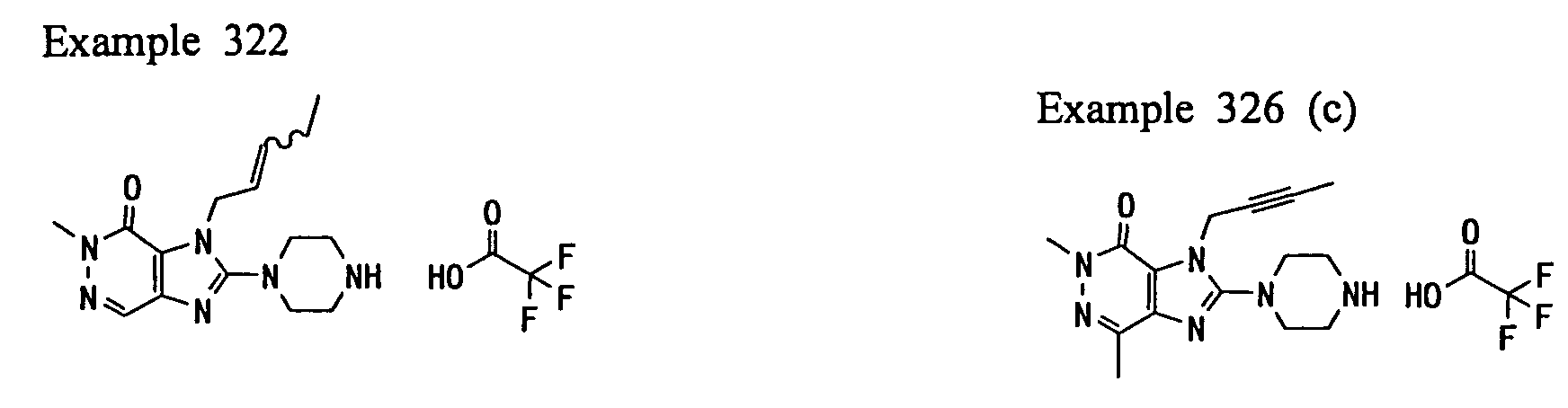


| Example No. | IC50(nM) | Example No. | IC50(nM) |
| Example 1 | 287 | Example4 | 211 |
| Example7 | 401 | Example9 | 141 |
| Example 12 | 183 | Example 13 | 126 |
| Example 16 | 272 | Example20 | 152 |
| Example 22 | 17 | Example 29 | 310 |
| Example 53 | 46. 9 | Example64 | 126 |
| Example73 | 33.4 | Example76 | 86.5 |
| Example79 | 35.7 | Example82 | 161 |
| Example83 | 27.4 | Example86 | 4.08 |
| Example88 | 2.89 | Example 98 | 9.69 |
| Example 109 | 1480 | Example 115 | 185 |
| Example119 | 154 | Example120 | 116 |
| Example 122 | 15.3 | Example129 | 116 |
| Example 142 | 68.5 | Example146 | 81. 7 |
| Example 159 | 37.7 | Example229 | 8.97 |
| Example 230 | 0.890 | Example 234 | 1. 74 |
| Example 235 | 1.44 | Example238 | 1.19 |
| Example 243 | 2. 15 | Example 248 | 6.40 |
| Example 266 | 1. 15 | Example 267 | 7.22 |
| Example 297 | 6.22 | Example311 | 77.5 |
| Example 341 | 7.32 | Example 353 | 283 |
| Example 354 | 285 | Example 355 | 147 |
| Example 357 | 323 | Example 358 | 357 |
| Example 359 | 353 | Example 361 | 0.654 |
| Example 364 | 9.48 | Example 367 | 4.56 |
| Example 377 | 8.77 | Example 378 | 9.52 |
| Example 382 | 6. 97 | Example 383 | 7.18 |
| Example 393 | 1. 2 | Example 394 | 2.16 |
| Example 396 | 197 | Example 398 | 237 |
| Example 400 | 183 | Example 402 | 354 |
| Example 403 | 266 | Example 404 | 276 |
| Example 405 | 359 | Example 407 | 275 |
| Example 408 | 340 | Example 409 | 222 |
| Example 410 | 64.9 | Example 413 | 1. 95 |
| Example 415 | 1. 81 | Example 416 | 4.02 |
| Example 417 | 0.864 | Example 418 | 1. 14 |
| Example 419 | 1. 55 | Example 420 | 1. 70 |
| Example 421 | 3. 37 | Example 422 | 0.472 |
| Test compound | Dose (mg/kg) | GLP-1 concentration at each time point (hr) after oral administration (% of Pre) | |||
| 0 | 1 | 3 | 5 | ||
| Vehicle control | 100±0.0 | 87.2±4.8 | 100.4±7.8 | 110.6±6.8 | |
| Metformin | 30 | 100±0.0 | 99.9±3.7 | 106.6±5.0 | 116.3±2.7 |
| Metformin | 100 | 100±0.0 | 111.6±7.9 | 116.3±8.2 | 150.6±7.2 |
| Metformin | 300 | 100±0.0 | 140.0±11.5 | 199.3±32.4 | 227.1±35.5 |
| Buformin | 30 | 100±0.0 | 118.7±9.3 | 122.7±7.1 | 114.6±4.4 |
| Buformin | 100 | 100±0.0 | 163.6±19.6 | 171.2±9.1 | 195.8±36.6 |
| Phenformin | 30 | 100±0.0 | 125.3±10.7 | 120.0±7.2 | 126.7±10.7 |
| Phenformin | 100 | 100±0.0 | 316.9±26.4 | 330.7±112.4 | 236.5±20.5* |
Furthermore, the group of DPPIV-deficient rats administered phenformin at a dose of 100 mg/kg, had a significantly elevated level of active GLP-1 in plasma at 1, 3, and 5 hours after administration.
| Test compound | Dose (mg/kg) | GLP-1 concentration at each time point (hr) after oral administration (% of Pre) | |||
| 0 | 1 | 3 | 5 | ||
| Vehicle control | 100±0.0 | 112±15 | 125±21 | 84±10 | |
| Metformin | 300 | 100±0.0 | 117±9 | 149±24 | 94±10 |
| Val-Pyr | 30 | 100±0.0 | 127±6 | 136±20 | 91±2 |
| Metformin + Val-Pyr | 300 + 30 | 100±0.0 | 162±8 | 215±19 | 177±15 |
| Test compound | Dose (mg/kg) | GLP-1 concentration 3 hours after oral administration (% of Pre) |
| Vehicle control | 98.8±2.9 | |
| Example 119 | 10 | 98.9±2.2 |
| Example 122 | 10 | 108.2±6.6 |
| Metformin | 300 | 118.1±7.5 |
| Metformin + Example 119 | 300 + 10 | 162.5±7.4 |
| Metformin + Example 122 | 300 + 10 | 168.1±13.1 |
| Test compound | Dose (mg/kg) | GLP-1 concentration 3 hours after oral administration (% of Pre) |
| Vehicle control | 97.5±2.9 | |
| Example229 | 10 | 102.5±1.7 |
| Example 120 | 10 | 104.8±2.9 |
| Metformin | 300 | 108.6±2.2 |
| Metformin + Example 229 | 300 + 10 | 153.7±13.4 |
| Metformin + Example 120 | 300 + 10 | 166.4±16.5 |
| Test compound | Dose (mg/kg) | GLP-1 concentration 3 hours after oral administration (% of Pre) |
| Vehicle control | 96.7±2.6 | |
| Example82 | 20 | 97.3±2.1 |
| Example 267 | 10 | 110.0±9.0 |
| Metformin | 300 | 112.5±2.4 |
| Metformin + Example82 | 300 + 20 | 180.8±23.1 |
| Metformin + Example 267 | 300 + 10 | 186.2±26.2 |
| Test compound Dose(mg/kg) | GLP-1 concentration at each time point (hr) after oral glucose administration (% of Pre) | ||||
| -0.5 | 0 | 0.5 | 1 | 2 | |
| Vehicle control | 100.0±0.0 | 101.4±0.8 | 130.5±11.2 | 108.2±2.1 | 101.5±2.0 |
| Metformin(300) | 100.0±0.0 | 105.6±1.7 | 135.4±7.6 | 126.0±8.9 | 118.4±6.5 |
| Val-Pyr (30) | 100.0±0.0 | 119.5±3.6 | 217.6±24.6 | 197.5±20.4 | 128.3±5.4 |
| Metformin(300) + Val-Pyr (30) | 100.0±0.0 | 196.5±11.1 | 345.7±40.7 | 262.4±37.0 | 272.6±21.2 |
| Test compound Dose(mg/kg) | Blood glucose level at each time point (hr) after oral glucose administration (mg/dl) | |||||
| -0.5 | 0 | 0.5 | 1 | 2 | 3 | |
| Vehicle control | 101.4±3.4 | 115.7±3.1 | 199.9±14.5 | 226.9±14.9 | 186.6±8.1 | 120.9±5.4 |
| Metformin(300) | 108.9±5.6 | 117.4±5.5 | 160.6±9.7 | 177.5±10.6* | 159.8±8.6 | 122.4±3.7 |
| Val-Pyr (30) | 102.6±3.0 | 110.5±3.3 | 166.0±9.9 | 167.1±7.0 | 139.3±3.3 | 116.1±3.0 |
| Metformin(300) + Val-Pyr (30) | 99.0±4.6 | 103.2±3.9 | 119.1±6.6 | 125.2±7.2 | 114.6±4.5 | 104.1±4.2 |
| Test compound Dose(mg/kg) | Insulin concentration at each time point (hr) after oral glucose administration (ng/ml) | ||||
| -0.5 | 0 | 0.5 | 1 | 2 | |
| Vehicle control | 9.8±1.1 | 11.9±1.3 | 22.6±2.0 | 16.2±1.0 | 13.2±0.9 |
| Metformin (300) | 11.9±1.1 | 14.0±1.1 | 22.9±2.5 | 21.2±2.3 | 16.9±1.6 |
| Val-Pyr(30) | 8.8±1.1 | 13.1±1.2 | 32.4±3.2 | 27.7±5.0 | 14.4±2.6 |
| Metformin (300) + Val-Pyr (30) | 9.3±1.3 | 14.9±1.4 | 24.3±3.1 | 19.0±2.7 | 15.0±2.9 |
| Test compound | Dose (mg/kg) | Total food intake for 14 days (g) | Weight gain for 14 days (g) |
| Vehicle control | 484.2±15.0 | 68.2±4.1 | |
| Metformin | 300 | 495.1±8.9 | 64.5±3.5 |
| Val-Pyr | 30 | 491.8±11.1 | 60.9±4.4 |
| Metformin + Val-Pyr | 300 + 30 | 418.4±14.0 | 39.2±6.1 |
| Test compound | Dose (mg/kg) | GLP-2 concentration at each time point (hr) after oral administration (ng/ml) | |||
| 0 | 1 | 3 | 5 | ||
| Vehicle control | 1.39±0.05 | 1.31±0.02 | 1.36±0.04 | 1.28±0.07 | |
| Metformin | 300 | 1.32±0.02 | 1.65±0.06 | 2.08±0.07 | 2.15±0.05 |
| 5-FU treatment (mg/kg) | Test compound | Dose (mg/kg) | Wet weight of small intestine (g) |
| Normal control | 0.700±0.009 | ||
| 60 | Vehicle control | 0.622±0.005 | |
| 60 | Metformin | 300 | 0.642±0.017 |
| 60 | Val-Pyr | 30 | 0.637±0.015 |
| 60 | Metformin + Val-Pyr | 300 + 30 | 0.693±0.015 |
Claims (34)
- A pharmaceutical agent comprising a dipeptidyl peptidase IV inhibitor and a biguanide agent in combination.
- The pharmaceutical agent according to claim 1, which enhances the effects of active circulating glucagon-like peptide-1 (GLP-1) and/or active circulating glucagon-like peptide-2 (GLP-2).
- A pharmaceutical agent that enhances the effects of active circulating GLP-2.
- A pharmaceutical agent comprising a dipeptidyl peptidase IV inhibitor and the pharmaceutical agent according to claim 3 in combination.
- The pharmaceutical agent according to claim 1 or 4, wherein the dipeptidyl peptidase IV inhibitor is a compound represented by the following formula, or a salt or hydrate thereof,(wherein,

T1 represents a monocyclic or bicyclic 4- to 12-membered heterocyclic group containing one or two nitrogen atoms in the ring, that may have one or more substituents;
X represents a C1-6 alkyl group which may have one or more substituents, a C2-6 alkenyl group which may have one or more substituents, a C2-6 alkynyl group which may have one or more substituents, a C6-10 aryl group which may have one or more substituents, a 5 to 10-membered heteroaryl group which may have one or more substituents, a C6-10 aryl C1-6 alkyl group which may have one or more substituents, or a 5 to 10-membered heteroaryl C1-6 alkyl group which may have one or more substituents;
Z1 and Z2 each independently represent a nitrogen atom or a group represented by the formula -CR2=;
R1 and R2 each independently represent a group according to the formula -A0-A1-A2 (wherein A0 represents a single bond or a C1-6 alkylene group, which may have 1 to 3 substituents selected from group B consisting of the substituents described below;
A1 represents a single bond, an oxygen atom, a sulfur atom, a sulfinyl group, a sulfonyl group, a carbonyl group, a group represented by the formula -O-CO-, a group represented by the formula -CO-O-, a group represented by the formula -NRA-, a group represented by the formula -CO-NRA-, a group represented by the formula -NRA-CO-, a group represented by the formula -SO2-NRA-, or a group represented by the formula -NRA-SO2-;
A2 and RA each independently represent a hydrogen atom, a halogen atom, a cyano group, a C1-6 alkyl group, a C3-8 cycloalkyl group, a C2-6 alkenyl group, a C2-6 alkynyl group, C6-10 aryl group, a 5 to 10-membered heteroaryl group, a 4 to 8-membered heterocyclic group, a 5 to 10-membered heteroaryl C1-6 alkyl group, a C6-10 aryl C1-6 alkyl group, or a C2-7 alkylcarbonyl group;
however, A2 and RA each independently may have 1 to 3 substituents selected from the substituent group B described below:
when Z2 is a group represented by the formula -CR2=, R1, and R2 may in combination form a 5 to 7-membered ring;
except in cases where: [1] R1 is a hydrogen atom; Z1 is a nitrogen atom; and Z2 is -CH=; and [2] Z1 is a nitrogen atom; and Z2 is -C(OH)=;
<Substituent group B>
Substituent group B represents the group consisting of: a hydroxyl group, a mercapto group, a cyano group, a nitro group, a halogen atom, a trifluoromethyl group, a C1-6 alkyl group which may have one or more substituents, a C3-8 cycloalkyl group, a C2-6 alkenyl group, a C2-6 alkynyl group, a C6-10 aryl group, a 5 to 10-membered heteroaryl group, a 4 to 8-membered heterocyclic group, a C1-6 alkoxy group, a C1-6 alkylthio group, a group represented by the formula -SO2-NRB1-RB2, a group represented by the formula -NRB1-CO-RB2, a group represented by the formula -NRB1-RB2 (where RB1 and RB2 each independently represent a hydrogen atom or a C1-6 alkyl group), a group represented by the formula -CO-RB3 (where RB3 represents a 4 to 8-membered heterocyclic group), a group represented by the formula -CO-RB4-RB5 and a group represented by the formula -CH2-CO-RB4-RB5 (where RB4 represents a single bond, an oxygen atom, or a group represented by the formula -NRB6-; RB5 and RB6 each independently represent a hydrogen atom, a C1-6 alkyl group, a C3-8 cycloalkyl group, a C2-6 alkenyl group, a C2-6 alkynyl group, a C6-10 aryl group, a 5 to 10-membered heteroaryl group, a 4 to 8-membered heterocyclic C1-6 alkyl group, a C6-10 aryl C1-6 alkyl group, or a 5 to 10-membered heteroaryl C1-6 alkyl group)). - The pharmaceutical agent according to claim 5, wherein T1 is a piperazin-1-yl group or a 3-amino-piperidin-1-yl group.
- The pharmaceutical agent according to claim 5, wherein T1 is a piperazin-1-yl group.
- The pharmaceutical agent according to any one of claims 5 to 7, wherein X is a 3-methyl-2-buten-1-yl group, a 2-butynyl group, a benzyl group, or a 2-chlorophenyl group.
- The pharmaceutical agent according to any one of claims 5 to 7, wherein X is a 2-butynyl group.
- The pharmaceutical agent according to any one of claims 5 to 9, wherein,
Z1 is a nitrogen atom; and
Z2 is a group represented by the formula -CR2=
(where R2 is as defined in claim 5). - The pharmaceutical agent according to any one of claims 5 to 9, wherein,
Z2 is a nitrogen atom; and
Z1 is a group represented by the formula -CR2=
(where R2 is as defined in claim 5). - The pharmaceutical agent according to any one of claims 5 to 11, wherein R1 is either a methyl group, a cyanobenzyl group, a fluorocyanobenzyl group, a phenethyl group, a 2-methoxyethyl group, or a 4-methoxycarbonylpridin-2-yl group.
- The pharmaceutical agent according to any one of claims 5 to 11, wherein R1 is a methyl group, or a 2-cyanobenzyl group.
- The pharmaceutical agent according to any one of claims 5 to 13, wherein R2 is either a hydrogen atom, a cyano group, a methoxy group, a carbamoylphenyloxy group, or a group represented by the formula:(where,

A27 represents an oxygen atom, a sulfur atom, or -NH-;
A28 and A29 each independently represent a hydrogen atom or a C1-6 alkyl group). - The pharmaceutical agent according to any one of claims 5 to 13, wherein R2 is a hydrogen atom, a cyano group, or a 2-carbamoylphenyloxy group.
- The pharmaceutical agent according to claim 5, wherein the compound represented by formula (I) is any one compound selected from:or a salt or hydrate thereof.(1) 7-(2-butynyl)-2-cyano-1-methyl-8-(piperazin-1-yl)-1,7-dihydropurin-6-one;(2) 3-(2-butynyl)-5-methyl-2-(piperazin-1-yl)-3,5-dihydroimidazo[4,5-d]pyridazin-4-one;(3) 2-(3-aminopiperidin-1-yl)-3-(2-butynyl)-5-methyl-3,5-dihydroimidazo[4,5-d]pyridazin-4-one;(4) 2-[7-(2-butynyl)-1-methyl-6-oxo-8-(piperazin-1-yl)-6,7-dihydro-1H-purin-2-yloxy] benzamide;(5) 7-(2-butynyl)-1-(2-cyanobenzyl)-6-oxo-8-(piperazin-1-yl)-6,7-dihydro-1H-purine-2-car bonitrile; and(6) 2-[3-(2-butynyl)-4-oxo-2-(piperazin-1-yl)-3,4-dihydroimidazo[4,5-d] pyridazin-5-ylmethyl] benzonitrile;
- The pharmaceutical agent according to claim 1 or 4, wherein the dipeptidyl peptidase IV inhibitor is a compound represented by the following formula, or a salt or hydrate thereof,(wherein T1, X, R1, and R2 are as defined in claim 5).

- The pharmaceutical agent according to claim 17, wherein T1 is a piperazin-1-yl group.
- The pharmaceutical agent according to claim 17 or 18, wherein X is a 2-butynyl group or a 2-chlorophenyl group.
- The pharmaceutical agent according to claim 17 or 18, wherein X is a 2-butynyl group.
- The pharmaceutical agent according to any one of claims 17 to 20, wherein R1 is a hydrogen atom, a methyl group, a 2-propynyl group, a 2-butynyl group, a cyanomethyl group, a phenethyl group, a phenoxyethyl group, or a group represented by the formula:(where R3 represents a hydroxyl group, a C1-6 alkoxy group, or a phenyl group).

- The pharmaceutical agent according to any one of claims 17 to 21, wherein R2 is a hydrogen atom, a C1-6 alkyl group, an ethoxyethyl group, a tetrahydrofuranylmethyl group, or a group represented by the formula:(where,

R4 and R5 are identical to or different from each other, and independently represent a hydrogen atom, a methyl group, or a phenyl group; and
R6 represents a hydroxyl group, a C1-6 alkoxy group, or a phenyl group),
or a group represented by the formula:
- The pharmaceutical agent according to claim 17, wherein the compound represented by formula (II) is any one compound selected from:or a salt or hydrate thereof.(1) 7-(2-butynyl)-1,3-dimethyl-8-(piperazin-1-yl)-3,7-dihydropurine-2,6-dione;(2) 7-(2-butynyl)-3-methyl-8-(piperazin-1-yl)-3,7-dihydropurine-2,6-dione;(3) methyl [7-(2-butynyl)-3-methyl-2,6-dioxo-8-(piperazin-1-yl)-2,3,6,7-tetrahydropurin-1-yl] acetate;(4) 7-(2-butynyl)-3-methyl-8-(piperazin-1-yl)-1-(2-propynyl)-3,7-dihydropurine-2,6-dione;(5) 1,7-bis(2-butynyl)-3-methyl-8-(piperazin-1-yl)-3,7-dihydropurine-2,6-dione;(6) [7-(2-butynyl)-3-methyl-2,6-dioxo-8-(piperazin-1-yl)-2,3,6,7-tetrahydropurin-1-yl] acetonitrile;(7) 7-(2-butynyl)-3-methyl-1-[(2-oxo-2-phenyl)ethyl]-8-(piperazin-1-yl)-3,7-dihydropurine-2,6-dione;(8) 7-(2-butynyl)-3-ethyl-1-methyl-8-(piperazin-1-yl)-3,7-dihydropurine-2,6-dione;(9) methyl [7-(2-butynyl)-1-methyl-2,6-dioxo-8-(piperazin-1-yl)-1,2,6,7-tetrahydropurin-3-yl] acetate;(10) 7-(2-butynyl)-3-(2-tetrahydrofuranyl)methyl-1-methyl-8-(piperazin-1-yl)-3,7-dihydropu rine-2,6-dione;(11) methyl [7-(2-butynyl)-1-methyl-2,6-dioxo-8-(piperazin-1-yl)-1,2,6,7-tetrahydropurin-3-yl]phen ylacetate;(12) 7-(2-butynyl)-3-propyl-1-methyl-8-(piperazin-1-yl)-3,7-dihydropurine-2,6-dione;(13) 7-(2-butynyl)-3-(2-oxo-2-phenethyl)-1-methyl-8-(piperazin-1-yl)-3,7-dihydropurine-2,6 -dione;(14) ethyl 2-[7-(2-butynyl)-1-methyl-2,6-dioxo-8-(piperazin-1-yl)-1,2,6,7-tetrahydropurin-3-yl] propionate;(15) 7-(2-butynyl)-3-(2-ethoxyethyl)-1-methyl-8-(piperazin-1-yl)-3,7-dihydropurine-2,6-dio ne;(16) 7-(2-butynyl)-3-isopropyl-1-methyl-8-(piperazin-1-yl)-3,7-dihydropurine-2,6-dione;(17) 7-(2-butynyl)-3-(3,3-dimethyl-2-oxobutyl)-1-methyl-8-(piperazin-1-yl)-3,7-dihydropuri ne-2,6-dione;(18) 7-(2-butynyl)-1-methyl-3-(2-oxopyrrolidin-3-yl)-8-(piperazin-1-yl)-3,7-dihydropurine-2 ,6-dione;(19) 7-(2-butynyl)-3-(2-ethoxyethyl)-1-(2-oxo-2-phenylethyl)-8-(piperazin-1-yl)-3,7-dihydro purine-2,6-dione;(20) methyl [7-(2-butynyl)-2,6-dioxo-1-(2-oxo-2-phenylethyl)-8-(piperazin-1-yl)-1,2,6,7-tetrahydro purin-3-yl] acetate;(21) ethyl [7-(2-butynyl)-2,6-dioxo-1-(2-phenethyl)-8-(piperazin-1-yl)-1,2,6,7-tetrahydropurin-3-y 1] acetate;(22) [7-(2-butynyl)-2,6-dioxo-1-(2-phenethyl)-8-(piperazin-1-yl)-1,2,6,7-tetrahydropurin-3-y l] acetate;(23) 7-(2-butynyl)-3-[2-oxo-2-(pyrrolidin-1-yl)ethyl]-1-(2-phenethyl)-8-(piperazin-1-yl)-3,7-dihydropurine-2,6-dione;(24) 2-[7-(2-butynyl)-2,6-dioxo-1-(2-phenethyl)-8-(piperazin-1-yl)-1,2,6,7-tetrahydropurin-3 -yl]-N-methylacetamide;(25) 2-[7-(2-butynyl)-2,6-dioxo-1-(2-phenethyl)-8-(piperazin-1-yl)-1,2,6,7-tetrahydropurin-3 -yl]-N-cyclopropyl acetamide;(26) 2-[7-(2-butynyl)-2,6-dioxo-1-(2-phenethyl)-8-(piperazin-1-yl)-1,2,6,7-tetrahydropurin-3 -yl]-N-phenylacetamide; and(27) 2-[7-(2-butynyl)-2,6-dioxo-1-(2-phenethyl)-8-(piperazin-1-yl)-1,2,6,7-tetrahydropurin-3 -yl]-N-(2-propynyl) acetamide;
- The pharmaceutical agent according to claim 1, wherein the biguanide agent is metformin.
- The pharmaceutical agent according to claim 1 or 2, which is a preventive or therapeutic agent for a disease which is associated with active circulating GLP-1 and/or active circulating GLP-2.
- The pharmaceutical agent according to claim 25, wherein the disease is at least any one selected from the group consisting of: diabetes, obesity, hyperlipidemia, and gastrointestinal diseases.
- The pharmaceutical agent according to claim 3 or 4, which is a preventive or therapeutic agent for a disease which is associated with active circulating GLP-2.
- The pharmaceutical agent according to claim 27, wherein the disease is a gastrointestinal disease.
- A method for preventing or treating a disease which is associated with active circulating GLP-1 and/or active circulating GLP-2, which comprises administering the pharmaceutical agent according to claim 1 or 2 at an effective amount.
- The use of the pharmaceutical agent according to claim 1 or 2 for producing a preventive or therapeutic agent for a disease which is associated with active circulating GLP-1 and/or active circulating GLP-2.
- A method for preventing or treating a disease which is associated with active circulating GLP-2, which comprises administering the pharmaceutical agent according to claim 3 or 4 at an effective amount.
- The use of the pharmaceutical agent according to claim 3 or 4 for producing a preventive or therapeutic agent for a disease which is associated with active circulating GLP-2.
- A method for enhancing the effects of active circulating GLP-1 and/or active circulating GLP-2, which comprises using the pharmaceutical agent according to claim 1 or 2.
- A method for enhancing the effects of active circulating GLP-2, which comprises using the pharmaceutical agent according to claim 3 or 4.
Applications Claiming Priority (5)
| Application Number | Priority Date | Filing Date | Title |
|---|---|---|---|
| JP2002280137 | 2002-09-26 | ||
| JP2002280137 | 2002-09-26 | ||
| JP2003117927 | 2003-04-23 | ||
| JP2003117927 | 2003-04-23 | ||
| PCT/JP2003/012075 WO2004028524A1 (en) | 2002-09-26 | 2003-09-22 | Combination drug |
Publications (2)
| Publication Number | Publication Date |
|---|---|
| EP1557165A1 true EP1557165A1 (en) | 2005-07-27 |
| EP1557165A4 EP1557165A4 (en) | 2008-12-03 |
Family
ID=32044617
Family Applications (1)
| Application Number | Title | Priority Date | Filing Date |
|---|---|---|---|
| EP03798438A Withdrawn EP1557165A4 (en) | 2002-09-26 | 2003-09-22 | Combination drug |
Country Status (12)
| Country | Link |
|---|---|
| US (1) | US20060094722A1 (en) |
| EP (1) | EP1557165A4 (en) |
| JP (1) | JPWO2004028524A1 (en) |
| KR (1) | KR100867485B1 (en) |
| AU (1) | AU2003266559B2 (en) |
| BR (1) | BR0314655A (en) |
| CA (1) | CA2498423A1 (en) |
| MX (1) | MXPA05003252A (en) |
| NO (1) | NO20052018L (en) |
| NZ (1) | NZ538936A (en) |
| RU (1) | RU2328280C2 (en) |
| WO (1) | WO2004028524A1 (en) |
Cited By (30)
| Publication number | Priority date | Publication date | Assignee | Title |
|---|---|---|---|---|
| WO2006086727A3 (en) * | 2005-02-09 | 2006-11-02 | Entelos Inc | Treating diabetes with glucagon-like peptide-1 secretagogues |
| WO2006074051A3 (en) * | 2004-12-30 | 2006-11-09 | Diakine Therapeutics Inc | PHARMACEUTICAL COMPOSITIONS AND METHODS FOR RESTORING β-CELL MASS AND FUNCTION |
| WO2007078726A3 (en) * | 2005-12-16 | 2008-06-12 | Merck & Co Inc | Pharmaceutical compositions of combinations of dipeptidyl peptidase-4 inhibitors with metformin |
| WO2008130314A1 (en) * | 2007-04-18 | 2008-10-30 | Astrazeneca Ab | Xanthine compounds having a positive allosteric gabab receptor modulator effect |
| WO2010079197A1 (en) * | 2009-01-07 | 2010-07-15 | Boehringer Ingelheim International Gmbh | Treatment of diabetes in patients with inadequate glycemic control despite metformin therapy comprising a dpp-iv inhibitor |
| US7820815B2 (en) | 2004-11-05 | 2010-10-26 | Boehringer Ingelheim International Gmbh | Process for the preparation of chiral 8-(-3-aminopiperidin-1-yl) xanthines |
| US8106060B2 (en) | 2005-07-30 | 2012-01-31 | Boehringer Ingelheim International Gmbh | 8-(3-amino-piperidin-1-yl)-xanthines, their preparation, and their use as pharmaceuticals |
| US8119648B2 (en) | 2002-08-21 | 2012-02-21 | Boehringer Ingelheim Pharma Gmbh & Co. Kg | 8-[3-amino-piperidin-1-yl]-xanthines, the preparation thereof and their use as pharmaceutical compositions |
| US8232281B2 (en) | 2006-05-04 | 2012-07-31 | Boehringer Ingelheim International Gmbh | Uses of DPP-IV inhibitors |
| US8513264B2 (en) | 2008-09-10 | 2013-08-20 | Boehringer Ingelheim International Gmbh | Combination therapy for the treatment of diabetes and related conditions |
| US8697868B2 (en) | 2004-02-18 | 2014-04-15 | Boehringer Ingelheim International Gmbh | 8-[3-amino-piperidin-1-yl]-xanthines, their preparation and their use as pharmaceutical compositions |
| US8853156B2 (en) | 2008-08-06 | 2014-10-07 | Boehringer Ingelheim International Gmbh | Treatment for diabetes in patients inappropriate for metformin therapy |
| US8865729B2 (en) | 2008-12-23 | 2014-10-21 | Boehringer Ingelheim International Gmbh | Salt forms of a xanthine compound |
| US8883800B2 (en) | 2011-07-15 | 2014-11-11 | Boehringer Ingelheim International Gmbh | Substituted quinazolines, the preparation thereof and the use thereof in pharmaceutical compositions |
| US9034883B2 (en) | 2010-11-15 | 2015-05-19 | Boehringer Ingelheim International Gmbh | Vasoprotective and cardioprotective antidiabetic therapy |
| US9149478B2 (en) | 2010-06-24 | 2015-10-06 | Boehringer Ingelheim International Gmbh | Diabetes therapy |
| US9155705B2 (en) | 2008-04-03 | 2015-10-13 | Boehringer Ingelheim International Gmbh | DPP-IV inhibitor combined with a further antidiabetic agent, tablets comprising such formulations, their use and process for their preparation |
| US9186392B2 (en) | 2010-05-05 | 2015-11-17 | Boehringer Ingelheim International Gmbh | Combination therapy |
| US9266888B2 (en) | 2006-05-04 | 2016-02-23 | Boehringer Ingelheim International Gmbh | Polymorphs |
| US9457029B2 (en) | 2009-11-27 | 2016-10-04 | Boehringer Ingelheim International Gmbh | Treatment of genotyped diabetic patients with DPP-IV inhibitors such as linagliptin |
| US9486526B2 (en) | 2008-08-06 | 2016-11-08 | Boehringer Ingelheim International Gmbh | Treatment for diabetes in patients inappropriate for metformin therapy |
| US9526730B2 (en) | 2012-05-14 | 2016-12-27 | Boehringer Ingelheim International Gmbh | Use of a DPP-4 inhibitor in podocytes related disorders and/or nephrotic syndrome |
| US9526728B2 (en) | 2014-02-28 | 2016-12-27 | Boehringer Ingelheim International Gmbh | Medical use of a DPP-4 inhibitor |
| US9555001B2 (en) | 2012-03-07 | 2017-01-31 | Boehringer Ingelheim International Gmbh | Pharmaceutical composition and uses thereof |
| US9713618B2 (en) | 2012-05-24 | 2017-07-25 | Boehringer Ingelheim International Gmbh | Method for modifying food intake and regulating food preference with a DPP-4 inhibitor |
| US10155000B2 (en) | 2016-06-10 | 2018-12-18 | Boehringer Ingelheim International Gmbh | Medical use of pharmaceutical combination or composition |
| US11033552B2 (en) | 2006-05-04 | 2021-06-15 | Boehringer Ingelheim International Gmbh | DPP IV inhibitor formulations |
| US11911388B2 (en) | 2008-10-16 | 2024-02-27 | Boehringer Ingelheim International Gmbh | Treatment for diabetes in patients with insufficient glycemic control despite therapy with an oral or non-oral antidiabetic drug |
| US11977085B1 (en) | 2023-09-05 | 2024-05-07 | Elan Ehrlich | Date rape drug detection device and method of using same |
| US12312352B2 (en) | 2012-05-14 | 2025-05-27 | Boehringer Ingelheim International Gmbh | Use of a DPP-4 inhibitor in SIRS and/or sepsis |
Families Citing this family (32)
| Publication number | Priority date | Publication date | Assignee | Title |
|---|---|---|---|---|
| NZ528216A (en) * | 2001-02-24 | 2006-12-22 | Boehringer Ingelheim Pharma | Xanthine derivatives, the preparation thereof and their use as pharmaceutical compositions |
| US7074798B2 (en) | 2002-02-25 | 2006-07-11 | Eisai Co., Ltd | Xanthine derivative and DPPIV inhibitor |
| RU2297418C9 (en) * | 2002-06-06 | 2009-01-27 | Эйсай Ко., Лтд. | Novel condensed derivatives of imidazole, inhibitors of dipeptidyl peptidase iv, pharmaceutical composition, method of treatment and using based on thereof |
| US7495005B2 (en) * | 2002-08-22 | 2009-02-24 | Boehringer Ingelheim Pharma Gmbh & Co. Kg | Xanthine derivatives, their preparation and their use in pharmaceutical compositions |
| US7569574B2 (en) * | 2002-08-22 | 2009-08-04 | Boehringer Ingelheim Pharma Gmbh & Co. Kg | Purine derivatives, the preparation thereof and their use as pharmaceutical compositions |
| US7482337B2 (en) * | 2002-11-08 | 2009-01-27 | Boehringer Ingelheim Pharma Gmbh & Co. Kg | Xanthine derivatives, the preparation thereof and their use as pharmaceutical compositions |
| DE10254304A1 (en) | 2002-11-21 | 2004-06-03 | Boehringer Ingelheim Pharma Gmbh & Co. Kg | New xanthine derivatives, their production and their use as medicines |
| BR0316991A (en) | 2002-12-04 | 2005-10-25 | Eisai Co Ltd | Fused 1,3-dihydroimidazole ring compounds |
| US7550590B2 (en) | 2003-03-25 | 2009-06-23 | Takeda Pharmaceutical Company Limited | Dipeptidyl peptidase inhibitors |
| EP1625122A1 (en) | 2003-05-14 | 2006-02-15 | Takeda San Diego, Inc. | Dipeptidyl peptidase inhibitors |
| US7566707B2 (en) * | 2003-06-18 | 2009-07-28 | Boehringer Ingelheim International Gmbh | Imidazopyridazinone and imidazopyridone derivatives, the preparation thereof and their use as pharmaceutical compositions |
| ZA200602051B (en) | 2003-08-13 | 2007-10-31 | Takeda Pharmaceutical | 4-pyrimidone derivatives and their use as peptidyl peptidase inhibitors |
| JPWO2005051949A1 (en) * | 2003-11-26 | 2007-06-21 | 住友製薬株式会社 | New condensed imidazole derivatives |
| DE10355304A1 (en) | 2003-11-27 | 2005-06-23 | Boehringer Ingelheim Pharma Gmbh & Co. Kg | Novel 8- (piperazin-1-yl) and 8 - ([1,4] diazepan-1-yl) xanthines, their preparation and their use as pharmaceuticals |
| DE102004009039A1 (en) | 2004-02-23 | 2005-09-08 | Boehringer Ingelheim Pharma Gmbh & Co. Kg | 8- [3-Amino-piperidin-1-yl] xanthines, their preparation and use as pharmaceuticals |
| US7393847B2 (en) | 2004-03-13 | 2008-07-01 | Boehringer Ingleheim International Gmbh | Imidazopyridazinediones, their preparation and their use as pharmaceutical compositions |
| US7179809B2 (en) * | 2004-04-10 | 2007-02-20 | Boehringer Ingelheim International Gmbh | 2-Amino-imidazo[4,5-d]pyridazin-4-ones, their preparation and their use as pharmaceutical compositions |
| JP2007531780A (en) * | 2004-04-10 | 2007-11-08 | ベーリンガー インゲルハイム インターナショナル ゲゼルシャフト ミット ベシュレンクテル ハフツング | Novel 2-amino-imidazo [4,5-D] pyridazin-4-one and 2-amino-imidazo [4,5-C] pyridazin-4-one, their preparation and use as pharmaceuticals |
| US7439370B2 (en) * | 2004-05-10 | 2008-10-21 | Boehringer Ingelheim International Gmbh | Imidazole derivatives, their preparation and their use as intermediates for the preparation of pharmaceutical compositions and pesticides |
| DE102004030502A1 (en) | 2004-06-24 | 2006-01-12 | Boehringer Ingelheim Pharma Gmbh & Co. Kg | Novel imidazoles and triazoles, their preparation and use as medicines |
| WO2006022428A1 (en) * | 2004-08-26 | 2006-03-02 | Takeda Pharmaceutical Company Limited | Remedy for diabetes |
| DE102004043944A1 (en) * | 2004-09-11 | 2006-03-30 | Boehringer Ingelheim Pharma Gmbh & Co. Kg | Novel 8- (3-amino-piperidin-1-yl) -7- (but-2-ynyl) -xanthines, their preparation and their use as pharmaceuticals |
| DE102004044221A1 (en) | 2004-09-14 | 2006-03-16 | Boehringer Ingelheim Pharma Gmbh & Co. Kg | New 3-methyl-7-butynyl xanthines, their preparation and their use as pharmaceuticals |
| ZA200802857B (en) | 2005-09-14 | 2009-09-30 | Takeda Pharmaceutical | Dipeptidyl peptidase inhibitors for treating diabetes |
| CN101360723A (en) | 2005-09-16 | 2009-02-04 | 武田药品工业株式会社 | Process for preparing pyrimidinedione derivatives |
| WO2007112347A1 (en) | 2006-03-28 | 2007-10-04 | Takeda Pharmaceutical Company Limited | Dipeptidyl peptidase inhibitors |
| EP2057160A1 (en) | 2006-08-08 | 2009-05-13 | Boehringer Ingelheim International GmbH | Pyrrolo [3, 2 -d]pyrimidines as dpp-iv inhibitors for the treatment of diabetes mellitus |
| TW200838536A (en) | 2006-11-29 | 2008-10-01 | Takeda Pharmaceutical | Polymorphs of succinate salt of 2-[6-(3-amino-piperidin-1-yl)-3-methyl-2,4-dioxo-3,4-dihydro-2H-pyrimidin-1-ylmethy]-4-fluor-benzonitrile and methods of use therefor |
| EA020870B1 (en) * | 2007-07-19 | 2015-02-27 | Такеда Фармасьютикал Компани Лимитед | Solid preparation comprising alogliptin and metformin hydrochloride |
| RU2396959C2 (en) * | 2008-09-09 | 2010-08-20 | Борис Иванович Блескин | Method of treating tuberculosis |
| CN111036392B (en) * | 2019-12-04 | 2022-03-08 | 北京矿冶科技集团有限公司 | Combined inhibitor and separation method for micro-fine particle copper-lead bulk concentrate |
| WO2022076975A1 (en) | 2020-10-05 | 2022-04-14 | Enliven Therapeutics, Inc. | 5- and 6-azaindole compounds for inhibition of bcr-abl tyrosine kinases |
Family Cites Families (12)
| Publication number | Priority date | Publication date | Assignee | Title |
|---|---|---|---|---|
| DE122010000020I1 (en) * | 1996-04-25 | 2010-07-08 | Prosidion Ltd | Method for lowering the blood glucose level in mammals |
| US6011049A (en) * | 1997-02-19 | 2000-01-04 | Warner-Lambert Company | Combinations for diabetes |
| US6242422B1 (en) * | 1998-10-22 | 2001-06-05 | Idun Pharmacueticals, Inc. | (Substituted)Acyl dipeptidyl inhibitors of the ice/ced-3 family of cysteine proteases |
| GB9823885D0 (en) * | 1998-10-30 | 1998-12-30 | Aquacal Limited | Foodstuff compositions |
| PT1741445E (en) * | 2000-01-21 | 2013-11-11 | Novartis Ag | Combinations comprising dipeptidylpeptidase-iv inhibitors and antidiabetic agents |
| GB0014969D0 (en) * | 2000-06-19 | 2000-08-09 | Smithkline Beecham Plc | Novel method of treatment |
| EP1301187B1 (en) * | 2000-07-04 | 2005-07-06 | Novo Nordisk A/S | Purine-2,6-diones which are inhibitors of the enzyme dipeptidyl peptidase iv (dpp-iv) |
| NZ528216A (en) * | 2001-02-24 | 2006-12-22 | Boehringer Ingelheim Pharma | Xanthine derivatives, the preparation thereof and their use as pharmaceutical compositions |
| EP1404675B1 (en) * | 2001-07-03 | 2008-03-12 | Novo Nordisk A/S | Dpp-iv-inhibiting purine derivatives for the treatment of diabetes |
| US7074798B2 (en) * | 2002-02-25 | 2006-07-11 | Eisai Co., Ltd | Xanthine derivative and DPPIV inhibitor |
| US6716842B2 (en) * | 2002-04-05 | 2004-04-06 | Warner-Lambert Company, Llc | Antidiabetic agents |
| RU2297418C9 (en) * | 2002-06-06 | 2009-01-27 | Эйсай Ко., Лтд. | Novel condensed derivatives of imidazole, inhibitors of dipeptidyl peptidase iv, pharmaceutical composition, method of treatment and using based on thereof |
-
2003
- 2003-09-22 AU AU2003266559A patent/AU2003266559B2/en not_active Ceased
- 2003-09-22 KR KR1020057005167A patent/KR100867485B1/en not_active Expired - Fee Related
- 2003-09-22 RU RU2005112447/15A patent/RU2328280C2/en active
- 2003-09-22 WO PCT/JP2003/012075 patent/WO2004028524A1/en not_active Ceased
- 2003-09-22 MX MXPA05003252A patent/MXPA05003252A/en unknown
- 2003-09-22 US US10/528,353 patent/US20060094722A1/en not_active Abandoned
- 2003-09-22 CA CA002498423A patent/CA2498423A1/en not_active Withdrawn
- 2003-09-22 NZ NZ538936A patent/NZ538936A/en unknown
- 2003-09-22 EP EP03798438A patent/EP1557165A4/en not_active Withdrawn
- 2003-09-22 JP JP2004539479A patent/JPWO2004028524A1/en active Pending
- 2003-09-22 BR BR0314655-3A patent/BR0314655A/en not_active IP Right Cessation
-
2005
- 2005-04-25 NO NO20052018A patent/NO20052018L/en unknown
Cited By (70)
| Publication number | Priority date | Publication date | Assignee | Title |
|---|---|---|---|---|
| US9321791B2 (en) | 2002-08-21 | 2016-04-26 | Boehringer Ingelheim International Gmbh | 8-[3-amino-piperidin-1-yl]-xanthines, the preparation thereof and their use as pharmaceutical compositions |
| US9556175B2 (en) | 2002-08-21 | 2017-01-31 | Boehringer Ingelheim International Gmbh | 8-[3-amino-piperidin-1-yl]-xanthines, the preparation thereof and thier use as pharmaceutical compositions |
| US9108964B2 (en) | 2002-08-21 | 2015-08-18 | Boehringer Ingelheim International Gmbh | 8-[3-amino-piperidin-1-yl]-xanthines, the preparation thereof and their use as pharmaceutical compositions |
| US8664232B2 (en) | 2002-08-21 | 2014-03-04 | Boehringer Ingelheim Pharma Gmbh & Co. Kg | 8-[3-amino-piperidin-1-yl]-xanthines, the preparation thereof and their use as pharmaceutical compositions |
| US10202383B2 (en) | 2002-08-21 | 2019-02-12 | Boehringer Ingelheim International Gmbh | 8-[3-amino-piperidin-1-yl]-xanthines, the preparation thereof and their use as pharmaceutical compositions |
| US8178541B2 (en) | 2002-08-21 | 2012-05-15 | Boehringer Ingelheim Pharma Gmbh & Co. Kg | 8-[3-amino-piperidin-1-yl]-xanthines, the preparation thereof and their use as pharmaceutical compositions |
| US10023574B2 (en) | 2002-08-21 | 2018-07-17 | Boehringer Ingelheim International Gmbh | 8-[3-amino-piperidin-1-yl]-xanthines, the preparation thereof and their use as pharmaceutical compositions |
| US8119648B2 (en) | 2002-08-21 | 2012-02-21 | Boehringer Ingelheim Pharma Gmbh & Co. Kg | 8-[3-amino-piperidin-1-yl]-xanthines, the preparation thereof and their use as pharmaceutical compositions |
| US8697868B2 (en) | 2004-02-18 | 2014-04-15 | Boehringer Ingelheim International Gmbh | 8-[3-amino-piperidin-1-yl]-xanthines, their preparation and their use as pharmaceutical compositions |
| US7820815B2 (en) | 2004-11-05 | 2010-10-26 | Boehringer Ingelheim International Gmbh | Process for the preparation of chiral 8-(-3-aminopiperidin-1-yl) xanthines |
| US9499546B2 (en) | 2004-11-05 | 2016-11-22 | Boehringer Ingelheim International Gmbh | Process for the preparation of chiral 8-(3-aminopiperidin-1-yl)-xanthines |
| US9751855B2 (en) | 2004-11-05 | 2017-09-05 | Boehringer Ingelheim International Gmbh | Process for the preparation of chiral 8-(3-aminopiperidin-1-yl)-xanthines |
| US8541450B2 (en) | 2004-11-05 | 2013-09-24 | Boehringer Ingelheim International Gmbh | Process for the preparation of chiral 8-(3-aminopiperidin-1yl)-xanthines |
| US8883805B2 (en) | 2004-11-05 | 2014-11-11 | Boehringer Ingelheim International Gmbh | Process for the preparation of chiral 8-(3-aminopiperidin-1-yl)-xanthines |
| WO2006074051A3 (en) * | 2004-12-30 | 2006-11-09 | Diakine Therapeutics Inc | PHARMACEUTICAL COMPOSITIONS AND METHODS FOR RESTORING β-CELL MASS AND FUNCTION |
| US7393827B2 (en) | 2004-12-30 | 2008-07-01 | Diakine Therapeutics, Inc. | Pharmaceutical compositions and methods for restoring β-cell mass and function |
| WO2006086727A3 (en) * | 2005-02-09 | 2006-11-02 | Entelos Inc | Treating diabetes with glucagon-like peptide-1 secretagogues |
| US8637530B2 (en) | 2005-07-30 | 2014-01-28 | Boehringer Ingelheim International Gmbh | 8-(3-amino-piperidin-1-yl)-xanthines, their preparation, and their use as pharmaceuticals |
| US8106060B2 (en) | 2005-07-30 | 2012-01-31 | Boehringer Ingelheim International Gmbh | 8-(3-amino-piperidin-1-yl)-xanthines, their preparation, and their use as pharmaceuticals |
| US8414921B2 (en) | 2005-12-16 | 2013-04-09 | Merck Sharp & Dohme Corp. | Pharmaceutical compositions of combinations of dipeptidyl peptidase-4 inhibitors with metformin |
| AU2006333151B2 (en) * | 2005-12-16 | 2010-03-04 | Merck Sharp & Dohme Llc | Pharmaceutical compositions of combinations of dipeptidyl peptidase-4 inhibitors with metformin |
| WO2007078726A3 (en) * | 2005-12-16 | 2008-06-12 | Merck & Co Inc | Pharmaceutical compositions of combinations of dipeptidyl peptidase-4 inhibitors with metformin |
| US9266888B2 (en) | 2006-05-04 | 2016-02-23 | Boehringer Ingelheim International Gmbh | Polymorphs |
| US10301313B2 (en) | 2006-05-04 | 2019-05-28 | Boehringer Ingelheim International Gmbh | Polymorphs |
| US12178819B2 (en) | 2006-05-04 | 2024-12-31 | Boehringer Ingelheim International Gmbh | DPP IV inhibitor formulations |
| US12171767B2 (en) | 2006-05-04 | 2024-12-24 | Boehringer Ingelheim International Gmbh | Uses of DPP IV inhibitors |
| US9815837B2 (en) | 2006-05-04 | 2017-11-14 | Boehringer Ingelheim International Gmbh | Polymorphs |
| US11919903B2 (en) | 2006-05-04 | 2024-03-05 | Boehringer Ingelheim International Gmbh | Polymorphs |
| US8232281B2 (en) | 2006-05-04 | 2012-07-31 | Boehringer Ingelheim International Gmbh | Uses of DPP-IV inhibitors |
| US9173859B2 (en) | 2006-05-04 | 2015-11-03 | Boehringer Ingelheim International Gmbh | Uses of DPP IV inhibitors |
| US10080754B2 (en) | 2006-05-04 | 2018-09-25 | Boehringer Ingelheim International Gmbh | Uses of DPP IV inhibitors |
| US11291668B2 (en) | 2006-05-04 | 2022-04-05 | Boehringer Ingelheim International Gmbh | Uses of DPP IV inhibitors |
| US8673927B2 (en) | 2006-05-04 | 2014-03-18 | Boehringer Ingelheim International Gmbh | Uses of DPP-IV inhibitors |
| US9493462B2 (en) | 2006-05-04 | 2016-11-15 | Boehringer Ingelheim International Gmbh | Polymorphs |
| US11084819B2 (en) | 2006-05-04 | 2021-08-10 | Boehringer Ingelheim International Gmbh | Polymorphs |
| US11033552B2 (en) | 2006-05-04 | 2021-06-15 | Boehringer Ingelheim International Gmbh | DPP IV inhibitor formulations |
| WO2008130314A1 (en) * | 2007-04-18 | 2008-10-30 | Astrazeneca Ab | Xanthine compounds having a positive allosteric gabab receptor modulator effect |
| US9415016B2 (en) | 2008-04-03 | 2016-08-16 | Boehringer Ingelheim International Gmbh | DPP-IV inhibitor combined with a further antidiabetic agent, tablets comprising such formulations, their use and process for their preparation |
| US10973827B2 (en) | 2008-04-03 | 2021-04-13 | Boehringer Ingelheim International Gmbh | DPP-IV inhibitor combined with a further antidiabetic agent, tablets comprising such formulations, their use and process for their preparation |
| US10022379B2 (en) | 2008-04-03 | 2018-07-17 | Boehringer Ingelheim International Gmbh | DPP-IV inhibitor combined with a further antidiabetic agent, tablets comprising such formulations, their use and process for their preparation |
| US9155705B2 (en) | 2008-04-03 | 2015-10-13 | Boehringer Ingelheim International Gmbh | DPP-IV inhibitor combined with a further antidiabetic agent, tablets comprising such formulations, their use and process for their preparation |
| US9486526B2 (en) | 2008-08-06 | 2016-11-08 | Boehringer Ingelheim International Gmbh | Treatment for diabetes in patients inappropriate for metformin therapy |
| US8853156B2 (en) | 2008-08-06 | 2014-10-07 | Boehringer Ingelheim International Gmbh | Treatment for diabetes in patients inappropriate for metformin therapy |
| US10034877B2 (en) | 2008-08-06 | 2018-07-31 | Boehringer Ingelheim International Gmbh | Treatment for diabetes in patients inappropriate for metformin therapy |
| US8513264B2 (en) | 2008-09-10 | 2013-08-20 | Boehringer Ingelheim International Gmbh | Combination therapy for the treatment of diabetes and related conditions |
| US11911388B2 (en) | 2008-10-16 | 2024-02-27 | Boehringer Ingelheim International Gmbh | Treatment for diabetes in patients with insufficient glycemic control despite therapy with an oral or non-oral antidiabetic drug |
| US9212183B2 (en) | 2008-12-23 | 2015-12-15 | Boehringer Ingelheim International Gmbh | Salt forms of 1-[(4-methyl-quinazolin-2-yl)methyl]-3-methyl-7-(2-butyn-1-yl)-8-(3-(R)-amino-piperidin-1-yl)-xanthine |
| US8865729B2 (en) | 2008-12-23 | 2014-10-21 | Boehringer Ingelheim International Gmbh | Salt forms of a xanthine compound |
| US8846695B2 (en) | 2009-01-07 | 2014-09-30 | Boehringer Ingelheim International Gmbh | Treatment for diabetes in patients with inadequate glycemic control despite metformin therapy comprising a DPP-IV inhibitor |
| WO2010079197A1 (en) * | 2009-01-07 | 2010-07-15 | Boehringer Ingelheim International Gmbh | Treatment of diabetes in patients with inadequate glycemic control despite metformin therapy comprising a dpp-iv inhibitor |
| US9457029B2 (en) | 2009-11-27 | 2016-10-04 | Boehringer Ingelheim International Gmbh | Treatment of genotyped diabetic patients with DPP-IV inhibitors such as linagliptin |
| US10092571B2 (en) | 2009-11-27 | 2018-10-09 | Boehringer Ingelheim International Gmbh | Treatment of genotyped diabetic patients with DPP-IV inhibitors such as linagliptin |
| US10004747B2 (en) | 2010-05-05 | 2018-06-26 | Boehringer Ingelheim International Gmbh | Combination therapy |
| US9603851B2 (en) | 2010-05-05 | 2017-03-28 | Boehringer Ingelheim International Gmbh | Combination therapy |
| US9186392B2 (en) | 2010-05-05 | 2015-11-17 | Boehringer Ingelheim International Gmbh | Combination therapy |
| US9149478B2 (en) | 2010-06-24 | 2015-10-06 | Boehringer Ingelheim International Gmbh | Diabetes therapy |
| US11911387B2 (en) | 2010-11-15 | 2024-02-27 | Boehringer Ingelheim International Gmbh | Vasoprotective and cardioprotective antidiabetic therapy |
| US9034883B2 (en) | 2010-11-15 | 2015-05-19 | Boehringer Ingelheim International Gmbh | Vasoprotective and cardioprotective antidiabetic therapy |
| US8962636B2 (en) | 2011-07-15 | 2015-02-24 | Boehringer Ingelheim International Gmbh | Substituted quinazolines, the preparation thereof and the use thereof in pharmaceutical compositions |
| US8883800B2 (en) | 2011-07-15 | 2014-11-11 | Boehringer Ingelheim International Gmbh | Substituted quinazolines, the preparation thereof and the use thereof in pharmaceutical compositions |
| US9199998B2 (en) | 2011-07-15 | 2015-12-01 | Boehringer Ingelheim Internatioal Gmbh | Substituted quinazolines, the preparation thereof and the use thereof in pharmaceutical compositions |
| US9555001B2 (en) | 2012-03-07 | 2017-01-31 | Boehringer Ingelheim International Gmbh | Pharmaceutical composition and uses thereof |
| US9526730B2 (en) | 2012-05-14 | 2016-12-27 | Boehringer Ingelheim International Gmbh | Use of a DPP-4 inhibitor in podocytes related disorders and/or nephrotic syndrome |
| US10195203B2 (en) | 2012-05-14 | 2019-02-05 | Boehringr Ingelheim International GmbH | Use of a DPP-4 inhibitor in podocytes related disorders and/or nephrotic syndrome |
| US12312352B2 (en) | 2012-05-14 | 2025-05-27 | Boehringer Ingelheim International Gmbh | Use of a DPP-4 inhibitor in SIRS and/or sepsis |
| US9713618B2 (en) | 2012-05-24 | 2017-07-25 | Boehringer Ingelheim International Gmbh | Method for modifying food intake and regulating food preference with a DPP-4 inhibitor |
| US9526728B2 (en) | 2014-02-28 | 2016-12-27 | Boehringer Ingelheim International Gmbh | Medical use of a DPP-4 inhibitor |
| US10155000B2 (en) | 2016-06-10 | 2018-12-18 | Boehringer Ingelheim International Gmbh | Medical use of pharmaceutical combination or composition |
| US12364700B2 (en) | 2016-06-10 | 2025-07-22 | Boehringer Ingelheim International Gmbh | Medical use of pharmaceutical combination or composition |
| US11977085B1 (en) | 2023-09-05 | 2024-05-07 | Elan Ehrlich | Date rape drug detection device and method of using same |
Also Published As
| Publication number | Publication date |
|---|---|
| JPWO2004028524A1 (en) | 2006-01-19 |
| RU2328280C2 (en) | 2008-07-10 |
| US20060094722A1 (en) | 2006-05-04 |
| NO20052018L (en) | 2005-06-22 |
| AU2003266559B2 (en) | 2008-01-24 |
| EP1557165A4 (en) | 2008-12-03 |
| MXPA05003252A (en) | 2005-07-05 |
| KR20050074460A (en) | 2005-07-18 |
| BR0314655A (en) | 2005-08-02 |
| CA2498423A1 (en) | 2004-04-08 |
| RU2005112447A (en) | 2006-01-20 |
| AU2003266559A2 (en) | 2005-07-07 |
| NZ538936A (en) | 2006-12-22 |
| KR100867485B1 (en) | 2008-11-10 |
| AU2003266559A1 (en) | 2004-04-19 |
| WO2004028524A1 (en) | 2004-04-08 |
Similar Documents
| Publication | Publication Date | Title |
|---|---|---|
| RU2328280C2 (en) | Combinative medicinal agent | |
| JP3675813B2 (en) | New condensed imidazole derivatives | |
| US20070219178A1 (en) | Preventive or therapeutic agents for multiple sclerosis | |
| EP1338595B1 (en) | Xanthine derivatives as DPP-IV inhibitors | |
| JP2004043429A (en) | New xanthine derivative and dppiv inhibitor | |
| WO1999043678A1 (en) | Remedies/preventives for parkinson's disease | |
| EP3735413B1 (en) | Tricyclic compounds, compositions and medicinal applications thereof | |
| HK1076028A (en) | Combination drug | |
| JPWO2003020723A1 (en) | [1,2,4] triazolo [1,5-a] pyrimidine derivatives | |
| HK1100219B (en) | Novel condensed imidazole derivatives | |
| HK1078869B (en) | Novel condensed imidazole derivatives | |
| HK1081103A (en) | Combination drug |
Legal Events
| Date | Code | Title | Description |
|---|---|---|---|
| PUAI | Public reference made under article 153(3) epc to a published international application that has entered the european phase |
Free format text: ORIGINAL CODE: 0009012 |
|
| 17P | Request for examination filed |
Effective date: 20050426 |
|
| AK | Designated contracting states |
Kind code of ref document: A1 Designated state(s): AT BE BG CH CY CZ DE DK EE ES FI FR GB GR HU IE IT LI LU MC NL PT RO SE SI SK TR |
|
| AX | Request for extension of the european patent |
Extension state: AL LT LV MK |
|
| REG | Reference to a national code |
Ref country code: HK Ref legal event code: DE Ref document number: 1076028 Country of ref document: HK |
|
| RAP1 | Party data changed (applicant data changed or rights of an application transferred) |
Owner name: EISAI R&D MANAGEMENT CO., LTD. |
|
| A4 | Supplementary search report drawn up and despatched |
Effective date: 20081030 |
|
| STAA | Information on the status of an ep patent application or granted ep patent |
Free format text: STATUS: THE APPLICATION HAS BEEN WITHDRAWN |
|
| REG | Reference to a national code |
Ref country code: HK Ref legal event code: WD Ref document number: 1076028 Country of ref document: HK |
|
| 18W | Application withdrawn |
Effective date: 20081203 |