EP0838804A2 - Audio bandwidth extending system and method - Google Patents
Audio bandwidth extending system and method Download PDFInfo
- Publication number
- EP0838804A2 EP0838804A2 EP97308291A EP97308291A EP0838804A2 EP 0838804 A2 EP0838804 A2 EP 0838804A2 EP 97308291 A EP97308291 A EP 97308291A EP 97308291 A EP97308291 A EP 97308291A EP 0838804 A2 EP0838804 A2 EP 0838804A2
- Authority
- EP
- European Patent Office
- Prior art keywords
- band
- code book
- audio signal
- audio
- narrow band
- Prior art date
- Legal status (The legal status is an assumption and is not a legal conclusion. Google has not performed a legal analysis and makes no representation as to the accuracy of the status listed.)
- Withdrawn
Links
Images


Classifications
-
- G—PHYSICS
- G10—MUSICAL INSTRUMENTS; ACOUSTICS
- G10L—SPEECH ANALYSIS TECHNIQUES OR SPEECH SYNTHESIS; SPEECH RECOGNITION; SPEECH OR VOICE PROCESSING TECHNIQUES; SPEECH OR AUDIO CODING OR DECODING
- G10L21/00—Speech or voice signal processing techniques to produce another audible or non-audible signal, e.g. visual or tactile, in order to modify its quality or its intelligibility
- G10L21/02—Speech enhancement, e.g. noise reduction or echo cancellation
- G10L21/038—Speech enhancement, e.g. noise reduction or echo cancellation using band spreading techniques
Definitions
- the invention relates to band width extending system and method of an audio signal for generating an audio signal of a wide band from an audio signal whose frequency band is limited to a narrow band by being transmitted through a transmission path such as a telephone line or the like.
- a band of a telephone line is so narrow to be, for example, 300 to 3400 kHz and a frequency band of an audio signal that is transmitted through the telephone line is limited. Therefore, a sound quality of the conventional analog telephone line is not good. There is also a dissatisfaction about a sound quality of a digital cellular phone.
- a frequency band of the audio signal from a speech side 101 is limited because it is transmitted through a transmission path 102.
- a frequency band of an audio signal to be sent to a reception side 103 is limited to a frequency within a range, for example, about from 300 Hz to 3400 Hz.
- a narrow band code book 105 in which parameters of a narrow band audio signal which are derived from patterns of a plurality of audio signals have previously been stored as code vectors and a wide band code book 106 in which parameters of a wide band audio signal obtained from the patterns of the same audio signal have previously been stored in correspondence to the narrow band code book 105 are prepared.
- the code books 105 and 106 are formed by, for instance, dividing the same wide band audio signals into frames each having a predetermined length, forming patterns of a plurality of audio signals, and analyzing a spectrum envelope every frame. That is, when the code books are formed, the wide band audio signal is used and the wide band audio signal is divided every predetermined frame. Spectrum envelope information when the wide band audio signal is analyzed as a wide band is stored as code vectors into the wide band code book 106. Spectrum envelope information when the wide band audio signal is band limited to, for example, 300 to 3400 Hz and is analyzed is stored as code vectors into the narrow band code book 105.
- LPC cepstrum is a cepstrum by linear predictive coefficients and is obtained as shown in the following equations (1).
- the narrow band audio signal sent from the speech side 101 to the reception side 103 through the transmission path 102 is first sent to an analyzing circuit 104.
- the input audio signal is divided every predetermined frames and a spectrum envelope is obtained.
- An output of the analyzing circuit 104 is sent to the narrow band code book 105.
- the narrow band code book 105 the spectrum envelope analyzed by the analyzing circuit 104 and the spectrum envelope information stored in the narrow band code book 105 are compared, thereby performing a matching process.
- An output of the narrow band code book 105 is sent to the wide band code book 106.
- the spectrum envelope information of the wide band corresponding to the most matched spectrum envelope information in the narrow band code book 105 is read out from the wide band code book 106.
- the wide band spectrum envelope information is sent to a synthesizing circuit 107.
- the audio signal is synthesized by using the wide band spectrum envelope information read out from the wide band code book 106. Since the synthesized audio signal becomes the wide band audio signal because it is synthesized by using the wide band code book 106.
- the LPC cepstrum is used as code vectors. Noises and a pulse train are used as an exciting source when the audio signal is synthesized.
- the auditory distortion and the quantization error relatively coincide, since a logarithm scale is used, importance is attached to a portion of a small energy as compared with the case of using a linear scale. An error increases in a portion of a large energy.
- the exciting source although a source that is as close as the LPC residual of the wide band ought to be good, the conventional system using the noises and pulse train is far from it.
- an object of the invention to provide audio band width extending system and method which can more preferably perform an audio band width extension by making the information which the code book has and the exciting source more suitable.
- an audio band width extending system characterized by comprising: analyzing means for obtaining parameters of a time region from an input narrow band audio signal; exciting source forming means for obtaining an exciting source from the input narrow band audio signal; a narrow band code book in which the parameters of the time region of the narrow band audio signal obtained from patterns of a plurality of audio signals have previously been stored; a wide band code book in which parameters of a time region of a wide band audio signal obtained from patterns of the plurality of audio signals have previously been stored in correspondence to the code book of the narrow band; matching means for comparing the parameters of the time region of the audio signal of the input narrow band with the parameters of the time region of the input narrow band audio signal stored in the narrow band code book and for retrieving an optimum parameter; and synthesizing means for reading out a corresponding parameter from the parameters of the time region of the wide band audio signal stored in the wide band code book on the basis of a retrieval result by the matching means and for synthesizing an output wide band audio signal on the basis of
- an autocorrelation is used as parameters of the time region.
- an output audio signal is synthesized by using a parameter of the wide band audio signal read out from the wide band code book, a signal obtained by up-sampling the LPC residual is used as an exciting source.
- the narrow band code book in which the parameters of the time region of the narrow band audio signal obtained from the patterns of a plurality of audio signals have previously been stored and the wide band code book in which the parameters of the time region of the wide band audio signal derived from the pattern of a plurality of audio signals have previously been stored in correspondence to the code book of the narrow band are prepared, the analysis is performed by the narrow band code book, and the synthesis is executed by the wide band code book.
- the autocorrelation is used as parameters of the code book and the signal obtained by up-sampling the LPC residual is used for the audio synthesis.
- the autocorrelation is used, the error in a vowel sound having a large power is reduced and a good audio signal can be synthesized.
- Fig. 1 shows an example of an audio band width extending system to which the invention is applied.
- a narrow band audio signal in which a frequency band lies within a range of, for example, 300 Hz to 3400 Hz and a sampling frequency is equal to 8 kHz is supplied to an input terminal 1.
- the narrow band audio signal is supplied to an LPC (Linear Predictive Coding) analyzing filter 2 and is also supplied to an up-sampling circuit 3.
- LPC Linear Predictive Coding
- the up-sampling circuit 3 is used to up-sample a sampling frequency from 8 kHz to 16 kHz.
- An output of the up-sampling circuit 3 is supplied to an adding circuit 5 through a band pass filter 4 of a pass band in a range from 300 Hz to 3400 Hz.
- a path along the up-sampling circuit 3, band pass filter 4, and adding circuit 5 is a path for adding a signal of components of the original frequency band to an audio signal of a high band which was audio synthesized.
- the LPC analyzing filter 2 divides a narrow band audio signal from the input terminal 1 into frames and executes an LPC analysis of the degree 10.
- An autocorrelation of degree 10 is obtained in the LPC analyzing step.
- the autocorrelation is sent to a narrow band code book 6 and is also sent to an affricate detecting circuit 7.
- the LPC residual obtained by the LPC analyzing filter 2 is sent to an up-sampling circuit 8.
- the LPC residual of the audio of the narrow band is up-sampled by the up-sampling circuit 8.
- An output of the up-sampling circuit 8 is sent to an LPC synthesizing filter 11 through a low pass filter 9 and a boosting circuit 10.
- a signal obtained by up-sampling the LPC residual and suppressing a high band is used as an exciting source when synthesizing the audio signal as will be explained hereinlater.
- the boosting circuit 10 is used to boost the exciting source when an affricate and a friction sound are detected.
- a boost amount of the boosting circuit 10 is controlled by an output of the affricate detecting circuit 7.
- Autocorrelation information of degree 10 of the narrow band audio signal derived from the patterns of a plurality of audio signals has previously been stored as code vectors in the narrow band code book 6.
- the autocorrelation derived from the LPC analyzing filter 2 and the autocorrelation information stored in the narrow band code book 6 are compared, thereby performing a matching process.
- An index of the most matched autocorrelation information is sent to the wide band code book 12.
- Autocorrelation information of degree 20 of the wide band audio signal which is obtained from the audio signal of the same patterns as those when the narrow band code book 6 is formed has been stored as code vectors in the wide band code book 12 in correspondence to the narrow band code book 6.
- the index is sent to the wide band code book 12.
- Autocorrelation information of the wide band corresponding to the autocorrelation information of the narrow band which was discriminated as being maximally matched is read out by a wide band code book 12.
- the autocorrelation is a parameter of the time region and is obtained as follows.
- a wide band code book 12 is formed as follows by using a wide band audio signal of 0 to 8000 kHz in which a sampling frequency is equal to 16 kHz. That is, when the wide band code book 12 is formed, the wide band audio signal is divided into frames of a length of 32 msec and every advanced 20 msec and an autocorrelation of degree 20 is obtained in each frame. By using it, a code book of eight bits is formed by a GLA (General Lloyd Algorithm) algorithm. This code book is used as a wide band code book 4. A frame No. encoded to the i-th code vector in the wide band code book assumes Ai.
- the narrow band code book 6 is formed by using the audio signal which is the same as the signal used when forming the wide band code book 12 and in which a sampling frequency is equal to 8 kHz and a frequency band is limited to 300 Hz to 3400 Hz.
- the audio signal which was limited to the narrow band is divided into frames at the same time as the time when the wide band code book 12 is formed, thereby obtaining an autocorrelation of degree 10 in each frame.
- a center of gravity of the narrow band autocorrelation of the frame which belongs to the frame No. Ai is obtained and the vectors are set to the i-th code vector of the narrow band code book, thereby making correspond to the wide band autocorrelation of the wide band code book of the frame No. Ai.
- the autocorrelation information of the wide band read out from the wide band code book 12 is sent to an autocorrelation - linear predictive coefficient converting circuit 13.
- a conversion from the autocorrelation to the linear predictive coefficients is performed by the autocorrelation - linear predictive coefficient converting circuit 13.
- the linear predictive coefficients are sent to the LPC synthesizing filter 11.
- a signal in which the LPC residual from the LPC analyzing filter 2 is up-sampled by the up-sampling circuit 8 and an aliasing distortion is generated and the high band side is suppressed by transmitting the signal through the low pass filter 9 is supplied to the LPC synthesizing filter 11.
- the LPC synthesizing filter 11 a signal such that the LPC residual is up-sampled and the high band side of the aliasing distortion is suppressed is used as an exciting source and an LPC synthesis is executed by the linear predictive coefficients from the autocorrelation - linear predictive coefficient converting circuit section 13.
- the audio signal of a wide band of 300 Hz to 7000 Hz is synthesized.
- the audio signal synthesized by the LPC synthesizing filter 11 is supplied to a band stop filter 14.
- the band stop filter 14 eliminates signal components of a frequency band of an input narrow band audio signal.
- signal components of 300 Hz to 3400 Hz included in the audio signal of the original narrow band are eliminated from the audio signal of the wide band of frequencies of 300 Hz to 7000 Hz synthesized by the LPC synthesizing filter 11.
- An output of the band stop filter 14 is supplied to the adding circuit 5.
- the components of the audio signal of the original narrow band of frequencies of 300 Hz to 3400 Hz which was transmitted through the up-sampling circuit 3 and band pass filter 4 and the components of the audio synthesized audio signal of frequencies of 3400 Hz to 7000 Hz which was transmitted through the band stop filter 14 are added in the adding circuit 5.
- a digital audio signal in which a frequency band lies within a range from 300 to 7000 Hz and a sampling frequency is equal to 16 kHz is derived.
- the digital audio signal is outputted from an output terminal 15.
- the input narrow band audio signal is analyzed by using the narrow band code book 6 and the wide band audio signal is synthesized by using the wide band code book 12.
- the autocorrelation is used as information of the code book. This is because although the LPC cepstrum has hitherto generally been used as spectrum envelope information, it has been found from the results of experiments that it is more auditorily preferable to use the autocorrelation which is not the logarithm scale rather than the case of using the LPC cepstrum. It is considered that this is because in the LPC cepstrum, since the logarithm scale is used, the error is small in a consonant sound portion having a small power, the error is relatively large in a vowel sound portion having a large power.
- the signal such that the LPC residual is up-sampled and an aliasing distortion is generated and the high band side of the aliasing distortion is suppressed is used as an exciting source.
- the autocorrelation is used as information of the code books 6 and 12
- the signal in which the LPC residual is up-sampled and the high band side of the aliasing distortion is suppressed is used as an exciting source, and the audio signal is synthesized, so that a good wide band audio signal of 300 Hz to 7000 Hz can be derived from the LPC synthesizing filter 11.
- the wide band audio signal which is obtained from the LPC synthesizing filter 11 also includes the signal of the frequency components of the original band and the distortion is exerted on the frequency components of the original band by those processes. Therefore, if the output signal of the LPC synthesizing filter 11 is used as it is, an influence by the distortion of the frequency components of the original band occurs.
- the components of the original audio signal of 300 Hz to 3400 Hz which was extracted by eliminating the frequency components of the original band of 300 Hz to 3400 Hz from the output of the LPC synthesizing filter 11 by the band stop filter 14 and by transmitting the resultant signal through the band pass filter 4 and the components of the audio signal of 3400 Hz to 7000 Hz synthesized by the LPC synthesizing filter 11 are added.
- a weighting process can be also performed in a manner such that a weight of data of a high degree is reduced. That is, in the narrow band code book 6, weights of degrees 1 to 3 are set to "1" and weights of degrees larger than 3 are set to "0". In the wide band code book 12, weights of degrees 1 to 6 are set to "1" and weights of degrees larger than 6 are set to "0". With this method, not only the memory capacity can be saved but also importance is attached to the reproduction of a coarse spectrum envelope as a nature of the autocorrelation parameters and an audio of a good quality can be obtained.
- the wide band audio signal is formed by the LPC synthesis by using the autocorrelation as a code vector and by using the signal in which the LPC residual is up-sampled and the high band is suppressed as an exciting source, particularly, the friction sound and affricate sound lack and a sound having a bad sharpness is obtained.
- the prediction of the spectrum envelope is insufficient can be also mentioned as a cause, it is considered that it is mainly caused by the lack of power of the exciting source.
- the affricate detecting circuit 7 to detect a friction sound or affricate and the boosting circuit 10 for boosting the whole band or a part of the band of the exciting source when the friction sound or affricate is detected are provided.
- the autocorrelation of degree 10 obtained in the LPC analyzing filter 2 is supplied to the affricate detecting circuit 7.
- the affricate detecting circuit 7 whether the friction sound or affricate has been inputted or not is detected by using the frame power of degree 0, autocorrelation of degree 1, and autocorrelation of degree 2 in the autocorrelation of degree 10.
- the friction sound or affricate is detected by the affricate detecting circuit 7, the whole band or a part of the band of the exciting source is boosted by the boosting circuit 10.
- the exciting source When it is determined by the condition (1) or (2) that there is the friction sound or affricate, the exciting source is boosted by, for example, 10 dB. When it is decided by the condition (3) that there is the friction sound or affricate, the exciting source is boosted by, for example, 5 dB.
- the exciting source is instantaneously boosted, the sound will suddenly change and a feeling of physical disorder will be given. Therefore, the exciting source is smoothly boosted every frame so as not to suddenly change the exciting source, thereby making the change in boost of the exciting source inconspicuous.
- Figs. 4A to 4C show experimental results when the band width extension of the audio signal is performed by using the audio band width extending system to which the invention is applied.
- Fig. 4A is a spectrum diagram of the wide band audio signal serving as a source. It is assumed that the audio signal serving as a source is band limited as shown in Fig. 4B and the band width extension is performed by the audio band width extending system to which the invention is applied.
- Fig. 4C shows the audio signal obtained by performing the band width extension of this signal.
- the band width extension of the audio signal could be performed at a high precision by the audio band width extending system to which the invention is applied.
- the invention can be used for improvement of a sound quality of an analog telephone line or improvement of a sound quality of a digital cellular phone.
- the VSELP or PSI-CELP is used as a modulation system. Since the linear predictive coefficients and the exciting source are used in the VSELP or PSI-CELP, those information can be used at the time of an LPC analysis or LPC synthesis in the audio band width extending system.
- Fig. 5 shows an application example in the digital cellular phone.
- parameters which are equivalent to the exciting source and linear predictive coefficients ⁇ 1 to ⁇ 10 are sent.
- the exciting source is supplied to an input terminal 21 and the linear predictive coefficients are supplied to an input terminal 22.
- the exciting source from the input terminal 21 is sent to an LPC synthesizing filter 23 and is also transmitted to an up-sampling circuit 24.
- An autocorrelation coefficient from the input terminal 22 is sent to the LPC synthesizing filter 23.
- the audio signal is synthesized by using the linear predictive coefficients from the input terminal 22 on the basis of the exciting source from the input terminal 21.
- the audio signal synthesized by the LPC synthesizing filter 23 is supplied to an up-sampling circuit 25.
- the up-sampling circuit 25 is used to up-sample a sampling frequency.
- An output of the up-sampling circuit 25 is supplied to an adding circuit 27 through a band pass filter 26.
- a path along the up-sampling circuit 25, band pass filter 26, and adding circuit 27 is a path for adding the signal of the components of the original frequency band to the synthesized audio signal.
- the linear predictive coefficients are sent from the LPC synthesizing filter 23 to a linear predictive coefficient - autocorrelation converting circuit 28.
- the linear predictive coefficient - autocorrelation converting circuit 28 converts the linear predictive coefficients into an autocorrelation.
- the autocorrelation is sent to a narrow band code book 29 and is also supplied to an affricate detecting circuit 30.
- the exciting source from the input terminal 21 is sent to the up-sampling circuit 24.
- An output of the up-sampling circuit 24 is sent to an LPC synthesizing filter 33 through a low pass filter 31 and a boosting circuit 32.
- the boosting circuit 32 is used to boost the exciting source when an affricate or friction sound is detected.
- a boost amount of the boosting circuit 32 is controlled by an output of the affricate detecting circuit 30.
- Autocorrelation information of a narrow band audio signal derived from patterns of a plurality of audio signals has previously been stored as code vectors in the narrow band code book 29.
- the autocorrelation from the linear predictive coefficient - autocorrelation converting circuit 28 and the autocorrelation information stored in the narrow band code book 29 are compared, thereby performing a matching process.
- An index of the most matched autocorrelation information is sent to a wide band code book 34.
- autocorrelation information of a wide band audio signal obtained from the audio signals of the same patterns as those when the narrow band code book 29 is formed has been stored in the wide band code book 34.
- its index is sent to the wide band code book 34.
- Autocorrelation information of a wide band corresponding to the autocorrelation information of a narrow band that is discriminated as being maximally matched is read out by the wide band code book 34.
- the autocorrelation information of the wide band read out from the wide band code book 34 is sent to an autocorrelation - linear predictive coefficient converting circuit 35.
- the conversion from the autocorrelation to the linear predictive coefficients is executed by the autocorrelation - linear predictive coefficient converting circuit 35.
- the linear predictive coefficients are sent to the LPC synthesizing filter 33.
- An LPC synthesis is performed in the LPC synthesizing filter 33.
- the audio signal synthesized by the LPC synthesizing filter 33 is supplied to a band stop filter 36.
- An output of the band stop filter 36 is supplied to the adding circuit 27.
- the components of the audio signal of the original narrow band transmitted through the up-sampling circuit 25 and band pass filter 26 and the components of the audio synthesized audio signal of the high band which was transmitted through the band stop filter 36 are added by the adding circuit 27.
- the wide band audio signal is derived.
- the audio signal is outputted from an output terminal 37.
- the audio band width can be extended by using those information.
- the narrow band code book in which the parameters of the time region of the narrow band audio signal obtained from the patterns of a plurality of audio signal have previously been stored and the wide band code book in which the parameters of the time region of the wide band audio signal obtained from the patterns of a plurality of audio signals have previously been stored in correspondence to the code book of the narrow band are prepared, the analysis is performed by the code book of the narrow band, and the synthesis is executed by the code book of the wide band.
- the autocorrelation is used as parameters of the code book.
- the signal obtained by up-sampling the LPC residual is used as an exciting source.
- the error in a vowel sound having a large power decreases and a good audio signal can be synthesized. Since the signal obtained by up-sampling the LPC residual is used as an exciting source, the exciting source approaches an ideal source and a good audio signal can be synthesized.
Landscapes
- Engineering & Computer Science (AREA)
- Computational Linguistics (AREA)
- Quality & Reliability (AREA)
- Signal Processing (AREA)
- Health & Medical Sciences (AREA)
- Audiology, Speech & Language Pathology (AREA)
- Human Computer Interaction (AREA)
- Physics & Mathematics (AREA)
- Acoustics & Sound (AREA)
- Multimedia (AREA)
- Compression, Expansion, Code Conversion, And Decoders (AREA)
- Reduction Or Emphasis Of Bandwidth Of Signals (AREA)
Abstract
Description
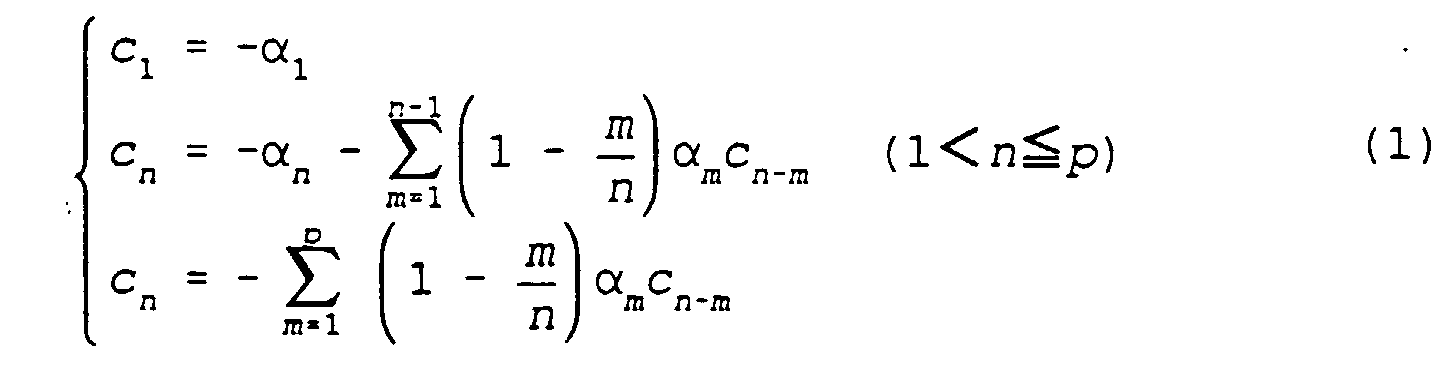
- α:
- linear predictive coefficients
- p:
- linear predictive degree
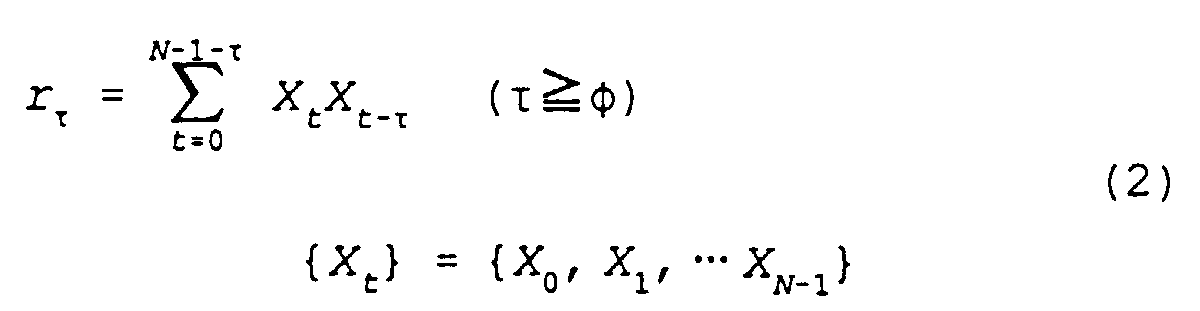
- N:
- the number of audio samples
Claims (10)
- An audio band width extending system characterized by comprising:analyzing means for obtaining parameters of a time region from an input narrow band audio signal;exciting source forming means for obtaining an exciting source from said input narrow band audio signal;a narrow band code book in which the parameters of the time region of the narrow band audio signal obtained from patterns of a plurality of audio signals have previously been stored;a wide band code book in which parameters of a time region of a wide band audio signal obtained from patterns of said plurality of audio signals have previously been stored in correspondence to said code book of the narrow band;matching means for comparing the parameters of the time region of said audio signal of the input narrow band with the parameters of the time region of the input narrow band audio signal stored in said narrow band code book and for retrieving an optimum parameter; andsynthesizing means for reading out a corresponding parameter from the parameters of the time region of the wide band audio signal stored in said wide band code book on the basis of a retrieval result by said matching means and for synthesizing an output wide band audio signal on the basis of the exciting source formed by said exciting source forming means and said read-out parameter.
- An audio band width extending system according to claim 1, wherein said exciting source forming means uses a signal obtained by up-sampling an LPC residual of the input narrow band signal as said exciting source.
- An audio band width extending system according to claim 1, wherein said exciting source forming means uses a signal obtained by up-sampling an LPC residual of the input narrow band signal and, further, suppressing a high band as said exciting source.
- An audio band width extending method characterized in that:a narrow band code book in which parameters of a time region of a narrow band audio signal obtained from patterns of a plurality of audio signals have previously been stored and a wide band code book in which parameters of a time region of a wide band audio signal obtained from the patterns of said plurality of audio signals have previously been stored in correspondence to said code book of the narrow band are provided;parameters of a time region are obtained from an input narrow band audio signal;an exciting source is obtained from said input narrow band audio signal;the parameters of the time region of said audio signal of the input narrow band and the parameters of the time region of the input narrow band audio signal stored in said narrow band code book are compared and an optimum parameter is retrieved by matching;a corresponding parameter is read out from the parameters of the time region of the wide band audio signal stored in said wide band code book on the basis of a retrieval result by said matching; andan output wide band audio signal is synthesized on the basis of said exciting source and said read-out parameter.
- An audio band width extending method according to claim 4, wherein a signal obtained by upsampling an LPC residual is used as said exciting source.
- An audio band width extending method according to claim 4, wherein a signal obtained by upsampling an LPC residual and, further, suppressing a high band is used as said exciting source.
- An audio band width extending system according to claims 1, 2 or 3 or an audio band width extending method according to claims 4, 5 and 6, wherein said parameters of the time region are set so that importance is attached to a distortion in a portion where an audio power is large at the time of a vector quantization.
- A system according to any one of claims 1 to 3 and 7 or a method according to any one of claims 4 to 7 wherein said parameters of the time region have an autocorrelation.
- A system or a method according to claim 8, wherein when said narrow band code book and said wide band code book are formed, a weight of data of a high degree is reduced.
- A system or a method according to claim 8 or 9, wherein when said narrow band code book and said wide band code book are formed, a weight of data of a high degree is set to "0".
Applications Claiming Priority (2)
| Application Number | Priority Date | Filing Date | Title |
|---|---|---|---|
| JP282234/96 | 1996-10-24 | ||
| JP8282234A JPH10124088A (en) | 1996-10-24 | 1996-10-24 | Voice bandwidth extension apparatus and method |
Publications (2)
| Publication Number | Publication Date |
|---|---|
| EP0838804A2 true EP0838804A2 (en) | 1998-04-29 |
| EP0838804A3 EP0838804A3 (en) | 1998-12-30 |
Family
ID=17649810
Family Applications (1)
| Application Number | Title | Priority Date | Filing Date |
|---|---|---|---|
| EP97308291A Withdrawn EP0838804A3 (en) | 1996-10-24 | 1997-10-17 | Audio bandwidth extending system and method |
Country Status (4)
| Country | Link |
|---|---|
| US (1) | US5950153A (en) |
| EP (1) | EP0838804A3 (en) |
| JP (1) | JPH10124088A (en) |
| CN (1) | CN1185616A (en) |
Cited By (6)
| Publication number | Priority date | Publication date | Assignee | Title |
|---|---|---|---|---|
| WO2000025305A1 (en) * | 1998-10-27 | 2000-05-04 | Voiceage Corporation | High frequency content recovering method and device for over-sampled synthesized wideband signal |
| EP1008984A3 (en) * | 1998-12-11 | 2000-08-02 | Sony Corporation | Windband speech synthesis from a narrowband speech signal |
| WO2001003124A1 (en) * | 1999-07-06 | 2001-01-11 | Telefonaktiebolaget Lm Ericsson | Speech bandwidth expansion |
| EP0911807A3 (en) * | 1997-10-23 | 2001-04-04 | Sony Corporation | Sound synthesizing method and apparatus, and sound band expanding method and apparatus |
| WO2001091113A1 (en) * | 2000-05-26 | 2001-11-29 | Koninklijke Philips Electronics N.V. | Transmitter for transmitting a signal encoded in a narrow band, and receiver for extending the band of the encoded signal at the receiving end, and corresponding transmission and receiving methods, and system |
| WO2001093251A1 (en) * | 2000-05-26 | 2001-12-06 | Koninklijke Philips Electronics N.V. | Transmitter for transmitting a signal encoded in a narrow band, and receiver for extending the band of the signal at the receiving end |
Families Citing this family (62)
| Publication number | Priority date | Publication date | Assignee | Title |
|---|---|---|---|---|
| EP0945852A1 (en) * | 1998-03-25 | 1999-09-29 | BRITISH TELECOMMUNICATIONS public limited company | Speech synthesis |
| US6539355B1 (en) * | 1998-10-15 | 2003-03-25 | Sony Corporation | Signal band expanding method and apparatus and signal synthesis method and apparatus |
| US6226616B1 (en) * | 1999-06-21 | 2001-05-01 | Digital Theater Systems, Inc. | Sound quality of established low bit-rate audio coding systems without loss of decoder compatibility |
| JP4792613B2 (en) * | 1999-09-29 | 2011-10-12 | ソニー株式会社 | Information processing apparatus and method, and recording medium |
| US6732070B1 (en) * | 2000-02-16 | 2004-05-04 | Nokia Mobile Phones, Ltd. | Wideband speech codec using a higher sampling rate in analysis and synthesis filtering than in excitation searching |
| US20020016698A1 (en) * | 2000-06-26 | 2002-02-07 | Toshimichi Tokuda | Device and method for audio frequency range expansion |
| ATE301368T1 (en) * | 2001-03-07 | 2005-08-15 | T Mobile Deutschland Gmbh | METHOD AND DEVICE FOR IMPROVING VOICE QUALITY ON TRANSPARENT TELECOMMUNICATIONS TRANSMISSION PATHS |
| JP2002268698A (en) * | 2001-03-08 | 2002-09-20 | Nec Corp | Voice recognition device, device and method for standard pattern generation, and program |
| SE522553C2 (en) * | 2001-04-23 | 2004-02-17 | Ericsson Telefon Ab L M | Bandwidth extension of acoustic signals |
| SE0202159D0 (en) | 2001-07-10 | 2002-07-09 | Coding Technologies Sweden Ab | Efficientand scalable parametric stereo coding for low bitrate applications |
| US8605911B2 (en) | 2001-07-10 | 2013-12-10 | Dolby International Ab | Efficient and scalable parametric stereo coding for low bitrate audio coding applications |
| JP4012506B2 (en) | 2001-08-24 | 2007-11-21 | 株式会社ケンウッド | Apparatus and method for adaptively interpolating frequency components of a signal |
| US7469206B2 (en) | 2001-11-29 | 2008-12-23 | Coding Technologies Ab | Methods for improving high frequency reconstruction |
| US20030187663A1 (en) * | 2002-03-28 | 2003-10-02 | Truman Michael Mead | Broadband frequency translation for high frequency regeneration |
| US20040064324A1 (en) * | 2002-08-08 | 2004-04-01 | Graumann David L. | Bandwidth expansion using alias modulation |
| SE0202770D0 (en) | 2002-09-18 | 2002-09-18 | Coding Technologies Sweden Ab | Method of reduction of aliasing is introduced by spectral envelope adjustment in real-valued filterbanks |
| KR100598614B1 (en) | 2004-08-23 | 2006-07-07 | 에스케이 텔레콤주식회사 | Broadband Expansion System and Method of Speech Signal Using Perceptual Weighting Filter |
| DE602004020765D1 (en) * | 2004-09-17 | 2009-06-04 | Harman Becker Automotive Sys | Bandwidth extension of band-limited tone signals |
| US7813931B2 (en) * | 2005-04-20 | 2010-10-12 | QNX Software Systems, Co. | System for improving speech quality and intelligibility with bandwidth compression/expansion |
| US8249861B2 (en) * | 2005-04-20 | 2012-08-21 | Qnx Software Systems Limited | High frequency compression integration |
| US8086451B2 (en) * | 2005-04-20 | 2011-12-27 | Qnx Software Systems Co. | System for improving speech intelligibility through high frequency compression |
| US8311840B2 (en) * | 2005-06-28 | 2012-11-13 | Qnx Software Systems Limited | Frequency extension of harmonic signals |
| KR100803205B1 (en) * | 2005-07-15 | 2008-02-14 | 삼성전자주식회사 | Low bit rate audio signal encoding / decoding method and apparatus |
| US7546237B2 (en) * | 2005-12-23 | 2009-06-09 | Qnx Software Systems (Wavemakers), Inc. | Bandwidth extension of narrowband speech |
| KR20070115637A (en) * | 2006-06-03 | 2007-12-06 | 삼성전자주식회사 | Bandwidth extension encoding and decoding method and apparatus |
| KR101379263B1 (en) * | 2007-01-12 | 2014-03-28 | 삼성전자주식회사 | Method and apparatus for decoding bandwidth extension |
| US7912729B2 (en) * | 2007-02-23 | 2011-03-22 | Qnx Software Systems Co. | High-frequency bandwidth extension in the time domain |
| US9177569B2 (en) * | 2007-10-30 | 2015-11-03 | Samsung Electronics Co., Ltd. | Apparatus, medium and method to encode and decode high frequency signal |
| US8515767B2 (en) * | 2007-11-04 | 2013-08-20 | Qualcomm Incorporated | Technique for encoding/decoding of codebook indices for quantized MDCT spectrum in scalable speech and audio codecs |
| US8688441B2 (en) * | 2007-11-29 | 2014-04-01 | Motorola Mobility Llc | Method and apparatus to facilitate provision and use of an energy value to determine a spectral envelope shape for out-of-signal bandwidth content |
| DE102008015702B4 (en) | 2008-01-31 | 2010-03-11 | Fraunhofer-Gesellschaft zur Förderung der angewandten Forschung e.V. | Apparatus and method for bandwidth expansion of an audio signal |
| US8433582B2 (en) * | 2008-02-01 | 2013-04-30 | Motorola Mobility Llc | Method and apparatus for estimating high-band energy in a bandwidth extension system |
| US20090201983A1 (en) * | 2008-02-07 | 2009-08-13 | Motorola, Inc. | Method and apparatus for estimating high-band energy in a bandwidth extension system |
| CN101620854B (en) * | 2008-06-30 | 2012-04-04 | 华为技术有限公司 | Method, system and device for frequency band extension |
| US8463412B2 (en) * | 2008-08-21 | 2013-06-11 | Motorola Mobility Llc | Method and apparatus to facilitate determining signal bounding frequencies |
| EP2224433B1 (en) * | 2008-09-25 | 2020-05-27 | Lg Electronics Inc. | An apparatus for processing an audio signal and method thereof |
| BRPI0917762B1 (en) | 2008-12-15 | 2020-09-29 | Fraunhofer-Gesellschaft zur Förderung der angewandten Forschung e.V | AUDIO ENCODER AND BANDWIDTH EXTENSION DECODER |
| US8463599B2 (en) * | 2009-02-04 | 2013-06-11 | Motorola Mobility Llc | Bandwidth extension method and apparatus for a modified discrete cosine transform audio coder |
| ES2374486T3 (en) | 2009-03-26 | 2012-02-17 | Fraunhofer-Gesellschaft zur Förderung der angewandten Forschung e.V. | DEVICE AND METHOD FOR HANDLING AN AUDIO SIGNAL. |
| EP2239732A1 (en) | 2009-04-09 | 2010-10-13 | Fraunhofer-Gesellschaft zur Förderung der Angewandten Forschung e.V. | Apparatus and method for generating a synthesis audio signal and for encoding an audio signal |
| RU2452044C1 (en) | 2009-04-02 | 2012-05-27 | Фраунхофер-Гезелльшафт цур Фёрдерунг дер ангевандтен Форшунг Е.Ф. | Apparatus, method and media with programme code for generating representation of bandwidth-extended signal on basis of input signal representation using combination of harmonic bandwidth-extension and non-harmonic bandwidth-extension |
| CO6440537A2 (en) | 2009-04-09 | 2012-05-15 | Fraunhofer Ges Forschung | APPARATUS AND METHOD TO GENERATE A SYNTHESIS AUDIO SIGNAL AND TO CODIFY AN AUDIO SIGNAL |
| JP2011090031A (en) * | 2009-10-20 | 2011-05-06 | Oki Electric Industry Co Ltd | Voice band expansion device and program, and extension parameter learning device and program |
| US8484020B2 (en) | 2009-10-23 | 2013-07-09 | Qualcomm Incorporated | Determining an upperband signal from a narrowband signal |
| JP5554876B2 (en) * | 2010-04-16 | 2014-07-23 | フラウンホーファーゲゼルシャフト ツール フォルデルング デル アンゲヴァンテン フォルシユング エー.フアー. | Apparatus, method and computer program for generating a wideband signal using guided bandwidth extension and blind bandwidth extension |
| US8473287B2 (en) | 2010-04-19 | 2013-06-25 | Audience, Inc. | Method for jointly optimizing noise reduction and voice quality in a mono or multi-microphone system |
| US8538035B2 (en) | 2010-04-29 | 2013-09-17 | Audience, Inc. | Multi-microphone robust noise suppression |
| US8798290B1 (en) | 2010-04-21 | 2014-08-05 | Audience, Inc. | Systems and methods for adaptive signal equalization |
| US8781137B1 (en) | 2010-04-27 | 2014-07-15 | Audience, Inc. | Wind noise detection and suppression |
| US9245538B1 (en) * | 2010-05-20 | 2016-01-26 | Audience, Inc. | Bandwidth enhancement of speech signals assisted by noise reduction |
| US8447596B2 (en) | 2010-07-12 | 2013-05-21 | Audience, Inc. | Monaural noise suppression based on computational auditory scene analysis |
| US8583425B2 (en) * | 2011-06-21 | 2013-11-12 | Genband Us Llc | Methods, systems, and computer readable media for fricatives and high frequencies detection |
| ES2549953T3 (en) | 2012-08-27 | 2015-11-03 | Fraunhofer-Gesellschaft zur Förderung der angewandten Forschung e.V. | Apparatus and method for the reproduction of an audio signal, apparatus and method for the generation of an encoded audio signal, computer program and encoded audio signal |
| EP3680899B1 (en) * | 2013-01-29 | 2024-03-20 | Fraunhofer-Gesellschaft zur Förderung der angewandten Forschung e.V. | Audio encoder, method and computer program using an increased temporal resolution in temporal proximity of offsets of fricatives or affricates |
| EP2830064A1 (en) | 2013-07-22 | 2015-01-28 | Fraunhofer-Gesellschaft zur Förderung der angewandten Forschung e.V. | Apparatus and method for decoding and encoding an audio signal using adaptive spectral tile selection |
| KR20150032390A (en) * | 2013-09-16 | 2015-03-26 | 삼성전자주식회사 | Speech signal process apparatus and method for enhancing speech intelligibility |
| JP6333043B2 (en) * | 2014-04-23 | 2018-05-30 | 山本 裕 | Audio signal processing device |
| WO2016142002A1 (en) | 2015-03-09 | 2016-09-15 | Fraunhofer-Gesellschaft Zur Foerderung Der Angewandten Forschung E.V. | Audio encoder, audio decoder, method for encoding an audio signal and method for decoding an encoded audio signal |
| US20190051286A1 (en) * | 2017-08-14 | 2019-02-14 | Microsoft Technology Licensing, Llc | Normalization of high band signals in network telephony communications |
| US10747231B2 (en) * | 2017-11-17 | 2020-08-18 | Intel Corporation | Identification of audio signals in surrounding sounds and guidance of an autonomous vehicle in response to the same |
| JP6962385B2 (en) * | 2018-01-17 | 2021-11-05 | 日本電信電話株式会社 | Coding device, decoding device, fricative determination device, these methods and programs |
| CN117351969A (en) * | 2018-01-17 | 2024-01-05 | 日本电信电话株式会社 | Decoding device, decoding method, computer-readable recording medium and program |
Family Cites Families (6)
| Publication number | Priority date | Publication date | Assignee | Title |
|---|---|---|---|---|
| US5271088A (en) * | 1991-05-13 | 1993-12-14 | Itt Corporation | Automated sorting of voice messages through speaker spotting |
| JP2779886B2 (en) * | 1992-10-05 | 1998-07-23 | 日本電信電話株式会社 | Wideband audio signal restoration method |
| US5455888A (en) * | 1992-12-04 | 1995-10-03 | Northern Telecom Limited | Speech bandwidth extension method and apparatus |
| JPH07160297A (en) * | 1993-12-10 | 1995-06-23 | Nec Corp | Voice parameter encoding system |
| FR2742568B1 (en) * | 1995-12-15 | 1998-02-13 | Catherine Quinquis | METHOD OF LINEAR PREDICTION ANALYSIS OF AN AUDIO FREQUENCY SIGNAL, AND METHODS OF ENCODING AND DECODING AN AUDIO FREQUENCY SIGNAL INCLUDING APPLICATION |
| US5778335A (en) * | 1996-02-26 | 1998-07-07 | The Regents Of The University Of California | Method and apparatus for efficient multiband celp wideband speech and music coding and decoding |
-
1996
- 1996-10-24 JP JP8282234A patent/JPH10124088A/en active Pending
-
1997
- 1997-10-15 US US08/951,029 patent/US5950153A/en not_active Expired - Fee Related
- 1997-10-17 EP EP97308291A patent/EP0838804A3/en not_active Withdrawn
- 1997-10-23 CN CN97121233A patent/CN1185616A/en active Pending
Cited By (9)
| Publication number | Priority date | Publication date | Assignee | Title |
|---|---|---|---|---|
| EP0911807A3 (en) * | 1997-10-23 | 2001-04-04 | Sony Corporation | Sound synthesizing method and apparatus, and sound band expanding method and apparatus |
| US6289311B1 (en) | 1997-10-23 | 2001-09-11 | Sony Corporation | Sound synthesizing method and apparatus, and sound band expanding method and apparatus |
| WO2000025305A1 (en) * | 1998-10-27 | 2000-05-04 | Voiceage Corporation | High frequency content recovering method and device for over-sampled synthesized wideband signal |
| US7151802B1 (en) | 1998-10-27 | 2006-12-19 | Voiceage Corporation | High frequency content recovering method and device for over-sampled synthesized wideband signal |
| EP1008984A3 (en) * | 1998-12-11 | 2000-08-02 | Sony Corporation | Windband speech synthesis from a narrowband speech signal |
| WO2001003124A1 (en) * | 1999-07-06 | 2001-01-11 | Telefonaktiebolaget Lm Ericsson | Speech bandwidth expansion |
| US6507820B1 (en) | 1999-07-06 | 2003-01-14 | Telefonaktiebolaget Lm Ericsson | Speech band sampling rate expansion |
| WO2001091113A1 (en) * | 2000-05-26 | 2001-11-29 | Koninklijke Philips Electronics N.V. | Transmitter for transmitting a signal encoded in a narrow band, and receiver for extending the band of the encoded signal at the receiving end, and corresponding transmission and receiving methods, and system |
| WO2001093251A1 (en) * | 2000-05-26 | 2001-12-06 | Koninklijke Philips Electronics N.V. | Transmitter for transmitting a signal encoded in a narrow band, and receiver for extending the band of the signal at the receiving end |
Also Published As
| Publication number | Publication date |
|---|---|
| JPH10124088A (en) | 1998-05-15 |
| EP0838804A3 (en) | 1998-12-30 |
| US5950153A (en) | 1999-09-07 |
| CN1185616A (en) | 1998-06-24 |
Similar Documents
| Publication | Publication Date | Title |
|---|---|---|
| US5950153A (en) | Audio band width extending system and method | |
| US6961698B1 (en) | Multi-mode bitstream transmission protocol of encoded voice signals with embeded characteristics | |
| US6574593B1 (en) | Codebook tables for encoding and decoding | |
| US6604070B1 (en) | System of encoding and decoding speech signals | |
| KR100427753B1 (en) | Method and apparatus for reproducing voice signal, method and apparatus for voice decoding, method and apparatus for voice synthesis and portable wireless terminal apparatus | |
| US5749065A (en) | Speech encoding method, speech decoding method and speech encoding/decoding method | |
| US7454330B1 (en) | Method and apparatus for speech encoding and decoding by sinusoidal analysis and waveform encoding with phase reproducibility | |
| EP0718820B1 (en) | Speech coding apparatus, linear prediction coefficient analyzing apparatus and noise reducing apparatus | |
| KR100574031B1 (en) | Speech Synthesis Method and Apparatus and Voice Band Expansion Method and Apparatus | |
| EP0751494B1 (en) | Speech encoding system | |
| RU2262748C2 (en) | Multi-mode encoding device | |
| US6078880A (en) | Speech coding system and method including voicing cut off frequency analyzer | |
| EP1214706B9 (en) | Multimode speech encoder | |
| US6081776A (en) | Speech coding system and method including adaptive finite impulse response filter | |
| KR100566713B1 (en) | Acoustic parameter encoding, decoding method, apparatus and program, speech encoding, decoding method, apparatus and program | |
| US6138092A (en) | CELP speech synthesizer with epoch-adaptive harmonic generator for pitch harmonics below voicing cutoff frequency | |
| EP0801377B1 (en) | Apparatus for coding a signal | |
| US6205423B1 (en) | Method for coding speech containing noise-like speech periods and/or having background noise | |
| EP1239458B1 (en) | Voice recognition system, standard pattern preparation system and corresponding methods | |
| JPH10124089A (en) | Audio signal processing apparatus and method, and audio bandwidth extending apparatus and method | |
| US5737367A (en) | Transmission system with simplified source coding | |
| JP3006790B2 (en) | Voice encoding / decoding method and apparatus | |
| JP3092654B2 (en) | Signal encoding device | |
| AU2003262451B2 (en) | Multimode speech encoder | |
| AU766830B2 (en) | Multimode speech encoder |
Legal Events
| Date | Code | Title | Description |
|---|---|---|---|
| PUAI | Public reference made under article 153(3) epc to a published international application that has entered the european phase |
Free format text: ORIGINAL CODE: 0009012 |
|
| AK | Designated contracting states |
Kind code of ref document: A2 Designated state(s): DE FR GB |
|
| AX | Request for extension of the european patent |
Free format text: AL;LT;LV;RO;SI |
|
| PUAL | Search report despatched |
Free format text: ORIGINAL CODE: 0009013 |
|
| AK | Designated contracting states |
Kind code of ref document: A3 Designated state(s): AT BE CH DE DK ES FI FR GB GR IE IT LI LU MC NL PT SE |
|
| AX | Request for extension of the european patent |
Free format text: AL;LT;LV;RO;SI |
|
| 17P | Request for examination filed |
Effective date: 19990607 |
|
| AKX | Designation fees paid |
Free format text: DE FR GB |
|
| 17Q | First examination report despatched |
Effective date: 20011211 |
|
| STAA | Information on the status of an ep patent application or granted ep patent |
Free format text: STATUS: THE APPLICATION IS DEEMED TO BE WITHDRAWN |
|
| 18D | Application deemed to be withdrawn |
Effective date: 20020622 |