EP0574256A1 - Imidate derivatives of pharmaceutically useful anticonvulsant sulfamates - Google Patents
Imidate derivatives of pharmaceutically useful anticonvulsant sulfamates Download PDFInfo
- Publication number
- EP0574256A1 EP0574256A1 EP93304497A EP93304497A EP0574256A1 EP 0574256 A1 EP0574256 A1 EP 0574256A1 EP 93304497 A EP93304497 A EP 93304497A EP 93304497 A EP93304497 A EP 93304497A EP 0574256 A1 EP0574256 A1 EP 0574256A1
- Authority
- EP
- European Patent Office
- Prior art keywords
- compound
- formula
- alkyl
- compounds
- methyl
- Prior art date
- Legal status (The legal status is an assumption and is not a legal conclusion. Google has not performed a legal analysis and makes no representation as to the accuracy of the status listed.)
- Ceased
Links
- 239000001961 anticonvulsive agent Substances 0.000 title abstract description 10
- 229960003965 antiepileptics Drugs 0.000 title abstract description 8
- 230000001773 anti-convulsant effect Effects 0.000 title abstract description 7
- 150000002463 imidates Chemical class 0.000 title abstract description 4
- IIACRCGMVDHOTQ-UHFFFAOYSA-N sulfamic acid Chemical class NS(O)(=O)=O IIACRCGMVDHOTQ-UHFFFAOYSA-N 0.000 title description 8
- 150000001875 compounds Chemical class 0.000 claims abstract description 52
- 206010015037 epilepsy Diseases 0.000 claims abstract description 8
- 239000008194 pharmaceutical composition Substances 0.000 claims abstract description 7
- 239000001301 oxygen Substances 0.000 claims description 12
- 229910052760 oxygen Inorganic materials 0.000 claims description 12
- QVGXLLKOCUKJST-UHFFFAOYSA-N atomic oxygen Chemical compound [O] QVGXLLKOCUKJST-UHFFFAOYSA-N 0.000 claims description 11
- 239000001257 hydrogen Substances 0.000 claims description 9
- 229910052739 hydrogen Inorganic materials 0.000 claims description 9
- 206010010904 Convulsion Diseases 0.000 claims description 7
- 150000002431 hydrogen Chemical class 0.000 claims description 7
- 125000002496 methyl group Chemical group [H]C([H])([H])* 0.000 claims description 7
- 241001465754 Metazoa Species 0.000 claims description 6
- 125000000217 alkyl group Chemical group 0.000 claims description 6
- 125000004169 (C1-C6) alkyl group Chemical group 0.000 claims description 4
- 125000000753 cycloalkyl group Chemical group 0.000 claims description 4
- 125000000113 cyclohexyl group Chemical group [H]C1([H])C([H])([H])C([H])([H])C([H])(*)C([H])([H])C1([H])[H] 0.000 claims description 4
- 125000001511 cyclopentyl group Chemical group [H]C1([H])C([H])([H])C([H])([H])C([H])(*)C1([H])[H] 0.000 claims description 4
- 239000003937 drug carrier Substances 0.000 claims description 4
- 125000005010 perfluoroalkyl group Chemical group 0.000 claims description 4
- 125000000008 (C1-C10) alkyl group Chemical group 0.000 claims description 3
- 125000001495 ethyl group Chemical group [H]C([H])([H])C([H])([H])* 0.000 claims description 3
- 125000001997 phenyl group Chemical group [H]C1=C([H])C([H])=C(*)C([H])=C1[H] 0.000 claims description 3
- 125000004178 (C1-C4) alkyl group Chemical group 0.000 claims description 2
- 125000004191 (C1-C6) alkoxy group Chemical group 0.000 claims description 2
- 125000004453 alkoxycarbonyl group Chemical group 0.000 claims description 2
- 125000001584 benzyloxycarbonyl group Chemical group C(=O)(OCC1=CC=CC=C1)* 0.000 claims description 2
- 230000036461 convulsion Effects 0.000 claims description 2
- UYWQUFXKFGHYNT-UHFFFAOYSA-N phenylmethyl ester of formic acid Natural products O=COCC1=CC=CC=C1 UYWQUFXKFGHYNT-UHFFFAOYSA-N 0.000 claims description 2
- 125000001301 ethoxy group Chemical group [H]C([H])([H])C([H])([H])O* 0.000 claims 1
- 125000000956 methoxy group Chemical group [H]C([H])([H])O* 0.000 claims 1
- 150000003839 salts Chemical class 0.000 claims 1
- 238000000034 method Methods 0.000 abstract description 23
- 230000000694 effects Effects 0.000 abstract description 10
- 241000124008 Mammalia Species 0.000 abstract description 7
- 239000000651 prodrug Substances 0.000 abstract description 6
- 229940002612 prodrug Drugs 0.000 abstract description 6
- 239000013543 active substance Substances 0.000 abstract description 4
- XEKOWRVHYACXOJ-UHFFFAOYSA-N Ethyl acetate Chemical compound CCOC(C)=O XEKOWRVHYACXOJ-UHFFFAOYSA-N 0.000 description 51
- -1 C1-C10 Chemical group 0.000 description 29
- YMWUJEATGCHHMB-UHFFFAOYSA-N Dichloromethane Chemical compound ClCCl YMWUJEATGCHHMB-UHFFFAOYSA-N 0.000 description 24
- YXFVVABEGXRONW-UHFFFAOYSA-N Toluene Chemical compound CC1=CC=CC=C1 YXFVVABEGXRONW-UHFFFAOYSA-N 0.000 description 21
- VLKZOEOYAKHREP-UHFFFAOYSA-N n-Hexane Chemical class CCCCCC VLKZOEOYAKHREP-UHFFFAOYSA-N 0.000 description 18
- OKKJLVBELUTLKV-UHFFFAOYSA-N Methanol Chemical compound OC OKKJLVBELUTLKV-UHFFFAOYSA-N 0.000 description 16
- VYPSYNLAJGMNEJ-UHFFFAOYSA-N Silicium dioxide Chemical compound O=[Si]=O VYPSYNLAJGMNEJ-UHFFFAOYSA-N 0.000 description 16
- ZMANZCXQSJIPKH-UHFFFAOYSA-N Triethylamine Chemical compound CCN(CC)CC ZMANZCXQSJIPKH-UHFFFAOYSA-N 0.000 description 15
- RTZKZFJDLAIYFH-UHFFFAOYSA-N Diethyl ether Chemical compound CCOCC RTZKZFJDLAIYFH-UHFFFAOYSA-N 0.000 description 14
- JUJWROOIHBZHMG-UHFFFAOYSA-N Pyridine Chemical compound C1=CC=NC=C1 JUJWROOIHBZHMG-UHFFFAOYSA-N 0.000 description 14
- 239000000203 mixture Substances 0.000 description 14
- 239000000047 product Substances 0.000 description 12
- LFQSCWFLJHTTHZ-UHFFFAOYSA-N Ethanol Chemical compound CCO LFQSCWFLJHTTHZ-UHFFFAOYSA-N 0.000 description 11
- 239000000741 silica gel Substances 0.000 description 11
- 229910002027 silica gel Inorganic materials 0.000 description 11
- XKRFYHLGVUSROY-UHFFFAOYSA-N Argon Chemical compound [Ar] XKRFYHLGVUSROY-UHFFFAOYSA-N 0.000 description 10
- WYURNTSHIVDZCO-UHFFFAOYSA-N Tetrahydrofuran Chemical compound C1CCOC1 WYURNTSHIVDZCO-UHFFFAOYSA-N 0.000 description 10
- 239000006188 syrup Substances 0.000 description 10
- 235000020357 syrup Nutrition 0.000 description 10
- 229960004394 topiramate Drugs 0.000 description 10
- 230000001256 tonic effect Effects 0.000 description 9
- UIIMBOGNXHQVGW-UHFFFAOYSA-M Sodium bicarbonate Chemical compound [Na+].OC([O-])=O UIIMBOGNXHQVGW-UHFFFAOYSA-M 0.000 description 8
- KJADKKWYZYXHBB-XBWDGYHZSA-N Topiramic acid Chemical compound C1O[C@@]2(COS(N)(=O)=O)OC(C)(C)O[C@H]2[C@@H]2OC(C)(C)O[C@@H]21 KJADKKWYZYXHBB-XBWDGYHZSA-N 0.000 description 8
- 238000006243 chemical reaction Methods 0.000 description 8
- 125000004122 cyclic group Chemical group 0.000 description 8
- 239000003814 drug Substances 0.000 description 8
- 229940079593 drug Drugs 0.000 description 7
- UMJSCPRVCHMLSP-UHFFFAOYSA-N pyridine Natural products COC1=CC=CN=C1 UMJSCPRVCHMLSP-UHFFFAOYSA-N 0.000 description 7
- QTBSBXVTEAMEQO-UHFFFAOYSA-N Acetic acid Chemical compound CC(O)=O QTBSBXVTEAMEQO-UHFFFAOYSA-N 0.000 description 6
- WEVYAHXRMPXWCK-UHFFFAOYSA-N Acetonitrile Chemical compound CC#N WEVYAHXRMPXWCK-UHFFFAOYSA-N 0.000 description 6
- FAPWRFPIFSIZLT-UHFFFAOYSA-M Sodium chloride Chemical compound [Na+].[Cl-] FAPWRFPIFSIZLT-UHFFFAOYSA-M 0.000 description 6
- PSSHGMIAIUYOJF-XBWDGYHZSA-N [(3as,5ar,8ar,8bs)-2,2,7,7-tetramethyl-5,5a,8a,8b-tetrahydrodi[1,3]dioxolo[4,5-a:5',3'-d]pyran-3a-yl]methanol Chemical compound C1O[C@@]2(CO)OC(C)(C)O[C@H]2[C@@H]2OC(C)(C)O[C@@H]21 PSSHGMIAIUYOJF-XBWDGYHZSA-N 0.000 description 6
- 239000000010 aprotic solvent Substances 0.000 description 6
- 150000002009 diols Chemical class 0.000 description 6
- 238000002953 preparative HPLC Methods 0.000 description 6
- 238000010992 reflux Methods 0.000 description 6
- 239000000523 sample Substances 0.000 description 6
- YBBRCQOCSYXUOC-UHFFFAOYSA-N sulfuryl dichloride Chemical compound ClS(Cl)(=O)=O YBBRCQOCSYXUOC-UHFFFAOYSA-N 0.000 description 6
- 238000012360 testing method Methods 0.000 description 6
- 239000003643 water by type Substances 0.000 description 6
- 229910052786 argon Inorganic materials 0.000 description 5
- 210000003141 lower extremity Anatomy 0.000 description 5
- 239000003921 oil Substances 0.000 description 5
- 239000002904 solvent Substances 0.000 description 5
- IIACRCGMVDHOTQ-UHFFFAOYSA-M sulfamate Chemical compound NS([O-])(=O)=O IIACRCGMVDHOTQ-UHFFFAOYSA-M 0.000 description 5
- YLQBMQCUIZJEEH-UHFFFAOYSA-N tetrahydrofuran Natural products C=1C=COC=1 YLQBMQCUIZJEEH-UHFFFAOYSA-N 0.000 description 5
- XLYOFNOQVPJJNP-UHFFFAOYSA-N water Substances O XLYOFNOQVPJJNP-UHFFFAOYSA-N 0.000 description 5
- CSNNHWWHGAXBCP-UHFFFAOYSA-L Magnesium sulfate Chemical compound [Mg+2].[O-][S+2]([O-])([O-])[O-] CSNNHWWHGAXBCP-UHFFFAOYSA-L 0.000 description 4
- QAOWNCQODCNURD-UHFFFAOYSA-L Sulfate Chemical compound [O-]S([O-])(=O)=O QAOWNCQODCNURD-UHFFFAOYSA-L 0.000 description 4
- GGOAQSGCBDRTHT-XZMZPDFPSA-N chembl282407 Chemical compound C1O[C@]2(COS(N)(=O)=O)OC(C)(C)O[C@@H]2[C@H]2OS(=O)(=O)O[C@H]21 GGOAQSGCBDRTHT-XZMZPDFPSA-N 0.000 description 4
- CEIPQQODRKXDSB-UHFFFAOYSA-N ethyl 3-(6-hydroxynaphthalen-2-yl)-1H-indazole-5-carboximidate dihydrochloride Chemical group Cl.Cl.C1=C(O)C=CC2=CC(C3=NNC4=CC=C(C=C43)C(=N)OCC)=CC=C21 CEIPQQODRKXDSB-UHFFFAOYSA-N 0.000 description 4
- 229920006395 saturated elastomer Polymers 0.000 description 4
- 235000017557 sodium bicarbonate Nutrition 0.000 description 4
- 229910000030 sodium bicarbonate Inorganic materials 0.000 description 4
- 239000011780 sodium chloride Substances 0.000 description 4
- 239000007787 solid Substances 0.000 description 4
- FYSNRJHAOHDILO-UHFFFAOYSA-N thionyl chloride Chemical compound ClS(Cl)=O FYSNRJHAOHDILO-UHFFFAOYSA-N 0.000 description 4
- RFFLAFLAYFXFSW-UHFFFAOYSA-N 1,2-dichlorobenzene Chemical compound ClC1=CC=CC=C1Cl RFFLAFLAYFXFSW-UHFFFAOYSA-N 0.000 description 3
- 206010009346 Clonus Diseases 0.000 description 3
- 241000699670 Mus sp. Species 0.000 description 3
- ZMXDDKWLCZADIW-UHFFFAOYSA-N N,N-Dimethylformamide Chemical compound CN(C)C=O ZMXDDKWLCZADIW-UHFFFAOYSA-N 0.000 description 3
- 229960000583 acetic acid Drugs 0.000 description 3
- 239000004480 active ingredient Substances 0.000 description 3
- LKDRXBCSQODPBY-ARQDHWQXSA-N beta-D-fructopyranose Chemical compound OC[C@@]1(O)OC[C@@H](O)[C@@H](O)[C@@H]1O LKDRXBCSQODPBY-ARQDHWQXSA-N 0.000 description 3
- 230000004071 biological effect Effects 0.000 description 3
- 239000002775 capsule Substances 0.000 description 3
- 239000000969 carrier Substances 0.000 description 3
- 150000004844 dioxiranes Chemical class 0.000 description 3
- 239000006260 foam Substances 0.000 description 3
- 239000012362 glacial acetic acid Substances 0.000 description 3
- 239000000463 material Substances 0.000 description 3
- 239000000843 powder Substances 0.000 description 3
- 238000002360 preparation method Methods 0.000 description 3
- 239000000243 solution Substances 0.000 description 3
- 239000000829 suppository Substances 0.000 description 3
- IECKAVQTURBPON-UHFFFAOYSA-N trimethoxymethylbenzene Chemical compound COC(OC)(OC)C1=CC=CC=C1 IECKAVQTURBPON-UHFFFAOYSA-N 0.000 description 3
- NDQXKKFRNOPRDW-UHFFFAOYSA-N 1,1,1-triethoxyethane Chemical compound CCOC(C)(OCC)OCC NDQXKKFRNOPRDW-UHFFFAOYSA-N 0.000 description 2
- RYHBNJHYFVUHQT-UHFFFAOYSA-N 1,4-Dioxane Chemical compound C1COCCO1 RYHBNJHYFVUHQT-UHFFFAOYSA-N 0.000 description 2
- QGZKDVFQNNGYKY-UHFFFAOYSA-N Ammonia Chemical compound N QGZKDVFQNNGYKY-UHFFFAOYSA-N 0.000 description 2
- 208000010412 Glaucoma Diseases 0.000 description 2
- UFHFLCQGNIYNRP-UHFFFAOYSA-N Hydrogen Chemical compound [H][H] UFHFLCQGNIYNRP-UHFFFAOYSA-N 0.000 description 2
- KFZMGEQAYNKOFK-UHFFFAOYSA-N Isopropanol Chemical compound CC(C)O KFZMGEQAYNKOFK-UHFFFAOYSA-N 0.000 description 2
- PCLIMKBDDGJMGD-UHFFFAOYSA-N N-bromosuccinimide Chemical compound BrN1C(=O)CCC1=O PCLIMKBDDGJMGD-UHFFFAOYSA-N 0.000 description 2
- 208000008469 Peptic Ulcer Diseases 0.000 description 2
- KEAYESYHFKHZAL-UHFFFAOYSA-N Sodium Chemical compound [Na] KEAYESYHFKHZAL-UHFFFAOYSA-N 0.000 description 2
- 239000000654 additive Substances 0.000 description 2
- LKDRXBCSQODPBY-AZGQCCRYSA-N beta-L-fructopyranose Chemical compound OC[C@]1(O)OC[C@H](O)[C@H](O)[C@H]1O LKDRXBCSQODPBY-AZGQCCRYSA-N 0.000 description 2
- 150000001805 chlorine compounds Chemical class 0.000 description 2
- XTHPWXDJESJLNJ-UHFFFAOYSA-M chlorosulfate Chemical compound [O-]S(Cl)(=O)=O XTHPWXDJESJLNJ-UHFFFAOYSA-M 0.000 description 2
- 239000013078 crystal Substances 0.000 description 2
- 239000002552 dosage form Substances 0.000 description 2
- 150000002222 fluorine compounds Chemical class 0.000 description 2
- 230000007062 hydrolysis Effects 0.000 description 2
- 238000006460 hydrolysis reaction Methods 0.000 description 2
- 238000001727 in vivo Methods 0.000 description 2
- 239000007788 liquid Substances 0.000 description 2
- 229910052943 magnesium sulfate Inorganic materials 0.000 description 2
- 235000019341 magnesium sulphate Nutrition 0.000 description 2
- 239000007800 oxidant agent Substances 0.000 description 2
- 230000003647 oxidation Effects 0.000 description 2
- 238000007254 oxidation reaction Methods 0.000 description 2
- MNXTYCFJKHCALB-UHFFFAOYSA-N phenylmethoxymethylidenesulfamic acid Chemical compound C1=CC=C(C=C1)COC=NS(=O)(=O)O MNXTYCFJKHCALB-UHFFFAOYSA-N 0.000 description 2
- BWHMMNNQKKPAPP-UHFFFAOYSA-L potassium carbonate Chemical compound [K+].[K+].[O-]C([O-])=O BWHMMNNQKKPAPP-UHFFFAOYSA-L 0.000 description 2
- 239000012312 sodium hydride Substances 0.000 description 2
- 229910000104 sodium hydride Inorganic materials 0.000 description 2
- 238000010561 standard procedure Methods 0.000 description 2
- 238000003756 stirring Methods 0.000 description 2
- 235000000346 sugar Nutrition 0.000 description 2
- 239000000725 suspension Substances 0.000 description 2
- 239000003826 tablet Substances 0.000 description 2
- PYOKUURKVVELLB-UHFFFAOYSA-N trimethyl orthoformate Chemical compound COC(OC)OC PYOKUURKVVELLB-UHFFFAOYSA-N 0.000 description 2
- 239000008096 xylene Substances 0.000 description 2
- 150000003738 xylenes Chemical class 0.000 description 2
- 125000006273 (C1-C3) alkyl group Chemical group 0.000 description 1
- HDPNBNXLBDFELL-UHFFFAOYSA-N 1,1,1-trimethoxyethane Chemical compound COC(C)(OC)OC HDPNBNXLBDFELL-UHFFFAOYSA-N 0.000 description 1
- SCYULBFZEHDVBN-UHFFFAOYSA-N 1,1-Dichloroethane Chemical compound CC(Cl)Cl SCYULBFZEHDVBN-UHFFFAOYSA-N 0.000 description 1
- PRUJNMNQIUMZAJ-UHFFFAOYSA-N 1-ethoxyethylidenesulfamic acid Chemical compound CCOC(=NS(=O)(=O)O)C PRUJNMNQIUMZAJ-UHFFFAOYSA-N 0.000 description 1
- SDGHXWKVBZYHRR-UHFFFAOYSA-N 2-(1h-imidazol-2-ylsulfonyl)-1h-imidazole Chemical compound N=1C=CNC=1S(=O)(=O)C1=NC=CN1 SDGHXWKVBZYHRR-UHFFFAOYSA-N 0.000 description 1
- ZGUCWUQMROUMRJ-UHFFFAOYSA-N 2-methoxyethylidenesulfamic acid Chemical compound COCC=NS(=O)(=O)O ZGUCWUQMROUMRJ-UHFFFAOYSA-N 0.000 description 1
- 125000004493 2-methylbut-1-yl group Chemical group CC(C*)CC 0.000 description 1
- 125000005917 3-methylpentyl group Chemical group 0.000 description 1
- XVMSFILGAMDHEY-UHFFFAOYSA-N 6-(4-aminophenyl)sulfonylpyridin-3-amine Chemical compound C1=CC(N)=CC=C1S(=O)(=O)C1=CC=C(N)C=N1 XVMSFILGAMDHEY-UHFFFAOYSA-N 0.000 description 1
- HBAQYPYDRFILMT-UHFFFAOYSA-N 8-[3-(1-cyclopropylpyrazol-4-yl)-1H-pyrazolo[4,3-d]pyrimidin-5-yl]-3-methyl-3,8-diazabicyclo[3.2.1]octan-2-one Chemical class C1(CC1)N1N=CC(=C1)C1=NNC2=C1N=C(N=C2)N1C2C(N(CC1CC2)C)=O HBAQYPYDRFILMT-UHFFFAOYSA-N 0.000 description 1
- OKTJSMMVPCPJKN-UHFFFAOYSA-N Carbon Chemical compound [C] OKTJSMMVPCPJKN-UHFFFAOYSA-N 0.000 description 1
- CURLTUGMZLYLDI-UHFFFAOYSA-N Carbon dioxide Chemical compound O=C=O CURLTUGMZLYLDI-UHFFFAOYSA-N 0.000 description 1
- BVKZGUZCCUSVTD-UHFFFAOYSA-L Carbonate Chemical compound [O-]C([O-])=O BVKZGUZCCUSVTD-UHFFFAOYSA-L 0.000 description 1
- 206010007559 Cardiac failure congestive Diseases 0.000 description 1
- VEXZGXHMUGYJMC-UHFFFAOYSA-M Chloride anion Chemical compound [Cl-] VEXZGXHMUGYJMC-UHFFFAOYSA-M 0.000 description 1
- 206010019280 Heart failures Diseases 0.000 description 1
- VEXZGXHMUGYJMC-UHFFFAOYSA-N Hydrochloric acid Chemical compound Cl VEXZGXHMUGYJMC-UHFFFAOYSA-N 0.000 description 1
- 206010020772 Hypertension Diseases 0.000 description 1
- 208000007466 Male Infertility Diseases 0.000 description 1
- 241000699666 Mus <mouse, genus> Species 0.000 description 1
- 206010030113 Oedema Diseases 0.000 description 1
- CXOFVDLJLONNDW-UHFFFAOYSA-N Phenytoin Chemical compound N1C(=O)NC(=O)C1(C=1C=CC=CC=1)C1=CC=CC=C1 CXOFVDLJLONNDW-UHFFFAOYSA-N 0.000 description 1
- 229910019891 RuCl3 Inorganic materials 0.000 description 1
- 229920002472 Starch Polymers 0.000 description 1
- LSNNMFCWUKXFEE-UHFFFAOYSA-N Sulfurous acid Chemical compound OS(O)=O LSNNMFCWUKXFEE-UHFFFAOYSA-N 0.000 description 1
- XSTXAVWGXDQKEL-UHFFFAOYSA-N Trichloroethylene Chemical compound ClC=C(Cl)Cl XSTXAVWGXDQKEL-UHFFFAOYSA-N 0.000 description 1
- 238000010521 absorption reaction Methods 0.000 description 1
- 230000001476 alcoholic effect Effects 0.000 description 1
- 150000001298 alcohols Chemical class 0.000 description 1
- 125000003545 alkoxy group Chemical group 0.000 description 1
- 229910021529 ammonia Inorganic materials 0.000 description 1
- 239000000538 analytical sample Substances 0.000 description 1
- 229940125681 anticonvulsant agent Drugs 0.000 description 1
- 230000006399 behavior Effects 0.000 description 1
- 125000001797 benzyl group Chemical group [H]C1=C([H])C([H])=C(C([H])=C1[H])C([H])([H])* 0.000 description 1
- 230000002146 bilateral effect Effects 0.000 description 1
- 239000011230 binding agent Substances 0.000 description 1
- 229910052799 carbon Inorganic materials 0.000 description 1
- 235000011089 carbon dioxide Nutrition 0.000 description 1
- 239000003054 catalyst Substances 0.000 description 1
- 239000003153 chemical reaction reagent Substances 0.000 description 1
- 239000003795 chemical substances by application Substances 0.000 description 1
- 238000004587 chromatography analysis Methods 0.000 description 1
- 230000002566 clonic effect Effects 0.000 description 1
- 229940110456 cocoa butter Drugs 0.000 description 1
- 235000019868 cocoa butter Nutrition 0.000 description 1
- 239000003086 colorant Substances 0.000 description 1
- 238000004440 column chromatography Methods 0.000 description 1
- 238000013329 compounding Methods 0.000 description 1
- 239000000039 congener Substances 0.000 description 1
- 230000002920 convulsive effect Effects 0.000 description 1
- 238000002425 crystallisation Methods 0.000 description 1
- 230000008025 crystallization Effects 0.000 description 1
- 238000006264 debenzylation reaction Methods 0.000 description 1
- 238000001212 derivatisation Methods 0.000 description 1
- 239000003085 diluting agent Substances 0.000 description 1
- OPHLYOBBVBXXQJ-UHFFFAOYSA-N dimethoxymethylidenesulfamic acid Chemical compound COC(OC)=NS(=O)(=O)O OPHLYOBBVBXXQJ-UHFFFAOYSA-N 0.000 description 1
- 238000009826 distribution Methods 0.000 description 1
- 238000007877 drug screening Methods 0.000 description 1
- RVRYYGCSMKMXNM-UHFFFAOYSA-N ethoxymethylidenesulfamic acid Chemical compound CCOC=NS(=O)(=O)O RVRYYGCSMKMXNM-UHFFFAOYSA-N 0.000 description 1
- 238000002474 experimental method Methods 0.000 description 1
- 239000000706 filtrate Substances 0.000 description 1
- 239000000796 flavoring agent Substances 0.000 description 1
- 125000001153 fluoro group Chemical group F* 0.000 description 1
- 235000013305 food Nutrition 0.000 description 1
- 235000013355 food flavoring agent Nutrition 0.000 description 1
- 239000003979 granulating agent Substances 0.000 description 1
- 238000010438 heat treatment Methods 0.000 description 1
- 125000006343 heptafluoro propyl group Chemical group 0.000 description 1
- 125000004435 hydrogen atom Chemical group [H]* 0.000 description 1
- 239000012442 inert solvent Substances 0.000 description 1
- 239000004615 ingredient Substances 0.000 description 1
- 230000002401 inhibitory effect Effects 0.000 description 1
- 238000002347 injection Methods 0.000 description 1
- 239000007924 injection Substances 0.000 description 1
- 125000000959 isobutyl group Chemical group [H]C([H])([H])C([H])(C([H])([H])[H])C([H])([H])* 0.000 description 1
- 125000001449 isopropyl group Chemical group [H]C([H])([H])C([H])(*)C([H])([H])[H] 0.000 description 1
- 239000000314 lubricant Substances 0.000 description 1
- VNWKTOKETHGBQD-UHFFFAOYSA-N methane Natural products C VNWKTOKETHGBQD-UHFFFAOYSA-N 0.000 description 1
- QCFUVFUFCLDIFY-UHFFFAOYSA-N methoxymethylidenesulfamic acid Chemical compound COC=NS(=O)(=O)O QCFUVFUFCLDIFY-UHFFFAOYSA-N 0.000 description 1
- 150000002772 monosaccharides Chemical class 0.000 description 1
- 125000004108 n-butyl group Chemical group [H]C([H])([H])C([H])([H])C([H])([H])C([H])([H])* 0.000 description 1
- 125000001280 n-hexyl group Chemical group C(CCCCC)* 0.000 description 1
- 125000000740 n-pentyl group Chemical group [H]C([H])([H])C([H])([H])C([H])([H])C([H])([H])C([H])([H])* 0.000 description 1
- 125000001971 neopentyl group Chemical group [H]C([*])([H])C(C([H])([H])[H])(C([H])([H])[H])C([H])([H])[H] 0.000 description 1
- 229910000510 noble metal Inorganic materials 0.000 description 1
- 239000006186 oral dosage form Substances 0.000 description 1
- 150000002905 orthoesters Chemical class 0.000 description 1
- 229910000489 osmium tetroxide Inorganic materials 0.000 description 1
- 238000005800 oxidative debenzylation reaction Methods 0.000 description 1
- 125000006340 pentafluoro ethyl group Chemical group FC(F)(F)C(F)(F)* 0.000 description 1
- 239000008177 pharmaceutical agent Substances 0.000 description 1
- 230000000144 pharmacologic effect Effects 0.000 description 1
- 125000003170 phenylsulfonyl group Chemical group C1(=CC=CC=C1)S(=O)(=O)* 0.000 description 1
- 229960002036 phenytoin Drugs 0.000 description 1
- 235000015320 potassium carbonate Nutrition 0.000 description 1
- 229910000027 potassium carbonate Inorganic materials 0.000 description 1
- 239000012286 potassium permanganate Substances 0.000 description 1
- LPNYRYFBWFDTMA-UHFFFAOYSA-N potassium tert-butoxide Chemical compound [K+].CC(C)(C)[O-] LPNYRYFBWFDTMA-UHFFFAOYSA-N 0.000 description 1
- 238000004321 preservation Methods 0.000 description 1
- 239000003755 preservative agent Substances 0.000 description 1
- 125000001436 propyl group Chemical group [H]C([*])([H])C([H])([H])C([H])([H])[H] 0.000 description 1
- 238000000746 purification Methods 0.000 description 1
- 125000004309 pyranyl group Chemical group O1C(C=CC=C1)* 0.000 description 1
- 238000001953 recrystallisation Methods 0.000 description 1
- 239000011347 resin Substances 0.000 description 1
- 229920005989 resin Polymers 0.000 description 1
- 230000001020 rhythmical effect Effects 0.000 description 1
- 229910001927 ruthenium tetroxide Inorganic materials 0.000 description 1
- YBCAZPLXEGKKFM-UHFFFAOYSA-K ruthenium(iii) chloride Chemical compound [Cl-].[Cl-].[Cl-].[Ru+3] YBCAZPLXEGKKFM-UHFFFAOYSA-K 0.000 description 1
- 125000002914 sec-butyl group Chemical group [H]C([H])([H])C([H])([H])C([H])(*)C([H])([H])[H] 0.000 description 1
- 125000003548 sec-pentyl group Chemical group [H]C([H])([H])C([H])([H])C([H])([H])C([H])(*)C([H])([H])[H] 0.000 description 1
- 239000002002 slurry Substances 0.000 description 1
- 235000019698 starch Nutrition 0.000 description 1
- 239000007858 starting material Substances 0.000 description 1
- 150000008163 sugars Chemical class 0.000 description 1
- QAHVHSLSRLSVGS-UHFFFAOYSA-N sulfamoyl chloride Chemical compound NS(Cl)(=O)=O QAHVHSLSRLSVGS-UHFFFAOYSA-N 0.000 description 1
- 239000000375 suspending agent Substances 0.000 description 1
- 238000003786 synthesis reaction Methods 0.000 description 1
- 125000000999 tert-butyl group Chemical group [H]C([H])([H])C(*)(C([H])([H])[H])C([H])([H])[H] 0.000 description 1
- 230000001225 therapeutic effect Effects 0.000 description 1
- 231100000331 toxic Toxicity 0.000 description 1
- 230000002588 toxic effect Effects 0.000 description 1
- 230000009466 transformation Effects 0.000 description 1
- GKASDNZWUGIAMG-UHFFFAOYSA-N triethyl orthoformate Chemical compound CCOC(OCC)OCC GKASDNZWUGIAMG-UHFFFAOYSA-N 0.000 description 1
- 125000002023 trifluoromethyl group Chemical group FC(F)(F)* 0.000 description 1
- 150000004072 triols Chemical class 0.000 description 1
- 238000010200 validation analysis Methods 0.000 description 1
- 239000003981 vehicle Substances 0.000 description 1
- 238000005303 weighing Methods 0.000 description 1
Classifications
-
- C—CHEMISTRY; METALLURGY
- C07—ORGANIC CHEMISTRY
- C07D—HETEROCYCLIC COMPOUNDS
- C07D497/00—Heterocyclic compounds containing in the condensed system at least one hetero ring having oxygen and sulfur atoms as the only ring hetero atoms
- C07D497/12—Heterocyclic compounds containing in the condensed system at least one hetero ring having oxygen and sulfur atoms as the only ring hetero atoms in which the condensed system contains three hetero rings
- C07D497/14—Ortho-condensed systems
-
- C—CHEMISTRY; METALLURGY
- C07—ORGANIC CHEMISTRY
- C07H—SUGARS; DERIVATIVES THEREOF; NUCLEOSIDES; NUCLEOTIDES; NUCLEIC ACIDS
- C07H9/00—Compounds containing a hetero ring sharing at least two hetero atoms with a saccharide radical
- C07H9/02—Compounds containing a hetero ring sharing at least two hetero atoms with a saccharide radical the hetero ring containing only oxygen as ring hetero atoms
- C07H9/04—Cyclic acetals
-
- A—HUMAN NECESSITIES
- A61—MEDICAL OR VETERINARY SCIENCE; HYGIENE
- A61P—SPECIFIC THERAPEUTIC ACTIVITY OF CHEMICAL COMPOUNDS OR MEDICINAL PREPARATIONS
- A61P25/00—Drugs for disorders of the nervous system
- A61P25/08—Antiepileptics; Anticonvulsants
-
- A—HUMAN NECESSITIES
- A61—MEDICAL OR VETERINARY SCIENCE; HYGIENE
- A61P—SPECIFIC THERAPEUTIC ACTIVITY OF CHEMICAL COMPOUNDS OR MEDICINAL PREPARATIONS
- A61P43/00—Drugs for specific purposes, not provided for in groups A61P1/00-A61P41/00
-
- C—CHEMISTRY; METALLURGY
- C07—ORGANIC CHEMISTRY
- C07H—SUGARS; DERIVATIVES THEREOF; NUCLEOSIDES; NUCLEOTIDES; NUCLEIC ACIDS
- C07H11/00—Compounds containing saccharide radicals esterified by inorganic acids; Metal salts thereof
Definitions
- Patent 4,513,006, topiramate has not only been found to exhibit particularly significant anticonvulsant activity in animals, but also appears to be useful in humans for the treatment of epilepsy (see Drugs Future, 1989 , 14 , 342). Still other related sulfamates are disclosed in European Patent Application No. 93303263.3 filed on 27th April 1993.
- the present invention is directed to imidate derivatives of the following formula (I):
- R1 is C1-C10 alkyl or C3-C10 cycloalkyl.
- R2 is hydrogen, C1-C10, alkyl, C1-C6 alkoxy, C3-C10 cycloalkyl , or phenyl.
- R3 and R4 are the same or different and are selected from any of hydrogen, C1-C6 alkyl, or are taken together to form a cyclopentyl or cyclohexyl ring. More preferably, R3 and R4 are either H or C1-C2 alkyl.
- X is CR5R6, where R5 and R6 are the same or different and are selected from any of hydrogen, C1-C6 alkyl, or C1-C4 perfluoroalkyl, or are taken together to form a cyclopentyl or cyclohexyl ring; or X is S(R7) n (R8) p , where R7 and R8 are the same or different and are selected from either oxygen or NR9, where R9 is selected from any of hydrogen, C1-C4 alkyl, C1-C4 perfluoroalkyl, arenesulfonyl, C1 to C4 alkoxycarbonyl, or benzyloxycarbonyl.
- R7 and R8 are each O.
- Each of p and n is either zero or one, with the proviso that n and p are not both equal to zero at the same time.
- a lone pair of electrons is designated when either n or p are equal to zero. More preferably, when X is CR5R6, R5 and R6 are hydrogen or C1-C3 alkyl and, when X is S(R7) n (R8) p , R7 and R8 are both oxygen and n and p equal one.
- alkyl and alkoxy include straight and branched chains.
- alkyl radicals include methyl, ethyl, propyl, isopropyl, n -butyl, isobutyl, sec -butyl, t -butyl, n -pentyl, 2-methyl-3-butyl, 1-methylbutyl, 2-methylbutyl, neopentyl, n -hexyl, 1-methylpentyl and 3-methylpentyl.
- Perfluoroalkyl radicals are defined as the previously described straight or branched chain alkyl radicals in which all of the hydrogen atoms have been replaced with fluorine atoms; eg., trifluoromethyl, pentafluoroethyl, heptafluoropropyl, etc.
- Alkoxy radicals are oxygen ethers formed from the previously described straight or branched chain alkyl groups.
- Arenesulfonyl radicals include, for example, phenylsulfonyl, o -toluenesulfonyl, m -toluenesulfonyl, p- toluenesulfonyl ("Ts"), 1-naphthalenesulfonyl, 2-naphthalene-sulfonyl, and 5-dimethylamino-1-naphthalenesulfonyl.
- Cyclic sulfites are designated when n equals one, p equals zero, and R7 is oxygen and also when n equals zero, p equals one and R8 is oxygen. Cyclic sulfates are designated when n equals one, p equals one, R7 is oxygen and R8 is oxygen. Cyclic imidosulfites are designated when n equals one, p equals zero and R7 is NR9 and also when n equals zero and p equals one and R8 is NR9. Cyclic imidosulfates are designated when n equals one, p equals one, R7 is oxygen and R8 is NR9 and also when n equals one, p equals one, R7 is NR7 and R8 is oxygen. Cyclic diimidosulfates are designated when n equals one, p equals one, R7 equals NR9 and R8 equals NR9.
- the compounds of this invention include the various individual anomers, diastereomers and enantiomers as well as mixtures thereof.
- Compounds may exist in the ⁇ -D-fructopyranose and ⁇ -L-fructopyranose absolute configurations.
- the oxygens connected to the pyran ring in formula (I) are in the ⁇ -D-fructopyranose configuration.
- Such compounds are included within the definition of formula (I).
- the ⁇ -D-fructopyranose absolute configuration is defined as: and the ⁇ -L-fructopyranose absolute configuration is defined as:
- the compounds of formula (I) may be synthesized by heating the corresponding sulfamate drug of Formula (II) with ortho ester or ortho carbonate reagents such as HC(OMe)3, (EtO)4C, PhC(OMe)3 and MeC(OEt)3, used in substantial stoichiometric excess, at a temperature of about 50-150°C, usually in the absence of a solvent (although inert solvents, such as toluene, dichloroethane, 1,2-dichlorobenzene, and the like can be used).
- Et means ethyl and Me means methyl.
- the product is then isolated by standard methods, such as crystallization or chromatography (preferably in the absence of water to avoid hydrolysis of the imidate group).
- the compound of the formula (IIa) may be synthesized according to the procedures recited in U.S. Patents No. 4,513,006, 4,582,416 which are incorporated by reference herein.
- the compounds of the formula (IIb) may be synthesized by any of the methods recited hereinafter.
- a compound of the formula (III) is reacted with sulfamoyl chloride (formula CISO2NH2), in the presence of a base such as potassium t -butoxide, sodium hydride, triethylamine, or pyridine at a temperature of about -60 to about 25°C in an aprotic solvent such as toluene, ethyl acetate, tetrahydrofuran, acetonitrile or dimethylformamide thereby producing the compound of formula (IIb).
- a base such as potassium t -butoxide, sodium hydride, triethylamine, or pyridine
- an aprotic solvent such as toluene, ethyl acetate, tetrahydrofuran, acetonitrile or dimethylformamide
- a compound of formula (III) is reacted with sulfuryl chloride in the presence of pyridine or triethylamine at a temperature of about -60° to about 25°C in an aprotic solvent such as diethyl ether, ethyl acetate, dichloromethane or toluene to produce a chlorosulfate of the formula (IV).
- an aprotic solvent such as diethyl ether, ethyl acetate, dichloromethane or toluene
- the chlorosulfate of formula (IV) is subsequently reacted with ammonia, under anhydrous conditions, at a temperature of about -60° to about 25 °C in an aprotic solvent such as tetrahydrofuran, acetonitrile or dichloromethane to produce a compound of formula (IIb).
- an aprotic solvent such as tetrahydrofuran, acetonitrile or dichloromethane
- a third method to produce compounds of formula (llb) involves reacting a diol of the formula (V): with sulfuryl chloride in the presence of pyridine or triethylamine at a temperature of about -78° to about 25°C in an aprotic solvent such as ethyl acetate, toluene, or dichloromethane to produce the bis -chlorosulfate of formula (VI).
- a method to prepare cyclic sulfate and imidosulfate compounds of the formula (IIb) involves the oxidation of the corresponding cyclic sulfites or imidosulfites of the formula (I) with RuCl3 and NalO4 according to the method of Sharpless et al . in Tetrahedron Lett .. 1989 , 30 , 655.
- Ts is defined as p-toluenesulfonyl
- Other strong oxidants, such as OsO4, KMnO4, dialkyl dioxiranes, diperfluoroalkyl dioxiranes or alkylperfluoroalkyl dioxiranes may also be used to affect this transformation.
- Boc is defined as t- butoxycarbonyl
- Cyclic sulfate and imidosulfate compounds of formula (IIb) may also be prepared from benzyl cyclic sulfites and imidosulfites of the formula (VII). Oxidation of cyclic sulfites and imidosulfites of formula (VII) with RuO4 or other strong oxidants produces the corresponding benzyl cyclic sulfates and imidosulfates.
- Debenzylation of these benzyl cyclic sulfates and imidosulfates to the corresponding cyclic sulfates and imidosulfates of the formula (III) can be effected with hydrogen in the presence of a noble metal catalyst, such as Pd(OH)2 on carbon, in an alcoholic solvent such as ethanol or methanol at about 25° to about 60°C.
- a noble metal catalyst such as Pd(OH)2 on carbon
- benzyl cyclic sulfates and diimidosulfates of the formula (VII) may be prepared by the treatment of diols of formula (VIII) with an excess of sodium hydride in tetrahydrofuran at room temperature followed by reaction with sulfuryldiimidazole or NR7-substituted diimidosulfuryl fluorides, respectively.
- Cyclic sulfites and imidosulfites of formula (llb) can also be prepared by the reaction of diols of formula (V) with thionyl chloride or NR7-substituted imidothionyl chlorides, respectively, under anhydrous conditions in aprotic solvents such as diethyl ether, dioxane, tetrahydrofuran, or in toluene or dichloromethane at about -40°C to about 110 °C, with or without the presence of a base, such as pyridine or triethylamine.
- aprotic solvents such as diethyl ether, dioxane, tetrahydrofuran, or in toluene or dichloromethane
- benzyl cyclic sulfites and imidosulfites of the formula (VII) can be prepared by the reaction of diols of the formula (VIII) with thionyl chloride and NR7-substituted diimidosulfate imidothionyl chloride, respectively, in ethereal solvents such as diethyl ether, dioxane, and tetrahydrofuran or in toluene or dichloromethane at about -40° to about 110 °C, with or without the presence of a base, such as pyridine or triethylamine.
- ethereal solvents such as diethyl ether, dioxane, and tetrahydrofuran or in toluene or dichloromethane at about -40° to about 110 °C, with or without the presence of a base, such as pyridine or triethylamine.
- Oxidative debenzylation with N -bromosuccinimide according to the method of Binkley et al . in J. Org. Chem. 1990 , 55 , 378 provides the corresponding cyclic sulfites and imidosulfites of the formula (III). Conversion of these alcohols to the cyclic sulfite and imidosulfite compounds of formula (IIb) may be accomplished as previously described herein.
- Still another method to prepare cyclic sulfates of formula (IIb) involves reaction of a triol of the formula (IX): with sulfuryl chloride as described by Martin et al. in Can. J. Chem. 1982 , 60 , 1857, in an aprotic solvent such as diethyl ether, ethyl acetate, toluene or dichloromethane to produce a tris -chlorosulfate of the formula (X):
- the starting materials required to synthesize compounds of formula (llb) may be prepared by methods known to those skilled in the art of organic synthesis.
- novel compounds of the formulas (III) and (X) may be obtained by the methods analogous to those described by Martin et al. in Can. J. Chem. 1982 , 60, 1857.
- Novel diols of the formula (V) may be prepared by the procedures analogous to those described by Maryanoff et al . in J. Med. Chem. 1987 , 30, 880.
- Triols of the formula (IX) may be obtained as described by the method of Wolfrom et al. in J. Am. Chem. Soc. 1950 , 72 , 4544.
- Diols of the formula (VIII) may be prepared by the method described by Zervas et al . in Chem. Ber. 1933 , 66 , 1698.
- the requisite NR7-substituted imidothionyl chlorides and NR7-substituted diimidosulfuryl fluorides may be prepared by the procedures analogous to those described by Levchenko et al . in Zh. Org. Khim. 1979 , 15 , 2485 and Glemser et al . in Angew. Chem. Int. Ed. Engl . 1980, 19 , 408, respectively.
- the starting 2,3:4,5- bis-O -(alkylidene)- ⁇ -D-fructopyranoses and 2,3:4,5 -bis-O- (cycloalkylidene- ⁇ -D-fructopyranoses may be prepared by the method reported by Brady in Carbohydr. Res. 1970, 15 , 35 or by the procedure described in US Patent 4,659,809.
- the compounds of formula (I) are particularly useful as anticonvulsant agents in mammals including humans in that they result in active agents when the imidate group is removed in vivo.
- the anticonvulsant activity of the subject compounds was determined using a standard "maximal electroshock test" (MES). In this test, activity is indicated by a block of the toxic extensor seizure caused by application of an electric shock to mice via corneal electrodes, as described by Swinyard et al . in J. Pharmacol. Expt. Ther. 1952 , 106 , 319, and recorded as % block. A more recent description of current anticonvulsant drug screening is given by Swinyard in Epilepsia 1978 , 19, 409. The anticonvulsant activity of the compounds of this invention tested according to the Swinyard 1952 method is shown in the following Table I.
- mice In the test, albino male CRS-CD1 mice weighing between 18-25 g were used in all experiments (obtained from Charles River). They were allowed food and water ad libitum and were used only once.
- the electroshock apparatus and the corneal electrodes were purchased from Wahlquist Instrument Company, Salt Lake City, Utah.
- hindleg tonic extensor was measured from the time of extensor thrust to the onset of generalized clonus, and terminal clonus was measured from the beginning to the end of bilateral rhythmic clonic jerking. Mortality was also recorded. The duration of each seizure component agreed well with the values previously reported by Tedeschi et al . in J. Pharmacol. Expt. Ther. 1955 , 116, 107. The corneal electrodes were concave so that saline could be applied to the electrodes to reduce mortality. If this procedure is followed, mortality should always be less than 40% in control mice.
- the order of convulsive components and the percentage of control animals displaying the behaviors should be as follows: tonic flexion (100%), tonic extension (100%) and clonus (100%) with less than 40% mortality.
- the abolition of the tonic extensor component was the endpoint.
- Animals were dosed orally (PO) with either vehicle or test drug and at a specified time were given a maximal electric shock through corneal electrodes blotted with saline (as described above).
- a minimum of 10 animals were used per group and the percentage of animals in the group without tonic hindlimb extension recorded. Determination of ED50 values (that dose of drug inhibiting 50% of the tonic extensor seizures) is shown below in Table I.
- a compound of formula (I) may be employed at a daily dosage in the range of about 10 to 2000 mg, usually in 1 to 4 divided doses, for an average adult human. This translates to about 0.2 - 50 mg/kg/day. A unit dose would contain about 5 to 500 mg of the active ingredient.
- compounds of formula (I) may be used in treating epilepsy in mammals including humans in a manner similar to that used for phenytoin. Medical aspects of the treatment of epilepsy are described in greater detail by Rall and Schleifer in Goodman and Gilman's The Pharmacological Basis of Therapeutics, 8th ed.; Goodman Gilman, A.; Rall, T. W.; Nies, A. S.; Taylor, P., Eds.; Pergamon Press: New York, 1990; pp 436-462.
- the compounds of formula (I) preferably are administered in the form of a pharmaceutical composition.
- a pharmaceutical carrier may take a wide variety of forms depending on the form of preparation desired for administration, e.g., oral, by suppository, or parenteral.
- any of the usual pharmaceutical media may be employed.
- suitable carriers and additives include oils, flavoring agents, preservatives, coloring agents and the like;
- suitable carriers and additives include starches, sugars, diluents, granulating agents, lubricants, binders, disintegrating agents and the like.
- tablets and capsules represent the most advantageous oral dosage unit form, in which case solid pharmaceutical carriers are obviously employed.
- tablets may be sugar coated or enteric coated by standard techniques. Suppositories may be prepared, in which case cocoa butter could be used as the carrier.
- the carrier will usually comprise an oil, though other ingredients, for purposes such as aiding solubility or for preservation, may be included.
- injectable suspensions may also be prepared, in which case appropriate liquid carriers, suspending agents and the like may be employed.
- unit dosage form refers to physically discrete units suitable as unit dosages, each unit containing a predetermined quantity of active ingredient calculated to produce the desired therapeutic effect in association with the required pharmaceutical carrier.
- compositions herein will contain, per dosage unit, e.g., tablet, capsule, powder, injection, teaspoonful, suppository and the like.
- the compositions will be administrated in amounts as previously described herein with regard to the active ingredient and to the condition being treated.
- the dosages may be varied depending upon the requirement of the patient, the severity of the condition being treated, and the compound being employed. Determination of optimum dosages for a particular situation is within the skill of the art.
Landscapes
- Chemical & Material Sciences (AREA)
- Organic Chemistry (AREA)
- Health & Medical Sciences (AREA)
- Engineering & Computer Science (AREA)
- General Health & Medical Sciences (AREA)
- Life Sciences & Earth Sciences (AREA)
- Molecular Biology (AREA)
- Biochemistry (AREA)
- Genetics & Genomics (AREA)
- Biotechnology (AREA)
- Animal Behavior & Ethology (AREA)
- Medicinal Chemistry (AREA)
- Chemical Kinetics & Catalysis (AREA)
- Public Health (AREA)
- Veterinary Medicine (AREA)
- General Chemical & Material Sciences (AREA)
- Pharmacology & Pharmacy (AREA)
- Nuclear Medicine, Radiotherapy & Molecular Imaging (AREA)
- Bioinformatics & Cheminformatics (AREA)
- Pain & Pain Management (AREA)
- Biomedical Technology (AREA)
- Neurology (AREA)
- Neurosurgery (AREA)
- Pharmaceuticals Containing Other Organic And Inorganic Compounds (AREA)
- Acyclic And Carbocyclic Compounds In Medicinal Compositions (AREA)
- Heterocyclic Carbon Compounds Containing A Hetero Ring Having Oxygen Or Sulfur (AREA)
Abstract

wherein R₁, R₂, R₃, R₄ and X are as herein defined have been found to be useful prodrug and exhibit anticonvulsant activity when converted to the active agent upon administration to a mammal and are thus useful in the treatment of conditions such as epilepsy. Further, the present invention encompasses pharmaceutical compositions containing a compound of formula (I) as well as methods for their use.
Description
- Sulfamates of various structures, including those derived from monosaccharides, are described in J. Med. Chem. 1987, 30, 880 and in U.S. Patent No. 4,075,351. Certain of these sulfamates are useful as pharmaceutical agents. More recently, sulfamates having various pharmaceutical activity in the areas of epilepsy, glaucoma, peptic ulcers, and male infertility are described in U.S. Patents No. 4,513,006, 4,459,601 and 4,792,569. One of the compounds covered by U.S. Patent 4,513,006, topiramate, has not only been found to exhibit particularly significant anticonvulsant activity in animals, but also appears to be useful in humans for the treatment of epilepsy (see Drugs Future, 1989, 14, 342). Still other related sulfamates are disclosed in European Patent Application No. 93303263.3 filed on 27th April 1993.
- While sulfamate compounds of the type disclosed in U.S. Patent No. 4,513,006 have been shown to exhibit useful biological activity when administered to mammals, improved activity is desirable.
- Accordingly, it is one of the objects of the present invention to describe novel derivatives of the sulfamate compounds of the type disclosed in U.S. No. 4,513,006 in which the sulfamate portion is masked by an imidate group that can be removed in a physiological milieu to generate the parent drug (See J. Med. Chem. 1988, 31, 2066). Such derivatives, known commonly as prodrugs, could afford improved biological activity or properties upon administration to mammals.
- It has been found that certain imidate derivatives of sulfamates, having the formula (I):
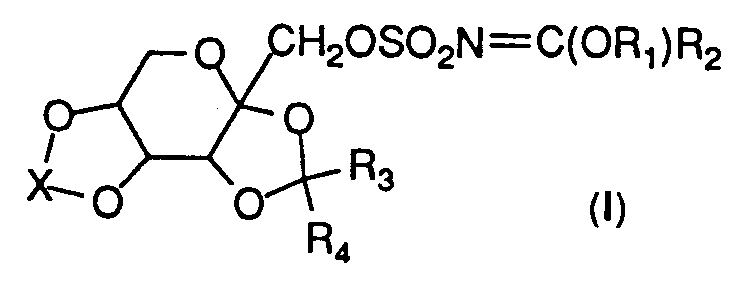
wherein R₁, R₂, R₃, R₄ and X are as defined hereinafter exhibit anticonvulsant activity upon conversion to the active agent. Such compounds are prodrugs for the active agent by virtue of their hydrolysis in vivo. Derivatization of the antiepileptic drug topiramate, and its congeners, gives rise to these imidate prodrugs that afford anticonvulsant activity upon administration to a mammal, and are thus useful for the treatment of epilepsy. Such prodrugs may be superior to the parent compound in their absorption and distribution within mammals. These prodrugs may also be useful for the treatment of glaucoma, peptic ulcers, hypertension, congestive heart failure and other types of edema. - More particularly, the present invention is directed to imidate derivatives of the following formula (I):

- R₁ is C₁-C₁₀ alkyl or C₃-C₁₀ cycloalkyl.
- R₂ is hydrogen, C₁-C₁₀, alkyl, C₁-C₆ alkoxy, C₃-C₁₀ cycloalkyl , or phenyl.
- R₃ and R₄ are the same or different and are selected from any of hydrogen, C₁-C₆ alkyl, or are taken together to form a cyclopentyl or cyclohexyl ring. More preferably, R₃ and R₄ are either H or C₁-C₂ alkyl.
- X is CR₅R₆, where R₅ and R₆ are the same or different and are selected from any of hydrogen, C₁-C₆ alkyl, or C₁-C₄ perfluoroalkyl, or are taken together to form a cyclopentyl or cyclohexyl ring; or X is S(R₇)n(R₈)p, where R₇ and R₈ are the same or different and are selected from either oxygen or NR₉, where R₉ is selected from any of hydrogen, C₁-C₄ alkyl, C₁-C₄ perfluoroalkyl, arenesulfonyl, C₁ to C₄ alkoxycarbonyl, or benzyloxycarbonyl. Preferably R₇ and R₈ are each O.
- Each of p and n is either zero or one, with the proviso that n and p are not both equal to zero at the same time. A lone pair of electrons is designated when either n or p are equal to zero. More preferably, when X is CR₅R₆, R₅ and R₆ are hydrogen or C₁-C₃ alkyl and, when X is S(R₇)n(R₈)p, R₇ and R₈ are both oxygen and n and p equal one.
- As used herein alkyl and alkoxy include straight and branched chains. For example, alkyl radicals include methyl, ethyl, propyl, isopropyl, n-butyl, isobutyl, sec-butyl, t-butyl, n-pentyl, 2-methyl-3-butyl, 1-methylbutyl, 2-methylbutyl, neopentyl, n-hexyl, 1-methylpentyl and 3-methylpentyl. Perfluoroalkyl radicals are defined as the previously described straight or branched chain alkyl radicals in which all of the hydrogen atoms have been replaced with fluorine atoms; eg., trifluoromethyl, pentafluoroethyl, heptafluoropropyl, etc. Alkoxy radicals are oxygen ethers formed from the previously described straight or branched chain alkyl groups.
- Arenesulfonyl radicals include, for example, phenylsulfonyl, o-toluenesulfonyl, m-toluenesulfonyl, p-toluenesulfonyl ("Ts"), 1-naphthalenesulfonyl, 2-naphthalene-sulfonyl, and 5-dimethylamino-1-naphthalenesulfonyl.
- Cyclic sulfites are designated when n equals one, p equals zero, and R₇ is oxygen and also when n equals zero, p equals one and R₈ is oxygen. Cyclic sulfates are designated when n equals one, p equals one, R₇ is oxygen and R₈ is oxygen. Cyclic imidosulfites are designated when n equals one, p equals zero and R₇ is NR₉ and also when n equals zero and p equals one and R₈ is NR₉. Cyclic imidosulfates are designated when n equals one, p equals one, R₇ is oxygen and R₈ is NR₉ and also when n equals one, p equals one, R₇ is NR₇ and R₈ is oxygen. Cyclic diimidosulfates are designated when n equals one, p equals one, R₇ equals NR₉ and R₈ equals NR₉.
- The compounds of this invention include the various individual anomers, diastereomers and enantiomers as well as mixtures thereof. Compounds may exist in the β-D-fructopyranose and β-L-fructopyranose absolute configurations. Preferably, the oxygens connected to the pyran ring in formula (I) are in the β-D-fructopyranose configuration. Such compounds are included within the definition of formula (I).
As used herein, the β-D-fructopyranose absolute configuration is defined as: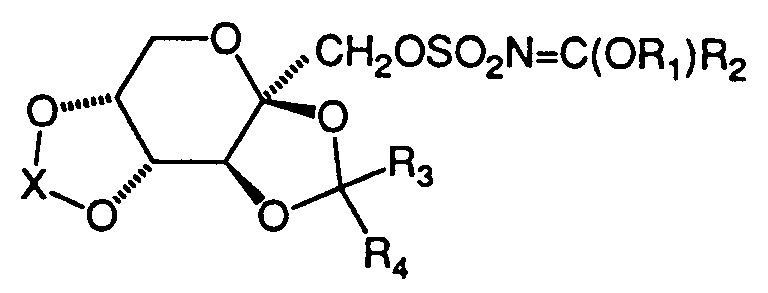
and the the β-L-fructopyranose absolute configuration is defined as: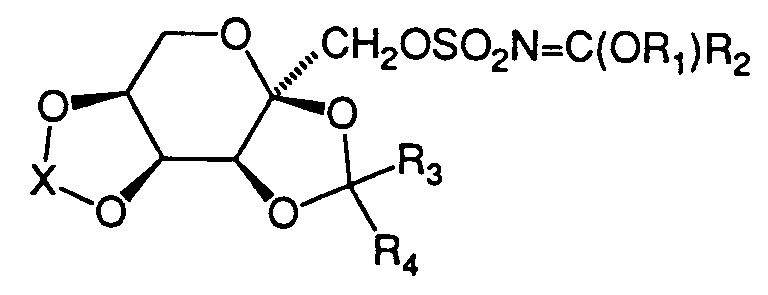
- The compounds of formula (I) may be synthesized by heating the corresponding sulfamate drug of Formula (II) with ortho ester or ortho carbonate reagents such as HC(OMe)₃, (EtO)₄C, PhC(OMe)₃ and MeC(OEt)₃, used in substantial stoichiometric excess, at a temperature of about 50-150°C, usually in the absence of a solvent (although inert solvents, such as toluene, dichloroethane, 1,2-dichlorobenzene, and the like can be used). As used herein Et means ethyl and Me means methyl. The product is then isolated by standard methods, such as crystallization or chromatography (preferably in the absence of water to avoid hydrolysis of the imidate group).

- When X is CR₅R₆, the corresponding sulfamate drug is represented by the general formula (IIa):
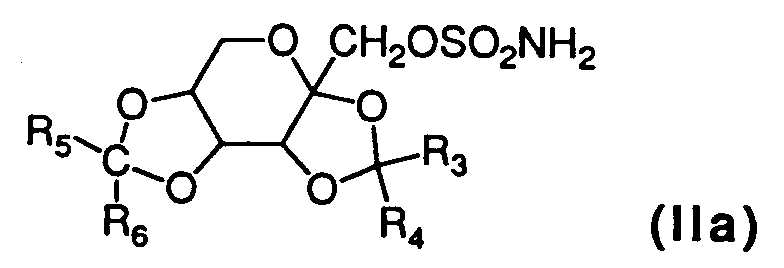
wherein R₃, R₄, R₅, and R₆ are as defined previously herein. - When X is S(R₇)n (R₈)p, the corresponding sulfamate drug is represented by the general formula (IIb):
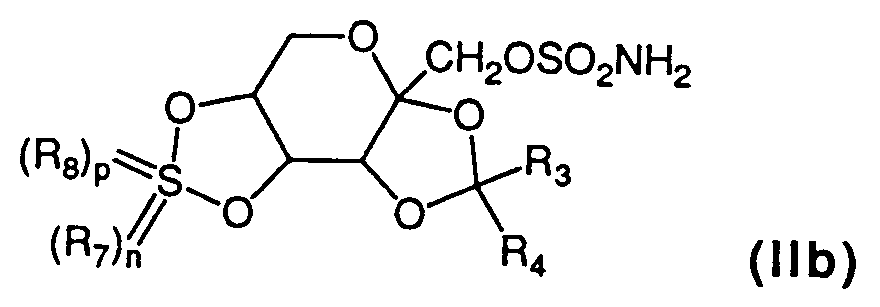
wherein R₃, R₄, R₇, R₈, n and p are as defined previously herein. - The compound of the formula (IIa) may be synthesized according to the procedures recited in U.S. Patents No. 4,513,006, 4,582,416 which are incorporated by reference herein.
- The compounds of the formula (IIb) may be synthesized by any of the methods recited hereinafter.
- In the first method, a compound of the formula (III);

is reacted with sulfamoyl chloride (formula CISO₂NH₂), in the presence of a base such as potassium t-butoxide, sodium hydride, triethylamine, or pyridine at a temperature of about -60 to about 25°C in an aprotic solvent such as toluene, ethyl acetate, tetrahydrofuran, acetonitrile or dimethylformamide thereby producing the compound of formula (IIb). For example:
- In a second method to produce compounds of formula (IIb), a compound of formula (III) is reacted with sulfuryl chloride in the presence of pyridine or triethylamine at a temperature of about -60° to about 25°C in an aprotic solvent such as diethyl ether, ethyl acetate, dichloromethane or toluene to produce a chlorosulfate of the formula (IV).

The chlorosulfate of formula (IV) is subsequently reacted with ammonia, under anhydrous conditions, at a temperature of about -60° to about 25 °C in an aprotic solvent such as tetrahydrofuran, acetonitrile or dichloromethane to produce a compound of formula (IIb). For example:
- A third method to produce compounds of formula (llb) involves reacting a diol of the formula (V):

with sulfuryl chloride in the presence of pyridine or triethylamine at a temperature of about -78° to about 25°C in an aprotic solvent such as ethyl acetate, toluene, or dichloromethane to produce the bis-chlorosulfate of formula (VI).
-

Dechlorosulfation of the bis-chlorosulfate of formula (VI) with a weak base such as NaHCO₃ or pyridine in an alcohol such as methanol or ethanol at about -40° to about 25°C yields cyclic sulfate compounds of the formula (IIb). For example:
- A method to prepare cyclic sulfate and imidosulfate compounds of the formula (IIb) involves the oxidation of the corresponding cyclic sulfites or imidosulfites of the formula (I) with RuCl₃ and NalO₄ according to the method of Sharpless et al. in Tetrahedron Lett.. 1989, 30, 655. For example:

(Where Ts is defined as p-toluenesulfonyl)
Other strong oxidants, such as OsO₄, KMnO₄, dialkyl dioxiranes, diperfluoroalkyl dioxiranes or alkylperfluoroalkyl dioxiranes may also be used to affect this transformation. For example:
(Where Boc is defined as t-butoxycarbonyl) - Cyclic sulfate and imidosulfate compounds of formula (IIb) may also be prepared from benzyl cyclic sulfites and imidosulfites of the formula (VII).

Oxidation of cyclic sulfites and imidosulfites of formula (VII) with RuO₄ or other strong oxidants produces the corresponding benzyl cyclic sulfates and imidosulfates. Debenzylation of these benzyl cyclic sulfates and imidosulfates to the corresponding cyclic sulfates and imidosulfates of the formula (III) can be effected with hydrogen in the presence of a noble metal catalyst, such as Pd(OH)₂ on carbon, in an alcoholic solvent such as ethanol or methanol at about 25° to about 60°C. -

Conversion of the resulting compounds of the formula (III) to the corresponding compounds of formula (llb) may be accomplished as previously described herein. - Alternatively, benzyl cyclic sulfates and diimidosulfates of the formula (VII) may be prepared by the treatment of diols of formula (VIII) with an excess of sodium hydride in tetrahydrofuran at room temperature followed by reaction with sulfuryldiimidazole or NR₇-substituted diimidosulfuryl fluorides, respectively.

-

Conversion of the benzyl cyclic sulfate and diimidosulfate compounds of the formula (VII) to the corresponding cyclic sulfate compounds of formula (llb) may be accomplished as described in the preceding method. - Cyclic sulfites and imidosulfites of formula (llb) can also be prepared by the reaction of diols of formula (V) with thionyl chloride or NR₇-substituted imidothionyl chlorides, respectively, under anhydrous conditions in aprotic solvents such as diethyl ether, dioxane, tetrahydrofuran, or in toluene or dichloromethane at about -40°C to about 110 °C, with or without the presence of a base, such as pyridine or triethylamine. For example:

- Similarly, benzyl cyclic sulfites and imidosulfites of the formula (VII) can be prepared by the reaction of diols of the formula (VIII) with thionyl chloride and NR₇-substituted diimidosulfate imidothionyl chloride, respectively, in ethereal solvents such as diethyl ether, dioxane, and tetrahydrofuran or in toluene or dichloromethane at about -40° to about 110 °C, with or without the presence of a base, such as pyridine or triethylamine. Oxidative debenzylation with N-bromosuccinimide according to the method of Binkley et al. in J. Org. Chem. 1990, 55, 378 provides the corresponding cyclic sulfites and imidosulfites of the formula (III). Conversion of these alcohols to the cyclic sulfite and imidosulfite compounds of formula (IIb) may be accomplished as previously described herein.
-

- Still another method to prepare cyclic sulfates of formula (IIb) involves reaction of a triol of the formula (IX):

with sulfuryl chloride as described by Martin et al. in Can. J. Chem. 1982, 60, 1857, in an aprotic solvent such as diethyl ether, ethyl acetate, toluene or dichloromethane to produce a tris-chlorosulfate of the formula (X):
- Dechlorosulfation of the tris-chlorosulfate with a base such as K₂CO₃, NaHCO₃ or pyridine at about -40° to about 25°C in an alcohol such as methanol or ethanol gives a cyclic sulfate of formula (III), which may be converted to the corresponding compounds of formula (IIb) as previously described herein. For example:

- The starting materials required to synthesize compounds of formula (llb) may be prepared by methods known to those skilled in the art of organic synthesis. For example, novel compounds of the formulas (III) and (X) may be obtained by the methods analogous to those described by Martin et al. in Can. J. Chem. 1982, 60, 1857. Novel diols of the formula (V) may be prepared by the procedures analogous to those described by Maryanoff et al. in J. Med. Chem. 1987, 30, 880. Triols of the formula (IX) may be obtained as described by the method of Wolfrom et al. in J. Am. Chem. Soc. 1950, 72, 4544. Diols of the formula (VIII) may be prepared by the method described by Zervas et al. in Chem. Ber. 1933, 66, 1698. The requisite NR₇-substituted imidothionyl chlorides and NR₇-substituted diimidosulfuryl fluorides may be prepared by the procedures analogous to those described by Levchenko et al. in Zh. Org. Khim. 1979, 15, 2485 and Glemser et al. in Angew. Chem. Int. Ed. Engl. 1980, 19, 408, respectively. The starting 2,3:4,5-bis-O-(alkylidene)-β-D-fructopyranoses and 2,3:4,5-bis-O-(cycloalkylidene-β-D-fructopyranoses may be prepared by the method reported by Brady in Carbohydr. Res. 1970, 15, 35 or by the procedure described in US Patent 4,659,809.
- The compounds of formula (I) are particularly useful as anticonvulsant agents in mammals including humans in that they result in active agents when the imidate group is removed in vivo. The anticonvulsant activity of the subject compounds was determined using a standard "maximal electroshock test" (MES). In this test, activity is indicated by a block of the toxic extensor seizure caused by application of an electric shock to mice via corneal electrodes, as described by Swinyard et al. in J. Pharmacol. Expt. Ther. 1952, 106, 319, and recorded as % block. A more recent description of current anticonvulsant drug screening is given by Swinyard in Epilepsia 1978, 19, 409. The anticonvulsant activity of the compounds of this invention tested according to the Swinyard 1952 method is shown in the following Table I.
- In the test, albino male CRS-CD1 mice weighing between 18-25 g were used in all experiments (obtained from Charles River). They were allowed food and water ad libitum and were used only once. The electroshock apparatus and the corneal electrodes were purchased from Wahlquist Instrument Company, Salt Lake City, Utah.
- Maximal electroshock seizures were induced by the delivery of a 60 Hertz (Hz) current of 50 milliamps (mA) intensity to the mouse through corneal electrodes for 0.2 seconds as originally described by Swinyard et al (1952). This stimulus intensity is approximately 4 to 6 times the current producing 100% tonic extensor convulsions. During the validation of the MES test, the duration of the various seizure components following maximal electroshock were measured as follows: hindleg tonic flexion was measured from the time of the application of the stimulus to the time of onset of hindleg tonic extension (i.e. when the hindlegs deviate by greater than an angle of 90° from the torso), hindleg tonic extensor was measured from the time of extensor thrust to the onset of generalized clonus, and terminal clonus was measured from the beginning to the end of bilateral rhythmic clonic jerking. Mortality was also recorded. The duration of each seizure component agreed well with the values previously reported by Tedeschi et al. in J. Pharmacol. Expt. Ther. 1955 , 116, 107. The corneal electrodes were concave so that saline could be applied to the electrodes to reduce mortality. If this procedure is followed, mortality should always be less than 40% in control mice. Thus, at an electroshock stimulus of 60 Hz, 50 mA and 0.2 seconds duration, the order of convulsive components and the percentage of control animals displaying the behaviors should be as follows: tonic flexion (100%), tonic extension (100%) and clonus (100%) with less than 40% mortality.
- For testing compounds, the abolition of the tonic extensor component was the endpoint. Animals were dosed orally (PO) with either vehicle or test drug and at a specified time were given a maximal electric shock through corneal electrodes blotted with saline (as described above). A minimum of 10 animals were used per group and the percentage of animals in the group without tonic hindlimb extension recorded. Determination of ED₅₀ values (that dose of drug inhibiting 50% of the tonic extensor seizures) is shown below in Table I.

- For treating epilepsy, a compound of formula (I) may be employed at a daily dosage in the range of about 10 to 2000 mg, usually in 1 to 4 divided doses, for an average adult human. This translates to about 0.2 - 50 mg/kg/day. A unit dose would contain about 5 to 500 mg of the active ingredient.
- In general, compounds of formula (I) may be used in treating epilepsy in mammals including humans in a manner similar to that used for phenytoin. Medical aspects of the treatment of epilepsy are described in greater detail by Rall and Schleifer in Goodman and Gilman's The Pharmacological Basis of Therapeutics, 8th ed.; Goodman Gilman, A.; Rall, T. W.; Nies, A. S.; Taylor, P., Eds.; Pergamon Press: New York, 1990; pp 436-462.
- The compounds of formula (I) preferably are administered in the form of a pharmaceutical composition. To prepare the pharmaceutical compositions of this invention, one or more sulfamate compounds of formula (I) are intimately admixed with a pharmaceutical carrier according to conventional pharmaceutical compounding techniques, which carrier may take a wide variety of forms depending on the form of preparation desired for administration, e.g., oral, by suppository, or parenteral. In preparing the compositions in oral dosage form, any of the usual pharmaceutical media may be employed. Thus, for liquid oral preparations, such as, for example, suspensions, elixirs and solutions, suitable carriers and additives include oils, flavoring agents, preservatives, coloring agents and the like; for solid oral preparations such as, for example, powders, capsules and tablets, suitable carriers and additives include starches, sugars, diluents, granulating agents, lubricants, binders, disintegrating agents and the like. Because of their ease in administration, tablets and capsules represent the most advantageous oral dosage unit form, in which case solid pharmaceutical carriers are obviously employed. If desired, tablets may be sugar coated or enteric coated by standard techniques. Suppositories may be prepared, in which case cocoa butter could be used as the carrier. For parenterals, the carrier will usually comprise an oil, though other ingredients, for purposes such as aiding solubility or for preservation, may be included. Injectable suspensions may also be prepared, in which case appropriate liquid carriers, suspending agents and the like may be employed.
- It is especially advantageous to formulate the aforementioned pharmaceutical compositions in unit dosage form for ease of administration and uniformity of dosage. The term "unit dosage form" as used in the specification and claims herein refers to physically discrete units suitable as unit dosages, each unit containing a predetermined quantity of active ingredient calculated to produce the desired therapeutic effect in association with the required pharmaceutical carrier.
- The pharmaceutical compositions herein will contain, per dosage unit, e.g., tablet, capsule, powder, injection, teaspoonful, suppository and the like. The compositions will be administrated in amounts as previously described herein with regard to the active ingredient and to the condition being treated. The dosages, however, may be varied depending upon the requirement of the patient, the severity of the condition being treated, and the compound being employed. Determination of optimum dosages for a particular situation is within the skill of the art.
- The present invention will now be described with reference to the following Examples:
- A mixture of topiramate (3.39 g, 10 mmol), prepared by the process disclosed in U. S. Patent No. 4,513,006 and J. Med. Chem. 1987, 30, 880, and 3 mL of PhC(OMe)₃ was heated at 120-125°C for 8 h. The material was chromatographed on a column of silica gel with ethyl acetate/hexanes (1:2) to give the product as a white foam that was homogeneous by TLC. Solvent was removed and the resin crystallized on standing, and it was recrystallized from ethyl acetate/hexanes to afford colorless prisms, mp 111-112 °C. Anal. Calcd for C₂₀H₂₇NO₉S: C, 52.51; H, 5.95; N, 3.06. Found: C, 52.45; H, 5.96, N, 3.06.
- A mixture of topiramate (3.39 g), prepared as in Example 1 and 5 mL of MeC(OEt)₃ was heated at reflux for 4 h. The sample was concentrated to a syrup, which was chromatographed on a Waters Prep HPLC on a column of silica gel with ethyl acetate/hexanes (1:3) to give the product as a white foam that was homogeneous by TLC. Solvent was removed to give a thick colorless syrup that crystallized on standing. It was pulverized to a white powder that was homogeneous by TLC., mp 56-57 °C. Anal. Calcd for C₁₆H₂₇NO₉S: C, 46.93; H, 6.65; N, 3.42. Found: C, 47.05; H, 6.68, N, 3.45.
- A mixture of topiramate (3.39 g) prepared as in Example 1 and 10 mL of HC(OMe)₃ was heated at reflux for 30 h. The sample was concentrated to a syrup, which was chromatographed on a Waters Prep HPLC on a column of silica gel with ethyl acetate/hexanes (1:3) to give the product as a thick colorless syrup that was hydrolytically unstable and homogeneous by GLC. Anal. Calcd for C₁₄H₂₃NO₉S·0.125 CH₂Cl₂: C, 43.28; H, 5.98; N, 3.57. Found: C, 43.18; H, 5.98, N, 3.50.
- A mixture of topiramate (3.39 g) prepared as in Example 1 and 8 mL of HC(OEt)₃ (with one drop of glacial acetic acid) was heated at reflux for 18 h. The sample was concentrated to a syrup, which was chromatographed on a Waters Prep HPLC on a column of silica gel with ethyl acetate/hexanes (1:4) to give the product as a light tan syrup that was hydrolytically unstable. Anal. Calcd for C₁₅H₂₅NO₉S: C, 45.56; H, 6.37; N, 3.54. Found: C, 45.26; H, 6.17, N, 3.46.
- A mixture of topiramate (3.39 g) prepared as in Example 1, 5 mL of C(OMe)4, two drops of glacial acetic acid, and 20 mL of xylenes were heated at reflux for 8 h. The sample was concentrated to a syrup, which was chromatographed on a Waters Prep HPLC on a column of silica gel with ethyl acetate/hexanes (1:2) to give the product as an oil that crystallized. Recrystallization from ether/methanol (95:5) afforded white crystals, mp 123-125 °C. Anal. Calcd for C₁₅H₂₅NO₁₀S : C, 43.79; H, 6.12; N, 3.40. Found: C, 43.75; H,5.96,N,3.43.
- A mixture of topiramate (3.39 g) prepared as in Example 1, 5 mL of C(OEt)4, two drops of glacial acetic acid, and 20 mL of xylenes was heated at reflux for 12 h. The sample was concentrated to a syrup, which was chromatographed on a Waters Prep HPLC on a column of silica gel with ethyl acetate/hexanes (1:3) to give the product as a colorless viscous syrup. Anal. Calcd for C₁₇H₂₉NO₁₀S·0.1 H₂O: C, 46.27; H, 6.67; N, 3.17. Found: C, 45.93; H, 6.48, N, 3.08.
- A mixture of 2,3-O-(1-methylethylidene)-4,5-O-sulfonyl-β-D-fructopyranose sulfamate (2.0 g) and 3.3 g of PhC(OMe)₃ was heated at 120 °C for 8 h. The material was chromatographed on a column of silica gel with ethyl acetate/hexanes (30:70) to give the product as a white foam that was homogeneous by TLC. Anal. Calcd for C₁₇H₂₁NO₁₁S₂: C, 42.59; H, 4.41; N, 2.92, S, 13.37. Found: C, 42.54; H, 4.27, N, 3.04; S, 13.88. The 2,3-O-(1-methylethylidene)-4,5-O-sulfonyl-β-D-fructopyranose sulfamate used hereinabove was prepared as follows:
- A 3 L three-necked flask was equipped with a mechanical stirrer, thermometer, addition funnel, and an argon inlet. 2,3-O-(1-Methylethylidene)-β-D-fructopyranose sulfamate (50.0 g, 0.167 mol) was combined with ethyl acetate (1.7 L) and pyridine (31.7 g, 0.401 mol). This mixture was heated at reflux while stirring under argon to effect solution and cooled to -60 °C with a dry ice/isopropanol bath. Sulfuryl chloride (49.6 g, 0.370 mol) was added dropwise over 45 min at -60 to -50 °C while stirring under argon. The resulting white slurry was stirred at -60 to -50 °C for 1 hr, then at RT for 2 hr, and filtered through Celite. The filtrate was extracted sequentially with saturated aqueous NaCl, 1N HCl, saturated aqueous NaHCO₃ (twice), saturated aqueous NaCI, dried over anhydrous MgSO₄, filtered through Celite and concentrated in vacuo at 40 °C. to furnish 85.6 g (103 %) of 4,5-bis-O-chlornsulfonyl-2,3-O-(1-methylethylidene)-β-D-fructopyranose sulfamate as a white crystalline solid, which was used without further purification. An analytical sample was purified by column chromatography (CH₂Cl₂/ethyl acetate; 95:5 v/v on silica gel), mp 119 - 121 °C. (decomp.).
- A solution of 4,5-bis-O-chlorosulfony1-2,3-O-(1-methylethylidene)-β-D-fructopyranose sulfamate (83.1 g, 0.167 mol) in 418 mL of methanol was combined with NaHCO₃ (84.2 g, 1.00 mol) at RT in a 2 L three-necked flask equipped with a mechanical stirrer and an argon inlet. This mixture was stirred at RT under argon for 18 hr, filtered through Celite and concentrated in vacuo at 40 °C. The residue was dissolved in ethyl acetate and extracted twice with saturated aqueous NaCl, dried over anhydrous MgSO₄, filtered through Celite and concentrated in vacuo at 40 °C. to afford 59.3 g (98%) of product as an oil which crystallized on standing. This material was chromatographed on silica gel eluting with CH₂Cl₂/ethyl acetate (9:1 v/v on silica gel) to furnish 36.6 g (53%) of product. The chromatographed product (36.6 g) was dissolved in anhydrous ethanol (total volume = 150 mL), filtered through Celite, diluted to 350 mL with water, seeded and allowed to recrystallize at 5 °C. The resulting white crystals were washed with a cold mixture of ethanol/water (1:1), then with water and dried in vacuo at 40 °C (18 h) to give 31.4 g of pure 2,3-O-(1-methylethylidene)-4,5-O-sulfonyl-β-D-fructopyranose sulfamate, mp 139-141 °C (decomp.); [α]D²⁵ = -28.8° (c = 1.17, CH₃OH). Anal. Calcd. for C₉H₁₅NO₁₀S₂: C, 29.92; H, 4.18; N, 3.88. Found: C, 30.01; H, 4.36; N, 3.80.
- A mixture of 2,3-O-(1-methylethylidene)-4,5-O-sulfonyl-β-D-fructopyranose sulfamate (2.0 g) prepared as in Example 7 and 10 mL of MeC(OMe)₃ was heated at 90 °C for 3.5 h. The sample was concentrated to a syrup, which was chromatographed on a Waters Prep HPLC on a column of silica gel with ethyl acetate/hexanes (1:4) to give the product as an oil that crystallized on standing to a white solid, mp 89-92 °C. Anal. Calcd for C₁₂H₁₉NO₁₁S₂: C, 34.53; H, 4.59; N, 3.36; S, 15.36. Found: C, 34.58; H, 4.54, N, 3.41; S, 15.44.
Claims (18)
- A compound of the formula (I):

wherein R₂ is selected from any of H, C₁-C₁₀ alkyl, C₁-C₆ alkoxy, C₃-C₁₀ cycloalkyl, or phenyl;
wherein R₃ and R₄ are the same or different and are selected from any of H, C₁-C₆ alkyl, or are taken together to form a cyclopentyl or cyclohexyl ring;
wherein X is CR₅R₆, wherein R₅ and R₆ are the same or different and are selected from any of H, C₁-C₆ alkyl, C₁-C₄ perfluoroalkyl, or are taken together to form a cyclopentyl or cyclohexyl ring; or X is S(R₇)n (R₈)p, wherein R₇ and R₈ are the same or different and are selected from either oxygen or NR₉, where R₉ is selected from any of hydrogen, C₁-C₄ alkyl, C₁-C₄ perfluoroalkyl, arenesulfonyl, lower alkoxycarbonyl, or benzyloxycarbonyl, and
wherein n = zero or one and p = zero or one with the proviso that n and p can not both be equal to zero at the same time; and a pharmaceutically acceptable salt thereof. - The compound of claim 1, wherein R₃ and R₄ are either H or C₁-C₂ alkyl.
- The compound of claims 2, wherein R₂ and R₄ are both methyl.
- The compound of any one of claims 1 to 3, wherein X is CR₅R₆ and R₅ and R₆ are either H or C₁-C₂ alkyl.
- The compound of claim 4, wherein R₅ and R₆ are both methyl.
- The compound of any one of claims 1 to 3, wherein X is S(R₇)n(R₈)p and n and p each equal one.
- The compound of claim 6, wherein R₇ and R₈ are both oxygen.
- The compound of claim 6, wherein R₇ and R₈ are both NR₉.
- The compound of any one of claims 1 to 3, wherein X is S(R₇)n(R₈)p and n is zero and p is equal to one.
- The compound of claim 9, wherein R₇ is oxygen.
- The compound of claim 10, wherein R₈ is NR₉.
- The compound of claim 8 or claim 10, wherein R₉=H.
- The compound of any one of claims 1 to 12, wherein R₁ is methyl.
- The compound of claim 13, wherein R₂ is phenyl, hydrogen, methoxy or methyl.
- The compound of any one of claims 1 to 12, wherein R₁ is ethyl.
- The compound of claim 15, wherein R₂ is hydrogen, methyl or ethoxy.
- A pharmaceutical composition for treating epilepsy comprising the compound of any one of claims 1 to 16 in combination with a pharmaceutically acceptable carrier, the compound being present in therapeutically effective amount.
- The pharmaceutical composition of claim 17, wherein the compound is present in an amount sufficient to treat convulsions in animals.
Applications Claiming Priority (2)
| Application Number | Priority Date | Filing Date | Title |
|---|---|---|---|
| US07/896,936 US5258402A (en) | 1992-06-11 | 1992-06-11 | Imidate derivatives of pharmaceutically useful anticonvulsant sulfamates |
| US896936 | 1992-06-11 |
Publications (1)
| Publication Number | Publication Date |
|---|---|
| EP0574256A1 true EP0574256A1 (en) | 1993-12-15 |
Family
ID=25407090
Family Applications (1)
| Application Number | Title | Priority Date | Filing Date |
|---|---|---|---|
| EP93304497A Ceased EP0574256A1 (en) | 1992-06-11 | 1993-06-10 | Imidate derivatives of pharmaceutically useful anticonvulsant sulfamates |
Country Status (12)
| Country | Link |
|---|---|
| US (1) | US5258402A (en) |
| EP (1) | EP0574256A1 (en) |
| JP (1) | JPH06271580A (en) |
| KR (1) | KR100241860B1 (en) |
| AU (1) | AU659939B2 (en) |
| CA (1) | CA2098076C (en) |
| FI (1) | FI109701B (en) |
| HU (1) | HU219453B (en) |
| MX (1) | MX9303477A (en) |
| NO (1) | NO301073B1 (en) |
| NZ (1) | NZ247786A (en) |
| SG (1) | SG63549A1 (en) |
Cited By (3)
| Publication number | Priority date | Publication date | Assignee | Title |
|---|---|---|---|---|
| WO1997019950A1 (en) * | 1995-12-01 | 1997-06-05 | Oxis International, Inc. | Topiramate immunoassay, as well as analogs and antibodies |
| WO2000061136A1 (en) * | 1999-04-08 | 2000-10-19 | Ortho-Mcneil Pharmaceutical, Inc. | Anticonvulsant derivatives useful in lowering blood pressure |
| WO2001007453A1 (en) * | 1999-07-26 | 2001-02-01 | Ortho-Mcneil Pharmaceutical, Inc. | Tricyclic monosaccharide derivatives useful in treating acute ischemia-induced neurodegeneration |
Families Citing this family (41)
| Publication number | Priority date | Publication date | Assignee | Title |
|---|---|---|---|---|
| US5998380A (en) | 1995-10-13 | 1999-12-07 | New England Medical Center Hospitals, Inc. | Treatment of migraine |
| KR970027051A (en) * | 1995-11-02 | 1997-06-24 | 조규향 | Novel Sulfamate Compounds Containing Carbamoyl Groups |
| IN190975B (en) | 1999-01-15 | 2003-09-06 | Ranbaxy Lab Ltd | |
| CA2369095C (en) * | 1999-04-08 | 2006-07-25 | Ortho-Mcneil Pharmaceutical, Inc. | Anticonvulsant derivatives useful in treating chronic neurodegenerative disorders |
| AU2003213719A1 (en) | 2002-03-01 | 2003-09-16 | Regents Of The University Of Michigan | Multiple-component solid phases containing at least one active pharmaceutical ingredient |
| US20070010573A1 (en) | 2003-06-23 | 2007-01-11 | Xianqi Kong | Methods and compositions for treating amyloid-related diseases |
| US7414076B2 (en) * | 2003-06-23 | 2008-08-19 | Neurochem (International) Limited | Methods and compositions for treating amyloid-related diseases |
| US7244764B2 (en) | 2003-06-23 | 2007-07-17 | Neurochem (International) Limited | Methods and compositions for treating amyloid-related diseases |
| KR20050062976A (en) * | 2003-12-19 | 2005-06-28 | 일동제약주식회사 | A new improved preparation method of 2,3:4,5-bis-O-(1-methylethylidene)-β-D-fructopyranose sulfamate |
| AR049646A1 (en) * | 2004-06-16 | 2006-08-23 | Janssen Pharmaceutica Nv | USEFUL SULFAMATE AND SULFAMIDE DERIVATIVES FOR THE TREATMENT OF EPILEPSY AND RELATED DISORDERS |
| MY147767A (en) * | 2004-06-16 | 2013-01-31 | Janssen Pharmaceutica Nv | Novel sulfamate and sulfamide derivatives useful for the treatment of epilepsy and related disorders |
| CA2578407A1 (en) * | 2004-08-24 | 2006-03-02 | Janssen Pharmaceutica N.V. | Novel benzo-fused heteroaryl sulfamide derivatives useful as anticonvulsant agents |
| EP1828111A2 (en) * | 2004-11-12 | 2007-09-05 | Neurochem (International) Limited | Methods and fluorinated compositions for treating amyloid-related diseases |
| EP1817305A2 (en) * | 2004-11-16 | 2007-08-15 | Neurochem (International) Limited | Compounds for the treatment of cns and amyloid associated diseases |
| CA2592320C (en) | 2004-12-22 | 2015-11-24 | Neurochem (International) Limited | Methods and compositions for treating amyloid-related diseases |
| EP1881959A1 (en) * | 2005-05-20 | 2008-01-30 | Janssen Pharmaceutica N.V. | Process for preparation of sulfamide derivatives |
| US8497298B2 (en) * | 2005-12-19 | 2013-07-30 | Janssen Pharmaceutica Nv | Use of benzo-fused heterocycle sulfamide derivatives for lowering lipids and lowering blood glucose levels |
| US20070155827A1 (en) * | 2005-12-19 | 2007-07-05 | Smith-Swintosky Virginia L | Use of benzo-fused heterocycle sulfamide derivatives for the treatment of depression |
| US20070155824A1 (en) * | 2005-12-19 | 2007-07-05 | Smith-Swintosky Virginia L | Use of benzo-fused heterocycle sulfamide derivatives for disease modification / epileptogenesis |
| US8691867B2 (en) * | 2005-12-19 | 2014-04-08 | Janssen Pharmaceutica Nv | Use of benzo-fused heterocycle sulfamide derivatives for the treatment of substance abuse and addiction |
| US20070155823A1 (en) * | 2005-12-19 | 2007-07-05 | Smith-Swintosky Virginia L | Use of benzo-fused heterocycle sulfamide derivatives as neuroprotective agents |
| US8937096B2 (en) * | 2005-12-19 | 2015-01-20 | Janssen Pharmaceutica Nv | Use of benzo-fused heterocyle sulfamide derivatives for the treatment of mania and bipolar disorder |
| US8716231B2 (en) * | 2005-12-19 | 2014-05-06 | Janssen Pharmaceutica Nv | Use of benzo-fused heterocycle sulfamide derivatives for the treatment of pain |
| US8492431B2 (en) * | 2005-12-19 | 2013-07-23 | Janssen Pharmaceutica, N.V. | Use of benzo-fused heterocycle sulfamide derivatives for the treatment of obesity |
| US20070191460A1 (en) * | 2006-02-15 | 2007-08-16 | Smith-Swintosky Virginia L | Use of Benzo-Heteroaryl Sulfamide Derivatives for the Treatment of Disease Modification / Epileptogenesis |
| US20070191451A1 (en) * | 2006-02-15 | 2007-08-16 | Smith-Swintosky Virginia L | Use of benzo-heteroaryl sulfamide derivatives as neuroprotective agents |
| US20070191474A1 (en) * | 2006-02-15 | 2007-08-16 | Smith-Swintosky Virginia L | Use of benzo-fused heterocyle sulfamide derivatives for the treatment of migraine |
| US20070232556A1 (en) * | 2006-03-31 | 2007-10-04 | Montine Thomas J | Methods and compositions for the treatment of neurological diseases and disorders |
| AU2007253814A1 (en) * | 2006-05-19 | 2007-11-29 | Janssen Pharmaceutica N.V. | Co-therapy for the treatment of epilepsy |
| US20100316626A1 (en) * | 2006-08-11 | 2010-12-16 | The Government Of The United States Of America As Represented By The Secretary | Methods for treatment and diagnosis of psychiatric disorders |
| US20090239942A1 (en) | 2006-09-15 | 2009-09-24 | Cloyd James C | Topiramate Compositions and Methods of Making and Using the Same |
| PT2061458E (en) * | 2006-09-15 | 2015-03-11 | Univ Minnesota | Topiramate compositions and methods for their use |
| ES2533463T3 (en) | 2006-10-12 | 2015-04-10 | Bhi Limited Partnership | Methods, compounds, compositions and vehicles for delivering 3-amino-1-propanesulfonic acid |
| US20090247617A1 (en) * | 2008-03-26 | 2009-10-01 | Abdel-Magid Ahmed F | Process for the preparation of benzo-fused heteroaryl sulfamates |
| WO2010008776A2 (en) | 2008-06-23 | 2010-01-21 | Janssen Pharmaceutica Nv | Disposable patch and reusable sensor assembly for use in medical device localization and mapping systems |
| US8815939B2 (en) * | 2008-07-22 | 2014-08-26 | Janssen Pharmaceutica Nv | Substituted sulfamide derivatives |
| US20110244057A1 (en) * | 2008-09-25 | 2011-10-06 | Ehrenberg Bruce L | Combination therapies with topiramate for seizures, restless legs syndrome, and other neurological conditions |
| EP2342356A4 (en) | 2008-09-29 | 2012-11-21 | Univ Ben Gurion | BETA-AMYLOID PEPTIDES AND METHODS OF USE THEREFOR |
| JP5774223B2 (en) | 2012-06-29 | 2015-09-09 | 三菱電機株式会社 | Robot control apparatus and robot control method |
| US20230137562A1 (en) | 2017-06-07 | 2023-05-04 | Adrx, Inc. | Tau aggregation inhibitors |
| AU2018318319A1 (en) | 2017-08-18 | 2020-02-20 | Adrx, Inc. | Tau aggregation peptide inhibitors |
Citations (5)
| Publication number | Priority date | Publication date | Assignee | Title |
|---|---|---|---|---|
| US4075351A (en) | 1974-12-30 | 1978-02-21 | Ortho Pharmaceutical Corporation | Inhibition of male fertility with aliphatic sulfamates |
| US4459601A (en) | 1981-01-30 | 1984-07-10 | Exxon Research And Engineering Co. | Ink jet method and apparatus |
| US4513006A (en) | 1983-09-26 | 1985-04-23 | Mcneil Lab., Inc. | Anticonvulsant sulfamate derivatives |
| US4792569A (en) | 1987-08-27 | 1988-12-20 | Mcneilab, Inc. | Anticonvulsant phenethyl sulfamates |
| EP0568306A1 (en) | 1992-04-28 | 1993-11-03 | Mcneilab, Inc. | Anticonvulsant fructopyranose cyclic sulfites and sulfates |
-
1992
- 1992-06-11 US US07/896,936 patent/US5258402A/en not_active Expired - Lifetime
-
1993
- 1993-06-03 NZ NZ247786A patent/NZ247786A/en not_active IP Right Cessation
- 1993-06-04 AU AU40066/93A patent/AU659939B2/en not_active Expired
- 1993-06-08 JP JP5163316A patent/JPH06271580A/en active Pending
- 1993-06-08 KR KR1019930010337A patent/KR100241860B1/en not_active Expired - Lifetime
- 1993-06-09 CA CA002098076A patent/CA2098076C/en not_active Expired - Lifetime
- 1993-06-10 NO NO932127A patent/NO301073B1/en not_active IP Right Cessation
- 1993-06-10 MX MX9303477A patent/MX9303477A/en unknown
- 1993-06-10 SG SG1996001519A patent/SG63549A1/en unknown
- 1993-06-10 EP EP93304497A patent/EP0574256A1/en not_active Ceased
- 1993-06-10 FI FI932655A patent/FI109701B/en not_active IP Right Cessation
- 1993-06-11 HU HU9301715A patent/HU219453B/en unknown
Patent Citations (6)
| Publication number | Priority date | Publication date | Assignee | Title |
|---|---|---|---|---|
| US4075351A (en) | 1974-12-30 | 1978-02-21 | Ortho Pharmaceutical Corporation | Inhibition of male fertility with aliphatic sulfamates |
| US4459601A (en) | 1981-01-30 | 1984-07-10 | Exxon Research And Engineering Co. | Ink jet method and apparatus |
| US4513006A (en) | 1983-09-26 | 1985-04-23 | Mcneil Lab., Inc. | Anticonvulsant sulfamate derivatives |
| EP0138441A2 (en) * | 1983-09-26 | 1985-04-24 | McNeilab, Inc. | Anticonvulsant sulfamate derivatives |
| US4792569A (en) | 1987-08-27 | 1988-12-20 | Mcneilab, Inc. | Anticonvulsant phenethyl sulfamates |
| EP0568306A1 (en) | 1992-04-28 | 1993-11-03 | Mcneilab, Inc. | Anticonvulsant fructopyranose cyclic sulfites and sulfates |
Non-Patent Citations (5)
| Title |
|---|
| DRUGS FUTURE, vol. 14, 1989, pages 342 |
| H. BUNDGAARD ET AL., J. MED. CHEM, vol. 31, 1988, pages 2066 - 2069 |
| J. MED. CHEM. vol. 30, 1987, pages 880 - 887 B.E. MARYANOFF ET AL. 'Anticonvulsant O-Alkyl Sulfamates' * |
| J. MED. CHEM. vol. 31, 1988, pages 2066 - 2069 H. BUNDGAARD ET AL. 'N-Sulfonyl Imidates as a Novel Prodrug Form for an Ester Function or a Sulfonamide Group' * |
| J. MED. CHEM., vol. 30, 1987, pages 880 |
Cited By (6)
| Publication number | Priority date | Publication date | Assignee | Title |
|---|---|---|---|---|
| WO1997019950A1 (en) * | 1995-12-01 | 1997-06-05 | Oxis International, Inc. | Topiramate immunoassay, as well as analogs and antibodies |
| WO2000061136A1 (en) * | 1999-04-08 | 2000-10-19 | Ortho-Mcneil Pharmaceutical, Inc. | Anticonvulsant derivatives useful in lowering blood pressure |
| AU775849B2 (en) * | 1999-04-08 | 2004-08-19 | Ortho-Mcneil Pharmaceutical, Inc. | Anticonvulsant derivatives useful in lowering blood pressure |
| WO2001007453A1 (en) * | 1999-07-26 | 2001-02-01 | Ortho-Mcneil Pharmaceutical, Inc. | Tricyclic monosaccharide derivatives useful in treating acute ischemia-induced neurodegeneration |
| US6495523B1 (en) | 1999-07-26 | 2002-12-17 | Ortho Mcneil-Pharmaceutical, Inc. | Tricyclic monosaccharide derivatives useful in treating acute ischemia-induced neurodegeneration |
| AU775296B2 (en) * | 1999-07-26 | 2004-07-29 | Ortho-Mcneil Pharmaceutical, Inc. | Tricyclic monosaccharide derivatives useful in treating acute ischemia-induced neurodegeneration |
Also Published As
| Publication number | Publication date |
|---|---|
| NZ247786A (en) | 1994-10-26 |
| FI109701B (en) | 2002-09-30 |
| US5258402A (en) | 1993-11-02 |
| CA2098076C (en) | 2004-08-31 |
| KR100241860B1 (en) | 2000-03-02 |
| MX9303477A (en) | 1994-05-31 |
| JPH06271580A (en) | 1994-09-27 |
| AU4006693A (en) | 1994-02-03 |
| SG63549A1 (en) | 1999-03-30 |
| KR940005633A (en) | 1994-03-22 |
| AU659939B2 (en) | 1995-06-01 |
| FI932655A0 (en) | 1993-06-10 |
| FI932655L (en) | 1993-12-12 |
| HU9301715D0 (en) | 1993-09-28 |
| NO932127D0 (en) | 1993-06-10 |
| HU219453B (en) | 2001-04-28 |
| CA2098076A1 (en) | 1993-12-12 |
| NO932127L (en) | 1993-12-13 |
| NO301073B1 (en) | 1997-09-08 |
| HUT69175A (en) | 1995-08-28 |
Similar Documents
| Publication | Publication Date | Title |
|---|---|---|
| US5258402A (en) | Imidate derivatives of pharmaceutically useful anticonvulsant sulfamates | |
| US5384327A (en) | Anticonvulsant sorbopyranose sulfamates | |
| US5242942A (en) | Anticonvulsant fructopyranose cyclic sulfites and sulfates | |
| EP0138441B1 (en) | Anticonvulsant sulfamate derivatives | |
| RU2328502C2 (en) | Novel anticonvulsive substituted sulfamate derivatives | |
| US4792569A (en) | Anticonvulsant phenethyl sulfamates | |
| CA2179733C (en) | Anticonvulsant pseudofructopyranose sulfamates | |
| US4582916A (en) | Chlorosulfate and azidosulfate esters of tetrahydro-2H-pyran-2-yl-methanol | |
| NZ516783A (en) | Tricyclic monosaccharide derivatives useful in treating acute ischemia-induced neurodegeneration |
Legal Events
| Date | Code | Title | Description |
|---|---|---|---|
| PUAI | Public reference made under article 153(3) epc to a published international application that has entered the european phase |
Free format text: ORIGINAL CODE: 0009012 |
|
| AK | Designated contracting states |
Kind code of ref document: A1 Designated state(s): AT BE CH DE DK ES FR GB GR IE IT LI LU NL PT SE |
|
| 17P | Request for examination filed |
Effective date: 19940519 |
|
| 17Q | First examination report despatched |
Effective date: 19950209 |
|
| APAB | Appeal dossier modified |
Free format text: ORIGINAL CODE: EPIDOS NOAPE |
|
| APAB | Appeal dossier modified |
Free format text: ORIGINAL CODE: EPIDOS NOAPE |
|
| APAD | Appeal reference recorded |
Free format text: ORIGINAL CODE: EPIDOS REFNE |
|
| APAB | Appeal dossier modified |
Free format text: ORIGINAL CODE: EPIDOS NOAPE |
|
| STAA | Information on the status of an ep patent application or granted ep patent |
Free format text: STATUS: THE APPLICATION HAS BEEN REFUSED |
|
| 18R | Application refused |
Effective date: 19980828 |
|
| APAF | Appeal reference modified |
Free format text: ORIGINAL CODE: EPIDOSCREFNE |