EP0389368A1 - New derivatives of 6-(1-piperazinyl) 2,5-pyridine diamine N,N,N',N'-substituted, procedure for their production and intermediates, their use as medicines and pharmaceutical preparations containing them - Google Patents
New derivatives of 6-(1-piperazinyl) 2,5-pyridine diamine N,N,N',N'-substituted, procedure for their production and intermediates, their use as medicines and pharmaceutical preparations containing them Download PDFInfo
- Publication number
- EP0389368A1 EP0389368A1 EP90400782A EP90400782A EP0389368A1 EP 0389368 A1 EP0389368 A1 EP 0389368A1 EP 90400782 A EP90400782 A EP 90400782A EP 90400782 A EP90400782 A EP 90400782A EP 0389368 A1 EP0389368 A1 EP 0389368A1
- Authority
- EP
- European Patent Office
- Prior art keywords
- formula
- compounds
- product
- vii
- hydrogen atom
- Prior art date
- Legal status (The legal status is an assumption and is not a legal conclusion. Google has not performed a legal analysis and makes no representation as to the accuracy of the status listed.)
- Granted
Links
- 238000000034 method Methods 0.000 title claims abstract description 21
- 239000003814 drug Substances 0.000 title claims abstract description 13
- MIROPXUFDXCYLG-UHFFFAOYSA-N pyridine-2,5-diamine Chemical compound NC1=CC=C(N)N=C1 MIROPXUFDXCYLG-UHFFFAOYSA-N 0.000 title claims description 6
- 239000000543 intermediate Substances 0.000 title abstract description 3
- KWYHDKDOAIKMQN-UHFFFAOYSA-N N,N,N',N'-tetramethylethylenediamine Chemical compound CN(C)CCN(C)C KWYHDKDOAIKMQN-UHFFFAOYSA-N 0.000 title 1
- 229940079593 drug Drugs 0.000 title 1
- 238000004519 manufacturing process Methods 0.000 title 1
- 239000000825 pharmaceutical preparation Substances 0.000 title 1
- 150000001875 compounds Chemical class 0.000 claims abstract description 55
- 125000004435 hydrogen atom Chemical group [H]* 0.000 claims abstract description 25
- 150000003839 salts Chemical class 0.000 claims abstract description 23
- 125000000623 heterocyclic group Chemical group 0.000 claims abstract description 8
- 229910052731 fluorine Inorganic materials 0.000 claims abstract description 7
- 238000002360 preparation method Methods 0.000 claims abstract description 7
- 229910052801 chlorine Chemical group 0.000 claims abstract description 6
- 239000008194 pharmaceutical composition Substances 0.000 claims abstract description 6
- -1 alkyl radical Chemical class 0.000 claims description 35
- 229910052757 nitrogen Inorganic materials 0.000 claims description 19
- 239000002253 acid Substances 0.000 claims description 10
- WCYWZMWISLQXQU-UHFFFAOYSA-N methyl Chemical compound [CH3] WCYWZMWISLQXQU-UHFFFAOYSA-N 0.000 claims description 10
- 150000007513 acids Chemical class 0.000 claims description 8
- 125000006239 protecting group Chemical group 0.000 claims description 8
- 125000004432 carbon atom Chemical group C* 0.000 claims description 6
- 238000006243 chemical reaction Methods 0.000 claims description 6
- 125000002924 primary amino group Chemical group [H]N([H])* 0.000 claims description 6
- 125000001153 fluoro group Chemical group F* 0.000 claims description 5
- TUJKJAMUKRIRHC-UHFFFAOYSA-N hydroxyl Chemical compound [OH] TUJKJAMUKRIRHC-UHFFFAOYSA-N 0.000 claims description 5
- 125000004105 2-pyridyl group Chemical group N1=C([*])C([H])=C([H])C([H])=C1[H] 0.000 claims description 4
- OFBQJSOFQDEBGM-UHFFFAOYSA-N Pentane Chemical compound CCCCC OFBQJSOFQDEBGM-UHFFFAOYSA-N 0.000 claims description 4
- 125000001309 chloro group Chemical group Cl* 0.000 claims description 4
- 125000001664 diethylamino group Chemical group [H]C([H])([H])C([H])([H])N(*)C([H])([H])C([H])([H])[H] 0.000 claims description 4
- 125000005843 halogen group Chemical group 0.000 claims description 4
- 230000007935 neutral effect Effects 0.000 claims description 4
- 125000004433 nitrogen atom Chemical group N* 0.000 claims description 4
- 239000002904 solvent Substances 0.000 claims description 4
- 125000001424 substituent group Chemical group 0.000 claims description 4
- 125000004429 atom Chemical group 0.000 claims description 3
- 238000005984 hydrogenation reaction Methods 0.000 claims description 3
- IJDNQMDRQITEOD-UHFFFAOYSA-N n-butane Chemical class CCCC IJDNQMDRQITEOD-UHFFFAOYSA-N 0.000 claims description 2
- 150000003254 radicals Chemical class 0.000 claims description 2
- 150000003431 steroids Chemical class 0.000 abstract description 17
- 239000001257 hydrogen Substances 0.000 abstract description 9
- 229910052739 hydrogen Inorganic materials 0.000 abstract description 9
- 125000002496 methyl group Chemical group [H]C([H])([H])* 0.000 abstract description 6
- UFHFLCQGNIYNRP-UHFFFAOYSA-N Hydrogen Chemical compound [H][H] UFHFLCQGNIYNRP-UHFFFAOYSA-N 0.000 abstract description 3
- 239000000460 chlorine Chemical group 0.000 abstract description 2
- 150000002431 hydrogen Chemical group 0.000 abstract 3
- PXGOKWXKJXAPGV-UHFFFAOYSA-N Fluorine Chemical group FF PXGOKWXKJXAPGV-UHFFFAOYSA-N 0.000 abstract 2
- 125000000217 alkyl group Chemical group 0.000 abstract 2
- 239000011737 fluorine Chemical group 0.000 abstract 2
- 125000002887 hydroxy group Chemical group [H]O* 0.000 abstract 2
- ZAMOUSCENKQFHK-UHFFFAOYSA-N Chlorine atom Chemical group [Cl] ZAMOUSCENKQFHK-UHFFFAOYSA-N 0.000 abstract 1
- 125000004423 acyloxy group Chemical group 0.000 abstract 1
- 125000004043 oxo group Chemical group O=* 0.000 abstract 1
- 239000000047 product Substances 0.000 description 45
- LFQSCWFLJHTTHZ-UHFFFAOYSA-N Ethanol Chemical compound CCO LFQSCWFLJHTTHZ-UHFFFAOYSA-N 0.000 description 15
- YZXBAPSDXZZRGB-DOFZRALJSA-N arachidonic acid Chemical class CCCCC\C=C/C\C=C/C\C=C/C\C=C/CCCC(O)=O YZXBAPSDXZZRGB-DOFZRALJSA-N 0.000 description 15
- CSCPPACGZOOCGX-UHFFFAOYSA-N Acetone Chemical compound CC(C)=O CSCPPACGZOOCGX-UHFFFAOYSA-N 0.000 description 9
- WEVYAHXRMPXWCK-UHFFFAOYSA-N Acetonitrile Chemical compound CC#N WEVYAHXRMPXWCK-UHFFFAOYSA-N 0.000 description 9
- 241000700159 Rattus Species 0.000 description 9
- 239000000203 mixture Substances 0.000 description 9
- 230000005764 inhibitory process Effects 0.000 description 8
- BWHMMNNQKKPAPP-UHFFFAOYSA-L potassium carbonate Chemical group [K+].[K+].[O-]C([O-])=O BWHMMNNQKKPAPP-UHFFFAOYSA-L 0.000 description 8
- 239000000243 solution Substances 0.000 description 8
- 229940114079 arachidonic acid Drugs 0.000 description 7
- 235000021342 arachidonic acid Nutrition 0.000 description 7
- 210000001589 microsome Anatomy 0.000 description 7
- 238000012360 testing method Methods 0.000 description 7
- HEDRZPFGACZZDS-UHFFFAOYSA-N Chloroform Chemical compound ClC(Cl)Cl HEDRZPFGACZZDS-UHFFFAOYSA-N 0.000 description 6
- YMWUJEATGCHHMB-UHFFFAOYSA-N Dichloromethane Chemical compound ClCCl YMWUJEATGCHHMB-UHFFFAOYSA-N 0.000 description 6
- WSMYVTOQOOLQHP-UHFFFAOYSA-N Malondialdehyde Chemical compound O=CCC=O WSMYVTOQOOLQHP-UHFFFAOYSA-N 0.000 description 5
- 238000002347 injection Methods 0.000 description 5
- 239000007924 injection Substances 0.000 description 5
- XLYOFNOQVPJJNP-UHFFFAOYSA-N water Substances O XLYOFNOQVPJJNP-UHFFFAOYSA-N 0.000 description 5
- 206010030113 Oedema Diseases 0.000 description 4
- VYPSYNLAJGMNEJ-UHFFFAOYSA-N Silicium dioxide Chemical compound O=[Si]=O VYPSYNLAJGMNEJ-UHFFFAOYSA-N 0.000 description 4
- 230000003110 anti-inflammatory effect Effects 0.000 description 4
- 230000015572 biosynthetic process Effects 0.000 description 4
- 210000004556 brain Anatomy 0.000 description 4
- 239000000872 buffer Substances 0.000 description 4
- 150000002576 ketones Chemical group 0.000 description 4
- 229910000027 potassium carbonate Inorganic materials 0.000 description 4
- 230000002829 reductive effect Effects 0.000 description 4
- RVBUGGBMJDPOST-UHFFFAOYSA-N 2-thiobarbituric acid Chemical compound O=C1CC(=O)NC(=S)N1 RVBUGGBMJDPOST-UHFFFAOYSA-N 0.000 description 3
- UHOVQNZJYSORNB-UHFFFAOYSA-N Benzene Chemical compound C1=CC=CC=C1 UHOVQNZJYSORNB-UHFFFAOYSA-N 0.000 description 3
- 0 CC(CC(C)(C(C*1)C2C3[C@@]4C3*)[C@@]1(*)C(*)=O)[C@]2(*)C(C)(CC1)C4=CC1=O Chemical compound CC(CC(C)(C(C*1)C2C3[C@@]4C3*)[C@@]1(*)C(*)=O)[C@]2(*)C(C)(CC1)C4=CC1=O 0.000 description 3
- OKTJSMMVPCPJKN-UHFFFAOYSA-N Carbon Chemical compound [C] OKTJSMMVPCPJKN-UHFFFAOYSA-N 0.000 description 3
- 239000004593 Epoxy Substances 0.000 description 3
- XEKOWRVHYACXOJ-UHFFFAOYSA-N Ethyl acetate Chemical compound CCOC(C)=O XEKOWRVHYACXOJ-UHFFFAOYSA-N 0.000 description 3
- PEDCQBHIVMGVHV-UHFFFAOYSA-N Glycerine Chemical compound OCC(O)CO PEDCQBHIVMGVHV-UHFFFAOYSA-N 0.000 description 3
- 206010061218 Inflammation Diseases 0.000 description 3
- OKKJLVBELUTLKV-UHFFFAOYSA-N Methanol Chemical compound OC OKKJLVBELUTLKV-UHFFFAOYSA-N 0.000 description 3
- ZMXDDKWLCZADIW-UHFFFAOYSA-N N,N-Dimethylformamide Chemical compound CN(C)C=O ZMXDDKWLCZADIW-UHFFFAOYSA-N 0.000 description 3
- KWYUFKZDYYNOTN-UHFFFAOYSA-M Potassium hydroxide Chemical compound [OH-].[K+] KWYUFKZDYYNOTN-UHFFFAOYSA-M 0.000 description 3
- RWRDLPDLKQPQOW-UHFFFAOYSA-N Pyrrolidine Chemical compound C1CCNC1 RWRDLPDLKQPQOW-UHFFFAOYSA-N 0.000 description 3
- ZMANZCXQSJIPKH-UHFFFAOYSA-N Triethylamine Chemical compound CCN(CC)CC ZMANZCXQSJIPKH-UHFFFAOYSA-N 0.000 description 3
- XJLXINKUBYWONI-DQQFMEOOSA-N [[(2r,3r,4r,5r)-5-(6-aminopurin-9-yl)-3-hydroxy-4-phosphonooxyoxolan-2-yl]methoxy-hydroxyphosphoryl] [(2s,3r,4s,5s)-5-(3-carbamoylpyridin-1-ium-1-yl)-3,4-dihydroxyoxolan-2-yl]methyl phosphate Chemical compound NC(=O)C1=CC=C[N+]([C@@H]2[C@H]([C@@H](O)[C@H](COP([O-])(=O)OP(O)(=O)OC[C@@H]3[C@H]([C@@H](OP(O)(O)=O)[C@@H](O3)N3C4=NC=NC(N)=C4N=C3)O)O2)O)=C1 XJLXINKUBYWONI-DQQFMEOOSA-N 0.000 description 3
- 230000003078 antioxidant effect Effects 0.000 description 3
- 239000002585 base Substances 0.000 description 3
- 239000003795 chemical substances by application Substances 0.000 description 3
- 230000000694 effects Effects 0.000 description 3
- 125000001495 ethyl group Chemical group [H]C([H])([H])C([H])([H])* 0.000 description 3
- 239000011790 ferrous sulphate Substances 0.000 description 3
- 235000003891 ferrous sulphate Nutrition 0.000 description 3
- 239000000706 filtrate Substances 0.000 description 3
- 230000002440 hepatic effect Effects 0.000 description 3
- 230000004054 inflammatory process Effects 0.000 description 3
- 238000002329 infrared spectrum Methods 0.000 description 3
- 229910052500 inorganic mineral Inorganic materials 0.000 description 3
- 235000010755 mineral Nutrition 0.000 description 3
- 239000011707 mineral Substances 0.000 description 3
- 229930027945 nicotinamide-adenine dinucleotide Natural products 0.000 description 3
- WBDPZSOUUSCIRN-YYSFRLGLSA-N (8s,10s,13s,14s,16r,17s)-17-(2-iodoacetyl)-10,13,16-trimethyl-6,7,8,12,14,15,16,17-octahydrocyclopenta[a]phenanthren-3-one Chemical compound C([C@H]12)CC3=CC(=O)C=C[C@]3(C)C1=CC[C@@]1(C)[C@H]2C[C@@H](C)[C@@H]1C(=O)CI WBDPZSOUUSCIRN-YYSFRLGLSA-N 0.000 description 2
- HZNVUJQVZSTENZ-UHFFFAOYSA-N 2,3-dichloro-5,6-dicyano-1,4-benzoquinone Chemical compound ClC1=C(Cl)C(=O)C(C#N)=C(C#N)C1=O HZNVUJQVZSTENZ-UHFFFAOYSA-N 0.000 description 2
- PAPNRQCYSFBWDI-UHFFFAOYSA-N 2,5-Dimethyl-1H-pyrrole Chemical compound CC1=CC=C(C)N1 PAPNRQCYSFBWDI-UHFFFAOYSA-N 0.000 description 2
- IKHGUXGNUITLKF-UHFFFAOYSA-N Acetaldehyde Chemical compound CC=O IKHGUXGNUITLKF-UHFFFAOYSA-N 0.000 description 2
- XKRFYHLGVUSROY-UHFFFAOYSA-N Argon Chemical compound [Ar] XKRFYHLGVUSROY-UHFFFAOYSA-N 0.000 description 2
- CIWBSHSKHKDKBQ-JLAZNSOCSA-N Ascorbic acid Chemical compound OC[C@H](O)[C@H]1OC(=O)C(O)=C1O CIWBSHSKHKDKBQ-JLAZNSOCSA-N 0.000 description 2
- 241000195940 Bryophyta Species 0.000 description 2
- 208000034656 Contusions Diseases 0.000 description 2
- RTZKZFJDLAIYFH-UHFFFAOYSA-N Diethyl ether Chemical compound CCOCC RTZKZFJDLAIYFH-UHFFFAOYSA-N 0.000 description 2
- AOJJSUZBOXZQNB-TZSSRYMLSA-N Doxorubicin Chemical compound O([C@H]1C[C@@](O)(CC=2C(O)=C3C(=O)C=4C=CC=C(C=4C(=O)C3=C(O)C=21)OC)C(=O)CO)[C@H]1C[C@H](N)[C@H](O)[C@H](C)O1 AOJJSUZBOXZQNB-TZSSRYMLSA-N 0.000 description 2
- VZCYOOQTPOCHFL-OWOJBTEDSA-N Fumaric acid Chemical compound OC(=O)\C=C\C(O)=O VZCYOOQTPOCHFL-OWOJBTEDSA-N 0.000 description 2
- VEXZGXHMUGYJMC-UHFFFAOYSA-N Hydrochloric acid Chemical compound Cl VEXZGXHMUGYJMC-UHFFFAOYSA-N 0.000 description 2
- 241001465754 Metazoa Species 0.000 description 2
- AFVFQIVMOAPDHO-UHFFFAOYSA-N Methanesulfonic acid Chemical compound CS(O)(=O)=O AFVFQIVMOAPDHO-UHFFFAOYSA-N 0.000 description 2
- JGFZNNIVVJXRND-UHFFFAOYSA-N N,N-Diisopropylethylamine (DIPEA) Chemical compound CCN(C(C)C)C(C)C JGFZNNIVVJXRND-UHFFFAOYSA-N 0.000 description 2
- LRHPLDYGYMQRHN-UHFFFAOYSA-N N-Butanol Chemical compound CCCCO LRHPLDYGYMQRHN-UHFFFAOYSA-N 0.000 description 2
- UBQYURCVBFRUQT-UHFFFAOYSA-N N-benzoyl-Ferrioxamine B Chemical compound CC(=O)N(O)CCCCCNC(=O)CCC(=O)N(O)CCCCCNC(=O)CCC(=O)N(O)CCCCCN UBQYURCVBFRUQT-UHFFFAOYSA-N 0.000 description 2
- KDLHZDBZIXYQEI-UHFFFAOYSA-N Palladium Chemical compound [Pd] KDLHZDBZIXYQEI-UHFFFAOYSA-N 0.000 description 2
- NBIIXXVUZAFLBC-UHFFFAOYSA-N Phosphoric acid Chemical compound OP(O)(O)=O NBIIXXVUZAFLBC-UHFFFAOYSA-N 0.000 description 2
- NQRYJNQNLNOLGT-UHFFFAOYSA-N Piperidine Chemical compound C1CCNCC1 NQRYJNQNLNOLGT-UHFFFAOYSA-N 0.000 description 2
- KAESVJOAVNADME-UHFFFAOYSA-N Pyrrole Chemical compound C=1C=CNC=1 KAESVJOAVNADME-UHFFFAOYSA-N 0.000 description 2
- FAPWRFPIFSIZLT-UHFFFAOYSA-M Sodium chloride Chemical compound [Na+].[Cl-] FAPWRFPIFSIZLT-UHFFFAOYSA-M 0.000 description 2
- WYURNTSHIVDZCO-UHFFFAOYSA-N Tetrahydrofuran Chemical compound C1CCOC1 WYURNTSHIVDZCO-UHFFFAOYSA-N 0.000 description 2
- 239000007983 Tris buffer Substances 0.000 description 2
- 238000004458 analytical method Methods 0.000 description 2
- WPYMKLBDIGXBTP-UHFFFAOYSA-N benzoic acid Chemical compound OC(=O)C1=CC=CC=C1 WPYMKLBDIGXBTP-UHFFFAOYSA-N 0.000 description 2
- GDTBXPJZTBHREO-UHFFFAOYSA-N bromine Chemical compound BrBr GDTBXPJZTBHREO-UHFFFAOYSA-N 0.000 description 2
- 206010008118 cerebral infarction Diseases 0.000 description 2
- 238000002512 chemotherapy Methods 0.000 description 2
- 230000018044 dehydration Effects 0.000 description 2
- 238000006297 dehydration reaction Methods 0.000 description 2
- UREBDLICKHMUKA-CXSFZGCWSA-N dexamethasone Chemical compound C1CC2=CC(=O)C=C[C@]2(C)[C@]2(F)[C@@H]1[C@@H]1C[C@@H](C)[C@@](C(=O)CO)(O)[C@@]1(C)C[C@@H]2O UREBDLICKHMUKA-CXSFZGCWSA-N 0.000 description 2
- 229960003957 dexamethasone Drugs 0.000 description 2
- 239000003480 eluent Substances 0.000 description 2
- 125000001072 heteroaryl group Chemical group 0.000 description 2
- 208000014674 injury Diseases 0.000 description 2
- BAUYGSIQEAFULO-UHFFFAOYSA-L iron(2+) sulfate (anhydrous) Chemical compound [Fe+2].[O-]S([O-])(=O)=O BAUYGSIQEAFULO-UHFFFAOYSA-L 0.000 description 2
- 229910000359 iron(II) sulfate Inorganic materials 0.000 description 2
- 230000003859 lipid peroxidation Effects 0.000 description 2
- VNWKTOKETHGBQD-UHFFFAOYSA-N methane Chemical compound C VNWKTOKETHGBQD-UHFFFAOYSA-N 0.000 description 2
- 230000003228 microsomal effect Effects 0.000 description 2
- 230000000144 pharmacologic effect Effects 0.000 description 2
- 239000008363 phosphate buffer Substances 0.000 description 2
- BDERNNFJNOPAEC-UHFFFAOYSA-N propan-1-ol Chemical compound CCCO BDERNNFJNOPAEC-UHFFFAOYSA-N 0.000 description 2
- 102000004169 proteins and genes Human genes 0.000 description 2
- 108090000623 proteins and genes Proteins 0.000 description 2
- 238000010992 reflux Methods 0.000 description 2
- 239000000377 silicon dioxide Substances 0.000 description 2
- 210000000278 spinal cord Anatomy 0.000 description 2
- 239000012134 supernatant fraction Substances 0.000 description 2
- VZGDMQKNWNREIO-UHFFFAOYSA-N tetrachloromethane Chemical compound ClC(Cl)(Cl)Cl VZGDMQKNWNREIO-UHFFFAOYSA-N 0.000 description 2
- 230000008733 trauma Effects 0.000 description 2
- LENZDBCJOHFCAS-UHFFFAOYSA-N tris Chemical compound OCC(N)(CO)CO LENZDBCJOHFCAS-UHFFFAOYSA-N 0.000 description 2
- 238000005303 weighing Methods 0.000 description 2
- KPZGRMZPZLOPBS-UHFFFAOYSA-N 1,3-dichloro-2,2-bis(chloromethyl)propane Chemical compound ClCC(CCl)(CCl)CCl KPZGRMZPZLOPBS-UHFFFAOYSA-N 0.000 description 1
- AZQWKYJCGOJGHM-UHFFFAOYSA-N 1,4-benzoquinone Chemical compound O=C1C=CC(=O)C=C1 AZQWKYJCGOJGHM-UHFFFAOYSA-N 0.000 description 1
- MXYWQLXKTCACLB-UHFFFAOYSA-N 1-[4-[6-(diethylamino)-3-nitropyridin-2-yl]piperazin-1-yl]ethanone Chemical compound CCN(CC)C1=CC=C([N+]([O-])=O)C(N2CCN(CC2)C(C)=O)=N1 MXYWQLXKTCACLB-UHFFFAOYSA-N 0.000 description 1
- PKDPUENCROCRCH-UHFFFAOYSA-N 1-piperazin-1-ylethanone Chemical compound CC(=O)N1CCNCC1 PKDPUENCROCRCH-UHFFFAOYSA-N 0.000 description 1
- YBVRFTBNIZWMSK-UHFFFAOYSA-N 2,2-dimethyl-1-phenylpropan-1-ol Chemical compound CC(C)(C)C(O)C1=CC=CC=C1 YBVRFTBNIZWMSK-UHFFFAOYSA-N 0.000 description 1
- SHCWQWRTKPNTEM-UHFFFAOYSA-N 2,6-dichloro-3-nitropyridine Chemical compound [O-][N+](=O)C1=CC=C(Cl)N=C1Cl SHCWQWRTKPNTEM-UHFFFAOYSA-N 0.000 description 1
- QKNYBSVHEMOAJP-UHFFFAOYSA-N 2-amino-2-(hydroxymethyl)propane-1,3-diol;hydron;chloride Chemical compound Cl.OCC(N)(CO)CO QKNYBSVHEMOAJP-UHFFFAOYSA-N 0.000 description 1
- VINOSHDRVYFKLH-UHFFFAOYSA-N 2-n,2-n,5-n,5-n-tetraethyl-6-piperazin-1-ylpyridine-2,5-diamine Chemical compound CCN(CC)C1=CC=C(N(CC)CC)C(N2CCNCC2)=N1 VINOSHDRVYFKLH-UHFFFAOYSA-N 0.000 description 1
- ZCYVEMRRCGMTRW-UHFFFAOYSA-N 7553-56-2 Chemical group [I] ZCYVEMRRCGMTRW-UHFFFAOYSA-N 0.000 description 1
- 239000005711 Benzoic acid Substances 0.000 description 1
- BVKZGUZCCUSVTD-UHFFFAOYSA-M Bicarbonate Chemical compound OC([O-])=O BVKZGUZCCUSVTD-UHFFFAOYSA-M 0.000 description 1
- 201000006474 Brain Ischemia Diseases 0.000 description 1
- HNUALPPJLMYHDK-UHFFFAOYSA-N C[CH]C Chemical compound C[CH]C HNUALPPJLMYHDK-UHFFFAOYSA-N 0.000 description 1
- BVKZGUZCCUSVTD-UHFFFAOYSA-L Carbonate Chemical compound [O-]C([O-])=O BVKZGUZCCUSVTD-UHFFFAOYSA-L 0.000 description 1
- 206010008120 Cerebral ischaemia Diseases 0.000 description 1
- VEXZGXHMUGYJMC-UHFFFAOYSA-M Chloride anion Chemical compound [Cl-] VEXZGXHMUGYJMC-UHFFFAOYSA-M 0.000 description 1
- KZBUYRJDOAKODT-UHFFFAOYSA-N Chlorine Chemical compound ClCl KZBUYRJDOAKODT-UHFFFAOYSA-N 0.000 description 1
- NOTFZGFABLVTIG-UHFFFAOYSA-N Cyclohexylethyl acetate Chemical compound CC(=O)OCCC1CCCCC1 NOTFZGFABLVTIG-UHFFFAOYSA-N 0.000 description 1
- 201000004624 Dermatitis Diseases 0.000 description 1
- YXHKONLOYHBTNS-UHFFFAOYSA-N Diazomethane Chemical compound C=[N+]=[N-] YXHKONLOYHBTNS-UHFFFAOYSA-N 0.000 description 1
- 238000001061 Dunnett's test Methods 0.000 description 1
- 206010015150 Erythema Diseases 0.000 description 1
- 208000032843 Hemorrhage Diseases 0.000 description 1
- DGAQECJNVWCQMB-PUAWFVPOSA-M Ilexoside XXIX Chemical compound C[C@@H]1CC[C@@]2(CC[C@@]3(C(=CC[C@H]4[C@]3(CC[C@@H]5[C@@]4(CC[C@@H](C5(C)C)OS(=O)(=O)[O-])C)C)[C@@H]2[C@]1(C)O)C)C(=O)O[C@H]6[C@@H]([C@H]([C@@H]([C@H](O6)CO)O)O)O.[Na+] DGAQECJNVWCQMB-PUAWFVPOSA-M 0.000 description 1
- OWYWGLHRNBIFJP-UHFFFAOYSA-N Ipazine Chemical compound CCN(CC)C1=NC(Cl)=NC(NC(C)C)=N1 OWYWGLHRNBIFJP-UHFFFAOYSA-N 0.000 description 1
- 239000012359 Methanesulfonyl chloride Substances 0.000 description 1
- 241000203720 Pimelobacter simplex Species 0.000 description 1
- ZLMJMSJWJFRBEC-UHFFFAOYSA-N Potassium Chemical compound [K] ZLMJMSJWJFRBEC-UHFFFAOYSA-N 0.000 description 1
- 208000003251 Pruritus Diseases 0.000 description 1
- 201000004681 Psoriasis Diseases 0.000 description 1
- 229920002472 Starch Polymers 0.000 description 1
- 231100000643 Substance intoxication Toxicity 0.000 description 1
- 229930006000 Sucrose Natural products 0.000 description 1
- CZMRCDWAGMRECN-UGDNZRGBSA-N Sucrose Chemical compound O[C@H]1[C@H](O)[C@@H](CO)O[C@@]1(CO)O[C@@H]1[C@H](O)[C@@H](O)[C@H](O)[C@@H](CO)O1 CZMRCDWAGMRECN-UGDNZRGBSA-N 0.000 description 1
- FEWJPZIEWOKRBE-UHFFFAOYSA-N Tartaric Acid Chemical class [H+].[H+].[O-]C(=O)C(O)C(O)C([O-])=O FEWJPZIEWOKRBE-UHFFFAOYSA-N 0.000 description 1
- YXFVVABEGXRONW-UHFFFAOYSA-N Toluene Chemical compound CC1=CC=CC=C1 YXFVVABEGXRONW-UHFFFAOYSA-N 0.000 description 1
- 206010070863 Toxicity to various agents Diseases 0.000 description 1
- TUCNEACPLKLKNU-UHFFFAOYSA-N acetyl Chemical compound C[C]=O TUCNEACPLKLKNU-UHFFFAOYSA-N 0.000 description 1
- 239000004480 active ingredient Substances 0.000 description 1
- 230000001154 acute effect Effects 0.000 description 1
- 208000038016 acute inflammation Diseases 0.000 description 1
- 230000006022 acute inflammation Effects 0.000 description 1
- 231100001133 acute intoxication condition Toxicity 0.000 description 1
- 230000010933 acylation Effects 0.000 description 1
- 238000005917 acylation reaction Methods 0.000 description 1
- 229940009456 adriamycin Drugs 0.000 description 1
- 229910052783 alkali metal Inorganic materials 0.000 description 1
- 150000001340 alkali metals Chemical class 0.000 description 1
- 229910000147 aluminium phosphate Inorganic materials 0.000 description 1
- 150000001412 amines Chemical class 0.000 description 1
- 238000010171 animal model Methods 0.000 description 1
- 230000003501 anti-edematous effect Effects 0.000 description 1
- 230000000259 anti-tumor effect Effects 0.000 description 1
- 239000013011 aqueous formulation Substances 0.000 description 1
- 239000008135 aqueous vehicle Substances 0.000 description 1
- 229910052786 argon Inorganic materials 0.000 description 1
- 229940072107 ascorbate Drugs 0.000 description 1
- 235000010323 ascorbic acid Nutrition 0.000 description 1
- 239000011668 ascorbic acid Substances 0.000 description 1
- 238000003556 assay Methods 0.000 description 1
- 208000010668 atopic eczema Diseases 0.000 description 1
- HYTACLVSJIFYBY-UHFFFAOYSA-N azane;dichloromethane;methanol Chemical compound N.OC.ClCCl HYTACLVSJIFYBY-UHFFFAOYSA-N 0.000 description 1
- 235000010233 benzoic acid Nutrition 0.000 description 1
- 125000001797 benzyl group Chemical group [H]C1=C([H])C([H])=C(C([H])=C1[H])C([H])([H])* 0.000 description 1
- 210000005013 brain tissue Anatomy 0.000 description 1
- 229910052794 bromium Inorganic materials 0.000 description 1
- 238000002619 cancer immunotherapy Methods 0.000 description 1
- 229910052799 carbon Inorganic materials 0.000 description 1
- 239000003054 catalyst Substances 0.000 description 1
- 230000002490 cerebral effect Effects 0.000 description 1
- 208000026106 cerebrovascular disease Diseases 0.000 description 1
- 239000013043 chemical agent Substances 0.000 description 1
- 208000037976 chronic inflammation Diseases 0.000 description 1
- 208000037893 chronic inflammatory disorder Diseases 0.000 description 1
- 238000001816 cooling Methods 0.000 description 1
- 150000001879 copper Chemical class 0.000 description 1
- 229960000958 deferoxamine Drugs 0.000 description 1
- 229940099217 desferal Drugs 0.000 description 1
- 208000037265 diseases, disorders, signs and symptoms Diseases 0.000 description 1
- 208000035475 disorder Diseases 0.000 description 1
- 239000002270 dispersing agent Substances 0.000 description 1
- 239000003995 emulsifying agent Substances 0.000 description 1
- 231100000321 erythema Toxicity 0.000 description 1
- CCIVGXIOQKPBKL-UHFFFAOYSA-N ethanesulfonic acid Chemical class CCS(O)(=O)=O CCIVGXIOQKPBKL-UHFFFAOYSA-N 0.000 description 1
- QUPDWYMUPZLYJZ-UHFFFAOYSA-N ethyl Chemical compound C[CH2] QUPDWYMUPZLYJZ-UHFFFAOYSA-N 0.000 description 1
- 238000002474 experimental method Methods 0.000 description 1
- 210000003195 fascia Anatomy 0.000 description 1
- SAVROPQJUYSBDD-UHFFFAOYSA-N formyl(dimethyl)azanium;chloride Chemical compound [Cl-].C[N+](C)=CO SAVROPQJUYSBDD-UHFFFAOYSA-N 0.000 description 1
- 239000001530 fumaric acid Substances 0.000 description 1
- 150000002334 glycols Chemical class 0.000 description 1
- 239000005457 ice water Substances 0.000 description 1
- 238000009169 immunotherapy Methods 0.000 description 1
- 238000000338 in vitro Methods 0.000 description 1
- 238000001727 in vivo Methods 0.000 description 1
- 208000027866 inflammatory disease Diseases 0.000 description 1
- 238000001802 infusion Methods 0.000 description 1
- 230000002401 inhibitory effect Effects 0.000 description 1
- 238000007918 intramuscular administration Methods 0.000 description 1
- 239000007928 intraperitoneal injection Substances 0.000 description 1
- 238000007913 intrathecal administration Methods 0.000 description 1
- 238000001990 intravenous administration Methods 0.000 description 1
- 238000010253 intravenous injection Methods 0.000 description 1
- 229910052740 iodine Inorganic materials 0.000 description 1
- 125000000959 isobutyl group Chemical group [H]C([H])([H])C([H])(C([H])([H])[H])C([H])([H])* 0.000 description 1
- 125000001449 isopropyl group Chemical group [H]C([H])([H])C([H])(*)C([H])([H])[H] 0.000 description 1
- 210000003734 kidney Anatomy 0.000 description 1
- 230000000670 limiting effect Effects 0.000 description 1
- 150000002632 lipids Chemical class 0.000 description 1
- 210000004185 liver Anatomy 0.000 description 1
- 210000001853 liver microsome Anatomy 0.000 description 1
- 210000003141 lower extremity Anatomy 0.000 description 1
- 230000001404 mediated effect Effects 0.000 description 1
- 229940098779 methanesulfonic acid Drugs 0.000 description 1
- QARBMVPHQWIHKH-UHFFFAOYSA-N methanesulfonyl chloride Chemical compound CS(Cl)(=O)=O QARBMVPHQWIHKH-UHFFFAOYSA-N 0.000 description 1
- 229920000609 methyl cellulose Polymers 0.000 description 1
- 239000001923 methylcellulose Substances 0.000 description 1
- 244000005700 microbiome Species 0.000 description 1
- 150000007522 mineralic acids Chemical class 0.000 description 1
- 210000004400 mucous membrane Anatomy 0.000 description 1
- 201000006417 multiple sclerosis Diseases 0.000 description 1
- HSUXKCIDXHKULN-UHFFFAOYSA-N n,n-dimethylformamide;hydrofluoride Chemical compound F.CN(C)C=O HSUXKCIDXHKULN-UHFFFAOYSA-N 0.000 description 1
- 125000004108 n-butyl group Chemical group [H]C([H])([H])C([H])([H])C([H])([H])C([H])([H])* 0.000 description 1
- 125000004123 n-propyl group Chemical group [H]C([H])([H])C([H])([H])C([H])([H])* 0.000 description 1
- 239000002687 nonaqueous vehicle Substances 0.000 description 1
- 150000007524 organic acids Chemical class 0.000 description 1
- 229910052763 palladium Inorganic materials 0.000 description 1
- 238000005502 peroxidation Methods 0.000 description 1
- 239000000546 pharmaceutical excipient Substances 0.000 description 1
- DDBREPKUVSBGFI-UHFFFAOYSA-N phenobarbital Chemical compound C=1C=CC=CC=1C1(CC)C(=O)NC(=O)NC1=O DDBREPKUVSBGFI-UHFFFAOYSA-N 0.000 description 1
- 229960002695 phenobarbital Drugs 0.000 description 1
- 229910052700 potassium Inorganic materials 0.000 description 1
- 239000011591 potassium Substances 0.000 description 1
- 239000003755 preservative agent Substances 0.000 description 1
- 230000002265 prevention Effects 0.000 description 1
- 125000001436 propyl group Chemical group [H]C([*])([H])C([H])([H])C([H])([H])[H] 0.000 description 1
- 206010039073 rheumatoid arthritis Diseases 0.000 description 1
- 239000012047 saturated solution Substances 0.000 description 1
- 125000002914 sec-butyl group Chemical group [H]C([H])([H])C([H])([H])C([H])(*)C([H])([H])[H] 0.000 description 1
- 208000017520 skin disease Diseases 0.000 description 1
- 229910052708 sodium Inorganic materials 0.000 description 1
- 239000011734 sodium Substances 0.000 description 1
- 239000011780 sodium chloride Substances 0.000 description 1
- FQENQNTWSFEDLI-UHFFFAOYSA-J sodium diphosphate Chemical compound [Na+].[Na+].[Na+].[Na+].[O-]P([O-])(=O)OP([O-])([O-])=O FQENQNTWSFEDLI-UHFFFAOYSA-J 0.000 description 1
- 239000012064 sodium phosphate buffer Substances 0.000 description 1
- 229940048086 sodium pyrophosphate Drugs 0.000 description 1
- 238000012453 sprague-dawley rat model Methods 0.000 description 1
- 239000008107 starch Substances 0.000 description 1
- 235000019698 starch Nutrition 0.000 description 1
- 210000002784 stomach Anatomy 0.000 description 1
- 239000000126 substance Substances 0.000 description 1
- 239000005720 sucrose Substances 0.000 description 1
- 125000000475 sulfinyl group Chemical group [*:2]S([*:1])=O 0.000 description 1
- 239000000454 talc Substances 0.000 description 1
- 229910052623 talc Inorganic materials 0.000 description 1
- 235000002906 tartaric acid Nutrition 0.000 description 1
- UGNWTBMOAKPKBL-UHFFFAOYSA-N tetrachloro-1,4-benzoquinone Chemical compound ClC1=C(Cl)C(=O)C(Cl)=C(Cl)C1=O UGNWTBMOAKPKBL-UHFFFAOYSA-N 0.000 description 1
- YLQBMQCUIZJEEH-UHFFFAOYSA-N tetrahydrofuran Natural products C=1C=COC=1 YLQBMQCUIZJEEH-UHFFFAOYSA-N 0.000 description 1
- 235000019818 tetrasodium diphosphate Nutrition 0.000 description 1
- 239000001577 tetrasodium phosphonato phosphate Substances 0.000 description 1
- 238000002560 therapeutic procedure Methods 0.000 description 1
- 210000001519 tissue Anatomy 0.000 description 1
- 230000000451 tissue damage Effects 0.000 description 1
- 231100000827 tissue damage Toxicity 0.000 description 1
- 230000000699 topical effect Effects 0.000 description 1
- VZCYOOQTPOCHFL-UHFFFAOYSA-N trans-butenedioic acid Natural products OC(=O)C=CC(O)=O VZCYOOQTPOCHFL-UHFFFAOYSA-N 0.000 description 1
- YNJBWRMUSHSURL-UHFFFAOYSA-N trichloroacetic acid Chemical compound OC(=O)C(Cl)(Cl)Cl YNJBWRMUSHSURL-UHFFFAOYSA-N 0.000 description 1
- 230000001960 triggered effect Effects 0.000 description 1
- 125000002221 trityl group Chemical group [H]C1=C([H])C([H])=C([H])C([H])=C1C([*])(C1=C(C(=C(C(=C1[H])[H])[H])[H])[H])C1=C([H])C([H])=C([H])C([H])=C1[H] 0.000 description 1
- 235000013311 vegetables Nutrition 0.000 description 1
- 239000003981 vehicle Substances 0.000 description 1
- 239000000080 wetting agent Substances 0.000 description 1
Classifications
-
- C—CHEMISTRY; METALLURGY
- C07—ORGANIC CHEMISTRY
- C07D—HETEROCYCLIC COMPOUNDS
- C07D213/00—Heterocyclic compounds containing six-membered rings, not condensed with other rings, with one nitrogen atom as the only ring hetero atom and three or more double bonds between ring members or between ring members and non-ring members
- C07D213/02—Heterocyclic compounds containing six-membered rings, not condensed with other rings, with one nitrogen atom as the only ring hetero atom and three or more double bonds between ring members or between ring members and non-ring members having three double bonds between ring members or between ring members and non-ring members
- C07D213/04—Heterocyclic compounds containing six-membered rings, not condensed with other rings, with one nitrogen atom as the only ring hetero atom and three or more double bonds between ring members or between ring members and non-ring members having three double bonds between ring members or between ring members and non-ring members having no bond between the ring nitrogen atom and a non-ring member or having only hydrogen or carbon atoms directly attached to the ring nitrogen atom
- C07D213/60—Heterocyclic compounds containing six-membered rings, not condensed with other rings, with one nitrogen atom as the only ring hetero atom and three or more double bonds between ring members or between ring members and non-ring members having three double bonds between ring members or between ring members and non-ring members having no bond between the ring nitrogen atom and a non-ring member or having only hydrogen or carbon atoms directly attached to the ring nitrogen atom with hetero atoms or with carbon atoms having three bonds to hetero atoms with at the most one bond to halogen, e.g. ester or nitrile radicals, directly attached to ring carbon atoms
- C07D213/72—Nitrogen atoms
- C07D213/74—Amino or imino radicals substituted by hydrocarbon or substituted hydrocarbon radicals
-
- A—HUMAN NECESSITIES
- A61—MEDICAL OR VETERINARY SCIENCE; HYGIENE
- A61P—SPECIFIC THERAPEUTIC ACTIVITY OF CHEMICAL COMPOUNDS OR MEDICINAL PREPARATIONS
- A61P25/00—Drugs for disorders of the nervous system
-
- A—HUMAN NECESSITIES
- A61—MEDICAL OR VETERINARY SCIENCE; HYGIENE
- A61P—SPECIFIC THERAPEUTIC ACTIVITY OF CHEMICAL COMPOUNDS OR MEDICINAL PREPARATIONS
- A61P25/00—Drugs for disorders of the nervous system
- A61P25/28—Drugs for disorders of the nervous system for treating neurodegenerative disorders of the central nervous system, e.g. nootropic agents, cognition enhancers, drugs for treating Alzheimer's disease or other forms of dementia
-
- A—HUMAN NECESSITIES
- A61—MEDICAL OR VETERINARY SCIENCE; HYGIENE
- A61P—SPECIFIC THERAPEUTIC ACTIVITY OF CHEMICAL COMPOUNDS OR MEDICINAL PREPARATIONS
- A61P29/00—Non-central analgesic, antipyretic or antiinflammatory agents, e.g. antirheumatic agents; Non-steroidal antiinflammatory drugs [NSAID]
-
- A—HUMAN NECESSITIES
- A61—MEDICAL OR VETERINARY SCIENCE; HYGIENE
- A61P—SPECIFIC THERAPEUTIC ACTIVITY OF CHEMICAL COMPOUNDS OR MEDICINAL PREPARATIONS
- A61P43/00—Drugs for specific purposes, not provided for in groups A61P1/00-A61P41/00
-
- A—HUMAN NECESSITIES
- A61—MEDICAL OR VETERINARY SCIENCE; HYGIENE
- A61P—SPECIFIC THERAPEUTIC ACTIVITY OF CHEMICAL COMPOUNDS OR MEDICINAL PREPARATIONS
- A61P9/00—Drugs for disorders of the cardiovascular system
- A61P9/10—Drugs for disorders of the cardiovascular system for treating ischaemic or atherosclerotic diseases, e.g. antianginal drugs, coronary vasodilators, drugs for myocardial infarction, retinopathy, cerebrovascula insufficiency, renal arteriosclerosis
-
- C—CHEMISTRY; METALLURGY
- C07—ORGANIC CHEMISTRY
- C07J—STEROIDS
- C07J43/00—Normal steroids having a nitrogen-containing hetero ring spiro-condensed or not condensed with the cyclopenta(a)hydrophenanthrene skeleton
- C07J43/003—Normal steroids having a nitrogen-containing hetero ring spiro-condensed or not condensed with the cyclopenta(a)hydrophenanthrene skeleton not condensed
Definitions
- the present invention relates to new derivatives of 6- (1-piperazinyl) 2,5-pyridine diamine N, N, N ′, N′-substituted, their preparation process and the intermediates of this process, their application as medicaments and pharmaceutical compositions containing them.
- the subject of the invention is the compounds of formula (I): in which : - R A and R A ′, R B and R B ′, identical or different, represent a hydrogen atom or an alkyl radical having from 1 to 4 carbon atoms, or form with the nitrogen atom to which they are linked a 5 or 6-membered heterocycle, optionally substituted by an alkyl radical having from 1 to 3 carbon atoms, and in which Y represents a hydrogen atom or the radical in which : - R6 represents a hydrogen atom, a methyl radical, a fluorine atom or a chlorine atom, - R9 and R11 together form a second bond between the carbons C9 and C11 or R9 is a hydrogen atom or a fluorine atom and R11 is a hydrogen atom, a hydroxyl radical or an oxo radical, - R16 represents a hydrogen atom or a methyl radical, - R17 represents a hydrogen atom, a hydroxyl radical or an
- R17 represents an acyloxy radical
- it may be the acetyloxy, propionyloxy or benzoyloxy radical.
- R A , R A ′, R B or R B ′ represent an alkyl radical, they may be methyl, ethyl, n-propyl, isopropyl, n-butyl, isobutyl, sec-butyl, tert-butyl radicals; however, it is preferably the methyl or ethyl radical.
- R A and R A ′ and / or R B and R B ′ form with the nitrogen atom to which they are linked a heterocycle, it is a saturated heterocycle, preferably a pyrrolidine or a piperidine, optionally substituted by an alkyl radical such as a methyl, ethyl, propyl or isopropyl radical, preferably methyl or ethyl, or of an unsaturated heterocycle, preferably a pyrrole, optionally substituted by an alkyl radical such as a methyl radical.
- the invention naturally extends to the salts of the compounds of formula (I), such as for example the salts formed with hydrochloric, hydrobromic, nitric, sulfuric, phosphoric, acetic, formic, propionic, maleic, fumaric, succinic, tartaric acids, citric, oxalic, glyoxylic, aspartic, alkanesulfonic such as methane or ethanesulfonic acids, arenesulfonic, such as benzene or paratoluene sulfonic and arylcarboxylic acids, such as benzoic acid.
- a more particular subject of the invention is the compounds of formula (I B ) for which R17 is a hydrogen atom as well as those for which the dotted line in position 1 (2) indicates the presence of a second bond.
- the invention particularly relates to compounds whose preparation is given later in the experimental part, namely N, N, N ′, N′-tetraethyl 6- (1-piperazinyl) 2,5-pyridine diamine and 21- [4- [3,6 -bis (diethylamino) 2-pyridyl] 1-piperazinyl] 16alpha-methyl pregna-1,4,9 (11) -triene-3,20-dione and their salts.
- the subject of the invention is also a process for the preparation of the compounds of formula (I) characterized in that a product of formula (II) is made to act: in which R ′ represents a protective group for the amino function, on a product of formula (III): in which Hal represents a halogen atom, to obtain a product of formula (IV): on which a product of formula (V) is reacted: in which R 1B and R 1B ′ have either the meaning indicated above for R B and R B ′ or are such that either one represents a monovalent protective group of the amino function, and the other represents an atom of hydrogen, or else R 1B and R 1B ′ together represent a divalent protective group, to obtain a product of formula (VI): which is subjected to a hydrogenation reaction to obtain a product of formula (VII): product that if desired either a) subjecting to the action of one or two equivalents of a monohalogenated derivative of R A or of R A ′ to obtain a product of formula (
- the compounds of formula (I A ) are obtained by reacting a product of formula (II) whose protective group of the amino function is for example an acetyl radical on a product of formula (III) whose substituent Hal represents for example a chlorine atom; in the product of formula (V), the monovalent protective group of the amino function which R 1B or R 1B ′ can represent is for example a benzyl or trityl group: when R 1B and R 1B ′ together represent a divalent group, they can for example, forming together with the nitrogen atom to which they are linked a 2,5-dimethylpyrrole.
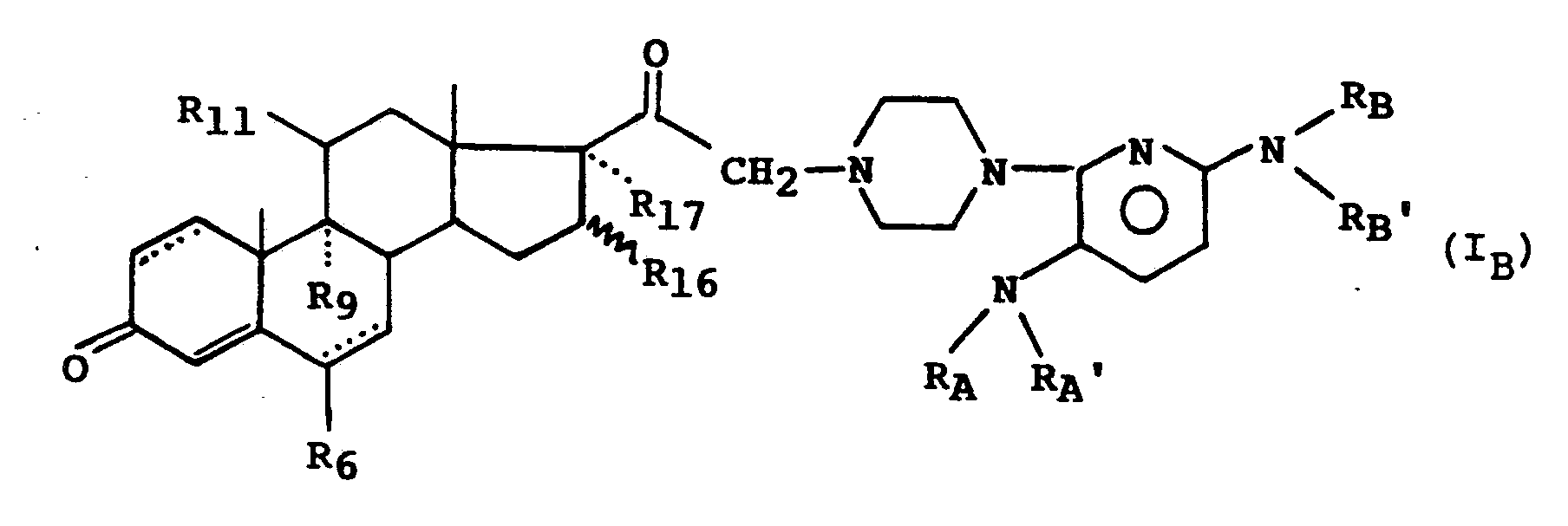
- the compounds of formula (I B ) are obtained by reacting a compound of formula (VIII), the halogenated substituent X of which may be a chlorine, bromine or iodine atom, in a neutral solvent such as, for example, dimethylformamide, tetrahydrofuran, methylene chloride, acetonitrile, ethyl ether or acetone, in the presence of a base such as for example a carbonate or a bicarbonate of alkali metal, preferably sodium or potassium, triethylamine or diisopropylethylamine with the N-substituted piperazine of formula (I A ).
- a neutral solvent such as, for example, dimethylformamide, tetrahydrofuran, methylene chloride, acetonitrile, ethyl ether or acetone
- a base such as for example a carbonate or a bicarbonate of alkali metal, preferably sodium or potassium, trieth
- the compound of formula (VIII) is 21-iodo 16alpha-methyl pregna-1,4,9 (11) -triene-3,20-dione described in the application WO 87/01706, the neutral solvent is acetone, the base is potassium carbonate.
- the compounds of formula (I) concerned by the invention can be obtained in the form of salts by known methods which consist in reacting the compound (I) with a mineral or organic acid chosen from the list of acids indicated above.
- the preferred acids according to the invention are methanesulfonic acid or fumaric acid.
- the compounds of formula (I) and their salts have interesting pharmacological properties, in particular, antioxidant activity by inhibiting tissue lipid peroxidation, for example in the kidney, the heart, more particularly in the brain and spinal cord.
- the compounds of formula (I) as well as their salts also exhibit a detoxifying activity in acute intoxications associated with the peroxidation of lipids of brain tissues such as the brain or the spinal cord.
- the compounds of formula (I) and their salts also exhibit an interesting anti-inflammatory activity, for example in the phenomena of acute inflammation mediated by derivatives of arachidonic acid.
- a subject of the invention is therefore the compounds of formula (I) as well as their salts with pharmaceutically acceptable acids, as medicaments.
- the compounds of the examples namely: N, N, N ′, N′-tetraethyl 6- (1-piperazinyl) 2,5-pyridine diamine, and the formula 21- [4- [3,6-bis (diethylamino) 2-pyridyl] 1-piperazinyl] 16alpha-methyl pregna-1,4,9 (11) -triene-3,20-dione and their salts with acids pharmaceutically acceptable.
- the medicaments according to the invention can be used in the treatment of biological disorders consecutive to trauma.
- trauma tissue damage in which the generation of lipid peroxides occurs and which can be caused by various agents, for example physical agents such as bruises, in particular cerebral bruises associated or not with local haemorrhages, or chemical agents such as those used in anti-tumor chemotherapy such as adriamycin or such as those used in cancer immunotherapy such as IL2 or TNF.
- They can also be used in the treatment of inflammatory reactions; they are useful for the treatment of local inflammatory reactions, such as, for example, edemas, dermatoses, pruritus, various forms of eczema and erythema, or for the treatment of acute inflammatory diseases or chronic inflammatory diseases, for example rheumatoid arthritis, psoriasis or multiple sclerosis.
- local inflammatory reactions such as, for example, edemas, dermatoses, pruritus, various forms of eczema and erythema
- acute inflammatory diseases or chronic inflammatory diseases for example rheumatoid arthritis, psoriasis or multiple sclerosis.
- the medicaments of the invention can be administered orally, parenterally, such as by intramuscular, intra-articular, intrathecal injection and preferably by intravenous bolus injection or continuous infusion or by local route in topical application. on the skin or mucous membranes.
- the invention extends to pharmaceutical compositions containing as active ingredient at least one medicament as defined above.
- the pharmaceutical compositions are prepared according to the usual methods.
- the active principle can be incorporated into excipients usually used in these pharmaceutical compositions, such as talc, starch, aqueous or non-aqueous vehicles, fatty substances of animal or vegetable origin, paraffinic derivatives, glycols, various wetting agents, dispersants or emulsifiers and preservatives.
- the pharmaceutically acceptable salts of the products of formula (I), which are more soluble in water, are preferably used for aqueous formulations intended for intravenous injection.
- the useful dosage, the frequency and the duration of the treatment which depend on the compound and the chosen route of administration vary, in particular according to the subject and the severity of the affection to be treated.
- the dose can be between 0.02 and 100 mg / kg / day, preferably between 0.01 and 1 mg / kg / day, intravenously or intramuscularly and possibly repeated several times a day.
- the compounds of formula (VIII) used in the process of the invention are 21-halo steroids which can be prepared, in general, from corresponding 21-hydroxylated steroids according to methods known to a person skilled in the art or for example according to the process described in the application for WO 87/1706.
- the 21-hydroxylated steroids having a hydrogen atom or a hydroxyl radical at 17alpha are known steroids or whose preparation is known to those skilled in the art. They can, for example, be prepared from the corresponding 17-keto steroids using the methods described in patent applications FR 2 462 445 and FR 2 498 607.
- the 17-keto steroids are themselves known products described by example in USP patents 2,775,602, 2,793,218, 4,189,431, 3,505,365 or 2,656,370.
- Steroids having an acyloxy radical at 17 are prepared by acylation of the corresponding 17alpha-hydroxylated steroids.
- the steroids having a double bond at 9 (11) are products known or prepared according to methods known to those skilled in the art, for example by dehydration of a corresponding 11-hydroxylated steroid by a mixture of methanesulfonyl chloride and chloride of thionyl.
- the steroids having a double bond in 1 (2) or in 6 (7) are obtained from a corresponding delta-4 derivative, according to the methods known to those skilled in the art, for example by action of a derivative of p. benzoquinone such as chloranil or 2,3-dichloro 5,6-dicyanobenzoquinone (DDQ).
- DDQ 2,3-dichloro 5,6-dicyanobenzoquinone
- the derivatives having a double bond in 1 (2) can also be obtained biochemically using microorganisms such as Arthrobacter Simplex.
- the steroids having a C6 methyl radical are prepared according to methods known to those skilled in the art, for example by the action of a methylmagnesium halide on a 5 (6) - corresponding steroid epoxy having a ketone in position 3 blocked for example by a ketal group.
- Steroids having a C en fluorine atom are prepared according to known methods, for example by adding the hydrofluoric acid-dimethylformamide complex to a 5 (6) - corresponding steroid epoxy having a ketone in position 3 blocked for example by a ketal group.
- the steroids having a C6 chlorine atom are prepared according to known methods, for example by adding the hydrochloric acid-dimethylformamide complex to a corresponding 5 (6) - steroid epoxy having a ketone in position 3 blocked for example by a ketal group.
- the steroids having a C16 alpha methyl radical are prepared according to known methods, for example by adding a methylmagnesium halide in the presence of a copper salt on a corresponding delta-16 20-keto steroid, itself obtained by dehydration of the corresponding 17-hydroxylated steroid.
- the steroids having a C16 beta methyl radical are prepared according to known methods, for example from a corresponding delta-16 20-keto steroid which is treated with diazomethane, heated then subjected to a hydrogenation reaction.
- the compounds of formula (VII), (VII ′), (VII ⁇ ) and (VII ′′′) are new products and the invention therefore also relates to the compounds of formula (VII), (VII ′), (VII ⁇ ) and (VII ′′′) as new industrial products.
- Example 1 N, N, N ′, N′-tetraethyl 6- (1-piperazinyl) 2,5-pyridine diamine.
- Stage B N, N, N ′, N′-tetraethyl 6- (1-piperazinyl) 2,5-pyridine-diamine.
- Example 2 21- [4- [3,6-bis (diethylamino) 2-pyridyl] 1-piperazinyl] 16alpha-methyl pregna-1,4,9 (11) -triene-3,20-dione.
- 0.25 ml of incubated mixture is taken and 1.5 ml of 1% phosphoric acid, 0.25 ml of 200 micromole solution of deferoxamine (Desferal R Ciba Geigy) in water, 10 microliters of tert-butylhydroxytoluene are added.
- BHT deferoxamine
- TSA thiobarbituric acid
- MDA The formation of MDA is measured on hepatic microsomes of SD rat (200 g) prepared from the sedimented fraction at 100,000 g of a liver homogenate in a sucrose buffer of which the fraction remaining insoluble at 100,000 g is used in a 100 mM sodium pyrophosphate buffer pH 7.4 and which is homogenized in a 100 mM sodium phosphate buffer pH 7.4 at 20% glycerol, then stored at -80 ° C.
- microsomes are incubated for 15 min at 37 ° C. in 1 ml containing 35 mM Tris-HCl buffer, 0.1 M KCl pH 7.4, 1 mg of microsomal protein, 5 microliters of ethanol containing or not the product to be tested, 250 microliters of ascorbate solution in the Tris buffer (0.5 mM final), after the addition of 250 microliters of ferrous sulphate prepared extemporaneously in the Tris buffer (6 micromoles final). The reaction is stopped by adding 2 ml of a solution of 1 M trichloroacetic acid in 0.25 M hydrochloric acid containing 0.4% thiobarbituric acid. The mixture is heated to 85 ° C.
- the anti-inflammatory activity is evaluated in vivo by measuring the anti-edematous activity using the test of plantar edema caused by arachidonic acid described by M.J. Di Martino et al. (Agents and Actions 1987 21 3/4 303).
- the experimental animals are male EOPS rats of Sprague Dawley strain weighing 150-170 g (Iffa Credo).
- This test is performed on groups of 8 male rats weighing 130 to 150 g on an empty stomach for 16 hours.
- Arachidonic acid is injected under the plantar fascia of a hind leg at a dose of 0.2 mg in a volume of 0.1 ml.
- the volume of the paw is measured using a water plethysmometer, before and 1 hour after the injection of arachidonic acid. The difference between these two volumes represents the degree of inflammation.
- the animals are treated with the test products or the vehicle alone at the same time as the injection of arachidonic acid.
- test products were administered orally in a volume of 4 ml / kg after being suspended in 0.5% methylcellulose. All the experiments were carried out with dexamethasone as a reference product at a dose of 0.5 mg / kg orally.
- the results are expressed in variation in volume of the leg 1 hour after the injection of arachidonic acid (AA), in the absence or in the presence of the product to be tested administered at different doses.
- AA arachidonic acid
- the products studied have anti-inflammatory activity at a low dose, in particular the product of Example 2 which exhibits strong activity from the dose of 0.5 mg / kg.
- dexamethasone induces an inhibition of edema of 30 to 40% at a dose of 0.5 mg / kg.
Landscapes
- Health & Medical Sciences (AREA)
- Organic Chemistry (AREA)
- Chemical & Material Sciences (AREA)
- Bioinformatics & Cheminformatics (AREA)
- Engineering & Computer Science (AREA)
- General Health & Medical Sciences (AREA)
- Veterinary Medicine (AREA)
- Nuclear Medicine, Radiotherapy & Molecular Imaging (AREA)
- Medicinal Chemistry (AREA)
- Pharmacology & Pharmacy (AREA)
- Life Sciences & Earth Sciences (AREA)
- Animal Behavior & Ethology (AREA)
- General Chemical & Material Sciences (AREA)
- Public Health (AREA)
- Chemical Kinetics & Catalysis (AREA)
- Neurosurgery (AREA)
- Biomedical Technology (AREA)
- Neurology (AREA)
- Urology & Nephrology (AREA)
- Heart & Thoracic Surgery (AREA)
- Hospice & Palliative Care (AREA)
- Cardiology (AREA)
- Vascular Medicine (AREA)
- Psychiatry (AREA)
- Pain & Pain Management (AREA)
- Rheumatology (AREA)
- Pharmaceuticals Containing Other Organic And Inorganic Compounds (AREA)
- Steroid Compounds (AREA)
- Pyridine Compounds (AREA)
Abstract
Description
La présente invention concerne de nouveaux dérivés de la 6-(1-pipérazinyl) 2,5-pyridine diamine N,N,N′,N′-substituée, leur procédé de préparation et les intermédiaires de ce procédé, leur application comme médicaments et les compositions pharmaceutiques les contenant.The present invention relates to new derivatives of 6- (1-piperazinyl) 2,5-pyridine diamine N, N, N ′, N′-substituted, their preparation process and the intermediates of this process, their application as medicaments and pharmaceutical compositions containing them.
L'invention a pour objet, les composés de formule (I) :

- RA et RA′, RB et RB′, identiques ou différents, représentent un atome d'hydrogène ou un radical alkyle ayant de 1 à 4 atomes de carbone, ou forment avec l'atome d'azote auquel ils sont liés un hétérocycle à 5 ou 6 chaînons, éventuellement substitué par un radical alkyle ayant de 1 à 3 atomes de carbone,
et dans laquelle Y représente un atome d'hydrogène ou le radical

- R₆ représente un atome d'hydrogène, un radical méthyle, un atome de fluor ou un atome de chlore,
- R₉ et R₁₁ forment ensemble une seconde liaison entre les carbones C₉ et C₁₁ ou R₉ est un atome d'hydrogène ou un atome de fluor et R₁₁ est un atome d'hydrogène, un radical hydroxyle ou un radical oxo,
- R₁₆ représente un atome d'hydrogène ou un radical méthyle,
- R₁₇ représente un atome d'hydrogène, un radical hydroxyle ou un radical acyloxy,
- les traits pointillés, dans les cycles A et B, indiquent la présence éventuelle d'une seconde liaison en position 1(2) et 6(7),
- le trait ondulé en position 16 indique que le substituant R₁₆ peut se trouver en position alpha ou béta, et les sels de ces composés.The subject of the invention is the compounds of formula (I):
- R A and R A ′, R B and R B ′, identical or different, represent a hydrogen atom or an alkyl radical having from 1 to 4 carbon atoms, or form with the nitrogen atom to which they are linked a 5 or 6-membered heterocycle, optionally substituted by an alkyl radical having from 1 to 3 carbon atoms,
and in which Y represents a hydrogen atom or the radical
- R₆ represents a hydrogen atom, a methyl radical, a fluorine atom or a chlorine atom,
- R₉ and R₁₁ together form a second bond between the carbons C₉ and C₁₁ or R₉ is a hydrogen atom or a fluorine atom and R₁₁ is a hydrogen atom, a hydroxyl radical or an oxo radical,
- R₁₆ represents a hydrogen atom or a methyl radical,
- R₁₇ represents a hydrogen atom, a hydroxyl radical or an acyloxy radical,
- the dotted lines in cycles A and B indicate the possible presence of a second link in position 1 (2) and 6 (7),
- the wavy line in position 16 indicates that the substituent R₁₆ can be in the alpha or beta position, and the salts of these compounds.
Lorsque R₁₇ représente un radical acyloxy, il peut s'agir du radical acétyloxy, propionyloxy ou benzoyloxy.
Lorsque RA, RA′, RB ou RB′ représentent un radical alkyle, il peut s'agir des radicaux méthyle, éthyle, n-propyle, isopropyle, n-butyle, isobutyle, sec-butyle, tert-butyle ; il s'agit toutefois de préférence du radical méthyle ou éthyle.When R₁₇ represents an acyloxy radical, it may be the acetyloxy, propionyloxy or benzoyloxy radical.
When R A , R A ′, R B or R B ′ represent an alkyl radical, they may be methyl, ethyl, n-propyl, isopropyl, n-butyl, isobutyl, sec-butyl, tert-butyl radicals; however, it is preferably the methyl or ethyl radical.
Lorsque RA et RA′ et/ou RB et RB′ forment avec l'atome d'azote auquel ils sont liés un hétérocycle, il s'agit d'un hétérocycle saturé, de préférence une pyrrolidine ou une pipéridine, éventuellement substitué par un radical alkyle tel qu'un radical méthyle, éthyle, propyle ou isopropyle, de préférence méthyle ou éthyle, ou d'un hétérocycle insaturé, de préférence un pyrrole, éventuellement substitué par un radical alkyle tel qu'un radical méthyle.When R A and R A ′ and / or R B and R B ′ form with the nitrogen atom to which they are linked a heterocycle, it is a saturated heterocycle, preferably a pyrrolidine or a piperidine, optionally substituted by an alkyl radical such as a methyl, ethyl, propyl or isopropyl radical, preferably methyl or ethyl, or of an unsaturated heterocycle, preferably a pyrrole, optionally substituted by an alkyl radical such as a methyl radical.
L'invention s'étend naturellement aux sels des composés de formule (I), comme par exemple les sels formés avec les acides chlorhydrique, bromhydrique, nitrique, sulfurique, phosphorique, acétique, formique, propionique, maléique, fumarique, succinique, tartrique, citrique, oxalique, glyoxylique, aspartique, alcanesulfoniques tels que les acides méthane ou éthanesulfoniques, arènesulfoniques, tels que les acides benzène ou paratoluène sulfoniques et arylcarboxyliques, tels que l'acide benzoïque.The invention naturally extends to the salts of the compounds of formula (I), such as for example the salts formed with hydrochloric, hydrobromic, nitric, sulfuric, phosphoric, acetic, formic, propionic, maleic, fumaric, succinic, tartaric acids, citric, oxalic, glyoxylic, aspartic, alkanesulfonic such as methane or ethanesulfonic acids, arenesulfonic, such as benzene or paratoluene sulfonic and arylcarboxylic acids, such as benzoic acid.
Parmi les composés de l'invention, on peut citer en particulier les composés de formule (I) répondant à la formule (IA) :

Parmi les composés de l'invention, on peut citer également en particulier les composés de formule (I) répondant à la formule (IB) :

Parmi les composés de l'invention, on peut citer notamment les composés de formule (IB) pour lesquels R₆ est un atome d'hydrogène.Among the compounds of the invention, mention may in particular be made of the compounds of formula (I B ) for which R₆ is a hydrogen atom.
Parmi les composés de l'invention, on peut citer particulièrement les composés de formule (IB) pour lesquels R₉ et R₁₁ forment ensemble une seconde liaison entre les carbones qui les portent et ceux pour lesquels R₁₆ est un radical méthyle en position alpha.Among the compounds of the invention, mention may be made in particular of the compounds of formula (I B ) for which R₉ and R₁₁ together form a second bond between the carbons which carry them and those for which R₁₆ is a methyl radical in the alpha position.
L'invention a plus particulièrement pour objet les composés de formule (IB) pour lesquels R₁₇ est un atome d'hydrogène ainsi que ceux pour lesquels le trait pointillé en position 1(2) indique la présence d'une seconde liaison.A more particular subject of the invention is the compounds of formula (I B ) for which R₁₇ is a hydrogen atom as well as those for which the dotted line in position 1 (2) indicates the presence of a second bond.
L'invention a tout particulièrement pour objet les composés dont la préparation est donnée plus loin dans la partie expérimentale à savoir la N,N,N′,N′-tétraéthyl 6-(1-pipérazinyl) 2,5-pyridine diamine et la 21-[4-[3,6-bis (diéthylamino) 2-pyridyl] 1-pipérazinyl] 16alpha-méthyl pregna-1,4,9(11)-triène-3,20-dione et leurs sels.The invention particularly relates to compounds whose preparation is given later in the experimental part, namely N, N, N ′, N′-tetraethyl 6- (1-piperazinyl) 2,5-pyridine diamine and 21- [4- [3,6 -bis (diethylamino) 2-pyridyl] 1-piperazinyl] 16alpha-methyl pregna-1,4,9 (11) -triene-3,20-dione and their salts.
L'invention a également pour objet un procédé de préparation des composés de formule (I) caractérisé en ce que l'on fait agir un produit de formule (II) :


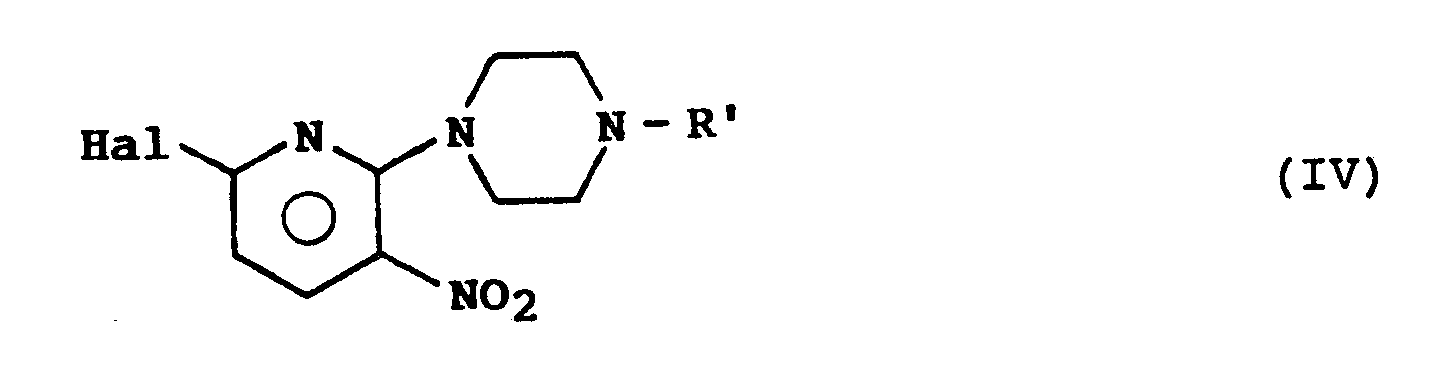


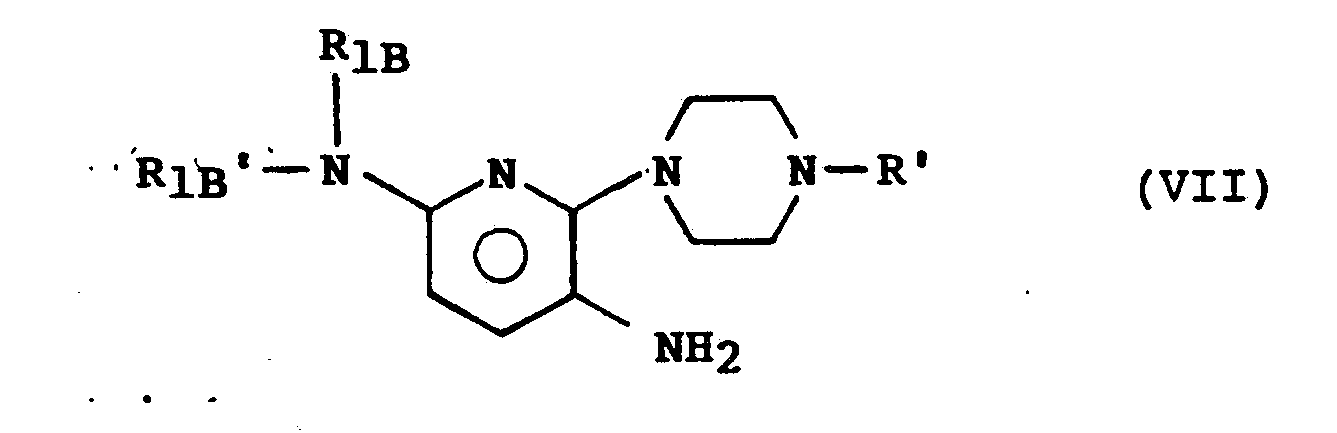
soit a) l'on soumet à l'action d'un ou deux équivalents d'un dérivé monohalogéné de RA ou de RA′ pour obtenir un produit de formule (VII′) :

soit b) l'on soumet à l'action d'un dérivé monohalogéné de RA ou de RA′, puis à l'action d'un dérivé monohalogéné de RA′ ou de RA pour obtenir un produit de formule (VII˝) :

soit c) l'on soumet à l'action d'un dérivé dihalogéné du butane ou du pentane, éventuellement substitué par un radical alkyle ayant de 1 à 3 atomes de carbone pour obtenir un produit de formule (VII‴) :

produits de formule (VII), (VII′), (VII˝) et (VII‴) que l'on soumet à une réaction de déblocage du groupement R′ et si désiré des groupements R1B et/ou R1B′ pour obtenir un composé de formule (IA) :


either a) subjecting to the action of one or two equivalents of a monohalogenated derivative of R A or of R A ′ to obtain a product of formula (VII ′):
or b) subjecting to the action of a monohalogenated derivative of R A or R A ′, then to the action of a monohalogenated derivative of R A ′ or of R A to obtain a product of formula ( VII˝):
or c) subjecting to the action of a dihalogenated derivative of butane or pentane, optionally substituted by an alkyl radical having from 1 to 3 carbon atoms to obtain a product of formula (VII ‴):
products of formula (VII), (VII ′), (VII˝) and (VII ‴) which are subjected to a reaction for unblocking the group R ′ and if desired groups R 1B and / or R 1B ′ to obtain a compound of formula (I A ):
Dans un mode de réalisation préféré du procédé de l'invention, les composés de formule (IA) sont obtenus en faisant réagir un produit de formule (II) dont le groupement protecteur de la fonction amino est par exemple un radical acétyle sur un produit de formule (III) dont le substituant Hal représente par exemple un atome de chlore ; dans le produit de formule (V), le groupement protecteur monovalent de la fonction amino que peut représenter R1B ou R1B′ est par exemple un groupement benzyle ou trityle : lorsque R1B et R1B′ représentent ensemble un groupement divalent, ils peuvent par exemple former ensemble avec l'atome d'azote auquel ils sont liés un 2,5-diméthylpyrrole.In a preferred embodiment of the process of the invention, the compounds of formula (I A ) are obtained by reacting a product of formula (II) whose protective group of the amino function is for example an acetyl radical on a product of formula (III) whose substituent Hal represents for example a chlorine atom; in the product of formula (V), the monovalent protective group of the amino function which R 1B or R 1B ′ can represent is for example a benzyl or trityl group: when R 1B and R 1B ′ together represent a divalent group, they can for example, forming together with the nitrogen atom to which they are linked a 2,5-dimethylpyrrole.
Les composés de formule (IB) sont obtenus en faisant réagir un composé de formule (VIII) dont le substituant halogéné X peut être un atome de chlore, de brome ou d'iode, dans un solvant neutre tel que par exemple le diméthylformamide, le tétrahydrofuranne, le chlorure de méthylène, l'acétonitrile, l'éther éthylique ou l'acétone, en présence d'une base telle que par exemple un carbonate ou un bicarbonate de métal alcalin, de préférence de sodium ou de potassium, la triéthylamine ou la diisopropyléthylamine avec la pipérazine N-substituée de formule (IA).The compounds of formula (I B ) are obtained by reacting a compound of formula (VIII), the halogenated substituent X of which may be a chlorine, bromine or iodine atom, in a neutral solvent such as, for example, dimethylformamide, tetrahydrofuran, methylene chloride, acetonitrile, ethyl ether or acetone, in the presence of a base such as for example a carbonate or a bicarbonate of alkali metal, preferably sodium or potassium, triethylamine or diisopropylethylamine with the N-substituted piperazine of formula (I A ).
Dans un mode de réalisation préféré du procédé de l'invention, le composé de formule (VIII) est le 21-iodo 16alpha-méthyl pregna-1,4,9(11)-triène-3,20-dione décrit dans la demande de brevet WO 87/01706, le solvant neutre est l'acétone, la base est le carbonate de potassium.In a preferred embodiment of the process of the invention, the compound of formula (VIII) is 21-iodo 16alpha-methyl pregna-1,4,9 (11) -triene-3,20-dione described in the application WO 87/01706, the neutral solvent is acetone, the base is potassium carbonate.
Les composés de formule (I) concernés par l'invention peuvent être obtenus à l'état de sels par des méthodes connues qui consistent à faire réagir le composé (I) avec un acide minéral ou organique choisi dans la liste des acides indiquée précédemment.The compounds of formula (I) concerned by the invention can be obtained in the form of salts by known methods which consist in reacting the compound (I) with a mineral or organic acid chosen from the list of acids indicated above.
Les acides préférés, selon l'invention, sont l'acide méthane-sulfonique ou l'acide fumarique.The preferred acids according to the invention are methanesulfonic acid or fumaric acid.
Les composés de formule (I) ainsi que leurs sels présentent d'intéressantes propriétés pharmacologiques, notamment, une activité antioxydante par inhibition de la péroxydation lipidique tissulaire, par exemple au niveau du rein, du coeur, plus particulièrement au niveau du cerveau et de la moelle épinière. Les composés de formule (I) ainsi que leurs sels présentent aussi une activité détoxifiante dans les intoxications aigues associées à la péroxydation des lipides des tissus cérébraux tels que le cerveau ou la moelle épinière.The compounds of formula (I) and their salts have interesting pharmacological properties, in particular, antioxidant activity by inhibiting tissue lipid peroxidation, for example in the kidney, the heart, more particularly in the brain and spinal cord. The compounds of formula (I) as well as their salts also exhibit a detoxifying activity in acute intoxications associated with the peroxidation of lipids of brain tissues such as the brain or the spinal cord.
Les composés de formule (I) ainsi que leurs sels présentent en outre une activité anti-inflammatoire intéressante, par exemple dans les phénomènes de l'inflammation aigüe médiée par les dérivés de l'acide arachidonique.The compounds of formula (I) and their salts also exhibit an interesting anti-inflammatory activity, for example in the phenomena of acute inflammation mediated by derivatives of arachidonic acid.
Ces propriétés justifient leur application en thérapeutique.These properties justify their application in therapy.
L'invention a donc pour objet les composés de formule (I) ainsi que leurs sels avec les acides pharmaceutiquement acceptables, à titre de médicaments.A subject of the invention is therefore the compounds of formula (I) as well as their salts with pharmaceutically acceptable acids, as medicaments.
Parmi les médicaments de l'invention, on peut citer tout particulièrement les composés des exemples, à savoir : la N,N,N′,N′-tétraéthyl 6-(1-pipérazinyl) 2,5-pyridine diamine, et la formule 21-[4-[3,6-bis(diéthylamino) 2-pyridyl] 1-pipérazinyl] 16alpha-méthyl pregna-1,4,9(11)-triène-3,20-dione et leurs sels avec les acides pharmaceutiquement acceptables.Among the medicaments of the invention, there may be mentioned very particularly the compounds of the examples, namely: N, N, N ′, N′-tetraethyl 6- (1-piperazinyl) 2,5-pyridine diamine, and the formula 21- [4- [3,6-bis (diethylamino) 2-pyridyl] 1-piperazinyl] 16alpha-methyl pregna-1,4,9 (11) -triene-3,20-dione and their salts with acids pharmaceutically acceptable.
Les médicaments selon l'invention peuvent être utilisés dans le traitement de désordres biologiques consécutifs à des traumatismes. On entend, par traumatismes, des dommages tissulaires dans lesquels interviennent la génération de péroxydes lipidiques et qui peuvent être provoqués par des agents variés, par exemple des agents physiques tels que des contusions, en particulier des contusions cérébrales associées ou non à des hémorragies locales, ou des agents chimiques tels que ceux utilisés en chimiothérapie antitumorale comme l'adriamycine ou tels que ceux utilisés en immunothérapie cancéreuse comme l'IL2 ou le TNF.The medicaments according to the invention can be used in the treatment of biological disorders consecutive to trauma. By trauma is meant tissue damage in which the generation of lipid peroxides occurs and which can be caused by various agents, for example physical agents such as bruises, in particular cerebral bruises associated or not with local haemorrhages, or chemical agents such as those used in anti-tumor chemotherapy such as adriamycin or such as those used in cancer immunotherapy such as IL2 or TNF.
Ils sont surtout intéressants dans le traitement de l'ischémie cérébrale, en particulier dans le traitement de l'infarctus cérébral et dans la prévention de sa récidive, ou dans le traitement d'intoxications médicamenteuses provoquées par une chimiothérapie ou une immunothérapie ou l'association des deux.They are especially useful in the treatment of cerebral ischemia, in particular in the treatment of cerebral infarction and in the prevention of its recurrence, or in the treatment of drug intoxications caused by chemotherapy or immunotherapy or a combination of the two.
Ils peuvent en outre être utilisés dans le traitement des réactions inflammatoires ; ils sont intéressants pour le traitement des réactions inflammatoires locales, comme par exemple les oedèmes, les dermatoses, les prurits, les diverses formes d'eczéma et les érythèmes solaires ou pour le traitement de maladies inflammatoires aigues ou les maladies inflammatoires chroniques, par exemple la polyarthrite rhumatoïde, le psoriasis ou la sclérose en plaque.They can also be used in the treatment of inflammatory reactions; they are useful for the treatment of local inflammatory reactions, such as, for example, edemas, dermatoses, pruritus, various forms of eczema and erythema, or for the treatment of acute inflammatory diseases or chronic inflammatory diseases, for example rheumatoid arthritis, psoriasis or multiple sclerosis.
Les médicaments de l'invention peuvent être administrés par voie orale, par voie parentérale, telle qu'en injection intra-musculaire, intra-articulaire, intrathécale et de préférence en injection intraveineuse en bolus ou en perfusion continue ou par voie locale en application topique sur la peau ou les muqueuses.The medicaments of the invention can be administered orally, parenterally, such as by intramuscular, intra-articular, intrathecal injection and preferably by intravenous bolus injection or continuous infusion or by local route in topical application. on the skin or mucous membranes.
L'invention s'étend aux compositions pharmaceutiques renfermant comme principe actif au moins un médicament tel que défini ci-dessus.The invention extends to pharmaceutical compositions containing as active ingredient at least one medicament as defined above.
Les compositions pharmaceutiques sont préparées selon les méthodes usuelles. Le principe actif peut être incorporé à des excipients habituellement employés dans ces compositions pharmaceutiques, tels que le talc, l'amidon, les véhicules aqueux ou non, les corps gras d'origine animale ou végétale, les dérivés paraffiniques, les glycols, les divers agents mouillants, dispersants ou émulsifiants et les conservateurs.The pharmaceutical compositions are prepared according to the usual methods. The active principle can be incorporated into excipients usually used in these pharmaceutical compositions, such as talc, starch, aqueous or non-aqueous vehicles, fatty substances of animal or vegetable origin, paraffinic derivatives, glycols, various wetting agents, dispersants or emulsifiers and preservatives.
Les sels pharmaceutiquement acceptables des produits de formule (I), plus solubles dans l'eau, sont utilisés de préférence pour les formulations aqueuses destinées à l'injection intraveineuse.The pharmaceutically acceptable salts of the products of formula (I), which are more soluble in water, are preferably used for aqueous formulations intended for intravenous injection.
La posologie utile, la fréquence et la durée du traitement qui dépendent du composé et de la voie d'administration choisis varient, notamment en fonction du sujet et de la sévérité de l'affection à traiter. La dose peut être comprise entre 0,02 et 100 mg/kg/j, de préférence entre 0,01 et 1 mg/kg/j par voie intraveineuse ou par voie intramusculaire et éventuellement répétée plusieurs fois par jour.The useful dosage, the frequency and the duration of the treatment which depend on the compound and the chosen route of administration vary, in particular according to the subject and the severity of the affection to be treated. The dose can be between 0.02 and 100 mg / kg / day, preferably between 0.01 and 1 mg / kg / day, intravenously or intramuscularly and possibly repeated several times a day.
Les composés de formule (VIII) utilisés dans le procédé de l'invention sont des 21-halo stéroïdes qui peuvent être préparés, d'une manière générale, à partir de stéroïdes correspondants 21-hydroxylés selon des méthodes connues de l'homme de métier ou par exemple selon le procédé décrit dans la demande de brevet WO 87/1706.The compounds of formula (VIII) used in the process of the invention are 21-halo steroids which can be prepared, in general, from corresponding 21-hydroxylated steroids according to methods known to a person skilled in the art or for example according to the process described in the application for WO 87/1706.
Les stéroïdes 21-hydroxylés ayant un atome d'hydrogène ou un radical hydroxyle en 17alpha sont des stéroïdes connus ou dont la préparation est connue de l'homme de métier. Ils peuvent, par exemple, être préparés à partir des stéroïdes 17-céto correspondants en utilisant les procédés décrits dans les demandes de brevets FR 2 462 445 et FR 2 498 607. Les stéroïdes 17-céto sont eux-mêmes des produits connus décrits par exemple dans les brevets USP 2.775.602, 2.793.218, 4.189.431, 3.505.365 ou 2.656.370.The 21-hydroxylated steroids having a hydrogen atom or a hydroxyl radical at 17alpha are known steroids or whose preparation is known to those skilled in the art. They can, for example, be prepared from the corresponding 17-keto steroids using the methods described in patent applications FR 2 462 445 and FR 2 498 607. The 17-keto steroids are themselves known products described by example in USP patents 2,775,602, 2,793,218, 4,189,431, 3,505,365 or 2,656,370.
Les stéroïdes ayant un radical acyloxy en 17 sont préparés par acylation des steroïdes 17alpha-hydroxylés correspondants.Steroids having an acyloxy radical at 17 are prepared by acylation of the corresponding 17alpha-hydroxylated steroids.
Les steroïdes ayant une double liaison en 9(11) sont des produits connus ou préparés selon les méthodes connues de l'homme de métier, par exemple par deshydratation d'un stéroïde 11-hydroxylé correspondant par un mélange de chlorure de méthanesulfonyle et de chlorure de thionyle.The steroids having a double bond at 9 (11) are products known or prepared according to methods known to those skilled in the art, for example by dehydration of a corresponding 11-hydroxylated steroid by a mixture of methanesulfonyl chloride and chloride of thionyl.
Les stéroïdes ayant une double liaison en 1(2) ou en 6(7) sont obtenus à partir d'un dérivé delta-4 correspondant, selon les méthodes connues de l'homme de métier, par exemple par action d'un dérivé de la p. benzoquinone tel que le chloranile ou la 2,3-dichloro 5,6-dicyanobenzoquinone (DDQ). Les dérivés ayant une double liaison en 1(2) peuvent être aussi obtenus par voie biochimique à l'aide de microorganismes tel que Arthrobacter Simplex.The steroids having a double bond in 1 (2) or in 6 (7) are obtained from a corresponding delta-4 derivative, according to the methods known to those skilled in the art, for example by action of a derivative of p. benzoquinone such as chloranil or 2,3-dichloro 5,6-dicyanobenzoquinone (DDQ). The derivatives having a double bond in 1 (2) can also be obtained biochemically using microorganisms such as Arthrobacter Simplex.
Les stéroïdes ayant un radical méthyle en C₆ sont préparés selon des méthodes connues de l'homme de métier, par exemple par action d'un halogénure de méthylmagnésium sur un 5(6)- époxy stéroïde correspondant ayant une cétone en position 3 bloquée par exemple par un groupement cétal.The steroids having a C₆ methyl radical are prepared according to methods known to those skilled in the art, for example by the action of a methylmagnesium halide on a 5 (6) - corresponding steroid epoxy having a ketone in position 3 blocked for example by a ketal group.
Les stéroïdes ayant un atome de fluor en C₆ sont préparés selon les méthodes connues, par exemple par addition du complexe acide fluorhydrique-diméthylformamide sur un 5(6)- époxy stéroïde correspondant ayant une cétone en position 3 bloquée par exemple par un groupement cétal.Steroids having a C en fluorine atom are prepared according to known methods, for example by adding the hydrofluoric acid-dimethylformamide complex to a 5 (6) - corresponding steroid epoxy having a ketone in position 3 blocked for example by a ketal group.
Les stéroïdes ayant un atome de chlore en C₆ sont préparés selon des méthodes connues, par exemple par addition du complexe acide chlorhydrique-diméthylformamide sur un 5(6)- époxy stéroïde correspondant ayant une cétone en position 3 bloquée par exemple par un groupement cétal.The steroids having a C₆ chlorine atom are prepared according to known methods, for example by adding the hydrochloric acid-dimethylformamide complex to a corresponding 5 (6) - steroid epoxy having a ketone in position 3 blocked for example by a ketal group.
Les stéroïdes ayant un radical méthyle en C₁₆ alpha sont préparés selon des méthodes connues, par exemple par addition d'un halogènure de méthylmagnésium en présence d'un sel de cuivre sur un delta-16 20-céto stéroïde correspondant, lui-même obtenu par déshydratation du stéroïde 17-hydroxylé correspondant.The steroids having a C₁₆ alpha methyl radical are prepared according to known methods, for example by adding a methylmagnesium halide in the presence of a copper salt on a corresponding delta-16 20-keto steroid, itself obtained by dehydration of the corresponding 17-hydroxylated steroid.
Les stéroïdes ayant un radical méthyle en C₁₆ béta sont préparés selon des méthodes connues, par exemple à partir d'un delta-16 20-céto stéroïde correspondant que l'on traite au diazométhane, chauffe puis soumet à une réaction d'hydrogénation.The steroids having a C₁₆ beta methyl radical are prepared according to known methods, for example from a corresponding delta-16 20-keto steroid which is treated with diazomethane, heated then subjected to a hydrogenation reaction.
Les composés de formule (VII), (VII′), (VII˝) et (VII‴) sont des produits nouveaux et l'invention a donc également pour objet les composés de formule (VII), (VII′), (VII˝) et (VII‴) à titre de produits industriels nouveaux.The compounds of formula (VII), (VII ′), (VII˝) and (VII ‴) are new products and the invention therefore also relates to the compounds of formula (VII), (VII ′), (VII ˝) and (VII ‴) as new industrial products.
Les produits (VII), (VII′), (VII˝) et (VII‴), ainsi que tous les produits de formule (IA) contrairement à ce qui est indiqué, ne peuvent pas être obtenus selon la préparation décrite dans la demande de brevet WO 87/01706.The products (VII), (VII ′), (VII˝) and (VII ‴), as well as all the products of formula (I A ) contrary to what is indicated, cannot be obtained according to the preparation described in the Patent application WO 87/01706.
Les exemples suivants illustrent l'invention sans toutefois la limiter.The following examples illustrate the invention without, however, limiting it.
A un mélange de 78 g de 2,6-dichloro 3-nitro pyridine, 600 cm³ d'acétonitrile et 66,3 g de carbonate de potassium, on ajoute en 50 minutes à 0°C, une solution de 51,22 g de N-acétyl pipérazine dans 200 cm³ d'acétonitrile. On laisse revenir à température ambiante et agite 1 heure 15. On filtre les sels minéraux, ajoute au filtrat, 180 cm³ de N-diéthyl amine et 76 g de carbonate de potassium et chauffe le mélange 1 heure 15 au reflux. Après refroidissement, on filtre les sels minéraux, et évapore à sec sous pression réduite, le résidu (166,9 g) est recristallisé dans 200 cm³ d'acétate d'éthyle, on obtient 87,4 g de produit attendu. F = 120°C.
On hydrogène sous une pression maximum de 1250 mbar à 25°C, un mélange de 70 g du produit obtenu au stade A, 1500 cm³ de méthanol, 61,5 cm³ d'acétaldéhyde et 10 g de charbon actif à 10% de palladium. On absorbe environ 20 litres d'hydrogène, on filtre le catalyseur et évapore le filtrat à sec sous pression réduite. On reprend le résidu (89,8 g) avec 500 cm³ de n-propanol et 91,3 g de potasse en pastilles, et chauffe 3 heures au reflux. On coule la solution refroidie dans 1 litre d'eau glacée et extrait avec du chlorure de méthylène, lave la solution organique avec une solution saturée de chlorure de sodium, sèche, filtre et concentre à sec, sous pression réduite. On chromatographie le résidu (58,9 g) sur silice (éluant : chlorure de méthylène-méthanol-ammoniaque (95-5-0,5)). On obtient 48,35 g de produit attendu.
On mélange à température ambiante 1,395 g de 21-iodo 16alpha-méthyl pregna-1,4,9(11)-triène-3,20-dione (préparé selon brevet WO 87/01706) 40 cm³ d'acétone, 1,88 g de produit obtenu à l'exemple 1 et 0,9 g de carbonate de potassium. On agite pendant 2 heures 30, filtre et amène le filtrat à sec sous pression réduite. On chromatographie le résidu (3,47 g) sur silice (éluant : cyclohexane-acétate d'éthyle (7-3)). On obtient 1,4 g de produit attendu.
[alpha]D = +41° ± 2°5 (c = 0,4 % éthanol).
[alpha] D = + 41 ° ± 2 ° 5 (c = 0.4% ethanol).
L'activité antioxydante est recherchée, in vitro, par le test de formation de la malonyldialdéhyde (MDA) qui mesure la péroxydation lipidique déclenchée :
soit a) de façon non enzymatique par le sulfate ferreux, dans
- 1) des homogénats de cerveau ou
- 2) des microsomes hépatiques de rat
either a) non-enzymatically with ferrous sulfate, in
- 1) brain homogenates or
- 2) rat liver microsomes
1.1 : La formation de MDA est mesurée sur des homogénats au 1/10e (V/V) de cerveaux de rat S.D (200 g) préparés dans un tampon de Krebs pH 7,4 selon les conditions décrites dans J. Biol. Chem. 262 (1987) 10438-10440. On incube 1 ml d'homogénat pendant 60 mn à 37°C en présence de 25 microlitres d'éthanol contenant ou non le produit à tester, après addition de 25 microlitres de solution de sulfate ferreux préparée extemporanément dans de l'eau dégazée à l'argon (200 micromoles final). On prélève 0,25 ml de mélange incubé et ajoute 1,5 ml d'acide phosphorique à 1 %, 0,25 ml de solution 200 micromoles de déféroxamine (DesféralR Ciba Geigy) dans l'eau, 10 microlitres de tert-butylhydroxytoluène (BHT) à 8,7 mg/ml dans l'éthanol et 0,5 ml d'acide thiobarbiturique (TBA) à 0,6 % dans l'eau. On chauffe le mélange à 100°C pendant 45 mn, refroidit, ajoute 4 ml de n-butanol, centrifuge pendant 15 mn à 4000 t/mn puis lit la DO à 535 nm de la fraction surnageante. On incube dans les mêmes conditions les blancs de réaction en absence de Fe++. On calcule le pourcentage d'inhibition :
1.2 : La formation de MDA est mesurée sur des microsomes hépatiques de rat S.D (200 g) préparés à partir de la fraction sédimentée à 100.000 g d'un homogénat de foie dans un tampon sucrose dont on utilise la fraction restant insoluble à 100.000 g dans un tampon de pyrophosphate de sodium 100 mM pH 7,4 et que l'on homogénéise dans un tampon phosphate de sodium 100 mM pH 7,4 à 20 % de glycérol, puis que l'on conserve à -80°C. 1.2: The formation of MDA is measured on hepatic microsomes of SD rat (200 g) prepared from the sedimented fraction at 100,000 g of a liver homogenate in a sucrose buffer of which the fraction remaining insoluble at 100,000 g is used in a 100 mM sodium pyrophosphate buffer pH 7.4 and which is homogenized in a 100 mM sodium phosphate buffer pH 7.4 at 20% glycerol, then stored at -80 ° C.
On incube les microsomes pendant 15 mn à 37°C dans 1 ml contenant du tampon Tris-HCl 35 mM, KCl 0,1 M pH 7,4, 1 mg de protéine microsomale, 5 microlitres d'éthanol renfermant ou non le produit à tester, 250 microlitres de solution d'ascorbate dans le tampon Tris (0,5 mM final), après l'addition de 250 microlitres de sulfate ferreux préparée extemporanément dans le tampon Tris (6 micromoles final). On arrête la réaction par addition de 2 ml d'une solution d'acide trichloracétique 1 M dans l'acide chlorhydrique 0,25 M contenant 0,4 % d'acide thiobarbiturique. On chauffe le mélange à 85°C pendant 25 mn, refroidit, centrifuge pendant 15 mn à 3500 t/mn puis lit la DO à 535 nm de la fraction surnageante. On effectue en même temps les blancs de réaction en absence de Fe++. On calcule le pourcentage d'inhibition comme précédemment.
2 : La formation de MDA est mesurée sur des microsomes hépatiques de rats prétraités au phénobarbital (80 mg/kg par 3 injections i.p), préparés comme décrit précédemment. On incube les microsomes pendant 15 mn à 37°C dans 1 ml contenant du tampon phosphate 0,1 M pH 7,4, 1 mg de protéine microsomale, 5 microlitres d'éthanol renfermant ou non le produit à tester, 5 microlitres de tétrachlorure de carbone (5,5 mM final) après l'addition de 50 microlitres de solution de NADPH dans le tampon phosphate (1 mM final). On arrête la réaction puis effectue le dosage selon les conditions décrites précédemment.
L'activité anti-inflammatoire est évaluée in vivo par mesure de l'activité anti-oedémateuse à l'aide du test de l'oedème plantaire provoqué par l'acide arachidonique décrit par M.J. Di Martino et al. (Agents and Actions 1987 21 3/4 303).The anti-inflammatory activity is evaluated in vivo by measuring the anti-edematous activity using the test of plantar edema caused by arachidonic acid described by M.J. Di Martino et al. (Agents and Actions 1987 21 3/4 303).
Les animaux d'expérimentation sont des rats mâles EOPS de souche Sprague Dawley pesant 150-170 g (Iffa Credo).The experimental animals are male EOPS rats of Sprague Dawley strain weighing 150-170 g (Iffa Credo).
Ce test est pratiqué sur des groupes de 8 rats mâles pesant 130 à 150 g à jeun depuis 16 heures. L'acide arachidonique est injecté sous l'aponévrose plantaire d'une patte postérieure à la dose de 0,2 mg sous un volume de 0,1 ml. Le volume de la patte est mesuré à l'aide d'un pléthysmomètre à eau, avant et 1 heure après l'injection de l'acide arachidonique. La différence entre ces deux volumes représente le degré d'inflammation. Les animaux sont traités par les produits à étudier ou le véhicule seul en même temps que l'injection de l'acide arachidonique.This test is performed on groups of 8 male rats weighing 130 to 150 g on an empty stomach for 16 hours. Arachidonic acid is injected under the plantar fascia of a hind leg at a dose of 0.2 mg in a volume of 0.1 ml. The volume of the paw is measured using a water plethysmometer, before and 1 hour after the injection of arachidonic acid. The difference between these two volumes represents the degree of inflammation. The animals are treated with the test products or the vehicle alone at the same time as the injection of arachidonic acid.
Les produits étudiés ont été administrés par voie orale sous un volume de 4 ml/kg après avoir été mis en suspension dans la méthylcellulose à 0,5%. Toutes les expériences ont été réalisées avec comme produit de référence la dexaméthasone à la dose de 0,5 mg/kg par voie orale.The test products were administered orally in a volume of 4 ml / kg after being suspended in 0.5% methylcellulose. All the experiments were carried out with dexamethasone as a reference product at a dose of 0.5 mg / kg orally.
Les résultats sont exprimés en variation de volume de la patte 1 heure après l'injection d'acide arachidonique (AA), en absence ou en présence du produit à tester administré à différentes doses.The results are expressed in variation in volume of the leg 1 hour after the injection of arachidonic acid (AA), in the absence or in the presence of the product to be tested administered at different doses.
L'interprétation statistique des résultats a été effectuée selon le test de Dunnett (* p < 0,05 - ** p < 0,01) ou selon le test de Mann Whitney (° p < 0,05 - °° p < 0,01).The statistical interpretation of the results was carried out according to the Dunnett test (* p <0.05 - ** p <0.01) or according to the Mann Whitney test (° p <0.05 - °° p <0.01).
Pour chaque dose administrée par voie orale, on calcule le pourcentage d'inhibition de l'oedème par le produit testé, par rapport au témoin.
Les produits étudiés ont une activité anti-inflammatoire a faible dose, en particulier le produit de l'exemple 2 qui présente une forte activité dès la dose de 0,5 mg/kg.The products studied have anti-inflammatory activity at a low dose, in particular the product of Example 2 which exhibits strong activity from the dose of 0.5 mg / kg.
Dans les mêmes conditions expérimentales, la dexaméthasone induit une inhibition de l'oedème de 30 à 40% à la dose de 0,5 mg/kg.Under the same experimental conditions, dexamethasone induces an inhibition of edema of 30 to 40% at a dose of 0.5 mg / kg.
Claims (17)
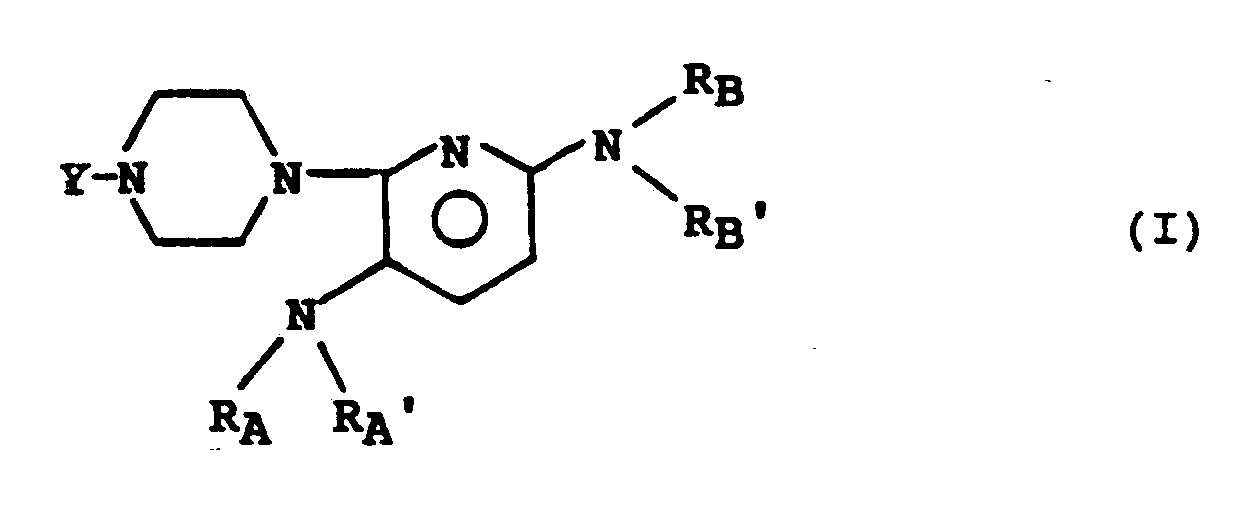
- RA et RA′, RB et RB′, identiques ou différents, représentent un atome d'hydrogène ou un radical alkyle ayant de 1 à 4 atomes de carbone, ou forment avec l'atome d'azote auquel ils sont liés un hétérocycle à 5 ou 6 chaînons, éventuellement substitué par un radical alkyle ayant de 1 à 3 atomes de carbone,
et dans laquelle Y représente un atome d'hydrogène ou le radical

- R₆ représente un atome d'hydrogène, un radical méthyle, un atome de fluor ou un atome de chlore,
- R₉ et R₁₁ forment ensemble une seconde liaison entre les carbones C₉ et C₁₁ ou R₉ est un atome d'hydrogène ou un atome de fluor et R₁₁ est un atome d'hydrogène, un radical hydroxyle ou un radical oxo,
- R₁₆ représente un atome d'hydrogène ou un radical méthyle,
- R₁₇ représente un atome d'hydrogène, un radical hydroxyle ou un radical acyloxy,
- les traits pointillés, dans les cycles A et B, indiquent la présence éventuelle d'une seconde liaison en position 1(2) et 6(7),
- le trait ondulé en position 16 indique que le substituant R₁₆ peut se trouver en position alpha ou béta, et les sels de ces composés.1.- The compounds of formula (I):
- R A and R A ′, R B and R B ′, identical or different, represent a hydrogen atom or an alkyl radical having from 1 to 4 carbon atoms, or form with the nitrogen atom to which they are linked a 5 or 6-membered heterocycle, optionally substituted by an alkyl radical having from 1 to 3 carbon atoms,
and in which Y represents a hydrogen atom or the radical
- R₆ represents a hydrogen atom, a methyl radical, a fluorine atom or a chlorine atom,
- R₉ and R₁₁ together form a second bond between the carbons C₉ and C₁₁ or R₉ is a hydrogen atom or a fluorine atom and R₁₁ is a hydrogen atom, a hydroxyl radical or an oxo radical,
- R₁₆ represents a hydrogen atom or a methyl radical,
- R₁₇ represents a hydrogen atom, a hydroxyl radical or an acyloxy radical,
- the dotted lines in cycles A and B indicate the possible presence of a second link in position 1 (2) and 6 (7),
- the wavy line in position 16 indicates that the substituent R₁₆ can be in alpha or beta position, and the salts of these compounds.

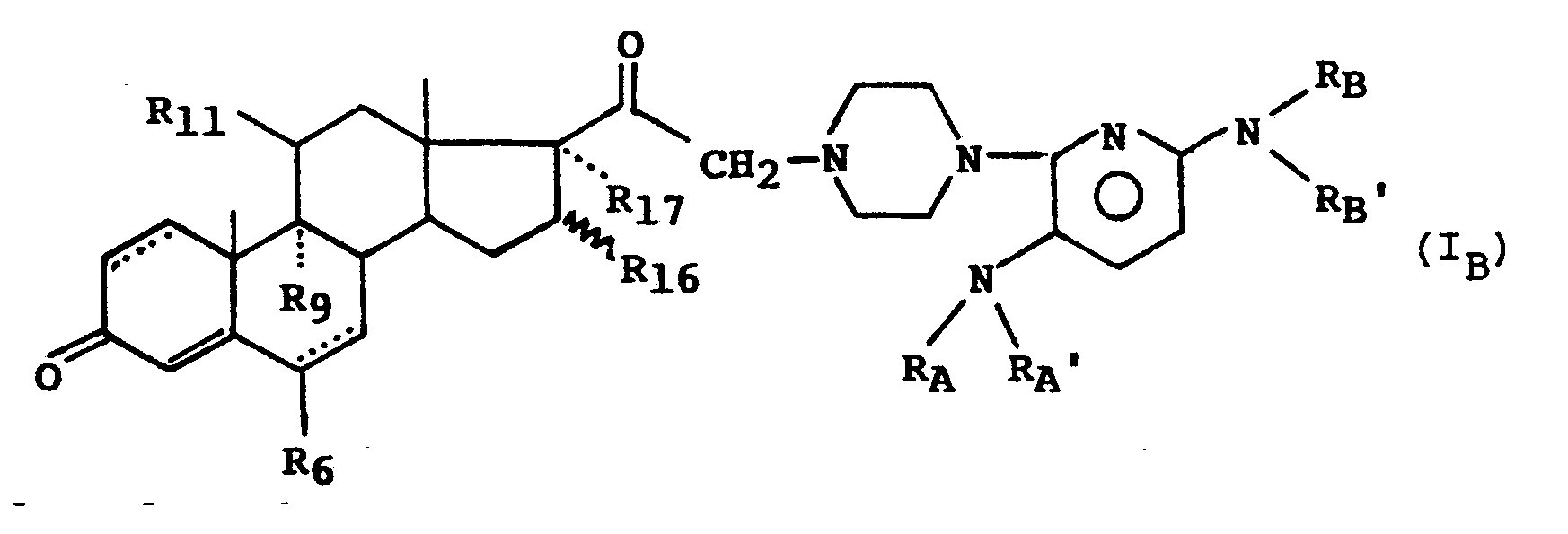
- la N,N,N′,N′-tétraéthyl 6-(1-pipérazinyl) 2,5-pyridine diamine et ses sels.9.- The compounds of formula (I A ) as defined in claim 2, corresponding to the following formula:
- N, N, N ′, N′-tetraethyl 6- (1-piperazinyl) 2,5-pyridine diamine and its salts.
- la 21-[4-[3,6-bis (diéthylamino) 2-pyridyl] 1-pipérazinyl] 16alpha-méthyl pregna-1,4,9(11)-triène-3,20-dione et ses sels.10.- The compounds of formula (I B ) as defined in any one of claims 3 to 8, corresponding to the following formula:
- 21- [4- [3,6-bis (diethylamino) 2-pyridyl] 1-piperazinyl] 16alpha-methyl pregna-1,4,9 (11) -triene-3,20-dione and its salts.
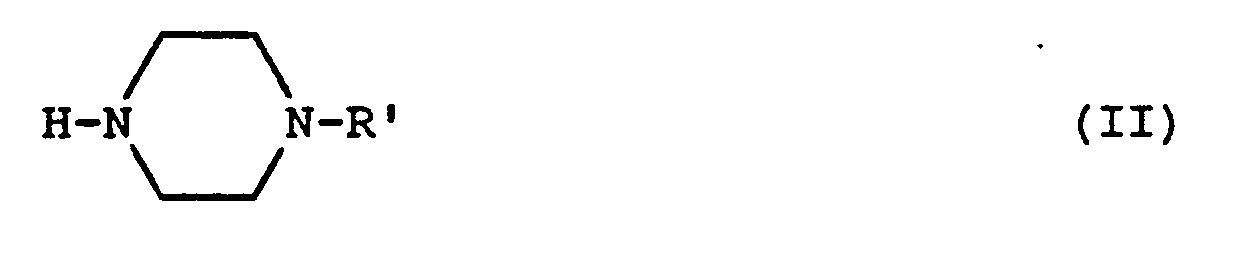


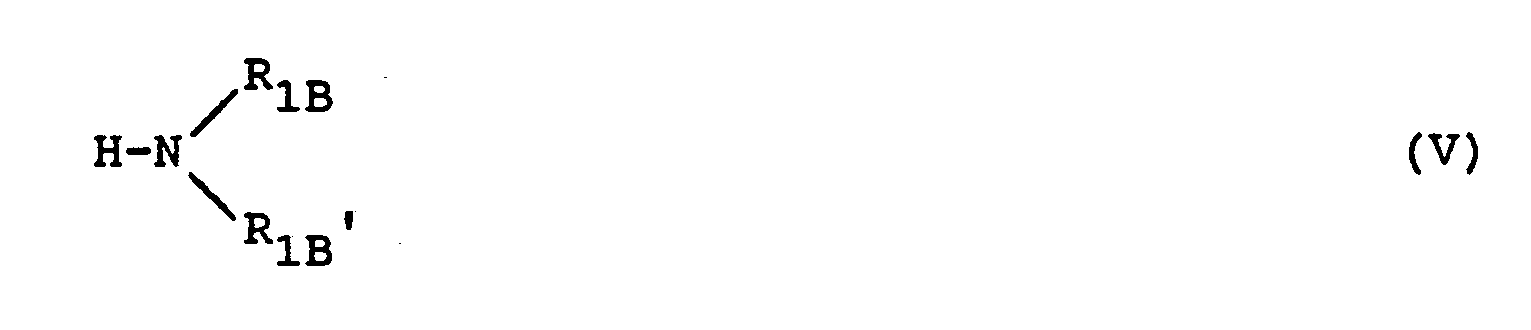


soit a) l'on soumet à l'action d'un ou deux équivalents d'un dérivé monohalogéné de RA ou de RA′ pour obtenir un produit de formule (VII′) :

soit b) l'on soumet à l'action d'un dérivé monohalogéné de RA ou de RA′, puis à l'action d'un dérivé monohalogéné de RA′ ou de RA pour obtenir un produit de formule (VI˝) :

soit c) l'on soumet à l'action d'un dérivé dihalogéné du butane ou du pentane, éventuellement substitué par un radical alkyle ayant de 1 à 3 atomes de carbone pour obtenir un produit de formule (VII‴) :

produits de formule (VII), (VII′), (VII˝) et (VII‴) que l'on soumet à une réaction de déblocage du groupement R′ et si désiré des groupements R1B et/ou R1B′ pour obtenir un composé de formule (IA) :


either a) subjecting to the action of one or two equivalents of a monohalogenated derivative of R A or of R A ′ to obtain a product of formula (VII ′):
or b) subjecting to the action of a monohalogenated derivative of R A or R A ′, then to the action of a monohalogenated derivative of R A ′ or of R A to obtain a product of formula ( VI˝):
or c) subjecting to the action of a dihalogenated derivative of butane or pentane, optionally substituted by an alkyl radical having from 1 to 3 carbon atoms to obtain a product of formula (VII ‴):
products of formula (VII), (VII ′), (VII˝) and (VII ‴) which are subjected to a reaction for unblocking the group R ′ and if desired groups R 1B and / or R 1B ′ to obtain a compound of formula (I A ):
Applications Claiming Priority (2)
| Application Number | Priority Date | Filing Date | Title |
|---|---|---|---|
| FR8903740 | 1989-03-22 | ||
| FR8903740A FR2644787B1 (en) | 1989-03-22 | 1989-03-22 | NOVEL AMINOSUBSTITUTED STEROIDS 21, THEIR PREPARATION PROCESS AND THE INTERMEDIATES THEREOF, THEIR APPLICATION AS MEDICAMENTS AND THE PHARMACEUTICAL COMPOSITIONS CONTAINING THEM |
Publications (2)
| Publication Number | Publication Date |
|---|---|
| EP0389368A1 true EP0389368A1 (en) | 1990-09-26 |
| EP0389368B1 EP0389368B1 (en) | 1997-01-29 |
Family
ID=9379938
Family Applications (1)
| Application Number | Title | Priority Date | Filing Date |
|---|---|---|---|
| EP90400782A Expired - Lifetime EP0389368B1 (en) | 1989-03-22 | 1990-03-22 | New derivatives of 6-(1-piperazinyl) 2,5-pyridine diamine N,N,N',N'-substituted, procedure for their production and intermediates, their use as medicines and pharmaceutical preparations containing them |
Country Status (4)
| Country | Link |
|---|---|
| EP (1) | EP0389368B1 (en) |
| JP (1) | JP2962484B2 (en) |
| DE (1) | DE69029819T2 (en) |
| FR (1) | FR2644787B1 (en) |
Cited By (10)
| Publication number | Priority date | Publication date | Assignee | Title |
|---|---|---|---|---|
| WO1991011453A3 (en) * | 1990-01-26 | 1991-11-14 | Upjohn Co | 5-oxygenated-2,4,6-triaminopyrimidines |
| WO1993025570A1 (en) * | 1992-06-09 | 1993-12-23 | Richter Gedeon Vegyészeti Gyár Rt. | Novel steroids with pregnane skeleton, pharmaceutical compositions containing them and process for preparing same |
| EP0574906A3 (en) * | 1992-06-17 | 1994-04-13 | Nisshin Flour Milling Co | |
| WO1994024146A1 (en) * | 1993-04-13 | 1994-10-27 | Jenapharm Gmbh | Novel androgens and anabolic agents |
| US5831104A (en) * | 1993-09-10 | 1998-11-03 | Jenapharm Gmbh | Steroid intermediate products and method of their production |
| US5914325A (en) * | 1993-11-10 | 1999-06-22 | Jenapharm Gmbh | Steroids with radical-attracting aromatic substituents, process for the production thereof and pharmaceutical compounds containing the said substances |
| US6172056B1 (en) | 1993-11-10 | 2001-01-09 | Jenapharm Gmbh & Co. Kg | Pharmaceutical compositions and method for prophylaxis and therapy of radical-mediated cell damage |
| US7101866B2 (en) | 2000-08-05 | 2006-09-05 | Glaxo Group Limited | Anti-inflammatory androstane derivative |
| US7144845B2 (en) | 2000-08-05 | 2006-12-05 | Glaxo Group Limited | Compounds useful in the manufacture of an anti-inflammatory androstane derivative |
| US7291608B2 (en) | 2001-04-30 | 2007-11-06 | Glaxo Group Limited | Anti-inflammatory 17.β.-carbothioate ester derivatives of androstane with a cyclic ester group in position 17.α |
Families Citing this family (2)
| Publication number | Priority date | Publication date | Assignee | Title |
|---|---|---|---|---|
| HU209678B (en) | 1992-06-09 | 1994-10-28 | Richter Gedeon Vegyeszet | Process for producing biologically active eburnamenin-14-carbonyl-amino derivatives and pharmaceutical compositions containing them |
| HU9201904D0 (en) | 1992-06-09 | 1992-09-28 | Innomedika Szoevetkezet | Laboratorial sem-automatic disclosing appartus operating with microwaves, equipped with teflone dividing and destructor holding devices, int two varieties one with controlled supercooling, another with energy dissipating unit |
Citations (4)
| Publication number | Priority date | Publication date | Assignee | Title |
|---|---|---|---|---|
| US4442103A (en) * | 1981-05-26 | 1984-04-10 | Merck & Co., Inc. | Treating sedation with 1-(3-substituted-2-pyridinyl) piperazines |
| WO1987001706A2 (en) * | 1985-09-12 | 1987-03-26 | The Upjohn Company | C20 through c26 amino steroids |
| EP0244115A2 (en) * | 1986-04-19 | 1987-11-04 | Pfizer Limited | Phenyl-piperazine anti-arrhythmia agents |
| WO1987007895A1 (en) * | 1986-06-23 | 1987-12-30 | The Upjohn Company | Androstane-type and cortical aminoesters |
-
1989
- 1989-03-22 FR FR8903740A patent/FR2644787B1/en not_active Expired - Fee Related
-
1990
- 1990-03-20 JP JP2068506A patent/JP2962484B2/en not_active Expired - Lifetime
- 1990-03-22 DE DE69029819T patent/DE69029819T2/en not_active Expired - Lifetime
- 1990-03-22 EP EP90400782A patent/EP0389368B1/en not_active Expired - Lifetime
Patent Citations (4)
| Publication number | Priority date | Publication date | Assignee | Title |
|---|---|---|---|---|
| US4442103A (en) * | 1981-05-26 | 1984-04-10 | Merck & Co., Inc. | Treating sedation with 1-(3-substituted-2-pyridinyl) piperazines |
| WO1987001706A2 (en) * | 1985-09-12 | 1987-03-26 | The Upjohn Company | C20 through c26 amino steroids |
| EP0244115A2 (en) * | 1986-04-19 | 1987-11-04 | Pfizer Limited | Phenyl-piperazine anti-arrhythmia agents |
| WO1987007895A1 (en) * | 1986-06-23 | 1987-12-30 | The Upjohn Company | Androstane-type and cortical aminoesters |
Cited By (14)
| Publication number | Priority date | Publication date | Assignee | Title |
|---|---|---|---|---|
| WO1991011453A3 (en) * | 1990-01-26 | 1991-11-14 | Upjohn Co | 5-oxygenated-2,4,6-triaminopyrimidines |
| WO1993025570A1 (en) * | 1992-06-09 | 1993-12-23 | Richter Gedeon Vegyészeti Gyár Rt. | Novel steroids with pregnane skeleton, pharmaceutical compositions containing them and process for preparing same |
| US5547949A (en) * | 1992-06-09 | 1996-08-20 | Richter Gedeon Vegyeszeti Gyar Rt. | Steroids with pregnane skeleton, pharmaceutical compositions containing them |
| EP0574906A3 (en) * | 1992-06-17 | 1994-04-13 | Nisshin Flour Milling Co | |
| US5380724A (en) * | 1992-06-17 | 1995-01-10 | Gyogyszerkutato Intezet Kft | Piperazine and homopiperazine derivatives, pharmaceutical compositions containing them and process for preparing same |
| WO1994024146A1 (en) * | 1993-04-13 | 1994-10-27 | Jenapharm Gmbh | Novel androgens and anabolic agents |
| US5831104A (en) * | 1993-09-10 | 1998-11-03 | Jenapharm Gmbh | Steroid intermediate products and method of their production |
| US5914325A (en) * | 1993-11-10 | 1999-06-22 | Jenapharm Gmbh | Steroids with radical-attracting aromatic substituents, process for the production thereof and pharmaceutical compounds containing the said substances |
| US6172056B1 (en) | 1993-11-10 | 2001-01-09 | Jenapharm Gmbh & Co. Kg | Pharmaceutical compositions and method for prophylaxis and therapy of radical-mediated cell damage |
| US7101866B2 (en) | 2000-08-05 | 2006-09-05 | Glaxo Group Limited | Anti-inflammatory androstane derivative |
| US7144845B2 (en) | 2000-08-05 | 2006-12-05 | Glaxo Group Limited | Compounds useful in the manufacture of an anti-inflammatory androstane derivative |
| US7498321B2 (en) | 2000-08-05 | 2009-03-03 | Glaxo Group Limited | 17β-carbothioate 17α-arylcarbonyloxyloxy androstane derivative as anti-inflammatory agents |
| US7629335B2 (en) | 2000-08-05 | 2009-12-08 | Glaxo Group Limited | Anti-inflammatory androstane derivative |
| US7291608B2 (en) | 2001-04-30 | 2007-11-06 | Glaxo Group Limited | Anti-inflammatory 17.β.-carbothioate ester derivatives of androstane with a cyclic ester group in position 17.α |
Also Published As
| Publication number | Publication date |
|---|---|
| EP0389368B1 (en) | 1997-01-29 |
| JPH02273660A (en) | 1990-11-08 |
| FR2644787B1 (en) | 1995-02-03 |
| FR2644787A1 (en) | 1990-09-28 |
| DE69029819D1 (en) | 1997-03-13 |
| DE69029819T2 (en) | 1997-06-05 |
| JP2962484B2 (en) | 1999-10-12 |
Similar Documents
| Publication | Publication Date | Title |
|---|---|---|
| EP0389369B1 (en) | New 3-oxo-steroids with an amino substituted chain in position 17 a procedure for their production and intermediates of this procedure, their use as medicines and pharmaceutical preparations containing them | |
| EP0389370B1 (en) | 19-Nor 3-keto steroids with an amine substituted 17-chain, method for their production and intermediates thereof. Their use as medicines and pharmaceutical composition containing them | |
| EP0389368B1 (en) | New derivatives of 6-(1-piperazinyl) 2,5-pyridine diamine N,N,N',N'-substituted, procedure for their production and intermediates, their use as medicines and pharmaceutical preparations containing them | |
| EP0107569B1 (en) | 6-amino-7-hydroxy-4,5,6,7-tetrahydroimidazo(4,5,1-j,k)(1)benzazepin-2(1h)-one derivatives, their salts, their preparation, their use as medicaments and compositions containing them | |
| BE851310A (en) | NEW DERIVATIVES OF TETRAHYDRO-EQUINOCANDIN B | |
| EP1086100A1 (en) | Pyrrole derivatives, preparation method and pharmaceutical compositions containing same | |
| US5202316A (en) | N,N,N',N'-6-(1-piperazinyl)-2,5-pyridinediamines | |
| CA2211444C (en) | New benzimidazol, benzoxazol and benzothiazol derivitives, the procedure for preparing them and the pharmaceutical compositions which contain them. | |
| EP0498718B1 (en) | Use of 4-(3-trifluoromethylphenyl)-1,2,3,6-tetrahydro-pyridine-derivatives as free radical scavengers | |
| EP0076199A2 (en) | Triazoloquinazolones and their salts, process and intermediates for preparing them, their use as medicines and compositions containing them | |
| CH633010A5 (en) | ISOQUINOLEIN DERIVATIVES, THEIR PREPARATION AND THE MEDICINAL PRODUCT CONTAINING THEM. | |
| EP0141684A1 (en) | Hydrocortisone-17-carboxylic-acid ester 21-thiocarboxylyc-acid esters, their preparation and their use as medicines | |
| EP1492792B1 (en) | 3-heteroaryl-3,5-dihydro-4-oxo-4h-pyridazino¬4,5-b|indole-1-acetamide derivatives, preparation and use thereof in medicaments | |
| EP0233801B1 (en) | Substituted amides, their preparation and pharmaceutical compositions containing them | |
| EP1383761B1 (en) | Phenyl- and pyridyl-piperidines with tnf activity | |
| CH619969A5 (en) | Process for the preparation of new halogenated derivatives of the 16alpha-methylpregnane series | |
| LU84375A1 (en) | NOVEL DERIVATIVES OF N "-CYANO N-OXYDO-1 PYRIDINIO-4 GUANIDINE N'-SUBSTITUEE USEFUL AS ANTIHYPERTENSIVE DRUGS AND PROCESS FOR THEIR PREPARATION | |
| EP0293294A2 (en) | Imidazo[1,2-a]pyrimidines and their salts, process and intermediates for their preparation, their use as medicaments and compositions containing them | |
| LU85690A1 (en) | NOVEL PYRAZOLO (1,5-A) PYRIDINE DERIVATIVES, THEIR PREPARATION AND THE THERAPEUTIC COMPOSITIONS CONTAINING THEM | |
| CA2111152A1 (en) | New 4-methyl-1, 3-oxazole derivatives, process for their preparation and pharmaceutical compositions containing them | |
| EP0659185A1 (en) | Novel isoindolinone derivative, its preparation and pharmaceutical compositions containing same | |
| EP1517896A2 (en) | Phenyl- and pyridyl-diazaheterocycles having a tnf-modulating activity | |
| MC1726A1 (en) | SUBSTITUTED BICYCLIC COMPOUNDS | |
| FR2607812A1 (en) | New benzamide derivatives, their salts, process of preparation, application as medicaments and compositions containing them | |
| BE884978A (en) | NEW ESTERS OF SUBSTITUTED BENZOIC ACID |
Legal Events
| Date | Code | Title | Description |
|---|---|---|---|
| PUAI | Public reference made under article 153(3) epc to a published international application that has entered the european phase |
Free format text: ORIGINAL CODE: 0009012 |
|
| AK | Designated contracting states |
Kind code of ref document: A1 Designated state(s): CH DE FR GB IT LI NL |
|
| 17P | Request for examination filed |
Effective date: 19901218 |
|
| 17Q | First examination report despatched |
Effective date: 19930819 |
|
| RAP1 | Party data changed (applicant data changed or rights of an application transferred) |
Owner name: ROUSSEL UCLAF |
|
| GRAG | Despatch of communication of intention to grant |
Free format text: ORIGINAL CODE: EPIDOS AGRA |
|
| GRAH | Despatch of communication of intention to grant a patent |
Free format text: ORIGINAL CODE: EPIDOS IGRA |
|
| GRAH | Despatch of communication of intention to grant a patent |
Free format text: ORIGINAL CODE: EPIDOS IGRA |
|
| GRAA | (expected) grant |
Free format text: ORIGINAL CODE: 0009210 |
|
| ITF | It: translation for a ep patent filed | ||
| AK | Designated contracting states |
Kind code of ref document: B1 Designated state(s): CH DE FR GB IT LI NL |
|
| REG | Reference to a national code |
Ref country code: CH Ref legal event code: EP |
|
| REG | Reference to a national code |
Ref country code: CH Ref legal event code: NV Representative=s name: A. BRAUN, BRAUN, HERITIER, ESCHMANN AG PATENTANWAE |
|
| GBT | Gb: translation of ep patent filed (gb section 77(6)(a)/1977) |
Effective date: 19970210 |
|
| REF | Corresponds to: |
Ref document number: 69029819 Country of ref document: DE Date of ref document: 19970313 |
|
| PLBE | No opposition filed within time limit |
Free format text: ORIGINAL CODE: 0009261 |
|
| STAA | Information on the status of an ep patent application or granted ep patent |
Free format text: STATUS: NO OPPOSITION FILED WITHIN TIME LIMIT |
|
| 26N | No opposition filed | ||
| REG | Reference to a national code |
Ref country code: FR Ref legal event code: TP |
|
| REG | Reference to a national code |
Ref country code: CH Ref legal event code: PFA Free format text: ROUSSEL UCLAF TRANSFER- HOECHST MARION ROUSSEL |
|
| REG | Reference to a national code |
Ref country code: GB Ref legal event code: 732E |
|
| NLS | Nl: assignments of ep-patents |
Owner name: HOECHST MARION ROUSSEL |
|
| REG | Reference to a national code |
Ref country code: FR Ref legal event code: TP |
|
| REG | Reference to a national code |
Ref country code: GB Ref legal event code: IF02 |
|
| REG | Reference to a national code |
Ref country code: CH Ref legal event code: PFA Free format text: HOECHST MARION ROUSSEL TRANSFER- AVENTIS PHARMA S.A. |
|
| NLS | Nl: assignments of ep-patents |
Owner name: AVENTIS PHARMA S.A. |
|
| REG | Reference to a national code |
Ref country code: CH Ref legal event code: PFA Owner name: AVENTIS PHARMA S.A. Free format text: AVENTIS PHARMA S.A.#20, AVENUE RAYMOND ARON#92160 ANTONY (FR) -TRANSFER TO- AVENTIS PHARMA S.A.#20, AVENUE RAYMOND ARON#92160 ANTONY (FR) |
|
| PGFP | Annual fee paid to national office [announced via postgrant information from national office to epo] |
Ref country code: NL Payment date: 20090303 Year of fee payment: 20 |
|
| PGFP | Annual fee paid to national office [announced via postgrant information from national office to epo] |
Ref country code: CH Payment date: 20090331 Year of fee payment: 20 Ref country code: GB Payment date: 20090318 Year of fee payment: 20 |
|
| PGFP | Annual fee paid to national office [announced via postgrant information from national office to epo] |
Ref country code: IT Payment date: 20090320 Year of fee payment: 20 Ref country code: DE Payment date: 20090319 Year of fee payment: 20 |
|
| PGFP | Annual fee paid to national office [announced via postgrant information from national office to epo] |
Ref country code: FR Payment date: 20090316 Year of fee payment: 20 |
|
| REG | Reference to a national code |
Ref country code: NL Ref legal event code: V4 Effective date: 20100322 Ref country code: CH Ref legal event code: PL |
|
| REG | Reference to a national code |
Ref country code: GB Ref legal event code: PE20 Expiry date: 20100321 |
|
| PG25 | Lapsed in a contracting state [announced via postgrant information from national office to epo] |
Ref country code: GB Free format text: LAPSE BECAUSE OF EXPIRATION OF PROTECTION Effective date: 20100321 |
|
| PG25 | Lapsed in a contracting state [announced via postgrant information from national office to epo] |
Ref country code: NL Free format text: LAPSE BECAUSE OF EXPIRATION OF PROTECTION Effective date: 20100322 |
|
| PG25 | Lapsed in a contracting state [announced via postgrant information from national office to epo] |
Ref country code: DE Free format text: LAPSE BECAUSE OF EXPIRATION OF PROTECTION Effective date: 20100322 |