EP0107569B1 - 6-amino-7-hydroxy-4,5,6,7-tetrahydroimidazo(4,5,1-j,k)(1)benzazepin-2(1h)-one derivatives, their salts, their preparation, their use as medicaments and compositions containing them - Google Patents
6-amino-7-hydroxy-4,5,6,7-tetrahydroimidazo(4,5,1-j,k)(1)benzazepin-2(1h)-one derivatives, their salts, their preparation, their use as medicaments and compositions containing them Download PDFInfo
- Publication number
- EP0107569B1 EP0107569B1 EP83401976A EP83401976A EP0107569B1 EP 0107569 B1 EP0107569 B1 EP 0107569B1 EP 83401976 A EP83401976 A EP 83401976A EP 83401976 A EP83401976 A EP 83401976A EP 0107569 B1 EP0107569 B1 EP 0107569B1
- Authority
- EP
- European Patent Office
- Prior art keywords
- formula
- product
- hydroxy
- benzazepin
- trans
- Prior art date
- Legal status (The legal status is an assumption and is not a legal conclusion. Google has not performed a legal analysis and makes no representation as to the accuracy of the status listed.)
- Expired
Links
- 0 CC(CC1)[C@](*)c2cccc(C(I)=CC3)c2*1C3=O Chemical compound CC(CC1)[C@](*)c2cccc(C(I)=CC3)c2*1C3=O 0.000 description 6
- DVJAYCCXWKYDHL-UHFFFAOYSA-N C=[HH]C(CCN(c(c(I)ccc1)c1[NH+]1[NH-])C1=O)CO Chemical compound C=[HH]C(CCN(c(c(I)ccc1)c1[NH+]1[NH-])C1=O)CO DVJAYCCXWKYDHL-UHFFFAOYSA-N 0.000 description 1
- WMCNDKZCRSTQGB-AMGKYWFPSA-N CCC(C(C1N(C)CC)=CC=C[C@@H]1NC=O)=O Chemical compound CCC(C(C1N(C)CC)=CC=C[C@@H]1NC=O)=O WMCNDKZCRSTQGB-AMGKYWFPSA-N 0.000 description 1
- OTOPFNDLQFCEPB-UHFFFAOYSA-N CCOCNc1ccccc1CC(C)=C Chemical compound CCOCNc1ccccc1CC(C)=C OTOPFNDLQFCEPB-UHFFFAOYSA-N 0.000 description 1
Classifications
-
- C—CHEMISTRY; METALLURGY
- C07—ORGANIC CHEMISTRY
- C07D—HETEROCYCLIC COMPOUNDS
- C07D487/00—Heterocyclic compounds containing nitrogen atoms as the only ring hetero atoms in the condensed system, not provided for by groups C07D451/00 - C07D477/00
- C07D487/02—Heterocyclic compounds containing nitrogen atoms as the only ring hetero atoms in the condensed system, not provided for by groups C07D451/00 - C07D477/00 in which the condensed system contains two hetero rings
- C07D487/06—Peri-condensed systems
-
- A—HUMAN NECESSITIES
- A61—MEDICAL OR VETERINARY SCIENCE; HYGIENE
- A61P—SPECIFIC THERAPEUTIC ACTIVITY OF CHEMICAL COMPOUNDS OR MEDICINAL PREPARATIONS
- A61P9/00—Drugs for disorders of the cardiovascular system
- A61P9/08—Vasodilators for multiple indications
-
- A—HUMAN NECESSITIES
- A61—MEDICAL OR VETERINARY SCIENCE; HYGIENE
- A61P—SPECIFIC THERAPEUTIC ACTIVITY OF CHEMICAL COMPOUNDS OR MEDICINAL PREPARATIONS
- A61P9/00—Drugs for disorders of the cardiovascular system
- A61P9/12—Antihypertensives
Definitions
- the present invention relates to new derivatives of 6-amino 7-hydroxy 4,5,6,7-tetrahydroimidazo / 4,5,1-jk / / 1 / benzazepin-2 (1H) -one, as well as their salts , their preparation, the application as medicaments of these new derivatives and the compositions containing them.
- the subject of the invention is new derivatives of 6-amino 7-hydroxy 4,5,6,7-tetrahydroimidazo / 4,5,1-jk / / 1 / benzazépin-2 (1 H) -one, as well as their addition salts with mineral or organic acids, characterized in that they correspond to the general formula (I): in which R represents a hydrogen atom, an alkyl radical, linear or branched, containing from 1 to 8 carbon atoms, optionally substituted by a hydroxy radical, by a phenyl radical or by a phenyloxy radical or a cycloalkyl radical containing 3 with 7 carbon atoms, or a 4-piperidinyl radical, the nitrogen atom of which optionally bears an alkyl substituent containing from 1 to 4 carbon atoms and the wavy lines mean that the hydroxyl in position 7 and the amino radical in position 6 are of trans configuration.
- R represents a hydrogen atom, an alkyl radical, linear or branche
- alkyl radical linear or branched, containing from 1 to 8 carbon atoms, denotes, for example, an n-pentyl, n-butyl, n-propyl radical, 2,2-dimethylpropyl or preferably an isopropyl, ethyl or methyl radical;
- cycloalkyl radical containing 3 to 7 carbon atoms denotes a cyclopropyl, cyclobutyl, cyclopentyl, cyclohexyl or cycloheptyl radical;
- the addition salts with mineral or organic acids can be, for example, the salts formed with hydrochloric, hydrobromic, nitric, sulfuric, acetic phosphoric, formic, propionic, benzoic, maleic, succinic, tartaric, citric, oxalic acids. , glyoxylic, aspartic, alkane sulfonic such as methane or ethane sulfonic acids, arylsulfonic, such as benzene or paratoluene sulfonic and arylcarboxylic acids.
- R represents a hydrogen atom or an alkyl radical containing from 1 to 5 carbon atoms as well as their addition salts with mineral or organic acids.
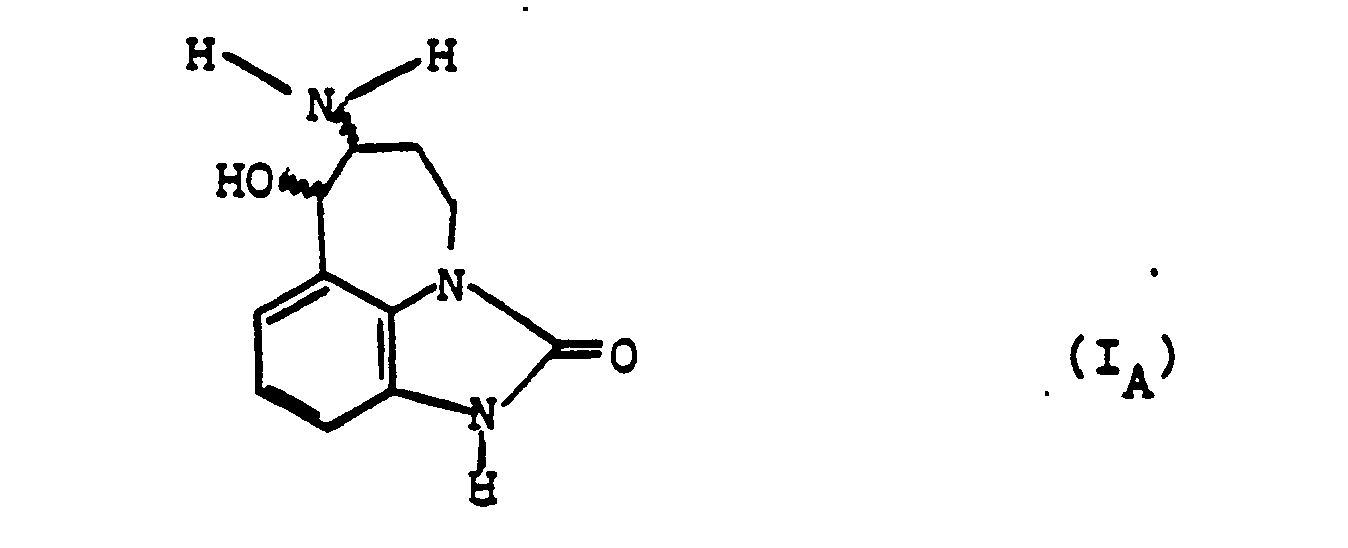
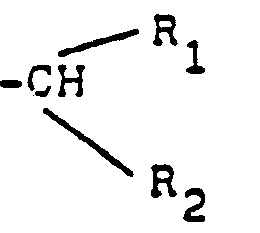
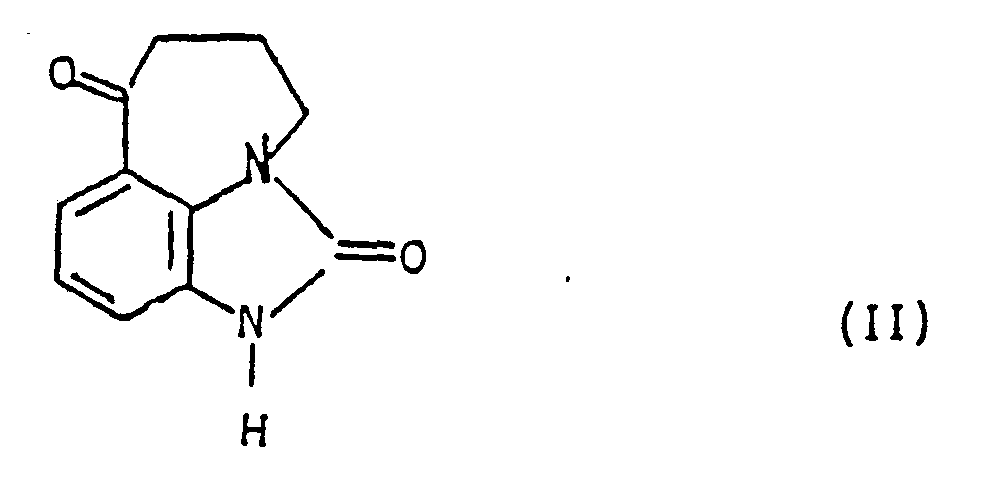
- the subject of the invention is also a process for preparing the derivatives of general formula (I), as well as their salts, characterized in that the product of formula (II) is subjected: to the action of an alkyl nitrite, preferably in the presence of an acid, to obtain the product of formula (III): which is reduced, to obtain the product of formula (I A ): in which the wavy lines have the meaning already indicated, that either one isolates, and if desired, salifies, either one submits or else to an alkylation reaction after prior blocking of the group -NH 2 preferably in the form of benzylated derivative to obtain, after release, a product of formula (I B ): in which the wavy lines have the meaning already indicated and R has the meaning indicated above, with the exception of a hydrogen atom, which is isolated and, if desired, salified or else at the action of a carbonyl derivative of formula (IV): in which R 1 and R 2 are such that has the meaning of R already indicated, with the exception of
- the derivatives of general formula (I) have a basic character. It is advantageously possible to prepare the addition salts of the derivatives of general formula (1), by reacting in substantially stoichiometric proportions, a mineral or organic acid with said derivative of general formula (I). The salts can be prepared without isolating the corresponding bases.
- the derivatives which are the subject of the present invention have very advantageous pharmacological properties; they are endowed in particular with remarkable antihypertensive and hypotensive properties and for some of vasodilator properties.
- a subject of the present invention is therefore also the application, as medicaments, of 6-amino 7-hydroxy derivatives 4,5,6,7-tetrahydro imidazo / 4,5,1-jk / / 1 / benzazepin -2 (1 H) -one, as defined by the general formula (I) as well as their addition salts with pharmaceutically acceptable acids.
- R represents a hydrogen atom or an alkyl radical, linear or branched containing from 1 to 5 carbon atoms , as well as their addition salts with pharmaceutically acceptable acids.
- the medicaments according to the invention find their use, for example, in the treatment of essential hypertension in the treatment of hypertension of the fifties, of menopause, of diabetics, of obese and plethoric, as well as in the treatment of hypertension in the elderly or with arteriosclerosis and in the treatment of hypertension of renal origin. They can also be used in the treatment of peripheral circulatory insufficiencies, in particular in the treatment of arteritis of the lower limbs, as well as in the treatment of cerebral circulatory insufficiency, in the treatment of senescence or cerebral arteriopathies.
- the usual dose which varies according to the derivative used, the subject treated and the condition in question, can be, for example, from 5 mg to 200 mg per day, orally in humans for the derivative of Example 2 for the treatment of essential hypertension.
- the invention finally relates to pharmaceutical compositions which contain at least one aforementioned derivative or one of its addition salts with pharmaceutically acceptable acids, as active principle.
- the derivatives corresponding to general formula (I) and their addition salts with pharmaceutically acceptable acids can be incorporated into pharmaceutical compositions intended for the digestive or parenteral route.
- compositions can be, for example, solid or liquid and can be presented in the pharmaceutical forms commonly used in human medicine, such as, for example, tablets, simple or coated, capsules, granules, suppositories, injectable preparations; they are prepared according to the usual methods.
- the active ingredient (s) can be incorporated therein into excipients usually used in these pharmaceutical compositions, such as talc, gum arabic, lactose, starch, magnesium stearate, cocoa butter, aqueous vehicles or not , fatty substances of animal or vegetable origin, paraffinic derivatives, glycols, various wetting agents, dispersants or emulsifiers, preservatives.
- excipients usually used in these pharmaceutical compositions, such as talc, gum arabic, lactose, starch, magnesium stearate, cocoa butter, aqueous vehicles or not , fatty substances of animal or vegetable origin, paraffinic derivatives, glycols, various wetting agents, dispersants or emuls
- Example 1 (6RS, trans) 6-amino 7-hydroxy hydrochloride 4,5,6,7-tetrahydroimidazo / 4,5,1-j-k // 1 / benzazepin-2 (1 H) -one.
- Stage A Ethyl 1,3-dihydro 2-oxo 3-phenylmethyl 1 H-benzimidazol-1-butanoate.
- Stage B 1,3-dihydro 2-oxo 3-phenylmethyl IH-benzimi-dazol -1-butanoic acid.
- Stage D 5,6-dihydroimidazo / 4,5,1-d-k / / 1 / benzazepin-2,7 (1 H, 4H) -dione.
- Stage E 4,5-dihydroimidazo / 4,5,1-j-k / / 1 / benzazepine-2,6-oxime-2,6,7 (1H) -trione.
- Stage F (6RS-trans) 6-amino 7-hydroxy 4,5,6,7-tetrahydro imidazo / 4,5,1-j-k / / 1 / benzazepin-2 (1 H) -one hydrochloride.
- EXAMPLE 2 (6RS-trans) 6-ethylamino 7-hydroxy4,5,6,7-tetra hydroimidazo / 4,5,1-j-k / / 1 / benzazepin-2 (1 H) -one and its hydrochloride.
- Example 2 5 g of the product of Example 1 are suspended, with stirring and under an inert atmosphere, in 200 cm 3 of methanol, 2.18 cm 3 of acetaldehyde and 10 cm 3 of triethylamine are added, the mixture is stirred for 1 hour at temperature ambient, cooled using an ice bath, add in 1 hour 10 g of sodium borohydride, and stir for another 30 min at + 5 ° C and 1 hour at room temperature.
- Stage A (6RS-trans) 7-hydroxy 6- (phenylmethyl) amino 4,5,6,7-tetrahydroimidazo / 5,4,1-j-k / / 1 / benzazépin-2 (1 H) -one.
- Stage B (6RS-trans) 7-hydroxy 6- / methyl (phenylmethyl) amino / 4,5,6,7-tetrahydroimidazo / 5,4,1-jk / / 1 / -benzazepin-2 (1 H) one .
- Stage C (6RS-trans) 7-hydroxy 6-methylamino 4,5,6,7-tetrahydro imidazo / 5,4,1-j-k / / 1 / benzazepin-2 (1H) one hydrochloride.
- Example 6 (6RS, trans) 7-hydroxy 6 - / (2,2 dimethylpropyl) amino / 4,5,6,7-tetrahydroimidazo / 4,5,1-jk // 1 / benzazepin-2 hydrochloride (1H ) -one.
- Example 7 (6R8, trans) 7-hydroxy 6 - / (2-hydroxyethyl) amino / 4,5,6,7-tetrahydroimidazo / 4,5,1-jk // I / benzazepin-2 (1 H) - one and its hydrochloride.
- the hydrochloride is prepared as in Example 4 from 6.2 g of the base obtained and 4.2 g of the expected product, F ⁇ 280 ° C, are obtained, which is recrystallized from methanol. 3.4 g of product are collected. Mp 280 ° C.
- Example 10 (6RS, trans) 7-hydroxy 6 - / (2phenytethyl) amino / 4,5,6,7-tetrahydroimidazo / 4,5,1-jk / / 1 / benzazepin-2 hydrochloride (1 H) - one.
- Example 2 The procedure is as in Example 2, starting from phenyl acetaldehyde, chromatography on silica the base obtained by eluting with a methylene chloride-methanol mixture (9/1) and preparing the hydrochloride as in Example 4 and obtaining the expected hydrochloride . Mp 190 ° C.
- Example 11 (6RS, trans) 7-hydroxy 6 - / (3phenyl propyl) amino / 4,5,6,7-tetrahydroimidazo / 4,5,1-jk / / 1 / benzazepin-2 hydrochloride (1 H) -one.
- Example 12 (6RS, trans) 7-hydroxy 6 - / (2phenoxy ethyl) amino / 4,5,6,7-tetrahydroimidazo / 4,5,1-jk / / 1 / benzazepin-2 (1H) - hydrochloride one.
- Example 2 The procedure is as in Example 2, starting from phenoxy acetaldehyde and then chromatography on silica, the base obtained, eluting with a methylene chloride-methanol mixture (9/1). The interesting fraction is recrystallized from isopropanol and the base is obtained, F ⁇ 150 ° C.
- the hydrochloride is prepared by dissolving the base in methylene chloride and isopropanol at reflux, concentrating and adding hydrochloric ethyl acetate. It is left to crystallize for two hours at room temperature and the expected hydrochloride is drained. F ⁇ 250 0 C.
- Example 13 (6RS, trans) 7-hydroxy 6 - / (1 methyl 4-piperidinyl) amino / 4,5,6,7-tetrahydroimidazo / 4,5,1-jk / / 1 / benzazepin-2- dihydrochloride (1 H) -one.
- Example 14 (6RS, trans) 7-hydroxy 6 - / (1-methyl ethyl) amino / 4,5,6,7-tetrahydroimidazo / 4,5,1-jk / / 1 / benza zepin-2 hydrochloride ( 1 H) -one.
- Example 15 4,5-dihydroimidazo / 4,5,1-j-k / / 1 / benzazepin-2,7 (1H, 6H) -dione.
- Stage B ethyl 2,3-dihydro 2-oxo 1H-benzimidazol-1-butanoate.
- Stage D 4,5-dihydro imidazo / 4,5,1-d-k / / 1 / benzazepin-2,7 (1 H, 6H) -dione.
- hypotensive activity was studied in male rats of the WISTAR strain weighing approximately 300 g and anesthetized with sodium pentobarbital (50 mg / kg intravenously).
- test product was administered intravenously into the penile vein or the jugular vein.
- the table below indicates the variations expressed as a percentage of the blood pressure after administration of the product tested compared to the initial control blood pressure.
- Blood pressure is taken at the carotid artery using another pressure sensor.
- the infusion rate in the paw is adjusted so as to equalize the carotid and femoral pressures.
- the left hind leg is placed in a bag containing crushed ice, which increases the infusion pressure.
- the sensitivity of the paw is tested by administering naftidrofuryl at 100, 300, 1000 and 3000 ⁇ g in a volume of 0.2 ml of distilled water.
- the product is injected into the extracorporeal circulation upstream of the pump at various doses.
- naftidrofuryl is injected allowing the stability of the preparation to be checked.
- the pressure reductions reflect a decrease in the tone of the perfused area, therefore in the peripheral resistances.
- the effects are expressed by the percentage changes in the perfusion pressure of the hind paw.
- mice The lethal DL O doses of the various compounds tested after oral administration in mice were evaluated.
- the maximum dose causing no mortality in 8 days is called DL O.
Landscapes
- Organic Chemistry (AREA)
- Chemical & Material Sciences (AREA)
- Health & Medical Sciences (AREA)
- Pharmacology & Pharmacy (AREA)
- Bioinformatics & Cheminformatics (AREA)
- Cardiology (AREA)
- Chemical Kinetics & Catalysis (AREA)
- General Chemical & Material Sciences (AREA)
- Medicinal Chemistry (AREA)
- Nuclear Medicine, Radiotherapy & Molecular Imaging (AREA)
- Engineering & Computer Science (AREA)
- Life Sciences & Earth Sciences (AREA)
- Heart & Thoracic Surgery (AREA)
- Animal Behavior & Ethology (AREA)
- General Health & Medical Sciences (AREA)
- Public Health (AREA)
- Veterinary Medicine (AREA)
- Pharmaceuticals Containing Other Organic And Inorganic Compounds (AREA)
- Nitrogen Condensed Heterocyclic Rings (AREA)
- Plural Heterocyclic Compounds (AREA)
- Organic Low-Molecular-Weight Compounds And Preparation Thereof (AREA)
Abstract
Description
La présente- invention concerne de nouveaux dérivés de la 6-amino 7-hydroxy 4,5,6,7-tétrahydroimidazo/4,5,1-j-k/ /1/ benzazépin-2(1H)-one, ainsi que leurs sels, leur préparation, l'application à titre de médicaments de ces nouveaux dérivés et les compositions les renfermant.The present invention relates to new derivatives of 6-amino 7-hydroxy 4,5,6,7-tetrahydroimidazo / 4,5,1-jk / / 1 / benzazepin-2 (1H) -one, as well as their salts , their preparation, the application as medicaments of these new derivatives and the compositions containing them.
L'invention a pour objet de nouveaux dérivés de la 6-amino 7-hydroxy 4,5,6,7-tétrahydroimidazo/4,5,1-j-k/ /1/ benzazépin-2(1 H)-one, ainsi que leurs sels d'addition avec les acides minéraux ou organiques, caractérisés en ce qu'ils répondent à la formule générale (I):

Dans la formule générale (I) et dans ce qui suit, le terme radical alcoyle, linéaire ou ramifié, renfermant de 1 à 8 atomes de carbone, désigne, par exemple, un radical n-pentyle, n-butyle, n-propyle, 2,2-diméthylpropyle ou de préférence, un radical isopropyle, éthyle ou méthyle;
le terme radical cycloalcoyle renfermant de 3 à 7 atomes de carbone désigne un radical cyclopropyle, cyclobutyle, cyclopentyle, cyclohexyle ou cycloheptyle;In the general formula (I) and in what follows, the term alkyl radical, linear or branched, containing from 1 to 8 carbon atoms, denotes, for example, an n-pentyl, n-butyl, n-propyl radical, 2,2-dimethylpropyl or preferably an isopropyl, ethyl or methyl radical;
the term cycloalkyl radical containing 3 to 7 carbon atoms denotes a cyclopropyl, cyclobutyl, cyclopentyl, cyclohexyl or cycloheptyl radical;
Les sels d'addition avec les acides minéraux ou organiques peuvent être, par exemple, les sels formés avec les acides chlorhydrique, bromhydrique, nitrique, sulfurique, phosphorique acétique, formique, propionique, benzoïque, maléique, fumarique succinique, tartrique, citrique, oxalique, glyoxylique, aspartique, alcane sulfoniques tels que les acides méthane ou éthane sulfoniques, arylsulfoniques, tels que les acides benzène ou paratoluéne sulfoniques et arylcarboxyliques.The addition salts with mineral or organic acids can be, for example, the salts formed with hydrochloric, hydrobromic, nitric, sulfuric, acetic phosphoric, formic, propionic, benzoic, maleic, succinic, tartaric, citric, oxalic acids. , glyoxylic, aspartic, alkane sulfonic such as methane or ethane sulfonic acids, arylsulfonic, such as benzene or paratoluene sulfonic and arylcarboxylic acids.
Parmi les produits de l'invention, on peut citer ceux répondant à la formule générale (I), dans laquelle R représente un atome d'hydrogène ou un radical alcoyle renfermant de 1 à 5 atomes de carbone ainsi que leurs sels d'addition avec les acides minéraux ou organiques.Among the products of the invention, there may be mentioned those corresponding to the general formula (I), in which R represents a hydrogen atom or an alkyl radical containing from 1 to 5 carbon atoms as well as their addition salts with mineral or organic acids.
Parmi les produits objet de l'invention, on peut citer plus particulièrement:
- - la (6RS, trans) 6-amino 7-hydroxy 4,5,6,7-tétrahydro imidazo/5,4,1-j-k/ /1/ benzazépin-2(1 H)-one;
- - la (6RS, trans) 6-éthylamino 7-hydroxy 4,5,6,7-tétrahydro imidazo/5,4,1-j-k/ /1/ benzazépin-2(1H)-one;
- - la (6RS, trans) 6-méthylamino 7-hydroxy 4,5,6,7-tétrahydro-imidazo/5,4,1-j-k/ /1/ benzazépin-2(1 H)-one;
- - la (6RS, trans) 6-(1-méthyléthyl)amino 7-hydroxy 4,5,6,7-tétrahydro imidazo/5,4,1-j-k/ /1/ benzazépin-2-(1 H)-one, ainsi que leurs sels d'addition avec les acides minéraux ou organiques.
- - (6RS, trans) 6-amino 7-hydroxy 4,5,6,7-tetrahydro imidazo / 5,4,1-jk / / 1 / benzazépin-2 (1 H) -one;
- - (6RS, trans) 6-ethylamino 7-hydroxy 4,5,6,7-tetrahydro imidazo / 5,4,1-jk / / 1 / benzazepin-2 (1H) -one;
- - (6RS, trans) 6-methylamino 7-hydroxy 4,5,6,7-tetrahydro-imidazo / 5,4,1-jk / / 1 / benzazepin-2 (1 H) -one;
- - (6RS, trans) 6- (1-methylethyl) amino 7-hydroxy 4,5,6,7-tetrahydro imidazo / 5,4,1-jk / / 1 / benzazépin-2- (1 H) -one , as well as their addition salts with mineral or organic acids.
L'invention a également pour objet un procédé de préparation des dérivés de formule générale (I), ainsi que de leurs sels, caractérisé en ce que l'on soumet le produit de formule (II):




Dans des conditions préférentielles d'exécution du procédé ci-dessus, on opère comme suit:
- - La réaction avec le nitrite d'alcoyle est effectuée de préférence à l'aide de nitrite de tert-butyle, mais on peut utiliser d'autres nitrites tel que celui d'isoamyle. La réaction peut être effectuée en présence d'une base ou de préférence en présence d'un acide, notamment l'acide chlorhydrique.
- - La réduction du produit de formule (III) est de préférence effectuée par hydrogénation catalytique suivie ou non de l'action du borohydrure de sodium.
- - La réaction d'alcoylation du produit de formule (lA) peut avantageusement être effectuée après blocage, par exemple, sous forme de dérivé N-benzylé, du dérivé de formule (IA), par action d'un halogénure d'alcoyle approprié, tel qu'un chlorure, un iodure, ou de préférence un bromure, en présence ou non d'un agent fixateur d'acides tel qu'un carbonate alcalin (par exemple le carbonate de sodium), un hydroxyde alcalin (par exemple, la potasse), ou une amine tertiaire (par exemple la triéthylamine), enfin élimination du groupement protecteur (par exemple, par hydrogénation catalytique dans le cas d'un radical benzyle).
- - l'amine tertiaire que l'on fait réagir avec le dérivé carbonylé de formule (IV) est la triéthylamine.
- - L'agent de réduction que l'on fait réagir sur le produit issu de l'action du produit de formule (IV) avec le produit de formule (lA) est de préférence un borohydrure ou cyanoborohydrure alcalin, notamment de sodium.
- - The reaction with alkyl nitrite is preferably carried out using tert-butyl nitrite, but other nitrites such as that of isoamyl can be used. The reaction can be carried out in the presence of a base or preferably in the presence of an acid, in particular hydrochloric acid.
- - The reduction of the product of formula (III) is preferably carried out by catalytic hydrogenation whether or not followed by the action of sodium borohydride.
- - The alkylation reaction of the product of formula (I A ) can advantageously be carried out after blocking, for example, in the form of N-benzylated derivative, of the derivative of formula (I A ), by the action of an alkyl halide suitable, such as a chloride, an iodide, or preferably a bromide, in the presence or absence of an acid-fixing agent such as an alkali carbonate (for example sodium carbonate), an alkali hydroxide (for example , potassium), or a tertiary amine (for example triethylamine), finally elimination of the protective group (for example, by catalytic hydrogenation in the case of a benzyl radical).
- - The tertiary amine which is reacted with the carbonyl derivative of formula (IV) is triethylamine.
- - The reducing agent which is reacted on the product resulting from the action of the product of formula (IV) with the product of formula (1 A ) is preferably an alkaline borohydride or cyanoborohydride, in particular of sodium.
L'invention a également pour objet un procédé de préparation des produits de formule générale (I), tel que défini précédemment, caractérisé en ce que pour préparer le produit de formule (II), l'on fait réagir le produit de formule (V):

- Hal-(CH2)3-COOalc (VI)
dans laquelle Hal représente un atome de chlore, de brome ou d'iode et alc un radical alcoyle renfermant de 1 à 4 atomes de carbone, puis hydrolyse en milieu acide le produit résultant de formule (VII):


- Hal- (CH 2 ) 3 -COOalc (VI)
in which Hal represents a chlorine, bromine or iodine atom and alk an alkyl radical containing from 1 to 4 carbon atoms, then hydrolysis in acid medium the product resulting from formula (VII):
Dans des conditions préférentielles d'exécution du procédé ci-dessus:
- - l'halogénobutyrate d'alcoyle est un bromobutyrate de méthyle ou d'éthyle et la condensation est effectuée en présence d'une base telle qu'un hydrure alcalin;
- - l'hydrolyse du produit de formule (VII) est effectuée en présence d'un acide tel que l'acide sulfurique, la réaction étant effectuée au sein d'un alcool tel que l'éthanol;
- - la saponification du produit de formule (VIII) est effectuée par une base telle que la soude ou la potasse au sein d'un alcool tel que le méthanol ou l'éthanol;
- - la réaction de cyclisation de la chaîne latérale du produit de formule (IX) est effectuée soit en préparant un chlorure d'acide, par exemple, par action de chlorure de thionyle, que l'on traite par un acide de Lewis, par exemple, le chlorure d'aluminium, au sein d'un solvant organique tel que le chlorure de méthylène ou le dichloréthane, soit par action d'un agent déshydratant tel que l'acide polyphosphorique.
- - The alkyl halobutyrate is a methyl or ethyl bromobutyrate and the condensation is carried out in the presence of a base such as an alkali hydride;
- - The hydrolysis of the product of formula (VII) is carried out in the presence of an acid such as sulfuric acid, the reaction being carried out in an alcohol such as ethanol;
- - The saponification of the product of formula (VIII) is carried out with a base such as sodium hydroxide or potassium hydroxide in an alcohol such as methanol or ethanol;
- the cyclization reaction of the side chain of the product of formula (IX) is carried out either by preparing an acid chloride, for example, by the action of thionyl chloride, which is treated with a Lewis acid, for example , aluminum chloride, in an organic solvent such as methylene chloride or dichloroethane, or by the action of a dehydrating agent such as polyphosphoric acid.
Le produit de départ de formule (V) est connu et décrit, par exemple dans J.Chem.Soc.Perkin 1 (1982) - 261.The starting material of formula (V) is known and described, for example in J.Chem.Soc.Perkin 1 (1982) - 261.
Le dédoublement des dérivés racémiques de formule générale (I) peut être réalisé selon les procédés classiques.The resolution of the racemic derivatives of general formula (I) can be carried out according to conventional methods.
Les dérivés de formule générale (I) présentent un caractère basique. On peut avantageusement préparer les sels d'addition des dérivés de formule générale (1), en faisant réagir en proportions sensiblement stoechiométriques, un acide minéral ou organique avec ledit dérivé de formule générale (I). Les sels peuvent être préparés sans isoler les bases correspondantes.The derivatives of general formula (I) have a basic character. It is advantageously possible to prepare the addition salts of the derivatives of general formula (1), by reacting in substantially stoichiometric proportions, a mineral or organic acid with said derivative of general formula (I). The salts can be prepared without isolating the corresponding bases.
Les dérivés, objet de la présente invention, possèdent de très intéressantes propriétés pharmacologiques; ils sont doués notamment de remarquables propriétés antihypertensives et hypotensives et pour certains de propriétés vasodilatatrices.The derivatives which are the subject of the present invention have very advantageous pharmacological properties; they are endowed in particular with remarkable antihypertensive and hypotensive properties and for some of vasodilator properties.
Ces propriétés sont illustrées plus loin dans la partie expérimentale.These properties are illustrated later in the experimental part.
Ces propriétés justifient l'utilisation des dérivés de la 6-amino 7-hydroxy 4,5,6,7-tétrahydro imidazo/4,5,1-j-k/ /1/ benzazépin-2(1 H)-one, ainsi que leurs sels pharmaceutiquement acceptables, à titre de médicaments.These properties justify the use of 6-amino 7-hydroxy derivatives 4,5,6,7-tetrahydro imidazo / 4,5,1-jk / / 1 / benzazépin-2 (1 H) -one, as well as their pharmaceutically acceptable salts, as medicaments.
La présente invention a ainsi également pour objet l'application, à titre de médicaments, des dérivés de la 6-amino 7-hydroxy 4,5,6,7-tétrahydro imidazo/4,5,1-j-k/ /1/ benzazépin-2 (1 H)-one, tels que définis par la formule générale (I) ainsi que de leurs sels d'addition avec les acides pharmaceutiquement acceptables.A subject of the present invention is therefore also the application, as medicaments, of 6-amino 7-hydroxy derivatives 4,5,6,7-tetrahydro imidazo / 4,5,1-jk / / 1 / benzazepin -2 (1 H) -one, as defined by the general formula (I) as well as their addition salts with pharmaceutically acceptable acids.
Parmi les médicaments, objet de l'invention, on retient plus particulièrement les dérivés répondant à la formule générale (I), dans laquelle R représente un atome d'hydrogène ou un radical alcoyle, linéaire ou ramifié renfermant de 1 à 5 atomes de carbone, ainsi que leurs sels d'addition avec les acides pharmaceutiquement acceptables.Among the drugs which are the subject of the invention, the derivatives corresponding to the general formula (I) are more particularly retained, in which R represents a hydrogen atom or an alkyl radical, linear or branched containing from 1 to 5 carbon atoms , as well as their addition salts with pharmaceutically acceptable acids.
Parmi ces derniers, on retient tout particulièrement, les dérivés dont les noms suivent:
- - la (6RS, trans) 6-amino 7-hydroxy 4,5,6,7-tétrahydroimidazo /5,4,1-j-k/ /1/ benzazépin-2(1 H)-one;
- - la (6RS, trans) 6-éthylamino 7-hydroxy 4,5,6,7-tétrahydro imidazo/5,4,1-j-k/ /1/ benzazépin-2(1 H)-one;
- - la (6RS, trans) 6-méthylamino 7-hydroxy 4,5,6,7-tétrahydro imidazo/5,4,1-j-k/ /1/ benzazépin-2(1 H)-one;, - la (6RS, trans)6-(1-méthyléthyl)amino 7-hydroxy 4,5,6,7-tétrahydFoimidazo/5,4,1-j-kl /1/ benzazépin-2-(1H)-one, ainsi que leurs sels d'addition avec les acides pharmaceutiquement acceptables.
- - (6RS, trans) 6-amino 7-hydroxy 4,5,6,7-tetrahydroimidazo / 5,4,1-jk / / 1 / benzazépin-2 (1 H) -one;
- - (6RS, trans) 6-ethylamino 7-hydroxy 4,5,6,7-tetrahydro imidazo / 5,4,1-jk / / 1 / benzazepin-2 (1 H) -one;
- - la (6RS, trans) 6-methylamino 7-hydroxy 4,5,6,7-tetrahydro imidazo / 5,4,1-jk / / 1 / benzazépin-2 (1 H) -one ;, - la (6RS , trans) 6- (1-methylethyl) amino 7-hydroxy 4,5,6,7-tetrahyd F oimidazo / 5,4,1-j-kl / 1 / benzazepin-2- (1H) -one, as well as their addition salts with pharmaceutically acceptable acids.
Les médicaments selon l'invention trouvent leur emploi, par exemple, dans le traitement de l'hypertension artérielle essentielle dans le traitement de l'hypertension de la cinquantaine, de la ménopause, du diabétique, de l'obèse et du pléthorique, ainsi que dans le traitement de l'hypertension artérielle du sujet âgé ou atteint d'artériosclérose et dans le traitement de l'hypertension d'origine rénale. Ils peuvent également être utilisés dans le traitement des insuffisances circulatoires périphériques, notamment dans le traitement de l'artérite des membres inférieurs, ainsi que dans le traitement de l'insuffisance circulatoire cérébrale, dans le traitement de la sénescence ou des artériopathies cérébrales.The medicaments according to the invention find their use, for example, in the treatment of essential hypertension in the treatment of hypertension of the fifties, of menopause, of diabetics, of obese and plethoric, as well as in the treatment of hypertension in the elderly or with arteriosclerosis and in the treatment of hypertension of renal origin. They can also be used in the treatment of peripheral circulatory insufficiencies, in particular in the treatment of arteritis of the lower limbs, as well as in the treatment of cerebral circulatory insufficiency, in the treatment of senescence or cerebral arteriopathies.
La dose usuelle, variable selon le dérivé utilisé, le sujet traité et l'affection en cause peut être, par exemple, de 5 mg à 200 mg par jour, par voie orale chez l'homme du dérivé de l'exemple 2 pour le traitement de l'hypertension artérielle essentielle.The usual dose, which varies according to the derivative used, the subject treated and the condition in question, can be, for example, from 5 mg to 200 mg per day, orally in humans for the derivative of Example 2 for the treatment of essential hypertension.
L'invention a enfin pour objet les compositions pharmaceutiques qui renferment au moins un dérivé précité ou l'un de ses sels d'addition avec les acides pharmaceutiquement acceptables, à titre de principe actif.The invention finally relates to pharmaceutical compositions which contain at least one aforementioned derivative or one of its addition salts with pharmaceutically acceptable acids, as active principle.
A titre de médicaments, les dérivés répondant à la formule générale (I) et leurs sels d'addition avec les acides pharmaceutiquement acceptables peuvent être incorporés dans des compositions pharmaceutiques destinées à la voie digestive ou parentérale.As medicaments, the derivatives corresponding to general formula (I) and their addition salts with pharmaceutically acceptable acids can be incorporated into pharmaceutical compositions intended for the digestive or parenteral route.
Ces compositions pharmaceutiques peuvent être, par exemple, solides ou liquides et se présenter sous les formes pharmaceutiques couramment utilisées en médecine humaine, comme, par exemple, les comprimés, simples ou dragéifiés, les gélules, les granulés, les suppositoires, les préparations injectables; elles sont préparées selon les méthodes usuelles. Le ou les principes actifs peuvent y être incorporés à des excipients habituellement employés dans ces compositions pharmaceutiques, tels que le talc, la gomme arabique, le lactose, l'amidon, le stéarate de magnésium, le beurre de cacao, les véhicules aqueux ou non, les corps gras d'origine animale ou végétale, les dérivés paraffiniques, les glycols, les divers agents mouillants, dispersants ou émulsifiants, les conservateurs. Les exemples qui suivent illustrent la présente invention, sans toutefois la limiter.These pharmaceutical compositions can be, for example, solid or liquid and can be presented in the pharmaceutical forms commonly used in human medicine, such as, for example, tablets, simple or coated, capsules, granules, suppositories, injectable preparations; they are prepared according to the usual methods. The active ingredient (s) can be incorporated therein into excipients usually used in these pharmaceutical compositions, such as talc, gum arabic, lactose, starch, magnesium stearate, cocoa butter, aqueous vehicles or not , fatty substances of animal or vegetable origin, paraffinic derivatives, glycols, various wetting agents, dispersants or emulsifiers, preservatives. The examples which follow illustrate the present invention, without however limiting it.
On agite 29,5 g de 1,3-dihydro 1-phénylméthyl 2H-benzi-imidazol-2-one (décrit dans Helv. 2ctz 44 1961 p.1278), dans 296 cm3 de diméthylformamide, ajoute en 30 minutes 7,6 g d'hydrure de sodium à 50 % dans l'huile, agite encore pendant 30 minutes, refroidit à +5°C, ajoute, goutte à goutte 33,9 g de 4-bromobutyrate d'éthyle en 15 minutes et agite encore pendant 3 heures à température ambiante. On verse la solution sur 500 cm3 d'eau glacée, extrait à l'éther, lave à l'eau, sèche, évapore, dissout l'huile ainsi obtenue dans 50 cm3 d'éther isopropylique, laisse cristalliser pendant 15 heures, essore et obtient 22,6 g du produit attendu (F ≈ 50°C). (F = 52°C après recristallisation dans le cyclohexane).
- Analyse: C2oH22N203 = 338,39
- Calculé: C % 70,98 H % 6,55 N % 8,28
- Trouvé: 70,8 6,6 8,2.
- Analysis: C 2o H 22 N 2 0 3 = 338.39
- Calculated: C% 70.98 H% 6.55 N% 8.28
- Found: 70.8 6.6 8.2.
On porte au reflux pendant 3 heures sous atmosphère inerte 40,6 g de produit tel qu'obtenu ci-dessus, dans 400 cm3 de soude methanolique N, concentre à demi-volume, verse sur 1 litre d'eau glacée, acidifie à pH = 2 par addition d'acide chlorhydrique concentré, essore, lave, sèche et obtient 35,2 g du produit attendu F ≈ 166'C (168°C après recristallisation dans l'acétate d'éthyle.
- Analyse: C18H18N2O3 = 310,33
- Calculé: C % 69,66 H % 5,84 N % 9,02
- Trouvé: 69,4 5,9 8,9.
- Analysis: C 18 H 18 N 2 O 3 = 310.33
- Calculated: C% 69.66 H% 5.84 N% 9.02
- Found: 69.4 5.9 8.9.
On met en suspension 21,5 g du produit obtenu ci-dessus dans 450 cm3 de chloroforme, ajoute 21,5 cm3 de chlorure de thionyle, porte au reflux pendant une heure 15 minute et évapore à sec sous pression réduite.21.5 g of the product obtained above are suspended in 450 cm3 of chloroform, 21.5 cm3 of thionyl chloride are added, the mixture is brought to reflux for one hour 15 minutes and evaporated to dryness under reduced pressure.
On dissout le produit ainsi obtenu dans 860 cm3 de dichloréthane sous atmosphère inerte, refroidit à +15°C, ajoute 18,67 g de chlorure d'aluminium, agite pendant 4 heures à 20°C, verse le mélange sur un litre d'eau glacée, additionnée de 43 cm3 d'acide chlorhydrique concentré, agite pendant 10 minutes et filtre. On décante la phase organique, extrait la phase aqueuse au chlorure de méthylène, réunit les phases organiques, les lave par une solution aqueuse de carbonate de potassium à 10 % jusqu'à pH = 6, sèche, évapore à sec sous pression réduite, cristallise dans l'acétate d'éthyle et obtient après essorage 8,7 g du produit attendu (F= 135`C).
- Analyse: (après recristallisation dans l'isopropanol) C18H16N2O2 = 292,32
- Calculé: C % 73,95 H % 5,51 N % 9,58
- Trouvé: 73,9 5,5 9,4.
- Analysis: (after recrystallization from isopropanol) C 18 H 16 N 2 O 2 = 292.32
- Calculated: C% 73.95 H% 5.51 N% 9.58
- Found: 73.9 5.5 9.4.
On chauffe sous atmosphère inerte, à 150°C, 29,2 g du produit obtenu ci-dessus, 292 g d'acide o-phosphorique et 14,1 g de phénol, après 2 heures, refroidit le mélange à + 35°C environ, verse sous agitation sur 1200 cm3 d'eau glacée, ajoute 2 litres de chlorure de méthylène, alcalinise à l'aide de lessive de soude, filtre et lave l'insoluble au chlorure de méthylène. On lave la phase organique, la sèche et l'évapore à sec sous pression réduite. On obtient 9,7 g du produit attendu (F = 235° C) après cristallisation puis chromatographie sous pression du filtrat (éluant: acétate d'éthyle - méthanol - triéthylamine 90-2-2).
- Analyse: C11H10N2O2 = 202,20
- Calculé: C% 65,33 H% 4,98 N% 13,85
- Trouvé: 65,0 4,9 13,7
- Analysis: C 11 H 10 N 2 O 2 = 202.20
- Calculated: C% 65.33 H% 4.98 N% 13.85
- Found: 65.0 4.9 13.7
On met en suspension, sous atmosphère inerte, 15,5 g du produit tel qu'obtenu ci-dessus, dans 620 cm3 de tétrahydrofuranne, refroidit à +5°C, ajoute 42,5 cm3 d'acide chlorhydrique éthanolique 1,8N et 10,5 cm3 de nitrite de tert-butyle, agite 3h à +5°C, essore, lave au tétrahydrofuranne puis avec un mélange chloroforme- métanol (1-1) et obtient 16,5 g du produit attendu (F > 280°C).15.5 g of the product as obtained above are suspended under an inert atmosphere in 620 cm 3 of tetrahydrofuran, cooled to + 5 ° C., 42.5 cm 3 of ethanolic hydrochloric acid 1 are added, 8N and 10.5 cm 3 of tert-butyl nitrite, stirred for 3 h at + 5 ° C., drained, washed with tetrahydrofuran then with a chloroform-metanol mixture (1-1) and obtained 16.5 g of the expected product (F > 280 ° C).
On met en suspension 4g du produit obtenu ci-dessus et 2 g de palladium à 10 % sur charbon, dans 150 cm3 de méthanol, agite sous hydrogène pendant 2 h 30mn, filtre, refroidit à l'aide d'un bain de glace, et ajoute lentement sous légère agitation 0,66 g de borohydrure de sodium, agite encore pendant 1 h 30 mn à +5°C et évapore à sec sous pression réduite à +30°C. On dissout le résidu obtenu ci-dessus dans 15 cm3 de méthanol, acidifie à l'acétate d'éthyle chlorhydrique jusqu'à pH = 1-2, essore et obtient 3,6 g du chlorhydrate attendu (F> 260°C). On recristallise dans le méthanol, puis dans l'éthanol (F > 260°C).
- Analyse: C11H14N3C102 = 255,7
- Calculé: C% 51,66 H% 5,51 N% 16,43 CI% 13,86
- Trouvé: 51,5 5,6 16,7 14,2.
- Analysis: C 11 H 14 N 3 C10 2 = 255.7
- Calculated: C% 51.66 H% 5.51 N% 16.43 CI% 13.86
- Found: 51.5 5.6 16.7 14.2.
On met en suspension, sous agitation et atmosphère inerte, 5 g du produit de l'exemple 1, dans 200 cm3 de méthanol, ajoute 2,18 cm3 d'acétaldéhyde et 10 cm3 de triéthylamine, agite pendant 1 heure à température ambiante, refroidit à l'aide d'un bain de glace, ajoute en 1 heure 10 g de borohydrure de sodium, et agite encore 30 mn à +5°C et 1 heure à température ambiante. On évapore le méthanol, reprend le résidu au chlorure de méthylène, lave à l'eau puis avec une solution aqueuse saturée de chlorure de sodium, sèche, évapore à sec sous pression réduite, christallise dans l'acétate d'éthyle, et obtient, après essorage 2,6 g -- du produit attendu (F ≈ 190° C).5 g of the product of Example 1 are suspended, with stirring and under an inert atmosphere, in 200 cm 3 of methanol, 2.18 cm 3 of acetaldehyde and 10 cm 3 of triethylamine are added, the mixture is stirred for 1 hour at temperature ambient, cooled using an ice bath, add in 1 hour 10 g of sodium borohydride, and stir for another 30 min at + 5 ° C and 1 hour at room temperature. The methanol is evaporated, the residue is taken up in methylene chloride, washed with water and then with a saturated aqueous solution of sodium chloride, dried, evaporated to dryness under reduced pressure, crystallized from ethyl acetate, and obtains, after spin 2.6 g - of the expected product (F ≈ 190 ° C).
On dissout 4,2 g de base telle qu'obtenue ci-dessus, dans 80 cm3 d'éthanol au reflux, refroidit à l'aide d'un bain de glace, ajoute 10cm3 d'acétate d'éthyle chlorhydrique, évapore à sec, reprend par 30 cm3 d'éther, essore et recristallise dans l'éthanol. On obtient ainsi 3,14 g du produit attendu (F ≈ 230° C).
- Analyse: C13H18N3O2Cl = 283,75
- Calculé: C% 55,02 H% 6,39 N% 14,81 Cl% 12,49
- Trouvé: 55,1 6,4 14,4 12,3
- Analysis: C 13 H 18 N 3 O 2 Cl = 283.75
- Calculated: C% 55.02 H% 6.39 N% 14.81 Cl% 12.49
- Found: 55.1 6.4 14.4 12.3
On agite à température ambiante pendant 1 h, sous atmosphère inerte, 1 g du produit de l'example 1 dans 13 cm3 de méthanol, 2 cm3 de triéthylamine et 1 cm3 de benzaldéhyde. On glace, ajoute en 15 mn 1 g de borohydrure de sodium, agite encore pendant 45 mn, ajoute 100 cm3 d'eau, extrait au chlorure de méthylène, lave à l'eau, sèche, filtre et évapore à sec sous pression réduite. On chromatographie sur silice l'huile obtenue ci-dessus (éluant: acétate d'éthyle-méthanol-triéthylamine 90-5-5), cristallise dans l'acétate d'éthyle, et obtient 820 mg du produit attendu (F ≈ 145°C).
- Analyse: (après recristallisation dans l'acétate d'éthyle) C18H19N3O2 = 309,36
- Calculé: C% 69,88 H% 6,19 N% 13,58
- Trouvé: 69,6 6,2 13,4
- Analysis: (after recrystallization from ethyl acetate) C 18 H 19 N 3 O 2 = 309.36
- Calculated: C% 69.88 H% 6.19 N% 13.58
- Found: 69.6 6.2 13.4
On dissout 4,6 g de produit tel qu'obtenu ci-dessus, dans 69 cm3 de méthanol et 11,5 cm3 de triéthylamine, fait barboter du bromure de méthyle pendant 2 heures à température ambiante et évapore à sec sous pression réduite. On reprend par 100 cm3 de solution saturée de bicarbonate de sodium, extrait au chlorure de methylène, lave a l'eau, sèche, évapore a sec sous pression réduite, cristallise dans l'acétate d'éthyle, et obtient, après essorage, 4,3 g du produit attendu(F = 228° C) (F = 232° C après recristallisation dans l'éthanol).
- Analyse: C19H21N3O2 = 323,38
- Calculé: C% 70,56 H% 6,55 N% 13,00
- Trouvé: 70,3 6,5 12,8
- Analysis: C 19 H 21 N 3 O 2 = 323.38
- Calculated: C% 70.56 H% 6.55 N% 13.00
- Found: 70.3 6.5 12.8
On dissout 450 mg du produit obtenu ci-dessus dans 45 cm3 d'éthanol, ajoute 225 mg de palladium à 10 % sur charbon, agite sous hydrogène pendant 1 heure, filtre, et évapore à sec sous pression réduite. On dissout l'huile ainsi obtenue, dans 5 cm3 d'éthanol, filtre, ajoute un excès d'acétate d'éthyle chlorhydrique, laisse cristalliser, essore, lave à l'éthanol, recristallise dans le méthanol, et obtient 110 mg du produit attendu (F= 280-290° C).
- Analyse: C12H16ClN3O2 = 269,93
- Calculé: C% 53,43 H% 5,98 CI% 13,15 N% 15,58
- Trouvé: 53,2 5,9 13,4 15,4
- Analysis: C 12 H 16 ClN 3 O 2 = 269.93
- Calculated: C% 53.43 H% 5.98 CI% 13.15 N% 15.58
- Found: 53.2 5.9 13.4 15.4
On opère comme à l'exemple 2 en remplaçant l'acétaldéhyde par de l'aldéhyde propionique. On reprend 5,1 g de produit brut obtenu par 15 cm3 d'éthanol, ajoute 15 cm3 d'acétate d'éthyle chlorhydrique puis 30 cm3 d'acétate d'éthyle. On essore 3,8 g de chlorhydrate attendu. F = ≈ 210° C.The procedure is as in Example 2, replacing acetaldehyde with propionic aldehyde. 5.1 g of crude product obtained is taken up with 15 cm 3 of ethanol, 15 cm 3 of hydrochloric ethyl acetate are added, then 30 cm 3 of ethyl acetate. 3.8 g of expected hydrochloride are drained. F = ≈ 210 ° C.
On opère comme à l'exemple 2, en partant d'aldéhyde butylique. On reprend 2,5 g de base obtenue dans 10 cm3 d'éthanol et ajoute 10 cm3 d'acétate d'éthyle chlorhydrique. On essore 1,5 g de produit attendu. F = ≈ 210°C.The procedure is as in Example 2, starting with butyl aldehyde. 2.5 g of base obtained is taken up in 10 cm 3 of ethanol and 10 cm 3 of hydrochloric ethyl acetate are added. 1.5 g of the expected product are drained. F = ≈ 210 ° C.
On opère comme à l'exemple 2, en partant de l'aldéhyde pivalique et prépare le chlorhydrate comme à l'exemple 5. On obtient 2,2 g de produit attendu. F = = 260° C.The procedure is as in Example 2, starting from the pivalic aldehyde and preparing the hydrochloride as in Example 5. 2.2 g of expected product are obtained. F = = 260 ° C.
On agite une heure à température ambiante, 10,24 g de chlorhydrate de (6RS,trans) 6-amino 7-hydroxy 4,5,6,7-tétrahydroimidazo/4,5,1-j-k//1/ benzazépin-2-(1H)-one obtenu à l'exemple 1, 4,8 g de glycolaldéhyde, 14 cm3 de triéthylamine et 400 cm3 de méthanol. On refroidit à 0°/5°C, ajoute en 15 minutes 10,24 g de borohydrure de sodium. On agite 45 minutes à température ambiante, ajoute 100 cm3 d'eau, concentre sous pression réduite jusqu'à 100 cm3 et laisse cristalliser deux heures à température ambiante. On essore et obtient 6,3 g de produit brut. F = 220° C.One hour stirred at room temperature, 10.24 g of (6RS, trans) 6-amino 7-hydroxy 4,5,6,7-tetrahydroimidazo / 4,5,1-jk // 1 / benzazepin-2 hydrochloride - (1H) -one obtained in Example 1, 4.8 g of glycolaldehyde, 14 cm 3 of triethylamine and 400 cm3 of methanol. Cooled to 0 ° / 5 ° C, added over 15 minutes 10.24 g of sodium borohydride. Stir 45 minutes at room temperature, add 100 cm 3 of water, concentrate under reduced pressure to 100 cm 3 and allow to crystallize for two hours at room temperature. It is drained and 6.3 g of crude product is obtained. M = 220 ° C.
On prépare le chlorhydrate comme aux exemples 4 et 5 à partir de 450 mg de base et obtient 280 mg de chlorhydrate, F = 242° C, que l'on recristallise dans le méthanol à reflux. On recueille 67 mg de chlorhydrate. F = 245° C.The hydrochloride is prepared as in Examples 4 and 5 from 450 mg of base and 280 mg of hydrochloride are obtained, mp = 242 ° C., which is recrystallized from methanol at reflux. 67 mg of hydrochloride are collected. M = 245 ° C.
On opère comme à l'exemple 2 en partant de cyclohexanone.The procedure is as in Example 2, starting from cyclohexanone.
On prépare le chlorhydrate comme à l'exemple 4 à partir de 6,2 g de la base obtenue et obtient 4,2 g de produit attendu, F ≈ 280° C, que l'on recristallise dans le méthanol. On recueille 3,4 g de produit. F = 280° C.The hydrochloride is prepared as in Example 4 from 6.2 g of the base obtained and 4.2 g of the expected product, F ≈ 280 ° C, are obtained, which is recrystallized from methanol. 3.4 g of product are collected. Mp 280 ° C.
On opère comme au stade A de l'exemple 3 et obtient la base attendue. F = 145°C. On en dissout 3,5 g dans 70 cm3 d'isopropanol au reflux, glace, ajoute peu à peu un excès d'acétate d'éthyle chlorhydrique. On essore 3,85 g de chlorhydrate attendu. F ≈ 240° C après recristallisation dans l'isopropanol.The procedure is as in stage A of Example 3 and the expected base is obtained. Mp 145 ° C. 3.5 g are dissolved in 70 cm 3 of isopropanol at reflux, ice, gradually adding an excess of hydrochloric ethyl acetate. 3.85 g of expected hydrochloride are drained. F ≈ 240 ° C after recrystallization from isopropanol.
On opère comme à l'exemple 2 en partant de phényl acétaldéhyde, chromatographie sur silice la base obtenue en éluant par un mélange chlorure de méthylène - méthanol (9/1) et prépare le chlorhydrate comme à l'exemple 4 et obtient le chlorhydrate attendu. F = 190° C.The procedure is as in Example 2, starting from phenyl acetaldehyde, chromatography on silica the base obtained by eluting with a methylene chloride-methanol mixture (9/1) and preparing the hydrochloride as in Example 4 and obtaining the expected hydrochloride . Mp 190 ° C.
On opère comme à l'exemple 2 à partir de l'aldéhyde 3-phényl propylique et obtient la base que l'on transforme en 2,1 g de chlorhydrate. F = 230° C après recristallisation dans l'éthanol.The procedure is as in Example 2 from 3-phenyl propyl aldehyde and the base is obtained which is transformed into 2.1 g of hydrochloride. M = 230 ° C after recrystallization from ethanol.
On opère comme à l'exemple 2 à partir de phénoxy acétaldéhyde puis chromatographie sur silice la base obtenue en éluant par un mélange chlorure de méthylène -méthanol (9/1). On recristallise la fraction intéressante dans l'isopropanol et obtient la base, F ≅ 150°C. On prépare le chlorhydrate en dissolvant la base dans du chlorure de méthylène et de l'isopropanol à reflux, concentre et ajoute de l'acétate d'éthyle chlorhydrique. On laisse cristalliser deux heures à température ambiante et essore le chlorhydrate attendu. F ≈ 2500 C.The procedure is as in Example 2, starting from phenoxy acetaldehyde and then chromatography on silica, the base obtained, eluting with a methylene chloride-methanol mixture (9/1). The interesting fraction is recrystallized from isopropanol and the base is obtained, F ≅ 150 ° C. The hydrochloride is prepared by dissolving the base in methylene chloride and isopropanol at reflux, concentrating and adding hydrochloric ethyl acetate. It is left to crystallize for two hours at room temperature and the expected hydrochloride is drained. F ≈ 250 0 C.
On agite 24 heures à température ambiante 7,6 g de (6RS, trans) 7-hydroxy 6-amino 4,5,6,7-tétrahydroimidazo/4,5,1-j-k/ /1/ benzazépin-2(1H)-one, 7,6 cm3 N-méthyl 4-pipéridone, 380 cm3 de méthanol et 7,6 g de cyanoborohydrure de sodium. On refroidit à température inférieure à 0°C, ajoute goutte à goutte, 5 cm3 d'acide chlorhydrique concentré, agite dix minutes à température ambiante, refroidit à nouveau à 0°C et alcalinise à pH 8 avec de la lessive de soude. On évapore le méthanol, reprend le résidu par du chlorure de méthylène à 10 % de méthanol, filtre l'insoluble et évapore à sec. On chromatographie le résidu sur silice en éluant par un mélange d'acétate d'éthyle - méthanol - ammoniaque (80-15-5) et obtient 7,3 g de base attendue. On dissout la base dans 40 cm3 d'éthanol ajoute 20 cm3 d'éthanol chlorhydrique, essore et recueille 7 g de chlorhydrate. F = 260° C.
- Analyse: C17H24N402 2HCI PM: 389,32
- Calculé: C % 52,44 H % 6,73 N % 14,36 CI % 18,21
- Trouvé: 52,5 7 14,3 18,0.
- Analysis: C 17 H 24 N 4 0 2 2HCI PM: 389.32
- Calculated: C% 52.44 H% 6.73 N% 14.36 CI% 18.21
- Found: 52.5 7 14.3 18.0.
On refroidit à 0/+5°C, 6 g de chlorhydrate de (6RS,trans) 7-hydroxy 6-amino 4,5,6,7-tétrahydroimidazo/4,5,1- j-k/ /1/ benzazépin-2(1H)-one dans 60 cm3 de méthanol et 30 cm3 d'acétone. En un quart d'heure, on ajoute à 0/+5°C, 3 g de cyanoborohydrure de sodium, puis agite trois heures à température ambiante. On évapore à sec sous pression réduite, ajoute 60 cm3 d'eau et extrait au chloroforme. On sèche la phase organique, évapore à sec et obtient 3,6 g de produit (F ≈ 166° C) que l'on reprend par 60 cm3 d'éthanol. On ajoute de l'acétate d'éthyle chlorhydrique, essore et obtient 3,7 g de chlorhydrate attendu. F ≈ 270°C. On recristallise dans l'acétate d'éthyle après dissolution à chaud dans le méthanol et on recueille 3,3 g du produit attendu. F ≈ 270° C.
- Analyse: C14H20N3O2Cl PM = 297,78
- Calculé: C % 56,46 H % 6,77 N % 14,11 CI % 11,90
- Trouvé: 56,5 6,9 14,0 12,1.
- Analysis: C 14 H 20 N 3 O 2 Cl PM = 297.78
- Calculated: C% 56.46 H% 6.77 N% 14.11 CI% 11.90
- Found: 56.5 6.9 14.0 12.1.
On agite 5,75 g d'hydrure de sodium à 50 % dans l'huile dans 10 cm3 de diméthylformamide, ajoute en 45 minutes en maintenant la température à 20°C ± 2 °C/19 g de 1,3-dihydro 1-(1-méthyl éthényl)2H-benzimidazol-2-one [décrit dans J.Chem.Soc.Perkin (1982), 261] dans 150 cm3 de diméthylformamide et maintient l'agitation pendant encore une demi-heure. On ajoute en quinze minutes, 23,4 g de 4-bromobutyrate d'éthyle et agite quatre heures à température ambiante. On verse le mélange réactionnel sur 800 cm3 d'eau glacée, extrait à l'éther, lave à l'eau, sèche et concentre à sec. On obtient 33 g de produit attendu.5.75 g of 50% sodium hydride in oil are stirred in 10 cm 3 of dimethylformamide, added over 45 minutes while maintaining the temperature at 20 ° C ± 2 ° C / 19 g of 1,3-dihydro 1- (1-methyl ethenyl) 2H-benzimidazol-2-one [described in J.Chem.Soc.Perkin (1982), 261] in 150 cm 3 of dimethylformamide and maintains stirring for another half an hour. 23.4 g of ethyl 4-bromobutyrate are added over fifteen minutes and the mixture is stirred for four hours at room temperature. The reaction mixture is poured into 800 cm 3 of ice water, extracted with ether, washed with water, dried and concentrated to dryness. 33 g of expected product are obtained.
On mélange 15,5 cm3 d'acide sulfurique dans 155 cm3 d'éthanol, refroidit à 0/+5°C, ajoute 31,4 g du produit obtenu ci-dessus et agite 5 heures à 0/+5°C. On neutralise par de la lessive de soude, verse le mélange réactionnel sur 1,5 litre d'eau glacée et agite 5 minutes. On essore, lave à l'eau et obtient 22 g de produit attendu. F = 88° C.15.5 cm3 of sulfuric acid are mixed in 155 cm 3 of ethanol, cooled to 0 / + 5 ° C., 31.4 g of the product obtained above are added and the mixture is stirred for 5 hours at 0 / + 5 ° C. Neutralized with sodium hydroxide solution, pour the reaction mixture onto 1.5 liters of ice water and stir for 5 minutes. It is filtered, washed with water and 22 g of expected product are obtained. Mp 88 ° C.
On dissout 22 g de produit obtenu au stade B dans 22 cm3 de lessive de soude et 200 cm3 de méthanol. On porte au reflux pendant une heure, évapore le méthanol et reprend le résidu par 1,5 litre d'eau glacée. On acidifie à pH 1 par de l'acide chlorhydrique concentré, essore le précipité formé, lave à l'eau et recueille 18,1 g de produit. F = 180°C. On recristallise dans de l'isopropanol et obtient 15,2 g de produit attendu. F = 185°C.22 g of product obtained in stage B are dissolved in 22 cm 3 of sodium hydroxide solution and 200 cm 3 of methanol. The mixture is refluxed for one hour, the methanol is evaporated off and the residue is taken up in 1.5 liters of ice water. Acidified to pH 1 with concentrated hydrochloric acid, the precipitate formed is drained, washed with water and collected 18.1 g of product. M = 180 ° C. Recrystallized from isopropanol and 15.2 g of expected product is obtained. Mp 185 ° C.
On porte au reflux 300 cm3 de chloroforme, 15,2 cm3 de chlorure de thionyle et 15,2 g de l'acide obtenu au stade précédent, pendant une heure et demie. On refroidit à +15°C et ajoute en une seule fois 18,4 g de chlorure d'aluminium. On agite 4 heures à température ambiante et verse le mélange réactionnel sur 600 cm3 d'eau glacée contenant 15 cm3 d'acide chlorhydrique concentré, agite 5 minutes et essore le précipité formé et obtient 9,9 g de produit attendu brut. On récupère 2,5 g des liqueurs-mères. L'ensemble des produits obtenu est recristallisé dans de l'isopropanol. On obtient 8,5 g de produit attendu. F = 238°C.300 cm 3 of chloroform, 15.2 cm 3 of thionyl chloride and 15.2 g of the acid obtained in the preceding stage are brought to reflux for one and a half hours. The mixture is cooled to + 15 ° C. and 18.4 g of aluminum chloride are added all at once. The mixture is stirred for 4 hours at ambient temperature and the reaction mixture is poured onto 600 cm3 of ice water containing 15 cm 3 of concentrated hydrochloric acid, the mixture is stirred for 5 minutes and the precipitate formed is filtered off and 9.9 g of crude expected product are obtained. 2.5 g of the mother liquors are recovered. All of the products obtained are recrystallized from isopropanol. 8.5 g of expected product are obtained. Mp 238 ° C.
On a préparé des comprimés répondant à ta formule:
- - Chlorhydrate de (6RS,trans) 6-méthylamino7-hydroxy 4,5, 6,7-tétrahydro imidazo/5,4,1-j-k/ /1/benzazépin-2-(1 H)-one ....................................................... 10 mg
- - Excipient q.s. pour un comprimé terminé à...... 100 mg
- - (6RS, trans) 6-methylamino7-hydroxy hydrochloride 4,5,6,7-tetrahydro imidazo / 5,4,1-jk / / 1 / benzazépin-2- (1 H) -one ..... .................................................. 10 mg
- - Excipient qs for a tablet finished at ...... 100 mg
(Détail de l'excipient: lactose, amidon, talc, stéarate de magnésium).(Details of excipient: lactose, starch, talc, magnesium stearate).
On a préparé des comprimés répondant à la formule:
- - Chlorhydrate de (6RS,trans) 6-éthylamino 7-hydroxy 4,5,6,7-tétrahydro imidazo/5,4,1-j-k/ /1/ benzazépin-2(1 H)-one ....................................................... 20 mg
- - Excipient q.s. pour un comprimé terminé à...... 100 mg
- - (6RS, trans) 6-ethylamino 7-hydroxy 4,5,6,7-tetrahydro imidazo / 5,4,1-jk / / 1 / benzazepin-2 (1 H) -one hydrochloride ..... .................................................. 20 mg
- - Excipient qs for a tablet finished at ...... 100 mg
(Détail de l'excipient: lactose, amidon, talc, stéarate de magnéisum).(Details of excipient: lactose, starch, talc, magnesum stearate).
On a préparé des comprimés répondant à la formule:
- - Chlorhydrate de (6RS,trans)6-(1-méthyléthyl)amino 7-hydroxy 4,5,6,7-tétrahydroimidazo/5,4,1-j-k/ /1/ benzazépin-2(1 H)-one ........................................................ 10 mg
- - Excipient q.s. pour un comprimé terminé à...... 100 mg
- - (6RS, trans) 6- (1-methylethyl) amino 7-hydroxy hydrochloride 4,5,6,7-tetrahydroimidazo / 5,4,1-jk / / 1 / benzazépin-2 (1 H) -one. .................................................. ..... 10 mg
- - Excipient qs for a tablet finished at ...... 100 mg
(Détail de l'excipient: lactose, amidon, talc, stéarate de magnésium).(Details of excipient: lactose, starch, talc, magnesium stearate).
L'activité hypotensive a été étudiée sur des rats mâles de souche WISTAR pesant 300 g environ et anesthésiés au pentobarbital sodique (50 mg/kg par voie intraveineuse).The hypotensive activity was studied in male rats of the WISTAR strain weighing approximately 300 g and anesthetized with sodium pentobarbital (50 mg / kg intravenously).
Le produit testé a été administré par voie intraveineuse dans la veine pénile ou la veine jugulaire.The test product was administered intravenously into the penile vein or the jugular vein.
La pression artérielle carotidienne a été mesurée avant et après administration du produit testé.Carotid blood pressure was measured before and after administration of the test product.
Le tableau ci-après indique les variations exprimées en pourcentage de la pression artérielle après administration du produit testé par rapport à la pression artérielle témoin initial.

On pratique la mesure directe de la vasomotricité par étude de la variation de pression dans un circuit vasculaire isolé perfusé à débit constant suivant la technique suivante:
- L'étude est réalisée sur des chiens Beagle des deux sexes pesant 10 à 16 kg anesthésiés au pentobarbital sodique à la dose de 35 mg/kg i.v. Une perfusion de nembutal, 4,5 mg/4,5 ml/kg par heure, est mise en place dans la veine saphène pendant la durée de l'expérience. Les chiens sont intubés avec une canule trachéale et ventilés. Après administration i.v. de 5000 UI d'héparine, l'artère fémorale droite est cathétérisée et le sang qui s'en écoule après passage au travers d'un circuit extra-corporel le plus court possible et réintroduction dans l'artère fémorale gauche, vient perfuser la patte postérieure gauche. Sur le circuit extra-corporel sont placés une pompe à débit constant en aval et en dérivation un capteur de pression permettant d'enregistrer la pression de perfusion dans la patte.
- The study is carried out on Beagle dogs of both sexes weighing 10 to 16 kg anesthetized with sodium pentobarbital at a dose of 35 mg / kg iv An infusion of nembutal, 4.5 mg / 4.5 ml / kg per hour, is placement in the saphenous vein for the duration of the experiment. Dogs are intubated with a tracheal cannula and ventilated. After iv administration of 5000 IU of heparin, the right femoral artery is catheterized and the blood which flows after passing through a shortest extracorporeal circuit and reintroduction into the left femoral artery, comes perfuse the left hind paw. On the extracorporeal circuit are placed a constant flow pump downstream and in bypass a pressure sensor for recording the perfusion pressure in the leg.
La pression artérielle est prise à la carotide à l'aide d'un autre capteur de pression.Blood pressure is taken at the carotid artery using another pressure sensor.
Le débit de perfusion dans la patte est ajusté de manière à égaliser les pressions carotidienne et fémorale.The infusion rate in the paw is adjusted so as to equalize the carotid and femoral pressures.
La patte postérieure gauche est placée dans un sac contenant de la glace pilée, ce qui entraîne une augmentation de la pression de perfusion. La sensibilité de la patte est testée psr l'administration de naftidrofuryl à 100, 300, 1000 et 3000 µg dans un volume de 0,2 ml d'eau distillée. Le produit est injecté dans la circulation extra-corporelle en amont de la pompe à diverses doses.The left hind leg is placed in a bag containing crushed ice, which increases the infusion pressure. The sensitivity of the paw is tested by administering naftidrofuryl at 100, 300, 1000 and 3000 μg in a volume of 0.2 ml of distilled water. The product is injected into the extracorporeal circulation upstream of the pump at various doses.
Après l'administration de la gamme de doses du produit, une nouvelle gamme de doses de naftidrofuryl est injectée permettant de vérifier la stabilité de la préparation.After the administration of the dose range of the product, a new dose range of naftidrofuryl is injected allowing the stability of the preparation to be checked.
Les diminutions de pression traduisent une diminution du tonus de la zone perfusée donc des résistances périphériques.The pressure reductions reflect a decrease in the tone of the perfused area, therefore in the peripheral resistances.
Les effets sont exprimés par les variations en pourcentage de la pression de perfusion de la patte postérieure.The effects are expressed by the percentage changes in the perfusion pressure of the hind paw.
Résultats:
- Sur ce modèle d'étude, les produits des exemples 3 et 14 sont respectivement 40 à 50, et 300 fois plus actifs que le naftidiofuryl.
- On this study model, the products of Examples 3 and 14 are respectively 40 to 50, and 300 times more active than naftidiofuryl.
On a évalué les doses létales DLO des différents composés testés après administration par voie orale chez la souris.The lethal DL O doses of the various compounds tested after oral administration in mice were evaluated.
On appelle DLO la dose maximale ne provoquant aucune mortalité en 8 jours.The maximum dose causing no mortality in 8 days is called DL O.

Claims (9)




in which Hal represents a chlorine, bromine or iodine atom and alk represents an alkyl radical containing from 1 to 4 carbon atoms, then the resulting product with the formula (VII):


as well as their salts of addition with mineral or organic acids..
as well as their salts of addition with mineral or organic acids.
Priority Applications (1)
| Application Number | Priority Date | Filing Date | Title |
|---|---|---|---|
| AT83401976T ATE25981T1 (en) | 1982-10-12 | 1983-10-11 | 6-AMINO-7-HYDROXY-4,5,6,7-TETRAHYDROIMIDAZO(4,5 1-J,K)(1)BENZAZEPINE-2(1H)-ONEDERIVATE, THEIR SALTS, THEIR PRODUCTION, THEIR USE AS MEDICINES AND PREPARATIONS THIS CONTAINS. |
Applications Claiming Priority (2)
| Application Number | Priority Date | Filing Date | Title |
|---|---|---|---|
| FR8217054 | 1982-10-12 | ||
| FR8217054A FR2534257A1 (en) | 1982-10-12 | 1982-10-12 | NOVEL 6-AMINO 7-HYDROXY 4,5,6,7-TETRAHYDRO-IMIDAZO / 4,5,1-JK / / 1 / BENZAZEPIN-2 (1H) -ONE DERIVATIVES, THEIR SALTS, APPLICATION AS MEDICAMENTS , COMPOSITIONS COMPRISING THEM AND AN INTERMEDIARY |
Publications (2)
| Publication Number | Publication Date |
|---|---|
| EP0107569A1 EP0107569A1 (en) | 1984-05-02 |
| EP0107569B1 true EP0107569B1 (en) | 1987-03-18 |
Family
ID=9278183
Family Applications (1)
| Application Number | Title | Priority Date | Filing Date |
|---|---|---|---|
| EP83401976A Expired EP0107569B1 (en) | 1982-10-12 | 1983-10-11 | 6-amino-7-hydroxy-4,5,6,7-tetrahydroimidazo(4,5,1-j,k)(1)benzazepin-2(1h)-one derivatives, their salts, their preparation, their use as medicaments and compositions containing them |
Country Status (23)
| Country | Link |
|---|---|
| US (1) | US4585770A (en) |
| EP (1) | EP0107569B1 (en) |
| JP (1) | JPS59130289A (en) |
| KR (1) | KR900006753B1 (en) |
| AT (1) | ATE25981T1 (en) |
| AU (1) | AU559422B2 (en) |
| CA (2) | CA1216847A (en) |
| DD (1) | DD215784A5 (en) |
| DE (1) | DE3370332D1 (en) |
| DK (1) | DK163734C (en) |
| ES (1) | ES526390A0 (en) |
| FI (1) | FI76340C (en) |
| FR (1) | FR2534257A1 (en) |
| GR (1) | GR78731B (en) |
| HU (1) | HU188499B (en) |
| IE (1) | IE59441B1 (en) |
| IL (1) | IL69993A (en) |
| MX (1) | MX8495A (en) |
| NZ (1) | NZ205918A (en) |
| PH (1) | PH20031A (en) |
| PT (1) | PT77469B (en) |
| SU (2) | SU1287753A3 (en) |
| ZA (1) | ZA837480B (en) |
Families Citing this family (27)
| Publication number | Priority date | Publication date | Assignee | Title |
|---|---|---|---|---|
| AU616390B2 (en) * | 1986-12-11 | 1991-10-31 | Hoechst Roussel Vet S.A. | Zootechnical compositions containing a beta-adrenergic |
| FR2608046B1 (en) * | 1986-12-11 | 1989-03-31 | Roussel Uclaf | ZOOTECHNIC COMPOSITIONS CONTAINING A DERIVATIVE OF 6-AMINO 7-HYDROXY 4,5,6,7-TETRAHYDROIMIDAZO / 4,5, 1-J-K / / 1 / BENZAZEPIN-2- (1H) -ONE |
| FR2608047B1 (en) * | 1986-12-11 | 1990-08-31 | Roussel Uclaf | ZOOTECHNIC COMPOSITIONS CONTAINING A DERIVATIVE OF 6-AMINO 7-HYDROXY 4,5,6,7-TETRAHYDROIMIDAZO / 4,5,1-J-K / / 1 / BENZAZEPIN-2- (1H) -ONE |
| IE60964B1 (en) * | 1986-12-11 | 1994-09-07 | Roussel Uclaf | Zootechnical compositions containing a beta-adrenergic |
| GB8806449D0 (en) * | 1988-03-18 | 1988-04-20 | Janssen Pharmaceutica Nv | Antiviral hexahydroimiazo(1 4)benzodiazepin-2-ones |
| IL93136A (en) * | 1989-02-23 | 1995-01-24 | Janssen Pharmaceutica Nv | Tetrahydroimidazo (1,4) benzodiazepin-2-thione derivatives, their preparation and pharmaceutical compositions containing them |
| ATE198480T1 (en) * | 1993-07-13 | 2001-01-15 | Janssen Pharmaceutica Nv | ANTIALLERGIC IMIDAZOAZEPINES |
| FR2735474B1 (en) * | 1995-06-13 | 1997-08-08 | Roussel Uclaf | ZILPATEROL HYDROCHLORIDE IN A PARTICULAR CRYSTALLIZED FORM, ITS PREPARATION PROCESS AND THE INTERMEDIATE PRODUCTS USED |
| US7207289B2 (en) * | 2004-05-20 | 2007-04-24 | Intervet International B.V. | Method of feeding the cattle with feed additives that increases beef production and reduces liver abscess |
| RS20090218A (en) * | 2006-10-13 | 2010-12-31 | Pfizer Limited | Heterocyclic compounds useful as anabolic agents for livestock animals |
| WO2008050207A1 (en) * | 2006-10-25 | 2008-05-02 | Pfizer Limited | Heterocyclic compounds useful as anabolic agents for livestock animals |
| RU2433131C2 (en) | 2007-02-01 | 2011-11-10 | Интервет Интернэшнл Б.В. | ENANTIOSELECTIVE SYNTHESIS OF 6-AMINO-7-HYDROXY-4,5,6,7-TETRAHYDROIMIDAZO[4,5,1-jk][1]BENZAZEPIN-2[1H]-ONE AND ZILPATEROL |
| JP5856990B2 (en) * | 2007-03-31 | 2016-02-10 | インターベット インターナショナル ベー. フェー. | Zirpaterol and method for producing the salt |
| US8362006B2 (en) * | 2007-03-31 | 2013-01-29 | Intervet International B.V. | Processes for making zilpaterol and salts thereof |
| EP2535340B1 (en) | 2007-03-31 | 2016-04-27 | Intervet International B.V. | Process for making zilpaterol and salts thereof |
| RU2442786C2 (en) * | 2007-03-31 | 2012-02-20 | Интервет Интернэшнл Б.В. | Ways of production of zilpaterol and its salts |
| EP1995248A1 (en) * | 2007-05-23 | 2008-11-26 | Evonik Degussa GmbH | Process for the production of amino alcohols by asymmetric hydrogenation |
| AU2008333844B2 (en) | 2007-12-06 | 2014-06-26 | Intervet International B.V. | Combination therapies using melengestrol acetate and zilpaterol or its salts |
| TW201033217A (en) | 2008-12-17 | 2010-09-16 | Intervet Int Bv | Process for making a crystalline zilpaterol salt |
| BR112014028449A2 (en) | 2012-05-18 | 2017-06-27 | Intervet Int Bv | method for intensifying broiler performance. |
| HUE034464T2 (en) | 2012-12-18 | 2018-02-28 | Intervet Int Bv | An improved process for making zilpaterol |
| CA2902257A1 (en) | 2013-03-15 | 2014-09-18 | Intervet International B.V. | A method of improving the efficiency of beef production from bovine animals |
| CN104418808A (en) * | 2013-09-11 | 2015-03-18 | 中美华世通生物医药科技(武汉)有限公司 | Method for preparing intermediate Buzolic acid suitable for industrial production |
| CN103554113B (en) * | 2013-09-25 | 2016-04-27 | 湖北美天生物科技有限公司 | A kind of synthetic method of hydrochloric acid zilpaterol |
| MX2018000862A (en) | 2015-07-21 | 2018-05-15 | Intervet Int Bv | A novel zilpaterol animal premix formulation. |
| EP3488705A1 (en) | 2017-11-23 | 2019-05-29 | Saviela AG | Solubilized growth promoting product to be applied orally to animals and method for the respective feed preparation |
| CN108752352B (en) * | 2018-04-18 | 2019-11-26 | 江苏凌云药业股份有限公司 | A kind of synthetic method of hydrochloric acid Zilpaterol |
Family Cites Families (3)
| Publication number | Priority date | Publication date | Assignee | Title |
|---|---|---|---|---|
| US2320439A (en) * | 1943-06-01 | Bottle carrier | ||
| US3200123A (en) * | 1962-01-26 | 1965-08-10 | Richardson Merreil Inc | Imidazoquinolines |
| DE3161072D1 (en) * | 1980-02-26 | 1983-11-10 | Roussel Uclaf | Cycloheptindolol derivatives and their acid-addition salts, their preparation, their use as medicines and composition containing them |
-
1982
- 1982-10-12 FR FR8217054A patent/FR2534257A1/en active Granted
-
1983
- 1983-10-06 ZA ZA837480A patent/ZA837480B/en unknown
- 1983-10-07 PT PT77469A patent/PT77469B/en unknown
- 1983-10-10 GR GR72650A patent/GR78731B/el unknown
- 1983-10-10 MX MX849583A patent/MX8495A/en unknown
- 1983-10-10 PH PH29679A patent/PH20031A/en unknown
- 1983-10-11 IE IE238783A patent/IE59441B1/en not_active IP Right Cessation
- 1983-10-11 SU SU833654552A patent/SU1287753A3/en active
- 1983-10-11 EP EP83401976A patent/EP0107569B1/en not_active Expired
- 1983-10-11 AU AU20053/83A patent/AU559422B2/en not_active Expired
- 1983-10-11 DE DE8383401976T patent/DE3370332D1/en not_active Expired
- 1983-10-11 HU HU833516A patent/HU188499B/en unknown
- 1983-10-11 DK DK466483A patent/DK163734C/en not_active IP Right Cessation
- 1983-10-11 AT AT83401976T patent/ATE25981T1/en not_active IP Right Cessation
- 1983-10-11 FI FI833697A patent/FI76340C/en not_active IP Right Cessation
- 1983-10-11 ES ES526390A patent/ES526390A0/en active Granted
- 1983-10-11 NZ NZ205918A patent/NZ205918A/en unknown
- 1983-10-11 DD DD83255575A patent/DD215784A5/en not_active IP Right Cessation
- 1983-10-11 CA CA000438689A patent/CA1216847A/en not_active Expired
- 1983-10-12 KR KR1019830004826A patent/KR900006753B1/en not_active Expired
- 1983-10-12 JP JP58189419A patent/JPS59130289A/en active Granted
- 1983-10-12 US US06/541,085 patent/US4585770A/en not_active Expired - Lifetime
- 1983-10-18 IL IL69993A patent/IL69993A/en not_active IP Right Cessation
-
1986
- 1986-01-30 SU SU864015498A patent/SU1384201A3/en active
- 1986-03-17 CA CA000504318A patent/CA1222246A/en not_active Expired
Also Published As
Similar Documents
| Publication | Publication Date | Title |
|---|---|---|
| EP0107569B1 (en) | 6-amino-7-hydroxy-4,5,6,7-tetrahydroimidazo(4,5,1-j,k)(1)benzazepin-2(1h)-one derivatives, their salts, their preparation, their use as medicaments and compositions containing them | |
| EP0501892B1 (en) | Diazotized heterocyclic derivatives N-substituted by a biphenylmethyl group, their preparation and pharmaceutical compositions containing them | |
| EP0080941B1 (en) | Pyrimido quinoxalines and their salts, their preparation, their use as medicaments and compositions containing them | |
| EP0049555A1 (en) | 2-Trifluoromethyl-4-hydroxy-3 quinoline-carboxylic-acid derivatives and their preparation | |
| CH643257A5 (en) | TRICYCLIC DERIVATIVES AND THEIR SALTS, THEIR PREPARATION METHODS AND THE MEDICINAL PRODUCTS CONTAINING THEM. | |
| FR2528043A1 (en) | NOVEL 1,3-DIHYDRO 4- / 1-HYDROXY-2-AMINO-ETHYL / 2H-INDOL-2-ONE DERIVATIVES, THEIR SALTS, PREPARATION METHOD, MEDICAMENT APPLICATION AND COMPOSITIONS COMPRISING THE SAME | |
| EP0076199B1 (en) | Triazoloquinazolones and their salts, process and intermediates for preparing them, their use as medicines and compositions containing them | |
| EP0239461A1 (en) | N-¬¬(hydroxy-2-phenyl)(phenyl)methylene amino-2 ethyl acetamide derivatives, process for their preparation and their therapeutical use | |
| EP0022408A1 (en) | Derivatives of alpha-phenyl-2-pyrrolidine methanol and their salts, process for their preparation, use as medicines and compositions containing them | |
| EP0091328B1 (en) | Trans-4-aminobenz(c,d)indol-5-ol derivatives, their salts, their preparation, their use as medicaments and compositions containing them | |
| EP0004494B1 (en) | Derivatives of 1,3-dihydro-3-(1-(2-(2,3-dihydro-1,4-benzodioxin-2-yl)2-hydroxyethyl)piperidin-4-yl)2h-indol-2-on, process for their preparation, their use as medicaments and pharmaceutical compositions containing them | |
| CH641806A5 (en) | IMIDAZOQUINOXALINES AND THEIR SALTS, THEIR PREPARATION METHODS AND THE MEDICINAL PRODUCTS CONTAINING THEM. | |
| EP0153230B1 (en) | Pyrimido(2,1-b)benzothiazole derivatives and their salts, process and preparation intermediates, their use as medicaments and compositions containing them | |
| EP0147312A2 (en) | Imidazo(1,2-c)pyrimidines and their salts, process for their preparation, their use as medicaments and compositions containing them | |
| EP0062580B1 (en) | Imidazo(1,2-a)quinoline derivatives | |
| EP0034529B1 (en) | Triazoloquinazolinone derivatives and their acid addition salts, their preparation, their use as medicaments and compositions containing them | |
| EP0176444B1 (en) | Process for the preparation of derivatives of 4h-1,2,4-triazole, triazoles so obtained, their use as medicaments, and pharmaceutical compositons containing them | |
| EP0168309B1 (en) | Isoxazoloquinolinone derivatives, process and intermediates for their preparation, use as medicaments and compositions containing them | |
| FR2526797A1 (en) | NOVEL 9-OXALYSERGIC ACID DERIVATIVES, THEIR SALTS, PREPARATION METHOD, MEDICAMENT APPLICATION AND COMPOSITIONS COMPRISING THE SAME | |
| CH529153A (en) | 3-amino-pyrazolo (1,2b)-phthalazine-1,5-(ioh) | |
| EP0211759B1 (en) | Pyrimido[2,1-b]benzothiazole derivatives and their salts, process for their preparation, use as medicaments and compositions containing them | |
| EP0275221B1 (en) | N-(1h-indol-4-yl) benzamide derivatives, their salts and their use as medicines, and composition containing them | |
| EP0034989B1 (en) | Cycloheptindolol derivatives and their acid-addition salts, their preparation, their use as medicines and composition containing them | |
| EP0230179A2 (en) | 4-Morpholinyl 1H-indole derivatives, their salts, process and intermediates of preparation, use as therapeutic agents, compositions containing them | |
| EP0076713A1 (en) | Aminomethyl-1H-indole-4-methanol derivatives and their salts, process and intermediates for their preparation, their use as medicines and compositions containing them |
Legal Events
| Date | Code | Title | Description |
|---|---|---|---|
| PUAI | Public reference made under article 153(3) epc to a published international application that has entered the european phase |
Free format text: ORIGINAL CODE: 0009012 |
|
| AK | Designated contracting states |
Designated state(s): AT BE CH DE FR GB IT LI LU NL SE |
|
| 17P | Request for examination filed |
Effective date: 19840608 |
|
| GRAA | (expected) grant |
Free format text: ORIGINAL CODE: 0009210 |
|
| AK | Designated contracting states |
Kind code of ref document: B1 Designated state(s): AT BE CH DE FR GB IT LI LU NL SE |
|
| REF | Corresponds to: |
Ref document number: 25981 Country of ref document: AT Date of ref document: 19870415 Kind code of ref document: T |
|
| REF | Corresponds to: |
Ref document number: 3370332 Country of ref document: DE Date of ref document: 19870423 |
|
| ITF | It: translation for a ep patent filed | ||
| PLBE | No opposition filed within time limit |
Free format text: ORIGINAL CODE: 0009261 |
|
| STAA | Information on the status of an ep patent application or granted ep patent |
Free format text: STATUS: NO OPPOSITION FILED WITHIN TIME LIMIT |
|
| 26N | No opposition filed | ||
| ITTA | It: last paid annual fee | ||
| EPTA | Lu: last paid annual fee | ||
| EAL | Se: european patent in force in sweden |
Ref document number: 83401976.2 |
|
| REG | Reference to a national code |
Ref country code: FR Ref legal event code: CD Ref country code: FR Ref legal event code: CA |
|
| NLS | Nl: assignments of ep-patents |
Owner name: HOECHST ROUSSEL VET S.A. |
|
| BECN | Be: change of holder's name |
Effective date: 20000907 |
|
| REG | Reference to a national code |
Ref country code: CH Ref legal event code: PFA Free format text: ROUSSEL-UCLAF TRANSFER- HOECHST ROUSSEL VET S.A. |
|
| REG | Reference to a national code |
Ref country code: GB Ref legal event code: 732E |
|
| REG | Reference to a national code |
Ref country code: GB Ref legal event code: IF02 |
|
| PGFP | Annual fee paid to national office [announced via postgrant information from national office to epo] |
Ref country code: FR Payment date: 20020918 Year of fee payment: 20 |
|
| PGFP | Annual fee paid to national office [announced via postgrant information from national office to epo] |
Ref country code: SE Payment date: 20020919 Year of fee payment: 20 Ref country code: NL Payment date: 20020919 Year of fee payment: 20 Ref country code: AT Payment date: 20020919 Year of fee payment: 20 |
|
| PGFP | Annual fee paid to national office [announced via postgrant information from national office to epo] |
Ref country code: LU Payment date: 20020926 Year of fee payment: 20 |
|
| PGFP | Annual fee paid to national office [announced via postgrant information from national office to epo] |
Ref country code: GB Payment date: 20021002 Year of fee payment: 20 |
|
| PGFP | Annual fee paid to national office [announced via postgrant information from national office to epo] |
Ref country code: CH Payment date: 20021023 Year of fee payment: 20 Ref country code: BE Payment date: 20021023 Year of fee payment: 20 |
|
| PGFP | Annual fee paid to national office [announced via postgrant information from national office to epo] |
Ref country code: DE Payment date: 20021031 Year of fee payment: 20 |
|
| PG25 | Lapsed in a contracting state [announced via postgrant information from national office to epo] |
Ref country code: LI Free format text: LAPSE BECAUSE OF EXPIRATION OF PROTECTION Effective date: 20031010 Ref country code: GB Free format text: LAPSE BECAUSE OF EXPIRATION OF PROTECTION Effective date: 20031010 Ref country code: CH Free format text: LAPSE BECAUSE OF EXPIRATION OF PROTECTION Effective date: 20031010 |
|
| PG25 | Lapsed in a contracting state [announced via postgrant information from national office to epo] |
Ref country code: NL Free format text: LAPSE BECAUSE OF EXPIRATION OF PROTECTION Effective date: 20031011 Ref country code: LU Free format text: LAPSE BECAUSE OF EXPIRATION OF PROTECTION Effective date: 20031011 Ref country code: AT Free format text: LAPSE BECAUSE OF EXPIRATION OF PROTECTION Effective date: 20031011 |
|
| BE20 | Be: patent expired |
Owner name: S.A. *HOECHST ROUSSEL VET Effective date: 20031011 |
|
| REG | Reference to a national code |
Ref country code: CH Ref legal event code: PL |
|
| REG | Reference to a national code |
Ref country code: GB Ref legal event code: PE20 |
|
| NLV7 | Nl: ceased due to reaching the maximum lifetime of a patent |
Effective date: 20031011 |
|
| EUG | Se: european patent has lapsed |