EP0328937A2 - Fibrous structure having a durable fragrance and a process for preparing the same - Google Patents
Fibrous structure having a durable fragrance and a process for preparing the same Download PDFInfo
- Publication number
- EP0328937A2 EP0328937A2 EP89101701A EP89101701A EP0328937A2 EP 0328937 A2 EP0328937 A2 EP 0328937A2 EP 89101701 A EP89101701 A EP 89101701A EP 89101701 A EP89101701 A EP 89101701A EP 0328937 A2 EP0328937 A2 EP 0328937A2
- Authority
- EP
- European Patent Office
- Prior art keywords
- fibrous structure
- microcapsules
- fragrant
- weight
- resinous binder
- Prior art date
- Legal status (The legal status is an assumption and is not a legal conclusion. Google has not performed a legal analysis and makes no representation as to the accuracy of the status listed.)
- Withdrawn
Links
- 238000004519 manufacturing process Methods 0.000 title claims abstract description 11
- 239000003205 fragrance Substances 0.000 title description 80
- 239000003094 microcapsule Substances 0.000 claims abstract description 106
- 239000011230 binding agent Substances 0.000 claims abstract description 56
- 239000000839 emulsion Substances 0.000 claims abstract description 53
- 239000002304 perfume Substances 0.000 claims abstract description 37
- WSFSSNUMVMOOMR-UHFFFAOYSA-N Formaldehyde Chemical compound O=C WSFSSNUMVMOOMR-UHFFFAOYSA-N 0.000 claims abstract description 33
- 239000000835 fiber Substances 0.000 claims abstract description 32
- 239000006096 absorbing agent Substances 0.000 claims abstract description 25
- 229920001296 polysiloxane Polymers 0.000 claims abstract description 23
- 238000001035 drying Methods 0.000 claims abstract description 22
- 229920005989 resin Polymers 0.000 claims abstract description 20
- 239000011347 resin Substances 0.000 claims abstract description 20
- 239000007788 liquid Substances 0.000 claims abstract description 18
- 229920002050 silicone resin Polymers 0.000 claims abstract description 6
- XLYOFNOQVPJJNP-UHFFFAOYSA-N water Substances O XLYOFNOQVPJJNP-UHFFFAOYSA-N 0.000 claims description 37
- 238000000034 method Methods 0.000 claims description 29
- 239000000126 substance Substances 0.000 claims description 21
- 238000011282 treatment Methods 0.000 claims description 21
- 229920001807 Urea-formaldehyde Polymers 0.000 claims description 20
- GZCGUPFRVQAUEE-SLPGGIOYSA-N aldehydo-D-glucose Chemical compound OC[C@@H](O)[C@@H](O)[C@H](O)[C@@H](O)C=O GZCGUPFRVQAUEE-SLPGGIOYSA-N 0.000 claims description 17
- NIXOWILDQLNWCW-UHFFFAOYSA-N acrylic acid group Chemical group C(C=C)(=O)O NIXOWILDQLNWCW-UHFFFAOYSA-N 0.000 claims description 16
- 239000005871 repellent Substances 0.000 claims description 14
- 230000002940 repellent Effects 0.000 claims description 12
- 229920000877 Melamine resin Polymers 0.000 claims description 11
- 239000012948 isocyanate Substances 0.000 claims description 9
- 150000002513 isocyanates Chemical class 0.000 claims description 9
- 229920002635 polyurethane Polymers 0.000 claims description 9
- 239000004814 polyurethane Substances 0.000 claims description 9
- 235000014113 dietary fatty acids Nutrition 0.000 claims description 7
- 239000000194 fatty acid Substances 0.000 claims description 7
- 229930195729 fatty acid Natural products 0.000 claims description 7
- 150000004665 fatty acids Chemical class 0.000 claims description 7
- 150000003839 salts Chemical class 0.000 claims description 7
- 229920001281 polyalkylene Polymers 0.000 claims description 5
- 229920000642 polymer Polymers 0.000 claims description 5
- 229920005862 polyol Polymers 0.000 claims description 5
- 150000003077 polyols Chemical class 0.000 claims description 5
- 150000007519 polyprotic acids Polymers 0.000 claims description 5
- 150000005846 sugar alcohols Polymers 0.000 claims description 5
- 125000005442 diisocyanate group Chemical group 0.000 claims description 4
- 238000007720 emulsion polymerization reaction Methods 0.000 claims description 4
- 229920001225 polyester resin Polymers 0.000 claims description 4
- 239000004645 polyester resin Substances 0.000 claims description 4
- 239000000178 monomer Substances 0.000 claims description 3
- 229920005749 polyurethane resin Polymers 0.000 claims description 3
- 125000000391 vinyl group Chemical group [H]C([*])=C([H])[H] 0.000 claims description 3
- 239000004925 Acrylic resin Substances 0.000 claims description 2
- 125000005395 methacrylic acid group Chemical group 0.000 claims description 2
- 239000000113 methacrylic resin Substances 0.000 claims 1
- 239000004744 fabric Substances 0.000 abstract description 108
- 229920000742 Cotton Polymers 0.000 description 39
- 238000007639 printing Methods 0.000 description 32
- 238000012360 testing method Methods 0.000 description 32
- -1 particularly Substances 0.000 description 31
- 239000006185 dispersion Substances 0.000 description 29
- 229920000728 polyester Polymers 0.000 description 26
- 239000002245 particle Substances 0.000 description 24
- 239000002131 composite material Substances 0.000 description 23
- 235000010724 Wisteria floribunda Nutrition 0.000 description 21
- 238000005406 washing Methods 0.000 description 19
- 239000000203 mixture Substances 0.000 description 15
- ZMXDDKWLCZADIW-UHFFFAOYSA-N N,N-Dimethylformamide Chemical compound CN(C)C=O ZMXDDKWLCZADIW-UHFFFAOYSA-N 0.000 description 12
- 238000010438 heat treatment Methods 0.000 description 12
- 230000000052 comparative effect Effects 0.000 description 11
- 229920001410 Microfiber Polymers 0.000 description 10
- 238000000576 coating method Methods 0.000 description 10
- 239000002202 Polyethylene glycol Substances 0.000 description 9
- 239000003795 chemical substances by application Substances 0.000 description 9
- 239000011248 coating agent Substances 0.000 description 9
- 229920001223 polyethylene glycol Polymers 0.000 description 9
- 238000002845 discoloration Methods 0.000 description 8
- 239000000463 material Substances 0.000 description 8
- 239000002759 woven fabric Substances 0.000 description 8
- 239000004902 Softening Agent Substances 0.000 description 7
- 238000004061 bleaching Methods 0.000 description 7
- 150000001875 compounds Chemical class 0.000 description 7
- 230000000694 effects Effects 0.000 description 7
- 238000009991 scouring Methods 0.000 description 7
- WVDDGKGOMKODPV-UHFFFAOYSA-N Benzyl alcohol Chemical compound OCC1=CC=CC=C1 WVDDGKGOMKODPV-UHFFFAOYSA-N 0.000 description 6
- LYCAIKOWRPUZTN-UHFFFAOYSA-N Ethylene glycol Chemical compound OCCO LYCAIKOWRPUZTN-UHFFFAOYSA-N 0.000 description 6
- 239000004677 Nylon Substances 0.000 description 6
- 239000004952 Polyamide Substances 0.000 description 6
- UIIMBOGNXHQVGW-UHFFFAOYSA-M Sodium bicarbonate Chemical compound [Na+].OC([O-])=O UIIMBOGNXHQVGW-UHFFFAOYSA-M 0.000 description 6
- 238000009944 hand knitting Methods 0.000 description 6
- 229920001778 nylon Polymers 0.000 description 6
- 229920002647 polyamide Polymers 0.000 description 6
- 239000000047 product Substances 0.000 description 6
- 239000010671 sandalwood oil Substances 0.000 description 6
- 210000002268 wool Anatomy 0.000 description 6
- 239000004698 Polyethylene Substances 0.000 description 5
- 238000004043 dyeing Methods 0.000 description 5
- 229920001971 elastomer Polymers 0.000 description 5
- 238000009998 heat setting Methods 0.000 description 5
- 239000002649 leather substitute Substances 0.000 description 5
- 229920001495 poly(sodium acrylate) polymer Polymers 0.000 description 5
- 229920000573 polyethylene Polymers 0.000 description 5
- 229920003225 polyurethane elastomer Polymers 0.000 description 5
- 238000004513 sizing Methods 0.000 description 5
- 238000002791 soaking Methods 0.000 description 5
- NNMHYFLPFNGQFZ-UHFFFAOYSA-M sodium polyacrylate Chemical compound [Na+].[O-]C(=O)C=C NNMHYFLPFNGQFZ-UHFFFAOYSA-M 0.000 description 5
- 239000000243 solution Substances 0.000 description 5
- QGZKDVFQNNGYKY-UHFFFAOYSA-N Ammonia Chemical compound N QGZKDVFQNNGYKY-UHFFFAOYSA-N 0.000 description 4
- CDBYLPFSWZWCQE-UHFFFAOYSA-L Sodium Carbonate Chemical compound [Na+].[Na+].[O-]C([O-])=O CDBYLPFSWZWCQE-UHFFFAOYSA-L 0.000 description 4
- 229920002125 Sokalan® Polymers 0.000 description 4
- 239000007864 aqueous solution Substances 0.000 description 4
- 239000000806 elastomer Substances 0.000 description 4
- 238000011049 filling Methods 0.000 description 4
- 239000004745 nonwoven fabric Substances 0.000 description 4
- 235000019645 odor Nutrition 0.000 description 4
- 239000004584 polyacrylic acid Substances 0.000 description 4
- SMZOUWXMTYCWNB-UHFFFAOYSA-N 2-(2-methoxy-5-methylphenyl)ethanamine Chemical compound COC1=CC=C(C)C=C1CCN SMZOUWXMTYCWNB-UHFFFAOYSA-N 0.000 description 3
- NIXOWILDQLNWCW-UHFFFAOYSA-M Acrylate Chemical compound [O-]C(=O)C=C NIXOWILDQLNWCW-UHFFFAOYSA-M 0.000 description 3
- 241000402754 Erythranthe moschata Species 0.000 description 3
- 235000010254 Jasminum officinale Nutrition 0.000 description 3
- 240000005385 Jasminum sambac Species 0.000 description 3
- 239000004743 Polypropylene Substances 0.000 description 3
- 229920005822 acrylic binder Polymers 0.000 description 3
- 230000001070 adhesive effect Effects 0.000 description 3
- 206010061592 cardiac fibrillation Diseases 0.000 description 3
- 239000003054 catalyst Substances 0.000 description 3
- 125000002091 cationic group Chemical group 0.000 description 3
- 150000001768 cations Chemical class 0.000 description 3
- MTHSVFCYNBDYFN-UHFFFAOYSA-N diethylene glycol Chemical compound OCCOCCO MTHSVFCYNBDYFN-UHFFFAOYSA-N 0.000 description 3
- 239000003995 emulsifying agent Substances 0.000 description 3
- 239000000686 essence Substances 0.000 description 3
- 230000002600 fibrillogenic effect Effects 0.000 description 3
- IQPQWNKOIGAROB-UHFFFAOYSA-N isocyanate Chemical compound [N-]=C=O IQPQWNKOIGAROB-UHFFFAOYSA-N 0.000 description 3
- 239000004816 latex Substances 0.000 description 3
- 229920000126 latex Polymers 0.000 description 3
- 239000003921 oil Substances 0.000 description 3
- 235000019198 oils Nutrition 0.000 description 3
- 229920001155 polypropylene Polymers 0.000 description 3
- 229920001451 polypropylene glycol Polymers 0.000 description 3
- 235000017557 sodium bicarbonate Nutrition 0.000 description 3
- 229910000030 sodium bicarbonate Inorganic materials 0.000 description 3
- 239000000758 substrate Substances 0.000 description 3
- 229920002994 synthetic fiber Polymers 0.000 description 3
- 239000012209 synthetic fiber Substances 0.000 description 3
- 239000004753 textile Substances 0.000 description 3
- 239000001993 wax Substances 0.000 description 3
- SOGAXMICEFXMKE-UHFFFAOYSA-N Butylmethacrylate Chemical compound CCCCOC(=O)C(C)=C SOGAXMICEFXMKE-UHFFFAOYSA-N 0.000 description 2
- 229920002134 Carboxymethyl cellulose Polymers 0.000 description 2
- GLZPCOQZEFWAFX-UHFFFAOYSA-N Geraniol Chemical compound CC(C)=CCCC(C)=CCO GLZPCOQZEFWAFX-UHFFFAOYSA-N 0.000 description 2
- BAPJBEWLBFYGME-UHFFFAOYSA-N Methyl acrylate Chemical compound COC(=O)C=C BAPJBEWLBFYGME-UHFFFAOYSA-N 0.000 description 2
- 229920002292 Nylon 6 Polymers 0.000 description 2
- 229910000831 Steel Inorganic materials 0.000 description 2
- KKEYFWRCBNTPAC-UHFFFAOYSA-N Terephthalic acid Chemical compound OC(=O)C1=CC=C(C(O)=O)C=C1 KKEYFWRCBNTPAC-UHFFFAOYSA-N 0.000 description 2
- 238000005299 abrasion Methods 0.000 description 2
- YRKCREAYFQTBPV-UHFFFAOYSA-N acetylacetone Chemical compound CC(=O)CC(C)=O YRKCREAYFQTBPV-UHFFFAOYSA-N 0.000 description 2
- 239000002253 acid Substances 0.000 description 2
- WNLRTRBMVRJNCN-UHFFFAOYSA-N adipic acid Chemical compound OC(=O)CCCCC(O)=O WNLRTRBMVRJNCN-UHFFFAOYSA-N 0.000 description 2
- 229910021529 ammonia Inorganic materials 0.000 description 2
- 150000003863 ammonium salts Chemical class 0.000 description 2
- 235000019445 benzyl alcohol Nutrition 0.000 description 2
- 239000006172 buffering agent Substances 0.000 description 2
- WERYXYBDKMZEQL-UHFFFAOYSA-N butane-1,4-diol Chemical compound OCCCCO WERYXYBDKMZEQL-UHFFFAOYSA-N 0.000 description 2
- 239000001768 carboxy methyl cellulose Substances 0.000 description 2
- 235000010948 carboxy methyl cellulose Nutrition 0.000 description 2
- 239000008112 carboxymethyl-cellulose Substances 0.000 description 2
- 229940105329 carboxymethylcellulose Drugs 0.000 description 2
- 230000001112 coagulating effect Effects 0.000 description 2
- 229920001577 copolymer Polymers 0.000 description 2
- 230000002950 deficient Effects 0.000 description 2
- 239000004205 dimethyl polysiloxane Substances 0.000 description 2
- 235000013870 dimethyl polysiloxane Nutrition 0.000 description 2
- 238000005108 dry cleaning Methods 0.000 description 2
- 238000011156 evaluation Methods 0.000 description 2
- 238000007602 hot air drying Methods 0.000 description 2
- WGCNASOHLSPBMP-UHFFFAOYSA-N hydroxyacetaldehyde Natural products OCC=O WGCNASOHLSPBMP-UHFFFAOYSA-N 0.000 description 2
- 230000001771 impaired effect Effects 0.000 description 2
- CZVXBFUKBZRMKR-UHFFFAOYSA-N lavandulol Chemical compound CC(C)=CCC(CO)C(C)=C CZVXBFUKBZRMKR-UHFFFAOYSA-N 0.000 description 2
- XMGQYMWWDOXHJM-UHFFFAOYSA-N limonene Chemical compound CC(=C)C1CCC(C)=CC1 XMGQYMWWDOXHJM-UHFFFAOYSA-N 0.000 description 2
- CDOSHBSSFJOMGT-UHFFFAOYSA-N linalool Chemical compound CC(C)=CCCC(C)(O)C=C CDOSHBSSFJOMGT-UHFFFAOYSA-N 0.000 description 2
- 239000002075 main ingredient Substances 0.000 description 2
- 239000012528 membrane Substances 0.000 description 2
- 229920000620 organic polymer Polymers 0.000 description 2
- XNGIFLGASWRNHJ-UHFFFAOYSA-N phthalic acid Chemical compound OC(=O)C1=CC=CC=C1C(O)=O XNGIFLGASWRNHJ-UHFFFAOYSA-N 0.000 description 2
- 230000000704 physical effect Effects 0.000 description 2
- 239000000049 pigment Substances 0.000 description 2
- 229920000435 poly(dimethylsiloxane) Polymers 0.000 description 2
- 238000012545 processing Methods 0.000 description 2
- 235000017550 sodium carbonate Nutrition 0.000 description 2
- 229910000029 sodium carbonate Inorganic materials 0.000 description 2
- 238000005507 spraying Methods 0.000 description 2
- 239000010959 steel Substances 0.000 description 2
- 238000012546 transfer Methods 0.000 description 2
- ARCGXLSVLAOJQL-UHFFFAOYSA-N trimellitic acid Chemical compound OC(=O)C1=CC=C(C(O)=O)C(C(O)=O)=C1 ARCGXLSVLAOJQL-UHFFFAOYSA-N 0.000 description 2
- FQTLCLSUCSAZDY-UHFFFAOYSA-N (+) E(S) nerolidol Natural products CC(C)=CCCC(C)=CCCC(C)(O)C=C FQTLCLSUCSAZDY-UHFFFAOYSA-N 0.000 description 1
- GRWFGVWFFZKLTI-IUCAKERBSA-N (-)-α-pinene Chemical compound CC1=CC[C@@H]2C(C)(C)[C@H]1C2 GRWFGVWFFZKLTI-IUCAKERBSA-N 0.000 description 1
- JNYAEWCLZODPBN-JGWLITMVSA-N (2r,3r,4s)-2-[(1r)-1,2-dihydroxyethyl]oxolane-3,4-diol Chemical class OC[C@@H](O)[C@H]1OC[C@H](O)[C@H]1O JNYAEWCLZODPBN-JGWLITMVSA-N 0.000 description 1
- 239000001490 (3R)-3,7-dimethylocta-1,6-dien-3-ol Substances 0.000 description 1
- CZVXBFUKBZRMKR-JTQLQIEISA-N (R)-lavandulol Natural products CC(C)=CC[C@@H](CO)C(C)=C CZVXBFUKBZRMKR-JTQLQIEISA-N 0.000 description 1
- CDOSHBSSFJOMGT-JTQLQIEISA-N (R)-linalool Natural products CC(C)=CCC[C@@](C)(O)C=C CDOSHBSSFJOMGT-JTQLQIEISA-N 0.000 description 1
- FKTHNVSLHLHISI-UHFFFAOYSA-N 1,2-bis(isocyanatomethyl)benzene Chemical compound O=C=NCC1=CC=CC=C1CN=C=O FKTHNVSLHLHISI-UHFFFAOYSA-N 0.000 description 1
- NCWLXOCGSDEZPX-UHFFFAOYSA-N 1,4-dimethylcyclohexane Chemical compound C[C]1CCC(C)CC1 NCWLXOCGSDEZPX-UHFFFAOYSA-N 0.000 description 1
- SBJCUZQNHOLYMD-UHFFFAOYSA-N 1,5-Naphthalene diisocyanate Chemical compound C1=CC=C2C(N=C=O)=CC=CC2=C1N=C=O SBJCUZQNHOLYMD-UHFFFAOYSA-N 0.000 description 1
- LTMRRSWNXVJMBA-UHFFFAOYSA-L 2,2-diethylpropanedioate Chemical compound CCC(CC)(C([O-])=O)C([O-])=O LTMRRSWNXVJMBA-UHFFFAOYSA-L 0.000 description 1
- NJRHMGPRPPEGQL-UHFFFAOYSA-N 2-hydroxybutyl prop-2-enoate Chemical compound CCC(O)COC(=O)C=C NJRHMGPRPPEGQL-UHFFFAOYSA-N 0.000 description 1
- OMIGHNLMNHATMP-UHFFFAOYSA-N 2-hydroxyethyl prop-2-enoate Chemical compound OCCOC(=O)C=C OMIGHNLMNHATMP-UHFFFAOYSA-N 0.000 description 1
- ULKFLOVGORAZDI-UHFFFAOYSA-N 3,3-dimethyloxetan-2-one Chemical compound CC1(C)COC1=O ULKFLOVGORAZDI-UHFFFAOYSA-N 0.000 description 1
- UPMLOUAZCHDJJD-UHFFFAOYSA-N 4,4'-Diphenylmethane Diisocyanate Chemical compound C1=CC(N=C=O)=CC=C1CC1=CC=C(N=C=O)C=C1 UPMLOUAZCHDJJD-UHFFFAOYSA-N 0.000 description 1
- HRPVXLWXLXDGHG-UHFFFAOYSA-N Acrylamide Chemical compound NC(=O)C=C HRPVXLWXLXDGHG-UHFFFAOYSA-N 0.000 description 1
- 229920000178 Acrylic resin Polymers 0.000 description 1
- NLHHRLWOUZZQLW-UHFFFAOYSA-N Acrylonitrile Chemical compound C=CC#N NLHHRLWOUZZQLW-UHFFFAOYSA-N 0.000 description 1
- GVNWZKBFMFUVNX-UHFFFAOYSA-N Adipamide Chemical compound NC(=O)CCCCC(N)=O GVNWZKBFMFUVNX-UHFFFAOYSA-N 0.000 description 1
- 241000207199 Citrus Species 0.000 description 1
- 229920001634 Copolyester Polymers 0.000 description 1
- 229920000858 Cyclodextrin Polymers 0.000 description 1
- 239000004593 Epoxy Substances 0.000 description 1
- LFQSCWFLJHTTHZ-UHFFFAOYSA-N Ethanol Chemical compound CCO LFQSCWFLJHTTHZ-UHFFFAOYSA-N 0.000 description 1
- JIGUQPWFLRLWPJ-UHFFFAOYSA-N Ethyl acrylate Chemical compound CCOC(=O)C=C JIGUQPWFLRLWPJ-UHFFFAOYSA-N 0.000 description 1
- FPVVYTCTZKCSOJ-UHFFFAOYSA-N Ethylene glycol distearate Chemical compound CCCCCCCCCCCCCCCCCC(=O)OCCOC(=O)CCCCCCCCCCCCCCCCC FPVVYTCTZKCSOJ-UHFFFAOYSA-N 0.000 description 1
- 239000005792 Geraniol Substances 0.000 description 1
- GLZPCOQZEFWAFX-YFHOEESVSA-N Geraniol Natural products CC(C)=CCC\C(C)=C/CO GLZPCOQZEFWAFX-YFHOEESVSA-N 0.000 description 1
- 241000282375 Herpestidae Species 0.000 description 1
- 239000005057 Hexamethylene diisocyanate Substances 0.000 description 1
- JHWNWJKBPDFINM-UHFFFAOYSA-N Laurolactam Chemical compound O=C1CCCCCCCCCCCN1 JHWNWJKBPDFINM-UHFFFAOYSA-N 0.000 description 1
- 244000178870 Lavandula angustifolia Species 0.000 description 1
- 235000010663 Lavandula angustifolia Nutrition 0.000 description 1
- 235000019501 Lemon oil Nutrition 0.000 description 1
- 239000004640 Melamine resin Substances 0.000 description 1
- 241001465754 Metazoa Species 0.000 description 1
- CERQOIWHTDAKMF-UHFFFAOYSA-N Methacrylic acid Chemical compound CC(=C)C(O)=O CERQOIWHTDAKMF-UHFFFAOYSA-N 0.000 description 1
- VVQNEPGJFQJSBK-UHFFFAOYSA-N Methyl methacrylate Chemical compound COC(=O)C(C)=C VVQNEPGJFQJSBK-UHFFFAOYSA-N 0.000 description 1
- CNCOEDDPFOAUMB-UHFFFAOYSA-N N-Methylolacrylamide Chemical compound OCNC(=O)C=C CNCOEDDPFOAUMB-UHFFFAOYSA-N 0.000 description 1
- FQTLCLSUCSAZDY-ATGUSINASA-N Nerolidol Chemical compound CC(C)=CCC\C(C)=C\CC[C@](C)(O)C=C FQTLCLSUCSAZDY-ATGUSINASA-N 0.000 description 1
- 229920000571 Nylon 11 Polymers 0.000 description 1
- 229920000299 Nylon 12 Polymers 0.000 description 1
- 229920001007 Nylon 4 Polymers 0.000 description 1
- 229920000305 Nylon 6,10 Polymers 0.000 description 1
- 229920002302 Nylon 6,6 Polymers 0.000 description 1
- OFOBLEOULBTSOW-UHFFFAOYSA-N Propanedioic acid Natural products OC(=O)CC(O)=O OFOBLEOULBTSOW-UHFFFAOYSA-N 0.000 description 1
- 229920000297 Rayon Polymers 0.000 description 1
- BLRPTPMANUNPDV-UHFFFAOYSA-N Silane Chemical compound [SiH4] BLRPTPMANUNPDV-UHFFFAOYSA-N 0.000 description 1
- VYPSYNLAJGMNEJ-UHFFFAOYSA-N Silicium dioxide Chemical compound O=[Si]=O VYPSYNLAJGMNEJ-UHFFFAOYSA-N 0.000 description 1
- XUIMIQQOPSSXEZ-UHFFFAOYSA-N Silicon Chemical group [Si] XUIMIQQOPSSXEZ-UHFFFAOYSA-N 0.000 description 1
- UIIMBOGNXHQVGW-DEQYMQKBSA-M Sodium bicarbonate-14C Chemical compound [Na+].O[14C]([O-])=O UIIMBOGNXHQVGW-DEQYMQKBSA-M 0.000 description 1
- DWAQJAXMDSEUJJ-UHFFFAOYSA-M Sodium bisulfite Chemical compound [Na+].OS([O-])=O DWAQJAXMDSEUJJ-UHFFFAOYSA-M 0.000 description 1
- 229920002472 Starch Polymers 0.000 description 1
- ZJCCRDAZUWHFQH-UHFFFAOYSA-N Trimethylolpropane Chemical compound CCC(CO)(CO)CO ZJCCRDAZUWHFQH-UHFFFAOYSA-N 0.000 description 1
- XSQUKJJJFZCRTK-UHFFFAOYSA-N Urea Chemical compound NC(N)=O XSQUKJJJFZCRTK-UHFFFAOYSA-N 0.000 description 1
- 229920006311 Urethane elastomer Polymers 0.000 description 1
- 230000002745 absorbent Effects 0.000 description 1
- 239000002250 absorbent Substances 0.000 description 1
- 238000010521 absorption reaction Methods 0.000 description 1
- 150000008065 acid anhydrides Chemical class 0.000 description 1
- 150000007513 acids Chemical class 0.000 description 1
- 239000000853 adhesive Substances 0.000 description 1
- 239000001361 adipic acid Substances 0.000 description 1
- 235000011037 adipic acid Nutrition 0.000 description 1
- 125000000217 alkyl group Chemical group 0.000 description 1
- 150000003868 ammonium compounds Chemical class 0.000 description 1
- 239000012874 anionic emulsifier Substances 0.000 description 1
- 238000010420 art technique Methods 0.000 description 1
- 239000012298 atmosphere Substances 0.000 description 1
- 230000002238 attenuated effect Effects 0.000 description 1
- 230000003190 augmentative effect Effects 0.000 description 1
- CQEYYJKEWSMYFG-UHFFFAOYSA-N butyl acrylate Chemical compound CCCCOC(=O)C=C CQEYYJKEWSMYFG-UHFFFAOYSA-N 0.000 description 1
- 239000004204 candelilla wax Substances 0.000 description 1
- 235000013868 candelilla wax Nutrition 0.000 description 1
- 229940073532 candelilla wax Drugs 0.000 description 1
- 239000002775 capsule Substances 0.000 description 1
- 239000004202 carbamide Substances 0.000 description 1
- 150000001732 carboxylic acid derivatives Chemical class 0.000 description 1
- 238000009960 carding Methods 0.000 description 1
- 239000004203 carnauba wax Substances 0.000 description 1
- 235000013869 carnauba wax Nutrition 0.000 description 1
- 230000003197 catalytic effect Effects 0.000 description 1
- 239000007795 chemical reaction product Substances 0.000 description 1
- 239000010630 cinnamon oil Substances 0.000 description 1
- 239000010632 citronella oil Substances 0.000 description 1
- 235000020971 citrus fruits Nutrition 0.000 description 1
- 238000004140 cleaning Methods 0.000 description 1
- 230000015271 coagulation Effects 0.000 description 1
- 238000005345 coagulation Methods 0.000 description 1
- 239000008119 colloidal silica Substances 0.000 description 1
- 238000013329 compounding Methods 0.000 description 1
- 238000009833 condensation Methods 0.000 description 1
- 230000005494 condensation Effects 0.000 description 1
- 238000010276 construction Methods 0.000 description 1
- 230000003247 decreasing effect Effects 0.000 description 1
- 230000006866 deterioration Effects 0.000 description 1
- 125000000118 dimethyl group Chemical group [H]C([H])([H])* 0.000 description 1
- 238000010494 dissociation reaction Methods 0.000 description 1
- 230000005593 dissociations Effects 0.000 description 1
- 238000009826 distribution Methods 0.000 description 1
- 150000002148 esters Chemical class 0.000 description 1
- SUPCQIBBMFXVTL-UHFFFAOYSA-N ethyl 2-methylprop-2-enoate Chemical compound CCOC(=O)C(C)=C SUPCQIBBMFXVTL-UHFFFAOYSA-N 0.000 description 1
- XYIBRDXRRQCHLP-UHFFFAOYSA-N ethyl acetoacetate Chemical compound CCOC(=O)CC(C)=O XYIBRDXRRQCHLP-UHFFFAOYSA-N 0.000 description 1
- 229940113087 geraniol Drugs 0.000 description 1
- 239000011521 glass Substances 0.000 description 1
- 150000004676 glycans Chemical class 0.000 description 1
- 229940100608 glycol distearate Drugs 0.000 description 1
- 210000004209 hair Anatomy 0.000 description 1
- IUJAMGNYPWYUPM-UHFFFAOYSA-N hentriacontane Chemical compound CCCCCCCCCCCCCCCCCCCCCCCCCCCCCCC IUJAMGNYPWYUPM-UHFFFAOYSA-N 0.000 description 1
- RRAMGCGOFNQTLD-UHFFFAOYSA-N hexamethylene diisocyanate Chemical compound O=C=NCCCCCCN=C=O RRAMGCGOFNQTLD-UHFFFAOYSA-N 0.000 description 1
- XXMIOPMDWAUFGU-UHFFFAOYSA-N hexane-1,6-diol Chemical compound OCCCCCCO XXMIOPMDWAUFGU-UHFFFAOYSA-N 0.000 description 1
- 239000007970 homogeneous dispersion Substances 0.000 description 1
- 239000001257 hydrogen Substances 0.000 description 1
- 229910052739 hydrogen Inorganic materials 0.000 description 1
- 230000008595 infiltration Effects 0.000 description 1
- 238000001764 infiltration Methods 0.000 description 1
- 238000003780 insertion Methods 0.000 description 1
- 230000037431 insertion Effects 0.000 description 1
- 239000003350 kerosene Substances 0.000 description 1
- 238000009940 knitting Methods 0.000 description 1
- 239000001102 lavandula vera Substances 0.000 description 1
- 235000018219 lavender Nutrition 0.000 description 1
- 239000010501 lemon oil Substances 0.000 description 1
- 235000019223 lemon-lime Nutrition 0.000 description 1
- 229940087305 limonene Drugs 0.000 description 1
- 235000001510 limonene Nutrition 0.000 description 1
- 229930007744 linalool Natural products 0.000 description 1
- VZCYOOQTPOCHFL-UPHRSURJSA-N maleic acid Chemical compound OC(=O)\C=C/C(O)=O VZCYOOQTPOCHFL-UPHRSURJSA-N 0.000 description 1
- 239000011976 maleic acid Substances 0.000 description 1
- 239000001525 mentha piperita l. herb oil Substances 0.000 description 1
- WASNIKZYIWZQIP-AWEZNQCLSA-N nerolidol Natural products CC(=CCCC(=CCC[C@@H](O)C=C)C)C WASNIKZYIWZQIP-AWEZNQCLSA-N 0.000 description 1
- BPYXFMVJXTUYRV-UHFFFAOYSA-J octanoate;zirconium(4+) Chemical compound [Zr+4].CCCCCCCC([O-])=O.CCCCCCCC([O-])=O.CCCCCCCC([O-])=O.CCCCCCCC([O-])=O BPYXFMVJXTUYRV-UHFFFAOYSA-J 0.000 description 1
- 238000012856 packing Methods 0.000 description 1
- PNJWIWWMYCMZRO-UHFFFAOYSA-N pent‐4‐en‐2‐one Natural products CC(=O)CC=C PNJWIWWMYCMZRO-UHFFFAOYSA-N 0.000 description 1
- 235000019477 peppermint oil Nutrition 0.000 description 1
- WVDDGKGOMKODPV-ZQBYOMGUSA-N phenyl(114C)methanol Chemical compound O[14CH2]C1=CC=CC=C1 WVDDGKGOMKODPV-ZQBYOMGUSA-N 0.000 description 1
- 229920001515 polyalkylene glycol Polymers 0.000 description 1
- 229920000921 polyethylene adipate Polymers 0.000 description 1
- 229920000139 polyethylene terephthalate Polymers 0.000 description 1
- 239000005020 polyethylene terephthalate Substances 0.000 description 1
- 239000004848 polyfunctional curative Substances 0.000 description 1
- 239000002491 polymer binding agent Substances 0.000 description 1
- 230000000379 polymerizing effect Effects 0.000 description 1
- 229920000098 polyolefin Polymers 0.000 description 1
- 229920001282 polysaccharide Polymers 0.000 description 1
- 239000005017 polysaccharide Substances 0.000 description 1
- 229920000874 polytetramethylene terephthalate Polymers 0.000 description 1
- 229920000036 polyvinylpyrrolidone Polymers 0.000 description 1
- 239000001267 polyvinylpyrrolidone Substances 0.000 description 1
- 235000013855 polyvinylpyrrolidone Nutrition 0.000 description 1
- 238000002360 preparation method Methods 0.000 description 1
- 230000001737 promoting effect Effects 0.000 description 1
- 239000002964 rayon Substances 0.000 description 1
- 230000000717 retained effect Effects 0.000 description 1
- 235000019719 rose oil Nutrition 0.000 description 1
- 239000010666 rose oil Substances 0.000 description 1
- 239000005060 rubber Substances 0.000 description 1
- HFHDHCJBZVLPGP-UHFFFAOYSA-N schardinger α-dextrin Chemical compound O1C(C(C2O)O)C(CO)OC2OC(C(C2O)O)C(CO)OC2OC(C(C2O)O)C(CO)OC2OC(C(O)C2O)C(CO)OC2OC(C(C2O)O)C(CO)OC2OC2C(O)C(O)C1OC2CO HFHDHCJBZVLPGP-UHFFFAOYSA-N 0.000 description 1
- 238000007789 sealing Methods 0.000 description 1
- 229910000077 silane Inorganic materials 0.000 description 1
- 229920002379 silicone rubber Polymers 0.000 description 1
- 235000010267 sodium hydrogen sulphite Nutrition 0.000 description 1
- 239000001488 sodium phosphate Substances 0.000 description 1
- 229910000162 sodium phosphate Inorganic materials 0.000 description 1
- 159000000000 sodium salts Chemical class 0.000 description 1
- 239000007787 solid Substances 0.000 description 1
- 239000002904 solvent Substances 0.000 description 1
- 238000009987 spinning Methods 0.000 description 1
- 239000008107 starch Substances 0.000 description 1
- 235000019698 starch Nutrition 0.000 description 1
- 230000002459 sustained effect Effects 0.000 description 1
- 230000008961 swelling Effects 0.000 description 1
- 229920003002 synthetic resin Polymers 0.000 description 1
- 239000000057 synthetic resin Substances 0.000 description 1
- 238000010998 test method Methods 0.000 description 1
- 239000012815 thermoplastic material Substances 0.000 description 1
- 239000002562 thickening agent Substances 0.000 description 1
- DVKJHBMWWAPEIU-UHFFFAOYSA-N toluene 2,4-diisocyanate Chemical compound CC1=CC=C(N=C=O)C=C1N=C=O DVKJHBMWWAPEIU-UHFFFAOYSA-N 0.000 description 1
- VZCYOOQTPOCHFL-UHFFFAOYSA-N trans-butenedioic acid Natural products OC(=O)C=CC(O)=O VZCYOOQTPOCHFL-UHFFFAOYSA-N 0.000 description 1
- 238000010023 transfer printing Methods 0.000 description 1
- RYFMWSXOAZQYPI-UHFFFAOYSA-K trisodium phosphate Chemical compound [Na+].[Na+].[Na+].[O-]P([O-])([O-])=O RYFMWSXOAZQYPI-UHFFFAOYSA-K 0.000 description 1
- 238000009834 vaporization Methods 0.000 description 1
- 230000008016 vaporization Effects 0.000 description 1
- 235000013311 vegetables Nutrition 0.000 description 1
- 239000000341 volatile oil Substances 0.000 description 1
- 238000009941 weaving Methods 0.000 description 1
- 229940098697 zinc laurate Drugs 0.000 description 1
- XOOUIPVCVHRTMJ-UHFFFAOYSA-L zinc stearate Chemical compound [Zn+2].CCCCCCCCCCCCCCCCCC([O-])=O.CCCCCCCCCCCCCCCCCC([O-])=O XOOUIPVCVHRTMJ-UHFFFAOYSA-L 0.000 description 1
- GPYYEEJOMCKTPR-UHFFFAOYSA-L zinc;dodecanoate Chemical compound [Zn+2].CCCCCCCCCCCC([O-])=O.CCCCCCCCCCCC([O-])=O GPYYEEJOMCKTPR-UHFFFAOYSA-L 0.000 description 1
- CHJMFFKHPHCQIJ-UHFFFAOYSA-L zinc;octanoate Chemical compound [Zn+2].CCCCCCCC([O-])=O.CCCCCCCC([O-])=O CHJMFFKHPHCQIJ-UHFFFAOYSA-L 0.000 description 1
Images


Classifications
-
- D—TEXTILES; PAPER
- D06—TREATMENT OF TEXTILES OR THE LIKE; LAUNDERING; FLEXIBLE MATERIALS NOT OTHERWISE PROVIDED FOR
- D06M—TREATMENT, NOT PROVIDED FOR ELSEWHERE IN CLASS D06, OF FIBRES, THREADS, YARNS, FABRICS, FEATHERS OR FIBROUS GOODS MADE FROM SUCH MATERIALS
- D06M23/00—Treatment of fibres, threads, yarns, fabrics or fibrous goods made from such materials, characterised by the process
- D06M23/12—Processes in which the treating agent is incorporated in microcapsules
-
- D—TEXTILES; PAPER
- D06—TREATMENT OF TEXTILES OR THE LIKE; LAUNDERING; FLEXIBLE MATERIALS NOT OTHERWISE PROVIDED FOR
- D06M—TREATMENT, NOT PROVIDED FOR ELSEWHERE IN CLASS D06, OF FIBRES, THREADS, YARNS, FABRICS, FEATHERS OR FIBROUS GOODS MADE FROM SUCH MATERIALS
- D06M13/00—Treating fibres, threads, yarns, fabrics or fibrous goods made from such materials, with non-macromolecular organic compounds; Such treatment combined with mechanical treatment
- D06M13/005—Compositions containing perfumes; Compositions containing deodorants
-
- Y—GENERAL TAGGING OF NEW TECHNOLOGICAL DEVELOPMENTS; GENERAL TAGGING OF CROSS-SECTIONAL TECHNOLOGIES SPANNING OVER SEVERAL SECTIONS OF THE IPC; TECHNICAL SUBJECTS COVERED BY FORMER USPC CROSS-REFERENCE ART COLLECTIONS [XRACs] AND DIGESTS
- Y10—TECHNICAL SUBJECTS COVERED BY FORMER USPC
- Y10S—TECHNICAL SUBJECTS COVERED BY FORMER USPC CROSS-REFERENCE ART COLLECTIONS [XRACs] AND DIGESTS
- Y10S428/00—Stock material or miscellaneous articles
- Y10S428/905—Odor releasing material
-
- Y—GENERAL TAGGING OF NEW TECHNOLOGICAL DEVELOPMENTS; GENERAL TAGGING OF CROSS-SECTIONAL TECHNOLOGIES SPANNING OVER SEVERAL SECTIONS OF THE IPC; TECHNICAL SUBJECTS COVERED BY FORMER USPC CROSS-REFERENCE ART COLLECTIONS [XRACs] AND DIGESTS
- Y10—TECHNICAL SUBJECTS COVERED BY FORMER USPC
- Y10T—TECHNICAL SUBJECTS COVERED BY FORMER US CLASSIFICATION
- Y10T428/00—Stock material or miscellaneous articles
- Y10T428/25—Web or sheet containing structurally defined element or component and including a second component containing structurally defined particles
-
- Y—GENERAL TAGGING OF NEW TECHNOLOGICAL DEVELOPMENTS; GENERAL TAGGING OF CROSS-SECTIONAL TECHNOLOGIES SPANNING OVER SEVERAL SECTIONS OF THE IPC; TECHNICAL SUBJECTS COVERED BY FORMER USPC CROSS-REFERENCE ART COLLECTIONS [XRACs] AND DIGESTS
- Y10—TECHNICAL SUBJECTS COVERED BY FORMER USPC
- Y10T—TECHNICAL SUBJECTS COVERED BY FORMER US CLASSIFICATION
- Y10T428/00—Stock material or miscellaneous articles
- Y10T428/29—Coated or structually defined flake, particle, cell, strand, strand portion, rod, filament, macroscopic fiber or mass thereof
- Y10T428/2982—Particulate matter [e.g., sphere, flake, etc.]
-
- Y—GENERAL TAGGING OF NEW TECHNOLOGICAL DEVELOPMENTS; GENERAL TAGGING OF CROSS-SECTIONAL TECHNOLOGIES SPANNING OVER SEVERAL SECTIONS OF THE IPC; TECHNICAL SUBJECTS COVERED BY FORMER USPC CROSS-REFERENCE ART COLLECTIONS [XRACs] AND DIGESTS
- Y10—TECHNICAL SUBJECTS COVERED BY FORMER USPC
- Y10T—TECHNICAL SUBJECTS COVERED BY FORMER US CLASSIFICATION
- Y10T428/00—Stock material or miscellaneous articles
- Y10T428/29—Coated or structually defined flake, particle, cell, strand, strand portion, rod, filament, macroscopic fiber or mass thereof
- Y10T428/2982—Particulate matter [e.g., sphere, flake, etc.]
- Y10T428/2991—Coated
- Y10T428/2993—Silicic or refractory material containing [e.g., tungsten oxide, glass, cement, etc.]
- Y10T428/2995—Silane, siloxane or silicone coating
-
- Y—GENERAL TAGGING OF NEW TECHNOLOGICAL DEVELOPMENTS; GENERAL TAGGING OF CROSS-SECTIONAL TECHNOLOGIES SPANNING OVER SEVERAL SECTIONS OF THE IPC; TECHNICAL SUBJECTS COVERED BY FORMER USPC CROSS-REFERENCE ART COLLECTIONS [XRACs] AND DIGESTS
- Y10—TECHNICAL SUBJECTS COVERED BY FORMER USPC
- Y10T—TECHNICAL SUBJECTS COVERED BY FORMER US CLASSIFICATION
- Y10T428/00—Stock material or miscellaneous articles
- Y10T428/29—Coated or structually defined flake, particle, cell, strand, strand portion, rod, filament, macroscopic fiber or mass thereof
- Y10T428/2982—Particulate matter [e.g., sphere, flake, etc.]
- Y10T428/2991—Coated
- Y10T428/2998—Coated including synthetic resin or polymer
-
- Y—GENERAL TAGGING OF NEW TECHNOLOGICAL DEVELOPMENTS; GENERAL TAGGING OF CROSS-SECTIONAL TECHNOLOGIES SPANNING OVER SEVERAL SECTIONS OF THE IPC; TECHNICAL SUBJECTS COVERED BY FORMER USPC CROSS-REFERENCE ART COLLECTIONS [XRACs] AND DIGESTS
- Y10—TECHNICAL SUBJECTS COVERED BY FORMER USPC
- Y10T—TECHNICAL SUBJECTS COVERED BY FORMER US CLASSIFICATION
- Y10T442/00—Fabric [woven, knitted, or nonwoven textile or cloth, etc.]
- Y10T442/20—Coated or impregnated woven, knit, or nonwoven fabric which is not [a] associated with another preformed layer or fiber layer or, [b] with respect to woven and knit, characterized, respectively, by a particular or differential weave or knit, wherein the coating or impregnation is neither a foamed material nor a free metal or alloy layer
- Y10T442/2303—Coating or impregnation provides a fragrance or releases an odor intended to be perceptible to humans
Definitions
- the present invention relates to fibrous structures having a durable fragrance, particularly, textile fabrics, knitted goods and apparels provided with a durable fragrance by adhering microcapsules containing fragrances or essences thereto, and a process for preparing the same.
- fibrous structures such as apparels or the like having fragrance
- various articles have been heretofore developed and many have been placed on the market.
- most of them have been such articles that are prepared by applying, for example, spraying or coating, a fragrant material such as perfumes or the like together with a binder or size, onto final products in the course of finishing, under an open atmospheric system, or by enveloping fragrant paper in packages when packing or by enclosing paddings made of fragrant paper to transfer its scents to textile fabrics, knitted goods or apparels.
- fragrance can remain for no more than a few hours after wearing of the fibrous structures as the perfumes or essences instantaneously evaporate if once the fibrous structures are brought into contact with atmosphere when they are worn.
- scent from the fragrant paper or paddings to the apparel, etc. in packages there have been experienced some cases where the imparted scent varies in intensity in accordance with the lapse of time after sealing of the packages, consequently not presenting a pleasant scent so that the article itself becomes defective.
- thermotransfer printing as disclosed in Japanese Patent Application Laid-open No. 53-106,885 cannot provide a sufficiently durable fragrance and, moreover, perfumes generally evaporated or denatured at 150° C or more present a problem such that perfumes endurable the thermotransfer printing are limited.
- An object of the present invention is to provide fibrous structures with a durable, pleasant fragrance, without impairing their basic physical properties such as hand, color-fastness or the like.
- the present invention is, in fibrous structures to which microcapsules encapsulating a perfume are adhered, a fragrant fibrous structure provided with the microcapsules and a resinous binder, preferably a silicone resin, in a weight ratio between 2:1 and 1:5, said microcapsules and said resinous binder being adhered in an amount of 0.3-7.0% in the aggregate based on the weight of the adhered portion of the fibrous structure.
- a resinous binder preferably a silicone resin
- the process for preparing the above fibrous structures comprises applying a treating liquid comprising microcapsules composed of an external wall of a formaldehyde based resin enclosing a fragrant substance and a resinous binder selected from the group consisting of: a low temperature reactive organopolysiloxane prepolymer emulsion; a low temperature reactive blocked isocynate prepolymer emulsion and a metallic salt of a fatty acid; an acrylic or methacrylic emulsion obtained by emulsion polymerization of a monomer containing at least one vinyl group; a polyalkylene polymer emulsion; a polyester resin emulsion formed from a polyhydric alcohol and a polybasic acid; and a polyurethane resin emulsion formed from a diisocyanate and a polyol; preferably together with a pressure absorbing agent, to at least a part of a fibrous structure and then drying the fibrous structure at a temperature
- a treating agent that is, a mixture of microcapsules encapsulating a perfume with a resinous binder
- nonwoven, woven or knitted fabrics impregnated with a polyurethane based elastomer such as nonwoven, woven or knitted fabrics impregnated with a polyurethane based elastomer; synthetic leather substitutes having a grain side formed by a wet or dry process; suede- like synthetic leather substitutes made of a nonwoven fabric or a napped, woven or knitted fabric, composed of ultrafine fibers, being impregnated with a polyurethane based elastomer followed by buffing; artificial fur-like fabrics consisting of a base fabric and piles bonded and fixed thereto with latex, which piles consist of thick and long, preferably tip attenuated, guard hairs and thin and short underhairs; carpets consisting of a base fabric and pile yarns bonded and fixed thereto with latex; or the like; the fragrant microcapsules can be provided onto fibers not only by means of binders but also by incorporating the microcapsules into the abovementioned polyure
- the microcapsules encapsulating a perfume can be firmly retained only by trapping between fibers or in interstices of the fibrous structures, without using binders as mentioned above.
- Fig. 1 shows cross-sectional shapes of examples of fibrillating type composite filament to be used in a preferable embodiment of the present invention, wherein A and B indicate different components, respectively, constituting the filament.
- Figs. 2 and 3 are photomicrographs of 500 magnifications showing the form of fibers in a cotton plain woven fabric with microcapsules adhered thereto.
- fibrous structures is to be understood to include yarns, threads, woven fabrics, knitted goods, nonwoven fabrics, piled fabrics, furs, leathers, secondary products thereof, for example, outerwear such as suits, coats, kimonos, uniforms, sweaters, skirts, slacks, cardigans, sportswear, blouses, dress shirts, shorts, casual wear or the like, and underwear such as pajamas, lingerie, foundation, hosiery or the like, bedclothes, such as mattress covers, bedcovers, sheets, blankets, counterpanes or the like, carpets, wall coverings, upholstery, automobile sheets, gloves, ties, scarves, glass wiping cloths, shawls, obis, and the like.
- outerwear such as suits, coats, kimonos, uniforms, sweaters, skirts, slacks, cardigans, sportswear, blouses, dress shirts, shorts, casual wear or the like
- underwear such as pajamas, lingerie,
- any fibers or yarns consisting of natural fibers, regenerated fibers, synthetic fibers, or combinations thereof produced by blend spinning, plying, mixed weaving or the like may be employed.
- fibers having a rugged surface such as cotton, porous fibers having microvoids and the like, or fibers having a compatibility with binders are advantageous.
- ultra-fine synthetic fibers of 0.7 denier or less/filament for example, fibrillating type composite filaments as described in Japanese Patent Application Laid-open Nos. 57-117,647 and 60-215,869, are very advantageously employed.
- fibrils we mean ultrafine denier filaments a plurality of which oriented in a bundle are made up into a fiber.
- the fibrils can be readily obtained by splitting composite filaments consisting of a plurality of components into individual components or by removing components easily soluble or decomposable by alkalis, acids, solvents, or the like.
- the fibrillating type composite filament in the present invention is to be understood to mean a filament consisting of at least two polymer components selected from the group consisting of various polyesters, various polyamides, polyethylene and polypropylene, particularly, a polyamide and a polyester, wherein those polymer components are bonded with each others along the longitudinal axis of the filament in such a fashion that in the cross-section of the filament one component does not completely surround the others.
- a side by side type composite filament as shown in Fig. 1, (1)
- a side by side repeated type composite filament as shown in Fig. 1, (2) and (3)
- polyamide mention may be made of, for example, nylon-4, nylon-6, nylon-7, nylon-11, nylon-12, nylon-66, nylon-610, polymetaxylylene adipamide, polyparaxylylene decanamide, poly-bis-cyclohexyl- methane decanamide, copolyamides thereof, and the like.
- polyesters include polyethylene terephthalate, polytetramethylene terephthalate, polyethylene oxybenzoate, poly-1,4-dimethyl cyclohexane terephthalate, poly- pivalolactone, copolyesters thereof, and the like.
- the conjugate ratio of polyamide component and polyester component is generally in the range between 0.05 and 0.95.
- A is a polyamide and B is a polyester and, however, that is not limitative.
- the fibrillating type composite filament is preferred to be splitted by fibrillation into ultrafine filaments of 0.7 denier or less/filament, particularly 0.5 denier or less/filament.
- fibrillation we mean that when the fibrillating type composite filament has, for example, a cross-section as shown in Fig. 1, (3), every bonded components separates to produce 6 fibrils consisting of 3 segment fibrils of one component and another 3 segment fibrils of the other component and, further, that in the case where the composite filament has, for example, a cross-section as shown in Fig. 1, (6), the components also separate into 5 fibrils consisting of one segment fibril of one component having a cruciform cross-section and 4 segment fibrils of the other component having a fan-shaped cross-section.
- fibrillating type composite filament has any other cross-sectional shape, its fibrillated state will be readily deduced from the above descriptions.
- Fibrillating type composite filaments as mentioned above can be used as crimped yarns or crimp potential yarns and, inter alia, the crimp potential yarns are preferred.
- the crimp potential yarns can be manufactured by twisting, heat setting and untwisting the abovementioned composite filament yarns to produce crimped yarns and then heat setting again the crimped yarns substantially under tension.
- the abovementioned fibrillating type composite filaments alone or in combination with other fibers can be made up into fibrous structures.
- any appropriate synthetic filaments can be used without specific limitations.
- Polyester yarns are particularly preferred and, inter alia, polyester yarns of 1.5 deniers or less/filament, preferably, 1.0 denier or less/filament, are most preferred.
- natural fibers and regenerated cellulosic fibers also can be used.
- the fibrillating type composite filament yarns are used in weft and ordinary yarns comprising synthetic fibers, natural fibers or regenerated cellulosic fibers are used in warp.
- the fibrillation can be effected by applying a physical force or by a chemical treatment such as swelling of polymer components, in accordance with any known processes.
- a method to remove by dissolving one component to provide remaining ultrafine fibers Japanese Patent Application Publication No. 60-7723.
- Interstices formed between ultrafine fibers in fibrous structures are preferred to be predominantly 20 u. or less in size. Additionally, the cross-section of individual filament of the ultrafine fiber yarns is particularly preferred to be angular than circular. By virtue of such narrow interstices and angular cross-sections of the ultrafine fibers, fibrous structures can trap and firmly retain microcapsules without using special sizes, binders, etc.
- fibrous structures comprising the ultrafine fibers are preferred to have an interstice ratio of at most 80%, particularly at most 50%.
- the interstice ratio is defined by the following formula: Additionally, the ultrafine fibers are preferred to be contained in an amount of at least 30%, particularly at least 50%, by weight, based on the total fibers.
- microcapsules encapsulating a perfume to be used in the present invention may have any composition, etc. insofar as they can rupture by an adequate abrasion to emit fragrance.
- envelope or external wall materials are preferred to be organic polymers, for example, polyurethanes, urea-formaldehyde resins, melamine-formaldehyde resins, cyclodextrin or the like. Those are not specifically limited and, however, inter alia, the urea-formaldehyde resins and melamine-formaldehyde resins, particularly, low in formaldehyde content, are most preferred.
- the size of the microcapsules is usually 1-50 n, preferably 5-20 u., in average diameter. Particularly preferably, a major portion of the particle diameter distribution is in the range between 5 and 15 u..
- the particle diameter is 2-50 u., preferably 5-20 ⁇ , and wall thickness is 0.1-20 u., preferably 0.5-4 u.
- the particle diameter is 5-50 ⁇ , preferably 5-20 u.
- wall thickness is 0.2-30 ⁇ , preferably about 0.5-6 ⁇ .
- the fragrant substances employed in this invention include natural and synthetic fragrances, perfumes, scents and essences and any other simple substances and mixtures of liquid or powdery compounds emitting fragrance.
- natural fragrances there are presented fragrances of animal origin, such as musk, civet, castreum, ambergris or the like, and fragrances of vegetable origin, such as lemon oil, rose oil, citronella oil, sandalwood oil, peppermint oil, cinnamon oil or the like.
- the synthetic fragrances there are presented mixed fragrances of, for example, a-pinene, limonene, geraniol, linalool, lavandulol, nerolidol or the like.
- the fragrant substances are contained in an amount of, preferably 5-99%, particularly 50-95%, by weight, based on the total weight of the microcapsule.
- Silicone resin based binders display a coating effect and play a role as adhesives between microcapsules and fibrous structures.
- the silicone resin based binders are particularly preferred to be of a silicone aqueous emulsion type that are excellent in dispersibility in water and easy to be diluted with water, for example, comprising an organopolysiloxane as a main component which has been emulsified with an emulsifier.
- Those binders are hardened upon removal of the water and form a rubbery membrane having features of silicone rubbers, which displays a durable adhesive effect.
- More preferable organopolysiloxane emulsions are low temperature reactive type organopolysiloxane prepolymer emulsions.
- An example of the low temperature reactive type organopolysiloxane emulsions is a silicone aqueous emulsion consisting of 100 parts of an organopolysiloxane having at least 2 hydroxyl groups bonding to silicon atoms in one molecule or its derivative, 1-60 parts of a homogeneous dispersion liquid consisting of 0.1-10 parts of a reaction product of an amino-functional silane or its hydrolyzate with an acid anhydride and 1-50 parts of colloidal silica, 0.01-10 parts of a catalytic hardener, 0.3-20 parts of an anionic emulsifier and 25-600 parts of water, by weight.
- a binder to be employed in this invention a low temperature reactive blocked isocyanate prepolymer emulsion can be used in combination with a metallic salt of a fatty acid.
- the low temperature reactive blocked isocyanate prepolymer mention may be made of a prepolymer obtained by polymerizing an acrylic or methacrylic compound with a modified acrylic or methacrylic compound such as silicomodified, fluoromodified or the like.
- a prepolymer has at least one blocked isocyanate group in one molecule which group reacts with sodium bisulfite, acetyl acetone, ethyl acetoacetate, diethyl malonate or the like to form temporarily a stable compound which thermally dissociates upon a post heat treatment to reproduce the isocyanate group.
- the metallic salt of a fatty acid is a catalyst for promoting the dissociation of the blocked isocyanates, for example, zinc caprylate, zirconium caprylate, zinc laurate, zinc stearate, or the like.
- emulsions of an acrylic or methacrylic compound that are obtained by emulsion polymerization of a monomer containing at least one vinyl group also can be employed.
- polyalkylene emulsions emulsions of a polyester resin from a polyhydric alcohol and a polybasic acid, or emulsions of a polyurethane from a diisocyanate and a polyol also can be employed as the binder.
- the polyalkylene polyethylene, polypropylene of the like; as the polyhydric alcohol, ethylene glycol, 1,4-butane diol, 1,6-hexane diol, diethylene glycol, trimethylol propane or the like; as the polybasic acid, phthalic acid, adipic acid, maleic acid, trimellitic acid, terephthalic acid or the like.
- the isocyanate mention may be made of hexamethylene diisocyanate, xylylene diisocyanate, tolylene diisocyanate, 4,4'-diphenylmethane diisocyanate, 1,5-naphthalene diisocyanate or the like and as the polyol, polyethylene adipate, polypropylene adipate, polybutylene adipate, polyethylene phthalate, polyethylene glycol, polypropylene glycol, poly(ethylene/propylene) glycol or the like.
- the polyurethane resin emulsions composed of the above compounds form aqueous insoluble resins through a drying treatment.
- the above described binders are preferred to contain a pressure absorbing agent.
- the pressure absorbing agent is a compound selected from: emulsions containing a poly(organic carboxylic acid) such as polyacrylic acid, copolymer of acrylic acid with an acrylate or the like; compounds to form a salt with an alkaline substance such as ammonia, soda ash or the like; neutralized products of an organic polycarboxylic acid, such as sodium salt of polyacrylic acid, ammonium salt of polyacrylic acid, aminosalt of polyacrylic acid or the like; neutralized products of a copolymer of acrylic acid with an acrylate; polyalkylene glycols such as polyethylene glycol, polypropylene glycol or the like; compounds obtained by substituting terminal groups of an alkylene glycol such as polyethylene glycol, polypropylene glycol or the like with alkyl groups, CnH2n+1 (n is an integer of 1-25); and polyvinyl pyrrolidone.
- Microcapsules containing a fragrant substance as described hereinbefore are added to a treating bath comprising the aforementioned emulsion and preferably a pressure absorbing agent and then applied to fibrous structures.
- a treating bath comprising the aforementioned emulsion and preferably a pressure absorbing agent and then applied to fibrous structures.
- an aqueous treating bath containing 0.1-10%, preferably 0.2-5.0%, of the microcapsules enclosing a fragrance substance, 0.1-20%, preferably 0.5-5.0%, of the abovementioned emulsion and, if required, 5% or thereabouts of the pressure absorbing agent, by weight, may be applied with a pick-up rate of 10-200%, preferably 40-150%, by weight.
- the metallic salt of a fatty acid is preferred to be used together in an amount of 0.5-30%, preferably 5-15%, based on the blocked isocyanate, by weight.
- an aqueous solution or emulsion containing 0.1-10%, preferably 0.2-5.0% of the microcapsules containing a fragrant substance, 1-95%, preferably 5-95%, of the aforementioned emulsion and 5% or thereabouts of the pressure absorbing agent, by weight is preferred to be applied after adjusting the viscosity (with BM type viscometer, at 20 C) to 2,000-8,000 cps in the case of printing, or 8,000-16,000 cps in the case of coating.
- the binder is applied in an amount of 0.5-5 times, preferably 1-3 times, by weight, the microcapsules, to display a sufficient adhesive effect. If the amount is less than 0.5 time, the coating effect will be low, while if it exceeds 5 times, adhesion rate of the microcapsules remains substantially unchanged and inversely problems are presented such as undesirable hand of woven or knitted fabrics or apparels or unpleasant odor depending on kinds of the resin used, so that it is not preferred. Further, the aggregate add-on amount of both the above microcapsules and binder is usually 0.3-7.0%, preferably 0.5-5.0%, by weight, based on the weight of a portion to which the microcapsules and binder are adhered, of the fibrous structure.
- the above specified add-on amount will meet all requirements for providing fibrous structures with desirable hand and softness together with a pleasant scent which has an adequate durability and is not interfered with by other odors.
- binders are preferred to be conducted on final products of fibrous structures, such as apparels or the like, which are not further processed.
- the application may be conducted by soaking the fibrous structure in a treating bath comprising a binder and then dewatering and drying in such a manner that the hand may not be impaired.
- microcapsules can be applied to the fibrous structures, without using binders as described above, by dispersing the microcapsules in a liquid vehicle, preferably water, and then impregnating the fibrous structures with the resulting dispersion.
- a liquid vehicle preferably water
- the above microcapsule dispersion can further contain sizes, binders as mentioned above, or the like.
- Such a size or binder is used not necessarily in a large amount and sufficient amount is, for example, about 0.1-2% by weight based on the dispersion.
- organic polymer binders such as polyurethane elastomers, silicone resins, polyacrylic resins, polyurethane/urea elastomers or the like, are more preferred than sizing agents.
- a drying treatment at a temperature lower than 150°C is conducted to fix microcapsules on surfaces of fibers.
- the drying treatment mention may be made of drying at a temperature of 60 ° C to less than 150 C, preferably 80 ° C to 130°C, for 10 seconds to 30 minutes, preferably 30 seconds to 10 minutes, or such a drying treatment followed by a heat treatment at a temperature of 80 ° C to less than 150' C, preferably 100 °C to 130 ° C, for 10 seconds to 10 minutes, preferably 30 seconds to 5 minutes.
- a combined use of a usual finishing agent such as a softening agent, hand controlling agent, dye fixing agent, reactive resin, condensation resin, catalyst, pre-finishing agent or the like, will present no specific problems with respect to effects of the invention.
- a combined use of a pigment in an amount of 10% or less by weight also presents no specific problems with respect of effects of the invention.
- a durable, pleasant fragrance can be provided to fibrous structures without impairing their hand and feeling.
- a substantially transparent treating bath it is desired to conduct a water repellent treatment before the above described treatments, in order to restrain a discoloration of the portion to which the treating bath is applied.
- the water repellent treatment prevents permeation into fibrous structure of the binder. In consequence, hardening of the hand of the fibrous structures is prevented and furthermore lowering of the strength is also restrained.
- wax emulsions comprising a solid ester and the like formed from a higher fatty acid and a higher alcohol, such as natural waxes, derivatives thereof, e.g., carnauba wax, candelilla wax or the like, and synthetic waxes; silicone emulsions comprising dimethyl polysiloxane, its derivatives or the like; polyolefin emulsions comprising polyethylene, polypropylene or the like, cationic quarternary ammonium compound emulsions; and synthetic resin emulsions comprising homo- or copolyamides, homo-or co-polyacrylic or the like.
- wax emulsions comprising a solid ester and the like formed from a higher fatty acid and a higher alcohol, such as natural waxes, derivatives thereof, e.g., carnauba wax, candelilla wax or the like, and synthetic waxes; silicone emulsions comprising dimethyl polysiloxane, its derivatives or
- the water repellent treatment may be conducted, for example, by padding an aqueous solution or emulsion comprising 0.1-10%, preferably 0.5-5.0%, by weight, of water repellents used alone or in combination at a pick up rate of 10-120%, preferably 40-80%, by weight, and drying at a temperature of 80-190 C, preferably 120-170 ° C.
- the present invention displays effects as follows by virtue of the construction described hereinabove.
- the microcapsules are ruptured little by little, during wearing of the fibrous structures or by an intentional abrasion, and emit a pleasant scent. Accordingly, the scent is not a kind of that emits all at once and instantly vanishes, but possesses a sufficient durability.
- compounding of the microcapsules with a binder resin at an adequate ratio extremely improves bonding and adhesion abilities of the microcapsules, whereby the objective add-on amount and durability of pleasant scent are obtained.
- the process of the invention wherein a treating bath comprising a mixture in an appropriate ratio of microcapsules with a binder is applied then followed by a heat treatment, can provide fibrous structures, such as woven or knitted fabrics, apparels or the like, with a durable, pleasant scent without impairing an inherent hand of the fibrous structures and without requiring complicated processing steps.
- microcapsules by selecting microcapsules, binders, pressure absorbing agents, treating temperatures, etc. as defined hereinabove according to the present invention, there are realized fibrous structures provided with microcapsules which are scarcely ruptured in the course of processing and sufficiently and gradually ruptured to emit an adequate fragrance when they are used (worn).
- silicone binders obviates a problem such that unpleasant odors of binders interfere with fragrances.
- the effect of the present invention is prominent in such fibrous structures, as such fibrous structures having fragrances according to the present invention are provided with a durability in fragrance without impairing the hand or without presenting a problem of interference of unpleasant odors of binders.
- Ten kinds of dyed woven fabrics, knitted goods and apparels listed hereinbelow were subjected to a water repellent treatment according to a conventional process (with a water repellent softening agent comprising methyl hydrogen polysiloxane as a main ingredient). Further, a 10 g/t aqueous dispersion of urea resin microcapsules containing a jasmine flower perfume (an average particle diameter of 8 ⁇ m, a wall thickness of 1 ⁇ m) was admixed with a 10 g/t (or 20 g/t) silicone aqueous emulsion comprising an epoxy modified dimethyl polysiloxane resin as a main ingredient.
- the woven fabrics, knitted goods and apparels were soaked (printed or patted) in the resulting emulsion containing the above microcapsules and centrifuged to dewater, followed by drying and heating in wet at 120-130' C for 1 minute.
- the woven fabrics, knitted goods and apparels to which the microcapsules containing the perfume were adhered were forwarded to drying, finishing and setting steps to prepare fragrant woven fabrics, knitted goods and apparels, according to a conventional process.
- the above knitted fabrics 1 and 2 were made up into a sports coat and a sports shirt, respectively.
- the woven fabrics 5 and 6 were made up into dress shirts and 7 was into a formal wear.
- the fabrics 8 and 9 were made up into ties and 10 was into a scarf.
- these articles were dry- cleaned and tested for durability and hand.
- the test for resistance to dry cleaning was carried out in accordance with JIS L 0217, No. 401 and determined by the cleaning frequency until fragrance has vanished.
- the evaluation of the fragrance was marked by ten panelists into five grades (emitting optimal fragrance ... 0, strong ... + and too strong ... +2, and weak ... -1 and too weak ... -2) and their mean values were adopted.
- those felt by also ten panelists to be good a little inferior and inferior were marked as 0, -1 and -2, respectively, and determined by their mean values.
- Test article 1 panty hose.
- Coating material silicone aqueous coating material, Shin-Estu Silicone KM-2002T (trade name of an organopolysiloxane prepolymer emulsion manufactured by Shin-Etsu Chemical Co., Ltd.)
- Buffering agent Ultra MT (trade name of sodium phosphate based buffering agent manufactured by Mitejima Kagaku Kogyo Ltd.).
- Softening agent durable water absorbing softener, San Softener TAFF A, San Softener TAFF B and CAT F-50 (manufactured by Sanyo Chemical Industries Ltd.) ... ... ... 2% owf.
- the test for resistance to washing was carried out in accordance with JIS L 0217, No. 103 and determined by the washing frequency until fragrance has vanished. Further, the evaluation of the fragrance was marked by ten panelists into five grades (emitting optimal fragrance ... 0, strong ... + 1 and too strong ... + 2, and weak ... -1 and too weak ... -2) and their mean values were adopted. Alternatively, with regards to the hand, only those felt by ten panelists to be particularly inferior were checked and the number of checks was present.
- the fragrant panty hoses according to the present invention have achieved the object of the invention, namely, they possess a durable, pleasant scent as well as a good hand.
- test methods for various properties were as follows:
- a printed cotton plain weave fabric having a weight of 70 g/m 2 and a yarn density of Ne 60 warp x Ne 60 weft being 90x88/inch was obtained through conventional scouring, bleaching, mercerizing and printing processes.
- This printed fabric was padded at a pickup rate of 70% with an aqueous treating bath containing 3% by weight of Bicron 29 (trade name of a cationic softening agent manufactured by Ipposha Oil Industries Co., Ltd.) and 1% by weight of Light-Silicone R-167 (trade name of a silicone based softening agent manufactured by Kyoeisha Yushi, Ltd.) and then dried at 130° C for 1 minute.
- Bicron 29 trade name of a cationic softening agent manufactured by Ipposha Oil Industries Co., Ltd.
- Light-Silicone R-167 trade name of a silicone based softening agent manufactured by Kyoeisha Yushi, Ltd.
- an aqueous dispersion containing 46% by weight of microcapsules with a particle diameter of 5-15 u. (average 10 ⁇ ) composed of an external wall of a urea-formaldehyde resin enclosing 91% by weight of Fragrance BA-7985 (trade name of Jasmine type synthetic fragrance manufactured by Takasago International Corp.), and 3% by weight of an organopolysiloxane prepolymer emulsion, KM-2002T, were incorporated into water to prepare an aqueous treating liquid. After padding the above treated fabric at a pickup rate of 70% by weight with this aqueous treating liquid, drying at 120°C for 2 minutes was conducted.
- aqueous dispersion containing 46% by weight of microcapsules with a particle diameter of 5-15 ⁇ (average 10 u) composed of an external wall of a urea-formaldehyde resin enclosing 91% by weight of Fragrance' BA-7985, and 3% by weight of Voncoat R-3020 (trade name of an acrylic emulsion manufactured by Dainippon Ink & Chemicals Co., Ltd.) were incorporated into water to prepare an aqueous treating bath.
- Example 3 The same cotton plain weave fabric as that used in Example 3 was padded at a pickup rate of 70% by weight with this aqueous treating bath, and dried at 120 °C for 2 minutes.
- Example 3 The test fabric obtained in Example 3 was continually subjected to a further heat setting at 150 0 °C for 3 minutes.
- a printed Fuji silk plain weave fabric having a weight of 62 g/m 2 and a yarn density of N 140/2 spun silk warp x N 66 spun silk weft being 114x89/inch was obtained through conventional scouring, bleaching, mercerizing and printing processes.
- This printed plain weave fabric was padded at a pickup rate of 80% with an aqueous treating bath containing 5% by weight of Silicolan ES-10 (trade name of a silicone based softening agents manufactured by Ipposha Oil Industries Co., Ltd.) and then dried at 130°C for 1 minute.
- Silicolan ES-10 trade name of a silicone based softening agents manufactured by Ipposha Oil Industries Co., Ltd.
- a printing paste having a viscosity of 6800 cps was further prepared from 1 % by weight of an aqueous dispersion containing 48% by weight of microcapsules with a particle diameter of 4-14 ⁇ (average 9.5 ⁇ composed of an external wall of a urea- . formaldehyde resin enclosing 89% by weight of sandalwood oil (a synthetic, mixed perfume manufactured by Takasago International Corporation), 5% by weight of KM-2002T and 94% by weight of an emulsion paste (a printing paste formulated with kerosine oil, water and polyethylene glycol distearate in a proportion of 50/50/2).
- an emulsion paste a printing paste formulated with kerosine oil, water and polyethylene glycol distearate in a proportion of 50/50/2.
- a printing paste having a viscosity of 7200 cps was prepared from 1% by weight of an aqueous dispersion containing 48% by weight of microcapsules with a particle diameter of 4-14 ⁇ (average 9.5 ⁇ composed of an external wall of a urea-formaldehyde resin enclosing 89% by weight of sandalwood oil (a synthetic, mixed perfume, manufactured by Takasago International Corporation), 5% by weight of Rikensol A-105 (a trade name of an acrylate based binder, manufactured by Mikiriken Industry Co., Ltd.) and 94% by weight of the same emulsion paste as that used in Example 5.
- the resulting printing paste containing the above microcapsules and flat screens of 120 mesh the same Fuji silk fabric as that used in Example 5 was screen-printed and then dried at 130" C for 1 minute.
- Example 5 The test fabric obtained in Example 5 was continually subjected to a further heat setting at 150 C for 3 minutes.
- Ne 36 cotton/acrylic, 50/50 blended yarn was scoured, bleached and dyed in accordance with conventional processes. Using the above yarn, a sweater, cardigan and skirt were knit and sewn.
- the sweater, etc. were soaked for 30 minutes in an aqueous treating bath containing 1 % by weight of Silicolan ES-10 and 2% by weight of Yodosol PE-400 (trade name of a polyethylene emulsion manufactured by Kanebo NSC, Ltd.), and centrifuged to dewater to a pickup rate of 95% by weight, followed by drying at 80 C for 20 minutes.
- aqueous treating bath containing 1 % by weight of Silicolan ES-10 and 2% by weight of Yodosol PE-400 (trade name of a polyethylene emulsion manufactured by Kanebo NSC, Ltd.)
- the above treated sweater, etc. were soaked in this aqueous treating bath for 1 minute and then centrifuged to dewater to a pickup rate of 80% by weight. After setting style, the sweater, etc. were dried in an oven drier at 95 ° C for 10 minutes.
- a dyed cotton plain weave fabric having a weight of 70 g/m 2 and a yarn density of Ne 60 warp x Ne 60 weft being 90x88/inch was obtained through conventional scouring, bleaching, mercerizing and dyeing processes.
- three kinds of printing pastes (A), (B) and (C) were prepared from (A) 0.2%, (B) 1.0% and (C) 3.0%, by weight, respectively, of an aqueous dispersion containing 47% by weight of microcapsules with a particle diameter of 5-15 ⁇ (average 10 u.) composed of an external wall of a urea-formaldehyde resin enclosing 92% by weight of Fragrance SH-3037 (trade name of synthetic lavender type perfume manufactured by Takasago International Corporation), 5% by weight of KM-2002L-1 and (A) 94.8%, (B) 94% and (C) 92%, by weight, respectively, of a pressure absorbing agent comprising 5% by weight of sodium polyacrylate having a molecular weight of 720,000.
- a pressure absorbing agent comprising 5% by weight of sodium polyacrylate having a molecular weight of 720,000.
- the aforementioned dyed cotton plain weave fabric was screen-printed with each of the above printing pastes by a 120 mesh flat screen and then dried at 130 °C for 1 minute.
- a printing paste having a viscosity of 5800 cps was prepared from 1% by weight-of an aqueous dispersion containing 47% by weight of microcapsules with a particle diameter of 5 ⁇ 15 ⁇ (average 10 ⁇ ) composed of an external wall of a urea-formaldehyde resin enclosing 92% by weight of Fragrance SH-3037, 5% by weight of Binder-LE-25 (trade name of an acrylic binder manufactured by Hayashi Chemicals Industry Co., Ltd.) and 94% by weight of an aqueous sizing agent comprising 5% by weight of Fine Gum HE (trade name of a carboxy methyl cellulose manufactured by Dai-ichi Kogyo Seiyaku Co., Ltd.).
- Example 8 The same cotton plain weave fabric as that used in Example 8 was screen-printed with the above printing paste by a 120 mesh flat screen and then dried at 130 C for 1 minute.
- a musk type perfume a synthetic perfume manufactured by Takasago International Corporation
- Voncoat R-136 trade name of an acrylic binder manufactured by Dainippon Ink & Chemicals Co., Ltd.
- test fabric obtained in Comparative Example 4 was continually subjected to a further heat treatment at 150° C for 3 minutes.
- a dyed plain weave 75% cotton and 25% polyester blend fabric, having a weight of 82 g/m 2 , a yarn density of Ne 60 warp x Ne 60 weft being 96x72/inch was obtained through conventional scouring, bleaching, mercerizing, heat-setting and dyeing processes.
- a dyed cotton plain weave fabric having a weight of 108 g/m 2 , a yarn density of Ne 40 warp x Ne 40 weft being 90x75/inch was obtained through conventional scouring, bleaching, mercerizing and dyeing processes.
- three kinds of printing pastes (A), (B) and (C) were prepared from (A) 0.2%, (B) 0.5% and (C) 2.0%, by weight, respectively, of an aqueous dispersion containing 48% by weight of microcapsules with a particle diameter of 7-16 a (average 12 ⁇ ) composed of an external wall of a melamine-formaldehyde resin enclosing 93% by weight of Fragrance BA-9185 (trade name of a citrus type synthetic perfume manufactured by Takasago International Corp.), 5% by weight of Elastron M-2076 (trade name of a blocked isocyanate of polysaccharide emulsion manufactured by Dai-ichi Kogyo Seiyaku Co., Ltd.), 0.5% by weight of Elastron Cayalyst 32 (trade name of a fatty acid metallic salt catalyst manufactured by Dai-ichi Kogyo Seiyaku Co., Ltd.) and (A) 94.3%, (B) 94.
- the aforementioned dyed cotton plain weave fabric was screen-printed with each of the above printing pastes by a 120 mesh flat screen and then heat-treated at 120 C for 1 minute and at 130° C for 2 minutes and 30 seconds.
- Three kinds of printing pastes were prepared from (A) 0.2%, (B) 0.5% and (C) 2.0%, by weight, respectively, of an aqueous dispersion containing 48% by weight of microcapsules with a particle diameter of 7-16 ⁇ (average 12 ⁇ ) composed of an external wall of a melamine-formaldehyde resin enclosing 93% by weight of Fragrance BA-9185, 5% by weight of Elastron M-2076, 0.5% by weight of Elastron Cayalyst 32 and (A) 94.3%, (B) 94.0% and (C) 92.5% by weight, respectively, of a sizing agent comprising 5% by weight of Fine Gum HE.
- Example 11 After adjusting the pH of the resulting printing pastes with sodium bicarbonate to 9, the same dyed cotton plain weave fabric as that used in Example 11 was screen-printed with each of the above printing pastes by a 120 mesh flat screen and then dried at 120" C for 1 minute.
- Three kinds of printing pastes were prepared from (A) 0.2%, (B) 0.5% and (C) 2.0%, by weight, respectively, of an aqueous dispersion containing 48% by weight of microcapsules with a particle diameter of 7-16 4 (average 12 ⁇ ) composed of an external wall of a melamine-formaldehyde resin enclosing 93% by weight of Fragrance BA-9185, 5% by weight of Voncoat R-3020 and (A) 94.8%, (B) 94.5% and (C) 93.0%, by weight, respectively, of an aqueous pressure absorbing agent comprising 5% by weight of sodium polyacrylate having a molecular weight of 720,000.
- Example 11 The same dyed cotton plain weave fabric as that used in Example 11 was screen-printed with each of the above printing pastes by a 120 mesh flat screen and then dried at 120' C for 1 minute.
- a dyed Fuji silk plain weave fabric having a weight of 62 g/m 2 , a yarn density of N 140/2 spun silk warp x N 66 spun silk weft being 114x89/inch was obtained through conventional scouring, bleaching, mercerizing and dyeing processes.
- the aforementioned dyed Fuji silk plain weave fabric was padded at a pickup rate of 60% by weight with the treating bath and then dried at 120 °C for 2 minutes, followed by a heat treatment at 130° C for 2 minutes.
- the same Fuji silk fabric as that used in Example 11 was padded at a pickup rate of 70% by weight with the above obtained treating bath and then dried at 120° C for 2 minutes, followed by a heat treatment at 130° C for 2 minutes.
- Three kinds of printing pastes were prepared from (A) 0.2%, (B) 1.0% and (C) 3.0%, by weight, respectively, of an aqueous dispersion containing 46% by weight of microcapsules with a particle diameter of 5-15 ⁇ (average 10 ⁇ ) composed of an external wall of a urea-formaldehyde resin enclosing 91% by weight of Fragrance BA-7985, 5% by weight of Yodosol A-1209 (trade name of an acrylic emulsion binder manufactured by Kanebo NSC, Ltd.), and (A) 94.8%, (B) 94.0% and (C) 92.0%, by weight, respectively, of an aqueous pressure absorbing agent comprising 5% by weight of sodium polyacrylate having a molecular weight of 720,000.
- Example 11 The same dyed cotton plain weave fabric as that used in Example 11 was screen-printed with each of the above printing pastes by a 120 mesh flat screen and then dried at 130" C for 1 minute.
- Three kinds of printing pastes were prepared from (A) 0.2%, (B) 1.0% and (C) 3.0%, by weight, respectively, of an aqueous dispersion containing 46% by weight of microcapsules with a particle diameter of 5-15 ⁇ (average 10 ⁇ ) composed of an external wall of a urea-formaldehyde resin enclosing 91% by weight of Fragrance BA-7985, 5% by weight of Yodosol A 1209, and (A) 94.8%, (B) 94.0% and (C) 92.0%, by weight, respectively, of an aqueous sizing agent comprising 5% by weight of Fine Gum HE (trade name of a carboxy methyl cellulose, manufactured by Dai-ichi Kogyo Seiyaku Co., Ltd.).
- Fine Gum HE trade name of a carboxy methyl cellulose, manufactured by Dai-ichi Kogyo Seiyaku Co., Ltd.
- Example 11 The same dyed cotton plain weave fabric as that used in Example 11 was screen-printed with each of the above printing pastes by a 120 mesh flat screen and then dried at 130 C for 1 minute.
- aqueous dispersion containing 48% by weight of microcapsules with a particle diameter of 4-14 ⁇ (average 9.5 u.) composed of an external wall of a urea-formaldehyde resin enclosing 89% by weight of sandalwood oil (a synthetic perfume, manufactured by Takasago International Corporation), 5% by weight of Superflex E-2000 (trade name of a polyurethane emulsion, manufactured by Dai-ichi Kogyo Seiyaku Co., Ltd.), and 8% by weight of a pressure absorbing agent comprising 5% by weight of a C 17 H 35 alkyl terminated polyethylene glycol having a molecular weight of 22,000, were incorporated into water to prepare an aqueous treating bath.
- sandalwood oil a synthetic perfume, manufactured by Takasago International Corporation
- Superflex E-2000 trade name of a polyurethane emulsion, manufactured by Dai-ichi Kogyo Seiyaku Co., Ltd.
- Example 5 The same printed Fuji silk fabric as that used in Example 5 was padded at a pickup rate of 70% by weight with the above obtained treating bath and then dried at 120°C for 2 minutes, followed by a heat treatment at 130 °C for 1 minute.
- the same printed Fuji silk fabric as that used in Example 5 was padded at a pickup rate of 70% by weight with an aqueous treating bath comprising 2% by weight of an aqueous dispersion containing microcapsules composed of an external wall of a urea-formaldehyde resin enclosing 89% by weight of sandalwood oil (a synthetic perfume manufactured by Takasago International Corporation) and 5% by weight of Superflex E-2000, and then dried at 120 C for 2 minutes, followed by a heat treatment at 130 C for 1 minute.
- sandalwood oil a synthetic perfume manufactured by Takasago International Corporation
- a printed cotton plain weave fabric having a weight of 108 g/m 2 and a yarn density of Ne 40 warp x Ne 40 weft being 90x75/inch was obtained through conventional scouring, bleaching, mercerizing and dyeing processes.
- three kinds of printing pastes were prepared from (A) 0.2%, (B) 1.0% and (C) 3.0%, by weight, respectively, of an aqueous dispersion containing 46% by weight of microcapsules with a particle diameter of 5-15 ⁇ (average 10 ⁇ ) composed of an external wall of a urea-formaldehyde resin enclosing 91 % by weight of Fragrance BA-7985, 5% by weight of Yodosol PE-400 and (A) 95%, (B) 94.0% and (C) 92.0%, by weight, respectively, of an aqueous pressure absorbing agent comprising 5% by weight of sodium polyacrylate having a molecular weight of 720,000.
- the abovementioned dyed cotton plain weave fabric was screen-printed with each of the above printing pastes by a 120 mesh flat screen and then dried at 130 ° C for 1 minute.
- aqueous dispersion containing 48% by weight of microcapsules with a particle diameter of 4-14 ⁇ (average 9.5 ⁇ ) composed of an external wall of a urea-formaldehyde resin enclosing 89% by weight of sandalwood oil (a synthetic perfume manufactured by Takasago International Corporation), 5% by weight of Finetex ES-675 (trade name of a polyester emulsion manufactured by Dainippon Ink & Chemicals Co., Ltd.) and 8% by weight of a pressure absorbing agent comprising 5% by weight of a C 17 H 35 alkyl terminated polyethylene glycol having a molecular weight of 22,000, were incorporated into water to prepare an aqueous treating bath.
- sandalwood oil a synthetic perfume manufactured by Takasago International Corporation
- Finetex ES-675 trade name of a polyester emulsion manufactured by Dainippon Ink & Chemicals Co., Ltd.
- a pressure absorbing agent comprising 5% by weight of a C 17 H
- Example 5 The same printed Fuji silk plain weave fabric as that used in Example 5 was padded at a pickup rate of 70% by weight with above obtained treating bath and then dried at 120° C for 2 minutes, followed by a heat treatment at 130' C for 1 minute.
- a 2/2 twill fabric having a yarn density of warp x weft being 110x90/inch was woven with a warp of 75d/72f polyester yarn and a weft of 100d/50f polyamide/polyester fibrillating type composite filament yarn having a cross-sectional shape as shown in Fig. 1, (8).
- the above fabric was pad-nipped at a pickup rate of 60% by weight with an aqueous solution (30°C) containing 10% by weight of benzyl alcohol and 1% by weight of Sunmorl BK conc. (trade name of a emulsifier manufactured by Nikka Chemicals Co., Ltd.) and left to stand at room temperature for 10 minutes. Then, after repeating only the nipping 5 times, the fabric was washed with warm water at 70 ° C for about 2 minutes and dried. The weft yarns of the fabric were fibrillated into a fineness of monofilaments of about 0.1-0.2 denier and the yarn density of the fabric became 170x100/inch (the number of the weft was counted as original yarn).
- This fabric was heat-set at 190°C and dyed to provide a fibrous structure to be used in the present invention.
- microcapsules having a diameter of about 5.10 ⁇ consisting of 20% by weight of an external wall of a urea-formaldehyde resin and 80% by weight of an internal phase of fragrant oil were prepared.
- the above obtained fibrous structure was pad-nipped at a pickup rate of 60% by weight with an aqueous dispersion containing 1% by weight of the microcapsules and 0.5% by weight of Elastron F-29 (trade name of a urethane elastomer manufactured by Dai-ichi Kogyo Seiyaku Co., Ltd.), and dried at 120 C.
- Elastron F-29 trade name of a urethane elastomer manufactured by Dai-ichi Kogyo Seiyaku Co., Ltd.
- the thus treated fibrous structured was tested for the durability of the fragrance by repeatedly washing in accordance with JIS L 1042.
- the scent was clearly recognized until after 8 washings.
- a polyester twill fabric containing no fibrillating type composite fibers was treated in the same manner as the above. Then, the scent was recognized after one washing but hardly recognized after two washings.
- the above knitted fabric was pad-nipped at a pickup rate of 100% by weight) with an aqueous solution (30 C) containing 20% by weight of benzyl alcohol and 2.0% by weight of an emulsifier. The above pad- nipping was conducted once again. Then, the fabric was soaked for 20 minutes in hot water at 80' C under a relaxed state to effect shrinking of the fabric and removal of benzyl alcohol, and then dried. The areal shrinkage of the fabric was 60%.
- Example 17 an aqueous dispersion of 0.5% by weight of the same microcapsules as those used in Example 17 (not containing a binder resin) was put into a pan.
- the bottom of a horizontal application steel roll engraved with fine grooves was dipped in the aqueous dispersion and a rubber roll was placed parallelly upon the steel roll to form a nip.
- the above knitted fabric was applied with the mirocapsule aqueous dispersion and continuously dried at 100 C.
- Example 17 The durability of the fragrance was tested in the same manner as Example 17 and the scent was clearly recognized after 5 washings.
- the yarns listed hereinbelow were subjected to a water repellent treatment, according to a conventional process, with the water repellent softening agent used in Example 1. Further, 2 g/t aqueous dispersion of the perfume containing microcapsules was admixed with 5 g/t of the silicone aqueous emulsion both used in Example 1. Then, the yarns were soaked in the above mixture at a microcapsule pickup of 0.45% by weight and dried at 90 C for 20 minutes, followed by a dry heat treatment at 130 C for 30 seconds. The wool yarns for hand knitting or for fancywork to which the microcapsules containing the perfume were adhered were forwarded to finishing and setting steps to prepare fragrant wool yarns for hand knitting or for fancywork, according to a conventional process.
- nylon-6 staples having a fineness of 1.0 denier and a fiber length of 51 mm
- a web was prepared with a carding machine and a cross-lapper. This web was then needle-punched to provide a three dimensional non-woven fabric having a weight of 150 g/m 2 , a thickness of 1.0 mm and an apparent density of 0.15 g/cm3.
- the thus obtained substrate had a weight of 280 g/m 2 , a thickness of 1.0 mm and an apparent density of 0.28 g/cm 3 .
- microcapsules having a particle diameter of 5-10 ⁇ average 8 ⁇ ) composed of an external wall of a urea-formaldehyde resin encapsulating 80% by weight of Fragrance BA-7985 (a jasmine type synthetic perfume) were admixed with a dimethyl formamide solution of 25% polyurethane elastomer same as the above in an amount of 6% based on the weight of the polyurethane elastomer.
- synthetic leather substitutes excellent in fragrance can be manufactured without requiring any special contrivance in process steps such as a coagulation step or the like. Furthermore, the obtained synthetic leather substitutes compare favorably with those not incorporated with fragrant microcapsules, in physical properties such as flexing resistance.
Landscapes
- Engineering & Computer Science (AREA)
- Textile Engineering (AREA)
- Treatments For Attaching Organic Compounds To Fibrous Goods (AREA)
- Chemical Or Physical Treatment Of Fibers (AREA)
Abstract
Description
- The present invention relates to fibrous structures having a durable fragrance, particularly, textile fabrics, knitted goods and apparels provided with a durable fragrance by adhering microcapsules containing fragrances or essences thereto, and a process for preparing the same.
- As regards fibrous structures such as apparels or the like having fragrance, various articles have been heretofore developed and many have been placed on the market. However, most of them, have been such articles that are prepared by applying, for example, spraying or coating, a fragrant material such as perfumes or the like together with a binder or size, onto final products in the course of finishing, under an open atmospheric system, or by enveloping fragrant paper in packages when packing or by enclosing paddings made of fragrant paper to transfer its scents to textile fabrics, knitted goods or apparels.
- However, needless to say fragrant fibrous structures such as apparels obtained by a method as mentioned above have been poor in durability of fragrance and very low in commercial value as the fragrance entirely vanishes by only one washing. Moreover, there have been even some cases where the fragrance can remain for no more than a few hours after wearing of the fibrous structures as the perfumes or essences instantaneously evaporate if once the fibrous structures are brought into contact with atmosphere when they are worn. Further, with regard to the transfer of scent from the fragrant paper or paddings to the apparel, etc. in packages, there have been experienced some cases where the imparted scent varies in intensity in accordance with the lapse of time after sealing of the packages, consequently not presenting a pleasant scent so that the article itself becomes defective.
- In order to eliminate such problems, an attempt has been made to apply a fragrant substance in a closed system, namely, as encapsulated in microcapsules, onto fibrous structures and then to convert the closed system to an open system by rupture of the microcapsules owing to stresses applied thereto to emit fragrance during using of the fibrous structures. For example, there have been proposals, such as a method of applying a mixture of microcapsules encapsulating a liquid toilet preparation with a sizing bath containing a melamine resin to a fabric (British Patent Specification No. 1,401,143); a method of adhering microcapsules encapsulating a perfume with the aid of a capsule remover mainly comprising a cationic organic substance such as quarternary ammonium salts or the like and a nonionic organic substance such as sorbitan esters or the like (Japanese Patent Application Laid-open No. 52-31,200); a method for preparing fragrant towel fabrics by applying a liquid mixture of microcapsules containing a perfume with an acrylic resin to a towel fabric (Japanese Patent Application Laid-open No. 58-4,886}; a method for preparing printed fabrics emitting fragrance by printing a printing paste compounded with a thermoplastic material, a thickening agent and microcapsules having a starch envelope membrane encapusulating a perfume (Japanese Patent Application Laid-open Nos. 53-47,440 and 53-49,200); a method for preparing printed fabrics emitting fragrance by thermo-transfer printing a binder layer comprising a pigment, high molecular resin, microcapsules of a perfume, etc. to a fabric (Japanese Patent Application Laid-open No. 53-106,885); etc.
- However, in such hitherto proposed methods wherein microcapsules are applied with a size or resinous binder to textile fabrics or knitted goods, drying or heating at relatively a low temperature yields a poor adhesiveness of the binders, resulting in a poor resistance to washing. Alternatively, whereas heat-fixing at a high temperature after drying improves the adhesiveness, it has shortcomings such that denaturing of perfumes or collapsing of microcapsules caused by vaporization of perfumes occurs due to the high temperature as well as hand of the fabrics becomes stiff due to infiltration into the fabrics of the resin. Particularly in a sheer woven or knitted fabrics such as women's hosiery, component yarns consist of nylon filaments with a smooth surface so that microcapsules are very difficult to adhere sufficiently. If a large quantity of binder is applied in an attempt only to increase an adhesion amount, the hand also becomes so stiff as to impair the commercial value of the fabrics.
- Further, adhesion by a thermotransfer printing as disclosed in Japanese Patent Application Laid-open No. 53-106,885 cannot provide a sufficiently durable fragrance and, moreover, perfumes generally evaporated or denatured at 150° C or more present a problem such that perfumes endurable the thermotransfer printing are limited.
- Furthermore, important problems realized in most of those prior art techniques are that the materials employed for the sizes or binders, particularly, most of the nitrogen containing organic compounds, tend to spoil the fragrance due to their inherent unpleasant scents.
- An object of the present invention is to provide fibrous structures with a durable, pleasant fragrance, without impairing their basic physical properties such as hand, color-fastness or the like.
- Namely, the present invention is, in fibrous structures to which microcapsules encapsulating a perfume are adhered, a fragrant fibrous structure provided with the microcapsules and a resinous binder, preferably a silicone resin, in a weight ratio between 2:1 and 1:5, said microcapsules and said resinous binder being adhered in an amount of 0.3-7.0% in the aggregate based on the weight of the adhered portion of the fibrous structure.
- Further, the process for preparing the above fibrous structures according to the invention comprises applying a treating liquid comprising microcapsules composed of an external wall of a formaldehyde based resin enclosing a fragrant substance and a resinous binder selected from the group consisting of: a low temperature reactive organopolysiloxane prepolymer emulsion; a low temperature reactive blocked isocynate prepolymer emulsion and a metallic salt of a fatty acid; an acrylic or methacrylic emulsion obtained by emulsion polymerization of a monomer containing at least one vinyl group; a polyalkylene polymer emulsion; a polyester resin emulsion formed from a polyhydric alcohol and a polybasic acid; and a polyurethane resin emulsion formed from a diisocyanate and a polyol; preferably together with a pressure absorbing agent, to at least a part of a fibrous structure and then drying the fibrous structure at a temperature of less than 150 ° C to fix said microcapsules on fiber surfaces of the fibrous structure.
- Further, as a preferred process for preparing the fragrant fibrous structure of the invention, there is presented a process for applying, by means of soaking, padding, coating or printing, a treating agent, that is, a mixture of microcapsules encapsulating a perfume with a resinous binder, to a fibrous structure that has been subjected in advance to a water-repellent treatment.
- In fibrous structures: such as nonwoven, woven or knitted fabrics impregnated with a polyurethane based elastomer; synthetic leather substitutes having a grain side formed by a wet or dry process; suede- like synthetic leather substitutes made of a nonwoven fabric or a napped, woven or knitted fabric, composed of ultrafine fibers, being impregnated with a polyurethane based elastomer followed by buffing; artificial fur-like fabrics consisting of a base fabric and piles bonded and fixed thereto with latex, which piles consist of thick and long, preferably tip attenuated, guard hairs and thin and short underhairs; carpets consisting of a base fabric and pile yarns bonded and fixed thereto with latex; or the like; the fragrant microcapsules can be provided onto fibers not only by means of binders but also by incorporating the microcapsules into the abovementioned polyurethane based elastomer, solution for the grain layer, latex or the like.
- Further, if there are employed fibrous structures comprising ultra-fine fibers of preferably 0.7 denier or less/filament such as those obtained from fibrillating type composite filaments as described hereinafter, the microcapsules encapsulating a perfume can be firmly retained only by trapping between fibers or in interstices of the fibrous structures, without using binders as mentioned above.
- Fig. 1 shows cross-sectional shapes of examples of fibrillating type composite filament to be used in a preferable embodiment of the present invention, wherein A and B indicate different components, respectively, constituting the filament. Figs. 2 and 3 are photomicrographs of 500 magnifications showing the form of fibers in a cotton plain woven fabric with microcapsules adhered thereto.
- Throughout the specification of this invention, the term "fibrous structures" is to be understood to include yarns, threads, woven fabrics, knitted goods, nonwoven fabrics, piled fabrics, furs, leathers, secondary products thereof, for example, outerwear such as suits, coats, kimonos, uniforms, sweaters, skirts, slacks, cardigans, sportswear, blouses, dress shirts, shorts, casual wear or the like, and underwear such as pajamas, lingerie, foundation, hosiery or the like, bedclothes, such as mattress covers, bedcovers, sheets, blankets, counterpanes or the like, carpets, wall coverings, upholstery, automobile sheets, gloves, ties, scarves, glass wiping cloths, shawls, obis, and the like. The heavier the unit weight of those fibrous structures the more advantageous in relation to the water-repellent treatment.
- As component fibers of the above structures, any fibers or yarns consisting of natural fibers, regenerated fibers, synthetic fibers, or combinations thereof produced by blend spinning, plying, mixed weaving or the like, may be employed. In relation to adhesiveness of binders, fibers having a rugged surface, such as cotton, porous fibers having microvoids and the like, or fibers having a compatibility with binders are advantageous. Particularly, ultra-fine synthetic fibers of 0.7 denier or less/filament, for example, fibrillating type composite filaments as described in Japanese Patent Application Laid-open Nos. 57-117,647 and 60-215,869, are very advantageously employed. Hereupon, by the term "fibrils" we mean ultrafine denier filaments a plurality of which oriented in a bundle are made up into a fiber. The fibrils can be readily obtained by splitting composite filaments consisting of a plurality of components into individual components or by removing components easily soluble or decomposable by alkalis, acids, solvents, or the like.
- The fibrillating type composite filament in the present invention is to be understood to mean a filament consisting of at least two polymer components selected from the group consisting of various polyesters, various polyamides, polyethylene and polypropylene, particularly, a polyamide and a polyester, wherein those polymer components are bonded with each others along the longitudinal axis of the filament in such a fashion that in the cross-section of the filament one component does not completely surround the others. As embodiments of such a composite filament, mention may be made of: a side by side type composite filament as shown in Fig. 1, (1); a side by side repeated type composite filament as shown in Fig. 1, (2) and (3); a composite filament as shown in Fig. 1, (4)-(8), consisting of one component having radially extended projections and another component filling up the furrows between the projections; a composite filament as shown in Fig. 1, (9) and (10), consisting of one component having radially extended projections, another component filling up the furrows between the projections and having a centripetally directed V-type recess in every filling up portion and the same component as the former, filling up the V-type recesses; and a side by side repeated type composite filament having a central hollow as shown in Fig. 1, (11); or the like.
- As a polyamide, mention may be made of, for example, nylon-4, nylon-6, nylon-7, nylon-11, nylon-12, nylon-66, nylon-610, polymetaxylylene adipamide, polyparaxylylene decanamide, poly-bis-cyclohexyl- methane decanamide, copolyamides thereof, and the like.
- Alternatively, preferred examples of the polyesters include polyethylene terephthalate, polytetramethylene terephthalate, polyethylene oxybenzoate, poly-1,4-dimethyl cyclohexane terephthalate, poly- pivalolactone, copolyesters thereof, and the like.
- The conjugate ratio of polyamide component and polyester component is generally in the range between 0.05 and 0.95.
- In Fig. 1, it is preferred that A is a polyamide and B is a polyester and, however, that is not limitative.
- In order to achieve satisfactorily a trapping of microcapsules, the fibrillating type composite filament is preferred to be splitted by fibrillation into ultrafine filaments of 0.7 denier or less/filament, particularly 0.5 denier or less/filament.
- Hereupon, by the term "fibrillation" we mean that when the fibrillating type composite filament has, for example, a cross-section as shown in Fig. 1, (3), every bonded components separates to produce 6 fibrils consisting of 3 segment fibrils of one component and another 3 segment fibrils of the other component and, further, that in the case where the composite filament has, for example, a cross-section as shown in Fig. 1, (6), the components also separate into 5 fibrils consisting of one segment fibril of one component having a cruciform cross-section and 4 segment fibrils of the other component having a fan-shaped cross-section. Alternatively, even if the fibrillating type composite filament has any other cross-sectional shape, its fibrillated state will be readily deduced from the above descriptions.
- Fibrillating type composite filaments as mentioned above can be used as crimped yarns or crimp potential yarns and, inter alia, the crimp potential yarns are preferred. The crimp potential yarns can be manufactured by twisting, heat setting and untwisting the abovementioned composite filament yarns to produce crimped yarns and then heat setting again the crimped yarns substantially under tension.
- The abovementioned fibrillating type composite filaments alone or in combination with other fibers can be made up into fibrous structures. As the other fibers, any appropriate synthetic filaments can be used without specific limitations. Polyester yarns are particularly preferred and, inter alia, polyester yarns of 1.5 deniers or less/filament, preferably, 1.0 denier or less/filament, are most preferred. Alternatively, natural fibers and regenerated cellulosic fibers also can be used. In woven fabrics, typically, the fibrillating type composite filament yarns are used in weft and ordinary yarns comprising synthetic fibers, natural fibers or regenerated cellulosic fibers are used in warp.
- The fibrillation can be effected by applying a physical force or by a chemical treatment such as swelling of polymer components, in accordance with any known processes. Alternatively, there is also known a method to remove by dissolving one component to provide remaining ultrafine fibers (Japanese Patent Application Publication No. 60-7723).
- Interstices formed between ultrafine fibers in fibrous structures are preferred to be predominantly 20 u. or less in size. Additionally, the cross-section of individual filament of the ultrafine fiber yarns is particularly preferred to be angular than circular. By virtue of such narrow interstices and angular cross-sections of the ultrafine fibers, fibrous structures can trap and firmly retain microcapsules without using special sizes, binders, etc. For this purpose, fibrous structures comprising the ultrafine fibers are preferred to have an interstice ratio of at most 80%, particularly at most 50%. Here, the interstice ratio is defined by the following formula:

- The microcapsules encapsulating a perfume to be used in the present invention may have any composition, etc. insofar as they can rupture by an adequate abrasion to emit fragrance.
- The microencapsulating process itself is well-known in the art. From the standpoint of sustained releasability of fragrant substances and physical strength of microcapsules, envelope or external wall materials are preferred to be organic polymers, for example, polyurethanes, urea-formaldehyde resins, melamine-formaldehyde resins, cyclodextrin or the like. Those are not specifically limited and, however, inter alia, the urea-formaldehyde resins and melamine-formaldehyde resins, particularly, low in formaldehyde content, are most preferred.
- The size of the microcapsules is usually 1-50 n, preferably 5-20 u., in average diameter. Particularly preferably, a major portion of the particle diameter distribution is in the range between 5 and 15 u..
- Particularly, in the case of the wall material being a urea-formaldehyde resin, the particle diameter is 2-50 u., preferably 5-20 µ, and wall thickness is 0.1-20 u., preferably 0.5-4 u., while in the case of the wall material being a melamine-formaldehyde resin the particle diameter is 5-50 µ, preferably 5-20 u., and wall thickness is 0.2-30 µ, preferably about 0.5-6 µ.
- The fragrant substances employed in this invention include natural and synthetic fragrances, perfumes, scents and essences and any other simple substances and mixtures of liquid or powdery compounds emitting fragrance. As the natural fragrances, there are presented fragrances of animal origin, such as musk, civet, castreum, ambergris or the like, and fragrances of vegetable origin, such as lemon oil, rose oil, citronella oil, sandalwood oil, peppermint oil, cinnamon oil or the like. Alternatively, as the synthetic fragrances, there are presented mixed fragrances of, for example, a-pinene, limonene, geraniol, linalool, lavandulol, nerolidol or the like. The fragrant substances are contained in an amount of, preferably 5-99%, particularly 50-95%, by weight, based on the total weight of the microcapsule.
- Silicone resin based binders, the most preferably employable binders in this invention, display a coating effect and play a role as adhesives between microcapsules and fibrous structures. The silicone resin based binders are particularly preferred to be of a silicone aqueous emulsion type that are excellent in dispersibility in water and easy to be diluted with water, for example, comprising an organopolysiloxane as a main component which has been emulsified with an emulsifier. Those binders are hardened upon removal of the water and form a rubbery membrane having features of silicone rubbers, which displays a durable adhesive effect.
- More preferable organopolysiloxane emulsions are low temperature reactive type organopolysiloxane prepolymer emulsions. An example of the low temperature reactive type organopolysiloxane emulsions is a silicone aqueous emulsion consisting of 100 parts of an organopolysiloxane having at least 2 hydroxyl groups bonding to silicon atoms in one molecule or its derivative, 1-60 parts of a homogeneous dispersion liquid consisting of 0.1-10 parts of a reaction product of an amino-functional silane or its hydrolyzate with an acid anhydride and 1-50 parts of colloidal silica, 0.01-10 parts of a catalytic hardener, 0.3-20 parts of an anionic emulsifier and 25-600 parts of water, by weight.
- Alternatively, as a binder to be employed in this invention, a low temperature reactive blocked isocyanate prepolymer emulsion can be used in combination with a metallic salt of a fatty acid.
- As the low temperature reactive blocked isocyanate prepolymer, mention may be made of a prepolymer obtained by polymerizing an acrylic or methacrylic compound with a modified acrylic or methacrylic compound such as silicomodified, fluoromodified or the like. Such a prepolymer has at least one blocked isocyanate group in one molecule which group reacts with sodium bisulfite, acetyl acetone, ethyl acetoacetate, diethyl malonate or the like to form temporarily a stable compound which thermally dissociates upon a post heat treatment to reproduce the isocyanate group.
- Alternatively, the metallic salt of a fatty acid is a catalyst for promoting the dissociation of the blocked isocyanates, for example, zinc caprylate, zirconium caprylate, zinc laurate, zinc stearate, or the like.
- Further, as the binder, emulsions of an acrylic or methacrylic compound that are obtained by emulsion polymerization of a monomer containing at least one vinyl group also can be employed. Those are emulsions of an emulsion polymerization product of, for example, acrylic acid, methacrylic acid, methyl acrylate, methyl methacrylate, ethyl acrylate, ethyl methacrylate, butyl acrylate, butyl methacrylate, acrylonitrile, acrylamide, N-methylol acrylamide, 2-hydroxyethyl acrylate, 2-hydroxybutyl acrylate or the like.
- Further, polyalkylene emulsions, emulsions of a polyester resin from a polyhydric alcohol and a polybasic acid, or emulsions of a polyurethane from a diisocyanate and a polyol also can be employed as the binder. There are exemplified as the polyalkylene, polyethylene, polypropylene of the like; as the polyhydric alcohol, ethylene glycol, 1,4-butane diol, 1,6-hexane diol, diethylene glycol, trimethylol propane or the like; as the polybasic acid, phthalic acid, adipic acid, maleic acid, trimellitic acid, terephthalic acid or the like.
- Furthermore, as the isocyanate, mention may be made of hexamethylene diisocyanate, xylylene diisocyanate, tolylene diisocyanate, 4,4'-diphenylmethane diisocyanate, 1,5-naphthalene diisocyanate or the like and as the polyol, polyethylene adipate, polypropylene adipate, polybutylene adipate, polyethylene phthalate, polyethylene glycol, polypropylene glycol, poly(ethylene/propylene) glycol or the like. The polyurethane resin emulsions composed of the above compounds form aqueous insoluble resins through a drying treatment.
- The above described binders are preferred to contain a pressure absorbing agent. The pressure absorbing agent is a compound selected from: emulsions containing a poly(organic carboxylic acid) such as polyacrylic acid, copolymer of acrylic acid with an acrylate or the like; compounds to form a salt with an alkaline substance such as ammonia, soda ash or the like; neutralized products of an organic polycarboxylic acid, such as sodium salt of polyacrylic acid, ammonium salt of polyacrylic acid, aminosalt of polyacrylic acid or the like; neutralized products of a copolymer of acrylic acid with an acrylate; polyalkylene glycols such as polyethylene glycol, polypropylene glycol or the like; compounds obtained by substituting terminal groups of an alkylene glycol such as polyethylene glycol, polypropylene glycol or the like with alkyl groups, CnH2n+1 (n is an integer of 1-25); and polyvinyl pyrrolidone.
- Microcapsules containing a fragrant substance as described hereinbefore are added to a treating bath comprising the aforementioned emulsion and preferably a pressure absorbing agent and then applied to fibrous structures. In this instance, it is preferred to adjust the pH of the treating bath to 5-10, preferably 6-9, with soda ash, sodium bicarbonate, ammonia, or the like.
- When the application is conducted by means of padding, spraying and soaking and squeezing, an aqueous treating bath containing 0.1-10%, preferably 0.2-5.0%, of the microcapsules enclosing a fragrance substance, 0.1-20%, preferably 0.5-5.0%, of the abovementioned emulsion and, if required, 5% or thereabouts of the pressure absorbing agent, by weight, may be applied with a pick-up rate of 10-200%, preferably 40-150%, by weight. Particularly when the aformentioned blocked isocyanate prepolymer emulsions are used, the metallic salt of a fatty acid is preferred to be used together in an amount of 0.5-30%, preferably 5-15%, based on the blocked isocyanate, by weight.
- Alternatively, when a printing or coating method is used, an aqueous solution or emulsion containing 0.1-10%, preferably 0.2-5.0% of the microcapsules containing a fragrant substance, 1-95%, preferably 5-95%, of the aforementioned emulsion and 5% or thereabouts of the pressure absorbing agent, by weight, is preferred to be applied after adjusting the viscosity (with BM type viscometer, at 20 C) to 2,000-8,000 cps in the case of printing, or 8,000-16,000 cps in the case of coating.
- In any cases, the binder is applied in an amount of 0.5-5 times, preferably 1-3 times, by weight, the microcapsules, to display a sufficient adhesive effect. If the amount is less than 0.5 time, the coating effect will be low, while if it exceeds 5 times, adhesion rate of the microcapsules remains substantially unchanged and inversely problems are presented such as undesirable hand of woven or knitted fabrics or apparels or unpleasant odor depending on kinds of the resin used, so that it is not preferred. Further, the aggregate add-on amount of both the above microcapsules and binder is usually 0.3-7.0%, preferably 0.5-5.0%, by weight, based on the weight of a portion to which the microcapsules and binder are adhered, of the fibrous structure. Namely, a sufficient amount of the microcapsules is adhered to the fibrous structure by applying the binder in the above described ratio. Therefore, if the aggregate add-on amount of both the above is less than 0.3%, both intensity and durability of fragrance will be insufficient, while if it is more than 7.0%, hand of the fibrous structure will be affected and, moreover, there will be present a problem such that a too strong scent is emitted all at once, so that neither case will be preferred. Namely, the above specified add-on amount will meet all requirements for providing fibrous structures with desirable hand and softness together with a pleasant scent which has an adequate durability and is not interfered with by other odors.
- Application of the binders are preferred to be conducted on final products of fibrous structures, such as apparels or the like, which are not further processed. The application may be conducted by soaking the fibrous structure in a treating bath comprising a binder and then dewatering and drying in such a manner that the hand may not be impaired.
- In the case where the fibrous structures contain the aforementioned ultrafine fibers, microcapsules can be applied to the fibrous structures, without using binders as described above, by dispersing the microcapsules in a liquid vehicle, preferably water, and then impregnating the fibrous structures with the resulting dispersion. However, in order to further increase washing durability so that the microcapsules may not remove during washing, the above microcapsule dispersion can further contain sizes, binders as mentioned above, or the like. Such a size or binder is used not necessarily in a large amount and sufficient amount is, for example, about 0.1-2% by weight based on the dispersion. From the standpoint of yet further augmenting the resistance to washing, organic polymer binders such as polyurethane elastomers, silicone resins, polyacrylic resins, polyurethane/urea elastomers or the like, are more preferred than sizing agents.
- After thus applying the emulsion to the fibrous structures, a drying treatment at a temperature lower than 150°C is conducted to fix microcapsules on surfaces of fibers. As an embodiment of the drying treatment, mention may be made of drying at a temperature of 60 ° C to less than 150 C, preferably 80 ° C to 130°C, for 10 seconds to 30 minutes, preferably 30 seconds to 10 minutes, or such a drying treatment followed by a heat treatment at a temperature of 80 ° C to less than 150' C, preferably 100 °C to 130 ° C, for 10 seconds to 10 minutes, preferably 30 seconds to 5 minutes.
- Further, a combined use of a usual finishing agent, such as a softening agent, hand controlling agent, dye fixing agent, reactive resin, condensation resin, catalyst, pre-finishing agent or the like, will present no specific problems with respect to effects of the invention. Additionally, a combined use of a pigment in an amount of 10% or less by weight also presents no specific problems with respect of effects of the invention.
- According to treatments as described above, a durable, pleasant fragrance can be provided to fibrous structures without impairing their hand and feeling. However, in the case where a substantially transparent treating bath is used, it is desired to conduct a water repellent treatment before the above described treatments, in order to restrain a discoloration of the portion to which the treating bath is applied. Additionally, the water repellent treatment prevents permeation into fibrous structure of the binder. In consequence, hardening of the hand of the fibrous structures is prevented and furthermore lowering of the strength is also restrained.
- As such a water repellent, mention may be made of any compounds that can provide fibrous structures with water repellency, for example, wax emulsions comprising a solid ester and the like formed from a higher fatty acid and a higher alcohol, such as natural waxes, derivatives thereof, e.g., carnauba wax, candelilla wax or the like, and synthetic waxes; silicone emulsions comprising dimethyl polysiloxane, its derivatives or the like; polyolefin emulsions comprising polyethylene, polypropylene or the like, cationic quarternary ammonium compound emulsions; and synthetic resin emulsions comprising homo- or copolyamides, homo-or co-polyacrylic or the like.
- Additionally, the water repellent treatment may be conducted, for example, by padding an aqueous solution or emulsion comprising 0.1-10%, preferably 0.5-5.0%, by weight, of water repellents used alone or in combination at a pick up rate of 10-120%, preferably 40-80%, by weight, and drying at a temperature of 80-190 C, preferably 120-170 ° C.
- The present invention displays effects as follows by virtue of the construction described hereinabove.
- On the outset, since fibrous structures such as apparels are provided with microcapsules containing a fragrance, the microcapsules are ruptured little by little, during wearing of the fibrous structures or by an intentional abrasion, and emit a pleasant scent. Accordingly, the scent is not a kind of that emits all at once and instantly vanishes, but possesses a sufficient durability.
- Alternatively, compounding of the microcapsules with a binder resin at an adequate ratio extremely improves bonding and adhesion abilities of the microcapsules, whereby the objective add-on amount and durability of pleasant scent are obtained.
- Further, the process of the invention wherein a treating bath comprising a mixture in an appropriate ratio of microcapsules with a binder is applied then followed by a heat treatment, can provide fibrous structures, such as woven or knitted fabrics, apparels or the like, with a durable, pleasant scent without impairing an inherent hand of the fibrous structures and without requiring complicated processing steps.
- Namely, by selecting microcapsules, binders, pressure absorbing agents, treating temperatures, etc. as defined hereinabove according to the present invention, there are realized fibrous structures provided with microcapsules which are scarcely ruptured in the course of processing and sufficiently and gradually ruptured to emit an adequate fragrance when they are used (worn). Particularly, the use of silicone binders obviates a problem such that unpleasant odors of binders interfere with fragrances.
- Further, though the adhesiveness to fibrous structures of macrocapsules is good, there happens no case where the hand of the fibrous structures is rather impaired due to the good adhesiveness. Particularly, if the water repellent treatment is conducted prior to the fragrance imparting treatment, deteriorations of the hand, color shade and strength are prevented.
- Specifically, in view of the fact that heretofore the fibrous structures comprising ultrafine fibers have been extremely deficient in durability and if the durability is improved the hand has become harsh, the effect of the present invention is prominent in such fibrous structures, as such fibrous structures having fragrances according to the present invention are provided with a durability in fragrance without impairing the hand or without presenting a problem of interference of unpleasant odors of binders.
- The present invention will be explained in more detail by way of example hereinafter.
- Ten kinds of dyed woven fabrics, knitted goods and apparels listed hereinbelow were subjected to a water repellent treatment according to a conventional process (with a water repellent softening agent comprising methyl hydrogen polysiloxane as a main ingredient). Further, a 10 g/t aqueous dispersion of urea resin microcapsules containing a jasmine flower perfume (an average particle diameter of 8 µm, a wall thickness of 1 µm) was admixed with a 10 g/t (or 20 g/t) silicone aqueous emulsion comprising an epoxy modified dimethyl polysiloxane resin as a main ingredient. Then, the woven fabrics, knitted goods and apparels were soaked (printed or patted) in the resulting emulsion containing the above microcapsules and centrifuged to dewater, followed by drying and heating in wet at 120-130' C for 1 minute. The woven fabrics, knitted goods and apparels to which the microcapsules containing the perfume were adhered were forwarded to drying, finishing and setting steps to prepare fragrant woven fabrics, knitted goods and apparels, according to a conventional process.
- ① Interlock with an Ne 40/2 cotton yarn.
- ② Single jersey with an Ne 40/2 cotton yarn.
- ③ Sweater knit with a colored Ne 18/4 cotton yarn.
- ④ Cardigan knit with a colored Ne 18/4 yarn of 50% cotton and 50% water absorbent porous acrylic.
- ⑤ Twill fabric woven with an Ne 40 blend yarn of 65% polyester and 35% rayon (122x79/inch).
- ⑥ Dobby cloth woven with an Ne 45 blend yarn of 50% polyester and 50% cotton (120x76/inch).
- ⑦ Black dyed fabric of front georgette crepe and back satin (220x87/inch) woven with 75d/36f false twisted blend yarns of ordinary spun filaments having a U type cross-section and high speed spun filaments having a circular cross-section.
- ⑧ Silk Habutae 14 momme (60.2 g/m2).
- ⑨ Plain weave fabric woven with 48/2 count woolen yarns.
- ⑩ Silk crepe de Chine 12 momme (51.6 g/m2).
- Then, the above
knitted fabrics woven fabrics fabrics - The result is shown in Table 1.
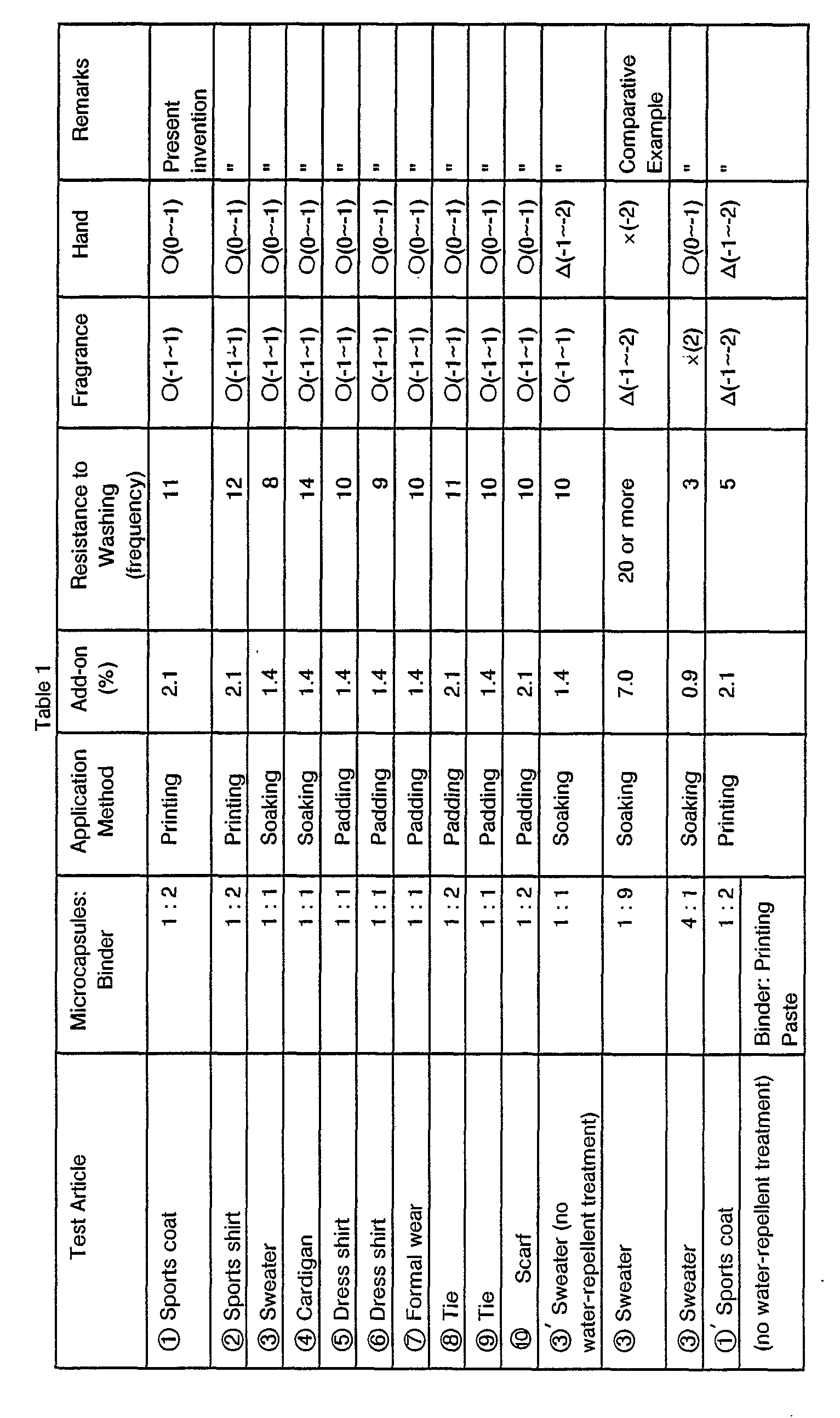
- From the result shown in Table 1, it will be clear that the fragrant apparels according to the present invention have achieved the object of the invention, namely, they possess a durable, pleasant scent as well as a good hand.
- The below described two kinds of stockings were knit and dyed followed by a fixing treatment. Then, those dyed stockings were treated in the same manner as Example 1.
- Leg portion ... 15d/3f false-twisted woolly nylon yarn. Panty and tow portions ... 30d/8f false-twisted woolly nylon yarn.
- Leg portion ... (20x13x13 DCY)x13d/3f raw silk yarn. Panty portion ...(20x30 POY)x30d/8f woolly nylon yarn. Tow portion ... 13d/3f raw silk yarn x 30d/8f woolly nylon yarn x 70d/18f woolly nylon yarn. Coating material: silicone aqueous coating material, Shin-Estu Silicone KM-2002T (trade name of an organopolysiloxane prepolymer emulsion manufactured by Shin-Etsu Chemical Co., Ltd.) Buffering agent: Ultra MT (trade name of sodium phosphate based buffering agent manufactured by Mitejima Kagaku Kogyo Ltd.). Softening agent; durable water absorbing softener, San Softener TAFF A, San Softener TAFF B and CAT F-50 (manufactured by Sanyo Chemical Industries Ltd.) ... ... ... 2% owf.
- The test for resistance to washing was carried out in accordance with JIS L 0217, No. 103 and determined by the washing frequency until fragrance has vanished. Further, the evaluation of the fragrance was marked by ten panelists into five grades (emitting optimal fragrance ... 0, strong ... + 1 and too strong ... + 2, and weak ... -1 and too weak ... -2) and their mean values were adopted. Alternatively, with regards to the hand, only those felt by ten panelists to be particularly inferior were checked and the number of checks was present.
- The result is shown in Table 2.

- From the result, it will be clear that the fragrant panty hoses according to the present invention have achieved the object of the invention, namely, they possess a durable, pleasant scent as well as a good hand.
- In Examples below, test methods for various properties were as follows:
- (1) Tearing strength...JIS L 1096, Method D.
- (2) Resistance to washing...JIS L 0217, No. 103.
- (3) Resistance to dry cleaning...JIS L 0217, No. 401.
- (4) Fragrance... marked by ten panelists into the following six grades and presented by their means values.
- 5: optimal scent,
- 4: a little decreased,
- 3: about a half,
- 2: sensible a litte,
- 1: hardly sensible, and
- 0: no scent.
- (5) Discoloration K/S concentration.
- K/S = (1 - R)2/2R
- wherein R is a maximum absorption wavelength in spectrophotometer.
- O: variation of K/S concentration of less than 3%,
- A:variation of K/S concentration of 3-10%, and
- x: variation of K/S concentration of more than 10%.
- A printed cotton plain weave fabric having a weight of 70 g/m2 and a yarn density of Ne 60 warp x Ne 60 weft being 90x88/inch was obtained through conventional scouring, bleaching, mercerizing and printing processes.
- This printed fabric was padded at a pickup rate of 70% with an aqueous treating bath containing 3% by weight of Bicron 29 (trade name of a cationic softening agent manufactured by Ipposha Oil Industries Co., Ltd.) and 1% by weight of Light-Silicone R-167 (trade name of a silicone based softening agent manufactured by Kyoeisha Yushi, Ltd.) and then dried at 130° C for 1 minute.
- On the other hand, 1 % by weight of an aqueous dispersion containing 46% by weight of microcapsules with a particle diameter of 5-15 u. (average 10 µ) composed of an external wall of a urea-formaldehyde resin enclosing 91% by weight of Fragrance BA-7985 (trade name of Jasmine type synthetic fragrance manufactured by Takasago International Corp.), and 3% by weight of an organopolysiloxane prepolymer emulsion, KM-2002T, were incorporated into water to prepare an aqueous treating liquid. After padding the above treated fabric at a pickup rate of 70% by weight with this aqueous treating liquid, drying at 120°C for 2 minutes was conducted.
- The test result of tearing strength, durability of the fragrance and discoloration of the obtained cotton plain weave fabric is shown in Table 3.
- One percent by weight of an aqueous dispersion containing 46% by weight of microcapsules with a particle diameter of 5-15 µ (average 10 u) composed of an external wall of a urea-formaldehyde resin enclosing 91% by weight of Fragrance' BA-7985, and 3% by weight of Voncoat R-3020 (trade name of an acrylic emulsion manufactured by Dainippon Ink & Chemicals Co., Ltd.) were incorporated into water to prepare an aqueous treating bath.
- The same cotton plain weave fabric as that used in Example 3 was padded at a pickup rate of 70% by weight with this aqueous treating bath, and dried at 120 °C for 2 minutes.
- The test result of tearing strength, durability of the fragrance and discoloration of the obtained cotton plain weave fabric is shown in Table 3.
- The test fabric obtained in Example 3 was continually subjected to a further heat setting at 1500 °C for 3 minutes.
- The test result of tearing strength, durability of the fragrance and discoloration of the obtained cotton plain weave fabric is also shown in Table 3.

- A printed Fuji silk plain weave fabric having a weight of 62 g/m2 and a yarn density of N 140/2 spun silk warp x N 66 spun silk weft being 114x89/inch was obtained through conventional scouring, bleaching, mercerizing and printing processes.
- This printed plain weave fabric was padded at a pickup rate of 80% with an aqueous treating bath containing 5% by weight of Silicolan ES-10 (trade name of a silicone based softening agents manufactured by Ipposha Oil Industries Co., Ltd.) and then dried at 130°C for 1 minute.
- On the other hand, a printing paste having a viscosity of 6800 cps (measured with BM type viscometer at 20 C) was further prepared from 1 % by weight of an aqueous dispersion containing 48% by weight of microcapsules with a particle diameter of 4-14 µ (average 9.5 µ composed of an external wall of a urea- . formaldehyde resin enclosing 89% by weight of sandalwood oil (a synthetic, mixed perfume manufactured by Takasago International Corporation), 5% by weight of KM-2002T and 94% by weight of an emulsion paste (a printing paste formulated with kerosine oil, water and polyethylene glycol distearate in a proportion of 50/50/2). Using the resulting printing paste containing the above microcapsules and flat screens of 120 mesh, the above treated print fabric was screen printed and then dried at 130 C for 1 minute.
- With regard to the resultant Fuji silk fabric, the test result of tearing strength, durability of the fragrance and discoloration is shown in Table 4.
- A printing paste having a viscosity of 7200 cps (measured with BM type viscometer at 20 C) was prepared from 1% by weight of an aqueous dispersion containing 48% by weight of microcapsules with a particle diameter of 4-14 µ (average 9.5 µ composed of an external wall of a urea-formaldehyde resin enclosing 89% by weight of sandalwood oil (a synthetic, mixed perfume, manufactured by Takasago International Corporation), 5% by weight of Rikensol A-105 (a trade name of an acrylate based binder, manufactured by Mikiriken Industry Co., Ltd.) and 94% by weight of the same emulsion paste as that used in Example 5. Using the resulting printing paste containing the above microcapsules and flat screens of 120 mesh, the same Fuji silk fabric as that used in Example 5 was screen-printed and then dried at 130" C for 1 minute.
- With regard to the obtained Fuji silk fabric, the test result of tearing strength, durability of the fragrance and discoloration is shown in Table 4.
- The test fabric obtained in Example 5 was continually subjected to a further heat setting at 150 C for 3 minutes.
- With regard to the obtained Fuji silk fabric, the test result of tearing strength, durability of the fragrance and discoloration is shown in Table 4.

- An Ne 36 cotton/acrylic, 50/50 blended yarn was scoured, bleached and dyed in accordance with conventional processes. Using the above yarn, a sweater, cardigan and skirt were knit and sewn.
- The sweater, etc. were soaked for 30 minutes in an aqueous treating bath containing 1 % by weight of Silicolan ES-10 and 2% by weight of Yodosol PE-400 (trade name of a polyethylene emulsion manufactured by Kanebo NSC, Ltd.), and centrifuged to dewater to a pickup rate of 95% by weight, followed by drying at 80 C for 20 minutes.
- On the other hand, 0.7% by weight of an aqueous dispersion containing 52% by weight of microcapsules having a particle diameter of 12-18 µ (average 15 µ composed of an external wall of a melamine-formaldehyde resin enclosing 90% by weight of a lemon lime type perfume (a synthetic, mixed perfume manufactured by Takasago International Corporation) and 2% by weight of KM-2002L-1 (trade name of an organopolysiloxane prepolymer emulsion manufactured by Shin-Etsu Chemical Co., Ltd.) were incorporated into water to prepare an aqueous treating bath. The above treated sweater, etc. were soaked in this aqueous treating bath for 1 minute and then centrifuged to dewater to a pickup rate of 80% by weight. After setting style, the sweater, etc. were dried in an oven drier at 95 ° C for 10 minutes.
- With regard to the resulting sweater, cardigan and skirt, the test result of resistance to washing of fragrance is shown in Table 5.

- A dyed cotton plain weave fabric having a weight of 70 g/m2 and a yarn density of Ne 60 warp x Ne 60 weft being 90x88/inch was obtained through conventional scouring, bleaching, mercerizing and dyeing processes.
- On the other hand, three kinds of printing pastes (A), (B) and (C) were prepared from (A) 0.2%, (B) 1.0% and (C) 3.0%, by weight, respectively, of an aqueous dispersion containing 47% by weight of microcapsules with a particle diameter of 5-15 µ (average 10 u.) composed of an external wall of a urea-formaldehyde resin enclosing 92% by weight of Fragrance SH-3037 (trade name of synthetic lavender type perfume manufactured by Takasago International Corporation), 5% by weight of KM-2002L-1 and (A) 94.8%, (B) 94% and (C) 92%, by weight, respectively, of a pressure absorbing agent comprising 5% by weight of sodium polyacrylate having a molecular weight of 720,000.
- The aforementioned dyed cotton plain weave fabric was screen-printed with each of the above printing pastes by a 120 mesh flat screen and then dried at 130 °C for 1 minute.
- The test result of tearing strength and durability of the fragrance of the obtained cotton plain weave fabric is shown in Table 6. Additionally, magnified views of fibers in respective cotton plain weave fabrics are shown in Fig. 2, (A), (B) and (C).
- A printing paste having a viscosity of 5800 cps (measured with BM type viscometer at 20 C) was prepared from 1% by weight-of an aqueous dispersion containing 47% by weight of microcapsules with a particle diameter of 5~15 µ (average 10 µ) composed of an external wall of a urea-formaldehyde resin enclosing 92% by weight of Fragrance SH-3037, 5% by weight of Binder-LE-25 (trade name of an acrylic binder manufactured by Hayashi Chemicals Industry Co., Ltd.) and 94% by weight of an aqueous sizing agent comprising 5% by weight of Fine Gum HE (trade name of a carboxy methyl cellulose manufactured by Dai-ichi Kogyo Seiyaku Co., Ltd.).
- The same cotton plain weave fabric as that used in Example 8 was screen-printed with the above printing paste by a 120 mesh flat screen and then dried at 130 C for 1 minute.
- The test result of tearing strength and durability of the fragrance and of the obtained cotton plain weave fabric is shown in Table 6. Additionally, a magnified view of fibers in the cotton plain weave fabric after the treatment is shown in Fig. 3.

- One and five tenth percent by weight of an aqueous dispersion containing 52% by weight of microcapsules with a particle diameter of 8-18 µ (average 12 µ composed of an external wall of a melamine-formaldehyde resin enclosing 88% by weight of a musk type perfume (a synthetic perfume manufactured by Takasago International Corporation), 3% by weight of KM-2002T and 10% by weight of a pressure absorbing agent comprising 5% by weight of a C17H35 alkyl terminated polyethylene glycol having a molecular weight of 22,000, were incorporated into water to prepare an aqueous treating bath.
- The same Fuji silk plain weave fabric as that used in Example 5 was padded at a pickup rate of 80% by weight with the above resultant treating bath and then dried at 120 C for 2 minutes.
- The test result of tearing strength and durability of the fragrance of the obtained Fuji silk fabric is shown in Table 7.
- One and five tenth percent by weight of an aqueous dispersion containing 52% by weight of microcapsules with a particle diameter of 8-18 µ (average 12 µ composed of an external wall of a melamine-formaldehyde resin enclosing 88% by weight of a musk type perfume (a synthetic perfume manufactured by Takasago International Corporation) and 3% by weight of Voncoat R-136 (trade name of an acrylic binder manufactured by Dainippon Ink & Chemicals Co., Ltd.) were incorporated into water to prepare an aqueous treating bath.
- The same Fuji silk plain weave fabric as that used in Example 5 was padded at a pickup rate of 80% by weight with the above resultant treating bath and then dried at 120 °C for 2 minutes.
- The test result of tearing strength and durability of the fragrance of the obtained Fuji silk fabric is also shown in Table 7.
- The test fabric obtained in Comparative Example 4 was continually subjected to a further heat treatment at 150° C for 3 minutes.
- With regard to the obtained Fuji silk fabric, the test result of tearing strength and durability of the fragrance is also shown in Table 7.
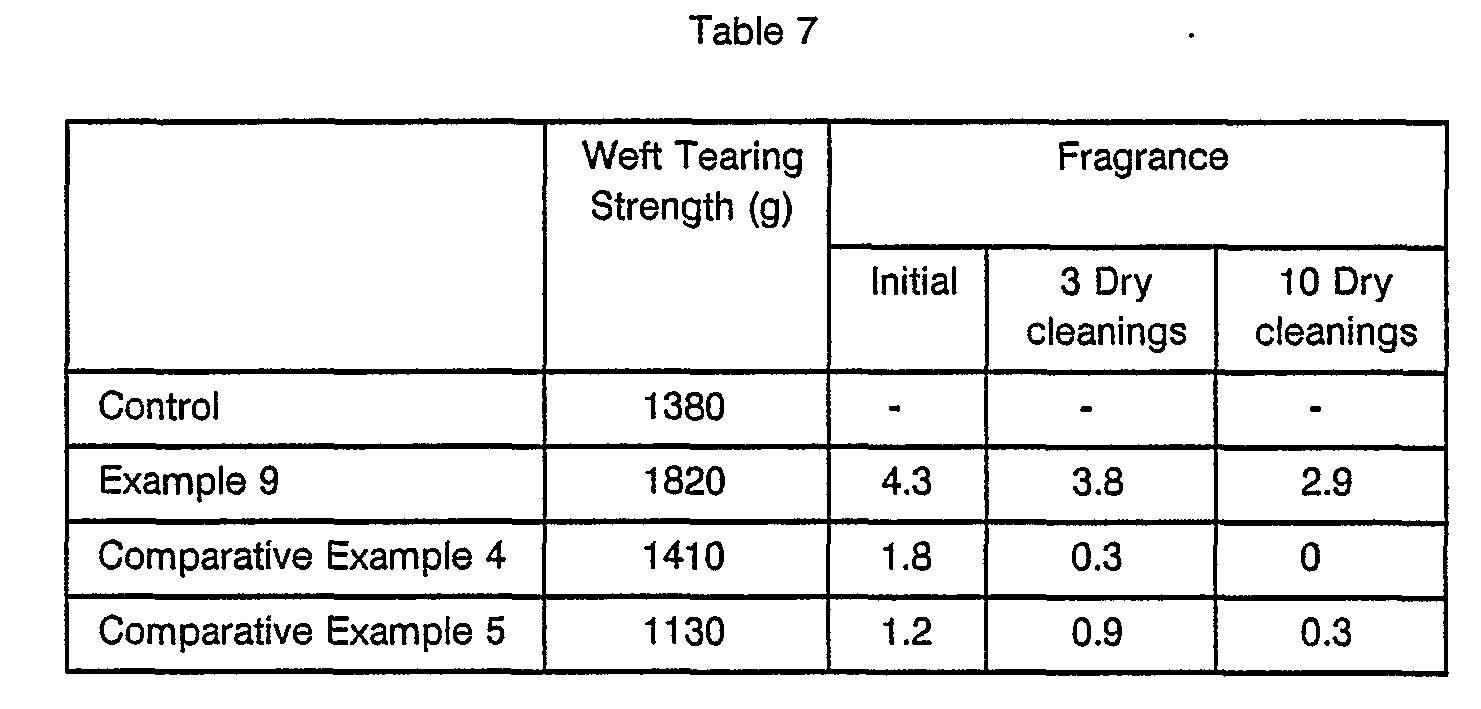
- A dyed plain weave 75% cotton and 25% polyester blend fabric, having a weight of 82 g/m2, a yarn density of Ne 60 warp x Ne 60 weft being 96x72/inch was obtained through conventional scouring, bleaching, mercerizing, heat-setting and dyeing processes.
- This plain weave fabric was treated in the same manner as that in Example 8.
- The test result of tearing strength and durability of the fragrance of the obtained plain weave fabric is shown in Table 8.

- A dyed cotton plain weave fabric having a weight of 108 g/m2, a yarn density of Ne 40 warp x Ne 40 weft being 90x75/inch was obtained through conventional scouring, bleaching, mercerizing and dyeing processes.
- On the other hand, three kinds of printing pastes (A), (B) and (C) were prepared from (A) 0.2%, (B) 0.5% and (C) 2.0%, by weight, respectively, of an aqueous dispersion containing 48% by weight of microcapsules with a particle diameter of 7-16 a (average 12 µ) composed of an external wall of a melamine-formaldehyde resin enclosing 93% by weight of Fragrance BA-9185 (trade name of a citrus type synthetic perfume manufactured by Takasago International Corp.), 5% by weight of Elastron M-2076 (trade name of a blocked isocyanate of polysaccharide emulsion manufactured by Dai-ichi Kogyo Seiyaku Co., Ltd.), 0.5% by weight of Elastron Cayalyst 32 (trade name of a fatty acid metallic salt catalyst manufactured by Dai-ichi Kogyo Seiyaku Co., Ltd.) and (A) 94.3%, (B) 94.0% and (C) 92.5%, by weight, respectively, of an aqueous pressure absorbing agent comprising 5% by weight of sodium polyacrylate having a molecular weight of 720,000.
- After adjusting the pH of the resulting printing pastes with sodium bicarbonate to 9, the aforementioned dyed cotton plain weave fabric was screen-printed with each of the above printing pastes by a 120 mesh flat screen and then heat-treated at 120 C for 1 minute and at 130° C for 2 minutes and 30 seconds.
- The test result of tearing strength and durability of the fragrance of the obtained cotton plain weave fabric is shown in Table 9.
- Three kinds of printing pastes (A), (B) and (C) were prepared from (A) 0.2%, (B) 0.5% and (C) 2.0%, by weight, respectively, of an aqueous dispersion containing 48% by weight of microcapsules with a particle diameter of 7-16 µ (average 12 µ) composed of an external wall of a melamine-formaldehyde resin enclosing 93% by weight of Fragrance BA-9185, 5% by weight of Elastron M-2076, 0.5% by weight of Elastron Cayalyst 32 and (A) 94.3%, (B) 94.0% and (C) 92.5% by weight, respectively, of a sizing agent comprising 5% by weight of Fine Gum HE.
- After adjusting the pH of the resulting printing pastes with sodium bicarbonate to 9, the same dyed cotton plain weave fabric as that used in Example 11 was screen-printed with each of the above printing pastes by a 120 mesh flat screen and then dried at 120" C for 1 minute.
- The test result of tearing strength and durability of the fragrance of the obtained cotton plain weave fabric is also shown in Table 9.
- Three kinds of printing pastes (A), (B) and (C) were prepared from (A) 0.2%, (B) 0.5% and (C) 2.0%, by weight, respectively, of an aqueous dispersion containing 48% by weight of microcapsules with a particle diameter of 7-16 4 (average 12 µ) composed of an external wall of a melamine-formaldehyde resin enclosing 93% by weight of Fragrance BA-9185, 5% by weight of Voncoat R-3020 and (A) 94.8%, (B) 94.5% and (C) 93.0%, by weight, respectively, of an aqueous pressure absorbing agent comprising 5% by weight of sodium polyacrylate having a molecular weight of 720,000.
- The same dyed cotton plain weave fabric as that used in Example 11 was screen-printed with each of the above printing pastes by a 120 mesh flat screen and then dried at 120' C for 1 minute.
- The test result of tearing strength and durability of the fragrance of the obtained cotton plain weave fabric is also shown in Table 9.

- A dyed Fuji silk plain weave fabric having a weight of 62 g/m2, a yarn density of N 140/2 spun silk warp x N 66 spun silk weft being 114x89/inch was obtained through conventional scouring, bleaching, mercerizing and dyeing processes.
- On the other hand, 1 % by weight of an aqueous dispersion containing 46% by weight of microcapsules with a particle diameter of 5-15 µ (average 10 µ) composed of an external wall of a urea-formaldehyde resin enclosing 91% by weight of Fragrance BA-7985, 5% by weight of Elastron M-1039B (trade name of a blocked isocyanate of fluorinated acrylic emulsion manufactured by Dai-ichi Kogyo Seiyaku Co., Ltd.), 0.5% by weight of
Elastron Cayalyst 32 and 5% by weight of a pressure absorbing agent comprising 5% by weight of a C17H35 alkyl terminated polyethylene glycol having a molecular weight of 22,000, were incorporated into water to prepare an aqueous treating liquid. After adjusting the pH of the resulting treating bath with sodium bicarbonate to 9, the aforementioned dyed Fuji silk plain weave fabric was padded at a pickup rate of 60% by weight with the treating bath and then dried at 120 °C for 2 minutes, followed by a heat treatment at 130° C for 2 minutes. - The test result of tearing strength and durability of the fragrance of the obtained Fuji silk fabric is shown in Table 10.
- One percent by weight of an aqueous dispersion containing 46% by weight of microcapsules with a particle diameter of 5-15 a (average 10 µ) composed of an external wall of a urea-formaldehyde resin enclosing 91% by weight of Fragrance BA-7985, 5% by weight of Voncoat R-510 (trade name of an acrylic binder manufactured by Dainippon Ink and Chemicals Co., Ltd.), and 5% by weight of a pressure absorbing agent comprising 5% by weight of a C17H35 alkyl terminated polyethylene glycol having a molecular weight of 22,000, were incorporated into water to prepare an aqueous treating bath.
- The same Fuji silk fabric as that used in Example 11 was padded at a pickup rate of 70% by weight with the above obtained treating bath and then dried at 120° C for 2 minutes, followed by a heat treatment at 130° C for 2 minutes.
- The test result of tearing strength and durability of the fragrance of the obtained Fuji silk fabric is also shown in Table 10.

- Three kinds of printing pastes (A), (B) and (C) were prepared from (A) 0.2%, (B) 1.0% and (C) 3.0%, by weight, respectively, of an aqueous dispersion containing 46% by weight of microcapsules with a particle diameter of 5-15 µ (average 10 µ) composed of an external wall of a urea-formaldehyde resin enclosing 91% by weight of Fragrance BA-7985, 5% by weight of Yodosol A-1209 (trade name of an acrylic emulsion binder manufactured by Kanebo NSC, Ltd.), and (A) 94.8%, (B) 94.0% and (C) 92.0%, by weight, respectively, of an aqueous pressure absorbing agent comprising 5% by weight of sodium polyacrylate having a molecular weight of 720,000.
- The same dyed cotton plain weave fabric as that used in Example 11 was screen-printed with each of the above printing pastes by a 120 mesh flat screen and then dried at 130" C for 1 minute.
- The test result of tearing strength and durability of the fragrance of the obtained cotton plain weave fabric is shown in Table 11.
- Three kinds of printing pastes (A), (B) and (C) were prepared from (A) 0.2%, (B) 1.0% and (C) 3.0%, by weight, respectively, of an aqueous dispersion containing 46% by weight of microcapsules with a particle diameter of 5-15 µ (average 10 µ) composed of an external wall of a urea-formaldehyde resin enclosing 91% by weight of Fragrance BA-7985, 5% by weight of Yodosol A 1209, and (A) 94.8%, (B) 94.0% and (C) 92.0%, by weight, respectively, of an aqueous sizing agent comprising 5% by weight of Fine Gum HE (trade name of a carboxy methyl cellulose, manufactured by Dai-ichi Kogyo Seiyaku Co., Ltd.).
- The same dyed cotton plain weave fabric as that used in Example 11 was screen-printed with each of the above printing pastes by a 120 mesh flat screen and then dried at 130 C for 1 minute.
- The test result of tearing strength and durability of the fragrance of the obtained cotton plain weave fabric is also shown in Table 11.

- Two percent by weight of an aqueous dispersion containing 48% by weight of microcapsules with a particle diameter of 4-14 µ (average 9.5 u.) composed of an external wall of a urea-formaldehyde resin enclosing 89% by weight of sandalwood oil (a synthetic perfume, manufactured by Takasago International Corporation), 5% by weight of Superflex E-2000 (trade name of a polyurethane emulsion, manufactured by Dai-ichi Kogyo Seiyaku Co., Ltd.), and 8% by weight of a pressure absorbing agent comprising 5% by weight of a C17H35 alkyl terminated polyethylene glycol having a molecular weight of 22,000, were incorporated into water to prepare an aqueous treating bath.
- The same printed Fuji silk fabric as that used in Example 5 was padded at a pickup rate of 70% by weight with the above obtained treating bath and then dried at 120°C for 2 minutes, followed by a heat treatment at 130 °C for 1 minute.
- The test result of tearing strength and durability of the fragrance of the obtained Fuji silk fabric is shown in Table 12.
- The same printed Fuji silk fabric as that used in Example 5 was padded at a pickup rate of 70% by weight with an aqueous treating bath comprising 2% by weight of an aqueous dispersion containing microcapsules composed of an external wall of a urea-formaldehyde resin enclosing 89% by weight of sandalwood oil (a synthetic perfume manufactured by Takasago International Corporation) and 5% by weight of Superflex E-2000, and then dried at 120 C for 2 minutes, followed by a heat treatment at 130 C for 1 minute. The test result of tearing strength and durability of the fragrance of the obtained Fuji silk fabric is also shown in Table 12.

- A printed cotton plain weave fabric having a weight of 108 g/m2 and a yarn density of Ne 40 warp x Ne 40 weft being 90x75/inch was obtained through conventional scouring, bleaching, mercerizing and dyeing processes.
- On the other hand, three kinds of printing pastes (A), (B) and (C) were prepared from (A) 0.2%, (B) 1.0% and (C) 3.0%, by weight, respectively, of an aqueous dispersion containing 46% by weight of microcapsules with a particle diameter of 5-15 µ (average 10 µ) composed of an external wall of a urea-formaldehyde resin enclosing 91 % by weight of Fragrance BA-7985, 5% by weight of Yodosol PE-400 and (A) 95%, (B) 94.0% and (C) 92.0%, by weight, respectively, of an aqueous pressure absorbing agent comprising 5% by weight of sodium polyacrylate having a molecular weight of 720,000.
- The abovementioned dyed cotton plain weave fabric was screen-printed with each of the above printing pastes by a 120 mesh flat screen and then dried at 130 ° C for 1 minute.
- The test result of tearing strength and durability of the fragrance of the obtained cotton plain weave fabric is shown in Table 13.

- Two percent by weight of an aqueous dispersion containing 48% by weight of microcapsules with a particle diameter of 4-14 µ (average 9.5 µ) composed of an external wall of a urea-formaldehyde resin enclosing 89% by weight of sandalwood oil (a synthetic perfume manufactured by Takasago International Corporation), 5% by weight of Finetex ES-675 (trade name of a polyester emulsion manufactured by Dainippon Ink & Chemicals Co., Ltd.) and 8% by weight of a pressure absorbing agent comprising 5% by weight of a C17H35 alkyl terminated polyethylene glycol having a molecular weight of 22,000, were incorporated into water to prepare an aqueous treating bath.
- The same printed Fuji silk plain weave fabric as that used in Example 5 was padded at a pickup rate of 70% by weight with above obtained treating bath and then dried at 120° C for 2 minutes, followed by a heat treatment at 130' C for 1 minute.
- The test result of tearing strength and durability of the fragrance of the obtained Fuji silk fabric is shown in Table 14.

- A 2/2 twill fabric having a yarn density of warp x weft being 110x90/inch was woven with a warp of 75d/72f polyester yarn and a weft of 100d/50f polyamide/polyester fibrillating type composite filament yarn having a cross-sectional shape as shown in Fig. 1, (8).
- The above fabric was pad-nipped at a pickup rate of 60% by weight with an aqueous solution (30°C) containing 10% by weight of benzyl alcohol and 1% by weight of Sunmorl BK conc. (trade name of a emulsifier manufactured by Nikka Chemicals Co., Ltd.) and left to stand at room temperature for 10 minutes. Then, after repeating only the nipping 5 times, the fabric was washed with warm water at 70 ° C for about 2 minutes and dried. The weft yarns of the fabric were fibrillated into a fineness of monofilaments of about 0.1-0.2 denier and the yarn density of the fabric became 170x100/inch (the number of the weft was counted as original yarn). This fabric was heat-set at 190°C and dyed to provide a fibrous structure to be used in the present invention.
- On the other hand, microcapsules having a diameter of about 5.10 µ, consisting of 20% by weight of an external wall of a urea-formaldehyde resin and 80% by weight of an internal phase of fragrant oil were prepared.
- The above obtained fibrous structure was pad-nipped at a pickup rate of 60% by weight with an aqueous dispersion containing 1% by weight of the microcapsules and 0.5% by weight of Elastron F-29 (trade name of a urethane elastomer manufactured by Dai-ichi Kogyo Seiyaku Co., Ltd.), and dried at 120 C.
- The thus treated fibrous structured was tested for the durability of the fragrance by repeatedly washing in accordance with JIS L 1042. The scent was clearly recognized until after 8 washings. For the purpose of comparison, a polyester twill fabric containing no fibrillating type composite fibers was treated in the same manner as the above. Then, the scent was recognized after one washing but hardly recognized after two washings.
- Using a 40d/25f fibrillating type composite filament yarn, an interlock knitted fabric (wale x course = 50x60) was knit with a 40 gauge circular knitting machine.
- The above knitted fabric was pad-nipped at a pickup rate of 100% by weight) with an aqueous solution (30 C) containing 20% by weight of benzyl alcohol and 2.0% by weight of an emulsifier. The above pad- nipping was conducted once again. Then, the fabric was soaked for 20 minutes in hot water at 80' C under a relaxed state to effect shrinking of the fabric and removal of benzyl alcohol, and then dried. The areal shrinkage of the fabric was 60%.
- On the other hand, an aqueous dispersion of 0.5% by weight of the same microcapsules as those used in Example 17 (not containing a binder resin) was put into a pan. The bottom of a horizontal application steel roll engraved with fine grooves was dipped in the aqueous dispersion and a rubber roll was placed parallelly upon the steel roll to form a nip.
- By passing through the nip, the above knitted fabric was applied with the mirocapsule aqueous dispersion and continuously dried at 100 C.
- The durability of the fragrance was tested in the same manner as Example 17 and the scent was clearly recognized after 5 washings. For the purpose of comparison, a polyester knitted fabric knit with an ordinary 40d/25f polyester filament yarn, i.e., not fibrillating type composite filament yarn, was tested and substantially no scent was recognized.
- The yarns listed hereinbelow were subjected to a water repellent treatment, according to a conventional process, with the water repellent softening agent used in Example 1. Further, 2 g/t aqueous dispersion of the perfume containing microcapsules was admixed with 5 g/t of the silicone aqueous emulsion both used in Example 1. Then, the yarns were soaked in the above mixture at a microcapsule pickup of 0.45% by weight and dried at 90 C for 20 minutes, followed by a dry heat treatment at 130 C for 30 seconds. The wool yarns for hand knitting or for fancywork to which the microcapsules containing the perfume were adhered were forwarded to finishing and setting steps to prepare fragrant wool yarns for hand knitting or for fancywork, according to a conventional process.
- ① Wool yarn for hand knitting composed of a 12 count/4 ply woolly yarn.
- ② Wool yarn for hand knitting composed of an 18 count/4 ply woolly yarn.
- ③ Woolly yarn for hand knitting composed of a 15 count/4 ply blend yarn of 50% wool and 50% porous acrylic.
- ④ Yarn for fancywork composed of a 16/3 Ne cotton yarn.
- ⑤ Yarn for fancywork composed of a 16/3 Ne blend yarn of 50% cotton and 50% porous acrylic.
- ⑥ Yarn for lacework composed of a 50/3 Ne cotton yarn.
- These yarns were tested for resistance to washing in accordance with JIS L 0217, No. 106, and hand in the same manner as Example 1. The result is shown in Table 15.

- From the result shown in Table 15 above, it will be clear that the fragrant wool yarns for hand knitting or yarns for fancywork according to the present invention have achieved the object of the invention, namely, they possess a durable, pleasant scent as well as a good hand.
- The below described five kinds of dyed fabrics were subjected to a water repellent treatment followed by a fragrant microcapsule adhering treatment in the same manner as those in Example 1 and then dried and set by finishing according to conventional processes, to produce fragrant fabrics.
- ① A 28
gauge 2 bar fancy fabric knit with the back of a 75d/36f circular cross-sectional polyester yarn and the front of 3 kinds of polyester yarns, circular cross-sectional, trilobal cross-sectional and cation dyeable, respectively. - ② A French back napped fabric woven with the back of a 75d/36f circular cross-sectional polyester yarn and the front of 3 kinds of polyester yarns, circular cross-sectional, trilobal cross-sectional and cation dyeable, respectively.
- ③ A velour woven with the back and middle of a 75d/36f circular cross-sectional polyester yarn and the front of 2 kinds of polyester yarns, circular cross-sectional and cation dyeable.
- ④ A stretchable twill fabric woven with the back and middle of a 50d/24f circular cross-sectional PBT texturized yarn and a 50d/24f circular cross-sectional polyester yarn, respectively, and the front of a 75d/36f circular cross-sectional polyester yarn.
- ⑤ A raschel lace knit with a 75d/36f circular cross-sectional polyester yarn and an insertion yarn of an Ne 60/3 ply-twisted polyester/cotton blend yarn.
- Then, the
above fabrics fabric ④ into a side material and thefabrics 
- Using nylon-6 staples having a fineness of 1.0 denier and a fiber length of 51 mm, a web was prepared with a carding machine and a cross-lapper. This web was then needle-punched to provide a three dimensional non-woven fabric having a weight of 150 g/m2, a thickness of 1.0 mm and an apparent density of 0.15 g/cm3.
- This nonwoven fabric was impregnated with a dimethyl formamide solution of 16% polyurethane elastomer at a solution pickup rate of about 500% based on the weight of the fabric, and then soaked in a coagulating bath at 40°C (water: dimethyl formamide = 80:20 by weight) to coagulate the polyurethane. Then after desolvating by soaking in warm water at 60
C 2 hours, hot air drying at 120 C was conducted to provide a substrate loaded with a polyurethane elastomer. - The thus obtained substrate had a weight of 280 g/m2, a thickness of 1.0 mm and an apparent density of 0.28 g/cm3.
- Then, microcapsules having a particle diameter of 5-10 µ average 8 µ) composed of an external wall of a urea-formaldehyde resin encapsulating 80% by weight of Fragrance BA-7985 (a jasmine type synthetic perfume) were admixed with a dimethyl formamide solution of 25% polyurethane elastomer same as the above in an amount of 6% based on the weight of the polyurethane elastomer. The resulting solution was applied by doctor-coating onto the surface of the aforementioned substrate at a coating ratio of 400 g/m2 and then soaked in a coagulating bath (water: dimethyl formamide = 80:20 by weight) at 40°C for 30 minutes followed by soaking in warm water at 60 C for 2 hours, thoroughly washing with water and hot air drying at 100 C, to provide a synthetic leather substitute having a grain side.
- In accordance with the present invention, synthetic leather substitutes excellent in fragrance can be manufactured without requiring any special contrivance in process steps such as a coagulation step or the like. Furthermore, the obtained synthetic leather substitutes compare favorably with those not incorporated with fragrant microcapsules, in physical properties such as flexing resistance.
Claims (19)
Applications Claiming Priority (14)
| Application Number | Priority Date | Filing Date | Title |
|---|---|---|---|
| JP2344488A JPH01201501A (en) | 1988-02-02 | 1988-02-02 | Fragrant stocking and production thereof |
| JP23444/88 | 1988-02-02 | ||
| JP88669/88 | 1988-04-11 | ||
| JP63088669A JPH01260066A (en) | 1988-04-11 | 1988-04-11 | Aromatic woven and knitted fabric and aromatic cloth |
| JP10576688A JPH01280080A (en) | 1988-04-27 | 1988-04-27 | Method for durable aromatic treatment |
| JP105766/88 | 1988-04-27 | ||
| JP115617/88 | 1988-05-12 | ||
| JP11561788A JPH01292183A (en) | 1988-05-12 | 1988-05-12 | Durable fragrance treatment |
| JP121140/88 | 1988-05-18 | ||
| JP12114088A JPH026671A (en) | 1988-05-18 | 1988-05-18 | Persistent perfume-imparting treatment |
| JP122299/88 | 1988-05-19 | ||
| JP63122299A JPH026672A (en) | 1988-05-19 | 1988-05-19 | Persistent perfume-imparting treatment |
| JP145687/88 | 1988-06-15 | ||
| JP63145687A JPH0749628B2 (en) | 1988-06-15 | 1988-06-15 | Method for producing a fiber structure having a durable odor |
Publications (2)
| Publication Number | Publication Date |
|---|---|
| EP0328937A2 true EP0328937A2 (en) | 1989-08-23 |
| EP0328937A3 EP0328937A3 (en) | 1990-07-18 |
Family
ID=27563996
Family Applications (1)
| Application Number | Title | Priority Date | Filing Date |
|---|---|---|---|
| EP19890101701 Withdrawn EP0328937A3 (en) | 1988-02-02 | 1989-02-01 | Fibrous structure having a durable fragrance and a process for preparing the same |
Country Status (2)
| Country | Link |
|---|---|
| US (2) | US4882220A (en) |
| EP (1) | EP0328937A3 (en) |
Cited By (17)
| Publication number | Priority date | Publication date | Assignee | Title |
|---|---|---|---|---|
| WO1991010772A1 (en) * | 1990-01-18 | 1991-07-25 | British Textile Technology Group | Treating materials |
| EP0581274A1 (en) * | 1992-07-31 | 1994-02-02 | Matsui Shikiso Chemical Co., Ltd | Aroma-imparting method and aroma-emitting textile product |
| EP0782869A1 (en) * | 1996-01-03 | 1997-07-09 | TEBBE, Gerold | Material coated with micro-capsules |
| WO1998023149A1 (en) * | 1996-11-26 | 1998-06-04 | Stephen Baker | Mosquito-repellent band |
| GB2335143A (en) * | 1996-11-26 | 1999-09-15 | Stephen Baker | Mosquito-repellent band |
| WO2001098578A1 (en) * | 2000-06-20 | 2001-12-27 | Primacare S. L. | Textile auxiliary agents |
| FR2829512A1 (en) * | 2001-09-10 | 2003-03-14 | Bayer Ag | Non-woven material for cleaning or protective purposes, is impregnated with substance(s) in microcapsule form |
| WO2003061817A1 (en) * | 2002-01-24 | 2003-07-31 | Bayer Aktiengesellschaft | Coagulates containing microcapsules |
| WO2004048678A1 (en) * | 2002-11-22 | 2004-06-10 | Koninklijke Philips Electronics N.V. | Flexible material including controlled substance release |
| FR2858637A1 (en) * | 2003-08-05 | 2005-02-11 | Inst Rech Appliquee A La Formu | Textile article comprising non-woven support and microcapsules containing active agent, e.g. perfume or deodorant, having optimized thickness and capsule size to inhibit premature release |
| WO2005005712A3 (en) * | 2003-07-14 | 2005-05-12 | Koninkl Philips Electronics Nv | Compound and method of applying additives to fabrics, microcapsule, and method for preparing said compound |
| EP1533415A1 (en) * | 2003-11-20 | 2005-05-25 | INTERNATIONAL FLAVORS & FRAGRANCES INC. | Melamine-formaldehyde microcapsule slurries for fabric article freshening |
| EP1767185A1 (en) * | 2005-09-23 | 2007-03-28 | Takasago International Corporation | Core shell capsules containing an oil or waxy solid |
| ES2292339A1 (en) * | 2006-03-21 | 2008-03-01 | M. Estrella Matas Seguiri | Obtaining method for material, involves making fabric by incorporating fixing hair, and also incorporates multiplicity of microcapsules, which contains environmental fluid substances breakable by friction |
| EP1970880A1 (en) * | 2007-03-13 | 2008-09-17 | Jan Overwater | Label of a fibrous sheet containing a fragrant substance |
| CN112342783A (en) * | 2020-12-14 | 2021-02-09 | 浙江灏宇科技有限公司 | All-cotton tribute silk jacquard fabric with lasting fragrance and durable luster and processing method thereof |
| WO2021037487A1 (en) * | 2019-08-30 | 2021-03-04 | Carl Freudenberg Kg | Cleaning article which contains microcapsules |
Families Citing this family (192)
| Publication number | Priority date | Publication date | Assignee | Title |
|---|---|---|---|---|
| US5230958A (en) * | 1987-08-28 | 1993-07-27 | Mcneil-Ppc, Inc. | Hydrophilic polymers for incorporating deodorants in absorbent structures |
| US5246611A (en) * | 1990-05-09 | 1993-09-21 | The Procter & Gamble Company | Non-destructive carriers for cyclodextrin complexes |
| US5384186A (en) * | 1990-05-09 | 1995-01-24 | The Proctor & Gamble Company | Non-destructive carriers for cyclodextrin complexes |
| US5322862A (en) * | 1990-05-22 | 1994-06-21 | Nippon Kayaku Kabushiki Kaisha | Resin molding composition for preventing gnawing damage by animals |
| US5066521A (en) * | 1990-07-02 | 1991-11-19 | Barbara Blair Reiter | Composition and process for coating synthetic fibers |
| US5206080A (en) * | 1991-02-13 | 1993-04-27 | Tree Extracts Research Association | Fragrant non-hollow core-in-sheath type composite staple fiber and textile material containing same |
| US5232612A (en) * | 1991-08-28 | 1993-08-03 | The Procter & Gamble Company | Solid, particulate fabric softener with protected, dryer-activated, cyclodextrin/perfume complex |
| US5236615A (en) * | 1991-08-28 | 1993-08-17 | The Procter & Gamble Company | Solid, particulate detergent composition with protected, dryer-activated, water sensitive material |
| US6630233B1 (en) * | 1992-07-06 | 2003-10-07 | John Levandowski | Device for freshening exhaust from vacuum cleaners |
| US5607754A (en) * | 1993-11-12 | 1997-03-04 | Kimberly-Clark Corporation | Paper web product and method for manufacturing same |
| US5744209A (en) * | 1994-11-01 | 1998-04-28 | Remington Industries, Inc. | Scented mat product and method for making the mat product |
| US5605749A (en) * | 1994-12-22 | 1997-02-25 | Kimberly-Clark Corporation | Nonwoven pad for applying active agents |
| DE19511780A1 (en) * | 1995-03-30 | 1996-10-02 | Giesecke & Devrient Gmbh | Encapsulated fragrance disk and process for making it |
| KR0168621B1 (en) * | 1996-03-28 | 1999-01-15 | 백보현 | New Synthetic Yarn and its manufacturing method |
| US5985774A (en) * | 1997-05-20 | 1999-11-16 | Capel; S. Kea | Rug including a scented filament incorporated therin and method therefor |
| GB9721588D0 (en) * | 1997-10-10 | 1997-12-10 | Du Pont | Textile treatment |
| US6162457A (en) * | 1998-09-08 | 2000-12-19 | Martz; Christine | Personal perfume application method and system |
| EP1203118A1 (en) * | 1999-07-19 | 2002-05-08 | Nano-Tex LLC | Nanoparticle-based permanent treatments for textiles |
| US6500444B1 (en) * | 1999-12-21 | 2002-12-31 | International Flavors & Fragrances Inc. | Continuously fragrance-emitting dry or wet wipe fabric article and method for preparing same |
| KR20020096045A (en) * | 2000-02-29 | 2002-12-28 | 가네가후치 가가쿠 고교 가부시키가이샤 | Synthetic fiber improved in sliminess and method for producing the same |
| US6375966B1 (en) * | 2000-05-26 | 2002-04-23 | Scented Technologies, Llc | Polyurethane/polyurea matrices for the delivery of active agents |
| US20040043212A1 (en) * | 2000-08-05 | 2004-03-04 | Peter Grynaeus | Thermal control nonwoven material |
| US6787679B1 (en) | 2000-10-12 | 2004-09-07 | Joy L. Cantor | Scented adhesive bandage |
| US6477337B1 (en) * | 2000-11-27 | 2002-11-05 | Xerox Corporation | Artificial olfactory system and methods for media sensing and identification |
| US7168232B2 (en) * | 2001-02-21 | 2007-01-30 | Forta Corporation | Fiber reinforcement material, products made thereform, and method for making the same |
| US6753081B1 (en) * | 2001-02-21 | 2004-06-22 | Forta Corporation | Fiber reinforcement material, products made therefrom, and method for making the same |
| DE10117671A1 (en) * | 2001-04-09 | 2002-10-10 | Bayer Ag | Odor-modified leather, comprises a fragrance in microcapsules comprising reaction products of guanidine compounds and polyisocyanates |
| FR2826380B1 (en) * | 2001-06-22 | 2007-03-16 | Nathalie Chetboun | PROCESS FOR ANTI-ACARIAN AND ANTI-MICROBIAL TREATMENT OF MICROENCAPSULATED NATURAL OIL TEXTILE MATERIALS |
| CA2453500C (en) * | 2001-07-13 | 2008-09-23 | 3M Innovative Properties Company | Abrasive item for cleaning with scented abrasive fibres |
| JP4308653B2 (en) * | 2001-09-13 | 2009-08-05 | アンセル・ヘルスケア・プロダクツ・エルエルシー | Microcapsule coating of gloves |
| AU2002359728A1 (en) * | 2001-12-18 | 2003-06-30 | Asa Techwear, Inc. | Waterproof fragrance releasing device and products incorporating same |
| US7805768B2 (en) * | 2002-06-24 | 2010-10-05 | Christine Martz | Liquid penetration shields for outer garments |
| US6681407B2 (en) * | 2002-06-24 | 2004-01-27 | Christine Martz | Waistless underwear alternative secret pants shield |
| EP1571937A4 (en) * | 2002-06-24 | 2008-12-17 | Christine Martz | Waistless underwear alternative secret pants shield |
| US7240375B2 (en) * | 2002-07-24 | 2007-07-10 | Christine Martz | Waistless underwear alternative secret pants shield |
| BR0303954A (en) * | 2002-10-10 | 2004-09-08 | Int Flavors & Fragrances Inc | Composition, fragrance, method for dividing an olfactory effective amount of fragrance into a non-rinse and non-rinse product |
| US7585824B2 (en) | 2002-10-10 | 2009-09-08 | International Flavors & Fragrances Inc. | Encapsulated fragrance chemicals |
| US20040092192A1 (en) * | 2002-11-07 | 2004-05-13 | Reemay, Inc. | Hollow fiber nonwoven sheet for fabric softener substrate |
| US20050112152A1 (en) * | 2003-11-20 | 2005-05-26 | Popplewell Lewis M. | Encapsulated materials |
| US7105064B2 (en) * | 2003-11-20 | 2006-09-12 | International Flavors & Fragrances Inc. | Particulate fragrance deposition on surfaces and malodour elimination from surfaces |
| US20050183205A1 (en) * | 2004-02-20 | 2005-08-25 | Lee Hyo G. | Method of making perfumed socks |
| US20050227907A1 (en) * | 2004-04-13 | 2005-10-13 | Kaiping Lee | Stable fragrance microcapsule suspension and process for using same |
| US20050226900A1 (en) * | 2004-04-13 | 2005-10-13 | Winton Brooks Clint D | Skin and hair treatment composition and process for using same resulting in controllably-releasable fragrance and/or malodour counteractant evolution |
| US20050262646A1 (en) * | 2004-05-28 | 2005-12-01 | Mathias Berlinger | Process for depositing microcapsules into multifilament yarn and the products produced |
| EP1850665A4 (en) * | 2004-10-13 | 2008-08-20 | Efal Chemical Ind Ltd | AGENTS FOR COMBATTING THE CARPOCAPSE OF APPLE AND PEAR IN ORCHARDS |
| US7594594B2 (en) * | 2004-11-17 | 2009-09-29 | International Flavors & Fragrances Inc. | Multi-compartment storage and delivery containers and delivery system for microencapsulated fragrances |
| DE602006013099D1 (en) | 2005-02-17 | 2010-05-06 | Procter & Gamble | COMPOSITION FOR TISSUE CARE |
| ATE455837T1 (en) | 2005-04-18 | 2010-02-15 | Procter & Gamble | DILUTED FABRIC CARE PRODUCTS WITH THICKENERS AND FABRIC CARE PRODUCTS FOR USE IN THE PRESENCE OF ANIONIC INTRUSIONS |
| US20070207174A1 (en) * | 2005-05-06 | 2007-09-06 | Pluyter Johan G L | Encapsulated fragrance materials and methods for making same |
| DE102005030484B4 (en) * | 2005-06-28 | 2007-11-15 | Carl Freudenberg Kg | Elastic nonwoven fabric, process for its preparation and its use |
| US7448494B2 (en) * | 2005-08-10 | 2008-11-11 | Certain Teed Corporation | Loose fill insulation packaged with additive |
| FR2890666A1 (en) * | 2005-09-15 | 2007-03-16 | Arjowiggins Security Soc Par A | Structure for making safety and/or value document, comprises a fibrous material substrate, a surface layer deposited on face of the substrate, substrate heterogeneities, authentication and/or identification information, and a data carrier |
| WO2007057859A2 (en) * | 2005-11-18 | 2007-05-24 | The Procter & Gamble Company | Fabric care article |
| US20070179082A1 (en) * | 2006-01-30 | 2007-08-02 | The Procter & Gamble Company | Dryer-added fabric care articles |
| FR2897617B1 (en) * | 2006-02-20 | 2008-05-16 | Centre Nat Rech Scient | MODIFIED SURFACE CAPSULES FOR GRAFTING ON FIBERS |
| MX2008014212A (en) | 2006-05-05 | 2008-11-14 | Procter & Gamble | Films with microcapsules. |
| US20070270327A1 (en) * | 2006-05-22 | 2007-11-22 | The Procter & Gamble Company | Dryer-added fabric care articles imparting fabric feel benefits |
| US20070275866A1 (en) * | 2006-05-23 | 2007-11-29 | Robert Richard Dykstra | Perfume delivery systems for consumer goods |
| ATE491433T1 (en) * | 2006-08-01 | 2011-01-15 | Procter & Gamble | CARE PRODUCT WITH RELEASE PARTICLES |
| US20080045426A1 (en) * | 2006-08-17 | 2008-02-21 | George Kavin Morgan | Dryer-added fabric care articles imparting malodor absorption benefits |
| CA2675259A1 (en) * | 2007-02-09 | 2008-08-21 | The Procter & Gamble Company | Perfume systems |
| US20090081398A1 (en) * | 2007-09-24 | 2009-03-26 | Gannon Elaine M | Fragrance emitting patch and compact for holding a plurality of such patches |
| US20090078598A1 (en) * | 2007-09-24 | 2009-03-26 | Ricky Ray Burrow | Fragrance emitting patch and compact for holding a plurality of such patches |
| US20090081912A1 (en) * | 2007-09-24 | 2009-03-26 | Ricky Ray Burrow | Fragrance emitting patch |
| EP2055351B1 (en) | 2007-10-29 | 2016-05-25 | The Procter and Gamble Company | Compositions with durable pearlescent aesthetics |
| US20090155560A1 (en) * | 2007-12-17 | 2009-06-18 | Stephane Lefebvre | Scented paper laminated and method for manufacturing same |
| US8361953B2 (en) * | 2008-02-08 | 2013-01-29 | Evonik Goldschmidt Corporation | Rinse aid compositions with improved characteristics |
| US20100047511A1 (en) * | 2008-08-25 | 2010-02-25 | Gannon Elaine M | Fragrance emitting patch |
| US20100047293A1 (en) * | 2008-08-25 | 2010-02-25 | Gannon Elaine M | Fragrance emitting patch |
| US20100075561A1 (en) * | 2008-09-22 | 2010-03-25 | Burrow Ricky R | Fragrance emitting patch |
| EP2362765B1 (en) * | 2008-12-01 | 2020-04-08 | The Procter and Gamble Company | Perfume systems |
| US8754028B2 (en) * | 2008-12-16 | 2014-06-17 | The Procter & Gamble Company | Perfume systems |
| EP2204155A1 (en) | 2008-12-30 | 2010-07-07 | Takasago International Corporation | Fragrance composition for core shell microcapsules |
| US20100233397A1 (en) * | 2009-03-10 | 2010-09-16 | Al-Mutawa Mahmoud E | Fragrant egal and method for making the same |
| EP2270124A1 (en) * | 2009-06-30 | 2011-01-05 | The Procter & Gamble Company | Bleaching compositions comprising a perfume delivery system |
| US20100325812A1 (en) | 2009-06-30 | 2010-12-30 | Rajan Keshav Panandiker | Rinse Added Aminosilicone Containing Compositions and Methods of Using Same |
| US8188027B2 (en) | 2009-07-20 | 2012-05-29 | The Procter & Gamble Company | Liquid fabric enhancer composition comprising a di-hydrocarbyl complex |
| US8367596B2 (en) * | 2009-07-30 | 2013-02-05 | The Procter & Gamble Company | Laundry detergent compositions in the form of an article |
| US8309505B2 (en) * | 2009-07-30 | 2012-11-13 | The Procter & Gamble Company | Hand dish composition in the form of an article |
| US8338360B2 (en) | 2009-07-30 | 2012-12-25 | The Procter & Gamble Company | Fabric conditioning fabric care articles comprising a particulate lubricant agent |
| US8288332B2 (en) | 2009-07-30 | 2012-10-16 | The Procter & Gamble Company | Fabric care conditioning composition in the form of an article |
| WO2011014401A2 (en) | 2009-07-30 | 2011-02-03 | The Procter & Gamble Company | Oral care articles and methods |
| PL2295531T3 (en) | 2009-09-14 | 2017-07-31 | The Procter & Gamble Company | A fluid laundry detergent composition |
| CA2682636C (en) | 2009-11-05 | 2010-06-15 | The Procter & Gamble Company | Laundry scent additive |
| US8476219B2 (en) | 2009-11-05 | 2013-07-02 | The Procter & Gamble Company | Laundry scent additive |
| EP3434764A3 (en) | 2009-12-09 | 2019-04-03 | The Procter & Gamble Company | Fabric and home care products |
| WO2011084463A1 (en) | 2009-12-17 | 2011-07-14 | The Procter & Gamble Company | Freshening compositions comprising malodor binding polymers and malodor control components |
| BR112012014842A8 (en) | 2009-12-18 | 2017-10-03 | Procter & Gamble | PERFUMES AND PERFUME ENCAPSULATION |
| BR112012018894A2 (en) | 2010-01-29 | 2016-04-12 | Procter & Gamble | linear polydimethylsiloxane-polyether copolymers as amino and / or quaternary ammonium groups and use thereof |
| DE102010001350A1 (en) | 2010-01-29 | 2011-08-04 | Evonik Goldschmidt GmbH, 45127 | Novel linear polydimethylsiloxane-polyether copolymers having amino and / or quaternary ammonium groups and their use |
| CA2689925C (en) | 2010-02-01 | 2011-09-13 | The Procter & Gamble Company | Fabric softening compositions |
| US8492325B2 (en) | 2010-03-01 | 2013-07-23 | The Procter & Gamble Company | Dual-usage liquid laundry detergents comprising a silicone anti-foam |
| US20110239377A1 (en) | 2010-04-01 | 2011-10-06 | Renae Dianna Fossum | Heat Stable Fabric Softener |
| KR101426635B1 (en) | 2010-04-01 | 2014-08-05 | 에보니크 데구사 게엠베하 | Fabric softener active composition |
| JP5431619B2 (en) | 2010-04-01 | 2014-03-05 | ザ プロクター アンド ギャンブル カンパニー | Softener |
| DK2553067T3 (en) | 2010-04-01 | 2015-05-26 | Evonik Degussa Gmbh | ACTIVE fabric softening composition |
| US8563498B2 (en) | 2010-04-01 | 2013-10-22 | The Procter & Gamble Company | Fabric care compositions comprising copolymers |
| US8183199B2 (en) | 2010-04-01 | 2012-05-22 | The Procter & Gamble Company | Heat stable fabric softener |
| EP2674477B1 (en) | 2010-04-01 | 2018-09-12 | The Procter and Gamble Company | Cationic polymer stabilized microcapsule composition |
| EP2553076A1 (en) | 2010-04-01 | 2013-02-06 | The Procter & Gamble Company | Care polymers |
| US20110240510A1 (en) | 2010-04-06 | 2011-10-06 | Johan Maurice Theo De Poortere | Optimized release of bleaching systems in laundry detergents |
| PH12012502126A1 (en) | 2010-04-28 | 2017-01-04 | Evonik Degussa Gmbh | Fabric softening composition |
| US9993793B2 (en) | 2010-04-28 | 2018-06-12 | The Procter & Gamble Company | Delivery particles |
| US9186642B2 (en) | 2010-04-28 | 2015-11-17 | The Procter & Gamble Company | Delivery particle |
| EP2569408A1 (en) | 2010-05-12 | 2013-03-20 | The Procter and Gamble Company | Care polymers |
| EP2397120B2 (en) | 2010-06-15 | 2019-07-31 | Takasago International Corporation | Fragrance-containing core shell microcapsules |
| IN2015DN00239A (en) | 2010-06-22 | 2015-06-12 | Procter & Gamble | |
| WO2011163325A1 (en) | 2010-06-22 | 2011-12-29 | The Procter & Gamble Company | Perfume systems |
| ES2428231T5 (en) | 2010-06-24 | 2021-07-20 | Procter & Gamble | Stable non-aqueous liquid compositions comprising a cationic polymer in particulate form |
| EP2399980B1 (en) | 2010-06-24 | 2012-08-29 | The Procter and Gamble Company | Stable compositions comprising cationic cellulose polymer and cellulase |
| EP2399979B2 (en) | 2010-06-24 | 2021-12-29 | The Procter & Gamble Company | Soluble unit dose articles comprising a cationic polymer |
| US8507425B2 (en) | 2010-06-29 | 2013-08-13 | Evonik Degussa Gmbh | Particulate fabric softener comprising ethylenediamine fatty acid amides and method of making |
| EP2588587B1 (en) | 2010-06-30 | 2018-08-22 | The Procter and Gamble Company | Rinse added aminosilicone containing compositions and methods of using same |
| RU2541949C2 (en) | 2010-07-02 | 2015-02-20 | Дзе Проктер Энд Гэмбл Компани | Filaments, containing active agent, non-woven cloths and methods of obtaining them |
| MX345025B (en) | 2010-07-02 | 2017-01-12 | Procter & Gamble | Detergent product. |
| BR112013000099A2 (en) | 2010-07-02 | 2016-05-17 | Procter & Gamble | filaments comprising non-woven non-scent active agent fabrics and methods of manufacture thereof |
| US20120021026A1 (en) | 2010-07-02 | 2012-01-26 | Glenn Jr Robert Wayne | Dissolvable Fibrous Web Structure Article Comprising Active Agents |
| JP5759544B2 (en) | 2010-07-02 | 2015-08-05 | ザ プロクター アンド ギャンブルカンパニー | Methods for delivering active agents |
| ES2560218T3 (en) | 2010-07-02 | 2016-02-17 | The Procter & Gamble Company | Process for making films from bands of nonwoven material |
| WO2012075213A1 (en) | 2010-12-01 | 2012-06-07 | The Procter & Gamble Company | Fabric care composition and a method of making it |
| US8603960B2 (en) | 2010-12-01 | 2013-12-10 | The Procter & Gamble Company | Fabric care composition |
| MX2013010974A (en) | 2011-03-30 | 2013-10-30 | Procter & Gamble | Fabric care compositions comprising front-end stability agents. |
| EP2694031B1 (en) | 2011-04-07 | 2015-07-08 | The Procter and Gamble Company | Conditioner compositions with increased deposition of polyacrylate microcapsules |
| US9162085B2 (en) | 2011-04-07 | 2015-10-20 | The Procter & Gamble Company | Personal cleansing compositions with increased deposition of polyacrylate microcapsules |
| MX2013010983A (en) | 2011-04-07 | 2013-10-30 | Procter & Gamble | SHAMPOO COMPOSITIONS WITH IMPROVED DEPOSIT OF POLYACRYLATE MICROCAPSULES. |
| MX336357B (en) | 2011-06-23 | 2016-01-14 | Procter & Gamble | Perfume systems. |
| US20140141126A1 (en) | 2011-06-29 | 2014-05-22 | Solae Llc | Baked food compositions comprising soy whey proteins that have been isolated from processing streams |
| US20130029894A1 (en) | 2011-07-27 | 2013-01-31 | Jean-Luc Philippe Bettiol | Multiphase liquid detergent composition |
| US8778866B2 (en) | 2011-10-20 | 2014-07-15 | The Procter & Gamble Company | Continuous process of making a fabric softener composition |
| RU2605065C2 (en) | 2012-01-04 | 2016-12-20 | Дзе Проктер Энд Гэмбл Компани | Fibrous structures comprising particles |
| CA2860647C (en) | 2012-01-04 | 2022-06-14 | The Procter & Gamble Company | Active containing fibrous structures with multiple regions having differing densities |
| EP2800803A1 (en) | 2012-01-04 | 2014-11-12 | The Procter and Gamble Company | Active containing fibrous structures with multiple regions |
| WO2013113453A1 (en) | 2012-01-30 | 2013-08-08 | Evonik Industries Ag | Fabric softener active composition |
| US8871705B2 (en) | 2012-01-31 | 2014-10-28 | Kimberly-Clark Worldwide, Inc. | Long-lasting fragrance delivery system |
| US20130239344A1 (en) * | 2012-03-19 | 2013-09-19 | P.H. Glatfelter Company | Dry wipes comprising microencapsulated cleaning composition |
| MX366465B (en) | 2012-05-07 | 2019-07-10 | Evonik Degussa Gmbh Star | Fabric softener active composition and method for making it. |
| US20150284660A1 (en) | 2012-08-21 | 2015-10-08 | Firmenich Sa | Method to improve the performance of encapsulated fragrances |
| TWI575127B (en) * | 2012-08-31 | 2017-03-21 | Toray Industries | Artificial leather base |
| EP2708593A1 (en) | 2012-09-14 | 2014-03-19 | The Procter & Gamble Company | Fabric care composition |
| EP2743339B1 (en) | 2012-12-12 | 2018-02-21 | The Procter & Gamble Company | Improved structuring with threads of non-polymeric, crystalline, hydroxyl-containing structuring agents |
| KR102025028B1 (en) | 2012-12-20 | 2019-09-24 | 더 프록터 앤드 갬블 캄파니 | Laundry scent additive |
| EP2746377A1 (en) | 2012-12-20 | 2014-06-25 | The Procter & Gamble Company | Improved structuring using an external structurant and a cosmotrope |
| EP2824169A1 (en) | 2013-07-12 | 2015-01-14 | The Procter & Gamble Company | Structured fabric care compositions |
| EP2824170B1 (en) | 2013-07-12 | 2018-11-14 | The Procter & Gamble Company | Structured liquid compositions |
| EP2865742A1 (en) | 2013-10-28 | 2015-04-29 | Dow Global Technologies LLC | Stable non-aqueous liquid compositions comprising a cationic polymer in particulate form |
| EP2865741A1 (en) | 2013-10-28 | 2015-04-29 | Dow Global Technologies LLC | Stable non-aqueous liquid compositions comprising insoluble or weakly soluble ingredients |
| BR102014025172B1 (en) | 2013-11-05 | 2020-03-03 | Evonik Degussa Gmbh | METHOD FOR MANUFACTURING A TRIS- (2-HYDROXYETHYL) -METHYLMETHYL ESTER OF FATTY ACID AND ACTIVE COMPOSITION OF SOFTENING CLOTHES |
| MX367949B (en) | 2013-11-15 | 2019-09-11 | Procter & Gamble | Fabric softener composition. |
| WO2015088826A1 (en) | 2013-12-09 | 2015-06-18 | The Procter & Gamble Company | Fibrous structures including an active agent and having a graphic printed thereon |
| EP2960322B1 (en) | 2014-06-25 | 2021-01-13 | The Procter and Gamble Company | Structuring premixes comprising non-polymeric, crystalline, hydroxyl-containing structuring agents and a linear alkyl sulphate, and compositions comprising them |
| CN106661509A (en) | 2014-06-30 | 2017-05-10 | 宝洁公司 | Laundry detergent composition |
| US9365803B2 (en) | 2014-07-28 | 2016-06-14 | The Procter & Gamble Company | Fabric treatment composition comprising an aminosiloxane polymer nanoemulsion |
| WO2016023145A1 (en) | 2014-08-11 | 2016-02-18 | The Procter & Gamble Company | Laundry detergent |
| UA119182C2 (en) | 2014-10-08 | 2019-05-10 | Евонік Дегусса Гмбх | ACTIVE FABRIC SOFTWARE |
| US20170369818A1 (en) | 2014-12-23 | 2017-12-28 | Lubrizol Advanced Materials, Inc. | Laundry detergent compositions stabilized with an amphiphilic rheology modifier crosslinked with an amphiphilic crosslinker |
| JP2018501374A (en) | 2014-12-23 | 2018-01-18 | ルブリゾル アドバンスド マテリアルズ, インコーポレイテッド | Laundry detergent composition |
| US10738266B2 (en) | 2015-06-01 | 2020-08-11 | Dupont Industrial Biosciences Usa, Llc | Structured liquid compositions comprising colloidal dispersions of poly alpha-1,3-glucan |
| CN115919665A (en) | 2015-06-30 | 2023-04-07 | 宝洁公司 | Composition comprising a plurality of populations of microcapsules comprising perfume |
| US11820960B2 (en) | 2015-06-30 | 2023-11-21 | The Procter & Gamble Company | Compositions containing multiple populations of microcapsules |
| CN107847768A (en) | 2015-06-30 | 2018-03-27 | 宝洁公司 | Method for preparing a composition comprising multiple populations of microcapsules |
| EP3333316B1 (en) * | 2015-08-05 | 2024-10-09 | Oji Holdings Corporation | Sheet, method for producing sheet, and laminate |
| US10221380B2 (en) | 2016-04-01 | 2019-03-05 | The Procter & Gamble Company | Dryer-activated fabric conditioning products having frangible boundaries and methods |
| JP6997171B2 (en) | 2016-08-09 | 2022-01-17 | 高砂香料工業株式会社 | Solid composition containing free fragrances and encapsulated fragrances |
| US10870816B2 (en) | 2016-11-18 | 2020-12-22 | The Procter & Gamble Company | Fabric treatment compositions having low calculated cationic charge density polymers and fabric softening actives and methods for providing a benefit |
| CA3039483C (en) | 2016-11-18 | 2021-05-04 | The Procter & Gamble Company | Fabric treatment compositions and methods for providing a benefit |
| US20180142188A1 (en) | 2016-11-18 | 2018-05-24 | The Procter & Gamble Company | Fabric treatment compositions having polymers and fabric softening actives and methods for providing a benefit |
| CN110177600B (en) | 2017-01-27 | 2023-01-13 | 宝洁公司 | Active agent-containing articles exhibiting consumer acceptable article application characteristics |
| US11697904B2 (en) | 2017-01-27 | 2023-07-11 | The Procter & Gamble Company | Active agent-containing articles that exhibit consumer acceptable article in-use properties |
| US11697905B2 (en) | 2017-01-27 | 2023-07-11 | The Procter & Gamble Company | Active agent-containing articles that exhibit consumer acceptable article in-use properties |
| US11697906B2 (en) | 2017-01-27 | 2023-07-11 | The Procter & Gamble Company | Active agent-containing articles and product-shipping assemblies for containing the same |
| WO2018204812A1 (en) | 2017-05-04 | 2018-11-08 | Lubrizol Advanced Materials, Inc. | Dual activated microgel |
| EP3412760B1 (en) | 2017-06-08 | 2023-08-16 | The Procter & Gamble Company | Processes for structuring detergent compositions |
| US10962816B2 (en) | 2017-06-16 | 2021-03-30 | E Ink Corporation | Flexible color-changing fibers and fabrics |
| EP3461879A1 (en) | 2017-09-29 | 2019-04-03 | The Procter & Gamble Company | Improved structuring |
| US11635640B2 (en) | 2018-10-01 | 2023-04-25 | E Ink Corporation | Switching fibers for textiles |
| US12181768B2 (en) | 2018-10-01 | 2024-12-31 | E Ink Corporation | Light-transmissive conductor with directional conductivity |
| CN112740087B (en) | 2018-10-01 | 2023-07-04 | 伊英克公司 | Electro-optic fiber and method for manufacturing same |
| US11761123B2 (en) | 2019-08-07 | 2023-09-19 | E Ink Corporation | Switching ribbons for textiles |
| EP4045620A1 (en) | 2019-10-15 | 2022-08-24 | The Procter & Gamble Company | Detergent compositions |
| US12122981B2 (en) | 2019-12-05 | 2024-10-22 | The Procter & Gamble Company | Cleaning composition |
| WO2021113568A1 (en) | 2019-12-05 | 2021-06-10 | The Procter & Gamble Company | Method of making a cleaning composition |
| US11992639B2 (en) | 2020-01-29 | 2024-05-28 | Katya Warner | Device for targeted dispensing of nourishing microcapsules to skin during sleep |
| US20230048697A1 (en) * | 2020-01-29 | 2023-02-16 | Lisa Lindberg | Application of fragrance to fabric substrates using foam |
| US10905265B1 (en) | 2020-01-29 | 2021-02-02 | Katya Warner | Device for targeted dispensing of nourishing microcapsules to skin during sleep |
| CN116323892A (en) | 2020-10-16 | 2023-06-23 | 宝洁公司 | Consumer product composition having at least two populations of encapsulates |
| US12486478B2 (en) | 2020-10-16 | 2025-12-02 | The Procter & Gamble Company | Consumer products comprising delivery particles with high core:wall ratios |
| JP7719177B2 (en) | 2020-10-16 | 2025-08-05 | ザ プロクター アンド ギャンブル カンパニー | Consumer product compositions containing populations of inclusion bodies |
| CN112522039B (en) | 2020-12-14 | 2021-12-24 | 广州立白企业集团有限公司 | Clothing aroma-enhancing bead composition and preparation method thereof |
| CN116438290A (en) | 2021-04-29 | 2023-07-14 | 宝洁公司 | Structured premixes and liquid compositions containing them |
| EP4083176A1 (en) | 2021-04-29 | 2022-11-02 | The Procter & Gamble Company | Structuring premixes and liquid compositions comprising them |
| EP4630525A1 (en) | 2022-12-05 | 2025-10-15 | The Procter & Gamble Company | Laundry treatment composition including a polyalkylenecarbonate compound |
| US20240341382A1 (en) * | 2023-04-11 | 2024-10-17 | Hurzoy LLC | Fabrics, articles of clothing, and methods of preparing the same |
Family Cites Families (21)
| Publication number | Priority date | Publication date | Assignee | Title |
|---|---|---|---|---|
| FR1349561A (en) * | 1962-01-29 | 1964-01-17 | Minnesota Mining & Mfg | Leaves containing capsules |
| IT951409B (en) * | 1972-04-15 | 1973-06-30 | Eurand Spa | METHOD FOR THE APPLICATION OF MICROCAPSULES ON FABRICS AND PRODUCTS THUS OBTAINED |
| CA1084209A (en) * | 1975-06-12 | 1980-08-26 | The Procter & Gamble Company | Fabric conditioning methods and articles |
| US4094685A (en) * | 1976-07-23 | 1978-06-13 | Polymerics, Inc. | Expandable polymeric coating compositions |
| JPS5347440A (en) * | 1976-10-14 | 1978-04-27 | Dowa Tetsupun Kougiyou Kk | Antistatic resin moldings |
| JPS5349200A (en) * | 1976-10-14 | 1978-05-04 | Matsui Shikiso Kagaku Kogyosho | Perfume printing method |
| US4234627A (en) * | 1977-02-04 | 1980-11-18 | The Procter & Gamble Company | Fabric conditioning compositions |
| JPS6014154B2 (en) * | 1977-03-01 | 1985-04-11 | 株式会社松井色素化学工業所 | Aroma transfer printing method |
| JPS53111200A (en) * | 1977-03-02 | 1978-09-28 | Kaken Kk | Aroma holding method for long period |
| US4514461A (en) * | 1981-08-10 | 1985-04-30 | Woo Yen Kong | Fragrance impregnated fabric |
| JPS57117647A (en) * | 1981-01-14 | 1982-07-22 | Kanebo Ltd | High densty flat fabric and method |
| JPS607723A (en) * | 1983-06-28 | 1985-01-16 | Nippon Telegr & Teleph Corp <Ntt> | Plasma x-ray exposing device |
| US4493869A (en) * | 1983-10-11 | 1985-01-15 | Minnesota Mining And Manufacturing Company | Fragrance-releasing microcapsules on a see-through substrate |
| US4617230A (en) * | 1983-12-27 | 1986-10-14 | The B. F. Goodrich Company | Latex containing odor inhibitor |
| JPS60215869A (en) * | 1984-04-04 | 1985-10-29 | カネボウ株式会社 | Production of high density fabric |
| US4713291A (en) * | 1984-09-06 | 1987-12-15 | Mitsubishi Rayon Company Ltd. | Fragrant fiber |
| FR2592409A1 (en) * | 1985-12-31 | 1987-07-03 | Zelter Jean Claude | PAPER SUPPORT, PARTICULARLY FOR STORING PERFUMES. |
| US4769264A (en) * | 1987-07-15 | 1988-09-06 | Minnesota Mining And Manufacturing Company | On page fragrance sampling device |
| US5312684A (en) * | 1991-05-02 | 1994-05-17 | Dow Corning Corporation | Threshold switching device |
| JPH05231200A (en) * | 1992-02-18 | 1993-09-07 | Isuzu Motors Ltd | Vehicle drive controller with regenerative retarder |
| JP4063948B2 (en) * | 1998-03-30 | 2008-03-19 | ヤマハマリン株式会社 | Handle structure for handling outboard motors |
-
1989
- 1989-01-26 US US07/302,435 patent/US4882220A/en not_active Expired - Lifetime
- 1989-02-01 EP EP19890101701 patent/EP0328937A3/en not_active Withdrawn
- 1989-07-31 US US07/387,958 patent/US4917920A/en not_active Expired - Lifetime
Cited By (24)
| Publication number | Priority date | Publication date | Assignee | Title |
|---|---|---|---|---|
| WO1991010772A1 (en) * | 1990-01-18 | 1991-07-25 | British Textile Technology Group | Treating materials |
| EP0581274A1 (en) * | 1992-07-31 | 1994-02-02 | Matsui Shikiso Chemical Co., Ltd | Aroma-imparting method and aroma-emitting textile product |
| TR26902A (en) * | 1992-07-31 | 1994-08-22 | Matsui Shikiso Kagaku Kogyosho | Aroma delivery method and aroma-emitting textile product. |
| EP0782869A1 (en) * | 1996-01-03 | 1997-07-09 | TEBBE, Gerold | Material coated with micro-capsules |
| US5922336A (en) * | 1996-01-03 | 1999-07-13 | Deotexix Inc. | Microcapsule-coated material |
| WO1998023149A1 (en) * | 1996-11-26 | 1998-06-04 | Stephen Baker | Mosquito-repellent band |
| GB2335143A (en) * | 1996-11-26 | 1999-09-15 | Stephen Baker | Mosquito-repellent band |
| GB2335143B (en) * | 1996-11-26 | 2001-04-18 | Stephen Baker | Insect repellent apparel |
| WO2001098578A1 (en) * | 2000-06-20 | 2001-12-27 | Primacare S. L. | Textile auxiliary agents |
| EP1167618A1 (en) * | 2000-06-20 | 2002-01-02 | Primacare S.A. | Textile auxiliary |
| FR2829512A1 (en) * | 2001-09-10 | 2003-03-14 | Bayer Ag | Non-woven material for cleaning or protective purposes, is impregnated with substance(s) in microcapsule form |
| WO2003061817A1 (en) * | 2002-01-24 | 2003-07-31 | Bayer Aktiengesellschaft | Coagulates containing microcapsules |
| WO2004048678A1 (en) * | 2002-11-22 | 2004-06-10 | Koninklijke Philips Electronics N.V. | Flexible material including controlled substance release |
| CN1320201C (en) * | 2002-11-22 | 2007-06-06 | 皇家飞利浦电子股份有限公司 | Flexible material including controlled substance release |
| WO2005005712A3 (en) * | 2003-07-14 | 2005-05-12 | Koninkl Philips Electronics Nv | Compound and method of applying additives to fabrics, microcapsule, and method for preparing said compound |
| FR2858637A1 (en) * | 2003-08-05 | 2005-02-11 | Inst Rech Appliquee A La Formu | Textile article comprising non-woven support and microcapsules containing active agent, e.g. perfume or deodorant, having optimized thickness and capsule size to inhibit premature release |
| EP1533415A1 (en) * | 2003-11-20 | 2005-05-25 | INTERNATIONAL FLAVORS & FRAGRANCES INC. | Melamine-formaldehyde microcapsule slurries for fabric article freshening |
| EP1767185A1 (en) * | 2005-09-23 | 2007-03-28 | Takasago International Corporation | Core shell capsules containing an oil or waxy solid |
| JP2007092067A (en) * | 2005-09-23 | 2007-04-12 | Takasago Internatl Corp | Core shell type capsule |
| ES2292339A1 (en) * | 2006-03-21 | 2008-03-01 | M. Estrella Matas Seguiri | Obtaining method for material, involves making fabric by incorporating fixing hair, and also incorporates multiplicity of microcapsules, which contains environmental fluid substances breakable by friction |
| ES2292339B1 (en) * | 2006-03-21 | 2009-02-16 | M. Estrella Matas Seguiri | "PROCEDURE FOR OBTAINING FRESHENING FABRIC AND RESULTING FABRIC". |
| EP1970880A1 (en) * | 2007-03-13 | 2008-09-17 | Jan Overwater | Label of a fibrous sheet containing a fragrant substance |
| WO2021037487A1 (en) * | 2019-08-30 | 2021-03-04 | Carl Freudenberg Kg | Cleaning article which contains microcapsules |
| CN112342783A (en) * | 2020-12-14 | 2021-02-09 | 浙江灏宇科技有限公司 | All-cotton tribute silk jacquard fabric with lasting fragrance and durable luster and processing method thereof |
Also Published As
| Publication number | Publication date |
|---|---|
| US4882220A (en) | 1989-11-21 |
| US4917920A (en) | 1990-04-17 |
| EP0328937A3 (en) | 1990-07-18 |
Similar Documents
| Publication | Publication Date | Title |
|---|---|---|
| US4882220A (en) | Fibrous structures having a durable fragrance | |
| KR19980069788A (en) | Deodorant textile material and its manufacturing method | |
| JP4698930B2 (en) | Fiber structures containing nanofibers | |
| JP2004044059A (en) | Combined yarn and combined woven/knitted fabric | |
| JP2004137617A (en) | Stain-resistant wear | |
| JPH02264080A (en) | Aromatic fiber structure and production thereof | |
| JP3015852B2 (en) | Biodegradable functional yarn and fabric | |
| JP4622083B2 (en) | Method for printing aliphatic polyester fibers | |
| JP4372239B2 (en) | Woven knitted fabric with excellent antistatic, water absorption, and moisture absorption / release properties | |
| JPH04272223A (en) | Splittable conjugate fiber | |
| JP2582738B2 (en) | Fiber structure having forest bathing effect and method for producing the same | |
| JP2002161478A (en) | Blackened fiber structure comprising polylactate fibers | |
| JPH0827671A (en) | Production of fiber structure having mite repellent effect | |
| JP4665329B2 (en) | Polyester fiber structure | |
| JP3773221B2 (en) | Entangled mixed yarn and woven / knitted fabric with excellent water absorption and moisture absorption | |
| JPH1143818A (en) | Moisturizing fiber, its production method and its dyeing method | |
| JP3758053B2 (en) | Method for producing cotton-containing raised or / and pile knitted fabric | |
| JP6266953B2 (en) | Deodorant fiber structure and textile product | |
| JP3593926B2 (en) | Dyeing method for polypropylene terephthalate-based fiber structure | |
| KR100489514B1 (en) | Method of deodorant finishing for acetate fiber | |
| JP2002020978A (en) | Raising fabric and method of producing the same | |
| JPH03234878A (en) | Yarn with aromatic properties | |
| WO2024005753A1 (en) | A new method of providing fragrance | |
| WO2025115669A1 (en) | Water-repellent woven fabric and fiber product | |
| JP2002294562A (en) | Polyester-based fiber structure |
Legal Events
| Date | Code | Title | Description |
|---|---|---|---|
| PUAI | Public reference made under article 153(3) epc to a published international application that has entered the european phase |
Free format text: ORIGINAL CODE: 0009012 |
|
| AK | Designated contracting states |
Kind code of ref document: A2 Designated state(s): CH DE FR GB IT LI |
|
| PUAL | Search report despatched |
Free format text: ORIGINAL CODE: 0009013 |
|
| AK | Designated contracting states |
Kind code of ref document: A3 Designated state(s): CH DE FR GB IT LI |
|
| 17P | Request for examination filed |
Effective date: 19900906 |
|
| 17Q | First examination report despatched |
Effective date: 19911227 |
|
| STAA | Information on the status of an ep patent application or granted ep patent |
Free format text: STATUS: THE APPLICATION IS DEEMED TO BE WITHDRAWN |
|
| 18D | Application deemed to be withdrawn |
Effective date: 19951024 |