EP0284039B1 - Slow-release pharmaceutical composition - Google Patents
Slow-release pharmaceutical composition Download PDFInfo
- Publication number
- EP0284039B1 EP0284039B1 EP88104643A EP88104643A EP0284039B1 EP 0284039 B1 EP0284039 B1 EP 0284039B1 EP 88104643 A EP88104643 A EP 88104643A EP 88104643 A EP88104643 A EP 88104643A EP 0284039 B1 EP0284039 B1 EP 0284039B1
- Authority
- EP
- European Patent Office
- Prior art keywords
- slow
- release
- active substance
- pharmaceutical composition
- release pharmaceutical
- Prior art date
- Legal status (The legal status is an assumption and is not a legal conclusion. Google has not performed a legal analysis and makes no representation as to the accuracy of the status listed.)
- Expired - Lifetime
Links
Images


Classifications
-
- A—HUMAN NECESSITIES
- A61—MEDICAL OR VETERINARY SCIENCE; HYGIENE
- A61K—PREPARATIONS FOR MEDICAL, DENTAL OR TOILETRY PURPOSES
- A61K9/00—Medicinal preparations characterised by special physical form
- A61K9/20—Pills, tablets, discs, rods
-
- A—HUMAN NECESSITIES
- A61—MEDICAL OR VETERINARY SCIENCE; HYGIENE
- A61K—PREPARATIONS FOR MEDICAL, DENTAL OR TOILETRY PURPOSES
- A61K9/00—Medicinal preparations characterised by special physical form
- A61K9/0012—Galenical forms characterised by the site of application
- A61K9/0053—Mouth and digestive tract, i.e. intraoral and peroral administration
- A61K9/0065—Forms with gastric retention, e.g. floating on gastric juice, adhering to gastric mucosa, expanding to prevent passage through the pylorus
-
- A—HUMAN NECESSITIES
- A61—MEDICAL OR VETERINARY SCIENCE; HYGIENE
- A61K—PREPARATIONS FOR MEDICAL, DENTAL OR TOILETRY PURPOSES
- A61K47/00—Medicinal preparations characterised by the non-active ingredients used, e.g. carriers or inert additives; Targeting or modifying agents chemically bound to the active ingredient
- A61K47/06—Organic compounds, e.g. natural or synthetic hydrocarbons, polyolefins, mineral oil, petrolatum or ozokerite
- A61K47/16—Organic compounds, e.g. natural or synthetic hydrocarbons, polyolefins, mineral oil, petrolatum or ozokerite containing nitrogen, e.g. nitro-, nitroso-, azo-compounds, nitriles, cyanates
- A61K47/18—Amines; Amides; Ureas; Quaternary ammonium compounds; Amino acids; Oligopeptides having up to five amino acids
- A61K47/183—Amino acids, e.g. glycine, EDTA or aspartame
-
- A—HUMAN NECESSITIES
- A61—MEDICAL OR VETERINARY SCIENCE; HYGIENE
- A61K—PREPARATIONS FOR MEDICAL, DENTAL OR TOILETRY PURPOSES
- A61K47/00—Medicinal preparations characterised by the non-active ingredients used, e.g. carriers or inert additives; Targeting or modifying agents chemically bound to the active ingredient
- A61K47/06—Organic compounds, e.g. natural or synthetic hydrocarbons, polyolefins, mineral oil, petrolatum or ozokerite
- A61K47/20—Organic compounds, e.g. natural or synthetic hydrocarbons, polyolefins, mineral oil, petrolatum or ozokerite containing sulfur, e.g. dimethyl sulfoxide [DMSO], docusate, sodium lauryl sulfate or aminosulfonic acids
-
- A—HUMAN NECESSITIES
- A61—MEDICAL OR VETERINARY SCIENCE; HYGIENE
- A61K—PREPARATIONS FOR MEDICAL, DENTAL OR TOILETRY PURPOSES
- A61K47/00—Medicinal preparations characterised by the non-active ingredients used, e.g. carriers or inert additives; Targeting or modifying agents chemically bound to the active ingredient
- A61K47/06—Organic compounds, e.g. natural or synthetic hydrocarbons, polyolefins, mineral oil, petrolatum or ozokerite
- A61K47/22—Heterocyclic compounds, e.g. ascorbic acid, tocopherol or pyrrolidones
-
- A—HUMAN NECESSITIES
- A61—MEDICAL OR VETERINARY SCIENCE; HYGIENE
- A61K—PREPARATIONS FOR MEDICAL, DENTAL OR TOILETRY PURPOSES
- A61K9/00—Medicinal preparations characterised by special physical form
- A61K9/14—Particulate form, e.g. powders, Processes for size reducing of pure drugs or the resulting products, Pure drug nanoparticles
- A61K9/16—Agglomerates; Granulates; Microbeadlets ; Microspheres; Pellets; Solid products obtained by spray drying, spray freeze drying, spray congealing,(multiple) emulsion solvent evaporation or extraction
- A61K9/1605—Excipients; Inactive ingredients
- A61K9/1617—Organic compounds, e.g. phospholipids, fats
-
- A—HUMAN NECESSITIES
- A61—MEDICAL OR VETERINARY SCIENCE; HYGIENE
- A61K—PREPARATIONS FOR MEDICAL, DENTAL OR TOILETRY PURPOSES
- A61K9/00—Medicinal preparations characterised by special physical form
- A61K9/20—Pills, tablets, discs, rods
- A61K9/2004—Excipients; Inactive ingredients
- A61K9/2013—Organic compounds, e.g. phospholipids, fats
-
- A—HUMAN NECESSITIES
- A61—MEDICAL OR VETERINARY SCIENCE; HYGIENE
- A61K—PREPARATIONS FOR MEDICAL, DENTAL OR TOILETRY PURPOSES
- A61K9/00—Medicinal preparations characterised by special physical form
- A61K9/20—Pills, tablets, discs, rods
- A61K9/2072—Pills, tablets, discs, rods characterised by shape, structure or size; Tablets with holes, special break lines or identification marks; Partially coated tablets; Disintegrating flat shaped forms
- A61K9/2086—Layered tablets, e.g. bilayer tablets; Tablets of the type inert core-active coat
- A61K9/209—Layered tablets, e.g. bilayer tablets; Tablets of the type inert core-active coat containing drug in at least two layers or in the core and in at least one outer layer
-
- A—HUMAN NECESSITIES
- A61—MEDICAL OR VETERINARY SCIENCE; HYGIENE
- A61K—PREPARATIONS FOR MEDICAL, DENTAL OR TOILETRY PURPOSES
- A61K9/00—Medicinal preparations characterised by special physical form
- A61K9/48—Preparations in capsules, e.g. of gelatin, of chocolate
- A61K9/50—Microcapsules having a gas, liquid or semi-solid filling; Solid microparticles or pellets surrounded by a distinct coating layer, e.g. coated microspheres, coated drug crystals
- A61K9/5005—Wall or coating material
- A61K9/5015—Organic compounds, e.g. fats, sugars
-
- A—HUMAN NECESSITIES
- A61—MEDICAL OR VETERINARY SCIENCE; HYGIENE
- A61K—PREPARATIONS FOR MEDICAL, DENTAL OR TOILETRY PURPOSES
- A61K9/00—Medicinal preparations characterised by special physical form
- A61K9/0012—Galenical forms characterised by the site of application
- A61K9/0019—Injectable compositions; Intramuscular, intravenous, arterial, subcutaneous administration; Compositions to be administered through the skin in an invasive manner
- A61K9/0024—Solid, semi-solid or solidifying implants, which are implanted or injected in body tissue
-
- A—HUMAN NECESSITIES
- A61—MEDICAL OR VETERINARY SCIENCE; HYGIENE
- A61K—PREPARATIONS FOR MEDICAL, DENTAL OR TOILETRY PURPOSES
- A61K9/00—Medicinal preparations characterised by special physical form
- A61K9/0012—Galenical forms characterised by the site of application
- A61K9/0053—Mouth and digestive tract, i.e. intraoral and peroral administration
- A61K9/0056—Mouth soluble or dispersible forms; Suckable, eatable, chewable coherent forms; Forms rapidly disintegrating in the mouth; Lozenges; Lollipops; Bite capsules; Baked products; Baits or other oral forms for animals
Definitions
- the principal object of the present invention is to provide a pharmaceutical composition (pharmaceutical agent) which is so designed that it will either slowly release its active substance or release the active substance at a predetermined time after its administration.
- a slow release pharmaceutical composition in form of an injection fluid comprising a metabolizable substance such as cysteine or tyrosine in combination with a pharmaceutically active substance.
- EP-A 0 218 148 a solid slow release pharmaceutical composition is disclosed, which comprises tryptophan in addition to the pharmaceutically active substance.
- high-molecular weight materials in manufacturing slow-release pharmaceuticals involves several problems: (1) many high-molecular weight materials, particularly those which are soluble in water, have such a high moisture content that the pharmacologically active substances incorporated therein are liable to suffer decomposition, such as by hydrolysis, and often fail to withstand prolonged storage; (2) high-molecular weight materials have a certain distribution of their molecular weight and their molecular weight distribution and average molecular weight generally differ from one to another notwithstanding the existence of certain limits to be complied with and, therefore, the slow-release pharmaceuticals employing such high-molecular weight materials will experience considerable variations in drug dissolution rate no matter how strict the quality control is during the manufacturing process; (3) some of the slow-release pharmaceuticals employing high-molecular weight materials are used by being implanted into the human body, but many high-molecular weight materials are not decomposed in the human body at all or are decomposed only slightly, so they must be removed from the human body after they have liberated the
- the present inventors conducted various studies to develop a process for preparing a slow-release pharmaceutical composition that is free from the aforementioned problems of the prior art products and is not an injection fluid. As a result, the present inventors unexpectedly found that the duration of the sustained release of a pharmaceutically active substance can be extended or its release at a predetermined time after drug administration can be realized by employing at least one "slow-release rendering additive" selected from the group consisting of adenine, cystine and tyrosine, all being low-molecular weight substances. Cystine and tyrosine occur in isomeric forms but their effectiveness is independent of whether they are in the D-, L- or DL-form.
- the slow-release pharmaceutical composition of the present invention is prepared by the following procedure: predetermined amounts of a pharmaceutically active substance and an excipient are weighed; a predetermined amount of a selected "slow-release rendering additive" is weighed and the individual components are mixed by a routine method.
- the amount of the pharmaceutically active substance used varies with factors such as the type and dosage form of the pharmaceutical composition and is usually less than 90%, preferably less than 75%, of the total weight of the composition.
- the amount of the "slow-release rendering" additive to be incorporated is usually more than 2%, preferably more than 5%, of the total weight of the composition.
- Preferable excipients are lactose, mannitol, inositol, calcium citrate, dibasic calcium phosphate, fumaric acid, hardened oils, corn oil, sesame oil, stearic acid, etc.
- the amount of excipient, if one is to be used at all in combination with the "slow-release rendering" additive is usually in the range of from 0 to 95%, preferably from 0 to 80%, of the total weight of the composition.
- the slow-release pharmaceutical composition of the present invention may be used with practically all types of drugs irrespective of whether they are water-soluble or slightly water-soluble, including hypotensives, antipyretic analgesic antiinflammatories, immunoregulators, adrenocortical hormones, antidiabetic agents, vasodilators, cardiotonics, antiarrhythmic agents, anti-arteriosclerotic agents and antidotes.
- slightly water-soluble drugs when applied to drugs means that their water solubility affects their absorption by the human body.
- slightly soluble drugs that have water solubilities of no more than 0.1% [Nakai and Hanano, "Seizaigaku (Pharmaceutics)", p. 296, September 20, 1974, Nanzando]
- good slow-releasing effects can be attained by grinding the drugs to particles having an average size of no more than 10 ⁇ m and using hydroxypropyl cellulose of low substitution degree and hydroxypropyl cellulose as excipients.
- Drug particles having an average size of no more than 10 ⁇ m can be prepared by using a jet mill grinder (Model FS-4 of Seishin Enterprise Co., Ltd.)
- a lubricant such as magnesium stearate, calcium stearate or talc and any other necessary components are added and the resulting mixture is compressed into tablets. If desired, the mixture may be worked into a dosage form suitable for implanting in the human body.
- the mixed powder may also be blended with sucrose, a fragrance, a colorant and any other appropriate components and the resulting blend is then compressed to form troches of predetermined phases. If desired, the blend may be formulated as a pharmaceutical composition for buccal administration.
- a layer (A) containing a pharmaceutically active substance may be placed on another layer (B) containing no such active substance and the two layers are then compressed together to form a double-layered tablet which achieves enhanced delivery of the effective substance after a given period of time.
- Two modifications of this multiple-layered tablet are as follow: a tablet which is prepared by compressing a layer having the composition specified by the present invention and a fast-release layer containing the same pharmaceutically active substance that is present in the first layer; and a tablet prepared by compressing the following three layers together, the first layer having the composition specified by the present invention, the second layer containing at least one "slow-release rendering" additive, and the third layer being a fast-release layer containing a pharmaceutically active substance which is the same as that present in the first layer.
- the mixed powder described above may be blended with an appropriate binder, such as hydroxypropyl cellulose, hydroxypropyl methyl cellulose or cornstarch, dissolved in either water or an organic solvent, and the blend is granulated, dried and classified (e.g. sieved) to obtain granules. If desired, granules having this composition may be mixed with fast-release granules containing the same pharmaceutically active substance. Slow-release enteric granules may be prepared by coating the first granulate with enteric bases such as hydroxypropyl methyl cellulose phthalate and carboxymethylethyl cellulose.
- Said first granules may be coated with water-insoluble bases and the so coated granules may optionally be mixed with fast-release granules containing the same pharmaceutically active substance.
- the fast-release granules containing a pharmaceutically active substance may be coated with at least one "slow-release rendering" additive to convert them into slow-release granules that release the drug at a predetermined time after their administration.
- these slow-release granules may be compressed to form slow-release tablets; mixtures of said granules with water-insoluble bases may be compressed into tablets; and the so formed tablets may be coated with enteric bases or water-insoluble bases.
- These tablets may be provided with a sugar coating which may optionally contain a pharmaceutically active substance that is of the same type as incorporated in the center of the tablets.
- Core/shell type slow-release tablets may be prepared by compressing the aforementioned tablets after they have been coated with a fast-release composition containing the same pharmaceutically active substance. In this case, a coat of at least one "slow-release rendering" additive may be layered between the core of the tablet and the shell comprising the fast-release composition.
- the fast-release core tablet containing a pharmaceutically active substance may be coated first with a layer containing at least one "slow-release rendering" additive, then with an enteric base such as hydroxypropylmethyl cellulose phthalate or carboxymethylethyl cellulose to form an enteric tablet that releases the active substance at a predetermined time after drug administration.
- an enteric base such as hydroxypropylmethyl cellulose phthalate or carboxymethylethyl cellulose
- any type of the aforementioned granules may be encapsulated to form capsules.
- the aforementioned slow-release granules may be incorporated in suppository bases to form slow-release suppositories.
- slow-release suppositories may be prepared by coating the aforementioned slow-release tablets with suppository bases.
- the "slow-release rendering" additive to be incorporated in the slow-release pharmaceutical composition of the present invention may be used either independently or in mixtures of any appropriate proportions.
- water-soluble materials such as lactose, mannitol and inositol, or compounds such as calcium citrate and dibasic calcium phosphate that are either water-soluble or highly wettable with water
- the dissolution of a pharmaceutically active substance can be promoted.
- the dissolution of the active substance can be retarded by adding oils such as corn oil and sesame oil or waxes such as hardened oils and stearic acid.
- the dissolution rate of the active substance can be varied with the pH of the environment used by adding an enteric base such as hydroxypropylmethyl cellulose phthalate or carboxymethylethyl cellulose, or an organic acid such as fumaric acid. It is also possible to maintain a substantially constant dissolution rate at all pHs of the environment.
- an enteric base such as hydroxypropylmethyl cellulose phthalate or carboxymethylethyl cellulose
- an organic acid such as fumaric acid
- the slow-release pharmaceutical composition of the present invention releases its active substance as the "slow-release rendering" additive is slowly lost, so that the pharmaceutically incorporated active substance may be water-soluble or sparingly water-soluble and is not limited to any particular type.
- Multilayer tableting was performed on a single-punch machine equipped with a die (7 mm ⁇ ) and flat-faced punches: first, 60 mg of the mixed powder A was placed in the die and precompressed lightly; 30 mg of the mixed powder B was placed on the first fill and lightly precompressed; thereafter, 30 mg of the mixed powder C was placed on the second fill and compressed with a total pressure of about 1 ton.
- the resulting multiple-layered tablets had the dissolution profile depicted in Fig. 1 that was obtained by conducting a dissolution test with an apparatus of the type specified in "Method I (rotary basket method)", Japanese Pharmacopoeia, 11th rev.; 500 ml of Fluid 2 (pH ⁇ 6.8) was used as a testing fluid and the basket was rotated at 100 rpm.
- Method I rotary basket method
- Fluid 2 pH ⁇ 6.8
- the mix was charged into a single-punch tableting machine equipped with a die (8 mm ⁇ ) and flat-faced punches, and compressed with a total pressure of 1.2 tons to make tablets each weighing 150 mg.
- Lactose (121 g) and 12% cornstarch paste (16.7 g) were blended well in a mortar.
- the blend was granulated after passage through a 35-mesh sieve, dried at 50°C in a tray dryer for 5 hours, and sieved through a 32-mesh sieve to obtain granules
- Five grams of Thiamazole, 123 g of the granulation, 20 g of crystalline cellulose and 2 g of magnesium stearate were weighed and mixed well in a polyethylene bag.
- the mix was charged into a single-punch machine equipped with a die (8 mm ⁇ ) and flat-faced punches, and compressed with a total pressure of 1.2 tons to make tablets each weighing 150 mg.
- the tablets prepared in Example 2 and Comparative Example 1 had the dissolution protiles shown in Fig. 2.
- the data in Fig. 2 were obtained by conducting dissolution tests with an apparatus of the type shown in "Method II (puddle method) of Dissolution Test", Japanese Pharmacopoeia, 11th rev.; 500 ml of Fluid 2 (pH ⁇ 6.8) was used as a testing fluid and the puddle was rotated at 100 rpm.
- the granules had the dissolution profile shown in Fig. 3 that was obtained by conducting a dissolution test on 200 mg of the granules with an apparatus of the type specified in "Method I (rotary basket method) of Dissolution Test", Japanese Pharmacopoeia, 11th rev.; 500 ml of Fluid I (pH ⁇ 1.2) was used as a testing fluid and the basket was rotated at 100 rpm.
- Method I rotary basket method of Dissolution Test
- a hundred grams of adenine, 50 g of L-cystine and 45 g of dibasic calcium phosphate were weighed and mixed well in a mortar.
- 40 g of a 10% aqueous solution of hydroxypropylmethyl cellulose was added and the individual components were blended together.
- the blend was sieved through a 20-mesh screen, granulated, dried at 50°C in a tray dryer for 5 hours,and sieved through a 16-mesh sieve.
- the granule (199 g) and calcium stearate (1 g) were intimately mixed in a polyethylene bag to make granules for the outer layer.
- the core tablet was placed in the center of the granules and another 130 mg of the granules for the outer layer was charged into the die.
- the charge was compressed with a total pressure of about 1.5 tons to make double-layered tablets.
- Triacetin (3 g) and talc (7 g) were dissolved in 140 g of water under agitation. Thereafter, 100 g of Eudragit® L30D 55 (30% dispersion) was added to make an enteric coating solution.
- the so prepared double-layered tablets with an enteric coating had the dissolution profiles shown in Table 1.
- Table 1 The data in Table 1 was obtained by conducting a microbial release test on the tablets with an apparatus of the type specified in "Method II (puddle method) of Dissolution Test", Japanese Pharmacopoeia, 11th rev.; 500 ml each of Fluid 1 (pH ⁇ 1.2) and Fluid 2 (pH ⁇ 6.8) was used as testing fluids and the puddle was rotated at 100 rpm.
- Microbial release was established by microscopic observation of the testing fluids.
- Phenacetin and L-tyrosine were ground with a jet mill (Model FS-4 of Seishin Enterprise Co., Ltd.) into particles having an average size of 2 - 3 ⁇ m (the particles obtained by grinding with a jet mill are hereinafter referred to as "jet mill ground powder").
- Phenacetin jet mill ground powder
- 37 g of lactose and 10 g of hydroxypropyl cellulose of low substitution degree were weighed and mixed well in a mortar.
- 20 g of a 10% aqueous solution of hydroxypropyl cellulose and 12 g of water were added and blended well.
- the blend was ground after passage through a 14-mesh sieve, dried at 50°C in a tray dryer for 5 hours, and sieved through a 10-mesh sieve.
- 99 g of the granules 1 g of calcium stearate was added and the two were mixed well in a polyethylene bag.
- the resulting granules were designated granules (a).
- Phenacetin jet mill ground powder
- 93 g of L-tyrosine jet mill ground powder
- 50 g of a 10% aqueous solution of hydroxypropyl cellulose and 44 g of water were added and blended well.
- the blend was granulated after passage through a 14-mesh sieve, dried at 50°C in a tray dryer for 5 hours, and sieved through a 10-mesh sieve.
- 2 g of calcium stearate was added and the two were mixed well in a polyethylene bag.
- the resulting granules were designated granules (b).
- Multi-layer tableting was performed on a single-punch machine equipped with a die (10 mm ⁇ ) and flat-faced punches: first, 200 mg of granules (b) were placed in the die and precompressed lightly; then 100 mg of granules (a) were placed on the first fill and compressed with a total pressure of about 2 tons.
- the resulting double-layered tablets had the dissolution profile depicted in Fig. 4 that was obtained by conducting a dissolution test with an apparatus of the type specified in "Method II (puddle method) of Dissolution Test", Japanese Pharmacopoeia, 11th rev.; 900 ml of distilled water was used as a testing fluid and the puddle was rotated at 100 rpm.
- a hundred and twenty-five grams of griseofulvin (jet mill ground powder; average particle size, 1 - 2 ⁇ m), 40 g of L-tyrosine (jet mill ground powder; average particle size, 2 - 3 ⁇ m) and 126 g of fumaric acid (jet mill ground powder; average particle size, 4 - 5 ⁇ m) were weighed and mixed well in a mortar.
- 60 g of a 10% aqueous solution of hydroxypropyl cellulose and 62 g of water were added and blended well.
- the blend was granulated after passage through a 14-mesh sieve, dried at 60°C in a tray dryer for 3 hours, and sieved through a 10-mesh sieve.
- To 297 g of the granules 3 g of magnesium stearate was added and the two were mixed well in a polyethylene bag.
- the mix was charged into a single-punch tableting machine equipped with a die (10 mm ⁇ ) and flat-faced punches, and compressed with a total pressure of about 2 tons to make tablets each weighing 300 mg.
- griseofulvin jet mill ground powder; average particle size, 1 - 2 ⁇ m
- lactose lactose
- 60 g of a 10% aqueous solution of hydroxypropyl cellulose and 14 g of water were added and blended well.
- the blend was granulated after passage through a 14-mesh sieve, dried at 60°C in a tray dryer for 3 hours, and sieved through a 10-mesh sieve.
- 3 g of magnesium stearate were added and the two were mixed well in a polyethylene bag.
- the mix was charged into a single-punch tableting machine equipped with a die(10 mm ⁇ ) and flat-faced punches, and compressed with a total pressure of about 2 tons to make tablets each weighing 300 mg.
- the tablets prepared in Example 6 and Comparative Example 2 had the drug release profiles shown in Fig. 5 (griseofulvin was insoluble in water, so the state of dispersion of its fine particles was evaluated by turbidity measurement).
- the data in Fig. 5 was obtained by conducting a release test with an apparatus of the type specified in the "Method of Disintegration Test", Japanese Pharmacopoeia, 11th rev.; 1,000 ml of distilled water was used as a testing fluid and the glass tubes containing the test fluid were moved up and down 20 times a minute.
- a hundred and twenty-five grams of griseofulvin (jet mill ground powder; average particle size, 1 - 2 ⁇ m) and 166 g of L-tyrosine (jet mill ground powder; average particle size, 2 - 3 ⁇ m) were weighed and mixed well in a mortar.
- 60 g of a 10% aqueous solution of hydroxypropyl cellulose and 58 g of water were added and blended well.
- the blend was granulated after passage through a 14-mesh sieve, dried at 60°C in a tray dryer for 3 hours, and sieved through a 10-mesh sieve.
- 3 g of magnesium stearate were added and the two were mixed well in a polyethylene bag.
- the mix was charged into a single-punch tableting machine equipped with a die (10 m ⁇ ) and flat-faced punches, and compressed with a total pressure of about 2 tons to make tablets each weighing 300 mg.
- the tablets had the drug release profiles shown in Fig. 6 (griseofulvin was insoluble in water, so the state of dispersion of its fine particles was evaluated by turbidity measurement).
- the data in Fig. 6 was obtained by conducting a release test with an apparatus of the type specified in the "Method of Disintegration Test", Japanese Pharmacopoeia, 11th rev.; 1,000 ml of distilled water was used as a testing fluid and the glass tubes containing the test fluid were moved up and down 20 times a minute.
- Digoxin (0.25 g) was dissolved in 135 g of ethanol. To the solution, 15 g of hydroxypropyl cellulose were added to make a binder solution (a film prepared by drying this solution had digoxin particles with a size of no more than 1 ⁇ m).
- the mix was charged into a single-punch tableting machine equipped with a die (10 mm ⁇ ) and flat-faced punches, 5 and compressed with a total pressure of about 2 tons to make tablets each weighing 300 mg.
- the tablets had the dissolution profiles shown in Fig. 7 that was obtained by conducting a dissolution test with an apparatus of the type described in the "Method II (puddle method) of Dissolution Test", Japanese Pharmacopoeia, 11th rev.; 900 ml of distilled water was used as a testing fluid, and the puddle was rotated at 100 rpm.
- the tablets had the dissolution profiles shown in Fig. 8 that was obtained by conducting a dissolution test with an apparatus of the type specified in the "Method I (rotary basket method) of Dissolution Test", Japanese Pharmacopoeia, 11th rev.; 900 ml of Fluid 2 (pH ⁇ 6.8) was used as a testing fluid and the basket was rotated at 100 rpm.
- Ketoprofen 49 g of L-cystine (jet mill ground powder; average particle size, 3 - 4 ⁇ m), 50 g of L-tyrosine (Jet mill ground powder; average particle size, 2 - 3 ⁇ m) and 20 g of stearic acid (jet mill ground powder; average particle size, 5 - 6 ⁇ m) were weighed and mixed well in a mortar. To the triturate, 60 g of a 10% solution of ethyl cellulose in ethanol were added and blended well.
- the blend was granulated in a rotary granulator equipped with a net (1.2 mm ⁇ ), dried at 50°C in a tray dryer for 6 hours, and heated to about 80°C at which temperature the granules were kept for 15 minutes. The granules were then sieved through a 10-mesh sieve and charged into capsules in doses of 200 mg.
- the capsules had the dissolution profile shown in Fig. 9 that was obtained by conducting a dissolution test with an apparatus of the type specified in "Method I (rotary basket method) of Dissolution Test", Japanese Pharmacopoeia, 11th rev.; 900 ml of Fluid 2 (pH ⁇ 6.8) was used as a testing fluid and the basket was rotated at 100 rpm.
- Ethyl cellulose (22.5 g) and triacetin (2.5 g) were dissolved in ethanol (200 g), and 25 g of L-tyrosine (jet mill ground powder; average particle size; 2 - 3 ⁇ m) were dispersed with vigorous stirring to make a coating solution.
- the separately prepared spherical granules (150 g) were charged into a Flow Coater (UNI-GLATT® of Okawara Mfg. Co., Ltd.) and sprayed with 250 g of the coating solution.
- the spherical granules with a coating layer were charged into hard capsules in doses of 200 mg.
- the capsules had the disolution profile shown in Fig. 10 that was obtained by conducting a dissolution test with an apparatus of the type specified in "Method I (rotary basket method) of Dissolution Test", Japanese Pharmacopoeia, 11th rev.; 500 ml of distilled water was used as a testing fluid and the basket was rotated at 100 rpm.
- erythropoietin 0.16 mg of erythropoietin (freeze-dried), 89.84 mg of L-cystine and 10 mg of stearic acid were weighed and mixed well in a mortar. The triturate (10 mg) was then charged into a mold (2 mm ⁇ ) and compressed with a hydraulic press with a total pressure of 200 kg. The so prepared implants were buried under the skin of rats and the time-dependent change in the count of reticulocytes relative to the erythrocytes in blood was examined. The results are shown in Fig. 12 together with comparative data for subcutaneous injection of erythropoietin in physiological saline.
- Oxethazaine 8 g of L-cystine, 1 g of stearic acid and 5 g of dl-menthol were weighed and mixed well in a mortar.
- the triturate was charged into a single-punch tableting machine equipped with a die (7 mm ⁇ ) and flat-faced dies, and compressed with a total pressure of about 1.5 tons to make tablets each weighing 150 mg.
- the tablets were heated at 50°C under vacuum for 30 minutes to sublime dl-menthol.
- the tablets were further heated to 80°C to melt the stearic acid and thereafter cooled to obtain floating tablets. When thrown into water, these tablets floated on the surface of water and remained so for at least 8 hours.
- the mix was charged into a single-punch tableting machine equipped with a die (7 mm ⁇ ) and flat-faced dies, and compressed with a total pressure of about 1.5 tons to make tablets each weighing 80 mg.
- the so prepared troches melted slowly in the mouth and stayed there for at least 8 hours.
Landscapes
- Health & Medical Sciences (AREA)
- Chemical & Material Sciences (AREA)
- Life Sciences & Earth Sciences (AREA)
- Animal Behavior & Ethology (AREA)
- Public Health (AREA)
- Veterinary Medicine (AREA)
- Medicinal Chemistry (AREA)
- Pharmacology & Pharmacy (AREA)
- Epidemiology (AREA)
- General Health & Medical Sciences (AREA)
- Engineering & Computer Science (AREA)
- Bioinformatics & Cheminformatics (AREA)
- Chemical Kinetics & Catalysis (AREA)
- Oil, Petroleum & Natural Gas (AREA)
- General Chemical & Material Sciences (AREA)
- Molecular Biology (AREA)
- Biophysics (AREA)
- Proteomics, Peptides & Aminoacids (AREA)
- Nutrition Science (AREA)
- Physiology (AREA)
- Medicinal Preparation (AREA)
- Pharmaceuticals Containing Other Organic And Inorganic Compounds (AREA)
- Acyclic And Carbocyclic Compounds In Medicinal Compositions (AREA)
Abstract
Description
- While many compounds are known to be useful as pharmacologically active substances, some of them have relatively short biological half lives and must be administered several times a day to exhibit their full action.
- However, a decrease in the number of administrations will not only reduce the burden on the patient but will also increase his compliance and thus provide greater therapeutic effects. To meet this requirement, medicines must release their active ingredients slowly so that they maintain effective levels in the blood for a prolonged period of time. In addition, if the active substance of a drug can be released at a predetermined time after its administration, it is possible to allow a larger amount of the active substance to be released at a particular site of an organ such as the digestive tract, thereby producing enhanced therapeutic effects.
- Therefore, the principal object of the present invention is to provide a pharmaceutical composition (pharmaceutical agent) which is so designed that it will either slowly release its active substance or release the active substance at a predetermined time after its administration.
- Various techniques have been proposed for preparing slow-release pharmaceutical compositions that are capable of retaining the concentrations of their active substances in the blood for a prolonged period of time.
- In GB-A-1 155 036 a slow release pharmaceutical composition in form of an injection fluid is discribed, comprising a metabolizable substance such as cysteine or tyrosine in combination with a pharmaceutically active substance.
- In EP-
A 0 218 148 a solid slow release pharmaceutical composition is disclosed, which comprises tryptophan in addition to the pharmaceutically active substance. - Most of the slow-release pharmaceuticals so far proposed employ a variety of high-molecular weight materials which include: hydroxypropyl cellulose, hydroxypropyl methyl cellulose, hydroxypropyl methyl cellulose phthalate, pullulan, gelatin, collagen, casein, agar, gum arabic, dextrin, ethyl cellulose, methyl cellulose, chitin, chitosan, mannan, carboxymethylethyl cellulose, sodium carboxymethyl cellulose, polyethylene glycol, sodium alginate, poly(vinyl alcohol), cellulose acetate, poly(vinylpyrrolidone), silicone, poly(vinyl acetal) diethylamino acetate and albumin [see Sustained and Controlled Release Drug Delivery Systems, Marcel Dekker, Inc., 1978; Yakkyoku (Pharmacy), vol. 35, No. 2, pp 575 - 583, 1984; and Japanese Patent Public Disclosure No. 62521/1984].
- The use of the above-listed high-molecular weight materials in manufacturing slow-release pharmaceuticals involves several problems: (1) many high-molecular weight materials, particularly those which are soluble in water, have such a high moisture content that the pharmacologically active substances incorporated therein are liable to suffer decomposition, such as by hydrolysis, and often fail to withstand prolonged storage; (2) high-molecular weight materials have a certain distribution of their molecular weight and their molecular weight distribution and average molecular weight generally differ from one to another notwithstanding the existence of certain limits to be complied with and, therefore, the slow-release pharmaceuticals employing such high-molecular weight materials will experience considerable variations in drug dissolution rate no matter how strict the quality control is during the manufacturing process; (3) some of the slow-release pharmaceuticals employing high-molecular weight materials are used by being implanted into the human body, but many high-molecular weight materials are not decomposed in the human body at all or are decomposed only slightly, so they must be removed from the human body after they have liberated the pharmaceutically active substance; even the high-molecular weight materials that are decomposable in the human body are in most cases dependent upon the presence of decomposition enzymes if the rate of their decomposition is to be satisfactory, and this also applies to the rate of release of the active substance; furthermore, even the decomposable high-molecular weight materials are not completely decomposed to monomers and there is a high possibility that only a part of them will be decomposed, most of them remaining as polymers and are absorbed by tissue to become potential antigens which can cause an anaphylactic shock [see Seiyaku Kogyo (Pharmaceutical Factory),
vol 3, No. 10, pp. 552 - 557 (1983); and Kagaku no Ryoiki (Region of Chemistry), Special Issue, No. 134, pp. 151 - 157, Nankodo]; (4) in slow-release pharmaceuticals of the matrix type and those wherein the active substances (i.e., drugs) are released through a semipermeable membrane, the rate of drug release is so highly dependent on the solubility of the drug that such types of slow-release pharmaceuticals are not suitable for use with sparingly soluble drugs; and (5) pharmaceuticals with a coating of water-insoluble high-molecular weight substances are unable to release the active substance at a predetermined time after their administration; water-soluble high-molecular weight substances will immediately swell by an infinite degree and are unable to inhibit the drug release for a prolonged period; enteric high-molecular weight substances are unable to release the drug at pHs below 5.0 - 5.5 but will immediately release it at higher pHs, and hence are unable to perform time-dependent and not pH-dependent, control of the drug release. - The present inventors conducted various studies to develop a process for preparing a slow-release pharmaceutical composition that is free from the aforementioned problems of the prior art products and is not an injection fluid. As a result, the present inventors unexpectedly found that the duration of the sustained release of a pharmaceutically active substance can be extended or its release at a predetermined time after drug administration can be realized by employing at least one "slow-release rendering additive" selected from the group consisting of adenine, cystine and tyrosine, all being low-molecular weight substances. Cystine and tyrosine occur in isomeric forms but their effectiveness is independent of whether they are in the D-, L- or DL-form.
- Fig. 1 depicts the dissolution profile of the layered tablets prepared in Example 1;
- Fig. 2 depicts the dissolution profiles of the tablets prepared in Example 2 (―O―) and in Comparative Example 1 (--O--);
- Fig. 3 depicts the dissolution profile of the granules prepared in Example 3;
- Fig. 4 depicts the dissolution profile of the layered tablets prepared in Example 5;
- Fig. 5 depicts the drug release profiles of the tablets prepared in Example 6 ( -O- ) and Comparative Example 2 (--O--);
- Fig. 6 depicts the drug release profile of the tablets prepared in Example 7;
- Fig. 7 depicts the dissolution profile of the tablets prepared in Example 8;
- Fig. 8 depicts the dissolution profile of the tablets prepared in Example 9;
- Fig. 9 depicts the dissolution profile of the capsules prepared in Example 10;
- Fig. 10 depicts the dissolution profile of the capsules prepared in Example 11;
- Fig. 11 shows the results of a Fuchs test conducted on the fine granules prepared in Example 12 (-O-) and MgO alone (--O--); and
- Fig. 12 shows the time-dependent change in reticulocyte counts after burial of the implants prepared in Example 13 (-) and erythropoietin in physiological saline (---).
- The slow-release pharmaceutical composition of the present invention is prepared by the following procedure: predetermined amounts of a pharmaceutically active substance and an excipient are weighed; a predetermined amount of a selected "slow-release rendering additive" is weighed and the individual components are mixed by a routine method. The amount of the pharmaceutically active substance used varies with factors such as the type and dosage form of the pharmaceutical composition and is usually less than 90%, preferably less than 75%, of the total weight of the composition. The amount of the "slow-release rendering" additive to be incorporated is usually more than 2%, preferably more than 5%, of the total weight of the composition.
- The use of an excipient is optional.
- Preferable excipients are lactose, mannitol, inositol, calcium citrate, dibasic calcium phosphate, fumaric acid, hardened oils, corn oil, sesame oil, stearic acid, etc. The amount of excipient, if one is to be used at all in combination with the "slow-release rendering" additive is usually in the range of from 0 to 95%, preferably from 0 to 80%, of the total weight of the composition.
- The slow-release pharmaceutical composition of the present invention may be used with practically all types of drugs irrespective of whether they are water-soluble or slightly water-soluble, including hypotensives, antipyretic analgesic antiinflammatories, immunoregulators, adrenocortical hormones, antidiabetic agents, vasodilators, cardiotonics, antiarrhythmic agents, anti-arteriosclerotic agents and antidotes.
- The term "slightly water-soluble" when applied to drugs means that their water solubility affects their absorption by the human body. With slightly soluble drugs that have water solubilities of no more than 0.1% [Nakai and Hanano, "Seizaigaku (Pharmaceutics)", p. 296, September 20, 1974, Nanzando], good slow-releasing effects can be attained by grinding the drugs to particles having an average size of no more than 10 µm and using hydroxypropyl cellulose of low substitution degree and hydroxypropyl cellulose as excipients. Drug particles having an average size of no more than 10 µm can be prepared by using a jet mill grinder (Model FS-4 of Seishin Enterprise Co., Ltd.)
- To the mixed powder thus prepared, containing the pharmaceutically active substance, a "slow-release rendering" additive and optionally an excipient, a lubricant such as magnesium stearate, calcium stearate or talc and any other necessary components are added and the resulting mixture is compressed into tablets. If desired, the mixture may be worked into a dosage form suitable for implanting in the human body.
- The mixed powder may also be blended with sucrose, a fragrance, a colorant and any other appropriate components and the resulting blend is then compressed to form troches of predetermined phases. If desired, the blend may be formulated as a pharmaceutical composition for buccal administration.
- A layer (A) containing a pharmaceutically active substance may be placed on another layer (B) containing no such active substance and the two layers are then compressed together to form a double-layered tablet which achieves enhanced delivery of the effective substance after a given period of time. Two modifications of this multiple-layered tablet are as follow: a tablet which is prepared by compressing a layer having the composition specified by the present invention and a fast-release layer containing the same pharmaceutically active substance that is present in the first layer; and a tablet prepared by compressing the following three layers together, the first layer having the composition specified by the present invention, the second layer containing at least one "slow-release rendering" additive, and the third layer being a fast-release layer containing a pharmaceutically active substance which is the same as that present in the first layer.
- The mixed powder described above may be blended with an appropriate binder, such as hydroxypropyl cellulose, hydroxypropyl methyl cellulose or cornstarch, dissolved in either water or an organic solvent, and the blend is granulated, dried and classified (e.g. sieved) to obtain granules. If desired, granules having this composition may be mixed with fast-release granules containing the same pharmaceutically active substance. Slow-release enteric granules may be prepared by coating the first granulate with enteric bases such as hydroxypropyl methyl cellulose phthalate and carboxymethylethyl cellulose. Said first granules may be coated with water-insoluble bases and the so coated granules may optionally be mixed with fast-release granules containing the same pharmaceutically active substance. The fast-release granules containing a pharmaceutically active substance may be coated with at least one "slow-release rendering" additive to convert them into slow-release granules that release the drug at a predetermined time after their administration.
- If desired, these slow-release granules may be compressed to form slow-release tablets; mixtures of said granules with water-insoluble bases may be compressed into tablets; and the so formed tablets may be coated with enteric bases or water-insoluble bases. These tablets may be provided with a sugar coating which may optionally contain a pharmaceutically active substance that is of the same type as incorporated in the center of the tablets. Core/shell type slow-release tablets may be prepared by compressing the aforementioned tablets after they have been coated with a fast-release composition containing the same pharmaceutically active substance. In this case, a coat of at least one "slow-release rendering" additive may be layered between the core of the tablet and the shell comprising the fast-release composition. The fast-release core tablet containing a pharmaceutically active substance may be coated first with a layer containing at least one "slow-release rendering" additive, then with an enteric base such as hydroxypropylmethyl cellulose phthalate or carboxymethylethyl cellulose to form an enteric tablet that releases the active substance at a predetermined time after drug administration.
- Any type of the aforementioned granules may be encapsulated to form capsules. If desired, the aforementioned slow-release granules may be incorporated in suppository bases to form slow-release suppositories. Alternatively, slow-release suppositories may be prepared by coating the aforementioned slow-release tablets with suppository bases.
- The "slow-release rendering" additive to be incorporated in the slow-release pharmaceutical composition of the present invention may be used either independently or in mixtures of any appropriate proportions. By adding water-soluble materials such as lactose, mannitol and inositol, or compounds such as calcium citrate and dibasic calcium phosphate that are either water-soluble or highly wettable with water, the dissolution of a pharmaceutically active substance can be promoted. Conversely, the dissolution of the active substance can be retarded by adding oils such as corn oil and sesame oil or waxes such as hardened oils and stearic acid. The dissolution rate of the active substance can be varied with the pH of the environment used by adding an enteric base such as hydroxypropylmethyl cellulose phthalate or carboxymethylethyl cellulose, or an organic acid such as fumaric acid. It is also possible to maintain a substantially constant dissolution rate at all pHs of the environment.
- The slow-release pharmaceutical composition of the present invention releases its active substance as the "slow-release rendering" additive is slowly lost, so that the pharmaceutically incorporated active substance may be water-soluble or sparingly water-soluble and is not limited to any particular type.
- It should of course be understood that colorants, flavoring agents, stabilizers and any other appropriate additives may be added as required to the slow-release pharmaceutical composition of the present invention to use.
- The present invention is hereunder described in greater detail with reference to working examples and a comparative example.
-

- Seven grams of Nicorandil, 52.6 g of adenine and 0.4 g of calcium stearate were weighed and mixed well in a polyethylene bag to form a mixed powder A.
- In a separate step, 29.8 g of adenine and 0.2 g of calcium stearate were weighed and mixed well in a polyethylene bag to form a mixed powder B.
- Thereafter, 3 g of Nicorandil, 16.8 g of lactose, 10 g of crystalline cellulose and 0.2 g of calcium stearate were weighed and mixed well in a polyethylene bag to form a mixed powder C.
- Multilayer tableting was performed on a single-punch machine equipped with a die (7 mm⌀) and flat-faced punches: first, 60 mg of the mixed powder A was placed in the die and precompressed lightly; 30 mg of the mixed powder B was placed on the first fill and lightly precompressed; thereafter, 30 mg of the mixed powder C was placed on the second fill and compressed with a total pressure of about 1 ton.
- The resulting multiple-layered tablets had the dissolution profile depicted in Fig. 1 that was obtained by conducting a dissolution test with an apparatus of the type specified in "Method I (rotary basket method)", Japanese Pharmacopoeia, 11th rev.; 500 ml of Fluid 2 (pH ≃ 6.8) was used as a testing fluid and the basket was rotated at 100 rpm.
-

- Seventy grams of L-tyrosine and 70.5 g of adenine were mixed well in a mortar to form a triturate, which was well blended with 20.8 g of a 12% cornstarch paste. The blend was granulated after passage through a 35-mesh sieve, dried at 50°C in a tray dryer for 5 hours and sieved through a 32-mesh sieve to obtain granules. Five grams of Thiamazole, 143 g of the granules and 2 g of magnesium stearate were weighed and mixed well in a polyethylene bag.
- The mix was charged into a single-punch tableting machine equipped with a die (8 mm⌀) and flat-faced punches, and compressed with a total pressure of 1.2 tons to make tablets each weighing 150 mg.
-
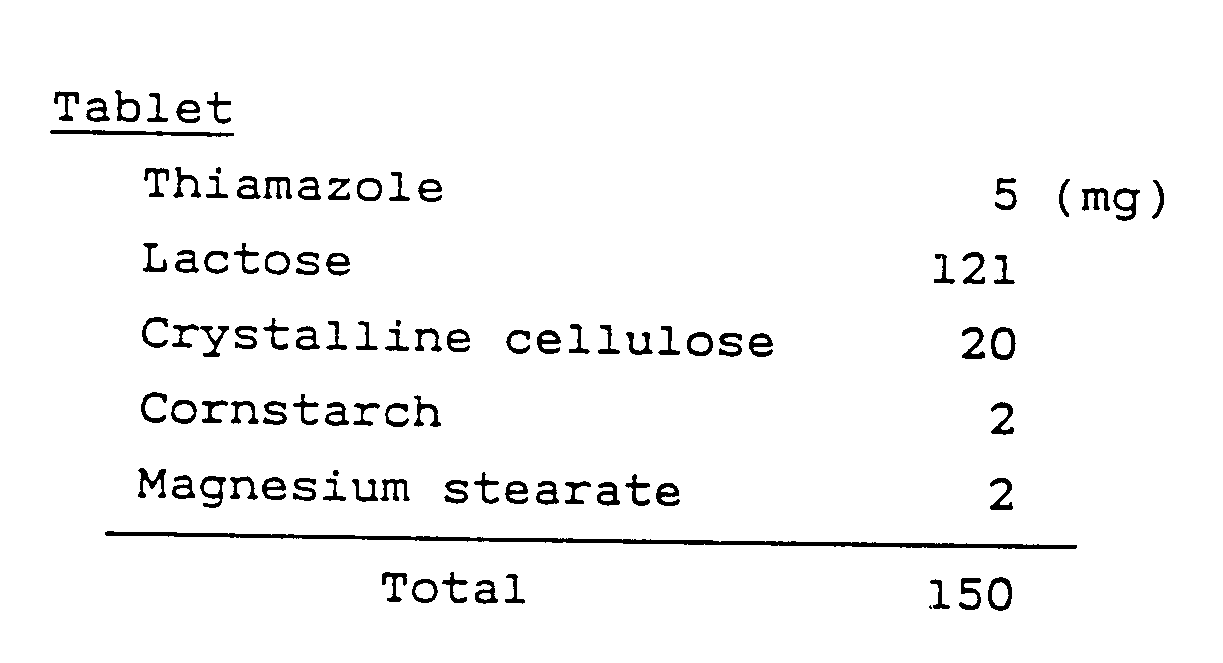
- Lactose (121 g) and 12% cornstarch paste (16.7 g) were blended well in a mortar. The blend was granulated after passage through a 35-mesh sieve, dried at 50°C in a tray dryer for 5 hours, and sieved through a 32-mesh sieve to obtain granules Five grams of Thiamazole, 123 g of the granulation, 20 g of crystalline cellulose and 2 g of magnesium stearate were weighed and mixed well in a polyethylene bag.
- The mix was charged into a single-punch machine equipped with a die (8 mmφ ) and flat-faced punches, and compressed with a total pressure of 1.2 tons to make tablets each weighing 150 mg.
- The tablets prepared in Example 2 and Comparative Example 1 had the dissolution protiles shown in Fig. 2. The data in Fig. 2 were obtained by conducting dissolution tests with an apparatus of the type shown in "Method II (puddle method) of Dissolution Test", Japanese Pharmacopoeia, 11th rev.; 500 ml of Fluid 2 (pH ≃ 6.8) was used as a testing fluid and the puddle was rotated at 100 rpm.
-
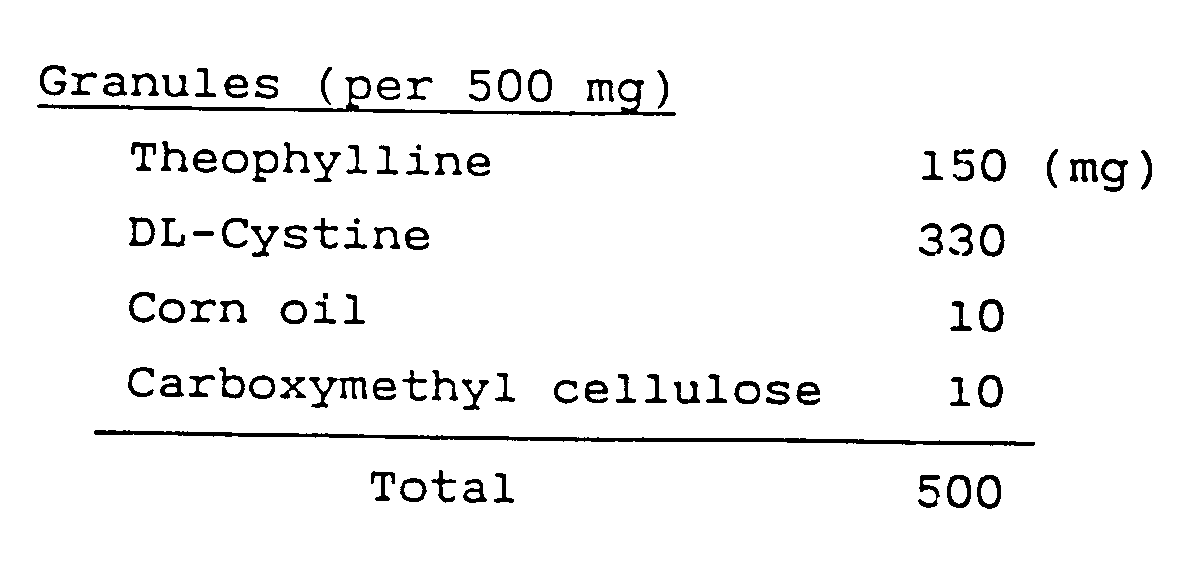
- A hundred and fifty grams of Theophylline and 330 g of DL-cystine were weighed and mixed well in a mortar. To the resulting triturate, a mixture of 10 g of corn oil with 100 g of a 10% solution of carboxymethylethyl cellulose in ethanol was added and blended well. The blend was granulated in a rotary granulator equipped with a net (1.2 mmφ), dried at 45°C in a tray dryer for 6 hours, and sieved through a 10-mesh sieve to make granules.
- The granules had the dissolution profile shown in Fig. 3 that was obtained by conducting a dissolution test on 200 mg of the granules with an apparatus of the type specified in "Method I (rotary basket method) of Dissolution Test", Japanese Pharmacopoeia, 11th rev.; 500 ml of Fluid I (pH ≃ 1.2) was used as a testing fluid and the basket was rotated at 100 rpm.
-
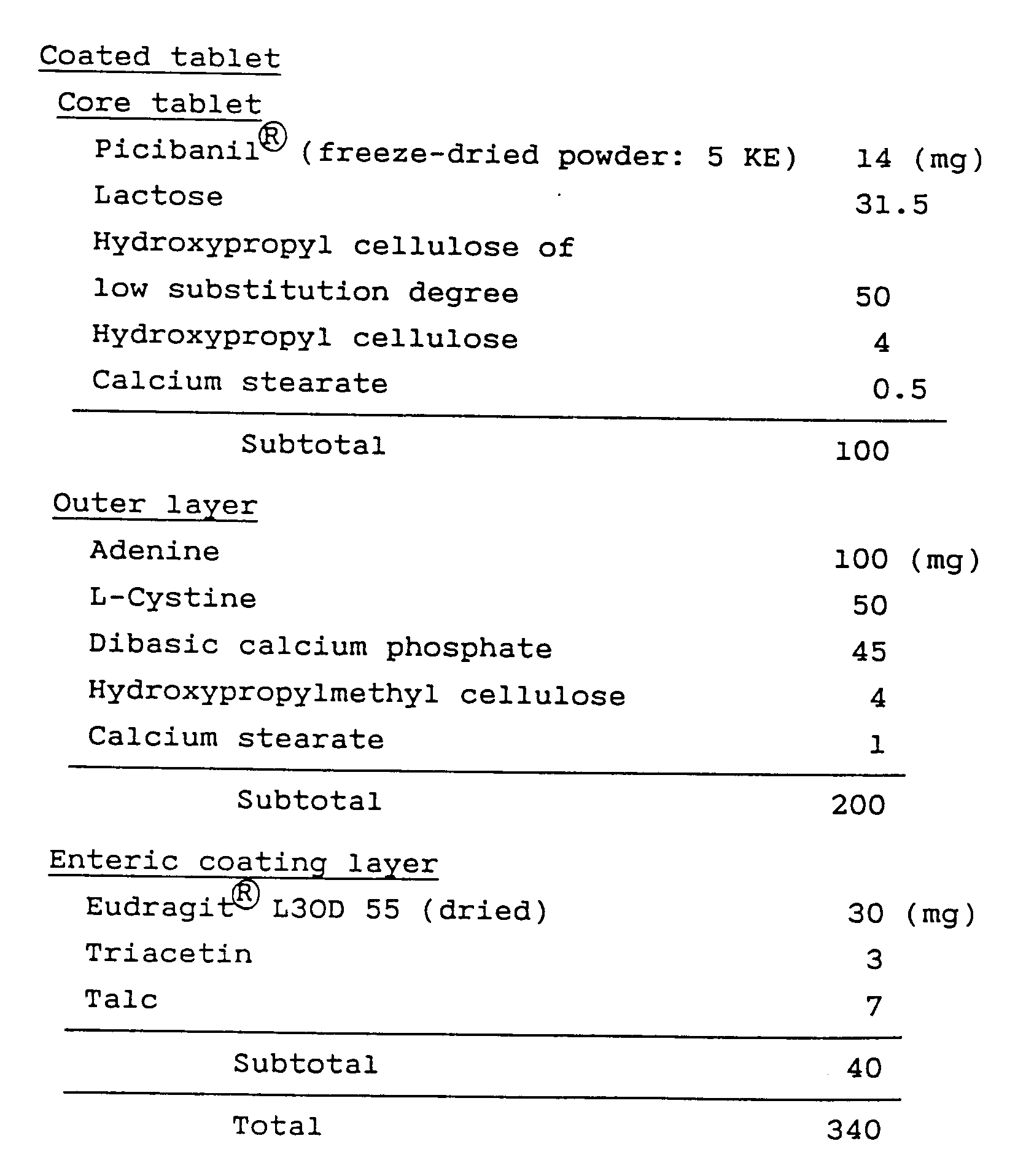
- Fourteen grams of Picibanil® (freeze-dried powder), 31.5 g of lactose and 50 g of hydroxypropyl cellulose of low substitution degree were weighed and mixed well in a mortar. To the triturate, 40 g of a 10% aqueous solution of hydroxypropyl cellulose was added and the individual components were blended together. The blend was sieved through a 16-mesh screen, granulated, dried by being left in a silica gel filled desiccator for one day, and sieved through a 12-mesh sieve. The granulate (99.5 g) and calcium stearate (0.5 g) were mixed well in a polyethylene bag.
- The mix was charged in a single-punch tableting machine equipped with a die (7 mm⌀) and punches (R = 10 mm), and compressed with a total pressure of 0.8 tons to make core tablets each weighing 100 mg.
- A hundred grams of adenine, 50 g of L-cystine and 45 g of dibasic calcium phosphate were weighed and mixed well in a mortar. To the triturate, 40 g of a 10% aqueous solution of hydroxypropylmethyl cellulose was added and the individual components were blended together. The blend was sieved through a 20-mesh screen, granulated, dried at 50°C in a tray dryer for 5 hours,and sieved through a 16-mesh sieve. The granule (199 g) and calcium stearate (1 g) were intimately mixed in a polyethylene bag to make granules for the outer layer.
- A die (10 mm⌀) and punches (R = 14 mm) were set on a single-punch tableting machine and 70 mg of the granules for the outer layer were charged into the die. The core tablet was placed in the center of the granules and another 130 mg of the granules for the outer layer was charged into the die. The charge was compressed with a total pressure of about 1.5 tons to make double-layered tablets.
- Triacetin (3 g) and talc (7 g) were dissolved in 140 g of water under agitation. Thereafter, 100 g of Eudragit® L30D 55 (30% dispersion) was added to make an enteric coating solution.
- Thirty grams of the double-layered tablets (ca. 100 in number) and 200 g of preliminarily prepared dummy tablets (9 mm⌀, R = 13 mm; weight of each tablet, 210 mg) were charged into a Flow Coater (UNI-GLATT® of Okawara Mfg. Co., Ltd.) and a coating operation was performed by standard procedures until each of the double-layered tablets was coated with 40 mg of the previously prepared enteric coating solution.
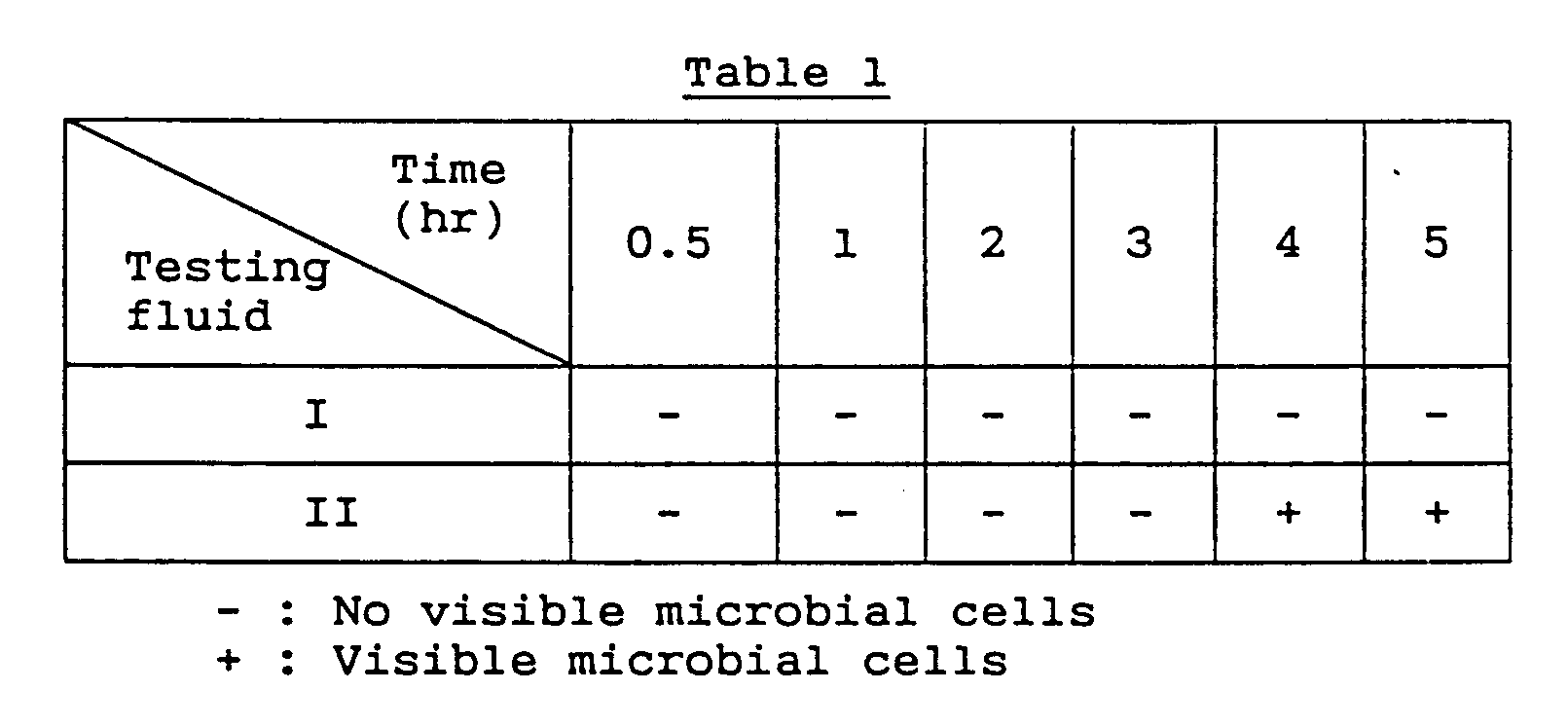
- The so prepared double-layered tablets with an enteric coating had the dissolution profiles shown in Table 1. The data in Table 1 was obtained by conducting a microbial release test on the tablets with an apparatus of the type specified in "Method II (puddle method) of Dissolution Test", Japanese Pharmacopoeia, 11th rev.; 500 ml each of Fluid 1 (pH ≃ 1.2) and Fluid 2 (pH ≃ 6.8) was used as testing fluids and the puddle was rotated at 100 rpm.
- Microbial release was established by microscopic observation of the testing fluids.
-

- Phenacetin and L-tyrosine were ground with a jet mill (Model FS-4 of Seishin Enterprise Co., Ltd.) into particles having an average size of 2 - 3 µm (the particles obtained by grinding with a jet mill are hereinafter referred to as "jet mill ground powder").
- Fifty grams of Phenacetin (jet mill ground powder), 37 g of lactose and 10 g of hydroxypropyl cellulose of low substitution degree were weighed and mixed well in a mortar. To the triturate, 20 g of a 10% aqueous solution of hydroxypropyl cellulose and 12 g of water were added and blended well. The blend was ground after passage through a 14-mesh sieve, dried at 50°C in a tray dryer for 5 hours, and sieved through a 10-mesh sieve. To 99 g of the granules 1 g of calcium stearate was added and the two were mixed well in a polyethylene bag. The resulting granules were designated granules (a).
- A hundred grams of Phenacetin (jet mill ground powder) and 93 g of L-tyrosine (jet mill ground powder) were weighed and mixed well in a mortar. To the triturate, 50 g of a 10% aqueous solution of hydroxypropyl cellulose and 44 g of water were added and blended well. The blend was granulated after passage through a 14-mesh sieve, dried at 50°C in a tray dryer for 5 hours, and sieved through a 10-mesh sieve. To 198 g of the granules, 2 g of calcium stearate was added and the two were mixed well in a polyethylene bag. The resulting granules were designated granules (b).
- Multi-layer tableting was performed on a single-punch machine equipped with a die (10 mm⌀) and flat-faced punches: first, 200 mg of granules (b) were placed in the die and precompressed lightly; then 100 mg of granules (a) were placed on the first fill and compressed with a total pressure of about 2 tons.
- The resulting double-layered tablets had the dissolution profile depicted in Fig. 4 that was obtained by conducting a dissolution test with an apparatus of the type specified in "Method II (puddle method) of Dissolution Test", Japanese Pharmacopoeia, 11th rev.; 900 ml of distilled water was used as a testing fluid and the puddle was rotated at 100 rpm.
-
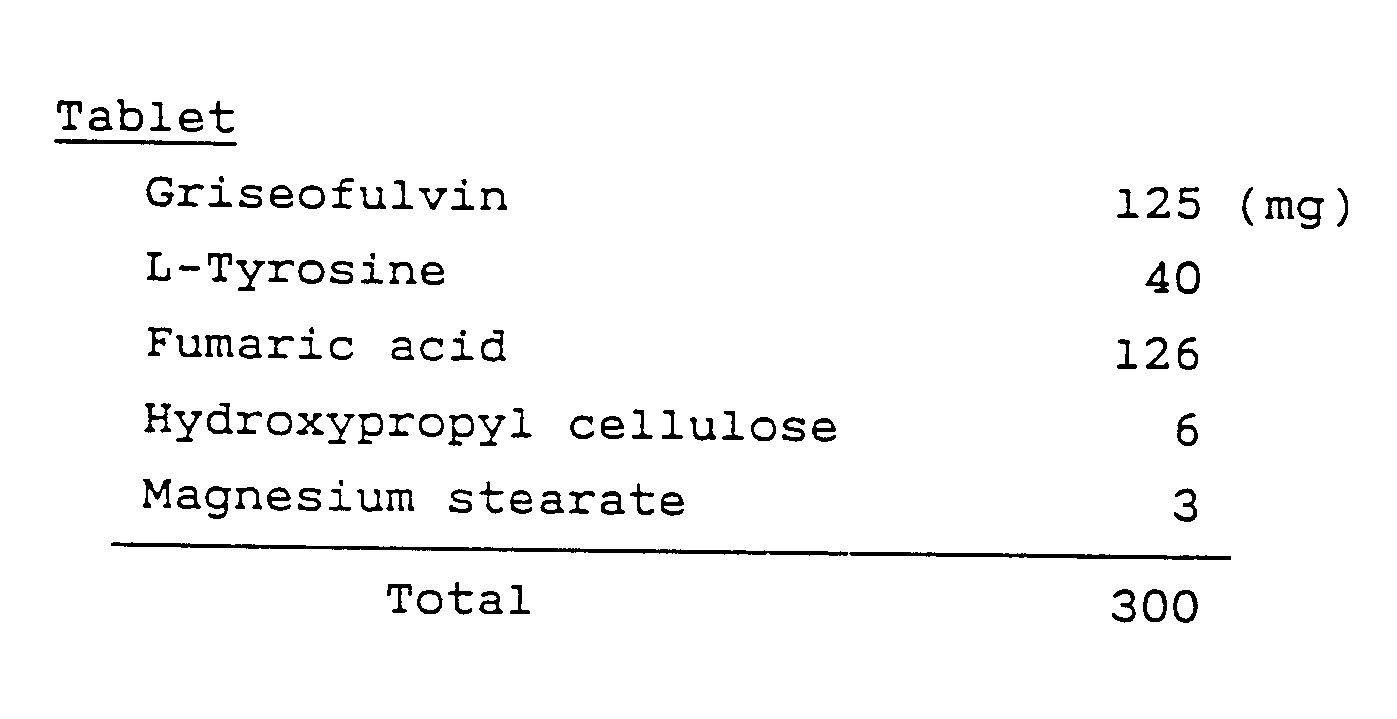
- A hundred and twenty-five grams of griseofulvin (jet mill ground powder; average particle size, 1 - 2 µm), 40 g of L-tyrosine (jet mill ground powder; average particle size, 2 - 3 µm) and 126 g of fumaric acid (jet mill ground powder; average particle size, 4 - 5 µm) were weighed and mixed well in a mortar. To the triturate, 60 g of a 10% aqueous solution of hydroxypropyl cellulose and 62 g of water were added and blended well. The blend was granulated after passage through a 14-mesh sieve, dried at 60°C in a tray dryer for 3 hours, and sieved through a 10-mesh sieve. To 297 g of the granules 3 g of magnesium stearate was added and the two were mixed well in a polyethylene bag.
- The mix was charged into a single-punch tableting machine equipped with a die (10 mm⌀) and flat-faced punches, and compressed with a total pressure of about 2 tons to make tablets each weighing 300 mg.
-
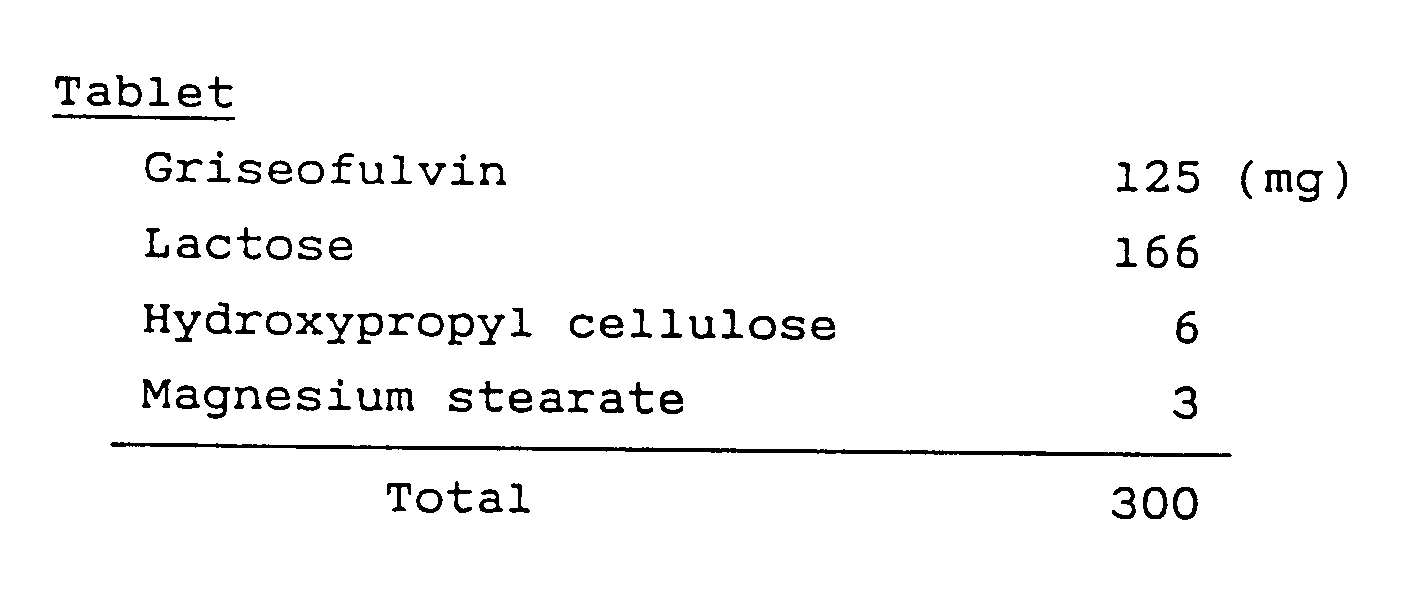
- A hundred and twenty-five grams of griseofulvin (jet mill ground powder; average particle size, 1 - 2 µm) and 166 g of lactose were weighed and mixed well in a mortar. To the triturate, 60 g of a 10% aqueous solution of hydroxypropyl cellulose and 14 g of water were added and blended well. The blend was granulated after passage through a 14-mesh sieve, dried at 60°C in a tray dryer for 3 hours, and sieved through a 10-mesh sieve. To 297 g of the granules, 3 g of magnesium stearate were added and the two were mixed well in a polyethylene bag.
- The mix was charged into a single-punch tableting machine equipped with a die(10 mm⌀) and flat-faced punches, and compressed with a total pressure of about 2 tons to make tablets each weighing 300 mg.
- The tablets prepared in Example 6 and Comparative Example 2 had the drug release profiles shown in Fig. 5 (griseofulvin was insoluble in water, so the state of dispersion of its fine particles was evaluated by turbidity measurement). The data in Fig. 5 was obtained by conducting a release test with an apparatus of the type specified in the "Method of Disintegration Test", Japanese Pharmacopoeia, 11th rev.; 1,000 ml of distilled water was used as a testing fluid and the glass tubes containing the test fluid were moved up and down 20 times a minute.
-
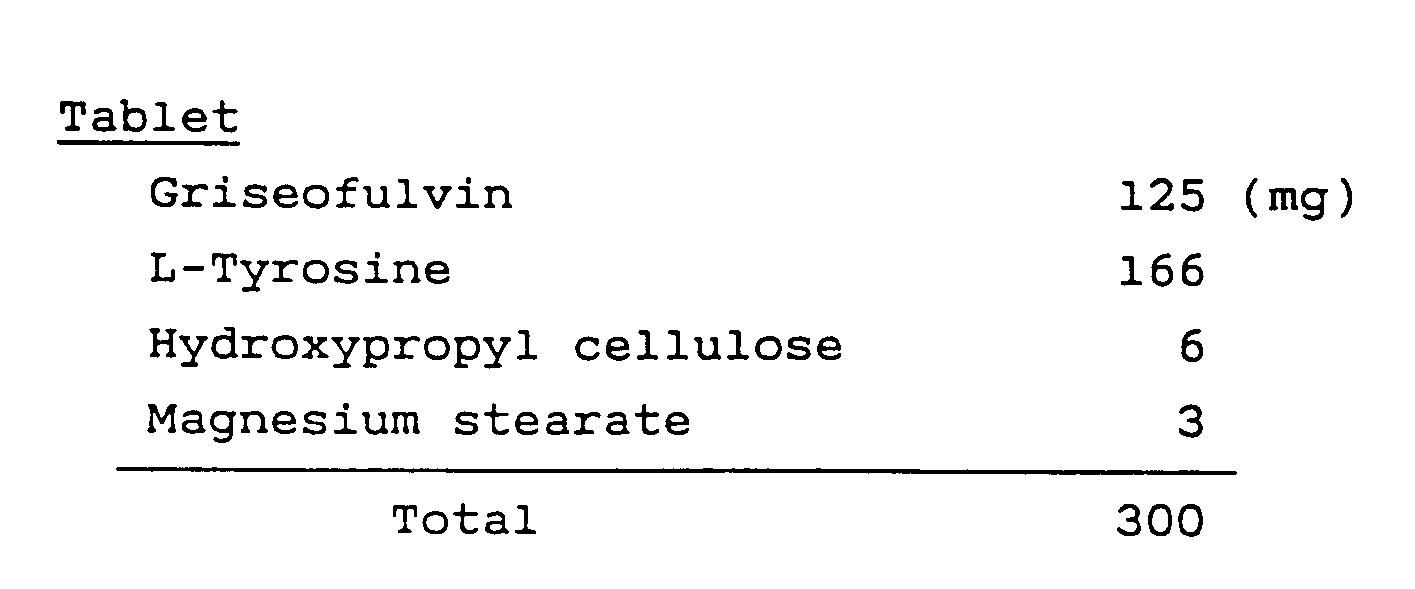
- A hundred and twenty-five grams of griseofulvin (jet mill ground powder; average particle size, 1 - 2 µm) and 166 g of L-tyrosine (jet mill ground powder; average particle size, 2 - 3 µm) were weighed and mixed well in a mortar. To the triturate, 60 g of a 10% aqueous solution of hydroxypropyl cellulose and 58 g of water were added and blended well. The blend was granulated after passage through a 14-mesh sieve, dried at 60°C in a tray dryer for 3 hours, and sieved through a 10-mesh sieve. To 297 g of the granules, 3 g of magnesium stearate were added and the two were mixed well in a polyethylene bag.
- The mix was charged into a single-punch tableting machine equipped with a die (10 m⌀) and flat-faced punches, and compressed with a total pressure of about 2 tons to make tablets each weighing 300 mg.
- The tablets had the drug release profiles shown in Fig. 6 (griseofulvin was insoluble in water, so the state of dispersion of its fine particles was evaluated by turbidity measurement). The data in Fig. 6 was obtained by conducting a release test with an apparatus of the type specified in the "Method of Disintegration Test", Japanese Pharmacopoeia, 11th rev.; 1,000 ml of distilled water was used as a testing fluid and the glass tubes containing the test fluid were moved up and down 20 times a minute.
-

- Digoxin (0.25 g) was dissolved in 135 g of ethanol. To the solution, 15 g of hydroxypropyl cellulose were added to make a binder solution (a film prepared by drying this solution had digoxin particles with a size of no more than 1 µm).
- In the next step, 8.75 g of lactose, 153 g of L-cystine and 120 g of hydroxypropyl cellulose of low substitution degree were weighed and mixed well in a mortar. To the triturate, the separately prepared binder solution was added and blended well. The blend was granulated after passage through a 14-mesh sieve, dried at 50°C in a tray dryer for 5 hours, and sieved through a 10-mesh sieve. To 297 g of the granulation, 3 g of calcium stearate were added and the two were mixed well in a polyethylene bag.
- The mix was charged into a single-punch tableting machine equipped with a die (10 mm⌀) and flat-faced punches, 5 and compressed with a total pressure of about 2 tons to make tablets each weighing 300 mg.
- The tablets had the dissolution profiles shown in Fig. 7 that was obtained by conducting a dissolution test with an apparatus of the type described in the "Method II (puddle method) of Dissolution Test", Japanese Pharmacopoeia, 11th rev.; 900 ml of distilled water was used as a testing fluid, and the puddle was rotated at 100 rpm.
-
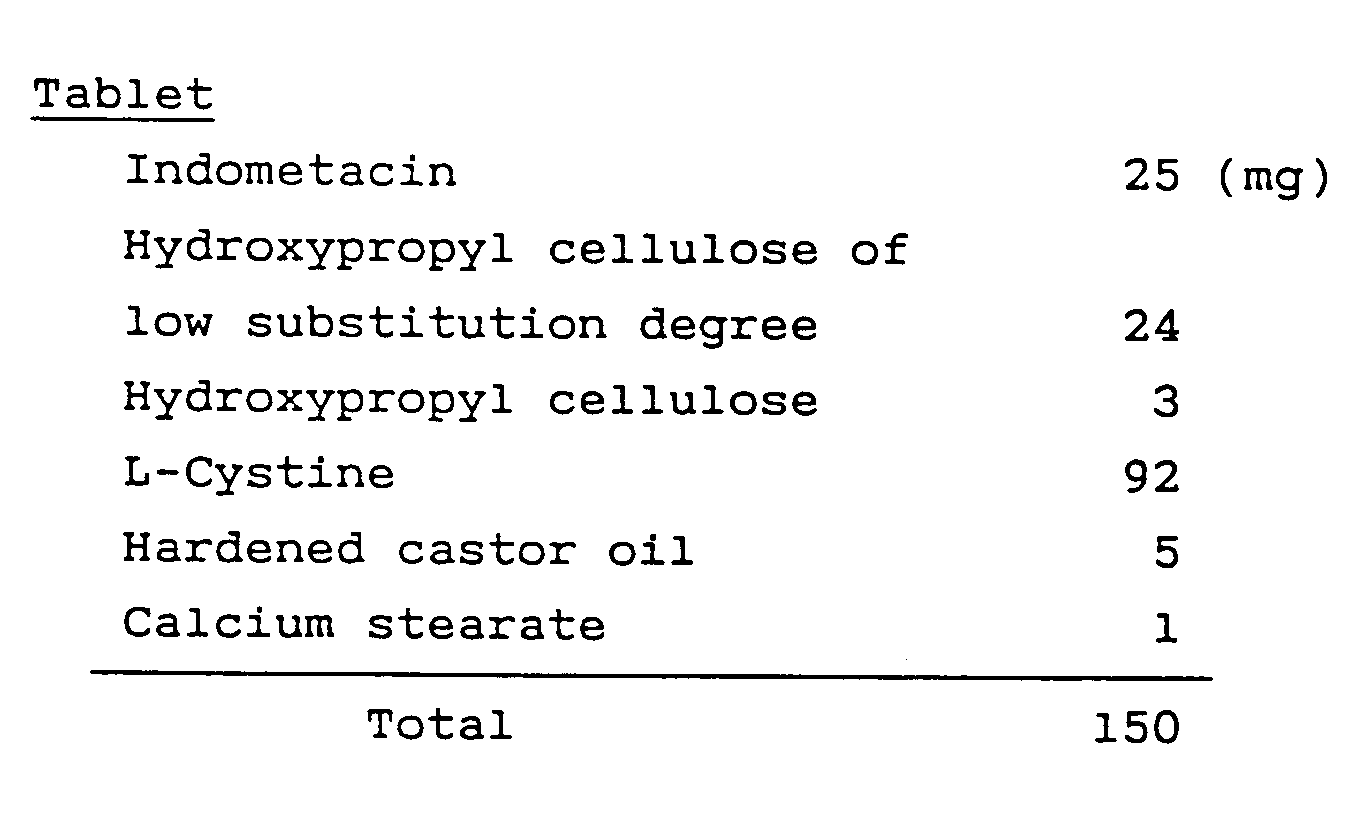
- Twenty-five grams of Indometacin (jet mill ground powder; average particle size, 6 - 7 µm) and 24 g of hydroxypropyl cellulose of low substitution degree were weighed and mixed well in a mortar. To the triturate, 10 g of a 10% aqueous solution of hydroxypropyl cellulose and 10 g of water were added and blended well. The blend was granulated after passage through a 24-mesh sieve, dried at 60°C in a tray dryer for 3 hours, and classified on a 20-mesh sieve. The resulting granules were designated granulation (a).
- Ninety-two grams of L-cystine and 5 g of hardened castor oil were weighed and mixed well in a mortar. To the triturate, 20 g of a 10% aqueous solution of hydroxypropyl cellulose and 18 g of water were added and blended well. The blend was granulated after passage through a 24-mesh sieve, dried at 60°C in a tray dryer for 3 hours, and sieved through a 20-mesh sieve. The resulting granulation was designated granules (b).
- Fifty grams of granules (a), 99 g of granules (b) and 1 g of calcium stearate were mixed well in a polyethylene bag. The mix was charged into a single-punch tableting machine equipped with a die (8 mm⌀) and flat-faced punches, and compressed with a total pressure of about 1.6 tons to make tablets each weighing 150 mg.
- The tablets had the dissolution profiles shown in Fig. 8 that was obtained by conducting a dissolution test with an apparatus of the type specified in the "Method I (rotary basket method) of Dissolution Test", Japanese Pharmacopoeia, 11th rev.; 900 ml of Fluid 2 (pH ≃ 6.8) was used as a testing fluid and the basket was rotated at 100 rpm.
-

- Seventy-five grams of Ketoprofen, 49 g of L-cystine (jet mill ground powder; average particle size, 3 - 4 µm), 50 g of L-tyrosine (Jet mill ground powder; average particle size, 2 - 3 µm) and 20 g of stearic acid (jet mill ground powder; average particle size, 5 - 6 µm) were weighed and mixed well in a mortar. To the triturate, 60 g of a 10% solution of ethyl cellulose in ethanol were added and blended well. The blend was granulated in a rotary granulator equipped with a net (1.2 mm⌀), dried at 50°C in a tray dryer for 6 hours, and heated to about 80°C at which temperature the granules were kept for 15 minutes. The granules were then sieved through a 10-mesh sieve and charged into capsules in doses of 200 mg.
- The capsules had the dissolution profile shown in Fig. 9 that was obtained by conducting a dissolution test with an apparatus of the type specified in "Method I (rotary basket method) of Dissolution Test", Japanese Pharmacopoeia, 11th rev.; 900 ml of Fluid 2 (pH ≃ 6.8) was used as a testing fluid and the basket was rotated at 100 rpm.
-
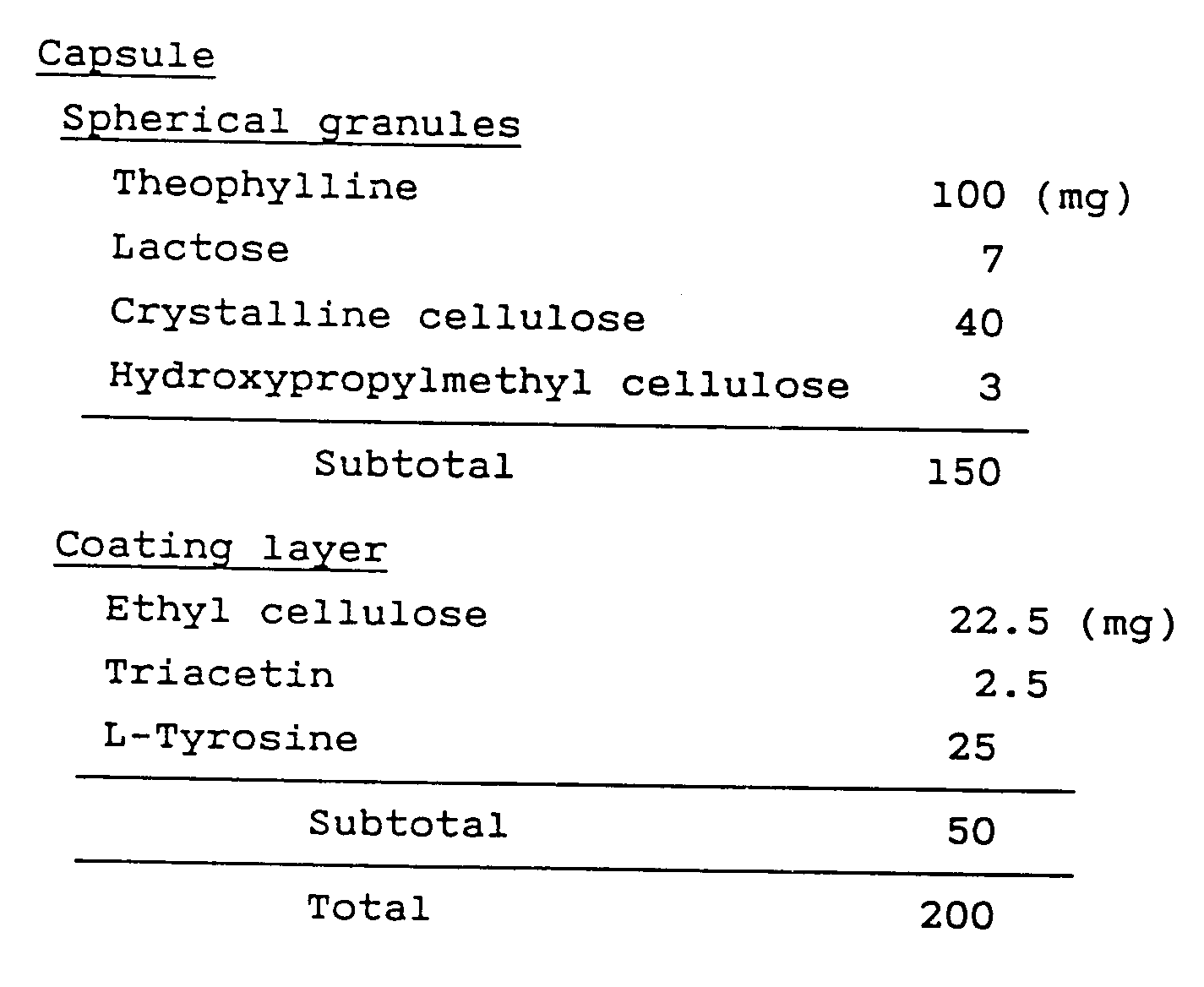
- A hundred grams of Theophylline, 7 g of lactose and 40 g of crystalline cellulose were weighed and mixed well in a mortar. To the triturate, 60 g of a 5% aqueous solution of hydroxypropylmethyl cellulose was added and blended well The blend was granulated in a rotary granulator equipped with a net (1.0 mm⌀). The granules were spheroidized with a Marumerizer machine (Model Q-236 of Fuji Powdal K.K.), and dried at 60°C in a tray dryer for 3 hours.
- Ethyl cellulose (22.5 g) and triacetin (2.5 g) were dissolved in ethanol (200 g), and 25 g of L-tyrosine (jet mill ground powder; average particle size; 2 - 3 µm) were dispersed with vigorous stirring to make a coating solution.
- The separately prepared spherical granules (150 g) were charged into a Flow Coater (UNI-GLATT® of Okawara Mfg. Co., Ltd.) and sprayed with 250 g of the coating solution. The spherical granules with a coating layer were charged into hard capsules in doses of 200 mg.
- The capsules had the disolution profile shown in Fig. 10 that was obtained by conducting a dissolution test with an apparatus of the type specified in "Method I (rotary basket method) of Dissolution Test", Japanese Pharmacopoeia, 11th rev.; 500 ml of distilled water was used as a testing fluid and the basket was rotated at 100 rpm.
-
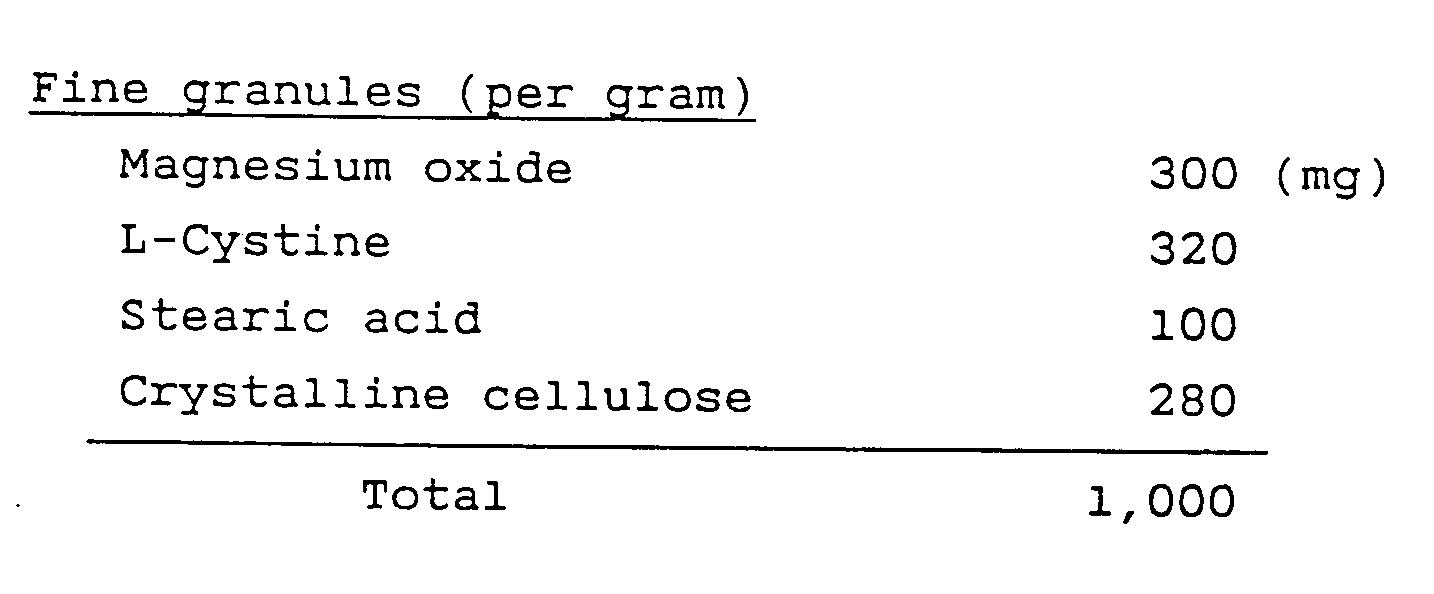
- Sixty grams of magnesium oxide, 64 g of L-cystine, 20 g of stearic acid and 56 g of crystalline cellulose were weighed and mixed well in a mortar. To the triturate, 80 g of water was added and blended well. The blend was granulated after passage through a 24-mesh sieve and the granulation was spheroidized with a Marumerizer machine (Model Q-234 of Fuji Powdal K.K.) The resulting fine granules were dried at 60°C in a tray dryer for 3 hours.
- An acid control test (Fuchs test) was performed on these fine granules and the results are shown in Fig. 11.
-

- In the first step, 0.16 mg of erythropoietin (freeze-dried), 89.84 mg of L-cystine and 10 mg of stearic acid were weighed and mixed well in a mortar. The triturate (10 mg) was then charged into a mold (2 mm⌀) and compressed with a hydraulic press with a total pressure of 200 kg. The so prepared implants were buried under the skin of rats and the time-dependent change in the count of reticulocytes relative to the erythrocytes in blood was examined. The results are shown in Fig. 12 together with comparative data for subcutaneous injection of erythropoietin in physiological saline.
-

- One gram of Oxethazaine, 8 g of L-cystine, 1 g of stearic acid and 5 g of dl-menthol were weighed and mixed well in a mortar. The triturate was charged into a single-punch tableting machine equipped with a die (7 mm⌀) and flat-faced dies, and compressed with a total pressure of about 1.5 tons to make tablets each weighing 150 mg. The tablets were heated at 50°C under vacuum for 30 minutes to sublime dl-menthol. The tablets were further heated to 80°C to melt the stearic acid and thereafter cooled to obtain floating tablets. When thrown into water, these tablets floated on the surface of water and remained so for at least 8 hours.
-

- Two hundred milligrams of scopolamine hydrobromide, 35.8 g of L-cystine (jet mill ground powder; average particle size, 3 - 4 µm), 30 g of DL-tryptophan (jet mill ground powder; average particle size, 2 - 3 µm) and 10 g of hardened castor oil (jet mill ground powder; average particle size, 3 - 4 µm) were weighed and mixed well in a mortar. To the triturate, 30 g of a 10% cornstarch paste was added and blended well. The blend was granulated after passage through a 14-mesh sieve, dried at 50°C in a tray dryer for 5 hours, and sieved through a 10-mesh sieve. To 79 g of the granules 1 g of calcium stearate was added and the two were mixed well in a polyethylene bag.
- The mix was charged into a single-punch tableting machine equipped with a die (7 mm⌀) and flat-faced dies, and compressed with a total pressure of about 1.5 tons to make tablets each weighing 80 mg.
- The so prepared troches melted slowly in the mouth and stayed there for at least 8 hours.
Claims (11)
- A slow-release pharmaceutical composition which comprises at least one of the following: adenine, cystine and tyrosine in combination with at least one pharmaceutically active substance provided that the composition is not an injection fluid.
- A slow-release pharmaceutical composition according to Claim 1 wherein the pharmaceutically active substance is a slightly soluble drug with a solubility of no more than 0.1%.
- A slow-release pharmaceutical composition according to Claim 2 wherein the slightly soluble drug is in the form of particles having an average size of no more than 10 µm.
- A slow-release pharmaceutical composition according to Claim 3 which further contains hydroxypropyl cellulose of low substitution degree and hydroxypropyl cellulose.
- A slow-release pharmaceutical composition according to Claim 1 which is a double-layered tablet consisting of a layer containing the pharmaceutically active substance and a layer containing no pharmaceutically active substance.
- A slow-release pharmaceutical composition according to Claim 1 wherein a portion containing the pharmaceutically active substance is coated with a layer containing no pharmaceutically active substance.
- A slow-release pharmaceutical composition according to Claim 1 which is a granule containing the pharmaceutically active substance.
- A slow-release pharmaceutical composition according to Claim 1 which is an implant containing the pharmaceutically active substance.
- A slow-release pharmaceutical composition according to Claim 1 which is in an encapsulated dosage form containing the pharmaceutically active substance.
- A slow-release pharmaceutical composition according to Claim 1 which is a troche containing the pharmaceutically active substance.
- Use of adenine, cystine and/or tyrosine as slow-release rendering additives in pharmaceutical compositions provided that the composition is not an injection fluid.
Priority Applications (1)
| Application Number | Priority Date | Filing Date | Title |
|---|---|---|---|
| AT88104643T ATE78157T1 (en) | 1987-03-24 | 1988-03-23 | SLOW-RELEASE PHARMACEUTICALS. |
Applications Claiming Priority (2)
| Application Number | Priority Date | Filing Date | Title |
|---|---|---|---|
| JP69677/87 | 1987-03-24 | ||
| JP6967787 | 1987-03-24 |
Publications (3)
| Publication Number | Publication Date |
|---|---|
| EP0284039A2 EP0284039A2 (en) | 1988-09-28 |
| EP0284039A3 EP0284039A3 (en) | 1989-01-25 |
| EP0284039B1 true EP0284039B1 (en) | 1992-07-15 |
Family
ID=13409722
Family Applications (1)
| Application Number | Title | Priority Date | Filing Date |
|---|---|---|---|
| EP88104643A Expired - Lifetime EP0284039B1 (en) | 1987-03-24 | 1988-03-23 | Slow-release pharmaceutical composition |
Country Status (13)
| Country | Link |
|---|---|
| US (1) | US5057317A (en) |
| EP (1) | EP0284039B1 (en) |
| KR (1) | KR960005141B1 (en) |
| AT (1) | ATE78157T1 (en) |
| AU (1) | AU603878B2 (en) |
| CA (1) | CA1324081C (en) |
| DE (1) | DE3872739T2 (en) |
| DK (1) | DK174992B1 (en) |
| ES (1) | ES2051782T3 (en) |
| FI (1) | FI94094C (en) |
| GR (1) | GR3005818T3 (en) |
| IE (1) | IE62487B1 (en) |
| NO (1) | NO175405C (en) |
Cited By (1)
| Publication number | Priority date | Publication date | Assignee | Title |
|---|---|---|---|---|
| EP0644771B2 (en) † | 1992-06-11 | 2006-12-06 | Alkermes Controlled Therapeutics, Inc. | Erythropoietin drug delivery system |
Families Citing this family (29)
| Publication number | Priority date | Publication date | Assignee | Title |
|---|---|---|---|---|
| ATE90570T1 (en) * | 1988-01-29 | 1993-07-15 | Sumitomo Pharma | IMPROVED CONTROLLED DELIVERY FORMULATIONS. |
| US5352461A (en) * | 1992-03-11 | 1994-10-04 | Pharmaceutical Discovery Corporation | Self assembling diketopiperazine drug delivery system |
| IT1256022B (en) * | 1992-06-08 | 1995-11-20 | STABLE PHARMACEUTICAL PREPARATIONS OF NICORANDIL | |
| US5376384A (en) * | 1992-12-23 | 1994-12-27 | Kinaform Technology, Inc. | Delayed, sustained-release pharmaceutical preparation |
| GB9505032D0 (en) | 1995-03-13 | 1995-05-03 | Westminster Lab Ltd | Improvements in or relating to organic compositions |
| US5543099A (en) * | 1994-09-29 | 1996-08-06 | Hallmark Pharmaceutical, Inc. | Process to manufacture micronized nifedipine granules for sustained release medicaments |
| US5660848A (en) * | 1994-11-02 | 1997-08-26 | The Population Council, Center For Biomedical Research | Subdermally implantable device |
| DE4444051A1 (en) * | 1994-12-10 | 1996-06-13 | Rhone Poulenc Rorer Gmbh | Pharmaceutical, oral preparation |
| US5925658A (en) * | 1995-03-02 | 1999-07-20 | Sankyo Company, Limited | Optically active thiazolidinone derivative |
| US6416778B1 (en) | 1997-01-24 | 2002-07-09 | Femmepharma | Pharmaceutical preparations and methods for their regional administration |
| US5993856A (en) * | 1997-01-24 | 1999-11-30 | Femmepharma | Pharmaceutical preparations and methods for their administration |
| WO1999059552A1 (en) * | 1998-05-15 | 1999-11-25 | Chugai Seiyaku Kabushiki Kaisha | Regulated release preparations |
| WO2000030446A1 (en) | 1998-11-23 | 2000-06-02 | Bonnie Davis | Dosage formulations for acetylcholinesterase inhibitors |
| UA74141C2 (en) | 1998-12-09 | 2005-11-15 | Дж.Д. Сірл Енд Ко. | Oral pharmaceutical compositions comprising micronized eplerenone (variants), method for its production and method for treating aldosterone-mediated states (variants) |
| US7018654B2 (en) * | 1999-03-05 | 2006-03-28 | New River Pharmaceuticals Inc. | Pharmaceutical composition containing an active agent in an amino acid copolymer structure |
| US6716452B1 (en) | 2000-08-22 | 2004-04-06 | New River Pharmaceuticals Inc. | Active agent delivery systems and methods for protecting and administering active agents |
| DE60025201T2 (en) * | 1999-06-09 | 2006-06-29 | Mochida Pharmaceutical Co. Ltd. | SYSTEM FOR DRUG RELIEF IN LOWER DIGESTIVE STRUCTURE |
| US8394813B2 (en) | 2000-11-14 | 2013-03-12 | Shire Llc | Active agent delivery systems and methods for protecting and administering active agents |
| US20060014697A1 (en) | 2001-08-22 | 2006-01-19 | Travis Mickle | Pharmaceutical compositions for prevention of overdose or abuse |
| US7169752B2 (en) | 2003-09-30 | 2007-01-30 | New River Pharmaceuticals Inc. | Compounds and compositions for prevention of overdose of oxycodone |
| JP2005513080A (en) * | 2001-12-20 | 2005-05-12 | フェムファーマ, インコーポレイテッド | Vaginal delivery of drugs |
| US20090035260A1 (en) * | 2002-07-29 | 2009-02-05 | Therapicon Srl | Enhanced nasal composition of active peptide |
| US9173836B2 (en) | 2003-01-02 | 2015-11-03 | FemmeParma Holding Company, Inc. | Pharmaceutical preparations for treatments of diseases and disorders of the breast |
| AU2004203700B2 (en) * | 2003-01-02 | 2007-06-21 | Femmepharma Holding Company, Inc. | Pharmaceutical preparations for treatments of diseases and disorders of the breast |
| ITMI20040235A1 (en) * | 2004-02-13 | 2004-05-13 | Therapicon Srl | PHARMACEUTICAL PREPARATION FOR THE ORAL CABLE |
| US20080153789A1 (en) * | 2006-12-26 | 2008-06-26 | Femmepharma Holding Company, Inc. | Topical administration of danazol |
| US9486446B2 (en) * | 2006-12-28 | 2016-11-08 | Takeda Pharmaceutical Company Limited | Orally disintegrating solid preparation |
| US20110003000A1 (en) * | 2009-07-06 | 2011-01-06 | Femmepharma Holding Company, Inc. | Transvaginal Delivery of Drugs |
| AU2020257406A1 (en) * | 2019-04-19 | 2021-12-16 | Hoffman Technologies Llc | Sustained release formulations |
Family Cites Families (17)
| Publication number | Priority date | Publication date | Assignee | Title |
|---|---|---|---|---|
| US2753288A (en) * | 1953-01-12 | 1956-07-03 | Upjohn Co | Scopolamine lower-alkyl halide therapeutic composition |
| US3477864A (en) * | 1965-05-07 | 1969-11-11 | Sumitomo Chemical Co | Process for coating pharmaceutical preparations with a hydroxy propyl methyl cellulose-sealing agent moisture-preventing film |
| GB1155036A (en) * | 1966-07-08 | 1969-06-11 | Ethan Allan Brown | Injectionable Substance |
| US3541201A (en) * | 1968-12-18 | 1970-11-17 | Ethan Alan Brown | Novel sodium chloride encapsulated injectionable substances |
| US3786123A (en) * | 1971-01-25 | 1974-01-15 | S Katzen | Method for stabilizing and preserving nutrients and products |
| GB1377074A (en) * | 1971-07-13 | 1974-12-11 | Beecham Group Ltd | Process for preparing injectable compositions |
| US4070455A (en) * | 1974-02-16 | 1978-01-24 | Beecham Group Limited | Process for preparing injectable desensitizing compositions and products thereof in microparticle form |
| GB1492973A (en) * | 1974-02-16 | 1977-11-23 | Beecham Group Ltd | Process for preparing injectable compositions |
| LU69456A1 (en) * | 1974-02-22 | 1975-12-09 | ||
| DD146547A5 (en) * | 1978-07-15 | 1981-02-18 | Boehringer Sohn Ingelheim | MEDICINAL RETARDANT SHAPE WITH UNFORGETTABLE POROESEN DIFFUSION SHELLS |
| JPS5835110A (en) * | 1981-08-28 | 1983-03-01 | Tetsuo Kato | Gradually releasing microcapsule |
| US4457907A (en) * | 1982-08-05 | 1984-07-03 | Clear Lake Development Group | Composition and method for protecting a therapeutic drug |
| IT1177384B (en) * | 1984-12-12 | 1987-08-26 | Boeehringer Biochemia Robin Sp | DIETARY GRANULAR PRODUCTS BASED ON AMINO ACIDS AND PROCEDURE FOR THEIR PREPARATION |
| US4863741A (en) * | 1985-03-25 | 1989-09-05 | Abbott Laboratories | Tablet composition for drug combinations |
| US4695591A (en) * | 1985-03-29 | 1987-09-22 | Schering Corporation | Controlled release dosage forms comprising hydroxypropylmethylcellulose |
| US5188840A (en) * | 1985-09-26 | 1993-02-23 | Chugai Seiyaku Kabushiki Kaisha | Slow-release pharmaceutical agent |
| US4843071A (en) * | 1986-12-05 | 1989-06-27 | Serotonin Industries Of Charleston | Method and composition for treating obesity, drug abuse, and narcolepsy |
-
1988
- 1988-03-22 US US07/171,817 patent/US5057317A/en not_active Expired - Lifetime
- 1988-03-23 DK DK198801587A patent/DK174992B1/en not_active IP Right Cessation
- 1988-03-23 DE DE8888104643T patent/DE3872739T2/en not_active Expired - Fee Related
- 1988-03-23 EP EP88104643A patent/EP0284039B1/en not_active Expired - Lifetime
- 1988-03-23 ES ES88104643T patent/ES2051782T3/en not_active Expired - Lifetime
- 1988-03-23 AT AT88104643T patent/ATE78157T1/en not_active IP Right Cessation
- 1988-03-23 AU AU13517/88A patent/AU603878B2/en not_active Ceased
- 1988-03-23 IE IE85588A patent/IE62487B1/en not_active IP Right Cessation
- 1988-03-24 KR KR1019880003189A patent/KR960005141B1/en not_active Expired - Fee Related
- 1988-03-24 FI FI881409A patent/FI94094C/en not_active IP Right Cessation
- 1988-03-24 NO NO881296A patent/NO175405C/en unknown
- 1988-03-24 CA CA000562345A patent/CA1324081C/en not_active Expired - Fee Related
-
1992
- 1992-09-29 GR GR920402149T patent/GR3005818T3/el unknown
Cited By (1)
| Publication number | Priority date | Publication date | Assignee | Title |
|---|---|---|---|---|
| EP0644771B2 (en) † | 1992-06-11 | 2006-12-06 | Alkermes Controlled Therapeutics, Inc. | Erythropoietin drug delivery system |
Also Published As
| Publication number | Publication date |
|---|---|
| IE62487B1 (en) | 1995-02-08 |
| NO175405C (en) | 1994-10-12 |
| FI881409L (en) | 1988-09-25 |
| ES2051782T3 (en) | 1994-07-01 |
| EP0284039A3 (en) | 1989-01-25 |
| FI94094B (en) | 1995-04-13 |
| EP0284039A2 (en) | 1988-09-28 |
| NO881296L (en) | 1988-09-26 |
| DE3872739T2 (en) | 1993-01-21 |
| KR960005141B1 (en) | 1996-04-22 |
| FI881409A0 (en) | 1988-03-24 |
| GR3005818T3 (en) | 1993-06-07 |
| AU1351788A (en) | 1988-09-29 |
| CA1324081C (en) | 1993-11-09 |
| AU603878B2 (en) | 1990-11-29 |
| KR880010758A (en) | 1988-10-24 |
| FI94094C (en) | 1995-07-25 |
| US5057317A (en) | 1991-10-15 |
| NO175405B (en) | 1994-07-04 |
| IE880855L (en) | 1988-09-24 |
| DK174992B1 (en) | 2004-04-13 |
| DK158788D0 (en) | 1988-03-23 |
| NO881296D0 (en) | 1988-03-24 |
| DK158788A (en) | 1988-09-25 |
| ATE78157T1 (en) | 1992-08-15 |
| DE3872739D1 (en) | 1992-08-20 |
Similar Documents
| Publication | Publication Date | Title |
|---|---|---|
| EP0284039B1 (en) | Slow-release pharmaceutical composition | |
| EP0218148B1 (en) | Slow-release pharmaceutical composition | |
| EP0797435B1 (en) | Controlled release matrix for pharmaceuticals | |
| KR100384215B1 (en) | Release Persistence Polydisperse Hardogel System-Amorphous Drug | |
| EP0717986B1 (en) | Rotor granulation and coating of acetaminophen, pseudoephedrine, chlorpheniramine, and, optionally, dextromethorphan | |
| EP0411952B1 (en) | Rotogranulations and taste masking coatings for preparation of chewable pharmaceutical tablets | |
| EP0698389B1 (en) | Controlled release matrix for pharmaceuticals | |
| EP0368247B1 (en) | Controlled release preparations | |
| JPH0122245B2 (en) | ||
| JP2004525887A (en) | New fenofibrate tablets | |
| EP0684042B1 (en) | Oral solid pharmaceutical compositions containing as active ingredient gemfibrozil and process for preparing them | |
| JP2638604B2 (en) | Sustained release formulation | |
| US20050048118A1 (en) | Modified release venlafaxine hydrochloride tablets | |
| JPH0130A (en) | sustained release formulation | |
| EP1049470B1 (en) | Extended release tiagabine formulations with reduced side-effects | |
| JP2002179554A (en) | Medicine |
Legal Events
| Date | Code | Title | Description |
|---|---|---|---|
| PUAI | Public reference made under article 153(3) epc to a published international application that has entered the european phase |
Free format text: ORIGINAL CODE: 0009012 |
|
| AK | Designated contracting states |
Kind code of ref document: A2 Designated state(s): AT BE CH DE ES FR GB GR IT LI LU NL SE |
|
| PUAL | Search report despatched |
Free format text: ORIGINAL CODE: 0009013 |
|
| AK | Designated contracting states |
Kind code of ref document: A3 Designated state(s): AT BE CH DE ES FR GB GR IT LI LU NL SE |
|
| 17P | Request for examination filed |
Effective date: 19890706 |
|
| 17Q | First examination report despatched |
Effective date: 19901105 |
|
| ITF | It: translation for a ep patent filed | ||
| GRAA | (expected) grant |
Free format text: ORIGINAL CODE: 0009210 |
|
| AK | Designated contracting states |
Kind code of ref document: B1 Designated state(s): AT BE CH DE ES FR GB GR IT LI LU NL SE |
|
| REF | Corresponds to: |
Ref document number: 78157 Country of ref document: AT Date of ref document: 19920815 Kind code of ref document: T |
|
| REF | Corresponds to: |
Ref document number: 3872739 Country of ref document: DE Date of ref document: 19920820 |
|
| ET | Fr: translation filed | ||
| REG | Reference to a national code |
Ref country code: GR Ref legal event code: FG4A Free format text: 3005818 |
|
| PLBE | No opposition filed within time limit |
Free format text: ORIGINAL CODE: 0009261 |
|
| STAA | Information on the status of an ep patent application or granted ep patent |
Free format text: STATUS: NO OPPOSITION FILED WITHIN TIME LIMIT |
|
| 26N | No opposition filed | ||
| EPTA | Lu: last paid annual fee | ||
| REG | Reference to a national code |
Ref country code: ES Ref legal event code: FG2A Ref document number: 2051782 Country of ref document: ES Kind code of ref document: T3 |
|
| EAL | Se: european patent in force in sweden |
Ref document number: 88104643.7 |
|
| REG | Reference to a national code |
Ref country code: GB Ref legal event code: IF02 |
|
| PGFP | Annual fee paid to national office [announced via postgrant information from national office to epo] |
Ref country code: DE Payment date: 20050502 Year of fee payment: 18 |
|
| PGFP | Annual fee paid to national office [announced via postgrant information from national office to epo] |
Ref country code: AT Payment date: 20060210 Year of fee payment: 19 Ref country code: FR Payment date: 20060210 Year of fee payment: 19 |
|
| PGFP | Annual fee paid to national office [announced via postgrant information from national office to epo] |
Ref country code: CH Payment date: 20060217 Year of fee payment: 19 |
|
| PGFP | Annual fee paid to national office [announced via postgrant information from national office to epo] |
Ref country code: LU Payment date: 20060228 Year of fee payment: 19 |
|
| PGFP | Annual fee paid to national office [announced via postgrant information from national office to epo] |
Ref country code: BE Payment date: 20060309 Year of fee payment: 19 |
|
| PGFP | Annual fee paid to national office [announced via postgrant information from national office to epo] |
Ref country code: GB Payment date: 20060316 Year of fee payment: 19 |
|
| PGFP | Annual fee paid to national office [announced via postgrant information from national office to epo] |
Ref country code: GR Payment date: 20060327 Year of fee payment: 19 |
|
| PGFP | Annual fee paid to national office [announced via postgrant information from national office to epo] |
Ref country code: NL Payment date: 20060328 Year of fee payment: 19 |
|
| PGFP | Annual fee paid to national office [announced via postgrant information from national office to epo] |
Ref country code: ES Payment date: 20060330 Year of fee payment: 19 |
|
| PGFP | Annual fee paid to national office [announced via postgrant information from national office to epo] |
Ref country code: IT Payment date: 20060331 Year of fee payment: 19 |
|
| PG25 | Lapsed in a contracting state [announced via postgrant information from national office to epo] |
Ref country code: DE Free format text: LAPSE BECAUSE OF NON-PAYMENT OF DUE FEES Effective date: 20061003 |
|
| PG25 | Lapsed in a contracting state [announced via postgrant information from national office to epo] |
Ref country code: SE Free format text: LAPSE BECAUSE OF NON-PAYMENT OF DUE FEES Effective date: 20070324 |
|
| REG | Reference to a national code |
Ref country code: CH Ref legal event code: PFA Owner name: CHUGAI SEIYAKU KABUSHIKI KAISHA Free format text: CHUGAI SEIYAKU KABUSHIKI KAISHA#NO.5-1, 5-CHOME, UKIMA#KITA-KU/TOKYO (JP) -TRANSFER TO- CHUGAI SEIYAKU KABUSHIKI KAISHA#NO.5-1, 5-CHOME, UKIMA#KITA-KU/TOKYO (JP) |
|
| REG | Reference to a national code |
Ref country code: CH Ref legal event code: PL |
|
| EUG | Se: european patent has lapsed | ||
| PG25 | Lapsed in a contracting state [announced via postgrant information from national office to epo] |
Ref country code: AT Free format text: LAPSE BECAUSE OF NON-PAYMENT OF DUE FEES Effective date: 20070323 |
|
| GBPC | Gb: european patent ceased through non-payment of renewal fee |
Effective date: 20070323 |
|
| NLV4 | Nl: lapsed or anulled due to non-payment of the annual fee |
Effective date: 20071001 |
|
| BERE | Be: lapsed |
Owner name: *CHUGAI SEIYAKU K.K. Effective date: 20070331 |
|
| PG25 | Lapsed in a contracting state [announced via postgrant information from national office to epo] |
Ref country code: BE Free format text: LAPSE BECAUSE OF NON-PAYMENT OF DUE FEES Effective date: 20070331 |
|
| REG | Reference to a national code |
Ref country code: FR Ref legal event code: ST Effective date: 20071130 |
|
| PG25 | Lapsed in a contracting state [announced via postgrant information from national office to epo] |
Ref country code: NL Free format text: LAPSE BECAUSE OF NON-PAYMENT OF DUE FEES Effective date: 20071001 |
|
| PGFP | Annual fee paid to national office [announced via postgrant information from national office to epo] |
Ref country code: SE Payment date: 20060309 Year of fee payment: 19 |
|
| PG25 | Lapsed in a contracting state [announced via postgrant information from national office to epo] |
Ref country code: LI Free format text: LAPSE BECAUSE OF NON-PAYMENT OF DUE FEES Effective date: 20070331 Ref country code: CH Free format text: LAPSE BECAUSE OF NON-PAYMENT OF DUE FEES Effective date: 20070331 |
|
| PG25 | Lapsed in a contracting state [announced via postgrant information from national office to epo] |
Ref country code: GB Free format text: LAPSE BECAUSE OF NON-PAYMENT OF DUE FEES Effective date: 20070323 |
|
| REG | Reference to a national code |
Ref country code: ES Ref legal event code: FD2A Effective date: 20070324 |
|
| PG25 | Lapsed in a contracting state [announced via postgrant information from national office to epo] |
Ref country code: FR Free format text: LAPSE BECAUSE OF NON-PAYMENT OF DUE FEES Effective date: 20070402 Ref country code: ES Free format text: LAPSE BECAUSE OF NON-PAYMENT OF DUE FEES Effective date: 20070324 |
|
| PG25 | Lapsed in a contracting state [announced via postgrant information from national office to epo] |
Ref country code: GR Free format text: LAPSE BECAUSE OF NON-PAYMENT OF DUE FEES Effective date: 20071003 |
|
| PG25 | Lapsed in a contracting state [announced via postgrant information from national office to epo] |
Ref country code: LU Free format text: LAPSE BECAUSE OF NON-PAYMENT OF DUE FEES Effective date: 20070323 |
|
| PG25 | Lapsed in a contracting state [announced via postgrant information from national office to epo] |
Ref country code: IT Free format text: LAPSE BECAUSE OF NON-PAYMENT OF DUE FEES Effective date: 20070323 |