EP0195212B1 - Novel peptidase inhibitors - Google Patents
Novel peptidase inhibitors Download PDFInfo
- Publication number
- EP0195212B1 EP0195212B1 EP86101437A EP86101437A EP0195212B1 EP 0195212 B1 EP0195212 B1 EP 0195212B1 EP 86101437 A EP86101437 A EP 86101437A EP 86101437 A EP86101437 A EP 86101437A EP 0195212 B1 EP0195212 B1 EP 0195212B1
- Authority
- EP
- European Patent Office
- Prior art keywords
- group
- groups
- compound
- phe
- side chain
- Prior art date
- Legal status (The legal status is an assumption and is not a legal conclusion. Google has not performed a legal analysis and makes no representation as to the accuracy of the status listed.)
- Expired - Lifetime
Links
- 239000000137 peptide hydrolase inhibitor Substances 0.000 title description 2
- 150000001875 compounds Chemical class 0.000 claims description 203
- 238000000034 method Methods 0.000 claims description 59
- 125000002023 trifluoromethyl group Chemical group FC(F)(F)* 0.000 claims description 56
- 230000002401 inhibitory effect Effects 0.000 claims description 44
- 235000008206 alpha-amino acids Nutrition 0.000 claims description 43
- 150000001370 alpha-amino acid derivatives Chemical class 0.000 claims description 38
- 239000003112 inhibitor Substances 0.000 claims description 36
- 125000003178 carboxy group Chemical group [H]OC(*)=O 0.000 claims description 33
- 125000006239 protecting group Chemical group 0.000 claims description 32
- 108090000765 processed proteins & peptides Proteins 0.000 claims description 31
- -1 t-Butyloxycarbonyl Chemical group 0.000 claims description 30
- 125000002924 primary amino group Chemical group [H]N([H])* 0.000 claims description 29
- DHMQDGOQFOQNFH-UHFFFAOYSA-N Glycine Chemical compound NCC(O)=O DHMQDGOQFOQNFH-UHFFFAOYSA-N 0.000 claims description 28
- 235000001014 amino acid Nutrition 0.000 claims description 19
- 125000001028 difluoromethyl group Chemical group [H]C(F)(F)* 0.000 claims description 19
- 125000001160 methoxycarbonyl group Chemical group [H]C([H])([H])OC(*)=O 0.000 claims description 17
- 150000001413 amino acids Chemical class 0.000 claims description 16
- 238000006859 Swern oxidation reaction Methods 0.000 claims description 15
- 229910052799 carbon Inorganic materials 0.000 claims description 15
- 230000002829 reductive effect Effects 0.000 claims description 15
- ROHFNLRQFUQHCH-YFKPBYRVSA-N L-leucine Chemical compound CC(C)C[C@H](N)C(O)=O ROHFNLRQFUQHCH-YFKPBYRVSA-N 0.000 claims description 14
- 230000008878 coupling Effects 0.000 claims description 13
- 238000010168 coupling process Methods 0.000 claims description 13
- 238000005859 coupling reaction Methods 0.000 claims description 13
- 239000001257 hydrogen Substances 0.000 claims description 11
- 229910052739 hydrogen Inorganic materials 0.000 claims description 11
- ONIBWKKTOPOVIA-BYPYZUCNSA-N L-Proline Chemical compound OC(=O)[C@@H]1CCCN1 ONIBWKKTOPOVIA-BYPYZUCNSA-N 0.000 claims description 9
- 102000016387 Pancreatic elastase Human genes 0.000 claims description 9
- 108010067372 Pancreatic elastase Proteins 0.000 claims description 9
- LKDMKWNDBAVNQZ-UHFFFAOYSA-N 4-[[1-[[1-[2-[[1-(4-nitroanilino)-1-oxo-3-phenylpropan-2-yl]carbamoyl]pyrrolidin-1-yl]-1-oxopropan-2-yl]amino]-1-oxopropan-2-yl]amino]-4-oxobutanoic acid Chemical compound OC(=O)CCC(=O)NC(C)C(=O)NC(C)C(=O)N1CCCC1C(=O)NC(C(=O)NC=1C=CC(=CC=1)[N+]([O-])=O)CC1=CC=CC=C1 LKDMKWNDBAVNQZ-UHFFFAOYSA-N 0.000 claims description 8
- 125000001997 phenyl group Chemical group [H]C1=C([H])C([H])=C(*)C([H])=C1[H] 0.000 claims description 8
- 108090000617 Cathepsin G Proteins 0.000 claims description 7
- 102000004173 Cathepsin G Human genes 0.000 claims description 7
- 101000851058 Homo sapiens Neutrophil elastase Proteins 0.000 claims description 7
- WHUUTDBJXJRKMK-VKHMYHEASA-N L-glutamic acid Chemical compound OC(=O)[C@@H](N)CCC(O)=O WHUUTDBJXJRKMK-VKHMYHEASA-N 0.000 claims description 7
- AGPKZVBTJJNPAG-WHFBIAKZSA-N L-isoleucine Chemical compound CC[C@H](C)[C@H](N)C(O)=O AGPKZVBTJJNPAG-WHFBIAKZSA-N 0.000 claims description 7
- 102100033174 Neutrophil elastase Human genes 0.000 claims description 7
- 125000001584 benzyloxycarbonyl group Chemical group C(=O)(OCC1=CC=CC=C1)* 0.000 claims description 7
- 125000001295 dansyl group Chemical group [H]C1=C([H])C(N(C([H])([H])[H])C([H])([H])[H])=C2C([H])=C([H])C([H])=C(C2=C1[H])S(*)(=O)=O 0.000 claims description 7
- MTCFGRXMJLQNBG-REOHCLBHSA-N (2S)-2-Amino-3-hydroxypropansäure Chemical compound OC[C@H](N)C(O)=O MTCFGRXMJLQNBG-REOHCLBHSA-N 0.000 claims description 6
- XUJNEKJLAYXESH-REOHCLBHSA-N L-Cysteine Chemical compound SC[C@H](N)C(O)=O XUJNEKJLAYXESH-REOHCLBHSA-N 0.000 claims description 6
- HQMLIDZJXVVKCW-REOHCLBHSA-N L-alaninamide Chemical compound C[C@H](N)C(N)=O HQMLIDZJXVVKCW-REOHCLBHSA-N 0.000 claims description 6
- 241000589516 Pseudomonas Species 0.000 claims description 6
- 108090000190 Thrombin Proteins 0.000 claims description 6
- 108090000631 Trypsin Proteins 0.000 claims description 6
- 102000004142 Trypsin Human genes 0.000 claims description 6
- 150000001371 alpha-amino acids Chemical class 0.000 claims description 6
- 125000003277 amino group Chemical group 0.000 claims description 6
- 229960004072 thrombin Drugs 0.000 claims description 6
- 239000012588 trypsin Substances 0.000 claims description 6
- 108090000107 Acrosin Proteins 0.000 claims description 5
- 102100026041 Acrosin Human genes 0.000 claims description 5
- 102000004225 Cathepsin B Human genes 0.000 claims description 5
- 108090000712 Cathepsin B Proteins 0.000 claims description 5
- 102000003908 Cathepsin D Human genes 0.000 claims description 5
- 108090000258 Cathepsin D Proteins 0.000 claims description 5
- 108090000317 Chymotrypsin Proteins 0.000 claims description 5
- 108010028774 Complement C1 Proteins 0.000 claims description 5
- 102000016574 Complement C3-C5 Convertases Human genes 0.000 claims description 5
- 108010067641 Complement C3-C5 Convertases Proteins 0.000 claims description 5
- 108090000204 Dipeptidase 1 Proteins 0.000 claims description 5
- 108010088842 Fibrinolysin Proteins 0.000 claims description 5
- 102000002704 Leucyl aminopeptidase Human genes 0.000 claims description 5
- 108010004098 Leucyl aminopeptidase Proteins 0.000 claims description 5
- 102000003729 Neprilysin Human genes 0.000 claims description 5
- 108090000028 Neprilysin Proteins 0.000 claims description 5
- 108090000284 Pepsin A Proteins 0.000 claims description 5
- 102000057297 Pepsin A Human genes 0.000 claims description 5
- 108010001014 Plasminogen Activators Proteins 0.000 claims description 5
- 102000001938 Plasminogen Activators Human genes 0.000 claims description 5
- 102100028255 Renin Human genes 0.000 claims description 5
- 108090000783 Renin Proteins 0.000 claims description 5
- 108090000435 Urokinase-type plasminogen activator Proteins 0.000 claims description 5
- 102000003990 Urokinase-type plasminogen activator Human genes 0.000 claims description 5
- 125000001797 benzyl group Chemical group [H]C1=C([H])C([H])=C(C([H])=C1[H])C([H])([H])* 0.000 claims description 5
- 125000002915 carbonyl group Chemical group [*:2]C([*:1])=O 0.000 claims description 5
- 229960002376 chymotrypsin Drugs 0.000 claims description 5
- 229940111202 pepsin Drugs 0.000 claims description 5
- 229940012957 plasmin Drugs 0.000 claims description 5
- 229940127126 plasminogen activator Drugs 0.000 claims description 5
- 150000003839 salts Chemical class 0.000 claims description 5
- 229960005356 urokinase Drugs 0.000 claims description 5
- 125000004080 3-carboxypropanoyl group Chemical group O=C([*])C([H])([H])C([H])([H])C(O[H])=O 0.000 claims description 4
- 102100025406 Complement C1s subcomponent Human genes 0.000 claims description 4
- DCXYFEDJOCDNAF-REOHCLBHSA-N L-asparagine Chemical compound OC(=O)[C@@H](N)CC(N)=O DCXYFEDJOCDNAF-REOHCLBHSA-N 0.000 claims description 4
- 125000000217 alkyl group Chemical group 0.000 claims description 4
- 125000003236 benzoyl group Chemical group [H]C1=C([H])C([H])=C(C([H])=C1[H])C(*)=O 0.000 claims description 4
- 125000004210 cyclohexylmethyl group Chemical group [H]C([H])(*)C1([H])C([H])([H])C([H])([H])C([H])([H])C([H])([H])C1([H])[H] 0.000 claims description 4
- 150000004677 hydrates Chemical class 0.000 claims description 4
- 125000001557 phthalyl group Chemical group C(=O)(O)C1=C(C(=O)*)C=CC=C1 0.000 claims description 4
- 125000002088 tosyl group Chemical group [H]C1=C([H])C(=C([H])C([H])=C1C([H])([H])[H])S(*)(=O)=O 0.000 claims description 4
- QNAYBMKLOCPYGJ-UWTATZPHSA-N D-alanine Chemical compound C[C@@H](N)C(O)=O QNAYBMKLOCPYGJ-UWTATZPHSA-N 0.000 claims description 3
- XPDXVDYUQZHFPV-UHFFFAOYSA-N Dansyl Chloride Chemical compound C1=CC=C2C(N(C)C)=CC=CC2=C1S(Cl)(=O)=O XPDXVDYUQZHFPV-UHFFFAOYSA-N 0.000 claims description 3
- 229940122344 Peptidase inhibitor Drugs 0.000 claims description 3
- 125000000113 cyclohexyl group Chemical group [H]C1([H])C([H])([H])C([H])([H])C([H])(*)C([H])([H])C1([H])[H] 0.000 claims description 3
- RCBVKBFIWMOMHF-UHFFFAOYSA-L hydroxy-(hydroxy(dioxo)chromio)oxy-dioxochromium;pyridine Chemical compound C1=CC=NC=C1.C1=CC=NC=C1.O[Cr](=O)(=O)O[Cr](O)(=O)=O RCBVKBFIWMOMHF-UHFFFAOYSA-L 0.000 claims description 3
- 101710116957 D-alanyl-D-alanine carboxypeptidase Proteins 0.000 claims description 2
- 108060005987 Kallikrein Proteins 0.000 claims description 2
- 102000001399 Kallikrein Human genes 0.000 claims description 2
- 125000002777 acetyl group Chemical group [H]C([H])([H])C(*)=O 0.000 claims description 2
- 125000000468 ketone group Chemical group 0.000 claims description 2
- 238000004519 manufacturing process Methods 0.000 claims 9
- 125000004435 hydrogen atom Chemical class [H]* 0.000 claims 3
- 239000005541 ACE inhibitor Substances 0.000 claims 1
- 102100020743 Dipeptidase 1 Human genes 0.000 claims 1
- 125000000998 L-alanino group Chemical group [H]N([*])[C@](C([H])([H])[H])([H])C(=O)O[H] 0.000 claims 1
- 229940044094 angiotensin-converting-enzyme inhibitor Drugs 0.000 claims 1
- 230000001590 oxidative effect Effects 0.000 claims 1
- YMWUJEATGCHHMB-UHFFFAOYSA-N Dichloromethane Chemical compound ClCCl YMWUJEATGCHHMB-UHFFFAOYSA-N 0.000 description 99
- XEKOWRVHYACXOJ-UHFFFAOYSA-N Ethyl acetate Chemical compound CCOC(C)=O XEKOWRVHYACXOJ-UHFFFAOYSA-N 0.000 description 93
- 239000000243 solution Substances 0.000 description 74
- XLYOFNOQVPJJNP-UHFFFAOYSA-N water Substances O XLYOFNOQVPJJNP-UHFFFAOYSA-N 0.000 description 68
- RTZKZFJDLAIYFH-UHFFFAOYSA-N Diethyl ether Chemical compound CCOCC RTZKZFJDLAIYFH-UHFFFAOYSA-N 0.000 description 63
- 239000000203 mixture Substances 0.000 description 56
- 238000006243 chemical reaction Methods 0.000 description 54
- CSNNHWWHGAXBCP-UHFFFAOYSA-L Magnesium sulfate Chemical compound [Mg+2].[O-][S+2]([O-])([O-])[O-] CSNNHWWHGAXBCP-UHFFFAOYSA-L 0.000 description 52
- SJRJJKPEHAURKC-UHFFFAOYSA-N N-Methylmorpholine Chemical compound CN1CCOCC1 SJRJJKPEHAURKC-UHFFFAOYSA-N 0.000 description 51
- VEXZGXHMUGYJMC-UHFFFAOYSA-N Hydrochloric acid Chemical compound Cl VEXZGXHMUGYJMC-UHFFFAOYSA-N 0.000 description 46
- 239000000047 product Substances 0.000 description 44
- 239000011541 reaction mixture Substances 0.000 description 42
- HEDRZPFGACZZDS-UHFFFAOYSA-N Chloroform Chemical compound ClC(Cl)Cl HEDRZPFGACZZDS-UHFFFAOYSA-N 0.000 description 38
- 102000004190 Enzymes Human genes 0.000 description 36
- 108090000790 Enzymes Proteins 0.000 description 36
- ZMANZCXQSJIPKH-UHFFFAOYSA-N Triethylamine Chemical compound CCN(CC)CC ZMANZCXQSJIPKH-UHFFFAOYSA-N 0.000 description 36
- 229940088598 enzyme Drugs 0.000 description 36
- 235000019439 ethyl acetate Nutrition 0.000 description 32
- WYURNTSHIVDZCO-UHFFFAOYSA-N Tetrahydrofuran Chemical compound C1CCOC1 WYURNTSHIVDZCO-UHFFFAOYSA-N 0.000 description 28
- 239000002904 solvent Substances 0.000 description 27
- OKKJLVBELUTLKV-UHFFFAOYSA-N Methanol Chemical compound OC OKKJLVBELUTLKV-UHFFFAOYSA-N 0.000 description 26
- 229910052943 magnesium sulfate Inorganic materials 0.000 description 26
- 235000019341 magnesium sulphate Nutrition 0.000 description 26
- 201000010099 disease Diseases 0.000 description 25
- 208000037265 diseases, disorders, signs and symptoms Diseases 0.000 description 25
- 239000012044 organic layer Substances 0.000 description 24
- 229940093499 ethyl acetate Drugs 0.000 description 22
- 150000002576 ketones Chemical group 0.000 description 22
- VLKZOEOYAKHREP-UHFFFAOYSA-N n-Hexane Chemical compound CCCCCC VLKZOEOYAKHREP-UHFFFAOYSA-N 0.000 description 22
- LFQSCWFLJHTTHZ-UHFFFAOYSA-N Ethanol Chemical compound CCO LFQSCWFLJHTTHZ-UHFFFAOYSA-N 0.000 description 21
- 238000002306 biochemical method Methods 0.000 description 21
- 230000001225 therapeutic effect Effects 0.000 description 21
- IAZDPXIOMUYVGZ-UHFFFAOYSA-N Dimethylsulphoxide Chemical compound CS(C)=O IAZDPXIOMUYVGZ-UHFFFAOYSA-N 0.000 description 20
- 241001465754 Metazoa Species 0.000 description 20
- VYPSYNLAJGMNEJ-UHFFFAOYSA-N Silicium dioxide Chemical compound O=[Si]=O VYPSYNLAJGMNEJ-UHFFFAOYSA-N 0.000 description 20
- 239000007787 solid Substances 0.000 description 19
- CSCPPACGZOOCGX-UHFFFAOYSA-N Acetone Chemical compound CC(C)=O CSCPPACGZOOCGX-UHFFFAOYSA-N 0.000 description 18
- ZMXDDKWLCZADIW-UHFFFAOYSA-N N,N-Dimethylformamide Chemical compound CN(C)C=O ZMXDDKWLCZADIW-UHFFFAOYSA-N 0.000 description 18
- 239000012267 brine Substances 0.000 description 18
- IXCSERBJSXMMFS-UHFFFAOYSA-N hydrogen chloride Substances Cl.Cl IXCSERBJSXMMFS-UHFFFAOYSA-N 0.000 description 18
- 229910000041 hydrogen chloride Inorganic materials 0.000 description 18
- 239000003921 oil Substances 0.000 description 18
- 235000019198 oils Nutrition 0.000 description 18
- HPALAKNZSZLMCH-UHFFFAOYSA-M sodium;chloride;hydrate Chemical compound O.[Na+].[Cl-] HPALAKNZSZLMCH-UHFFFAOYSA-M 0.000 description 18
- 239000000543 intermediate Substances 0.000 description 17
- 239000000725 suspension Substances 0.000 description 17
- 229960003767 alanine Drugs 0.000 description 16
- 150000001408 amides Chemical class 0.000 description 16
- 239000010410 layer Substances 0.000 description 16
- CTSLXHKWHWQRSH-UHFFFAOYSA-N oxalyl chloride Chemical compound ClC(=O)C(Cl)=O CTSLXHKWHWQRSH-UHFFFAOYSA-N 0.000 description 16
- 235000004279 alanine Nutrition 0.000 description 15
- 239000000758 substrate Substances 0.000 description 15
- XDEHMKQLKPZERH-BYPYZUCNSA-N (2s)-2-amino-3-methylbutanamide Chemical compound CC(C)[C@H](N)C(N)=O XDEHMKQLKPZERH-BYPYZUCNSA-N 0.000 description 14
- QNAYBMKLOCPYGJ-REOHCLBHSA-N L-alanine Chemical compound C[C@H](N)C(O)=O QNAYBMKLOCPYGJ-REOHCLBHSA-N 0.000 description 14
- 229940024606 amino acid Drugs 0.000 description 14
- 238000003756 stirring Methods 0.000 description 14
- 102000035195 Peptidases Human genes 0.000 description 13
- 108091005804 Peptidases Proteins 0.000 description 13
- 239000002253 acid Substances 0.000 description 13
- 125000003295 alanine group Chemical group N[C@@H](C)C(=O)* 0.000 description 13
- 239000000706 filtrate Substances 0.000 description 13
- 239000000741 silica gel Substances 0.000 description 13
- 229910002027 silica gel Inorganic materials 0.000 description 13
- WEVYAHXRMPXWCK-UHFFFAOYSA-N Acetonitrile Chemical compound CC#N WEVYAHXRMPXWCK-UHFFFAOYSA-N 0.000 description 12
- MUBZPKHOEPUJKR-UHFFFAOYSA-N Oxalic acid Chemical compound OC(=O)C(O)=O MUBZPKHOEPUJKR-UHFFFAOYSA-N 0.000 description 12
- OFBQJSOFQDEBGM-UHFFFAOYSA-N Pentane Chemical compound CCCCC OFBQJSOFQDEBGM-UHFFFAOYSA-N 0.000 description 12
- HEMHJVSKTPXQMS-UHFFFAOYSA-M Sodium hydroxide Chemical compound [OH-].[Na+] HEMHJVSKTPXQMS-UHFFFAOYSA-M 0.000 description 12
- 238000004587 chromatography analysis Methods 0.000 description 12
- 238000002360 preparation method Methods 0.000 description 12
- 229960002429 proline Drugs 0.000 description 12
- COLNVLDHVKWLRT-QMMMGPOBSA-N L-phenylalanine Chemical compound OC(=O)[C@@H](N)CC1=CC=CC=C1 COLNVLDHVKWLRT-QMMMGPOBSA-N 0.000 description 11
- UIIMBOGNXHQVGW-UHFFFAOYSA-M Sodium bicarbonate Chemical compound [Na+].OC([O-])=O UIIMBOGNXHQVGW-UHFFFAOYSA-M 0.000 description 11
- 239000012300 argon atmosphere Substances 0.000 description 11
- 238000001816 cooling Methods 0.000 description 11
- 239000007789 gas Substances 0.000 description 11
- QAEDZJGFFMLHHQ-UHFFFAOYSA-N trifluoroacetic anhydride Chemical compound FC(F)(F)C(=O)OC(=O)C(F)(F)F QAEDZJGFFMLHHQ-UHFFFAOYSA-N 0.000 description 11
- ONIBWKKTOPOVIA-UHFFFAOYSA-N Proline Natural products OC(=O)C1CCCN1 ONIBWKKTOPOVIA-UHFFFAOYSA-N 0.000 description 10
- 238000010561 standard procedure Methods 0.000 description 10
- IEJPPSMHUUQABK-UHFFFAOYSA-N 2,4-diphenyl-4h-1,3-oxazol-5-one Chemical compound O=C1OC(C=2C=CC=CC=2)=NC1C1=CC=CC=C1 IEJPPSMHUUQABK-UHFFFAOYSA-N 0.000 description 9
- KWYUFKZDYYNOTN-UHFFFAOYSA-M Potassium hydroxide Chemical compound [OH-].[K+] KWYUFKZDYYNOTN-UHFFFAOYSA-M 0.000 description 9
- KZSNJWFQEVHDMF-UHFFFAOYSA-N Valine Natural products CC(C)C(N)C(O)=O KZSNJWFQEVHDMF-UHFFFAOYSA-N 0.000 description 9
- 239000003480 eluent Substances 0.000 description 9
- 230000037361 pathway Effects 0.000 description 9
- 235000019833 protease Nutrition 0.000 description 9
- KCOPAESEGCGTKM-UHFFFAOYSA-N 1,3-oxazol-4-one Chemical compound O=C1COC=N1 KCOPAESEGCGTKM-UHFFFAOYSA-N 0.000 description 8
- IJGRMHOSHXDMSA-UHFFFAOYSA-N Atomic nitrogen Chemical compound N#N IJGRMHOSHXDMSA-UHFFFAOYSA-N 0.000 description 8
- DKGAVHZHDRPRBM-UHFFFAOYSA-N Tert-Butanol Chemical compound CC(C)(C)O DKGAVHZHDRPRBM-UHFFFAOYSA-N 0.000 description 8
- 238000003818 flash chromatography Methods 0.000 description 8
- YOETUEMZNOLGDB-UHFFFAOYSA-N 2-methylpropyl carbonochloridate Chemical compound CC(C)COC(Cl)=O YOETUEMZNOLGDB-UHFFFAOYSA-N 0.000 description 7
- QOSSAOTZNIDXMA-UHFFFAOYSA-N Dicylcohexylcarbodiimide Chemical compound C1CCCCC1N=C=NC1CCCCC1 QOSSAOTZNIDXMA-UHFFFAOYSA-N 0.000 description 7
- WHUUTDBJXJRKMK-UHFFFAOYSA-N Glutamic acid Natural products OC(=O)C(N)CCC(O)=O WHUUTDBJXJRKMK-UHFFFAOYSA-N 0.000 description 7
- 239000004471 Glycine Substances 0.000 description 7
- WMFOQBRAJBCJND-UHFFFAOYSA-M Lithium hydroxide Chemical compound [Li+].[OH-] WMFOQBRAJBCJND-UHFFFAOYSA-M 0.000 description 7
- 238000001035 drying Methods 0.000 description 7
- 150000002148 esters Chemical class 0.000 description 7
- 238000001704 evaporation Methods 0.000 description 7
- 230000008020 evaporation Effects 0.000 description 7
- XKRFYHLGVUSROY-UHFFFAOYSA-N Argon Chemical compound [Ar] XKRFYHLGVUSROY-UHFFFAOYSA-N 0.000 description 6
- XTHFKEDIFFGKHM-UHFFFAOYSA-N Dimethoxyethane Chemical compound COCCOC XTHFKEDIFFGKHM-UHFFFAOYSA-N 0.000 description 6
- QMMFVYPAHWMCMS-UHFFFAOYSA-N Dimethyl sulfide Chemical compound CSC QMMFVYPAHWMCMS-UHFFFAOYSA-N 0.000 description 6
- MZRVEZGGRBJDDB-UHFFFAOYSA-N N-Butyllithium Chemical compound [Li]CCCC MZRVEZGGRBJDDB-UHFFFAOYSA-N 0.000 description 6
- 230000015572 biosynthetic process Effects 0.000 description 6
- 229960004132 diethyl ether Drugs 0.000 description 6
- 238000000746 purification Methods 0.000 description 6
- XDTMQSROBMDMFD-UHFFFAOYSA-N Cyclohexane Chemical compound C1CCCCC1 XDTMQSROBMDMFD-UHFFFAOYSA-N 0.000 description 5
- AYFVYJQAPQTCCC-GBXIJSLDSA-N L-threonine Chemical compound C[C@@H](O)[C@H](N)C(O)=O AYFVYJQAPQTCCC-GBXIJSLDSA-N 0.000 description 5
- OUYCCCASQSFEME-QMMMGPOBSA-N L-tyrosine Chemical compound OC(=O)[C@@H](N)CC1=CC=C(O)C=C1 OUYCCCASQSFEME-QMMMGPOBSA-N 0.000 description 5
- KDXKERNSBIXSRK-UHFFFAOYSA-N Lysine Natural products NCCCCC(N)C(O)=O KDXKERNSBIXSRK-UHFFFAOYSA-N 0.000 description 5
- KDLHZDBZIXYQEI-UHFFFAOYSA-N Palladium Chemical compound [Pd] KDLHZDBZIXYQEI-UHFFFAOYSA-N 0.000 description 5
- MTCFGRXMJLQNBG-UHFFFAOYSA-N Serine Natural products OCC(N)C(O)=O MTCFGRXMJLQNBG-UHFFFAOYSA-N 0.000 description 5
- 239000008346 aqueous phase Substances 0.000 description 5
- 230000001419 dependent effect Effects 0.000 description 5
- WGLUMOCWFMKWIL-UHFFFAOYSA-N dichloromethane;methanol Chemical compound OC.ClCCl WGLUMOCWFMKWIL-UHFFFAOYSA-N 0.000 description 5
- 125000002485 formyl group Chemical class [H]C(*)=O 0.000 description 5
- 150000002431 hydrogen Chemical class 0.000 description 5
- 230000003647 oxidation Effects 0.000 description 5
- 238000007254 oxidation reaction Methods 0.000 description 5
- 239000008188 pellet Substances 0.000 description 5
- 150000003254 radicals Chemical class 0.000 description 5
- DYHSDKLCOJIUFX-UHFFFAOYSA-N tert-butoxycarbonyl anhydride Chemical compound CC(C)(C)OC(=O)OC(=O)OC(C)(C)C DYHSDKLCOJIUFX-UHFFFAOYSA-N 0.000 description 5
- TVRGGHRVSCOKIF-XOGOEWOHSA-N (2s)-1-[(2s)-2-[[(2s)-2-aminopropanoyl]amino]propanoyl]-n-(1,1,1-trifluoro-4-methyl-2-oxopentan-3-yl)pyrrolidine-2-carboxamide Chemical compound FC(F)(F)C(=O)C(C(C)C)NC(=O)[C@@H]1CCCN1C(=O)[C@H](C)NC(=O)[C@H](C)N TVRGGHRVSCOKIF-XOGOEWOHSA-N 0.000 description 4
- QTBSBXVTEAMEQO-UHFFFAOYSA-N Acetic acid Chemical compound CC(O)=O QTBSBXVTEAMEQO-UHFFFAOYSA-N 0.000 description 4
- VHUUQVKOLVNVRT-UHFFFAOYSA-N Ammonium hydroxide Chemical compound [NH4+].[OH-] VHUUQVKOLVNVRT-UHFFFAOYSA-N 0.000 description 4
- UFHFLCQGNIYNRP-UHFFFAOYSA-N Hydrogen Chemical compound [H][H] UFHFLCQGNIYNRP-UHFFFAOYSA-N 0.000 description 4
- AHLPHDHHMVZTML-BYPYZUCNSA-N L-Ornithine Chemical class NCCC[C@H](N)C(O)=O AHLPHDHHMVZTML-BYPYZUCNSA-N 0.000 description 4
- KZSNJWFQEVHDMF-BYPYZUCNSA-N L-valine Chemical compound CC(C)[C@H](N)C(O)=O KZSNJWFQEVHDMF-BYPYZUCNSA-N 0.000 description 4
- 102000004270 Peptidyl-Dipeptidase A Human genes 0.000 description 4
- 108090000882 Peptidyl-Dipeptidase A Proteins 0.000 description 4
- 206010060862 Prostate cancer Diseases 0.000 description 4
- 201000004681 Psoriasis Diseases 0.000 description 4
- JUJWROOIHBZHMG-UHFFFAOYSA-N Pyridine Chemical compound C1=CC=NC=C1 JUJWROOIHBZHMG-UHFFFAOYSA-N 0.000 description 4
- 235000011114 ammonium hydroxide Nutrition 0.000 description 4
- 238000003556 assay Methods 0.000 description 4
- WMNVDZORWCURPA-BQFCYCMXSA-N benzyl (2s)-1-[(2s)-2-[[(2s)-2-[(2-methylpropan-2-yl)oxycarbonylamino]propanoyl]amino]propanoyl]pyrrolidine-2-carboxylate Chemical compound CC(C)(C)OC(=O)N[C@@H](C)C(=O)N[C@@H](C)C(=O)N1CCC[C@H]1C(=O)OCC1=CC=CC=C1 WMNVDZORWCURPA-BQFCYCMXSA-N 0.000 description 4
- ZEDXTTHVOCBPLU-JZKFLRDJSA-N benzyl (2s)-1-[(2s)-2-aminopropanoyl]pyrrolidine-2-carboxylate;hydrochloride Chemical compound Cl.C[C@H](N)C(=O)N1CCC[C@H]1C(=O)OCC1=CC=CC=C1 ZEDXTTHVOCBPLU-JZKFLRDJSA-N 0.000 description 4
- 102000006635 beta-lactamase Human genes 0.000 description 4
- RBHJBMIOOPYDBQ-UHFFFAOYSA-N carbon dioxide;propan-2-one Chemical compound O=C=O.CC(C)=O RBHJBMIOOPYDBQ-UHFFFAOYSA-N 0.000 description 4
- 230000010261 cell growth Effects 0.000 description 4
- 239000003795 chemical substances by application Substances 0.000 description 4
- 238000004821 distillation Methods 0.000 description 4
- 239000002532 enzyme inhibitor Substances 0.000 description 4
- 239000000284 extract Substances 0.000 description 4
- 238000001914 filtration Methods 0.000 description 4
- 125000002887 hydroxy group Chemical group [H]O* 0.000 description 4
- 230000005764 inhibitory process Effects 0.000 description 4
- 150000004715 keto acids Chemical class 0.000 description 4
- VNWKTOKETHGBQD-UHFFFAOYSA-N methane Natural products C VNWKTOKETHGBQD-UHFFFAOYSA-N 0.000 description 4
- 125000002496 methyl group Chemical group [H]C([H])([H])* 0.000 description 4
- 229910052757 nitrogen Inorganic materials 0.000 description 4
- 239000012074 organic phase Substances 0.000 description 4
- 238000005949 ozonolysis reaction Methods 0.000 description 4
- 239000002244 precipitate Substances 0.000 description 4
- 235000017557 sodium bicarbonate Nutrition 0.000 description 4
- 229910000030 sodium bicarbonate Inorganic materials 0.000 description 4
- 239000012279 sodium borohydride Substances 0.000 description 4
- 229910000033 sodium borohydride Inorganic materials 0.000 description 4
- YLQBMQCUIZJEEH-UHFFFAOYSA-N tetrahydrofuran Natural products C=1C=COC=1 YLQBMQCUIZJEEH-UHFFFAOYSA-N 0.000 description 4
- FYSNRJHAOHDILO-UHFFFAOYSA-N thionyl chloride Chemical compound ClS(Cl)=O FYSNRJHAOHDILO-UHFFFAOYSA-N 0.000 description 4
- 239000004474 valine Substances 0.000 description 4
- PSEXQIHRIIHENX-DCAQKATOSA-N (2s)-1-[(2s)-2-[[(2s)-2-[(2-methylpropan-2-yl)oxycarbonylamino]propanoyl]amino]propanoyl]pyrrolidine-2-carboxylic acid Chemical compound CC(C)(C)OC(=O)N[C@@H](C)C(=O)N[C@@H](C)C(=O)N1CCC[C@H]1C(O)=O PSEXQIHRIIHENX-DCAQKATOSA-N 0.000 description 3
- QTRAXZHIRXYYPP-SCQFTWEKSA-N (3s)-3-amino-2-hydroxybutanoic acid Chemical compound C[C@H](N)C(O)C(O)=O QTRAXZHIRXYYPP-SCQFTWEKSA-N 0.000 description 3
- RYHBNJHYFVUHQT-UHFFFAOYSA-N 1,4-Dioxane Chemical compound C1COCCO1 RYHBNJHYFVUHQT-UHFFFAOYSA-N 0.000 description 3
- UUUHXMGGBIUAPW-UHFFFAOYSA-N 1-[1-[2-[[5-amino-2-[[1-[5-(diaminomethylideneamino)-2-[[1-[3-(1h-indol-3-yl)-2-[(5-oxopyrrolidine-2-carbonyl)amino]propanoyl]pyrrolidine-2-carbonyl]amino]pentanoyl]pyrrolidine-2-carbonyl]amino]-5-oxopentanoyl]amino]-3-methylpentanoyl]pyrrolidine-2-carbon Chemical compound C1CCC(C(=O)N2C(CCC2)C(O)=O)N1C(=O)C(C(C)CC)NC(=O)C(CCC(N)=O)NC(=O)C1CCCN1C(=O)C(CCCN=C(N)N)NC(=O)C1CCCN1C(=O)C(CC=1C2=CC=CC=C2NC=1)NC(=O)C1CCC(=O)N1 UUUHXMGGBIUAPW-UHFFFAOYSA-N 0.000 description 3
- BKHGOHWQAKJCJN-UHFFFAOYSA-N 2,2-difluoropent-4-enoyl 2,2-difluoropent-4-enoate Chemical compound C=CCC(F)(F)C(=O)OC(=O)C(F)(F)CC=C BKHGOHWQAKJCJN-UHFFFAOYSA-N 0.000 description 3
- LYORHEWOYBLIGH-UHFFFAOYSA-N 3-amino-1,1,1-trifluoro-4-methylpentan-2-ol;hydrochloride Chemical compound Cl.CC(C)C(N)C(O)C(F)(F)F LYORHEWOYBLIGH-UHFFFAOYSA-N 0.000 description 3
- VFMKPKXHRNKGGM-UHFFFAOYSA-N 3-amino-1,1,1-trifluorobutan-2-ol;hydrochloride Chemical compound Cl.CC(N)C(O)C(F)(F)F VFMKPKXHRNKGGM-UHFFFAOYSA-N 0.000 description 3
- 125000003974 3-carbamimidamidopropyl group Chemical group C(N)(=N)NCCC* 0.000 description 3
- GCFFEDDKOQBMIE-UHFFFAOYSA-N 6-methylheptanamide Chemical compound CC(C)CCCCC(N)=O GCFFEDDKOQBMIE-UHFFFAOYSA-N 0.000 description 3
- CXRCVCURMBFFOL-FXQIFTODSA-N Ala-Ala-Pro Chemical compound C[C@H](N)C(=O)N[C@@H](C)C(=O)N1CCC[C@H]1C(O)=O CXRCVCURMBFFOL-FXQIFTODSA-N 0.000 description 3
- 239000004475 Arginine Substances 0.000 description 3
- 206010004446 Benign prostatic hyperplasia Diseases 0.000 description 3
- UHOVQNZJYSORNB-UHFFFAOYSA-N Benzene Chemical compound C1=CC=CC=C1 UHOVQNZJYSORNB-UHFFFAOYSA-N 0.000 description 3
- 206010061218 Inflammation Diseases 0.000 description 3
- KFZMGEQAYNKOFK-UHFFFAOYSA-N Isopropanol Chemical compound CC(C)O KFZMGEQAYNKOFK-UHFFFAOYSA-N 0.000 description 3
- 102000002397 Kinins Human genes 0.000 description 3
- 108010093008 Kinins Proteins 0.000 description 3
- ZDXPYRJPNDTMRX-VKHMYHEASA-N L-glutamine Chemical compound OC(=O)[C@@H](N)CCC(N)=O ZDXPYRJPNDTMRX-VKHMYHEASA-N 0.000 description 3
- 208000004403 Prostatic Hyperplasia Diseases 0.000 description 3
- 239000004365 Protease Substances 0.000 description 3
- AYFVYJQAPQTCCC-UHFFFAOYSA-N Threonine Natural products CC(O)C(N)C(O)=O AYFVYJQAPQTCCC-UHFFFAOYSA-N 0.000 description 3
- 239000004473 Threonine Substances 0.000 description 3
- YXFVVABEGXRONW-UHFFFAOYSA-N Toluene Chemical compound CC1=CC=CC=C1 YXFVVABEGXRONW-UHFFFAOYSA-N 0.000 description 3
- 239000004015 abortifacient agent Substances 0.000 description 3
- 231100000641 abortifacient agent Toxicity 0.000 description 3
- 230000002378 acidificating effect Effects 0.000 description 3
- 150000008064 anhydrides Chemical class 0.000 description 3
- 239000003242 anti bacterial agent Substances 0.000 description 3
- 239000007864 aqueous solution Substances 0.000 description 3
- ODKSFYDXXFIFQN-UHFFFAOYSA-N arginine Natural products OC(=O)C(N)CCCNC(N)=N ODKSFYDXXFIFQN-UHFFFAOYSA-N 0.000 description 3
- 229910052786 argon Inorganic materials 0.000 description 3
- 206010003246 arthritis Diseases 0.000 description 3
- YRGOZFGRJADWIU-HOCLYGCPSA-N benzyl (2s)-1-[(2s)-2-[(2-methylpropan-2-yl)oxycarbonylamino]propanoyl]pyrrolidine-2-carboxylate Chemical compound CC(C)(C)OC(=O)N[C@@H](C)C(=O)N1CCC[C@H]1C(=O)OCC1=CC=CC=C1 YRGOZFGRJADWIU-HOCLYGCPSA-N 0.000 description 3
- 238000001311 chemical methods and process Methods 0.000 description 3
- 239000012043 crude product Substances 0.000 description 3
- XUJNEKJLAYXESH-UHFFFAOYSA-N cysteine Natural products SCC(N)C(O)=O XUJNEKJLAYXESH-UHFFFAOYSA-N 0.000 description 3
- 235000018417 cysteine Nutrition 0.000 description 3
- 230000000694 effects Effects 0.000 description 3
- 125000003754 ethoxycarbonyl group Chemical group C(=O)(OCC)* 0.000 description 3
- YLRGPBKEZVHOAW-UHFFFAOYSA-N ethyl 4,4,4-trifluoro-2-methyl-3-oxobutanoate Chemical compound CCOC(=O)C(C)C(=O)C(F)(F)F YLRGPBKEZVHOAW-UHFFFAOYSA-N 0.000 description 3
- MFRIOKNLYRUYHP-UHFFFAOYSA-N ethyl 4,4,4-trifluoro-3-hydroxy-2-methylbutanoate Chemical compound CCOC(=O)C(C)C(O)C(F)(F)F MFRIOKNLYRUYHP-UHFFFAOYSA-N 0.000 description 3
- 230000007717 exclusion Effects 0.000 description 3
- 238000005755 formation reaction Methods 0.000 description 3
- 125000003630 glycyl group Chemical group [H]N([H])C([H])([H])C(*)=O 0.000 description 3
- 208000037824 growth disorder Diseases 0.000 description 3
- 125000002795 guanidino group Chemical group C(N)(=N)N* 0.000 description 3
- 150000004820 halides Chemical class 0.000 description 3
- 208000015181 infectious disease Diseases 0.000 description 3
- 230000004054 inflammatory process Effects 0.000 description 3
- 239000007788 liquid Substances 0.000 description 3
- 239000000463 material Substances 0.000 description 3
- GJDICGOCZGRDFM-LURJTMIESA-N methyl (2s)-2-[(2-methylpropan-2-yl)oxycarbonylamino]propanoate Chemical compound COC(=O)[C@H](C)NC(=O)OC(C)(C)C GJDICGOCZGRDFM-LURJTMIESA-N 0.000 description 3
- IYUKFAFDFHZKPI-DFWYDOINSA-N methyl (2s)-2-aminopropanoate;hydrochloride Chemical compound Cl.COC(=O)[C@H](C)N IYUKFAFDFHZKPI-DFWYDOINSA-N 0.000 description 3
- ZWEUQQKBVZDPQZ-WUCPZUCCSA-N methyl (3s)-3-amino-2-hydroxybutanoate Chemical compound COC(=O)C(O)[C@H](C)N ZWEUQQKBVZDPQZ-WUCPZUCCSA-N 0.000 description 3
- 150000004702 methyl esters Chemical class 0.000 description 3
- 238000005897 peptide coupling reaction Methods 0.000 description 3
- 239000011736 potassium bicarbonate Substances 0.000 description 3
- 235000015497 potassium bicarbonate Nutrition 0.000 description 3
- 229910000028 potassium bicarbonate Inorganic materials 0.000 description 3
- CHKVPAROMQMJNQ-UHFFFAOYSA-M potassium bisulfate Chemical compound [K+].OS([O-])(=O)=O CHKVPAROMQMJNQ-UHFFFAOYSA-M 0.000 description 3
- 229910000343 potassium bisulfate Inorganic materials 0.000 description 3
- TYJJADVDDVDEDZ-UHFFFAOYSA-M potassium hydrogencarbonate Chemical compound [K+].OC([O-])=O TYJJADVDDVDEDZ-UHFFFAOYSA-M 0.000 description 3
- 239000000843 powder Substances 0.000 description 3
- 239000003755 preservative agent Substances 0.000 description 3
- 102000004196 processed proteins & peptides Human genes 0.000 description 3
- 239000000376 reactant Substances 0.000 description 3
- 238000010992 reflux Methods 0.000 description 3
- 239000011347 resin Substances 0.000 description 3
- 229920005989 resin Polymers 0.000 description 3
- 229920006395 saturated elastomer Polymers 0.000 description 3
- 125000003607 serino group Chemical group [H]N([H])[C@]([H])(C(=O)[*])C(O[H])([H])[H] 0.000 description 3
- 229910000104 sodium hydride Inorganic materials 0.000 description 3
- 238000003786 synthesis reaction Methods 0.000 description 3
- OEQRZPWMXXJEKU-LURJTMIESA-N tert-butyl n-[(2s)-1-oxopropan-2-yl]carbamate Chemical compound O=C[C@H](C)NC(=O)OC(C)(C)C OEQRZPWMXXJEKU-LURJTMIESA-N 0.000 description 3
- 239000003981 vehicle Substances 0.000 description 3
- VNDYJBBGRKZCSX-UHFFFAOYSA-L zinc bromide Chemical compound Br[Zn]Br VNDYJBBGRKZCSX-UHFFFAOYSA-L 0.000 description 3
- QVHJQCGUWFKTSE-YFKPBYRVSA-N (2s)-2-[(2-methylpropan-2-yl)oxycarbonylamino]propanoic acid Chemical compound OC(=O)[C@H](C)NC(=O)OC(C)(C)C QVHJQCGUWFKTSE-YFKPBYRVSA-N 0.000 description 2
- ASOKPJOREAFHNY-UHFFFAOYSA-N 1-Hydroxybenzotriazole Chemical compound C1=CC=C2N(O)N=NC2=C1 ASOKPJOREAFHNY-UHFFFAOYSA-N 0.000 description 2
- ZXTHWIZHGLNEPG-UHFFFAOYSA-N 2-phenyl-4,5-dihydro-1,3-oxazole Chemical compound O1CCN=C1C1=CC=CC=C1 ZXTHWIZHGLNEPG-UHFFFAOYSA-N 0.000 description 2
- HOMVDRDAAUYWKL-UHFFFAOYSA-N 3-methylbutan-1-amine;hydrochloride Chemical compound Cl.CC(C)CCN HOMVDRDAAUYWKL-UHFFFAOYSA-N 0.000 description 2
- SJEJCYHMWDBKCF-UHFFFAOYSA-N 4,4,4-trifluoro-3-hydroxy-2-methylbutanamide Chemical compound NC(=O)C(C)C(O)C(F)(F)F SJEJCYHMWDBKCF-UHFFFAOYSA-N 0.000 description 2
- FZZSERIMGXDVFN-UHFFFAOYSA-N 4-amino-2,2-difluoro-3-hydroxy-5-methylhexanoic acid Chemical compound CC(C)C(N)C(O)C(F)(F)C(O)=O FZZSERIMGXDVFN-UHFFFAOYSA-N 0.000 description 2
- BWVBNRWQTGFWPO-UHFFFAOYSA-N 5-benzamido-3,3-difluoro-4-oxo-6-phenylhexanoic acid Chemical compound C=1C=CC=CC=1C(=O)NC(C(=O)C(F)(F)CC(=O)O)CC1=CC=CC=C1 BWVBNRWQTGFWPO-UHFFFAOYSA-N 0.000 description 2
- NLXLAEXVIDQMFP-UHFFFAOYSA-N Ammonia chloride Chemical class [NH4+].[Cl-] NLXLAEXVIDQMFP-UHFFFAOYSA-N 0.000 description 2
- LSNNMFCWUKXFEE-UHFFFAOYSA-M Bisulfite Chemical compound OS([O-])=O LSNNMFCWUKXFEE-UHFFFAOYSA-M 0.000 description 2
- 241000167854 Bourreria succulenta Species 0.000 description 2
- 229920002261 Corn starch Polymers 0.000 description 2
- 125000000030 D-alanine group Chemical group [H]N([H])[C@](C([H])([H])[H])(C(=O)[*])[H] 0.000 description 2
- 206010014561 Emphysema Diseases 0.000 description 2
- 201000005569 Gout Diseases 0.000 description 2
- 208000035186 Hemolytic Autoimmune Anemia Diseases 0.000 description 2
- 206010020772 Hypertension Diseases 0.000 description 2
- 238000006809 Jones oxidation reaction Methods 0.000 description 2
- SNDPXSYFESPGGJ-BYPYZUCNSA-N L-2-aminopentanoic acid Chemical compound CCC[C@H](N)C(O)=O SNDPXSYFESPGGJ-BYPYZUCNSA-N 0.000 description 2
- CKLJMWTZIZZHCS-REOHCLBHSA-N L-aspartic acid Chemical compound OC(=O)[C@@H](N)CC(O)=O CKLJMWTZIZZHCS-REOHCLBHSA-N 0.000 description 2
- SNDPXSYFESPGGJ-UHFFFAOYSA-N L-norVal-OH Natural products CCCC(N)C(O)=O SNDPXSYFESPGGJ-UHFFFAOYSA-N 0.000 description 2
- 125000000174 L-prolyl group Chemical group [H]N1C([H])([H])C([H])([H])C([H])([H])[C@@]1([H])C(*)=O 0.000 description 2
- LRHPLDYGYMQRHN-UHFFFAOYSA-N N-Butanol Chemical compound CCCCO LRHPLDYGYMQRHN-UHFFFAOYSA-N 0.000 description 2
- QIAFMBKCNZACKA-UHFFFAOYSA-N N-benzoylglycine Chemical compound OC(=O)CNC(=O)C1=CC=CC=C1 QIAFMBKCNZACKA-UHFFFAOYSA-N 0.000 description 2
- AHLPHDHHMVZTML-UHFFFAOYSA-N Orn-delta-NH2 Natural products NCCCC(N)C(O)=O AHLPHDHHMVZTML-UHFFFAOYSA-N 0.000 description 2
- UTJLXEIPEHZYQJ-UHFFFAOYSA-N Ornithine Natural products OC(=O)C(C)CCCN UTJLXEIPEHZYQJ-UHFFFAOYSA-N 0.000 description 2
- 206010033645 Pancreatitis Diseases 0.000 description 2
- KEAYESYHFKHZAL-UHFFFAOYSA-N Sodium Chemical compound [Na] KEAYESYHFKHZAL-UHFFFAOYSA-N 0.000 description 2
- CDBYLPFSWZWCQE-UHFFFAOYSA-L Sodium Carbonate Chemical compound [Na+].[Na+].[O-]C([O-])=O CDBYLPFSWZWCQE-UHFFFAOYSA-L 0.000 description 2
- DWAQJAXMDSEUJJ-UHFFFAOYSA-M Sodium bisulfite Chemical compound [Na+].OS([O-])=O DWAQJAXMDSEUJJ-UHFFFAOYSA-M 0.000 description 2
- FAPWRFPIFSIZLT-UHFFFAOYSA-M Sodium chloride Chemical compound [Na+].[Cl-] FAPWRFPIFSIZLT-UHFFFAOYSA-M 0.000 description 2
- 229930006000 Sucrose Natural products 0.000 description 2
- CZMRCDWAGMRECN-UGDNZRGBSA-N Sucrose Chemical compound O[C@H]1[C@H](O)[C@@H](CO)O[C@@]1(CO)O[C@@H]1[C@H](O)[C@@H](O)[C@H](O)[C@@H](CO)O1 CZMRCDWAGMRECN-UGDNZRGBSA-N 0.000 description 2
- 102000057032 Tissue Kallikreins Human genes 0.000 description 2
- 108700022175 Tissue Kallikreins Proteins 0.000 description 2
- WGLPBDUCMAPZCE-UHFFFAOYSA-N Trioxochromium Chemical compound O=[Cr](=O)=O WGLPBDUCMAPZCE-UHFFFAOYSA-N 0.000 description 2
- QIVBCDIJIAJPQS-UHFFFAOYSA-N Tryptophan Natural products C1=CC=C2C(CC(N)C(O)=O)=CNC2=C1 QIVBCDIJIAJPQS-UHFFFAOYSA-N 0.000 description 2
- 150000008065 acid anhydrides Chemical class 0.000 description 2
- 239000013543 active substance Substances 0.000 description 2
- 150000001298 alcohols Chemical class 0.000 description 2
- 239000000908 ammonium hydroxide Substances 0.000 description 2
- 229940030600 antihypertensive agent Drugs 0.000 description 2
- 239000002220 antihypertensive agent Substances 0.000 description 2
- 201000004995 autoimmune glomerulonephritis Diseases 0.000 description 2
- 201000000448 autoimmune hemolytic anemia Diseases 0.000 description 2
- LDECUSDQMXVUMP-UHFFFAOYSA-N benzyl 3-[6-[[2-(butylamino)-1-[3-methoxycarbonyl-4-(2-methoxy-2-oxoethoxy)phenyl]-2-oxoethyl]-hexylamino]-6-oxohexyl]-4-methyl-2-oxo-6-(4-phenylphenyl)-1,6-dihydropyrimidine-5-carboxylate Chemical compound O=C1NC(C=2C=CC(=CC=2)C=2C=CC=CC=2)C(C(=O)OCC=2C=CC=CC=2)=C(C)N1CCCCCC(=O)N(CCCCCC)C(C(=O)NCCCC)C1=CC=C(OCC(=O)OC)C(C(=O)OC)=C1 LDECUSDQMXVUMP-UHFFFAOYSA-N 0.000 description 2
- 239000011230 binding agent Substances 0.000 description 2
- SIPUZPBQZHNSDW-UHFFFAOYSA-N bis(2-methylpropyl)aluminum Chemical compound CC(C)C[Al]CC(C)C SIPUZPBQZHNSDW-UHFFFAOYSA-N 0.000 description 2
- GDTBXPJZTBHREO-UHFFFAOYSA-N bromine Chemical compound BrBr GDTBXPJZTBHREO-UHFFFAOYSA-N 0.000 description 2
- 239000002775 capsule Substances 0.000 description 2
- 239000003054 catalyst Substances 0.000 description 2
- 238000012512 characterization method Methods 0.000 description 2
- 239000003638 chemical reducing agent Substances 0.000 description 2
- 235000019693 cherries Nutrition 0.000 description 2
- OQNGCCWBHLEQFN-UHFFFAOYSA-N chloroform;hexane Chemical compound ClC(Cl)Cl.CCCCCC OQNGCCWBHLEQFN-UHFFFAOYSA-N 0.000 description 2
- 229910052681 coesite Inorganic materials 0.000 description 2
- 239000008120 corn starch Substances 0.000 description 2
- 229910052906 cristobalite Inorganic materials 0.000 description 2
- 238000010511 deprotection reaction Methods 0.000 description 2
- 238000010828 elution Methods 0.000 description 2
- ZKQFHRVKCYFVCN-UHFFFAOYSA-N ethoxyethane;hexane Chemical compound CCOCC.CCCCCC ZKQFHRVKCYFVCN-UHFFFAOYSA-N 0.000 description 2
- OAYLNYINCPYISS-UHFFFAOYSA-N ethyl acetate;hexane Chemical compound CCCCCC.CCOC(C)=O OAYLNYINCPYISS-UHFFFAOYSA-N 0.000 description 2
- IIEWJVIFRVWJOD-UHFFFAOYSA-N ethyl cyclohexane Natural products CCC1CCCCC1 IIEWJVIFRVWJOD-UHFFFAOYSA-N 0.000 description 2
- 125000001495 ethyl group Chemical group [H]C([H])([H])C([H])([H])* 0.000 description 2
- 239000000796 flavoring agent Substances 0.000 description 2
- QEWYKACRFQMRMB-UHFFFAOYSA-N fluoroacetic acid Chemical compound OC(=O)CF QEWYKACRFQMRMB-UHFFFAOYSA-N 0.000 description 2
- 235000003599 food sweetener Nutrition 0.000 description 2
- 238000010438 heat treatment Methods 0.000 description 2
- VBZWSGALLODQNC-UHFFFAOYSA-N hexafluoroacetone Chemical compound FC(F)(F)C(=O)C(F)(F)F VBZWSGALLODQNC-UHFFFAOYSA-N 0.000 description 2
- HNDVDQJCIGZPNO-UHFFFAOYSA-N histidine Natural products OC(=O)C(N)CC1=CN=CN1 HNDVDQJCIGZPNO-UHFFFAOYSA-N 0.000 description 2
- 150000001261 hydroxy acids Chemical class 0.000 description 2
- 125000004029 hydroxymethyl group Chemical group [H]OC([H])([H])* 0.000 description 2
- 238000000338 in vitro Methods 0.000 description 2
- QNRXNRGSOJZINA-UHFFFAOYSA-N indoline-2-carboxylic acid Chemical compound C1=CC=C2NC(C(=O)O)CC2=C1 QNRXNRGSOJZINA-UHFFFAOYSA-N 0.000 description 2
- 229960000310 isoleucine Drugs 0.000 description 2
- AGPKZVBTJJNPAG-UHFFFAOYSA-N isoleucine Natural products CCC(C)C(N)C(O)=O AGPKZVBTJJNPAG-UHFFFAOYSA-N 0.000 description 2
- 150000002596 lactones Chemical class 0.000 description 2
- 210000004072 lung Anatomy 0.000 description 2
- 206010025135 lupus erythematosus Diseases 0.000 description 2
- HQKMJHAJHXVSDF-UHFFFAOYSA-L magnesium stearate Chemical compound [Mg+2].CCCCCCCCCCCCCCCCCC([O-])=O.CCCCCCCCCCCCCCCCCC([O-])=O HQKMJHAJHXVSDF-UHFFFAOYSA-L 0.000 description 2
- 230000004048 modification Effects 0.000 description 2
- 238000012986 modification Methods 0.000 description 2
- YJCHZQNYFHJECI-UHFFFAOYSA-N n-(1,1,1-trifluoro-2-hydroxy-4-methylpentan-3-yl)benzamide Chemical compound FC(F)(F)C(O)C(C(C)C)NC(=O)C1=CC=CC=C1 YJCHZQNYFHJECI-UHFFFAOYSA-N 0.000 description 2
- PCXQZNZAIIIMKG-UHFFFAOYSA-N n-(1,1,1-trifluoro-5-methyl-2-oxohexan-3-yl)benzamide Chemical compound CC(C)CC(C(=O)C(F)(F)F)NC(=O)C1=CC=CC=C1 PCXQZNZAIIIMKG-UHFFFAOYSA-N 0.000 description 2
- WUARRUTVBZIGFS-UHFFFAOYSA-N n-(3,3,3-trifluoro-2-hydroxypropyl)benzamide Chemical compound FC(F)(F)C(O)CNC(=O)C1=CC=CC=C1 WUARRUTVBZIGFS-UHFFFAOYSA-N 0.000 description 2
- NSNMGUDLVFSBEU-UHFFFAOYSA-N n-(3,3,3-trifluoro-2-oxopropyl)benzamide Chemical compound FC(F)(F)C(=O)CNC(=O)C1=CC=CC=C1 NSNMGUDLVFSBEU-UHFFFAOYSA-N 0.000 description 2
- SKVHYWXIGYJDFS-UHFFFAOYSA-N n-(4,4,4-trifluoro-3-oxo-1-phenylbutan-2-yl)benzamide Chemical compound C=1C=CC=CC=1C(=O)NC(C(=O)C(F)(F)F)CC1=CC=CC=C1 SKVHYWXIGYJDFS-UHFFFAOYSA-N 0.000 description 2
- FIMXDOZLWRLGLC-UHFFFAOYSA-N n-(4,4-difluoro-3-oxo-1-phenylhept-6-en-2-yl)benzamide Chemical compound C=1C=CC=CC=1C(=O)NC(C(=O)C(F)(CC=C)F)CC1=CC=CC=C1 FIMXDOZLWRLGLC-UHFFFAOYSA-N 0.000 description 2
- AYCQGCMQCVYCLI-UHFFFAOYSA-N n-(6,6-difluoro-2-methyl-5-oxonon-8-en-4-yl)benzamide Chemical compound C=CCC(F)(F)C(=O)C(CC(C)C)NC(=O)C1=CC=CC=C1 AYCQGCMQCVYCLI-UHFFFAOYSA-N 0.000 description 2
- 238000006386 neutralization reaction Methods 0.000 description 2
- 229960003104 ornithine Drugs 0.000 description 2
- WURFKUQACINBSI-UHFFFAOYSA-M ozonide Chemical compound [O]O[O-] WURFKUQACINBSI-UHFFFAOYSA-M 0.000 description 2
- 239000000546 pharmaceutical excipient Substances 0.000 description 2
- 239000012071 phase Substances 0.000 description 2
- NNFCIKHAZHQZJG-UHFFFAOYSA-N potassium cyanide Chemical compound [K+].N#[C-] NNFCIKHAZHQZJG-UHFFFAOYSA-N 0.000 description 2
- 125000001500 prolyl group Chemical group [H]N1C([H])(C(=O)[*])C([H])([H])C([H])([H])C1([H])[H] 0.000 description 2
- UMJSCPRVCHMLSP-UHFFFAOYSA-N pyridine Natural products COC1=CC=CN=C1 UMJSCPRVCHMLSP-UHFFFAOYSA-N 0.000 description 2
- 238000006722 reduction reaction Methods 0.000 description 2
- FSYKKLYZXJSNPZ-UHFFFAOYSA-N sarcosine Chemical compound C[NH2+]CC([O-])=O FSYKKLYZXJSNPZ-UHFFFAOYSA-N 0.000 description 2
- 239000000377 silicon dioxide Substances 0.000 description 2
- 235000012239 silicon dioxide Nutrition 0.000 description 2
- NDVLTYZPCACLMA-UHFFFAOYSA-N silver oxide Chemical compound [O-2].[Ag+].[Ag+] NDVLTYZPCACLMA-UHFFFAOYSA-N 0.000 description 2
- SQGYOTSLMSWVJD-UHFFFAOYSA-N silver(1+) nitrate Chemical compound [Ag+].[O-]N(=O)=O SQGYOTSLMSWVJD-UHFFFAOYSA-N 0.000 description 2
- 239000012312 sodium hydride Substances 0.000 description 2
- 235000010267 sodium hydrogen sulphite Nutrition 0.000 description 2
- 229910052682 stishovite Inorganic materials 0.000 description 2
- 239000005720 sucrose Substances 0.000 description 2
- 239000006228 supernatant Substances 0.000 description 2
- 239000003765 sweetening agent Substances 0.000 description 2
- 230000009885 systemic effect Effects 0.000 description 2
- 229910052905 tridymite Inorganic materials 0.000 description 2
- OUYCCCASQSFEME-UHFFFAOYSA-N tyrosine Natural products OC(=O)C(N)CC1=CC=C(O)C=C1 OUYCCCASQSFEME-UHFFFAOYSA-N 0.000 description 2
- 238000005406 washing Methods 0.000 description 2
- 238000010626 work up procedure Methods 0.000 description 2
- 239000011701 zinc Substances 0.000 description 2
- IYXUFOCLMOXQSL-UHFFFAOYSA-N (2,2-difluoroacetyl) 2,2-difluoroacetate Chemical compound FC(F)C(=O)OC(=O)C(F)F IYXUFOCLMOXQSL-UHFFFAOYSA-N 0.000 description 1
- MKLSLVKLQOIPCY-QRLADXQJSA-N (2r)-2-aminopropanoic acid Chemical compound C[C@@H](N)C(O)=O.C[C@@H](N)C(O)=O MKLSLVKLQOIPCY-QRLADXQJSA-N 0.000 description 1
- CZPBSQBMJXFSJQ-YANBTOMASA-N (2s)-1-(5-benzamido-3,3-difluoro-4-oxo-6-phenylhexanoyl)-2,3-dihydroindole-2-carboxylic acid Chemical compound C([C@H]1C(=O)O)C2=CC=CC=C2N1C(=O)CC(F)(F)C(=O)C(NC(=O)C=1C=CC=CC=1)CC1=CC=CC=C1 CZPBSQBMJXFSJQ-YANBTOMASA-N 0.000 description 1
- DOHOKPSRUXEKHZ-PNMVYJEXSA-N (2s)-1-acetyl-n-[(2s)-1-oxo-1-[(2s)-2-[(4,4,4-trifluoro-3,3-dihydroxybutan-2-yl)carbamoyl]pyrrolidin-1-yl]propan-2-yl]pyrrolidine-2-carboxamide Chemical compound N([C@@H](C)C(=O)N1[C@@H](CCC1)C(=O)NC(C)C(O)(O)C(F)(F)F)C(=O)[C@@H]1CCCN1C(C)=O DOHOKPSRUXEKHZ-PNMVYJEXSA-N 0.000 description 1
- LUSDYNAOIYFKSH-CNQRTRDTSA-N (2s)-1-acetyl-n-[(2s)-1-oxo-1-[(2s)-2-[(4,4,4-trifluoro-3-hydroxybutan-2-yl)carbamoyl]pyrrolidin-1-yl]propan-2-yl]pyrrolidine-2-carboxamide Chemical compound FC(F)(F)C(O)C(C)NC(=O)[C@@H]1CCCN1C(=O)[C@H](C)NC(=O)[C@H]1N(C(C)=O)CCC1 LUSDYNAOIYFKSH-CNQRTRDTSA-N 0.000 description 1
- JXGVXCZADZNAMJ-NSHDSACASA-N (2s)-1-phenylmethoxycarbonylpyrrolidine-2-carboxylic acid Chemical compound OC(=O)[C@@H]1CCCN1C(=O)OCC1=CC=CC=C1 JXGVXCZADZNAMJ-NSHDSACASA-N 0.000 description 1
- IYKLZBIWFXPUCS-VIFPVBQESA-N (2s)-2-(naphthalen-1-ylamino)propanoic acid Chemical compound C1=CC=C2C(N[C@@H](C)C(O)=O)=CC=CC2=C1 IYKLZBIWFXPUCS-VIFPVBQESA-N 0.000 description 1
- JFOWDKWFHZIMTR-RUCXOUQFSA-N (2s)-2-aminopentanedioic acid;(2s)-2,5-diamino-5-oxopentanoic acid Chemical compound OC(=O)[C@@H](N)CCC(N)=O.OC(=O)[C@@H](N)CCC(O)=O JFOWDKWFHZIMTR-RUCXOUQFSA-N 0.000 description 1
- UTSLHOQBOISPKF-AWEZNQCLSA-N (2s)-2-benzamido-3-[4-(diaminomethylideneamino)phenyl]propanoic acid Chemical compound C1=CC(NC(=N)N)=CC=C1C[C@@H](C(O)=O)NC(=O)C1=CC=CC=C1 UTSLHOQBOISPKF-AWEZNQCLSA-N 0.000 description 1
- NWUYHJFMYQTDRP-UHFFFAOYSA-N 1,2-bis(ethenyl)benzene;1-ethenyl-2-ethylbenzene;styrene Chemical compound C=CC1=CC=CC=C1.CCC1=CC=CC=C1C=C.C=CC1=CC=CC=C1C=C NWUYHJFMYQTDRP-UHFFFAOYSA-N 0.000 description 1
- ADFXKUOMJKEIND-UHFFFAOYSA-N 1,3-dicyclohexylurea Chemical compound C1CCCCC1NC(=O)NC1CCCCC1 ADFXKUOMJKEIND-UHFFFAOYSA-N 0.000 description 1
- BIAAQBNMRITRDV-UHFFFAOYSA-N 1-(chloromethoxy)-2-methoxyethane Chemical compound COCCOCCl BIAAQBNMRITRDV-UHFFFAOYSA-N 0.000 description 1
- 238000005160 1H NMR spectroscopy Methods 0.000 description 1
- LHOKYUDUAYXFGF-UHFFFAOYSA-N 2,2-difluoropent-4-enoic acid Chemical compound OC(=O)C(F)(F)CC=C LHOKYUDUAYXFGF-UHFFFAOYSA-N 0.000 description 1
- HNTCBGXYMDSKEY-UHFFFAOYSA-N 2-fluoroethenone Chemical compound FC=C=O HNTCBGXYMDSKEY-UHFFFAOYSA-N 0.000 description 1
- VMZCDNSFRSVYKQ-UHFFFAOYSA-N 2-phenylacetyl chloride Chemical compound ClC(=O)CC1=CC=CC=C1 VMZCDNSFRSVYKQ-UHFFFAOYSA-N 0.000 description 1
- BAVXCACOUVIUEQ-PNMVYJEXSA-N 3-[[(2s)-1-[(2s)-2-[[(2s)-1-acetylpyrrolidine-2-carbonyl]amino]propanoyl]pyrrolidine-2-carbonyl]amino]-2,2-dihydroxybutanoic acid Chemical compound N([C@@H](C)C(=O)N1[C@@H](CCC1)C(=O)NC(C)C(O)(O)C(O)=O)C(=O)[C@@H]1CCCN1C(C)=O BAVXCACOUVIUEQ-PNMVYJEXSA-N 0.000 description 1
- BCNYHQMJXJVREJ-CNQRTRDTSA-N 3-[[(2s)-1-[(2s)-2-[[(2s)-1-acetylpyrrolidine-2-carbonyl]amino]propanoyl]pyrrolidine-2-carbonyl]amino]-2-hydroxybutanoic acid Chemical compound OC(=O)C(O)C(C)NC(=O)[C@@H]1CCCN1C(=O)[C@H](C)NC(=O)[C@H]1N(C(C)=O)CCC1 BCNYHQMJXJVREJ-CNQRTRDTSA-N 0.000 description 1
- SGCMXGJLZCBBDU-UHFFFAOYSA-N 3-amino-1,1,1-trifluoro-5-methylhexan-2-ol;hydrochloride Chemical compound Cl.CC(C)CC(N)C(O)C(F)(F)F SGCMXGJLZCBBDU-UHFFFAOYSA-N 0.000 description 1
- RISHBQWFBUTROQ-UHFFFAOYSA-N 3-amino-1,1,1-trifluoropropan-2-ol Chemical compound NCC(O)C(F)(F)F RISHBQWFBUTROQ-UHFFFAOYSA-N 0.000 description 1
- DHSCPPZGIAEZHF-UHFFFAOYSA-N 3-amino-1,1,1-trifluoropropan-2-ol;hydrochloride Chemical compound Cl.NCC(O)C(F)(F)F DHSCPPZGIAEZHF-UHFFFAOYSA-N 0.000 description 1
- RRIHBAAFBONJDL-UHFFFAOYSA-N 4,4,4-trifluorobutanamide Chemical compound NC(=O)CCC(F)(F)F RRIHBAAFBONJDL-UHFFFAOYSA-N 0.000 description 1
- YMSPFVMCPBRBJI-UHFFFAOYSA-N 4-amino-2,2-difluoro-6-methyl-3-oxoheptanoic acid Chemical compound CC(C)CC(N)C(=O)C(F)(F)C(O)=O YMSPFVMCPBRBJI-UHFFFAOYSA-N 0.000 description 1
- ZUQOBHTUMCEQBG-UHFFFAOYSA-N 4-amino-5-hydroxynaphthalene-1,7-disulfonic acid Chemical compound OS(=O)(=O)C1=CC(O)=C2C(N)=CC=C(S(O)(=O)=O)C2=C1 ZUQOBHTUMCEQBG-UHFFFAOYSA-N 0.000 description 1
- 125000004042 4-aminobutyl group Chemical group [H]C([*])([H])C([H])([H])C([H])([H])C([H])([H])N([H])[H] 0.000 description 1
- QWIUOCAMAVPXJR-UHFFFAOYSA-N 4-benzyl-9,9-difluoro-2-phenyl-1,6-dioxa-3-azaspiro[4.4]non-2-en-7-one Chemical compound FC1(F)CC(=O)OC11C(CC=2C=CC=CC=2)N=C(C=2C=CC=CC=2)O1 QWIUOCAMAVPXJR-UHFFFAOYSA-N 0.000 description 1
- JDRMYOQETPMYQX-UHFFFAOYSA-M 4-methoxy-4-oxobutanoate Chemical compound COC(=O)CCC([O-])=O JDRMYOQETPMYQX-UHFFFAOYSA-M 0.000 description 1
- RQLYWCTZJXIROV-UHFFFAOYSA-N 6-amino-4,4-difluoro-8-methylnon-1-en-5-ol Chemical compound CC(C)CC(N)C(O)C(F)(F)CC=C RQLYWCTZJXIROV-UHFFFAOYSA-N 0.000 description 1
- XFLLFOPSKVPYBA-UHFFFAOYSA-N 6-amino-4,4-difluoro-8-methylnon-1-en-5-ol;hydrochloride Chemical compound Cl.CC(C)CC(N)C(O)C(F)(F)CC=C XFLLFOPSKVPYBA-UHFFFAOYSA-N 0.000 description 1
- RQRDPLWYGFWKPM-UHFFFAOYSA-N 6-methyl-3-oxoheptanamide Chemical compound CC(C)CCC(=O)CC(N)=O RQRDPLWYGFWKPM-UHFFFAOYSA-N 0.000 description 1
- QTBSBXVTEAMEQO-UHFFFAOYSA-M Acetate Chemical compound CC([O-])=O QTBSBXVTEAMEQO-UHFFFAOYSA-M 0.000 description 1
- GUBGYTABKSRVRQ-XLOQQCSPSA-N Alpha-Lactose Chemical compound O[C@@H]1[C@@H](O)[C@@H](O)[C@@H](CO)O[C@H]1O[C@@H]1[C@@H](CO)O[C@H](O)[C@H](O)[C@H]1O GUBGYTABKSRVRQ-XLOQQCSPSA-N 0.000 description 1
- 102100022749 Aminopeptidase N Human genes 0.000 description 1
- 101710099461 Aminopeptidase N Proteins 0.000 description 1
- QGZKDVFQNNGYKY-UHFFFAOYSA-N Ammonia Chemical compound N QGZKDVFQNNGYKY-UHFFFAOYSA-N 0.000 description 1
- VGRHZPNRCLAHQA-IMJSIDKUSA-N Asp-Asn Chemical compound OC(=O)C[C@H](N)C(=O)N[C@@H](CC(N)=O)C(O)=O VGRHZPNRCLAHQA-IMJSIDKUSA-N 0.000 description 1
- DCXYFEDJOCDNAF-UHFFFAOYSA-N Asparagine Natural products OC(=O)C(N)CC(N)=O DCXYFEDJOCDNAF-UHFFFAOYSA-N 0.000 description 1
- 241000416162 Astragalus gummifer Species 0.000 description 1
- 125000006847 BOC protecting group Chemical group 0.000 description 1
- WKBOTKDWSSQWDR-UHFFFAOYSA-N Bromine atom Chemical compound [Br] WKBOTKDWSSQWDR-UHFFFAOYSA-N 0.000 description 1
- 101100294106 Caenorhabditis elegans nhr-3 gene Proteins 0.000 description 1
- 108010006303 Carboxypeptidases Proteins 0.000 description 1
- 102000005367 Carboxypeptidases Human genes 0.000 description 1
- VEXZGXHMUGYJMC-UHFFFAOYSA-M Chloride anion Chemical compound [Cl-] VEXZGXHMUGYJMC-UHFFFAOYSA-M 0.000 description 1
- 102000016917 Complement C1 Human genes 0.000 description 1
- 206010011091 Coronary artery thrombosis Diseases 0.000 description 1
- QNAYBMKLOCPYGJ-UHFFFAOYSA-N D-alpha-Ala Natural products CC([NH3+])C([O-])=O QNAYBMKLOCPYGJ-UHFFFAOYSA-N 0.000 description 1
- COLNVLDHVKWLRT-MRVPVSSYSA-N D-phenylalanine Chemical compound OC(=O)[C@H](N)CC1=CC=CC=C1 COLNVLDHVKWLRT-MRVPVSSYSA-N 0.000 description 1
- GKQLYSROISKDLL-UHFFFAOYSA-N EEDQ Chemical compound C1=CC=C2N(C(=O)OCC)C(OCC)C=CC2=C1 GKQLYSROISKDLL-UHFFFAOYSA-N 0.000 description 1
- LVGKNOAMLMIIKO-UHFFFAOYSA-N Elaidinsaeure-aethylester Natural products CCCCCCCCC=CCCCCCCCC(=O)OCC LVGKNOAMLMIIKO-UHFFFAOYSA-N 0.000 description 1
- JNCMHMUGTWEVOZ-UHFFFAOYSA-N F[CH]F Chemical group F[CH]F JNCMHMUGTWEVOZ-UHFFFAOYSA-N 0.000 description 1
- KRHYYFGTRYWZRS-UHFFFAOYSA-M Fluoride anion Chemical compound [F-] KRHYYFGTRYWZRS-UHFFFAOYSA-M 0.000 description 1
- 108010010803 Gelatin Proteins 0.000 description 1
- 206010018364 Glomerulonephritis Diseases 0.000 description 1
- 108010081348 HRT1 protein Hairy Chemical group 0.000 description 1
- 102100021881 Hairy/enhancer-of-split related with YRPW motif protein 1 Human genes 0.000 description 1
- HTTJABKRGRZYRN-UHFFFAOYSA-N Heparin Chemical compound OC1C(NC(=O)C)C(O)OC(COS(O)(=O)=O)C1OC1C(OS(O)(=O)=O)C(O)C(OC2C(C(OS(O)(=O)=O)C(OC3C(C(O)C(O)C(O3)C(O)=O)OS(O)(=O)=O)C(CO)O2)NS(O)(=O)=O)C(C(O)=O)O1 HTTJABKRGRZYRN-UHFFFAOYSA-N 0.000 description 1
- 101001010513 Homo sapiens Leukocyte elastase inhibitor Proteins 0.000 description 1
- 206010020880 Hypertrophy Diseases 0.000 description 1
- 206010061217 Infestation Diseases 0.000 description 1
- 102100037644 Kelch-like protein 41 Human genes 0.000 description 1
- 108050003242 Kelch-like protein 41 Proteins 0.000 description 1
- 229930194542 Keto Natural products 0.000 description 1
- 150000008575 L-amino acids Chemical class 0.000 description 1
- QIVBCDIJIAJPQS-VIFPVBQESA-N L-tryptophane Chemical compound C1=CC=C2C(C[C@H](N)C(O)=O)=CNC2=C1 QIVBCDIJIAJPQS-VIFPVBQESA-N 0.000 description 1
- 125000000510 L-tryptophano group Chemical group [H]C1=C([H])C([H])=C2N([H])C([H])=C(C([H])([H])[C@@]([H])(C(O[H])=O)N([H])[*])C2=C1[H] 0.000 description 1
- GUBGYTABKSRVRQ-QKKXKWKRSA-N Lactose Natural products OC[C@H]1O[C@@H](O[C@H]2[C@H](O)[C@@H](O)C(O)O[C@@H]2CO)[C@H](O)[C@@H](O)[C@H]1O GUBGYTABKSRVRQ-QKKXKWKRSA-N 0.000 description 1
- 240000007472 Leucaena leucocephala Species 0.000 description 1
- 235000010643 Leucaena leucocephala Nutrition 0.000 description 1
- ROHFNLRQFUQHCH-UHFFFAOYSA-N Leucine Natural products CC(C)CC(N)C(O)=O ROHFNLRQFUQHCH-UHFFFAOYSA-N 0.000 description 1
- 239000004472 Lysine Substances 0.000 description 1
- 244000246386 Mentha pulegium Species 0.000 description 1
- 235000016257 Mentha pulegium Nutrition 0.000 description 1
- 235000004357 Mentha x piperita Nutrition 0.000 description 1
- 229920000168 Microcrystalline cellulose Polymers 0.000 description 1
- 229920000881 Modified starch Polymers 0.000 description 1
- GDFAOVXKHJXLEI-VKHMYHEASA-N N-methyl-L-alanine Chemical compound C[NH2+][C@@H](C)C([O-])=O GDFAOVXKHJXLEI-VKHMYHEASA-N 0.000 description 1
- GZGHHIBJHYPOKG-UHFFFAOYSA-N NN=CNC1=CC=C(C=C1)CC(C(C(F)(F)F)=O)NC(C1=CC=CC=C1)=O Chemical compound NN=CNC1=CC=C(C=C1)CC(C(C(F)(F)F)=O)NC(C1=CC=CC=C1)=O GZGHHIBJHYPOKG-UHFFFAOYSA-N 0.000 description 1
- FZRKAZHKEDOPNN-UHFFFAOYSA-N Nitric oxide anion Chemical compound O=[N-] FZRKAZHKEDOPNN-UHFFFAOYSA-N 0.000 description 1
- IKAPJUYXWUDALJ-JRZJBTRGSA-N OC(=O)CCC(F)(F)C(=O)C(CC(C)C)NC(=O)[C@@H](NC(=O)CC(C)C)C(C)C Chemical compound OC(=O)CCC(F)(F)C(=O)C(CC(C)C)NC(=O)[C@@H](NC(=O)CC(C)C)C(C)C IKAPJUYXWUDALJ-JRZJBTRGSA-N 0.000 description 1
- CBENFWSGALASAD-UHFFFAOYSA-N Ozone Chemical compound [O-][O+]=O CBENFWSGALASAD-UHFFFAOYSA-N 0.000 description 1
- 235000019483 Peanut oil Nutrition 0.000 description 1
- 206010036790 Productive cough Diseases 0.000 description 1
- 229910006124 SOCl2 Inorganic materials 0.000 description 1
- 229920001800 Shellac Polymers 0.000 description 1
- QAOWNCQODCNURD-UHFFFAOYSA-N Sulfuric acid Chemical compound OS(O)(=O)=O QAOWNCQODCNURD-UHFFFAOYSA-N 0.000 description 1
- 229920001615 Tragacanth Polymers 0.000 description 1
- 208000025865 Ulcer Diseases 0.000 description 1
- HCHKCACWOHOZIP-UHFFFAOYSA-N Zinc Chemical compound [Zn] HCHKCACWOHOZIP-UHFFFAOYSA-N 0.000 description 1
- 229960000583 acetic acid Drugs 0.000 description 1
- CUJRVFIICFDLGR-UHFFFAOYSA-N acetylacetonate Chemical compound CC(=O)[CH-]C(C)=O CUJRVFIICFDLGR-UHFFFAOYSA-N 0.000 description 1
- 230000004913 activation Effects 0.000 description 1
- 230000006978 adaptation Effects 0.000 description 1
- 239000002671 adjuvant Substances 0.000 description 1
- 230000001476 alcoholic effect Effects 0.000 description 1
- 239000000783 alginic acid Substances 0.000 description 1
- 235000010443 alginic acid Nutrition 0.000 description 1
- 229920000615 alginic acid Polymers 0.000 description 1
- 229960001126 alginic acid Drugs 0.000 description 1
- 150000004781 alginic acids Chemical class 0.000 description 1
- 230000002152 alkylating effect Effects 0.000 description 1
- 230000029936 alkylation Effects 0.000 description 1
- 238000005804 alkylation reaction Methods 0.000 description 1
- 125000003368 amide group Chemical group 0.000 description 1
- 150000001412 amines Chemical class 0.000 description 1
- 150000003862 amino acid derivatives Chemical class 0.000 description 1
- 150000001414 amino alcohols Chemical class 0.000 description 1
- 229940035676 analgesics Drugs 0.000 description 1
- JYPVVOOBQVVUQV-CGHBYZBKSA-N angiotensinamide Chemical compound C([C@H](NC(=O)[C@@H](NC(=O)[C@H](CCCN=C(N)N)NC(=O)[C@@H](N)CC(N)=O)C(C)C)C(=O)N[C@@H](C(C)C)C(=O)N[C@@H](CC=1N=CNC=1)C(=O)N1[C@@H](CCC1)C(=O)N[C@@H](CC=1C=CC=CC=1)C(O)=O)C1=CC=C(O)C=C1 JYPVVOOBQVVUQV-CGHBYZBKSA-N 0.000 description 1
- 150000001450 anions Chemical class 0.000 description 1
- 239000000730 antalgic agent Substances 0.000 description 1
- 230000003110 anti-inflammatory effect Effects 0.000 description 1
- 230000001028 anti-proliverative effect Effects 0.000 description 1
- 230000000767 anti-ulcer Effects 0.000 description 1
- 229940127090 anticoagulant agent Drugs 0.000 description 1
- 239000003146 anticoagulant agent Substances 0.000 description 1
- 239000002246 antineoplastic agent Substances 0.000 description 1
- 239000003963 antioxidant agent Substances 0.000 description 1
- 239000011260 aqueous acid Substances 0.000 description 1
- 125000000637 arginyl group Chemical group N[C@@H](CCCNC(N)=N)C(=O)* 0.000 description 1
- 235000009582 asparagine Nutrition 0.000 description 1
- 229960001230 asparagine Drugs 0.000 description 1
- 235000003704 aspartic acid Nutrition 0.000 description 1
- 239000012131 assay buffer Substances 0.000 description 1
- 230000001580 bacterial effect Effects 0.000 description 1
- NEDMOHHWRPHBAL-MERQFXBCSA-N benzyl (2s)-pyrrolidin-1-ium-2-carboxylate;chloride Chemical compound Cl.O=C([C@H]1NCCC1)OCC1=CC=CC=C1 NEDMOHHWRPHBAL-MERQFXBCSA-N 0.000 description 1
- IQPDGMMDYUVEFA-UHFFFAOYSA-N benzyl 2,3-dihydro-1h-indole-2-carboxylate;hydrochloride Chemical compound Cl.C1C2=CC=CC=C2NC1C(=O)OCC1=CC=CC=C1 IQPDGMMDYUVEFA-UHFFFAOYSA-N 0.000 description 1
- NWNPYJBRVCYRMG-UHFFFAOYSA-N benzyl 2,3-dihydroindole-1-carboxylate Chemical compound C1CC2=CC=CC=C2N1C(=O)OCC1=CC=CC=C1 NWNPYJBRVCYRMG-UHFFFAOYSA-N 0.000 description 1
- KEGQWGXRELVPRH-NSHDSACASA-N benzyl n-[(2s)-pyrrolidine-2-carbonyl]carbamate Chemical compound C=1C=CC=CC=1COC(=O)NC(=O)[C@@H]1CCCN1 KEGQWGXRELVPRH-NSHDSACASA-N 0.000 description 1
- OQFSQFPPLPISGP-UHFFFAOYSA-N beta-carboxyaspartic acid Natural products OC(=O)C(N)C(C(O)=O)C(O)=O OQFSQFPPLPISGP-UHFFFAOYSA-N 0.000 description 1
- 230000037396 body weight Effects 0.000 description 1
- 238000009835 boiling Methods 0.000 description 1
- 229910052794 bromium Inorganic materials 0.000 description 1
- 230000005587 bubbling Effects 0.000 description 1
- 239000000872 buffer Substances 0.000 description 1
- JDRMYOQETPMYQX-UHFFFAOYSA-N butanedioic acid monomethyl ester Natural products COC(=O)CCC(O)=O JDRMYOQETPMYQX-UHFFFAOYSA-N 0.000 description 1
- 125000003917 carbamoyl group Chemical group [H]N([H])C(*)=O 0.000 description 1
- 150000001721 carbon Chemical class 0.000 description 1
- 150000001244 carboxylic acid anhydrides Chemical class 0.000 description 1
- 150000001732 carboxylic acid derivatives Chemical class 0.000 description 1
- 239000007795 chemical reaction product Substances 0.000 description 1
- 239000003153 chemical reaction reagent Substances 0.000 description 1
- 239000007958 cherry flavor Substances 0.000 description 1
- 238000003776 cleavage reaction Methods 0.000 description 1
- 238000000576 coating method Methods 0.000 description 1
- 239000003240 coconut oil Substances 0.000 description 1
- 235000019864 coconut oil Nutrition 0.000 description 1
- 239000012230 colorless oil Substances 0.000 description 1
- 238000004440 column chromatography Methods 0.000 description 1
- 239000003433 contraceptive agent Substances 0.000 description 1
- 208000002528 coronary thrombosis Diseases 0.000 description 1
- 235000012343 cottonseed oil Nutrition 0.000 description 1
- 239000002385 cottonseed oil Substances 0.000 description 1
- 238000007405 data analysis Methods 0.000 description 1
- MHDVGSVTJDSBDK-UHFFFAOYSA-N dibenzyl ether Chemical compound C=1C=CC=CC=1COCC1=CC=CC=C1 MHDVGSVTJDSBDK-UHFFFAOYSA-N 0.000 description 1
- SPWVRYZQLGQKGK-UHFFFAOYSA-N dichloromethane;hexane Chemical compound ClCCl.CCCCCC SPWVRYZQLGQKGK-UHFFFAOYSA-N 0.000 description 1
- YWEUIGNSBFLMFL-UHFFFAOYSA-N diphosphonate Chemical compound O=P(=O)OP(=O)=O YWEUIGNSBFLMFL-UHFFFAOYSA-N 0.000 description 1
- 239000002552 dosage form Substances 0.000 description 1
- 239000000975 dye Substances 0.000 description 1
- 239000003602 elastase inhibitor Substances 0.000 description 1
- 230000032050 esterification Effects 0.000 description 1
- 238000005886 esterification reaction Methods 0.000 description 1
- 239000012259 ether extract Substances 0.000 description 1
- HWJHWSBFPPPIPD-UHFFFAOYSA-N ethoxyethane;propan-2-one Chemical compound CC(C)=O.CCOCC HWJHWSBFPPPIPD-UHFFFAOYSA-N 0.000 description 1
- IRSJDVYTJUCXRV-UHFFFAOYSA-N ethyl 2-bromo-2,2-difluoroacetate Chemical compound CCOC(=O)C(F)(F)Br IRSJDVYTJUCXRV-UHFFFAOYSA-N 0.000 description 1
- OCJKUQIPRNZDTK-UHFFFAOYSA-N ethyl 4,4,4-trifluoro-3-oxobutanoate Chemical compound CCOC(=O)CC(=O)C(F)(F)F OCJKUQIPRNZDTK-UHFFFAOYSA-N 0.000 description 1
- NBEMQPLNBYYUAZ-UHFFFAOYSA-N ethyl acetate;propan-2-one Chemical compound CC(C)=O.CCOC(C)=O NBEMQPLNBYYUAZ-UHFFFAOYSA-N 0.000 description 1
- LVGKNOAMLMIIKO-QXMHVHEDSA-N ethyl oleate Chemical compound CCCCCCCC\C=C/CCCCCCCC(=O)OCC LVGKNOAMLMIIKO-QXMHVHEDSA-N 0.000 description 1
- 229940093471 ethyl oleate Drugs 0.000 description 1
- 239000010685 fatty oil Substances 0.000 description 1
- 235000019634 flavors Nutrition 0.000 description 1
- 125000004216 fluoromethyl group Chemical group [H]C([H])(F)* 0.000 description 1
- 235000013355 food flavoring agent Nutrition 0.000 description 1
- 229920000159 gelatin Polymers 0.000 description 1
- 239000008273 gelatin Substances 0.000 description 1
- 235000019322 gelatine Nutrition 0.000 description 1
- 235000011852 gelatine desserts Nutrition 0.000 description 1
- 239000012362 glacial acetic acid Substances 0.000 description 1
- 235000013922 glutamic acid Nutrition 0.000 description 1
- 239000004220 glutamic acid Substances 0.000 description 1
- ZDXPYRJPNDTMRX-UHFFFAOYSA-N glutamine Natural products OC(=O)C(N)CCC(N)=O ZDXPYRJPNDTMRX-UHFFFAOYSA-N 0.000 description 1
- 210000000224 granular leucocyte Anatomy 0.000 description 1
- 229960002897 heparin Drugs 0.000 description 1
- 229920000669 heparin Polymers 0.000 description 1
- 235000001050 hortel pimenta Nutrition 0.000 description 1
- 102000055165 human SERPINB1 Human genes 0.000 description 1
- 150000003840 hydrochlorides Chemical class 0.000 description 1
- 238000007327 hydrogenolysis reaction Methods 0.000 description 1
- 230000007062 hydrolysis Effects 0.000 description 1
- 238000006460 hydrolysis reaction Methods 0.000 description 1
- 229960001438 immunostimulant agent Drugs 0.000 description 1
- 239000003022 immunostimulating agent Substances 0.000 description 1
- 230000003308 immunostimulating effect Effects 0.000 description 1
- 208000027866 inflammatory disease Diseases 0.000 description 1
- 239000007924 injection Substances 0.000 description 1
- 238000002347 injection Methods 0.000 description 1
- INQOMBQAUSQDDS-UHFFFAOYSA-N iodomethane Chemical compound IC INQOMBQAUSQDDS-UHFFFAOYSA-N 0.000 description 1
- 239000003456 ion exchange resin Substances 0.000 description 1
- 229920003303 ion-exchange polymer Polymers 0.000 description 1
- 238000002955 isolation Methods 0.000 description 1
- BMFVGAAISNGQNM-UHFFFAOYSA-N isopentylamine Chemical compound CC(C)CCN BMFVGAAISNGQNM-UHFFFAOYSA-N 0.000 description 1
- 125000001449 isopropyl group Chemical group [H]C([H])([H])C([H])(*)C([H])([H])[H] 0.000 description 1
- 239000008101 lactose Substances 0.000 description 1
- 210000000265 leukocyte Anatomy 0.000 description 1
- 239000003591 leukocyte elastase inhibitor Substances 0.000 description 1
- XMGQYMWWDOXHJM-UHFFFAOYSA-N limonene Chemical compound CC(=C)C1CCC(C)=CC1 XMGQYMWWDOXHJM-UHFFFAOYSA-N 0.000 description 1
- 239000000314 lubricant Substances 0.000 description 1
- 235000019359 magnesium stearate Nutrition 0.000 description 1
- 239000002583 male contraceptive agent Substances 0.000 description 1
- 229930182817 methionine Natural products 0.000 description 1
- 235000010270 methyl p-hydroxybenzoate Nutrition 0.000 description 1
- OSWPMRLSEDHDFF-UHFFFAOYSA-N methyl salicylate Chemical compound COC(=O)C1=CC=CC=C1O OSWPMRLSEDHDFF-UHFFFAOYSA-N 0.000 description 1
- 235000019813 microcrystalline cellulose Nutrition 0.000 description 1
- 239000008108 microcrystalline cellulose Substances 0.000 description 1
- 229940016286 microcrystalline cellulose Drugs 0.000 description 1
- 239000002808 molecular sieve Substances 0.000 description 1
- QNFKDZAZTNIQKF-UHFFFAOYSA-N n-(1,1,1-trifluoro-2-hydroxy-5-methylhexan-3-yl)benzamide Chemical compound CC(C)CC(C(O)C(F)(F)F)NC(=O)C1=CC=CC=C1 QNFKDZAZTNIQKF-UHFFFAOYSA-N 0.000 description 1
- CVHGGSDSCABWJV-UHFFFAOYSA-N n-(1,1,1-trifluoro-2-oxohexan-3-yl)benzamide Chemical compound CCCC(C(=O)C(F)(F)F)NC(=O)C1=CC=CC=C1 CVHGGSDSCABWJV-UHFFFAOYSA-N 0.000 description 1
- KUWWMULQCGSHFC-UHFFFAOYSA-N n-(1,1,1-trifluoro-4-methyl-2-oxopentan-3-yl)benzamide Chemical compound FC(F)(F)C(=O)C(C(C)C)NC(=O)C1=CC=CC=C1 KUWWMULQCGSHFC-UHFFFAOYSA-N 0.000 description 1
- NDCCSYFLHRZGEA-UHFFFAOYSA-N n-(4,4-difluoro-3-oxo-1-phenylbutan-2-yl)benzamide Chemical compound C=1C=CC=CC=1C(=O)NC(C(=O)C(F)F)CC1=CC=CC=C1 NDCCSYFLHRZGEA-UHFFFAOYSA-N 0.000 description 1
- XAHNHFAFMDQTQM-UHFFFAOYSA-N n-(4,4-difluoro-3-oxo-7-phenylhept-6-en-2-yl)benzamide Chemical compound C=1C=CC=CC=1C=CCC(F)(F)C(=O)C(C)NC(=O)C1=CC=CC=C1 XAHNHFAFMDQTQM-UHFFFAOYSA-N 0.000 description 1
- DNPDYSNLCLPUHF-UHFFFAOYSA-N n-(6,6-difluoro-5-hydroxy-2-methylnon-8-en-4-yl)benzamide Chemical compound C=CCC(F)(F)C(O)C(CC(C)C)NC(=O)C1=CC=CC=C1 DNPDYSNLCLPUHF-UHFFFAOYSA-N 0.000 description 1
- NWJQEUNKHFNMBX-UHFFFAOYSA-N n-[4,4,4-trifluoro-1-(4-nitrophenyl)-3-oxobutan-2-yl]benzamide Chemical compound C1=CC([N+](=O)[O-])=CC=C1CC(C(=O)C(F)(F)F)NC(=O)C1=CC=CC=C1 NWJQEUNKHFNMBX-UHFFFAOYSA-N 0.000 description 1
- 210000000944 nerve tissue Anatomy 0.000 description 1
- 239000004533 oil dispersion Substances 0.000 description 1
- 239000007968 orange flavor Substances 0.000 description 1
- NPKKRSHVJIQBKU-UHFFFAOYSA-N ornogenin Natural products CC(OC(=O)C=Cc1ccccc1)C2(O)CCC3(O)C4(O)CC=C5CC(O)CCC5(C)C4CC(OC(=O)C=Cc6ccccc6)C23C NPKKRSHVJIQBKU-UHFFFAOYSA-N 0.000 description 1
- 239000000312 peanut oil Substances 0.000 description 1
- 230000000149 penetrating effect Effects 0.000 description 1
- 238000010647 peptide synthesis reaction Methods 0.000 description 1
- 239000008194 pharmaceutical composition Substances 0.000 description 1
- COLNVLDHVKWLRT-UHFFFAOYSA-N phenylalanine Natural products OC(=O)C(N)CC1=CC=CC=C1 COLNVLDHVKWLRT-UHFFFAOYSA-N 0.000 description 1
- RGCLLPNLLBQHPF-HJWRWDBZSA-N phosphamidon Chemical compound CCN(CC)C(=O)C(\Cl)=C(/C)OP(=O)(OC)OC RGCLLPNLLBQHPF-HJWRWDBZSA-N 0.000 description 1
- DLYUQMMRRRQYAE-UHFFFAOYSA-N phosphorus pentoxide Inorganic materials O1P(O2)(=O)OP3(=O)OP1(=O)OP2(=O)O3 DLYUQMMRRRQYAE-UHFFFAOYSA-N 0.000 description 1
- 239000002797 plasminogen activator inhibitor Substances 0.000 description 1
- 230000002335 preservative effect Effects 0.000 description 1
- 230000002265 prevention Effects 0.000 description 1
- OVARTBFNCCXQKS-UHFFFAOYSA-N propan-2-one;hydrate Chemical compound O.CC(C)=O OVARTBFNCCXQKS-UHFFFAOYSA-N 0.000 description 1
- 235000010232 propyl p-hydroxybenzoate Nutrition 0.000 description 1
- 210000002307 prostate Anatomy 0.000 description 1
- 235000019419 proteases Nutrition 0.000 description 1
- 235000018102 proteins Nutrition 0.000 description 1
- 102000004169 proteins and genes Human genes 0.000 description 1
- 108090000623 proteins and genes Proteins 0.000 description 1
- 238000010791 quenching Methods 0.000 description 1
- 238000001953 recrystallisation Methods 0.000 description 1
- 230000009467 reduction Effects 0.000 description 1
- 206010039073 rheumatoid arthritis Diseases 0.000 description 1
- CVHZOJJKTDOEJC-UHFFFAOYSA-N saccharin Chemical compound C1=CC=C2C(=O)NS(=O)(=O)C2=C1 CVHZOJJKTDOEJC-UHFFFAOYSA-N 0.000 description 1
- 229940081974 saccharin Drugs 0.000 description 1
- 235000019204 saccharin Nutrition 0.000 description 1
- 239000000901 saccharin and its Na,K and Ca salt Substances 0.000 description 1
- 230000007017 scission Effects 0.000 description 1
- 239000008159 sesame oil Substances 0.000 description 1
- 235000011803 sesame oil Nutrition 0.000 description 1
- ZLGIYFNHBLSMPS-ATJNOEHPSA-N shellac Chemical compound OCCCCCC(O)C(O)CCCCCCCC(O)=O.C1C23[C@H](C(O)=O)CCC2[C@](C)(CO)[C@@H]1C(C(O)=O)=C[C@@H]3O ZLGIYFNHBLSMPS-ATJNOEHPSA-N 0.000 description 1
- 239000004208 shellac Substances 0.000 description 1
- 229940113147 shellac Drugs 0.000 description 1
- 235000013874 shellac Nutrition 0.000 description 1
- 229910001961 silver nitrate Inorganic materials 0.000 description 1
- 229910001923 silver oxide Inorganic materials 0.000 description 1
- PDVZFHIYWGQTRZ-UHFFFAOYSA-M silver;2,2-difluoropent-4-enoate Chemical compound [Ag+].[O-]C(=O)C(F)(F)CC=C PDVZFHIYWGQTRZ-UHFFFAOYSA-M 0.000 description 1
- URGAHOPLAPQHLN-UHFFFAOYSA-N sodium aluminosilicate Chemical compound [Na+].[Al+3].[O-][Si]([O-])=O.[O-][Si]([O-])=O URGAHOPLAPQHLN-UHFFFAOYSA-N 0.000 description 1
- WBHQBSYUUJJSRZ-UHFFFAOYSA-M sodium bisulfate Chemical compound [Na+].OS([O-])(=O)=O WBHQBSYUUJJSRZ-UHFFFAOYSA-M 0.000 description 1
- 229910000342 sodium bisulfate Inorganic materials 0.000 description 1
- 235000017550 sodium carbonate Nutrition 0.000 description 1
- 229910000029 sodium carbonate Inorganic materials 0.000 description 1
- 239000011780 sodium chloride Substances 0.000 description 1
- BEOOHQFXGBMRKU-UHFFFAOYSA-N sodium cyanoborohydride Chemical compound [Na+].[B-]C#N BEOOHQFXGBMRKU-UHFFFAOYSA-N 0.000 description 1
- GGCZERPQGJTIQP-UHFFFAOYSA-N sodium;9,10-dioxoanthracene-2-sulfonic acid Chemical compound [Na+].C1=CC=C2C(=O)C3=CC(S(=O)(=O)O)=CC=C3C(=O)C2=C1 GGCZERPQGJTIQP-UHFFFAOYSA-N 0.000 description 1
- 241000894007 species Species 0.000 description 1
- 238000012306 spectroscopic technique Methods 0.000 description 1
- 210000003802 sputum Anatomy 0.000 description 1
- 208000024794 sputum Diseases 0.000 description 1
- 239000003381 stabilizer Substances 0.000 description 1
- 239000007858 starting material Substances 0.000 description 1
- 239000000126 substance Substances 0.000 description 1
- 235000011149 sulphuric acid Nutrition 0.000 description 1
- 239000006188 syrup Substances 0.000 description 1
- 235000020357 syrup Nutrition 0.000 description 1
- FKHIFSZMMVMEQY-UHFFFAOYSA-N talc Chemical compound [Mg+2].[O-][Si]([O-])=O FKHIFSZMMVMEQY-UHFFFAOYSA-N 0.000 description 1
- 125000000999 tert-butyl group Chemical group [H]C([H])([H])C(*)(C([H])([H])[H])C([H])([H])[H] 0.000 description 1
- XNDPSNAWTZUWPQ-UHFFFAOYSA-N tert-butyl n-(1,1,1-trifluoro-2-hydroxy-5-methylhexan-3-yl)carbamate Chemical compound CC(C)CC(C(O)C(F)(F)F)NC(=O)OC(C)(C)C XNDPSNAWTZUWPQ-UHFFFAOYSA-N 0.000 description 1
- SQNPCQBSDZACGK-UHFFFAOYSA-N tert-butyl n-(1,1,1-trifluoro-5-methyl-2-oxohexan-3-yl)carbamate Chemical compound CC(C)CC(C(=O)C(F)(F)F)NC(=O)OC(C)(C)C SQNPCQBSDZACGK-UHFFFAOYSA-N 0.000 description 1
- OTLVIYPMILQOQE-QHSYURCPSA-N tert-butyl n-[(2s)-1-oxo-1-[[(2s)-1-oxo-1-[(2s)-2-[(1,1,1-trifluoro-2-hydroxy-4-methylpentan-3-yl)carbamoyl]pyrrolidin-1-yl]propan-2-yl]amino]propan-2-yl]carbamate Chemical compound FC(F)(F)C(O)C(C(C)C)NC(=O)[C@@H]1CCCN1C(=O)[C@H](C)NC(=O)[C@H](C)NC(=O)OC(C)(C)C OTLVIYPMILQOQE-QHSYURCPSA-N 0.000 description 1
- BFKJFAAPBSQJPD-UHFFFAOYSA-N tetrafluoroethene Chemical group FC(F)=C(F)F BFKJFAAPBSQJPD-UHFFFAOYSA-N 0.000 description 1
- 238000002560 therapeutic procedure Methods 0.000 description 1
- 125000003396 thiol group Chemical group [H]S* 0.000 description 1
- 150000003573 thiols Chemical class 0.000 description 1
- 201000005060 thrombophlebitis Diseases 0.000 description 1
- 230000036964 tight binding Effects 0.000 description 1
- 230000000451 tissue damage Effects 0.000 description 1
- 231100000827 tissue damage Toxicity 0.000 description 1
- 238000012546 transfer Methods 0.000 description 1
- ILWRPSCZWQJDMK-UHFFFAOYSA-N triethylazanium;chloride Chemical compound Cl.CCN(CC)CC ILWRPSCZWQJDMK-UHFFFAOYSA-N 0.000 description 1
- WZCZNEGTXVXAAS-UHFFFAOYSA-N trifluoromethanol Chemical compound OC(F)(F)F WZCZNEGTXVXAAS-UHFFFAOYSA-N 0.000 description 1
- 238000001665 trituration Methods 0.000 description 1
- 231100000397 ulcer Toxicity 0.000 description 1
- 230000008728 vascular permeability Effects 0.000 description 1
- 235000015112 vegetable and seed oil Nutrition 0.000 description 1
- 239000008158 vegetable oil Substances 0.000 description 1
- 230000003612 virological effect Effects 0.000 description 1
- 238000010792 warming Methods 0.000 description 1
- 239000008215 water for injection Substances 0.000 description 1
- 239000009637 wintergreen oil Substances 0.000 description 1
- 210000002268 wool Anatomy 0.000 description 1
- 229910009112 xH2O Inorganic materials 0.000 description 1
- 150000003751 zinc Chemical class 0.000 description 1
- 229910052725 zinc Inorganic materials 0.000 description 1
- 229940124586 β-lactam antibiotics Drugs 0.000 description 1
Classifications
-
- C—CHEMISTRY; METALLURGY
- C07—ORGANIC CHEMISTRY
- C07K—PEPTIDES
- C07K5/00—Peptides containing up to four amino acids in a fully defined sequence; Derivatives thereof
- C07K5/02—Peptides containing up to four amino acids in a fully defined sequence; Derivatives thereof containing at least one abnormal peptide link
- C07K5/0227—Peptides containing up to four amino acids in a fully defined sequence; Derivatives thereof containing at least one abnormal peptide link containing the (partial) peptide sequence -Phe-His-NH-(X)2-C(=0)-, e.g. Renin-inhibitors with n = 2 - 6; for n > 6 see C07K5/06 - C07K5/10
-
- A—HUMAN NECESSITIES
- A61—MEDICAL OR VETERINARY SCIENCE; HYGIENE
- A61P—SPECIFIC THERAPEUTIC ACTIVITY OF CHEMICAL COMPOUNDS OR MEDICINAL PREPARATIONS
- A61P13/00—Drugs for disorders of the urinary system
- A61P13/02—Drugs for disorders of the urinary system of urine or of the urinary tract, e.g. urine acidifiers
-
- A—HUMAN NECESSITIES
- A61—MEDICAL OR VETERINARY SCIENCE; HYGIENE
- A61P—SPECIFIC THERAPEUTIC ACTIVITY OF CHEMICAL COMPOUNDS OR MEDICINAL PREPARATIONS
- A61P15/00—Drugs for genital or sexual disorders; Contraceptives
-
- A—HUMAN NECESSITIES
- A61—MEDICAL OR VETERINARY SCIENCE; HYGIENE
- A61P—SPECIFIC THERAPEUTIC ACTIVITY OF CHEMICAL COMPOUNDS OR MEDICINAL PREPARATIONS
- A61P17/00—Drugs for dermatological disorders
-
- A—HUMAN NECESSITIES
- A61—MEDICAL OR VETERINARY SCIENCE; HYGIENE
- A61P—SPECIFIC THERAPEUTIC ACTIVITY OF CHEMICAL COMPOUNDS OR MEDICINAL PREPARATIONS
- A61P29/00—Non-central analgesic, antipyretic or antiinflammatory agents, e.g. antirheumatic agents; Non-steroidal antiinflammatory drugs [NSAID]
-
- A—HUMAN NECESSITIES
- A61—MEDICAL OR VETERINARY SCIENCE; HYGIENE
- A61P—SPECIFIC THERAPEUTIC ACTIVITY OF CHEMICAL COMPOUNDS OR MEDICINAL PREPARATIONS
- A61P31/00—Antiinfectives, i.e. antibiotics, antiseptics, chemotherapeutics
- A61P31/04—Antibacterial agents
-
- A—HUMAN NECESSITIES
- A61—MEDICAL OR VETERINARY SCIENCE; HYGIENE
- A61P—SPECIFIC THERAPEUTIC ACTIVITY OF CHEMICAL COMPOUNDS OR MEDICINAL PREPARATIONS
- A61P35/00—Antineoplastic agents
-
- A—HUMAN NECESSITIES
- A61—MEDICAL OR VETERINARY SCIENCE; HYGIENE
- A61P—SPECIFIC THERAPEUTIC ACTIVITY OF CHEMICAL COMPOUNDS OR MEDICINAL PREPARATIONS
- A61P43/00—Drugs for specific purposes, not provided for in groups A61P1/00-A61P41/00
-
- A—HUMAN NECESSITIES
- A61—MEDICAL OR VETERINARY SCIENCE; HYGIENE
- A61P—SPECIFIC THERAPEUTIC ACTIVITY OF CHEMICAL COMPOUNDS OR MEDICINAL PREPARATIONS
- A61P7/00—Drugs for disorders of the blood or the extracellular fluid
- A61P7/02—Antithrombotic agents; Anticoagulants; Platelet aggregation inhibitors
-
- A—HUMAN NECESSITIES
- A61—MEDICAL OR VETERINARY SCIENCE; HYGIENE
- A61P—SPECIFIC THERAPEUTIC ACTIVITY OF CHEMICAL COMPOUNDS OR MEDICINAL PREPARATIONS
- A61P7/00—Drugs for disorders of the blood or the extracellular fluid
- A61P7/06—Antianaemics
-
- A—HUMAN NECESSITIES
- A61—MEDICAL OR VETERINARY SCIENCE; HYGIENE
- A61P—SPECIFIC THERAPEUTIC ACTIVITY OF CHEMICAL COMPOUNDS OR MEDICINAL PREPARATIONS
- A61P9/00—Drugs for disorders of the cardiovascular system
- A61P9/12—Antihypertensives
-
- C—CHEMISTRY; METALLURGY
- C07—ORGANIC CHEMISTRY
- C07C—ACYCLIC OR CARBOCYCLIC COMPOUNDS
- C07C271/00—Derivatives of carbamic acids, i.e. compounds containing any of the groups, the nitrogen atom not being part of nitro or nitroso groups
- C07C271/06—Esters of carbamic acids
- C07C271/08—Esters of carbamic acids having oxygen atoms of carbamate groups bound to acyclic carbon atoms
- C07C271/10—Esters of carbamic acids having oxygen atoms of carbamate groups bound to acyclic carbon atoms with the nitrogen atoms of the carbamate groups bound to hydrogen atoms or to acyclic carbon atoms
- C07C271/22—Esters of carbamic acids having oxygen atoms of carbamate groups bound to acyclic carbon atoms with the nitrogen atoms of the carbamate groups bound to hydrogen atoms or to acyclic carbon atoms to carbon atoms of hydrocarbon radicals substituted by carboxyl groups
-
- C—CHEMISTRY; METALLURGY
- C07—ORGANIC CHEMISTRY
- C07C—ACYCLIC OR CARBOCYCLIC COMPOUNDS
- C07C279/00—Derivatives of guanidine, i.e. compounds containing the group, the singly-bound nitrogen atoms not being part of nitro or nitroso groups
- C07C279/18—Derivatives of guanidine, i.e. compounds containing the group, the singly-bound nitrogen atoms not being part of nitro or nitroso groups having nitrogen atoms of guanidine groups bound to carbon atoms of six-membered aromatic rings
-
- C—CHEMISTRY; METALLURGY
- C07—ORGANIC CHEMISTRY
- C07D—HETEROCYCLIC COMPOUNDS
- C07D207/00—Heterocyclic compounds containing five-membered rings not condensed with other rings, with one nitrogen atom as the only ring hetero atom
- C07D207/02—Heterocyclic compounds containing five-membered rings not condensed with other rings, with one nitrogen atom as the only ring hetero atom with only hydrogen or carbon atoms directly attached to the ring nitrogen atom
- C07D207/04—Heterocyclic compounds containing five-membered rings not condensed with other rings, with one nitrogen atom as the only ring hetero atom with only hydrogen or carbon atoms directly attached to the ring nitrogen atom having no double bonds between ring members or between ring members and non-ring members
- C07D207/10—Heterocyclic compounds containing five-membered rings not condensed with other rings, with one nitrogen atom as the only ring hetero atom with only hydrogen or carbon atoms directly attached to the ring nitrogen atom having no double bonds between ring members or between ring members and non-ring members with hetero atoms or with carbon atoms having three bonds to hetero atoms with at the most one bond to halogen, e.g. ester or nitrile radicals, directly attached to ring carbon atoms
- C07D207/16—Carbon atoms having three bonds to hetero atoms with at the most one bond to halogen, e.g. ester or nitrile radicals
-
- C—CHEMISTRY; METALLURGY
- C07—ORGANIC CHEMISTRY
- C07D—HETEROCYCLIC COMPOUNDS
- C07D209/00—Heterocyclic compounds containing five-membered rings, condensed with other rings, with one nitrogen atom as the only ring hetero atom
- C07D209/02—Heterocyclic compounds containing five-membered rings, condensed with other rings, with one nitrogen atom as the only ring hetero atom condensed with one carbocyclic ring
- C07D209/04—Indoles; Hydrogenated indoles
- C07D209/30—Indoles; Hydrogenated indoles with hetero atoms or with carbon atoms having three bonds to hetero atoms with at the most one bond to halogen, directly attached to carbon atoms of the hetero ring
- C07D209/42—Carbon atoms having three bonds to hetero atoms with at the most one bond to halogen, e.g. ester or nitrile radicals
-
- C—CHEMISTRY; METALLURGY
- C07—ORGANIC CHEMISTRY
- C07K—PEPTIDES
- C07K5/00—Peptides containing up to four amino acids in a fully defined sequence; Derivatives thereof
- C07K5/02—Peptides containing up to four amino acids in a fully defined sequence; Derivatives thereof containing at least one abnormal peptide link
- C07K5/0202—Peptides containing up to four amino acids in a fully defined sequence; Derivatives thereof containing at least one abnormal peptide link containing the structure -NH-X-X-C(=0)-, X being an optionally substituted carbon atom or a heteroatom, e.g. beta-amino acids
-
- C—CHEMISTRY; METALLURGY
- C07—ORGANIC CHEMISTRY
- C07K—PEPTIDES
- C07K5/00—Peptides containing up to four amino acids in a fully defined sequence; Derivatives thereof
- C07K5/02—Peptides containing up to four amino acids in a fully defined sequence; Derivatives thereof containing at least one abnormal peptide link
- C07K5/0205—Peptides containing up to four amino acids in a fully defined sequence; Derivatives thereof containing at least one abnormal peptide link containing the structure -NH-(X)3-C(=0)-, e.g. statine or derivatives thereof
-
- C—CHEMISTRY; METALLURGY
- C07—ORGANIC CHEMISTRY
- C07K—PEPTIDES
- C07K5/00—Peptides containing up to four amino acids in a fully defined sequence; Derivatives thereof
- C07K5/02—Peptides containing up to four amino acids in a fully defined sequence; Derivatives thereof containing at least one abnormal peptide link
- C07K5/0207—Peptides containing up to four amino acids in a fully defined sequence; Derivatives thereof containing at least one abnormal peptide link containing the structure -NH-(X)4-C(=0), e.g. 'isosters', replacing two amino acids
-
- C—CHEMISTRY; METALLURGY
- C07—ORGANIC CHEMISTRY
- C07K—PEPTIDES
- C07K5/00—Peptides containing up to four amino acids in a fully defined sequence; Derivatives thereof
- C07K5/04—Peptides containing up to four amino acids in a fully defined sequence; Derivatives thereof containing only normal peptide links
- C07K5/06—Dipeptides
- C07K5/06008—Dipeptides with the first amino acid being neutral
- C07K5/06017—Dipeptides with the first amino acid being neutral and aliphatic
- C07K5/06026—Dipeptides with the first amino acid being neutral and aliphatic the side chain containing 0 or 1 carbon atom, i.e. Gly or Ala
-
- C—CHEMISTRY; METALLURGY
- C07—ORGANIC CHEMISTRY
- C07K—PEPTIDES
- C07K5/00—Peptides containing up to four amino acids in a fully defined sequence; Derivatives thereof
- C07K5/04—Peptides containing up to four amino acids in a fully defined sequence; Derivatives thereof containing only normal peptide links
- C07K5/06—Dipeptides
- C07K5/06191—Dipeptides containing heteroatoms different from O, S, or N
-
- C—CHEMISTRY; METALLURGY
- C07—ORGANIC CHEMISTRY
- C07K—PEPTIDES
- C07K5/00—Peptides containing up to four amino acids in a fully defined sequence; Derivatives thereof
- C07K5/04—Peptides containing up to four amino acids in a fully defined sequence; Derivatives thereof containing only normal peptide links
- C07K5/08—Tripeptides
- C07K5/0802—Tripeptides with the first amino acid being neutral
- C07K5/0804—Tripeptides with the first amino acid being neutral and aliphatic
- C07K5/0806—Tripeptides with the first amino acid being neutral and aliphatic the side chain containing 0 or 1 carbon atoms, i.e. Gly, Ala
-
- C—CHEMISTRY; METALLURGY
- C07—ORGANIC CHEMISTRY
- C07K—PEPTIDES
- C07K5/00—Peptides containing up to four amino acids in a fully defined sequence; Derivatives thereof
- C07K5/04—Peptides containing up to four amino acids in a fully defined sequence; Derivatives thereof containing only normal peptide links
- C07K5/08—Tripeptides
- C07K5/0821—Tripeptides with the first amino acid being heterocyclic, e.g. His, Pro, Trp
- C07K5/0823—Tripeptides with the first amino acid being heterocyclic, e.g. His, Pro, Trp and Pro-amino acid; Derivatives thereof
-
- C—CHEMISTRY; METALLURGY
- C07—ORGANIC CHEMISTRY
- C07K—PEPTIDES
- C07K5/00—Peptides containing up to four amino acids in a fully defined sequence; Derivatives thereof
- C07K5/04—Peptides containing up to four amino acids in a fully defined sequence; Derivatives thereof containing only normal peptide links
- C07K5/08—Tripeptides
- C07K5/0827—Tripeptides containing heteroatoms different from O, S, or N
-
- A—HUMAN NECESSITIES
- A61—MEDICAL OR VETERINARY SCIENCE; HYGIENE
- A61K—PREPARATIONS FOR MEDICAL, DENTAL OR TOILETRY PURPOSES
- A61K38/00—Medicinal preparations containing peptides
-
- Y—GENERAL TAGGING OF NEW TECHNOLOGICAL DEVELOPMENTS; GENERAL TAGGING OF CROSS-SECTIONAL TECHNOLOGIES SPANNING OVER SEVERAL SECTIONS OF THE IPC; TECHNICAL SUBJECTS COVERED BY FORMER USPC CROSS-REFERENCE ART COLLECTIONS [XRACs] AND DIGESTS
- Y02—TECHNOLOGIES OR APPLICATIONS FOR MITIGATION OR ADAPTATION AGAINST CLIMATE CHANGE
- Y02A—TECHNOLOGIES FOR ADAPTATION TO CLIMATE CHANGE
- Y02A50/00—TECHNOLOGIES FOR ADAPTATION TO CLIMATE CHANGE in human health protection, e.g. against extreme weather
- Y02A50/30—Against vector-borne diseases, e.g. mosquito-borne, fly-borne, tick-borne or waterborne diseases whose impact is exacerbated by climate change
-
- Y—GENERAL TAGGING OF NEW TECHNOLOGICAL DEVELOPMENTS; GENERAL TAGGING OF CROSS-SECTIONAL TECHNOLOGIES SPANNING OVER SEVERAL SECTIONS OF THE IPC; TECHNICAL SUBJECTS COVERED BY FORMER USPC CROSS-REFERENCE ART COLLECTIONS [XRACs] AND DIGESTS
- Y02—TECHNOLOGIES OR APPLICATIONS FOR MITIGATION OR ADAPTATION AGAINST CLIMATE CHANGE
- Y02P—CLIMATE CHANGE MITIGATION TECHNOLOGIES IN THE PRODUCTION OR PROCESSING OF GOODS
- Y02P20/00—Technologies relating to chemical industry
- Y02P20/50—Improvements relating to the production of bulk chemicals
- Y02P20/55—Design of synthesis routes, e.g. reducing the use of auxiliary or protecting groups
Definitions
- This invention relates to protease enzyme inhibitors useful for a variety of physiological end-use applications.
- this invention relates to analogs of peptidase substrates in which the amide group containing the scissile amide bond of the substrate peptide has been replaced by an activated electrophilic ketone moiety such as fluoromethylene ketone or ⁇ -keto carboxyl derivatives.
- an activated electrophilic ketone moiety such as fluoromethylene ketone or ⁇ -keto carboxyl derivatives.
- this invention relates to activated electrophilic ketone derivatives of certain peptidase substrates which are useful in inhibiting serine-, thiol-, carboxylic acid- and metallo- dependent protease enzymes, the inhibition of which will have useful physiological consequences in a variety of disease states.
- this invention relates to activated electrophilic ketone derivatives of peptidase substrates which fall within the following generic groupings characterized according to their active site dependencies.
- Such generic groupings are:
- the contemplated peptidase inhibitors of the foregoing enzymes are selected from the generic formula including the hydrates thereof, and the pharmaceutically acceptable salts thereof wherein X embraces subgroups X1 and X2, wherein X1 is -CF2H, -CF3,-CO2R3 or -CONHR3, and
- ⁇ -amino acid building blocks of these peptidase substrates are preferably in their L-configuration.
- each ⁇ -amino acid has a characteristic "R-group", the R-group being the side-chain, or residue, attached to the ⁇ -carbon atom of the ⁇ -amino acid.
- R-group side chain for glycine is hydrogen, for alanine it is methyl, for valine it would be isopropyl.
- the R2 or R4 moiety is the side-chain R-group for each indicated ⁇ -amino acid).
- R-groups - or side chains - of the ⁇ -amino acids reference to A. L. Lehninger's text on Biochemistry (see particularly Chapter 4) would be helpful.
- formula (Ia) represents the sub-generic class defining those compounds within the scope of inhibitors of human leukocyte elastase: wherein R2 is the side chain of the depicted enzyme-directing ⁇ -amino acid building block (P1),
- the structural formula for the most preferred human leukocyte elastase inhibitor is the vertical dotted lines setting off each moiety constituting the specific arrangement for that particular peptidase inhibitor. Except for proline and 2-indoline carboxylic acid the moieties encircled within the dotted lines represent the R-group side chains of the ⁇ -amino acid building block (see pages 69-71 of the above cited Lehninger's text) or 1-naphthylmethyl.
- R, R2, R4 being the side chain residues of the particular ⁇ -amino acid
- the amino acid building block of P ' 2 (P2 primed) being the R5, if any, of X2 and the terminal P ' 3 being a specific of the Y radical of X2, P5 being the terminal moiety sometimes referred generically as (P n ) and P2-P3-P4 being the remaining ⁇ -amino acid building blocks of that R1 moiety.
- X consists of P ' 1 , P ' 2 Y when representative of wherein for the illustrations above, P ' 1 bears the -CH3 side chain R-group for R4 and P ' 2 bears the R5 amino acid block bearing the -CH3 side chain and Y is NH2, and P1-P5 are shorthand designations for the depicted P1-P5 moieties of the above structures II and III.
- peptidase substrates of Formula (Ia) have an anti-inflammatory effect useful in the treatment of gout, rheumatoid arthritis and other inflammatory diseases, and in the treatment of emphysema.
- the enzyme inhibitory properties of the compounds of (Ia) are readily ascertained by standard biochemical techniques well known in the art. Potential dose range for their end-use application will of course depend upon the nature and severity of the disease state as determined by the attending diagnostician with the range of 0.01 to 10 mg/kg body weight per day being useful for the aforementioned disease states.
- the preferred compounds for this enzyme are: MeOSuc-Ala-Ile-Pro-Val[CF2-Ala]Ala-NH2, MeOSuc-Ala-Ile-Pro-Val-CF3 MeOSuc-Ala-Ile-Pro-Val-CO2Me, MeOSuc-Ala-Ile-Pro-Val-CF 2COOEt, MeOSuc-Ala-Ile-Pro-Val-CHF2, MeOSuc-Ala-Ala-Pro-Val-CO2Me, MeOSuc-Ala-Ala-Pro-Val-[CF2-Ala]Ala-NH2, MeOSuc-Ala-Ala-Pro-Val-CF3, [ ⁇ N-(AdSO2)]-( E N-(2-CBz)]-Lys-Pro-Val-[CF2Ala]Ala-NH2 [ ⁇ N-(AdSO2)]-( E N-(2-CBz)]-Lys-Pro-Val-[CF2Ala]Ala-
- the compounds embraced by Formula (Ic) inhibit thrombin and therefore, as in the use of heparin, the compounds may be used as the initial anticoagulant agent in thrombophlebitis and coronary thrombosis.
- the potency and other biochemical parameters of the enzyme inhibiting characteristics of the compounds of (Ic) are readily ascertained by standard biochemical techniques well known in the art.
- Actual dose ranges for their specific end-use application will, of course, depend upon the nature and severity of the disease state of the patient or animal to be treated as determined by the attending diagnostician. It is to be expected that the general end-use application dose range will be about 0.01 to 10 mg per kg per day for an effective therapeutic effect.
- Preferred compounds are as expressed for Cathepsin G and also include: H-(D)-Phe-Pro-Arg-CF3 , H-(D)-Phe-Pro-Arg-COOH, H-(D)-Phe-Pro-Arg-COO-n-butyl, DNS-Arg-CF3, DNS-Arg-COOH,, DNS-Arg-COO-n-butyl, H-Phe-Ser-Ala-CF3 , H-Phe-Ser-Ala-COOH, H-Phe-Ser-Ala-COO-n-butyl, p -[H2NC(NH)NH]C6H4CH2CH(NHBz)COOH
- the compounds of Formula I which are useful as inhibitors of chymotrypsin are represented by the structural formula wherein X1, X2, R3, R4, R5 and Y are as defined for compounds of Ia, and R1 is -P2-P3-P4-P5 with,
- the end-use application of the compounds (Id) inhibiting chymotrypsin is in the treatment of pancreatitis.
- the potency and other biochemical parameters of the enzyme inhibiting characteristics of the compounds of (Id) are readily ascertained by standard biochemical techniques well known in the art.
- Actual dose ranges for their specific end-use application will, of course, depend upon the nature and severity of the disease state of the patient or animal to be treated as determined by the attending diagnostician. It is to be expected that the general end-use application dose range will be about 0.01 to 10 mg per kg per day for an effective therapeutic effect.
- Preferred compounds are as expressed for Cathepsin G and also include: Bz-Phe-CF3, Bz-Phe-COOH, Bz-Phe-COOMe, Bz-Tyr-CF3, Bz-Tyr-COOH, Bz-Tyr-COOMe, Bz-Phe-CHF2, Bz-Phe-CF2COOEt Bz-Phe-[CF2-Gly]Gly-OH
- the compounds of Formula I which are useful as inhibitors of trypsin are represented by the structural formula wherein X is X1 or X2 as defined in formula I with Y being OH,
- the end-use application of the compounds (Ie) inhibiting trypsin is in the treatment of pancreatitis.
- the potency and other biochemical parameters of the enzyme inhibiting characteristics of the compounds of (Ie) are readily ascertained by standard biochemical techniques well known in the art.
- Actual dose ranges for their specific end-use application will, of course, depend upon the nature and severity of the disease state of the patient or animal to be treated as determined by the attending diagnostician. It is to be expected that the general end-use application dose range will be about 0.01 to 10 mg per kg per day for an effective therapeutic effect.
- the preferred compounds useful for inhibiting trypsin are the same as for the inhibition of thrombin.
- the compounds embraced by formula (If) inhibit plasmin and are therefore antiproliferative agents useful in treating excessive cell growth, particularly in the treatment of benign prostatic hypertrophy and prostatic carcinoma, and in the treatment of psoriasis.
- the potency and other biochemical parameters of the enzyme inhibiting characteristics of the compounds of (If) are readily ascertained by standard biochemical techniques well known in the art.
- Actual dose ranges for their specific end-use application will, of course, depend upon the nature and severity of the disease state of the patient or animal to be treated as determined by the attending diagnostician. It is to be expected that the general end-use application dose range will be about 0.01 to 10 mg per kg per day for an effective therapeutic effect.
- the preferred compounds are: DNS-Glu-Phe-Lys-CHF2 DNS-Glu-Phe-Lys-COOH DNS-Glu-Phe-Lys-CF3 DNS-Glu-Phe-Lys-COOMe DNS-Gly-Phe-Lys-CF2COOEt
- the compounds of Formula I which are useful as inhibitors of C1-esterase are represented by the structural formula wherein X generically is X1 or X2 with X1 being preferred particularly when X1 is CO2R3 or -CF3,
- the compounds embraced by formula (Ig) inhibit C1-esterase and are therefore useful in treating systemic lupus, arthritis, autoimmune hemolytic anemia and glomerulonephritis.
- the potency and other biochemical parameters of the enzyme inhibiting characteristics of the compounds of (Ig) are readily ascertained by standard biochemical techniques well known in the art.
- Actual dose ranges for their specific end-use application will, of course, depend upon the nature and severity of the disease state of the patient or animal to be treated as determined by the attending diagnostician. It is to be expected that the general end-use application dose range will be about 0.01 to 10 mg per kg per day for an effective therapeutic effect.
- the preferred compounds are: CBZ-Ala-Arg-CF3, CBZ-Ala-Arg-COOH, CBZ-Ala-Arg-COOMe, CBZ-Ala-( p -gua)*-Phe-CF2COOEt, CBZ-Ala-( p -gua)-Phe[CF2Ala]NH2,
- the compounds of Formula I which are useful as inhibitors of C3-convertase are represented by the formula wherein X generically is X1 or X2 with X2 being preferred,
- the compounds embraced by formula (Ih) inhibit C3-convertase and are therefore useful in treating systemic lupus, arthritis, autoimmune hemolytic anemia and glomerulonephritis.
- the potency and other biochemical parameters of the enzyme inhibiting characteristics of the compounds of (Ih) are readily ascertained by standard biochemical techniques well known in the art.
- Actual dose ranges for their specific end-use application will, of course, depend upon the nature and severity of the disease state of the patient or animal to be treated as determined by the attending diagnostician. It is to be expected that the general end-use application dose range will be about 0.01 to 10 mg per kg per day for an effective therapeutic effect.
- the preferred compounds are: Bz-Leu-Ala-Arg-CF3, Bz-Leu-Ala-Arg-CHF2, Bz-Leu-Ala-Arg-CF2-COO-CH2 ⁇ Bz-Leu-Ala-Arg[CF2-Ala]OCH2 ⁇ Bz-Leu-Ala-Arg-COOCH2 ⁇ .
- Urokinase inhibitors are: K-Glu-Gly-Arg-CF2H, K-Glu-Gly-Arg-CF3, K-Glu-Gly-Arg-COOH, K-Glu-Gly-Arg-CONH2, K-Glu-Gly-( p -gua)**Phe-[CF2Ala]-Ala-NH2, and K-Gly-Gly( p -gua)**Phe-CF2CONH2,
- the compounds of formula (Ii) inhibit urokinase and therefore are useful in treating excessive cell growth disease states. As such the compounds are useful in the treatment of benign prostatic hypertrophy and prostatic carcinoma, the treatment of psoriasis, and in their use as abortifacients.
- the potency and other biochemical parameters of the enzyme inhibiting characteristics of the compounds of (Ii) are readily ascertained by standard biochemical techniques well known in the art. Actual dose ranges for their specific end-use application will, of course, depend upon the nature and severity of the disease state of the patient or animal to be treated as determined by the attending diagnostician. It is to be expected that the general end-use application dose range will be about 0.01 to 10 mg per kg per day for an effective therapeutic effect. **(p-gua) being para -guanidino
- Preferred compounds are: DNS-Glu-Gly-Arg-COOMe, DNS-Glu-Gly-Arg-CF3, DNS-Glu-Gly-Arg-COOH, DNS-Glu-Gly-(p-gua)Phe-CHF2, DNS-Glu-Glu-(p-gua)Phe[CF2Ala]AlaNH2, DNS-Glu-Gly-( p -gua)PheCF2COOEt.
- the compounds of the Formula (Ij) inhibit plasminogen activator and therefore are useful in treating excessive cell growth disease states such, for example, being useful in the treatment of benign prostatic hypertrophy and pro-static carcinoma, in the treatment of psoriasis and in their use as abortifacients.
- the potency and other biochemical parameters of the enzyme inhibiting characteristics of the compounds of (Ij) are readily ascertained by standard biochemical techniques well known in the art.
- Actual dose ranges for their specific end-use application will, of course, depend upon the nature and severity of the disease state of the patient or animal to be treated as determined by the attending diagnostician. It is to be expected that the general end-use application dose range will be about 0.01 to 10 mg per kg per day for an effective therapeutic effect.
- the compounds of Formula I which are useful as inhibitors of acrosin are represented by the structural formula wherein X generically is X1 or X2, with X1 being preferred especially when X1 is -CF3, CHF2, COOH or COOMe.
- X is X2
- R4 is Group E
- R5 is Group E
- Y is NH2
- the compounds of formula (Ik) are acrosin inhibitors and therefore are useful as anti-fertility agents in that they possess the characteristics of preventing sperm from penetrating an otherwise fertilizable egg.
- the potency and other biochemical parameters of the enzyme inhibiting characteristics of the compounds of (Ik) are readily ascertained by standard biochemical techniques well known in the art.
- Actual dose ranges for their specific end-use application will, of course, depend upon the state of the patient or animal to be treated as determined by the attending diagnostician. It is to be expected that the general end-use application dose range will be about 0.01 to 10 mg per kg per day for an effective therapeutic effect.
- the compounds of Formula I which are useful as inhibitors of ⁇ -lactamase are represented by the structural formula with the proviso that the depicted carbonyl moiety (attached to X) may exist in its chemically reduced form, (i.e., with the reduced form being preferred, wherein X is X1 or X2 with -CF3, COOH and COOMe being most preferred, and R5 is deleted when X is X2
- the compounds embraced by formula (Il) inhibit ⁇ -Lactamase and therefore are useful in the potentiation of antibacterial agents, particularly the ⁇ -lactam anti-bacterials.
- the potency and other biochemical parameters of the enzyme inhibiting characteristics of the compounds of (Il) are readily ascertained by standard biochemical techniques well known in the art.
- Actual dose ranges for their specific end-use application will, of course, depend upon the nature and severity of the disease state of the patient or animal to be treated as determined by the attending diagnostician. It is to be expected that the general end-use application dose range will be about 0.01 to 10 mg per kg per day for an effective therapeutic effect.
- the compounds of Formula I which are useful as inhibitors of Cathepsin B are represented by the structural formula wherein X generically is X1 or X2 with X1 being preferred and CF3 and COOH being particularly preferred and when X is X2, R4 is selected from Group E with Leu being preferred,
- the compounds of Formula I which are useful as inhibitors of renin are represented by the structural formula with the proviso that the depicted carbonyl moiety attached to X may exist in its chemically reduced form, i.e. wherein X generically is X1 or X2, which when X is X1 CF3, COOH or COOMe are preferred and when X is X2,
- the compounds of Formula (Io) inhibit renin and therefore are used as antihypertensive agents useful in treating hypertension.
- the potency and other biochemical parameters of the enzyme inhibiting characteristics of the compounds of (Io) are readily ascertained by standard biochemical techniques well known in the art.
- Actual dose ranges for their specific end-use application will, of course, depend upon the nature and severity of the disease state of the patient or animal to be treated as determined by the attending diagnostician. It is to be expected that the general end-use application dose range will be about 0.01 to 10 mg per kg per day for an effective therapeutic effect.
- the compounds of Formula I which are useful as inhibitors of pepsin are represented by the structural formula with the proviso, that the depicted carbonyl moiety attached to X may exist in its chemically reduced form, i.e. wherein X generically is X1 and X2, which when X is X1 -CF2H, CF3 and CONH2 are preferred, when X is X2 then,
- the compounds of formula I which are useful as inhibitors of Cathepsin D are represented by the structural formula wherein X generically is X1 or X2 which when X is X1, the preferred groups are -CO2R3 or -CF3, and when X is X2,
- the compounds of formula (Iq) are useful for the same end-use applications set forth for human leukocyte elastase inhibitors (Ia) and are also useful as antidemyelinating agents useful to prevent and arrest nerve tissue damage.
- the potency and other biochemical parameters of the enzyme inhibiting characteristics of the compounds of (Iq) are readily ascertained by standard biochemical techniques well known in the art.
- Actual dose ranges for their specific end-use application will, of course, depend upon the nature and severity of the disease state of the patient or animal to be treated as determined by the attending diagnostician. It is to be expected that the general end-use application dose range will be about 0.01 to 10 mg per kg per day for an effective therapeutic effect.
- the compounds of formula I which are useful as inhibitors of angiotensin converting enzyme (ACE) are represented by the structural formula wherein X is only X2 wherein,
- Bodanszky wherein the parameters and techniques affecting the selection, use and removal of protective groups for individual and groups of amino acids is detailed, and which also contains activation and coupling techniques and other special procedures.
- activation and coupling techniques and other special procedures.
- certain key intermediates containing the activated electrophilic ketone moiety must first be prepared. The preparation of the key intermediates is described as follows.
- the formation of the substituted azlactones (VI) is effected from the N-protected amino acids (V) by standard reaction conditions wherein the amino acid derivative (V) is heated in the presence of an acid anhydride.
- the so-produced azlactone (VI) is reacted with a di- or trifluoroacetic acid anhydride or acid halide to give a fluorinated intermediate which (with or without isolation) is treated with anhydrous oxalic acid to produce the N-protected fluorinated ketone (VII) whereupon the ketone is chemically reduced to its alcoholic amide VIII.
- the amide (VIII) is cleaved under standard acidic conditions to yield its amide acid salt (e.g., its hydrochloride (IX)).
- the alcohols (IIIa) may be coupled to R1 using standard peptide chemistry techniques to produce compounds (X) which are subjected to the Swern oxidation procedure to obtain the desired products XIa and XIb (the ketone or hydrate respectively).
- the alcohols (IIIa) may be oxidized to the ketones (IIIb) which are coupled to R1 according to standard peptide chemistry techniques.
- the amino moiety is first protected with a Boc protecting group, the OH function oxidized to its ketone via Swern oxidation procedures, and then the Boc protecting group removed and the resulting compounds (IIIb) are then coupled to R1.
- the azlactones (VI) are chemically transformed to their di- or trifluoromethyl derivatives (their X ' 1 derivatives) (VII) by heating the azlactone and the fluoroacetic acid anhydride or acid halide reactants at temperatures of about 30° to 200°C for about 1-24 hours (although under very mild conditions it may take up to one week) preferably using molar equivalent quantities of the reactants. In the event excess quantities of the anhydride reactantaze used, such excess should be removed before the next step and the crude product is treated with anhydrous oxalic acid.
- the fluorinated ketone is reduced to its alcohol using excess quantities of sodium borohydride or any other suitable reducing agent, e.g., sodium cyanoborohydride.
- the reaction is quenched and the amide is cleaved under standard acidic conditions in water, alcohol or other hydroxylic solvent.
- the solution is made basic and extracted to obtain the corresponding alcohol (IIIa).
- the Group C radicals of serine, threonine and cysteine must be protected, preferably with an ether (e.g., benzyl ether).
- an ether e.g., benzyl ether
- the -OH and -SH functions of these groups are protected before the azlactone is formed.
- the (X) intermediate wherein X ' 1 is -CF3 and R2 is H is known ( Journal of the American Chemical Society , 70 , 143 (1948)), and thus the CF2H analogs may be prepared using the analogous procedures.
- the carboxyl moiety of the Group B R2 side chains must also be protected. The need for the selection of the protecting groups and the reaction conditions for compatability, selective cleavage and other factors obvious to those skilled in the art are well known and appreciated by those skilled in this field of chemistry.
- Compounds XIII are generally known starting materials.
- such materials may be prepared by converting the appropriate L-amino acid to its ester, preferably its methyl ester by standard esterification procedures (e.g., SOCl2 in the presence of alcohol), the ester is N-protected, preferably with di-t-butyl dicarbonate (Boc)).
- the so-protected R2-amino acid is chemically reduced to the desired aldehydic form (XIII) of the N-protected amino acid, preferably with diisobutylaluminum hydride (Dibal); all such procedures being by techniques well known in the art.
- Dibal diisobutylaluminum hydride
- reaction steps of Reaction Scheme B also use standard and well known techniques.
- conversion of the aldehydes (XIII) to the corresponding cyanohydrin is effected by reaction with a bisulfite (e.g., NaHSO3) to obtain a bisulfite addition product XIV which is treated with a metallocyanide (e.g., KCN) to produce the corresponding cyanohydrin (XV).
- a bisulfite e.g., NaHSO3
- a metallocyanide e.g., KCN
- other procedures are readily available for the conversion of the aldehyde to the cyanohydrin derivatives (XV).
- the cyanohydrins are heated in a mixture of an aqueous acid and water miscible solvent such as an ether (preferably dioxane) to form the desired hydroxy acid (XVI) as a mixture of its diastereoisomers.
- an aqueous acid and water miscible solvent such as an ether (preferably dioxane)
- ether preferably dioxane
- XVI desired hydroxy acid
- XII desired key intermediates
- the amino esters (XII) are coupled with the R1 moiety according to standard peptide coupling techniques, taking care that the protective group utilized (if any) are selectively cleavable over the CO2R ' 3 moiety. Oxidation of the coupled products is best achieved with the Swern reaction to convert the alcohol to its keto form which, as noted above, can exist in equilibrium with its hydrate.
- the ester (XVII) is treated with an amine (R3NH2) to give the amide (XIX) which may be oxidized via the Swern oxidation procedures to its keto amide (XX).
- oxidation conditions other than that of the Swern conditions may also be employed (e.g. oxidation with pyridinium dichromate).
- the keto ester (XVIII) is treated with a base (e.g., LiOH) to give its keto acid (XXI) except in the case when R1 contains a terminal methoxysuccinyl moiety in which case the R ' 3 must be selectively cleavable, e.g., R ' 3 ought to be t-butyl or benzyl which are selectively cleaved under acidic or hydrogenolysis conditions respectively.
- the keto acid (XXI) is converted to its amide by standard coupling procedures.
- the acid is coupled with R5Y according to standard procedures, taking care to protect and deprotect as needed in the light of the various groups in the definition of R5 and Y.
- the ester (XVII) is converted to an amide and the amide oxidized according to Swern oxidation conditions.
- the intermediate is sequentially subjected to a) a chemical reduction of the electrophilic ketone, and b) hydrolysis of the amide by standard procedures prior to coupling the R1 moiety.
- the coupling is readily accomplished using standard peptide chemistry coupling procedures (already referenced) to produce compounds of formula XXVI; these intermediates are also available for alternate pathways, i.e., C-1a or C-1b.
- pathway C-1a the intermediates are sequentially treated with a) ozone according to standard ozonolysis procedures to produce the corresponding ozonide, b) treatment with dimethylsulfide to convert the ozonide to its aldehydic form and (c) oxidation, preferably using the Jones oxidation procedure to produce compounds of formula XXIVa.
- These compounds (XXIVa) are sequentially subjected to a) R5Y coupling and b) Swern oxidation reactions according to already described standard procedures.
- pathway C1-b is available. This pathway essentially mimics C-1a except that the hydroxy function is protected prior to ozonolysis and the hydroxy protecting group (i.e.
- R7 is removed in preparation for the Swern oxidation reaction.
- Typical protecting groups compatible with the described reactions can be used.
- the methoxyethoxymethyl group is utilized and is readily removed prior to the Swern oxidation by standard techniques such as by treatment with Zn Br2.
- pathway C-2 the intermediates are direct subjected to the above described sequential reactions (ozonolysis, treatment with DMS, and oxidation) to produce compounds of formula XXIX which in preparation for R5Y coupling are converted to the spiro lactones of formula XXX. Coupling, and deprotection (if necessary) produce the desired compounds XXXI using standard techniques.
- Pathway C-3 a variation of pathway 6-1b, first reduces the electrophilic ketone to a hydroxy function which is protected with a suitable protecting group (e.g. methoxyethoxymethyl) and the resulting compounds XXVI are subjected to (a) ozonolysis, treatment with DMS, and the Jones oxidations, (b) R5Y coupling and deprotection reactions, and (c) Swern oxidation, (all of these reactions being done according to the above described procedures for these reactions) to produce the desired compounds of formula XXXI.
- a suitable protecting group e.g. methoxyethoxymethyl
- a base e.g. NaH
- the named product was prepared by the procedure of example 5 except that 3-tert-butyloxycarbonylamino-1,1,1-trifluoro-5-methyl-2-hexanol is used in place of 3-phenacetylamino-1,1,1-trifluoro-2-propanol.
- a suspension of silver oxide in water was prepared by adding a solution of NaOH (1.76 g, 0.044 mol) in water (100 ml) to an aqueous solution of silver nitrate (7.14 g, 0.042 mol in 100 ml), decanting the supernatant liquid, washing the residue with water (3 x 100 ml) and adding 100 ml of water. To this vigorously stirred suspension was added a solution of 2,2-difluoro-4-pentenoic acid (5.44 g, 0.04 mol) in water (100 ml).
- the above-named product (as an oil) was prepared in 56% yield by the procedure of example 16 except that 2-phenyl-4(4-phenylmethyloxycarboxamido)butyl-5-(4H)oxazolinone was used in place of 2-phenyl-4-phenylmethyl-5-(4H)oxazolinone.
- the above-named product was prepared from 6-benzoylamino-4,4-difluoro-8-methyl-1-nonen-5-one by example 24 except that the alcohol was purified by chromatography on silica gel (eluent EtOAc/hexane (1/5)); mp. 110°C.
- the aqueous layer is acidified to about pH 2 with 0.1N HCl, extracted with diethyl ether (2x 10 ml).
- the combined organic layers is washed with brine and dried over anhydrous MgSO4. Filtration and removal of the solvent in vacuo yields the expected acid which is recrystallized from diethyl ether/pentane.
- the title compound was prepared in 65% yield from the alcohol described in example 32 by the preceding procedure.
- the ketone was purified by chromatography (silica gel, ethyl acetate/cyclohexane 1:9).
- the BOC protecting group of the ketone of example 38 is cleaved using the same procedure as for the amide described in example 35. Mp: 127-128°C (decomp).
- Methyl iodide (43.0 ml, 0.70 mole) was added by syringe and the reaction mixture refluxed overnight. The reaction was cooled to room temperature and poured into a separatory funnel containing a 1:1:1 mixture of saturated ammonium chloride:brine:water. The layers were separated and the aqueous phase extracted with 100 ml ether. The combined organic phase and ether extract was washed with brine, dried over magnesium sulfate and filtered. The solvents were removed by distillation at atmospheric pressure using a Vigreaux column leaving ethyl 3-keto-2-methyl-4,4,4-trifluorobutanoate as the pot residue.
- Boc-L-alanine methyl ester (5.0 g, 24.6 mmol) was dissolved in dry toluene (150 ml) under an argon atmosphere and cooled in a dry ice-acetone bath. To this vigorously stirred solution was added a solution of diisobutylaluminum hydride (1.0 M in hexanes, 61.5 ml, 61.5 mmol), pre-cooled in a dry ice-acetone bath, via a transfer needle. After 6 minutes, the reaction was carefully quencbed with methanol (4 ml) and the mixture allowed to warm to room temperature.
- diisobutylaluminum hydride 1.0 M in hexanes, 61.5 ml, 61.5 mmol
- the reaction mixture was poured into a separatory funnel containing 250 ml ether and 200 ml of ice cold 0.25 N hydrochloric acid. The layers were separated and the organic layer was washed with 0.25 N hydrochloric acid (3 x 80 ml) and brine (50 ml). The organic layer was dried over magnesium sulfate, filtered and concentrated using a rotary evaporator at ambient temperature. The residue was chromatographed using hexanes - 30% ethylacetate to give Boc-L-alaninal.
- the compound may also be prepared by the technique described in Synthesis, 1983, pg. 676.
- the organic layer was washed with water (2 x 100 ml) and brine (75 ml), then dried over magnesium sulfate, filtered and concentrated using a rotary evaporator.
- the cyanohydrin was dissolved in dioxane (50 ml) and concentrated hydrochloric acid (50 ml) added.
- the reaction mixture was refluxed overnight and then cooled to room temperature.
- the reaction mixture was poured into a separatory funnel containing ether (100 ml) and the layers separated.
- the aqueous layer was extracted with a further 100 ml ether and then evaporated to dryness on a rotary evaporator.
- Boc-L-alanine (19.5 g, 0.10 mol) was dissolved in dry tetrahydrofuran (90 ml) under an argon atmosphere in a flask fitted with an overhead stirrer and an internal thermometer. The solution was cooled to -15°C and N-methylmorpholine (11.4 ml, 0.10 mol) was added followed by isobutylchloroformate (13.4 ml, 0.10 mol) at such a rate as to maintain the internal reaction temperature at -10° to -15°C.
- the reaction mixture was poured into a separatory funnel containing water (300 ml) and the layers separated.
- the aqueous layer was extracted with chloroform (200 ml) and the combined organic extracts were washed with 0.5 N hydrochloric acid (3 x 200 ml), water (2 x 200 ml), saturated sodium bicarbonate (2 x 200 ml) and brine (200 ml).
- the organic layer was then dried over magnesium sulfate, filtered and concentrated on a rotary evaporator.
- reaction mixture was concentrated to a small residue on a rotary evaporator, diluted with chloroform (500 ml) and poured into a separatory funnel where it was washed with 0.2 N hydrochloric acid (3 x 200 ml) and 5% sodium bicarbonate (200 ml).
- the organic layer was dried over magnesium sulfate, filtered, concentrated on a rotary evaporator and chromatographed using methylene chloride-methanol as an eluent to give Ac-L-prolyl-L-alanyl-L-proline benzyl ester; Rf: 0.35 (CH3OH/CH2Cl2 - 7:93).
- AC-L-prolyl-L-alanyl-L-proline (1.17 g, 3.61 mmol) was suspended in dry acetonitrile (55 ml) under an argon atmosphere in a flask fitted with an overhead stirrer and internal thermometer. The suspension was cooled to -15°C and N-methylmorpholine (0.40 ml, 3.61 mmol) was added followed by isobutylchloroformate (0.47 ml, 3.61 mmol) at such a rate as to maintain the internal reaction temperature at -10° to -15°C.
- reaction mixture was placed directly onto a silica gel column and eluted with methylene chloride-methanol. Evaporation of the appropriate fractions on a rotary evaporator, addition of water (3 ml) to the residue and evaporation gave the above-named product.
- Boc-L-alanyl-L-alanyl-L-proline 1.0 g, 2.80 mmol
- dry acetonitrile 25 ml
- N-methylmorpholine 0.34 ml, 3.06 mmol
- the solution was cooled to -20°C and isobutylchloroformate (0.37 ml, 2.88 mmol) was added dropwise.
- reaction mixture was allowed to warm to room temperature, the solvent was removed in vacuo and the crude product was loaded directly onto a silica gel column (230-400 mesh) for purification. Elution with ethyl acetate gave 1,1,1-trifluoro-3-[N-tert-butyloxycarbonylalanyl)alanylprolylamino]-4-methylpentan-2-one.
- the above-named compound was prepared from N1-2-methoxyethoxymethoxy-3,3-difluoro-1-isobutyl-5-hexenyl)-N2-isovaleryl valinamide by the procedure described in example 8 using equivalent proportions and conditions.
- the Boc protecting group of the alcohol of example 72 is cleaved using the same procedure as for the amide described in example 35, mp 182°C.
- human elastase is assayed in vitro using chromophoric peptides, succinylalanylalanylalanyl-p-nitroanilide (A1), methoxysuccinylalanylalanylprolylvalyl-p-nitroanilide (A2), and others, all of which are available commercially.
- the assay buffer, pH 8.0, and assay techniques are similar to those described by Lottenberg et al. (A3, A4).
- Enzyme is purified from human sputum (A5), although recently it has become commercially available.
- Kinetic characterization of immediate inhibitors is by means of the Dixon plot (A6), whereas the characterization of slow- and/or tight-binding inhibitors used data analysis techniques reviewed by Williams and Morrison (A7).
- proteases are assayed and effects of inhibitors are assessed in vitro by similar spectroscopic techniques: cathepsin G (A2); thrombin (A3); chymotrypsin (A8); trypsin (A9); plasmin (A3); C1 esterase (A10); urokinase (A3); plasminogen activator (A11); acrosin (A12); beta-lactamase (A13); cathepsin B (A14); pepsin (A15); cathepsin D (A16) and leucine aminopeptidase (A17).
- Pseudomonas elastase is measured in a coupled assay procedure using a human elastase substrate and microsomal aminopeptidase.
- Radiometric assays of angiotensin I-converting enzyme and enkephalinase and their inhibitors are based on the procedure of Ryan (A18) and use tritiated substrate purchased from Ventrex Laboratories, Inc. Radioimmunoasaay is used for studies with renin (A19). C3-convertase is measured as described by Tack et al. (A20).
- the compounds are preferably formulated into suitable pharmaceutical preparations such as tablets, capsules or elixers, for oral administration or in sterile solutions or suspensions for parenteral administration.
- suitable pharmaceutical preparations such as tablets, capsules or elixers, for oral administration or in sterile solutions or suspensions for parenteral administration.
- the compounds of this invention can be administered to patients (animals and human) in need of such treatment in a dosage range of 0.01-10 mg per kg of body weight per day. As stated above, the dose will vary depending on severity of disease, weight of patient and other factors which a person skilled in the art will recognize.
- a compound or mixture of compounds of Formula I or a physiologically acceptable salt is compounded with a physiologically acceptable vehicle, carrier, excipient, binder, preservative, stabilizer, flavor, etc., in a unit dosage form as called for by accepted pharmaceutical practice.
- a physiologically acceptable vehicle carrier, excipient, binder, preservative, stabilizer, flavor, etc.
- the amount of active substance in these compositions or preparations is such that a suitable dosage in the range indicated is obtained.
- Illustrative of the adjuvants which may be incorporated in tablets, capsules and the like are the following: a binder such as gum tragacanth, acacia, corn starch or gelatin; an excipient such as microcrystalline cellulose; a disintegrating agent such as corn starch, pregelatinized starch, alginic acid and the like; a lubricant such as magnesium stearate; a sweetening agent such as sucrose, lactose or saccharin; a flavoring agent such as peppermint, oil of wintergreen or cherry.
- a liquid carrier such as fatty oil.
- tablets may be coated with shellac, sugar or both.
- a syrup or elixer may contain the active compound, sucrose as a sweetening agent, methyl and propyl parabens as preservatives, a dye and a flavoring such as cherry or orange flavor.
- Sterile compositions for injection can be formulated according to conventional pharmaceutical practice by dissolving or suspending the active substance in a vehicle such as water for injection, a naturally occurring vegetable oil like sesame oil, coconut oil, peanut oil, cottonseed oil, etc. or a synthetic fatty vehicle like ethyl oleate or the like. Buffers, preservatives, antioxidants and the like can be incorporated as required.
Landscapes
- Chemical & Material Sciences (AREA)
- Organic Chemistry (AREA)
- Health & Medical Sciences (AREA)
- Medicinal Chemistry (AREA)
- Life Sciences & Earth Sciences (AREA)
- General Health & Medical Sciences (AREA)
- Chemical Kinetics & Catalysis (AREA)
- General Chemical & Material Sciences (AREA)
- Public Health (AREA)
- Nuclear Medicine, Radiotherapy & Molecular Imaging (AREA)
- Veterinary Medicine (AREA)
- Pharmacology & Pharmacy (AREA)
- Animal Behavior & Ethology (AREA)
- Biochemistry (AREA)
- Proteomics, Peptides & Aminoacids (AREA)
- Molecular Biology (AREA)
- Genetics & Genomics (AREA)
- Biophysics (AREA)
- Engineering & Computer Science (AREA)
- Bioinformatics & Cheminformatics (AREA)
- Crystallography & Structural Chemistry (AREA)
- Hematology (AREA)
- Diabetes (AREA)
- Cardiology (AREA)
- Communicable Diseases (AREA)
- Endocrinology (AREA)
- Reproductive Health (AREA)
- Pain & Pain Management (AREA)
- Urology & Nephrology (AREA)
- Dermatology (AREA)
- Heart & Thoracic Surgery (AREA)
- Oncology (AREA)
- Rheumatology (AREA)
- Medicines That Contain Protein Lipid Enzymes And Other Medicines (AREA)
- Peptides Or Proteins (AREA)
- Acyclic And Carbocyclic Compounds In Medicinal Compositions (AREA)
- Organic Low-Molecular-Weight Compounds And Preparation Thereof (AREA)
- Pharmaceuticals Containing Other Organic And Inorganic Compounds (AREA)
- Pyrrole Compounds (AREA)
Description
- This invention relates to protease enzyme inhibitors useful for a variety of physiological end-use applications.
- In its broad aspects, this invention relates to analogs of peptidase substrates in which the amide group containing the scissile amide bond of the substrate peptide has been replaced by an activated electrophilic ketone moiety such as fluoromethylene ketone or α-keto carboxyl derivatives. These analogs of the peptidase substrates provide specific enzyme inhibitors for a variety of proteases, the inhibition of which will have useful physiological consequences in a variety of disease states.
- In its more specific aspects, this invention relates to activated electrophilic ketone derivatives of certain peptidase substrates which are useful in inhibiting serine-, thiol-, carboxylic acid- and metallo- dependent protease enzymes, the inhibition of which will have useful physiological consequences in a variety of disease states.
- Still more specifically, this invention relates to activated electrophilic ketone derivatives of peptidase substrates which fall within the following generic groupings characterized according to their active site dependencies. Such generic groupings are:
- I. Serine Dependent Enzymes: These include such enzymes as Elastase (human leukocyte), Cathepsin G, Thrombin, Plasmin, C-1 Esterase, C-3-Convertase, Urokinase, Plasminogen activator, Acrosin, β-Lactamase, D-Alanine-D-Alanine Carboxypeptidase, Chymotrypsin, Trypsin and kallikreins.
- II. Thiol Dependent Enzymes: Cathepsin B.
- III. Carboxylic Acid Dependent Enzymes: These include such specific enzymes as Renin, Pepsin and Cathepsin D.
- IV. Metallo Dependent Enzymes: These include Angiotensine Converting Enzyme, Enkephalinase, Pseudomonas Elastase and Leucine Aminopeptidase.
- The contemplated peptidase inhibitors of the foregoing enzymes are selected from the generic formula

including the hydrates thereof, and the pharmaceutically acceptable salts thereof wherein X embraces subgroups X₁ and X₂,
wherein X₁ is -CF₂H, -CF₃,-CO₂R₃ or -CONHR₃, and - X₂
- is


- R₂
- is the "R group" side chain of the α-amino acid building block responsible for directing the inhibitor to the active site of the enzyme,
- R₁
- may be hydrogen, an amino protecting group selected from Group K, an α-amino acid or a peptide comprised of a number of α-amino acid building blocks, each of said α-amino acid or peptide optionally bearing an amino protecting group preferably selected from Group K,
- R₃
- may be H, C₁₋₄ straight or branched alkyl, phenyl, cyclohexyl, cyclohexylmethyl or benzyl,
- R₄
- is the specific R-group side chain of an α-amino acid building block for that Peptidase substrate analog,
- R₅
- is an α-amino acid or peptide building block, or is deleted (sometimes herein stated "or is zero") and
- Y
- is NHR₃ or OR₃;
- Unless otherwise stated the α-amino acid building blocks of these peptidase substrates are preferably in their L-configuration.
- Before further defining and/or illustrating the scope of the peptidase substrate inhibitors embraced by formula I, it may be convenient to state some of the more basic concepts related to peptides. For example, except for proline, all of the α-amino acids found in proteins have, as a common denominator, a free carboxyl group and a free unsubstituted amino group on the α-carbon atom (in proline, since proline's α-amino group is substituted it is really an α-imino acid, but for convenience, it will also be spoken of as an α-amino group). Additionally each α-amino acid has a characteristic "R-group", the R-group being the side-chain, or residue, attached to the α-carbon atom of the α-amino acid. For example, the R-group side chain for glycine is hydrogen, for alanine it is methyl, for valine it would be isopropyl. (Thus, throughout this specification the R₂ or R₄ moiety is the side-chain R-group for each indicated α-amino acid). For the specific R-groups - or side chains - of the α-amino acids reference to A. L. Lehninger's text on Biochemistry (see particularly Chapter 4) would be helpful.
- As a further convenience for defining the scope of the compounds embraced by the generic concept of Formula I, as well as the sub-generic concepts relating to each of the individual enzymes involved in this invention, various α-amino acids have been classified into a variety of groups which impart similar functional characteristics for each of the specific enzymes to be inhibited by the peptidase substrates of Formula I. These groups are set forth in Table II and the recognized abbreviations for the α-amino acid blocks are set forth in Table I.
TABLE I Amino Acid Symbol Alanine Ala Arginine Arg Asparagine Asn Aspartic acid Asp Asn + Asp Asx Cysteine Cys Glutamine Gln Glutamic acid Glu Gln + Glu Glx Glycine Gly Histidine His Isoleucine Ile Leucine Leu Lysine Lys Methionine Met Phenylalanine Phe Proline Pro Serine Ser Threonine Thr Tryptophan Trp Tyrosine Tyr Valine Val Norvaline n-Val n-Leucine n-Leu 1-Naphthylalanine Nal(1) 2-Indolinecarboxylic Acid Ind Sarcosin Sar 
- In light of the foregoing, the defined compounds of formula I may also be stated as being:
An activated electrophilic ketone-bearing peptidase inhibitor of the formula
the hydrates thereof, and the pharmaceutically acceptable salts thereof wherein - R₁
- may be hydrogen, an amino protecting group selected from Group K, and α-amino acid or a peptide comprised of a number of α-amino acid building blocks, each of said α-amino acid or peptide optionally bearing an amino protecting group selected from Group K,
- R₂
- is the R group side chain of an α-amino acid building block,
- X
- is X₁ or X₂ wherein
X₁ is CF₃, CF₂H, CO₂R₃ or -CONHR₃,
X₂ is

- R₃
- is hydrogen, C₁₋₄ straight or branched alkyl, phenyl, benzyl, cyclohexyl or cyclohexylmethyl,
- R₄
- is the R group side chain of an α-amino acid building block,
- R₅
- is an α-amino acid or a peptide comprised of α-amino acid building blocks, or is deleted,
- Y
- is -NHR₃ or -OR₃
-
- A:
- Lys and Arg,
- B:
- Glu and Asp,
- C:
- Ser, Thr, Gln, Asn, Cys and His,
- D:
- Pro, Ind
- E:
- Ala, Leu, Ile, Val, n-Val, Met and n-Leu, and N-methyl derivatives,
- F:
- Phe, Tyr, Trp, Nal(1) and N-methyl derivatives
- G:
- Gly, Sar
- J:
-
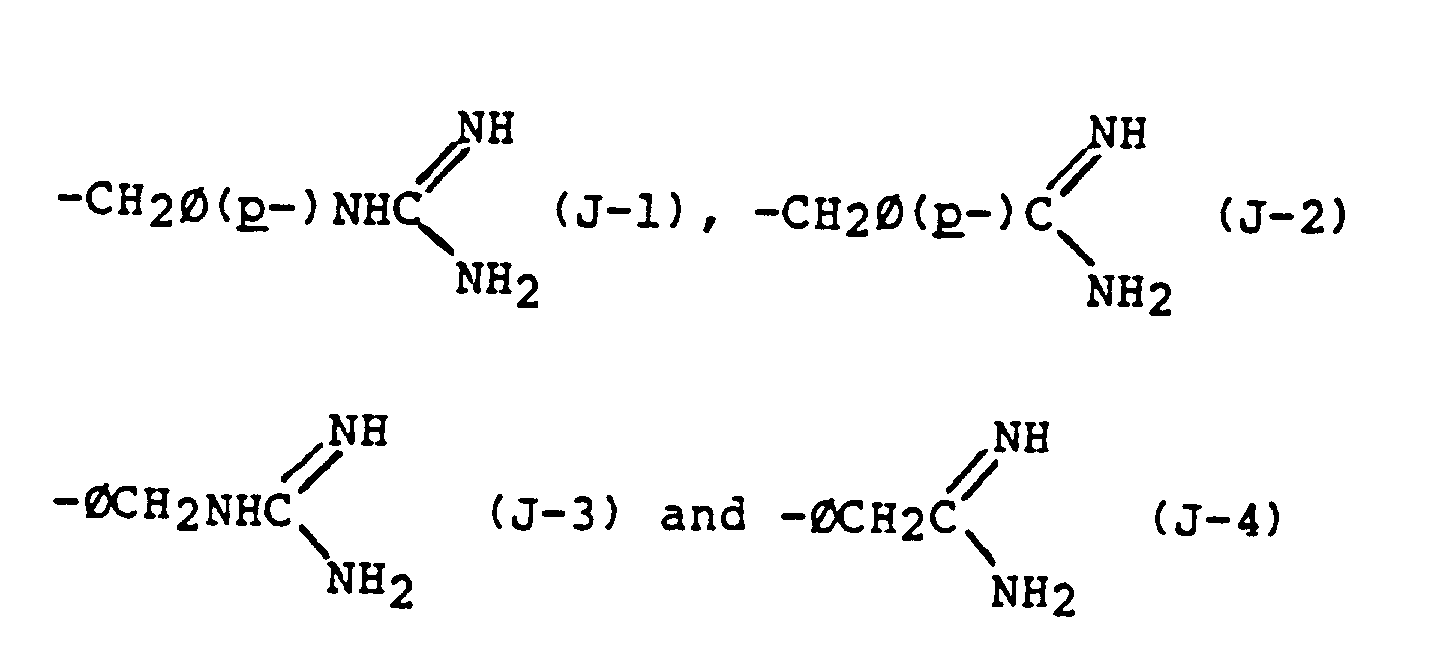
- K:
- Acetyl (Ac), Succinyl (Suc), Benzoyl (Bz), t-Butyloxycarbonyl (Boc), Carbobenzoxy (CBZ), Tosyl (Ts), Dansyl (DNS), Isovaleryl (Iva), Methoxysuccinyl (MeOSuc), 1-Adamantanesulphonyl (AdSO₂), 1-Adamantaneacetyl (AcAc), 2-Carboxybenzoyl (2-CBZ) and such other terminal amino protecting groups which are functionally equivalent thereto;
- To illustrate those compounds which are useful as enzyme inhibitors for human leukocyte elastase, and to serve as a medium of instruction for a better understanding of the scope of compounds embraced within the generic formula I, (and its sub-generic formulae for each of the involved enzymes herein disclosed) the following formula (Ia) represents the sub-generic class defining those compounds within the scope of inhibitors of human leukocyte elastase:
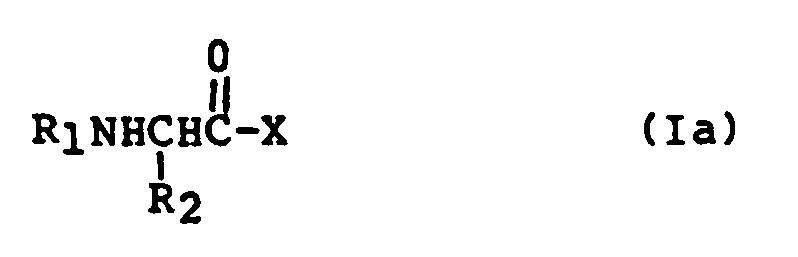
wherein R₂ is the side chain of the depicted enzyme-directing α-amino acid building block (P₁), - R₁
- is as previously defined (Comprised of P₂-Pn blocks), and
- X
- is the moiety conferring the electrophilic character to its adjacent carbonyl consisting of either X₁ or X₂ as previously defined generically in formula I.
- Still for instructional purposes, the structural formula for the most preferred human leukocyte elastase inhibitor is

the vertical dotted lines setting off each moiety constituting the specific arrangement for that particular peptidase inhibitor. Except for proline and 2-indoline carboxylic acid the moieties encircled within the dotted lines represent the R-group side chains of the α-amino acid building block (see pages 69-71 of the above cited Lehninger's text) or 1-naphthylmethyl. - Still another way of representing the foregoing substrate is by the formula

with R, R₂, R₄ being the side chain residues of the particular α-amino acid, the amino acid building block of P

- Still another, and the most convenient method for simply conveying the structure involved is the formula

wherein X consists of P


wherein for the illustrations above, P

- To expand on structure IV and (Ia) as it encompasses the scope of the other X moieties attached to the same P₁-P₅ moieties, the following seven structures are shown:
- (a) MeOSuc-Ala-Ile-Pro-Val-CF₂H (i.e., X₁ is -CF₂H).
- (b) MeOsuc-Ala-Ile-Pro-Val-CF₃ (i.e., X₁ is -CF₃).
- (c) MeOSuc-Ala-Ile-Pro-Val-COOH (i.e., X₁ is -CO₂R₃ with R₃ being H).
- (d) MeOSuc-Ala-Ile-Pro-Val-CONH₂ (i.e., X₁ is -CONHR₃ with R₃ being H).
- (e)


- (f)

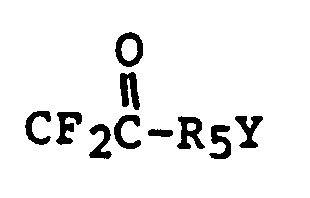
- (g)


- Utilizing the foregoing illustrations those compounds of formula I which are useful as inhibitors for human leukocyte elastase are represented by the formula

wherein R₂ is the side chain of the α-amino acids of Groups E and G, with nor-valine and valine being preferred, - R₁
- is -P₂P₃P₄P₅ with P₂ being α-amino acid blocks of Groups D, E and F, with proline being preferred,
- P₃
- is the α-amino acid blocks of Groups D or E, with isoleucine being preferred,
- P₄
- is the α-amino acid blocks of Groups E or zero with alanine being preferred (when Pn is zero then that particular moiety does not appear in the structure, i.e. it is deleted),
- P₅
- is the terminal moiety of Group K with methoxysuccinyl being preferred,
- X
- is any of the X₁ or X₂ moieties defined for formula I with R₅ being an α-amino acid block of Groups E and G with alanine being preferred and Y is NH₂, and
- R₄
- is an R group side chain of Groups E and G with alanine being-preferred.
- Human leukocyte elastase is released by polymorphonuclear leukocytes at sites of inflammation and thus is a contributing cause for a number of disease states. Thus the peptidase substrates of Formula (Ia) have an anti-inflammatory effect useful in the treatment of gout, rheumatoid arthritis and other inflammatory diseases, and in the treatment of emphysema. In their end-use application the enzyme inhibitory properties of the compounds of (Ia) are readily ascertained by standard biochemical techniques well known in the art. Potential dose range for their end-use application will of course depend upon the nature and severity of the disease state as determined by the attending diagnostician with the range of 0.01 to 10 mg/kg body weight per day being useful for the aforementioned disease states. The preferred compounds for this enzyme are:
MeOSuc-Ala-Ile-Pro-Val[CF₂-Ala]Ala-NH₂,
MeOSuc-Ala-Ile-Pro-Val-CF₃
MeOSuc-Ala-Ile-Pro-Val-CO₂Me,
MeOSuc-Ala-Ile-Pro-Val-CF2COOEt,
MeOSuc-Ala-Ile-Pro-Val-CHF₂,
MeOSuc-Ala-Ala-Pro-Val-CO₂Me,
MeOSuc-Ala-Ala-Pro-Val-[CF₂-Ala]Ala-NH₂,
MeOSuc-Ala-Ala-Pro-Val-CF₃,
[αN-(AdSO₂)]-(EN-(2-CBz)]-Lys-Pro-Val-[CF₂Ala]Ala-NH₂
[αN-(AdSO₂)]-(EN-(2-CBz)]-Lys-Pro-Val-CHF₂
[αN-(AdSO₂)]-(EN-(2-CBz)]-Lys-Pro-Val-CO₂ME
MeOSuc-Ala-Ile-Pro-Val-CO₂Me,
MeOSuc-Ala-Ile-Pro-Val-CO₂H. - Those compounds of Formula I which are useful as inhibitors of Cathepsin G are represented by the structural formula

wherein X₁, X₂, R₃, R₄, R₅ and Y are as defined for human leukocyte elastase (Formula Ia), - R₁
- is P₂-P₃-P₄-P₅ with P₂ being selected from Groups D, E, G or K with proline or benzoyl being preferred,
- P₃
- is selected from Groups E or G with alanine being preferred,
- P₄
- is selected from Groups E, G or is deleted with alanine being preferred,
- P₅
- is selected from Group K with succinyl being preferred.
- R₂
- is selected from Groups E and F but preferably is Phe side chain.
- R₅
- is preferably the glycine amino acid block or is a member of Group E or D or is zero,
- R₄
- is selected from Group C or G but preferably is a glycine or serine side chain,
- R₂
- is preferably the arginine side chain but may also be selected from Groups A and J,
- R₁
- is (a)-P₂-P₃, (b)-P₂ or (c)-P₂-P₃-P₄ with
- (a) P₂ is selected from Groups E or F, preferably proline, P₃ is selected from Group F, each P₃ being in the D - configuration preferably D-Phe,
- (b) P₂ is selected from Group K but preferably is dansyl or tosyl,
- (c) P₂ is selected from Group E but preferably is alanine, P₃ is selected from Groups G and E but preferably is serine, P₄ is selected from Groups G and E or is zero but preferably is Phe.
- The compounds embraced by Formula (Ic) inhibit thrombin and therefore, as in the use of heparin, the compounds may be used as the initial anticoagulant agent in thrombophlebitis and coronary thrombosis. For their end-use application, the potency and other biochemical parameters of the enzyme inhibiting characteristics of the compounds of (Ic) are readily ascertained by standard biochemical techniques well known in the art. Actual dose ranges for their specific end-use application will, of course, depend upon the nature and severity of the disease state of the patient or animal to be treated as determined by the attending diagnostician. It is to be expected that the general end-use application dose range will be about 0.01 to 10 mg per kg per day for an effective therapeutic effect. Preferred compounds are as expressed for Cathepsin G and also include:
H-(D)-Phe-Pro-Arg-CF₃,
H-(D)-Phe-Pro-Arg-COOH,
H-(D)-Phe-Pro-Arg-COO-n-butyl,
DNS-Arg-CF₃,
DNS-Arg-COOH,,
DNS-Arg-COO-n-butyl,
H-Phe-Ser-Ala-CF₃,
H-Phe-Ser-Ala-COOH,
H-Phe-Ser-Ala-COO-n-butyl,
p-[H₂NC(NH)NH]C₆H₄CH₂CH(NHBz)COOH
The compounds of Formula I which are useful as inhibitors of chymotrypsin are represented by the structural formula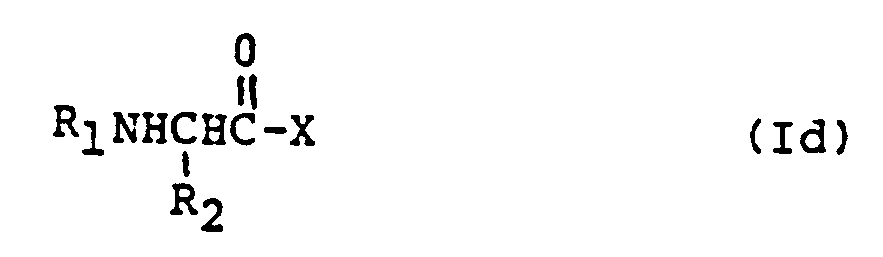
wherein X₁, X₂, R₃, R₄, R₅ and Y are as defined for compounds of Ia, and R₁ is -P₂-P₃-P₄-P₅ with, - P₂
- being selected from Groups D, E, G or K with benzoyl being preferred,
- P₃
- is selected from Groups E or G or is zero with alanine being preferred,
- P₄
- is selected from Groups E or G or is deleted with alanine being preferred,
- P₅
- is selected from Group K with succinyl being preferred, or is zero when P₂ is K, and
- R₂
- is selected from Groups E and F but preferably is Phe or Tyr side chains.
- The end-use application of the compounds (Id) inhibiting chymotrypsin is in the treatment of pancreatitis. For their end-use application, the potency and other biochemical parameters of the enzyme inhibiting characteristics of the compounds of (Id) are readily ascertained by standard biochemical techniques well known in the art. Actual dose ranges for their specific end-use application will, of course, depend upon the nature and severity of the disease state of the patient or animal to be treated as determined by the attending diagnostician. It is to be expected that the general end-use application dose range will be about 0.01 to 10 mg per kg per day for an effective therapeutic effect. Preferred compounds are as expressed for Cathepsin G and also include:
Bz-Phe-CF₃,
Bz-Phe-COOH,
Bz-Phe-COOMe,
Bz-Tyr-CF₃,
Bz-Tyr-COOH,
Bz-Tyr-COOMe,
Bz-Phe-CHF₂,
Bz-Phe-CF₂COOEt
Bz-Phe-[CF₂-Gly]Gly-OH
The compounds of Formula I which are useful as inhibitors of trypsin are represented by the structural formula
wherein X is X₁ or X₂ as defined in formula I with Y being OH, - R₅
- is selected from Groups G, E or D or is zero but preferably is glycine,
- R₄
- is an R group side chain of Groups C or G but preferably is glycine or serine side chain,
- R₂
- is selected from Groups A or J but preferably is the arginine side chain,
- R₁
- is selected from (a)-P₂-P₃, (b)-P₂ or (c)-P₂-P₃-P₄ with
- (a) P₂ is selected from Groups E or F but is preferably proline or alanine, P₃ is selected from Group F, (each being in the D configuration) but preferably is D -Phe,
- (b) P₂ is selected from Group K but preferably is dansyl or tosyl,
- (c) P₂ is selected from Group D or E but preferably is proline or alanine, P₃ is selected from Groups G and E but preferably is serine, P₄ is selected from Groups G and E or is zero but preferably is Phe.
- The end-use application of the compounds (Ie) inhibiting trypsin is in the treatment of pancreatitis. For their end-use application, the potency and other biochemical parameters of the enzyme inhibiting characteristics of the compounds of (Ie) are readily ascertained by standard biochemical techniques well known in the art. Actual dose ranges for their specific end-use application will, of course, depend upon the nature and severity of the disease state of the patient or animal to be treated as determined by the attending diagnostician. It is to be expected that the general end-use application dose range will be about 0.01 to 10 mg per kg per day for an effective therapeutic effect. The preferred compounds useful for inhibiting trypsin are the same as for the inhibition of thrombin.
- The compounds of Formula I which are useful as inhibitors of plasmin are represented by the structural formula

wherein X is X₁ or X₂, with CF₃, COOH, COOMe, and CF₂COOEt being preferred, - R₁
- is -P₂-P₃-P₄ with P₂ being selected from Group F but preferably is Phe, P₃ is selected from Groups B or F but preferably is Glu, and P₄ is selected from Group K but preferably is dansyl,
- R₂
- is selected from Groups A and J but preferably is the lysine side chain.
- The compounds embraced by formula (If) inhibit plasmin and are therefore antiproliferative agents useful in treating excessive cell growth, particularly in the treatment of benign prostatic hypertrophy and prostatic carcinoma, and in the treatment of psoriasis. For their end-use application, the potency and other biochemical parameters of the enzyme inhibiting characteristics of the compounds of (If) are readily ascertained by standard biochemical techniques well known in the art. Actual dose ranges for their specific end-use application will, of course, depend upon the nature and severity of the disease state of the patient or animal to be treated as determined by the attending diagnostician. It is to be expected that the general end-use application dose range will be about 0.01 to 10 mg per kg per day for an effective therapeutic effect. The preferred compounds are:
DNS-Glu-Phe-Lys-CHF₂
DNS-Glu-Phe-Lys-COOH
DNS-Glu-Phe-Lys-CF₃
DNS-Glu-Phe-Lys-COOMe
DNS-Gly-Phe-Lys-CF₂COOEt
The compounds of Formula I which are useful as inhibitors of C₁-esterase are represented by the structural formula
wherein X generically is X₁ or X₂ with X₁ being preferred particularly when X₁ is CO₂R₃ or -CF₃, - R₂
- is selected from Groups A and J but preferably is Arg,
- R₁
- generically is -P₂-P₃ with P₂ being selected from Groups E, G, D, C, F, A or B with Ala, being preferred, and P₃ is selected from Group K with CBZ being preferred,
- R₄
- is selected from Group E,
- R₅
- is selected from Group E and Y is preferably NH₂.
- The compounds embraced by formula (Ig) inhibit C₁-esterase and are therefore useful in treating systemic lupus, arthritis, autoimmune hemolytic anemia and glomerulonephritis. For their end-use application, the potency and other biochemical parameters of the enzyme inhibiting characteristics of the compounds of (Ig) are readily ascertained by standard biochemical techniques well known in the art. Actual dose ranges for their specific end-use application will, of course, depend upon the nature and severity of the disease state of the patient or animal to be treated as determined by the attending diagnostician. It is to be expected that the general end-use application dose range will be about 0.01 to 10 mg per kg per day for an effective therapeutic effect. The preferred compounds are:
CBZ-Ala-Arg-CF₃,
CBZ-Ala-Arg-COOH,
CBZ-Ala-Arg-COOMe,
CBZ-Ala-(p-gua)*-Phe-CF₂COOEt,
CBZ-Ala-(p-gua)-Phe[CF₂Ala]NH₂,
The compounds of Formula I which are useful as inhibitors of C₃-convertase are represented by the formula
wherein X generically is X₁ or X₂ with X₂ being preferred, - R₄
- preferably being the alanine side chain, but is also Group E,
- R₅
- is zero and Y is OR₃ (i.e., R₅Y is OR₃),
- R₂
- is selected from Groups A or J, with Arg being preferred,
- R₁
- is -P₂-P₃-P₄ with P₂ being selected from Groups E or F, with Ala being preferred, P₃ is selected from Groups E or F with Leu being preferred, and
- P₄
- is selected from Group K with Bz being preferred.
- The compounds embraced by formula (Ih) inhibit C₃-convertase and are therefore useful in treating systemic lupus, arthritis, autoimmune hemolytic anemia and glomerulonephritis. For their end-use application, the potency and other biochemical parameters of the enzyme inhibiting characteristics of the compounds of (Ih) are readily ascertained by standard biochemical techniques well known in the art. Actual dose ranges for their specific end-use application will, of course, depend upon the nature and severity of the disease state of the patient or animal to be treated as determined by the attending diagnostician. It is to be expected that the general end-use application dose range will be about 0.01 to 10 mg per kg per day for an effective therapeutic effect. The preferred compounds are:
Bz-Leu-Ala-Arg-CF₃,
Bz-Leu-Ala-Arg-CHF₂,
Bz-Leu-Ala-Arg-CF₂-COO-CH₂Ø
Bz-Leu-Ala-Arg[CF₂-Ala]OCH₂Ø
Bz-Leu-Ala-Arg-COOCH₂Ø. - The compounds of formula I which are useful as inhibitors of Urokinase are represented by the formula

wherein X generically is X₁ or X₂ with X₁ being preferred and CO₂R₃ and -CF₃ being most preferred, - R₄
- is Group E,
- R₅
- is Group E, and
- Y
- is NH₂,
- R₁
- generically is -P₂-P₃ with P₂ being selected from Groups E and G with Ala and Gly being preferred, and P₃ is selected from Group B with Glu being preferred,
- R₂
- is selected from Groups A and J with Arg being preferred.
- Preferred Urokinase inhibitors are:
K-Glu-Gly-Arg-CF₂H,
K-Glu-Gly-Arg-CF₃,
K-Glu-Gly-Arg-COOH,
K-Glu-Gly-Arg-CONH₂,
K-Glu-Gly-(p-gua)**Phe-[CF₂Ala]-Ala-NH₂, and
K-Gly-Gly(p-gua)**Phe-CF₂CONH₂,
The compounds of formula (Ii) inhibit urokinase and therefore are useful in treating excessive cell growth disease states. As such the compounds are useful in the treatment of benign prostatic hypertrophy and prostatic carcinoma, the treatment of psoriasis, and in their use as abortifacients. For their end-use application, the potency and other biochemical parameters of the enzyme inhibiting characteristics of the compounds of (Ii) are readily ascertained by standard biochemical techniques well known in the art. Actual dose ranges for their specific end-use application will, of course, depend upon the nature and severity of the disease state of the patient or animal to be treated as determined by the attending diagnostician. It is to be expected that the general end-use application dose range will be about 0.01 to 10 mg per kg per day for an effective therapeutic effect.
**(p-gua) being para-guanidino - The compounds of Formula I which are useful as inhibitors of plasminogen activator are represented by the structural formula

wherein X generically is X₁ or X₂ with X₁ being preferred and -CF₃, COOH and COOMe being most preferred, - R₄
- is Group E,
- R₅
- is Group E,
- Y
- is NH₂ when X is X₂,
- R₁
- generically is -P₂-P₃-P₄ wherein P₂ is Gly, P₃ is selected from Group B with Glu being preferred, and P₄ preferably is dansyl but also selected from Group K, and
- R₂
- is selected from Groups A and J with Arg being preferred.
- Preferred compounds are:
DNS-Glu-Gly-Arg-COOMe,
DNS-Glu-Gly-Arg-CF₃,
DNS-Glu-Gly-Arg-COOH,
DNS-Glu-Gly-(p-gua)Phe-CHF₂,
DNS-Glu-Glu-(p-gua)Phe[CF₂Ala]AlaNH₂,
DNS-Glu-Gly-(p-gua)PheCF₂COOEt. - The compounds of the Formula (Ij) inhibit plasminogen activator and therefore are useful in treating excessive cell growth disease states such, for example, being useful in the treatment of benign prostatic hypertrophy and pro-static carcinoma, in the treatment of psoriasis and in their use as abortifacients. For their end-use application, the potency and other biochemical parameters of the enzyme inhibiting characteristics of the compounds of (Ij) are readily ascertained by standard biochemical techniques well known in the art. Actual dose ranges for their specific end-use application will, of course, depend upon the nature and severity of the disease state of the patient or animal to be treated as determined by the attending diagnostician. It is to be expected that the general end-use application dose range will be about 0.01 to 10 mg per kg per day for an effective therapeutic effect.
- The compounds of Formula I which are useful as inhibitors of acrosin are represented by the structural formula

wherein X generically is X₁ or X₂, with X₁ being preferred especially when X₁ is -CF₃, CHF₂, COOH or COOMe. When X is X₂, R₄ is Group E, R₅ is Group E, or is deleted and Y is NH₂, - R₁
- generically is -P₂-P₃-P₄ with P₂ being selected from Group E with Leu being preferred, P₃ is selected from Group E with Leu being preferred, P₄ is selected from Group K with Boc being preferred.
- R₂
- is selected from Groups A and J with Arg being preferred. Preferred compounds are:
Boc-Leu-Leu-Arg-CF₂H,
Boc-Leu-Leu-Arg-CF₃,
Boc-Leu-Leu-Arg-COOH,
Boc-Leu-Leu-(p-gua)Phe-[CF₂Ala]AlaNH₂, and
Boc-Leu-Leu-(p-gua)PheCF₂CONH₂. - The compounds of formula (Ik) are acrosin inhibitors and therefore are useful as anti-fertility agents in that they possess the characteristics of preventing sperm from penetrating an otherwise fertilizable egg. For their end-use application, the potency and other biochemical parameters of the enzyme inhibiting characteristics of the compounds of (Ik) are readily ascertained by standard biochemical techniques well known in the art. Actual dose ranges for their specific end-use application will, of course, depend upon the state of the patient or animal to be treated as determined by the attending diagnostician. It is to be expected that the general end-use application dose range will be about 0.01 to 10 mg per kg per day for an effective therapeutic effect.
- The compounds of Formula I which are useful as inhibitors of β-lactamase are represented by the structural formula

with the proviso that the depicted carbonyl moiety (attached to X) may exist in its chemically reduced form, (i.e.,
with the reduced form being preferred,
wherein X is X₁ or X₂ with -CF₃, COOH and COOMe being most preferred, and R₅ is deleted when X is X₂ - R₁
- generically is P₂, P₂ being selected from Group K with COCH₂Ø and Bz being preferred, when X is generically X₂,
- R₂
- is selected from Groups E, G and C with glycine being
preferred. The preferred compounds are: ØCH₂COHNCH₂COCF₃,
ØCH₂COHNCH₂COCOOH,
ØCH₂COHNCH₂COCOOMe,
ØCH₂COHNCH₂CHOHCF₃,
ØCH₂COHNCH₂CHOHCOOH,
ØCH₂COHNCH₂CHOHCOOMe,
ØCH₂COHNCH₂COCHF₂,
ØCH₂COHNCH₂CHOHCF₂COOEt. - The compounds embraced by formula (Il) inhibit β-Lactamase and therefore are useful in the potentiation of antibacterial agents, particularly the β-lactam anti-bacterials. For their end-use application, the potency and other biochemical parameters of the enzyme inhibiting characteristics of the compounds of (Il) are readily ascertained by standard biochemical techniques well known in the art. Actual dose ranges for their specific end-use application will, of course, depend upon the nature and severity of the disease state of the patient or animal to be treated as determined by the attending diagnostician. It is to be expected that the general end-use application dose range will be about 0.01 to 10 mg per kg per day for an effective therapeutic effect.
- The compounds of Formula I which are useful as inhibitors of D-Ala-D-Ala Carboxypeptidase are represented by the structural formula

wherein X generically is X₁ or X₂ wherein when X is X₂, - R₄
- is D-Ala and R₅ is deleted and Y is OH or OR₃,
- R₂
- is D-Ala,
- R₁
- generically is P₂-P₃ with P₂ being Ac(Nα,ε-Ac)Lys or Groups E and C with Ac(Nα,ε-Ac)Lys being preferred, P₃ generically is selected from Group K with Ac being preferred. The preferred compounds are:
(Nα,ε)-di-Ac-Lys-D-Ala[CF₂-(D)-Ala]OH,
(Nα,ε)-di-Ac-Lys-D-Ala[CF₂-D-Ala]OMe,
(Nα,ε)-di-Ac-Lys-D-Ala-CHF₂,
(Nα,ε)-di-Ac-Lys-D-Ala-CF₂COOEt and
(Nα,ε)-di-Ac-Lys-D-AlaCF₃ - The compounds of Formula I which are useful as inhibitors of Cathepsin B are represented by the structural formula
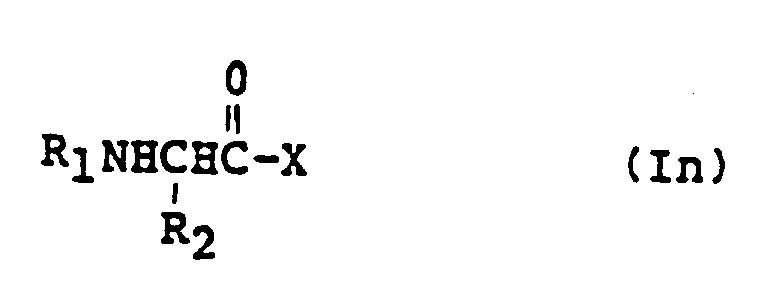
wherein X generically is X₁ or X₂ with X₁ being preferred and CF₃ and COOH being particularly preferred and when X is X₂, R₄ is selected from Group E with Leu being preferred, - R₅
- is selected from Groups G, E or F with Gly being preferred and Y is OH,
- R₁
- generically is (a)-P₂-P₃ or (b)-P₂-P₃-P₄ wherein
- (a) P₂ is selected from Groups E and F with Phe being preferred and P₃ is selected from Group K with CBZ being preferred, and
- (b) P₂ is selected from Groups E and F with Leu being preferred, -P₃ being selected from groups E and F with Leu being preferred and P₄ is selected from Group K with Ac being preferred,
- R₂
- is selected from Group A and J or ThrCOCH₂Ø, with Arg being preferred. The preferred compounds are:
Ac-Leu-Leu-Arg[CF₂-Leu]Gly-OH,
CBZ-Phe-Arg[CF₂-Leu]Gly-OH, and
- The compounds of Formula I which are useful as inhibitors of renin are represented by the structural formula
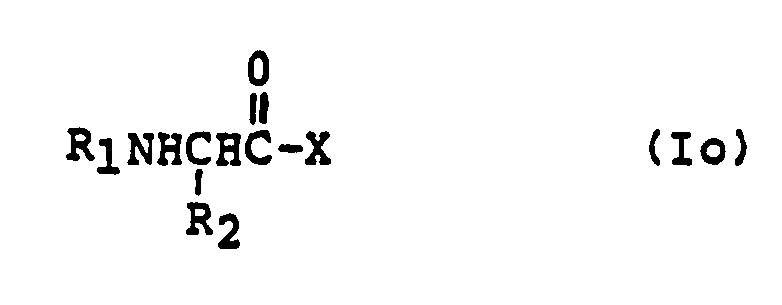
with the proviso that the depicted carbonyl moiety attached to X may exist in its chemically reduced form, i.e.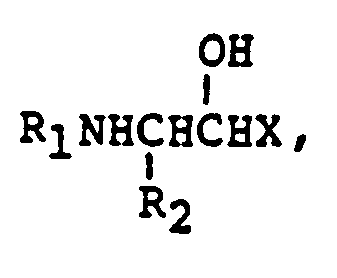
wherein X generically is X₁ or X₂, which when X is X₁ CF₃, COOH or COOMe are preferred and when X is X₂, - R₄
- is selected from Groups E, F or G with Val being preferred,
- R₅
- generically is


- R₂
- is selected from Groups E or F or is cyclohexylmethylene with Leu being preferred,
- R₁
- generically is -P₂-P₃-P₄-P₅-P₆ wherein P₂ is selected from Groups E, C or F with His being preferred, P₃ is selected from Groups E or F with Phe being preferred, P₄ is selected from Groups E, D, F or is deleted with Pro being preferred, P₅ is selected from Groups E, C, F or is deleted with His being preferred, and P₆ is selected from Group K with MeOSuc being preferred. The preferred compounds are:
CBZ-Nal(1)-His-Leu-CHF₂,
CBZ-Nal(1)-His-Leu-CF₃,
CBZ-Nal(1)-His-Leu-CF₂-COOEt,
MeOSuc-His-Pro-Phe-His-Leu-[CF₂-Val]Ile-His-OH-,
MeOSuc-Pro-Phe-His-Leu-[CF₂-Val]Ile-His-OH,
MeOSuc-His-Phe-His-Leu-[CF₂-Val]Ile-His-OH,
MeOSuc-His-Pro-Phe-His-Leu-[CF₂-Val]Ile-OH,
MeOSuc-His-Pro-Phe-His-Leu-[CF₂-Val]His-OH,
BOC-His-Pro-Phe-His-Leu[CF₂-Val]-Ile-His-OH,
BOC-His-Pro-Phe-His-Leu-[CF₂-CO]-Ile-His-NH₂,
BOC-Pro-Phe-His-Leu[CF₂-Val]-Ile-His-NH₂. - The compounds of Formula (Io) inhibit renin and therefore are used as antihypertensive agents useful in treating hypertension. For their end-use application, the potency and other biochemical parameters of the enzyme inhibiting characteristics of the compounds of (Io) are readily ascertained by standard biochemical techniques well known in the art. Actual dose ranges for their specific end-use application will, of course, depend upon the nature and severity of the disease state of the patient or animal to be treated as determined by the attending diagnostician. It is to be expected that the general end-use application dose range will be about 0.01 to 10 mg per kg per day for an effective therapeutic effect.
- The compounds of Formula I which are useful as inhibitors of pepsin are represented by the structural formula

with the proviso, that the depicted carbonyl moiety attached to X may exist in its chemically reduced form, i.e.
wherein X generically is X₁ and X₂, which when X is X₁ -CF₂H, CF₃ and CONH₂ are preferred, when X is X₂ then, - R₄
- is selected from the Groups E, G and F with Gly being preferred,
- R₅
- is selected from Groups E and F with Ala being preferred and Y is -NHCH₂CH(CH₃)₂ or -NHCH₂CH₂CH(CH₃)₂,
- R₁
- is -P₂-P₃-P₄ with P₂ being selected from Groups E or F with Val being preferred, P₃ is selected from Groups E or F with Val being preferred or is deleted and P₄ is selected from Group K, being preferably Iva, and
- R₂
- is selected from Groups E and F with Leu being preferred. The preferred compounds are:
Iva-Val-Leu-CF₂-CO-Ala-NH-CH₂CH₂CH(CH₃)₂
Iva-Val-Val-Leu-CHF₂
Iva-Val-Val-Leu-CF₃ - The compounds of formula I which are useful as inhibitors of Cathepsin D are represented by the structural formula

wherein X generically is X₁ or X₂ which when X is X₁, the preferred groups are -CO₂R₃ or -CF₃, and when X is X₂, - R₄
- is selected from Groups E and F with Phe being preferred,
- R₅
- is selected from Groups E and F with Ala being preferred,
- Y
- is -NH(CH₂)₂CH(CH₃)₂ or -NHCH₂CH(CH₃)₂,
- R₁
- generically is -P₂-P₃-P₄ with P₂ being selected from Groups E and F, with Val being preferred, P₃ is selected from Groups E and F with Val being preferred, and P₄ is selected from Group K with CBZ being preferred, and
- R₂
- is selected from Groups E and F, with Phe being preferred. The preferred compounds are:
CBZ-Val-Val-Phe-CF₂-CO-Ala-Iaa
CBZ-Val-Val-Phe-CF₂H,
CBZ-Val-Val-Phe-CF₃,
CBZ-Val-Val-Phe[CF₂-Phe]Ala-NH(CH₂)₂CH(CH₃)₂,
CBZ-Val-Val-Phe[CF₂Phe]Ala-NHCH₂CH(CH₃)₂,
Iaa being isoamyl amide. - As inhibitors of Cathepsin D the compounds of formula (Iq) are useful for the same end-use applications set forth for human leukocyte elastase inhibitors (Ia) and are also useful as antidemyelinating agents useful to prevent and arrest nerve tissue damage. For their end-use application, the potency and other biochemical parameters of the enzyme inhibiting characteristics of the compounds of (Iq)are readily ascertained by standard biochemical techniques well known in the art. Actual dose ranges for their specific end-use application will, of course, depend upon the nature and severity of the disease state of the patient or animal to be treated as determined by the attending diagnostician. It is to be expected that the general end-use application dose range will be about 0.01 to 10 mg per kg per day for an effective therapeutic effect.
- The compounds of formula I which are useful as inhibitors of angiotensin converting enzyme (ACE) are represented by the structural formula

wherein X is only X₂ wherein, - R₄
- is selected from Groups E or G with Gly being preferred,
- R₅
- is selected from Groups A, B, C, D, E, F and G with Group D being preferred and Y is OH,
- R₁
- is selected from Group K with Bz being preferred,
- R₂
- is selected from Groups E, F and G with Phe being preferred. The preferred species are illustrated as

- The compounds of Formula I which are useful as inhibitors of enkephalinase are represented by the structural formula

wherein X generically represents X₂ wherein, - R₄
- is selected from Group E or F with Phe being preferred,
- R₅
- is selected from the Groups E or F or zero with the proviso that when R₅ is zero, Y is NH₂, with Met being preferred and Y is NH₂ or OH, preferably OH when R₅ is Met or other α-amino acid,
- R₁
- generically is -P₂-P₃, with P₂ being Gly and P₃ being selected from Group F or is deleted with Tyr being preferred, and
- R₂
- is Gly. The preferred compounds are:
H-Tyr-Gly-Gly-CF₂-CO-Phe-Leu-OH,
H-Tyr-Gly-Gly[CF₂-Phe]Met-OH
H-Tyr-Gly-Gly[CF₂-Phe]LeuNH₂
H-Tyr-Gly-Gly-CF₂-CO-Leu-OH - The compounds of Formula I which are useful as inhibitors of Pseudomonas elastase are represented by the structural formula

wherein X generically is X₂ with, - R₄
- being selected from Groups E and F with Ile being preferred,
- R₅
- is selected from Groups E and G with Ala being preferred and Y is NH₂,
- R₁
- is -P₂-P₃ with P₂ being selected from Group E with Ala being preferred, P₃ is selected from Group K with MeOSuc being preferred,
- R₂
- is selected from Groups E and G with Ala being preferred. The preferred compounds are:
MeOSuc-Ala-Ala[CF₂-Ile]Ala-NH₂
MeOSuc-Ala-Ala-CF₂-CO-Ile-Ala-NH₂ - The compounds of formula I which are useful as inhibitors of leucine aminopeptidase are represented by the formula

wherein X generically embraces all of X₁ and X₂ which when X is X₁, CO₂R₃ or -CF₃ are preferred and when X is X₂, - R₄ and R₅
- each are any Group except K with Ala and Group E being preferred, Y is NH₂,
- R₁
- is hydrogen, and
- R₂
- is selected from Groups A, B, E, F and J with Phe, Leu, Glu and with Arg being preferred. The preferred compounds are:
H-Leu-CHF₂
H-Leu-CF₂-COOEt
H-Arg-CF₃
H-(p-gua)Phe-CF₃
H-Leu-CF₃ and H-Leu-COOH,
H-Leu[CF₂-Ala]Ala-NH₂ and H-Leu-COOMe or Leu-COOH
H-Arg-CO-CF₂-Phe-OH - The compounds of Formula I which are useful as inhibitors of kallikreins, tissue or plasma, are represented by the formula
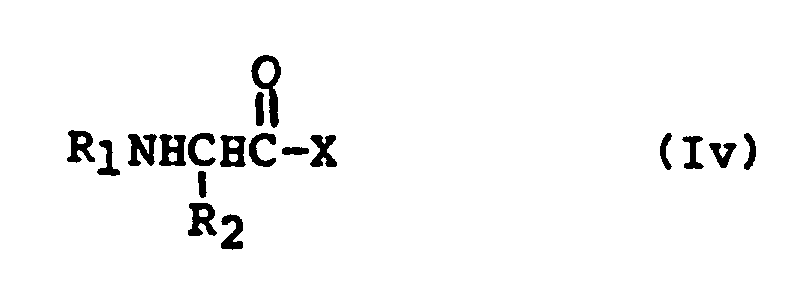
wherein X is X₁ - R₂
- preferably is the Arg residue,
- R₁
- is a peptide -P₂P₃ with
- P₂
- being selected from the Groups F and E with Phe being preferred
- P₃
- being selected from Groups C, E or F, the residues of which may be in either the D- or L-configuration. The preferred compounds of this formula (Iv) are:
D-Pro-Phe-Arg-CF₂H
D-Pro-Phe-Arg-CF₃
D-Pro-Phe-Arg-CO₂H
D-Pro-Phe-Arg-CONH₂ - Having defined the scope of compounds embraced within the generic formula I and within the individual subgeneric groups of each of the 21 enzymes, the manner in which such compounds may be prepared will hereinbelow be described as illustrated.
The preparation of the compounds of formula I may be achieved using standard chemical reactions analogously known to be useful for the preparation of a variety of known peptides. Indeed, for the most part, once certain key intermediate α-amino acid derivatives are prepared, the procedures for obtaining the final products may readily be effected using standard techniques known to those skilled in the field of peptide chemistry. For this purpose, a handy reference text for these techniques is the 1985 "The Practice of Peptide Synthesis" by M. Bodanszky and A. Bodanszky, wherein the parameters and techniques affecting the selection, use and removal of protective groups for individual and groups of amino acids is detailed, and which also contains activation and coupling techniques and other special procedures. However, before the application of these peptide chemistry techniques may be applied, certain key intermediates containing the activated electrophilic ketone moiety must first be prepared. The preparation of the key intermediates is described as follows. - For those compounds wherein X₁ represents either -CF₂H or -CF₃, the key intermediates required for the application of the standard peptide coupling techniques are compounds of formula IIIa-b
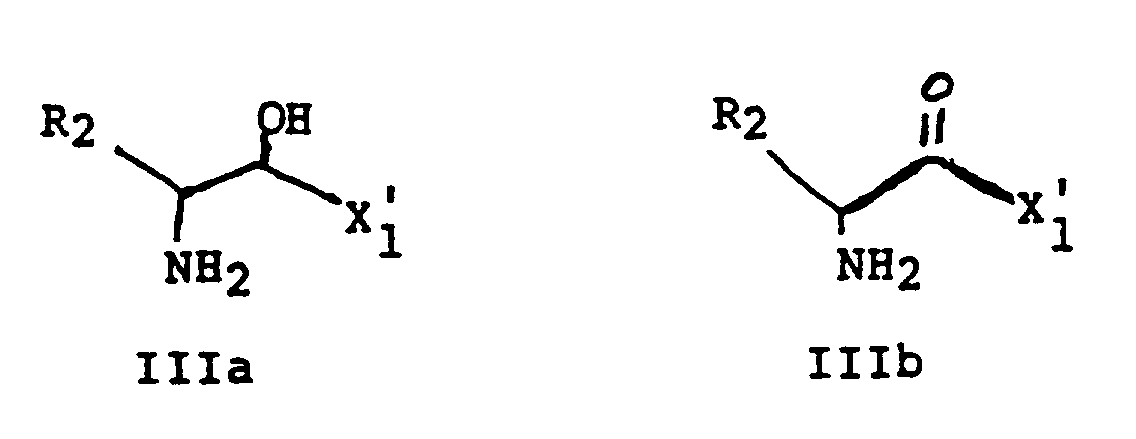
wherein X


wherein R₆ is alkyl, phenyl or other equivalent moiety, and X
- In general, the formation of the substituted azlactones (VI) is effected from the N-protected amino acids (V) by standard reaction conditions wherein the amino acid derivative (V) is heated in the presence of an acid anhydride. The so-produced azlactone (VI) is reacted with a di- or trifluoroacetic acid anhydride or acid halide to give a fluorinated intermediate which (with or without isolation) is treated with anhydrous oxalic acid to produce the N-protected fluorinated ketone (VII) whereupon the ketone is chemically reduced to its alcoholic amide VIII. The amide (VIII) is cleaved under standard acidic conditions to yield its amide acid salt (e.g., its hydrochloride (IX)). After neutralization, the alcohols (IIIa) may be coupled to R₁ using standard peptide chemistry techniques to produce compounds (X) which are subjected to the Swern oxidation procedure to obtain the desired products XIa and XIb (the ketone or hydrate respectively). Alternatively, the alcohols (IIIa) may be oxidized to the ketones (IIIb) which are coupled to R₁ according to standard peptide chemistry techniques. When employing this alternative route, the amino moiety is first protected with a Boc protecting group, the OH function oxidized to its ketone via Swern oxidation procedures, and then the Boc protecting group removed and the resulting compounds (IIIb) are then coupled to R₁.
- In effecting the foregoing reactions, standard and well-known techniques analogously known are utilized, for example, the azlactones (VI) are chemically transformed to their di- or trifluoromethyl derivatives (their X

- It is, of course, obvious to one of ordinary skill in the art that the conditions of the steps of Reaction Scheme A may have an impact on the R₂ side chain and thus procedures will have to be taken to protect those R₂ moieties which are not compatible with the various reaction conditions. For example, R₂ moieties which belong to Group E are generally compatible. Similarly, R₂ side chain radicals from Groups F, J, and G are compatible. Radicals of Group A need protection. Since arginine may be considered as a derivative of ornithine, the ornithine derivative may first be prepared and then converted to the arginine side chain otherwise the guanidino function of the arginine moiety will have to be protected. The Group C radicals of serine, threonine and cysteine must be protected, preferably with an ether (e.g., benzyl ether). Preferably, the -OH and -SH functions of these groups are protected before the azlactone is formed. The (X) intermediate wherein X

- For those compounds wherein X₁ represents CO₂R₃, CONR₃ or COR₅Y, the key intermediates required for the application of the standard peptide coupling techniques have the formula

with R
- The preparation and application of these compounds may be depicted by the following reaction scheme. (NB. The desired stereochemistry at the N-substituted carbon is obtained unless otherwise noted.)

wherein A⊖ is the anion of the acid employed and R

and R
- Compounds XIII are generally known starting materials. (In general, such materials may be prepared by converting the appropriate L-amino acid to its ester, preferably its methyl ester by standard esterification procedures (e.g., SOCl₂ in the presence of alcohol), the ester is N-protected, preferably with di-t-butyl dicarbonate (Boc)). The so-protected R₂-amino acid is chemically reduced to the desired aldehydic form (XIII) of the N-protected amino acid, preferably with diisobutylaluminum hydride (Dibal); all such procedures being by techniques well known in the art. Of course, other procedures for obtaining the same end products are readily available by techniques well known in the art.
- The reaction steps of Reaction Scheme B also use standard and well known techniques. For example, conversion of the aldehydes (XIII) to the corresponding cyanohydrin is effected by reaction with a bisulfite (e.g., NaHSO₃) to obtain a bisulfite addition product XIV which is treated with a metallocyanide (e.g., KCN) to produce the corresponding cyanohydrin (XV). Of course, other procedures are readily available for the conversion of the aldehyde to the cyanohydrin derivatives (XV). The cyanohydrins are heated in a mixture of an aqueous acid and water miscible solvent such as an ether (preferably dioxane) to form the desired hydroxy acid (XVI) as a mixture of its diastereoisomers. These compounds are subjected to neutralization and purification by standard procedures, such as ion exchange resin chromatographic techniques, to yield products which are esterified to obtain the desired key intermediates (XII).
- In effecting B(a), the amino esters (XII) are coupled with the R₁ moiety according to standard peptide coupling techniques, taking care that the protective group utilized (if any) are selectively cleavable over the CO₂R

- In effecting B(b), the ester (XVII) is treated with an amine (R₃NH₂) to give the amide (XIX) which may be oxidized via the Swern oxidation procedures to its keto amide (XX). In this instance oxidation conditions other than that of the Swern conditions may also be employed (e.g. oxidation with pyridinium dichromate).
- In effecting B(c), the keto ester (XVIII) is treated with a base (e.g., LiOH) to give its keto acid (XXI) except in the case when R₁ contains a terminal methoxysuccinyl moiety in which case the R


- In effecting B(e), the acid is coupled with R₅Y according to standard procedures, taking care to protect and deprotect as needed in the light of the various groups in the definition of R₅ and Y. In reaction B(f) the ester (XVII) is converted to an amide and the amide oxidized according to Swern oxidation conditions.
- As noted above (following the discussion of Reaction Scheme A), the conditions of the foregoing reactions in the obtention of the desired intermediates and final products of Reaction Scheme B are effected taking care that the R₂-side chain radicals are compatible. Although Groups E, F and G are generally compatible, protection of some R₂ side chains will be necessary. For example, histidine will have to be protected, while tyrosine and tryptophan ought be protected in order to improve overall yields. Again, ornithine must have its terminal delta amino group protected and ornithine may be converted to arginine. A protecting group would also be needed on a guanidino group. All amino aids, eg. cysteine and threonine having reactive groups in their side chain preferably are protected.
- In the preparation of those compounds wherein X₂ is

the intermediates will be those compounds of the formulae
which compounds may be prepared and applied according to Reaction Scheme C.
The azlactone (VI) is prepared as in Reaction Scheme A and the steps going from VI to XXV are analogous to those of that Scheme except that the azlactone is treated with an unsaturated fluorinated carboxylic acid anhydride, and the product is treated with anhydrous oxalic acid to produce compounds XXV. Utilizing these intermediates (XXV) several pathways may be utilyzed to obtain the desired products. In one pathway (C-1) the intermediate is sequentially subjected to a) a chemical reduction of the electrophilic ketone, and b) hydrolysis of the amide by standard procedures prior to coupling the R₁ moiety. The coupling is readily accomplished using standard peptide chemistry coupling procedures (already referenced) to produce compounds of formula XXVI; these intermediates are also available for alternate pathways, i.e., C-1a or C-1b. In pathway C-1a the intermediates are sequentially treated with a) ozone according to standard ozonolysis procedures to produce the corresponding ozonide, b) treatment with dimethylsulfide to convert the ozonide to its aldehydic form and (c) oxidation, preferably using the Jones oxidation procedure to produce compounds of formula XXIVa. These compounds (XXIVa) are sequentially subjected to a) R₅Y coupling and b) Swern oxidation reactions according to already described standard procedures. In those instances wherein it is desired to first protect the hydroxy group, pathway C1-b is available. This pathway essentially mimics C-1a except that the hydroxy function is protected prior to ozonolysis and the hydroxy protecting group (i.e. R₇) is removed in preparation for the Swern oxidation reaction. Typical protecting groups compatible with the described reactions can be used. Preferably the methoxyethoxymethyl group is utilized and is readily removed prior to the Swern oxidation by standard techniques such as by treatment with Zn Br₂. - In pathway C-2 the intermediates are direct subjected to the above described sequential reactions (ozonolysis, treatment with DMS, and oxidation) to produce compounds of formula XXIX which in preparation for R₅Y coupling are converted to the spiro lactones of formula XXX. Coupling, and deprotection (if necessary) produce the desired compounds XXXI using standard techniques.
- Pathway C-3, a variation of pathway 6-1b, first reduces the electrophilic ketone to a hydroxy function which is protected with a suitable protecting group (e.g. methoxyethoxymethyl) and the resulting compounds XXVI are subjected to (a) ozonolysis, treatment with DMS, and the Jones oxidations, (b) R₅Y coupling and deprotection reactions, and (c) Swern oxidation, (all of these reactions being done according to the above described procedures for these reactions) to produce the desired compounds of formula XXXI.
- In those instances wherein difluorinated acid anhydrides are required for the preparation of the fluoromethyl azlactones, such anhydrides may be prepared by reacting tetrafluoroethylene (F₂C:CF₂) with an R₄CH=CHCH₂OH reactant in the presence of a base (e.g. NaH) and the so-desired R₄CH=CHCH₂OCF₂-CF₂H intermediate is treated with butyllithium to produce an acid fluoride

which is converted to its anhydride by standard procedures. Here again, it is obvious that compatibility features must be facilitated to ensure that the relevant groups can withstand the butyllithium reaction; thus the R₄ moiety has to be protected when incompatible with the butyllithium reaction. - For those compounds wherein X₂ represents

the key intermediates useful for the preparation of the compounds of formula I bearing this group will be of the formulae
the preparation and application of which is depicted by Reaction Scheme D.
wherein P
- Following the initial step of alkylating the N-protected aldehyde of formula XXXIV with an appropriate halide in the presence of zinc, the steps following the obtention of compounds XXXV follow the analogous procedures already described for Reaction Schemes A-C.
- Having generally described the procedures by which the compounds of this invention may be prepared, the following specific examples serve to further illustrate the standard techniques and procedures which may be utilized to prepare the enzyme inhibitors of this invention (I).
- To a solution of 0.621 g (3 mmol) of 6-amino-4,4-difluoro-8-methyl-1-nonen-5-ol (obtained from the corresponding HCl salt by treatment of aqueous solution with 4N NaOH and extracted with Et₂O) and 0.603g (3 mmol) of N-isovaleryl valine in 30 ml THF at 0°C was added 0.62 g of dicyclohexyl carbodiimide. The mixture was stirred for 15 hours at 25°C, filtered and the filtrate concentrated to yield a semisolid which was dissolved in CH₂Cl₂. The organic layer was washed with 1N HCl aqueous KHCO₃ and then brine, dried (MgSO₄) and flash evaporated to afford a solid, which was purified further by chromatography in SiO₂ (CHCl₃/Et₂O (2:1)). The product containing fractions were combined, flash evaporated to give the desired product. Rf 0.15 (CHCl₃/Et₂O) (2:1)).
- To a mixture of 1.3 g of 3-amino-1,1,1-trifluoro-2-propanol HCl and 1.62 g of triethylamine in 26 ml of THF at 0°C under nitrogen was added dropwise a solution of 1.27 g of phenacetylchloride in 5 ml THF. The reaction mixture was allowed to warm to 25°C and then stirred for 1 hour. The mixture was diluted with CH₂Cl₂ and washed with H₂O, twice with 0.1N HCl, and then brine. After drying (MgSO₄), the solvent was flash evaporated and the residue (1.8 g) recrystallized from CH₂Cl₂ to yield 1.4 g of product; M.P. 96°C.
- To a mixture of 1.1 g of N-phenylmethyloxycarbonyl proline TDO-ester (Cf Hollitzer, Seewald and Steglichm, Ang. Chemie, Int. Edit. 1976, Vol. 15, 444) and 0.42 g of 3-amino-1,1,1-trifluoro-4-methyl-2-pentanol hydrochloride in 50 ml of CH₂Cl₂ was added dropwise 0.40 g of triethylamine. After stirring for 14 hours at 25°C, aqueous KHSO₄ was added, the layers separated and the organic layer washed with aqueous KHSO₄, aqueous KHCO₃, H₂O and then brine (2x). After drying (MgSO₄), solvents were flash evaporated to yield 0.54 g of a solid residue which was recrystallized in Et₂O to give 0.24 g of the analytically pure expected amide; mp. 99°C.
- A mixture of 0.5 g of 3-amino-1,1,1-trifluoro-5-methyl-2-hexapol HCl, 0.5 g of di-tert-butyl dicarbonate and 0.45 g of KHCO₃ in 1.6 ml H₂O/dioxane (1:1) was stirred at room temperature for 14 hours. Workup in Et₂O/H₂O gave, after washing of the organic layer with aqueous NaHSO₄, H₂O and brine and drying (MgSO₄) followed by flash evaporation of the solvents 0.55 g of the expected Boc derivative, Rf 0.44 (Et₂O/pentane (1:1)).
- To a solution of 0.84 g of oxalyl chloride in 5 ml of CH₂Cl₂ at -55°C (inside temperature) was added 1.03 g of dimethylsulfoxide in 1 ml of CH₂Cl₂. After 5 minutes at -55°C, 1.0 g of 3-phenacetylamino-1,1,1-trifluoro-2-propanol in 5 ml CH₂Cl₂ and 0.2 ml of DMSO were added. The mixture was stirred for 15 minutes at -55°C and then triethylamine was added to adjust the pH to 7.0. The mixture was allowed to warm to 25°C, diluted further with CH₂Cl₂ and washed with H₂O and then 1N HCl. The organic layer was dried (MgSO₄), flash evaporated to yield the amide ketone, which was purified further by chromatography on SiO₂ (CHCl₃/Et₂O (2:1)). Rf 0.29. The product containing fractions were combined and solvent was evaporated under reduced pressure to yield the desired product as a mixture Of ketone and hydrate.
- The named product was prepared by the procedure of example 5 except that 3-tert-butyloxycarbonylamino-1,1,1-trifluoro-5-methyl-2-hexanol is used in place of 3-phenacetylamino-1,1,1-trifluoro-2-propanol.
- To a solution of 0.1 ml of oxalyl chloride in 2.5 ml of CH₂Cl₂ cooled to -55°C was added 0.17 ml of DMSO in 2.5 ml of CH₂Cl₂. After stirring for 5 minutes at -55°C, 0.295 g of N'-(2-hydroxy-3,3-difluoro-isobutyl-5-hexenyl)-N²-isovaleryl valinamide, in a mixture of 2 ml of CH₂Cl₂ and 0.4 ml of DMSO, were added. The mixture was stirred for 15 minutes at -55°C and then triethylamine (about 0.5 ml) was added to adjust the pH of the solution to 8. The mixture was allowed to warm to room temperature, then diluted with CH₂Cl₂ and washed with H₂O, then with 1N HCl. The organic layer was dried (MgSO₄), then flash evaporated to yield 0.270 g of the expected ketone. Rf 0.3 (CHCl₃/Et₂O (2:1)).
- A solution of (2-benzoylamino-4,4-difluoro-7-phenyl-6-hepten-3-one (1.72 g, 5 mmol) in dichloromethane (200 ml) was treated with O₃ at -78°C for 12 minutes (about 6 mmol O₃). Dimethylsulfide (2 ml, 0.033 mol) was added and the solution allowed to warm to room temperature. After removal of solvents (20 Torr, 30°C and 0.05 Torr, 30°C) a slightly colored oil was obtained, which contained free aldehyde, present in about 70% according to H-NMR (CHO versus 2 CH₂).
- A solution of the oil in acetone (7.5 ml was treated with a Jones-solution (7.5 ml, 1 M CrO₃/H₂SO₄) overnight. The organic layer was separated and the aqueous phase extracted with AcOEt (4 x 10 ml). The combined organic layers were washed with brine, dried (MgSO₄) and flash evaporated to yield 1.7 g of the crude acid.
- The above-named product was prepared from N'-(2-oxo-3,3-difluoro-1-isobutyl-5-hexenyl)-N²-isovaleryl valinamide by the procedure of example 8.
- A solution of crude 5-benzoylamino-3,3-difluoro-4-oxo-6-phenyl hexanoic acid (1.37 g, 3.8 mmol) in 10 ml THF was kept under N₂ and cooled to 0°C. Pyridine (0.32 ml, 327 mg, 4.1 mmol) was added slowly. After stirring for 10 minutes at 0°C, the solution was cooled further to -10°C, and oxalyl chloride (0.35 ml, 508 mg, 4 mmol) was added. Gas evolution occurred and the mixture was allowed to warm to 0°C, when a second addition of pyridine (0.32 ml, 327 mg, 4.1 mmol) was added slowly. The mixture was warmed to 40°C over 30 minutes, when gas evolution had ceased. AcOEt (60 ml) and water (5 ml) were added, the phases separated, and the organic layer washed with 0.1 HCl, aqueous NaHCO₃, and water (each 2x5 ml). After drying (MgSO₄) the solvents were removed (20 Torr, 40°C) to yield 1.1 g of crude lactone derivative as a yellow colored oil, which crystallized upon addition of hexane. Recrystallization (AcOEt/hexane, 1:10) afforded 830 mg of pure lactone derivative as colorless needles; mp. 145°C.
- A mixture of indoline-2-carboxylic acid phenylmethylester hydrochloride (1.16 g, .4 mmol) in Et₂O and H₂O (ea. 5 ml) was treated with Na₂CO₃ (solid) and stirred for 10 min. The organic layer was separated and the aq. layer extracted with Et₂O (2 x 10 ml). The combined organic phases were dried (MgSO₄) and flash evaporatad (20 Torr, 30°C, and then 0.05 Torr, 30°C). The only residue (960 mg) was dissolved in chloroform (3 ml).
- 1 ml (about 320 mg, 1.26 mmol) of indolinecarboxylic acid phenylmethyl ester of the above solution was added to 6,6-difluoro-2-phenyl-4-phenylmethyl-3-aza-1,9-dixoaspiro(4,4)non-2-en-8-one (365 mg, 1.06 mmol) dissolved in 1 ml or chloroform. After stirring 40 hr. at 40°C, solvents were evaporaed (20 Torr, 30°C) to give an oily residue, which was purified by chromatography on silica gel (10 g, 230 -400 mesh, eluent:pentane/AcOEt (20: 3)). The product-containing fractions were combined and solvents removed under reduced pressure to give 500 mg of the expected peptide as an oil.
- A mixture of N-(5-benzoylamino-3,3-difluoro-1,4-dioxo-6-phenylhexyl)-S-proline phenylmethyl ester (500 mg, 0.84 mmol) and 100 mg Pd/C in i-PrOH (30 ml) was hydrogenated under atmospheric pressure for 12 hours at 25°C. The mixture was filtered and the filtrate flash evaporated to yield 350 mg (82%) of the expected acid as a colorless oil.
- A suspension of silver oxide in water was prepared by adding a solution of NaOH (1.76 g, 0.044 mol) in water (100 ml) to an aqueous solution of silver nitrate (7.14 g, 0.042 mol in 100 ml), decanting the supernatant liquid, washing the residue with water (3 x 100 ml) and adding 100 ml of water. To this vigorously stirred suspension was added a solution of 2,2-difluoro-4-pentenoic acid (5.44 g, 0.04 mol) in water (100 ml). After 10 minutes the mixture was filtered and the filtrate concentrated (20 Torr, 30°C) to afford a solid residue; which was dried over phosphorus pentoxide (0.05 Torr, 50°C, 24 hours) to give 8.4 g (87%) of silver 2,2-difluoro-4-pentenoate; a white amorphous powder. A suspension of 7.3 g (0.03 mol) of the silver salt in 50 ml of dichloromethane was stirred under nitrogen, cooled to 0°C and then 1.9 g (1.3 ml, 0.015 mol) of oxalyl chloride was added slowly. The cooling bath was removed and the reaction mixture allowed to warm up to room temperature. Heating to 40°C for 30 minutes completed the reaction. Cooled again to room temperature, the supernatant liquid was decanted and the residue washed with dichloromethane (2 x 5 ml). The organic layers were combined and the solvents removed by distillation at atmospheric pressure. The so-obtained oily residue was then purified by distillation to yield 2.85 g of very hydroscopic 2,2-difluoro-4-pentenoic acid anhydride, bp 78-80°C,/20 Torr.
- A mixture of 2,2-difluoro-4-pentenoic acid anhydride (2.80 g, 0.011 mol) and 2-phenyl-4-phenylmethyl-5(4H)-oxazolinone (2.60 g, 0.0104 mol) was stirred under nitrogen for 20 hours at 60°C (oil bath temperature) to give a lightly red Solution. The reaction mixture was then evaporated (0.05 Torr, 40°C) to afford a highly viscous oil, to which under exclusion of moisture, anhydrous oxalic acid (1.0 g, 0.011 mol) was added and the mixture was heated for 15 minutes (110-120°C, oil bath temperature). After the violent gas evolution had ceased, the oil was allowed to cool to 25°C and then dissolved in a mixture of 40 ml of ethyl acetate and 10 ml of water. The organic layer was separated, washed with aqueous sodium bicarbonate (3x), brine, dried over magnesium sulfate and flash evaporated (20 Torr, 30°C) to afford a red oily residue (2.4 g), which was purified further by flash chromatography on silica gel (50 g, 230-400 mesh, pentane/ethyl acetate (3:1)), Rf 0.6. The product-containing fractions were combined and evaporated to give 2.2 g of a solid, which was recrystallized (ether acetate/pentane) to yield 2.04 g of 2-benzoylamino-1-phenyl-4,4-difluoro-6-hepten-3-one as white needles (59%); mp. 98°C.
- The above-named product was prepared from 2-phenyl-4-isoutyl-5-(4H)oxazolinone by the same procedure of the preceding example (yield 73% as oil).
- 2.51 g (0.01 mol) of 2-phenyl-4-phenylmethyl-5(4H)oxazolinone and 2.52 g (0.012 mol) of trifluoroacetic anhydride are stirred under N₂ for 24 hours at 35-40°C (oil bath temperature). After cooling to ambient temperature, the excess of trifluoroacetic anhydride and the acid formed are flash evaporated (0.01 Torr, 30-50°C). 1.35 g (0.015 mol) of freshly sublimed anhydrous oxalic acid (0.01 Torr, 80-100°C) is added and the mixture heated under stirring to 110°-120°C (oil bath temperature). After gas evolution has ceased (10-15 minutes) the mixture is allowed to cool to ambient temperature and stirred for about 1-2 minutes with a mixture of ethyl acetate and H₂O (10/1). Phases are separated and the organic layer washed with a solution of NaHCO₃ and then brine (each 3 x 20 ml). Drying (MgSO₄) and flash evaporation (20 Torr and 0.01 Torr/30°C) affords a solid which can be crystallized from ethyl acetate/hexane to yield 2.02 g (63%) of the expected trifluoromethyl ketone:hydrate mixture as a white powder; mp. 163°C.
- The above-named product was prepared in 50% yield by the preceding procedure except that difluoroacetic anhydride was used in place of trifluoroacetic anhydride; mp. 136°C.
- The above-named product was prepared in 55% yield by the preceding procedure (example 16) except that 2-phenyl-4(4-nitro-phenyl)methyl-5(4H) oxazolinone was used in place of 2-phenyl-4-phenylmethyl-5(4H)oxazolinone:hydrate mixture; mp. 175°C.
- A suspension of 1.77 g (0.0054 mol) of N-benzoyl-(4-guanidino)phenylalanine in 10 ml (1.438g/0.07 mol) of trifluoroacetic anhydride is stirred at 40°C (oil bath temperature) for 20 hours. The clear solution is flash evaporated (0.01 Torr, 40°C) and treated with anhydrous oxalic acid as described in the synthesis of N-[3,3,3-trifluoro-2-oxo-1-(phenylmethyl)propyl]benzamide, to yield 1.2 g (53%) of the expected trifluoromethyl ketone:hydrate mixture as a white powder; mp. 96°C.
- The above-named product was prepared in 23% yield by the procedure of example 16 except that 2-phenyl-4-(2-methylethyl)-5-(4H)oxazolinone was used in place of 2-phenyl-4-phenylmethyl-5-(4H)oxazolinone; mp. 94°C.
- The above-named product (as an oil) was prepared in 56% yield by the procedure of example 16 except that 2-phenyl-4(4-phenylmethyloxycarboxamido)butyl-5-(4H)oxazolinone was used in place of 2-phenyl-4-phenylmethyl-5-(4H)oxazolinone.
- The above-named product (as an oil) was prepared in 33% yield by the procedure of example 16 except that 2-phenyl-4-isobutyl-5-(4H)-oxazoline was used in place of 2-phenyl-4-phenylmethyl-5-(4H)-oxazolinone.
- A solution of 7.57 g hippuric acid and 17.4 ml of trifluoroacetic anhydride in 60 ml of anhydrous acetone was stirred at 25°C for 16 hours under N₂ to yield a red precipitate, which is isolated by filtration. Refluxing the red solid in 50 ml of H₂O for 1 hour gave a solution, which was extracted with AcOEt. The organic layer was dried (MgSO4) and flash evaporated to yield crude product which is recrystallized from benzene to give 4.15 g of analytically pure product; mp. 105°C (decomp).
- A solution of 10 g (0.263 mol) of NaBH₄ in 100 ml of H₂O was added to 14.8 g (59.4 mmol) of N-(3,3,3-trifluoro-2-oxo-propyl)benzamide in 1000 ml of H₂O. After stirring for 2 hours at 25°C, the solution was acidified with concentrated HCl (pH 1), basified by adding NaOH pellets (pH 10) and extracted with AcOEt (3 x 500 ml). After drying (MgSO₄), the organic layer was flash evaporated to give 11 g of a white solid, which was recrystallized from CHCl₃ to yield 10.0 g (72%) of pure trifluoromethyl alcohol; mp. 156°C.
- The above-named product was prepared from 6-benzoylamino-4,4-difluoro-8-methyl-1-nonen-5-one by example 24 except that the alcohol was purified by chromatography on silica gel (eluent EtOAc/hexane (1/5)); mp. 110°C.
- The above-named product was prepared from N-(3,3,3-trifluoro-2-oxo-1-(1-methylethyl)propyl)benzamide by example 24 in 77% yield; mp. 150°C.
- The above-named product was prepared from N-(1-trifluoroacetyl-3-methylbutyl)benzamide by the procedure of example 24 in 80% yield.
- A mixture of 3 g (12.9 mmol) of 3-benzoylamino-1,1,1-trifluoro-2-propanol in 26 ml of H₂O, 26 ml of concentrated HCl and 26 ml of ethanol was refluxed for 20 hours, then concentrated under reduced pressure. The residue was dissolved in water and extracted with diethyl ether. The aqueous layer was then concentrated to give a solid residue which was recrystallized from isopropanol/diethyl ether to yield 1.37 g of the fluorinated amino alcohol.
- The above-named product was prepared from 3-benzoylamino-1,1,1-trifluoro-4-methyl-2-pentanol in 75% yield by the procedure of example 28. Rf 0.37 (AcOEt/Et₃N (20:1)).
- The above-named product was prepared from the corresponding 3-benzoylamino derivative by the procedure of example 28. mp. 283°C; Rf 0.78 (EtOH/NH₄OH, (70/30)).
- The above-named product was obtained by the procedure of example 28 in 89% yield from the corresponding 6-benzoylamino derivative.
- To a refluxing suspension of 0.196 g of activated zinc wool in anhydrous tetrahydrofuran (3 ml) is added a solution of 0.618 g (3mmol) of ethyl bromodifluoroacetate in anhydrous THF (1 ml). After the reaction starts, a solution of 0.5 g (2.32 mmol) of N-tert-butoxycarbonyl leucinal is added. The mixture is left at gentle reflux for 1 hour. The reaction mixture is then cooled, quenched by addition of ethyl acetate (10 ml), brine and 1M KHSO₄. The organic layer is dried over anhydrous MgSO₄, evaporated and purified by flash chromatography (silica gel, 10% EtOAc/cyclohexane) yield, 0.210 g, Rf 0.65 (EtOAc/cyclohexane, 1:1).
- A solution of 0.0285 g (0.68 mmol) of LiOH, H₂O in water (2 ml) is added at 0°C to a mixture of 0.210 g (0.62 mmol) of 4-N-tert-butoxycarbonylamino 2,2-difluoro 3-hydroxy 6-methyl heptanoic acid, ethyl ester in 1,2-dimethoxyethane (DME) (5 ml). The temperature is allowed to raise slowly to room temperature. The mixture is stirred at room temperature overnight. The mixture is diluted with water (10 ml) washed with diethyl ether (10 ml). The aqueous layer is acidified to about pH 2 with 0.1N HCl, extracted with diethyl ether (2x 10 ml). The combined organic layers is washed with brine and dried over anhydrous MgSO₄. Filtration and removal of the solvent in vacuo yields the expected acid which is recrystallized from diethyl ether/pentane.
- To a mixture of 0.194 g (1 mmol) of alanine isoamyl amide hydrochloride in methylene chloride (or DMF) (5 ml) is added 0.101 g (1 mmol) of triethylamine at 0°C. 4-N-tert-butoxycarbonylamino-2,2-difluoro-3-hydroxy-6-methyl heptanoic acid (0.311 g) and 1-hydroxybenzotriazole (0.202 g) are added, followed by the addition of DCC (0.206 g, 1 mmole) in methylene chloride (5 ml). The reaction mixture is allowed to warm up slowly to room temperature and stirred for 12 hours at that temperature. Dicyclohexylurea is filtered, and the filtrate evaporated under reduced pressure. The residue is dissolved in ethyl acetate, washed successively with cold 1N HCl, 1N NaOH and dried over anhydrous MgSO₄. The amide is purified by column chromatography (silica gel, EtOAc/cyclohexane; 1:1, Rf 0.22 (EtOAc/cyclohexane, 1:1).
- 4-N-tert-Butoxycarbonylamino 2,2-difluoro 3-hydroxy N-(1-isoamylaminocarbonylethyl)-6-methyl heptanamide (0.457 g) is dissolved in a solution of about 4N HCl in diethylether (5 ml) and stirred at room temperature for 14 hours. After the removal of excess reagent under reduced pressure, the solid residue was triturated with ether to form a solid which is dried, in vacuo for 8 hours. Rf 0.63 (AcOH/butanol/H₂O; 2:6:2).
- To a solution of 0.130g (0.33 mmol) of 4-amino 2,2-difluoro 3-hydroxy N-(1-isoamylaminocarbonylethyl) 6-methyl heptanamide HCl in THF (10 ml) is added 0.034 g (0.33 mmol) of N-methyl morpholine at room temperature. After 10 min., the mixture is cooled to 0°C; a solution of 0.103 g (0.50 mmol) of DCC in THF (1 ml) is then added, followed by the addition of 0.100 g (0.50 mmol) of N-isovaleryl valine. Stirring is continued for 15 hours, while the temperature is allowed to rise to room temperature. The precipitate is filtered off and the filtrate rinsed with THF. The solvent is evaporated in vacuo; the residue is purified by chromatography (silica gel, CH₃OH/CHCl₃ 2:98) yielding 0.06 g of the expected amide. Rf: 0.45 (CH₃OH/CHCl₃ 8:92).
- A solution of 0.214 g (0.40 mmol) of 4-[2-N-isovalerylamino-3-methyl-1-oxobutyl ) amino] 2,2-difluoro 3-hydroxy-N-(1-isoamylaminocarbonylethyl) 6-methyl heptanamide in CH₂Cl₂ (4 ml) is added to a suspension of pyridinium dichromate (0.228 g) and 3 Å molecular sieves (0.336 g), containing 20 µl of glacial acetic acid. Stirring is continued for 15 hours at room temperatue. Florisil (0.200 g) is added, stirring continued for 0.25 hours and the mixture filtered. Removal of the solvent and chromatography (silica gel, ethyl acetate/acetone 7:3) afford the expected ketone. Rf: 0.3 (ethyl acetate/chloroform 1:1).
- The title compound was prepared in 65% yield from the alcohol described in example 32 by the preceding procedure. The ketone was purified by chromatography (silica gel, ethyl acetate/cyclohexane 1:9).
- The BOC protecting group of the ketone of example 38 is cleaved using the same procedure as for the amide described in example 35. Mp: 127-128°C (decomp).
- Sodium hydride (7.05 g of a 50% oil dispersion, 0.15 mol) was washed 3 times with 25 ml of dimethoxyethane to remove the oil and then suspended in 220 ml of dimethoxyethane, under an argon atmosphere and cooled in an ice bath. A solution of ethyl 3-keto-4,4,4-trifluorobutanoate (25.77 g, 0.14 mol) in 25 ml of dimethoxyethane was added dropwise from an addition funnel to the stirred suspension. After the addition was completed, the cooling bath was removed and the reaction mixture stirred for 30 minutes past the cessation of hydrogen gas evolution. Methyl iodide (43.0 ml, 0.70 mole) was added by syringe and the reaction mixture refluxed overnight. The reaction was cooled to room temperature and poured into a separatory funnel containing a 1:1:1 mixture of saturated ammonium chloride:brine:water. The layers were separated and the aqueous phase extracted with 100 ml ether. The combined organic phase and ether extract was washed with brine, dried over magnesium sulfate and filtered. The solvents were removed by distillation at atmospheric pressure using a Vigreaux column leaving ethyl 3-keto-2-methyl-4,4,4-trifluorobutanoate as the pot residue.
- Rf: (EtAc/hexane - 20:80)
- To a solution of ethyl 3-keto-2-methyl-4,4,4-trifluorobutanoate (20.1 g, 0.10 moles) in 250 ml of absolute ethanol, cooled in an ice bath, was added sodium borohydride (1.0 g, 0.25 moles) in portions with stirring. The cooling bath was removed and the reaction stirred at room temperature for 30 minutes. Acetone (5 ml) was added to quench any remaining sodium borohydride and the solvents removed by distillation at atmospheric pressure using a Vigreaux column. The residue was diluted with 200 ml of methylene chloride and poured into a separatory funnel containing 75 ml of a 1:1:1 mixture of saturated ammonium chloride:brine:water. The layers were separated and the aqueous phase extracted with methylane chloride (3 x 25 ml). The combined organic phase and methylene chloride extracts were dried over magnesium sulfate, filtered and distilled at atmospheric pressure to remove the solvents. The residue was then distilled at reduced pressure (20 mmHg) using a Vigreaux column to give ethyl 3-hydroxy-2-methyl-4,4,4-trifluorobutanoate, bp 78-84°C, 20mmHg.
- Into a solution of ethyl 3-hydroxy-2-methyl-4,4,4-trifluorobutanoate (11.4 g, 51.0 mmol) in 85 ml of methanol, cooled in an ice bath, was bubbled in anhydrous ammonia for several minutes. The reaction flask was sealed with a septum and stirred at room temperature for 6 days. The mixture was concentrated using a rotary evaporator and the residue distilled at reduced pressure using a vacuum pump to remove all components with a boiling point less than 25°C at 0.05 mmHg leaving trifluorobutanamide (5.8g, 33.9 mmol) as the pot residue.
- To potassium hydroxide pellets (15.4 g of 85% pellets, 0.23 moles) dissolved in 45 ml of water and cooled in an ice bath was added bromine (2.7 ml, 51.4 mmol). After several minutes, a solution of 3-hydroxy-2-methyl-4,4,4-trifluorobutanamide (8.0 g, 46.8 mmol) in 45 ml water, pre-cooled in an ice bath, was added. The reaction was stirred at ice bath temperatures for 20 minutes and then at room temperature for 30 minutes. Finally, the reaction was heated on a steam bath for 30 minutes. The reaction mixture was cooled to room temperature and poured into a separatory funnel where it was extracted with methylene chloride (3 x 50 ml). The aqueous layer was then saturated with solid sodium chloride and extracted further with two portions of methylene chloride (25 ml). The combined organic extracts were dried over magnesium sulfate, filtered and the solvent removed at ambient temperature on a rotary evaporator. The residue was dissolved in anhydrous ether (250 ml) and anhydrous hydrogen chloride gas bubbled through the reaction mixture. A white precipitate formed and the suspension was cooled in an ice bath. The precipitate was filtered and then recrystallized from acetone-ether to give 3-hydroxy-4,4,4-trifluoro-2-butylamine hydrochloride, Rf: 0.25 (NH₄OH/CH₃OH/CH₂Cl₂ - 2:10:88).
- To a suspension of L-alanine (25.0 g, 0.28 moles) in 125 ml of methanol, cooled in an ice-methanol bath, was added thionyl chloride (21.0 ml, 0.29 moles) dropwise at a rate such that the internal reaction temperature was maintained at 5°C or less. After the addition was completed, the cooling bath was removed and the reaction mixture warmed to 45°C for 2 hours. The reaction mixture was filtered to remove a small amount of yellow solid and the filtrate concentrated using a rotary evaporator. To the resultant oil was added tetrahydrofuran (50 ml) and the mixture evaporated to dryness on a rotary evaporator. The residue was placed under high vacuum to yield an off white solid. Ether (300 ml) was added to the solid and the suspension digested on a steam bath. Cooling and filtering gave L-alanine methyl ester hydrochloride (37.2 g, 0.26 mmol).
- To a stirred suspension of L-alanine methyl ester hydrochloride (10.0 g, 71.6 mmol) in methylene chloride (220 ml) under an argon atmosphere was added triethylamine (10.0 ml, 71.6 mmol). Fifteen minutes later, a solution of di-tert-butyl dicarbonate (15.3 g, 70.2 mmol) in methylene chloride (30 ml) was added dropwise. After the addition was complete, the reaction mixture was stirred at room temperature overnight. The reaction mixture was poured into a separatory funnel containing 50 ml water and the layers separated. The organic layer was washed with 0.5 N hydrochloric acid (2 x 50 ml) and brine (50 ml). The organic layer was then dried over magnesium sulfate, filtered and the majority of solvent evaporated using a rotary evaporator. The last traces of solvent were removed under high vacuum to give Boc-L-alanine methyl ester (14.27 g, 70.2 mmol).
- Boc-L-alanine methyl ester (5.0 g, 24.6 mmol) was dissolved in dry toluene (150 ml) under an argon atmosphere and cooled in a dry ice-acetone bath. To this vigorously stirred solution was added a solution of diisobutylaluminum hydride (1.0 M in hexanes, 61.5 ml, 61.5 mmol), pre-cooled in a dry ice-acetone bath, via a transfer needle. After 6 minutes, the reaction was carefully quencbed with methanol (4 ml) and the mixture allowed to warm to room temperature. The reaction mixture was poured into a separatory funnel containing 250 ml ether and 200 ml of ice cold 0.25 N hydrochloric acid. The layers were separated and the organic layer was washed with 0.25 N hydrochloric acid (3 x 80 ml) and brine (50 ml). The organic layer was dried over magnesium sulfate, filtered and concentrated using a rotary evaporator at ambient temperature. The residue was chromatographed using hexanes - 30% ethylacetate to give Boc-L-alaninal. The compound may also be prepared by the technique described in Synthesis, 1983, pg. 676.
- To a suspension of Boc-L-alaninal (2.5 g, 14.4 mmol) in ice cold water (30 ml) was added an ice cold solution of sodium bisulfite (1.5 g, 14.4 mmol) in water (10 ml). The resultant suspension was stirred at ice bath temperature overnight. To the resultant solution was added ethyl acetate (200 ml) and then a solution of potassium cyanide (0.9 g, 14.4 mmol) in water (10 ml). The reaction mixture was stirred at room temperature for 4 hours and then poured into a separatory funnel and the layers separated. The organic layer was washed with water (2 x 100 ml) and brine (75 ml), then dried over magnesium sulfate, filtered and concentrated using a rotary evaporator. The cyanohydrin was dissolved in dioxane (50 ml) and concentrated hydrochloric acid (50 ml) added. The reaction mixture was refluxed overnight and then cooled to room temperature. The reaction mixture was poured into a separatory funnel containing ether (100 ml) and the layers separated. The aqueous layer was extracted with a further 100 ml ether and then evaporated to dryness on a rotary evaporator. The resultant residue was dissolved in water (30 ml) and the pH adjusted to approximately 7 with 2N ammonium hydroxide. This solution was placed on a Biorad AG 50 W-X8 H⊕ resin column and eluted with 2 N ammonium hydroxide. Combination of the appropriate fractions and evaporation gave crude (3S)-3-amino-2-hydroxybutanoic acid which was then recrystallized from water-acetone to give the desired product (1.05 g, 8.8 mmol) as a white solid.
- Into a suspension of (3S)-3-amino-2-hydroxybutanoic acid (1.0 g, 8.4 mmol) in methanol (25 ml) was bubbled anhydrous hydrogen chloride gas until a solution resulted. After a solution resulted, the reaction was cooled in an ice bath and saturated with hydrogen chloride. The cooling bath was removed and the reaction stirred at room temperature for 3.5 hours. The solvent was removed on a rotary evaporator at ambient temperature and the resultant residue dissolved in methanol (25 ml), cooled in an ice bath and saturated with hydrogen chloride gas. Warming of the reaction solution to room temperature and removal of the solvent on a rotary evaporator gave an oil. To this oil was added triethylamine (15 ml) followed by the minimum amount of methanol (about 15 ml) needed to dissolve the initial gummy solid. The solution was cooled in an ice bath and ether (75 ml) added in portions with stirring. The precipitated triethylamine hydrochloride was filtered and the filtrate evaporated to give methyl (3S)-3-amino-2-hydroxybutanoate.
- Boc-L-alanine (19.5 g, 0.10 mol) was dissolved in dry tetrahydrofuran (90 ml) under an argon atmosphere in a flask fitted with an overhead stirrer and an internal thermometer. The solution was cooled to -15°C and N-methylmorpholine (11.4 ml, 0.10 mol) was added followed by isobutylchloroformate (13.4 ml, 0.10 mol) at such a rate as to maintain the internal reaction temperature at -10° to -15°C. Five minutes after the addition was completed, a solution of L-proline benzyl ester hydrochloride (25.2 g, 0.10 mol) and N-methylmorpholine (11.4 ml, 0.10 mol) in chloroform (90 ml) was added dropwise at such a rate as to maintain the internal reaction temperature at -10° to -15°C. After the addition was completed, the reaction mixture was allowed to slowly warm to room temperature and then stirred at room temperature overnight. The reaction mixture was concentrated using a rotary evaporator, the residue diluted with ethyl acetate (500 ml)/0.2N hydrochloric acid (100 ml) and poured into a separatory funnel. The layers were separated and the aqueous phase extracted with a further 150 ml ethyl acetate. The combined organics were washed with 0.2 N hydrochloric acid (2 x 100 ml), water (100 ml), saturated sodium bicarbonate (2 x 100 ml), again with water (100 ml) and finally brine (100 ml). The organic phase was dried over magnesium sulfate, filtered and concentrated on a rotary evaporator. Chromatography using ethyl acetate-hexane as the eluent gave Boc-L-alanyl-L-proline benzyl ester, Rf: 0.15 (EtOAc/hexane - 30:70).
- Into a solution of Boc-L-alanyl-L-proline benzyl ester (31.6 g, 83.94 mmol) in ethyl acetate (400 ml) cooled in an ice bath was bubbled hydrogen chloride gas for 15 minutes. The addition of gas was ceased, the cooling bath removed and the solution stirred at room temperature for 1.5 hours. Concentration using a rotary evaporator followed by drying the residue [in a vacuum desiccator over potassium hydroxide pellets overnight] gave L-alanyl-L-proline benzyl ester hydrochloride (25.5 g, 81.5 mmol).
- L-alanyl-L-proline benzyl ester hydrochloride (13.0 g, 41.6 mmol) was dissolved in methylene chloride (650 ml) under an argon atmosphere in a flask fitted with an overhead stirrer. N-methylmorpholine (4.8 ml, 43.6 mmol) was syringed into the solution and, after 5 minutes, Boc-L-alanine (7.9 g, 41.6 mmol) was added followed by 1-ethoxy-carbonyl-2-ethoxy-1,2-dihydroquinoline (11.8 g, 47.8 mmol). The resulting solution was stirred at room temperature overnight. The reaction mixture was poured into a separatory funnel containing water (300 ml) and the layers separated. The aqueous layer was extracted with chloroform (200 ml) and the combined organic extracts were washed with 0.5 N hydrochloric acid (3 x 200 ml), water (2 x 200 ml), saturated sodium bicarbonate (2 x 200 ml) and brine (200 ml). The organic layer was then dried over magnesium sulfate, filtered and concentrated on a rotary evaporator. Addition of ether-hexane gave crude Boc-L-alanyl-L-alanyl-L-proline benzyl ester which could be recrystallized from ethyl acetate-hexane to give the pure product (15.1 g) mp 124-126°C.
- Into a solution of Boc-L-alanyl-L-alanyl-L-proline benzyl ester (25.5 g, 57.0 mmol) in ethyl acetate (650 ml) cooled in an ice bath was bubbled hydrogen chloride gas for 15 minutes at which time bubbling was ceased. The cooling bath was removed and the solution stirred at room temperature for 1.5 hours. The reaction mixture was concentrated on a rotary evaporator and the resultant gummy solid dissolved in methylene chloride-hexane. Removal of the solvents gave L-alanyl-L-alanyl-L-proline benzyl ester hydrochloride which was dried over potassium hydroxide pellets in a vacuum desiccator overnight to yield 21.09 (54.7 mmol) of the desired product.
- To a solution of L-alanyl-L-alanyl-L-proline benzyl ester hydrochloride (19.2 g, 50.0 mmol), mono-methyl succinate (6.6 g, 50.0 mmol) and 1-hydroxybenzotriazole.xH₂O (16.9 g) in N,N-dimethylformamide (125 ml) under an argon atmosphere and cooled in an ice bath was added N-methylmorpholine (5.5 ml, 50.0 mmol). After 5 minutes, N,N'-dicyclohexylcarbodiimide (11.9 g, 57.5 mmol) was added, the cooling bath removed and the reaction mixture stirred at room temperature overnight. The reaction mixture was filtered and the filtrate poured into a separatory funnel containing chloroform (750 ml)/0.5N hydrochloric acid (250 ml). The layers were separated and the aqueous phase extracted with chloroform (200 ml). The combined organic extracts were washed with 0.5 N hydrochloric acid (2 x 250 ml), water (2 x 250 ml), saturated sodium bicarbonate (2 x 250 ml) and brine (250 ml). The organic layer was dried over magnesium sulfate, filtered and concentrated on a rotary evaporator. The last traces of solvent were removed using a vacuum pump and the residue chromatographed using acetone-ethyl acetate as the eluent. The resultant crude MeOSuc-L-alanyl-L-alanyl-L-proline benzyl ester was recrystallized from ethyl acetate to give pure product mp 124-127°C.
- Into a Parr flask flushed with argon containing 4.0 g of 10% palladium on charcoal catalyst was added tert-butanol (775 ml) and then MeOSuc-L-alanyl-L-alanyl-L-proline benzyl ester (13.0 g, 28.2 mmols). The mixture was shaken under 30 psi of hydrogen at 30-40°C overnight. The mixture was filtered through celite and the filtrate concentrated on a rotary evaporator. The residue, was azeotroped with chloroform-hexane to remove the last traces of tert-butanol and then dried under high vacuum to give MeOSuc-L-alanyl-L-alanyl-L-proline (10.4 g, 28.0 mmol).
- Ac-L-proline (3.05 g, 19.41 mmol) was dissolved in dry tetrahydrofuran (100 ml) under an argon atmosphere in a flask fitted with an overhead stirrer and an internal thermometer. The solution was cooled to -15°C and N-methylmorpholine (2.13 ml, 19.41 mmol) was added followed by isobutylchloroformate (2.51 ml, 19.41 mmol) at such a rate as to maintain the internal reaction temperature at -10° to -15°C. Five minutes after the addition was completed, a solution of L-alanyl-L-proline benzyl ester hydrochloride (6.08 g, 19.41 mmol) in chloroform (70 ml) was added followed by a second portion of N-methylmorpholine (2.13 ml, 19.41 mmol) at such a rate as to maintain the internal reaction temperature at -10° to -15°C. The reaction mixture was then allowed to slowly warm to room temperature and stirred at room temperature for 2.5 hours. The reaction mixture was concentrated to a small residue on a rotary evaporator, diluted with chloroform (500 ml) and poured into a separatory funnel where it was washed with 0.2 N hydrochloric acid (3 x 200 ml) and 5% sodium bicarbonate (200 ml). The organic layer was dried over magnesium sulfate, filtered, concentrated on a rotary evaporator and chromatographed using methylene chloride-methanol as an eluent to give Ac-L-prolyl-L-alanyl-L-proline benzyl ester; Rf: 0.35 (CH₃OH/CH₂Cl₂ - 7:93).
- Into a Parr flask flushed with argon containing 450 mg of 10% palladium on charcoal catalyst was added a solution of Ac-L-prolyl-L-alanyl-L-proline benzyl ester (1.0 g, 2.41 mmol) in absolute ethanol (100 ml). The contents were shaken under 40 psi of hydrogen overnight at room temperature. The mixture was filtered through celite and the filtrate concentrated on a rotary evaporator to give crude Ac-L-prolyl-L-alanyl-L-proline which was crystallized from tetrahydrofuran-methanol-ether to give the desired product (0.57 g) in 73% yield.
- AC-L-prolyl-L-alanyl-L-proline (1.17 g, 3.61 mmol) was suspended in dry acetonitrile (55 ml) under an argon atmosphere in a flask fitted with an overhead stirrer and internal thermometer. The suspension was cooled to -15°C and N-methylmorpholine (0.40 ml, 3.61 mmol) was added followed by isobutylchloroformate (0.47 ml, 3.61 mmol) at such a rate as to maintain the internal reaction temperature at -10° to -15°C. Ten minutes after the addition was completed, a mixture of 3-hydroxy-4,4,4-trifluoro-2-butylamine hydrochloride (0.65 g, 3.61 mmol) and N-methylmorpholine (0.40 ml, 3.61 mmol) in chloroform (25 ml) was added at such a rate as to maintain the internal reaction temperature at -10° to -15°C. The reaction mixture was allowed to warm slowly to room temperature and then stirred at room temperature for 4 hours. The reaction mixture was evaporated on a rotary evaporator to an oily residue which was dissolved in water (65 ml) and treated with a mixed bed resin (J. T. Baker - ANGMI-615, 17 g). After 15 minutes the mixture was filtered and the filtrate evaporated on a rotary evaporator. Chromatography using methylene chloride - 10% methanol as the eluent give the above-named product, (0.37 g) in 23% yield.
- To a solution of oxalyl chloride (72 µl, 0.83 mmol) in methylene chloride (1 ml) under an argon atmosphere and cooled in a dry ice-acetone bath was added dimethylsulfoxide (0.12 ml, 1.65 mmol) with stirring. After 5 minutes, a solution of the compound of example 57 (0.25 g, 0.55 mmol) in methylene chloride (1.5 ml) was added. The reaction mixture was stirred for 15 minutes, triethylamine (0.50 ml, 3.58 mmol) then added and the reaction warmed to room temperature for 30 minutes. The reaction mixture was placed directly onto a silica gel column and eluted with methylene chloride-methanol. Trituration of the resultant oily solid with ether-hexane and filtration gave the above-named product, (50 mg, 0.11 mmol).
- Ac-L-prolyl-L-alanyl-L-proline (0.65 g, 2.00 mmol) was suspended in dry acetonitrile (20 ml) under an argon atmosphere in a flask fitted with an overhead stirrer and internal thermometer. The suspension was cooled to -15°C and N-methylmorpholine (0.22 ml, 2.00 mmol) was added followed by isobutylchloroformate (0.26 ml, 2.00 mmol) at such a rate as to maintain the internal reaction temperature at -10° to -15°C. After 10 minutes, a solution of methyl (3S)-3-amino-2-hydroxybutanoate (0.53 g, 4.00 mmol) in chloroform (2.5 ml) was added at such a rate as to maintain the internal reaction temperature at -10° to -15°C. The reaction mixture was slowly warmed to room temperature and then stirred for 3 hours. The reaction mixture was evaporated on a rotary evaporator, the residue dissolved in water (20 ml) and treated with a mixed bed resin (J. T. Baker - ANGMI-615, 11.0 g). After 15 minutes the mixture was filtered and the filtrate evaporated on a rotary evaporator. Chromatography using methylene chloride-methanol as the eluent gave the above-named product (0.32 g) in 36% yield.
- To a stirred solution of oxalyl chloride (0.12 ml, 1.43 mmol) in methylene chloride (1.5 ml) under an argon atmosphere and cooled in a dry ice-acetone bath was added dropwise a solution of dimethylsulfoxide (0.20 ml, 2.86 mmol) in methylene chloride (1.5 ml). After 5 minutes, a solution of the product of example 59 (0.32 g, 0.72 mmol) in methylene chloride (1.5 ml) was added and the reaction mixture stirred for 25 minutes. Triethylamine (0.50 ml, 3.58 mmol) was added and the reaction mixture warmed to room temperature. The reaction mixture was placed directly onto a silica gel column and eluted with methylene chloride-methanol. Evaporation of the appropriate fractions on a rotary evaporator, addition of water (3 ml) to the residue and evaporation gave the above-named product.
- To a solution of the product of example 60 (0.10 g, 0.23 mmol) in water (4 ml) cooled in an ice bath was added 1N lithium hydroxide (0.50 ml of an aqueous solution, 0.50 mmol). After 1 hour the pH of the reaction mixture was adjusted to 4.5 to 5.0 with 1N hydrochloric acid and the reaction evaporated on a rotary evaporator. The residue was chromatographed using methylene chloride-methanol as the eluent. Evaporation of the appropriate fractions, addition of water (2 ml) to the residue and evaporation gave the above-named product (65 mg) in 64% yield.
- A Parr flask was flushed with argon and charged with 10% palladium on charcoal (0.74 g), followed by the addition of Boc-L-alanyl-L-alanyl-L-proline benzyl ester (1.8 g, 4.0 mmol) dissolved in tert-butanol (300 ml). The reaction mixture shaken under 30 psi of hydrogen at 35°C for 5 hr. After cooling to room temperature, ethanol (50 ml) was added and the solution was filtered through celite and the filtrate concentrated on a rotary evaporator. The residue was azeotroped with chloroform-hexane to remove the last traces of tert-butanol and then dried under high vacuum to give Boc-L-alanyl-L-alanyl-L-proline (1.40g, 3.9 mmol) in 98% yield.
- To a solution of Boc-L-alanyl-L-alanyl-L-proline (1.0 g, 2.80 mmol) in dry acetonitrile (25 ml) was added N-methylmorpholine (0.34 ml, 3.06 mmol). The solution was cooled to -20°C and isobutylchloroformate (0.37 ml, 2.88 mmol) was added dropwise. To this solution, a pre-cooled (-20°C) mixture of 3-amino-1,1,1-trifluoro-4-methyl-2-pentanol hydrochloride (0.61 g, 2.91 mmol), N,N-dimethylformamide (4 ml) and N-methylmorpholine (0.34, 3.06 mmol) was added. The reaction mixture was stirred at -20°C for 4 hr, allowed to warm to room temperature and stirred overnight. Removal of the solvents in vacuo produced a pale yellow residue, which was purified by flash chromatography using ethyl acetate as an eluent to give 1,1,1-Trifluoro-3-[(N-tert-butyloxycarbonylalanyl)alanylprolylamino]-4-methylpentane 2-ol (1.09 g, 2.1 mmol) in 76% yield.
- A solution of oxalyl chloride (0.078 ml, 0.9 mmol) in methylene chloride (2 ml) was cooled to -55°C and dimethylsulfoxide (0.125 ml, 1.8 mmol) was added dropwise. The solution was stirred for 5 min, followed by the addition of 1,1,1-trifluoro-3-[N-tert-butyloxycarbonylalanyl)alanyl-prolylamino]-4-methylpentan-2-ol (260 mg, 0.53 mmol) in methylene chloride (1.5 ml). The mixture was stirred for 15 min and triethylamine (0.45 ml, 3.2 mmol) was added. The reaction mixture was allowed to warm to room temperature, the solvent was removed in vacuo and the crude product was loaded directly onto a silica gel column (230-400 mesh) for purification. Elution with ethyl acetate gave 1,1,1-trifluoro-3-[N-tert-butyloxycarbonylalanyl)alanylprolylamino]-4-methylpentan-2-one.
- A solution of 1,1,1-Trifluoro-3[(N-tert-butyloxycarbonylalanyl)alanyl-prolylamino]-4-methlylpentan-2-one (180 mg, 0.35 mmol) in ethyl acetate (50 ml) was cooled to 0°C and treated with hydrogen chloride gas for 5 min. The reaction mixture was stirred at 0°C for 1.5 hr, followed by removal of solvent in vacuo. 1,1,1-Trifluoro-3-[alanylalanylprolylamino]-4-methylpentan-2-one (151 mg, 0.34 mmol) was obtained in 96% yield and was used for subsequent reactions without purification.
- To a suspension of 1,1,1-Trifluoro-3-(alanylalanylprolylamino)-4-methylpentan-2-one (50 mg, 0.11 mmol) in methylene chloride (1 ml), was added N-methylmorpholine (50 mg, 0.5 mmol). The solution was stirred for 5 min and dansyl chloride (50 mg) then added. The reaction mixture was stirred for 2 h at room temperature with the exclusion of light and then loaded directly onto a silica gel column (230-400 mesh) for purification. Elution with ethylacetate gave the dansylated peptide (48 mg, 0.07 mmol) in 68% yield.
- To 0.211 g of sodium hydride (55%, 4.83 mmol) in 3 ml of DMF at 0°C was added 1.8 g (4.6 mmol) of N¹-(2-hydroxy-3,3-difluoro-1-isobutyl-5-hexenyl)-N²-isovaleryl valinamide, in 5 ml of DMF. After stirring 0°C for 10 min., methoxyethoxymethylchloride (0.659 g, 5.29 mmol in 3 ml DMF) was added, the mixture stirred for 10 min. at 0°C and overnight at room temperature. Workup with water/Et₂O gave, after purification by flash chromatography (CHCl₃/Et₂O, 2:1) 1.4 g of the desired product.
- The above-named compound was prepared from N¹-2-methoxyethoxymethoxy-3,3-difluoro-1-isobutyl-5-hexenyl)-N²-isovaleryl valinamide by the procedure described in example 8 using equivalent proportions and conditions.
- The above-named compound was prepared from N¹-(2-mehoxyethoxymethoxy-3,3-difluoro-1-isobutyl-4-carboxybutyl)-N²-isovaleryl valinamide by the procedure described in example 49.
Proportions: 1.50 g (3.02 mmol) peptide acid in 10 ml THF, 0.306 g (0.33 ml, 3.02 mmol) N-methyl morpholine, 0.412 g (3.02 mmol) isobutylchloroformate, N-methyl alanine isoamylamide hydrochloride (0.63 g, 3.02 mmol) and N-methyl morpholine (0.306 g, 3.02 mmol) in 5 ml THF. Flash chromatography (EtOAc/Pentane, 2:1) gives 0.3 g of the above-named compound. From 1.50 g of the peptide acid, using the procedure of example 49 there is produced, after purification by flash chromatography, 0.39 g of the desired product. - A mixture of 0.3 g (0.46 mmol) of N¹-(2-methoxyethoxymethoxy-3,3-difluoro-1-isobutyl-4-[[1-(isoamylaminocarbonyl)ethyl]-methylamine]carbonylbutyl)-N²-isovaleryl valinamide and 0.52 g (2.31 mmol) of ZnBr₂ in 3 ml CH₂Cl₂ was stirred for 24 h at room temperature. Flash chromatography (EtOAc) gives 0.11 g of the above-named alochol.
- The above-named compound was prepared from N¹-(2-Hydroxy-3,3-difluoro-1-isobutyl-4[[1-(isoamylamino)ethyl]methylamino]carbonylbutyl)-N²-isovaleryl valinamide by the procedure described in example 7.
Proportions: Oxalylchloride (0.176 mmol, 0.0224 mg) in 0.5 ml CH₂Cl₂, 0.0275 mg (0.352 mmol) DMSO, 90 mg of alcohol in 1.5 ml CH₂Cl₂ (at -55°C), 0.081 g Et₃N (0.8 mmol). - Flash chromatography (EtOAc) gave 0.02 g of above-named compound.
- The title compound was prepared in 35% yield from L-BOC valinal using the same procedure as for the ester, described in example 32. Rf = 0.52 (EtOAc/C₆H₁₂ 1:1)
- The Boc protecting group of the alcohol of example 72 is cleaved using the same procedure as for the amide described in example 35, mp 182°C.
- To a stirred solution of 0.371 g (1 mmol) of MeOSuc-L-Ala-L-Ala-L-ProOH in dry acetonitrile (10 ml) under nitrogen was added 0.106 g (1.05 mmol) of N-methylmorpholine. The resultant solution was cooled to -20°C. Isobutyl chloroformate (0.136g, 1 mmol) was added to the cooled reaction mixture. After 10 min. a solution of 0.275 g (1.05 mmol) of 4-amino 2,2-difluoro 3-hydroxy 5-methyl hexanoic acid, ethyl ester hydrochloride and 0.106 g (1.05 mmol) of N-methylmorpholine in dry DMF (2 ml) was added to the cooled mixture. The reaction mixture was stirred at - 20°C for 4 hours and then allowed to warm to room temperature. After stirring 15 hours at room temperature the mixture is concentrated and placed under high vacuum at 40°C to remove all the DMF. Chromatography (silica gel, ethyl acetate/acetone 7:3) yielded the expected alcohol in 85% yield. Rf: 0.38 (ethyl acetate/acetone 1:1).
- The title compound was obtained in 65% yield from the alcohol of example 74 using the procedure described in example 37, mp: 96-97°C.
- The foregoing describes in detail the generic and specific aspects of the scope of the invention as well as the manner of making and using the invention. In addition thereto, although such procedures are known in the art, references setting forth state of art procedures by which the compounds may be evaluated for their biochemical effects is also included herein.
- For example, human elastase is assayed in vitro using chromophoric peptides, succinylalanylalanylalanyl-p-nitroanilide (A1), methoxysuccinylalanylalanylprolylvalyl-p-nitroanilide (A2), and others, all of which are available commercially. The assay buffer, pH 8.0, and assay techniques are similar to those described by Lottenberg et al. (A3, A4). Enzyme is purified from human sputum (A5), although recently it has become commercially available. Kinetic characterization of immediate inhibitors is by means of the Dixon plot (A6), whereas the characterization of slow- and/or tight-binding inhibitors used data analysis techniques reviewed by Williams and Morrison (A7).
- Similarly, the other proteases are assayed and effects of inhibitors are assessed in vitro by similar spectroscopic techniques: cathepsin G (A2); thrombin (A3); chymotrypsin (A8); trypsin (A9); plasmin (A3); C1 esterase (A10); urokinase (A3); plasminogen activator (A11); acrosin (A12); beta-lactamase (A13); cathepsin B (A14); pepsin (A15); cathepsin D (A16) and leucine aminopeptidase (A17). Pseudomonas elastase is measured in a coupled assay procedure using a human elastase substrate and microsomal aminopeptidase.
- Radiometric assays of angiotensin I-converting enzyme and enkephalinase and their inhibitors are based on the procedure of Ryan (A18) and use tritiated substrate purchased from Ventrex Laboratories, Inc. Radioimmunoasaay is used for studies with renin (A19). C3-convertase is measured as described by Tack et al. (A20).
- The individual assay references are elaborated upon by the following:
- A1. The synthesis and analytical use of a highly sensitive and convenient substrate of elastase. J. Bieth, B. Spiess and C. G. Wermuth, Biochemical Medicine, 11 (1974) 350-375.
- A2. Mapping the extended substrate binding site of cathepsin G and human leukocyte elastase. Studies with peptide substrates related to the alpha 1-protease inhibitor reactive site. K. Nakajima, J. C. Powers, B. M. Ashe and M. Zimmerman, The Journal of Biological Chemistry, 254 (1979) 4027-4032.
- A3. Assay of coagulation proteases using peptide chromogenic and fluorogenic substrates. R. Lottenberg, U. Christensen, C. M. Jackson and P. L. Coleman, in, Methods in Enzymology (L. Lorand, ed), Academic Press, New York, 1979, vol. 80, pp. 341-361.
- A4. Solution composition dependent variation in extinction coefficients for p-nitroaniline. R. Lottenberg and C. M. Jackson, Biochimica et Biophysica Acta, 742 (1983) 558-564.
- A5. A rapid procedure for the large scale purification of elastase and cathepsin G from human sputum. R. R. Martodam, R. J. Baugh, D. Y. Twumasi and I. E. Liener, Preparative Biochemistry, 9 (1979) 15-31.
- A6. The determination of enzyme inhibitor constants. M. Dixon, The Biochemical Journal, 55 (1953) 170-171.
- A7. The kinetics of reversible tight-binding inhibition. J. W. Williams and J. F. Morrison, in, Methods in Enzymology (D. L. Purich, ed), Academic Press, New York, 1979, vol. 63, pp. 437-467.
- A8. Two convenient spectrophotometric enzyme assays. A biochemistry experiment in kinetics. J. A. Hurlbut, T. N. Ball, H. C. Pound and J. L. Graves, Journal of Chemical Education, 50 (1973) 149-151.
- A9. The preparation and properties of two new chromogenic substrates of trypsin. B. F. Erlanger, N. Kokowsky and W. Cohen, Archives of Biochemistry and Biophysics, 95 (1961) 271-278.
- A10. The human complement system serine proteases Clr and Cls and their proenzymes. R. B. Sim, in, Methods in Enzymology (L. Lorand, ed), Academic Press, New York, 1979, vol. 80, pp. 26-42.
- A11. Extrinsic plasminogen activator and urokinase. J. H. Verheijen, C. Kluft, G. T. G. Chang and E. Mullaart, in, Methods of Enzymatic Analysis (H. U. Bergmeyer, J. Bergmeyer and M. Grassl, eds.), Verlag Chemie, Weinheim, 1984, third edition, vol. 5, pp. 425-433.
- A12. Sperm acrosin. W. Mueller-Esterl and H. Fritz, in, Methods in Enzymology (L. Lorand, ed), Academic Press, New York, 1979, vol. 80, pp. 621-632.
- A13. Novel method for detection of beta-lactamases by using a chromogenic cephalosporin substrate. C. H. O'Callaghan, A. Morris, S. M. Kirby and A. H. Shingler, Antimicrobial Agents and Chemotherapy, 1 (1972) 283-288.
- A14. Cathepsin B, cathepsin H, and cathepsin L. A. J. Barrett and H. Kirschke, in, Methods in Enzymology (L. Lorand, ed), Academic Press, New York, 1979, vol. 80, pp. 535-561.
- A15. Pepsins, gastricsins and their zymogens. A. P. Ryle, in, Method of Enzymatic Analysis (H. U. Bergmeyer, J. Bergmeyer and M. Grassl, eds), Verlag Chemie, Weinheim, 1984, third edition, vol. 5, pp. 223-238.
- A16. Cathepsin D, cathepsin E. V. Turk, T. Lah and I. Kregar, in, Methods of Enzymatic Analysis (H. U. Bergmeyer, J. Bergmeyer and M. Grassl, eds), Verlag Chemie, Weinheim, 1984, third edition, vol. 5, pp. 211-222.
- A17. Amino acid arylamidase. J. C. M. Hafkenscheid, in. Methods of Enzymatic Analysis (H. U. Bergmeyer, J. Bergmeyer and M. Grassl, eds), Verlag Chemie, Weinheim, 1984, third edition, vol. 5, pp. 11-15.
- A18. Angiotensin I converting enzyme (kininase II). J. W. Ryan, in, Methods of Enzymatic Analysis (H. U. Bergmeyer, J. Bergmeyer and M. Grassl, eds), Verlag Chemie, Weinheim, 1984, third edition, vol. 5, pp. 20-34.
- A19. Renin. T. Inagami and M. Naruse, in, Methods of Enzymatic Analysis (H. U. Bergmeyer, J. Bergmeyer and M. Grassl, eds), Verlag Chemie, Weinheim, 1984, third edition, vol. 5, pp. 249-258.
- A20. The third, fourth, and fifth components of human complement: isolation and biochemical properties. B. F. Tack, J. Janatova, M. L. Thomas, R. A. Harrison and C. H. Hammer, in, Methods in Enzymology (L. Lorand, ed), Academic Press, New York, 1979, vol. 80, pp. 64-101.
- By following the techniques referenced above, as well as by utilization of other known techniques, as well as by comparison with compounds known to be useful for treatment of the above-mentioned disease states, it is believed that adequate material is available to enable one of ordinary skill in the art to practice the invention. Of course, in the end-use application of the compounds of this invention, the compounds are preferably formulated into suitable pharmaceutical preparations such as tablets, capsules or elixers, for oral administration or in sterile solutions or suspensions for parenteral administration. The compounds of this invention can be administered to patients (animals and human) in need of such treatment in a dosage range of 0.01-10 mg per kg of body weight per day. As stated above, the dose will vary depending on severity of disease, weight of patient and other factors which a person skilled in the art will recognize.
- Typically the compounds described above are formulated into pharmaceutical compositions as discussed below.
- About 10 to 500 mg of a compound or mixture of compounds of Formula I or a physiologically acceptable salt is compounded with a physiologically acceptable vehicle, carrier, excipient, binder, preservative, stabilizer, flavor, etc., in a unit dosage form as called for by accepted pharmaceutical practice. The amount of active substance in these compositions or preparations is such that a suitable dosage in the range indicated is obtained.
- Illustrative of the adjuvants which may be incorporated in tablets, capsules and the like are the following: a binder such as gum tragacanth, acacia, corn starch or gelatin; an excipient such as microcrystalline cellulose; a disintegrating agent such as corn starch, pregelatinized starch, alginic acid and the like; a lubricant such as magnesium stearate; a sweetening agent such as sucrose, lactose or saccharin; a flavoring agent such as peppermint, oil of wintergreen or cherry. when the dosage unit form is a capsule, it may contain in addition to materials of the above type, a liquid carrier such as fatty oil. Various other materials may be present as coatings or to otherwise modify the physical form of the dosage unit. For instance, tablets may be coated with shellac, sugar or both. A syrup or elixer may contain the active compound, sucrose as a sweetening agent, methyl and propyl parabens as preservatives, a dye and a flavoring such as cherry or orange flavor.
- Sterile compositions for injection can be formulated according to conventional pharmaceutical practice by dissolving or suspending the active substance in a vehicle such as water for injection, a naturally occurring vegetable oil like sesame oil, coconut oil, peanut oil, cottonseed oil, etc. or a synthetic fatty vehicle like ethyl oleate or the like. Buffers, preservatives, antioxidants and the like can be incorporated as required.
- While the invention has been described in connection wish specific embodiments thereof, it will be understood that it is capable of further modifications and this application is intended to cover any variations, uses, or adaptations of the invention following, in general, the principles of the invention and including such departures from the present disclosure as come within known or customary practice within the art to which the invention pertains and as may be applied to the essential features hereinbefore set forth, and as follows in the scope of the appended claims.
with the proviso that when R₂ is the side chain of an amino acid of group E and when, in case R₁ is an amino acid or a peptide, the amino acid next to the amino group is a member of group D, then X is other than a -CF₃ group.

moiety of X₂ as [CF₂-α-amino acid] wherein the name of the α-amino acid to which R₄ is a side chain is indicated such as, for example, in this convention

becomes [CF₂ Ala]. This will facilitate the writing and comprehension of the so-defined structures.
Suc-Ala-Ala-Pro-Phe-X₁, and specifically
Suc-Ala-Ala-Pro-Phe-CF₃,
Suc-Ala-Ala-Pro-Phe-COOH, and
Suc-Ala-Ala-Pro-Phe-COOMe,
Suc-Ala-Ala-Pro-Phe-CF₂H,
Suc-Ala-Ala-Pro-Phe[CF₂Ala]OH,
Suc-Ala-Ala-Pro-Phe-CF₂-COOEt
Those compounds of Formula I which are useful as inhibitors of thrombin are represented by the formula

wherein X is X₁ or X₂ as defined in fotmula I with Y being OH,
*gua is guanidino
Bz-Phe[CF₂-Gly]Pro-OH
Bz-Phe-CF₂-CO-Pro-OH
Bz-Phe-[CF₂-Gly]-Pro-OH
The compounds of formula (Ir) inhibit ACE and are therefore useful as antihypertensives useful in treating hypertension. For their end-use application, the potency and other biochemical parameters of the enzyme inhibiting characteristics of the compounds of (Ir) are readily ascertained by standard biochemical techniques well known in the art. Actual dose ranges for their specific end-use application will, of course, depend upon the nature and severity of the disease state of the patient or animal to be treated as determined by the attending diagnostician. It is to be expected that the general end-use application dose range will be about 0.01 to 10 mg per kg per day for an effective therapeutic effect.
Claims (55)
- An activated electrophilic ketone-bearing peptidase inhibitor of the formula
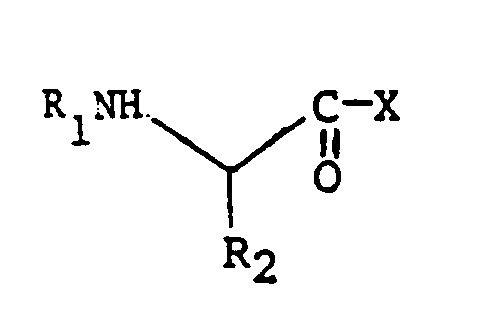 R₁ may be hydrogen, an amino protecting group selected from Group K, an α-amino acid or a peptide comprised of a number of α-amino acid building blocks, each of said α-amino acid or peptide optionally bearing an amino protecting group selected from Group K,R₂ is the R group side chain of an α-amino acid building block,X is X₁ or X₂ wherein
X₁ is -CF₃, -CF₂H, CO₂R₃ or -CONHR₃,
X₂ is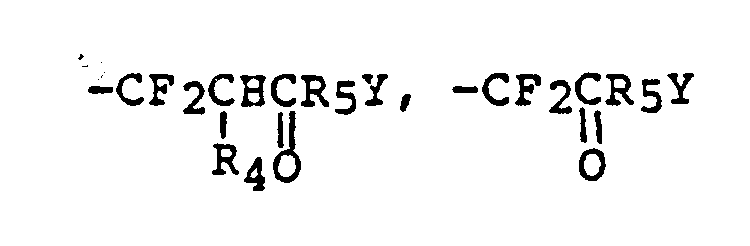
 R₃ is hydrogen, C₁₋₄ straight or branched alkyl, phenyl, benzyl, cyclohexyl or cyclohexylmethyl,R₄ is the R group side chain of an α-amino acid building block,R₅ is an α-amino acid or peptide building block, or deletedY is -NHR₃ or -OR₃, said α-amino building blocks being selected from Groups A, B, C, D, E, F, G, K and J, members of these Groups beingGroupA: Lys and Arg,B: Glu and Asp,C: Ser, Thr, Gln, Asn, Cys and His,D: Pro, IndE: Ala, Leu, Ile, Val, n-Val, Met and n-Leu, and their N-methyl derivatives,F: Phe, Tyr and Trp, Nal(1) and their N-methyl derivatives,G: Gly, SarJ:
 K: Acetyl (Ac), Succinyl (Suc), Benzoyl (Bz), t-Butyloxycarbonyl (Boc), Carbobenzoxy (CBZ), Tosyl (Ts), Dansyl (DNS), Isovaleryl (Iva), Methoxysuccinyl (MeOSuc), 1-Adamantanesulphonyl (AdSO₂), 1-Adamantaneacetyl (AdAc), 2-Carboxybenzoyl (2-CBz) and such other terminal amino protecting groups which are functionally equivalent thereto,with the proviso that when R₂ is the side chain of an amino acid of group E and when, in case R₁ is an amino acid or a peptide, tne amino acid next to the amino group is a member of group D, then X is other than a -CF₃ group.
 - A compound of claim 1 useful for inhibiting human leukocyte elastase whereinR₁ is -P₂P₃P₄P₅ wherein P₂ is selected from Groups D, E or F,P₃ is selected from Groups D or E,P₄ is selected from Group E or is zero,P₅ is selected from Group K,R₂ is the R group side chain of an α-amino acid of Groups E and G,X is either X₁ or X₂ whereinR₄ is the R group side chain of an α-amino acid of Groups E and G,R₅ is a building block having its α-amino acids selected from Groups E and G, andY is NH₂.
- A compound of claim 2 having the formula MeOSuc-Ala-Ile-Pro-Val[CF₂-Ala]AlaNH₂.
- A compound of claim 1 useful for inhibiting Cathepsin G wherein X₁, X₂, R₃, R₄, R₅ and Y are as defined in claim 2,R ₁ is-P₂P₃P₄P₅ whereinP₂ is selected from Groups D, E, G or K,P₃ is selected from Groups E or G or is deleted,P₄ is selected from Groups E or G or is deleted,P₅ is selected from Group K,R₂ is the R group side chain of Groups E and F.
- A compound of claim 4 having the formula Suc-Ala-Ala-Pro-Phe-CF₃.
- A compound of claim 1 useful for inhibiting thrombin with X₁, X₂ and R₃ being as defined in claim 1,R₂ is an R group side chain of Groups A and J,R₄ is an R group side chain of Group C or G,R₅ has its α-amino acids selected from Groups E or D or is zero,R₁ is (a) -P₂P₃, (b) -P₂ or (c) -P₂P₃P₄ wherein(a) P₂ is selected from Groups E and F, P₃ is selected from Group E, each P₃ in its D configuration,(b) P₂ is selected from Group K,(c) P₂ is selected from Group E, P₃ is selected from Groups G or E, and P₄ is selected from Groups G or E or is zero.
- A compound of claim 6 having the formula D-Phe-Pro-Arg-CF₃.
- A compound of claim 1 useful for inhibiting chymotrypsin wherein X₁, X₂, R₃, R₄, R₅ and Y are as defined in claim 2,R₁ is -P₂P₃P₄P₅ whereinP₂ is selected from Groups D, E, G or H,P₃ is selected from Groups E or G or is zero,P₄ is selected from Groups E or G or is zero,P₅ is selected from Group K or is zero when P₂ is H,R₂ is an R group side chain of Groups E or F.
- A compound of claim 8 selected from the group Bz-Phe-CF₃, Bz-Phe-COOH, Bz-Phe-COOMe, Bz-Tyr-CF₃, Bz-Tyr-COOMe.
- A compound of claim 1 useful for inhibiting trypsin wherein X₁, X₂, R₃, Y, R₂, R₄, R₅ and R₁ are as defined in claim 1.
- A compound of claim 10 having the formula Bz-Arg-COOH, Bz-Arg-CO₂CH₃, Bz-Arg-CF₃.
- A compound of claim 1 useful for inhibiting plasmin whereinX is X₁,R₁ is -P₂P₃P₄ whereinP₂ is selected from Group F,P₃ is selected from Groups B or F, andP₄ is selected from Group K,R₂ is the R group side chain of Groups A or J.
- A compound of claim 12 selected from the group DNS-Glu-Phe-Lys-COOH, DNS-Glu-Phe-Lys-CF₃, or DNS-Glu-Phe-Lys-COOMe.
- A compound of claim 1 useful for inhibiting C₁-esterase with X₁, X₂, R₅ and R₃ as defined in claim 1,Y is NH₂,R₁ is -P₂P₃ whereinP₂ is selected from Groups E, G, D, C, F, A or B, andP₃ is selected from Group K,R₂ is the R group side chain of Groups A and J,R₄ is the R group side chain of Group E.
- A compound of claim 14 selected from the group consisting of CBZ-Ala-Arg-CF₃, CBZ-Ala-Arg-COOH and CBZ-Ala-Arg-COOMe.
- A compound of claim 1 useful for inhibiting C₃-convertase with X₁, X₂ and R₃ being as defined in claim 1,Y is OR₃,R₁ is -P₂P₃P₄ withP₂ being selected from Groups E or F,P₃ is selected from Groups E or F,P₄ is selected from Group K,R₂ is the R group side chain selected from Groups A or J,R₄ is selected from Group E, andR₅ is zero.
- A compound of claim 16 selected from the group consisting of Bz-Leu-Ala-Arg-CF₂COOCH₂Ø, Bz-Leu-Ala-Arg[CF₂-Ala]OCH₂Ø, Bz-Leu-Ala-Arg-COOCH₂Ø.
- A compound of claim 1 useful for inhibiting Urokinase wherein X₁ and X₂ are as defined in claim 1,Y is NH₂,R₁ is -P₂P₃ whereinP₂ is selected for Groups E and G,P₃ is selected from Group B,R₂ is the R group side chain selected from Groups A and J, and each of R₄ and R₅ is selected from Group E.
- A compound of claim 18 selected from the group consisting of Glu-Gly-Arg-CF₂H, Glu-Gly-Arg-CF₃, Glu-Gly-Arg-COOH and Glu-Gly-Arg-CONH₂.
- A compound of claim 1 useful for inhibiting plasminogen activator with X₁ and X₂ being as defined in claim 1,Y is NH₂,R₁ is -P₂P₃P₄ whereinP₂ is Gly,P₃ is selected from Group B, andP₄ is selected from Group K,R₂ is the R group side chain selected from Groups A and J,R₄ is the R group side chain selected from Group E,R₅ is selected from Group E.
- A compound of claim 20 selected from the group consisting of DNS-Glu-Gly-Arg-COOMe, DNS-Glu-Gly-Arg-CF₃, DNS-Glu-Gly-Arg-COOH.
- A compound of claim 1 useful for inhibiting acrosin wherein X₁ and X₂ are as defined in claim 1,Y is NH₂,R₄ is an R group side chain selected from Group E,R₅ is selected from Group E,R₁ is -P₂P₃P₄ whereinP₂ is selected from Group E,P₃ is selected from Group E, andP₄ is selected from Group K,R₂ is an R group side chain selected from Groups A and J.
- A compound of claim 22 selected from the group consisting of Boc-Leu-Leu-Arg-CF₂H, Boc-Leu-Leu-Arg-CF₃ and Boc-Leu-Leu-Arg-COOH.
- A compound of claim 1 useful for inhibiting β-lactamase wherein X is X₁, as defined in claim 1 with the proviso that the P₁ carbonyl moiety may also exist in its reduced form,R₁ is P₂ which is selected from Group K or is
 R₂ is an R group side chain selected from Groups E, G and C.
 - A compound of claim 24 selected from the group consisting of ØCH₂CONHCH₂COCF₃, ØCH₂CONH₂CHOHCF₃, ØCH₂CONHCH₂COCOOH, ØCH₂CONHCH₂COCOOMe, ØCH₂CONHCH₂CHOHCOOH and ØCH₂CONHCH₂CHOHCOOMe.
- A compound of claim 1 useful for inhibiting D-Ala-D-Ala carboxypeptidase wherein X₁, X₂ and R₃ are as defined in claim 1,Y is OH or OR₃R₅ is deleted,R₄ is D-Ala,R₂ is the R group side chain of D-Ala andR₁ is -P₂P₃ whereinP₂ is selected From Groups E, C and (Nα,ε)-di-AcLys, andP₃ is selected from Group K.
- A compound of claim 26 selected from the group
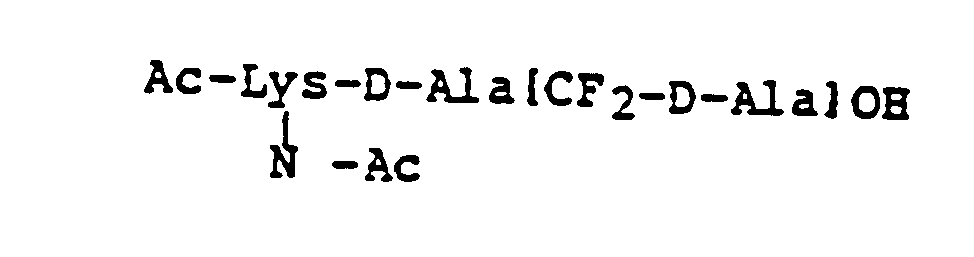

- A compound of claim 1 useful for inhibiting cathepsin B wherein X₁, X₂ and R₃ are as defined in claim 1,Y is OH,R₅ is selected from Groups E, F or G,R ₄ is the R group side chain selected from Group E,R₁ is (a) -P₂P₃ or (b) -P₂P₃P₄ wherein(a) P₂ is selected from Groups E and F,
P₃ is selected from Group K,(b) P₂ is selected from Groups E and F,
P₃ is selected from Groups E and F, and
P₄ is selected from Group K,R₂ is the R group side chain selected from Groups A, J or Thr-CH₂Ø. - A compound of claim 28 selected from the group consisting of Ac-Leu-Leu-Arg⁅CF₂-Leu⁆Gly-OH, CBZ-Phe-Arg[CF₂-Leu]Gly-OH and
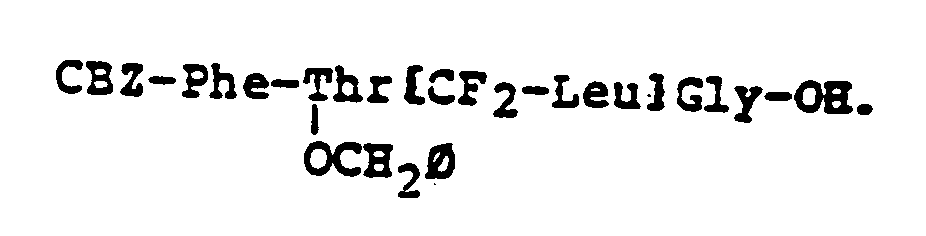
- A compound of claim 1 useful as inhibitor of renin wherein X₁, X₂ and R₃ are as defined in claim 1,Y is OHR₄ is the R group side chain selected from Groups E, F or G,R ₅ is P


 P
P P
P P
P R₂ is the R group side chain selected from Groups E or F, or is cyclohexylmethyl,R₁ is -P₂P₃P₄P₅P₆ whereinP ₂ is selected from Groups E, C or F,P ₃ is selected from Groups E or F,P₄ is selected from Groups E, D or F or is deleted,P₅ is selected from Groups E, C or F or is deleted, andP₆ is selected from Group K.
 - A compound of claim 30 selected from the group consisting of MeOSuc-His-Pro-Phe-His[CF₂-Val)Ile-His-OH, MeOSuc-Pro-Phe-His[CF₂-Val]Ile-His-OH, MeOSuc-His-Phe-His[CF₂-Val]Ile-His-OH, MeOSuc-His-Pro-Phe-His[CF₂-Val]Ile-OH, MeOSuc-His-Pro-Phe-His[CF₂-Val]His-OH.
- A compound of claim 1 useful for inhibiting pepsin wherein X₁, X₂ and R₃ being as defined in claim 1,R₄ is an R group side chain selected from Groups E, G or F,R₅ is selected from Groups E or F andY is-NHCH₂CH₂CH(CH₃)₂ or -NHCH₂CH(CH₃)₂,R₂ is an R group side chain selected from Groups E or F,R₁ is -P₂P₃P₄ whereinP₂ is selected from Groups E or F,P₃ is selected from Groups E or F,P₄ is selected from Group K.
- A compound of claim 32 selected from the group consisting of

- A compound of claim 1 useful for inhibiting cathepsin D wherein X₁, X₂ and R₃ are as defined in claim 1,Y is -NH(CH₂)₂CH(CH₃)₂ or -NHCH₂CH(CH₃)₂,R₄ is an R group side chain selected from Groups E or F,R₅ is selected from Groups E or F,R₂ is an R group side chain selected from Groups E or F,R₁ is -P₂P₃P₄ whereinP₂ is selected from Groups E or F,P₃ is selected from Groups E or F, andP₄ is selected from Group K.
- A compound of claim 34 selected from the group consisting of CBZ-Val-Val-Phe-CF₂H, CBZ-Val-Val-Phe-CF₃, CBZ-Val-Val-Phe[CF₂-Phe]AlaNH(CH₂)₂CH(CH₃)₂, CBZ-Val-Val-Phe[CF₂-Phe]AlaNHCH₂CH(CH₃)₂.
- A compound of claim 1 useful as an ACE inhibitor wherein X is X₂ whereinR₄ is an R group side chain selected from Groups E or G,R₅ is selected from Groups A, B, C, D, E, F and G and Y is OH,R₂ is an R group side chain selected from Groups E, F or G, andR₁ is selected from Group K.
- A compound of claim 36 having the formula Bz-Phe[CF₂-Gly]Pro-OH.
- A compound of claim 1 useful for inhibiting enkephalinase wherein X is X₂ whereinR₄ is an R group side chain selected from Group E or F,R₅ is selected from Groups E or F or is zero with the proviso that when R₅ is zero, Y is -NH₂ and when it is not zero, Y is -NH₂ or OH,R₂ is Gly, andR₁ is -P₂P₃ whereinP₂ is Gly, andP₃ is selected from Group F or is zero.
- A compound of claim 38 selected from the group consisting of Tyr-Gly-Gly-[CF₂-Phe]-Met-OH and Tyr-Gly-Gly-[CF₂Phe]-NH₂.
- A compound of claim 1 useful as inhibitor of pseudomonas elastase wherein X is X₂, whereinR₄ is an R group side chain selected from Groups E or F,R₅ is selected from Groups E or G and Y is NH₂,R₂ is an R group side chain selected from Groups E and G, andR₁ is -P₂P₃, whereinP₂ is selected from Group E andP₃ is selected from Group K.
- A compound of claim 40 having the formula MeOSuc-Ala-Ala[CF₂-Ile]Ala-NH₂.
- A compound of claim 1 useful for inhibiting leucine aminopeptidase wherein X₁, X₂ and R₃ are as defined in claim 1,R₄ is an R group selected from any Group except H andR₅ is selected from any Group except H,Y is NH₂,R₁ is hydrogen,R₂ is an R group selected from Groups E or F.
- A compound of claim 42 selected from the group consisting of Leu-CF₃, LeuCOOH, Leu[CF₂-Ala]AlaNH₂, and LeuCOOMe.
- A compound of claim 1 useful as an inhibitor of kallikreins wherein X is X₁, R₂ is Arg, R₁ is a peptide -P₂P₃ withP₂ being selected from Groups F and E, andP₃ being selected from Groups C, E or F.
- A compound of claim 44 selected from the group consisting of
D-Pro-Phe-Arg-CF₂H,
D-Pro-Phe-Arg-CF₃,
D-Pro-Phe-Arg-CO₂H, and
D-Pro-Phe-Arg-CONH₂. - The process for producing compounds of the formula


- The process for preparing compounds of the formulae
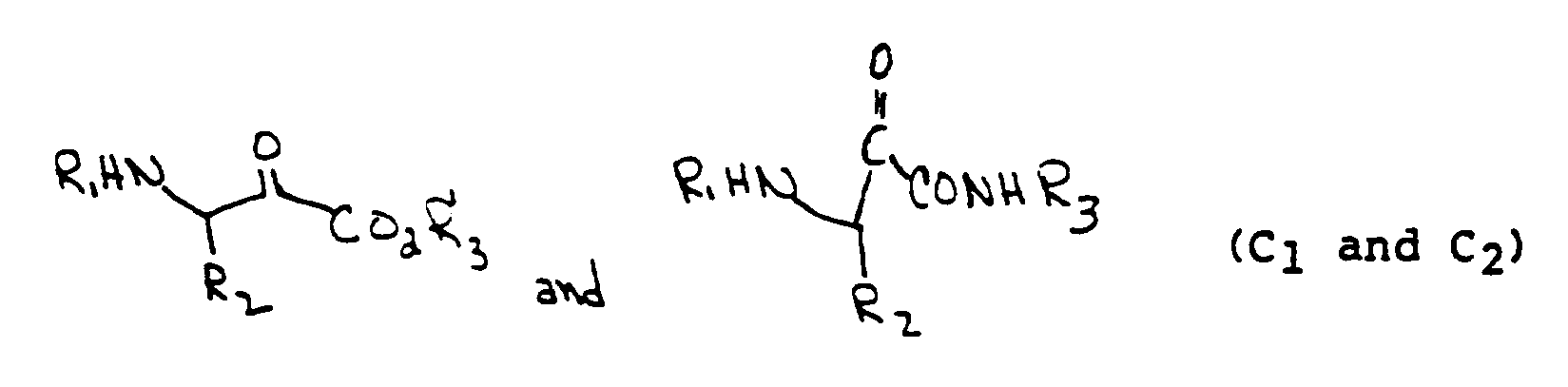
which comprises effecting a Swern oxidation on compounds of the formulae

- A process for preparing a compound of the formula


- A process for preparing a compound of the formula


- A process for preparing a compound of the formula


- A process for preparing a compound of the formula


- The process for preparing a compound of the formula


- A process for preparing a compound of the formula
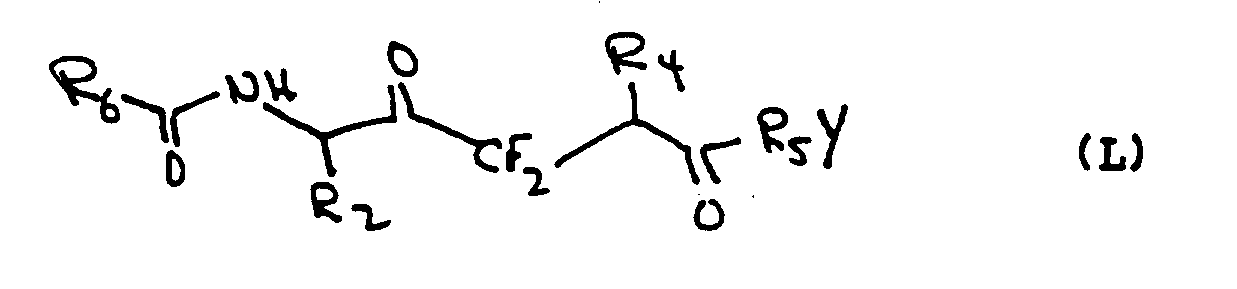

- A process for preparing a compound of the formula


- A process for preparing a compound of the formula


Priority Applications (1)
| Application Number | Priority Date | Filing Date | Title |
|---|---|---|---|
| AT86101437T ATE97652T1 (en) | 1985-02-04 | 1986-02-04 | PEPTIDA INHIBITORS. |
Applications Claiming Priority (2)
| Application Number | Priority Date | Filing Date | Title |
|---|---|---|---|
| US69798785A | 1985-02-04 | 1985-02-04 | |
| US697987 | 1985-02-04 |
Publications (3)
| Publication Number | Publication Date |
|---|---|
| EP0195212A2 EP0195212A2 (en) | 1986-09-24 |
| EP0195212A3 EP0195212A3 (en) | 1988-10-05 |
| EP0195212B1 true EP0195212B1 (en) | 1993-11-24 |
Family
ID=24803437
Family Applications (1)
| Application Number | Title | Priority Date | Filing Date |
|---|---|---|---|
| EP86101437A Expired - Lifetime EP0195212B1 (en) | 1985-02-04 | 1986-02-04 | Novel peptidase inhibitors |
Country Status (20)
| Country | Link |
|---|---|
| EP (1) | EP0195212B1 (en) |
| JP (1) | JP2529825B2 (en) |
| KR (1) | KR900008004B1 (en) |
| CN (1) | CN86101268A (en) |
| AR (1) | AR246975A1 (en) |
| AT (1) | ATE97652T1 (en) |
| AU (1) | AU600226B2 (en) |
| CA (1) | CA1341029C (en) |
| DE (1) | DE3689314T2 (en) |
| DK (1) | DK51586A (en) |
| ES (3) | ES8800720A1 (en) |
| FI (1) | FI94254C (en) |
| GR (1) | GR860321B (en) |
| HU (1) | HU207102B (en) |
| IE (1) | IE60582B1 (en) |
| IL (1) | IL77748A (en) |
| NO (1) | NO169543C (en) |
| NZ (1) | NZ215024A (en) |
| PT (1) | PT81965B (en) |
| ZA (1) | ZA86746B (en) |
Cited By (2)
| Publication number | Priority date | Publication date | Assignee | Title |
|---|---|---|---|---|
| US8217048B2 (en) | 2003-09-05 | 2012-07-10 | Vertex Pharmaceuticals Incorporated | Inhibitors of serine proteases, particularly HCV NS3-NS4A protease |
| US8314141B2 (en) | 1996-10-18 | 2012-11-20 | Vertex Pharmaceuticals Incorporated | Inhibitors of serine proteases, particularly hepatitis C virus NS3 protease |
Families Citing this family (105)
| Publication number | Priority date | Publication date | Assignee | Title |
|---|---|---|---|---|
| WO1986003746A1 (en) * | 1984-12-14 | 1986-07-03 | La Trobe University | Amino acid and peptide inhibitors of human leucocytic elastase |
| US5055450A (en) * | 1985-01-22 | 1991-10-08 | Ici Americas Inc. | Peptide derivatives |
| GB8600263D0 (en) * | 1985-01-22 | 1986-02-12 | Ici America Inc | Peptide derivatives |
| US5194588A (en) * | 1985-01-22 | 1993-03-16 | Ici Americas Inc. | Aminoalcohol intermediates for peptide derivatives |
| US5496927A (en) * | 1985-02-04 | 1996-03-05 | Merrell Pharmaceuticals Inc. | Peptidase inhibitors |
| GB8613704D0 (en) * | 1986-06-05 | 1986-07-09 | Ici America Inc | Difluoro keto compounds |
| GB8619182D0 (en) * | 1986-08-06 | 1986-09-17 | Sandoz Ltd | Peptides & derivatives |
| US5055451A (en) * | 1986-12-22 | 1991-10-08 | Syntex Inc. | Aryloxy and arylacyloxy methyl ketones as thiol protease inhibitors |
| US5158936A (en) * | 1986-12-22 | 1992-10-27 | Syntex (U.S.A.) Inc. | Aryloxy and arylacyloxy methyl ketones as thiol protease inhibitors |
| NZ223148A (en) * | 1987-01-16 | 1989-10-27 | Merrell Dow Pharma | Peptide derivatives having peptidase inhibition activity |
| EP0276101A3 (en) * | 1987-01-19 | 1989-11-23 | Ici Americas Inc. | Substituted peptide derivatives |
| US4820691A (en) * | 1987-06-24 | 1989-04-11 | E. R. Squibb & Sons, Inc. | Amino acid 1,2-diketo derivatives as renin inhibitors |
| US5217958A (en) * | 1988-03-03 | 1993-06-08 | E. R. Squibb & Sons, Inc. | 1,2-hydroxy phosphonates and derivatives thereof |
| US4981843A (en) * | 1988-04-07 | 1991-01-01 | E. R. Squibb & Sons, Inc. | N-heterocyclic alcohol derivatives |
| US5151513A (en) * | 1988-04-29 | 1992-09-29 | E. R. Squibb & Sons, Inc. | N-heterocyclic alcohol derivatives |
| EP0353732A3 (en) * | 1988-08-05 | 1991-11-06 | Ciba-Geigy Ag | Fluoro-olefins, method for their preparation and their use |
| WO1992015605A2 (en) * | 1991-03-01 | 1992-09-17 | Protein Engineering Corporation | Inhibitors of human neutrophil elastase and human cathepsin g |
| US5736520A (en) * | 1988-10-07 | 1998-04-07 | Merrell Pharmaceuticals Inc. | Peptidase inhibitors |
| ZA897514B (en) * | 1988-10-07 | 1990-06-27 | Merrell Dow Pharma | Novel peptidase inhibitors |
| EP0371179A1 (en) * | 1988-10-28 | 1990-06-06 | Merrell Dow Pharmaceuticals Inc. | Novel analogs of peptidase substrates |
| EP0369391A3 (en) * | 1988-11-15 | 1991-09-25 | Boehringer Ingelheim Pharmaceuticals Inc. | N-substituted amides |
| NZ235155A (en) * | 1989-09-11 | 1993-04-28 | Merrell Dow Pharma | Peptidase substrates in which the carboxy terminal group has been replaced by a tricarbonyl radical |
| CA2018801C (en) * | 1990-06-12 | 2000-08-22 | Pierre Louis Beaulieu | Antiherpes peptide derivatives having a 1,4-dioxo c n-terminus |
| CA2098702A1 (en) * | 1990-12-28 | 1992-06-29 | James C. Powers | Peptide ketoamides, ketoacids, and ketoesters |
| US5391705A (en) * | 1991-03-15 | 1995-02-21 | Merrell Dow Pharmaceuticals Inc. | Polyfluorinated tripeptide thrombin inhibitors |
| ES2136091T3 (en) * | 1991-05-23 | 1999-11-16 | Merrell Pharma Inc | CATEPSIN G AND ELASTASE INHIBITORS TO PREVENT DEGRADATION OF THE CONNECTIVE TISSUE. |
| AU2882792A (en) * | 1991-10-23 | 1993-05-21 | Procter & Gamble Company, The | Tripeptide derivative anti-inflammatory agents |
| US6235929B1 (en) | 1991-12-27 | 2001-05-22 | Georgia Tech Research Corporation | Tripeptide α-ketoamides |
| US5610297A (en) * | 1991-12-27 | 1997-03-11 | Georgia Tech Research Corp. | Peptides ketoamides |
| US5441960A (en) * | 1992-04-16 | 1995-08-15 | Zeneca Limited | 1-pyrimidinylacetamide human leukocyte elastate inhibitors |
| US5486529A (en) * | 1992-04-16 | 1996-01-23 | Zeneca Limited | Certain pyridyl ketones for treating diseases involving leukocyte elastase |
| ES2117133T3 (en) * | 1992-07-31 | 1998-08-01 | Pfizer | PEPTIDILIC DERIVATIVES OF ACID 4-AMINO-2,2-DIFLUORO-3-OXO-1,6-HEXANODIOICO AS ANTI-INFLAMMATORY AGENTS. |
| US5514694A (en) * | 1992-09-21 | 1996-05-07 | Georgia Tech Research Corp | Peptidyl ketoamides |
| US5371072A (en) * | 1992-10-16 | 1994-12-06 | Corvas International, Inc. | Asp-Pro-Arg α-keto-amide enzyme inhibitors |
| IL108031A0 (en) * | 1992-12-22 | 1994-04-12 | Procter & Gamble | Difluoro pentapeptide derivatives and pharmaceutical compositions containing them |
| US5563127A (en) * | 1993-03-24 | 1996-10-08 | The Dupont Merck Pharmaceutical Company | Boronic acid and ester inhibitors of thrombin |
| US6984627B1 (en) | 1993-06-03 | 2006-01-10 | Astrazeneca Ab | Peptide derivatives |
| SE9301916D0 (en) * | 1993-06-03 | 1993-06-03 | Ab Astra | NEW PEPTIDES DERIVATIVES |
| US5783563A (en) * | 1993-06-03 | 1998-07-21 | Astra Aktiebolag | Method for treatment or prophylaxis of venous thrombosis |
| US5541290A (en) * | 1993-06-24 | 1996-07-30 | Harbeson; Scott L. | Optically pure calpain inhibitor compounds |
| US5977074A (en) * | 1993-10-01 | 1999-11-02 | Merrell Pharmaceuticals, Inc. | Inhibitors of β-amyloid protein production |
| NZ274074A (en) * | 1993-10-01 | 1997-11-24 | Merrell Pharma Inc | Various dipeptide derivatives having a reduced carboxy group, the aldehyde being optionally substituted; pharmaceutical compositions |
| US6060462A (en) * | 1993-10-20 | 2000-05-09 | Dupont Pharmaceuticals Company | Electrophilic peptide analogs as inhibitors of trypsin-like enzymes |
| WO1995015310A1 (en) * | 1993-12-02 | 1995-06-08 | Merrell Pharmaceuticals Inc. | Prolyl endopeptidase inhibitors |
| JP4221059B2 (en) * | 1994-06-02 | 2009-02-12 | アベンティス・インコーポレイテッド | Acylated enol derivatives as prodrugs of elastase inhibitors |
| ATE186305T1 (en) * | 1994-06-02 | 1999-11-15 | Merrell Pharma Inc | PERFLUOROALKYLL KETONES, INHIBITORS OF ELASTASE AND PROCESS FOR THE PRODUCTION THEREOF |
| DE4421052A1 (en) | 1994-06-17 | 1995-12-21 | Basf Ag | New thrombin inhibitors, their production and use |
| US5510369A (en) * | 1994-07-22 | 1996-04-23 | Merck & Co., Inc. | Pyrrolidine thrombin inhibitors |
| SE9404196D0 (en) * | 1994-12-02 | 1994-12-02 | Astra Ab | New antithrombotic formulation |
| GB9502152D0 (en) * | 1995-02-03 | 1995-03-29 | Zeneca Ltd | Proline derivatives |
| JPH11500120A (en) * | 1995-02-17 | 1999-01-06 | ビーエーエスエフ アクチェンゲゼルシャフト | Novel thrombin inhibitors |
| US5629324A (en) * | 1995-04-10 | 1997-05-13 | Merck & Co., Inc. | Thrombin inhibitors |
| US6211154B1 (en) | 1995-06-07 | 2001-04-03 | Cor Therapeutics, Inc. | Ketoheterocyclic inhibitors of factor Xa |
| US5721214A (en) * | 1995-06-07 | 1998-02-24 | Cor Therapeutics, Inc. | Inhibitors of factor Xa |
| US6022861A (en) * | 1995-06-07 | 2000-02-08 | Cor Therapeutics, Inc. | Ketoheterocyclic inhibitors of factor Xa |
| US5919765A (en) * | 1995-06-07 | 1999-07-06 | Cor Therapeutics, Inc. | Inhibitors of factor XA |
| US6046169A (en) * | 1995-06-07 | 2000-04-04 | Cor Therapeutics, Inc. | Inhibitors of factor XA |
| US6069130A (en) | 1995-06-07 | 2000-05-30 | Cor Therapeutics, Inc. | Ketoheterocyclic inhibitors of factor Xa |
| SA96170106A (en) | 1995-07-06 | 2005-12-03 | أسترا أكتيبولاج | New amino acid derivatives |
| US6069232A (en) * | 1995-10-02 | 2000-05-30 | Hoechst Marion Roussel, Inc. | Polyfluoroalkyl tryptophan tripeptide thrombin inhibitors |
| GB9524267D0 (en) * | 1995-11-28 | 1996-01-31 | Isis Innovation | Enzyme inhibitor and method |
| US6172044B1 (en) | 1995-12-01 | 2001-01-09 | Aventis Pharmaceuticals Inc. | Acylated enol derivative of α-ketoesters and α-ketoamides |
| AR005245A1 (en) | 1995-12-21 | 1999-04-28 | Astrazeneca Ab | THROMBIN INHIBITOR PRODROGES, A PHARMACEUTICAL FORMULATION THAT INCLUDES THEM, THE USE OF SUCH PRODROGES FOR THE MANUFACTURE OF A MEDICINAL PRODUCT AND A PROCEDURE FOR ITS PREPARATION |
| US5739354A (en) * | 1996-03-26 | 1998-04-14 | Hoechst Marion Roussel, Inc. | Process for the preparation of N-methyl-D-phenylalanyl-N- 1- 3- (aminoiminomethyl)amino!propyl!-3,3-difluoro-2-oxohexyl!-L-prolinamide |
| US6245743B1 (en) | 1996-06-05 | 2001-06-12 | Cor Therapeutics, Inc. | Inhibitors of factor Xa |
| SE9602263D0 (en) | 1996-06-07 | 1996-06-07 | Astra Ab | New amino acid derivatives |
| SE9602646D0 (en) | 1996-07-04 | 1996-07-04 | Astra Ab | Pharmaceutically useful compounds |
| US5792761A (en) * | 1996-08-12 | 1998-08-11 | Merck & Co., Inc. | Thrombin inhibitors |
| SI0932617T1 (en) * | 1996-10-18 | 2002-06-30 | Vertex Pharmaceuticals Incorporated | Inhibitors of serine proteases, particularly hepatitis c virus ns3 protease |
| US5798377A (en) * | 1996-10-21 | 1998-08-25 | Merck & Co., Inc. | Thrombin inhibitors |
| US5854011A (en) * | 1996-12-19 | 1998-12-29 | Idexx Laboratories Incorporated | Method and components for the detection of yeasts and/or molds in a sample |
| HUP0002942A3 (en) * | 1997-05-02 | 2001-12-28 | Akzo Nobel Nv | Peptides having serine protease inhibiting effect pharmaceutical compositions comprising thereof and their use |
| AR013084A1 (en) | 1997-06-19 | 2000-12-13 | Astrazeneca Ab | USEFUL AMIDINE DERIVATIVES AS THROMBIN INHIBITORS, PHARMACEUTICAL COMPOSITION, USE OF SUCH COMPOUNDS FOR THE PREPARATION OF MEDICINES AND THE PROCESS FOR THE PREPARATION OF THE MENTIONED COMPOUNDS |
| SE9704543D0 (en) | 1997-12-05 | 1997-12-05 | Astra Ab | New compounds |
| WO1999037668A1 (en) | 1998-01-26 | 1999-07-29 | Basf Aktiengesellschaft | Thrombin inhibitors |
| SE9804313D0 (en) | 1998-12-14 | 1998-12-14 | Astra Ab | New compounds |
| TR200102037T2 (en) | 1999-01-13 | 2001-10-22 | Astrazeneca Ab | New amidinobenzylamine derivatives and their use as thrombin inhibitors. |
| AR023510A1 (en) | 1999-04-21 | 2002-09-04 | Astrazeneca Ab | A TEAM OF PARTS, PHARMACEUTICAL FORMULATION AND USE OF A THROMBIN INHIBITOR. |
| SE0001803D0 (en) | 2000-05-16 | 2000-05-16 | Astrazeneca Ab | New compounds i |
| AU2001265094A1 (en) | 2000-06-01 | 2001-12-11 | Merck And Co., Inc. | Pyrazinone thrombin inhibitors |
| CN102206247B (en) | 2000-07-21 | 2013-03-27 | 默沙东公司 | Novel peptides as NS3/NS4a serine protease inhibitors of hepatitis C virus |
| US7244721B2 (en) | 2000-07-21 | 2007-07-17 | Schering Corporation | Peptides as NS3-serine protease inhibitors of hepatitis C virus |
| JP4452441B2 (en) | 2000-07-21 | 2010-04-21 | シェーリング コーポレイション | Novel peptides as NS3-serine protease inhibitors of hepatitis C virus |
| US6433186B1 (en) | 2000-08-16 | 2002-08-13 | Astrazeneca Ab | Amidino derivatives and their use as thormbin inhibitors |
| AU782470B2 (en) | 2000-11-06 | 2005-08-04 | Taiho Pharmaceutical Co., Ltd. | Peptide derivatives and their pharmaceutically acceptable salts, processes for preparation of both, and use thereof |
| AR035216A1 (en) | 2000-12-01 | 2004-05-05 | Astrazeneca Ab | MANDELIC ACID DERIVATIVES, PHARMACEUTICALLY ACCEPTABLE DERIVATIVES, USE OF THESE DERIVATIVES FOR THE MANUFACTURE OF MEDICINES, TREATMENT METHODS, PROCESSES FOR THE PREPARATION OF THESE DERIVATIVES, AND INTERMEDIARY COMPOUNDS |
| US7129233B2 (en) | 2000-12-01 | 2006-10-31 | Astrazeneca Ab | Mandelic acid derivatives and their use as thrombin inhibitors |
| AU2002230836A1 (en) | 2000-12-18 | 2002-07-01 | Merck & Co., Inc. | Benzylamine derivatives and their use as thrombin inhibitors |
| US6528503B2 (en) | 2000-12-18 | 2003-03-04 | Merck & Co., Inc. | Thrombin inhibitors |
| JP2005504003A (en) | 2001-02-09 | 2005-02-10 | メルク エンド カムパニー インコーポレーテッド | Thrombin inhibitor |
| US6610701B2 (en) | 2001-02-09 | 2003-08-26 | Merck & Co., Inc. | Thrombin inhibitors |
| AR034517A1 (en) | 2001-06-21 | 2004-02-25 | Astrazeneca Ab | PHARMACEUTICAL FORMULATION |
| WO2003092605A2 (en) | 2002-04-30 | 2003-11-13 | Trustees Of Tufts College | Protease inhibitors |
| US7084134B2 (en) | 2002-05-02 | 2006-08-01 | Merk & Co., Inc. | Thrombin inhibitors |
| SE0201659D0 (en) | 2002-05-31 | 2002-05-31 | Astrazeneca Ab | Modified release pharmaceutical formulation |
| SE0201661D0 (en) | 2002-05-31 | 2002-05-31 | Astrazeneca Ab | New salts |
| US6989369B2 (en) | 2003-02-07 | 2006-01-24 | Dyax Corp. | Kunitz domain peptides |
| US7781424B2 (en) | 2003-05-27 | 2010-08-24 | Astrazeneca Ab | Modified release pharmaceutical formulation |
| US7795205B2 (en) | 2004-04-12 | 2010-09-14 | Canyon Pharmaceuticals, Inc. | Methods for effecting regression of tumor mass and size in a metastasized pancreatic tumor |
| GB0507577D0 (en) | 2005-04-14 | 2005-05-18 | Novartis Ag | Organic compounds |
| TW200827336A (en) | 2006-12-06 | 2008-07-01 | Astrazeneca Ab | New crystalline forms |
| EP4144354B1 (en) | 2011-08-30 | 2025-11-26 | Trustees Of Tufts College | Fap-activated proteasome inhibitors for treating solid tumors |
| US9758473B2 (en) | 2014-10-06 | 2017-09-12 | Cortexyme, Inc. | Inhibitors of lysine gingipain |
| WO2017083433A1 (en) | 2015-11-09 | 2017-05-18 | Cortexyme, Inc. | Inhibitors of arginine gingipain |
| EP4480541A3 (en) * | 2016-09-16 | 2025-04-30 | Lighthouse Pharmaceuticals, Inc. | Ketone inhibitors of lysine gingipain |
Family Cites Families (3)
| Publication number | Priority date | Publication date | Assignee | Title |
|---|---|---|---|---|
| US4277395A (en) | 1980-06-16 | 1981-07-07 | Richardson-Merrell Inc. | Novel enzyme inhibitors |
| US4518528A (en) * | 1983-05-19 | 1985-05-21 | Rasnick David W | α Amino fluoro ketones |
| GB8600263D0 (en) * | 1985-01-22 | 1986-02-12 | Ici America Inc | Peptide derivatives |
-
1986
- 1986-01-31 ZA ZA86746A patent/ZA86746B/en unknown
- 1986-01-31 IL IL77748A patent/IL77748A/en not_active IP Right Cessation
- 1986-01-31 CA CA000500832A patent/CA1341029C/en not_active Expired - Lifetime
- 1986-01-31 AU AU52881/86A patent/AU600226B2/en not_active Ceased
- 1986-02-03 DK DK51586A patent/DK51586A/en not_active Application Discontinuation
- 1986-02-03 NO NO860371A patent/NO169543C/en not_active IP Right Cessation
- 1986-02-03 CN CN198686101268A patent/CN86101268A/en active Pending
- 1986-02-03 HU HU86467A patent/HU207102B/en not_active IP Right Cessation
- 1986-02-03 GR GR860321A patent/GR860321B/en unknown
- 1986-02-03 FI FI860484A patent/FI94254C/en not_active IP Right Cessation
- 1986-02-03 NZ NZ215024A patent/NZ215024A/en unknown
- 1986-02-03 ES ES551597A patent/ES8800720A1/en not_active Expired
- 1986-02-03 IE IE30386A patent/IE60582B1/en not_active IP Right Cessation
- 1986-02-04 PT PT81965A patent/PT81965B/en unknown
- 1986-02-04 EP EP86101437A patent/EP0195212B1/en not_active Expired - Lifetime
- 1986-02-04 JP JP61021371A patent/JP2529825B2/en not_active Expired - Lifetime
- 1986-02-04 AT AT86101437T patent/ATE97652T1/en not_active IP Right Cessation
- 1986-02-04 KR KR1019860000739A patent/KR900008004B1/en not_active Expired
- 1986-02-04 AR AR86303046A patent/AR246975A1/en active
- 1986-02-04 DE DE3689314T patent/DE3689314T2/en not_active Expired - Lifetime
- 1986-03-26 ES ES553504A patent/ES8800050A1/en not_active Expired
- 1986-03-26 ES ES553505A patent/ES8800051A1/en not_active Expired
Cited By (2)
| Publication number | Priority date | Publication date | Assignee | Title |
|---|---|---|---|---|
| US8314141B2 (en) | 1996-10-18 | 2012-11-20 | Vertex Pharmaceuticals Incorporated | Inhibitors of serine proteases, particularly hepatitis C virus NS3 protease |
| US8217048B2 (en) | 2003-09-05 | 2012-07-10 | Vertex Pharmaceuticals Incorporated | Inhibitors of serine proteases, particularly HCV NS3-NS4A protease |
Also Published As
Similar Documents
| Publication | Publication Date | Title |
|---|---|---|
| EP0195212B1 (en) | Novel peptidase inhibitors | |
| US6130315A (en) | Peptidase inhibitors | |
| AU614272B2 (en) | Novel peptidase inhibitors | |
| EP0529568B1 (en) | Novel orally-active elastase inhibitors | |
| CA2000342C (en) | Novel peptidase inhibitors | |
| EP0417721B1 (en) | Novel peptidase and isomerase inhibitors | |
| EP0410411A2 (en) | Novel peptidase inhibitors | |
| EP0362002A1 (en) | HIV protease inhibitors | |
| AU2494484A (en) | Peptide analogue enzyme inhibitors | |
| EP0763055A1 (en) | Perfluoroalkyl ketone inhibitors of elastase and processes for making the same | |
| JPS61194097A (en) | Novel peptides and peptide derivatives, their production methods, and pharmaceutical compositions containing them | |
| KR100341982B1 (en) | Prolyl Endopeptidase Inhibitors | |
| EP0371179A1 (en) | Novel analogs of peptidase substrates | |
| KR0139535B1 (en) | Novel Peptidase Inhibitors | |
| US5478811A (en) | Orally-active elastase inhibitors | |
| EP0762887B1 (en) | Acylated enol derivatives as prodrugs of elastase inhibitors | |
| JPS63239255A (en) | Novel peptidase inhibitor |
Legal Events
| Date | Code | Title | Description |
|---|---|---|---|
| PUAI | Public reference made under article 153(3) epc to a published international application that has entered the european phase |
Free format text: ORIGINAL CODE: 0009012 |
|
| AK | Designated contracting states |
Kind code of ref document: A2 Designated state(s): AT BE CH DE FR GB IT LI LU NL SE |
|
| PUAL | Search report despatched |
Free format text: ORIGINAL CODE: 0009013 |
|
| AK | Designated contracting states |
Kind code of ref document: A3 Designated state(s): AT BE CH DE FR GB IT LI LU NL SE |
|
| 17P | Request for examination filed |
Effective date: 19890329 |
|
| 17Q | First examination report despatched |
Effective date: 19900802 |
|
| GRAA | (expected) grant |
Free format text: ORIGINAL CODE: 0009210 |
|
| AK | Designated contracting states |
Kind code of ref document: B1 Designated state(s): AT BE CH DE FR GB IT LI LU NL SE |
|
| REF | Corresponds to: |
Ref document number: 97652 Country of ref document: AT Date of ref document: 19931215 Kind code of ref document: T |
|
| ITF | It: translation for a ep patent filed | ||
| ET | Fr: translation filed | ||
| REF | Corresponds to: |
Ref document number: 3689314 Country of ref document: DE Date of ref document: 19940105 |
|
| EPTA | Lu: last paid annual fee | ||
| PLBE | No opposition filed within time limit |
Free format text: ORIGINAL CODE: 0009261 |
|
| STAA | Information on the status of an ep patent application or granted ep patent |
Free format text: STATUS: NO OPPOSITION FILED WITHIN TIME LIMIT |
|
| 26N | No opposition filed | ||
| EAL | Se: european patent in force in sweden |
Ref document number: 86101437.1 |
|
| REG | Reference to a national code |
Ref country code: CH Ref legal event code: PFA Free format text: MERRELL DOW PHARMACEUTICALS INC. TRANSFER- MERRELL PHARMACEUTICALS INC. |
|
| REG | Reference to a national code |
Ref country code: GB Ref legal event code: IF02 |
|
| PGFP | Annual fee paid to national office [announced via postgrant information from national office to epo] |
Ref country code: CH Payment date: 20030120 Year of fee payment: 18 |
|
| PGFP | Annual fee paid to national office [announced via postgrant information from national office to epo] |
Ref country code: AT Payment date: 20030121 Year of fee payment: 18 |
|
| PGFP | Annual fee paid to national office [announced via postgrant information from national office to epo] |
Ref country code: BE Payment date: 20030214 Year of fee payment: 18 |
|
| PGFP | Annual fee paid to national office [announced via postgrant information from national office to epo] |
Ref country code: NL Payment date: 20040116 Year of fee payment: 19 |
|
| PG25 | Lapsed in a contracting state [announced via postgrant information from national office to epo] |
Ref country code: AT Free format text: LAPSE BECAUSE OF NON-PAYMENT OF DUE FEES Effective date: 20040204 |
|
| PGFP | Annual fee paid to national office [announced via postgrant information from national office to epo] |
Ref country code: SE Payment date: 20040219 Year of fee payment: 19 |
|
| PGFP | Annual fee paid to national office [announced via postgrant information from national office to epo] |
Ref country code: LU Payment date: 20040226 Year of fee payment: 19 |
|
| PG25 | Lapsed in a contracting state [announced via postgrant information from national office to epo] |
Ref country code: BE Free format text: LAPSE BECAUSE OF NON-PAYMENT OF DUE FEES Effective date: 20040228 |
|
| PG25 | Lapsed in a contracting state [announced via postgrant information from national office to epo] |
Ref country code: LI Free format text: LAPSE BECAUSE OF NON-PAYMENT OF DUE FEES Effective date: 20040229 Ref country code: CH Free format text: LAPSE BECAUSE OF NON-PAYMENT OF DUE FEES Effective date: 20040229 |
|
| BERE | Be: lapsed |
Owner name: *MERRELL PHARMACEUTICALS INC. Effective date: 20040228 |
|
| REG | Reference to a national code |
Ref country code: CH Ref legal event code: PL |
|
| PGFP | Annual fee paid to national office [announced via postgrant information from national office to epo] |
Ref country code: GB Payment date: 20050126 Year of fee payment: 20 |
|
| PG25 | Lapsed in a contracting state [announced via postgrant information from national office to epo] |
Ref country code: LU Free format text: LAPSE BECAUSE OF NON-PAYMENT OF DUE FEES Effective date: 20050204 |
|
| PG25 | Lapsed in a contracting state [announced via postgrant information from national office to epo] |
Ref country code: SE Free format text: LAPSE BECAUSE OF NON-PAYMENT OF DUE FEES Effective date: 20050205 |
|
| PGFP | Annual fee paid to national office [announced via postgrant information from national office to epo] |
Ref country code: FR Payment date: 20050217 Year of fee payment: 20 |
|
| PGFP | Annual fee paid to national office [announced via postgrant information from national office to epo] |
Ref country code: IT Payment date: 20050225 Year of fee payment: 20 |
|
| PGFP | Annual fee paid to national office [announced via postgrant information from national office to epo] |
Ref country code: DE Payment date: 20050331 Year of fee payment: 20 |
|
| PG25 | Lapsed in a contracting state [announced via postgrant information from national office to epo] |
Ref country code: NL Free format text: LAPSE BECAUSE OF NON-PAYMENT OF DUE FEES Effective date: 20050901 |
|
| EUG | Se: european patent has lapsed | ||
| NLV4 | Nl: lapsed or anulled due to non-payment of the annual fee |
Effective date: 20050901 |
|
| PG25 | Lapsed in a contracting state [announced via postgrant information from national office to epo] |
Ref country code: GB Free format text: LAPSE BECAUSE OF EXPIRATION OF PROTECTION Effective date: 20060203 |
|
| REG | Reference to a national code |
Ref country code: GB Ref legal event code: PE20 |