EP0144930A2 - Method and apparatus for treating cellulose-containing matter, e.g. straw, with gaseous ammonia - Google Patents
Method and apparatus for treating cellulose-containing matter, e.g. straw, with gaseous ammonia Download PDFInfo
- Publication number
- EP0144930A2 EP0144930A2 EP84114541A EP84114541A EP0144930A2 EP 0144930 A2 EP0144930 A2 EP 0144930A2 EP 84114541 A EP84114541 A EP 84114541A EP 84114541 A EP84114541 A EP 84114541A EP 0144930 A2 EP0144930 A2 EP 0144930A2
- Authority
- EP
- European Patent Office
- Prior art keywords
- ammonium salt
- cellulose
- heating
- ammonium
- containing matter
- Prior art date
- Legal status (The legal status is an assumption and is not a legal conclusion. Google has not performed a legal analysis and makes no representation as to the accuracy of the status listed.)
- Ceased
Links
- QGZKDVFQNNGYKY-UHFFFAOYSA-N Ammonia Chemical compound N QGZKDVFQNNGYKY-UHFFFAOYSA-N 0.000 title claims abstract description 60
- 238000000034 method Methods 0.000 title claims abstract description 38
- 229910021529 ammonia Inorganic materials 0.000 title claims abstract description 29
- 239000001913 cellulose Substances 0.000 title claims abstract description 25
- 229920002678 cellulose Polymers 0.000 title claims abstract description 25
- 239000010902 straw Substances 0.000 title claims abstract description 24
- 150000003863 ammonium salts Chemical class 0.000 claims abstract description 32
- 238000010438 heat treatment Methods 0.000 claims abstract description 20
- 239000000463 material Substances 0.000 claims abstract description 16
- ATRRKUHOCOJYRX-UHFFFAOYSA-N Ammonium bicarbonate Chemical compound [NH4+].OC([O-])=O ATRRKUHOCOJYRX-UHFFFAOYSA-N 0.000 claims abstract description 11
- 239000001099 ammonium carbonate Substances 0.000 claims abstract description 11
- 229910000013 Ammonium bicarbonate Inorganic materials 0.000 claims abstract description 10
- 235000012538 ammonium bicarbonate Nutrition 0.000 claims abstract description 10
- 239000002253 acid Substances 0.000 claims abstract description 8
- KXDHJXZQYSOELW-UHFFFAOYSA-N carbonic acid monoamide Natural products NC(O)=O KXDHJXZQYSOELW-UHFFFAOYSA-N 0.000 claims abstract description 8
- BVCZEBOGSOYJJT-UHFFFAOYSA-N ammonium carbamate Chemical compound [NH4+].NC([O-])=O BVCZEBOGSOYJJT-UHFFFAOYSA-N 0.000 claims abstract description 6
- 230000001473 noxious effect Effects 0.000 claims abstract description 3
- 239000000126 substance Substances 0.000 claims description 6
- 239000007789 gas Substances 0.000 claims description 5
- XLYOFNOQVPJJNP-UHFFFAOYSA-N water Substances O XLYOFNOQVPJJNP-UHFFFAOYSA-N 0.000 claims description 4
- 239000000470 constituent Substances 0.000 claims description 2
- 239000000203 mixture Substances 0.000 claims description 2
- CURLTUGMZLYLDI-UHFFFAOYSA-N Carbon dioxide Chemical compound O=C=O CURLTUGMZLYLDI-UHFFFAOYSA-N 0.000 abstract description 5
- 241001465754 Metazoa Species 0.000 abstract description 5
- 150000003839 salts Chemical class 0.000 abstract description 5
- 238000000354 decomposition reaction Methods 0.000 abstract description 4
- 235000019621 digestibility Nutrition 0.000 abstract description 4
- 241000609240 Ambelania acida Species 0.000 abstract description 2
- 239000010905 bagasse Substances 0.000 abstract description 2
- 239000001569 carbon dioxide Substances 0.000 abstract description 2
- 229910002092 carbon dioxide Inorganic materials 0.000 abstract description 2
- 150000007513 acids Chemical class 0.000 description 4
- QTBSBXVTEAMEQO-UHFFFAOYSA-N Acetic acid Chemical compound CC(O)=O QTBSBXVTEAMEQO-UHFFFAOYSA-N 0.000 description 3
- KRKNYBCHXYNGOX-UHFFFAOYSA-N citric acid Chemical compound OC(=O)CC(O)(C(O)=O)CC(O)=O KRKNYBCHXYNGOX-UHFFFAOYSA-N 0.000 description 3
- 239000007864 aqueous solution Substances 0.000 description 2
- 238000006243 chemical reaction Methods 0.000 description 2
- 230000000694 effects Effects 0.000 description 2
- 238000012986 modification Methods 0.000 description 2
- 230000004048 modification Effects 0.000 description 2
- 239000008188 pellet Substances 0.000 description 2
- KJAMZCVTJDTESW-UHFFFAOYSA-N tiracizine Chemical compound C1CC2=CC=CC=C2N(C(=O)CN(C)C)C2=CC(NC(=O)OCC)=CC=C21 KJAMZCVTJDTESW-UHFFFAOYSA-N 0.000 description 2
- 238000005303 weighing Methods 0.000 description 2
- QGZKDVFQNNGYKY-UHFFFAOYSA-O Ammonium Chemical compound [NH4+] QGZKDVFQNNGYKY-UHFFFAOYSA-O 0.000 description 1
- VHUUQVKOLVNVRT-UHFFFAOYSA-N Ammonium hydroxide Chemical compound [NH4+].[OH-] VHUUQVKOLVNVRT-UHFFFAOYSA-N 0.000 description 1
- FEWJPZIEWOKRBE-JCYAYHJZSA-N Dextrotartaric acid Chemical compound OC(=O)[C@H](O)[C@@H](O)C(O)=O FEWJPZIEWOKRBE-JCYAYHJZSA-N 0.000 description 1
- 240000005979 Hordeum vulgare Species 0.000 description 1
- 235000007340 Hordeum vulgare Nutrition 0.000 description 1
- FEWJPZIEWOKRBE-UHFFFAOYSA-N Tartaric acid Natural products [H+].[H+].[O-]C(=O)C(O)C(O)C([O-])=O FEWJPZIEWOKRBE-UHFFFAOYSA-N 0.000 description 1
- 235000012501 ammonium carbonate Nutrition 0.000 description 1
- 239000000908 ammonium hydroxide Substances 0.000 description 1
- 230000015572 biosynthetic process Effects 0.000 description 1
- 235000013339 cereals Nutrition 0.000 description 1
- 238000002144 chemical decomposition reaction Methods 0.000 description 1
- 150000001875 compounds Chemical class 0.000 description 1
- 238000001704 evaporation Methods 0.000 description 1
- 239000003517 fume Substances 0.000 description 1
- 230000002045 lasting effect Effects 0.000 description 1
- VUZPPFZMUPKLLV-UHFFFAOYSA-N methane;hydrate Chemical compound C.O VUZPPFZMUPKLLV-UHFFFAOYSA-N 0.000 description 1
- 150000007522 mineralic acids Chemical class 0.000 description 1
- 150000007524 organic acids Chemical class 0.000 description 1
- 235000005985 organic acids Nutrition 0.000 description 1
- 239000005416 organic matter Substances 0.000 description 1
- 238000005453 pelletization Methods 0.000 description 1
- 238000003825 pressing Methods 0.000 description 1
- 230000002035 prolonged effect Effects 0.000 description 1
- 239000002994 raw material Substances 0.000 description 1
- 238000009877 rendering Methods 0.000 description 1
- 241000894007 species Species 0.000 description 1
- 238000003860 storage Methods 0.000 description 1
- 235000002906 tartaric acid Nutrition 0.000 description 1
- 239000011975 tartaric acid Substances 0.000 description 1
- 239000002023 wood Substances 0.000 description 1
Classifications
-
- A—HUMAN NECESSITIES
- A23—FOODS OR FOODSTUFFS; TREATMENT THEREOF, NOT COVERED BY OTHER CLASSES
- A23K—FODDER
- A23K10/00—Animal feeding-stuffs
- A23K10/30—Animal feeding-stuffs from material of plant origin, e.g. roots, seeds or hay; from material of fungal origin, e.g. mushrooms
- A23K10/32—Animal feeding-stuffs from material of plant origin, e.g. roots, seeds or hay; from material of fungal origin, e.g. mushrooms from hydrolysates of wood or straw
-
- A—HUMAN NECESSITIES
- A23—FOODS OR FOODSTUFFS; TREATMENT THEREOF, NOT COVERED BY OTHER CLASSES
- A23K—FODDER
- A23K50/00—Feeding-stuffs specially adapted for particular animals
- A23K50/10—Feeding-stuffs specially adapted for particular animals for ruminants
- A23K50/15—Feeding-stuffs specially adapted for particular animals for ruminants containing substances which are metabolically converted to proteins, e.g. ammonium salts or urea
-
- Y—GENERAL TAGGING OF NEW TECHNOLOGICAL DEVELOPMENTS; GENERAL TAGGING OF CROSS-SECTIONAL TECHNOLOGIES SPANNING OVER SEVERAL SECTIONS OF THE IPC; TECHNICAL SUBJECTS COVERED BY FORMER USPC CROSS-REFERENCE ART COLLECTIONS [XRACs] AND DIGESTS
- Y02—TECHNOLOGIES OR APPLICATIONS FOR MITIGATION OR ADAPTATION AGAINST CLIMATE CHANGE
- Y02P—CLIMATE CHANGE MITIGATION TECHNOLOGIES IN THE PRODUCTION OR PROCESSING OF GOODS
- Y02P60/00—Technologies relating to agriculture, livestock or agroalimentary industries
- Y02P60/80—Food processing, e.g. use of renewable energies or variable speed drives in handling, conveying or stacking
- Y02P60/87—Re-use of by-products of food processing for fodder production
Definitions
- the present invention relates to a method of treating cellulose-containing matter, such as straw, by bringing it into contact with gaseous ammonia, such as by passing the ammonia through it, said gaseous ammonia being produced on the site of processing by liberating gaseous ammonia salt in the dry state by heating.
- Said GB 2.124.066 A discloses a method, by which - according to the application's Claim 1 - "the gaseous ammonia is produced on the site of processing by liberating gaseous ammonia from an ammonium-containing compound, such as ammonium hydroxide in aqueous solution or an ammonium salt in the dry state or in aqueous solution, e.g. by heating.”
- an ammonium-containing compound such as ammonium hydroxide in aqueous solution or an ammonium salt in the dry state or in aqueous solution, e.g. by heating.
- the method of the present invention is based upon one of the possible alternatives disclosed in said GB 2.124.066 A.
- the present invention is, however, based on the unexpected recognition that such re-combination of the consituents of the salt does not in fact take place immediately.
- the method according to the invention is characterised in that the ammonium salt used is an ammonium salt of an acid of a kind not leaving or forming noxious products in said material, and that the mixture of gaseous ammonia, any other gaseous substance and water produced by heating said ammonium salt is brought into contact with said cellulose-containing matter before substantial re-combination has occurred.
- ammonium salt is ammonium carbamate (NH2COONH4) or ammonium bicarbonate (NH4HC03). It is known that ammonium carbonate as distinct from ammonium bicarbonate is not stable under normal conditions, as attempts at producing a salt with the formula (NH 4 ) 2 CO 3 normally lead to the formation of NH 2 COONH 4 , i.e. ammonium carbamate, the ammonium salt of carbamic acid.
- the method is characterized in that the ammonium salt used is ammonium carbamate or ammonium bicarbonate.
- the heating of the ammonium salt is carried out in a location very close to the cellulose--containing matter to be treated, and that the constituents liberated by heating are transported or allowed to move substantially directly towards and through said matter.
- a fourth embodiment of the method according to the invention is characterized in that the process is carried out in a substantially closed space containing both the cellulose-containing matter to be treated and the ammonium salt, and that the heating is carried out by heating air and/or other gases or vapours circulating in said space by thermal convection and/or mechanical circulation, so that heat is transmitted to both the cellulose-containing matter and the ammonium salt by the circulating medium or media.
- This enables the process to be carried out by using equipment already existing, such as the apparatus described in the above Danish Patent No. 145.051 or the above GB 2.124.066 A.after a slight modification, if-necessary.
- the invention also relates to an apparatus for carrying out the method according to the invention, and this apparatus is characterized by
- the arrangement is such that the heat is also supplied to the cellulose--containing matter being treated, as this naturally increases the speed of the reaction taking place between the gaseous ammonia and the cellulose-containing matter.
- the method according to the invention may be carried out by using equipment of the kind described in the above Danish Patent No. 145.051 or the above GB 2.124.066 A. with slight modifications,
- a bale of barley straw weighing 208 kilogrammes was placed in a substantially closed treatment chamber immediately above a portion of ammonium bicarbonate (NH 4 HC0 3 ) weighing 31 kilogrammes.
- the air in the chamber was made to circulate by using a blower, and at the same time heated by means of a heating element, so that the hot air supplied heat both to the straw and to the ammonium bicarbonate.
- the heating was continued for a period of approximately 14 hours, an equilibrium temperature being reached at approximately 95°C in the circulating medium and approximately 85 0 C in the straw (the difference probably being due to the straw's moisture content evaporating slowly).
- the ammonium bicarbonate decomposed into gaseous components, that were brought into contact with the straw by the circulation caused by the blower, any surplus air or other gaseous substances escaping through a relief valve.
- the method according to the present invention is not limited to the treatment of straw, but may be applied to any cellulose-containing material, in which the cellulose component may be modified by ammonia with a view to improving its digestibility.
- the method of the invention may also be applied to the treatment of grain, bagasse and even wood in the form of sawdust.
- the various processing parameters may have to be adapted to the particular material being treated.
Landscapes
- Life Sciences & Earth Sciences (AREA)
- Chemical & Material Sciences (AREA)
- Polymers & Plastics (AREA)
- Engineering & Computer Science (AREA)
- Food Science & Technology (AREA)
- Animal Husbandry (AREA)
- Zoology (AREA)
- Health & Medical Sciences (AREA)
- Birds (AREA)
- Biotechnology (AREA)
- Botany (AREA)
- Molecular Biology (AREA)
- Mycology (AREA)
- Physiology (AREA)
- Fodder In General (AREA)
- Chemical Or Physical Treatment Of Fibers (AREA)
- Polysaccharides And Polysaccharide Derivatives (AREA)
Abstract
Description
- The present invention relates to a method of treating cellulose-containing matter, such as straw, by bringing it into contact with gaseous ammonia, such as by passing the ammonia through it, said gaseous ammonia being produced on the site of processing by liberating gaseous ammonia salt in the dry state by heating.
- It is known, e.g. from Danish Patent No. 145.051, that treating straw with gaseous ammonia causes a considerable increase in the animal feed value of the straw, and said Danish Patent No. 145.051 discloses a method and an apparatus for such treatment of straw in bales. A more recent development is the subject matter of GB 2. 1.24.066 A. This more recent development is directed towards enabling the process to be carried out in locations where liquefied ammonia is not easily or economically available, e.g. due to a low level of infrastruc- tural and/or technical development in the area concerned.
- Said GB 2.124.066 A discloses a method, by which - according to the application's Claim 1 - "the gaseous ammonia is produced on the site of processing by liberating gaseous ammonia from an ammonium-containing compound, such as ammonium hydroxide in aqueous solution or an ammonium salt in the dry state or in aqueous solution, e.g. by heating."
- Thus, the method of the present invention is based upon one of the possible alternatives disclosed in said GB 2.124.066 A.
- As is well known, there is a great number of ammonium salts, that give off gaseous ammonia by heating. In many cases, however, the chemical decomposition caused by the heating produces additional substances, usually in the form of fumes, gases or vapours, depending on the acid component of the particular salt, and these additional substances could be expected to compromise the suitability of the gaseous ammonia produced for use in treating straw or other cellulose-containing materials intended for use as animal feed.
- It could also be expected that attempts at using either of these processes for generating gaseous ammonia for the purpose referred to above would fail due to the ammonia and the additional substances mentioned reacting with each other and the water - in the vapour state due to the heating - to re-form the ammonium salt, possibly within the material to be treated itself, rendering the material more or less uneatable for animals, and most likely not producing the desired effect of bringing the material into contact with gaseous ammonia for a sufficiently long period of time to ensure that the feed value of the material is increased.
- The present invention is, however, based on the unexpected recognition that such re-combination of the consituents of the salt does not in fact take place immediately. Thus, the method according to the invention is characterised in that the ammonium salt used is an ammonium salt of an acid of a kind not leaving or forming noxious products in said material, and that the mixture of gaseous ammonia, any other gaseous substance and water produced by heating said ammonium salt is brought into contact with said cellulose-containing matter before substantial re-combination has occurred.
- There are many acids that fulfil the conditions set forth above, but at the present time the ammonium salts of these acids that could include both inorganic and organic acids, such as acetic acid, citric acid and tartaric acid to name only three of many, are too expensive to justify their use in the process herein referred to.
- There are, however, two well-known acids, that fulfil the conditions set forth above and form ammonium salts that at the present time are sufficiently cheap to be considered for use in the process herein referred to, and these acids are carbamic acid (NH2COOH) and carbonic acid (H2C03). Thus, a preferred embodiment of the method according to the invention is characterised in that the ammonium salt is ammonium carbamate (NH2COONH4) or ammonium bicarbonate (NH4HC03). It is known that ammonium carbonate as distinct from ammonium bicarbonate is not stable under normal conditions, as attempts at producing a salt with the formula (NH4)2CO3 normally lead to the formation of NH2COONH4, i.e. ammonium carbamate, the ammonium salt of carbamic acid.
- When heated, these salts decompose, forming gaseous ammonia, gaseous carbon dioxide and water vapour, thus:


- Practical trials using ammonium bicarbonate have shown that substantial re-combination of the consituents so formed does not appear to take place to any significant degree, as the material treated exhibited a considerable increase in animal feed value, measured as the percentage of enzymatically digestible organic dry matter, which increase is of the same order of magnitude as the increase obtained by using pure ammonia. Similar results can naturally be expected by using ammonium carbamate, as the decomposition products are the same, only differing in their mutual proportions.
- According to a first embodiment of the method of the invention, then, the method is characterized in that the ammonium salt used is ammonium carbamate or ammonium bicarbonate.
- In this connection it should be noted that it is known to increase the digestibility of straw pellets by adding ammonium bicarbonate to the comminuted straw before pressing it in a pelletizing press, cf. the article by H. Bergner "Chemische Grundlagen des Strohaufschlusses in der Pelle- tierpresse", Arch. Tierernahrung, Berlin, 1980, Bd. 30, H.l/2/3, p.239-256. The process so disclosed is, however, obviously not suited for the purpose of the method according to the invention for treating whole straw as distinct form comminuted straw, and from p. 251, second paragraph, it appears that a lasting effect is not obtained, as after prolonged storage "the increased digestibility of the organic matter in the straw pellets is no longer detectable".
- In order to reduce the probability of re-combination of the decomposition products before effective treatment of the cellulose-containing matter has had time to take place, is it preferred according to a second embodiment of the invention that the heating of the ammonium salt is carried out in a location very close to the cellulose--containing matter to be treated, and that the constituents liberated by heating are transported or allowed to move substantially directly towards and through said matter.
- If said location - according to a third embodiment - is below the cellulose-containing matter, then the circulation of the decomposition products including the ammonia will be assisted by thermal convection.
- A fourth embodiment of the method according to the invention is characterized in that the process is carried out in a substantially closed space containing both the cellulose-containing matter to be treated and the ammonium salt, and that the heating is carried out by heating air and/or other gases or vapours circulating in said space by thermal convection and/or mechanical circulation, so that heat is transmitted to both the cellulose-containing matter and the ammonium salt by the circulating medium or media. This enables the process to be carried out by using equipment already existing, such as the apparatus described in the above Danish Patent No. 145.051 or the above GB 2.124.066 A.after a slight modification, if-necessary.
- The invention also relates to an apparatus for carrying out the method according to the invention, and this apparatus is characterized by
-
- a) a substantially closed space,
- b) means for supporting said cellulose-containing matter within said substantially closed space,
- c) means for supporting said ammonium salt within said substantially closed space, and
- d) means for supplying heat to said apparatus in such a manner that at least said ammonium salt is heated.
- In a preferred embodiment of this apparatus the arrangement is such that the heat is also supplied to the cellulose--containing matter being treated, as this naturally increases the speed of the reaction taking place between the gaseous ammonia and the cellulose-containing matter.
- This can be attained by using a preferred arrangement, comprising
- a) means to circulate air and/or other gases or vapours through said closed space, and
- b) means to supply heat to the medium or media thus circulated.
- As mentioned above, the method according to the invention may be carried out by using equipment of the kind described in the above Danish Patent No. 145.051 or the above GB 2.124.066 A. with slight modifications,
- if required. Both of the respective specifications describe apparatus comprising at least
- i) a substantially closed space, i.e. closed except for entry and exit conduits, the requisite over- and underpressure relief valves, etc.,
- ii) means for supporting a cellulose-containing material within the substantially closed space,
- iii) means for circulating air and/or other gaseous media within said substantially closed space, and
- iv) means for supplying heat to the medium or media thus circulated.
- The only addition required to enable this known apparatus to be used for carrying out the method of the present invention would thus be
- v) means for supporting an ammonium salt within said substantially closed space.
- Other apparatus that could be used for carrying out the method according to the present invention could, of course, be designed by persors skilled in the art without further guidance.
- An example of how the method according to the present invention may be carried out is described in the following.
- A bale of barley straw weighing 208 kilogrammes was placed in a substantially closed treatment chamber immediately above a portion of ammonium bicarbonate (NH4HC03) weighing 31 kilogrammes. The air in the chamber was made to circulate by using a blower, and at the same time heated by means of a heating element, so that the hot air supplied heat both to the straw and to the ammonium bicarbonate. The heating was continued for a period of approximately 14 hours, an equilibrium temperature being reached at approximately 95°C in the circulating medium and approximately 850C in the straw (the difference probably being due to the straw's moisture content evaporating slowly). During this period the ammonium bicarbonate decomposed into gaseous components, that were brought into contact with the straw by the circulation caused by the blower, any surplus air or other gaseous substances escaping through a relief valve.
- Next, the circulation was stopped, and the system allowed to complete any reactions for a period of 4 hours, and after 5 additional hours of "airing", the straw was removed from the chamber.
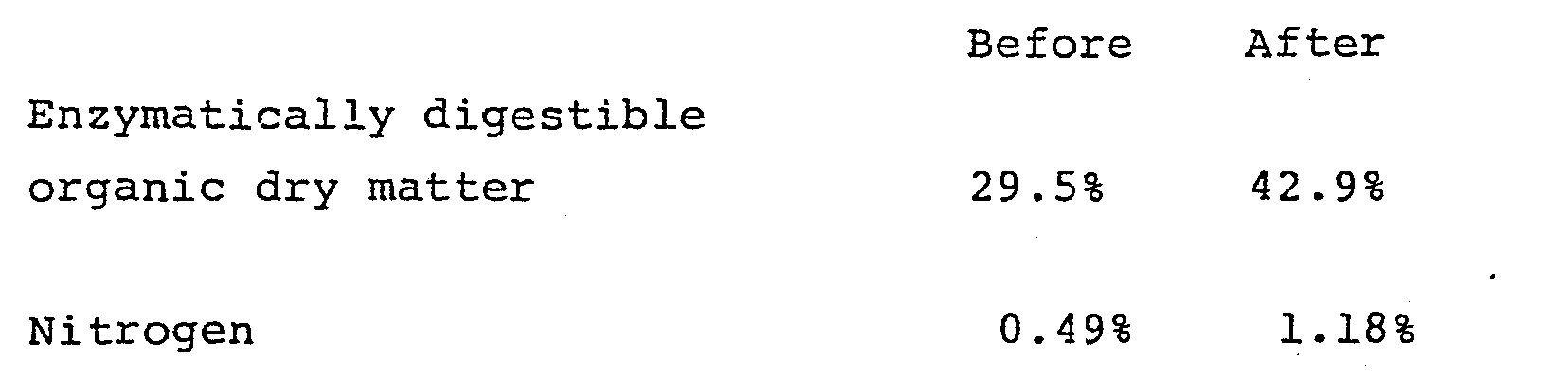
- The following results were obtained by analysing the straw before and after treatment:
- These results may be compared with the results reported in the above Danish Patent No. 145.051 (relating to straw of an unspecified species):
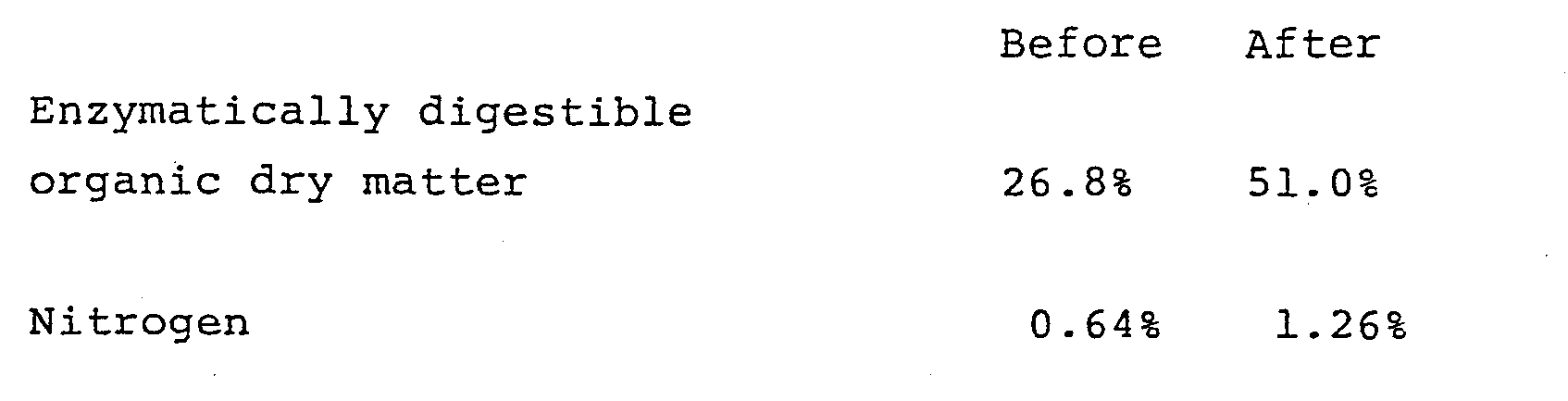
- The percentage increase in enzymatically digestible organic dry matter is thus for the above example of the method according to the invention


- It cannot be denied that the above example appears to give inferior results as compared with the results previously reported, but it should be borne in mind
- a) that the above example represents a "first try", for which reason considerable improvements are to be expected following practical refinements of the process,
- b) that the raw materials used may differ from each other, as the earlier report does not state the type of straw, and
- c) - not least - that the method according to the invention makes it possible in a new and unexpected manner to effect a treatment of cellulose-containing matter of the kind referred to without using liquefied ammonia.
- The method according to the present invention is not limited to the treatment of straw, but may be applied to any cellulose-containing material, in which the cellulose component may be modified by ammonia with a view to improving its digestibility. Thus, the method of the invention may also be applied to the treatment of grain, bagasse and even wood in the form of sawdust. Obviously, the various processing parameters may have to be adapted to the particular material being treated.
Claims (9)
Applications Claiming Priority (2)
| Application Number | Priority Date | Filing Date | Title |
|---|---|---|---|
| DK5560/83 | 1983-12-02 | ||
| DK556083A DK556083A (en) | 1983-12-02 | 1983-12-02 | METHOD AND APPARATUS FOR TREATING CELLULOSE-CONTAINING MATERIALS, e.g. HALM, WITH AMMONIA GAS FORM |
Publications (2)
| Publication Number | Publication Date |
|---|---|
| EP0144930A2 true EP0144930A2 (en) | 1985-06-19 |
| EP0144930A3 EP0144930A3 (en) | 1987-01-28 |
Family
ID=8143504
Family Applications (1)
| Application Number | Title | Priority Date | Filing Date |
|---|---|---|---|
| EP84114541A Ceased EP0144930A3 (en) | 1983-12-02 | 1984-11-30 | Method and apparatus for treating cellulose-containing matter, e.g. straw, with gaseous ammonia |
Country Status (6)
| Country | Link |
|---|---|
| EP (1) | EP0144930A3 (en) |
| JP (1) | JPS60133845A (en) |
| KR (1) | KR850004195A (en) |
| DK (1) | DK556083A (en) |
| PL (1) | PL250669A1 (en) |
| ZA (1) | ZA849154B (en) |
Cited By (11)
| Publication number | Priority date | Publication date | Assignee | Title |
|---|---|---|---|---|
| EP0203766A1 (en) * | 1985-05-21 | 1986-12-03 | Brotherton Chemicals Limited | Treatment of lignocellulosic material |
| EP0215578A1 (en) * | 1985-08-17 | 1987-03-25 | Brotherton Chemicals Limited | Treatment of lignocellulosic materials |
| WO2010135679A1 (en) | 2009-05-21 | 2010-11-25 | Board Of Trustees Of Michigan State University | Methods for pretreating biomass |
| US20110192559A1 (en) * | 2006-05-01 | 2011-08-11 | Balan Venkatesh | Methods for pretreating biomass |
| US8673031B2 (en) | 2009-08-24 | 2014-03-18 | Board Of Trustees Of Michigan State University | Pretreated densified biomass products |
| EP2826869A1 (en) * | 2006-05-01 | 2015-01-21 | Board of Trustees of Michigan State University | Process for the treatment of lignocellulosic biomass |
| US8945245B2 (en) | 2009-08-24 | 2015-02-03 | The Michigan Biotechnology Institute | Methods of hydrolyzing pretreated densified biomass particulates and systems related thereto |
| US9206446B2 (en) | 2006-05-01 | 2015-12-08 | Board Of Trustees Of Michigan State University | Extraction of solubles from plant biomass for use as microbial growth stimulant and methods related thereto |
| US9650657B2 (en) | 2010-04-19 | 2017-05-16 | Board Of Trustees Of Michigan State University | Methods for producing extracted and digested products from pretreated lignocellulosic biomass |
| US10202660B2 (en) | 2012-03-02 | 2019-02-12 | Board Of Trustees Of Michigan State University | Methods for increasing sugar yield with size-adjusted lignocellulosic biomass particles |
| US10457810B2 (en) | 2009-08-24 | 2019-10-29 | Board Of Trustees Of Michigan State University | Densified biomass products containing pretreated biomass fibers |
Family Cites Families (1)
| Publication number | Priority date | Publication date | Assignee | Title |
|---|---|---|---|---|
| GB2124066B (en) * | 1982-07-16 | 1986-02-26 | Flemstofte Mads Amby Maskinfab | Treating cellulose - containing matter with ammonia |
-
1983
- 1983-12-02 DK DK556083A patent/DK556083A/en not_active Application Discontinuation
-
1984
- 1984-11-23 ZA ZA849154A patent/ZA849154B/en unknown
- 1984-11-30 JP JP59254923A patent/JPS60133845A/en active Pending
- 1984-11-30 PL PL25066984A patent/PL250669A1/en unknown
- 1984-11-30 KR KR1019840007556A patent/KR850004195A/en not_active Withdrawn
- 1984-11-30 EP EP84114541A patent/EP0144930A3/en not_active Ceased
Cited By (19)
| Publication number | Priority date | Publication date | Assignee | Title |
|---|---|---|---|---|
| GB2175788A (en) * | 1985-05-21 | 1986-12-10 | Brotherton Chemicals Ltd | Treatment of lignocellulosic material |
| AU601364B2 (en) * | 1985-05-21 | 1990-09-13 | Animal And Grassland Research Institute, The | Treatment of lignocellulosic material |
| EP0203766A1 (en) * | 1985-05-21 | 1986-12-03 | Brotherton Chemicals Limited | Treatment of lignocellulosic material |
| EP0215578A1 (en) * | 1985-08-17 | 1987-03-25 | Brotherton Chemicals Limited | Treatment of lignocellulosic materials |
| US8968515B2 (en) * | 2006-05-01 | 2015-03-03 | Board Of Trustees Of Michigan State University | Methods for pretreating biomass |
| US20110192559A1 (en) * | 2006-05-01 | 2011-08-11 | Balan Venkatesh | Methods for pretreating biomass |
| US9644222B2 (en) | 2006-05-01 | 2017-05-09 | Board Of Trustees Of Michigan State University | Methods for pretreating biomass |
| US9206446B2 (en) | 2006-05-01 | 2015-12-08 | Board Of Trustees Of Michigan State University | Extraction of solubles from plant biomass for use as microbial growth stimulant and methods related thereto |
| EP2826869A1 (en) * | 2006-05-01 | 2015-01-21 | Board of Trustees of Michigan State University | Process for the treatment of lignocellulosic biomass |
| WO2010135679A1 (en) | 2009-05-21 | 2010-11-25 | Board Of Trustees Of Michigan State University | Methods for pretreating biomass |
| EP2933337A1 (en) * | 2009-05-21 | 2015-10-21 | Board Of Trustees Of Michigan State University | Methods for pretreating biomass |
| EP2432887A4 (en) * | 2009-05-21 | 2013-10-30 | Univ Michigan State | METHODS FOR PRETREATING A BIOMASS |
| US8945245B2 (en) | 2009-08-24 | 2015-02-03 | The Michigan Biotechnology Institute | Methods of hydrolyzing pretreated densified biomass particulates and systems related thereto |
| US9039792B2 (en) | 2009-08-24 | 2015-05-26 | Board Of Trustees Of Michigan State University | Methods for producing and using densified biomass products containing pretreated biomass fibers |
| US8673031B2 (en) | 2009-08-24 | 2014-03-18 | Board Of Trustees Of Michigan State University | Pretreated densified biomass products |
| US9458482B2 (en) | 2009-08-24 | 2016-10-04 | The Michigan Biotechnology Institute | Methods of hydrolyzing pretreated densified biomass particulates and systems related thereto |
| US10457810B2 (en) | 2009-08-24 | 2019-10-29 | Board Of Trustees Of Michigan State University | Densified biomass products containing pretreated biomass fibers |
| US9650657B2 (en) | 2010-04-19 | 2017-05-16 | Board Of Trustees Of Michigan State University | Methods for producing extracted and digested products from pretreated lignocellulosic biomass |
| US10202660B2 (en) | 2012-03-02 | 2019-02-12 | Board Of Trustees Of Michigan State University | Methods for increasing sugar yield with size-adjusted lignocellulosic biomass particles |
Also Published As
| Publication number | Publication date |
|---|---|
| DK556083A (en) | 1985-06-03 |
| PL250669A1 (en) | 1986-06-03 |
| JPS60133845A (en) | 1985-07-17 |
| ZA849154B (en) | 1985-08-28 |
| EP0144930A3 (en) | 1987-01-28 |
| KR850004195A (en) | 1985-07-11 |
| DK556083D0 (en) | 1983-12-02 |
Similar Documents
| Publication | Publication Date | Title |
|---|---|---|
| EP0144930A2 (en) | Method and apparatus for treating cellulose-containing matter, e.g. straw, with gaseous ammonia | |
| DE2714995C3 (en) | Production of cellulosic) material with improved digestibility for ruminants | |
| US3939280A (en) | Process for treating animal waste | |
| EP0202915A2 (en) | Supercritical ammonia treatment of lignocellulosic materials | |
| HU193884B (en) | Process for preparing highly nutritive flours of protein content suitable for feeding ruminants | |
| US5082679A (en) | Method for detoxifying foodstuffs | |
| Baldensperger et al. | Solid state fermentation of banana wastes | |
| CA1213164A (en) | Processing of lignocellulose materials | |
| EP0286056B1 (en) | Procedure for treating feed raw material, feed raw material, and feed mix | |
| SU1085583A1 (en) | Method of producing food additive from maize extract of starch and glucose production waste | |
| SU891054A1 (en) | Method of processing straw into fodder | |
| FI62618B (en) | FOERFARANDE FOER DETOXIKATION AV RAPSFROEMJOEL | |
| SU843928A1 (en) | Method of preserving feeding-stuff | |
| EP0215578B1 (en) | Treatment of lignocellulosic materials | |
| JPS61136981A (en) | Manufacture of compost from waste cloth or like of annimal fiber | |
| EP0203766B1 (en) | Treatment of lignocellulosic material | |
| SU651652A3 (en) | Method of treating fodder | |
| DE2451509C3 (en) | Protein-based animal feed protected against bacterial deamination | |
| US259140A (en) | Manufacture of fertilizing material | |
| SU1076063A1 (en) | Method of processing of rough vegetable material for fodder | |
| Lucht | Reduction of glucosinolates and sinapine in rapeseed by technical treatment: Description of the technical procedure and effectiveness evaluation | |
| SU1090323A1 (en) | Method of processing straw for food method of preparing granulated food | |
| CA1052616A (en) | Process for treating plant organic matter particles to increase the digestability thereof by ruminants | |
| CN1044386A (en) | A kind of rapeseed dregs chemical detoxication | |
| SU1377005A1 (en) | Method of preparing straw for feeding |
Legal Events
| Date | Code | Title | Description |
|---|---|---|---|
| PUAI | Public reference made under article 153(3) epc to a published international application that has entered the european phase |
Free format text: ORIGINAL CODE: 0009012 |
|
| AK | Designated contracting states |
Designated state(s): AT BE CH DE FR GB IT LI LU NL SE |
|
| PUAL | Search report despatched |
Free format text: ORIGINAL CODE: 0009013 |
|
| AK | Designated contracting states |
Kind code of ref document: A3 Designated state(s): AT BE CH DE FR GB IT LI LU NL SE |
|
| 17P | Request for examination filed |
Effective date: 19870616 |
|
| RAP1 | Party data changed (applicant data changed or rights of an application transferred) |
Owner name: DESTEC A/S |
|
| 17Q | First examination report despatched |
Effective date: 19880628 |
|
| STAA | Information on the status of an ep patent application or granted ep patent |
Free format text: STATUS: THE APPLICATION HAS BEEN REFUSED |
|
| 18R | Application refused |
Effective date: 19890626 |
|
| RIN1 | Information on inventor provided before grant (corrected) |
Inventor name: KROMANN, KARL AKSEL Inventor name: ANDERSEN, TOM RUDBECK |