DE69930328T2 - Dimer pyrrolobenzodiazepines - Google Patents
Dimer pyrrolobenzodiazepines Download PDFInfo
- Publication number
- DE69930328T2 DE69930328T2 DE69930328T DE69930328T DE69930328T2 DE 69930328 T2 DE69930328 T2 DE 69930328T2 DE 69930328 T DE69930328 T DE 69930328T DE 69930328 T DE69930328 T DE 69930328T DE 69930328 T2 DE69930328 T2 DE 69930328T2
- Authority
- DE
- Germany
- Prior art keywords
- compound
- mmol
- bis
- mice
- solution
- Prior art date
- Legal status (The legal status is an assumption and is not a legal conclusion. Google has not performed a legal analysis and makes no representation as to the accuracy of the status listed.)
- Expired - Lifetime
Links
- 239000000539 dimer Substances 0.000 title description 7
- YUOCYTRGANSSRY-UHFFFAOYSA-N pyrrolo[2,3-i][1,2]benzodiazepine Chemical class C1=CN=NC2=C3C=CN=C3C=CC2=C1 YUOCYTRGANSSRY-UHFFFAOYSA-N 0.000 title 1
- 150000001875 compounds Chemical class 0.000 claims abstract description 50
- 238000000034 method Methods 0.000 claims description 27
- 238000011282 treatment Methods 0.000 claims description 13
- 239000003814 drug Substances 0.000 claims description 11
- 229940079593 drug Drugs 0.000 claims description 9
- 230000008569 process Effects 0.000 claims description 8
- 238000002360 preparation method Methods 0.000 claims description 6
- 239000008194 pharmaceutical composition Substances 0.000 claims description 5
- 208000037265 diseases, disorders, signs and symptoms Diseases 0.000 claims description 4
- 208000035143 Bacterial infection Diseases 0.000 claims description 3
- 208000030852 Parasitic disease Diseases 0.000 claims description 3
- 208000036142 Viral infection Diseases 0.000 claims description 3
- 208000022362 bacterial infectious disease Diseases 0.000 claims description 3
- 201000010099 disease Diseases 0.000 claims description 3
- 239000003937 drug carrier Substances 0.000 claims description 3
- 230000003071 parasitic effect Effects 0.000 claims description 3
- 230000002062 proliferating effect Effects 0.000 claims description 2
- 238000002560 therapeutic procedure Methods 0.000 claims description 2
- 230000003612 virological effect Effects 0.000 claims description 2
- OKKJLVBELUTLKV-UHFFFAOYSA-N Methanol Chemical compound OC OKKJLVBELUTLKV-UHFFFAOYSA-N 0.000 description 42
- YMWUJEATGCHHMB-UHFFFAOYSA-N Dichloromethane Chemical compound ClCCl YMWUJEATGCHHMB-UHFFFAOYSA-N 0.000 description 38
- 210000004027 cell Anatomy 0.000 description 36
- 238000012360 testing method Methods 0.000 description 31
- 239000000243 solution Substances 0.000 description 30
- 239000011541 reaction mixture Substances 0.000 description 22
- 241000699670 Mus sp. Species 0.000 description 20
- XEKOWRVHYACXOJ-UHFFFAOYSA-N Ethyl acetate Chemical compound CCOC(C)=O XEKOWRVHYACXOJ-UHFFFAOYSA-N 0.000 description 19
- 206010028980 Neoplasm Diseases 0.000 description 19
- 230000015572 biosynthetic process Effects 0.000 description 19
- HEDRZPFGACZZDS-MICDWDOJSA-N Trichloro(2H)methane Chemical compound [2H]C(Cl)(Cl)Cl HEDRZPFGACZZDS-MICDWDOJSA-N 0.000 description 18
- -1 pentane-1,5-diyl Chemical group 0.000 description 18
- IAZDPXIOMUYVGZ-UHFFFAOYSA-N Dimethylsulphoxide Chemical compound CS(C)=O IAZDPXIOMUYVGZ-UHFFFAOYSA-N 0.000 description 16
- CSNNHWWHGAXBCP-UHFFFAOYSA-L Magnesium sulfate Chemical compound [Mg+2].[O-][S+2]([O-])([O-])[O-] CSNNHWWHGAXBCP-UHFFFAOYSA-L 0.000 description 12
- 231100000135 cytotoxicity Toxicity 0.000 description 12
- 230000003013 cytotoxicity Effects 0.000 description 12
- 230000002829 reductive effect Effects 0.000 description 12
- 238000003786 synthesis reaction Methods 0.000 description 12
- 238000003756 stirring Methods 0.000 description 11
- 241000790917 Dioxys <bee> Species 0.000 description 10
- OAKJQQAXSVQMHS-UHFFFAOYSA-N Hydrazine Chemical compound NN OAKJQQAXSVQMHS-UHFFFAOYSA-N 0.000 description 10
- 239000003242 anti bacterial agent Substances 0.000 description 10
- 229940088710 antibiotic agent Drugs 0.000 description 10
- 238000006243 chemical reaction Methods 0.000 description 10
- 239000000047 product Substances 0.000 description 10
- PXHVJJICTQNCMI-UHFFFAOYSA-N Nickel Chemical compound [Ni] PXHVJJICTQNCMI-UHFFFAOYSA-N 0.000 description 9
- ZMANZCXQSJIPKH-UHFFFAOYSA-N Triethylamine Chemical compound CCN(CC)CC ZMANZCXQSJIPKH-UHFFFAOYSA-N 0.000 description 9
- 230000000694 effects Effects 0.000 description 9
- PCTWLLFFEIRBIE-VHSXEESVSA-N (3r,5s)-5-[[tert-butyl(dimethyl)silyl]oxymethyl]pyrrolidin-3-ol Chemical compound CC(C)(C)[Si](C)(C)OC[C@@H]1C[C@@H](O)CN1 PCTWLLFFEIRBIE-VHSXEESVSA-N 0.000 description 8
- QTBSBXVTEAMEQO-UHFFFAOYSA-N Acetic acid Chemical compound CC(O)=O QTBSBXVTEAMEQO-UHFFFAOYSA-N 0.000 description 8
- HEDRZPFGACZZDS-UHFFFAOYSA-N Chloroform Chemical compound ClC(Cl)Cl HEDRZPFGACZZDS-UHFFFAOYSA-N 0.000 description 8
- DQLATGHUWYMOKM-UHFFFAOYSA-L cisplatin Chemical compound N[Pt](N)(Cl)Cl DQLATGHUWYMOKM-UHFFFAOYSA-L 0.000 description 8
- CTSLXHKWHWQRSH-UHFFFAOYSA-N oxalyl chloride Chemical compound ClC(=O)C(Cl)=O CTSLXHKWHWQRSH-UHFFFAOYSA-N 0.000 description 8
- NQLRKKYEAIYVMB-HPZKVCJDSA-N (3ar)-7-[3-[[(6as)-11-oxo-6a,7,8,9-tetrahydropyrrolo[2,1-c][1,4]benzodiazepin-3-yl]oxy]propoxy]-8-methoxy-2,3,3a,10a-tetrahydro-1h-pyrrolo[3,2-c][1]benzazepin-10-one Chemical compound C1=C2N=C[C@@H]3CCCN3C(=O)C2=CC=C1OCCCOC1=CC(N=C[C@H]2C(NCC2)C2=O)=C2C=C1OC NQLRKKYEAIYVMB-HPZKVCJDSA-N 0.000 description 7
- RWZVMMQNDHPRQD-SFTDATJTSA-N (6as)-3-[3-[[(6as)-2-methoxy-8-methylidene-11-oxo-7,9-dihydro-6ah-pyrrolo[2,1-c][1,4]benzodiazepin-3-yl]oxy]propoxy]-2-methoxy-8-methylidene-7,9-dihydro-6ah-pyrrolo[2,1-c][1,4]benzodiazepin-11-one Chemical compound N1=C[C@@H]2CC(=C)CN2C(=O)C(C=C2OC)=C1C=C2OCCCOC1=CC(N=C[C@H]2N(CC(=C)C2)C2=O)=C2C=C1OC RWZVMMQNDHPRQD-SFTDATJTSA-N 0.000 description 7
- NGNBDVOYPDDBFK-UHFFFAOYSA-N 2-[2,4-di(pentan-2-yl)phenoxy]acetyl chloride Chemical compound CCCC(C)C1=CC=C(OCC(Cl)=O)C(C(C)CCC)=C1 NGNBDVOYPDDBFK-UHFFFAOYSA-N 0.000 description 7
- IJGRMHOSHXDMSA-UHFFFAOYSA-N Atomic nitrogen Chemical compound N#N IJGRMHOSHXDMSA-UHFFFAOYSA-N 0.000 description 7
- RTZKZFJDLAIYFH-UHFFFAOYSA-N Diethyl ether Chemical compound CCOCC RTZKZFJDLAIYFH-UHFFFAOYSA-N 0.000 description 7
- 239000007868 Raney catalyst Substances 0.000 description 7
- 229910000564 Raney nickel Inorganic materials 0.000 description 7
- 229960004316 cisplatin Drugs 0.000 description 7
- 235000019439 ethyl acetate Nutrition 0.000 description 7
- 238000003818 flash chromatography Methods 0.000 description 7
- 238000005755 formation reaction Methods 0.000 description 7
- 230000008018 melting Effects 0.000 description 7
- 238000002844 melting Methods 0.000 description 7
- 239000012299 nitrogen atmosphere Substances 0.000 description 7
- 239000002904 solvent Substances 0.000 description 7
- 238000004809 thin layer chromatography Methods 0.000 description 7
- XLYOFNOQVPJJNP-UHFFFAOYSA-N water Substances O XLYOFNOQVPJJNP-UHFFFAOYSA-N 0.000 description 7
- CSCPPACGZOOCGX-UHFFFAOYSA-N Acetone Chemical compound CC(C)=O CSCPPACGZOOCGX-UHFFFAOYSA-N 0.000 description 6
- PAYRUJLWNCNPSJ-UHFFFAOYSA-N Aniline Chemical compound NC1=CC=CC=C1 PAYRUJLWNCNPSJ-UHFFFAOYSA-N 0.000 description 6
- KDLHZDBZIXYQEI-UHFFFAOYSA-N Palladium Chemical compound [Pd] KDLHZDBZIXYQEI-UHFFFAOYSA-N 0.000 description 6
- 125000002915 carbonyl group Chemical group [*:2]C([*:1])=O 0.000 description 6
- 239000012510 hollow fiber Substances 0.000 description 6
- 238000007912 intraperitoneal administration Methods 0.000 description 6
- 150000002576 ketones Chemical class 0.000 description 6
- 229910052943 magnesium sulfate Inorganic materials 0.000 description 6
- 235000019341 magnesium sulphate Nutrition 0.000 description 6
- 238000004519 manufacturing process Methods 0.000 description 6
- 238000007363 ring formation reaction Methods 0.000 description 6
- 230000004614 tumor growth Effects 0.000 description 6
- FAPWRFPIFSIZLT-UHFFFAOYSA-M Sodium chloride Chemical class [Na+].[Cl-] FAPWRFPIFSIZLT-UHFFFAOYSA-M 0.000 description 5
- 239000002253 acid Substances 0.000 description 5
- 150000002466 imines Chemical class 0.000 description 5
- 239000007924 injection Substances 0.000 description 5
- 238000002347 injection Methods 0.000 description 5
- 230000001404 mediated effect Effects 0.000 description 5
- 150000002828 nitro derivatives Chemical class 0.000 description 5
- 125000000449 nitro group Chemical group [O-][N+](*)=O 0.000 description 5
- 230000003647 oxidation Effects 0.000 description 5
- 238000007254 oxidation reaction Methods 0.000 description 5
- 230000009467 reduction Effects 0.000 description 5
- 238000007920 subcutaneous administration Methods 0.000 description 5
- 125000001981 tert-butyldimethylsilyl group Chemical group [H]C([H])([H])[Si]([H])(C([H])([H])[H])[*]C(C([H])([H])[H])(C([H])([H])[H])C([H])([H])[H] 0.000 description 5
- 230000001988 toxicity Effects 0.000 description 5
- 231100000419 toxicity Toxicity 0.000 description 5
- LFQSCWFLJHTTHZ-UHFFFAOYSA-N Ethanol Chemical compound CCO LFQSCWFLJHTTHZ-UHFFFAOYSA-N 0.000 description 4
- PMMYEEVYMWASQN-DMTCNVIQSA-N Hydroxyproline Chemical compound O[C@H]1CN[C@H](C(O)=O)C1 PMMYEEVYMWASQN-DMTCNVIQSA-N 0.000 description 4
- JUJWROOIHBZHMG-UHFFFAOYSA-N Pyridine Chemical compound C1=CC=NC=C1 JUJWROOIHBZHMG-UHFFFAOYSA-N 0.000 description 4
- 229910021626 Tin(II) chloride Inorganic materials 0.000 description 4
- 150000001299 aldehydes Chemical class 0.000 description 4
- 230000027455 binding Effects 0.000 description 4
- 150000002009 diols Chemical class 0.000 description 4
- KPUWHANPEXNPJT-UHFFFAOYSA-N disiloxane Chemical compound [SiH3]O[SiH3] KPUWHANPEXNPJT-UHFFFAOYSA-N 0.000 description 4
- 150000002148 esters Chemical class 0.000 description 4
- 238000000338 in vitro Methods 0.000 description 4
- 239000000463 material Substances 0.000 description 4
- 239000002609 medium Substances 0.000 description 4
- 201000001441 melanoma Diseases 0.000 description 4
- VJRFJGMPXURLEZ-UHFFFAOYSA-N methyl 3-methoxy-4-pentoxybenzoate Chemical compound CCCCCOC1=CC=C(C(=O)OC)C=C1OC VJRFJGMPXURLEZ-UHFFFAOYSA-N 0.000 description 4
- RGZVECLEJXVVHW-UHFFFAOYSA-N methyl 5-methoxy-2-nitro-4-pentoxybenzoate Chemical compound CCCCCOC1=CC([N+]([O-])=O)=C(C(=O)OC)C=C1OC RGZVECLEJXVVHW-UHFFFAOYSA-N 0.000 description 4
- 229910052757 nitrogen Inorganic materials 0.000 description 4
- QJGQUHMNIGDVPM-UHFFFAOYSA-N nitrogen group Chemical group [N] QJGQUHMNIGDVPM-UHFFFAOYSA-N 0.000 description 4
- 239000003921 oil Substances 0.000 description 4
- 235000019198 oils Nutrition 0.000 description 4
- 230000003287 optical effect Effects 0.000 description 4
- 239000012074 organic phase Substances 0.000 description 4
- 239000003208 petroleum Substances 0.000 description 4
- 125000006239 protecting group Chemical group 0.000 description 4
- 238000002390 rotary evaporation Methods 0.000 description 4
- 239000007787 solid Substances 0.000 description 4
- 235000011150 stannous chloride Nutrition 0.000 description 4
- 239000007858 starting material Substances 0.000 description 4
- 239000000725 suspension Substances 0.000 description 4
- FPGGTKZVZWFYPV-UHFFFAOYSA-M tetrabutylammonium fluoride Chemical compound [F-].CCCC[N+](CCCC)(CCCC)CCCC FPGGTKZVZWFYPV-UHFFFAOYSA-M 0.000 description 4
- RWRDLPDLKQPQOW-UHFFFAOYSA-N tetrahydropyrrole Substances C1CCNC1 RWRDLPDLKQPQOW-UHFFFAOYSA-N 0.000 description 4
- RIOQSEWOXXDEQQ-UHFFFAOYSA-N triphenylphosphine Chemical compound C1=CC=CC=C1P(C=1C=CC=CC=1)C1=CC=CC=C1 RIOQSEWOXXDEQQ-UHFFFAOYSA-N 0.000 description 4
- 210000004881 tumor cell Anatomy 0.000 description 4
- TXUICONDJPYNPY-UHFFFAOYSA-N (1,10,13-trimethyl-3-oxo-4,5,6,7,8,9,11,12,14,15,16,17-dodecahydrocyclopenta[a]phenanthren-17-yl) heptanoate Chemical compound C1CC2CC(=O)C=C(C)C2(C)C2C1C1CCC(OC(=O)CCCCCC)C1(C)CC2 TXUICONDJPYNPY-UHFFFAOYSA-N 0.000 description 3
- OMRPLUKQNWNZAV-CONSDPRKSA-N (6as)-3-[3-[[(6as)-2-methoxy-8-(4-methoxyphenyl)-11-oxo-6a,7-dihydropyrrolo[2,1-c][1,4]benzodiazepin-3-yl]oxy]propoxy]-8-(4-aminophenyl)-2-methoxy-6a,7-dihydropyrrolo[2,1-c][1,4]benzodiazepin-11-one Chemical compound C1=CC(OC)=CC=C1C1=CN2C(=O)C3=CC(OC)=C(OCCCOC=4C(=CC=5C(=O)N6C=C(C[C@H]6C=NC=5C=4)C=4C=CC(N)=CC=4)OC)C=C3N=C[C@@H]2C1 OMRPLUKQNWNZAV-CONSDPRKSA-N 0.000 description 3
- SLAMLWHELXOEJZ-UHFFFAOYSA-N 2-nitrobenzoic acid Chemical compound OC(=O)C1=CC=CC=C1[N+]([O-])=O SLAMLWHELXOEJZ-UHFFFAOYSA-N 0.000 description 3
- BWWHTIHDQBHTHP-UHFFFAOYSA-N 2-nitrobenzoyl chloride Chemical compound [O-][N+](=O)C1=CC=CC=C1C(Cl)=O BWWHTIHDQBHTHP-UHFFFAOYSA-N 0.000 description 3
- WFDIJRYMOXRFFG-UHFFFAOYSA-N Acetic anhydride Chemical compound CC(=O)OC(C)=O WFDIJRYMOXRFFG-UHFFFAOYSA-N 0.000 description 3
- LYCAIKOWRPUZTN-UHFFFAOYSA-N Ethylene glycol Chemical compound OCCO LYCAIKOWRPUZTN-UHFFFAOYSA-N 0.000 description 3
- PEDCQBHIVMGVHV-UHFFFAOYSA-N Glycerine Chemical compound OCC(O)CO PEDCQBHIVMGVHV-UHFFFAOYSA-N 0.000 description 3
- AVXURJPOCDRRFD-UHFFFAOYSA-N Hydroxylamine Chemical compound ON AVXURJPOCDRRFD-UHFFFAOYSA-N 0.000 description 3
- LFTLOKWAGJYHHR-UHFFFAOYSA-N N-methylmorpholine N-oxide Chemical compound CN1(=O)CCOCC1 LFTLOKWAGJYHHR-UHFFFAOYSA-N 0.000 description 3
- 206010061535 Ovarian neoplasm Diseases 0.000 description 3
- DNIAPMSPPWPWGF-UHFFFAOYSA-N Propylene glycol Chemical compound CC(O)CO DNIAPMSPPWPWGF-UHFFFAOYSA-N 0.000 description 3
- HEMHJVSKTPXQMS-UHFFFAOYSA-M Sodium hydroxide Chemical compound [OH-].[Na+] HEMHJVSKTPXQMS-UHFFFAOYSA-M 0.000 description 3
- 238000006859 Swern oxidation reaction Methods 0.000 description 3
- ATJFFYVFTNAWJD-UHFFFAOYSA-N Tin Chemical class [Sn] ATJFFYVFTNAWJD-UHFFFAOYSA-N 0.000 description 3
- 125000005907 alkyl ester group Chemical group 0.000 description 3
- 150000001412 amines Chemical class 0.000 description 3
- 238000011717 athymic nude mouse Methods 0.000 description 3
- WPYMKLBDIGXBTP-UHFFFAOYSA-N benzoic acid Chemical compound OC(=O)C1=CC=CC=C1 WPYMKLBDIGXBTP-UHFFFAOYSA-N 0.000 description 3
- 235000010233 benzoic acid Nutrition 0.000 description 3
- 244000309466 calf Species 0.000 description 3
- 230000003197 catalytic effect Effects 0.000 description 3
- 208000025997 central nervous system neoplasm Diseases 0.000 description 3
- 239000003153 chemical reaction reagent Substances 0.000 description 3
- FZFAMSAMCHXGEF-UHFFFAOYSA-N chloro formate Chemical compound ClOC=O FZFAMSAMCHXGEF-UHFFFAOYSA-N 0.000 description 3
- 238000003776 cleavage reaction Methods 0.000 description 3
- 210000001072 colon Anatomy 0.000 description 3
- 238000005859 coupling reaction Methods 0.000 description 3
- 239000012043 crude product Substances 0.000 description 3
- 238000010511 deprotection reaction Methods 0.000 description 3
- 238000010790 dilution Methods 0.000 description 3
- 239000012895 dilution Substances 0.000 description 3
- 239000000835 fiber Substances 0.000 description 3
- 239000000706 filtrate Substances 0.000 description 3
- 239000006260 foam Substances 0.000 description 3
- 238000005984 hydrogenation reaction Methods 0.000 description 3
- 230000007062 hydrolysis Effects 0.000 description 3
- 238000006460 hydrolysis reaction Methods 0.000 description 3
- 239000007788 liquid Substances 0.000 description 3
- SXQCTESRRZBPHJ-UHFFFAOYSA-M lissamine rhodamine Chemical compound [Na+].C=12C=CC(=[N+](CC)CC)C=C2OC2=CC(N(CC)CC)=CC=C2C=1C1=CC=C(S([O-])(=O)=O)C=C1S([O-])(=O)=O SXQCTESRRZBPHJ-UHFFFAOYSA-M 0.000 description 3
- 238000001819 mass spectrum Methods 0.000 description 3
- XMYQHJDBLRZMLW-UHFFFAOYSA-N methanolamine Chemical compound NCO XMYQHJDBLRZMLW-UHFFFAOYSA-N 0.000 description 3
- BVWTXUYLKBHMOX-UHFFFAOYSA-N methyl vanillate Chemical compound COC(=O)C1=CC=C(O)C(OC)=C1 BVWTXUYLKBHMOX-UHFFFAOYSA-N 0.000 description 3
- 230000002611 ovarian Effects 0.000 description 3
- 229910052763 palladium Inorganic materials 0.000 description 3
- 230000003389 potentiating effect Effects 0.000 description 3
- 238000000746 purification Methods 0.000 description 3
- 238000010992 reflux Methods 0.000 description 3
- 230000007017 scission Effects 0.000 description 3
- 238000012216 screening Methods 0.000 description 3
- 239000003381 stabilizer Substances 0.000 description 3
- 239000001119 stannous chloride Substances 0.000 description 3
- 150000003555 thioacetals Chemical class 0.000 description 3
- 210000001541 thymus gland Anatomy 0.000 description 3
- NWZSZGALRFJKBT-KNIFDHDWSA-N (2s)-2,6-diaminohexanoic acid;(2s)-2-hydroxybutanedioic acid Chemical compound OC(=O)[C@@H](O)CC(O)=O.NCCCC[C@H](N)C(O)=O NWZSZGALRFJKBT-KNIFDHDWSA-N 0.000 description 2
- UQVNRKBFAXNOGA-OHLDGCSVSA-N (Z)-tomaymycin Chemical compound CO[C@H]1NC2=CC(O)=C(OC)C=C2C(=O)N2C\C(=C/C)C[C@@H]12 UQVNRKBFAXNOGA-OHLDGCSVSA-N 0.000 description 2
- PWDSJBHSKYBUEX-UHFFFAOYSA-N 1,4-benzodiazepin-5-one Chemical compound O=C1N=CC=NC2=CC=CC=C12 PWDSJBHSKYBUEX-UHFFFAOYSA-N 0.000 description 2
- CFCGDLMKOMCTLQ-UHFFFAOYSA-N 5-methoxy-2-nitro-4-pentoxybenzoic acid Chemical compound CCCCCOC1=CC([N+]([O-])=O)=C(C(O)=O)C=C1OC CFCGDLMKOMCTLQ-UHFFFAOYSA-N 0.000 description 2
- NLXLAEXVIDQMFP-UHFFFAOYSA-N Ammonia chloride Chemical compound [NH4+].[Cl-] NLXLAEXVIDQMFP-UHFFFAOYSA-N 0.000 description 2
- 239000005711 Benzoic acid Substances 0.000 description 2
- KXDHJXZQYSOELW-UHFFFAOYSA-M Carbamate Chemical compound NC([O-])=O KXDHJXZQYSOELW-UHFFFAOYSA-M 0.000 description 2
- 201000009030 Carcinoma Diseases 0.000 description 2
- 208000012766 Growth delay Diseases 0.000 description 2
- 208000026350 Inborn Genetic disease Diseases 0.000 description 2
- 208000024556 Mendelian disease Diseases 0.000 description 2
- VYPSYNLAJGMNEJ-UHFFFAOYSA-N Silicium dioxide Chemical compound O=[Si]=O VYPSYNLAJGMNEJ-UHFFFAOYSA-N 0.000 description 2
- DTQVDTLACAAQTR-UHFFFAOYSA-N Trifluoroacetic acid Chemical compound OC(=O)C(F)(F)F DTQVDTLACAAQTR-UHFFFAOYSA-N 0.000 description 2
- VGQOVCHZGQWAOI-UHFFFAOYSA-N UNPD55612 Natural products N1C(O)C2CC(C=CC(N)=O)=CN2C(=O)C2=CC=C(C)C(O)=C12 VGQOVCHZGQWAOI-UHFFFAOYSA-N 0.000 description 2
- 238000002835 absorbance Methods 0.000 description 2
- DHKHKXVYLBGOIT-UHFFFAOYSA-N acetaldehyde Diethyl Acetal Natural products CCOC(C)OCC DHKHKXVYLBGOIT-UHFFFAOYSA-N 0.000 description 2
- 150000001241 acetals Chemical class 0.000 description 2
- 239000004480 active ingredient Substances 0.000 description 2
- 150000001408 amides Chemical class 0.000 description 2
- VGQOVCHZGQWAOI-HYUHUPJXSA-N anthramycin Chemical compound N1[C@@H](O)[C@@H]2CC(\C=C\C(N)=O)=CN2C(=O)C2=CC=C(C)C(O)=C12 VGQOVCHZGQWAOI-HYUHUPJXSA-N 0.000 description 2
- 230000001093 anti-cancer Effects 0.000 description 2
- 239000002246 antineoplastic agent Substances 0.000 description 2
- 239000007900 aqueous suspension Substances 0.000 description 2
- 239000000872 buffer Substances 0.000 description 2
- 239000002775 capsule Substances 0.000 description 2
- 150000001732 carboxylic acid derivatives Chemical class 0.000 description 2
- 230000010261 cell growth Effects 0.000 description 2
- 230000022534 cell killing Effects 0.000 description 2
- 210000003169 central nervous system Anatomy 0.000 description 2
- 208000029742 colonic neoplasm Diseases 0.000 description 2
- 230000008878 coupling Effects 0.000 description 2
- 238000010168 coupling process Methods 0.000 description 2
- PMMYEEVYMWASQN-UHFFFAOYSA-N dl-hydroxyproline Natural products OC1C[NH2+]C(C([O-])=O)C1 PMMYEEVYMWASQN-UHFFFAOYSA-N 0.000 description 2
- 231100000673 dose–response relationship Toxicity 0.000 description 2
- 238000011156 evaluation Methods 0.000 description 2
- 238000002474 experimental method Methods 0.000 description 2
- 238000001914 filtration Methods 0.000 description 2
- 239000011521 glass Substances 0.000 description 2
- 239000001963 growth medium Substances 0.000 description 2
- 239000012456 homogeneous solution Substances 0.000 description 2
- IKDUDTNKRLTJSI-UHFFFAOYSA-N hydrazine monohydrate Substances O.NN IKDUDTNKRLTJSI-UHFFFAOYSA-N 0.000 description 2
- 150000004678 hydrides Chemical class 0.000 description 2
- 238000002513 implantation Methods 0.000 description 2
- 238000001727 in vivo Methods 0.000 description 2
- 238000012750 in vivo screening Methods 0.000 description 2
- 238000011534 incubation Methods 0.000 description 2
- 238000001990 intravenous administration Methods 0.000 description 2
- 230000002147 killing effect Effects 0.000 description 2
- 239000003446 ligand Substances 0.000 description 2
- 208000037841 lung tumor Diseases 0.000 description 2
- 239000000203 mixture Substances 0.000 description 2
- 239000000178 monomer Substances 0.000 description 2
- NFHFRUOZVGFOOS-UHFFFAOYSA-N palladium;triphenylphosphane Chemical compound [Pd].C1=CC=CC=C1P(C=1C=CC=CC=1)C1=CC=CC=C1.C1=CC=CC=C1P(C=1C=CC=CC=1)C1=CC=CC=C1.C1=CC=CC=C1P(C=1C=CC=CC=1)C1=CC=CC=C1.C1=CC=CC=C1P(C=1C=CC=CC=1)C1=CC=CC=C1 NFHFRUOZVGFOOS-UHFFFAOYSA-N 0.000 description 2
- 230000037361 pathway Effects 0.000 description 2
- 239000012071 phase Substances 0.000 description 2
- 239000002504 physiological saline solution Substances 0.000 description 2
- 239000002244 precipitate Substances 0.000 description 2
- 239000002243 precursor Substances 0.000 description 2
- OCAAZRFBJBEVPS-UHFFFAOYSA-N prop-2-enyl carbamate Chemical compound NC(=O)OCC=C OCAAZRFBJBEVPS-UHFFFAOYSA-N 0.000 description 2
- LVTJOONKWUXEFR-FZRMHRINSA-N protoneodioscin Natural products O(C[C@@H](CC[C@]1(O)[C@H](C)[C@@H]2[C@]3(C)[C@H]([C@H]4[C@@H]([C@]5(C)C(=CC4)C[C@@H](O[C@@H]4[C@H](O[C@H]6[C@@H](O)[C@@H](O)[C@@H](O)[C@H](C)O6)[C@@H](O)[C@H](O[C@H]6[C@@H](O)[C@@H](O)[C@@H](O)[C@H](C)O6)[C@H](CO)O4)CC5)CC3)C[C@@H]2O1)C)[C@H]1[C@H](O)[C@H](O)[C@H](O)[C@@H](CO)O1 LVTJOONKWUXEFR-FZRMHRINSA-N 0.000 description 2
- UMJSCPRVCHMLSP-UHFFFAOYSA-N pyridine Natural products COC1=CC=CN=C1 UMJSCPRVCHMLSP-UHFFFAOYSA-N 0.000 description 2
- 230000002269 spontaneous effect Effects 0.000 description 2
- 230000006641 stabilisation Effects 0.000 description 2
- 238000011105 stabilization Methods 0.000 description 2
- 239000000126 substance Substances 0.000 description 2
- 238000006467 substitution reaction Methods 0.000 description 2
- FGTJJHCZWOVVNH-UHFFFAOYSA-N tert-butyl-[tert-butyl(dimethyl)silyl]oxy-dimethylsilane Chemical compound CC(C)(C)[Si](C)(C)O[Si](C)(C)C(C)(C)C FGTJJHCZWOVVNH-UHFFFAOYSA-N 0.000 description 2
- PMMYEEVYMWASQN-IMJSIDKUSA-N trans-4-Hydroxy-L-proline Natural products O[C@@H]1CN[C@H](C(O)=O)C1 PMMYEEVYMWASQN-IMJSIDKUSA-N 0.000 description 2
- 238000003828 vacuum filtration Methods 0.000 description 2
- 239000003981 vehicle Substances 0.000 description 2
- ZFYIQPIHXRFFCZ-QMMMGPOBSA-N (2s)-2-(cyclohexylamino)butanedioic acid Chemical compound OC(=O)C[C@@H](C(O)=O)NC1CCCCC1 ZFYIQPIHXRFFCZ-QMMMGPOBSA-N 0.000 description 1
- GYUDGZRJHSDPLH-KJQCOJPZSA-N (6as,8e)-8-ethylidene-7,9-dihydro-6ah-pyrrolo[2,1-c][1,4]benzodiazepin-11-one Chemical compound C1=NC2=CC=CC=C2C(=O)N2CC(=C/C)/C[C@H]21 GYUDGZRJHSDPLH-KJQCOJPZSA-N 0.000 description 1
- DIPVWSTVQDONTF-NUAZBEIESA-N (8E)-2-[(2S,3R,4R,5R,6S)-3,4-dihydroxy-6-methyl-5-(methylamino)oxan-2-yl]oxy-6-methoxy-8-propylidene-6,6a,7,9-tetrahydro-5H-pyrrolo[2,1-c][1,4]benzodiazepin-11-one Chemical compound CC\C=C1/CC2C(Nc3ccc(O[C@@H]4O[C@@H](C)[C@H](NC)[C@@H](O)[C@H]4O)cc3C(=O)N2C1)OC DIPVWSTVQDONTF-NUAZBEIESA-N 0.000 description 1
- JEZZKSQFJNWDCY-NSIKDUERSA-N (8z)-2-[3,4-dihydroxy-4,6-dimethyl-5-(methylamino)oxan-2-yl]oxy-8-propylidene-7,9-dihydro-6ah-pyrrolo[2,1-c][1,4]benzodiazepin-11-one Chemical compound C1=C2C(=O)N3CC(=C/CC)\CC3C=NC2=CC=C1OC1OC(C)C(NC)C(C)(O)C1O JEZZKSQFJNWDCY-NSIKDUERSA-N 0.000 description 1
- OQMYRVPMCIOFHL-GCOHUWJYSA-N (e)-3-[(6r)-6-hydroxy-4-methoxy-11-oxo-5,6,6a,7-tetrahydropyrrolo[2,1-c][1,4]benzodiazepin-8-yl]-n,n-dimethylprop-2-enamide Chemical compound N1[C@H](O)C2CC(\C=C\C(=O)N(C)C)=CN2C(=O)C2=C1C(OC)=CC=C2 OQMYRVPMCIOFHL-GCOHUWJYSA-N 0.000 description 1
- LJCZNYWLQZZIOS-UHFFFAOYSA-N 2,2,2-trichlorethoxycarbonyl chloride Chemical compound ClC(=O)OCC(Cl)(Cl)Cl LJCZNYWLQZZIOS-UHFFFAOYSA-N 0.000 description 1
- QPLJYAKLSCXZSF-UHFFFAOYSA-N 2,2,2-trichloroethyl carbamate Chemical compound NC(=O)OCC(Cl)(Cl)Cl QPLJYAKLSCXZSF-UHFFFAOYSA-N 0.000 description 1
- FXMOIYLVKOALHC-UHFFFAOYSA-N 3,9-dihydroxy-2-methoxy-6a,7,8,9-tetrahydropyrrolo[2,1-c][1,4]benzodiazepin-11-one Chemical class N1=CC2CCC(O)N2C(=O)C2=C1C=C(O)C(OC)=C2 FXMOIYLVKOALHC-UHFFFAOYSA-N 0.000 description 1
- IBOFVQJTBBUKMU-UHFFFAOYSA-N 4,4'-methylene-bis-(2-chloroaniline) Chemical compound C1=C(Cl)C(N)=CC=C1CC1=CC=C(N)C(Cl)=C1 IBOFVQJTBBUKMU-UHFFFAOYSA-N 0.000 description 1
- 208000024827 Alzheimer disease Diseases 0.000 description 1
- 108020003591 B-Form DNA Proteins 0.000 description 1
- 206010006187 Breast cancer Diseases 0.000 description 1
- 208000026310 Breast neoplasm Diseases 0.000 description 1
- KXDHJXZQYSOELW-UHFFFAOYSA-N Carbamic acid Chemical group NC(O)=O KXDHJXZQYSOELW-UHFFFAOYSA-N 0.000 description 1
- BVKZGUZCCUSVTD-UHFFFAOYSA-L Carbonate Chemical compound [O-]C([O-])=O BVKZGUZCCUSVTD-UHFFFAOYSA-L 0.000 description 1
- 229930184471 Chicamycin Natural products 0.000 description 1
- 230000007118 DNA alkylation Effects 0.000 description 1
- 230000004568 DNA-binding Effects 0.000 description 1
- LCGLNKUTAGEVQW-UHFFFAOYSA-N Dimethyl ether Chemical compound COC LCGLNKUTAGEVQW-UHFFFAOYSA-N 0.000 description 1
- KCXVZYZYPLLWCC-UHFFFAOYSA-N EDTA Chemical compound OC(=O)CN(CC(O)=O)CCN(CC(O)=O)CC(O)=O KCXVZYZYPLLWCC-UHFFFAOYSA-N 0.000 description 1
- 108010010803 Gelatin Proteins 0.000 description 1
- WQZGKKKJIJFFOK-GASJEMHNSA-N Glucose Natural products OC[C@H]1OC(O)[C@H](O)[C@@H](O)[C@@H]1O WQZGKKKJIJFFOK-GASJEMHNSA-N 0.000 description 1
- 206010053759 Growth retardation Diseases 0.000 description 1
- 208000028782 Hereditary disease Diseases 0.000 description 1
- 238000006546 Horner-Wadsworth-Emmons reaction Methods 0.000 description 1
- 206010021143 Hypoxia Diseases 0.000 description 1
- DGAQECJNVWCQMB-PUAWFVPOSA-M Ilexoside XXIX Chemical compound C[C@@H]1CC[C@@]2(CC[C@@]3(C(=CC[C@H]4[C@]3(CC[C@@H]5[C@@]4(CC[C@@H](C5(C)C)OS(=O)(=O)[O-])C)C)[C@@H]2[C@]1(C)O)C)C(=O)O[C@H]6[C@@H]([C@H]([C@@H]([C@H](O6)CO)O)O)O.[Na+] DGAQECJNVWCQMB-PUAWFVPOSA-M 0.000 description 1
- 208000008839 Kidney Neoplasms Diseases 0.000 description 1
- 206010058467 Lung neoplasm malignant Diseases 0.000 description 1
- 229930184247 Mazethramycin Natural products 0.000 description 1
- 241001465754 Metazoa Species 0.000 description 1
- GRYLNZFGIOXLOG-UHFFFAOYSA-N Nitric acid Chemical compound O[N+]([O-])=O GRYLNZFGIOXLOG-UHFFFAOYSA-N 0.000 description 1
- 108091028043 Nucleic acid sequence Proteins 0.000 description 1
- 206010033128 Ovarian cancer Diseases 0.000 description 1
- 239000002033 PVDF binder Substances 0.000 description 1
- ALQSHHUCVQOPAS-UHFFFAOYSA-N Pentane-1,5-diol Chemical compound OCCCCCO ALQSHHUCVQOPAS-UHFFFAOYSA-N 0.000 description 1
- 239000002202 Polyethylene glycol Substances 0.000 description 1
- 229930187104 Porothramycin Natural products 0.000 description 1
- GYUDGZRJHSDPLH-UHFFFAOYSA-N Prothracarcin Natural products C1=NC2=CC=CC=C2C(=O)N2CC(=CC)CC21 GYUDGZRJHSDPLH-UHFFFAOYSA-N 0.000 description 1
- 239000008156 Ringer's lactate solution Substances 0.000 description 1
- JEZZKSQFJNWDCY-UHFFFAOYSA-N Sibanomicin Natural products C1=C2C(=O)N3CC(=CCC)CC3C=NC2=CC=C1OC1OC(C)C(NC)C(C)(O)C1O JEZZKSQFJNWDCY-UHFFFAOYSA-N 0.000 description 1
- 206010041067 Small cell lung cancer Diseases 0.000 description 1
- KEAYESYHFKHZAL-UHFFFAOYSA-N Sodium Chemical compound [Na] KEAYESYHFKHZAL-UHFFFAOYSA-N 0.000 description 1
- UIIMBOGNXHQVGW-UHFFFAOYSA-M Sodium bicarbonate Chemical class [Na+].OC([O-])=O UIIMBOGNXHQVGW-UHFFFAOYSA-M 0.000 description 1
- 239000007983 Tris buffer Substances 0.000 description 1
- 238000007295 Wittig olefination reaction Methods 0.000 description 1
- 238000007239 Wittig reaction Methods 0.000 description 1
- SSMFXCDUJJPFBJ-UWJYBYFXSA-N abbeymycin Chemical compound CO[C@@H]1NC2=CC=CC=C2C(=O)N2C[C@@H](O)C[C@@H]12 SSMFXCDUJJPFBJ-UWJYBYFXSA-N 0.000 description 1
- 230000002378 acidificating effect Effects 0.000 description 1
- 230000010933 acylation Effects 0.000 description 1
- 238000005917 acylation reaction Methods 0.000 description 1
- 239000000654 additive Substances 0.000 description 1
- 239000002671 adjuvant Substances 0.000 description 1
- 230000002152 alkylating effect Effects 0.000 description 1
- 238000010640 amide synthesis reaction Methods 0.000 description 1
- 150000001414 amino alcohols Chemical class 0.000 description 1
- 235000019270 ammonium chloride Nutrition 0.000 description 1
- 239000010775 animal oil Substances 0.000 description 1
- RWZYAGGXGHYGMB-UHFFFAOYSA-N anthranilic acid Chemical class NC1=CC=CC=C1C(O)=O RWZYAGGXGHYGMB-UHFFFAOYSA-N 0.000 description 1
- 239000003972 antineoplastic antibiotic Substances 0.000 description 1
- 229940041181 antineoplastic drug Drugs 0.000 description 1
- 239000003963 antioxidant agent Substances 0.000 description 1
- 238000013459 approach Methods 0.000 description 1
- 239000008346 aqueous phase Substances 0.000 description 1
- 239000007864 aqueous solution Substances 0.000 description 1
- 125000003118 aryl group Chemical group 0.000 description 1
- 238000003556 assay Methods 0.000 description 1
- 239000012298 atmosphere Substances 0.000 description 1
- QVGXLLKOCUKJST-UHFFFAOYSA-N atomic oxygen Chemical compound [O] QVGXLLKOCUKJST-UHFFFAOYSA-N 0.000 description 1
- 230000001580 bacterial effect Effects 0.000 description 1
- 230000008901 benefit Effects 0.000 description 1
- 150000001559 benzoic acids Chemical class 0.000 description 1
- WQZGKKKJIJFFOK-VFUOTHLCSA-N beta-D-glucose Chemical compound OC[C@H]1O[C@@H](O)[C@H](O)[C@@H](O)[C@@H]1O WQZGKKKJIJFFOK-VFUOTHLCSA-N 0.000 description 1
- 230000004071 biological effect Effects 0.000 description 1
- 230000033228 biological regulation Effects 0.000 description 1
- 238000009835 boiling Methods 0.000 description 1
- 239000012267 brine Substances 0.000 description 1
- ZIXVIWRPMFITIT-UHFFFAOYSA-N cadmium lead Chemical compound [Cd].[Pb] ZIXVIWRPMFITIT-UHFFFAOYSA-N 0.000 description 1
- ZEWYCNBZMPELPF-UHFFFAOYSA-J calcium;potassium;sodium;2-hydroxypropanoic acid;sodium;tetrachloride Chemical compound [Na].[Na+].[Cl-].[Cl-].[Cl-].[Cl-].[K+].[Ca+2].CC(O)C(O)=O ZEWYCNBZMPELPF-UHFFFAOYSA-J 0.000 description 1
- 201000011510 cancer Diseases 0.000 description 1
- 150000001720 carbohydrates Chemical class 0.000 description 1
- 229910002091 carbon monoxide Inorganic materials 0.000 description 1
- 238000001460 carbon-13 nuclear magnetic resonance spectrum Methods 0.000 description 1
- 239000000969 carrier Substances 0.000 description 1
- 239000006285 cell suspension Substances 0.000 description 1
- 239000007795 chemical reaction product Substances 0.000 description 1
- 230000000052 comparative effect Effects 0.000 description 1
- JNGZXGGOCLZBFB-IVCQMTBJSA-N compound E Chemical compound N([C@@H](C)C(=O)N[C@@H]1C(N(C)C2=CC=CC=C2C(C=2C=CC=CC=2)=N1)=O)C(=O)CC1=CC(F)=CC(F)=C1 JNGZXGGOCLZBFB-IVCQMTBJSA-N 0.000 description 1
- XTVVROIMIGLXTD-UHFFFAOYSA-N copper(II) nitrate trihydrate Substances [Cu+2].[O-][N+]([O-])=O.[O-][N+]([O-])=O XTVVROIMIGLXTD-UHFFFAOYSA-N 0.000 description 1
- ARUVKPQLZAKDPS-UHFFFAOYSA-L copper(II) sulfate Chemical class [Cu+2].[O-][S+2]([O-])([O-])[O-] ARUVKPQLZAKDPS-UHFFFAOYSA-L 0.000 description 1
- 238000004132 cross linking Methods 0.000 description 1
- 125000004122 cyclic group Chemical group 0.000 description 1
- 231100000409 cytocidal Toxicity 0.000 description 1
- 230000000445 cytocidal effect Effects 0.000 description 1
- 239000000824 cytostatic agent Substances 0.000 description 1
- 230000001085 cytostatic effect Effects 0.000 description 1
- 230000001472 cytotoxic effect Effects 0.000 description 1
- 231100000263 cytotoxicity test Toxicity 0.000 description 1
- 230000003247 decreasing effect Effects 0.000 description 1
- 230000018044 dehydration Effects 0.000 description 1
- 238000006297 dehydration reaction Methods 0.000 description 1
- 238000011161 development Methods 0.000 description 1
- 239000008121 dextrose Substances 0.000 description 1
- 239000003085 diluting agent Substances 0.000 description 1
- 208000035475 disorder Diseases 0.000 description 1
- 238000004821 distillation Methods 0.000 description 1
- 239000003480 eluent Substances 0.000 description 1
- 238000006266 etherification reaction Methods 0.000 description 1
- 238000005187 foaming Methods 0.000 description 1
- 239000008273 gelatin Substances 0.000 description 1
- 229920000159 gelatin Polymers 0.000 description 1
- 235000019322 gelatine Nutrition 0.000 description 1
- 235000011852 gelatine desserts Nutrition 0.000 description 1
- 230000014509 gene expression Effects 0.000 description 1
- 150000002334 glycols Chemical class 0.000 description 1
- 230000012010 growth Effects 0.000 description 1
- 231100000001 growth retardation Toxicity 0.000 description 1
- 210000005260 human cell Anatomy 0.000 description 1
- 230000001146 hypoxic effect Effects 0.000 description 1
- 239000005457 ice water Substances 0.000 description 1
- 210000000987 immune system Anatomy 0.000 description 1
- 230000001771 impaired effect Effects 0.000 description 1
- 230000006872 improvement Effects 0.000 description 1
- 239000002198 insoluble material Substances 0.000 description 1
- 239000013067 intermediate product Substances 0.000 description 1
- 238000011835 investigation Methods 0.000 description 1
- VYFOAVADNIHPTR-UHFFFAOYSA-N isatoic anhydride Chemical compound NC1=CC=CC=C1CO VYFOAVADNIHPTR-UHFFFAOYSA-N 0.000 description 1
- 238000002955 isolation Methods 0.000 description 1
- 210000003734 kidney Anatomy 0.000 description 1
- 208000032839 leukemia Diseases 0.000 description 1
- 230000000670 limiting effect Effects 0.000 description 1
- 125000005647 linker group Chemical group 0.000 description 1
- 210000004072 lung Anatomy 0.000 description 1
- 201000005296 lung carcinoma Diseases 0.000 description 1
- 239000003550 marker Substances 0.000 description 1
- 239000011159 matrix material Substances 0.000 description 1
- PRRWHBNSRJELFG-GQCTYLIASA-N mazethramycin Chemical compound OC1NC2=C(O)C(C)=CC=C2C(=O)N2C=C(/C=C/C(=O)NC)CC21 PRRWHBNSRJELFG-GQCTYLIASA-N 0.000 description 1
- 230000010534 mechanism of action Effects 0.000 description 1
- QSHDDOUJBYECFT-UHFFFAOYSA-N mercury Chemical compound [Hg] QSHDDOUJBYECFT-UHFFFAOYSA-N 0.000 description 1
- 229910052753 mercury Inorganic materials 0.000 description 1
- LSEFCHWGJNHZNT-UHFFFAOYSA-M methyl(triphenyl)phosphanium;bromide Chemical compound [Br-].C=1C=CC=CC=1[P+](C=1C=CC=CC=1)(C)C1=CC=CC=C1 LSEFCHWGJNHZNT-UHFFFAOYSA-M 0.000 description 1
- 230000005012 migration Effects 0.000 description 1
- 238000013508 migration Methods 0.000 description 1
- 239000002480 mineral oil Substances 0.000 description 1
- 235000010446 mineral oil Nutrition 0.000 description 1
- 239000002808 molecular sieve Substances 0.000 description 1
- PJUIMOJAAPLTRJ-UHFFFAOYSA-N monothioglycerol Chemical compound OCC(O)CS PJUIMOJAAPLTRJ-UHFFFAOYSA-N 0.000 description 1
- 229930014626 natural product Natural products 0.000 description 1
- 230000017066 negative regulation of growth Effects 0.000 description 1
- 230000001613 neoplastic effect Effects 0.000 description 1
- 229930188317 neothramycin Natural products 0.000 description 1
- 230000006855 networking Effects 0.000 description 1
- 229910052759 nickel Inorganic materials 0.000 description 1
- 238000006396 nitration reaction Methods 0.000 description 1
- 229910017604 nitric acid Inorganic materials 0.000 description 1
- 231100001083 no cytotoxicity Toxicity 0.000 description 1
- 231100000252 nontoxic Toxicity 0.000 description 1
- 230000003000 nontoxic effect Effects 0.000 description 1
- 238000006772 olefination reaction Methods 0.000 description 1
- 238000007243 oxidative cyclization reaction Methods 0.000 description 1
- 239000001301 oxygen Substances 0.000 description 1
- 229910052760 oxygen Inorganic materials 0.000 description 1
- UWJJYHHHVWZFEP-UHFFFAOYSA-N pentane-1,1-diol Chemical compound CCCCC(O)O UWJJYHHHVWZFEP-UHFFFAOYSA-N 0.000 description 1
- 239000000546 pharmaceutical excipient Substances 0.000 description 1
- 229920001223 polyethylene glycol Polymers 0.000 description 1
- 229920000131 polyvinylidene Polymers 0.000 description 1
- 229920002981 polyvinylidene fluoride Polymers 0.000 description 1
- LPNYRYFBWFDTMA-UHFFFAOYSA-N potassium tert-butoxide Chemical compound [K+].CC(C)(C)[O-] LPNYRYFBWFDTMA-UHFFFAOYSA-N 0.000 description 1
- 239000003755 preservative agent Substances 0.000 description 1
- 150000003138 primary alcohols Chemical class 0.000 description 1
- 125000002924 primary amino group Chemical group [H]N([H])* 0.000 description 1
- 238000012545 processing Methods 0.000 description 1
- CAEWJEXPFKNBQL-UHFFFAOYSA-N prop-2-enyl carbonochloridate Chemical compound ClC(=O)OCC=C CAEWJEXPFKNBQL-UHFFFAOYSA-N 0.000 description 1
- 230000001681 protective effect Effects 0.000 description 1
- 238000002731 protein assay Methods 0.000 description 1
- YQUVCSBJEUQKSH-UHFFFAOYSA-N protochatechuic acid Natural products OC(=O)C1=CC=C(O)C(O)=C1 YQUVCSBJEUQKSH-UHFFFAOYSA-N 0.000 description 1
- 238000000425 proton nuclear magnetic resonance spectrum Methods 0.000 description 1
- 230000009257 reactivity Effects 0.000 description 1
- 230000008439 repair process Effects 0.000 description 1
- 238000011160 research Methods 0.000 description 1
- 238000006798 ring closing metathesis reaction Methods 0.000 description 1
- 150000003839 salts Chemical class 0.000 description 1
- 229920006395 saturated elastomer Polymers 0.000 description 1
- 150000003333 secondary alcohols Chemical class 0.000 description 1
- RAGFPHFDFVNLCG-INYQBOQCSA-N sibiromycin Chemical compound O[C@@H]1[C@@](O)(C)[C@@H](NC)[C@H](C)O[C@H]1OC(C(=C1O)C)=CC(C2=O)=C1N[C@H](O)[C@H]1N2C=C(\C=C\C)C1 RAGFPHFDFVNLCG-INYQBOQCSA-N 0.000 description 1
- RAGFPHFDFVNLCG-UHFFFAOYSA-N sibiromycin Natural products OC1C(O)(C)C(NC)C(C)OC1OC(C(=C1O)C)=CC(C2=O)=C1NC(O)C1N2C=C(C=CC)C1 RAGFPHFDFVNLCG-UHFFFAOYSA-N 0.000 description 1
- 239000000741 silica gel Substances 0.000 description 1
- 229910002027 silica gel Inorganic materials 0.000 description 1
- 238000006884 silylation reaction Methods 0.000 description 1
- 238000005549 size reduction Methods 0.000 description 1
- 239000002002 slurry Substances 0.000 description 1
- 208000000587 small cell lung carcinoma Diseases 0.000 description 1
- 239000011734 sodium Substances 0.000 description 1
- 229910052708 sodium Inorganic materials 0.000 description 1
- URGAHOPLAPQHLN-UHFFFAOYSA-N sodium aluminosilicate Chemical compound [Na+].[Al+3].[O-][Si]([O-])=O.[O-][Si]([O-])=O URGAHOPLAPQHLN-UHFFFAOYSA-N 0.000 description 1
- 239000012312 sodium hydride Substances 0.000 description 1
- 229910000104 sodium hydride Inorganic materials 0.000 description 1
- 239000001488 sodium phosphate Substances 0.000 description 1
- 229910000162 sodium phosphate Inorganic materials 0.000 description 1
- 239000012064 sodium phosphate buffer Substances 0.000 description 1
- 159000000000 sodium salts Chemical class 0.000 description 1
- HPALAKNZSZLMCH-UHFFFAOYSA-M sodium;chloride;hydrate Chemical compound O.[Na+].[Cl-] HPALAKNZSZLMCH-UHFFFAOYSA-M 0.000 description 1
- 238000001228 spectrum Methods 0.000 description 1
- 230000000087 stabilizing effect Effects 0.000 description 1
- 238000010186 staining Methods 0.000 description 1
- 238000010561 standard procedure Methods 0.000 description 1
- 239000007929 subcutaneous injection Substances 0.000 description 1
- 238000010254 subcutaneous injection Methods 0.000 description 1
- 125000001424 substituent group Chemical group 0.000 description 1
- 208000024891 symptom Diseases 0.000 description 1
- 239000008399 tap water Substances 0.000 description 1
- 235000020679 tap water Nutrition 0.000 description 1
- CZDYPVPMEAXLPK-UHFFFAOYSA-N tetramethylsilane Chemical compound C[Si](C)(C)C CZDYPVPMEAXLPK-UHFFFAOYSA-N 0.000 description 1
- OSBSFAARYOCBHB-UHFFFAOYSA-N tetrapropylammonium Chemical compound CCC[N+](CCC)(CCC)CCC OSBSFAARYOCBHB-UHFFFAOYSA-N 0.000 description 1
- 230000001225 therapeutic effect Effects 0.000 description 1
- 229940035024 thioglycerol Drugs 0.000 description 1
- AXZWODMDQAVCJE-UHFFFAOYSA-L tin(II) chloride (anhydrous) Chemical compound [Cl-].[Cl-].[Sn+2] AXZWODMDQAVCJE-UHFFFAOYSA-L 0.000 description 1
- 210000001519 tissue Anatomy 0.000 description 1
- 230000009466 transformation Effects 0.000 description 1
- YNJBWRMUSHSURL-UHFFFAOYSA-N trichloroacetic acid Chemical compound OC(=O)C(Cl)(Cl)Cl YNJBWRMUSHSURL-UHFFFAOYSA-N 0.000 description 1
- LENZDBCJOHFCAS-UHFFFAOYSA-N tris Chemical compound OCC(N)(CO)CO LENZDBCJOHFCAS-UHFFFAOYSA-N 0.000 description 1
- RYFMWSXOAZQYPI-UHFFFAOYSA-K trisodium phosphate Chemical compound [Na+].[Na+].[Na+].[O-]P([O-])([O-])=O RYFMWSXOAZQYPI-UHFFFAOYSA-K 0.000 description 1
- WKOLLVMJNQIZCI-UHFFFAOYSA-N vanillic acid Chemical compound COC1=CC(C(O)=O)=CC=C1O WKOLLVMJNQIZCI-UHFFFAOYSA-N 0.000 description 1
- TUUBOHWZSQXCSW-UHFFFAOYSA-N vanillic acid Natural products COC1=CC(O)=CC(C(O)=O)=C1 TUUBOHWZSQXCSW-UHFFFAOYSA-N 0.000 description 1
- 235000015112 vegetable and seed oil Nutrition 0.000 description 1
- 239000008158 vegetable oil Substances 0.000 description 1
- 230000035899 viability Effects 0.000 description 1
- 230000009385 viral infection Effects 0.000 description 1
Classifications
-
- C—CHEMISTRY; METALLURGY
- C07—ORGANIC CHEMISTRY
- C07D—HETEROCYCLIC COMPOUNDS
- C07D487/00—Heterocyclic compounds containing nitrogen atoms as the only ring hetero atoms in the condensed system, not provided for by groups C07D451/00 - C07D477/00
- C07D487/02—Heterocyclic compounds containing nitrogen atoms as the only ring hetero atoms in the condensed system, not provided for by groups C07D451/00 - C07D477/00 in which the condensed system contains two hetero rings
- C07D487/04—Ortho-condensed systems
-
- A—HUMAN NECESSITIES
- A61—MEDICAL OR VETERINARY SCIENCE; HYGIENE
- A61P—SPECIFIC THERAPEUTIC ACTIVITY OF CHEMICAL COMPOUNDS OR MEDICINAL PREPARATIONS
- A61P31/00—Antiinfectives, i.e. antibiotics, antiseptics, chemotherapeutics
-
- A—HUMAN NECESSITIES
- A61—MEDICAL OR VETERINARY SCIENCE; HYGIENE
- A61P—SPECIFIC THERAPEUTIC ACTIVITY OF CHEMICAL COMPOUNDS OR MEDICINAL PREPARATIONS
- A61P31/00—Antiinfectives, i.e. antibiotics, antiseptics, chemotherapeutics
- A61P31/04—Antibacterial agents
-
- A—HUMAN NECESSITIES
- A61—MEDICAL OR VETERINARY SCIENCE; HYGIENE
- A61P—SPECIFIC THERAPEUTIC ACTIVITY OF CHEMICAL COMPOUNDS OR MEDICINAL PREPARATIONS
- A61P31/00—Antiinfectives, i.e. antibiotics, antiseptics, chemotherapeutics
- A61P31/12—Antivirals
-
- A—HUMAN NECESSITIES
- A61—MEDICAL OR VETERINARY SCIENCE; HYGIENE
- A61P—SPECIFIC THERAPEUTIC ACTIVITY OF CHEMICAL COMPOUNDS OR MEDICINAL PREPARATIONS
- A61P33/00—Antiparasitic agents
-
- A—HUMAN NECESSITIES
- A61—MEDICAL OR VETERINARY SCIENCE; HYGIENE
- A61P—SPECIFIC THERAPEUTIC ACTIVITY OF CHEMICAL COMPOUNDS OR MEDICINAL PREPARATIONS
- A61P35/00—Antineoplastic agents
Landscapes
- Health & Medical Sciences (AREA)
- Chemical & Material Sciences (AREA)
- Organic Chemistry (AREA)
- Veterinary Medicine (AREA)
- Life Sciences & Earth Sciences (AREA)
- Chemical Kinetics & Catalysis (AREA)
- General Health & Medical Sciences (AREA)
- Medicinal Chemistry (AREA)
- Nuclear Medicine, Radiotherapy & Molecular Imaging (AREA)
- Pharmacology & Pharmacy (AREA)
- Public Health (AREA)
- Animal Behavior & Ethology (AREA)
- General Chemical & Material Sciences (AREA)
- Oncology (AREA)
- Communicable Diseases (AREA)
- Virology (AREA)
- Tropical Medicine & Parasitology (AREA)
- Pharmaceuticals Containing Other Organic And Inorganic Compounds (AREA)
- Nitrogen Condensed Heterocyclic Rings (AREA)
- Nitrogen And Oxygen Or Sulfur-Condensed Heterocyclic Ring Systems (AREA)
- Pyrrole Compounds (AREA)
Abstract
Description
Hintergrund der Erfindungbackground the invention
Manche
Pyrrolobenzodiaziepine (PBDs) verfügen über die Fähigkeit, spezifische DNA-Sequenzen
zu erkennen und sich an diese zu binden, wobei PuGPu die bevorzugte
Sequenz darstellt. Anthramycin, das erste PBD-Antitumorantibiotikum,
wurde 1965 entdeckt (Leimgruber et al., J. Am. Chem. Soc. 87, 5793–5796 (1965);
Leimgruber et al., J. Am. Chem. Soc. 87, 5791–5793 (1965)). Seither ist
von einer Reihe von natürlich vorkommenden
PBDs berichtet worden, und über
10 Syntheswege für
verschiedene Analoga wurden entwickelt (Thurston et al., Chem. Rev.
433–465
(1994)). Familienmitglieder umfassen Abbeymycin (Hochlowski et al.,
J. Antibiotics 40, 145–148
(1987)), Chicamycin (Konishi et al., J. Antibiotics 34, 200–206 (1984)),
DC-81 (japanisches Patent 58–180
487; Thruston et al., Chem. Brit. 26, 767–772 (1990)); Bose et al.,
Tetrahedron 48, 751–758
(1992)), Mazethramycin (Kuminoto et al., J. Antibiotics 33, 665–667 (1980)),
Neothramycine A und B (Takeuchi et al., J. Antibiotics 29, 93–96 (1976)),
Porothramycin (Tsunakawa et al., J. Antibiotics 41, 1366–1373 (1988)),
Prothracarcin (Shimizu et al., J. Antibiotics 29, 2492–2503 (1982));
Langley und Thurston, J. Org. Chem. 52, 91–97 (1987)), Sibanomicin (DC-102)
(Hara et al., J. Antibiotics 41, 702–704 (1988)); Itoh et al.,
J. Antibiotics 41, 1581-1284 (1988)), Sibiromycin (Leber et al.,
J. Am. Chem. Soc. 110, 2992–2993
(1988)) und Tomamycin (Arima et al., J. Antibiotics 25, 437–444 (1972)).
PBDs entsprechen der folgenden allgemeinen Formel: 
Sie unterscheiden sich hinsichtlich Anzahl, Typ und Position der Substituenten, sowohl in Bezug auf ihre aromatischen A- und Pyrrolo-C-Ringe sowie hinsichtlich des Sättigungsgrades des C-Rings. Im B-Ring gibt es entweder ein Imin (N=C), ein Car binolamin (NH-CH(OH)) oder ein Carbinolaminmethylether (NH-CH(OMe)) an der N10-C11-Position, die das elektrophile Zentrum darstellt, das für DNA-Alkylierung verantwortlich ist. Sämtliche bekannte natürliche Produkte weisen an der chiralen C11a-Position (S)-Konfiguration auf, was ihnen, vom C-Ring aus in Richtung A-Ring gesehen, eine Rechtsdrehung verleiht. Dies verleiht ihnen die geeignete dreidimensionale Form für Isohelizität mit der kleinen Furche von B-Form-DNA, wodurch ab der Bindungsstelle gute Anpassung erzielt wird (Kohn in Antibiotics III, Springer-Verlag, 3–11, New York (1975); Hurley und Needham-VanDevanter, Acc. Chem. Res. 19, 230–273 (1986)). Ihre Fähigkeit zur Bildung eines Addukts ermöglicht es ihnen, das DNA-Prozessing zu unterbrechen, womit sich ihre Verwendung als Antitumormittel ergibt.she differ in terms of number, type and position of the substituents, both in terms of their aromatic A and pyrrolo C-rings as well in terms of saturation of the C-ring. In the B-ring there is either an imine (N = C), a car binolamine (NH-CH (OH)) or a carbinolamine methyl ether (NH-CH (OMe)) at the N10-C11 position, which represents the electrophilic center responsible for DNA alkylation responsible for. All known natural Products have the chiral C11a position (S) configuration, what you see from the C-ring towards the A-ring, a clockwise turn gives. This gives them the appropriate three-dimensional shape for isohelicity with the minor groove of B-form DNA, giving good binding from the binding site Adjustment is achieved (Kohn in Antibiotics III, Springer-Verlag, 3-11, New York (1975); Hurley and Needham-VanDevanter, Acc. Chem. Res. 19, 230-273 (1986)). Your ability to form an adduct enable them to interrupt DNA processing, thus limiting their use as an antitumor agent.
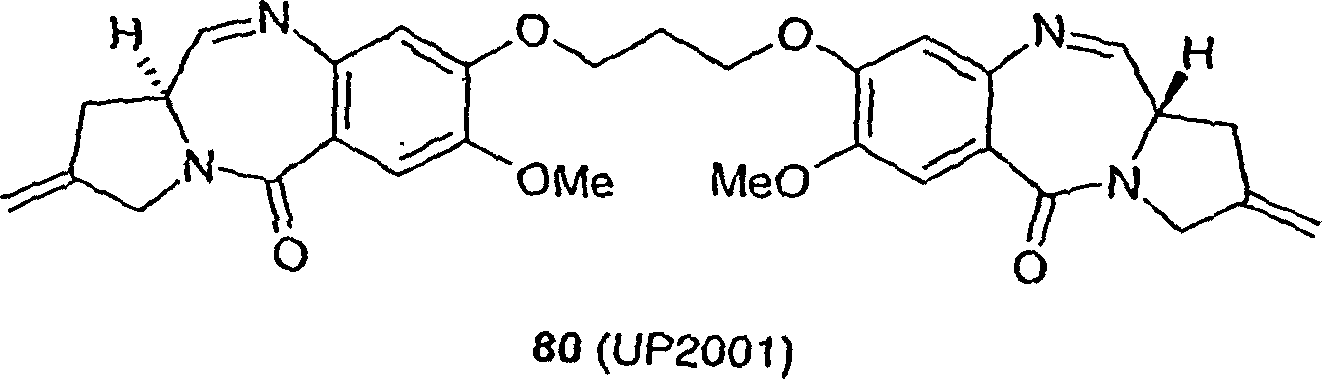
Die Synthese und biologische Aktivität des ungesättigten C2/C2'-Exo-PBD 80 (UP 2001) wurde von Gregson und Mitarbeitern berichtet (Gregson et al., Chem. Commun. 797–798 (1999)).The Synthesis and biological activity of the unsaturated C2 / C2'-Exo-PBD 80 (UP 2001) was reported by Gregson and coworkers (Gregson et al., Chem. Commun. 797-798 (1999)).
Offenbarung der ErfindungDisclosure of the invention
Ein
erster Aspekt der vorliegenden Erfindung betrifft eine Verbindung
der Formel: 
Die Verbindung gemäß dem ersten Aspekt ist 1,1'-[(Pentan-1,5-diyl)dioxy]bis[(11aS)-7-methoxy-2-methyliden-1,2,3,11a-tetrahydro-5H-pyrrolo[2,1-c][1,4]benzodiazepin-5-on,The Connection according to the first Aspect is 1,1 '- [(pentane-1,5-diyl) dioxy] bis [(11aS) -7-methoxy-2-methylidene-1,2,3,11a-tetrahydro-5H-pyrrolo [2,1 -c] [1,4] benzodiazepin-5-one,
Ein zweiter Aspekt der vorliegenden Erfindung betrifft die Verwendung einer im ersten Aspekt der vorliegenden Erfindung beschriebenen Verbindung in einem Therapieverfahren. Behandelbare Leiden umfassen Erbkrankheiten, einschließlich beispielsweise neoplastische Erkrankungen und Alzheimer-Krankheit, sowie bakterielle, parasitäre und virale Infektionen. Jedes beliebige Leiden, das durch Genexpressionsregulierung behandelbar ist, kann mit den erfindungsgemäßen Verbindungen behandelt werden. Gemäß diesem ersten Aspekt der vorliegenden Erfindung können die bereitgestellten Verbindungen an Individuen verabreicht werden. Die Verabreichung erfolgt vorzugsweise in einer "therapeutisch wirksamen Menge", die ausreicht, dass sich beim Patienten eine Besserung einstellt. Eine solche Besserung kann zumindest die Verbesserung zumindest eines Symptoms darstellen. Die tatsächlich verabreichte Menge sowie die Häufigkeit und der Zeitraum der Verabreichung hängen von der Art und Schwere des Leidens ab. Die Verschreibung der Behandlung, z.B. Dosierungsanweisungen, liegen in der Verantwortung des behandelnden Allgemeinmediziners und anderer Ärzte.One Second aspect of the present invention relates to the use one described in the first aspect of the present invention Connection in a therapy procedure. Treatable conditions include hereditary diseases, including for example, neoplastic diseases and Alzheimer's disease, as well as bacterial, parasitic and viral infections. Any condition that is treatable by gene expression regulation is, can with the compounds of the invention be treated. According to this The first aspect of the present invention may be the compounds provided be administered to individuals. The administration is preferably in a "therapeutic effective amount ", sufficient for the patient to get better. Such improvement can at least improve at least of a symptom. The actual amount administered as well the frequency and the period of administration depend on the type and severity of the suffering. The prescription of the treatment, e.g. Dosage instructions are the responsibility of the attending general practitioner and other doctors.
Eine Verbindung kann je nach zu behandelndem Leiden allein oder in Kombination mit anderen Behandlungen, entweder gleichzeitig oder nacheinander verabreicht werden.A Compound may be alone or in combination depending on the condition to be treated with other treatments, either simultaneously or sequentially be administered.
Pharmazeutische Zusammensetzungen gemäß der vorliegenden Erfindung und zur Verwendung gemäß der vorliegenden Erfindung können zusätzlich zum Wirkstoff, d.h. einer Verbindung gemäß dem ersten Aspekt, einen pharmazeutisch annehmbaren Arzneimittelträger, Träger, Puffer, Stabilisator oder andere Materialien umfassen, die Fachleuten auf dem Gebiet der Erfindung bekannt sind. Solche Materialien sollten nichttoxisch sein und die Wirksamkeit des Wirkstoffs nicht stören. Die genaue Art des Trägers oder anderer Materialien hängt vom Verabreichungsweg ab, der oral oder mittels Injektion, z.B. kutan, subkutan oder intravenös, sein kann.pharmaceutical Compositions according to the present invention Invention and for use according to the present invention Invention can additionally to the active ingredient, i. a compound according to the first aspect, a pharmaceutically acceptable excipient, carrier, buffer, stabilizer or Other materials include those skilled in the art are known. Such materials should be non-toxic and the Do not disturb the efficacy of the drug. The exact nature of the carrier or other materials depends from the route of administration, administered orally or by injection, e.g. cutaneous, subcutaneous or intravenous can.
Pharmazeutische Zusammensetzungen zur oralen Verabreichung können in Tabletten-, Kapsel-, Pulver- oder flüssiger Form vorliegen. Eine Tablette kann einen festen Träger oder ein Adjuvens umfassen. Flüssige pharmazeutische Zusammensetzun gen umfassen im Allgemeinen einen flüssigen Träger, wie z.B. Wasser, Petroleum, tierische oder pflanzliche Öle, Mineralöl oder synthetisches Öl. Physiologische Kochsalzlösung, Dextrose oder andere Saccharidlösungen oder Glykole, wie z.B. Ethylenglykol, Propylenglykol oder Polyethylenglykol können ebenfalls bereitgestellt sein. Eine Kapsel kann einen festen Träger, wie z.B. Gelatine, umfassen.pharmaceutical Compositions for oral administration may be in tablet, capsule, Powdery or liquid Form present. A tablet can be a solid carrier or include an adjuvant. liquid Pharmaceutical compositions generally include one liquid Carrier, such as. Water, petroleum, animal or vegetable oils, mineral oil or synthetic oil. physiological Saline, Dextrose or other saccharide solutions or glycols, e.g. Ethylene glycol, propylene glycol or polyethylene glycol can also be provided. A capsule can be a solid carrier, like e.g. Gelatin, include.
Bei intravenösen, kutanen oder subkutanen Injektionen oder Injektionen an der zu behandelnden Stelle liegt der Wirkstoff in Form einer parenteral annehmbaren wässrigen Lösung vor, die pyrogenfrei ist sowie geeigneten pH, geeignete Isotonie und Stabilität aufweist. Fachleute auf dem Gebiet der Erfindung können unter Verwendung von beispielsweise isotonischen Trägern, wie z.B. physiologischer Kochsalzlösung, Ringer-Lösung, Ringer-Laktat, geeignete Lösungen herstellen. Konservierungsmittel, Stabilisatoren, Puffer, Antioxidanzien und/oder andere Additive können je nach Bedarf zugesetzt werden.at intravenous, cutaneous or subcutaneous injections or injections to be treated Place the active ingredient is in the form of a parenterally acceptable aqueous solution which is pyrogen-free as well as suitable pH, suitable isotonicity and stability having. Persons skilled in the art may refer to Use of, for example, isotonic carriers, e.g. physiological Saline, Ringer's solution, Ringer's lactate, suitable solutions produce. Preservatives, stabilizers, buffers, antioxidants and / or other additives be added as needed.
Ein dritter Aspekt der vorliegenden Erfindung ist eine pharmazeutische Zusammensetzung, die eine Verbindung gemäß dem ersten Aspekt und einen pharmazeutisch annehmbaren Träger oder Verdünner enthält. Die Herstellung der pharmazeutischen Zusammensetzungen wird in Bezug auf obigen zweiten Aspekt der vorliegenden Erfindung beschrieben.One third aspect of the present invention is a pharmaceutical A composition comprising a compound according to the first aspect and a pharmaceutically acceptable carrier or thinner contains. The preparation of the pharmaceutical compositions is related on the above second aspect of the present invention.
Ein vierter Aspekt der vorliegenden Erfindung stellt die Verwendung einer Verbindung gemäß dem ersten Aspekt bereit, um ein Medikament zur Behandlung einer Erbkrankheit, vorzugsweise einer Proliferationserkrankung, herzustellen. Die Verbindung der Formel kann zusammen mit einem pharmazeutisch annehmbaren Träger oder Verdünner bereitgestellt werden. Die Verbindungen können zur selektiven Abtötung von oxischen und hypoxischen Tumorzellen in Verfahren zur Behandlung von Krebserkrankungen, beispielsweise Leukämien und insbesondere soliden Krebsarten, wie z.B. Kolon-, ZNS-, Nieren- und Lungentumoren, einschließlich kleinzelliger Bronchialkarzinome und von Melanomen, verwendet werden. Insbesondere können Verbindungen gemäß dem ersten Aspekt zur selektiven Abtötung von Lungen-, Kolon-, und ZNS-Tumoren sowie von Melanomen verwendet werden.A fourth aspect of the present invention provides the use of a compound according to the first aspect to prepare a medicament for treating a hereditary disease, preferably a proliferative disorder. The compound of the formula may be provided together with a pharmaceutically acceptable carrier or diluent. The compounds can be used for the selective killing of oxic and hypoxic tumor cells in methods for the treatment of cancers, for example leukemias, and especially solid cancers, such as colon, CNS, kidney and lung tumors finally, small cell lung cancers and melanomas. In particular, compounds according to the first aspect can be used for the selective killing of lung, colon and CNS tumors as well as melanomas.
Ein weiterer Aspekt der vorliegenden Erfindung stellt die Verwendung einer Verbindung gemäß dem ersten Aspekt zur Herstellung eines Medikaments zur Behandlung einer viralen, parasitären oder bakteriellen Infektion bereit. Die Herstellung eines Medikaments wird in Bezug auf den obigen fünften Aspekt der vorliegenden Erfindung beschrieben.One Another aspect of the present invention is the use a compound according to the first Aspect for the preparation of a medicament for the treatment of a viral, parasitic or bacterial infection ready. The production of a drug becomes in relation to the above fifth Aspect of the present invention described.
In weiteren Aspekten stellt die Erfindung Verfahren zur Herstellung von Verbindungen gemäß dem ersten Aspekt der vorliegenden Erfindung bereit.In In other aspects, the invention provides methods of manufacture of compounds according to the first Aspect of the present invention.
Im Folgenden werden Aspekte der Erfindung unter Bezugnahme auf die beigefügten Zeichnungen beschrieben, worin:in the Aspects of the invention will now be described with reference to FIGS attached Drawings in which:
Bevorzugte allgemeine Synthesestrategienpreferred general synthesis strategies
Ein
Schlüsselschritt
in einem bevorzugten Weg zu Verbindungen der vorliegenden Erfindung
ist eine Zyklisierung zur Herstellung des B-Rings, welche die Bildung
eines Aldehyds (oder eines funktionellen Äquivalents davon) an der späteren 11-Position
und einen Angriff darauf durch den Pro-N10-Stickstoff umfasst: 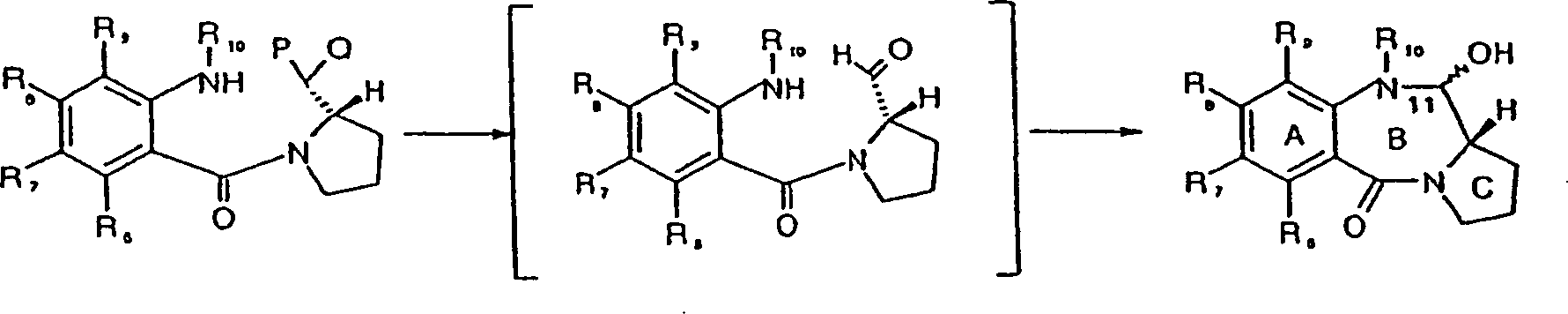
In dieser Struktur sind C-Ring-Substitutionen oder -Unsättigungen nicht dargestellt. R8 steht in Verbindungen der Formel IV für O(CH2)nCH2COR'8. R10 ist eine Stickstoffschutzgruppe, vorzugsweise mit einer Carbamatfunktionalität, die an den Stickstoff des PBD gebunden ist. Das "maskierte Aldehyd" -CPQ kann ein Acetal oder Thioacetal (möglicherweise zyklisch) sein; in diesem Fall macht die Zyklisierung eine Demaskierung erforderlich. Alternativ dazu kann das maskierte Aldehyd ein Aldehydvor läufer, wie z.B. der Alkohol -CHOH sein; in diesem Fall umfasst die Reaktion eine Oxidation, z.B. mit TPAP oder DMSO (Swern-Oxidation).In this structure, C-ring substitutions or unsaturations are not shown. R 8 in compounds of the formula IV is O (CH 2 ) n CH 2 COR ' 8 . R 10 is a nitrogen protecting group, preferably with a carbamate functionality attached to the nitrogen of the PBD. The "masked aldehyde" CPQ can be an acetal or thioacetal (possibly cyclic); in this case, cyclization requires unmasking. Alternatively, the masked aldehyde may be an aldehyde precursor, such as the alcohol -CHOH; in this case, the reaction involves oxidation, eg with TPAP or DMSO (Swern oxidation).
Die
maskierte Aldehydverbindung kann durch Kondensieren eines entsprechenden
2-substituierten Pyrrolidins mit einer 2-Nitrobenzoesäure hergestellt
werden: 
Die Nitrogruppe kann anschließend zu -NH2 reduziert und durch Umsetzung mit einem geeigneten Reagens, z.B. eines Chlorformiats, geschützt werden, wodurch die entfernbare Stickstoffschutzgruppe im Syntheseweg bereitgestellt wird.The nitro group can then be reduced to -NH 2 and protected by reaction with a suitable reagent, eg, a chloroformate, to provide the removable nitrogen protecting group in the synthetic pathway.
Ein
Verfahren, welches den Oxidations-Zyklisierungsvorgang umfasst,
ist in Schema 1 veranschaulicht (eine alternative Art der Zyklisierung
wird später
unter Bezug auf Schema 2 beschrieben). 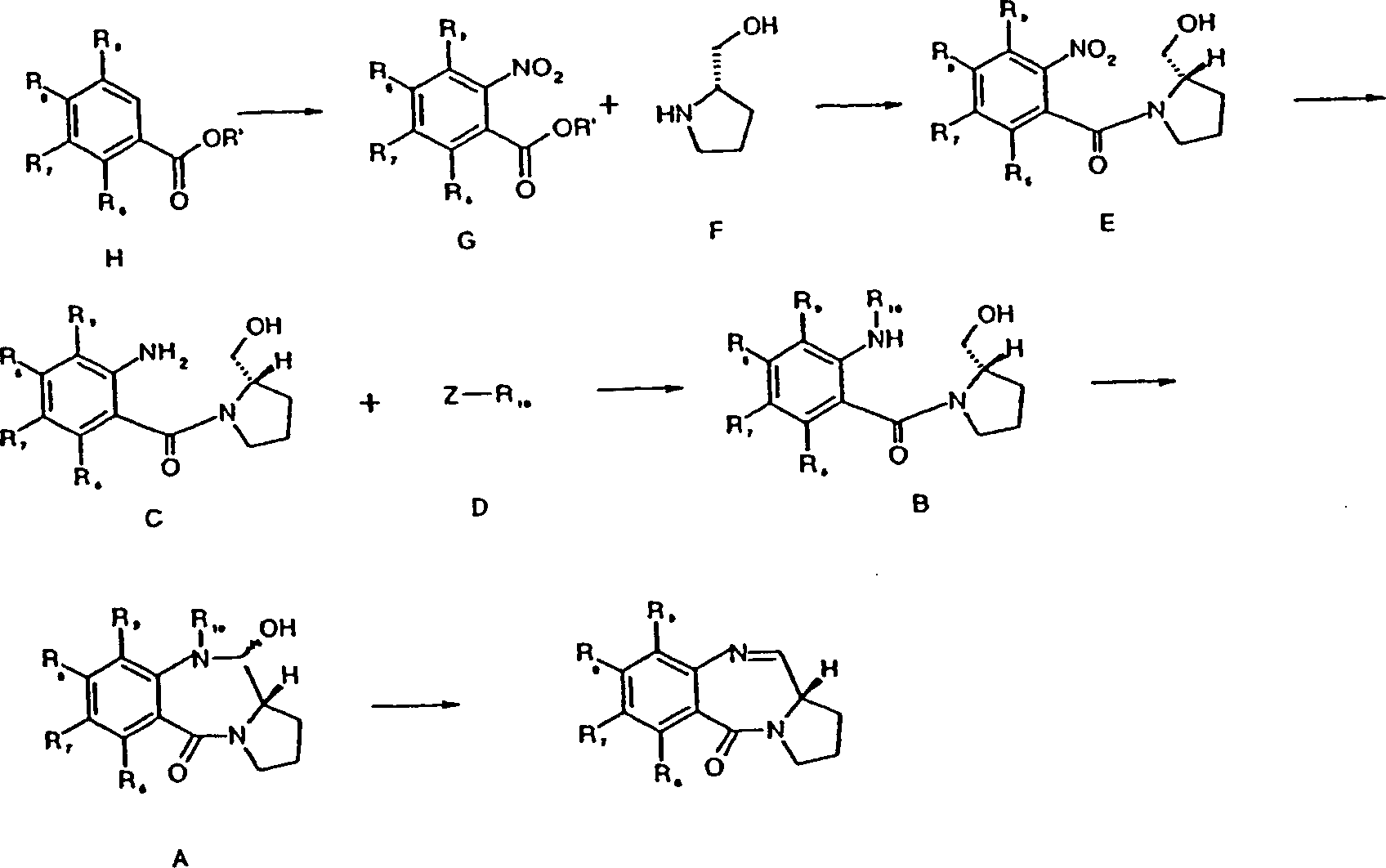
Die Imin/Carbinolamin-Bindung im PBD (A) kann durch Standardverfahren entschützt werden, um die gewünschte Verbindung zu ergeben; wenn beispielsweise R10 Alloc ist, wird das Entschützen mittels Palladium durchgeführt, um die N10-Schutzgruppe zu entfernen, gefolgt von Wasserabspaltung, um das Imin zu erhalten.Imine / carbinolamine binding in PBD (A) can be deprotected by standard procedures to give the desired compound; For example, when R 10 is Alloc, deprotection is carried out using palladium to remove the N10 protecting group, followed by dehydration to obtain the imine.
Das Aussetzen von Alkohol (B) (worin der Pro-N-10-Stickstoff im Allgemeinen als Carbamat geschützt ist) gegenüber Tetrapropylammoniumperruthenat (TPAP)/N-Methylmorpholin-N-oxid (NMO) über A4-Sieben führt zu Oxidation, begleitet von spontanem B-Ringschluss, um das gewünschte Produkt zu ergeben. Der TPAP/NMO-Oxidationsvorgang eignet sich insbesondere für Reaktionen in kleinerem Maßstab während sich Oxidationsverfahren auf DMSO-Basis, insbesondere Swern-Oxidationen, für die Arbeit im größeren Maßstab (z.B. > 1 g) besser eignen.The Exposure of alcohol (B) (which is the pro-N-10 nitrogen in general protected as carbamate) across from Tetrapropylammonium perruthenate (TPAP) / N-methylmorpholine N-oxide (NMO) over A4 sieves leads to oxidation, accompanied by spontaneous B-ring closure to the desired product to surrender. The TPAP / NMO oxidation process is particularly suitable for reactions on a smaller scale while DMSO-based oxidation processes, in particular Swern oxidation reactions, for the Work on a larger scale (for example> 1 g).
Der nichtzyklisierte Alkohol (B) kann durch Umsetzung eines Stickstoffschutzreagens der Formel D, das vorzugsweise ein Chlorformiat oder Säurechlorid ist, mit einer Lösung des Aminoalkohols C, im Allgemeinen in Lösung, im Allgemeinen in Gegenwart einer Base wie Pyridin (vorzugsweise von 2 Äquivalenten davon) bei mittlerer Temperatur (z.B. 0 °C) hergestellt werden. Unter diesen Bedingungen wird üblicherweise wenig oder gar keine Acylierung beobachtet.Of the Uncycled alcohol (B) may be converted by reaction of a nitrogen protective reagent of the formula D, which is preferably a chloroformate or acid chloride is, with a solution of the aminoalcohol C, generally in solution, generally in the presence a base such as pyridine (preferably 2 equivalents thereof) at medium Temperature (e.g., 0 ° C) getting produced. Under these conditions is usually little or no acylation observed.
Der ausschlaggebende Aminoalkohol C kann durch Reduktion der entsprechenden Nitroverbindung E durch Auswahl eines Verfahrens, welches das übrige Molekül intakt lässt, hergestellt werden. Die Behandlung von E mit Zinn(II)-chlorid in einem geeigneten Lösungsmittel, wie z.B. Methanol unter Rückfluss, ergibt im Allgemeinen nach Entfernen der Zinnsalze das gewünschte Produkt in hoher Ausbeute.Of the decisive aminoalcohol C can by reducing the corresponding Nitro compound E by selecting a method which intact the remainder of the molecule leaves, getting produced. Treatment of E with stannous chloride in a suitable solvent, such as. Methanol at reflux, generally results in the desired product after removal of the tin salts in high yield.
Das Aussetzen von E gegenüber Hydrazin/Raney-Nickel verhindert die Bildung von Zinnsalzen und kann zu höheren Ausbeuten von C führen, wobei dieses Verfahren weniger verträglich mit der Reihe von möglichen C-Ring- und A-Ringsubstitutionen ist. Wenn beispielsweise eine C-Ring-Unsättigung (entweder im Ring selbst oder in R2 oder R3) gibt, ist dieses Verfahren mitunter ungeeignet.Exposure of E to hydrazine / Raney nickel prevents the formation of tin salts and can lead to higher yields of C, which process is less compatible with the range of possible C-ring and A-ring substitutions. For example, if there is C-ring unsaturation (either in the ring itself or in R 2 or R 3 ), this method is sometimes inappropriate.
Die Nitroverbindung der Formel E kann durch Anbindung des geeigneten o-Nitrobenzoylchlorids an eine Verbindung der Formel F, z.B. in Gegenwart von K2CO3, bei –25 °C unter Stickstoffatmosphäre, hergestellt werden. Verbindungen der Formel F können ohne weiteres beispielsweise durch Olefinierung des aus L-trans-Hydroxyprolin abgeleiteten Ketons hergestellt werden. Das Ketonzwischenprodukt kann auch durch Überführung in das Enoltriflat zur Verwendung in Palladium-vermittelten Kupplungsreaktionen genutzt werden.The nitro compound of the formula E can be prepared by attaching the appropriate o-nitrobenzoyl chloride to a compound of the formula F, for example in the presence of K 2 CO 3 , at -25 ° C. under a nitrogen atmosphere. Compounds of formula F can be readily prepared, for example, by olefination of the ketone derived from L-trans-hydroxyproline. The ketone intermediate can also be utilized by conversion to the enol triflate for use in palladium-mediated coupling reactions.
Das o-Nitrobenzoylchlorid wird aus der o-Nitrobenzoesäure (oder dem Alkylester nach Hydrolyse) der Formel G synthetisiert, die ihrerseits aus dem Vanillinsäure(oder ihrem Alkylester-) Derivat H hergestellt wird. Viele davon sind im Handel erhältlich und manche von Althuis, T.H. und Hess, H.J. in J. Medicinal Chem. 20(1), 146–266 (1977) offenbart.The o-nitrobenzoyl chloride is synthesized from the o-nitrobenzoic acid (or the alkyl ester after hydrolysis) of the formula G, which in turn is prepared from the vanillic acid (or its alkyl ester) derivative H. Many of them are commercially available and some of Althuis, TH and Hess, HJ in J. Medicinal Chem. 20 (1), 146-266 (1977).
Alternative
Zyklisierung (Schema 2) 
In Schema 1 war der letzte oder vorletzte Schritt eine oxidative Zyklisierung. Eine Alternative mittels Thioacetalkupplung wird in Schema 2 gezeigt. Quecksilbe-vermittelte Demaskierung verursacht Zyklisierung der geschützten PBD-Verbindung (A).In Scheme 1 was the last or penultimate step of oxidative cyclization. An alternative by thioacetal coupling is shown in Scheme 2. Mercury-mediated unmasking causes cyclization of the protected PBD compound (A).
Die Thioacetalverbindung kann wie in Schema 2 gezeigt hergestellt werden: der Thioacetal-geschützte C-Ring [hergestellt durch ein in der Literatur beschriebenes Verfahren, nämlich durch das von Langley, D.R. und Thurston, D.E. in J. Organic Chemistry 52, 91–97 (1987) beschriebene Verfahren] wird durch ein in der Literatur beschriebenes Verfahren an die o-Nitrobenzoesäure (oder den Alkylester nach Hydrolyse) (G) gebunden. Die resultierende Nitroverbindung kann aufgrund der Thioacetalgruppe nicht durch Hydrierung reduziert werden, so dass zum Erhalt des Amins das Zinn(II)-chlorid-Verfahren eingesetzt wird. Dies wird sodann, beispielsweise mit einem Chlorformiat oder Säurechlorid, wie z.B. 2,2,2-Trichlorethylchlorformiat, N-geschützt. The Thioacetal compound can be prepared as shown in Scheme 2: the thioacetal-protected C-ring [prepared by a method described in the literature, namely by Langley, D.R. and Thurston, D.E. in J. Organic Chemistry 52, 91-97 (1987)]] is by a described in the literature Method to the o-nitrobenzoic acid (or the alkyl ester after hydrolysis) (G). The resulting Nitro compound can not due to the thioacetal by hydrogenation be reduced, so that the tin (II) chloride process to obtain the amine is used. This will then, for example with a chloroformate or acid chloride, such as. 2,2,2-trichloroethyl chloroformate, N-protected.
Acetalhältige C-Ringe
können
als Alternative zu diesem Weg verwendet werden, wobei das Entschützen andere
Verfahren, einschließlich
saurer Bedingungen, umfasst. Dimersynthese(Schema
3) 
PBD-Dimere können unter Anwendung der für die Synthese von geschützten PBD-Monomeren entwickelten Strategie synthetisiert werden. Die in Schema 3 veranschaulichten Synthesewege zeigen Verbindungen, wenn der Dimerlinker die Formel -O-(CH2)n-O- aufweist. Die Dimerbildung wird üblicherweise durchgeführt, um eine Bis(nitrosäure) G' zu bilden. Diese Verbindung kann anschließend als Verbindung G entweder in obigem Schema 1 oder Schema 2 behandelt werden.PBD dimers can be synthesized using the strategy developed for the synthesis of protected PBD monomers. The synthetic routes illustrated in Scheme 3 show compounds when the dimer linker has the formula -O- (CH 2 ) n -O-. Dimer formation is usually carried out to form a bis (nitro acid) G '. This compound can then be treated as Compound G either in Scheme 1 or Scheme 2 above.
Die Bis(nitrosäure) G' kann durch Nitrieren (z.B. mit 70%iger Salpetersäure) der Bis(carbonsäure) erhalten werden. Diese kann durch Alkylierung von zwei Äquivalenten der entsprechenden Benzoesäure mit dem geeigneten Diiodalkan unter basischen Bedingungen synthetisiert werden. Viele Benzoesäuren sind im Handel erhältlich, und andere können durch herkömmliche Verfahren synthetisiert werden. Alternativ dazu können die entsprechenden Benzoesäureester durch eine Mitsunobo-Veretherung mit einem geeigneten Alkandiol, gefolgt von Nitrierung und anschließender Hydrolyse (nicht dargestellt) miteinander verbunden werden.The Bis (nitro acid) G 'can be nitrided (for example with 70% nitric acid) the bis (carboxylic acid) to be obtained. This can be achieved by alkylating two equivalents the corresponding benzoic acid with the appropriate Diiodalkan synthesized under basic conditions become. Many benzoic acids are available in stores, and others can by conventional Procedures are synthesized. Alternatively, the corresponding benzoic acid ester by a Mitsunobo etherification with a suitable alkanediol, followed by nitration and subsequent hydrolysis (not shown) be connected to each other.
Schützen der Pro-N10-Position auf der Komponente, die den A-Ring bildet, vor dem Anbinden der Komponente, die den C-Ring bildet, stellt gegenüber den oben ausgeführten einen alternativen Syntheseansatz dar.Protect the Pro-N10 position on the component forming the A-ring attaching the component that forms the C-ring faces the executed above an alternative synthesis approach.
Bevorzugte Synthesestrategien für Verbindungenpreferred Synthesis strategies for links
Der Syntheseweg aus Schema 1 ist allgemein auf die Verbindung der vorliegenden Erfindung anwendbar.Of the Synthesis pathway of Scheme 1 is generally based on the compound of the present invention Invention applicable.
C2-ungesättigte PBDs können aus ihren N10-Carbamat-geschützten Vorläufern synthetisiert werden. Üblicherweise kann Palladium-katalysierte Entfernung von Allylcarbamat angewandt werden, um das N10-C11-Imin zu bilden, ohne die wichtige C2-Unsättigung zu beeinträchtigen. Alternativ dazu kann das Paar Cadmium-Blei eingesetzt werden, um ein N10-2,2,2-Trichlorethylcarbamat vom geschützten PBD abzuspalten.C2-unsaturated PBDs can from their N10-carbamate-protected precursors be synthesized. Usually may use palladium-catalyzed removal of allyl carbamate to form the N10-C11 imine, without the important C2 unsaturation to impair. Alternatively, the pair of cadmium-lead can be used to to cleave a N10-2,2,2-trichloroethyl carbamate from the protected PBD.
Durch die Reduktion der Nitroverbindung E mit Zinn(II)-chlorid wie in Schema 1 gezeigt wird die C2-Unsättigung beibehalten, obwohl das Isolieren des Anilins C von den Zinnsalzen problematisch sein kann.By the reduction of the nitro compound E with stannous chloride as shown in Scheme 1, the C2 unsaturation, although isolating the aniline C from the tin salts can be problematic.
Die Verbindung der Formel F kann in ihrer TBDMS-geschützten Form verwendet werden, weswegen ein Entschützungsschritt eingebaut werden muss, um die Aminoalkoholverbindung E herzustellen.The Compound of Formula F may be in its TBDMS protected form are used, so a deprotection step are incorporated to prepare the amino alcohol compound E.
Der TBDMS-Ether vom Typ E, der das Produkt der Kupplung der TBDMS-geschützten Verbindung an das geeignete o-Nitrobenzoylchlorid ist, kann mit AcOH:THF:H2O (3:1:1) behandelt werden. TBAF erwies sich als ungeeignet für diese Umwandlung, da die Reaktionsprodukte rasch abgebaut werden.The Type E TBDMS ether, which is the product of the coupling of the TBDMS protected compound to the appropriate o-nitrobenzoyl chloride, can be treated with AcOH: THF: H 2 O (3: 1: 1). TBAF proved to be unsuitable for this transformation as the reaction products degrade rapidly.
Verbindungen F(II), die C-Ringe bereitstellen, können wie in Schema 4 gezeigt erhalten werden.links F (II) providing C-rings can be as shown in Scheme 4 to be obtained.
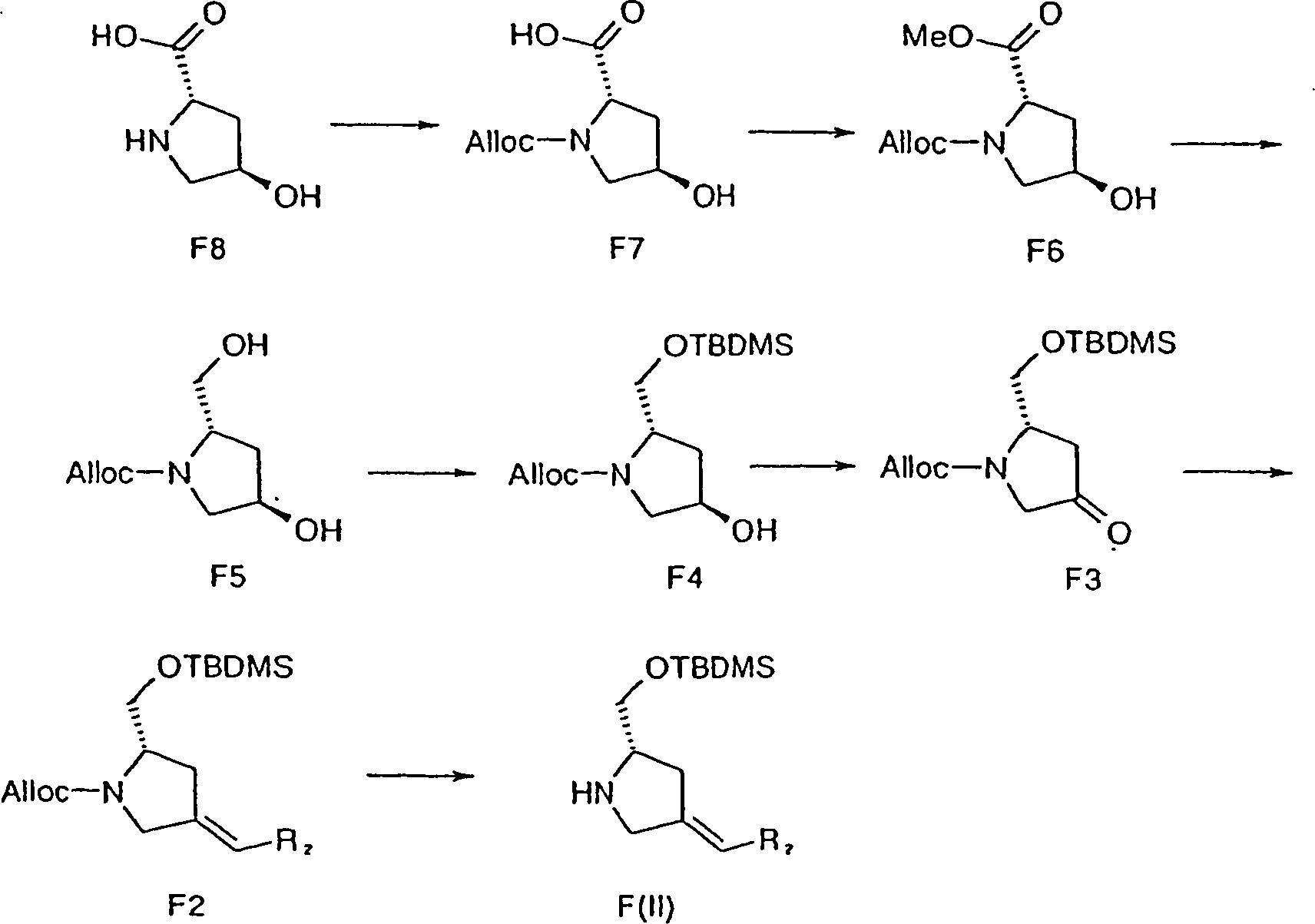
Im Handel erhältliches trans-4-Hydroxy-L-prolin F8 kann N-Alloc-geschützt werden, um das Allylcarbamat F7 zu ergeben, das anschließend unter Standardbedingungen verestert werden kann. Hydridreduktion des Esters F6 ergibt das Diol F5. Selektive TBDMS-Schützung des Diols ergibt einen Silylether F4, der anschließend mittels Swern- oder TPAP-Oxidation oxidiert werden kann, um das Keton F3 bereitzustellen.in the Commercially available Trans-4-hydroxy-L-proline F8 can be N-Alloc protected to the allyl carbamate F7, then can be esterified under standard conditions. Hydride reduction of Ester's F6 gives Diol F5. Selective TBDMS protection of the Diol gives a silyl ether F4, which is subsequently transformed by Swern or TPAP oxidation can be oxidized to provide the ketone F3.
Die in F2 enthaltene C2-Olefinfunktionalität kann eingeführt werden, indem mit dem Keton F3 eine Wittig-Reaktion durchgeführt wird. Palladium-vermittelte Abspaltung der N-Alloc-Schutzgruppe (Dangles O.; Guibé, F.; Balavoine, G.; Lavielle, S.; Marquet, A.; J. Org. Chem. 52, 4984 (1987)) ergibt Verbindung F(II).The C2-olefin functionality contained in F2 can be introduced by performing a Wittig reaction with the ketone F3. Palladium-mediated cleavage of the N-Alloc protecting group (Dangles O.; Guibé, F .; Balavoine, G .; Lavielle, S .; Marquet, A .; J. Org. Chem. 52, 4984 (1987)) gives compound F (II).
Alternativer
Weg zu Verbindung C 
Ein alternativer Weg zu Verbindung C ist entwickelt worden (Schema 5). Das Amid der Formel C1 kann durch Ausbildung des Säurechlorids einer N-Troc-geschützten Anthranilsäure vom C2-Typ synthetisiert werden. Interessanterweise bilden N-Troc-geschützte Anthranilsäuren keine Isatosäureanhydride, was Amidbildungsreaktionen mit Aminen vom F(II)-Typ ermöglicht. Die gleichzeitige TBAF-vermittelte Abspaltung des 2,2,2-Trichlorethylcarbamats und der TBDMS-Gruppen von C1 kann den wich- tigen Aminoalkohol C bereitstellen.One alternative route to compound C has been developed (Scheme 5). The amide of formula C1 may be formed by formation of the acid chloride an N-Troc-protected anthranilic be synthesized by the C2 type. Interestingly, N-Troc-protected anthranilic acids do not form isatoic anhydride, which allows amide formation reactions with amines of the F (II) type. Simultaneous TBAF-mediated cleavage of the 2,2,2-trichloroethylcarbamate and the TBDMS groups of C1 can be the important aminoalcohol C provide.
Alternativer
Weg 
Ein linearer Weg zur Synthese der Verbindung B aus Schema 1 ist entwickelt worden, wodurch die Herstellung der C2-ungesättigten PBDs in größerem Maßstab ermöglicht wird, wie dies in Schema 6 gezeigt wird. Die TBAF-vermittelte Abspaltung der TBDMS-Gruppe kann verwendet werden, um B(II) aus B1(II) herzustellen. Die in B1(II) enthaltene wichtige C2-Unsättigung kann eingeführt werden, indem die Wittig- Olefinierungsreaktion mit einem Keton vom B2-Typ durchgeführt wird. Swern-Oxidation des sekundären Alkohols B3 kann verwendet werden, um das Keton B2 bereitzustellen. Das Carbamat-geschützte Anilin B3 kann in zwei Stufen aus der Nitroverbindung B5 hergestellt werden. Zuerst kann die Nitrogruppe mittels des Raney-Nickel/Hydrazin-Verfahrens zum Anilin reduziert werden, da einer Verbindung vom B5-Typ die C2-Unsättigung fehlt. Dieses Verfahren ist vorteilhafter als das Zinn(II)-chlorid-Verfahren, da das Produkt leichter zu isolieren ist. Das Anilin B4 kann anschließend ohne nennenswerte Carbonatbildung am C2-Sauerstoff in hoher Ausbeute N-Carbamat-geschützt werden.One linear route for the synthesis of compound B from Scheme 1 is developed which enables the production of C2-unsaturated PBDs on a larger scale, as shown in Scheme 6. The TBAF-mediated spin-off The TBDMS group can be used to prepare B (II) from B1 (II). The important C2 unsaturation contained in B1 (II) can be introduced by the Wittig olefination reaction with a B2-type ketone. Swern oxidation of the secondary Alcohol B3 can be used to provide the ketone B2. The carbamate-protected Aniline B3 can be prepared in two stages from the nitro compound B5 become. First, the nitro group can be synthesized by the Raney nickel / hydrazine process be reduced to aniline, since a B5-type compound the C2 unsaturation is missing. This method is more advantageous than the stannous chloride method, because the product is easier to isolate. The aniline B4 can then without significant carbonate formation on C2 oxygen in high yield N-carbamate-protected become.
Ein
Amid vom B5-Typ kann durch Anbinden eines Säurechlorids vom G-Typ an das
Schlüssel-Amin KEC5
synthetisiert werden (Schema 7). 
Insgesamt weist dieser Weg gegenüber dem vorherigen mehrere Vorteile auf, was dazu führt, dass eine Herstellung der C2/C3-endo-ungesättigten PBDs in größerem Maßstab möglich ist. Erstens ermöglicht katalytische Hydrierung von KEC4 eine Herstellung des wichtigen Zwischenprodukts KEC5 in größerem Maßstab, und zweitens kann dieser effizientere Nitroreduktionsschritt mit einem Zwischenprodukt durchgeführt werden, das keine C2-Unsättigung aufweist. Wichtig ist, dass die während der Horner-Emmons-Reaktion beobachtete Wanderung der Doppelbindung spontan ist, so dass kein überschüssiges Natriumhydrid erforderlich ist. Diese Wanderung der Doppelbindung ist auch von anderen beobachtet worden (Leimgruber, W.; Batcho, A.D.; Czajkowski, R.C., J. Am. Soc. 90, 5641 (1968)).All in all points this way opposite the previous several advantages, which leads to a production the C2 / C3 endo-unsaturated PBDs on a larger scale is possible. First, catalytic allows Hydrogenation of KEC4 a preparation of the important intermediate KEC5 on a larger scale, and secondly, this more efficient nitro reduction step can be combined with a Intermediate product to be carried out that is not C2 unsaturation having. What is important is that during the Horner-Emmons reaction observed migration of the double bond is spontaneous, so no excess sodium hydride is required. This walk of the double bond is also of Others (Leimgruber, W .; Batcho, A. D. Czajkowski, R.C., J. Am. Soc. 90, 5641 (1968)).
Parr-Hydrierung von KEC4 zur Abspaltung der Cbz-Schutzgruppe ermöglichte eine Synthese des wichtigen Aminozwischenprodukts KEC5 in großem Maßstab. Der TBDMS-Ether KEC4 wurde durch selektive Silylierung des primären Alkohols KEC3 hergestellt, was unter Verwendung von DBU als Silylüberträger erfolgte. Das Diol KEC3 wurde durch Hydridreduktion des Esters KEC2 erhalten, der seinerseits aus der Carbonsäure KEC1 synthetisiert wurde. N-Cbz-Schutz von trans-4-Hydroxy-L-prolin (F4) wurde durch Anpassung eines in der Literatur beschriebenen Verfahrens erzielt (Bridges, R. J.; Stanley, M.S.; Anderson, M.W.; Cotman, C. W.; Chamberlain, R. A. J. Med. Chem. 34, 717 (1991)).Parr hydrogenation of KEC4 for the cleavage of the Cbz protecting group allowed a synthesis of the important Amino intermediate KEC5 on a large scale. The TBDMS ether KEC4 was prepared by selective silylation of the primary alcohol KEC3, which was done using DBU as Silylüberträger. The diol KEC3 was obtained by hydride reduction of the ester KEC2, which in turn from the carboxylic acid KEC1 was synthesized. N-Cbz protection of trans-4-hydroxy-L-proline (F4) was by adapting a method described in the literature (Bridges, R.J., Stanley, M.S., Anderson, M.W., Cotman, C.). W .; Chamberlain, R.A. J. Med. Chem. 34, 717 (1991)).
Bei der Dimersynthese können die oben dargelegten Wege gegenüber den allgemeinen Synthesestrategien bevorzugt verwendet werden. Insbesondere kann die Stickstoff-Schutzgruppe vorteilhafterweise ein Carbamat sein, da Schutzgruppen von diesem Typ in der letzten Stufe durch eine Reihe von Verfahren entfernt werden können, die die wichtige C2-Unsättigung im Allgemeinen nicht beeinträchtigen.at the dimer synthesis can opposite to the paths outlined above the general synthesis strategies are preferably used. Especially the nitrogen protecting group may advantageously be a carbamate be as protective groups of this type in the last stage by A number of procedures can be removed that address the important C2 unsaturation generally do not affect.
Allgemeine VersuchsverfahrenGeneral experimental procedures
Schmelzpunkte (Fp.) wurden auf einer digitalen Schmelzpunktmessvorrichtung Gallenkamp P1384 bestimmt und sind nicht korrigiert. Infrafrot- (IR-) Spektren wurden unter Verwendung eines Perkin-Elmer-297-Spektralphotometers aufgenommen. Die 1H- und 13C-NMR-Spektren wurde auf einem Jeol-GSX-FT-NMR-Spektrometer mit 270 MHz, das bei 20 °C +/–1 °C betrieben wurde, gemessen. Die chemischen Verschiebungen sind in Teilen pro Million Teile (δ, ppm) im Tieffeld zu Tetramethylsilan (TMS) angegeben. Die Spinmultiplizitäten werden Folgendermaßen beschrieben: s (Singulett), bs (breites Singulett), d (Dublett), dd (Doppeldublett), t (Triplett), q (Quartett), p (Pentuplett) oder m (Multiplett). Die Massenspektren (MS) wurden mit einem Jeol-JMS-DX-303-GC-Massenspektrometer (El-Modus: 70eV, Quelle 117–147 °C) aufgezeichnet. Die genauen Molekülmassen (HRMS) wurden durch Peaküberein stimmung mit Perfluorkerosin (PFK) als interner Massemarker bestimmt, und FAB-Massenspektren wurden aus einer Glycerin/Thioglycerin/Trifluoressigsäure- (1:1:0,1) Matrix mit einer Sourcetemperatur von 180 °C erhalten. Optische Drehungen an der Na-D-Linie wurde bei Umgebungstemperatur mittels Perkin-Elmer-141-Polarimeter erhalten. Die Analysenergebnisse lagen im Allgemeinen innerhalb von +/–0,2 % der theoretischen Werte. Flash-Chromatographie wurde mit einem Aldrich-Flash-Chromatographen "Kieselgel-60" (E. Merck, 230–400 mesh) durchgeführt. Dünnschichtchromatographie (DC) wurde mittels GF254-Kieselgel (mit Fluoreszenzindikator) auf Glasplatten durchgeführt. Sämtliche Lösungsmittel und Reagenzien wurden, sofern nicht anders angegeben, von der Aldrich Chemical Company Ltd. bezogen und ohne weitere Reinigung eingesetzt, wie sie bereitgestellt wurden. Wasserfreie Lösungsmittel durch Destillation unter Stickstoffatmosphäre in Gegenwart eines geeigneten Trocknungsmittels hergestellt und über 4Å-Molekularsieben oder Natriumdraht gelagert. Petrolether bezieht sich auf die bei 40–60 °C siedende Fraktion.Melting points (m.p.) were determined on a Gallenkamp P1384 digital melting point measuring device and are uncorrected. Infra red (IR) spectra were recorded using a Perkin Elmer 297 spectrophotometer. The 1 H and 13 C NMR spectra were measured on a 270 MHz Jeol GSX FT NMR spectrometer operated at 20 ° C +/- 1 ° C. The chemical shifts are reported in parts per million (δ, ppm) in the downfield to tetramethylsilane (TMS). The spin multiplicities are described as follows: s (singlet), bs (broad singlet), d (doublet), dd (double doublet), t (triplet), q (quartet), p (pentuplet) or m (multiplet). Mass spectra (MS) were recorded with a Jeol JMS DX 303 GC mass spectrometer (El mode: 70eV, source 117-147 ° C). The exact molecular masses (HRMS) were determined by peak matching with perfluorokerosene (PFK) as an internal mass marker and FAB mass spectra were from a glycerol / thioglycerol / trifluoroacetic acid (1: 1: 0.1) matrix with a source temperature of 180 ° C receive. Optical rotations on the Na-D line were obtained at ambient temperature using a Perkin Elmer 141 polarimeter. The analytical results were generally within +/- 0.2% of the theoretical values. Flash chromatography was performed on an Aldrich flash chromatograph "Kieselgel-60" (E. Merck, 230-400 mesh). Thin-layer chromatography (TLC) was performed on GF plates using GF 254 silica gel (with fluorescence indicator). All solvents and reagents were from Aldrich Chemical Company Ltd. unless otherwise specified. used and without further purification as they were provided. Anhydrous solvents by distillation under nitrogen atmosphere in the presence of a suitable Dried prepared and stored over 4Å molecular sieves or sodium wire. Petroleum ether refers to the fraction boiling at 40-60 ° C.
BeispieleExamples
Beispiel
1: Synthese von 1,1'-[[(Pentan-1,5-diyl)dioxy]bis[(11aS)-7-methoxy-2
methyliden-1,2,3,11a-tetrahydro-5H-uyrrolo[2,1-c][1,4]benzodiazepin-5-on]
(218) (siehe Fig. 1a/b) 
Herstellung des NitrodimerkernsProduction of the nitrodimer core
1',5'-Bis[2-methoxy-4-(methoxycarbonyl)phenoxy]pentan (208)1 ', 5'-bis [2-methoxy-4- (methoxycarbonyl) phenoxy] pentane (208)
Reines
Diethylazidodicarboxylat (19,02 ml, 21,04 g, 120,8 mmol) wurde 30
Minuten lang zu einer gerührten
Lösung
von Methylvanillat (207) (20 g, 109,8 mmol) und Triphenylphosphin
(43,2 g, 164,7 mmol) in wasserfreiem THF (400 ml) zugetropft und
das Reaktionsgemisch 1 Stunde lang bei 0 °C rühren gelassen. Zum kalten Reak tionsgemisch
wurde 20 Minuten lang eine Lösung
von 1,5-Pentandiol (3,83 ml, 4,03 g, 53,0 mmol) in THF (4 ml) zugetropft.
Das Reaktionsgemisch wurde über
Nacht bei Raumtemperatur rühren
gelassen, und das ausgefallene Produkt (208) wurde mittels Vakuumfiltration
gewonnen. Verdünnung
des Filtrats mit Methanol führte
dazu, dass weiteres Produkt (208) ausfiel. Der vereinigte Niederschlag
(12,3 g, 52 % bezogen auf Pentandiol) wurde ohne weitere Reinigung
in der nächsten
Stufe eingesetzt:
1H NMR (270 MHz,
CDCl,) δ 7.65
(dd, 2H, J = 2.01, 8.42 Hz), 7.54 (d, 2H, J = 2.01 Hz), 6.87 (d,
2H, J = 8.42 Hz), 4.10 (t, 4H, J = 6.59 Hz), 3.90 (s, 6H), 3.89
(s, 6H), 2.10–1.90
(m, 4H), 1.85–1.26
(m, 2H).Pure diethylazidodicarboxylate (19.02mL, 21.04g, 120.8mmol) was added to a stirred solution of methyl vanillate (207) (20g, 109.8mmol) and triphenylphosphine (43.2g, 164) for 30 minutes. 7 mmol) in anhydrous THF (400 ml) was added dropwise and the reaction allowed to stir for 1 hour at 0 ° C. To the cold reaction mixture was added dropwise a solution of 1,5-pentanediol (3.83 ml, 4.03 g, 53.0 mmol) in THF (4 ml) for 20 minutes. The reaction mixture was allowed to stir overnight at room temperature and the precipitated product (208) was collected by vacuum filtration. Dilution of the filtrate with methanol caused further product (208) to precipitate. The combined precipitate (12.3 g, 52% based on pentanediol) was used without further purification in the next step:
1 H NMR (270 MHz, CDCl3) δ 7.65 (dd, 2H, J = 2.01, 8.42 Hz), 7.54 (d, 2H, J = 2.01 Hz), 6.87 (d, 2H, J = 8.42 Hz), 4.10 (t, 4H, J = 6.59 Hz), 3.90 (s, 6H), 3.89 (s, 6H), 2.10-1.90 (m, 4H), 1.85-1.26 (m, 2H).
1',5'-Bis[2-methoxy-4-(methoxycarbonyl)-5-nitrophenoxy]pentan (209)1 ', 5'-bis [2-methoxy-4- (methoxycarbonyl) -5-nitrophenoxy] pentane (209)
Festes
Kupfer(II)-nitrat-trihydrat (16,79 g, 69,5 mmol) wurde zu einer
gerührten
Lösung
des Bisesters (208) (12 g, 27,8 mmol) in Essigsäureanhydrid (73 ml) bei 0 °C langsam
zugesetzt. Das Reaktionsgemisch wurde 1 Stunde lang bei 0 °C rühren gelassen,
das Eisbad entfernt und das Reaktionsgemisch auf Raumtemperatur
erwärmen
gelassen; dabei trat eine leichte Exotherme auf ca. 40 °C, begleitet
von NO2-Bildung auf. Nachdem die Exotherme
nachgelassen hatte, wurde weitere 2 Stunden lang bei Raumtemperatur
gerührt.
Das Reaktionsgemisch wurde in Eiswasser gegossen und die wässrige Suspension
1 Stunde lang rühren
gelassen. Der resultierende gelbe Niederschlag wurde mittels Vakuumfiltration
gewonnen und an der Luft getrocknet, was die gewünschte Bisnitroverbindung (209)
(14,23 g, 98 %) ergab:
1H NMR (400
MHz, CDCl, + DMSO) δ 7.45
(s, 2H), 7.09 (s, 2H), 4.14 (t, 4H, J = 6.31 Hz), 3.97 (s, 6H),
3.90 (s, 6H), 2.20–1.94
(m, 4H), 1.75–1.70
(m, 2H).Solid copper (II) nitrate trihydrate (16.79 g, 69.5 mmol) slowly became a stirred solution of the bis ester (208) (12 g, 27.8 mmol) in acetic anhydride (73 mL) at 0 ° C added. The reaction mixture was allowed to stir at 0 ° C for 1 hour, the ice bath removed and the reaction mixture allowed to warm to room temperature; In this case, a slight exotherm to about 40 ° C, accompanied by NO 2 formation on. After the exotherm subsided, stirring was continued for a further 2 hours at room temperature. The reaction mixture was poured into ice-water, and the aqueous suspension was allowed to stir for 1 hour. The resulting yellow precipitate was collected by vacuum filtration and air dried to give the desired bisnitro compound (209) (14.23 g, 98%):
1 H NMR (400 MHz, CDCl 3 + DMSO) δ 7.45 (s, 2H), 7.09 (s, 2H), 4.14 (t, 4H, J = 6.31 Hz), 3.97 (s, 6H), 3.90 (s, 6H), 2.20-1.94 (m, 4H), 1.75-1.70 (m, 2H).
1',5'-Bis(4-carboxy-2-methoxy-5-nitrophenoxy)pentan (210)1 ', 5'-Bis (4-carboxy-2-methoxy-5-nitrophenoxy) pentane (210)
Eine
Suspension des Esters 209 (9,0 g, 17,2 mmol) in wässrigem
Natriumhydroxid (1 M, 180 ml) und THF (180 ml) wurde rühren gelassen,
bis (nach 2 Tagen) eine homogene Lösung erhalten war. THF wurde
unter reduziertem Druck abgedampft und die resultierende wässrige Suspension
filtriert, um jegliches nichtumgesetztes Ausgangsmaterial zu entfernen.
Das Filtrat wurde auf einen pH von 1 eingestellt, das ausgefal lene Produkt
abfiltriert und luftgetrocknet, was die gewünschte Bissäure (210) (8,88 g) ergab. Aufgrund
des Einschlusses des Natriumsalzes der Säure wurde ein höhere Ausbeute
als die theoretische erzielt. Das Salz kann durch Lösen des
gesamten Materials in THF und Abfiltrieren des unlöslichen
Materials entfernt werden:
1H NMR (400
MHz, CDCl,) δ 7.39
(s, 2H), 7.16 (s, 2H), 4.12 (t, 4H, J = 6.59 Hz), 3.95 (s, 6H),
2.00–1.85
(m, 4H), 1.75–1.67
(m, 2H).A suspension of ester 209 (9.0 g, 17.2 mmol) in aqueous sodium hydroxide (1 M, 180 mL) and THF (180 mL) was allowed to stir until a homogeneous solution (after 2 days) was obtained. THF was evaporated under reduced pressure and the resulting aqueous suspension filtered to remove any unreacted starting material. The filtrate was adjusted to pH 1, the precipitated product filtered off and air dried to give the desired bis-acid (210) (8.88 g). Due to the inclusion of the sodium salt of the acid, a higher yield than the theoretical was achieved. The salt can be removed by dissolving the entire material in THF and filtering off the insoluble material:
1 H NMR (400 MHz, CDCl3) δ 7.39 (s, 2H), 7.16 (s, 2H), 4.12 (t, 4H, J = 6.59 Hz), 3.95 (s, 6H), 2.00-1.85 (m, 4H), 1.75-1.67 (m, 2H).
Zusammenstellung des Bisketonzwischenproduktscompilation of the bisketone intermediate
1,1'-[[(Pentan-1,5-diyl)dioxy]bis[2-nitro-5-methoxy-1,4-phenylen)carbonyl]]bis[(2S,4R)-2-t-butyldimethylsilyloxymethyl-4-hydroxypyrrolidin] (211)1,1 '- [[(pentane-1,5-diyl) dioxy] bis [2-nitro-5-methoxy-1,4-phenylene) carbonyl]] bis [(2S, 4R) -2-t-butyldimethylsilyloxymethyl -4-hydroxypyrrolidine] (211)
Eine
katalytische Menge DMF (5 Tropfen) wurde zu einer gerührten Suspension
der Säure
210 (5,39 g, 10,9 mmol) und von Oxalylchlorid (3,47 g, 2,38 ml,
27,3 mmol) in wasserfreiem THF (50 ml) zugesetzt. Es wurde ein anfängliches
Aufschäumen
beobachtet, gefolgt von der Bildung einer homogenen Lösung, wobei sich
jedoch nach Rühren über Nacht
eine Suspension des neu gebildeten Säurechlorids ausgebildet hatte. Überschüssiges THF
und Oxalylchlorid wurden durch Rotationsverdampfen unter reduziertem
Druck entfernt, und das Säurechlorid
wurde in frischem THF (49 ml) resuspendiert. Die Säurechloridlösung wurde
zu einer Lösung
von (2S, 4R)-2-t-ButYldimethylsilyloxymethyl-4-hydroxypyrrolidin
(2) (6,3 g, 27,3 mmol), Triethylamin (4,42 g, 6,09 ml, 43,7 mmol)
und Wasser (1,47 ml) in THF (33 ml) bei 0 °C unter Stickstoffatmosphäre zugetropft.
Das Reaktionsgemisch wurde auf Raumtemperatur erwärmen gelassen
und weitere 3 Stunden lang gerührt. Überschüssiges THF
wurde mittels Rotationsverdampfen unter reduziertem Druck entfernt
und der resultierende Rückstand
zwischen Wasser (300 ml) und Ethylacetat (300 ml) verteilt. Die
Phasen wurden sich trennen gelassen und die wässrige Phase mit Ethylacetat
(3 × 150
ml) extrahiert. Die vereinigten organischen Phasen wurden anschließend mit
Ammoniumchlorid (150 ml), gesättigtem
Natriumbicarbonat (150 ml) und Kochsalzlösung (150 ml) gewaschen und über Magnesiumsulfat
getrocknet. Filtration, gefolgt von Rotationsverdampfen unter reduziertem
Druck ergab das Rohprodukt als dunkles Öl. Das Rohprodukt wurde Flash-Säulenchromatographie
(3 % Methanol, 97 % Chloro form) unterzogen, und Entfernung von überschüssigem Eluens
führte
zur Isolierung von (211) (3,70 g, 37 % Ausbeute):
1H
NMR (270 MHz, CDCl,)δ 7.65
(s, 2H), 6.77 (s, 2H), 4.52 (bs, 2H), 4.40 (bs, 2H), 4.17–4.10 (m,
6H), 3.92 (s, 6H), 3.77 (d, 2H, J = 10.26 Hz), 3.32 (td, 2H, J =
4.40, 21.35 Hz), 3.08 (d, 2H, J = 11.35 Hz), 2.37–2.27 (m,
2H), 2.10–2.00
(m, 6H), 1.75–1.60
(m, 2H), 0.91 (s, 18H), 0.10 (s, 12H).A catalytic amount of DMF (5 drops) was added to a stirred suspension of the acid 210 (5.39 g, 10.9 mmol) and oxalyl chloride (3.47 g, 2.38 mL, 27.3 mmol) in anhydrous THF ( 50 ml) was added. An initial foaming was observed, followed by the formation of a homogeneous solution, but after stirring overnight, a suspension of the newly formed acid chloride formed. Excess THF and oxalyl chloride were removed by rotary evaporation under reduced pressure and the acid chloride was resuspended in fresh THF (49 ml). The acid chloride solution was added to a solution of (2S, 4R) -2-t-butyldimethylsilyloxymethyl-4-hydroxypyrrolidine (2) (6.3 g, 27.3 mmol), triethylamine (4.42 g, 6.09 mL, 43 , 7 mmol) and water (1.47 ml) in THF (33 ml) were added dropwise at 0 ° C under nitrogen atmosphere. The reaction mixture was allowed to warm to room temperature and stirred for a further 3 hours. Excess THF was removed by rotary evaporation under reduced pressure and the resulting residue was partitioned between water (300 ml) and ethyl acetate (300 ml). The phases were allowed to separate and the aqueous phase extracted with ethyl acetate (3 x 150 ml). The combined organic phases were then washed with ammonium chloride (150 ml), saturated sodium bicarbonate (150 ml) and brine (150 ml) and dried over magnesium sulfate. Filtration followed by rotary evaporation under reduced pressure gave the crude product as a dark oil. The crude product was subjected to flash column chromatography (3% methanol, 97% chloroform) and removal of excess eluent led to the isolation of (211) (3.70 g, 37% yield):
1 H NMR (270 MHz, CDCl3) δ 7.65 (s, 2H), 6.77 (s, 2H), 4.52 (bs, 2H), 4.40 (bs, 2H), 4.17-4.10 (m, 6H), 3.92 ( s, 6H), 3.77 (d, 2H, J = 10.26 Hz), 3.32 (td, 2H, J = 4.40, 21.35 Hz), 3.08 (d, 2H, J = 11.35 Hz), 2.37-2.27 (m, 2H ), 2.10-2.00 (m, 6H), 1.75-1.60 (m, 2H), 0.91 (s, 18H), 0.10 (s, 12H).
1,1'-[[(Pentan-1,5-diyl)dioxy]bis[2-amino-5-methoxy-1,4-phenylen)carbonyl]]bis[(2S,4R)-2-t-butyldimethylsilyloxymethyl-4-hydroxypyrrolidin] (212)1,1 '- [[(pentane-1,5-diyl) dioxy] bis [2-amino-5-methoxy-1,4-phenylene) carbonyl]] bis [(2S, 4R) -2-t-butyldimethylsilyloxymethyl -4-hydroxypyrrolidine] (212)
Eine
Methanollösung
von Hydrazinhydrat (1,25 ml, 1,29 g, 40,2 mmol Hydrazin, 20 ml Methanol)
wurde zu einer Lösung
der Bisnitroverbindung 211 (3,6 g, 3,91 mmol) in Methanol (68 ml)
zugetropft, wobei vorsichtig über
Raney-Nickel (510 mg einer dicken Aufschlämmung) rückflusserhitzt wurde. Nach
5 Minuten Rückfluss
ergab ein DC (10 % MeOH, 90 % Chloroform), dass das Ausgangsmaterial
nicht vollständig
verbraucht war. Das Reaktionsgemisch wurde mit zusätzlichem
Raney-Nickel (ca. 510 mg) und Hydrazin (1,25 ml) in Methanol (20
ml) versetzt, was zum vollständigen
Verbrauch des Ausgangsmaterials führte. Überschüssiges Raney-Nickel wurde zum
Reaktionsgemisch zugesetzt, um nichtumgesetztes Hydrazinhydrat zu
zersetzen, wonach das Reaktionsgemisch abkühlen gelassen wurde. Das Reaktionsgemisch
wurde durch Celite filtriert, um überschüssiges Raney-Nickel zu entfernen,
und das Filterkissen wurde mit zusätzlichem Methanol gewaschen
(Achtung! Raney-Nickel ist luftentzündlich; das Filterkissen sollte
nicht trocknen gelassen werden; zur Zerstörung des Nickels sollte konzentrierte
HCl verwendet werden). Das vereinigte Filtrat wurde mittels Rotationsverdampfung
unter reduziertem Druck eingedampft und der Rückstand in Dichlormethan wiedergelöst. Die
Dichlormethanlösung
wurde (zur Entfernung des zusammen mit dem Hydrazin eingeführten Wassers) über Magnesiumsulfat
getrocknet, filtriert und eingedampft, um das Produkt (212) als
Schaum (3,37 g. 91 %) zu ergeben:
1H
NMR (270 MHz, CDCl,) δ 6.69
(s, 2H); 6.24 (s, 2H), 4.40–3.40
(m, 28H), 2.40–1.60
(m, 10H), 0.88 (s, 18H), 0.03 (s, 12H).A methanol solution of hydrazine hydrate (1.25 mL, 1.29 g, 40.2 mmol hydrazine, 20 mL methanol) was added dropwise to a solution of bisnitro compound 211 (3.6 g, 3.91 mmol) in methanol (68 mL) while gently refluxing over Raney nickel (510 mg of a thick slurry). After 5 minutes reflux, TLC (10% MeOH, 90% chloroform) indicated that the starting material was not completely consumed. The reaction mixture was supplemented with additional Raney Nickel (about 510 mg) and hydrazine (1.25 mL) in methanol (20 mL), resulting in complete consumption of the starting material. Excess Raney nickel was added to the reaction mixture to decompose unreacted hydrazine hydrate, after which the reaction mixture was allowed to cool. The reaction mixture was filtered through celite to remove excess Raney nickel, and the filter pad was washed with additional methanol (note: Raney nickel is flammable, the filter pad should not be allowed to dry, concentrated HCl should be used to destroy the nickel). , The combined filtrate was evaporated by rotary evaporation under reduced pressure and the residue redissolved in dichloromethane. The dichloromethane solution was dried over magnesium sulfate (to remove the water introduced with the hydrazine), filtered, and evaporated to give the product (212) as a foam (3.37 g, 91%):
1 H NMR (270 MHz, CDCl3) δ 6.69 (s, 2H); 6.24 (s, 2H), 4.40-3.40 (m, 28H), 2.40-1.60 (m, 10H), 0.88 (s, 18H), 0.03 (s, 12H).
1,1'-[[(Pentan-1,5-dioxy)dioxy]bis[2-amino-N-allyloxycarbonyl-5-methoxy-1,4-phenylen)carbonyl]]bis[(2S,4R)-2-t-butyldimethylsilyloxymethyl-4-hydroxypyrrolidin] (213)1,1 '- [[(pentane-1,5-dioxy) dioxy] bis [2-amino-N-allyloxycarbonyl-5-methoxy-1,4-phenylene) carbonyl]] bis [(2S, 4R) -2 -t-butyldimethylsilyloxymethyl-4-hydroxypyrrolidine] (213)
Eine
Lösung
von Allylchlorformiat (0,806 ml, 0,916 g, 7,6 mmol) in trockenem
Dichlormethan (63 ml) wurde zu einer Lösung von Bisamin 212 (3,27
g, 3,8 mmol) und Pyridin (1,26 g, 1,29 ml, 15,9 mmol) in Dichlormethan
(128 ml) bei 0 °C
unter Stickstoffatmosphäre
zugetropft. Das Reaktionsgemisch wurde auf Raumtemperatur erwärmen gelassen
und 16 Stunden lang gerührt.
Zu diesem Zeitpunkt ergab ein DC (10 % MeOH, 90 % Chloroform), dass
die Reaktion beendet war. Das Reaktionsgemisch wurde mit Dichlormethin
(40 ml) verdünnt
und mit gesättigtem
Kupfer(II)-sulfat (2 × 140
ml), Wasser (120 ml) und gesättigtem
Natriumchlorid (120 ml) gewaschen. Die organische Phase wurde über Magnesiumsulfat
getrocknet, filtriert und unter reduziertem Druck eingedampft, was
213 als Schaum (3,60 g, 92 %) ergab:
1H
NMR(270 MHz, CDCl,) δ 8.87
(bs, 2H); 7.66 (s, 2H), 6.77 (s, 2H), 6.05–5.80 (m, 2H), 5.40–5.15 (m,
4H), 4.70–4.50
(m, 6H), 4.38 (bs, 2H), 4.20–4.00
(m, 4H), 3.78 (s, 6H), 3.70–3.40
(m, 8H), 2.40–2.20
(m, 2H), 2.10–1.80
(m, 6H), 1.75–1.55
(m, 2H), 0.89 (s, 18H) 0.04 (s, 12H).A solution of allyl chloroformate (0.806 ml, 0.916 g, 7.6 mmol) in dry dichloromethane (63 ml) was added to a solution of bisamine 212 (3.27 g, 3.8 mmol) and pyridine (1.26 g, 1 , 29 ml, 15.9 mmol) in dichloromethane (128 ml) was added dropwise at 0 ° C under nitrogen atmosphere. The reaction mixture was allowed to warm to room temperature and stirred for 16 hours. At this point a TLC (10% MeOH, 90% chloroform) indicated that the reaction was complete. The reaction mixture was diluted with dichloromethine (40 ml) and washed with saturated cupric sulfate (2 × 140 ml), water (120 ml) and saturated sodium chloride (120 ml). The organic phase was dried over magnesium sulfate, filtered and evaporated under reduced pressure to give 213 as a foam (3.60 g, 92%):
1 H NMR (270 MHz, CDCl3) δ 8.87 (bs, 2H); 7.66 (s, 2H), 6.77 (s, 2H), 6.05-5.80 (m, 2H), 5.40-5.15 (m, 4H), 4.70-4.50 (m, 6H), 4.38 (bs, 2H), 4.20- 4.00 (m, 4H), 3.78 (s, 6H), 3.70-3.40 (m, 8H), 2.40-2.20 (m, 2H), 2.10-1.80 (m, 6H), 1.75-1.55 (m, 2H), 0.89 (s, 18H) 0.04 (s, 12H).
1,1'-[[(Pentan-1,5-diyl)dioxy]bis[2-amino-N-allyloxycarbonyl-5-methoxy-1,4-phenylen)carbonyl]]bis[(2S)-2-t-butyldimethylsilyloxymethyl-4-oxo-pyrrolidin] (214)1,1 '- [[(pentane-1,5-diyl) dioxy] bis [2-amino-N-allyloxycarbonyl-5-methoxy-1,4-phenylene) carbonyl]] bis [(2S) -2-t -butyldimethylsilyloxymethyl-4-oxo-pyrrolidine] (214)
Eine
Lösung
von Dimethylsulfoxid (1,47 ml, 1,62 g, 20,7 mmol) in trockenem Dichlormethan
(32 ml) wurde 45 Minuten lang zu einer gerührten Lösung von Oxalylchlorid (5,18
ml einer 2 M Lösung
in Dichlormethan, 10,35 mmol) bei –60 °C unter Stickstoffatmosphäre zugetropft.
Nach 30-minütigem
Rühren
bei –50 °C wurde eine
Lösung
des Bisalkohols 213 (3,55 g, 3,45 mmol) in Dichlormethan (53 ml) über einen
Zeitraum von 50 Minuten zugetropft. Das Reaktionsgemisch wurde vor
dem Zutropfen einer Lösung
von Triethylamin (4,75 g, 6,54 ml, 46,9 mmol) in Dichlormethan (27
ml) 30 Minuten lang bei –60 °C rühren gelassen.
Anschließend wurde
weitere 45 Minuten lang bei –60 °C gerührt und
dann auf 0 °C
erwärmen
gelassen. Das Reaktionsge misch wurde mit Dichlormethan (20 ml) verdünnt, mit
kalter 1 M HCl (2 × 100
ml) sowie gesättigtem
Natriumchlorid (100 ml) gewaschen und über Magnesiumsulfat getrocknet.
Entfernung des überschüssigen Lösungsmittels
ergab das rohe Bisketon, das mittels Flash-Säulenchromatographie (50 % Ethylacetat,
50 % Petrolether (40–60 °C)) gereinigt
wurde, wodurch das reine Bisketon (214) als blassgelber Schaum (2,54
g, 72 %) erhalten wurde:
1H NMR (270
MHz, CDCl,) δ 8.69
(bs, 2H), 7.78 (s, 2H), 6.75 (s, 2H), 6.05–5.80 (m, 2H), 5.40–5.20 (m,
4H), 4.65–4.60
(m, 4H), 4.20–3.60
(m, 20H), 2.74 (dd, 2H, J = 9.25, 18.1 Hz), 2.51 (d, 2H, J = 17.4
Hz), 2.00–1.90 (m,
4H), 1.75–1.65
(m, 2H), 0.87 (s, 18H), 0.05 (s, 12H).A solution of dimethyl sulfoxide (1.47 mL, 1.62 g, 20.7 mmol) in dry dichloromethane (32 mL) was added to a stirred solution of oxalyl chloride (5.18 mL of a 2 M solution in dichloromethane, 10 , 35 mmol) was added dropwise at -60 ° C under nitrogen atmosphere. After stirring for 30 minutes at -50 ° C, a solution of Bisalcohol 213 (3.55 g, 3.45 mmol) in dichloromethane (53 ml) was added dropwise over a period of 50 minutes. The reaction mixture was allowed to stir at -60 ° C for 30 minutes before dropwise addition of a solution of triethylamine (4.75 g, 6.54 mL, 46.9 mmol) in dichloromethane (27 mL). The mixture was then stirred for a further 45 minutes at -60 ° C and then allowed to warm to 0 ° C. The reaction mixture was diluted with dichloromethane (20 ml), washed with cold 1 M HCl (2 × 100 ml) and saturated sodium chloride (100 ml) and dried over magnesium sulfate. Removal of the excess solvent gave the crude bisketone, which was purified by flash column chromatography (50% ethyl acetate, 50% petroleum ether (40-60 ° C)) to give the pure bisketone (214) as a pale yellow foam (2.54 g, 72 %) was obtained:
1 H NMR (270 MHz, CDCl3) δ 8.69 (bs, 2H), 7.78 (s, 2H), 6.75 (s, 2H), 6.05-5.80 (m, 2H), 5.40-5.20 (m, 4H), 4.65-4.60 (m, 4H), 4.20-3.60 (m, 20H), 2.74 (dd, 2H, J = 9.25, 18.1 Hz), 2.51 (d, 2H, J = 17.4 Hz), 2.00-1.90 (m, 4H), 1.75-1.65 (m, 2H), 0.87 (s, 18H), 0.05 (s, 12H).
Weiterentwicklung des Bisketons und Herstellung des ZielmolekülsFurther development of the Bisketons and production of the target molecule
1,1'-[[(Pentan-1,5-diyl)dioxy]bis[2-amino-N-allyloxycarbonyl-5-methoxy-1,4-phenylen)carbonyl]]bis[(2S)-2-t-butyldimethylsilyloxymethyl-4-methyliden-2,3-dihydropyrrol] (215)1,1 '- [[(pentane-1,5-diyl) dioxy] bis [2-amino-N-allyloxycarbonyl-5-methoxy-1,4-phenylene) carbonyl]] bis [(2S) -2-t butyldimethylsilyloxymethyl-4-methylidene-2,3-dihydropyrrole] (215)
Eine
Lösung
von Kalium-t-butoxid in trockenem THF (0,5 M, 25,2 ml, 12,6 mmol)
wurde zu einer Lösung
von Methyltriphenylphosphoniumbromid (4,50 g, 12,6 mmol) in trockenem
THF (15 ml) zugetropft. Die resultierende gelbe Ylidsuspension wurde
vor Zugabe einer Lösung
des Bisketons 214 (2,48 g, 2,42 mmol) in THF (10 ml) bei 10 °C 2 Stunden
lang bei 0 °C
rühren
gelassen. Das Reaktionsgemisch wurde auf Raumtemperatur erwärmen gelassen
und 1 weitere Stunde lang gerührt.
Das Reaktionsgemisch wurde zwischen Ethylacetat (100 ml) und Wasser
(100 ml) verteilt und die organische Phase mit gesättigtem
Natriumchlorid (200 ml) gewaschen und über Magnesiumsulfat getrocknet.
Entfernung des überschüssigen Lösungsmittels
ergab ein braunes Öl,
das Flash-Säulenchromatographie
(50 % Ethylacetat, 50 % Petrolether (40–60 °C)) unterzogen wurde, um das
Produkt (215) als gelbes Glas (865 mg, 35 %) zu ergeben:
1H NMR (400 MHz, CDCl,) δ 8.90 (bs, 2H), 7.83 (s, 2H),
6.82 (s, 2H), 6.05–5.90
(m, 2H), 5.40–5.20
(m, 4H), 4.99 (bs, 2H), 4.91 (bs, 2H), 4.65–4.60 (m, 4H), 4.20–3.60 (m,
20H), 2.70 (bs, 4H), 2.00–1.90
(m, 4H), 1.75–1.63
(m, 2H), 0.88 (s, 18H), 0.03 (s, 12H).A solution of potassium t-butoxide in dry THF (0.5 M, 25.2 mL, 12.6 mmol) was added to a solution of methyltriphenylphosphonium bromide (4.50 g, 12.6 mmol) in dry THF (15 mL ) is added dropwise. The resulting yellow ylide suspension was allowed to stir at 0 ° C for 2 hours before adding a solution of Bisketone 214 (2.48 g, 2.42 mmol) in THF (10 mL) at 10 ° C. The reaction mixture was allowed to warm to room temperature and stirred for an additional 1 hour. The reaction mixture was partitioned between ethyl acetate (100 ml) and water (100 ml) and the organic phase washed with saturated sodium chloride (200 ml) and dried over magnesium sulfate. Removal of the excess solvent gave a brown oil, which was subjected to flash column chromatography (50% ethyl acetate, 50% petroleum ether (40-60 ° C)) to give the product (215) as a yellow glass (865 mg, 35%) :
1 H NMR (400 MHz, CDCl3) δ 8.90 (bs, 2H), 7.83 (s, 2H), 6.82 (s, 2H), 6.05-5.90 (m, 2H), 5.40-5.20 (m, 4H), 4.99 (bs, 2H), 4.91 (bs, 2H), 4.65-4.60 (m, 4H), 4.20-3.60 (m, 20H), 2.70 (bs, 4H), 2.00-1.90 (m, 4H), 1.75- 1.63 (m, 2H), 0.88 (s, 18H), 0.03 (s, 12H).
1,1'-[[(Pentan-1,5-diyl)dioxy]bis[2-amino-N-allyloxycarbonyl-5-methoxy-1,4-phenylen)carbonyl]]bis[(2S)-2-hydroxymethyl-4-methyliden-2,3-dihydropyrrol] (216)1,1 '- [[(pentane-1,5-diyl) dioxy] bis [2-amino-N-allyloxycarbonyl-5-methoxy-1,4-phenylene) carbonyl]] bis [(2S) -2-hydroxymethyl -4-methylidene-2,3-dihydropyrrole] (216)
Eine
Lösung
von TBAF (3,02 ml einer 1 M Lösung
in THF, 3,02 mmol) wurde zum Bissilylether (215) (1,23 g, 1,21 mmol)
in THF (30 ml) bei 0 °C
(Eis/Aceton) zugesetzt. Das Reaktionsgemisch wurde auf Raumtemperatur
erwärmen
gelassen und über
Nacht gerührt.
Am darauffolgenden Tag ergab ein DC (50:50 EtOAc/Pet-Ether (40–60 °C)), dass
das Ausgangsmaterial vollständig
verschwunden war. Es wurde gesättigtes
NH4Cl (150 ml) zugesetzt und das Reaktionsgemisch
mit EtOAc (3 × 60
ml) extrahiert, mit gesättigtem
Natriumchlorid (150 ml) gewaschen, getrocknet (MgSO4),
filtriert und im Vakuum eingedampft, um ein gelbes Öl zu ergeben.
Reinigung mittels Flash-Säulenchromatographie
(97 % CHCl3 % MeOH) ergab den reinen Alkohol (216)
(916 mg, 96 %):
1H NMR (400 MHz, CDCl,) δ 8.61 (bs,
2H), 7.58 (s, 2H), 6.79 (s, 2H), 6.05–5.90 (m, 2H), 5.40–5.20 (m,
4H), 5.01 (bs, 2H), 4.93 (bs, 2H), 4.65–4.60 (m, 4H), 4.20–3.60 (m,
20H), 2.76 (dd, 2H, , J = 8.42, 15.74 Hz), 2.47 (d, 2H, J = 15.93
Hz), 2.00–1.90
(m, 4H), 1.80–1.63
(m, 2H).A solution of TBAF (3.02 mL of a 1 M solution in THF, 3.02 mmol) was added to the bis-silyl ether (215) (1.23 g, 1.21 mmol) in THF (30 mL) at 0 ° C (ice / Acetone). The reaction mixture was allowed to warm to room temperature and stirred overnight. The following day a TLC (50:50 EtOAc / Pet-ether (40-60 ° C)) revealed that the starting material had completely disappeared. Saturated NH 4 Cl (150 ml) was added and the reaction mixture extracted with EtOAc (3 x 60 ml), washed with saturated sodium chloride (150 ml), dried (MgSO 4), filtered and evaporated in vacuo to give a yellow oil result. Purification by flash column chromatography (97% CHCl 3 % MeOH) gave the pure alcohol (216) (916 mg, 96%):
1 H NMR (400 MHz, CDCl3) δ 8.61 (bs, 2H), 7.58 (s, 2H), 6.79 (s, 2H), 6.05-5.90 (m, 2H), 5.40-5.20 (m, 4H), 5.01 (bs, 2H), 4.93 (bs, 2H), 4.65-4.60 (m, 4H), 4.20-3.60 (m, 20H), 2.76 (dd, 2H,, J = 8.42, 15.74 Hz), 2.47 (i.e. , 2H, J = 15.93 Hz), 2.00-1.90 (m, 4H), 1.80-1.63 (m, 2H).
1,1'-[[(Pentan-1,5-diyl)dioxy]bis(11S,11aS)-10-(allyloxycarbonyl)-11-hydroxy-7-methoxy-2-methyliden-1,2,3,10,11,11a-hexahydro-5H-pyrrolo[2,1-c][1,4-benzodiazepin-5-on] (217)1,1 '- [[(pentane-1,5-diyl) dioxy] bis (11 S, 11aS) -10- (allyloxycarbonyl) -11-hydroxy-7-methoxy-2-methylidene-1,2,3,10 , 11,11a-hexahydro-5H-pyrrolo [2,1-c] [1,4-benzodiazepin-5-one] (217)
Eine
Lösung
von Dimethylsulfoxid (0,57 ml, 0,63 g, 8,07 mmol) in trockenem Dichlormethan
(17 ml) wurde 40 Minuten lang zu einer gerührten Lösung von Oxalylchlorid (2,02
ml einer 2 M Lösung,
4,04 mmol) bei –45 °C unter Stickstoffatmosphäre zugetropft.
Das Reaktionsgemisch wurde 40 Minuten lang bei -45 °C rühren gelassen,
gefolgt von der Zugabe des Diols 216 (0,89 g, 1,12 mmol) in Dichlormethan
(17 ml) über
einen Zeitraum von 15 Minuten bei derselben Temperatur. Nach weiteren
60 Minuten wurde eine Lösung
von Triethylamin (1,31 ml, 9,42 mmol) in Dichlormethan (9 ml) 40
Minuten lang zugesetzt. Das Reaktionsgemisch wurde bei –45 °C 40 Minuten
lang rühren
gelassen, bevor es 45 Minuten lang auf Raumtemperatur erwärmen gelassen wurde.
Das Reaktionsgemisch wurde mit Wasser verdünnt, und die Phasen wurden
sich trennen gelassen. Die organische Phase wurde mit 1 M HCl (2 × 40 ml)
sowie gesättigtem
Natriumchlorid (40 ml) gewaschen und über Magnesiumsulfat getrocknet.
Entfernung des überschüssigen Lösungsmittels
ergab das Rohprodukt, das mittels Flash-Säulenchromatographie (1 % Methanol,
99 % Chloroform) gereinigt wurde, um das Produkt 217 (0,175 g, 20
%) zu ergeben:
1H NMR(400 MHz, CDCl,) δ 7.22 (s,
2H), 6.65 (s, 2H), 5.82–5.70
(m, 2H), 5.58 (d, 2H, J = 9.70 Hz), 5.25–5.00 (m, 8H), 5.75–4.35 (m,
4H), 4.30 (d, 2H, J = 16.10 Hz), 4.15 (d, 2H, J = 17.03 Hz), 4.01
(t, 4H, J = 6.32 Hz), 3.90 (s, 6H), 3.64 (t, 2H, J = 8.70 Hz), 3.00–2.85 (m,
2H), 2.71 (d, 2H, J = 16.29 Hz), 2.00–1.85 (m, 4H), 1.70–1.60 (m,
2H).A solution of dimethylsulfoxide (0.57 mL, 0.63 g, 8.07 mmol) in dry dichloromethane (17 mL) was added to a stirred solution of oxalyl chloride (2.02 mL of a 2 M solution, 4.04 mmol) was added dropwise at -45 ° C under nitrogen atmosphere. The reaction mixture was stirred at -45 ° C for 40 minutes followed by the addition of diol 216 (0.89 g, 1.12 mmol) in dichloromethane (17 ml) over a period of 15 minutes at the same temperature. After a further 60 minutes, a solution of triethylamine (1.31 mL, 9.42 mmol) in dichloromethane (9 mL) was added over 40 minutes. The reaction mixture was allowed to stir at -45 ° C for 40 minutes before allowing to warm to room temperature for 45 minutes. The reaction mixture was diluted with water and the phases were allowed to separate. The organic phase was washed with 1 M HCl (2 x 40 mL) and saturated sodium chloride (40 mL) and dried over magnesium sulfate. Removal of the excess solvent gave the crude product, which was purified by flash column chromatography (1% methanol, 99% chloroform) to give the product 217 (0.175 g, 20%):
1 H NMR (400 MHz, CDCl 3) δ 7.22 (s, 2H), 6.65 (s, 2H), 5.82-5.70 (m, 2H), 5.58 (d, 2H, J = 9.70 Hz), 5.25-5.00 ( m, 8H), 5.75-4.35 (m, 4H), 4.30 (d, 2H, J = 16.10 Hz), 4.15 (d, 2H, J = 17.03 Hz), 4.01 (t, 4H, J = 6.32 Hz), 3.90 (s, 6H), 3.64 (t, 2H, J = 8.70 Hz), 3.00-2.85 (m, 2H), 2.71 (d, 2H, J = 16.29 Hz), 2.00-1.85 (m, 4H), 1.70 -1.60 (m, 2H).
1,1'-[[(Pentan-1,5-diyl)dioxy]bis(11aS)-7-methoxy-2-methyliden-1,2,3,11a-tetrahydro-5H-pyrrolo[2,1-c][1,4]benzodiaziepin-5-on] (218)1,1 '- [[(pentane-1,5-diyl) dioxy] bis (11aS) -7-methoxy-2-methylidene-1,2,3,11a-tetrahydro-5H-pyrrolo [2,1-c ] [1,4] benzodiaziepin-on-5] (218)
Eine
katalytische Menge Tetrakis(triphenylphosphin)palladium (13 mg,
11,2 mmol) wurde zu einer gerührten
Lösung
des Bisalloccarbinolamins (217) (170 mg, 0,22 mmol), von Triphenylphosphin
(5,7 mg, 21,6 mmol) und Pyrrolidin (31 mg, 37,3 ml, 0,45 mmol) in
DCM (13 ml) bei 0 °C
(Eis/Aceton) unter Stickstoffatmosphäre zugesetzt. Das Reaktionsgemisch
wurde auf Raumtemperatur erwärmen
gelassen und der Reaktionsablauf mittels DC (95 % CHCl3/MeOH)
verfolgt. Nach 2 Stunden ergab ein DC, dass die Reaktion beendet
war, wodurch ein unter UV-Licht hell fluoreszierender Punkt auftrat.
Das Lösungsmittel
wurde unter reduziertem Druck abgedampft und der resultierende Rückstand
Flashchromatographie (99 %:98 % CHCl3/MeOH)
unterzogen, was das Bisimin-Zielmolekül 218 als blassgelbes Glas
(84,5 mg, 75 %) ergab, das wiederholt unter Vakuum mit CHCl3 eingedampft wurde, um die Iminform bereitzustellen:
1H NMR (400 MHz, CDCl,) δ 7.68 (d, 2H, J = 4.39 Hz),
7.49 (s, 2H), 6.80 (s, 2H), 5.19 (bs, 2H), 5.16 (bs, 2H), 4.28 (bs,
4H), 4.15–4.00
(m, 4H), 3.92 (s, 6H), 3.90–3.80
(m, 2H), 3.12 (dd, 2H, , J = 8.97, 15.93 Hz), 2.95 (d, 2H, J = 15.93
Hz), 2.00–1.85
(m, 4H), 1.72–1.67
(m, 2H).A catalytic amount of tetrakis (triphenylphosphine) palladium (13 mg, 11.2 mmol) was added to a stirred solution of the bisallocarbonyinamine (217) (170 mg, 0.22 mmol), triphenylphosphine (5.7 mg, 21.6 mmol). and pyrrolidine (31 mg, 37.3 mL, 0.45 mmol) in DCM (13 mL) at 0 ° C (ice / acetone) under nitrogen atmosphere. The reaction mixture was allowed to warm to room temperature and the reaction was followed by TLC (95% CHCl 3 / MeOH). After 2 hours, TLC showed the reaction to be complete, resulting in a bright fluorescent spot under UV light. The solvent was evaporated under reduced pressure and the resulting residue subjected to flash chromatography (99%: 98% CHCl 3 / MeOH) to give bisimine target 218 as a pale yellow glass (84.5 mg, 75%) which was repeated under vacuum CHCl 3 was evaporated to provide the imine form:
1 H NMR (400 MHz, CDCl3) δ 7.68 (d, 2H, J = 4.39 Hz), 7.49 (s, 2H), 6.80 (s, 2H), 5.19 (bs, 2H), 5.16 (bs, 2H) , 4.28 (bs, 4H), 4.15-4.00 (m, 4H), 3.92 (s, 6H), 3.90-3.80 (m, 2H), 3.12 (dd, 2H,, J = 8.97, 15.93 Hz), 2.95 d, 2H, J = 15.93 Hz), 2.00-1.85 (m, 4H), 1.72-1.67 (m, 2H).
Zytotoxizitätsdatencytotoxicity
Zur Veranschaulichung sind nachstehend die Zytotoxizitätsdaten für 80 (UP2001) angeführt.to Illustrative are the cytotoxicity data below for 80 (UP2001).
In-vitro-Zytotoxizitätsstudien von NCIIn Vitro Cytotoxicity from NCI
Das National Cancer Institute (NCI) in Bethesda, Maryland, USA verfügt über ein Invitro-Zytotoxizitäts-Screeningverfahren, das aus ungefähr 60 menschlichen Tumorzelllinien besteht, gegen welche die Verbindungen in mindestens 5 Konzentrationen getestet werden, die sich jeweils um den Faktor 10 unterscheiden. Dabei wird eine 48-Stunden-Daueraussetzungsvorschrift angewandt, wonach die Lebensfähigkeit oder das Wachstum der Zellen mit einem SRB-Proteinassay abgeschätzt wird.The National Cancer Institute (NCI) in Bethesda, Maryland, USA has one Vitro cytotoxicity screening methods that out of about There are 60 human tumor cell lines against which the compounds be tested in at least 5 concentrations each differ by a factor of 10. This is a 48-hour permanent exposure rule applied, after which the viability or the growth of the cells is estimated with an SRB protein assay.
Verfahrenmethod
Die Testverbindungen wurden gegen etwa 60 menschliche Tumorzelllinien getestet. Die NCI-Screeningverfahren wurden detailliert von Monks und Mitarbeitern (Monks, A. et al., Journal of the National Cancer Institute 83, 757 (1991)) beschrieben. Kurz gefasst wurden Zellsuspensionen gemäß dem jeweiligen Zelltyp und der erwarteten Zielzelldichte verdünnt (5.000–40.000 Zellen pro Well, bezogen auf die Zellwachstumseigenschaften) und mit Pipetten (100 μl) zu 96-Well-Mikrotiterplatten zugesetzt. Die Zellen wurden 24 Stunden lang zur Stabilisierung bei 37 °C vorinkubiert. Verdünnungen mit der doppelten beabsichtigten Testkonzentration wurden zum Zeitpunkt Null in 100-μl-Aliquoten zu den Wells zugesetzt. Die Testverbindungen wurden in fünf 10fach-Verdünnungen (10–4, 10–5, 10–6, 10–7 und 10–8 μM) bewertet. Die Testverbindungen wurden 48 Stunden lang in 5%iger CO2-Atmosphäre mit 100 % Feuchtigkeit inkubiert. Die Zellen wurden anschließend mit einem Sulforhodamin-B-Test getestet. Ein Plattenleser wurde verwendet, um die optische Dichte abzulesen, und ein Mikrocomputer rechnete die Ablesungen in LC50-Werte um, was die erforderliche Dosis zur Abtötung der Hälfte der Zellen darstellt.The test compounds were tested against about 60 human tumor cell lines. The NCI screening methods have been described in detail by Monks and coworkers (Monks, A. et al., Journal of the National Cancer Institute 83, 757 (1991)). Briefly, cell suspensions were diluted according to each cell type and expected target cell density (5,000-40,000 cells per well, based on cell growth characteristics) and added with pipettes (100 μl) to 96-well microtiter plates. The cells were preincubated for 24 hours for stabilization at 37 ° C. Dilutions at twice the intended test concentration were added to the wells at zero time in 100 μl aliquots. The test compounds were evaluated in five 10-fold dilutions (10 -4 , 10 -5 , 10 -6 , 10 -7 and 10 -8 μM). The test compounds were incubated for 48 hours in 5% CO 2 atmosphere at 100% humidity. The cells were then tested with a sulforhodamine B test. A plate reader was used to read the optical density, and a microcomputer converted the readings to LC 50 values, which is the dose required to kill half of the cells.
Die in den Beispielen 5 bis 8 angeführten Ergebnisse sind LC50-Werte, die unter 10 μM liegen, was als Trennlinie zwischen Zytotoxizität und Nicht-Zytotoxizität herangezogen wird.The results given in Examples 5 to 8 are LC 50 values less than 10 μM, which is used as a dividing line between cytotoxicity and non-cytotoxicity.
NCI-Hohlfaserassay für vorbereitende In-vivo-TestsNCI hollow fiber assay for preparatory In vivo tests
Die biologische Testabteilung des Developmental-Therapeutics-Programms des NCI hat ein In-vivo-Screeninggerät zum Vortesten auf potenzielle Antikarzinomaktivität von Verbindungen entwickelt, die durch das großmaßstabliche In-vitro-Screeningverfahren identifiziert wurden. Für diese Tests werden menschliche Tumorzellen in Polyvinyliden- (PVDF-) Hohlfasern gezüchtet, und eine Probe jeder der Zelllinien wird in eine von zwei physiologischen Kompartimenten (intraperitoneal und subkutan) in Mäuse implantiert. Jede der Testmäuse erhielt insgesamt 6 Fasern (3 intraperitoneal und 3 subkutan), die jeweils 3 bestimmte Karzinomzelllinien darstellten. Diese Mäuse werden mit potenziellen Antikarzinomverbindungen in jeweils 2 Testdosen über den intraperitonealen Weg unter Verwendung eines QD × 4 Behandlungsplans behandelt. Trägerkontrollen bestehen aus 6 Mäusen, die nur den Verbindungsverdünner erhalten. Die Faserkulturen werden am Tag nach dem letzten Behandlungstag gesammelt. Zur Untersuchung der Antikarzinomeigenschaften wird die lebensfähige Zellmasse für jede der Zelllinien unter Verwendung eines Formazinfarbstoff- (MTT) Umwandlungstests bestimmt. Daraus kann der prozentuelle T/C unter Verwendung der mittleren optischen Dichte von Proben, die mit der Verbindung behandelt wurden, dividiert durch die mittlere optische Dichte der Trägerkontrollen ermittelt werden. Zusätzlich dazu kann die Nettozunahme der Zellmasse für jede der Proben bestimmt werden, da eine Probe der Faserkulturen am Tag der Implantation in Mäuse auf lebensfähige Zellmasse getestet wird. Somit können die zytostatischen und zytoziden Fähigkeiten der Testverbindung überprüft werden.The biological testing department of the Developmental Therapeutics program The NCI has an in vivo screening device to pre-test for potential Anticancer activity developed by compounds generated by the large-scale in vitro screening method were identified. For these tests will be human tumor cells in polyvinylidene (PVDF) Bred hollow fibers, and a sample of each of the cell lines will be in one of two physiological Compartments (intraperitoneal and subcutaneous) were implanted in mice. Each of the test mice received a total of 6 fibers (3 intraperitoneal and 3 subcutaneously), which each represent 3 specific carcinoma cell lines. These mice will be with potential Antikarzinomverbindungen in 2 test doses on the treated intraperitoneal route using a QD × 4 treatment plan. vehicle controls consist of 6 mice, the only the Verbindungsverdünner receive. The fiber cultures become the day after the last day of treatment collected. For the investigation of the anti - cancer properties the viable Cell mass for each of the cell lines using a formazine dye (MTT) Conversion tests determined. From this, the percentage T / C can be below Using the average optical density of samples with the Were treated, divided by the mean optical Density of vehicle controls be determined. additionally this can be determined by the net increase in cell mass for each of the samples as a sample of fiber cultures on the day of implantation in mice to viable Cell mass is tested. Thus, you can the cytostatic and cytocidal capabilities of the test compound are checked.
Im Allgemeinen wird jede der Verbindungen gegen mindestens 12 menschliche Zelllinien getestet. Dies ergibt insgesamt 4 Versuche, da jedes der Experimente 3 Zelllinien enthält. Die Daten werden für jede der 2 Verbindungsdosen als prozentueller T/C gegen jede der Zelllinien angeführt, wobei für die intraperitonealen und subkutanen Proben getrennte Werte ermittelt werden.in the Generally, each of the links will be against at least 12 human Cell lines tested. This gives a total of 4 attempts, as each of the experiments contains 3 cell lines. The data will be for each of the 2 compound doses as percent T / C against each of the cell lines cited being for the intraperitoneal and subcutaneous samples determined separate values become.
Die Verbindungen werden für weitere In-vivo-Tests in subkutanen Standard-Xenograftmodellen, bezogen auf mehrere Hohlfasertestkriterien ausgewählt. Die Kriterien umfassen: (1) prozentueller T/C von 50 oder weniger in 10 von 48 möglichen Testkombinationen (12 Zelllinien × 2 Stellen × 2 Verbindungsdosen); (2) Fernaktivität (intraperitoneal verabreichtes Arzneimittel/subkutan verabreichte Kultur) in zumindest 4 von 24 möglichen Kombinationen; und/oder (3) eine Nettozellabtötung von 1 oder mehr der Zelllinien in jeder der Implantationsstellen. Zur Vereinfachung der Bewertung wurde ein Punktesystem entwickelt, das eine rasche Bewertung der Aktivität einer bestimmten Verbindung ermöglicht. Dazu wird jeder der Verbindungsdosen ein Wert von 2 zugeteilt, was zu einer 50%igen oder stärkeren Reduktion der lebensfähigen Zellmasse führt. Die intraperitoneal und subkutan verabreichten Proben werden getrennt bewertet, sodass die Kriterien (1) und (2) ausgewertet werden können. Verbindungen mit einem kombinierten IP- und SC-Punktewert von 20, einem SC-Punktewert von 8 oder einer Nettozellabtötung von einer oder mehreren Zelllinien werden Xenograft-Tests zugewiesen. Dieser Vergleich zeigte, dass es eine sehr geringe Wahrscheinlichkeit gibt, dass eine aktive Verbindung übersehen wird, wenn der Hohlfasertest als Anfangs-In-vivo-Screeningverfahren verwendet wurde. Zusätzlich zu diesen Kriterien können andere Faktoren (z.B. einzigartige Struktur, Wirkmechanismus) zur Zuordnung einer Verbindung zum Xenograft-Testen führen, ohne dass die Verbindung diesen Kriterien entspricht.The Connections are for further in vivo tests in standard subcutaneous xenograft models, selected based on several hollow fiber test criteria. The Criteria include: (1) percent T / C of 50 or less in 10 out of 48 possible Test combinations (12 cell lines x 2 sites x 2 junction doses); (2) Remote activity (intraperitoneal drug / subcutaneously administered Culture) in at least 4 out of 24 possible combinations; and / or (3) a net cell killing of 1 or more of the cell lines in each of the implantation sites. To simplify the evaluation A scoring system has been developed which allows a quick evaluation of the activity allows a particular connection. For this purpose, each of the junction boxes is assigned a value of 2, which to a 50% or stronger Reduction of viable Cell mass leads. The intraperitoneal and subcutaneous administered samples are separated evaluated so that criteria (1) and (2) can be evaluated. links with a combined IP and SC score of 20, an SC score of 8 or a net cell killing One or more cell lines are assigned xenograft tests. This comparison showed that there is a very low probability indicates that an active connection is missed when the hollow fiber test was used as the initial in vivo screening method. In addition to these criteria can other factors (e.g., unique structure, mechanism of action) for Assign a connection to xenograft testing without that the connection meets these criteria.
Menschliche Xenograft-Studien des NCIHuman Xenograft Studies of the NCI
Diese werden an athymischen Nacktmäusen mit beeinträchtigtem Immunsystem durchgeführt. Das zu testende menschliche Tumorgewebe wird in ihre Körperflanken implantiert, und während die Kontrollmäuse keine Behandlung erhalten, werden die anderen unterschiedlichen, intraperitoneal verabreichten Dosen der Testverbindung ausgesetzt. Die Ergebnisse sind als Toxizität der Verbindung, als Ausmaß an Tumorwachstum und als Hemmung des Wachstums ausgedrückt.These become athymic nude mice with impaired Immune system performed. The human tumor tissue to be tested becomes in its body flanks implanted, and while the control mice no Received treatment, the others are different, intraperitoneally exposed to administered doses of the test compound. The results are considered toxicity the connection, as extent Tumor growth and expressed as an inhibition of growth.
Beispiel 3(a): In-vitro-ZytotoxizitätExample 3 (a): In Vitro Cytotoxicity
Verbindung 80 wurde der In-vitro-Zytotoxiziätsstudie des NCI unterzogen. Die Ergebnisse (LC50; μM) sind nachstehend angeführt.Compound 80 was subjected to the in vitro cytotoxicity study of the NCI. The results (LC 50 , μM) are given below.

Das PBD-Dimer UP2001 (80) zeigte wirksame und selektive Zytotoxizitätsaktivität gegenüber der Lungenkarzinomzelllinie NCI-N460, der Kolonzelllinie HCC-2998, der ZNS-Karzinomzelllinie SNB-75 und der Melanomzelllinien MALME-3M (sehr wirksam, 0,08 μM) und UACC-62 (sehr wirksam 0,07 μM), was auf seine Fähigkeit, DNA zu vernetzen, zurückführbar ist.The PBD dimer UP2001 (80) showed potent and selective cytotoxicity activity over the Lung carcinoma cell line NCI-N460, the colon cell line HCC-2998, the CNS carcinoma cell line SNB-75 and melanoma cell lines MALME-3M (very effective, 0.08 μM) and UACC-62 (very effective 0.07 μM), what on his ability Linking DNA is traceable.
Beispiel 3(b): HohlfasertestExample 3 (b): Hollow Fiber Test
Verbindung 80 wurde dem NCI-Hohlfasertest unterzogen; die Ergebnisse sind nachstehend angeführt.connection 80 was subjected to the NCI hollow fiber test; the results are below cited.
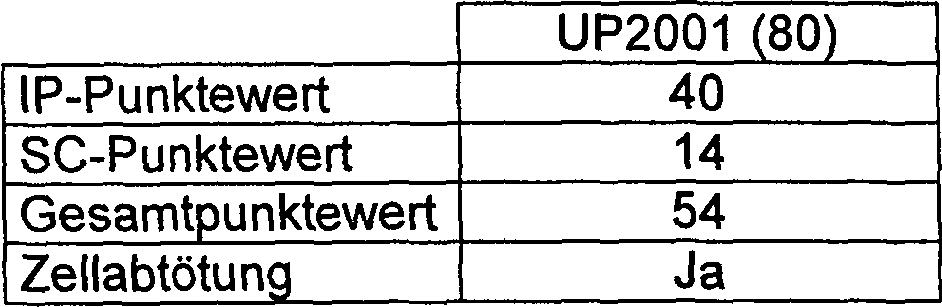
UP2001 ist aufgrund seines kombinierten IP- und SC-Punktewerts (54), der weit über 20 lag, wobei sein SC-Punktewert mehr als 8 betrug, ausgewählt worden.UP2001 is due to its combined IP and SC score (54), the more than 20, with its SC score greater than 8, was selected.
Beispiel 3(c): Menschliche Xenograft-StudienExample 3 (c): Human Xenograft studies
Menschliche Xenograft-Studien wurden auf dem UP2001 von der oben beschriebenen biologischen Testabteilung des NCI durchgeführt.human Xenograft studies were performed on the UP2001 from the one described above biological testing department of the NCI.
Athymische Nacktmäuse mit den MD-MB-435-Xenografts (menschlicher Brusttumor), Ovcar-3 (menschlicher Ovarialtumor), UACC-62 (menschliches Melanom) oder OV-CAR-5 (menschlicher Ovarialtumor) wurden mit Dosen von 0,67 (hoch), 0,45 (mittel) und 0,3 (niedrig) mg/kg/Injektion einmal alle 4 Tage insgesamt 3 mal (6 Mäuse pro Dosis bei 20 Kontrollmäusen) behandelt.athymic nude mice with MD-MB-435 xenografts (human breast tumor), Ovcar-3 (human Ovarian tumor), UACC-62 (human melanoma) or OV-CAR-5 (human Ovarian tumor) were treated with doses of 0.67 (high), 0.45 (medium) and 0.3 (low) mg / kg / injection once every 4 days for a total of 3 times (6 mice per dose in 20 control mice) treated.
UP2001 (80) wurde durch Messung der Toxizität des Arzneimittels und dessen Fähigkeit zur Verlangsamung des Tumorwachstums bewertet.UP2001 (80) was assessed by measuring the toxicity of the drug and its ability evaluated for slowing tumor growth.

Die Toxizität ist durch die Anzahl an Mäusen, die aufgrund der Behandlung starben, angegeben. % T/C stellt die Tiefe der Tumoren in den "Test"-Mäusen (T) (mit Greifzirkeln gemessen), verglichen mit den unbehandelten Kontrollmäusen (C), dar und ist in Prozent angegeben. % Wachstumsverzögerung stellt die Verlängerung der verstrichenen Zeit dar, die erforderlich ist, damit Tumoren eine willkürliche Größe von 250 mg erreichen.The toxicity is by the number of mice, who died as a result of treatment. % T / C represents the Depth of tumors in the "test" mice (T) (measured with calipers), compared to the untreated control mice (C), and is expressed as a percentage. % Growth delay the extension the elapsed time required for tumors to pass an arbitrary one Size of 250 reach mg.
In den MDA-435-Xenograften schränkte UP2001 das Tumorwachstum in den behandelten Mäusen auf nur 3 % des in der Kontrollpopulation beobachteten Tumorwachstums ein. Zusätzlich dazu wurde eine 41%ige Verlangsamung der Zeit beobachtet, in der die Tumormasse 250 mg erreicht. Sogar bei geringer Dosis wurde eine gewisse Toxizität gegenüber den Wirten beobachtet.In limited the MDA-435 xenografts UP2001 reduced tumor growth in the treated mice to only 3% of that in the Control population observed tumor growth. Additionally was observed a 41% slowdown in the time in which the Tumor mass reached 250 mg. Even at low dose, one became certain toxicity across from observed the hosts.
Eine gute Dosisantwort wurde für UP2001 (80) in den Ovcar-3-Xenograften festgestellt. Bei der hohen Dosis betrug das Tumorwachstum in den behandelten Mäusen, verglichen mit jenem der Kontrollpopulation, lediglich 7 %. Bei der mittleren Dosis betrug der Wert 20 %, und bei der niedrigen Dosis wiesen die Tumoren der behandelten Mäuse 46 % der Größe der Kontrolltumoren auf. Bei der hohen Dosis wurde eine 73%ige Wachstumsverzögerung bis zur Erreichung einer Tumormasse von 250 mg beobachtet. Keine der Mäuse starb durch die Aussetzung gegenüber UP2001 (80).A good dose response was for UP2001 (80) detected in Ovcar-3 xenografts. At the high dose was tumor growth in the treated mice compared to that the control population, only 7%. At the mean dose was the value was 20%, and at the low dose the tumors had the treated mice 46% of the size of the control tumors on. At the high dose, there was a 73% growth delay to achieve a tumor mass of 250 mg. None of the Mice died by the exposure opposite UP2001 (80).
Eine ähnliche Dosisantwort gegenüber Tumorwachstum wurde in den UACC-62-Xenografts für UP2001 (80) beobachtet. Bei der hohen Dosis wiesen die behandelten Tumoren 22 % der Größe der Kontrolltumoren auf. Bei der mittleren Dosis betrug die Größe der behandelten Tumoren 28 % jener der Kontrolltumoren, und bei der niedrigen Dosis wiesen die behandelten Tumoren 67 % der Größe der Kontrolltumoren auf. Erneut starb keine der Mäuse durch Aussetzung gegenüber UP2001 (80).A similar Dose response to Tumor growth was observed in the UACC-62 xenografts for UP2001 (80). at At the high dose, the treated tumors had 22% of the size of the control tumors on. The mean dose was the size of the treated tumors 28% of those of control tumors, and at low dose showed the treated tumors accounted for 67% of the size of the control tumors. Again None of the mice died by exposure to UP2001 (80).
Ergebnisse für den menschlichen Ovarialtumor OVCAR-5 waren weniger eindeutig; eine etwa 50%ige Tumorgrößenreduktion wurde beobachtet sowie eine gewisse Wachstumsverzögerung, wobei die Aktivität bei geringeren Konzentrationen stärker zu sein schien. Dabei wurden jedoch durch die Aussetzzung gegenüber UP2001 (80) Mäuse getötet.Results for the human ovarian tumor OVCAR-5 were less distinct; a about 50% tumor size reduction was observed as well as a certain growth retardation, being the activity seemed to be stronger at lower concentrations. there however, were killed by exposure to UP2001 (80) mice.
UP2001 (80) wurde auch gegenüber dem menschlichen ZNS-Tumor SF-295 getestet. Athymische Nacktmäuse mit SF-295 wurden mit Dosen von 0,40, 0,27 und 0,18 mg/kg pro intravenös verabreichter Injektion einmal täglich insgesamt 5 mal behandelt.UP2001 (80) was also opposite tested human CNS tumor SF-295. Athymic nude mice with SF-295 were administered at doses of 0.40, 0.27 and 0.18 mg / kg intravenously Injection once a day treated 5 times.

UP2001 (80) zeigte heilende Eigenschaften gegen SF-295-Xenografts. Bei der hohen und der mittleren Dosis waren alle überlebenden Mäuse am Tag 27 des Versuchs tumorfrei. Bei der niedrigen Dosis waren 3 von 4 Mäusen am Tag 27 tumorfrei. Eine gewisse Toxizität wurde mit der Behandlung in Zusammenhang gebracht, da 2 Mäuse bei der hohen Dosis, 1 bei der mittleren Dosis und zwei bei der niedrigen Dosis starben. Die höheren Intensitäten des Injektionsplans können sich durch die festgestellte höhere Sterblichkeitsrate widerspiegeln.UP2001 (80) showed curative properties against SF-295 xenografts. at High and medium doses were all surviving mice a day 27 of the trial tumor free. At the low dose, 3 out of 4 were mice on day 27 tumor free. Some toxicity was with the treatment associated with 2 mice at high dose, 1 at the average dose and two at low dose died. The higher ones intensities of the injection plan through the higher one Reflect mortality rate.
Beispiel 4: weitere Ergebnisse
für das
PBD-Dimer SJG-136 (UP2001
Die Verbindung 80 wurde weiteren Tests unterzogen.The Compound 80 was subjected to further tests.
Der erste Test, der von G.B. Jones et al. in Anti-Cancer Drug Des. 5, 249 (1990) beschrieben und hierin durch Verweis aufgenommen ist, bestimmt die Auswirkung der Testverbindung auf die DNA-Helixschmelztemperatur. Dieser Test dient dazu, Aufschlüsse über die Festigkeit und das Ausmaß der Vernetzung von DNA-Strängen durch die Testverbindung zu geben (nämlich als Maß für die Stabilisierung der DNA nach erfolgter Ligandenbindung).Of the first test, by G.B. Jones et al. in Anti-Cancer Drug Des. 5, 249 (1990) and incorporated herein by reference, determines the effect of the test compound on the DNA helix melting temperature. This test serves to provide information about the Strength and extent of Networking of DNA strands through the test compound (namely as a measure of stabilization the DNA after ligand binding).
Die Schmelztemperatur wurde für ein 1:5-Molverhältnis von [Ligand]:[DNA] bestimmt, wobei die Kalbsthymus-DNA-Konzentration 100 mM in wässrigem Natriumphosphatpuffer (10 mM Natriumphosphat + 1 mM EDTA, pH 7,00 ± 0,01) beträgt. Für die Kalbsthymus-Konzentration bei einem pH von 7,00 ± 0,01 beträgt die Schmelztemperatur 67,83 ± 0,06 °C (Mittelwert von 30 Einzelbestimmungen).The Melting temperature was for a 1: 5 molar ratio determined by [ligand]: [DNA], with the calf thymus DNA concentration 100mM in aqueous Sodium phosphate buffer (10 mM sodium phosphate + 1 mM EDTA, pH 7.00 ± 0.01) is. For the Calf thymus concentration at a pH of 7.00 ± 0.01 is the melting temperature 67.83 ± 0.06 ° C (mean of 30 individual determinations).
Bei
einem 1:5-Molverhältnis
von [PBD]:[DNA] erhöht
das PBD-Dimer 80 die Helixschmelztemperatur (ΔTm)
der Kalbsthymus-DNA um beispiellose 33,6 °C nach 18-stündiger
Inkubation bei 37 °C.
Unter identischen Bedingungen stellt das Dimer DSB-120 mit unsubstituiertem
C-Ring: 

Die Ergebnisse für das [PBD]:[DNA]-Verhältnis von 1:5 sind in nachstehender Tabelle zusammengefasst (sämtliche ΔTm-Werte ± 0,1–0,2°C).The results for the [PBD]: [DNA] ratio of 1: 5 are summarized in the table below (all ΔT m values ± 0.1-0.2 ° C).

Die in obiger Tabelle angeführten Daten zeigen, dass SJB-136 (80) gemäß diesem speziellen Test das bis dato wirksamste DNA-Stabilisierungsmittel ist.The in the table above Data show that SJB-136 (80) according to this special test is the bis is the most effective DNA stabilizer.
Mit dem zweiten Test wurde die Zytotoxizität von SJG-136 (80) in der menschlichen Ovarialzelllinie A2780 und deren Cisplatin-resistenten Sublinie A2780cisR bestimmt und diese Daten mit der Zytotoxizität des verwandten Dimers DSB-120 (siehe oben) und von Cisplatin verglichen. Bezogen auf die Ausgangslinie ist von der A2780cisR-Linie bekannt, dass sie über erhöhte GSH-Werte, einen erhöhten Reparaturwert von DNA-Cisplatinaddukten und eine geminderte Fähigkeit zur Aufnahme von Cisplatin verfügt (M. Smellie et al. Br. J. Cancer 70, 48 (1994)).With The second test was the cytotoxicity of SJG-136 (80) in human Ovarian cell line A2780 and its cisplatin-resistant subline A2780cisR determines and correlates this data with the cytotoxicity of the related Dimers DSB-120 (see above) and compared by cisplatin. Based to the starting line, the A2780cisR line is known to have elevated GSH values, an elevated one Repair value of DNA cisplatin adducts and a decreased ability for cisplatin (Smellie, M., et al., Br. J. Cancer 70, 48 (1994)).
Die
durch 96-stündiges
Inkubieren der Zellen mit den Verbindungen bei 37 °C erzielten
Ergebnisse sowie die Bestimmung der Zellanzahl unter Verwendung
von Sulforhodamin B sind in nachstehender Tabelle angeführt. 
- a Dosis der Verbindungen, die erforderlich ist, um das Zellwachstum im Vergleich zu Kontrolle, um 50% zu hemen.
- b RF ist der Resistenzfaktor (LC50-resistent/Ausgangslinie)
- a dose of the compounds required to increase cell growth by 50% compared to control men.
- b RF is the resistance factor (LC 50 -resistant / output line)
Der LC50-Wert für 80 in der A2780-Zelllinie beträgt nur 23 pM, was, verglichen mit DSB-120 (LC50 = 7,2 nM), einem 320fachen Anstieg der Zytotoxizität entspricht. Interessanter ist jedoch, dass während DSB-120 eine reduzierte Wirksamkeit in der Cisplatin-resistenten A2780cisR (LC50 = 0,21 mM) aufweist, ist SJG-136 mit einem ähnlichen LC50-Wert (24 pM), verglichen mit der normalen A2780, fast 9.000-mal wirksamer bei dieser Zelllinie, was einen Resistenzfaktor von 1,1 ergibt. Die Tatsache, dass sowohl DSB-120 als auch Cisplatin für dieses Paar von Zelllinien einen Resistenzfaktor von 2,92 bzw. 32 ergeben, stellt einen Hinweis darauf dar, dass SJG-136 potenziell zur Behandlung von Cisplatin-resistenten Erkrankungen dienen kann.The LC 50 value for 80 in the A2780 cell line is only 23 pM, which corresponds to a 320-fold increase in cytotoxicity compared to DSB-120 (LC 50 = 7.2 nM). More interestingly, while DSB-120 has reduced potency in cisplatin-resistant A2780cisR (LC 50 = 0.21 mM), SJG-136 is at a similar LC 50 value (24 pM) compared to the normal A2780 , almost 9,000 times more potent in this cell line, giving a resistance factor of 1.1. The fact that both DSB-120 and cisplatin give a resistance factor of 2.92 and 32 for this pair of cell lines, respectively, indicates that SJG-136 can potentially be used to treat cisplatin-resistant diseases.
Beispiel 5: Ovarialkarzinom-ZytotoxizitätstestExample 5: Ovarian carcinoma cytotoxicity test
Die Verbindung 80 (und Anthramycin als Vergleich) wurde von Dr. Lloyd R. Kellands Gruppe am Institute of Cancer Research, Sutton, GB, auf ihre zytotoxische Aktivität in Ovarialzelllinien überprüft. Die untersuchten fünf Zelllinien waren SKOV-3, A2780/A2780cisR und CH1/CH1cisR (cisR kennzeichnet eine Cisplatin-resistente Zelllinie).The Compound 80 (and anthramycin as a comparison) was used by Dr. med. Lloyd R. Kelland's group at the Institute of Cancer Research, Sutton, UK on their cytotoxic activity checked in ovarian cell lines. The examined five Cell lines were SKOV-3, A2780 / A2780cisR and CH1 / CH1cisR (cisR a cisplatin-resistant cell line).
Einzelne lebensfähige Zellen wurden in ein Wachstumsmedium (160 μl) in 96-Well-Mikrotiterplatten pipettiert und über Nacht binden gelassen. Die PBDs wurden anschließend unmittelbar vor der Zugabe zu den Zellen in Wells in vierfacher Ausführung in DMSO gelöst (was Arzneimittelkonzentrationen von 20 mM ergab). Die Arzneimittelendkonzentrationen in den Wells lagen wie folgt im Bereich von 100 μM bis 2,5 nM: 100, 25, 10, 2,5, 1 μM, 250, 100, 25, 10, 2,5 nM (die Arzneimittel wurden im Wachstumsmedium verdünnt und anschließend 40 μl zum bestehenden Wellvolumen von 160 μl zugesetzt, was die obigen Endkonzentrationen ergab). Nach 96 Stunden wurde das Medium entfernt und die restlichen Zellen durch 30-minütiges Aussetzen gegenüber 10%iger Trichloressigsäure auf Eis fixiert. Die Wells wurden sodann 3 bis 4 mal mit Leitungswasser gewaschen, über Nacht luftgetrocknet und mit 100 μl in 1%iger Essigsäure gelöstem Sulforhodamin B (0,4 %) versezt. Färbung wurde weitere 10 bis 15 Minuten ermöglicht, anschließend die Wells 3 bis 4 mal mit 1%iger Essigsäure gewaschen, luftgetrocknet und anschließend zu Tris-Base (100 μl von 10 mM) zugesetzt. Die Platten wurden geschüttelt und Extinktionsablesungen bei 540 nm mittels Plattenleser vorgenommen. Unter Verwendung des Quattro-Pro-Softwarepakets wurden die LC50-Werte aus Diagrammen der Konzentration über der prozentuellen Extinktion (verglichen mit 8 unbehandelten Wells) ermittelt.Single viable cells were pipetted into a growth medium (160 μl) in 96-well microtiter plates and allowed to bind overnight. The PBDs were then dissolved in DMSO in quadruplicate immediately prior to addition to the cells in wells (yielding drug concentrations of 20 mM). The final drug concentrations in the wells ranged from 100 μM to 2.5 nM as follows: 100, 25, 10, 2.5, 1 μM, 250, 100, 25, 10, 2.5 nM (the drugs were in the growth medium diluted and then added 40 ul to the existing well volume of 160 ul, which gave the above final concentrations). After 96 hours, the medium was removed and the remaining cells were fixed on ice by exposure to 10% trichloroacetic acid for 30 minutes. The wells were then washed 3 to 4 times with tap water, air-dried overnight, and stained with 100 μl of sulforhodamine B (0.4%) dissolved in 1% acetic acid. Staining was allowed for a further 10 to 15 minutes, then the wells were washed 3 to 4 times with 1% acetic acid, air dried and then added to Tris base (100 μl of 10 mM). The plates were shaken and absorbance readings made at 540 nm by plate reader. Using the Quattro Pro software package, the LC 50 values were determined from plots of concentration above the percent absorbance (compared to 8 untreated wells).

UP2001 (80) zeigt in pikomolaren/subnanomolaren Mengen über die gesamte Gruppe der Ovarialzelllinien Zytotoxizität. Die Wirksamkeit des Moleküls hängt wahrscheinlich mit seinen Vernetzungseigenschaften – in Verbindung mit der Wirkung der Exo-Sättigung – zusammen.UP2001 (80) shows in picomolar / subnanomolar amounts over the whole group of Ovarian Cell Lines Cytotoxicity. The effectiveness of the molecule probably depends with its cross-linking properties - in conjunction with the effect the exo-saturation - together.
Claims (6)

Applications Claiming Priority (4)
| Application Number | Priority Date | Filing Date | Title |
|---|---|---|---|
| GBGB9818733.9A GB9818733D0 (en) | 1998-08-27 | 1998-08-27 | Compounds |
| HN9818733 | 1998-08-27 | ||
| GBGB9901929.1A GB9901929D0 (en) | 1999-01-28 | 1999-01-28 | Compounds |
| GB9901929 | 1999-01-28 |
Publications (2)
| Publication Number | Publication Date |
|---|---|
| DE69930328D1 DE69930328D1 (en) | 2006-05-11 |
| DE69930328T2 true DE69930328T2 (en) | 2006-12-14 |
Family
ID=26314276
Family Applications (3)
| Application Number | Title | Priority Date | Filing Date |
|---|---|---|---|
| DE69907977T Expired - Lifetime DE69907977T2 (en) | 1998-08-27 | 1999-08-27 | Pyrrolobenzodiazepine |
| DE69925133T Expired - Lifetime DE69925133T2 (en) | 1998-08-27 | 1999-08-27 | PYRROLOBENZODIAZEPINE |
| DE69930328T Expired - Lifetime DE69930328T2 (en) | 1998-08-27 | 1999-08-27 | Dimer pyrrolobenzodiazepines |
Family Applications Before (2)
| Application Number | Title | Priority Date | Filing Date |
|---|---|---|---|
| DE69907977T Expired - Lifetime DE69907977T2 (en) | 1998-08-27 | 1999-08-27 | Pyrrolobenzodiazepine |
| DE69925133T Expired - Lifetime DE69925133T2 (en) | 1998-08-27 | 1999-08-27 | PYRROLOBENZODIAZEPINE |
Country Status (12)
| Country | Link |
|---|---|
| US (3) | US7049311B1 (en) |
| EP (3) | EP1413582B1 (en) |
| JP (1) | JP4824165B2 (en) |
| AT (3) | ATE320436T1 (en) |
| AU (1) | AU757510C (en) |
| CA (1) | CA2341471C (en) |
| DE (3) | DE69907977T2 (en) |
| DK (3) | DK1413582T3 (en) |
| ES (3) | ES2260570T3 (en) |
| NZ (1) | NZ510493A (en) |
| PT (3) | PT1193270E (en) |
| WO (1) | WO2000012508A2 (en) |
Families Citing this family (197)
| Publication number | Priority date | Publication date | Assignee | Title |
|---|---|---|---|---|
| GB9818732D0 (en) * | 1998-08-27 | 1998-10-21 | Univ Portsmouth | Collection of compounds |
| DE69907977T2 (en) | 1998-08-27 | 2004-07-22 | Spirogen Ltd., Ryde | Pyrrolobenzodiazepine |
| GB9818730D0 (en) | 1998-08-27 | 1998-10-21 | Univ Portsmouth | Collections of compounds |
| GB9818731D0 (en) * | 1998-08-27 | 1998-10-21 | Univ Portsmouth | Compounds |
| GB0226593D0 (en) * | 2002-11-14 | 2002-12-24 | Consultants Ltd | Compounds |
| DE60326060D1 (en) * | 2003-03-31 | 2009-03-19 | Council Scient Ind Res | Non-Crosslinking PYRROLOA2,1-CÜ1,4ÜBENZODIAZEPINE AS POTENTIAL ANTITUMOR AGENTS AND THEIR PREPARATION |
| GB0321295D0 (en) | 2003-09-11 | 2003-10-15 | Spirogen Ltd | Synthesis of protected pyrrolobenzodiazepines |
| ATE516288T1 (en) | 2003-10-22 | 2011-07-15 | Us Gov Health & Human Serv | PYRROLOBENZODIAZEPINE DERIVATIVES, COMPOSITIONS CONTAINING SAME AND RELATED METHODS |
| GB0416511D0 (en) * | 2003-10-22 | 2004-08-25 | Spirogen Ltd | Pyrrolobenzodiazepines |
| JPWO2005040172A1 (en) * | 2003-10-29 | 2007-03-08 | 協和醗酵工業株式会社 | Tricyclic proline derivative |
| AU2003300720A1 (en) * | 2003-12-31 | 2005-07-21 | Council Of Scientific And Industrial Research | C-8 linked pyrrolo(2,1-c)(1,4)benzodiazepine-acridone/acridine hybrids |
| JP4520411B2 (en) * | 2003-12-31 | 2010-08-04 | カウンシル オブ サイエンティフィク アンド インダストリアル リサーチ | Method for preparing pyrrolo [2,1-c] [1,4] benzodiazepine hybrid |
| GB0404577D0 (en) | 2004-03-01 | 2004-04-07 | Spirogen Ltd | Pyrrolobenzodiazepines |
| GB0404578D0 (en) * | 2004-03-01 | 2004-04-07 | Spirogen Ltd | Pyrrolobenzodiazepines |
| GB0404574D0 (en) * | 2004-03-01 | 2004-04-07 | Spirogen Ltd | Amino acids |
| EP1720881B9 (en) * | 2004-03-01 | 2013-04-17 | Spirogen Sàrl | 11-hydroxy-5h-pyrrolo[2,1-c][1,4]benzodiazepin-5-one derivatives as key intermediates for the preparation of c2 substituted pyrrolobenzodiazepins |
| US7528126B2 (en) | 2004-03-09 | 2009-05-05 | Spirogen Limited | Pyrrolobenzodiazepines |
| US7056913B2 (en) | 2004-03-30 | 2006-06-06 | Council Of Scientific And Industrial Research | C8—linked pyrrolo[2,1-c][1,4]benzodiazepine-acridone/acridine hybrids |
| US6951853B1 (en) | 2004-03-30 | 2005-10-04 | Council Of Scientific And Industrial Research | Process for preparing pyrrolo[2, 1-c] [1,4] benzodiazepine hybrids |
| FR2869231B1 (en) * | 2004-04-27 | 2008-03-14 | Sod Conseils Rech Applic | THERAPEUTIC COMPOSITION CONTAINING AT LEAST ONE PYRROLOBENZODIAZEPINE DERIVATIVE AND FLUDARABINE |
| GB0410725D0 (en) * | 2004-05-13 | 2004-06-16 | Spirogen Ltd | Pyrrolobenzodiazepine therapeutic agents |
| GB0508084D0 (en) * | 2005-04-21 | 2005-06-01 | Spirogen Ltd | Pyrrolobenzodiazepines |
| EP1879901B1 (en) * | 2005-04-21 | 2009-12-23 | Spirogen Limited | Pyrrolobenzodiazepines |
| WO2007039752A1 (en) * | 2005-10-05 | 2007-04-12 | Spirogen Limited | Alkyl 4- [4- (5-oxo-2, 3, 5, 11a-tetrahyd0-5h-pyrr0l0 [2, 1-c] [1, 4] benzodiazepine-8-yloxy) -butyrylamino]-1h-pyrrole-2-carboxylate derivatives and related compounds for the treatment of a proliferative disease |
| EP1813614B1 (en) | 2006-01-25 | 2011-10-05 | Sanofi | Cytotoxic agents comprising new tomaymycin derivatives |
| DE102006013678A1 (en) * | 2006-03-24 | 2007-09-27 | Bayerische Motoren Werke Ag | Slip additive or lubricant for applying on bead surface of vehicle tyre and/or on flange surface of rim of vehicle tyre, comprises two components, which are enclosed in separate microcapsules and applied on bead surfaces |
| WO2008010101A2 (en) | 2006-07-18 | 2008-01-24 | Sanofi-Aventis | Antagonist antibody against epha2 for the treatment of cancer |
| GB0619325D0 (en) | 2006-09-30 | 2006-11-08 | Univ Strathclyde | New compounds |
| EP1914242A1 (en) | 2006-10-19 | 2008-04-23 | Sanofi-Aventis | Novel anti-CD38 antibodies for the treatment of cancer |
| PT2019104E (en) | 2007-07-19 | 2013-12-03 | Sanofi Sa | Cytotoxic agents comprising new tomaymycin derivatives and their therapeutic use |
| CN104524590B (en) | 2008-04-30 | 2019-06-21 | 伊缪诺金公司 | The purposes of crosslinking agent and they |
| GB0813432D0 (en) * | 2008-07-22 | 2008-08-27 | Spirogen Ltd | Pyrrolobenzodiazepines |
| GB0819095D0 (en) * | 2008-10-17 | 2008-11-26 | Spirogen Ltd | Pyrrolobenzodiazepines |
| GB0819097D0 (en) | 2008-10-17 | 2008-11-26 | Spirogen Ltd | Pyrrolobenzodiazepines |
| AU2010210646B2 (en) | 2009-02-05 | 2015-10-29 | Immunogen, Inc. | Novel benzodiazepine derivatives |
| AU2015224492B2 (en) * | 2009-02-05 | 2017-04-20 | Immunogen, Inc. | Novel benzodiazepine derivatives |
| KR102444399B1 (en) | 2009-06-03 | 2022-09-16 | 이뮤노젠 아이엔씨 | Manufacturing method of maytansinoids |
| FR2949469A1 (en) | 2009-08-25 | 2011-03-04 | Sanofi Aventis | ANTICANCER DERIVATIVES, THEIR PREPARATION AND THEIR THERAPEUTIC APPLICATION |
| TW201116297A (en) | 2009-10-02 | 2011-05-16 | Sanofi Aventis | Antibodies that specifically bind to the EphA2 receptor |
| NZ602933A (en) | 2010-04-15 | 2014-09-26 | Seattle Genetics Inc | Pyrrolobenzodiazepines used to treat proliferative diseases |
| JP5870400B2 (en) | 2010-04-15 | 2016-03-01 | シアトル ジェネティクス,インコーポレーテッド | Targeted pyrrolobenzodiazepine conjugates |
| MA34277B1 (en) | 2010-04-15 | 2013-06-01 | Spirogen Developments Sarl | PYRROLOBENZODIAZEPINES AND CONJUGATES THEREOF |
| GB201006340D0 (en) * | 2010-04-15 | 2010-06-02 | Spirogen Ltd | Synthesis method and intermediates |
| FR2963007B1 (en) | 2010-07-26 | 2013-04-05 | Sanofi Aventis | ANTICANCER DERIVATIVES, THEIR PREPARATION AND THEIR THERAPEUTIC APPLICATION |
| MY183977A (en) | 2011-02-15 | 2021-03-17 | Immunogen Inc | Cytotoxic benzodiazepine derivatives |
| FR2972006B1 (en) | 2011-02-24 | 2016-03-25 | Centre Nat Rech Scient | NOVEL IL-33 SUPERACTIVE FRAGMENTS AND USES THEREOF |
| US20130058947A1 (en) | 2011-09-02 | 2013-03-07 | Stem Centrx, Inc | Novel Modulators and Methods of Use |
| WO2013041606A1 (en) | 2011-09-20 | 2013-03-28 | Spirogen Sàrl | Pyrrolobenzodiazepines as unsymmetrical dimeric pbd compounds for inclusion in targeted conjugates |
| AU2012322613B2 (en) | 2011-10-14 | 2016-04-21 | Medimmune Limited | Pyrrolobenzodiazepines and targeted conjugates |
| US9102704B2 (en) | 2011-10-14 | 2015-08-11 | Spirogen Sarl | Synthesis method and intermediates useful in the preparation of pyrrolobenzodiazepines |
| EP2751111B1 (en) | 2011-10-14 | 2017-04-26 | MedImmune Limited | Asymmetrical bis-(5H-Pyrrolo[2,1-c][1,4]benzodiazepin-5-one) derivatives for the treatment of proliferative or autoimmune diseases |
| DK2750713T3 (en) | 2011-10-14 | 2015-12-21 | Medimmune Ltd | PYRROLOBENZODIAZEPINS AND CONJUGATES THEREOF |
| JP6393617B2 (en) | 2011-10-14 | 2018-09-19 | シアトル ジェネティクス,インコーポレーテッド | Pyrrolobenzodiazepine and target conjugates |
| WO2013053871A1 (en) | 2011-10-14 | 2013-04-18 | Spirogen Sàrl | Pyrrolobenzodiazepines |
| PH12020500604A1 (en) | 2012-02-24 | 2023-06-14 | Abbvie Stemcentrx Llc | Anti sez6 antibodies and methods of use |
| JP6089047B2 (en) | 2012-02-24 | 2017-03-01 | アッヴィ・ステムセントルクス・エル・エル・シー | DLL3 modulator and method of use |
| AR090549A1 (en) | 2012-03-30 | 2014-11-19 | Genentech Inc | ANTI-LGR5 AND IMMUNOCATE PLAYERS |
| BR112014027143B1 (en) | 2012-04-30 | 2020-06-09 | Medimmune Ltd | pyrrolobenzodiazepines |
| IN2014MN02175A (en) | 2012-04-30 | 2015-08-28 | Ucl Business Plc | |
| AU2013256596A1 (en) | 2012-05-01 | 2014-10-09 | Genentech, Inc. | Anti-PMEL17 antibodies and immunoconjugates |
| KR20150027829A (en) | 2012-07-09 | 2015-03-12 | 제넨테크, 인크. | Immunoconjucates comprising anti-CD22 antibodies |
| SG11201500093TA (en) | 2012-07-09 | 2015-02-27 | Genentech Inc | Immunoconjugates comprising anti-cd79b antibodies |
| US9464141B2 (en) | 2012-08-02 | 2016-10-11 | Genentech, Inc. | Anti-ETBR antibodies and immunoconjugates |
| HK1211208A1 (en) | 2012-08-22 | 2016-05-20 | Immunogen, Inc. | Cytotoxic benzodiazepine derivative |
| EP2906249B1 (en) | 2012-10-12 | 2018-06-27 | MedImmune Limited | Synthesis and intermediates of pyrrolobenzodiazepine derivatives for conjugation |
| JP6270859B2 (en) | 2012-10-12 | 2018-01-31 | エイディーシー・セラピューティクス・エス・アー・エール・エルAdc Therapeutics Sarl | Pyrrolobenzodiazepine-antibody conjugate |
| US9931414B2 (en) | 2012-10-12 | 2018-04-03 | Medimmune Limited | Pyrrolobenzodiazepine-antibody conjugates |
| DK2906248T3 (en) | 2012-10-12 | 2019-03-04 | Medimmune Ltd | Pyrrolobenzodiazepines and their conjugates |
| KR101995621B1 (en) | 2012-10-12 | 2019-07-03 | 에이디씨 테라퓨틱스 에스에이 | Pyrrolobenzodiazepine-anti-cd22 antibody conjugates |
| JP5993093B2 (en) | 2012-10-12 | 2016-09-14 | メドイミューン・リミテッドMedImmune Limited | Pyrrolobenzodiazepines and their complexes |
| EP2906296B1 (en) | 2012-10-12 | 2018-03-21 | ADC Therapeutics SA | Pyrrolobenzodiazepine-antibody conjugates |
| WO2014057114A1 (en) | 2012-10-12 | 2014-04-17 | Adc Therapeutics Sàrl | Pyrrolobenzodiazepine-anti-psma antibody conjugates |
| US10695433B2 (en) | 2012-10-12 | 2020-06-30 | Medimmune Limited | Pyrrolobenzodiazepine-antibody conjugates |
| JP6133431B2 (en) | 2012-11-24 | 2017-05-24 | ハンジョウ ディーエーシー バイオテック シーオー.,エルティディ.Hangzhou Dac Biotech Co.,Ltd. | Use of hydrophilic conjugates and conjugation reactions between drug molecules and cell binding molecules |
| AU2013366493B2 (en) | 2012-12-21 | 2017-08-24 | Medimmune Limited | Pyrrolobenzodiazepines and conjugates thereof |
| HK1216176A1 (en) | 2012-12-21 | 2016-10-21 | Medlmmune Limited | Unsymmetrical pyrrolobenzodiazepines-dimers for use in the treatment of proliferative and autoimmune diseases |
| SMT201900339T1 (en) | 2013-02-22 | 2019-07-11 | Medimmune Ltd | Antidll3-antibody-pbd conjugates and uses thereof |
| AU2014229529B2 (en) | 2013-03-13 | 2018-02-15 | Medimmune Limited | Pyrrolobenzodiazepines and conjugates thereof |
| AU2014230735B2 (en) | 2013-03-13 | 2018-03-15 | Medimmune Limited | Pyrrolobenzodiazepines and conjugates thereof |
| WO2014159981A2 (en) | 2013-03-13 | 2014-10-02 | Spirogen Sarl | Pyrrolobenzodiazepines and conjugates thereof |
| US9562099B2 (en) | 2013-03-14 | 2017-02-07 | Genentech, Inc. | Anti-B7-H4 antibodies and immunoconjugates |
| EP3299391B1 (en) | 2013-03-14 | 2019-12-04 | Genentech, Inc. | Anti-b7-h4 antibodies and immunoconjugates |
| US10442836B2 (en) | 2013-08-12 | 2019-10-15 | Genentech, Inc. | 1-(chloromethyl)-2,3-dihydro-1H-benzo[E]indole dimer antibody-drug conjugate compounds, and methods of use and treatment |
| JP2016538318A (en) | 2013-08-28 | 2016-12-08 | ステムセントリックス, インコーポレイテッド | New SEZ6 modulator and method of use |
| EP3892294A1 (en) | 2013-08-28 | 2021-10-13 | AbbVie Stemcentrx LLC | Site-specific antibody conjugation methods and compositions |
| HK1226081A1 (en) | 2013-09-12 | 2017-09-22 | Halozyme, Inc. | Modified anti-epidermal growth factor receptor antibodies and methods of use thereof |
| JP2016537399A (en) | 2013-09-17 | 2016-12-01 | ジェネンテック, インコーポレイテッド | Method using anti-LGR5 antibody |
| GB201317982D0 (en) | 2013-10-11 | 2013-11-27 | Spirogen Sarl | Pyrrolobenzodiazepines and conjugates thereof |
| GB201317981D0 (en) | 2013-10-11 | 2013-11-27 | Spirogen Sarl | Pyrrolobenzodiazepines and conjugates thereof |
| US10010624B2 (en) | 2013-10-11 | 2018-07-03 | Medimmune Limited | Pyrrolobenzodiazepine-antibody conjugates |
| EP3054985B1 (en) | 2013-10-11 | 2018-12-26 | Medimmune Limited | Pyrrolobenzodiazepine-antibody conjugates |
| US9956299B2 (en) | 2013-10-11 | 2018-05-01 | Medimmune Limited | Pyrrolobenzodiazepine—antibody conjugates |
| JP6515111B2 (en) | 2013-11-06 | 2019-05-22 | アッヴィ・ステムセントルクス・エル・エル・シー | Novel anti-claudin antibodies and methods of use |
| AU2014354643B2 (en) | 2013-11-27 | 2020-03-05 | Redwood Bioscience, Inc. | Hydrazinyl-pyrrolo compounds and methods for producing a conjugate |
| CA2932476A1 (en) | 2013-12-12 | 2015-06-18 | Stemcentrx, Inc. | Novel anti-dpep3 antibodies and methods of use |
| SG11201604784XA (en) | 2013-12-13 | 2016-07-28 | Genentech Inc | Anti-cd33 antibodies and immunoconjugates |
| BR112016013258A2 (en) | 2013-12-16 | 2018-01-16 | Genentech Inc | antibody-drug conjugate, pharmaceutical composition, method for treating cancer and kit |
| BR112016018891A2 (en) | 2014-02-21 | 2017-10-10 | Abbvie Stemcentrx Llc | anti-dll3 antibodies and drug conjugates for use in melanoma |
| US10464955B2 (en) | 2014-02-28 | 2019-11-05 | Hangzhou Dac Biotech Co., Ltd. | Charged linkers and their uses for conjugation |
| GB201407816D0 (en) * | 2014-05-02 | 2014-06-18 | King S College London | Pyrrolobenzodiazepine Compounds |
| WO2015179658A2 (en) | 2014-05-22 | 2015-11-26 | Genentech, Inc. | Anti-gpc3 antibodies and immunoconjugates |
| MX2017002605A (en) | 2014-08-28 | 2017-05-19 | Bioatla Llc | Conditionally active chimeric antigen receptors for modified t-cells. |
| SG11201701455SA (en) | 2014-09-03 | 2017-03-30 | Immunogen Inc | Cytotoxic benzodiazepine derivatives |
| TW201613930A (en) | 2014-09-03 | 2016-04-16 | Immunogen Inc | Cytotoxic benzodiazepine derivatives |
| TW201617368A (en) | 2014-09-05 | 2016-05-16 | 史坦森特瑞斯公司 | Novel anti-MFI2 antibody and method of use |
| CN106687141A (en) | 2014-09-10 | 2017-05-17 | 麦迪穆有限责任公司 | Pyrrolobenzodiazepines and conjugates thereof |
| GB201416112D0 (en) | 2014-09-12 | 2014-10-29 | Medimmune Ltd | Pyrrolobenzodiazepines and conjugates thereof |
| PE20170935A1 (en) | 2014-09-12 | 2017-07-13 | Genentech Inc | ANTI-HER2 AND IMMUNOCONJUGATED ANTIBODIES |
| CN113698485A (en) | 2014-09-12 | 2021-11-26 | 基因泰克公司 | anti-B7-H4 antibodies and immunoconjugates |
| MX2017003123A (en) | 2014-09-12 | 2017-05-12 | Genentech Inc | Cysteine engineered antibodies and conjugates. |
| BR112017004802A2 (en) | 2014-09-12 | 2017-12-12 | Genentech Inc | anti-cll-1 and immunoconjugate antibodies |
| BR112017004953A2 (en) | 2014-09-17 | 2017-12-05 | Genentech Inc | immunoconjugate, pharmaceutical formulation, method of treatment and method of inhibiting cell proliferation |
| BR112017011111A2 (en) | 2014-11-25 | 2017-12-26 | Adc Therapeutics Sa | pyrrolobenzodiazepine-antibody conjugates |
| WO2016094837A2 (en) | 2014-12-11 | 2016-06-16 | Igenica Biotherapeutics, Inc. | Anti-c10orf54 antibodies and uses thereof |
| CN107428780B (en) | 2015-01-14 | 2020-09-04 | 百时美施贵宝公司 | Benzodiazepine* dimers, their conjugates and methods of making and using them |
| JP6676058B2 (en) | 2015-01-14 | 2020-04-08 | ブリストル−マイヤーズ スクイブ カンパニーBristol−Myers Squibb Company | Heteroarylene-bridged benzodiazepine dimers, conjugates thereof, and methods of making and using |
| GB201506402D0 (en) | 2015-04-15 | 2015-05-27 | Berkel Patricius H C Van And Howard Philip W | Site-specific antibody-drug conjugates |
| GB201506411D0 (en) | 2015-04-15 | 2015-05-27 | Bergenbio As | Humanized anti-axl antibodies |
| GB201510010D0 (en) | 2015-06-09 | 2015-07-22 | King S College London | PDD and BPD compounds |
| CA2989269C (en) | 2015-06-15 | 2020-09-22 | Robert Yongxin Zhao | Hydrophilic linkers for conjugation of a cytotoxic agent or chromophore molecule to a cell-binding molecule |
| CN108391434A (en) | 2015-06-23 | 2018-08-10 | 百时美施贵宝公司 | Macrocyclic benzodiazepine* dimers, their conjugates, preparation and use |
| EP3319936B1 (en) | 2015-07-12 | 2025-12-17 | Hangzhou Dac Biotech Co., Ltd. | Bridge linkers for conjugation of cell-binding molecules |
| US9839687B2 (en) | 2015-07-15 | 2017-12-12 | Suzhou M-Conj Biotech Co., Ltd. | Acetylenedicarboxyl linkers and their uses in specific conjugation of a cell-binding molecule |
| IL286788B2 (en) | 2015-07-21 | 2024-01-01 | Immunogen Inc | Methods for the preparation of cytotoxic benzodiazepine compounds |
| US20180339985A1 (en) | 2015-08-21 | 2018-11-29 | Femtogenix Limited | Pdd compounds |
| GB201514928D0 (en) | 2015-08-21 | 2015-10-07 | King S College London | PDD compounds |
| US11078286B2 (en) | 2015-09-20 | 2021-08-03 | The United States Of America, As Represented By The Secretary, Department Of Health And Human Services | Monoclonal antibodies specific for fibroblast growth factor receptor 4 (FGFR4) and methods of their use |
| MA43345A (en) | 2015-10-02 | 2018-08-08 | Hoffmann La Roche | PYRROLOBENZODIAZEPINE ANTIBODY-DRUG CONJUGATES AND METHODS OF USE |
| MA43354A (en) | 2015-10-16 | 2018-08-22 | Genentech Inc | CONJUGATE DRUG CONJUGATES WITH CLOUDY DISULPHIDE |
| KR102783230B1 (en) | 2015-11-09 | 2025-03-19 | 알.피.쉐러 테크놀러지즈 엘엘씨 | Anti-CD22 antibody-maytansine conjugate and method of use thereof |
| GB201601431D0 (en) | 2016-01-26 | 2016-03-09 | Medimmune Ltd | Pyrrolobenzodiazepines |
| GB201602359D0 (en) | 2016-02-10 | 2016-03-23 | Medimmune Ltd | Pyrrolobenzodiazepine Conjugates |
| GB201602356D0 (en) | 2016-02-10 | 2016-03-23 | Medimmune Ltd | Pyrrolobenzodiazepine Conjugates |
| WO2017161206A1 (en) | 2016-03-16 | 2017-09-21 | Halozyme, Inc. | Conjugates containing conditionally active antibodies or antigen-binding fragments thereof, and methods of use |
| MA45328A (en) | 2016-04-01 | 2019-02-06 | Avidity Biosciences Llc | NUCLEIC ACID-POLYPEPTIDE COMPOSITIONS AND USES THEREOF |
| MX395074B (en) | 2016-04-15 | 2025-03-24 | Bioatla Llc | Anti-AXL antibodies, antibody fragments and their immunoconjugates and their uses |
| CA3021098A1 (en) | 2016-04-21 | 2017-10-26 | Abbvie Stemcentrx Llc | Novel anti-bmpr1b antibodies and methods of use |
| GB201607478D0 (en) | 2016-04-29 | 2016-06-15 | Medimmune Ltd | Pyrrolobenzodiazepine Conjugates |
| WO2017196847A1 (en) | 2016-05-10 | 2017-11-16 | The United States Of America, As Represented By The Secretary, Department Of Health And Human Services | Variable new antigen receptor (vnar) antibodies and antibody conjugates targeting tumor and viral antigens |
| TW201808336A (en) | 2016-05-11 | 2018-03-16 | 賽諾菲公司 | Treatment regimen using anti-MUC1 maytansinoid immunoconjugate antibody for the treatment of tumors |
| PL3455261T3 (en) | 2016-05-13 | 2022-12-12 | Bioatla, Inc. | ANTI-ROR2 ANTIBODY, ANTIBODY FRAGMENTS, THEIR IMMUNOCJUGATES AND THEIR APPLICATIONS |
| JP7022080B2 (en) | 2016-05-27 | 2022-02-17 | ジェネンテック, インコーポレイテッド | Biochemical analytical methods for the characterization of site-specific antibody-drug conjugates |
| WO2017214182A1 (en) | 2016-06-07 | 2017-12-14 | The United States Of America. As Represented By The Secretary, Department Of Health & Human Services | Fully human antibody targeting pdi for cancer immunotherapy |
| EP3494135A1 (en) | 2016-08-02 | 2019-06-12 | The United States of America, as represented by The Secretary, Department of Health and Human Services | Monoclonal antibodies targeting glypican-2 (gpc2) and use thereof |
| WO2018027204A1 (en) | 2016-08-05 | 2018-02-08 | Genentech, Inc. | Multivalent and multiepitopic anitibodies having agonistic activity and methods of use |
| JP7093767B2 (en) | 2016-08-11 | 2022-06-30 | ジェネンテック, インコーポレイテッド | Pyrrolobenzodiazepine prodrug and its antibody conjugate |
| US20200023072A1 (en) | 2016-10-11 | 2020-01-23 | Medimmune Limited | Antibody-drug conjugates with immune-mediated therapy agents |
| GB201617466D0 (en) | 2016-10-14 | 2016-11-30 | Medimmune Ltd | Pyrrolobenzodiazepine conjugates |
| KR20220147721A (en) | 2016-11-14 | 2022-11-03 | 항저우 디에이씨 바이오테크 씨오, 엘티디 | Conjugation linkers, cell binding molecule-drug conjugates containing the likers, methods of making and uses such conjugates with the linkers |
| JP7313684B2 (en) | 2016-11-21 | 2023-07-25 | キュレアブ ゲーエムベーハー | Anti-GP73 antibodies and immunoconjugates |
| FR3059550B1 (en) | 2016-12-01 | 2020-01-03 | Universite De Rouen Normandie | TREATMENT OF DISORDERS CAUSED BY FETAL ALCOHOLIZATION (TCAF) |
| AU2017382883B2 (en) | 2016-12-21 | 2024-07-04 | The United States Of America, As Represented By The Secretary, Department Of Health And Human Services | Human monoclonal antibodies specific for FLT3 and uses thereof |
| HUE054689T2 (en) | 2017-02-08 | 2021-09-28 | Adc Therapeutics Sa | Pyrrolobenzodiazepine antibody conjugates |
| GB201702031D0 (en) | 2017-02-08 | 2017-03-22 | Medlmmune Ltd | Pyrrolobenzodiazepine-antibody conjugates |
| SI3612537T1 (en) | 2017-04-18 | 2022-10-28 | Medimmune Limited | Pyrrolobenzodiazepine conjugates |
| TW201839001A (en) | 2017-04-20 | 2018-11-01 | 美商伊繆諾金公司 | Cytotoxic benzodiazepine derivatives and conjugates thereof |
| EP3612234B1 (en) | 2017-04-20 | 2024-03-13 | ADC Therapeutics SA | Combination therapy with an anti-axl antibody-drug conjugate |
| EP3625256A1 (en) | 2017-05-19 | 2020-03-25 | The U.S.A. as represented by the Secretary, Department of Health and Human Services | Human monoclonal antibody targeting tnfr2 for cancer immunotherapy |
| CA3064804A1 (en) | 2017-06-14 | 2018-12-20 | Adc Therapeutics Sa | Dosage regimes for the administration of an anti-cd19 adc |
| WO2019005208A1 (en) | 2017-06-30 | 2019-01-03 | The United States Of America, As Represented By The Secretary, Department Of Health And Human Services | Human mesothelin antibodies and uses in cancer therapy |
| CA3066953A1 (en) | 2017-06-30 | 2019-01-03 | Lentigen Technology, Inc. | Human monoclonal antibodies specific for cd33 and methods of their use |
| EP3658172A4 (en) | 2017-07-25 | 2021-05-05 | TrueBinding, Inc. | CANCER TREATMENT BY BLOCKING THE INTERACTION OF TIM-3 AND ITS LIGAND |
| SG11202000358YA (en) | 2017-08-18 | 2020-02-27 | Medimmune Ltd | Pyrrolobenzodiazepine conjugates |
| TWI885539B (en) | 2017-09-29 | 2025-06-01 | 日商第一三共股份有限公司 | Antibody-pyrrolobenzodiazepine derivative complex |
| JP2021502969A (en) | 2017-11-14 | 2021-02-04 | メドイミューン・リミテッドMedImmune Limited | Pyrrolobenzodiazepine complex |
| CN112204048A (en) | 2017-12-15 | 2021-01-08 | 朱诺治疗学股份有限公司 | Anti-CCT5 binding molecules and methods of use |
| TWI827575B (en) | 2017-12-28 | 2024-01-01 | 美商伊繆諾金公司 | Benzodiazepine derivatives |
| GB201803342D0 (en) | 2018-03-01 | 2018-04-18 | Medimmune Ltd | Methods |
| GB201806022D0 (en) | 2018-04-12 | 2018-05-30 | Medimmune Ltd | Pyrrolobenzodiazepines and conjugates thereof |
| EP3801630A1 (en) | 2018-05-25 | 2021-04-14 | Medimmune Limited | Pyrrolobenzodiazepine conjugates |
| FR3081707A1 (en) | 2018-05-30 | 2019-12-06 | Universite De Rouen Normandie | TREATMENT OF NEUROLOGICAL DISORDERS CAUSED BY FETAL ALCOHOLIZATION |
| WO2020014482A1 (en) | 2018-07-12 | 2020-01-16 | The United States Of America, As Represented By The Secretary, Department Of Health And Human Services | Affinity matured cd22-specific monoclonal antibody and uses thereof |
| CA3106544A1 (en) | 2018-08-08 | 2020-02-13 | Mitchell Ho | High affinity monoclonal antibodies targeting glypican-2 and uses thereof |
| KR20210081350A (en) | 2018-10-19 | 2021-07-01 | 메드임뮨 리미티드 | pyrrolobenzodiazepine conjugate |
| EP3866857A1 (en) | 2018-10-19 | 2021-08-25 | MedImmune Limited | Pyrrolobenzodiazepine conjugates |
| IL319265A (en) | 2018-12-21 | 2025-04-01 | Avidity Biosciences Inc | Anti-transferrin receptor antibodies and uses thereof |
| CA3125484A1 (en) | 2019-01-08 | 2020-07-16 | The United States Of America, As Represented By The Secretary, Department Of Health And Human Services | Cross-species single domain antibodies targeting mesothelin for treating solid tumors |
| EP3883971A1 (en) | 2019-01-22 | 2021-09-29 | The United States of America, as represented by the Secretary, Department of Health and Human Services | High affinity monoclonal antibodies targeting glypican-1 and methods of use |
| CN120058944A (en) | 2019-01-30 | 2025-05-30 | 真和制药有限公司 | Anti-GAL3 antibodies and uses thereof |
| MX2021010477A (en) | 2019-03-15 | 2021-10-01 | Medimmune Ltd | Azetidobenzodiazepine dimers and conjugates comprising them for use in the treatment of cancer. |
| TW202102506A (en) | 2019-03-29 | 2021-01-16 | 美商伊繆諾金公司 | Benzodiazepine derivatives |
| CN119899265A (en) | 2019-10-22 | 2025-04-29 | 美国政府(由卫生和人类服务部的部长所代表) | High-affinity nanobodies targeting B7H3 (CD276) for the treatment of various solid tumors |
| US20230094463A1 (en) | 2019-12-06 | 2023-03-30 | Truebinding, Inc. | Antibodies that disrupt the interaction of gal3 and insulin receptor or integrins and methods of use thereof |
| AU2020402752A1 (en) | 2019-12-12 | 2022-06-30 | The United States Of America, As Represented By The Secretary, Department Of Health And Human Services | Antibody-drug conjugates specific for CD276 and uses thereof |
| TW202144572A (en) | 2020-03-19 | 2021-12-01 | 美商亞維代堤生物科學公司 | Compositions and methods of treating facioscapulohumeral muscular dystrophy |
| BR112022019137A2 (en) | 2020-03-27 | 2023-01-31 | Avidity Biosciences Inc | COMPOSITIONS AND METHODS OF TREATMENT OF MUSCULAR DYSTROPHY |
| MX2022014786A (en) | 2020-05-26 | 2023-01-16 | Truebinding Inc | Methods of treating inflammatory diseases by blocking galectin-3. |
| WO2022093745A1 (en) | 2020-10-26 | 2022-05-05 | The United States Of America, As Represented By The Secretary, Department Of Health And Human Services | Single domain antibodies targeting sars coronavirus spike protein and uses thereof |
| WO2022232612A1 (en) | 2021-04-29 | 2022-11-03 | The United States Of America, As Represented By The Secretary, Department Of Health And Human Services | Lassa virus-specific nanobodies and methods of their use |
| US20240270851A1 (en) | 2021-06-09 | 2024-08-15 | The U.S.A., As Represented By The Secretary, Department Of Health And Human Services | Cross species single domain antibodies targeting pd-l1 for treating solid tumors |
| WO2023288252A1 (en) | 2021-07-13 | 2023-01-19 | Truebinding, Inc. | Methods of preventing protein aggregation |
| CA3231330A1 (en) | 2021-09-16 | 2023-03-23 | Avidity Biosciences, Inc. | Compositions and methods of treating facioscapulohumeral muscular dystrophy |
| AU2021362997A1 (en) | 2021-11-03 | 2024-05-16 | Hangzhou Dac Biotech Co., Ltd. | Specific conjugation of an antibody |
| AU2022388722A1 (en) | 2021-11-09 | 2024-05-23 | Truebinding, Inc. | Methods of treating or inhibiting cardiovascular diseases |
| CN119137157A (en) | 2022-05-03 | 2024-12-13 | 基因泰克公司 | Anti-Ly6E antibodies, immunoconjugates and uses thereof |
| WO2025019228A1 (en) | 2023-07-20 | 2025-01-23 | The United States Of America, As Represented By The Secretary, Department Of Health And Human Services | Fully human monoclonal antibodies and chimeric antigen receptors against cd276 for the treatment of solid tumors |
| WO2025171238A1 (en) | 2024-02-07 | 2025-08-14 | The United States Of America, As Represented By The Secretary, Department Of Health And Human Services | Monoclonal antibodies that bind the juxta-membrane region of mesothelin and uses thereof |
Family Cites Families (38)
| Publication number | Priority date | Publication date | Assignee | Title |
|---|---|---|---|---|
| US3523941A (en) | 1967-03-06 | 1970-08-11 | Hoffmann La Roche | Benzodiazepine compounds and process for their preparation |
| US3524849A (en) | 1967-10-27 | 1970-08-18 | Hoffmann La Roche | Process for the preparation of pyrrolo-benzodiazepine acrylamides and intermediates useful therein |
| DE1965304A1 (en) | 1968-12-30 | 1970-07-23 | Fujisawa Pharmaceutical Co | Benzdiazepinone compounds and processes for their preparation |
| IL33558A (en) * | 1968-12-30 | 1973-10-25 | Fujisawa Pharmaceutical Co | Antibiotic pyrrolo-benzodiazepine compound,its derivatives and processes for their production |
| JPS6053033B2 (en) | 1976-12-28 | 1985-11-22 | 財団法人微生物化学研究会 | New anticancer antibiotic mazethramycin and its production method |
| JPS585916B2 (en) | 1977-12-27 | 1983-02-02 | 株式会社ミドリ十字 | New benzodiazepine compounds |
| JPS5615289A (en) | 1979-07-17 | 1981-02-14 | Green Cross Corp:The | Novel benzodiazepinnbased compound 3 |
| JPS57131791A (en) | 1980-12-31 | 1982-08-14 | Fujisawa Pharmaceut Co Ltd | Benzodiazepine derivative and its preparation |
| JPS58180487A (en) | 1982-04-16 | 1983-10-21 | Kyowa Hakko Kogyo Co Ltd | Antibiotic dc-81 and its preparation |
| US4427588A (en) * | 1982-11-08 | 1984-01-24 | Bristol-Myers Company | Process for conversion of oxotomaymycin to tomaymycin |
| FR2586683B1 (en) | 1985-08-29 | 1988-07-01 | Centre Nat Rech Scient | NOVEL NEOTHRAMYCIN DERIVATIVES, THEIR PREPARATION PROCESS AND THEIR APPLICATION AS MEDICAMENTS |
| GB8607679D0 (en) | 1986-03-27 | 1986-04-30 | Winter G P | Recombinant dna product |
| DE3750612T2 (en) | 1986-12-19 | 1995-03-02 | Upjohn Co | CC-1065 ANALOG. |
| GB8705477D0 (en) | 1987-03-09 | 1987-04-15 | Carlton Med Prod | Drug delivery systems |
| GB8809616D0 (en) | 1988-04-22 | 1988-05-25 | Cancer Res Campaign Tech | Further improvements relating to drug delivery systems |
| US5143854A (en) | 1989-06-07 | 1992-09-01 | Affymax Technologies N.V. | Large scale photolithographic solid phase synthesis of polypeptides and receptor binding screening thereof |
| JPH05508394A (en) | 1990-04-25 | 1993-11-25 | ファルマシア・アンド・アップジョン・カンパニー | New CC-1065 analog |
| FR2676230B1 (en) | 1991-05-07 | 1993-08-27 | Centre Nat Rech Scient | NOVEL PYRROLO [1,4] -BENZODIAZEPINES DERIVATIVES, PROCESS FOR THEIR PREPARATION AND MEDICAMENTS CONTAINING THEM. |
| CA2122036C (en) | 1991-10-23 | 2002-09-17 | Gillian Anlezark | Bacterial nitroreductase for the reduction of cb 1954 and analogues thereof to a cytotoxic form |
| GB9205051D0 (en) | 1992-03-09 | 1992-04-22 | Cancer Res Campaign Tech | Pyrrolobenzodiazepine derivatives,their preparation,and compositions containing them |
| US5288514A (en) | 1992-09-14 | 1994-02-22 | The Regents Of The University Of California | Solid phase and combinatorial synthesis of benzodiazepine compounds on a solid support |
| US5502068A (en) | 1995-01-31 | 1996-03-26 | Synphar Laboratories, Inc. | Cyclopropylpyrroloindole-oligopeptide anticancer agents |
| JPH11508563A (en) | 1995-06-29 | 1999-07-27 | ファーマコペイア,インコーポレイテッド | 1,4-benzodiazepine-2,5-dione combination library |
| GB9516943D0 (en) | 1995-08-18 | 1995-10-18 | Cancer Soc Auckland Div Nz Inc | Novel cyclopropylindoles and their secoprecursors,and their use as prodrugs |
| ATE310725T1 (en) | 1996-09-12 | 2005-12-15 | Auckland Uniservices Ltd | CONDENSED N-ACYLINDOLS AS ANTI-TUMOR AGENTS |
| JPH1087666A (en) | 1996-09-18 | 1998-04-07 | Kyorin Pharmaceut Co Ltd | Intermediate and method for producing duocarmycin SA and derivatives thereof |
| JP2001525382A (en) | 1997-12-08 | 2001-12-11 | ザ スクリップス リサーチ インスティテュート | Synthesis of CC-1065 / Duocarmycin analogs |
| WO1999046244A1 (en) | 1998-03-12 | 1999-09-16 | Novo Nordisk A/S | Modulators of protein tyrosine phosphatases (ptpases) |
| DE69907977T2 (en) * | 1998-08-27 | 2004-07-22 | Spirogen Ltd., Ryde | Pyrrolobenzodiazepine |
| GB9818730D0 (en) | 1998-08-27 | 1998-10-21 | Univ Portsmouth | Collections of compounds |
| GB9818732D0 (en) | 1998-08-27 | 1998-10-21 | Univ Portsmouth | Collection of compounds |
| GB9818731D0 (en) | 1998-08-27 | 1998-10-21 | Univ Portsmouth | Compounds |
| GB9909612D0 (en) | 1999-04-26 | 1999-06-23 | Cancer Res Campaign Tech | N-protected amines and their use as prodrugs |
| US6660856B2 (en) * | 2002-03-08 | 2003-12-09 | Kaohsiung Medical University | Synthesis of pyrrolo[2,1-c][1,4]benzodiazepine analogues |
| GB0226593D0 (en) | 2002-11-14 | 2002-12-24 | Consultants Ltd | Compounds |
| GB0321295D0 (en) | 2003-09-11 | 2003-10-15 | Spirogen Ltd | Synthesis of protected pyrrolobenzodiazepines |
| ATE516288T1 (en) | 2003-10-22 | 2011-07-15 | Us Gov Health & Human Serv | PYRROLOBENZODIAZEPINE DERIVATIVES, COMPOSITIONS CONTAINING SAME AND RELATED METHODS |
| EP1720881B9 (en) | 2004-03-01 | 2013-04-17 | Spirogen Sàrl | 11-hydroxy-5h-pyrrolo[2,1-c][1,4]benzodiazepin-5-one derivatives as key intermediates for the preparation of c2 substituted pyrrolobenzodiazepins |
-
1999
- 1999-08-27 DE DE69907977T patent/DE69907977T2/en not_active Expired - Lifetime
- 1999-08-27 NZ NZ510493A patent/NZ510493A/en not_active IP Right Cessation
- 1999-08-27 JP JP2000571054A patent/JP4824165B2/en not_active Expired - Lifetime
- 1999-08-27 DE DE69925133T patent/DE69925133T2/en not_active Expired - Lifetime
- 1999-08-27 PT PT01129700T patent/PT1193270E/en unknown
- 1999-08-27 PT PT03028817T patent/PT1413582E/en unknown
- 1999-08-27 DK DK03028817T patent/DK1413582T3/en active
- 1999-08-27 AU AU56351/99A patent/AU757510C/en not_active Expired
- 1999-08-27 EP EP03028817A patent/EP1413582B1/en not_active Expired - Lifetime
- 1999-08-27 ES ES03028817T patent/ES2260570T3/en not_active Expired - Lifetime
- 1999-08-27 AT AT03028817T patent/ATE320436T1/en active
- 1999-08-27 CA CA002341471A patent/CA2341471C/en not_active Expired - Lifetime
- 1999-08-27 ES ES01129700T patent/ES2199200T3/en not_active Expired - Lifetime
- 1999-08-27 AT AT01129700T patent/ATE240334T1/en active
- 1999-08-27 DK DK01129700T patent/DK1193270T3/en active
- 1999-08-27 US US09/763,767 patent/US7049311B1/en not_active Expired - Lifetime
- 1999-08-27 DK DK99943066T patent/DK1109812T3/en active
- 1999-08-27 DE DE69930328T patent/DE69930328T2/en not_active Expired - Lifetime
- 1999-08-27 ES ES99943066T patent/ES2244210T3/en not_active Expired - Lifetime
- 1999-08-27 AT AT99943066T patent/ATE294803T1/en active
- 1999-08-27 EP EP99943066A patent/EP1109812B1/en not_active Expired - Lifetime
- 1999-08-27 PT PT99943066T patent/PT1109812E/en unknown
- 1999-08-27 EP EP01129700A patent/EP1193270B1/en not_active Expired - Lifetime
- 1999-08-27 WO PCT/GB1999/002838 patent/WO2000012508A2/en not_active Ceased
-
2001
- 2001-12-12 US US10/021,213 patent/US7067511B2/en not_active Expired - Lifetime
-
2006
- 2006-03-02 US US11/367,241 patent/US7265105B2/en not_active Expired - Lifetime
Also Published As
Similar Documents
| Publication | Publication Date | Title |
|---|---|---|
| DE69930328T2 (en) | Dimer pyrrolobenzodiazepines | |
| DE69910227T2 (en) | PYRROLOBENZODIAZEPINE | |
| DE69433744T2 (en) | 3-AMINO-5-CARBOXY-SUBSTITUTED PIPERIDINE AND 3-AMINO-4-CARBOXY-SUBSTITUTED PYRROLIDINE AS TACHYKININ ANTAGONISTS | |
| EP0682027B1 (en) | Pyrrolopyrimidine derivatives with antiproliferative action | |
| DE4217964A1 (en) | Indolocarbazole imides and their use | |
| DE69417235T2 (en) | IMIDAZO [1,2-a] PYRAZINE-4-ON DERIVATIVE ANTAGONISTS OF THE AMPA AND NMDA RECEPTORS | |
| EP0417631A2 (en) | Condensed diazepinones, process for their preparation, and medicaments containing these compounds | |
| DE69508421T2 (en) | SPIRO [HETEROCYCLIC IMIDAZO [1,2-a] INDENO [1,2-e] PYRAZINE] -4'-ONE, THEIR PRODUCTION AND MEDICINAL PRODUCTS CONTAINING THEM | |
| DE69410614T2 (en) | BIS-NAPHTHALIMIDES FOR TREATMENT OF CANCER | |
| DE112007000079B4 (en) | Novel bis-pyrrolo [2,1-c] [1,4] benzodiazepine-anthraquinone conjugates and a process for their preparation | |
| DE19547958A1 (en) | Anthracycline derivatives | |
| DD149066A5 (en) | Benzazepine DERIVATIVES | |
| EP0647644B1 (en) | Antibacterial pyrido 1,2,3-d,e 1,3,4 benzoxacin derivatives | |
| EP0579939B1 (en) | Phospholipid derivatives | |
| EP0290003A2 (en) | Imidazoles | |
| US7989451B2 (en) | Tricyclic 1,2,4-triazine oxides and compositions for therapeutic use in cancer treatments | |
| EP0266308A1 (en) | Indolo-pyrazino-benzodiazepine derivatives | |
| DE2305514A1 (en) | METHOD FOR PRODUCING LYSERGIC ACID AMIDES AND DIHYDROLYSTINGERGIC ACID AMIDES, AND THEIR USE | |
| DE2259471C2 (en) | 2-halo-9-phenyl-5,6-dihydro-7H-pyrido [2,3-f] [1,4] diazepine derivatives | |
| EP0054839A2 (en) | 2-Acylaminomethyl-1,4-benzodiazepines and their salts, methods of preparing them and pharmaceutical compositions containing them | |
| DE4424369A1 (en) | Pyrido [3,2,1.i, j] [3,1] benzoxazine derivatives | |
| DE69011235T2 (en) | Derivatives of N- (vincristinyl-23) and N- (noranhydro-5-vinblastinyl-23) of amino-1-methylphosphonic acid, their methods of preparation and pharmaceutical compositions containing them. | |
| AT414305B (en) | New enantiomerically pure hexahydro-pyrrolo-cyclopenta-pyridine derivatives, useful as central nicotine receptor subtype agonists for e.g. treating Alzheimer's or Parkinson's disease, anxiety and depresssion | |
| EP0682030A1 (en) | 8-Amino-10(azabicycloalkyl)-pyrido[1,2,3-d,e] [1,3,4] benzoxadiazine derivatives, process for their preparation and antibacterial agents containing them | |
| EP0094668B1 (en) | Pyrrole (3,4-d)(2)benzazepine derivatives |
Legal Events
| Date | Code | Title | Description |
|---|---|---|---|
| 8364 | No opposition during term of opposition | ||
| R082 | Change of representative |
Ref document number: 1413582 Country of ref document: EP Representative=s name: LEINWEBER & ZIMMERMANN, DE |