DE60024181T2 - Macromolecular arrays of polymer branches and processes for their preparation - Google Patents
Macromolecular arrays of polymer branches and processes for their preparation Download PDFInfo
- Publication number
- DE60024181T2 DE60024181T2 DE60024181T DE60024181T DE60024181T2 DE 60024181 T2 DE60024181 T2 DE 60024181T2 DE 60024181 T DE60024181 T DE 60024181T DE 60024181 T DE60024181 T DE 60024181T DE 60024181 T2 DE60024181 T2 DE 60024181T2
- Authority
- DE
- Germany
- Prior art keywords
- monomers
- substrate
- polymerization
- polymeric
- initiator
- Prior art date
- Legal status (The legal status is an assumption and is not a legal conclusion. Google has not performed a legal analysis and makes no representation as to the accuracy of the status listed.)
- Expired - Lifetime
Links
- 238000000034 method Methods 0.000 title claims abstract description 116
- 238000003491 array Methods 0.000 title claims abstract description 38
- 238000002360 preparation method Methods 0.000 title claims abstract description 12
- 229920000642 polymer Polymers 0.000 title claims description 75
- 230000008569 process Effects 0.000 title claims description 24
- 239000000758 substrate Substances 0.000 claims abstract description 123
- 239000000178 monomer Substances 0.000 claims description 140
- 239000003999 initiator Substances 0.000 claims description 62
- 229920002521 macromolecule Polymers 0.000 claims description 42
- 150000003254 radicals Chemical class 0.000 claims description 42
- 125000002887 hydroxy group Chemical group [H]O* 0.000 claims description 39
- -1 carboxy, amino, hydrazino, sulfhydryl Chemical group 0.000 claims description 31
- 125000000217 alkyl group Chemical group 0.000 claims description 27
- 229910052739 hydrogen Inorganic materials 0.000 claims description 25
- 239000001257 hydrogen Substances 0.000 claims description 25
- VYPSYNLAJGMNEJ-UHFFFAOYSA-N Silicium dioxide Chemical compound O=[Si]=O VYPSYNLAJGMNEJ-UHFFFAOYSA-N 0.000 claims description 22
- 230000027455 binding Effects 0.000 claims description 21
- 238000010526 radical polymerization reaction Methods 0.000 claims description 20
- 125000003545 alkoxy group Chemical group 0.000 claims description 19
- 239000011521 glass Substances 0.000 claims description 17
- 150000002431 hydrogen Chemical class 0.000 claims description 15
- 239000007787 solid Substances 0.000 claims description 15
- 239000003085 diluting agent Substances 0.000 claims description 12
- 239000000203 mixture Substances 0.000 claims description 12
- 239000000377 silicon dioxide Substances 0.000 claims description 11
- UFHFLCQGNIYNRP-UHFFFAOYSA-N Hydrogen Chemical compound [H][H] UFHFLCQGNIYNRP-UHFFFAOYSA-N 0.000 claims description 10
- 125000004104 aryloxy group Chemical group 0.000 claims description 9
- 125000003118 aryl group Chemical group 0.000 claims description 8
- 229920000233 poly(alkylene oxides) Polymers 0.000 claims description 8
- 125000000391 vinyl group Chemical group [H]C([*])=C([H])[H] 0.000 claims description 7
- 125000002877 alkyl aryl group Chemical group 0.000 claims description 5
- 125000003178 carboxy group Chemical group [H]OC(*)=O 0.000 claims description 5
- 125000002768 hydroxyalkyl group Chemical group 0.000 claims description 4
- 229920001484 poly(alkylene) Polymers 0.000 claims description 4
- XTXRWKRVRITETP-UHFFFAOYSA-N Vinyl acetate Chemical compound CC(=O)OC=C XTXRWKRVRITETP-UHFFFAOYSA-N 0.000 claims description 2
- 238000010790 dilution Methods 0.000 claims description 2
- 239000012895 dilution Substances 0.000 claims description 2
- 239000002157 polynucleotide Substances 0.000 abstract description 53
- 108091033319 polynucleotide Proteins 0.000 abstract description 52
- 102000040430 polynucleotide Human genes 0.000 abstract description 52
- 108090000765 processed proteins & peptides Proteins 0.000 abstract description 16
- 102000004196 processed proteins & peptides Human genes 0.000 abstract description 7
- 238000010532 solid phase synthesis reaction Methods 0.000 abstract description 2
- 230000015572 biosynthetic process Effects 0.000 description 54
- 238000006116 polymerization reaction Methods 0.000 description 40
- 238000003786 synthesis reaction Methods 0.000 description 40
- 125000006239 protecting group Chemical group 0.000 description 34
- 238000009396 hybridization Methods 0.000 description 31
- 238000006243 chemical reaction Methods 0.000 description 24
- 125000000524 functional group Chemical group 0.000 description 19
- 239000000243 solution Substances 0.000 description 19
- 238000003556 assay Methods 0.000 description 17
- 239000011324 bead Substances 0.000 description 16
- 150000007523 nucleic acids Chemical class 0.000 description 16
- 239000000523 sample Substances 0.000 description 16
- 239000003153 chemical reaction reagent Substances 0.000 description 15
- 102000039446 nucleic acids Human genes 0.000 description 15
- 108020004707 nucleic acids Proteins 0.000 description 15
- 239000002904 solvent Substances 0.000 description 15
- YXFVVABEGXRONW-UHFFFAOYSA-N Toluene Chemical compound CC1=CC=CC=C1 YXFVVABEGXRONW-UHFFFAOYSA-N 0.000 description 9
- 235000001014 amino acid Nutrition 0.000 description 9
- 150000001413 amino acids Chemical class 0.000 description 9
- 238000010168 coupling process Methods 0.000 description 9
- 239000002773 nucleotide Substances 0.000 description 9
- 125000003729 nucleotide group Chemical group 0.000 description 9
- 125000006850 spacer group Chemical group 0.000 description 9
- 230000000977 initiatory effect Effects 0.000 description 8
- 239000003446 ligand Substances 0.000 description 8
- 239000003795 chemical substances by application Substances 0.000 description 7
- 238000005859 coupling reaction Methods 0.000 description 7
- 238000004128 high performance liquid chromatography Methods 0.000 description 7
- 229910000077 silane Inorganic materials 0.000 description 7
- XLYOFNOQVPJJNP-UHFFFAOYSA-N water Substances O XLYOFNOQVPJJNP-UHFFFAOYSA-N 0.000 description 7
- KDCGOANMDULRCW-UHFFFAOYSA-N 7H-purine Chemical compound N1=CNC2=NC=NC2=C1 KDCGOANMDULRCW-UHFFFAOYSA-N 0.000 description 6
- LFQSCWFLJHTTHZ-UHFFFAOYSA-N Ethanol Chemical compound CCO LFQSCWFLJHTTHZ-UHFFFAOYSA-N 0.000 description 6
- BLRPTPMANUNPDV-UHFFFAOYSA-N Silane Chemical compound [SiH4] BLRPTPMANUNPDV-UHFFFAOYSA-N 0.000 description 6
- 230000004913 activation Effects 0.000 description 6
- 238000013459 approach Methods 0.000 description 6
- 230000008878 coupling Effects 0.000 description 6
- 238000004519 manufacturing process Methods 0.000 description 6
- 239000000376 reactant Substances 0.000 description 6
- 230000000295 complement effect Effects 0.000 description 5
- 230000005670 electromagnetic radiation Effects 0.000 description 5
- 239000000463 material Substances 0.000 description 5
- 125000002924 primary amino group Chemical group [H]N([H])* 0.000 description 5
- 238000011160 research Methods 0.000 description 5
- 239000000126 substance Substances 0.000 description 5
- 239000004952 Polyamide Substances 0.000 description 4
- XUIMIQQOPSSXEZ-UHFFFAOYSA-N Silicon Chemical compound [Si] XUIMIQQOPSSXEZ-UHFFFAOYSA-N 0.000 description 4
- 239000002253 acid Substances 0.000 description 4
- 230000003213 activating effect Effects 0.000 description 4
- 229920001400 block copolymer Polymers 0.000 description 4
- 239000000872 buffer Substances 0.000 description 4
- 150000001875 compounds Chemical class 0.000 description 4
- 239000006184 cosolvent Substances 0.000 description 4
- GNBHRKFJIUUOQI-UHFFFAOYSA-N fluorescein Chemical compound O1C(=O)C2=CC=CC=C2C21C1=CC=C(O)C=C1OC1=CC(O)=CC=C21 GNBHRKFJIUUOQI-UHFFFAOYSA-N 0.000 description 4
- 238000012690 ionic polymerization Methods 0.000 description 4
- 238000010550 living polymerization reaction Methods 0.000 description 4
- 238000010369 molecular cloning Methods 0.000 description 4
- 229920002647 polyamide Polymers 0.000 description 4
- 108090000623 proteins and genes Proteins 0.000 description 4
- 229920002554 vinyl polymer Polymers 0.000 description 4
- OISVCGZHLKNMSJ-UHFFFAOYSA-N 2,6-dimethylpyridine Chemical compound CC1=CC=CC(C)=N1 OISVCGZHLKNMSJ-UHFFFAOYSA-N 0.000 description 3
- WEVYAHXRMPXWCK-UHFFFAOYSA-N Acetonitrile Chemical compound CC#N WEVYAHXRMPXWCK-UHFFFAOYSA-N 0.000 description 3
- UHOVQNZJYSORNB-UHFFFAOYSA-N Benzene Chemical compound C1=CC=CC=C1 UHOVQNZJYSORNB-UHFFFAOYSA-N 0.000 description 3
- 0 CC(C)(*)N=NC(*)(*)CC* Chemical compound CC(C)(*)N=NC(*)(*)CC* 0.000 description 3
- HMFHBZSHGGEWLO-SOOFDHNKSA-N D-ribofuranose Chemical compound OC[C@H]1OC(O)[C@H](O)[C@@H]1O HMFHBZSHGGEWLO-SOOFDHNKSA-N 0.000 description 3
- PIICEJLVQHRZGT-UHFFFAOYSA-N Ethylenediamine Chemical compound NCCN PIICEJLVQHRZGT-UHFFFAOYSA-N 0.000 description 3
- 108091034117 Oligonucleotide Proteins 0.000 description 3
- PYMYPHUHKUWMLA-LMVFSUKVSA-N Ribose Natural products OC[C@@H](O)[C@@H](O)[C@@H](O)C=O PYMYPHUHKUWMLA-LMVFSUKVSA-N 0.000 description 3
- ZMANZCXQSJIPKH-UHFFFAOYSA-N Triethylamine Chemical compound CCN(CC)CC ZMANZCXQSJIPKH-UHFFFAOYSA-N 0.000 description 3
- 239000000654 additive Substances 0.000 description 3
- HMFHBZSHGGEWLO-UHFFFAOYSA-N alpha-D-Furanose-Ribose Natural products OCC1OC(O)C(O)C1O HMFHBZSHGGEWLO-UHFFFAOYSA-N 0.000 description 3
- 150000004945 aromatic hydrocarbons Chemical group 0.000 description 3
- 229910052799 carbon Inorganic materials 0.000 description 3
- 125000004432 carbon atom Chemical group C* 0.000 description 3
- 238000007796 conventional method Methods 0.000 description 3
- 239000003431 cross linking reagent Substances 0.000 description 3
- 125000004122 cyclic group Chemical group 0.000 description 3
- 238000010511 deprotection reaction Methods 0.000 description 3
- 238000001514 detection method Methods 0.000 description 3
- 238000009826 distribution Methods 0.000 description 3
- 229940079593 drug Drugs 0.000 description 3
- 239000003814 drug Substances 0.000 description 3
- 239000000499 gel Substances 0.000 description 3
- 150000004676 glycans Chemical class 0.000 description 3
- 229910052736 halogen Inorganic materials 0.000 description 3
- 230000002209 hydrophobic effect Effects 0.000 description 3
- 230000003993 interaction Effects 0.000 description 3
- 230000009871 nonspecific binding Effects 0.000 description 3
- 239000002777 nucleoside Substances 0.000 description 3
- 150000003833 nucleoside derivatives Chemical class 0.000 description 3
- 150000008300 phosphoramidites Chemical class 0.000 description 3
- 229920000058 polyacrylate Polymers 0.000 description 3
- 229920001282 polysaccharide Polymers 0.000 description 3
- 239000005017 polysaccharide Substances 0.000 description 3
- 239000011148 porous material Substances 0.000 description 3
- 125000000714 pyrimidinyl group Chemical group 0.000 description 3
- 230000035484 reaction time Effects 0.000 description 3
- 229910052710 silicon Inorganic materials 0.000 description 3
- 239000010703 silicon Substances 0.000 description 3
- 241000894007 species Species 0.000 description 3
- 230000002194 synthesizing effect Effects 0.000 description 3
- 125000000999 tert-butyl group Chemical group [H]C([H])([H])C(*)(C([H])([H])[H])C([H])([H])[H] 0.000 description 3
- 125000003088 (fluoren-9-ylmethoxy)carbonyl group Chemical group 0.000 description 2
- IJGRMHOSHXDMSA-UHFFFAOYSA-N Atomic nitrogen Chemical compound N#N IJGRMHOSHXDMSA-UHFFFAOYSA-N 0.000 description 2
- 108020004414 DNA Proteins 0.000 description 2
- IAZDPXIOMUYVGZ-UHFFFAOYSA-N Dimethylsulphoxide Chemical compound CS(C)=O IAZDPXIOMUYVGZ-UHFFFAOYSA-N 0.000 description 2
- ZHNUHDYFZUAESO-UHFFFAOYSA-N Formamide Chemical compound NC=O ZHNUHDYFZUAESO-UHFFFAOYSA-N 0.000 description 2
- NYHBQMYGNKIUIF-UUOKFMHZSA-N Guanosine Chemical compound C1=NC=2C(=O)NC(N)=NC=2N1[C@@H]1O[C@H](CO)[C@@H](O)[C@H]1O NYHBQMYGNKIUIF-UUOKFMHZSA-N 0.000 description 2
- MHAJPDPJQMAIIY-UHFFFAOYSA-N Hydrogen peroxide Chemical compound OO MHAJPDPJQMAIIY-UHFFFAOYSA-N 0.000 description 2
- WOBHKFSMXKNTIM-UHFFFAOYSA-N Hydroxyethyl methacrylate Chemical group CC(=C)C(=O)OCCO WOBHKFSMXKNTIM-UHFFFAOYSA-N 0.000 description 2
- AVXURJPOCDRRFD-UHFFFAOYSA-N Hydroxylamine Chemical class ON AVXURJPOCDRRFD-UHFFFAOYSA-N 0.000 description 2
- JGFZNNIVVJXRND-UHFFFAOYSA-N N,N-Diisopropylethylamine (DIPEA) Chemical compound CCN(C(C)C)C(C)C JGFZNNIVVJXRND-UHFFFAOYSA-N 0.000 description 2
- 229910019142 PO4 Inorganic materials 0.000 description 2
- 108091093037 Peptide nucleic acid Proteins 0.000 description 2
- JUJWROOIHBZHMG-UHFFFAOYSA-N Pyridine Chemical compound C1=CC=NC=C1 JUJWROOIHBZHMG-UHFFFAOYSA-N 0.000 description 2
- 239000006087 Silane Coupling Agent Substances 0.000 description 2
- FAPWRFPIFSIZLT-UHFFFAOYSA-M Sodium chloride Chemical compound [Na+].[Cl-] FAPWRFPIFSIZLT-UHFFFAOYSA-M 0.000 description 2
- PPBRXRYQALVLMV-UHFFFAOYSA-N Styrene Chemical compound C=CC1=CC=CC=C1 PPBRXRYQALVLMV-UHFFFAOYSA-N 0.000 description 2
- QAOWNCQODCNURD-UHFFFAOYSA-N Sulfuric acid Chemical compound OS(O)(=O)=O QAOWNCQODCNURD-UHFFFAOYSA-N 0.000 description 2
- ZMZDMBWJUHKJPS-UHFFFAOYSA-M Thiocyanate anion Chemical compound [S-]C#N ZMZDMBWJUHKJPS-UHFFFAOYSA-M 0.000 description 2
- NIXOWILDQLNWCW-UHFFFAOYSA-N acrylic acid group Chemical group C(C=C)(=O)O NIXOWILDQLNWCW-UHFFFAOYSA-N 0.000 description 2
- 239000012190 activator Substances 0.000 description 2
- OIRDTQYFTABQOQ-KQYNXXCUSA-N adenosine Chemical compound C1=NC=2C(N)=NC=NC=2N1[C@@H]1O[C@H](CO)[C@@H](O)[C@H]1O OIRDTQYFTABQOQ-KQYNXXCUSA-N 0.000 description 2
- 125000003342 alkenyl group Chemical group 0.000 description 2
- 150000001408 amides Chemical class 0.000 description 2
- 150000001412 amines Chemical class 0.000 description 2
- 238000004458 analytical method Methods 0.000 description 2
- 150000008064 anhydrides Chemical class 0.000 description 2
- 150000001450 anions Chemical class 0.000 description 2
- 230000000692 anti-sense effect Effects 0.000 description 2
- 238000010560 atom transfer radical polymerization reaction Methods 0.000 description 2
- 238000004630 atomic force microscopy Methods 0.000 description 2
- UCMIRNVEIXFBKS-UHFFFAOYSA-N beta-alanine Chemical compound NCCC(O)=O UCMIRNVEIXFBKS-UHFFFAOYSA-N 0.000 description 2
- LHHCSNFAOIFYRV-DOVBMPENSA-N boceprevir Chemical compound O=C([C@@H]1[C@@H]2[C@@H](C2(C)C)CN1C(=O)[C@@H](NC(=O)NC(C)(C)C)C(C)(C)C)NC(C(=O)C(N)=O)CC1CCC1 LHHCSNFAOIFYRV-DOVBMPENSA-N 0.000 description 2
- 150000001720 carbohydrates Chemical class 0.000 description 2
- 235000014633 carbohydrates Nutrition 0.000 description 2
- 150000001723 carbon free-radicals Chemical class 0.000 description 2
- 150000001735 carboxylic acids Chemical class 0.000 description 2
- 238000010538 cationic polymerization reaction Methods 0.000 description 2
- 150000001768 cations Chemical class 0.000 description 2
- 238000012412 chemical coupling Methods 0.000 description 2
- 229910052801 chlorine Inorganic materials 0.000 description 2
- 239000011248 coating agent Substances 0.000 description 2
- 238000000576 coating method Methods 0.000 description 2
- 229920001577 copolymer Polymers 0.000 description 2
- OPTASPLRGRRNAP-UHFFFAOYSA-N cytosine Chemical compound NC=1C=CNC(=O)N=1 OPTASPLRGRRNAP-UHFFFAOYSA-N 0.000 description 2
- 239000008367 deionised water Substances 0.000 description 2
- 229910021641 deionized water Inorganic materials 0.000 description 2
- AQEFLFZSWDEAIP-UHFFFAOYSA-N di-tert-butyl ether Chemical compound CC(C)(C)OC(C)(C)C AQEFLFZSWDEAIP-UHFFFAOYSA-N 0.000 description 2
- 238000007865 diluting Methods 0.000 description 2
- 238000010494 dissociation reaction Methods 0.000 description 2
- 230000005593 dissociations Effects 0.000 description 2
- 238000005516 engineering process Methods 0.000 description 2
- 125000004185 ester group Chemical group 0.000 description 2
- 150000004820 halides Chemical class 0.000 description 2
- 125000005843 halogen group Chemical group 0.000 description 2
- ZMZDMBWJUHKJPS-UHFFFAOYSA-N hydrogen thiocyanate Natural products SC#N ZMZDMBWJUHKJPS-UHFFFAOYSA-N 0.000 description 2
- NPZTUJOABDZTLV-UHFFFAOYSA-N hydroxybenzotriazole Substances O=C1C=CC=C2NNN=C12 NPZTUJOABDZTLV-UHFFFAOYSA-N 0.000 description 2
- 230000006872 improvement Effects 0.000 description 2
- 150000002576 ketones Chemical class 0.000 description 2
- 239000011159 matrix material Substances 0.000 description 2
- 229910052751 metal Inorganic materials 0.000 description 2
- 239000002184 metal Substances 0.000 description 2
- 125000000956 methoxy group Chemical group [H]C([H])([H])O* 0.000 description 2
- 125000002496 methyl group Chemical group [H]C([H])([H])* 0.000 description 2
- 238000012986 modification Methods 0.000 description 2
- 230000004048 modification Effects 0.000 description 2
- 238000000465 moulding Methods 0.000 description 2
- 125000004433 nitrogen atom Chemical group N* 0.000 description 2
- 230000003287 optical effect Effects 0.000 description 2
- 239000003960 organic solvent Substances 0.000 description 2
- 125000000636 p-nitrophenyl group Chemical group [H]C1=C([H])C(=C([H])C([H])=C1*)[N+]([O-])=O 0.000 description 2
- 238000010647 peptide synthesis reaction Methods 0.000 description 2
- 239000012071 phase Substances 0.000 description 2
- NBIIXXVUZAFLBC-UHFFFAOYSA-K phosphate Chemical group [O-]P([O-])([O-])=O NBIIXXVUZAFLBC-UHFFFAOYSA-K 0.000 description 2
- 235000021317 phosphate Nutrition 0.000 description 2
- 239000010452 phosphate Substances 0.000 description 2
- 150000004713 phosphodiesters Chemical group 0.000 description 2
- 229920001223 polyethylene glycol Polymers 0.000 description 2
- 239000003505 polymerization initiator Substances 0.000 description 2
- 230000000379 polymerizing effect Effects 0.000 description 2
- 238000012545 processing Methods 0.000 description 2
- 125000001436 propyl group Chemical group [H]C([*])([H])C([H])([H])C([H])([H])[H] 0.000 description 2
- 235000018102 proteins Nutrition 0.000 description 2
- 102000004169 proteins and genes Human genes 0.000 description 2
- 238000011002 quantification Methods 0.000 description 2
- 239000011347 resin Substances 0.000 description 2
- 229920005989 resin Polymers 0.000 description 2
- 230000002441 reversible effect Effects 0.000 description 2
- 238000010186 staining Methods 0.000 description 2
- 125000001424 substituent group Chemical group 0.000 description 2
- 150000003573 thiols Chemical class 0.000 description 2
- 238000012546 transfer Methods 0.000 description 2
- 238000005406 washing Methods 0.000 description 2
- MIOPJNTWMNEORI-GMSGAONNSA-N (S)-camphorsulfonic acid Chemical compound C1C[C@@]2(CS(O)(=O)=O)C(=O)C[C@@H]1C2(C)C MIOPJNTWMNEORI-GMSGAONNSA-N 0.000 description 1
- 239000012956 1-hydroxycyclohexylphenyl-ketone Substances 0.000 description 1
- MCTWTZJPVLRJOU-UHFFFAOYSA-N 1-methyl-1H-imidazole Chemical compound CN1C=CN=C1 MCTWTZJPVLRJOU-UHFFFAOYSA-N 0.000 description 1
- XBNGYFFABRKICK-UHFFFAOYSA-N 2,3,4,5,6-pentafluorophenol Chemical compound OC1=C(F)C(F)=C(F)C(F)=C1F XBNGYFFABRKICK-UHFFFAOYSA-N 0.000 description 1
- OAYXUHPQHDHDDZ-UHFFFAOYSA-N 2-(2-butoxyethoxy)ethanol Chemical compound CCCCOCCOCCO OAYXUHPQHDHDDZ-UHFFFAOYSA-N 0.000 description 1
- OZAIFHULBGXAKX-UHFFFAOYSA-N 2-(2-cyanopropan-2-yldiazenyl)-2-methylpropanenitrile Chemical compound N#CC(C)(C)N=NC(C)(C)C#N OZAIFHULBGXAKX-UHFFFAOYSA-N 0.000 description 1
- ZNQVEEAIQZEUHB-UHFFFAOYSA-N 2-ethoxyethanol Chemical compound CCOCCO ZNQVEEAIQZEUHB-UHFFFAOYSA-N 0.000 description 1
- XWKFPIODWVPXLX-UHFFFAOYSA-N 2-methyl-5-methylpyridine Natural products CC1=CC=C(C)N=C1 XWKFPIODWVPXLX-UHFFFAOYSA-N 0.000 description 1
- 125000003903 2-propenyl group Chemical group [H]C([*])([H])C([H])=C([H])[H] 0.000 description 1
- JMTMSDXUXJISAY-UHFFFAOYSA-N 2H-benzotriazol-4-ol Chemical compound OC1=CC=CC2=C1N=NN2 JMTMSDXUXJISAY-UHFFFAOYSA-N 0.000 description 1
- PMJIKKNFJBDSHO-UHFFFAOYSA-N 3-[3-aminopropyl(diethoxy)silyl]oxy-3-methylpentane-1,5-diol Chemical compound NCCC[Si](OCC)(OCC)OC(C)(CCO)CCO PMJIKKNFJBDSHO-UHFFFAOYSA-N 0.000 description 1
- AQEYAIMJBMTEEW-UHFFFAOYSA-N 3-bromo-2-nitro-1h-indole Chemical compound C1=CC=C2C(Br)=C([N+](=O)[O-])NC2=C1 AQEYAIMJBMTEEW-UHFFFAOYSA-N 0.000 description 1
- LOJNBPNACKZWAI-UHFFFAOYSA-N 3-nitro-1h-pyrrole Chemical compound [O-][N+](=O)C=1C=CNC=1 LOJNBPNACKZWAI-UHFFFAOYSA-N 0.000 description 1
- VHYFNPMBLIVWCW-UHFFFAOYSA-N 4-Dimethylaminopyridine Chemical compound CN(C)C1=CC=NC=C1 VHYFNPMBLIVWCW-UHFFFAOYSA-N 0.000 description 1
- MJEQLGCFPLHMNV-UHFFFAOYSA-N 4-amino-1-(hydroxymethyl)pyrimidin-2-one Chemical compound NC=1C=CN(CO)C(=O)N=1 MJEQLGCFPLHMNV-UHFFFAOYSA-N 0.000 description 1
- IMQSNFUKXHXJEP-UHFFFAOYSA-N 5-(5,5-dihydroxypentyl)-1h-pyrimidine-2,4-dione Chemical compound OC(O)CCCCC1=CNC(=O)NC1=O IMQSNFUKXHXJEP-UHFFFAOYSA-N 0.000 description 1
- LQLQRFGHAALLLE-UHFFFAOYSA-N 5-bromouracil Chemical compound BrC1=CNC(=O)NC1=O LQLQRFGHAALLLE-UHFFFAOYSA-N 0.000 description 1
- JDBGXEHEIRGOBU-UHFFFAOYSA-N 5-hydroxymethyluracil Chemical compound OCC1=CNC(=O)NC1=O JDBGXEHEIRGOBU-UHFFFAOYSA-N 0.000 description 1
- LRSASMSXMSNRBT-UHFFFAOYSA-N 5-methylcytosine Chemical compound CC1=CNC(=O)N=C1N LRSASMSXMSNRBT-UHFFFAOYSA-N 0.000 description 1
- OZFPSOBLQZPIAV-UHFFFAOYSA-N 5-nitro-1h-indole Chemical compound [O-][N+](=O)C1=CC=C2NC=CC2=C1 OZFPSOBLQZPIAV-UHFFFAOYSA-N 0.000 description 1
- UJBCLAXPPIDQEE-UHFFFAOYSA-N 5-prop-1-ynyl-1h-pyrimidine-2,4-dione Chemical compound CC#CC1=CNC(=O)NC1=O UJBCLAXPPIDQEE-UHFFFAOYSA-N 0.000 description 1
- QFVKLKDEXOWFSL-UHFFFAOYSA-N 6-amino-5-bromo-1h-pyrimidin-2-one Chemical compound NC=1NC(=O)N=CC=1Br QFVKLKDEXOWFSL-UHFFFAOYSA-N 0.000 description 1
- MSSXOMSJDRHRMC-UHFFFAOYSA-N 9H-purine-2,6-diamine Chemical compound NC1=NC(N)=C2NC=NC2=N1 MSSXOMSJDRHRMC-UHFFFAOYSA-N 0.000 description 1
- OZAIFHULBGXAKX-VAWYXSNFSA-N AIBN Substances N#CC(C)(C)\N=N\C(C)(C)C#N OZAIFHULBGXAKX-VAWYXSNFSA-N 0.000 description 1
- 239000002126 C01EB10 - Adenosine Substances 0.000 description 1
- QCMYYKRYFNMIEC-UHFFFAOYSA-N COP(O)=O Chemical class COP(O)=O QCMYYKRYFNMIEC-UHFFFAOYSA-N 0.000 description 1
- 241000252506 Characiformes Species 0.000 description 1
- KCXVZYZYPLLWCC-UHFFFAOYSA-N EDTA Chemical compound OC(=O)CN(CC(O)=O)CCN(CC(O)=O)CC(O)=O KCXVZYZYPLLWCC-UHFFFAOYSA-N 0.000 description 1
- QUOGESRFPZDMMT-UHFFFAOYSA-N L-Homoarginine Natural products OC(=O)C(N)CCCCNC(N)=N QUOGESRFPZDMMT-UHFFFAOYSA-N 0.000 description 1
- ZGUNAGUHMKGQNY-ZETCQYMHSA-N L-alpha-phenylglycine zwitterion Chemical compound OC(=O)[C@@H](N)C1=CC=CC=C1 ZGUNAGUHMKGQNY-ZETCQYMHSA-N 0.000 description 1
- QUOGESRFPZDMMT-YFKPBYRVSA-N L-homoarginine Chemical compound OC(=O)[C@@H](N)CCCCNC(N)=N QUOGESRFPZDMMT-YFKPBYRVSA-N 0.000 description 1
- CERQOIWHTDAKMF-UHFFFAOYSA-M Methacrylate Chemical compound CC(=C)C([O-])=O CERQOIWHTDAKMF-UHFFFAOYSA-M 0.000 description 1
- QHCOUFRTAHVVSZ-UHFFFAOYSA-N N(=NC(CCC(=O)NCCC[Si](OCC)(OCC)OCC)C)C(CCC(=O)NCCC[Si](OCC)(OCC)OCC)C Chemical compound N(=NC(CCC(=O)NCCC[Si](OCC)(OCC)OCC)C)C(CCC(=O)NCCC[Si](OCC)(OCC)OCC)C QHCOUFRTAHVVSZ-UHFFFAOYSA-N 0.000 description 1
- DMULVCHRPCFFGV-UHFFFAOYSA-N N,N-dimethyltryptamine Chemical compound C1=CC=C2C(CCN(C)C)=CNC2=C1 DMULVCHRPCFFGV-UHFFFAOYSA-N 0.000 description 1
- BCLHIZZUOZEUBM-UHFFFAOYSA-N N-(3-triethoxysilylpropyl)pentanamide Chemical compound C(CCCC)(=O)NCCC[Si](OCC)(OCC)OCC BCLHIZZUOZEUBM-UHFFFAOYSA-N 0.000 description 1
- NQTADLQHYWFPDB-UHFFFAOYSA-N N-Hydroxysuccinimide Chemical compound ON1C(=O)CCC1=O NQTADLQHYWFPDB-UHFFFAOYSA-N 0.000 description 1
- 206010028980 Neoplasm Diseases 0.000 description 1
- 108091028043 Nucleic acid sequence Proteins 0.000 description 1
- 108020005187 Oligonucleotide Probes Proteins 0.000 description 1
- 229920002873 Polyethylenimine Polymers 0.000 description 1
- 239000004642 Polyimide Substances 0.000 description 1
- 229920002396 Polyurea Polymers 0.000 description 1
- 230000002292 Radical scavenging effect Effects 0.000 description 1
- 238000012300 Sequence Analysis Methods 0.000 description 1
- 235000000126 Styrax benzoin Nutrition 0.000 description 1
- 244000028419 Styrax benzoin Species 0.000 description 1
- 235000008411 Sumatra benzointree Nutrition 0.000 description 1
- QYTDEUPAUMOIOP-UHFFFAOYSA-N TEMPO Chemical group CC1(C)CCCC(C)(C)N1[O] QYTDEUPAUMOIOP-UHFFFAOYSA-N 0.000 description 1
- GNVMUORYQLCPJZ-UHFFFAOYSA-M Thiocarbamate Chemical compound NC([S-])=O GNVMUORYQLCPJZ-UHFFFAOYSA-M 0.000 description 1
- RYYWUUFWQRZTIU-UHFFFAOYSA-N Thiophosphoric acid Chemical class OP(O)(S)=O RYYWUUFWQRZTIU-UHFFFAOYSA-N 0.000 description 1
- 239000007983 Tris buffer Substances 0.000 description 1
- XSQUKJJJFZCRTK-UHFFFAOYSA-N Urea Chemical class NC(N)=O XSQUKJJJFZCRTK-UHFFFAOYSA-N 0.000 description 1
- XUQUNBOKLNVMMK-UHFFFAOYSA-N [5-[6-[2-cyanoethoxy-[di(propan-2-yl)amino]phosphanyl]oxyhexylcarbamoyl]-6'-(2,2-dimethylpropanoyloxy)-3-oxospiro[2-benzofuran-1,9'-xanthene]-3'-yl] 2,2-dimethylpropanoate Chemical compound C12=CC=C(OC(=O)C(C)(C)C)C=C2OC2=CC(OC(=O)C(C)(C)C)=CC=C2C21OC(=O)C1=CC(C(=O)NCCCCCCOP(N(C(C)C)C(C)C)OCCC#N)=CC=C21 XUQUNBOKLNVMMK-UHFFFAOYSA-N 0.000 description 1
- 229960005305 adenosine Drugs 0.000 description 1
- 150000001298 alcohols Chemical class 0.000 description 1
- 150000001336 alkenes Chemical class 0.000 description 1
- 125000005262 alkoxyamine group Chemical group 0.000 description 1
- 125000002947 alkylene group Chemical group 0.000 description 1
- 150000001371 alpha-amino acids Chemical class 0.000 description 1
- 235000008206 alpha-amino acids Nutrition 0.000 description 1
- 150000001414 amino alcohols Chemical class 0.000 description 1
- 238000004873 anchoring Methods 0.000 description 1
- 238000010539 anionic addition polymerization reaction Methods 0.000 description 1
- 239000007864 aqueous solution Substances 0.000 description 1
- 238000010923 batch production Methods 0.000 description 1
- ISAOCJYIOMOJEB-UHFFFAOYSA-N benzoin Chemical group C=1C=CC=CC=1C(O)C(=O)C1=CC=CC=C1 ISAOCJYIOMOJEB-UHFFFAOYSA-N 0.000 description 1
- ONEWOEZUFSEYRC-UHFFFAOYSA-N benzoyl benzenecarboperoxoate chromium Chemical compound [Cr].C=1C=CC=CC=1C(=O)OOC(=O)C1=CC=CC=C1 ONEWOEZUFSEYRC-UHFFFAOYSA-N 0.000 description 1
- 125000001797 benzyl group Chemical group [H]C1=C([H])C([H])=C(C([H])=C1[H])C([H])([H])* 0.000 description 1
- 229940000635 beta-alanine Drugs 0.000 description 1
- MQDJYUACMFCOFT-UHFFFAOYSA-N bis[2-(1-hydroxycyclohexyl)phenyl]methanone Chemical compound C=1C=CC=C(C(=O)C=2C(=CC=CC=2)C2(O)CCCCC2)C=1C1(O)CCCCC1 MQDJYUACMFCOFT-UHFFFAOYSA-N 0.000 description 1
- 210000000481 breast Anatomy 0.000 description 1
- 229910052794 bromium Inorganic materials 0.000 description 1
- 125000001246 bromo group Chemical group Br* 0.000 description 1
- 230000001680 brushing effect Effects 0.000 description 1
- 239000007853 buffer solution Substances 0.000 description 1
- 125000000484 butyl group Chemical group [H]C([*])([H])C([H])([H])C([H])([H])C([H])([H])[H] 0.000 description 1
- 201000011510 cancer Diseases 0.000 description 1
- BWOVZCWSJFYBRM-UHFFFAOYSA-N carbononitridic isocyanate Chemical group O=C=NC#N BWOVZCWSJFYBRM-UHFFFAOYSA-N 0.000 description 1
- 230000015556 catabolic process Effects 0.000 description 1
- 239000003054 catalyst Substances 0.000 description 1
- 230000003197 catalytic effect Effects 0.000 description 1
- 239000013626 chemical specie Substances 0.000 description 1
- 230000003749 cleanliness Effects 0.000 description 1
- 239000003086 colorant Substances 0.000 description 1
- 238000004624 confocal microscopy Methods 0.000 description 1
- 238000010924 continuous production Methods 0.000 description 1
- 150000004696 coordination complex Chemical class 0.000 description 1
- 229920006037 cross link polymer Polymers 0.000 description 1
- 238000004132 cross linking Methods 0.000 description 1
- XLJMAIOERFSOGZ-UHFFFAOYSA-M cyanate Chemical compound [O-]C#N XLJMAIOERFSOGZ-UHFFFAOYSA-M 0.000 description 1
- 229940104302 cytosine Drugs 0.000 description 1
- 230000003412 degenerative effect Effects 0.000 description 1
- 238000006731 degradation reaction Methods 0.000 description 1
- 230000003111 delayed effect Effects 0.000 description 1
- 230000001419 dependent effect Effects 0.000 description 1
- 238000000151 deposition Methods 0.000 description 1
- 238000003795 desorption Methods 0.000 description 1
- 150000001991 dicarboxylic acids Chemical class 0.000 description 1
- 150000002019 disulfides Chemical class 0.000 description 1
- 230000000694 effects Effects 0.000 description 1
- 230000005684 electric field Effects 0.000 description 1
- 238000010894 electron beam technology Methods 0.000 description 1
- 230000009881 electrostatic interaction Effects 0.000 description 1
- 238000000572 ellipsometry Methods 0.000 description 1
- 238000010828 elution Methods 0.000 description 1
- 239000000839 emulsion Substances 0.000 description 1
- 150000002148 esters Chemical class 0.000 description 1
- 238000005530 etching Methods 0.000 description 1
- 150000002170 ethers Chemical class 0.000 description 1
- 125000001301 ethoxy group Chemical group [H]C([H])([H])C([H])([H])O* 0.000 description 1
- 125000001495 ethyl group Chemical group [H]C([H])([H])C([H])([H])* 0.000 description 1
- LYCAIKOWRPUZTN-UHFFFAOYSA-N ethylene glycol Natural products OCCO LYCAIKOWRPUZTN-UHFFFAOYSA-N 0.000 description 1
- 239000005357 flat glass Substances 0.000 description 1
- 238000001917 fluorescence detection Methods 0.000 description 1
- 238000012757 fluorescence staining Methods 0.000 description 1
- 229910052731 fluorine Inorganic materials 0.000 description 1
- 125000001153 fluoro group Chemical group F* 0.000 description 1
- 239000012634 fragment Substances 0.000 description 1
- 150000002334 glycols Chemical class 0.000 description 1
- PCHJSUWPFVWCPO-UHFFFAOYSA-N gold Chemical compound [Au] PCHJSUWPFVWCPO-UHFFFAOYSA-N 0.000 description 1
- 239000010931 gold Substances 0.000 description 1
- 229910052737 gold Inorganic materials 0.000 description 1
- 235000019382 gum benzoic Nutrition 0.000 description 1
- 125000006277 halobenzyl group Chemical group 0.000 description 1
- 150000002367 halogens Chemical class 0.000 description 1
- 238000010438 heat treatment Methods 0.000 description 1
- 150000002386 heptoses Chemical class 0.000 description 1
- 125000000623 heterocyclic group Chemical group 0.000 description 1
- 150000002402 hexoses Chemical class 0.000 description 1
- 230000007062 hydrolysis Effects 0.000 description 1
- 238000006460 hydrolysis reaction Methods 0.000 description 1
- 230000003301 hydrolyzing effect Effects 0.000 description 1
- WGCNASOHLSPBMP-UHFFFAOYSA-N hydroxyacetaldehyde Natural products OCC=O WGCNASOHLSPBMP-UHFFFAOYSA-N 0.000 description 1
- 238000010348 incorporation Methods 0.000 description 1
- 239000003112 inhibitor Substances 0.000 description 1
- 230000010354 integration Effects 0.000 description 1
- 238000005342 ion exchange Methods 0.000 description 1
- 238000010884 ion-beam technique Methods 0.000 description 1
- 150000002500 ions Chemical class 0.000 description 1
- 125000000959 isobutyl group Chemical group [H]C([H])([H])C([H])(C([H])([H])[H])C([H])([H])* 0.000 description 1
- 239000012948 isocyanate Substances 0.000 description 1
- 150000002513 isocyanates Chemical class 0.000 description 1
- ZBKFYXZXZJPWNQ-UHFFFAOYSA-N isothiocyanate group Chemical group [N-]=C=S ZBKFYXZXZJPWNQ-UHFFFAOYSA-N 0.000 description 1
- 150000002540 isothiocyanates Chemical group 0.000 description 1
- 150000002605 large molecules Chemical class 0.000 description 1
- 238000000670 ligand binding assay Methods 0.000 description 1
- 125000005647 linker group Chemical group 0.000 description 1
- 239000007788 liquid Substances 0.000 description 1
- 239000000314 lubricant Substances 0.000 description 1
- 238000005259 measurement Methods 0.000 description 1
- CAAULPUQFIIOTL-UHFFFAOYSA-N methyl dihydrogen phosphate Chemical class COP(O)(O)=O CAAULPUQFIIOTL-UHFFFAOYSA-N 0.000 description 1
- GDOPTJXRTPNYNR-UHFFFAOYSA-N methyl-cyclopentane Natural products CC1CCCC1 GDOPTJXRTPNYNR-UHFFFAOYSA-N 0.000 description 1
- XBCXJKGHPABGSD-UHFFFAOYSA-N methyluracil Natural products CN1C=CC(=O)NC1=O XBCXJKGHPABGSD-UHFFFAOYSA-N 0.000 description 1
- 239000004005 microsphere Substances 0.000 description 1
- 229910052757 nitrogen Inorganic materials 0.000 description 1
- ODUCDPQEXGNKDN-UHFFFAOYSA-N nitroxyl Chemical compound O=N ODUCDPQEXGNKDN-UHFFFAOYSA-N 0.000 description 1
- 238000003499 nucleic acid array Methods 0.000 description 1
- 238000007899 nucleic acid hybridization Methods 0.000 description 1
- 239000012011 nucleophilic catalyst Substances 0.000 description 1
- 230000000269 nucleophilic effect Effects 0.000 description 1
- 239000002751 oligonucleotide probe Substances 0.000 description 1
- 229920001542 oligosaccharide Polymers 0.000 description 1
- 150000002482 oligosaccharides Chemical class 0.000 description 1
- 150000007524 organic acids Chemical class 0.000 description 1
- 235000005985 organic acids Nutrition 0.000 description 1
- 101150101567 pat-2 gene Proteins 0.000 description 1
- IZUPBVBPLAPZRR-UHFFFAOYSA-N pentachloro-phenol Natural products OC1=C(Cl)C(Cl)=C(Cl)C(Cl)=C1Cl IZUPBVBPLAPZRR-UHFFFAOYSA-N 0.000 description 1
- 150000002972 pentoses Chemical class 0.000 description 1
- 230000000737 periodic effect Effects 0.000 description 1
- 238000005191 phase separation Methods 0.000 description 1
- 239000008363 phosphate buffer Substances 0.000 description 1
- 125000002467 phosphate group Chemical group [H]OP(=O)(O[H])O[*] 0.000 description 1
- 150000003904 phospholipids Chemical class 0.000 description 1
- 238000000206 photolithography Methods 0.000 description 1
- 229920002120 photoresistant polymer Polymers 0.000 description 1
- 229920000768 polyamine Polymers 0.000 description 1
- 229920000412 polyarylene Polymers 0.000 description 1
- 239000004417 polycarbonate Substances 0.000 description 1
- 229920000515 polycarbonate Polymers 0.000 description 1
- 229920000728 polyester Polymers 0.000 description 1
- 229920001721 polyimide Polymers 0.000 description 1
- 229920006254 polymer film Polymers 0.000 description 1
- 229920001184 polypeptide Polymers 0.000 description 1
- 229920001451 polypropylene glycol Polymers 0.000 description 1
- 229920001296 polysiloxane Polymers 0.000 description 1
- 229920002635 polyurethane Polymers 0.000 description 1
- 239000004814 polyurethane Substances 0.000 description 1
- 239000002243 precursor Substances 0.000 description 1
- 238000003825 pressing Methods 0.000 description 1
- 230000000644 propagated effect Effects 0.000 description 1
- 230000001681 protective effect Effects 0.000 description 1
- UMJSCPRVCHMLSP-UHFFFAOYSA-N pyridine Natural products COC1=CC=CN=C1 UMJSCPRVCHMLSP-UHFFFAOYSA-N 0.000 description 1
- 150000003222 pyridines Chemical class 0.000 description 1
- 150000003235 pyrrolidines Chemical class 0.000 description 1
- 239000012429 reaction media Substances 0.000 description 1
- 239000011541 reaction mixture Substances 0.000 description 1
- 238000010188 recombinant method Methods 0.000 description 1
- 239000012508 resin bead Substances 0.000 description 1
- 230000031070 response to heat Effects 0.000 description 1
- 238000012552 review Methods 0.000 description 1
- 239000002342 ribonucleoside Substances 0.000 description 1
- 238000007363 ring formation reaction Methods 0.000 description 1
- 150000003839 salts Chemical class 0.000 description 1
- 229920006395 saturated elastomer Polymers 0.000 description 1
- 150000004756 silanes Chemical class 0.000 description 1
- 238000003373 small molecule array Methods 0.000 description 1
- 239000005361 soda-lime glass Substances 0.000 description 1
- 239000011780 sodium chloride Substances 0.000 description 1
- SUKJFIGYRHOWBL-UHFFFAOYSA-N sodium hypochlorite Chemical compound [Na+].Cl[O-] SUKJFIGYRHOWBL-UHFFFAOYSA-N 0.000 description 1
- 239000001488 sodium phosphate Substances 0.000 description 1
- 229910000162 sodium phosphate Inorganic materials 0.000 description 1
- HUAUNKAZQWMVFY-UHFFFAOYSA-M sodium;oxocalcium;hydroxide Chemical compound [OH-].[Na+].[Ca]=O HUAUNKAZQWMVFY-UHFFFAOYSA-M 0.000 description 1
- 239000007790 solid phase Substances 0.000 description 1
- 238000001179 sorption measurement Methods 0.000 description 1
- 239000003381 stabilizer Substances 0.000 description 1
- 238000010561 standard procedure Methods 0.000 description 1
- 238000003756 stirring Methods 0.000 description 1
- 150000003457 sulfones Chemical class 0.000 description 1
- 150000003462 sulfoxides Chemical class 0.000 description 1
- 239000004094 surface-active agent Substances 0.000 description 1
- 239000000725 suspension Substances 0.000 description 1
- 125000003831 tetrazolyl group Chemical group 0.000 description 1
- 150000003568 thioethers Chemical class 0.000 description 1
- RWQNBRDOKXIBIV-UHFFFAOYSA-N thymine Chemical compound CC1=CNC(=O)NC1=O RWQNBRDOKXIBIV-UHFFFAOYSA-N 0.000 description 1
- 238000006276 transfer reaction Methods 0.000 description 1
- 238000013519 translation Methods 0.000 description 1
- JSPLKZUTYZBBKA-UHFFFAOYSA-N trioxidane Chemical class OOO JSPLKZUTYZBBKA-UHFFFAOYSA-N 0.000 description 1
- LENZDBCJOHFCAS-UHFFFAOYSA-N tris Chemical compound OCC(N)(CO)CO LENZDBCJOHFCAS-UHFFFAOYSA-N 0.000 description 1
- RYFMWSXOAZQYPI-UHFFFAOYSA-K trisodium phosphate Chemical compound [Na+].[Na+].[Na+].[O-]P([O-])([O-])=O RYFMWSXOAZQYPI-UHFFFAOYSA-K 0.000 description 1
- 125000002221 trityl group Chemical group [H]C1=C([H])C([H])=C([H])C([H])=C1C([*])(C1=C(C(=C(C(=C1[H])[H])[H])[H])[H])C1=C([H])C([H])=C([H])C([H])=C1[H] 0.000 description 1
- 238000002371 ultraviolet--visible spectrum Methods 0.000 description 1
- 239000012808 vapor phase Substances 0.000 description 1
- 230000000007 visual effect Effects 0.000 description 1
- 238000009736 wetting Methods 0.000 description 1
- 239000008096 xylene Substances 0.000 description 1
- 150000003738 xylenes Chemical class 0.000 description 1
Classifications
-
- C—CHEMISTRY; METALLURGY
- C07—ORGANIC CHEMISTRY
- C07H—SUGARS; DERIVATIVES THEREOF; NUCLEOSIDES; NUCLEOTIDES; NUCLEIC ACIDS
- C07H21/00—Compounds containing two or more mononucleotide units having separate phosphate or polyphosphate groups linked by saccharide radicals of nucleoside groups, e.g. nucleic acids
-
- C—CHEMISTRY; METALLURGY
- C08—ORGANIC MACROMOLECULAR COMPOUNDS; THEIR PREPARATION OR CHEMICAL WORKING-UP; COMPOSITIONS BASED THEREON
- C08F—MACROMOLECULAR COMPOUNDS OBTAINED BY REACTIONS ONLY INVOLVING CARBON-TO-CARBON UNSATURATED BONDS
- C08F289/00—Macromolecular compounds obtained by polymerising monomers on to macromolecular compounds not provided for in groups C08F251/00 - C08F287/00
-
- C—CHEMISTRY; METALLURGY
- C08—ORGANIC MACROMOLECULAR COMPOUNDS; THEIR PREPARATION OR CHEMICAL WORKING-UP; COMPOSITIONS BASED THEREON
- C08F—MACROMOLECULAR COMPOUNDS OBTAINED BY REACTIONS ONLY INVOLVING CARBON-TO-CARBON UNSATURATED BONDS
- C08F290/00—Macromolecular compounds obtained by polymerising monomers on to polymers modified by introduction of aliphatic unsaturated end or side groups
- C08F290/02—Macromolecular compounds obtained by polymerising monomers on to polymers modified by introduction of aliphatic unsaturated end or side groups on to polymers modified by introduction of unsaturated end groups
- C08F290/06—Polymers provided for in subclass C08G
-
- C—CHEMISTRY; METALLURGY
- C08—ORGANIC MACROMOLECULAR COMPOUNDS; THEIR PREPARATION OR CHEMICAL WORKING-UP; COMPOSITIONS BASED THEREON
- C08F—MACROMOLECULAR COMPOUNDS OBTAINED BY REACTIONS ONLY INVOLVING CARBON-TO-CARBON UNSATURATED BONDS
- C08F4/00—Polymerisation catalysts
- C08F4/02—Carriers therefor
-
- C—CHEMISTRY; METALLURGY
- C08—ORGANIC MACROMOLECULAR COMPOUNDS; THEIR PREPARATION OR CHEMICAL WORKING-UP; COMPOSITIONS BASED THEREON
- C08L—COMPOSITIONS OF MACROMOLECULAR COMPOUNDS
- C08L51/00—Compositions of graft polymers in which the grafted component is obtained by reactions only involving carbon-to-carbon unsaturated bonds; Compositions of derivatives of such polymers
- C08L51/08—Compositions of graft polymers in which the grafted component is obtained by reactions only involving carbon-to-carbon unsaturated bonds; Compositions of derivatives of such polymers grafted on to macromolecular compounds obtained otherwise than by reactions only involving unsaturated carbon-to-carbon bonds
-
- C—CHEMISTRY; METALLURGY
- C08—ORGANIC MACROMOLECULAR COMPOUNDS; THEIR PREPARATION OR CHEMICAL WORKING-UP; COMPOSITIONS BASED THEREON
- C08L—COMPOSITIONS OF MACROMOLECULAR COMPOUNDS
- C08L51/00—Compositions of graft polymers in which the grafted component is obtained by reactions only involving carbon-to-carbon unsaturated bonds; Compositions of derivatives of such polymers
- C08L51/10—Compositions of graft polymers in which the grafted component is obtained by reactions only involving carbon-to-carbon unsaturated bonds; Compositions of derivatives of such polymers grafted on to inorganic materials
-
- G—PHYSICS
- G01—MEASURING; TESTING
- G01N—INVESTIGATING OR ANALYSING MATERIALS BY DETERMINING THEIR CHEMICAL OR PHYSICAL PROPERTIES
- G01N33/00—Investigating or analysing materials by specific methods not covered by groups G01N1/00 - G01N31/00
- G01N33/48—Biological material, e.g. blood, urine; Haemocytometers
- G01N33/50—Chemical analysis of biological material, e.g. blood, urine; Testing involving biospecific ligand binding methods; Immunological testing
- G01N33/53—Immunoassay; Biospecific binding assay; Materials therefor
- G01N33/543—Immunoassay; Biospecific binding assay; Materials therefor with an insoluble carrier for immobilising immunochemicals
- G01N33/544—Immunoassay; Biospecific binding assay; Materials therefor with an insoluble carrier for immobilising immunochemicals the carrier being organic
-
- C—CHEMISTRY; METALLURGY
- C07—ORGANIC CHEMISTRY
- C07B—GENERAL METHODS OF ORGANIC CHEMISTRY; APPARATUS THEREFOR
- C07B2200/00—Indexing scheme relating to specific properties of organic compounds
- C07B2200/11—Compounds covalently bound to a solid support
-
- C—CHEMISTRY; METALLURGY
- C40—COMBINATORIAL TECHNOLOGY
- C40B—COMBINATORIAL CHEMISTRY; LIBRARIES, e.g. CHEMICAL LIBRARIES
- C40B40/00—Libraries per se, e.g. arrays, mixtures
Landscapes
- Chemical & Material Sciences (AREA)
- Health & Medical Sciences (AREA)
- Organic Chemistry (AREA)
- Medicinal Chemistry (AREA)
- Life Sciences & Earth Sciences (AREA)
- Chemical Kinetics & Catalysis (AREA)
- Polymers & Plastics (AREA)
- Engineering & Computer Science (AREA)
- Immunology (AREA)
- Molecular Biology (AREA)
- Biochemistry (AREA)
- Biomedical Technology (AREA)
- Hematology (AREA)
- General Health & Medical Sciences (AREA)
- Urology & Nephrology (AREA)
- Biotechnology (AREA)
- Physics & Mathematics (AREA)
- Pathology (AREA)
- Materials Engineering (AREA)
- Microbiology (AREA)
- Inorganic Chemistry (AREA)
- Food Science & Technology (AREA)
- Genetics & Genomics (AREA)
- Analytical Chemistry (AREA)
- General Physics & Mathematics (AREA)
- Cell Biology (AREA)
- Apparatus Associated With Microorganisms And Enzymes (AREA)
- Polymerisation Methods In General (AREA)
- Addition Polymer Or Copolymer, Post-Treatments, Or Chemical Modifications (AREA)
- Measuring Or Testing Involving Enzymes Or Micro-Organisms (AREA)
- Saccharide Compounds (AREA)
- Graft Or Block Polymers (AREA)
- Peptides Or Proteins (AREA)
- Preparation Of Compounds By Using Micro-Organisms (AREA)
Abstract
Description
QUERVERWEIS AUF VERWANDTE ANMELDUNGENCROSS REFERENCE RELATED APPLICATIONS
Diese Anmeldung beansprucht die Priorität der U.S. Provisional Patentanmeldung mit dem Aktenzeichen Nr. 60/151,862, die am 1. September 1999 eingereicht wurde.These Application claims the priority of U.S. Pat. Provisional patent application with Serial No. 60 / 151,862, filed on September 1, 1999 has been.
GEBIET DER ERFINDUNGAREA OF INVENTION
Die vorliegende Erfindung betrifft Verfahren zur Herstellung von makromolekularen Arrays. Die Erfindung betrifft weiterhin Verfahren zur Anhaftung von funktionellen Stellen an die Oberfläche eines solchen Substrats. Die Erfindung streift mehrere wissenschaftliche Disziplinen wie z.B. die Polymerchemie, Biochemie, Molekularbiologie, Medizin und medizinische Diagnostik.The The present invention relates to processes for the preparation of macromolecular Arrays. The invention further relates to methods of adhesion from functional sites to the surface of such a substrate. The invention touches several scientific disciplines such as e.g. Polymer Chemistry, Biochemistry, Molecular Biology, Medicine and medical diagnostics.
STAND DER TECHNIKSTATE OF TECHNOLOGY
Die Synthese von hochdichten makromolekularen Arrays ist bekannt. Solche hochdichten makromolekularen Arrays beinhalten Nukleinsäurearrays, Peptidarrays, Kohlenhydratarrays. Siehe beispielsweise die U.S.-Patente Nr. 5,143,854, 5,384,261, 5,405,783 und 5,424,186.The Synthesis of high density macromolecular arrays is known. Such high density macromolecular arrays include nucleic acid arrays, Peptide arrays, carbohydrate arrays. See, for example, the U.S. patents Nos. 5,143,854, 5,384,261, 5,405,783 and 5,424,186.
Ein Verfahren zur Herstellung von makromolekularen Arrays beinhaltet photolithographische Techniken unter Verwendung von durch Licht abspaltbaren Schutzgruppen. Kurz gesagt beinhaltet das Verfahren das Anbinden von durch Licht entfernbaren Gruppen an die Oberfläche eines Substrats, das Exponieren ausgewählter Bereiche des Substrats an Licht, um jene Bereiche zu aktivieren, das Anbinden eines Monomers mit einer durch Licht entfernbaren Gruppe an die aktivierten Bereiche und das Wiederholen der Schritte der Aktivierung und Anbindung, bis Makromoleküle mit der gewünschten Länge und Sequenz synthetisiert sind. Siehe die U.S.-Patente Nr. 5,324,663, 5,384,261, 5,405,783 und 5,412,087.One Process for the preparation of macromolecular arrays includes photolithographic techniques using light cleavable protecting groups. In short, the process involves the attachment of photoremovable groups to the surface of a Substrate, exposing selected ones Areas of the substrate to light to activate those areas the attachment of a monomer with a photoremovable group to the activated areas and repeating the steps of Activation and attachment until macromolecules with the desired Length and Sequence are synthesized. See U.S. Patent Nos. 5,324,663, 5,384,261, 5,405,783 and 5,412,087.
Zusätzliche Verfahren und Techniken, die auf die Synthese von Arrays anwendbar sind, wurden in den U.S.-Patenten Nr. 5,424,186, 5,445,934, 5,451,683, 5,482,867, 5,489,678, 5,491,074, 5,510,270, 5,527,681, 5,550,215, 5,571,639, 5,593,839, 5,599,695, 5,624,711, 5,631,734, 5,677,195, 5,744,101, 5,744,305, 5,753,788, 5,770,456, 5,831,070 und 5,856,011 beschrieben.additional Methods and techniques applicable to the synthesis of arrays have been described in U.S. Patent Nos. 5,424,186, 5,445,934, 5,451,683, 5,482,867, 5,489,678, 5,491,074, 5,510,270, 5,527,681, 5,550,215, 5,571,639, 5,593,839, 5,599,695, 5,624,711, 5,631,734, 5,677,195, 5,744,101, 5,744,305, 5,753,788, 5,770,456, 5,831,070 and 5,856,011 described.
Herkömmliche Substrate, die bei der Synthese von Arrays verwendet werden, bestehen aus flachen zweidimensionalen Oberflächen oder dreidimensionalen Oberflächen wie z.B. einer porösen Matrix oder einem quervernetzten Polymergel. Während diese Substrate im Allgemeinen zufrieden stellend waren, sank, wenn die Dichte des Arrays zunahm, unter den Assaybedingungen aufgrund des Zusammendrängens das Signal-zu-Rauschen-Verhältnis, was oft zu einer verschlechterten Leistungsfähigkeit führte. Die Fragen des Zusammendrängens und der Leistungsfähigkeit werden wichtiger, je mehr Anwendungen für hochdichte makromolekulare Arrays entwickelt werden. Somit besteht ein Bedarf für hochdichte makromolekulare Arrays mit guter oder verbesserter Leistungsfähigkeit unter den Assaybedingungen. Die vorliegende Erfindung erfüllt diesen Bedarf.conventional Substrates used in the synthesis of arrays exist from flat two-dimensional surfaces or three-dimensional surfaces such as. a porous one Matrix or a crosslinked polymer gel. While these substrates in general satisfactory as the density of the array increased, under the assay conditions due to crowding the Signal-to-noise ratio, which often led to a deteriorated performance. The questions of crowding and the efficiency become more important, the more applications for high-density macromolecular Arrays are developed. Thus, there is a need for high density Macromolecular arrays with good or improved performance under the assay conditions. The present invention fulfills this need.
ZUSAMMENFASSUNG DER ERFINDUNGSUMMARY THE INVENTION
In einer Ausführungsform wird ein Verfahren zur Herstellung eines makromolekularen Arrays bereitgestellt, wobei das Verfahren umfasst:
- (a) Bereitstellen eines Substrats, an das ein oder mehr Initiatoren freier Radikale kovalent angebunden sind, wobei jeder Initiator freier Radikale eine Radikal-Erzeugungsstelle distal zu dem Substrat aufweist;
- (b) Kontaktieren des kovalent angebundenen Substrats mit Monomeren unter Bedingungen, die eine lebende freie Radikal-Polymerisation von den Radikal-Erzeugungsstellen der Initiatoren zur Bildung einer polymeren Bürste unterstützen; und
- (c) kovalente Anbindung einer Vielzahl von Makromolekülen an die polymere Bürste.
- (a) providing a substrate to which one or more free radical initiators are covalently attached, each free radical initiator having a free radical generation site distal to the substrate;
- (b) contacting the covalently attached substrate with monomers under conditions that promote living free radical polymerization from the radical generating sites of the initiators to form a polymeric brush; and
- (c) covalent attachment of a variety of macromolecules to the polymeric brush.
Die Polymerisation wird in dem obigen Verfahren erreicht, indem eine lebende freie Radikal-Polymerisation verwendet wird. Das Substrat in dem obigen Verfahren umfasst unter bestimmten Gesichtspunkten Glas oder Siliciumdioxid. In einer Ausführungsform umfassen die Monomere eine Vinylgruppe. In einer Ausführungsform können die Monomere beispielsweise mindestens zwei unterschiedliche Monomere beinhalten. Ein beispielhaftes Monomer ist Vinylacetat.The Polymerization is achieved in the above process by using a living free radical polymerization is used. The substrate In the above method, glass is included in certain respects or silica. In one embodiment, the monomers include a vinyl group. In one embodiment can the monomers, for example, at least two different monomers include. An exemplary monomer is vinyl acetate.
In
einer Ausführungsform
können
die Monomere die folgende Struktur aufweisen: 
R2 und R3 unabhängig
voneinander Wasserstoff oder -Y-Z sind, wobei Y Niederalkyl ist
und Z Hydroxyl, Amino oder C(O)-R ist, wobei R Wasserstoff, Niederalkoxy
oder Aryloxy ist.In one embodiment, the monomers may have the following structure:
R 2 and R 3 are independently hydrogen or -YZ, wherein Y is lower alkyl and Z is hydroxyl, amino or C (O) -R, wherein R is hydrogen, lower alkoxy or aryloxy.
In
einer anderen Ausführungsform
sind R2 und R3 unabhängig voneinander
Wasserstoff, Alkyl, Alkoxy, Hydroxyalkyl, Polyalkylenoxid oder -Y-Z,
wobei Y ein lineares oder verzweigtes Niederalkyl, Aryl, Alkylaryl
oder Polyalkylenoxid ist und Z Wasserstoff, Hydroxyl, Alkoxy, Carboxy,
Amino, Hydrazino, Sulfhydryl oder C(O)-R ist,
wobei R Wasserstoff,
Hydroxy, Niederalkoxy oder Aryloxy ist.In another embodiment, R 2 and R 3 are independently hydrogen, alkyl, alkoxy, hydroxyalkyl, polyalkylene oxide or -YZ, wherein Y is a linear or branched lower alkyl, aryl, alkylaryl or polyalkylene oxide and Z is hydrogen, hydroxyl, alkoxy, carboxy, amino , Hydrazino, sulfhydryl or C (O) -R,
wherein R is hydrogen, hydroxy, lower alkoxy or aryloxy.
Das Polymer, das auf dem Träger gebildet wird, kann beispielsweise Hydroxyl-, Amino- oder Carboxylgruppen oder irgendeine Kombination von diesen aufweisen.The Polymer on the support may be formed, for example, hydroxyl, amino or carboxyl groups or any combination of these.
Ein polymeres Bürstensubstrat, das in der Lage ist, die Synthese eines makromolekularen Arrays zu unterstützen, welches kovalent verknüpfte Monomere mit beispielsweise Hydroxyl-, Amino-, Sulfhydryl- oder Carboxylgruppen oder irgendeiner Kombination von diesen umfasst, kann gebildet werden.One polymeric brush substrate, that is capable of synthesizing a macromolecular array to support, which covalently linked Monomers with, for example, hydroxyl, amino, sulfhydryl or carboxyl groups or any combination of these may be formed.
Es werden ebenfalls Verfahren bereitgestellt, um die polymeren Bürstensubstrate des obigen Verfahrens zu verwenden. Assays von makromolekularen Arrays, die an den polymeren Bürstensubstraten hergestellt wurden, können durchgeführt werden. Derartige Assays beinhalten Hybridisierungsassays von Polynukleotiden und Ligandenbindungsassays von Peptiden.It Methods are also provided for the polymeric brush substrates of the above method. Assays of macromolecular Arrays attached to the polymeric brush substrates can be produced carried out become. Such assays involve hybridization assays of polynucleotides and ligand binding assays of peptides.
Polymere Bürstensubstrate und polymere Bürstensubstrate, die makromolekulare Arrays umfassen, können unter Verwendung der Verfahren der Erfindung hergestellt werden.polymers brush substrates and polymeric brush substrates, which comprise macromolecular arrays can be prepared using the methods of the invention.
Es wird ein Verfahren zur Anhaftung von funktionellen Stellen an eine Oberfläche eines festen Substrats bereitgestellt, umfassend:
- (a) Bereitstellen eines Substrats, an das ein oder mehr Initiatoren freier Radikale kovalent angebunden (ist) sind, wobei jeder Initiator eines freien Radikals eine Radikal-Erzeugungsstelle distal zu dem Substrat aufweist;
- (b) Kontaktieren des Substrats mit einer Mischung aus Bindungs-Monomeren und Verdünnungs-Monomeren unter Bedingungen, die die lebende freie Radikal-Polymerisation von den Radikal-Erzeugungsstellen der Initiatoren unterstützen, wobei die Dichte der funktionellen Stellen durch das Verhältnis der funktionellen Monomer zu den Verdünnungs-Monomeren bestimmt wird; und
- (c) kovalente Anbindung einer Vielzahl von Makromolekülen an die polymere Bürste.
- (a) providing a substrate to which one or more free radical initiators are covalently attached, each free radical initiator having a free radical generation site distal to the substrate;
- (b) contacting the substrate with a mixture of binding monomers and diluent monomers under conditions that promote living free radical polymerization from the radical generating sites of the initiators, the density of the functional sites being determined by the ratio of the functional monomer to the monomers Diluent monomers is determined; and
- (c) covalent attachment of a variety of macromolecules to the polymeric brush.
Unter einem Gesichtspunkt ist der Initiator ein Initiator vom Azo-Typ. Die funktionelle Stelle ist beispielsweise Amino, Hydroxyl oder Carboxyl. Das Verhältnis von Bindungs-Monomeren zu Verdünnungs-Monomeren beträgt beispielsweise von 1:2 bis 1:200 oder beträgt unter gewissen Gesichtspunkten von 1:2 bis 1:2000 oder mehr.Under In one aspect, the initiator is an azo-type initiator. The functional site is, for example, amino, hydroxyl or Carboxyl. The relationship from binding monomers to diluent monomers is for example from 1: 2 to 1: 200 or is under certain aspects from 1: 2 to 1: 2000 or more.
Die
Monomere des Verfahrens weisen beispielsweise unabhängig voneinander
die folgende Struktur auf: 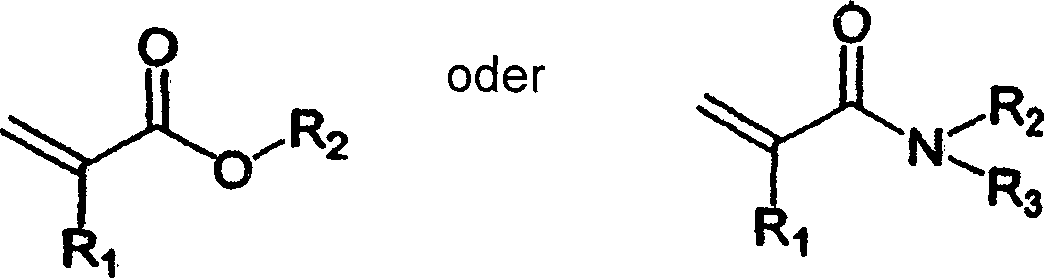
R2 und R3 unabhängig
voneinander Wasserstoff oder -Y-Z sind, wobei Y Niederalkyl ist
und Z Hydroxyl, Amino oder C(O)-Rist, wobei R Wasserstoff, Niederalkoxy
oder Aryloxy ist.For example, the monomers of the process independently have the following structure:
R 2 and R 3 are independently hydrogen or -YZ, wherein Y is lower alkyl and Z is hydroxyl, amino or C (O) -R wherein R is hydrogen, lower alkoxy or aryloxy.
In einer anderen Ausführungsform sind R2 und R3 unabhängig voneinander Wasserstoff, Alkyl, Alkoxy, Hydroxyalkyl, Polyalkylenoxid oder -Y-Z, wobei Y ein lineares oder verzweigtes Niederalkyl, Aryl, Alkylaryl oder Polyalkylenoxid ist und Z Wasserstoff, Hydroxyl, Alkoxy, Carboxy, Amino, Hydrazino, Sulfydryl oder C(O)-Rist, wobei R Wasserstoff, Hydroxy, Niederalkoxy oder Aryloxy ist.In another embodiment, R 2 and R 3 are independently hydrogen, alkyl, alkoxy, hydroxyalkyl, polyalkylene oxide or -YZ, wherein Y is a linear or branched lower alkyl, aryl, alkylaryl or polyalkylene oxide and Z is hydrogen, hydroxyl, alkoxy, carboxy, amino , Hydrazino, sulfhydryl or C (O) -R wherein R is hydrogen, hydroxy, lower alkoxy or aryloxy.
Unter einem Gesichtspunkt enthält das Monomer keine freie Hydroxylgruppe und ist ein Verdünnungs-Monomer. Unter einigen Gesichtspunkten fungiert das Verdünnungs-Monomer als ein Polymerisationsterminator.Under contains a point of view the monomer does not have a free hydroxyl group and is a diluent monomer. In some aspects, the diluent monomer acts as a polymerization terminator.
Das Substrat kann unter Verwendung der hierin offenbarten Verfahren hergestellt werden, wobei die Dichte der Polymerbürsten 0,1 bis 1000 pmol der einzelnen Polymerketten pro cm2 des Substratoberflächenbereichs beträgt.The substrate may be prepared using the methods disclosed herein, wherein the density of the polymer brushes is 0.1 to 1000 pmol of the individual polymer chains per cm 2 of the substrate surface area.
KURZE BESCHREIBUNG DER ZEICHNUNGENSHORT DESCRIPTION THE DRAWINGS
Die
Die
ARTEN DER DURCHFÜHRUNG DER ERFINDUNGTYPES OF EXECUTION THE INVENTION
A. Allgemeine TechnikenA. General techniques
Bei der Praktizierung der vorliegenden Erfindung können, sofern nichts anderes angegeben ist, herkömmliche Techniken der organischen Chemie, Polymertechnologie, Molekularbiologie (einschließlich rekombinanter Techniken), Zellbiologie, Biochemie und Immunologie eingesetzt werden, welche innerhalb der Fachkenntnis liegen. Solche herkömmlichen Techniken beinhalten die Polymerarraysynthese, Hybridisierung, Ligation, Detektion der Hybridisierung unter Verwendung einer Markierung. Spezielle Darstellungen geeigneter Techniken kann man dem nachstehenden Beispiel entnehmen. Jedoch können natürlich andere gleichwertige herkömmliche Verfahren ebenfalls verwendet werden. Solche herkömmlichen Techniken kann man in Standardlaborhandbüchern finden, wie z.B. Genome Analysis: A Laboratory Manual Series (Bd. I–IV), Using Antibodies: A Laboratory Manual, Cells: A Laboratory Manual, PCR Primer: A Laboratory Manual und Molecular Cloning: A Laboratory Manual (alle von der Cold Spring Harbor Laboratory Press).at The practice of the present invention may, unless otherwise stated is given, conventional Techniques of organic chemistry, polymer technology, molecular biology (including recombinant techniques), cell biology, biochemistry and immunology which are within the skill of the art. Such usual Techniques include polymer array synthesis, hybridization, ligation, Detection of hybridization using a label. Specific illustrations of suitable techniques can be found in the example below remove. However, you can Naturally other equivalent conventional Method also be used. Such conventional Techniques can be found in standard laboratory manuals, e.g. Genome Analysis: A Laboratory Manual Series (Volumes I-IV), Using Antibodies: A Laboratory Manual, Cells: A Laboratory Manual, PCR Primer: A Laboratory Manual and Molecular Cloning: A Laboratory Manual (all from the Cold Spring Harbor Laboratory Press).
B. DefinitionenB. Definitions
Wie hierin verwendet sollen gewisse Begriffe die folgenden definierten Bedeutungen aufweisen.As As used herein, certain terms are intended to define the following Have meanings.
Wie in der Beschreibung und den Ansprüchen verwendet umfassen die Singularformen "ein", "eine" und "der/die/das" Bezugnahmen auf den Plural, wenn der Kontext nicht klar etwas anderes vorschreibt. Beispielsweise, kann der Begriff "ein Array" eine Vielzahl von Arrays beinhalten, sofern der Kontext nicht klar etwas anderes vorschreibt.As used in the specification and claims include Singular forms "one", "one" and "the / the" references to the plural, if the context does not clearly dictate otherwise. For example, the term "an array" may include a plurality of arrays, unless the context clearly dictates otherwise.
Ein "Array" ist eine absichtlich erzeugte Sammlung von Molekülen, welche entweder synthetisch oder biosynthetisch hergestellt werden kann. Die Moleküle in dem Array können identisch oder voneinander verschieden sein. Der Array kann eine Vielzahl von Formaten, z.B. Bibliotheken löslicher Moleküle, Bibliotheken von Verbindungen, die an Harzkügelchen, Siliciumdioxidscheibchen oder andere feste Träger angebunden sind, annehmen.An "array" is one on purpose generated collection of molecules, which are produced either synthetically or biosynthetically can. The molecules in the array be identical or different from each other. The array can be one Variety of formats, e.g. Libraries of Soluble Molecules, Libraries of Compounds based on resin beads, Silica disks or other solid supports.
Der Begriff "Molekül" bezieht sich im Allgemeinen auf ein Makromolekül oder Polymer, wie es hierin beschrieben wird. Jedoch liegen Arrays, die im Gegensatz zu Makromolekülen oder Polymeren einzelne Moleküle umfassen, ebenfalls innerhalb des Umfangs dieser Erfindung.Of the Term "molecule" refers to Generally to a macromolecule or polymer as described herein. However, there are arrays unlike macromolecules or polymers single molecules also within the scope of this invention.
"Vordefinierter Bereich" bezieht sich auf eine lokalisierte Fläche auf einem festen Träger, welche für die Bildung eines ausgewählten Moleküls verwendet wird, wurde oder werden soll und im Übrigen hierin alternativ als ein "ausgewählter" Bereich bezeichnet wird. Der vordefinierte Bereich kann irgendeine geeignete Form, z.B. kreisförmig, rechtwinklig, elliptisch, keilförmig usw. aufweisen. Der Kürze zuliebe werden hierin "vordefinierte Bereiche" manchmal einfach als "Bereiche" bezeichnet. In einigen Ausführungsformen ist ein vordefinierter Bereich und somit eine Fläche, auf welcher jedes einzelne Molekül synthetisiert wird, kleiner als 1 cm2 oder weniger als 1 mm2 und noch bevorzugter weniger als 0,5 mm2. In den am meisten bevorzugten Ausführungsformen weisen die Bereiche eine Fläche von weniger als 10.000 μm2 oder noch bevorzugter weniger als 100 μm2 auf. Zusätzlich werden typischerweise mehrfache Kopien des Polymers innerhalb jedes vorausgewählten Bereichs synthetisiert. Die Anzahl der Kopien kann in den Tausenden bis zu den Millionen liegen."Predefined region" refers to a localized surface on a solid support which is, was or is intended to be used for the formation of a selected molecule and is otherwise referred to herein alternatively as a "selected" region. The predefined region may have any suitable shape, eg circular, rectangular, elliptical, wedge-shaped, etc. For the sake of brevity, "predefined regions" are sometimes referred to herein simply as "regions." In some embodiments, a predefined region, and thus a surface on which each individual molecule is synthesized, is less than 1 cm 2 or less than 1 mm 2, and more preferably less than 0.5 mm 2 . In the most preferred embodiments, the regions have an area of less than 10,000 μm 2, or more preferably less than 100 μm 2 . Additionally, multiple copies of the polymer are typically synthesized within each preselected range. The number of copies can range from thousands to millions.
Unter einigen Gesichtspunkten kann ein vordefinierter Bereich geschaffen werden, indem die Bereiche (z.B. Kügelchen, Harze, Gele usw.) physikalisch in Vertiefungen, flachen Schalen getrennt werden.Under In some aspects, a predefined area can be created by adding the areas (e.g., beads, resins, gels, etc.) physically separated into wells, shallow dishes.
"Fester Träger", "Träger" und "Substrat" beziehen sich auf ein Material oder eine Gruppe von Materialien mit einer starren oder halbstarren Oberfläche oder Oberflächen. Unter einigen Gesichtspunkten wird wenigstens eine Oberfläche des festen Trägers im Wesentlichen flach sein, auch wenn es unter gewissen Gesichtspunkten wünschenswert sein kann, Synthesebereiche für unterschiedliche Moleküle mit beispielsweise Vertiefungen, erhöhten Bereichen, Stiften oder herausgeschnittenen Rinnen physikalisch zu trennen. Unter gewissen Gesichtspunkten werden der (die) feste(n) Träger die Form von Kügelchen, Harzen, Gelen, Mikrokügelchen oder andere geometrische Konfigurationen annehmen."Solid support", "support" and "substrate" refer to a material or group of materials with a rigid or semi-rigid surface or surfaces. In some aspects, at least one surface of the solid carrier be essentially flat, even if it is under certain aspects desirable can be, synthesis areas for different molecules with for example depressions, raised areas, pins or Physically separate cut gutters. Under certain From the point of view, the solid support (s) will be in the form of beads, Resins, gels, microspheres or assume other geometric configurations.
Eine "Schutzgruppe" ist ein Anteil, welcher an ein Molekül gebunden ist und welcher bei selektiver Exposition an einen Aktivator räumlich entfernt werden kann. Mehrere Beispiele von Schutzgruppen sind in der Literatur bekannt. Aktivatoren beinhalten elektromagnetische Strahlung, Ionenstrahlen, elektrische Felder, Magnetfelder, Elektronenstrahlen und Röntgenstrahlen.A "protective group" is a share which to a molecule is bound and which upon selective exposure to an activator spatial can be removed. Several examples of protecting groups are in known in the literature. Activators include electromagnetic Radiation, ion beams, electric fields, magnetic fields, electron beams and X-rays.
"Aktivierungsgruppe" bezieht sich auf jene Gruppen, welche, wenn sie an eine bestimmte funktionelle Gruppe oder reaktive Stelle angebunden sind, diese Stelle reaktiver machen gegenüber der Bildung einer kovalenten Bindung mit einer zweiten funktionellen Gruppe oder reaktiven Stelle. Beispielsweise beinhalten Aktivierungs gruppen, die anstelle einer Hydroxylgruppe verwendet werden können, -O(CO)Cl; -OCH2Cl; -O(CO)OAr, wobei Ar eine aromatische Gruppe, vorzugsweise eine p-Nitrophenylgruppe ist; -O(CO)(ONHS). Aktivierungsgruppen, welche für eine Carboxylgruppe nützlich sind, beinhalten einfache Estergruppen und Anhydride. Die Estergruppen beinhalten Alkyl-, Aryl- und Alkenylester und insbesondere solche Gruppen wie 4-Nitrophenyl, N-Hydroxylsuccinimid und Pentafluorphenol. Andere Aktivierungsgruppen sind den Fachleuten bekannt."Activating group" refers to those groups which, when attached to a particular functional group or reactive site, render that site more reactive to the formation of a covalent bond with a second functional group or reactive site. For example, activating groups which can be used in place of a hydroxyl group include -O (CO) Cl; -OCH 2 Cl; -O (CO) OAr, wherein Ar is an aromatic group, preferably a p-nitrophenyl group; -O (CO) (ONHS). Activation groups useful for a carboxyl group include simple ester groups and anhydrides. The ester groups include alkyl, aryl and alkenyl esters and especially such groups as 4-nitrophenyl, N-hydroxylsuccinimide and pentafluorophenol. Other activation groups are known to those skilled in the art.
Ein "Kanalblock" ist ein Material mit einer Vielzahl von Rillen oder vertieften Bereichen auf einer seiner Oberflächen. Die Rillen oder vertieften Bereiche können eine Vielzahl von geometrischen Konfigurationen annehmen, einschließlich Streifen, Kreisen oder geschlängelten Wegen, sind aber nicht auf diese beschränkt. Kanalblöcke können in einer Vielzahl von Arten hergestellt werden, einschließlich des Ätzens von Siliciumblöcken, des Formens oder Pressens von Polymeren.A "channel block" is a material having a plurality of grooves or recessed areas on one of its surfaces. The grooves or recessed areas may take a variety of geometric configurations, including, but not limited to, stripes, circles, or tortuous paths. Channel blocks can be made in a variety of ways, including the etching of silicon bubbles molding, molding or pressing of polymers.
Die Begriffe "photolabil" und "durch Licht spaltbar" werden über diese Anmeldung hinweg austauschbar verwendet.The Terms "photolabile" and "light-split" are used herein Login used interchangeably.
Der Begriff "gegebenenfalls substituiert" bezieht sich auf das Vorliegen oder Fehlen eines Substituenten an der Gruppe, die definiert wird.Of the Term "if appropriate substituted "refers based on the presence or absence of a substituent on the group, which is defined.
Eine "polymere Bürste" bezieht sich gewöhnlich auf Polymerfolien, welche Ketten von Polymeren umfassen, die an die Oberfläche eines Substrats angebunden sind. Die polymeren Bürsten dieser Erfindung sind funktionalisierte Polymerfolien, welche funktionelle Gruppen wie z.B. Hydroxyl-, Amino-, Carboxyl-, Thiol-, Amid-, Cyanat-, Thiocyanat-, Isocyanat- und Isothiocyanatgruppen oder eine Kombination von diesen an den Polymerketten an einem oder mehr Orten umfassen. Die polymeren Bürsten dieser Erfindung sind zu einer Anbindung oder schrittweisen Synthese von Makromolekülen an diesen fähig.A "polymeric brush" usually refers to Polymeric films comprising chains of polymers attached to the surface a substrate are connected. The polymeric brushes of this invention are functionalized Polymeric films containing functional groups, e.g. Hydroxyl, amino, Carboxyl, thiol, amide, cyanate, thiocyanate, isocyanate and isothiocyanate groups or a combination of these on the polymer chains on one or include more places. The polymeric brushes of this invention are to a linkage or stepwise synthesis of macromolecules at these able to.
Ein "Initiator freier Radikale" oder "Initiator" ist eine Verbindung, die unter gewissen Bedingungen wie z.B. Wärme, Licht oder einer anderen elektromagnetischen Strahlung ein freies Radikal liefern kann, welches freie Radikal von einem Monomer zu einem anderen übertragen werden kann und so eine Kette von Reaktionen auslösen kann, durch welche ein Polymer gebildet werden kann. Mehrere Initiatoren freier Radikale sind im Stand der Technik bekannt, wie z.B. der Azo-Typ oder der Nitroxid-Typ oder jene, die Mehrkomponentensysteme umfassen. Ein Beispiel eines Mehrkomponentensystems ist ein Alkyl- oder Arylmetall und ein Bindungsligand und ein stabiles sauerstofffreies Radikal. Siehe U.S.-Patent Nr. 5,312,871.An "initiator freer Radical "or" initiator "is a compound, which, under certain conditions, e.g. Heat, light or another electromagnetic radiation can deliver a free radical which free Radical can be transferred from one monomer to another and so on can trigger a chain of reactions by which a polymer can be formed. Several initiators free radicals are known in the art, e.g. of the Azo type or nitroxide type or those comprising multicomponent systems. An example of one Multi-component system is an alkyl or aryl metal and a binding ligand and a stable oxygen-free radical. See U.S. Pat. 5,312,871.
Die "lebende freie Radikal-Polymerisation" ist definiert als ein lebender Polymerisationsprozess, wobei Ketteninitiation und Kettenfortpflanzung ohne signifikante Kettenabbruchreaktionen stattfinden. Jedes Initiatormolekül erzeugt eine wachsende Monomerkette, welche sich kontinuierlich fortpflanzt, bis das gesamte verfügbare Monomer umgesetzt wurde. Die lebende freie Radikal-Polymerisation unterscheidet sich von der herkömmlichen freien Radikal-Polymerisation, wo Ketteninitiations-, Kettenfortpflanzungs- und Kettenabbruchreaktionen gleichzeitig auftreten und die Polymerisation fortschreitet, bis der Initiator aufgebraucht ist. Siehe U.S.-Patent Nr. 5,677,388. Die lebende freie Radikal-Polymerisation erleichtert die Steuerung des Molekulargewichts und der Molekulargewichtsverteilung. Lebende freie Radikal-Polymerisationstechniken beinhalten beispielsweise ein reversibles Capping der Enden von wachsenden Ketten während der Polymerisation. Ein Beispiel ist die Atomtransfer-Radikal-Polymerisation (ATRP).The "living free radical polymerization" is defined as a living polymerization process, wherein chain initiation and Chain propagation take place without significant chain termination reactions. Each initiator molecule creates a growing monomer chain, which is continuous propagated until all available monomer has reacted. The living free radical polymerization is different from the conventional one free radical polymerization, where chain initiation, chain propagation, and chain termination reactions occur simultaneously and the polymerization progresses until the initiator is used up. See U.S. Patent No. 5,677,388. The living free radical polymerization facilitates the control of molecular weight and molecular weight distribution. Living Free Radical Polymerization Techniques include, for example, a reversible capping of the ends of growing chains during the polymerization. An example is atom transfer radical polymerization (ATRP).
Eine "Radikal-Erzeugungsstelle" ist eine Stelle
auf einem Initiator, an welcher freie Radikale als Reaktion auf
Wärme oder
elektromagnetische Strahlung erzeugt werden. Beispielsweise existiert
in dem Fall eines Initiators vom Azo-Typ, wie er in
Ein "Polymerisationsterminator" ist eine Verbindung, welche eine Polymerkette an einer weiteren Polymerisation hindert. Diese Verbindungen können ebenfalls als "Terminatoren" oder "Capping-Mittel" oder "Inhibitoren" bekannt sein. Verschiedene Polymerisationsterminatoren sind im Stand der Technik bekannt. Unter einem Gesichtspunkt kann ein Monomer, das keine freien Hydroxylgruppen aufweist, als ein Polymerisationsterminator wirken.A "polymerization terminator" is a compound which prevents a polymer chain from further polymerization. These connections can also known as "terminators" or "capping agents" or "inhibitors". Various Polymerization terminators are known in the art. Under a Viewpoint may be a monomer that does not have free hydroxyl groups as a polymerization terminator.
Der Begriff "fähig, die Synthese eines makromolekularen Arrays zu unterstützen" bezieht sich auf eine polymere Bürste, die mit funktionellen Gruppen wie z.B. Hydroxyl, Amino, Carboxyl funktionalisiert wurde. Diese funktionellen Gruppen erlauben eine makromolekulare Synthese, indem sie als "Anbindungspunkte" wirken. Zu den Zwecken der vorliegenden Erfindung sind solche polymeren Bürsten, die funktionelle Gruppen nur an den Endpunkten umfassen, nicht fähig, die Synthese eines makromolekularen Arrays zu unterstützen.Of the Term "capable, that Synthesis of a macromolecular array support "refers to a polymeric brush, those functionalized with functional groups, e.g. Hydroxyl, amino, carboxyl was functionalized. These functional groups allow one macromolecular synthesis, acting as "attachment points". For the purposes of the present Invention are such polymeric brushes, the functional groups only at the endpoints include, not capable of synthesizing a macromolecular Support arrays.
Der Begriff "Bedingungen, die eine freie Radikal-Polymerisation fördern" bezieht sich auf jene Bedingungen, einschließlich des Vorliegens von Wärme oder elektromagnetischer Strahlung, oder Lösungsmitteln, Cosolventien, welche die Bildung und Fortpflanzung freier Radikale erlauben. Solche Bedingungen sind im Stand der Technik wohlbekannt und werden weiterhin nachstehend beschrieben.Of the Term "conditions, which promote free radical polymerization "refers to those conditions including the presence of heat or electromagnetic radiation, or solvents, cosolvents, which allow the formation and propagation of free radicals. Such Conditions are well known in the art and will continue to do so described below.
Ein "Makromolekül" oder "Polymer" umfasst zwei oder mehr Monomere, die kovalent verbunden sind. Die Monomere können einzeln oder in Reihen von mehreren Monomeren, die gewöhnlich als "Oligomere" bekannt sind, verbunden werden. So können beispielsweise ein Monomer und eine Reihe von fünf Monomeren verbunden werden, um ein Makromolekül oder Polymer von sechs Monomeren zu bilden. In ähnlicher Weise kann eine Reihe von fünfzig Monomeren mit einer Reihe von hundert Monomeren verbunden werden, um ein Makromolekül oder Polymer von einhundertundfünfzig Monomeren zu bilden.A "macromolecule" or "polymer" includes two or more monomers that are covalently linked. The monomers can be joined individually or in series of several monomers commonly known as "oligomers". For example, one monomer and a series of five monomers may be combined to form a macromolecule or polymer of six monomers. In a similar way For example, a series of fifty monomers may be combined with a series of one hundred monomers to form a macromolecule or polymer of one hundred and fifty monomers.
Die Monomere in einem vorgegebenen Polymer oder Makromolekül können identisch oder voneinander verschieden sein. Ein Monomer kann, unabhängig vom Molekulargewicht, ein kleines oder ein großes Molekül sein. Weiterhin kann jedes der Monomere ein geschütztes Element sein, das nach der Synthese modifiziert wird. Die bestimmte Anordnung der Monomere innerhalb eines Makromoleküls kann hierin als die "Sequenz" des Makromoleküls bezeichnet sein.The Monomers in a given polymer or macromolecule can be identical or different from each other. A monomer can, regardless of Molecular weight, be a small or a large molecule. Furthermore, each one can a protected one of the monomers Element that is modified after synthesis. The particular Arrangement of the monomers within a macromolecule can referred to herein as the "sequence" of the macromolecule be.
"Monomer" wie hierin verwendet
bezieht sich auf jene Monomere, die verwendet werden, um Polymere
der polymeren Bürste
zu bilden, wie auch jene Monomere, die verwendet werden, um Makromoleküle an der
polymeren Bürste
zu bilden. Die Bedeutung des Monomers wird jedoch aus dem Kontext
klar, in welchem es verwen det wird. Die Monomere zur Bildung der
Polymere der polymeren Bürste
weisen beispielsweise die allgemeine Struktur: 
Der Begriff "Alkyl" bezieht sich auf solche Gruppen wie z.B. Methyl, Ethyl, Propyl, Butyl usw., welche linear, verzweigt oder cyclisch sein können.Of the Term "alkyl" refers to such groups as e.g. Methyl, ethyl, propyl, butyl, etc., which are linear, may be branched or cyclic.
Der Begriff "Alkoxy" bezieht sich auf Gruppen wie z.B. Methoxy, Ethoxy, Propoxy, Butoxy usw., welche linear, verzweigt oder cyclisch sein können.Of the Term "alkoxy" refers to Groups such as e.g. Methoxy, ethoxy, propoxy, butoxy, etc., which are linear, may be branched or cyclic.
Der Begriff "Nieder", wie er in dem Kontext von Niederalkyl oder Niederalkoxy verwendet wird, bezieht sich auf Gruppen, die ein bis sechs Kohlenstoffatome aufweisen.Of the Term "low" as he is in the context of lower alkyl or lower alkoxy refers to Groups having one to six carbon atoms.
Der Begriff "Aryl" bezieht sich auf einen aromatischen Kohlenwasserstoffring, an welchen eine Alkylgruppe angebunden ist. Der Begriff "Aryloxy" bezieht sich auf einen aromatischen Kohlenwasserstoffring, an welchen eine Alkoxygruppe angebunden ist. Ein Durchschnittsfachmann würde diese Begriffe leicht verstehen.Of the Term "aryl" refers to an aromatic hydrocarbon ring to which an alkyl group is connected. The term "aryloxy" refers to an aromatic hydrocarbon ring to which an alkoxy group is connected. One of ordinary skill in the art would easily understand these terms.
Unter einem Gesichtspunkt ist das Monomer ein "Verdünnungs"-Monomer, wenn es keine freie Hydroxylgruppe enthält.Under In one aspect, the monomer is a "diluent" monomer when it is contains no free hydroxyl group.
Die Monomere zur Herstellung von Makromolekülen der vorliegenden Erfindung sind im Stand der Technik wohlbekannt. Wenn beispielsweise das Makromolekül ein Peptid ist, beinhalten die Monomere beispielsweise die L-Aminosäuren, die D-Aminosäuren, die synthetischen und/oder natürlichen Aminosäuren, sind aber nicht auf diese beschränkt. Wenn das Makromolekül eine Nukleinsäure oder ein Polynukleotid ist, beinhalten die Monomere ein beliebiges Nukleotid. Wenn das Makromolekül ein Polysaccharid ist, können die Monomere irgendeine Pentose, Hexose, Heptose oder deren Derivate sein.The Monomers for producing macromolecules of the present invention are well known in the art. For example, if the macromolecule is a peptide For example, the monomers include, for example, the L-amino acids D-amino acids, the synthetic and / or natural Amino acids are but not limited to these. If the macromolecule a nucleic acid or a polynucleotide, the monomers include any Nucleotide. If the macromolecule is a polysaccharide the monomers are any pentose, hexose, heptose or their derivatives be.
Wie hierin verwendet ist ein "Polynukleotid" eine Sequenz von zwei oder mehr Nukleotiden. Polynukleotide der vorliegenden Erfindung beinhalten Sequenzen von Deoxyribopolynukleotiden (DNA) oder Ribopolynukleotiden (RNA), welche aus natürlichen Quellen isoliert, rekombinant erzeugt oder künstlich synthetisiert werden können. Ein weiteres Beispiel eines Polynukleotids der vorliegenden Erfindung kann ein Polyamidpolynukleotid (PNA) sein. Die Polynukleotide und Nukleinsäuren können als einzelsträngig oder doppelsträngig existieren.As used herein is a "polynucleotide" a sequence of two or more nucleotides. Polynucleotides of the present invention include sequences of deoxyribo-polynucleotides (DNA) or ribopolynucleotides (RNA), which are natural Sources isolated, recombinantly produced or artificially synthesized can. Another example of a polynucleotide of the present invention may be a polyamide polynucleotide (PNA). The polynucleotides and nucleic acids can as single-stranded or double-stranded exist.
Der Begriff "Nukleotid" beinhaltet Deoxynukleotide und Analoge von diesen. Diese Analogen sind jene Moleküle, die einige strukturellen Merkmale mit einem natürlich vorkommenden Nukleotid gemeinsam haben, so dass, wenn diese in eine Polynukleotidsequenz eingebaut werden, sie eine Hybridisierung mit einem komplementären Polynukleotid in Lösung erlauben. Typischerweise sind diese Analogen von natürlich vorkommenden Nukleotiden abgeleitet, indem die Base, die Ribose oder der Phosphodiesteranteil ersetzt und/oder modifiziert wurden. Die Änderungen können maßgeschneidert sein, um die Hybridbildung zu stabilisieren oder zu destabilisieren oder um die Spezifität der Hybridisierung mit einer komplementären Polynukleotidsequenz nach Wunsch zu erhöhen oder um die Stabilität des Polynukleotids zu erhöhen.The term "nucleotide" includes deoxynucleotides and analogs of these. These analogs are those molecules that share some structural features with a naturally occurring nucleotide such that when incorporated into a polynucleotide sequence, they permit hybridization to a complementary polynucleotide in solution. Typically, these analogs are derived from naturally occurring nucleotides by replacing the base, ribose or phosphodiester moiety and / or were modified. The changes may be tailored to stabilize or destabilize hybrid formation, or to increase the specificity of hybridization with a complementary polynucleotide sequence as desired, or to increase the stability of the polynucleotide.
Analoge beinhalten ebenfalls geschützte und/oder modifizierte Monomere, wie sie herkömmlicherweise bei der Polynukleotidsynthese verwendet werden. Wie ein Fachmann sehr wohl weiß, verwendet die Polynukleotidsynthese eine Vielzahl basengeschützter Nukleosid-Derivate, bei welchen ein oder mehr der Stickstoffatome des Purin- und Pyrimidin-Anteils durch Gruppen wie z.B. Dimethoxytrityl, Benzyl, tert-Butyl und Isobutyl geschützt sind.analog also contain protected and / or modified monomers conventionally used in polynucleotide synthesis be used. As one skilled in the art knows, polynucleotide synthesis uses a variety of base-protected Nucleoside derivatives in which one or more of the nitrogen atoms of the purine and pyrimidine moiety by groups such as e.g. dimethoxytrityl, Benzyl, tert-butyl and isobutyl protected are.
Beispielsweise werden gegebenenfalls strukturelle Gruppen zu der Ribose oder Base eines Nukleosids zum Einbau in ein Polynukleotid zugegeben, wie z.B. eine Methyl-, Propyl- oder Allylgruppe an der 2'-O-Position an der Ribose, oder eine Fluorgruppe, welche die 2'-O-Gruppe ersetzt, oder eine Bromgruppe an der Ribonukleosidbase. 2'-O-Methyloligoribonukleotide (2'-O-MeORNs) weisen eine höhere Affinität zu komplementären Polynukleotiden (insbesondere RNA) auf als ihre unmodifizierten Gegenstücke. 2'-O-MeORNA-Phosphoramidit-Monomere sind im Handel z.B. bei der Chem Genes Corp. oder der Glen Research, Inc. erhältlich. Alternativ können Deazapurine und Deazapyrimidine, bei welchen ein oder mehr N-Atome des heterocyclischen Purin- oder Pyrimidinrings durch C-Atome ersetzt sind, ebenfalls verwendet werden.For example optionally structural groups to the ribose or base a nucleoside for incorporation into a polynucleotide, such as e.g. a methyl, propyl or allyl group at the 2'-O position on the Ribose, or a fluoro group which replaces the 2'-O group, or a bromine group at the ribonucleoside base. 2'-O-Methyloligoribonukleotide (2'-O-MeORNs) a higher one affinity to complementary Polynucleotides (especially RNA) as their unmodified Counterparts. 2'-O-MeORNA phosphoramidite monomers are commercially available e.g. at Chem Genes Corp. or Glen Research, Inc. available. Alternatively you can Deazapurines and deazapyrimidines in which one or more N atoms of the heterocyclic purine or pyrimidine ring replaced by C atoms are also used.
Die Phosphodiesterverknüpfung oder das "Zuckerphosphat-Gerüst" des Polynukleotids kann ebenfalls, beispielsweise mit Methylphosphonaten, O-Methylphosphaten oder Phosphorothioaten, substituiert oder modifiziert sein. Ein anderes Beispiel eines Polynukleotids, welches solche modifizierten Verknüpfungen umfasst, beinhaltet für die Zwecke dieser Offenbarung "Peptidpolynukleotide", bei welchen ein Polyamidgerüst an Polynukleotidbasen oder modifizierte Polynukleotidbasen angebunden ist. Peptidpolynukleotide, welche ein Polyamidgerüst umfassen, und die Basen, die in natürlich vorkommenden Nukleotiden gefunden werden, sind im Handel z.B. bei der Biosearch, Inc. (Bedford, MA) erhältlich. Siehe ebenfalls die U.S.-Patente Nr. 5,773,571 und 5,786,461.The phosphodiester or the "sugar phosphate backbone" of the polynucleotide can also, for example with methyl phosphonates, O-methyl phosphates or phosphorothioates, substituted or modified. One another example of a polynucleotide which modified such connections includes, includes for the purposes of this disclosure "peptide polynucleotides" in which polyamide backbone attached to polynucleotide bases or modified polynucleotide bases is. Peptide polynucleotides comprising a polyamide scaffold, and the bases that are in natural occurring nucleotides are commercially available e.g. at Biosearch, Inc. (Bedford, MA). See also the U.S. Patent Nos. 5,773,571 and 5,786,461.
Nukleotide mit modifizierten Basen können ebenfalls in dieser Erfindung verwendet werden. Einige Beispiele von Basenmodifikationen beinhalten 2-Aminoadenin, 5-Methylcytosin, 5-(Propin-1-yl)cytosin, 5-(Propin-1-yl)uracil, 5-Bromuracil, 5-Bromcytosin, Hydroxymethylcytosin, Methyluracil, Hydroxymethyluracil und Dihydroxypentyluracil, welche in die Polynukleotide eingebaut werden können, um die Bindungsaffinität zu komplementären Polynukleotiden zu modifizieren.nucleotides with modified bases also be used in this invention. Some examples base modifications include 2-aminoadenine, 5-methylcytosine, 5- (propyn-1-yl) cytosine, 5- (Propyn-1-yl) uracil, 5-bromouracil, 5-bromocytosine, hydroxymethylcytosine, Methyluracil, hydroxymethyluracil and dihydroxypentyluracil, which into which polynucleotides can be incorporated to increase the binding affinity to complementary polynucleotides to modify.
Die Gruppen können ebenfalls mit verschiedenen Positionen an dem Nukleosidzuckerring oder an den Purin- oder Pyrimidinringen verknüpft werden, welche den Duplex durch elektrostatische Wechselwirkungen mit dem negativ geladenen Phosphatgerüst oder durch Wechselwirkungen in den Haupt- und Nebenfurchen stabilisieren können. Beispielsweise können Adenosin- und Guanosinnukleotide an der N2-Position mit einer Imidazolylpropylgruppe substituiert werden, was die Duplexstabili tät erhöht. Universelle Basenanaloge wie z.B. 3-Nitropyrrol und 5-Nitroindol können ebenfalls aufgenommen werden. Eine Vielzahl modifizierter Polynukleotide, die zur Verwendung in dieser Erfindung geeignet sind, werden z.B. in "Antisense Research and Application", S.T. Crooke und B. LeBleu (Herausg.) (CRC Press, 1993) und "Carbohydrate Modifications in Antisense Research" in ACS Symp. Ser. #580, Y.S. Sanghvi und P.D. Cook (Herausg.) ACS, Washington, D.C. 1994 beschrieben.The groups can also be linked to different positions on the nucleoside sugar ring or on the purine or pyrimidine rings which can stabilize the duplex by electrostatic interactions with the negatively charged phosphate backbone or by interactions in the major and minor grooves. For example, adenosine and guanosine nucleotides can be substituted at the N 2 position with an imidazolylpropyl group, which increases the duplex stability. Universal base analogues such as 3-nitropyrrole and 5-nitroindole can also be included. A variety of modified polynucleotides suitable for use in this invention are described, for example, in "Antisense Research and Application", ST Crooke and B. LeBleu (Ed.) (CRC Press, 1993) and "Carbohydrate Modifications in Antisense Research" in ACS Symp. Ser. # 580, YS Sanghvi and PD Cook (eds) ACS, Washington, DC 1994.
Wenn das Makromolekül von Interesse ein Peptid ist, können die Aminosäuren irgendwelche Aminosäuren, einschließlich α-, β- oder ω-Aminosäuren sein. Wenn die Aminosäuren α-Aminosäuren sind, kann entweder das optische L-Isomer oder das optische D-Isomer verwendet werden. Zusätzlich sind nichtnatürliche Aminosäuren, beispielsweise β-Alanin, Phenylglycin und Homoarginin, ebenfalls von dieser Erfindung umfasst. Diese Aminosäuren sind im Stand der Technik wohlbekannt. Siehe beispielsweise Stryer, Biochemistry, letzte Ausgabe, Kapitel über Aminosäuren und über Proteine.If the macromolecule of interest may be a peptide the amino acids any amino acids, including α-, β- or ω-amino acids. If the amino acids are α-amino acids, For example, either the optical L isomer or the optical D isomer may be used become. additionally are unnatural amino acids, for example, β-alanine, Phenylglycine and homoarginine, also encompassed by this invention. These amino acids are well known in the art. See, for example, Stryer, Biochemistry, last edition, chapter on amino acids and proteins.
Verfahren der Cyclisierung und Polymerumkehr von Polymeren sind in der parallelen Anmeldung U.S. Ser. Nr. 08/351,058 offenbart, welche eine CIP der U.S. Ser. Nr. 07/978,940 ist, welche eine CIP des U.S.-Pat. Nr. 5,242,974 ist.method the cyclization and polymer reversal of polymers are in parallel Application U.S. Ser. No. 08 / 351,058 discloses a CIP of the U.S. Ser. No. 07 / 978,940, which is a CIP of U.S. Pat. No. Is 5,242,974.
Der Begriff "Hybridisierung" bezieht sich auf den Prozess, bei welchem zwei einzelsträngige Polynukleotide nichtkovalent binden, um ein stabiles doppelsträngiges Polynukleotid zu bilden; eine dreisträngige Hybridisierung ist theoretisch ebenfalls möglich. Das resultierende (gewöhnlich) doppelsträngige Polynukleotid ist ein "Hybrid." Der Anteil der Population von Polynukleotiden, die stabile Hybride bilden, wird hierin als der "Hybridisierungsgrad" bezeichnet.The term "hybridization" refers to the process in which two single-stranded polynucleotides noncovalently bind to form a stable double-stranded polynucleotide; a three-strand hybridization is also theoretically possible. The resulting (usually) double-stranded polynucleotide is a "hybrid." The proportion of the population of polynucleotides that form stable hybrids is referred to herein as the "Hy degree of bridging ".
Verfahren zur Durchführung von Polynukleotid-Hybridisierungsassays sind im Stand der Technik weit entwickelt. Die Hybridisierungsassay-Verfahren und -Bedingungen werden in Abhängigkeit von der Anwendung variieren und werden entsprechend den bekannten allgemeinen Bindungsmethoden ausgewählt, einschließlich jenen, auf die Bezug genommen wird in: Maniatis et al., "Molecular Cloning: A Laboratory Manual" 2. Ausg., Cold Spring Harbor, N.Y., 1989; Berger und Kimmel, "Methods in Enzymo logy," Bd. 152, "Guide to Molecular Cloning Techniques", Academic Press, Inc., San Diego, CA., 1987; Young und Davis, Proc. Natl. Acad. Sci., U.S.A., 80:1194 (1983).method to carry out Polynucleotide hybridization assays are well known in the art well developed. The hybridization assay procedures and conditions become dependent vary by application and will be according to the known ones general binding methods, including those Reference is made to: Maniatis et al., Molecular Cloning: A Laboratory Manual "2. Ed., Cold Spring Harbor, N.Y., 1989; Berger and Kimmel, "Methods in Enzymology," Vol. 152, "Guide to Molecular Cloning Techniques ", Academic Press, Inc., San Diego, CA., 1987; Young and Davis, Proc. Natl. Acad. Sci., U.S.A., 80: 1194 (1983).
Es wird anerkannt, dass die Fähigkeit von zwei einzelsträngigen Polynukleotiden, zu hybridisieren, von Faktoren wie z.B. deren Grad an Komplexität wie auch der Stringenz der Bedingungen der Hybridisierungsreaktion abhängen wird.It is recognized that ability of two single-stranded ones Polynucleotides to hybridize, factors such as e.g. their degree in complexity as well as the stringency of the conditions of the hybridization reaction depend becomes.
Wie hierin verwendet bezieht sich "Stringenz" auf die Bedingungen einer Hybridisierungsreaktion, welche das Ausmaß beeinflussen, in welchem Polynukleotide hybridisieren. Stringente Bedingungen können ausgewählt werden, die ermöglichen, dass Polynukleotidduplexe auf der Basis ihres Ausmaßes an Fehlpaarungen unterschieden werden. Eine hohe Stringenz korreliert mit einer geringeren Wahrscheinlichkeit für die Bildung eines Duplexes, der fehlgepaarte Basen enthält. Somit gilt, je höher die Stringenz, desto größer die Wahrscheinlichkeit, dass zwei einzelsträngige Polynukleotide, die in der Lage sind, einen fehlgepaarten Duplex zu bilden, einzelsträngig bleiben werden. Umgekehrt wird bei einer geringeren Stringenz die Wahrscheinlichkeit der Bildung eines fehlgepaarten Duplexes erhöht.As As used herein, "stringency" refers to the conditions a hybridization reaction affecting the extent to which Hybridize polynucleotides. Stringent conditions can be selected which allow that polynucleotide duplexes differ based on their level of mismatches become. A high stringency correlates with a lower probability for the Formation of a duplex containing mismatched bases. Consequently applies, the higher the stringency, the bigger the Probability that two single - stranded polynucleotides are present in are able to form a mismatched duplex, remain single-stranded become. Conversely, if the stringency is lower then the probability of Formation of a mismatched duplex increased.
Die geeignete Stringenz, die die Auswahl eines perfekt gepaarten Duplexes im Vergleich zu einem Duplex, der ein oder mehr Fehlpaarungen enthält, erlauben wird (oder die die Auswahl eines bestimmten fehlgepaarten Duplexes im Vergleich zu einem Duplex mit einem höheren Ausmaß an Fehlpaarung erlauben wird), wird im Allgemeinen empirisch bestimmt. Mittel zur Einstellung der Stringenz einer Hybridisierungsreaktion sind den Fachleuten wohlbekannt. Siehe beispielsweise Sambrook, et al., "Molecular Cloning: A Laboratory Manual," Zweite Ausgabe, Cold Spring Harbor Laboratory Press, 1989; Ausubel, et al., "Current Protocols In Molecular Biology," John Wiley & Sons, 1987, 1988, 1989, 1990, 1991, 1992, 1993, 1994, 1995, 1996 und regelmäßige Updates; und Hames et al., "Nucleic Acid Hybridization: A Practical Approach," IRL Press, Ltd., 1985.The appropriate stringency, the selection of a perfectly paired duplex compared to a duplex containing one or more mismatches will (or the selection of a particular mismatched duplex compared to a duplex with a higher degree of mismatch will permit) generally determined empirically. Means for adjusting the stringency a hybridization reaction are well known to those skilled in the art. Please refer For example, Sambrook, et al., "Molecular Cloning: A Laboratory Manual," Second Edition, Cold Spring Harbor Laboratory Press, 1989; Ausubel, et al., Current Protocols In Molecular Biology, "John Wiley & Sons, 1987, 1988, 1989, 1990, 1991, 1992, 1993, 1994, 1995, 1996 and regular updates; and Hames et al., Nucleic Acid Hybridization: A Practical Approach, "IRL Press, Ltd., 1985.
Im Allgemeinen umfassen die Bedingungen, welche die Stringenz erhöhen (d.h. im Hinblick auf die Bildung von besser gepaarten Duplexen selektieren), höhere Temperatur, geringere Ionenstärke und das Vorliegen oder Fehlen von Lösungsmitteln; eine geringere Stringenz wird begünstigt durch niedrigere Temperatur, höhere Ionenstär ke und niedrigere oder höhere Konzentrationen von Lösungsmitteln (beispielsweise niedrigere Konzentrationen an Formamid oder Dimethylsulfoxid). Die Dauer der Hybridisierungsreaktion und die Konzentration der Reaktanden (d.h. des einzelsträngigen Polynukleotids) können die Stringenz ebenfalls beeinflussen, wobei kurze Reaktionszeiten und niedrige Reaktandenkonzentrationen eine höhere Stringenz begünstigen.in the Generally, the conditions that increase stringency (i.e. with regard to the formation of better paired duplexes), higher Temperature, lower ionic strength and the presence or absence of solvents; a lower one Stringency is favored by lower temperature, higher Ionic strength and lower or higher Concentrations of solvents (For example, lower concentrations of formamide or dimethyl sulfoxide). The duration of the hybridization reaction and the concentration of Reactants (i.e., the single-stranded Polynucleotide) the stringency also affect, with short reaction times and low reactant concentrations favor higher stringency.
Über diese gesamte Offenbarung hinweg werden verschiedene Gesichtspunkte dieser Erfindung in einem Bereichsformat angegeben. Man sollte verstehen, dass die Beschreibung im Bereichsformat nur der Bequemlichkeit und Kürze dient und nicht als eine unflexible Beschränkung für den Umfang der Erfindung ausgelegt werden sollte. Demgemäß sollte die Beschreibung eines Bereichs so verstanden werden, dass damit alle möglichen Unterbereiche wie auch die einzelnen numerischen Werte innerhalb dieses Bereichs ausdrücklich offenbart sind. Beispielsweise sollte die Beschreibung eines Bereichs wie z.B. von 1 bis 6 so verstanden werden, dass ausdrücklich Unterbereiche wie z.B. von 1 bis 3, von 1 bis 4, von 1 bis 5, von 2 bis 4, von 2 bis 6, von 3 bis 6 wie auch einzelne Zahlen innerhalb dieses Bereichs, beispielsweise 1, 2, 3, 4, 5 und 6 offenbart sind. Dieses trifft unabhängig von der Breite des Bereichs zu.About these entire revelation become different aspects of this Invention specified in an area format. You should understand that the description in the area format only for convenience and Brevity serves and not as an inflexible limitation on the scope of the invention should be interpreted. Accordingly, should the description of an area should be understood to mean that all potential Subareas as well as the individual numeric values within this area expressly are disclosed. For example, the description of an area should be such as. from 1 to 6 should be understood as expressly subareas such as. from 1 to 3, from 1 to 4, from 1 to 5, from 2 to 4, from 2 to 6, from 3 to 6 as well as single numbers within this range, for example, 1, 2, 3, 4, 5 and 6 are disclosed. This is true independently from the width of the area to.
C. Makromolekulare Arrays an Polymeren BürstenC. Macromolecular Arrays on polymer brushes
I. Polymere BürstenI. Polymers Brushes
a) Allgemeiner Hintergrunda) General background
Polymere Bürsten sind im Stand der Technik bekannt. Siehe beispielsweise Prucker und Ruhe, Macromolecules, 31:592–601 (1998); Huang und Wirth, Analytical Chemistry, 69:4577–4580 (1997); und Husseman et al., Macromolecules, 32:1424–1431 (1999).Polymeric brushes are known in the art. See, for example, Prucker and Ruhe, Macromolecules, 31: 592-601 (1998); Huang and Wirth, Analytical Chemistry, 69: 4577-4580 (1997); and Husse man et al., Macromolecules, 32: 1424-1431 (1999).
Ein traditionelles Verfahren zur Herstellung von polymeren Bürsten ist als "Pfropfen" bekannt. Dieses Verfahren wird typischerweise verwendet, um Blockcopolymere herzustellen, wobei dieses beinhaltet, dass ein Block des Polymers stark an der Ober fläche absorbiert ist, während der andere Block die Bürstenschicht bildet. Einige der Nachteile dieses auf Adsorption basierenden Pfropfens umfassen die Desorption der Brüste und die begrenzte Auswahl an funktionellen Gruppen für die Blockcopolymerstruktur. Ein anderes Verfahren des Pfropfens beinhaltet die Bildung einer kovalenten Verknüpfung zwischen Polymerketten und dem Substrat. Eine kovalente Verknüpfung kann erreicht werden, indem ein funktionalisiertes Polymer mit reaktiven Oberflächengruppen auf dem Substrat kondensiert wird. Bei einer solchen Methodik kann ein Initiator wie z.B. ein mit Monochlorsilyl funktionalisierter Azo-Initiator kovalent an die Substratoberfläche angebunden werden. Ein Kettenwachstum kann unter den Bedingungen einer ionischen oder traditionellen freien Radikal-Polymerisation erreicht werden. Von diesen Verfahren wurde gezeigt, dass sie kovalent angebundene Polymerbürsten mit hohen Pfropfdichten und Molekulargewichten erzeugen. Siehe Husseman, supra.One traditional method of making polymeric brushes known as "grafting". This method is typically used to make block copolymers, this includes that one block of the polymer strongly attached to the Surface is absorbed while the other block is the brush layer forms. Some of the disadvantages of this adsorption-based plug include the desorption of the breasts and the limited choice of functional groups for the block copolymer structure. Another method of grafting involves the formation of a covalent linkage between polymer chains and the substrate. A covalent linkage can be achieved by using a functionalized polymer with reactive surface groups is condensed on the substrate. In such a methodology can an initiator such as e.g. a functionalized with monochlorosilyl Azo initiator covalently attached to the substrate surface. One Chain growth can take place under the conditions of an ionic or traditional free radical polymerization can be achieved. From these procedures was shown to be covalently bonded to polymer brushes produce high graft densities and molecular weights. See Husseman, supra.
Jedoch ist ein Hauptproblem, welches die Polymerisationstechnik beeinflusst, die Unfähigkeit, eine enge Polydispersität (d.h. Molekulargewichtsverteilung) bei relativ hohen Molekulargewichten beizubehalten. Darüber hinaus war der Erhalt der gewünschten polymeren Struktur mit den gewünschten funktionellen Gruppen an dem Polymer eine Herausforderung. Als Antwort wurden "lebende Polymerisations"-Verfahren entwickelt.however is a major problem affecting the polymerization technique, the inability a close polydispersity (i.e., molecular weight distribution) at relatively high molecular weights maintain. About that addition, the receipt was the desired polymeric structure with the desired functional groups on the polymer is a challenge. As answer were "living Polymerization "process developed.
Der Begriff "lebende Polymerisation" bezieht sich auf einen Polymerisationsprozess, wo die wachsenden Polymerketten eine oder mehr aktive Stellen enthalten, die in der Lage sind, eine weitere Polymerisation zu unterstützen. Siehe U.S.-Patent Nr. 5,708,102. Eine allgemeine Strategie zum Erhalt einer lebenden Polymerisation ist, dafür zu sorgen, dass eine chemische Spezies das aktive Zentrum, das die Polymerisation unterstützt, reversibel abdeckt. Bei ionischen Polymerisationen, die durch Anionen (anionische Polymerisation) oder Kationen (kationische Polymerisation) initiiert werden, fungiert das Gegenkation bzw. -anion als ein Capping-Mittel. Wenn die Ionen aneinander gebunden werden, hört die Polymerisation auf, aber die reversible Dissoziation in ionische Fragmente liefert eine kontrollierte Quelle für Stellen, welche eine weitere ionische Polymerisation unterstützen. Lebende ionische Polymerisationen werden weithin benutzt, um Blockcopolymere durch eine aufeinander folgende Zugabe verschiedener Alkenmonomere zu bilden.Of the Term "living Polymerization "refers focus on a polymerization process where the growing polymer chains contain one or more active sites that are capable of one to support further polymerization. See U.S. Pat. 5,708,102. A general strategy for obtaining a living polymerization is, for that to ensure that a chemical species is the active center that the Supports polymerization, reversibly covering. In ionic polymerizations by anions (anionic polymerization) or cations (cationic polymerization) initiated, the counter cation or anion acts as a capping agent. When the ions are bound together, the polymerization stops, but the reversible dissociation into ionic fragments provides one controlled source for Sites which promote further ionic polymerization. survivors Ionic polymerizations are widely used to block copolymers a sequential addition of different alkene monomers form.
Im
Gegensatz zu lebenden ionischen Polymerisationen benutzen lebende
freie Radikal-Polymerisationen Polymerisationsinitiatoren (R-X),
die zu einem Alkylradikal (R) zerfallen können, das die Polymerisation von
Monomeren unterstützt.
Dieser Prozess kann wie in den
Auf einer gewünschten Stufe wird die Polymerisation durch einen Polymerisationsterminator beendet. Solche Terminatoren sind im Stand der Technik bekannt. Siehe Greszta et al., Macromolecules, 27:638 (1994). Ein Ansatz, um die Polymerisation zu beenden, ist es, die wachsenden Radikale reversibel mit Radikalfänger-Radikalen umzusetzen, um kovalente Spezies zu bilden. Ein anderer Ansatz beinhaltet das reversible Umsetzen der wachsenden Radikale mit kovalenten Spezies, um beständige Radikale zu erzeugen. Noch ein anderer Ansatz beinhaltet das Zulassen, dass die wachsenden Radikale an einer degenerativen Transferreaktion teilnehmen, welche denselben Typ von Radikalen regeneriert. Siehe U.S.-Pat. Nr. 4,581,429; Hawker, J. Am. Chem. Soc., 116:11185 (1994); und Georges et al., Macromolecules, 26:2987 (1993).On a desired one Stage is the polymerization by a polymerization terminator completed. Such terminators are known in the art. See Greszta et al., Macromolecules, 27: 638 (1994). An approach To stop the polymerization, it is the growing radicals reversibly react with radical scavenging radicals, to form covalent species. Another approach involves that reversibly reacting the growing radicals with covalent species, to be consistent Generate radicals. Yet another approach involves allowing, that the growing radicals participate in a degenerative transfer reaction, which regenerates the same type of radicals. See U.S. Pat. No. 4,581,429; Hawker, J. Am. Chem. Soc., 116: 11185 (1994); and Georges et al., Macromolecules, 26: 2987 (1993).
Lebende freie Radikal-Verfahren erlauben die Verwendung von Blockcopolymeren bei der Bildung der Bürsten und erlauben eine bessere Steuerung der polymeren strukturellen Merkmale wie z.B. Molekulargewicht, Polymerdichte, Verzweigung. Weiterhin erlauben lebende freie Radikal-Polymerisationsverfahren die Kettenfortpflanzung in Gegenwart von unterschiedlichen Monomeren, so dass die Polymerkette variiert werden kann.survivors Free radical methods allow the use of block copolymers at the formation of the brushes and allow better control of the polymeric structural Features such as Molecular weight, polymer density, branching. Furthermore, living free radical polymerization processes allow chain propagation in the presence of different monomers, so that the polymer chain can be varied.
Verschiedene Typen von Initiatoren, Verfahren zur Erzeugung freier Radikale, Monomeren und freien Radikal-Capping-Mitteln sind im Stand der Technik beschrieben worden. Siehe beispielsweise die U.S.-Patente Nr. 5,677,388, 5,728,747, 5,708,102, 5,807,937 und 5,852,129. Ein Benzoylperoxid-Chrom-Initiator kann ebenfalls verwendet werden. Siehe Lee et al., J. Chem. Soc. Trans. Faraday Soc. I, 74: 1726 (1978). Zusätzliche Typen von Initiatoren beinhalten α-Halogenester, Alkoxyamin und Initiatoren vom Halogenbenzyl-Typ, welche alle in der vorliegenden Erfindung verwendet werden können. Siehe Husseman, supra und Hawker, supra.Various types of initiators, free radical generating methods, monomers, and free radical capping agents have been described in the prior art. See, for example, U.S. Patent Nos. 5,677,388, 5,728,747, 5,708,102, 5,807,937 and 5,852,129. A benzoyl peroxide-chromium initiator can also be used. See Lee et al., J. Chem. Soc. Trans. Faraday Soc. I, 74: 1726 (1978). Zusätz Typical types of initiators include α-haloesters, alkoxyamines and halobenzyl type initiators, all of which can be used in the present invention. See Husseman, supra and Hawker, supra.
Beispiele von Photoinitiatoren, die in verschiedenen effektiven Mengen ausgewählt werden, wie z.B. von 1 bis 10 Gewichtsprozent bezogen auf die gesamten Gewichtsprozente der Reaktanden, beinhalten Benzoine, Disulfide, Aralkylketone, Oximinoketone, Peroxyketone, Acylphosphinoxide, Diaminoketone, wie z.B. Micher's Ketone, 3-Ketocourmarine und dergleichen, und vorzugsweise 1-Hydroxycyclohexylphenylketon.Examples of photoinitiators selected in different effective amounts such as. from 1 to 10 percent by weight based on the total weight percentages of the reactants include benzoins, disulfides, aralkyl ketones, oximinoketones, Peroxyketones, acylphosphine oxides, diamino ketones, e.g. Micher's ketones, 3-ketocourmarine and the like, and preferably 1-hydroxycyclohexyl phenyl ketone.
Die Monomere beinhalten N-Carboxyanhydrid (zur Herstellung von Peptiden), Styrol und Vinylverbindungen. Beispiele für Initiatoren beinhalten: den Azo-Typ, den Nitroxid-Typ. Ein Beispiel eines Terminators ist ein Mittel eines stabilen freien Radikals, welches als TEMPO (2,2,6,6-Tetramethyl-1-piperidinyloxy) bekannt ist. Siehe U.S.-Patent Nr. 5,728,747.The Monomers include N-carboxyanhydride (for the preparation of peptides), Styrene and vinyl compounds. Examples of initiators include: the Azo type, the nitroxide type. An example of a terminator is on Stable free radical agent, which is called TEMPO (2,2,6,6-tetramethyl-1-piperidinyloxy) is known. See U.S. Patent No. 5,728,747.
Vor kurzem wurden Verfahren zur Erzeugung eines (Meth)Acrylpolymers, welches an beiden Enden hydroxyl-terminiert ist, berichtet. Siehe U.S.-Patent Nr. 5,852,129. Das Verfahren beinhaltet die Herstellung eines (Meth)Acrylpolymers durch Polymerisieren eines (Meth)Acrylmonomers unter Verwendung eines organischen Halogenids oder einer halogenierten Sulfonylverbindung als einem Initiator und eines Metallkomplexes mit einem zentralen Metall, das ausgewählt ist aus den Elementen, die zu den Gruppen 8, 9, 10 und 11 des Periodensystems gehören, als einem Katalysator. Dieses (Meth)Acrylatpolymer enthält eine Endstruktur mit der allgemeinen Formel: -CH2-C(R1)(CO2R2)(X). Dieses endständige Halogen wird in einen hydroxylhaltigen Substituenten umgewandelt, indem mit einer polymerisierbaren Alkenylgruppe und einer Hydroxylgruppe umgesetzt wird. Das Patent '129 beschreibt ebenfalls ein Verfahren, um eine Hydroxylgruppe an jedem Ende einzuführen, beispielsweise indem ein (Meth)Acrylmonomer unter Verwendung eines hydroxylhaltigen Halogenids als einem Initiator in dem oben beschriebenen Schema polymerisiert wird.Recently, processes for producing a (meth) acrylic polymer which is hydroxyl-terminated at both ends have been reported. See U.S. Patent No. 5,852,129. The method involves preparing a (meth) acrylic polymer by polymerizing a (meth) acrylic monomer using an organic halide or a halogenated sulfonyl compound as an initiator and a metal complex having a central metal selected from the elements belonging to groups 8, 9, 10 and 11 of the Periodic Table, as a catalyst. This (meth) acrylate polymer contains a final structure having the general formula: -CH 2 -C (R 1 ) (CO 2 R 2 ) (X). This terminal halogen is converted to a hydroxyl-containing substituent by reacting with a polymerizable alkenyl group and a hydroxyl group. The '129 patent also describes a method for introducing a hydroxyl group at each end, for example, by polymerizing a (meth) acrylic monomer using a hydroxyl-containing halide as an initiator in the scheme described above.
b) Polymere Bürsten, die in den Verfahren der vorliegenden Erfindung verwendbar sindb) polymeric brushes, the in the methods of the present invention
Während die allgemeine Methodik der Erzeugung von polymeren Bürsten bekannt war, müssen die Verfahren zur Erzeugung von polymeren Bürsten mit mehrfachen funktionellen Gruppen an den Bürsten und die Verwendung solcher multifunktionalisierten polymeren Bürsten bei der Herstellung von makromolekularen Arrays noch erforscht werden.While the general methodology of the generation of polymeric brushes known was, must the processes for the production of polymeric brushes with multiple functional Groups at the brushes and the use of such multifunctional polymeric brushes research into the production of macromolecular arrays.
Jeder Träger für die Herstellung von makromolekularen Arrays muss einen optimalen Abstand der Initiationsstellen, eine Benetzbarkeit der Oberfläche durch sowohl organische Lösungsmittel als auch wässrige Lösungen bereitstellen und die nichtspezifische Bindung von Liganden an die Oberfläche minimieren. Der Abstand der Syntheseinitiationsstellen auf einem festen Träger kann nicht nur die Synthese des Arrays sondern ebenfalls die Bindungsereignisse zwischen einem immobilisierten Makromolekül und seinem Liganden beeinflussen. Die Synthese kann durch Phänomene wie z.B. die Bildung freier Radikale während einer photolytischen Reaktion (bei der lichtgesteuerten Synthese), die Lösungsmittelzugänglichkeit und elektrostatische Effekte an der Oberfläche beeinflusst werden.Everyone carrier for the Making macromolecular arrays needs an optimal distance the initiation sites, a wettability of the surface by both organic solvents as well as aqueous solutions and minimize nonspecific binding of ligands to the surface. The distance of the synthesis initiation sites on a solid support can not only the synthesis of the array but also the binding events between an immobilized macromolecule and its ligand. The synthesis can be through phenomena such as. the formation of free radicals during a photolytic Reaction (in light-driven synthesis), solvent accessibility and electrostatic effects on the surface are affected.
Die Benetzbarkeit des Trägers oder der Substratoberfläche hat wahrscheinlich ebenfalls einen direkten Einfluss auf die Ausbeute der Kopplungsreaktionen und der anschließenden Bindungsereignisse. Es wird erwartet, dass die Präsentation von Peptiden oder anderen Liganden zur Erkennung eine Funktion von nicht nur der Hydrophobizität/Hydrophilie des Peptids oder Liganden sondern ebenfalls der physikochemischen Natur der Oberfläche ist, an welche diese angebunden sind. Somit wird erwartet, dass hydrophile Peptidsequenzen sich vollständig in die umgebende wässrige Umgebung erstrecken, wodurch deren Verfügbarkeit zur Erkennung und Bindung durch Rezeptoren maximiert wird. Im Gegensatz dazu können hydrophobe Sequenzen in der Gegenwart einer moderat hydrophoben Substratoberfläche auf der Oberfläche kollabieren und effektiv aus dem Pool verfügbarer Liganden, die einem Rezeptor präsentiert werden, eliminiert werden.The Wettability of the carrier or the substrate surface probably also has a direct impact on the yield the coupling reactions and the subsequent binding events. It is expected that the presentation of peptides or other ligands to recognize a function of not only the hydrophobicity / hydrophilicity of the peptide or ligand but also the physicochemical Nature of the surface is, to which these are attached. Thus, it is expected that hydrophilic peptide sequences migrate completely into the surrounding aqueous environment extend their availability is maximized for recognition and binding by receptors. In contrast can do this hydrophobic sequences in the presence of a moderately hydrophobic substrate surface on the surface Collapse and effectively from the pool of available ligands, the one Receptor presented will be eliminated.
In Anbetracht der obigen Erwägungen erlauben die polymeren Bürsten, auf welche in den Verfahren der Erfindung Bezug genommen wird, die Kontrolle der Dichte der funktionalen Stellen, der Benetzbarkeit und der Porosität.In Considering the above considerations allow the polymeric brushes, which is referred to in the methods of the invention, which Control of density of functional sites, wettability and the porosity.
Wie
anhand der Offenbarung hierin und in den begleitenden Beispielen
deutlicher werden wird, umfassen die Zusammensetzungen polymerer
Bürsten,
auf welche in den Verfahren der Erfindung Bezug genommen wird, einzelne
Polymerketten, bei welchen die einzelnen Polymerketten mehrfache
funktionelle Gruppen wie z.B. Hydroxylgruppen, beispielsweise 2,
3, 4 oder mehr, beinhalten. Siehe beispielsweise die
Der Träger der polymeren Bürste kann maßgeschneidert werden, um optimale Eigenschaften für die Synthese und für biologische Assays bereitzustellen. Beispielsweise kann die Endkonzentration der funktionellen Gruppen (Amin oder Hydroxyl) in der polymeren Bürste gesteuert werden, indem die relativen Mengen an nichtfunktionalisierten und funktionalisierten Monomeren variiert werden, die bei der Bildung des Polymers verwendet werden. Zusätzlich kann die Porosität und Löslichkeit der Polymerfolien gesteuert werden, indem die Konzentrationen der Monomere und Vernetzungsmittel in der Zusammensetzung variiert werden. Somit ergibt ein hoher Grad an Vernetzung ein starres unlösliches Polymer mit niedriger Porengröße, wogegen das Weglassen des Vernetzungsmittels insgesamt zu löslichen linearen Polymerketten (mit funktionellen Gruppen) führen wird, die sich von der Oberfläche des Substrats von den Anbindungsstellen weg erstrecken.Of the carrier the polymeric brush can be customized be optimal properties for synthesis and for biological To provide assays. For example, the final concentration the functional groups (amine or hydroxyl) in the polymeric brush be controlled by the relative amounts of non-functionalized and functionalized monomers are varied during formation of the polymer can be used. In addition, the porosity and solubility the polymer films are controlled by the concentrations of Monomers and crosslinking agents in the composition can be varied. Thus, a high degree of crosslinking results in a rigid insoluble one Low pore size polymer, however omitting the crosslinking agent as a whole to be soluble linear polymer chains (with functional groups) will result, extending from the surface of the substrate away from the attachment sites.
Die polymeren Bürsten auf Substraten wie z.B. Glas oder Siliciumdioxid sind nützlich zum Synthetisieren von Arrays von Makromolekülen wie z.B. Polypeptiden, Polynukleotiden und Polysacchariden oder anderen Makromolekülen von Interesse. Die polymeren Bürsten liefern eine poröse dreidimensionale Matrix, die mit reaktiven Gruppen funktionalisiert ist, die als Ausgangspunkte für eine Synthese makromolekularer Arrays dienen. Diese Arrays können ebenfalls für Assays, an denen Makromoleküle beteiligt sind, wie z.B. eine auf einer Hybridisierung basierende Nukleinsäuresequenzanalyse oder Ligand-Peptid- oder Ligand-enzymatische Wechselwirkungen verwendet werden.The polymeric brushes on substrates such as e.g. Glass or silica are useful for Synthesizing arrays of macromolecules, e.g. polypeptides Polynucleotides and polysaccharides or other macromolecules of Interest. The polymeric brushes deliver a porous three-dimensional matrix functionalized with reactive groups is that as starting points for serve a synthesis of macromolecular arrays. These arrays can as well for assays, where macromolecules are involved, such as one based on a hybridization Nucleic acid sequence analysis or ligand-peptide or ligand-enzymatic interactions become.
Einer der Hauptvorteile dieser Bürsten ist, dass sie eine sehr viel größere Anzahl von Synthesestellen pro Einheitsfläche des Substrats bereitstellen als durch die derzeitige Generation von monofunktionalen Silan-derivatisierten Glasoberflächen ange- boten wird, während ein ähnlicher oder größerer Abstand zwischen den Stellen beibehalten wird. Das Ausmaß der Bindung von „Ziel"-Molekülen an die immobilisierten Makromoleküle wird wesentlich erhöht, was die Detektion verbessert, und die Vielzahl der Bindungsstellen innerhalb des Polymerträgers kann eine zusätzliche kinetische Verbesserung liefern.one the main advantages of these brushes is that they are a much larger number of synthesis sites per unit area of the substrate as derivatized by the current generation of monofunctional silane glass surfaces is offered while a similar one or greater distance maintained between the bodies. The extent of binding of "target" molecules to the immobilized macromolecules is significantly increased, which improves detection and the multiplicity of binding sites within the polymer carrier can be an extra provide kinetic enhancement.
Die seitliche Oberflächendichte der Polymerketten kann beispielsweise 0,1–1000 pmol/cm2 Substratoberflächenbereich oder z.B. 1–100 betragen. Die seitliche Oberflächendichte der Anbindungsstellen an der Polymerkette, wobei einzelne Polymerketten mehrfache Anbindungsstellen aufweisen, kann beispielsweise 0,1 bis 1.000.000 pmol/cm2 Substratoberflächenbereich, z.B. 1–1.000, betragen.The lateral surface density of the polymer chains can be, for example, 0.1-1000 pmol / cm 2 substrate surface area or, for example, 1-100. The lateral surface density of the attachment sites on the polymer chain, with individual polymer chains having multiple attachment sites, may be, for example, 0.1 to 1,000,000 pmol / cm 2 substrate surface area, eg, 1-1,000.
Die Polymerbürsten können verwendet werden, um Arrays von Nukleinsäuren zu bilden. Arrays von Nukleinsäuren, die auf einer Oberfläche immobilisiert sind, werden im Detail beispielsweise in dem U.S.-Patent Nr. 5,744,305 beschrieben. Auf einem Substrat werden Nukleinsäuren beispielsweise mit unterschiedlichen Sequenzen jeweils in einem vordefinierten Bereich auf einer Oberfläche immobilisiert. Beispielsweise können 10, 50, 60, 100, 103, 104, 105, 106, 107 oder 108 unterschiedliche Monomersequenzen auf dem Substrat bereitgestellt werden. Die Nukleinsäuren mit einer bestimmten Sequenz werden innerhalb eines vordefinierten Bereichs eines Substrats bereitgestellt, der einen Oberflächenbereich von beispielsweise ca. 1 cm2 bis 10–10 cm2 aufweist. Die Bereiche können Flächen von weniger als ca. 10–1, 10–2, 10–3, 10–4, 10–5, 10–6, 10–7, 10–8, 10–9 oder 10–10 cm2 aufweisen. Beispielsweise kann ein planarer nichtporöser Träger bereitgestellt werden, der wenigstens eine erste Oberfläche und eine Vielzahl unterschiedlicher Nukleinsäuren aufweist, die an die erste Oberfläche in einer Dichte angebunden sind, die ca. 400 unterschiedliche Nukleinsäuren/cm2 übersteigt, wobei jede der unterschiedlichen Nukleinsäuren an die Oberfläche des festen Trägers in einem unterschiedlichen vordefinierten Bereich angebunden ist, eine unterschiedliche feststellbare Sequenz aufweist und beispielsweise eine Länge von wenigstens 4 Nukleotiden aufweist. Die Nukleinsäuren können beispielsweise eine Länge von 4 bis 20 Nukleotiden aufweisen. Die Anzahl der unterschiedlichen Nukleinsäuren kann beispielsweise 1000 oder mehr betragen.The polymer brushes can be used to form arrays of nucleic acids. Arrays of nucleic acids immobilized on a surface are described in detail, for example, in U.S. Patent No. 5,744,305. On a substrate, for example, nucleic acids with different sequences are each immobilized in a predefined area on a surface. For example, 10, 50, 60, 100, 10 3 , 10 4 , 10 5 , 10 6 , 10 7 or 10 8 different monomer sequences can be provided on the substrate. The nucleic acids having a particular sequence are provided within a predefined region of a substrate having a surface area of, for example, about 1 cm 2 to 10 -10 cm 2 . The areas may be areas of less than about 10 -1 , 10 -2 , 10 -3 , 10 -4 , 10 -5 , 10 -6 , 10 -7 , 10 -8 , 10 -9 or 10 -10 cm 2 exhibit. For example, a planar nonporous support can be provided which has at least a first surface and a plurality of different nucleic acids attached to the first surface at a density exceeding about 400 different nucleic acids / cm 2 , each of the different nucleic acids being attached to the nucleic acid Surface of the solid support is attached in a different predefined range, has a different ascertainable sequence and, for example, has a length of at least 4 nucleotides. The nucleic acids may, for example, have a length of 4 to 20 nucleotides. The number of different nucleic acids may be, for example, 1000 or more.
Die Polymerbürsten können ebenfalls auf porösen Siliciumdioxid-Substraten mit einer hohen Porosität, beispielsweise einem hauptsächlich anorganischen porösen Substrat, das einen Trägerbereich und einen porösen Bereich in Kontakt mit dem Trägerbereich einschließt, bereitgestellt werden, wobei der poröse Bereich Poren mit einer Porengröße von 1–500 nm beinhaltet, wobei der poröse Bereich eine Porosität von z.B. 10–90% und eine Dicke der porösen Oberfläche von 0,01–20 μm aufweist, wie in der PCT/US00/09206 beschrieben wird.The polymer brushes can also on porous Silica substrates with a high porosity, for example one mainly inorganic porous Substrate, which has a support area and a porous one Area in contact with the carrier area includes, be provided, wherein the porous region pores with a Pore size of 1-500 nm includes, wherein the porous Area a porosity from e.g. 10-90% and a thickness of the porous ones surface of 0.01-20 μm, as described in PCT / US00 / 09206.
c) Verfahren zur Bildung Polymerer Bürstenc) Methods of formation Polymeric brushes
Unter
einem Gesichtspunkt wird ein Verfahren bereitgestellt, um kovalent
verankerte polymere Bürsten
von amin- oder hydroxyfunktionalisierten Polymeren auf Glas oder
Siliciumdioxidsubstraten herzustellen. Die Polymerfolie wird kovalent
durch ein Oberflächenpolymerisationsschema,
wie es in den
Unter
einem Gesichtspunkt wird ein Glassubstrat mit einem Initiator vom
Azo-Typ wie z.B. 4,4'-Azobis(pentanamidpropyltriethoxysilan)
(AIBN-APS) (I) vorab silanisiert. Siehe
Mischungen
von geeignet funktionalisierten Monomeren, die als Initiationspunkte
zur makromolekularen Synthese fungieren können, wie auch jenen Monomeren,
die als "inerte" Verdünnungsmittel
(oder Capping-Mittel) fungieren können, werden dann mit den Kohlenstoffradikalen
umgesetzt, und die Polymerisation beginnt. Siehe
AIBN-APS
kann leicht durch im Stand der Technik bekannte Verfahren hergestellt
werden. Ein beispielhaftes Verfahren der Herstellung ist in
Initiatoren vom Azo-Typ werden beispielsweise in Pruker und Ruhe, Macromol., 31:592–601 (1998) beschrieben. Man sollte verstehen, dass die vorliegende Erfindung nicht auf Initiatoren vom Azo-Typ beschränkt ist. Tatsächlich kann jeder bekannte Initiator verwendet werden, solange der Initiator kovalent mit dem Substrat an einem Ende verknüpft werden kann, während er distal eine Radikal-Erzeugungsstelle trägt, um die Polymerisation zu initiieren.initiators of the azo type, for example, in Pruker and Ruhe, Macromol., 31: 592-601 (1998). It should be understood that the present invention is not limited to azo-type initiators. In fact, can Any known initiator can be used as long as the initiator covalently linked to the substrate at one end while he distal carries a radical generating site to the polymerization initiate.
Oberflächeninitiationsstellen beinhalten Silanverbindungen wie z.B. (X)a(Y)bSi-(Z)-Q, wobei b = 3 minus a; X Cl, OMe oder OEt ist; Y C1-4-Alkyl ist; Z C2-C20-Alkyl, Alkylaryl oder Polyoxyalkylidin ist; und Q eine radikalbildende Vorläufergruppe ist. Q ist H oder Alkyl, wenn ein Verdünnungssilan verwendet wird.Surface initiation sites include silane compounds such as (X) a (Y) b Si (Z) -Q where b = 3 minus a; X is Cl, OMe or OEt; Y is C 1-4 alkyl; Z is C 2 -C 20 alkyl, alkylaryl or polyoxyalkylidine; and Q is a radical-forming precursor group. Q is H or alkyl when a diluent silane is used.
Andere
Initiatoren beinhalten Nitroxyl (Husseman et al., Macromol. 32:1421–31 (1999)),
Halogen- (Huang und Wirth, Anal. Chem. 69:4577–80 (1997)) und Thiocarbamat
(Kobayashi et al., J Appl. Poly. Sci., 49:447–423 (1999)). Beispiele von
Initiatoranteilen beinhalten:
Die
Monomere sind jene, die fähig
sind, eine freie Radikal-Polymerisation zu durchlaufen. Unter einem Gesichtspunkt
ist das Monomer 2-Hydroxyethylmethacrylat (HEMA), welches polymerisiert
wird, um ein hydroxyfunktionalisiertes Vinylpolymer-Netzwerk bereitzustellen.
Eine Vielzahl von Monomeren, welche die gewünschten funktionellen Gruppen
liefern, kann verwendet werden. Einige Monomere, welche diese Kriterien erfüllen, können durch
die unten gezeigten generischen Strukturen dargestellt werden: 
Einige
spezielle Beispiele von Vinylmonomeren, die in den Verfahren dieser
Erfindung verwendet werden können,
sind in
Die resultierenden Folien zeigen eine ausgezeichnete Stabilität gegenüber einer Vielzahl von Bedingungen an den makromolekularen Arrays. Solche Bedingungen beinhalten Synthese- wie auch Assay-Bedingungen.The resulting films show excellent stability over one Variety of conditions at the macromolecular arrays. Such Conditions include both synthesis and assay conditions.
Wie oben diskutiert können die polymere Bürste und die Silanschicht maßgeschneidert werden, um optimale Eigenschaften wie z.B. einen geeigneten Abstand der funktionellen Gruppen, eine verbesserte Benetzbarkeit und eine minimierte nichtspezifische Bindung von Makromolekülen bereitzustellen. Beispielsweise, kann die Dicke der polymeren Bürste gesteuert werden, indem die Länge der Polymerkette und die Anzahl der Oberflächeninitiatoren variiert werden. Die endgültige Dichte der funktionellen Gruppen (z.B. Amin oder Hydroxyl) an der Bürste kann einfach gesteuert werden, indem die relativen Mengen von nichtfunktionalisierten und funktionalisierten Monomeren variiert werden.As discussed above the polymeric brush and the silane layer tailored to obtain optimal properties, e.g. a suitable distance the functional groups, improved wettability and a to provide minimized non-specific binding of macromolecules. For example, the thickness of the polymeric brush can be controlled by the length the polymer chain and the number of surface initiators are varied. The final Density of functional groups (e.g., amine or hydroxyl) on the brush can be easily controlled by the relative amounts of non-functionalized and functionalized monomers.
Zusätzlich kann der Abstand zwischen benachbarten Folien an der Bürste gesteuert werden, indem hier und da Polymere eingefügt werden, die Verdünnungs-Monomere umfassen. Somit ist es möglich und kann in manchen Fällen wünschenswert sein, die Dichte der polymeren Folien wie auch die funktionellen Stellen an der Bürste zu verringern. Eine funktionelle Stelle wie hierin verwendet bezieht sich auf eine Anbindungsstelle auf der Polymerbürste, welche eine funktionelle Gruppe umfasst, die eine Anbindung eines Moleküls an das Polymer erlaubt. Die Oberflächendichte der Initiatorstellen kann ebenfalls variiert werden, indem das Initiatorsilanreagens mit einem nichtfunktionellen Silan wie z.B. Alkyl-SiX3 verdünnt wird, wobei X ein Halogen oder Alkoxy ist. Die Porosität und Löslichkeit der polymeren Bürsten kann gesteuert werden, indem die Konzentrationen der Vinylmonomere, Vernetzungsmittel und Oberflächeninitiatoren in der Zusammensetzung variiert werden.In addition, the spacing between adjacent films on the brush can be controlled by inserting here and there polymers comprising diluent monomers. Thus, it is possible and in some cases may be desirable to reduce the density of the polymeric films as well as the functional locations on the brush. A functional site as used herein refers to a binding site on the polymer brush which comprises a functional group that allows attachment of a molecule to the polymer. The surface density of the initiator sites can also be varied by diluting the initiator silane reagent with a non-functional silane such as alkyl-SiX 3 , where X is a halogen or alkoxy. The porosity and solubility of the polymeric brushes can be controlled by varying the concentrations of the vinyl monomers, crosslinking agents and surface initiators in the composition.
Die freie Radikal-Polymerisation wird typischerweise für eine ausreichende Zeitdauer durchgeführt, so dass die gewünschte Umwandlung erreicht wird. Die Zeitdauer, die benötigt wird, kann von der Temperatur der Polymerisation abhängen. Unter einigen Gesichtspunkten gilt, je niedriger die Temperatur, desto länger die Zeitdauer, die benötigt wird, um eine gewünschte Umwandlung zu erreichen. Typischerweise wird die Polymerisation für 1 bis 20 Stunden, vorzugsweise von 1,5 bis 10 Stunden, ins besondere von 2 to 8 Stunden und am meisten bevorzugt von 2,5 bis 6 Stunden, durchgeführt.The free radical polymerization is typically sufficient for a sufficient Time duration, so that the desired Conversion is achieved. The amount of time it takes can depend on the temperature depend on the polymerization. In some aspects, the lower the temperature, the longer the amount of time it takes becomes a desired one Achieve conversion. Typically, the polymerization for 1 to 20 hours, preferably from 1.5 to 10 hours, in particular of 2 to 8 hours, and most preferably from 2.5 to 6 hours.
Das Polymer, welches durch den Prozess der vorliegenden Erfindung erzeugt wird, kann eine Vielzahl von Molekulargewichten aufweisen. Unter einigen Gesichtspunkten kann das Molekulargewicht von der verwendeten Menge an Initiator abhängen, da die verwendete Menge an Initiator festlegen kann, wie viele Ketten initiiert werden.The Polymer produced by the process of the present invention is, may have a variety of molecular weights. Under some aspects, the molecular weight of the used Depend on the amount of initiator since the amount of initiator used can determine how many chains initiate become.
Die Polymerisationsreaktionen können in einer Vielzahl von Medien, beispielsweise Suspension, Emulsion, Masse, das heißt rein oder ohne Lösungsmittel, oder in wässriger oder nichtwässriger Lösung durchgeführt werden. Wenn sie verwendet werden, umfassen geeignete Lösungsmittel aromatische Kohlenwasserstoffe wie z.B. Benzol, Toluol, Xylole, Pyridine oder andere Lösungsmittel, die vergleichsweise kleine Kettenübertragungskonstanten mit dem (den) bestimmten Monomer(en) aufweisen, die in der Polymerisation verwendet werden. Die Polymerisation kann bei Temperaturen durchgeführt werden, die von –80°C bis 80°C reichen. Der bevorzugte Bereich der Reaktionstemperatur kann von 25°C bis 70°C betragen. Jeder beliebige der bekannten Klasse von Polymerisationsinitiatoren ist geeignet, unter der Voraussetzung, dass dieser die benötigte Löslichkeit in dem Lösungsmittel oder der ausgewählten Monomermischung hat und bei der Temperatur der Polymerisation eine geeignete Halbwertszeit hat. Unter einigen Gesichtspunkten weist der Initiator eine Halbwertszeit auf, die kurz ist im Vergleich zu der Gesamtzeit, die für den Polymerisationsprozess benötigt wird. Der Prozess der Erfindung wird vorzugsweise als ein diskontinuierlicher Prozess durchgeführt, kann aber wenn nötig in irgendeinem der standardmäßigen Polymerisationsprozesse, beispielsweise in semi-diskontinuierlichen, unterdosierten (starved feed) oder kontinuierlichen Prozessen durchgeführt werden.The polymerization reactions can be carried out in a variety of media, for example suspension, emulsion, mass, that is to say pure or without solvent, or in aqueous or nonaqueous solution. When used, suitable solvents include aromatic hydrocarbons such as benzene, toluene, xylenes, pyridines or other solvents which have relatively low chain transfer constants with the particular monomer (s) used in the polymerization. The polymerization can be carried out at temperatures ranging from -80 ° C to 80 ° C. The preferred range of the reaction temperature may be from 25 ° C to 70 ° C. Any of the known class of polymerization initiators is suitable, provided that the be has required solubility in the solvent or monomer mixture selected and has a suitable half-life at the temperature of the polymerization. In some aspects, the initiator has a half-life that is short compared to the total time required for the polymerization process. The process of the invention is preferably carried out as a batch process, but if necessary may be carried out in any of the standard polymerization processes, for example in semi-batch, starved feed or continuous processes.
Die Polymerisationsreaktionen der vorliegenden Erfindung können unter einigen Gesichtspunkten durch ein Lösungsmittel oder Cosolvens ergänzt werden, um dabei zu helfen, sicherzustellen, dass die Reaktionsmischung über die gesamte Monomerumwandlung hinweg eine homogene einzelne Phase bleibt. Jedes Lösungsmittel oder Cosolvens kann ausgewählt werden, unter der Voraussetzung, dass das Lösungsmittelmedium wirksam ist, ein Lösungsmittelsystem zu erlauben, das eine Ausfällung oder Phasentrennung der Reaktanden oder Polymerprodukte vermeidet, bis schließlich alle Polymerisationsreaktionen abgeschlossen sind.The Polymerization reactions of the present invention may be carried out under Some aspects of a solvent or cosolvent added to help ensure that the reaction mixture over the throughout monomer conversion remains a homogeneous single phase. Every solvent or cosolvent can be selected provided that the solvent medium is effective, a solvent system to allow that to precipitate or phase separation of the reactants or polymer products avoids, until finally all polymerization reactions are completed.
Beispielhafte Lösungsmittel oder Cosolventien beinhalten mit dem Polymerprodukt kompatible aliphatische Alkohole, Glycole, Ether, Glycolether, Pyrrolidine, N-Alkylpyrrolidinone, N-Alkylpyrrolidone, Polyethylenglycole, Polypropylenglycole, Amide, Carbonsäuren und Salze von diesen, Ester, Organosulfide, Sulfoxide, Sulfone, Alkoholderivate, Hydroxyetherderivate wie z.B. Butyl-CARBITOLTM oder CELLOSOLVETM, Aminoalkohole, Ketone und Derivate von diesen und Mischungen von diesen. Wenn Mischungen von Wasser und wasserlöslichen oder -mischbaren organischen Flüssigkeiten als das Reaktionsmedium ausgewählt werden, reicht das Gewichtsverhältnis von Wasser zu Cosolvens typischerweise von 100:0 bis 10:90 und vorzugsweise von 97:3 bis 25:75.Exemplary solvents or co-solvents include aliphatic alcohols compatible with the polymer product, glycols, ethers, glycol ethers, pyrrolidines, N-alkylpyrrolidinones, N-alkylpyrrolidones, polyethylene glycols, polypropylene glycols, amides, carboxylic acids and salts thereof, esters, organosulfides, sulfoxides, sulfones, alcohol derivatives, Hydroxyether derivatives such as butyl CARBITOL ™ or CELLOSOLVE ™ , amino alcohols, ketones and derivatives of these and mixtures of these. When mixtures of water and water-soluble or miscible organic liquids are selected as the reaction medium, the water to cosolvent weight ratio typically ranges from 100: 0 to 10:90, and preferably from 97: 3 to 25:75.
Die Polymerisationsreaktionsgeschwindigkeit der Monomere kann beschleunigt und die Reaktionszeit verringert werden durch die Zugabe einer katalytischen Menge einer Protonensäure, die nicht ebenfalls die kationische Polymerisation initiiert. Die Protonensäure kann ausgewählt werden aus der Gruppe, bestehend aus organischen Säuren wie z.B. Schwefel-, Phosphor-, Carbonsäuren, Camphersulfonsäure und Nitroxiden, die funktionelle Säuregruppen enthalten, wie z.B. 3-Carboxyl-Proxyl. Geeignete Mengen können leicht anhand des gewöhnlichen Fachwissens ermittelt werden.The Polymerization reaction rate of the monomers can be accelerated and the reaction time can be reduced by the addition of a catalytic Amount of a proton acid, which does not also initiate the cationic polymerization. The proton acid can be selected be from the group consisting of organic acids like e.g. Sulfuric, phosphoric, carboxylic acids, camphorsulfonic acid and Nitroxides, the functional acid groups included, e.g. 3-carboxyl proxyl. Suitable quantities can be light by the ordinary Expertise.
Der Polymerisationsprozess der vorliegenden Erfindung kann mehrere Male innerhalb desselben Reaktionsgefäßes durch die verzögerte und schrittweise Zugabe von mehr Monomer oder Monomeren bei variierenden Mengen an Initiatoren und Abbruchmitteln wiederholt werden.Of the Polymerization process of the present invention may be several times in the same reaction vessel through the delayed and gradually adding more monomer or monomers at varying Amounts of initiators and stopping agents are repeated.
Die Prozesse der vorliegenden Erfindung können ausgewählt werden, um eine große Vielzahl von Polymeren zu bilden. Weiterhin kann der Prozess der vorliegenden Erfindung ausgewählt werden, um eine Mischung von zwei oder mehr unterschiedlichen polymerisierbaren Monomeren zu bilden, um daraus Copolymere zu bilden.The Processes of the present invention may be selected to a wide variety of polymers. Furthermore, the process of the present Invention selected be a mixture of two or more different polymerizable Form monomers to form copolymers.
Wahlweise können bekannte Zusätze in den Polymerisationsreaktionen ausgewählt werden, wobei die Zusätze für Leistungsverbesserungen an dem resultierenden Produkt sorgen können. Solche Zusätze können Färbemittel, Gleitmittel, Trenn- oder Übertragungsmittel, Tenside, Stabilisatoren und Antischaummittel beinhalten.Optional can known additives in the polymerization reactions, the additives for performance improvements can provide the resulting product. Such additives may include colorants, Lubricants, separating or transfer agents, Surfactants, stabilizers and antifoams include.
II. Verfahren zur Herstellung Makromolekularer Arrays an Polymeren BürstensubstratenII. Process for the preparation Macromolecular arrays of polymer brush substrates
a) Allgemeinesa) General
Beispiele von Makromolekülen, die an polymeren Bürstensubstraten dieser Erfindung hergestellt werden können, beinhalten Nukleinsäuren und Polynukleotide, welche sowohl lineare als auch cyclische Nukleotide umfassen, Peptide, Polysaccharide, Phospholipide, Heteromakromoleküle, bei welchen ein bekanntes Arzneimittel kovalent an irgendeines der oben genannten gebunden ist, Polyurethane, Polyester, Polycarbonate, Polyharnstoffe, Polyamide, Polyethylenimine, Polyarylensulfide, Polysiloxane, Polyimide, Polyacetate oder andere Makromoleküle, welche aus der Durchsicht dieser Offenbarung ersichtlich sind. Solche Makromoleküle sind "divers", wenn unterschiedliche (d.h., nichtidentische) Monomere an unterschiedlichen vordefinierten Bereichen eines Substrats verwendet werden.Examples of macromolecules, on polymeric brush substrates of this invention include nucleic acids and Polynucleotides containing both linear and cyclic nucleotides include, peptides, polysaccharides, phospholipids, heteromacromolecules which a known drug is covalently attached to any of the above polyurethanes, polyesters, polycarbonates, Polyureas, polyamides, polyethylenimines, polyarylene sulphides, Polysiloxanes, polyimides, polyacetates or other macromolecules which can be seen from the review of this disclosure. Such macromolecules are "diverse" when different (i.e., nonidentical) monomers at different predefined Areas of a substrate can be used.
Man sollte verstehen, dass jedes multifunktionalisierte polymere Bürstensubstrat verwendet werden kann, um makromolekulare Arrays dieser Erfindung herzustellen. Daher sind die polymeren Bürstensubstrate, die zu den Zwecken der Herstellung von makromolekularen Arrays ins Auge gefasst werden, nicht auf die oben beschriebenen Polyhydroxy-funktionalisierten oder Polyaminoacrylat-haltigen polymeren Bürstensubstrate beschränkt.It should be understood that any multifunctional polymeric brush substrate can be used to prepare macromolecular arrays of this invention. Therefore, the polymeric brush substrates, which are contemplated for the purposes of making macromolecular arrays, are not limited to the above-described polyhydroxy-functionalized or polyamino-acrylate-containing polymeric brush substrates.
Die oben beschriebenen makromolekularen Arrays können an den obigen polymeren Bürstensubstraten unter Verwendung einer Anzahl von im Stand der Technik bekannter Verfahren, einschließlich der lichtgesteuerten Verfahren, Fließkanal- und Auftüpfel-Verfahren, auf Stiften basierenden Verfahren und auf Kügelchen basierenden Verfahren hergestellt werden.The The macromolecular arrays described above can be attached to the above polymers brush substrates using a number of known in the art Procedures including the light-controlled process, flow channel and spotting method, pen-based methods and bead-based methods getting produced.
b) Lichtgesteuerte Verfahrenb) Light-controlled methods
"Lichtgesteuerte" Verfahren (welche eine Technik aus einer Familie von Verfahren sind, die als VLSIPSTM-Verfahren bekannt sind) werden in dem U.S.-Pat. Nr. 5,143,854 beschrieben. Die lichtgesteuerten Verfahren, die in dem '854-Patent diskutiert werden, beinhalten ein Aktivieren von vordefinierten Bereichen eines Substrats oder festen Trägers und dann ein Kontaktieren des Substrats mit einer vorausgewählten Monomerlösung, welche Monomere umfasst, die mit photolabilen Schutzgruppen geschützt sind. Die vordefinierten Bereiche können mit einer Lichtquelle aktiviert werden, die typischerweise durch eine Maske hindurch gezeigt wird (ähnlich zu der Art von Photolithographie-Techniken, die bei der Fabrikation integrierter Schaltungen verwendet werden). Andere Bereiche des Substrats bleiben inaktiv, da sie durch die Maske an der Beleuchtung gehindert werden und chemisch geschützt bleiben. Somit definiert ein Lichtmuster, welche Bereiche des Substrats mit einem vorgegebenen Monomer reagieren. Durch wiederholtes Aktivieren unterschiedlicher Sätze vordefinierter Bereiche und das Kontaktieren unterschiedlicher Monomerlösungen mit dem Substrat wird ein diverser Array von Polymeren auf dem Substrat erzeugt. Natürlich können wenn nötig andere Schritte wie z.B. das Abwaschen der nichtumgesetzten Monomerlösung von dem Substrat verwendet werden."Light-directed" methods (which are one of a family of methods known as the VLSIPS ™ method) are described in U.S. Pat. No. 5,143,854. The photoinduced methods discussed in the '854 patent involve activating predefined regions of a substrate or solid support and then contacting the substrate with a preselected monomer solution comprising monomers protected with photolabile protecting groups. The predefined regions may be activated with a light source typically shown through a mask (similar to the type of photolithography techniques used in integrated circuit fabrication). Other areas of the substrate remain inactive because they are prevented from being illuminated by the mask and remain chemically protected. Thus, a light pattern defines which areas of the substrate react with a given monomer. By repeatedly activating different sets of predefined regions and contacting different monomer solutions with the substrate, a diverse array of polymers is formed on the substrate. Of course, if necessary, other steps such as washing off the unreacted monomer solution from the substrate may be used.
Unter Verwendung der oben beschriebenen photolithographischen Techniken können die photolabilen Schutzgruppen in einer vorausgewählten Fläche entfernt werden, und es wird ein Monomer, das eine chemisch entfernbare Schutzgruppe trägt, angebunden. Standardmäßige, chemisch entfernbare Schutzgruppen beinhalten jene Gruppen, die im Handel erhältlich sind und von welchen bekannt ist, dass diese unter typischen chemischen Bedingungen entfernt werden können. Beispiele solcher Schutzgruppen beinhalten FMOC, DMT, BOC, t-Butylester und t-Butylether. Siehe ebenfalls parallele U.S. Provisional Anmeldung Nr. 60/146,574, eingereicht am 30. Juli 1999, und die parallele Anmeldung mit dem Aktenzeichen Nr. 08/630,148, eingereicht am 10. April 1996, für eine zusätzliche Offenbarung geeigneter Schutzgruppen.Under Use of the photolithographic techniques described above can removes the photolabile protecting groups in a preselected area and it becomes a monomer that is a chemically removable protecting group wearing, tethered. Standard, chemical removable protecting groups include those groups that are commercially available available and which are known to be under typical chemical Conditions can be removed. Examples of such protecting groups include FMOC, DMT, BOC, t-butyl ester and t-butyl ether. See also parallel U.S. Provisional registration No. 60 / 146,574, filed on July 30, 1999, and the parallel Application Serial No 08 / 630,148, filed on 10. April 1996, for an additional Disclosure of suitable protecting groups.
Nach der Anbindung eines solchen geschützten Monomers wird die Schutzgruppe entfernt. Die Bedingungen für die Entfernung sind im Stand der Technik bekannt.To the attachment of such a protected monomer becomes the protecting group away. The conditions for the distances are known in the art.
Siehe
beispielsweise Greene et al., Protective Groups In Organic Chemistry,
2. Ausg., John Wiley & Sons,
New York, N.Y., 1991. Die reaktive Funktionalität, welche vorher mit der chemisch
entfernbaren Schutzgruppe geschützt
war, wird dann erneut mit einer photolabilen Schutzgruppe geschützt, wobei
beispielsweise ein Derivat mit der Formel:
Der erneute Schutz funktioneller Oberflächengruppen mit solchen Reagenzien wird typischerweise in einem organischen Lösungsmittel durchgeführt, das eine nicht nukleophile Base enthält (z.B. 2,6-Lutidin, Pyridin, Triethylamin oder Diisopropylethylamin). In einigen Ausführungsformen ist ebenfalls ein nukleophiler Katalysator (z.B. N-Methylimidazol, Hydroxybenzotriazol oder 4-(N,N-Dimethylamino)pyridin) eingeschlossen, um eine weitere Verbesserung der Geschwindigkeit und der Effizienz des erneuten Schutzschrittes zu liefern. Nach der Zugabe der photolabilen Schutzgruppen können die VLSIPSTM-Zyklen fortgesetzt werden, wobei eine photolithographische Entschützung, gefolgt von einem Koppeln eines zusätzlichen Monomers, ein Ersatz der Schutzgruppe usw. verwendet werden, bis das gewünschte makromolekulare Array vollständig ist.The renewed protection of functional surface groups with such reagents is typically carried out in an organic solvent containing a non-nucleophilic base (eg 2,6-lutidine, pyridine, triethylamine or diisopropylethylamine). In some embodiments, a nucleophilic catalyst (eg, N-methylimidazole, hydroxybenzotriazole, or 4- (N, N-dimethylamino) pyridine) is also included to provide further improvement in the rate and efficiency of the reprotection step. Following the addition of the photolabile protecting groups, the VLSIPS ™ cycles can be continued using photolithographic deprotection followed by coupling of an additional monomer, replacement of the protecting group, etc., until the desired macromolecular array is complete.
Unter einem Gesichtspunkt ist das erzeugte Makromolekül ein Polynukleotid. Die standardmäßige Phosphoramidit-Chemie oder H-Phosphonat-Verfahren oder andere Kopplungsverfahren, die den Fachleuten bekannt sind, können zur Monomerkopplung von Monomeren verwendet werden. Zusätzlich kann die photolabile Schutzgruppe, welche dargestellt wird (MeNPOC), durch eine andere photolabile Schutzgruppe wie z.B. NVOC oder jene photolabilen Schutzgruppen, die in den parallelen Anmeldungen, auf die oben Bezug genommen wurde, beschrieben sind, ersetzt werden. Wenn einmal die chemisch entfernbare Schutzgruppe entfernt wurde, kann eine photolabile Schutzgruppe zugefügt werden, wobei ein gemischtes Anhydrid der Schutzgruppe verwendet wird.In one aspect, the macromolecule produced is a polynucleotide. The standard phosphoramidite chemistry or H-phosphonate methods or other coupling methods known to those skilled in the art can be used to monomerically couple monomers. In addition, the photo labile protecting group which is displayed (MeNPOC) by another photolabile protecting group such as NVOC or those photolabile protecting groups described in the copending applications referred to above. Once the chemically-removable protecting group has been removed, a photolabile protecting group can be added using a mixed anhydride of the protecting group.
Unter einem anderen Gesichtspunkt ist das Makromolekül ein Peptid. Für die Peptidsynthese können im Handel erhältliche Aminosäuren mit chemisch entfernbaren Schutzgruppen, beispielsweise FMOC-Aminosäuren verwendet werden. Nach dem Austausch der Schutzgruppen können die Kopplungsschritte unter Verwendung einer BOP/HOBt-Aktivierung und von Kopplungsverfahren durchgeführt werden. Die Fachleute werden verstehen, dass andere Kopplungsverfahren wie auch andere Aminosäuremonomere mit chemisch entfernbaren Schutzgruppen in der vorliegenden Erfindung verwendet werden können. Under In another aspect, the macromolecule is a peptide. For the peptide synthesis can in Commercially available amino acids with chemically removable protecting groups, for example FMOC-amino acids become. After replacement of the protecting groups, the coupling steps using BOP / HOBt activation and coupling methods carried out become. The professionals will understand that other coupling methods as well as other amino acid monomers with chemically removable protecting groups in the present invention can be used.
Unter noch einem anderen Gesichtspunkt werden alle vorausgewählten Flächen mit einem ersten Monomer derivatisiert, wobei jedes der Monomere eine chemisch entfernbare Schutzgruppe aufweist. Nach der Zugabe des ersten Monomers zu jedem der vorausgewählten Bereiche werden die Schutzgruppen alle in einem einzigen Schritt entfernt, wobei eine chemische Entschützung in Form einer Wäsche über den festen Träger hinweg verwendet wird. Alternativ kann ebenfalls eine Entschützung in der Dampfphase verwendet werden. Siehe die U.S.-Patente Nr. 5,599,695 und 5,831,070. Ein erneuter Schutz von jedem der wachsenden Makromoleküle mit einer photolabilen Schutzgruppe wird dann in der Form einer weiteren Wäsche über den gesamten festen Träger hinweg durchgeführt. Nach diesem erneuten Schutz kann mit photolithographischen Techniken der Makromolekülsynthese fortgefahren werden, wobei Monomere mit chemisch entfernbaren Schutzgruppen verwendet werden.Under in yet another aspect, all the preselected surfaces are included derivatized to a first monomer, each of the monomers being a having chemically removable protecting group. After the addition of the first monomers to each of the preselected regions become the protecting groups all removed in a single step, with a chemical deprotection in Form of a wash over the solid carrier is used. Alternatively, deprotection can also be done in the vapor phase can be used. See U.S. Patent Nos. 5,599,695 and 5,831,070. A renewed protection of each of the growing macromolecules with a photolabile protecting group is then in the form of another wash over the entire solid support carried away. After this renewed protection can with photolithographic techniques macromolecule synthesis be continued, with monomers with chemically removable protecting groups be used.
c) Fließkanal- oder Auftüpfel-Verfahrenc) flow channel or spotting method
Zusätzliche Verfahren, die auf die Arraysynthese an einem einzelnen Substrat anwendbar sind, werden in den U.S.-Patenten Nr. 5,677,195 und 5,384,261 beschrieben. Bei den Verfahren, die in diesen Anmeldungen offenbart sind, werden die Reagenzien durch entweder (1) Fließen lassen innerhalb eines Kanals, der auf vordefinierten Bereichen definiert wurde, oder (2) "Auftüpfeln" auf vordefinierte Bereiche zu dem Substrat befördert. Jedoch können andere Ansätze wie auch Kombinationen von Auftüpfeln und Fließen lassen eingesetzt werden. In jedem Fall werden gewisse aktivierte Bereiche des Substrats mechanisch von anderen Bereichen getrennt, wenn die Monomerlösungen zu den verschiedenen Reaktionsstellen befördert werden.additional Methods based on array synthesis on a single substrate are useful in U.S. Patent Nos. 5,677,195 and 5,384,261 described. In the methods disclosed in these applications If so, the reagents will flow through either (1) within a channel defined on predefined areas or (2) "spiked" to predefined Promotes areas to the substrate. However, you can other approaches as well as combinations of spikes and flow can be used. In any case, some will be activated Areas of the substrate mechanically separated from other areas, when the monomer solutions to the different reaction sites.
Ein typisches "Fließkanal"-Verfahren, das auf die vorliegende Erfindung angewendet wird, kann im Allgemeinen wie folgt beschrieben werden. Diverse Makromoleküle werden an ausgewählten Bereichen eines Substrats oder festen Trägers synthetisiert, indem Fließkanäle auf einer Oberfläche des Substrats gebildet werden, durch welche geeignete Reagenzien fließen gelassen oder in welchen geeignete Reagenzien angeordnet werden. Man nehme beispielsweise an, dass ein Monomer "A" in einer ersten Gruppe von ausgewählten Bereichen an das Substrat gebunden werden soll. Wenn nötig wird die gesamte oder ein Teil der Oberfläche des Substrats in allen oder einem Teil der ausgewählten Bereiche zur Bindung aktiviert, indem beispielsweise geeignete Reagenzien durch alle oder einige der Kanäle fließen gelassen werden oder indem das gesamte Substrat mit geeigneten Reagenzien gewaschen wird. Nach der Anordnung eines Kanalblocks auf der Oberfläche des Substrats fließt ein Reagenz, welches das Monomer A aufweist, durch den Kanal (die Kanäle) oder wird in einem oder einigen von diesen angeordnet. Die Kanäle sorgen für einen Fließkontakt mit den ersten ausgewählten Bereichen, wodurch das Monomer A direkt oder indirekt (über einen Abstandhalter) in den ersten ausgewählten Bereichen gebunden wird.One typical "flow channel" method, the In general, the present invention can be applied will be described. Various macromolecules are present in selected areas a substrate or solid support Synthesized by flow channels on one surface of the substrate, through which suitable reagents flow left or in which suitable reagents are arranged. For example, suppose that a monomer "A" in a first group of selected ones Regions should be bound to the substrate. If necessary all or part of the surface of the substrate in all or part of the selected one Binding regions are activated by, for example, suitable reagents through all or some of the channels flow let it or leave the entire substrate with appropriate reagents is washed. After placing a channel block on the surface of the Substrate flows a reagent comprising the monomer A through the channel (the Channels) or is arranged in one or some of these. The channels provide for one flow contact with the first ones selected Regions, whereby the monomer A directly or indirectly (via a Spacer) is bound in the first selected areas.
Danach wird ein Monomer B an die zweiten ausgewählten Bereiche gekoppelt, von denen einige von den ersten ausgewählten Bereichen umfasst sein können. Die zweiten ausgewählten Bereiche werden sich durch Translation, Rotation oder Ersatz des Kanalblocks auf der Oberfläche des Substrats; durch Öffnen oder Schließen eines ausgewählten Ventils; oder durch Abscheidung einer Schicht einer Chemikalie oder eines Photoresists in Fließkontakt mit einem zweiten Fließkanal (Fließkanälen) befinden. Wenn nötig wird ein Schritt ausgeführt, um wenigstens die zweiten Bereiche zu aktivieren. Danach wird das Monomer B durch den zweiten Fließkanal (die zweiten Fließkanäle) fließen gelassen oder in diesem (diesen) angeordnet, wodurch das Monomer B an die zweiten ausgewählten Orte gebunden wird. In diesem bestimmten Beispiel werden die resultierenden Sequenzen, die in diesem Stadium der Verarbeitung an das Substrat gebunden sind, beispielsweise A, B und AB sein.After that For example, a monomer B is coupled to the second selected regions of which includes some of the first selected areas can. The second selected Areas will be characterized by translation, rotation or replacement of the Channel blocks on the surface the substrate; by opening or close a selected one valve; or by depositing a layer of a chemical or a photoresist in flow contact with a second flow channel (Flow channels) are located. If needed a step is executed to activate at least the second areas. After that it will be Monomer B is flowed through the second flow channel (the second flow channels) or in this (this), whereby the monomer B to the second selected Places is bound. In this particular example, the resulting Sequences at this stage of processing to the substrate be bound, for example A, B and AB.
Der Prozess wird wiederholt, um ein ausgedehntes Array von Sequenzen gewünschter Länge an bekannten Orten auf dem Substrat zu bilden.The process is repeated to obtain an extended array of desired length sequences knew to form places on the substrate.
Nachdem das Substrat aktiviert wurde, kann das Monomer A durch einige der Kanäle fließen gelassen werden, Monomer B kann durch andere Kanäle fließen gelassen werden, ein Monomer C kann durch noch andere Kanäle fließen gelassen werden. Auf diese Weise werden viele oder alle der Reaktionsbereiche mit einem Monomer umgesetzt, bevor der Kanalblock bewegt werden muss oder das Substrat gewaschen und/oder reaktiviert werden muss. Indem man viele oder alle der verfügbaren Reaktionsbereiche gleichzeitig benutzt, kann die Anzahl der Wasch- und Aktivierungsschritte minimiert werden.After this the substrate has been activated, the monomer A can be replaced by some of the channels flow monomer B can be flowed through other channels, a monomer C can through other channels flow to be left. In this way, many or all of the reaction areas become reacted with a monomer before moving the channel block or the substrate must be washed and / or reactivated. By using many or all of the available reaction areas simultaneously, The number of washing and activation steps can be minimized.
Ein Fachmann wird erkennen, dass es alternative Verfahren zur Bildung von Kanälen oder um anderweitig einen Teil der Oberfläche des Substrats zu schützen gibt. Beispielsweise wird gemäß einigen Ausführungsformen eine schützende Beschichtung wie beispielsweise eine hydrophile oder hydrophobe Beschichtung (was von der Natur des Lösungsmittels abhängt) über Teilen des Substrats, die geschützt werden sollen, manchmal in Kombination mit Materialien, die eine Benetzung durch die Reaktandenlösung in anderen Bereichen erleichtern, benutzt. Auf diese Weise werden die fließenden Lösungen weiterhin daran gehindert, außerhalb ihrer beabsichtigten Fließwege zu fließen.One One skilled in the art will recognize that there are alternative methods of formation of channels or otherwise to protect part of the surface of the substrate. For example, according to some embodiments a protective one Coating such as a hydrophilic or hydrophobic Coating (which depends on the nature of the solvent) over parts of the substrate that protected should be, sometimes in combination with materials that one Wetting by the reactant solution facilitate in other areas, used. That way the flowing ones solutions continued to be prevented outside their intended flow paths to flow.
Die "Auftüpfel"-Verfahren der Herstellung von Verbindungen und Bibliotheken der vorliegenden Erfindung können in sehr ähnlicher Weise wie die Fließkanalverfahren implementiert werden. Beispielsweise kann ein Monomer A zu einer ersten Gruppe von Reaktionsbereichen, welche geeignet aktiviert wurden, befördert werden und damit gekoppelt werden. Danach kann ein Monomer B zu einer zweiten Gruppe von aktivierten Reaktionsbereichen befördert werden und damit umgesetzt werden. Anders als bei den oben beschriebenen Fließkanalausführungsformen werden die Reaktanden befördert, indem direkt relativ kleine Mengen von diesen in ausgewählten Bereichen abgeschieden (statt fließen gelassen) werden. Bei einigen Schritten kann natürlich die gesamte Substratoberfläche mit einer Lösung besprüht oder anderweitig beschichtet werden. In bevorzugten Ausführungsformen bewegt sich ein Spender von Bereich zu Bereich, der bei jedem Stopp nur so viel Monomer abschei det wie nötig ist. Typische Spender umfassen eine Mikropipette, um die Monomerlösung zu dem Substrat zu befördern, und ein Robotersystem, um die Position der Mikropipette bezogen auf das Substrat zu steuern, oder einen Tintenstrahldrucker. Bei anderen Ausführungsformen umfasst der Spender eine Reihe von Röhren, einen Verteiler, eine Anordnung von Pipetten, so dass verschiedene Reagenzien gleichzeitig zu den Reaktionsbereichen befördert werden können.The "spikes" method of manufacture Compounds and libraries of the present invention can be used in very similar Way like the flow channel method be implemented. For example, a monomer A may become a first group of reaction areas, which activates suitably were promoted and be coupled with it. Thereafter, a monomer B to a second Group of activated reaction areas are promoted and implemented become. Unlike the flow channel embodiments described above the reactants are transported, by placing relatively small amounts of these directly in selected areas isolated (instead of flowing left). In some steps, of course, the entire substrate surface with a solution sprayed or otherwise coated. In preferred embodiments A dispenser moves from area to area, with each stop only as much monomer separates as necessary. Typical donors include a micropipette to convey the monomer solution to the substrate, and a robotic system related to the position of the micropipette to control the substrate, or an inkjet printer. For others embodiments The dispenser comprises a series of tubes, a distributor, a Arrangement of pipettes, allowing different reagents simultaneously transported to the reaction areas can be.
d) Auf Stiften basierende Verfahrend) Pen based method
Auf Stiften basierende Verfahren zur Herstellung von makromolekularen Arrays werden im Detail in dem U.S.-Pat. Nr. 5,288,514 beschrieben. Das Verfahren benutzt ein Substrat mit einer Vielzahl von Stiften oder anderen Erstreckungen. Die Stifte werden jeweils gleichzeitig in einzelne Reagenzbehälter in einer flachen Schale eingeführt. Bei einer üblichen Ausführungsform wird ein Array von 96 Stiften/Behältern benutzt.On Pens based method for the preparation of macromolecular Arrays are described in detail in U.S. Pat. No. 5,288,514. The method uses a substrate with a plurality of pins or other extensions. The pens are placed in each case at the same time individual reagent containers inserted in a shallow dish. In a usual embodiment an array of 96 pens / containers is used.
Jede flache Schale ist mit einem bestimmten Reagenz zum Koppeln in einer bestimmten chemischen Reaktion an einem einzelnen Stift gefüllt. Dementsprechend werden die flachen Schalen oft unterschiedliche Reagenzien enthalten. Da die hierin offenbarte Chemie derart eingerichtet wurde, dass ein relativ ähnlicher Satz von Reaktionsbedingungen benutzt werden kann, um jede der Reaktionen durchzuführen, wird es möglich, mehrere chemische Kopplungsschritte gleichzeitig durchzuführen. In dem ersten Schritt des Prozesses sorgt die Erfindung für die Verwendung des Substrats (der Substrate), an welchem (welchen) die chemischen Kopplungsschritte durchgeführt werden. Das Substrat ist gegebenenfalls mit einem Abstandhalter versehen, der aktive Stellen aufweist. In dem besonderen Fall von Polynukleotiden kann der Abstandhalter beispielsweise aus einer großen Vielzahl von Molekülen ausgewählt werden, welche in organischen Umgebungen, die mit der Synthese zusammenhängen, wie auch wässrigen Umgebungen, die mit Bindungsstudien zusammenhängen, verwendet werden können.each flat bowl is with a specific reagent for coupling in one certain chemical reaction filled on a single pen. Accordingly shallow trays will often contain different reagents. Since the chemistry disclosed herein has been arranged such that a relatively similar sentence from reaction conditions can be used to any of the reactions perform, will it be possible to carry out several chemical coupling steps simultaneously. In the first step of the process, the invention provides for use of the substrate (s) at which (which) the chemical coupling steps carried out become. The substrate is optionally with a spacer provided with active sites. In the special case of Polynucleotides, the spacer, for example, from a huge Variety of molecules selected which are associated with synthesis in organic environments, such as also watery Environments related to attachment studies can be used.
Beispiele für geeignete Abstandhalter sind Polyethylenglycole, Dicarbonsäuren, Polyamine und Alkylene, die beispielsweise mit Methoxy- und Ethoxygruppen substituiert sind. Zusätzlich werden die Abstandhalter eine aktive Stelle an dem distalen Ende aufweisen. Die aktiven Stellen sind gegebenenfalls anfangs durch Schutzgrup pen geschützt. Zu einer großen Vielzahl von Schutzgruppen, die nützlich sind, gehören FMOC, BOC, t-Butylester und t-Butylether. Verschiedene beispielhafte Schutzgruppen werden beispielsweise in Atherton et al., Solid Phase Peptide Synthesis, IRL Press (1989) beschrieben. Unter einigen Gesichtspunkten kann der Abstandhalter eine mittels beispielsweise einer Exposition an eine Säure oder Base spaltbare Funktion bereitstellen.Examples for suitable Spacers are polyethylene glycols, dicarboxylic acids, polyamines and alkylenes, which are substituted for example with methoxy and ethoxy. additionally The spacers become an active site at the distal end exhibit. The active sites may be initially protected by protective groups protected. To a big one Variety of protecting groups that are useful include FMOC, BOC, t-butyl ester and t-butyl ether. Various exemplary protecting groups For example, in Atherton et al., Solid Phase Peptide Synthesis, IRL Press (1989). In some ways the spacer one by means of, for example, an exposure an acid or provide base cleavable function.
e) Auf Kügelchen basierende Verfahrene) On beads based methods
Ein allgemeiner Ansatz für die auf Kügelchen basierende Synthese wird in dem U.S.-Patent Nr. 5,384,261 beschrieben. Für die Synthese von Molekülen wie z.B. Polynukleotiden an Kügelchen wird eine große Vielzahl von Kügelchen in einem geeigneten Träger (wie z.B. Wasser) in einem Behälter suspendiert. Die Kügelchen werden mit fakultativen Abstandhaltermolekülen, die eine aktive Stelle aufweisen, bereitgestellt. Die aktive Stelle ist durch eine fakultative Schutzgruppe geschützt.One general approach for the on beads based synthesis is described in U.S. Patent No. 5,384,261. For the synthesis of molecules such as. Polynucleotides on beads will be a big one Variety of beads in a suitable carrier (such as water) in a container suspended. The beads be with optional spacer molecules that are an active site provided. The active site is by an optional Protected group.
In einem ersten Schritt der Synthese werden die Kügelchen zur Kopplung in eine Vielzahl von Behältern verteilt. Zu den Zwecken dieser kurzen Beschreibung wird die Anzahl der Behälter auf drei begrenzt und werden die Monomere als A, B, C, D, E und F bezeichnet. Die Schutzgruppen werden dann entfernt, und ein erster Teil des zu synthetisierenden Moleküls wird zu jedem der drei Behälter zugegeben (d.h., A wird zu Behälter 1 zugegeben, B wird zu Behälter 2 zugegeben und C wird zu Behälter 3 zugegeben).In In a first step of the synthesis, the beads are coupled into one Variety of containers distributed. For the purposes of this brief description will be the number the container limited to three and are the monomers as A, B, C, D, E and F denotes. The protecting groups are then removed, and a first Part of the molecule to be synthesized is added to each of the three containers (i.e., A becomes a container 1 added, B becomes container 2 added and C becomes container 3 added).
Danach werden überschüssige Reagenzien von den verschiedenen Kügelchen geeignet abgewaschen und diese erneut in einem Behälter gemischt. Wieder wird man erkennen, dass auf Grund der großen Anzahl an Kügelchen, die zu Beginn benutzt wurden, es in ähnlicher Weise eine große Anzahl von Kügelchen geben wird, die zufällig in dem Behälter dispergiert sind, von denen jedes einen bestimmten ersten Teil des zu synthetisierenden Monomers auf einer Oberfläche von diesem aufweist.After that become excess reagents from the different globules washed off suitably and these mixed again in a container. Again, you will see that due to the large number of beads, which were used at the beginning, it similarly a large number give of beads that will happen by accident in the container are dispersed, each of which a certain first part of the having monomer to be synthesized on a surface thereof.
Danach werden die verschiedenen Kügelchen wieder zum Koppeln in eine andere Gruppe von drei Behältern verteilt. Die Kügelchen in dem ersten Behälter werden entschützt und an ein zweites Monomer (D) exponiert, während die Kügelchen in dem zweiten und dritten Behälter an die Molekülteile E bzw. F gekoppelt werden. Dementsprechend werden Moleküle AD, BD und CD in dem ersten Behälter vorliegen, während AE, BE und CE in dem zweiten Behälter vorliegen werden und die Moleküle AF, BF und CF in dem dritten Behälter vorliegen werden. Jedes Kügelchen wird jedoch nur einen einzigen Typ Molekül auf seiner Oberfläche aufweisen. Somit wurden alle möglichen Moleküle, die aus den ersten Teilen A, B, C und den zweiten Teilen D, E und F gebildet werden können, gebildet.After that become the different globules again for coupling into another group of three containers. The beads in the first container are deprotected and exposed to a second monomer (D), while the beads in the second and the second third container to the parts of the molecule E or F are coupled. Accordingly, molecules become AD, BD and CD in the first container present while AE, BE and CE in the second container will be present and the molecules AF, BF and CF are present in the third container become. Every bead however, it will have only one type of molecule on its surface. Thus were all possible molecules those from the first parts A, B, C and the second parts D, E and F. can be formed educated.
Die Kügelchen werden dann in einem Behälter rekombiniert, und zusätzliche Schritte wie z.B. werden durchgeführt, um die Synthese der Polymermoleküle abzuschließen. In einer bevorzugten Ausführungsform werden die Kügelchen mit einem Identifikationslabel markiert, welches für das bestimmte doppelsträngige Oligonukleotid oder die Sonde einmalig ist, welche auf jedem Kügelchen vorliegt. Eine vollständige Beschreibung von Identifikationslabeln zur Verwendung in synthetischen Bibliotheken wird in dem U.S.-Patent Nr. 5,639,603 angegeben.The globule then be in a container recombined, and additional Steps such as are performed to complete the synthesis of the polymer molecules. In a preferred embodiment the beads marked with an identification label which is for the particular double Oligonucleotide or the probe is unique, which is on each bead is present. A complete Description of identification labels for use in synthetic Libraries are given in U.S. Patent No. 5,639,603.
ANWENDUNGENAPPLICATIONS
Das Aufkommen von Verfahren für die Synthese diverser Moleküle an festen Trägern hat zu der Entstehung einer Mehrzahl von diagnostischen Anwendungen für solche Arrays geführt. Eine Anzahl dieser diagnostischen Anwendungen beinhaltet das Kontaktieren einer Probe mit einem festen Träger oder Chip, der eine Mehrzahl angebundener biologischer Makromoleküle wie z.B. Peptide und Polynukleotide, oder andere kleine Ligandenmoleküle, die schrittweise aus Baueinheiten synthetisiert wurden, aufweist, um jede Spezies zu identifizieren, die spezifisch an ein oder mehrere der angebundenen Polymere oder kleinen Ligandenmoleküle bindet.The Advent of procedures for the synthesis of diverse molecules on solid supports has led to the emergence of a variety of diagnostic applications for such Arrays led. A number of these diagnostic applications involve contacting a sample with a solid support or a chip containing a plurality of attached biological macromolecules, e.g. Peptides and polynucleotides, or other small ligand molecules, the were progressively synthesized from building units identify any species specific to one or more bound tethered polymers or small ligand molecules.
Verfahren zur Erzeugung von Arrays von Polynukleotidsonden, die verwendet werden können, um die vollständige Sequenz einer Zielnukleinsäure bereitzustellen und das Vorliegen einer Nukleinsäure, die eine spezifische Polynukleotidsequenz enthält, nachzuweisen, wurden beschrieben. Das U.S.-Patent Nr. 5,556,752 beschreibt Verfahren zur Erzeugung von Arrays von unimolekularen, doppelsträngigen Polynukleotiden, welche in diagnostischen Anwendungen verwendet werden können, die Wech selwirkungen der Bindung von Protein/DNA beinhalten wie z.B. jene, die mit dem p53-Protein und den Genen, die zu einer Anzahl von Krebserkrankungen beitragen, zusammenhängen. Arrays von doppelsträngigen Polynukleotiden können ebenfalls verwendet werden, um auf neue Arzneimittel mit besonderen Bindungsaffinitäten zu screenen. Vor Kurzem sind vollständige n-mer-Arraysonden mit einem großen allgemeinen Anwendungsbereich beschrieben worden. Siehe U.S. Provisional Anmeldung Nr. 60/100,393, eingereicht am 15. September 1998; und U.S. Aktenzeichen Nr. 09/394,230, eingereicht am 13. September 1999.method for generating arrays of polynucleotide probes used can be to the full Sequence of a target nucleic acid and the presence of a nucleic acid containing a specific polynucleotide sequence contains to demonstrate were described. U.S. Patent No. 5,556,752 describes Method for generating arrays of unimolecular, double-stranded polynucleotides, which can be used in diagnostic applications, the Interactions of the binding of protein / DNA include e.g. those with the p53 protein and the genes that contribute to a number contribute to cancer. Arrays of double-stranded polynucleotides can also be used to specialize in new medicines binding affinities to screen. Recently, complete n-mer array probes with a big one general scope has been described. See U.S. Pat. Provisional Application No. 60 / 100,393 filed on September 15, 1998; and U.S. Reference No 09 / 394,230, filed on 13 September 1999.
Den Fachleuten wird klar sein, dass die Verfahren der vorliegenden Erfindung in jedem der oben angegebenen Prozesse zur Festphasensynthese von Arrays biologischer Polymere und kleiner Moleküle wie auch in jedem der oben angegebenen Assay-Verfahren Anwendung finden werden.It will be appreciated by those skilled in the art that the methods of the present invention will be used in any of the above-identified processes for solid phase synthesis of biological polymer and small molecule arrays, such as also be used in any of the above-mentioned assay methods.
BEISPIELEEXAMPLES
Die folgenden Beispiele werden nur zu Zwecken der Veranschaulichung angegeben und sollen weder dazu dienen, die Erfindung zu beschränken noch zu definieren.The The following examples are for illustration purposes only are given and are neither intended to limit the invention nor define.
Beispiel 1: Herstellung von Polymeren BürstenExample 1: Preparation of polymers brushes
Natronkalkglas-
oder Silicium (100)-Substrate werden mit Piranha-Lösung (30%
Wasserstoffperoxid und 70% Schwefelsäure) bei 90°C für 30 Minuten gereinigt, mit
einer reichlichen Menge an entionisiertem Wasser gewaschen und mit
einem Strom von N2 getrocknet. Das gereinigte
Substrat wird dann mit Azobis(pentanamidpropyltriethoxysilan), bekannt
als AIBN-APS, dessen Struktur und Herstellung in
Das mit AIBN-APS silanisierte Substrat wird einer Radikal-Polymerisation unterzogen. Das Substrat wird in eine 25–50% Lösung von 2-Hydroxyethylmethacrylat (HEMA) in entgastem DMF für verschiedene Reaktionszeiten und -temperaturen eingetaucht. Bei einer Reaktionstemperatur von 70°C dissoziiert das Oberflächen-AIBN-Molekül in zwei Radikale, welche die Polymerisation initiieren, um ein hydroxylfunktionalisiertes Methacrylatpolymer zu bilden. Die Substrate werden dann gründlich mit DMF und Wasser gewaschen und gründlich getrocknet. Die resultierende Foliendicke auf Silicium wird durch Ellipsometrie oder AFM (Rasterkraftmikroskopie) überwacht. Beispielsweise wird nach einer 24-stündigen Polymerisation ein Bereich mit 5–30 nm dicker pHEMA-Folie erhalten.The AIBN-APS silanized substrate undergoes a radical polymerization subjected. The substrate is poured into a 25-50% solution of 2-hydroxyethyl methacrylate (HEMA) in degassed DMF for immersed in different reaction times and temperatures. at a reaction temperature of 70 ° C. dissociates the surface AIBN molecule into two Radicals that initiate polymerization to a hydroxyl-functionalized methacrylate polymer to build. The substrates are then washed thoroughly with DMF and water and thoroughly dried. The resulting film thickness on silicon is through Ellipsometry or AFM (Atomic Force Microscopy) monitors. For example after a 24-hour Polymerization obtained a range with 5-30 nm thick pHEMA film.
Zusätzliche Details zur Herstellung polymerer Bürsten sind im Stand der Technik bekannt. Siehe beispielsweise die U.S.-Patente Nr. 5,852,129, 5,728,747, 5,807,937, 5,708,102 und 5,677,388. Siehe ebenfalls Chang und Frank, Langmuir, 12: 5824–29 (1996); Chang und Frank, Langmuir, 14: 326–334 (1998); Prucker und Ruhe, supra; Japanisches Patent H1-234479; und Japanisches Patent H3-99702.additional Details for making polymeric brushes are in the art known. See, for example, U.S. Patent Nos. 5,852,129, 5,728,747, 5,807,937, 5,708,102 and 5,677,388. See also Chang and Frank, Langmuir, 12: 5824-29 (1996); Chang and Frank, Langmuir, 14: 326-334 (1998); Prucker and rest, supra; Japanese Patent H1-234479; and Japanese Patent H3-99702.
Beispiel 2: Herstellung eines Polynukleotid-Arrays auf Polymeren BürstenExample 2: Preparation of a polynucleotide array on polymer brushes
Es wurde eine 5 nm dicke pHEMA-Folie auf einem Glassubstrat verwendet. Fluorescein-Moleküle werden durch Standardprozeduren, wie sie beispielsweise in der PCT/US00/09206 beschrieben werden, an die Oberfläche angebunden. Ein repräsentatives silaniertes Kontrollsubstrat, flaches Natronkalkglas, das mit Bis(2-hydroxyethyl)-3-aminopropyltriethoxysilan silaniert war, und das pHEMA-modifizierte Glas wurden verglichen.It A 5 nm thick pHEMA film was used on a glass substrate. Fluorescein molecules are prepared by standard procedures such as those described in PCT / US00 / 09206 described, connected to the surface. A representative silanized control substrate, soda-lime flat glass filled with bis (2-hydroxyethyl) -3-aminopropyltriethoxysilane was silanated, and the pHEMA modified glass were compared.
Fluoroprime-FärbungsassayFluoroprime staining assay
Quantitative Untersuchungen der Synthese, Dichte und Gleichförmigkeit von Siliciumdioxidsubstraten wurden durchgeführt, wobei Verfahren verwendet wurden, die auf einer Oberflächenfluoreszenz basieren, wie in McGall el al.; J. Am. Chem. Soc.: 119: 5081–5090 (1997) beschrieben wird. Eine Fluorezenz-"Färbung" der Oberfläche wurde wie beschrieben durchgeführt, mit der Ausnahme, dass eine Fluorescein-Konzentration von 0,5 mM in einer Lösung, die 50 mM DMT-T-CEP in Acetonitril enthielt, verwendet wurde. Das Fluorescein-Phosphoramidit wird mit der Standardvorschrift an die freien Hydroxylgruppen gekoppelt. Die Substrate werden dann für ein Minimum von einer Stunde in einer 1:1-Lösung von Ethylendiamin/Ethanol entschützt, mit entionisiertem Wasser gespült und mit trockenem Stickstoff trocken geblasen. Das Substrat wird dann unter Verwendung von Konfokalmikroskopie gescannt. Das erhaltene Signal ist eine Funktion der Anzahl an verfügbaren Hydroxylgruppen auf der Oberfläche. In diesem Fall sind die relativen Werte im Vergleich mit anderen Typen von ähnlich behandeltem Glas ein Anzeichen für die relative Dichte und Kapazität der Oberfläche. Diese Technik liefert ebenfalls ein visuelles Bild der Oberfläche in Bezug auf die Qualität und Gleichförmigkeit der Oberfläche. Die Technik ist nicht auf Hydroxylgruppen beschränkt, sondern kann modifiziert werden, um andere Gruppen von Interesse für den Träger des Polymers von Interesse auf der Oberfläche zu messen, indem das geeignet funktionalisierte Molekül zur Detektion verwendet wird.quantitative Studies of the synthesis, density and uniformity of silica substrates have been made carried out, Using methods based on surface fluorescence based as in McGall el al .; J. Am. Chem. Soc. 119: 5081-5090 (1997) is described. A fluorescence "staining" of the surface was observed performed as described, with the exception that a fluorescein concentration of 0.5 mM in a solution, containing 50 mM DMT-T-CEP in acetonitrile. The Fluorescein phosphoramidite is added to the standard coupled with free hydroxyl groups. The substrates are then for a minimum of one hour in a 1: 1 solution deprotected by ethylenediamine / ethanol, rinsed with deionized water and blown dry with dry nitrogen. The substrate becomes then scanned using confocal microscopy. The obtained Signal is a function of the number of available hydroxyl groups the surface. In this case, the relative values are compared with other types from like treated glass is an indication of the relative density and capacity the surface. This technique also provides a visual image of the surface in relation on the quality and uniformity the surface. The technique is not limited to hydroxyl groups but can be modified Be interested in other groups of interest for the carrier of the polymer of interest on the surface by measuring the suitably functionalized molecule for detection is used.
Die
pHEMA-Folie wies einen viel höheren
Hydroxylgehalt/Einheitsfläche
des Substrats auf, wie durch eine Fluoreszenzfärbungsanalyse nachgewiesen
wurde. Wie in
HPLC-QuantifizierungsassayHPLC quantitation assay
Der HPLC-Quantifizierungsassay wird im Wesentlichen wie in dem U.S.-Patent Nr. 5,843,655 beschrieben durchgeführt. HPLC (Hochleistungsflüssigchromatographie)-Analysen werden auf einer Beckman System Gold Ionenaustauschersäule unter Verwendung einer Fluoreszenzdetektion bei 520 nm durchgeführt. Die Elution wird mit einem linearen Gradienten von 0,4 M NaClO4 in 20 mM Tris pH 8 bei einer Fließ geschwindigkeit von 1 mL/min oder mit einem anderen geeigneten Puffersystem durchgeführt. Der HPLC-Quantifizierungsassay wird verwendet, um die Dichte der Stellen, die zur Generierung von Polymeren verfügbar sind, und die Kopplungseffizienz jeder nachfolgenden Zugabe von Monomer zu der wachsenden Kette zu messen.The HPLC quantification assay is performed essentially as described in U.S. Patent No. 5,843,655. HPLC (High Performance Liquid Chromatography) analyzes are performed on a Beckman System Gold ion exchange column using fluorescence detection at 520 nm. The elution is carried out with a linear gradient of 0.4 M NaClO 4 in 20 mM Tris pH 8 at a flow rate of 1 mL / min or with another suitable buffer system. The HPLC quantification assay is used to measure the density of sites available to generate polymers and the coupling efficiency of each subsequent addition of monomer to the growing chain.
Bei dieser Technik waren an der Oberfläche ein spaltbarer Sulfon-Linker (5'-Phosphat-ON-Reagens, ChemGenes Corporation), ein Abstandhaltermolekül ("C3", ein Abstandhalter-Phosphoramidit mit drei Kohlenstoffen von Glen Research) und ein Fluorophor (5-Carboxyfluorescein-CX-CED-Phosphoramidit von BioGenex) angebunden. Der Zweck des Abstandhaltermoleküls ist es, zwischen fluoreszierenden Molekülen, die an die beabsichtigten Synthesestellen angebunden wurden, gegenüber denen, die ohne chemische Anbindung auf der Oberfläche verblieben sind, zu unterscheiden. Die Synthese wurde auf den Oberflächen ebenfalls erreicht, indem eine traditionelle auf Säure basierende Polynukleotidchemie (Tritylchemie) verwendet wurde. Eine ähnliche Chemie kann für die Synthese von Polynukleotid, Peptid, Oligosacchariden, Peptidnukleinsäuren und anderen Polymeren angewendet werden. Die Beschreibung in Bezug auf die Peptidnukleinsäuren kann man in der PCT-Schrift WO92/20702, veröffentlicht am 26.11.1992, finden.at this technique was a cleavable sulfone linker on the surface (5 'Phosphate ON reagent, ChemGenes Corporation), a spacer molecule ("C3", a three-carbon spacer phosphoramidite from Glen Research) and a fluorophore (5-carboxyfluorescein-CX-CED phosphoramidite from BioGenex). The purpose of the spacer molecule is to between fluorescent molecules, which have been linked to the intended synthesis sites, to be distinguished without chemical bonding on the surface. Synthesis was also achieved on the surfaces by: a traditional one on acidity based polynucleotide chemistry (trityl chemistry) was used. A similar Chemistry can be for the synthesis of polynucleotide, peptide, oligosaccharides, peptide nucleic acids and other polymers are used. The description in relation to the peptide nucleic acids can one in the PCT script WO92 / 20702, published on 26.11.1992, find.
Nach der Synthese wird die Oberfläche mit einem bekannten Lösungsvolumen an Reagenz behandelt, das notwendig ist, um den Linker zu spalten, um 3'-C3-Fluorescein-5' freizusetzen, und dieses wird typischerweise in Lösung über Nacht gespalten (1:1 pro Volumen Ethylendiamin/Wasser). Die resultierende Lösung wird verdünnt und zusammen mit einem internen Standard eingespritzt und durch HPLC analysiert. Der interne Standard ist eine 3'-C3-C3-Fluorescein-5'-Kette, die separat auf einem ABI-Synthesegerät hergestellt wurde. Die Konzentration wird durch UV-Vis-Spektren auf einem Varian Cary 3E-Spektrophotometer (Varian) bestimmt. Die Integration von HPLC-Peakflächen kann verwendet werden, um die Dichte der Stellen insgesamt und die Sauberkeit der Kopplung zu bestimmen.After synthesis, the surface is treated with a known volume of reagent solution necessary to cleave the linker to release 3'-C 3 fluorescein-5 'and this is typically cleaved overnight (1: 1 in solution) per volume of ethylenediamine / water). The resulting solution is diluted and injected together with an internal standard and analyzed by HPLC. The internal standard is a 3'-C 3 -C 3 fluorescein 5 'chain prepared separately on an ABI synthesizer. The concentration is determined by UV-Vis spectra on a Varian Cary 3E spectrophotometer (Varian). The integration of HPLC peak areas can be used to determine the density of the sites overall and the cleanliness of the coupling.
Die silanisierten Kontrollsubstrate wiesen eine Dichte der Hydroxylgruppen von 110 pmol/cm2 auf, wogegen das pHEMA-modifizierte Glas eine Dichte der Hydroxylgrup pen von 11.800 aufwies. Somit beinhaltete das pHEMA-modifizierte Glas 107mal mehr Hydroxyle pro Einheitsfläche.The silanized control substrates had a density of hydroxyl groups of 110 pmol / cm 2 , whereas the pHEMA modified glass had a density of hydroxyl groups of 11,800. Thus, the pHEMA modified glass included 107 times more hydroxyls per unit area.
Beispiel 3: Hybridisierungsassay an Arrays von Polynukleotiden auf Polymeren BürstenExample 3: Hybridization Assay brushing on arrays of polynucleotides on polymers
Der Polynukleotidarray auf polymeren Bürsten beinhaltete Polynukleotide, die an ein pHEMA-beschichtetes Glassubstrat, das wie in Beispiel 1 beschrieben erzeugt wurde, angebunden waren.Of the Polynucleotide array on polymeric brushes included polynucleotides, to a pHEMA-coated glass substrate, as in Example 1 described, were connected.
Sonden mit voller Länge, die zur Hybridisierung fähig sind, typischerweise 20-mer-Sonden, wurden synthetisiert, indem Synthesegeräte von Affymetrix wie in dem Patent 5,405,783 beschrieben verwendet wurden, wobei Nukleosidphosphoramidite, die mit 5'- photolabilen McNPOC-Schutzgruppen ausgestattet waren, verwendet wurden. Die verwendete Sequenz war eine 20-mer-Sonde wie z.B. (3')-AGG TCT TCT GGT CTC CTT TA-(5'), wobei das 3'-Ende an der Oberfläche angebunden war. Die nicht photolabilen Schutzgruppen wurden nach der Synthese in 1:1 Ethylendiamin/Ethanol (v/v) für ein Minimum von 4 Stunden entfernt.probes with full length, capable of hybridization are, typically 20-mer probes, were synthesized by using synthesizers from Affymetrix as described in the Patent 5,405,783, using nucleoside phosphoramidites, those with 5'-photolabile McNPOC protective groups were used. The used Sequence was a 20-mer probe, e.g. (3 ') - AGG TCT TCT GGT CTC CTT TA- (5') with the 3 'end attached to the surface was. The non-photolabile protecting groups were after the synthesis in 1: 1 ethylenediamine / ethanol (v / v) for a minimum of 4 hours away.
Hybridisierungsassays wurden auf Glasobjektträgern ohne eine weitere Verarbeitung durchgeführt. Jeder Objektträger wurde unter leichtem Rühren in 10–15 ml 10–50 nM Ziel-Oligonukleotid in Hybridisierungspuffer gegeben. Die zwei verwendeten Hybridisierungspuffer sind 6x SSPE. Die Zielsequenz ist das exakte Komplementäre zu der Sondensequenz wie z.B.: (5')-Fluorophor-TCC AGA AGA CCA GAG GAA AT.hybridization assays were on glass slides done without further processing. Each slide was with gentle stirring in 10-15 ml 10-50 nM target oligonucleotide in hybridization buffer. The two hybridization buffers used are 6x SSPE. The target sequence is the exact complement to the probe sequence such as: (5 ') - fluorophore TCC AGA AGA CCA GAG GAA AT.
Das Muster und die Intensität der Oberflächenfluoreszenz wurden mit einem speziell konstruierten Scanninglaser-Konfokalfluoreszenzmikroskop abgebildet. Wenn nötig wurde die Photonenmultiplierröhrenverstärkung eingestellt, um die Signale innerhalb des Bereichs für den Detektor zu halten.The pattern and intensity of surface fluorescence were determined using a specially designed Scanning laser confocal fluorescence microscope imaged. If necessary, the photon multiplier tube gain was adjusted to keep the signals within the range for the detector.
Der Polynukleotidarray auf der polymeren Bürste wurde für eine Stunde bis zu mehreren Stunden bei verschiedenen Temperaturen mit dem Kontrolloligonukleotid (10 nM in 6X SSPE) hybridisiert. Standardhybridisierungsvorschriften wurden verwendet, wie beispielsweise in der PCT/US00/09206 beschrieben wird. Jede entsprechende Hybridisierungsvorschrift, die im Stand der Technik bekannt ist, kann ebenfalls eingesetzt werden.Of the Polynucleotide array on the polymeric brush was left for one hour up to several hours at different temperatures with the control oligonucleotide (10 nM in 6X SSPE) hybridized. Standard hybridization rules were used as described for example in PCT / US00 / 09206 becomes. Any appropriate hybridization protocol that is in progress known in the art can also be used.
In
Bezug auf die Hybridisierungscharakteristika ergibt die Synthese
an der pHEMA-Folie
ebenfalls eine sehr viel höhere
Oberflächenkonzentration
an Sonden, und dieses führt
zu wesentlich höheren
Hybridisierungssignalen.
Es ist wahrscheinlich, dass eine niedrigere Hydroxylkonzentration optimaler ist, da ein größerer Abstand zwischen den Sonden deren Zugänglichkeit für Zielmoleküle in Lösung verbessert. Eine Verdünnung der Sondenkonzentration in der Folie kann erreicht werden, indem die Polymerisation mit einer Mischung von funktionellen und nichtfunktionellen Monomeren durchgeführt wird, um ein Copolymer mit funktionellen Gruppen zu bilden, die entlang der Ketten einen größeren Abstand aufweisen. Man stellt sich vor, dass solche "verdünnten" funktionalisierten polymeren Bürstensubstrate für eine optimale Dichte der Sonden sorgen (welche immer noch vergleichbar ist mit oder größer ist als die, die auf traditionellen Substraten erhältlich ist), während sie für ein vergleichbares oder größeres Signal sorgen.It it is likely that a lower hydroxyl concentration is more optimal is because a greater distance between the probes their accessibility for target molecules in solution improved. A dilution The concentration of the probe in the film can be achieved by: the polymerization with a mixture of functional and non-functional Monomers performed is to form a copolymer having functional groups, the along the chains a greater distance exhibit. It is imagined that such "diluted" functionalized polymeric brush substrates for one optimal density of the probes (which are still comparable is with or greater as the one available on traditional substrates) while they for a comparable or larger signal to care.
Nach ungefähr 40 Stunden Hybridisierung wurde die Temperatur auf 45°C angehoben, was zu einer raschen Abnahme der Signale für sowohl die Kontrolle als auch die pHEMA-modifizierten Substrate führte. Dieses beruht auf der Dissoziation der gebunden Zielmoleküle von den Oberflächensonden, wenn der Duplex mit steigender Temperatur destabilisiert wird. Jedoch gibt es keine beobachtbare Abnahme bei dem Signalverhältnis der pHEMA-Probe zu dem Kontrollsubstrat, was nahe legt, dass die Hybridisierungsaffinitäten der Oligonukleotidsonden an beiden Substraten gleichwertig sind.To approximately 40 hours of hybridization, the temperature was raised to 45 ° C, resulting in a rapid decrease in the signals for both the control and also led to the pHEMA-modified substrates. This is based on the Dissociation of the bound target molecules from the surface probes, when the duplex is destabilized with increasing temperature. however there is no observable decrease in the signal ratio of the pHEMA sample to the control substrate, suggesting that the hybridization affinities of the Oligonucleotide probes on both substrates are equivalent.
Bei einem anderen experimentellen Lauf, bei einer Hybridisierung auf einem Substrat, das wie in Beispiel 1 erzeugt wurde, war die Hybridisierung in SSPE (Natriumchlorid, Natriumphosphat, EDTA)-Puffer bei 25°C nach 1 Std. 2,3x höher als bei der Kontrolle. Nach 45°C für 16 Stunden stieg die Intensität 135fach höher als bei dem Standard.at another experimental run, in a hybridization on a substrate produced as in Example 1 was hybridization in SSPE (sodium chloride, sodium phosphate, EDTA) buffer at 25 ° C after 1 Hours 2,3x higher as in the control. After 45 ° C for 16 Hours, the intensity increased 135 times higher than at the standard.
Die obige Beschreibung ist veranschaulichend und nicht beschränkend. Viele Variationen der Erfindung werden für die Fachleute bei der Durchsicht dieser Offenbarung deutlich werden. Lediglich als Beispiel kann eine Vielzahl von Substraten, Polymeren, Initiatoren, Syntheseinitiationsstellen und anderen Materialien verwendet werden, ohne den Umfang der Erfindung zu verlassen.The The above description is illustrative and not restrictive. Lots Variations of the invention will be apparent to those skilled in the art of this disclosure. Only as an example a variety of substrates, polymers, initiators, synthesis initiation sites and other materials without departing from the scope of the invention to leave.
Claims (16)
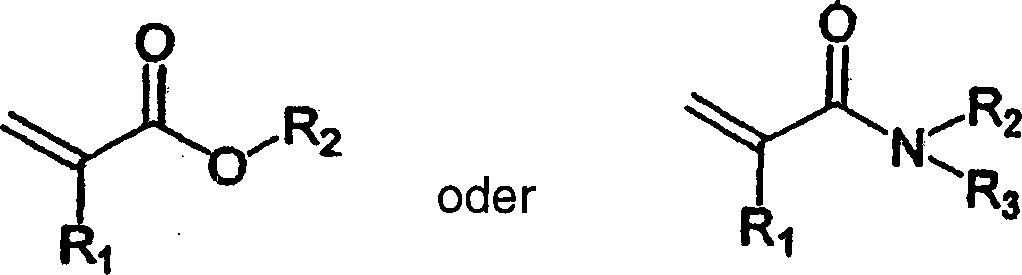

Applications Claiming Priority (4)
| Application Number | Priority Date | Filing Date | Title |
|---|---|---|---|
| US15186299P | 1999-09-01 | 1999-09-01 | |
| US151862P | 1999-09-01 | ||
| US652962 | 2000-08-31 | ||
| US09/652,962 US6994964B1 (en) | 1999-09-01 | 2000-08-31 | Macromolecular arrays on polymeric brushes and methods for preparing the same |
Publications (2)
| Publication Number | Publication Date |
|---|---|
| DE60024181D1 DE60024181D1 (en) | 2005-12-29 |
| DE60024181T2 true DE60024181T2 (en) | 2006-08-10 |
Family
ID=26849044
Family Applications (1)
| Application Number | Title | Priority Date | Filing Date |
|---|---|---|---|
| DE60024181T Expired - Lifetime DE60024181T2 (en) | 1999-09-01 | 2000-09-01 | Macromolecular arrays of polymer branches and processes for their preparation |
Country Status (6)
| Country | Link |
|---|---|
| US (2) | US6994964B1 (en) |
| EP (1) | EP1081163B1 (en) |
| JP (2) | JP3618285B2 (en) |
| AT (1) | ATE310751T1 (en) |
| CA (1) | CA2317179A1 (en) |
| DE (1) | DE60024181T2 (en) |
Families Citing this family (46)
| Publication number | Priority date | Publication date | Assignee | Title |
|---|---|---|---|---|
| ATE323113T1 (en) | 1999-07-02 | 2006-04-15 | Symyx Technologies Inc | POLYMER BRANCHES FOR IMMOBILIZING MOLECULES ON SURFACES OR SUBSTRATES, WHICH THE POLYMERS HAVE WATER-SOLUBLE OR WATER-DISPERSIBLE SEGMENTS AND PROBE |
| WO2002056021A2 (en) | 2001-01-10 | 2002-07-18 | Symyx Technologies Inc | Polymer brushes for immobilizing molecules to a surface |
| FR2826957B1 (en) * | 2001-07-09 | 2005-09-30 | Centre Nat Rech Scient | METHOD FOR FUNCTIONALIZING SOLID SUBSTRATES, FUNCTIONALIZED SOLID SUBSTRATES AND USES THEREOF |
| US6867295B2 (en) | 2001-09-07 | 2005-03-15 | Dionex Corporation | Ion exchange cryptands covalently bound to substrates |
| EP1336622B1 (en) * | 2002-02-19 | 2005-08-24 | Henkel Kommanditgesellschaft auf Aktien | Process for the gas phase radical polymerization |
| US20070275411A1 (en) * | 2006-05-25 | 2007-11-29 | Mcgall Glenn H | Silane mixtures |
| US6641899B1 (en) | 2002-11-05 | 2003-11-04 | International Business Machines Corporation | Nonlithographic method to produce masks by selective reaction, articles produced, and composition for same |
| DE10259460A1 (en) | 2002-12-19 | 2004-07-01 | Tesa Ag | Transparent acrylic PSA with a filler |
| KR100570952B1 (en) | 2003-02-25 | 2006-04-13 | 시즈오까 다이가꾸쵸가 다이효스루 니혼고꾸 | Method of Making Polymers |
| US20050042363A1 (en) * | 2003-08-18 | 2005-02-24 | Kukhtin Alexander V. | Method for fabrication of biochips with a macroporous polymer substrate |
| US7786213B2 (en) * | 2003-10-15 | 2010-08-31 | The Regents Of The University Of California | Biomacromolecule polymer conjugates |
| TWI294431B (en) | 2003-12-26 | 2008-03-11 | Kansai Paint Co Ltd | A polymer and method of manufacturing the same |
| JP4982748B2 (en) * | 2004-05-07 | 2012-07-25 | 国立大学法人京都大学 | Method for producing colloidal crystals from polymer grafted fine particles |
| FR2871162B1 (en) * | 2004-06-02 | 2007-06-29 | Univ Paris 7 Denis Diderot | MODIFIED SURFACE MATERIAL, PROCESS FOR PREPARING THE SAME AND USES THEREOF |
| JP4585523B2 (en) * | 2004-12-28 | 2010-11-24 | 独立行政法人科学技術振興機構 | Method for immobilizing self-organizing material or fine particles on substrate, and substrate manufactured using the method |
| GB0513910D0 (en) * | 2005-07-07 | 2005-08-10 | Univ Newcastle | Immobilisation of biological molecules |
| FR2891279B1 (en) * | 2005-09-27 | 2007-12-14 | Centre Nat Rech Scient | NEW CHIPS FOR SURFACE PLASMON DETECTION (SPR) |
| GB2433505A (en) * | 2005-12-20 | 2007-06-27 | Sharp Kk | Capture agents for binding a ligand |
| GB2433591A (en) * | 2005-12-20 | 2007-06-27 | Sharp Kk | Method for functionalising a hydrophobic substrate |
| GB2433506A (en) * | 2005-12-20 | 2007-06-27 | Sharp Kk | A method of producing a multimeric capture agent |
| US20070269818A1 (en) * | 2005-12-28 | 2007-11-22 | Affymetrix, Inc. | Carbohydrate arrays |
| EP2038074B1 (en) * | 2006-06-29 | 2014-06-11 | Xiaolian Gao | Make and use of surface molecules of varied densities |
| JP4805283B2 (en) * | 2007-03-22 | 2011-11-02 | 信越化学工業株式会社 | Manufacturing method of substrate for producing microarray |
| US20100247897A1 (en) * | 2007-09-07 | 2010-09-30 | Nicholas Leventis | Monolithic polymer crosslinked composite materials and methods of making |
| US8501319B2 (en) * | 2007-09-07 | 2013-08-06 | The Curators of the University of Missouri, University of Missouri System, Office of Technology and Special Projects | Pre-formed assemblies of solgel-derived nanoparticles as 3D scaffolds for composites and aerogels |
| JP5384923B2 (en) * | 2008-12-05 | 2014-01-08 | 国立大学法人九州大学 | Method for producing polymer-based nanocomposite and flame-retardant polymer-based nanocomposite formed by the method |
| JP5672892B2 (en) * | 2009-09-18 | 2015-02-18 | 学校法人東京理科大学 | Copolymer for immobilizing ligand and method for immobilizing ligand with the copolymer |
| US20110143966A1 (en) * | 2009-12-15 | 2011-06-16 | Affymetrix, Inc. | Surface Modifications and Methods for their Synthesis and Use |
| JP6212488B2 (en) | 2011-07-25 | 2017-10-11 | クヴェッラ コーポレーション | Methods and devices for electrical sample preparation |
| EP2797768A4 (en) * | 2011-12-29 | 2016-08-10 | Intel Corp | Control panels |
| WO2014058570A1 (en) | 2012-09-17 | 2014-04-17 | Alltech Associates, Inc. | Chromatography media and devices |
| MY195756A (en) | 2012-09-17 | 2023-02-09 | Grace W R & Co | Functionalized Particulate Support Material and Methods of Making and Using the Same |
| CN104937013B (en) * | 2012-11-19 | 2019-02-22 | 奥胡斯大学 | Joining of Polymers and Surface-Modified Solid Parts |
| JP6129624B2 (en) * | 2013-04-08 | 2017-05-17 | 東洋ゴム工業株式会社 | Reinforcing agent for rubber or plastic, method for producing the same, rubber composition and plastic composition |
| US9765169B2 (en) * | 2013-04-18 | 2017-09-19 | Carnegie Mellon University | Functionalized polymer hybrids |
| WO2015012804A2 (en) * | 2013-07-23 | 2015-01-29 | Empire Technology Development Llc | Photo-activated hydrophilic coatings and methods for their preparation and use |
| CN106460032B (en) | 2013-12-05 | 2019-12-24 | 生捷科技控股公司 | Preparation of patterned arrays |
| WO2015085268A1 (en) | 2013-12-05 | 2015-06-11 | Centrillion Technology Holdings Corporation | Modified surfaces |
| EP3077545B1 (en) | 2013-12-05 | 2020-09-16 | Centrillion Technology Holdings Corporation | Methods for sequencing nucleic acids |
| JP6853670B2 (en) | 2014-01-16 | 2021-04-07 | ダブリュー・アール・グレース・アンド・カンパニー−コーンW R Grace & Co−Conn | Affinity Chromatography Medium and Chromatography Devices |
| US11060139B2 (en) | 2014-03-28 | 2021-07-13 | Centrillion Technology Holdings Corporation | Methods for sequencing nucleic acids |
| US11389783B2 (en) | 2014-05-02 | 2022-07-19 | W.R. Grace & Co.-Conn. | Functionalized support material and methods of making and using functionalized support material |
| JP2018517559A (en) | 2015-06-05 | 2018-07-05 | ダブリュー・アール・グレース・アンド・カンパニー−コーンW R Grace & Co−Conn | Adsorbing bioprocess clarifier and method for producing and using the same |
| US12516145B2 (en) * | 2019-09-30 | 2026-01-06 | Northwestern University | Bioactive peptide brush polymers via photoinduced reversible-deactivation radical polymerization |
| CN111718660A (en) * | 2020-07-17 | 2020-09-29 | 武汉华星光电半导体显示技术有限公司 | Display module, preparation method thereof and method for improving adhesive force of optical transparent adhesive layer |
| CN113527642B (en) * | 2021-07-13 | 2022-04-12 | 华中科技大学 | Polyester-based brush polymer electrolyte and preparation and application thereof |
Family Cites Families (42)
| Publication number | Priority date | Publication date | Assignee | Title |
|---|---|---|---|---|
| KR930000892B1 (en) | 1983-07-11 | 1993-02-11 | 커몬웰스 사이언티픽 앤드 인더스트리얼 리셔치 오가니제이숀 | New polymerization process and polymers produced thereby |
| JPH0234479A (en) | 1988-07-22 | 1990-02-05 | Iseki & Co Ltd | Passenger control machine turning device |
| US5424186A (en) | 1989-06-07 | 1995-06-13 | Affymax Technologies N.V. | Very large scale immobilized polymer synthesis |
| US5143854A (en) | 1989-06-07 | 1992-09-01 | Affymax Technologies N.V. | Large scale photolithographic solid phase synthesis of polypeptides and receptor binding screening thereof |
| US5527681A (en) | 1989-06-07 | 1996-06-18 | Affymax Technologies N.V. | Immobilized molecular synthesis of systematically substituted compounds |
| US5744101A (en) | 1989-06-07 | 1998-04-28 | Affymax Technologies N.V. | Photolabile nucleoside protecting groups |
| US5242974A (en) | 1991-11-22 | 1993-09-07 | Affymax Technologies N.V. | Polymer reversal on solid surfaces |
| JPH0813364B2 (en) | 1989-09-13 | 1996-02-14 | 住友金属工業株式会社 | Method for hot rolling profile with flange |
| US5252743A (en) | 1989-11-13 | 1993-10-12 | Affymax Technologies N.V. | Spatially-addressable immobilization of anti-ligands on surfaces |
| US5324663A (en) | 1990-02-14 | 1994-06-28 | The Regents Of The University Of Michigan | Methods and products for the synthesis of oligosaccharide structures on glycoproteins, glycolipids, or as free molecules, and for the isolation of cloned genetic sequences that determine these structures |
| US5719262A (en) | 1993-11-22 | 1998-02-17 | Buchardt, Deceased; Ole | Peptide nucleic acids having amino acid side chains |
| US5539082A (en) | 1993-04-26 | 1996-07-23 | Nielsen; Peter E. | Peptide nucleic acids |
| DK51092D0 (en) | 1991-05-24 | 1992-04-15 | Ole Buchardt | OLIGONUCLEOTIDE ANALOGUE DESCRIBED BY PEN, MONOMERIC SYNTHONES AND PROCEDURES FOR PREPARING THEREOF, AND APPLICATIONS THEREOF |
| US5639603A (en) | 1991-09-18 | 1997-06-17 | Affymax Technologies N.V. | Synthesizing and screening molecular diversity |
| US5412087A (en) | 1992-04-24 | 1995-05-02 | Affymax Technologies N.V. | Spatially-addressable immobilization of oligonucleotides and other biological polymers on surfaces |
| EP0916396B1 (en) | 1991-11-22 | 2005-04-13 | Affymetrix, Inc. (a Delaware Corporation) | Combinatorial strategies for polymer synthesis |
| US5550215A (en) | 1991-11-22 | 1996-08-27 | Holmes; Christopher P. | Polymer reversal on solid surfaces |
| US5384261A (en) | 1991-11-22 | 1995-01-24 | Affymax Technologies N.V. | Very large scale immobilized polymer synthesis using mechanically directed flow paths |
| US5288514A (en) | 1992-09-14 | 1994-02-22 | The Regents Of The University Of California | Solid phase and combinatorial synthesis of benzodiazepine compounds on a solid support |
| US5491074A (en) | 1993-04-01 | 1996-02-13 | Affymax Technologies Nv | Association peptides |
| US5312871A (en) * | 1993-07-27 | 1994-05-17 | Carnegie Mellon University | Free radical polymerization process |
| US5512131A (en) * | 1993-10-04 | 1996-04-30 | President And Fellows Of Harvard College | Formation of microstamped patterns on surfaces and derivative articles |
| US5631734A (en) | 1994-02-10 | 1997-05-20 | Affymetrix, Inc. | Method and apparatus for detection of fluorescently labeled materials |
| US5571639A (en) | 1994-05-24 | 1996-11-05 | Affymax Technologies N.V. | Computer-aided engineering system for design of sequence arrays and lithographic masks |
| US5556752A (en) | 1994-10-24 | 1996-09-17 | Affymetrix, Inc. | Surface-bound, unimolecular, double-stranded DNA |
| US5599695A (en) | 1995-02-27 | 1997-02-04 | Affymetrix, Inc. | Printing molecular library arrays using deprotection agents solely in the vapor phase |
| US5708102A (en) | 1995-03-03 | 1998-01-13 | E. I. Du Pont De Nemours And Company | Living radical polymerization of vinyl monomers |
| US5624711A (en) | 1995-04-27 | 1997-04-29 | Affymax Technologies, N.V. | Derivatization of solid supports and methods for oligomer synthesis |
| US5843655A (en) | 1995-09-18 | 1998-12-01 | Affymetrix, Inc. | Methods for testing oligonucleotide arrays |
| US5627248A (en) | 1995-09-26 | 1997-05-06 | The Dow Chemical Company | Difunctional living free radical polymerization initiators |
| US5807937A (en) | 1995-11-15 | 1998-09-15 | Carnegie Mellon University | Processes based on atom (or group) transfer radical polymerization and novel (co) polymers having useful structures and properties |
| US6022963A (en) | 1995-12-15 | 2000-02-08 | Affymetrix, Inc. | Synthesis of oligonucleotide arrays using photocleavable protecting groups |
| US5728747A (en) | 1996-08-08 | 1998-03-17 | Xerox Corporation | Stable free radical polymerization processes and compositions thereof |
| JP3918028B2 (en) | 1996-10-14 | 2007-05-23 | フジコピアン株式会社 | Thermal transfer recording medium |
| CN1128164C (en) | 1996-11-28 | 2003-11-19 | 钟渊化学工业株式会社 | Method for producing hydroxyl-terminated (meth) acrylic polymer |
| US6391655B1 (en) | 1997-07-30 | 2002-05-21 | Corning Incorporated | Oxidized styrenic polymers for DNA binding |
| JP3422463B2 (en) | 1998-03-16 | 2003-06-30 | 科学技術振興事業団 | Graft surface solid and method for producing the same |
| TW473488B (en) | 1998-04-30 | 2002-01-21 | Novartis Ag | Composite materials, biomedical articles formed thereof and process for their manufacture |
| CA2360027A1 (en) | 1999-01-25 | 2000-07-27 | Biochip Technologies Gmbh | Immobilization of molecules on surfaces via polymer brushes |
| US6413587B1 (en) * | 1999-03-02 | 2002-07-02 | International Business Machines Corporation | Method for forming polymer brush pattern on a substrate surface |
| AU4207600A (en) | 1999-04-08 | 2000-11-14 | Affymetrix, Inc. | Porous silica substrates for polymers synthesis and assays |
| ATE323113T1 (en) * | 1999-07-02 | 2006-04-15 | Symyx Technologies Inc | POLYMER BRANCHES FOR IMMOBILIZING MOLECULES ON SURFACES OR SUBSTRATES, WHICH THE POLYMERS HAVE WATER-SOLUBLE OR WATER-DISPERSIBLE SEGMENTS AND PROBE |
-
2000
- 2000-08-31 US US09/652,962 patent/US6994964B1/en not_active Expired - Lifetime
- 2000-08-31 CA CA002317179A patent/CA2317179A1/en not_active Abandoned
- 2000-09-01 JP JP2000266267A patent/JP3618285B2/en not_active Expired - Lifetime
- 2000-09-01 EP EP00307541A patent/EP1081163B1/en not_active Expired - Lifetime
- 2000-09-01 DE DE60024181T patent/DE60024181T2/en not_active Expired - Lifetime
- 2000-09-01 AT AT00307541T patent/ATE310751T1/en not_active IP Right Cessation
-
2004
- 2004-06-02 JP JP2004165163A patent/JP2004323859A/en active Pending
-
2005
- 2005-11-30 US US11/289,897 patent/US20060134672A1/en not_active Abandoned
Also Published As
| Publication number | Publication date |
|---|---|
| JP2001131208A (en) | 2001-05-15 |
| EP1081163A1 (en) | 2001-03-07 |
| US6994964B1 (en) | 2006-02-07 |
| DE60024181D1 (en) | 2005-12-29 |
| EP1081163B1 (en) | 2005-11-23 |
| JP3618285B2 (en) | 2005-02-09 |
| ATE310751T1 (en) | 2005-12-15 |
| CA2317179A1 (en) | 2001-03-01 |
| US20060134672A1 (en) | 2006-06-22 |
| JP2004323859A (en) | 2004-11-18 |
Similar Documents
| Publication | Publication Date | Title |
|---|---|---|
| DE60024181T2 (en) | Macromolecular arrays of polymer branches and processes for their preparation | |
| CA2500783C (en) | Microarrays having multiple oligonucleotides in single array features | |
| DE69635744T2 (en) | Modified nucleic acid probes | |
| US8288155B2 (en) | Biomolecular attachment sites on microelectronic arrays and methods thereof | |
| DE60222628T2 (en) | PREPARATION OF MATRICES FROM POLYNUCLEOTIDES | |
| CN1286691A (en) | Oligonucleotide synthesis using high boiling point solvents | |
| EP1135527B1 (en) | Cloning and copying on surfaces | |
| JP7581206B2 (en) | Flow Cell | |
| US20260028620A1 (en) | Kit, system, and flow cell | |
| EP4244377B1 (en) | Functionalized plasmonic nanostructures | |
| US7718438B2 (en) | Method for producing a microarray | |
| US20250115900A1 (en) | Biotin-streptavidin cleavage composition and library fragment cleavage | |
| DE60033648T2 (en) | Surface-mounted polyfunctional polymer networks for sensor chips | |
| WO2021154648A2 (en) | Kit, system, and flow cell | |
| US20250361557A1 (en) | Immobilization in flow cells | |
| DE69328693T2 (en) | BIOPOLYMERSYNTHESIS BY SURFACE-ACTIVATED ORGANIC POLYMERS | |
| US6184347B1 (en) | Minimization of blooming in high-density arrays by using reactive wash reagents | |
| US20250382660A1 (en) | Enrichment methods and kits | |
| WO2025072677A1 (en) | Tagmentation methods and kits | |
| CN111108200A (en) | Flow Cell with Reactive Surface for Nucleic Acid Sequence Analysis | |
| KR20040055441A (en) | Nucleic acid microarray and manufacturing method thereof | |
| DE60118901T2 (en) | Immobilization of Oligonucleotides by Covalent Bonding | |
| Seidel | Methods for the development of a DNA based nanoelectronics | |
| HK40058905B (en) | Immobilization in flow cells | |
| HK40058905A (en) | Immobilization in flow cells |
Legal Events
| Date | Code | Title | Description |
|---|---|---|---|
| 8364 | No opposition during term of opposition |