DE60019167T2 - PHARMACEUTICAL AEROSOL FORMULATION CONTAINING SALMETEROL AND FLUTICASONE - Google Patents
PHARMACEUTICAL AEROSOL FORMULATION CONTAINING SALMETEROL AND FLUTICASONE Download PDFInfo
- Publication number
- DE60019167T2 DE60019167T2 DE60019167T DE60019167T DE60019167T2 DE 60019167 T2 DE60019167 T2 DE 60019167T2 DE 60019167 T DE60019167 T DE 60019167T DE 60019167 T DE60019167 T DE 60019167T DE 60019167 T2 DE60019167 T2 DE 60019167T2
- Authority
- DE
- Germany
- Prior art keywords
- salmeterol
- formulation according
- concentration
- formulation
- fluticasone propionate
- Prior art date
- Legal status (The legal status is an assumption and is not a legal conclusion. Google has not performed a legal analysis and makes no representation as to the accuracy of the status listed.)
- Expired - Lifetime
Links
- 239000000203 mixture Substances 0.000 title claims abstract description 124
- 238000009472 formulation Methods 0.000 title claims abstract description 113
- 239000008249 pharmaceutical aerosol Substances 0.000 title claims abstract description 8
- 229940021597 salmeterol and fluticasone Drugs 0.000 title description 9
- GIIZNNXWQWCKIB-UHFFFAOYSA-N Serevent Chemical compound C1=C(O)C(CO)=CC(C(O)CNCCCCCCOCCCCC=2C=CC=CC=2)=C1 GIIZNNXWQWCKIB-UHFFFAOYSA-N 0.000 claims abstract description 100
- 229960004017 salmeterol Drugs 0.000 claims abstract description 98
- WMWTYOKRWGGJOA-CENSZEJFSA-N fluticasone propionate Chemical compound C1([C@@H](F)C2)=CC(=O)C=C[C@]1(C)[C@]1(F)[C@@H]2[C@@H]2C[C@@H](C)[C@@](C(=O)SCF)(OC(=O)CC)[C@@]2(C)C[C@@H]1O WMWTYOKRWGGJOA-CENSZEJFSA-N 0.000 claims abstract description 77
- 229960000289 fluticasone propionate Drugs 0.000 claims abstract description 70
- 239000003380 propellant Substances 0.000 claims abstract description 35
- 150000003839 salts Chemical class 0.000 claims abstract description 15
- 150000005828 hydrofluoroalkanes Chemical class 0.000 claims abstract description 14
- LFQSCWFLJHTTHZ-UHFFFAOYSA-N Ethanol Chemical compound CCO LFQSCWFLJHTTHZ-UHFFFAOYSA-N 0.000 claims description 108
- PEDCQBHIVMGVHV-UHFFFAOYSA-N Glycerine Chemical compound OCC(O)CO PEDCQBHIVMGVHV-UHFFFAOYSA-N 0.000 claims description 45
- 239000002245 particle Substances 0.000 claims description 28
- LVGUZGTVOIAKKC-UHFFFAOYSA-N 1,1,1,2-tetrafluoroethane Chemical group FCC(F)(F)F LVGUZGTVOIAKKC-UHFFFAOYSA-N 0.000 claims description 26
- 239000002585 base Substances 0.000 claims description 24
- 239000000443 aerosol Substances 0.000 claims description 22
- 229950000339 xinafoate Drugs 0.000 claims description 22
- 239000003814 drug Substances 0.000 claims description 18
- 229960005018 salmeterol xinafoate Drugs 0.000 claims description 17
- YFMFNYKEUDLDTL-UHFFFAOYSA-N 1,1,1,2,3,3,3-heptafluoropropane Chemical group FC(F)(F)C(F)C(F)(F)F YFMFNYKEUDLDTL-UHFFFAOYSA-N 0.000 claims description 14
- 239000002904 solvent Substances 0.000 claims description 13
- 239000012458 free base Substances 0.000 claims description 12
- 238000004519 manufacturing process Methods 0.000 claims description 11
- 239000004604 Blowing Agent Substances 0.000 claims description 9
- 239000002202 Polyethylene glycol Substances 0.000 claims description 9
- 229920001223 polyethylene glycol Polymers 0.000 claims description 9
- 208000006545 Chronic Obstructive Pulmonary Disease Diseases 0.000 claims description 7
- 238000011282 treatment Methods 0.000 claims description 7
- 229920000604 Polyethylene Glycol 200 Polymers 0.000 claims description 6
- 229920002565 Polyethylene Glycol 400 Polymers 0.000 claims description 6
- JLFNLZLINWHATN-UHFFFAOYSA-N pentaethylene glycol Chemical compound OCCOCCOCCOCCOCCO JLFNLZLINWHATN-UHFFFAOYSA-N 0.000 claims description 6
- 208000006673 asthma Diseases 0.000 claims description 5
- 208000023504 respiratory system disease Diseases 0.000 claims description 4
- 239000000126 substance Substances 0.000 claims description 4
- 230000005465 channeling Effects 0.000 claims description 3
- 150000001875 compounds Chemical class 0.000 claims description 3
- 229940071648 metered dose inhaler Drugs 0.000 claims description 3
- 230000015556 catabolic process Effects 0.000 claims description 2
- 238000006731 degradation reaction Methods 0.000 claims 1
- 230000000977 initiatory effect Effects 0.000 claims 1
- 235000011187 glycerol Nutrition 0.000 description 13
- 229940079593 drug Drugs 0.000 description 12
- 229910052782 aluminium Inorganic materials 0.000 description 9
- XAGFODPZIPBFFR-UHFFFAOYSA-N aluminium Chemical compound [Al] XAGFODPZIPBFFR-UHFFFAOYSA-N 0.000 description 9
- 239000013543 active substance Substances 0.000 description 8
- -1 1-oxopropoxy Chemical group 0.000 description 6
- OKKJLVBELUTLKV-UHFFFAOYSA-N Methanol Chemical compound OC OKKJLVBELUTLKV-UHFFFAOYSA-N 0.000 description 6
- 238000004458 analytical method Methods 0.000 description 6
- 230000008021 deposition Effects 0.000 description 6
- 230000000694 effects Effects 0.000 description 6
- 210000004072 lung Anatomy 0.000 description 6
- 239000000463 material Substances 0.000 description 6
- 239000007921 spray Substances 0.000 description 6
- XLYOFNOQVPJJNP-UHFFFAOYSA-N water Substances O XLYOFNOQVPJJNP-UHFFFAOYSA-N 0.000 description 6
- 238000002144 chemical decomposition reaction Methods 0.000 description 5
- 239000010419 fine particle Substances 0.000 description 5
- 238000000034 method Methods 0.000 description 5
- 239000000725 suspension Substances 0.000 description 5
- 238000009792 diffusion process Methods 0.000 description 4
- 239000000546 pharmaceutical excipient Substances 0.000 description 4
- 238000004062 sedimentation Methods 0.000 description 4
- 238000001016 Ostwald ripening Methods 0.000 description 3
- KWYUFKZDYYNOTN-UHFFFAOYSA-M Potassium hydroxide Chemical compound [OH-].[K+] KWYUFKZDYYNOTN-UHFFFAOYSA-M 0.000 description 3
- DNIAPMSPPWPWGF-UHFFFAOYSA-N Propylene glycol Chemical compound CC(O)CO DNIAPMSPPWPWGF-UHFFFAOYSA-N 0.000 description 3
- 239000004480 active ingredient Substances 0.000 description 3
- 239000003795 chemical substances by application Substances 0.000 description 3
- 239000000460 chlorine Substances 0.000 description 3
- 238000009826 distribution Methods 0.000 description 3
- 229920001971 elastomer Polymers 0.000 description 3
- 230000005484 gravity Effects 0.000 description 3
- 208000027866 inflammatory disease Diseases 0.000 description 3
- 230000008018 melting Effects 0.000 description 3
- 238000002844 melting Methods 0.000 description 3
- 210000000214 mouth Anatomy 0.000 description 3
- 150000002978 peroxides Chemical class 0.000 description 3
- 239000008194 pharmaceutical composition Substances 0.000 description 3
- 239000004033 plastic Substances 0.000 description 3
- 229920003023 plastic Polymers 0.000 description 3
- 229920001707 polybutylene terephthalate Polymers 0.000 description 3
- 239000005060 rubber Substances 0.000 description 3
- 238000000926 separation method Methods 0.000 description 3
- 150000003431 steroids Chemical class 0.000 description 3
- 230000009885 systemic effect Effects 0.000 description 3
- 230000001225 therapeutic effect Effects 0.000 description 3
- 229920002725 thermoplastic elastomer Polymers 0.000 description 3
- HBAQYPYDRFILMT-UHFFFAOYSA-N 8-[3-(1-cyclopropylpyrazol-4-yl)-1H-pyrazolo[4,3-d]pyrimidin-5-yl]-3-methyl-3,8-diazabicyclo[3.2.1]octan-2-one Chemical class C1(CC1)N1N=CC(=C1)C1=NNC2=C1N=C(N=C2)N1C2C(N(CC1CC2)C)=O HBAQYPYDRFILMT-UHFFFAOYSA-N 0.000 description 2
- RTZKZFJDLAIYFH-UHFFFAOYSA-N Diethyl ether Chemical compound CCOCC RTZKZFJDLAIYFH-UHFFFAOYSA-N 0.000 description 2
- 229920002943 EPDM rubber Polymers 0.000 description 2
- KFZMGEQAYNKOFK-UHFFFAOYSA-N Isopropanol Chemical compound CC(C)O KFZMGEQAYNKOFK-UHFFFAOYSA-N 0.000 description 2
- CBENFWSGALASAD-UHFFFAOYSA-N Ozone Chemical compound [O-][O+]=O CBENFWSGALASAD-UHFFFAOYSA-N 0.000 description 2
- CDBYLPFSWZWCQE-UHFFFAOYSA-L Sodium Carbonate Chemical compound [Na+].[Na+].[O-]C([O-])=O CDBYLPFSWZWCQE-UHFFFAOYSA-L 0.000 description 2
- 239000002253 acid Substances 0.000 description 2
- 229940124748 beta 2 agonist Drugs 0.000 description 2
- 230000005540 biological transmission Effects 0.000 description 2
- 229940124630 bronchodilator Drugs 0.000 description 2
- 239000000168 bronchodilator agent Substances 0.000 description 2
- 238000006471 dimerization reaction Methods 0.000 description 2
- 238000011049 filling Methods 0.000 description 2
- 230000007246 mechanism Effects 0.000 description 2
- 229910052751 metal Inorganic materials 0.000 description 2
- 239000002184 metal Substances 0.000 description 2
- 229920001343 polytetrafluoroethylene Polymers 0.000 description 2
- 239000004810 polytetrafluoroethylene Substances 0.000 description 2
- 210000002345 respiratory system Anatomy 0.000 description 2
- HEMHJVSKTPXQMS-UHFFFAOYSA-M sodium hydroxide Inorganic materials [OH-].[Na+] HEMHJVSKTPXQMS-UHFFFAOYSA-M 0.000 description 2
- 239000007787 solid Substances 0.000 description 2
- DDMOUSALMHHKOS-UHFFFAOYSA-N 1,2-dichloro-1,1,2,2-tetrafluoroethane Chemical compound FC(F)(Cl)C(F)(F)Cl DDMOUSALMHHKOS-UHFFFAOYSA-N 0.000 description 1
- WEVYAHXRMPXWCK-UHFFFAOYSA-N Acetonitrile Chemical compound CC#N WEVYAHXRMPXWCK-UHFFFAOYSA-N 0.000 description 1
- 208000000884 Airway Obstruction Diseases 0.000 description 1
- USFZMSVCRYTOJT-UHFFFAOYSA-N Ammonium acetate Chemical compound N.CC(O)=O USFZMSVCRYTOJT-UHFFFAOYSA-N 0.000 description 1
- 239000005695 Ammonium acetate Substances 0.000 description 1
- 230000005653 Brownian motion process Effects 0.000 description 1
- 241000222122 Candida albicans Species 0.000 description 1
- 206010007134 Candida infections Diseases 0.000 description 1
- ZAMOUSCENKQFHK-UHFFFAOYSA-N Chlorine atom Chemical compound [Cl] ZAMOUSCENKQFHK-UHFFFAOYSA-N 0.000 description 1
- 239000004812 Fluorinated ethylene propylene Substances 0.000 description 1
- YCKRFDGAMUMZLT-UHFFFAOYSA-N Fluorine atom Chemical compound [F] YCKRFDGAMUMZLT-UHFFFAOYSA-N 0.000 description 1
- 230000005526 G1 to G0 transition Effects 0.000 description 1
- DGAQECJNVWCQMB-PUAWFVPOSA-M Ilexoside XXIX Chemical compound C[C@@H]1CC[C@@]2(CC[C@@]3(C(=CC[C@H]4[C@]3(CC[C@@H]5[C@@]4(CC[C@@H](C5(C)C)OS(=O)(=O)[O-])C)C)[C@@H]2[C@]1(C)O)C)C(=O)O[C@H]6[C@@H]([C@H]([C@@H]([C@H](O6)CO)O)O)O.[Na+] DGAQECJNVWCQMB-PUAWFVPOSA-M 0.000 description 1
- 229920000459 Nitrile rubber Polymers 0.000 description 1
- 229920012266 Poly(ether sulfone) PES Polymers 0.000 description 1
- QAOWNCQODCNURD-UHFFFAOYSA-L Sulfate Chemical compound [O-]S([O-])(=O)=O QAOWNCQODCNURD-UHFFFAOYSA-L 0.000 description 1
- YYAZJTUGSQOFHG-IAVNQIGZSA-N [(6s,8s,10s,11s,13s,14s,16r,17r)-6,9-difluoro-17-(fluoromethylsulfanylcarbonyl)-11-hydroxy-10,13,16-trimethyl-3-oxo-6,7,8,11,12,14,15,16-octahydrocyclopenta[a]phenanthren-17-yl] propanoate;2-(hydroxymethyl)-4-[1-hydroxy-2-[6-(4-phenylbutoxy)hexylamino]eth Chemical compound C1=C(O)C(CO)=CC(C(O)CNCCCCCCOCCCCC=2C=CC=CC=2)=C1.C1([C@@H](F)C2)=CC(=O)C=C[C@]1(C)C1(F)[C@@H]2[C@@H]2C[C@@H](C)[C@@](C(=O)SCF)(OC(=O)CC)[C@@]2(C)C[C@@H]1O YYAZJTUGSQOFHG-IAVNQIGZSA-N 0.000 description 1
- UOKUTYNLQFNOEV-UHFFFAOYSA-N [5-(hydroxymethyl)-5-[[6-(4-phenylbutoxy)hexylamino]methyl]cyclohexa-1,3-dien-1-yl]methanol Chemical compound C1C(CO)=CC=CC1(CO)CNCCCCCCOCCCCC1=CC=CC=C1 UOKUTYNLQFNOEV-UHFFFAOYSA-N 0.000 description 1
- 238000010521 absorption reaction Methods 0.000 description 1
- 150000001241 acetals Chemical class 0.000 description 1
- 230000001154 acute effect Effects 0.000 description 1
- 150000001412 amines Chemical class 0.000 description 1
- 229940043376 ammonium acetate Drugs 0.000 description 1
- 235000019257 ammonium acetate Nutrition 0.000 description 1
- 230000001078 anti-cholinergic effect Effects 0.000 description 1
- 239000002260 anti-inflammatory agent Substances 0.000 description 1
- 239000000043 antiallergic agent Substances 0.000 description 1
- 229940065524 anticholinergics inhalants for obstructive airway diseases Drugs 0.000 description 1
- 239000003963 antioxidant agent Substances 0.000 description 1
- 230000003078 antioxidant effect Effects 0.000 description 1
- 230000008468 bone growth Effects 0.000 description 1
- 230000004097 bone metabolism Effects 0.000 description 1
- 238000005537 brownian motion Methods 0.000 description 1
- NTXGQCSETZTARF-UHFFFAOYSA-N buta-1,3-diene;prop-2-enenitrile Chemical compound C=CC=C.C=CC#N NTXGQCSETZTARF-UHFFFAOYSA-N 0.000 description 1
- 229920005549 butyl rubber Polymers 0.000 description 1
- 201000003984 candidiasis Diseases 0.000 description 1
- 238000006243 chemical reaction Methods 0.000 description 1
- 210000000038 chest Anatomy 0.000 description 1
- 229910052801 chlorine Inorganic materials 0.000 description 1
- 229920005556 chlorobutyl Polymers 0.000 description 1
- 239000000812 cholinergic antagonist Substances 0.000 description 1
- 230000001684 chronic effect Effects 0.000 description 1
- 238000011260 co-administration Methods 0.000 description 1
- 229920001688 coating polymer Polymers 0.000 description 1
- 238000011109 contamination Methods 0.000 description 1
- 229920001577 copolymer Polymers 0.000 description 1
- 239000003246 corticosteroid Substances 0.000 description 1
- 229960001334 corticosteroids Drugs 0.000 description 1
- 239000013078 crystal Substances 0.000 description 1
- 238000002425 crystallisation Methods 0.000 description 1
- 230000008025 crystallization Effects 0.000 description 1
- 230000007423 decrease Effects 0.000 description 1
- 239000002274 desiccant Substances 0.000 description 1
- 230000001066 destructive effect Effects 0.000 description 1
- PXBRQCKWGAHEHS-UHFFFAOYSA-N dichlorodifluoromethane Chemical compound FC(F)(Cl)Cl PXBRQCKWGAHEHS-UHFFFAOYSA-N 0.000 description 1
- 235000019404 dichlorodifluoromethane Nutrition 0.000 description 1
- 238000006073 displacement reaction Methods 0.000 description 1
- 238000001647 drug administration Methods 0.000 description 1
- 239000013536 elastomeric material Substances 0.000 description 1
- HQQADJVZYDDRJT-UHFFFAOYSA-N ethene;prop-1-ene Chemical group C=C.CC=C HQQADJVZYDDRJT-UHFFFAOYSA-N 0.000 description 1
- 238000001704 evaporation Methods 0.000 description 1
- 230000008020 evaporation Effects 0.000 description 1
- 230000007717 exclusion Effects 0.000 description 1
- 238000000605 extraction Methods 0.000 description 1
- 238000010304 firing Methods 0.000 description 1
- 239000012530 fluid Substances 0.000 description 1
- 229910052731 fluorine Inorganic materials 0.000 description 1
- 239000011737 fluorine Substances 0.000 description 1
- 239000011521 glass Substances 0.000 description 1
- 230000012010 growth Effects 0.000 description 1
- 238000004128 high performance liquid chromatography Methods 0.000 description 1
- 238000002664 inhalation therapy Methods 0.000 description 1
- 230000003993 interaction Effects 0.000 description 1
- 239000004922 lacquer Substances 0.000 description 1
- 229920001684 low density polyethylene Polymers 0.000 description 1
- 239000004702 low-density polyethylene Substances 0.000 description 1
- 238000005259 measurement Methods 0.000 description 1
- 210000003928 nasal cavity Anatomy 0.000 description 1
- 210000001331 nose Anatomy 0.000 description 1
- 230000003647 oxidation Effects 0.000 description 1
- 238000007254 oxidation reaction Methods 0.000 description 1
- 230000035515 penetration Effects 0.000 description 1
- 229920009441 perflouroethylene propylene Polymers 0.000 description 1
- 239000000825 pharmaceutical preparation Substances 0.000 description 1
- 229940127557 pharmaceutical product Drugs 0.000 description 1
- 229920001084 poly(chloroprene) Polymers 0.000 description 1
- 229920000728 polyester Polymers 0.000 description 1
- 229920000642 polymer Polymers 0.000 description 1
- 238000001556 precipitation Methods 0.000 description 1
- 238000002360 preparation method Methods 0.000 description 1
- 238000011321 prophylaxis Methods 0.000 description 1
- 238000001953 recrystallisation Methods 0.000 description 1
- QEVHRUUCFGRFIF-MDEJGZGSSA-N reserpine Chemical compound O([C@H]1[C@@H]([C@H]([C@H]2C[C@@H]3C4=C(C5=CC=C(OC)C=C5N4)CCN3C[C@H]2C1)C(=O)OC)OC)C(=O)C1=CC(OC)=C(OC)C(OC)=C1 QEVHRUUCFGRFIF-MDEJGZGSSA-N 0.000 description 1
- 230000002441 reversible effect Effects 0.000 description 1
- 229910000029 sodium carbonate Inorganic materials 0.000 description 1
- 238000000935 solvent evaporation Methods 0.000 description 1
- 238000003860 storage Methods 0.000 description 1
- 150000003467 sulfuric acid derivatives Chemical class 0.000 description 1
- 229910021653 sulphate ion Inorganic materials 0.000 description 1
- 239000004094 surface-active agent Substances 0.000 description 1
- 208000024891 symptom Diseases 0.000 description 1
- 238000002560 therapeutic procedure Methods 0.000 description 1
- CYRMSUTZVYGINF-UHFFFAOYSA-N trichlorofluoromethane Chemical compound FC(Cl)(Cl)Cl CYRMSUTZVYGINF-UHFFFAOYSA-N 0.000 description 1
- 230000001960 triggered effect Effects 0.000 description 1
Classifications
-
- A—HUMAN NECESSITIES
- A61—MEDICAL OR VETERINARY SCIENCE; HYGIENE
- A61K—PREPARATIONS FOR MEDICAL, DENTAL OR TOILETRY PURPOSES
- A61K9/00—Medicinal preparations characterised by special physical form
- A61K9/0012—Galenical forms characterised by the site of application
- A61K9/007—Pulmonary tract; Aromatherapy
- A61K9/0073—Sprays or powders for inhalation; Aerolised or nebulised preparations generated by other means than thermal energy
- A61K9/008—Sprays or powders for inhalation; Aerolised or nebulised preparations generated by other means than thermal energy comprising drug dissolved or suspended in liquid propellant for inhalation via a pressurized metered dose inhaler [MDI]
-
- A—HUMAN NECESSITIES
- A61—MEDICAL OR VETERINARY SCIENCE; HYGIENE
- A61K—PREPARATIONS FOR MEDICAL, DENTAL OR TOILETRY PURPOSES
- A61K31/00—Medicinal preparations containing organic active ingredients
- A61K31/56—Compounds containing cyclopenta[a]hydrophenanthrene ring systems; Derivatives thereof, e.g. steroids
- A61K31/57—Compounds containing cyclopenta[a]hydrophenanthrene ring systems; Derivatives thereof, e.g. steroids substituted in position 17 beta by a chain of two carbon atoms, e.g. pregnane or progesterone
-
- A—HUMAN NECESSITIES
- A61—MEDICAL OR VETERINARY SCIENCE; HYGIENE
- A61K—PREPARATIONS FOR MEDICAL, DENTAL OR TOILETRY PURPOSES
- A61K47/00—Medicinal preparations characterised by the non-active ingredients used, e.g. carriers or inert additives; Targeting or modifying agents chemically bound to the active ingredient
- A61K47/06—Organic compounds, e.g. natural or synthetic hydrocarbons, polyolefins, mineral oil, petrolatum or ozokerite
- A61K47/08—Organic compounds, e.g. natural or synthetic hydrocarbons, polyolefins, mineral oil, petrolatum or ozokerite containing oxygen, e.g. ethers, acetals, ketones, quinones, aldehydes, peroxides
- A61K47/10—Alcohols; Phenols; Salts thereof, e.g. glycerol; Polyethylene glycols [PEG]; Poloxamers; PEG/POE alkyl ethers
-
- A—HUMAN NECESSITIES
- A61—MEDICAL OR VETERINARY SCIENCE; HYGIENE
- A61P—SPECIFIC THERAPEUTIC ACTIVITY OF CHEMICAL COMPOUNDS OR MEDICINAL PREPARATIONS
- A61P11/00—Drugs for disorders of the respiratory system
-
- A—HUMAN NECESSITIES
- A61—MEDICAL OR VETERINARY SCIENCE; HYGIENE
- A61P—SPECIFIC THERAPEUTIC ACTIVITY OF CHEMICAL COMPOUNDS OR MEDICINAL PREPARATIONS
- A61P11/00—Drugs for disorders of the respiratory system
- A61P11/06—Antiasthmatics
Landscapes
- Health & Medical Sciences (AREA)
- Chemical & Material Sciences (AREA)
- Engineering & Computer Science (AREA)
- Medicinal Chemistry (AREA)
- Pharmacology & Pharmacy (AREA)
- Life Sciences & Earth Sciences (AREA)
- Animal Behavior & Ethology (AREA)
- General Health & Medical Sciences (AREA)
- Public Health (AREA)
- Veterinary Medicine (AREA)
- Bioinformatics & Cheminformatics (AREA)
- Epidemiology (AREA)
- Pulmonology (AREA)
- Chemical Kinetics & Catalysis (AREA)
- General Chemical & Material Sciences (AREA)
- Otolaryngology (AREA)
- Oil, Petroleum & Natural Gas (AREA)
- Nuclear Medicine, Radiotherapy & Molecular Imaging (AREA)
- Organic Chemistry (AREA)
- Medicinal Preparation (AREA)
- Pharmaceuticals Containing Other Organic And Inorganic Compounds (AREA)
- Acyclic And Carbocyclic Compounds In Medicinal Compositions (AREA)
Abstract
Description
Hintergrund der ErfindungBackground of the invention
Gebiet der ErfindungField of the invention
Die vorliegende Erfindung betrifft pharmazeutische Formulierungen zur Verwendung in der Verabreichung von Medikamenten durch Inhalation. Insbesondere betrifft diese Erfindung pharmazeutische Formulierungen von Fluticasonpropionat und Salmeterol oder einem pharmazeutisch akzeptablen Salz davon (wie das Xinafoat) zur Verwendung in Druckdosierinhalatoren ("pressurised metered dose inhalers", MDIs). Die Erfindung betrifft ebenfalls Verfahren zu ihrer Herstellung und ihre Verwendung in der Therapie.The The present invention relates to pharmaceutical formulations for Use in the administration of medicaments by inhalation. In particular, this invention relates to pharmaceutical formulations of fluticasone propionate and salmeterol or a pharmaceutical acceptable salt thereof (such as xinafoate) for use in pressure-dose inhalers ("pressurized metered can inhaler ", MDI's). The invention also relates to processes for their preparation and their use in therapy.
Beschreibung des Standes der TechnikDescription of the state of the technique
Inhalatoren sind allgemein bekannte Vorrichtungen zur Verabreichung von pharmazeutisch aktiven Stoffen in die Atemwege durch Inhalation. Solche aktiven Stoffe, die üblicherweise durch Inhalation übertragen werden, schließen Bronchodilatatoren, wie β2-Agonisten und Anticholinergika, Kortikosteroide, Antiallergika und andere Stoffe ein, die effizient durch Inhalation verabreicht werden können, wodurch die therapeutische Breite vergrößert und Nebenwirkungen des aktiven Stoffes reduziert werden.inhalers are generally known devices for the administration of pharmaceutical active substances in the respiratory tract by inhalation. Such active Substances that are usually be transmitted by inhalation, shut down Bronchodilators, such as β2 agonists and anticholinergics, corticosteroids, antiallergic drugs and others Substances that can be administered efficiently by inhalation, thereby the therapeutic width increases and Side effects of the active substance are reduced.
4-Hydroxy-α1-[[[6-(4-phenylbutoxy)hexyl]amino]methyl]-1,3-benzoldimethanol wurde als einer einer weiten Reihe von Bronchodilatatoren in GB-A-2 140 800 beschrieben. Diese Verbindung ist ebenfalls unter dem generischen Namen Salmeterol bekannt, dessen Xinafoatsalz weithin als hochwirksame Behandlung von inflammatorischen Krankheiten, wie Asthma und chronisch-obstruktive Lungenkrankheit (COPD), bekannt geworden ist.4-Hydroxy-α 1 - [[[6- (4-phenylbutoxy) hexyl] amino] methyl] -1,3-benzenedimethanol has been described as one of a wide range of bronchodilators in GB-A-2 140 800. This compound is also known under the generic name salmeterol, the xinafoate salt of which has become widely known as a highly effective treatment for inflammatory diseases such as asthma and chronic obstructive pulmonary disease (COPD).
(6a,11b,16a,17a)-6,9-Difluor-11-hydroxy-16-methyl-3-oxo-17-(1-oxopropoxy)androsta-1,4-dien-l7-thiocarbonsäure-S-fluormethylester
wurde als ein antiinflammatorisches Steroid in
Es wird angenommen, dass die gleichzeitige Verabreichung von Salmeterol und Fluticasonpropionat signifikante Vorteile in der Behandlung und Bekämpfung dieser inflammatorischen Krankheiten hat.It It is believed that co-administration of salmeterol and fluticasone propionate have significant advantages in treatment and combat of these inflammatory diseases.
Dosierinhalatoren (MDIs) sind der häufigste Typ eines weiten Bereichs von Inhalatortypen und verwenden ein verflüssigtes Treibmittel, um Tröpfchen, die das pharmazeutische Produkt enthalten, in die Atemwege als Aerosol auszustoßen. MDI-Formulierungen werden allgemein als Lösungsformulierungen oder Suspensionsformulierungen charakterisiert.metered dose inhalers (MDIs) are the most common Type a wide range of inhaler types and use a liquefied one Propellant, to droplets, containing the pharmaceutical product in the respiratory tract as an aerosol eject. MDI formulations are generally referred to as solution formulations or suspension formulations characterized.
Die am häufigsten verwendeten Aerosoltreibmittel für Medikamente waren Freon 11 (CCl3F) im Gemisch mit Freon 12 (CCl2F2) und Freon 114 (CF2Cl·CF2Cl). Jedoch wird jetzt angenommen, dass diese Treibmittel den Abbau von Ozon in der Stratosphäre hervorrufen, und ihre Verwendung wird jetzt eingestellt, um die Verwendung aller CFK-haltigen Aerosoltreibmittel zu eliminieren. Es besteht deshalb ein Bedarf an der Bereitstellung einer Aerosolformulierung für Medikamente, die sogenannte "ozonfreundliche" Treibmittel einsetzen.The most commonly used aerosol propellants for medicaments were freon 11 (CCl 3 F) mixed with freon 12 (CCl 2 F 2 ) and freon 114 (CF 2 Cl * CF 2 Cl). However, it is now believed that these propellants cause stratospheric ozone depletion, and their use is now discontinued to eliminate the use of all CFC-containing aerosol propellants. There is therefore a need to provide an aerosol formulation for medicaments that use so-called "ozone-friendly" propellants.
Hydrofluoralkane (HFAs); ebenfalls bekannt als Fluorkohlenwasserstoffe oder FKWs) enthalten kein Chlor und werden als weniger zerstörerisch gegenüber Ozon betrachtet, und diese sind vorgeschlagene Ersatzstoffe für CFKs. Insbesondere werden 1,1,1,2-Tetrafluorethan (HFA 134a) und 1,1,1,2,3,3,3-Heptafluorpropan (HFA 227) als die besten Kandidaten für Nicht-CFK-Treibmittel anerkannt.Hydrofluoroalkanes (HFAs); also known as fluorocarbons or HFCs) contain no chlorine and are considered less destructive across from Ozone, and these are suggested substitutes for CFRPs. In particular, 1,1,1,2-tetrafluoroethane (HFA 134a) and 1,1,1,2,3,3,3-heptafluoropropane (HFA 227) as the best candidate for Non-CFC propellant approved.
Die Wirksamkeit einer Aerosolvorrichtung, wie eines MDI, ist eine Funktion der am geeigneten Ort in der Lunge abgeschiedenen Dosis. Die Abscheidung wird durch verschiedene Faktoren beeinflusst, von denen der wichtigste die aerodynamische Partikelgröße ist. Feste Partikel und/oder Tröpfchen in einer Aerosolformulierung können durch ihren Massenmedianwert des aerodynamischen Durchmessers (MMAD, der Durchmesser, um den die aerodynamischen Massendurchmesser gleich verteilt sind) gekennzeichnet werden.The Efficacy of an aerosol device, such as an MDI, is a function the dose deposited in the appropriate place in the lung. The deposition is influenced by various factors, the most important of which the aerodynamic particle size is. Solid particles and / or droplets in an aerosol formulation by their mass median aerodynamic diameter (MMAD, the diameter to which the aerodynamic mass diameter equals are distributed).
Die Partikelabscheidung in der Lunge hängt weitgehend von drei physikalischen Mechanismen ab:
- 1. Aufprall, eine Funktion der Partikelträgheit;
- 2. Sedimentation aufgrund von Schwerkraft; und
- 3. Diffusion, die aus der Brown'schen Bewegung von feinen Partikeln im Submikrometerbereich (<1 μm) resultiert.
- 1. Impact, a function of particle inertia;
- 2. sedimentation due to gravity; and
- 3. Diffusion resulting from the Brownian motion of submicrometer fine particles (<1 μm).
Die Masse der Partikel bestimmt, welcher der drei Hauptmechanismen vorherrscht.The Mass of particles determines which of the three major mechanisms prevails.
Der effektive aerodynamische Durchmesser ist eine Funktion der Größe, Form und Dichte der Partikel und wird die Größe der auf sie wirkenden Kräfte beeinflussen. Obwohl Trägheits- und Schwerkrafteffekte mit zunehmender Partikelgröße und Partikeldichte zunehmen, nehmen z.B. die durch Diffusion erzeugten Verschiebungen ab. In der Praxis spielt Diffusion eine geringe Rolle in der Abscheidung aus pharmazeutischen Aerosolen. Aufprall und Sedimentation können aus einer Messung des MMAD bewertet werden, der die Verschiebung über Stromlinien unter dem Einfluss von Trägheit bzw. Schwerkraft bestimmt.Of the effective aerodynamic diameter is a function of size, shape and density of the particles and will affect the magnitude of the forces acting on them. Although inertial and gravitational effects with increasing particle size and particle density increase, take e.g. the displacements created by diffusion from. In practice, diffusion plays a minor role in the deposition from pharmaceutical aerosols. Impact and sedimentation may be out a measurement of the MMAD, which is the shift over streamlines under the influence of inertia or gravity determined.
Aerosolpartikel mit äquivalentem MMAD und GSD (geometrische Standardabweichung) weisen eine ähnliche Abscheidung in der Lunge auf, unabhängig von ihrer Zusammensetzung. Die GSD ist ein Maß für die Variabilität der aerodynamischen Partikeldurchmesser.aerosol particles with equivalent MMAD and GSD (geometric standard deviation) have a similar Deposition in the lungs, regardless of their composition. The GSD is a measure of the variability of the aerodynamic Particle diameter.
Zur Inhalationstherapie gibt es einen Vorzug für Aerosole, in denen die Partikel zur Inhalation einen Durchmesser von ca. 0,5 bis 5 μm haben. Partikel, die größer als 5 μm im Durchmesser sind, werden primär durch Trägheitsaufprall in der Mundrachenhöhe abgeschieden, Partikel mit 0,5 bis 5 μm Durchmesser, die hauptsächlich durch die Schwerkraft beeinflusst werden, sind ideal zur Abscheidung in den leitenden Atemwegen, und Partikel mit 0,5 bis 3 μm Durchmesser sind wünschenswert zur Aerosolübertragung in die Lungenperipherie. Partikel von weniger als 0,5 μm können ausgeatmet werden.to Inhalation therapy, there is a preference for aerosols in which the particles for inhalation have a diameter of about 0.5 to 5 microns. Particles larger than 5 μm in the Diameters are primarily through inertial impaction in the Mundrachenhöhe deposited, particles of 0.5 to 5 microns in diameter, mainly by The gravitational forces are ideal for deposition in the conductive airways, and particles with 0.5 to 3 microns in diameter are desirable for aerosol transfer into the lung periphery. Particles less than 0.5 μm can be exhaled become.
Atembare Partikel werden allgemein als diejenigen mit aerodynamischen Durchmessern von weniger als 5 μm betrachtet. Diese Partikel, insbesondere diejenigen mit einem Durchmesser von ca. 3 μm, werden effizient in den unteren Atemwegen durch Sedimentation abgeschieden.respirable Particles are generally considered to be those with aerodynamic diameters less than 5 μm considered. These particles, especially those with a diameter of about 3 μm, are efficiently separated in the lower airways by sedimentation.
Es wurde kürzlich bei Patienten mit milder und schwerer Atemwegsobstruktion gezeigt, dass die Partikelgröße der Wahl für ein β2-Agonist- oder anticholinerges Aerosol ca. 3 μm sein sollte (P. Zaanen et al., Int. J. Pharm. 107, 211–217 (1994), Int. J. Pharm. 114, 111–115 (1995), Thorax, 51, 977–980 (1996).It was recently shown in patients with mild and severe airway obstruction that the particle size of choice for a β2-agonist or anticholinergic aerosol should be about 3 μm (P. Zaanen et al., Int. J. Pharm. 107, 211-217 (1994), Int. J. Pharm. 114, 111-115 (1995), Thorax, 51, 977-980 (1996).
Viele der für den MMAD von Partikeln relevanten Faktoren sind relevant für Tröpfchen, und die zusätzlichen Faktoren der Geschwindigkeit der Lösungsmittelverdampfung und der Oberflächenspannung sind ebenfalls wichtig.Lots the for factors relevant to MMAD of particles are relevant to droplets, and the additional ones Factors of solvent evaporation rate and the surface tension are also important.
In Suspensionsformulierungen wird die Partikelgröße im Prinzip während der Herstellung durch die Größe gesteuert, auf die das feste Medikament reduziert wird, gewöhnlich durch Mikronisierung. Falls jedoch der suspendierte Wirkstoff die geringste Löslichkeit im Treibmittel hat, kann ein als Ostwald-Reifung bekannter Prozess zu Partikelgrößenwachstum führen. Ebenfalls können Partikel eine Tendenz zu Aggregation aufweisen oder an Teilen des MDI anhaften, z.B. an der Dose oder am Ventil. Die Wirkung der Ostwald-Reifung und insbesondere der Wirkstoffabscheidung kann besonders schwerwiegend für hochwirksame Wirkstoffe (einschließlich Salmeterolxinafoat und Fluticasonpropionat) sein, die in geringen Dosen formuliert werden müssen. Lösungsformulierungen leiden nicht an diesen Nachteilen, aber leiden an anderen, indem die Partikel- oder Tröpfchengröße eine Funktion sowohl der Geschwindigkeit der Verdampfung des Treibmittels aus der Formulierung als auch der Zeit zwischen der Freisetzung der Formulierung aus der Dose und dem Moment der Inhalation ist. Daher kann sie einer beträchtlichen Variabilität unterliegen und ist allgemein schwierig zu steuern.In Suspension formulations, in principle, the particle size during the Production controlled by the size, to which the solid drug is reduced, usually by micronization. However, if the suspended agent has the lowest solubility in the propellant may have a process known as Ostwald ripening to particle size growth to lead. Likewise Particles have a tendency to aggregate or on parts of the Adhere to MDI, e.g. at the can or at the valve. The effect of Ostwald ripening and especially drug separation can be particularly severe for highly effective Active ingredients (including Salmeterolxinafoat and fluticasone propionate), which in small Cans need to be formulated. solution formulations do not suffer from these disadvantages, but suffer from others by the particle or droplet size one Function of both the rate of evaporation of the propellant from the formulation as well as the time between release the formulation of the can and the moment of inhalation. Therefore, it can be a considerable variability subject and is generally difficult to control.
Neben ihrem Einfluss auf das therapeutische Profil eines Wirkstoffs hat die Größe von Aerosolpartikeln einen wichtigen Einfluss auf das Nebenwirkungsprofils eines Wirkstoffs. Zum Beispiel ist es allgemein bekannt, dass die Mundrachenhöhlenabscheidung von Aerosolformulierungen von Steroiden zu Nebenwirkungen führen kann, wie Candidiasis von Mund und Rachen. Außerdem kann ein höherer systemischer Kontakt mit den Aerosolpartikeln aufgrund einer tiefen Lungenpenetration die ungewünschten systemischen Wirkungen bestimmter Wirkstoffe steigern. Zum Beispiel kann der systemische Kontakt mit bestimmten Steroiden Nebenwirkungen auf den Knochenmetabolismus und das Knochenwachstum erzeugen.Next their influence on the therapeutic profile of an active substance the size of aerosol particles one important influence on the side effects profile of an active substance. For example, it is well known that the oral cavity cavitation aerosol formulations of steroids can lead to side effects, like candidiasis of the mouth and throat. In addition, a higher systemic Contact with the aerosol particles due to deep lung penetration the unwanted ones increase systemic effects of certain active substances. For example Systemic contact with certain steroids can cause side effects to produce bone metabolism and bone growth.
Suspensionsaerosolformulierungen,
die Salmeterol und Fluticasonpropionat enthalten, werden in EP-A-0
416 951 und
Formulierungen
von R-Salmeterol werden in
Lösungsformulierungen von Medikamenten werden in WO 98/56349, WO 94/13262, WO 98/24420 und WO 00/30607 offenbart.solution formulations of medicaments are described in WO 98/56349, WO 94/13262, WO 98/24420 and WO 00/30607 discloses.
Wir haben jetzt eine Formulierung von Salmeterol oder einem pharmazeutisch akzeptablen Salz davon und Fluticasonpropionat erfunden, die einige oder alle der oben genannten Nachteile eliminiert oder substantiell abmildert.We now have a formulation of salmeterol or a pharmaceutical acceptable salt thereof and fluticasone propionate invented some or eliminates or substantially eliminates all of the above disadvantages reducing it.
Zusammenfassung der ErfindungSummary of the invention
So stellen wir erfindungsgemäß eine pharmazeutische Aerosolformulierung bereit, die (i) Salmeterol oder ein pharmazeutisch akzeptables Salz davon, (ii) Fluticasonpropionat, (iii) ein Hydrofluoralkan-(HFA)-Treibmittel, (iv) eine Komponente mit geringer Flüchtigkeit, ausgewählt aus Glycerin und Polyethylenglykol, um den Massenmedianwert des aerodynamischen Durchmessers (MMAD) der Aerosolpartikel bei Auslösung des Inhalators zu erhöhen; und (v) Ethanol als Solubilisierungsmittel in ausreichender Menge umfasst, um das Salmeterol oder pharmazeutisch akzeptable Salz davon und Fluticasonpropionat in der Formulierung zu solubilisieren; und dadurch gekennzeichnet, dass das Salmeterol oder pharmazeutisch akzeptable Salz davon und das Fluticasonpropionat vollständig in der Formulierung gelöst sind.So we provide a pharmaceutical according to the invention Aerosol formulation ready containing (i) salmeterol or a pharmaceutical acceptable salt thereof, (ii) fluticasone propionate, (iii) a hydrofluoroalkane (HFA) blowing agent, (iv) a low volatility component selected from Glycerol and polyethylene glycol to the mass median value of the aerodynamic Diameter (MMAD) of the aerosol particles increase upon actuation of the inhaler; and (v) comprises ethanol as solubilizing agent in sufficient quantity, to the salmeterol or pharmaceutically acceptable salt thereof and To solubilize fluticasone propionate in the formulation; and by that characterized in that the salmeterol or pharmaceutically acceptable salt and the fluticasone propionate are completely dissolved in the formulation.
Ausführliche Beschreibung der ErfindungDetailed description of the invention
Die Gegenwart der Komponente mit geringer Flüchtigkeit in der Lösungsformulierung erhöht die feine Partikelmasse (FPM), wie sie durch den Inhalt der Stufen 3–5 eines Andersen Cascade Impactor bei Auslösung der Formulierung definiert wird, relativ zu Lösungsformulierungen, die diese Komponente auslassen. Lösungsformulierungen, die die Komponente mit geringer Flüchtigkeit auslassen, führen allgemein zu einer Partikelgrößenverteilung, die einen höheren Gehalt feiner Partikel aufweist; solche Verteilungen stimmen allgemein nicht mit der Verteilung von Suspensionsformulierungen überein und mögen deshalb nicht bioäquivalent sein.The Presence of the low volatility component in the solution formulation elevated the fine particle mass (FPM), as reflected by the contents of the stages 3-5 of one Andersen Cascade Impactor defined when triggering the formulation is, relative to solution formulations, omitting this component. Solution formulations that the Low volatility component omit, lead generally to a particle size distribution, the one higher Has content of fine particles; such distributions are common not consistent with the distribution of suspension formulations and like that not be bioequivalent.
Beispiele für HFA-Treibmittel schließen 1,1,1,2-Tetrafluorethan (HFA134) und 1,1,1,2,3,3,3-Heptafluor-n-propan (HFA227) und Mischungen daraus ein. Das bevorzugte Treibmittel ist 1,1,1,2-Tetrafluorethan (HFA134a). Ein alternatives bevorzugtes Treibmittel ist 1,1,1,2,3,3,3-Heptafluor-n-propan (HFA227).Examples for HFA propellant shut down 1,1,1,2-tetrafluoroethane (HFA134) and 1,1,1,2,3,3,3-heptafluoro-n-propane (HFA227) and mixtures thereof. The preferred propellant is 1,1,1,2-tetrafluoroethane (HFA134a). An alternative preferred Propellant is 1,1,1,2,3,3,3-heptafluoro-n-propane (HFA227).
Die Komponente mit geringer Flüchtigkeit ist Glycerin oder Polyethylenglykol (z.B. PEG200 oder PEG400). Bevorzugt ist die Komponente mit geringer Flüchtigkeit in einer Menge von 0,5 bis 3 % (G/G) vorhanden.The Low volatility component is glycerol or polyethylene glycol (e.g., PEG200 or PEG400). Prefers is the low volatility component in an amount of 0.5 to 3% (w / w) available.
Das bevorzugte Solubilisierungsmittel ist Ethanol.The preferred solubilizing agent is ethanol.
In einer ersten Ausführungsform der Erfindung bevorzugten wir, dass Salmeterol in Form des Xinafoatsalzes verwendet wird. Salmeterolxinafoat kann in zwei als Form I und Form II bekannten polymorphen Formen hergestellt werden. Form I, die eine Schmelzendotherme bei 140°C aufweist, kann durch Ausfällung aus einer heißen methanolischen Lösung von Salmeterolxinafoat bei Zugabe zu kaltem Isopropanol hergestellt werden, wie in WO 93/16031 beschrieben. Form II, die eine Schmelzendotherme bei 125°C hat, kann durch Umkristallisation aus überkritischer Flüssigkeit hergestellt werden, wie in WO 95/01324 beschrieben. Bevorzugt wird Salmeterolxinafoat als Form II-Polymorph eingesetzt, da von dieser Form vorhergesagt wird, dass sie eine höhere Löslichkeit hat. Alternativ kann Salmeterolxinafoat als Form I-Polymorph eingesetzt werden.In a first embodiment In the invention, we preferred salmeterol in the form of the xinafoate salt is used. Salmeterol xinafoate can be in two as form I and form II known polymorphic forms are produced. Form I, the a melting endotherm at 140 ° C can, by precipitation from a hot methanolic solution of salmeterol xinafoate when added to cold isopropanol, as described in WO 93/16031. Form II, which is a melting endotherm at 125 ° C has, by recrystallization from supercritical fluid be prepared as described in WO 95/01324. It is preferred Salmeterolxinafoat used as a form II polymorph, as of this Form is predicted to have a higher solubility. Alternatively, you can Salmeterolxinafoat be used as Form I polymorph.
Insbesondere bevorzugen wir, Salmeterolxinafoat in Form des gereinigten Enantiomers R-Salmeterolxinafoat zu verwenden. Überraschend haben wir festgestellt, dass R-Salmeterolxinafoat in einer polymorphen Form, die durch Kristallisation aus Ether erhältlich ist, signifikant löslicher in Mischungen aus Ethanol/HFA134a und Ethanol/HFA227 als racemisches Salmeterolxinafoat ist. Ohne durch die Theorie gebunden zu sein, kann diese höhere Löslichkeit der geringen Kristallgitterenergie zugeschrieben werden, wie sie durch eine Schmelzendotherme bei 95°C gezeigt wird (die beträchtlich niedriger als diejenige der oben genannten zwei Formen von Salmeterolxinafoat ist).Especially We prefer salmeterol xinafoate in the form of the purified enantiomer To use R-salmeterol xinafoate. Surprisingly, we found that R-salmeterol xinafoate in a polymorphic form by crystallization available from ether is significantly more soluble in mixtures of ethanol / HFA134a and ethanol / HFA227 as racemic Salmeterol xinafoate is. Without being bound by theory, can this higher solubility attributed to the low crystal lattice energy, as they are is shown by a melting endotherm at 95 ° C (which is considerable lower than that of the above two forms of salmeterol xinafoate is).
In einer zweiten Ausführungsform der Erfindung bevorzugen wir, Salmeterol als freie Base zu verwenden.In a second embodiment In accordance with the invention, we prefer to use salmeterol as the free base.
Überrascht haben wir festgestellt, dass Salmeterolbase substantiell löslicher in Mischungen aus Ethanol/HFA134a und Ethanol/HFA227 als racemisches Salmeterolxinafoat oder sogar R-Salmeterolxinafoat ist. Es ist ebenfalls von Interesse, Salmeterolbase als R-Salmeterolbase zu verwenden.We were surprised to find that salmeterol base is substantially more soluble in mixtures of ethanol / HFA134a and ethanol / HFA227 than racemic salmeterol xinafoate or even R-salmeterol xinafoate. It is also of interest to use salmeterol base as R-salmeterol base.
Die Verwendung von R-Salmeterolxinafoat oder -base hat den weiteren Vorteil, dass sie den Vorteil der höheren Wirksamkeit von R-Salmeterol relativ zu racemischem Salmeterol mit dem Ergebnis nutzt, dass eine geringere Konzentration des Wirkstoffs in Lösung erforderlich ist.The Use of R-salmeterol xinafoate or base has the other Advantage that they have the advantage of higher efficacy of R-salmeterol relative to racemic salmeterol with the result that uses a lower concentration of the active ingredient in solution is required.
In einer dritten, weniger bevorzugten Ausführungsform wird Salmeterol als Sulfatsalz verwendet. Das bevorzugte Solubilisierungsmittel für Salmeterolsulfat ist Propylenglykol.In a third, less preferred embodiment is salmeterol used as sulfate salt. The preferred solubilizer for salmeterol sulphate is propylene glycol.
Wie aus den Beispielen ersichtlich ist, zeigen Formulierungen aus Salmeterolbase und Fluticasonpropionat in Ethanol und HFA134a oder HFA227, insbesondere zusammen mit der Komponente geringer Flüchtigkeit, wie Glycerin oder Polyethylenglykol, besonders ausgezeichnete Übertragungseigenschaften.As from the examples, show formulations of salmeterol base and fluticasone propionate in ethanol and HFA134a or HFA227, in particular together with the low volatility component, such as glycerol or Polyethylene glycol, particularly excellent transmission properties.
Im Vorhergehenden, außer wenn anders angegeben, werden Wirkstoffmengen von Salmeterol als geeignet für Salmeterolbase angegeben, aber es versteht sich, dass für Salmeterolxinafoat oder ein anderes pharmazeutisch akzeptables Salz davon eine geeignete Umwandlung vorgenommen werden kann, um eine geeignete Masse von Wirkstoff in der übertragenen Dosis zu ergeben. Zum Beispiel entspricht eine Dosis von 25 μg Salmeterol einer Dosis von 36,3 μg Salmeterolxinafoat. Es versteht sich ebenfalls, dass Salmeterol als Racemat (wie es bevorzugt ist) oder in Form eines enantiomerangereicherten (oder gereinigten) einzelnen R- oder S-Enantiomers verwendet werden kann. Im Vorhergehenden werden Wirkstoffmengen als angemessen für den racemischen Wirkstoff angegeben, aber es versteht sich, dass die Einstellung der Dosierungsmasse angemessen sein kann, wenn ein unterschiedliches Verhältnis von Enantiomeren eingesetzt wird. Zum Beispiel kann R-Salmeterol wünschenswert mit der Hälfte der normalen Dosis von racemischem Salmeterol eingesetzt werden.in the Previous, except if stated otherwise, amounts of active substance of salmeterol as suitable for Salmeterol base indicated, but it is understood that for salmeterol xinafoate or another pharmaceutically acceptable salt thereof Conversion can be made to a suitable mass of Active substance in the transferred To give dose. For example, a dose of 25 μg corresponds to salmeterol a dose of 36.3 μg Salmeterol. It is also understood that salmeterol as a racemate (as preferred) or in the form of an enantiomerically enriched one (or purified) single R or S enantiomers can. In the foregoing, drug levels are considered appropriate for the racemic Active ingredient specified, but it is understood that the adjustment the dosage mass may be reasonable, if a different relationship of enantiomers is used. For example, R-salmeterol desirable with half the normal dose of racemic salmeterol.
Wir bevorzugen, dass die Formulierung geeignet zur Übertragung einer therapeutischen Menge von Salmeterol und Fluticasonpropionat in einer oder zwei Auslösungen ist. Bevorzugt wird die Formulierung geeignet zur Übertragung von 25–50 μg Salmeterol pro Auslösung sein, speziell von 25 μg pro Auslösung von Salmeterol (z.B. als Xinafoat). Bevorzugt wird die Formulierung geeignet zur Übertragung von 25–250 μg Fluticasonpropionat pro Auslösung sein, insbesondere 25 μg, 50 μg, 125 μg oder 250 μg, speziell 25 μg oder 50 μg pro Auslösung von Fluticasonpropionat.We prefer that the formulation is suitable for transferring a therapeutic Amount of salmeterol and fluticasone propionate in one or two trips is. Preferably, the formulation is suitable for transfer of 25-50 μg salmeterol per trip be, especially of 25 μg per trip of salmeterol (e.g., as xinafoate). The formulation is preferred suitable for transmission of 25-250 μg fluticasone propionate per trip be, in particular 25 μg, 50 μg, 125 μg or 250 μg, especially 25 μg or 50 μg per release of fluticasone propionate.
Die erfindungsgemäße Formulierung wird in Verbindung mit einem geeigneten Dosierventil verwendet werden. Wir bevorzugen, dass die Formulierung durch ein Dosierventil ausgelöst wird, das ein Volumen von 50 bis 100 μl übertragen kann, z.B. 50 oder 63 μl oder besonders bevorzugt 100 μl.The inventive formulation will be used in conjunction with a suitable metering valve. We prefer that the formulation be triggered by a metering valve, which transfer a volume of 50 to 100 μl can, e.g. 50 or 63 μl or more preferably 100 μl.
Wenn ein 25 μl-Dosiervolumen verwendet wird, wäre die Endkonzentration von Salmeterol, das pro Auslösung übertragen wird, für eine 25 μg-Dosis 0,05 % (G/V) oder 0,042 % (G/G). Wenn ein 63 μl-Dosiervolumen verwendet wird, wäre die Endkonzentration von Salmeterol, das pro Auslösung übertragen wird, 0,04 % (G/V) oder 0,033 % (G/G). Falls ein 100 μl-Dosierventil verwendet würde, wäre die Endkonzentration von Salmeterol, das pro Auslösung übertragen wird, 0,025 % (G/V) oder 0,021 % (G/G) für eine 25 μg-Dosis.If a 25 μl dosing volume used would be the final concentration of salmeterol, which is transmitted per actuation is for a 25 μg dose 0.05% (w / v) or 0.042% (w / w). If a 63 μl dosing volume is used, the final concentration would be of salmeterol, which is transmitted per trigger is 0.04% (w / v) or 0.033% (w / w). If a 100 μl metering valve would be used that would be Final concentration of salmeterol transferred per actuation, 0.025% (w / v) or 0.021% (w / w) for a 25 μg dose.
Wenn ein 50 μl-Dosiervolumen verwendet wird, wäre die Endkonzentration von Fluticasonpropionat, die pro Auslösung übertragen wird, 0,1 % G/V (was 0,1 g Fluticasonpropionat auf 100 ml Formulierung entspricht) oder ca. 0,083 % G/G (was 0,083 g Fluticasonpropionat auf 100 g Formulierung entspricht) für eine 50 μg-Dosis, 0,25 % (G/V) oder ca. 0,21 % (G/G) für eine 125 μg-Dosis, 0,5 % (G/V) oder ca. 0,42 % (G/G) für eine 250 μg-Dosis und 0,05 % (G/V) oder ca. 0,042 % (G/G) für eine 25 μg-Dosis. Wenn ein 63 μl-Dosiervolumen verwendet wird, wäre die Endkonzentration von Fluticasonpropionat, das pro Auslösung übertragen wird, 0,079 % (G/V) oder ca. 0,067 % (G/G) für eine 50 μg-Dosis, 0,198 % (G/V) oder ca. 0,167 % (G/G) für eine 125 μg-Dosis, 0,397 % (G/V) oder ca. 0,333 % (G/G) für eine 250 μg-Dosis und 0,04 % (G/V) oder ca. 0,033 % (G/G) für eine 25 μg-Dosis. Wenn ein 100 μl-Dosiervolumen verwendet wird, wäre die Endkonzentration von Fluticasonpropionat, das pro Auslösung übertragen wird, 0,05 % G/V oder ca. 0,042 % G/G für eine 50 μg-Dosis, 0,13 % (G/V) oder ca. 0,10 % (G/G) für eine 125 μg-Dosis, 0,25 % (G/V) oder ca. 0,21 % (G/G) für eine 250 μg-Dosis und 0,025 % (G/V) oder ca. 0,021 % (G/G) für eine 25 μg-Dosis.If a 50 μl dosing volume used would be the final concentration of fluticasone propionate, which is transferred per actuation 0.1% w / v (which is 0.1 g of fluticasone propionate per 100 ml of formulation or about 0.083% w / w (which is 0.083 g fluticasone propionate to 100 g formulation) for a 50 μg dose, 0.25% (w / v) or ca. 0.21% (w / w) for a 125 μg dose, 0.5% (w / v) or about 0.42% (w / w) for a 250 μg dose and 0.05% (w / v) or about 0.042% (w / w) for a 25 μg dose. If a 63 μl dosing volume used would be the final concentration of fluticasone propionate that is transferred per actuation 0.079% (w / v) or about 0.067% (w / w) for a 50 μg dose, 0.198% (w / v) or about 0.167% (w / w) for a 125 μg dose, 0.397% (w / v) or about 0.333% (w / w) for a 250 μg dose and 0.04% (w / v) or about 0.033% (w / w) for a 25 μg dose. If a 100 μl dosing volume used would be the final concentration of fluticasone propionate that is transferred per actuation 0.05% w / v or approximately 0.042% w / w for a 50 μg dose, 0.13% (w / v) or ca. 0.10% (w / w) for a 125 μg dose, 0.25% (w / v) or about 0.21% (w / w) for a 250 μg dose and 0.025% (w / v) or about 0.021% (w / w) for a 25 μg dose.
Die zuvor bezeichneten Zahlen in G/G sind insoweit ungefähr, als dass sie nicht den Dichteunterschied zwischen HF134a und Ethanol berücksichtigen, jedoch können die genauen Zahlen leicht bestimmt werden.The previously mentioned figures in G / G are approximate, as far as that they do not have the density difference between HF134a and ethanol consider, however, you can the exact numbers are easily determined.
Die Verwendung eines größeren Dosierkammervolumens, z.B. 100 μl, ist allgemein bevorzugt.The Using a larger dosing chamber volume, e.g. 100 μl, is generally preferred.
Wir bevorzugen, dass die Formulierung zwischen 0,5 und 2 % (G/G) der Komponente mit geringer Flüchtigkeit enthält, besonders bevorzugt zwischen 0,8 und 1,6 % (G/G), insbesondere zwischen 1,0 und 1,6 % (G/G). Wir bevorzugen speziell, 1,3 % (G/G) zu verwenden. Wir bevorzugen ebenfalls speziell, 1,0 % (G/G) der Komponente mit geringer Flüchtigkeit zu verwenden. Jedoch ist der am meisten bevorzugte Bereich 0,5–1 % (G/G), z.B. 0,5 %, 0,75 % oder 1 % (G/G).We prefer that the formulation between 0.5 and 2% (w / w) of the Low volatility component contains particularly preferably between 0.8 and 1.6% (w / w), in particular between 1.0 and 1.6% (w / w). We specifically prefer to use 1.3% (w / w). We also specifically prefer to use 1.0% (w / w) of the component low volatility to use. However, the most preferred range is 0.5-1% (w / w), e.g. 0.5%, 0.75% or 1% (w / w).
Es ist notwendig, die Komponente mit geringer Flüchtigkeit, das Solubilisierungsmittel und das Treibmittel in relativen Anteilen einzusetzen, so dass die Komponenten frei mischbar sind.It is necessary, the low volatility component, the solubilizing agent and to use the propellant in relative proportions such that the Components are freely miscible.
Abhängig von der Endkonzentration von Salmeterol oder pharmazeutisch akzeptablem Salz davon und Fluticasonpropionat in der Formulierung werden das Treibmittel und die genaue Menge von Komponente mit geringer Flüchtigkeit und die erforderliche Konzentration von Solubilisierungsmittel (z.B. Ethanol) variieren. Um nicht den Dampfdruck des Treibmittels auf ein nicht wünschenswertes Ausmaß abzusenken, sollte die Ethanolmenge bevorzugt etwa 35 % nicht übersteigen. Die Ethanolmenge wird besonders bevorzugt im Bereich von 5 bis 30 %, insbesondere 5–15 %, speziell 6–12 %, z.B. 7–10 % G/G, sein.Depending on the final concentration of salmeterol or pharmaceutically acceptable Salt thereof and fluticasone propionate in the formulation become the Propellant and the exact amount of low volatility component and the required concentration of solubilizing agent (e.g. Ethanol). To avoid the vapor pressure of the propellant an undesirable one To reduce the extent the amount of ethanol should preferably not exceed about 35%. The amount of ethanol is more preferably in the range of 5 to 30 %, especially 5-15 %, especially 6-12 %, e.g. 7-10 % G / G, his.
Wenn die Konzentration von Salmeterolxinafoat ca. 0,025 % G/V ist, die Konzentration von Fluticasonpropionat ca. 0,05 % G/V ist und das Treibmittel 1,1,1,2-Tetrafluorethan ist, ist eine Ethanolmenge von 21–24 % G/V, speziell ca. 22 % G/G besonders geeignet. Wenn die Konzentration von Salmeterolxinafoat ca. 0,025 % G/V ist, die Konzentration von Fluticasonpropionat ca. 0,025 % G/V ist und das Treibmittel 1,1,1,2-Tetrafluorethan ist, ist eine Ethanolmenge von 17–20 % G/G, speziell ca. 18 % G/G, besonders geeignet.If the concentration of salmeterol xinafoate is about 0.025% w / v, the Concentration of fluticasone propionate is about 0.05% w / v and that Propellant is 1,1,1,2-tetrafluoroethane, is an amount of ethanol of 21-24% G / V, especially about 22% G / G particularly suitable. When the concentration of salmeterol xinafoate is about 0.025% w / v, the concentration of Fluticasone propionate is about 0.025% w / v and the propellant is 1,1,1,2-tetrafluoroethane, is an amount of ethanol of 17-20 % G / G, especially about 18% w / w, especially suitable.
Wenn die Konzentration von Salmeterol (als Xinafoat) ca. 0,025 % G/V ist, die Konzentration von Fluticasonpropionat ca. 0,025 % G/V ist und das Treibmittel 1,1,1,2-Tetrafluorethan ist, ist eine Ethanolmenge von 23–26 % G/G, speziell ca. 25 % G/G, besonders geeignet. Wenn die Konzentration von Salmeterol (als Xinafoat) ca. 0,025 % G/V ist, die Konzentration von Fluticasonpropionat ca. 0,05 % G/V ist und das Treibmittel 1,1,1,2-Tetrafluorethan ist, ist eine Ethanolmenge von 21–24 % G/G, speziell ca. 23 % G/G, besonders geeignet. Wenn die Konzentration von Salmeterol (als Xinafoat) ca. 0,025 % G/V ist, die Konzentration von Fluticasonpropionat ca. 0,13 % G/V ist und das Treibmittel 1,1,1,2-Tetrafluorethan ist, ist eine Ethanolmenge von 20–23 % G/G, speziell ca. 21 % G/G besonders geeignet. Wenn die Konzentration von Salmeterol (als Xinafoat) ca. 0,025 % G/V ist, die Konzentration von Fluticasonpropionat ca. 0,25 % G/V ist und das Treibmittel 1,1,1,2-Tetrafluorethan ist, ist eine Ethanolmenge von 39–42 % G/G, speziell ca. 41 % G/G, besonders geeignet.If the concentration of salmeterol (as xinafoate) about 0.025% w / v is, the concentration of fluticasone propionate is about 0.025% w / v and the blowing agent is 1,1,1,2-tetrafluoroethane is an amount of ethanol from 23-26 % G / G, especially about 25% w / w, especially suitable. When the concentration of salmeterol (as xinafoate) is about 0.025% w / v, the concentration of fluticasone propionate is about 0.05% w / v and the propellant is 1,1,1,2-tetrafluoroethane, is an amount of ethanol of 21-24 % G / G, especially about 23% w / w, especially suitable. When the concentration of salmeterol (as xinafoate) is about 0.025% w / v, the concentration of fluticasone propionate is about 0.13% w / v and the propellant is 1,1,1,2-tetrafluoroethane is an amount of ethanol of 20-23% w / w, specifically about 21 % G / G particularly suitable. When the concentration of salmeterol (as xinafoate) is about 0.025% w / v, the concentration of fluticasone propionate is about 0.25% w / v and the propellant is 1,1,1,2-tetrafluoroethane, is an amount of ethanol of 39-42 % G / G, especially about 41% w / w, especially suitable.
Die Konzentration von Salmeterol, ausgedrückt aus Gewicht von Xinafoat, wird bevorzugt im Bereich von 0,02–0,05 % G/V sein, speziell 0,02–0,03 % G/V, z.B. ca. 0,025 % G/V (entsprechend 0,014 %–0,035 % G/V, speziell 0,014 %–0,021 % G/V, z.B. ca. 0,017 % G/V, ausgedrückt als Gewicht von Base). Ein anderer Bereich von Interesse ist 0,017–0,028 % G/V, z.B. ca. 0,025 % G/V, ausgedrückt als Gewicht von Base. Die Konzentration von Fluticasonpropionat wird bevorzugt im Bereich von 0,02–0,2 % G/V sein, speziell 0,02–0,15 % G/V, z.B. 0,025–0,13 % G/V, speziell 0,025–0,05 % G/V.The Concentration of salmeterol, expressed as the weight of xinafoate, will preferably be in the range of 0.02-0.05% w / v, especially 0.02-0.03 % W / v, e.g. about 0.025% w / v (corresponding to 0.014% -0.035% w / v, specifically 0.014% -0.021 % W / v, e.g. about 0.017% w / v expressed as weight of base). Another area of interest is 0.017-0.028% w / v, e.g. about 0.025 % W / v expressed as weight of base. The concentration of fluticasone propionate will preferably be in the range of 0.02-0.2% w / v, especially 0.02-0.15% G / V, e.g. 0.025-0.13 % W / v, especially 0.025-0.05 % W / v.
Für eine Salmeterolkonzentration von 0,025 % G/V (als Xinafoat) haben wir überraschend festgestellt, dass die erforderliche Ethanolmenge zur Solubilisierung von Salmeterolxinafoat und Fluticasonpropionat in einer Formulierung in HFA134a abnimmt, wenn die Fluticasonpropionatkonzentration von 0,025 % G/V auf 0,13 % G/V zunimmt. Dies impliziert, dass es eine gewisse Wechselwirkung zwischen Salmeterol (als Xinafoat) und Fluticasonpropionat in der Formulierung geben kann. Angesichts dieser Beobachtung haben wir eingesehen, dass die Formulierungen, die eine höhere Konzentration von Fluticasonpropionat einsetzen, mit einer geringeren Ethanolmenge formuliert werden können, als man ansonsten erwarten könnte. Dies führt zu einer Anzahl von Vorteilen, z.B. dass solche Formulierungen eine feine Partikelmasse (FPM) haben, die höher als angenommen ist.For a salmeterol concentration of 0.025% w / v (as xinafoate) we surprisingly found that the amount of ethanol required to solubilize salmeterol xinafoate and fluticasone propionate in a formulation in HFA134a decreases, when the fluticasone propionate concentration increased from 0.025% w / v to 0.13% G / V increases. This implies that there is some interaction between salmeterol (as xinafoate) and fluticasone propionate in the Can give formulation. Given this observation, we have Recognized that the formulations containing a higher concentration of fluticasone propionate can be formulated with a lower amount of ethanol than you could expect otherwise. this leads to for a number of advantages, e.g. that such formulations a fine particle mass (FPM), which is higher than expected.
So bevorzugen wir, dass das Verhältnis der Konzentration von Salmeterol (insbesondere als Xinafoat) zu Fluticasonpropionat, ausgedrückt als G/V, wobei das Gewicht von Salmeterol als Gewicht der freien Base ausgedrückt ist, im Bereich von 1:1 bis 1:6 ist, insbesondere 1:2 bis 1:6, z.B. ca. 1:5. In Konzentrationswerten werden diese Verhältnisse bevorzugt eingesetzt, wenn die Zahl "1" einer Konzentration von ca. 0,025 % G/V entspricht.So We prefer that relationship the concentration of salmeterol (especially as xinafoate) too Fluticasone propionate, expressed as G / V, taking the weight of salmeterol as the weight of the free Base expressed is in the range of 1: 1 to 1: 6, especially 1: 2 to 1: 6, e.g. about 1: 5. In concentration values these ratios become preferably used when the number "1" a Concentration of about 0.025% w / v corresponds.
Die obigen Ethanolkonzentrationen sind angemessen für Salmeterolxinafoat in Form des Form I-Polymorphs. Eine etwas geringere Konzentration würde als notwendig für den Form II-Polymorph erwartet werden.The The above ethanol concentrations are appropriate for salmeterol xinafoate in the form of the Form I polymorph. A slightly lower concentration would than necessary for the Form II polymorph can be expected.
Wenn die Konzentration von R-Salmeterol (vorhanden als Xinafoat) 0,04 % G/V ist (bezogen auf das Gewicht von R-Salmeterolbase), die Konzentration von Fluticasonpropionat weniger als ca. 0,05 % G/V ist (z.B. 0,025 %, 0,04 % oder 0,05 % G/V) und das Treibmittel 1,1,1,2-Tetrafluorethan ist, ist eine Ethanolmenge von 12–19 % G/G, z.B. 13 % G/G, geeignet. Wenn die Konzentration von R-Salmeterol (vorhanden als Xinafoat) 0,025 % G/V ist (bezogen auf das Gewicht von R-Salmeterolbase), die Konzentration von Fluticasonpropionat weniger als ca. 0,05 % G/V ist (z.B. 0,025 %, 0,04 % oder 0,05 % G/V) und das Treibmittel 1,1,1,2-Tetrafluorethan ist, ist eine Ethanolmenge von 9–11 % G/G, z.B. 10 % G/G, geeignet. Wenn die Konzentration von R-Salmeterol (vorhanden als Xinafoat) 0,025 % G/V ist (bezogen auf das Gewicht von R-Salmeterolbase), die Konzentration von Fluticasonpropionat ca. 0,025 % G/V ist und das Treibmittel 1,1,1,2,3,3,3-Heptafluor-n-propan ist, ist eine Ethanolmenge von 13–15 % G/G, z.B. 14 % G/G, geeignet.If the concentration of R-salmeterol (present as xinafoate) 0.04 % W / v is (based on the weight of R-salmeterol base), the concentration of fluticasone propionate is less than about 0.05% w / v (e.g., 0.025 %, 0.04% or 0.05% w / v) and the propellant is 1,1,1,2-tetrafluoroethane is an amount of ethanol of 12-19% w / w, e.g. 13% w / w, suitable. When the concentration of R-salmeterol (available as xinafoate) 0.025% w / v (based on the weight of R-salmeterol base), the concentration of fluticasone propionate less than about 0.05% G / V is (e.g., 0.025%, 0.04%, or 0.05% w / v) and the propellant 1,1,1,2-tetrafluoroethane, is an amount of ethanol of 9-11% w / w, e.g. 10% w / w, suitable. When the concentration of R-salmeterol (present as xinafoate) is 0.025% w / v (by weight of R-salmeterol base), the concentration of fluticasone propionate about 0.025% w / v and the propellant is 1,1,1,2,3,3,3-heptafluoro-n-propane is an amount of ethanol of 13-15% w / w, e.g. 14% w / w, suitable.
Wenn die Konzentration von Salmeterol (vorhanden als freie Base) 0,05 % G/V ist, die Konzentration von Fluticasonpropionat ca. 0,05 % G/V ist und das Treibmittel 1,1,1,2-Tetrafluorethan ist, ist eine Ethanolmenge von ca. 9–11 % G/G, z.B. 10 % G/G, geeignet. Wenn die Konzentration von Salmeterol (vorhanden als freie Base) 0,04 % G/V ist, die Konzentration von Fluticasonpropionat ca. 0,04 % G/V ist und das Treibmittel 1,1,1,2-Tetrafluorethan ist, ist eine Ethanolmenge von ca. 8–10 % G/G, z.B. 9 % G/G, geeignet. Wenn die Konzentration von Salmeterol (vorhanden als freie Base) 0,025 % G/V ist, die Konzentration von Fluticasonpropionat ca. 0,05 % G/V ist und das Treibmittel 1,1,1,2-Tetrafluorethan ist, ist eine Ethanolmenge von ca. 9–11 % G/G, z.B. 10 % G/G, geeignet. Wenn die Konzentration von Salmeterol (vorhanden als freie Base) 0,025 % G/V ist, die Konzentration von Fluticasonpropionat ca. 0,025 % G/V ist und das Treibmittel 1,1,1,2-Tetrafluorethan ist, ist eine Ethanolmenge von ca. 6–10 %, bevorzugt 6–8 % G/G, z.B. 7 % G/G, geeignet.If the concentration of salmeterol (available as free base) 0.05 % W / v, the concentration of fluticasone propionate is about 0.05% G / V and the propellant is 1,1,1,2-tetrafluoroethane, is a Ethanol amount of about 9-11 % W / w, e.g. 10% w / w, suitable. When the concentration of salmeterol (present as free base) is 0.04% w / v, the concentration of Fluticasone propionate is about 0.04% w / v and the propellant is 1,1,1,2-tetrafluoroethane is an amount of ethanol of about 8-10% w / w, e.g. 9% w / w, suitable. When the concentration of salmeterol (present as free base) 0.025% w / v, the concentration of fluticasone propionate is about 0.05 % G / V and the propellant is 1,1,1,2-tetrafluoroethane is a Ethanol amount of about 9-11 % W / w, e.g. 10% w / w, suitable. When the concentration of salmeterol (present as free base) is 0.025% w / v, the concentration of Fluticasone propionate is about 0.025% w / v and the propellant is 1,1,1,2-tetrafluoroethane, is an amount of ethanol of about 6-10 %, preferably 6-8 % W / w, e.g. 7% w / w, suitable.
Wenn die Konzentration von Salmeterol (vorhanden als freie Base) ca. 0,025 % G/V ist, die Konzentration von Fluticasonpropionat ca. 0,025 % G/V ist und das Treibmittel 1,1,1,2,3,3,3-Heptafluor-n-propan ist, ist eine Ethanolmenge von 13–15 %, bevorzugt ca. 14 % G/G, geeignet.If the concentration of salmeterol (available as free base) approx. 0.025% w / v, the concentration of fluticasone propionate is about 0.025 % G / V, and the propellant is 1,1,1,2,3,3,3-heptafluoro-n-propane is an amount of ethanol of 13-15%, preferably about 14% w / w, suitable.
Die bevorzugte Konzentration von Salmeterol (vorhanden als freie Base) in der Formulierung ist 0,025–0,05 % G/V. Die bevorzugte Konzentration von Fluticasonpropionat in der Formulierung ist 0,025–0,13 % G/V, besonders bevorzugt 0,025–0,05 % G/V, insbesondere ca. 0,025 % G/V. Wenn 1,1,1,2-Tetrafluorethan das Treibmittel ist, ist die bevorzugte Konzentration von Ethanol als Solubilisierungsmittel in der Formulierung ca. 6–12 %, z.B. 7–10 % G/G. Wenn 1,1,1,2,3,3,3-Heptafluor-n-propan das Treibmittel ist, ist die bevorzugte Konzentration von Ethanol als Solubilisierungsmittel in der Formulierung 13–15 %, z.B. ca. 14 % G/G.The preferred concentration of salmeterol (present as free base) in the formulation is 0.025-0.05 % W / v. The preferred concentration of fluticasone propionate in the Formulation is 0.025-0.13% G / V, more preferably 0.025-0.05 % W / v, in particular about 0.025% w / v. When 1,1,1,2-tetrafluoroethane is the Propellant is the preferred concentration of ethanol as Solubilizing agent in the formulation about 6-12%, e.g. 7-10% w / w. When 1,1,1,2,3,3,3-heptafluoro-n-propane is the blowing agent the preferred concentration of ethanol as a solubilizing agent in formulation 13-15 %, e.g. about 14% w / w.
Erfindungsgemäße Formulierungen, die frei von Tensid sind, sind bevorzugt. Erfindungsgemäße Formulierungen, die frei von allen Exzipienten neben dem Solubilisierungsmittel (Ethanol), der Komponente mit geringer Flüchtigkeit (Glycerin oder Polyethylenglykol) und dem Treibmittel sind, sind besonders bevorzugt.Formulations according to the invention, which are free of surfactant are preferred. Formulations according to the invention, free of all excipients besides the solubilizing agent (Ethanol), the low volatility component (glycerol or polyethylene glycol) and the blowing agent are particularly preferred.
Wir haben ebenfalls überraschend festgestellt, dass, obwohl Fluticasonpropionat stabil gegen chemischen Abbau bei Lagerung in einer Ethanol/HFA134a-Lösung zu sein scheint, Salmeterol (z.B. als freie Base oder Xinafoat) eine Tendenz zu chemischem Abbau zeigt. Ohne durch die Theorie beschränkt zu sein, nehmen wir an, dass dieser chemische Abbau auf einer säurekatalysierten Dimerisierung des Salmeterols beruhen kann. Es kann deshalb bevorzugt sein, ein Mittel in einer Menge, die den chemischen Abbau von Salmeterol unterdrücken kann, in die Formulierung einzuführen. Zum Beispiel schließen Mittel, die die säurekatalysierte Dimerisierung verhindern können, Basen ein, wie Natrium- oder Kaliumhydroxid oder Natriumcarbonat oder ein organisches Amin. Es kann notwendig sein, ebenfalls eine geringe Menge Wasser in die Formulierung einzuführen, z.B. 0,05–2 % G/G Wasser oder besonders bevorzugt 0,1–1 % G/G Wasser. Der chemische Abbau kann ebenfalls durch Oxidation gefördert werden, die z.B. aus Spuren von Peroxid herrührt, das in Ventilkomponenten (wie Peroxidvulkanisierte Kautschuke) oder Exzipienten vorhanden ist. Bevorzugt wird eine Peroxidkontamination z.B. durch Verwendung geeignet gereinigter Ventilkomponenten und dergl. vermieden. Alternativ kann ein Antioxidationsmittel eingesetzt werden (bevorzugt eines, das keine Säure ist). Erfindungsgemäße Formulierungen, die frei von allen Exzipienten neben dem Solubilisierungsmittel (Ethanol), der Komponente mit geringer Flüchtigkeit (Glycerin oder Polyethylenglykol), dem Mittel, das den chemischen Abbau von Salmeterol unterdrücken kann, und etwaigem Wasser in der Formulierung und dem Treibmittel sind, sind ebenfalls bevorzugt.We also have a surprise found that although fluticasone propionate is stable to chemical Degradation when stored in an ethanol / HFA134a solution appears to be salmeterol (e.g., as the free base or xinafoate) have a tendency to undergo chemical degradation shows. Without being limited by theory, we assume that this chemical degradation on an acid-catalyzed dimerization of salmeterol. It may therefore be preferable to Means in an amount that can suppress the chemical degradation of salmeterol, into the wording. For example, close Agent that catalyzes the acid-catalyzed dimerization can prevent Bases such as sodium or potassium hydroxide or sodium carbonate or an organic amine. It may be necessary, as well introduce small amount of water into the formulation, e.g. 0.05-2% w / w Water or more preferably 0.1-1% w / w water. The chemical Degradation may also be promoted by oxidation, e.g. out Traces of peroxide, in valve components (such as peroxide vulcanized rubbers) or Excipients is present. Preference is given to peroxide contamination e.g. by using suitably cleaned valve components and the like avoided. Alternatively, an antioxidant may be used be (preferably one that is not acid). Formulations according to the invention, free of all excipients besides the solubilizing agent (Ethanol), the low volatility component (glycerol or polyethylene glycol), the agent that can suppress the chemical breakdown of salmeterol, and any water in the formulation and propellant, are also preferred.
Die erfindungsgemäße pharmazeutische Zusammensetzung kann in Dosen ("Kanister") gefüllt werden, die zur Übertragung pharmazeutischer Aerosolformulierungen geeignet sind. Dosen umfassen allgemein einen Behälter, der dem Dampfdruck des HFA-Treibmittels widerstehen kann, wie eine Kunststoff- oder kunststoffbeschichtete Glasflasche oder bevorzugt eine Metalldose, z.B. eine Aluminiumdose, die gegebenenfalls eloxiert, lackbeschichtet und/oder kunststoffbeschichtet sein kann, wobei der Behälter mit einem Dosierventil verschlossen ist. Dosen können mit einem Polymer beschichtet sein, wie in WO 96/32151 beschrieben, z.B. mit einem Copolymer aus Polyethersulfon (PES) und Polytetrafluorethylen (PTFE). Ein anderes Polymer zur Beschichtung, das erwogen werden kann, ist FEP (fluoriertes Ethylenpropylen). Die Dosierventile werden konstruiert, um eine abgemessene Menge der Formulierung pro Auslösung abzugeben, und beinhalten eine Dichtung, um Leckage von Treibmittel durch das Ventil zu verhindern. Die Dichtung kann jedes geeignete elastomere Material umfassen, wie z.B. niederdichtes Polyethylen, Chlorbutyl, schwarze und weiße Butadien-Acrylnitril-Kautschuke, Butylkautschuk, Neopren, EPDM (z.B. wie in WO 95/02651 beschrieben) und TPE (thermoplastisches Elastomer, z.B. wie in WO 92/11190 beschrieben). EPDM- und TPE-Kautschuke sind bevorzugt. Geeignete Ventile sind gewerblich erhältlich von allgemein in der Aerosolindustrie bekannten Herstellern, z.B. von Valois, Frankreich (z.B. DF10, DF30, DF60), Bespak plc, GB (z.B. BK300, BK356, BK357) und 3M-Neotechnic Ltd., GB (z.B. SpraymiserTM). Das DF31-Ventil von Valois, Frankreich, ist ebenfalls geeignet.The pharmaceutical composition of the invention may be filled into cans ("canisters") suitable for delivery of pharmaceutical aerosol formulations. Cans generally comprise a container capable of withstanding the vapor pressure of the HFA propellant, such as a plastic or plastic coated glass bottle or, preferably, a metal can, eg an aluminum can, which may optionally be anodized, lacquer coated and / or plastic coated, the container having a metering valve is closed. Cans may be coated with a polymer as described in WO 96/32151, eg with a copolymer of polyethersulfone (PES) and polytetrafluoroethylene (PTFE). Another coating polymer that can be considered is FEP (fluorinated ethylene propylene). The metering valves are designed to deliver a measured amount of formulation per actuation and include a seal to prevent propellant leakage through the valve. The gasket may comprise any suitable elastomeric material such as low density polyethylene, chlorobutyl, black and white butadiene-acrylonitrile rubbers, butyl rubber, neoprene, EPDM (eg as described in WO 95/02651) and TPE (thermoplastic elastomer, eg as in WO 92/11190). EPDM and TPE rubbers are preferred. Suitable valves are commercially available from manufacturers generally known in the aerosol industry, eg from Valois, France (eg DF10, DF30, DF60), Bespak plc, GB (eg BK300, BK356, BK357) and 3M-Neotechnic Ltd., GB (eg Spraymiser TM ). The DF31 valve from Valois, France is also suitable.
Ventildichtungen, speziell die Gehäusedichtung, und ebenfalls die Abdichtungen um die Dosierkammer, werden bevorzugt aus einem Material hergestellt, das inert und resistent gegenüber Extraktion in den Inhalten der Formulierung ist, speziell wenn der Inhalt Ethanol einschließt.Valve seals, especially the housing seal, and also the seals around the metering chamber are preferred Made of a material that is inert and resistant to extraction in the content of the wording is, especially if the content is ethanol includes.
Ventilmaterialien, speziell das Herstellungsmaterial der Dosierkammer, werden bevorzugt aus einem Material hergestellt, das inert und resistent gegenüber Verformung durch den Inhalt der Formulierung ist, speziell wenn der Inhalt Ethanol einschließt. Besonders geeignete Materialien zur Verwendung in der Herstellung der Dosierkammer schließen Polyester, z.B. Polybutylenterephthalat (PBT), und Acetale, speziell PBT, ein.Valve materials especially the production material of the dosing, are preferred Made of a material that is inert and resistant to deformation by the content of the wording is, especially if the content Includes ethanol. Particularly suitable materials for use in the manufacture of Close the dosing chamber Polyester, e.g. Polybutylene terephthalate (PBT), and acetals, especially PBT, a.
Herstellungsmaterialien für die Dosierkammer und/oder den Ventilschaft können wünschenswert fluoriert, teilweise fluoriert oder mit fluorhaltigen Stoffen imprägniert sein, um der Wirkstoffabscheidung zu widerstehen.making materials for the Dosing chamber and / or the valve stem may desirably fluorinated, partially fluorinated or impregnated with fluorine-containing substances to the drug separation to resist.
Ventile, die vollständig oder im wesentlichen aus Metallkomponenten zusammengesetzt sind (z.B. Spraymiser, 3M-Neotechnic), sind speziell zur erfindungsgemäßen Verwendung bevorzugt.valves, the complete or are composed essentially of metal components (e.g., Spraymiser, 3M-Neotechnic) are especially for use in the invention prefers.
Herkömmliche Masseherstellungsverfahren und Ausrüstung, die den Fachleuten auf dem Gebiet der pharmazeutischen Aerosolherstellung allgemein bekannt sind, können zur Herstellung von Chargen im großen Maßstab für die gewerbliche Herstellung gefüllter Dosen eingesetzt werden. So wird z.B. in einem Masseherstellungsverfahren ein Dosierventil auf eine Aluminiumdose aufgequetscht, um eine leere Dose zu bilden. Das Medikament wird in ein Füllgefäß gegeben, und eine Mischung aus Ethanol, Komponente mit geringer Flüchtigkeit und verflüssigtem Treibmittel wird unter Druck durch das Füllgefäß in ein Herstellungsgefäß gefüllt. Eine Teilmenge der Formulierung wird dann durch das Dosierventil in die Dose gefüllt.conventional Mass-production methods and equipment for the professionals in the field of pharmaceutical aerosol production are, can for the production of batches on a large scale for commercial production filled Cans are used. For example, in a mass production process a metering valve squeezed onto an aluminum can to make a blank Can form. The drug is placed in a filling container, and a mixture of ethanol, low volatility component and liquefied Blowing agent is filled under pressure through the filling vessel into a production vessel. A part The formulation is then filled into the can through the metering valve.
In einem alternativen Verfahren wird eine Teilmenge der verflüssigten Formulierung in eine offene Dose unter Bedingungen gegeben, die ausreichend kalt sind, so dass die Formulierung nicht verdampft, und dann wird ein Dosierventil auf die Dose aufgequetscht.In an alternative method is a subset of the liquefied Formulation in an open can under conditions given are sufficiently cold so that the formulation does not evaporate, and then a metering valve is squeezed onto the can.
In einem alternativen Verfahren wird eine Teilmenge des Medikaments, das im Solubilisierungsmittel und etwaiger Komponente mit geringer Flüchtigkeit gelöst ist, in eine leere Dose abgegeben, ein Dosierventil wird aufgequetscht, und dann wird das Treibmittel in die Dose durch das Ventil gefüllt.In an alternative method is a subset of the drug, that in the solubilizing agent and any component with less volatility solved is discharged into an empty can, a metering valve is squeezed, and then the propellant is filled into the can through the valve.
Typischerweise wird in Chargen, die zur pharmazeutischen Verwendung hergestellt werden, jede gefüllte Dose auf Gewicht überprüft, mit einer Chargennummer codiert und in einem Gestell zur Lagerung vor der Freisetzungsuntersuchung verpackt.typically, is produced in batches for pharmaceutical use be filled, every one Can checked for weight, with a batch number coded and in a rack for storage the release study.
Jede gefüllte Dose wird zweckmäßig in eine geeignete Kanalisierungsvorrichtung vor der Verwendung eingepasst, um einen Dosierinhalator zur Verabreichung des Medikaments in die Lungen oder Nasenhöhle eines Patienten zu bilden. Geeignete Kanalisierungsvorrichtungen umfassen z.B. einen Ventilauslöser und einen zylindrischen oder konusartigen Durchtritt, durch den Medikament aus der gefüllten Dose über das Dosierventil in die Nase oder den Mund eines Patienten übertragen werden kann, z.B. einen Mundstückauslöser.each filled Can becomes convenient in one suitable channeling device fitted prior to use, to a metered dose inhaler for administration of the drug into the Lungs or nasal cavity to form a patient. Suitable channeling devices include e.g. a valve release and a cylindrical or cone-like passage through which Drug from the filled Can over transfer the dosing valve into the nose or mouth of a patient can be, e.g. a mouthpiece release.
In einer typischen Anordnung sitzt der Ventilschaft in einem Düsenblock, der eine in eine Expansionskammer führende Öffnung aufweist. Die Expansionskammer hat eine Ausgangsöffnung, die sich in das Mundstück erstreckt. Durchmesser der Auslöser-(Ausgangs-)Öffnung im Bereich von 0,15–0,45 mm, insbesondere 0,2–0,45 mm, sind allgemein geeignet, z.B. 0,25, 0,30, 0,33 oder 0,42 mm. Wir haben festgestellt, dass es vorteilhaft ist, einen kleinen Durchmesser zu verwenden, z.B. 0,25 mm oder weniger, insbesondere 0,22 mm, da dies zu einem höheren FPM und einer geringeren Rachenabscheidung zu führen neigt. 0,15 mm ist ebenfalls besonders geeignet. Die Abmessungen der Öffnung sollten nicht so klein sein, dass eine Blockade des Strahls auftritt.In a typical arrangement, the valve stem is seated in a nozzle block having an opening leading into an expansion chamber. The expansion chamber has an exit opening which extends into the mouthpiece. Diameter of the trigger (output) opening in the range of 0.15-0.45 mm, in particular 0.2-0.45 mm, are generally suitable, for example 0.25, 0.30, 0.33 or 0, 42 mm. We have found that it is advantageous to use a small diameter, eg 0.25 mm or less, especially 0.22 mm, as this tends to result in a higher FPM and a smaller throat separation. 0.15 mm is also particularly suitable. The dimensions of the opening should not be so small that a blockage of the jet occurs.
Auslöserstrahllängen sind typischerweise im Bereich von 0,30–1,7 mm, z.B. 0,30, 0,65 oder 1,50 mm. Kleinere Abmessungen sind bevorzugt, z.B. 0,65 mm oder 0,30 mm.Trigger beam lengths are typically in the range of 0.30-1.7 mm, e.g. 0.30, 0.65 or 1.50 mm. Smaller dimensions are preferred, e.g. 0.65 mm or 0.30 mm.
Zur
Vermeidung von Wassereintritt in die Formulierung kann es wünschenswert
sein, das MDI-Erzeugnis in einer flexiblen Packung zu umhüllen, die
dem Wassereintritt widerstehen und die Absorption oder Freisetzung
von etwaigem Treibmittel, das aus der Dose austreten kann, erlauben
kann. Es kann ebenfalls wünschenswert
sein, ein Trockenmittel in die Verpackung aufzunehmen. Exemplarische
Umhüllungen
werden in
Dosierinhalatoren werden konstruiert, um eine feste Einheitsdosierung von Medikament pro Auslösung oder "Sprühstoß" zu übertragen, z.B. im Bereich von 10 bis 5000 μg Medikament pro Sprühstoß.metered dose inhalers are designed to be a fixed unit dose of drug per trip or to transfer "puff" e.g. in the range of 10 to 5000 μg Drug per spray.
Die Verabreichung von Medikament kann zur Behandlung von milden, moderaten oder schweren, akuten oder chronischen Symptomen oder zur prophylaktischen Behandlung indiziert sein. Die Behandlung kann von Asthma, chronisch-obstruktiver Lungenkrankheit (COPD) oder einer anderen respiratorischen Störung sein. Man wird einsehen, dass die präzise Verabreichungsdosis vom Alter und Zustand des Patienten abhängen wird, und die Menge und Häufigkeit der Verabreichung wird letztlich in der Verantwortung des behandelnden Arztes liegen. Typischerweise kann eine Verabreichung ein- oder mehrmals erfolgen, z.B. 1- bis 8-mal pro Tag, was z.B. 1, 2, 3 oder 4 Sprühstöße jedes Mal ergibt.The Drug administration can be used to treat mild, moderate or severe, acute or chronic symptoms or for prophylactic Treatment be indicated. The treatment can be from asthma to chronic obstructive Lung disease (COPD) or another respiratory disorder. One will see that the precise Administration dose will depend on the age and condition of the patient, and the amount and frequency the administration will ultimately be the responsibility of the treating Doctor lie. Typically, administration can be on or off done several times, e.g. 1 to 8 times a day, which is e.g. 1, 2, 3 or 4 sprays each Times results.
Das bevorzugte Behandlungsschema beträgt 2 Sprühstöße von 25 μg/Sprühstoß Salmeterol (z.B. als Xinafoat) und 25, 50, 125 oder 250 μg/Sprühstoß (insbesondere 25 oder 50 μg/Sprühstoß) Fluticasonpropionat, zweimal pro Tag.The preferred treatment scheme is 2 sprays of 25 μg / spray salmeterol (e.g., as xinafoate) and 25, 50, 125 or 250 μg / spray (in particular 25 or 50 μg / spray) fluticasone propionate, Twice a day.
Die hier beschriebenen gefüllten Dosen und Dosierinhalatoren umfassen weitere Aspekte der vorliegenden Erfindung.The filled as described here Cans and metered dose inhalers include other aspects of the present invention Invention.
Ein weiterer Aspekt der vorliegenden Erfindung umfasst die Verwendung einer hier zuvor beschriebenen Formulierung in der Herstellung eines Medikaments zur Behandlung von Atemwegsstörungen, z.B. Asthma oder chronisch-obstruktiver Lungenkrankheit (COPD).One Another aspect of the present invention includes use a formulation described hereinbefore in the manufacture of a Medicament for the treatment of respiratory disorders, e.g. Asthma or chronic obstructive Lung disease (COPD).
Wie oben erwähnt wurde, schließen die Vorteile der Erfindung in einigen oder allen ihrer Ausführungsformen die Tatsache ein, dass erfindungsgemäße Formulierungen umweltfreundlicher, stabiler, weniger anfällig für Ostwald-Reifung oder Wirkstoffabscheidung auf den Innenoberflächen eines Dosierinhalators sein können, eine bessere Dosierungseinheitlichkeit aufweisen können, ein höheres FPM übertragen können, eine niedrigere Rachenabscheidung ergeben können, leichter oder wirtschaftlicher hergestellt werden können oder in anderer Weise vorteilhaft gegenüber bekannten Formulierungen sein können.As mentioned above was, close the advantages of the invention in some or all of its embodiments the fact that formulations according to the invention are more environmentally friendly, more stable, less vulnerable for Ostwald ripening or drug deposition on the inner surfaces of a metered dose inhaler could be, may have a better dosage uniformity, a higher Transfer FPM can, may result in lower throat clearance, easier or more economical can be produced or otherwise advantageous over known formulations could be.
Die Erfindung wird unter Bezugnahme auf die folgenden Beispiele veranschaulicht.The Invention will be illustrated with reference to the following examples.
Beispiele 1 und 2Examples 1 and 2
Formulierungen
können
mit einer Zusammensetzung wie folgt hergestellt werden:
Diese
Lösungsformulierung
kann in eine Aluminiumdose unter Druck gefüllt und mit einem Dosierventil mit
einer 100 μl-Dosierkammer
versehen werden.
Diese Lösungsformulierung kann in eine Aluminiumdose unter Druck gefüllt und mit einem Dosierventil mit einer 100 μl-Dosierkammer versehen werden.These solution formulation can be filled in an aluminum can under pressure and with a metering valve with a 100 μl dosing chamber be provided.
Beispiel 3Example 3
Eine
Formulierung wurde mit Zusammensetzungen wie folgt hergestellt:
Diese Lösungsformulierung wurde in eine Aluminiumdose (120 Auslösungen/Dose; Durchschnitt von 40 Auslösungen) unter Druck gefüllt und mit einem Dosierventil (Valois DF60) mit einer Dosierkammer mit einem Volumen von 100 μl versehen. Diese Formulierung ist geeignet zur Abgabe von 25 μg Salmeterol und 25 μg Fluticasonpropionat pro Auslösung.These solution formulation was placed in an aluminum can (120 actuations / can, average of 40 trips) filled under pressure and with a metering valve (Valois DF60) with a metering chamber with a volume of 100 μl Mistake. This formulation is suitable for delivery of 25 μg salmeterol and 25 μg Fluticasone propionate per trigger.
Beispiel 4Example 4
Eine
Formulierung wurde mit Zusammensetzungen wie folgt hergestellt:
Diese Lösungsformulierung wurde in eine Aluminiumdose (120 Auslösungen/Dose; Durchschnitt von 40 Auslösungen) unter Druck gefüllt und mit einem Dosierventil (Valois DF60) mit einer Dosierkammer mit einem Volumen von 100 μl versehen. Diese Formulierung ist geeignet zur Abgabe von 25 μg Salmeterol und 50 μg Fluticasonpropionat pro Auslösung.These solution formulation was placed in an aluminum can (120 actuations / can, average of 40 trips) filled under pressure and with a metering valve (Valois DF60) with a metering chamber with a volume of 100 μl Mistake. This formulation is suitable for delivery of 25 μg salmeterol and 50 μg Fluticasone propionate per trigger.
Beispiel 5Example 5
Eine
Formulierung wurde mit Zusammensetzungen wie folgt hergestellt:
Diese Lösungsformulierung wurde in eine Aluminiumdose (120 Auslösungen/Dose; Durchschnitt von 40 Auslösungen) unter Druck gefüllt und mit einem Dosierventil (Valois DF60) mit einer Dosierkammer mit einem Volumen von 100 μl versehen. Diese Formulierung ist zur Abgabe von 25 μg Salmeterol und 125 μg Fluticasonpropionat pro Auslösung geeignet.These solution formulation was placed in an aluminum can (120 actuations / can, average of 40 trips) filled under pressure and with a metering valve (Valois DF60) with a metering chamber with a volume of 100 μl Mistake. This formulation is for the delivery of 25 μg salmeterol and 125 μg Fluticasone propionate per trigger suitable.
Beispiele 6–8Examples 6-8
Formulierungen
wurden mit Zusammensetzungen wie folgt hergestellt:
Diese Lösungsformulierungen wurden in eine Aluminiumdose (120 Auslösungen/Dose; Durchschnitt von 40 Auslösungen) unter Druck gefüllt und mit einem Dosierventil (Valois DF60) mit einer Dosierkammer mit einem Volumen von 100 μl versehen. Diese Formulierungen sind zur Abgabe von 25 μg Salmeterol und 25 μg Fluticasonpropionat pro Auslösung geeignet.These solution formulations were placed in an aluminum can (120 actuations / can, average of 40 trips) filled under pressure and with a metering valve (Valois DF60) with a metering chamber with a volume of 100 μl Mistake. These formulations are for the delivery of 25 μg salmeterol and 25 μg of fluticasone propionate per trip suitable.
Beispiele 9–11Examples 9-11
Formulierungen
wurden mit Zusammensetzungen wie folgt hergestellt:
Diese Lösungsformulierungen wurden in eine Aluminiumdose (120 Auslösungen/Dose; Durchschnitt von 40 Auslösungen) unter Druck gefüllt und mit einem Dosierventil (Valois DF60) mit einer Dosierkammer mit einem Volumen von 100 μl versehen. Diese Formulierungen sind zur Abgabe von 25 μg Salmeterol und 50 μg Fluticasonpropionat pro Auslösung geeignet.These solution formulations were placed in an aluminum can (120 actuations / can, average of 40 trips) filled under pressure and with a metering valve (Valois DF60) with a metering chamber with a volume of 100 μl Mistake. These formulations are for the delivery of 25 μg salmeterol and 50 μg fluticasone propionate per trip suitable.
Daten der "Andersen Cascade Impaction"Data of the "Andersen Cascade impaction "
Formulierungen
wie in den Beispielen 6 bis 11 beschrieben wurden unter Verwendung
eines Andersen Cascade Impactor untersucht, wobei ein Auslöser von
Bespak (Variante BK621) mit 0,22 mm (Öffnung) × 0,65 mm (Strahllänge) verwendet
wurde. Die Untersuchung wurde an Dosen zu "Beginn der Verwendung" ("beginning of use", BoU) durchgeführt, und
abgegebener Wirkstoff aus 10 Auslösungen wurde im Instrument
aufgefangen, nachdem 4 Vorbereitungsauslösungen zum Verwerfen abgefeuert
waren. Die Ergebnisse sind in den Tabellen 1 bis 4 und
Kurze Beschreibung der Tabellen:Short description of tables:
Tabelle 1: Cascade Impaction-Analyse von Lösungsaerosolen von Salmeterol und Fluticasonpropionat/HFA134a, die 7 % Ethanol mit 0,5 % von verschiedenen Komponenten geringer Flüchtigkeit enthalten (gemäß Beispielen 6–8) (Mikrogramm-Daten)table 1: Cascade impact analysis of salmeterol solution aerosols and fluticasone propionate / HFA134a containing 7% ethanol with 0.5% of different Low volatility components contained (according to examples 6-8) (microgram data)
Tabelle 2: Cascade Impaction-Analyse von Lösungsaerosolen von Salmeterol und Fluticasonpropionat/HFA134a, die 7 % Ethanol mit 0,5 % von verschiedenen Komponenten geringer Flüchtigkeit enthalten (gemäß Beispielen 6–8) (Prozent-Daten)table 2: Cascade impact analysis of salmeterol solution aerosols and fluticasone propionate / HFA134a containing 7% ethanol with 0.5% of different Low volatility components contained (according to examples 6-8) (percentages)
Tabelle 3: Cascade Impaction-Analyse von Lösungsaerosolen von Salmeterol und Fluticasonpropionat/HFA134a, die 10 % Ethanol mit 0,5 % von verschiedenen Komponenten geringer Flüchtigkeit enthalten (gemäß Beispielen 9–11) (Mikrogramm-Daten)table 3: Cascade impact analysis of salmeterol solution aerosols and fluticasone propionate / HFA134a containing 10% ethanol with 0.5% of contain various components of low volatility (according to examples 9-11) (Microgram data)
Tabelle 4: Cascade Impaction-Analyse von Lösungsaerosolen von Salmeterol und Fluticasonpropionat/HFA134a, die 10 % Ethanol mit 0,5 % von verschiedenen Komponenten geringer Flüchtigkeit enthalten (gemäß Beispielen 9–11) (Prozent-Daten)table 4: Cascade impact analysis of salmeterol solution aerosols and fluticasone propionate / HFA134a containing 10% ethanol with 0.5% of contain various components of low volatility (according to examples 9-11) (Percent data)
Kurze Beschreibung der Figuren:Short description of Characters:
Aus den Tabellen und Figuren kann abgeleitet werden, dass außergewöhnlich gute Daten in Bezug auf die feine Partikelmasse aus der Verwendung von Salmeterolbase und Fluticasonpropionat unter Verwendung von Ethanol als Solubilisierungsmittel und HFA134a als Treibmittel mit Glycerin oder Polyethylenglykol (PEG200, PEG400) als Komponente mit geringer Flüchtigkeit erhalten werden. Außerdem sind diese Daten zu Salmeterol und Fluticasonpropionat in einer Lösungsformulierung zusammen sehr ähnlich den Daten zu Salmeterol und Fluticasonpropionat in einer Lösungsformulierung individuell. Sie sind ebenfalls ähnlich entsprechenden Daten zur derzeit vermarkteten exzipientenfreien Suspensionsformulierung von Salmeterolxinafoat und Fluticasonpropionat in HFA134a ("Seretide Evohaler") ähnlich.Out The tables and figures can be derived that exceptionally good Data relating to the fine particle mass from the use of Salmeterol base and fluticasone propionate using ethanol as solubilizer and HFA134a as blowing agent with glycerin or polyethylene glycol (PEG200, PEG400) as a lower component volatility to be obtained. Furthermore These are data on salmeterol and fluticasone propionate in one solution formulation very similar together the data on salmeterol and fluticasone propionate in a solution formulation individually. They are also similar relevant data for currently marketed non-excipient Suspension formulation of salmeterol xinafoate and fluticasone propionate in HFA134a ("Seretide Evohaler ") similar.
Durchgehend in der Beschreibung und in den nachfolgenden Ansprüchen, wenn der Zusammenhang nichts anderes erfordert, verstehen sich das Wort "umfassen" und Variationen wie "umfasst" und "umfassend" als Implizieren des Einschlusses einer angegebenen Zahl oder eines angegebenen Schrittes oder einer angegebenen Gruppe von Zahlen, aber nicht als Ausschluss jeder anderen Zahl oder jedes anderen Schrittes oder jeder anderen Gruppe von Zahlen oder Schritten.Continuous in the description and in the following claims, when the context requires otherwise, the word "include" and variations as "includes" and "includes" as implicit the inclusion of a specified number or step or a specified group of numbers, but not as an exclusion any other number or step, or any other Group of numbers or steps.
Tabelle
1 Ergebnisse
der Cascade Impaction mit Salmeterolbase (μg) 
Ergebnisse
der Cascade Impaction mit Fluticasonpropionat (μg) 
Tabelle
2 Ergebnisse
der Cascade Impaction mit Salmeterolbase (μg) 
Ergebnisse
der Cascade Impaction mit Fluticasonpropionat (μg) 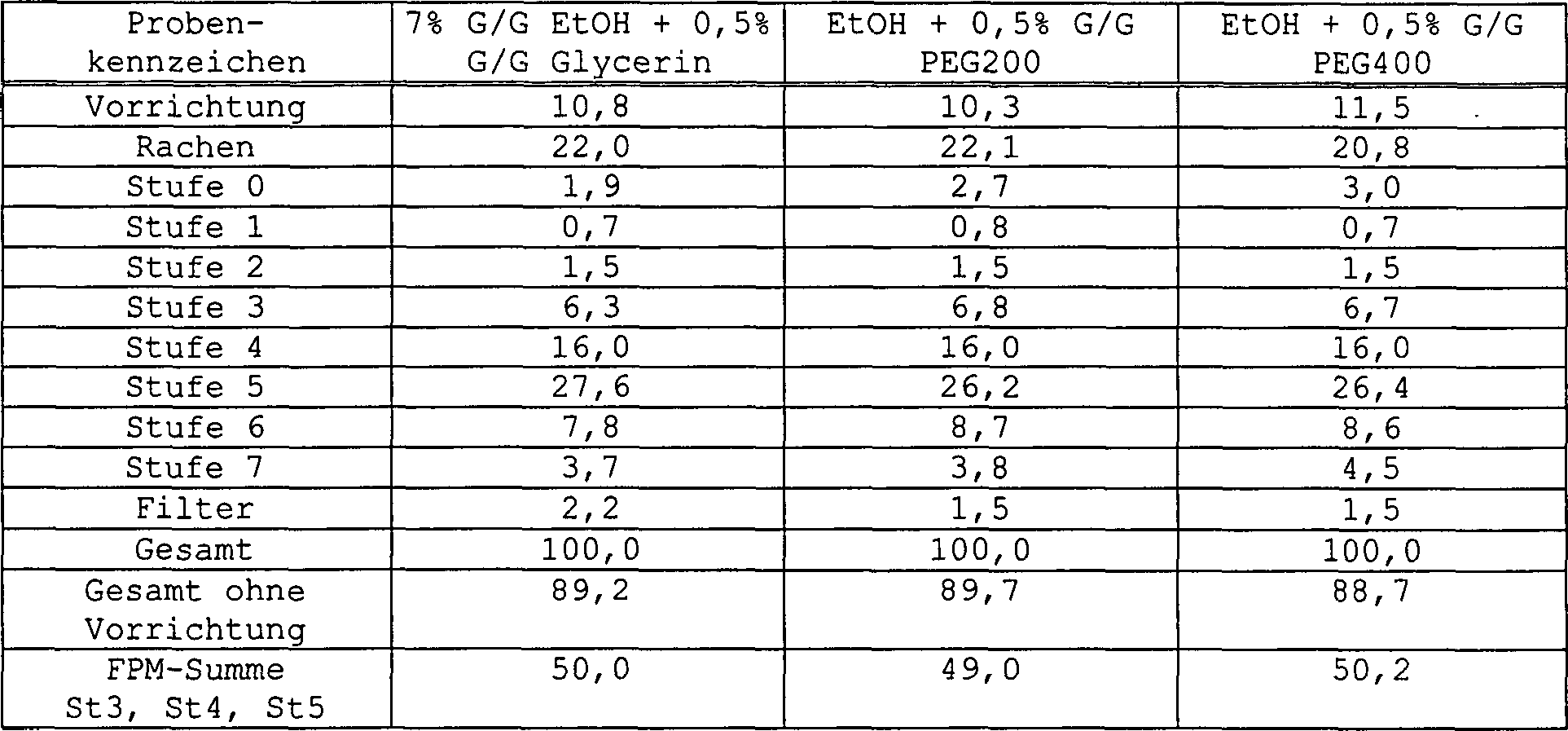
Tabelle
3 Ergebnisse
der Cascade Impaction mit Salmeterolbase (μg) 
Ergebnisse
der Cascade Impaction mit Fluticasonpropionat (μg) 
Tabelle
4 Ergebnisse
der Cascade Impaction mit Salmeterolbase (%) 
Ergebnisse
der Cascade Impaction mit Fluticasonpropionat (%) 
Claims (33)
Applications Claiming Priority (5)
| Application Number | Priority Date | Filing Date | Title |
|---|---|---|---|
| GB9930878 | 1999-12-24 | ||
| GBGB9930878.5A GB9930878D0 (en) | 1999-12-24 | 1999-12-24 | Pharmaceutical formulation |
| GB0018686A GB0018686D0 (en) | 2000-07-28 | 2000-07-28 | Pharmaceutical formulation |
| GB0018686 | 2000-07-28 | ||
| PCT/GB2000/004939 WO2001047493A1 (en) | 1999-12-24 | 2000-12-21 | Pharmaceutical aerosol formulation of salmeterol and fluticasone propionate |
Publications (2)
| Publication Number | Publication Date |
|---|---|
| DE60019167D1 DE60019167D1 (en) | 2005-05-04 |
| DE60019167T2 true DE60019167T2 (en) | 2006-05-11 |
Family
ID=26244762
Family Applications (1)
| Application Number | Title | Priority Date | Filing Date |
|---|---|---|---|
| DE60019167T Expired - Lifetime DE60019167T2 (en) | 1999-12-24 | 2000-12-21 | PHARMACEUTICAL AEROSOL FORMULATION CONTAINING SALMETEROL AND FLUTICASONE |
Country Status (8)
| Country | Link |
|---|---|
| US (1) | US20030032632A1 (en) |
| EP (1) | EP1248597B1 (en) |
| JP (1) | JP2003518484A (en) |
| AT (1) | ATE291898T1 (en) |
| AU (1) | AU2206801A (en) |
| DE (1) | DE60019167T2 (en) |
| ES (1) | ES2238334T3 (en) |
| WO (1) | WO2001047493A1 (en) |
Families Citing this family (35)
| Publication number | Priority date | Publication date | Assignee | Title |
|---|---|---|---|---|
| US20010031244A1 (en) | 1997-06-13 | 2001-10-18 | Chiesi Farmaceutici S.P.A. | Pharmaceutical aerosol composition |
| DZ2947A1 (en) | 1998-11-25 | 2004-03-15 | Chiesi Farma Spa | Pressure metered dose inhaler. |
| IT1313553B1 (en) | 1999-07-23 | 2002-09-09 | Chiesi Farma Spa | OPTIMIZED FORMULATIONS CONSTITUTED BY SOLUTIONS OF STEROIDS GIVEN BY INHALATION. |
| WO2001037805A1 (en) * | 1999-11-23 | 2001-05-31 | Glaxo Group Limited | Pharmaceutical formulations of salmeterol |
| US20050048001A1 (en) * | 1999-11-23 | 2005-03-03 | Cripps Alan Leslie | Pharmaceutical formulations of salmeterol |
| IT1317846B1 (en) | 2000-02-22 | 2003-07-15 | Chiesi Farma Spa | FORMULATIONS CONTAINING AN ANTICOLINERGIC DRUG FOR THE TREATMENT OF CHRONIC OBSTRUCTIVE BRONCOPNEUMOPATHY. |
| US20060257324A1 (en) * | 2000-05-22 | 2006-11-16 | Chiesi Farmaceutici S.P.A. | Pharmaceutical solution formulations for pressurised metered dose inhalers |
| MXPA02011414A (en) | 2000-05-22 | 2003-06-06 | Chiesi Farma Spa | Stable pharmaceutical solution formulations for pressurised metered dose inhalers. |
| GB2367011A (en) * | 2000-08-26 | 2002-03-27 | Glaxo Group Ltd | Metered dose inhaler for salmeterol |
| AR030516A1 (en) * | 2000-08-31 | 2003-08-20 | Glaxo Group Ltd | USE OF A COMBINATION OF SALMETEROL AND FLUTICASONA |
| GB0021927D0 (en) * | 2000-09-07 | 2000-10-25 | Glaxo Group Ltd | Use of pharmaceutical combination |
| GB0105560D0 (en) * | 2001-03-07 | 2001-04-25 | Glaxo Group Ltd | Pharmaceutical formulations |
| GB0106031D0 (en) * | 2001-03-12 | 2001-05-02 | Glaxo Group Ltd | Use |
| JP5082033B2 (en) | 2001-12-21 | 2012-11-28 | エグゼリクシス パテント カンパニー エルエルシー | LXR modulator |
| US7482366B2 (en) | 2001-12-21 | 2009-01-27 | X-Ceptor Therapeutics, Inc. | Modulators of LXR |
| EP1415647A1 (en) * | 2002-10-23 | 2004-05-06 | CHIESI FARMACEUTICI S.p.A. | "Long-acting beta-2 agonists ultrafine formulations" |
| EP1542904B1 (en) * | 2002-08-27 | 2008-01-16 | Schering Corporation | Process for producing metered dose inhaler formulations |
| EP1595531A1 (en) | 2004-05-13 | 2005-11-16 | CHIESI FARMACEUTICI S.p.A. | Stable pharmaceutical solution formulations for pressurized metered dose inhalers |
| EP1811981B1 (en) * | 2004-10-12 | 2008-08-13 | Merck Generics (UK) Limited | Process for the preparation of suspension aerosol formulations, wherein the particles are formed by precipitation inside an aerosol canister |
| US7680778B2 (en) * | 2007-01-19 | 2010-03-16 | Microsoft Corporation | Support for reverse and stemmed hit-highlighting |
| GB0712454D0 (en) | 2007-06-27 | 2007-08-08 | Generics Uk Ltd | Pharmaceutical compositions |
| US20130064870A1 (en) * | 2010-05-20 | 2013-03-14 | Sun Pharma Advanced Research Company Limited | Dry powder inhalation composition |
| TWI399202B (en) * | 2011-03-17 | 2013-06-21 | Intech Biopharm Ltd | The preparation for formulation composition and manufacturing processes of metered dose inhalers treated respiratory diseases |
| US9241904B1 (en) | 2011-08-19 | 2016-01-26 | Intech Biopharm Ltd. | Method for preparing metered dose sprayed inhaler for treating respiratory disease |
| CN102379846B (en) * | 2011-10-21 | 2014-07-02 | 江苏长风药业有限公司 | Fluticasone propionate aerosol preparation with hydrofluoroalkane and polyethylene glycol as auxiliary materials |
| EP2847207B1 (en) | 2012-05-08 | 2019-03-27 | Nicox Ophthalmics, Inc. | Fluticasone propionate nanocrystals |
| US8765725B2 (en) | 2012-05-08 | 2014-07-01 | Aciex Therapeutics, Inc. | Preparations of hydrophobic therapeutic agents, methods of manufacture and use thereof |
| US9815865B2 (en) | 2013-01-07 | 2017-11-14 | Nicox Ophthalmics, Inc. | Preparations of hydrophobic therapeutic agents, methods of manufacture and use thereof |
| US11554229B2 (en) | 2013-03-26 | 2023-01-17 | OptiNose Inc. | Nasal administration |
| MX390453B (en) * | 2014-06-25 | 2025-03-19 | Optinose Inc | NASAL ADMINISTRATION. |
| US20170189329A1 (en) | 2014-07-29 | 2017-07-06 | 3M Innovative Properties Company | Method of preparing a pharmaceutical composition |
| WO2018051133A1 (en) | 2016-09-19 | 2018-03-22 | Mexichem Fluor S.A. De C.V. | Pharmaceutical composition |
| WO2018051128A1 (en) | 2016-09-19 | 2018-03-22 | Mexichem Fluor S.A. De C.V. | Pharmaceutical composition |
| UA123919C2 (en) | 2016-09-19 | 2021-06-23 | Мехікем Флуор С.А. Де С.В. | Pharmaceutical composition |
| JP2023519199A (en) * | 2020-03-25 | 2023-05-10 | インスメッド インコーポレイテッド | Pharmaceutical formulations of treprostinil prodrugs and methods of use thereof |
Family Cites Families (25)
| Publication number | Priority date | Publication date | Assignee | Title |
|---|---|---|---|---|
| NL289785A (en) * | 1962-11-29 | |||
| CH634480A5 (en) * | 1977-11-25 | 1983-02-15 | Schwarzkopf Gmbh Hans | PRESSURIZED AEROSOL PREPARATION. |
| IL95590A (en) * | 1989-09-08 | 1996-06-18 | Glaxo Group Ltd | Pharmaceutical compositions comprising salmeterol and fluticasone propionate |
| US5919827A (en) * | 1990-07-11 | 1999-07-06 | Sepracor Inc. | Method for treating asthma using optically pure R(-) salmeterol |
| AU658854B2 (en) * | 1990-10-18 | 1995-05-04 | Minnesota Mining And Manufacturing Company | Aerosol formulation comprising beclomethasone 17,21 dipropionate |
| MX9203481A (en) * | 1990-10-18 | 1992-07-01 | Minnesota Mining & Mfg | FORMULATIONS. |
| US5683676A (en) * | 1991-12-12 | 1997-11-04 | Glaxo Group Limited | Canister containing aerosol formulations containing P134a and particulate medicaments |
| US5736124A (en) * | 1991-12-12 | 1998-04-07 | Glaxo Group Limited | Aerosol formulations containing P134a and particulate medicament |
| IL104068A (en) * | 1991-12-12 | 1998-10-30 | Glaxo Group Ltd | Surfactant-free pharmaceutical aerosol formulation comprising 1,1,1,2-tetrafluoroethane or 1,1,1,2,3,3,3-heptafluoro-n- propane as propellant |
| SG52459A1 (en) * | 1992-12-09 | 1998-09-28 | Boehringer Ingelheim Pharma | Stabilized medicinal aerosol solution formulations |
| DE4446891A1 (en) * | 1994-12-27 | 1996-07-04 | Falk Pharma Gmbh | Stable aqueous budesonide solution |
| DE69734017T2 (en) * | 1996-12-04 | 2006-06-14 | Link Products Ltd | DRUG COMPOSITIONS AND DEVICES FOR THEIR ADMINISTRATION |
| US6461591B1 (en) * | 1997-02-05 | 2002-10-08 | Jago Research Ag | Medical aerosol formulations |
| GB2326334A (en) * | 1997-06-13 | 1998-12-23 | Chiesi Farma Spa | Pharmaceutical aerosol compositions |
| US6309623B1 (en) * | 1997-09-29 | 2001-10-30 | Inhale Therapeutic Systems, Inc. | Stabilized preparations for use in metered dose inhalers |
| GB2332372B (en) * | 1997-12-08 | 2002-08-14 | Minnesota Mining & Mfg | Pharmaceutical aerosol compositions |
| GB9808802D0 (en) * | 1998-04-24 | 1998-06-24 | Glaxo Group Ltd | Pharmaceutical formulations |
| HU229064B1 (en) * | 1998-06-18 | 2013-07-29 | Boehringer Ingelheim Pharma | Pharmaceutical formulations for aerosols with two or more active substances |
| US6241969B1 (en) * | 1998-06-26 | 2001-06-05 | Elan Corporation Plc | Aqueous compositions containing corticosteroids for nasal and pulmonary delivery |
| IT1303788B1 (en) * | 1998-11-25 | 2001-02-23 | Chiesi Farma Spa | MEDICINAL AEROSOL FORMULATIONS. |
| US6004537A (en) * | 1998-12-18 | 1999-12-21 | Baker Norton Pharmaceuticals, Inc. | Pharmaceutical solution aerosol formulations containing fluoroalkanes, budesonide and formoterol |
| US6231519B1 (en) * | 1999-05-04 | 2001-05-15 | Nokia Corporation | Method and apparatus for providing air quality analysis based on human reactions and clustering methods |
| US6315985B1 (en) * | 1999-06-18 | 2001-11-13 | 3M Innovative Properties Company | C-17/21 OH 20-ketosteroid solution aerosol products with enhanced chemical stability |
| DE60031504T2 (en) * | 1999-09-11 | 2007-04-05 | Glaxo Group Ltd., Greenford | FLUTICASONPROPIONATE DRUG PREPARATION |
| TR200402292T4 (en) * | 2000-01-31 | 2004-12-21 | Pfizer Products Inc. | Pyrimidine carboxamides as inhibitors of PDE4 isozymes. |
-
2000
- 2000-12-21 WO PCT/GB2000/004939 patent/WO2001047493A1/en not_active Ceased
- 2000-12-21 ES ES00985666T patent/ES2238334T3/en not_active Expired - Lifetime
- 2000-12-21 US US10/168,672 patent/US20030032632A1/en not_active Abandoned
- 2000-12-21 AT AT00985666T patent/ATE291898T1/en not_active IP Right Cessation
- 2000-12-21 JP JP2001548088A patent/JP2003518484A/en active Pending
- 2000-12-21 DE DE60019167T patent/DE60019167T2/en not_active Expired - Lifetime
- 2000-12-21 AU AU22068/01A patent/AU2206801A/en not_active Abandoned
- 2000-12-21 EP EP00985666A patent/EP1248597B1/en not_active Expired - Lifetime
Also Published As
| Publication number | Publication date |
|---|---|
| DE60019167D1 (en) | 2005-05-04 |
| US20030032632A1 (en) | 2003-02-13 |
| ES2238334T3 (en) | 2005-09-01 |
| JP2003518484A (en) | 2003-06-10 |
| EP1248597B1 (en) | 2005-03-30 |
| ATE291898T1 (en) | 2005-04-15 |
| WO2001047493A1 (en) | 2001-07-05 |
| AU2206801A (en) | 2001-07-09 |
| EP1248597A1 (en) | 2002-10-16 |
Similar Documents
| Publication | Publication Date | Title |
|---|---|---|
| DE60019167T2 (en) | PHARMACEUTICAL AEROSOL FORMULATION CONTAINING SALMETEROL AND FLUTICASONE | |
| DE60031504T2 (en) | FLUTICASONPROPIONATE DRUG PREPARATION | |
| DE69233076T3 (en) | aerosol preparations | |
| DE69807420T2 (en) | PHARMACEUTICAL AEROSOL COMPOSITION | |
| DE69936730T2 (en) | Solution aerosol compositions containing HFA227 and HFA 134a | |
| DE69227257T2 (en) | DRUG | |
| DE69313825T2 (en) | Pharmaceutical aerosols containing beclometasone dipropionate | |
| DE69526517T2 (en) | FUEL GAS MIXTURE FOR AEROSOL PREPARATION | |
| DE69518334T2 (en) | PHARMACEUTICAL AEROSOL WHICH CONTAINS AT LEAST ONE SUGAR | |
| DE69816811T2 (en) | MEDICAL AEROSOL FORMULATIONS | |
| EP1100465B1 (en) | Medicinal aerosol formulations | |
| DE60126599T2 (en) | CANNABIS CONTAINING PHARMACEUTICAL COMPOSITIONS | |
| DE69205177T2 (en) | Pharmaceutical aerosol formulation. | |
| EP1014943B1 (en) | Medical aerosol formulations | |
| DE69231994T2 (en) | Chlorofluorocarbon free aerosol formulations | |
| EP1372608B1 (en) | Medical aerosol formulations | |
| DE69911602T2 (en) | PRESSURE DOSING INHALER AND PHARMACEUTICAL AEROSOL FORMULATIONS CONTAINING A BETA AGONIST | |
| DE69333187T2 (en) | Surfactant-free aerosol formulations containing beclomethasone dipropionate | |
| DE69528769T2 (en) | AEROSOL FORMULATION FOR MEDICINAL PRODUCTS CONTAINING POLYGLYCOLIZED GLYCERIDES | |
| DE1492015A1 (en) | Improved form of administration of pharmaceutical preparations | |
| DE60225421T2 (en) | INHALER WITH AGENTS FOR IMPROVING THE CHEMICAL STABILITY OF A MEDICAL AEROSOL SOLUTION CONTAINING THEREIN | |
| DE19519056A1 (en) | Use of antidepressants for the treatment of asthma and / or respiratory diseases by inhalation | |
| EP2819669B1 (en) | New tiotropium formula containing propellant | |
| DE60017450T2 (en) | PHARMACEUTICAL FORMULATIONS CONTAINING SALMETEROL | |
| AT402895B (en) | Process for the production of a liquid pharmaceutical composition for nasal administration of a calcitonin as nasal spray |
Legal Events
| Date | Code | Title | Description |
|---|---|---|---|
| 8364 | No opposition during term of opposition |