DE212020000516U1 - CRISPR-CAS effector polypeptides - Google Patents
CRISPR-CAS effector polypeptides Download PDFInfo
- Publication number
- DE212020000516U1 DE212020000516U1 DE212020000516.8U DE212020000516U DE212020000516U1 DE 212020000516 U1 DE212020000516 U1 DE 212020000516U1 DE 212020000516 U DE212020000516 U DE 212020000516U DE 212020000516 U1 DE212020000516 U1 DE 212020000516U1
- Authority
- DE
- Germany
- Prior art keywords
- cas12j
- amino acid
- protein
- cases
- sequence
- Prior art date
- Legal status (The legal status is an assumption and is not a legal conclusion. Google has not performed a legal analysis and makes no representation as to the accuracy of the status listed.)
- Active
Links
Images




Classifications
-
- C—CHEMISTRY; METALLURGY
- C12—BIOCHEMISTRY; BEER; SPIRITS; WINE; VINEGAR; MICROBIOLOGY; ENZYMOLOGY; MUTATION OR GENETIC ENGINEERING
- C12N—MICROORGANISMS OR ENZYMES; COMPOSITIONS THEREOF; PROPAGATING, PRESERVING, OR MAINTAINING MICROORGANISMS; MUTATION OR GENETIC ENGINEERING; CULTURE MEDIA
- C12N9/00—Enzymes; Proenzymes; Compositions thereof; Processes for preparing, activating, inhibiting, separating or purifying enzymes
- C12N9/14—Hydrolases (3)
- C12N9/16—Hydrolases (3) acting on ester bonds (3.1)
- C12N9/22—Ribonucleases [RNase]; Deoxyribonucleases [DNase]
-
- A—HUMAN NECESSITIES
- A61—MEDICAL OR VETERINARY SCIENCE; HYGIENE
- A61K—PREPARATIONS FOR MEDICAL, DENTAL OR TOILETRY PURPOSES
- A61K31/00—Medicinal preparations containing organic active ingredients
- A61K31/70—Carbohydrates; Sugars; Derivatives thereof
- A61K31/7088—Compounds having three or more nucleosides or nucleotides
-
- A—HUMAN NECESSITIES
- A61—MEDICAL OR VETERINARY SCIENCE; HYGIENE
- A61K—PREPARATIONS FOR MEDICAL, DENTAL OR TOILETRY PURPOSES
- A61K38/00—Medicinal preparations containing peptides
- A61K38/16—Peptides having more than 20 amino acids; Gastrins; Somatostatins; Melanotropins; Derivatives thereof
- A61K38/43—Enzymes; Proenzymes; Derivatives thereof
- A61K38/46—Hydrolases (3)
- A61K38/465—Hydrolases (3) acting on ester bonds (3.1), e.g. lipases, ribonucleases
-
- C—CHEMISTRY; METALLURGY
- C12—BIOCHEMISTRY; BEER; SPIRITS; WINE; VINEGAR; MICROBIOLOGY; ENZYMOLOGY; MUTATION OR GENETIC ENGINEERING
- C12N—MICROORGANISMS OR ENZYMES; COMPOSITIONS THEREOF; PROPAGATING, PRESERVING, OR MAINTAINING MICROORGANISMS; MUTATION OR GENETIC ENGINEERING; CULTURE MEDIA
- C12N15/00—Mutation or genetic engineering; DNA or RNA concerning genetic engineering, vectors, e.g. plasmids, or their isolation, preparation or purification; Use of hosts therefor
- C12N15/09—Recombinant DNA-technology
- C12N15/10—Processes for the isolation, preparation or purification of DNA or RNA
- C12N15/102—Mutagenizing nucleic acids
-
- C—CHEMISTRY; METALLURGY
- C12—BIOCHEMISTRY; BEER; SPIRITS; WINE; VINEGAR; MICROBIOLOGY; ENZYMOLOGY; MUTATION OR GENETIC ENGINEERING
- C12N—MICROORGANISMS OR ENZYMES; COMPOSITIONS THEREOF; PROPAGATING, PRESERVING, OR MAINTAINING MICROORGANISMS; MUTATION OR GENETIC ENGINEERING; CULTURE MEDIA
- C12N15/00—Mutation or genetic engineering; DNA or RNA concerning genetic engineering, vectors, e.g. plasmids, or their isolation, preparation or purification; Use of hosts therefor
- C12N15/09—Recombinant DNA-technology
- C12N15/11—DNA or RNA fragments; Modified forms thereof; Non-coding nucleic acids having a biological activity
-
- C—CHEMISTRY; METALLURGY
- C12—BIOCHEMISTRY; BEER; SPIRITS; WINE; VINEGAR; MICROBIOLOGY; ENZYMOLOGY; MUTATION OR GENETIC ENGINEERING
- C12N—MICROORGANISMS OR ENZYMES; COMPOSITIONS THEREOF; PROPAGATING, PRESERVING, OR MAINTAINING MICROORGANISMS; MUTATION OR GENETIC ENGINEERING; CULTURE MEDIA
- C12N15/00—Mutation or genetic engineering; DNA or RNA concerning genetic engineering, vectors, e.g. plasmids, or their isolation, preparation or purification; Use of hosts therefor
- C12N15/09—Recombinant DNA-technology
- C12N15/11—DNA or RNA fragments; Modified forms thereof; Non-coding nucleic acids having a biological activity
- C12N15/111—General methods applicable to biologically active non-coding nucleic acids
-
- C—CHEMISTRY; METALLURGY
- C12—BIOCHEMISTRY; BEER; SPIRITS; WINE; VINEGAR; MICROBIOLOGY; ENZYMOLOGY; MUTATION OR GENETIC ENGINEERING
- C12N—MICROORGANISMS OR ENZYMES; COMPOSITIONS THEREOF; PROPAGATING, PRESERVING, OR MAINTAINING MICROORGANISMS; MUTATION OR GENETIC ENGINEERING; CULTURE MEDIA
- C12N15/00—Mutation or genetic engineering; DNA or RNA concerning genetic engineering, vectors, e.g. plasmids, or their isolation, preparation or purification; Use of hosts therefor
- C12N15/09—Recombinant DNA-technology
- C12N15/63—Introduction of foreign genetic material using vectors; Vectors; Use of hosts therefor; Regulation of expression
-
- C—CHEMISTRY; METALLURGY
- C12—BIOCHEMISTRY; BEER; SPIRITS; WINE; VINEGAR; MICROBIOLOGY; ENZYMOLOGY; MUTATION OR GENETIC ENGINEERING
- C12N—MICROORGANISMS OR ENZYMES; COMPOSITIONS THEREOF; PROPAGATING, PRESERVING, OR MAINTAINING MICROORGANISMS; MUTATION OR GENETIC ENGINEERING; CULTURE MEDIA
- C12N15/00—Mutation or genetic engineering; DNA or RNA concerning genetic engineering, vectors, e.g. plasmids, or their isolation, preparation or purification; Use of hosts therefor
- C12N15/09—Recombinant DNA-technology
- C12N15/87—Introduction of foreign genetic material using processes not otherwise provided for, e.g. co-transformation
- C12N15/90—Stable introduction of foreign DNA into chromosome
- C12N15/902—Stable introduction of foreign DNA into chromosome using homologous recombination
- C12N15/907—Stable introduction of foreign DNA into chromosome using homologous recombination in mammalian cells
-
- C—CHEMISTRY; METALLURGY
- C12—BIOCHEMISTRY; BEER; SPIRITS; WINE; VINEGAR; MICROBIOLOGY; ENZYMOLOGY; MUTATION OR GENETIC ENGINEERING
- C12Q—MEASURING OR TESTING PROCESSES INVOLVING ENZYMES, NUCLEIC ACIDS OR MICROORGANISMS; COMPOSITIONS OR TEST PAPERS THEREFOR; PROCESSES OF PREPARING SUCH COMPOSITIONS; CONDITION-RESPONSIVE CONTROL IN MICROBIOLOGICAL OR ENZYMOLOGICAL PROCESSES
- C12Q1/00—Measuring or testing processes involving enzymes, nucleic acids or microorganisms; Compositions therefor; Processes of preparing such compositions
- C12Q1/68—Measuring or testing processes involving enzymes, nucleic acids or microorganisms; Compositions therefor; Processes of preparing such compositions involving nucleic acids
- C12Q1/6813—Hybridisation assays
- C12Q1/6816—Hybridisation assays characterised by the detection means
- C12Q1/6818—Hybridisation assays characterised by the detection means involving interaction of two or more labels, e.g. resonant energy transfer
-
- A—HUMAN NECESSITIES
- A61—MEDICAL OR VETERINARY SCIENCE; HYGIENE
- A61K—PREPARATIONS FOR MEDICAL, DENTAL OR TOILETRY PURPOSES
- A61K38/00—Medicinal preparations containing peptides
-
- A—HUMAN NECESSITIES
- A61—MEDICAL OR VETERINARY SCIENCE; HYGIENE
- A61K—PREPARATIONS FOR MEDICAL, DENTAL OR TOILETRY PURPOSES
- A61K48/00—Medicinal preparations containing genetic material which is inserted into cells of the living body to treat genetic diseases; Gene therapy
-
- C—CHEMISTRY; METALLURGY
- C07—ORGANIC CHEMISTRY
- C07K—PEPTIDES
- C07K2319/00—Fusion polypeptide
- C07K2319/01—Fusion polypeptide containing a localisation/targetting motif
- C07K2319/02—Fusion polypeptide containing a localisation/targetting motif containing a signal sequence
-
- C—CHEMISTRY; METALLURGY
- C07—ORGANIC CHEMISTRY
- C07K—PEPTIDES
- C07K2319/00—Fusion polypeptide
- C07K2319/01—Fusion polypeptide containing a localisation/targetting motif
- C07K2319/09—Fusion polypeptide containing a localisation/targetting motif containing a nuclear localisation signal
-
- C—CHEMISTRY; METALLURGY
- C12—BIOCHEMISTRY; BEER; SPIRITS; WINE; VINEGAR; MICROBIOLOGY; ENZYMOLOGY; MUTATION OR GENETIC ENGINEERING
- C12N—MICROORGANISMS OR ENZYMES; COMPOSITIONS THEREOF; PROPAGATING, PRESERVING, OR MAINTAINING MICROORGANISMS; MUTATION OR GENETIC ENGINEERING; CULTURE MEDIA
- C12N15/00—Mutation or genetic engineering; DNA or RNA concerning genetic engineering, vectors, e.g. plasmids, or their isolation, preparation or purification; Use of hosts therefor
- C12N15/09—Recombinant DNA-technology
- C12N15/11—DNA or RNA fragments; Modified forms thereof; Non-coding nucleic acids having a biological activity
- C12N15/113—Non-coding nucleic acids modulating the expression of genes, e.g. antisense oligonucleotides; Antisense DNA or RNA; Triplex- forming oligonucleotides; Catalytic nucleic acids, e.g. ribozymes; Nucleic acids used in co-suppression or gene silencing
-
- C—CHEMISTRY; METALLURGY
- C12—BIOCHEMISTRY; BEER; SPIRITS; WINE; VINEGAR; MICROBIOLOGY; ENZYMOLOGY; MUTATION OR GENETIC ENGINEERING
- C12N—MICROORGANISMS OR ENZYMES; COMPOSITIONS THEREOF; PROPAGATING, PRESERVING, OR MAINTAINING MICROORGANISMS; MUTATION OR GENETIC ENGINEERING; CULTURE MEDIA
- C12N15/00—Mutation or genetic engineering; DNA or RNA concerning genetic engineering, vectors, e.g. plasmids, or their isolation, preparation or purification; Use of hosts therefor
- C12N15/09—Recombinant DNA-technology
- C12N15/11—DNA or RNA fragments; Modified forms thereof; Non-coding nucleic acids having a biological activity
- C12N15/52—Genes encoding for enzymes or proenzymes
-
- C—CHEMISTRY; METALLURGY
- C12—BIOCHEMISTRY; BEER; SPIRITS; WINE; VINEGAR; MICROBIOLOGY; ENZYMOLOGY; MUTATION OR GENETIC ENGINEERING
- C12N—MICROORGANISMS OR ENZYMES; COMPOSITIONS THEREOF; PROPAGATING, PRESERVING, OR MAINTAINING MICROORGANISMS; MUTATION OR GENETIC ENGINEERING; CULTURE MEDIA
- C12N15/00—Mutation or genetic engineering; DNA or RNA concerning genetic engineering, vectors, e.g. plasmids, or their isolation, preparation or purification; Use of hosts therefor
- C12N15/09—Recombinant DNA-technology
- C12N15/87—Introduction of foreign genetic material using processes not otherwise provided for, e.g. co-transformation
- C12N15/90—Stable introduction of foreign DNA into chromosome
-
- C—CHEMISTRY; METALLURGY
- C12—BIOCHEMISTRY; BEER; SPIRITS; WINE; VINEGAR; MICROBIOLOGY; ENZYMOLOGY; MUTATION OR GENETIC ENGINEERING
- C12N—MICROORGANISMS OR ENZYMES; COMPOSITIONS THEREOF; PROPAGATING, PRESERVING, OR MAINTAINING MICROORGANISMS; MUTATION OR GENETIC ENGINEERING; CULTURE MEDIA
- C12N2310/00—Structure or type of the nucleic acid
- C12N2310/10—Type of nucleic acid
- C12N2310/20—Type of nucleic acid involving clustered regularly interspaced short palindromic repeats [CRISPR]
-
- C—CHEMISTRY; METALLURGY
- C12—BIOCHEMISTRY; BEER; SPIRITS; WINE; VINEGAR; MICROBIOLOGY; ENZYMOLOGY; MUTATION OR GENETIC ENGINEERING
- C12N—MICROORGANISMS OR ENZYMES; COMPOSITIONS THEREOF; PROPAGATING, PRESERVING, OR MAINTAINING MICROORGANISMS; MUTATION OR GENETIC ENGINEERING; CULTURE MEDIA
- C12N2800/00—Nucleic acids vectors
- C12N2800/80—Vectors containing sites for inducing double-stranded breaks, e.g. meganuclease restriction sites
Landscapes
- Health & Medical Sciences (AREA)
- Life Sciences & Earth Sciences (AREA)
- Engineering & Computer Science (AREA)
- Genetics & Genomics (AREA)
- Chemical & Material Sciences (AREA)
- Organic Chemistry (AREA)
- Zoology (AREA)
- Wood Science & Technology (AREA)
- Bioinformatics & Cheminformatics (AREA)
- Biomedical Technology (AREA)
- Molecular Biology (AREA)
- General Engineering & Computer Science (AREA)
- Biotechnology (AREA)
- General Health & Medical Sciences (AREA)
- Microbiology (AREA)
- Biochemistry (AREA)
- Biophysics (AREA)
- Physics & Mathematics (AREA)
- Plant Pathology (AREA)
- Proteomics, Peptides & Aminoacids (AREA)
- Medicinal Chemistry (AREA)
- Immunology (AREA)
- Analytical Chemistry (AREA)
- Veterinary Medicine (AREA)
- Public Health (AREA)
- Animal Behavior & Ethology (AREA)
- Epidemiology (AREA)
- Pharmacology & Pharmacy (AREA)
- Crystallography & Structural Chemistry (AREA)
- Mycology (AREA)
- Cell Biology (AREA)
- Gastroenterology & Hepatology (AREA)
- Micro-Organisms Or Cultivation Processes Thereof (AREA)
- Peptides Or Proteins (AREA)
- Enzymes And Modification Thereof (AREA)
- Measuring Or Testing Involving Enzymes Or Micro-Organisms (AREA)
- Pharmaceuticals Containing Other Organic And Inorganic Compounds (AREA)
- Apparatus Associated With Microorganisms And Enzymes (AREA)
- Medicines That Contain Protein Lipid Enzymes And Other Medicines (AREA)
Abstract
Zusammensetzung, die Folgendes umfasst:a) eine Nuklease, die eine einzelne RuvC-aktive Stelle umfasst, die sowohl ein DNA-Molekül spalten als auch crRNA binden kann; undb) eine Führungs-RNA.A composition comprising:a) a nuclease comprising a single RuvC active site capable of both cleaving a DNA molecule and binding crRNA; and b) a guide RNA.
Description
QUERVERWEISCROSS REFERENCE
Diese Anmeldung beansprucht den Vorteil der vorläufigen US-Patentanmeldung Nr.
EINLEITUNGINTRODUCTION
CRISPR-Cas-Systeme enthalten Cas-Proteine, die an der Akquisition, dem Targeting und der Spaltung von fremder DNA oder RNA beteiligt sind, und eine Guide-RNA(s), die ein Segment, das Cas-Proteine bindet, und ein Segment, das an eine Target-Nukleinsäure bindet, enthält. Beispielsweise umfassen CRISPR-Cas-Systeme der Klasse 2 ein einzelnes Cas-Protein, das an eine Guide-RNA gebunden ist, wobei das Cas-Protein an eine Target-Nukleinsäure bindet und diese spaltet. Die Programmierbarkeit dieser Systeme hat ihre Verwendung als vielseitige Technologie zur Modifizierung der Target-Nukleinsäure erleichtert.CRISPR-Cas systems contain Cas proteins involved in the acquisition, targeting, and cleavage of foreign DNA or RNA, and a guide RNA(s) containing a segment that binds Cas proteins and a segment , which binds to a target nucleic acid. For example,
KURZDLARSTELLUNGBRIEF PRESENTATION
Die vorliegende Offenbarung stellt RNA-geleitete CRISPR-Cas-Effektorproteine, Nukleinsäuren, die dieselben codieren, und Zusammensetzungen, die dieselben umfassen, bereit. Die vorliegende Offenbarung stellt Ribonukleoproteinkomplexe bereit, umfassend: ein RNA-geleitetes CRISPR-Cas-Effektorprotein der vorliegenden Offenbarung; und eine Guide-RNA. Die vorliegende Offenbarung stellt Verfahren zum Modifizieren einer Target-Nukleinsäure unter Verwendung eines RNA-geleiteten CRISPR-Cas-Effektorproteins der vorliegenden Offenbarung und einer Guide-RNA bereit. Die vorliegende Offenbarung stellt Verfahren zum Modulieren der Transkription einer Target-Nukleinsäure bereit.The present disclosure provides RNA-directed CRISPR-Cas effector proteins, nucleic acids encoding the same, and compositions comprising the same. The present disclosure provides ribonucleoprotein complexes comprising: an RNA-directed CRISPR-Cas effector protein of the present disclosure; and a guide RNA. The present disclosure provides methods for modifying a target nucleic acid using an RNA-guided CRISPR-Cas effector protein of the present disclosure and a guide RNA. The present disclosure provides methods for modulating transcription of a target nucleic acid.
Figurenlistecharacter list
-
1A zeigt die Größenverteilung vollständiger Bakteriophagengenome aus dieser Studie, Lak-Phagen, die kürzlich aus einer Untergruppe derselben Proben berichtet wurden, und Referenzquellen (alle dsDNA-Genome aus RefSeq v92 und nichtartefaktuelle Assemblies >200 kb von (Paez-Espino et al. (2016) Nature 536: 425).1A shows the size distribution of complete bacteriophage genomes from this study, Lak phage recently reported from a subset of the same samples, and reference sources (all dsDNA genomes from RefSeq v92 and non-artifact assemblies >200 kb from (Paez-Espino et al. (2016) Nature 536:425). -
1B zeigt ein Histogramm der Genomgrößenverteilung von Phagen mit Genomen >200 kb aus dieser Studie, Lak und Referenzgenome. Box- und Whisker-Diagramme der tRNA-Zählungen pro Genom als Funktion der Genomgröße.1B shows a histogram of the genome size distribution of phage with genomes >200 kb from this study, Lac and reference genomes. Box and whisker plots of tRNA counts per genome as a function of genome size. -
2 zeigt einen phylogenetischen Baum, der unter Verwendung von Terminasesequenzen aus riesigen Phagengenomen dieser Studie und verwandten Datenbanksequenzen konstruiert wurde. Farbige Regionen des Baumes weisen auf große Phagenkladen hin, die alle riesige Genome aufweisen.2 shows a phylogenetic tree constructed using terminase sequences from giant phage genomes of this study and related database sequences. Colored regions of the tree indicate large phage clades, each with huge genomes. -
3 zeigt ein Modell dafür, wie Phagen-codierte Kapazitäten das Translationssystem des Wirts umleiten könnten, um Phagenproteine zu produzieren. Kein großer Phage weist alle diese Gene auf, aber viele weisen tRNA (Kleeblattformen) und tRNA-Synthetasen (aaRS) auf. Phagenproteine mit bis zu 6 ribosomalen Protein-S1-Domänen kommen in einigen wenigen Genomen vor. Das S1 bindet mRNA, um es an die Stelle auf dem Ribosom zu bringen, wo sie decodiert wird. Das ribosomale Protein S21 (S21) könnte selektiv die Translation von Phagen-mRNA initiieren, und viele Sequenzen weisen N-terminale Verlängerungen auf, die an der Bindung von RNA beteiligt sein können (gestrichelte Linie im Ribosomeninsert, die auf PDB-Code 6bu8 und pmid: 29247757 für Ribosom und S1-Strukturmodell basiert). Einige Phagen weisen Initiationsfaktoren (IF) und Elongationsfaktor G (EF G) auf und andere weisen rpL7/L12 auf, was eine effiziente Ribosomenbindung vermitteln könnte. Abkürzung: RNA pol, RNA Polymerase.3 shows a model for how phage-encoded capacities might redirect the host's translation system to produce phage proteins. No large phage will have all of these genes, but many will have tRNA (trefoil shapes) and tRNA synthetases (aaRS). Phage proteins with up to 6 ribosomal protein S1 domains are found in a few genomes. The S1 binds mRNA to bring it to the site on the ribosome where it will be decoded. The ribosomal protein S21 (S21) could selectively initiate translation of phage mRNA, and many sequences have N-terminal extensions that may be involved in binding of RNA (dashed line in ribosome insert pointing to PDB code 6bu8 and pmid : 29247757 for ribosome and S1 structural model based). Some phage display initiation factors (IF) and elongation factor G (EF G) and others display rpL7/L12, which could mediate efficient ribosome binding. Abbreviation: RNA pol, RNA polymerase. -
4A zeigt eine Bakterium-Phagen-Wechselwirkung, die ein CRISPR-Targeting beinhaltet (Zelldiagramm).4A shows a bacterium-phage interaction involving CRISPR targeting (cell diagram). -
4B zeigt das Interaktionsnetzwerk, das das Targeting von bakteriellen (von oben nach unten: SEQ ID NO: 163-164) und phagencodierten (von oben nach unten: SEQ ID NO: 163-164) CRISPR-Spacern zeigt.4B Figure 12 shows the interaction network showing the targeting of bacterial (top to bottom: SEQ ID NO: 163-164) and phage-encoded (top to bottom: SEQ ID NO: 163-164) CRISPR spacers. -
5 zeigt Ökosysteme mit Phagen und einige Plasmide mit >200 kbp-Genomen, gruppiert nach Typ der Probenahmestelle. Jede Box stellt ein Phagengenom dar, und die Boxen sind in der Reihenfolge abnehmender Genomgröße angeordnet; der Größenbereich für jeden Typ von Stelle ist rechts aufgeführt. Die Farben zeigen das mutmaßliche Wirtsphylum basierend auf dem phylogenetischen Profil des Genoms an, wobei dies durch CRISPR-Targeting (X) oder phylogenetische Analysen des Informationssystemgens (T) bestätigt wird.5 shows ecosystems with phage and some plasmids with >200 kbp genomes grouped by sampling site type. Each box represents a phage genome and the boxes are arranged in order of decreasing genome size; the size range for each type of site is listed to the right. The colors indicate the putative host phylum based on the phylogenetic profile of the genome, as confirmed by CRISPR targeting (X) or phylogenetic analyzes of the information system gene (T). -
6A-6R stellen Aminosäuresequenzen von Beispielen von Cas12J-Polypeptiden der vorliegenden Offenbarung bereit.6A-6R provide amino acid sequences of examples of Cas12J polypeptides of the present disclosure. -
7 liefert Nukleotidsequenzen von Teilen konstanter Region von Cas12J-Guide-RNA (dargestellt als die für die RNA codierende DNA). Fettgedruckte Sequenzen sind die verwendete und/oder aus den Arbeitsbeispielen extrapolierte Ausrichtung (siehe z. B. die in Beispiel 3 verwendeten crRNA-Sequenzen‘). Durch ein „oder“ getrennte Sequenzen sind das reverse Komplement voneinander.7 provides nucleotide sequences of constant region portions of Cas12J guide RNA (represented as the DNA encoding the RNA). Sequences in bold are the alignment used and/or extrapolated from the working examples (see eg crRNA sequences used in Example 3'). Sequences separated by an "or" are the reverse complement of each other. -
8 zeigt Konsensussequenzen für Cas12J-Guide-RNA.8th shows consensus sequences for Cas12J guide RNA. -
9 stellt die Positionen von Aminosäuren in RuvC-I-, RuvC-II- und RuvC-III-Domänen von Cas12J-Polypeptiden bereit, die, wenn sie substituiert sind, zu einem Cas12J-Polypeptid führen, das eine Target-Nukleinsäure in der von einer Cas12J-Guide-RNA bindet, aber nicht spaltet.9 provides the positions of amino acids in RuvC-I, RuvC-II and RuvC-III domains of Cas12J polypeptides which, when substituted, result in a Cas12J polypeptide encoding a target nucleic acid in the of a Cas12J guide RNA binds but does not cleave. -
10 stellt einen Baum bereit, der verschiedene CRISPR-Cas-Effektorproteinfamilien zeigt.10 provides a tree showing different CRISPR-Cas effector protein families. -
11A-11C zeigen die Effizienz des Transformationsplasmidinterferenzassays.11A-11C show the efficiency of the transforming plasmid interference assay. -
12A-12B zeigen eine Demonstration, dass Cas12J (z. B. Cas12J-1947455, Cas12J-2071242 und Cas12J-3339380) lineare dsDNA-Fragmente, die von einer crRNA-Spacersequenz geleitet werden, spalten können.12A-12B show a demonstration that Cas12J (e.g. Cas12J-1947455, Cas12J-2071242 and Cas12J-3339380) can cleave linear dsDNA fragments guided by a crRNA spacer sequence. -
13 zeigt Ergebnisse, die die Aufklärung von PAM-Sequenzen zeigen.13 shows results showing the elucidation of PAM sequences. -
14A-14C veranschaulichen Ergebnisse aus dem Mapping von RNA-Sequenzen auf die Cas12J-CRISPR-Loci von pBAS::Cas12J-1947455, pBAS::Cas12J-2071242 und pBAS::Cas12J-3339380.14A-14C illustrate results from mapping RNA sequences to the Cas12J CRISPR loci of pBAS::Cas12J-1947455, pBAS::Cas12J-2071242, and pBAS::Cas12J-3339380. -
15 zeigt die Cas12j-2- und Cas12j-3-vermittelte Gen-Editierung in menschlichen Zellen.15 shows Cas12j-2 and Cas12j-3-mediated gene editing in human cells. -
16A-16B stellen Karten der Konstrukte pCas12J-3-hs (16A ) und pCas12J-2-hs (16B ) bereit.16A-16B represent maps of the constructs pCas12J-3-hs (16A ) and pCas12J-2-hs (16B ) ready. -
17A-17G legen Tabelle 1 dar, die Nukleotidsequenzen der Konstrukte pCas12J-2-hs und pCas12J-3-hs bereitstellt (von oben nach unten: SEQ ID NO: 161-162).17A-17G set out Table 1, which provides nucleotide sequences of the constructs pCas12J-2-hs and pCas12J-3-hs (top to bottom: SEQ ID NO: 161-162). -
18 zeigt die trans-Spaltung von ssDNA durch Cas12J, das durch Bindung an DNA aktiviert wird.18 shows the trans cleavage of ssDNA by Cas12J activated by binding to DNA. -
19A-19F zeigen Daten, die zeigen, dass Cas12J (CasΦ) ein Bona-fide-CRISPR-Cas-System ist.19A-19F show data demonstrating that Cas12J (CasΦ) is a bona fide CRISPR-Cas system. -
20 zeigt einen phylogenetischen Baum mit maximaler Wahrscheinlichkeit der Typ-V-Subtypen a-k.20 shows a maximum likelihood phylogenetic tree of type V subtypes ak. -
21A-21B zeigen eine crRNA-Wiederholungsähnlichkeit (21A ) zwischen verschiedenen Cas12J-crRNA und eine Cas12J-Aminosäuresequenzidentität (21B ) zwischen verschiedenen Cas12J-Proteinen.21A-21B show crRNA repeat similarity (21A ) between distinct Cas12J crRNA and a Cas12J amino acid sequence identity (21B ) between different Cas12J proteins. -
22A-22C zeigen den CasΦ-3-vermittelten Schutz gegen Plasmidtransformation.22A-22C show CasΦ-3-mediated protection against plasmid transformation. -
23A-23D zeigen die Spaltung von DNA durch CasΦ.23A-23D show DNA cleavage by CasΦ. -
24A-24D zeigen die Reinigung von Apo CasΦ (CasΦ-Protein ohne Guide-RNA).24A-24D show the purification of Apo CasΦ (CasΦ protein without guide RNA). -
25A-25C zeigen die Herstellung von versetzten Schnitten durch CasΦ.25A-25C show the production of staggered cuts through CasΦ. -
26A-26B zeigen die CasΦ-vermittelte Spaltung von dsDNA und ssDNA.26A-26B show the CasΦ-mediated cleavage of dsDNA and ssDNA. -
27A-27B zeigen die Ergebnisse eines Spaltungsassays, bei dem die Target-Strang (TS)- und Nicht-Target-Strang (NTS)-Spaltungseffizienz durch CasΦ verglichen wurde.27A-27B show the results of a cleavage assay comparing target-strand (TS) and non-target-strand (NTS) cleavage efficiency by CasΦ. -
28A-28B zeigen Daten, die zeigen, dass CasΦ ssDNA, aber nicht RNA, bei Aktivierung in cis in trans spaltet.28A-28B present data showing that CasΦ cleaves ssDNA but not RNA when activated in cis to trans. -
29A-29D zeigen die Prozessierung von prä-crRNA durch CasΦ innerhalb der aktiven Zentrums von RuvC.29A-29D show the processing of pre-crRNA by CasΦ within the active site of RuvC. -
30A-30C zeigen die Prozessierung von prä-crRNA durch CasΦ-1 und durch CasΦ-2.30A-30C show the processing of pre-crRNA by CasΦ-1 and by CasΦ-2. -
31A-31B zeigen die Bildung von Ribonukleoprotein (RNP)-Komplexen mit: a) prä-crRNA31A-31B show the formation of ribonucleoprotein (RNP) complexes with: a) pre-crRNA -
32A-32C zeigen eine durch CasΦ vermittelte Störung des verstärkten grün fluoreszierenden Proteins (EGFP) in HEK293-Zellen.32A-32C show a CasΦ-mediated disruption of enhanced green fluorescent protein (EGFP) in HEK293 cells. -
33A-33B zeigen Daten, die das CasΦ-vermittelte Genom-Editing in menschlichen Zellen zeigen.33A-33B show data demonstrating CasΦ-mediated genome editing in human cells. -
34 zeigt Tabelle 3, die eine Beschreibung einiger der in Beispiel 7 verwendeten Plasmide bereitstellt.34 Table 3 shows, which provides a description of some of the plasmids used in Example 7. -
35 zeigt Tabelle 4, die Guide-Sequenzen für in Beispiel 7 beschriebene Experimente bereitstellt.35 Table 4 shows, which provides guide sequences for experiments described in Example 7. -
36 zeigt Tabelle 5, die Substratsequenzen für in Beispiel 7 beschriebene In-vitro-Experimente bereitstellt.36 Table 5 shows, which provides substrate sequences for in vitro experiments described in Example 7. -
37 zeigt Tabelle 6, die crRNA-Sequenzen für in Beispiel 7 beschriebene In-vitro-Experimente bereitstellt.37 Figure 6 shows Table 6 which provides crRNA sequences for in vitro experiments described in example 7.
BEGRIFFSBESTIMMUNGENDEFINITIONS
Die hierin synonym verwendeten Ausdrücke „Polynukleotid“ und „Nukleinsäure“ beziehen sich auf eine polymere Form von Nukleotiden jeder beliebigen Länge, entweder Ribonukleotide oder Desoxyribonukleotide. Somit umfasst dieser Ausdruck unter anderem einzel-, doppel- oder mehrsträngige DNA oder RNA, genomische DNA, cDNA, DNA-RNA-Hybride oder ein Polymer, das Purin- und Pyrimidinbasen oder andere natürliche, chemisch oder biochemisch modifizierte Verbindungen, nicht natürliche oder derivatisierte Nukleotidbasen umfasst.As used interchangeably herein, the terms "polynucleotide" and "nucleic acid" refer to a polymeric form of nucleotides of any length, either ribonucleotides or deoxyribonucleotides. Thus, this term includes, but is not limited to, single, double or multi-stranded DNA or RNA, genomic DNA, cDNA, DNA-RNA hybrids, or a polymer containing purine and pyrimidine bases or other natural, chemically or biochemically modified compounds, non-natural or derivatized Includes nucleotide bases.
Mit „hybridisierbar“ oder „komplementär“ oder „im Wesentlichen komplementär“ ist gemeint, dass eine Nukleinsäure (z. B. RNA, DNA) eine Sequenz von Nukleotiden umfasst, die es ihr ermöglicht, nicht kovalent mit einer anderen Nukleinsäure in einer sequenzspezifischen, antiparallelen Weise (d. h. eine Nukleinsäure bindet spezifisch an eine komplementäre Nukleinsäure) unter den geeigneten In-vitro- und/oder In-vivo-Bedingungen von Temperatur und Ionenstärke der Lösung zu binden, d. h. Watson-Crick-Basenpaare und/oder G/U-Basenpaare zu bilden, „zu annelieren“ oder „zu hybridisieren“. Die Standard-Watson-Crick-Basenpaarung umfasst: Adenin (A)-Paarung mit Thymidin (T), Adenin (A)-Paarung mit Uracil (U) und Guanin (G)-Paarung mit Cytosin (C) [DNA, RNA]. Zusätzlich zur Hybridisierung zwischen zwei RNA-Molekülen (z. B. dsRNA) und zur Hybridisierung eines DNA-Moleküls mit einem RNA-Molekül (z. B. wenn sich eine DNA-Target-Nukleinsäurebase mit einer Guide-RNA usw. paart): Guanin (G) kann auch mit Uracil (U) Basenpaarung bilden. Beispielsweise ist die G/U-Basenpaarung mindestens teilweise für die Entartung (d. h. Redundanz) des genetischen Codes im Zusammenhang mit der tRNA-Anti-Codon-Basenpaarung mit Codons in mRNA verantwortlich. Im Zusammenhang mit dieser Offenbarung wird daher ein Guanin (G) (z. B. eines dsRNA-Duplex eines Guide-RNA-Moleküls; einer Guide-RNA-Basenpaarung mit einer Target-Nukleinsäure usw.) als komplementär sowohl zu einem Uracil (U) als auch zu einem Adenin (A) erachtet. Wenn beispielsweise ein G/U-Basenpaar an einer gegebenen Nukleotidposition eines dsRNA-Duplex eines Guide-RNA-Moleküls hergestellt werden kann, wird die Position wird nicht als nicht komplementär, sondern als komplementär erachtet.By "hybridizable" or "complementary" or "substantially complementary" is meant that a nucleic acid (e.g., RNA, DNA) comprises a sequence of nucleotides that enables it to bind non-covalently to another nucleic acid in a sequence-specific, to bind in an anti-parallel fashion (ie a nucleic acid specifically binds to a complementary nucleic acid) under the appropriate in vitro and/or in vivo conditions of temperature and ionic strength of the solution, d. H. to form, "anneal" or "hybridize" Watson-Crick base pairs and/or G/U base pairs. Standard Watson-Crick base pairing includes: adenine (A) pairing with thymidine (T), adenine (A) pairing with uracil (U), and guanine (G) pairing with cytosine (C) [DNA, RNA] . In addition to hybridization between two RNA molecules (e.g. dsRNA) and hybridization of a DNA molecule to an RNA molecule (e.g. when a DNA target nucleic acid base pairs with a guide RNA, etc.): Guanine (G) can also base pair with uracil (U). For example, G/U base pairing is at least partially responsible for the degeneracy (i.e., redundancy) of the genetic code associated with tRNA anti-codon base pairing with codons in mRNA. Therefore, in the context of this disclosure, a guanine (G) (e.g., a dsRNA duplex of a guide RNA molecule; a guide RNA base paired with a target nucleic acid, etc.) is considered to be complementary to both a uracil (U ) as well as an adenine (A). For example, if a G/U base pair can be made at a given nucleotide position of a dsRNA duplex of a guide RNA molecule, the position is not considered non-complementary, but rather complementary.
Hybridisierungs- und Waschbedingungen sind bekannt und beispielhaft dargelegt in Sambrook, J., Fritsch, EF und Maniatis, T. Molecular Cloning: A Laboratory Manual, 2. Auflage, Cold Spring Harbor Laboratory Press, Cold Spring Harbor (1989), insbesondere Kapitel 11 und Tabelle 11.1 darin; und Sambrook, J. und Russell, W., Molecular Cloning: A Laboratory Manual, 3. Auflage, Cold Spring Harbor Laboratory Press, Cold Spring Harbor (2001). Die Bedingungen von Temperatur und der Ionenstärke bestimmen die „Stringenz“ der Hybridisierung.Hybridization and washing conditions are known and exemplified in Sambrook, J., Fritsch, EF and Maniatis, T. Molecular Cloning: A Laboratory Manual, 2nd Edition, Cold Spring Harbor Laboratory Press, Cold Spring Harbor (1989), especially
Hybridisierung erfordert, dass die zwei Nukleinsäuren komplementäre Sequenzen enthalten, obwohl Fehlpaarungen zwischen Basen möglich sind. Die Bedingungen, die für die Hybridisierung zwischen zwei Nukleinsäuren geeignet sind, hängen von der Länge der Nukleinsäuren und dem Grad der Komplementarität ab, Variablen, die in dem Fachgebiet wohlbekannt sind. Je stärker der Grad der Komplementarität zwischen zwei Nukleinsäuren, desto größer ist der Wert der Schmelztemperatur (Tm) für Hybride von Nukleinsäuren, die diese Sequenzen aufweisen. Für Hybridisierungen zwischen Nukleinsäuren mit kurzen Komplementaritätsabschnitten (z. B. Komplementarität über 35 oder weniger, 30 oder weniger, 25 oder weniger, 22 oder weniger, 20 oder weniger, oder 18 oder weniger Nukleotiden) kann die Position von Fehlpaarungen wichtig werden (siehe Sambrook et al., oben, 11.7-11.8). Typischerweise beträgt die Länge für eine hybridisierbare Nukleinsäure 8 Nukleotide oder mehr (z. B. 10 Nukleotide oder mehr, 12 Nukleotide oder mehr, 15 Nukleotide oder mehr, 20 Nukleotide oder mehr, 22 Nukleotide oder mehr, 25 Nukleotide oder mehr oder 30 Nukleotide oder mehr). Die Temperatur, die Salzkonzentration der Waschlösung und andere Bedingungen können nach Bedarf gemäß Faktoren wie etwa der Länge der Komplementationsregion und dem Komplementationsgrad eingestellt werden.Hybridization requires that the two nucleic acids contain complementary sequences, although mismatches between bases are possible. The conditions appropriate for hybridization between two nucleic acids depend on the length of the nucleic acids and the degree of complementarity, variables well known in the art. The greater the degree of complementarity between two nucleic acids, the greater the value of the melting temperature (Tm) for hybrids of nucleic acids bearing these sequences. For hybridizations between nucleic acids with short stretches of complementarity (eg, complementarity over 35 or fewer, 30 or fewer, 25 or fewer, 22 or fewer, 20 or fewer, or 18 or fewer nucleotides), the position of mismatches can become important (see Sambrook et al., supra, 11.7-11.8). Typically, the length for a hybridizable nucleic acid is 8 nucleotides or more (e.g. 10 nucleotides or more, 12 nucleotides or more, 15 nucleotides or more, 20 nucleotides or more, 22 nucleotides or more, 25 nucleotides or more, or 30 nucleotides or more). The temperature, the salt concentration of the washing solution and other conditions can be adjusted as needed according to factors such as the length of the complementation region and the degree of complementation.
Es versteht sich, dass die Sequenz eines Polynukleotids nicht 100 % komplementär zu der seiner Target-Nukleinsäure sein muss, um spezifisch hybridisierbar oder hybridisierbar zu sein. Zudem kann ein Polynukleotid über ein oder mehrere Segmente hybridisieren, sodass dazwischenliegende oder angrenzende Segmente nicht an dem Hybridisierungsereignis beteiligt sind (z. B. eine Ausbuchtung, eine Schleifenstruktur oder eine Haarnadelstruktur usw.). Ein Polynukleotid kann 60 % oder mehr, 65 % oder mehr, 70 % oder mehr, 75 % oder mehr, 80 % oder mehr, 85 % oder mehr, 90 % oder mehr, 95 % oder mehr, 98 % oder mehr, 99 % oder mehr, 99,5 % oder mehr oder 100 % Sequenzkomplementarität zu einer Target-Region innerhalb der Target-Nukleinsäuresequenz, mit der es hybridisieren wird, umfassen. Beispielsweise würde eine Antisense-Nukleinsäure, in der 18 von 20 Nukleotiden der Antisense-Verbindung zu einer Target-Region komplementär sind und daher spezifisch hybridisieren würden, eine 90-prozentige Komplementarität darstellen. In diesem Beispiel können die verbleibenden nicht komplementären Nukleotide geclustert oder mit komplementären Nukleotiden durchsetzt sein und müssen nicht aneinander oder an komplementäre Nukleotide angrenzen. Die prozentuale Komplementarität zwischen bestimmten Abschnitten von Nukleinsäuresequenzen innerhalb von Nukleinsäuren kann unter Verwendung eines beliebigen geeigneten Verfahrens bestimmt werden. Beispielverfahren umfassen BLAST-Programme (Basic Local Alignment Search Tools - grundlegende lokale Alignment-Suchwerkzeuge) und PowerBLAST-Programme (Altschul et al., J. Mol. Biol., 1990, 215, 403-410; Zhang und Madden, Genome Res., 1997, 7, 649-656), das Gap-Programm (Wisconsin Sequence Analysis Package, Version 8 für Unix, Genetics Computer Group, University Research Park, Madison Wisconsin), z. B. unter Verwendung von Standardeinstellungen, das den Algorithmus von Smith und Waterman (Adv. Appl. Math., 1981, 2, 482-489) verwendet, und dergleichen.It is understood that the sequence of a polynucleotide need not be 100% complementary to that of its target nucleic acid in order to be specifically hybridizable or hybridizable. In addition, a polynucleotide may hybridize across one or more segments such that intervening or contiguous segments do not participate in the hybridization event (e.g., a bulge, a loop structure, or a hairpin structure, etc.). A polynucleotide can be 60% or more, 65% or more, 70% or more, 75% or more, 80% or more, 85% or more, 90% or more, 95% or more, 98% or more, 99% or greater, 99.5% or greater, or 100% sequence complementarity to a target region within the target nucleic acid sequence to which it will hybridize. For example, an antisense nucleic acid in which 18 out of 20 nucleotides of the antisense compound are complementary to a target region and would therefore specifically hybridize would represent 90 percent complementarity. In this example, the remaining non-complementary nucleotides may be clustered or interspersed with complementary nucleotides and need not be contiguous with each other or complementary nucleotides. The percent complementarity between particular stretches of nucleic acid sequences within nucleic acids can be determined using any suitable method. Example methods include BLAST programs (Basic Local Alignment Search Tools) and PowerBLAST programs (Altschul et al., J. Mol. Biol., 1990, 215, 403-410; Zhang and Madden, Genome Res. , 1997, 7, 649-656), the Gap program (Wisconsin Sequence Analysis Package,
Die Ausdrücke „Peptid“, „Polypeptid“ und „Protein“ werden hierin austauschbar verwendet und beziehen sich auf eine Polymerform von Aminosäuren einer beliebigen Länge, zu welchen codierte und nicht codierte Aminosäuren, chemisch oder biochemisch modifizierte oder derivatisierte Aminosäuren und Polypeptide mit modifizierten Peptidrückgraten gehören können.The terms "peptide", "polypeptide" and "protein" are used interchangeably herein and refer to a polymeric form of amino acids of any length, including encoded and unencoded amino acids, chemically or biochemically modified or derivatized amino acids, and polypeptides with modified peptide backbones be able.
„Bindung“, wie hierin verwendet (z. B. unter Bezugnahme auf eine RNA-Bindungsdomäne eines Polypeptids, Bindung an eine Target-Nukleinsäure und dergleichen), bezieht sich auf eine nichtkovalente Wechselwirkung zwischen Makromolekülen (z. B. zwischen einem Protein und einer Nukleinsäure); zwischen einem Cas12J-Polypeptid/Guide-RNA-Komplex und eine Target-Nukleinsäure; und dergleichen). In einem Zustand nichtkovalenter Wechselwirkung werden die Makromoleküle als „assoziiert“ oder „wechselwirkend“ oder „bindend“ bezeichnet (z. B. wenn ein Molekül X mit einem Molekül Y wechselwirken soll, bedeutet dies, dass das Molekül X an Molekül Y auf eine nichtkovalente Weise bindet). Nicht alle Komponenten einer Bindungswechselwirkung müssen sequenzspezifisch sein (z. B. Kontakte mit Phosphatresten in einem DNA-Rückgrat), aber einige Teile einer Bindungswechselwirkung können sequenzspezifisch sein. Bindungswechselwirkungen sind in der Regel durch eine Dissoziationskonstante (KD) von weniger als 10-6 M, weniger als 10-7 M, weniger als 10-8 M, weniger als 10-9 M, weniger als 10-10 M, weniger als 10-11 M, weniger als 10-12 M, weniger als 10-13 M, weniger als 10-14 M oder weniger als 10-15 M gekennzeichnet. „Affinität“ bezieht sich auf die Bindungsstärke, wobei eine erhöhte Bindungsaffinität mit einem niedrigeren KD korreliert."Binding," as used herein (e.g., referring to an RNA-binding domain of a polypeptide, binding to a target nucleic acid, and the like), refers to a non-covalent interaction between macromolecules (e.g., between a protein and a Nucleic acid); between a Cas12J polypeptide/guide RNA complex and a target nucleic acid; and the same). In a state of non-covalent interaction, the macromolecules are said to be "associated" or "interacting" or "bonding" (e.g. if a molecule X is to interact with a molecule Y, this means that the molecule X is attached to molecule Y in a non-covalent manner way binds). Not all components of a binding interaction need be sequence-specific (eg, contacts with phosphate residues in a DNA backbone), but some parts of a binding interaction can be sequence-specific. Binding interactions are usually characterized by a dissociation constant (K D ) less than 10 -6 M, less than 10 -7 M, less than 10 -8 M, less than 10 -9 M, less than 10 -10 M, less than 10 -11 sts , less than 10 -12 sts , less than 10 -13 sts , less than 10 -14 sts or less than 10 -15 sts marked. “Affinity” refers to the strength of binding, with increased binding affinity correlating with a lower K D .
„Bindungsdomäne“ steht für eine Proteindomäne, die in der Lage ist, nichtkovalent an ein anderes Molekül zu binden. Eine Bindungsdomäne kann beispielsweise an ein DNA-Molekül (eine DNA-Bindungsdomäne), ein RNA-Molekül (eine RNA-Bindungsdomäne) und/oder ein Proteinmolekül (eine Proteinbindungsdomäne) binden. Im Fall eines Proteins mit einer Proteinbindungsdomäne kann es in einigen Fällen an sich selbst binden (um Homodimere, Homotrimere usw. zu bilden) und/oder es kann an eine oder mehrere Regionen eines oder mehrerer anderer Proteine binden."Binding domain" means a protein domain capable of non-covalently binding to another molecule. For example, a binding domain can bind to a DNA molecule (a DNA binding domain), an RNA molecule (an RNA binding domain), and/or a protein molecule (a protein binding domain). In the case of a protein with a protein binding domain, in some cases it may bind to itself (to form homodimers, homotrimers, etc.) and/or it may bind to one or more regions of one or more other proteins.
Der Ausdruck „konservative Aminosäuresubstitution“ bezieht sich auf die Austauschbarkeit von Aminosäureresten mit ähnlichen Seitenketten in Proteinen. Beispielsweise besteht eine Gruppe von Aminosäuren mit aliphatischen Seitenketten aus Glycin, Alanin, Valin, Leucin und Isoleucin; eine Gruppe von Aminosäuren mit aliphatischen Hydroxylseitenketten besteht aus Serin und Threonin; eine Gruppe von Aminosäuren mit Amid enthaltenden Seitenketten, bestehend aus Asparagin und Glutamin; eine Gruppe von Aminosäuren mit aromatischen Seitenketten besteht aus Phenylalanin, Tyrosin und Tryptophan; eine Gruppe von Aminosäuren mit basischen Seitenketten besteht aus Lysin, Arginin und Histidin; eine Gruppe von Aminosäuren mit sauren Seitenketten besteht aus Glutamat und Aspartat; und eine Gruppe von Aminosäuren mit schwefelhaltigen Seitenketten besteht aus Cystein und Methionin. Beispielhafte konservative Aminosäuresubstitutionsgruppen sind: Valin-Leucin-Isoleucin, Phenylalanin-Tyrosin, Lysin-Arginin, Alanin-Valin-Glycin und Asparagin-Glutamin.The term "conservative amino acid substitution" refers to the interchangeability of amino acid residues with similar side chains in proteins. For example, a group of amino acids with aliphatic side chains consists of glycine, alanine, valine, leucine, and isoleucine; a group of amino acids with aliphatic hydroxyl side chains consists of serine and threonine; a group of amino acids with amide-containing side chains consisting of asparagine and glutamine; a group of amino acids with aromatic side chains consists of phenylalanine, tyrosine and tryptophan; a group of amino acids with basic side chains consists of lysine, arginine and histidine; a group of amino acids with acidic side chains consists of glutamate and aspartate; and a group of amino acids with sulfur-containing side chains consists of cysteine and methionine. Exemplary conservative amino acid substitution groups are: valine-leucine-isoleucine, phenylalanine-tyrosine, lysine-arginine, alanine-valine-glycine, and asparagine-glutamine.
Ein Polynukleotid oder Polypeptid hat eine bestimmte prozentuale „Sequenzidentität“ zu einem anderen Polynukleotid oder Polypeptid, was bedeutet, dass, wenn aligniert, der Prozentsatz der Basen oder Aminosäuren beim Vergleich der beiden Sequenzen gleich und in derselben relativen Position ist. Die Sequenzidentität kann auf verschiedene Arten bestimmt werden. Um die Sequenzidentität zu bestimmen, können Sequenzen unter Verwendung verschiedener praktischer Verfahren und Computerprogramme (z. B. BLAST, T-COFFEE, MUSCLE, MAFFT usw.), die über das World Wide Web unter anderem auf Websites wie ncbi.nlm.nili.gov/BLAST, ebi.ac.uk/Tools/msa/tcoffee/, ebi.ac.uk/Tools/msa/muscle/, mafft.cbrc.jp/alignment/software/ verfügbar sind, aligniert werden. Siehe z. B. Altschul et al. (1990), J. Mol. Biol. 215:403-10.A polynucleotide or polypeptide has a certain percentage of "sequence identity" to another polynucleotide or polypeptide, meaning that when aligned, the percentage of bases or amino acids when comparing the two sequences is the same and in the same relative position. Sequence identity can be determined in a number of ways. To determine sequence identity, sequences can be analyzed using various convenient methods and computer programs (e.g. BLAST, T-COFFEE, MUSCLE, MAFFT, etc.) available over the World Wide Web at sites such as ncbi.nlm.nili, among others. gov/BLAST, ebi.ac.uk/Tools/msa/tcoffee/, ebi.ac.uk/Tools/msa/muscle/, mafft.cbrc.jp/alignment/software/ are available. See e.g. B. Altschul et al. (1990) J Mol Biol 215:403-10.
Eine DNA-Sequenz, die eine bestimmte RNA „codiert“, ist eine DNA-Nukleotidsequenz, die in RNA transkribiert wird. Ein DNA-Polynukleotid kann eine RNA (mRNA) codieren, die in Protein translatiert wird (und daher codieren sowohl die DNA als auch die mRNA das Protein), oder ein DNA-Polynukleotid kann eine RNA codieren, die nicht in Protein translatiert wird (z. B. tRNA, rRNA, microRNA (miRNA), eine „nicht-codierende“ RNA (ncRNA), eine Guide-RNA usw.).A DNA sequence that "encodes" a particular RNA is a sequence of DNA nucleotides that is transcribed into RNA. A DNA polynucleotide can encode RNA (mRNA) that is translated into protein (and therefore both DNA and mRNA encode protein), or a DNA polynucleotide can encode RNA that is not translated into protein (e.g., (e.g. tRNA, rRNA, microRNA (miRNA), a "non-coding" RNA (ncRNA), a guide RNA, etc.).
Eine „Proteincodierungssequenz“ oder eine Sequenz, die ein bestimmtes Protein oder Polypeptid codiert, ist eine Nukleotidsequenz, die in mRNA (im Fall von DNA) transkribiert und (im Fall von mRNA) in vitro oder in vivo in ein Polypeptid translatiert wird, wenn es unter die Kontrolle geeigneter regulatorischer Sequenzen gestellt wird.A "protein coding sequence" or a sequence that encodes a particular protein or polypeptide is a nucleotide sequence that is transcribed into mRNA (in the case of DNA) and (in the case of mRNA) translated into a polypeptide in vitro or in vivo when it is is placed under the control of appropriate regulatory sequences.
Die Ausdrücke „DNA-Regulationssequenzen“, „Kontrollelemente“ und „Regulationselemente“, die hierin austauschbar verwendet werden, beziehen sich auf Transkriptions- und Translationskontrollsequenzen, wie etwa Promotoren, Enhancer, Polyadenylierungssignale, Terminatoren, Proteinabbausignale und dergleichen, die die Transkription einer nichtcodierenden Sequenz (z. B. Guide-RNA) oder einer codierenden Sequenz (z. B. RNA-geleitete Endonuklease, GeoCas9-Polypeptid, GeoCas9-Fusionspolypeptid und dergleichen) vorsehen und/oder regulieren und/oder die Translation eines codierten Polypeptids regulieren.The terms "DNA regulatory sequences", "control elements" and "regulatory elements", used interchangeably herein, refer to transcriptional and translational control sequences, such as promoters, enhancers, polyadenylation signals, terminators, protein degradation signals and the like that control the transcription of a non-coding sequence (e.g., guide RNA) or a coding sequence (e.g., RNA-guided endonuclease, GeoCas9 polypeptide, GeoCas9 fusion polypeptide, and the like) and/or regulate and/or regulate translation of an encoded polypeptide.
Wie hierin verwendet, ist ein „Promotor“ oder eine „Promotorsequenz“ eine regulatorische DNA-Region, die zur Bindung von RNA-Polymerase und Einleiten der Transkription einer strangabwärts liegenden (3'-Richtung) Codierungs- oder Nicht-Codierungssequenz in der Lage ist. Zum Zwecke der vorliegenden Offenbarung wird die Promotorsequenz an ihrem 3'-Terminus durch die Transkriptionsinitiationsstelle gebunden und erstreckt sich stromaufwärts (5'-Richtung) so, dass sie die Mindestanzahl von Basen oder Elementen enthält, die zum Einleiten einer Transkription in Graden, die gegenüber dem Hintergrund nachweisbar sind, erforderlich ist. Innerhalb der Promotorsequenz befinden sich eine Transkriptionsinitiationsstelle sowie Proteinbindungsdomänen, die für die Bindung von RNA-Polymerase verantwortlich sind. Eukaryotische Promotoren enthalten oftmals, aber nicht immer, „TATA“-Boxen und „CAT“-Boxen. Verschiedene Promotoren, einschließlich induzierbarer Promotoren, können dazu verwendet werden, die Expression durch die verschiedenen Vektoren der vorliegenden Offenbarung zu steuern.As used herein, a "promoter" or "promoter sequence" is a regulatory region of DNA capable of binding RNA polymerase and initiating transcription of a downstream (3' direction) coding or non-coding sequence . For purposes of the present disclosure, the promoter sequence is linked at its 3' terminus by the transcription initiation site and extends upstream (5' direction) so that it contains the minimum number of bases or elements necessary to initiate transcription in degrees opposite are demonstrable against the background is required. Within the promoter sequence is a transcription initiation site as well as protein binding domains responsible for binding RNA polymerase. Eukaryotic promoters often, but not always, contain "TATA" boxes and "CAT" boxes. Various promoters, including inducible promoters, can be used to drive expression from the various vectors of the present disclosure.
Der Ausdruck „natürlich vorkommend“ oder „unmodifiziert“ oder „Wildtyp“, wie hierin in Bezug auf eine Nukleinsäure, ein Polypeptid, eine Zelle oder einen Organismus verwendet, bezieht sich auf eine Nukleinsäure, ein Polypeptid, eine Zelle oder einen Organismus, der/die/das in der Natur gefunden wird. Beispielsweise kommt eine Polypeptid- oder Polynukleotidsequenz, die in einem Organismus vorhanden ist, der aus einer Quelle in der Natur isoliert werden kann, natürlich vor.The term "naturally occurring" or "unmodified" or "wild-type" as used herein in relation to a nucleic acid, polypeptide, cell, or organism refers to a nucleic acid, polypeptide, cell, or organism that/ that is found in nature. For example, a polypeptide or polynucleotide sequence present in an organism that can be isolated from a source in nature is naturally occurring.
Der Ausdruck „Fusion“, wie hierin in Bezug auf eine Nukleinsäure oder ein Polypeptid verwendet, bezieht sich auf zwei Komponenten, die durch Strukturen definiert sind, die aus verschiedenen Quellen stammen. Wenn beispielsweise „Fusion“ im Zusammenhang mit einem Fusionspolypeptid (z. B. einem Cas12J-Fusionsprotein) verwendet wird, umfasst das Fusionspolypeptid Aminosäuresequenzen, die von verschiedenen Polypeptiden abgeleitet sind. Ein Fusionspolypeptid kann entweder modifizierte oder natürlich vorkommende Polypeptidsequenzen umfassen (z. B. eine erste Aminosäuresequenz aus einem modifizierten oder unmodifizierten Cas12J-Protein und eine zweite Aminosäuresequenz aus einem anderen modifizierten oder unmodifizierten Protein als einem Cas12J-Protein usw.). In ähnlicher Weise umfasst „Fusion“ im Zusammenhang mit einem Polynukleotid, das ein Fusionspolypeptid codiert, Nukleotidsequenzen, die von verschiedenen codierenden Regionen abgeleitet sind (z. B. eine erste Nukleotidsequenz, die ein modifiziertes oder unmodifiziertes Cas12J-Protein codiert, und eine zweite Nukleotidsequenz, die ein anderes Polypeptid als ein Cas12J-Protein codiert).The term "fusion" as used herein in relation to a nucleic acid or polypeptide refers to two components defined by structures derived from different sources. For example, when "fusion" is used in the context of a fusion polypeptide (e.g., a Cas12J fusion protein), the fusion polypeptide comprises amino acid sequences derived from different polypeptides. A fusion polypeptide may comprise either modified or naturally occurring polypeptide sequences (eg, a first amino acid sequence from a modified or unmodified Cas12J protein and a second amino acid sequence from a modified or unmodified protein other than a Cas12J protein, etc.). Similarly, "fusion" in the context of a polynucleotide encoding a fusion polypeptide includes nucleotide sequences derived from different coding regions (e.g., a first nucleotide sequence containing a modified or unmodified Cas12J protein, and a second nucleotide sequence encoding a polypeptide other than a Cas12J protein).
Der Ausdruck „Fusionspolypeptid“ bezieht sich auf ein Polypeptid, das durch die Kombination (d. h. „Fusion“) von zwei ansonsten getrennten Segmenten der Aminosäuresequenz hergestellt wird, üblicherweise durch menschliches Eingreifen.The term "fusion polypeptide" refers to a polypeptide produced by the combination (i.e., "fusion") of two otherwise separate segments of amino acid sequence, usually by human intervention.
„Heterolog“, wie hierin verwendet, steht für eine Nukleotid- oder Polypeptidsequenz, die nicht in der nativen Nukleinsäure bzw. dem nativen Protein gefunden wird. Beispielsweise kann in einigen Fällen in einem varianten Cas12J-Protein der vorliegenden Offenbarung ein Teil des natürlich vorkommenden Cas12J-Polypeptids (oder einer Variante davon) an ein heterologes Polypeptid (d. h. eine Aminosäuresequenz aus einem anderen Protein als einem Cas12J-Polypeptid oder eine Aminosäuresequenz eines anderen Organismus) kondensiert werden. Als ein anderes Beispiel kann ein Cas12J-Fusionspolypeptid die Gesamtheit oder einen Teil eines natürlich vorkommenden Cas12J-Polypeptids (oder einer Variante davon) umfassen, das an ein heterologes Polypeptid kondensiert ist, d. h. ein Polypeptid aus einem anderen Protein als einem Cas12J-Polypeptid oder ein Polypeptid aus einem anderen Organismus. Das heterologe Polypeptid kann eine Aktivität (z. B. enzymatische Aktivität) aufweisen, die auch von dem varianten Cas 12J-Protein oder dem Cas12J-Fusionsprotein (z. B. Biotinligaseaktivität; Kernlokalisierung usw.) gezeigt wird. Eine heterologe Nukleinsäuresequenz kann mit einer natürlich vorkommenden Nukleinsäuresequenz (oder einer Variante davon) (z. B. durch Gentechnik) verknüpft werden, um eine Nukleotidsequenz zu erzeugen, die ein Fusionspolypeptid (ein Fusionsprotein) codiert."Heterologous" as used herein means a nucleotide or polypeptide sequence not found in the native nucleic acid or protein, respectively. For example, in some cases in a variant Cas12J protein of the present disclosure, a portion of the naturally occurring Cas12J polypeptide (or a variant thereof) to a heterologous polypeptide (i.e., an amino acid sequence from a protein other than a Cas12J polypeptide or an amino acid sequence from another organism) are condensed. As another example, a Cas12J fusion polypeptide may comprise all or part of a naturally occurring Cas12J polypeptide (or a variant thereof) fused to a heterologous polypeptide, e.g. H. a polypeptide from a protein other than a Cas12J polypeptide or a polypeptide from another organism. The heterologous polypeptide may exhibit activity (e.g., enzymatic activity) that is also exhibited by the variant Cas12J protein or the Cas12J fusion protein (e.g., biotin ligase activity; nuclear localization, etc.). A heterologous nucleic acid sequence can be joined (e.g. by genetic engineering) to a naturally occurring nucleic acid sequence (or a variant thereof) to produce a nucleotide sequence encoding a fusion polypeptide (a fusion protein).
„Rekombinant“, wie hierin verwendet, bedeutet, dass eine bestimmte Nukleinsäure (DNA oder RNA) das Produkt verschiedener Kombinationen von Klonierung, Restriktion, Polymerasekettenreaktion (PCR) und/oder Ligationsschritten ist, die zu einem Konstrukt mit einer strukturellen oder nicht codierenden Sequenz führen, die von endogenen Nukleinsäuren in natürlichen Systemen unterscheidbar ist. DNA-Sequenzen, die Polypeptide codieren, können aus cDNA-Fragmenten oder aus einer Reihe synthetischer Oligonukleotide assembliert werden, um eine synthetische Nukleinsäure bereitzustellen, die aus einer in einer Zelle enthaltenen rekombinanten Transkriptionseinheit oder in einem zellfreien Transkriptions- und Translationssystem exprimiert werden kann. Genomische DNA, die die relevanten Sequenzen umfasst, kann auch zur Bildung eines rekombinanten Gens oder einer Transkriptionseinheit verwendet werden. Sequenzen nicht translatierter DNA können 5 ‚oder 3‘ von dem offenen Leserahmen entfernt vorhanden sein, wobei solche Sequenzen die Manipulation oder Expression der codierenden Regionen nicht stören und tatsächlich dazu dienen, die Produktion eines gewünschten Produkts durch verschiedene Mechanismen zu modulieren (siehe „regulatorische DNA-Sequenzen“). "Recombinant" as used herein means that a particular nucleic acid (DNA or RNA) is the product of various combinations of cloning, restriction, polymerase chain reaction (PCR) and/or ligation steps resulting in a construct with a structural or non-coding sequence , which is distinguishable from endogenous nucleic acids in natural systems. DNA sequences encoding polypeptides can be assembled from cDNA fragments or from a variety of synthetic oligonucleotides to provide a synthetic nucleic acid that can be expressed from a recombinant transcription unit contained in a cell or in a cell-free transcription and translation system. Genomic DNA comprising the relevant sequences can also be used to construct a recombinant gene or transcription unit. Sequences of untranslated DNA may be present 5' or 3' from the open reading frame, with such sequences not interfering with the manipulation or expression of the coding regions and actually serving to modulate the production of a desired product through various mechanisms (see “Regulatory DNA -sequences").
Alternativ können DNA-Sequenzen, die für RNA codieren (z. B. Guide-RNA), die nicht translatiert ist, auch als rekombinant angesehen werden. So bezieht sich beispielsweise der Ausdruck „rekombinante“ Nukleinsäure auf eine, die nicht natürlich vorkommt, z. B. durch künstliche Kombination von zwei ansonsten getrennten Sequenzsegmenten durch menschliches Eingreifen. Diese künstliche Kombination wird häufig entweder durch chemische Synthesemittel oder durch künstliche Manipulation isolierter Segmente von Nukleinsäuren erreicht, z. B. durch Gentechnik. Dies wird normalerweise durchgeführt, um ein Codon durch ein Codon, das dieselbe Aminosäure codiert, eine konservative Aminosäure oder eine nicht konservative Aminosäure zu ersetzen. Alternativ wird dies durchgeführt, um Nukleinsäuresegmente gewünschter Funktionen zusammenzufügen, um eine gewünschte Kombination von Funktionen zu erzeugen. Diese künstliche Kombination wird häufig entweder durch chemische Synthesemittel oder durch künstliche Manipulation isolierter Segmente von Nukleinsäuren erreicht, z. B. durch Gentechnik. Wenn ein rekombinantes Polynukleotid ein Polypeptid codiert, kann die Sequenz des codierten Polypeptids natürlich vorkommen („Wildtyp“) oder eine Variante (z. B. eine Mutante) der natürlich vorkommenden Sequenz sein. Ein Beispiel für einen solchen Fall ist eine DNA (eine rekombinante), die ein Wildtyp-Protein codiert, wobei die DNA-Sequenz für die Expression des Proteins in einer Zelle (z. B. einer eukaryotischen Zelle), in der das Protein nicht natürlich gefunden wird, codonoptimiert ist (z. B. Expression eines CRISPR/Cas-RNA-geleiteten Polypeptids wie etwa Cas12J (z. B. Wildtyp-Cas12J; variantes Cas12J; Fusions-Cas12J usw.) in einer eukaryotischen Zelle). Eine codonoptimierte DNA kann daher rekombinant sein und nicht natürlich vorkommen, während das von der DNA codierte Protein eine Wildtyp-Aminosäuresequenz aufweisen kann.Alternatively, DNA sequences encoding RNA (e.g., guide RNA) that is untranslated can also be considered recombinant. For example, the term "recombinant" nucleic acid refers to one that is not naturally occurring, e.g. B. by artificially combining two otherwise separate sequence segments by human intervention. This artificial combination is often achieved either by chemical synthetic means or by artificial manipulation of isolated segments of nucleic acids, e.g. B. through genetic engineering. This is usually done to replace a codon with a codon encoding the same amino acid, a conservative amino acid, or a non-conservative amino acid. Alternatively, this is done to join nucleic acid segments of desired functions to create a desired combination of functions. This artificial combination is often achieved either by chemical synthetic means or by artificial manipulation of isolated segments of nucleic acids, e.g. B. through genetic engineering. When a recombinant polynucleotide encodes a polypeptide, the sequence of the encoded polypeptide may be naturally occurring ("wild-type") or a variant (e.g., a mutant) of the naturally occurring sequence. An example of such a case is a DNA (a recombinant) encoding a wild-type protein, the DNA sequence for expression of the protein in a cell (e.g. a eukaryotic cell) in which the protein is not naturally occurring is found is codon-optimized (e.g., expression of a CRISPR/Cas RNA-directed polypeptide such as Cas12J (e.g., wild-type Cas12J; variant Cas12J; fusion Cas12J, etc.) in a eukaryotic cell). A codon-optimized DNA can therefore be recombinant and not naturally occurring, while the protein encoded by the DNA can have a wild-type amino acid sequence.
Somit bezieht sich der Ausdruck „rekombinantes“ Polypeptid nicht notwendigerweise auf ein Polypeptid, dessen Aminosäuresequenz nicht natürlich vorkommt. Stattdessen wird ein „rekombinantes“ Polypeptid von einer rekombinanten, nicht natürlich vorkommenden DNA-Sequenz codiert, aber die Aminosäuresequenz des Polypeptids kann natürlich vorkommend („Wildtyp“) oder nicht natürlich vorkommend (z. B. eine Variante, eine Mutante usw.) sein. Somit ist ein „rekombinantes“ Polypeptid das Ergebnis eines menschlichen Eingreifens, kann jedoch eine natürlich vorkommende Aminosäuresequenz aufweisen.Thus, the term "recombinant" polypeptide does not necessarily refer to a polypeptide whose amino acid sequence is not naturally occurring. Instead, a "recombinant" polypeptide is encoded by a recombinant, non-naturally occurring DNA sequence, but the amino acid sequence of the polypeptide may be naturally occurring ("wild-type") or non-naturally occurring (eg, a variant, a mutant, etc.). Thus, a "recombinant" polypeptide is the result of human intervention, but may have a naturally occurring amino acid sequence.
Ein „Vektor“ oder ein „Expressionsvektor“ ist ein Replikon, wie z. B. ein Plasmid, Phage, Virus, künstliches Chromosom oder Cosmid, an das sich ein anderes DNA-Segment, d. h. ein „Insert“, anlagern kann, sodass die Replikation des angelagerten Segments in einer Zelle ausgelöst wird.A "vector" or an "expression vector" is a replicon, such as B. a plasmid, phage, virus, artificial chromosome or cosmid, to which another DNA segment, i. H. an "insert", so that replication of the attached segment is triggered in a cell.
Eine „Expressionskassette“ umfasst eine DNA-Codierungssequenz, die mit einem Promotor wirkverbunden ist. „Wirkverbunden“ bezieht sich auf eine Juxtaposition, wobei sich die derart beschriebenen Komponenten in einer Beziehung befinden, die es ihnen erlaubt, auf deren beabsichtigte Weise zu funktionieren. Beispielsweise ist ein Promotor mit einer codierenden Sequenz wirkverbunden (oder die codierende Sequenz kann auch als mit dem Promotor wirkverbunden bezeichnet werden), wenn der Promotor ihre Transkription oder Expression beeinflusst.An "expression cassette" comprises a DNA coding sequence operably linked to a promoter. "Operatively connected" refers to a juxtaposition where the components so described are in a relationship that allows them to function in their intended manner. For example, a promoter is operably linked to a coding sequence (or the coding sequence may also be referred to as being operably linked to the promoter) if the promoter affects its transcription or expression.
Die Ausdrücke „rekombinanter Expressionsvektor“ oder „DNA-Konstrukt“ werden hierin austauschbar verwendet, um sich auf ein DNA-Molekül zu beziehen, das einen Vektor und ein Insert umfasst. Rekombinante Expressionsvektoren werden üblicherweise zum Zweck der Expression und/oder Verbreitung des/der Inserts oder zur Konstruktion anderer rekombinanter Nukleotidsequenzen erzeugt. Das Insert/die Inserts kann/können mit einer Promotorsequenz wirkverbunden sein oder nicht und kann/können mit DNA-Regulationssequenzen wirkverbunden sein oder nicht.The terms "recombinant expression vector" or "DNA construct" are used interchangeably herein to refer to a DNA molecule comprising a vector and an insert. Recombinant expression vectors are usually generated for the purpose of expressing and/or propagating the insert(s) or constructing other recombinant nucleotide sequences. The insert(s) may or may not be operably linked to a promoter sequence and may or may not be operably linked to DNA regulatory sequences.
Eine Zelle wurde durch exogene DNA oder exogene RNA, z. B. einen rekombinanten Expressionsvektor, „genetisch modifiziert“ oder „transformiert“ oder „transfiziert“, wenn diese DNA in die Zelle eingebracht wurde. Das Vorhandensein der exogenen DNA führt zu einer dauerhaften oder vorübergehenden genetischen Veränderung. Die transformierende DNA kann in das Genom der Zelle eingebaut (kovalent damit verknüpft) sein oder nicht. Bei Prokaryoten, Hefe und Säugerzellen z. B. kann die transformierende DNA auf einem episomalen Element, wie z. B. einem Plasmid, vorliegen. In Bezug auf eukaryotische Zellen ist eine stabil transformierte eine, in der die transformierende DNA in ein Chromosom eingebaut wurde, sodass sie an Tochterzellen durch Chromosomenreplikation vererbt wird. Diese Stabilität zeigt sich durch die Fähigkeit der eukaryotischen Zelle, Zelllinien oder Klone zu schaffen, die aus einer Population von Tochterzellen bestehen, welche die transformierende DNA enthalten. Ein „Klon“ ist eine Population von Zellen, die aus einer einzelnen Zelle oder einem gemeinsamen Vorfahren durch Mitose abgeleitet wird. Eine „Zelllinie“ ist ein Klon einer primären Zelle, die dazu imstande ist, in vitro über viele Generationen stabil zu wachsen.A cell was transformed by exogenous DNA or RNA, e.g. B. a recombinant expression vector, "genetically modified" or "transformed" or "transfected" when this DNA has been introduced into the cell. The presence of the exogenous DNA results in a permanent or temporary genetic change. The transforming DNA may or may not be incorporated into (covalently linked to) the cell's genome. In prokaryotes, yeast and mammalian cells e.g. B. the transforming DNA on an episomal element, such as. B. a plasmid present. In terms of eukaryotic cells, a stably transformed cell is one in which the transforming DNA has been incorporated into a chromosome so that it is inherited by daughter cells through chromosomal replication. This stability is demonstrated by the ability of the eukaryotic cell to create cell lines, or clones, consisting of a population of daughter cells containing the transforming DNA. A "clone" is a population of cells derived from a single cell or common ancestor by mitosis. A "cell line" is a clone of a primary cell capable of stably growing in vitro for many generations.
Geeignete Verfahren zur genetischen Modifikation (auch als „Transformation“ bezeichnet) enthalten z. B. Virus- oder Bakteriophageninfektion, Transfektion, Konjugation, Protoplastenfusion, Lipofektion, Elektroporation, Calciumphosphatfällung, Polyethylenimin (PEI)-vermittelte Transfektion, DEAE-Dextran-vermittelte Transfektion, Liposomen-vermittelte Transfektion, Partikelkanonen-Technologie, Calciumphosphat-Fällung, direkte Mikroinjektion, Nanopartikel-vermittelte Nukleinsäureabgabe (siehe z. B. Panyam et al., Adv Drug Deliv Rev. 13. September 2012, pii: S0169-409X(12)00283-9. Doi: 10.1016/j.addr.2012.09.023) und dergleichen.Suitable methods for genetic modification (also referred to as "transformation") include e.g. B. Viral or bacteriophage infection, transfection, conjugation, protoplast fusion, lipofection, electroporation, calcium phosphate precipitation, polyethyleneimine (PEI)-mediated transfection, DEAE-dextran-mediated transfection, liposome-mediated transfection, particle gun technology, calcium phosphate precipitation, direct microinjection, Nanoparticle-mediated nucleic acid delivery (see e.g. Panyam et al., Adv Drug Deliv Rev. 13 September 2012, pii: S0169-409X(12)00283-9. Doi: 10.1016/j.addr.2012.09.023) and the like.
Die Wahl des Verfahrens zur genetischen Modifikation hängt im Allgemeinen von der Art der zu transformierenden Zelle und den Umständen ab, unter denen die Transformation stattfindet (z. B. in vitro, ex vivo oder in vivo). Eine allgemeine Erörterung dieser Verfahren findet sich in Ausubel et al., Short Protocols in Molecular Biology, 3. Auflage, Wiley & Sons, 1995.The choice of the method of genetic modification generally depends on the type of cell to be transformed and the circumstances under which the transformation takes place (e.g. in vitro, ex vivo or in vivo). A general discussion of these methods can be found in Ausubel et al., Short Protocols in Molecular Biology, 3rd Edition, Wiley & Sons, 1995.
Eine „Target-Nukleinsäure“, wie hierin verwendet, ist ein Polynukleotid (z. B. DNA wie etwa genomische DNA), das eine Stelle („Target-Stelle“ oder „Target-Sequenz“) enthält, auf die ein RNA-geleitetes Endonuklease-Polypeptid (z. B. Wildtyp-Cas12J; variantes Cas12J; Fusions-Cas12J usw.) abzielt. Die Target-Sequenz ist die Sequenz, an die die Guide-Sequenz einer Subjekt-Cas12J-Guide-RNA (z. B. eine duale Cas12J-Guide-RNA oder eine Einzelmolekül-Cas12J-Guide-RNA) hybridisiert. Beispielsweise wird die Target-Stelle (oder Target-Sequenz) 5'-GAGCAUAUC-3 ‚innerhalb einer Target-Nukleinsäure von der Sequenz 5‘-GAUAUGCUC-3' angesteuert (oder wird durch diese gebunden oder hybridisiert mit dieser oder ist komplementär zu dieser Sequenz). Geeignete Hybridisierungsbedingungen beinhalten physiologische Bedingungen, die üblicherweise in einer Zelle vorhanden sind. Für eine doppelsträngige Target-Nukleinsäure wird der Strang der Target-Nukleinsäure, der zu der Guide-RNA komplementär ist und mit dieser hybridisiert, als „komplementärer Strang“ oder „Target-Strang“ bezeichnet; während der Strang der Target-Nukleinsäure, der zu dem „Target-Strang“ komplementär ist (und daher nicht zur Guide-RNA komplementär ist), als „Nicht-Target-Strang“ oder „Nicht-Komplementärstrang“ bezeichnet wird.A “target nucleic acid”, as used herein, is a polynucleotide (e.g., DNA such as genomic DNA) that contains a site (“target site” or “target sequence”) to which an RNA-directed endonuclease polypeptide (e.g. wild-type Cas12J; variant Cas12J; fusion Cas12J, etc.). The target sequence is the sequence to which the guide sequence of a subject Cas12J guide RNA (e.g., a dual Cas12J guide RNA or a single molecule Cas12J guide RNA) hybridizes. For example, the target site (or target sequence) 5'-GAGCAUAUC-3' within a target nucleic acid is targeted by (or bound by, hybridized to, or complementary to) the sequence 5'-GAAUUGCUC-3' Sequence). Suitable hybridization conditions include physiological conditions commonly present in a cell. For a double-stranded target nucleic acid, the strand of target nucleic acid that is complementary to and hybridizes to the guide RNA is referred to as the "complementary strand" or "target strand"; while the strand of target nucleic acid that is complementary to the "target strand" (and therefore not complementary to the guide RNA) is referred to as the "non-target strand" or "non-complementary strand".
„Spaltung“ steht für das Aufbrechen des kovalenten Rückgrats eines Target-Nukleinsäuremoleküls (z. B. RNA, DNA). Die Spaltung kann durch eine Vielzahl von Verfahren initiiert werden, einschließlich unter anderem die enzymatische oder chemische Hydrolyse einer Phosphodiesterbindung. Sowohl eine einzelsträngige Spaltung als auch eine doppelsträngige Spaltung sind möglich, und eine doppelsträngige Spaltung kann als Ergebnis von zwei unterschiedlichen einzelsträngigen Spaltungsereignissen auftreten.“Cleavage” means breaking the covalent backbone of a target nucleic acid molecule (e.g., RNA, DNA). Cleavage can be initiated by a variety of methods including, but not limited to, enzymatic or chemical hydrolysis of a phosphodiester bond. Both single-stranded cleavage and double-stranded cleavage are possible, and double-stranded cleavage can occur as a result of two distinct single-stranded cleavage events.
„Nuklease“ und „Endonuklease“ werden hierin austauschbar verwendet, um ein Enzym zu bezeichnen, das eine katalytische Aktivität für die Nukleinsäurespaltung (z. B. Ribonukleaseaktivität (Ribonukleinsäurespaltung), Desoxyribonukleaseaktivität (Desoxyribonukleinsäurespaltung) usw.) besitzt."Nuclease" and "endonuclease" are used interchangeably herein to refer to an enzyme that has catalytic activity for nucleic acid cleavage (e.g., ribonuclease activity (ribonucleic acid cleavage), deoxyribonuclease activity (deoxyribonucleic acid cleavage), etc.).
„Spaltdomäne“ oder „aktive Domäne“ oder „Nuklease-Domäne“ einer Nuklease steht für die Polypeptidsequenz oder -domäne innerhalb der Nuklease, die die katalytische Aktivität für die Nukleinsäurespaltung besitzt. Eine Spaltdomäne kann in einer einzelnen Polypeptidkette enthalten sein, oder die Spaltungsaktivität kann aus der Assoziation von zwei (oder mehr) Polypeptiden resultieren. Eine einzelne Nuklease-Domäne kann aus mehr als einem isolierten Abschnitt von Aminosäuren innerhalb eines gegebenen Polypeptids bestehen."Cleavage domain" or "active domain" or "nuclease domain" of a nuclease means the polypeptide sequence or domain within the nuclease that has catalytic activity for nucleic acid cleavage. A cleavage domain can be contained in a single polypeptide chain, or cleavage activity can result from the association of two (or more) polypeptides. A single nuclease domain can consist of more than one isolated stretch of amino acids within a given polypeptide.
Der Ausdruck „Stammzelle“ wird hierin verwendet, um eine Zelle (z. B. Pflanzenstammzelle, Wirbeltierstammzelle) zu bezeichnen, die die Fähigkeit besitzt, sich selbst zu erneuern und einen differenzierten Zelltyp zu erzeugen (siehe Morrison et al. (1997)). Cell 88:287-298). Im Kontext der Zellontogenese ist das Adjektiv „differenziert“ oder „differenzierend“ ein relativer Ausdruck. Eine „differenzierte Zelle“ ist eine Zelle, die auf dem Entwicklungsweg weiter fortgeschritten ist als die Zelle, mit der sie verglichen wird. Somit können pluripotente Stammzellen (nachfolgend beschrieben) in linienbeschränkte Vorläuferzellen (z. B. mesodermale Stammzellen) differenzieren, die wiederum in weiter eingeschränkte Zellen (z. B. Neuronenvorläufer) differenzieren können, die sich in Endstadiumszellen differenzieren können (d. h. terminal differenzierte Zellen, z. B. Neuronen, Kardiomyozyten usw.), die in einem bestimmten Gewebetyp eine charakteristische Rolle spielen, und können die Fähigkeit zur weiteren Proliferation beibehalten oder nicht. Stammzellen können sowohl durch das Vorhandensein spezifischer Marker (z. B. Proteine, RNA usw.) als auch durch das Fehlen spezifischer Marker gekennzeichnet sein. Stammzellen können auch durch funktionelle Assays sowohl in vitro als auch in vivo identifiziert werden, insbesondere durch Assays, die sich auf die Fähigkeit von Stammzellen beziehen, mehrere differenzierte Nachkommen hervorzubringen.The term "stem cell" is used herein to denote a cell (eg, plant stem cell, vertebrate stem cell) that has the ability to self-renew and produce a differentiated cell type (see Morrison et al. (1997)). Cell 88:287-298). In the context of cell ontogenesis, the adjective "differentiated" or "differentiating" is a relative term. A "differentiated cell" is a cell that is further along the developmental path than the cell to which it is being compared. Thus, pluripotent stem cells (described below) can differentiate into lineage-restricted progenitor cells (e.g., mesodermal stem cells), which in turn can differentiate into more restricted cells (e.g., neuron progenitors) that can differentiate into end-stage cells (i.e., terminally differentiated cells, e.g e.g., neurons, cardiomyocytes, etc.) that play a distinctive role in a particular tissue type and may or may not retain the ability to further proliferate. Stem cells can be characterized by both the presence of specific markers (e.g. proteins, RNA, etc.) and the absence of specific markers. Stem cells can also be identified by functional assays both in vitro and in vivo, particularly assays related to the ability of stem cells to produce multiple differentiated progeny.
Zu den interessierenden Stammzellen gehören pluripotente Stammzellen (PSC). Der Ausdruck „pluripotente Stammzelle“ oder „PSC“ wird hierin verwendet, um eine Stammzelle zu bezeichnen, die alle Zelltypen des Organismus produzieren kann. Daher kann eine PSC Zellen aller Keimschichten des Organismus hervorbringen (z. B. Endoderm, Mesoderm und Ektoderm eines Wirbeltiers). Pluripotente Zellen sind in der Lage, Teratome zu bilden und zum Ektoderm-, Mesoderm- oder Endodermgewebe in einem lebenden Organismus beizutragen. Pluripotente Stammzellen von Pflanzen können alle Zelltypen der Pflanze hervorbringen (z. B. Zellen der Wurzel, des Stammes, der Blätter usw.).Stem cells of interest include pluripotent stem cells (PSC). The term "pluripotent stem cell" or "PSC" is used herein to denote a stem cell capable of producing all cell types of the organism. Therefore, a PSC can give rise to cells from all germ layers of the organism (e.g. endoderm, mesoderm and ectoderm of a vertebrate). Pluripotent cells are capable of forming teratomas and contributing to ectodermal, mesodermal, or endodermal tissue in a living organism. Plant pluripotent stem cells can give rise to all cell types of the plant (eg, root, stem, leaf, etc.).
PSC von Tieren können auf verschiedene Arten abgeleitet werden. Beispielsweise werden embryonale Stammzellen (ESC) aus der inneren Zellmasse eines Embryos abgeleitet (Thomson et al., Science. 1998 Nov. 6;282(5391):1145-7), wohingegen induzierte pluripotente Stammzellen (iPSC) von somatischen Zellen stammen (Takahashi et al., Cell. 2007 Nov. 30;131(5):861-72; Takahashi et. al., Nat Protoc. 2007;2(12):3081-9; Yu et. al, Wissenschaft. 21. Dez. 2007;318(5858):1917-20. Epub 20. Nov. 2007). Da sich der Ausdruck PSC auf pluripotente Stammzellen unabhängig von ihrer Ableitung bezieht, umfasst der Ausdruck PSC die Ausdrücke ESC und iPSC sowie den Ausdruck embryonale Keimstammzellen (EGSC), die ein weiteres Beispiel für ein PSC darstellen. PSC können in Form einer etablierten Zelllinie vorliegen, sie können direkt aus primärem embryonalen Gewebe erhalten werden oder sie können aus einer somatischen Zelle stammen. PSC können Target-Zellen der hier beschriebenen Verfahren sein.Animal PSC can be derived in a number of ways. For example, embryonic stem cells (ESC) are derived from the inner cell mass of an embryo (Thomson et al., Science. 1998 Nov. 6;282(5391):1145-7), whereas induced pluripotent stem cells (iPSC) are derived from somatic cells (Takahashi et al Cell 2007
„Embryonale Stammzelle“ (ESC) steht für eine PSC gemeint, die aus einem Embryo isoliert wurde, typischerweise aus der inneren Zellmasse der Blastozyste. ESC-Linien sind im NIH-Register für humane embryonale Stammzellen aufgeführt, z.B. hESBGN-01, hESBGN-02, hESBGN-03, hESBGN-04 (BresaGen, Inc.); HES-1, HES-2, HES-3, HES-4, HES-5, HES-6 (ES Cell International); Miz-hFS1 (MizMedi Hospital-Seoul National University); HSF-1, HSF-6 (University of California at San Francisco); und H1, H7, H9, H13, H14 (Wisconsin Alumni Research Foundation (WiCell Research Institute)). Zu den interessierenden Stammzellen gehören auch embryonale Stammzellen anderer Primaten, wie etwa Rhesus-Stammzellen und Seidenaffen-Stammzellen. Die Stammzellen können von jeder Säugerspezies erhalten werden, z. B. von Menschen, Pferden, Rindern, Schweinen, Hunden, Katzen, Nagetieren, z. B. Mäusen, Ratten, Hamstern, Primaten usw. (Thomson et al. (1998) Science 282:1145; Thomson et al. (1995) Proc. Natl. Acad. Sci USA 92:7844; Thomson et al. (1996) Biol. Reprod. 55:254; Shamblott et al., Proc. Natl. Acad. Sci. USA 95:13726, 1998). In Kultur wachsen ESC typischerweise als flache Kolonien mit großen Nukleo-Cytoplasma-Verhältnissen, definierten Grenzen und prominenten Nukleoli. Zusätzlich exprimieren ESC SSEA-3, SSEA-4, TRA-1-60, TRA-1-81 und alkalische Phosphatase, jedoch nicht SSEA-1. Beispiele für Verfahren zum Erzeugen und Charakterisieren von ESC finden sich beispielsweise in dem US-Patent Nr.
„Embryonale Keimstammzelle“ (EGSC) oder „embryonale Keimzelle“ oder „EG-Zelle“ ist eine PSC, die aus Keimzellen und/oder Keimzellvorläufern, z. B. Urkeimzellen, d. h., die zu Spermien und Eiern werden würden, abgeleitet sind. Es wird angenommen, dass embryonale Keimzellen (EG-Zellen) ähnliche Eigenschaften wie embryonale Stammzellen haben, wie vorstehend beschrieben. Beispiele für Verfahren zum Erzeugen und Charakterisieren von EG-Zellen finden sich beispielsweise in US-Patent Nr.
„Induzierte pluripotente Stammzelle“ oder „iPSC“ steht für ein PSC, die von einer Zelle abgeleitet ist, die keine PSC ist (d. h. von einer Zelle, die relativ zu einer PSC differenziert ist). iPSC können von mehreren verschiedenen Zelltypen abgeleitet werden, einschließlich terminal differenzierter Zellen. iPSC haben eine ES-Zell-ähnliche Morphologie und wachsen als flache Kolonien mit großen Nukleo-Cytoplasma-Verhältnissen, definierten Grenzen und markanten Kernen. Zusätzlich exprimieren iPSC einen oder mehrere Schlüsselpluripotenzmarker, die dem Fachmann bekannt sind, einschließlich, aber nicht beschränkt auf alkalische Phosphatase, SSEA3, SSEA4, Sox2, Oct3/4, Nanog, TRA160, TRA181, TDGF 1, Dnmt3b, FoxD3, GDF3, Cyp26a1, TERT und zfp42. Beispiele für Verfahren zum Erzeugen und Charakterisieren von iPSC finden sich beispielsweise in den US-Patentveröffentlichungen Nr.
„Somatische Zelle“ steht für eine beliebige Zelle in einem Organismus, die ohne experimentelle Manipulation normalerweise nicht alle Zelltypen in einem Organismus hervorbringt. Mit anderen Worten sind somatische Zellen Zellen, die sich ausreichend differenziert haben, so dass sie nicht auf natürliche Weise Zellen aller drei Keimschichten des Körpers, d. h. Ektoderm, Mesoderm und Endoderm, erzeugen. Beispielsweise würden somatische Zellen sowohl Neuronen als auch neurale Vorläufer enthalten, von denen letztere möglicherweise alle oder einige Zelltypen des Zentralnervensystems auf natürliche Weise hervorbringen können, aber keine Zellen der Mesoderm- oder Endoderm-Linien hervorbringen können."Somatic cell" means any cell in an organism that, without experimental manipulation, does not normally produce all cell types in an organism. In other words, somatic cells are cells that have differentiated enough not to naturally become cells from all three germ layers of the body, i. H. ectoderm, mesoderm and endoderm. For example, somatic cells would contain both neurons and neural progenitors, the latter of which may naturally give rise to all or some central nervous system cell types, but cannot give rise to cells of the mesodermal or endodermal lineages.
„Mitotische Zelle“ steht für eine Zelle, die sich einer Mitose unterzieht. Mitose ist der Prozess, bei dem eine eukaryotische Zelle die Chromosomen in ihrem Kern in zwei identische Sätze in zwei getrennten Kernen aufteilt. Im Allgemeinen folgt unmittelbar eine Zytokinese, die die Kerne, das Zytoplasma, die Organellen und die Zellmembran in zwei Zellen aufteilt, die ungefähr gleiche Anteile dieser Zellkomponenten enthalten."Mitotic cell" means a cell undergoing mitosis. Mitosis is the process by which a eukaryotic cell splits the chromosomes in its nucleus into two identical sets in two separate nuclei. Cytokinesis generally follows immediately, dividing the nuclei, cytoplasm, organelles, and cell membrane into two cells containing roughly equal proportions of these cellular components.
„Postmitotische Zelle“ steht für eine Zelle, die die Mitose verlassen hat, d. h. die „ruhend“ ist, d. h. sich nicht mehr teilt. Dieser Ruhezustand kann vorübergehend, d. h. reversibel, sein oder kann dauerhaft sein."Postmitotic cell" means a cell that has left mitosis, i. H. which is "dormant", i. H. no longer divides. This hibernation can be temporary, i. H. reversible, be or may be permanent.
„Meiotische Zelle“ steht für eine Zelle, die sich einer Meiose unterzieht. Meiose ist der Prozess, bei dem eine Zelle ihr Kernmaterial teilt, um Gameten oder Sporen zu produzieren. Im Gegensatz zur Mitose durchlaufen die Chromosomen bei der Meiose einen Rekombinationsschritt, bei dem genetisches Material zwischen den Chromosomen gemischt wird. Zusätzlich ist das Ergebnis der Meiose vier (genetisch einzigartige) haploide Zellen im Vergleich zu den zwei (genetisch identischen) diploiden Zellen, die aus Mitose hergestellt werden."Meiotic cell" means a cell undergoing meiosis. Meiosis is the process by which a cell divides its nuclear material to produce gametes, or spores. Unlike mitosis, in meiosis the chromosomes go through a recombination step in which genetic material is mixed between the chromosomes. Additionally, the result of meiosis is four (genetically unique) haploid cells compared to the two (genetically identical) diploid cells produced from mitosis.
In einigen Fällen beinhaltet eine Komponente (z. B. eine Nukleinsäurekomponente (z. B. eine Cas12J-Guide-RNA); eine Proteinkomponente (z. B. Wildtyp-Cas12J-Polypeptid; variantes Cas12J-Polypeptid; Cas12J-Fusionspolypeptid; usw.) und dergleichen) einen Markierungsrest. Die Ausdrücke „Markierung“, „nachweisbare Markierung“ oder „Markierungsrest“, wie hierin verwendet, beziehen sich auf eine beliebige Einheit, die den Signalnachweis ermöglicht und in Abhängigkeit von der besonderen Art des Assays stark variieren kann. Interessierende Markierungseinheiten enthalten sowohl direkt nachweisbare Markierungen (direkte Markierungen; z. B. eine fluoreszierende Markierung) als auch indirekt nachweisbare Markierungen (indirekte Markierungen; z. B. ein Bindungspaarelement). Eine fluoreszierende Markierung kann eine beliebige fluoreszierende Markierung sein (z. B. ein fluoreszierender Farbstoff (z. B. Fluorescein, Texas Red, Rhodamin, ALEXAFLUOR®-Markierungen und dergleichen), ein fluoreszierendes Protein (z. B. grün fluoreszierendes Protein (GFP), verstärktes GFP (EGFP), gelb fluoreszierendes Protein (YFP), rot fluoreszierendes Protein (RFP), cyan fluoreszierendes Protein (CFP), Kirsche, Tomate, Mandarine und ein beliebiges fluoreszierende Derivat davon) usw.). Geeignete (direkt oder indirekt) nachweisbare Markierungsreste zur Verwendung in den Verfahren enthalten eine beliebige Einheit, die durch spektroskopische, photochemische, biochemische, immunochemische, elektrische, optische, chemische oder andere Mittel nachweisbar ist. Geeignete indirekte Markierungen umfassen beispielsweise Biotin (ein Bindungspaarelement), das durch Streptavidin (das selbst direkt oder indirekt markiert sein kann) gebunden werden kann. Markierungen können auch Folgendes enthalten: eine radioaktive Markierung (eine direkte Markierung) (z. B. 3H, 125I, 35S, 14C oder 32P); ein Enzym (eine indirekte Markierung) (z. B. Peroxidase, alkalische Phosphatase, Galactosidase, Luciferase, Glucoseoxidase und dergleichen); ein fluoreszierendes Protein (eine direkte Markierung) (z. B. grün fluoreszierendes Protein, rot fluoreszierendes Protein, gelb fluoreszierendes Protein und beliebige geeignete Derivate davon); eine Metallmarkierung (ein direkte Markierung); eine kolorimetrische Markierung; ein Bindungspaarelement; und dergleichen. „Partner eines Bindungspaars“ oder „Bindungspaarelement“ steht für einen erste und einen zweiten Rest, wobei der erste und der zweite Rest eine spezifische Bindungsaffinität zueinander aufweisen. Geeignete Bindungspaare beinhalten unter anderem: Antigen/Antikörper (beispielsweise Digoxigenin/Anti-Digoxigenin, Dinitrophenyl (DNP)/Anti-DNP, Dansyl-X-Anti-Dansyl, Fluorescein/Anti-Fluorescein, Luzifer-Gelb/Anti-Luzifer-Gelb und Rhodamin-Anti-Rhodamin), Biotin/Avidin (oder Biotin/Streptavidin) und Calmodulin-bindendes Protein (CBP)/Calmodulin. Jedes Bindungspaarelement kann zur Verwendung als indirekt nachweisbarer Markierungsrest geeignet sein.In some cases, a component (e.g., a nucleic acid component (e.g., a Cas12J guide RNA); a protein component (e.g., wild-type Cas12J polypeptide; variant Cas12J polypeptide; Cas12J fusion polypeptide; etc. ) and the like) a tag residue. The terms "mark", "Detectable label" or "label moiety" as used herein refers to any moiety that enables signal detection and can vary widely depending on the particular type of assay. Label entities of interest contain both directly detectable labels (direct labels; e.g. a fluorescent label) and indirectly detectable labels (indirect labels; e.g. a binding pair member). A fluorescent label can be any fluorescent label (e.g., a fluorescent dye (e.g., Fluorescein, Texas Red, Rhodamine, ALEXAFLUOR® labels, and the like), a fluorescent protein (e.g., green fluorescent protein (GFP ), enhanced GFP (EGFP), yellow fluorescent protein (YFP), red fluorescent protein (RFP), cyan fluorescent protein (CFP), cherry, tomato, tangerine and any fluorescent derivative thereof), etc.). Suitable (directly or indirectly) detectable label moieties for use in the methods contain any moiety detectable by spectroscopic, photochemical, biochemical, immunochemical, electrical, optical, chemical or other means. Suitable indirect labels include, for example, biotin (a binding pair member) that can be bound by streptavidin (which itself may be directly or indirectly labeled). Labels may also include: a radioactive label (a direct label) (e.g. 3 H, 125 I, 35 S, 14 C or 32 P); an enzyme (an indirect label) (e.g. peroxidase, alkaline phosphatase, galactosidase, luciferase, glucose oxidase and the like); a fluorescent protein (a direct label) (eg, green fluorescent protein, red fluorescent protein, yellow fluorescent protein, and any suitable derivatives thereof); a metal mark (a direct mark); a colorimetric marker; a bond pair member; and the same. "Member of a binding pair" or "binding pair member" means a first and a second moiety, where the first and second moieties have specific binding affinity for one another. Suitable binding pairs include, but are not limited to: antigen/antibody (e.g., digoxigenin/anti-digoxigenin, dinitrophenyl (DNP)/anti-DNP, dansyl-X-anti-dansyl, fluorescein/anti-fluorescein, lucifer yellow/anti-lucifer yellow, and rhodamine anti-rhodamine), biotin/avidin (or biotin/streptavidin) and calmodulin binding protein (CBP)/calmodulin. Any binding pair member may be suitable for use as an indirectly detectable label moiety.
Jede gegebene Komponente oder Kombination von Komponenten kann unmarkiert sein oder nachweisbar mit einem Markierungsrest markiert sein. In einigen Fällen, wenn zwei oder mehr Komponenten markiert sind, können diese mit Markierungseinheiten markiert werden, die voneinander unterscheidbar sind.Any given component or combination of components can be unlabeled or detectably labeled with a label moiety. In some cases, when two or more components are labeled, they can be labeled with labeling entities that are distinguishable from each other.
Allgemeine Verfahren in der molekularen und zellulären Biochemie finden sich in Standardlehrbüchern wie Molecular Cloning: A Laboratory Manual, 3. Auflage (Sambrook et al., HaRBor Laboratory Press 2001); Short Protocols in Molecular Biology, 4. Auflage (Ausubel et al. Hrsg., John Wiley & Sons 1999); Protein Methods (Bollag et al., John Wiley & Sons 1996); Nonviral Vectors for Gene Therapy (Wagner et al. Hrsg., Academic Press 1999); Viral Vectors (Kaplift & Loewy Hrsg., Academic Press 1995); Immunology Methods Manual (I. Lefkovits Hrsg., Academic Press 1997); und Cell and Tissue Culture: Laboratory Procedures in Biotechnology (Doyle & Griffiths, John Wiley & Sons 1998), auf deren Offenbarungen hiermit ausdrücklich Bezug genommen wird.General techniques in molecular and cellular biochemistry can be found in standard textbooks such as Molecular Cloning: A Laboratory Manual, 3rd Edition (Sambrook et al., HaRBor Laboratory Press 2001); Short Protocols in Molecular Biology, 4th edition (Ausubel et al. eds., John Wiley & Sons 1999); Protein Methods (Bollag et al., John Wiley & Sons 1996); Nonviral Vectors for Gene Therapy (Wagner et al. eds., Academic Press 1999); Viral Vectors (Kaplift & Loewy eds., Academic Press 1995); Immunology Methods Manual (I. Lefkovits ed., Academic Press 1997); and Cell and Tissue Culture: Laboratory Procedures in Biotechnology (Doyle & Griffiths, John Wiley & Sons 1998), the disclosures of which are incorporated herein by reference.
Im hier verwendeten Sinne beziehen sich die Ausdrücke „Behandlung“, „Behandeln“ und dergleichen auf das Erreichen einer gewünschten pharmakologischen und/oder physiologischen Wirkung. Die Wirkung kann prophylaktisch in Bezug auf das vollständige oder partielle Verhindern einer Krankheit oder eines Symptoms davon sein und/oder kann therapeutisch in Bezug auf eine partielle oder vollständige Heilung für eine Krankheit und/oder eine Nebenwirkung, die der Krankheit zuschreibbar ist, sein. Im hier verwendeten Sinne deckt „Behandlung“ eine beliebige Behandlung einer Krankheit in einem Säuger, z. B. in einem Menschen, ab und beinhaltet: (a) Verhindern, dass die Krankheit in eine Subjekt auftritt, das für die Krankheit prädisponiert sein kann, sie aber noch nicht diagnostiziert wurde; (b) Hemmen der Krankheit, d. h. Stoppen ihrer Entwicklung; und (c) Lindern der Krankheit, d. h. Hervorrufen der Regression der Krankheit.As used herein, the terms "treatment," "treating," and the like refer to achieving a desired pharmacological and/or physiological effect. The effect may be prophylactic in relation to the complete or partial prevention of a disease or a symptom thereof and/or may be therapeutic in relation to a partial or complete cure for a disease and/or a side effect attributable to the disease. As used herein, "treatment" covers any treatment of a disease in a mammal, e.g. B. in a human, and includes: (a) preventing the disease from occurring in a subject who may be predisposed to the disease but has not yet been diagnosed; (b) inhibiting the disease, i. H. stopping their development; and (c) alleviating the disease, i. H. Eliciting regression of the disease.
Die Ausdrücke „Individuum“, „Subjekt“, „Wirt“ und „Patient“, die hierin austauschbar verwendet werden, beziehen sich auf einen einzelnen Organismus, z. B. ein Säuger, einschließlich unter anderem auf Mäuse, Affen, Menschen, nichtmenschliche Primaten, Huftiere, Katzen, Hunde, Rinder, Schafe, Säuger-Nutztiere, Säuger-Sporttiere und Säuger-Haustiere.The terms "individual", "subject", "host" and "patient", used interchangeably herein, refer to a single organism, e.g. a mammal, including but not limited to mice, monkeys, humans, non-human primates, ungulates, cats, dogs, cattle, sheep, livestock mammals, sport mammals, and domestic mammals.
Bevor die vorliegende Erfindung ausführlicher beschrieben wird, versteht es sich, dass diese Erfindung nicht auf bestimmte beschriebene Ausführungsformen beschränkt ist, sondern durch die beigefügten Ansprüche definiert ist, da diese natürlich variieren können. Zudem versteht sich, dass die hierin verwendete Terminologie lediglich der Beschreibung bestimmter Ausführungsformen dient und nicht einschränkend sein soll, da der Umfang der vorliegenden Erfindung nur durch die beigefügten Ansprüche eingeschränkt wird.Before describing the present invention in more detail, it should be understood that this invention is not limited to the particular embodiments described, but is defined by the appended claims, as such may, of course, vary. In addition, it should be understood that the terminology used herein is for the purpose of describing particular embodiments only and is not intended to be limiting, since the scope of the present invention is limited only by the appended claims.
Wenn eine Bereich von Werten bereitgestellt wird, ist anzumerken, dass jeder intervenierende Wert, zum Zehntel der Einheit der Untergrenze, sofern der Kontext nicht eindeutig etwas Anderweitiges vorgibt, zwischen der Ober- und Untergrenze dieses Bereichs und jeder andere angegebene oder intervenierende Wert in diesem angegebenen Bereich in der Erfindung inbegriffen ist. Die Ober- und Untergrenzen dieser kleineren Bereiche können unabhängig in den kleineren Bereichen enthalten sein und sind ebenfalls in der Erfindung inbegriffen, vorbehaltlich einer spezifisch ausgeschlossenen Grenze des angegebenen Bereichs. Wenn der angegebene Bereich eine oder beide der Grenzen beinhaltet, sind Bereiche, die beide der inbegriffenen Grenzen ausschließen, ebenfalls in der Erfindung enthalten.Where a range of values is provided, it should be noted that unless the context clearly dictates otherwise, any intervening value, to the tenth of the unit of the lower limit, is between the upper and lower limits of that range and any other specified or intervening value within that specified range is included in the invention. The upper and lower limits of these smaller ranges may be independently included within the smaller ranges and are also included in the invention subject to a specifically excluded limit of the stated range. When the stated range includes one or both of the limits, ranges excluding both of the included limits are also included in the invention.
Sofern nicht anders definiert, haben alle hier verwendeten technischen und wissenschaftlichen Ausdrücke die gleiche Bedeutung wie sie von einem Durchschnittsfachmann auf dem Gebiet, zu dem diese Erfindung gehört, im Allgemeinen verstanden wird. Obwohl Verfahren und Materialien auch bei der praktischen Umsetzung oder dem Testen der vorliegenden Erfindung verwendet werden können, die den in dieser Schrift beschriebenen ähneln oder entsprechen, werden nun die bevorzugten Verfahren und Materialien beschrieben. Alle hierin erwähnten Veröffentlichungen werden hierin durch Bezugnahme aufgenommen, um die Verfahren und/oder Materialien zu offenbaren und zu beschreiben, in Verbindung mit denen die Veröffentlichungen zitiert werden.Unless otherwise defined, all technical and scientific terms used herein have the same meaning as commonly understood by one of ordinary skill in the art to which this invention pertains. Although methods and materials similar or equivalent to those described herein can also be used in the practice or testing of the present invention, the preferred methods and materials are now described. All publications mentioned herein are incorporated herein by reference to disclose and describe the methods and/or materials in connection with which the publications are cited.
Es ist anzumerken, dass im hier verwendeten Sinne und in den beigefügten Ansprüchen die Singularformen „ein“, „eine“ und „der/die/das“ Pluralbezüge mit einschließen, sofern der Zusammenhang nicht eindeutig etwas anderes vorgibt. Somit schließt zum Beispiel ein Verweis auf „ein Cas12J CRISPR-Cas-Effektorpolypeptid“ eine Vielzahl von derartigen Polypeptiden ein und schließt ein Verweis auf „die Guide-RNA“ einen Verweis auf ein oder mehrere Guide-RNA und dem Fachmann bekannte Äquivalente davon usw. ein. Es ist ferner anzumerken, dass die Ansprüche so verfasst sein können, dass sie ein beliebiges optionales Element ausschließen. Folglich ist diese Aussage dazu gedacht, als vorangehende Basis für die Verwendung derartiger ausschließender Ausdrücke wie „lediglich“, „nur“ und dergleichen in Verbindung mit der Nennung von Anspruchselementen oder die Verwendung einer „negativen“ Einschränkung zu dienen.It should be noted that as used herein and in the appended claims, the singular forms "a", "an" and "the" include plural references, unless the context clearly dictates otherwise. Thus, for example, reference to "a Cas12J CRISPR-Cas effector polypeptide" includes a variety of such polypeptides and reference to "the guide RNA" includes reference to one or more guide RNAs and equivalents thereof known to those skilled in the art, etc. a. It is further noted that the claims may be drafted to exclude any optional element. Accordingly, this statement is intended to serve as a prior basis for the use of such exclusive terms as "only," "only," and the like in connection with recitation of claim elements or use of a "negative" qualification.
Es versteht sich, dass bestimmte erfindungsgemäße Merkmale, die der Übersichtlichkeit halber im Kontext von separaten Ausführungsformen beschrieben sind, ebenso in Kombination in einer einzelnen Ausführungsform bereitgestellt werden können. Im umgekehrten Fall können verschiedene erfindungsgemäße Merkmale, welche der Kürze halber im Kontext einer einzelnen Ausführungsform beschrieben sind, ebenso separat oder in einer beliebigen Teilkombination bereitgestellt werden. Alle Kombinationen der Ausführungsformen, die zu der Erfindung gehören, werden durch die vorliegende Erfindung spezifisch eingeschlossen und werden hierin offenbart, als wäre jede einzelne Kombination individuell und explizit offenbart. Außerdem werden alle Teilkombinationen der verschiedenen Ausführungsformen und Elemente davon ebenfalls spezifisch durch die vorliegende Erfindung eingeschlossen und werden hierin offenbart, als wäre jede einzelne derartige Teilkombination individuell und explizit hierin offenbart.It should be understood that certain inventive features that are described in the context of separate embodiments for clarity may also be provided in combination in a single embodiment. Conversely, various features of the invention, which for the sake of brevity are described in the context of a single embodiment, may also be provided separately or in any partial combination. All combinations of the embodiments belonging to the invention are specifically encompassed by the present invention and are disclosed herein as if each individual combination were disclosed individually and explicitly. Furthermore, all sub-combinations of the various embodiments and elements thereof are also specifically encompassed by the present invention and are disclosed herein as if each and every such sub-combination were individually and explicitly disclosed herein.
Die hier erörterten Veröffentlichungen werden lediglich aufgrund ihrer Offenbarung vor dem Anmeldetag der vorliegenden Anmeldung bereitgestellt. Keine der hierin enthaltenen Angaben ist als Zugeständnis auszulegen, dass die vorliegende Erfindung nicht dazu berechtigt ist, eine derartige Veröffentlichung kraft einer vorhergehenden Erfindung vorwegzunehmen. Ferner können sich die bereitgestellten Veröffentlichungsdaten von den tatsächlichen Veröffentlichungsdaten unterscheiden, die unabhängig bestimmt werden müssen.The publications discussed herein are provided solely for their disclosure prior to the filing date of the present application. Nothing herein is to be construed as an admission that the present invention is not entitled to anticipate such disclosure by virtue of any prior invention. Further, the release dates provided may differ from the actual release dates, which must be determined independently.
DETAILLIERTE BESCHREIBUNGDETAILED DESCRIPTION
Die vorliegende Offenbarung stellt RNA-geleitete CRISPR-Cas-Effektorproteine, hierin als „Cas12J“-Polypeptide, „CasΦ“-Polypeptide oder „CasXS“-Polypeptide bezeichnet; Nukleinsäuren, die dieselben codieren; und Zusammensetzungen, die dieselben umfassen, bereit. Die vorliegende Offenbarung stellt Ribonukleoproteinkomplexe bereit, umfassend: ein Cas12J-Polypeptid der vorliegenden Offenbarung; und eine Guide-RNA. Die vorliegende Offenbarung stellt Verfahren zum Modifizieren einer Target-Nukleinsäure unter Verwendung eines Cas12J-Polypeptids der vorliegenden Offenbarung und einer Guide-RNA bereit. Die vorliegende Offenbarung stellt Verfahren zum Modulieren der Transkription einer Target-Nukleinsäure bereit.The present disclosure provides RNA-directed CRISPR-Cas effector proteins, referred to herein as "Cas12J" polypeptides, "CasΦ" polypeptides, or "CasXS" polypeptides; nucleic acids encoding the same; and compositions comprising the same. The present disclosure provides ribonucleoprotein complexes comprising: a Cas12J polypeptide of the present disclosure; and a guide RNA. The present disclosure provides methods for modifying a target nucleic acid using a Cas12J polypeptide of the present disclosure and a guide RNA. The present disclosure provides methods for modulating transcription of a target nucleic acid.
Die vorliegende Offenbarung stellt Guide-RNA (hierin als „Cas12J-Guide-RNA“ bezeichnet), die an die Cas12J-Proteine binden und Sequenzspezifität für diese bereitstellen; Nukleinsäuren, die die Cas12J-Guide-RNA codieren; und modifizierte Wirtszellen, die die Cas12J-Guide-RNA und/oder Nukleinsäuren, die für dasselbe codieren, umfassen, bereit. Cas12J-Guide-RNA sind in einer Vielzahl von Anwendungen, die bereitgestellt werden, nützlich.The present disclosure provides guide RNA (referred to herein as "Cas12J guide RNA") that bind to and provide sequence specificity for the Cas12J proteins; nucleic acids encoding Cas12J guide RNA; and modified host cells expressing the Cas12J guide RNA and/or nucleic acids encoding to encode, comprise, ready for the same. Cas12J guide RNA are useful in a variety of applications provided.
Zusammensetzungencompositions
CRISPR/Cas12J-Proteine und Guide-RNACRISPR/Cas12J proteins and guide RNA
Ein Cas12J-CRISPR/Cas-Effektorpolypeptid (z. B. ein Cas12J-Protein; auch als „CasXS-Polypeptid“ oder „CasΦ-Polypeptid“ bezeichnet) interagiert mit einer entsprechenden Guide-RNA (z. B. einer Cas12J-Guide-RNA) (bindet daran), um ein Ribonukleoprotein (RNP)-Komplex zu bilden, der über eine Basenpaarung zwischen der Guide-RNA und einer Target-Sequenz innerhalb des Target-Nukleinsäuremoleküls auf eine bestimmte Stelle in einer Target-Nukleinsäure (z. B. einer Target-DNA) gerichtet ist. Eine Guide-RNA enthält eine Nukleotidsequenz (eine Guide-Sequenz), die zu einer Sequenz (der Target-Stelle) einer Target-Nukleinsäure komplementär ist. Somit bildet ein Cas12J-Protein einen Komplex mit einer Cas12J-Guide-RNA und die Guide-RNA stellt über die Guide-Sequenz Sequenzspezifität für den RNP-Komplex bereit. Das Cas12J-Protein des Komplexes stellt die stellenspezifische Aktivität bereit. Mit anderen Worten wird das Cas12J-Protein zu einer Target-Stelle (z. B. stabilisiert an einer Target-Stelle) innerhalb einer Target-Nukleinsäuresequenz (z. B. einer chromosomalen Sequenz oder einer extrachromosomalen Sequenz, z. B. einer episomalen Sequenz, einer Minikreissequenz, einer Mitochondriensequenz, einer Chloroplastensequenz usw.) aufgrund ihrer Assoziation mit der Guide-RNA geleitet.A Cas12J CRISPR/Cas effector polypeptide (e.g., a Cas12J protein; also referred to as "CasXS polypeptide" or "CasΦ polypeptide") interacts with a corresponding guide RNA (e.g., a Cas12J guide RNA RNA) (binds to) to form a ribonucleoprotein (RNP) complex, which is bound to a specific site in a target nucleic acid (e.g., .a target DNA). A guide RNA contains a nucleotide sequence (a guide sequence) complementary to a sequence (the target site) of a target nucleic acid. Thus, a Cas12J protein forms a complex with a Cas12J guide RNA, and the guide RNA provides sequence specificity to the RNP complex via the guide sequence. The Cas12J protein of the complex provides the site specific activity. In other words, the Cas12J protein becomes a target site (e.g. stabilized at a target site) within a target nucleic acid sequence (e.g. a chromosomal sequence or an extrachromosomal sequence, e.g. an episomal sequence , a minicircle sequence, a mitochondrial sequence, a chloroplast sequence, etc.) due to their association with the guide RNA.
In einigen Fällen spaltet ein Cas12J-CRISPR/Cas-Effektorpolypeptid der vorliegenden Offenbarung doppelsträngige DNA oder einzelsträngige DNA, jedoch keine einzelsträngige RNA, spaltet, es mit einer Guide-RNA komplexiert ist.In some cases, a Cas12J CRISPR/Cas effector polypeptide of the present disclosure cleaves double-stranded DNA or single-stranded DNA but not single-stranded RNA when complexed with a guide RNA.
In einigen Fällen katalysiert ein Cas12J-CRISPR/Cas-Effektorpolypeptid der vorliegenden Offenbarung die Prozessierung von prä-crRNA in einer Magnesiumabhängigen Weise.In some cases, a Cas12J CRISPR/Cas effector polypeptide of the present disclosure catalyzes the processing of pre-crRNA in a magnesium-dependent manner.
Die vorliegende Offenbarung stellt Zusammensetzungen bereit, umfassend ein Cas12J-Polypeptid (und/oder eine Nukleinsäure, umfassend eine Nukleotidsequenz, die das Cas 12J-Polypeptid codiert) (z. B. wobei das Cas 12J-Polypeptid ein natürlich vorhandenes Protein, ein Cas12J-Nickase-Protein, ein katalytisch inaktives („totes“ Cas12J; hierin auch als „dCas12J-Protein“ bezeichnet), ein Cas12J-Fusionsprotein usw. sein kann). Die vorliegende Offenbarung stellt Zusammensetzungen bereit, die eine Cas12J-Guide-RNA umfassen (und/oder eine Nukleinsäure, umfassend eine Nukleotidsequenz, die die Cas12J-Guide-RNA codiert). Die vorliegende Offenbarung stellt Zusammensetzungen bereit, umfassend (a) ein Cas12J-Polypeptid (und/oder eine Nukleinsäure, die das Cas12J-Polypeptid codiert) (z. B. wobei das Cas 12J-Polypeptid ein natürlich vorhandenes Protein, ein Cas12J-Nickase-Protein, ein dCas12J-Protein, ein Cas12J-Fusionsprotein usw. sein kann) und (b) eine Cas12J-Guide-RNA (und/oder eine Nukleinsäure, die die Cas12J-Guide-RNA codiert). Die vorliegende Offenbarung stellt einen Nukleinsäure/Protein-Komplex (RNP-Komplex) bereit, umfassend (a) ein Cas12J-Polypeptid der vorliegenden Offenbarung (z. B. wobei das Cas12J-Polypeptid ein natürlich vorhandenes Protein, ein Cas12J-Nickase-Protein, ein Cas12J-Protein, ein Cas12J-Fusionsprotein usw. sein kann); und (b) eine Cas12J-Guide-RNA.The present disclosure provides compositions comprising a Cas12J polypeptide (and/or a nucleic acid comprising a nucleotide sequence encoding the Cas12J polypeptide) (e.g., wherein the Cas12J polypeptide is a naturally occurring protein, a Cas12J nickase protein, a catalytically inactive ("dead" Cas12J; also referred to herein as "dCas12J protein"), a Cas12J fusion protein, etc.). The present disclosure provides compositions comprising a Cas12J guide RNA (and/or a nucleic acid comprising a nucleotide sequence encoding the Cas12J guide RNA). The present disclosure provides compositions comprising (a) a Cas12J polypeptide (and/or a nucleic acid encoding the Cas12J polypeptide) (e.g., wherein the Cas12J polypeptide is a naturally occurring protein, a Cas12J nickase protein, a dCas12J protein, a Cas12J fusion protein, etc.) and (b) a Cas12J guide RNA (and/or a nucleic acid encoding the Cas12J guide RNA). The present disclosure provides a nucleic acid/protein complex (RNP complex) comprising (a) a Cas12J polypeptide of the present disclosure (eg, wherein the Cas12J polypeptide is a naturally occurring protein, a Cas12J nickase protein, a Cas12J protein, a Cas12J fusion protein, etc.); and (b) a Cas12J guide RNA.
Cas 12J-ProteinCas 12J protein
Ein Cas12J-Polypeptid (dieser Ausdruck wird austauschbar mit dem Ausdruck „Cas12J-Protein“, „CasΦ-Polypeptid“ und „CasΦ-Protein“ verwendet) kann eine Target-Nukleinsäure und/oder ein Polypeptid, das mit der Target-Nukleinsäure assoziiert ist (z. B. Methylierung oder Acetylierung eines Histonschwanzes) binden und/oder modifizieren (z. B. spalten, nicken, methylieren, demethylieren usw.) (z. B. in einigen Fällen enthält das Cas12J-Protein einen Fusionspartner mit einer Aktivität, und in einigen Fällen liefert das Cas12J-Protein Nukleaseaktivität). In einigen Fällen ist das Cas12J-Protein ein natürlich vorkommendes Protein (z. B. kommt es natürlich in Bakteriophagen vor). In anderen Fällen ist das Cas12J-Protein kein natürlich vorkommendes Polypeptid (z. B. ist das Cas12J-Protein ein variantes Cas12J-Protein (z. B. ein katalytisch inaktives Cas12J-Protein, ein Cas12J-Fusionsprotein und dergleichen).A Cas12J polypeptide (this term is used interchangeably with the terms "Cas12J protein", "CasΦ polypeptide" and "CasΦ protein") can be a target nucleic acid and/or a polypeptide associated with the target nucleic acid (e.g., methylation or acetylation of a histone tail) and/or modify (e.g., cleave, nick, methylate, demethylate, etc.) (e.g., in some cases, the Cas12J protein contains a fusion partner with an activity and in some cases the Cas12J protein provides nuclease activity). In some cases, the Cas12J protein is a naturally occurring protein (e.g., it occurs naturally in bacteriophage). In other cases, the Cas12J protein is not a naturally occurring polypeptide (e.g., the Cas12J protein is a variant Cas12J protein (e.g., a catalytically inactive Cas12J protein, a Cas12J fusion protein, and the like).
Ein Cas12J-Polypeptid (z. B. nicht an einen heterologen Fusionspartner kondensiert) kann ein Molekulargewicht von etwa 65 Kilodalton (kDa) bis etwa 85 kDa aufweisen. Beispielsweise kann ein Cas12J-Polypeptid ein Molekulargewicht von etwa 65 kDa bis etwa 70 kDa, von etwa 70 kDa bis etwa 75 kDa oder von etwa 75 kDa bis etwa 80 kDa aufweisen. Beispielsweise kann ein Cas12J-Polypeptid ein Molekulargewicht von etwa 70 kDa bis etwa 80 kDa aufweisen.A Cas12J polypeptide (eg, not fused to a heterologous fusion partner) can have a molecular weight of from about 65 kilodaltons (kDa) to about 85 kDa. For example, a Cas12J polypeptide can have a molecular weight of from about 65 kDa to about 70 kDa, from about 70 kDa to about 75 kDa, or from about 75 kDa to about 80 kDa. For example, a Cas12J polypeptide can have a molecular weight of from about 70 kDa to about 80 kDa.
Assays zur Bestimmung, ob ein gegebenes Protein mit einer Cas12J-Guide-RNA interagiert, können beliebige geeignete Bindungsassays sein, die die Bindung zwischen einem Protein und einer Nukleinsäure testen. Geeignete Bindungsassays (z. B. Gel-Shift-Assays) sind dem Fachmann bekannt (z. B. Assays, die das Hinzufügen einer Cas12J-Guide-RNA und eines Proteins zu einer Target-Nukleinsäure umfassen). Assays, um zu bestimmen, ob ein Protein eine Aktivität aufweist (z. B. um zu bestimmen, ob das Protein eine Nukleaseaktivität, die eine Target-Nukleinsäure spaltet, und/oder eine gewisse heterologe Aktivität aufweist) kann ein beliebiger geeigneter Assay sein (z. B. ein beliebiger geeigneter Nukleinsäurespaltungsassay, der auf Nukleinsäurespaltung testet). Geeignete Assays (z. B. Spaltungsassays) sind dem Durchschnittsfachmann bekannt.Assays for determining whether a given protein interacts with a Cas12J guide RNA can be any suitable binding assay that tests binding between a protein and a nucleic acid. Suitable binding assays (e.g. gel shift assays) are known to those skilled in the art (e.g. assays involving the addition of a Cas12J guide RNA and a protein to a target nucleic acid). Assays to determine whether a protein has activity (e.g., to determine whether the protein has nuclease activity that cleaves a target nucleic acid and/or some heterologous activity) can be any suitable assay ( e.g., any suitable nucleic acid cleavage assay that tests for nucleic acid cleavage). Suitable assays (e.g. cleavage assays) are known to those of ordinary skill in the art.
Ein natürlich vorkommendes Cas12J-Protein fungiert als Endonuklease, die einen Doppelstrangbruch an einer bestimmten Sequenz in einer gezielten doppelsträngigen DNA (dsDNA) katalysiert. Die Sequenzspezifität wird durch die zugehörige Guide-RNA bereitgestellt, die mit einer Target-Sequenz innerhalb der Target-DNA hybridisiert. Die natürlich vorkommende Cas12J-Guide-RNA ist eine crRNA, wobei die crRNA (i) eine Guide-Sequenz, die mit einer Target-Sequenz in der Target-DNA hybridisiert, und (ii) ein Proteinbindungssegment, das eine Stammschleife (Haarnadel-dsRNA-Duplex) beinhaltet, die an das Cas12J-Protein bindet, enthält.A naturally occurring Cas12J protein acts as an endonuclease, catalyzing a double-strand break at a specific sequence in a targeted double-stranded DNA (dsDNA). Sequence specificity is provided by the associated guide RNA hybridizing to a target sequence within the target DNA. The naturally occurring Cas12J guide RNA is a crRNA, where the crRNA contains (i) a guide sequence that hybridizes to a target sequence in the target DNA, and (ii) a protein binding segment that contains a stem loop (hairpin dsRNA -Duplex) that binds to the Cas12J protein.
In einigen Fällen erzeugt ein C12J-Polypeptid der vorliegenden Offenbarung, wenn es mit einer Cas12J-Guide-RNA komplexiert wird, eine Produktnukleinsäure, die einen 5'-Überhang nach ortsspezifischer Spaltung einer Target-Nukleinsäure umfasst. Der 5'-Überhang kann ein 8 bis 12-Nukleotid (nt)-Überhang sein. Beispielsweise kann der 5'-Überhang 8 nt, 9 nt, 10 nt, 11 nt oder 12 nt lang sein.In some cases, a C12J polypeptide of the present disclosure, when complexed with a Cas12J guide RNA, produces a product nucleic acid comprising a 5' overhang upon site-specific cleavage of a target nucleic acid. The 5' overhang can be an 8 to 12 nucleotide (nt) overhang. For example, the 5' overhang may be 8 nt, 9 nt, 10 nt, 11 nt, or 12 nt in length.
In einigen Ausführungsformen ist das Cas12J-Protein der zugrundeliegenden Verfahren und/oder Zusammensetzungen ein natürlich vorkommendes (Wildtyp-)Protein (oder ist von diesem abgeleitet). Beispiele für natürlich vorkommende Cas12J-Proteine sind in
In einigen Fällen weist ein Cas12J-Protein (der zugrundeliegenden Zusammensetzungen und/oder Verfahren) mehr Sequenzidentität zu einer Aminosäuresequenz, die in
- Cas12a-Proteine, Cas12b-Proteine, Cas12c-Proteine, Cas12d-Proteine, Cas12e-Proteine, Cas 12g-Proteine, Cas12h-Proteine und Cas12i-Proteine. In einigen Fällen beinhaltet ein Cas12J-Protein (der zugrundeliegenden Zusammensetzungen und/oder Verfahren) eine Aminosäuresequenz mit einer RuvC-Domäne (die die Domänen RuvC-I, RuvC-II und RuvC-III enthält), die mehr Sequenzidentität zu der RuvC-Domäne einer Aminosäuresequenz, die in
6 dargestellt ist (z. B. die RuvC-Domäne einer beliebigen der in6 dargestellten Cas12J-Aminosäuresequenzen) aufweist als zu der RuvC-Domäne eines beliebigen der Folgenden: Cas12a-Proteine, Cas12b-Proteine, Cas12c-Proteine, Cas12d-Proteine, Cas12e-Proteine, Cas12g-Proteine, Cas12h-Proteine und Cas12i-Proteine.
- Cas12a proteins, Cas12b proteins, Cas12c proteins, Cas12d proteins, Cas12e proteins, Cas12g proteins, Cas12h proteins and Cas12i proteins. In some cases, a Cas12J protein (of the underlying compositions and/or methods) includes an amino acid sequence with a RuvC domain (containing domains RuvC-I, RuvC-II and RuvC-III) that has more sequence identity to the RuvC domain an amino acid sequence in
6 is represented (e.g. the RuvC domain of any of the in6 Cas12J amino acid sequences shown) than to the RuvC domain of any of the following: Cas12a proteins, Cas12b proteins, Cas12c proteins, Cas12d proteins, Cas12e proteins, Cas12g proteins, Cas12h proteins and Cas12i proteins.
In einigen Fällen enthält ein Cas12J-Protein (der zugrundeliegenden Zusammensetzungen und/oder Verfahren) eine Aminosäuresequenz mit 20 % oder mehr Sequenzidentität (z. B. 30 % oder mehr, 40 % oder mehr, 50 % oder mehr, 60 % oder mehr, 70 % oder mehr, 80 % oder mehr, 85 % oder mehr, 90 % oder mehr, 95 % oder mehr, 97 % oder mehr, 98 % oder mehr, 99 % oder mehr oder 100 % Sequenzidentität) mit der RuvC-Domäne (die die Domänen RuvC-I, RuvC-II und RuvC-III enthält) einer beliebigen der in
In einigen Fällen enthält eine Guide-RNA, die ein Cas12J-Polypeptid bindet, eine in
In einigen Fällen enthält eine Guide-RNA, die ein Cas12J-Polypeptid bindet, eine Nukleotidsequenz mit 20 % oder mehr Sequenzidentität (z. B. 30 % oder mehr, 40 % oder mehr, 50 % oder mehr, 60 % oder mehr, 70 % oder mehr, 80 % oder mehr, 85 % oder mehr, 90 % oder mehr, 95 % oder mehr, 97 % oder mehr, 98 % oder mehr, 99 % oder mehr oder 100 % Sequenzidentität) mit einer beliebigen der in
In einigen Fällen enthält eine Guide-RNA, die ein Cas12J-Polypeptid bindet, eine Nukleotidsequenz mit 85 % oder mehr Sequenzidentität (z. B. 90 % oder mehr, 95 % oder mehr, 97 % oder mehr, 98 % oder mehr, 99 % oder mehr oder 100 % Sequenzidentität) mit einer beliebigen der in
In einigen Fällen enthält eine Guide-RNA, die ein Cas12J-Polypeptid bindet, eine in
In einigen Fällen enthält eine Guide-RNA, die ein Cas12J-Polypeptid bindet, eine Nukleotidsequenz mit 20 % oder mehr Sequenzidentität (z. B. 30 % oder mehr, 40 % oder mehr, 50 % oder mehr, 60 % oder mehr, 70 % oder mehr, 80 % oder mehr, 85 % oder mehr, 90 % oder mehr, 95 % oder mehr, 97 % oder mehr, 98 % oder mehr, 99 % oder mehr oder 100 % Sequenzidentität) mit einer beliebigen der in
Beispiele für Cas12J-Proteine sind in
- 1) wird das als „Cas12J_1947455“ (oder „Cas12J_1947455_11“ in
9 ) bezeichnete und in6A dargestellte Cas12J-Polypeptid hierin auch als „CasΦ-1“ bezeichnet; - 2) wird das als „Cas12J_2071242“ bezeichnete und in
6B dargestellte Cas12J-Polypeptid hierin auch als „CasΦ-2“ bezeichnet; - 3) wird das als „Cas12J_3339380“ (oder „Cas12J_3339380_12“ in
9 ) bezeichnete und in6D dargestellte Cas12J-Polypeptid hierin auch als „CasΦ-3“ bezeichnet; - 4) wird das als „Cas12J_3877103_16“ bezeichnete und in
6Q dargestellte Cas12J-Polypeptid hierin auch als „CasΦ-4“ bezeichnet; - 5) wird das als „Cas12J_10000002_47“ oder „Cas12J_1000002_112“ bezeichnete und in
6G dargestellte Cas12J-Polypeptid hierin auch als „CasΦ-5“ bezeichnet; - 6) wird das als „Cas12J_10100763_4“ bezeichnete und in
6H dargestellte Cas12J-Polypeptid hierin auch als „CasΦ-6“ bezeichnet; - 7) wird das als „Cas12J_1000007_143“ oder „Cas12J_1000001_267“ bezeichnete und in
6P dargestellte Cas12J-Polypeptid hierin auch als „CasΦ-7“ bezeichnet; - 8) wird das als „Cas12J_10000286_53“ bezeichnete und in
6L dargestellte (oder als „Cas12J_10000506_8“ bezeichnete und in6O dargestellte) Cas12J-Polypeptid hierin auch als „CasΦ-8“ bezeichnet; - 9) wird das als „Cas12J_10001283_7“ bezeichnete und in
6M dargestellte Cas12J-Polypeptid hierin auch als „CasΦ-9“ bezeichnet; - 10) wird das als „Cas12J_10037042_3“ bezeichnete und in
6E dargestellte Cas12J-Polypeptid hierin auch als „CasΦ-10“ bezeichnet;
- 1) this is called "Cas12J_1947455" (or "Cas12J_1947455_11" in
9 ) designated and in6A shown Cas12J polypeptide also referred to herein as "CasΦ-1"; - 2) the one referred to as "Cas12J_2071242" and in
6B shown Cas12J polypeptide also referred to herein as "CasΦ-2"; - 3) this is called "Cas12J_3339380" (or "Cas12J_3339380_12" in
9 ) designated and in6D shown Cas12J polypeptide also referred to herein as "CasΦ-3"; - 4) the one referred to as “Cas12J_3877103_16” and in
6Q shown Cas12J polypeptide also referred to herein as "CasΦ-4"; - 5) the one referred to as "Cas12J_10000002_47" or "Cas12J_1000002_112" and in
6G shown Cas12J polypeptide also referred to herein as "CasΦ-5"; - 6) the one referred to as "Cas12J_10100763_4" and in
6H shown Cas12J polypeptide also referred to herein as "CasΦ-6"; - 7) the one referred to as "Cas12J_1000007_143" or "Cas12J_1000001_267" and in
6p shown Cas12J polypeptide also referred to herein as "CasΦ-7"; - 8) the one referred to as "Cas12J_10000286_53" and in
6L illustrated (or referred to as "Cas12J_10000506_8" and in6O ) Cas12J polypeptide also referred to herein as "CasΦ-8"; - 9), the one referred to as "Cas12J_10001283_7" and in
6M shown Cas12J polypeptide also referred to herein as "CasΦ-9"; - 10) is called "Cas12J_10037042_3" and in
6E shown Cas12J polypeptide also referred to herein as "CasΦ-10";
In einigen Fällen enthält ein Cas12J-Protein (der zugrundeliegenden Zusammensetzungen und/oder Verfahren) eine Aminosäuresequenz mit 20 % oder mehr Sequenzidentität (z. B. 30 % oder mehr, 40 % oder mehr, 50 % oder mehr, 60 % oder mehr, 70 % oder mehr, 80 % oder mehr, 85 % oder mehr, 90 % oder mehr, 95 % oder mehr, 97 % oder mehr, 98 % oder mehr, 99 % oder mehr oder 100 % Sequenzidentität) mit der in
In einigen Fällen enthält ein Cas12J-Protein (der zugrundeliegenden Zusammensetzungen und/oder Verfahren) eine Aminosäuresequenz mit 20 % oder mehr Sequenzidentität (z. B. 30 % oder mehr, 40 % oder mehr, 50 % oder mehr, 60 % oder mehr, 70 % oder mehr, 80 % oder mehr, 85 % oder mehr, 90 % oder mehr, 95 % oder mehr, 97 % oder mehr, 98 % oder mehr, 99 % oder mehr oder 100 % Sequenzidentität) mit der in
In einigen Fällen enthält ein Cas12J-Protein (der zugrundeliegenden Zusammensetzungen und/oder Verfahren) eine Aminosäuresequenz mit 20 % oder mehr Sequenzidentität (z. B. 30 % oder mehr, 40 % oder mehr, 50 % oder mehr, 60 % oder mehr, 70 % oder mehr, 80 % oder mehr, 85 % oder mehr, 90 % oder mehr, 95 % oder mehr, 97 % oder mehr, 98 % oder mehr, 99 % oder mehr oder 100 % Sequenzidentität) mit der in
In einigen Fällen enthält ein Cas12J-Protein (der zugrundeliegenden Zusammensetzungen und/oder Verfahren) eine Aminosäuresequenz mit 20 % oder mehr Sequenzidentität (z. B. 30 % oder mehr, 40 % oder mehr, 50 % oder mehr, 60 % oder mehr, 70 % oder mehr, 80 % oder mehr, 85 % oder mehr, 90 % oder mehr, 95 % oder mehr, 97 % oder mehr, 98 % oder mehr, 99 % oder mehr oder 100 % Sequenzidentität) mit der in
In einigen Fällen enthält ein Cas12J-Protein (der zugrundeliegenden Zusammensetzungen und/oder Verfahren) eine Aminosäuresequenz mit 20 % oder mehr Sequenzidentität (z. B. 30 % oder mehr, 40 % oder mehr, 50 % oder mehr, 60 % oder mehr, 70 % oder mehr, 80 % oder mehr, 85 % oder mehr, 90 % oder mehr, 95 % oder mehr, 97 % oder mehr, 98 % oder mehr, 99 % oder mehr oder 100 % Sequenzidentität) mit der in
In einigen Fällen enthält ein Cas12J-Protein (der zugrundeliegenden Zusammensetzungen und/oder Verfahren) eine Aminosäuresequenz mit 20 % oder mehr Sequenzidentität (z. B. 30 % oder mehr, 40 % oder mehr, 50 % oder mehr, 60 % oder mehr, 70 % oder mehr, 80 % oder mehr, 85 % oder mehr, 90 % oder mehr, 95 % oder mehr, 97 % oder mehr, 98 % oder mehr, 99 % oder mehr oder 100 % Sequenzidentität) mit der in
In einigen Fällen enthält ein Cas12J-Protein (der zugrundeliegenden Zusammensetzungen und/oder Verfahren) eine Aminosäuresequenz mit 20 % oder mehr Sequenzidentität (z. B. 30 % oder mehr, 40 % oder mehr, 50 % oder mehr, 60 % oder mehr, 70 % oder mehr, 80 % oder mehr, 85 % oder mehr, 90 % oder mehr, 95 % oder mehr, 97 % oder mehr, 98 % oder mehr, 99 % oder mehr oder 100 % Sequenzidentität) mit der in
In einigen Fällen enthält ein Cas12J-Protein (der zugrundeliegenden Zusammensetzungen und/oder Verfahren) eine Aminosäuresequenz mit 20 % oder mehr Sequenzidentität (z. B. 30 % oder mehr, 40 % oder mehr, 50 % oder mehr, 60 % oder mehr, 70 % oder mehr, 80 % oder mehr, 85 % oder mehr, 90 % oder mehr, 95 % oder mehr, 97 % oder mehr, 98 % oder mehr, 99 % oder mehr oder 100 % Sequenzidentität) mit der in
In einigen Fällen enthält ein Cas12J-Protein (der zugrundeliegenden Zusammensetzungen und/oder Verfahren) eine Aminosäuresequenz mit 20 % oder mehr Sequenzidentität (z. B. 30 % oder mehr, 40 % oder mehr, 50 % oder mehr, 60 % oder mehr, 70 % oder mehr, 80 % oder mehr, 85 % oder mehr, 90 % oder mehr, 95 % oder mehr, 97 % oder mehr, 98 % oder mehr, 99 % oder mehr oder 100 % Sequenzidentität) mit der in
In einigen Fällen enthält ein Cas12J-Protein (der zugrundeliegenden Zusammensetzungen und/oder Verfahren) eine Aminosäuresequenz mit 20 % oder mehr Sequenzidentität (z. B. 30 % oder mehr, 40 % oder mehr, 50 % oder mehr, 60 % oder mehr, 70 % oder mehr, 80 % oder mehr, 85 % oder mehr, 90 % oder mehr, 95 % oder mehr, 97 % oder mehr, 98 % oder mehr, 99 % oder mehr oder 100 % Sequenzidentität) mit der in
In einigen Fällen enthält ein Cas12J-Protein (der zugrundeliegenden Zusammensetzungen und/oder Verfahren) eine Aminosäuresequenz mit 20 % oder mehr Sequenzidentität (z. B. 30 % oder mehr, 40 % oder mehr, 50 % oder mehr, 60 % oder mehr, 70 % oder mehr, 80 % oder mehr, 85 % oder mehr, 90 % oder mehr, 95 % oder mehr, 97 % oder mehr, 98 % oder mehr, 99 % oder mehr oder 100 % Sequenzidentität) mit der in
In einigen Fällen enthält ein Cas12J-Protein (der zugrundeliegenden Zusammensetzungen und/oder Verfahren) eine Aminosäuresequenz mit 20 % oder mehr Sequenzidentität (z. B. 30 % oder mehr, 40 % oder mehr, 50 % oder mehr, 60 % oder mehr, 70 % oder mehr, 80 % oder mehr, 85 % oder mehr, 90 % oder mehr, 95 % oder mehr, 97 % oder mehr, 98 % oder mehr, 99 % oder mehr oder 100 % Sequenzidentität) mit der in
In einigen Fällen enthält ein Cas12J-Protein (der zugrundeliegenden Zusammensetzungen und/oder Verfahren) eine Aminosäuresequenz mit 20 % oder mehr Sequenzidentität (z. B. 30 % oder mehr, 40 % oder mehr, 50 % oder mehr, 60 % oder mehr, 70 % oder mehr, 80 % oder mehr, 85 % oder mehr, 90 % oder mehr, 95 % oder mehr, 97 % oder mehr, 98 % oder mehr, 99 % oder mehr oder 100 % Sequenzidentität) mit der in
In einigen Fällen enthält ein Cas12J-Protein (der zugrundeliegenden Zusammensetzungen und/oder Verfahren) eine Aminosäuresequenz mit 20 % oder mehr Sequenzidentität (z. B. 30 % oder mehr, 40 % oder mehr, 50 % oder mehr, 60 % oder mehr, 70 % oder mehr, 80 % oder mehr, 85 % oder mehr, 90 % oder mehr, 95 % oder mehr, 97 % oder mehr, 98 % oder mehr, 99 % oder mehr oder 100 % Sequenzidentität) mit der in
In einigen Fällen enthält ein Cas12J-Protein (der zugrundeliegenden Zusammensetzungen und/oder Verfahren) eine Aminosäuresequenz mit 20 % oder mehr Sequenzidentität (z. B. 30 % oder mehr, 40 % oder mehr, 50 % oder mehr, 60 % oder mehr, 70 % oder mehr, 80 % oder mehr, 85 % oder mehr, 90 % oder mehr, 95 % oder mehr, 97 % oder mehr, 98 % oder mehr, 99 % oder mehr oder 100 % Sequenzidentität) mit der in
In einigen Fällen enthält ein Cas12J-Protein (der zugrundeliegenden Zusammensetzungen und/oder Verfahren) eine Aminosäuresequenz mit 20 % oder mehr Sequenzidentität (z. B. 30 % oder mehr, 40 % oder mehr, 50 % oder mehr, 60 % oder mehr, 70 % oder mehr, 80 % oder mehr, 85 % oder mehr, 90 % oder mehr, 95 % oder mehr, 97 % oder mehr, 98 % oder mehr, 99 % oder mehr oder 100 % Sequenzidentität) mit der in
In einigen Fällen enthält ein Cas12J-Protein (der zugrundeliegenden Zusammensetzungen und/oder Verfahren) eine Aminosäuresequenz mit 20 % oder mehr Sequenzidentität (z. B. 30 % oder mehr, 40 % oder mehr, 50 % oder mehr, 60 % oder mehr, 70 % oder mehr, 80 % oder mehr, 85 % oder mehr, 90 % oder mehr, 95 % oder mehr, 97 % oder mehr, 98 % oder mehr, 99 % oder mehr oder 100 % Sequenzidentität) mit der in
In einigen Fällen enthält ein Cas12J-Protein (der zugrundeliegenden Zusammensetzungen und/oder Verfahren) eine Aminosäuresequenz mit 20 % oder mehr Sequenzidentität (z. B. 30 % oder mehr, 40 % oder mehr, 50 % oder mehr, 60 % oder mehr, 70 % oder mehr, 80 % oder mehr, 85 % oder mehr, 90 % oder mehr, 95 % oder mehr, 97 % oder mehr, 98 % oder mehr, 99 % oder mehr oder 100 % Sequenzidentität) mit der in
Cas12J-VariantenCas12J variants
Ein variantes Cas12J-Protein weist eine Aminosäuresequenz auf, die sich im Vergleich zur Aminosäuresequenz des entsprechenden Wildtyp-Cas 12J-Proteins, z. B. im Vergleich zu der Cas12J-Aminosäuresequenz, die in einer beliebigen der
Varianten - katalytische AktivitätVariants - catalytic activity
In einigen Fällen ist das Cas12J-Protein ein variantes Cas12J-Protein, z. B. relativ zu der natürlich vorkommenden katalytisch aktiven Sequenz mutiert, und zeigt eine verringerte Spaltungsaktivität (z. B. zeigt 90 % oder weniger, 80 % oder weniger, 70 % oder weniger, 60 % oder weniger, 50 % oder weniger, 40 % oder weniger oder 30 % oder weniger Spaltungsaktivität) im Vergleich zu der entsprechenden natürlich vorkommenden Sequenz. In einigen Fällen ist ein solches variantes Cas12J-Protein ein katalytisch „totes“ Protein (hat im Wesentlichen keine Spaltungsaktivität) und kann als „dCas12J“ bezeichnet werden. In einigen Fällen ist das variante Cas12J-Protein eine Nickase (spaltet nur einen Strang einer doppelsträngigen Target-Nukleinsäure, z. B. eine doppelsträngige Target-DNA). Wie hierin ausführlicher beschrieben, wird in einigen Fällen ein Cas12J-Protein (in einigen Fällen ein Cas 12J-Protein mit Wildtyp-Spaltungsaktivität und in einigen Fällen ein variantes Cas12J mit reduzierter Spaltungsaktivität, z. B. ein dCas12J oder ein Nickase-Cas12J) an ein heterologes Polypeptid, das eine interessierende Aktivität (z. B. eine interessierende katalytische Aktivität) aufweist, kondensiert (konjugiert), um ein Fusionsprotein (ein Cas12J-Fusionsprotein) zu bilden.In some cases, the Cas12J protein is a variant Cas12J protein, e.g. B. mutated relative to the naturally occurring catalytically active sequence, and shows reduced cleavage activity (e.g. shows 90% or less, 80% or less, 70% or less, 60% or less, 50% or less, 40% or less or 30% or less cleavage activity) compared to the corresponding naturally occurring sequence. In some cases, such a variant Cas12J protein is a catalytically "dead" protein (has essentially no cleavage activity) and can be termed "dCas12J". In some cases, the variant Cas12J protein is a nickase (cleaves only one strand of a double-stranded target nucleic acid, e.g., a double-stranded target DNA). As described in more detail herein, in some cases a Cas12J protein (in some cases a Cas 12J protein with wild-type cleavage activity and in some cases a variant Cas12J with reduced cleavage activity, e.g. a dCas12J or a nickase Cas12J) is expressed a heterologous polypeptide exhibiting an activity of interest (e.g., a catalytic activity of interest) condenses (conjugates) to form a fusion protein (a Cas12J fusion protein).
Aminosäuresubstitutionen, die zu einem Cas12J-Polypeptid führen, das, wenn es mit einer Cas12J-Guide-RNA komplexiert wird, eine Target-Nukleinsäure bindet, aber nicht spaltet, ist in
Eine Aminosäuresubstitution, die zu einem dCas12J-Polypeptid führt (d. h. Cas12J-Polypeptid, das eine Target-Nukleinsäure bindet, aber nicht spaltet, wenn es mit einer Guide-RNA komplexiert wird), beinhaltet eine Substitution des Asp an Position 413 von Cas12J_3339380 (
Eine Aminosäuresubstitution, die zu einem dCas12J-Polypeptid führt (d. h. Cas12J-Polypeptid, das eine Target-Nukleinsäure bindet, aber nicht spaltet, wenn es mit einer Guide-RNA komplexiert wird), beinhaltet eine Substitution des Asp an Position 371 von Cas12J_1947455 (
Eine Aminosäuresubstitution, die zu einem dCas12J-Polypeptid führt (d. h. Cas12J-Polypeptid, das eine Target-Nukleinsäure bindet, aber nicht spaltet, wenn es mit einer Guide-RNA komplexiert wird), beinhaltet eine Substitution des Asp an Position 394 von Casl2J_2071242 (
Aminosäurepositionen entsprechend dem Asp an Position 413 von Cas12J_3339380 (
- 1) Asp-371 des als „Cas12J_1947455“ (oder „Cas12J_1947455_11“ in
9 ) bezeichneten und in6A dargestellten Cas12J-Polypeptid („CasΦ-1“); - 2) Asp-394 des als „Cas12J_2071242“ bezeichneten und in
6B dargestellten Cas12J-Polypeptids („CasΦ-2“); - 3) Asp-413 des als „Cas12J_3339380“ (oder „Cas12J_3339380_12“ in
9 ) bezeichneten und in6D dargestellten Cas12J-Polypeptids („CasΦ-3“); - 4) Asp-419 des als „Cas12J_3877103_16“ bezeichneten und in
6Q dargestellten Cas12J-Polypeptids („CasΦ-4“); - 5) Asp-416 des als „Cas12J_10000002_47“ oder „Cas12J_1000002_112“ bezeichneten und in
6G dargestellten Cas12J-Polypeptids („CasΦ-5“); - 6) Asp-384 des als „Cas12J_10100763_4“ bezeichneten und in
6H dargestellten Cas12J-Polypeptids („CasΦ-6“); - 7) Asp-423 des als „Cas12J_1000007_143“ oder „Cas12J_1000001_267“ bezeichneten und in
6P dargestellten Cas12J-Polypeptids („Cas<D-7“); - 8) Asp-369 des als „Cas12J_10000286_53“ bezeichneten und in
6L dargestellten (oder als „Cas12J_10000506_8“ bezeichneten und in6O dargestellten) Cas12J-Polypeptids („CasΦ-8“); - 9) Asp-426 des als „Cas12J_10001283_7“ bezeichneten und in
6M dargestellten Cas12J-Polypeptids („CasΦ-9“); - 10) Asp-464 des als „Cas12J_10037042_3“ bezeichneten und in
6E dargestellten Cas12J-Polypeptids („Cas<D-I0“);
- 1) Asp-371's as "Cas12J_1947455" (or "Cas12J_1947455_11" in
9 ) designated and in6A Cas12J polypeptide shown (“CasΦ-1”); - 2) Asp-394 of the one referred to as "Cas12J_2071242" and in
6B Cas12J polypeptide shown (“CasΦ-2”); - 3) Asp-413's as "Cas12J_3339380" (or "Cas12J_3339380_12" in
9 ) designated and in6D Cas12J polypeptide shown (“CasΦ-3”); - 4) Asp-419 of designated "Cas12J_3877103_16" and in
6Q Cas12J polypeptide shown (“CasΦ-4”); - 5) Asp-416 of the designated "Cas12J_10000002_47" or "Cas12J_1000002_112" and in
6G Cas12J polypeptide shown (“CasΦ-5”); - 6) Asp-384 of designated "Cas12J_10100763_4" and in
6H Cas12J polypeptide shown (“CasΦ-6”); - 7) Asp-423 designated as "Cas12J_1000007_143" or "Cas12J_1000001_267" and in
6p Cas12J polypeptide shown (“Cas<D-7”); - 8) Asp-369 of designated "Cas12J_10000286_53" and in
6L shown (or referred to as "Cas12J_10000506_8" and in6O shown) Cas12J polypeptide (“CasΦ-8”); - 9) Asp-426 of designated "Cas12J_10001283_7" and in
6M Cas12J polypeptide shown (“CasΦ-9”); - 10) Asp-464 of designated "Cas12J_10037042_3" and in
6E Cas12J polypeptide shown (“Cas<D-I0”);
Varianten - Fusions-Cas12J-PolypeptideVariants - Fusion Cas12J Polypeptides
Wie vorstehend angemerkt, wird in einigen Fällen ein Cas12J-Protein (in einigen Fällen ein Cas12J-Protein mit Wildtyp-Spaltungsaktivität und in einigen Fällen ein variantes Cas12J mit reduzierter Spaltungsaktivität, z. B. ein dCas12J oder ein Nickase-Cas12J) an ein heterologes Polypeptid (d. h. ein oder mehrere heterologe Polypeptide), das eine interessierende Aktivität (z. B. eine interessierende katalytische Aktivität) aufweist, kondensiert (konjugiert), um ein Fusionsprotein zu bilden. Ein heterologes Polypeptid, an das ein Cas12J-Protein kondensiert werden kann, wird hierin als ein „Fusionspartner“ bezeichnet.As noted above, in some cases a Cas12J protein (in some cases a Cas12J protein with wild-type cleavage activity and in some cases a variant Cas12J with reduced cleavage activity, e.g. a dCas12J or a nickase Cas12J) is joined to a heterologous Polypeptide (ie, one or more heterologous polypeptides) exhibiting an activity of interest (e.g., catalytic activity of interest) condensed (conjugated) to form a fusion protein. A heterologous polypeptide to which a Cas12J protein can be fused is referred to herein as a "fusion partner".
In einigen Fällen kann der Fusionspartner die Transkription einer Target-DNA modulieren (z. B. die Transkription hemmen, die Transkription erhöhen). In einigen Fällen ist der Fusionspartner beispielsweise ein Protein (oder eine Domäne eines Proteins), das die Transkription hemmt (z. B. ein Transkriptionsrepressor, ein Protein, das über die Rekrutierung von Transkriptionsinhibitorproteinen, die Modifikation von Target-DNA wie etwa Methylierung, die Rekrutierung eines DNA-Modifikators, die Modulation von Histonen, die mit Target-DNA assoziiert sind, die Rekrutierung eines Histonmodifikators, wie etwa solche, die die Acetylierung und/oder Methylierung von Histonen modifizieren, und dergleichen funktioniert). In einigen Fällen ist der Fusionspartner ein Protein (oder eine Domäne eines Proteins), das die Transkription erhöht (z. B. ein Transkriptionsaktivator, ein Protein, das über die Rekrutierung von Transkriptionsaktivatorproteinen, die Modifikation von Target-DNA wie etwa Demethylierung, die Rekrutierung eines DNA-Modifikators, die Modulation von Histonen, die mit Target-DNA assoziiert sind, die Rekrutierung eines Histonmodifikators, wie etwa solche, die die Acetylierung und/oder Methylierung von Histonen modifizieren, und dergleichen arbeitet). In einigen Fällen ist der Fusionspartner eine reverse Transkriptase. In einigen Fällen ist der Fusionspartner ein Basen-Editor. In einigen Fällen ist der Fusionspartner eine Deaminase.In some cases, the fusion partner can modulate transcription of a target DNA (eg, inhibit transcription, increase transcription). For example, in some cases the merging partner is a protein (or domain of a protein) that inhibits transcription (e.g., a transcriptional repressor, a protein that involves recruitment of transcription inhibitor proteins, modification of target DNA such as methylation, recruitment of a DNA modifier, the modulation of histones associated with target DNA, recruitment of a histone modifier such as those that modify acetylation and/or methylation of histones, and the like). In some cases, the fusion partner is a protein (or a domain of a protein) that increases transcription (e.g., a transcription activator, a protein that mediates recruitment of transcription activator proteins, modification of target DNA such as demethylation, recruitment a DNA modifier, modulation of histones associated with target DNA, recruitment of a histone modifier such as those that modify acetylation and/or methylation of histones, and the like). In some cases the fusion partner is a reverse transcriptase. In some cases, the fusion partner is a base editor. In some cases the fusion partner is a deaminase.
In einigen Fällen enthält ein Cas 12J-Fusionsprotein ein heterologes Polypeptid mit enzymatischer Aktivität, die eine Target-Nukleinsäure modifiziert (z. B. Nukleaseaktivität, Methyltransferaseaktivität, Demethylaseaktivität, DNA-Reparaturaktivität, DNA-Schadensaktivität, Desaminierungsaktivität, Dismutaseaktivität, Alkylierungsaktivität, Depurinierungsaktivität, Oxidationsaktivität, Pyrimidindimer-Bildungsaktivität, Integraseaktivität, Transposaseaktivität, Rekombinaseaktivität, Polymeraseaktivität, Ligaseaktivität, Helikaseaktivität, Photolyaseaktivität oder Glycosylaseaktivität).In some cases, a Cas 12J fusion protein contains a heterologous polypeptide with enzymatic activity that modifies a target nucleic acid (eg, nuclease activity, methyltransferase activity, demethylase activity, DNA repair activity, DNA damage activity, deamination activity, dismutase activity, alkylation activity, depurination activity, oxidation activity , pyrimidine dimer forming activity, integrase activity, transposase activity, recombinase activity, polymerase activity, ligase activity, helicase activity, photolyase activity or glycosylase activity).
In einigen Fällen enthält ein Cas12J-Fusionsprotein ein heterologes Polypeptid mit enzymatischer Aktivität, das ein Polypeptid (z. B. ein Histon) modifiziert, das mit einer Target-Nukleinsäure assoziiert ist (z. B. Methyltransferaseaktivität, Demethylaseaktivität, Acetyltransferaseaktivität, Deacetylaseaktivität, Kinaseaktivität, Phosphataseaktivität, Ubiquitinligaseaktivität, Deubiquitinierungsaktivität, Adenylierungsaktivität, Deadenylierungsaktivität, SUMOylierungsaktivität, DeSUMOylierungsaktivität, Ribosylierungsaktivität, Deribosylierungsaktivität, Myristoylierungsaktivität oder Demyristoylierungsaktivität).In some cases, a Cas12J fusion protein contains a heterologous polypeptide with enzymatic activity that modifies a polypeptide (e.g., a histone) associated with a target nucleic acid (e.g., methyltransferase activity, demethylase activity, acetyltransferase activity, deacetylase activity, kinase activity , phosphatase activity, ubiquitin ligase activity, deubiquitination activity, adenylation activity, deadenylation activity, SUMOylation activity, deSUMOylation activity, ribosylation activity, deribosylation activity, myristoylation activity or demyristoylation activity).
Beispiele für Proteine (oder Fragmente davon), die zur Erhöhung der Transkription verwendet werden können, beinhalten unter anderem: Transkriptionsaktivatoren wie etwa VP16, VP64, VP48, VP160, p65-Subdomäne (z. B. von NFkB) und Aktivierungsdomäne von EDLL und/oder TAL-Aktivierungsdomäne (z. B. für die Aktivität in Pflanzen); Histon-Lysin-Methyltransferasen wie etwa SET1A, SETIB, MLL1 bis 5, ASH1, SYMD2, NSD1 und dergleichen; Histon-Lysin-Demethylasen wie etwa JHDM2a/b, UTX, JMJD3 und dergleichen; Histonacetyltransferasen wie etwa GCN5, PCAF, CBP, p300, TAF1, TIP60/PLIP, MOZ/MYST3, MORF/MYST4, SRC1, ACTR, P160, CLOCK und dergleichen; und DNA-Demethylasen wie etwa Ten-Eleven Translocation (TET)-Dioxygenase 1 (TET1CD), TET1, DME, DML1, DML2, ROS1 und dergleichen.Examples of proteins (or fragments thereof) that can be used to increase transcription include, but are not limited to: transcriptional activators such as VP16, VP64, VP48, VP160, p65 subdomain (e.g. from NFkB) and activation domain of EDLL and/or or TAL activation domain (e.g. for activity in plants); histone lysine methyltransferases such as SET1A, SETIB, MLL1-5, ASH1, SYMD2, NSD1 and the like; histone lysine demethylases such as JHDM2a/b, UTX, JMJD3 and the like; histone acetyltransferases such as GCN5, PCAF, CBP, p300, TAF1, TIP60/PLIP, MOZ/MYST3, MORF/MYST4, SRC1, ACTR, P160, CLOCK and the like; and DNA demethylases such as Ten-Eleven Translocation (TET) dioxygenase 1 (TET1CD), TET1, DME, DML1, DML2, ROS1, and the like.
Beispiele für Proteine (oder Fragmente davon), die zur Verringerung der Transkription verwendet werden können, beinhalten unter anderem: Transkriptionsrepressoren wie etwa die Krüppel-assoziierte Box (KRAB oder SKD); KOXI-Repressionsdomäne; die Mad-mSIN3-Interaktionsdomäne (SID); die ERF-Repressordomäne (ERD), die SRDX-Repressionsdomäne (z. B. zur Repression in Pflanzen) und dergleichen; Histon-Lysin-Methyltransferasen wie etwa Pr-SET7/8, SUV4-20H1, RIZ1 und dergleichen; Histon-Lysin-Demethylasen wie etwa JMJD2A/JHDM3A, JMJD2B, JMJD2C/GASC1, JMJD2D, JARID1A/RBP2, JARID1B/PLU-1, JARID1C/SMCX, JARID1D/SMCY und dergleichen; Histon-Lysin-Deacetylasen wie etwa HDAC1, HDAC2, HDAC3, HDAC8, HDAC4, HDAC5, HDAC7, HDAC9, SIRT1, SIRT2, HDAC11 und dergleichen; DNA-Methylasen wie etwa HhaI-DNA-m5c-Methyltransferase (M.HhaI), DNA-Methyltransferase 1 (DNMT1), DNA-Methyltransferase 3a (DNMT3a), DNA-Methyltransferase 3b (DNMT3b), METI, DRM3 (Pflanzen), ZMET2, CMT1, CMT2 (Pflanzen) und dergleichen; und Rekrutierungselemente für die Peripherie wie etwa Lamin A, Lamin B und dergleichen.Examples of proteins (or fragments thereof) that can be used to decrease transcription include, but are not limited to: transcriptional repressors such as the Krüppel-associated box (KRAB or SKD); KOXI repression domain; the Mad-mSIN3 interaction domain (SID); the ERF repressor domain (ERD), the SRDX repression domain (e.g. for repression in plants), and the like; histone lysine methyltransferases such as Pr-SET7/8, SUV4-20H1, RIZ1 and the like; histone lysine demethylases such as JMJD2A/JHDM3A, JMJD2B, JMJD2C/GASC1, JMJD2D, JARID1A/RBP2, JARID1B/PLU-1, JARID1C/SMCX, JARID1D/SMCY and the like; histone lysine deacetylases such as HDAC1, HDAC2, HDAC3, HDAC8, HDAC4, HDAC5, HDAC7, HDAC9, SIRT1, SIRT2, HDAC11 and the like; DNA methylases such as HhaI DNA m5c methyltransferase (M.HhaI), DNA methyltransferase 1 (DNMT1), DNA methyltransferase 3a (DNMT3a), DNA methyltransferase 3b (DNMT3b), METI, DRM3 (plants), ZMET2 , CMT1, CMT2 (plants) and the like; and peripheral recruiting elements such as lamin A, lamin B, and the like.
In einigen Fällen hat der Fusionspartner eine enzymatische Aktivität, die die Target-Nukleinsäure modifiziert (z. B. ssRNA, dsRNA, ssDNA, dsDNA). Beispiele für enzymatische Aktivität, die durch den Fusionspartner bereitgestellt werden können, beinhalten unter anderem: Nukleaseaktivität, wie etwa die durch ein Restriktionsenzym (z. B. FokI-Nuklease) bereitgestellte, Methyltransferaseaktivität, wie etwa die durch eine Methyltransferase (z. B. HhaI-DNA-m5c-Methyltransferase (M.HhaI), DNA-Methyltransferase 1 (DNMT1), DNA-Methyltransferase 3a (DNMT3a), DNA-Methyltransferase 3b (DNMT3b), METI, DRM3 (Pflanzen), ZMET2, CMT1, CMT2 (Pflanzen) und dergleichen bereitgestellte); Demethylaseaktivität, wie etwa die durch eine Demethylase (z. B. Ten-Eleven Translocation (TET)-Dioxygenase 1 (TET1CD), TET1, DME, DML1, DML2, ROS1 und dergleichen) bereitgestellte, DNA-Reparaturaktivität, DNA-Schadensaktivität, Desaminierungsaktivität, wie etwa die durch eine Desaminase (z. B. ein Cytosindeaminaseenzym wie etwa Ratten-APOBEC1) bereitgestellte, Dismutaseaktivität, Alkylierungsaktivität, Depurinierungsaktivität, Oxidationsaktivität, Pyrimidindimer-Bildungsaktivität, Integraseaktivität, wie etwa die durch eine Integrase und/oder Resolvase (z. B. Gin-Invertase wie etwa die hyperaktive Mutante der Gin-Invertase, GinH106Y; Integrase des humanen Immundefizienzvirus Typ 1 (IN); Tn3-Resolvase und dergleichen) bereitgestellte, Transposaseaktivität, Rekombinaseaktivität, wie etwa die durch eine Rekombinase bereitgestellte (z. B. katalytische Domäne der Gin-Rekombinase), Polymeraseaktivität, Ligaseaktivität, Helikaseaktivität, Photolyaseaktivität und Glycosylaseaktivität.In some cases, the fusion partner has an enzymatic activity that modifies the target nucleic acid (eg, ssRNA, dsRNA, ssDNA, dsDNA). Examples of enzymatic activity that may be provided by the fusion partner include, but are not limited to: nuclease activity, such as that provided by a restriction enzyme (e.g., FokI nuclease), methyltransferase activity, such as that provided by a methyltransferase (e.g., HhaI -DNA m5c methyltransferase (M.HhaI), DNA methyltransferase 1 (DNMT1), DNA methyltransferase 3a (DNMT3a), DNA methyltransferase 3b (DNMT3b), METI, DRM3 (plants), ZMET2, CMT1, CMT2 (plants ) and the like provided); Demethylase activity, such as that provided by a demethylase (eg, Ten-Eleven Translocation (TET) dioxygenase 1 (TET1CD), TET1, DME, DML1, DML2, ROS1, and the like), DNA repair activity, DNA damage activity, deamination activity , such as that provided by a deaminase (e.g., a cytosine deaminase enzyme such as rat APOBEC1), dismutase activity, alkylating activity, depurination activity, oxidation activity, pyrimidine dimer-forming activity, integrase activity, such as that produced by an integrase and/or resolvase (e.g., Gin invertase such as the hyperactive mutant Gin invertase, GinH106Y; human immunodeficiency virus type 1 (IN) integrase; Tn3- resolvase and the like), transposase activity, recombinase activity such as that provided by a recombinase (e.g. catalytic domain of Gin recombinase), polymerase activity, ligase activity, helicase activity, photolyase activity and glycosylase activity.
In einigen Fällen weist der Fusionspartner eine enzymatische Aktivität auf, die ein mit der Target-Nukleinsäure assoziiertes Protein (z. B. ssRNA, dsRNA, ssDNA, dsDNA) (z. B. ein Histon, ein RNA-Bindungsprotein, ein DNA-Bindungsprotein und dergleichen) modifiziert. Beispiele für enzymatische Aktivität (die ein mit einer Target-Nukleinsäure assoziiertes Protein modifiziert), die durch den Fusionspartner bereitgestellt werden kann, beinhalten unter anderem: Methyltransferaseaktivität, wie etwa die, welche durch eine Histonmethyltransferase (HMT) bereitgestellt wird (z. B. Suppressor von Variegation 3-9 Homolog 1 (SUV39H1, auch bekannt als KMT1A), euchromatische Histon-Lysin-Methyltransferase 2 (G9A, auch bekannt als KMT1C und EHMT2), SUV39H2, ESET/SETDB1 und dergleichen, SET1A, SET1B, MLL1 bis 5, ASH1, SYMD2, NSD1, DOT1L, Pr-SET7/8, SUV4-20H1, EZH2, RIZ1), Demethylaseaktivität, wie etwa die, welche durch eine Histondemethylase bereitgestellt wird (z. B. Lysin-Demethylase 1A (KDM1A, auch bekannt als LSD1), JHDM2a/b, JMJD2A/JHDM3A, JMJD2B, JMJD2C/GASC1, JMJD2D, JARID1A/RBP2, JARID1B/PLU-1, JARIDIC/SMCX, JARID1D/SMCY, UTX, JMJD3 und dergleichen), Acetyltransferaseaktivität, wie etwa die, welche durch eine Histonacetylasetransferase bereitgestellt wird (z. B. katalytischer Kern/Fragment der humanen Acetyltransferase p300, GCN5, PCAF, CBP, TAF1, TIP60/PLIP, MOZ/MYST3, MORF/MYST4, HB01/MYST2, HMOF/MYST1, SRC1, ACTR, P160, CLOCK und dergleichen), Deacetylaseaktivität, wie etwa die, welche durch eine Histondeacetylase bereitgestellt wird (z. B. HDAC1, HDAC2, HDAC3, HDAC8, HDAC4, HDAC5, HDAC7, HDAC9, SIRT1, SIRT2, HDAC11 und dergleichen), Kinaseaktivität, Phosphataseaktivität, Ubiquitinligaseaktivität, Deubiquitinierungsaktivität, Adenylierungsaktivität, Deadenylierungsaktivität, SUMOylierungsaktivität, DeSUMOylierungsaktivität, Ribosylierungsaktivität, Deribosylierungsaktivität, Myristoylierungsaktivität und Demyristoylierungsaktivität.In some cases, the fusion partner exhibits enzymatic activity that binds a protein (e.g., ssRNA, dsRNA, ssDNA, dsDNA) associated with the target nucleic acid (e.g., a histone, an RNA-binding protein, a DNA-binding protein and the like) modified. Examples of enzymatic activity (that modifies a protein associated with a target nucleic acid) that may be provided by the fusion partner include, but are not limited to: methyltransferase activity, such as that provided by a histone methyltransferase (HMT) (e.g., suppressor of Variegation 3-9 homolog 1 (SUV39H1, also known as KMT1A), Euchromatic histone lysine methyltransferase 2 (G9A, also known as KMT1C and EHMT2), SUV39H2, ESET/SETDB1 and the like, SET1A, SET1B, MLL1 to 5, ASH1, SYMD2, NSD1, DOT1L, Pr-SET7/8, SUV4-20H1, EZH2, RIZ1), demethylase activity such as that provided by a histone demethylase (e.g. lysine demethylase 1A (KDM1A, also known as LSD1), JHDM2a/b, JMJD2A/JHDM3A, JMJD2B, JMJD2C/GASC1, JMJD2D, JARID1A/RBP2, JARID1B/PLU-1, JARIDIC/SMCX, JARID1D/SMCY, UTX, JMJD3 and the like), acetyltransferase activity such as the which is provided by a histone acetylase transferase (e.g. B. human acetyltransferase catalytic core/fragment p300, GCN5, PCAF, CBP, TAF1, TIP60/PLIP, MOZ/MYST3, MORF/MYST4, HB01/MYST2, HMOF/MYST1, SRC1, ACTR, P160, CLOCK and the like), Deacetylase activity, such as that provided by a histone deacetylase (e.g., HDAC1, HDAC2, HDAC3, HDAC8, HDAC4, HDAC5, HDAC7, HDAC9, SIRT1, SIRT2, HDAC11, and the like), kinase activity, phosphatase activity, ubiquitin ligase activity, deubiquitination activity, adenylation activity, deadenylation activity, SUMOylation activity, deSUMOylation activity, ribosylation activity, deribosylation activity, myristoylation activity and demyristoylation activity.
Zusätzliche Beispiele für geeignete Fusionspartner sind die Destabilisierungsdomäne der Dihydrofolatreduktase (DHFR) (z. B. zur Erzeugung eines chemisch kontrollierbaren Cas12J-Fusionsproteins) und ein Chloroplasten-Transitpeptid. Geeignete Chloroplasten-Transitpeptide beinhalten unter anderem:
  MASMISSSAVTTVSRASRGQSAAMAPFGGLKSMTGFPVRKVNTDITSITS
 NGGRVKCMQVWPPIGKKKFETLSYLPPLTRDSRA (SEQ ID NO: 25);
MASMISSSAVTTVSRASRGQSAAMAPFGGLKSMTGFPVRKVNTDITSITSNGGR
 VKS (SEQ ID NO: 26);
MASSMLSSATMVASPAQATMVAPFNGLKSSAAFPATRKANNDITSITSNGGRVN
 CMQVWPPIEKKKFETLSYLPDLTDSGGRVNC (SEQ ID NO: 27);
MAQVSRICNGVQNPSLISNLSKSSQRKSPLSVSLKTQQHPRAYPISSSWGLKKSG
 MTLIGSELRPLKVMSSVSTAC (SEQ ID NO: 28);
MAQVSRICNGVWNPSLISNLSKSSQRKSPLSVSLKTQQHPRAYPISSSWGLKKSG
 MTLIGSELRPLKVMSSVSTAC (SEQ ID NO: 29);
MAQINNMAQGIQTLNPNSNFHKPQVPKSSSFLVFGSKKLKNSANSMLVLKKDSI
 FMQLFCSFRISASVATAC (SEQ ID NO: 30);
MAALVTSQLATSGTVLSVTDRFRRPGFQGLRPRNPADAALGMRTVGASAAPKQ
 SRKPHRFDRRCLSMVV (SEQ ID NO: 31);
MAALTTSQLATSATGFGIADRSAPSSLLRHGFQGLKPRSPAGGDATSLSVTTSAR
 ATPKQQRSVQRGSRRFPSVVVC (SEQ ID NO: 32);
MASSVLSSAAVATRSNVAQANMVAPFTGLKSAASFPVSRKQNLDITSIASNGGR
 VQC (SEQ ID NO: 33);
MESLAATSVFAPSRVAVPAARALVRAGTVVPTRRTSSTSGTSGVKCSAAVTPQA
 SPVISRSAAAA (SEQ ID NO: 34); und
MGAAATSMQSLKFSNRLVPPSRRLSPVPNNVTCNNLPKSAAPVRTVKCCASSW
 NSTINGAAATTNGASAASS (SEQ ID NO: 35).
Additional examples of suitable fusion partners are the destabilization domain of dihydrofolate reductase (DHFR) (e.g. to generate a chemically controllable Cas12J fusion protein) and a chloroplast transit peptide. Suitable chloroplast transit peptides include, but are not limited to:
 MASMISSSAVTTVSRASRGQSAAMAPFGGLKSMTGFPVRKVNTDITSITS
 NGGRVKCMQVWPPIGKKKFETLSYLPPLTRDSRA (SEQ ID NO:25);
 MASMISSSAVTTVSRASRGQSAAMAPFGGLKSMTGFPVRKVNTDITSITSNGGR
 VKS (SEQ ID NO: 26);
 MASMLSSATMVASPAQATMVAPFNGLKSSAAFPATRKANNDITSITSNGGRVN
 CMQVWPPIEKKKFETLSYLPDLTDSGGRVNC (SEQ ID NO:27);
 MAQVSRICNGVQNPSLISNLSKSSQRKSPLSVSLKTQQHPRAYPISSSWGLKKSG
 MTLIGSELRPLKVMSSVSTAC (SEQ ID NO: 28);
 MAQVSRICNGVWNPSLISNLSKSSQRKSPLSVSLKTQQHPRAYPISSSWGLKKSG
 MTLIGSELRPLKVMSSVSTAC (SEQ ID NO:29);
MAQINNMAQGIQTLNPNSNFHKPQVPKSSSFLVFGSKLKLKNSANSMLVLKKDSI
 FMQLFCSFRISASVATAC (SEQ ID NO:30);
 MAALVTSQLATSGTVLSVTDRFRRPGFQGLRPRNPADAALGMRTVGASAAPKQ
 SRKPHRFDRRCLSMVV (SEQ ID NO: 31);
 MAALTTSQLATSATGFGIADRSAPSSLLRHGFQGLKPRSPAGGDATSLSVTTSAR
 ATPKQQRSVQRGSRRFPSVVVC (SEQ ID NO:32);
 MASSVLSSAAVATRSNVAQANMVAPFTGLKSAASFPVSRKQNLDITSIASNGGR
 VQC (SEQ ID NO: 33);
 MESLAATSVFAPSRVAVPAARALVRAGTVVPTRRTSSTSGTSGVKCSAAVTPQA
 SPVISRSAAAA (SEQ ID NO:34); and
 MGAAATSMQSLKFSNRLVPPSRRLSPVPNNVTCNNLPKSAAPVRTVKCCASSW
 NSTINGAAATTNGASAASS (SEQ ID NO: 35).
In einigen Fällen umfasst ein Cas12J-Fusionspolypeptid der vorliegenden Offenbarung: a) ein Cas12J-Polypeptid der vorliegenden Offenbarung; und b) ein Chloroplasten-Transitpeptid. So kann beispielsweise ein Cas12J-Polypeptid/Guide-RNA-Komplex auf den Chloroplasten gerichtet sein. In einigen Fällen kann dieses Targeting durch das Vorhandensein einer N-terminalen Verlängerung erreicht werden, die als Chloroplasten-Transitpeptid (CTP) oder Plastid-Transitpeptid bezeichnet wird. Chromosomale Transgene aus Bakterienquellen müssen eine Sequenz aufweisen, die eine CTP-Sequenz codiert, die an eine Sequenz kondensiert ist, die ein exprimiertes Polypeptid codiert, wenn das exprimierte Polypeptid in dem Pflanzenplastid (z. B. Chloroplast) unterteilt werden soll. Dementsprechend wird die Lokalisierung eines exogenen Polypeptids an einen Chloroplasten häufig durch die funktionelle Verknüpfung einer Polynukleotidsequenz, die eine CTP-Sequenz codiert, mit der 5'-Region eines Polynukleotids, das das exogene Polypeptid codiert, erreicht. Das CTP wird in einem Prozessierungsschritt während der Translokation in das Plastid entfernt. Die Prozessierungseffizienz kann jedoch durch die Aminosäuresequenz des CTP und benachbarte Sequenzen am Aminoterminus (NH2-Terminus) des Peptids beeinflusst werden. Andere Optionen für das Targeting auf den Chloroplasten, die beschrieben wurden, sind die Mais-cab-m7-Signalsequenz (
In einigen Fällen kann ein Cas12J-Fusionspolypeptid der vorliegenden Offenbarung Folgendes umfassen: a) ein Cas12J-Polypeptid der vorliegenden Offenbarung; und b) ein endosomales Escape-Peptid. In einigen Fällen umfasst ein endosomales Escape-Polypeptid die Aminosäuresequenz GLFXALLXLLXSLWXLLLXA (SEQ ID NO: 36), wobei jedes X unabhängig aus Lysin, Histidin und Arginin ausgewählt ist. In einigen Fällen umfasst ein endosomales Escape-Polypeptid die Aminosäuresequenz GLFHALLELLHSLWTILLLHA (SEQ ID NO: 37).In some cases, a Cas12J fusion polypeptide of the present disclosure may comprise: a) a Cas12J polypeptide of the present disclosure; and b) an endosomal escape peptide. In some cases, an endosomal escape polypeptide comprises the amino acid sequence GLFXALLXLLXSLWXLLLXA (SEQ ID NO: 36), where each X is independently selected from lysine, histidine, and arginine. In some cases, an endosomal escape polypeptide comprises the amino acid sequence GLFHALLELLHSLWTILLLHA (SEQ ID NO:37).
Beispiele für einige der vorstehenden Fusionspartner (und mehr), die im Zusammenhang mit Fusionen mit Cas9, Zinkfinger und/oder TALE-Proteinen (zur ortsspezifischen Modifikation des Target-Kerns, Modulation der Transkription und/oder Target-Proteinmodifikation, z. B. Histonmodifikation) verwendet werden, siehe z. B.: Nomura et al, J Am Chem Soc. 18. Jul 2007;129(28):8676-7; Rivenbark et al., Epigenetics. Apr 2012; 7(4):350-60; Nucleic Acids Res. 8. Jul 2016; 44(12):5615-28; Gilbert et al., Cell. 18. Jul 2013; 154(2):442-51; Kearns et al., Nat Methods. Mai 2015; 12(5):401-3; Mendenhall et al., Nat Biotechnol. Dez 2013; 31(12):1133-6; Hilton et al., Nat Biotechnol. Mai 2015; 33(5):510-7; Gordley et al., Proc Natl Acad Sci U S A. 31. März 2009; 106(13):5053-8; Akopian et al., Proc Natl Acad Sci USA. 22. Jul 2003; 100(15):8688-91; Tan et., al., J Virol. Feb. 2006; 80(4):1939-48; Tan et al., Proc Natl Acad Sci USA. 14. Okt 2003; 100(21):11997-2002; Papworth et al., Proc Natl Acad Sci U S A. 18. Feb 2003; 100(4):1621-6; Sanjana et al., Nat Protoc. 5. Jan 2012; 7(1):171-92; Beerli et al., Proc Natl Acad Sci U S A. 8. Dez 1998; 95(25): 14628-33; Snowden et al., Curr Biol. 23. Dez 2002; 12(24):2159-66; Xu et.al., Xu et al., Cell Discov. 3. Mai 2016; 2:16009; Komor et al., Nature. 20. Apr 2016; 533(7603):420-4; Chaikind et al., Nucleic Acids Res. 11. Aug 2016; Choudhury at. al., Oncotarget. 23. Jun 2016; Du et al., Cold Spring Harb Protoc. 4. Jan 2016; Pham et al., Methods MolBiol. 2016; 1358:43-57; Balboa et al., Stem Cell Reports. 8. Sep 2015; 5(3):448-59; Hara et al., Sci Rep. 9. Jun 2015; 5:11221; Piatek et al., Plant Biotechnol J. Mai 2015; 13(4):578-89; Hu et al., Nucleic Acids Res. Apr 2014; 42(7):4375-90; Cheng et al., Cell Res. Okt 2013; 23(10):1163-71; und Maeder et al., Nat Methods. Okt 2013; 10(10):977-9.Examples of some of the above fusion partners (and more) used in the context of fusions to Cas9, zinc finger and/or TALE proteins (for site-specific modification of the target nucleus, modulation of transcription and/or target protein modification, e.g. histone modification ) can be used, see e.g. B.: Nomura et al, J Am Chem Soc. 2007-Jul-18;129(28):8676-7; Rivenbark et al., Epigenetics. Apr 2012; 7(4):350-60; Nucleic Acids Res.
Zusätzliche geeignete heterologe Polypeptide beinhalten unter anderem ein Polypeptid, das direkt und/oder indirekt für eine erhöhte oder verringerte Transkription und/oder Translation einer Target-Nukleinsäure sorgt (z. B. eines Transkriptionsaktivators oder eines Fragments davon, eines Proteins oder eines Fragments davon, das einen Transkriptionsaktivator rekrutiert, einen kleinen Molekül/Arzneimittelresponsiven Transkriptions- und/oder Translationsregulator, ein translatorisch regulierendes Protein usw.). Nicht einschränkende Beispiele für heterologe Polypeptide zur Erzielung einer erhöhten oder verringerten Transkription beinhalten Transkriptionsaktivator- und Transkriptionsrepressordomänen. In einigen solchen Fällen wird ein Cas12J-Fusionspolypeptid von der Guide-Nukleinsäure (Guide-RNA) auf eine bestimmte Position (d. h. eine Sequenz) in der Target-Nukleinsäure gerichtet und übt eine locusspezifische Regulation aus, wie etwa das Blockieren der Bindung der RNA-Polymerase an einen Promotor (die selektiv die Transkriptionsaktivatorfunktion hemmt) und/oder das Modifizieren des lokalen Chromatinstatus (z. B. wenn eine Fusionssequenz verwendet wird, die die Target-Nukleinsäure modifiziert oder ein mit der Target-Nukleinsäure assoziiertes Polypeptid modifiziert). In einigen Fällen sind die Änderungen vorübergehend (z. B. Repression oder Aktivierung der Transkription). In einigen Fällen sind die Änderungen vererbbar (z. B. wenn epigenetische Modifikationen an der Target-Nukleinsäure oder an Proteinen vorgenommen werden, die mit der Target-Nukleinsäure assoziiert sind, z. B. nukleosomale Histone).Additional suitable heterologous polypeptides include, but are not limited to, a polypeptide that directly and/or indirectly provides for increased or decreased transcription and/or translation of a target nucleic acid (e.g., a transcriptional activator or fragment thereof, a protein or fragment thereof, recruiting a transcriptional activator, a small molecule/drug responsive transcriptional and/or translational regulator, a translational regulatory protein, etc.). Non-limiting examples of heterologous polypeptides to achieve increased or decreased transcription include transcriptional activator and transcriptional repressor domains. In some such cases, a Cas12J fusion polypeptide is targeted by the guide nucleic acid (guide RNA) to a specific position (ie, sequence) in the target nucleic acid and exerts locus-specific regulation, such as blocking the binding of the RNA polymerase to a promoter (which selectively inhibits transcriptional activator function) and/or modifying the local chromatin status (e.g. when a fusion sequence is used which modifies the target nucleic acid or modifies a polypeptide associated with the target nucleic acid). In some cases, the changes are transient (e.g. repression or activation of transcription). In some cases, the changes are heritable (e.g., when epigenetic modifications are made to the target nucleic acid or to proteins associated with the target nucleic acid, e.g., nucleosomal histones).
Nicht einschränkende Beispiele für heterologe Polypeptide zur Verwendung beim Targeting von ssRNA-Target-Nukleinsäuren beinhalten (unter anderem): Spleißfaktoren (z. B. RS-Domänen); Proteintranslationskomponenten (z. B. Faktoren zur Initiierung, Verlängerung und/oder Freisetzung der Translation; z. B. eIF4G); RNA-Methylasen; RNA-Editing-Enzyme (z. B. RNA-Desaminasen, z. B. Adenosindeaminase, die auf RNA (ADAR) einwirkt, einschließlich A bis I und/oder C bis U-Editing-Enzyme); Helikasen; RNA-bindende Proteine; und dergleichen. Es versteht sich, dass ein heterologes Polypeptid das gesamte Protein oder in einigen Fällen ein Fragment des Proteins (z. B. eine funktionelle Domäne) enthalten kann.Non-limiting examples of heterologous polypeptides for use in targeting ssRNA target nucleic acids include (among others): splicing factors (eg, RS domains); protein translation components (e.g., translation initiation, prolongation, and/or release factors; e.g., eIF4G); RNA methylases; RNA editing enzymes (e.g., RNA deaminases, e.g., adenosine deaminase that acts on RNA (ADAR), including A through I and/or C through U editing enzymes); helicases; RNA-binding proteins; and the same. It is understood that a heterologous polypeptide can contain the entire protein or, in some cases, a fragment of the protein (e.g., a functional domain).
Das heterologe Polypeptid eines zugrundeliegenden Casl2J-Fusionspolypeptids kann eine beliebige Domäne sein, die in der Lage ist, mit ssRNA zu interagieren (was für die Zwecke dieser Offenbarung intramolekulare und/oder intermolekulare Sekundärstrukturen beinhaltet, z. B. doppelsträngige RNA-Doppelstränge wie etwa Haarnadeln, Stammschleifen usw.), ob vorübergehend oder irreversibel, direkt oder indirekt, einschließlich unter anderem eine Effektordomäne, ausgewählt aus der Gruppe umfassend; Endonukleasen (beispielsweise RNase III, die CRR22-DYW-Domäne, Dicer und PIN-Domänen (PilT N-Terminus) aus Proteinen wie etwa SMG5 und SMG6); Proteine und Proteindomänen, die für die Stimulierung der RNA-Spaltung verantwortlich sind (beispielsweise CPSF, CstF, CFIm und CFIIm); Exonukleasen (beispielsweise XRN-1 oder Exonuklease T); Deadenylasen (beispielsweise HNT3); Proteine und Proteindomänen, die für den Nonsense-vermittelten RNA-Zerfall verantwortlich sind (beispielsweise UPF1, UPF2, UPF3, UPF3b, RNP S1, Y14, DEK, REF2 und SRm160), Proteine und Proteindomänen, die für die Stabilisierung der RNA verantwortlich sind (beispielsweise PABP); Proteine und Proteindomänen, die für die Unterdrückung der Translation verantwortlich sind (beispielsweise Ago2 und Ago4); Proteine und Proteindomänen, die für die Stimulierung der Translation verantwortlich sind (beispielsweise Staufen); Proteine und Proteindomänen, die für die Modulation der Translation verantwortlich sind (z. B. dazu in der Lage sind) (z. B. Translationsfaktoren wie etwa Initiationsfaktoren, Elongationsfaktoren, Freisetzungsfaktoren usw., z. B. eIF4G); Proteine und Proteindomänen, die für die Polyadenylierung von RNA verantwortlich sind (beispielsweise PAP1, GLD-2 und Star-PAP); Proteine und Proteindomänen, die für die Polyuridinylierung von RNA verantwortlich sind (beispielsweise CI D1 und terminale Uridylattransferase); Proteine und Proteindomänen, die für die RNA-Lokalisierung verantwortlich sind (beispielsweise IMP1, ZBP1, She2p, She3p und Bicaudal-D); Proteine und Proteindomänen, die für die nukleare Retention von RNA verantwortlich sind (beispielsweise Rrp6); Proteine und Proteindomänen, die für den nuklearen Export von RNA verantwortlich sind (beispielsweise TAP, NXF1, THO, TREX, REF und Aly); Proteine und Proteindomänen, die für die Unterdrückung des RNA-Spleißens verantwortlich sind (beispielsweise PTB, Sam68 und hnRNP A1); Proteine und Proteindomänen, die für die Stimulierung des RNA-Spleißens verantwortlich sind (beispielsweise Serin/Arginin-reiche (SR-) Domänen); Proteine und Proteindomänen, die für die Verringerung der Transkriptionseffizienz verantwortlich sind (beispielsweise FUS (TLS)); und Proteine und Proteindomänen, die für die Stimulierung der Transkription verantwortlich sind (beispielsweise CDK7 und HIV Tat). Alternativ kann die Effektordomäne ausgewählt sein aus der Gruppe, umfassend Endonukleasen; Proteine und Proteindomänen, die die RNA-Spaltung stimulieren können; Exonukleasen; Deadenylasen; Proteine und Proteindomänen mit Nonsense-vermittelter RNA-Zerfallsaktivität; Proteine und Proteindomänen, die in der Lage sind, RNA zu stabilisieren; Proteine und Proteindomänen, die die Translation unterdrücken können; Proteine und Proteindomänen, die die Translation stimulieren können; Proteine und Proteindomänen, die die Translation modulieren können (z. B. Translationsfaktoren wie etwa Initiationsfaktoren, Elongationsfaktoren, Freisetzungsfaktoren usw., z. B. eIF4G); Proteine und Proteindomänen, die zur Polyadenylierung von RNA fähig sind; Proteine und Proteindomänen, die zur Polyuridinylierung von RNA fähig sind; Proteine und Proteindomänen mit RNA-Lokalisierungsaktivität; Proteine und Proteindomänen, die zur nuklearen Retention von RNA fähig sind; Proteine und Proteindomänen mit RNA-Kernexportaktivität; Proteine und Proteindomänen, die das RNA-Spleißen unterdrücken können; Proteine und Proteindomänen, die das RNA-Spleißen stimulieren können; Proteine und Proteindomänen, die die Effizienz der Transkription verringern können; und Proteine und Proteindomänen, die die Transkription stimulieren können. Ein weiteres geeignetes heterologes Polypeptid ist eine PUF-RNA-Bindungsdomäne, die ausführlicher in
Einige RNA-Spleißfaktoren, die (als Ganzes oder als Fragmente davon) als heterologe Polypeptide für ein Cas12J-Fusionspolypeptid verwendet werden können, sind modular organisiert, mit separaten sequenzspezifischen RNA-Bindungsmodulen und Spleißeffektordomänen. Beispielsweise enthalten Mitglieder der Serin/Arginin-reichen (SR) Proteinfamilie N-terminale RNA-Erkennungsmotive (RRM), die an exonische Spleißverstärker (ESE) in prä-mRNA und C-terminalen RS-Domänen binden, die den Exon-Einschluss fördern. Als weiteres Beispiel bindet das hnRNP-Protein hnRNP A1 über seine RRM-Domänen an exonische Spleißschalldämpfer (ESS) und hemmt den Exon-Einschluss über eine C-terminale Glycin-reiche Domäne. Einige Spleißfaktoren können die alternative Verwendung von Spleißstellen regulieren, indem sie an regulatorische Sequenzen zwischen den beiden alternativen Stellen binden. Beispielsweise, ASF/SF2 kann ESE erkennen und die Verwendung von proximalen Intronstellen fördern, während hnRNP A1 an ESS binden und das Spleißen in Richtung der Verwendung von distalen Intronstellen verschieben kann. Eine Anwendung für solche Faktoren ist die Erzeugung von ESF, die das alternative Spleißen endogener Gene, insbesondere krankheitsassoziierter Gene, modulieren. Beispielsweise erzeugt Bcl-x-prä-mRNA zwei Spleißisoformen mit zwei alternativen 5'-Spleißstellen, um Proteine mit entgegengesetzten Funktionen zu codieren. Die lange Spleißisoform Bcl-xL ist ein starker Apoptosehemmer, der in langlebigen postmitotischen Zellen exprimiert wird und in vielen Krebszellen hochreguliert ist, wodurch die Zellen vor apoptotischen Signalen geschützt werden. Die kurze Isoform Bcl-xS ist eine proapoptotische Isoform und wird in hohen Mengen in Zellen mit einer hohen Umsatzrate (z. B. sich entwickelnden Lymphozyten) exprimiert. Das Verhältnis der beiden Bcl-x-Spleißisoformen wird durch mehrere cώ-Elemente reguliert, die sich entweder in der Kern-Exon-Region oder in der Exon-Verlängerungsregion befinden (d. h. zwischen den beiden alternativen 5'-Spleißstellen). Für weitere Beispiele siehe
Weitere geeignete Fusionspartner beinhalten unter anderem Proteine (oder Fragmente davon), die Grenzelemente sind (z. B. CTCF), Proteine und Fragmente davon, die eine Rekrutierung der Peripherie ermöglichen (z. B. Lamin A, Lamin B usw.), Protein Docking-Elemente (z. B. FKBP/FRB, Pil1/Aby1 usw.).Other suitable fusion partners include, but are not limited to, proteins (or fragments thereof) that are bordering elements (e.g. CTCF), proteins and fragments thereof that allow peripheral recruitment (e.g. lamin A, lamin B, etc.), protein Docking elements (e.g. FKBP/FRB, Pil1/Aby1, etc.).
Nukleasennucleases
In einigen Fällen umfasst ein zugrundeliegendes Cas12J-Fusionspolypeptid: i) ein Cas12J-Polypeptid der vorliegenden Offenbarung; und ii) ein heterologes Polypeptid (einen „Fusionspartner“), wobei das heterologe Polypeptid eine Nuklease ist. Geeignete Nukleasen beinhalten unter anderem ein Homing-Nuklease-Polypeptid; ein FokI-Polypeptid; ein Transkriptionsaktivator-ähnliches Effektor-Nuklease (TALEN)-Polypeptid; ein MegaTAL-Polypeptid; ein Meganuclease-Polypeptid; eine Zinkfinger-Nuklease (ZFN); eine ARCUS-Nuklease; und dergleichen. Die Meganuklease kann aus einer LADLIDADG-Homing-Endonuklease (LHE) hergestellt sein. Ein MegaTAL-Polypeptid kann eine TALE-DNA-Bindungsdomäne und eine manipulierte Meganuclease umfassen. Siehe z. B.
Reverse Transkriptasenreverse transcriptases
In einigen Fällen umfasst ein zugrundeliegendes Cas12J-Fusionspolypeptid: i) ein Cas12J-Polypeptid der vorliegenden Offenbarung; und ii) ein heterologes Polypeptid (einen „Fusionspartner“), wobei das heterologe Polypeptid ein reverses Transkriptase-Polypeptid ist. In einigen Fällen ist das Cas12J-Polypeptid katalytisch inaktiv. Geeignete reverse Transkriptasen beinhalten z. B. eine reverse Transkriptase des murinen Leukämievirus; eine reverse Transkriptase des Rous-Sarkom-Virus; eine reverse Transkriptase des humanen Immundefizienzvirus Typ I; eine reverse Transkriptase des Moloney-Mausleukämievirus; und dergleichen.In some cases, an underlying Cas12J fusion polypeptide comprises: i) a Cas12J polypeptide of the present disclosure; and ii) a heterologous polypeptide (a "fusion partner"), wherein the heterologous polypeptide is a reverse transcriptase polypeptide. In some cases, the Cas12J polypeptide is catalytically inactive. Suitable reverse transcriptases include e.g. B. a murine leukemia virus reverse transcriptase; a Rous sarcoma virus reverse transcriptase; a human immunodeficiency virus type I reverse transcriptase; a Moloney murine leukemia virus reverse transcriptase; and the same.
Basen-Editorenbase editors
In einigen Fällen umfasst ein Cas12J-Fusionspolypeptid der vorliegenden Offenbarung: i) ein Cas12J-Polypeptid der vorliegenden Offenbarung; und ii) ein heterologes Polypeptid (einen „Fusionspartner“), wobei das heterologe Polypeptid ein Basen-Editor ist. Geeignete Basen-Editoren beinhalten z. B. eine Adenosindeaminase; eine Cytidin-Desaminase (z. B. eine aktivierungsinduzierte Cytidin-Desaminase (AID)); APOBEC3G; und dergleichen); und dergleichen.In some cases, a Cas12J fusion polypeptide of the present disclosure comprises: i) a Cas12J polypeptide of the present disclosure; and ii) a heterologous polypeptide (a "fusion partner"), wherein the heterologous polypeptide is a base editor. Suitable base editors include e.g. B. an adenosine deaminase; a cytidine deaminase (eg, an activation-induced cytidine deaminase (AID)); APOBEC3G; and the same); and the same.
Eine geeignete Adenosindeaminase ist ein beliebiges Enzym, das Adenosin in DNA desaminieren kann. In einigen Fällen ist die Desaminase eine TadA-Desaminase.A suitable adenosine deaminase is any enzyme capable of deaminating adenosine in DNA. In some cases the deaminase is a TadA deaminase.
In einigen Fällen umfasst eine geeignete Adenosindeaminase eine Aminosäuresequenz mit einer Aminosäuresequenzidentität von mindestens 80 %, mindestens 85 %, mindestens 90 %, mindestens 95 %, mindestens 98 %, mindestens 99 % oder 100 % zu der folgenden Aminosäuresequenz:
MSEVEFSHEYWMRHALTLAKRAWDEREVPVGAVLVHNNRVIGEGWNRPIGRH
 DPTAHAEIMALRQGGL VMQNYRLIDATL YVTLEPCVMCAGAMIHSRIGRVVFG
 ARDAKTGAAGSLMDVLHHPGMNHRVEITEGILADECAALLSDFFRMRRQEIKA
 QKKAQSSTD (SEQ ID NO: 38)
In some cases, a suitable adenosine deaminase comprises an amino acid sequence having at least 80%, at least 85%, at least 90%, at least 95%, at least 98%, at least 99%, or 100% amino acid sequence identity to the following amino acid sequence:
 MSEVEFSHEYWMRHALTLAKRAWDEREVPVGAVLVHNNRVIGEGWNRPIGRH
 DPTAHAEIMALRQGGL VMQNYRLIDATL YVTLEPCVMCAGAMIHSRIGRVVFG
 ARDAKTGAAGSLMDVLHHPGMNHRVEITEGILADECAALLSDFFRMRRQEIKA
 QKKAQSSTD (SEQ ID NO: 38)
In einigen Fällen umfasst eine geeignete Adenosindeaminase eine Aminosäuresequenz mit einer Aminosäuresequenzidentität von mindestens 80 %, mindestens 85 %, mindestens 90 %, mindestens 95 %, mindestens 98 %, mindestens 99 % oder 100 % zu der folgenden Aminosäuresequenz:
MRRAFITGVFFLSEVEFSHEYWMRHALTLAKRAWDEREVPVGAVLVHNNRVIG
 EGWNRPIGRHDPTAHAEIMALRQGGLVMQNYRLIDATLYVTLEPCVMCAGAMI
 HSRIGRVVFGARDAKTGAAGSLMDVLHHPGMNHRVEITEGILADECAALLSDFF
 RMRRQEIKAQKKAQSSTD (SEQ ID NO: 39)
In some cases, a suitable adenosine deaminase comprises an amino acid sequence having at least 80%, at least 85%, at least 90%, at least 95%, at least 98%, at least 99%, or 100% amino acid sequence identity to the following amino acid sequence:
 MRRAFITGVFFLSEVEFSHEYWMRHALTLAKRAWDEREVPVGAVLVHNNRVIG
 EGWNRPIGRHDPTAHAEIMALRQGGLVMQNYRLIDATLYVTLEPCVMCAGAMI
 HSRIGRVVFGARDAKTGAAGSLMDVLHHPGMNHRVEITEGILADECAALLSDFF
 RMRRQEIKAQKKAQSSTD (SEQ ID NO: 39)
In einigen Fällen umfasst eine geeignete Adenosindeaminase eine Aminosäuresequenz mit einer Aminosäuresequenzidentität von mindestens 80 %, mindestens 85 %, mindestens 90 %, mindestens 95 %, mindestens 98 %, mindestens 99 % oder 100 % zu der folgenden Staphylococcus aureus-TadA-Aminosäuresequenz:
MGSHMTNDIYFMTLAIEEAKKAAQLGEVPIGAIITKDDEVIARAHNLRETLQQPT
 AHAEHIAIERAAKVLGSWRLEGCTLYVTLEPCVMCAGTIVMSRIPRVVYGADDP
 KGGCSGSLMNLLQQSNFNHRAIVDKGVLKEACSTLL TTFFK
 NLRANKKSTN(SEQ ID NO: 40)
In some cases, a suitable adenosine deaminase comprises an amino acid sequence having at least 80%, at least 85%, at least 90%, at least 95%, at least 98%, at least 99%, or 100% amino acid sequence identity to the following Staphylococcus aureus TadA amino acid sequence:
 MGSHMTNDIYFMTLAIEEAKKAAQLGEVPIGAIITKDDEVIARAHNLRETLQQPT
 AHAEHIAIERAAKVLGSWRLEGCTLYVTLEPCVMCAGTIVMSRIPRVVYGADDP
 KGGCSGSLMNLLQQSNFNHRAIVDKGVLKEACSTLL TTFFK
 NLRANKKSTN(SEQ ID NO: 40)
In einigen Fällen umfasst eine geeignete Adenosindeaminase eine Aminosäuresequenz mit einer Aminosäuresequenzidentität von mindestens 80 %, mindestens 85 %, mindestens 90 %, mindestens 95 %, mindestens 98 %, mindestens 99 % oder 100 % zu der folgenden Bacillus subtilis-TadA-Aminosäuresequenz:
MTQDELYMKEAIKEAKKAEEKGEVPIGAVLVINGEIIARAHNLRETEQRSIAHAE
 MLVIDEACKALGTWRLEGATLYVTLEPCPMCAGAVVLSRVEKVVFGAFDPKG
 GCSGTLMNLLQEERFNHQAEWSGVLEEECGGMLSAFFRELRKKKKAARKNLS
 E (SEQ ID NO: 41)
In some cases, a suitable adenosine deaminase comprises an amino acid sequence having at least 80%, at least 85%, at least 90%, at least 95%, at least 98%, at least 99%, or 100% amino acid sequence identity to the following Bacillus subtilis TadA amino acid sequence:
 MTQDELYMKEAIKEAKKAEEKGEVPIGAVLVINGEIIARAHNLRETEQRSIAHAE
 MLVIDEACKALGTWRLEGATLYVTLEPCPMCAGAVVLSRVEKVVFGAFDPKG
 GCSGTLMNLLQEERFNHQAEWSGVLEEECGGMLSAFFRELRKKKKAARKNLS
 E (SEQ ID NO: 41)
In einigen Fällen umfasst eine geeignete Adenosindeaminase eine Aminosäuresequenz mit einer Aminosäuresequenzidentität von mindestens 80 %, mindestens 85 %, mindestens 90 %, mindestens 95 %, mindestens 98 %, mindestens 99 % oder 100 % zu der folgenden Salmonella typhimurium-TadA:
MPPAFITGVTSLSDVELDHEYWMRHALTLAKRAWDEREVPVGAVLVHNHRVI
 GEGWNRPIGRHDPTAHAEIMALRQGGLVLQNYRLLDTTLYVTLEPCVMCAGA
 MVHSRIGRVW GARD AKT GAAGSLID VLHHPGMNHRVEIIEGVLRDEC ATLLSD
 FFRMRRQEIKALKKADRAEGAGPAV (SEQ ID NO: 42)
In some cases, a suitable adenosine deaminase comprises an amino acid sequence having at least 80%, at least 85%, at least 90%, at least 95%, at least 98%, at least 99%, or 100% amino acid sequence identity to the following Salmonella typhimurium TadA:
 MPPAFITGVTSLSDVELDHEYWMRHALTLAKRAWDEREVPVGAVLVHNHRVI
 GEGWNRPIGRHDPTAHAEIMALRQGGLVLQNYRLLDTTLYVTLEPCVMCAGA
 MVHSRIGRVW GARD AKT GAAGSLID VLHHPGMNHRVEIIEGVLRDEC ATLLSD
 FFRMRRQEIKALKKADRAEGAGPAV (SEQ ID NO: 42)
In einigen Fällen umfasst eine geeignete Adenosindeaminase eine Aminosäuresequenz mit einer Aminosäuresequenzidentität von mindestens 80 %, mindestens 85 %, mindestens 90 %, mindestens 95 %, mindestens 98 %, mindestens 99 % oder 100 % zu der folgenden Shewanella putrefaciens-TadA-Aminosäuresequenz:
MDEYWMQVAMQMAEKAEAAGEVPVGAVLVKDGQQIATGYNLSISQHDPTAH
 AEILCLRSAGKKLENYRLLDATLYITLEPCAMCAGAMVHSRIARWYGARDEKT
 GAAGTVVNLLQHPAFNHQVEVTS GVLAEAC SAQLSRFFKRRRDEKKALKLAQR
 AQQGIE (SEQ ID NO: 43)
In some cases, a suitable adenosine deaminase comprises an amino acid sequence having at least 80%, at least 85%, at least 90%, at least 95%, at least 98%, at least 99%, or 100% amino acid sequence identity to the following Shewanella putrefaciens TadA amino acid sequence:
 MDEYWMQVAMQMAEKAEAAGEVPVGAVLVKDGQQIATGYNLSISQHDPTAH
 AEILCLRSAGKKLENYRLLDATLYITLEPCAMCAGAMVHSRIARWYGARDEKT
 GAAGTVVNLLQHPAFNHQVEVTS GVLAEAC SAQLSRFFKRRRDEKKALKLAQR
 AQQGIE (SEQ ID NO: 43)
In einigen Fällen umfasst eine geeignete Adenosindeaminase eine Aminosäuresequenz mit einer Aminosäuresequenzidentität von mindestens 80 %, mindestens 85 %, mindestens 90 %, mindestens 95 %, mindestens 98 %, mindestens 99 % oder 100 % zu der folgenden Haemophilus influenzae-F3031-TadA-Aminosäuresequenz:
MDAAKVRSEFDEKMMRYALELADKAEALGEIPVGAVLVDDARNIIGEGWNLSI
 VQSDPTAHAEIIALRNGAKNIQNYRLLNSTLYVTLEPCTMCAGAILHSRIKRLVF
 GASDYKTGAIGSRFHFFDDYKMNHTLEITSGVLAEECSQKLS
 TFFQKRREEKKIEKALLKSLSDK (SEQ ID NO: 44)
In some cases, a suitable adenosine deaminase comprises an amino acid sequence having at least 80%, at least 85%, at least 90%, at least 95%, at least 98%, at least 99%, or 100% amino acid sequence identity to the following Haemophilus influenzae F3031 TadA amino acid sequence :
 MDAAKVRSEFDEKMMRYALELADKAEALGEIPVGAVLVDDARNIIGEGWNLSI
 VQSDPTAHAEIIALRNGAKNIQNYRLLNSTLYVTLEPCTMCAGAILHSRIKRLVF
GASDYKTGAIGSRFHFFDDYKMNHTLEITSGVLAEECSQKLS
 TFFQKRREEKKIEKALLKSLSDK (SEQ ID NO: 44)
In einigen Fällen umfasst eine geeignete Adenosindeaminase eine Aminosäuresequenz mit einer Aminosäuresequenzidentität von mindestens 80 %, mindestens 85 %, mindestens 90 %, mindestens 95 %, mindestens 98 %, mindestens 99 % oder 100 % zu der folgenden Caulobacter crescentus-TadA-Aminosäuresequenz:
MRTDESEDQDHRMMRLALDAARAAAEAGETPVGA VILDPSTGEVIATAGNGPI
 AAHDPTAHAEIAAMRAAAAKLGNYRLTDLTLWTLEPCAMCAGAISHARIGRV
 VFGADDPKGGAVVHGPKFFAQPTCHWRPEVTGGVLADESADLLRGFFRARRK
 AKI (SEQ ID NO: 45)
In some cases, a suitable adenosine deaminase comprises an amino acid sequence having at least 80%, at least 85%, at least 90%, at least 95%, at least 98%, at least 99%, or 100% amino acid sequence identity to the following Caulobacter crescentus TadA amino acid sequence:
 MRTDESEDQDHRMMRLALDAARAAAEAGETPVGA VILDPSTGEVIATAGNGPI
 AAHDPTAHAEIAAMRAAAAKLGNYRLTDLTLWTLEPCAMCAGAISHARIGRV
 VFGADDPKGGAVVHGPKFFAQPTCHWRPEVTGGVLADESADLLRGFFRARRK
 AKI (SEQ ID NO: 45)
In einigen Fällen umfasst eine geeignete Adenosindeaminase eine Aminosäuresequenz mit einer Aminosäuresequenzidentität von mindestens 80 %, mindestens 85 %, mindestens 90 %, mindestens 95 %, mindestens 98 %, mindestens 99 % oder 100 % zu der folgenden Geobacter sulfurreducens-TadA-Aminosäuresequenz:
MSSLKKTPIRDDAYWMGKAIREAAKAAARDEVPIGAVIVRDGAVIGRGHNLRE
 GSNDPSAHAEMIAIRQAARRSANWRLTGATLYVTLEPCLMCMGAIILARLERW
 FGCYDPKGGAAGSLYDLSADPRLNHQVRLSPGVCQEECGTMLSDFFRDLRRRK
 KAKATPALFIDERKVPPEP (SEQ ID NO: 46)
In some cases, a suitable adenosine deaminase comprises an amino acid sequence having at least 80%, at least 85%, at least 90%, at least 95%, at least 98%, at least 99%, or 100% amino acid sequence identity to the following Geobacter sulfurreducens TadA amino acid sequence:
 MSSLKKTPIRDDAYWMGKAIREAAKAAARDEVPIGAVIVRDGAVIGRGHNLRE
 GSNDPSAHAEMIAIRQAARRSANWRLTGATLYVTLEPCLMCMGAIILARLERW
 FGCYDPKGGAAGSLYDLSADPRLNHQVRLSPGVCQEECGTMLSDFFRDLRRRK
 KAKATPALFIDERKVPPEP (SEQ ID NO: 46)
Cytidin-Desaminasen, die zum Einschluss in ein CRISPR/Cas-Effektorpolypeptid-Fusionspolypeptid geeignet sind, enthalten ein beliebiges Enzym, das Cytidin in DNA desaminieren kann.Cytidine deaminases suitable for inclusion in a CRISPR/Cas effector polypeptide fusion polypeptide contain any enzyme capable of deaminating cytidine in DNA.
In einigen Fällen ist die Cytidin-Desaminase eine Desaminase aus der Familie der Desaminasen des Apolipoprotein B-mRNA-Editing-Komplexes (APOBEC). In einigen Fällen ist die APOBEC-Familien-Deaminase ausgewählt aus der Gruppe bestehend aus APOBECI-Deaminase, APOBEC2-Ddeaminase, APOBEC3A-Deaminase, APOBEC3B-Deaminase, APOBEC3C-Deaminase, APOBEC3D-Deaminase, APOBEC3F-Deaminase, APOBEC3G-Deaminase und APOBEC3H-deaminase. In einigen Fällen ist die Cytidin-Desaminase eine aktivierungsinduzierte Desaminase (AID).In some cases, the cytidine deaminase is a deaminase of the apolipoprotein B mRNA editing complex (APOBEC) family of deaminases. In some cases, the APOBEC family deaminase is selected from the group consisting of APOBECI deaminase, APOBEC2D deaminase, APOBEC3A deaminase, APOBEC3B deaminase, APOBEC3C deaminase, APOBEC3D deaminase, APOBEC3F deaminase, APOBEC3G deaminase, and APOBEC3H- deaminase. In some cases, the cytidine deaminase is an activation-induced deaminase (AID).
In einigen Fällen umfasst eine geeignete Cytidindeaminase eine Aminosäuresequenz mit einer Aminosäuresequenzidentität von mindestens 80 %, mindestens 85 %, mindestens 90 %, mindestens 95 %, mindestens 98 %, mindestens 99 % oder 100 % zu der folgenden Aminosäuresequenz:
  MD SLLMNRRKFLYQFKNYRWAKGRRETYLCYWKRRD SAT SFSLDFGYLRNK
 NGCHVELLFLRYISDWDLDPGRCYRVTWFTSWSPCYDCARHVADFLRGNPNLS
 LRIFTARLYFCEDRKAEPEGLRRLHRAGVQIAIMTFKDYFYCWNTFVENHERTF
 KAWEGLHENSVRLSRQLRRILLPLYEVDDLRDAFRTLGL (SEQ ID NO: 47)
In some cases, a suitable cytidine deaminase comprises an amino acid sequence having at least 80%, at least 85%, at least 90%, at least 95%, at least 98%, at least 99%, or 100% amino acid sequence identity to the following amino acid sequence:
 MD SLLMNRRKFLYQFKNYRWAKGRRETYLCYWKRRD SAT SFSLDFGYLRNK
 NGCHVELLFLRYISDWDLDPGRCYRVTWFTSWSPCYDCARHVADFLRGNPNLS
 LRIFTARLYFCEDRKAEPEGLRRLHRAGVQIAIMTFKDYFYCWNTFVENHERTF
 KAWEGLHENSVRLSRQLRRILLPLYEVDDLRDAFRTLGL (SEQ ID NO: 47)
In einigen Fällen ist eine geeignete Cytidindeaminase eine AID und umfasst eine Aminosäuresequenz mit einer Aminosäuresequenzidentität von mindestens 80 %, mindestens 85 %, mindestens 90 %, mindestens 95 %, mindestens 98 %, mindestens 99 % oder 100 % zu der folgenden Aminosäuresequenz: mdsllmnrrk flyqfknvrw akgrretylc yvvkrrdsat sfsldfgylr nkngchvell flryisdwdl dpgrcyrvtw ftswspcydc arhvadflrg npnlslrift arlyfcedrk aepeglrrlh ragvqiaimt fkenhertfk aweglhensv rlsrqlrril lplyevddlr dafrtlgl (SEQ ID NO: 48).In some cases, a suitable cytidine deaminase is an AID and comprises an amino acid sequence having at least 80%, at least 85%, at least 90%, at least 95%, at least 98%, at least 99% or 100% amino acid sequence identity to the following amino acid sequence: mdsllmnrrk flyqfknvrw (SEQ ID NO: 48).
In einigen Fällen ist eine geeignete Cytidindeaminase eine AID und umfasst eine Aminosäuresequenz mit einer Aminosäuresequenzidentität von mindestens 80 %, mindestens 85 %, mindestens 90 %, mindestens 95 %, mindestens 98 %, mindestens 99 % oder 100 % zu der folgenden Aminosäuresequenz: mdsllmnrrk flyqfknvrw akgrretylc yvvkrrdsat sfsldfgylr nkngchvell flryisdwdl dpgrcyrvtw ftswspcydc arhvadflrg npnlslrift arlyfcedrk aepeglrrlh ragvqiaimt fkdyfycwnt fvenhertfk aweglhensv rlsrqlrril lplyevddlr dafrtlgl (SEQ ID NO: 47).In some cases, a suitable cytidine deaminase is an AID and comprises an amino acid sequence having at least 80%, at least 85%, at least 90%, at least 95%, at least 98%, at least 99% or 100% amino acid sequence identity to the following amino acid sequence: mdsllmnrrk flyqfknvrw akgrretylc yvvkrrdsat sfsldfgylr nkngchvell flryisdwdl dpgrcyrvtw ftswspcydc arhvadflrg npnlslrift arlyfcedrk aepeglrrlh ragvqiaimt fkdyfycwnt fvenhertfk aweglhensv rlsrqlrril lplyevddl4r dafrt NO:glrril lplyevddl4r (SEQ7:SEQ7).
Transkriptionsfaktorentranscription factors
In einigen Fällen umfasst ein Cas12J-Fusionspolypeptid der vorliegenden Offenbarung: i) ein Cas12J-Polypeptid der vorliegenden Offenbarung; und ii) ein heterologes Polypeptid (einen „Fusionspartner“), wobei das heterologe Polypeptid ein Transkriptionsfaktor ist. Ein Transkriptionsfaktor kann Folgendes enthalten: i) eine DNA-Bindungsdomäne; und ii) einen Transkriptionsaktivator. Ein Transkriptionsfaktor kann Folgendes enthalten: i) eine DNA-Bindungsdomäne; und ii) einen Transkriptionsrepressor. Geeignete Transkriptionsfaktoren enthalten Polypeptide, die einen Transkriptionsaktivator oder eine Transkriptionsrepressordomäne enthalten (z. B. die Kruppel-assoziierte Box (KRAB oder SKD), die Mad-mSIN3-Interaktionsdomäne (SID), die ERF-Repressordomäne (ERD) usw.); künstliche Transkriptionsfaktoren auf Zinkfinger-Basis (siehe z.B. Sera (2009) Adv. Drug Deliv. 61:513); TALE-basierte künstliche Transkriptionsfaktoren (siehe z. B. Liu et al. (2013) Nat. Rev. Genetics 14:781); und dergleichen. In einigen Fällen umfasst der Transkriptionsfaktor ein VP64-Polypeptid (Transkriptionsaktivierung). In einigen Fällen umfasst der Transkriptionsfaktor ein Krüppel-assoziierte Box (KRAB)-Polypeptid (Transkriptionsrepression). In einigen Fällen umfasst der Transkriptionsfaktor ein MadmSIN3-Interaktionsdomäne (SID)-Polypeptid (Transkriptionsrepression). In einigen Fällen umfasst der Transkriptionsfaktor ein ERF-Repressordomänen (ERD)-Polypeptid (Transkriptionsrepression). Beispielsweise ist in einigen Fällen der Transkriptionsfaktor ein Transkriptionsaktivator, wobei der Transkriptionsaktivator GAL4-VPI6 ist.In some cases, a Cas12J fusion polypeptide of the present disclosure comprises: i) a Cas12J polypeptide of the present disclosure; and ii) a heterologous polypeptide (a "fusion partner"), wherein the heterologous polypeptide is a transcription factor. A transcription factor can do the following contain: i) a DNA binding domain; and ii) a transcriptional activator. A transcription factor may contain: i) a DNA binding domain; and ii) a transcriptional repressor. Suitable transcription factors include polypeptides containing a transcriptional activator or transcription repressor domain (e.g., the Kruppel-associated box (KRAB or SKD), the Mad-mSIN3 interaction domain (SID), the ERF repressor domain (ERD), etc.); zinc finger-based artificial transcription factors (see eg Sera (2009) Adv. Drug Deliv. 61:513); TALE-based artificial transcription factors (see e.g. Liu et al. (2013) Nat. Rev. Genetics 14:781); and the same. In some cases, the transcription factor includes a VP64 (transcriptional activation) polypeptide. In some cases, the transcription factor comprises a Krüppel-associated box (KRAB) polypeptide (transcriptional repression). In some cases, the transcription factor comprises a MadmSIN3 interaction domain (SID) polypeptide (transcriptional repression). In some cases, the transcription factor comprises an ERF repressor domain (ERD) polypeptide (transcriptional repression). For example, in some cases the transcription factor is a transcription activator, where the transcription activator is GAL4-VPI6.
Rekombinasenrecombinases
In einigen Fällen umfasst ein Cas12J-Fusionspolypeptid der vorliegenden Offenbarung: i) ein Cas12J-Polypeptid der vorliegenden Offenbarung; und ii) ein heterologes Polypeptid (einen „Fusionspartner“), wobei das heterologe Polypeptid eine Rekombinase ist. Geeignete Rekombinasen enthalten z. B. eine Cre-Rekombinase; eine Hin-Rekombinase; eine Tre-Rekombinase; eine FLP-Rekombinase; und dergleichen.In some cases, a Cas12J fusion polypeptide of the present disclosure comprises: i) a Cas12J polypeptide of the present disclosure; and ii) a heterologous polypeptide (a "fusion partner"), wherein the heterologous polypeptide is a recombinase. Suitable recombinases contain e.g. B. a Cre recombinase; a Hin recombinase; a Tre recombinase; an FLP recombinase; and the same.
Beispiele für verschiedene zusätzliche geeignete heterologe Polypeptide (oder Fragmente davon) für ein zugrundeliegendes Cas12J-Fusionspolypeptid beinhalten unter anderem solche, die in den folgenden Anmeldungen beschrieben sind (deren Veröffentlichungen sich auf andere CRISPR-Endonukleasen wie etwa Cas9 beziehen, die beschriebenen Fusionspartner aber auch mit Cas12J verwendet werden können): PCT-Patentanmeldungen:
In einigen Fällen sorgt ein heterologes Polypeptid (ein Fusionspartner) für eine subzelluläre Lokalisierung, d. h. das heterologe Polypeptid enthält eine subzelluläre Lokalisierungssequenz (z. B. ein Kernlokalisierungssignal (NLS) zum Targeting auf den Kern, eine Sequenz zum Halten des Fusionsproteins außerhalb des Kerns, z. B. eine Kernexportsequenz (NES), eine Sequenz, um das Fusionsprotein im Zytoplasma zurückzuhalten, ein mitochondriales Lokalisierungssignal zum Targeting auf die Mitochondrien, ein Chloroplastenlokalisierungssignal zum Targeting auf einen Chloroplasten, eine ER-Rückhaltesignal und dergleichen). In einigen Fällen enthält ein Cas12J-Fusionspolypeptid kein NLS, so dass das Protein nicht auf den Kern gerichtet ist (was vorteilhaft sein kann, z. B. wenn die Target-Nukleinsäure eine im Cytosol vorhandene RNA ist). In einigen Fällen kann das heterologe Polypeptid ein Tag bereitstellen (d. h. das heterologe Polypeptid ist eine nachweisbare Markierung), um die Verfolgung und/oder Reinigung zu erleichtern (z. B. ein fluoreszierendes Protein, z. B. grün fluoreszierendes Protein (GFP), gelb fluoreszierendes Protein (YFP), rot fluoreszierendes Protein (RFP), cyan fluoreszierendes Protein (CFP), mCherry, tdTomato und dergleichen; ein Histidin-Tag, z. B. ein 6XHis-Tag, ein Hämagglutinin (HA)-Tag, ein FLAG-Tag, ein Myc-Tag und dergleichen).In some cases, a heterologous polypeptide (a fusion partner) provides subcellular localization, i. H. the heterologous polypeptide contains a subcellular localization sequence (e.g. a nuclear localization signal (NLS) for targeting to the nucleus, a sequence for holding the fusion protein outside the nucleus, e.g. a nuclear export sequence (NES), a sequence to export the fusion protein im cytoplasm, a mitochondrial localization signal for targeting the mitochondria, a chloroplast localization signal for targeting a chloroplast, an ER retention signal, and the like). In some cases, a Cas12J fusion polypeptide does not contain an NLS, so the protein is not targeted to the nucleus (which may be advantageous, e.g., when the target nucleic acid is a cytosolic RNA). In some cases, the heterologous polypeptide can provide a tag (ie, the heterologous polypeptide is a detectable label) to facilitate tracking and/or purification (e.g., a fluorescent protein, e.g., green fluorescent protein (GFP), yellow fluorescent protein (YFP), red fluorescent protein (RFP), cyan fluorescent protein (CFP), mCherry, tdTomato, and the like, a histidine tag, e.g., a 6XHis tag, a hemagglutinin (HA) tag FLAG tag, a myc tag, and the like).
In einigen Fällen enthält ein Cas12J-Protein (z. B. ein Wildtyp-Cas 12J-Protein, ein variantes Cas12J-Protein, ein Cas12J-Fusionsprotein, ein dCas12J-Protein und dergleichen) ein Kernlokalisierungssignal (NLS) (z. B. in einigen Fällen 2 oder mehr, 3 oder mehr, 4 oder mehr oder 5 oder mehr NLS) (oder ist damit kondensiert). Somit enthält ein Cas12J-Polypeptid in einigen Fällen ein oder mehrere NLS (z. B. 2 oder mehr, 3 oder mehr, 4 oder mehr oder 5 oder mehr NLS). In einigen Fällen sind ein oder mehrere NLS (2 oder mehr, 3 oder mehr, 4 oder mehr oder 5 oder mehr NLS) an dem oder in der Nähe (z. B. innerhalb von 50 Aminosäuren) des N-Terminus und/oder C-Terminus positioniert. In einigen Fällen sind ein oder mehrere NLS (2 oder mehr, 3 oder mehr, 4 oder mehr oder 5 oder mehr NLS) an dem oder in der Nähe (z. B. innerhalb von 50 Aminosäuren) des N-Terminus positioniert. In einigen Fällen sind ein oder mehrere NLS (2 oder mehr, 3 oder mehr, 4 oder mehr oder 5 oder mehr NLS) an dem oder in der Nähe (z. B. innerhalb von 50 Aminosäuren) des C-Terminus positioniert. In einigen Fällen sind ein oder mehrere NLS (3 oder mehr, 4 oder mehr oder 5 oder mehr NLS) sowohl an dem oder in der Nähe (z. B. innerhalb von 50 Aminosäuren) des N-Terminus als auch des C-Terminus positioniert. In einigen Fällen befindet sich ein NLS am N-Terminus und ein NLS am C-Terminus.In some cases, a Cas12J protein (e.g., a wild-type Cas 12J protein, a variant Cas12J protein, a Cas12J fusion protein, a dCas12J protein, and the like) contains a nuclear localization signal (NLS) (e.g., in some
In einigen Fällen enthält ein Cas12J-Protein (z. B. ein Wildtyp-Cas 12J-Protein, ein variantes Cas12J-Protein, ein Cas12J-Fusionsprotein, ein dCas12J-Protein und dergleichen) zwischen 1 und 10 NLS (z. B. 1-9, 1-8, 1-7, 1-6, 1-5, 2-10, 2-9, 2-8, 2-7, 2-6 oder 2-5 NLS) (oder ist damit kondensiert). In einigen Fällen enthält ein Cas12J-Protein (z. B. ein Wildtyp-Cas12J-Protein, ein variantes Cas12J-Protein, ein Cas12J-Fusionsprotein, ein dCas12J-Protein und dergleichen) zwischen 2 und 5 NLS (z. B. 2-4 oder 2-3 NLS) (oder ist damit kondensiert).In some cases, a Cas12J protein (eg, wild-type Cas12J protein, variant Cas12J protein, Cas12J fusion protein, dCas12J protein, and the like) contains between 1 and 10 NLS (eg, 1 -9, 1-8, 1-7, 1-6, 1-5, 2-10, 2-9, 2-8, 2-7, 2-6 or 2-5 NLS) (or is condensed with) . In some cases, a Cas12J protein (e.g., a wild-type Cas12J protein, a variant Cas12J protein, a Cas12J fusion protein, a dCas12J protein, and the like) contains between 2 and 5 NLS (e.g., 2- 4 or 2-3 NLS) (or is condensed with).
Nicht einschränkende Beispiele für NLS beinhalten eine NLS-Sequenz, abgeleitet von: dem NLS des großen T-Antigens des SV40-Virus mit der Aminosäuresequenz PKKKRKV (SEQ ID NO: 49); dem NLS aus Nukleoplasmin (z. B. das bipartite NLS aus Nukleoplasmin mit der Sequenz KRPAATKKAGQAKKKK (SEQ ID NO: 50)); dem c-myc-NLS mit der Aminosäuresequenz PAAKRVKLD (SEQ ID NO: 51) oder RQRRNELKRSP (SEQ ID NO: 52); dem hRNPA1 M9 NLS mit der Sequenz NQSSNFGPMKGGNFGGRSSGPYGGGGQYFAKPRNQGGY (SEQ ID NO: 53); der Sequenz RMRIZFKNKGKDTAELRRRRVEVSVELRKAKKDEQILKRRNV (SEQ ID NO: 54) der IBB-Domäne aus Importin-Alpha; den Sequenzen VSRKRPRP (SEQ ID NO: 55) und PPKKARED (SEQ ID NO: 98) des Myom-T-Proteins; der Sequenz PQPKKKPL (SEQ ID NO: 56) von menschlichem p53; der Sequenz SALIKKKKKMAP (SEQ ID NO: 57) von Maus-c-abl IV; den Sequenzen DRLRR (SEQ ID NO: 58) und PKQKKRK (SEQ ID NO: 59) des Influenzavirus NS1; der Sequenz RKLKKKIKKL (SEQ ID NO: 60) des Hepatitis-Virus-Delta-Antigens; der Sequenz REKKKFLKRR (SEQ ID NO: 61) des Maus-Mx1-Proteins; der Sequenz KRKGDEVDGVDEVAKKKSKK (SEQ ID NO: 62) der menschlichen Poly (ADP-Ribose)-Polymerase; und der Sequenz RKCLQAGMNLEARKTKK (SEQ ID NO: 63) der Steroidhormonrezeptoren (menschlich) Glucocorticoid. Im Allgemeinen sind NLS (oder mehrere NLS) von ausreichender Stärke, um die Akkumulation des Cas12J-Proteins in einer nachweisbaren Menge im Kern einer eukaryotischen Zelle voranzutreiben. Der Nachweis der Akkumulation im Kern kann durch jede geeignete Technik durchgeführt werden. Non-limiting examples of NLS include an NLS sequence derived from: the NLS of the SV40 virus large T antigen having the amino acid sequence PKKKRKV (SEQ ID NO:49); the NLS from nucleoplasmin (eg, the bipartite NLS from nucleoplasmin having the sequence KRPAATKKAGQAKKKK (SEQ ID NO: 50)); the c-myc-NLS having the amino acid sequence PAAKRVKLD (SEQ ID NO: 51) or RQRRNELKRSP (SEQ ID NO: 52); the hRNPA1 M9 NLS having the sequence NQSSNFGPMKGGNFGGRSSGPYGGGGQYFAKPRNQGGY (SEQ ID NO: 53); the sequence RMRIZFNKKGKDTAELRRRRVEVSVELRKAKKDEQILKRRNV (SEQ ID NO: 54) of the IBB domain from importin-alpha; the sequences VSRKRPRP (SEQ ID NO: 55) and PPKKARED (SEQ ID NO: 98) of myoma T protein; the sequence PQPKKKPL (SEQ ID NO: 56) of human p53; the sequence SALIKKKKKMAP (SEQ ID NO: 57) of mouse c-abl IV; the sequences DRLRR (SEQ ID NO: 58) and PKQKKRK (SEQ ID NO: 59) of influenza virus NS1; the sequence RKLKKKIKKL (SEQ ID NO: 60) of hepatitis virus delta antigen; the sequence REKKKFLKRR (SEQ ID NO: 61) of the mouse Mx1 protein; human poly(ADP-ribose) polymerase sequence KRKGDEVDGVDEVAKKKSKK (SEQ ID NO:62); and the sequence RKCLQAGMNLEARKTKK (SEQ ID NO: 63) of steroid hormone receptors (human) glucocorticoid. In general, NLS (or multiple NLS) are of sufficient potency to drive accumulation of the Cas12J protein at a detectable level in the nucleus of a eukaryotic cell. Detection of core accumulation can be performed by any suitable technique.
Beispielsweise kann ein nachweisbarer Marker an das Cas12J-Protein kondensiert werden, so dass die Position innerhalb einer Zelle sichtbar gemacht werden kann. Zellkerne können auch aus Zellen isoliert werden, deren Inhalt dann durch ein beliebiges geeignetes Verfahren zum Nachweis von Protein analysiert werden kann, wie etwa Immunhistochemie, Western Blot oder Enzymaktivitätsassay. Die Akkumulation im Kern kann auch indirekt bestimmt werden.For example, a detectable marker can be fused to the Cas12J protein so that the position within a cell can be visualized. Cell nuclei can also be isolated from cells, the contents of which can then be analyzed by any suitable method for detecting protein, such as immunohistochemistry, western blotting, or enzyme activity assay. The accumulation in the core can also be determined indirectly.
In einigen Fällen enthält ein Cas12J-Fusionspolypeptid eine „Proteintransduktionsdomäne“ oder PTD (auch als CPP - Zellpenetrationspeptid bekannt), die sich auf ein Polypeptid, Polynukleotid, Kohlenhydrat oder eine organische oder anorganische Verbindung bezieht, die das Durchqueren einer Lipiddoppelschicht, Mizelle, Zellmembran, Organellenmembran oder Vesikelmembran ermöglicht. Eine an ein anderes Molekül gebundene PTD, die von einem kleinen polaren Molekül bis zu einem großen Makromolekül und/oder einem Nanopartikel reichen kann, ermöglicht es dem Molekül, eine Membran zu durchqueren, beispielsweise vom extrazellulären Raum in den intrazellulären Raum oder von Cytosol in eine Organelle. In einigen Ausführungsformen ist eine PTD kovalent an den Amino-Terminus eines Polypeptids gebunden (z. B. an ein Wildtyp-Cas12J gebunden, um ein Fusionsprotein zu erzeugen, oder an ein variantes Cas12J-Protein wie etwa ein dCas12J-, Cas12J-Nickase- oder Casl2J-Fusionsprotein gebunden, um ein Fusionsprotein zu erzeugen). In einigen Ausführungsformen ist eine PTD kovalent an den Carboxyl-Terminus eines Polypeptids gebunden (z. B. an ein Wildtyp-Cas12J gebunden, um ein Fusionsprotein zu erzeugen, oder an ein variantes Cas12J-Protein wie etwa ein dCas12J-, Cas12J-Nickase- oder Cas12J-Fusionsprotein gebunden, um ein Fusionsprotein zu erzeugen). In einigen Fällen wird die PTD an einer geeigneten Insertionsstelle intern in das Cas12J-Fusionspolypeptid eingefügt (d. h. sie befindet sich nicht am N- oder C-Terminus des Cas12J-Fusionspolypeptids). In einigen Fällen beinhaltet ein zugrundeliegendes Cas12J-Fusionspolypeptid eine oder mehrere PTD (z. B. zwei oder mehr, drei oder mehr, vier oder mehr PTD) (ist an diese konjugiert, ist an diese kondensiert). In einigen Fällen enthält eine PTD ein Kernlokalisierungssignal (NLS) (z. B. in einigen Fällen 2 oder mehr, 3 oder mehr, 4 oder mehr oder 5 oder mehr NLS). Somit enthält ein Cas12J-Fusionspolypeptid in einigen Fällen ein oder mehrere NLS (z. B. 2 oder mehr, 3 oder mehr, 4 oder mehr oder 5 oder mehr NLS). In einigen Ausführungsformen ist eine PTD kovalent an eine Nukleinsäure gebunden (z. B. eine Cas12J-Guide-Nukleinsäure, ein Polynukleotid, das eine Cas12J-Guide-Nukleinsäure codiert, ein Polynukleotid, das ein Cas12J-Fusionspolypeptid codiert, ein Donor-Polynukleotid usw.). Beispiele für PTD beinhalten unter anderem eine minimale Undecapeptid-Proteintransduktionsdomäne (entsprechend den Resten 47-57 von HIV-1 TAT, umfassend YGRKKRRQRRR; SEQ ID NO: 64); eine Polyargininsequenz, umfassend eine Anzahl von Argininen, die ausreichen, um den Eintritt in eine Zelle zu lenken (z. B. 3, 4, 5, 6, 7, 8, 9, 10 oder 10-50 Arginine); eine VP22-Domäne (Zender et al. (2002) Cancer Gene Ther. 9(6):489-96); eine Drosophila Antennapedia-Proteintransduktionsdomäne (Noguchi et al. (2003) Diabetes 52(7):1732-1737); ein verkürztes menschliches Calcitoninpeptid (Trehin et al. (2004) Pharm. Research 21:1248-1256); Polylysin (Wender et al. (2000), Proc. Natl. Acad. Sci. USA 97:13003-13008); RRQRRTSKLMKR (SEQ ID NO: 65); Transportan GWTLNSAGYLLGKINLKALAALAKKIL (SEQ ID NO: 66); KALAWEAKLAKALAKALAKHLAKALAKALKCEA (SEQ ID NO: 67); und RQIKIWFQNRRMKWKK (SEQ ID NO: 68). Beispielhafte PTD beinhalten unter anderem YGRKKRRQRRR (SEQ ID NO: 64), RKKRRQRRR (SEQ ID NO: 70); ein Argininhomopolymer von 3 Argininresten bis 50 Argininresten. Beispielhafte Aminosäuresequenzen der PTD-Domäne beinhalten unter anderem eine beliebige der folgenden: YGRKKRRQRRR (SEQ ID NO: 64); RKKRRQRR (SEQ ID NO: 70); YARAAARQARA (SEQ ID NO: 71); THRLPRRRRRR (SEQ ID NO: 72); und GGRRARRRRRR (SEQ ID NO: 73). In einigen Ausführungsformen ist die PTD ein aktivierbares CPP (ACPP) (Aguilera et al. (2009) Integr Biol (Camb) June; 1(5-6): 371-381). ACPP umfassen ein polykationisches CPP (z. B. Arg9 oder „R9“), das über einen spaltbaren Linker mit einem passenden Polyanion (z. B. Glu9 oder „E9“) verbunden ist, wodurch die Nettoladung auf nahezu Null reduziert wird und dadurch die Adhäsion und Aufnahme in Zellen gehemmt werden. Bei der Spaltung des Linkers wird das Polyanion freigesetzt, wodurch das Polyarginin und seine inhärente Haftfähigkeit lokal demaskiert werden, wodurch das ACPP „aktiviert“ wird, um die Membran zu durchqueren. Linker (z. B. für Fusionspartner)In some cases, a Cas12J fusion polypeptide contains a "protein transduction domain" or PTD (also known as CPP - cell penetration peptide), which refers to a polypeptide, polynucleotide, carbohydrate, or organic or inorganic compound that facilitates crossing a lipid bilayer, micelle, cell membrane, Organelle membrane or vesicle membrane allows. A PTD attached to another molecule, which can range from a small polar molecule to a large macromolecule and/or a nanoparticle, enables the molecule to cross a membrane, for example from the extracellular space to the intracellular space or from the cytosol to a organelle. In some embodiments, a PTD is covalently linked to the amino terminus of a polypeptide (eg, linked to a wild-type Cas12J to create a fusion protein, or to a variant Cas12J protein such as a dCas12J, Cas12J nickase or Casl2J fusion protein linked to create a fusion protein). In some embodiments, a PTD is covalently linked to the carboxyl terminus of a polypeptide (eg, linked to a wild-type Cas12J to create a fusion protein, or to a variant Cas12J protein such as a dCas12J, Cas12J nickase or Cas12J fusion protein linked to generate a fusion protein). In some cases, the PTD is internally inserted into the Cas12J fusion polypeptide (ie, it is not located at the N- or C-terminus of the Cas12J fusion polypeptide) at a convenient insertion site. In some cases, an underlying Cas12J fusion polypeptide includes (is conjugated to, is fused to) one or more PTDs (e.g., two or more, three or more, four or more PTDs). In some cases, a PTD contains a nuclear localization signal (NLS) (eg, 2 or more, 3 or more, 4 or more, or 5 or more NLS in some cases). Thus, in some cases, a Cas12J fusion polypeptide contains one or more NLS (eg, 2 or more, 3 or more, 4 or more, or 5 or more NLS). In some embodiments, a PTD is covalently attached to a nucleic acid (e.g., a Cas12J guide nucleic acid, a polynucleotide encoding a Cas12J guide nucleic acid, a polynucleotide encoding a Cas12J fusion polypeptide, a donor polynucleotide, etc.). Examples of PTDs include, but are not limited to, a minimal undecapeptide protein transduction domain (corresponding to residues 47-57 of HIV-1 TAT, comprising YGRKKRRQRRR; SEQ ID NO: 64); a polyarginine sequence comprising a number of arginines sufficient to direct entry into a cell (eg, 3, 4, 5, 6, 7, 8, 9, 10, or 10-50 arginines); a VP22 domain (Zender et al. (2002) Cancer Gene Ther. 9(6):489-96); a Drosophila antennapedia protein transduction domain (Noguchi et al. (2003) Diabetes 52(7):1732-1737); a truncated human calcitonin peptide (Trehin et al. (2004) Pharm. Research 21:1248-1256); polylysine (Wender et al. (2000) Proc. Natl. Acad. Sci. USA 97:13003-13008); RRQRRTSKLMKR (SEQ ID NO: 65); Transportan GWTLNSAGYLLGKINLKALAAALAKKIL (SEQ ID NO: 66); KALAWEAKLAKALAKALKHLAKALAKALKCEA (SEQ ID NO: 67); and RQIKIWFQNRRMKWKK (SEQ ID NO: 68). Exemplary PTDs include, but are not limited to, YGRKKRRQRRR (SEQ ID NO: 64), RKKRRQRRR (SEQ ID NO: 70); an arginine homopolymer of 3 arginine residues to 50 arginine residues. Exemplary amino acid sequences of the PTD domain include any of the following: YGRKKRRQRRR (SEQ ID NO: 64); RKKRRQRR (SEQ ID NO: 70); YARAAARQARA (SEQ ID NO: 71); THRLPRRRRRR (SEQ ID NO: 72); and GGRRARRRRRR (SEQ ID NO: 73). In some embodiments, the PTD is an activatable CPP (ACPP) (Aguilera et al. (2009) Integr Biol (Camb) June; 1(5-6):371-381). ACPPs comprise a polycationic CPP (e.g. Arg9 or “R9”) connected to an appropriate polyanion (e.g. Glu9 or “E9”) via a cleavable linker, reducing the net charge to near zero and thereby adhesion and uptake in cells are inhibited. Upon cleavage of the linker, the polyanion is released, locally unmasking the polyarginine and its inherent adhesiveness, "activating" the ACPP to cross the membrane. Linker (e.g. for merger partners)
In einigen Ausführungsformen kann ein zugrundeliegendes Cas12J-Protein über ein Linkerpolypeptid (z. B. ein oder mehrere Linkerpolypeptide) an einen Fusionspartner kondensiert sein. Das Linkerpolypeptid kann eine beliebige aus einer Vielzahl von Aminosäuresequenzen aufweisen. Proteine können durch ein Spacer-Peptid verbunden sein, das im Allgemeinen flexibler Natur ist, obwohl andere chemische Bindungen nicht ausgeschlossen sind. Geeignete Linker beinhalten Polypeptide mit einer Länge zwischen 4 Aminosäuren und 40 Aminosäuren oder mit einer Länge zwischen 4 Aminosäuren und 25 Aminosäuren. Diese Linker können unter Verwendung synthetischer, Linkercodierender Oligonukleotide hergestellt werden, um die Proteine zu koppeln, oder sie können durch eine Nukleinsäuresequenz codiert werden, die das Fusionsprotein codiert. Peptidlinker mit einem gewissen Grad an Flexibilität können verwendet werden. Die Linkerpeptide können praktisch eine beliebige Aminosäuresequenz aufweisen, wobei zu berücksichtigen ist, dass die bevorzugten Linker eine Sequenz aufweisen werden, die zu einem allgemein flexiblen Peptid führt. Die Verwendung kleiner Aminosäuren wie etwa Glycin und Alanin ist bei der Erzeugung eines flexiblen Peptids von Nutzen. Die Erstellung solcher Sequenzen ist für Fachleute Routine. Eine Vielzahl verschiedener Linker ist im Handel erhältlich und wird als zur Verwendung geeignet angesehen.In some embodiments, an underlying Cas12J protein may be fused to a fusion partner via a linker polypeptide (e.g., one or more linker polypeptides). The linker polypeptide can have any of a variety of amino acid sequences. Proteins can be linked by a spacer peptide, which is generally flexible in nature, although other chemical linkages are not excluded. Suitable linkers include polypeptides between 4 amino acids and 40 amino acids in length or between 4 amino acids and 25 amino acids in length. These linkers can be made using synthetic linker-encoding oligonucleotides to couple the proteins, or they can be encoded by a nucleic acid sequence encoding the fusion protein. Peptide linkers with some degree of flexibility can be used. The linker peptides can be of virtually any amino acid sequence, bearing in mind that the preferred linkers will have a sequence that results in a generally flexible peptide. The use of small amino acids such as glycine and alanine is useful in creating a flexible peptide. Creating such sequences is routine for those skilled in the art. A variety of linkers are commercially available and are believed to be suitable for use.
Beispiele für Linkerpolypeptide beinhalten Glycinpolymere (G)n, Glycin-Serin-Polymere (einschließlich beispielsweise (GS)n, GSGGSn (SEQ ID NO: 74), GGSGGSn (SEQ ID NO: 75) und GGGSn (SEQ ID NO: 76), wobei n eine ganze Zahl von mindestens eins ist), Glycin-Alanin-Polymere, Alanin-Serin-Polymere. Beispielhafte Linker können Aminosäuresequenzen umfassen, einschließlich unter anderem GGSG (SEQ ID NO: 77), GGSGG (SEQ ID NO: 78), GSGSG (SEQ ID NO: 79), GSGGG (SEQ ID NO: 80), GGGSG (SEQ ID NO: 81), GSSSG (SEQ ID NO: 82) und dergleichen. Der Durchschnittsfachmann wird erkennen, dass das Design eines Peptids, das an ein beliebiges gewünschtes Element konjugiert ist, Linker umfassen kann, die alle oder teilweise flexibel sind, sodass der Linker einen flexiblen Linker sowie einen oder mehrere Teile, die eine weniger flexible Struktur verleihen, beinhalten kann.Examples of linker polypeptides include glycine polymers (G) n , glycine-serine polymers (including, for example, (GS) n , GSGGS n (SEQ ID NO: 74), GGSGGS n (SEQ ID NO: 75), and GGGS n (SEQ ID NO: 76) where n is an integer of at least one), glycine-alanine polymers, alanine-serine polymers. Exemplary linkers may include amino acid sequences including, but not limited to, GGSG (SEQ ID NO: 77), GGSGG (SEQ ID NO: 78), GSGSG (SEQ ID NO: 79), GSGGG (SEQ ID NO: 80), GGGSG (SEQ ID NO : 81), GSSSG (SEQ ID NO: 82), and the like. Those of ordinary skill in the art will recognize that the design of a peptide conjugated to any desired element can include linkers that are all or partially flexible such that the linker has a flexible linker and one or more portions that impart a less flexible structure. may include.
Nachweisbare MarkierungDetectable marking
In einigen Fällen umfasst ein Cas12J-Polypeptid der vorliegenden Offenbarung eine nachweisbare Markierung. Geeignete nachweisbare Markierungen und/oder Einheiten, die ein nachweisbares Signal bereitstellen können, können unter anderem ein Enzym, ein Radioisotop, ein Mitglied eines spezifischen Bindungspaars; ein Fluorophor; ein fluoreszierendes Protein; ein Quantenpunkt; und dergleichen beinhalten.In some cases, a Cas12J polypeptide of the present disclosure includes a detectable label. Suitable detectable labels and/or moieties capable of providing a detectable signal may include, but are not limited to, an enzyme, a radioisotope, a member of a specific binding pair; a fluorophore; a fluorescent protein; a quantum dot; and the like include.
Geeignete fluoreszierende Proteine beinhalten unter anderem grün fluoreszierendes Protein (GFP) oder Varianten davon, blau fluoreszierende Variante von GFP (BFP), cyan fluoreszierende Variante von GFP (CFP), gelb fluoreszierende Variante von GFP (YFP), verstärktes GFP (EGFP), verstärktes CFP (ECFP), verstärktes YFP (EYFP), GFPS65T, Emerald, Topaz (TYFP), Venus, Citrine, mCitrine, GFPuv, destabilisiertes EGFP (dEGFP), destabilisiertes ECFP (dECFP), destabilisiertes EYFP (dEYFP), mCFPm, Cerulean, T-Sapphire, CyPet, YPet, mKO, HcRed, t-HcRed, DsRed, DsRed2, DsRed-Monomer, J-Rot, Dimer2, t-Dimer2 (12), mRFP1, Pocilloporin, Renilla GFP, Monster GFP, paGFP, Kaede-Protein und Kindling-Protein, Phycobiliproteine und Phycobiliprotein-Konjugate, einschließlich B-Phycoerythrin, R-Phycoerythrin und Allophycocyanin. Andere Beispiele für fluoreszierende Proteine umfassen mHoneydew, mBanana, mOrange, dTomato, tdTomato, mTangerine, mStrawberry, mCherry, mGrape1, mRaspberry, mGrape2, mPlum (Shaner et al. (2005) Nat. Methods 2:905-909) und dergleichen. Beliebige fluoreszierende und gefärbte Proteine von Anthozoan-Arten, wie z. B. in Matz et al. (1999) Nature Biotechnol. 17:969-973, sind zur Verwendung geeignet.Suitable fluorescent proteins include green fluorescent protein (GFP) or variants thereof, blue fluorescent variant of GFP (BFP), cyan fluorescent variant of GFP (CFP), yellow fluorescent variant of GFP (YFP), enhanced GFP (EGFP), enhanced CFP (ECFP), Enhanced YFP (EYFP), GFPS65T, Emerald, Topaz (TYFP), Venus, Citrine, mCitrine, GFPuv, Destabilized EGFP (dEGFP), Destabilized ECFP (dECFP), Destabilized EYFP (dEYFP), mCFPm, Cerulean, T-Sapphire, CyPet, YPet, mKO, HcRed, t-HcRed, DsRed, DsRed2, DsRed-Monomer, J-Red, Dimer2, t-Dimer2 (12), mRFP1, Pocilloporin, Renilla GFP, Monster GFP, paGFP , Kaede Protein and Kindling Protein, phycobiliproteins and phycobiliprotein conjugates including B-phycoerythrin, R-phycoerythrin and allophycocyanin. Other examples of fluorescent proteins include mHoneydew, mBanana, mOrange, dTomato, tdTomato, mTangerine, mStrawberry, mCherry, mGrape1, mRaspberry, mGrape2, mPlum (Shaner et al. (2005) Nat. Methods 2:905-909) and the like. Any fluorescent and colored proteins from anthozoan species, such as e.g. B. in Matz et al. (1999) Nature Biotechnology. 17:969-973 are suitable for use.
Geeignete Enzyme beinhalten unter anderem Meerrettichperoxidase (HRP), alkalische Phosphatase (AP), Beta-Galactosidase (GAL), Glucose-6-phosphat-Dehydrogenase, Beta-N-Acetylglucosaminidase, β-Glucuronidase, Invertase, Xanthin Oxidase, Firefly-Luciferase, Glucoseoxidase (GO) und dergleichen.Suitable enzymes include, but are not limited to, horseradish peroxidase (HRP), alkaline phosphatase (AP), beta-galactosidase (GAL), glucose-6-phosphate dehydrogenase, beta-N-acetylglucosaminidase, β-glucuronidase, invertase, xanthine oxidase, firefly luciferase, glucose oxidase (GO) and the like.
Protospacer Adjacent Motif (PAM)Protospacer Adjacent Motif (PAM)
Ein Cas12J-Protein bindet an Target-DNA an einer Target-Sequenz, die durch den Bereich der Komplementarität zwischen der DNA-abzielenden RNA und der Target-DNA definiert ist. Wie bei vielen CRISPR-Endonukleasen erfolgt die stellenspezifische Bindung (und/oder die Spaltung) einer doppelsträngigen Target-DNA an Positionen, die sowohl durch (i) Basenpaarungskomplementarität zwischen der Guide-RNA und der Target-DNA; und (ii) ein kurzes Motiv [bezeichnet als Protospacer Adjacent Motif (PAM)] in der Target-DNA bestimmt werden.A Cas12J protein binds to target DNA at a target sequence defined by the region of complementarity between the DNA-targeting RNA and the target DNA. As with many CRISPR endonucleases, site-specific binding (and/or cleavage) of a double-stranded target DNA occurs at positions defined by both (i) base-pairing complementarity between the guide RNA and the target DNA; and (ii) a short motif [referred to as Protospacer Adjacent Motif (PAM)] in the target DNA.
In einigen Ausführungsformen ist das PAM für ein Cas12J-Protein unmittelbar 5' der Target-Sequenz des nichtkomplementären Strangs der Target-DNA (der komplementäre Strang: (i) hybridisiert mit der Guide-Sequenz der Guide-RNA, während der nichtkomplementäre Strang nicht direkt mit der Guide-RNA hybridisiert; und (ii) ist das reverse Komplement des nichtkomplementären Strangs.In some embodiments, the PAM for a Cas12J protein is immediately 5' of the target sequence of the non-complementary strand of the target DNA (the complementary strand: (i) hybridizes to the guide sequence of the guide RNA, while the non-complementary strand does not directly hybridizes to the guide RNA, and (ii) is the reverse complement of the non-complementary strand.
In einigen Fällen (z. B. wenn Cas12J-1947455 - hierin auch bezeichnet als „Ortholog #1“ - wie hierin beschrieben verwendet wird) ist die PAM-Sequenz des nichtkomplementären Strangs 5'-VTTR-3' (wobei V G, A oder C ist und R A oder G ist) - siehe z. B.
In einigen Fällen (z. B. wenn Cas12J-2071242 - hierin auch bezeichnet als „Ortholog #2“ - wie hierin beschrieben verwendet wird) ist die PAM-Sequenz des nichtkomplementären Strangs 5'-TBN-3' (wobei B T, C oder G ist) - siehe z. B.
In einigen Fällen (z. B. wenn Cas12J-3339380 - hierin auch bezeichnet als „Ortholog #3“ - wie hierin beschrieben verwendet wird) ist die PAM-Sequenz des nichtkomplementären Strangs 5'-VTTB-3' (wobei V G, A oder C ist und B T, C oder G ist) - siehe z. B.
In einigen Fällen kann es vorteilhaft sein, verschiedene Cas12J-Proteine (d. h. Cas12J-Proteine aus verschiedenen Spezies) in den verschiedenen bereitgestellten Verfahren zu verwenden, um verschiedene enzymatische Eigenschaften der unterschiedlichen Cas12J-Proteine zu nutzen (z. B. für unterschiedliche PAM-Sequenzpräferenzen; für erhöhte oder verminderte enzymatische Aktivität, für ein erhöhtes oder erniedrigtes Maß an Zelltoxizität; um das Gleichgewicht zwischen NHEJ, homologiegesteuerter Reparatur, Einzelstrangbrüchen, Doppelstrangbrüchen usw. zu verändern; um eine kurze Gesamtsequenz auszunutzen; und dergleichen). Cas12J-Proteine aus unterschiedlichen Spezies erfordern möglicherweise unterschiedliche PAM-Sequenzen in der Target-DNA. Somit kann für ein bestimmtes Cas12J-Protein der Wahl die PAM-Sequenzpräferenz anders sein als die vorstehend beschriebenen Sequenzen. Verschiedene Verfahren (auch In-silico- und/oder Nasslaborverfahren) zur Identifizierung der geeigneten PAM-Sequenz sind dem Fachmann bekannt und Routine, und es kann ein beliebiges geeignetes Verfahren verwendet werden. Zum Beispiel wurden hierin beschriebene PAM-Sequenzen unter Verwendung eines PAM-Depletionsassays identifiziert (siehe z. B. nachfolgende Arbeitsbeispiele), könnten aber auch unter Verwendung einer Vielzahl unterschiedlicher Verfahren (einschließlich rechnerischer Analyse von Sequenzierungsdaten - wie dem Fachmann bekannt) identifiziert worden sein.In some cases it may be advantageous to use different Cas12J proteins (i.e. Cas12J proteins from different species) in the different methods provided in order to take advantage of different enzymatic properties of the different Cas12J proteins (e.g. for different PAM sequence preferences ; for increased or decreased enzymatic activity, for an increased or decreased level of cell toxicity; to alter the balance between NHEJ, homology-directed repair, single-strand breaks, double-strand breaks, etc.; to exploit a short overall sequence; and the like). Cas12J proteins from different species may require different PAM sequences in the target DNA. Thus, for a particular Cas12J protein of choice, the PAM sequence preference may be different than the sequences described above. Various methods (including in silico and/or wet laboratory methods) for identifying the appropriate PAM sequence are known in the art is known and routine and any suitable method may be used. For example, PAM sequences described herein were identified using a PAM depletion assay (see, e.g., working examples below), but could also have been identified using a variety of different methods (including computational analysis of sequencing data - as known to those skilled in the art).
Cas12J-Guide-RNACas12J guide RNA
Eine Nukleinsäure, die an ein Cas12J-Protein bindet, was einen Ribonukleoproteinkomplex (RNP) bildet, und den Komplex auf eine bestimmte Position innerhalb einer Target-Nukleinsäure (z. B. eine Target-DNA) abzielt, wird hierin als „Cas12J-Guide-RNA“ oder einfach als „Guide-RNA“ bezeichnet. Es versteht sich, dass in einigen Fällen eine Hybrid-DNA/RNA so hergestellt werden kann, dass eine Cas12J-Guide-RNA zusätzlich zu RNA-Basen DNA-Basen enthält, wobei aber der Ausdruck „Cas12J-Guide-RNA“ immer noch verwendet wird, um ein derartiges Molekül hierin zu umfassen.A nucleic acid that binds to a Cas12J protein, forming a ribonucleoprotein complex (RNP), and targets the complex to a specific position within a target nucleic acid (e.g., a target DNA) is referred to herein as a "Cas12J guide -RNA” or simply referred to as “guide RNA”. It is understood that in some cases a hybrid DNA/RNA can be made such that a Cas12J guide RNA contains DNA bases in addition to RNA bases, but the term "Cas12J guide RNA" is still used is used to encompass such a molecule herein.
Man kann sagen, dass eine Cas12J-Guide-RNA zwei Segmente enthält, ein Target-Segment und ein Proteinbindungssegment. Das Proteinbindungssegment wird hierin auch als „konstante Region“ der Guide-RNA bezeichnet. Das Target-Segment einer Cas12J-Guide-RNA enthält eine Nukleotidsequenz (eine Guide-Sequenz), die zu einer bestimmten Sequenz (einer Target-Stelle) innerhalb einer Target-Nukleinsäure (z. B. einer Target-dsDNA, einer Target-ssRNA, einer Target-ssDNA, dem komplementären Strang einer doppelsträngigen Target-DNA usw.) komplementär ist (und daher mit dieser hybridisiert). Das Proteinbindungssegment (oder die „Proteinbindungssequenz“) interagiert mit einem Cas12J-Polypeptid (bindet an dieses). Das Proteinbindungssegment einer zugrundeliegenden Cas12J-Guide-RNA kann zwei komplementäre Abschnitte von Nukleotiden enthalten, die miteinander hybridisieren, um einen doppelsträngigen RNA-Duplex (dsRNA-Duplex) zu bilden. Stellenspezifische Bindung und/oder Spaltung einer Target-Nukleinsäure (z. B. genomische DNA, ds-DNA, RNA usw.) kann an Positionen (z. B. Target-Sequenz eines Target-Locus) erfolgen, die durch Basenpaarungskomplementarität zwischen der Cas12J-Guide-RNA (der Guide-Sequenz der Cas12J-Guide-RNA) und der Target-Nukleinsäure bestimmt werden.A Cas12J guide RNA can be said to contain two segments, a target segment and a protein binding segment. The protein binding segment is also referred to herein as the "constant region" of the guide RNA. The target segment of a Cas12J guide RNA contains a nucleotide sequence (a guide sequence) that leads to a specific sequence (a target site) within a target nucleic acid (e.g., a target dsDNA, a target ssRNA , a target ssDNA, the complementary strand of a double-stranded target DNA, etc.) is complementary (and therefore hybridizes to it). The protein binding segment (or "protein binding sequence") interacts with (binds to) a Cas12J polypeptide. The protein-binding segment of an underlying Cas12J guide RNA may contain two complementary stretches of nucleotides that hybridize together to form a double-stranded RNA duplex (dsRNA duplex). Site-specific binding and/or cleavage of a target nucleic acid (e.g., genomic DNA, dsDNA, RNA, etc.) can occur at positions (e.g., target sequence of a target locus) determined by base-pairing complementarity between the Cas12J -Guide RNA (the guide sequence of the Cas12J guide RNA) and the target nucleic acid are determined.
Eine Cas12J-Guide-RNA und ein Cas12J-Protein (z. B. ein Wildtyp-Cas12J-Protein; ein variantes Cas12J-Protein, ein Cas12J-Fusionspolypeptid usw.) bilden einen Komplex (z. B. Bindung über nichtkovalente Wechselwirkungen). Die Cas12J-Guide-RNA stellt dem Komplex eine Target-Spezifität bereit, indem sie ein Target-Segment enthält, das eine Guide-Sequenz enthält (eine Nukleotidsequenz, die zu einer Sequenz einer Target-Nukleinsäure komplementär ist). Das Cas12J-Protein des Komplexes stellt die stellenspezifische Aktivität bereit (z. B. die durch das Cas12J-Protein bereitgestellte Spaltungsaktivität und/oder eine Aktivität, die vom Fusionspartner im Fall eines Cas12J-Fusionsproteins bereitgestellt wird). Mit anderen Worten wird das Cas12J-Protein aufgrund seiner Assoziation mit der Cas12J-Guide-RNA zu einer Target-Nukleinsäuresequenz (z. B. einer Target-Sequenz) geleitet.A Cas12J guide RNA and a Cas12J protein (e.g., a wild-type Cas12J protein; a variant Cas12J protein, a Cas12J fusion polypeptide, etc.) form a complex (e.g., binding via non-covalent interactions). The Cas12J guide RNA provides target specificity to the complex by containing a target segment containing a guide sequence (a nucleotide sequence complementary to a sequence of a target nucleic acid). The Cas12J protein of the complex provides the site-specific activity (e.g., cleavage activity provided by the Cas12J protein and/or an activity provided by the fusion partner in the case of a Cas12J fusion protein). In other words, the Cas12J protein is directed to a target nucleic acid sequence (e.g., a target sequence) due to its association with the Cas12J guide RNA.
Die „Guide-Sequenz“, die auch als „Target-Sequenz“ einer Cas12J-Guide-RNA bezeichnet wird, kann so modifiziert werden, dass die Cas12J-Guide-RNA auf ein Cas12J-Protein (z. B. ein natürlich vorkommendes Cas12J-Protein, ein Cas 12J-Fusionspolypeptid und dergleichen) auf eine beliebige gewünschte Sequenz einer beliebigen Target-Nukleinsäure abzielen kann, mit der Ausnahme (z. B. wie hierin beschrieben), dass die PAM-Sequenz berücksichtigt werden kann. So kann beispielsweise eine Cas12J-Guide-RNA eine Guide-Sequenz aufweisen, die komplementär zu einer Sequenz in einer Nukleinsäure in einer eukaryotischen Zelle ist (z. B. mit dieser hybridisieren kann), z. B. einer viralen Nukleinsäure, einer eukaryotischen Nukleinsäure (z. B. ein eukaryotisches Chromosom, eine chromosomale Sequenz, eine eukaryotische RNA usw.) und dergleichen.The "guide sequence", also known as the "target sequence" of a Cas12J guide RNA can be modified such that the Cas12J guide RNA targets a Cas12J protein (e.g. a naturally occurring Cas12J protein, a Cas 12J fusion polypeptide, and the like) can be targeted to any desired sequence of any target nucleic acid, except (e.g., as described herein) that the PAM sequence can be considered. For example, a Cas12J guide RNA may have a guide sequence that is complementary to (e.g., capable of hybridizing with) a sequence in a nucleic acid in a eukaryotic cell, e.g. a viral nucleic acid, a eukaryotic nucleic acid (e.g., a eukaryotic chromosome, chromosomal sequence, eukaryotic RNA, etc.), and the like.
Guide-Sequenz einer Cas12J-Guide-RNAGuide sequence of a Cas12J guide RNA
Eine zugrundeliegende Cas 12J-Guide-RNA enthält eine Guide-Sequenz (d. h. eine Target-Sequenz), die eine Nukleotidsequenz ist, die zu einer Sequenz (der Target-Stelle) in einer Target-Nukleinsäure komplementär ist. Mit anderen Worten kann die Guide-Sequenz einer Cas12J-Guide-RNA mit einer Target-Nukleinsäure (z. B. doppelsträngige DNA (dsDNA), einzelsträngige DNA (ssDNA), einzelsträngige RNA (ssRNA) oder doppelsträngige RNA (dsRNA)) sequenzspezifisch durch Hybridisierung (d. h. Basenpaarung) interagieren. Die Guide-Sequenz einer Cas12J-Guide-RNA kann modifiziert (z. B. Gentechnik)/entwickelt werden, um mit einer beliebigen gewünschten Target-Sequenz (z. B. unter Berücksichtigung der PAM, z. B. beim Targeting eines dsDNA-Target) innerhalb einer Target-Nukleinsäure (z. B. einer eukaryotischen Target-Nukleinsäure wie etwa genomischer DNA) zu hybridisieren.An underlying Cas 12J guide RNA contains a guide sequence (i.e., a target sequence), which is a nucleotide sequence complementary to a sequence (the target site) in a target nucleic acid. In other words, the guide sequence of a Cas12J guide RNA can be sequence-specifically linked to a target nucleic acid (e.g. double-stranded DNA (dsDNA), single-stranded DNA (ssDNA), single-stranded RNA (ssRNA) or double-stranded RNA (dsRNA)). Hybridization (ie base pairing) interact. The guide sequence of a Cas12J guide RNA can be modified (e.g. genetic engineering)/designed to work with any desired target sequence (e.g. considering the PAM, e.g. when targeting a dsDNA- target) within a target nucleic acid (e.g., a eukaryotic target nucleic acid such as genomic DNA).
In einigen Fällen beträgt die prozentuale Komplementarität zwischen der Guide-Sequenz und der Target-Stelle der Target-Nukleinsäure 60 % oder mehr (z. B. 65 % oder mehr, 70 % oder mehr, 75 % oder mehr, 80 % oder mehr, 85 % oder mehr, 90 % oder mehr, 95 % oder mehr, 97 % oder mehr, 98 % oder mehr, 99 % oder mehr oder 100 %). In einigen Fällen beträgt die prozentuale Komplementarität zwischen der Guide-Sequenz und der Target-Stelle der Target-Nukleinsäure 80 % oder mehr (z. B. 85 % oder mehr, 90 % oder mehr, 95 % oder mehr, 97 % oder mehr, 98 % oder mehr, 99 % oder mehr oder 100 %). In einigen Fällen beträgt die prozentuale Komplementarität zwischen der Guide-Sequenz und der Target-Stelle der Target-Nukleinsäure 90 % oder mehr (z. B. 95 % oder mehr, 97 % oder mehr, 98 % oder mehr, 99 % oder mehr oder 100 %). In einigen Fällen beträgt die prozentuale Komplementarität zwischen der Guide-Sequenz und der Target-Stelle der Target-Nukleinsäure 100 %.In some cases, the percent complementarity between the guide sequence and the target site of the target nucleic acid is 60% or more (eg, 65% or more, 70% or more, 75% or more, 80% or more, 85% or more, 90% or more, 95% or more, 97% or more, 98% or more, 99% or more or 100%). In some cases, the percent complementarity between the guide sequence and the target site of the target nucleic acid is 80% or more (eg, 85% or more, 90% or more, 95% or more, 97% or more, 98% or more, 99% or more or 100%). In some cases, the percent complementarity between the guide sequence and the target site of the target nucleic acid is 90% or more (eg, 95% or more, 97% or more, 98% or more, 99% or more, or 100%). In some cases, the percent complementarity between the guide sequence and the target site of the target nucleic acid is 100%.
In einigen Fällen beträgt die prozentuale Komplementarität zwischen der Guide-Sequenz und der Target-Stelle der Target-Nukleinsäure 100 % über den sieben benachbarten 3'-nächsten Nukleotiden der Target-Stelle der Target-Nukleinsäure.In some cases, the percent complementarity between the guide sequence and the target site of the target nucleic acid is 100% over the seven contiguous 3'-nearest nucleotides of the target site of the target nucleic acid.
In einigen Fällen beträgt die prozentuale Komplementarität zwischen der Guide-Sequenz und der Target-Stelle der Target-Nukleinsäure 60 % oder mehr (z. B. 70 % oder mehr, 75 % oder mehr, 80 % oder mehr, 85 % oder mehr, 90 % oder mehr, 95 % oder mehr, 97 % oder mehr, 98 % oder mehr, 99 % oder mehr oder 100 %) über 17 oder mehr (z. B. 18 oder mehr, 19 oder mehr, 20 oder mehr, 21 oder mehr, 22 oder mehr) benachbarte Nukleotide. In einigen Fällen beträgt die prozentuale Komplementarität zwischen der Guide-Sequenz und der Target-Stelle der Target-Nukleinsäure 80 % oder mehr (z. B. 85 % oder mehr, 90 % oder mehr, 95 % oder mehr, 97 % oder mehr, 98 % oder mehr, 99 % oder mehr oder 100 %) über 17 oder mehr (z. B. 18 oder mehr, 19 oder mehr, 20 oder mehr, 21 oder mehr, 22 oder mehr) benachbarte Nukleotide. In einigen Fällen beträgt die prozentuale Komplementarität zwischen der Guide-Sequenz und der Target-Stelle der Target-Nukleinsäure 90 % oder mehr (z. B. 95 % oder mehr, 97 % oder mehr, 98 % oder mehr, 99 % oder mehr oder 100 %) über 17 oder mehr (z. B. 18 oder mehr, 19 oder mehr, 20 oder mehr, 21 oder mehr, 22 oder mehr) benachbarte Nukleotide. In einigen Fällen beträgt die prozentuale Komplementarität zwischen der Guide-Sequenz und der Target-Stelle der Target-Nukleinsäure 100 % über 17 oder mehr (z. B. 18 oder mehr, 19 oder mehr, 20 oder mehr, 21 oder mehr, 22 oder mehr) benachbarte Nukleotide.In some cases, the percent complementarity between the guide sequence and the target site of the target nucleic acid is 60% or more (eg, 70% or more, 75% or more, 80% or more, 85% or more, 90% or more, 95% or more, 97% or more, 98% or more, 99% or more or 100%) over 17 or more (e.g. 18 or more, 19 or more, 20 or more, 21 or more, 22 or more) contiguous nucleotides. In some cases, the percent complementarity between the guide sequence and the target site of the target nucleic acid is 80% or more (eg, 85% or more, 90% or more, 95% or more, 97% or more, 98% or more, 99% or more, or 100%) across 17 or more (eg, 18 or more, 19 or more, 20 or more, 21 or more, 22 or more) contiguous nucleotides. In some cases, the percent complementarity between the guide sequence and the target site of the target nucleic acid is 90% or more (eg, 95% or more, 97% or more, 98% or more, 99% or more, or 100%) over 17 or more (e.g. 18 or more, 19 or more, 20 or more, 21 or more, 22 or more) contiguous nucleotides. In some cases, the percent complementarity between the guide sequence and the target site of the target nucleic acid is 100% over 17 or more (eg, 18 or more, 19 or more, 20 or more, 21 or more, 22 or more) neighboring nucleotides.
In einigen Fällen beträgt die prozentuale Komplementarität zwischen der Guide-Sequenz und der Target-Stelle der Target-Nukleinsäure 60 % oder mehr (z. B. 70 % oder mehr, 75 % oder mehr, 80 % oder mehr, 85 % oder mehr, 90 % oder mehr, 95 % oder mehr, 97 % oder mehr, 98 % oder mehr, 99 % oder mehr oder 100 %) über 19 oder mehr (z. B. 20 oder mehr, 21 oder mehr, 22 oder mehr) benachbarte Nukleotide. In einigen Fällen beträgt die prozentuale Komplementarität zwischen der Guide-Sequenz und der Target-Stelle der Target-Nukleinsäure 80 % oder mehr (z. B. 85 % oder mehr, 90 % oder mehr, 95 % oder mehr, 97 % oder mehr, 98 % oder mehr, 99 % oder mehr oder 100 %) über 19 oder mehr (z. B. 20 oder mehr, 21 oder mehr, 22 oder mehr) benachbarte Nukleotide. In einigen Fällen beträgt die prozentuale Komplementarität zwischen der Guide-Sequenz und der Target-Stelle der Target-Nukleinsäure 90 % oder mehr (z. B. 95 % oder mehr, 97 % oder mehr, 98 % oder mehr, 99 % oder mehr oder 100 %) über 19 oder mehr (z. B. 20 oder mehr, 21 oder mehr, 22 oder mehr) benachbarte Nukleotide. In einigen Fällen beträgt die prozentuale Komplementarität zwischen der Guide-Sequenz und der Target-Stelle der Target-Nukleinsäure 100 % über 19 oder mehr (z. B. 20 oder mehr, 21 oder mehr, 22 oder mehr) benachbarte Nukleotide.In some cases, the percent complementarity between the guide sequence and the target site of the target nucleic acid is 60% or more (eg, 70% or more, 75% or more, 80% or more, 85% or more, 90% or more, 95% or more, 97% or more, 98% or more, 99% or more, or 100%) over 19 or more (eg, 20 or more, 21 or more, 22 or more) contiguous nucleotides. In some cases, the percent complementarity between the guide sequence and the target site of the target nucleic acid is 80% or more (eg, 85% or more, 90% or more, 95% or more, 97% or more, 98% or more, 99% or more, or 100%) across 19 or more (e.g., 20 or more, 21 or more, 22 or more) contiguous nucleotides. In some cases, the percent complementarity between the guide sequence and the target site of the target nucleic acid is 90% or more (eg, 95% or more, 97% or more, 98% or more, 99% or more, or 100%) over 19 or more (e.g. 20 or more, 21 or more, 22 or more) contiguous nucleotides. In some cases, the percent complementarity between the guide sequence and the target site of the target nucleic acid is 100% over 19 or more (eg, 20 or more, 21 or more, 22 or more) contiguous nucleotides.
In einigen Fällen beträgt die prozentuale Komplementarität zwischen der Guide-Sequenz und der Target-Stelle der Target-Nukleinsäure 60 % oder mehr (z. B. 70 % oder mehr, 75 % oder mehr, 80 % oder mehr, 85 % oder mehr, 90 % oder mehr, 95 % oder mehr, 97 % oder mehr, 98 % oder mehr, 99 % oder mehr oder 100 %) über 17-25 benachbarte Nukleotide. In einigen Fällen beträgt die prozentuale Komplementarität zwischen der Guide-Sequenz und der Target-Stelle der Target-Nukleinsäure 80 % oder mehr (z. B. 85 % oder mehr, 90 % oder mehr, 95 % oder mehr, 97 % oder mehr, 98 % oder mehr, 99 % oder mehr oder 100 %) über 17-25 benachbarte Nukleotide. In einigen Fällen beträgt die prozentuale Komplementarität zwischen der Guide-Sequenz und der Target-Stelle der Target-Nukleinsäure 90 % oder mehr (z. B. 95 % oder mehr, 97 % oder mehr, 98 % oder mehr, 99 % oder mehr oder 100 %) über 17-25 benachbarte Nukleotide. In einigen Fällen beträgt die prozentuale Komplementarität zwischen der Guide-Sequenz und der Target-Stelle der Target-Nukleinsäure 100 % über 17-25 benachbarte Nukleotide.In some cases, the percent complementarity between the guide sequence and the target site of the target nucleic acid is 60% or more (eg, 70% or more, 75% or more, 80% or more, 85% or more, 90% or more, 95% or more, 97% or more, 98% or more, 99% or more or 100%) across 17-25 contiguous nucleotides. In some cases, the percent complementarity between the guide sequence and the target site of the target nucleic acid is 80% or more (eg, 85% or more, 90% or more, 95% or more, 97% or more, 98% or more, 99% or more, or 100%) across 17-25 contiguous nucleotides. In some cases, the percent complementarity between the guide sequence and the target site of the target nucleic acid is 90% or more (eg, 95% or more, 97% or more, 98% or more, 99% or more, or 100%) over 17-25 contiguous nucleotides. In some cases, the percent complementarity between the guide sequence and the target site of the target nucleic acid is 100% over 17-25 contiguous nucleotides.
In einigen Fällen beträgt die prozentuale Komplementarität zwischen der Guide-Sequenz und der Target-Stelle der Target-Nukleinsäure 60 % oder mehr (z. B. 70 % oder mehr, 75 % oder mehr, 80 % oder mehr, 85 % oder mehr, 90 % oder mehr, 95 % oder mehr, 97 % oder mehr, 98 % oder mehr, 99 % oder mehr oder 100 %) über 19-25 benachbarte Nukleotide. In einigen Fällen beträgt die prozentuale Komplementarität zwischen der Guide-Sequenz und der Target-Stelle der Target-Nukleinsäure 80 % oder mehr (z. B. 85 % oder mehr, 90 % oder mehr, 95 % oder mehr, 97 % oder mehr, 98 % oder mehr, 99 % oder mehr oder 100 %) über 19-25 benachbarte Nukleotide. In einigen Fällen beträgt die prozentuale Komplementarität zwischen der Guide-Sequenz und der Target-Stelle der Target-Nukleinsäure 90 % oder mehr (z. B. 95 % oder mehr, 97 % oder mehr, 98 % oder mehr, 99 % oder mehr oder 100 %) über 19-25 benachbarte Nukleotide. In einigen Fällen beträgt die prozentuale Komplementarität zwischen der Guide-Sequenz und der Target-Stelle der Target-Nukleinsäure 100 % über 19-25 benachbarte Nukleotide.In some cases, the percent complementarity between the guide sequence and the target site of the target nucleic acid is 60% or more (eg, 70% or more, 75% or more, 80% or more, 85% or more, 90% or more, 95% or more, 97% or more, 98% or more, 99% or more or 100%) across 19-25 contiguous nucleotides. In some cases, the percentage complement Tarity between the guide sequence and the target site of the target nucleic acid is 80% or more (e.g. 85% or more, 90% or more, 95% or more, 97% or more, 98% or more, 99 % or more or 100%) over 19-25 contiguous nucleotides. In some cases, the percent complementarity between the guide sequence and the target site of the target nucleic acid is 90% or more (eg, 95% or more, 97% or more, 98% or more, 99% or more, or 100%) over 19-25 contiguous nucleotides. In some cases, the percent complementarity between the guide sequence and the target site of the target nucleic acid is 100% over 19-25 contiguous nucleotides.
In einigen Fällen hat die Guide-Sequenz eine Länge in einem Bereich von 17-30 Nukleotiden (nt) (z. B. von 17-25, 17-22, 17-20, 19-30, 19-25, 19-22, 19-20, 20-30, 20-25 oder 20-22 nt). In einigen Fällen hat die Guide-Sequenz eine Länge in einem Bereich von 17-25 Nukleotiden (nt) (z. B. von 17-22, 17-20, 19-25, 19-22, 19-20, 20-25 oder 20-22 nt). In einigen Fällen hat die Guide-Sequenz eine Länge von 17 oder mehr nt (z. B. 18 oder mehr, 19 oder mehr, 20 oder mehr, 21 oder mehr oder 22 oder mehr nt; 19 nt, 20 nt, 21 nt, 22 nt, 23 nt, 24 nt, 25 nt usw.). In einigen Fällen hat die Guide-Sequenz eine Länge von 19 oder mehr nt (z. B. 20 oder mehr, 21 oder mehr, 22 oder mehr nt; 19 nt, 20 nt, 21 nt, 22 nt, 23 nt, 24 nt, 25 nt usw.). In einigen Fällen hat die Guide-Sequenz eine Länge von 17 nt. In einigen Fällen hat die Guide-Sequenz eine Länge von 18 nt. In einigen Fällen hat die Guide-Sequenz eine Länge von 19 nt. In einigen Fällen hat die Guide-Sequenz eine Länge von 20 nt. In einigen Fällen hat die Guide-Sequenz eine Länge von 21 nt. In einigen Fällen hat die Guide-Sequenz eine Länge von 22 nt. In einigen Fällen hat die Guide-Sequenz eine Länge von 23 nt.In some cases, the guide sequence ranges in length from 17-30 nucleotides (nt) (e.g. from 17-25, 17-22, 17-20, 19-30, 19-25, 19-22 , 19-20, 20-30, 20-25 or 20-22 nt). In some cases, the guide sequence ranges in length from 17-25 nucleotides (nt) (e.g. from 17-22, 17-20, 19-25, 19-22, 19-20, 20-25 or 20-22 nt). In some cases, the guide sequence is 17 or more nt in length (e.g., 18 or more, 19 or more, 20 or more, 21 or more, or 22 or more nt; 19 nt, 20 nt, 21 nt, 22nt, 23nt, 24nt, 25nt, etc.). In some cases, the guide sequence is 19 or more nt in length (e.g. 20 or more, 21 or more, 22 or more nt; 19 nt, 20 nt, 21 nt, 22 nt, 23 nt, 24 nt , 25nt, etc.). In some cases, the guide sequence is 17 nt in length. In some cases, the guide sequence is 18 nt in length. In some cases, the guide sequence is 19 nt in length. In some cases, the guide sequence is 20 nt in length. In some cases, the guide sequence is 21 nt in length. In some cases, the guide sequence is 22 nt in length. In some cases, the guide sequence is 23 nt in length.
In einigen Fällen hat die Guide-Sequenz (auch als „Spacer-Sequenz“ bezeichnet) eine Länge von 15 bis 50 Nukleotiden (z. B. von 15 Nukleotiden (nt) bis 20 nt, von 20 nt bis 25 nt, von 25 nt bis 30 nt, von 30 nt bis 35 nt, von 35 nt bis 40 nt, von 40 nt bis 45 nt oder von 45 nt bis 50 nt).In some cases, the guide sequence (also called “spacer sequence”) is 15 to 50 nucleotides in length (e.g., from 15 nucleotides (nt) to 20 nt, from 20 nt to 25 nt, from 25 nt up to 30 nt, from 30 nt to 35 nt, from 35 nt to 40 nt, from 40 nt to 45 nt or from 45 nt to 50 nt).
Proteinbindendes Segment einer Cas12J-Guide-RNAProtein-binding segment of a Cas12J guide RNA
Das Proteinbindungssegment (die „konstante Region“) einer zugrundeliegenden Cas12J-Guide-RNA interagiert mit einem Cas 12J-Protein. Die Cas12J-Guide-RNA leitet das gebundene Cas12J-Protein über die vorstehend dargelegte Guide-Sequenz zu einer spezifischen Nukleotidsequenz innerhalb der Target-Nukleinsäure. Das Proteinbindungssegment einer Cas12J-Guide-RNA kann zwei Abschnitte von Nukleotiden enthalten, die zueinander komplementär sind und hybridisieren, um einen doppelsträngigen RNA-Duplex (dsRNA-Duplex) zu bilden. Somit enthält das Proteinbindungssegment in einigen Fällen einen dsRNA-Duplex.The protein binding segment (the "constant region") of an underlying Cas12J guide RNA interacts with a Cas12J protein. The Cas12J guide RNA directs the bound Cas12J protein to a specific nucleotide sequence within the target nucleic acid via the guide sequence set forth above. The protein binding segment of a Cas12J guide RNA can contain two stretches of nucleotides that are complementary to each other and hybridize to form a double-stranded RNA duplex (dsRNA duplex). Thus, in some cases, the protein binding segment contains a dsRNA duplex.
In einigen Fällen enthält die dsRNA-Duplexregion einen Bereich von 5 bis 25 Basenpaaren (bp) (z. B. von 5-22, 5-20, 5-18, 5-15, 5-12, 5-10, 5-8, 8-25, 8-22, 8-18, 8-15, 8-12, 12-25, 12-22, 12-18, 12-15, 13-25, 13-22, 13-18, 13-15, 14-25, 14-22, 14-18, 14-15, 15-25, 15-22, 15-18, 17-25, 17-22 oder 17-18 bp, z. B. 5 bp, 6 bp, 7 bp, 8 bp, 9 bp, 10 bp usw.). In einigen Fällen enthält die dsRNA-Duplexregion einen Bereich von 6-15 Basenpaaren (bp) (z. B. 6-12, 6-10 oder 6-8 bp, z. B. 6 bp, 7 bp, 8 bp, 9 bp, 10 bp usw.). In einigen Fällen enthält die Duplexregion 5 oder mehr bp (z. B. 6 oder mehr, 7 oder mehr oder 8 oder mehr bp). In einigen Fällen enthält die Duplexregion 6 oder mehr bp (z. B. 7 oder mehr oder 8 oder mehr bp). In einigen Fällen sind nicht alle Nukleotide der Duplexregion gepaart, und daher kann die Duplexbildungsregion eine Ausbuchtung enthalten. Der Ausdruck „Ausbuchtung“ wird hierin verwendet, um einen Abschnitt von Nukleotiden (die ein Nukleotid sein können) zu bezeichnen, die nicht zu einem doppelsträngigen Duplex beitragen, sondern die 5 ‚und 3‘ von Nukleotiden umgeben sind, die dazu beitragen, und somit wird eine Ausbuchtung wird als Teil der Duplexregion erachtet. In einigen Fällen enthält die dsRNA 1 oder mehr Ausbuchtungen (z. B. 2 oder mehr, 3 oder mehr, 4 oder mehr Ausbuchtungen). In einigen Fällen enthält der dsRNA-Duplex 2 oder mehr Ausbuchtungen (z. B. 3 oder mehr, 4 oder mehr Ausbuchtungen). In einigen Fällen enthält der dsRNA-Duplex 1-5 Ausbuchtungen (z. B. 1-4, 1-3, 2-5, 2-4 oder 2-3 Ausbuchtungen).In some cases, the dsRNA duplex region contains a range of 5 to 25 base pairs (bp) (eg, from 5-22, 5-20, 5-18, 5-15, 5-12, 5-10, 5- 8, 8-25, 8-22, 8-18, 8-15, 8-12, 12-25, 12-22, 12-18, 12-15, 13-25, 13-22, 13-18, 13-15, 14-25, 14-22, 14-18, 14-15, 15-25, 15-22, 15-18, 17-25, 17-22 or 17-18 bp, e.g., 5 bp, 6 bp, 7 bp, 8 bp, 9 bp, 10 bp, etc.). In some cases, the dsRNA duplex region contains a range of 6-15 base pairs (bp) (e.g. 6-12, 6-10 or 6-8 bp, e.g. 6 bp, 7 bp, 8 bp, 9 bp, 10bp, etc.). In some cases, the duplex region contains 5 or more bp (eg, 6 or more, 7 or more, or 8 or more bp). In some cases the duplex region contains 6 or more bp (e.g. 7 or more or 8 or more bp). In some cases, not all nucleotides of the duplex region are paired, and therefore the duplex-forming region may contain a bulge. The term "bulge" is used herein to denote a stretch of nucleotides (which may be one nucleotide) that do not contribute to a double-stranded duplex, but are surrounded 5' and 3' by nucleotides that contribute, and thus a bulge is considered part of the duplex region. In some cases, the dsRNA contains 1 or more lobes (eg, 2 or more, 3 or more, 4 or more lobes). In some cases, the dsRNA duplex contains 2 or more lobes (eg, 3 or more, 4 or more lobes). In some cases, the dsRNA duplex contains 1-5 lobes (eg, 1-4, 1-3, 2-5, 2-4, or 2-3 lobes).
Somit haben in einigen Fällen die Abschnitte von Nukleotiden, die miteinander hybridisieren, um den dsRNA-Duplex zu bilden, 70 %-100 % Komplementarität (z. B. 75 %-100 %, 80 %-10 %, 85 %-100 %, 90 %-100 %, 95 %-100 % Komplementarität) miteinander. In einigen Fällen haben die Abschnitte von Nukleotiden, die miteinander hybridisieren, um den dsRNA-Duplex zu bilden, 70 %-100 % Komplementarität (z. B. 75 %-100 %, 80 %-10 %, 85 %-100 %, 90 %-100 %, 95 %-100 % Komplementarität) miteinander. In einigen Fällen haben die Abschnitte von Nukleotiden, die miteinander hybridisieren, um den dsRNA-Duplex zu bilden, 85 %-100 % Komplementarität (z. B. 90 %-100 %, 95 %-100 % Komplementarität) miteinander. In einigen Fällen haben die Abschnitte von Nukleotiden, die miteinander hybridisieren, um den dsRNA-Duplex zu bilden, 70 %-95 % Komplementarität (z. B. 75 %-95 %, 80 %-95 %, 85 %-95 %, 90 %-95 % Komplementarität) miteinander.Thus, in some cases, the stretches of nucleotides that hybridize to each other to form the dsRNA duplex have 70%-100% complementarity (eg, 75%-100%, 80%-10%, 85%-100% , 90%-100%, 95%-100% complementarity) with each other. In some cases, the stretches of nucleotides that hybridize to each other to form the dsRNA duplex have 70%-100% complementarity (eg, 75%-100%, 80%-10%, 85%-100%, 90%-100%, 95%-100% complementarity) with each other. In some cases, the stretches of nucleotides that hybridize to each other to form the dsRNA duplex have 85%-100% complementarity (e.g., 90%-100%, 95%-100% complementarity) with each other. In some cases, the stretches of nucleotides that hybridize to each other to form the dsRNA duplex have 70%-95% complementarity (eg, 75%-95%, 80%-95%, 85%-95%, 90%-95% complementarity) with each other.
In anderen Worten enthält in einigen Ausführungsformen der dsRNA-Duplex zwei Abschnitte von Nukleotiden, die 70 %-100 % Komplementarität (z. B. 75 %-100 %, 80 %-10 %, 85 %-100 %, 90 %-100 %, 95 %-100 % Komplementarität) miteinander haben. In einigen Fällen enthält der dsRNA-Duplex zwei Abschnitte von Nukleotiden, die 85 %-100 % Komplementarität (z. B. 90 %-100 %, 95 %-100 % Komplementarität) miteinander haben. In einigen Fällen enthält der dsRNA-Duplex zwei Abschnitte von Nukleotiden, die 70 %-95 % Komplementarität (z. B. 75 %-95 %, 80 %-95 %, 85 %-95 %, 90 %-95 % Komplementarität) miteinander haben.In other words, in some embodiments, the dsRNA duplex contains two stretches of nucleotides that have 70%-100% complementarity (e.g., 75%-100%, 80%-10%, 85%-100%, 90%-100 %, 95%-100% complementarity) with each other. In some cases, the dsRNA duplex contains two stretches of nucleotides that have 85%-100% complementarity (eg, 90%-100%, 95%-100% complementarity) with each other. In some cases, the dsRNA duplex contains two stretches of nucleotides that have 70%-95% complementarity (eg, 75%-95%, 80%-95%, 85%-95%, 90%-95% complementarity) have with each other.
Die Duplexregion einer zugrundeliegenden Cas12J-Guide-RNA kann eine oder mehrere (1, 2, 3, 4, 5 usw.) Mutationen relativ zu einer natürlich vorkommenden Duplexregion enthalten. Beispielsweise kann in einigen Fällen ein Basenpaar aufrechterhalten werden, während die Nukleotide, die aus jedem Segment zum Basenpaar beitragen, unterschiedlich sein können. In einigen Fällen umfasst die Duplexregion einer zugrundeliegenden Cas12J-Guide-RNA mehr gepaarte Basen, weniger gepaarte Basen, eine kleinere Ausbuchtung, eine größere Ausbuchtung, weniger Ausbuchtungen, mehr Ausbuchtungen oder eine geeignete Kombination davon im Vergleich zu einer natürlich vorkommenden Duplexregion (einer natürlich vorkommenden Cas12J-Guide-RNA).The duplex region of an underlying Cas12J guide RNA may contain one or more (1, 2, 3, 4, 5, etc.) mutations relative to a naturally occurring duplex region. For example, in some cases a base pair may be conserved while the nucleotides contributing to the base pair from each segment may be different. In some cases, the duplex region of an underlying Cas12J guide RNA includes more paired bases, fewer paired bases, a smaller bulge, a larger bulge, fewer bulges, more bulges, or an appropriate combination thereof compared to a naturally occurring duplex region (a naturally occurring Cas12J guide RNA).
Beispiele für verschiedene Cas9-Guide-RNA sind im Stand der Technik zu finden, und in einigen Fällen können Variationen, die denen ähnlich sind, die in Cas9-Guide-RNA eingebracht wurden, auch in Cas12J-Guide-RNA der vorliegenden Offenbarung eingeführt werden (z. B. Mutationen in der dsRNA-Duplex-Region, Erweiterung des 5'- oder 3'-Endes für zusätzliche Stabilität, um eine Wechselwirkung mit einem anderen Protein bereitzustellen, und dergleichen). Beispielsweise siehe Jinek et al., Science. 17. Aug 2012; 337(6096):816-21; Chylinski et al., RNA Biol. Mai 2013; 10(5):726-37; Ma et al., Biomed Res Int. 2013; 2013:270805; Hou et al., Proc Natl Acad Sci USA. 24. Sep 2013; 110(39):15644-9; Jinek et al., Elife. 2013; 2:e00471; Pattanayak et al., Nat Biotechnol. Sep. 2013; 31(9):839-43; Qi et al, Cell. 28. Feb 2013; 152(5):1173-83; Wang et al., Cell. 9. Mai 2013; 153(4):910-8; Auer et al., Genome Res. 31. Okt 2013; Chen et al., Nucleic Acids Res. 1. Nov 2013; 41(20):e19; Cheng et al., Cell Res. Okt 2013; 23(10):1163-71; Cho et al., Genetics. Nov 2013; 195(3):1177-80; DiCarlo et al., Nucleic Acids Res. Apr 2013; 41(7):4336-43; Dickinson et al., Nat Methods. Okt 2013; 10(10):1028-34; Ebina et al., Sci Rep. 2013; 3:2510; Fujii et. al, Nucleic Acids Res. 1. Nov 2013; 41(20):e187; Hu et al., Cell Res. Nov 2013; 23(11):1322-5; Jiang et al., Nucleic Acids Res. 1. Nov 2013; 41(20):el88; Larson et al., Nat Protoc. Nov 2013; 8(11):2180-96; Mali et. at., Nat Methods. Okt 2013; 10(10):957-63; Nakayama et al., Genesis. Dez 2013; 51(12):835-43; Ran et al., Nat Protoc. Nov 2013; 8(11):2281-308; Ran et al., Cell. 12. Sep 2013; 154(6):1380-9; Upadhyay et al., G3 (Bethesda). 9. Dez 2013; 3(12):2233-8; Walsh et al., Proc Natl Acad Sci USA. 24. Sep 2013; 110(39):15514-5; Xie et al., Mol Plant. 9. Okt 2013; Yang et al., Cell. 12. Sep 2013; 154(6):1370-9; Briner et al., Mol Cell. 23. Okt 2014; 56(2):333-9; und US-Patente und Patentanmeldungen:
Beispiele für konstante Regionen, die zum Einschluss in eine Cas12J-Guide-RNA geeignet sind, sind in
Eine konstante Cas12J-Guide-RNA-Region kann eine beliebige der in
Die Nukleotidsequenzen (wobei T durch U substituiert ist) können mit einer Spacer-Sequenz (wobei die Spacer-Sequenz eine Target-Nukleinsäurebindungssequenz („Guide-Sequenz“) umfasst) der Wahl kombiniert sein, die 15 bis 50 Nukleotide aufweist (z. B. 15 Nukleotide (nt) bis 20 nt, von 20 nt bis 25 nt, von 25 nt bis 30 nt, von 30 nt bis 35 nt, von 35 nt bis 40 nt, von 40 nt bis 45 nt oder von 45 nt bis 50 nt in der Länge). In einigen Fällen ist die Spacer-Sequenz 35-38 Nukleotide lang. Beispielsweise kann eine beliebige der in
Als ein Beispiel kann eine Guide-RNA die folgende Nukleotidsequenz aufweisen: NNNNNNNNNNNNNNNNNNNNNNNNNNNNNNNNNNNGUCUCGACUAAUCG AGCAAUCGLTCTCTGAGAUCUCUCC (SEQ ID NO: 89) oder in einigen Fällen das reverse Komplement, wobei N ein beliebiges Nukleotid ist, z. B. wobei der Abschnitt von N eine Target-Nukleinsäure-bindende Sequenz enthält. Als ein weiteres Beispiel kann eine Guide-RNA die folgende Nukleotidsequenz aufweisen: NNNNNNNNNNNNNNNNNNNNNNNNNNNNNNNNNNNGUCGGAACGCUCAA CGAUUGCCCCUCACGAGGGGAC (SEQ ID NO: 90) oder in einigen Fällen das reverse Komplement, wobei N ein beliebiges Nukleotid ist, z. B. wobei der Abschnitt von N eine Target-Nukleinsäure-bindende Sequenz enthält.As an example, a guide RNA may have the following nucleotide sequence: NNNNNNNNNNNNNNNNNNNNNNNNNNNNNNNNNGUCUCGACUAAUCG AGCAAUCGLTCTCTGAGAUCUCUCC (SEQ ID NO: 89) or in some cases the reverse complement where N is any nucleotide, e.g. B. wherein the portion of N contains a target nucleic acid binding sequence. As a further example, a guide RNA may have the following nucleotide sequence: NNNNNNNNNNNNNNNNNNNNNNNNNNNNNNNNNGUCGGAACGCUCAA CGAUUGCCCCUCACGAGGGGAC (SEQ ID NO: 90) or in some cases the reverse complement where N is any nucleotide, e.g. B. wherein the portion of N contains a target nucleic acid binding sequence.
Als ein Beispiel kann eine Guide-RNA die folgende Nukleotidsequenz aufweisen: GUCUCGACUAAUCGAGCAAUCGUUUGAGAUCUCUCC-‚Guide-Sequenz‘ (z. B. GUCUCGACUAAUCGAGCAAUCGUUUGAGAUCUCUCCNNNNNNNNNNNNNN NNNNNNNNNNNNNNNNNNNNN (SEQ ID NO: 91), wobei der Abschnitt von N die Guide-Sequenz/Target-Sequenz darstellt und N ein beliebiges Nukleotid ist). Als ein weiteres Beispiel kann eine Guide-RNA die folgende Nukleotidsequenz aufweisen: GGAGAGAUCUCAAACGAUUGCUCGAUUAGUCGAGAC-‚Guide-Sequenz‘ (z. B. GGAGAGAUCUCAAACGAUUGCUCGAUUAGUCGAGACNNNNNNNNNNNNN NNNNNNNNNNNNNNNNNNNNNN (SEQ ID NO: 92), wobei der Abschnitt von N die Guide-Sequenz/Target-Sequenz darstellt und N ein beliebiges Nukleotid ist).As an example, a guide RNA may have the following nucleotide sequence: GUCUCGACUAAUCGAGCAAUCGUUUGAGAUCUCUCC 'guide sequence' (e.g. GUCUCGACUAAUCGAGCAAUCGUUUGAGAUCUCUCCNNNNNNNNNNNNNN NNNNNNNNNNNNNNNNNNNNN (SEQ ID NO: 91), where the portion of N represents the guide sequence/target sequence and N is any nucleotide). As another example, a guide RNA may have the following nucleotide sequence: GGAGAGAUCUCAAACGAUUGCUCGAUUAGUCGAGAC 'guide sequence' (e.g. GGAGAGAUCUCAAACGAUUGCUCGAUUAGUCGAGACNNNNNNNNNNNNN NNNNNNNNNNNNNNNNNNNNNN (SEQ ID NO: 92), where the portion of N represents the guide sequence/target sequence and N is any nucleotide).
Als ein weiteres Beispiel kann eine Guide-RNA die folgende Nukleotidsequenz aufweisen: GUCGGAACGCUCAACGALTCTGCCCCUCACGAGGGGAC-`Guide-Sequenz' (z. B. GUCGGAACGCUCAACGAUUGCCCCUCACGAGGGGACNNNNNNNNNNNNNN NNNNNNNNNNNNNNNNNNNNN (SEQ ID NO: 93), wobei der Abschnitt von N die Guide-Sequenz/Target-Sequenz darstellt und N ein beliebiges Nukleotid ist). Als ein weiteres Beispiel kann eine Guide-RNA die folgende Nukleotidsequenz aufweisen: GUCCCCUCGUGAGGGGCAAUCGUUGAGCGUUCCGAC-‚Guide-Sequenz‘ (z. B. GUCCCCUCGUGAGGGGCAAUCGUUGAGCGUUCCGACNNNNNNNNNNNNNN NNNNNNNNNNNNNNNNNNNNN (SEQ ID NO: 94), wobei der Abschnitt von N die Guide-Sequenz/Target-Sequenz darstellt und N ein beliebiges Nukleotid ist).As another example, a guide RNA may have the following nucleotide sequence: GUCGGAACGCUCAACGALTCTGCCCCUCACGAGGGGAC 'guide sequence' (e.g. GUCGGAACGCUCAACGAUUGCCCCUCACGAGGGGACNNNNNNNNNNNNNN NNNNNNNNNNNNNNNNNNNNN (SEQ ID NO: 93), where the portion of N represents the guide sequence/target sequence and N is any nucleotide). As another example, a guide RNA may have the following nucleotide sequence: GUCCCCUCGUGAGGGGCAAUCGUUGAGCGUUCCGAC 'guide sequence' (e.g. GUCCCCUCGUGAGGGGCAAUCGUUGAGCGUUCCGACNNNNNNNNNNNNNN NNNNNNNNNNNNNNNNNNNNN (SEQ ID NO: 94), where the portion of N represents the guide sequence/target sequence and N is any nucleotide).
Als ein weiteres Beispiel kann eine Guide-RNA die folgende Nukleotidsequenz aufweisen: CACAGGAGAGAUCUCAAACGALTCTGCUCGALTCTAGUCGAGAC-‚Guide-Sequenz‘ (z. B. CACAGGAGAGAUCUCAAACGAUUGCUCGAUUAGUCGAGACNNNNNNNNNN NNNNNNNNNNNNNNNNNNNNNNNNN (SEQ ID NO: 95), wobei der Abschnitt von N die Guide-Sequenz/Target-Sequenz darstellt und N ein beliebiges Nukleotid ist). Als ein weiteres Beispiel kann eine Guide-RNA die folgende Nukleotidsequenz aufweisen: UAAUGUCGGAACGCUCAACGAUUGCCCCUCACGAGGGGAC-‚Guide-Sequenz‘ (z. B. UAAUGUCGGAACGCUCAACGAUUGCCCCUCACGAGGGGACNNNNNNNNNN NNNNNNNNNNNNNNNNNNNNNNNNN (SEQ ID NO: 96), wobei der Abschnitt von N die Guide-Sequenz/Target-Sequenz darstellt und N ein beliebiges Nukleotid ist). Als ein weiteres Beispiel kann eine Guide-RNA die folgende Nukleotidsequenz aufweisen: AUUAACCAAAACGACUAUUGAUUGCCCAGUACGCUGGGAC-‚Guide-Sequenz‘ (z. B. AUUAACCAAAACGACUAUUGAUUGCCCAGUACGCUGGGACNNNNNNNNNN NNNNNNNNNNNNNNNNNNNNNNNNN (SEQ ID NO: 97), wobei der Abschnitt von N die Guide-Sequenz/Target-Sequenz darstellt und N ein beliebiges Nukleotid ist).As another example, a guide RNA may have the following nucleotide sequence: CACAGGAGAGAUCUCAAACGALTCTGCUCGALTCTAGUCGAGAC 'guide sequence' (e.g. CACAGGAGAGAUCUCAAACGAUUGCUCGAUUAGUCGAGACNNNNNNNNNN NNNNNNNNNNNNNNNNNNNNNNNNN (SEQ ID NO: 95), where the portion of N represents the guide sequence/target sequence and N is any nucleotide). As another example, a guide RNA may have the following nucleotide sequence: UAAUGUCGGAACGCUCAACGAUUGCCCCUCACGAGGGGAC 'guide sequence' (e.g. UAAUGUCGGAACGCUCAACGAUUGCCCCUCACGAGGGGACNNNNNNNNNN NNNNNNNNNNNNNNNNNNNNNNNNN (SEQ ID NO: 96), where the portion of N represents the guide sequence/target sequence and N is any nucleotide). As a further example, a guide RNA may have the following nucleotide sequence: AUUAACCAAAACGACUAUUGAUUGCCCAGUACGCUGGGAC 'guide sequence' (e.g. AUUAACCAAAACGACUAUUGAUUGCCCAGUACGCUGG GACNNNNNNNNNN NNNNNNNNNNNNNNNNNNNNNNNNN (SEQ ID NO: 97), where the portion of N represents the guide sequence/target sequence and N is any nucleotide).
Cas 1 2J-Guide-Polynukleotide
In einigen Fällen umfasst eine Nukleinsäure, die an ein Cas12J-Protein bindet, was einen Nukleinsäure/Cas12J-Polypeptid-Komplex bildet, und die den Komplex auf eine bestimmte Position innerhalb einer Target-Nukleinsäure (z. B. einer Target-DNA) abzielt, nur Ribonukleotide, nur Desoxyribonukleotide oder eine Mischung aus Ribonukleotiden und Desoxyribonukleotiden. In einigen Fällen umfasst ein Guide-Polynukleotid nur Ribonukleotide und wird hierin als „Guide-RNA“ bezeichnet. In einigen Fällen umfasst ein Guide-Polynukleotid nur Desoxyribonukleotide und wird hierin als „Guide-DNA“ bezeichnet. In einigen Fällen umfasst ein Guide-Polynukleotid sowohl Ribonukleotide als auch Desoxyribonukleotide. Ein Guide-Polynukleotid kann Kombinationen von Ribonukleotidbasen, Desoxyribonukleotidbasen, Nukleotidanaloga, modifizierten Nukleotiden und dergleichen umfassen; und kann ferner natürlich vorkommende Rückgratreste und/oder Verknüpfungen und/oder nicht natürlich vorkommende Rückgratreste und/oder Verknüpfungen enthalten.In some cases, comprises a nucleic acid that binds to a Cas12J protein, forming a nucleic acid/Cas12J polypeptide complex, and that targets the complex to a specific position within a target nucleic acid (e.g., a target DNA). , ribonucleotides only, deoxyribonucleotides only, or a mixture of ribonucleotides and deoxyribonucleotides. In some cases, a guide polynucleotide includes only ribonucleotides and is referred to herein as "guide RNA". In some cases, a guide polynucleotide includes only deoxyribonucleotides and is referred to herein as "guide DNA". In some cases, a guide polynucleotide includes both ribonucleotides and deoxyribonucleotides. A guide polynucleotide can include combinations of ribonucleotide bases, deoxyribonucleotide bases, nucleotide analogs, modified nucleotides, and the like; and may further contain naturally occurring backbone residues and/or linkages and/or non-naturally occurring backbone residues and/or linkages.
Cas12J-SystemeCas12J systems
Die vorliegende Offenbarung stellt ein Cas12J-System bereit. Ein Cas12J-System der vorliegenden Offenbarung kann Folgendes umfassen: a) ein Cas12J-Polypeptid der vorliegenden Offenbarung und eine Cas12J-Guide-RNA; b) ein Cas12J-Polypeptid der vorliegenden Offenbarung, eine Cas12J-Guide-RNA und eine Donorvorlagen-Nukleinsäure; c) ein Cas12J-Fusionspolypeptid der vorliegenden Offenbarung und eine Cas12J-Guideeit-RNA; d) ein Cas12J-Fusionspolypeptid der vorliegenden Offenbarung, eine Cas12J-Guide-RNA und eine Donorvorlagen-Nukleinsäure; e) eine mRNA, die ein Cas12J-Polypeptid der vorliegenden Offenbarung codiert; und eine Cas12J-Guide-RNA; f) eine mRNA, die ein Cas12J-Polypeptid der vorliegenden Offenbarung codiert, eine Cas12J-Guide-RNA und eine Donorvorlagen-Nukleinsäure; g) eine mRNA, die ein Cas12J-Fusionspolypeptid der vorliegenden Offenbarung codiert; und eine Cas12J-Guide-RNA; h) eine mRNA, die ein Cas12J-Fusionspolypeptid der vorliegenden Offenbarung codiert, eine Cas12J-Guide-RNA und eine Donorvorlagen-Nukleinsäure; i) einen rekombinanten Expressionsvektor, umfassend eine Nukleotidsequenz, die ein Cas 12J-Polypeptid der vorliegenden Offenbarung codiert, und eine Nukleotidsequenz, die eine Cas12J-Guide-RNA codiert; j) einen rekombinanten Expressionsvektor, umfassend eine Nukleotidsequenz, die ein Cas12J-Polypeptid der vorliegenden Offenbarung codiert, eine Nukleotidsequenz, die eine Cas12J-Guide-RNA codiert, und eine Nukleotidsequenz, die eine Donorvorlagen-Nukleinsäure codiert; k) einen rekombinanten Expressionsvektor, umfassend eine Nukleotidsequenz, die ein Cas12J-Fusionspolypeptid der vorliegenden Offenbarung codiert, und eine Nukleotidsequenz, die eine Cas12J-Guide-RNAcodiert; 1) einen rekombinanten Expressionsvektor, umfassend eine Nukleotidsequenz, die ein Cas 12J-Fusionspolypeptid der vorliegenden Offenbarung codiert, eine Nukleotidsequenz, die eine Cas 12J-Guide-RNA codiert, und eine Nukleotidsequenz, die eine Donorvorlagen-Nukleinsäure codiert; m) einen ersten rekombinanten Expressionsvektor, umfassend eine Nukleotidsequenz, die ein Cas12J-Polypeptid der vorliegenden Offenbarung codiert, und einen zweiten rekombinanten Expressionsvektor, umfassend eine Nukleotidsequenz, die eine Cas12J-Guide-RNAcodiert; n) einen ersten rekombinanten Expressionsvektor, umfassend eine Nukleotidsequenz, die ein Cas12J-Polypeptid der vorliegenden Offenbarung codiert, und einen zweiten rekombinanten Expressionsvektor, umfassend eine Nukleotidsequenz, die eine Cas12J-Guide-RNA codiert; und eine Donorvorlagen-Nukleinsäure; o) einen ersten rekombinanten Expressionsvektor, umfassend eine Nukleotidsequenz, die ein Cas12J-Fusionspolypeptid der vorliegenden Offenbarung codiert, und einen zweiten rekombinanten Expressionsvektor, umfassend eine Nukleotidsequenz, die eine Cas12J-Guide-RNA codiert; p) einen ersten rekombinanten Expressionsvektor, umfassend eine Nukleotidsequenz, die ein Cas12J-Fusionspolypeptid der vorliegenden Offenbarung codiert, und einen zweiten rekombinanten Expressionsvektor, umfassend eine Nukleotidsequenz, die eine Cas12J-Guide-RNA codiert; und eine Donorvorlagen-Nukleinsäure; q) einen rekombinanten Expressionsvektor, umfassend eine Nukleotidsequenz, die ein Cas12J-Polypeptid der vorliegenden Offenbarung codiert, eine Nukleotidsequenz, die eine erste Cas12J-Guide-RNA codiert, und eine Nukleotidsequenz, die eine zweite Cas12J-Guide-RNA codiert; oder r) einen rekombinanten Expressionsvektor, umfassend eine Nukleotidsequenz, die ein Cas12J-Fusionspolypeptid der vorliegenden Offenbarung codiert, eine Nukleotidsequenz, die eine erste Cas12J-Guide-RNA codiert, und eine Nukleotidsequenz, die eine zweite Cas12J-Guide-RNA codiert; oder eine Variation von einem von (a) bis (r). NukleinsäurenThe present disclosure provides a Cas12J system. A Cas12J system of the present disclosure may comprise: a) a Cas12J polypeptide of the present disclosure and a Cas12J guide RNA; b) a Cas12J polypeptide of the present disclosure, a Cas12J guide RNA and a donor template nucleic acid; c) a Cas12J fusion polypeptide of the present disclosure and a Cas12J guideeit RNA; d) a Cas12J fusion polypeptide of the present disclosure, a Cas12J guide RNA and a donor template nucleic acid; e) an mRNA encoding a Cas12J polypeptide of the present disclosure; and a Cas12J guide RNA; f) an mRNA encoding a Cas12J polypeptide of the present disclosure, a Cas12J guide RNA and a donor template nucleic acid; g) an mRNA encoding a Cas12J fusion polypeptide of the present disclosure; and a Cas12J guide RNA; h) an mRNA encoding a Cas12J fusion polypeptide of the present disclosure, a Cas12J guide RNA and a donor template nucleic acid; i) a recombinant expression vector comprising a nucleotide sequence encoding a Cas12J polypeptide of the present disclosure and a nucleotide sequence encoding a Cas12J guide RNA; j) a recombinant expression vector comprising a nucleotide sequence encoding a Cas12J polypeptide of the present disclosure, a nucleotide sequence encoding a Cas12J guide RNA, and a nucleotide sequence encoding a donor template nucleic acid; k) a recombinant expression vector comprising a nucleotide sequence encoding a Cas12J fusion polypeptide of the present disclosure and a nucleotide sequence encoding a Cas12J guide RNA; 1) a recombinant expression vector comprising a nucleotide sequence encoding a Cas 12J fusion polypeptide of the present disclosure, a nucleotide sequence encoding a Cas 12J guide RNA, and a nucleotide sequence encoding a donor template nucleic acid; m) a first recombinant expression vector comprising a nucleotide sequence encoding a Cas12J polypeptide of the present disclosure and a second recombinant expression vector comprising a nucleotide sequence encoding a Cas12J guide RNA; n) a first recombinant expression vector comprising a nucleotide sequence encoding a Cas12J polypeptide of the present disclosure and a second recombinant expression vector comprising a nucleotide sequence encoding a Cas12J guide RNA; and a donor template nucleic acid; o) a first recombinant expression vector comprising a nucleotide sequence encoding a Cas12J fusion polypeptide of the present disclosure and a second recombinant expression vector comprising a nucleotide sequence encoding a Cas12J guide RNA; p) a first recombinant expression vector comprising a nucleotide sequence encoding a Cas12J fusion polypeptide of the present disclosure and a second recombinant expression vector comprising a nucleotide sequence encoding a Cas12J guide RNA; and a donor template nucleic acid; q) a recombinant expression vector comprising a nucleotide sequence encoding a Cas12J polypeptide of the present disclosure, a nucleotide sequence encoding a first Cas12J guide RNA, and a nucleotide sequence encoding a second Cas12J guide RNA; or r) a recombinant expression vector comprising a nucleotide sequence encoding a Cas12J fusion polypeptide of the present disclosure, a nucleotide sequence encoding a first Cas12J guide RNA, and a nucleotide sequence encoding a second Cas12J guide RNA; or a variation of any of (a) to (r). nucleic acids
Die vorliegende Offenbarung stellt eine oder mehrere Nukleinsäuren bereit, umfassend eine oder mehrere von: einer Donor-Polynukleotidsequenz, einer Nukleotidsequenz, die ein Cas12J-Polypeptid codiert (z. B. ein Cas12J-Wildtyp-Protein, ein Cas12J-Nickase-Protein, ein dCas12J-Protein, ein Cas12J-Fusionsprotein und dergleichen), einer Cas12J-Guide-RNA und einer Nukleotidsequenz, die eine Cas12J-Guide-RNA codiert. Die vorliegende Offenbarung stellt eine Nukleinsäure bereit, die eine Nukleotidsequenz umfasst, die ein Cas12J-Fusionspolypeptid codiert. Die vorliegende Offenbarung stellt einen rekombinanten Expressionsvektor bereit, der eine Nukleotidsequenz umfasst, die ein Cas12J-Polypeptid codiert. Die vorliegende Offenbarung stellt einen rekombinanten Expressionsvektor bereit, der eine Nukleotidsequenz umfasst, die ein Cas12J-Fusionspolypeptid codiert. Die vorliegende Offenbarung stellt einen rekombinanten Expressionsvektor bereit, der Folgendes umfasst: a) eine Nukleotidsequenz, die ein Cas12J-Polypeptid codiert; und b) eine Nukleotidsequenz, die (ein) Cas12J-Guide-RNA codiert. Die vorliegende Offenbarung stellt einen rekombinanten Expressionsvektor bereit, der Folgendes umfasst: a) eine Nukleotidsequenz, die ein Cas12J-Fusionspolypeptid codiert; und b) eine Nukleotidsequenz, die (ein) Cas12J-Guide-RNA codiert. In einigen Fällen ist die Nukleotidsequenz, die das Cas12J-Protein codiert, und/oder die Nukleotidsequenz, die die Cas12J-Guide-RNA codiert, mit einem Promotor wirkverbunden, der in einem Zelltyp der Wahl verwendet werden kann (z. B. eine prokaryotische Zelle, eine eukaryotische Zelle, eine Pflanzenzelle, eine tierische Zelle, eine Säugerzelle, eine Primatenzelle. eine Nagetierzelle, eine menschliche Zelle usw.).The present disclosure provides one or more nucleic acids comprising one or more of: a donor polynucleotide sequence, a nucleotide sequence encoding a Cas12J polypeptide (e.g., a Cas12J wild-type protein, a Cas12J nickase protein, a dCas12J protein, a Cas12J fusion protein and the like), a Cas12J guide RNA, and a nucleotide sequence encoding a Cas12J guide RNA. The present disclosure provides a nucleic acid comprising a nucleotide sequence encoding a Cas12J fusion polypeptide. The present disclosure provides a recombinant expression vector comprising a nucleotide sequence encoding a Cas12J polypeptide. The present disclosure provides a recombinant expression vector comprising a nucleotide sequence encoding a Cas12J fusion polypeptide. The present disclosure provides a recombinant expression vector comprising: a) a nucleotide sequence encoding a Cas12J polypeptide; and b) a nucleotide sequence encoding (a) Cas12J guide RNA. The present disclosure provides a recombinant expression vector comprising: a) a nucleotide sequence encoding a Cas12J fusion polypeptide; and b) a nucleotide sequence encoding (a) Cas12J guide RNA. In some cases, the nucleotide sequence encoding the Cas12J protein and/or the nucleotide sequence encoding the Cas12J guide RNA is operably linked to a promoter that can be used in a cell type of choice (e.g., a prokaryotic cell, a eukaryotic cell, a plant cell, an animal cell, a mammalian cell, a primate cell, a rodent cell, a human cell, etc.).
In einigen Fällen ist eine Nukleotidsequenz, die ein Cas12J-Polypeptid der vorliegenden Offenbarung codiert, codonoptimiert. Diese Art der Optimierung kann eine Mutation einer Cas12J-codierenden Nukleotidsequenz zur Folge haben, um die Codonpräferenzen des beabsichtigten Wirtsorganismus oder der beabsichtigten Wirtszelle nachzuahmen, während das gleiche Protein codiert wird. Somit können die Codons geändert werden, aber das codierte Protein bleibt unverändert. Wenn beispielsweise die beabsichtigte Target-Zelle eine menschliche Zelle wäre, könnte eine für ein menschliches Codon optimierte Cas12J-codierende Nukleotidsequenz verwendet werden. Als ein weiteres nicht einschränkendes Beispiel könnte, wenn die beabsichtigte Wirtszelle eine Mauszelle wäre, eine Mauscodon-optimierte Cas12J-codierende Nukleotidsequenz erzeugt werden. Als ein weiteres nicht einschränkendes Beispiel könnte, wenn die beabsichtigte Wirtszelle eine Pflanzenzelle wäre, eine Pflanzencodon-optimierte Cas12J-codierende Nukleotidsequenz erzeugt werden. Als ein weiteres nicht einschränkendes Beispiel könnte, wenn die beabsichtigte Wirtszelle eine Insektenzelle wäre, eine Insektencodon-optimierte Cas12J-codierende Nukleotidsequenz erzeugt werden.In some cases, a nucleotide sequence encoding a Cas12J polypeptide of the present disclosure is codon-optimized. This type of optimization may result in mutation of a Cas12J-encoding nucleotide sequence to mimic the codon preferences of the intended host organism or cell while encoding the same protein. Thus, the codons can be changed, but the encoded protein remains unchanged. For example, if the intended target cell were a human cell, a human codon-optimized Cas12J-encoding nucleotide sequence could be used. As a further non-limiting example, if the intended host cell were a mouse cell, a mouse codon-optimized Cas12J-encoding nucleotide sequence could be generated. As a further non-limiting example, if the intended host cell were a plant cell, a plant codon-optimized Cas12J-encoding nucleotide sequence could be generated. As a further non-limiting example, if the intended host cell were an insect cell, an insect codon-optimized Cas12J-encoding nucleotide sequence could be generated.
Tabellen für die Codonverwendung sind ohne Weiteres verfügbar, beispielsweise in der „Codon Usage Database“, verfügbar unter www[Punkt]kazusa[Punkt]or[Punkt]jp[Vorwärtsschrägstrich]codon. In einigen Fällen umfasst eine Nukleinsäure der vorliegenden Offenbarung eine Cas12J-Polypeptid-codierende Nukleotidsequenz, die zur Expression in einer eukaryotischen Zelle codonoptimiert ist. In einigen Fällen umfasst eine Nukleinsäure der vorliegenden Offenbarung eine Cas 12J-Polypeptid-codierende Nukleotidsequenz, die zur Expression in einer Tierzelle codonoptimiert ist. In einigen Fällen umfasst eine Nukleinsäure der vorliegenden Offenbarung eine Cas12J-Polypeptid-codierende Nukleotidsequenz, die zur Expression in einer Pilzzelle codonoptimiert ist. In einigen Fällen umfasst eine Nukleinsäure der vorliegenden Offenbarung eine Cas12J-Polypeptid-codierende Nukleotidsequenz, die zur Expression in einer Pflanzenzelle codonoptimiert ist. In einigen Fällen umfasst eine Nukleinsäure der vorliegenden Offenbarung eine Cas12J-Polypeptid-codierende Nukleotidsequenz, die zur Expression in einer einkeimblättrigen Pflanzenspezies codonoptimiert ist. In einigen Fällen umfasst eine Nukleinsäure der vorliegenden Offenbarung eine Cas12J-Polypeptid-codierende Nukleotidsequenz, die zur Expression in einer zweikeimblättrigen Pflanzenspezies codonoptimiert ist. In einigen Fällen umfasst eine Nukleinsäure der vorliegenden Offenbarung eine Cas12J-Polypeptid-codierende Nukleotidsequenz, die zur Expression in einer Nacktsamer-Pflanzenspezies codonoptimiert ist. In einigen Fällen umfasst eine Nukleinsäure der vorliegenden Offenbarung eine Cas12J-Polypeptid-codierende Nukleotidsequenz, die zur Expression in einer Angiospermen-Pflanzenspezies codonoptimiert ist. In einigen Fällen umfasst eine Nukleinsäure der vorliegenden Offenbarung eine Cas12J-Polypeptid-codierende Nukleotidsequenz, die zur Expression in einer Maiszelle codonoptimiert ist. In einigen Fällen umfasst eine Nukleinsäure der vorliegenden Offenbarung eine Cas12J-Polypeptid-codierende Nukleotidsequenz, die zur Expression in einer Sojabohnenzelle codonoptimiert ist. In einigen Fällen umfasst eine Nukleinsäure der vorliegenden Offenbarung eine Cas12J-Polypeptid-codierende Nukleotidsequenz, die zur Expression in einer Reiszelle codonoptimiert ist. In einigen Fällen umfasst eine Nukleinsäure der vorliegenden Offenbarung eine Cas12J-Polypeptid-codierende Nukleotidsequenz, die zur Expression in einer Weizenzelle codonoptimiert ist. In einigen Fällen umfasst eine Nukleinsäure der vorliegenden Offenbarung eine Cas12J-Polypeptid-codierende Nukleotidsequenz, die zur Expression in einer Baumwollzelle codonoptimiert ist. In einigen Fällen umfasst eine Nukleinsäure der vorliegenden Offenbarung eine Cas12J-Polypeptid-codierende Nukleotidsequenz, die zur Expression in einer Sorghumzelle codonoptimiert ist. In einigen Fällen umfasst eine Nukleinsäure der vorliegenden Offenbarung eine Cas12J-Polypeptid-codierende Nukleotidsequenz, die zur Expression in einer Alfalfazelle codonoptimiert ist. In einigen Fällen umfasst eine Nukleinsäure der vorliegenden Offenbarung eine Cas12J-Polypeptid-codierende Nukleotidsequenz, die zur Expression in einer Zuckerrohrzelle codonoptimiert ist. In einigen Fällen umfasst eine Nukleinsäure der vorliegenden Offenbarung eine Cas12J-Polypeptid-codierende Nukleotidsequenz, die zur Expression in einer Schotenkressenzelle codonoptimiert ist. In einigen Fällen umfasst eine Nukleinsäure der vorliegenden Offenbarung eine Cas12J-Polypeptid-codierende Nukleotidsequenz, die zur Expression in einer Tomatenzelle codonoptimiert ist. In einigen Fällen umfasst eine Nukleinsäure der vorliegenden Offenbarung eine Cas12J-Polypeptid-codierende Nukleotidsequenz, die zur Expression in einer Gurkenzelle codonoptimiert ist. In einigen Fällen umfasst eine Nukleinsäure der vorliegenden Offenbarung eine Cas12J-Polypeptid-codierende Nukleotidsequenz, die zur Expression in einer Kartoffelzelle codonoptimiert ist. In einigen Fällen umfasst eine Nukleinsäure der vorliegenden Offenbarung eine Cas12J-Polypeptid-codierende Nukleotidsequenz, die zur Expression in einer Algenzelle codonoptimiert ist.Tables of codon usage are readily available, for example in the "Codon Usage Database" available at www[dot]kazusa[dot]or[dot]jp[forwardslash]codon. In some cases, a nucleic acid of the present disclosure comprises a Cas12J polypeptide-encoding nucleotide sequence that is codon-optimized for expression in a eukaryotic cell. In some cases, a nucleic acid of the present disclosure comprises a nucleotide sequence encoding Cas 12J polypeptide that is codon-optimized for expression in an animal cell. In some cases, a nucleic acid of the present disclosure comprises a Cas12J polypeptide-encoding nucleotide sequence that is codon-optimized for expression in a fungal cell. In some cases, a nucleic acid of the present disclosure comprises a Cas12J polypeptide-encoding nucleotide sequence that is codon-optimized for expression in a plant cell. In some instances, a nucleic acid of the present disclosure comprises a Cas12J polypeptide-encoding nucleotide sequence codon-optimized for expression in a monocot plant species. In some cases, a nucleic acid of the present disclosure comprises a Cas12J polypeptide-encoding nucleotide sequence codon-optimized for expression in a dicotyledonous plant species. In some cases, a nucleic acid of the present disclosure comprises a Cas12J polypeptide-encoding nucleotide sequence that is codon-optimized for expression in a protozoan plant species. In some cases, a nucleic acid of the present disclosure comprises a Cas12J polypeptide-encoding nucleotide sequence that is codon-optimized for expression in an angiosperm plant species. In some cases, a nucleic acid of the present disclosure comprises a Cas12J polypeptide-encoding nucleotide sequence that is codon-optimized for expression in a maize cell. In some cases, a nucleic acid of the present disclosure comprises a Cas12J polypeptide-encoding nucleotide sequence codon-optimized for expression in a soybean cell. In some cases, a nucleic acid of the present disclosure comprises a Cas12J polypeptide-encoding nucleotide sequence that is codon-optimized for expression in a rice cell. In some cases, a nucleic acid of the present disclosure comprises a Cas12J polypeptide-encoding nucleotide sequence that is codon-optimized for expression in a wheat cell. In some cases, a nucleic acid of the present disclosure comprises a nucleotide sequence encoding Cas12J polypeptide that is codon-optimized for expression in a cotton cell. In some cases, a nucleic acid of the present disclosure comprises a Cas12J polypeptide-encoding nucleotide sequence that is codon-optimized for expression in a sorghum cell. In some cases, a nucleic acid of the present disclosure comprises a Cas12J polypeptide-encoding nucleotide sequence that is codon-optimized for expression in an alfalfa cell. In some cases, a nucleic acid of the present disclosure comprises a Cas12J polypeptide-encoding nucleotide sequence codon-optimized for expression in a sugar cane cell. In some cases, a nucleic acid of the present disclosure includes a Cas12J polypeptide-encoding nucleotide sequence codon-optimized for expression in a pod cress cell. In some cases, a nucleic acid of the present disclosure comprises a Cas12J polypeptide-encoding nucleotide sequence codon-optimized for expression in a tomato cell. In some cases, a nucleic acid of the present disclosure comprises a Cas12J polypeptide-encoding nucleotide sequence codon-optimized for expression in a cucumber cell. In some cases, a nucleic acid of the present disclosure comprises a Cas12J polypeptide-encoding nucleotide sequence codon-optimized for expression in a potato cell. In some cases, a nucleic acid of the present disclosure comprises a Cas12J polypeptide-encoding nucleotide sequence that is codon-optimized for expression in an algal cell.
Die vorliegende Offenbarung stellt einen oder mehrere rekombinante Expressionsvektoren bereit, die (in einigen Fällen in verschiedenen rekombinanten Expressionsvektoren und in einigen Fällen in demselben rekombinanten Expressionsvektor) Folgendes enthalten: (i) eine Nukleotidsequenz einer Donorvorlagen-Nukleinsäure (wobei die Donorvorlage eine Nukleotidsequenz mit Homologie zu einer Target-Sequenz einer Target-Nukleinsäure (z. B. einem Target-Genom) umfasst; (ii) eine Nukleotidsequenz, die eine Cas12J-Guide-RNA codiert, die mit einer Target-Sequenz des Target-Locus des Target-Genoms hybridisiert (z. B. wirkverbunden mit einem Promotor, der in einer Target-Zelle wie etwa einer eukaryotischen Zelle verwendet werden kann); und (iii) eine Nukleotidsequenz, die ein Cas12J-Protein codiert (z. B. wirkverbunden mit einem Promotor, der in einer Target-Zelle wie etwa einer eukaryotischen Zelle verwendet werden kann). Die vorliegende Offenbarung stellt einen oder mehrere rekombinante Expressionsvektoren bereit, die (in einigen Fällen in verschiedenen rekombinanten Expressionsvektoren und in einigen Fällen in demselben rekombinanten Expressionsvektor) Folgendes enthalten: (i) eine Nukleotidsequenz einer Donorvorlagen-Nukleinsäure (wobei die Donorvorlage eine Nukleotidsequenz mit Homologie zu einer Target-Sequenz einer Target-Nukleinsäure (z. B. einem Target-Genom) umfasst; und (ii) eine Nukleotidsequenz, die eine Cas12J-Guide-RNA codiert, die mit einer Target-Sequenz des Target-Locus des Target-Genoms hybridisiert (z. B. wirkverbunden mit einem Promotor, der in einer Target-Zelle wie etwa einer eukaryotischen Zelle verwendet werden kann). Die vorliegende Offenbarung stellt einen oder mehrere rekombinante Expressionsvektoren bereit, die (in einigen Fällen in verschiedenen rekombinanten Expressionsvektoren und in einigen Fällen in demselben rekombinanten Expressionsvektor) Folgendes enthalten: (i) eine Nukleotidsequenz, die eine Cas12J-Guide-RNA codiert, die mit einer Target-Sequenz des Target-Locus des Target-Genoms hybridisiert (z. B. wirkverbunden mit einem Promotor, der in einer Target-Zelle wie etwa einer eukaryotischen Zelle verwendet werden kann); und (ii) eine Nukleotidsequenz, die ein Cas12J-Protein codiert (z. B. wirkverbunden mit einem Promotor, der in einer Target-Zelle wie etwa einer eukaryotischen Zelle verwendet werden kann).The present disclosure provides one or more recombinant expression vectors that contain (in some cases in different recombinant expression vectors and in some cases in the same recombinant expression vector): (i) a nucleotide sequence of a donor template nucleic acid (wherein the donor template has a nucleotide sequence with homology to a target sequence of a target nucleic acid (e.g. a target genome) (ii) a nucleotide sequence encoding a Cas12J guide RNA that hybridizes to a target sequence of the target locus of the target genome (e.g., operably linked to a promoter that can be used in a target cell, such as a eukaryotic cell); and (iii) a nucleotide sequence encoding a Cas12J protein (e.g., operably linked to a promoter that in a target cell such as a eukaryotic cell.) The present disclosure provides one or more recombinant expression v ectors ready, which (in some cases in different recombinant expression vectors and in some cases in the same recombinant expression vector) contain: (i) a nucleotide sequence of a donor template nucleic acid (wherein the donor template is a nucleotide sequence with homology to a target sequence of a target nucleic acid (e.g. B. a target genome); and (ii) a nucleotide sequence encoding a Cas12J guide RNA that hybridizes to a target sequence of the target locus of the target genome (e.g., operably linked to a promoter expressed in a target cell such as a eukaryotic cell can be used). The present disclosure provides one or more recombinant expression vectors that contain (in some cases in different recombinant expression vectors and in some cases in the same recombinant expression vector): (i) a nucleotide sequence encoding a Cas12J guide RNA that is conjugated with a target sequence of the target locus of the target genome hybridized (eg, operably linked to a promoter that can be used in a target cell, such as a eukaryotic cell); and (ii) a nucleotide sequence encoding a Cas12J protein (eg, operably linked to a promoter that can be used in a target cell, such as a eukaryotic cell).
Zu geeigneten Expressionsvektoren gehören virale Expressionsvektoren (z. B. virale Vektoren auf der Grundlage des Vacciniavirus; Poliovirus; Adenovirus (siehe z. B. Li et al., Invest Opthalmol Vis Sci 35:2543 2549, 1994; Borras et al., Gene Ther 6:515 524, 1999; Li und Davidson, PNAS 92:7700 7704, 1995, Sakamoto et al., H Gene Ther 5:1088 1097, 1999;
Für Pflanzenanwendungen können virale Vektoren auf der Grundlage von Tobamoviren, Potexviren, Potyviren, Tobraviren, Tombusviren, Geminiviren, Bromoviren, Carmoviren, Alfamoviren oder Cucumoviren verwendet werden. Siehe z. B. Peyret und Lomonossoff (2015) Plant Biotechnol. J. 13:1121. Geeignete Tobamovirus-Vektoren schließen beispielsweise einen Vektor des Tomato mosaic virus (ToMV), einen Vektor des Tobacco mosaic virus (TMV), einen Vektor des Tobacco mild green mosaic virus (TMGMV), einen Vektor des Pepper mild mottle virus (PMMoV), einen Vektor des Paprika mild mottle virus (PaMMV), einen Vektor des Cucumber green mottle mosaic virus (CGMMV), einen Vektor des Kyuri green mottle mosaic virus (KGMMV), einen Vektor des Hibiscus latent fort pierce virus (HLFPV), einen Vektor des Odontoglossum ringspot virus (ORSV), einen Vektor des Rehmannia mosaic virus (ReMV), einen Vektor des Sammon's opuntia virus (SOV), einen Vektor des Wasabi mottle virus (WMoV), einen Vektor des Youcai mosaic virus (YoMV), einen Vektor des Sunn-hemp mosaic virus (SHMV) und dergleichen ein. Geeignete Potexvirus-Vektoren schließen beispielsweise einen Vektor des Potato virus X (PVX), einen Vektor des Potato aucubamosaicvirus (PAMV), einen Vektor des Alstroemeria virus X (AlsVX), einen Vektor des Cactus virus X (CVX), einen Vektor des Cymbidium mosaic virus (CymMV), einen Vektor des Hosta virus X (HVX), einen Vektor des Lily virus X (LVX), einen Vektor des Narcissus mosaic virus (NMV), einen Vektor des Nerine virus X (NVX), einen Vektor des Plantago asiatica mosaic virus (P1AMV), einen Vektor des Strawberry mild yellow edge virus (SMYEV), einen Vektor des Tulip virus X (TVX), einen Vektor des White clover mosaic virus (WC1MV), einen Vektor des Bamboo mosaic virus (BaMV) und dergleichen ein. Geeignete Potyvirus-Vektoren schließen beispielsweise einen Vektor des Potato virus Y (PVY), einen Vektor des Bean common mosaic virus (BCMV), einen Vektor des Clover yellow vein virus (C1YW), einen Vektor des East Asian Passiflora virus (EAPV), einen Vektor des Freesia mosaic virus (FreMV), einen Vektor des Japanese yam mosaic virus (JYMV), einen Vektor des Lettuce mosaic virus (LMV), einen Vektor des Maize dwarf mosaic virus (MDMV), einen Vektor des Onion yellow dwarf virus (OYDV), einen Vektor des Papaya ringspot virus (PRSV), einen Vektor des Pepper mottle virus (PepMoV), einen Vektor des Perilla mottle virus (PerMoV), einen Vektor des Plum pox virus (PPV), einen Vektor des Potato virus A (PVA), einen Vektor des Sorghum mosaic virus (SrMV), einen Vektor des Soybean mosaic virus (SMV), einen Vektor des Sugarcane mosaic virus (SCMV), einen Vektor des Tulip mosaic virus (TuIMV), einen Vektor des Turnip mosaic virus (TuMV), einen Vektor des Watermelon mosaic virus (WMV), einen Vektor des Zucchini yellow mosaic virus (ZYMV), einen Vektor des Tobacco etch virus (TEV) und dergleichen ein. Geeignete Tobravirus-Vektoren schließen beispielsweise einen Vektor des Tobacco rattle virus (TRV) und dergleichen ein. Geeignete Tombusvirus-Vektoren schließen beispielsweise einen Vektor des Tomato bushy stunt virus (TBSV), einen Vektor des Eggplant mottled crinkle virus (EMCV), einen Vektor des Grapevine Algerian latent virus (GALV) und dergleichen ein. Geeignete Cucumovirus-Vektoren schließen beispielsweise einen Vektor des Cucumber mosaic virus (CMV), einen Vektor des Peanut stunt virus (PSV), einen Vektor des Tomato aspermy virus (TAV) und dergleichen ein. Geeignete Bromovirusvektoren schließen beispielsweise einen Vektor des Brome mosaic virus (BMV), einen Vektor des Cowpea chlorotic mottle virus (CCMV) und dergleichen ein. Geeignete Carmovirus-Vektoren schließen beispielsweise einen Vektor des Carnation mottle virus (CarMV), einen Vektor des Melon necrotic spot virus (MNSV), einen Vektor des Pea stem necrotic virus (PSNV), einen Vektor des Turnip crinkle virus (TCV) und dergleichen ein. Geeignete Alfamovirus-Vektoren schließen beispielsweise einen Vektor des Alfalfa mosaic virus (AMV) und dergleichen ein.For plant applications, viral vectors based on tobamoviruses, potexviruses, potyviruses, tobraviruses, tombusviruses, geminiviruses, bromoviruses, carmoviruses, alfamoviruses or cucumoviruses can be used. See e.g. B. Peyret and Lomonossoff (2015) Plant Biotechnol. J. 13:1121. Suitable tobamovirus vectors include, for example, a Tomato mosaic virus (ToMV) vector, a Tobacco mosaic virus (TMV) vector, a Tobacco mild green mosaic virus (TMGMV) vector, a Pepper mild mottle virus (PMMoV) vector Paprika mild mottle virus (PaMMV) vector, a Cucumber green mottle mosaic virus (CGMMV) vector, a Kyuri green mottle mosaic vector virus (KGMMV), a vector of Hibiscus latent fort pierce virus (HLFPV), a vector of Odontoglossum ringspot virus (ORSV), a vector of Rehmannia mosaic virus (ReMV), a vector of Sammon's opuntia virus (SOV), a vector of Wasabi mottle virus (WMoV), Youcai mosaic virus (YoMV) vector, Sunn-hemp mosaic virus (SHMV) vector, and the like. Suitable potexvirus vectors include, for example, a Potato virus X (PVX) vector, a Potato aucubamosaic virus (PAMV) vector, an Alstroemeria virus X (AlsVX) vector, a Cactus virus X (CVX) vector, a Cymbidium mosaic vector virus (CymMV), a Hosta virus X (HVX) vector, a Lily virus X (LVX) vector, a Narcissus mosaic virus (NMV) vector, a Nerine virus X (NVX) vector, a Plantago asiatica vector mosaic virus (P1AMV), a Strawberry mild yellow edge virus (SMYEV) vector, a Tulip virus X (TVX) vector, a White clover mosaic virus (WC1MV) vector, a Bamboo mosaic virus (BaMV) vector, and the like a. Suitable potyvirus vectors include, for example, a Potato virus Y (PVY) vector, a Bean common mosaic virus (BCMV) vector, a Clover yellow vein virus (C1YW) vector, an East Asian Passiflora virus (EAPV) vector Freesia mosaic virus (FreMV) vector, Japanese yam mosaic virus (JYMV) vector, Lettuce mosaic virus (LMV) vector, Maize dwarf mosaic virus (MDMV) vector, Onion yellow dwarf virus (OYDV) vector ), a papaya ringspot virus (PRSV) vector, a pepper mottle virus (PepMoV) vector, a perilla mottle virus (PerMoV) vector, a plum pox virus (PPV) vector, a potato virus A (PVA ), a sorghum mosaic virus (SrMV) vector, a soybean mosaic virus (SMV) vector, a sugarcane mosaic virus (SCMV) vector, a tulip mosaic virus (TuIMV) vector, a turnip mosaic virus (TuMV ), a vector of Watermelon mosaic virus (WMV), a vector d it includes zucchini yellow mosaic virus (ZYMV), a vector of tobacco etch virus (TEV), and the like. Suitable tobravirus vectors include, for example, a Tobacco rattle virus (TRV) vector and the like. Suitable tombus virus vectors include, for example, a Tomato bushy stunt virus (TBSV) vector, an Eggplant mottled crinkle virus (EMCV) vector, a Grapevine Algerian latent virus (GALV) vector, and the like. Suitable cucumovirus vectors include, for example, a Cucumber mosaic virus (CMV) vector, a Peanut stunt virus (PSV) vector, a Tomato aspermy virus (TAV) vector, and the like. Suitable bromovirus vectors include, for example, a Brome mosaic virus (BMV) vector, a Cowpea chlorotic mottle virus (CCMV) vector, and the like. Suitable carmovirus vectors include, for example, a Carnation mottle virus (CarMV) vector, a Melon necrotic spot virus (MNSV) vector, a Pea stem necrotic virus (PSNV) vector, a Turnip crinkle virus (TCV) vector, and the like . Suitable alfamovirus vectors include, for example, an alfalfa mosaic virus (AMV) vector and the like.
Je nach verwendetem Wirts-/Vektorsystem können beliebige von mehreren geeigneten Transkriptions- und Translationskontrollelementen, einschließlich konstitutiver und induzierbarer Promotoren, Transkriptions-Enhancer-Elemente, Transkriptionsterminatoren usw., in dem Expressionsvektor verwendet werden.Depending on the host/vector system used, any of a number of appropriate transcriptional and translational control elements, including constitutive and inducible promoters, transcriptional enhancer elements, transcriptional terminators, etc., can be used in the expression vector.
In einigen Ausführungsformen ist eine Nukleotidsequenz, die eine Cas12J-Guide-RNA codiert, mit einem Kontrollelement, z. B. einem Transkriptionskontrollelement, wie etwa einem Promotor, wirkverbunden. In einigen Ausführungsformen ist eine Nukleotidsequenz, die ein Cas12J-Protein oder ein Cas12J-Fusionspolypeptid codiert, mit einem Kontrollelement, z. B. einem Transkriptionskontrollelement, wie etwa einem Promotor, wirkverbunden.In some embodiments, a nucleotide sequence encoding a Cas12J guide RNA is linked to a control element, e.g. a transcription control element such as a promoter. In some embodiments, a nucleotide sequence encoding a Cas12J protein or Cas12J fusion polypeptide is linked to a control element, e.g. a transcription control element such as a promoter.
Das Transkriptionskontrollelement kann ein Promotor sein. In einigen Fällen ist der Promotor ein konstitutiv aktiver Promotor. In einigen Fällen ist der Promotor ein regulierbarer Promotor. In einigen Fällen ist der Promotor ein induzierbarer Promotor. In einigen Fällen ist der Promotor ein gewebespezifischer Promotor. In einigen Fällen ist der Promotor ein zelltypspezifischer Promotor. In einigen Fällen wirkt das Transkriptionskontrollelement (z. B. der Promotor) in einem Target-Zelltyp oder einer Target-Zellpopulation. Beispielsweise kann in einigen Fällen das Transkriptionskontrollelement in eukaryotischen Zellen, z. B. hämatopoetischen Stammzellen (z. B. mobilisiertes peripheres Blut (mPB)-CD34(+)-Zelle, Knochenmark (BM)-CD34(+)-Zelle usw.) wirken.The transcription control element can be a promoter. In some cases the promoter is a constitutively active promoter. In some cases the promoter is a regulatable promoter. In some cases the promoter is an inducible promoter. In some cases the promoter is a tissue specific promoter. In some cases the promoter is a cell type specific promoter. In some cases, the transcriptional control element (e.g., the promoter) functions in a target cell type or cell population. For example, in some cases the transcriptional control element in eukaryotic cells, e.g. B. hematopoietic stem cells (e.g. mobilized peripheral blood (mPB) CD34(+) cell, bone marrow (BM) CD34(+) cell, etc.).
Nicht einschränkende Beispiele für geeignete eukaryotische Promotoren (Promotoren, die in einer eukaryotischen Zelle funktionell sind) beinhalten EF1α, diejenigen aus unmittelbar frühem Cytomegalovirus (CMV), Herpes-simplex-Virus(HSV)-Thymidinkinase, frühem und spätem SV40, langen endständigen Wiederholungen (Long Terminal Repeats - LTR) aus Retrovirus und Maus-Metallothionein-I. Die Auswahl des geeigneten Vektors und Promotors liegt im Bereich des Durchschnittsfachmanns. Der Expressionsvektor kann ebenfalls eine Ribosombindungsstelle für die Einleitung der Translation und einen Transkriptionsterminator enthalten. Der Expressionsvektor kann ebenfalls geeignete Sequenzen zum Amplifizieren der Expression beinhalten. Der Expressionsvektor kann auch Nukleotidsequenzen enthalten, die Protein-Tags codieren (z. B. 6xHis-Tag, Hämagglutinin-Tag, fluoreszierendes Protein usw.), die an das Cas12J-Protein kondensiert werden können, was zu einem Cas12J-Fusionspolypeptid führt.Non-limiting examples of suitable eukaryotic promoters (promoters that are functional in a eukaryotic cell) include EF1α, those from immediate-early cytomegalovirus (CMV), herpes simplex virus (HSV) thymidine kinase, early and late SV40, long terminal repeats ( Long Terminal Repeats - LTR) from retrovirus and mouse metallothionein-I. Selection of the appropriate vector and promoter is within the purview of one of ordinary skill in the art. The expression vector may also contain a ribosome binding site for translation initiation and a transcription termi included. The expression vector may also include appropriate sequences for amplifying expression. The expression vector may also contain nucleotide sequences encoding protein tags (e.g., 6xHis tag, hemagglutinin tag, fluorescent protein, etc.) that can be fused to the Cas12J protein, resulting in a Cas12J fusion polypeptide.
In einigen Ausführungsformen ist eine Nukleotidsequenz, die eine Cas12J-Guide-RNA und/oder ein Cas12J-Fusionspolypeptid codiert, mit einem induzierbaren Promotor wirkverbunden. In einigen Ausführungsformen ist eine Nukleotidsequenz, die eine Cas12J-Guide-RNA und/oder ein Cas12J-Fusionsprotein codiert, mit einem konstitutiven Promotor wirkverbunden.In some embodiments, a nucleotide sequence encoding a Cas12J guide RNA and/or a Cas12J fusion polypeptide is operably linked to an inducible promoter. In some embodiments, a nucleotide sequence encoding a Cas12J guide RNA and/or a Cas12J fusion protein is operably linked to a constitutive promoter.
Ein Promotor kann ein konstitutiv aktiver Promotor sein (d. h. ein Promotor, der konstitutiv in einem Zustand aktiv/„AN“ ist), er kann ein induzierbarer Promotor sein (d. h. ein Promotor, dessen Zustand aktiv/„AN“ oder inaktiv/„AUS“, durch einen externen Stimulus gesteuert wird, z. B. das Vorhandensein einer bestimmten Temperatur, Verbindung oder eines bestimmten Proteins), er kann ein räumlich begrenzter Promotor sein (d. h. ein Transkriptionskontrollelement, einen Enhancer usw.) (z. B. ein gewebespezifischer Promotor, ein zelltypspezifischer Promotor usw.) und er kann ein zeitlich begrenzter Promotor sein (d. h. der Promotor befindet sich während bestimmter Stadien der Embryonalentwicklung oder während bestimmter Stadien eines biologischen Prozesses, z. B. Haarfollikelzyklus bei Mäusen, in dem „AN“-Zustand oder dem „AUS“-Zustand).A promoter can be a constitutively active promoter (i.e., a promoter that is constitutively in an active/"ON" state), it can be an inducible promoter (i.e., a promoter whose state is active/"ON" or inactive/"OFF" , is driven by an external stimulus, e.g. the presence of a specific temperature, compound or protein), it may be a spatially restricted promoter (i.e. a transcription control element, an enhancer, etc.) (e.g. a tissue-specific promoter , a cell-type specific promoter, etc.) and it can be a temporally limited promoter (i.e. the promoter is in the “ON” state during certain stages of embryonic development or during certain stages of a biological process, e.g. hair follicle cycle in mice, or the "OFF" state).
Geeignete Promotoren können von Viren abgeleitet sein und können daher als virale Promotoren bezeichnet werden, oder sie können von einem beliebigen Organismus abgeleitet sein, einschließlich prokaryotischer oder eukaryotischer Organismen. Geeignete Promotoren können dazu verwendet werden, die Expression durch eine beliebige RNA-Polymerase (z. B. pol I, pol II, pol III) zu steuern. Beispielhafte Promotoren schließen unter anderem den SV40-Frühpromotor, den Maus-Mammatumorvirus-Long-Terminal-Repeat (LTR)-Promotor; den Adenovirus-Major-Late Promotor (Ad MLP); einen Herpes-simplex-Virus (HSV)-Promotor, einen Cytomegalovirus (CMV)-Promotor wie etwa die CMV-Immediate-Early-Promotorregion (CMVIE), einen Rous-Sarkom-Virus (RSV)-Promotor, einen Human-U6-Kleinkernpromotor (U6) (Miyagishi et al., Nature Biotechnology 20, 497-500 (2002)), einen verstärkten U6-Promotor (z. B. Xia et al., Nucleic Acids Res. 1. Sep 2003; 31(17)), einen Human-H1-Promotor (H1) und dergleichen ein.Suitable promoters may be derived from viruses and may therefore be referred to as viral promoters, or they may be derived from any organism, including prokaryotic or eukaryotic organisms. Appropriate promoters can be used to drive expression by any RNA polymerase (eg, pol I, pol II, pol III). Exemplary promoters include, but are not limited to, the SV40 early promoter, the mouse mammary tumor virus long terminal repeat (LTR) promoter; the adenovirus major late promoter (Ad MLP); a herpes simplex virus (HSV) promoter, a cytomegalovirus (CMV) promoter such as the CMV immediate early promoter region (CMVIE), a Rous sarcoma virus (RSV) promoter, a human U6 small core promoter (U6) (Miyagishi et al.,
In einigen Fällen ist eine Nukleotidsequenz, die eine Cas12J-Guide-RNA codiert, einem in einer eukaryotischen Zelle verwendbaren Promotor (z. B. einem U6-Promotor, einem verstärkten U6-Promotor, einem H1-Promotor und dergleichen) wirkverbunden (unter der Kontrolle von diesem). Wie ein Durchschnittsfachmann verstehen würde, muss, wenn eine RNA (z. B. eine Guide-RNA) aus einer Nukleinsäure (z. B. einem Expressionsvektor) unter Verwendung eines U6-Promotors (z. B. in einer eukaryotischen Zelle) oder eines anderen PolIII-Promotors exprimiert wird, die RNA möglicherweise mutiert werden, wenn mehrere T in einer Reihe vorhanden sind (codiert für U in der RNA). Dies liegt daran, dass eine Kette von T (z. B. 5 T) in der DNA als Terminator für die Polymerase III (PolIII) fungieren kann. Um die Transkription einer Guide-RNA in einer eukaryotischen Zelle sicherzustellen, kann es manchmal erforderlich sein, die für die Guide-RNA codierende Sequenz zu modifizieren, um T-Läufe zu eliminieren. In einigen Fällen ist eine Nukleotidsequenz, die ein Cas12J-Protein codiert (z. B. ein Cas12J-Wildtyp-Protein, ein Cas12J-Nickase-Protein, ein dCas12J-Protein, ein Cas12J-Fusionsprotein und dergleichen), mit einem Promotor, der in einer eukaryotischen Zelle verwendet werden kann (z. B. ein CMV-Promotor, ein EF1α-Promotor, ein Östrogenrezeptor-regulierten Promotor und dergleichen) wirkverbunden.In some cases, a nucleotide sequence encoding a Cas12J guide RNA is operably linked (under the control of this). As one of ordinary skill in the art would understand, when an RNA (e.g., a guide RNA) from a nucleic acid (e.g., an expression vector) using a U6 promoter (e.g., in a eukaryotic cell) or a another PolIII promoter is expressed, the RNA may be mutated if multiple T are present in a row (encoding U in the RNA). This is because a chain of T (e.g. 5 T) in the DNA can act as a terminator for polymerase III (PolIII). In order to ensure transcription of a guide RNA in a eukaryotic cell, it may sometimes be necessary to modify the guide RNA coding sequence to eliminate T runs. In some cases, a nucleotide sequence encoding a Cas12J protein (eg, a Cas12J wild-type protein, a Cas12J nickase protein, a dCas12J protein, a Cas12J fusion protein, and the like) with a promoter that in a eukaryotic cell (e.g., a CMV promoter, an EF1α promoter, an estrogen receptor-regulated promoter, and the like).
Beispiele für induzierbare Promotoren schließen unter anderem T7-RNA-Polymerase-Promotor, T3-RNA-Polymerase-Promotor, Isopropyl-beta-D-Thiogalactopyranosid (IPTG)-regulierten Promotor, Lactose-induzierten Promotor, Hitzeschock-Promotor, Tetracyclin-regulierten Promotor, Steroid-regulierten Promotor, metallregulierten Promotor, Östrogenrezeptor-regulierten Promotor usw. ein. Induzierbare Promotoren können daher durch Moleküle reguliert werden, einschließlich unter anderem Doxycyclin; Östrogen und/oder ein Östrogenanalogon; IPTG usw.Examples of inducible promoters include T7 RNA polymerase promoter, T3 RNA polymerase promoter, isopropyl-beta-D-thiogalactopyranoside (IPTG) regulated promoter, lactose induced promoter, heat shock promoter, tetracycline regulated promoter, among others , steroid-regulated promoter, metal-regulated promoter, estrogen receptor-regulated promoter, and so on. Inducible promoters can therefore be regulated by molecules including, but not limited to, doxycycline; estrogen and/or an estrogen analogue; IPTG etc.
Zur Verwendung geeignete induzierbare Promotoren schließen jeden hierin beschriebenen oder dem Fachmann bekannten induzierbaren Promotor ein. Beispiele für induzierbare Promotoren beinhalten unter anderem chemisch/biochemisch-regulierte und physikalisch regulierte Promotoren wie etwa alkoholregulierte Promotoren, Tetracyclinregulierte Promotoren (z. B. auf Anhydrotetracyclin (aTc) ansprechende Promotoren und andere auf Tetracyclin ansprechende Promotorsysteme, die ein Tetracyclin-Repressor-Protein (tetR), eine Tetracyclin-Operator-Sequenz (tetO) und ein Tetracyclin-Transaktivator-Fusionsprotein (tTA) enthalten), steroidregulierte Promotoren (z. B. Promotoren basierend auf dem Ratten-Glucocorticoid-Rezeptor, Human-Östrogenrezeptor, Motten-Ecdyson-Rezeptoren und Promotoren aus der Steroid/Retinoid/Thyroid-Rezeptor-Superfamilie), metallregulierte Promotoren (z. B. Promotoren, die von Metallothionein-Genen (Proteinen, die Metallionen binden und sequestrieren) aus Hefe, Maus und Mensch stammen), Pathogenese-regulierte Promotoren (z. B. induziert durch Salicylsäure, Ethylen oder Benzothiadiazol (BTH)), temperatur/wärme-induzierbare Promotoren (z. B. Hitzeschock-Promotoren) und lichtregulierte Promotoren (z. B. lichtempfindliche Promotoren aus Pflanzenzellen).Inducible promoters suitable for use include any inducible promoter described herein or known to those skilled in the art. Examples of inducible promoters include, but are not limited to, chemically/biochemically regulated and physically regulated promoters such as alcohol-regulated promoters, tetracycline-regulated promoters (e.g., anhydrotetracycline (aTc)-responsive promoters, and other tetracycline-responsive promoter systems that encode a tetracycline repressor protein ( tetR), contain a tetracycline operator sequence (tetO) and a tetracycline transactivator fusion protein (tTA)), steroid-regulated promoters (eg, promoters based on the rat glucocorticoid receptor, human estrogen receptor, moth ecdysone receptors and promoters from the steroid/retinoid/thyroid receptor superfamily), metal-regulated promoters (e.g. promoters derived from metallothionein genes (proteins that bind and sequester metal ions) from yeast, mouse and human-derived), pathogenesis-regulated promoters (e.g. induced by salicylic acid, ethylene or benzothiadiazole (BTH)), temperature/heat-inducible promoters (e.g. heat shock promoters) and light-regulated promoters (e.g. light-sensitive promoters from plant cells).
In einigen Fällen ist der Promotor ein räumlich begrenzter Promotor (d. h. ein zelltypspezifischer Promotor, ein gewebespezifischer Promotor usw.), so dass in einem mehrzelligen Organismus der Promotor in einer Untergruppe von spezifische Zellen aktiv (d. h. „AN“) ist. Räumlich beschränkte Promotoren können auch als Enhancer, Transkriptionskontrollelemente, Kontrollsequenzen usw. bezeichnet werden. Es kann ein beliebiger geeigneter, räumlich beschränkter Promotor verwendet werden, solange der Promotor in der Target-Wirtszelle (z. B. eukaryotische Zelle; prokaryotische Zelle) wirkt.In some cases, the promoter is a spatially restricted promoter (i.e., a cell type-specific promoter, a tissue-specific promoter, etc.), such that in a multicellular organism, the promoter is active (i.e., "AN") in a subset of specific cells. Spatially restricted promoters can also be referred to as enhancers, transcription control elements, control sequences, and so on. Any suitable spatially restricted promoter can be used, so long as the promoter functions in the target host cell (e.g., eukaryotic cell; prokaryotic cell).
In einigen Fällen ist der Promotor ein reversibler Promotor. Geeignete reversible Promotoren, einschließlich reversibler induzierbarer Promotoren, sind dem Fachmann bekannt. Solche reversiblen Promotoren können von vielen Organismen, z. B. Eukaryoten und Prokaryoten, isoliert und abgeleitet sein. Die Modifikation von reversiblen Promotoren, die von einem ersten Organismus zur Verwendung in einem zweiten Organismus abgeleitet sind, z. B. ein erster Prokaryot und ein zweiter Eukaryot, ein erster Eukaryoten und ein zweiter Prokaryot usw., ist dem Fachmann gut bekannt. Solche reversiblen Promotoren und Systeme, die auf solchen reversiblen Promotoren basieren, aber auch zusätzliche Kontrollproteine umfassen, beinhalten unter anderem alkoholregulierte Promotoren (z. B. Alkoholdehydrogenase I (alcA)-Genpromotor, Promotoren, die auf Alkoholtransaktivatorproteine (AlcR) ansprechen usw.), Tetracyclinregulierte Promotoren (z. B. Promotorsysteme einschließlich TetActivators, TetON, TetOFF usw.), steroidregulierte Promotoren (z. B. Ratten-Glucocorticoidrezeptor-Promotorsysteme, Human-Östrogenrezeptor-Promotorsysteme, Retinoid-Promotorsysteme, Schilddrüsenpromotorsysteme, Ecdyson-Promotorsysteme, Mifepriston-Promotorsysteme usw.), metallregulierte Promotoren (z. B. Metallothionein-Promotorsysteme usw.), pathogenesebezogene regulierte Promotoren (z. B. Salicylsäureregulierte Promotoren, Ethylen-regulierte Promotoren, Benzothiadiazol-regulierte Promotoren usw.), temperaturregulierte Promotoren (z. B. durch Hitzeschock induzierbare Promotoren (z. B. HSP-70, HSP-90, Sojabohnen-Hitzeschock-Promotor usw.), lichtregulierte Promotoren, synthetisch induzierbare Promotoren und dergleichen.In some cases the promoter is a reversible promoter. Suitable reversible promoters, including reversible inducible promoters, are known to those skilled in the art. Such reversible promoters can be derived from many organisms, e.g. B. eukaryotes and prokaryotes, isolated and derived. The modification of reversible promoters derived from a first organism for use in a second organism, e.g. a first prokaryote and a second eukaryote, a first eukaryote and a second prokaryote, etc., is well known to those skilled in the art. Such reversible promoters and systems based on such reversible promoters but also comprising additional control proteins include, inter alia, alcohol-regulated promoters (e.g. alcohol dehydrogenase I (alcA) gene promoter, alcohol transactivator protein (AlcR)-responsive promoters, etc.), Tetracycline-regulated promoters (e.g., promoter systems including TetActivators, TetON, TetOFF, etc.), steroid-regulated promoters (e.g., rat glucocorticoid receptor promoter systems, human estrogen receptor promoter systems, retinoid promoter systems, thyroid promoter systems, ecdysone promoter systems, mifepristone promoter systems etc.), metal-regulated promoters (e.g. metallothionein promoter systems, etc.), pathogenesis-related regulated promoters (e.g. salicylic acid-regulated promoters, ethylene-regulated promoters, benzothiadiazole-regulated promoters, etc.), temperature-regulated promoters (e.g. by Heat shock inducible promoters (e.g. HSP-70, HSP-9 0, soybean heat shock promoter, etc.), light-regulated promoters, synthetically inducible promoters, and the like.
RNA-Polymerase III (Pol III)-Promotoren können dazu verwendet werden, die Expression von Nicht-Protein-codierenden RNA-Molekülen (z. B. Guide-RNA) zu steuern. In einigen Fällen ist ein Pol III-Promotor ein geeigneter Promotor. In einigen Fällen ist ein Pol III-Promotor mit einer Nukleotidsequenz, die eine Guide-RNA (gRNA) codiert, wirkverbunden. In einigen Fällen ist ein Pol III-Promotor mit einer Nukleotidsequenz, die eine Single-Guide-RNA (sgRNA) codiert, wirkverbunden. In einigen Fällen ist ein Pol III-Promotor mit einer Nukleotidsequenz, die eine CRISPR-RNA (crRNA) codiert, wirkverbunden. In einigen Fällen ist ein Pol III-Promotor mit einer Nukleotidsequenz, die eine tracrRNA codiert, wirkverbunden.RNA polymerase III (Pol III) promoters can be used to drive the expression of non-protein-encoding RNA molecules (e.g., guide RNA). In some cases a Pol III promoter is a suitable promoter. In some cases, a Pol III promoter is operably linked to a nucleotide sequence that encodes a guide RNA (gRNA). In some cases, a Pol III promoter is operably linked to a nucleotide sequence that encodes a single guide RNA (sgRNA). In some cases, a Pol III promoter is operably linked to a nucleotide sequence encoding a CRISPR RNA (crRNA). In some cases, a Pol III promoter is operably linked to a nucleotide sequence encoding a tracrRNA.
Nicht einschränkende Beispiele für Pol III-Promotoren beinhalten einen U6-Promotor, einen Hl-Promotor, einen 5S-Promotor, einen Adenovirus 2 (Ad2) VAI-Promotor, einen tRNA-Promotor und einen 7SK-Promotor. Siehe zum Beispiel Schramm und Hernandez (2002) Genes & Development 16:2593-2620. In einigen Fällen ist ein Pol III-Promotor ausgewählt aus der Gruppe bestehend aus einem U6-Promotor, einem HI-Promotor, einem 5S-Promotor, einem Adenovirus 2 (Ad2) VAI-Promotor, einem tRNA-Promotor und einem 7SK-Promotor. In einigen Fällen ist ein eine Guide-RNA-codierende Nukleotidsequenz mit einem Promotor wirkgekoppelt, der aus der Gruppe bestehend aus einem U6-Promotor, einem Hl-Promotor, einem 5S-Promotor, einem Adenovirus 2 (Ad2) VAI-Promotor, einem tRNA-Promotor und einem 7SK-Promotor ausgewählt ist. In einigen Fällen ist ein eine Single-Guide-RNA-codierende Nukleotidsequenz mit einem Promotor wirkgekoppelt, der aus der Gruppe bestehend aus einem U6-Promotor, einem Hl-Promotor, einem 5S-Promotor, einem Adenovirus 2 (Ad2) VAI-Promotor, einem tRNA-Promotor und einem 7SK-Promotor ausgewählt ist.Non-limiting examples of Pol III promoters include a U6 promoter, a HI promoter, a 5S promoter, an adenovirus 2 (Ad2) VAI promoter, a tRNA promoter, and a 7SK promoter. See, for example, Schramm and Hernandez (2002) Genes & Development 16:2593-2620. In some cases, a Pol III promoter is selected from the group consisting of a U6 promoter, an HI promoter, a 5S promoter, an adenovirus 2 (Ad2) VAI promoter, a tRNA promoter, and a 7SK promoter. In some cases, a guide RNA-encoding nucleotide sequence is operably linked to a promoter selected from the group consisting of a U6 promoter, a HI promoter, a 5S promoter, an adenovirus 2 (Ad2) VAI promoter, a tRNA promoter and a 7SK promoter. In some cases, a nucleotide sequence encoding a single guide RNA is operably linked to a promoter selected from the group consisting of a U6 promoter, a HI promoter, a 5S promoter, an adenovirus 2 (Ad2) VAI promoter, a tRNA promoter and a 7SK promoter.
Beispiele, die einen Promotor beschreiben, der hierin in Verbindung mit der Expression in Pflanzen, Pflanzengeweben und Pflanzenzellen verwendet werden kann, beinhalten unter anderem Promotoren, beschrieben in: US-Pat. Nr.
Verfahren zum Einbringen einer Nukleinsäure (z. B. einer Nukleinsäure, umfassend eine Donor-Polynukleotidsequenz, eine oder mehrere Nukleinsäuren, die ein Cas12J-Protein und/oder eine Cas12J-Guide-RNA codieren und dergleichen) in eine Wirtszelle sind dem Fachmann bekannt, und es kann ein beliebiges geeignetes Verfahren verwendet werden, um eine Nukleinsäure (z. B. ein Expressionskonstrukt) in eine Zelle einzuführen. Geeignete Verfahren enthalten z. B. Virusinfektion, Transfektion, Lipofektion, Elektroporation, Calciumphosphatfällung, Polyethylenimin (PEI)-vermittelte Transfektion, DEAE-Dextran-vermittelte Transfektion, Liposomenvermittelte Transfektion, Partikelkanonen-Technologie, Calciumphosphat-Fällung, direkte Mikroinjektion, Nanopartikel-vermittelte Nukleinsäureabgabe und dergleichen.Methods for introducing a nucleic acid (e.g. a nucleic acid comprising a donor polynucleotide sequence, one or more nucleic acids encoding a Cas12J protein and/or a Cas12J guide RNA and the like) into a host cell are known to those skilled in the art. and any suitable method can be used to introduce a nucleic acid (e.g., an expression construct) into a cell. Suitable methods include e.g. B. viral infection, transfection, lipofection, electroporation, calcium phosphate precipitation, polyethyleneimine (PEI)-mediated transfection, DEAE-dextran-mediated transfection, liposome-mediated transfection, particle gun technology, calcium phosphate precipitation, direct microinjection, nanoparticle-mediated nucleic acid delivery, and the like.
Das Einbringen des rekombinanten Expressionsvektors in Zellen kann in einem beliebigen Kulturmedium und unter beliebigen Kulturbedingungen, die das Überleben der Zellen fördern, erfolgen. Das Einbringen des rekombinanten Expressionsvektors in eine Target-Zelle kann in vivo oder ex vivo erfolgen. Das Einbringen des rekombinanten Expressionsvektors in eine Target-Zelle kann in vitro erfolgen.Introduction of the recombinant expression vector into cells can be performed in any culture medium and under any culture conditions that promote cell survival. The introduction of the recombinant expression vector into a target cell can take place in vivo or ex vivo. Introduction of the recombinant expression vector into a target cell can be done in vitro.
In einigen Ausführungsformen kann ein Cas12J-Protein als RNA bereitgestellt sein. Die RNA kann durch direkte chemische Synthese bereitgestellt werden oder kann in vitro aus einer DNA (z. B. codierend für das Cas12J-Protein) transkribiert werden. Nach der Synthese kann die RNA durch eine beliebige der gut bekannten Techniken zum Einbringen von Nukleinsäuren in Zellen (z. B. Mikroinjektion, Elektroporation, Transfektion usw.) in eine Zelle eingebracht werden.In some embodiments, a Cas12J protein can be provided as RNA. The RNA can be provided by direct chemical synthesis or can be transcribed in vitro from a DNA (e.g. encoding the Cas12J protein). After synthesis, the RNA can be introduced into a cell by any of the well-known techniques for introducing nucleic acids into cells (e.g., microinjection, electroporation, transfection, etc.).
Nukleinsäuren können den Zellen unter Verwendung gut entwickelter Transfektionstechniken bereitgestellt werden; siehe z. B. Angel und Yanik (2010) PLoS ONE 5 (7): e11756 und die im Handel erhältlichen TransMessenger®-Reagenzien von Qiagen, das Stemfect™ RNA Transfection Kit von Stemgent und das TransIT®-mRNA Transfection Kit von Mirus Bio LLC. Siehe auch Beumer et al. (2008) PNAS 105(50):19821-19826.Nucleic acids can be provided to cells using well developed transfection techniques; see e.g. B. Angel and Yanik (2010) PLoS ONE 5 (7): e11756 and the commercially available TransMessenger® reagents from Qiagen, the Stemfect™ RNA Transfection Kit from Stemgent and the TransIT®-mRNA Transfection Kit from Mirus Bio LLC. See also Beumer et al. (2008) PNAS 105(50):19821-19826.
Vektoren können direkt einer Target-Wirtszelle bereitgestellt werden. Mit anderen Worten werden die Zellen mit Vektoren in Kontakt gebracht, die die betreffenden Nukleinsäuren umfassen (z. B. rekombinante Expressionsvektoren mit der Donorvorlagensequenz und die die Cas12J-Guide-RNAcodieren; rekombinante Expressionsvektoren, die das Cas12J-Protein codieren; usw.), so dass die Vektoren durch die Zellen aufgenommen werden. Verfahren zum Kontaktieren von Zellen mit Nukleinsäurevektoren, die Plasmide sind, beinhalten Elektroporation, Calciumchloridtransfektion, Mikroinjektion und Lipofektion und sind auf dem Fachgebiet gut bekannt. Zur Abgabe viraler Vektoren können Zellen mit viralen Partikeln in Kontakt gebracht werden, die die betreffenden viralen Expressionsvektoren umfassen.Vectors can be provided directly to a target host cell. In other words, the cells are contacted with vectors comprising the nucleic acids of interest (eg, recombinant expression vectors containing the donor template sequence and encoding the Cas12J guide RNA; recombinant expression vectors encoding the Cas12J protein; etc.), so that the vectors are taken up by the cells. Methods for contacting cells with nucleic acid vectors that are plasmids include electroporation, calcium chloride transfection, microinjection, and lipofection and are well known in the art. To deliver viral vectors, cells can be contacted with viral particles comprising the viral expression vectors of interest.
Retroviren, beispielsweise Lentiviren, sind zur Verwendung in Verfahren der vorliegenden Offenbarung geeignet. Häufig verwendete retrovirale Vektoren sind „defekt“, d. h. sie können keine viralen Proteine produzieren, die für eine produktive Infektion erforderlich sind. Vielmehr erfordert die Replikation des Vektors das Wachstum in einer Verpackungszelllinie. Um virale Partikel zu erzeugen, die interessierende Nukleinsäuren umfassen, werden die retroviralen Nukleinsäuren, die die Nukleinsäure umfassen, durch eine Verpackungszelllinie in virale Kapside verpackt. Verschiedene Verpackungszelllinien stellen ein unterschiedliches Hüllprotein (ökotrop, amphotrop oder xenotrop) bereit, das in das Kapsid eingebaut werden kann, wobei dieses Hüllprotein die Spezifität des Viruspartikels für die Zellen bestimmt (ökotrop für Maus und Ratte, amphotrop für die meisten Säugerzelltypen, einschließlich Mensch, Hund und Maus, und xenotrop für die meisten Säugerzelltypen außer Mauszellen). Die geeignete Verpackungszelllinie kann verwendet werden, um sicherzustellen, dass die verpackten Viruspartikel auf die Zellen abzielen. Verfahren zum Einbringen von Subjektvektor-Expressionsvektoren in Verpackungszelllinien und zum Sammeln der von den Verpackungslinien erzeugten Viruspartikel sind dem Fachmann gut bekannt. Nukleinsäuren können auch durch direkte Mikroinjektion (z. B. Injektion von RNA) eingebracht werden.Retroviruses, such as lentiviruses, are suitable for use in the methods of the present disclosure. Commonly used retroviral vectors are 'defective', meaning they are unable to produce viral proteins required for productive infection. Rather, replication of the vector requires growth in a packaging cell line. To generate viral particles comprising nucleic acids of interest, the retroviral nucleic acids comprising the nucleic acid are packaged into viral capsids by a packaging cell line. Different packaging cell lines provide a different coat protein (ecotropic, amphotropic or xenotropic) that can be incorporated into the capsid, this coat protein determining the specificity of the virus particle for the cells (ecotropic for mouse and rat, amphotropic for most mammalian cell types including human, dog and mouse, and xenotropic for most mammalian cell types except mouse cells). The appropriate packaging cell line can be used to safely ensure that the packaged virus particles target the cells. Methods for introducing subject vector expression vectors into packaging cell lines and for collecting the viral particles produced by the packaging lines are well known to those skilled in the art. Nucleic acids can also be introduced by direct microinjection (e.g. injection of RNA).
Vektoren, die zur Bereitstellung der Cas12J-Guide-RNA und/oder ein Cas12J-Polypeptid codierenden Nukleinsäuren für eine Target-Wirtszelle verwendet werden, können geeignete Promotoren enthalten, um die Expression, d. h. die Transkriptionsaktivierung, der interessierenden Nukleinsäure zu steuern. Mit anderen Worten wird in einigen Fällen die interessierende Nukleinsäure mit einem Promotor wirkverbunden sein. Dies kann allgegenwärtig wirkende Promotoren umfassen, beispielsweise den CMV-β-Actin-Promotor, oder induzierbare Promotoren, wie etwa Promotoren, die in bestimmten Zellpopulationen aktiv sind oder auf das Vorhandensein von Arzneimitteln wie Tetracyclin reagieren. Durch Transkriptionsaktivierung soll die Transkription in der Target-Zelle um das 10-fache, um das 100-fache, üblicherweise um das 1000-fache über die Grundwerte erhöht werden. Zusätzlich Vektoren, die zur Bereitstellung der Cas12J-Guide-RNA und/oder ein Cas12J-Protein codierenden Nukleinsäuren für eine Zelle verwendet werden, können Nukleinsäuresequenzen enthalten, die für selektierbare Marker in den Target-Zellen codieren, um so Zellen zu identifizieren, die die Cas12J-Guide-RNA und/oder das Cas12J-Protein aufgenommen haben.Vectors used to deliver the Cas12J guide RNA and/or nucleic acids encoding a Cas12J polypeptide to a target host cell may contain appropriate promoters to drive expression, i. H. direct transcriptional activation of the nucleic acid of interest. In other words, in some cases the nucleic acid of interest will be operably linked to a promoter. This may include ubiquitously acting promoters, such as the CMV β-actin promoter, or inducible promoters, such as promoters that are active in particular cell populations or responsive to the presence of drugs such as tetracycline. Transcriptional activation is said to increase transcription in the target cell 10-fold, 100-fold, usually 1000-fold over baseline levels. In addition, vectors used to deliver the Cas12J guide RNA and/or nucleic acids encoding a Cas12J protein to a cell may contain nucleic acid sequences encoding selectable markers in the target cells so as to identify cells that have the Cas12J guide RNA and/or the Cas12J protein.
Eine Nukleinsäure, die eine Nukleotidsequenz umfasst, die ein Cas12J-Polypeptid oder ein Cas12J-Fusionspolypeptid codiert, ist in einigen Fällen eine RNA. Somit kann ein Cas12J-Fusionsprotein als RNA in Zellen eingebracht werden. Verfahren zum Einbringen von RNA in Zellen sind dem Fachmann bekannt und können beispielsweise eine direkte Injektion, Transfektion oder ein beliebiges anderes Verfahren zum Einbringen von DNA umfassen. Stattdessen kann den Zellen ein Cas12J-Protein als Polypeptid zur Verfügung gestellt werden. Ein solches Polypeptid kann gegebenenfalls an eine Polypeptiddomäne, die die Löslichkeit des Produkts erhöht, kondensiert sein. Die Domäne kann über eine definierte Protease-Spaltungsstelle, z. B. eine TEV-Sequenz, die durch TEV-Protease gespalten wird, mit dem Polypeptid verbunden sein. Der Linker kann auch eine oder mehrere flexible Sequenzen enthalten, z. B. 1 bis 10 Glycinreste. In einigen Ausführungsformen wird die Spaltung des Fusionsproteins in einem Puffer durchgeführt, der die Löslichkeit des Produkts aufrechterhält, z. B. in Gegenwart von 0,5 bis 2 M Harnstoff, in Gegenwart von Polypeptiden und/oder Polynukleotiden, die die Löslichkeit erhöhen, und dergleichen. Interessierende Domänen beinhalten endosomolytische Domänen, z. B. Influenza-HA-Domäne; und andere Polypeptide, die die Produktion unterstützen, z. B. IF2-Domäne, GST-Domäne, GRPE-Domäne und dergleichen. Das Polypeptid kann zur Verbesserung der Stabilität formuliert sein. Beispielsweise können die Peptide PEGyliert sein, wobei die Polyethylenoxygruppe für eine längere Lebensdauer im Blutstrom sorgt.A nucleic acid comprising a nucleotide sequence encoding a Cas12J polypeptide or a Cas12J fusion polypeptide is, in some cases, an RNA. Thus, a Cas12J fusion protein can be introduced into cells as RNA. Methods for introducing RNA into cells are known to those skilled in the art and may include, for example, direct injection, transfection, or any other method of introducing DNA. Instead, a Cas12J protein can be provided to the cells as a polypeptide. Such a polypeptide may optionally be fused to a polypeptide domain that increases the solubility of the product. The domain can have a defined protease cleavage site, e.g. B. a TEV sequence that is cleaved by TEV protease may be linked to the polypeptide. The linker can also contain one or more flexible sequences, e.g. B. 1 to 10 glycine residues. In some embodiments, cleavage of the fusion protein is performed in a buffer that maintains the solubility of the product, e.g. in the presence of 0.5 to 2 M urea, in the presence of solubility enhancing polypeptides and/or polynucleotides, and the like. Domains of interest include endosomolytic domains, e.g. B. Influenza HA domain; and other polypeptides that support production, e.g. B. IF2 domain, GST domain, GRPE domain and the like. The polypeptide can be formulated to improve stability. For example, the peptides can be PEGylated, where the polyethyleneoxy group provides for a longer lifespan in the bloodstream.
Zusätzlich oder alternativ kann ein Cas12J-Polypeptid der vorliegenden Offenbarung an eine Polypeptidpermeantdomäne kondensiert sein, um die Aufnahme durch die Zelle zu fördern. Eine Anzahl von durchgängigen Domänen ist dem Fachmann bekannt und kann in den nicht integrierenden Polypeptiden der vorliegenden Offenbarung verwendet werden, einschließlich Peptiden, Peptidomimetika und Nicht-Peptidträgern. Beispielsweise kann ein durchgängiges Peptid von der dritten Alpha-Helix des Drosophila melanogaster- Transkriptionsfaktors Antennapaedia abgeleitet sein, der als Penetratin bezeichnet wird und die Aminosäuresequenz RQIKIWFQNRRMKWKK (SEQ ID NO: 68) umfasst. Als ein weiteres Beispiel umfasst das durchgängige Peptid die Aminosäuresequenz der basischen Region HIV-1 tat, die beispielsweise die Aminosäuren 49-57 des natürlich vorkommenden tat-Proteins umfassen kann. Andere durchgängige Domänen schließen Polyargininmotive, beispielsweise die Region der Aminosäuren 34-56 von HIV-1 rev-Protein, Nona-Arginin, Octa-Arginin und dergleichen, ein. (Siehe zum Beispiel Futaki et al. (2003) Curr Protein Pept Sci. Apr 2003; 4(2):87-9 und 446; und Wender et al. (2000) Proc. Natl. Acad. Sci. USA 21. Nov. 2000; 97(24):13003-8; veröffentlichte US-Patentanmeldungen
Wie vorstehend erwähnt, ist in einigen Fällen die Target-Zelle eine Pflanzenzelle. Dem Fachmann sind zahlreiche Verfahren zur Transformation von Chromosomen oder Plastiden in einer Pflanzenzelle mit einer rekombinanten Nukleinsäure bekannt, die gemäß den Verfahren der vorliegenden Anmeldung zur Herstellung einer transgenen Pflanzenzelle und/oder einer transgenen Pflanze verwendet werden können. Ein beliebiges geeignetes Verfahren oder eine beliebige geeignete Technik zur Transformation einer dem Fachmann bekannten Pflanzenzelle kann verwendet werden. Effektive Verfahren zur Transformation von Pflanzen beinhalten eine bakteriell vermittelte Transformation, wie etwa eine Agrobacterium-vermittelte oder Rhizobiumvermittelte Transformation und eine durch Mikroprojektilbeschuss vermittelte Transformation. Dem Fachmann sind verschiedene Verfahren bekannt, um Explantate mit einem Transformationsvektor durch bakteriell vermittelte Transformation oder Beschuss mit Mikroprojektilen zu transformieren und anschließend diese Explantate zu kultivieren usw., um transgene Pflanzen zu regenerieren oder zu entwickeln. Andere Verfahren zur Pflanzentransformation, wie etwa Mikroinjektion, Elektroporation, Vakuuminfiltration, Druck, Ultraschallbehandlung, Rühren von Siliciumcarbidfasern, PEG-vermittelte Transformation usw., sind dem Fachmann ebenfalls bekannt. Transgene Pflanzen, die durch diese Transformationsverfahren hergestellt werden, können abhängig von den verwendeten Verfahren und Explantaten für das Transformationsereignis chimär oder nicht chimär sein.As mentioned above, in some cases the target cell is a plant cell. Numerous methods for transforming chromosomes or plastids in a plant cell with a recombinant nucleic acid are known to the person skilled in the art and can be used according to the methods of the present application for the production of a transgenic plant cell and/or a transgenic plant. Any suitable method or technique for transforming a plant cell known to those skilled in the art can be used. Effective methods of transforming plants include bacterial-mediated transformation, such as Agrobacterium-mediated or Rhizobium-mediated transformation and microprojectile bombardment-mediated transformation. Various methods are known to those skilled in the art to transform explants with a transformation vector by bacterial-mediated transformation or microprojectile bombardment and then to culture these explants, etc. to regenerate or develop transgenic plants. Other methods of plant transformation such as microinjection, electroporation, vacuum infiltration, pressure, sonication, agitation of silicon carbide fibers, PEG-mediated transformation, etc. are also known to those skilled in the art. Transgenic plants produced by these transformation methods can be chimeric or non-chimeric depending on the methods and explants used for the transformation event.
Verfahren zum Transformieren von Pflanzenzellen sind dem Durchschnittsfachmann gut bekannt. Zum Beispiel finden sich spezifische Anweisungen zum Transformieren von Pflanzenzellen durch Mikroprojektilbeschuss mit Partikeln, die mit rekombinanter DNA beschichtet sind (z. B. biolistische Transformation), in den US-Patenten Nr.
Ein Cas12J-Polypeptid der vorliegenden Offenbarung kann in vitro oder durch eukaryotische Zellen oder durch prokaryotische Zellen hergestellt werden, und es kann durch Entfalten, z. B. Hitzedenaturierung, Dithiothreitolreduktion usw., weiterverarbeitet und unter Verwendung der im Stand der Technik bekannten Verfahren weiter gefaltet werden.A Cas12J polypeptide of the present disclosure can be produced in vitro or by eukaryotic cells or by prokaryotic cells and can be produced by unfolding, e.g. e.g., heat denaturation, dithiothreitol reduction, etc., and further folded using methods known in the art.
Modifikationen von Interesse, die die Primärsequenz nicht verändern, beinhalten die chemische Derivatisierung von Polypeptiden, z. B. Acylierung, Acetylierung, Carboxylierung, Amidierung usw. Ebenfalls beinhaltet sind Modifikationen der Glykosylierung, z. B. solche, die durch Modifizieren der Glykosylierungsmuster eines Polypeptids während seiner Synthese und Prozessierung oder in weiteren Prozessierungsschritten vorgenommen werden; z. B. indem das Polypeptid Enzymen ausgesetzt wird, die die Glykosylierung beeinflussen, wie etwa glykosylierenden oder deglykosylierenden Enzymen von Säugern. Ebenfalls eingeschlossen sind Sequenzen, die phosphorylierte Aminosäurereste aufweisen, z. B. Phosphotyrosin, Phosphoserin oder Phosphothreonin.Modifications of interest that do not alter the primary sequence include chemical derivatization of polypeptides, e.g. acylation, acetylation, carboxylation, amidation, etc. Also included are modifications of glycosylation, e.g. B. those made by modifying the glycosylation pattern of a polypeptide during its synthesis and processing or in further processing steps; e.g. by exposing the polypeptide to enzymes that affect glycosylation, such as mammalian glycosylating or deglycosylating enzymes. Also included are sequences having phosphorylated amino acid residues, e.g. B. phosphotyrosine, phosphoserine or phosphothreonine.
Ebenfalls zur Aufnahme in Ausführungsformen der vorliegenden Offenbarung geeignet sind Nukleinsäuren (z. B. eine Cas12J-Guide-RNA codierend, ein Cas12J-Fusionsprotein codierend usw.) und Proteine (z. B. ein Cas12J-Fusionsprotein, das von einem Wildtyp-Protein oder einem varianten Protein abgeleitet ist), die unter Verwendung gewöhnlicher molekularbiologischer Techniken und synthetischer Chemie modifiziert wurden, um ihre Beständigkeit gegen proteolytischen Abbau zu verbessern, die Target-Sequenzspezifität zu ändern, die Löslichkeitseigenschaften zu optimieren, die Proteinaktivität zu verändern (z. B. transkriptionsmodulierende Aktivität, enzymatische Aktivität usw.) oder um sie geeigneter zu machen. Analoga solcher Polypeptide schließen solche ein, die andere Reste als natürlich vorkommende L-Aminosäuren enthalten, z. B. D-Aminosäuren oder nicht natürlich vorkommende synthetische Aminosäuren. Einige oder alle Aminosäurereste können durch D-Aminosäuren ersetzt werden.Also suitable for inclusion in embodiments of the present disclosure are nucleic acids (e.g., encoding a Cas12J guide RNA, encoding a Cas12J fusion protein, etc.) and proteins (e.g., a Cas12J fusion protein derived from a wild-type protein or a variant protein) modified using standard molecular biology techniques and synthetic chemistry to improve their resistance to proteolytic degradation, alter target sequence specificity, optimize solubility properties, alter protein activity (e.g. transcription modulating activity, enzymatic activity, etc.) or to make them more appropriate. Analogs of such polypeptides include those containing residues other than naturally occurring L-amino acids, e.g. B. D-amino acids or non-naturally occurring synthetic amino acids. Some or all of the amino acid residues can be replaced with D-amino acids.
Ein Cas12J-Polypeptid der vorliegenden Offenbarung kann durch In-vitro-Synthese unter Verwendung herkömmlicher Verfahren hergestellt werden, wie sie in der Technik bekannt sind. Verschiedene kommerzielle Synthesegeräte sind verfügbar, beispielsweise automatisierte Synthesizer von Applied Biosystems, Inc., Beckman usw. Durch Verwendung von Synthesizern können natürlich vorkommende Aminosäuren durch unnatürliche Aminosäuren ersetzt werden. Die spezielle Reihenfolge und die Art der Herstellung werden durch Zweckmäßigkeit, Wirtschaftlichkeit, erforderliche Reinheit und dergleichen bestimmt.A Cas12J polypeptide of the present disclosure can be produced by in vitro synthesis using conventional methods known in the art. Various commercial synthesizers are available, such as automated synthesizers from Applied Biosystems, Inc., Beckman, etc. Using synthesizers, naturally occurring amino acids can be substituted for unnatural amino acids. The particular order and manner of preparation will be determined by convenience, economy, required purity, and the like.
Falls gewünscht, können während der Synthese oder während der Expression verschiedene Gruppen, die die Verknüpfung mit anderen Molekülen oder mit einer Oberfläche ermöglichen, in das Peptid eingebracht werden. So können beispielsweise Cysteine verwendet werden, um Thioether, Histidine zur Bindung an einen Metallionenkomplex, Carboxylgruppen zur Bildung von Amiden oder Estern, Aminogruppen zur Bildung von Amiden und dergleichen herzustellen.If desired, various groups that allow linkage to other molecules or to a surface can be introduced into the peptide during synthesis or during expression. For example, cysteines can be used to make thioethers, histidines for binding to a metal ion complex, carboxyl groups to form amides or esters, amino groups to form amides, and the like.
Ein Cas12J-Polypeptid der vorliegenden Offenbarung kann auch gemäß herkömmlichen Verfahren der rekombinanten Synthese isoliert und gereinigt werden. Ein Lysat kann aus dem Expressionswirt hergestellt werden und unter Verwendung von Hochleistungsflüssigkeitschromatographie (high performance liquid chromatography - HPLC), Ausschlusschromatographie, Gelelektrophorese, Affinitätschromatographie oder einer anderen Reinigungstechnik gereinigt werden. Zum größten Teil umfassen die Zusammensetzungen, die verwendet werden, 20 Gew.-% oder mehr des gewünschten Produkts, üblicherweise 75 Gew.-% oder mehr, bevorzugt 95 Gew.-% oder mehr, und für therapeutische Zwecke normalerweise 99,5 Gew.-% oder mehr in Relation zu Verunreinigungen in Bezug auf das Herstellungsverfahren des Produkts und seine Reinigung. Normalerweise basieren die Prozentsätze auf dem Gesamtprotein. Somit ist in einigen Fällen ein Cas12J-Polypeptid oder ein Cas12J-Fusionspolypeptid der vorliegenden Offenbarung mindestens 80 % rein, mindestens 85 % rein, mindestens 90 % rein, mindestens 95 % rein, mindestens 98 % rein oder mindestens 99 % rein (z. B. frei von Verunreinigungen, Nicht-Cas12J-Proteinen oder anderen Makromolekülen usw.).A Cas12J polypeptide of the present disclosure can also be isolated and purified according to conventional methods of recombinant synthesis. A lysate can be prepared from the expression host and purified using high performance liquid chromatography (HPLC), size exclusion chromatography, gel electrophoresis, affinity chromatography, or other purification technique. For the most part, the compositions which are used will comprise 20% or more by weight of the desired product, usually 75% or more, preferably 95% or more, and for therapeutic purposes usually 99.5% by weight. -% or more in relation to impurities related to the manufacturing process of the product and its purification. Usually percentages are based on total protein. Thus, in some instances, a Cas12J polypeptide or a Cas12J fusion polypeptide of the present disclosure is at least 80% pure, at least 85% pure, at least 90% pure, at least 95% pure, at least 98% pure, or at least 99% pure (e.g .free of impurities, non-Cas12J proteins or other macromolecules, etc.).
Um eine Spaltung oder eine beliebige gewünschte Modifikation einer Target-Nukleinsäure (z. B. genomische DNA) oder eine beliebige gewünschte Modifikation eines mit der Target-Nukleinsäure assoziierten Polypeptids zu induzieren, wird die Cas12J-Guide-RNA und/oder das Cas12J-Polypeptid der vorliegenden Offenbarung und/oder die Donorvorlagensequenz, unabhängig davon, ob sie als Nukleinsäuren oder Polypeptide eingebracht werden, den Zellen für etwa 30 Minuten bis etwa 24 Stunden bereitgestellt, z. B. 1 Stunde, 1,5 Stunden, 2 Stunden, 2,5 Stunden, 3 Stunden, 3,5 Stunden 4 Stunden, 5 Stunden, 6 Stunden, 7 Stunden, 8 Stunden, 12 Stunden, 16 Stunden, 18 Stunden, 20 Stunden oder einen beliebigen anderen Zeitraum von etwa 30 Minuten bis etwa 24 Stunden, der mit einer Häufigkeit von etwa jeden Tag bis etwa alle 4 Tage wiederholt werden kann, z. B. alle 1,5 Tage, alle 2 Tage, alle 3 Tage oder eine beliebige andere Häufigkeit von etwa jedem Tag bis etwa alle vier Tage. Das/die Mittel kann/können den betroffenen Zellen ein- oder mehrmals, z. B. einmal, zweimal, dreimal oder mehr als dreimal, zur Verfügung gestellt werden, und die Zellen können anschließend einige Zeit mit dem Mittel/den Mitteln für eine gewisse Zeitdauer nach jedem Kontaktereignis inkubiert werden, z.B. 16 bis 24 Stunden, wobei nach diesem Zeitraum das Medium durch frisches Medium ersetzt wird und die Zellen weiter kultiviert werden.In order to induce cleavage or any desired modification of a target nucleic acid (e.g. genomic DNA) or any desired modification of a polypeptide associated with the target nucleic acid, the Cas12J guide RNA and/or the Cas12J polypeptide of the present disclosure and/or the donor template sequence, whether introduced as nucleic acids or polypeptides, are provided to the cells for about 30 minutes to about 24 hours, e.g. B. 1 hour, 1.5 hours, 2 hours, 2.5 hours, 3 hours, 3.5 hours, 4 hours, 5 hours, 6 hours, 7 hours, 8 hours, 12 hours, 16 hours, 18 hours, 20 hours or any other period of time from about 30 minutes to about 24 hours, which may be repeated at a frequency of from about every day to about every 4 days, e.g. every 1.5 days, every 2 days, every 3 days, or any other frequency from about every day to about every four days. The agent(s) may be applied to the affected cells one or more times, e.g. e.g. once, twice, thrice or more than thrice, and the cells may then be incubated for some time with the agent(s) for a period of time after each contact event, eg 16 to 24 hours, after which period the medium is replaced with fresh medium and the cells are further cultivated.
In Fällen, in denen der Zelle zwei oder mehr unterschiedliche Target-Komplexe bereitgestellt werden (z. B. zwei unterschiedliche Cas12J-Guide-RNA, die zu unterschiedlichen Sequenzen innerhalb derselben oder unterschiedlicher Target-Nukleinsäure komplementär sind), können die Komplexe gleichzeitig bereitgestellt werden (z. B. als zwei Polypeptide und/oder Nukleinsäuren) oder gleichzeitig abgegeben werden. Alternativ können sie nacheinander bereitgestellt werden, z. B. wenn der Target-Komplex zuerst bereitgestellt wird, gefolgt von dem zweiten Target-Komplex usw. oder umgekehrt.In cases where two or more different target complexes are provided to the cell (e.g. two different Cas12J guide RNAs complementary to different sequences within the same or different target nucleic acid), the complexes can be provided simultaneously (e.g. as two polypeptides and/or nucleic acids) or delivered simultaneously. Alternatively, they can be provided sequentially, e.g. e.g. when the target complex is provided first followed by the second target complex etc. or vice versa.
Um die Abgabe eines DNA-Vektors in eine Target-Zelle zu verbessern, kann die DNA vor Beschädigung geschützt und ihr Eintritt in die Zelle erleichtert werden, beispielsweise durch Verwendung von Lipoplexen und Polyplexen. Somit kann in einigen Fällen eine Nukleinsäure der vorliegenden Offenbarung (z. B. ein rekombinanter Expressionsvektor der vorliegenden Offenbarung) mit Lipiden in einer organisierten Struktur wie einer Mizelle oder einem Liposom bedeckt sein. Wenn die organisierte Struktur mit DNA komplexiert ist, wird dies als ein Lipoplex bezeichnet. Es gibt drei Arten von Lipiden: anionische (negativ geladene), neutrale oder kationische (positiv geladene). Lipoplexe, die kationische Lipide verwenden, haben sich als nützlich für den Gentransfer erwiesen. Kationische Lipide bilden aufgrund ihrer positiven Ladung einen natürlichen Komplex mit der negativ geladenen DNA. Aufgrund ihrer Ladung interagieren sie auch mit der Zellmembran. Dann tritt eine Endozytose des Lipoplex auf und die DNA wird in das Zytoplasma freigesetzt. Die kationischen Lipide schützen auch vor dem Abbau der DNA durch die Zelle.To improve delivery of a DNA vector into a target cell, the DNA can be protected from damage and its entry into the cell facilitated, for example, by using lipoplexes and polyplexes. Thus, in some cases, a nucleic acid of the present disclosure (e.g., a recombinant expression vector of the present disclosure) may be coated with lipids in an organized structure such as a micelle or a liposome. When the organized structure is complexed with DNA, it is called a lipoplex. There are three types of lipids: anionic (negatively charged), neutral, or cationic (positively charged). Lipoplexes using cationic lipids have proven useful for gene transfer. Due to their positive charge, cationic lipids form a natural complex with the negatively charged DNA. Because of their charge, they also interact with the cell membrane. Then endocytosis of the lipoplex occurs and the DNA is released into the cytoplasm. The cationic lipids also protect against degradation of DNA by the cell.
Komplexe von Polymeren mit DNA werden Polyplexe genannt. Die meisten Polyplexe bestehen aus kationischen Polymeren und ihre Produktion wird durch ionische Wechselwirkungen reguliert. Ein großer Unterschied zwischen den Wirkverfahren von Polyplexen und Lipoplexen besteht darin, dass Polyplexe ihre DNA-Last nicht in das Zytoplasma abgeben können, so dass in diesem Fall eine Co-Transfektion mit endosomlytischen Mitteln (um das Endosom, das während der Endozytose hergestellt wird, zu lysieren), wie etwa inaktiviertem Adenovirus, erfolgen muss. Dies ist jedoch nicht immer der Fall; Polymere wie etwa Polyethylenimin haben ebenso wie Chitosan und Trimethylchitosan ihr eigene Verfahren zur Zerstörung von Endosomen.Complexes of polymers with DNA are called polyplexes. Most polyplexes are composed of cationic polymers and their production is regulated by ionic interactions. A major difference between the modes of action of polyplexes and lipoplexes is that polyplexes cannot deliver their DNA load into the cytoplasm, so in this case co-transfection with endosomelytic agents (to to lyse), such as inactivated adenovirus. However, this is not always the case; Polymers such as polyethylenimine, as well as chitosan and trimethylchitosan, have their own method of destroying endosomes.
Dendrimere, ein hochverzweigtes Makromolekül mit einer Kugelform, können auch verwendet werden, um Stammzellen genetisch zu modifizieren. Die Oberfläche des Dendrimerteilchens kann funktionalisiert werden, um seine Eigenschaften zu verändern. Insbesondere ist es möglich, ein kationisches Dendrimer (d. h. eines mit einer positiven Oberflächenladung) zu konstruieren. In Gegenwart von genetischem Material wie etwa einem DNA-Plasmid führt die Ladungskomplementarität zu einer vorübergehenden Assoziation der Nukleinsäure mit dem kationischen Dendrimer. Bei Erreichen seines Bestimmungsortes kann der Dendrimer-Nukleinsäure-Komplex durch Endozytose in eine Zelle aufgenommen werden.Dendrimers, a highly branched macromolecule with a spherical shape, can also be used to genetically modify stem cells. The surface of the dendrimer particle can be functionalized to change its properties. In particular, it is possible to construct a cationic dendrimer (ie one with a positive surface charge). In the presence of genetic material such as For example, in a DNA plasmid, the charge complementarity leads to a transient association of the nucleic acid with the cationic dendrimer. Upon reaching its destination, the dendrimer-nucleic acid complex can be taken up into a cell by endocytosis.
In einigen Fällen enthält eine Nukleinsäure der Offenbarung (z. B. ein Expressionsvektor) eine Insertionsstelle für eine interessierende Guide-Sequenz. Beispielsweise kann eine Nukleinsäure eine Insertionsstelle für eine interessierende Guide-Sequenz enthalten, wobei die Insertionsstelle unmittelbar neben einer Nukleotidsequenz liegt, die den Teil einer Cas12J-Guide-RNA codiert, der sich nicht ändert, wenn die Guide-Sequenz zu hybridisiert zu einer gewünschten Target-Sequenz (z. B. Sequenzen, die zum Cas12J-Bindungsaspekt der Guide-RNA beitragen, z. B. die Sequenzen, die zu dem/den dsRNA-Duplex(en) der Cas12J-Guide-RNA beitragen - auf diesen Teil der Guide-RNA kann auch als „Gerüst“ oder „konstante Region“ der Guide-RNA bezeichnet werden) geändert wird. Somit enthält in einigen Fällen eine Subjektnukleinsäure (z. B. ein Expressionsvektor) eine Nukleotidsequenz, die eine Cas12J-Guide-RNA codiert, mit der Ausnahme, dass der Teil, der den Guide-Sequenzabschnitt der Guide-RNA codiert, eine Insertionssequenz (eine Insertionsstelle) ist. Eine Insertionsstelle ist eine beliebige Nukleotidsequenz, die zur Insertion der gewünschten Sequenz verwendet wird. „Insertionsstellen“ zur Verwendung mit verschiedenen Technologien sind dem Durchschnittsfachmann bekannt und es kann eine beliebige geeignete Insertionsstelle verwendet werden. Eine Insertionsstelle kann für jedes Verfahren zur Manipulation von Nukleinsäuresequenzen dienen. Beispielsweise ist in einigen Fällen die Insertionsstelle eine Mehrfachklonierungsstelle (multiple cloning site - MCS) (z. B. eine Stelle, die eine oder mehrere Restriktionsenzym-Erkennungssequenzen enthält), eine Stelle zur ligationsunabhängigen Klonierung, eine Stelle zur rekombinationsbasierten Klonierung (z. B. rekombinationsbasiert) an att-Stellen), eine Nukleotidsequenz, die durch eine auf CRISPR/Cas (z. B. Cas9) basierende Technologie erkannt wird, und dergleichen.In some cases, a nucleic acid of the disclosure (e.g., an expression vector) contains an insertion site for a guide sequence of interest. For example, a nucleic acid may contain an insertion site for a guide sequence of interest, where the insertion site is immediately adjacent to a nucleotide sequence encoding that portion of a Cas12J guide RNA that does not change when the guide sequence hybridizes to a desired target -Sequence (e.g. sequences contributing to the Cas12J binding aspect of the guide RNA, e.g. the sequences contributing to the dsRNA duplex(es) of the Cas12J guide RNA - to this part of the Guide RNA may also be referred to as the "framework" or "constant region" of guide RNA). Thus, in some cases, a subject nucleic acid (e.g., an expression vector) contains a nucleotide sequence that encodes a Cas12J guide RNA, except that the portion that encodes the guide sequence portion of the guide RNA contains an insertion sequence (an insertion site). An insertion site is any nucleotide sequence used to insert the desired sequence. "Insertion sites" for use with various technologies are known to those of ordinary skill in the art, and any suitable insertion site may be used. An insertion site can serve for any method of manipulating nucleic acid sequences. For example, in some cases the insertion site is a multiple cloning site (MCS) (e.g., a site containing one or more restriction enzyme recognition sequences), a ligation-independent cloning site, a recombinant-based cloning site (e.g., recombination based) at att sites), a nucleotide sequence recognized by a CRISPR/Cas (e.g. Cas9) based technology, and the like.
Eine Insertionsstelle kann eine beliebige gewünschte Länge haben und kann von der Art der Insertionsstelle abhängen (z. B. kann davon abhängen, ob die Stelle eine oder mehrere Restriktionsenzym-Erkennungssequenzen enthält (und wie viele), ob die Stelle eine Target-Stelle für ein CRISPR/Cas-Protein enthält usw.). In einigen Fällen hat eine Insertionsstelle einer Subjektnukleinsäure eine Länge von 3 oder mehr Nukleotiden (nt) (z. B. 5 oder mehr, 8 oder mehr, 10 oder mehr, 15 oder mehr, 17 oder mehr, 18 oder mehr, 19 oder mehr, 20 oder mehr oder 25 oder mehr oder 30 oder mehr nt Länge). In einigen Fällen hat die Länge einer Insertionsstelle einer Subjektnukleinsäure eine Länge in einem Bereich von 2 bis 50 Nukleotiden (nt) (z. B. von 2 bis 40 nt, von 2 bis 30 nt, von 2 bis 25 nt von 2 bis 20 nt, von 5 bis 50 nt, von 5 bis 40 nt, von 5 bis 30 nt, von 5 bis 25 nt, von 5 bis 20 nt, von 10 bis 50 nt, von 10 bis 40 nt, von 10 bis 30 nt, von 10 bis 25 nt, von 10 bis 20 nt, von 17 bis 50 nt, von 17 bis 40 nt, von 17 bis 30 nt, von 17 bis 25 nt). In einigen Fällen hat die Länge einer Insertionsstelle einer Subjektnukleinsäure eine Länge in einem Bereich von 5 bis 40 nt.An insertion site may be of any desired length and may depend on the type of insertion site (e.g. may depend on whether the site contains one or more restriction enzyme recognition sequences (and how many), whether the site is a target site for a contains CRISPR/Cas protein, etc.). In some cases, a subject nucleic acid insertion site is 3 or more nucleotides (nt) in length (e.g., 5 or more, 8 or more, 10 or more, 15 or more, 17 or more, 18 or more, 19 or more , 20 or more or 25 or more or 30 or more nt length). In some cases, the length of an insertion site of a subject nucleic acid ranges in length from 2 to 50 nucleotides (nt) (e.g., from 2 to 40 nt, from 2 to 30 nt, from 2 to 25 nt, from 2 to 20 nt , from 5 to 50 nt, from 5 to 40 nt, from 5 to 30 nt, from 5 to 25 nt, from 5 to 20 nt, from 10 to 50 nt, from 10 to 40 nt, from 10 to 30 nt, from 10 to 25 nt, from 10 to 20 nt, from 17 to 50 nt, from 17 to 40 nt, from 17 to 30 nt, from 17 to 25 nt). In some cases, the length of an insertion site of a subject nucleic acid ranges from 5 to 40 nt in length.
Nukleinsäuremodifikationennucleic acid modifications
In einigen Ausführungsformen weist eine Subjektnukleinsäure (z. B. eine Cas12J-Guide-RNA) eine oder mehrere Modifikationen auf, z. B. eine Basenmodifikation, eine Rückgratmodifikation usw., um der Nukleinsäure ein neues oder verbessertes Merkmal bereitzustellen (z. B. verbesserte Stabilität). Ein Nukleosid ist eine Basen-Zucker-Kombination. Der Basenanteil des Nukleosids ist gewöhnlich eine heterocyclische Base. Die beiden am meisten verbreiteten Klassen solcher heterocyclischen Basen sind die Purine und die Pyrimidine. Nukleotiden sind Nukleoside, die ferner eine Phosphat-Gruppe umfassen, die kovalent an den Zuckerabschnitt des Nukleosids gebunden ist. Für diejenigen Nukleoside, die einen Pentofuranosylzucker beinhalten, kann die Phosphat-Gruppe an den 2'-, den 3'- oder den 5'-Hydroxyl-Rest des Zuckers gebunden sein. Bei der Bildung von Oligonukleotiden binden die Phosphat-Gruppen kovalent benachbarte Nukleoside zur Bildung einer linearen polymeren Verbindung. Die jeweiligen Enden dieser linearen Polymerverbindung können wiederum weiter verbunden sein, um eine kreisförmige Verbindung zu bilden, wobei jedoch lineare Verbindungen geeignet sind. Zusätzlich können lineare Verbindungen eine interne Nukleotidbasen-Komplementarität aufweisen und sich daher so falten, dass eine vollständig oder teilweise doppelsträngige Verbindung entsteht. Innerhalb der Oligonukleotiden werden die Phosphatgruppen gewöhnlich so betrachtet, dass sie das Internukleosid-Rückgrat des Oligonukleotids bilden. Die normale Verbindung oder das normale Rückgrat von RNA oder DNA ist eine 3'- an 5'-Phosphodiester-Bindung.In some embodiments, a subject nucleic acid (e.g., a Cas12J guide RNA) has one or more modifications, e.g. B. a base modification, a backbone modification, etc., to provide the nucleic acid with a new or improved characteristic (e.g. improved stability). A nucleoside is a base-sugar combination. The base portion of the nucleoside is usually a heterocyclic base. The two most common classes of such heterocyclic bases are the purines and the pyrimidines. Nucleotides are nucleosides that further include a phosphate group covalently attached to the sugar portion of the nucleoside. For those nucleosides containing a pentofuranosyl sugar, the phosphate group can be attached to the 2', the 3', or the 5' hydroxyl moiety of the sugar. In forming oligonucleotides, the phosphate groups covalently bind adjacent nucleosides to form a linear polymeric linkage. The respective ends of this linear polymer linkage may in turn be further linked to form a circular linkage, but linear linkages are suitable. Additionally, linear junctions may have internal nucleotide base complementarity and therefore fold to form a fully or partially double-stranded junction. Within the oligonucleotides, the phosphate groups are usually considered to form the internucleoside backbone of the oligonucleotide. The normal connection or backbone of RNA or DNA is a 3' to 5' phosphodiester bond.
Geeignete Nukleinsäuremodifikationen beinhalten unter anderem 2'-O-Methyl-modifizierte Nukleotide, 2'-Fluor-modifizierte Nukleotide, Locked-Nukleinsäure (LNA)-modifizierte Nukleotide, Peptidnukleinsäure (PNA)-modifizierte Nukleotide, Nukleotide mit Phosphorothioatbindungen und eine 5'-Kappe (z. B. eine 7-Methylguanylat-Kappe (m7G)). Zusätzliche Details und zusätzliche Modifikationen sind nachfolgend beschrieben.Suitable nucleic acid modifications include, but are not limited to, 2'-O-methyl-modified nucleotides, 2'-fluoro-modified nucleotides, locked nucleic acid (LNA)-modified nucleotides, peptide nucleic acid (PNA)-modified nucleotides, nucleotides with phosphorothioate bonds, and a 5'-cap (e.g. a 7-methylguanylate cap (m7G)). Additional details and additional modifications are described below.
Ein 2'-O-Methyl-modifiziertes Nukleotid (auch als 2'-O-Methyl-RNA bezeichnet) ist eine natürlich vorkommende Modifikation von RNA, die in tRNA und anderen kleinen RNA gefunden wird und als posttranskriptionelle Modifikation auftritt. Oligonukleotide können direkt synthetisiert werden, die 2'-O-Methyl-RNA enthalten. Diese Modifikation erhöht die Tm von RNA:RNA-Duplexen, führt aber nur zu kleinen Änderungen in der RNA:DNA-Stabilität. Sie ist stabil in Bezug auf den Angriff durch einzelsträngige Ribonukleasen und ist typischerweise 5- bis 10-fach weniger anfällig für DNasen als DNA. Sie wird üblicherweise in Antisense-Oligos als Mittel zur Erhöhung der Stabilität und Bindungsaffinität zur Target-Botschaft verwendet.A 2'-O-methyl modified nucleotide (also referred to as 2'-O-methyl RNA) is a naturally occurring modification of RNA found in tRNA and other small RNAs that occurs as a post-transcriptional modification. Oligonucleotides containing 2'-O-methyl RNA can be synthesized directly. This modification increases the Tm of RNA:RNA duplexes but results in only small changes in RNA:DNA stability. It is stable to attack by single-stranded ribonucleases and is typically 5- to 10-fold less susceptible to DNases than DNA. It is commonly used in antisense oligos as a means of increasing stability and binding affinity to the target message.
2'-Fluor-modifizierte Nukleotide (z. B. 2'-Fluor-Basen) haben eine Fluor-modifizierte Ribose, die die Bindungsaffinität (Tm) erhöht und im Vergleich zu nativer RNA auch eine gewisse relative Nuklease-Resistenz verleiht. Diese Modifikationen werden üblicherweise in Ribozymen und siRNA eingesetzt, um die Stabilität in Serum oder anderen biologischen Flüssigkeiten zu verbessern.2'-Fluoro-modified nucleotides (e.g. 2'-fluoro-bases) have a fluoro-modified ribose, which increases binding affinity (Tm) and also confers some relative nuclease resistance compared to native RNA. These modifications are commonly used in ribozymes and siRNA to improve stability in serum or other biological fluids.
LNA-Basen haben eine Modifikation des Ribose-Rückgrats, die die Base in der C3'-Endoposition verriegelt, was die Helix-Duplex-Geometrie vom RNA-A-Typ begünstigt. Diese Modifikation erhöht die Tm signifikant und ist auch sehr nukleasebeständig. Mehrere LNA-Insertionen können an jeder Position außer am 3'-Ende in einem Oligo platziert werden. Es wurden Anwendungen beschrieben, die von Antisense-Oligos über Hybridisierungssonden bis hin zum SNP-Nachweis und allelspezifischer PCR reichen. Aufgrund des starken Anstiegs der Tm, der durch LNA gewährt wird, können sie auch einen Anstieg der Primer-Dimer-Bildung sowie der Selbst-Haarnadel-Bildung verursachen. In einigen Fällen beträgt die Anzahl der in ein einzelnes Oligo eingebauten LNA 10 Basen oder weniger.LNA bases have a modification of the ribose backbone that locks the base in the C3' endo position, favoring the RNA A-type helix duplex geometry. This modification increases the Tm significantly and is also very nuclease resistant. Multiple LNA insertions can be placed at any position except the 3' end in an oligo. Applications ranging from antisense oligos to hybridization probes to SNP detection and allele-specific PCR have been described. Due to the large increase in Tm conferred by LNA, they can also cause an increase in primer-dimer formation as well as self-hairpin formation. In some cases, the number of LNAs incorporated into a single oligo is 10 bases or less.
Die Phosphorothioat (PS)-Bindung (d. h. eine Phosphorothioatbindung) ersetzt ein Schwefelatom durch einen nicht verbrückenden Sauerstoff im Phosphatrückgrat einer Nukleinsäure (z. B. eines Oligos). Diese Modifikation macht die Internukleotidbindung resistent gegen Nuklease-Abbau. Phosphorothioatbindungen können zwischen den letzten 3-5 Nukleotiden am 5'- oder 3'-Ende des Oligos eingebracht werden, um den Abbau der Exonuklease zu hemmen. Das Einbeziehen von Phosphorothioatbindungen in das Oligo (z. B. im gesamten Oligo) kann ebenfalls dazu beitragen, den Angriff durch Endonukleasen zu verringern.The phosphorothioate (PS) linkage (i.e., a phosphorothioate linkage) replaces a sulfur atom with a nonbridging oxygen in the phosphate backbone of a nucleic acid (e.g., an oligo). This modification renders the internucleotide bond resistant to nuclease degradation. Phosphorothioate linkages can be introduced between the last 3-5 nucleotides at the 5' or 3' end of the oligo to inhibit degradation of the exonuclease. Incorporating phosphorothioate linkages into the oligo (e.g., throughout the oligo) may also help reduce attack by endonucleases.
In einigen Ausführungsformen weist eine Subjektnukleinsäure ein oder mehrere Nukleotide auf, die 2'-O-Methyl-modifizierte Nukleotide sind. In einigen Ausführungsformen weist eine Subjektnukleinsäure (z. B. eine dsRNA, eine siNA usw.) ein oder mehrere 2'-Fluor-modifizierte Nukleotide auf. In einigen Ausführungsformen weist eine Subjektnukleinsäure (z. B. eine dsRNA, eine siNA usw.) ein oder mehrere LNA-Basen auf. In einigen Ausführungsformen weist eine Subjektnukleinsäure (z. B. eine dsRNA, eine siNA usw.) ein oder mehrere Nukleotide auf, die durch eine Phosphorothioatbindung verbunden sind (d. h. die Subjektnukleinsäure hat eine oder mehrere Phosphorothioatbindungen). In einigen Ausführungsformen weist eine Subjektnukleinsäure (z. B. eine dsRNA, eine siNA usw.) eine 5'-Kappe (z. B. eine 7-Methylguanylat-Kappe (m7G)) auf. In einigen Ausführungsformen weist eine Subjektnukleinsäure (z. B. eine dsRNA, eine siNA usw.) eine Kombination von modifizierten Nukleotiden auf. Beispielsweise kann eine Subjektnukleinsäure (z. B. eine dsRNA, eine siNA usw.) zusätzlich zum Aufweisen eines oder mehrerer Nukleotide mit anderen Modifikationen (z. B. ein 2'-O-Methylnukleotid und/oder ein 2'-Fluormodifiziertes Nukleotid und/oder eine LNA-Base und/oder eine Phosphorothioatbindung) eine 5'-Kappe aufweisen (z. B. eine 7-Methylguanylatkappe (m7G)) aufweisen.In some embodiments, a subject nucleic acid has one or more nucleotides that are 2'-O-methyl modified nucleotides. In some embodiments, a subject nucleic acid (e.g., a dsRNA, a siNA, etc.) has one or more 2'-fluoro-modified nucleotides. In some embodiments, a subject nucleic acid (e.g., a dsRNA, a siNA, etc.) has one or more LNA bases. In some embodiments, a subject nucleic acid (e.g., a dsRNA, a siNA, etc.) has one or more nucleotides linked by a phosphorothioate bond (i.e., the subject nucleic acid has one or more phosphorothioate bonds). In some embodiments, a subject nucleic acid (e.g., a dsRNA, a siNA, etc.) has a 5' cap (e.g., a 7-methylguanylate (m7G) cap). In some embodiments, a subject nucleic acid (e.g., a dsRNA, a siNA, etc.) has a combination of modified nucleotides. For example, a subject nucleic acid (e.g., a dsRNA, a siNA, etc.) in addition to having one or more nucleotides with other modifications (e.g., a 2'-O-methyl nucleotide and/or a 2'-fluoro modified nucleotide and/or or an LNA base and/or a phosphorothioate linkage) having a 5' cap (e.g., a 7-methylguanylate cap (m7G)).
Modifizierte Rückgrate und modifizierte InternukleosidbindungenModified backbones and modified internucleoside linkages
Beispiele für geeignete Nukleinsäuren (z. B. eine Cas12J-Guide-RNA), die Modifikationen enthalten, beinhalten Nukleinsäuren, die modifizierte Rückgrate oder nicht natürliche Internukleosidbindungen enthalten. Nukleinsäuren mit modifizierten Rückgraten beinhalten solche, die ein Phosphoratom im Rückgrat behalten, und solche, die kein Phosphoratom im Rückgrat haben.Examples of suitable nucleic acids (eg, a Cas12J guide RNA) containing modifications include nucleic acids containing modified backbones or non-natural internucleoside linkages. Nucleic acids with modified backbones include those that retain a phosphorus atom in the backbone and those that do not have a phosphorus atom in the backbone.
Geeignete modifizierte Oligonukleotid-Rückgrate, die ein Phosphoratom darin enthalten, enthalten beispielsweise Phosphorothioate, chirale Phosphorothioate, Phosphordithioate, Phosphotriester, Aminoalkylphosphotriester, Methyl- und andere Alkylphosphonate, einschließlich 3'-Alkylenphosphonate, 5'-Alkylenphosphonate und chirale Phosphonate, Phosphinate, Phosphoramidate, einschließlich 3'-Aminophosphoramidat und -Aminoalkylphosphoramidate, Phosphordiamidate, Thionophosphoramidate, Thionoalkylphosphonate, Thionoalkylphosphotriester, Selenophosphate und Boranophosphate mit normalen 3'-5'-Bindungen, 2'-5'-verknüpften Analoga davon und solche mit invertierter Polarität, wobei eine oder mehrere Internukleotidbindungen 3' zu 3', 5' zu 5' oder 2' zu 2'-Bindung ist. Geeignete Oligonukleotide mit invertierter Polarität umfassen eine einzelne 3' zu 3'-Bindung an der am meisten 3'-gelegenen Internukleotidbindung, d. h. ein einzeln invertierter Nukleosidrest, der basisch sein kann (die Nukleobase fehlt oder hat an der Stelle eine Hydroxyl-Gruppe). Verschiedene Salze (wie etwa beispielsweise Kalium oder Natrium), gemischte Salze und freie Säureformen sind ebenfalls enthalten.Suitable modified oligonucleotide backbones containing a phosphorus atom therein include, for example, phosphorothioates, chiral phosphorothioates, phosphorodithioates, phosphotriesters, aminoalkyl phosphotriesters, methyl and other alkyl phosphonates including 3'-alkylene phosphonates, 5'-alkylene phosphonates and chiral phosphonates, phosphinates, phosphoramidates, inclusive 3'-aminophosphoramidate and aminoalkylphosphoramidates, phosphorodiamidates, thionophosphoramidates, thionoalkylphosphonates, thionoalkylphosphotriesters, selenophosphates and boranophosphates having normal 3'-5' linkages, 2'-5'-linked analogues thereof and those of inverted polarity, wherein one or more internucleotide linkages are 3 ' to 3', 5' to 5' or 2' to 2' bond. Suitable inverted polarity oligonucleotides comprise a single 3' to 3' bond at the most 3' internucleotide bond, ie, a single invert ted nucleoside residue, which may be basic (the nucleobase is absent or has a hydroxyl group in place). Various salts (such as, for example, potassium or sodium), mixed salts, and free acid forms are also included.
In einigen Ausführungsformen umfasst eine betreffende Nukleinsäure ein oder mehrere Phosphorothioat- und/oder Heteroatom-Internukleosidbindungen, insbesondere - CH2-NH-O-CH2-, -CH2-N (CH3) -O-CH2- (bekannt als Methylen- (Methylimino) oder MMI-Grundgerüst), -CH2-O-N(CH3)-CH2-, -CH2-N(CH3)-N(CH3)-CH2- und -O-N(CH3)-CH2-CH2- (wobei die native Phosphodiester-Internukleotidbindung als -O-P(=O)(OH)-O-CH2- dargestellt wird). Internukleosidbindungen vom MMI-Typ sind in dem vorstehend genannten
Ebenfalls geeignet sind Nukleinsäuren mit Morpholino-Rückgratstrukturen, wie z. B. in US-Pat. Nr.
Geeignete modifizierte Polynukleotid-Rückgrate, die kein Phosphoratom einschließen, weisen Rückgrate auf, die durch kurzkettige Alkyl- oder Cykloalkyl-Internukleosidbindungen, gemischte Heteroatom- und Alkyl- oder Cykloalkyl-Internukleosidbindungen, oder eine oder mehrere kurzkettige heteromatme oder heterocyclische Internukleosidbindungen gebildet werden. Diese umfassen diejenigen mit Morpholino-Bindungen (die zum Teil aus dem Zuckerteil eines Nukleosids gebildet werden); Siloxan-Rückgrate; Sulfid-, Sulfoxid- und Sulfon-Rückgrate; Formacetyl- und Thioformacetyl-Rückgrate; Methylenformacetyl- und Thioformacetyl-Rückgrate; Riboacetyl-Rückgrate; Alken-enthaltende Rückgrate; Sulfamat-Rückgrate; Methylenimino- und Methylenhydrazino-Rückgrate; Sulfonate- und Sulfonamid-Rückgrate; Amid-Rückgrate; und weitere mit gemischten N-, O-, S- und CH2-Komponententeilen.Suitable modified polynucleotide backbones that do not include a phosphorus atom have backbones formed by short chain alkyl or cycloalkyl internucleoside linkages, mixed heteroatom and alkyl or cycloalkyl internucleoside linkages, or one or more short chain heteromatic or heterocyclic internucleoside linkages. These include those with morpholino linkages (which are formed in part from the sugar portion of a nucleoside); siloxane backbones; sulfide, sulfoxide, and sulfone backbones; formacetyl and thioformacetyl backbones; methyleneformacetyl and thioformacetyl backbones; riboacetyl backbones; alkene-containing backbones; sulfamate backbones; methyleneimino and methylenehydrazino backbones; sulfonate and sulfonamide backbones; amide backbones; and others with mixed N, O, S, and CH 2 component parts.
Mimetikamimetics
Eine Subjektnukleinsäure kann ein Nukleinsäuremimetikum sein. Der Ausdruck „Mimetikum“, wie auf Polynukleotide angewendet, soll Polynukleotide einschließen, wobei nur der Furanosering oder sowohl der Furanosering als auch die Internukleotidbindung durch Nicht-Furanosegruppen ersetzt sind, wobei die Ersetzung nur des Furanoserings im Stand der Technik auch als ein Zuckersurrogat bezeichnet wird. Der heterocyclische Basenrest oder ein modifizierter heterocyclischer Basenrest wird zur Hybridisierung mit einer geeigneten Target-Nukleinsäure beibehalten. Eine solche Nukleinsäure, ein Polynukleotid-Mimetikum, die, wie gezeigt wurde, hervorragende Hybridisierungseigenschaften besitzt, wird als Peptid-Nukleinsäure (PNA) bezeichnet. Bei PNA ist das Zucker-Rückgrat eines Polynukleotids durch ein Amid enthaltendes Rückgrat, insbesondere durch ein Aminoethylglycin-Rückgrat, ersetzt. Die Nukleotide werden beibehalten und sind direkt oder indirekt an Aza-Stickstoffatome des Amid-Abschnitts des Rückgrats gebunden.A subject nucleic acid can be a nucleic acid mimetic. The term "mimetic" as applied to polynucleotides is intended to include polynucleotides where only the furanose ring or both the furanose ring and the internucleotide bond are replaced by non-furanose groups, where replacement of only the furanose ring is also referred to in the art as a sugar surrogate . The heterocyclic base moiety or a modified heterocyclic base moiety is retained for hybridization with an appropriate target nucleic acid. One such nucleic acid, a polynucleotide mimetic, which has been shown to possess excellent hybridization properties, is termed a peptide nucleic acid (PNA). In PNA, the sugar backbone of a polynucleotide is replaced with an amide-containing backbone, particularly an aminoethylglycine backbone. The nucleotides are conserved and attached directly or indirectly to aza nitrogens of the amide portion of the backbone.
Ein Polynukleotid-Mimetikum, für das gezeigt wurde, dass es hervorragende Hybridisierungseigenschaften besitzt, ist eine Peptid-Nukleinsäure (PNA). Das Rückgrat in PNA-Verbindungen besteht aus zwei oder mehr verknüpften Aminoethylglycin-Einheiten, wodurch PNA ein Amid enthaltendes Rückgrat erhält. Die heterocyclischen Basen-Einheiten werden beibehalten und sind direkt oder indirekt an Aza-Stickstoffatome des Amid-Abschnitts des Rückgrats gebunden. Repräsentative US-Patente, die die Herstellung von PNA-Verbindungen beschreiben, schließen unter anderem Folgende ein:
Eine andere Klasse von Polynukleotid-Mimetika, die untersucht wurde, basiert auf verknüpften Morpholino-Einheiten (Morpholino-Nukleinsäure) mit heterocyclischen Basen, die an den Morpholino-Ring gebunden sind. Es wurde über eine Reihe von Bindungsgruppen berichtet, die die Morpholino-Monomereinheiten in einer Morpholino-Nukleinsäure verbinden. Eine Klasse von Bindungsgruppen wurde ausgewählt, um eine nichtionische oligomere Verbindung zu ergeben. Für die nichtionischen oligomeren Verbindungen auf Morpholino-Basis ist es weniger wahrscheinlich, dass sie unerwünschte Wechselwirkungen mit zellulären Proteinen aufweisen. Polynukleotide auf Morpholino-Basis sind nichtionische Nachahmer von Oligonukleotiden, bei denen es weniger wahrscheinlich ist, dass sie unerwünschte Wechselwirkungen mit zellulären Proteinen eingehen (Dwaine A. Braasch und David R. Corey, Biochemistry, 2002, 41(14), 4503-4510). Polynukleotide auf Morpholino-Basis sind in US-Pat. Nr.
Eine weitere Klasse von Polynukleotid-Mimetika wird als Cyclohexenylnukleinsäuren (CeNA) bezeichnet. Der Furanosering, der normalerweise in einem DNA/RNA-Molekül vorhanden ist, wird durch einen Cyclohexenylring ersetzt. CeNA-DMT-geschützte Phosphoramidit-Monomere wurden hergestellt und für die Synthese oligomerer Verbindungen nach der klassischen Phosphoramidit-Chemie verwendet. Vollmodifizierte oligomere CeNA-Verbindungen und Oligonukleotide mit spezifischen Positionen, die mit CeNA modifiziert wurden, wurden hergestellt und untersucht (siehe Wang et al., J. Am. Chem. Soc., 2000, 122, 8595-8602, dessen Offenbarung hiermit durch Bezugnahme vollumfänglich aufgenommen wird). Im Allgemeinen erhöht der Einbau von CeNA-Monomeren in eine DNA-Kette seine Stabilität eines DNA/RNA-Hybrids. CeNA-Oligoadenylate bildeten Komplexe mit RNA- und DNA-Komplementen mit ähnlicher Stabilität wie die nativen Komplexe. Für die Untersuchung des Einbaus von CeNA-Strukturen in natürliche Nukleinsäurestrukturen wurde durch NMR und Zirkulardichroismus gezeigt, dass eine einfache Konformationsanpassung möglich ist.Another class of polynucleotide mimetics is referred to as cyclohexenylnucleic acids (CeNA). The furanose ring normally present in a DNA/RNA molecule is replaced with a cyclohexenyl ring. CeNA-DMT protected phosphoramidite monomers were prepared and used for the synthesis of oligomeric compounds by classical phosphoramidite chemistry. Fully modified oligomeric CeNA compounds and oligonucleotides with specific positions modified with CeNA have been prepared and studied (see Wang et al., J. Am. Chem. Soc., 2000, 122, 8595-8602, the disclosure of which is hereby incorporated by reference is included in full). In general, the incorporation of CeNA monomers into a DNA chain increases its stability of a DNA/RNA hybrid. CeNA oligoadenylates formed complexes with RNA and DNA complements with similar stability to the native complexes. For the investigation of the incorporation of CeNA structures into natural nucleic acid structures it was shown by NMR and circular dichroism that a simple conformational adjustment is possible.
Eine weitere Modifikation beinhaltet Locked Nucleic Acids (LNA), bei denen die 2'-Hydroxyl-Gruppe an das 4'-Kohlenstoffatom des Zuckerrings gebunden ist, wodurch eine 2'-C, 4'-C-Oxymethylenbindung gebildet wird, wodurch ein bicyclischer Zuckerrest gebildet wird. Die Bindung kann ein Methylen (-CH2-)-Gruppe sein, die das 2'-Sauerstoffatom und das 4'-Kohlenstoffatom verbrückt, wobei n 1 oder 2 ist (Singh et al., Chem. Commun., 1998, 4, 455-456), dessen Offenbarung hiermit durch Bezugnahme vollumfänglich aufgenommen wird). LNA- und LNA-Analoga zeigen sehr hohe thermische Duplexstabilitäten mit komplementärer DNA und RNA (Tm=+3 zu +10 °C), Stabilität gegenüber 3'-exonukleolytischem Abbau und gute Löslichkeitseigenschaften. Potente und ungiftige Antisense-Oligonukleotide, die LNAenthalten, wurden beschrieben (z. B. Wahlestedt et al., Proc. Natl. Acad. Sci. USA, 2000, 97, 5633-5638, dessen Offenbarung hiermit durch Bezugnahme vollumfänglich aufgenommen wird).Another modification involves Locked Nucleic Acids (LNA), in which the 2'-hydroxyl group is attached to the 4'-carbon atom of the sugar ring, forming a 2'-C,4'-C-oxymethylene bond, creating a bicyclic sugar residue is formed. The bond can be a methylene (-CH 2 -) group bridging the 2' oxygen atom and the 4' carbon atom, where n is 1 or 2 (Singh et al., Chem. Commun., 1998, 4, 455-456), the disclosure of which is hereby incorporated by reference in its entirety). LNA and LNA analogues show very high thermal duplex stabilities with complementary DNA and RNA (Tm=+3 to +10 °C), stability against 3'-exonucleolytic degradation and good solubility properties. Potent and non-toxic antisense oligonucleotides containing LNA have been described (e.g., Wahlestedt et al., Proc. Natl. Acad. Sci. USA, 2000, 97, 5633-5638, the disclosure of which is hereby incorporated by reference in its entirety).
Die Synthese und Herstellung der LNA-Monomere Adenin, Cytosin, Guanin, 5-Methylcytosin, Thymin und Uracil sowie deren Oligomerisierungs- und Nukleinsäureerkennungseigenschaften wurden beschrieben (z. B. Koshkin et al., Tetrahedron, 1998, 54) 3607-3630, dessen Offenbarung hiermit durch Bezugnahme vollumfänglich aufgenommen wird). LNA und deren Herstellung sind ebenfalls in
Modifizierte ZuckereinheitenModified Sugar Units
Eine Subjektnukleinsäure kann auch einen oder mehrere substituierte Zuckerreste enthalten. Geeignete Polynukleotide umfassen eine Zuckersubstituentengruppe, ausgewählt aus: OH; F; O-, S- oder N-Alkyl; O-, S- oder N-Alkenyl; O-, S- oder N-Alkinyl; oder O-Alkyl-O-alkyl, wobei das Alkyl, Alkenyl und Alkinyl substituiertes oder unsubstituiertes C1 bis C10-Alkyl oder C2 bis C10-Alkenyl und -Alkinyl sein kann. Besonders geeignet sind O ((CH2)nO)mCH3, O (CH2)nOCH3, O (CH2)nNH2, O (CH2)nCH3, O (CH2)nONH2 und O (CH2)nON ((CH2)nCH3)2, wobei n und m von 1 bis etwa 10 sind. Andere geeignete Polynukleotide umfassen eine Zuckersubstituentengruppe, ausgewählt aus: C1 bis C10-Niederalkyl, substituiertem Niederalkyl, Alkenyl, Alkinyl, Alkaryl, Aralkyl, O-Alkaryl oder O-Aralkyl, SH, SCH3, OCN, Cl, Br, CN, CF3, OCF3, SOCH3, SO2CH3, ONO2, NO2, N3, NH2, Heterocycloalkyl, Heterocycloalkaryl, Aminoalkylamino, Polyalkylamino, substituiertem Silyl, einer RNA-Spaltgruppe, einer Reportergruppe, einem Interkalator, einer Gruppe zur Verbesserung der pharmakokinetischen Eigenschaften eines Oligonukleotids oder einer Gruppe zur Verbesserung der pharmakodynamischen Eigenschaften eines Oligonukleotids und anderen Substituenten mit ähnlichen Eigenschaften. Eine geeignete Modifikation beinhaltet 2'-Methoxyethoxy (2'-O-CH2 CH2OCH3, auch bekannt als 2'-0-(2-Methoxyethyl) oder 2'-MOE) (Martin et al., Helv. Chim. Acta, 1995, 78, 486-504, dessen Offenbarung hiermit durch Bezugnahme vollumfänglich aufgenommen wird) d. h. eine Alkoxyalkoxygruppe. Eine weitere geeignete Modifikation umfasst 2'-Dimethylaminooxyethoxy, d. h. eine O(CH2)2ON(CH3)2-Gruppe, auch bekannt als 2'-DMAOE, wie in den hierin nachfolgenden Beispielen beschrieben, und 2'-Dimethylaminoethoxyethoxy (im Stand der Technik auch bekannt als 2'-O-Dimethylaminoethoxyethyl oder 2'-DMAEOE), d. h. 2'-O-CH2-O-CH2-N (CH3)2.A subject nucleic acid may also contain one or more substituted sugar residues. Suitable polynucleotides include a sugar substituent group selected from: OH; F; O-, S- or N-alkyl; O-, S- or N-alkenyl; O-, S- or N-alkynyl; or O-alkyl-O-alkyl, wherein the alkyl, alkenyl and alkynyl can be substituted or unsubstituted C1 to C10 alkyl or C2 to C10 alkenyl and alkynyl. O((CH 2 ) n O) m
Andere geeignete Zuckersubstituentengruppen schließen Methoxy (-O-CH3), Aminopropoxy (--O CH2 CH2 CH2NH2), Allyl (-CH2-CH=CH2), --O--Allyl (--O-- CH2-CH=CH2) und Fluor (F) ein. 2'-Zuckersubstituentengruppen können sich in der Arabino-Position (oben) oder Ribo-Position (unten) befinden. Eine geeignete 2'-Arabino-Modifikation ist 2'-F. Ähnliche Modifikationen können auch an anderen Positionen an der oligomeren Verbindung vorgenommen werden, insbesondere an der 3'-Position des Zuckers am terminalen Nukleosid an 3' oder in 2'-5' verknüpften Oligonukleotiden und der 5'-Position des terminalen Nukleotids an 5'. Oligomere Verbindungen können auch Zucker-Mimetika wie etwa Cyclobutyl-Anteile anstelle des Pentofuranosyl-Zuckers aufweisen.Other suitable sugar substituent groups include methoxy (-O-CH 3 ), aminopropoxy (--O CH 2 CH 2 CH 2 NH 2 ), allyl (-CH 2 -CH=CH 2 ), --O--allyl (--O -- CH 2 -CH=CH 2 ) and fluoro (F). 2'-sugar substituents groups can be in the arabino (up) or ribo (down) position. A suitable 2'-arabino modification is 2'-F. Similar modifications can also be made at other positions on the oligomeric compound, particularly at the 3' position of the sugar on the terminal nucleoside at 3' or in 2'-5' linked oligonucleotides and the 5' position of the terminal nucleotide at 5' . Oligomeric compounds can also have sugar mimetics such as cyclobutyl moieties in place of the pentofuranosyl sugar.
Basenmodifikationen und -substitutionenBase modifications and substitutions
Eine Subjektnukleinsäure kann auch Nukleobase- (in der Technik oft einfach als „Base“ bezeichnet) -modifizierungen oder -substitutionen einschließen. Wie hierein verwendet, schließen „unmodifizierte“ oder „natürliche“ Nukleobasen Purinbasen Adenin (A) und Guanin (G) sowie die Pyrimidinbasen Thymin (T), Cytosin (C) und Uracil (U) ein. Modifizierte Nukleobasen schließen andere synthetische oder natürliche Nukleobasen ein, so wie 5-Methylcytosin (5-Me-C), 5-Hydroxymethylcytosin, Xanthin, Hypoxanthin, 2-Aminoadenin, 6-Methyl und andere Alkylderivate von Adenin und Guanin, 2-Propyl und andere Alkylderivate von Adenin und Guanin, 2- Thiouracil, 2-Thiothymin und 2-Thiocytosin, 5-Halo-Uracil und -Cytosin, 5-Propynyl (-C=C-CH3) Uracil und Cytosin und andere Alkynylderivate von Pyrimidinbasen, 6-Azo-Uracil, -Cytosin und Thymine, 5-Uracil (Pseudouracil), 4-Thiouracil, 8-Halo, 8-Amino, 8-Thiol, 8-Thioalkyl, 8-Hydroxyl und andere 8-substituierte Adenine und Guanine, 5-Halo insbesondere 5-Bromo, 5-Trifluoromethyl und andere 5-substituierte Uracile und Cytosine, 7-Methylguanin und 7-Methyladenin, 2-F-Adenin, 2-Aminoadenin, 8-Azaguanin und 8-Azaadenin, 7-Deazaguanin und 7-Deazaadenin und 3-Deazaguanin und 3-Deazaadenin. Weitere modifizierte Nukleobasen schließen Pyrimidine wie etwa Phenoxazincytidin (1H-Pyrimido (5,4-b)(1,4)benzoxazin-2(3H)-on), Phenothiazincytidin (1H-Pyrimido (5,4-b)(1,4)benzothiazin-2(3H)-on), G-Klammern wie etwa ein substituiertes Phenoxazincytidin (z. B. 9-(2-Aminoethoxy)-H-pyrimido(5,4-(b)(1,4)benzoxazin-2(3H)-on), Carbazolcytidin (2H-Pyrimido(4,5-b)indol-2-on), Pyridoindolcytidin(H-pyrido(3',2' :4,5)pyrrolo(2,3-d)pyrimidin-2-on) ein.A subject nucleic acid may also include nucleobase (often referred to simply as "base" in the art) modifications or substitutions. As used herein, "unmodified" or "natural" nucleobases include purine bases adenine (A) and guanine (G), and the pyrimidine bases thymine (T), cytosine (C), and uracil (U). Modified nucleobases include other synthetic or natural nucleobases such as 5-methylcytosine (5-Me-C), 5-hydroxymethylcytosine, xanthine, hypoxanthine, 2-aminoadenine, 6-methyl and other alkyl derivatives of adenine and guanine, 2-propyl and other alkyl derivatives of adenine and guanine, 2-thiouracil, 2-thiothymine and 2-thiocytosine, 5-halo-uracil and -cytosine, 5-propynyl (-C=C-CH 3 )uracil and cytosine and other alkynyl derivatives of pyrimidine bases, 6 -Azo-uracil, -cytosine and thymines, 5-uracil (pseudouracil), 4-thiouracil, 8-halo, 8-amino, 8-thiol, 8-thioalkyl, 8-hydroxyl and other 8-substituted adenines and guanines, 5 -Halo especially 5-bromo, 5-trifluoromethyl and other 5-substituted uracils and cytosines, 7-methylguanine and 7-methyladenine, 2-F-adenine, 2-aminoadenine, 8-azaguanine and 8-azaadenine, 7-deazaguanine and 7 -deazaadenine and 3-deazaguanine and 3-deazaadenine. Other modified nucleobases include pyrimidines such as phenoxazine cytidine (1H-pyrimido (5,4-b)(1,4)benzoxazin-2(3H)-one), phenothiazine cytidine (1H-pyrimido (5,4-b)(1,4 )benzothiazin-2(3H)-one), G-clamps such as a substituted phenoxazine cytidine (e.g. 9-(2-aminoethoxy)-H-pyrimido(5,4-(b)(1,4)benzoxazine- 2(3H)-one), carbazolecytidine (2H-pyrimido(4,5-b)indol-2-one), pyridoindolecytidine (H-pyrido(3',2':4,5)pyrrolo(2,3-d )pyrimidin-2-one).
Heterocyclische Basenreste können auch solche einschließen, bei denen die Purin- oder Pyrimidinbase durch andere Heterocyclen ersetzt ist, beispielsweise 7-Deazaadenin, 7-Deazaguanosin, 2-Aminopyridin und 2-Pyridon. Weitere Nukleobasen schließen solche ein, die in US-Patent Nr.
Konjugateconjugates
Eine andere mögliche Modifikation einer Subjektnukleinsäure beinhaltet die chemische Verknüpfung eines oder mehrerer Molekülteile, welche die Aktivität, zelluläre Verteilung oder zelluläre Aufnahme des Oligonukleotids verstärken, mit dem Polynukleotid. Diese Reste oder Konjugate können Konjugatgruppen, welche kovalent an funktionelle Gruppen wie primäre oder sekundäre Hydroxylgruppen gebunden sind, einschließen. Konjugatgruppen schließen unter anderem Interkalatoren, Reportermoleküle, Polyamine, Polyamide, Polyethylenglycole, Polyether, Gruppen, die die pharmakodynamischen Eigenschaften von Oligomeren verstärken und Gruppen, die die pharmakokinetischen Eigenschaften von Oligomeren verstärken, ein. Geeignete Konjugatgruppen schließen unter anderem Cholesterine, Lipide, Phospholipide, Biotin, Phenazin, Folsäure, Phenanthridin, Anthrachinon, Acridin, Flouresceine, Rhodamine, Couramine und Farbstoffe ein. Gruppen, die die pharmakodynamischen Eigenschaften verstärken, umfassen Gruppen, welche die Aufnahme verbessern, die Beständigkeit gegenüber Abbau verbessern und/oder die sequenzspezifische Hybridisierung mit der Target-Nukleinsäure verstärken. Gruppen, die die pharmakokinetischen Eigenschaften verstärken, schließen Gruppen ein, welche die Aufnahme, die Verteilung, den Metabolismus oder die Ausscheidung einer Subjektnukleinsäure verbessern.Another possible modification of a subject nucleic acid involves chemically linking one or more moieties that enhance the activity, cellular distribution, or cellular uptake of the oligonucleotide to the polynucleotide. These moieties or conjugates can include conjugate groups covalently attached to functional groups such as primary or secondary hydroxyl groups. Conjugate groups include intercalators, reporter molecules, polyamines, polyamides, polyethylene glycols, polyethers, groups that enhance the pharmacodynamic properties of oligomers, and groups that enhance the pharmacokinetic properties of oligomers, among others. Suitable conjugate groups include cholesterols, lipids, phospholipids, biotin, phenazine, folic acid, phenanthridine, anthraquinone, acridine, fluoresceins, rhodamines, couramines, and dyes, among others. Groups that enhance pharmacodynamic properties include groups that enhance uptake, enhance resistance to degradation, and/or enhance sequence-specific hybridization with the target nucleic acid. Groups that enhance pharmacokinetic properties include groups that enhance uptake, distribution, metabolism, or clearance of a subject nucleic acid.
Konjugatreste schließen unter anderem Lipidreste wie etwa einen Cholesterinrest (Letsinger et al., Proc. Natl. Acad. Sci. USA, 1989, 86, 6553-6556), Cholsäure (Manoharan et al., Bioorg. Med. Chem. Let., 1994, 4, 1053-1060), einen Thioether, z. B. Hexyl-S-tritylthiol (Manoharan et al al., Ann. NY Acad. Sci., 1992, 660, 306-309; Manoharan et al., Bioorg. Med. Chem. Let., 1993, 3, 2765-2770), ein Thiocholesterin (Oberhauser et al., Nucl. Acids Res., 1992, 20, 533-538), eine aliphatische Kette, z. B. Dodecandiol- oder Undecylreste (Saison-Behmoaras et al., EMBO J., 1991, 10, 1111-1118; Kabanov et al.,FEBS Lett., 1990, 259, 327-330; Svinarchuk et al., Biochimie, 1993, 75, 49-54), ein Phospholipid, z. B. Dihexadecyl-rac-glycerin oder Triethylammonium-1,2-di-O-hexadecyl-rac-glycero-3-H-phosphonat (Manoharan et al., Tetrahedron Lett., 1995, 36, 3651-3654; Shea et al., Nucl. Acids Res., 1990, 18, 3777-3783), ein Polyamin oder eine Polyethylenglykolkette (Manoharan et al., Nucleosides& Nucleotides, 1995, 14, 969-973) oder Adamantanessigsäure (Manoharan et al., Tetrahedron Lett., 1995, 36, 3651-3654), einen Palmitylrest (Mishra et al., Biochim. Biophys. Acta, 1995, 1264, 229-237) oder einen Octadecylamin- oder Hexylamino-Carbonyl-Oxycholesterin-Rest (Crooke etal., J. Pharmacol. Exp. Ther., 1996, 277, 923-937) ein.Conjugate residues include, among others, lipid residues such as a cholesterol residue (Letsinger et al., Proc. Natl. Acad. Sci. USA, 1989, 86, 6553-6556), cholic acid (Manoharan et al., Bioorg. Med. Chem. Let., 1994, 4 , 1053-1060), a thioether, e.g. hexyl-S-tritylthiol (Manoharan et al., Ann. NY Acad. Sci., 1992, 660, 306-309; Manoharan et al., Bioorg. Med. Chem. Let., 1993, 3, 2765- 2770), a thiocholesterol (Oberhauser et al., Nucl. Acids Res., 1992, 20, 533-538), an aliphatic chain, e.g. B. dodecanediol or undecyl residues (Saison-Behmoaras et al., EMBO J., 1991, 10, 1111-1118; Kabanov et al., FEBS Lett., 1990, 259, 327-330; Svinarchuk et al., Biochimie, 1993, 75, 49-54), a phospholipid, e.g. B. dihexadecyl-rac-glycerol or
Ein Konjugat kann eine „Proteintransduktionsdomäne“ oder PTD (auch als CPP - Zellpenetrationspeptid bekannt) beinhalten, die sich auf ein Polypeptid, Polynukleotid, Kohlenhydrat oder eine organische oder anorganische Verbindung beziehen kann, die das Durchqueren einer Lipiddoppelschicht, Mizelle, Zellmembran, Organellenmembran oder Vesikelmembran ermöglicht. Eine an ein anderes Molekül gebundene PTD, die von einem kleinen polaren Molekül bis zu einem großen Makromolekül und/oder einem Nanopartikel reichen kann, ermöglicht es dem Molekül, eine Membran zu durchqueren, beispielsweise vom extrazellulären Raum in den intrazellulären Raum oder von Cytosol in eine Organelle (z. B. der Kern). In einigen Ausführungsformen ist eine PTD kovalent an das 3'-Ende eines exogenen Polynukleotids gebunden. In einigen Ausführungsformen ist eine PTD kovalent an das 5'-Ende eines exogenen Polynukleotids gebunden. Beispielhafte PTD beinhalten unter anderem eine minimale Undecapeptid-Proteintransduktionsdomäne (entsprechend den Resten 47-57 von HIV-1 TAT, umfassend YGRKKRRQRRR; SEQ ID NO: 64); eine Polyargininsequenz, umfassend eine Anzahl von Argininen, die ausreichen, um den Eintritt in eine Zelle zu lenken (z. B. 3, 4, 5, 6, 7, 8, 9, 10 oder 10-50 Arginine); eine VP22-Domäne (Zender et al. (2002) Cancer Gene Ther. 9(6):489-96); eine Drosophila Antennapedia-Proteintransduktionsdomäne (Noguchi et al. (2003) Diabetes 52(7):1732-1737); ein verkürztes menschliches Calcitoninpeptid (Trehin et al. (2004) Pharm. Research 21:1248-1256); Polylysin (Wender et al. (2000), Proc. Natl. Acad. Sci. USA 97:13003-13008); RRQRRTSKLMKR (SEQ ID NO: 65); Transportan GWTLNSAGYLLGKINLKALAALAKKIL (SEQ ID NO: 66); KALAWEAKLAKALAKALAKHLAKALAKALKCEA (SEQ ID NO: 67); und RQIKIWFQNRRN1KWKK (SEQ ID NO: 68). Beispielhafte PTD beinhalten unter anderem YGRKKRRQRRR (SEQ ID NO: 64), RKKRRQRRR (SEQ ID NO: 69); ein Argininhomopolymer von 3 Argininresten bis 50 Argininresten. Beispielhafte Aminosäuresequenzen der PTD-Domäne beinhalten unter anderem eine beliebige der folgenden: YGRKKRRQRRR (SEQ ID NO: 64); RKKRRQRR (SEQ ID NO: 69); YARAAARQARA (SEQ ID NO: 71); THRLPRRRRRR (SEQ ID NO: 72); und GGRRARRRRRR (SEQ ID NO: 73). In einigen Ausführungsformen ist die PTD ein aktivierbares CPP (ACPP) (Aguilera et al. (2009) Integr Biol (Camb) June; 1 (5-6): 371-381). ACPP umfassen ein polykationisches CPP (z. B. Arg9 oder „R9“), das über einen spaltbaren Linker mit einem passenden Polyanion (z. B. Glu9 oder „E9“) verbunden ist, wodurch die Nettoladung auf nahezu Null reduziert wird und dadurch die Adhäsion und Aufnahme in Zellen gehemmt werden. Bei der Spaltung des Linkers wird das Polyanion freigesetzt, wodurch das Polyarginin und seine inhärente Haftfähigkeit lokal demaskiert werden, wodurch das ACPP „aktiviert“ wird, um die Membran zu durchqueren.A conjugate may include a "protein transduction domain" or PTD (also known as a CPP - cell penetration peptide), which may refer to a polypeptide, polynucleotide, carbohydrate, or an organic or inorganic compound that allows traversing a lipid bilayer, micelle, cell membrane, organelle membrane, or vesicle membrane allows. A PTD attached to another molecule, which can range from a small polar molecule to a large macromolecule and/or a nanoparticle, enables the molecule to cross a membrane, for example from the extracellular space to the intracellular space or from the cytosol to a Organelle (e.g. the nucleus). In some embodiments, a PTD is covalently attached to the 3' end of an exogenous polynucleotide. In some embodiments, a PTD is covalently attached to the 5' end of an exogenous polynucleotide. Exemplary PTDs include, but are not limited to, a minimal undecapeptide protein transduction domain (corresponding to residues 47-57 of HIV-1 TAT, comprising YGRKKRRQRRR; SEQ ID NO: 64); a polyarginine sequence comprising a number of arginines sufficient to direct entry into a cell (eg, 3, 4, 5, 6, 7, 8, 9, 10, or 10-50 arginines); a VP22 domain (Zender et al. (2002) Cancer Gene Ther. 9(6):489-96); a Drosophila antennapedia protein transduction domain (Noguchi et al. (2003) Diabetes 52(7):1732-1737); a truncated human calcitonin peptide (Trehin et al. (2004) Pharm. Research 21:1248-1256); polylysine (Wender et al. (2000) Proc. Natl. Acad. Sci. USA 97:13003-13008); RRQRRTSKLMKR (SEQ ID NO: 65); Transportan GWTLNSAGYLLGKINLKALAAALAKKIL (SEQ ID NO: 66); KALAWEAKLAKALAKALKHLAKALAKALKCEA (SEQ ID NO: 67); and RQIKIWFQNRRN1KWKK (SEQ ID NO: 68). Exemplary PTDs include, but are not limited to, YGRKKRRQRRR (SEQ ID NO: 64), RKKRRQRRR (SEQ ID NO: 69); an arginine homopolymer of 3 arginine residues to 50 arginine residues. Exemplary amino acid sequences of the PTD domain include any of the following: YGRKKRRQRRR (SEQ ID NO: 64); RKKRRQRR (SEQ ID NO: 69); YARAAARQARA (SEQ ID NO: 71); THRLPRRRRRR (SEQ ID NO: 72); and GGRRARRRRRR (SEQ ID NO: 73). In some embodiments, the PTD is an activatable CPP (ACPP) (Aguilera et al. (2009) Integr Biol (Camb) June;1(5-6):371-381). ACPPs comprise a polycationic CPP (e.g. Arg9 or “R9”) connected to an appropriate polyanion (e.g. Glu9 or “E9”) via a cleavable linker, reducing the net charge to near zero and thereby adhesion and uptake in cells are inhibited. Upon cleavage of the linker, the polyanion is released, locally unmasking the polyarginine and its inherent adhesiveness, "activating" the ACPP to cross the membrane.
Einbringung von Komponenten in eine Target-ZelleIntroduction of components into a target cell
Eine Cas12J-Guide-RNA (oder eine Nukleinsäure, die eine Nukleotidsequenz umfasst, die dieselbe codiert) und/oder ein Cas12J-Polypeptid der vorliegenden Offenbarung (oder eine Nukleinsäure, umfassend eine Nukleotidsequenz, die dieselbe codiert) und/oder ein Cas12J-Fusionspolypeptid der vorliegenden Offenbarung (oder eine Nukleinsäure, die eine Nukleotidsequenz enthält, die ein Cas12J-Fusionspolypeptid der vorliegenden Offenbarung codiert) und/oder ein Donor-Polynukleotid (Donorvorlage) kann durch eine beliebige aus einer Vielzahl bekannter Verfahren in eine Wirtszelle eingebracht werden.A Cas12J guide RNA (or a nucleic acid comprising a nucleotide sequence encoding the same) and/or a Cas12J polypeptide of the present disclosure (or a nucleic acid comprising a nucleotide sequence encoding the same) and/or a Cas12J fusion polypeptide of the present disclosure (or a nucleic acid containing a nucleotide sequence encoding a Cas12J fusion polypeptide of the present disclosure) and/or a donor polynucleotide (donor template) may be introduced into a host cell by any of a variety of known methods.
Eine beliebige aus einer Vielzahl von Verbindungen und Verfahren kann dazu verwendet werden, an eine Target-Zelle ein Cas 1 2J-System der vorliegenden Offenbarung bereitzustellen (z. B. wobei ein Cas12J-System Folgendes umfasst: a) ein Cas12J-Polypeptid der vorliegenden Offenbarung und eine Cas12J-Guide-RNA; b) ein Cas12J-Polypeptid der vorliegenden Offenbarung, eine Cas12J-Guide-RNA und eine Donorvorlagen-Nukleinsäure; c) ein Cas12J-Fusionspolypeptid der vorliegenden Offenbarung und eine Cas12J-Guideeit-RNA; d) ein Cas12J-Fusionspolypeptid der vorliegenden Offenbarung, eine Cas12J-Guide-RNA und eine Donorvorlagen-Nukleinsäure; e) eine mRNA, die ein Cas12J-Polypeptid der vorliegenden Offenbarung codiert; und eine Cas12J-Guide-RNA; f) eine mRNA, die ein Cas12J-Polypeptid der vorliegenden Offenbarung codiert, eine Cas12J-Guide-RNA und eine Donorvorlagen-Nukleinsäure; g) eine mRNA, die ein Cas12J-Fusionspolypeptid der vorliegenden Offenbarung codiert; und eine Cas12J-Guide-RNA; h) eine mRNA, die ein Cas12J-Fusionspolypeptid der vorliegenden Offenbarung codiert, eine Cas12J-Guide-RNA und eine Donorvorlagen-Nukleinsäure; i) einen rekombinanten Expressionsvektor, umfassend eine Nukleotidsequenz, die ein Cas12J-Polypeptid der vorliegenden Offenbarung codiert, und eine Nukleotidsequenz, die eine Cas12J-Guide-RNA codiert; j) einen rekombinanten Expressionsvektor, umfassend eine Nukleotidsequenz, die ein Cas12J-Polypeptid der vorliegenden Offenbarung codiert, eine Nukleotidsequenz, die eine Cas12J-Guide-RNA codiert, und eine Nukleotidsequenz, die eine Donorvorlagen-Nukleinsäure codiert; k) einen rekombinanten Expressionsvektor, umfassend eine Nukleotidsequenz, die ein Cas12J-Fusionspolypeptid der vorliegenden Offenbarung codiert, und eine Nukleotidsequenz, die eine Cas12J-Guide-RNA codiert; 1) einen rekombinanten Expressionsvektor, umfassend eine Nukleotidsequenz, die ein Cas12J-Fusionspolypeptid der vorliegenden Offenbarung codiert, eine Nukleotidsequenz, die eine Cas12J-Guide-RNA codiert, und eine Nukleotidsequenz, die eine Donorvorlagen-Nukleinsäure codiert; m) einen ersten rekombinanten Expressionsvektor, umfassend eine Nukleotidsequenz, die ein Cas12J-Polypeptid der vorliegenden Offenbarung codiert, und einen zweiten rekombinanten Expressionsvektor, umfassend eine Nukleotidsequenz, die eine Cas12J-Guide-RNA codiert; n) einen ersten rekombinanten Expressionsvektor, umfassend eine Nukleotidsequenz, die ein Cas12J-Polypeptid der vorliegenden Offenbarung codiert, und einen zweiten rekombinanten Expressionsvektor, umfassend eine Nukleotidsequenz, die eine Cas12J-Guide-RNA codiert; und eine Donorvorlagen-Nukleinsäure; o) einen ersten rekombinanten Expressionsvektor, umfassend eine Nukleotidsequenz, die ein Cas12J-Fusionspolypeptid der vorliegenden Offenbarung codiert, und einen zweiten rekombinanten Expressionsvektor, umfassend eine Nukleotidsequenz, die eine Cas12J-Guide-RNA codiert; p) einen ersten rekombinanten Expressionsvektor, umfassend eine Nukleotidsequenz, die ein Cas12J-Fusionspolypeptid der vorliegenden Offenbarung codiert, und einen zweiten rekombinanten Expressionsvektor, umfassend eine Nukleotidsequenz, die eine Cas12J-Guide-RNA codiert; und eine Donorvorlagen-Nukleinsäure; q) einen rekombinanten Expressionsvektor, umfassend eine Nukleotidsequenz, die ein Cas12J-Polypeptid der vorliegenden Offenbarung codiert, eine Nukleotidsequenz, die eine erste Cas12J-Guide-RNA codiert, und eine Nukleotidsequenz, die eine zweite Cas12J-Guide-RNA codiert; oder r) einen rekombinanten Expressionsvektor, umfassend eine Nukleotidsequenz, die ein Cas12J-Fusionspolypeptid der vorliegenden Offenbarung codiert, eine Nukleotidsequenz, die eine erste Cas12J-Guide-RNA codiert, und eine Nukleotidsequenz, die eine zweite Cas12J-Guide-RNA codiert; oder eine Variation von einem von (a) bis (r). Als nicht einschränkendes Beispiel kann ein Cas12J-System der vorliegenden Offenbarung mit einem Lipid kombiniert werden. Als weiteres nicht einschränkendes Beispiel kann ein Cas12J-System der vorliegenden Offenbarung mit einem Partikel kombiniert werden oder zu einem Partikel formuliert werden.Any of a variety of compounds and methods can be used to deliver to a target cell a Cas12J system of the present disclosure (e.g., wherein a Cas12J system comprises: a) a Cas12J polypeptide of the present disclosure and a Cas12J guide RNA; b) a Cas12J polypeptide of the present disclosure, a Cas12J guide RNA and a donor template nucleic acid; c) a Cas12J fusion polypeptide of the present disclosure and a Cas12J guideeit RNA; d) a Cas12J fusion polypeptide of the present disclosure, a Cas12J guide RNA and a donor template nucleic acid; e) an mRNA encoding a Cas12J polypeptide of the present revelation coded; and a Cas12J guide RNA; f) an mRNA encoding a Cas12J polypeptide of the present disclosure, a Cas12J guide RNA and a donor template nucleic acid; g) an mRNA encoding a Cas12J fusion polypeptide of the present disclosure; and a Cas12J guide RNA; h) an mRNA encoding a Cas12J fusion polypeptide of the present disclosure, a Cas12J guide RNA and a donor template nucleic acid; i) a recombinant expression vector comprising a nucleotide sequence encoding a Cas12J polypeptide of the present disclosure and a nucleotide sequence encoding a Cas12J guide RNA; j) a recombinant expression vector comprising a nucleotide sequence encoding a Cas12J polypeptide of the present disclosure, a nucleotide sequence encoding a Cas12J guide RNA, and a nucleotide sequence encoding a donor template nucleic acid; k) a recombinant expression vector comprising a nucleotide sequence encoding a Cas12J fusion polypeptide of the present disclosure and a nucleotide sequence encoding a Cas12J guide RNA; 1) a recombinant expression vector comprising a nucleotide sequence encoding a Cas12J fusion polypeptide of the present disclosure, a nucleotide sequence encoding a Cas12J guide RNA, and a nucleotide sequence encoding a donor template nucleic acid; m) a first recombinant expression vector comprising a nucleotide sequence encoding a Cas12J polypeptide of the present disclosure and a second recombinant expression vector comprising a nucleotide sequence encoding a Cas12J guide RNA; n) a first recombinant expression vector comprising a nucleotide sequence encoding a Cas12J polypeptide of the present disclosure and a second recombinant expression vector comprising a nucleotide sequence encoding a Cas12J guide RNA; and a donor template nucleic acid; o) a first recombinant expression vector comprising a nucleotide sequence encoding a Cas12J fusion polypeptide of the present disclosure and a second recombinant expression vector comprising a nucleotide sequence encoding a Cas12J guide RNA; p) a first recombinant expression vector comprising a nucleotide sequence encoding a Cas12J fusion polypeptide of the present disclosure and a second recombinant expression vector comprising a nucleotide sequence encoding a Cas12J guide RNA; and a donor template nucleic acid; q) a recombinant expression vector comprising a nucleotide sequence encoding a Cas12J polypeptide of the present disclosure, a nucleotide sequence encoding a first Cas12J guide RNA, and a nucleotide sequence encoding a second Cas12J guide RNA; or r) a recombinant expression vector comprising a nucleotide sequence encoding a Cas12J fusion polypeptide of the present disclosure, a nucleotide sequence encoding a first Cas12J guide RNA, and a nucleotide sequence encoding a second Cas12J guide RNA; or a variation of any of (a) to (r). As a non-limiting example, a Cas12J system of the present disclosure can be combined with a lipid. As a further non-limiting example, a Cas12J system of the present disclosure may be combined with or formulated into a particle.
Verfahren zum Einbringen einer Nukleinsäure in eine Wirtszelle sind im Stand der Technik bekannt und es kann ein beliebiges geeignetes Verfahren verwendet werden, um eine Subjektnukleinsäure (z. B. ein Expressionskonstrukt/-vektor) in eine Target-Zelle (z. B. prokaryotische Zelle, eukaryotische Zelle, Pflanzenzelle, tierische Zelle, Säugerzelle, menschliche Zelle und dergleichen) einzubringen. Geeignete Verfahren enthalten z. B. Virusinfektion, Transfektion, Konjugation, Protoplastenfusion, Lipofektion, Elektroporation, Calciumphosphatfällung, Polyethylenimin (PEI)-vermittelte Transfektion, DEAE-Dextran-vermittelte Transfektion, Liposomenvermittelte Transfektion, Partikelkanonen-Technologie, Calciumphosphat-Fällung, direkte Mikroinjektion, Nanopartikel-vermittelte Nukleinsäureabgabe (siehe z. B. Panyam et al., Adv Drug Deliv Rev. 13. September 2012, pii: S0169-409X(12)00283-9. Doi: 10.1016/j.addr.2012.09.023) und dergleichen.Methods for introducing a nucleic acid into a host cell are known in the art, and any suitable method can be used to introduce a subject nucleic acid (e.g., an expression construct/vector) into a target cell (e.g., prokaryotic cell , eukaryotic cell, plant cell, animal cell, mammalian cell, human cell and the like). Suitable methods include e.g. B. Viral infection, transfection, conjugation, protoplast fusion, lipofection, electroporation, calcium phosphate precipitation, polyethyleneimine (PEI)-mediated transfection, DEAE-dextran-mediated transfection, liposome-mediated transfection, particle gun technology, calcium phosphate precipitation, direct microinjection, nanoparticle-mediated nucleic acid delivery ( see, e.g., Panyam et al., Adv Drug Deliv Rev. 13 September 2012, pii: S0169-409X(12)00283-9.Doi: 10.1016/j.addr.2012.09.023) and the like.
In einigen Fällen ist ein Cas12J-Polypeptid der vorliegenden Offenbarung als eine Nukleinsäure (z. B. eine mRNA, eine DNA, ein Plasmid, ein Expressionsvektor, ein viraler Vektor usw.) bereitgestellt, die das Cas12J-Polypeptid codiert. In einigen Fällen ist das Cas12J-Polypeptid der vorliegenden Offenbarung direkt als Protein bereitgestellt (z. B. ohne eine assoziierte Guide-RNA oder mit einer assoziierten Guide-RNA, d. h. als Ribonukleoprotein-Komplex). Ein Cas12J-Polypeptid der vorliegenden Offenbarung kann durch ein beliebiges geeignete Verfahren in eine Zelle eingebracht werden (der Zelle bereitgestellt werden); solche Verfahren sind dem Durchschnittsfachmann bekannt. Als veranschaulichendes Beispiel kann ein Cas12J-Polypeptid der vorliegenden Offenbarung direkt in eine Zelle injiziert werden (z. B. mit oder ohne Cas12J-Guide-RNA oder Nukleinsäure, die eine Cas12J-Guide-RNA codiert, und mit oder ohne ein Donor-Polynukleotid). Als ein anderes Beispiel kann ein vorgeformter Komplex eines Cas12J-Polypeptids der vorliegenden Offenbarung und einer Cas12J-Guide-RNA (ein RNP) in eine Zelle (z. B. eine eukaryotische Zelle) eingebracht werden (z. B. durch Injektion, über Nukleofektion; über eine Proteintransduktionsdomäne (PTD), konjugiert an eine oder mehrere Komponenten, z. B. konjugiert an das Cas12J-Protein, konjugiert an eine Guide-RNA, konjugiert an ein Cas 12J-Polypeptid der vorliegenden Offenbarung und eine Guide-RNA; usw.).In some cases, a Cas12J polypeptide of the present disclosure is provided as a nucleic acid (e.g., an mRNA, DNA, plasmid, expression vector, viral vector, etc.) encoding the Cas12J polypeptide. In some cases, the Cas12J polypeptide of the present disclosure is provided directly as a protein (e.g., without an associated guide RNA or with an associated guide RNA, i.e., as a ribonucleoprotein complex). A Cas12J polypeptide of the present disclosure may be introduced into (provided to) a cell by any suitable method; such methods are known to those of ordinary skill in the art. As an illustrative example, a Cas12J polypeptide of the present disclosure can be injected directly into a cell (e.g., with or without Cas12J guide RNA or nucleic acid encoding a Cas12J guide RNA, and with or without a donor polynucleotide ). As another example, a preformed complex of a Cas12J polypeptide of the present disclosure and a Cas12J guide RNA (an RNP) can be introduced into a cell (e.g., a eukaryotic cell) (e.g., by injection, via nucleofection). ; via a protein transduction domain (PTD) conjugated to one or more components, e.g., conjugated to the Cas12J protein, conjugated to a guide RNA, conjugated to a Cas 12J polypeptide of the present disclosure and a guide RNA; etc .).
In einigen Fällen ist ein Cas12J-Fusionspolypeptid (z. B. dCas12J, kondensiert mit einem Fusionspartner, Nickase-Cas12J, kondensiert mit einem Fusionspartner usw.) der vorliegenden Offenbarung als eine Nukleinsäure (z. B. eine mRNA, eine DNA, ein Plasmid, ein Expressionsvektor, ein viraler Vektor usw.) bereitgestellt, die das Cas12J-Fusionspolypeptid codiert. In einigen Fällen ist das Cas12J-Fusionspolypeptid der vorliegenden Offenbarung direkt als Protein bereitgestellt (z. B. ohne eine assoziierte Guide-RNA oder mit einer assoziierten Guide-RNA, d. h. als Ribonukleoprotein-Komplex). Ein Cas12J-Fusionspolypeptid der vorliegenden Offenbarung kann durch ein beliebiges geeignete Verfahren in eine Zelle eingebracht werden (der Zelle bereitgestellt werden); solche Verfahren sind dem Durchschnittsfachmann bekannt. Als veranschaulichendes Beispiel kann ein Cas12J-Fusionspolypeptid der vorliegenden Offenbarung direkt in eine Zelle injiziert werden (z. B. mit oder ohne Nukleinsäure, die eine Cas12J-Guide-RNA codiert, und mit oder ohne ein Donor-Polynukleotid). Als ein anderes Beispiel kann ein vorgeformter Komplex eines Cas12J-Fusionspolypeptids der vorliegenden Offenbarung und einer Cas12J-Guide-RNA (ein RNP) in eine Zelle eingebracht werden (z. B. durch Injektion, über Nukleofektion; über eine Proteintransduktionsdomäne (PTD), konjugiert an eine oder mehrere Komponenten, z. B. konjugiert an das Cas12J-Fusionsprotein, konjugiert an eine Guide-RNA, konjugiert an ein Cas12J-Fusionspolypeptid der vorliegenden Offenbarung und eine Guide-RNA; usw.).In some cases, a Cas12J fusion polypeptide (e.g., dCas12J fused with a fusion partner, nickase-Cas12J fused with a fusion partner, etc.) of the present disclosure as a nucleic acid (e.g., an mRNA, a DNA, a plasmid , an expression vector, a viral vector, etc.) encoding the Cas12J fusion polypeptide. In some cases, the Cas12J fusion polypeptide of the present disclosure is provided directly as a protein (e.g., without an associated guide RNA or with an associated guide RNA, ie, as a ribonucleoprotein complex). A Cas12J fusion polypeptide of the present disclosure may be introduced into (provided to) a cell by any suitable method; such methods are known to those of ordinary skill in the art. As an illustrative example, a Cas12J fusion polypeptide of the present disclosure can be injected directly into a cell (e.g., with or without nucleic acid encoding a Cas12J guide RNA and with or without a donor polynucleotide). As another example, a preformed complex of a Cas12J fusion polypeptide of the present disclosure and a Cas12J guide RNA (an RNP) can be introduced into a cell (eg, by injection, via nucleofection; via a protein transduction domain (PTD), conjugated to one or more components, e.g., conjugated to the Cas12J fusion protein, conjugated to a guide RNA, conjugated to a Cas12J fusion polypeptide of the present disclosure and a guide RNA; etc.).
In einigen Fällen wird eine Nukleinsäure (z. B. eine Cas12J-Guide-RNA; eine Nukleinsäure, die eine Nukleotidsequenz umfasst, die ein Cas12J-Polypeptid der vorliegenden Offenbarung codiert usw.) an eine Zelle (z. B. eine Target-Wirtszelle) und/oder ein Polypeptid (z. B. ein Cas12J-Polypeptid; ein Cas12J-Fusionspolypeptid) in einem Partikel bereitgestellt oder mit einem Partikel assoziiert. In einigen Fällen wird ein Cas12J-System der vorliegenden Offenbarung an eine Zelle in einem Partikel bereitgestellt oder mit einem Partikel assoziiert. Die Ausdrücke „Partikel“ und „Nanopartikel“ können gegebenenfalls austauschbar verwendet werden. Ein rekombinanter Expressionsvektor, umfassend eine Nukleotidsequenz, die ein Cas12J-Polypeptid der vorliegenden Offenbarung codiert, und/oder eine Cas12J-Guide-RNA, eine mRNA, umfassend eine Nukleotidsequenz, die ein Cas12J-Polypeptid der vorliegenden Offenbarung codiert, und Guide-RNA können gleichzeitig unter Verwendung von Partikeln oder Lipidhüllen bereitgestellt werden; zum Beispiel können ein Cas12J-Polypeptid und eine Cas12J-Guide-RNA, z. B. als ein Komplex (z. B. ein Ribonukleoprotein (RNP)-Komplex), über einen Partikel, z. B. einen Bereitstellungspartikel, der Lipid oder Lipidoid und ein hydrophiles Polymer umfasst, z. B. ein kationisches Lipid und ein hydrophiles Polymer, bereitgestellt werden, wobei zum Beispiel das kationische Lipid 1,2-Dioleoyl-3-trimethylammoniumpropan (DOTAP) oder 1,2-Ditetradecanoyl-sn-glycero-3-phosphocholin (DMPC) umfasst und/oder wobei das hydrophile Polymer Ethylenglykol oder Polyethylenglykol (PEG) umfasst; und/oder wobei der Partikel ferner Cholesterin umfasst (z. B. Partikel aus der Formulierung 1=DOTAP 100, DMPC 0, PEG 0, Cholesterin 0; Formulierungsnummer 2=DOTAP 90, DMPC 0, PEG 10, Cholesterin 0; Formulierungsnummer 3=DOTAP 90, DMPC 0, PEG 5, Cholesterin 5). Zum Beispiel kann ein Partikel unter Verwendung eines mehrstufigen Prozesses gebildet werden, bei dem ein Cas12J-Polypepid und eine Cas12J-Guide-RNA zusammengemischt werden, z.B. in einem Molverhältnis von 1:1, z.B. bei Raumtemperatur, z. B. 30 Minuten lang, z. B. in steriler, nukleasefreier 1 × phosphatgepufferter Salzlösung (PBS); und getrennt werden DOTAP, DMPC, PEG und Cholesterin, wie sie für die Formulierung anwendbar sind, in Alkohol gelöst, z. B. 100 % Ethanol; und die zwei Lösungen werden zusammengemischt, um Partikel zu bilden, die die Komplexe enthalten).In some cases, a nucleic acid (e.g., a Cas12J guide RNA; a nucleic acid comprising a nucleotide sequence encoding a Cas12J polypeptide of the present disclosure, etc.) to a cell (e.g., a target host cell ) and/or a polypeptide (e.g. a Cas12J polypeptide; a Cas12J fusion polypeptide) provided in or associated with a particle. In some cases, a Cas12J system of the present disclosure is provided to or associated with a cell within a particle. The terms "particles" and "nanoparticles" may be used interchangeably where appropriate. A recombinant expression vector comprising a nucleotide sequence encoding a Cas12J polypeptide of the present disclosure and/or a Cas12J guide RNA, an mRNA comprising a nucleotide sequence encoding a Cas12J polypeptide of the present disclosure and guide RNA simultaneously provided using particles or lipid shells; for example, a Cas12J polypeptide and a Cas12J guide RNA, e.g. as a complex (e.g. a ribonucleoprotein (RNP) complex), via a particle, e.g. B. a delivery particle comprising lipid or lipidoid and a hydrophilic polymer, e.g. a cationic lipid and a hydrophilic polymer, for example the cationic lipid comprises 1,2-dioleoyl-3-trimethylammoniumpropane (DOTAP) or 1,2-ditetradecanoyl-sn-glycero-3-phosphocholine (DMPC) and /or wherein the hydrophilic polymer comprises ethylene glycol or polyethylene glycol (PEG); and/or wherein the particle further comprises cholesterol (e.g. particles from
Ein Cas12J-Polypeptid der vorliegenden Offenbarung (oder eine mRNA, umfassend eine Nukleotidsequenz, die ein Cas12J-Polypeptid der vorliegenden Offenbarung codiert, oder ein rekombinanter Expressionsvektor, umfassend eine Nukleotidsequenz, die ein Cas12J-Polypeptid der vorliegenden Offenbarung codiert) und/oder Cas12J-Gudie-RNA (oder eine Nukleinsäure wie etwa ein oder mehrere Expressionsvektoren, die die Cas12J-Guide-RNA codieren) kann gleichzeitig unter Verwendung von Partikeln oder Lipidhüllen bereitgestellt werden. Beispielsweise kann ein biologisch abbaubarer, Core-Shell-strukturierter Nanopartikel mit einem Poly-(β-Aminoester) (PBAE)-Kern verwendet werden, der von einer Phospholipid-Doppelschichthülle umhüllt ist. In manchen Fällen werden Partikel/Nanopartikel basierend auf selbstorganisierenden bioadhäsiven Polymeren verwendet; solche Partikel/Nanopartikel können auf die orale Bereitstellung von Peptiden, die intravenöse Bereitstellung von Peptiden und die nasale Bereitstellung von Peptiden, z. B. an das Gehirn, angewendet werden. Andere Ausführungsformen, wie etwa die orale Absorption und die Bereitstellung an die Augen von hydrophoben Arzneimitteln, werden ebenfalls in Betracht gezogen. Eine molekulare Hüllentechnologie, die eine konstruierte Polymerhülle umfasst, die geschützt und an die Stelle der Krankheit bereitgestellt wird, kann verwendet werden. Dosen von etwa 5 mg/kg können in Einzel- oder Mehrfachdosen verwendet werden, abhängig von verschiedenen Faktoren, z. B. dem Target-Gewebe.A Cas12J polypeptide of the present disclosure (or an mRNA comprising a nucleotide sequence encoding a Cas12J polypeptide of the present disclosure, or a recombinant expression vector comprising a nucleotide sequence encoding a Cas12J polypeptide of the present disclosure) and/or Cas12J Gudie RNA (or a nucleic acid such as one or more expression vectors encoding the Cas12J guide RNA) can be delivered simultaneously using particles or lipid envelopes. For example, a biodegradable, core-shell structured nanoparticle with a poly(β-aminoester) (PBAE) core coated by a phospholipid bilayer shell can be used. In some cases, particles/nanoparticles based on self-assembling bioadhesive polymers are used; such particles/nanoparticles can be applied to oral delivery of peptides, intravenous delivery of peptides and nasal delivery of peptides, e.g. B. to the brain applied. Other embodiments, such as oral absorption and delivery to the eyes of hydrophobic drugs are also contemplated. Molecular shell technology involving an engineered polymeric shell that is protected and delivered at the site of the disease can be used. Doses of about 5 mg/kg can be used in single or multiple doses depending on various factors e.g. B. the target tissue.
Lipidoidverbindungen (z. B. wie in US-Patentanmeldung
Ein Poly-(beta-Aminoalkohol) (PBAA) kann dazu verwendet werden, ein Cas12J-Polypeptid der vorliegenden Offenbarung, ein Cas12J-Fusionspolypeptid der vorliegenden Offenbarung, ein RNP der vorliegenden Offenbarung, eine Nukleinsäure der vorliegenden Offenbarung oder ein Cas12J-System der vorliegenden Offenbarung an eine Target-Zelle bereitzustellen. Die US-Patentveröffentlichung Nr. 20130302401 betrifft eine Klasse von Poly-(beta-Aminoalkoholen) (PBAA), die unter Verwendung kombinatorischer Polymerisation hergestellt wurde.A poly(beta-amino alcohol) (PBAA) can be used to encode a Cas12J polypeptide of the present disclosure, a Cas12J fusion polypeptide of the present disclosure, an RNP of the present disclosure, a nucleic acid of the present disclosure, or a Cas12J system of the present Disclosure to provide a target cell. US Patent Publication No. 20130302401 relates to a class of poly(beta-amino alcohols) (PBAA) prepared using combinatorial polymerization.
Partikel auf Zuckerbasis können verwendet werden, beispielsweise GalNAc, wie unter Bezugnahme auf
In einigen Fällen werden Lipid-Nanopartikel (LNP) dazu verwendet, ein Cas12J-Polypeptid der vorliegenden Offenbarung, ein Cas12J-Fusionspolypeptid der vorliegenden Offenbarung, ein RNP der vorliegenden Offenbarung, eine Nukleinsäure der vorliegenden Offenbarung oder ein Cas12J-System der vorliegenden Offenbarung an eine Target-Zelle bereitzustellen. Negativ geladene Polymere wie etwa RNA können bei niedrigen pH-Werten (z. B. pH 4) in LNP geladen werden, wobei die ionisierbaren Lipide eine positive Ladung zeigen. Bei physiologischen pH-Werten weisen die LNP jedoch eine geringe Oberflächenladung auf, die mit längeren Zirkulationszeiten vereinbar ist. Es wurden vier Arten ionisierbarer kationischer Lipide untersucht, nämlich 1,2-Dilineoyl-3-dimethylammoniumpropan (DLinDAP), 1,2-Dilinoleyloxy-3-N,N-dimethylaminopropan (DLinDMA), 1,2-Dilinoleyloxy-keto-N,N-Dimethyl-3-aminopropan (DLinKDMA) und 1,2-Dilinoleyl-4-(2-dimethylaminoethyl)-[1,3]-dioxolane (DLinKC2-DMA). Die Herstellung von LNP ist z. B. in Rosin et al. (2011) Molekulare Therapie 19:1286-2200 beschrieben. Die kationischen Lipide 1,2-Dilineoyl-3-dimethylammoniumpropan (DLinDAP), 1,2-Dilinoleyloxy-3-N,N-dimethylaminopropan (DLinDMA), 1,2-Dilinoleyloxyketo-N,N-dimethyl-3-aminopropan (DLinK-DMA), 1,2-Dilinoleyl-4-(2-dimethylaminoethyl)-[1,3]-dioxolane (DLinKC2-DMA), (3-0-[2"-(Methoxypolyethyleneglycol-2000)succinoyl]-1,2-dimyristoyl-sn-glycol (PEG-S-DMG) und R-3-[(.omega.-methoxy-poly(ethylenglycol)2000)carbamoyl]-1,2-dimyristyloxlpropyl-3-amin (PEG-C-DOMG) können verwendet werden. Eine Nukleinsäure (z. B. eine Cas12J-Guide-RNA; eine Nukleinsäure der vorliegenden Offenbarung usw.) kann in LNP eingekapselt sein, die DLinDAP, DLinDMA, DLinK-DMA und DLinKC2-DMA enthalten (kationisches Lipid:DSPC:CHOL: PEGS-DMG oder PEG-C-DOMG bei Molverhältnissen 40:10:40:10). In einigen Fällen ist 0, 2% SP-DiOC18 enthalten.In some cases, lipid nanoparticles (LNP) are used to attach a Cas12J polypeptide of the present disclosure, a Cas12J fusion polypeptide of the present disclosure, an RNP of the present disclosure, a nucleic acid of the present disclosure, or a Cas12J system of the present disclosure to a provide target cell. Negatively charged polymers such as RNA can be charged in LNP at low pH values (e.g. pH 4), while the ionizable lipids show a positive charge. However, at physiological pH values, the LNP exhibit a low surface charge consistent with longer circulation times. Four types of ionizable cationic lipids were studied, namely 1,2-dilineoyl-3-dimethylammoniumpropane (DLinDAP), 1,2-dilinoleyloxy-3-N,N-dimethylaminopropane (DLinDMA), 1,2-dilinoleyloxy-keto-N, N-dimethyl-3-aminopropane (DLinKDMA) and 1,2-dilinoleyl-4-(2-dimethylaminoethyl)-[1,3]-dioxolanes (DLinKC2-DMA). The production of LNP is z. B. in Rosin et al. (2011) Molecular Therapy 19:1286-2200. The
Kreisförmige Nukleinsäure (Spherical Nucleic Acid - SNA™)-Konstrukte und andere Nanopartikel (insbesondere Goldnanopartikel) können dazu verwendet werden, ein Cas12J-Polypeptid der vorliegenden Offenbarung, ein Cas12J-Fusionspolypeptid der vorliegenden Offenbarung, ein RNP der vorliegenden Offenbarung, eine Nukleinsäure der vorliegenden Offenbarung oder ein Cas12J-System der vorliegenden Offenbarung an eine Target-Zelle bereitzustellen. Siehe z. B. Cutler et al., J. Am. Chem. Soc. 2011 133:9254-9257, Hao et al., Small. 2011 7:3158-3162, Zhang et al., ACS Nano. 2011 5:6962-6970, Cutler et al., J. Am. Chem. Soc. 2012 134:1376-1391, Young et al., Nano Lett. 2012 12:3867-71, Zheng et al., Proc. Natl. Acad. Sci. USA. 2012 109:11975-80, Mirkin, Nanomedicine 2012 7:635-638 Zhang et al., J. Am. Chem. Soc. 2012 134:16488-1691, Weintraub, Nature 2013 495:S14-S16, Choi et al., Proc. Natl. Acad. Sci. USA. 2013 110(19): 7625-7630, Jensen et al., Sci. Transl. Med. 5, 209ra152 (2013) und Mirkin, et al., Small, 10:186-192.Spherical Nucleic Acid (SNA™) constructs and other nanoparticles (particularly gold nanoparticles) can be used to produce a Cas12J polypeptide of the present disclosure, a Cas12J fusion polypeptide of the present disclosure, an RNP of the present disclosure, a nucleic acid of the present Disclosure or a Cas12J system of the present disclosure to a target cell. See e.g. B. Cutler et al., J. Am. Chem. Soc. 2011 133:9254-9257, Hao et al., Small. 2011 7:3158-3162, Zhang et al., ACS Nano. 2011 5:6962-6970, Cutler et al., J.Am. Chem. Soc. 2012 134:1376-1391, Young et al., Nano Lett. 2012 12:3867-71, Zheng et al., Proc. national acad. science USA. 2012 109:11975-80, Mirkin, Nanomedicine 2012 7:635-638 Zhang et al., J.Am. Chem. Soc. 2012 134:16488-1691, Weintraub, Nature 2013 495:S14-S16, Choi et al., Proc. national acad. science USA. 2013 110(19): 7625-7630, Jensen et al., Sci. translation Med. 5, 209ra152 (2013) and Mirkin, et al., Small, 10:186-192.
Selbstorganisierende Nanopartikel mit RNA können mit Polyethylenimin (PEI) konstruiert werden, das mit einem Arg-Gly-Asp (RGD)-Peptidliganden, der am distalen Ende des Polyethylenglykols (PEG) angebracht ist, PEGyliert ist.Self-assembling nanoparticles containing RNA can be constructed using polyethyleneimine (PEI) PEGylated with an Arg-Gly-Asp (RGD) peptide ligand attached to the distal end of polyethylene glycol (PEG).
Im Allgemeinen bezieht sich ein „Nanopartikel“ auf jeden Partikel mit einem Durchmesser von weniger als 1000 nm. In einigen Fällen haben Nanopartikel, die zur Verwendung bei der Bereitstellung eines Cas12J-Polypeptids der vorliegenden Offenbarung, eines Cas12J-Fusionspolypeptids der vorliegenden Offenbarung, eines RNP der vorliegenden Offenbarung, einer Nukleinsäure der vorliegenden Offenbarung oder eines Cas12J-Systems der vorliegenden Offenbarung an eine Target-Zelle geeignet sind, einen Durchmesser von 500 nm oder weniger, z. B. von 25 nm bis 35 nm, von 35 nm bis 50 nm, von 50 nm bis 75 nm, von 75 nm bis 100 nm, von 100 nm bis 150 nm von 150 nm bis 200 nm, von 200 nm bis 300 nm, von 300 nm bis 400 nm oder von 400 nm bis 500 nm. In einigen Fällen haben Nanopartikel, die zur Verwendung bei der Bereitstellung eines Cas12J-Polypeptids der vorliegenden Offenbarung, eines Cas12J-Fusionspolypeptids der vorliegenden Offenbarung, eines RNP der vorliegenden Offenbarung, einer Nukleinsäure der vorliegenden Offenbarung oder eines Cas12J-Systems der vorliegenden Offenbarung an eine Target-Zelle geeignet sind, einen Durchmesser von 25 nm bis 200 nm. In einigen Fällen haben Nanopartikel, die zur Verwendung bei der Bereitstellung eines Cas12J-Polypeptids der vorliegenden Offenbarung, eines Cas12J-Fusionspolypeptids der vorliegenden Offenbarung, eines RNP der vorliegenden Offenbarung, einer Nukleinsäure der vorliegenden Offenbarung oder eines Cas12J-Systems der vorliegenden Offenbarung an eine Target-Zelle geeignet sind, einen Durchmesser von 100 nm oder weniger. In einigen Fällen haben Nanopartikel, die zur Verwendung bei der Bereitstellung eines Cas12J-Polypeptids der vorliegenden Offenbarung, eines Cas12J-Fusionspolypeptids der vorliegenden Offenbarung, eines RNP der vorliegenden Offenbarung, einer Nukleinsäure der vorliegenden Offenbarung oder eines Cas12J-Systems der vorliegenden Offenbarung an eine Target-Zelle geeignet sind, einen Durchmesser von 35 nm bis 60 nm.In general, a "nanoparticle" refers to any particle less than 1000 nm in diameter. In some cases, nanoparticles suitable for use in providing a Cas12J polypeptide of the present disclosure, a Cas12J fusion polypeptide of the present disclosure, an RNP of the present disclosure, a nucleic acid of the present disclosure or a Cas12J system of the present disclosure to a target cell, a diameter of 500 nm or less, e.g. B. from 25 nm to 35 nm, from 35 nm to 50 nm, from 50 nm to 75 nm, from 75 nm to 100 nm, from 100 nm to 150 nm, from 150 nm to 200 nm, from 200 nm to 300 nm, from 300 nm to 400 nm or from 400 nm to 500 nm. In some cases, nanoparticles suitable for use in providing a Cas12J polypeptide of the present disclosure, a Cas12J fusion polypeptide of the present disclosure, an RNP of the present disclosure, a nucleic acid of the present disclosure or a Cas12J system of the present disclosure to a target cell are from 25 nm to 200 nm in diameter. In some cases, nanoparticles suitable for use in providing a Cas12J polypeptide of the present disclosure, a Cas12J fusion polypeptides of the present disclosure, an RNP of the present disclosure, a nucleic acid of the present disclosure or a Cas12J system of the present disclosure to a target cell, ei a diameter of 100 nm or less. In some cases, nanoparticles for use in providing a Cas12J polypeptide of the present disclosure, a Cas12J fusion polypeptide of the present disclosure, an RNP of the present disclosure, a nucleic acid of the present disclosure, or a Cas12J system of the present disclosure to a target -Cell are suitable, a diameter of 35 nm to 60 nm.
Nanopartikel, die zur Verwendung bei der Bereitstellung eines Cas12J-Polypeptids der vorliegenden Offenbarung, eines Cas12J-Fusionspolypeptids der vorliegenden Offenbarung, eines RNP der vorliegenden Offenbarung, einer Nukleinsäure der vorliegenden Offenbarung oder eines Cas12J-Systems der vorliegenden Offenbarung an eine Target-Zelle geeignet sind, können in verschiedenen Formen bereitgestellt sein, z. B. als feste Nanopartikel (z. B. Metall wie etwa Silber, Gold, Eisen, Titan), Nichtmetall, Feststoffe auf Lipidbasis, Polymere), Suspensionen von Nanopartikeln oder Kombinationen davon. Metall-, Dielektrikum- und Halbleiternanopartikel können hergestellt werden, sowie Hybridstrukturen (z. B. Core-Shell-Nanopartikel). Nanopartikel aus halbleitendem Material können auch als Quantenpunkte bezeichnet werden, wenn sie klein genug sind (typischerweise unter 10 nm), dass eine Quantisierung der elektronischen Energieniveaus auftritt. Solche nanoskaligen Partikel werden in biomedizinischen Anwendungen als Wirkstoffträger oder Bildgebungsmittel verwendet und können in der vorliegenden Offenbarung für ähnliche Zwecke angepasst werden.Nanoparticles suitable for use in delivering a Cas12J polypeptide of the present disclosure, a Cas12J fusion polypeptide of the present disclosure, an RNP of the present disclosure, a nucleic acid of the present disclosure, or a Cas12J system of the present disclosure to a target cell , can be provided in various forms, e.g. B. as solid nanoparticles (e.g. metal such as silver, gold, iron, titanium), non-metal, lipid-based solids, polymers), suspensions of nanoparticles or combinations thereof. Metal, dielectric, and semiconductor nanoparticles can be fabricated, as well as hybrid structures (eg, core-shell nanoparticles). Nanoparticles of semiconducting material can also be referred to as quantum dots when they are small enough (typically below 10 nm) that quantization of electronic energy levels occurs. Such nanoscale particles are used in biomedical applications as drug carriers or imaging agents and can be adapted for similar purposes in the present disclosure.
Halbfeste udn weiche Nanopartikel sind auch zur Verwendung bei der Bereitstellung eines Cas12J-Polypeptids der vorliegenden Offenbarung, eines Cas12J-Fusionspolypeptids der vorliegenden Offenbarung, eines RNP der vorliegenden Offenbarung, einer Nukleinsäure der vorliegenden Offenbarung oder eines Cas12J-Systems der vorliegenden Offenbarung an eine Target-Zelle geeignet. Ein Prototyp eines halbfesten Nanopartikels ist das Liposom.Semi-rigid and soft nanoparticles are also useful in delivering a Cas12J polypeptide of the present disclosure, a Cas12J fusion polypeptide of the present disclosure, an RNP of the present disclosure, a nucleic acid of the present disclosure, or a Cas12J system of the present disclosure to a target cell suitable. A prototype of a semi-solid nanoparticle is the liposome.
In einigen Fällen wird ein Exosom dazu verwendet, ein Cas12J-Polypeptid der vorliegenden Offenbarung, ein Cas12J-Fusionspolypeptid der vorliegenden Offenbarung, ein RNP der vorliegenden Offenbarung, eine Nukleinsäure der vorliegenden Offenbarung oder ein Cas12J-System der vorliegenden Offenbarung an eine Target-Zelle bereitzustellen. Exosomen sind endogene Nano-Vesikel, die RNA und Proteine transportieren und RNA an das Gehirn und andere Target-Organe abgeben können.In some cases, an exosome is used to deliver a Cas12J polypeptide of the present disclosure, a Cas12J fusion polypeptide of the present disclosure, an RNP of the present disclosure, a nucleic acid of the present disclosure, or a Cas12J system of the present disclosure to a target cell . Exosomes are endogenous nano-vesicles that can transport RNA and proteins and deliver RNA to the brain and other target organs.
In einigen Fällen wird ein Liposom dazu verwendet, ein Cas12J-Polypeptid der vorliegenden Offenbarung, ein Cas12J-Fusionspolypeptid der vorliegenden Offenbarung, ein RNP der vorliegenden Offenbarung, eine Nukleinsäure der vorliegenden Offenbarung oder ein Cas12J-System der vorliegenden Offenbarung an eine Target-Zelle bereitzustellen. Liposomen sind kugelförmige Vesikelstrukturen, die aus einer uni- oder multilamellaren Lipiddoppelschicht, die innere wässrige Kompartimente umgibt, und einer relativ undurchlässigen äußeren lipophilen Phospholipiddoppelschicht bestehen. Liposomen können aus verschiedenen Arten von Lipiden hergestellt werden; Phospholipide werden jedoch am häufigsten zur Erzeugung von Liposomen verwendet. Obwohl die Liposomenbildung spontan ist, wenn ein Lipidfilm mit einer wässrigen Lösung gemischt wird, kann sie auch durch Aufbringen einer Kraft in Form eines Schüttelns unter Verwendung eines Homogenisators, eines Ultraschallgeräts oder einer Extrusionsvorrichtung beschleunigt werden. Liposomen können mehrere andere Additive zugesetzt werden, um ihre Struktur und Eigenschaften zu modifizieren. Beispielsweise kann der liposomalen Mischung entweder Cholesterin oder Sphingomyelin zugesetzt werden, um die Stabilisierung der liposomalen Struktur zu unterstützen und das Austreten des liposomalen inneren Cargo zu verhindern. Eine Liposomenformulierung kann hauptsächlich aus natürlichen Phospholipiden und Lipiden wie etwa 1,2-Distearoryl-sn-glycero-3-phosphatidylcholin (DSPC), Sphingomyelin, Ei-Phosphatidylcholinen und Monosialogangliosid bestehen.In some cases, a liposome is used to deliver a Cas12J polypeptide of the present disclosure, a Cas12J fusion polypeptide of the present disclosure, an RNP of the present disclosure, a nucleic acid of the present disclosure, or a Cas12J system of the present disclosure to a target cell . Liposomes are spherical vesicle structures composed of a uni- or multilamellar lipid bilayer surrounding internal aqueous compartments and a relatively impermeable outer lipophilic phospholipid bilayer. Liposomes can be made from different types of lipids; However, phospholipids are most commonly used to create liposomes. Although liposome formation is spontaneous when a lipid film is mixed with an aqueous solution, it can also be accelerated by applying a force in the form of shaking using a homogenizer, an ultrasonic device or an extruder. Several other additives can be added to liposomes to modify their structure and properties. For example, either cholesterol or sphingomyelin can be added to the liposomal mixture to help stabilize the liposomal structure and prevent leakage of the liposomal inner cargo. A liposomal formulation may consist primarily of natural phospholipids and lipids such as 1,2-distearoryl-sn-glycero-3-phosphatidylcholine (DSPC), sphingomyelin, egg phosphatidylcholines and monosialoganglioside.
Ein stabiler Nukleinsäure-Lipid-Partikel (stable nucleic-acid-lipid particle - SNALP) kann dazu verwendet werden, ein Cas12J-Polypeptid der vorliegenden Offenbarung, ein Cas12J-Fusionspolypeptid der vorliegenden Offenbarung, ein RNP der vorliegenden Offenbarung, eine Nukleinsäure der vorliegenden Offenbarung oder ein Cas12J-System der vorliegenden Offenbarung an eine Target-Zelle bereitzustellen. Die SNALP-Formulierung kann die Lipide 3-N-[(Methoxypoly(ethylenglycol)2000)carbamoyl]-l,2-dimyristyloxy-propylamin (PEG-C-DMA), 1,2-Dilinoleyloxy-N,N-dimethyl-3-aminopropan (DLinDMA), 1,2-Distearoyl-sn-glycero-3-phosphocholin (DSPC) und Cholesterin in einem Molprozentverhältnis von 2:40:10:48 enthalten. Die SNALP-Liposomen können hergestellt werden, indem D-Lin-DMA und PEG-C-DMA mit Distearoylphosphatidylcholin (DSPC), Cholesterin und siRNA unter Verwendung eines Lipid/siRNA-Verhältnisses von 25:1 und einem Molverhältnis von 48/40/10/2 von Cholesteroin/D-Lin-DMA/DSPC/PEG-C-DMA formuliert wird. Die resultierenden SNALP-Liposomen können eine Größe von etwa 80 bis 100 nm haben. Ein SNALP kann synthetisches Cholesterin (Sigma-Aldrich, St. Louis, MO, USA), Dipalmitoylphosphatidylcholin (Avanti Polar Lipids, Alabaster, Ala., USA), 3-N-[(w-Methoxy-poly(ethylenglycol)2000)carbamoyl]-1,2-dimyrestyloxypropylamin und kationisches 1,2-Dilinoleyloxy-3-N,N-dimethylaminopropan umfassen. Ein SNALP kann synthetisches Cholesterin (Sigma-Aldrich), 1,2-Distearoyl-sn-glycero-3-phosphocholin (DSPC; Avanti Polar Lipids Inc.), PEG-cDMA und 1,2-Dilinoleyloxy-3-(N,N-dimethyl)aminopropan (DLinDMA) umfassen.A stable nucleic acid lipid particle (SNALP) can be used to express a Cas12J polypeptide of the present disclosure, a Cas12J fusion polypeptide of the present disclosure, an RNP of the present disclosure, a nucleic acid of the present disclosure or to provide a Cas12J system of the present disclosure to a target cell. The SNALP formulation can contain the lipids 3-N-[(methoxypoly(ethylene glycol)2000)carbamoyl]-1,2-dimyristyloxy-propylamine (PEG-C-DMA), 1,2-dilinoleyloxy-N,N-dimethyl-3 -aminopropane (DLinDMA), 1,2-distearoyl-sn-glycero-3-phosphocholine (DSPC) and cholesterol in a mole percentage ratio of 2:40:10:48. The SNALP liposomes can be prepared by reacting D-Lin-DMA and PEG-C-DMA with distearoylphosphatidylcholine (DSPC), cholesterol and siRNA using a 25:1 lipid/siRNA ratio and a 48/40/10 molar ratio /2 of cholesterol/D-Lin-DMA/DSPC/PEG-C-DMA. The resulting SNALP liposomes can range in size from about 80 to 100 nm. A SNALP can include synthetic cholesterol (Sigma-Aldrich, St. Louis, MO, USA), dipalmitoylphosphatidylcholine (Avanti Polar Lipids, Alabaster, Ala., USA), 3-N-[(w-methoxy-poly(ethylene glycol)2000)carbamoyl ]-1,2-dimyrestyloxypropylamine and cationic 1,2-dilinoleyloxy-3-N,N-dimethylaminopropane. A SNALP can include synthetic cholesterol (Sigma-Aldrich), 1,2-distearoyl-sn-glycero-3-phosphocholine (DSPC; Avanti Polar Lipids Inc.), PEG-cDMA, and 1,2-dilinoleyloxy-3-(N,N -dimethyl)aminopropane (DLinDMA).
Andere kationische Lipide, wie etwa das Aminolipid 2,2-Dilinoleyl-4-dimethylaminoethyl-[1,3]-dioxolan (DLin-KC2-DMA), können dazu verwendet werden, ein Cas12J-Polypeptid der vorliegenden Offenbarung, ein Cas12J-Fusionspolypeptid der vorliegenden Offenbarung, ein RNP der vorliegenden Offenbarung, eine Nukleinsäure der vorliegenden Offenbarung oder ein Cas12J-System der vorliegenden Offenbarung an eine Target-Zelle bereitzustellen. Ein vorgeformtes Vesikel mit der folgenden Lipidzusammensetzung kann in Betracht gezogen werden: Aminolipid, Distearoylphosphatidylcholin (DSPC), Cholesterin und (R)-2,3-bis(Octadecyloxy)propyl-1-(methoxypoly(ethylenglycol)2000)propylcarbamat (PEG)-Lipid) jeweils im Molverhältnis 40/10/40/10 und ein FVII-siRNA/Gesamtlipid-Verhältnis von etwa 0,05 (w/w). Um eine enge Partikelgrößenverteilung im Bereich von 70-90 nm und einen niedrigen Polydispersitätsindex von 0,11 +- 0,04 (n=56) sicherzustellen, können die Partikel vor der Zugabe der Gudie-RNA bis zu dreimal durch 80-nm-Membranen extrudiert werden. Partikel, die das hochwirksame Aminolipid 16 enthalten, können verwendet werden, bei denen das Molverhältnis der vier Lipidkomponenten 16, DSPC, Cholesterin und PEG-Lipid (50/10/38,5/1,5) weiter optimiert werden kann, um die In-vivo-Aktivität zu verbessern.Other cationic lipids such as the
Lipide können mit einem Cas12J-System der vorliegenden Offenbarung oder Komponenten davon oder Nukleinsäuren, die diese codieren, formuliert werden, um Lipidnanopartikel (LNP) zu bilden. Geeignete Lipide schließen unter anderem DLin-KC2-DMA4, C12-200 und Colipide, Disteroylphosphatidylcholin, Cholesterin und PEG-DMG ein, und können mit einem Cas12J-System, oder einer Komponente davon, der vorliegenden Offenbarung unter Verwendung eines spontanen Vesikelbildungsverfahrens formuliert werden. Das Molverhältnis der Komponente kann etwa 50/10/38,5/1,5 (DLin-KC2-DMA oder C12-200/Disteroylphosphatidylcholin/Cholesterin/PEG-DMG) betragen.Lipids can be formulated with a Cas12J system of the present disclosure or components thereof or nucleic acids encoding them to form lipid nanoparticles (LNP). Suitable lipids include DLin-KC2-DMA4, C12-200 and colipids, disteroylphosphatidylcholine, cholesterol and PEG-DMG, among others, and can be formulated with a Cas12J system, or a component thereof, of the present disclosure using a spontaneous vesicle formation method. The molar ratio of the component can be about 50/10/38.5/1.5 (DLin-KC2-DMA or C12-200/disteroylphosphatidylcholine/cholesterol/PEG-DMG).
Ein Cas12J-System der vorliegenden Offenbarung oder eine Komponente davon kann in PLGA-Mikrokugeln eingekapselt, wie sie in den in den USA veröffentlichten Anmeldungen
Aufgeladene Proteine können dazu verwendet werden, ein Cas12J-Polypeptid der vorliegenden Offenbarung, ein Cas12J-Fusionspolypeptid der vorliegenden Offenbarung, ein RNP der vorliegenden Offenbarung, eine Nukleinsäure der vorliegenden Offenbarung oder ein Cas12J-System der vorliegenden Offenbarung an eine Target-Zelle bereitzustellen. Aufgeladene Proteine sind eine Klasse von gentechnisch veränderten oder natürlich vorkommenden Proteinen mit ungewöhnlich hoher positiver oder negativer theoretischer Nettoladung. Sowohl übernegativ als auch superpositiv geladene Proteine zeigen die Fähigkeit, thermisch oder chemisch induzierter Aggregation zu widerstehen. Superpositiv geladene Proteine können auch Säugerzellen durchdringen. Das Assoziieren von Cargo mit diesen Proteinen, wie etwa Plasmid-DNA, RNA oder anderen Proteinen, kann die funktionelle Bereitstellung dieser Makromoleküle in Säugerzellen sowohl in vitro als auch in vivo ermöglichen.Charged proteins can be used to deliver a Cas12J polypeptide of the present disclosure, a Cas12J fusion polypeptide of the present disclosure, an RNP of the present disclosure, a nucleic acid of the present disclosure, or a Cas12J system of the present disclosure to a target cell. Charged proteins are a class of genetically engineered or naturally occurring proteins with an unusually high net positive or negative theoretical charge. Both overnegatively and superpositively charged proteins show the ability to resist thermally or chemically induced aggregation. Superpositively charged proteins can also penetrate mammalian cells. Associating cargo with these proteins, such as plasmid DNA, RNA, or other proteins, may allow functional delivery of these macromolecules in mammalian cells both in vitro and in vivo.
Zellpenetrierende Peptide (CPP) können dazu verwendet werden, ein Cas12J-Polypeptid der vorliegenden Offenbarung, ein Cas12J-Fusionspolypeptid der vorliegenden Offenbarung, ein RNP der vorliegenden Offenbarung, eine Nukleinsäure der vorliegenden Offenbarung oder ein Cas12J-System der vorliegenden Offenbarung an eine Target-Zelle bereitzustellen. CPP haben typischerweise eine Aminosäurezusammensetzung, die entweder eine hohe relative Häufigkeit positiv geladener Aminosäuren wie etwa Lysin oder Arginin enthält oder Sequenzen aufweist, die ein alternierendes Muster von polaren/geladenen Aminosäuren und unpolaren, hydrophoben Aminosäuren enthalten.Cell penetrating peptides (CPP) can be used to deliver a Cas12J polypeptide of the present disclosure, a Cas12J fusion polypeptide of the present disclosure, an RNP of the present disclosure, a nucleic acid of the present disclosure, or a Cas12J system of the present disclosure to a target cell to provide. CPPs typically have an amino acid composition that either contains a high relative abundance of positively charged amino acids such as lysine or arginine, or have sequences that contain an alternating pattern of polar/charged amino acids and non-polar, hydrophobic amino acids.
Eine implantierbare Vorrichtung kann dazu verwendet werden, ein Cas12J-Polypeptid der vorliegenden Offenbarung, ein Cas12J-Fusionspolypeptid der vorliegenden Offenbarung, ein RNP der vorliegenden Offenbarung, eine Nukleinsäure der vorliegenden Offenbarung (z. B. eine Cas12J-Guide-RNA, eine Nukleinsäure, die eine Cas12J-Guide-RNA codiert, eine Nukleinsäure, die ein Cas12J-Polypeptid codiert, einer Donorvorlage und dergleichen) oder ein Cas12J-System der vorliegenden Offenbarung an eine Target-Zelle (z. B. eine Target-Zelle in vivo, wobei die Target-Zelle eine Target-Zelle im Kreislauf, eine Target-Zelle in einem Gewebe, eine Target-Zelle in einem Organ usw. ist) bereitzustellen. Eine implantierbare Vorrichtung, die zur Verwendung beim Bereitstellen eines Cas12J-Polypeptids der vorliegenden Offenbarung, eines Cas12J-Fusionspolypeptids der vorliegenden Offenbarung, eines RNP der vorliegenden Offenbarung, einer Nukleinsäure der vorliegenden Offenbarung oder eines Cas12J-Systems der vorliegenden Offenbarung an eine Target-Zelle (z. B. eine Target-Zelle in vivo, wobei die Target-Zelle eine Target-Zelle im Kreislauf, eine Target-Zelle in einem Gewebe, eine Target-Zelle in einem Organ usw. ist) geeignet ist, kann einen Behälter beinhalten (z. B. ein Reservoir, eine Matrix usw.), der das Cas12J-Polypeptid, das Cas12J-Fusionspolypeptid, das RNP oder das Cas12J-System (oder eine Komponente davon, z. B. eine Nukleinsäure der vorliegenden Offenbarung) enthält.An implantable device can be used to encode a Cas12J polypeptide of the present disclosure, a Cas12J fusion polypeptide of the present disclosure, an RNP of the present disclosure, a nucleic acid of the present disclosure (e.g., a Cas12J guide RNA, a nucleic acid, encoding a Cas12J guide RNA, a nucleic acid encoding a Cas12J polypeptide, a donor template, and the like) or a Cas12J system of the present disclosure to a target cell (e.g., a target cell in vivo, wherein the target cell is a circulatory target cell, a tissue target cell, an organ target cell, etc.). An implantable device for use in delivering to a target cell ( e.g., a target cell in vivo, the target cell being a circulatory target cell, a tissue target cell, an organ target cell, etc.) may include a container ( e.g., a reservoir, matrix, etc.) containing the Cas12J polypeptide, Cas12J fusion polypeptide, RNP, or Cas12J system (or a component thereof, e.g., a nucleic acid of the present disclosure).
Eine geeignete implantierbare Vorrichtung kann ein polymeres Substrat, wie beispielsweise eine Matrix, die als der Vorrichtungskörper verwendet wird, und in einigen Fällen zusätzliche Gerüstmaterialien, wie etwa Metalle oder zusätzliche Polymere, und Materialien zur Verbesserung der Sichtbarkeit und Bildgebung umfassen. Eine implantierbare Bereitstellungsvorrichtung kann vorteilhaft sein, um die Freisetzung lokal und über einen längeren Zeitraum bereitzustellen, wobei das Polypeptid und/oder die Nukleinsäure, das/die bereitgestellt werden soll, wird direkt an eine Target-Stelle freigesetzt wird, z. B. die extrazelluläre Matrix (ECM), das einen Tumor umgebende Gefäßsystem, ein krankes Gewebe usw. Geeignete implantierbare Bereitstellungsvorrichtungen beinhalten Vorrichtungen, die zur Abgabe an einen Hohlraum geeignet sind, wie etwa die Bauchhöhle und/oder eine beliebige andere Art der Verabreichung, bei der das Arzneimittelabgabesystem nicht verankert oder gebunden ist, umfassend ein biostabiles und/oder abbaubar und/oder bioabsorbierbares Polymersubstrat, das beispielsweise gegebenenfalls eine Matrix sein kann. In einigen Fällen umfasst eine geeignete implantierbare Arzneimittelabgabevorrichtung abbaubare Polymere, wobei der Hauptfreisetzungsmechanismus die Massenerosion ist. In einigen Fällen umfasst eine geeignete implantierbare Arzneimittelabgabevorrichtung nicht abbaubare oder langsam abgebaute Polymere, wobei der Hauptfreisetzungsmechanismus eher die Diffusion als die Massenerosion ist, so dass der äußere Teil als Membran fungiert und sein innerer Teil als Arzneimittelreservoir fungiert, das über einen längeren Zeitraum (z. B. von etwa einer Woche bis etwa einigen Monaten) praktisch nicht von der Umgebung beeinflusst wird. Optional können auch Kombinationen verschiedener Polymere mit unterschiedlichen Freisetzungsmechanismen verwendet werden. Der Konzentrationsgradient kann während eines signifikanten Zeitraums der gesamten Freisetzungsperiode effektiv konstant gehalten werden, und daher ist die Diffusionsrate effektiv konstant (als „Nullmodus“-Diffusion bezeichnet). Mit dem Ausdruck „konstant“ ist eine Diffusionsrate gemeint, die über dem unteren Schwellenwert der therapeutischen Wirksamkeit gehalten wird, die jedoch optional noch einen anfänglichen Ausbruch aufweisen kann und/oder schwanken kann, zum Beispiel bis zu einem gewissen Grad zunehmen und abnehmen. Die Diffusionsrate kann so über einen längeren Zeitraum aufrechterhalten werden, und sie kann als konstant bis zu einem bestimmten Niveau angesehen werden, um die therapeutisch wirksame Periode, beispielsweise die effektive Silencing-Periode, zu optimieren.A suitable implantable device may include a polymeric substrate, such as a matrix, used as the device body, and in some cases additional scaffold materials, such as metals or additional polymers, and materials to enhance visibility and imaging. An implantable delivery device may be advantageous to deliver the release locally and over a longer period of time, wherein the polypeptide and/or the nucleic acid, the/the is to be provided is released directly to a target site, e.g. the extracellular matrix (ECM), the vasculature surrounding a tumor, diseased tissue, etc. Suitable implantable delivery devices include devices suitable for delivery to a lumen such as the abdominal cavity and/or any other route of administration which the drug delivery system is not anchored or bound, comprising a biostable and/or degradable and/or bioabsorbable polymeric substrate, which may, for example, optionally be a matrix. In some cases, a suitable implantable drug delivery device comprises degradable polymers, with the main mechanism of release being mass erosion. In some cases, a suitable implantable drug delivery device comprises non-degradable or slowly degrading polymers, where the main mechanism of release is diffusion rather than mass erosion, such that the outer part acts as a membrane and its inner part acts as a drug reservoir, which can be stored over an extended period of time (eg. B. from about a week to about a few months) is practically unaffected by the environment. Optionally, combinations of different polymers with different release mechanisms can also be used. The concentration gradient can be kept effectively constant for a significant portion of the total release period, and therefore the rate of diffusion is effectively constant (referred to as "zero mode" diffusion). By the term "constant" is meant a rate of diffusion that is maintained above the lower threshold of therapeutic efficacy, but which optionally may still have an initial burst and/or may fluctuate, e.g., increase and decrease to some extent. The rate of diffusion can thus be maintained over a longer period of time and can be considered constant up to a certain level in order to optimize the therapeutically effective period, e.g. the effective silencing period.
In einigen Fällen ist das implantierbare Abgabesystem so ausgelegt, dass es das auf Nukleotiden basierende Therapeutikum vor Abbau schützt, sei es chemischer Natur oder aufgrund eines Angriffs durch Enzyme und anderer Faktoren im Körper des Patienten.In some cases, the implantable delivery system is designed to protect the nucleotide-based therapeutic from degradation, either chemical in nature or due to attack by enzymes and other factors in the patient's body.
Die Stelle für die Implantation der Vorrichtung oder die Target-Stelle kann für maximale therapeutische Wirksamkeit ausgewählt werden. Beispielsweise kann eine Bereitstellungsvorrichtung in oder in der Nähe einer Tumorumgebung oder der mit einem Tumor verbundenen Blutversorgung implantiert werden. Der Target-Ort kann z. B. Folgendes sein: 1) das Gehirn an degenerativen Stellen wie etwa bei der Parkinson- oder Alzheimer-Krankheit an den Basalganglien, weißer und grauer Substanz; 2) die Wirbelsäule, wie im Fall der Amyotrophen Lateralsklerose (ALS); 3) Gebärmutterhals; 4) aktive und chronisch entzündliche Gelenke; 5) Dermis wie im Fall von Psoriasis; 7) sympathische und sensorische Nervenstellen für die analgetische Wirkung; 7) ein Knochen; 8) eine Stelle mit akuter oder chronischer Infektion; 9) intravaginal; 10) Innenohr-Hörsystem, Labyrinth des Innenohrs, Vestibularsystem; 11) intratracheal; 12) intrakardial; koronar, epikardial; 13) Harnwege oder Blase; 14) Gallensystem; 15) Parenchymgewebe, einschließlich unter anderem Niere, Leber, Milz; 16) Lymphknoten; 17) Speicheldrüsen; 18) Zahnfleisch; 19) intraartikulär (in Gelenke); 20) intraokular; 21) Gehirngewebe; 22) Gehirnventrikel; 23) Hohlräume, einschließlich Bauchhöhle (beispielsweise bei Eierstockkrebs, jedoch nicht darauf beschränkt); 24) intraösophageal; und 25) intrarektal; und 26) in das Gefäßsystem.The site for implantation of the device or the target site can be selected for maximum therapeutic efficacy. For example, a delivery device may be implanted in or near a tumor environment or the blood supply associated with a tumor. The target location can e.g. B. be: 1) the brain at degenerative sites such as in Parkinson's or Alzheimer's disease at the basal ganglia, white and gray matter; 2) the spine, as in the case of amyotrophic lateral sclerosis (ALS); 3) cervix; 4) active and chronically inflammatory joints; 5) dermis as in the case of psoriasis; 7) sympathetic and sensory nerve sites for analgesic action; 7) a bone; 8) a site of acute or chronic infection; 9) intravaginally; 10) inner ear auditory system, inner ear labyrinth, vestibular system; 11) intratracheal; 12) intracardiac; coronary, epicardial; 13) urinary tract or bladder; 14) biliary system; 15) parenchymal tissue including, but not limited to, kidney, liver, spleen; 16) lymph nodes; 17) salivary glands; 18) gums; 19) intra-articular (into joints); 20) intraocular; 21) brain tissue; 22) cerebral ventricles; 23) cavities, including abdominal cavity (for example, but not limited to ovarian cancer); 24) intraesophageal; and 25) intrarectally; and 26) into the vasculature.
Das Insertionsverfahren, wie beispielsweise die Implantation, kann gegebenenfalls bereits für andere Arten der Gewebeimplantation und/oder für Einfügungen und/oder zur Probenahme von Geweben, gegebenenfalls ohne Modifikationen oder alternativ gegebenenfalls nur mit nicht wesentlichen Modifikationen bei solchen Verfahren, verwendet werden. Solche Verfahren umfassen gegebenenfalls unter anderem Brachytherapieverfahren, Biopsie, Endoskopie mit und/oder ohne Ultraschall, wie etwa stereotaktische Verfahren in das Gehirngewebe, Laparoskopie, einschließlich Implantation eines Laparoskops in Gelenke, Bauchorgane, Blasenwand und Körperhöhlen.The insertion procedure, such as implantation, may or may not already be used for other types of tissue implantation and/or insertion and/or sampling of tissues, optionally without modifications, or alternatively, optionally with only non-substantial modifications to such methods. Such procedures may include, but are not limited to, brachytherapy procedures, biopsy, endoscopy with and/or without ultrasound such as stereotactic procedures into brain tissue, laparoscopy including implantation of a laparoscope into joints, abdominal organs, bladder wall and body cavities.
Modifizierte WirtszellenModified Host Cells
Die vorliegende Offenbarung stellt eine modifizierte Zelle bereit, die ein Cas12J-Polypeptid der vorliegenden Offenbarung und/oder eine Nukleinsäure, umfassend eine Nukleotidsequenz, die ein Cas12J-Polypeptid der vorliegenden Offenbarung codiert, umfasst. Die vorliegende Offenbarung stellt eine modifizierte Zelle bereit, die ein Cas12J-Polypeptid der vorliegenden Offenbarung umfasst, wobei die modifizierte Zelle eine Zelle ist, die normalerweise kein Cas 12J-Polypeptid der vorliegenden Offenbarung umfasst. Die vorliegende Offenbarung stellt eine modifizierte Zelle (z. B. eine genetisch modifizierte Zelle) bereit, die eine Nukleinsäure, umfassend eine Nukleotidsequenz, die ein Cas12J-Polypeptid der vorliegenden Offenbarung codiert, umfasst. Die vorliegende Offenbarung stellt eine genetisch modifizierte Zelle bereit, die mit einer mRNA, umfassend eine Nukleotidsequenz, die ein Cas12J-Polypeptid der vorliegenden Offenbarung codiert, genetisch modifiziert ist. Die vorliegende Offenbarung stellt eine genetisch modifizierte Zelle bereit, die mit einem rekombinanten Expressionsvektor, umfassend eine Nukleotidsequenz, die ein Cas12J-Polypeptid der vorliegenden Offenbarung codiert, genetisch modifiziert ist. Die vorliegende Offenbarung stellt eine genetisch modifizierte Zelle bereit, die mit einem rekombinanten Expressionsvektor, umfassend: a) eine Nukleotidsequenz, die ein Cas12J-Polypeptid der vorliegenden Offenbarung codiert; und b) eine Nukleotidsequenz, die eine Cas12J-Guide-RNA der vorliegenden Offenbarung codiert. Die vorliegende Offenbarung stellt eine genetisch modifizierte Zelle bereit, die mit einem rekombinanten Expressionsvektor, umfassend: a) eine Nukleotidsequenz, die ein Cas12J-Polypeptid der vorliegenden Offenbarung codiert; b) eine Nukleotidsequenz, die eine Cas12J-Guide-RNA der vorliegenden Offenbarung codiert; und c) eine Nukleotidsequenz, die eine Donorvorlage codiert.The present disclosure provides a modified cell comprising a Cas12J polypeptide of the present disclosure and/or a nucleic acid comprising a nucleotide sequence encoding a Cas12J polypeptide of the present disclosure. The present disclosure provides a modified cell comprising a Cas12J polypeptide of the present disclosure, wherein the modified cell is a cell that does not normally comprise a Cas12J polypeptide of the present disclosure. The present disclosure provides a modified cell (e.g., a genetically modified cell) comprising a nucleic acid comprising a nucleotide sequence encoding a Cas12J polypeptide of the present disclosure. The present disclosure provides a genetically modified cell labeled with an mRNA comprising a nucleotide sequence encoding a Cas12J polypeptide of the present disclosure. is genetically modified. The present disclosure provides a genetically modified cell genetically modified with a recombinant expression vector comprising a nucleotide sequence encoding a Cas12J polypeptide of the present disclosure. The present disclosure provides a genetically modified cell transfected with a recombinant expression vector comprising: a) a nucleotide sequence encoding a Cas12J polypeptide of the present disclosure; and b) a nucleotide sequence encoding a Cas12J guide RNA of the present disclosure. The present disclosure provides a genetically modified cell transfected with a recombinant expression vector comprising: a) a nucleotide sequence encoding a Cas12J polypeptide of the present disclosure; b) a nucleotide sequence encoding a Cas12J guide RNA of the present disclosure; and c) a nucleotide sequence encoding a donor template.
Eine Zelle, die als ein Empfänger für ein Cas12J-Polypeptid der vorliegenden Offenbarung und/oder eine Nukleinsäure, umfassend eine Nukleotidsequenz, die ein Cas12J-Polypeptid der vorliegenden Offenbarung codiert, und/oder eine Cas12J-Guide-RNA der vorliegenden Offenbarung dient, kann eine beliebige aus einer Vielfalt von Zellen sein, einschließlich z. B. In-vitro-Zellen; In-vivo-Zellen; Ex-vivo-Zellen; Primärzellen; Krebszellen; Tierzellen; Pflanzenzellen; Algenzellen; Pilzzellen; usw. Eine Zelle, die als Empfänger für ein Cas12J-Polypeptid der vorliegenden Offenbarung und/oder eine Nukleinsäure, umfassend eine Nukleotidsequenz, die ein Cas12J-Polypeptid der vorliegenden Offenbarung codiert, und/oder eine Cas12J-Guide-RNA der vorliegenden Offenbarung dient, wird als eine „Wirtszelle“ oder eine „Target-Zelle“ bezeichnet. Eine Wirtszelle oder eine Target-Zelle kann ein Empfänger eines Cas12J-Systems der vorliegenden Offenbarung sein. Eine Wirtszelle oder eine Target-Zelle kann ein Empfänger eines Cas12J-RNP der vorliegenden Offenbarung sein. Eine Wirtszelle oder eine Target-Zelle kann ein Empfänger einer Einzelkomponente eines Cas12J-Systems der vorliegenden Offenbarung sein.A cell serving as a recipient for a Cas12J polypeptide of the present disclosure and/or a nucleic acid comprising a nucleotide sequence encoding a Cas12J polypeptide of the present disclosure and/or a Cas12J guide RNA of the present disclosure any of a variety of cells including e.g. B. In vitro cells; in vivo cells; ex vivo cells; primary cells; cancer cells; animal cells; plant cells; algal cells; fungal cells; etc. A cell serving as a recipient for a Cas12J polypeptide of the present disclosure and/or a nucleic acid comprising a nucleotide sequence encoding a Cas12J polypeptide of the present disclosure and/or a Cas12J guide RNA of the present disclosure, is referred to as a "host cell" or a "target cell". A host cell or a target cell can be a recipient of a Cas12J system of the present disclosure. A host cell or a target cell can be a recipient of a Cas12J RNP of the present disclosure. A host cell or a target cell can be a recipient of a single component of a Cas12J system of the present disclosure.
Nicht einschränkende Beispiele für Zellen (Target-Zellen) beinhalten: eine prokaryotische Zelle, eine eukaryotische Zelle, eine Bakterienzelle, eine Archaeenzelle, eine Zelle eines einzelligen eukaryotischen Organismus, eine Protozoenzelle, eine Zelle aus einer Pflanze (z. B. Zellen aus Kulturpflanzen, Obst, Gemüse, Getreide, Sojabohnen, Mais, Weizen, Samen, Tomaten, Reis, Maniok, Zuckerrohr, Kürbis, Heu, Kartoffeln, Baumwolle, Cannabis, Tabak, Blütenpflanzen, Nadelbäume, Gymnospermen, Angiospermen, Farne, Bärlappgewächse, Hornmoose, Leberblümchen, Moose, Dikotyledonen, Monokotyledonen usw.), eine Algenzelle (z. B. Botryococcus braunii, Chlamydomonas reinhardtii, Nannochloropsis gaditana, Chlorella pyrenoidosa, Sargassum patens, C. agardh und dergleichen), Seegräser (z. B. Seetang), eine Pilzzelle (z. B. eine Hefezelle, eine Zelle aus einem Pilz), eine Tierzelle, eine Zelle aus einem wirbellosen Tier (z. B. Fruchtfliege, Nesseltier, Stachelhäuter, Nematode usw.), eine Zelle aus ein Wirbeltier (z. B. Fisch, Amphibie, Reptil, Vogel, Säuger), eine Zelle eines Säugers (z. B. ein Huftier (z. B. ein Schwein, eine Kuh, eine Ziege, ein Schaf); ein Nagetier (z. B. eine Ratte, eine Maus); ein nichtmenschlicher Primat; ein Mensch; Katzenartige (z. B. eine Katze); Hundeartige (z. B. ein Hund); usw.) und dergleichen. In einigen Fällen ist die Zelle eine Zelle, die nicht von einem natürlichen Organismus stammt (z. B. kann die Zelle eine synthetisch hergestellte Zelle sein; auch als künstliche Zelle bezeichnet).Non-limiting examples of cells (target cells) include: a prokaryotic cell, a eukaryotic cell, a bacterial cell, an archaea cell, a cell of a unicellular eukaryotic organism, a protozoal cell, a cell from a plant (e.g., cells from cultivated plants, Fruits, vegetables, cereals, soybeans, corn, wheat, seeds, tomatoes, rice, cassava, sugar cane, squash, hay, potatoes, cotton, cannabis, tobacco, flowering plants, conifers, gymnosperms, angiosperms, ferns, lycopods, hornworts, liverworts, Mosses, dicots, monocots, etc.), an algal cell (e.g. Botryococcus braunii, Chlamydomonas reinhardtii, Nannochloropsis gaditana, Chlorella pyrenoidosa, Sargassum patens, C. agardh and the like), seaweeds (e.g. kelp), a fungal cell ( e.g., a yeast cell, a cell from a fungus), an animal cell, a cell from an invertebrate (e.g., fruit fly, cnidarian, echinoderm, nematode, etc.), a cell from a we beltier (e.g. e.g. fish, amphibian, reptile, bird, mammal), a cell of a mammal (e.g. an ungulate (e.g. a pig, a cow, a goat, a sheep); a rodent (e.g. a rat, a mouse); a non-human primate; a human; feline (e.g., a cat); canine (e.g., a dog); etc.), and the like. In some cases, the cell is a cell that is not derived from a natural organism (e.g., the cell may be a synthetically manufactured cell; also referred to as an artificial cell).
Eine Zelle kann eine In-vitro-Zelle sein (z. B. eine etablierte kultivierte Zelllinie). Eine Zelle kann eine Ex-vivo-Zelle sein (kultivierte Zelle aus einem Individuum). Eine Zelle kann eine In-vivo-Zelle sein (z. B. eine Zelle in einem Individuum). Eine Zelle kann eine isolierte Zelle sein. Eine Zelle kann eine Zelle innerhalb eines Organismus sein. Eine Zelle kann ein Organismus sein. Eine Zelle kann eine Zelle in einer Zellkultur sein (z. B. In-vitro-Zellkultur). Eine Zelle kann Teil einer Sammlung von Zellen sein. Eine Zelle kann eine prokaryotische Zelle sein oder von einer prokaryotischen Zelle abgeleitet sein. Eine Zelle kann eine Bakterienzelle sein oder von einer Bakterienzelle abgeleitet sein. Eine Zelle kann eine Archaeenzelle sein oder von einer Archaeenzelle abgeleitet sein. Eine Zelle kann eine eukaryotische Zelle sein oder von einer eukaryotischen Zelle abgeleitet sein. Eine Zelle kann eine Pflanzenzelle sein oder von einer Pflanzenzelle abgeleitet sein. Eine Zelle kann eine Tierzelle sein oder von einer Tierzelle abgeleitet sein. Eine Zelle kann eine Wirbellosenzelle sein oder von einer Wirbellosenzelle abgeleitet sein. Eine Zelle kann eine Wirbeltierzelle sein oder von einer Wirbeltierzelle abgeleitet sein. Eine Zelle kann eine Säugerzelle sein oder von einer Säugerzelle abgeleitet sein. Eine Zelle kann eine Nagetierzelle sein oder von einer Nagetierzelle abgeleitet sein. Eine Zelle kann eine menschliche Zelle sein oder von einer menschlichen Zelle abgeleitet sein. Eine Zelle kann eine Mikrobenzelle sein oder von einer Mikrobenzelle abgeleitet sein. Eine Zelle kann eine Pilzzelle sein oder von einer Pilzzelle abgeleitet sein. Eine Zelle kann eine Insektenzelle sein. Eine Zelle kann ein Anthropodenzelle sein. Eine Zelle kann eine Protozoenzelle sein. Eine Zelle kann eine Helminthenzelle sein.A cell can be an in vitro cell (e.g. an established cultured cell line). A cell can be an ex vivo cell (cultured cell from an individual). A cell can be an in vivo cell (e.g., a cell in an individual). A cell can be an isolated cell. A cell can be a cell within an organism. A cell can be an organism. A cell can be a cell in a cell culture (e.g. in vitro cell culture). A cell can be part of a collection of cells. A cell can be a prokaryotic cell or derived from a prokaryotic cell. A cell can be a bacterial cell or derived from a bacterial cell. A cell may be an archaic cell or derived from an archaic cell. A cell can be a eukaryotic cell or derived from a eukaryotic cell. A cell can be a plant cell or derived from a plant cell. A cell can be an animal cell or derived from an animal cell. A cell may be an invertebrate cell or derived from an invertebrate cell. A cell can be a vertebrate cell or derived from a vertebrate cell. A cell can be a mammalian cell or derived from a mammalian cell. A cell can be a rodent cell or derived from a rodent cell. A cell can be a human cell or derived from a human cell. A cell can be a microbial cell or derived from a microbial cell. A cell can be a fungal cell or derived from a fungal cell. A cell can be an insect cell. A cell can be an anthropoid cell. A cell can be a protozoal cell. A cell can be a helminth cell.
Geeignete Zellen beinhalten eine Stammzelle (z. B. eine embryonale Stammzelle (ES), eine induzierte pluripotente Stammzelle (iPS); eine Keimzelle (z. B. eine Eizelle, ein Spermium, eine Oogonie, eine Spermatogonie usw.); eine somatische Zelle, z. B. ein Fibroblast, ein Oligodendrozyt, eine Gliazelle, eine hämatopoetische Zelle, ein Neuron, eine Muskelzelle, eine Knochenzelle, ein Hepatozyt, eine Pankreaszelle usw.Suitable cells include a stem cell (e.g., an embryonic stem cell (ES), an induced pluripotent stem cell (iPS); a germ cell (e.g., an ovum, a sperm, an oogonia, a spermatogonia, etc.); a somatic cell, e.g. a fibroblast, an oligodendrocyte, a glial cell, a hematopoietic cell, a neuron, a muscle cell, a bone cell, a hepatocyte, a pancreatic cell, etc.
Geeignete Zellen beinhalten humane embryonale Stammzellen, fetale Kardiomyozyten, Myofibroblasten, mesenchymale Stammzellen, Kardiomyozyten, Adipozyten, totipotente Zellen, pluripotente Zellen, Blutstammzellen, Myoblasten, adulte Stammzellen, Knochenmarkzellen, mesenchymale Zellen, embryonale Stammzellen, Parenchymzellen, Epithelzellen, Endothelzellen, Mesothelzellen, Fibroblasten, Osteoblasten, Chondrozyten, exogene Zellen, endogene Zellen, Stammzellen, hämatopoetische Stammzellen, Vorläuferzellen aus dem Knochenmark, Myokardzellen, Skelettzellen, Fötuszellen, undifferenzierte Zellen, multipotente Vorläuferzellen, unipotente Vorläuferzellen, Monozyten, Herzmyoblasten, Skelettmyoblasten, Makrophagen, Kapillarendothelzellen, xenogene Zellen, allogene Zellen und postnatale Stammzellen.Suitable cells include human embryonic stem cells, fetal cardiomyocytes, myofibroblasts, mesenchymal stem cells, cardiomyocytes, adipocytes, totipotent cells, pluripotent cells, blood stem cells, myoblasts, adult stem cells, bone marrow cells, mesenchymal cells, embryonic stem cells, parenchymal cells, epithelial cells, endothelial cells, mesothelial cells, fibroblasts, Osteoblasts, chondrocytes, exogenous cells, endogenous cells, stem cells, hematopoietic stem cells, bone marrow progenitor cells, myocardial cells, skeletal cells, fetal cells, undifferentiated cells, multipotent progenitor cells, unipotent progenitor cells, monocytes, cardiac myoblasts, skeletal myoblasts, macrophages, capillary endothelial cells, xenogeneic cells, allogeneic cells and postnatal stem cells.
In einigen Fällen ist die Zelle eine Immunzelle, ein Neuron, eine Epithelzelle, eine Endothelzelle oder eine Stammzelle. In einigen Fällen ist die Immunzelle eine T-Zelle, eine B-Zelle, ein Monozyt, eine natürliche Killerzelle, eine dendritische Zelle oder ein Makrophage. In einigen Fällen ist die Immunzelle eine zytotoxische T-Zelle. In einigen Fällen ist die Immunzelle eine Helfer-T-Zelle. In einigen Fällen ist die Immunzelle eine regulatorische -T-Zelle (Treg).In some cases, the cell is an immune cell, neuron, epithelial cell, endothelial cell, or stem cell. In some cases, the immune cell is a T cell, B cell, monocyte, natural killer cell, dendritic cell, or macrophage. In some cases, the immune cell is a cytotoxic T cell. In some cases, the immune cell is a helper T cell. In some cases, the immune cell is a regulatory T cell (Treg).
In einigen Fällen ist die Zelle eine Stammzelle. Stammzellen schließen adulte Stammzellen ein. Adulte Stammzellen werden auch als somatische Stammzellen bezeichnet.In some cases the cell is a stem cell. Stem cells include adult stem cells. Adult stem cells are also referred to as somatic stem cells.
Adulte Stammzellen befinden sich in differenziertem Gewebe, behalten jedoch die Eigenschaften der Selbsterneuerung und die Fähigkeit, mehrere Zelltypen hervorzubringen, üblicherweise Zelltypen, die für das Gewebe typisch sind, in dem sich die Stammzellen befinden. Dem Fachmann sind zahlreiche Beispiele für somatische Stammzellen bekannt, einschließlich Muskelstammzellen; hämatopoetische Stammzellen; epitheliale Stammzellen; neurale Stammzellen; mesenchymale Stammzellen; Bruststammzellen; Darmstammzellen; mesodermale Stammzellen; endotheliale Stammzellen; olfaktorische Stammzellen; Stammzellen des Nervenkamms und dergleichen.Adult stem cells reside in differentiated tissues but retain the properties of self-renewal and the ability to give rise to multiple cell types, usually cell types specific to the tissue in which the stem cells reside. Numerous examples of somatic stem cells are known to those skilled in the art, including muscle stem cells; hematopoietic stem cells; epithelial stem cells; neural stem cells; mesenchymal stem cells; breast stem cells; intestinal stem cells; mesodermal stem cells; endothelial stem cells; olfactory stem cells; neural crest stem cells and the like.
Stammzellen von Interesse umfassen Säugerstammzellen, wobei sich der Ausdruck „Säuger“ auf jedes Tier bezieht, das als Säuger klassifiziert ist, einschließlich Menschen; nichtmenschliche Primaten; Haus- und Nutztiere; und Zoo-, Labor-, Sport- oder Heimtiere wie etwa Hunde, Pferde, Katzen, Kühe, Mäuse, Ratten, Kaninchen usw. In einigen Fällen ist die Stammzelle eine menschliche Stammzelle. In einigen Fällen ist die Stammzelle eine Nagetierstammzelle (z. B. einer Maus; einer Ratte). In einigen Fällen ist die Stammzelle eine Stammzelle eines nichtmenschlichen Primaten.Stem cells of interest include mammalian stem cells, where the term "mammal" refers to any animal classified as a mammal, including humans; non-human primates; domestic and farm animals; and zoo, laboratory, sport, or pet animals such as dogs, horses, cats, cows, mice, rats, rabbits, etc. In some cases, the stem cell is a human stem cell. In some cases, the stem cell is a rodent (e.g. mouse; rat) stem cell. In some cases, the stem cell is a non-human primate stem cell.
Stammzellen können einen oder mehrere Stammzellmarker exprimieren, z. B. SOX9, KRT19, KRT7, LGR5, CA9, FXYD2, CDH6, CLDN18, TSPAN8, BPIFB1, OLFM4, CDH17 und PPARGC1A.Stem cells can express one or more stem cell markers, e.g. B. SOX9, KRT19, KRT7, LGR5, CA9, FXYD2, CDH6, CLDN18, TSPAN8, BPIFB1, OLFM4, CDH17 and PPARGC1A.
In einigen Ausführungsformen ist die Stammzelle eine hämatopoetische Stammzelle (HSC). HSC sind von Mesoderm abgeleitete Zellen, die aus Knochenmark, Blut, Nabelschnurblut, fötaler Leber und Dottersack isoliert werden können. HSC sind als CD34+ und CD3- charakterisiert. HSC können in vivo die Erythroid-, Neutrophilen-Makrophagen-, Megakaryozyten- und lymphoiden hämatopoetischen Zelllinien neu bevölkern. In vitro können HSC dazu gebracht werden, mindestens einige sich selbst erneuernde Zellteilungen zu durchlaufen, und sie können dazu gebracht werden, sich zu denselben Linien zu differenzieren, wie dies in vivo zu sehen ist. Somit können HSC induziert werden, um in eine oder mehrere von Erythroidzellen, Megakaryozyten, Neutrophilen, Makrophagen und lymphoiden Zellen zu differenzieren.In some embodiments, the stem cell is a hematopoietic stem cell (HSC). HSCs are mesoderm-derived cells that can be isolated from bone marrow, blood, cord blood, fetal liver, and yolk sac. HSC are characterized as CD34 + and CD3 - . HSC can repopulate the erythroid, neutrophil-macrophage, megakaryocyte, and lymphoid hematopoietic cell lines in vivo. In vitro, HSCs can be induced to undergo at least some self-renewing cell divisions and can be induced to differentiate into the same lineages as seen in vivo. Thus, HSCs can be induced to differentiate into one or more of erythroid cells, megakaryocytes, neutrophils, macrophages, and lymphoid cells.
In anderen Ausführungsformen ist die Stammzelle eine neurale Stammzelle (NSC). Neurale Stammzellen (NSC) können in Neuronen und Glia (einschließlich Oligodendrozyten und Astrozyten) differenzieren. Eine neurale Stammzelle ist eine multipotente Stammzelle, die sich mehrfach teilen kann und unter bestimmten Bedingungen Tochterzellen produzieren kann, die neurale Stammzellen sind, oder neurale Vorläuferzellen, die Neuroblasten oder Glioblasten sein können, z. B. Zellen, die darauf festgelegt sind, zu einer oder mehreren Arten von Neuronen bzw. Gliazellen zu werden. Verfahren zum Erhalten von NSC sind im Stand der Technik bekannt.In other embodiments, the stem cell is a neural stem cell (NSC). Neural stem cells (NSC) can differentiate into neurons and glia (including oligodendrocytes and astrocytes). A neural stem cell is a multipotent stem cell that can divide multiple times and under certain conditions can produce daughter cells, which are neural stem cells, or neural progenitor cells, which can be neuroblasts or glioblasts, e.g. B. Cells committed to becoming one or more types of neurons or glial cells. Methods for obtaining NSC are known in the art.
In anderen Ausführungsformen ist die Stammzelle eine mesenchymale Stammzelle (MSC). MSC, die ursprünglich aus dem embryonalen Mesoderm stammen und aus adulten Knochenmark isoliert wurden, können differenzieren, um Muskeln, Knochen, Knorpel, Fett, Markstroma und Sehnen zu bilden. Verfahren zum Isolieren von MSC sind im Stand der Technik bekannt; und es kann ein beliebiges bekanntes Verfahren verwendet werden, um MSC zu erhalten. Siehe z. B.
Eine Zelle ist in einigen Fällen eine Pflanzenzelle. Eine Pflanzenzelle kann eine Zelle eines Monokotyledons sein. Eine Pflanzenzelle kann eine Zelle eines Dikotyledons sein.A cell is in some cases a plant cell. A plant cell can be a cell of a monocot. A plant cell may be a cell of a dicot.
In einigen Fällen ist die Zelle eine Pflanzenzelle. Zum Beispiel kann die Zelle eine Zelle einer großen landwirtschaftlichen Pflanze sein, z. B. Gerste, Bohnen (trocken essbar), Raps, Mais, Baumwolle (Pima), Baumwolle (Upland), Leinsamen, Heu (Alfalfa), Heu (Nicht-Alfalfa), Hafer, Erdnüsse, Reis, Sorghum, Sojabohnen, Zuckerrüben, Zuckerrohr, Sonnenblumen (Öl), Sonnenblumen (Nichtöl), Süßkartoffeln, Tabak (Burley), Tabak (heißluftgetrocknet), Tomaten, Weizen (Hartweizen), Weizen (Frühling), Weizen (Winter) und dergleichen. Als ein weiteres Beispiel ist die Zelle eine Zelle einer Gemüsekultur, zu der unter anderem Alfalfasprossen, Aloe-Blätter, Pfeilwurz, Pfeilkraut, Artischocken, Spargel, Bambussprossen, Bananenblüten, Bohnensprossen, Bohnen, Rübenblätter, Rüben, Bittermelone, Bok Choy, Brokkoli, Wildbrokkoli (Rappini), Rosenkohl, Kohl, Kohlsprossen, Kaktusblatt (Nopales), Calabaza, Kardone, Karotten, Blumenkohl, Sellerie, Chayote, chinesische Artischocke (Crosnes), Chinakohl, chinesischer Sellerie, chinesischer Schnittlauch, Choy Sum, Chrysanthemenblätter (Tung Ho), Blattkohl, Maisstängel, Zuckermais, Gurken, Daikon, Löwenzahngrün, Taro, Dau Mue (Erbsenspitzen), Donqua (Wintermelone), Auberginen, Endivien, Eskariol, Straußenfarne, Feldkresse, Frisee, Gai Choy (chinesischer Senf), Gailon, Galanga (Siam, thailändischer Ingwer), Knoblauch, Ingwerwurzel, Gobo, Grüngemüse, Winterrapsgrün, Huauzontle, Jerusalem-Artischocken, Jicama, Grünkohl, Kohlrabi, Weißer Gänsefuß (Quilete), Salat (Bibb), Salat (Boston), Salat (Boston Red), Salat (Grünsalat), Salat (Eisberg), Salat (Lolla Rossa), Salat (Eichblatt - grün), Salat (Eichblatt - rot), Salat (verarbeitet), Salat (Rotblatt), Salat (Römer), Salat (Römer rubin), Salat (russischer roter Senf), Linkok, Lo Bok, Spargelbohnen, Lotuswurzel, Feldsalat, Maguey-Blätter (Agave), Goldnarbe, Mesclun-Mix, Mizuna, Moap (Schwammgurke), Moo, Moqua (Fuzzy-Kürbis), Pilze, Senf, Nagaimo, Okra, Ong Choy, Zwiebelgrün, Opo (Flaschenkürbis), Ziermais, Zierkürbisse, Petersilie, Pastinaken, Erbsen, Paprika (Glockentyp), Paprika, Kürbisse, Radicchio, Radieschensprossen, Radieschen, Rapsgrün, Rapsgrün, Rhabarber, Römersalat (Babyrot), Rutabagas, Salicornia (Meerbohne), Sinqua (Flügelgurke), Spinat, Speisekürbis, Strohballen, Zuckerrohr, Süßkartoffel, Mangold, Tamarindo, Taro, Taro-Blatt, Taro-Triebe, Tatsoi, Tepeguaje (Guaje), Tindora, Tomatillos, Tomaten, Tomaten (Kirschtomate), Tomaten (Strauchtomate), Tomaten (Eiertomate), Kurkuma, Rübengrün, Rüben, Wasserkastanien, Yampi, Yamswurzeln (Yams), Yu Choy, Yuca (Maniok) und dergleichen gehören.In some cases the cell is a plant cell. For example, the cell may be a cell of a large agricultural plant, e.g. B. Barley, Beans (Dry Edible), Canola, Corn, Cotton (Pima), Cotton (Upland), Flaxseed, Hay (Alfalfa), Hay (Non-Alfalfa), Oats, Peanuts, Rice, Sorghum, Soybeans, Sugar Beets, Sugar cane, sunflower (oil), sunflower (non-oil), sweet potato, tobacco (burley), tobacco (flushed), tomato, wheat (durum), wheat (spring), wheat (winter), and the like. As another example, the cell is a cell of a vegetable crop, which includes, but is not limited to, alfalfa sprouts, aloe leaves, arrowroot, arrowhead, artichokes, asparagus, bamboo shoots, banana flowers, bean sprouts, beans, beet leaves, turnips, bitter melon, bok choy, broccoli, wild broccoli (Rappini), Brussels Sprouts, Cabbage, Brussels Sprouts, Cactus Leaf (Nopales), Calabaza, Kardone, Carrots, Cauliflower, Celery, Chayote, Chinese Artichoke (Crosnes), Chinese Cabbage, Chinese Celery, Chinese Chives, Choy Sum, Chrysanthemum Leaves (Tung Ho), Kale, Corn Stalks, Sweetcorn, Cucumber, Daikon, Dandelion Greens, Taro, Dau Mue (pea tips), Donqua (Winter Melon), Eggplant, Endive, Escarole, Ostrich Fern, Field Cress, Frisee, Gai Choy (Chinese Mustard), Gailon, Galanga (Siamese, Thai Ginger), Garlic, Ginger Root, Gobo, Greens, Winter Canola Greens, Huauzontle, Jerusalem Artichokes, Jicama, Kale, Kohlrabi, White Goosefoot (Quilete), Lettuce (Bibb), Lettuce (Boston), Lettuce (Boston Red), Lettuce (Green Lettuce), Lettuce (Iceberg), Lettuce (Lolla Rossa), Lettuce (Oak Leaf - Green), Lettuce (Oak Leaf - Red), Lettuce (Processed), Lettuce (Red Leaf), Lettuce (Romans) , Lettuce (Roman Ruby), Lettuce (Russian Red Mustard), Linkok, Lo Bok, Asparagus Beans, Lotus Root, Lamb's Lettuce, Maguey Leaves (Agave), Gold Scar, Mesclun Mix, Mizuna, Moap (Sponge Cucumber), Moo, Moqua (Fuzzy -pumpkin), mushrooms, mustard, nagaimo, okra, ong choy, onion greens, opo (bottle gourd), ornamental corn, ornamental squashes, parsley, parsnips, peas, peppers (bell type), peppers, pumpkins, radicchio, radish sprouts, radishes, rape greens, rape greens , rhubarb, romaine lettuce (baby red), rutabagas, salicornia (sea bean), sinqua (winged cucumber), spinach, squash, straw bales, sugar cane, sweet potato, chard, tamarindo, taro, taro leaf, taro shoots, tatsoi, tepeguaje (guaje) , Tindora, tomatillos, tomatoes, tomatoes (cherry tomato), tomatoes (vine tomato), tomatoes (plum tomato), turmeric, beet greens, beets, water chestnuts, yampi, yams (yams), yu choy, yuca (cassava), and the like.
In einigen Fällen ist die Pflanzenzelle eine Zelle eines Pflanzenbestandteils wie etwa eines Blattes, eines Stammes, einer Wurzel, eines Samens, einer Blüte, eines Pollens, eines Staubbeutels, einer Eizelle, eines Stiels, einer Frucht, eines Meristems, eines Keimblatts, eines Hypokotyls, einer Schote, eines Embryos, eines Endospermiums, eines Explantats, eines Kallus oder eines Sprosses.In some cases, the plant cell is a cell of a plant component such as a leaf, stem, root, seed, flower, pollen, anther, ovule, stalk, fruit, meristem, cotyledon, hypocotyl , a pod, an embryo, an endosperm, an explant, a callus or a shoot.
Eine Zelle ist in einigen Fällen eine Arthropodenzelle. Beispielsweise kann die Zelle eine Zelle einer Unterordnung, einer Familie, einer Unterfamilie, einer Gruppe, einer Untergruppe oder einer Art von z. B. Chelicerata, Myriapodia, Hexipodia, Arachnida, Insecta, Archaeognatha, Thysanura, Palaeoptera, Ephemeroptera, Odonata, Anisoptera, Zygoptera, Neoptera, Exopterygota, Plecoptera, Embioptera, Orthoptera, Zoraptera, Dermaptera, Dictyoptera, Notoptera, Grylloblattidae, Mantophasmatidae, Phasmatodea , Blattaria, Isoptera, Mantodea, Parapneuroptera, Psocoptera, Thysanoptera, Phthiraptera, Hemiptera, Endopterygota oder Holometabola, Hymenoptera, Coleoptera, Strepsiptera, Raphidioptera, Megaloptera, Neuroptera , Mecoptera , Siphonaptera, Diptera, Trichoptera oder Lepidoptera sein.A cell is in some cases an arthropod cell. For example, the cell may be a suborder, family, subfamily, group, subgroup or species cell of e.g. B. Chelicerata, Myriapodia, Hexipodia, Arachnida, Insecta, Archaeognatha, Thysanura, Palaeoptera, Ephemeroptera, Odonata, Anisoptera, Zygoptera, Neoptera, Exopterygota, Plecoptera, Embioptera, Orthoptera, Zoraptera, Dermaptera, Dictyoptera, Notoptera, Grylloblattidae, Mantophasmatidae, Phasmatodea Blattaria, Isoptera, Mantodea, Parapneuroptera, Psocoptera, Thysanoptera, Phthiraptera, Hemiptera, Endopterygota or Holometabola, Hymenoptera, Coleoptera, Strepsiptera, Raphidioptera, Megaloptera, Neuroptera, Mecoptera, Siphonaptera, Diptera, Trichoptera or Lepidoptera.
Eine Zelle ist in einigen Fällen eine Insektenzelle. In einigen Fällen ist die Zelle beispielsweise eine Zelle einer Mücke, einer Heuschrecke, einer Wanze, einer Fliege, eines Flohs, einer Biene, einer Wespe, einer Ameise, einer Laus, einer Motte oder eines Käfers.A cell is in some cases an insect cell. In some cases, the cell is, for example, a cell of a mosquito, grasshopper, bug, fly, flea, bee, wasp, ant, louse, moth or beetle.
Kitskits
Die vorliegende Offenbarung stellt ein Kit bereit, das ein Cas12J-System der vorliegenden Offenbarung oder eine Komponente eines Cas12J-Systems der vorliegenden Offenbarung umfasst.The present disclosure provides a kit comprising a Cas12J system of the present disclosure or a component of a Cas12J system of the present disclosure.
Ein Kit der vorliegenden Offenbarung kann Folgendes umfassen: a) ein Cas12J-Polypeptid der vorliegenden Offenbarung und eine Cas12J-Guide-RNA; b) ein Cas12J-Polypeptid der vorliegenden Offenbarung, eine Cas12J-Guide-RNA und eine Donorvorlagen-Nukleinsäure; c) ein Cas12J-Fusionspolypeptid der vorliegenden Offenbarung und eine Cas12J-Guideeit-RNA; d) ein Cas12J-Fusionspolypeptid der vorliegenden Offenbarung, eine Cas12J-Guide-RNA und eine Donorvorlagen-Nukleinsäure; e) eine mRNA, die ein Cas12J-Polypeptid der vorliegenden Offenbarung codiert; und eine Cas12J-Guide-RNA; f) eine mRNA, die ein Cas12J-Polypeptid der vorliegenden Offenbarung codiert, eine Cas12J-Guide-RNA und eine Donorvorlagen-Nukleinsäure; g) eine mRNA, die ein Cas12J-Fusionspolypeptid der vorliegenden Offenbarung codiert; und eine Cas12J-Guide-RNA; h) eine mRNA, die ein Cas12J-Fusionspolypeptid der vorliegenden Offenbarung codiert, eine Cas12J-Guide-RNA und eine Donorvorlagen-Nukleinsäure; i) einen rekombinanten Expressionsvektor, umfassend eine Nukleotidsequenz, die ein Cas12J-Polypeptid der vorliegenden Offenbarung codiert, und eine Nukleotidsequenz, die eine Cas12J-Guide-RNA codiert; j) einen rekombinanten Expressionsvektor, umfassend eine Nukleotidsequenz, die ein Cas12J-Polypeptid der vorliegenden Offenbarung codiert, eine Nukleotidsequenz, die eine Cas12J-Guide-RNA codiert, und eine Nukleotidsequenz, die eine Donorvorlagen-Nukleinsäure codiert; k) einen rekombinanten Expressionsvektor, umfassend eine Nukleotidsequenz, die ein Cas12J-Fusionspolypeptid der vorliegenden Offenbarung codiert, und eine Nukleotidsequenz, die eine Cas12J-Guide-RNA codiert; 1) einen rekombinanten Expressionsvektor, umfassend eine Nukleotidsequenz, die ein Cas12J-Fusionspolypeptid der vorliegenden Offenbarung codiert, eine Nukleotidsequenz, die eine Cas12J-Guide-RNA codiert, und eine Nukleotidsequenz, die eine Donorvorlagen-Nukleinsäure codiert; m) einen ersten rekombinanten Expressionsvektor, umfassend eine Nukleotidsequenz, die ein Cas12J-Polypeptid der vorliegenden Offenbarung codiert, und einen zweiten rekombinanten Expressionsvektor, umfassend eine Nukleotidsequenz, die eine Cas12J-Guide-RNA codiert; n) einen ersten rekombinanten Expressionsvektor, umfassend eine Nukleotidsequenz, die ein Cas12J-Polypeptid der vorliegenden Offenbarung codiert, und einen zweiten rekombinanten Expressionsvektor, umfassend eine Nukleotidsequenz, die eine Cas12J-Guide-RNA codiert; und eine Donorvorlagen-Nukleinsäure; o) einen ersten rekombinanten Expressionsvektor, umfassend eine Nukleotidsequenz, die ein Cas12J-Fusionspolypeptid der vorliegenden Offenbarung codiert, und einen zweiten rekombinanten Expressionsvektor, umfassend eine Nukleotidsequenz, die eine Cas12J-Guide-RNA codiert; p) einen ersten rekombinanten Expressionsvektor, umfassend eine Nukleotidsequenz, die ein Cas12J-Fusionspolypeptid der vorliegenden Offenbarung codiert, und einen zweiten rekombinanten Expressionsvektor, umfassend eine Nukleotidsequenz, die eine Cas12J-Guide-RNA codiert; und eine Donorvorlagen-Nukleinsäure; q) einen rekombinanten Expressionsvektor, umfassend eine Nukleotidsequenz, die ein Cas12J-Polypeptid der vorliegenden Offenbarung codiert, eine Nukleotidsequenz, die eine erste Cas12J-Guide-RNA codiert, und eine Nukleotidsequenz, die eine zweite Cas12J-Guide-RNA codiert; oder r) einen rekombinanten Expressionsvektor, umfassend eine Nukleotidsequenz, die ein Cas12J-Fusionspolypeptid der vorliegenden Offenbarung codiert, eine Nukleotidsequenz, die eine erste Cas12J-Guide-RNA codiert, und eine Nukleotidsequenz, die eine zweite Cas12J-Guide-RNA codiert; oder eine Variation von einem von (a) bis (r).A kit of the present disclosure may comprise: a) a Cas12J polypeptide of the present disclosure and a Cas12J guide RNA; b) a Cas12J polypeptide of the present disclosure, a Cas12J guide RNA and a donor template nucleic acid; c) a Cas12J fusion polypeptide of the present the disclosure herein and a Cas12J guide RNA; d) a Cas12J fusion polypeptide of the present disclosure, a Cas12J guide RNA and a donor template nucleic acid; e) an mRNA encoding a Cas12J polypeptide of the present disclosure; and a Cas12J guide RNA; f) an mRNA encoding a Cas12J polypeptide of the present disclosure, a Cas12J guide RNA and a donor template nucleic acid; g) an mRNA encoding a Cas12J fusion polypeptide of the present disclosure; and a Cas12J guide RNA; h) an mRNA encoding a Cas12J fusion polypeptide of the present disclosure, a Cas12J guide RNA and a donor template nucleic acid; i) a recombinant expression vector comprising a nucleotide sequence encoding a Cas12J polypeptide of the present disclosure and a nucleotide sequence encoding a Cas12J guide RNA; j) a recombinant expression vector comprising a nucleotide sequence encoding a Cas12J polypeptide of the present disclosure, a nucleotide sequence encoding a Cas12J guide RNA, and a nucleotide sequence encoding a donor template nucleic acid; k) a recombinant expression vector comprising a nucleotide sequence encoding a Cas12J fusion polypeptide of the present disclosure and a nucleotide sequence encoding a Cas12J guide RNA; 1) a recombinant expression vector comprising a nucleotide sequence encoding a Cas12J fusion polypeptide of the present disclosure, a nucleotide sequence encoding a Cas12J guide RNA, and a nucleotide sequence encoding a donor template nucleic acid; m) a first recombinant expression vector comprising a nucleotide sequence encoding a Cas12J polypeptide of the present disclosure and a second recombinant expression vector comprising a nucleotide sequence encoding a Cas12J guide RNA; n) a first recombinant expression vector comprising a nucleotide sequence encoding a Cas12J polypeptide of the present disclosure and a second recombinant expression vector comprising a nucleotide sequence encoding a Cas12J guide RNA; and a donor template nucleic acid; o) a first recombinant expression vector comprising a nucleotide sequence encoding a Cas12J fusion polypeptide of the present disclosure and a second recombinant expression vector comprising a nucleotide sequence encoding a Cas12J guide RNA; p) a first recombinant expression vector comprising a nucleotide sequence encoding a Cas12J fusion polypeptide of the present disclosure and a second recombinant expression vector comprising a nucleotide sequence encoding a Cas12J guide RNA; and a donor template nucleic acid; q) a recombinant expression vector comprising a nucleotide sequence encoding a Cas12J polypeptide of the present disclosure, a nucleotide sequence encoding a first Cas12J guide RNA, and a nucleotide sequence encoding a second Cas12J guide RNA; or r) a recombinant expression vector comprising a nucleotide sequence encoding a Cas12J fusion polypeptide of the present disclosure, a nucleotide sequence encoding a first Cas12J guide RNA, and a nucleotide sequence encoding a second Cas12J guide RNA; or a variation of any of (a) to (r).
Ein Kit der vorliegenden Offenbarung kann Folgendes umfassen: a) eine Komponente, wie vorstehend beschrieben, eines Cas12J-Systems der vorliegenden Offenbarung, oder kann ein Cas12J-System der vorliegenden Offenbarung umfassen; und b) ein oder mehrere zusätzliche Reagenzien, z. B. i) einen Puffer; ii) einen Proteasehemmer; iii) einen Nukleasehemmer; iv) ein Reagenz, das erforderlich ist, um eine nachweisbare Markierung zu entwickeln oder sichtbar zu machen; v) eine positive und/oder negative Kontrolle der Target-DNA; vi) eine positive und/oder negative Kontrolle der Cas12J-Guide-RNA; und dergleichen. Ein Kit der vorliegenden Offenbarung kann Folgendes umfassen: a) eine Komponente, wie vorstehend beschrieben, eines Cas12J-Systems der vorliegenden Offenbarung oder kann ein Cas12J-Systems der vorliegenden Offenbarung umfassen; und b) ein Therapeutikum.A kit of the present disclosure may include: a) a component, as described above, of a Cas12J system of the present disclosure, or may include a Cas12J system of the present disclosure; and b) one or more additional reagents, e.g. B. i) a buffer; ii) a protease inhibitor; iii) a nuclease inhibitor; iv) a reagent necessary to develop or visualize a detectable label; v) a positive and/or negative control of the target DNA; vi) a positive and/or negative control of Cas12J guide RNA; and the same. A kit of the present disclosure may include: a) a component, as described above, of a Cas12J system of the present disclosure or may include a Cas12J system of the present disclosure; and b) a therapeutic.
Ein Kit der vorliegenden Offenbarung kann einen rekombinanten Expressionsvektor umfassen, umfassend: a) eine Insertionsstelle zum Einfügen einer Nukleinsäure, umfassend eine Nukleotidsequenz, die einen Teil einer Cas12J-Guide-RNA codiert, die mit einer Target-Nukleotidsequenz in einer Target-Nukleinsäure hybridisiert; und b) eine Nukleotidsequenz, die den Cas12J-bindenden Abschnitt einer Cas12J-Guide-RNA codiert. Ein Kit der vorliegenden Offenbarung kann einen rekombinanten Expressionsvektor umfassen, umfassend: a) eine Insertionsstelle zum Einfügen einer Nukleinsäure, umfassend eine Nukleotidsequenz, die einen Teil einer Cas12J-Guide-RNA codiert, die mit einer Target-Nukleotidsequenz in einer Target-Nukleinsäure hybridisiert; b) eine Nukleotidsequenz, die den Cas12J-bindenden Abschnitt einer Cas12J-Guide-RNA codiert; und c) eine Nukleotidsequenz, die ein Cas12J-Polypeptid der vorliegenden Offenbarung codiert.A kit of the present disclosure may comprise a recombinant expression vector comprising: a) an insertion site for inserting a nucleic acid comprising a nucleotide sequence encoding a portion of a Cas12J guide RNA which hybridizes to a target nucleotide sequence in a target nucleic acid; and b) a nucleotide sequence encoding the Cas12J-binding portion of a Cas12J guide RNA. A kit of the present disclosure may comprise a recombinant expression vector comprising: a) an insertion site for inserting a nucleic acid comprising a nucleotide sequence encoding a portion of a Cas12J guide RNA which hybridizes to a target nucleotide sequence in a target nucleic acid; b) a nucleotide sequence encoding the Cas12J-binding portion of a Cas12J guide RNA; and c) a nucleotide sequence encoding a Cas12J polypeptide of the present disclosure.
Nützlichkeitusefulness
Ein Cas12J-Polypeptid der vorliegenden Offenbarung oder ein Cas12J-Fusionspolypeptid der vorliegenden Offenbarung findet Verwendung in einer Vielzahl von Verfahren (z. B. in Kombination mit einer Cas12J-Guide-RNA und in einigen Fällen weiter in Kombination mit einer Donorvorlage). Beispielsweise kann ein Cas12J-Polypeptid der vorliegenden Offenbarung dazu werden, (i) die Target-Nukleinsäure (DNA oder RNA; einzelsträngig oder doppelsträngig) zu modifizieren (z. B. zu spalten, z. B. zu nicken, zu methylieren usw.); (ii) die Transkription einer Target-Nukleinsäure zu modulieren; (iii) eine Target-Nukleinsäure zu markieren; (iv) eine Target-Nukleinsäure zu binden (z. B. zum Zwecke der Isolierung, Markierung, Bildgebung, Verfolgung usw.); (v) ein Polypeptid (z. B. eines Histon), das mit einer Target-Nukleinsäure assoziiert ist, zu modifizieren; und dergleichen. Somit stellt die vorliegende Offenbarung ein Verfahren zum Modulieren einer Target-Nukleinsäure bereit. In einigen Fällen umfasst ein Verfahren der vorliegenden Offenbarung zum Modifizieren einer Target-Nukleinsäure ein Kontaktieren der Target-Nukleinsäure mit: a) einem Cas12J-Polypeptid der vorliegenden Offenbarung; und b) einer oder mehreren (z. B. zwei) Cas12J-Guide-RNA. In einigen Fällen umfasst ein Verfahren der vorliegenden Offenbarung zum Modifizieren einer Target-Nukleinsäure ein Kontaktieren der Target-Nukleinsäure mit: a) einem Cas12J-Polypeptid der vorliegenden Offenbarung; b) einer Cas12J-Guide-RNA; und c) einer Donor-Nukleinsäure (z. B. einer Donorvorlage). In einigen Fällen wird der Schritt des Kontaktierens in einer Zelle in vitro durchgeführt. In einigen Fällen wird der Schritt des Kontaktierens in einer Zelle in vivo durchgeführt. In einigen Fällen wird der Schritt des Kontaktierens in einer Zelle ex vivo durchgeführt.A Cas12J polypeptide of the present disclosure or a Cas12J fusion polypeptide of the present disclosure finds use in a variety of methods (e.g. in combination with a Cas12J guide RNA and in some cases further in combination with a donor template). For example, a Cas12J polypeptide of the present disclosure can be used to (i) modify (e.g., cleave, e.g., nick, methylate, etc.) the target nucleic acid (DNA or RNA; single-stranded or double-stranded) ; (ii) modulate transcription of a target nucleic acid; (iii) to label a target nucleic acid; (iv) to bind a target nucleic acid (e.g. for purposes of isolation, labeling, imaging, tracking, etc.); (v) modify a polypeptide (e.g., a histone) associated with a target nucleic acid; and the same. Thus, the present disclosure provides a method for modulating a target nucleic acid. In some cases, a method of the present disclosure for modifying a target nucleic acid comprises contacting the target nucleic acid with: a) a Cas12J polypeptide of the present disclosure; and b) one or more (e.g. two) Cas12J guide RNA. In some cases, a method of the present disclosure for modifying a target nucleic acid comprises contacting the target nucleic acid with: a) a Cas12J polypeptide of the present disclosure; b) a Cas12J guide RNA; and c) a donor nucleic acid (e.g. a donor template). In some cases, the contacting step is performed in a cell in vitro. In some cases, the contacting step is performed in a cell in vivo. In some cases, the contacting step is performed in a cell ex vivo.
Da ein Verfahren, das ein Cas12J-Polypeptid verwendet, die Bindung des Cas12J-Polypeptids an eine bestimmte Region in einer Target-Nukleinsäure umfasst (da dort eine assoziierte Cas12J-Guide-RNA auf es abzielt), werden die Verfahren hierin allgemein als Verfahren zum Binden bezeichnet (z. B. ein Verfahren zum Binden einer Target-Nukleinsäure). Es versteht sich jedoch, dass in einigen Fällen, während ein Verfahren zum Binden nur zu einer Bindung der Target-Nukleinsäure führen kann, in anderen Fällen das Verfahren andere Endergebnisse haben kann (z. B. kann das Verfahren zu einer Modifikation der Target-Nukleinsäure führen, z. B. Spaltung/Methylierung/usw., Modulation der Transkription von der Target-Nukleinsäure; Modulation der Translation der Target-Nukleinsäure; Genom-Editing; Modulation eines mit der Target-Nukleinsäure assoziierten Proteins; Isolierung der Target-Nukleinsäure; usw.).Because a method using a Cas12J polypeptide involves binding the Cas12J polypeptide to a particular region in a target nucleic acid (since it is targeted by an associated Cas12J guide RNA), the methods herein are generally referred to as methods for Binding refers to (e.g., a method of binding a target nucleic acid). It should be understood, however, that in some cases, while a method of binding may only result in binding of the target nucleic acid, in other cases the method may have different end results (e.g., the method may result in a modification of the target nucleic acid lead, e.g., cleavage/methylation/etc., modulation of transcription from the target nucleic acid, modulation of translation of the target nucleic acid, genome editing, modulation of a protein associated with the target nucleic acid, isolation of the target nucleic acid; etc.).
Für Beispiele von geeigneten Verfahren, siehe beispielsweise Jinek et al., Science. 17. Aug 2012; 337(6096):816-21; Chylinski et al., RNA Biol. Mai 2013; 10(5):726-37; Ma et al., Biomed Res Int. 2013; 2013:270805; Hou et al., Proc Natl Acad Sci USA. 24. Sep 2013; 110(39):15644-9; Jinek et al., Elife. 2013; 2:e00471; Pattanayak et al., Nat Biotechnol. Sep. 2013; 31(9):839-43; Qi et al, Cell. 28. Feb 2013; 152(5):1173-83; Wang et al., Cell. 9. Mai 2013; 153(4):910-8; Auer et al., Genome Res. 31. Okt 2013; Chen et al., Nucleic Acids Res. 1. Nov 2013; 41(20):e19; Cheng et al., Cell Res. Okt 2013; 23(10):1163-71; Cho et al., Genetics. Nov 2013; 195(3):1177-80; DiCarlo et al., Nucleic Acids Res. Apr 2013; 41(7):4336-43; Dickinson et al., Nat Methods. Okt 2013; 10(10):1028-34; Ebina et al., Sci Rep. 2013; 3:2510; Fujii et. al, Nucleic Acids Res. 1. Nov 2013; 41(20):e187; Hu et al., Cell Res. Nov 2013; 23(11):1322-5; Jiang et al., Nucleic Acids Res. 1. Nov 2013; 41(20):e188; Larson et al., Nat Protoc. Nov 2013; 8(11):2180-96; Mali et. at., Nat Methods. Okt 2013; 10(10):957-63; Nakayama et al., Genesis. Dez 2013; 51(12):835-43; Ran et al., Nat Protoc. Nov 2013; 8(11):2281-308; Ran et al., Cell. 12. Sep 2013; 154(6):1380-9; Upadhyay et al., G3 (Bethesda). 9. Dez 2013; 3(12):2233-8; Walsh et al., Proc Natl Acad Sci USA. 24. Sep 2013; 110(39):15514-5; Xie et al., Mol Plant. 9. Okt 2013; Yang et al., Cell. 12. Sep 2013; 154(6):1370-9; und US-Patente und Patentanmeldungen:
Beispielsweise stellt die vorliegende Offenbarung (unter anderem) Verfahren zum Spalten einer Target-Nukleinsäure; Verfahren zum Editieren einer Target-Nukleinsäure; Verfahren zum Modulieren der Transkription von einer Target-Nukleinsäure; Verfahren zum Isolieren einer Target-Nukleinsäure, Verfahren zum Binden einer Target-Nukleinsäure, Verfahren zum Abbilden einer Target-Nukleinsäure, Verfahren zum Modifizieren einer Target-Nukleinsäure und dergleichen bereit.For example, the present disclosure provides (among other things) methods for cleaving a target nucleic acid; methods for editing a target nucleic acid; Methods for modulating transcription from a target nucleic acid; methods of isolating a target nucleic acid, methods of binding a target nucleic acid, methods of imaging a target nucleic acid, methods of modifying a target nucleic acid, and the like.
Wie hierin verwendet, schließen die Ausdrücke/Begriffe „eine Target-Nukleinsäure in Kontakt bringen“ und „Kontaktieren einer Target-Nukleinsäure“, beispielsweise mit einem Cas12J-Polypeptid oder mit einem Cas12J-Fusionspolypeptid usw., alle Verfahren zum Kontaktieren der Target-Nukleinsäure ein. Beispielsweise kann ein Cas12J-Polypeptid einer Zelle als Protein, RNA (das Cas12J-Polypeptid codierend) oder DNA (das Cas12J-Polypeptid codierend) bereitgestellt werden, während eine Cas12J-Guide-RNA als Guide-RNA oder als die Guide-RNA codierende Nukleinsäure bereitgestellt werden kann. Wenn beispielsweise ein Verfahren in einer Zelle durchgeführt wird (z. B. innerhalb einer Zelle in vitro, innerhalb einer Zelle in vivo, innerhalb einer Zelle ex vivo), schließt ein Verfahren, das das Kontaktieren der Target-Nukleinsäure beinhaltet, die Einbringung beliebiger oder aller Komponenten in ihrem aktiven/endgültigen Zustand (z. B. in Form eines Proteins (von Proteinen) für das Cas12J-Polypeptid; in Form eines Proteins für ein Cas12J-Fusionspolypeptid; in Form einer RNA in einigen Fällen für die Guide-RNA) in die Zelle ein und schließt auch die Einbringung einer oder mehrerer Nukleinsäuren, die eine oder mehrere der Komponenten codieren (z. B. Nukleinsäure(n), die eine oder mehrere Nukleotidsequenzen umfasst/umfassen, die ein Cas12J-Polypeptid oder ein Cas12J-Fusionspolypeptid codieren, Nukleinsäure(n), die eine oder mehrere Nukleotidsequenzen umfasst/umfassen, die Guide-RNA codieren, Nukleinsäure, die eine Nukleotidsequenz umfasst, die eine Donorvorlage codiert, und dergleichen), in die Zelle ein. Da die Verfahren auch in vitro außerhalb einer Zelle durchgeführt werden können, schließt ein Verfahren, das das Kontaktieren einer Target-Nukleinsäure beinhaltet, (sofern nicht anders angegeben) das Kontaktieren außerhalb einer Zelle in vitro, innerhalb einer Zelle in vitro, innerhalb einer Zelle in vivo, innerhalb einer Zelle ex vivo usw. ein.As used herein, the phrases/terms "contacting a target nucleic acid" and "contacting a target nucleic acid" include, for example, a Cas12J polypeptide or a Cas12J fusion polypeptide, etc., all methods of contacting the target nucleic acid a. at For example, a Cas12J polypeptide can be provided to a cell as protein, RNA (encoding the Cas12J polypeptide) or DNA (encoding the Cas12J polypeptide), while a Cas12J guide RNA can be provided as guide RNA or as nucleic acid encoding the guide RNA can be provided. For example, if a method is performed in a cell (e.g., within a cell in vitro, within a cell in vivo, within a cell ex vivo), a method involving contacting the target nucleic acid includes introducing any or all components in their active/final state (e.g. in the form of a protein(s) for the Cas12J polypeptide; in the form of a protein for a Cas12J fusion polypeptide; in the form of an RNA in some cases for the guide RNA) into the cell and also includes introduction of one or more nucleic acids encoding one or more of the components (e.g., nucleic acid(s)) comprising one or more nucleotide sequences comprising a Cas12J polypeptide or a Cas12J fusion polypeptide , nucleic acid(s) comprising one or more nucleotide sequences encoding guide RNA, nucleic acid comprising a nucleotide sequence encoding a donor template, and the like hen), into the cell. Because the methods can also be performed in vitro outside of a cell, a method involving contacting a target nucleic acid includes (unless otherwise noted) contacting outside of a cell in vitro, within a cell in vitro, within a cell in vivo, within a cell ex vivo, and so on.
In einigen Fällen schließt ein Verfahren der vorliegenden Offenbarung zum Modifizieren einer Target-Nukleinsäure ein Einbringen eines Cas12J-Locus in eine Target-Zelle ein, z. B. einer Nukleinsäure, umfassend eine Nukleotidsequenz, die ein Cas12J-Polypeptid codiert, sowie Nukleotidsequenzen von etwa 1 Kilobase (kb) bis 5 kb Länge, die die Cas12J-codierende Nukleotidsequenz umgeben, von einer Zelle (z. B. in einigen Fällen eine Zelle, die in ihrem natürlichen Zustand (dem Zustand, in dem sie in der Natur vorkommt) einen Cas12J-Locus umfasst), umfassend einen Cas12J-Locus, wobei die Target-Zelle normalerweise (in ihrem natürlichen Zustand) keinen Cas12J-Locus umfasst. Eine oder mehrere Spacer-Sequenzen, die Guide-Sequenzen für die codierte(n) crRNA codieren, können jedoch so modifiziert werden, dass auf eine oder mehrere interessierende Target-Sequenzen abgezielt wird. So umfasst beispielsweise in einigen Fällen ein Verfahren der vorliegenden Offenbarung zum Modifizieren einer Target-Nukleinsäure ein Einbringen, in eine Target-Zelle, eines Cas12J-Locus, z. B. einer Nukleinsäure, die aus einer Quellzelle erhalten wurde (z. B. in einigen Fällen eine Zelle, die in ihrem natürlichen Zustand (dem Zustand, in dem sie in der Natur vorkommt) einen Cas12J-Locus umfasst), wobei die Nukleinsäure eine Länge von 100 Nukleotiden (nt) bis 5 kb Länge hat (z. B. von 100 nt bis 500 nt, von 500 nt bis 1 kb, von 1 kb bis 1,5 kb, von 1,5 kb bis 2 kb, von 2 kb bis 2,5 kb, von 2,5 kb bis 3 kb, von 3 kb bis 3,5 kb, von 3,5 kb bis 4 kb oder von 4 kb bis 5 kb Länge) und umfasst eine Nukleotidsequenz, die ein Cas12J-Polypeptid codiert. Wie vorstehend dargelegt, können in einigen dieser Fälle eine oder mehrere Spacer-Sequenzen, die Guide-Sequenzen für die codierte(n) crRNA codieren, jedoch so modifiziert werden, dass auf eine oder mehrere interessierende Target-Sequenzen abgezielt wird. In einigen Fällen umfasst das Verfahren das Einbringen in eine Target-Zelle: i) einen Cas12J-Locus; und ii) einer Donor-DNA-Vorlage. In einigen Fällen liegt die Target-Nukleinsäure in vitro in einer zellfreien Zusammensetzung vor. In einigen Fällen ist die Target-Nukleinsäure in einer Target-Zelle vorhanden. In einigen Fällen ist die Target-Nukleinsäure in einer Target-Zelle vorhanden, wobei die Target-Zelle eine prokaryotische Zelle ist. In einigen Fällen ist die Target-Nukleinsäure in einer Target-Zelle vorhanden, wobei die Target-Zelle eine eukaryotische Zelle ist. In einigen Fällen ist die Target-Nukleinsäure in einer Target-Zelle vorhanden, wobei die Target-Zelle eine Säugerzelle ist. In einigen Fällen ist die Target-Nukleinsäure in einer Target-Zelle vorhanden, wobei die Target-Zelle eine Pflanzenzelle ist.In some cases, a method of the present disclosure for modifying a target nucleic acid includes introducing a Cas12J locus into a target cell, e.g. B. a nucleic acid comprising a nucleotide sequence encoding a Cas12J polypeptide and nucleotide sequences of about 1 kilobase (kb) to 5 kb in length surrounding the Cas12J-encoding nucleotide sequence from a cell (eg, in some cases a A cell which in its natural state (the state in which it occurs in nature) comprises a Cas12J locus comprising a Cas12J locus, the target cell normally (in its natural state) not comprising a Cas12J locus. However, one or more spacer sequences encoding guide sequences for the encoded crRNA can be modified to target one or more target sequences of interest. For example, in some instances, a method of the present disclosure for modifying a target nucleic acid includes introducing, into a target cell, a Cas12J locus, e.g. B. a nucleic acid obtained from a source cell (e.g. in some cases a cell which in its natural state (the state in which it occurs in nature) comprises a Cas12J locus), wherein the nucleic acid has a Length from 100 nucleotides (nt) to 5 kb in length (e.g. from 100 nt to 500 nt, from 500 nt to 1 kb, from 1 kb to 1.5 kb, from 1.5 kb to 2 kb, from 2 kb to 2.5 kb, from 2.5 kb to 3 kb, from 3 kb to 3.5 kb, from 3.5 kb to 4 kb or from 4 kb to 5 kb in length) and comprises a nucleotide sequence which is a Cas12J polypeptide encoded. However, as noted above, in some of these cases one or more spacer sequences encoding guide sequences for the encoded crRNA may be modified to target one or more target sequences of interest. In some cases, the method includes introducing into a target cell: i) a Cas12J locus; and ii) a donor DNA template. In some cases, the target nucleic acid is present in a cell-free composition in vitro. In some cases, the target nucleic acid is present in a target cell. In some cases, the target nucleic acid is present in a target cell, where the target cell is a prokaryotic cell. In some cases, the target nucleic acid is present in a target cell, where the target cell is a eukaryotic cell. In some cases, the target nucleic acid is present in a target cell, where the target cell is a mammalian cell. In some cases, the target nucleic acid is present in a target cell, where the target cell is a plant cell.
In einigen Fällen umfasst ein Verfahren der vorliegenden Offenbarung zum Modifizieren einer Target-Nukleinsäure ein Kontaktieren einer Target-Nukleinsäure mit einem Cas12J-Polypeptid der vorliegenden Offenbarung oder mit einem Cas12J-Fusionspolypeptid der vorliegenden Offenbarung. In einigen Fällen umfasst ein Verfahren der vorliegenden Offenbarung zum Modifizieren einer Target-Nukleinsäure ein Kontaktieren einer Target-Nukleinsäure mit einem Cas12J-Polypeptid und einer Cas12J-Guide-RNA. In einigen Fällen umfasst ein Verfahren der vorliegenden Offenbarung zum Modifizieren einer Target-Nukleinsäure ein Kontaktieren einer Target-Nukleinsäure mit einem Cas12J-Polypeptid, einer ersten Cas12J-Guide-RNA und einer zweiten Cas12J-Guide-RNA. In einigen Fällen umfasst ein Verfahren der vorliegenden Offenbarung zum Modifizieren einer Target-Nukleinsäure ein Kontaktieren einer Target-Nukleinsäure mit einem Cas12J-Polypeptid der vorliegenden Offenbarung und einer Cas12J-Guide-RNA und einer Donor-DNA-Vorlage.In some cases, a method of the present disclosure for modifying a target nucleic acid comprises contacting a target nucleic acid with a Cas12J polypeptide of the present disclosure or with a Cas12J fusion polypeptide of the present disclosure. In some cases, a method of the present disclosure for modifying a target nucleic acid comprises contacting a target nucleic acid with a Cas12J polypeptide and a Cas12J guide RNA. In some cases, a method of the present disclosure for modifying a target nucleic acid comprises contacting a target nucleic acid with a Cas12J polypeptide, a first Cas12J guide RNA, and a second Cas12J guide RNA. In some cases, a method of the present disclosure for modifying a target nucleic acid comprises contacting a target nucleic acid with a Cas12J polypeptide of the present disclosure and a Cas12J guide RNA and a donor DNA template.
Target-Nukleinsäuren und Target-Zellen von InteresseTarget Nucleic Acids and Target Cells of Interest
Ein Cas12J-Polypeptid der vorliegenden Offenbarung oder ein Cas12J-Fusionspolypeptid der vorliegenden Offenbarung kann, wenn es an eine Cas12J-Guide-RNA gebunden ist, an eine Target-Nukleinsäure binden und in einigen Fällen an eine Target-Nukleinsäure binden und diese modifizieren. Eine Target-Nukleinsäure kann eine beliebige Nukleinsäure (z. B. DNA, RNA) sein, kann doppelsträngig oder einzelsträngig sein, kann eine beliebige Art von Nukleinsäure sein (z. B. ein Chromosom (genomische DNA), abgeleitet von einem Chromosom, chromosomale DNA, Plasmid, viral, extrazellulär, intrazellulär, mitochondrial, Chloroplasten, linear, zirkulär usw.) und kann von einem beliebigen Organismus stammen (z. B. solange die Cas12J-Guide-RNA eine Nukleotidsequenz umfasst, die mit einer Target-Sequenz in einer Target-Nukleinsäure hybridisiert, so dass auf die Target-Nukleinsäure gezielt werden kann).A Cas12J polypeptide of the present disclosure or a Cas12J fusion polypeptide of the present disclosure, when bound to a Cas12J guide RNA, can bind to, and in some cases bind to and modify, a target nucleic acid. A target nucleus nic acid can be any nucleic acid (e.g. DNA, RNA), can be double-stranded or single-stranded, can be any type of nucleic acid (e.g. a chromosome (genomic DNA) derived from a chromosome, chromosomal DNA, plasmid , viral, extracellular, intracellular, mitochondrial, chloroplast, linear, circular, etc.) and can be from any organism (e.g., as long as the Cas12J guide RNA comprises a nucleotide sequence that is conjugated with a target sequence in a target nucleic acid hybridizes so that the target nucleic acid can be targeted).
Eine Target-Nukleinsäure kann DNA oder RNA sein. Eine Target-Nukleinsäure kann doppelsträngig (z. B. dsDNA, dsRNA) oder einzelsträngig (z. B. ssRNA, ssDNA) sein. In einigen Fällen ist eine Target-Nukleinsäure einzelsträngig. In einigen Fällen ist eine Target-Nukleinsäure eine einzelsträngige RNA (ssRNA). In einigen Fällen wird eine Target-ssRNA (z. B. eine Target-Zell-ssRNA, eine virale ssRNA usw.) ausgewählt aus: mRNA, rRNA, tRNA, nicht-codierende RNA (ncRNA), lange nicht-codierende RNA (IncRNA) und microRNA (miRNA). In einigen Fällen ist eine Target-Nukleinsäure eine einzelsträngige DNA (ssDNA) (z. B. virale DNA). Wie vorstehend dargelegt, ist in einigen Fällen eine Target-Nukleinsäure einzelsträngig.A target nucleic acid can be DNA or RNA. A target nucleic acid can be double-stranded (e.g. dsDNA, dsRNA) or single-stranded (e.g. ssRNA, ssDNA). In some cases, a target nucleic acid is single-stranded. In some cases, a target nucleic acid is single-stranded RNA (ssRNA). In some cases, a target ssRNA (e.g. a target cell ssRNA, a viral ssRNA, etc.) is selected from: mRNA, rRNA, tRNA, non-coding RNA (ncRNA), long non-coding RNA (IncRNA ) and microRNA (miRNA). In some cases, a target nucleic acid is single-stranded DNA (ssDNA) (e.g., viral DNA). As set forth above, in some cases a target nucleic acid is single-stranded.
Eine Target-Nukleinsäure kann sich an einer beliebigen Position befinden, beispielsweise außerhalb einer Zelle in vitro, innerhalb einer Zelle in vitro, innerhalb einer Zelle in vivo, innerhalb einer Zelle ex vivo. Geeignete Target-Zellen (die Target-Nukleinsäuren wie etwa genomische DNA umfassen können) beinhalten unter anderem: eine Bakterienzelle; eine Archaeenzelle; eine Zelle eines einzelligen eukaryotischen Organismus; eine Pflanzenzelle; eine Algenzelle, z. B. Botryococcus braunii, Chlamydomonas reinhardtii, Nannochloropsis gaditana, Chlorellapyrenoidosa, Sargassum patens, C. agardh und dergleichen; eine Pilzzelle (z. B. eine Hefezelle); eine Tierzelle; eine Zelle eines wirbellosen Tieres (z. B. Fruchtfliege, ein Nesseltier, ein Stachelhäuter, ein Nematode usw.); eine Zelle eines Insekts (z. B. eine Mücke, eine Biene, ein landwirtschaftlicher Schädling usw.); eine Zelle eines Spinnentiers (z. B. eine Spinne, eine Zecke usw.); eine Zelle eines Wirbeltieres (z. B. ein Fisch, eine Amphibie, ein Reptil, ein Vogel, ein Säuger); eine Zelle eines Säugers (z. B. eine Zelle eines Nagetiers; eine Zelle eines Menschen; eine Zelle eines nichtmenschlichen Säugers; eine Zelle eines Nagetiers (z. B. eine Maus, eine Ratte); eine Zelle eines Hasenartigen (z. B. ein Kaninchen), eine Zelle eines Huftiers (z. B. eine Kuh, ein Pferd, ein Kamel, ein Lama, eine Vicuña, ein Schaf, eine Ziege usw.), eine Zelle eines Meeressäugers (z. B. ein Wal, ein Seehund, ein Seeelefant, ein Delphin, ein Seelöwe usw.) und dergleichen. Eine beliebige Art von Zelle kann von Interesse sein (z. B. eine Stammzelle, z. B. eine embryonale Stammzelle (ES), eine induzierte pluripotente Stammzelle (iPS), eine Keimzelle (z. B. eine Eizelle, ein Spermium, eine Oogonie, eine Spermatogonie usw.), eine adulte Stammzelle, eine somatische Zelle, z. B. ein Fibroblast, eine hämatopoetische Zelle, ein Neuron, eine Muskelzelle, eine Knochenzelle, ein Hepatozyt, eine Pankreaszelle; eine In-vitro- oder In-vivo-Embryozelle eines Embryos in einem beliebigen Stadium, z.B. ein 1-zelliges, 2-zelliges, 4-zelliges, 8-zelliges usw. Stadium eines Zebrafisch-Embryos usw.).A target nucleic acid can be located at any position, for example outside a cell in vitro, inside a cell in vitro, inside a cell in vivo, inside a cell ex vivo. Suitable target cells (which may include target nucleic acids such as genomic DNA) include, but are not limited to: a bacterial cell; an archaea cell; a cell of a unicellular eukaryotic organism; a plant cell; an algal cell, e.g. B. Botryococcus braunii, Chlamydomonas reinhardtii, Nannochloropsis gaditana, Chlorellapyrenoidosa, Sargassum patens, C. agardh and the like; a fungal cell (e.g., a yeast cell); an animal cell; a cell of an invertebrate (e.g., fruit fly, cnidarian, echinoderm, nematode, etc.); a cell of an insect (e.g., a mosquito, a bee, an agricultural pest, etc.); a cell of an arachnid (e.g., a spider, a tick, etc.); a cell of a vertebrate (e.g., a fish, an amphibian, a reptile, a bird, a mammal); a cell of a mammal (e.g., a cell of a rodent; a cell of a human; a cell of a non-human mammal; a cell of a rodent (e.g., mouse, rat); a cell of a lagomorph (e.g., a rabbit), a cell of an ungulate (e.g., a cow, horse, camel, llama, vicuña, sheep, goat, etc.), a cell of a marine mammal (e.g., a whale, a seal, an elephant seal, a dolphin, a sea lion, etc.) and the like Any type of cell may be of interest (e.g. a stem cell, e.g. an embryonic stem cell (ES), an induced pluripotent stem cell (iPS ), a germ cell (eg, an ovum, a sperm, an oogonia, a spermatogonia, etc.), an adult stem cell, a somatic cell, eg, a fibroblast, a hematopoietic cell, a neuron, a muscle cell, a bone cell, a hepatocyte, a pancreatic cell; an in vitro or in vivo embryonic cell of an embryo at any stage, e.g. a 1-cell, 2-cell, 4-cell, 8-cell, etc. stage of a zebrafish embryo, etc.).
Zellen können aus etablierten Zelllinien stammen oder sie können Primärzellen sein, wobei „Primärzellen“, „Primärzelllinien“ und „Primärkulturen“ hierin austauschbar verwendet werden, um sich auf Zellen und Zellkulturen zu beziehen, die von einem Subjekt abgeleitet wurden und in vitro für eine begrenzte Anzahl von Passagen, d. h. Teilungen, der Kultur wachsen gelassen werden. Zum Beispiel sind Primärkulturen Kulturen, die 0-mal, 1-mal, 2-mal, 4-mal, 5-mal, 10-mal oder 15-mal passagieren, aber nicht genügend mal die Krisenphase durchlaufen. Typischerweise werden die primären Zelllinien in vitro für weniger als 10 Passagen gehalten. Target-Zellen können einzellige Organismen sein und/oder können in Kultur gezüchtet werden. Wenn die Zellen Primärzellen sind, können sie durch ein beliebiges geeignetes Verfahren von einem Individuum geerntet werden. Beispielsweise können Leukozyten einfach durch Apherese, Leukozytapherese, Dichtegradiententrennung usw. geerntet werden, während Zellen aus Geweben wie etwa Haut, Muskel, Knochenmark, Milz, Leber, Bauchspeicheldrüse, Lunge, Darm, Magen usw. einfach durch Biopsie geerntet werden können.Cells may be derived from established cell lines or they may be primary cells, where "primary cells", "primary cell lines" and "primary cultures" are used interchangeably herein to refer to cells and cell cultures derived from a subject and in vitro for a limited period number of passages, i. H. Divisions, the culture are allowed to grow. For example, primary cultures are cultures that pass 0, 1, 2, 4, 5, 10, or 15 times but do not pass the crisis phase enough times. Typically, the primary cell lines are maintained in vitro for less than 10 passages. Target cells can be unicellular organisms and/or can be grown in culture. When the cells are primary cells, they can be harvested from an individual by any suitable method. For example, leukocytes can be easily harvested by apheresis, leukocytapheresis, density gradient separation, etc., while cells from tissues such as skin, muscle, bone marrow, spleen, liver, pancreas, lung, intestine, stomach, etc. can be easily harvested by biopsy.
In einigen der vorstehenden Anwendungen können die vorliegenden Verfahren angewendet werden, um eine Target-Nukleinsäurespaltung zu induzieren, um eine Target-Nukleinsäuremodifikation zu induzieren und/oder um Target-Nukleinsäuren (z. B. zur Visualisierung, zum Sammeln und/oder zum Analysieren usw.) in mitotischen oder postmitotischen Zellen in vivo und/oder ex-vivo und/oder in vitro zu binden (z. B. um die Produktion eines Proteins zu stören, das von einer Target-mRNA codiert wird, um Target-DNA zu spalten oder auf andere Weise zu modifizieren, um eine Target-Zelle genetisch zu modifizieren und dergleichen). Weil die Guide-RNA durch Hybridisierung mit der Target-Nukleinsäure Spezifität bereitstellt, kann eine mitotische und/oder postmitotische Zelle, die für die offenbarten Verfahren von Interesse ist, eine Zelle aus einem beliebigen Organismus enthalten (z. B. eine Bakterienzelle, eine Archaeenzelle, eine Zelle eines einzelligen eukaryotischen Organismus, eine Pflanzenzelle, eine Algenzelle, z. B. Botryococcus braunii, Chlamydomonas reinhardtii, Nannochloropsis gaditana, Chlorella pyrenoidosa, Sargassum patens, C. agardh und dergleichen, eine Pilzzelle (z. B. eine Hefezelle), eine Tierzelle, eine Zelle eines wirbellosen Tieres (z. B. Fruchtfliege, Nesseltier, Stachelhäuter, Nematode usw.), eine Zelle eines Wirbeltieres (z. B. Fisch, Amphibie, Reptil, Vogel, Säuger), eine Zelle eines Säugers, eine Zelle eines Nagetiers, eine Zelle eines Menschen usw.). In einigen Fällen kann ein Subjekt-Cas12J-Protein (und/oder eine Nukleinsäure, die das Protein codiert, wie etwa DNA und/oder RNA) und/oder Cas12J-Guide-RNA (und/oder eine DNA, die die Guide-RNA codiert) und/oder eine Donorvorlage und/oder RNP in ein Individuum eingebracht werden (d. h. die Target-Zelle kann in vivo sein) (z. B. ein Säuger, eine Ratte, eine Maus, ein Schwein, ein Primat, ein nichtmenschlicher Primat, ein Mensch usw.). In einigen Fällen kann eine solche Verabreichung zum Zweck des Behandelns und/oder des Verhinderns einer Erkrankung erfolgen, z. B. durch Editieren des Genoms von Target-Zellen.In some of the above applications, the present methods can be used to induce target nucleic acid cleavage, to induce target nucleic acid modification, and/or to treat target nucleic acids (e.g., for visualization, collection, and/or analysis, etc .) in mitotic or post-mitotic cells in vivo and/or ex vivo and/or in vitro (e.g. to interfere with the production of a protein encoded by a target mRNA to cleave target DNA or otherwise modify to genetically modify a target cell and the like). Because the guide RNA provides specificity by hybridizing with the target nucleic acid, a mitotic and/or postmitotic cell of interest for the disclosed methods may include a cell from any organism (e.g., a bacterial cell, an archaea cell , a cell of a unicellular eukaryotic organism, a plant cell, an algal cell, e.g., Botryococcus braunii, Chlamydomonas reinhardtii, Nannochloropsis gaditana, Chlorella pyrenoidosa, Sargassum patens, C. agardh, and the like chen, a fungal cell (e.g., a yeast cell), an animal cell, an invertebrate cell (e.g., fruit fly, cnidarian, echinoderm, nematode, etc.), a vertebrate cell (e.g., fish, amphibian, reptile, bird, mammal), a mammal cell, a rodent cell, a human cell, etc.). In some cases, a subject Cas12J protein (and/or a nucleic acid encoding the protein, such as DNA and/or RNA) and/or Cas12J guide RNA (and/or a DNA encoding the guide RNA encoded) and/or a donor template and/or RNP are introduced into a subject (ie, the target cell may be in vivo) (e.g., a mammal, rat, mouse, pig, primate, non-human primate). , a human, etc.). In some cases, such administration may be for the purpose of treating and/or preventing a disease, e.g. B. by editing the genome of target cells.
Pflanzenzellen umfassen Zellen eines Monokotyledons und Zellen eines Dikotyledons. Die Zellen können Wurzelzellen, Blattzellen, Zellen des Xylems, Zellen des Phloems, Zellen des Kambiums, apikale Meristemzellen, Parenchymzellen, Collenchymzellen, Sklerchymzellen und dergleichen sein. Pflanzenzellen umfassen Zellen landwirtschaftlicher Kulturpflanzen wie etwa Weizen, Mais, Reis, Sorghum, Hirse, Sojabohnen usw. sein. Pflanzenzellen beinhalten Zellen landwirtschaftlicher Obst- und Nusspflanzen, z. B. Pflanzen, die Aprikosen, Orangen, Zitronen, Äpfel, Pflaumen, Birnen, Mandeln usw. produzieren.Plant cells include cells of a monocot and cells of a dicot. The cells may be root cells, leaf cells, xylem cells, phloem cells, cambium cells, apical meristem cells, parenchyma cells, collenchyma cells, sclerchyma cells, and the like. Plant cells include cells of agricultural crops such as wheat, corn, rice, sorghum, millet, soybean, and so on. Plant cells include cells of agricultural fruit and nut plants, e.g. B. Plants that produce apricots, oranges, lemons, apples, plums, pears, almonds, etc.
Zusätzliche Beispiele für Target-Zellen sind vorstehend im Abschnitt „Modifizierte Zellen“ aufgeführt. Nicht einschränkende Beispiele für Zellen (Target-Zellen) beinhalten: eine prokaryotische Zelle, eine eukaryotische Zelle, eine Bakterienzelle, eine Archaeenzelle, eine Zelle eines einzelligen eukaryotischen Organismus, eine Protozoenzelle, eine Zelle aus einer Pflanze (z. B. Zellen aus Kulturpflanzen, Obst, Gemüse, Getreide, Sojabohnen, Mais, Weizen, Samen, Tomaten, Reis, Maniok, Zuckerrohr, Kürbis, Heu, Kartoffeln, Baumwolle, Cannabis, Tabak, Blütenpflanzen, Nadelbäume, Gymnospermen, Angiospermen, Farne, Bärlappgewächse, Hornmoose, Leberblümchen, Moose, Dikotyledonen, Monokotyledonen usw.), eine Algenzelle (z. B. Botryococcus braunii, Chlamydomonas reinhardtii, Nannochloropsis gaditana, Chlorella pyrenoidosa, Sargassum patens, C. agardh und dergleichen), Seegräser (z. B. Seetang), eine Pilzzelle (z. B. eine Hefezelle, eine Zelle aus einem Pilz), eine Tierzelle, eine Zelle aus einem wirbellosen Tier (z. B. Fruchtfliege, Nesseltier, Stachelhäuter, Nematode usw.), eine Zelle aus ein Wirbeltier (z. B. Fisch, Amphibie, Reptil, Vogel, Säuger), eine Zelle eines Säugers (z. B. ein Huftier (z. B. ein Schwein, eine Kuh, eine Ziege, ein Schaf); ein Nagetier (z. B. eine Ratte, eine Maus); ein nichtmenschlicher Primat; ein Mensch; Katzenartige (z. B. eine Katze); Hundeartige (z. B. ein Hund); usw.) und dergleichen. In einigen Fällen ist die Zelle eine Zelle, die nicht von einem natürlichen Organismus stammt (z. B. kann die Zelle eine synthetisch hergestellte Zelle sein; auch als künstliche Zelle bezeichnet).Additional examples of target cells are listed above in the Modified Cells section. Non-limiting examples of cells (target cells) include: a prokaryotic cell, a eukaryotic cell, a bacterial cell, an archaea cell, a cell of a unicellular eukaryotic organism, a protozoal cell, a cell from a plant (e.g., cells from cultivated plants, Fruits, vegetables, cereals, soybeans, corn, wheat, seeds, tomatoes, rice, cassava, sugar cane, squash, hay, potatoes, cotton, cannabis, tobacco, flowering plants, conifers, gymnosperms, angiosperms, ferns, lycopods, hornworts, liverworts, Mosses, dicots, monocots, etc.), an algal cell (e.g. Botryococcus braunii, Chlamydomonas reinhardtii, Nannochloropsis gaditana, Chlorella pyrenoidosa, Sargassum patens, C. agardh and the like), seaweeds (e.g. kelp), a fungal cell ( e.g., a yeast cell, a cell from a fungus), an animal cell, a cell from an invertebrate (e.g., fruit fly, cnidarian, echinoderm, nematode, etc.), a cell from a we beltier (e.g. e.g. fish, amphibian, reptile, bird, mammal), a cell of a mammal (e.g. an ungulate (e.g. a pig, a cow, a goat, a sheep); a rodent (e.g. a rat, a mouse); a non-human primate; a human; feline (e.g., a cat); canine (e.g., a dog); etc.), and the like. In some cases, the cell is a cell that is not derived from a natural organism (e.g., the cell may be a synthetically manufactured cell; also referred to as an artificial cell).
Eine Zelle kann eine In-vitro-Zelle sein (z. B. eine etablierte kultivierte Zelllinie). Eine Zelle kann eine Ex-vivo-Zelle sein (kultivierte Zelle aus einem Individuum). Eine Zelle kann eine In-vivo-Zelle sein (z. B. eine Zelle in einem Individuum). Eine Zelle kann eine isolierte Zelle sein. Eine Zelle kann eine Zelle innerhalb eines Organismus sein. Eine Zelle kann ein Organismus sein. Eine Zelle kann eine Zelle in einer Zellkultur sein (z. B. In-vitro-Zellkultur). Eine Zelle kann Teil einer Sammlung von Zellen sein. Eine Zelle kann eine prokaryotische Zelle sein oder von einer prokaryotischen Zelle abgeleitet sein. Eine Zelle kann eine Bakterienzelle sein oder von einer Bakterienzelle abgeleitet sein. Eine Zelle kann eine Archaeenzelle sein oder von einer Archaeenzelle abgeleitet sein. Eine Zelle kann eine eukaryotische Zelle sein oder von einer eukaryotischen Zelle abgeleitet sein. Eine Zelle kann eine Pflanzenzelle sein oder von einer Pflanzenzelle abgeleitet sein. Eine Zelle kann eine Tierzelle sein oder von einer Tierzelle abgeleitet sein. Eine Zelle kann eine Wirbellosenzelle sein oder von einer Wirbellosenzelle abgeleitet sein. Eine Zelle kann eine Wirbeltierzelle sein oder von einer Wirbeltierzelle abgeleitet sein. Eine Zelle kann eine Säugerzelle sein oder von einer Säugerzelle abgeleitet sein. Eine Zelle kann eine Nagetierzelle sein oder von einer Nagetierzelle abgeleitet sein. Eine Zelle kann eine menschliche Zelle sein oder von einer menschlichen Zelle abgeleitet sein. Eine Zelle kann eine Mikrobenzelle sein oder von einer Mikrobenzelle abgeleitet sein. Eine Zelle kann eine Pilzzelle sein oder von einer Pilzzelle abgeleitet sein. Eine Zelle kann eine Insektenzelle sein. Eine Zelle kann ein Anthropodenzelle sein. Eine Zelle kann eine Protozoenzelle sein. Eine Zelle kann eine Helminthenzelle sein.A cell can be an in vitro cell (e.g. an established cultured cell line). A cell can be an ex vivo cell (cultured cell from an individual). A cell can be an in vivo cell (e.g., a cell in an individual). A cell can be an isolated cell. A cell can be a cell within an organism. A cell can be an organism. A cell can be a cell in a cell culture (e.g. in vitro cell culture). A cell can be part of a collection of cells. A cell can be a prokaryotic cell or derived from a prokaryotic cell. A cell can be a bacterial cell or derived from a bacterial cell. A cell may be an archaic cell or derived from an archaic cell. A cell can be a eukaryotic cell or derived from a eukaryotic cell. A cell can be a plant cell or derived from a plant cell. A cell can be an animal cell or derived from an animal cell. A cell may be an invertebrate cell or derived from an invertebrate cell. A cell can be a vertebrate cell or derived from a vertebrate cell. A cell can be a mammalian cell or derived from a mammalian cell. A cell can be a rodent cell or derived from a rodent cell. A cell can be a human cell or derived from a human cell. A cell can be a microbial cell or derived from a microbial cell. A cell can be a fungal cell or derived from a fungal cell. A cell can be an insect cell. A cell can be an anthropoid cell. A cell can be a protozoal cell. A cell can be a helminth cell.
Geeignete Zellen beinhalten eine Stammzelle (z. B. eine embryonale Stammzelle (ES), eine induzierte pluripotente Stammzelle (iPS); eine Keimzelle (z. B. eine Eizelle, ein Spermium, eine Oogonie, eine Spermatogonie usw.); eine somatische Zelle, z. B. ein Fibroblast, ein Oligodendrozyt, eine Gliazelle, eine hämatopoetische Zelle, ein Neuron, eine Muskelzelle, eine Knochenzelle, ein Hepatozyt, eine Pankreaszelle usw.Suitable cells include a stem cell (e.g., an embryonic stem cell (ES), an induced pluripotent stem cell (iPSC), a germ cell (e.g., an ovum, a sperm, an oogonia, a spermatogonia, etc.), a somatic cell , e.g., a fibroblast, an oligodendrocyte, a glial cell, a hematopoietic cell, a neuron, a muscle cell, a bone cell, a hepatocyte, a pancreatic cell, etc.
Geeignete Zellen beinhalten humane embryonale Stammzellen, fetale Kardiomyozyten, Myofibroblasten, mesenchymale Stammzellen, Kardiomyozyten, Adipozyten, totipotente Zellen, pluripotente Zellen, Blutstammzellen, Myoblasten, adulte Stammzellen, Knochenmarkzellen, mesenchymale Zellen, embryonale Stammzellen, Parenchymzellen, Epithelzellen, Endothelzellen, Mesothelzellen, Fibroblasten, Osteoblasten, Chondrozyten, exogene Zellen, endogene Zellen, Stammzellen, hämatopoetische Stammzellen, Vorläuferzellen aus dem Knochenmark, Myokardzellen, Skelettzellen, Fötuszellen, undifferenzierte Zellen, multipotente Vorläuferzellen, unipotente Vorläuferzellen, Monozyten, Herzmyoblasten, Skelettmyoblasten, Makrophagen, Kapillarendothelzellen, xenogene Zellen, allogene Zellen und postnatale Stammzellen.Suitable cells include human embryonic stem cells, fetal cardiomyocytes, myofibroblasts, mesenchymal stem cells, cardiomyocytes, adipocytes, totipotent cells, pluripotent cells, Blood stem cells, myoblasts, adult stem cells, bone marrow cells, mesenchymal cells, embryonic stem cells, parenchymal cells, epithelial cells, endothelial cells, mesothelial cells, fibroblasts, osteoblasts, chondrocytes, exogenous cells, endogenous cells, stem cells, hematopoietic stem cells, bone marrow progenitor cells, myocardial cells, skeletal cells, fetal cells , undifferentiated cells, multipotent progenitor cells, unipotent progenitor cells, monocytes, cardiac myoblasts, skeletal myoblasts, macrophages, capillary endothelial cells, xenogeneic cells, allogeneic cells and postnatal stem cells.
In einigen Fällen ist die Zelle eine Immunzelle, ein Neuron, eine Epithelzelle, eine Endothelzelle oder eine Stammzelle. In einigen Fällen ist die Immunzelle eine T-Zelle, eine B-Zelle, ein Monozyt, eine natürliche Killerzelle, eine dendritische Zelle oder ein Makrophage. In einigen Fällen ist die Immunzelle eine zytotoxische T-Zelle. In einigen Fällen ist die Immunzelle eine Helfer-T-Zelle. In einigen Fällen ist die Immunzelle eine regulatorische -T-Zelle (Treg).In some cases, the cell is an immune cell, neuron, epithelial cell, endothelial cell, or stem cell. In some cases, the immune cell is a T cell, B cell, monocyte, natural killer cell, dendritic cell, or macrophage. In some cases, the immune cell is a cytotoxic T cell. In some cases, the immune cell is a helper T cell. In some cases, the immune cell is a regulatory T cell (Treg).
In einigen Fällen ist die Zelle eine Stammzelle. Stammzellen schließen adulte Stammzellen ein. Adulte Stammzellen werden auch als somatische Stammzellen bezeichnet.In some cases the cell is a stem cell. Stem cells include adult stem cells. Adult stem cells are also referred to as somatic stem cells.
Adulte Stammzellen befinden sich in differenziertem Gewebe, behalten jedoch die Eigenschaften der Selbsterneuerung und die Fähigkeit, mehrere Zelltypen hervorzubringen, üblicherweise Zelltypen, die für das Gewebe typisch sind, in dem sich die Stammzellen befinden. Dem Fachmann sind zahlreiche Beispiele für somatische Stammzellen bekannt, einschließlich Muskelstammzellen; hämatopoetische Stammzellen; epitheliale Stammzellen; neurale Stammzellen; mesenchymale Stammzellen; Bruststammzellen; Darmstammzellen; mesodermale Stammzellen; endotheliale Stammzellen; olfaktorische Stammzellen; Stammzellen des Nervenkamms und dergleichen.Adult stem cells reside in differentiated tissues but retain the properties of self-renewal and the ability to give rise to multiple cell types, usually cell types specific to the tissue in which the stem cells reside. Numerous examples of somatic stem cells are known to those skilled in the art, including muscle stem cells; hematopoietic stem cells; epithelial stem cells; neural stem cells; mesenchymal stem cells; breast stem cells; intestinal stem cells; mesodermal stem cells; endothelial stem cells; olfactory stem cells; neural crest stem cells and the like.
Stammzellen von Interesse umfassen Säugerstammzellen, wobei sich der Ausdruck „Säuger“ auf jedes Tier bezieht, das als Säuger klassifiziert ist, einschließlich Menschen; nichtmenschliche Primaten; Haus- und Nutztiere; und Zoo-, Labor-, Sport- oder Heimtiere wie etwa Hunde, Pferde, Katzen, Kühe, Mäuse, Ratten, Kaninchen usw. In einigen Fällen ist die Stammzelle eine menschliche Stammzelle. In einigen Fällen ist die Stammzelle eine Nagetierstammzelle (z. B. einer Maus; einer Ratte). In einigen Fällen ist die Stammzelle eine Stammzelle eines nichtmenschlichen Primaten.Stem cells of interest include mammalian stem cells, where the term "mammal" refers to any animal classified as a mammal, including humans; non-human primates; domestic and farm animals; and zoo, laboratory, sport, or pet animals such as dogs, horses, cats, cows, mice, rats, rabbits, etc. In some cases, the stem cell is a human stem cell. In some cases, the stem cell is a rodent (e.g. mouse; rat) stem cell. In some cases, the stem cell is a non-human primate stem cell.
Stammzellen können einen oder mehrere Stammzellmarker exprimieren, z. B. SOX9, KRT19, KRT7, LGR5, CA9, FXYD2, CDH6, CLDN18, TSPAN8, BPIFB1, OLFM4, CDH17 und PPARGC1A.Stem cells can express one or more stem cell markers, e.g. B. SOX9, KRT19, KRT7, LGR5, CA9, FXYD2, CDH6, CLDN18, TSPAN8, BPIFB1, OLFM4, CDH17 and PPARGC1A.
In einigen Fällen ist die Stammzelle eine hämatopoetische Stammzelle (HSC). HSC sind von Mesoderm abgeleitete Zellen, die aus Knochenmark, Blut, Nabelschnurblut, fötaler Leber und Dottersack isoliert werden können. HSC sind als CD34+ und CD3- charakterisiert. HSC können in vivo die Erythroid-, Neutrophilen-Makrophagen-, Megakaryozyten- und lymphoiden hämatopoetischen Zelllinien neu bevölkern. In vitro können HSC dazu gebracht werden, mindestens einige sich selbst erneuernde Zellteilungen zu durchlaufen, und sie können dazu gebracht werden, sich zu denselben Linien zu differenzieren, wie dies in vivo zu sehen ist. Somit können HSC induziert werden, um in eine oder mehrere von Erythroidzellen, Megakaryozyten, Neutrophilen, Makrophagen und lymphoiden Zellen zu differenzieren.In some cases, the stem cell is a hematopoietic stem cell (HSC). HSCs are mesoderm-derived cells that can be isolated from bone marrow, blood, cord blood, fetal liver, and yolk sac. HSC are characterized as CD34 + and CD3 - . HSC can repopulate the erythroid, neutrophil-macrophage, megakaryocyte, and lymphoid hematopoietic cell lines in vivo. In vitro, HSCs can be induced to undergo at least some self-renewing cell divisions and can be induced to differentiate into the same lineages as seen in vivo. Thus, HSCs can be induced to differentiate into one or more of erythroid cells, megakaryocytes, neutrophils, macrophages, and lymphoid cells.
In anderen Ausführungsformen ist die Stammzelle eine neurale Stammzelle (NSC). Neurale Stammzellen (NSC) können in Neuronen und Glia (einschließlich Oligodendrozyten und Astrozyten) differenzieren. Eine neurale Stammzelle ist eine multipotente Stammzelle, die sich mehrfach teilen kann und unter bestimmten Bedingungen Tochterzellen produzieren kann, die neurale Stammzellen sind, oder neurale Vorläuferzellen, die Neuroblasten oder Glioblasten sein können, z. B. Zellen, die darauf festgelegt sind, zu einer oder mehreren Arten von Neuronen bzw. Gliazellen zu werden. Verfahren zum Erhalten von NSC sind im Stand der Technik bekannt.In other embodiments, the stem cell is a neural stem cell (NSC). Neural stem cells (NSC) can differentiate into neurons and glia (including oligodendrocytes and astrocytes). A neural stem cell is a multipotent stem cell that can divide multiple times and under certain conditions can produce daughter cells, which are neural stem cells, or neural progenitor cells, which can be neuroblasts or glioblasts, e.g. B. Cells committed to becoming one or more types of neurons or glial cells. Methods for obtaining NSC are known in the art.
In anderen Ausführungsformen ist die Stammzelle eine mesenchymale Stammzelle (MSC). MSC, die ursprünglich aus dem embryonalen Mesoderm stammen und aus adulten Knochenmark isoliert wurden, können differenzieren, um Muskeln, Knochen, Knorpel, Fett, Markstroma und Sehnen zu bilden. Verfahren zum Isolieren von MSC sind im Stand der Technik bekannt; und es kann ein beliebiges bekanntes Verfahren verwendet werden, um MSC zu erhalten. Siehe z. B.
Eine Zelle ist in einigen Fällen eine Pflanzenzelle. Eine Pflanzenzelle kann eine Zelle eines Monokotyledons sein. Eine Pflanzenzelle kann eine Zelle eines Dikotyledons sein.A cell is in some cases a plant cell. A plant cell can be a cell of a monocot. A plant cell may be a cell of a dicot.
In einigen Fällen ist die Zelle eine Pflanzenzelle. Zum Beispiel kann die Zelle eine Zelle einer großen landwirtschaftlichen Pflanze sein, z. B. Gerste, Bohnen (trocken essbar), Raps, Mais, Baumwolle (Pima), Baumwolle (Upland), Leinsamen, Heu (Alfalfa), Heu (Nicht-Alfalfa), Hafer, Erdnüsse, Reis, Sorghum, Sojabohnen, Zuckerrüben, Zuckerrohr, Sonnenblumen (Öl), Sonnenblumen (Nichtöl), Süßkartoffeln, Tabak (Burley), Tabak (heißluftgetrocknet), Tomaten, Weizen (Hartweizen), Weizen (Frühling), Weizen (Winter) und dergleichen. Als ein weiteres Beispiel ist die Zelle eine Zelle einer Gemüsekultur, zu der unter anderem Alfalfasprossen, Aloe-Blätter, Pfeilwurz, Pfeilkraut, Artischocken, Spargel, Bambussprossen, Bananenblüten, Bohnensprossen, Bohnen, Rübenblätter, Rüben, Bittermelone, Bok Choy, Brokkoli, Wildbrokkoli (Rappini), Rosenkohl, Kohl, Kohlsprossen, Kaktusblatt (Nopales), Calabaza, Kardone, Karotten, Blumenkohl, Sellerie, Chayote, chinesische Artischocke (Crosnes), Chinakohl, chinesischer Sellerie, chinesischer Schnittlauch, Choy Sum, Chrysanthemenblätter (Tung Ho), Blattkohl, Maisstängel, Zuckermais, Gurken, Daikon, Löwenzahngrün, Taro, Dau Mue (Erbsenspitzen), Donqua (Wintermelone), Auberginen, Endivien, Eskariol, Straußenfarne, Feldkresse, Frisee, Gai Choy (chinesischer Senf), Gailon, Galanga (Siam, thailändischer Ingwer), Knoblauch, Ingwerwurzel, Gobo, Grüngemüse, Winterrapsgrün, Huauzontle, Jerusalem-Artischocken, Jicama, Grünkohl, Kohlrabi, Weißer Gänsefuß (Quilete), Salat (Bibb), Salat (Boston), Salat (Boston Red), Salat (Grünsalat), Salat (Eisberg), Salat (Lolla Rossa), Salat (Eichblatt - grün), Salat (Eichblatt - rot), Salat (verarbeitet), Salat (Rotblatt), Salat (Römer), Salat (Römer rubin), Salat (russischer roter Senf), Linkok, Lo Bok, Spargelbohnen, Lotuswurzel, Feldsalat, Maguey-Blätter (Agave), Goldnarbe, Mesclun-Mix, Mizuna, Moap (Schwammgurke), Moo, Moqua (Fuzzy-Kürbis), Pilze, Senf, Nagaimo, Okra, Ong Choy, Zwiebelgrün, Opo (Flaschenkürbis), Ziermais, Zierkürbisse, Petersilie, Pastinaken, Erbsen, Paprika (Glockentyp), Paprika, Kürbisse, Radicchio, Radieschensprossen, Radieschen, Rapsgrün, Rapsgrün, Rhabarber, Römersalat (Babyrot), Rutabagas, Salicornia (Meerbohne), Sinqua (Flügelgurke), Spinat, Speisekürbis, Strohballen, Zuckerrohr, Süßkartoffel, Mangold, Tamarindo, Taro, Taro-Blatt, Taro-Triebe, Tatsoi, Tepeguaje (Guaje), Tindora, Tomatillos, Tomaten, Tomaten (Kirschtomate), Tomaten (Strauchtomate), Tomaten (Eiertomate), Kurkuma, Rübengrün, Rüben, Wasserkastanien, Yampi, Yamswurzeln, Yu Choy, Yuca (Maniok) und dergleichen gehören.In some cases the cell is a plant cell. For example, the cell may be a cell of a large agricultural plant, e.g. B. Barley, Beans (Dry Edible), Canola, Corn, Cotton (Pima), Cotton (Upland), Flaxseed, Hay (Alfalfa), Hay (Non-Alfalfa), Oats, Peanuts, Rice, Sorghum, Soybeans, Sugar Beets, Sugar cane, sunflower (oil), sunflower (non-oil), sweet potato, tobacco (burley), tobacco (flushed), tomato, wheat (durum), wheat (spring), wheat (winter), and the like. As another example, the cell is a cell of a vegetable crop, which includes, but is not limited to, alfalfa sprouts, aloe leaves, arrowroot, arrowhead, artichokes, asparagus, bamboo shoots, banana flowers, bean sprouts, beans, beet leaves, turnips, bitter melon, bok choy, broccoli, wild broccoli (Rappini), Brussels Sprouts, Cabbage, Brussels Sprouts, Cactus Leaf (Nopales), Calabaza, Kardone, Carrots, Cauliflower, Celery, Chayote, Chinese Artichoke (Crosnes), Chinese Cabbage, Chinese Celery, Chinese Chives, Choy Sum, Chrysanthemum Leaves (Tung Ho), Kale, Corn Stalks, Sweetcorn, Cucumber, Daikon, Dandelion Greens, Taro, Dau Mue (pea tips), Donqua (Winter Melon), Eggplant, Endive, Escarole, Ostrich Fern, Field Cress, Frisee, Gai Choy (Chinese Mustard), Gailon, Galanga (Siamese, Thai Ginger), Garlic, Ginger Root, Gobo, Greens, Winter Canola Greens, Huauzontle, Jerusalem Artichokes, Jicama, Kale, Kohlrabi, White Goosefoot (Quilete), Lettuce (Bibb), Lettuce (Boston), Lettuce (Boston Red), Lettuce (Green Lettuce), Lettuce (Iceberg), Lettuce (Lolla Rossa), Lettuce (Oak Leaf - Green), Lettuce (Oak Leaf - Red), Lettuce (Processed), Lettuce (Red Leaf), Lettuce (Romans) , Lettuce (Roman Ruby), Lettuce (Russian Red Mustard), Linkok, Lo Bok, Asparagus Beans, Lotus Root, Lamb's Lettuce, Maguey Leaves (Agave), Gold Scar, Mesclun Mix, Mizuna, Moap (Sponge Cucumber), Moo, Moqua (Fuzzy -pumpkin), mushrooms, mustard, nagaimo, okra, ong choy, onion greens, opo (bottle gourd), ornamental corn, ornamental squashes, parsley, parsnips, peas, peppers (bell type), peppers, pumpkins, radicchio, radish sprouts, radishes, rape greens, rape greens , rhubarb, romaine lettuce (baby red), rutabagas, salicornia (sea bean), sinqua (winged cucumber), spinach, squash, straw bales, sugar cane, sweet potato, chard, tamarindo, taro, taro leaf, taro shoots, tatsoi, tepeguaje (guaje) , Tindora, tomatillos, tomatoes, tomatoes (cherry tomato), tomatoes (vine tomato), tomatoes (plum tomato), turmeric, beet greens, beets, water chestnuts, yampi, yams, yu choy, yuca (cassava), and the like.
Eine Zelle ist in einigen Fällen eine Arthropodenzelle. Beispielsweise kann die Zelle eine Zelle einer Unterordnung, einer Familie, einer Unterfamilie, einer Gruppe, einer Untergruppe oder einer Art von z. B. Chelicerata, Myriapodia, Hexipodia, Arachnida, Insecta, Archaeognatha, Thysanura, Palaeoptera, Ephemeroptera, Odonata, Anisoptera, Zygoptera, Neoptera, Exopterygota, Plecoptera , Embioptera , Orthoptera, Zoraptera , Dermaptera, Dictyoptera, Notoptera, Grylloblattidae, Mantophasmatidae, Phasmatodea , Blattaria, Isoptera, Mantodea, Parapneuroptera, Psocoptera, Thysanoptera, Phthiraptera, Hemiptera, Endopterygota oder Holometabola , Hymenoptera, Coleoptera, Strepsiptera, Raphidioptera, Megaloptera, Neuroptera , Mecoptera , Siphonaptera, Diptera, Trichoptera oder Lepidoptera sein.A cell is in some cases an arthropod cell. For example, the cell may be a suborder, family, subfamily, group, subgroup or species cell of e.g. B. Chelicerata, Myriapodia, Hexipodia, Arachnida, Insecta, Archaeognatha, Thysanura, Palaeoptera, Ephemeroptera, Odonata, Anisoptera, Zygoptera, Neoptera, Exopterygota, Plecoptera, Embioptera, Orthoptera, Zoraptera, Dermaptera, Dictyoptera, Notoptera, Grylloblattidae, Mantophasmatidae, Phasmatodeae, Blattaria, Isoptera, Mantodea, Parapneuroptera, Psocoptera, Thysanoptera, Phthiraptera, Hemiptera, Endopterygota or Holometabola, Hymenoptera, Coleoptera, Strepsiptera, Raphidioptera, Megaloptera, Neuroptera, Mecoptera, Siphonaptera, Diptera, Trichoptera or Lepidoptera.
Eine Zelle ist in einigen Fällen eine Insektenzelle. In einigen Fällen ist die Zelle beispielsweise eine Zelle einer Mücke, einer Heuschrecke, einer Wanze, einer Fliege, eines Flohs, einer Biene, einer Wespe, einer Ameise, einer Laus, einer Motte oder eines Käfers.A cell is in some cases an insect cell. In some cases, the cell is, for example, a cell of a mosquito, grasshopper, bug, fly, flea, bee, wasp, ant, louse, moth or beetle.
Einbringung von Komponenten in eine Target-ZelleIntroduction of components into a target cell
Eine Cas12J-Guide-RNA (oder eine Nukleinsäure, die eine Nukleotidsequenz umfasst, die dieselbe codiert) und/oder ein Cas12J-Fusionspolypeptid (oder eine Nukleinsäure, umfassend eine Nukleotidsequenz, die dieselbe codiert) und/oder ein Donor-Polynukleotid kann durch eine beliebige aus einer Vielzahl bekannter Verfahren in eine Wirtszelle eingebracht werden.A Cas12J guide RNA (or a nucleic acid comprising a nucleotide sequence encoding the same) and/or a Cas12J fusion polypeptide (or a nucleic acid comprising a nucleotide sequence encoding the same) and/or a donor polynucleotide can be synthesized by a introduced into a host cell by any of a variety of known methods.
Verfahren zum Einbringen einer Nukleinsäure in eine Zelle sind im Stand der Technik bekannt und es kann ein beliebiges geeignetes Verfahren verwendet werden, um eine Nukleinsäure (z. B. ein Expressionskonstrukt) in eine Target-Zelle (z. B. eukaryotische Zelle, menschliche Zelle, Stammzelle, Vorläuferzelle und dergleichen) einzubringen. Geeignete Verfahren sind an anderer Stelle hierin detaillierter beschrieben und enthalten z. B. Virus- oder Bakterieninfektion, Transfektion, Konjugation, Protoplastenfusion, Lipofektion, Elektroporation, Calciumphosphatfällung, Polyethylenimin (PEI)-vermittelte Transfektion, DEAE-Dextran-vermittelte Transfektion, Liposomen-vermittelte Transfektion, Partikelkanonen-Technologie, Calciumphosphat-Fällung, direkte Mikroinjektion, Nanopartikel-vermittelte Nukleinsäureabgabe (siehe z. B. Panyam et al., Adv Drug Deliv Rev. 13. September 2012, pii: S0169-409X(12)00283-9. Doi: 10.1016/j.addr.2012.09.023) und dergleichen. Einige oder alle der Komponenten können als eine Zusammensetzung (z. B. einschließlich einer beliebigen geeigneten Kombination von: einem Cas12J-Polypeptid, einer Cas12J-Guide-RNA, einem Donor-Polynukleotid usw.) unter Verwendung bekannter Verfahren, z. B. wie etwa Nukleofektion, in eine Zelle eingebracht werden.Methods for introducing a nucleic acid into a cell are known in the art and any suitable method can be used to introduce a nucleic acid (e.g. an expression construct) into a target cell (e.g. eukaryotic cell, human cell , stem cell, progenitor cell and the like). Suitable methods are described in more detail elsewhere herein and include e.g. B. Viral or bacterial infection, transfection, conjugation, protoplast fusion, lipofection, electroporation, calcium phosphate precipitation, polyethyleneimine (PEI)-mediated transfection, DEAE-dextran-mediated transfection, liposome-mediated transfection, particle gun technology, calcium phosphate precipitation, direct microinjection, Nanoparticle-mediated nucleic acid delivery (see e.g. Panyam et al., Adv Drug Deliv Rev. 13 September 2012, pii: S0169-409X(12)00283-9. Doi: 10.1016/j.addr.2012.09.023) and the like. Any or all of the components may be administered as a composition (e.g. including any suitable combination of: a Cas12J polypeptide, a Cas12J guide RNA, a donor polynucleotide, etc.) using known methods, e.g. B. such as nucleofection, are introduced into a cell.
Donor-Polynukleotid (Donorvorlage)donor polynucleotide (donor template)
Geleitet von einer Cas12J-Gulde-RNA, erzeugt ein Cas12J-Protein in einigen Fällen stellenspezifische Doppelstrangbrüche (DSB) oder Einzelstrangbrüche (SSB) (z. B. wenn das Cas12J-Protein eine Nickase-Variante ist) innerhalb doppelsträngiger DNA (dsDNA)-Target-Nukleinsäuren, die entweder durch nicht homologe Endverknüpfung (non-homologous end joining - NHEJ) oder durch homologiegesteuerte Rekombination (homology-directed recombination - HDR) repariert werden.Guided by a Cas12J Gu l de RNA, a Cas12J protein in some cases generates site-specific double-strand breaks (DSB) or single-strand breaks (SSB) (e.g. when the Cas12J protein is a nickase variant) within double-stranded DNA (dsDNA ) target nucleic acids that are repaired by either non-homologous end joining (NHEJ) or homology-directed recombination (HDR).
In einigen Fällen erfolgt das Kontaktieren einer Target-DNA (mit einem Cas12J-Protein und einer Cas12J-Guide-RNA) unter Bedingungen, die eine nicht homologe Endverknüpfung oder eine homologiegesteuerte Reparatur zulassen. Somit beinhaltet in einigen Fällen ein Subjektverfahren das Kontaktieren der Target-DNA mit einem Donor-Polynukleotid (z. B. durch Einbringen des Donor-Polynukleotids in eine Zelle), wobei das Donor-Polynukleotid, ein Abschnitt des Donor-Polynukleotids, eine Kopie des Donor-Polynukleotids oder ein Abschnitt einer Kopie des Donor-Polynukleotids in die Target-DNA integriert. In einigen Fällen umfasst das Verfahren nicht das Kontaktieren einer Zelle mit einem Donor-Polynukleotid, und die Target-DNA wird so modifiziert, dass Nukleotide innerhalb der Target-DNA deletiert werden.In some cases, contacting of a target DNA (with a Cas12J protein and a Cas12J guide RNA) occurs under conditions that allow for non-homologous end-joining or homology-directed repair. Thus, in some cases, a subject method involves contacting the target DNA with a donor polynucleotide (e.g., by introducing the donor polynucleotide into a cell), where the donor polynucleotide, a portion of the donor polynucleotide, contains a copy of the Integrated donor polynucleotide or a portion of a copy of the donor polynucleotide into the target DNA. In some cases, the method does not involve contacting a cell with a donor polynucleotide, and the target DNA is modified such that nucleotides within the target DNA are deleted.
In einigen Fällen werden Cas12J-Guide-RNA (oder DNA, die dieselbe codiert) und ein Cas12J-Protein (oder eine Nukleinsäure, die dasselbe codiert, wie etwa eine RNA oder eine DNA, z. B. ein oder mehrere Expressionsvektoren) mit einer Donor-Polynukleotidsequenz, die mindestens ein Segment mit Homologie zur Target-DNA-Sequenz enthält, gemeinsam verabreicht (z. B. mit einer Target-Nukleinsäure in Kontakt bringen, an Zellen verabreicht usw.), wobei die zugrundeliegenden Verfahren dazu verwendet werden können, einer Target-DNA-Sequenz Nukleinsäurematerial hinzuzufügen, d. h. einzufügen oder zu ersetzen (z. B. um eine Nukleinsäure „einzuschalten“, z. B. eine, die ein Protein, eine siRNA, eine miRNA usw. codiert), ein Tag hinzuzufügen (z. B. 6xHis, ein fluoreszierendes Protein (z. B. ein grün fluoreszierendes Protein; ein gelb fluoreszierendes Protein usw.), Hämagglutinin (HA), FLAG usw.), einem Gen eine regulatorische Sequenz hinzuzufügen (z. B. Promotor, Polyadenylierungssignal, interne Ribosomeneintrittssequenz (IRES), 2A-Peptid, Startcodon, Stoppcodon, Spleißsignal, Lokalisierungssignal usw.), eine Nukleinsäuresequenz zu modifizieren (z. B. eine Mutation einzuführen, eine erkrankungsverursachende Mutation zu entfernen, indem eine korrekte Sequenz eingebracht wird) und dergleichen. Somit ist ein Komplex, der eine Cas12J-Guide-RNA und ein Cas12J-Protein umfasst, in einer beliebigen In-vitro- oder In-vivo-Anwendung nützlich, in der es wünschenswert ist, DNA auf eine stellenspezifische, d. h. „gezielte“ Weise zu modifizieren, beispielsweise Gen-Knock-Out, Gen-Knock-In, Gen-Editing, Gen-Tagging usw., wie sie beispielsweise in der Gentherapie verwendet werden, z. B. zur Behandlung einer Erkrankung oder als ein antivirales, antipathogenes oder Antikrebstherapeutikum, die Produktion genetisch modifizierter Organismen in der Landwirtschaft, die Produktion von Proteinen in großem Maßstab durch Zellen für therapeutische, diagnostische oder Forschungszwecke, die Induktion von iPS-Zellen, die biologische Forschung, das Targeting von Genen von Pathogenen zur Deletion oder zum Ersatz usw.In some cases, Cas12J guide RNA (or DNA encoding the same) and a Cas12J protein (or a nucleic acid encoding the same, such as an RNA or a DNA, e.g. one or more expression vectors) are combined with a Donor polynucleotide sequence containing at least one segment with homology to the target DNA sequence co-administered (e.g. contacting with a target nucleic acid, administered to cells, etc.), the underlying methods can be used to add nucleic acid material to a target DNA sequence, d. H. to insert or replace (e.g., to "turn on" a nucleic acid, e.g., one encoding a protein, siRNA, miRNA, etc.), add a tag (e.g., 6xHis, a fluorescent protein ( e.g., a green fluorescent protein; a yellow fluorescent protein, etc.), hemagglutinin (HA), FLAG, etc.), to add a regulatory sequence to a gene (e.g., promoter, polyadenylation signal, internal ribosome entry sequence (IRES), 2A- peptide, start codon, stop codon, splice signal, localization signal, etc.), to modify a nucleic acid sequence (e.g. to introduce a mutation, to remove a disease-causing mutation by introducing a correct sequence), and the like. Thus, a complex comprising a Cas12J guide RNA and a Cas12J protein is useful in any in vitro or in vivo application where it is desirable to target DNA to a site-specific, i. H. to modify in a "targeted" manner, e.g. gene knock-out, gene knock-in, gene editing, gene tagging, etc., such as used in gene therapy, e. to treat a disease or as an antiviral, antipathogenic or anticancer therapeutic, production of genetically modified organisms in agriculture, large scale production of proteins by cells for therapeutic, diagnostic or research purposes, induction of iPS cells, biological research , targeting genes of pathogens for deletion or replacement, etc.
Bei Anwendungen, bei denen es wünschenswert ist, eine Polynukleotidsequenz in das Genom, in dem eine Target-Sequenz gespalten wird, einzufügen, kann der Zelle auch ein Donor-Polynukleotid (eine Nukleinsäure, die eine Donor-Sequenz umfasst) bereitgestellt werden. Eine „Donor-Sequenz“ oder ein „Donor-Polynukleotid“ oder eine „Donorvorlage“ ist eine Nukleinsäuresequenz, die an der durch das Cas12J-Protein gespaltenen Stelle eingefügt werden soll (z. B. nach der dsDNA-Spaltung, nach dem Nicken einer Target-DNA nach dem doppelten Nicken einer Target-DNA und dergleichen). Das Donor-Polynukleotid kann eine ausreichende Homologie zu einer genomischen Sequenz an der Target-Stelle enthalten, z. B. 70 %, 80 %, 85 %, 90 %, 95 % oder 100 % Homologie mit den Nukleotidsequenzen, die die Target-Stelle flankieren, z. B. innerhalb von etwa 50 Basen oder weniger von der Target-Stelle, z. B. innerhalb von etwa 30 Basen, innerhalb von etwa 15 Basen, innerhalb von etwa 10 Basen, innerhalb von etwa 5 Basen oder unmittelbar flankierend zu der Target-Stelle, um die homologiegesteuerte Reparatur zwischen ihr und der Genomsequenz, zu der sie Homologie aufweist, zu unterstützen. Etwa 25, 50, 100 oder 200 Nukleotide oder mehr als 200 Nukleotide der Sequenzhomologie zwischen einem Donor und einer genomischen Sequenz (oder ein ganzzahliger Wert zwischen 10 und 200 Nukleotiden oder mehr) können eine homologiegesteuerte Reparatur unterstützen. Donor-Polynukleotide können beliebig lang sein, z.B. 10 Nukleotide oder mehr, 50 Nukleotide oder mehr, 100 Nukleotide oder mehr, 250 Nukleotide oder mehr, 500 Nukleotide oder mehr, 1000 Nukleotide oder mehr, 5000 Nukleotide oder mehr usw.In applications where it is desirable to insert a polynucleotide sequence into the genome in which a target sequence is cleaved, a donor polynucleotide (a nucleic acid comprising a donor sequence) can also be provided to the cell. A "donor sequence" or "donor polynucleotide" or "donor template" is a nucleic acid sequence intended to be inserted at the site cleaved by the Cas12J protein (e.g., after dsDNA cleavage, after nicking a target DNA after double nicking a target DNA and the like). The donor polynucleotide may contain sufficient homology to a genomic sequence at the target site, e.g. B. 70%, 80%, 85%, 90%, 95% or 100% homology with the nucleotide sequences flanking the target site, e.g. B. within about 50 bases or less from the target site, z. B. within about 30 bases, within about 15 bases, within about 10 bases, within about 5 bases, or immediately flanking the target site to allow homology-directed repair between it and the genomic sequence to which it shares homology, to support. About 25, 50, 100, or 200 nucleotides or more than 200 nucleotides of sequence homology between a donor and a genomic sequence (or an integer between 10 and 200 nucleotides or more) can support homology-directed repair. Donor polynucleotides can be of any length, e.g. 10 nucleotides or more, 50 nucleotides or more, 100 nucleotides or more, 250 nucleotides or more, 500 nucleotides or more, 1000 nucleotides or more, 5000 nucleotides or more, etc.
Die Donor-Sequenz ist typischerweise nicht identisch mit der Genomsequenz, die sie ersetzt. Vielmehr kann die Donor-Sequenz mindestens eine oder mehrere einzelne Basenänderungen, Insertionen, Deletionen, Inversionen oder Umlagerungen in Bezug auf die Genomsequenz enthalten, solange eine ausreichende Homologie vorhanden ist, um eine homologiegesteuerte Reparatur zu unterstützen (z. B. zur Genkorrektur, z. B. um ein erkrankungsverursachendes Basenpaar in ein nicht erkrankungsverursachendes Basenpaar umzuwandeln). In einigen Ausführungsformen umfasst die Donor-Sequenz eine nicht homologe Sequenz, die von zwei Regionen der Homologie flankiert wird, so dass eine homologiegesteuerte Reparatur zwischen der Target-DNA-Region und den zwei flankierenden Sequenzen zur Insertion der nicht homologen Sequenz in die Target-Region führt. Donor-Sequenzen können auch ein Vektorrückgrat umfassen, das Sequenzen enthält, die nicht homolog zu der interessierenden DNA-Region sind und die nicht zur Insertion in die interessierende DNA-Region bestimmt sind. Im Allgemeinen weisen die homologen Regionen einer Donor-Sequenz eine Sequenzidentität von mindestens 50 % zu einer genomischen Sequenz auf, mit der eine Rekombination erwünscht ist. In bestimmten Ausführungsformen sind 60 %, 70 %, 80 %, 90 %, 95 %, 98 %, 99 % oder 99,9 % Sequenzidentität vorhanden. Ein beliebiger Wert zwischen 1 % und 100 % Sequenzidentität kann abhängig von der Länge des Donor-Polynukleotids vorhanden sein.The donor sequence is typically not identical to the genomic sequence it replaces. Rather, the donor sequence may contain at least one or more single base changes, insertions, deletions, inversions, or rearrangements with respect to the genome sequence, as long as one is sufficient Appropriate homology is present to support homology-directed repair (e.g., for gene correction, e.g., to convert a disease-causing base pair to a non-disease-causing base pair). In some embodiments, the donor sequence comprises a non-homologous sequence flanked by two regions of homology such that a homology-directed repair between the target DNA region and the two flanking sequences leads to insertion of the non-homologous sequence into the target region leads. Donor sequences may also comprise a vector backbone that contains sequences that are not homologous to the DNA region of interest and that are not intended for insertion into the DNA region of interest. In general, the homologous regions of a donor sequence will share at least 50% sequence identity with a genomic sequence with which recombination is desired. In certain embodiments, there is 60%, 70%, 80%, 90%, 95%, 98%, 99%, or 99.9% sequence identity. Any value between 1% and 100% sequence identity can be present depending on the length of the donor polynucleotide.
Die Donor-Sequenz kann bestimmte Sequenzunterschiede im Vergleich zur genomischen Sequenz umfassen, z. B. Restriktionsstellen, Nukleotidpolymorphismen, selektierbare Marker (z. B. Arzneimittelresistenzgene, fluoreszierende Proteine, Enzyme usw.) usw., die zur Beurteilung der erfolgreichen Insertion der Donor-Sequenz an der Spaltungsstelle verwendet werden können oder in einigen Fällen für andere Zwecke verwendet werden können (z. B. um die Expression am Target-Genomlocus zu kennzeichnen). In einigen Fällen ändern solche Nukleotidsequenzunterschiede, wenn sie sich in einer codierenden Region befinden, nicht die Aminosäuresequenz oder führen zu stillen Aminosäureänderungen (d. h. Änderungen, die die Struktur oder Funktion des Proteins nicht beeinflussen). Alternativ können diese Sequenzunterschiede flankierende Rekombinationssequenzen wie etwa FLP, loxP-Sequenzen oder dergleichen einschließen, die zu einem späteren Zeitpunkt zum Entfernen der Markersequenz aktiviert werden können.The donor sequence may include certain sequence differences compared to the genomic sequence, e.g. B. restriction sites, nucleotide polymorphisms, selectable markers (e.g. drug resistance genes, fluorescent proteins, enzymes, etc.) etc., which can be used to assess the successful insertion of the donor sequence at the cleavage site or in some cases used for other purposes (e.g. to characterize expression at the target genomic locus). In some cases, such nucleotide sequence differences, when in a coding region, do not alter the amino acid sequence or result in silent amino acid changes (i.e., changes that do not affect the structure or function of the protein). Alternatively, these sequence differences may include flanking recombination sequences such as FLP, loxP sequences, or the like, which may be activated at a later time to remove the marker sequence.
In einigen Fällen wird die Donor-Sequenz der Zelle als einzelsträngige DNA bereitgestellt. In einigen Fällen wird die Donor-Sequenz der Zelle als doppelsträngige DNA bereitgestellt. Es kann in linearer oder kreisförmiger Form in eine Zelle eingebracht werden. Wenn sie in linearer Form eingebracht werden, können die Enden der Donor-Sequenz durch ein beliebiges geeignetes Verfahren geschützt werden (z. B. vor exonukleolytischem Abbau) und solche Verfahren sind dem Fachmann bekannt. Beispielsweise können ein oder mehrere Didesoxynukleotidreste an den 3'-Terminus eines linearen Moleküls angefügt werden und/oder selbstkomplementäre Oligonukleotide können an ein oder beide Enden ligiert werden. Siehe zum Beispiel Chang et al. (1987) Proc. Natl. Acad Sci USA 84:4959-4963; Nehls et al. (1996) Science 272:886-889. Zusätzliche Verfahren zum Schutz exogener Polynukleotide vor Abbau beinhalten unter anderem die Zugabe von terminalen Aminogruppen und die Verwendung von modifizierten Internukleotidbindungen wie beispielsweise Phosphorothioaten, Phosphoramidaten und O-Methylribose- oder Desoxyriboseresten. Als Alternative zum Schutz der Termini einer linearen Donor-Sequenz können zusätzliche Sequenzlängen außerhalb der Homologieregionen enthalten sein, die abgebaut werden können, ohne die Rekombination zu beeinflussen. Eine Donor-Sequenz kann als Teil eines Vektormoleküls mit zusätzlichen Sequenzen wie beispielsweise Replikationsursprüngen, Promotoren und Genen, die für Antibiotikaresistenz codieren, in eine Zelle eingebracht werden. Darüber hinaus können Donor-Sequenzen als nackte Nukleinsäure, als mit einem Mittel wie etwa einem Liposom oder Poloxamer komplexierte Nukleinsäure eingebracht werden oder durch Viren (z. B. Adenovirus, AAV) bereitgestellt werden, wie an anderer Stelle hierin für Nukleinsäuren beschrieben, die eine Cas12J-Guide-RNA und/oder ein Cas12J-Fusionspolypeptid und/oder ein Donor-Polynukleotid codieren.In some cases, the donor sequence is provided to the cell as single-stranded DNA. In some cases, the donor sequence is provided to the cell as double-stranded DNA. It can be placed in a cell in a linear or circular form. When introduced in linear form, the ends of the donor sequence may be protected (e.g., from exonucleolytic degradation) by any suitable method, and such methods are known to those skilled in the art. For example, one or more dideoxynucleotide residues can be added to the 3' terminus of a linear molecule and/or self-complementary oligonucleotides can be ligated to one or both ends. See, for example, Chang et al. (1987) Proc. national Acad Sci USA 84:4959-4963; Nehls et al. (1996) Science 272:886-889. Additional methods of protecting exogenous polynucleotides from degradation include, but are not limited to, the addition of terminal amino groups and the use of modified internucleotide linkages such as phosphorothioates, phosphoramidates, and O-methylribose or deoxyribose residues. As an alternative to protecting the termini of a linear donor sequence, additional lengths of sequence outside the regions of homology can be included that can be degraded without affecting recombination. A donor sequence can be introduced into a cell as part of a vector molecule with additional sequences such as origins of replication, promoters and genes encoding antibiotic resistance. In addition, donor sequences can be introduced as naked nucleic acid, as nucleic acid complexed with an agent such as a liposome or poloxamer, or provided by viruses (e.g., adenovirus, AAV), as described elsewhere herein for nucleic acids encoding a Cas12J guide RNA and/or a Cas12J fusion polypeptide and/or a donor polynucleotide.
Nachweisverfahrenverification procedure
Ein Cas12J-Polypeptid der vorliegenden Offenbarung kann nicht zielgerichtete einzelsträngige DNA (ssDNA) promiskuitiv spalten, sobald sie durch Nachweis einer Target-DNA (doppel- oder einzelsträngig) aktiviert wurde. Sobald ein Cas12J-Polypeptid der vorliegenden Offenbarung durch eine Guide-RNA aktiviert wird, was auftritt, wenn die Guide-RNA mit einer Target-Sequenz einer Target-DNA hybridisiert (d. h. die Probe enthält die Target-DNA), wird das Cas12J-Polypeptid zu einer Nuklease, die ssDNA promiskuitiv spaltet (d h. die Nuklease spaltet Nicht-Target-ssDNA, d. h. ssDNA, an die die Guide-Sequenz der Guide-RNA nicht hybridisiert). Somit, wenn die Target-DNA in der Probe vorhanden ist (z. B. in einigen Fällen oberhalb einer Schwellenmenge), ist das Ergebnis die Spaltung von ssDNA in der Probe, die unter Verwendung eines beliebigen geeigneten Nachweisverfahrens (z. B. unter Verwendung einer markierten einzelsträngigen Nachweis-DNA) nachgewiesen werden können. Die Spaltung von Nicht-Target-Nukleinsäuren wird als „trans-Spaltung“ bezeichnet. In einigen Fällen vermittelt ein Cas12J-Effektorpolypeptid der vorliegenden Offenbarung die trans-Spaltung von ssDNA, jedoch nicht von ssRNA.A Cas12J polypeptide of the present disclosure is capable of promiscuous cleavage of non-targeted single-stranded DNA (ssDNA) once activated by detection of a target DNA (double or single stranded). Once a Cas12J polypeptide of the present disclosure is activated by a guide RNA, which occurs when the guide RNA hybridizes to a target sequence of a target DNA (ie, the sample contains the target DNA), the Cas12J polypeptide becomes to a nuclease that cleaves ssDNA promiscuously (i.e. the nuclease cleaves non-target ssDNA, ie ssDNA to which the guide sequence of the guide RNA does not hybridize). Thus, if the target DNA is present in the sample (e.g. above a threshold amount in some cases), the result is cleavage of ssDNA in the sample, which can be detected using any suitable detection method (e.g. using a labeled single-stranded detection DNA) can be detected. The cleavage of non-target nucleic acids is called “trans cleavage”. In some cases, a Cas12J effector polypeptide of the present disclosure mediates trans cleavage of ssDNA but not ssRNA.
Es werden Zusammensetzungen und Verfahren zum Nachweis einer Target-DNA (doppelsträngig oder einzelsträngig) in einer Probe bereitgestellt. In einigen Fällen wird eine Nachweis-DNA verwendet, die einzelsträngig (ssDNA) ist und nicht mit der Guide-Sequenz der Guide-RNA hybridisiert (d. h. die Nachweis-ssDNA ist eine Nicht-Target-ssDNA). Solche Verfahren können Folgendes umfassen: (a) Kontaktieren der Probe mit: (i) einem Cas12J-Polypeptid der vorliegenden Offenbarung; (ii) einer Guide-RNA, umfassend: eine Region, die an das Cas12J-Polypeptid bindet, und eine Guide-Sequenz, die mit der Target-DNA hybridisiert; und (iii) einer Nachweis-DNA, die einzelsträngig ist und nicht mit der Guide-Sequenz der Guide-RNA hybridisiert; und (b) Messen eines nachweisbaren Signals, das durch Spaltung der einzelsträngigen Nachweis-DNA durch das Cas12J-Polypeptid erzeugt wird, wodurch die Target-DNA nachgewiesen wird. Wie vorstehend dargelegt, wird, sobald ein Cas12J-Polypeptid der vorliegenden Offenbarung durch eine Guide-RNA aktiviert wird, was auftritt, wenn die Probe eine Target-DNA enthält, mit der die Guide-RNA hybridisiert (d. h. die Probe enthält die Target-DNA), das Cas12J-Polypeptid aktiviert und fungiert als Endoribonuklease, die in der Probe vorhandene ssDNA (einschließlich Nicht-Target-ssDNA) unspezifisch spaltet. Somit, wenn die abgezielte Target-DNA in der Probe vorhanden ist (z. B. in einigen Fällen oberhalb einer Schwellenmenge), ist das Ergebnis die Spaltung von ssDNA (einschließlich Nicht-Target-ssDNA) in der Probe, die unter Verwendung eines beliebigen geeigneten Nachweisverfahrens (z. B. unter Verwendung einer markierten Nachweis-ssDNA) nachgewiesen werden können.Compositions and methods for detecting a target DNA (double-stranded or single-stranded) in a sample are provided. In some cases, a detection DNA is used that is single-stranded (ssDNA) and does not hybridize to the guide sequence of the guide RNA (ie, the detection ssDNA is non-target ssDNA). Such methods may include: (a) contacting the sample with: (i) a Cas12J polypeptide of the present disclosure; (ii) a guide RNA comprising: a region that binds to the Cas12J polypeptide and a guide sequence that hybridizes to the target DNA; and (iii) a detection DNA that is single-stranded and does not hybridize to the guide sequence of the guide RNA; and (b) measuring a detectable signal generated by cleavage of the single-stranded detection DNA by the Cas12J polypeptide, thereby detecting the target DNA. As set forth above, once a Cas12J polypeptide of the present disclosure is activated by a guide RNA, which occurs when the sample contains target DNA to which the guide RNA hybridizes (ie, the sample contains the target DNA ), which activates Cas12J polypeptide and acts as an endoribonuclease that nonspecifically cleaves ssDNA (including non-target ssDNA) present in the sample. Thus, if the targeted target DNA is present in the sample (eg, above a threshold amount in some cases), the result is cleavage of ssDNA (including non-target ssDNA) in the sample, which can be determined using any suitable detection method (z. B. using a labeled detection ssDNA) can be detected.
Ebenfalls bereitgestellt werden Zusammensetzungen und Verfahren zum Spalten von einzelsträngigen DNA (ssDNA) (z. B. Nicht-Target-ssDNA). Solche Verfahren können das Kontaktieren einer Population von Nukleinsäuren mit Folgendem beinhalten, wobei die Population eine Target-DNA und eine Vielzahl von Nicht-Target-ssDNA umfasst: (i) einem Cas12J-Polypeptid der vorliegenden Offenbarung; und (ii) einer Guide-RNA, umfassend: eine Region, die an das Cas12J-Polypeptid bindet, und eine Guide-Sequenz, die mit der Target-DNA hybridisiert, wobei das Cas12J-Polypeptid Nicht-Target-ssDNA der Vielzahl spaltet. Ein solches Verfahren kann beispielsweise verwendet werden, um fremde ssDNA (z. B. virale DNA) in einer Zelle zu spalten.Also provided are compositions and methods for cleaving single-stranded DNA (ssDNA) (eg, non-target ssDNA). Such methods may involve contacting a population of nucleic acids with the following, the population comprising a target DNA and a plurality of non-target ssDNA: (i) a Cas12J polypeptide of the present disclosure; and (ii) a guide RNA comprising: a region that binds to the Cas12J polypeptide and a guide sequence that hybridizes to the target DNA, wherein the Cas12J polypeptide cleaves non-target ssDNA of the plurality. Such a method can be used, for example, to cleave foreign ssDNA (e.g. viral DNA) in a cell.
Der Schritt des Kontaktierens eines zugrundeliegenden Verfahrens kann in einer Zusammensetzung durchgeführt werden, die zweiwertige Metallionen umfasst. Der Schritt des Kontaktierens kann in einer azellulären Umgebung durchgeführt werden, z. B. außerhalb einer Zelle. Der Schritt des Kontaktierens kann innerhalb einer Zelle durchgeführt werden. Der Schritt des Kontaktierens kann in einer Zelle in vitro durchgeführt werden. Der Schritt des Kontaktierens kann in einer Zelle ex vivo durchgeführt werden. Der Schritt des Kontaktierens kann in einer Zelle in vivo durchgeführt werden.The step of contacting an underlying process can be performed in a composition comprising divalent metal ions. The contacting step may be performed in an acellular environment, e.g. B. outside a cell. The contacting step can be performed within a cell. The contacting step can be performed in a cell in vitro. The contacting step can be performed in a cell ex vivo. The contacting step can be performed in a cell in vivo.
Die Guide-RNA kann als RNA oder als eine Nukleinsäure, die die Guide-RNA codiert (z. B. eine DNA wie etwa ein rekombinanter Expressionsvektor), bereitgestellt werden. Das Cas12J-Polypeptidkann als ein Protein oder als eine Nukleinsäure, die das Protein codiert (z. B. eine mRNA, eine DNA wie etwa ein rekombinanter Expressionsvektor), bereitgestellt werden. In einigen Fällen können zwei oder mehr (z. B. 3 oder mehr, 4 oder mehr, 5 oder mehr oder 6 oder mehr) Guide-RNA bereitgestellt werden (z. B. unter Verwendung eines Vorläufer-Guide-RNA-Arrays, das von dem Cas12J Effektorprotein in einzelne („reife“) Guide-RNA gespalten werden kann).The guide RNA can be provided as RNA or as a nucleic acid encoding the guide RNA (e.g., a DNA such as a recombinant expression vector). The Cas12J polypeptide can be provided as a protein or as a nucleic acid encoding the protein (e.g., an mRNA, a DNA such as a recombinant expression vector). In some cases, two or more (e.g. 3 or more, 4 or more, 5 or more, or 6 or more) guide RNA can be provided (e.g. using a precursor guide RNA array, the can be cleaved by the Cas12J effector protein into single (“mature”) guide RNA).
In einigen Fällen (z. B. beim Kontaktieren mit einer Guide-RNA und einem Cas12J-Polypeptid der vorliegenden Offenbarung) wird die Probe 2 Stunden oder weniger vor dem Messschritt in Kontakt gebracht (z. B. 1,5 Stunden oder weniger, 1 Stunde oder weniger, 40 Minuten oder weniger, 30 Minuten oder weniger, 20 Minuten oder weniger, 10 Minuten oder weniger oder 5 Minuten oder weniger oder 1 Minute oder weniger). In einigen Fällen wird die Probe beispielsweise vor dem Messschritt 40 Minuten oder weniger in Kontakt gebracht. In einigen Fällen wird die Probe vor dem Messschritt 20 Minuten oder weniger in Kontakt gebracht. In einigen Fällen wird die Probe vor dem Messschritt 10 Minuten oder weniger in Kontakt gebracht. In einigen Fällen wird die Probe vor dem Messschritt 5 Minuten oder weniger in Kontakt gebracht. In einigen Fällen wird die Probe vor dem Messschritt 1 Minute oder weniger in Kontakt gebracht. In einigen Fällen wird die Probe von 50 Sekunden bis 60 Sekunden vor dem Messschritt in Kontakt gebracht. In einigen Fällen wird die Probe von 40 Sekunden bis 50 Sekunden vor dem Messschritt in Kontakt gebracht. In einigen Fällen wird die Probe von 30 Sekunden bis 40 Sekunden vor dem Messschritt in Kontakt gebracht. In einigen Fällen wird die Probe von 20 Sekunden bis 30 Sekunden vor dem Messschritt in Kontakt gebracht. In einigen Fällen wird die Probe von 10 Sekunden bis 20 Sekunden vor dem Messschritt in Kontakt gebracht.In some cases (e.g., when contacting with a guide RNA and a Cas12J polypeptide of the present disclosure), the sample is contacted 2 hours or less prior to the measurement step (e.g., 1.5 hours or less, 1 hour or less, 40 minutes or less, 30 minutes or less, 20 minutes or less, 10 minutes or less, or 5 minutes or less, or 1 minute or less). For example, in some cases the sample is contacted for 40 minutes or less prior to the measurement step. In some cases, the sample is contacted for 20 minutes or less prior to the measurement step. In some cases, the sample is contacted for 10 minutes or less prior to the measurement step. In some cases, the sample is contacted for 5 minutes or less prior to the measurement step. In some cases, the sample is contacted for 1 minute or less before the measurement step. In some cases, the sample is contacted from 50 seconds to 60 seconds before the measurement step. In some cases, the sample is contacted from 40 seconds to 50 seconds before the measurement step. In some cases, the sample is contacted from 30 seconds to 40 seconds before the measurement step. In some cases, the sample is contacted from 20 seconds to 30 seconds before the measurement step. In some cases, the sample is contacted from 10 seconds to 20 seconds before the measurement step.
Ein Verfahren der vorliegenden Offenbarung zum Nachweisen einer Target-DNA (einzelsträngig oder doppelsträngig) in einer Probe kann eine Target-DNA mit einem hohen Grad an Empfindlichkeit nachweisen. In einigen Fällen kann ein Verfahren der vorliegenden Offenbarung dazu verwendet werden, eine Target-DNA nachzuweisen, die in einer Probe vorhanden ist, die eine Vielzahl von DNA (einschließlich der Target-DNA und einer Vielzahl von Nicht-Target-DNA) umfasst, wobei die Target-DNA an einer oder mehreren Kopien pro 107 Nicht-Target-DNA (z. B. einer oder mehreren Kopien pro 106 Nicht-Target-DNA, einer oder mehreren Kopien pro 105 Nicht-Target-DNA, einer oder mehreren Kopien pro 104 Nicht-Target-DNA, einer oder mehreren Kopien pro 103 Nicht-Target-DNA, einer oder mehreren Kopien pro 102 Nicht-Target-DNA, einer oder mehreren Kopien pro 50 Nicht-Target-DNA, einer oder mehreren Kopien pro 20 Nicht-Target-DNA, einer oder mehreren Kopien pro 10 Nicht-Target-DNA oder einer oder mehreren Kopien pro 5 Nicht-Target-DNA) vorhanden ist. In einigen Fällen kann ein Verfahren der vorliegenden Offenbarung dazu verwendet werden, eine Target-DNA nachzuweisen, die in einer Probe vorhanden ist, die eine Vielzahl von DNA (einschließlich der Target-DNA und einer Vielzahl von Nicht-Target-DNA) umfasst, wobei die Target-DNA an einer oder mehreren Kopien pro 1018 Nicht-Target-DNA (z. B. einer oder mehreren Kopien pro 1015 Nicht-Target-DNA, einer oder mehreren Kopien pro 1012 Nicht-Target-DNA, einer oder mehreren Kopien pro 109 Nicht-Target-DNA, einer oder mehreren Kopien pro 106 Nicht-Target-DNA, einer oder mehreren Kopien pro 105 Nicht-Target-DNA, einer oder mehreren Kopien pro 104 Nicht-Target-DNA, einer oder mehreren Kopien pro 103 Nicht-Target-DNA, einer oder mehreren Kopien pro 102 Nicht-Target-DNA, einer oder mehreren Kopien pro 50 Nicht-Target-DNA, einer oder mehreren Kopien pro 20 Nicht-Target-DNA, einer oder mehreren Kopien pro 10 Nicht-Target-DNA oder einer oder mehreren Kopien pro 5 Nicht-Target-DNA vorhanden ist.A method of the present disclosure for detecting a target DNA (single-stranded or double-stranded) in a sample can detect a target DNA with a high degree of sensitivity. In some cases, a method of the present disclosure can be used to generate a Tar to detect get DNA present in a sample comprising a plurality of DNA (including the target DNA and a plurality of non-target DNA), wherein the target DNA is at one or more copies per 10 7 non- Target DNA (eg, one or more copies per 10 6 non-target DNA, one or more copies per 10 5 non-target DNA, one or more copies per 10 4 non-target DNA, one or more copies per 10 3 non-target DNA, one or more copies per 10 2 non-target DNA, one or more copies per 50 non-target DNA, one or more copies per 20 non-target DNA, one or more copies per 10 non-target DNA or one or more copies per 5 non-target DNA). In some cases, a method of the present disclosure can be used to detect a target DNA present in a sample comprising a plurality of DNA (including the target DNA and a plurality of non-target DNA), wherein the target DNA at one or more copies per 10 18 non-target DNA (eg, one or more copies per 10 15 non-target DNA, one or more copies per 10 12 non-target DNA, one or multiple copies per 10 9 non-target DNA, one or more copies per 10 6 non-target DNA, one or more copies per 10 5 non-target DNA, one or more copies per 10 4 non-target DNA, one or more copies per 10 3 non-target DNA, one or more copies per 10 2 non-target DNA, one or more copies per 50 non-target DNA, one or more copies per 20 non-target DNA, one or more copies per 10 non-target DNA or one or more copies per 5 non-target DNA present i St.
In einigen Fällen kann ein Verfahren der vorliegenden Offenbarung eine in einer Probe vorhandene Target-DNA nachweisen, wobei die Target-DNA von einer Kopie pro 107 Nicht-Target-DNA bis zu einer Kopie pro 10 Nicht-Target-DNA (z. B. von 1 Kopie pro 107 Nicht-Target-DNA bis zu 1 Kopie pro 102 Nicht-Target-DNA, von 1 Kopie pro 107 Nicht-Target-DNA bis zu 1 Kopie pro 103 Nicht-Target-DNA, von 1 Kopie pro 107 Nicht-Target-DNA bis zu 1 Kopie pro 104 Nicht-Target-DNA, von 1 Kopie pro 107 Nicht-Target-DNA bis zu 1 Kopie pro 105 Nicht-Target-DNA, von 1 Kopie pro 107 Nicht-Target-DNA bis zu 1 Kopie pro 106 Nicht-Target-DNA, von 1 Kopie pro 106 Nicht-Target-DNA bis zu 1 Kopie pro 10 Nicht-Target-DNA, von 1 Kopie pro 106 Nicht-Target-DNA bis zu 1 Kopie pro 102 Nicht-Target-DNA, von 1 Kopie pro 106 Nicht-Target-DNA bis zu 1 Kopie pro 103 Nicht-Target-DNA, von 1 Kopie pro 106 Nicht-Target-DNA bis zu 1 Kopie pro 104 Nicht-Target-DNA, von 1 Kopie pro 106 Nicht-Target-DNA bis zu 1 Kopie pro 105 Nicht-Target-DNA, von 1 Kopie pro 105 Nicht-Target-DNA bis zu 1 Kopie pro 10 Nicht-Target-DNA, von 1 Kopie pro 105 Nicht-Target-DNA bis zu 1 Kopie pro 102 Nicht-Target-DNA, von 1 Kopie pro 105 Nicht-Target-DNA bis zu 1 Kopie pro 103 Nicht-Target-DNA oder von 1 Kopie pro 105 Nicht-Target-DNA bis zu 1 Kopie pro 104 Nicht-Target-DNA) vorhanden ist.In some cases, a method of the present disclosure can detect a target DNA present in a sample, where the target DNA ranges from one copy per 10 7 non-target DNA to one copy per 10 non-target DNA (eg from 1 copy per 10 7 non-target DNA to 1 copy per 10 2 non-target DNA, from 1 copy per 10 7 non-target DNA to 1 copy per 10 3 non-target DNA, from 1 copy per 10 7 non-target DNA up to 1 copy per 10 4 non-target DNA, from 1 copy per 10 7 non-target DNA up to 1 copy per 10 5 non-target DNA, from 1 copy per 10 7 non-target DNA up to 1 copy per 10 6 non-target DNA, from 1 copy per 10 6 non-target DNA to 1 copy per 10 non-target DNA, from 1 copy per 10 6 Non-target DNA up to 1 copy per 10 2 non-target DNA, from 1 copy per 10 6 non-target DNA up to 1 copy per 10 3 non-target DNA, from 1 copy per 10 6 non- Target DNA up to 1 copy per 10 4 non-target DNA, from 1 copy per 10 6 non-target DNA up to 1 co pie per 10 5 non-target DNA, from 1 copy per 10 5 non-target DNA up to 1 copy per 10 non-target DNA, from 1 copy per 10 5 non-target DNA up to 1 copy per 10 2 non-target DNA, from 1 copy per 10 5 non-target DNA up to 1 copy per 10 3 non-target DNA, or from 1 copy per 10 5 non-target DNA up to 1 copy per 10 4 non -Target DNA) is present.
In einigen Fällen kann ein Verfahren der vorliegenden Offenbarung eine in einer Probe vorhandene Target-DNA nachweisen, wobei die Target-DNA von einer Kopie pro 1018 Nicht-Target-DNA bis zu einer Kopie pro 10 Nicht-Target-DNA (z. B. von 1 Kopie pro 1018 Nicht-Target-DNA bis zu 1 Kopie pro 102 Nicht-Target-DNA, von 1 Kopie pro 1015 Nicht-Target-DNA bis zu 1 Kopie pro 102 Nicht-Target-DNA, von 1 Kopie pro 1012 Nicht-Target-DNA bis zu 1 Kopie pro 102 Nicht-Target-DNA, von 1 Kopie pro 109 Nicht-Target-DNA bis zu 1 Kopie pro 102 Nicht-Target-DNA, von 1 Kopie pro 107 Nicht-Target-DNA bis zu 1 Kopie pro 102 Nicht-Target-DNA, von 1 Kopie pro 107 Nicht-Target-DNA bis zu 1 Kopie pro 103 Nicht-Target-DNA, von 1 Kopie pro 107 Nicht-Target-DNA bis zu 1 Kopie pro 104 Nicht-Target-DNA, von 1 Kopie pro 107 Nicht-Target-DNA bis zu 1 Kopie pro 105 Nicht-Target-DNA, von 1 Kopie pro 107 Nicht-Target-DNA bis zu 1 Kopie pro 106 Nicht-Target-DNA, von 1 Kopie pro 106 Nicht-Target-DNA bis zu 1 Kopie pro 10 Nicht-Target-DNA, von 1 Kopie pro 106 Nicht-Target-DNA bis zu 1 Kopie pro 102 Nicht-Target-DNA, von 1 Kopie pro 106 Nicht-Target-DNA bis zu 1 Kopie pro 103 Nicht-Target-DNA, von 1 Kopie pro 106 Nicht-Target-DNA bis zu 1 Kopie pro 104 Nicht-Target-DNA, von 1 Kopie pro 106 Nicht-Target-DNA bis zu 1 Kopie pro 105 Nicht-Target-DNA, von 1 Kopie pro 105 Nicht-Target-DNA bis zu 1 Kopie pro 10 Nicht-Target-DNA, von 1 Kopie pro 105 Nicht-Target-DNA bis zu 1 Kopie pro 102 Nicht-Target-DNA, von 1 Kopie pro 105 Nicht-Target-DNA bis zu 1 Kopie pro 103 Nicht-Target-DNA oder von 1 Kopie 105 Nicht-Target-DNA bis zu 1 Kopie pro 104 Nicht-Target DNA) vorhanden ist.In some cases, a method of the present disclosure can detect a target DNA present in a sample, where the target DNA ranges from one copy per 10 18 non-target DNA to one copy per 10 non-target DNA (e.g., from 1 copy per 10 18 non-target DNA to 1 copy per 10 2 non-target DNA, from 1 copy per 10 15 non-target DNA to 1 copy per 10 2 non-target DNA, from 1 copy per 10 12 non-target DNA up to 1 copy per 10 2 non-target DNA, from 1 copy per 10 9 non-target DNA up to 1 copy per 10 2 non-target DNA, from 1 copy per 10 7 non-target DNA up to 1 copy per 10 2 non-target DNA, from 1 copy per 10 7 non-target DNA to 1 copy per 10 3 non-target DNA, from 1 copy per 10 7 non-target DNA up to 1 copy per 10 4 non-target DNA, from 1 copy per 10 7 non-target DNA up to 1 copy per 10 5 non-target DNA, from 1 copy per 10 7 non -Target DNA up to 1 copy per 10 6 non-target DNA, from 1 copy per 10 6 non-target DNA to z u 1 copy per 10 non-target DNA, from 1 copy per 10 6 non-target DNA up to 1 copy per 10 2 non-target DNA, from 1 copy per 10 6 non-target DNA up to 1 copy per 10 3 non-target DNA, from 1 copy per 10 6 non-target DNA up to 1 copy per 10 4 non-target DNA, from 1 copy per 10 6 non-target DNA up to 1 copy per 10 5 non-target DNA, from 1 copy per 10 5 non-target DNA up to 1 copy per 10 non-target DNA, from 1 copy per 10 5 non-target DNA up to 1 copy per 10 2 non- target DNA, from 1 copy per 10 5 non-target DNA up to 1 copy per 10 3 non-target DNA or from 1 copy 10 5 non-target DNA up to 1 copy per 10 4 non-target DNA) is available.
In einigen Fällen kann ein Verfahren der vorliegenden Offenbarung eine in einer Probe vorhandene Target-DNA nachweisen, wobei die Target-DNA von einer Kopie pro 107 Nicht-Target-DNA bis zu einer Kopie pro 100 Nicht-Target-DNA (z. B. von 1 Kopie pro 107 Nicht-Target-DNA bis zu 1 Kopie pro 102 Nicht-Target-DNA, von 1 Kopie pro 107 Nicht-Target-DNA bis zu 1 Kopie pro 103 Nicht-Target-DNA, von 1 Kopie pro 107 Nicht-Target-DNA bis zu 1 Kopie pro 104 Nicht-Target-DNA, von 1 Kopie pro 107 Nicht-Target-DNA bis zu 1 Kopie pro 105 Nicht-Target-DNA, von 1 Kopie pro 107 Nicht-Target-DNA bis zu 1 Kopie pro 106 Nicht-Target-DNA, von 1 Kopie pro 106 Nicht-Target-DNA bis zu 1 Kopie pro 100 Nicht-Target-DNA, von 1 Kopie pro 106 Nicht-Target-DNA bis zu 1 Kopie pro 102 Nicht-Target-DNA, von 1 Kopie pro 106 Nicht-Target-DNA bis zu 1 Kopie pro 103 Nicht-Target-DNA, von 1 Kopie pro 106 Nicht-Target-DNA bis zu 1 Kopie pro 104 Nicht-Target-DNA, von 1 Kopie pro 106 Nicht-Target-DNA bis zu 1 Kopie pro 105 Nicht-Target-DNA, von 1 Kopie pro 105 Nicht-Target-DNA bis zu 1 Kopie pro 100 Nicht-Target-DNA, von 1 Kopie pro 105 Nicht-Target-DNA bis zu 1 Kopie pro 102 Nicht-Target-DNA, von 1 Kopie pro 105 Nicht-Target-DNA bis zu 1 Kopie pro 103 Nicht-Target-DNA oder von 1 Kopie pro 105 Nicht-Target-DNA bis zu 1 Kopie pro 104 Nicht-Target-DNA) vorhanden ist.In some cases, a method of the present disclosure can detect a target DNA present in a sample, where the target DNA ranges from 1 copy per 10 7 non-target DNA to 1 copy per 100 non-target DNA (eg from 1 copy per 10 7 non-target DNA to 1 copy per 10 2 non-target DNA, from 1 copy per 10 7 non-target DNA to 1 copy per 10 3 non-target DNA, from 1 copy per 10 7 non-target DNA up to 1 copy per 10 4 non-target DNA, from 1 copy per 10 7 non-target DNA up to 1 copy per 10 5 non-target DNA, from 1 copy per 10 7 non-target DNA up to 1 copy per 10 6 non-target DNA, from 1 copy per 10 6 non-target DNA up to 1 copy per 100 non-target DNA, from 1 copy per 10 6 Non-target DNA up to 1 copy per 10 2 non-target DNA, from 1 copy per 10 6 non-target DNA up to 1 copy per 10 3 non-target DNA, from 1 copy per 10 6 non- Target DNA up to 1 copy per 10 4 non-target DNA, from 1 copy per 10 6 non-target DNA up to 1 copy per 10 5 non-target DNA, from 1 copy per 10 5 non-target DNA up to 1 copy per 100 non -Target DNA, from 1 copy per 10 5 non-target DNA up to 1 copy per 10 2 non-target DNA, from 1 copy per 10 5 non-target DNA up to 1 copy per 10 3 non-target DNA or from 1 copy per 10 5 non-target DNA up to 1 copy per 10 4 non-target DNA).
In einigen Fällen beträgt die Nachweisschwelle für ein zugrundeliegendes Verfahren zum Nachweisen einer Target-DNA in einer Probe 10 nM oder weniger. Der Ausdruck „Nachweisschwelle“ wird hierin verwendet, um die minimale Menge an Target-DNA zu beschreiben, die in einer Probe vorhanden sein muss, damit der Nachweis erfolgt. Wenn als veranschaulichendes Beispiel somit eine Nachweisschwelle 10 nM beträgt, kann ein Signal erfasst werden, wenn eine Target-DNA in einer Konzentration von 10 nM oder mehr in der Probe vorhanden ist. In einigen Fällen weist ein Verfahren der vorliegenden Offenbarung eine Nachweisschwelle von 5 nM oder weniger auf. In einigen Fällen weist ein Verfahren der vorliegenden Offenbarung eine Nachweisschwelle von 1 nM oder weniger auf. In einigen Fällen weist ein Verfahren der vorliegenden Offenbarung eine Nachweisschwelle von 0,5 nM oder weniger auf. In einigen Fällen weist ein Verfahren der vorliegenden Offenbarung eine Nachweisschwelle von 0,1 nM oder weniger auf. In einigen Fällen weist ein Verfahren der vorliegenden Offenbarung eine Nachweisschwelle von 0,05 nM oder weniger auf. In einigen Fällen weist ein Verfahren der vorliegenden Offenbarung eine Nachweisschwelle von 0,01 nM oder weniger auf. In einigen Fällen weist ein Verfahren der vorliegenden Offenbarung eine Nachweisschwelle von 0,005 nM oder weniger auf. In einigen Fällen weist ein Verfahren der vorliegenden Offenbarung eine Nachweisschwelle von 0,001 nM oder weniger auf. In einigen Fällen weist ein Verfahren der vorliegenden Offenbarung eine Nachweisschwelle von 0,0005 nM oder weniger auf. In einigen Fällen weist ein Verfahren der vorliegenden Offenbarung eine Nachweisschwelle von 0,0001 nM oder weniger auf. In einigen Fällen weist ein Verfahren der vorliegenden Offenbarung eine Nachweisschwelle von 0,00005 nM oder weniger auf. In einigen Fällen weist ein Verfahren der vorliegenden Offenbarung eine Nachweisschwelle von 0,00001 nM oder weniger auf. In einigen Fällen weist ein Verfahren der vorliegenden Offenbarung eine Nachweisschwelle von 10 pM oder weniger auf. In einigen Fällen weist ein Verfahren der vorliegenden Offenbarung eine Nachweisschwelle von 1 pM oder weniger auf. In einigen Fällen weist ein Verfahren der vorliegenden Offenbarung eine Nachweisschwelle von 500 fM oder weniger auf. In einigen Fällen weist ein Verfahren der vorliegenden Offenbarung eine Nachweisschwelle von 250 fM: oder weniger auf. In einigen Fällen weist ein Verfahren der vorliegenden Offenbarung eine Nachweisschwelle von 100 fM oder weniger auf. In einigen Fällen weist ein Verfahren der vorliegenden Offenbarung eine Nachweisschwelle von 50 fM oder weniger auf. In einigen Fällen weist ein Verfahren der vorliegenden Offenbarung eine Nachweisschwelle von 500 aM (attomolar) oder weniger auf. In einigen Fällen weist ein Verfahren der vorliegenden Offenbarung eine Nachweisschwelle von 250 aM oder weniger auf. In einigen Fällen weist ein Verfahren der vorliegenden Offenbarung eine Nachweisschwelle von 100 aM oder weniger auf. In einigen Fällen weist ein Verfahren der vorliegenden Offenbarung eine Nachweisschwelle von 50 aM oder weniger auf. In einigen Fällen weist ein Verfahren der vorliegenden Offenbarung eine Nachweisschwelle von 10 aM oder weniger auf. In einigen Fällen weist ein Verfahren der vorliegenden Offenbarung eine Nachweisschwelle von 1 aM oder weniger auf.In some cases, the detection threshold for an underlying method of detecting a target DNA in a sample is 10 nM or less. The term "detection threshold" is used herein to describe the minimum amount of target DNA that must be present in a sample for detection to occur. Thus, as an illustrative example, if a detection threshold is 10 nM, a signal can be detected when a target DNA is present at a concentration of 10 nM or more in the sample. In some cases, a method of the present disclosure has a detection threshold of 5 nM or less. In some cases, a method of the present disclosure has a detection threshold of 1 nM or less. In some cases, a method of the present disclosure has a detection threshold of 0.5 nM or less. In some cases, a method of the present disclosure has a detection threshold of 0.1 nM or less. In some cases, a method of the present disclosure has a detection threshold of 0.05 nM or less. In some cases, a method of the present disclosure has a detection threshold of 0.01 nM or less. In some cases, a method of the present disclosure has a detection threshold of 0.005 nM or less. In some cases, a method of the present disclosure has a detection threshold of 0.001 nM or less. In some cases, a method of the present disclosure has a detection threshold of 0.0005 nM or less. In some cases, a method of the present disclosure has a detection threshold of 0.0001 nM or less. In some cases, a method of the present disclosure has a detection threshold of 0.00005 nM or less. In some cases, a method of the present disclosure has a detection threshold of 0.00001 nM or less. In some cases, a method of the present disclosure has a detection threshold of 10 pM or less. In some cases, a method of the present disclosure has a detection threshold of 1 pM or less. In some cases, a method of the present disclosure has a detection threshold of 500 fM or less. In some instances, a method of the present disclosure has a detection threshold of 250 fM or less. In some cases, a method of the present disclosure has a detection threshold of 100 fM or less. In some cases, a method of the present disclosure has a detection threshold of 50 fM or less. In some instances, a method of the present disclosure has a detection threshold of 500 aM (attomolar) or less. In some cases, a method of the present disclosure has a detection threshold of 250 aM or less. In some cases, a method of the present disclosure has a detection threshold of 100 aM or less. In some cases, a method of the present disclosure has a detection threshold of 50 aM or less. In some cases, a method of the present disclosure has a detection threshold of 10 aM or less. In some cases, a method of the present disclosure has a detection threshold of 1 aM or less.
In einigen Fällen liegt die Nachweisschwelle (zum Nachweisen der Target-DNA in einem zugrundeliegenden Verfahren) in einem Bereich von 500 fM bis 1 nM (z. B. von 500 fM bis 500 pM, von 500 fM bis 200 pM, von 500 fM bis 100 pM, von 500 fM bis 10 pM, von 500 fM bis 1 pM, von 800 fM bis 1 nM, von 800 fM: bis 500 pM, von 800 fM bis 200 pM, von 800 fM bis 100 pM, von 800 fM bis 10 pM, von 800 fM bis 1 pM, von 1 pM bis 1 nM, von 1 pM bis 500 pM, von 1 pM bis 200 pM, von 1 pM bis 100 pM oder von 1 pM bis 10 pM) (wobei sich die Konzentration auf die Schwellenkonzentration der Target-DNA, bei der die Target-DNA nachgewiesen werden kann, bezieht). In einigen Fällen weist ein Verfahren der vorliegenden Offenbarung eine Nachweisschwelle in einem Bereich von 800 fM bis 100 pM auf. In einigen Fällen weist ein Verfahren der vorliegenden Offenbarung eine Nachweisschwelle in einem Bereich von 1 pM bis 10 pM auf. In einigen Fällen weist ein Verfahren der vorliegenden Offenbarung eine Nachweisschwelle in einem Bereich von 10 fM bis 500 fM auf, z. B. von 10 fM bis 50 fM, von 50 fM bis 100 fM, von 100 fM bis 250 fM oder von 250 fM bis 500 fM.In some cases, the detection threshold (for detecting the target DNA in an underlying method) is in a range from 500 fM to 1 nM (e.g. from 500 fM to 500 pM, from 500 fM to 200 pM, from 500 fM to 100 pM, from 500 fM to 10 pM, from 500 fM to 1 pM, from 800 fM to 1 nM, from 800 fM: to 500 pM, from 800 fM to 200 pM, from 800 fM to 100 pM, from 800 fM to 10 pM, from 800 fM to 1 pM, from 1 pM to 1 nM, from 1 pM to 500 pM, from 1 pM to 200 pM, from 1 pM to 100 pM or from 1 pM to 10 pM) (whereby the concentration refers to the threshold concentration of target DNA at which the target DNA can be detected). In some cases, a method of the present disclosure has a detection threshold in a range of 800 fM to 100 pM. In some cases, a method of the present disclosure has a detection threshold in a range of 1 pM to 10 pM. In some cases, a method of the present disclosure has a detection threshold in a range of 10 fM to 500 fM, e.g. B. from 10 sc to 50 sc, from 50 sc to 100 sc, from 100 sc to 250 sc or from 250 sc to 500 sc.
In einigen Fällen liegt die Mindestkonzentration, bei der eine Target-DNA in einer Probe nachgewiesen werden kann, in einem Bereich von 500 fM bis 1 nM (z. B. von 500 fM bis 500 pM, von 500 fM bis 200 pM, von 500 fM bis 100 pM, von 500 fM bis 10 pM, von 500 fM bis 1 pM, von 800 fM bis 1 nM, von 800 fM: bis 500 pM, von 800 fM bis 200 pM, von 800 fM bis 100 pM, von 800 fM bis 10 pM, von 800 fM bis 1 pM, von 1 pM bis 1 nM, von 1 pM bis 500 pM, von 1 pM bis 200 pM, von 1 pM bis 100 pM oder von 1 pM bis 10 pM). In einigen Fällen liegt die Mindestkonzentration, bei der eine Target-DNA in einer Probe nachgewiesen werden kann, in einem Bereich von 800 fM bis 100 pM. In einigen Fällen liegt die Mindestkonzentration, bei der eine Target-DNA in einer Probe nachgewiesen werden kann, in einem Bereich von 1 pM bis 10 pM.In some cases, the minimum concentration at which a target DNA can be detected in a sample is in a range from 500 fM to 1 nM (e.g. from 500 fM to 500 pM, from 500 fM to 200 pM, from 500 fM to 100 pM, from 500 fM to 10 pM, from 500 fM to 1 pM, from 800 fM to 1 nM, from 800 fM: to 500 pM, from 800 fM to 200 pM, from 800 fM to 100 pM, from 800 fM to 10 pM, from 800 fM to 1 pM, from 1 pM to 1 nM, from 1 pM to 500 pM, from 1 pM to 200 pM, from 1 pM to 100 pM or from 1 pM to 10 pM). In some cases, the minimum concentration at which a target DNA can be detected in a sample can, in a range of 800 fM to 100 pM. In some cases, the minimum concentration at which a target DNA can be detected in a sample ranges from 1 pM to 10 pM.
In einigen Fällen liegt die Nachweisschwelle (zum Nachweisen der Target-DNA in einem zugrundeliegenden Verfahren) in einem Bereich von 1 aM bis 1 nM (z. B. von 1 aM bis 500 pM, von 1 aM bis 200 pM, von 1 aM bis 100 pM, von 1 aM bis 10 pM, von 1 aM bis 1 pM, von 100 aM bis 1 nM, von 100 aM bis 500 pM, von 100 aM bis 200 pM, von 100 aM bis 100 pM, von 100 aM bis 10 pM, von 100 aM bis 1 pM, von 250 aM bis 1 nM, von 250 aM bis 500 pM, von 250 aM bis 200 pM, von 250 aM bis 100 pM, von 250 aM bis 10 pM, von 250 aM bis 1 pM, von 500 aM bis 1 nM, von 500 aM bis 500 pM, von 500 aM bis 200 pM, von 500 aM bis 100 pM, von 500 aM bis 10 pM, von 500 aM bis 1 pM, von 750 aM bis 1 nM, von 750 aM bis 500 pM, von 750 aM bis 200 pM, von 750 aM bis 100 pM, von 750 aM bis 10 pM, von 750 aM bis 1 pM, von 1 fM bis 1 nM, von 1 fM bis 500 pM, von 1 fM bis 200 pM, von 1 fM bis 100 pM, von 1 fM bis 10 pM, von 1 fM bis 1 pM, von 500 fM bis 500 pM, von 500 fM bis 200 pM, von 500 fM bis 100 pM, von 500 fM: bis 10 pM, von 500 fM bis 1 pM, von 800 fM bis 1 nM, von 800 fM bis 500 pM, von 800 fM bis 200 pM, von 800 fM bis 100 pM, von 800 fM bis 10 pM, von 800 fM bis 1 pM, von 1 pM bis 1 nM, von 1 pM bis 500 pM, von 1 pM bis 200 pM, von 1 pM bis 100 pM oder von 1 pM bis 10 pM) (wobei sich die Konzentration auf die Schwellenkonzentration der Target-DNA bezieht, bei der die Target-DNA nachgewiesen werden kann). In einigen Fällen weist ein Verfahren der vorliegenden Offenbarung eine Nachweisschwelle in einem Bereich von 1 aM bis 800 aM auf. In einigen Fällen weist ein Verfahren der vorliegenden Offenbarung eine Nachweisschwelle in einem Bereich von 50 aM bis 1 pM auf. In einigen Fällen weist ein Verfahren der vorliegenden Offenbarung eine Nachweisschwelle in einem Bereich von 50 aM bis 500 fM auf.In some cases, the detection threshold (for detecting the target DNA in an underlying method) is in a range from 1 aM to 1 nM (e.g. from 1 aM to 500 pM, from 1 aM to 200 pM, from 1 aM to 100 pM, from 1 aM to 10 pM, from 1 aM to 1 pM, from 100 aM to 1 nM, from 100 aM to 500 pM, from 100 aM to 200 pM, from 100 aM to 100 pM, from 100 aM to 10 pM, from 100 aM to 1 pM, from 250 aM to 1 nM, from 250 aM to 500 pM, from 250 aM to 200 pM, from 250 aM to 100 pM, from 250 aM to 10 pM, from 250 aM to 1 pM , from 500 aM to 1 nM, from 500 aM to 500 pM, from 500 aM to 200 pM, from 500 aM to 100 pM, from 500 aM to 10 pM, from 500 aM to 1 pM, from 750 aM to 1 nM, from 750 aM to 500 pM, from 750 aM to 200 pM, from 750 aM to 100 pM, from 750 aM to 10 pM, from 750 aM to 1 pM, from 1 fM to 1 nM, from 1 fM to 500 pM, from 1 fM to 200 pM, from 1 fM to 100 pM, from 1 fM to 10 pM, from 1 fM to 1 pM, from 500 fM to 500 pM, from 500 fM to 200 pM, from 500 fM to 100 pM, from 500 bm: up to 10 p.m M, from 500 fM to 1 pM, from 800 fM to 1 nM, from 800 fM to 500 pM, from 800 fM to 200 pM, from 800 fM to 100 pM, from 800 fM to 10 pM, from 800 fM to 1 pM , from 1 pM to 1 nM, from 1 pM to 500 pM, from 1 pM to 200 pM, from 1 pM to 100 pM or from 1 pM to 10 pM) (where the concentration refers to the threshold concentration of the target DNA, at which the target DNA can be detected). In some cases, a method of the present disclosure has a detection threshold in a range of 1 aM to 800 aM. In some cases, a method of the present disclosure has a detection threshold in a range of 50 aM to 1 pM. In some cases, a method of the present disclosure has a detection threshold in a range of 50 aM to 500 fM.
In einigen Fällen liegt die Mindestkonzentration, bei der eine Target-DNA in einer Probe nachgewiesen werden kann, in einem Bereich von 1 aM bis 1 nM (z. B. von 1 aM bis 500 pM, von 1 aM bis 200 pM, von 1 aM bis 100 pM, von 1 aM bis 10 pM, von 1 aM bis 1 pM, von 100 aM bis 1 nM, von 100 aM bis 500 pM, von 100 aM bis 200 pM, von 100 aM bis 100 pM, von 100 aM bis 10 pM, von 100 aM bis 1 pM, von 250 aM bis 1 nM, von 250 aM bis 500 pM, von 250 aM bis 200 pM, von 250 aM bis 100 pM, von 250 aM bis 10 pM, von 250 aM bis 1 pM, von 500 aM bis 1 nM, von 500 aM bis 500 pM, von 500 aM bis 200 pM, von 500 aM bis 100 pM, von 500 aM bis 10 pM, von 500 aM bis 1 pM, von 750 aM bis 1 nM, von 750 aM bis 500 pM, von 750 aM bis 200 pM, von 750 aM bis 100 pM, von 750 aM bis 10 pM, von 750 aM bis 1 pM, von 1 fM bis 1 nM, von 1 fM bis 500 pM, von 1 fM bis 200 pM, von 1 fM bis 100 pM, von 1 fM bis 10 pM, von 1 fM bis 1 pM, von 500 fM bis 500 pM, von 500 fM bis 200 pM, von 500 fM bis 100 pM, von 500 fM: bis 10 pM, von 500 fM bis 1 pM, von 800 fM bis 1 nM, von 800 fM bis 500 pM, von 800 fM bis 200 pM, von 800 fM bis 100 pM, von 800 fM bis 10 pM, von 800 fM bis 1 pM, von 1 pM bis 1 nM, von 1 pM bis 500 pM, von 1 pM bis 200 pM, von 1 pM bis 100 pM oder von 1 pM bis 10 pM). In einigen Fällen liegt die Mindestkonzentration, bei der eine Target-DNA in einer Probe nachgewiesen werden kann, in einem Bereich von 1 aM bis 500 pM. In einigen Fällen liegt die Mindestkonzentration, bei der eine Target-DNA in einer Probe nachgewiesen werden kann, in einem Bereich von 100 aM bis 500 pM.In some cases, the minimum concentration at which a target DNA can be detected in a sample is in a range from 1 aM to 1 nM (e.g. from 1 aM to 500 pM, from 1 aM to 200 pM, from 1 aM to 100 pM, from 1 aM to 10 pM, from 1 aM to 1 pM, from 100 aM to 1 nM, from 100 aM to 500 pM, from 100 aM to 200 pM, from 100 aM to 100 pM, from 100 aM to 10 pM, from 100 aM to 1 pM, from 250 aM to 1 nM, from 250 aM to 500 pM, from 250 aM to 200 pM, from 250 aM to 100 pM, from 250 aM to 10 pM, from 250 aM to 1 pM, from 500 aM to 1 nM, from 500 aM to 500 pM, from 500 aM to 200 pM, from 500 aM to 100 pM, from 500 aM to 10 pM, from 500 aM to 1 pM, from 750 aM to 1 nM, from 750 aM to 500 pM, from 750 aM to 200 pM, from 750 aM to 100 pM, from 750 aM to 10 pM, from 750 aM to 1 pM, from 1 fM to 1 nM, from 1 fM to 500 pM , from 1 fM to 200 pM, from 1 fM to 100 pM, from 1 fM to 10 pM, from 1 fM to 1 pM, from 500 fM to 500 pM, from 500 fM to 200 pM, from 500 fM to 100 pM, from 500 sc: to 10 pM, from 500 fM to 1 pM, from 800 fM to 1 nM, from 800 fM to 500 pM, from 800 fM to 200 pM, from 800 fM to 100 pM, from 800 fM to 10 pM, from 800 fM to 1 pM , from 1 pM to 1 nM, from 1 pM to 500 pM, from 1 pM to 200 pM, from 1 pM to 100 pM or from 1 pM to 10 pM). In some cases, the minimum concentration at which a target DNA can be detected in a sample ranges from 1 aM to 500 pM. In some cases, the minimum concentration at which a target DNA can be detected in a sample ranges from 100 aM to 500 pM.
In einigen Fällen zeigt eine zugrundeliegende Zusammensetzung oder ein zugrundeliegendes Verfahren eine attomolare (aM) Nachweisempfindlichkeit. In einigen Fällen zeigt eine zugrundeliegende Zusammensetzung oder ein zugrundeliegendes Verfahren eine femtomolare (fM) Nachweisempfindlichkeit. In einigen Fällen zeigt eine zugrundeliegende Zusammensetzung oder ein zugrundeliegendes Verfahren eine pikomolare (pM) Nachweisempfindlichkeit. In einigen Fällen zeigt eine zugrundeliegende Zusammensetzung oder ein zugrundeliegendes Verfahren eine nanomolare (nM) Nachweisempfindlichkeit.In some cases, an underlying composition or method exhibits attomolar (aM) detection sensitivity. In some cases, an underlying composition or method exhibits femtomolar (fM) detection sensitivity. In some cases, an underlying composition or method exhibits picomolar (pM) detection sensitivity. In some cases, an underlying composition or method exhibits nanomolar (nM) detection sensitivity.
Target-DNAtarget DNA
Eine Target-DNA kann einzelsträngig (ssDNA) oder doppelsträngig (dsDNA) sein. Wenn die Target-DNA einzelsträngig ist, gibt es keine Präferenz oder Anforderung für eine PAM-Sequenz in der Target-DNA. Wenn die Target-DNA jedoch dsDNA ist, ist gewöhnlich ein PAM neben der Target-Sequenz der Target-DNA vorhanden (siehe z. B. Erörterung des PAM an anderer Stelle hierin). Die Quelle der Target-DNA kann dieselbe sein wie die Quelle der Probe, z. B. wie nachfolgend beschrieben.A target DNA can be single-stranded (ssDNA) or double-stranded (dsDNA). If the target DNA is single-stranded, there is no preference or requirement for a PAM sequence in the target DNA. However, when the target DNA is dsDNA, a PAM is usually present adjacent to the target sequence of the target DNA (see, e.g., discussion of PAM elsewhere herein). The source of the target DNA can be the same as the source of the sample, e.g. B. as described below.
Die Quelle der Target-DNA kann eine beliebige Quelle sein. In einigen Fällen ist die Target-DNA eine virale DNA (z. B. eine genomische DNA eines DNA-Virus). Somit kann das zugrundeliegende Verfahren zum Nachweisen des Vorhandenseins einer viralen DNA in einer Population von Nukleinsäuren (z. B. in einer Probe) dienen. Ein zugrundeliegendes Verfahren kann auch zur Spaltung von Nicht-Target-ssDNA bei Vorhandensein einer Target-DNA verwendet werden. Wenn beispielsweise ein Verfahren in einer Zelle stattfindet, kann ein zugrundeliegendes Verfahren dazu verwendet werden, Nicht-Target-ssDNA in der Zelle (ssDNA, die nicht mit der Guide-Sequenz der Guide-RNA hybridisieren) promiskuitiv zu spalten, wenn eine bestimmte Target-DNA in der Zelle vorhanden ist (z. B. wenn die Zelle mit einem Virus infiziert ist und virale Target-DNA nachgewiesen wird).The source of the target DNA can be any source. In some cases, the target DNA is viral DNA (e.g., genomic DNA of a DNA virus). Thus, the underlying method can be used to detect the presence of a viral DNA in a population of nucleic acids (e.g. in a sample). An underlying method can also be used to cleave non-target ssDNA in the presence of target DNA. For example, if a process occurs in a cell, an underlying process can be used to detect non-target ssDNA in the cell (ssDNA that do not hybridize to the guide sequence of the guide RNA) promiscuously when a particular target DNA is present in the cell (e.g., when the cell is infected with a virus and viral target DNA is detected will).
Beispiele für mögliche Target-DNA beinhalten unter anderem virale DNA wie etwa: ein Papovavirus (z. B. humanes Papillomavirus (HPV), Polyomavirus); ein Hepadnavirus (z. B. Hepatitis B-Virus (HBV)); ein Herpesvirus (z. B. Herpes-simplex-Virus (HSV), Varicella-Zoster-Virus (VZV), Epstein-Barr-Virus (EBV), Cytomegalovirus (CMV), Herpes-Lymphotrop-Virus, Pityriasis Rosea, Kaposi-Sarkom-assoziiertes Herpesvirus); ein Adenovirus (z. B. Atadenovirus, Aviadenovirus, Ichthadenovirus, Mastadenovirus, Siadenovirus); ein Pockenvirus (z. B. Pocken, Vaccinia-Virus, Kuhpocken-Virus, Affenpocken-Virus, Orf-Virus, Pseudokuhpocken, Stomatitis-papulosa-Virus bei Rindern (bovine papular stomatitis virus); Tanapox-Virus, Yaba-Affentumor-Virus; Molluscum contagiosum-Virus (MCV)); ein Parvovirus (z. B. Adeno-assoziiertes Virus (AAV), Parvovirus B19, humanes Bocavirus, Bufavirus, humanes Parv4 G1); Geminiviridae; Nanoviridae; Phycodnaviridae; und dergleichen. In einigen Fällen ist die Target-DNA Parasiten-DNA. In einigen Fällen ist die Target-DNA bakterielle DNA, z. B. DNA eines pathogenen Bakteriums.Examples of possible target DNA include, but are not limited to, viral DNA such as: a papovavirus (e.g., human papillomavirus (HPV), polyomavirus); a hepadnavirus (eg, hepatitis B virus (HBV)); a herpesvirus (eg, herpes simplex virus (HSV), varicella zoster virus (VZV), Epstein-Barr virus (EBV), cytomegalovirus (CMV), herpes lymphotropic virus, pityriasis rosea, Kaposi's sarcoma-associated herpesvirus); an adenovirus (e.g. atadenovirus, aviadenovirus, ichthadenovirus, mastadenovirus, siadenovirus); a poxvirus (e.g. smallpox, vaccinia virus, cowpox virus, monkeypox virus, orf virus, pseudo-cowpox, bovine papular stomatitis virus); tanapox virus, yaba monkey tumor virus ;molluscum contagiosum virus (MCV)); a parvovirus (eg, adeno-associated virus (AAV), parvovirus B19, human bocavirus, bufavirus, human parv4 G1); Geminiviridae; Nanoviridae; Phycodnaviridae; and the same. In some cases, the target DNA is parasite DNA. In some cases the target DNA is bacterial DNA, e.g. B. DNA of a pathogenic bacterium.
Probenrehearse
Eine zugrundeliegende Probe enthält Nukleinsäure (z. B. mehrere Nukleinsäuren). Der Ausdruck „Vielzahl“ wird hierin verwendet, um zwei oder mehr zu bedeuten. Somit beinhaltet in einigen Fällen eine Probe zwei oder mehr (z. B. 3 oder mehr, 5 oder mehr, 10 oder mehr, 20 oder mehr, 50 oder mehr, 100 oder mehr, 500 oder mehr, 1.000 oder mehr oder 5.000 oder mehr) Nukleinsäuren (z. B. DNA). Ein zugrundeliegendes Verfahren kann als sehr empfindliche Methode verwendet werden, um eine in einer Probe vorhandenen Target-DNA nachzuweisen (z. B. in einer komplexen Mischung von Nukleinsäuren wie etwa DNA). In einigen Fällen beinhaltet die Probe 5 oder mehr DNA (z. B. 10 oder mehr, 20 oder mehr, 50 oder mehr, 100 oder mehr, 500 oder mehr, 1.000 oder mehr oder 5.000 oder mehr DNA), die sich in ihrer Sequenz voneinander unterscheiden. In einigen Fällen beinhaltet die Probe 10 oder mehr, 20 oder mehr, 50 oder mehr, 100 oder mehr, 500 oder mehr, 103 oder mehr, 5 × 10³ oder mehr, 104 oder mehr, 5 × 10⁴ oder mehr 105 oder mehr, 5 × 10⁵ oder mehr, 106 oder mehr 5 × 10⁶ oder mehr oder 107 oder mehr DNA. In einigen Fällen umfasst die Probe von 10 bis 20, von 20 bis 50, von 50 bis 100, von 100 bis 500, von 500 bis 103, von 103 bis 5 × 10³, von 5 × 10³ bis 104, von 104 bis 5 × 10⁴, von 5 × 10⁴ bis 105, von 105 bis 5 × 10⁵, von 5 × 10⁵ bis 106, von 106 bis 5 × 10⁶ oder von 5 × 10⁶ bis 107 oder mehr als 107 DNA. In einigen Fällen umfasst die Probe von 5 bis 107 DNA (z. B. die sich in ihrer Sequenz voneinander unterscheiden) (z. B. von 5 bis 106, von 5 bis 105, von 5 bis 50.000, von 5 bis 30.000, von 10 bis 106, von 10 bis 105, von 10 bis 50.000, von 10 bis 30.000, von 20 bis 106, von 20 bis 105, von 20 bis 50.000 oder von 20 bis 30,000 DNA). In einigen Fällen enthält die Probe 20 oder mehr DNA, die sich in ihrer Sequenz voneinander unterscheiden. In einigen Fällen enthält die Probe DNA aus einem Zelllysat (z. B. einem eukaryotischen Zelllysat, einem Säugerzelllysat, einem menschlichen Zelllysat, einem prokaryotischen Zelllysat, einem Pflanzenzelllysat und dergleichen). Beispielsweise enthält die Probe in einigen Fällen DNA aus einer Zelle wie etwa einer eukaryotischen Zelle, z. B. einer Säugerzelle, wie etwa einer menschlichen Zelle.An underlying sample contains nucleic acid (e.g. several nucleic acids). The term "plurality" is used herein to mean two or more. Thus, in some cases, a sample includes two or more (eg, 3 or more, 5 or more, 10 or more, 20 or more, 50 or more, 100 or more, 500 or more, 1,000 or more, or 5,000 or more ) nucleic acids (e.g. DNA). An underlying method can be used as a very sensitive method to detect a target DNA present in a sample (e.g. in a complex mixture of nucleic acids such as DNA). In some cases, the sample contains 5 or more DNA (eg, 10 or more, 20 or more, 50 or more, 100 or more, 500 or more, 1,000 or more, or 5,000 or more DNA) that differ in their sequence distinguish from each other. In some cases, the sample includes 10 or more, 20 or more, 50 or more, 100 or more, 500 or more, 10 3 or more, 5 × 10 3 or more, 10 4 or more, 5 × 10 4 or more 10 5 or more, 5x10 5 or more, 10 6 or more 5x10 6 or more or 10 7 or more DNA. In some cases, the sample includes from 10 to 20, from 20 to 50, from 50 to 100, from 100 to 500, from 500 to 10 3 , from 10 3 to 5 × 10 3 , from 5 × 10 3 to 10 4 , from 10 4 to 5 × 10 4 , from 5 × 10 4 to 10 5 , from 10 5 to 5 × 10 5 , from 5 × 10 5 to 10 6 , from 10 6 to 5 × 10 6 or from 5 × 10 6 to 10 7 or more than 10 7 DNA. In some cases, the sample comprises from 5 to 10 7 DNA (eg, differing from each other in their sequence) (eg, from 5 to 10 6 , from 5 to 10 5 , from 5 to 50,000, from 5 to 30,000, from 10 to 10 6 , from 10 to 10 5 , from 10 to 50,000, from 10 to 30,000, from 20 to 10 6 , from 20 to 10 5 , from 20 to 50,000 or from 20 to 30,000 DNA). In some cases, the sample contains 20 or more DNAs that differ in their sequence. In some cases, the sample contains DNA from a cell lysate (e.g., a eukaryotic cell lysate, a mammalian cell lysate, a human cell lysate, a prokaryotic cell lysate, a plant cell lysate, and the like). For example, in some cases the sample contains DNA from a cell such as a eukaryotic cell, e.g. B. a mammalian cell such as a human cell.
Der Ausdruck „Probe“ wird hierin verwendet, um jede Probe zu bezeichnen, die DNA enthält (z. B. um zu bestimmen, ob eine Target-DNA in einer Population von DNA vorhanden ist). Die Probe kann aus einer beliebigen Quelle stammen, z. B. kann die Probe eine synthetische Kombination gereinigter DNA sein; die Probe kann ein Zelllysat, ein DNA-angereichertes Zelllysat oder aus einem Zelllysat isolierte und/oder gereinigte DNA sein. Die Probe kann von einem Patienten stammen (z. B. zum Zwecke der Diagnose). Die Probe kann aus permeabilisierten Zellen stammen. Die Probe kann aus vernetzten Zellen stammen. Die Probe kann sich in Gewebeschnitten befinden. Die Probe kann aus Geweben stammen, die durch Vernetzung hergestellt wurden, gefolgt von Delipidierung und Anpassung, um einen gleichmäßigen Brechungsindex herzustellen. Beispiele für die Gewebepräparation durch Vernetzung, gefolgt von Delipidierung und Anpassung, um einen einheitlichen Brechungsindex herzustellen, wurden beispielsweise in Shah et al., Development (2016) 143, 2862-2867 doi:l 0.1242/dev. 138560 beschrieben.The term "sample" is used herein to mean any sample that contains DNA (e.g., to determine whether a target DNA is present in a population of DNA). The sample can be from any source, e.g. B. the sample can be a synthetic combination of purified DNA; the sample may be a cell lysate, a DNA-enriched cell lysate, or DNA isolated and/or purified from a cell lysate. The sample may be from a patient (e.g. for diagnostic purposes). The sample can be from permeabilized cells. The sample can be from crosslinked cells. The sample may be in tissue sections. The sample can be from tissues prepared by crosslinking, followed by delipidation and adjustment to produce a uniform refractive index. Examples of tissue preparation by cross-linking followed by delipidation and adjustment to produce a uniform refractive index have been given, for example, in Shah et al., Development (2016) 143, 2862-2867 doi:l 0.1242/dev. 138560 described.
Eine „Probe“ kann eine Target-DNA und mehrere Nicht-Target-DNA enthalten. In einigen Fällen ist die Target-DNA in der Probe mit einer Kopie pro 10 Nicht-Target-DNA, einer Kopie pro 20 Nicht-Target-DNA, einer Kopie pro 25 Nicht-Target-DNA, einer Kopie pro 50 Nicht-Target-DNA, einer Kopie pro 100 Nicht-Target-DNA, einer Kopie pro 500 Nicht-Target-DNA, einer Kopie pro 103 Nicht-Target-DNA, einer Kopie pro 5 x 10³ Nicht-Target-DNA, einer Kopie pro 104 Nicht-Target-DNA, einer Kopie pro 5 x 10⁴ Nicht-Target-DNA, einer Kopie pro 105 Nicht-Target-DNA, einer Kopie pro 5 x 10⁵ Nicht-Target-DNA, einer Kopie pro 106 Nicht-Target-DNA oder weniger als einer Kopie pro 106 Nicht-Target-DNA vorhanden. In einigen Fällen ist die Target-DNA in der Probe mit von einer Kopie pro 10 Nicht-Target-DNA bis zu 1 Kopie pro 20 Nicht-Target-DNA, von 1 Kopie pro 20 Nicht-Target-DNA bis zu 1 Kopie pro 50 Nicht-Target-DNA, von 1 Kopie pro 50 Nicht-Target-DNA bis zu 1 Kopie pro 100 Nicht-Target-DNA, von 1 Kopie pro 100 Nicht-Target-DNA bis zu 1 Kopie pro 500 Nicht-Target-DNA, von 1 Kopie pro 500 Nicht-Target-DNA bis zu 1 Kopie pro 103 Nicht-Target-DNA, von 1 Kopie pro 103 Nicht-Target-DNA bis zu 1 Kopie pro 5 × 10³ Nicht-Target-DNA, von 1 Kopie pro 5 × 10³ Nicht-Target-DNA bis zu 1 Kopie pro 104 Nicht-Target-DNA, von 1 Kopie pro 104 Nicht-Target-DNA bis zu 1 Kopie pro 105 Nicht-Target-DNA, von 1 Kopie pro 105 Nicht-Target-DNA bis zu 1 Kopie pro 106 Nicht-Target-DNA oder von 1 Kopie pro 106 Nicht-Target-DNA bis zu 1 Kopie pro 107 Nicht-Target-DNA vorhanden.A “sample” can contain one target DNA and several non-target DNAs. In some cases, the target DNA in the sample is 1 copy per 10 non-target DNA, 1 copy per 20 non-target DNA, 1 copy per 25 non-target DNA, 1 copy per 50 non-target DNA DNA, one copy per 100 non-target DNA, one copy per 500 non-target DNA, one copy per 10 3 non-target DNA, one copy per 5 x 10 3 non-target DNA, one copy per 10 4 non-target DNA, one copy per 5 x 10 4 non-target DNA, one copy per 10 5 non-target DNA, one copy per 5 x 10 5 non-target DNA, one copy per 10 6 non -Target DNA or less than one copy per 10 6 non-target DNA present. In some cases, the tar get DNA in the sample with from 1 copy per 10 non-target DNA up to 1 copy per 20 non-target DNA, from 1 copy per 20 non-target DNA to 1 copy per 50 non-target DNA , from 1 copy per 50 non-target DNA up to 1 copy per 100 non-target DNA, from 1 copy per 100 non-target DNA up to 1 copy per 500 non-target DNA, from 1 copy per 500 Non-target DNA up to 1 copy per 10 3 non-target DNA, from 1 copy per 10 3 non-target DNA up to 1 copy per 5×10 3 non-target DNA, from 1 copy per 5× 10 3 non-target DNA up to 1 copy per 10 4 non-target DNA, from 1 copy per 10 4 non-target DNA to 1 copy per 10 5 non-target DNA, from 1 copy per 10 5 Non-target DNA present up to 1 copy per 10 6 non-target DNA or from 1 copy per 10 6 non-target DNA to 1 copy per 10 7 non-target DNA.
Geeignete Proben beinhalten unter anderem Speichel-, Blut-, Serum-, Plasma-, Urin-, Aspirat- und Biopsieproben. Somit umfasst der Ausdruck „Probe“ in Bezug auf einen Patienten Blut und andere flüssige Proben biologischen Ursprungs, feste Gewebeproben wie etwa eine Biopsieprobe oder Gewebekulturen oder davon abgeleitete Zellen und deren Nachkommen. Die Definition umfasst auch Proben, die nach ihrer Beschaffung auf irgendeine Weise manipuliert wurden, wie etwa durch Behandlung mit Reagenzien; gewaschen; oder Anreicherung für bestimmte Zellpopulationen, wie etwa Krebszellen. Die Definition beinhaltet auch Proben, die für bestimmte Arten von Molekülen angereichert wurden, z. B. DNA. Der Ausdruck „Probe“ schließt biologische Proben wie etwa eine klinische Probe wie etwa Blut, Plasma, Serum, Aspirat, cerebrale Wirbelsäulenflüssigkeit (CSF) ein und beinhaltet auch durch chirurgische Resektion gewonnenes Gewebe, durch Biopsie gewonnenes Gewebe, Zellen in Kultur, Zellüberstände, Zelllysate, Gewebeproben, Organe, Knochenmark und dergleichen. Eine „biologische Probe“ umfasst davon abgeleitete biologische Flüssigkeiten (z. B. Krebszellen, infizierte Zellen usw.), z. B. eine Probe, die DNA umfasst, die aus solchen Zellen erhalten wird (z. B. ein Zelllysat oder ein anderer Zellextrakt, der DNA umfasst).Suitable samples include, but are not limited to, saliva, blood, serum, plasma, urine, aspirate, and biopsy samples. Thus, the term "sample" in relation to a patient includes blood and other liquid samples of biological origin, solid tissue samples such as a biopsy sample, or tissue cultures, or cells derived therefrom and their progeny. The definition also includes samples that have been tampered with in any way after their acquisition, such as treatment with reagents; washed; or enrichment for particular cell populations, such as cancer cells. The definition also includes samples enriched for certain types of molecules, e.g. B.DNA. The term "sample" includes biological samples such as a clinical sample such as blood, plasma, serum, aspirate, cerebral spinal fluid (CSF) and also includes tissue obtained by surgical resection, tissue obtained by biopsy, cells in culture, cell supernatants, cell lysates , tissue samples, organs, bone marrow and the like. A "biological sample" includes derived biological fluids (e.g. cancer cells, infected cells, etc.), e.g. B. a sample comprising DNA obtained from such cells (e.g. a cell lysate or other cell extract comprising DNA).
Eine Probe kann eine Vielzahl von Zellen, Geweben, Organen oder azellulären Flüssigkeiten umfassen oder daraus erhalten werden. Geeignete Probenquellen umfassen eukaryotische Zellen, Bakterienzellen und Archaeenzellen. Geeignete Probenquellen umfassen einzellige Organismen und mehrzellige Organismen. Geeignete Probenquellen beinhalten einzellige eukaryotische Organismen; eine Pflanze oder eine Pflanzenzelle, eine Algenzelle, z. B. Botryococcus braunii, Chlamydomonas reinhardtii, Nannochloropsis gaditana, Chlorella pyrenoidosa, Sargassum patens, C. agardh und dergleichen; eine Pilzzelle (z. B. eine Hefezelle); eine tierische Zelle, ein tierisches Gewebe oder ein tierisches Organ; eine Zelle, ein Gewebe oder ein Organ eines wirbellosen Tieres (z. B. Fruchtfliege, Nesseltier, Stachelhäuter, Nematode, ein Insekt, ein Spinnentier usw.); eine Zelle, ein Gewebe, eine Flüssigkeit oder ein Organ eines Wirbeltiers (z. B. Fisch, Amphibie, Reptil, Vogel, Säuger); eine Zelle, ein Gewebe, eine Flüssigkeit oder ein Organ eines Säugers (z. B. ein Mensch, ein nichtmenschlicher Primat, ein Huftier, eine Katze, ein Rind, ein Schaf, eine Ziege usw.). Geeignete Probenquellen beinhalten Nematoden, Protozoen und dergleichen. Geeignete Probenquellen beinhalten Parasiten wie etwa Helminthen, Malariaparasiten usw.A sample may include or be obtained from a variety of cells, tissues, organs, or acellular fluids. Suitable sample sources include eukaryotic cells, bacterial cells, and archaea cells. Suitable sample sources include unicellular organisms and multicellular organisms. Suitable sample sources include unicellular eukaryotic organisms; a plant or a plant cell, an algal cell, e.g. B. Botryococcus braunii, Chlamydomonas reinhardtii, Nannochloropsis gaditana, Chlorella pyrenoidosa, Sargassum patens, C. agardh and the like; a fungal cell (e.g., a yeast cell); an animal cell, tissue or organ; a cell, tissue, or organ of an invertebrate (e.g., fruit fly, cnidarian, echinoderm, nematode, insect, arachnid, etc.); a cell, tissue, fluid, or organ of a vertebrate (e.g., fish, amphibian, reptile, bird, mammal); a cell, tissue, fluid, or organ of a mammal (e.g., human, non-human primate, ungulate, feline, bovine, ovine, caprine, etc.). Suitable sample sources include nematodes, protozoa, and the like. Suitable sample sources include parasites such as helminths, malaria parasites, etc.
Geeignete Probenquellen beinhalten eine Zelle, ein Gewebe oder einen Organismus eines beliebigen der sechs Reiche, z. B. Bakterien (z. B. Eubakterien); Archaebakterien; Protista; Pilze; Plantae; und Animalia. Geeignete Probenquellen beinhalten pflanzenähnliche Mitglieder des Reichs der Protista, einschließlich unter anderem Algen (z. B. Grünalgen, Rotalgen, Glaukophyten, Cyanobakterien); pilzartige Mitglieder von Protista, z. B. Schleimpilze, Eipilze usw.; tierähnliche Mitglieder von Protista, z. B. Flagellaten (z. B. Euglena), Amöboide (z. B. Amöben), Sporozoen (z. B. Apicomplexa, Myxozoa, Microsporidia) und Ciliaten (z. B. Paramecium). Geeignete Probenquellen beinhalten Mitglieder des Reichs der Pilze, einschließlich unter anderem Mitglieder eines beliebigen der Phyla: Basidiomycota (Ständerpilze; z. B. Mitglieder von Agaricus, Amanita, Boletus, Cantherellus usw.); Ascomycota (Schlauchpilze, einschließlich z. B. Saccharomyces); Mycophycophyta (Flechten); Zygomycota (Jochpilze); und Deuteromycota. Geeignete Probenquellen beinhalten Mitglieder des Reichs der Pflanzen, einschließlich unter anderem Mitglieder einer beliebigen der folgenden Abteilungen: Bryophyta (z. B. Moose), Anthocerotophyta (z. B. Hornmoose), Hepaticophyta (z. B. Lebermoose), Lycophyta (z. B. Leberblümchen), Lycophyta (z. B. Bärlapppflanzen), Sphenophyta (z. B. Schachtelhalme), Psilophyta (z. B. Nacktfarne), Ophioglossophyta, Pterophyta (z. B. Farne), Cycadophyta, Gingkophyta, Pinophyta, Gnetophyta und Magnoliophyta (z. B. Blütenpflanzen). Geeignete Probenquellen beinhalten Mitglieder des Reichs der Tiere, einschließlich unter anderem Mitglieder eines der folgenden Phyla: Porifera (Schwämme); Placozoa; Orthonectida (Parasiten mariner Wirbelloser); Rhombozoa; Cnidaria (Korallen, Anemonen, Quallen, Seefedern, Renilla reniformis, Seewespen); Ctenophora (Kammquallen); Platyhelminthes (Plattwürmer); Nemertina (Bandwürmer); Gnathostomulida (Kiefermündchen); Gastrotricha; Rotifera; Priapulida; Kinorhyncha; Loricifera; Acanthocephala; Entoprocta; Nemotoda; Nematomorpha; Cycliophora; Mollusca (Mollusken); Sipuncula (Spritzwürmer); Annelida (Ringelwürmer); Tardigrada (Bärtierchen); Onychophora (Stummelfüßer); Arthropoda (einschließlich der Subphyla: Chelicerata, Myriapoda, Hexapoda und Crustacea, wobei die Chelicerata z. B. Spinnentiere, Merostomata und Pycnogonida beinhalten, wobei die Myriapoda z. B. Chilopoda (Hundertfüßer), Diplopoda (Tausendfüßer), Paropoda und Symphyla beinhalten, wobei die Hexapoda Insekten beinhalten und wobei die Crustacea Garnelen, Krill, Seepocken usw. beinhalten; Phoronida, Ectoprocta (Moostierchen), Brachiopoda, Echinodermata (z. B. Seesterne, Seegänseblümchen, Haarsterne, Seeigel, Seegurken, Schlangensterne, Euryalida usw.), Chaetognatha (Pfeilwürmer), Hemichordata (Eichelwürmer) und Chordata. Geeignete Mitglieder von Chordata beinhalten ein beliebiges Mitglied der folgenden Subphyla: Urochordata (Seescheiden; einschließlich Ascidiacea, Thaliacea und Larvacea); Cephalochordata (Lanzetttierchen); Myxini (Schleimaale); und Vertebrata, wobei Mitglieder von Vertebrata z. B. Mitglieder von Petromyzontida (Neunaugen), Chondrichthyes (Knorpelfische), Actinopterygii (Strahlenflosser), Actinista (Quastenflosser), Dipnoi (Lungenfische), Reptilia (Reptilien, z. B. Schlangen, Alligatoren, Krokodile, Eidechsen usw.), Aves (Vögel); und Mammalian (Säuger) beinhalten. Geeignete Pflanzen beinhalten ein beliebiges Monokotyledon und ein beliebiges Dikotyledon.Suitable sample sources include a cell, tissue or organism from any of the six kingdoms, e.g. B. bacteria (e.g. eubacteria); archaebacteria; protista; Mushrooms; plantae; and Animalia. Suitable sample sources include plant-like members of the Protista kingdom, including, but not limited to, algae (e.g., green algae, red algae, glaucophytes, cyanobacteria); fungal members of Protista, e.g. B. slime molds, egg fungi, etc.; animal-like members of Protista, e.g. B. flagellates (e.g. Euglena), amoeboids (e.g. Amoebae), sporozoa (e.g. Apicomplexa, Myxozoa, Microsporidia) and ciliates (e.g. Paramecium). Suitable sample sources include members of the fungal kingdom, including, but not limited to, members of any of the phyla: Basidiomycota (pillar fungi; e.g., members of Agaricus, Amanita, Boletus, Cantherellus, etc.); Ascomycota (Sac fungi including, for example, Saccharomyces); Mycophycophyta (lichens); Zygomycota (yoke fungi); and Deuteromycota. Suitable sample sources include members of the plant kingdom, including, but not limited to, members of any of the following divisions: Bryophyta (e.g., mosses), Anthocerotophyta (e.g., hornworts), Hepaticophyta (e.g., liverworts), Lycophyta (e.g., e.g. liverworts), Lycophyta (e.g. clubmoss plants), Sphenophyta (e.g. horsetails), Psilophyta (e.g. naked ferns), Ophioglossophyta, Pterophyta (e.g. ferns), Cycadophyta, Gingkophyta, Pinophyta, Gnetophyta and Magnoliophyta (e.g. flowering plants). Suitable sample sources include members of the animal kingdom, including but not limited to members of any of the following phyla: Porifera (sponges); placozoa; Orthonectida (parasites of marine invertebrates); Rhombozoa; Cnidaria (corals, anemones, jellyfish, sea pens, Renilla reniformis, sea wasps); Ctenophora (comb jellyfish); Platyhelminthes (flatworms); Nemertina (tapeworms); Gnathostomulida (pinemouths); gastrotricha; rotifera; priapulida; kinorhyncha; Loricifera; acanthocephala; entoprocta; Nemotoda; Nematomorpha; Cycliophora; mollusca (mollusks); Sipuncula (Sprayworms); Annelida (annelids); Tardigrada (water bears); Onychophora (velvet worms); Arthropoda (including the subphyla: Chelicerata, Myriapoda, Hexapoda and Crustacea, the Chelicerata e.g. including Arachnids, Merostomata and Pycnogonida, the Myriapoda z. B. Chilopoda (centipedes), Diplopoda (millipedes), Paropoda and Symphyla, the Hexapoda including insects and the Crustacea including shrimp, krill, barnacles, etc.; Phoronida, Ectoprocta (moss animals), Brachiopoda, Echinodermata (e.g. starfish, sea daisies, feather stars, sea urchins, sea cucumbers, brittle stars, Euryalida, etc.), Chaetognatha (arrowworms), Hemichordata (acorn worms) and Chordata. Suitable members of Chordata include any member of the following subphyla: Urochordata (sea squirts; including Ascidiacea, Thaliacea and Larvacea); Cephalochordata (Lancelets); myxini (hagfish); and Vertebrata, members of Vertebrata e.g. B. Members of Petromyzontida (lampreys), Chondrichthyes (cartilaginous fish), Actinopterygii (ray-finned fish), Actinista (coelacanth), Dipnoi (lungfish), Reptilia (reptiles, e.g. snakes, alligators, crocodiles, lizards, etc.), Aves ( birds); and Mammalian. Suitable plants include any monocot and any dicot.
Geeignete Quellen einer Probe beinhalten Zellen, Flüssigkeiten, Gewebe oder Organe, die einem Organismus entnommen wurden; aus einer bestimmten Zelle oder Gruppe von Zellen, die aus einem Organismus isoliert wurden; usw. Wenn der Organismus beispielsweise eine Pflanze ist, beinhalten geeignete Quellen Xylem, das Phloem, die Kambiumschicht, Blätter, Wurzeln usw. Wenn der Organismus ein Tier ist, beinhalten geeignete Quellen bestimmte Gewebe (z. B. Lunge, Leber, Herz, Niere, Gehirn, Milz, Haut, fötales Gewebe usw.) oder einen bestimmten Zelltyp (z. B. neuronale Zellen, Epithelzellen, Endothelzellen, Astrozyten, Makrophagen, Gliazellen, Inselzellen, T-Lymphozyten, B-Lymphozyten usw.).Suitable sources of a sample include cells, fluids, tissues, or organs removed from an organism; from a specific cell or group of cells isolated from an organism; etc. For example, if the organism is a plant, suitable sources include xylem, the phloem, the cambium layer, leaves, roots, etc. If the organism is an animal, suitable sources include specific tissues (e.g., lung, liver, heart, kidney , brain, spleen, skin, fetal tissue, etc.) or a specific cell type (e.g., neuronal cells, epithelial cells, endothelial cells, astrocytes, macrophages, glial cells, islet cells, T lymphocytes, B lymphocytes, etc.).
In einigen Fällen ist die Quelle der Probe eine erkrankte Zelle, eine erkrankte Flüssigkeit, ein erkranktes Gewebe oder ein erkranktes Organ (oder es wird vermutet, dass es sich darum handelt). In einigen Fällen ist die Quelle der Probe eine normale (nicht erkrankte) Zelle, eine normale (nicht erkrankte) Flüssigkeit, ein normales (nicht erkranktes) Gewebe oder ein normales (nicht erkranktes) Organ. In einigen Fällen ist die Quelle der Probe eine pathogen-infizierte Zelle, ein pathogen-infiziertes Gewebe oder ein pathogen-infiziertes Organ (oder es wird vermutet, dass es sich darum handelt). Beispielsweise kann die Quelle einer Probe ein Individuum sein, das möglicherweise infiziert ist oder nicht, und die Probe kann eine beliebige biologische Probe sein (z. B. Blut, Speichel, Biopsie, Plasma, Serum, bronchoalveoläre Lavage, Sputum, eine Stuhlprobe, Liquor cerebrospinalis, ein Feinnadelaspirat, eine Abstrichprobe (z. B. ein bukkaler Abstrich, ein Zervixabstrich, ein Nasenabstrich), interstitielle Flüssigkeit, Synovialflüssigkeit, Nasenausfluss, Tränen, Leukozytenfilm, eine Schleimhautprobe, eine Epithelzellprobe (z. B. Abschaben von Epithelzellen) usw.), die von dem Individuum gesammelt wurden. In einigen Fällen ist die Probe eine zellfreie flüssige Probe. In einigen Fällen ist die Probe eine flüssige Probe, die Zellen umfassen kann. Pathogene umfassen Viren, Pilze, Helminthen, Protozoen, Malariaparasiten, Plasmodium-Parasiten, Toxoplasma-Parasiten, Schistosoma-Parasiten und dergleichen. „Helminthen“ beinhalten Spulwürmer, Herzwürmer und phytophage Nematoden (Nematoda), Egel (Tematoda), Acanthocephala und Bandwürmer (Cestoda). Protozoeninfektionen beinhalten Infektionen durch Giardia spp., Trichomonas spp., Afrikanische Trypanosomiasis, Amöbenruhr, Babesiose, Balantidialruhr, Morbus Chaga, Kokzidiose, Malaria und Toxoplasmose. Beispiele für Krankheitserreger wie etwa Parasiten-/Protozoenpathogene beinhalten unter anderem: Plasmodium falciparum, Plasmodium vivax, Trypanosoma cruzi und Toxoplasma gondii. Pilzpathogene beinhalten unter anderem Cryptococcus neoformans, Histoplasma capsulatum, Coccidioides immitis, Blastomyces dermatitidis, Chlamydia trachomatis und Candida albicans. Pathogene Viren beinhalten z. B. humanes Immundefizienzvirus (z. B. HIV); Influenza-Virus; Dengue-Fieber; West-Nil-Virus; Herpesvirus; Gelbfiebervirus; Hepatitis-C-Virus; Hepatitis-A-Virus; Hepatitis B Virus; Papillomavirus und dergleichen. Pathogene Viren können DNA-Viren beinhalten, wie etwa: ein Papovavirus (z. B. humanes Papillomavirus (HPV), Polyomavirus); ein Hepadnavirus (z. B. Hepatitis B-Virus (HBV)); ein Herpesvirus (z. B. Herpes-simplex-Virus (HSV), Varicella-Zoster-Virus (VZV), Epstein-Barr-Virus (EBV), Cytomegalovirus (CMV), Herpes-Lymphotrop-Virus, Pityriasis Rosea, Kaposi-Sarkom-assoziiertes Herpesvirus); ein Adenovirus (z. B. Atadenovirus, Aviadenovirus, Ichthadenovirus, Mastadenovirus, Siadenovirus); ein Pockenvirus (z. B. Pocken, Vaccinia-Virus, Kuhpocken-Virus, Affenpocken-Virus, Orf-Virus, Pseudokuhpocken, Stomatitis-papulosa-Virus bei Rindern (bovine papular stomatitis virus); Tanapox-Virus, Yaba-Affentumor-Virus; Molluscum contagiosum-Virus (MCV)); ein Parvovirus (z. B. Adeno-assoziiertes Virus (AAV), Parvovirus B19, humanes Bocavirus, Bufavirus, humanes Parv4 G1); Geminiviridae; Nanoviridae; Phycodnaviridae und dergleichen. Pathogene können z. B. DNA-Viren (z. B. ein Papovavirus (z. B. humanes Papillomavirus (HPV), Polyomavirus); ein Hepadnavirus (z. B. Hepatitis B-Virus (HBV)); ein Herpesvirus (z. B. Herpes-simplex-Virus (HSV), Varicella-Zoster-Virus (VZV), Epstein-Barr-Virus (EBV), Cytomegalovirus (CMV), Herpes-Lymphotrop-Virus, Pityriasis Rosea, Kaposi-Sarkom-assoziiertes Herpesvirus); ein Adenovirus (z. B. Atadenovirus, Aviadenovirus, Ichthadenovirus, Mastadenovirus, Siadenovirus); ein Pockenvirus (z. B. Pocken, Vaccinia-Virus, Kuhpocken-Virus, Affenpocken-Virus, Orf-Virus, Pseudokuhpocken, Stomatitis-papulosa-Virus bei Rindern (bovine papular stomatitis virus); Tanapox-Virus, Yaba-Affentumor-Virus; Molluscum contagiosum-Virus (MCV)); ein Parvovirus (z. B. Adeno-assoziiertes Virus (AAV), Parvovirus B19, humanes Bocavirus, Bufavirus, humanes Parv4 G1); Geminiviridae; Nanoviridae; Phycodnaviridae und dergleichen], Mycobacterium tuberculosis, Streptococcus agalactiae, methicillinresistant Staphylococcus aureus, Legionella pneumophila, Streptococcus pyogenes, Escherichia coli, Neisseria gonorrhoeae, Neisseria meningitidis, Pneumococcus, Cryptococcus neoformans, Histoplasma capsulatum, Hemophilus influenzae B, Treponema pallidum, Spirochäten der Lyme-Borreliose, Pseudomonas aeruginosa, Mycobacterium leprae, Brucella abortus, Tollwutvirus, Influenzavirus, Cytomegalovirus, Herpes-Simplex-Virus I, Herpes-Simplex-Virus II, Parvo-ähnliches Humanserumvirus, respiratorisches Syncytialvirus, Varicella-Zoster-Virus, Hepatitis B-Virus, Hepatitis C-Virus, Masernvirus, Adenovirus, humane T-Zell-Leukämie-Viren, Epstein-Barr-Virus, murines Leukämievirus, Mumpsvirus, vesikuläres Stomatitis-Virus, Sindbis-Virus, lymphozytisches Choriomeningitis-Virus, Warzenvirus, Blauzungenvirus, Sendai-Virus, Katzenleukämievirus, Reovirus, Poliovirus, Simian-Virus 40, Mäusemammatumorvirus, Dengue-Virus, Rötelnvirus, West-Nil-Virus, Plasmodium falciparum, Plasmodium vivax, Toxoplasma gondii, Trypanosoma rangeli, Trypanosoma cruzi, Trypanosoma rhodesiense, Trypanosoma brucei, Sch Istosoma mansoni, Schistosoma japonicum, Babesia bovis, Eimeria tenella, Onchocerca volvulus, Leishmania tropica, Mycobacterium tuberculosis, Trichinella spiralis, Theileria parva, Taenia hydatigena, Taenia ovis, Taenia saginata, Echinococcus orale, M. arginini, Acholeplasma laylawii, M. salivarium und M. pneumoniae beinhalten.In some cases, the source of the sample is (or is suspected to be) a diseased cell, fluid, tissue, or organ. In some cases, the source of the sample is a normal (non-diseased) cell, normal (non-diseased) fluid, normal (non-diseased) tissue, or normal (non-diseased) organ. In some cases, the source of the sample is (or is suspected to be) a pathogen-infected cell, tissue, or organ. For example, the source of a sample can be an individual who may or may not be infected, and the sample can be any biological sample (e.g., blood, saliva, biopsy, plasma, serum, bronchoalveolar lavage, sputum, a stool sample, CSF cerebrospinal fluid, a fine-needle aspirate, a swab specimen (e.g., a buccal swab, a cervical swab, a nasal swab), interstitial fluid, synovial fluid, nasal discharge, tears, buffy coat, a mucosal specimen, an epithelial cell specimen (eg, scraping of epithelial cells), etc. ) collected from the individual. In some cases the sample is a cell-free liquid sample. In some cases, the sample is a liquid sample that may include cells. Pathogens include viruses, fungi, helminths, protozoa, malarial parasites, Plasmodium parasites, Toxoplasma parasites, Schistosoma parasites, and the like. "Helminths" include roundworms, heartworms, and phytophagous nematodes (Nematoda), flukes (Tematoda), Acanthocephala, and tapeworms (Cestoda). Protozoal infections include infections by Giardia spp., Trichomonas spp., African trypanosomiasis, amoebic dysentery, babesiosis, balantidial dysentery, Chaga's disease, coccidiosis, malaria, and toxoplasmosis. Examples of pathogens such as parasitic/protozoal pathogens include, but are not limited to: Plasmodium falciparum, Plasmodium vivax, Trypanosoma cruzi, and Toxoplasma gondii. Fungal pathogens include Cryptococcus neoformans, Histoplasma capsulatum, Coccidioides immitis, Blastomyces dermatitidis, Chlamydia trachomatis, and Candida albicans, among others. Pathogenic viruses include e.g. B. human immunodeficiency virus (e.g. HIV); influenza virus; Dengue fever; West Nile Virus; herpes virus; yellow fever virus; hepatitis C virus; hepatitis A virus; hepatitis B virus; papilloma virus and the like. Pathogenic viruses can include DNA viruses such as: a papovavirus (eg, human papillomavirus (HPV), polyomavirus); a hepadnavirus (eg, hepatitis B virus (HBV)); a herpesvirus (eg, herpes simplex virus (HSV), varicella zoster virus (VZV), Epstein-Barr virus (EBV), cytomegalovirus (CMV), herpes lymphotropic virus, pityriasis rosea, Kaposi's sarcoma-associated herpesvirus); an adenovirus (e.g. atadenovirus, aviadenovirus, ichthadenovirus, mastadenovirus, siadenovirus); a poxvirus (e.g. smallpox, vaccinia virus, cowpox virus, monkeypox virus, orf virus, pseudo-cowpox, bovine papular stomatitis virus); tanapox virus, yaba monkey tumor virus ;molluscum contagiosum virus (MCV)); a parvovirus (eg, adeno-associated virus (AAV), parvovirus B19, human bocavirus, bufavirus, human parv4 G1); Geminiviridae; Nanoviridae; Phycodnaviridae and the like. Pathogens can e.g. B. DNA viruses (e.g., a papovavirus (e.g., human papillomavirus (HPV), polyomavirus); a hepadnavirus (e.g., hepatitis B virus (HBV)); a herpesvirus (e.g., herpes - simplex virus (HSV), varicella-zoster virus (VZV), Epstein-Barr virus (EBV), cytomegalovirus (CMV), herpes lymphotropic virus, pityriasis rosea, Kaposi's sarcoma-associated herpesvirus); an adenovirus (e.g. atadenovirus, aviadenovirus, ichthadenovirus, mastadenovirus, siadenovirus) a poxvirus (e.g. smallpox, vaccinia virus, cowpox virus, monkeypox virus, orf virus, pseudo-cowpox, bovine stomatitis papulosa virus (bovine papular stomatitis virus);Tanapox virus, Yaba monkey tumor virus; Molluscum contagiosum virus (MCV));a parvovirus (eg, adeno-associated virus (AAV), parvovirus B19, human bocavirus, bufavirus, human Parv4 G1); Geminiviridae; Nanoviridae; Phycodnaviridae and the like], Mycobacterium tuberculosis, Streptococcus agalactiae, methicillin-resistant Staphylococcus aureus, Legionella pneumophila, Streptococcus pyogenes, Escherichia coli, Neisseria gonorrhoeae, Neisseria meningitidis, Pneumococcus, Cryptococcus neoformans, Histoplasma capsulatum, Hemophilus influenzae B, Treponema , Pseudomonas aeruginosa, Mycobacterium leprae, Brucella abortus, rabies virus, influenza virus, cytomegalovirus, herpes simplex virus I, herpes simplex virus II, human parvo-like serum virus, respiratory syncytial virus, varicella zoster virus, hepatitis B virus, hepatitis C virus, measles virus, adenovirus, human T-cell leukemia viruses, Epstein-Barr virus, murine leukemia virus, mumps virus, vesicular stomatitis virus, Sindbis virus, lymphocytic choriomeningitis virus, wart virus, bluetongue virus, Sendai virus, Feline Leukemia Virus, Reovirus, Poliovirus, Simian Virus 40, Mouse Mammary Tumor Virus, Dengu e virus, rubella virus, West Nile virus, Plasmodium falciparum, Plasmodium vivax, Toxoplasma gondii, Trypanosoma rangeli, Trypanosoma cruzi, Trypanosoma rhodesiense, Trypanosoma brucei, Sch Istosoma mansoni, Schistosoma japonicum, Babesia bovis, Eimeria tenella, Onchocerca volvulus, Leishmania tropica, Mycobacterium tuberculosis, Trichinella spiralis, Theileria parva, Taenia hydatigena, Taenia ovis, Taenia saginata, Echinococcus orale, M. arginini, Acholeplasma laylawii, M. salivarium and M. pneumoniae.
Messen eines nachweisbaren SignalsMeasuring a detectable signal
In einigen Fällen umfasst ein zugrundeliegendes Verfahren einen Schritt des Messens (z. B. Messen eines nachweisbaren Signals, das durch Cas12J-vermittelte ssDNA-Spaltung erzeugt wird). Da ein Cas12J-Polypeptid der vorliegenden Offenbarung nach Aktivierung nicht zielgerichtete ssDNA spaltet, was auftritt, wenn eine Guide-RNA in Gegenwart eines Cas12J-Effektorproteins mit einer Target-DNA hybridisiert, kann ein nachweisbares Signal ein beliebiges Signal sein, das erzeugt wird, wenn ssDNA gespalten wird. In einigen Fällen kann der Schritt des Messens beispielsweise eines oder mehrere der Folgenden beinhalten: Nachweis auf der Grundlage von Goldnanopartikeln (siehe z. B. Xu et al., Angew. Chem. Int. Ed. Engl. 2007; 46(19):3468-70; und Xia et al., Proc Natl Acad Sci, USA. 15. Jun 2010; 107(24):10837-41), Fluoreszenzpolarisation, Kolloidphasentransition/-dispersion (z. B. Baksh et al., Nature. 8. Jan 2004; 427(6970):139-41), elektrochemischer Nachweis, halbleiterbasierte Abtastung (z.B. Rothberg et al., Nature. 20. Jul 2011; 475(7356):348-52; z.B. könnte man eine Phosphatase verwenden, um eine pH-Änderung nach ssDNA-Spaltungsreaktionen zu erzeugen, indem man 2'-3'-cyclische Phosphate öffnet und anorganisches Phosphat in Lösung freisetzt) und Nachweis einer markierten Nachweis-ssDNA (siehe an anderer Stelle hierin für weitere Details). Das Auslesen solcher Nachweisverfahren kann ein beliebiges hinreichendes Auslesen sein. Beispiele für mögliche Auslesungen beinhalten unter anderem: eine gemessene Menge an nachweisbarem Fluoreszenzsignal; eine visuelle Analyse von Banden auf einem Gel (z. B. Banden, die ein gespaltenes Produkt gegenüber einem ungespaltenen Substrat darstellen), ein visueller oder sensorgestützter Nachweis des Vorhandenseins oder Nichtvorhandenseins einer Farbe (d. h. Farbnachweisverfahren) und des Vorhandenseins oder Nichtvorhandenseins von (oder eine bestimmte Menge von) einem elektrischen Signal.In some cases, an underlying method involves a step of measuring (e.g. measuring a detectable signal generated by Cas12J-mediated ssDNA cleavage). Since a Cas12J polypeptide of the present disclosure does not cleave targeted ssDNA after activation, which occurs when a guide RNA hybridizes to a target DNA in the presence of a Cas12J effector protein, a detectable signal can be any signal that is generated when ssDNA is cleaved. For example, in some cases, the step of measuring may involve one or more of the following: Detection based on gold nanoparticles (see e.g. Xu et al., Angew. Chem. Int. Ed. Engl. 2007; 46(19): 3468-70 and Xia et al., Proc Natl Acad Sci, USA 2010
Das Messen kann in einigen Fällen quantitativ sein, z. B. in dem Sinne, dass die Menge von nachgewiesenem Signal verwendet werden kann, um die in der Probe vorhandene Menge an Target-DNA zu bestimmen. Das Messen kann in einigen Fällen qualitativ sein, z. B. in dem Sinne, dass das Vorhandensein oder Nichtvorhandensein eines nachweisbaren Signals das Vorhandensein oder Nichtvorhandensein einer Target-DNA (z. B. Virus, SNP usw.) anzeigen kann. In einigen Fällen ist kein nachweisbares Signal vorhanden (z. B. oberhalb eines bestimmten Schwellenwerts), es sei denn, die Target-DNA (z. B. Virus, SNP usw.) liegt oberhalb einer bestimmten Schwellenkonzentration vor. In einigen Fällen kann die Nachweisschwelle durch Modifizieren der Menge an Cas12J-Effektor, Guide-RNA, Probenvolumen und/oder Nachweis-ssDNA (falls verwendet) titriert werden. Somit kann beispielsweise, wie es ein Durchschnittsfachmann verstehen würde, eine Anzahl von Kontrollen verwendet werden, wenn dies gewünscht wird, um eine oder mehrere Reaktionen einzurichten, die jeweils so eingerichtet sind, dass sie einen anderen Schwellenwert der Target-DNA nachweisen, und somit könnte eine solche Reihe von Reaktionen verwendet werden, um die Menge an Target-DNA zu bestimmen, die in einer Probe vorhanden ist (z. B. könnte man eine solche Reihe von Reaktionen verwenden, um zu bestimmen, dass eine Target-DNA in der Probe „in einer Konzentration von mindestens X vorhanden ist“).Measuring can be quantitative in some cases, e.g. B. in the sense that the amount of signal detected can be used to determine the amount of target DNA present in the sample. Measuring can be qualitative in some cases, e.g. B. in the sense that the presence or absence of a detectable signal can indicate the presence or absence of a target DNA (e.g. virus, SNP, etc.). In some cases, there is no detectable signal (e.g., above a certain threshold) unless the target DNA (e.g., virus, SNP, etc.) is above a certain threshold concentration. In some cases, the detection threshold can be titrated by modifying the amount of Cas12J effector, guide RNA, sample volume, and/or detection ssDNA (if used). Thus, for example, as one of ordinary skill in the art would understand, a number of controls can be used, if desired, to set up one or more reactions, each designed to detect a different threshold of target DNA, and thus could such a series of reactions could be used to determine the amount of target DNA present in a sample (e.g. one could use such a series of reactions to determine that a target DNA in the sample "is present in a concentration of at least X").
Beispiele für Verwendungen eines Nachweisverfahrens der vorliegenden Offenbarung beinhalten z. B. den Nachweis von Einzelnukleotidpolymorphismus (single nucleotide polymorphism - SNP), das Krebs-Screening, den Nachweis einer bakteriellen Infektion, den Nachweis einer Antibiotikaresistenz, den Nachweis einer Virusinfektion und dergleichen. Die Zusammensetzungen und Verfahren dieser Offenbarung können dazu verwendet werden, ein beliebiges DNA-Target nachzuweisen. Beispielsweise kann ein beliebiges Virus, das Nukleinsäurematerial in das Genom integriert, nachgewiesen werden, da eine Subjektprobe zelluläre genomische DNA enthalten kann, und die Guide-RNA kann zum Nachweis der integrierten Nukleotidsequenz entworfen werden.Examples of uses of a detection method of the present disclosure include e.g. B. detection of single nucleotide polymorphism (SNP), cancer screening, detection of bacterial infection, detection of antibiotic resistance, detection of viral infection and the like. The compositions and methods of this disclosure can be used to detect any DNA target. For example, any Virus that integrates nucleic acid material into the genome can be detected, since a subject sample may contain cellular genomic DNA, and the guide RNA can be designed to detect the integrated nucleotide sequence.
In einigen Fällen kann ein Verfahren der vorliegenden Offenbarung dazu verwendet werden, die Menge einer Target-DNA in einer Probe zu bestimmen (z. B. eine Probe, die die Target-DNA und mehrere Nicht-Target-DNA umfasst). Das Bestimmen der Menge einer Target-DNA in einer Probe kann ein Vergleichen der Menge des von einer Testprobe erzeugten nachweisbaren Signals mit der Menge des von einer Referenzprobe erzeugten nachweisbaren Signals umfassen. Das Bestimmen der Menge einer Target-DNA in einer Probe kann Folgendes umfassen: Messen des nachweisbaren Signals, um eine Testmessung zu erzeugen; Messen eines nachweisbaren Signals, das von einer Referenzprobe erzeugt wird, um eine Referenzmessung zu erzeugen; und Vergleichen der Testmessung mit der Referenzmessung, um eine Menge an Target-DNA zu bestimmen, die in der Probe vorhanden ist.In some cases, a method of the present disclosure can be used to determine the amount of a target DNA in a sample (e.g., a sample comprising the target DNA and multiple non-target DNAs). Determining the amount of target DNA in a sample may include comparing the amount of detectable signal produced by a test sample to the amount of detectable signal produced by a reference sample. Determining the amount of a target DNA in a sample may include: measuring the detectable signal to produce a test reading; measuring a detectable signal produced by a reference sample to produce a reference measurement; and comparing the test measurement to the reference measurement to determine an amount of target DNA present in the sample.
Beispielsweise umfasst in einigen Fällen ein Verfahren der vorliegenden Offenbarung zum Bestimmen der Menge einer Target-DNA in einer Probe Folgendes: a) Kontaktieren der Probe (z. B. einer Probe, die die Target-DNA und mehrere Nicht-Target-DNA umfasst) mit: (i) einer Guide-RNA, die mit der Target-DNA hybridisiert, (ii) einem Cas12J-Polypeptid der vorliegenden Offenbarung, das in der Probe vorhandene RNA spaltet, und (iii) einer Nachweis-ssDNA; b) Messen eines nachweisbaren Signals, das durch Cas12J-vermittelte ssDNA-Spaltung erzeugt wird (z. B. Spaltung der Nachweis-ssDNA), Erzeugen einer Testmessung; c) Messen eines nachweisbaren Signals, das von einer Referenzprobe erzeugt wird, um eine Referenzmessung zu erzeugen; und d) Vergleichen der Testmessung mit der Referenzmessung, um eine Menge an Target-DNA zu bestimmen, die in der Probe vorhanden ist.For example, in some cases, a method of the present disclosure for determining the amount of a target DNA in a sample includes: a) contacting the sample (e.g., a sample comprising the target DNA and multiple non-target DNAs) comprising: (i) a guide RNA that hybridizes to the target DNA, (ii) a Cas12J polypeptide of the present disclosure that cleaves RNA present in the sample, and (iii) a detection ssDNA; b) measuring a detectable signal generated by Cas12J-mediated ssDNA cleavage (e.g. cleavage of the detection ssDNA), generating a test measurement; c) measuring a detectable signal produced by a reference sample to produce a reference measurement; and d) comparing the test measurement to the reference measurement to determine an amount of target DNA present in the sample.
Als ein weiteres Beispiel umfasst in einigen Fällen ein Verfahren der vorliegenden Offenbarung zum Bestimmen der Menge einer Target-DNA in einer Probe Folgendes: a) Kontaktieren der Probe (z. B. einer Probe, die die Target-DNA und mehrere Nicht-Target-DNA umfasst) mit: (i) einem Vorläufer-Guide-RNA-Array, umfassend zwei oder mehr Guide-RNA, von denden jede eine andere Guide-Sequenz aufweist, (ii) einem Cas12J-Polypeptid der vorliegenden Offenbarung, das das Vorläufer-Guide-RNA-Array in einzelne Guide-RNA spaltet und auch RNA der Probe spaltet, und (iii) einer Nachweis-ssDNA; b) Messen eines nachweisbaren Signals, das durch Cas12J-vermittelte ssDNA-Spaltung erzeugt wird (z. B. Spaltung der Nachweis-ssDNA), Erzeugen einer Testmessung; c) Messen eines nachweisbaren Signals, das von jeder der zwei oder mehr Referenzproben erzeugt wird, um zwei oder mehr Referenzmessungen zu erzeugen; und d) Vergleichen der Testmessung mit den Referenzmessungen, um eine Menge an Target-DNA zu bestimmen, die in der Probe vorhanden ist.As another example, in some instances a method of the present disclosure for determining the amount of a target DNA in a sample includes: a) contacting the sample (e.g., a sample containing the target DNA and multiple non-target DNA comprises) having: (i) a precursor guide RNA array comprising two or more guide RNAs each having a different guide sequence, (ii) a Cas12J polypeptide of the present disclosure comprising the precursor- guide RNA array into single guide RNA and also cleaves RNA of the sample, and (iii) a detection ssDNA; b) measuring a detectable signal generated by Cas12J-mediated ssDNA cleavage (e.g. cleavage of the detection ssDNA), generating a test measurement; c) measuring a detectable signal produced by each of the two or more reference samples to produce two or more reference measurements; and d) comparing the test measurement to the reference measurements to determine an amount of target DNA present in the sample.
Amplifikation von Nukleinsäuren in der ProbeAmplification of nucleic acids in the sample
In einigen Ausführungsformen kann die Empfindlichkeit einer zugrundeliegenden Zusammensetzung und/oder eines zugrundeliegenden Verfahrens (z. B. zum Nachweisen des Vorhandenseins einer Target-DNA, wie etwa viraler DNA oder eines SNP in zellulärer genomischer DNA) durch Kopplungsnachweis mit Nukleinsäureamplifikation erhöht werden. In einigen Fällen werden die Nukleinsäuren in einer Probe vor dem Kontakt mit einem Cas12J-Polypeptid der vorliegenden Offenbarung, das ssDNA gespalten hat, amplifiziert (z. B. kann die Amplifikation der Nukleinsäuren in der Probe vor dem Kontakt mit einem Cas12J-Polypeptidder vorliegenden Offenbarung beginnen). In einigen Fällen werden die Nukleinsäuren in einer Probe gleichzeitig mit dem Kontakt mit einem Cas12J-Polypeptid der vorliegenden Offenbarung amplifiziert. Beispielsweise beinhaltet in einigen Fällen ein zugrundeliegendes Verfahren ein Amplifizieren von Nukleinsäuren einer Probe (z. B. durch Kontaktieren der Probe mit Amplifikationskomponenten) vor dem Kontaktieren der amplifizierten Probe mit einem Cas12J-Polypeptid der vorliegenden Offenbarung. In einigen Fällen beinhaltet ein zugrundeliegendes Verfahren ein Kontaktieren einer Probe mit Amplifikationskomponenten zur gleichen Zeit (gleichzeitig), wenn die Probe mit einem Cas12J-Polypeptid der vorliegenden Offenbarung in Kontakt gebracht wird. Wenn alle Komponenten gleichzeitig hinzugefügt werden (Amplifikationskomponenten und Nachweiskomponenten wie etwa ein Cas12J-Polypeptid der vorliegenden Offenbarung, eine Guide-RNA und eine Nachweis-DNA), ist es möglich, dass die trans-Spaltungsaktivität des Cas12J beginnt, die Nukleinsäuren der Probe zur gleichen Zeit abzubauen wie die Nukleinsäuren amplifiziert werden. Selbst wenn dies der Fall ist, kann das gleichzeitige Amplifizieren und Nachweisen die Empfindlichkeit im Vergleich zur Durchführung des Verfahrens ohne Amplifikation erhöhen.In some embodiments, the sensitivity of an underlying composition and/or method (e.g., for detecting the presence of a target DNA, such as viral DNA or a SNP in cellular genomic DNA) can be increased by coupling detection with nucleic acid amplification. In some cases, the nucleic acids in a sample are amplified prior to contact with a Cas12J polypeptide of the present disclosure that has cleaved ssDNA (e.g., amplification of the nucleic acids in the sample prior to contact with a Cas12J polypeptide of the present disclosure begin). In some cases, the nucleic acids in a sample are amplified concurrently with contact with a Cas12J polypeptide of the present disclosure. For example, in some cases an underlying method involves amplifying nucleic acids of a sample (e.g., by contacting the sample with amplification components) prior to contacting the amplified sample with a Cas12J polypeptide of the present disclosure. In some cases, an underlying method involves contacting a sample with amplification components at the same time (concurrently) as the sample is contacted with a Cas12J polypeptide of the present disclosure. If all components are added at the same time (amplification components and detection components such as a Cas12J polypeptide of the present disclosure, a guide RNA and a detection DNA), it is possible for the trans-cleavage activity of the Cas12J to begin, the sample nucleic acids at the same time Time to degrade as the nucleic acids are amplified. Even when this is the case, amplifying and detecting simultaneously can increase sensitivity compared to performing the method without amplification.
In einigen Fällen werden spezifische Sequenzen (z. B. Sequenzen eines Virus, Sequenzen, die ein interessierendes SNP enthalten) aus der Probe amplifiziert, z. B. unter Verwendung von Primern. Somit kann eine Sequenz, an die die Guide-RNA hybridisiert, amplifiziert werden, um die Empfindlichkeit eines zugrundeliegenden Nachweisverfahrens zu erhöhen; dies könnte eine beeinflusste Amplifikation einer gewünschten Sequenz erreichen, um die Anzahl von Kopien der interessierenden Sequenz, die in der die Probe vorhanden sind, relativ zu anderen in der Probe vorhandenen Sequenzen zu erhöhen. Als ein veranschaulichendes Beispiel kann, wenn ein zugrundeliegendes Verfahren verwendet wird, um zu bestimmen, ob eine gegebene Probe ein bestimmtes Virus (oder ein bestimmtes SNP) enthält, eine gewünschte Region der viralen Sequenz (oder der nicht-viralen Genomsequenz) amplifiziert werden und die amplifizierte Region wird die Sequenz enthalten, die mit der Guide-RNA hybridisieren würde, wenn die virale Sequenz (oder SNP) tatsächlich in der Probe vorhanden wäre.In some cases specific sequences (e.g. sequences of a virus, sequences containing a SNP of interest) are amplified from the sample, e.g. B. using primers. Consequently a sequence to which the guide RNA hybridizes can be amplified to increase the sensitivity of an underlying detection method; this could achieve biased amplification of a desired sequence to increase the number of copies of the sequence of interest present in the sample relative to other sequences present in the sample. As an illustrative example, if an underlying method is used to determine whether a given sample contains a particular virus (or SNP), a desired region of viral sequence (or non-viral genomic sequence) can be amplified and the amplified region will contain the sequence that would hybridize to the guide RNA if the viral sequence (or SNP) were actually present in the sample.
Wie dargelegt, werden in einigen Fällen die Nukleinsäuren (z. B. durch Kontaktieren mit Amplifikationskomponenten) vor dem Kontaktieren der amplifizierten Nukleinsäuren mit einem Cas12J-Polypeptidder vorliegenden Offenbarung amplifiziert. In einigen Fällen erfolgt die Amplifikation für 10 Sekunden oder mehr (z. B. 30 Sekunden oder mehr, 45 Sekunden oder mehr, 1 Minute oder mehr, 2 Minuten oder mehr, 3 Minuten oder mehr, 4 Minuten oder mehr, 5 Minuten oder mehr, 7,5 Minuten oder mehr, 10 Minuten oder mehr usw.) vor dem Kontakt mit einem Cas 12J-Polypeptid der vorliegenden Offenbarung. In einigen Fällen erfolgt die Amplifikation für 2 Minuten oder mehr (z. B. 3 Minuten oder mehr, 4 Minuten oder mehr, 5 Minuten oder mehr, 7,5 Minuten oder mehr, 10 Minuten oder mehr usw.) vor dem Kontakt mit einem Cas12J-Polypeptid der vorliegenden Offenbarung. In einigen Fällen erfolgt die Amplifikation über einen Zeitraum in einem Bereich von 10 Sekunden bis 60 Minuten (z. B. 10 Sekunden bis 40 Minuten, 10 Sekunden bis 30 Minuten, 10 Sekunden bis 20 Minuten, 10 Sekunden bis 15 Minuten, 10 Sekunden) bis 10 Minuten, 10 Sekunden bis 5 Minuten, 30 Sekunden bis 40 Minuten, 30 Sekunden bis 30 Minuten, 30 Sekunden bis 20 Minuten, 30 Sekunden bis 15 Minuten, 30 Sekunden bis 10 Minuten, 30 Sekunden bis 5 Minuten, 1 Minute bis 40 Minuten, 1 Minute bis 30 Minuten, 1 Minute bis 20 Minuten, 1 Minute bis 15 Minuten, 1 Minute bis 10 Minuten, 1 Minute bis 5 Minuten, 2 Minuten bis 40 Minuten, 2 Minuten bis 30 Minuten, 2 Minuten bis 20 Minuten, 2 Minuten bis 15 Minuten, 2 Minuten bis 10 Minuten, 2 Minuten bis 5 Minuten, 5 Minuten bis 40 Minuten, 5 Minuten bis 30 Minuten, 5 Minuten bis 20 Minuten, 5 Minuten bis 15 Minuten oder 5 Minuten bis 10 Minuten). In einigen Fällen erfolgt die Amplifikation über einen Zeitraum in einem Bereich von 5 Minuten bis 15 Minuten. In einigen Fällen erfolgt die Amplifikation über einen Zeitraum in einem Bereich von 7 Minuten bis 12 Minuten.As stated, in some cases the nucleic acids are amplified (e.g., by contacting with amplification components) prior to contacting the amplified nucleic acids with a Cas12J polypeptide of the present disclosure. In some cases, amplification occurs for 10 seconds or more (eg, 30 seconds or more, 45 seconds or more, 1 minute or more, 2 minutes or more, 3 minutes or more, 4 minutes or more, 5 minutes or more , 7.5 minutes or more, 10 minutes or more, etc.) prior to contact with a Cas 12J polypeptide of the present disclosure. In some cases, amplification occurs for 2 minutes or more (e.g., 3 minutes or more, 4 minutes or more, 5 minutes or more, 7.5 minutes or more, 10 minutes or more, etc.) prior to contact with a Cas12J polypeptide of the present disclosure. In some cases, amplification occurs over a period of time ranging from 10 seconds to 60 minutes (eg, 10 seconds to 40 minutes, 10 seconds to 30 minutes, 10 seconds to 20 minutes, 10 seconds to 15 minutes, 10 seconds) to 10 minutes, 10 seconds to 5 minutes, 30 seconds to 40 minutes, 30 seconds to 30 minutes, 30 seconds to 20 minutes, 30 seconds to 15 minutes, 30 seconds to 10 minutes, 30 seconds to 5 minutes, 1 minute to 40 minutes, 1 minute to 30 minutes, 1 minute to 20 minutes, 1 minute to 15 minutes, 1 minute to 10 minutes, 1 minute to 5 minutes, 2 minutes to 40 minutes, 2 minutes to 30 minutes, 2 minutes to 20 minutes, 2 minutes to 15 minutes, 2 minutes to 10 minutes, 2 minutes to 5 minutes, 5 minutes to 40 minutes, 5 minutes to 30 minutes, 5 minutes to 20 minutes, 5 minutes to 15 minutes or 5 minutes to 10 minutes). In some cases, amplification occurs over a period of time ranging from 5 minutes to 15 minutes. In some cases, amplification occurs over a period of time ranging from 7 minutes to 12 minutes.
In einigen Fällen erfolgt das Kontaktieren einer Probe mit Amplifikationskomponenten mit Amplifikationskomponenten zur gleichen Zeit wie der Kontakt mit einem Cas12J-Polypeptidder vorliegenden Offenbarung. In einigen solchen Fällen ist das Cas12J-Protein zum Zeitpunkt des Kontakts inaktiv und wird aktiviert, sobald die Nukleinsäuren in der Probe amplifiziert wurden.In some cases, contacting a sample having amplification components with amplification components occurs at the same time as contacting a Cas12J polypeptide of the present disclosure. In some such cases, the Cas12J protein is inactive at the time of contact and becomes activated once the nucleic acids in the sample have been amplified.
Dem Durchschnittsfachmann sind verschiedene Amplifikationsverfahren und - komponenten bekannt und es kann ein beliebiges geeignete Verfahren verwendet werden (siehe z.B. Zanoli und Spoto, Biosensors (Basel). Mär 2013; 3(1):18-43; Gill und Ghaemi, Nucleosides, Nucleotides and Nucleic Acids, 2008, 27:224-243; Craw und Balachandrana, Lab Chip, 2012, 12, 2469-2486; die hierin in ihrer Gesamtheit durch Bezugnahme aufgenommen sind). Die Nukleinsäureamplifikation kann Polymerasekettenreaktion (PCR), reverse Transkriptions-PCR (RT-PCR), quantitative PCR (qPCR), reverse Transkriptions-qPCR (RT-qPCR), nested-PCR, Multiplex-PCR, asymmetrische PCR, Touchdown-PCR, Zufallsprimer-PCR, hemi-nested PCR, Polymerase-Cycling-Assembly (PCA), Kolonie-PCR, Ligase-Kettenreaktion (LCR), digitale PCR, methylierungsspezifische PCR (MSP), Co-Amplifikation bei niedriger Denaturierungstemperatur-PCR (COLD-PCR), allelspezifische PCR, intersequenzspezifische PCR (ISS-PCR), Amplifikation des gesamten Genoms (WGA), inverse PCR und thermisch asymmetrische Interlaced-PCR (TAIL-PCR) umfassen.Various amplification methods and components are known to those of ordinary skill in the art, and any suitable method may be used (see, e.g., Zanoli and Spoto, Biosensors (Basel). Mar 2013; 3(1):18-43; Gill and Ghaemi, Nucleosides, Nucleotides and Nucleic Acids, 2008, 27:224-243 Craw and Balachandrana, Lab Chip, 2012, 12, 2469-2486, which are incorporated herein by reference in their entirety). Nucleic acid amplification can be polymerase chain reaction (PCR), reverse transcription PCR (RT-PCR), quantitative PCR (qPCR), reverse transcription qPCR (RT-qPCR), nested PCR, multiplex PCR, asymmetric PCR, touchdown PCR, random primers -PCR, hemi-nested PCR, polymerase cycling assembly (PCA), colony PCR, ligase chain reaction (LCR), digital PCR, methylation-specific PCR (MSP), co-amplification at low denaturation temperature PCR (COLD-PCR) , allele-specific PCR, intersequence-specific PCR (ISS-PCR), whole genome amplification (WGA), inverse PCR, and thermally asymmetric interlaced PCR (TAIL-PCR).
In einigen Fällen ist die Amplifikation eine isotherme Amplifikation. Der Ausdruck „isotherme Amplifikation“ bezeichnet ein Verfahren zur Amplifikation von Nukleinsäuren (z. B. DNA) (z. B. unter Verwendung einer enzymatischen Kettenreaktion), das eine Inkubation bei einer einzigen Temperatur verwenden kann, wodurch die Notwendigkeit eines Thermocyclers entfällt. Die isotherme Amplifikation ist eine Form der Nukleinsäureamplifikation, die nicht auf der thermischen Denaturierung der Target-Nukleinsäure während der Amplifikationsreaktion beruht und daher möglicherweise nicht mehrere schnelle Temperaturänderungen erfordert. Isotherme Nukleinsäureamplifikationsverfahren können daher innerhalb oder außerhalb einer Laborumgebung durchgeführt werden. Durch Kombination mit einem reversen Transkriptionsschritt können diese Amplifikationsverfahren dazu verwendet werden, RNA isotherm zu amplifizieren.In some cases the amplification is an isothermal amplification. The term “isothermal amplification” denotes a method of amplifying nucleic acids (e.g. DNA) (e.g. using an enzymatic chain reaction) that can use a single temperature incubation, eliminating the need for a thermal cycler. Isothermal amplification is a form of nucleic acid amplification that does not rely on thermal denaturation of the target nucleic acid during the amplification reaction and therefore may not require multiple rapid temperature changes. Isothermal nucleic acid amplification methods can therefore be performed inside or outside of a laboratory environment. When combined with a reverse transcription step, these amplification methods can be used to isothermally amplify RNA.
Beispiele für isotherme Amplifikationsverfahren beinhalten unter anderem: schleifenvermittelte isotherme Amplifikation (loop-mediated isothermal amplification - LAMP), Helikase-abhängige Amplifikation (helicase-dependent amplification - HDA), Rekombinase-Polymerase-Amplifikation (RPA), Strangverdrängungsamplifikation (strand displacement amplification - SDA), Nukleinsäuresequenz-basierte Amplifikation (nucleic acid sequence-based amplification- NASBA), transkriptionsvermittelte Amplifikation (transcription mediated amplification - TMA), Nicking-Enzym-Amplifikationsreaktion (NEAR), Rolling-Circle-Amplifikation (RCA), Multiple-Displacement-Amplifikation (MDA), Ramifikation (RAM), zirkuläre Helikase-abhängige Amplifikation (circular helicase-dependent amplification - cHDA), isotherme Einzelprimer-Amplifikation (single primer isothermal amplification - SPIA), signalvermittelte Amplifikation der RNA-Technologie (signal mediated amplification of RNA technology - SMART), autarke Sequenzreplikation (self-sustained sequence replication - 3SR), genomexponentielle Amplifikationsreaktion (genome exponential amplification reaction - GEAR) und isotherme Mehrfachverdrängungsamplifikation (isothermal multiple displacement amplification - IMDA).Examples of isothermal amplification methods include, but are not limited to: loop-mediated isothermal amplification (LAMP), helicase-dependent amplification (HDA), recombinase polymerase amplification (RPA), strand displacement strand displacement amplification (SDA), nucleic acid sequence-based amplification (NASBA), transcription mediated amplification (TMA), nicking enzyme amplification reaction (NEAR), rolling circle amplification (RCA ), multiple displacement amplification (MDA), ramification (RAM), circular helicase-dependent amplification (cHDA), single primer isothermal amplification (SPIA), signal-mediated amplification of RNA technology (signal mediated amplification of RNA technology - SMART), self-sustained sequence replication (3SR), genome exponential amplification reaction (GEAR) and isothermal multiple displacement amplification (IMDA).
In einigen Fällen handelt es sich bei der Amplifikation um eine Rekombinase-Polymerase-Amplifikation (RPA) (siehe z. B. US-Patente Nr.
Bei einer transkriptionsvermittelten Amplifikation (TMA) wird eine RNA-Polymerase verwendet, um RNA aus einem in der Primerregion konstruierten Promotor herzustellen, und dann synthetisiert eine reverse Transkriptase cDNA aus dem Primer. Ein drittes Enzym, z. B. Rnase H, kann dann verwendet werden, um das RNA-Target aus cDNA ohne den durch Wärme denaturierten Schritt abzubauen. Diese Amplifikationstechnik ähnelt der autarken Sequenzreplikation (3SR) und der Nukleinsäuresequenz-basierten Amplifikation (NASBA), variiert jedoch in den verwendeten Enzymen. In einem anderen Beispiel verwendet die Helikase-abhängige Amplifikation (HDA) eine thermostabile Helikase (Tte-UvrD) anstelle von Wärme, um dsDNA abzuwickeln und Einzelstränge zu erzeugen, die dann für die Hybridisierung und Verlängerung von Primern durch Polymerase verfügbar sind. Für ein weiteres Beispiel verwendet eine schleifenvermittelte Amplifikation (LAMP) eine thermostabile Polymerase mit Strangverdrängungsfähigkeiten und einen Satz von vier oder mehr spezifisch entworfenen Primern. Jeder Primer ist so konstruiert, dass er Haarnadelenden aufweist, die nach dem Verschieben in eine Haarnadel einrasten, um das Selbstpriming und die weitere Verlängerung der Polymerase zu erleichtern. Bei einer LAMP-Reaktion ist, obwohl die Reaktion unter isothermen Bedingungen abläuft, ein doppelter Wärmedenaturierungsschritt für doppelsträngige Targets erforderlich. Zusätzlich ergibt die Amplifikation ein Leitermuster von Produkten unterschiedlicher Länge. Für ein weiteres Beispiel kombiniert eine Strangverdrängungsamplifikation (SDA) die Fähigkeit einer Restriktionsendonuklease, den unmodifizierten Strang ihrer Target-DNA und eine DNA-Polymerase mit Exonuklease-Mangel zu nicken, um das 3'-Ende am Nick zu verlängern und den stromabwärts gelegenen DNA-Strang zu verdrängen.In transcription-mediated amplification (TMA), an RNA polymerase is used to produce RNA from a promoter constructed in the primer region, and then a reverse transcriptase synthesizes cDNA from the primer. A third enzyme, e.g. B. Rnase H, can then be used to degrade the RNA target from cDNA without the heat denatured step. This amplification technique is similar to self-sufficient sequence replication (3SR) and nucleic acid sequence-based amplification (NASBA), but varies in the enzymes used. In another example, helicase-dependent amplification (HDA) uses a thermostable helicase (Tte-UvrD) instead of heat to unwind dsDNA and generate single strands, which are then available for hybridization and extension of primers by polymerase. For another example, loop-mediated amplification (LAMP) uses a thermostable polymerase with strand displacement capabilities and a set of four or more specifically designed primers. Each primer is designed to have hairpin ends that, once shifted, snap into a hairpin to facilitate self-priming and further elongation of the polymerase. In a LAMP reaction, although the reaction proceeds under isothermal conditions, a double thermal denaturation step is required for double-stranded targets. In addition, the amplification yields a ladder pattern of products of different lengths. For another example, strand displacement amplification (SDA) combines the ability of a restriction endonuclease to nick the unmodified strand of its target DNA and an exonuclease-deficient DNA polymerase to extend the 3' end at the nick and capture the downstream DNA to displace strand.
Nachweis-DNAdetection DNA
In einigen Fällen beinhaltet ein zugrundeliegendes Verfahren ein Kontaktieren einer Probe (z. B. einer Probe, die eine Target-DNA und mehrere Nicht-Target-ssDNA umfasst) mit: i) einem Cas12J-Polypeptid der vorliegenden Offenbarung, ii) einer Guide-RNA (oder einem Vorläufer-Guide-RNA-Array); und iii) einer Nachweis-DNA, die einzelsträngig ist und nicht mit der Guide-Sequenz der Guide-RNA hybridisiert. In einigen Fällen umfasst ein zugrundeliegendes Verfahren beispielsweise ein Kontaktieren einer Probe mit einer markierten einzelsträngigen Nachweis-DNA (Nachweis-ssDNA), die ein fluoreszenzemittierendes Farbstoffpaar enthält; das Cas12J-Polypeptid spaltet die markierte Nachweis-ssDNA nach ihrer Aktivierung (durch Bindung an die Guide-RNA in dem Kontext, dass die Guide-RNA an eine Target-DNA hybridisiert); und das nachweisbare Signal, das gemessen wird, wird durch das fluoreszenzemittierende Farbstoffpaar erzeugt. In einigen Fällen beinhaltet ein zugrundeliegendes Verfahren beispielsweise ein Kontaktieren einer Probe mit einer markierten Nachweis-ssDNA, die ein Fluoreszenzresonanzenergietransfer (FRET)-Paar oder ein Quencher/Fluor-Paar oder beides umfasst. In einigen Fällen beinhaltet ein zugrundeliegendes Verfahren ein Kontaktieren einer Probe mit einer markierten Nachweis-ssDNA, die ein FRET-Paar umfasst. In einigen Fällen beinhaltet ein zugrundeliegendes Verfahren ein Kontaktieren einer Probe mit einer markierten Nachweis-ssDNA, die ein Fluor/Quencher-Paar umfasst.In some cases, an underlying method involves contacting a sample (e.g., a sample comprising a target DNA and multiple non-target ssDNA) with: i) a Cas12J polypeptide of the present disclosure, ii) a guide RNA (or a precursor guide RNA array); and iii) a detection DNA that is single-stranded and does not hybridize to the guide sequence of the guide RNA. For example, in some cases, an underlying method involves contacting a sample with a labeled single-stranded detection DNA (detection ssDNA) containing a fluorescence-emitting dye pair; the Cas12J polypeptide cleaves the labeled detection ssDNA after its activation (by binding to the guide RNA in the context that the guide RNA hybridizes to a target DNA); and the detectable signal that is measured is generated by the pair of fluorescent-emitting dyes. For example, in some cases an underlying method involves contacting a sample with a labeled detection ssDNA comprising a fluorescence resonance energy transfer (FRET) pair or a quencher/fluorine pair or both. In some cases, an underlying method involves contacting a sample with a labeled detection ssDNA comprising a FRET pair. In some cases For example, an underlying method involves contacting a sample with a labeled detection ssDNA comprising a fluorine/quencher pair.
Fluoreszenzemittierende Farbstoffpaare umfassen ein FRET-Paar oder a Quencher/Fluor-Paar. In beiden Fällen eines FRET-Paares und eines Quencher/Fluor-Paares überlappt das Emissionsspektrum eines der Farbstoffe einen Bereich des Absorptionsspektrums des anderen Farbstoffs in dem Paar. Wie hierin verwendet, ist der Ausdruck „fluoreszenzemittierendes Farbstoffpaar“ ein Oberbegriff, der verwendet wird, um sowohl ein „Fluoreszenzresonanzenergietransfer (FRET)-Paar“ als auch ein „Quencher/Fluor-Paar“ zu umfassen, wobei auf beide Ausdrücke nachfolgend näher eingegangen wird. Der Ausdruck „fluoreszenzemittierendes Farbstoffpaar“ wird austauschbar mit dem Ausdruck „ein FRET-Paar und/oder Quencher/Fluor-Paar“ verwendet.Fluorescent-emitting dye pairs include a FRET pair or a quencher/fluorine pair. In both cases of a FRET pair and a quencher/fluorine pair, the emission spectrum of one of the dyes overlaps a portion of the absorption spectrum of the other dye in the pair. As used herein, the term "fluorescence-emitting dye pair" is a generic term used to encompass both a "fluorescence resonance energy transfer (FRET) pair" and a "quencher/fluorine pair", both terms being discussed in more detail below . The term "fluorescent-emitting dye pair" is used interchangeably with the term "a FRET pair and/or quencher/fluorine pair".
In einigen Fällen (z. B. wenn die Nachweis-ssDNA ein FRET-Paar enthält) erzeugt die markierte Nachweis-ssDNA vor dem Spalten eine Menge an nachweisbarem Signal, und die Menge an nachweisbarem Signal, die gemessen wird, wird reduziert, wenn die markierte Nachweis-ssDNA gespalten wird. In einigen Fällen erzeugt die markierte Nachweis-ssDNA ein erstes nachweisbares Signal vor dem Spalten (z. B. von einem FRET-Paar) und ein zweites nachweisbares Signal, wenn die markierte Nachweis-ssDNA gespalten wird (z. B. von einem Quencher/Fluor-Paar). Somit umfasst die markierte Nachweis-ssDNA in einigen Fällen ein FRET-Paar und ein Quencher/Fluor-Paar.In some cases (e.g. when the detection ssDNA contains a FRET pair), the labeled detection ssDNA generates an amount of detectable signal prior to cleavage, and the amount of detectable signal that is measured is reduced when the labeled detection ssDNA is cleaved. In some cases, the labeled detection ssDNA produces a first detectable signal prior to cleavage (e.g., by a FRET pair) and a second detectable signal when the labeled detection ssDNA is cleaved (e.g., by a quencher/ fluorine pair). Thus, in some cases, the labeled detection ssDNA comprises a FRET pair and a quencher/fluorine pair.
In einigen Fällen umfasst die markierte Nachweis-ssDNA ein FRET-Paar. FRET ist ein Prozess, bei dem eine strahlungslose Energieübertragung von einem Fluorophor im angeregten Zustand zu einem zweiten Chromophor in unmittelbarer Nähe erfolgt. Der Bereich, über den die Energieübertragung stattfinden kann, ist auf ungefähr 10 Nanometer (100 Angström) begrenzt, und die Effizienz der Übertragung ist äußerst empfindlich gegenüber dem Abstand zwischen Fluorophoren. Somit, wie hierin verwendet, bezieht sich der Ausdruck „FRET“ („Fluoreszenzresonanzenergietransfer“, auch bezeichnet als Förster-Resonanzenergietransfer“) auf ein physikalisches Phänomen, das ein Donor-Fluorophor und ein passendes Akzeptor-Fluorophor umfasst, die so ausgewählt sind, dass sich das Emissionsspektrum des Donors mit dem Anregungsspektrum des Akzeptors überlappt, und die ferner so ausgewählt sind, dass, wenn der Donor und der Akzeptor nahe beieinander liegen (normalerweise 10 nm oder weniger), die Anregung des Donors eine Anregung des und eine Emission von dem Akzeptor verursacht, da ein Teil der Energie über einen Quantenkopplungseffekt vom Donor zum Akzeptor gelangt. Somit dient ein FRET-Signal als Näherungsmesser des Donors und des Akzeptors; nur wenn sie nahe beieinander liegen, wird ein Signal erzeugt. Der FRET-Donor-Rest (z. B. Donor-Fluorophor) und der FRET-Akzeptor-Rest (z. B. Akzeptor-Fluorophor) werden hierin gemeinsam als ein „FRET-Paar“ bezeichnet.In some cases, the labeled detection ssDNA comprises a FRET pair. FRET is a process in which nonradiative energy transfer occurs from an excited state fluorophore to a second chromophore in close proximity. The range over which energy transfer can take place is limited to approximately 10 nanometers (100 angstroms), and the efficiency of transfer is extremely sensitive to the spacing between fluorophores. Thus, as used herein, the term "FRET" ("fluorescence resonance energy transfer", also referred to as Förster resonance energy transfer") refers to a physical phenomenon involving a donor fluorophore and a matching acceptor fluorophore selected such that the emission spectrum of the donor overlaps the excitation spectrum of the acceptor, and which are further selected such that when the donor and acceptor are close together (typically 10 nm or less), excitation of the donor results in excitation of and emission from the Acceptor caused because part of the energy goes from the donor to the acceptor via a quantum coupling effect. Thus, a FRET signal serves as a proximity measure of the donor and acceptor; only when they are close together will a signal be generated. The FRET donor moiety (e.g. donor fluorophore) and the FRET acceptor moiety (e.g. acceptor fluorophore) are collectively referred to herein as a "FRET pair".
Das Donor-Akzeptor-Paar (ein FRET-Donor-Rest und ein FRET-Akzeptor-Rest) wird hierin als „FRET-Paar“ oder „Signal-FRET-Paar“ bezeichnet. Somit beinhaltet in einigen Fällen eine zugrundeliegende markierte Nachweis-ssDNA zwei Signalpartner (ein Signalpaar), wenn ein Signalpartner ein FRET-Donor-Rest ist und der andere Signalpartner ein FRET-Akzeptor-Rest ist. Eine zugrundeliegende markierte Nachweis-ssDNA, die ein solches FRET-Paar (einen FRET-Donor-Rest und einen FRET-Akzeptor-Rest) beinhaltet, wird somit ein nachweisbares Signal (ein FRET-Signal) zeigen, wenn sich die Signalpartner in unmittelbarer Nähe befinden (z. B. während sie sich auf demselben RNA-Molekül befinden), aber das Signal wird reduziert sein (oder fehlen), wenn die Partner getrennt sind (z. B. nach Spaltung des RNA-Moleküls durch ein Cas12J-Polypeptid der vorliegenden Offenbarung).The donor-acceptor pair (a FRET-donor moiety and a FRET-acceptor moiety) is referred to herein as a "FRET pair" or "signal FRET pair". Thus, in some cases, an underlying labeled detection ssDNA involves two signaling partners (a signaling pair) when one signaling partner is a FRET donor residue and the other signaling partner is a FRET acceptor residue. An underlying labeled detection ssDNA containing such a FRET pair (a FRET donor residue and a FRET acceptor residue) will thus show a detectable signal (a FRET signal) when the signaling partners are in close proximity (e.g. while they are on the same RNA molecule), but the signal will be reduced (or absent) when the partners are separated (e.g. after cleavage of the RNA molecule by a Cas12J polypeptide of the present disclosure).
FRET-Donor- und -Akzeptor-Reste (FRET-Paare) sind dem Fachmann bekannt und jedes geeignete FRET-Paar (z. B. jedes geeignete Donor- und Akzeptor-Reste-Paar) kann verwendet werden. Beispiele für geeignete FRET-Paare beinhalten unter anderem die in Tabelle 1 dargestellten. Siehe auch: Bajar et al. Sensors (Basel). 14. Sep 2016; 16(9); und Abraham et al. PLoS One. 3. Aug 2015; 10(8):e0134436. Tabelle 1. Beispiele für FRET-Paare (Donor- und Akzeptor-FRET-Reste)
(1) 5-(2-Iodacetylaminoethyl)aminonaphthalen-1-sulfonsäure
(2) N-(4-Dimethylamino-3,5-dinitrophenyl)maleimid
(3) Carboxyfluoresceinsuccinimidylester
(4) 4,4-Difluoro-4-bora-3a,4a-diaza-s-indacenFRET donor and acceptor residues (FRET pairs) are known to those skilled in the art, and any suitable FRET pair (e.g., any suitable donor and acceptor residue pair) may be used. Examples of suitable FRET pairs include those shown in Table 1, among others. See also: Bajar et al. Sensors (Basle).
(1) 5-(2-Iodoacetylaminoethyl)aminonaphthalene-1-sulfonic acid
(2) N-(4-dimethylamino-3,5-dinitrophenyl)maleimide
(3) Carboxyfluorescein succinimidyl ester
(4) 4,4-difluoro-4-bora-3a,4a-diaza-s-indacene
In einigen Fällen wird ein nachweisbares Signal erzeugt, wenn die markierte Nachweis-ssDNA gespalten wird (z. B. umfasst in einigen Fällen die markierte Nachweis-ssDNA ein Quencher/Fluor-Paar). Ein Signalpartner eines Signal-Quenching-Paares erzeugt ein nachweisbares Signal und der andere Signalpartner ist ein Quencher-Rest, der das nachweisbare Signal des ersten Signalpartners löscht (d. h. der Quencher-Rest quencht das Signal der Signaleinheit, so dass das Signal von dem Signalrest reduziert (gequencht) wird, wenn sich die Signalpartner in der Nähe zueinander befinden, z. B. wenn sich die Signalpartner des Signalpaars in unmittelbarer Nähe befinden).In some cases, a detectable signal is generated when the labeled detection ssDNA is cleaved (e.g., in some cases, the labeled detection ssDNA comprises a quencher/fluorous pair). One signaling partner of a signal-quenching pair produces a detectable signal, and the other signaling partner is a quencher moiety, which quenches the first signaling partner's detectable signal (i.e., the quenching moiety quenches the signaling entity's signal so that the signal from the signaling moiety reduces (quenched) when the signal partners are close to each other, e.g. when the signal partners of the signal pair are in close proximity).
Beispielsweise nimmt in einigen Fällen eine Menge an nachweisbarem Signal zu, wenn die markierte Nachweis-ssDNA gespalten wird. Beispielsweise wird in einigen Fällen das von einem Signalpartner (einem Signalrest) gezeigte Signal von dem anderen Signalpartner (einem Quencher-Signalrestinheit) gequencht, z. B. wenn beide vor der Spaltung durch ein Cas12J-Polypeptid der vorliegenden Offenbarung auf demselben ssDNA-Molekül vorhanden sind). Ein solches Signalpaar wird hierin als ein „Quencher/Fluor-Paar“, „Quenching-Paar“ oder „Signal-Quenching-paar“ bezeichnet. Beispielsweise ist in einigen Fällen ein Signalpartner (z. B. der erste Signalpartner) ein Signalrest, der ein nachweisbares Signal erzeugt, das von dem zweiten Signalpartner (z. B. einem Quencher-Rest) gequencht wird. Die Signalpartner eines solchen Quencher/Fluor-Paares werden somit ein nachweisbares Signal erzeugen, wenn die Partner getrennt sind (z. B. nach Spaltung der Nachweis-ssDNA durch ein Cas12J-Polypeptidder vorliegenden Offenbarung), aber das Signal wird gequencht, wenn sich die Partner in unmittelbarer Nähe befinden (z. B. vor der Spaltung der Nachweis-ssDNA durch ein Cas12J-Polypeptid der vorliegenden Offenbarung).For example, in some cases, when the labeled detection ssDNA is cleaved, an amount of detectable signal increases. For example, in some cases the signal exhibited by one signal partner (a signal residue) is quenched by the other signal partner (a quencher signal residue unit), e.g. when both are present on the same ssDNA molecule prior to cleavage by a Cas12J polypeptide of the present disclosure). Such a signal pair is referred to herein as a "quencher/fluorine pair", "quenching pair" or "signal quenching pair". For example, in some cases, a signaling partner (e.g., the first signaling partner) is a signaling moiety that produces a detectable signal that is quenched by the second signaling partner (e.g., a quenching moiety). The signaling partners of such a quencher/fluorine pair will thus generate a detectable signal when the partners are separated (e.g., after cleavage of the detection ssDNA by a Cas12J polypeptide of the present disclosure), but the signal will be quenched when the Partners are in close proximity (e.g. prior to cleavage of the detection ssDNA by a Cas12J polypeptide of the present disclosure).
Ein Quencher-Rest kann ein Signal von dem Signalrest (z. B. vor der Spaltung der Nachweis-ssDNA durch ein Cas12J-Polypeptid der vorliegenden Offenbarung) in verschiedenen Graden quenchen. In einigen Fällen löscht ein Quencher-Rest das Signal von dem Signalrest, wobei das bei Vorhandensein des Quencher-Rests nachgewiesene Signal (wenn sich die Signalpartner in der Nähe zueinander befinden) 95 % oder weniger des bei Nichtvorhandensein des Quencher-Rests nachgewiesenen Signals (wenn die Signalpartner getrennt sind) beträgt. Beispielsweise kann in einigen Fällen das bei Vorhandensein des Quencher-Rests nachgewiesene Signal 90 % oder weniger, 80 % oder weniger, 70 % oder weniger, 60 % oder weniger, 50 % oder weniger, 40 % oder weniger, 30 % oder weniger, 20 % oder weniger, 15 % oder weniger, 10 % oder weniger oder 5 % oder weniger des bei Nichtvorhandensein des Quencher-Rests nachgewiesenen Signals betragen. In einigen Fällen wird bei Vorhandensein des Quencher-Rests kein Signal (z. B. über dem Hintergrund) nachgewiesen.A quencher moiety can quench a signal from the signal moiety (e.g., prior to cleavage of the detection ssDNA by a Cas12J polypeptide of the present disclosure) to varying degrees. In some cases, a quencher moiety cancels the signal from the signal moiety, with the signal detected in the presence of the quencher moiety (when the signaling partners are in close proximity) being 95% or less of the signal detected in the absence of the quencher moiety (when the signal partners are separated). For example, in some cases the signal detected in the presence of the quencher moiety can be 90% or less, 80% or less, 70% or less, 60% or less, 50% or less, 40% or less, 30% or less, 20 % or less, 15% or less, 10% or less, or 5% or less of the signal detected in the absence of the quencher moiety. In some cases, no signal (e.g., above background) is detected in the presence of the quencher moiety.
In einigen Fällen ist das bei Vorhandensein des Quencher-Rests nachgewiesene Signal (wenn die Signalpartner getrennt sind) mindestens 1,2-fach größer (z.B. mindestens 1,3-fach, mindestens 1,5-fach, mindestens 1,7-fach, mindestens 2-fach mindestens 2,5-fach, mindestens 3-fach, mindestens 3,5-fach, mindestens 4-fach, mindestens 5-fach, mindestens 7-fach, mindestens 10-fach, mindestens 20-fach oder mindestens 50-fach größer) als das bei Nichtvorhandensein des Quencher-Rests nachgewiesene Signal (wenn sich die Signalpartner in der Nähe zueinander befinden).In some cases the signal detected in the presence of the quencher moiety (when the signal partners are separated) is at least 1.2-fold greater (e.g. at least 1.3-fold, at least 1.5-fold, at least 1.7 times, at least 2 times at least 2.5 times, at least 3 times, at least 3.5 times, at least 4 times, at least 5 times, at least 7 times, at least 10 times, at least 20-fold or at least 50-fold greater) than the signal detected in the absence of the quencher moiety (when the signal partners are in close proximity to each other).
In einigen Fällen ist der Signalrest eine fluoreszierende Markierung. In einigen solchen Fällen quencht der Quencher-Rest das Signal (das Lichtsignal) von der fluoreszierenden Markierung (z. B. durch Absorption von Energie in den Emissionsspektren der Markierung). Wenn sich also der Quencher-Rest nicht in der Nähe des Signalrests befindet, ist die Emission (das Signal) von der fluoreszierenden Markierung nachweisbar, da das Signal nicht von dem Quencher-Rest absorbiert wird. Ein beliebiges geeignetes Donor-Akzeptor-Paar (Signalrest/Quencher-Rest-Paar) kann verwendet werden und viele geeignete Paare sind im Stand der Technik bekannt.In some cases, the signal residue is a fluorescent label. In some such cases, the quencher moiety quenches the signal (light signal) from the fluorescent label (e.g., by absorbing energy in the label's emission spectra). Thus, when the quencher moiety is not near the signal moiety, the emission (signal) from the fluorescent label is detectable because the signal is not absorbed by the quencher moiety. Any suitable donor-acceptor pair (signal moiety/quencher moiety pair) can be used, and many suitable pairs are known in the art.
In einigen Fällen absorbiert der Quencher-Rest Energie von dem Signalrest (hierin auch als „nachweisbare Markierung“ bezeichnet) und sendet dann ein Signal aus (z. B. Licht mit einer anderen Wellenlänge). Somit ist in einigen Fällen der Quencher-Rest selbst ein Signalrest (z. B. kann ein Signalrest 6-Carboxyfluorescein sein, während der Quencher-Rest 6-Carboxy-Tetramethylrhodamin sein kann), und in einigen solchen Fällen könnte das Paar auch ein FRET-Paar sein. In einigen Fällen ist ein Quencher-Rest ein dunkler Quencher. Ein dunkler Quencher kann Anregungsenergie absorbieren und auf andere Weise abführen (z. B. als Wärme). Somit hat ein dunkler Quencher selbst nur eine minimale bis keine Fluoreszenz (emittiert keine Fluoreszenz). Beispiele für dunkle Quencher sind ferner beschrieben in den US-Patenten Nr.
Beispiele für fluoreszierende Markierungen beinhalten unter anderem: einen Alexa Fluor®-Farbstoff, einen ATTO-Farbstoff (z. B. ATTO 390, ATTO 425, ATTO 465, ATTO 488, ATTO 495, ATTO 514, ATTO 520, ATTO 532, ATTO Rho6G, ATTO 542, ATTO 550, ATTO 565, ATTO Rho3B, ATTORho11, ATTO Rho12, ATTO Thio12, ATTO Rho101, ATTO 590, ATTO 594, ATTO Rho13, ATTO 610, ATTO 620, ATTO Rho14, ATTO 633, ATTO 647, ATTO 647N, ATTO 655, ATTO Oxal2, ATTO 665, ATTO 680, ATTO 700, ATTO 725, ATTO 740), einen DyLight-Farbstoff, einen Cyaninfarbstoff (z. B. Cy2, Cy3, Cy3.5, Cy3b, Cy5, Cy5.5, Cy7, Cy7.5), einen FluoProbes-Farbstoff, einen Sulfo Cy-Farbstoff, einen Seta-Farbstoff, einen IRIS-Farbstoff, einen SeTau-Farbstoff, einen SRfluor-Farbstoff, einen quadratischen Farbstoff, Fluoresceinisothiocyanat (FITC), Tetramethylrhodamin (TRITC), Texas Red, Oregon Green, Pacific Blue, Pacific Green, Pacific Orange, Quantenpunkte und ein angebundenes fluoreszierendes Protein.Examples of fluorescent labels include, but are not limited to: an Alexa Fluor® dye, an ATTO dye (e.g., ATTO 390, ATTO 425, ATTO 465, ATTO 488, ATTO 495, ATTO 514, ATTO 520, ATTO 532, ATTO Rho6G , ATTO 542,
In einigen Fällen ist eine nachweisbare Markierung eine fluoreszierende Markierung, ausgewählt aus: einem Alexa Fluore-Farbstoff, einem ATTO-Farbstoff (z. B. ATTO 390, ATTO 425, ATTO 465, ATTO 488, ATTO 495, ATTO 514, ATTO 520, ATTO 532, ATTO Rho6G, ATTO 542, ATTO 550, ATTO 565, ATTO Rho3B, ATTO Rho11, ATTO Rho12, ATTO Thiol2, ATTO Rho101, ATTO 590, ATTO 594, ATTO Rho13, ATTO 610, ATTO 620, ATTO Rho14, ATTO 633, ATTO 647, ATTO 647N, ATTO 655, ATTO Oxal2, ATTO 665, ATTO 680, ATTO 700, ATTO 725, ATTO 740), einem DyLight-Farbstoff, einem Cyaninfarbstoff (z. B. Cy2, Cy3, Cy3.5, Cy3b, Cy5, Cy5.5, Cy7, Cy7.5), einem FluoProbes-Farbstoff, einem Sulfo Cy-Farbstoff, einem Seta-Farbstoff, einem IRIS-Farbstoff, einem SeTau-Farbstoff, einem SRfluor-Farbstoff, einem quadratischen Farbstoff, Fluorescein (FITC), Tetramethylrhodamin (TRITC), Texas Red, Oregon Green, Pacific Blue, Pacific Green und Pacific Orange.In some cases, a detectable label is a fluorescent label selected from: an Alexa Fluore dye, an ATTO dye (eg, ATTO 390, ATTO 425, ATTO 465, ATTO 488, ATTO 495, ATTO 514, ATTO 520, ATTO 532, ATTO Rho6G, ATTO 542,
In einigen Fällen ist eine nachweisbare Markierung eine fluoreszierende Markierung, ausgewählt aus: einem Alexa Fluor®-Farbstoff, einem ATTO-Farbstoff (z. B. ATTO 390, ATTO 425, ATTO 465, ATTO 488, ATTO 495, ATTO 514, ATTO 520, ATTO 532, ATTO Rho6G, ATTO 542, ATTO 550, ATTO 565, ATTO Rho3B, ATTO Rho11, ATTO Rho12, ATTO Thiol2, ATTO Rho101, ATTO 590, ATTO 594, ATTO Rho13, ATTO 610, ATTO 620, ATTO Rho14, ATTO 633, ATTO 647, ATTO 647N, ATTO 655, ATTO Oxal2, ATTO 665, ATTO 680, ATTO 700, ATTO 725, ATTO 740), einem DyLight-Farbstoff, einem Cyaninfarbstoff (z. B. Cy2, Cy3, Cy3.5, Cy3b, Cy5, Cy5.5, Cy7, Cy7.5), einem FluoProbes-Farbstoff, einem Sulfo Cy-Farbstoff, einem Seta-Farbstoff, einem IRIS-Farbstoff, einem SeTau-Farbstoff, einem SRfluor-Farbstoff, einem quadratischen Farbstoff, Fluorescein (FITC), Tetramethylrhodamin (TRITC), Texas Red, Oregon Green, Pacific Blue, Pacific Green, Pacific Orange, einem Quantenpunkt und einem angebundenen fluoreszierendes Protein.In some cases, a detectable label is a fluorescent label selected from: an Alexa Fluor® dye, an ATTO dye (e.g., ATTO 390, ATTO 425, ATTO 465, ATTO 488, ATTO 495, ATTO 514, ATTO 520 , ATTO 532, ATTO Rho6G, ATTO 542,
Beispiele für ATTO-Farbstoffe beinhalten unter anderem: ATTO 390, ATTO 425, ATTO 465, ATTO 488, ATTO 495, ATTO 514, ATTO 520, ATTO 532, ATTO Rho6G, ATTO 542, ATTO 550, ATTO 565, ATTO Rho3B, ATTO Rho11, ATTO Rho12, ATTO Thiol2, ATTO Rho101, ATTO 590, ATTO 594, ATTO Rho13, ATTO 610, ATTO 620, ATTO Rho14, ATTO 633, ATTO 647, ATTO 647N, ATTO 655, ATTO Oxal2, ATTO 665, ATTO 680, ATTO 700, ATTO 725 und ATTO 740.Examples of ATTO dyes include but are not limited to: ATTO 390, ATTO 425, ATTO 465, ATTO 488, ATTO 495, ATTO 514, ATTO 520, ATTO 532, ATTO Rho6G, ATTO 542,
Beispiele für AlexaFluor-Farbstoffe beinhalten unter anderem: Alexa Fluor® 350, Alexa Fluor® 405, Alexa Fluor® 430, Alexa Fluor® 488, Alexa Fluor® 500, Alexa Fluor® 514, Alexa Fluor® 532, Alexa Fluor® 546, Alexa Fluor® 555, Alexa Fluor® 568, Alexa Fluor® 594, Alexa Fluor® 610, Alexa Fluor® 633, Alexa Fluor® 635, Alexa Fluor® 647, Alexa Fluor® 660, Alexa Fluor® 680, Alexa Fluor® 700, Alexa Fluor® 750, Alexa Fluor® 790 und dergleichen.Examples of AlexaFluor dyes include, but are not limited to:
Beispiele für Quencher-Reste beinhalten unter anderem: einen dunklen Quencher, einen Black Hole Quencher® (BHQ®) (z. B. BHQ-0, BHQ-1, BHQ-2, BHQ-3), einen Qxl-Quencher, einen ATTO-Quencher (z. B. ATTO 540Q, ATTO 580Q und ATTO 612Q), Dimethylaminoazobenzolsulfonsäure (Dabsyl), Iowa Black RQ, Iowa Black FQ, IRDye QC-1, einen QSY-Farbstoff (z. B. QSY 7, QSY 9, QSY 21), AbsoluteQuencher, Eclipse und Metallcluster wie etwa Goldnanopartikel und dergleichen.Examples of quencher residues include, but are not limited to: a dark quencher, a Black Hole Quencher® (BHQ®) (e.g., BHQ-0, BHQ-1, BHQ-2, BHQ-3), a Qxl quencher, a ATTO quenchers (e.g. ATTO 540Q, ATTO 580Q and ATTO 612Q), dimethylaminoazobenzene sulfonic acid (Dabsyl), Iowa Black RQ, Iowa Black FQ, IRDye QC-1, a QSY dye (
In einigen Fällen ist ein Quencher-Rest ausgewählt aus: einem dunklen Quencher, einem Black Hole Quencher® (BHQ®) (z. B. BHQ-0, BHQ-1, BHQ-2, BHQ-3), einem Qxl-Quencher, einem ATTO-Quencher (z. B. ATTO 540Q, ATTO 580Q und ATTO 612Q), Dimethylaminoazobenzolsulfonsäure (Dabsyl), Iowa Black RQ, Iowa Black FQ, IRDye QC-1, einem QSY-Farbstoff (z. B. QSY 7, QSY 9, QSY 21), AbsoluteQuencher, Eclipse und einem Metallcluster.In some cases, a quencher residue is selected from: a dark quencher, a Black Hole Quencher® (BHQ®) (e.g., BHQ-0, BHQ-1, BHQ-2, BHQ-3), a Qxl quencher , an ATTO quencher (e.g. ATTO 540Q, ATTO 580Q and ATTO 612Q), dimethylaminoazobenzene sulfonic acid (Dabsyl), Iowa Black RQ, Iowa Black FQ, IRDye QC-1, a QSY dye (
Beispiele für einen ATTO-Quencher beinhalten unter anderem: ATTO 540Q, ATTO 580Q und ATTO 612Q. Beispiele für einen Black Hole Quencher® (BHQ®) beinhalten unter anderem: BHQ-0 (493 nm), BHQ-1 (534 nm), BHQ-2 (579 nm) und BHQ-3 (672 nm).Examples of an ATTO quencher include but are not limited to: ATTO 540Q, ATTO 580Q, and ATTO 612Q. Examples of a Black Hole Quencher® (BHQ®) include but are not limited to: BHQ-0 (493 nm), BHQ-1 (534 nm), BHQ-2 (579 nm), and BHQ-3 (672 nm).
Für Beispiele für einige nachweisbare Markierungen (z. B. fluoreszierende Farbstoffe) und/oder Quencher-Reste, siehe z. B. Bao et al., Annu Rev Biomed Eng. 2009; 11:25-47; sowie die US-Patente Nr.
In einigen Fällen kann die Spaltung einer markierten Nachweis-ssDNA durch Messen einer kolorimetrischen Auslesung nachgewiesen werden. Zum Beispiel kann die Freisetzung eines Fluorophors (z. B. Freisetzung von einem FRET-Paar, Freisetzung von einem Quencher/Fluor-Paar und dergleichen) zu einer Wellenlängenverschiebung (und damit Farbverschiebung) eines nachweisbaren Signals führen. Somit kann in einigen Fällen die Spaltung einer zugrundeliegenden markierten Nachweis-ssDNA durch eine Farbverschiebung nachgewiesen werden. Eine solche Verschiebung kann ausgedrückt werden als Verlust einer Signalmenge einer Farbe (Wellenlänge), eine Zunahme der Menge einer anderen Farbe, eine Änderung des Verhältnisses einer Farbe zu einer anderen und dergleichen.In some cases, cleavage of a labeled detection ssDNA can be detected by measuring a colorimetric reading. For example, the release of a fluorophore (eg, release from a FRET pair, release from a quencher/fluorine pair, and the like) can result in a wavelength shift (and hence color shift) of a detectable signal. Thus, in some cases, cleavage of an underlying labeled detection ssDNA can be detected by a color shift. Such a shift can be expressed as a loss of signal amount of one color (wavelength), an increase in the amount of another color, a change in the ratio of one color to another, and the like.
Transgene, nichtmenschliche OrganismenTransgenic non-human organisms
Wie vorstehend beschrieben, wird in einigen Fällen eine Nukleinsäure (z. B. ein rekombinanter Expressionsvektor) der vorliegenden Offenbarung (z. B. eine Nukleinsäure, umfassend eine Nukleotidsequenz, die ein Cas12J-Polypeptid der vorliegenden Offenbarung codiert; eine Nukleinsäure, umfassend eine Nukleotidsequenz, die ein Cas12J-Fusionspolypeptid der vorliegenden Offenbarung codiert usw.) als ein Transgen verwendet, um einen transgenen nichtmenschlichen Organismus zu erzeugen, der ein Cas12J-Polypeptid oder ein Cas12J-Fusionspolypeptid der vorliegenden Offenbarung produziert. Die vorliegende Offenbarung stellt einen transgenen nichtmenschlichen Organismus bereit, umfassend eine Nukleotidsequenz, die ein Cas12J-Polypeptid oder ein Cas12J-Fusionspolypeptid der vorliegenden Offenbarung codiert.As described above, in some cases a nucleic acid (e.g. a recombinant expression vector) of the present disclosure (e.g. a nucleic acid comprising a nucleotide sequence encoding a Cas12J polypeptide of the present disclosure; a nucleic acid comprising a nucleotide sequence encoding a Cas12J fusion polypeptide of the present disclosure, etc.) as a transgene to generate a transgenic non-human organism that produces a Cas12J polypeptide or a Cas12J fusion polypeptide of the present disclosure. The present disclosure provides a transgenic non-human organism comprising a nucleotide sequence encoding a Cas12J polypeptide or a Cas12J fusion polypeptide of the present disclosure.
Transgene, nichtmenschliche TiereTransgenic non-human animals
Die vorliegende Offenbarung stellt ein transgenes nichtmenschliches Tier bereit, das ein Transgen umfasst, das eine Nukleinsäure umfasst, umfassend eine Nukleotidsequenz, die ein Cas12J-Polypeptidoder ein Cas12J-Fusionspolypeptid codiert. In einigen Ausführungsformen umfasst das Genom des transgenen nichtmenschlichen Tieres eine Nukleotidsequenz, die ein Cas12J-Polypeptid oder ein Cas12J-Fusionspolypeptid der vorliegenden Offenbarung codiert. In einigen Fällen ist das transgene nichtmenschliche Tier homozygot für die genetische Modifikation. In einigen Fällen ist das transgene nichtmenschliche Tier heterozygot für die genetische Modifikation. In einigen Ausführungsformen ist das transgene nichtmenschliche Tier ein Wirbeltier, beispielsweise ein Fisch (z. B. Lachs, Forelle, Zebrafisch, Goldfisch, Kugelfisch, Höhlenfisch usw.), eine Amphibie (Frosch, Molch, Salamander usw.), ein Vogel (z. B. Huhn, Truthahn usw.), ein Reptil (z. B. Schlange, Eidechse usw.), ein nichtmenschliches Säuger (z. B. ein Huftier, z. B. ein Schwein, eine Kuh, eine Ziege, ein Schaf usw.; ein Lagomorph (z. B. ein Kaninchen), ein Nagetier (z. B. eine Ratte, eine Maus), ein nichtmenschlicher Primat usw.) usw. In einigen Fällen ist das transgene nichtmenschliche Tier ist ein Wirbelloser. In einigen Fällen ist das transgene nichtmenschliche Tier ein Insekt (z. B. eine Mücke, ein landwirtschaftlicher Schädling usw.). In einigen Fällen ist das transgene nichtmenschliche Tier ein Spinnentier.The present disclosure provides a transgenic non-human animal comprising a transgene comprising a nucleic acid comprising a nucleotide sequence encoding a Cas12J polypeptide or a Cas12J fusion polypeptide. In some embodiments, the genome of the transgenic non-human animal, a nucleotide sequence encoding a Cas12J polypeptide or a Cas12J fusion polypeptide of the present disclosure. In some cases, the transgenic non-human animal is homozygous for the genetic modification. In some cases, the transgenic non-human animal is heterozygous for the genetic modification. In some embodiments, the transgenic non-human animal is a vertebrate, such as a fish (e.g., salmon, trout, zebrafish, goldfish, puffer fish, cavefish, etc.), an amphibian (frog, newt, salamander, etc.), a bird (e.g., e.g., chicken, turkey, etc.), a reptile (e.g., snake, lizard, etc.), a non-human mammal (e.g., an ungulate, e.g., a pig, cow, goat, sheep etc., a lagomorph (e.g., rabbit), rodent (e.g., rat, mouse), non-human primate, etc.), etc. In some cases, the transgenic non-human animal is an invertebrate. In some cases, the transgenic non-human animal is an insect (e.g., a mosquito, an agricultural pest, etc.). In some cases, the transgenic non-human animal is an arachnid.
Nukleotidsequenzen, die ein Cas12J-Polypeptid oder ein Cas12J-Fusionspolypeptid der vorliegenden Offenbarung codieren, können unter der Kontrolle eines unbekannten Promotors stehen (d. h. damit wirkverbunden sein) (z. B. wenn sich die Nukleinsäure zufällig in ein Wirtszellgenom integriert) oder können unter der Kontrolle eines bekannten Promotors stehen (d. h. mit diesem wirkverbunden sein). Geeignete bekannte Promotoren können beliebige bekannte Promotoren sein und konstitutiv aktive Promotoren (z. B. CMV-Promotor), induzierbare Promotoren (z. B. Hitzeschock-Promotor, Tetracyclin-regulierter Promotor, Steroid-regulierter Promotor, Metallregulierter Promotor, Östrogenrezeptor-regulierter Promotor usw.), räumlich begrenzte und/oder zeitlich begrenzte Promotoren (z. B. ein gewebespezifischer Promotor, ein zelltypspezifischer Promotor usw.) usw. beinhalten.Nucleotide sequences encoding a Cas12J polypeptide or a Cas12J fusion polypeptide of the present disclosure may be under the control of (ie, operably linked to) an unknown promoter (e.g., where the nucleic acid randomly integrates into a host cell genome) or may be under the are under the control of a known promoter (ie, be operatively linked to it). Suitable known promoters can be any known promoters and constitutively active promoters (e.g. CMV promoter), inducible promoters (e.g. heat shock promoter, tetracycline-regulated promoter, steroid-regulated promoter, metal-regulated promoter, estrogen receptor-regulated promoter etc.), spatially limited and/or temporally limited promoters (e.g. a tissue specific promoter, a cell type specific promoter etc.) etc.
Transgene Pflanzentransgenic plants
Wie vorstehend beschrieben, wird in einigen Fällen eine Nukleinsäure (z. B. ein rekombinanter Expressionsvektor) der vorliegenden Offenbarung (z. B. eine Nukleinsäure, umfassend eine Nukleotidsequenz, die ein Cas12J-Polypeptid der vorliegenden Offenbarung codiert; eine Nukleinsäure, umfassend eine Nukleotidsequenz, die ein Cas12J-Fusionspolypeptid der vorliegenden Offenbarung codiert usw.) als ein Transgen verwendet, um eine transgene Pflanze zu erzeugen, der ein Cas12J-Polypeptid oder ein Cas12J-Fusionspolypeptid der vorliegenden Offenbarung produziert. Die vorliegende Offenbarung stellt eine transgene Pflanze bereit, umfassend eine Nukleotidsequenz, die ein Cas12J-Polypeptid oder ein Cas12J-Fusionspolypeptid der vorliegenden Offenbarung codiert. In einigen Ausführungsformen umfasst das Genom der transgenen Pflanze eine zugrundeliegende Nukleinsäure. In einigen Ausführungsformen ist die transgene Pflanze homozygot für die genetische Modifikation. In einigen Ausführungsformen ist die transgene Pflanze heterozygot für die genetische Modifikation.As described above, in some cases a nucleic acid (e.g. a recombinant expression vector) of the present disclosure (e.g. a nucleic acid comprising a nucleotide sequence encoding a Cas12J polypeptide of the present disclosure; a nucleic acid comprising a nucleotide sequence encoding a Cas12J fusion polypeptide of the present disclosure, etc.) as a transgene to generate a transgenic plant producing a Cas12J polypeptide or a Cas12J fusion polypeptide of the present disclosure. The present disclosure provides a transgenic plant comprising a nucleotide sequence encoding a Cas12J polypeptide or a Cas12J fusion polypeptide of the present disclosure. In some embodiments, the genome of the transgenic plant comprises an underlying nucleic acid. In some embodiments, the transgenic plant is homozygous for the genetic modification. In some embodiments, the transgenic plant is heterozygous for the genetic modification.
Verfahren zum Einbringen exogener Nukleinsäuren in Pflanzenzellen sind auf dem Fachgebiet gut bekannt. Solche Pflanzenzellen werden wie vorstehend definiert als „transformiert“ erachtet. Geeignete Verfahren beinhalten Virusinfektion (wie etwa doppelsträngige DNA-Viren), Transfektion, Konjugation, Protoplastenfusion, Elektroporation, Partikelkanonen-Technologie, Calciumphosphat-Fällung, direkte Mikroinjektion, Siliciumcarbid-Whisker-Technologie, Agrobacterium-vermittelte Transformation und dergleichen. Die Wahl des Verfahrens hängt im Allgemeinen von der Art der zu transformierenden Zelle und den Umständen ab, unter denen die Transformation stattfindet (d. h. in vitro, ex vivo oder in vivo).Methods for introducing exogenous nucleic acids into plant cells are well known in the art. Such plant cells are considered "transformed" as defined above. Suitable methods include viral infection (such as double-stranded DNA viruses), transfection, conjugation, protoplast fusion, electroporation, particle gun technology, calcium phosphate precipitation, direct microinjection, silicon carbide whisker technology, Agrobacterium-mediated transformation, and the like. The choice of method will generally depend on the type of cell to be transformed and the circumstances under which transformation occurs (i.e. in vitro, ex vivo or in vivo).
Transformationsverfahren, die auf dem Bodenbakterium Agrobacterium tumefaciens basieren, sind besonders nützlich, um ein exogenes Nukleinsäuremolekül in eine Gefäßpflanze einzubringen. Die Wildtypform von Agrobacterium enthält ein Ti-Plasmid (Tumor-induzierendes Plasmid), das die Produktion des tumorigenen Crown-Gall-Wachstums auf Wirtspflanzen steuert. Die Übertragung der Tumor-induzierenden T-DNA-Region des Ti-Plasmids auf ein Pflanzengenom erfordert die Ti-Plasmid-codierten Virulenzgene sowie T-DNA-Grenzen, bei denen es sich um eine Reihe direkter DNA-Wiederholungen handelt, die die zu übertragende Region abgrenzen. Ein Agrobacteriumbasierter Vektor ist eine modifizierte Form eines Ti-Plasmids, bei dem die Tumor-induzierenden Funktionen durch die interessierende Nukleinsäuresequenz, die in den Pflanzenwirt eingebracht werden soll, ersetzt werden.Transformation methods based on the soil bacterium Agrobacterium tumefaciens are particularly useful for introducing an exogenous nucleic acid molecule into a vascular plant. The wild-type form of Agrobacterium contains a Ti plasmid (tumor-inducing plasmid) that directs the production of the tumorigenic crown gall growth on host plants. The transfer of the tumor-inducing T-DNA region of the Ti plasmid to a plant genome requires the Ti plasmid-encoded virulence genes as well as T-DNA borders, which are a set of direct DNA repeats encoding the one to be transferred demarcate region. An Agrobacterium-based vector is a modified form of a Ti plasmid in which the tumor-inducing functions are replaced with the nucleic acid sequence of interest to be introduced into the plant host.
Die Agrobacterium-vermittelte Transformation verwendet im Allgemeinen Cointegrate-Vektoren oder binäre Vektorsysteme, bei denen die Komponenten des Ti-Plasmids zwischen einem Helfervektor, der permanent in dem Agrobacterium-Wirt vorhanden ist und die Virulenzgene trägt, und einem Shuttle-Vektor, der das interessierende Gen, das durch T-DNA-Sequenzen begrenzt ist, enthält, aufgeteilt sind. Eine Vielzahl von binären Vektoren ist im Stand der Technik gut bekannt und im Handel erhältlich, beispielsweise von Clontech (Palo Alto, CA). Verfahren zum Kokultivieren von Agrobacterium mit kultivierten Pflanzenzellen oder verwundetem Gewebe wie etwa Blattgewebe, Wurzelexplantaten, Hypokotyledonen, Stammstücken oder Knollen sind im Stand der Technik ebenfalls gut bekannt. Siehe z. B. Glick und Thompson (Hrsg.), Methods in Plant Molecular Biology and Biotechnology, Boca Raton, Fla.: CRC Press (1993).Agrobacterium-mediated transformation generally uses cointegrate vectors, or binary vector systems, in which the components of the Ti plasmid are linked between a helper vector, which is permanently present in the Agrobacterium host and carries the virulence genes, and a shuttle vector, which carries the one of interest Gene bounded by T-DNA sequences contains are divided. A variety of binary vectors are well known in the art and are commercially available, for example, from Clontech (Palo Alto, CA). Method of co-cultivating Agrobacterium with cultured plant cells or wounded tissue such as leaf tissue, root explants, hypocotyledons, stem pieces or tubers are also well known in the art. See e.g. B. Glick and Thompson (eds.), Methods in Plant Molecular Biology and Biotechnology, Boca Raton, Fla.: CRC Press (1993).
Mikroprojektil-vermittelte Transformation kann auch verwendet werden, um eine zugrundeliegende transgene Pflanze zu produzieren. Dieses zuerst von Klein et al. (Nature 327:70-73 (1987)) beschriebene Verfahren beruht auf Mikroprojektilen wie etwa Gold oder Wolfram, die durch Ausfällen mit Calciumchlorid, Spermidin oder Polyethylenglykol mit dem gewünschten Nukleinsäuremolekül beschichtet sind. Die Mikroprojektilpartikel werden mit einer Vorrichtung wie etwa dem BIOLISTIC PD-1000 (Biorad; Hercules Calif.) mit hoher Geschwindigkeit in ein Angiospermengewebe beschleunigt.Microprojectile-mediated transformation can also be used to produce an underlying transgenic plant. This first reported by Klein et al. (Nature 327:70-73 (1987)) relies on microprojectiles such as gold or tungsten coated with the desired nucleic acid molecule by precipitation with calcium chloride, spermidine or polyethylene glycol. The microprojectile particles are accelerated into angiosperm tissue at high velocity with a device such as the BIOLISTIC PD-1000 (Biorad; Hercules Calif.).
Eine Nukleinsäure der vorliegenden Offenbarung (z. B. eine Nukleinsäure (z. B. ein rekombinanter Expressionsvektor), umfassend eine Nukleotidsequenz, die ein Cas12J-Polypeptid oder ein Cas12J-Fusionspolypeptid der vorliegenden Offenbarung codiert) kann auf eine Weise in eine Pflanze derart eingebracht werden, dass die Nukleinsäure in der Lage ist, in eine Pflanzenzelle einzudringen, z. B. über ein In-vivo- oder Ex-vivo-Protokoll. Mit „in vivo“ ist gemeint, dass die Nukleinsäure einem lebenden Körper einer Pflanze verabreicht wird, z. B. Infiltration. Mit „ex vivo“ ist gemeint, dass Zellen oder Explantate außerhalb der Pflanze modifiziert werden und dann solche Zellen oder Organe zu einer Pflanze regeneriert werden. Eine Anzahl von Vektoren, die zur stabilen Transformation von Pflanzenzellen oder zur Etablierung transgener Pflanzen geeignet sind, wurde beschrieben, einschließlich derjenigen, die in Weissbach und Weissbach (1989) Methods for Plant Molecular Biology Academic Press und Gelvin et al. (1990) Plant Molecular Biology Manual, Kluwer Academic Publishers beschrieben sind. Spezifische Beispiele beinhalten solche, die von einem Ti-Plasmid von Agrobacterium tumefaciens abgeleitet sind, sowie solche, die von Herrera-Estrella et al. (1983) Nature 303:209, Bevan (1984) Nucl AcidRes. 12:8711-8721, Klee (1985) Bio/Technolo 3:637-642 offenbart sind. Alternativ können Nicht-Ti-Vektoren verwendet werden, um die DNA unter Verwendung von Techniken zur freien DNA-Abgabe in Pflanzen und Zellen zu übertragen. Mit diesen Verfahren können transgene Pflanzen wie etwa Weizen, Reis (Christou (1991) Bio/Technology 9:957-9 und 4462) und Mais (Gordon-Kamm (1990) Plant Cell 2:603-618) hergestellt werden. Ein unreifer Embryo kann auch ein gutes Target-Gewebe für Monokotylen für direkte DNA-Abgabetechniken unter Verwendung der Partikelkanone sein (Weeks et al. (1993) Plant Physiol 102:1077-1084; Vasil (1993) Bio/Technolo 10:667-674; Wan und Lemeaux (1994) Plant Physiol 104:37-48 und für Agrobacterium-vermittelte DNA-Übertragung (Ishida et al. (1996) Nature Biotech 14:745-750). Beispielhafte Verfahren zur Einbringung von DNA in Chloroplasten sind biolistischer Beschuss, Polyethylenglykoltransformation von Protoplasten und Mikroinjektion (Danieli et al Nat. Biotechnol 16:345-348, 1998; Staub et al Nat. Biotechnol 18:333-338, 2000; O'Neill et al Plant J. 3:729-738, 1993; Knoblauch et al Nat. Biotechnol 17:906-909; US-Pat. Nr.
Pflanzen, die gentechnisch modifiziert werden können, umfassen Getreide, Futterpflanzen, Obst, Gemüse, Ölsaaten, Palmen, Forstpflanzen und Weinreben. Konkrete Beispiele für Pflanzen, die modifiziert werden können, sind: Mais, Banane, Erdnuss, Felderbsen, Sonnenblume, Tomate, Raps, Tabak, Weizen, Gerste, Hafer, Kartoffel, Sojabohnen, Baumwolle, Nelken, Sorghum, Lupine und Reis.Plants that can be genetically engineered include cereals, forage crops, fruits, vegetables, oilseeds, palm trees, forest crops and grapevines. Specific examples of plants that can be modified are: corn, banana, peanut, field pea, sunflower, tomato, canola, tobacco, wheat, barley, oat, potato, soybean, cotton, cloves, sorghum, lupine and rice.
Die vorliegende Offenbarung stellt transformierte Pflanzenzellen, Gewebe, Pflanzen und Produkte bereit, die die transformierten Pflanzenzellen enthalten. Ein Merkmal der zugrundeliegenden transformierten Zellen und Gewebe und Produkte, die dasselbe enthalten, ist das Vorhandensein einer zugrundeliegenden Nukleinsäure, die in das Genom integriert ist, und die Produktion eines Cas12J-Polypeptids oder eines Cas12J-Fusionspolypeptids der vorliegenden Offenbarung durch Pflanzenzellen. Rekombinante Pflanzenzellen der vorliegenden Erfindung sind nützlich als Populationen von rekombinanten Zellen oder als Gewebe, Samen, ganze Pflanze, Stamm, Frucht, Blatt, Wurzel, Blume, Stamm, Knolle, Getreide, Tierfutter, ein Pflanzenfeld und dergleichen.The present disclosure provides transformed plant cells, tissues, plants and products containing the transformed plant cells. A feature of the underlying transformed cells and tissues and products containing the same is the presence of an underlying nucleic acid integrated into the genome and the production by plant cells of a Cas12J polypeptide or a Cas12J fusion polypeptide of the present disclosure. Recombinant plant cells of the present invention are useful as populations of recombinant cells or as tissue, seed, whole plant, stem, fruit, leaf, root, flower, stem, tuber, grain, animal feed, a plant field and the like.
Nukleotidsequenzen, die ein Cas12J-Polypeptid oder ein Cas12J-Fusionspolypeptid der vorliegenden Offenbarung codieren, können unter der Kontrolle eines unbekannten Promotors stehen (d. h. damit wirkverbunden sein) (z. B. wenn sich die Nukleinsäure zufällig in ein Wirtszellgenom integriert) oder können unter der Kontrolle eines bekannten Promotors stehen (d. h. mit diesem wirkverbunden sein). Geeignete bekannte Promotoren können beliebige bekannte Promotoren sein und konstitutiv aktive Promotoren, induzierbare Promotoren, räumlich begrenzte und/oder zeitlich begrenzte Promotoren usw. beinhalten.Nucleotide sequences encoding a Cas12J polypeptide or a Cas12J fusion polypeptide of the present disclosure may be under the control of (ie, operatively linked to) an unknown promoter (e.g., where the nucleic acid randomly integrates into a host cell genome) or may be under under the control of (ie, operably linked to) a known promoter. Suitable known promoters can be any known promoter and include constitutively active promoters, inducible promoters, spatially restricted and/or temporally restricted promoters, and the like.
Beispiele für nicht einschränkende Aspekte der OffenbarungExamples of non-limiting aspects of the disclosure
Aspekte, einschließlich Ausführungsformen, des vorstehend beschriebenen vorliegenden Gegenstands können allein oder in Kombination mit einem oder mehreren anderen Aspekten oder Ausführungsformen vorteilhaft sein. Ohne die vorstehende Beschreibung einzuschränken, werden nachfolgend bestimmte nicht einschränkende Aspekte der Offenbarung mit den Nummern 1-149 bereitgestellt. Wie dem Fachmann beim Lesen dieser Offenbarung klar ist, kann jeder der einzeln nummerierten Aspekte mit einem beliebigen der vorhergehenden oder nachfolgenden, individuell nummerierten Aspekte verwendet oder kombiniert werden. Dies soll Unterstützung für alle derartigen Kombinationen von Aspekten bieten und ist nicht auf Kombinationen von Aspekten beschränkt, die nachfolgend ausdrücklich bereitgestellt werden:
Aspekt 1. Eine Zusammensetzung, umfassend: a) ein Cas12J-Polypeptid oder ein Nukleinsäuremolekül, das das Cas12J-Polypeptid codiert; und b) eine Cas12J-Guide-RNA oder ein oder mehrere DNA-Moleküle, die die Cas12J-Guide-RNA codieren.Aspekt 2. Die Zusammensetzung nachAspekt 1, wobei das Cas12J-Polypeptid eine Aminosäuresequenz mit einer Aminosäuresequenzidentität von 50 % oder mehr zu der in einer beliebigen der6A-6R dargestellten Aminosäuresequenz aufweist.Aspekt 3. Die Zusammensetzung nachAspekt 1 oderAspekt 2, wobei die Cas12J-Guide-RNA eine Nukleotidsequenz mit 80 %, 90 %, 95 %, 98%, 99% oder 100 % Nukleotidsequenzidentität mit einer beliebigen der in7 dargestellten crRNA-Sequenzen umfasst.Aspekt 4. Die Zusammensetzung nachAspekt 1 oderAspekt 2, wobei das Cas12J-Polypeptid an ein Kernlokalisierungssignal (nuclear localization signal - NLS) kondensiert ist.Aspekt 5. Die Zusammensetzung nach einem der Aspekte 1-4, wobei die Zusammensetzung ein Lipid umfasst.Aspekt 6. Die Zusammensetzung nach einem der Aspekte 1-4, wobei a) und b) innerhalb eines Liposoms liegen.Aspekt 7. Die Zusammensetzung nach einem der Aspekte 1-4, wobei a) und b) innerhalb eines Partikels liegen.Aspekt 8. Die Zusammensetzung nach einem der Aspekte 1-7, umfassend eines oder mehrere der Folgenden: einen Puffer, einen Nukleasehemmer und einen Proteasehemmer.Aspekt 9. Die Zusammensetzung nach einem der Aspekte 1-8, wobei das Cas12J-Polypeptid eine Aminosäuresequenz mit einer Identität von 85 % oder mehr zu der in einer beliebigen der6A-6R dargestellten Aminosäuresequenz aufweist.Aspekt 10. Die Zusammensetzung nach einem der Aspekte 1-9, wobei das Cas12J-Polypeptideine Nickase ist, die nur einen Strang eines doppelsträngigen Target-Nukleinsäuremoleküls spalten kann.Aspekt 11. Die Zusammensetzung nach einem der Aspekte 1-9, wobei das Cas12J-Polypeptidein katalytisch inaktives Cas12J-Polypeptid (dCas12J) ist.Aspekt 12. Die Zusammensetzung nachAspekt 10 oderAspekt 11, wobei das Cas12J-Polypeptid eine oder mehrere Mutationen an einer Position umfasst, die denen entspricht, die ausgewählt sind aus: D464, E678 und D769 von Cas12J_10037042_3.Aspekt 13. Die Zusammensetzung nach einem der Aspekte 1-12, ferner umfassend eine DNA-Donorvorlage.Aspekt 14. Ein Cas12J-Fusionspolypeptid, umfassend: ein Cas12J-Polypeptid, das an ein heterologes Polypeptid kondensiert ist.Aspekt 15. Das Cas12J-Fusionspolypeptid nachAspekt 14, wobei das Cas12J-Polypeptid eine Aminosäuresequenz mit einer Identität von 50 % oder mehr zu der in einer beliebigen der6A-6R dargestellten Aminosäuresequenz aufweist.Aspekt 16. Das Cas12J-Fusionspolypeptid nachAspekt 14, wobei das Cas12J-Polypeptid eine Aminosäuresequenz mit einer Identität von 85 % oder mehr zu der in einer beliebigen der6A-6R dargestellten Aminosäuresequenz aufweist.Aspekt 17. Das Cas12J-Fusionspolypeptid nach einem der Aspekte 14-16, wobei das Cas12J-Polypeptid eine Nickase ist, die nur einen Strang eines doppelsträngigen Target-Nukleinsäuremoleküls spalten kann.Aspekt 18. Das Cas12J-Fusionspolypeptid nach einem der Aspekte 14-17, wobei das Cas12J-Polypeptidein katalytisch inaktives Cas12J-Polypeptid (dCas12J) ist.Aspekt 19. Das Cas12J-Fusionspolypeptid nachAspekt 17 oderAspekt 18, wobei das Cas12J-Polypeptid eine oder mehrere Mutationen an einer Position umfasst, die denen entspricht, die ausgewählt sind aus: D464, E678 und D769 von Cas12J_10037042_3.Aspekt 20. Das Cas12J-Fusionspolypeptid nach einem der Aspekte 14-19, wobei das heterologe Polypeptid an den N-Terminus und/oder den C-Terminus des Cas12J-Polypeptids kondensiert ist.Aspekt 21. Das Cas12J-Fusionspolypeptid nach einem der Aspekte 14-20, umfassend ein Kernlokalisierungssignal (NLS).Aspekt 22. Das Cas12J-Fusionspolypeptid nach einem der Aspekte 14-21, wobei das heterologe Polypeptid ein Target-Polypeptid ist, das die Bindung an einen Zelloberflächenrest auf einer Target-Zelle oder einem Target-Zelltyp bereitstellt.Aspekt 23. Das Cas12J-Fusionspolypeptid nach einem der Aspekte 14-21, wobei das heterologe Polypeptid eine enzymatische Aktivität zeigt, die die Target-DNA modifiziert.Aspekt 24. Das Cas12J-Fusionspolypeptid nachAspekt 23, wobei das heterologe Polypeptid eine oder mehrere enzymatische Aktivitäten zeigt, ausgewählt aus: Nukleaseaktivität, Methyltransferaseaktivität, Demethylaseaktivität, DNA-Reparaturaktivität, DNA-Schadensaktivität, Desaminierungsaktivität, Dismutaseaktivität, Alkylierungsaktivität, Depurinierungsaktivität, Oxidationsaktivität, Pyrimidindimer-Bildungsaktivität, Integraseaktivität, Transposaseaktivität, Rekombinaseaktivität, Polymeraseaktivität, Ligaseaktivität, Helikaseaktivität, Photolyaseaktivität und Glycosylaseaktivität.Aspekt 25. Das Cas12J-Fusionspolypeptid nachAspekt 24, wobei das heterologe Polypeptid eine oder mehrere enzymatische Aktivitäten zeigt, ausgewählt aus: Nukleaseaktivität, Methyltransferaseaktivität, Demethylaseaktivität, Desaminierungsaktivität, Depurinierungsaktivität, Integraseaktivität, Transposaseaktivität und Rekombinaseaktivität.Aspekt 26. Das Cas12J-Fusionspolypeptid nach einem der Aspekte 14-21, wobei das heterologe Polypeptid eine enzymatische Aktivität zeigt, die ein Target-Polypeptid, das mit einer Target-Nukleinsäure assoziiert ist, modifiziert.- Aspekt 27. Das Cas12J-
Fusionspolypeptid nach Aspekt 26, wobei das heterologe Polypeptid eine Histonmodifikationsaktivität zeigt. Aspekt 28. Das Cas12J-Fusionsprotein nach Aspekt 26 oder Aspekt 27, wobei das heterologe Polypeptid eine oder mehrere enzymatische Aktivitäten zeigt, ausgewählt aus: Methyltransferaseaktivität, Demethylaseaktivität, Acetyltransferaseaktivität, Deacetylaseaktivität, Kinaseaktivität, Phosphataseaktivität, Ubiquitinligaseaktivität, Deubiquitinierungsaktivität, Adenylierungsaktivität, Deadenylierungsaktivität, SUMOylierungsaktivität, DeSUMOylierungsaktivität, Ribosylierungsaktivität, Deribosylierungsaktivität, Myristoylierungsaktivität, Demyristoylierungsaktivität, Glycosylierungsaktivität (z. B. von O-GlcNAc-Transferase) und Desglycosylierungsaktivität.- Aspekt 29. Das Cas12J-
Fusionspolypeptid nach Aspekt 28, wobei das heterologe Polypeptid eine oder mehrere enzymatische Aktivitäten zeigt, ausgewählt aus: Methyltransferaseaktivität, Demethylaseaktivität, Acetyltransferaseaktivität und Deacetylaseaktivität. Aspekt 30. Das Cas12J-Fusionspolypeptid nach einem der Aspekte 14-21, wobei das heterologe Polypeptid ein endosomales Escape-Polypeptid ist.Aspekt 31. Das Cas12J-Fusionspolypeptid nach Aspekt 30, wobei das endosomales Escape-Polypeptid eine Aminosäuresequenz umfasst, ausgewählt aus: GLFXALLXLLXSLWXLLLXA (SEQ ID NO: 36) und GLFHALLHLLHSLWHLLLHA (SEQ ID NO: 37), wobei jedes X unabhängig aus Lysin, Histidin und Arginin ausgewählt ist.Aspekt 32. Das Cas12J-Fusionspolypeptid nach einem der Aspekte 14-21, wobei das heterologe Polypeptid ein Chloroplasten-Transitpeptid ist.Aspekt 33. Das Cas12J-Fusionspolypeptid nach einem der Aspekte 14-21, wobei das heterologe Polypeptid eine Proteintransduktionsdomäne umfasst.Aspekt 34. Das Cas12J-Fusionspolypeptid nach einem der Aspekte 14-21, wobei das heterologe Polypeptid ein Protein ist, das Transkription erhöht oder verringert.Aspekt 35. Das Cas12J-Fusionspolypeptid nach Aspekt 34, wobei das heterologe Polypeptid eine Transkriptionsrepressordomäne ist.Aspekt 36. Das Cas12J-Fusionspolypeptid nach Aspekt 34, wobei das heterologe Polypeptid eine Transkriptionsaktivierungsdomäne ist.Aspekt 37. Das Cas12J-Fusionspolypeptid nach einem der Aspekte 14-21, wobei das heterologe Polypeptid eine Proteinbindungsdomäne ist.Aspekt 38. Eine Nukleinsäure, umfassend eine Nukleotidsequenz, die das Cas12J-Fusionspolypeptid nach einem der Aspekte 14-37 codiert.Aspekt 39. DieNukleinsäure nach Aspekt 38, wobei die Nukleotidsequenz, die das Cas12J-Fusionspolypeptid codiert, mit einem Promotor wirkverbunden ist.Aspekt 40. DieNukleinsäure nach Aspekt 39, wobei der Promotor in einer eukaryotischen Zelle wirkt.- Aspekt 41. Die
Nukleinsäure nach Aspekt 40, wobei der Promotor in einer oder mehreren der Folgenden wirkt: einer Pflanzenzelle, einer Pilzzelle, einer Tierzelle, einer Zelle eines Wirbellosen, einer Fliegenzelle, einer Zelle eines Wirbeltiers, einer Säugerzelle, einer Primatenzelle, einer Zelle eines nichtmenschlichen Primaten und einer menschlichen Zelle. - Aspekt 43. Die Nukleinsäure nach einem der Aspekte 39-41, wobei der Promotor einer oder mehrere der Folgenden ist: ein konstitutiver Promotor, ein induzierbarer Promotor, ein zelltypspezifischer Promotor und ein gewebespezifischer Promotor.
- Aspekt 43. Die Nukleinsäure nach einem der Aspekte 38-42, wobei die Nukleinsäure ein rekombinanter Expressionsvektor ist.
- Aspekt 44. Die Nukleinsäure nach Aspekt 43, wobei der rekombinante Expressionsvektor ein rekombinanter adenoassoziierter viraler Vektor, ein rekombinanter retroviraler Vektor oder ein rekombinanter lentiviraler Vektor ist.
Aspekt 45. DieNukleinsäure nach Aspekt 39, wobei der Promotor in einer prokaryotischen Zelle wirkt.- Aspekt 46. Die
Nukleinsäure nach Aspekt 38, wobei das Nukleinsäuremolekül eine mRNA ist. Aspekt 47. Eine oder mehrere Nukleinsäuren, umfassend: (a) eine Nukleotidsequenz, die eine Cas12J-Guide-RNA codiert; und (b) eine Nukleotidsequenz, die ein Cas12J-Polypeptid codiert.- Aspekt 48. Die eine oder die mehreren Nukleinsäuren nach Aspekt 47, wobei das Cas12J-Polypeptid eine Aminosäuresequenz mit einer
Identität von 50 % oder mehr zu der in einer beliebigen der6A-6R dargestellten Aminosäuresequenz aufweist. - Aspekt 49. Die eine oder die mehreren Nukleinsäuren nach Aspekt 47, wobei das Cas12J-Polypeptid eine Aminosäuresequenz mit einer Identität von 85 % oder mehr zu der in einer beliebigen der
6A-6R dargestellten Aminosäure aufweist. Aspekt 50. Die eine oder die mehreren Nukleinsäuren nach einem der Aspekte 47-49, wobei die Cas12J-Guide-RNAeine Nukleotidsequenz mit 80 % oder mehr Nukleotidsequenzidentität mit einer beliebigen der in7 dargelegten crRNA-Sequenzen umfasst.- Aspekt 51. Die eine oder die mehreren Nukleinsäuren nach einem der Aspekte 47-50, wobei das Cas12J-Polypeptid an ein Kernlokalisierungssignal (NLS) kondensiert ist.
- Aspekt 52. Die eine oder die mehreren Nukleinsäuren nach einem der Aspekte 47-51, wobei die Nukleotidsequenz, die die Cas12J-Guide-RNA codiert, mit einem Promotor wirkverbunden ist.
Aspekt 53. Die eine oder die mehreren Nukleinsäuren nach einem der Aspekte 47-52, wobei die Nukleotidsequenz, die das Cas12J-Polypeptid codiert, mit einem Promotor wirkverbunden ist.- Aspekt 54. Die eine oder die mehreren Nukleinsäuren nach Aspekt 52
oder Aspekt 53, wobei der Promotor, der mit der Nukleotidsequenz, die die Cas12J-Guide-RNA codiert, wirkverbunden ist und/oder der Promotor, der mit der Nukleotidsequenz, die das Cas12J-Polypeptidcodiert, wirkverbunden ist, in einer eukaryotischen Zelle wirkt. Aspekt 55. Die eine oder die mehreren Nukleinsäuren nach Aspekt 54, wobei der Promotor in einer oder mehreren der Folgenden wirkt: einer Pflanzenzelle, einer Pilzzelle, einer Tierzelle, einer Zelle eines Wirbellosen, einer Fliegenzelle, einer Zelle eines Wirbeltiers, einer Säugerzelle, einer Primatenzelle, einer Zelle eines nichtmenschlichen Primaten und einer menschlichen Zelle.- Aspekt 56. Die eine oder die mehreren Nukleinsäuren nach einem der Aspekte 53-55, wobei der Promotor einer oder mehrere der Folgenden ist: ein konstitutiver Promotor, ein induzierbarer Promotor, ein zelltypspezifischer Promotor und ein gewebespezifischer Promotor.
- Aspekt 57. Die eine oder die mehreren Nukleinsäuren nach einem der Aspekte 47-56, wobei die eine oder die mehreren Nukleinsäuren ein oder mehrere rekombinante Expressionsvektoren sind.
- Aspekt 58. Die eine oder die mehreren Nukleinsäuren nach Aspekt 57, wobei der eine oder die mehreren rekombinanten Expressionsvektoren ausgewählt sind aus: einem oder mehreren adenoassoziierten viralen Vektoren, einem oder mehreren rekombinanten retroviralen Vektoren oder einem oder mehreren rekombinanten lentiviralen Vektoren.
Aspekt 59. Die eine oder die mehreren Nukleinsäuren nach Aspekt 53, wobei der Promotor in einer prokaryotischen Zelle wirkt.Aspekt 60. Eine eukaryotische Zelle, umfassend eines oder mehrere der Folgenden: a) ein Cas12J-Polypeptid oder eine Nukleinsäure, umfassend eine Nukleotidsequenz, die das Cas12J-Polypeptid codiert, b) ein Cas12J-Fusionspolypeptid oder eine Nukleinsäure, umfassend eine Nukleotidsequenz, die das Cas12J-Fusionspolypeptid codiert, und c) eine Cas12J-Guide-RNA oder eine Nukleinsäure, umfassend eine Nukleotidsequenz, die die Cas12J-Guide-RNA codiert.- Aspekt 61. Die eukaryontische Zelle nach Aspekt 60, umfassend die Nukleinsäure, die das Cas12J-Polypeptid codiert, wobei die Nukleinsäure in die genomische DNA der Zelle integriert ist.
Aspekt 62. Die eukaryontische Zelle nach Aspekt 60 oder Aspekt 61, wobei die eukaryotische Zelle eine Pflanzenzelle, eine Säugerzelle, eine Insektenzelle, eine Spinnentierzelle, eine Pilzzelle, eine Vogelzelle, eine Reptilienzelle, eine Amphibienzelle, eine Wirbellosenzelle, eine Mauszelle, eine Rattenzelle, eine Primatenzelle, eine Zelle eines nichtmenschlichen Primaten oder eine menschliche Zelle ist.- Aspekt 63. Eine Zelle, umfassend ein Cas12J-Fusionspolypeptid oder eine Nukleinsäure, umfassend eine Nukleotidsequenz, die das Cas12J-Fusionspolypeptid codiert.
- Aspekt 64. Die Zelle nach Aspekt 63, wobei die Zelle eine prokaryotische Zelle ist.
Aspekt 65. Die Zelle nach Aspekt 63 oder Aspekt 64, umfassend die Nukleinsäure, die eine Nukleotidsequenz umfasst, die das Cas12J-Fusionspolypeptid codiert, wobei das Nukleinsäuremolekül in die genomische DNA der Zelle integriert ist.- Aspekt 66. Ein Verfahren zum Modifizieren einer Target-Nukleinsäure, wobei das Verfahren ein Kontaktieren der Target-Nukleinsäure mit Folgendem umfasst: a) einem Cas12J-Polypeptid; und b) einer Cas12J-Guide-RNA, umfassend eine Guide-Sequenz, die mit einer Target-Sequenz der Target-Nukleinsäure hybridisiert, wobei das Kontaktieren zu einer Modifikation der Target-Nukleinsäure durch das Cas12J-Polypeptidführt.
- Aspekt 67. Das Verfahren nach Aspekt 66, wobei die Modifikation eine Spaltung der Target-Nukleinsäure ist.
Aspekt 68. Das Verfahren nach Aspekt 66 oder Aspekt 67, wobei die Target-Nukleinsäure ausgewählt ist aus: doppelsträngiger DNA, einzelsträngiger DNA, RNA, genomischer DNA und extrachromosomaler DNA.- Aspekt 69. Das Verfahren nach einem der Aspekte 66-68, wobei das Kontaktieren in vitro außerhalb einer Zelle erfolgt.
Aspekt 70. Das Verfahren nach einem der Aspekte 66-68, wobei das Kontaktieren innerhalb einer Zelle in Kultur erfolgt.Aspekt 71. Das Verfahren nach einem der Aspekte 66-68, wobei das Kontaktieren innerhalb einer Zelle in vivo erfolgt.- Aspekt 72.
Verfahren nach Aspekt 70oder Aspekt 71, wobei die Zelle eine eukaryotische Zelle ist. - Aspekt 73. Das Verfahren nach Aspekt 72, wobei die Zelle aus Folgenden ausgewählt ist: einer Pflanzenzelle, einer Pilzzelle, einer Säugerzelle, einer Reptilienzelle, einer Insektenzelle, einer Vogelzelle, einer Fischzelle, einer Parasitenzelle, einer Arthropodenzelle, einer Wirbellosenzelle, einer Zelle eines Wirbeltiers, einer Nagetierzelle, einer Mauszelle, einer Rattenzelle, einer Primatenzelle, einer Zelle eines nichtmenschlichen Primaten und einer menschlichen Zelle.
- Aspekt 74. Das
Verfahren nach Aspekt 70oder Aspekt 71, wobei die Zelle eine prokaryotische Zelle ist. - Aspekt 75. Das Verfahren nach einem der Aspekte 66-74, wobei das Kontaktieren zum Genom-Editing führt.
- Aspekt 76. Das Verfahren nach einem der Aspekte 66-75, wobei das Kontaktieren Folgendes umfasst: Einbringen von Folgendem in eine Zelle: (a) des Cas12J-Polypeptids oder einer Nukleinsäure, umfassend eine Nukleotidsequenz, die das Cas12J-Polypeptid codiert, und (b) der Cas12J-Guide-RNA oder einer Nukleinsäure, umfassend eine Nukleotidsequenz, die die Cas12J-Guide-RNA codiert.
- Aspekt 77. Das Verfahren nach Aspekt 76, wobei das Kontaktieren ferner Folgendes umfasst: Einbringen einer DNA-Donorvorlage in die Zelle.
Aspekt 78. Das Verfahren nach einem der Aspekte 66-77, wobei die Cas12J-Guide-RNAeine Nukleotidsequenz mit 80 % oder mehr Nukleotidsequenzidentität mit einer beliebigen der in7 dargelegten crRNA-Sequenzen umfasst.- Aspekt 79. Das Verfahren nach einem der Aspekte 66-78, wobei das Cas12J-Polypeptid an ein Kernlokalisierungssignal kondensiert ist.
Aspekt 80. Ein Verfahren zum Modulieren der Transkription von einer Target-DNA, Modifizieren einer Target-Nukleinsäure oder Modifizieren eines Proteins, das mit der Target-Nukleinsäure assoziiert ist, wobei das Verfahren das Kontaktieren der Target-Nukleinsäure mit Folgendem umfasst: a) einem Cas12J-Fusionspolypeptid, umfassend ein Cas12J-Polypeptid, das an ein heterologes Polypeptid kondensiert ist; und b) einer Cas12J-Guide-RNA, umfassend eine Guide-Sequenz, die mit einer Target-Sequenz der Target-Nukleinsäure hybridisiert.- Aspekt 81. Das
Verfahren nach Aspekt 80, wobei die Cas12J-Guide-RNAeine Nukleotidsequenz mit 80 % oder mehr Nukleotidsequenzidentität mit einer beliebigen der in7 dargelegten crRNA-Sequenzen umfasst. - Aspekt 82. Das
Verfahren nach Aspekt 80 oder Aspekt 81, wobei das Cas12J-Fusionspolypeptid ein Kernlokalisierungssignal umfasst. - Aspekt 83. Das Verfahren nach einem der Aspekte 80-82, wobei die Modifikation keine Spaltung der Target-Nukleinsäure ist.
Aspekt 84. Das Verfahren nach einem der Aspekte 80-83, wobei die Target-Nukleinsäure ausgewählt ist aus: doppelsträngiger DNA, einzelsträngiger DNA, RNA, genomischer DNA und extrachromosomaler DNA.- Aspekt 85. Das Verfahren nach einem der Aspekte 80-84, wobei das Kontaktieren in vitro außerhalb einer Zelle erfolgt.
- Aspekt 86. Das Verfahren nach einem der Aspekte 80-84, wobei das Kontaktieren innerhalb einer Zelle in Kultur erfolgt.
- Aspekt 87. Das Verfahren nach einem der Aspekte 80-84, wobei das Kontaktieren innerhalb einer Zelle in vivo erfolgt.
Aspekt 88. Verfahren nach Aspekt 86 oder Aspekt 87, wobei die Zelle eine eukaryotische Zelle ist.- Aspekt 89. Das
Verfahren nach Aspekt 88, wobei die Zelle aus Folgenden ausgewählt ist: einer Pflanzenzelle, einer Pilzzelle, einer Säugerzelle, einer Reptilienzelle, einer Insektenzelle, einer Vogelzelle, einer Fischzelle, einer Parasitenzelle, einer Arthropodenzelle, einer Wirbellosenzelle, einer Zelle eines Wirbeltiers, einer Nagetierzelle, einer Mauszelle, einer Rattenzelle, einer Primatenzelle, einer Zelle eines nichtmenschlichen Primaten und einer menschlichen Zelle. Aspekt 90. Das Verfahren nach Aspekt 86 oder Aspekt 87, wobei die Zelle eine prokaryotische Zelle ist.- Aspekt 91. Das Verfahren nach einem der Aspekte 80-90, wobei das Kontaktieren Folgendes umfasst: Einbringen von Folgendem in eine Zelle: (a) des Cas12J-Fusionspolypeptids oder einer Nukleinsäure, umfassend eine Nukleotidsequenz, die das Cas12J-Fusionspolypeptid codiert, und (b) der Cas12J-Guide-RNA oder einer Nukleinsäure, umfassend eine Nukleotidsequenz, die die Cas12J-Guide-RNA codiert.
- Aspekt 92. Das Verfahren nach einem der Aspekte 80-91, wobei das Cas12J-Polypeptid ein katalytisch inaktives Cas12J-Polypeptid (dCas12J) ist.
Aspekt 93. Das Verfahren nach einem der Aspekte 80-92, wobei das Cas12J-Polypeptid eine oder mehrere Aminosäuresubstitutionen an einer Position umfasst, die denen entspricht, die ausgewählt sind aus: D464, E678 und D769 von Cas12J_10037042_3.- Aspekt 94. Das Verfahren nach einem der Aspekte 80-93, wobei das heterologe Polypeptid eine enzymatische Aktivität zeigt, die die Target-DNA modifiziert.
- Aspekt 95. Das Verfahren nach Aspekt 94, wobei das heterologe Polypeptid eine oder mehrere enzymatische Aktivitäten zeigt, ausgewählt aus: Nukleaseaktivität, Methyltransferaseaktivität, Demethylaseaktivität, DNA-Reparaturaktivität, DNA-Schadensaktivität, Desaminierungsaktivität, Dismutaseaktivität, Alkylierungsaktivität, Depurinierungsaktivität, Oxidationsaktivität, Pyrimidindimer-Bildungsaktivität, Integraseaktivität, Transposaseaktivität, Rekombinaseaktivität, Polymeraseaktivität, Ligaseaktivität, Helikaseaktivität, Photolyaseaktivität und Glycosylaseaktivität.
- Aspekt 96. Das Verfahren nach Aspekt 95, wobei das heterologe Polypeptid eine oder mehrere enzymatische Aktivitäten zeigt, ausgewählt aus: Nukleaseaktivität, Methyltransferaseaktivität, Demethylaseaktivität, Desaminierungsaktivität, Depurinierungsaktivität, Integraseaktivität, Transposaseaktivität und Rekombinaseaktivität.
- Aspekt 97. Das Verfahren nach einem der Aspekte 80-93, wobei das heterologe Polypeptid eine enzymatische Aktivität zeigt, die ein Target-Polypeptid, das mit einer Target-Nukleinsäure assoziiert ist, modifiziert.
- Aspekt 98. Das Verfahren nach Aspekt 97, wobei das heterologe Polypeptid eine Histonmodifikationsaktivität zeigt.
Aspekt 99. Das Verfahren nach Aspekt 97 oder Aspekt 98, wobei das heterologe Polypeptid eine oder mehrere enzymatische Aktivitäten zeigt, ausgewählt aus:- Methyltransferaseaktivität, Demethylaseaktivität, Acetyltransferaseaktivität, Deacetylaseaktivität, Kinaseaktivität, Phosphataseaktivität, Ubiquitinligaseaktivität, Deubiquitinierungsaktivität, Adenylierungsaktivität, Deadenylierungsaktivität, SUMOylierungsaktivität, DeSUMOylierungsaktivität, Ribosylierungsaktivität, Deribosylierungsaktivität, Myristoylierungsaktivität, Demyristoylierungsaktivität, Glycosylierungsaktivität (z. B. von O-GlcNAc-Transferase) und Desglycosylierungsaktivität.
Aspekt 100. DasVerfahren nach Aspekt 99, wobei das heterologe Polypeptid eine oder mehrere enzymatische Aktivitäten zeigt, ausgewählt aus: Methyltransferaseaktivität, Demethylaseaktivität, Acetyltransferaseaktivität und Deacetylaseaktivität.Aspekt 101. Das Verfahren nach einem der Aspekte 80-93, wobei das heterologe Polypeptid ein Protein ist, das Transkription erhöht oder verringert.Aspekt 102. DasVerfahren nach Aspekt 101, wobei das heterologe Polypeptid eine Transkriptionsrepressordomäne ist.Aspekt 103. DasVerfahren nach Aspekt 101, wobei das heterologe Polypeptid eine Transkriptionsaktivierungsdomäne ist.Aspekt 104. Das Verfahren nach einem der Aspekte 80-93, wobei das heterologe Polypeptid eine Proteinbindungsdomäne ist.Aspekt 105. Ein transgener, mehrzelliger, nichtmenschlicher Organismus, dessen Genom ein Transgen umfasst, umfassend eine Nukleotidsequenz, die eines oder mehrere der Folgenden codiert: a) ein Cas12J-Polypeptid, b) ein Cas12J-Fusionspolypeptid; und c) eine Cas12J-Guide-RNAAspekt 106. Der transgene, mehrzellige, nichtmenschliche Organismus nachAspekt 105, wobei das Cas12J-Polypeptid eine Aminosäuresequenz mit einerAminosäuresequenzidentität von 50 % oder mehr zu der in einer beliebigen der6A-6R dargelegten Aminosäuresequenz aufweist.Aspekt 107. Der transgene, mehrzellige, nichtmenschliche Organismus nachAspekt 105, wobei das Cas12J-Polypeptid eine Aminosäuresequenz mit einer Aminosäuresequenzidentität von 85 % oder mehr zu der in einer beliebigen der6A-6R dargelegten Aminosäuresequenz aufweist.Aspekt 108. Der transgene, mehrzellige, nichtmenschliche Organismus nach einem der Aspekte 105-107, wobei der Organismus eine Pflanze, eine Monokotyledonenpflanze, eine Dikotyledonenpflanze, ein wirbelloses Tier, ein Insekt, ein Arthropode, ein Spinnentier, ein Parasit, ein Wurm, ein Nesseltier, ein Wirbeltier, ein Fisch, ein Reptil, eine Amphibie, ein Huftier, ein Vogel, ein Schwein, ein Pferd, ein Schaf, ein Nagetier, eine Maus, eine Ratte oder ein nichtmenschlicher Primat ist.Aspekt 109. System, umfassend eines der Folgenden:- a) ein Cas12J-Polypeptid und eine Cas12J-Guide-RNA,
- b) ein Cas12J-Polypeptid, eine Cas12J-Guide-RNA und eine DNA-Donorvorlage;
- c) ein Cas12J-Fusionspolypeptid und eine Cas12J-Guide-RNA;
- d) ein Cas12J-Fusionspolypeptid, eine Cas12J-Guide-RNA und eine DNA-Donorvorlage;
- e) eine mRNA, die ein Cas12J-Polypeptid codiert, und eine Cas12J-Guide-RNA;
- f) eine mRNA, die ein Cas12J-Polypeptid codiert, eine Cas12J-Guide-RNA und eine DNA-Donorvorlage;
- g) eine mRNA, die ein Cas12J-Fusionspolypeptid codiert, und eine Cas12J-Guide-RNA;
- h) eine mRNA, die ein Cas12J-Fusionspolypeptid codiert, eine Cas12J-Guide-RNA und eine DNA-Donorvorlage;
- i) eine oder mehrere rekombinante Expressionsvektoren, umfassend: i) eine Nukleotidsequenz, die ein Cas12J-Polypeptid codiert; und ii) eine Nukleotidsequenz, die eine Cas12J-Guide-RNAcodiert;
- j) eine oder mehrere rekombinante Expressionsvektoren, umfassend: i) eine Nukleotidsequenz, die ein Cas12J-Polypeptid codiert;ii) eine Nukleotidsequenz, die eine Cas12J-Guide-RNAcodiert;und iii) eine DNA-Donorvorlage;
- k) eine oder mehrere rekombinante Expressionsvektoren, umfassend: i) eine Nukleotidsequenz, die ein Cas12J-Fusionspolypeptid codiert;und ii) eine Nukleotidsequenz, die eine Cas12J-Guide-RNA codiert;und
- 1) eine oder mehrere rekombinante Expressionsvektoren, umfassend: i) eine Nukleotidsequenz, die ein Cas12J-Fusionspolypeptid codiert; ii) eine Nukleotidsequenz, die eine Cas12J-Guide-RNA codiert; und eine DNA-Donorvorlage;
Aspekt 110. Das Cas12J-System nach Aspekt 109, wobei das Cas12J-Polypeptid eine Aminosäuresequenz mit einerAminosäuresequenzidentität von 50 % oder mehr zu der in einer beliebigen der6A-6R dargestellten Aminosäuresequenz aufweist.Aspekt 111. Das Cas12J-System nach Aspekt 109, wobei das Cas12J-Polypeptid eine Aminosäuresequenz mit einer Aminosäuresequenzidentität von 85 % oder mehr zu der in einer beliebigen der6A-6R dargestellten Aminosäuresequenz aufweist.Aspekt 112. Das Cas12J-System nach einem der Aspekte 109-111, wobei die Donorvorlagen-Nukleinsäureeine Länge von 8Nukleotiden bis 1000 Nukleotiden aufweist.Aspekt 113. Das Cas12J-System nach einem der Aspekte 109-111, wobei die Donorvorlagen-Nukleinsäureeine Länge von 25Nukleotiden bis 500 Nukleotiden aufweist.Aspekt 114. Ein Kit, umfassend das Cas12J-System nach einem der Aspekte 109-113.Aspekt 115. DasKit nach Aspekt 114, wobei sich die Komponenten des Kits in demselben Behälter befinden.Aspekt 116. DasKit nach Aspekt 114, wobei sich die Komponenten des Kits in getrennten Behältern befinden.Aspekt 117. Ein steriler Behälter, umfassend das Cas12J-System nach einem der Aspekte 109-116.Aspekt 118. Der sterileBehälter nach Aspekt 117, wobei der Behälter eine Spritze ist.Aspekt 119. Eine implantierbare Vorrichtung, umfassend das Cas12J-System nach einem der Aspekte 109-116.Aspekt 120. Die implantierbareVorrichtung nach Aspekt 119, wobei sich das Cas12J-System innerhalb einer Matrix befindet.Aspekt 121. Die implantierbareVorrichtung nach Aspekt 119, wobei sich das Cas12J-System in einem Reservoir befindet.- Aspekt 122. Ein Verfahren zum Nachweisen einer Target-DNA in einer Probe, wobei das Verfahren Folgendes umfasst: (a) Kontaktieren der Probe mit: (i) einem Cas12L-Polypeptid; (ii) einer Guide-RNA, umfassend: eine Region, die an das Cas12L-Polypeptid bindet, und eine Guide-Sequenz, die mit der Target-DNA hybridisiert; und (iii) einer Nachweis-DNA, die einzelsträngig ist und nicht mit der Guide-Sequenz der Guide-RNA hybridisiert; und (b) Messen eines nachweisbaren Signals, das durch Spaltung der einzelsträngigen Nachweis-DNA durch das Cas12L-Polypeptid erzeugt wird, wodurch die Target-DNA nachgewiesen wird.
Aspekt 123. Das Verfahren nach Aspekt 122, wobei die Target-DNA einzelsträngig ist.- Aspekt 124. Das Verfahren nach Aspekt 122, wobei die Target-DNA doppelsträngig ist.
Aspekt 125. Das Verfahren nach einem der Aspekte 122-124, wobei die Target-DNA bakterielle DNA ist.Aspekt 126. Das Verfahren nach einem der Aspekte 122-124, wobei die Target-DNA virale DNA ist.- Aspekt 127. Das
Verfahren nach Aspekt 126, wobei die Target-DNA DNA von Papovavirus, humanem Papillomavirus (HPV), Hepadnavirus, Hepatitis-B-Virus (HBV), Herpesvirus, Varicella-Zoster-Virus (VZV), Epstein-Barr-Virus (EBV), Kaposi-Sarkomassoziiertes Herpesvirus, Adenovirus, Pockenvirus oder Parvovirus ist. Aspekt 128. Das Verfahren nach Aspekt 122, wobei die Target-DNA aus einer menschlichen Zelle stammt.- Aspekt 129. Das Verfahren nach Aspekt 122, wobei die Target-DNA menschliche fötale oder Krebszell-DNA ist.
Aspekt 130. Das Verfahren nach einem der Aspekte 122-129, wobei das Cas12J-Polypeptid eine Aminosäuresequenz mit einerAminosäuresequenzidentität von 50 % oder mehr zu der in einer beliebigen der6A-6R dargestellten Aminosäuresequenz aufweist.- Aspekt 131. Das Verfahren nach Aspekt 122, wobei die Probe DNA aus einem Zelllysat umfasst.
- Aspekt 132. Das Verfahren nach Aspekt 122, wobei die Probe Zellen umfasst.
- Aspekt 133. Das Verfahren nach Aspekt 122, wobei die Probe eine Blut-, Serum-, Plasma-, Urin-, Aspirat- oder Biopsieprobe ist.
- Aspekt 134. Das Verfahren nach einem der Aspekte 122-133, ferner umfassend ein Bestimmen einer Menge der in der Probe vorhandenen Target-DNA.
- Aspekt 135. Das Verfahren nach Aspekt 122, wobei das Messen eines nachweisbaren Signals eines oder mehrere der Folgenden umfasst: visuell basierter Nachweis, sensorbasierter Nachweis, Farbnachweis, Nachweis auf Grundlage von Goldnanopartikeln, Fluoreszenzpolarisation, Kolloidphasentransition/-dispersion, elektrochemischer Nachweis und halbleiterbasierte Abtastung.
- Aspekt 136. Das Verfahren nach einem der Aspekte 122-135, wobei die markierte Nachweis-DNA eine modifizierte Nukleobase, einen modifizierten Zuckerrest und/oder eine modifizierte Nukleinsäurebindung umfasst.
Aspekt 137. Das Verfahren nach einem der Aspekte 122-135, ferner umfassend ein Nachweisen einer positiven Kontroll-Target-DNA in einer positiven Kontrollprobe, wobei das Nachweisen Folgendes umfasst: (c) Kontaktieren der positiven Kontrollprobe mit: (i) dem Cas12J-Polypeptid; (ii) einer positiven Kontroll-Guide-RNA, umfassend: eine Region, die an das Cas12J-Polypeptid bindet, und eine positive Kontroll-Guide-Sequenz, die mit der positiven Kontroll-Target-DNA hybridisiert; und (iii) einer markierten Nachweis-DNA, die einzelsträngig ist und nicht mit der positiven Kontroll-Guide-Sequenz der positiven Kontroll-Guide-RNA hybridisiert; und (d) Messen eines nachweisbaren Signals, das durch Spaltung der markierten Nachweis-DNA durch das Cas12J-Polypeptid erzeugt wird, wodurch die positive Kontroll-Target-DNA nachgewiesen wird.- Aspekt 138. Das Verfahren nach einem der Aspekte 122-136, wobei das nachweisbare Signal in
weniger als 45 Minuten nachweisbar ist. Aspekt 139. Das Verfahren nach einem der Aspekte 122-136, wobei das nachweisbare Signal inweniger als 30 Minuten nachweisbar ist.Aspekt 140. Das Verfahren nach einem der Aspekte 122-139, ferner umfassend ein Amplifizieren der Target-DNA in der Probe durch schleifenvermittelte isotherme Amplifikation (loop-mediated isothermal amplification - LAMP), Helikase-abhängige Amplifikation (helicase-dependent amplification - HDA), Rekombinase-Polymerase-Amplifikation (RPA), Strangverdrängungsamplifikation (strand displacement amplification - SDA), Nukleinsäuresequenz-basierte Amplifikation (nucleic acid sequence-based amplification- NASBA), transkriptionsvermittelte Amplifikation (transcription mediated amplification - TMA), Nicking-Enzym-Amplifikationsreaktion (NEAR), Rolling-Circle-Amplifikation (RCA), Multiple-Displacement-Amplifikation (MDA), Ramifikation (RAM), zirkuläre Helikase-abhängige Amplifikation (circular helicase-dependent amplification - cHDA), isotherme Einzelprimer-Amplifikation (single primer isothermal amplification - SPIA), signalvermittelte Amplifikation der RNA-Technologie (signal mediated amplification of RNA technology - SMART), autarke Sequenzreplikation (self-sustained sequence replication - 3SR), genomexponentielle Amplifikationsreaktion (genome exponential amplification reaction - GEAR) oder isotherme Mehrfachverdrängungsamplifikation (isothermal multiple displacement amplification - IMDA).Aspekt 141. Das Verfahren nach einem der Aspekte 122-140, wobei die Target-DNA in der Probe in einer Konzentration von wenigerals 10 aM vorliegt.- Aspekt 142. Das Verfahren nach einem der Aspekte 122-141, wobei die einzelsträngige Nachweis-DNA ein fluoreszenzemittierendes Farbstoffpaar umfasst.
Aspekt 143. Das Verfahren nach Aspekt 142, wobei das fluoreszenzemittierende Farbstoffpaar eine Menge an nachweisbarem Signal vor der Spaltung der einzelsträngigen Nachweis-DNA erzeugt und die Menge an nachweisbarem Signal nach der Spaltung der einzelsträngigen Nachweis-DNA reduziert ist.- Aspekt 144. Das Verfahren nach Aspekt 142, wobei die einzelsträngige Nachweis-DNA ein erstes nachweisbares Signal vor dem Spalten und ein zweites nachweisbares Signal nach der Spaltung der einzelsträngigen Nachweis-DNA erzeugt.
- Aspekt 145. Das Verfahren nach einem der Aspekte 142-144, wobei das fluoreszenzemittierende Farbstoffpaar ein Fluoreszenzresonanzenergietransfer (FRET)-Paar ist.
- Aspekt 146. Das Verfahren nach Aspekt 142, wobei eine Menge an nachweisbarem Signal nach der Spaltung der einzelsträngigen Nachweis-DNA zunimmt.
- Aspekt 147. Das Verfahren nach einem der Aspekte 142-146, wobei das fluoreszenzemittierende Farbstoffpaar ein Quencher/Fluor-Paar ist.
- Aspekt 148. Das Verfahren nach einem der Aspekte 142-147, wobei die einzelsträngige Nachweis-DNA zwei oder mehr fluoreszenzemittierende Farbstoffpaare umfasst.
- Aspekt 149. Das Verfahren nach Aspekt 148, wobei die zwei oder mehr fluoreszenzemittierendene Farbstoffpaar ein Fluoreszenzresonanzenergietransfer (FRET)-Paar und ein Quencher/Fluor-Paar enthalten.
-
Aspect 1. A composition comprising: a) a Cas12J polypeptide or a nucleic acid molecule encoding the Cas12J polypeptide; and b) a Cas12J guide RNA or one or more DNA molecules encoding the Cas12J guide RNA. -
Aspect 2. The composition ofaspect 1, wherein the Cas12J polypeptide has an amino acid sequence with an amino acid sequence identity of 50% or more to that in any one of the6A-6R shown amino acid sequence. -
Aspect 3. The composition ofaspect 1 oraspect 2, wherein the Cas12J guide RNA has a nucleotide sequence with 80%, 90%, 95%, 98%, 99% or 100% nucleotide sequence identity with any of the in7 crRNA sequences shown. -
Aspect 4. The composition ofaspect 1 oraspect 2, wherein the Cas12J polypeptide is fused to a nuclear localization signal (NLS). -
Aspect 5. The composition of any one of aspects 1-4, wherein the composition comprises a lipid. -
Aspect 6. The composition of any one of aspects 1-4, wherein a) and b) are within a liposome. -
Aspect 7. The composition of any one of aspects 1-4, wherein a) and b) are within a particle. -
Aspect 8. The composition of any one of aspects 1-7 comprising one or more of the following: a buffer, a nuclease inhibitor and a protease inhibitor. -
Aspect 9. The composition of any one of aspects 1-8, wherein the Cas12J polypeptide has an amino acid sequence with 85% or more identity to that in any of the6A-6R shown amino acid sequence. -
Aspect 10. The composition of any one of aspects 1-9, wherein the Cas12J polypeptide is a nickase capable of cleaving only one strand of a double-stranded target nucleic acid molecule. -
Aspect 11. The composition of any one of aspects 1-9, wherein the Cas12J polypeptide is a catalytically inactive Cas12J polypeptide (dCas12J). -
Aspect 12. The composition ofaspect 10 oraspect 11, wherein the Cas12J polypeptide comprises one or more mutations at a position corresponding to those selected from: D464, E678 and D769 of Cas12J_10037042_3. -
Aspect 13. The composition of any one of aspects 1-12, further comprising a DNA donor template. -
Aspect 14. A Cas12J fusion polypeptide comprising: a Cas12J polypeptide fused to a heterologous polypeptide. -
Aspect 15. The Cas12J fusion polypeptide ofaspect 14, wherein the Cas12J polypeptide has an amino acid sequence with 50% or more identity to that in any of the6A-6R shown amino acid sequence. -
Aspect 16. The Cas12J fusion polypeptide ofaspect 14, wherein the Cas12J polypeptide has an amino acid sequence with 85% or more identity to that in any of the6A-6R shown amino acid sequence. -
Aspect 17. The Cas12J fusion polypeptide of any one of aspects 14-16, wherein the Cas12J polypeptide is a nickase capable of cleaving only one strand of a double-stranded target nucleic acid molecule. -
Aspect 18. The Cas12J fusion polypeptide of any one of aspects 14-17, wherein the Cas12J polypeptide is a catalytically inactive Cas12J polypeptide (dCas12J). -
Aspect 19. The Cas12J fusion polypeptide ofaspect 17 oraspect 18, wherein the Cas12J polypeptide comprises one or more mutations at a position corresponding to those selected from: D464, E678 and D769 of Cas12J_10037042_3. -
Aspect 20. The Cas12J fusion polypeptide of any one of aspects 14-19, wherein the heterologous polypeptide is fused to the N-terminus and/or the C-terminus of the Cas12J polypeptide. -
Aspect 21. The Cas12J fusion polypeptide of any one of aspects 14-20 comprising a nuclear localization signal (NLS). -
Aspect 22. The Cas12J fusion polypeptide of any one of aspects 14-21, wherein the heterologous polypeptide is a targeting polypeptide that provides binding to a cell surface residue on a target cell or target cell type. -
Aspect 23. The Cas12J fusion polypeptide of any one of aspects 14-21, wherein the heterologous polypeptide exhibits enzymatic activity that modifies the target DNA. -
Aspect 24. The Cas12J fusion polypeptide ofaspect 23, wherein the heterologous polypeptide exhibits one or more enzymatic activities selected from: nuclease activity, methyltransferase activity, demethylase activity, DNA repair activity, DNA damage activity, deamination activity, dismutase activity, alkylation activity, depurination activity, oxidation activity, pyrimidine dimer -Formation activity, integrase activity, transposase activity, recombinase activity, polymerase activity, ligase activity, helicase activity, photolyase activity and glycosylase activity. -
Aspect 25. The Cas12J fusion polypeptide ofaspect 24, wherein the heterologous polypeptide exhibits one or more enzymatic activities selected from: nuclease activity, methyltransferase activity, demethylase activity, deamination activity, depurination activity, integrase activity, transposase activity and recombinase activity. -
Aspect 26. The Cas12J fusion polypeptide of any one of aspects 14-21, wherein the heterologous polypeptide exhibits enzymatic activity that modifies a target polypeptide associated with a target nucleic acid. - Aspect 27. The Cas12J fusion polypeptide of
aspect 26, wherein the heterologous polypeptide exhibits histone modification activity. -
Aspect 28. The Cas12J fusion protein ofaspect 26 or aspect 27, wherein the heterologous polypeptide exhibits one or more enzymatic activities selected from: methyltransferase activity, demethylase activity, acetyltransferase activity, deacetylase activity, kinase activity, phosphatase activity, ubiquitin ligase activity, deubiquitination activity, adenylation activity, deadenylation activity, SUMOylation activity, DeSUMOylation activity, ribosylation activity, deribosylation activity, myristoylation activity, demyristoylation activity, glycosylation activity (e.g. of O-GlcNAc transferase) and desglycosylation activity. - Aspect 29. The Cas12J fusion polypeptide of
aspect 28, wherein the heterologous polypeptide exhibits one or more enzymatic activities selected from: methyltransferase activity, demethylase activity, acetyltransferase activity and deacetylase activity. -
Aspect 30. The Cas12J fusion polypeptide of any one of aspects 14-21, wherein the heterologous polypeptide is an endosomal escape polypeptide. -
Aspect 31. The Cas12J fusion polypeptide ofaspect 30, wherein the endosomal escape polypeptide comprises an amino acid sequence selected from: GLFXALLXLLXSLWXLLLXA (SEQ ID NO: 36) and GLFHALLHLLHSLWHLLLHA (SEQ ID NO: 37), wherein each X is independently selected from lysine, histidine and arginine is selected. -
Aspect 32. The Cas12J fusion polypeptide of any one of aspects 14-21, wherein the heterologous polypeptide is a chloroplast transit peptide. -
Aspect 33. The Cas12J fusion polypeptide of any one of aspects 14-21, wherein the heterologous polypeptide comprises a protein transduction domain. -
Aspect 34. The Cas12J fusion polypeptide of any one of aspects 14-21, wherein the heterologous polypeptide is a protein that increases or decreases transcription. -
Aspect 35. The Cas12J fusion polypeptide ofaspect 34, wherein the heterologous polypeptide is a transcriptional repressor domain. -
Aspect 36. The Cas12J fusion polypeptide ofaspect 34, wherein the heterologous polypeptide is a transcriptional activation domain. -
Aspect 37. The Cas12J fusion polypeptide of any one of aspects 14-21, wherein the heterologous polypeptide is a protein binding domain. -
Aspect 38. A nucleic acid comprising a nucleotide sequence encoding the Cas12J fusion polypeptide of any one of aspects 14-37. -
Aspect 39. The nucleic acid ofaspect 38, wherein the nucleotide sequence encoding the Cas12J fusion polypeptide is operably linked to a promoter. -
Aspect 40. The nucleic acid ofaspect 39, wherein the promoter functions in a eukaryotic cell. - Aspect 41. The nucleic acid of
aspect 40, wherein the promoter functions in one or more of the following: a plant cell, a fungal cell, an animal cell, an invertebrate cell, a fly cell, a vertebrate cell, a mammalian cell, a primate cell, a cell a non-human primate and a human cell. - Aspect 43. The nucleic acid of any one of aspects 39-41, wherein the promoter is one or more of the following: a constitutive promoter, an inducible promoter, a cell-type-specific promoter, and a tissue-specific promoter.
- Aspect 43. The nucleic acid of any one of aspects 38-42, wherein the nucleic acid is a recombinant expression vector.
- Aspect 44. The nucleic acid of aspect 43, wherein the recombinant expression vector is a recombinant adeno-associated viral vector, a recombinant retroviral vector, or a recombinant lentiviral vector.
-
Aspect 45. The nucleic acid ofaspect 39, wherein the promoter functions in a prokaryotic cell. - Aspect 46. The nucleic acid of
aspect 38, wherein the nucleic acid molecule is an mRNA. -
Aspect 47. One or more nucleic acids comprising: (a) a nucleotide sequence encoding a Cas12J guide RNA; and (b) a nucleotide sequence encoding a Cas12J polypeptide. - Aspect 48. The one or more nucleic acids of
aspect 47, wherein the Cas12J polypeptide has an amino acid sequence with 50% or more identity to that in any of the6A-6R shown amino acid sequence. - Aspect 49. The one or more nucleic acids of
aspect 47, wherein the Cas12J polypeptide has an amino acid sequence with 85% or more identity to that in any of the6A-6R has shown amino acid. -
Aspect 50. The one or more nucleic acids of any one of aspects 47-49, wherein the Cas12J guide RNA has a nucleotide sequence having 80% or more nucleotide sequence identity with any of the in7 set out crRNA sequences includes. - Aspect 51. The one or more nucleic acids of any one of aspects 47-50, wherein the Cas12J polypeptide is fused to a nuclear localization signal (NLS).
- Aspect 52. The one or more nucleic acids of any one of aspects 47-51, wherein the nucleotide sequence encoding the Cas12J guide RNA is operably linked to a promoter.
-
Aspect 53. The one or more nucleic acids of any one of aspects 47-52, wherein the nucleotide sequence encoding the Cas12J polypeptide is operably linked to a promoter. - Aspect 54. The one or more nucleic acids of aspect 52 or
aspect 53, wherein the promoter operatively linked to the nucleotide sequence encoding the Cas12J guide RNA and/or the promoter operably linked to the nucleotide sequence encoding the Cas12J - encoded by a polypeptide, functionally linked, functional in a eukaryotic cell. -
Aspect 55. The one or more nucleic acids of aspect 54, wherein the promoter functions in one or more of the following: a plant cell, a fungal cell, an animal cell, an invertebrate cell, a fly cell, a vertebrate cell, a mammalian cell, a primate cell, a non-human primate cell and a human cell. - Aspect 56. The one or more nucleic acids of any one of aspects 53-55, wherein the promoter is one or more of the following: a constitutive promoter, an inducible promoter, a cell-type-specific promoter, and a tissue-specific promoter.
- Aspect 57. The one or more nucleic acids of any one of aspects 47-56, wherein the one or more nucleic acids are one or more recombinant expression vectors.
- Aspect 58. The one or more nucleic acids of aspect 57, wherein the one or more recombinant expression vectors are selected from: one or more adeno-associated viral vectors, one or more recombinant retroviral vectors, or one or more recombinant lentiviral vectors.
-
Aspect 59. The one or more nucleic acids ofaspect 53, wherein the promoter functions in a prokaryotic cell. -
Aspect 60. A eukaryotic cell comprising one or more of the following: a) a Cas12J polypeptide or a nucleic acid comprising a nucleotide sequence that encodes the Cas12J polypeptide, b) a Cas12J fusion polypeptide or a nucleic acid comprising a nucleotide sequence that the Cas12J fusion polypeptide encodes, and c) a Cas12J guide RNA or a nucleic acid comprising a nucleotide sequence encoding the Cas12J guide RNA. - Aspect 61. The eukaryotic cell of
aspect 60 comprising the nucleic acid encoding the Cas12J polypeptide, wherein the nucleic acid is integrated into the genomic DNA of the cell. -
Aspect 62. The eukaryotic cell ofaspect 60 or aspect 61, wherein the eukaryotic cell is a plant cell, a mammalian cell, an insect cell, an arachnid cell, a fungal cell, an avian cell, a reptilian cell, an amphibian cell, an invertebrate cell, a mouse cell, a rat cell, is a primate cell, a non-human primate cell or a human cell. - Aspect 63. A cell comprising a Cas12J fusion polypeptide or a nucleic acid comprising a nucleotide sequence encoding the Cas12J fusion polypeptide.
- Aspect 64. The cell of aspect 63, wherein the cell is a prokaryotic cell.
-
Aspect 65. The cell of aspect 63 or aspect 64 comprising the nucleic acid comprising a nucleotide sequence encoding the Cas12J fusion polypeptide, wherein the nucleic acid molecule is integrated into the genomic DNA of the cell. - Aspect 66. A method of modifying a target nucleic acid, the method comprising contacting the target nucleic acid with: a) a Cas12J polypeptide; and b) a Cas12J guide RNA comprising a guide sequence that hybridizes to a target sequence of the target nucleic acid, wherein contacting results in modification of the target nucleic acid by the Cas12J polypeptide.
- Aspect 67. The method of aspect 66, wherein the modification is cleavage of the target nucleic acid.
-
Aspect 68. The method of aspect 66 or aspect 67, wherein the target nucleic acid is selected from: double-stranded DNA, single-stranded DNA, RNA, genomic DNA and extrachromosomal DNA. - Aspect 69. The method of any one of aspects 66-68, wherein the contacting is in vitro outside of a cell.
-
Aspect 70. The method of any one of aspects 66-68, wherein the contacting is within a cell in culture. -
Aspect 71. The method of any one of aspects 66-68, wherein the contacting occurs within a cell in vivo. - Aspect 72. The method of
aspect 70 oraspect 71, wherein the cell is a eukaryotic cell. - Aspect 73. The method of aspect 72, wherein the cell is selected from the following: a plant cell, a fungal cell, a mammalian cell, a reptilian cell, an insect cell, an avian cell, a fish cell, a parasitic cell, an arthropod cell, an invertebrate cell, a cell of a vertebrate, rodent cell, mouse cell, rat cell, primate cell, non-human primate cell and human cell.
- Aspect 74. The method of
aspect 70 oraspect 71, wherein the cell is a prokaryotic cell. - Aspect 75. The method of any of aspects 66-74, wherein the contacting results in genome editing.
- Aspect 76. The method of any one of aspects 66-75, wherein the contacting comprises: introducing into a cell: (a) the Cas12J polypeptide or a nucleic acid comprising a nucleotide sequence encoding the Cas12J polypeptide, and ( b) the Cas12J guide RNA or a nucleic acid comprising a nucleotide sequence encoding the Cas12J guide RNA.
- Aspect 77. The method of aspect 76, wherein the contacting further comprises: introducing a DNA donor template into the cell.
-
Aspect 78. The method of any one of aspects 66-77, wherein the Cas12J guide RNA has a nucleotide sequence having 80% or more nucleotide sequence identity with any of the in7 set out crRNA sequences includes. - Aspect 79. The method of any one of aspects 66-78, wherein the Cas12J polypeptide is fused to a nuclear localization signal.
-
Aspect 80. A method of modulating transcription from a target DNA, modifying a target nucleic acid, or modifying a protein associated with the target nucleic acid, the method comprising contacting the target nucleic acid with: a) a A Cas12J fusion polypeptide comprising a Cas12J polypeptide fused to a heterologous polypeptide; and b) a Cas12J guide RNA comprising a guide sequence that hybridizes to a target sequence of the target nucleic acid. - Aspect 81. The method of
aspect 80, wherein the Cas12J guide RNA has a nucleotide sequence having 80% or greater nucleotide sequence identity with any of the in7 set out crRNA sequences includes. - Aspect 82. The method of
aspect 80 or aspect 81, wherein the Cas12J fusion polypeptide comprises a nuclear localization signal. - Aspect 83. The method of any one of aspects 80-82, wherein the modification is not cleavage of the target nucleic acid.
-
Aspect 84. The method of any one of aspects 80-83, wherein the target nucleic acid is selected from: double-stranded DNA, single-stranded DNA, RNA, genomic DNA and extrachromosomal DNA. - Aspect 85. The method of any one of aspects 80-84, wherein the contacting is in vitro outside of a cell.
- Aspect 86. The method of any one of aspects 80-84, wherein the contacting is within a cell in culture.
- Aspect 87. The method of any one of aspects 80-84, wherein the contacting occurs within a cell in vivo.
-
Aspect 88. The method of aspect 86 or aspect 87, wherein the cell is a eukaryotic cell. - Aspect 89. The method of
aspect 88, wherein the cell is selected from the following: a plant cell, a fungal cell, a mammalian cell, a reptilian cell, an insect cell, an avian cell, a fish cell, a parasitic cell, an arthropod cell, an invertebrate cell, a cell of a vertebrate, rodent cell, mouse cell, rat cell, primate cell, non-human primate cell and human cell. -
Aspect 90. The method of aspect 86 or aspect 87, wherein the cell is a prokaryotic cell. - Aspect 91. The method of any one of aspects 80-90, wherein the contacting comprises: introducing into a cell: (a) the Cas12J fusion polypeptide or a nucleic acid comprising a nucleotide sequence encoding the Cas12J fusion polypeptide, and ( b) the Cas12J guide RNA or a nucleic acid comprising a nucleotide sequence encoding the Cas12J guide RNA.
- Aspect 92. The method of any one of aspects 80-91, wherein the Cas12J polypeptide is a catalytically inactive Cas12J polypeptide (dCas12J).
-
Aspect 93. The method of any one of aspects 80-92, wherein the Cas12J polypeptide comprises one or more amino acid substitutions at a position corresponding to those selected from: D464, E678 and D769 of Cas12J_10037042_3. - Aspect 94. The method of any one of aspects 80-93, wherein the heterologous polypeptide exhibits an enzymatic activity that modifies the target DNA.
- Aspect 95. The method of aspect 94, wherein the heterologous polypeptide exhibits one or more enzymatic activities selected from: nuclease activity, methyltransferase activity, demethylase activity, DNA repair activity, DNA damage activity, deamination activity, dismutase activity, alkylation activity, depurination activity, oxidation activity, pyrimidine dimer forming activity , integrase activity, transposase activity, recombinase activity, polymerase activity, ligase activity, helicase activity, photolyase activity and glycosylase activity.
- Aspect 96. The method of aspect 95, wherein the heterologous polypeptide exhibits one or more enzymatic activities selected from: nuclease activity, methyltransferase activity, demethylase activity, deamination activity, depurination activity, integrase activity, transposase activity and recombinase activity.
- Aspect 97. The method of any one of aspects 80-93, wherein the heterologous polypeptide exhibits an enzymatic activity that modifies a target polypeptide associated with a target nucleic acid.
- Aspect 98. The method of aspect 97, wherein the heterologous polypeptide exhibits histone modification activity.
-
Aspect 99. The method of aspect 97 or aspect 98, wherein the heterologous polypeptide exhibits one or more enzymatic activities selected from:- Methyltransferase activity, demethylase activity, acetyltransferase activity, deacetylase activity, kinase activity, phosphatase activity, ubiquitin ligase activity, deubiquitination activity, adenylation activity, deadenylation activity, SUMOylation activity, deSUMOylation activity, ribosylation activity, deribosylation activity, myristoylation activity, demyristoylation activity, glycosylation activity (e.g. of O-GlcNAc transferase) and desglycosylation activity
-
Aspect 100. The method ofaspect 99, wherein the heterologous polypeptide exhibits one or more enzymatic activities selected from: methyltransferase activity, demethylase activity, acetyltransferase activity, and deacetylase activity. -
Aspect 101. The method of any one of aspects 80-93, wherein the heterologous polypeptide is a protein that increases or decreases transcription. -
Aspect 102. The method ofaspect 101, wherein the heterologous polypeptide is a transcriptional repressor domain. -
Aspect 103. The method ofaspect 101, wherein the heterologous polypeptide is a transcriptional activation domain. -
Aspect 104. The method of any one of aspects 80-93, wherein the heterologous polypeptide is a protein binding domain. -
Aspect 105. A transgenic, multicellular, non-human organism whose genome comprises a transgene comprising a nucleotide sequence encoding one or more of the following: a) a Cas12J polypeptide, b) a Cas12J fusion polypeptide; and c) a Cas12J guide RNA -
Aspect 106. The transgenic multicellular non-human organism ofaspect 105, wherein the Cas12J polypeptide has an amino acid sequence having 50% or more amino acid sequence identity to that in any one of the6A-6R shown amino acid sequence. -
Aspect 107. The transgenic multicellular non-human organism ofaspect 105, wherein the Cas12J polypeptide has an amino acid sequence having 85% or greater amino acid sequence identity to that in any one of the6A-6R shown amino acid sequence. -
Aspect 108. The transgenic multicellular non-human organism of any one of aspects 105-107, wherein the organism is a plant, a monocotyledonous plant, a dicotyledonous plant, an invertebrate, an insect, an arthropod, an arachnid, a parasite, a worm, a cnidarian, vertebrate, fish, reptile, amphibian, ungulate, bird, pig, horse, sheep, rodent, mouse, rat or non-human primate. -
Aspect 109. A system comprising any of the following:- a) a Cas12J polypeptide and a Cas12J guide RNA,
- b) a Cas12J polypeptide, a Cas12J guide RNA and a DNA donor template;
- c) a Cas12J fusion polypeptide and a Cas12J guide RNA;
- d) a Cas12J fusion polypeptide, a Cas12J guide RNA and a DNA donor template;
- e) an mRNA encoding a Cas12J polypeptide and a Cas12J guide RNA;
- f) an mRNA encoding a Cas12J polypeptide, a Cas12J guide RNA and a DNA donor template;
- g) an mRNA encoding a Cas12J fusion polypeptide and a Cas12J guide RNA;
- h) an mRNA encoding a Cas12J fusion polypeptide, a Cas12J guide RNA and a DNA donor template;
- i) one or more recombinant expression vectors comprising: i) a nucleotide sequence encoding a Cas12J polypeptide; and ii) a nucleotide sequence encoding a Cas12J guide RNA;
- j) one or more recombinant expression vectors comprising: i) a nucleotide sequence encoding a Cas12J polypeptide; ii) a nucleotide sequence encoding a Cas12J guide RNA; and iii) a DNA donor template;
- k) one or more recombinant expression vectors comprising: i) a nucleotide sequence encoding a Cas12J fusion polypeptide; and ii) a nucleotide sequence encoding a Cas12J guide RNA; and
- 1) one or more recombinant expression vectors comprising: i) a nucleotide sequence encoding a Cas12J fusion polypeptide; ii) a nucleotide sequence encoding a Cas12J guide RNA; and a DNA donor template;
-
Aspect 110. The Cas12J system ofaspect 109, wherein the Cas12J polypeptide has an amino acid sequence having 50% or more amino acid sequence identity to that in any one of the6A-6R shown amino acid sequence. -
Aspect 111. The Cas12J system ofaspect 109, wherein the Cas12J polypeptide has an amino acid sequence with an amino acid sequence identity of 85% or more to that in any one of the6A-6R shown amino acid sequence. -
Aspect 112. The Cas12J system of any one of aspects 109-111, wherein the donor template nucleic acid is from 8 nucleotides to 1000 nucleotides in length. -
Aspect 113. The Cas12J system of any one of aspects 109-111, wherein the donor template nucleic acid is from 25 nucleotides to 500 nucleotides in length. -
Aspect 114. A kit comprising the Cas12J system of any one of aspects 109-113. -
Aspect 115. The kit ofaspect 114, wherein the components of the kit are in the same container. -
Aspect 116. The kit ofaspect 114, wherein the components of the kit are in separate containers. -
Aspect 117. A sterile container comprising the Cas12J system of any one of aspects 109-116. -
Aspect 118. The sterile container ofaspect 117, wherein the container is a syringe. -
Aspect 119. An implantable device comprising the Cas12J system of any one of aspects 109-116. -
Aspect 120. The implantable device ofaspect 119, wherein the Cas12J system is within a matrix. -
Aspect 121. The implantable device ofaspect 119, wherein the Cas12J system is located in a reservoir. - Aspect 122. A method of detecting a target DNA in a sample, the method comprising: (a) contacting the sample with: (i) a Cas12L polypeptide; (ii) a guide RNA comprising: a region that binds to the Cas12L polypeptide and a guide sequence that hybridizes to the target DNA; and (iii) a detection DNA that is single-stranded and does not hybridize to the guide sequence of the guide RNA; and (b) measuring a detectable signal generated by cleavage of the single-stranded detection DNA by the Cas12L polypeptide, thereby detecting the target DNA.
-
Aspect 123. The method of aspect 122, wherein the target DNA is single-stranded. - Aspect 124. The method of aspect 122, wherein the target DNA is double-stranded.
-
Aspect 125. The method of any one of aspects 122-124, wherein the target DNA is bacterial DNA. -
Aspect 126. The method of any one of aspects 122-124, wherein the target DNA is viral DNA. - Aspect 127. The method of
aspect 126, wherein the target DNA is DNA from papovavirus, human papillomavirus (HPV), hepadnavirus, hepatitis B virus (HBV), herpes virus, varicella zoster virus (VZV), Epstein-Barr virus (EBV), Kaposi's sarcoma-associated herpesvirus, adenovirus, poxvirus or parvovirus. -
Aspect 128. The method of aspect 122, wherein the target DNA is derived from a human cell. - Aspect 129. The method of aspect 122, wherein the target DNA is human fetal or cancer cell DNA.
-
Aspect 130. The method of any one of aspects 122-129, wherein the Cas12J polypeptide has an amino acid sequence having 50% or more amino acid sequence identity to that in any of the6A-6R shown amino acid sequence. - Aspect 131. The method of aspect 122, wherein the sample comprises DNA from a cell lysate.
- Aspect 132. The method of aspect 122, wherein the sample comprises cells.
- Aspect 133. The method of aspect 122, wherein the sample is a blood, serum, plasma, urine, aspirate or biopsy sample.
- Aspect 134. The method of any one of aspects 122-133, further comprising determining an amount of target DNA present in the sample.
- Aspect 135. The method of aspect 122, wherein measuring a detectable signal comprises one or more of the following: visual-based detection, sensor-based detection, color detection, gold nanoparticle-based detection, fluorescence polarization, colloidal phase transition/dispersion, electrochemical detection, and semiconductor-based sensing.
- Aspect 136. The method of any one of aspects 122-135, wherein the labeled detection DNA comprises a modified nucleobase, a modified sugar moiety, and/or a modified nucleic acid linkage.
-
Aspect 137. The method of any one of aspects 122-135, further comprising detecting a positive control target DNA in a positive control sample, the detecting comprising: (c) contacting the positive control sample with: (i) the Cas12J polypeptide; (ii) a positive control guide RNA comprising: a region that binds to Cas12J polypeptide and a positive control guide sequence that hybridizes to the positive control target DNA; and (iii) a labeled detection DNA that is single-stranded and does not hybridize to the positive control guide sequence of the positive control guide RNA; and (d) measuring a detectable signal resulting from cleavage of the labeled detection DNA is generated by the Cas12J polypeptide, thereby detecting the positive control target DNA. - Aspect 138. The method of any one of aspects 122-136, wherein the detectable signal is detectable in less than 45 minutes.
-
Aspect 139. The method of any one of aspects 122-136, wherein the detectable signal is detectable in less than 30 minutes. -
Aspect 140. The method of any one of aspects 122-139, further comprising amplifying the target DNA in the sample by loop-mediated isothermal amplification (LAMP), helicase-dependent amplification (HDA) , recombinase polymerase amplification (RPA), strand displacement amplification (SDA), nucleic acid sequence-based amplification (NASBA), transcription mediated amplification (TMA), nicking enzyme amplification reaction ( NEAR), rolling circle amplification (RCA), multiple displacement amplification (MDA), ramification (RAM), circular helicase-dependent amplification (cHDA), single primer isothermal amplification - SPIA), signal mediated amplification of RNA technology (signal mediated amplificat ion of RNA technology - SMART), self-sustained sequence replication (3SR), genome exponential amplification reaction (GEAR) or isothermal multiple displacement amplification (IMDA). -
Aspect 141. The method of any one of aspects 122-140, wherein the target DNA is present in the sample at a concentration of less than 10 aM. - Aspect 142. The method of any one of aspects 122-141, wherein the single-stranded detection DNA comprises a fluorescence-emitting dye pair.
-
Aspect 143. The method of aspect 142, wherein the fluorescence-emitting dye pair generates an amount of detectable signal prior to cleavage of the single-stranded detection DNA and the amount of detectable signal is reduced after cleavage of the single-stranded detection DNA. - Aspect 144. The method of aspect 142, wherein the single-stranded detection DNA produces a first detectable signal prior to cleavage and a second detectable signal after cleavage of the single-stranded detection DNA.
- Aspect 145. The method of any one of aspects 142-144, wherein the fluorescence-emitting dye pair is a fluorescence resonance energy transfer (FRET) pair.
- Aspect 146. The method of aspect 142, wherein an amount of detectable signal increases upon cleavage of the single-stranded detection DNA.
- Aspect 147. The method of any one of aspects 142-146, wherein the fluorescence-emitting dye pair is a quencher/fluorine pair.
- Aspect 148. The method of any one of aspects 142-147, wherein the single-stranded detection DNA comprises two or more fluorescent-emitting dye pairs.
- Aspect 149. The method of aspect 148, wherein the two or more fluorescence-emitting dye pairs include a fluorescence resonance energy transfer (FRET) pair and a quencher/fluorine pair.
BEISPIELEEXAMPLES
Die folgenden Beispiele sind dargelegt, um dem Durchschnittsfachmann eine komplette Offenbarung und Beschreibung darüber bereitzustellen, wie die vorliegende Erfindung herzustellen und zu verwenden ist, und sie sind nicht dazu bestimmt, den Umfang dessen einzuschränken, was die Erfinder als ihre Erfindung betrachten, noch sind die dazu bestimmt, zu repräsentieren, dass die nachstehenden Beispiel alle oder die einzigen durchgeführten Experimente sind. Es wurde versucht, Genauigkeit in Bezug auf verwendete Zahlen (z. B. Mengen, Temperatur usw.) sicherzustellen, jedoch ist mit einigen Versuchsfehlern und Abweichungen zu rechnen. Sofern nicht anders angegeben, sind Teile Gewichtsteile, ist das Molekulargewicht das gewichtsgemittelte Molekulargewicht, ist die Temperatur in Grad Celsius angegeben und liegt der Druck bei oder nahe dem Atmosphärendruck. Standardabkürzungen können verwendet werden, z. B. bp, Basenpaar(e); kb, Kilobase(n); pl Pikoliter; s oder sek, Sekunde(n); min, Minute(n); h oder Std, Stunde(n); aa, Aminosäure(n); kb, Kilobase(n); bp, Basenpaar(e); nt, Nukleotid(e); i.m., intramuskulär; i.p., intraperitoneal; s.c. subkutan; und dergleichen.The following examples are presented to provide those of ordinary skill in the art with a complete disclosure and description of how to make and use the present invention, and are not intended to limit the scope of what the inventors consider their invention, nor are they intended to represent that the examples below are all or the only experiments performed. An attempt has been made to ensure accuracy with respect to numbers used (e.g. amounts, temperature, etc.) however some experimental error and variance is to be expected. Unless otherwise indicated, parts are parts by weight, molecular weight is weight average molecular weight, temperature is in degrees Celsius and pressure is at or near atmospheric. Standard abbreviations can be used, e.g. B. bp, base pair(s); kb, kilobase(s); pl picoliter; s or sec, second(s); min, minute(s); h or hr, hour(s); aa, amino acid(s); kb, kilobase(s); bp, base pair(s); nt, nucleotide(s); i.m., intramuscular; i.p., intraperitoneally; s.c. subcutaneous; and the same.
Beispiel 1example 1
Metagenomische Datensätze aus vielen verschiedenen Ökosystemen wurden generiert und Hunderte von riesigen Phagengenomen mit einer Länge zwischen 200 kbp und 716 kbp wurden rekonstruiert. Vierunddreißig Genome wurden manuell vollständig zusammengestellt, einschließlich der größten Phagengenome, über die bisher berichtet wurde. Das erweiterte genetische Repertoire umfasst verschiedene und neue CRISPR-Cas-Systeme, tRNA, tRNA-Synthetasen, tRNA-Modifikationsenzyme, Initiations- und Elongationsfaktoren sowie ribosomale Proteine. Phagen-CRISPR haben die Fähigkeit, Transkriptionsfaktoren und Translationsgene des Wirts zum Schweigen zu bringen, möglicherweise als Teil eines größeren Interaktionsnetzwerks, das die Translation abfängt, um die Biosynthese auf phagencodierte Funktionen umzuleiten. Einige Phagen verwenden bakterielle Systeme zur Phagenabwehr, um konkurrierende Phagen zu eliminieren. Sieben Hauptkladen riesiger Phagen aus menschlichen und anderen tierischen Mikrobiomen, Ozeanen, Seen, Sedimenten, Böden und der gebauten Umwelt wurden phylogenetisch definiert. Es wird der Schluss gezogen, dass große Geninventare eine konservierte biologische Strategie widerspiegeln, die über einen breiten bakteriellen Wirtsbereich beobachtet wird und zur Verteilung riesiger Phagen in den Ökosystemen der Erde führt.Metagenomic datasets from many different ecosystems were generated and hundreds of giant phage genomes ranging in length from 200 kbp to 716 kbp were reconstructed. Thirty-four genomes were manually assembled in full, including the largest phage genomes reported to date. The expanded genetic repertoire includes diverse and new CRISPR-Cas systems, tRNA, tRNA synthetases, tRNA modification enzymes, initiation and elongation factors, and ribosomal proteins. Phage CRISPR have the ability to silence host transcription factors and translation genes, possibly as part of a larger interaction network that intercepts translation to redirect biosynthesis to phage-encoded functions. Some phages use bacterial phage defense systems to eliminate competing phages. Seven major clades of giant phages from human and other animal microbiomes, oceans, lakes, sediments, soils, and the built environment have been phylogenetically defined. It is concluded that large gene inventories reflect a conserved biological strategy observed over a broad bacterial host range, leading to the distribution of giant phages in Earth's ecosystems.
Hunderte von Phagensequenzen >200 kbp in der Länge, die aus Mikrobiom-Datensätzen rekonstruiert wurden, die aus einer Vielzahl von Ökosystemen generiert wurden, wurden vorgestellt. Die drei bislang größten vollständigen Genome für Phagen mit einer Länge von bis zu 642 kbp wurden rekonstruiert. Eine grafische Zusammenfassung bietet einen Überblick über den Ansatz und die wichtigsten Ergebnisse. Die Forschung erweitert das Verständnis der Biodiversität von Phagen und bringt die Vielfalt der Ökosysteme ans Licht, in denen Phagen Genomgrößen aufweisen, die mit denen kleinzelliger Bakterien konkurrieren.Hundreds of phage sequences >200 kbp in length reconstructed from microbiome datasets generated from a variety of ecosystems were presented. The three largest complete genomes to date for phages up to 642 kbp in length have been reconstructed. A graphical summary provides an overview of the approach and key findings. The research advances the understanding of phage biodiversity and sheds light on the diversity of ecosystems where phage have genome sizes that compete with those of small-cell bacteria.
Entnahme im Ökosystemextraction in the ecosystem
Metagenomische Datensätze wurden aus menschlichen Stuhl- und Oralproben, Stuhlproben anderer Tiere, Süßwasserseen und -flüssen, marinen Ökosystemen, Sedimenten, heißen Quellen, Böden, tiefen unterirdischen Lebensräumen und der bebauten Umwelt gewonnen (
Genomgrößen und grundlegende MerkmaleGenome sizes and basic traits
358 Phagen-, 3 Plasmid- und 4 Phagen-Plasmid-Sequenzen wurden rekonstruiert (
Interessanterweise wurden zwei verwandte Sequenzen von 712 und >716 kbp Länge identifiziert und manuell zusammengestellt (
Einige Genome haben eine sehr geringe Codierungsdichte (neun <75 %) aufgrund der Verwendung eines genetischen Codes, der sich von dem für die Genvorhersage verwendeten unterscheidet. Ein ähnliches Phänomen wurde für Lak-Phagen berichtet (Devoto et al. (2019), Nat Microbiol und Ivanova et al. (2014), Science 344:909-913). Im Unterschied zu früheren Studien scheinen die Genome den genetischen Code 16 zu verwenden, in dem TAG, normalerweise ein Stoppcodon, für eine Aminosäure codiert.Some genomes have a very low coding density (nine <75%) due to the use of a genetic code different from that used for gene prediction. A similar phenomenon has been reported for Lak phages (Devoto et al. (2019), Nat Microbiol and Ivanova et al. (2014), Science 344:909-913). In contrast to previous studies, the genomes appear to use
In nur einem Fall wurde eine Sequenz von >200 kbp, die aufgrund des Übergangs in die flankierende bakterielle Genomsequenz als Prophage klassifiziert wurde, identifiziert. Etwa die Hälfte der Genome war jedoch nicht zirkularisiert, so dass ihre Ableitung von Prophagen nicht ausgeschlossen werden kann. Das Vorhandensein von Integrasen in einigen Genomen deutet unter bestimmten Bedingungen auf einen lysogenen Lebensstil hin.In only one case was a sequence >200 kbp classified as a prophage due to transition into the flanking bacterial genome sequence identified. However, about half of the genomes were not circularized, so their derivation from prophages cannot be ruled out. The presence of integrases in some genomes indicates a lysogenic lifestyle under certain conditions.
Wirte, Vielfalt und VerteilungHosts, diversity and distribution
Eine faszinierende Frage bezieht sich auf die Evolutionsgeschichte von Phagen mit riesigen Genomen. Sind sie das Ergebnis der jüngsten Genomexpansion innerhalb von Gruppen von Phagen normaler Größe oder ist ein großer Bestand an Genen eine etablierte, persistente Strategie? Um dies zu untersuchen, wurden phylogenetische Bäume für die große Terminase-Untereinheit (
Um zu bestimmen, inwieweit die bakterielle Wirtsphylogenie mit Phagenkladen korreliert, wurden Phagenwirte unter Verwendung von CRISPR-Spacer-Targeting von Bakterien in denselben oder verwandten Proben und von Phylogenie von normalerweise mit dem Wirt assoziierten Genen, die auf Phagen auftreten, identifiziert (siehe nachfolgend). Der prädiktive Wert der bakteriellen Zugehörigkeit der Phagengeninventare wurde ebenfalls getestet (Verfahren) und es wurde festgestellt, dass in jedem Fall das CRISPR-Spacer-Targeting und die phylogenetische Profilierung auf Phylum-Ebene mit den Charakterisierungen des Geninventars übereinstimmten. Folglich wurde dieses Verfahren verwendet, um die Phylum-Level-Zugehörigkeiten von Wirten für viele Phagen vorherzusagen. Die Ergebnisse belegen die Bedeutung von Firmicutes- und proteobakteriellen Wirten und zeigen die höhere Prävalenz von Firmicutes-Phagen im menschlichen und tierischen Darm im Vergleich zu anderen Umgebungen (
Stoffwechsel, Transkription, TranslationMetabolism, transcription, translation
Die Phagengenome codieren Proteine, von denen vorhergesagt wird, dass sie sich auf der Bakterienmembran oder der Zelloberfläche befinden. Diese können die Anfälligkeit des Wirts für eine Infektion durch andere Phagen beeinflussen. Fast alle zuvor berichteten Kategorien von Genen, die zur Steigerung des Wirtsstoffwechsels während der Infektion vorgeschlagen wurden, wurden identifiziert. Viele Phagen haben Gene, die an Schritten der De-novo-Biosynthese von Purinen und Pyrimidinen und mehreren Schritte, die Nukleinsäure- und Ribonukleinsäure- und Nukleotidphosphorylierungszustände untereinander umwandeln, beteiligt sind. Diese Gensätze ähneln auf faszinierende Weise denen von Bakterien mit sehr kleinen Zellen und mutmaßlichen symbiotischen Lebensstilen (Castelle und Banfield (2018) Cell 172:1181-1197).The phage genomes encode proteins predicted to reside on the bacterial membrane or cell surface. These can affect the host's susceptibility to infection by other phages. Almost all previously reported categories of genes proposed to increase host metabolism during infection have been identified. Have many phages Genes involved in steps in the de novo biosynthesis of purines and pyrimidines and several steps that interconvert nucleic acid and ribonucleic acid and nucleotide phosphorylation states. These sets of genes are intriguingly similar to those found in bacteria with very small cells and putative symbiotic lifestyles (Castelle and Banfield (2018) Cell 172:1181-1197).
Insbesondere haben viele Phagen Gene, deren vorhergesagte Funktionen in der Transkription und Translation liegen. Phagen codieren bis zu 64 tRNA pro Genom, wobei sich die Sequenzen von denen ihrer Wirte unterscheiden. Im Allgemeinen nimmt die Anzahl der tRNA pro Genom mit der Genomlänge zu (
Einige Phagen haben Gene, von denen vorhergesagt wird, dass sie in anderen Proteinsyntheseschritten wirken, einschließlich um eine effiziente Translation sicherzustellen. Einige codieren entweder den Initiationsfaktor 1 oder 3 oder beide, manchmal auch die Elongationsfaktoren G, Tu, Ts und Freisetzungsfaktoren. Ebenfalls identifiziert sind Gene, die Ribosomenrecyclingfaktoren codieren, zusammen mit tmRNA und kleinem Protein B (SmpB), die Ribosomen retten, die auf beschädigten Transkripten blockiert sind, und den Abbau aberranter Proteine auslösen. tmRNA werden auch von Phagen verwendet, um den physiologischen Zustand von Wirtszellen zu erfassen, und können eine Lyse induzieren, wenn die Anzahl der blockierten Ribosomen im Wirt hoch ist.Some phage have genes that are predicted to function in other protein synthesis steps, including to ensure efficient translation. Some encode either
Diese Beobachtungen legen viele Möglichkeiten nahe, wie einige große Phagen die Ribosomenfunktion im Wesentlichen abfangen und umleiten können. Da Phagen-mRNA-Sequenzen mit dem 3'-Ende der 16S-rRNA des Wirts in Eingriff kommen müssen, um die Translation zu initiieren, wurden ihre ribosomalen mRNA-Bindungsstellen vorhergesagt. In den meisten Fällen weisen Phagen-mRNA kanonische Shine Dalgarno (SD)-Sequenzen auf und weitere ∼15% weisen nicht standardmäßige SD-Bindungsstellen auf. Interessanterweise weisen Phagen, deren Genome für ein wahrscheinliches oder mögliches rpS1 codieren, jedoch selten identifizierbare oder kanonische SD-Sequenzen auf. Somit kann phagencodiertes rpS1 selektiv die Translation von Phagen-mRNA initiieren. Insgesamt scheinen Phagengene die Proteinproduktionskapazität des Wirts umzuleiten, um Phagengene zu begünstigen, indem sie die frühesten Schritte der Translation abfangen. Diese Schlussfolgerungen stimmen mit den Ergebnissen einiger eukaryotischer Viren überein, die jede Phase der Proteinsynthese kontrollieren (Jaafar und Kieft (2019) Nat. Rev. Microbiol. 17:110-123). Interessanterweise weisen einige große mutmaßliche Plasmide auch analoge Reihen translationsrelevanter Gene auf.These observations suggest many ways that some large phages can essentially intercept and redirect ribosome function. Because phage mRNA sequences must engage the 3' end of host 16S rRNA to initiate translation, their ribosomal mRNA binding sites were predicted. In most cases, phage mRNA have canonical Shine Dalgarno (SD) sequences and an additional ~15% have non-standard SD binding sites. Interestingly, however, phage whose genomes encode a probable or possible rpS1 rarely have identifiable or canonical SD sequences. Thus, phage-encoded rpS1 can selectively initiate translation of phage mRNA. Overall, phage genes appear to redirect the host's protein production capacity to favor phage genes by intercepting the earliest steps of translation. These conclusions are consistent with findings from some eukaryotic viruses that control every phase of protein synthesis (Jaafar and Kieft (2019) Nat. Rev. Microbiol. 17:110-123). Interestingly, some large putative plasmids also have analogous sets of translationally relevant genes.
Etwa die Hälfte der Phagengenome weist eine bis fünfzig Sequenzen >25 nt lang auf, die sich zu perfekten Haarnadeln falten. Die Palindrome (Sequenzen mit Dyadensymmetrie) sind fast ausschließlich intergen und jeweils innerhalb eines Genoms einzigartig. Einige, aber nicht alle, werden als Rho-unabhängige Terminatoren vorausgesagt und liefern somit Hinweise auf Gene, die als unabhängig regulierte Einheiten fungieren (Verfahren). Einige Palindrome sind jedoch bis zu 74 bp lang, und 34 Genome weisen Beispiele mit einer Länge von ≥ 40 nt auf, die scheinbar größer als normale Terminatoren sind. Diese treten fast ausschließlich in Mahaphage auf und können alternative oder zusätzliche Funktionen haben, wie etwa die Modulation der Bewegung der mRNA durch das Ribosom.About half of the phage genomes have one to fifty sequences >25 nt long that fold into perfect hairpins. The palindromes (sequences with dyad symmetry) are almost exclusively intergenic and each unique within a genome. Some, but not all, are predicted to be Rho-independent terminators, thus providing evidence for genes functioning as independently regulated entities (Method). However, some palindromes are up to 74 bp in length, and 34 genomes have examples ≥40 nt in length, which appear to be larger than normal terminators. These occur almost exclusively in maphages and may have alternative or additional functions, such as modulating the movement of mRNA by the ribosome.
CRISPR-Cas-vermittelte InteraktionenCRISPR-Cas mediated interactions
Fast alle Haupttypen von CRISPR-Cas-Systemen auf Phagen, einschließlich Cas9, des kürzlich beschriebenen Typs V-I (Yan et al. (2019) Science 363: 88-91) und neuer Subtypen von Typ-V-F-Systemen wurden identifiziert (Harrington et al. (2018)):839-842.362 Science. Die Klasse-II-Systeme (Typ II und V) werden erstmals in Phagen berichtet. Die meisten Effektornukleasen (zur Interferenz) haben katalytische Reste konserviert, was bedeutet, dass sie möglicherweise funktionell.Almost all major types of CRISPR-Cas systems on phage, including Cas9, the recently described type VI (Yan et al. (2019) Science 363: 88-91) and new subtypes of type VF systems have been identified (Harrington et al .(2018)):839-842.362 Science. The class II systems (types II and V) are reported for the first time in phage. Most effector nucleases (to interference) have conserved catalytic residues, meaning they may be functional.
Im Gegensatz zu dem zuvor gut beschriebenen Fall eines Phagen mit einem CRISPR-System (Seed et al. (2013) Nature 494:489-491) fehlt fast allen Phagen-CRISPR-Systemen eine Spacer-Erfassungsmaschinerie (Cas1, Cas2 und Cas4) und vielen fehlen erkennbare Gene für Interferenzen. Beispielsweise haben zwei verwandte Phagen sowohl ein Typ-I-C-Variantensystem ohne Cas1 und Cas2 als auch ein Helikase-Protein anstelle von Cas3. Sie beherbergen auch ein zweites System, das ein neues Kandidaten-Effektorprotein mit -750 aa vom Typ V enthält, das proximal zu CRISPR-Arrays auftritt. In einigen Fällen haben Phagen, denen Gene für Interferenz und Spacerintegration fehlen, ähnliche CRISPR-Wiederholungen wie ihre Wirte und können daher Cas-Proteine verwenden, die von ihrem Wirt für diese Funktionen synthetisiert wurden. Alternativ können die Systeme, denen eine Effektornuklease fehlt, die Transkription der Target-Sequenzen ohne Spaltung unterdrücken (Luo et al. (2015) Nucleic Acids Res. 43:674-681; Stachler and Marchfelder (2016) J. Biol. Chem. 291:15226-15242).In contrast to the previously well-described case of a phage with a CRISPR system (Seed et al. (2013) Nature 494:489-491), almost all phage CRISPR systems lack a spacer acquisition machinery (Cas1, Cas2 and Cas4) and many lack discernible interference genes. For example, two related phages have both a type IC variant system without Cas1 and Cas2, and a helicase protein instead of Cas3. They also harbor a second system containing a novel -750 aa type V candidate effector protein that occurs proximal to CRISPR arrays. In some cases, phage that lack genes for interference and spacer integration have CRISPR repeats similar to their hosts and can therefore use Cas proteins synthesized by their host for these functions. Alternatively, the systems lacking an effector nuclease can repress transcription of the target sequences without cleavage (Luo et al. (2015) Nucleic Acids Res. 43:674-681; Stachler and Marchfelder (2016) J. Biol. Chem. 291 :15226-15242).
Die phagencodierten CRISPR-Arrays sind häufig kompakt (3-55 Wiederholungen; Median 6 pro Array. Dieser Bereich ist wesentlich kleiner als typischerweise in Bakteriengenomen zu finden (Toms und Barrangou (2017) Biol. Direct 12:20). Einige Phagen-Spacer zielen auf strukturelle und regulatorische Kerngene anderer Phagen ab. Daher verstärken Phagen anscheinend das Immunarsenal ihrer Wirte, um eine Infektion durch konkurrierende Phagen zu verhindern.The phage-encoded CRISPR arrays are often compact (3-55 repeats; median 6 per array. This area is much smaller than typically found in bacterial genomes (Toms and Barrangou (2017) Biol. Direct 12:20). Some phage spacers are targeted target structural and regulatory core genes of other phages, and therefore appear to augment their hosts' immune arsenal to prevent infection by competing phages.
Es wurden mehrere große Plasmide oder plasmidähnliche Genome identifiziert, die eine Vielzahl von Typen von CRISPR-Cas-Systemen codieren. Einige dieser Systeme haben auch kein Cas1 und Cas2. Am häufigsten zielen die Spacer auf die Mobilisierungs- und Konjugationsgene anderer Plasmide sowie auf Nukleasen und Strukturproteine von Phagen ab.Several large plasmids or plasmid-like genomes encoding a variety of types of CRISPR-Cas systems have been identified. Some of these systems also do not have Cas1 and Cas2. Most commonly, the spacers target the mobilization and conjugation genes of other plasmids, as well as nucleases and structural proteins of phage.
Einige phagencodierte CRISPR-Loci haben Spacer, die auf Bakterien in derselben Probe oder in einer Probe aus derselben Studie abzielen. Es wird angenommen, dass die Target-Bakterien die Wirte für diese Phagen sind, was eine Schlussfolgerung ist, die durch andere Wirtsvorhersageanalysen gestützt wird. Einige Loci mit bakteriellen Chromosomen-Targeting-Spacern codieren Cas-Proteine, die das Wirtschromosom spalten könnten, andere nicht. Das Targeting von Wirtsgenen könnte ihre Regulation deaktivieren oder verändern, was während des Phageninfektionszyklus vorteilhaft sein kann. Einige Phagen-CRISPR-Spacer zielen auf bakterielle intergene Regionen ab und stören möglicherweise die Genomregulation, indem sie Promotoren blockieren oder nichtcodierende RNA zum Schweigen bringen.Some phage-encoded CRISPR loci have spacers that target bacteria in the same sample or in a sample from the same study. The target bacteria are believed to be the hosts for these phages, a conclusion supported by other host predictive analyses. Some loci with bacterial chromosome targeting spacers encode Cas proteins that could cleave the host chromosome, while others do not. Targeting host genes could disable or alter their regulation, which may be beneficial during the phage infection cycle. Some phage CRISPR spacers target bacterial intergenic regions and potentially disrupt genome regulation by blocking promoters or silencing noncoding RNA.
Zu den interessantesten Beispielen für das CRISPR-Targeting von Bakterienchromosomen gehören Gene, die an der Transkription und Translation beteiligt sind. Zum Beispiel zielt ein Phage auf einen σ70-Transkriptionsfaktor im Genom seines Wirts ab, während er das Gen für σ70 codiert. Es gibt frühere Berichte über σ70-Hijacking durch Phagen mit Anti-Sigma-Faktoren. Dies kann auch bei einigen großen Phagen auftreten, deren Genome für Anti-Sigma-Faktoren codieren. In einem anderen Beispiel zielt ein Phagen-Spacer auf die Glycyl-tRNA-Synthetase des Wirts ab.Among the most interesting examples of CRISPR targeting of bacterial chromosomes are genes involved in transcription and translation. For example, a phage targets a σ 70 transcription factor in its host's genome while encoding the gene for σ 70 . There are previous reports of σ 70 hijacking by phage with anti-sigma factors. This can also occur in some large phages whose genomes encode anti-sigma factors. In another example, a phage spacer targets the host's glycyl-tRNA synthetase.
Interessanterweise wurden keine Hinweise auf ein Targeting eines CRISPRtragenden Phagen durch einen vom Wirt codierten Spacer gefunden, was darauf hindeutet, dass Komponenten in Phagen-Wirt-CRISPR-Wechselwirkungen noch zu entdecken sind. Das Phagen-CRISPR-Targeting anderer Phagen, auf die ebenfalls bakterielles CRISPR (FOG/4) abzielt, deutete jedoch auf Phagen-Wirt-Assoziationen hin, die durch das phagenphylogenetische Profil weitgehend bestätigt wurden.Interestingly, no evidence of targeting of a CRISPR-bearing phage by a host-encoded spacer was found, suggesting that components in phage-host CRISPR interactions have yet to be discovered. However, phage CRISPR targeting of other phages also targeted by bacterial CRISPR (FOG/4) suggested phage-host associations, which were largely confirmed by the phage phylogenetic profile.
Einige große Pseudomonas-Phagen codieren Anti-CRISPR (Acr) (Bondy-Denomy et al. (2015) Nature 526:136-139; Pawluket al. (2016) Nat Microbiol 1:16085) und Proteine, die ein kernartiges Kompartiment bilden, das ihre replizierenden Genome von der Wirtsabwehr und anderen Bakteriensystemen trennt. Es wurden Proteine identifiziert, die in riesigen Phagengenomen codiert sind, die mit AcrVA5, AcrVA2 und AcrIIA7 clustern und möglicherweise als Acr fungieren. Ebenfalls identifiziert wurden Tubulin-Homologe (PhuZ), die den „Phagenkern“ positionieren, und Proteine, die mit Komponenten der Proteinbarriere verwandt sind. Daher können Phagen-„Kerne“ ein relativ häufiges Merkmal bei großen Phagen sein.Some large Pseudomonas phages encode anti-CRISPR (Acr) (Bondy-Denomy et al. (2015) Nature 526:136-139; Pawluk et al. (2016) Nat Microbiol 1:16085) and proteins that form a nuclear-like compartment, which separates their replicating genomes from host defenses and other bacterial systems. Proteins encoded in giant phage genomes clustered with AcrVA5, AcrVA2, and AcrIIA7, possibly functioning as Acr, have been identified. Also identified were tubulin homologues (PhuZ) that position the 'phage core' and proteins related to components of the protein barrier. Therefore, phage "cores" can be a relatively common feature in large phages.
Verfahrenprocedure
Identifizierung des Phagen- und PlasmidgenomsIdentification of the phage and plasmid genomes
In der aktuellen Studie erzeugte Datensätze, die aus früheren Untersuchungen stammen, die Tara Oceans-Mikrobiome (Karsenti et al. (2011) PLoS Biol. 9:e1001177) und das Global Oceans Virome (GOV; (Roux et al. (2016) Nature) 537:689-693) wurden nach Sequenz-Assemblierungen durchsucht, die von Phagen mit Genomen von > 200 kbp Länge stammen könnten. Auslesungs-Assemblierung, Genvorhersage und anfängliche Annotation von Genen folgten den zuvor beschriebenen Standardverfahren (Wrighton et al. (2014) ISME J. 8:1452-1463).In the current study, data sets derived from previous investigations generated the Tara Oceans microbiome (Karsenti et al. (2011) PLoS Biol. 9:e1001177) and the Global Oceans Virome (GOV; (Roux et al. (2016) Nature ) 537:689-693) were searched for sequence assemblies identified by Pha genes with genomes > 200 kbp in length. Readout assembly, gene prediction and initial annotation of genes followed the standard methods previously described (Wrighton et al. (2014) ISME J. 8:1452-1463).
Phagenkandidaten wurden anfänglich gefunden, indem Sequenzen abgerufen wurden, die keinem Genom zugeordnet waren und auf Domänenebene kein klares taxonomisches Profil hatten. Taxonomische Profile wurden durch ein Abstimmungsschema ermittelt, bei dem es eine Gewinner-Taxonomie von >50 % Stimmen bei jedem taxonomischen Rang basierend auf den Datenbank-Annotationen von Uniprot und ggKbase (ggkbase.berkeley.edu) geben musste. Die Phagen wurden weiter eingegrenzt, indem Sequenzen mit einer hohen Anzahl hypothetischer Proteinanmerkungen und/oder das Vorhandensein von Phagenstrukturgenen, z. B. Kapsid, Schwanz, Holin, identifiziert wurden. Alle Kandidaten-Phagensequenzen wurden durchgehend überprüft, um mutmaßliche Prophagen von Phagen zu unterscheiden. Prophagen wurden auf der Grundlage eines klaren Übergangs in das Genom mit einem hohen Anteil an zuverlässigen funktionellen Vorhersagen, die häufig mit den wichtigsten Stoffwechselfunktionen verbunden sind, und einer viel höheren Ähnlichkeit mit bakteriellen Genomen identifiziert. Plasmide wurden von Phagen anhand von Übereinstimmungen mit Plasmidmarkergenen (z. B. parA) unterschieden. Drei Sequenzanordnungen konnten nicht eindeutig zwischen Phagen und Plasmid unterschieden werden und wurden als „Phagenplasmid“ zugeordnet.Phage candidates were initially found by retrieving sequences that were not mapped to any genome and did not have a clear taxonomic profile at the domain level. Taxonomic profiles were determined by a voting scheme in which there had to be a winning taxonomy of >50% votes at each taxonomic rank based on Uniprot and ggKbase (ggkbase.berkeley.edu) database annotations. The phage were further narrowed down by using sequences with a high number of hypothetical protein annotations and/or the presence of phage structural genes, e.g. B. capsid, tail, holin, have been identified. All candidate phage sequences were checked throughout to distinguish putative prophage from phage. Prophages were identified based on a clear transition into the genome with a high proportion of reliable functional predictions often associated with key metabolic functions and a much higher similarity to bacterial genomes. Plasmids were distinguished from phage by matches to plasmid marker genes (e.g. parA). Three sequence arrangements could not be clearly distinguished between phage and plasmid and were assigned as "phage plasmid".
Manuelle Zusammenstellung des Phagen- und PlasmidgenomsManual assembly of phage and plasmid genomes
Alle Gerüste, die als phagen- oder phagenartig klassifiziert wurden, wurden unter Verwendung eines benutzerdefinierten Skripts auf Endüberlappungen getestet und manuell auf Überlappungen überprüft. Assemblierte Sequenzen, die perfekt zirkularisiert werden konnten, wurden als potenziell „vollständig“ angesehen. Fehlerhafte verkettete Sequenz-Assemblierungen wurden anfänglich durch Suchen nach direkten Wiederholungen >5 kb unter Verwendung von Vmatch gekennzeichnet (Kurtz (2003) Ref Type: Computer Program 412:297). Potenziell verkettete Sequenz-Assemblierungen wurden mithilfe der Dotplot- und RepeatFinder-Funktionen in Geneious v9 manuell auf mehrere große sich wiederholende Sequenzen überprüft. Die Sequenzen wurden korrigiert und aus der weiteren Analyse entfernt, wenn die korrigierte Länge <200 kbp war.All scaffolds classified as phage or phage-like were tested for end overlaps using a custom script and manually checked for overlaps. Assembled sequences that could be perfectly circularized were considered potentially "complete". Faulty concatenated sequence assemblies were initially flagged by searching for direct repeats >5 kb using Vmatch (Kurtz (2003) Ref Type: Computer Program 412:297). Potentially concatenated sequence assemblies were manually checked for multiple large repeating sequences using the Dotplot and RepeatFinder functions in Geneious v9. Sequences were corrected and removed from further analysis if the corrected length was <200 kbp.
Eine Untergruppe der Phagensequenzen wurde für die manuelle Zusammenstellung ausgewählt, mit dem Ziel der Fertigstellung (Ersetzen aller N an Gerüstlücken oder lokalen Fehlanordnungen durch die richtigen Nukleotidsequenzen und Zirkularisierung). Die Zusammenstellung folgte im Allgemeinen den zuvor beschriebenen Verfahren (Devoto et al. (2019) oben). Kurz gesagt, die Auslesungen aus dem entsprechenden Datensatz wurden mit Bowtie2 (Langmead und Salzberg (2012) Nat. Methods 9:357-359) zu den de-novo-assemblierten Sequenzen zugeordnet. Nicht platzierte Partnerpaare von zugeordneten Auslesungen wurden mit Shrinksam beibehalten (github.com/bcthomas/shrinksam). Die Zuordnungen wurden durchgehend manuell überprüft, um lokale Fehlanordnungen mit Geneious v9 zu identifizieren. N-gefüllte Lücken oder Korrekturen von Fehlassemblierungen verwendeten nicht platzierte gepaarte Auslesungen, in einigen Fällen unter Verwendung von Auslesungen, die von Stellen verschoben wurden, an denen sie falsch zugeordnet wurden. In solchen Fällen wurden Fehlzuordnungen basierend auf viel größeren als erwarteten gepaarten Auslesungsabständen, hohen Polymorphismusdichten, Rückwärtszuordnung eines Auslesungspaars oder einer beliebigen Kombination der vorstehend genannten identifiziert.A subset of the phage sequences was selected for manual assembly with the goal of completion (replacing all N of scaffold gaps or local misalignments with the correct nucleotide sequences and circularization). The compilation generally followed the procedures previously described (Devoto et al. (2019) above). Briefly, the readouts from the corresponding data set were matched to the de novo assembled sequences using Bowtie2 (Langmead and Salzberg (2012) Nat. Methods 9:357-359). Unplaced partner pairs of matched reads were preserved using Shrinksam (github.com/bcthomas/shrinksam). Mappings were manually reviewed throughout to identify local misalignments with Geneious v9. N-filled gaps or misassembly corrections used unplaced paired readouts, in some cases using readouts shifted from places where they were mismatched. In such cases, mismatches have been identified based on much larger than expected paired readout distances, high polymorphism densities, backward matching of a readout pair, or any combination of the above.
In ähnlicher Weise wurden die Enden unter Verwendung von nicht platzierten oder falsch platzierten gepaarten Auslesungen verlängert, bis eine Zirkularisierung hergestellt werden konnte. In einigen Fällen wurden verlängerte Enden verwendet, um neue Gerüste zu rekrutieren, die dann der Assemblierung hinzugefügt wurden. Die Genauigkeit aller Verlängerungen und lokalen Assemblierungsänderungen wurde in einer nachfolgenden Phase der Auslesungszuordnung überprüft. In vielen Fällen wurden Assemblierungen durch das Vorhandensein wiederholter Sequenzen beendet oder intern korrumpiert. In diesen Fällen wurden Blöcke mit wiederholter Sequenz sowie eine einmalige flankierende Sequenz identifiziert. Die Auslesungen wurden dann manuell verschoben, wobei die Regeln für die Platzierung gepaarter Auslesungen und die einmaligen flankierenden Sequenzen eingehalten wurden. Nach dem Schließen der Lücke, der Zirkularisierung und der Überprüfung der Genauigkeit durchgehend wurde die Endüberlappung beseitigt, die Gene wurden vorhergesagt und durchgehend, und der Start wurde in eine intergene Region verschoben, wobei in einigen Fällen vermutet wird, dass er ursprungsbasiert auf einer Kombination von Abdeckungstrends und GC-Versatz ist (Brown et al. (2016) Nat. Biotechnol. 34:1256-1263). Schließlich wurden die Sequenzen überprüft, um alle wiederholten Sequenzen zu identifizieren, die zu einer falschen Pfadwahl hätten führen können, da die wiederholten Regionen größer waren als die Entfernung, die durch gepaarte Auslesungen überspannt wurde. Dieser Schritt schloss auch artefaktuelle lange Phagensequenzen aus, die durch Ende-zu-Ende-Wiederholungen kleinerer Phagen erzeugt wurden, die in zuvor beschriebenen Datensätzen auftreten.Similarly, the ends were lengthened using unplaced or misplaced paired readouts until circularization could be established. In some cases, extended ends were used to recruit new scaffolds, which were then added to the assembly. The accuracy of all extensions and local assembly changes was checked in a subsequent phase of readout mapping. In many cases, assemblies have been terminated or internally corrupted by the presence of repeated sequences. In these cases blocks of repeated sequence as well as a unique flanking sequence were identified. The readouts were then shifted manually, following the rules for placement of paired readouts and unique flanking sequences. After closing the gap, circularizing, and checking accuracy throughout, the end overlap was eliminated, genes were predicted and contiguous, and the start was shifted to an intergenic region, suspected in some cases to be origin-based on a combination of Coverage trends and GC offset is (Brown et al. (2016) Nat. Biotechnol. 34:1256-1263). Finally, the sequences were checked to identify any repeated sequences that could have led to incorrect path selection, since the repeated regions were larger than the distance spanned by paired readouts. This step also excluded artifactual long phage sequences generated by end-to-end repeats of smaller phage appearing in previously described datasets.
Strukturelle und funktionelle AnnotationStructural and functional annotation
Nach der Identifizierung und Zusammenstellung von Phagengenomen wurden codierende Sequenzen (CDS) mit Prodigal (-m -c -g 11 -p single) mit genetischem Code 11 vorhergesagt. Die resultierenden CDS wurden wie zuvor beschrieben durch Suchen gegen UniProt, UniRef und KEGG annotiert (Wrighton et al. (2014) oben). Funktionelle Annotationen wurden weiter zugeordnet, indem Proteine gegen Pfam r32 gesucht wurden (Finn et al. (2014) Nucleic Acids Res. 42:D222-30), TIGRFAMS r15 (Haft et al. (2013) Nucleic Acids Res. 41:D387-95) und Virus Orthologous Groups r90 (vogdb.org). tRNA wurden mittRNAscan-SE 2.0 (Lowe und Eddy, (1997) Nucleic Acids Res. 25 :955-964) unter Verwendung des Bakterienmodells identifiziert. tmRNA wurden unter Verwendung von ARAGORN v1.2.38 (Laslett und Canback, (2004) Nucleic Acids Res. 32):11-16) mit dem bakterien-/pflanzengenetischen Code zugewiesen. Die Clusterbildung der Proteinsequenzen in Familien wurde unter Verwendung einer zweistufigen Prozedur erreicht. Ein erstes Proteinclustering wurde mit der schnellen und empfindlichen Proteinsequenz-Suchsoftware MMseqs (Hauser et al. (2016) Bioinformatics 32:1323-1330) durchgeführt. Eine All-vs-All-Sequenzsuche wurde unter Verwendung des E-Werts: 0,001, der Empfindlichkeit: 7,5 und der Abdeckung: 0,5 durchgeführt. Ein Sequenzähnlichkeitsnetzwerk wurde basierend auf den paarweisen Ähnlichkeiten aufgebaut und der Greedy-Set-Cover-Algorithmus von MMseq wurde durchgeführt, um Protein-Subcluster zu definieren. Die resultierenden Subcluster wurden als Unterfamilien definiert. Um die entfernte Homologie zu testen, wurden Unterfamilien unter Verwendung eines HMM-HMM-Vergleichs in Proteinfamilien gruppiert. Die Proteine jeder Unterfamilie mit mindestens zwei Proteinmitgliedern wurden unter Verwendung des result2msa-Parameters von mmseqs2 ausgerichtet, und aus den Mehrfachsequenz-Alignments wurden HMM-Profile unter Verwendung der HHpred-Suite erstellt. Die Unterfamilien wurden dann unter Verwendung von HHblits (Remmert et al. (2011) Nat. Methods 9:173-175) aus der HHpred-Suite (mit den Parametern -v 0 -p 50 -z 4 -Z 32000 -B 0 -b 0) miteinander verglichen. Für Unterfamilien mit Wahrscheinlichkeitsbewertungen von ≥ 95 % und einer Abdeckung von ≥ 0,50 wurde eine Ähnlichkeitsbewertung (Wahrscheinlichkeit X Abdeckung) als Gewichtung des Eingabenetzwerks in der endgültigen Clusterbildung unter Verwendung des Markov-Clustering-Algorithmus mit 2,0 als Inflationsparameter verwendet. Diese Cluster wurden als Proteinfamilien definiert. Haarnadeln (Palindrome, basierend auf identischen überlappenden Wiederholungen in Vorwärts- und Rückwärtsrichtung) wurden unter Verwendung des Geneious Repeat Finder identifiziert und mit Vmatch (Kurtz (2003) oben) datensatzweit lokalisiert. Wiederholungen >25 bp mit 100 % Ähnlichkeit wurden tabellarisch aufgeführt.After identification and assembly of phage genomes, coding sequences (CDS) were predicted using Prodigal (-m -c -g 11 -p single) with
Referenzgenome für GrößenvergleicheReference genomes for size comparisons
RefSeq v92-Genome wurden unter Verwendung des NCBI-Virusportals und Auswahl nur vollständiger dsDNA-Genome mit bakteriellen Wirten gewonnen. Genome von (Paez-Espino et al. (2016) oben) wurden von IMG/VR heruntergeladen und nur Sequenzanordnungen, die mit „kreisförmig“ mit vorhergesagten bakteriellen Wirten markiert waren, wurden beibehalten. Viele der Genome waren das Ergebnis fehlerhafter verketteter Wiederholungsanordnungen. Angesichts des Vorhandenseins von Sequenzen in IMG/VR die auf fehlerhaften Verkettungen beruhen, berücksichtigte die Studie nur Sequenzen aus dieser Quelle, die >200 kb sind; eine Untermenge davon wurde als Artefaktsequenzen entfernt.RefSeq v92 genomes were obtained using the NCBI virus portal and selecting only full dsDNA genomes with bacterial hosts. Genomes from (Paez-Espino et al. (2016) above) were downloaded from IMG/VR and only sequence alignments tagged “circular” with predicted bacterial hosts were retained. Many of the genomes were the result of faulty concatenated repeat assemblies. Given the presence of sequences in IMG/VR resulting from misconcatenation, the study only considered sequences from this source that are >200 kb; a subset of these have been removed as artifact sequences.
Wirtsvorhersagehost prediction
Die Phylum-Zugehörigkeiten von bakteriellen Wirten für Phagen wurden unter Berücksichtigung der taxonomischen Uniprot-Profile jedes CDS für jedes Phagengenom vorhergesagt. Die Phylum-Level-Übereinstimmungen für jedes Phagengenom wurden summiert und das Phylum mit den meisten Treffern wurde als potenzielles Wirtsphylum angesehen. Es wurden jedoch nur Fälle zugewiesen, in denen dieses Phylum, das dreimal so viele Zählungen aufwies wie das am zweithäufigsten gezählte Phylum, als vorläufiges Phagenwirtsphylum zugeordnet wurde. Phagenwirte wurden weiter zugewiesen und unter Verwendung von CRISPR-Targeting verifiziert. CRISPR-Arrays wurden auf Sequenz-Assemblierungen >1 kbp aus derselben Umgebung, in der jedes Phagengenom rekonstruiert wurde, vorhergesagt. Spacer wurden extrahiert und gegen die Genome von derselben Stelle unter Verwendung von BLASTN-Short (Altschul et al. (1990), J. Mol. Biol. 215:403-410) gesucht. Sequenz-Assemblierungen, die Spacer mit einer Übereinstimmung der Länge > 24 bp und ≤ 1 Fehlpaarung oder mindestens 90 % Sequenzidentität mit einem Genom enthalten, wurden als Targets angesehen. Im Fall von Phagen wurde die Übereinstimmung verwendet, um eine Phagen-Wirt-Beziehung abzuleiten. In allen Fällen stimmte das auf taxonomischen Profilen und CRISPR-Targeting basierende vorhergesagte Wirtsphylum vollständig überein. In ähnlicher Weise wurden die Phyla von Wirten auf der Grundlage einer phylogenetischen Analyse von Phagengenen, die auch in Wirtsgenomen gefunden wurden (z. B. an Translations- und Nukleotidreaktionen beteiligt), vorhergesagt. Schlussfolgerungen, die auf berechneten taxonomischen Profilen und phylogenetischen Bäumen basierten, stimmten ebenfalls vollständig überein.The phylum memberships of bacterial hosts for phages were predicted considering the Uniprot taxonomic profiles of each CDS for each phage genome. The phylum level matches for each phage genome were summed and the phylum with the most hits was considered the potential host phylum. However, only cases were assigned where this phylum, which had three times as many counts as the second most frequently counted phylum, was assigned as the tentative phage host phylum. Phage hosts were further assigned and verified using CRISPR targeting. CRISPR arrays were predicted to sequence assemblies >1 kbp from the same environment in which each phage genome was reconstructed. Spacers were extracted and searched against the genomes from the same site using BLASTN-Short (Altschul et al. (1990) J. Mol. Biol. 215:403-410). Sequence assemblies containing spacers with a length match of >24 bp and ≤1 mismatch or at least 90% sequence identity with a genome were considered targets. In the case of phage, agreement was used to infer a phage-host relationship. In all cases, the predicted host phylum based on taxonomic profiles and CRISPR targeting was fully consistent. Similarly, the phyla were based on hosts predicted based on a phylogenetic analysis of phage genes also found in host genomes (e.g. involved in translational and nucleotide reactions). Conclusions based on computed taxonomic profiles and phylogenetic trees were also fully consistent.
Alternative genetische CodesAlternative genetic codes
In Fällen, in denen die Genvorhersage unter Verwendung des Standard-Bakteriencodes (Code 11) zu scheinbar ungewöhnlich niedrigen Codierungsdichten führte, wurden mögliche alternative genetische Codes untersucht. Zusätzlich zur Vorhersage mithilfe von Fast and Accurate genetic Code Inference and Logo (FACIL; (Dutilh et al. (2011) Bioinformatics) 27:1929-1933)) wurden Gene mit genau definierten Funktionen (z. B. Polymerase, Nuklease) identifiziert und die Stopcodons, die Gene terminieren, die kürzer als erwartet waren, wurden bestimmt. Die Gene wurden dann unter Verwendung des Glimmer- und Prodigal-Sets neu vorhergesagt, so dass das Codon nicht als Stopp interpretiert wurde. Andere Kombinationen von umfunktionierten Stoppcodons wurden bewertet und Kandidatencodes (z. B. Code 6 mit nur einem Stoppcodon) wurden aufgrund unwahrscheinlicher Genfusionsvorhersagen ausgeschlossen.In cases where gene prediction using the standard bacterial code (code 11) resulted in apparently abnormally low coding densities, possible alternative genetic codes were explored. In addition to prediction using Fast and Accurate genetic Code Inference and Logo (FACIL; (Dutilh et al. (2011) Bioinformatics) 27:1929-1933)), genes with well-defined functions (e.g. polymerase, nuclease) have been identified and the stop codons terminating genes that were shorter than expected were determined. The genes were then re-predicted using the Glimmer and Prodigal sets such that the codon was not interpreted as a stop. Other combinations of repurposed stop codons were evaluated and candidate codes (
Introns wurden in einigen länger als erwarteten Pseudo-tRNA identifiziert, indem die tRNA unter Verwendung eukaryotischer Einstellungen neu vorhergesagt wurden (da der tRNA-Scan keine Introns in tRNA-Genen in Bakterien und Phagen erwartet).Introns were identified in some longer-than-expected pseudo-tRNAs by re-predicting the tRNA using eukaryotic settings (since the tRNA scan does not expect introns in tRNA genes in bacteria and phage).
Phylogenetische Terminase-AnalysePhylogenetic terminase analysis
Der phylogenetische Baum mit großer Terminase wurde konstruiert, indem große Terminasen aus der vorstehend erwähnten Annotationspipeline gewonnen wurden. CDS, die mit > 30 Bitscore gegen PFAM, TIGRFAMS und VOG übereinstimmten, wurden beibehalten. Alle CDS, die unabhängig vom Bitscore einen Treffer für eine große Terminase hatten, wurden mit HHblits (Steinegger et al. Bioinformatik 21:951-960) gegen die uniclust30_2018_08-Datenbank durchsucht. Die resultierende Alignierung wurde dann weiter mit der PDB70-Datenbank durchsucht. Verbleibende CDS, die in Proteinfamilien mit einem HMM mit großer Terminase geclustert waren, wurden ebenfalls nach manueller Überprüfung eingeschlossen. Nachgewiesene große Terminasen wurden manuell unter Verwendung von HHPred (Steinegger et al. oben) und jPred (Cole et al. (2008) Nucleic Acids Res. 36:W197-201) überprüft. Große Terminasen aus den Phagengenomen >200 kb (Paez-Espino et al. (2016) oben) alle vollständigen dsDNA-Phagengenome >200 kb aus RefSeq r92 wurden ebenfalls durch Proteinfamilienclustering mit dem Phagen-CDS aus dieser Studie eingeschlossen. Die resultierenden Terminasen wurden bei 95 % Aminosäureidentität (AAI) geclustert, um die Redundanz unter Verwendung von cd-hit zu verringern (Huang et al. (2010) Bioinformatics 26:680-682). Kleinere Phagengenome wurden eingeschlossen, indem das resultierende CDS-Set anhand der Refseq-Proteindatenbank durchsucht und die 10 besten Treffer beibehalten wurden. Diejenigen Treffer, die keine große Terminase-Übereinstimmung mit PFAM, TIGRFAMS oder VOG hatten, wurden aus der weiteren Betrachtung entfernt und der verbleibende Satz wurde zu 90 % AAI geclustert. Der endgültige Satz von CDS mit großer Terminase wurde MAFFT v7.407 (--localpair --maxiterate 1000) aligniert und schlecht alignierte Sequenzen wurden entfernt und der resultierende Satz wurde neu aligniert. Der phylogenetische Baum wurde unter Verwendung von IQTREE v1.6.9 (Nguyen et al. (2015) Mol. Biol. Evol. 32:268-274) abgeleitet.The large terminase phylogenetic tree was constructed by obtaining large terminases from the annotation pipeline mentioned above. CDS matching >30 bitscore against PFAM, TIGRFAMS and VOG were retained. All CDS that had a hit for a large terminase regardless of bitscore were searched against the uniclust30_2018_08 database using HHblits (Steinegger et al. Bioinformatik 21:951-960). The resulting alignment was then further searched using the PDB70 database. Remaining CDS clustered in protein families with a large terminase HMM were also included after manual review. Large terminases detected were checked manually using HHPred (Steinegger et al. supra) and jPred (Cole et al. (2008) Nucleic Acids Res. 36:W197-201). Large terminases from phage genomes >200 kb (Paez-Espino et al. (2016) supra) all complete dsDNA phage genomes >200 kb from RefSeq r92 were also included by protein family clustering using the phage CDS from this study. The resulting terminases were clustered at 95% amino acid identity (AAI) to reduce redundancy using cd-hit (Huang et al. (2010) Bioinformatics 26:680-682). Smaller phage genomes were included by searching the resulting CDS set against the Refseq protein database and keeping the 10 best hits. Those hits that did not have a close terminase match with PFAM, TIGRFAMS, or VOG were removed from further consideration and the remaining set was clustered to 90% AAI. The final set of large terminase CDS was aligned MAFFT v7.407 (--localpair --maxiterate 1000) and poorly aligned sequences were removed and the resulting set was realigned. The phylogenetic tree was derived using IQTREE v1.6.9 (Nguyen et al. (2015) Mol. Biol. Evol. 32:268-274).
Phagen-codierte tRNA-Synthetase-BäumePhage-encoded tRNA synthetase trees
Phylogenetische Bäume wurden für Phagen-codierte tRNA-Synthetase-, Ribosomen- und Initiationsfaktor-Proteinsequenzen unter Verwendung eines Satzes des engsten Referenzsatzes von NCBI- und Bakteriengenomen aus der aktuellen Studie konstruiert.Phylogenetic trees were constructed for phage-encoded tRNA synthetase, ribosome, and initiation factor protein sequences using a set of the closest reference set of NCBI and bacterial genomes from the current study.
CRISPR-Cas-Locus-Nachweis und WirtsidentifizierungCRISPR Cas locus detection and host identification
Phagen-codierte CRISPR-Cas-Loci wurden unter Verwendung der gleichen Verfahren identifiziert, die zur Identifizierung von bakteriellen CRISPR-Cas-Loci verwendet wurden; Spacer, die zwischen Wiederholungen des CRISPR-Locus unter Verwendung von MinCED (github.com/ctSkennerton/minced) und CRISPRDetect (Biswas et al., 2016) extrahiert wurden, wurden mit Sequenzen verglichen, die an derselben Stelle rekonstruiert wurden, und mit Targets, die als Bakterien, Phagen oder andere klassifiziert wurden.Phage-encoded CRISPR-Cas loci were identified using the same methods used to identify bacterial CRISPR-Cas loci; Spacers extracted between repeats of the CRISPR locus using MinCED (github.com/ctSkennerton/minced) and CRISPRDetect (Biswas et al., 2016) were compared to sequences reconstructed at the same site and to targets that have been classified as bacteria, phage, or other.
Da viele Phagenwirte nicht durch CRISPR-Targeting identifiziert werden können (möglicherweise weil sich Phagen in Proben mit empfindlichen Wirten vermehrt hatten oder die Targets ausreichend mutiert sind, um einen Spacer-Nachweis zu vermeiden), wurden zusätzliche Beweislinien verwendet, um Wirtsidentitäten vorzuschlagen. Aufgrund der Unsicherheit bei diesen Verfahren wurden mögliche Phagenvorhersagen nur auf Phylum-Ebene vorgenommen. In dieser Analyse wurde die Fraktion der Gene berechnet, die auf einem Genom mit der besten vorhergesagten Proteinübereinstimmung mit jedem Stamm codiert sind. Nur in Fällen, in denen das am häufigsten vertretene Phylum in der Häufigkeit das nächsthäufigste Phylum um ≥ 3X überschritten hat, wurde ein vorläufiger bakterieller Wirt vorgeschlagen. Dieser Schwellenwert wurde als konservativ verifiziert, basierend auf bestätigten Informationen zum Wirtsstamm aus CRISPR-Targeting oder phylogenetischer Analyse.Since many phage hosts cannot be identified by CRISPR targeting (possibly because phage have proliferated in samples containing sensitive hosts or the targets are sufficiently mutated to avoid spacer evidence), additional lines of evidence were used to propose host identities. Due to the uncertainty in these methods, possible phage predictions were only made at the phylum level. In this analysis, the fraction of genes encoded on a genome with the best predicted protein match to each strain was calculated. Only in cases where the most abundant phylum exceeded in abundance the next most abundant phylum by ≥ 3X was a tentative bacterial host suggested. This threshold was verified to be conservative based on confirmed host strain information from CRISPR targeting or phylogenetic analysis.
Datenverfügbarkeitdata availability
Das ergänzende Dokument „Genbank“ enthält die Dateien im Genbank-Format für die in dieser Studie berichteten Genomsequenzen. Alle Auslesungen werden in dem kurzen Auslesungsarchiv (falls nicht bereits dort abgelegt) und in den Genomsequenzen in NCBI hinterlegt.The supplemental document "Genbank" contains the files in Genbank format for the genome sequences reported in this study. All readouts are stored in the short readout archive (if not already stored there) and in the genome sequences in NCBI.
Beispiel 2example 2
Cas12J ist das kleinste bekannte Einzeleffektor-Cas-Protein mit doppelsträngiger DNA (dsDNA)-Targeting-Fähigkeit. Cas12J ist in der Lage, dsDNA zu spalten, ohne dass eine akzessorische RNA (z. B. eine tracrRNA) funktionieren muss. Darüber hinaus unterscheidet sich die RuvC-Domäne, die eine hochkonservierte Domäne in Cas12 und Cas9 ist, in Cas12J stark von bekannten Cas-Proteinen, und die Domänenarchitektur unterscheidet sich zwischen Mitgliedern der Cas12-Protein-Superfamilie.Cas12J is the smallest known single effector Cas protein with double-stranded DNA (dsDNA) targeting ability. Cas12J is able to cleave dsDNA without the need for an accessory RNA (e.g. a tracrRNA) to function. Furthermore, the RuvC domain, which is a highly conserved domain in Cas12 and Cas9, differs greatly from known Cas proteins in Cas12J, and the domain architecture differs between members of the Cas12 protein superfamily.
ErgebnisseResults
Um die Funktionalität und DNA-Targeting-Fähigkeit des Cas12J-Effektors in einem heterologen Kontext zu untersuchen, wurde ein Plasmidinterferenzassay mit Effizienz der Transformation (EOT) eingerichtet (
Verfahrenprocedure
Klonierung der ExpressionsplasmideCloning of the expression plasmids
Die Gensequenz von cas12J aus contig PO_An_GD2017L_S7_coassembly_k141_3339380 wurde als ein G-Block von IDT bestellt und unter Verwendung der Golden-Gate-Anordnung in pRSFDuet-1 (Novagen) in MCSI kloniert. In der gleichen Reaktion wurde ein T7-Promotor, die jeweilige Konsensus-Wiederholungssequenz aus dem CRISPR-Array, lokalisiert auf contig P0_An_GD2017L_S7_coassembly _k141_3339380, zusammen mit einem 35-bp-Spacer, der für den durch die Golden-Gate-Anordnung vermittelten Spacer-Austausch zugänglich ist, stromabwärts des cas12J-ORF anstelle von MCSII eingebracht. In der gleichen Reaktion wurde ein Hepatitis-Delta-Virus-Ribozym (HDVrz) stromabwärts des Spacers eingebracht, um die homogene Prozessierung des unreifen crRNA-Transkripts an seinem 3'-Terminus zu ermöglichen. Um den pUC19-Targeting-Cas12J-Vektor zu erzeugen, wurde der Non-Targeting-Spacer durch Golden-Gate-Anordnung gegen eine Sequenz ausgetauscht, die mit den Basenpaaren 11-45 des pUC19-bla-Gens stromabwärts der AGTATTC-Sequenz übereinstimmt, um die Produktion eines Antisense-Strangkomplementären crRNA-Guides zu ermöglichen.The cas12J gene sequence from contig PO_An_GD2017L_S7_coassembly_k141_3339380 was ordered as a G-block from IDT and cloned into pRSFDuet-1 (Novagen) in MCSI using the golden gate array. In the same reaction, a T7 promoter, the respective consensus repeat from the CRISPR array, localized to contig P0_An_GD2017L_S7_coassembly _k141_3339380, along with a 35 bp spacer conducive to the golden gate assembly-mediated spacer exchange is accessible, placed downstream of the cas12J ORF in place of MCSII. In the same reaction, a hepatitis delta virus ribozyme (HDVrz) was introduced downstream of the spacer to allow the homogeneous processing of the immature crRNA transcript at its 3' terminus. To generate the pUC19 targeting Cas12J vector, the non-targeting spacer was replaced by golden gate alignment with a sequence that matches bp 11-45 of the pUC19-bla gene downstream of the AGTATTC sequence. to allow production of an antisense strand-complementary crRNA guide.
Plasmidinterferenzassayplasmid interference assay
Die erzeugten Cas12J-Vektoren (Non-Targeting und pUC19-Targeting) wurden in chemisch kompetentes E. coli BL21 (DE3) (NEB) transformiert. Drei einzelne Kolonien für jeden Stamm (A-, B- und C-Stämme) wurden ausgewählt, um drei Starterkulturen von 5 ml (LB, Kanamycin 50 µg/ml) zu inokulieren, um elektrokompetente Zellen am folgenden Tag herzustellen. Hauptkulturen von 50 ml (LB, Kanamycin 50 µg/ml) wurden 1:100 inokuliert und unter kräftigem Schütteln bei 37 °C bis zu einem OD600 von 0,3 wachsen gelassen. Anschließend wurden die Kulturen auf Raumtemperatur abgekühlt und die cas12J-Expression wurde mit 0,2 mM IPTG induziert. Die Kulturen wurden für 1 h bei 25 °C bis zu einem OD600 von 0,6-0,7 wachsen gelassen, bevor elektrokompetente Zellen durch wiederholtes Waschen mit eiskaltem ddH2O und 10 %-igem Glycerin hergestellt wurden. Die Zellen wurden in 250 µl 10 %-iges Glycerin resuspendiert. Aliquote von 90 µl wurden in flüssigem Stickstoff blitzgefroren und bei -80 °C gelagert. Am nächsten Tag wurden 80 µl kompetente Zellen mit 3,2 µl Plasmid (20 ng/µl pUC19-Target-Plasmid oder 20 ng/µl pYTK001-Kontrollplasmid) kombiniert, für 30 min auf Eis inkubiert und in drei einzelne Transformationsreaktionen von 25 µl aufgeteilt. Nach der Elektroporation in 0,1-mm-Elektroporationsküvetten (Bio-Rad) auf einem Micropulser-Elektroporator (Bio-Rad) wurden die Zellen in 1 ml Wiederherstellungsmedium (Lucigen), ergänzt mit 0,2 mM IPTG, gewonnen und für eine Stunde bei 37 °C geschüttelt. Anschließend wurden 10-fache Verdünnungsreihen hergestellt und 5 µl der jeweiligen Verdünnungsschritte wurden auf LB-Agar, der die geeigneten Antibiotika enthielt, punktiert. Die Platten wurden über Nacht bei 37 °C inkubiert und die Kolonien wurden am folgenden Tag gezählt, um die Transformationseffizienz zu bestimmen. Zur Beurteilung der Transformationseffizienz wurden der Mittelwert und die Standardabweichung aus den zellbildenden Einheiten pro ng transformierten Plasmiden für die Elektroporations-Triplikate berechnet.The generated Cas12J vectors (non-targeting and pUC19-targeting) were transformed into chemically competent E. coli BL21 (DE3) (NEB). Three single colonies for each strain (A, B and C strains) were selected to inoculate three 5 ml starter cultures (LB, kanamycin 50 µg/ml) to produce electrocompetent cells the following day. Main cultures of 50 ml (LB, kanamycin 50 µg/ml) were inoculated 1:100 and allowed to grow with vigorous shaking at 37°C to an OD 600 of 0.3. The cultures were then cooled to room temperature and cas12J expression was induced with 0.2 mM IPTG. Cultures were grown for 1 h at 25°C to an OD 600 of 0.6-0.7 before electrocompetent cells were prepared by repeated washing with ice-cold ddH 2 O and 10% glycerol. The cells were resuspended in 250 μl of 10% glycerol. Aliquots of 90 µl were flash frozen in liquid nitrogen and stored at -80°C. The next day, 80 µl of competent cells were combined with 3.2 µl of plasmid (20 ng/µl pUC19 target plasmid or 20 ng/µl pYTK001 control plasmid), incubated for 30 min on ice and split into three individual 25 µl transformation reactions . After electroporation in 0.1 mm electroporation cuvettes (Bio-Rad) on a Micropulser electroporator (Bio-Rad), cells were recovered in 1 ml of recovery medium (Lucigen) supplemented with 0.2 mM IPTG and maintained for one hour shaken at 37°C. Then 10-fold serial dilutions were made and 5 µl of each dilution step was plated onto LB agar containing the appropriate antibiotics. Plates were incubated overnight at 37°C and colonies were counted the following day to determine transformation efficiency. To assess the transformation efficiency, the mean and the standard deviation from the cell-forming units per ng of transformed plasmids were calculated for the electroporation triplicates.
Beispiel 3Example 3
ErgebnisseResults
Um zu zeigen, dass Cas12J dsDNA schneidet, wurden In-vitro-Experimente außerhalb von Zellen (d. h. in einem nichtzellulären Kontext) durchgeführt. Lineare dsDNA wurde bei Vorhandensein von Cas12J und einer Guide-RNA, die zur Hybridisierung mit einer Target-Sequenz neben einem PAM-Motiv entwickelt wurde, gespalten. Der Cas12J-Ribonukleoprotein (RNP)-Komplex wurde entweder innerhalb von Zellen (in diesem Fall E. coli durch die Einbringung von Plasmid-DNA, die das Protein und die Guide-RNA codiert) assembliert oder in vitro außerhalb von Zellen aus Apo-Protein und synthetischen RNA-Oligonukleotiden assembliert. Das Experiment ergab, dass RNP mit Cas12J-1947455 („Ortholog #1“), Cas12J-2071242 („Ortholog #2“) oder Cas12J-3339380 („Ortholog #3“), die entweder innerhalb oder außerhalb von Zellen assembliert wurden, lineare dsDNA-Fragmente spalteten, die von der crRNA-Spacer-Sequenz der Guide-RNA geleitet werden (
PAM-Depletion-Assays wurden in Escherichia coli durchgeführt. In dem Assay zielt Cas12J auf eine DNA-Sequenz ab, die an eine randomisierte Sequenz in einer Plasmidbibliothek angrenzt. Die NGS-Sequenzierung ergab, dass Cas12J und crRNA in Bakterien ausreichend waren, um Plasmide mit komplementären Target-DNA-Stellen des crRNA-Guides abzubauen, wenn eine T-reiche PAM-Sequenz neben dem Protospacer lag (
Verfahrenprocedure
Klonierung der ExpressionskonstrukteCloning of the Expression Constructs
Die Gensequenzen von Cas12J-1947455, Cas12J-2071242 und Cas12J-3339380 wurden als G-Blöcke von IDT bestellt und in pRSFDuet-1 (Novagen) in MCSI C, das unter Verwendung der Golden Gate-Assemblierung an Hexa-Histidin-Tags terminal kondensiert war, kloniert. Zur Coexpression von cas12J mit crRNA-Guides wurden CRISPR-Arrays (36 bp Wiederholung, gefolgt von einem 35-bp-Spacer, sechs Einheiten davon) unter der Kontrolle eines T7-Promotors in Vektoren mit hoher Kopie (ColE1-Ursprung), die bla-Gene zur Selektion enthielten, kloniert.The gene sequences of Cas12J-1947455, Cas12J-2071242 and Cas12J-3339380 were ordered as G-blocks from IDT and into pRSFDuet-1 (Novagen) in MCSI C terminally fused to hexa-histidine tags using Golden Gate assembly was cloned. For co-expression of cas12J with crRNA guides, CRISPR arrays (36 bp repeat followed by a 35 bp spacer, six units thereof) were generated under the control of a T7 promoter in high copy vectors (ColE1 origin) expressing bla -Contained genes for selection cloned.
Herstellung des Cas12J-RNP in vivo und ReinigungProduction of the Cas12J-RNP in vivo and purification
Die erzeugten cas12J-Überexpressionsvektoren und CRISPR-Array-Expressionsvektoren wurden in E. coli BLR (DE3) (Novagen) co-transformiert und über Nacht bei 37 °C auf LB-Kan-Carb-Agarplatten (50 µg/ml Kanamycin, 50 µg/ml Carbenicillin) inkubiert. Einzelne Kolonien wurden ausgewählt, um 80 ml (LB, Carbenicillin 50 µg/ml und Kanamycin 50 µg/ml) Starterkulturen, die bei 37 °C inkubiert wurden und über Nacht kräftig geschüttelt wurden, zu inokulieren. Am nächsten Tag wurden 1,5 1 TB-Kan-Carb-Medium (Carbenicillin 50 µg/ml und Kanamycin 50 µg/ml) mit der jeweiligen 40-ml-Starterkultur inokuliert und bei 37 °C auf ein OD600 von 0,6 wachsen gelassen, 15 min auf Eis abgekühlt und anschließend wurde die Genexpression mit 0,5 mMIPTG induziert, gefolgt von einer Inkubation über Nacht bei 16 °C. Die Zellen wurden durch Zentrifugation geerntet und in Waschpuffer (50 mM HEPES-Na (pH 7,5), 500 mM NaCl, 20 mM Imidazol, 5 %-igem Glycerin und 0,5 mM TCEP) resuspendiert, anschließend durch Ultraschallbehandlung lysiert, gefolgt von Lysatklärung durch Zentrifugation. Die lösliche Fraktion wurde auf eine 5-ml-Ni-NTA-Superflow-Kartusche (Qiagen) geladen, die in Waschpuffer voräquilibriert war. Gebundene Proteine wurden mit 20 Säulenvolumina (CV) Waschpuffer gewaschen und anschließend in 3 CV Elutionspuffer (50 mM HEPES-Na (pH 7,5), 500 mMNaCl, 500 mM Imidazol, 5 %-igem Glycerin und 0,5 mM TCEP) eluiert. Eluierte Proteine wurden über Nacht bei 4 °C in slide-a-lyzer-Dialysekassetten mit 10k mwco (Thermo Fisher Scientific) gegen Ionenaustausch (IEX)-Ladepuffer (20 mM Tris, pH 9,0, 4 °C, 125 mM NaCl, 5 %-iges Glycerin und 0,5 mM TCEP) dialysiert. Die Proteine wurden auf 2 × 5 ml HiTrap Q HP-Anionenaustauschchromatographiesäulen geladen. Die Proteine wurden in einem Gradienten von IEX-Elutionspuffer (20 mM Tris, pH 9,0, 4 ° C, 1 M NaCl, 5 %-iges Glycerin und 0,5 mM TCEP) eluiert. Die Elutionsfraktionen wurden durch SDS-PAGE und Urea-PAGE analysiert und die durch Cas12J und crRNA gebildetes RNP enthaltende Fraktion wurde auf 1 ml konzentriert. Schließlich wurden Proteine in eine HiLoad 16/600 Superdex 200pg-Säule, voräquilibriert in Größenausschlusspuffer (10 mM HEPES-Na (pH 7,5), 150 mM NaCl und 0,5 mM TCEP) injiziert. Die Peak-Fraktionen wurden auf eine Absorption bei 280 nm von 60 AU (NanoDrop 8000 Spectrophotometer, Thermo Scientific) konzentriert, was einer geschätzten Konzentration von 500 µM entspricht. The generated cas12J overexpression vectors and CRISPR array expression vectors were co-transformed into E. coli BLR (DE3) (Novagen) and cultured overnight at 37°C on LB-Kan-Carb agar plates (50 µg/ml kanamycin, 50 µg /ml carbenicillin) incubated. Single colonies were selected to inoculate 80 ml (LB, carbenicillin 50 µg/ml and
Anschließend wurden Proteine in flüssigem Stickstoff schnellgefroren und bei -80 °C gelagert.Proteins were then snap frozen in liquid nitrogen and stored at -80 °C.
Herstellung und Reinigung von apo-Cas12JPreparation and purification of apo-Cas12J
Die erzeugten cas12J-Überexpressionsvektoren wurden in chemisch geeignetem E. coli BL21(DE3) (NEB) transformiert und über Nacht bei 37 °C auf LB-Kan-Agarplatten (50 µg/ml Kanamycin) inkubiert. Einzelne Kolonien wurden ausgewählt, um 80 ml (LB, Kanamycin 50 µg/ml) Starterkulturen, die bei 37 °C inkubiert wurden und über Nacht kräftig geschüttelt wurden, zu inokulieren. Am nächsten Tag wurden 1,5 1 TB-Kan-Medium (Kanamycin 50 µg/ml) mit der jeweiligen 40-ml-Starterkultur inokuliert und bei 37 °C auf ein OD600 von 0,6 wachsen gelassen, 15 min auf Eis abgekühlt und anschließend wurde die Genexpression mit 0,5 mM IPTG induziert, gefolgt von einer Inkubation über Nacht bei 16 °C. Die Zellen wurden durch Zentrifugation geerntet und in Waschpuffer (50 mM HEPES-Na (pH 7,5), 1 M NaCl, 20 mM Imidazol, 5 %-igem Glycerin und 0,5 mM TCEP) resuspendiert, anschließend durch Ultraschallbehandlung lysiert, gefolgt von Lysatklärung durch Zentrifugation. Die lösliche Fraktion wurde auf eine 5-ml-Ni-NTA-Superflow-Kartusche (Qiagen) geladen, die in Waschpuffer voräquilibriert war. Gebundene Proteine wurden mit 20 Säulenvolumina (CV) Waschpuffer gewaschen und anschließend in 5 CV Elutionspuffer (50 mM HEPES-Na (pH 7,5), 500 mM NaCl, 500 mM Imidazol, 5 %-igem Glycerin und 0,5 mM TCEP) eluiert. Die eluierten Proteine wurden vor der Injektion in eine HiLoad 16/600 Superdex 200pg-Säule, voräquilibriert in Größenausschlusspuffer (20 mM HEPES-Na (pH 7,5), 500 mM NaCl, 5 %-iges Glycerin und 0,5 mM TCEP) auf 1 ml konzentriert. Die Peak-Fraktionen wurden auf eine Absorption bei 280 nm von 40 AU (NanoDrop 8000 Spectrophotometer, Thermo Scientific) konzentriert, was einer geschätzten Konzentration von 500 µM entspricht. Anschließend wurden Proteine in flüssigem Stickstoff schnellgefroren und bei -80 °C gelagert.The generated cas12J overexpression vectors were transformed into chemically appropriate E. coli BL21(DE3) (NEB) and incubated overnight at 37°C on LB-Kan agar plates (50 µg/ml kanamycin). Single colonies were selected to inoculate 80 ml (LB, kanamycin 50 µg/ml) starter cultures which were incubated at 37°C and shaken vigorously overnight. The next day, 1.5 l TB Kan medium (
Cas 12J-crRNA-RNP-RekonstitutionCas 12J crRNA RNP reconstitution
Cas12J-crRNA-RNP-Komplexe wurden in einer Konzentration von 1,25 µM durch Mischen von Protein und synthetischer crRNA (IDT) in einem Molverhältnis von 1:1 in Rekonstitutionspuffer (10 mM Hepes-K, pH 7,5, 150 mM KCI, 5 mM MgCl2, 0,5 mM TCEP) assembliert und Inkubation erfolgte bei 20 °C für 30 Minuten. Die synthetische crRNA wurde vor der Assemblierungsreaktion 3 Minuten lang auf 95 °C erhitzt und dann zur ordnungsgemäßen Faltung auf RT abgekühlt.Cas12J-crRNA-RNP complexes were prepared at a concentration of 1.25 µM by mixing protein and synthetic crRNA (IDT) at a 1:1 molar ratio in reconstitution buffer (10 mM Hepes-K, pH 7.5, 150 mM KCl , 5 mM MgCl 2 , 0.5 mM TCEP) and incubated at 20°C for 30 minutes. The synthetic crRNA was heated to 95 °C for 3 min before the assembly reaction and then cooled to RT for proper folding.
DNA-SpaltungsassayDNA Cleavage Assay
DNA-Target-Substrate wurden durch PCR aus Plasmid-Template-DNA erzeugt. Spaltungsreaktionen wurden durch Zugabe von DNA (10 nM) zu vorgeformtem RNP (1 µM) in Reaktionspuffer (10 mM Hepes-K, pH 7,5, 150 mM KCI, 5 mM MgCl2, 0,5 mM TCEP) initiiert. Die Reaktionen wurden bei 37 °C inkubiert und Aliquote wurden in den angegebenen Intervallen entnommen, mit 50 mM EDTA gequencht und in flüssigem Stickstoff gelagert. Nach Beendigung der Zeitreihen wurden die Proben aufgetaut und 20 Minuten bei 37 °C mit 0,8 Einheiten Proteinase K (NEB) behandelt. Ladefarbstoff wurde zugegeben (Gel Loading Dye Purple 6X, NEB) und die Proben wurden durch Elektrophorese auf einem 1 %-igen Agarosegel analysiert.DNA target substrates were generated from plasmid template DNA by PCR. Cleavage reactions were initiated by adding DNA (10 nM) to preformed RNP (1 µM) in reaction buffer (10mM Hepes-K, pH 7.5, 150mM KCl, 5mM MgCl 2 , 0.5mM TCEP). Reactions were incubated at 37°C and aliquots removed at the indicated intervals, quenched with 50 mM EDTA and stored in liquid nitrogen. After completion of the time series, the samples were thawed and treated with 0.8 units of proteinase K (NEB) at 37°C for 20 minutes. Loading dye was added (Gel Loading Dye Purple 6X, NEB) and the samples were analyzed by electrophoresis on a 1% agarose gel.
Verwendete SequenzenSequences used
crRNA-Guide:
- >crRNA-1 (Guide-Sequence/Targeting-Sequence fett)
 CACAGGAGAGAUCUCAAACGAUUGCUCGAUUAGUCGAGACAGCUGGUAAU
 GGGAUACCUU (SEQ ID NO: 99)
- >crRNA-2 (Guide-Sequence/Targeting-Sequence fett)
 UAAUGUCGGAACGCUCAACGAUUGCCCCUCACGAGGGGACUGCCGCCUCC
 GCGACGCCCA (SEQ ID NO: 100)
- >crRNA-3 (Guide-Sequence/Targeting-Sequence fett)
 AUUAACCAAAACGACUAUUGAUUGCCCAGUACGCUGGGACUAUGAGCUUA
 UGUACAUCAA (SEQ ID NO: 101)
crRNA Guide:
- >crRNA-1 (Guide-Sequence/Targeting-Sequence bold)
 CACAGGAGAGAUCUCAAACGAUUGCUCGAUUAGUCGAGACAGCUGGUAAU
 GGGAUACCUU (SEQ ID NO: 99)
- >crRNA-2 (guide sequence/targeting sequence in bold)
 UAAUGUCGGAACGCUCAACGAUUGCCCCUCACGAGGGGACUGCCGCCUCC
 GCGACGCCCA (SEQ ID NO: 100)
- >crRNA-3 (Guide-Sequence/Targeting-Sequence bold)
 AUUAACCAAAACGACUAUUGAUUGCCCAGUACGCUGGGACUAUGAGCUUA
 UGUACAUCAA (SEQ ID NO: 101)
DNA-Targets (PAM-Motive sind unterstrichen. Komplementäre Sequenzen des crRNA-Spacers sind fett):DNA targets (PAM motifs are underlined. Complementary sequences of the crRNA spacer are in bold):
>Linear pTarget1:

>Linear pTarget2: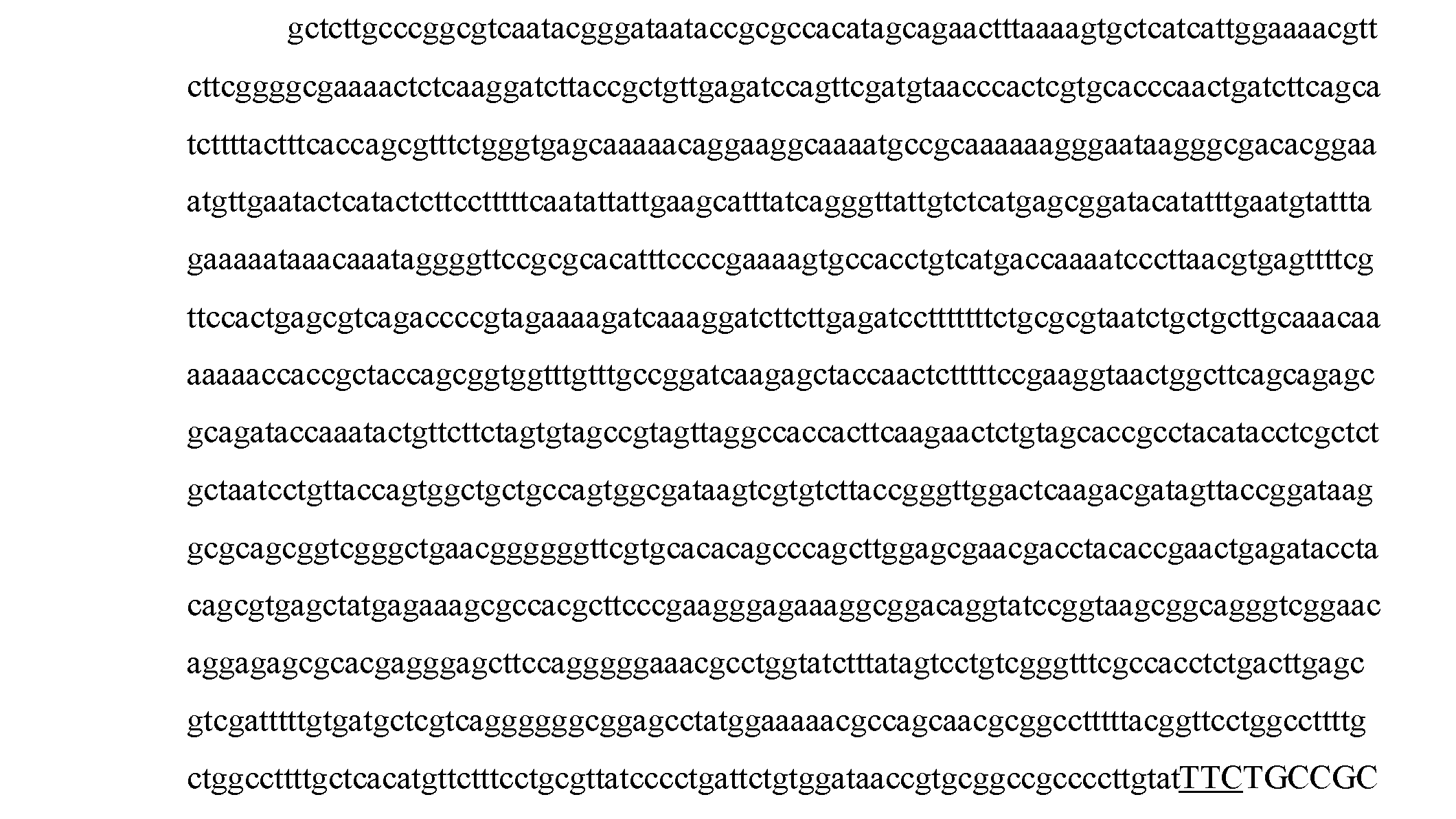

>Linear pTarget3: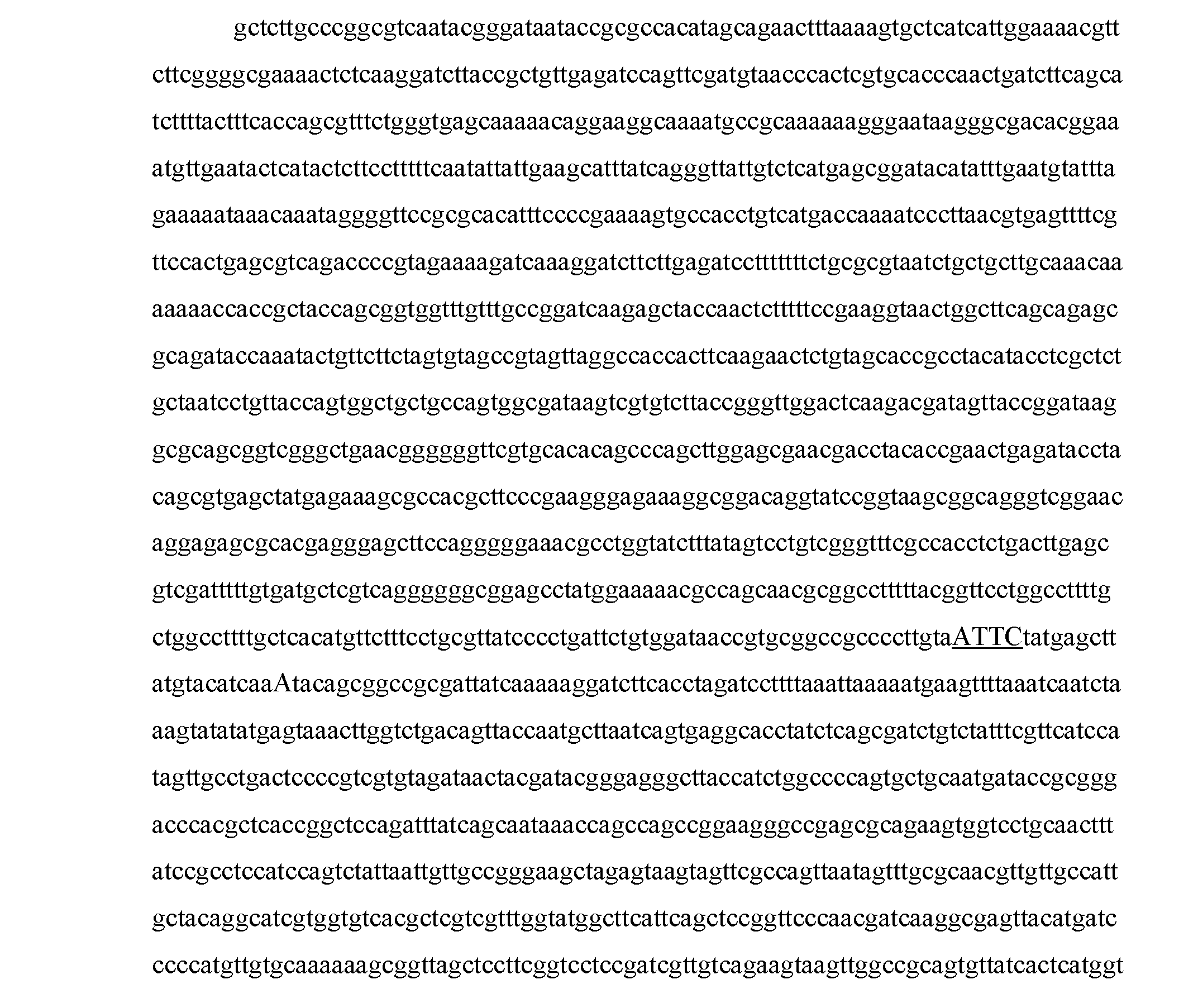

Beispiel 4example 4
ErgebnisseResults
Die transkriptomische Kartierung legte nahe, dass crRNA in E. coli-Zellen heterolog exprimiert und so prozessiert wurde, dass sie eine Wiederholung mit 25 Nukleotiden und einen Spacer mit 14 bis 20 Nukleotiden enthält. Die Daten legen auch nahe, dass Cas12J wahrscheinlich seine eigene crRNA prozessiert (siehe
Verfahrenprocedure
RNA-seqRNA-seq
pBAS::Cas12J-1947455-, pBAS::Cas12J-2071242- und pBAS::Cas12J-3339380-Konstrukte wurden in chemisch kompetentes E. coli DH5α (QB3-Macrolab, UC Berkeley) transformiert und über Nacht bei 37 °C auf LB-Cm-Agarplatten (34 µg/ml Chloramphenicol) inkubiert. Einzelne Kolonien wurden ausgewählt, um 5 ml (LB, 34 µg/ml Chloramphenicol) Starterkulturen, die bei 37 °C inkubiert wurden und über Nacht kräftig geschüttelt wurden, zu inokulieren. Am nächsten Morgen wurden die Hauptkulturen 1:100 geimpft (LB, 34 µg/ml Chloramphenicol) und Locus-Expression wurden mit 200 nM aTc für 24 h bei 16 °C induziert. Die Zellen wurden durch Zentrifugation geerntet, in Lysepuffer (20 mM Hepes-Na, pH 7,5, 200 mM NaCl) resuspendiert und unter Verwendung von Glasperlen (0,1-mm-Glasperlen, 4 × 30 s Wirbel bei 4 °C, im Abstand von 30 s Abkühlen auf Eis) lysiert. 200 µl Zelllyseüberstand wurden zur RNA-Extraktion gemäß dem Herstellerprotokoll (Ambion) in Trizol überführt. 10 µg RNA wurden mit 20 Einheiten T4-PNK (NEB) für 6 Stunden bei 37 °C zur Dephosphorylierung behandelt. Anschließend wurde 1 mM ATP zugegeben und die Probe wurde für 1 h bei 37 °C für 5'-Phosphorylierung vor der Wärmeinaktivierung bei 65 °C und anschließender Trizol-Reinigung inkubiert.pBAS::Cas12J-1947455, pBAS::Cas12J-2071242, and pBAS::Cas12J-3339380 constructs were transformed into chemically competent E. coli DH5α (QB3-Macrolab, UC Berkeley) and grown overnight at 37°C on LB -Cm agar plates (34 µg/ml chloramphenicol). Single colonies were selected to inoculate 5 ml (LB, 34 µg/ml chloramphenicol) starter cultures which were incubated at 37°C and shaken vigorously overnight. The next morning, main cultures were inoculated 1:100 (LB, 34 µg/ml chloramphenicol) and locus expression was induced with 200 nM aTc for 24 h at 16 °C. Cells were harvested by centrifugation, resuspended in lysis buffer (20mM Hepes-Na, pH 7.5, 200mM NaCl) and seeded using glass beads (0.1mm glass beads, 4 x 30s vortex at 4°C, lysed at intervals of 30 s cooling on ice). 200 μl of cell lysis supernatant were transferred to Trizol for RNA extraction according to the manufacturer's protocol (Ambion). 10 μg of RNA were treated with 20 units of T4-PNK (NEB) for 6 hours at 37° C. for dephosphorylation. Then 1mM ATP was added and the sample was incubated for 1h at 37°C for 5'-phosphorylation before heat inactivation at 65°C and subsequent Trizol purification.
Als nächstes wurden cDNA-Bibliotheken unter Verwendung des RealSeq-AC miRNA-Bibliothekskit-Illumina-Sequenzierung (Somagenics) hergestellt. cDNA-Bibliotheken wurden einer Illumina MiSeq-Sequenzierung unterzogen, wobei Einzelauslesungen mit einer Länge von 50 Nukleotiden erzeugt wurden. Rohe Sequenzierungsdaten wurden verarbeitet, um Adapter und Sequenzierungsartefakte zu entfernen, und es wurden qualitativ hochwertige Auslesevorgänge beibehalten. Die resultierenden Auslesungen wurden auf ihre jeweiligen Plasmide abgebildet, um die CRISPR-Locus-Expression und die crRNA-Prozessierung zu bestimmen.Next, cDNA libraries were made using the RealSeq-AC miRNA library kit-Illumina sequencing (Somagenics). cDNA libraries were subjected to Illumina MiSeq sequencing, generating single reads 50 nucleotides in length. Raw sequencing data was processed to remove adapters and sequencing artifacts, and high-quality reads were preserved. The resulting readouts were mapped onto their respective plasmids to determine CRISPR locus expression and crRNA processing.
Beispiel 5Example 5
ErgebnisseResults
Die in
Verfahrenprocedure
Klonierung von Cas12J-Effektorplasmiden zur Expression in menschlichen ZellenCloning of Cas12J effector plasmids for expression in human cells
Die Gensequenzen von cas12J-2 und cas12J-3 wurden als G-Blöcke von Integrated DNA Technologies (IDT) bestellt, die codonoptimierte Gene für die Expression in menschlichen Zellen codieren. G-Blöcke wurden über die Golden Gate-Assemblierung in das Vektorgerüst von pBLO62.5 kloniert, stromabwärts über eine GSG-Linker-Codierungssequenz (
Auf menschliche Zellen ausgerichtete GFP-StörungHuman cell-targeted GFP disruption
Die GFP HEK293-Reporterzellen wurden zuvor wie zuvor beschrieben durch lentivirale Integration erzeugt. Antony et al. (2018) Mol. Cell. Pediatrics 5:9. Die Zellen wurden routinemäßig unter Verwendung des MycoAlert Mycoplasma Detection Kit (Lonza) gemäß dem Protokoll des Herstellers auf Mycoplasma getestet. GFP HEK293-Reporterzellen wurden in 96-Well-Platten ausgesät und am nächsten Tag mit Lipofectamin 3000 (Life Technologies) und 200 ng Plasmid-DNA, die für die Cas12J-gRNA- und Cas12J-P2A-Puromycin-Fusion codiert, transfiziert. 24 Stunden nach der Transfektion wurden erfolgreich transfizierte Zellen durch Zugabe von 1,5 µg/ml Puromycin auf das Zellkulturmedium für 72 Stunden ausgewählt. Die Zellen wurden passagiert, um subkonfluente Bedingungen aufrechtzuerhalten, und dann auf einem Attune NxT-Durchflusszytometer mit einem Autosampler analysiert. Die Zellen wurden nach 7 Tagen auf dem Durchflusszytometer analysiert, um die Clearance von GFP aus den Zellen zu ermöglichen.The GFP HEK293 reporter cells were previously generated by lentiviral integration as previously described. Antony et al. (2018) Mol. Cell. Pediatrics 5:9. Cells were routinely tested for Mycoplasma using the MycoAlert Mycoplasma Detection Kit (Lonza) according to the manufacturer's protocol. GFP HEK293 reporter cells were seeded in 96-well plates and transfected the next day with Lipofectamine 3000 (Life Technologies) and 200 ng of plasmid DNA encoding the Cas12J-gRNA and Cas12J-P2A-puromycin fusion. 24 hours after transfection, successfully transfected cells were selected by adding 1.5 μg/ml puromycin to the cell culture medium for 72 hours. Cells were passaged to maintain subconfluent conditions and then analyzed on an Attune NxT flow cytometer with an autosampler. The cells were analyzed after 7 days on the flow cytometer to allow clearance of GFP from the cells.
Beispiel 6Example 6
ErgebnisseResults
Um zu testen, ob Cas12J eine unspezifische trans-Spaltungsaktivität aufweist, wurde ein In-vitro-Spaltungsassay eingerichtet, sobald es durch cis-gerichtete Nukleinsäuren aktiviert wurde. In dem Assay wurden die Cas12J-RNPs und die trans-Spaltungs-ssDNA- oder ssRNA-Substrate in Gegenwart von keinem cis-Aktivator, ssDNA-cis-Aktivator, dsDNA-cis-Aktivator oder ssRNA-cis-Aktivator inkubiert.To test whether Cas12J exhibits non-specific trans cleavage activity, an in vitro cleavage assay was set up once activated by cis-targeted nucleic acids. In the assay, the Cas12J RNPs and the trans-cleavage ssDNA or ssRNA substrates were incubated in the presence of no cis activator, ssDNA cis activator, dsDNA cis activator, or ssRNA cis activator.
Wie in
Verfahrenprocedure
ssDNA- und ssRNA-Substrate für trans-Spaltung wurden als nicht-komplementär für den Spacer der Cas12J-Guide-RNA entwickelt. Die Substrate wurden unter Verwendung von T4-PNK (NEB) bei Vorhandensein von 32P-γ-ATP am 5'-Ende markiert. Aktive Cas12J-RNP-Komplexe wurden durch Verdünnen des Cas12J-Proteins und der Guide-crRNA auf 4 µM in komplexem Assemblierungspuffer (20 mM HEPES-Na, pH 7,5 RT, 300 mM KCl, 10 mM MgCl2, 20 %-iges Glycerin, 1 mM TCEP) und Inkubation für 30 min bei RT assembliert. Komplementäre Spacer-Aktivatorsubstrate wurden in Oligonukleotid-Hybridisierungspuffer (10 mM Tris, pH 7,8 RT, 150 mM KC1) auf eine Konzentration von 4 µM verdünnt, für 5 min auf 95 °C erhitzt und anschließend auf Raumtemperatur (RT) abgekühlt, um Duplexbildung für doppelsträngige Aktivatorsubstrate zu ermöglichen. Spaltungsreaktionen wurden durch Kombinieren von 200 nM RNP mit 400 nM Aktivatorsubstrat und Inkubation für 10 min bei RT vor Zugabe von 2 nM ssDNA- oder ssRNA-trans-Spaltungssubstraten aufgebaut. Die Reaktionen wurden in Reaktionspuffer (10 mM HEPES-Na, pH 7,5 RT, 150 mM KCl, 5 mM MgCl2, 10 %-iges Glycerin, 0,5 mM TCEP) durchgeführt und für 60 min bei 37 °C inkubiert. Die Reaktionen wurden durch Zugabe von zwei Volumina Formamid-Ladepuffer (96 % Formamid, 100 µg/ml Bromphenolblau, 50 µg/ml Xylolcyanol, 10 mM EDTA, 50 µg/ml Heparin) gestoppt, für 5 min auf 95 °C erhitzt und vor der Trennung auf einer 12,5-%igen denaturierenden Harnstoff-Polyacrylamid-Gelelektrophorese (PAGE) auf Eis abgekühlt. Die Gele wurden für 4 h bei 80 °C getrocknet, bevor die Phosphorbildgebung unter Verwendung eines Amersham Typhoon-Scanners (GE Healthcare) sichtbar gemacht wurde.ssDNA and ssRNA substrates for trans cleavage were designed to be non-complementary to the spacer of the Cas12J guide RNA. The substrates were labeled at the 5' end using T4-PNK (NEB) in the presence of 32 P-γ-ATP. Active Cas12J-RNP complexes were prepared by diluting the Cas12J protein and guide crRNA to 4 µM in complex assembly buffer (20 mM HEPES-Na, pH 7.5 RT, 300 mM KCl, 10 mM MgCl 2 , 20% glycerol, 1 mM TCEP) and incubate for 30 min at RT. Complementary spacer-activator substrates were diluted to a concentration of 4 µM in oligonucleotide hybridization buffer (10 mM Tris, pH 7.8 RT, 150 mM KCl), heated to 95 °C for 5 min and then cooled to room temperature (RT) to To enable duplex formation for double-stranded activator substrates. Cleavage reactions were performed by combining 200 nM RNP with 400 nM activator substrate and incubating for 10 min at RT before addition of 2 nM ssDNA or ssRNA trans-SpaI tion substrates. The reactions were carried out in reaction buffer (10 mM HEPES-Na, pH 7.5 RT, 150 mM KCl, 5 mM MgCl 2 , 10% glycerol, 0.5 mM TCEP) and incubated at 37° C. for 60 min. Reactions were stopped by adding two volumes of formamide loading buffer (96% formamide, 100 µg/mL bromophenol blue, 50 µg/mL xylene cyanol, 10 mM EDTA, 50 µg/mL heparin), heated to 95 °C for 5 min and pre of separation on a 12.5% denaturing urea-polyacrylamide gel electrophoresis (PAGE) on ice. Gels were dried for 4 h at 80 °C before phosphor imaging was visualized using an Amersham Typhoon scanner (GE Healthcare).
Beispiel 7Example 7
Materialien und VerfahrenMaterials and Processes
Metagenomische Assemblies, Genomkuration und CRISPR-CasΦ (CRISPR-Cas12J)-NachweisMetagenomic assemblies, genome curation, and CRISPR-CasΦ (CRISPR-Cas12J) detection
Metagenomische Sequenzierungsdaten wurden unter Verwendung zuvor beschriebener Verfahren (Peng et al. Bioinformatics. 28, 1420-1428 (2012); und Nurk et al. Genome Res. 27, 824-834 (2017) assembliert. Codierungssequenzen (CDS) wurden aus Sequenzanordnungen unter Verwendung von verlorenen Genen mit genetischem Code 11 (-m-g 11 -p single) und (-m-g 11 -p meta) vorhergesagt und vorläufige Annotationen wurden wie zuvor beschrieben durchgeführt, indem gegen UniProt, UniRef100 und KEGG gesucht wurde (Wrighton et al. ISME J. 8, 1452-1463 (2014)). Die Phagengenomkuration wurde wie vorstehend beschrieben durchgeführt. Kurz gesagt wurde Bowtie2 v2.3.4.1 (Langmead und Salzberg Nat. Methods. 9, 357-359 (2012)) verwendet, um Lesevorgänge auf die de novo assemblierte Sequenzen abzubilden, und nicht platzierte Partnerpaare von abgebildeten Lesevorgängen wurden mit Shrinksam beibehalten (github.com/bcthomas/shrinksam). N-gefüllte Lücken und lokale Fehlanordnungen wurden identifiziert und korrigiert, und nicht platzierte oder falsch platzierte gepaarte Auslesungen ermöglichten die Erweiterung der Contig-Enden. Lokale Baugruppenänderungen und -erweiterungen wurden mit weiterer Auslesungszuordnung überprüft. Eine Datenbank mit CasΦ-Sequenzen wurde mit MAFFT v7.407 (Katoh und Standley Mol. Biol. Evol. 30, 772-780 (2013)) und hmmbuild erstellt. CDS von neuen Assemblies wurden mit hmmsearch mit e-Wert <1 × 10⁻⁵ gegen die HMM-Datenbank durchsucht und nach Überprüfung zur Datenbank hinzugefügt.Metagenomic sequencing data were assembled using previously described methods (Peng et al. Bioinformatics. 28, 1420-1428 (2012); and Nurk et al. Genome Res. 27, 824-834 (2017). Coding sequences (CDS) were derived from sequence assemblies under Utilization of lost genes with genetic code 11 (-mg 11 -p single) and (-mg 11 -p meta) were predicted and preliminary annotations were performed as previously described by searching against UniProt, UniRef100 and KEGG (Wrighton et al. ISME J. 8, 1452-1463 (2014)).Phage genome curation was performed as described above.Briefly, Bowtie2 v2.3.4.1 (Langmead and Salzberg Nat. Methods. 9, 357-359 (2012)) was used to perform reads to map to the de novo assembled sequences, and unplaced partner pairs from mapped reads were preserved with Shrinksam (github.com/bcthomas/shrinksam), N-filled gaps and local misalignments were identified and corrected, and unplaced or misplaced paired readouts allowed expansion of the contig ends. Local module changes and extensions were checked with further readout assignment. A database of CasΦ sequences was built using MAFFT v7.407 (Katoh and Standley Mol. Biol. Evol. 30, 772-780 (2013)) and hmmbuild. CDS from new assemblies were searched against the HMM database using hmmsearch with e-value <1 × 10 -5 and added to the database after verification.
Phylogenetische Analyse von Typ-V-SystemenPhylogenetic Analysis of Type V Systems
Cas-Proteinsequenzen wurden wie vorstehend beschrieben gesammelt und Vertreter der TnpB-Superfamilie wurden von Makarova et al. (Nat. Rev. Microbiol., 1-17 (2019)) gesammelt und waren Top-BLAST-Treffern von RefSeq. Der resultierende Satz wurde bei 90 % Aminosäureidentität unter Verwendung von CD-HIT geclustert, um die Redundanz zu verringern (Huang et al. Bioinformatics. 26, 680-682 (2010)). Eine neue Ausrichtung von CasΦ mit dem resultierenden Sequenzsatz wurde unter Verwendung von MAFFT LINSI mit 1000 Iterationen erzeugt und gefiltert, um Spalten, die aus Lücken bestehen, in 95 % der Sequenzen zu entfernen. Schlecht ausgerichtete Sequenzen wurden entfernt und der resultierende Satz wurde neu ausgerichtet. Der phylogenetische Baum wurde unter Verwendung von IQTREE v1.6.6 unter Verwendung der automatischen Modellauswahl (Nguyen et al. Mol. Biol. Evol. 32, 268-274 (2015)) und 1000 Bootstraps abgeleitet.Cas protein sequences were assembled as described above and members of the TnpB superfamily were identified by Makarova et al. (Nat. Rev. Microbiol., 1-17 (2019)) and were top BLAST hits from RefSeq. The resulting set was clustered at 90% amino acid identity using CD-HIT to reduce redundancy (Huang et al. Bioinformatics. 26, 680-682 (2010)). A new alignment of CasΦ with the resulting set of sequences was generated using MAFFT LINSI at 1000 iterations and filtered to remove columns consisting of gaps in 95% of the sequences. Badly aligned sequences were removed and the resulting sentence was realigned. The phylogenetic tree was derived using IQTREE v1.6.6 using automatic model selection (Nguyen et al. Mol. Biol. Evol. 32, 268-274 (2015)) and 1000 bootstraps.
crRNA-SequenzanalysecrRNA sequence analysis
CRISPR-RNA (crRNA)-Wiederholungen von Phagen-codierten CRISPR-Loci wurden unter Verwendung von MinCED (github.com/ctSkennerton/minced) und CRISPRDetect identifiziert (Biswas et al. BMC Genomics. 17, 356 (2016)). Die Wiederholungen wurden verglichen, indem paarweise Ähnlichkeitsbewertungen unter Verwendung des Needleman-Wunsch-Algorithmus erzeugt wurden, gefolgt von EMBOSS Needle (McWilliam et al. Nucleic Acids Res. 41, W597-600 (2013)). Eine Heatmap wurde unter Verwendung der Ähnlichkeitsbewertungsmatrix erstellt und durch hierarchisches Clustering wurden Dendrogramme erstellt, die der Heatmap überlagert wurden, um verschiedene Cluster von Wiederholungen abzugrenzen.CRISPR RNA (crRNA) repeats of phage-encoded CRISPR loci were identified using MinCED (github.com/ctSkennerton/minced) and CRISPRDetect (Biswas et al. BMC Genomics. 17, 356 (2016)). The replicates were compared by generating pairwise similarity scores using the Needleman-Wunsch algorithm followed by EMBOSS Needle (McWilliam et al. Nucleic Acids Res. 41, W597-600 (2013)). A heat map was generated using the similarity score matrix and hierarchical clustering was used to create dendrograms that were overlaid on the heat map to delineate different clusters of repeats.
Erzeugung von PlasmidenGeneration of plasmids
CasΦ-Loci, einschließlich eines zusätzlichen E. coli-RBS stromaufwärts von casΦ wurden als G-Blöcke von Integrated DNA Technologies (IDT) bestellt und unter Verwendung der Golden Gate-Anordnung (GG) unter der Kontrolle eines Tetracyclininduzierbaren Promotors für RNA seq und PAM-Depletionsplasmidinterferenzexperimente kloniert. Perfekte Wiederholung-Spacer-Einheiten der durch Metagenomik identifizierten CRISPR-Arrays wurden zu einer einzigen Wiederholung-Spacer-Wiederholung-Einheit reduziert, die durch GG-Assemblierung (Aarl-Restriktionsstellen) einem Stuffer-Spacer-Austausch zugänglich ist. Anschließend wurden CasΦ-Gensequenzen durch GG-Assemblierung in pRSFDuet-1 (Novagen) innerhalb von MCSI ohne Tags für die Effizienz von Transformationsplasmid-Interferenz-Assays subkloniert oder zur Proteinreinigung an ein C-terminales Hexa-Histidin-Tag kondensiert. Für Plasmidinterferenz-Assays wurden Mini-CRISPR-Arrays (Wiederholung-Spacer-Wiederholung oder Wiederholung-Spacer-HDV-Ribozym), die durch GG-Assemblierung (Aarl-Restriktionsstellen) für einen Stuffer-Spacer-Austausch geeignet sind, in MCS II von pRSFDuet kloniert. Für Genomeditierungsexperimente in menschlichen Zellen wurden casΦ-Gene als G-Blöcke aus IDT, die codonoptimierte Gene für die Expression in menschlichen Zellen codieren, bestellt. G-Blöcke wurden über GG-Assemblierung in das Vektorgerüst von pBLO62.5 kloniert und stromabwärts über eine GSG-Linker-Codierungssequenz an zwei SV40-NLS kondensiert. Die Guide-Codierungssequenz von pBLO62.5 wurde gegen eine einzelne CRISPR-Wiederholung des jeweiligen Homologen ausgetauscht, gefolgt von einer 20-bp-Stuffer-Spacer-Sequenz, die für den GG-Assembly-Austausch unter Verwendung des Restriktionsenzyms SapI zugänglich ist. Eine Liste von Plasmiden und eine kurze Beschreibung sind in
PAM-Depletion-DNA-Interferenz-AssayPAM Depletion DNA Interference Assay
PAM-Depletion-Assays wurden sowohl mit CasΦ-Plasmiden durchgeführt, die entweder den gesamten CasΦ-Locus trugen, wie von Metagenomics abgeleitet (pPP049, pPP056 und pPP062), als auch mit Plasmiden, die nur das casΦ-Gen und ein Mini-CRISPR (pPP097, pPP102 und pPP107) enthielten. Die Assays wurden als drei einzelne biologische Replikate durchgeführt. Plasmide, die casΦ- und Mini-CRISPR enthielten, wurden in E. coli BL21 (DE3) (NEB) transformiert, und Konstrukte, die CasΦ-Genome enthielten, wurden in E. coli DH5α (QB3-Macrolab, UC Berkeley) transformiert. Anschließend wurden elektrokompetente Zellen durch eiskaltes H2O und Waschen mit 10 %-igem Glycerin hergestellt. Eine Plasmidbibliothek wurde mit 8 randomisierten Nukleotiden am stromaufwärtigen (5' -) Ende der Target-Sequenz konstruiert. Kompetente Zellen wurden dreifach durch Elektroporation mit 200 ng Bibliotheksplasmiden (0,1 mm Elektroporationsküvetten (Bio-Rad) auf einem Micropulser-Elektroporator (Bio-Rad)) transformiert. Nach einer zweistündigen Erholungsperiode wurden die Zellen auf selektiven Medien ausplattiert und koloniebildende Einheiten bestimmt, um eine angemessene Abdeckung aller möglichen Kombinationen der randomisierten 5'-PAM-Region sicherzustellen. Die Stämme wurden 48 Stunden bei 25 °C auf Medien gezüchtet, die geeignete Antibiotika (entweder 100 µg/ml Carbenicillin und 34 µg/ml Chloramphenicol oder 100 µg/ml Carbenicillin und 50 µg/ml Kanamycin) und 0,05 mM Isopropyl-β-D-thiogalactopyranosid (IPTG) oder 200 nM Anhydrotetracyclin (aTc) abhängig vom Vektor enthielten, um die Vermehrung von Plasmiden und die CasΦ-Effektorproduktion sicherzustellen. Anschließend wurden vermehrte Plasmide unter Verwendung eines QIAprep Spin Miniprep Kits (Qiagen) isoliert.PAM depletion assays were performed with both CasΦ plasmids carrying either the entire CasΦ locus as derived by Metagenomics (pPP049, pPP056 and pPP062) and plasmids carrying only the casΦ gene and a mini-CRISPR (pPP097, pPP102 and pPP107). Assays were performed as three individual biological replicates. Plasmids containing casΦ and mini-CRISPR were transformed into E. coli BL21 (DE3) (NEB) and constructs containing CasΦ genomes were transformed into E. coli DH5α (QB3-Macrolab, UC Berkeley). Subsequently, electrocompetent cells were prepared by ice-cold H 2 O and washing with 10% glycerol. A plasmid library was constructed with 8 randomized nucleotides at the upstream (5') end of the target sequence. Competent cells were transformed in triplicate by electroporation with 200 ng library plasmids (0.1 mm electroporation cuvettes (Bio-Rad) on a Micropulser electroporator (Bio-Rad)). After a 2 hour recovery period, cells were plated on selective media and colony forming units determined to ensure adequate coverage of all possible combinations of the randomized 5'-PAM region. Strains were grown for 48 hours at 25°C on media containing appropriate antibiotics (either 100 µg/ml carbenicillin and 34 µg/ml chloramphenicol or 100 µg/ml carbenicillin and 50 µg/ml kanamycin) and 0.05 mM isopropyl-β -D-thiogalactopyranoside (IPTG) or 200 nM anhydrotetracycline (aTc) depending on the vector to ensure propagation of plasmids and CasΦ effector production. Subsequently, amplified plasmids were isolated using a QIAprep Spin Miniprep Kit (Qiagen).
PAM-DepletionssequenzierungsanalysePAM depletion sequencing analysis
Die Amplikonsequenzierung des Target-Plasmids wurde verwendet, um PAM-Motive zu identifizieren, die bevorzugt abgereichert sind. Sequenzierungsablesungen wurden auf die jeweiligen Plasmide abgebildet und PAM-randomisierte Regionen wurden extrahiert. Die Häufigkeit jeder möglichen 8-Nukleotid-Kombination wurde aus den ausgerichteten Ablesungen gezählt und auf die Gesamtablesungen für jede Probe normalisiert. Angereicherte PAM wurden durch Berechnen des logarithmischen Verhältnisses im Vergleich zur Häufigkeit in den Kontrollplasmiden berechnet und zur Herstellung von Sequenzlogos verwendet.Amplicon sequencing of the target plasmid was used to identify PAM motifs that are preferentially depleted. Sequencing readings were mapped to the respective plasmids and PAM-randomized regions were extracted. The frequency of each possible 8-nucleotide combination was counted from the aligned readings and normalized to the total readings for each sample. Enriched PAM were calculated by calculating the logarithmic ratio versus abundance in the control plasmids and used to generate sequence logos.
RNA-Präparation für RNAseqRNA preparation for RNAseq
Plasmide, die CasΦ-Loci enthielten, wurden in chemisch kompetentes E. coli DH5α (QB3-Macrolab, UC Berkeley) transformiert. Präparationen wurden als drei einzelne biologische Replikate durchgeführt. Einzelne Kolonien wurden ausgewählt, um 5 ml Starterkulturen (LB, 34 µg/ml Chloramphenicol), die bei 37 °C inkubiert wurden und über Nacht kräftig geschüttelt wurden, zu inokulieren. Am nächsten Morgen wurden die Hauptkulturen 1:100 geimpft (LB, 34 µg/ml Chloramphenicol) und Locus-Expression wurden mit 200 nM aTc für 24 h bei 16 °C induziert. Die Zellen wurden durch Zentrifugation geerntet, in Lysepuffer (20 mM Hepes-Na, pH 7,5 RT, 200 mM NaCl) resuspendiert und unter Verwendung von Glasperlen (0,1-mm-Glasperlen, 4 × 30 s Wirbel bei 4 °C, im Abstand von 30 s Abkühlen auf Eis) lysiert. 200 µl Zelllyseüberstand wurden zur RNA-Extraktion gemäß dem Herstellerprotokoll (Ambion) in Trizol überführt. 10 µg RNA wurden mit 20 Einheiten T4-PNK (NEB) für 6 Stunden bei 37 °C zur 2'-3'-Dephosphorylierung behandelt. Anschließend wurde 1 mM ATP zugegeben und die Probe wurde für 1 h bei 37 °C für 5'-Phosphorylierung vor der Wärmeinaktivierung bei 65 °C für 20 min und anschließender Trizol-Reinigung inkubiert.Plasmids containing CasΦ loci were transformed into chemically competent E. coli DH5α (QB3-Macrolab, UC Berkeley). Preparations were performed as three individual biological replicates. Single colonies were selected to inoculate 5 ml starter cultures (LB, 34 µg/ml chloramphenicol) which were incubated at 37°C and shaken vigorously overnight. The next morning, main cultures were inoculated 1:100 (LB, 34 µg/ml chloramphenicol) and locus expression was induced with 200 nM aTc for 24 h at 16 °C. Cells were harvested by centrifugation, resuspended in lysis buffer (20 mM Hepes-Na, pH 7.5 RT, 200 mM NaCl) and spun using glass beads (0.1 mm glass beads, 4 × 30 s vortex at 4 °C , at intervals of 30 s cooling on ice). 200 µl cell lysis supernatant was transferred to Trizol for RNA extraction according to the manufacturer's protocol (Ambion). 10 μg of RNA were treated with 20 units of T4-PNK (NEB) for 6 hours at 37° C. for 2'-3'-dephosphorylation. Then 1 mM ATP was added and the sample was incubated for 1 h at 37 °C for 5'-phosphorylation before heat inactivation at 65 °C for 20 min and subsequent Trizol purification.
RNA-Analyse durch RNAseqRNA analysis by RNAseq
cDNA-Bibliotheken wurden unter Verwendung des RealSeq-AC miRNA-Bibliothekskits Illumina Sequencing (Somagenics) hergestellt. cDNA-Bibliotheken wurden einer Illumina MiSeq-Sequenzierung unterzogen, und rohe Sequenzierungsdaten wurden verarbeitet, um Adapter und Sequenzierungsartefakte zu entfernen, und es wurden qualitativ hochwertige Lesevorgänge beibehalten. Die resultierenden Auslesungen wurden auf ihre jeweiligen Plasmide abgebildet, um die CRISPR-Locus-Expression und die crRNA-Prozessierung zu bestimmen, und die Abdeckung wurde in jeder Region berechnet.cDNA libraries were made using the RealSeq-AC miRNA library kit Illumina Sequencing (Somagenics). cDNA libraries were subjected to Illumina MiSeq sequencing, and raw sequencing data was processed to remove adapters and sequencing artifacts, and high-quality reads were retained. The resulting readouts were mapped to their respective plasmids to determine CRISPR locus expression and crRNA processing, and coverage was calculated in each region.
Effizienz des TransformationsplasmidinterferenzassaysEfficiency of the transforming plasmid interference assay
CasΦ-Vektoren wurden in chemisch kompetente E. coli BL21 (DE3) (NEB) transformiert. Einzelne Kolonien für biologische Replikate wurden ausgewählt, um drei Starterkulturen von 5 ml (LB, Kanamycin 50 µg/ml) zu inokulieren, um elektrokompetente Zellen am folgenden Tag herzustellen. Hauptkulturen von 50 ml (LB, Kanamycin 50 µg/ml) wurden 1:100 inokuliert und unter kräftigem Schütteln bei 37 °C bis zu einem OD600 von 0,3 wachsen gelassen. Anschließend wurden die Kulturen auf Raumtemperatur abgekühlt und die casΦ-Expression wurde mit 0,2 mM IPTG induziert. Die Kulturen wurden bei 25 °C bis zu einem OD600 von 0,6-0,7 wachsen gelassen, bevor elektrokompetente Zellen durch wiederholtes Waschen mit eiskaltem H2O und 10 %-igem Glycerin hergestellt wurden. Die Zellen wurden in 250 µl 10 %-iges Glycerin resuspendiert. Aliquote von 90 µl wurden in flüssigem Stickstoff blitzgefroren und bei - 80 °C gelagert. Am nächsten Tag wurden 80 µl kompetente Zellen mit 3,2 µl Plasmid (20 ng/ µl pUC19-Target-Plasmid oder 20 ng/ µl pYTK001-Kontrollplasmid) kombiniert, für 30 min auf Eis inkubiert und in drei einzelne Transformationsreaktionen von 25 µl aufgeteilt. Nach der Elektroporation in 0,1-mm-Elektroporationsküvetten (Bio-Rad) auf einem Micropulser-Elektroporator (Bio-Rad) wurden die Zellen in 1 ml Wiederherstellungsmedium (Lucigen), ergänzt mit 0,2 mM IPTG, gewonnen und für eine Stunde bei 37 °C geschüttelt. Anschließend wurden 10-fache Verdünnungsreihen hergestellt und 5 µl der jeweiligen Verdünnungsschritte wurden auf LB-Agar, der die geeigneten Antibiotika enthielt, punktiert. Die Platten wurden über Nacht bei 37 °C inkubiert und die Kolonien wurden am folgenden Tag gezählt, um die Transformationseffizienz zu bestimmen. Zur Beurteilung der Transformationseffizienz wurden der Mittelwert und die Standardabweichung aus den zellbildenden Einheiten pro ng transformierten Plasmiden für die Elektroporations-Triplikate berechnet.CasΦ vectors were transformed into chemically competent E. coli BL21 (DE3) (NEB). Single colonies for biological replicates were selected to inoculate three 5 ml starter cultures (LB, kanamycin 50 µg/ml) to produce electrocompetent cells the following day. Main cultures of 50 ml (LB, kanamycin 50 μg/ml) were inoculated 1:100 and grown with vigorous shaking at 37° C. to an OD 600 of 0.3. The cultures were then cooled to room temperature and casΦ expression was induced with 0.2 mM IPTG. Cultures were grown at 25°C to an OD 600 of 0.6-0.7 before electrocompetent cells were prepared by repeated washing with ice-cold H 2 O and 10% glycerol. The cells were resuspended in 250 μl of 10% glycerol. Aliquots of 90 µl were flash frozen in liquid nitrogen and stored at -80°C. The next day, 80 µl of competent cells were combined with 3.2 µl of plasmid (20 ng/µl pUC19 target plasmid or 20 ng/µl pYTK001 control plasmid), incubated for 30 min on ice and split into three individual 25 µl transformation reactions . After electroporation in 0.1 mm electroporation cuvettes (Bio-Rad) on a Micropulser electroporator (Bio-Rad), cells were recovered in 1 ml of recovery medium (Lucigen) supplemented with 0.2 mM IPTG and maintained for one hour shaken at 37°C. Then 10-fold serial dilutions were made and 5 µl of each dilution step was plated onto LB agar containing the appropriate antibiotics. Plates were incubated overnight at 37°C and colonies were counted the following day to determine transformation efficiency. To assess the transformation efficiency, the mean and the standard deviation from the cell-forming units per ng of transformed plasmids were calculated for the electroporation triplicates.
Proteinproduktion und -reinigungProtein production and purification
CasΦ-Überexpressionsvektoren wurden in chemisch geeignetes E. coli BL21(DE3)-Star (QB3-Macrolab, UC Berkeley) transformiert und über Nacht bei 37 °C auf LB-Kan-Agarplatten (50 µg/ml Kanamycin) inkubiert. Einzelne Kolonien wurden ausgewählt, um 80 ml (LB, Kanamycin 50 µg/ml) Starterkulturen, die bei 37 °C inkubiert wurden und über Nacht kräftig geschüttelt wurden, zu inokulieren. Am nächsten Tag wurden 1,5 1 TB-Kan-Medium (Kanamycin 50 µg/ml) mit 40 ml Starterkultur inokuliert und bei 37 °C auf ein OD600 von 0,6 wachsen gelassen, 15 min auf Eis abgekühlt und anschließend wurde die Genexpression mit 0,5 mM IPTG induziert, gefolgt von einer Inkubation über Nacht bei 16 °C. Die Zellen wurden durch Zentrifugation geerntet und in Waschpuffer (50 mM HEPES-Na, pH 7,5 RT, 1 M NaCl, 20 mM Imidazol, 5 %-igem Glycerin und 0,5 mM TCEP) resuspendiert, anschließend durch Ultraschallbehandlung lysiert, gefolgt von Lysatklärung durch Zentrifugation. Die lösliche Fraktion wurde auf eine 5-ml-Ni-NTA-Superflow-Kartusche (Qiagen) geladen, die in Waschpuffer voräquilibriert war. Gebundene Proteine wurden mit 20 Säulenvolumina (CV) Waschpuffer gewaschen und anschließend in 5 CV Elutionspuffer (50 mM HEPES-Na, pH 7,5 RT, 500 mM NaCl, 500 mM Imidazol, 5 %-igem Glycerin und 0,5 mM TCEP) eluiert. Die eluierten Proteine wurden vor der Injektion in eine HiLoad 16/600 Superdex 200pg-Säule (GE Healthcare), voräquilibriert in Größenausschlusschromatographiepuffer (20 mM HEPES-Na, pH 7,5 RT, 500 mM NaCl, 5 %-iges Glycerin und 0,5 mM TCEP) auf 1 ml konzentriert. Die Peakfraktionen wurden auf 1 ml konzentriert und die Konzentrationen wurden unter Verwendung eines NanoDrop 8000-Spektralphotometers (Thermo Scientific) bestimmt. Die Proteine wurden bei einer konstanten Temperatur von 4 °C gereinigt und konzentrierte Proteine wurden auf Eis gehalten, um eine Aggregation zu verhindern, in flüssigem Stickstoff schnellgefroren und bei -80 °C gelagert. AsCas12a wurde wie zuvor beschrieben gereinigt (Knott et al. (2019) Nat. Struct. Mol. Biol. 26:315).CasΦ overexpression vectors were transformed into chemically appropriate E. coli BL21(DE3)-Star (QB3-Macrolab, UC Berkeley) and incubated overnight at 37°C on LB-Kan agar plates (50 µg/ml kanamycin). Single colonies were selected to inoculate 80 ml (LB, kanamycin 50 µg/ml) starter cultures which were incubated at 37°C and shaken vigorously overnight. The next day, 1.5 1 TB-Kan medium (
In-vitro-Spaltungsassays - Spacer-TilingIn Vitro Cleavage Assays - Spacer Tiling
Plasmidziele wurden durch GG-Assemblierung von Spacer 2 kloniert, der im CRISPR-Array von CasΦ-1 stromabwärts eines verwandten 5'-TTA-PAM oder nicht verwandten 5'-CCA-PAM in pYTK095 gefunden wurde (Target-Sequenzen sind in
In-vitro-Spaltungsassays - radioaktiv markierte NukleinsäurenIn vitro cleavage assays - radioactively labeled nucleic acids
Aktive CasΦ-RNP-Komplexe wurden durch Verdünnen des CasΦ-Proteins auf 4 µM und der crRNA (IDT) auf 5 µM in RNP-Assemblierungspuffer (20 mM HEPES-Na, pH 7,5 RT, 300 mM KCl, 10 mM MgCl2, 20 %-iges Glycerin, 1 mM TCEP) und Inkubation für 30 min bei RT in einem Molarverhältnis von 1:1,2 assembliert. Die Substrate wurden unter Verwendung von T4-PNK (NEB) bei Vorhandensein von 32P-γ-ATP am 5'-Ende markiert (Substratsequenzen sind in
In-vitro-prä-crRNA-ProzessierungsassaysIn vitro pre-crRNA processing assays
Die prä-crRNA-Substrate wurden unter Verwendung von T4-PNK (NEB) bei Vorhandensein von 32P-γ-ATP am 5'-Ende markiert (Substratsequenzen sind in
Die Reaktionen wurden durch Zugabe von zwei Volumina Formamid-Ladepuffer (96 % Formamid, 100 µg/ml Bromphenolblau, 50 µg/ml Xylolcyanol, 10 mM EDTA, 50 µg/ml Heparin) gestoppt, für 3 min auf 95 °C erhitzt und vor der Trennung auf einer 12,5-%igen oder 20-%igen denaturierenden Harnstoff-PAGE auf Eis abgekühlt. Die Gele wurden für 4 h bei 80 °C getrocknet, bevor die Phosphorbildgebung unter Verwendung eines Amersham Typhoon-Scanners (GE Healthcare) sichtbar gemacht wurde. Technische Replikate (n ≥ 3) und vergleichbare Spaltungsassays unter verschiedenen Bedingungen (n ≥ 3) von biologischen Replikaten (n ≥ 2) zeigten konsistente Ergebnisse. Die Banden wurden unter Verwendung von ImageQuant TL (GE) quantifiziert und die prozessierte RNA wurde aus der Intensität bei t = 60 min relativ zu der bei t = 0 min beobachteten Intensität berechnet.Reactions were stopped by adding two volumes of formamide loading buffer (96% formamide, 100 µg/mL bromophenol blue, 50 µg/mL xylene cyanol, 10 mM EDTA, 50 µg/mL heparin), heated to 95 °C for 3 min and pre chilled on ice after separation on a 12.5% or 20% denaturing urea PAGE. Gels were dried for 4 h at 80 °C before phosphor imaging was visualized using an Amersham Typhoon scanner (GE Healthcare). Technical replicates (n ≥ 3) and comparable cleavage assays under different conditions (n ≥ 3) from biological replicates (n ≥ 2) showed consistent results. The bands were quantified using ImageQuant TL (GE) and the processed RNA was calculated from the intensity at t=60 min relative to the intensity observed at t=0 min.
Analytische GrößenausschlusschromatografieAnalytical Size Exclusion Chromatography
500 µl Proben (5-10 µM Protein, RNA oder rekonstituierte RNP) wurden auf eine S200 XK10/300 Größenausschlusschromatographie (SEC)-Säule (GE Healthcare) injiziert, voräquilibriert in SEC-Puffer (20 mM HEPES-Cl, pH 7,5, RT, 250 mM KCl, 5 mM MgCl2, 5 %-iges Glycerin und 0,5 mM TCEP). Vor der SEC wurden CasΦ-RNP-Komplexe durch Inkubieren von CasΦ-Protein und prä-crRNA für 1 h in 2X prä-crRNA-Prozessierungspuffer (20 mM Tris, pH 7,8, RT, 400 mM KCl, 10 mM MgCl2, 20 %-iges Glycerin, 2 mM DTT) assembliert.500 µl samples (5-10 µM protein, RNA or reconstituted RNP) were injected onto an S200 XK10/300 size exclusion chromatography (SEC) column (GE Healthcare) pre-equilibrated in SEC buffer (20 mM HEPES-Cl, pH 7.5 , RT, 250mM KCl, 5mM MgCl 2 , 5% glycerol and 0.5mM TCEP). Prior to SEC, CasΦ-RNP complexes were prepared by incubating CasΦ protein and pre-crRNA for 1 h in 2X pre-crRNA processing buffer (20mM Tris, pH 7.8, RT, 400mM KCl, 10mM MgCl 2 , 20% glycerol, 2mM DTT).
Genomeditierung in menschlichen ZellenGenome editing in human cells
Die GFP HEK293-Reporterzellen wurden wie zuvor beschrieben durch lentivirale Integration erzeugt. Richardson et al. (2016) Nat. Biotechnol. 34:339. Die Zellen wurden routinemäßig unter Verwendung des MycoAlert Mycoplasma Detection Kit (Lonza) gemäß dem Protokoll des Herstellers auf Nichtvorhandenseio von Mycoplasma getestet. GFP HEK293-Reporterzellen wurden in 96-Well-Platten ausgesät und gemäß Herstellerprotokoll am nächsten Tag mit Lipofectamin 3000 (Life Technologies) und 200 ng Plasmid-DNA, die für die CasΦ-gRNA- und CasΦ-P2A-Puromycin-Fusion codiert, mit 60-70 % Konfluenz transfiziert. Als Vergleichskontrolle wurden 200 ng Plasmid-DNA, die für die SpyCas9-sgRNA- und SpyCas9-P2A-PAC-Fusion codiert, identisch transfiziert, wobei die Target-Sequenzen auf PAM-Unterschiede eingestellt wurden. 24 Stunden nach der Transfektion wurden erfolgreich transfizierte Zellen durch Zugabe von 1,5 µg/ml Puromycin auf das Zellkulturmedium für 72 Stunden ausgewählt. The GFP HEK293 reporter cells were generated by lentiviral integration as previously described. Richardson et al. (2016) Nat. biotech. 34:339. Cells were routinely tested for the absence of Mycoplasma using the MycoAlert Mycoplasma Detection Kit (Lonza) according to the manufacturer's protocol. GFP HEK293 reporter cells were seeded in 96-well plates and treated the next day with Lipofectamine 3000 (Life Technologies) and 200 ng of plasmid DNA encoding the CasΦ-gRNA and CasΦ-P2A-puromycin fusion according to the manufacturer's protocol 60-70% confluency transfected. As a comparative control, 200 ng of plasmid DNA encoding the SpyCas9-sgRNA and SpyCas9-P2A-PAC fusion were transfected identically with the target sequences adjusted for PAM differences. 24 hours after transfection, successfully transfected cells were selected by adding 1.5 μg/ml puromycin to the cell culture medium for 72 hours.
Die Zellen wurden regelmäßig passagiert, um subkonfluente Bedingungen aufrechtzuerhalten, und dann auf einem Attune NxT-Durchflusszytometer mit einem Autosampler analysiert. Die Zellen wurden nach 10 Tagen auf dem Durchflusszytometer analysiert, um die Clearance von GFP aus den Zellen zu ermöglichen.Cells were regularly passaged to maintain subconfluent conditions and then analyzed on an Attune NxT flow cytometer with an autosampler. The cells were analyzed after 10 days on the flow cytometer to allow clearance of GFP from the cells.
ErgebnisseResults
Cas12J, oder einfach CasΦ als Hommage an seinen phagenbeschränkten Ursprung, ist eine bisher unbekannte Familie von Cas-Proteinen, die in der Biggiephage-Klade codiert sind. CasΦ enthält eine C-terminale RuvC-Domäne mit entfernter Homologie zu der der TnpB-Nuklease-Superfamilie, aus der sich vermutlich CRISPR-Cas-Proteine vom Typ V entwickelt haben (
Die ungewöhnlich kleine Größe von CasΦ von -70-80 kDa, was etwa halb so groß ist wie die RNA-geleiteten DNA-Schneideenzyme Cas9 und Cas12a (
Das E. coli-Expressionssystem und der Plasmidinterferenzassay wurden dazu verwendet, die Komponenten zu bestimmen, die für die Funktion des CRISPR-CasΦ-Systems erforderlich sind. Eine RNA-Sequenzierungsanalyse ergab eine Transkription des casΦ-Gens und des CRISPR-Arrays, jedoch keinen Hinweis auf andere nichtcodierende RNA wie etwa eine transaktivierende CRISPR-RNA (tracrRNA), die in oder nahe dem Locus codiert ist (
CRISPR-Cas-Effektorkomplexe identifizieren und spalten fremde Nukleinsäuren im Endstadium der CRISPR-Cas-vermittelten Immunität gegen MGE (Hille et al. (2018) Cell 172:1239). Um festzustellen, wie CasΦ ein RNA-geleitetes DNA-Targeting für Biggiephagen erreicht, wurden die Erkennungs- und Spaltungsanforderungen von CasΦ in vitro untersucht. Die RNA-Sequenz ergab, dass die Spacersequenz innerhalb der crRNA, die zu DNA-Targets komplementär ist, zwischen 14 und 20 Nukleotiden (nt) lang ist (
Um die Rolle der RuvC-Domäne bei der CasΦ-katalysierten DNA-Spaltung zu bewerten, wurde das aktive Zentrum mutiert (D371A, D394A oder D413A), um eine CasΦ-Variante (dCasΦ) herzustellen, von der festgestellt wurde, dass sie dsDNA, ssDNA oder ssRNA in vitro nicht spaltet (
Darüber hinaus wurde festgestellt, dass CasΦ, wie andere CRISPR-Cas-Effektoren vom Typ V, ssDNA in trans abbaut, wenn es durch Target-dsDNA- oder ssDNA-Bindung in cis aktiviert wird. trans-einzelsträngige DNAse-Aktivität, aber nicht RNAse-Aktivität, bei Erkennung des DNA-Targets in cis wurde beobachtet (
Um die Genomabwehr zu gewährleisten, müssen CRISPR-CasΦ-Systeme reife crRNA-Transkripte produzieren, um die Fremd-DNA-Spaltung zu führen. Andere CRISPR-Cas-Proteine vom Typ V prozessieren ihre eigenen prä-crRNA unter Verwendung eines internen aktiven Zentrums, das sich von der RuvC-Domäne unterscheidet (Fonfara et al. Nature. 532, 517-521 (2016)), oder durch Rekrutieren von Ribonuclease III, um ein Duplex-RNA-Substrat zu spalten, das durch prä-crRNA-Basenpaarung mit einer tracrRNA gebildet wird (Burstein et al. (2017) Nature 542:237; Harrington et al. (2018) Science 362:839; Yan et al. (2019) Science 363:88; Shmakov et al. (2015) Mol. Cell. 60:385). Das Fehlen einer nachweisbaren tracrRNA, die in genomischen CRISPR-CasΦ-Loci codiert ist, deutete daraufhin, dass CasΦ die crRNA-Reifung selbst katalysieren könnte. Um diese Möglichkeit zu testen, wurde gereinigtes CasΦ mit Substraten inkubiert, die die prä-crRNA-Struktur nachahmen sollten (
Es wurde angenommen, dass, wenn die CasΦ RuvC-Domäne für die prä-crRNA-Spaltung verantwortlich ist, die Produkte 5'-Phosphat- und 2'- und 3'-Hydroxylreste enthalten sollten, wie bei RNA beobachtet, die von den RuvC-verwandten RNase HI-Enzymen erzeugt werden (Nowotny et al. (2009) oben). Im Gegensatz dazu prozessieren andere CRISPR-Cas-Enzyme vom Typ V prä-crRNA durch einen metallunabhängigen Säure-Base-Katalysemechanismus an einem aktiven Zentrum, das sich von der RuvC-Domäne unterscheidet, was 2'-3'-cyclischen Phosphat-crRNA-Termini erzeugt, wie für Cas12a beobachtet (Swarts et al. (2017) Mol. Cell. 66:221). Die PNK-Phosphatase-Behandlung von CasΦ-erzeugter crRNA, gefolgt von einer Denaturierung des Acrylamidgels, zeigte keine Änderung des crRNA-Migrationsverhaltens, die sich von der Änderung der Mobilität unterschieden hat, die in einem ähnlichen Experiment festgestellt wurde, das mit von Cas12a erzeugter crRNA durchgeführt wurde (
Die Vielseitigkeit und Programmierbarkeit von CRISPR-Cas-Systemen hat eine Revolution in der Biotechnologie und der Grundlagenforschung ausgelöst, da sie zur Manipulation von Genomen praktisch aller Organismen eingesetzt wurden. Um zu untersuchen, ob die DNA-Spaltungsaktivität von CasΦ für die programmierte Bearbeitung des menschlichen Genoms genutzt werden kann, wurde ein Gen-Disruption-Assay unter Verwendung von CasΦ, das mit einer geeigneten crRNA in HEK293-Zellen coexprimiert wurde, durchgeführt (Liu et al. (2019) Nature 566:218; Oakes et al. (2016) Nat. Biotechnol. 34:646) (
CasΦ stellt eine neue Familie von CRISPR-Cas-Enzymen dar, die durch ihr einziges aktives Zentrum sowohl für das RNA- als auch für das DNA-Schneiden definiert sind. Drei weitere gut charakterisierte Cas-Enzyme Cas9, Cas12a und CasX verwenden ein (Cas12a und CasX) oder zwei aktive Zentren (Cas9) zum Schneiden von DNA und stützen sich auf ein separates aktives Zentrum (Cas12a) oder zusätzliche Faktoren (CasX und Cas9) für crRNA-Prozessierung (
Während die vorliegende Erfindung unter Bezugnahme auf die spezifischen Ausführungsformen davon beschrieben wurden ist, versteht der Fachmann, dass verschiedene Änderungen vorgenommen werden können und Äquivalente substituiert werden können, ohne vom wahren Geist und Umfang der Erfindung abzuweichen. Außerdem können viele Modifikation vorgenommen werden, um ein/eine/einen konkrete/konkretes/konkreten Situation, Material, Stoffzusammensetzung, Prozess, Prozessschritt oder -schritte an das Ziel, den Geist und den Umfang der vorliegenden Erfindung anzupassen. Alle derartigen Modifikationen sollen in den Geltungsbereich der beigefügten Ansprüche fallen.While the present invention has been described with reference to the specific embodiments thereof, it will be understood by those skilled in the art that various changes may be made and equivalents substituted without departing from the true spirit and scope of the invention. In addition, many modifications can be made to adapt a particular situation, material, composition of matter, process, process step or steps to the aim, spirit and scope of the present invention. All such modifications are intended to come within the scope of the appended claims.
ZITATE ENTHALTEN IN DER BESCHREIBUNGQUOTES INCLUDED IN DESCRIPTION
Diese Liste der vom Anmelder aufgeführten Dokumente wurde automatisiert erzeugt und ist ausschließlich zur besseren Information des Lesers aufgenommen. Die Liste ist nicht Bestandteil der deutschen Patent- bzw. Gebrauchsmusteranmeldung. Das DPMA übernimmt keinerlei Haftung für etwaige Fehler oder Auslassungen.This list of documents cited by the applicant was generated automatically and is included solely for the better information of the reader. The list is not part of the German patent or utility model application. The DPMA assumes no liability for any errors or omissions.
Zitierte PatentliteraturPatent Literature Cited
- US 62815173 B [0001]US62815173B[0001]
- US 62855739 B [0001]US62855739B[0001]
- US 62907422 B [0001]US62907422B [0001]
- US 62948470 B [0001]US62948470B [0001]
- US 7029913 B [0038]US7029913B [0038]
- US 5843780 A [0038]US5843780A [0038]
- US 6200806 B [0038]US6200806B [0038]
- WO 9920741 A [0038]WO 9920741A
- WO 0151616 A [0038]WO 0151616 A
- WO 03020920 A [0038]WO 03020920 A
- US 7153684 B [0039]US7153684B [0039]
- US 20090047263 A [0040]US20090047263A [0040]
- US 20090068742 A [0040]US20090068742A [0040]
- US 20090191159 A [0040]US20090191159A [0040]
- US 20090227032 A [0040]US20090227032A [0040]
- US 20090246875 A [0040]US20090246875A [0040]
- US 20090304646 A [0040]US20090304646A [0040]
- US 7022896 B [0110]US7022896B [0110]
- WO 9741228 A [0110]WO 9741228 A [0110]
- US 2009029861 A [0110]US2009029861A[0110]
- WO 2012068627 A [0115, 0138]WO 2012068627 A [0115, 0138]
- WO 2010075303 A [0116, 0138]WO 2010075303 A [0116, 0138]
- WO 2004067736 A [0118]WO 2004067736 A [0118]
- WO 2013155555 A [0138]WO 2013155555 A [0138]
- US 8906616 B [0138, 0174, 0308]US8906616B [0138, 0174, 0308]
- US 8895308 B [0138, 0174, 0308]US8895308B [0138, 0174, 0308]
- US 8889418 B [0138, 0174, 0308]US8889418B [0138, 0174, 0308]
- US 8889356 B [0138, 0174, 0308]US8889356B [0138, 0174, 0308]
- US 8871445 B [0138, 0174, 0308]US8871445B [0138, 0174, 0308]
- US 8865406 B [0138, 0174, 0308]US8865406B [0138, 0174, 0308]
- US 8795965 B [0138, 0174, 0308]US8795965B [0138, 0174, 0308]
- US 8771945 B [0138, 0174, 0308]US8771945B [0138, 0174, 0308]
- US 8697359 B [0138, 0174, 0308]US8697359B [0138, 0174, 0308]
- US 20140068797 A [0138, 0174, 0308]US20140068797A [0138, 0174, 0308]
- US 20140170753 A [0138, 0174, 0308]US20140170753A [0138, 0174, 0308]
- US 20140179006 A [0138, 0174, 0308]US20140179006A [0138, 0174, 0308]
- US 20140179770 A [0138, 0174, 0308]US20140179770A [0138, 0174, 0308]
- US 20140186843 A [0138, 0174, 0308]US20140186843A [0138, 0174, 0308]
- US 20140186919 A [0138, 0174, 0308]US20140186919A [0138, 0174, 0308]
- US 20140186958 A [0138, 0174, 0308]US20140186958A [0138, 0174, 0308]
- US 20140189896 A [0138, 0174, 0308]US20140189896A [0138, 0174, 0308]
- US 20140227787 A [0138, 0174, 0308]US20140227787A [0138, 0174, 0308]
- US 20140234972 A [0138, 0174, 0308]US20140234972A [0138, 0174, 0308]
- US 20140242664 A [0138, 0174, 0308]US20140242664A [0138, 0174, 0308]
- US 20140242699 A [0138, 0174, 0308]US20140242699A [0138, 0174, 0308]
- US 20140242700 A [0138, 0174, 0308]US20140242700A [0138, 0174, 0308]
- US 20140242702 A [0138, 0174, 0308]US20140242702A [0138, 0174, 0308]
- US 20140248702 A [0138, 0174, 0308]US20140248702A [0138, 0174, 0308]
- US 20140256046 A [0138, 0174, 0308]US20140256046A [0138, 0174, 0308]
- US 20140273037 A [0138, 0174, 0308]US20140273037A [0138, 0174, 0308]
- US 20140273226 A [0138, 0174, 0308]US20140273226A [0138, 0174, 0308]
- US 20140273230 A [0138, 0174, 0308]US20140273230A [0138, 0174, 0308]
- US 20140273231 A [0138, 0174, 0308]US20140273231A [0138, 0174, 0308]
- US 20140273232 A [0138, 0174, 0308]US20140273232A [0138, 0174, 0308]
- US 20140273233 A [0138, 0174, 0308]US20140273233A [0138, 0174, 0308]
- US 20140273234 A [0138, 0174, 0308]US20140273234A [0138, 0174, 0308]
- US 20140273235 A [0138, 0174, 0308]US20140273235A [0138, 0174, 0308]
- US 20140287938 A [0138, 0174, 0308]US20140287938A [0138, 0174, 0308]
- US 20140295556 A [0138, 0174, 0308]US20140295556A [0138, 0174, 0308]
- US 20140295557 A [0138, 0174, 0308]US20140295557A [0138, 0174, 0308]
- US 20140298547 A [0138, 0174, 0308]US20140298547A [0138, 0174, 0308]
- US 20140304853 A [0138, 0174, 0308]US20140304853A [0138, 0174, 0308]
- US 20140309487 A [0138, 0174, 0308]US20140309487A [0138, 0174, 0308]
- US 20140310828 A [0138, 0174, 0308]US20140310828A [0138, 0174, 0308]
- US 20140310830 A [0138, 0174, 0308]US20140310830A [0138, 0174, 0308]
- US 20140315985 A [0138, 0174, 0308]US20140315985A [0138, 0174, 0308]
- US 20140335063 A [0138, 0174, 0308]US20140335063A [0138, 0174, 0308]
- US 20140335620 A [0138, 0174, 0308]US20140335620A [0138, 0174, 0308]
- US 20140342456 A [0138, 0174, 0308]US20140342456A [0138, 0174, 0308]
- US 20140342457 A [0138, 0174, 0308]US20140342457A [0138, 0174, 0308]
- US 20140342458 A [0138, 0174, 0308]US20140342458A [0138, 0174, 0308]
- US 20140349400 A [0138, 0174, 0308]US20140349400A [0138, 0174, 0308]
- US 20140349405 A [0138, 0174, 0308]US20140349405A [0138, 0174, 0308]
- US 20140356867 A [0138, 0174, 0308]US20140356867A [0138, 0174, 0308]
- US 20140356956 A [0138, 0174, 0308]US20140356956A [0138, 0174, 0308]
- US 20140356958 A [0138, 0174, 0308]US20140356958A [0138, 0174, 0308]
- US 20140356959 A [0138, 0174, 0308]US20140356959A [0138, 0174, 0308]
- US 20140357523 A [0138, 0174, 0308]US20140357523A [0138, 0174, 0308]
- US 20140357530 A [0138, 0174, 0308]US20140357530A [0138, 0174, 0308]
- US 20140364333 A [0138, 0174, 0308]US20140364333A [0138, 0174, 0308]
- US 20140377868 A [0138, 0174, 0308]US20140377868A [0138, 0174, 0308]
- WO 9412649 A [0188]WO 9412649 A [0188]
- WO 9303769 A [0188]WO 9303769A [0188]
- WO 9319191 A [0188]WO 9319191A [0188]
- WO 9428938 A [0188]WO 9428938 A [0188]
- WO 9511984 A [0188]WO 9511984 A [0188]
- WO 9500655 A [0188]WO 9500655A [0188]
- WO 9309239 A [0188]WO 9309239A [0188]
- US 6437217 B [0204]US6437217B[0204]
- US 5641876 A [0204]US5641876A[0204]
- US 6426446 B [0204]US6426446B[0204]
- US 6429362 B [0204]US6429362B[0204]
- US 6232526 B [0204]US6232526B[0204]
- US 6177611 B [0204]US6177611B[0204]
- US 5322938 A [0204]US5322938A[0204]
- US 5352605 A [0204]US5352605A[0204]
- US 5359142 A [0204]US5359142A[0204]
- US 5530196 A [0204]US5530196A[0204]
- US 6433252 B [0204]US6433252B[0204]
- US 6429357 B [0204]US6429357B[0204]
- US 5837848 A [0204]US5837848A[0204]
- US 6294714 B [0204]US6294714B[0204]
- US 6140078 A [0204]US6140078A[0204]
- US 6252138 B [0204]US6252138B[0204]
- US 6175060 B [0204]US6175060B[0204]
- US 6635806 B [0204]US6635806B[0204]
- US 09757089 B [0204]US09757089B [0204]
- US 6051753 A [0204]US6051753A[0204]
- US 5378619 A [0204]US5378619A[0204]
- US 5850019 A [0204]US5850019A[0204]
- US 20030220334 A [0213]US20030220334A[0213]
- US 20030083256 A [0213]US20030083256A[0213]
- US 20030032593 A [0213]US20030032593A[0213]
- US 20030022831 A [0213]US20030022831A[0213]
- US 5550318 A [0215]US5550318A[0215]
- US 5538880 A [0215]US5538880A[0215]
- US 6160208 A [0215]US6160208A[0215]
- US 6399861 B [0215]US6399861B[0215]
- US 6153812 A [0215]US6153812A[0215]
- US 5159135 A [0215]US5159135A[0215]
- US 5824877 A [0215]US5824877A[0215]
- US 5591616 A [0215]US5591616A[0215]
- US 6384301 B [0215]US6384301B[0215]
- US 5750871 A [0215]US5750871A[0215]
- US 5463174 A [0215]US5463174A[0215]
- US 5188958 A [0215]US5188958A[0215]
- US 5489677 A [0238]US5489677A[0238]
- US 5602240 A [0238]US5602240A[0238]
- US 5034506 A [0239, 0243]US5034506A [0239, 0243]
- US 5539082 A [0242]US5539082A[0242]
- US 5714331 A [0242]US5714331A[0242]
- US 5719262 A [0242]US5719262A[0242]
- WO 9839352 A [0246]WO 9839352 A[0246]
- WO 9914226 A [0246]WO 9914226 A[0246]
- US 20120165514 A [0246]US20120165514A[0246]
- US 20100216983 A [0246]US20100216983A[0246]
- US 20090041809 A [0246]US20090041809A[0246]
- US 20060117410 A [0246]US20060117410A[0246]
- US 20040014959 A [0246]US20040014959A[0246]
- US 20020094555 A [0246]US20020094555A[0246]
- US 20020086998 A [0246]US20020086998A[0246]
- US 3687808 A [0250]US3687808A[0250]
- US 20110293703 A [0261]US20110293703A[0261]
- WO 2014118272 A [0263]WO 2014118272 A [0263]
- US 20130252281 A [0275]US20130252281A[0275]
- US 20130245107 A [0275]US20130245107A[0275]
- US 20130244279 A [0275]US20130244279A[0275]
- US 5736396 A [0296, 0330]US5736396A [0296, 0330]
- US 8030000 B [0384]US8030000B [0384]
- US 8426134 B [0384]US8426134B[0384]
- US 8945845 B [0384]US8945845B [0384]
- US 9309502 B [0384]US9309502B [0384]
- US 9663820 B [0384]US9663820B [0384]
- US 8822673 B [0397, 0406]US8822673B [0397, 0406]
- US 8586718 B [0397, 0406]US8586718B [0397, 0406]
- US 20140378330 A [0397, 0406]US20140378330A [0397, 0406]
- US 20140349295 A [0397, 0406]US20140349295A [0397, 0406]
- US 20140194611 A [0397, 0406]US20140194611A [0397, 0406]
- WO 200142505 [0397, 0406]WO 200142505 [0397, 0406]
- WO 200186001 A [0397, 0406]WO 200186001 A [0397, 0406]
- US 20130323851 A [0406]US20130323851A[0406]
- US 20130224871 A [0406]US20130224871A[0406]
- US 20110223677 A [0406]US20110223677A[0406]
- US 20110190486 A [0406]US20110190486A [0406]
- US 20110172420 A [0406]US20110172420A[0406]
- US 20060179585 A [0406]US20060179585A[0406]
- US 20030003486 A [0406]US20030003486A[0406]
- US 5451513 A [0416]US5451513A[0416]
- US 5545817 A [0416]US5545817A[0416]
- US 5545818 A [0416]US5545818A[0416]
- US 5576198 A [0416]US5576198A[0416]
- WO 9516783 A [0416]WO 9516783 A [0416]
Claims (33)
Applications Claiming Priority (9)
| Application Number | Priority Date | Filing Date | Title |
|---|---|---|---|
| US201962815173P | 2019-03-07 | 2019-03-07 | |
| US62/815,173 | 2019-03-07 | ||
| US201962855739P | 2019-05-31 | 2019-05-31 | |
| US62/855,739 | 2019-05-31 | ||
| US201962907422P | 2019-09-27 | 2019-09-27 | |
| US62/907,422 | 2019-09-27 | ||
| US201962948470P | 2019-12-16 | 2019-12-16 | |
| US62/948,470 | 2019-12-16 | ||
| PCT/US2020/021213 WO2020181101A1 (en) | 2019-03-07 | 2020-03-05 | Crispr-cas effector polypeptides and methods of use thereof |
Publications (1)
| Publication Number | Publication Date |
|---|---|
| DE212020000516U1 true DE212020000516U1 (en) | 2022-01-17 |
Family
ID=72338759
Family Applications (1)
| Application Number | Title | Priority Date | Filing Date |
|---|---|---|---|
| DE212020000516.8U Active DE212020000516U1 (en) | 2019-03-07 | 2020-03-05 | CRISPR-CAS effector polypeptides |
Country Status (10)
| Country | Link |
|---|---|
| US (13) | US11685909B2 (en) |
| EP (2) | EP3935156A4 (en) |
| JP (2) | JP7239725B2 (en) |
| CN (2) | CN116732004B (en) |
| AU (2) | AU2020231380B2 (en) |
| CA (1) | CA3130789A1 (en) |
| DE (1) | DE212020000516U1 (en) |
| GB (1) | GB2595606B (en) |
| MX (2) | MX2021010559A (en) |
| WO (1) | WO2020181101A1 (en) |
Families Citing this family (66)
| Publication number | Priority date | Publication date | Assignee | Title |
|---|---|---|---|---|
| EP3204496A1 (en) | 2014-10-10 | 2017-08-16 | Editas Medicine, Inc. | Compositions and methods for promoting homology directed repair |
| EP3444347A1 (en) * | 2017-08-18 | 2019-02-20 | Universität Heidelberg | Use of anti-crispr polypeptides for specific activation of cas nucleases |
| AU2019236211B2 (en) | 2018-03-14 | 2025-05-15 | Arbor Biotechnologies, Inc. | Novel CRISPR DNA and RNA targeting enzymes and systems |
| DE202019005567U1 (en) | 2018-03-14 | 2021-02-16 | Arbor Biotechnologies, Inc. | New CRISPR DNA Targeting Enzymes and Systems |
| WO2019222555A1 (en) | 2018-05-16 | 2019-11-21 | Arbor Biotechnologies, Inc. | Novel crispr-associated systems and components |
| WO2020006423A1 (en) | 2018-06-29 | 2020-01-02 | Editas Medicine, Inc. | Synthetic guide molecules, compositions and methods relating thereto |
| WO2020028729A1 (en) | 2018-08-01 | 2020-02-06 | Mammoth Biosciences, Inc. | Programmable nuclease compositions and methods of use thereof |
| SG11202105121WA (en) * | 2018-11-15 | 2021-06-29 | Univ China Agricultural | Crispr-cas12j enzyme and system |
| JP7239725B2 (en) | 2019-03-07 | 2023-03-14 | ザ リージェンツ オブ ザ ユニバーシティ オブ カリフォルニア | CRISPR-Cas effector polypeptides and methods of use thereof |
| US20220259617A1 (en) | 2019-06-13 | 2022-08-18 | The General Hospital Corporation | Engineered human-endogenous virus-like particles and methods of use thereof for delivery to cells |
| CA3141721A1 (en) * | 2019-07-11 | 2021-01-14 | Arbor Biotechnologies, Inc. | Novel crispr dna targeting enzymes and systems |
| US20230159943A1 (en) * | 2020-04-20 | 2023-05-25 | The Regents Of The University Of California | Crispr systems in plants |
| CN116209755A (en) * | 2020-06-03 | 2023-06-02 | 猛犸生物科学公司 | Programmable nucleases and methods of use |
| IL300001A (en) | 2020-07-24 | 2023-03-01 | Massachusetts Gen Hospital | Improved virus-like particles and methods of using them for administration to cells |
| US10947552B1 (en) | 2020-09-30 | 2021-03-16 | Alpine Roads, Inc. | Recombinant fusion proteins for producing milk proteins in plants |
| US10894812B1 (en) | 2020-09-30 | 2021-01-19 | Alpine Roads, Inc. | Recombinant milk proteins |
| AU2021353004A1 (en) | 2020-09-30 | 2023-04-13 | Nobell Foods, Inc. | Recombinant milk proteins and food compositions comprising the same |
| JP7749315B2 (en) * | 2020-11-27 | 2025-10-06 | キヤノン株式会社 | Method and kit for detecting target nucleic acid |
| EP4267252A4 (en) * | 2020-12-23 | 2025-07-23 | Mammoth Biosciences Inc | Compositions and methods for using programmable nucleases to induce cell death |
| CN117222743A (en) * | 2021-01-05 | 2023-12-12 | 地平线探索有限公司 | Guide RNA design and complexes for Tracr-free V-type Cas systems |
| WO2022159822A1 (en) * | 2021-01-25 | 2022-07-28 | The Regents Of The University Of California | Crispr-cas effector polypeptides and methods of use thereof |
| CN113373130B (en) * | 2021-05-31 | 2023-12-22 | 复旦大学 | Cas12 protein, gene editing system containing Cas12 protein and application |
| US20240102007A1 (en) | 2021-06-01 | 2024-03-28 | Arbor Biotechnologies, Inc. | Gene editing systems comprising a crispr nuclease and uses thereof |
| US12139731B2 (en) | 2021-07-08 | 2024-11-12 | National Institutes Of Health (Nih), U.S. Dept. Of Health And Human Services (Dhhs) U.S. Government | CRISPR-based programmable RNA editing |
| EP4373963A4 (en) | 2021-07-21 | 2025-06-18 | Montana State University | Nucleic acid detection with type III CRISPR complex |
| CN113862394B (en) * | 2021-08-12 | 2023-10-03 | 北京农业生物技术研究中心 | RPA detection method for tomato infertility virus |
| US20240392322A1 (en) * | 2021-08-25 | 2024-11-28 | Vanderbilt University | Nucleotides Comprising CasPhi Modified for Nuclear Targeting |
| WO2023039373A2 (en) * | 2021-09-08 | 2023-03-16 | The Regents Of The University Of California | Crispr-cas effector polypeptides and method of use thereof |
| CN113717962B (en) * | 2021-09-10 | 2024-08-06 | 武汉艾迪晶生物科技有限公司 | CasΦ-2 protein and its expression cassette and expression vector for rice gene editing |
| WO2023064923A2 (en) * | 2021-10-15 | 2023-04-20 | Mammoth Biosciences, Inc. | Fusion effector proteins and uses thereof |
| CN114438055B (en) * | 2021-10-26 | 2022-08-26 | 山东舜丰生物科技有限公司 | Novel CRISPR enzymes and systems and uses |
| WO2023086938A2 (en) * | 2021-11-12 | 2023-05-19 | Arbor Biotechnologies, Inc. | Type v nucleases |
| CN114480324B (en) * | 2022-01-13 | 2023-04-11 | 东北农业大学 | Protein GsMYST1 capable of improving salt tolerance of plants and related biological material and application thereof |
| CN119137268A (en) * | 2022-03-01 | 2024-12-13 | 埃皮克里斯皮尔生物技术公司 | Engineered nucleases, compositions and methods of use thereof |
| WO2023173105A2 (en) * | 2022-03-10 | 2023-09-14 | Saliogen Therapeutics, Inc. | Tetracycline inducer/repressor system and simplified viral particle production |
| CN117460822B (en) * | 2022-04-25 | 2024-08-02 | 辉大基因治疗(新加坡)私人有限公司 | Novel CRISPR-Cas12i system and application thereof |
| WO2023220570A2 (en) * | 2022-05-09 | 2023-11-16 | Mammoth Biosciences, Inc. | Engineered cas-phi proteins and uses thereof |
| EP4544045A2 (en) * | 2022-06-21 | 2025-04-30 | The Regents of the University of California | Compositions and methods for reducing rna levels |
| WO2023250325A1 (en) * | 2022-06-21 | 2023-12-28 | The Regents Of The University Of California | Compositions and methods for treating huntington's disease |
| CN117070498B (en) * | 2022-08-25 | 2024-07-09 | 山东舜丰生物科技有限公司 | Mutant CRISPR-Cas proteins and uses thereof |
| WO2024047587A1 (en) * | 2022-08-31 | 2024-03-07 | Regel Therapeutics, Inc. | Cas-phi compositions and methods of use |
| WO2024062138A1 (en) | 2022-09-23 | 2024-03-28 | Mnemo Therapeutics | Immune cells comprising a modified suv39h1 gene |
| WO2024086845A2 (en) * | 2022-10-21 | 2024-04-25 | The General Hospital Corporation | Engineered casphi2 nucleases |
| CN120641122A (en) | 2022-11-23 | 2025-09-12 | 安铂生物公司 | Gene-modifying endonucleases |
| WO2024138033A2 (en) * | 2022-12-21 | 2024-06-27 | Nvelop Therapeutics, Inc. | Compositions and methods for delivery of nucleic acid editors |
| WO2024173645A1 (en) | 2023-02-15 | 2024-08-22 | Arbor Biotechnologies, Inc. | Gene editing method for inhibiting aberrant splicing in stathmin 2 (stmn2) transcript |
| EP4680287A1 (en) | 2023-03-15 | 2026-01-21 | Renagade Therapeutics Management Inc. | Delivery of gene editing systems and methods of use thereof |
| WO2024220911A1 (en) * | 2023-04-20 | 2024-10-24 | Mammoth Biosciences, Inc. | Effector proteins, compositions, systems and methods of use thereof |
| AU2024270764A1 (en) | 2023-05-15 | 2025-12-04 | Nchroma Bio, Inc. | Compositions and methods for epigenetic regulation of hbv gene expression |
| WO2024254550A1 (en) * | 2023-06-07 | 2024-12-12 | Nvelop Therapeutics, Inc. | Compositions and methods for promoting payload delivery in cells |
| CN118421833A (en) * | 2023-08-18 | 2024-08-02 | 福建师范大学 | Kit and method for label-free visual detection of monkeypox virus based on CRISPR/Cas12j2 |
| WO2025043098A2 (en) * | 2023-08-23 | 2025-02-27 | Vedabio, Inc. | Rapid detection of known and emerging influenza viruses |
| WO2025049959A2 (en) | 2023-09-01 | 2025-03-06 | Renagade Therapeutics Management Inc. | Gene editing systems, compositions, and methods for treatment of vexas syndrome |
| WO2025059543A1 (en) * | 2023-09-13 | 2025-03-20 | Ionis Pharmaceuticals, Inc. | Editing systems and components and uses thereof |
| CN117512071B (en) * | 2023-09-15 | 2024-06-04 | 湖北大学 | High temperature-resistant TnpB protein and application thereof in nucleic acid detection |
| CN117384883B (en) * | 2023-09-27 | 2024-10-01 | 微光基因(苏州)有限公司 | CRISPR-Cas system and application thereof |
| WO2025108148A1 (en) * | 2023-11-24 | 2025-05-30 | 山东舜丰生物科技有限公司 | Cas protein having improved activity and use thereof |
| WO2025166125A1 (en) * | 2024-02-02 | 2025-08-07 | Pioneer Hi-Bred International, Inc. | Engineered crispr-cas12 systems for genome editing |
| WO2025171014A1 (en) * | 2024-02-05 | 2025-08-14 | The General Hospital Corporation | Use of u6 snrna-derived sequences to enhance activities of guide rnas |
| WO2025171041A1 (en) * | 2024-02-05 | 2025-08-14 | The General Hospital Corporation | Engineered casphi2 (cas12j-2) proteins |
| WO2025171210A1 (en) | 2024-02-09 | 2025-08-14 | Arbor Biotechnologies, Inc. | Compositions and methods for gene editing via homology-mediated end joining |
| WO2025174765A1 (en) | 2024-02-12 | 2025-08-21 | Renagade Therapeutics Management Inc. | Lipid nanoparticles comprising coding rna molecules for use in gene editing and as vaccines and therapeutic agents |
| WO2025179057A1 (en) * | 2024-02-21 | 2025-08-28 | The Regents Of The University Of California | In vivo modification of cell genomes |
| WO2026015832A2 (en) | 2024-07-12 | 2026-01-15 | Arbor Biotechnologies, Inc. | Reverse transcriptases and gene editing systems comprising such |
| WO2026015829A2 (en) | 2024-07-12 | 2026-01-15 | Arbor Biotechnologies, Inc. | Small reverse transcriptases and gene editing systems comprising such |
| CN118931878B (en) * | 2024-10-14 | 2025-02-07 | 内蒙古大学 | An epigenetic gene editing system based on CRISPR/dCas9 and its application |
Citations (122)
| Publication number | Priority date | Publication date | Assignee | Title |
|---|---|---|---|---|
| US3687808A (en) | 1969-08-14 | 1972-08-29 | Univ Leland Stanford Junior | Synthetic polynucleotides |
| US5034506A (en) | 1985-03-15 | 1991-07-23 | Anti-Gene Development Group | Uncharged morpholino-based polymers having achiral intersubunit linkages |
| US5159135A (en) | 1986-12-03 | 1992-10-27 | Agracetus | Genetic engineering of cotton plants and lines |
| US5188958A (en) | 1986-05-29 | 1993-02-23 | Calgene, Inc. | Transformation and foreign gene expression in brassica species |
| WO1993003769A1 (en) | 1991-08-20 | 1993-03-04 | THE UNITED STATES OF AMERICA, represented by THE SECRETARY, DEPARTEMENT OF HEALTH AND HUMAN SERVICES | Adenovirus mediated transfer of genes to the gastrointestinal tract |
| WO1993009239A1 (en) | 1991-11-08 | 1993-05-13 | Research Corporation Technologies, Inc. | Adeno-associated virus-2 basal vectors |
| WO1993019191A1 (en) | 1992-03-16 | 1993-09-30 | Centre National De La Recherche Scientifique | Defective recombinant adenoviruses expressing cytokines for use in antitumoral treatment |
| WO1994012649A2 (en) | 1992-12-03 | 1994-06-09 | Genzyme Corporation | Gene therapy for cystic fibrosis |
| US5322938A (en) | 1987-01-13 | 1994-06-21 | Monsanto Company | DNA sequence for enhancing the efficiency of transcription |
| US5352605A (en) | 1983-01-17 | 1994-10-04 | Monsanto Company | Chimeric genes for transforming plant cells using viral promoters |
| US5359142A (en) | 1987-01-13 | 1994-10-25 | Monsanto Company | Method for enhanced expression of a protein |
| WO1994028938A1 (en) | 1993-06-07 | 1994-12-22 | The Regents Of The University Of Michigan | Adenovirus vectors for gene therapy sponsorship |
| US5378619A (en) | 1989-10-31 | 1995-01-03 | Monsanto Company | Promoter for transgenic plants |
| WO1995000655A1 (en) | 1993-06-24 | 1995-01-05 | Mc Master University | Adenovirus vectors for gene therapy |
| WO1995011984A2 (en) | 1993-10-25 | 1995-05-04 | Canji, Inc. | Recombinant adenoviral vector and methods of use |
| WO1995016783A1 (en) | 1993-12-14 | 1995-06-22 | Calgene Inc. | Controlled expression of transgenic constructs in plant plastids |
| US5451513A (en) | 1990-05-01 | 1995-09-19 | The State University of New Jersey Rutgers | Method for stably transforming plastids of multicellular plants |
| US5489677A (en) | 1990-07-27 | 1996-02-06 | Isis Pharmaceuticals, Inc. | Oligonucleoside linkages containing adjacent oxygen and nitrogen atoms |
| US5538880A (en) | 1990-01-22 | 1996-07-23 | Dekalb Genetics Corporation | Method for preparing fertile transgenic corn plants |
| US5539082A (en) | 1993-04-26 | 1996-07-23 | Nielsen; Peter E. | Peptide nucleic acids |
| US5545818A (en) | 1994-03-11 | 1996-08-13 | Calgene Inc. | Expression of Bacillus thuringiensis cry proteins in plant plastids |
| US5545817A (en) | 1994-03-11 | 1996-08-13 | Calgene, Inc. | Enhanced expression in a plant plastid |
| US5550318A (en) | 1990-04-17 | 1996-08-27 | Dekalb Genetics Corporation | Methods and compositions for the production of stably transformed, fertile monocot plants and cells thereof |
| US5591616A (en) | 1992-07-07 | 1997-01-07 | Japan Tobacco, Inc. | Method for transforming monocotyledons |
| US5602240A (en) | 1990-07-27 | 1997-02-11 | Ciba Geigy Ag. | Backbone modified oligonucleotide analogs |
| US5641876A (en) | 1990-01-05 | 1997-06-24 | Cornell Research Foundation, Inc. | Rice actin gene and promoter |
| WO1997041228A2 (en) | 1996-05-01 | 1997-11-06 | Pioneer Hi-Bred International, Inc. | Use of the green fluorescent protein as a screenable marker for plant transformation |
| US5714331A (en) | 1991-05-24 | 1998-02-03 | Buchardt, Deceased; Ole | Peptide nucleic acids having enhanced binding affinity, sequence specificity and solubility |
| US5719262A (en) | 1993-11-22 | 1998-02-17 | Buchardt, Deceased; Ole | Peptide nucleic acids having amino acid side chains |
| US5736396A (en) | 1995-01-24 | 1998-04-07 | Case Western Reserve University | Lineage-directed induction of human mesenchymal stem cell differentiation |
| US5750871A (en) | 1986-05-29 | 1998-05-12 | Calgene, Inc. | Transformation and foreign gene expression in Brassica species |
| WO1998039352A1 (en) | 1997-03-07 | 1998-09-11 | Takeshi Imanishi | Novel bicyclonucleoside and oligonucleotide analogues |
| US5824877A (en) | 1988-07-22 | 1998-10-20 | Monsanto Company | Method for soybean transformation and regeneration |
| US5837848A (en) | 1990-03-16 | 1998-11-17 | Zeneca Limited | Root-specific promoter |
| US5843780A (en) | 1995-01-20 | 1998-12-01 | Wisconsin Alumni Research Foundation | Primate embryonic stem cells |
| US5850019A (en) | 1996-08-06 | 1998-12-15 | University Of Kentucky Research Foundation | Promoter (FLt) for the full-length transcript of peanut chlorotic streak caulimovirus (PCLSV) and expression of chimeric genes in plants |
| WO1999014226A2 (en) | 1997-09-12 | 1999-03-25 | Exiqon A/S | Bi- and tri-cyclic nucleoside, nucleotide and oligonucleotide analogues |
| WO1999020741A1 (en) | 1997-10-23 | 1999-04-29 | Geron Corporation | Methods and materials for the growth of primate-derived primordial stem cells |
| US6051753A (en) | 1989-09-07 | 2000-04-18 | Calgene, Inc. | Figwort mosaic virus promoter and uses |
| US6140078A (en) | 1996-09-05 | 2000-10-31 | Unilever Patent Holdings | Salt-inducible promoter derivable from a lactic acid bacterium, and its use in a lactic acid bacterium for production of a desired protein |
| US6153812A (en) | 1994-10-26 | 2000-11-28 | Monsanto Company | Rapid and efficient regeneration of transgenic wheat plants |
| US6160208A (en) | 1990-01-22 | 2000-12-12 | Dekalb Genetics Corp. | Fertile transgenic corn plants |
| US6175060B1 (en) | 1997-02-24 | 2001-01-16 | Performance Plants, Inc. | Phosphate-deficiency inducible promoter |
| US6177611B1 (en) | 1998-02-26 | 2001-01-23 | Pioneer Hi-Bred International, Inc. | Maize promoters |
| US6232526B1 (en) | 1999-05-14 | 2001-05-15 | Dekalb Genetics Corp. | Maize A3 promoter and methods for use thereof |
| WO2001042505A2 (en) | 1999-12-08 | 2001-06-14 | Epoch Biosciences, Inc. | Fluorescent quenching detection reagents and methods |
| US6252138B1 (en) | 1997-01-20 | 2001-06-26 | Plant Genetic Systems, N.V. | Pathogen-induced plant promoters |
| WO2001051616A2 (en) | 2000-01-11 | 2001-07-19 | Geron Corporation | Techniques for growth and differentiation of human pluripotent stem cells |
| US6294714B1 (en) | 1998-07-16 | 2001-09-25 | Nippon Paper Industries Co., Ltd. | Method for introducing a gene into a plant using an adventitious bud redifferentiation gene under the control of a light-inducible promoter as a selectable marker gene, and vector for introducing a gene into a plant using the same |
| WO2001086001A1 (en) | 2000-05-09 | 2001-11-15 | Biosearch Technologies, Inc. | Dark quenchers for donor-acceptor energy transfer |
| US6384301B1 (en) | 1999-01-14 | 2002-05-07 | Monsanto Technology Llc | Soybean agrobacterium transformation method |
| US6399861B1 (en) | 1990-04-17 | 2002-06-04 | Dekalb Genetics Corp. | Methods and compositions for the production of stably transformed, fertile monocot plants and cells thereof |
| US20020086998A1 (en) | 2000-10-04 | 2002-07-04 | Troels Koch | Synthesis of purine locked nucleic acid analogues |
| US20020094555A1 (en) | 1999-04-21 | 2002-07-18 | Belotserkovskii Boris P. | Locked nucleic acid hybrids and methods of use |
| US6426446B1 (en) | 1999-05-14 | 2002-07-30 | Dekalb Genetics Corporation | Maize RS324 promoter and methods for use thereof |
| US6429357B1 (en) | 1999-05-14 | 2002-08-06 | Dekalb Genetics Corp. | Rice actin 2 promoter and intron and methods for use thereof |
| US6429362B1 (en) | 1998-02-26 | 2002-08-06 | Pioneer Hi-Bred International, Inc. | Maize PR-1 gene promoters |
| US6433252B1 (en) | 1998-05-18 | 2002-08-13 | Dekalb Genetics Corporation | Maize L3 oleosin promoter |
| US6437217B1 (en) | 1999-05-14 | 2002-08-20 | Dekalb Genetics Corporation | Maize RS81 promoter and methods for use thereof |
| US20030003486A1 (en) | 1999-11-16 | 2003-01-02 | Atto-Tec Gmbh | Dye-labeled oligonucleotide for labeling a nucleic acid molecule |
| US20030022831A1 (en) | 1999-08-24 | 2003-01-30 | Cellgate, Inc., A Delaware Corporation | Compositions and methods for enhancing drug delivery across and into ocular tissues |
| US20030032593A1 (en) | 2001-02-16 | 2003-02-13 | Cellgate, Inc. | Transporters comprising spaced arginine moieties |
| WO2003020920A1 (en) | 2001-09-05 | 2003-03-13 | Geron Corporation | Culture system for rapid expansion of human embryonic stem cells |
| US20030083256A1 (en) | 1999-08-24 | 2003-05-01 | Cellgate, Inc. | Compositions and methods for enhancing drug delivery across and into epithelial tissues |
| US6635806B1 (en) | 1998-05-14 | 2003-10-21 | Dekalb Genetics Corporation | Methods and compositions for expression of transgenes in plants |
| US20030220334A1 (en) | 1999-11-30 | 2003-11-27 | Wender Paul A. | Byrostatin analogues, synthetic methods and uses |
| US20040014959A1 (en) | 2002-05-08 | 2004-01-22 | Sorensen Mads Detlef | Synthesis of locked nucleic acid derivatives |
| WO2004067736A2 (en) | 2003-01-28 | 2004-08-12 | Cellectis | Custom-made meganuclease and use thereof |
| US7022896B1 (en) | 1997-04-04 | 2006-04-04 | Board Of Regents Of University Of Nebraska | Methods and materials for making and using transgenic dicamba-degrading organisms |
| US20060117410A1 (en) | 2001-06-12 | 2006-06-01 | Goff Stephen A | Locked nucleic acid containing heteropolymers and related methods |
| US20060179585A1 (en) | 2003-07-02 | 2006-08-17 | Atto-Tec Gmbh | Sulfonamide derviatives of polycyclic dyes used for analytical applications |
| US7153684B1 (en) | 1992-10-08 | 2006-12-26 | Vanderbilt University | Pluripotential embryonic stem cells and methods of making same |
| US20090029861A1 (en) | 2007-02-26 | 2009-01-29 | Monsanto Technology Llc | Chloroplast transit peptides for efficient targeting of dmo and uses thereof |
| US20090041809A1 (en) | 2007-03-07 | 2009-02-12 | Nventa Biopharmaceuticals Corporation | Double-stranded locked nucleic acid compositions |
| US20090047263A1 (en) | 2005-12-13 | 2009-02-19 | Kyoto University | Nuclear reprogramming factor and induced pluripotent stem cells |
| US20090068742A1 (en) | 2005-12-13 | 2009-03-12 | Shinya Yamanaka | Nuclear Reprogramming Factor |
| US20090191159A1 (en) | 2007-06-15 | 2009-07-30 | Kazuhiro Sakurada | Multipotent/pluripotent cells and methods |
| US20090227032A1 (en) | 2005-12-13 | 2009-09-10 | Kyoto University | Nuclear reprogramming factor and induced pluripotent stem cells |
| US20090246875A1 (en) | 2007-12-10 | 2009-10-01 | Kyoto University | Efficient method for nuclear reprogramming |
| WO2010075303A1 (en) | 2008-12-23 | 2010-07-01 | The United States Of America, As Represented By The Secretary, Department Of Health And Human Services | Splicing factors with a puf protein rna-binding domain and a splicing effector domain and uses of same |
| US20110223677A1 (en) | 2002-12-18 | 2011-09-15 | Atto-Tec Gmbh | Carboxamide-substituted dyes for analytical applications |
| US8030000B2 (en) | 2002-02-21 | 2011-10-04 | Alere San Diego, Inc. | Recombinase polymerase amplification |
| US20110293703A1 (en) | 2008-11-07 | 2011-12-01 | Massachusetts Institute Of Technology | Aminoalcohol lipidoids and uses thereof |
| WO2012068627A1 (en) | 2010-11-24 | 2012-05-31 | The University Of Western Australia | Peptides for the specific binding of rna targets |
| US20130224871A1 (en) | 2010-10-19 | 2013-08-29 | Atto-Tec Gmbh | Novel Amine-Substituted Tricyclic Fluorescent Dyes |
| US20130244279A1 (en) | 2011-12-16 | 2013-09-19 | modeRNA Therapeutics | Formulation and delivery of plga microspheres |
| WO2013155555A1 (en) | 2012-04-16 | 2013-10-24 | The University Of Western Australia | Peptides for the binding of nucleotide targets |
| US8586718B2 (en) | 2004-09-14 | 2013-11-19 | Applied Biosystems, Llc | Multi-chromophoric quencher constructs for use in high sensitivity energy transfer probes |
| US20140068797A1 (en) | 2012-05-25 | 2014-03-06 | University Of Vienna | Methods and compositions for rna-directed target dna modification and for rna-directed modulation of transcription |
| US8697359B1 (en) | 2012-12-12 | 2014-04-15 | The Broad Institute, Inc. | CRISPR-Cas systems and methods for altering expression of gene products |
| US20140179006A1 (en) | 2012-12-12 | 2014-06-26 | Massachusetts Institute Of Technology | Crispr-cas component systems, methods and compositions for sequence manipulation |
| US20140179770A1 (en) | 2012-12-12 | 2014-06-26 | Massachusetts Institute Of Technology | Delivery, engineering and optimization of systems, methods and compositions for sequence manipulation and therapeutic applications |
| US20140186958A1 (en) | 2012-12-12 | 2014-07-03 | Feng Zhang | Engineering and optimization of systems, methods and compositions for sequence manipulation with functional domains |
| US20140186919A1 (en) | 2012-12-12 | 2014-07-03 | Feng Zhang | Engineering and optimization of improved systems, methods and enzyme compositions for sequence manipulation |
| US20140186843A1 (en) | 2012-12-12 | 2014-07-03 | Massachusetts Institute Of Technology | Methods, systems, and apparatus for identifying target sequences for cas enzymes or crispr-cas systems for target sequences and conveying results thereof |
| US20140194611A1 (en) | 2008-04-01 | 2014-07-10 | Biosearch Technologies, Inc. | Stabilized nucleic acid dark quencher-fluorophore probes |
| WO2014118272A1 (en) | 2013-01-30 | 2014-08-07 | Santaris Pharma A/S | Antimir-122 oligonucleotide carbohydrate conjugates |
| US20140234972A1 (en) | 2012-12-12 | 2014-08-21 | Massachusetts Institute Of Technology | CRISPR-CAS Nickase Systems, Methods And Compositions For Sequence Manipulation in Eukaryotes |
| US20140242702A1 (en) | 2013-02-25 | 2014-08-28 | Sigma Aldrich Co. Llc | Methods and compositions for enhancing nuclease-mediated gene disruption |
| US20140242664A1 (en) | 2012-12-12 | 2014-08-28 | The Broad Institute, Inc. | Engineering of systems, methods and optimized guide compositions for sequence manipulation |
| US8822673B2 (en) | 2002-02-27 | 2014-09-02 | Life Technologies Corporation | Methods of using FET labeled oligonucleotides that include a 3′-5′ exonuclease resistant quencher domain and compositions for practicing the same |
| US20140273037A1 (en) | 2013-03-15 | 2014-09-18 | System Biosciences, Llc | Compositions and methods directed to crispr/cas genomic engineering systems |
| US20140273233A1 (en) | 2013-03-15 | 2014-09-18 | Sigma-Aldrich Co., Llc | Crispr-based genome modification and regulation |
| US20140273235A1 (en) | 2013-03-15 | 2014-09-18 | Regents Of The University Of Minnesota | ENGINEERING PLANT GENOMES USING CRISPR/Cas SYSTEMS |
| US20140287938A1 (en) | 2013-03-15 | 2014-09-25 | The Broad Institute, Inc. | Recombinant virus and preparations thereof |
| US20140298547A1 (en) | 2012-12-13 | 2014-10-02 | Dow Agrosciences Llc | Dna detection methods for site specific nuclease activity |
| US20140295556A1 (en) | 2013-03-15 | 2014-10-02 | The General Hospital Corporation | Using RNA-guided FokI Nucleases (RFNs) to Increase Specificity for RNA-Guided Genome Editing |
| US20140304853A1 (en) | 2013-04-05 | 2014-10-09 | Sangamo Biosciences, Inc. | Methods and compositions for integration of an exogenous sequence within the genome of plants |
| US20140309487A1 (en) | 2013-04-16 | 2014-10-16 | Regeneron Pharmaceuticals, Inc. | Targeted modification of rat genome |
| US20140315985A1 (en) | 2013-03-14 | 2014-10-23 | Caribou Biosciences, Inc. | Compositions and methods of nucleic acid-targeting nucleic acids |
| US20140335063A1 (en) | 2013-05-10 | 2014-11-13 | Sangamo Biosciences, Inc. | Delivery methods and compositions for nuclease-mediated genome engineering |
| US20140342457A1 (en) | 2012-12-17 | 2014-11-20 | President And Fellows Of Harvard College | RNA-Guided Human Genome Engineering |
| US20140349295A1 (en) | 2011-10-31 | 2014-11-27 | Eiken Kagaku Kabushiki Kaisha | Method for detecting target nucleic acid |
| US20140349400A1 (en) | 2013-03-15 | 2014-11-27 | Massachusetts Institute Of Technology | Programmable Modification of DNA |
| US20140349405A1 (en) | 2013-05-22 | 2014-11-27 | Wisconsin Alumni Research Foundation | Rna-directed dna cleavage and gene editing by cas9 enzyme from neisseria meningitidis |
| US20140356959A1 (en) | 2013-06-04 | 2014-12-04 | President And Fellows Of Harvard College | RNA-Guided Transcriptional Regulation |
| US20140357523A1 (en) | 2013-05-29 | 2014-12-04 | Agilent Technologies, Inc. | Method for fragmenting genomic dna using cas9 |
| US20140357530A1 (en) | 2012-12-12 | 2014-12-04 | The Broad Institute Inc. | Functional genomics using crispr-cas systems, compositions, methods, knock out libraries and applications thereof |
| US20140364333A1 (en) | 2013-03-15 | 2014-12-11 | President And Fellows Of Harvard College | Methods for Live Imaging of Cells |
| US20140377868A1 (en) | 2013-03-15 | 2014-12-25 | The General Hospital Corporation | Rna-guided targeting of genetic and epigenomic regulatory proteins to specific genomic loci |
| US20140378330A1 (en) | 2009-10-30 | 2014-12-25 | Life Technologies Corporation | Multi-primer Assay for Mycoplasma Detection |
| US9757089B2 (en) | 2013-07-31 | 2017-09-12 | Siemens Aktiengesellschaft | Rotating unit with a device for wireless data transmission between two parts movable relative to one another, and method for wireless data transmission between two parts movable relative to one another |
Family Cites Families (28)
| Publication number | Priority date | Publication date | Assignee | Title |
|---|---|---|---|---|
| EP2609135A4 (en) | 2010-08-26 | 2015-05-20 | Massachusetts Inst Technology | POLY (BETA-AMINO ALCOHOLS), THEIR PREPARATION AND USES THEREOF |
| CN108715602A (en) | 2012-12-06 | 2018-10-30 | 西格马-奥尔德里奇有限责任公司 | Genomic modification based on CRISPR and regulation and control |
| US20160251410A1 (en) | 2013-09-03 | 2016-09-01 | Yissum Research Development Company Of The Hebrew University Of Jerusalem Ltd. | Compositions and methods for expressing recombinant polypeptides |
| WO2016073433A1 (en) * | 2014-11-06 | 2016-05-12 | E. I. Du Pont De Nemours And Company | Peptide-mediated delivery of rna-guided endonuclease into cells |
| AU2016308339A1 (en) * | 2015-08-18 | 2018-04-12 | Baylor College Of Medicine | Methods and compositions for altering function and structure of chromatin loops and/or domains |
| WO2017053312A1 (en) | 2015-09-21 | 2017-03-30 | The Regents Of The University Of California | Compositions and methods for target nucleic acid modification |
| AU2016349280B2 (en) * | 2015-11-04 | 2023-10-05 | The Trustees Of The University Of Pennsylvania | Methods and compositions for gene editing in hematopoietic stem cells |
| WO2017083722A1 (en) * | 2015-11-11 | 2017-05-18 | Greenberg Kenneth P | Crispr compositions and methods of using the same for gene therapy |
| EP3397757A4 (en) * | 2015-12-29 | 2019-08-28 | Monsanto Technology LLC | NEW TRANSPOSASES ASSOCIATED WITH CRISPR AND USES THEREOF |
| MX2018008345A (en) * | 2016-01-11 | 2018-12-06 | Univ Leland Stanford Junior | Chimeric proteins and methods of immunotherapy. |
| US10337051B2 (en) | 2016-06-16 | 2019-07-02 | The Regents Of The University Of California | Methods and compositions for detecting a target RNA |
| CN110023494A (en) | 2016-09-30 | 2019-07-16 | 加利福尼亚大学董事会 | RNA-guided nucleic acid-modifying enzymes and methods of using the same |
| KR20190072548A (en) | 2016-09-30 | 2019-06-25 | 더 리젠츠 오브 더 유니버시티 오브 캘리포니아 | RNA-guided nucleic acid modification enzymes and methods for their use |
| EP3601576A1 (en) * | 2017-03-24 | 2020-02-05 | CureVac AG | Nucleic acids encoding crispr-associated proteins and uses thereof |
| WO2018195545A2 (en) * | 2017-04-21 | 2018-10-25 | The General Hospital Corporation | Variants of cpf1 (cas12a) with altered pam specificity |
| MY201573A (en) * | 2017-05-12 | 2024-03-02 | Crispr Therapeutics Ag | Materials and methods for engineering cells and uses thereof in immuno-oncology |
| WO2019036185A1 (en) * | 2017-08-15 | 2019-02-21 | The Regents Of The University Of California | Compositions and methods for enhancing genome editing |
| CN111886336B (en) | 2017-11-01 | 2025-05-02 | 加利福尼亚大学董事会 | CASZ compositions and methods of use |
| US10253365B1 (en) | 2017-11-22 | 2019-04-09 | The Regents Of The University Of California | Type V CRISPR/Cas effector proteins for cleaving ssDNAs and detecting target DNAs |
| KR102465067B1 (en) | 2018-02-15 | 2022-11-10 | 시그마-알드리치 컴퍼니., 엘엘씨 | Engineered CAS9 System for Eukaryotic Genome Modification |
| CN112105728B (en) * | 2018-05-07 | 2023-01-10 | 中国农业大学 | CRISPR/Cas effector proteins and systems |
| WO2019222555A1 (en) | 2018-05-16 | 2019-11-21 | Arbor Biotechnologies, Inc. | Novel crispr-associated systems and components |
| SG11202105121WA (en) * | 2018-11-15 | 2021-06-29 | Univ China Agricultural | Crispr-cas12j enzyme and system |
| CA3124110A1 (en) * | 2018-12-17 | 2020-06-25 | The Broad Institute, Inc. | Crispr-associated transposase systems and methods of use thereof |
| JP7239725B2 (en) | 2019-03-07 | 2023-03-14 | ザ リージェンツ オブ ザ ユニバーシティ オブ カリフォルニア | CRISPR-Cas effector polypeptides and methods of use thereof |
| CN114127285B (en) * | 2019-03-19 | 2024-09-10 | 布罗德研究所股份有限公司 | Methods and compositions for editing nucleotide sequences |
| CA3141721A1 (en) * | 2019-07-11 | 2021-01-14 | Arbor Biotechnologies, Inc. | Novel crispr dna targeting enzymes and systems |
| WO2021081200A1 (en) * | 2019-10-22 | 2021-04-29 | Inari Agriculture, Inc. | Genomic alteration of plant germline |
-
2020
- 2020-03-05 JP JP2021549744A patent/JP7239725B2/en active Active
- 2020-03-05 MX MX2021010559A patent/MX2021010559A/en unknown
- 2020-03-05 AU AU2020231380A patent/AU2020231380B2/en active Active
- 2020-03-05 EP EP20766281.8A patent/EP3935156A4/en active Pending
- 2020-03-05 CN CN202310283408.3A patent/CN116732004B/en active Active
- 2020-03-05 DE DE212020000516.8U patent/DE212020000516U1/en active Active
- 2020-03-05 WO PCT/US2020/021213 patent/WO2020181101A1/en not_active Ceased
- 2020-03-05 EP EP23161582.4A patent/EP4219700A1/en active Pending
- 2020-03-05 CA CA3130789A patent/CA3130789A1/en active Pending
- 2020-03-05 CN CN202080012951.4A patent/CN113811607A/en active Pending
- 2020-03-05 GB GB2112233.8A patent/GB2595606B/en active Active
-
2021
- 2021-04-08 US US17/225,874 patent/US11685909B2/en active Active
- 2021-04-08 US US17/225,878 patent/US11377646B2/en active Active
- 2021-04-08 US US17/225,866 patent/US20210324356A1/en active Pending
- 2021-04-13 US US17/229,230 patent/US11530398B2/en active Active
- 2021-04-13 US US17/229,272 patent/US11578313B2/en active Active
- 2021-05-05 US US17/308,568 patent/US12365887B2/en active Active
- 2021-05-05 US US17/308,572 patent/US20210254038A1/en not_active Abandoned
- 2021-08-16 US US17/403,245 patent/US11739309B2/en active Active
- 2021-09-02 MX MX2023003255A patent/MX2023003255A/en unknown
-
2022
- 2022-05-16 US US17/745,630 patent/US12275966B2/en active Active
- 2022-11-18 US US17/990,074 patent/US20230323321A1/en active Pending
-
2023
- 2023-01-31 US US18/162,243 patent/US12312616B2/en active Active
- 2023-03-02 JP JP2023031581A patent/JP7629474B2/en active Active
- 2023-03-17 AU AU2023201675A patent/AU2023201675B2/en active Active
- 2023-05-08 US US18/313,914 patent/US20240026321A1/en active Pending
- 2023-06-30 US US18/345,507 patent/US20230332123A1/en active Pending
Patent Citations (169)
| Publication number | Priority date | Publication date | Assignee | Title |
|---|---|---|---|---|
| US3687808A (en) | 1969-08-14 | 1972-08-29 | Univ Leland Stanford Junior | Synthetic polynucleotides |
| US5530196A (en) | 1983-01-17 | 1996-06-25 | Monsanto Company | Chimeric genes for transforming plant cells using viral promoters |
| US5352605A (en) | 1983-01-17 | 1994-10-04 | Monsanto Company | Chimeric genes for transforming plant cells using viral promoters |
| US5034506A (en) | 1985-03-15 | 1991-07-23 | Anti-Gene Development Group | Uncharged morpholino-based polymers having achiral intersubunit linkages |
| US5750871A (en) | 1986-05-29 | 1998-05-12 | Calgene, Inc. | Transformation and foreign gene expression in Brassica species |
| US5188958A (en) | 1986-05-29 | 1993-02-23 | Calgene, Inc. | Transformation and foreign gene expression in brassica species |
| US5463174A (en) | 1986-05-29 | 1995-10-31 | Calgene Inc. | Transformation and foreign gene expression in Brassica species |
| US5159135A (en) | 1986-12-03 | 1992-10-27 | Agracetus | Genetic engineering of cotton plants and lines |
| US5159135B1 (en) | 1986-12-03 | 2000-10-24 | Agracetus | Genetic engineering of cotton plants and lines |
| US5322938A (en) | 1987-01-13 | 1994-06-21 | Monsanto Company | DNA sequence for enhancing the efficiency of transcription |
| US5359142A (en) | 1987-01-13 | 1994-10-25 | Monsanto Company | Method for enhanced expression of a protein |
| US5824877A (en) | 1988-07-22 | 1998-10-20 | Monsanto Company | Method for soybean transformation and regeneration |
| US6051753A (en) | 1989-09-07 | 2000-04-18 | Calgene, Inc. | Figwort mosaic virus promoter and uses |
| US5378619A (en) | 1989-10-31 | 1995-01-03 | Monsanto Company | Promoter for transgenic plants |
| US5641876A (en) | 1990-01-05 | 1997-06-24 | Cornell Research Foundation, Inc. | Rice actin gene and promoter |
| US6160208A (en) | 1990-01-22 | 2000-12-12 | Dekalb Genetics Corp. | Fertile transgenic corn plants |
| US5538880A (en) | 1990-01-22 | 1996-07-23 | Dekalb Genetics Corporation | Method for preparing fertile transgenic corn plants |
| US5837848A (en) | 1990-03-16 | 1998-11-17 | Zeneca Limited | Root-specific promoter |
| US5550318A (en) | 1990-04-17 | 1996-08-27 | Dekalb Genetics Corporation | Methods and compositions for the production of stably transformed, fertile monocot plants and cells thereof |
| US6399861B1 (en) | 1990-04-17 | 2002-06-04 | Dekalb Genetics Corp. | Methods and compositions for the production of stably transformed, fertile monocot plants and cells thereof |
| US5451513A (en) | 1990-05-01 | 1995-09-19 | The State University of New Jersey Rutgers | Method for stably transforming plastids of multicellular plants |
| US5489677A (en) | 1990-07-27 | 1996-02-06 | Isis Pharmaceuticals, Inc. | Oligonucleoside linkages containing adjacent oxygen and nitrogen atoms |
| US5602240A (en) | 1990-07-27 | 1997-02-11 | Ciba Geigy Ag. | Backbone modified oligonucleotide analogs |
| US5714331A (en) | 1991-05-24 | 1998-02-03 | Buchardt, Deceased; Ole | Peptide nucleic acids having enhanced binding affinity, sequence specificity and solubility |
| WO1993003769A1 (en) | 1991-08-20 | 1993-03-04 | THE UNITED STATES OF AMERICA, represented by THE SECRETARY, DEPARTEMENT OF HEALTH AND HUMAN SERVICES | Adenovirus mediated transfer of genes to the gastrointestinal tract |
| WO1993009239A1 (en) | 1991-11-08 | 1993-05-13 | Research Corporation Technologies, Inc. | Adeno-associated virus-2 basal vectors |
| WO1993019191A1 (en) | 1992-03-16 | 1993-09-30 | Centre National De La Recherche Scientifique | Defective recombinant adenoviruses expressing cytokines for use in antitumoral treatment |
| US5591616A (en) | 1992-07-07 | 1997-01-07 | Japan Tobacco, Inc. | Method for transforming monocotyledons |
| US7153684B1 (en) | 1992-10-08 | 2006-12-26 | Vanderbilt University | Pluripotential embryonic stem cells and methods of making same |
| WO1994012649A2 (en) | 1992-12-03 | 1994-06-09 | Genzyme Corporation | Gene therapy for cystic fibrosis |
| US5539082A (en) | 1993-04-26 | 1996-07-23 | Nielsen; Peter E. | Peptide nucleic acids |
| WO1994028938A1 (en) | 1993-06-07 | 1994-12-22 | The Regents Of The University Of Michigan | Adenovirus vectors for gene therapy sponsorship |
| WO1995000655A1 (en) | 1993-06-24 | 1995-01-05 | Mc Master University | Adenovirus vectors for gene therapy |
| WO1995011984A2 (en) | 1993-10-25 | 1995-05-04 | Canji, Inc. | Recombinant adenoviral vector and methods of use |
| US5719262A (en) | 1993-11-22 | 1998-02-17 | Buchardt, Deceased; Ole | Peptide nucleic acids having amino acid side chains |
| US5576198A (en) | 1993-12-14 | 1996-11-19 | Calgene, Inc. | Controlled expression of transgenic constructs in plant plastids |
| WO1995016783A1 (en) | 1993-12-14 | 1995-06-22 | Calgene Inc. | Controlled expression of transgenic constructs in plant plastids |
| US5545818A (en) | 1994-03-11 | 1996-08-13 | Calgene Inc. | Expression of Bacillus thuringiensis cry proteins in plant plastids |
| US5545817A (en) | 1994-03-11 | 1996-08-13 | Calgene, Inc. | Enhanced expression in a plant plastid |
| US6153812A (en) | 1994-10-26 | 2000-11-28 | Monsanto Company | Rapid and efficient regeneration of transgenic wheat plants |
| US7029913B2 (en) | 1995-01-20 | 2006-04-18 | Wisconsin Alumni Research Foundation | Primate embryonic stem cells |
| US5843780A (en) | 1995-01-20 | 1998-12-01 | Wisconsin Alumni Research Foundation | Primate embryonic stem cells |
| US6200806B1 (en) | 1995-01-20 | 2001-03-13 | Wisconsin Alumni Research Foundation | Primate embryonic stem cells |
| US5736396A (en) | 1995-01-24 | 1998-04-07 | Case Western Reserve University | Lineage-directed induction of human mesenchymal stem cell differentiation |
| WO1997041228A2 (en) | 1996-05-01 | 1997-11-06 | Pioneer Hi-Bred International, Inc. | Use of the green fluorescent protein as a screenable marker for plant transformation |
| US5850019A (en) | 1996-08-06 | 1998-12-15 | University Of Kentucky Research Foundation | Promoter (FLt) for the full-length transcript of peanut chlorotic streak caulimovirus (PCLSV) and expression of chimeric genes in plants |
| US6140078A (en) | 1996-09-05 | 2000-10-31 | Unilever Patent Holdings | Salt-inducible promoter derivable from a lactic acid bacterium, and its use in a lactic acid bacterium for production of a desired protein |
| US6252138B1 (en) | 1997-01-20 | 2001-06-26 | Plant Genetic Systems, N.V. | Pathogen-induced plant promoters |
| US6175060B1 (en) | 1997-02-24 | 2001-01-16 | Performance Plants, Inc. | Phosphate-deficiency inducible promoter |
| WO1998039352A1 (en) | 1997-03-07 | 1998-09-11 | Takeshi Imanishi | Novel bicyclonucleoside and oligonucleotide analogues |
| US7022896B1 (en) | 1997-04-04 | 2006-04-04 | Board Of Regents Of University Of Nebraska | Methods and materials for making and using transgenic dicamba-degrading organisms |
| WO1999014226A2 (en) | 1997-09-12 | 1999-03-25 | Exiqon A/S | Bi- and tri-cyclic nucleoside, nucleotide and oligonucleotide analogues |
| WO1999020741A1 (en) | 1997-10-23 | 1999-04-29 | Geron Corporation | Methods and materials for the growth of primate-derived primordial stem cells |
| US6177611B1 (en) | 1998-02-26 | 2001-01-23 | Pioneer Hi-Bred International, Inc. | Maize promoters |
| US6429362B1 (en) | 1998-02-26 | 2002-08-06 | Pioneer Hi-Bred International, Inc. | Maize PR-1 gene promoters |
| US6635806B1 (en) | 1998-05-14 | 2003-10-21 | Dekalb Genetics Corporation | Methods and compositions for expression of transgenes in plants |
| US6433252B1 (en) | 1998-05-18 | 2002-08-13 | Dekalb Genetics Corporation | Maize L3 oleosin promoter |
| US6294714B1 (en) | 1998-07-16 | 2001-09-25 | Nippon Paper Industries Co., Ltd. | Method for introducing a gene into a plant using an adventitious bud redifferentiation gene under the control of a light-inducible promoter as a selectable marker gene, and vector for introducing a gene into a plant using the same |
| US6384301B1 (en) | 1999-01-14 | 2002-05-07 | Monsanto Technology Llc | Soybean agrobacterium transformation method |
| US20020094555A1 (en) | 1999-04-21 | 2002-07-18 | Belotserkovskii Boris P. | Locked nucleic acid hybrids and methods of use |
| US6429357B1 (en) | 1999-05-14 | 2002-08-06 | Dekalb Genetics Corp. | Rice actin 2 promoter and intron and methods for use thereof |
| US6426446B1 (en) | 1999-05-14 | 2002-07-30 | Dekalb Genetics Corporation | Maize RS324 promoter and methods for use thereof |
| US6437217B1 (en) | 1999-05-14 | 2002-08-20 | Dekalb Genetics Corporation | Maize RS81 promoter and methods for use thereof |
| US6232526B1 (en) | 1999-05-14 | 2001-05-15 | Dekalb Genetics Corp. | Maize A3 promoter and methods for use thereof |
| US20030083256A1 (en) | 1999-08-24 | 2003-05-01 | Cellgate, Inc. | Compositions and methods for enhancing drug delivery across and into epithelial tissues |
| US20030022831A1 (en) | 1999-08-24 | 2003-01-30 | Cellgate, Inc., A Delaware Corporation | Compositions and methods for enhancing drug delivery across and into ocular tissues |
| US20030003486A1 (en) | 1999-11-16 | 2003-01-02 | Atto-Tec Gmbh | Dye-labeled oligonucleotide for labeling a nucleic acid molecule |
| US20030220334A1 (en) | 1999-11-30 | 2003-11-27 | Wender Paul A. | Byrostatin analogues, synthetic methods and uses |
| WO2001042505A2 (en) | 1999-12-08 | 2001-06-14 | Epoch Biosciences, Inc. | Fluorescent quenching detection reagents and methods |
| WO2001051616A2 (en) | 2000-01-11 | 2001-07-19 | Geron Corporation | Techniques for growth and differentiation of human pluripotent stem cells |
| WO2001086001A1 (en) | 2000-05-09 | 2001-11-15 | Biosearch Technologies, Inc. | Dark quenchers for donor-acceptor energy transfer |
| US20020086998A1 (en) | 2000-10-04 | 2002-07-04 | Troels Koch | Synthesis of purine locked nucleic acid analogues |
| US20030032593A1 (en) | 2001-02-16 | 2003-02-13 | Cellgate, Inc. | Transporters comprising spaced arginine moieties |
| US20060117410A1 (en) | 2001-06-12 | 2006-06-01 | Goff Stephen A | Locked nucleic acid containing heteropolymers and related methods |
| WO2003020920A1 (en) | 2001-09-05 | 2003-03-13 | Geron Corporation | Culture system for rapid expansion of human embryonic stem cells |
| US9663820B2 (en) | 2002-02-21 | 2017-05-30 | Alere San Diego Inc. | Recombinase polymerase amplification |
| US8426134B2 (en) | 2002-02-21 | 2013-04-23 | Alere San Diego, Inc. | Recombinase polymerase amplification |
| US8030000B2 (en) | 2002-02-21 | 2011-10-04 | Alere San Diego, Inc. | Recombinase polymerase amplification |
| US8945845B2 (en) | 2002-02-21 | 2015-02-03 | Alere San Diego Inc. | Recombinase polymerase amplification |
| US9309502B2 (en) | 2002-02-21 | 2016-04-12 | Alere San Diego Inc. | Recombinase polymerase amplification |
| US8822673B2 (en) | 2002-02-27 | 2014-09-02 | Life Technologies Corporation | Methods of using FET labeled oligonucleotides that include a 3′-5′ exonuclease resistant quencher domain and compositions for practicing the same |
| US20100216983A1 (en) | 2002-05-08 | 2010-08-26 | SANTARIS PHARMA A/S, a Denmark corporation | Synthesis of locked nucleic acid derivatives |
| US20040014959A1 (en) | 2002-05-08 | 2004-01-22 | Sorensen Mads Detlef | Synthesis of locked nucleic acid derivatives |
| US20120165514A1 (en) | 2002-05-08 | 2012-06-28 | Santaris Pharma A/S | Synthesis of locked nucleic acid derivatives |
| US20110223677A1 (en) | 2002-12-18 | 2011-09-15 | Atto-Tec Gmbh | Carboxamide-substituted dyes for analytical applications |
| US20130323851A1 (en) | 2002-12-18 | 2013-12-05 | Atto-Tec Gmbh | Carboxamide-substituted dyes for analytical applications |
| WO2004067736A2 (en) | 2003-01-28 | 2004-08-12 | Cellectis | Custom-made meganuclease and use thereof |
| US20060179585A1 (en) | 2003-07-02 | 2006-08-17 | Atto-Tec Gmbh | Sulfonamide derviatives of polycyclic dyes used for analytical applications |
| US20110172420A1 (en) | 2003-07-02 | 2011-07-14 | Atto-Tec Gmbh | Sulfonamide derivatives of polycyclic dyes used for analytical applications |
| US20110190486A1 (en) | 2003-07-02 | 2011-08-04 | Atto-Tec Gmbh | Sulfonamide derivatives of polycyclic dyes used for analytical applications |
| US8586718B2 (en) | 2004-09-14 | 2013-11-19 | Applied Biosystems, Llc | Multi-chromophoric quencher constructs for use in high sensitivity energy transfer probes |
| US20090068742A1 (en) | 2005-12-13 | 2009-03-12 | Shinya Yamanaka | Nuclear Reprogramming Factor |
| US20090047263A1 (en) | 2005-12-13 | 2009-02-19 | Kyoto University | Nuclear reprogramming factor and induced pluripotent stem cells |
| US20090227032A1 (en) | 2005-12-13 | 2009-09-10 | Kyoto University | Nuclear reprogramming factor and induced pluripotent stem cells |
| US20090029861A1 (en) | 2007-02-26 | 2009-01-29 | Monsanto Technology Llc | Chloroplast transit peptides for efficient targeting of dmo and uses thereof |
| US20090041809A1 (en) | 2007-03-07 | 2009-02-12 | Nventa Biopharmaceuticals Corporation | Double-stranded locked nucleic acid compositions |
| US20090304646A1 (en) | 2007-06-15 | 2009-12-10 | Kazuhiro Sakurada | Multipotent/Pluripotent Cells and Methods |
| US20090191159A1 (en) | 2007-06-15 | 2009-07-30 | Kazuhiro Sakurada | Multipotent/pluripotent cells and methods |
| US20090246875A1 (en) | 2007-12-10 | 2009-10-01 | Kyoto University | Efficient method for nuclear reprogramming |
| US20140194611A1 (en) | 2008-04-01 | 2014-07-10 | Biosearch Technologies, Inc. | Stabilized nucleic acid dark quencher-fluorophore probes |
| US20110293703A1 (en) | 2008-11-07 | 2011-12-01 | Massachusetts Institute Of Technology | Aminoalcohol lipidoids and uses thereof |
| WO2010075303A1 (en) | 2008-12-23 | 2010-07-01 | The United States Of America, As Represented By The Secretary, Department Of Health And Human Services | Splicing factors with a puf protein rna-binding domain and a splicing effector domain and uses of same |
| US20140378330A1 (en) | 2009-10-30 | 2014-12-25 | Life Technologies Corporation | Multi-primer Assay for Mycoplasma Detection |
| US20130224871A1 (en) | 2010-10-19 | 2013-08-29 | Atto-Tec Gmbh | Novel Amine-Substituted Tricyclic Fluorescent Dyes |
| WO2012068627A1 (en) | 2010-11-24 | 2012-05-31 | The University Of Western Australia | Peptides for the specific binding of rna targets |
| US20140349295A1 (en) | 2011-10-31 | 2014-11-27 | Eiken Kagaku Kabushiki Kaisha | Method for detecting target nucleic acid |
| US20130244279A1 (en) | 2011-12-16 | 2013-09-19 | modeRNA Therapeutics | Formulation and delivery of plga microspheres |
| US20130245107A1 (en) | 2011-12-16 | 2013-09-19 | modeRNA Therapeutics | Dlin-mc3-dma lipid nanoparticle delivery of modified polynucleotides |
| US20130252281A1 (en) | 2011-12-16 | 2013-09-26 | modeRNA Therapeutics | Formulation and delivery of plga microspheres |
| WO2013155555A1 (en) | 2012-04-16 | 2013-10-24 | The University Of Western Australia | Peptides for the binding of nucleotide targets |
| US20140068797A1 (en) | 2012-05-25 | 2014-03-06 | University Of Vienna | Methods and compositions for rna-directed target dna modification and for rna-directed modulation of transcription |
| US8895308B1 (en) | 2012-12-12 | 2014-11-25 | The Broad Institute Inc. | Engineering and optimization of improved systems, methods and enzyme compositions for sequence manipulation |
| US20140273232A1 (en) | 2012-12-12 | 2014-09-18 | The Broad Institute, Inc. | Engineering of systems, methods and optimized guide compositions for sequence manipulation |
| US20140186843A1 (en) | 2012-12-12 | 2014-07-03 | Massachusetts Institute Of Technology | Methods, systems, and apparatus for identifying target sequences for cas enzymes or crispr-cas systems for target sequences and conveying results thereof |
| US8795965B2 (en) | 2012-12-12 | 2014-08-05 | The Broad Institute, Inc. | CRISPR-Cas component systems, methods and compositions for sequence manipulation |
| US8889356B2 (en) | 2012-12-12 | 2014-11-18 | The Broad Institute Inc. | CRISPR-Cas nickase systems, methods and compositions for sequence manipulation in eukaryotes |
| US20140227787A1 (en) | 2012-12-12 | 2014-08-14 | The Broad Institute, Inc. | Crispr-cas systems and methods for altering expression of gene products |
| US20140234972A1 (en) | 2012-12-12 | 2014-08-21 | Massachusetts Institute Of Technology | CRISPR-CAS Nickase Systems, Methods And Compositions For Sequence Manipulation in Eukaryotes |
| US20140242699A1 (en) | 2012-12-12 | 2014-08-28 | Massachusetts Institute Of Technology | Delivery, engineering and optimization of systems, methods and compositions for sequence manipulation and therapeutic applications |
| US20140242700A1 (en) | 2012-12-12 | 2014-08-28 | Massachusetts Institute Of Technology | Engineering and optimization of improved systems, methods and enzyme compositions for sequence manipulation |
| US8889418B2 (en) | 2012-12-12 | 2014-11-18 | The Broad Institute Inc. | Engineering and optimization of improved systems, methods and enzyme compositions for sequence manipulation |
| US20140242664A1 (en) | 2012-12-12 | 2014-08-28 | The Broad Institute, Inc. | Engineering of systems, methods and optimized guide compositions for sequence manipulation |
| US20140186919A1 (en) | 2012-12-12 | 2014-07-03 | Feng Zhang | Engineering and optimization of improved systems, methods and enzyme compositions for sequence manipulation |
| US20140248702A1 (en) | 2012-12-12 | 2014-09-04 | The Broad Institute, Inc. | CRISPR-Cas Nickase Systems, Methods And Compositions For Sequence Manipulation in Eukaryotes |
| US20140256046A1 (en) | 2012-12-12 | 2014-09-11 | Massachusetts Institute Of Technology | Engineering and optimization of systems, methods and compositions for sequence manipulation with functional domains |
| US8771945B1 (en) | 2012-12-12 | 2014-07-08 | The Broad Institute, Inc. | CRISPR-Cas systems and methods for altering expression of gene products |
| US20140273231A1 (en) | 2012-12-12 | 2014-09-18 | The Broad Institute, Inc. | Crispr-cas component systems, methods and compositions for sequence manipulation |
| US8697359B1 (en) | 2012-12-12 | 2014-04-15 | The Broad Institute, Inc. | CRISPR-Cas systems and methods for altering expression of gene products |
| US20140273234A1 (en) | 2012-12-12 | 2014-09-18 | The Board Institute, Inc. | Engineering and optimization of improved systems, methods and enzyme compositions for sequence manipulation |
| US20140170753A1 (en) | 2012-12-12 | 2014-06-19 | Massachusetts Institute Of Technology | Crispr-cas systems and methods for altering expression of gene products |
| US20140335620A1 (en) | 2012-12-12 | 2014-11-13 | The Broad Institute, Inc. | Engineering and optimization of improved systems, methods and enzyme compositions for sequence manipulation |
| US20140179006A1 (en) | 2012-12-12 | 2014-06-26 | Massachusetts Institute Of Technology | Crispr-cas component systems, methods and compositions for sequence manipulation |
| US20140179770A1 (en) | 2012-12-12 | 2014-06-26 | Massachusetts Institute Of Technology | Delivery, engineering and optimization of systems, methods and compositions for sequence manipulation and therapeutic applications |
| US8906616B2 (en) | 2012-12-12 | 2014-12-09 | The Broad Institute Inc. | Engineering of systems, methods and optimized guide compositions for sequence manipulation |
| US8871445B2 (en) | 2012-12-12 | 2014-10-28 | The Broad Institute Inc. | CRISPR-Cas component systems, methods and compositions for sequence manipulation |
| US20140357530A1 (en) | 2012-12-12 | 2014-12-04 | The Broad Institute Inc. | Functional genomics using crispr-cas systems, compositions, methods, knock out libraries and applications thereof |
| US8865406B2 (en) | 2012-12-12 | 2014-10-21 | The Broad Institute Inc. | Engineering and optimization of improved systems, methods and enzyme compositions for sequence manipulation |
| US20140189896A1 (en) | 2012-12-12 | 2014-07-03 | Feng Zhang | Crispr-cas component systems, methods and compositions for sequence manipulation |
| US20140186958A1 (en) | 2012-12-12 | 2014-07-03 | Feng Zhang | Engineering and optimization of systems, methods and compositions for sequence manipulation with functional domains |
| US20140310830A1 (en) | 2012-12-12 | 2014-10-16 | Feng Zhang | CRISPR-Cas Nickase Systems, Methods And Compositions For Sequence Manipulation in Eukaryotes |
| US20140298547A1 (en) | 2012-12-13 | 2014-10-02 | Dow Agrosciences Llc | Dna detection methods for site specific nuclease activity |
| US20140342456A1 (en) | 2012-12-17 | 2014-11-20 | President And Fellows Of Harvard College | RNA-Guided Human Genome Engineering |
| US20140356958A1 (en) | 2012-12-17 | 2014-12-04 | President And Fellows Of Harvard College | RNA-Guided Human Genome Engineering |
| US20140342457A1 (en) | 2012-12-17 | 2014-11-20 | President And Fellows Of Harvard College | RNA-Guided Human Genome Engineering |
| US20140342458A1 (en) | 2012-12-17 | 2014-11-20 | President And Fellows Of Harvard College | RNA-Guided Human Genome Engineering |
| WO2014118272A1 (en) | 2013-01-30 | 2014-08-07 | Santaris Pharma A/S | Antimir-122 oligonucleotide carbohydrate conjugates |
| US20140242702A1 (en) | 2013-02-25 | 2014-08-28 | Sigma Aldrich Co. Llc | Methods and compositions for enhancing nuclease-mediated gene disruption |
| US20140315985A1 (en) | 2013-03-14 | 2014-10-23 | Caribou Biosciences, Inc. | Compositions and methods of nucleic acid-targeting nucleic acids |
| US20140273037A1 (en) | 2013-03-15 | 2014-09-18 | System Biosciences, Llc | Compositions and methods directed to crispr/cas genomic engineering systems |
| US20140273235A1 (en) | 2013-03-15 | 2014-09-18 | Regents Of The University Of Minnesota | ENGINEERING PLANT GENOMES USING CRISPR/Cas SYSTEMS |
| US20140364333A1 (en) | 2013-03-15 | 2014-12-11 | President And Fellows Of Harvard College | Methods for Live Imaging of Cells |
| US20140287938A1 (en) | 2013-03-15 | 2014-09-25 | The Broad Institute, Inc. | Recombinant virus and preparations thereof |
| US20140295556A1 (en) | 2013-03-15 | 2014-10-02 | The General Hospital Corporation | Using RNA-guided FokI Nucleases (RFNs) to Increase Specificity for RNA-Guided Genome Editing |
| US20140349400A1 (en) | 2013-03-15 | 2014-11-27 | Massachusetts Institute Of Technology | Programmable Modification of DNA |
| US20140273230A1 (en) | 2013-03-15 | 2014-09-18 | Sigma-Aldrich Co., Llc | Crispr-based genome modification and regulation |
| US20140295557A1 (en) | 2013-03-15 | 2014-10-02 | The General Hospital Corporation | Using Truncated Guide RNAs (tru-gRNAs) to Increase Specificity for RNA-Guided Genome Editing |
| US20140273233A1 (en) | 2013-03-15 | 2014-09-18 | Sigma-Aldrich Co., Llc | Crispr-based genome modification and regulation |
| US20140273226A1 (en) | 2013-03-15 | 2014-09-18 | System Biosciences, Llc | Crispr/cas systems for genomic modification and gene modulation |
| US20140377868A1 (en) | 2013-03-15 | 2014-12-25 | The General Hospital Corporation | Rna-guided targeting of genetic and epigenomic regulatory proteins to specific genomic loci |
| US20140304853A1 (en) | 2013-04-05 | 2014-10-09 | Sangamo Biosciences, Inc. | Methods and compositions for integration of an exogenous sequence within the genome of plants |
| US20140309487A1 (en) | 2013-04-16 | 2014-10-16 | Regeneron Pharmaceuticals, Inc. | Targeted modification of rat genome |
| US20140310828A1 (en) | 2013-04-16 | 2014-10-16 | Regeneron Pharmaceuticals, Inc. | Targeted modification of rat genome |
| US20140335063A1 (en) | 2013-05-10 | 2014-11-13 | Sangamo Biosciences, Inc. | Delivery methods and compositions for nuclease-mediated genome engineering |
| US20140349405A1 (en) | 2013-05-22 | 2014-11-27 | Wisconsin Alumni Research Foundation | Rna-directed dna cleavage and gene editing by cas9 enzyme from neisseria meningitidis |
| US20140356867A1 (en) | 2013-05-29 | 2014-12-04 | Agilent Technologies, Inc. | Nucleic acid enrichment using cas9 |
| US20140357523A1 (en) | 2013-05-29 | 2014-12-04 | Agilent Technologies, Inc. | Method for fragmenting genomic dna using cas9 |
| US20140356956A1 (en) | 2013-06-04 | 2014-12-04 | President And Fellows Of Harvard College | RNA-Guided Transcriptional Regulation |
| US20140356959A1 (en) | 2013-06-04 | 2014-12-04 | President And Fellows Of Harvard College | RNA-Guided Transcriptional Regulation |
| US9757089B2 (en) | 2013-07-31 | 2017-09-12 | Siemens Aktiengesellschaft | Rotating unit with a device for wireless data transmission between two parts movable relative to one another, and method for wireless data transmission between two parts movable relative to one another |
Also Published As
Similar Documents
| Publication | Publication Date | Title |
|---|---|---|
| US12312616B2 (en) | CRISPR-Cas effector polypeptides and methods of use thereof | |
| US12264314B1 (en) | CasZ compositions and methods of use | |
| US11970719B2 (en) | Class 2 CRISPR/Cas compositions and methods of use | |
| EP4211240A1 (en) | Crispr-cas effector polypeptides and methods of use thereof |
Legal Events
| Date | Code | Title | Description |
|---|---|---|---|
| R207 | Utility model specification | ||
| R150 | Utility model maintained after payment of first maintenance fee after three years |