[go: up one dir, main page]

DE202009000070U1 - Ring spanner with swiveling head - Google Patents

Ring spanner with swiveling head Download PDF

Info

Publication number
DE202009000070U1
DE202009000070U1 DE200920000070 DE202009000070U DE202009000070U1 DE 202009000070 U1 DE202009000070 U1 DE 202009000070U1 DE 200920000070 DE200920000070 DE 200920000070 DE 202009000070 U DE202009000070 U DE 202009000070U DE 202009000070 U1 DE202009000070 U1 DE 202009000070U1
Authority
DE
Germany
Prior art keywords
hole
engagement pin
teeth
toothed
ring
Prior art date
Legal status (The legal status is an assumption and is not a legal conclusion. Google has not performed a legal analysis and makes no representation as to the accuracy of the status listed.)
Expired - Lifetime
Application number
DE200920000070
Other languages
German (de)
Current Assignee (The listed assignees may be inaccurate. Google has not performed a legal analysis and makes no representation or warranty as to the accuracy of the list.)
Hsieh Chih-Ching Feng Yuan
Original Assignee
Hsieh Chih-Ching Feng Yuan
Priority date (The priority date is an assumption and is not a legal conclusion. Google has not performed a legal analysis and makes no representation as to the accuracy of the date listed.)
Filing date
Publication date
Application filed by Hsieh Chih-Ching Feng Yuan filed Critical Hsieh Chih-Ching Feng Yuan
Priority to DE200920000070 priority Critical patent/DE202009000070U1/en
Publication of DE202009000070U1 publication Critical patent/DE202009000070U1/en
Anticipated expiration legal-status Critical
Expired - Lifetime legal-status Critical Current

Links

Classifications

    • BPERFORMING OPERATIONS; TRANSPORTING
    • B25HAND TOOLS; PORTABLE POWER-DRIVEN TOOLS; MANIPULATORS
    • B25BTOOLS OR BENCH DEVICES NOT OTHERWISE PROVIDED FOR, FOR FASTENING, CONNECTING, DISENGAGING OR HOLDING
    • B25B13/00Spanners; Wrenches
    • B25B13/02Spanners; Wrenches with rigid jaws
    • B25B13/04Spanners; Wrenches with rigid jaws of ring jaw type
    • BPERFORMING OPERATIONS; TRANSPORTING
    • B25HAND TOOLS; PORTABLE POWER-DRIVEN TOOLS; MANIPULATORS
    • B25BTOOLS OR BENCH DEVICES NOT OTHERWISE PROVIDED FOR, FOR FASTENING, CONNECTING, DISENGAGING OR HOLDING
    • B25B13/00Spanners; Wrenches
    • B25B13/02Spanners; Wrenches with rigid jaws
    • B25B13/08Spanners; Wrenches with rigid jaws of open jaw type
    • BPERFORMING OPERATIONS; TRANSPORTING
    • B25HAND TOOLS; PORTABLE POWER-DRIVEN TOOLS; MANIPULATORS
    • B25GHANDLES FOR HAND IMPLEMENTS
    • B25G1/00Handle constructions
    • B25G1/06Handle constructions reversible or adjustable for position
    • B25G1/063Handle constructions reversible or adjustable for position for screwdrivers, wrenches or spanners

Landscapes

  • Engineering & Computer Science (AREA)
  • Mechanical Engineering (AREA)
  • Details Of Spanners, Wrenches, And Screw Drivers And Accessories (AREA)

Abstract

Ringschlüssel mit schwenkbarem Kopf, der einen Handgriff (12) und wenigstens einen Kopf (14) aufweist, die jeweils über ein erstes und ein zweites Ende (20, 30) miteinander gekoppelt sind, so dass ein Verstellen des relativen Winkels von ihnen durchführbar ist, wobei das andere Ende des Kopfs (14) als Schraubverbindungsteil (16) ausgebildet ist,
dadurch gekennzeichnet,
dass das erste Ende (20) eine obere Wand (21) und eine untere Wand (22) aufweist, die untereinander parallel zueinander angeordnet sind und einen Zwischenraum (24) bilden, wobei an der oberen Wand (21) ein erstes verzahntes Loch (25) ausgebildet ist, das an seinem Umfangsrand eine Mehrzahl von Zähnen (26) trägt, wobei an der unteren Wand (22) ein Durchgangsloch (27) ausgebildet ist, das dem ersten verzahnten Loch (25) entspricht;
dass am zweiten Ende (30) ein zweites verzahntes Loch (32) ausgebildet ist, an dessen Umfangswand eine Mehrzahl von Zähnen (34) vorgesehen ist, wobei sich das zweite Ende...
A swivel head ring wrench comprising a handle (12) and at least one head (14) each coupled to each other via first and second ends (20, 30) such that adjustment of the relative angle thereof is feasible; the other end of the head (14) being designed as a screw connection part (16),
characterized,
in that the first end (20) has a top wall (21) and a bottom wall (22) mutually parallel to each other and forming a space (24), wherein on the top wall (21) a first toothed hole (25 formed on its peripheral edge a plurality of teeth (26), wherein on the lower wall (22) has a through hole (27) is formed, which corresponds to the first toothed hole (25);
in that a second toothed hole (32) is formed at the second end (30), on the circumferential wall of which a plurality of teeth (34) are provided, the second end being provided with a second toothed hole (32).
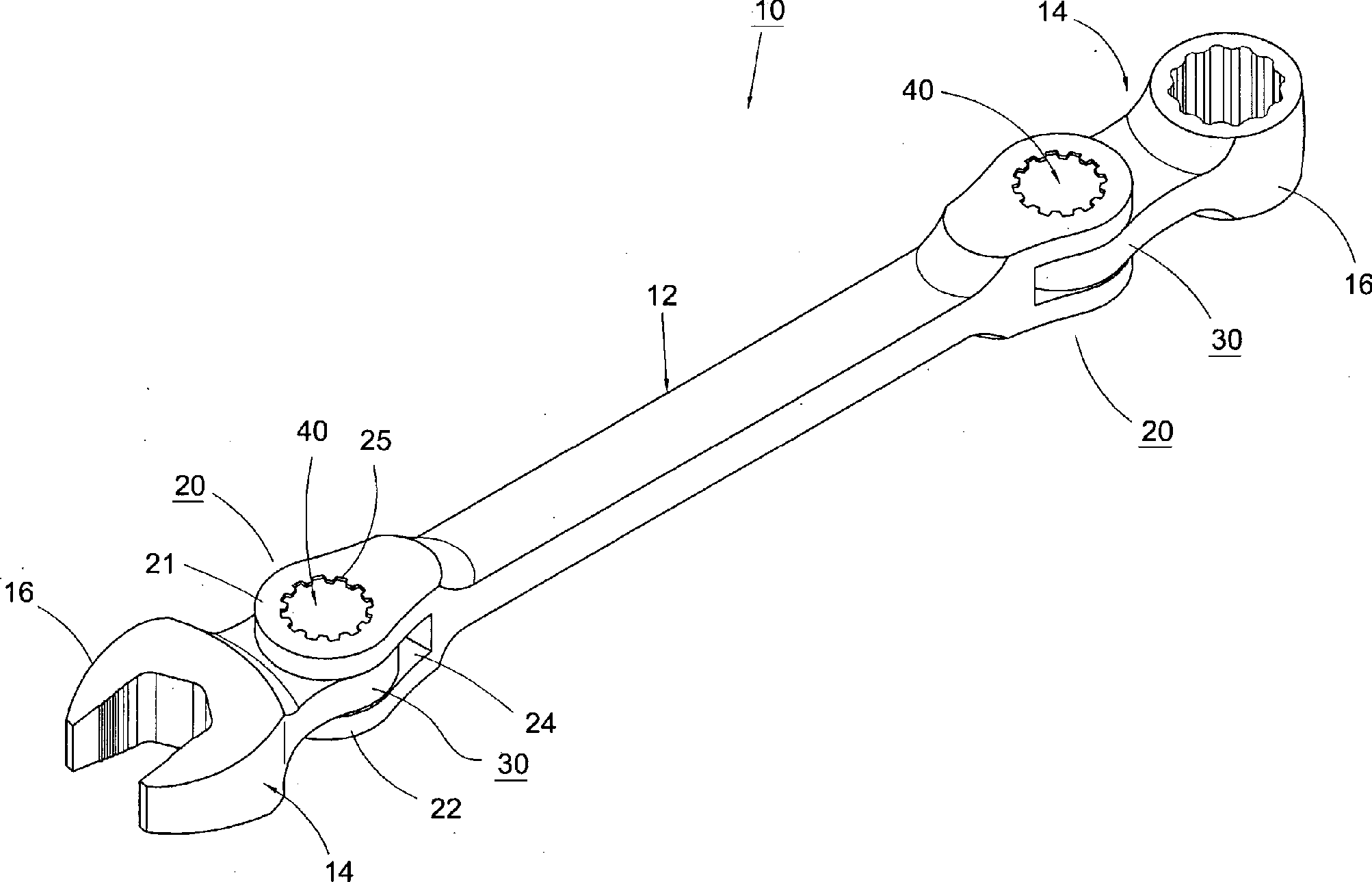
Figure 00000001
Figure 00000001

Description

Technisches GebietTechnical area

Die Erfindung betrifft ein Handwerkzeug, insbesondere einen Ringschlüssel mit schwenkbarem Kopf, der in verschiedenen Winkeln befestigbar ist.The The invention relates to a hand tool, in particular a ring spanner with swivel head, which can be fastened at different angles is.

Stand der TechnikState of the art

Bei konventionellen Schlüsseln sind die Köpfe und der Handgriff gewöhnlich miteinander fest verbunden. In einem engen Raum oder an bestimmten Orten sitzt die Schraubenmutter in einer nicht leicht erreichbaren Ecke, so dass ein konventioneller Schlüssel nicht zum Einsatz kommen kann. Zur Lösung des o. g. Problems hat der Erfinder ein Handwerkzeug mit Schnellschraubfunktion ( US-Patent Nr. 6,928,904 ) und eine Schwenkbaugruppe eines Handwerkzeugs ( US-Patent Nr. 7,373,861 ) vorgeschlagen, bei denen die Köpfe des Schlüssels relativ zum Handgriff schwenkbar sind, um einen Einsatz des Schlüsseln auch in einem engen Raum zu ermöglichen.In conventional keys, the heads and handle are usually fixed together. In a confined space or in certain places, the nut sits in a corner that is not easily accessible, so that a conventional key can not be used. To solve the above problem, the inventor has a hand tool with Schnellschraubfunktion ( U.S. Patent No. 6,928,904 ) and a pivot assembly of a hand tool ( U.S. Patent No. 7,373,861 ), in which the heads of the key are pivotable relative to the handle, to allow use of the key even in a narrow space.

Beim Schlüssel aus US-Patent Nr. 6,928,904 ist am Kopf ein verzahntes Loch ausgebildet, und am vorderen Ende des Handgriffs ist ein Zahnzapfen vorgesehen. Zum Einsatz des Schlüssels wird der Zahnzapfen des Handgriffs in das verzahnte Loch des Kopfs eingesetzt und kommt so mit demselben in Eingriff. Zum Verstellen des Winkels des Kopfs zum Handgriff wird der Handgriff so hochgehoben, dass der Zahnzapfen gleichzeitig mitbewegt und vom Eingriff gelöst wird. Danach kann das Verstellen des relativen Winkels des Kopfs zum Handgriff vorgenommen werden. Nach dem Verstellen wird der Zahnzapfen wieder in das verzahnte Loch eingesetzt und kommt wieder mit demselben in Eingriff. Auf diese Weise werden der Handgriff und der Kopf in einem verstellten Winkel fixiert..On the key U.S. Patent No. 6,928,904 At the top of a toothed hole is formed, and at the front end of the handle, a spigot is provided. To insert the key, the spigot of the handle is inserted into the toothed hole of the head and thus engages with the same. To adjust the angle of the head to the handle, the handle is lifted so that the spigot is simultaneously moved and released from engagement. Thereafter, the adjustment of the relative angle of the head to the handle can be made. After adjustment, the spigot is inserted back into the toothed hole and comes again with the same engaged. In this way, the handle and the head are fixed at an adjusted angle ..

Beim Schlüssel aus US-Patent Nr. 7,373,861 ist ebenfalls am Kopf ein verzahntes Loch ausgebildet, und am vorderen Ende des Handgriffs ist ein Zahnzapfen vorgesehen. Wenn der Zahnzapfen vollständig ins verzahnte Loch eingeschoben wird, kommen die Zähne des Zahnzapfens und die Zähne des verzahnten Loches derart in Eingriff, dass der Handgriff und der Kopf in einem fixierten Winkel bleiben. Ebenfalls gilt, dass der Handgriff, wenn er hochgehoben wird, gleichzeitig den Zahnzapfen zum Bewegen bringt, so dass sich die Zähne des Zahnzapfens und die Zähne des verzahnten Loches voneinander lösen. Danach kann das Verstellen des relativen Winkels des Kopfs zum Handgriff vorgenommen werden.On the key U.S. Patent No. 7,373,861 is also formed on the head of a toothed hole, and at the front end of the handle, a spigot is provided. When the spigot is fully inserted into the toothed hole, the teeth of the spigot and the teeth of the toothed hole engage such that the handle and head remain at a fixed angle. Likewise, when the handle is raised, it simultaneously causes the spigot to move so that the teeth of the spigot and the teeth of the toothed hole disengage. Thereafter, the adjustment of the relative angle of the head to the handle can be made.

Bei den herkömmlichen Schlüsseln der o. g. Arten muss der Handgriff zum Verstellen des relativen Winkels des Kopfs zum Handgriff derart bewegt werden, dass sich der Handgriff und der Kopf relativ zueinander verschieben, um sich vom Eingriff zu lösen, wobei eine derartige Betätigung nur mit den beiden Händen ausführbar ist, nämlich dass die eine Hand den Handgriff festhält, während die andere Hand den Kopf befestigt, was für den Benutzer sehr aufwendig ist.at the conventional keys of o. g. Species must the handle for adjusting the relative angle of the head to Handle be moved so that the handle and the Move head relative to each other to disengage from the procedure such an operation only with both hands is executable, namely that one hand the Handle holds while the other hand holds the Head attached, which is very expensive for the user.

Aufgabe der ErfindungObject of the invention

Der Erfindung liegt die Aufgabe zugrunde, einen Ringschlüssel mit schwenkbarem Kopf zu schaffen, bei dem der Eingriff des Kopfs und des Handgriffs des Ringschlüssels leicht aufgehoben werden kann.Of the Invention is based on the object, a ring spanner to create with a swivel head, at which the engagement of the head and the handle of the ring wrench are easily reversed can be.

Technische LösungTechnical solution

Diese Aufgabe wird erfindungsgemäß durch einen Ringschlüssel mit schwenkbarem Kopf mit den Merkmalen des Anspruchs 1 gelöst. Vorteilhafte Ausgestaltungen sind Gegenstand der abhängigen Ansprüche.These The object is achieved by a ring spanner solved with pivoting head with the features of claim 1. Advantageous embodiments are the subject of the dependent Claims.

Kurze Beschreibung der ZeichnungShort description of the drawing

1 zeigt eine perspektivische Ansicht eines bevorzugten Ausführungsbeispiels der Erfindung. 1 shows a perspective view of a preferred embodiment of the invention.

2 zeigt eine Explosionsdarstellung der Erfindung aus 1 in perspektivischer Ansicht. 2 shows an exploded view of the invention 1 in perspective view.

3 zeigt eine Schnittansicht des ersten und des zweiten Endes der Erfindung. 3 shows a sectional view of the first and second ends of the invention.

4 zeigt eine Schnittansicht der Erfindung aus 1 in Längsrichtung. 4 shows a sectional view of the invention 1 longitudinal.

5 zeigt eine Teilvergrößerung der Erfindung aus 4. 5 shows a partial enlargement of the invention 4 ,

6 zeigt eine ähnliche Darstellung wie 5, wobei der Eingriffszapfen nach unten in eine Lösestellung verschoben ist. 6 shows a similar representation as 5 wherein the engagement pin is displaced downwardly into a release position.

7 zeigt eine Draufsicht eines Teils aus 1. 7 shows a plan view of a part 1 ,

Wege der Ausführung der ErfindungWays of execution the invention

Im Folgenden werden Aufgaben, Merkmale und Vorteile der vorliegenden Erfindung anhand der detaillierten Beschreibung eines Ausführungsbeispiels und der beigefügten Zeichnungen näher erläutert. Jedoch soll die Erfindung nicht auf die Beschreibung und die beigefügten Zeichnungen beschränkt werden.in the Following are the tasks, features and benefits of the present Invention with reference to the detailed description of an embodiment and the accompanying drawings. However, the invention should not be limited to the description and attached Drawings are limited.

1 und 2 zeigen ein erstes bevorzugtes Ausführungsbeispiel eines erfindungsgemäßen Ringschlüssels 10, der einen Handgriff 12 aufweist, dessen beide Enden jeweils mit einem Kopf 14 verbunden sind. Die Köpfe 14 und der Handgriff 12 sind jeweils über ein erstes und ein zweites Ende 20, 30 miteinander gekoppelt, so dass ein Verstellen des relativen Winkels von ihnen durchführbar ist. 1 and 2 show a first preferred embodiment of a ring key according to the invention 10 that a handle 12 having its two ends each with a head 14 are connected. The heads 14 and the handle 12 each have a first and a second end 20 . 30 coupled together, so that an adjustment of the relative angle of them is feasible.

Das erste Ende 20 kann ein Ende des Handgriffs 12 und das zweite Ende 30 ein Ende des Kopfs 14 sein, wobei das erste und das zweite Ende selbstverständlich austauschbar sind, so dass das erste Ende 20 ein Ende des Kopfs 14 und das zweite Ende 30 ein Ende des Handgriffs 12 sein kann. Das andere Ende des Kopfs 14 ist als Schraubverbindungsteil 16 ausgebildet, das eine Schraubenmutter umschließt, wobei das Schraubverbindungsteil 16 als offenes Ende oder geschlossenes Ende (box end) ausgebildet sein kann, wobei ein geschlossenes Ende ein mehrkantiges Aufnahmeloch sein kann; alternativ kann das geschlossene Ende als Ratschenstruktur mit Ratsche ausgebildet werden. Das Schraubverbindungsteil 16 kann mit einem Zapfen versehen werden (siehe das Bezugszeichen 25 in 2 in US-Patent Nr. 6,928,904 ), mit dem ein Steckschlüsseleinsatzmit dem Schraubverbindungsteil 16 verbunden wird. Das Schraubverbindungsteil 16 ist eine herkömmliche Struktur und wird daher nicht eingehend erläutert.The first end 20 can be an end of the handle 12 and the second end 30 an end of the head 14 Of course, the first and second ends are interchangeable, so that the first end 20 an end of the head 14 and the second end 30 one end of the handle 12 can be. The other end of the head 14 is as a screw connection part 16 formed, which encloses a nut, wherein the threaded connection part 16 may be formed as an open end or box end, wherein a closed end may be a polygonal receiving hole; Alternatively, the closed end may be formed as a ratchet structure with ratchet. The threaded connection part 16 can be provided with a pin (see the reference numeral 25 in 2 in U.S. Patent No. 6,928,904 ), with which a socket with the screw connection part 16 is connected. The threaded connection part 16 is a conventional structure and therefore will not be explained in detail.

Wie aus 3 ersichtlich, weist das erste Ende 20 eine obere Wand 21 und eine untere Wand 22 auf, die untereinander parallel zueinander angeordnet sind und einen Zwischenraum 24 bilden. An der oberen Wand 21 ist ein erstes verzahntes Loch 25 ausgebildet, das an seinem Umfangsrand eine Vielzahl von Zähnen 26 trägt. An der unteren Wand 22 ist ein Durchgangsloch 27 ausgebildet, das dem ersten verzahnten Loch 25 entspricht, wobei an der Lochwand des Durchgangsloches 27 ein sich erhebender Anschlagring 28 vorgesehen ist.How out 3 As can be seen, the first end points 20 an upper wall 21 and a bottom wall 22 on, which are mutually parallel to each other and a gap 24 form. On the upper wall 21 is a first toothed hole 25 formed, which at its peripheral edge a plurality of teeth 26 wearing. At the bottom wall 22 is a through hole 27 formed, the first toothed hole 25 corresponds, wherein at the hole wall of the through hole 27 an uplifting stop ring 28 is provided.

Am zweiten Ende 30 ist ein zweites verzahntes Loch 32 ausgebildet, an dessen Umfangswand eine Mehrzahl von Zähnen 34 vorgesehen ist. Das zweite Ende 30 erstreckt sich in den Zwischenraum 24 und befindet sich zwischen der ersten und der zweiten Wand 21, 22. Das zweite verzahnte Loch 32 befindet sich zwischen dem ersten verzahnten Loch 25 und dem Durchgangsloch 27 und entspricht diesen beiden. In diesem Ausführungsbeispiel sind keine Zähne am Unterrand des zweiten verzahnten Loches 32 angeordnet, wohl aber ein Loch 36; wobei das Loch 36 keine erforderliche Ausgestaltung ist.At the second end 30 is a second toothed hole 32 formed on the peripheral wall a plurality of teeth 34 is provided. The second end 30 extends into the gap 24 and is located between the first and the second wall 21 . 22 , The second toothed hole 32 is located between the first toothed hole 25 and the through hole 27 and corresponds to these two. In this embodiment, there are no teeth on the lower edge of the second toothed hole 32 arranged, but a hole 36 ; being the hole 36 is not a required embodiment.

Erfindungsgemäß ist ferner ein Eingriffszapfen 40 vorgesehen, an dessen Umfangsfläche eine Mehrzahl von Zähnen 42 vorgesehen ist, die in diesem Ausführungsbeispiel nur an der oberen Umfangsfläche des Eingriffszapfens ausgebildet sind. In der Ausführung können die Zähne 42 alternativ sowohl an der oberen als auch an der unteren Umfangsfläche des Eingriffszapfens ausgebildet sein. Der Eingriffszapfen ist in den beiden verzahnten Löchern 25, 32 und dem Durchgangsloch 27 angeordnet, wie in 4 und 5 dargestellt, und dient zum Verbinden des ersten und des zweiten Endes 20, 30.According to the invention is also an engagement pin 40 provided on the circumferential surface of a plurality of teeth 42 is provided, which are formed in this embodiment only on the upper peripheral surface of the engagement pin. In the execution, the teeth can 42 alternatively be formed on both the upper and on the lower peripheral surface of the engagement pin. The engagement pin is in the two toothed holes 25 . 32 and the through hole 27 arranged as in 4 and 5 and serves to connect the first and second ends 20 . 30 ,

Der Eingriffszapfen 40 kann nach oben in eine Eingriffsstellung (5) oder nach unten in eine Lösestellung (6) verschoben werden. An der Umfangsfläche des Eingriffszapfens 40 ist ein Stützrand 44 angeordnet, der als C-förmiger Ring ausgebildet ist und in die Ringnut 45 an der Umfangsfläche des Eingriffszapfens 40 einrastet. Der Außendurchmesser des Stützrands 44 ist größer als der Innendurchmesser des zweiten verzahnten Loches 32 des zweiten Endes 30, so dass der Stützrand 44 an der Unterseite des zweiten verzahnten Loches 32 anschlagen kann, so dass der Eingriffszapfen 40 beim Verschieben nach oben nicht aus den beiden verzahnten Löchern 25, 32 herausfällt (5). Wenn der Eingriffszapfen 40 nach unten in die Lösestellung verschoben wird (5), wird er mit seinem Stützrand 44 (oder mit der Unterwand der Zähne) an den sich erhebenden Anschlagring 28 so anschlagen, dass der Eingriffszapfen 40 nicht ausfällt. Ferner ist wenigstens ein elastisches Positionierelement 46 vorgesehen, das beispielsweise aus einer Feder und einer Stahlkugel ausgebildet, teilweise überdeckt im Unterbereich des Eingriffszapfens 40 angeordnet ist und sich unter dem Stützrand 44 befindet.The engagement pin 40 can move up into an engaged position ( 5 ) or down to a release position ( 6 ) are moved. On the peripheral surface of the engagement pin 40 is a support edge 44 arranged, which is designed as a C-shaped ring and into the annular groove 45 on the peripheral surface of the engagement pin 40 locks. The outer diameter of the support rim 44 is larger than the inner diameter of the second toothed hole 32 the second end 30 so that the support edge 44 at the bottom of the second toothed hole 32 can strike, so that the engagement pin 40 when moving upwards not from the two toothed holes 25 . 32 falls out ( 5 ). When the engagement pin 40 moved down to the release position ( 5 ), he becomes with his support edge 44 (or with the bottom wall of the teeth) to the rising stop ring 28 so strike that the engagement pin 40 does not fail. Furthermore, at least one elastic positioning element 46 provided, for example, formed of a spring and a steel ball, partially covered in the lower region of the engagement pin 40 is arranged and under the support edge 44 located.

Für die Verwendung der Erfindung wird auf 1 und 5 verwiesen. Wenn der Eingriffszapfen 40 sich in der Eingriffsstellung befindet, verläuft er durch das erste und das zweite verzahnte Loch 25, 32, wobei die Zähne 42 gleichzeitig mit den beiden verzahnten Löchern 25, 32 in Eingriff stehen, so dass das erste und das zweite Ende 20, 30 miteinander in festem Eingriff stehen und drehfest sind. Dadurch wird durch Heben des Handgriffs 12 die Schraubenmutter vom Kopf 14 gedreht. Das elastische Positionierelement 46 des Eingriffszapfens 40 drückt gegen die Oberseite des sich erhebenden Anschlagrings 28 derart, dass der Eingriffszapfen 40 in der Eingriffsstellung bleibt. Vorzugsweise schlägt der Stützrand 44 gleichzeitig an der Bodenwand des zweiten Endes 30, so dass der Eingriffszapfen 40 in der Eingriffsstellung nicht auf- bzw. abwärts schwankt.For the use of the invention is on 1 and 5 directed. When the engagement pin 40 is in the engaged position, it passes through the first and the second toothed hole 25 . 32 , where the teeth 42 simultaneously with the two toothed holes 25 . 32 engage so that the first and second ends 20 . 30 are firmly engaged with each other and are rotationally fixed. This is done by lifting the handle 12 the nut off the head 14 turned. The elastic positioning element 46 of the engagement pin 40 pushes against the top of the uplifting stop ring 28 such that the engagement pin 40 remains in the engaged position. Preferably, the support edge strikes 44 at the same time on the bottom wall of the second end 30 so that the engagement pin 40 does not sway up or down in the engaged position.

Wenn der Eingriffszapfen 40 nach unten so gedrückt wird, dass er sich in die Lösestellung in 6 verschiebt, wird er das erste verzahnte Loch 25 verlassen, wobei der Eingriffszapfen 40 nur mit dem zweiten verzahnten Loch 32 und nicht mit dem ersten verzahnten Loch 25 in Eingriff steht. Das erste und das zweite Ende 20, 30 greifen nicht mehr ineinander ein und können sich relativ zueinander drehen, wobei sich der Kopf 14 und der Handgriff 12 mit dem Eingriffszapfen 40 als Drehpunkt relativ zueinander drehen können, wie die vorgestellte Linie in 7 zeigt. Nachdem der Kopf 14 in einen gewünschten Winkel gedreht worden ist, wird der Eingriffszapfen 40 derart gedrückt, dass er in die Eingriffsstellung in 5 zurückkehrt, wodurch die beiden Enden 20, 30 wieder ineinander eingreifen können.When the engagement pin 40 pressed down so that it is in the release position in 6 shifts, he becomes the first toothed hole 25 leave, with the engagement pin 40 only with the second toothed hole 32 and not with the first toothed hole 25 engaged. The first and the second end 20 . 30 do not engage anymore other and can rotate relative to each other, with the head 14 and the handle 12 with the engagement pin 40 as a fulcrum can rotate relative to each other, as the imaginary line in 7 shows. After the head 14 has been rotated to a desired angle, the engagement pin 40 pressed so that it is in the engaged position in 5 returns, reducing the two ends 20 . 30 can intervene again.

Beider Verschiebung des Eingriffszapfens 40 von der Eingriffsstellung in die Lösestellung oder von der Lösestellung zurück in die Eingriffsstellung gleitet das elastische Positionierelement 46 über den sich erhebenden Anschlagring 28.Both displacement of the engagement pin 40 from the engagement position to the release position or from the release position back into the engaged position, the elastic positioning slides 46 over the rising stop ring 28 ,

Um das erste und das zweite Ende von dem Eingriff aus 5 zu lösen und in eine Lösestellungzu bringen, muss lediglich der Eingriffszapfen 40 zwischen die verzahnten Löcher 25, 32 verschoben werden, ohne den Handgriff 12 und den Kopf 14 zum relativen Verschieben zueinander bringen zu müssen. Zum Lösen des Eingriffs des Handgriffs mit dem Kopf muss der Benutzer lediglich mit dem Daumen der den Handgriff 12 anfassenden Hand den Eingriffszapfen 40 drücken, d. h., dass der Benutzer mit einer Hand den Eingriff des Handgriffs mit dem Kopf lösen kann, was sehr benutzerfreundlich ist. Außerdem ist die Erfindung einfach konstruiert und gewährleistet eine zuverlässige Arbeit und eine komfortable Handhabung.Around the first and second ends of the procedure 5 to solve and bring in a release position, only the engagement pin 40 between the toothed holes 25 . 32 be moved without the handle 12 and the head 14 to bring relative displacement to each other. To release the engagement of the handle with the head, the user only has to use the thumb of the handle 12 grasping hand the engagement pin 40 Press, that is, the user can solve with one hand, the engagement of the handle with the head, which is very user friendly. In addition, the invention is simple in design and ensures reliable work and comfortable handling.

Die Erfindung betrifft einen Ringschlüssel mit schwenkbarem Kopf, wobei der Handgriff (12) und der Kopf (14) über ein erstes und ein zweites Ende (20, 30) miteinander gekoppelt sind, wobei das andere Ende (20) eine obere Wand (21) und eine untere Wand (22) aufweist, die untereinander parallel zueinander angeordnet sind und einen Zwischenraum (24) bilden. An der oberen Wand (21) ist ein erstes verzahntes Loch (25) ausgebildet, und an der unteren Wand (22) ist ein Durchgangsloch (27) ausgebildet. Am zweiten Ende (30) ist ein zweites verzahntes Loch (32) ausgebildet. Das zweite Ende (30). erstreckt sich zwischen der oberen und der unteren Wand (21, 22), so dass sich das verzahnte Loch (32) zwischen dem ersten verzahnten Loch (25) und dem Durchgangsloch (27) befindet. Ein Eingriffszapfen (40) ist in den beiden verzahnten Löchern (25, 32) bewegbar montiert. In der Eingriffsstellung des Eingriffszapfens (40) stehen seine Zähne (42) gleichzeitig mit den Zähnen (26, 34) des ersten und des zweiten verzahnten Loches (25, 32) in Eingriff; in der Lösestellung sind die Zähne (42) des Eingriffszapfens (40) von den Zähnen (26) des ersten verzahnten Loches (25) getrennt und stehen lediglich mit den Zähnen (34) des zweiten verzahnten Loches (32) in Eingriff, wodurch sich der Kopf (14) und der Handgriff (12) zueinander drehen können.The invention relates to a ring key with a pivotable head, wherein the handle ( 12 ) and the head ( 14 ) via a first and a second end ( 20 . 30 ), the other end being ( 20 ) an upper wall ( 21 ) and a lower wall ( 22 ), which are mutually parallel to each other and a space ( 24 ) form. On the upper wall ( 21 ) is a first toothed hole ( 25 ), and on the lower wall ( 22 ) is a through hole ( 27 ) educated. At the second end ( 30 ) is a second toothed hole ( 32 ) educated. The second end ( 30 ). extends between the upper and lower walls ( 21 . 22 ), so that the toothed hole ( 32 ) between the first toothed hole ( 25 ) and the through hole ( 27 ) is located. An engagement pin ( 40 ) is in the two toothed holes ( 25 . 32 ) movably mounted. In the engaged position of the engagement pin ( 40 ) his teeth ( 42 ) simultaneously with the teeth ( 26 . 34 ) of the first and second toothed holes ( 25 . 32 in engagement; in the release position, the teeth ( 42 ) of the engagement pin ( 40 ) from the teeth ( 26 ) of the first toothed hole ( 25 ) and stand only with the teeth ( 34 ) of the second toothed hole ( 32 ), whereby the head ( 14 ) and the handle ( 12 ) can rotate to each other.

Die vorstehende Beschreibung stellt nur ein bevorzugtes Ausführungsbeispiels der Erfindung dar und soll nicht die Ansprüche beschränken. Alle gleichwertigen Änderungen und Modifikationen, die die in diesem technischen Bereich Sachkundigen gemäß der Beschreibung und den Zeichnungen der Erfindung vornehmen, gehören zum Schutzbereich der vorliegenden Erfindung. Der Schutzbereich der Erfindung richtet sich auf die nachstehenden Ansprüche.The The above description represents only a preferred embodiment The invention is not intended to limit the claims. All equivalent changes and modifications that the in this technical area expert according to the Description and the drawings of the invention include to the scope of the present invention. The protection area The invention is directed to the following claims.

1010
Ringschlüsselkey ring
1212
Handgriffhandle
1414
Kopfhead
1616
SchraubverbindungsteilSchraubverbindungsteil
2020
erstes Endefirst The End
2121
obere Wandupper wall
2222
untere Wandlower wall
2424
Zwischenraumgap
2525
erstes verzahntes Lochfirst toothed hole
2626
Zähneteeth
2727
DurchgangslochThrough Hole
2828
sich erhebender Anschlagringyourself uplifting stop ring
3030
zweites Endesecond The End
3232
zweites verzahntes Lochsecond toothed hole
3434
Zähneteeth
3636
Lochhole
4040
Eingriffszapfenengagement pin
4242
Zähneteeth
4444
Stützrandsupporting edge
4545
Ringnutring groove
4646
elastisches Positionierelementelastic positioning

ZITATE ENTHALTEN IN DER BESCHREIBUNGQUOTES INCLUDE IN THE DESCRIPTION

Diese Liste der vom Anmelder aufgeführten Dokumente wurde automatisiert erzeugt und ist ausschließlich zur besseren Information des Lesers aufgenommen. Die Liste ist nicht Bestandteil der deutschen Patent- bzw. Gebrauchsmusteranmeldung. Das DPMA übernimmt keinerlei Haftung für etwaige Fehler oder Auslassungen.This list The documents listed by the applicant have been automated generated and is solely for better information recorded by the reader. The list is not part of the German Patent or utility model application. The DPMA takes over no liability for any errors or omissions.

Zitierte PatentliteraturCited patent literature

  • - US 6928904 [0002, 0003, 0017] - US 6928904 [0002, 0003, 0017]
  • - US 7373861 [0002, 0004] - US 7373861 [0002, 0004]

Claims (9)

Ringschlüssel mit schwenkbarem Kopf, der einen Handgriff (12) und wenigstens einen Kopf (14) aufweist, die jeweils über ein erstes und ein zweites Ende (20, 30) miteinander gekoppelt sind, so dass ein Verstellen des relativen Winkels von ihnen durchführbar ist, wobei das andere Ende des Kopfs (14) als Schraubverbindungsteil (16) ausgebildet ist, dadurch gekennzeichnet, dass das erste Ende (20) eine obere Wand (21) und eine untere Wand (22) aufweist, die untereinander parallel zueinander angeordnet sind und einen Zwischenraum (24) bilden, wobei an der oberen Wand (21) ein erstes verzahntes Loch (25) ausgebildet ist, das an seinem Umfangsrand eine Mehrzahl von Zähnen (26) trägt, wobei an der unteren Wand (22) ein Durchgangsloch (27) ausgebildet ist, das dem ersten verzahnten Loch (25) entspricht; dass am zweiten Ende (30) ein zweites verzahntes Loch (32) ausgebildet ist, an dessen Umfangswand eine Mehrzahl von Zähnen (34) vorgesehen ist, wobei sich das zweite Ende (30) in den Zwischenraum (24) erstreckt und sich zwischen der ersten und der zweiten Wand (21, 22) befindet, wobei sich das zweite verzahnte Loch (32) zwischen dem ersten verzahnten Loch (25) und dem Durchgangsloch (27) befindet; und dass ferner ein Eingriffszapfen (40) vorgesehen ist, an dessen Umfangsfläche eine Mehrzahl von Zähnen (42) vorgesehen ist, wobei der Eingriffszapfen (40) in den beiden verzahnten Löcher (25, 32) bewegbar montiert ist und nach oben in eine Eingriffsstellung oder nach unten in eine Lösestellung verschoben werden kann, wobei in der Eingriffsstellung die Zähne (42) des Eingriffszapfens (40) gleichzeitig mit den Zähnen (26, 34) des ersten und des zweiten verzahnten Loches (25, 32) in Eingriff stehen, und in der Lösestellung die Zähne (42) des Eingriffszapfens (40) von den Zähnen (26) des ersten verzahnten Loches (25) getrennt sind und lediglich mit den Zähnen (34) des zweiten verzahnten Loches (32) in Eingriff. stehen.Ring wrench with swivel head holding a handle ( 12 ) and at least one head ( 14 ), each having a first and a second end ( 20 . 30 ) are coupled together so that an adjustment of the relative angle of them is feasible, wherein the other end of the head ( 14 ) as a screw connection part ( 16 ), characterized in that the first end ( 20 ) an upper wall ( 21 ) and a lower wall ( 22 ), which are mutually parallel to each other and a space ( 24 ), wherein on the upper wall ( 21 ) a first toothed hole ( 25 ) is formed, which at its peripheral edge a plurality of teeth ( 26 ), wherein on the lower wall ( 22 ) a through hole ( 27 ) formed the first toothed hole ( 25 ) corresponds; that at the second end ( 30 ) a second toothed hole ( 32 ) is formed, on whose peripheral wall a plurality of teeth ( 34 ) is provided, wherein the second end ( 30 ) into the space ( 24 ) and between the first and the second wall ( 21 . 22 ), wherein the second toothed hole ( 32 ) between the first toothed hole ( 25 ) and the through hole ( 27 ) is located; and that further comprises an engagement pin ( 40 ) is provided, on whose peripheral surface a plurality of teeth ( 42 ) is provided, wherein the engagement pin ( 40 ) in the two toothed holes ( 25 . 32 ) is movably mounted and can be moved up into an engagement position or down to a release position, wherein in the engaged position, the teeth ( 42 ) of the engagement pin ( 40 ) simultaneously with the teeth ( 26 . 34 ) of the first and second toothed holes ( 25 . 32 ) and in the release position the teeth ( 42 ) of the engagement pin ( 40 ) from the teeth ( 26 ) of the first toothed hole ( 25 ) are separated and only with the teeth ( 34 ) of the second toothed hole ( 32 ) engaged. stand. Ringschlüssel nach Anspruch 1, dadurch gekennzeichnet, dass an der Umfangsfläche des Unterbereiches des Eingriffszapfens (40) wenigstens ein elastisches Positionierelement (46) vorgesehen ist, das in der Eingriffsstellung des Eingriffszapfens (40) federnd gegen die Lochwand des Durchgangsloches (27) drückt.Ring key according to claim 1, characterized in that on the peripheral surface of the lower portion of the engagement pin ( 40 ) at least one elastic positioning element ( 46 ) is provided, which in the engaged position of the engagement pin ( 40 ) resiliently against the perforated wall of the through hole ( 27 ) presses. Ringschlüssel nach Anspruch 2, dadurch gekennzeichnet, dass an der Lochwand des Durchgangsloches (27) ein sich erhebender Anschlagring (28) angeordnet ist, gegen den das elastische Positionierelement (46) in der Eingriffsstellung des Eingriffszapfens (40) drückt.Ring key according to claim 2, characterized in that on the perforated wall of the through hole ( 27 ) a rising stop ring ( 28 ) is arranged, against which the elastic positioning element ( 46 ) in the engaged position of the engagement pin ( 40 ) presses. Ringschlüssel nach Anspruch 1, dadurch gekennzeichnet, dass an der Umfangsfläche des Eingriffszapfens (40) ein Stützrand (44) angeordnet ist, dessen Außendurchmesser größer als der Innendurchmesser des zweiten verzahnten Loches (32) ist, wobei der Stützrand (44) in der Eingriffsstellung des Eingriffszapfens (40) gegen die Unterseite des zweiten verzahnten Loches (32) drückt.Ring key according to claim 1, characterized in that on the peripheral surface of the engagement pin ( 40 ) a support edge ( 44 ) whose outer diameter is greater than the inner diameter of the second toothed hole ( 32 ), wherein the support edge ( 44 ) in the engaged position of the engagement pin ( 40 ) against the underside of the second toothed hole ( 32 ) presses. Ringschlüssel nach Anspruch 4, dadurch gekennzeichnet, dass an der Umfangsfläche des Eingriffszapfens (40) ein C-förmiger Ring angeordnet ist, der den Stützrand (44) bildet.Ring key according to claim 4, characterized in that on the peripheral surface of the engagement pin ( 40 ) a C-shaped ring is arranged, the support edge ( 44 ). Ringschlüssel nach Anspruch 1, dadurch gekennzeichnet, dass an der Umfangsfläche des Durchgangsloches (27) ein sich erhebender Anschlagring (28) angeordnet ist, der den Eingriffszapfen (40) in der Lösestellung positioniert.Ring spanner according to claim 1, characterized in that on the peripheral surface of the through hole ( 27 ) a rising stop ring ( 28 ) is arranged, which the engagement pin ( 40 ) positioned in the release position. Ringschlüssel nach Anspruch 6, dadurch gekennzeichnet, dass an der Umfangsfläche des Eingriffszapfens (40) ein Stützrand (44) angeordnet ist, der gegen die Oberseite des sich erhebenden Anschlagrings (28) drückt, wenn der Eingriffszapfen (40) nach unten in die Lösestellung verschoben wird.Ring key according to claim 6, characterized in that on the peripheral surface of the engagement pin ( 40 ) a support edge ( 44 ) is arranged, which against the top of the rising stop ring ( 28 ), when the engagement pin ( 40 ) is moved down into the release position. Ringschlüssel nach Anspruch 1, dadurch gekennzeichnet, dass die Zähne (42) des Eingriffszapfens (40) nur an der Umfangsfläche des oberen Bereiches des Eingriffszapfens (40) ausgebildet sind.Ring spanner according to claim 1, characterized in that the teeth ( 42 ) of the engagement pin ( 40 ) only on the peripheral surface of the upper portion of the engagement pin ( 40 ) are formed. Ringschlüssel nach Anspruch 1, dadurch gekennzeichnet, dass an der Unterseite des zweiten verzahnten Loches (32) ein Loch (36) mit einem größeren Lochdurchmesser ausgebildet ist.Ring key according to claim 1, characterized in that on the underside of the second toothed hole ( 32 ) a hole ( 36 ) is formed with a larger hole diameter.
DE200920000070 2009-01-29 2009-01-29 Ring spanner with swiveling head Expired - Lifetime DE202009000070U1 (en)

Priority Applications (1)

Application Number Priority Date Filing Date Title
DE200920000070 DE202009000070U1 (en) 2009-01-29 2009-01-29 Ring spanner with swiveling head

Applications Claiming Priority (1)

Application Number Priority Date Filing Date Title
DE200920000070 DE202009000070U1 (en) 2009-01-29 2009-01-29 Ring spanner with swiveling head

Publications (1)

Publication Number Publication Date
DE202009000070U1 true DE202009000070U1 (en) 2009-06-18

Family

ID=40786218

Family Applications (1)

Application Number Title Priority Date Filing Date
DE200920000070 Expired - Lifetime DE202009000070U1 (en) 2009-01-29 2009-01-29 Ring spanner with swiveling head

Country Status (1)

Country Link
DE (1) DE202009000070U1 (en)

Cited By (5)

* Cited by examiner, † Cited by third party
Publication number Priority date Publication date Assignee Title
WO2011089297A1 (en) * 2010-01-19 2011-07-28 Sergio Oliver Lagardera Hand tool
DE202012100670U1 (en) 2011-07-21 2012-04-03 Kabo Tool Company Hand tool with swivel angle adjustment
DE102018005133A1 (en) * 2018-06-28 2020-01-02 Peter Malkomes ratchet wrench
CN112692768A (en) * 2020-12-21 2021-04-23 海南电网有限责任公司五指山供电局 Multifunctional telescopic wrench
CN116619283A (en) * 2022-02-18 2023-08-22 英发企业股份有限公司 multi-angle wrench

Citations (2)

* Cited by examiner, † Cited by third party
Publication number Priority date Publication date Assignee Title
US6928904B2 (en) 2003-08-29 2005-08-16 Chih-Ching Hsien Hand tool having a quick driving effect
US7373861B2 (en) 2006-01-17 2008-05-20 Chih-Ching Hsieh Pivoting assembly of a hand tool

Patent Citations (2)

* Cited by examiner, † Cited by third party
Publication number Priority date Publication date Assignee Title
US6928904B2 (en) 2003-08-29 2005-08-16 Chih-Ching Hsien Hand tool having a quick driving effect
US7373861B2 (en) 2006-01-17 2008-05-20 Chih-Ching Hsieh Pivoting assembly of a hand tool

Cited By (6)

* Cited by examiner, † Cited by third party
Publication number Priority date Publication date Assignee Title
WO2011089297A1 (en) * 2010-01-19 2011-07-28 Sergio Oliver Lagardera Hand tool
ES2377093A1 (en) * 2010-01-19 2012-03-22 Sergio Oliver Lagardera Hand tool
DE202012100670U1 (en) 2011-07-21 2012-04-03 Kabo Tool Company Hand tool with swivel angle adjustment
DE102018005133A1 (en) * 2018-06-28 2020-01-02 Peter Malkomes ratchet wrench
CN112692768A (en) * 2020-12-21 2021-04-23 海南电网有限责任公司五指山供电局 Multifunctional telescopic wrench
CN116619283A (en) * 2022-02-18 2023-08-22 英发企业股份有限公司 multi-angle wrench

Similar Documents

Publication Publication Date Title
DE102015117621B3 (en) Arrangement for connecting a wrench with a receiving device
DE202010000010U1 (en) Adjustable lever
DE1777007A1 (en) Device for fastening workpieces for the purpose of machining
DE102011054986A1 (en) tongs
DE202007004324U1 (en) Adapter coupling device
DE202009000070U1 (en) Ring spanner with swiveling head
DE102016102058B4 (en) Torque wrench with the possibility to accommodate drive heads
DE202020102347U1 (en) A device that enables immediate and precise locking and loosening of a rope
DE20205092U1 (en) Adjustable wrench
WO2009074190A1 (en) Adapter for coupling a rod, such as a locking rod of a rod-type closure, to a lever, such as an actuating lever of the rod-type closure
DE20108604U1 (en) Tool wrench with a nut holder
DE20006912U1 (en) Scaffold holder for an eaves scaffold
EP3668669A1 (en) Portable milling machine having a spanner
DE19819457A1 (en) Hand-held tool with turning tool head to which socket spanner can be attached
DE102012102681A1 (en) Tool unit for use with quick-release mechanism for adjustable front plates, comprises lever with handle and both ends formed as rotatable end portions, where pin is rotated by rotating lever for adjusting distance between two front plates
DE202017103114U1 (en) transmission tools
DE202008007740U1 (en) Universal pry bar
DE2650506A1 (en) Open sided socket for use with ratchet wrench - has bell-section with sprung ball detent forced over nut flat to retain socket
DE202019105147U1 (en) Quick release Ratchet T wrench
EP4353665B1 (en) Stop point
DE2912985A1 (en) STAMP
DE9204329U1 (en) Processing unit
DE102014105768B3 (en) Pliers for a C-shaped ring
DE202012104193U1 (en) Hand tool with an adjustment mechanism
DE102010015592A1 (en) Device for use with tool for holding working elements, particularly holding against tightening or releasing of screw head or screw nut, has retaining part for retaining of working elements, where counter holder is assigned to tool

Legal Events

Date Code Title Description
R207 Utility model specification

Effective date: 20090723

R150 Term of protection extended to 6 years

Effective date: 20111209

R082 Change of representative

Representative=s name: LANGPATENT ANWALTSKANZLEI IP LAW FIRM, DE

R151 Term of protection extended to 8 years

Effective date: 20141211

R152 Term of protection extended to 10 years
R071 Expiry of right