DE112012003864T5 - Multiple addressable register files and associated format conversions - Google Patents
Multiple addressable register files and associated format conversions Download PDFInfo
- Publication number
- DE112012003864T5 DE112012003864T5 DE112012003864.9T DE112012003864T DE112012003864T5 DE 112012003864 T5 DE112012003864 T5 DE 112012003864T5 DE 112012003864 T DE112012003864 T DE 112012003864T DE 112012003864 T5 DE112012003864 T5 DE 112012003864T5
- Authority
- DE
- Germany
- Prior art keywords
- instruction
- precision
- format
- bits
- register
- Prior art date
- Legal status (The legal status is an assumption and is not a legal conclusion. Google has not performed a legal analysis and makes no representation as to the accuracy of the status listed.)
- Withdrawn
Links
Images


Classifications
-
- G—PHYSICS
- G06—COMPUTING OR CALCULATING; COUNTING
- G06F—ELECTRIC DIGITAL DATA PROCESSING
- G06F9/00—Arrangements for program control, e.g. control units
- G06F9/06—Arrangements for program control, e.g. control units using stored programs, i.e. using an internal store of processing equipment to receive or retain programs
- G06F9/30—Arrangements for executing machine instructions, e.g. instruction decode
- G06F9/30003—Arrangements for executing specific machine instructions
- G06F9/30007—Arrangements for executing specific machine instructions to perform operations on data operands
- G06F9/30025—Format conversion instructions, e.g. Floating-Point to Integer, decimal conversion
-
- G—PHYSICS
- G06—COMPUTING OR CALCULATING; COUNTING
- G06F—ELECTRIC DIGITAL DATA PROCESSING
- G06F9/00—Arrangements for program control, e.g. control units
- G06F9/06—Arrangements for program control, e.g. control units using stored programs, i.e. using an internal store of processing equipment to receive or retain programs
- G06F9/30—Arrangements for executing machine instructions, e.g. instruction decode
- G06F9/30003—Arrangements for executing specific machine instructions
- G06F9/30007—Arrangements for executing specific machine instructions to perform operations on data operands
- G06F9/3001—Arithmetic instructions
- G06F9/30014—Arithmetic instructions with variable precision
-
- G—PHYSICS
- G06—COMPUTING OR CALCULATING; COUNTING
- G06F—ELECTRIC DIGITAL DATA PROCESSING
- G06F9/00—Arrangements for program control, e.g. control units
- G06F9/06—Arrangements for program control, e.g. control units using stored programs, i.e. using an internal store of processing equipment to receive or retain programs
- G06F9/30—Arrangements for executing machine instructions, e.g. instruction decode
- G06F9/30003—Arrangements for executing specific machine instructions
- G06F9/30007—Arrangements for executing specific machine instructions to perform operations on data operands
- G06F9/30036—Instructions to perform operations on packed data, e.g. vector, tile or matrix operations
-
- G—PHYSICS
- G06—COMPUTING OR CALCULATING; COUNTING
- G06F—ELECTRIC DIGITAL DATA PROCESSING
- G06F9/00—Arrangements for program control, e.g. control units
- G06F9/06—Arrangements for program control, e.g. control units using stored programs, i.e. using an internal store of processing equipment to receive or retain programs
- G06F9/30—Arrangements for executing machine instructions, e.g. instruction decode
- G06F9/30098—Register arrangements
-
- G—PHYSICS
- G06—COMPUTING OR CALCULATING; COUNTING
- G06F—ELECTRIC DIGITAL DATA PROCESSING
- G06F9/00—Arrangements for program control, e.g. control units
- G06F9/06—Arrangements for program control, e.g. control units using stored programs, i.e. using an internal store of processing equipment to receive or retain programs
- G06F9/30—Arrangements for executing machine instructions, e.g. instruction decode
- G06F9/30098—Register arrangements
- G06F9/30105—Register structure
- G06F9/30112—Register structure comprising data of variable length
-
- G—PHYSICS
- G06—COMPUTING OR CALCULATING; COUNTING
- G06F—ELECTRIC DIGITAL DATA PROCESSING
- G06F9/00—Arrangements for program control, e.g. control units
- G06F9/06—Arrangements for program control, e.g. control units using stored programs, i.e. using an internal store of processing equipment to receive or retain programs
- G06F9/30—Arrangements for executing machine instructions, e.g. instruction decode
- G06F9/30145—Instruction analysis, e.g. decoding, instruction word fields
- G06F9/3016—Decoding the operand specifier, e.g. specifier format
-
- G—PHYSICS
- G06—COMPUTING OR CALCULATING; COUNTING
- G06F—ELECTRIC DIGITAL DATA PROCESSING
- G06F9/00—Arrangements for program control, e.g. control units
- G06F9/06—Arrangements for program control, e.g. control units using stored programs, i.e. using an internal store of processing equipment to receive or retain programs
- G06F9/30—Arrangements for executing machine instructions, e.g. instruction decode
- G06F9/30181—Instruction operation extension or modification
- G06F9/30185—Instruction operation extension or modification according to one or more bits in the instruction, e.g. prefix, sub-opcode
Landscapes
- Engineering & Computer Science (AREA)
- Theoretical Computer Science (AREA)
- Software Systems (AREA)
- Physics & Mathematics (AREA)
- General Physics & Mathematics (AREA)
- General Engineering & Computer Science (AREA)
- Mathematical Physics (AREA)
- Computational Mathematics (AREA)
- Mathematical Analysis (AREA)
- Mathematical Optimization (AREA)
- Pure & Applied Mathematics (AREA)
- Advance Control (AREA)
- Complex Calculations (AREA)
- Executing Machine-Instructions (AREA)
Abstract
Eine mehrfach adressierbare Registerdatei wird von einer Vielzahl von Typen von Anweisungen adressiert, einschließlich skalaren, Vektor- und Vector-Scalar Extension-Anweisungen. Es kann ermittelt werden, dass Daten von einem Format in ein anderes Format übersetzt werden müssen. Wenn dies ermittelt wird, wird eine Umwandlungs-Maschinenanweisung ausgeführt, die ein Datum mit einfacher Präzision in einer ersten Darstellung in einem ersten Format von einem ersten Register erlangt; das Datum mit einfacher Präzision der ersten Darstellung in dem ersten Format in ein umgewandeltes Datum mit einfacher Präzision einer zweiten Darstellung in einem zweiten Format umwandelt; und das umgewandelte Datum mit einfacher Präzision in ein zweites Register stellt.A multi-addressable register file is addressed by a variety of types of instructions, including scalar, vector, and vector-scalar extension instructions. It can be determined that data needs to be translated from one format to another. When so determined, a conversion machine instruction is executed which obtains single precision datum in a first representation in a first format from a first register; converting the single precision date of the first representation in the first format to a converted single precision date of a second representation in a second format; and places the converted single precision date in a second register.
Description
Hintergrundbackground
Ein oder mehrere Aspekte der vorliegenden Anwendung betreffen im Allgemeinen Datenverarbeitung und insbesondere mehrfach adressierbare Registerdateien und damit verbundene Verarbeitung.One or more aspects of the present application generally relate to data processing, and more particularly, to multi-addressable register files and related processing.
Hochleistungsprozessoren unterstützen Multimedia-Verarbeitung unter Verwendung von Single Instruction, Multiple Data-(SIMD)Techniken, um Parallelität auf Anweisungsebene in Programmen zu nutzen. Das heißt, SIMD-Techniken werden zum gleichzeitigen Ausführen von mehr als einer Operation verwendet. Diese Prozessoren enthalten mehrere Funktionseinheiten, von denen einige auf die Ausführung von skalaren Daten ausgerichtet sind, und von denen einige für die Verarbeitung von strukturierten SIMD-Vektordaten gruppiert sind. SIMD-Datenströme werden zum Darstellen von Multimedia-Datentypen wie beispielsweise von Farbinformationen verwendet, wobei zum Beispiel das RGB-Format durch Verschlüsseln der roten, grünen und blauen Komponenten in dem strukturierten Datentyp verwendet wird, oder von Koordinateninformationen, wobei eine Position als das Quadrupel (x, y, z, w) verschlüsselt wird.High performance processors support multi-media processing using single instruction, multiple data (SIMD) techniques to leverage instruction-level parallelism in programs. That is, SIMD techniques are used to perform more than one operation at a time. These processors include several functional units, some of which are aligned to the execution of scalar data, some of which are grouped for processing structured SIMD vector data. SIMD data streams are used to represent multimedia data types such as color information using, for example, the RGB format by encrypting the red, green and blue components in the structured data type or coordinate information using a position as the quad ( x, y, z, w) is encrypted.
Prozessoren, die für ein Verarbeiten von Multimedia-Daten ausgelegt sind, wurden umgesetzt, indem eine bestehende skalare Prozessorumsetzung zum Beispiel durch Hinzufügen einer SIMD-Einheit erweitert wurde, wobei die SIMD-Einheit selbst mehrere Funktionseinheiten einschließt (d. h. Festkommaeinheiten und Gleitkommaeinheiten), die Ressourcen spiegeln, die für das Verarbeiten von skalaren Datentypen verfügbar sind und jeden Funktionseinheitentyp für die Anzahl von strukturierten Elementen nachbilden, der durch die SIMD-Architektur unterstützt werden soll.Processors designed to process multimedia data have been implemented by extending an existing scalar processor implementation, for example, by adding a SIMD unit, the SIMD unit itself including multiple functional units (ie, fixed point units and floating point units), the resources mirroring that are available for processing scalar data types and mimicking each functional unit type for the number of structured elements that should be supported by the SIMD architecture.
Prozessoren, die eine Multimedia-Verarbeitung sowie sonstige Verarbeitung unterstützen, können Daten von verschiedenen Typen verarbeiten. Allerdings müssen Einrichtungen zum Verwalten einer derartigen Verarbeitung bereitgestellt werden.Processors that support multimedia processing and other processing can process data of various types. However, facilities for managing such processing must be provided.
KurzdarstellungSummary
Unzulänglichkeiten nach dem Stand der Technik werden beseitigt und zusätzliche Vorteile werden durch die Bereitstellung eines Computerprogrammprodukts zum Ausführen einer Maschinenanweisung bereitgestellt. Das Computerprogrammprodukt weist ein Speichermedium auf, das durch eine Verarbeitungsschaltung gelesen werden kann und Anweisungen zur Ausführung durch die Verarbeitungsschaltung zum Ausführen eines Verfahrens speichert. Das Verfahren enthält zum Beispiel ein Erlangen von einer Maschinenanweisung zur Ausführung durch einen Prozessor, wobei die Maschinenanweisung zur Computerausführung gemäß einer Computerarchitektur definiert ist, wobei die Maschinenanweisung zum Beispiel mindestens ein Operationscode-Feld enthält, das eine Umwandlungsanweisung identifiziert; mindestens ein Feld, das verwendet wird, um ein erstes Register anzugeben; und mindestens ein weiteres Feld, um ein zweites Register anzugeben; ein Ausführen der Maschinenanweisung durch den Prozessor, wobei das Ausführen zum Beispiel ein Erlangen eines binären Gleitkommadatums mit einfacher Präzision in einer ersten Darstellung in einem ersten Format von dem ersten Register enthält; ein Umwandeln des binären Gleitkommadatums mit einfacher Präzision der ersten Darstellung in dem ersten Format in ein umgewandeltes binäres Gleitkommadatum mit einfacher Präzision einer zweiten Darstellung in einem zweiten Format; und ein Einstellen des umgewandelten binären Gleitkommadatums mit einfacher Präzision in das zweite Register.Prior art deficiencies are eliminated and additional benefits are provided by providing a computer program product for executing a machine instruction. The computer program product comprises a storage medium that can be read by a processing circuit and stores instructions for execution by the processing circuitry to perform a method. The method includes, for example, obtaining a machine instruction for execution by a processor, wherein the computer execution machine instruction is defined according to a computer architecture, the machine instruction including, for example, at least one opcode field identifying a conversion instruction; at least one field used to specify a first register; and at least one more field to specify a second register; executing the machine instruction by the processor, wherein the execution includes, for example, obtaining a single-precision binary floating-point date in a first representation in a first format from the first register; converting the single-precision binary floating-point date of the first representation in the first format into a converted single-precision binary floating-point date of a second representation in a second format; and setting the converted single precision binary floating point data into the second register.
Verfahren und Systeme, die einen oder mehrere Aspekte der vorliegenden Erfindung betreffen, werden hierin ebenfalls beschrieben und beansprucht.Methods and systems relating to one or more aspects of the present invention are also described and claimed herein.
Ferner werden Dienste, die einen oder mehrere Aspekte der vorliegenden Erfindung betreffen, ebenfalls beschrieben und können hierin beansprucht werden.Furthermore, services relating to one or more aspects of the present invention are also described and may be claimed herein.
Weitere Funktionen und Vorteile werden durch die Techniken von einem oder mehreren Aspekten der vorliegenden Erfindung verwirklicht. Weitere Ausführungsformen und Aspekte der Erfindung werden hierin ausführlich beschrieben und werden als Bestandteil der beanspruchten Erfindung betrachtet.Other functions and advantages are realized by the techniques of one or more aspects of the present invention. Further embodiments and aspects of the invention are described in detail herein and are considered as forming part of the claimed invention.
Kurzbeschreibung der verschiedenen Ansichten der ZeichnungenBrief description of the different views of the drawings
Ein oder mehrere Aspekte der vorliegenden Erfindung werden besonders herausgestellt und eindeutig als Beispiele in den Ansprüchen am Ende der Spezifikation beansprucht. Die vorgenannten und andere Aufgaben, Merkmale und Vorteile von einem oder mehreren Aspekten der Erfindung werden aus der folgenden ausführlichen Beschreibung in Verbindung mit den begleitenden Zeichnungen offenkundig, wobei:One or more aspects of the present invention are particularly pointed out and clearly claimed as examples in the claims at the end of the specification. The aforementioned and others Objects, features and advantages of one or more aspects of the invention will become apparent from the following detailed description taken in conjunction with the accompanying drawings, in which:
Ausführliche BeschreibungDetailed description
Gemäß einem Aspekt der vorliegenden Erfindung wird eine Verarbeitung in Verbindung mit skalaren und Vektordaten vereinfacht. In einem Aspekt wird eine Registerdatei bereitgestellt, in der jedes Register der Registerdatei skalare 64-Bit(b)-Gleitkommadaten mit einfacher Präzision oder 32-Bit-Vektordaten mit einfacher Präzision sowie weitere Datenformate enthalten kann. Ferner werden in einem Aspekt Umwandlungstechniken zum Umwandeln aus einem Gleitkommaformat mit einfacher Präzision in ein anderes Gleitkommaformat mit einfacher Präzision bereitgestellt. In einem Beispiel wird die Umwandlung unter Verwendung von Anweisungen, die in einer Architektur angeordnet sind und ohne Signalisieren einer Ausnahme ausgeführt.According to one aspect of the present invention, processing in conjunction with scalar and vector data is simplified. In one aspect, a register file is provided in which each register of the register file may include single-precision 64-bit (b) floating-point or single-precision 32-bit vector data, as well as other data formats. Further, in one aspect, conversion techniques are provided for converting from a single precision floating point format to another single precision floating point format. In one example, the transformation is performed using instructions that are arranged in an architecture and without signaling an exception.
Wie vorher oben und des Weiteren in der gemeinsam erteilten
Während des Betriebs des Systems von
Anweisungen werden von der Ausgabe-/Verzweigungseinheit
Der SIMD-Multimedia-Verarbeitungsblock
Es ist ersichtlich, dass dort, wo eine skalare und SIMD-Anweisungsausführung bereitgestellt wird, üblicherweise getrennt adressierbare Registerdateien für die verschiedenen Typen von Anweisungen erforderlich sind, auf die die CPU treffen kann. Zum Beispiel, wie in
Die oben beschriebene Prozessor-Umsetzung ist ein Beispiel für Systeme nach dem Stand der Technik; in einigen Umsetzungen können einige Registerdateien gemeinsam genutzt werden, z. B. eine kombinierte Ganzzahlen- und Gleitkomma-Registerdatei, oder es können zusätzliche Registerdateien vorhanden sein wie beispielsweise eine Bedingungs-Registerdatei oder eine Vergleichselement-Registerdatei für Vergleichsergebnisse. In einem bestimmten Beispiel, das im
Während der Mechanismus des
Eine oder mehrere veranschaulichende Ausführungsformen, die hierin sowie im
Unter folgender Bezugnahme auf
In dem dargestellten Beispiel verwendet das Datenverarbeitungssystem
In dem dargestellten Beispiel ist der lokale Netzwerk-(LAN)Adapter
Das HDD
Auf der Verarbeitungseinheit
Als Server kann das Datenverarbeitungssystem
Anweisungen für das Betriebssystem, das objektorientierte Programmiersystem und Anwendungen oder Programme befinden sich auf Speichereinheiten wie dem HDD
Ein Bussystem wie beispielsweise der Bus
Fachleuten wird klar sein, dass die Hardware in den
Des Weiteren kann das Datenverarbeitungssystem
Wie oben erläutert, stellen eine oder mehrere veranschaulichende Ausführungsformen eine mehrfach adressierbare Registerdatei bereit. Eine oder mehrere veranschaulichende Ausführungsformen weisen gegenüber bekannten Registerdateien eine Verbesserung durch Steigern der Leistungsfähigkeit der Registerdatei auf, indem eine große Anzahl von Registern und eine Fähigkeit zum Adressieren einer ersten Untergruppe von Registern mit einer ersten Gruppe von Anweisungen, zum Adressieren einer zweiten Untergruppe von Registern mit einer zweiten Gruppe von Anweisungen und zum Adressieren der gesamten Registerdatei mit mindestens einer dritten Gruppe von Anweisungen bereitgestellt wird. Gemäß einer oder mehreren veranschaulichenden Ausführungsformen sind die ersten und zweiten Untergruppen von Registern nicht überlappend und verweisen auf unterschiedliche Registerdateibereiche wie beispielsweise „Register für Anweisungen vom Typ 1” und „Register für Anweisungen vom Typ 2”. Auf ein Register, das in der Untergruppe enthalten ist, die Anweisungen des Typs 1 entspricht, kann von Anweisungen des Typs 2 nicht zugegriffen werden und umgekehrt. In einer veranschaulichenden Ausführungsform entsprechen die Typ-1-Anweisungen FPU- oder traditionellen Gleitkomma-Anweisungen der IBM Power Architecture, die Typ-2-Anweisungen entsprechen traditionellen VMX-Anweisungen der IBM Power Architecture und die Typ-3-Anweisungen entsprechen VSX-Anweisungen der IBM Power Architecture.As discussed above, one or more illustrative embodiments provide a multi-addressable register file. One or more illustrative embodiments have improved over known register files by increasing the performance of the register file by having a large number of registers and a capability to address a first subset of registers with a first set of instructions to address a second subset of registers a second set of instructions and addressing the entire register file with at least a third group of instructions. According to one or more illustrative embodiments, the first and second subgroups of registers are non-overlapping and refer to different register file areas, such as "
Die Mechanismen von einer oder mehreren veranschaulichenden Ausführungsformen unterscheiden sich von bekannten, in Gruppen zusammengefassten Registerdateien, Operanden-Unterbereichen in Registerdateien, Prozessoren mit „Verschieben zwischen Registerdatei”-Anweisungen und VMX 128-Registerdateien, die eine Form von Unterbereichen mit nicht zusammenhängenden Registerkennungen verwenden. Bei Operanden-Unterbereichen gibt es üblicherweise einen Unterbereich für nur einen Operanden, d. h. einen Anweisungstyp. Es gibt keinen anderen Anweisungstyp mit einer anderen Form, der alle Register in der Registerdatei adressieren kann, und es gibt keinen anderen Bereich von Registern für einen anderen Typ von Anweisungen, d. h. es gibt keine Funktionalität für Mehrfach-Adressierbarkeit. In Gruppen zusammengefasste Registerdateien weisen eine große Registerdatei mit Unterbereichen auf, die durch verschiedene Anweisungen adressiert werden können, aber es gibt keinen Anweisungstyp, der alle Register in der Registerdatei adressieren kann. Im Gegenteil, wenn Operationen an der vollständigen Gruppe von Registern ausgeführt werden sollen, müssen Verschiebe-/Kopier-Operationen an der Registerdatei ausgeführt werden. Diese Verschiebe-/Kopier-Operationen sind für gewöhnlich langsamere Operationen, für die spezielle Planungsmechanismen erforderlich sein können.The mechanisms of one or more illustrative embodiments are different from known grouped register files, operand subareas in register files, "move between register file" instructions, and VMX 128 register files that use some form of subranges with non-contiguous register identifiers. For operand subareas, there is usually a subarea for only one operand, i. H. a statement type. There is no other statement type with a different form that can address all registers in the register file, and there is no other range of registers for a different type of statement, i. H. there is no functionality for multiple addressability. Grouped register files have a large register file with subranges that can be addressed by different instructions, but there is no instruction type that can address all registers in the register file. On the contrary, if operations are to be performed on the complete set of registers, move / copy operations must be performed on the register file. These move / copy operations are usually slower operations that may require special scheduling mechanisms.
Im Gegensatz dazu stellen eine oder mehrere veranschaulichende Ausführungsformen Zugriff auf die Register der mehrfach adressierbaren Registerdatei auf der Grundlage des Anweisungstyps bereits, z. B. traditionelle Gleitkomma-, traditionelle skalare, Vektor-Skalar-, verstärkte oder erweiterte Vektor-Skalar-Anweisungen usw. Statt einer Untergruppe von Registern, die einem Operandentyp zugehörig sind, stellt die mehrfach adressierbare Registerdatei von einer oder mehreren veranschaulichenden Ausführungsformen mehrere nicht zusammenhängende Untergruppen von Registern bereit. Die mehreren Untergruppen von Registern in der mehrfach adressierbaren Registerdatei, die den verschiedenen Typen von Anweisungen zugehörig sind, sind zusammenhängende Bereiche von Registern. Während Anweisungen von verschiedenen Typen auf nicht-überlappende Untergruppen von Registern in der mehrfach adressierbaren Registerdatei zugreifen können, kann außerdem bei einer oder mehreren veranschaulichenden Ausführungsformen mindestens ein Ausführungstyp auch auf alle Register in der mehrfach adressierbaren Registerdatei zugreifen.In contrast, one or more illustrative embodiments already provide access to the registers of the multi-addressable register file based on the instruction type, e.g. Traditional floating-point, traditional scalar, vector scalar, enhanced or extended vector scalar statements, etc. Instead of a subset of registers associated with an operand type, the multi-addressable register file of one or more illustrative embodiments provides a plurality of non-contiguous ones Subgroups of registers ready. The plurality of subgroups of registers in the multi-addressable register file associated with the different types of instructions are contiguous areas of registers. Furthermore, while instructions of various types may access non-overlapping subsets of registers in the multi-addressable register file, in one or more illustrative embodiments, at least one type of execution may also access all registers in the multi-addressable register file.
In einer bestimmten Ausführungsform gemäß einem Aspekt der vorliegenden Erfindung können Anweisungen von verschiedenen Typen auf nichtüberlappende Untergruppen von Registern in der mehrfach adressierbaren Registerdatei zugreifen, und mehrere Typen von Anweisungen (z. B. skalare 64-Bit-Gleitkommaanweisungen mit einfacher Präzision und 32-Bit-Vektor-Gleitkommaanweisungen mit einfacher Präzision) können auf alle Register in der mehrfach adressierbaren Registerdatei zugreifen.In a particular embodiment, according to one aspect of the present invention, instructions of different types may access non-overlapping subgroups of registers in the multi-addressable register file, and multiple types of instructions (e.g., 64-bit single precision, 32-bit floating point instructions) Simple-precision vector floating-point instructions) can access all registers in the multi-addressable register file.
In einem weiteren Aspekt der vorliegenden Erfindung erweitern eine oder mehrere veranschaulichende Ausführungsformen bekannte Skalar-/Vektor-Registerdateien durch Einschließen einer Fähigkeit zum Ausführen von skalaren, Vektor- und Gleitkomma-Anweisungen unter Verwendung derselben Registerdatei, wobei der Abschnitt der Registerdatei, auf den zugegriffen werden soll, auf der Grundlage des Anweisungstyps, der ausgeführt wird, dynamisch ermittelt wird. Da eine oder mehrere veranschaulichende Ausführungsformen gegenüber bekannten Skalar-/Vektor-Registerdateien und den Prozessoren, die derartige Skalar-/Vektor-Registerdateien verwenden, eine Verbesserung aufweisen, wird ein Verständnis der grundlegenden Funktionsweise eines derartigen Prozessors und einer derartigen Skalar-/Vektor-Registerdatei vermittelt: Die folgende Beschreibung von
Der vereinheitlichte Prozessor von
Wenn im Fall einer skalaren Operation eine Funktionseinheit (d. h. eine Festkommaeinheit oder Gleitkommaeinheit) verfügbar wird, oder wenn im Fall einer Vektor-Operation mehrere Funktionseinheiten verfügbar werden, gibt die Ausgabe-/Verzweigungseinheit
Die Ausgabelogik weist die SVRF
Die Operationen, die durch die Funktionseinheiten ausgeführt werden sollen, und die Funktionseinheiten, die diese Operationen ausführen sollen, werden durch Steuersignale ermittelt, die von der Ausgabe-/Verzweigungseinheit
Bis zu diesem Punkt gilt die beschriebene Operation des vereinheitlichten Prozessors für skalare und Vektor-Operationen. Das heißt, wenn eine auszuführende Operation eine skalare Operation ist, die somit eine Operation und Ausgabe von nur einem Funktionseinheitenpaar erfordert, können die restlichen Funktionseinheitenpaare trotzdem angewiesen werden, dieselbe Operation an Daten auszuführen, die von der Skalar-Vektor-Registerdatei an sie übergeben werden. Ein derartiger Ansatz ermöglicht eine einfache Konstruktion, da ein Anfordern, dass verschiedene Funktionseinheiten gleichzeitig verschiedene Operationen ausführen, notwendigerweise zu komplizierteren Konstruktionsüberlegungen führt. Desgleichen führt jedes Funktionseinheitenpaar für eine Vektor-Operation dieselbe Operation (oder im Wesentlichen dieselbe Operation als Teil einer eng verbundenen Operation oder einer Kombination von eng verbundenen Operationen, die von einer einzigen Anweisung angegeben werden) an eingehenden Daten aus. Up to this point, the described operation of the unified processor for scalar and vector operations applies. That is, if an operation to be performed is a scalar operation thus requiring operation and output of only one functional unit pair, the remaining functional unit pairs may still be instructed to perform the same operation on data passed to them from the scalar vector register file , Such an approach allows a simple construction, as requiring that different functional units simultaneously perform different operations necessarily leads to more complicated design considerations. Likewise, for a vector operation, each functional unit pair performs the same operation (or substantially the same operation as part of a tightly-connected operation or a combination of tightly-coupled operations specified by a single instruction) on incoming data.
Skalare und Vektor-Operationen unterscheiden sich durch die Art und Weise, wie zugehörige Adressinformationen gemäß der Interpretation der Operation verwendet werden. Die Interpretation der Operation kann ein direktes Ergebnis ihres Operationscodes sein, das heißt, verschiedene Operationscodes können für verschiedene Anweisungen verfügbar sein (z. B. „skalares Byte laden”, „skalares Wort laden”, „skalaren Vektor laden”), oder sie können von einem anderen Teil des Systems abhängen, z. B. Modus-Tag-Bits zum Interpretieren eines einzelnen „Lade”-Operationscodes. Selbst skalare Daten belegen einen Adressbereich von Bytes (wenn auch weniger Bytes als ein Vektor), und es bestehen auch Variationen, wie ein Laden/Speichern ausgeführt werden kann.Scalar and vector operations differ in the way in which related address information is used according to the interpretation of the operation. The interpretation of the operation may be a direct result of its opcode, that is, different opcodes may or may not be available for different instructions (eg, "load scalar byte," "load scalar word," "load scalar vector,") depend on another part of the system, e.g. B. Mode tag bits for interpreting a single "load" operation code. Even scalar data occupies an address range of bytes (albeit fewer bytes than a vector), and there are also variations on how a load / store can be performed.
Im Gegensatz zu anderen Funktionseinheiten, die üblicherweise einem bestimmten Bereich in der SVRF
Im Speicherbetriebsmodus empfängt die LSU
Die in
Somit beschreibt das
Obwohl die Registerdatei-Mechanismen des
Im Gegensatz dazu stellen eine oder mehrere veranschaulichende Ausführungsformen eine mehrfach adressierbare Registerdatei bereit, die sowohl traditionelle Anweisungen als auch eine oder mehrere neue oder erweiterte Typen von Anweisungen gestattet, um auf die Register der mehrfach adressierbaren Registerdatei zuzugreifen. Mit den Mechanismen von einer oder mehreren veranschaulichenden Ausführungsformen kann eine einzelne Registerdatei unter Verwendung von skalaren und Single Instruction, Multiple Data-(SIMD) oder Vektor-Anweisungen adressiert werden. Das heißt, dass Untergruppen von Registern in einer mehrfach adressierbaren Registerdatei gemäß einer oder mehreren veranschaulichenden Ausführungsformen mit verschiedenen Anweisungsformen adressiert werden können, z. B. skalare Anweisungen, SIMD- oder Vektor-Anweisungen usw., während die gesamte Gruppe von Registern mit einer weiteren Form von Anweisungen adressiert werden kann, auf die hierin als Vector-Scalar Extension-(VSX)Anweisungen Bezug genommen wird. Die Typen von Operationen, d. h. die Operationengruppe, die für die gesamte Gruppe von Registern unter Verwendung der VSX-Anweisungsform ausgeführt werden kann, gleichen im Wesentlichen denjenigen der Operationengruppen der Register-Untergruppen. In contrast, one or more illustrative embodiments provide a multi-addressable register file that allows both traditional instructions and one or more new or extended types of instructions to access the registers of the multi-addressable register file. With the mechanisms of one or more illustrative embodiments, a single register file may be addressed using scalar and single instruction, multiple data (SIMD), or vector instructions. That is, subgroups of registers in a multi-addressable register file may be addressed with different instruction forms, e.g., according to one or more illustrative embodiments. Scalar instructions, SIMD or vector instructions, etc., while the entire group of registers can be addressed with another form of instructions, referred to herein as Vector Scalar Extension (VSX) instructions. The types of operations, d. H. the group of operations that can be performed on the entire group of registers using the VSX instruction form are essentially similar to those of the operation groups of the register subgroups.
Die mehrfach adressierbare Registerdatei von einer oder mehreren veranschaulichenden Ausführungsformen ermöglicht es traditionellen Anweisungen, auf Untergruppen von Registern in der mehrfach adressierbaren Registerdatei zuzugreifen, wogegen neue oder erweiterte Anweisungen, z. B. die VSX-Anweisungen, auf den gesamten Bereich von Registern in der mehrfach adressierbaren Registerdatei zugreifen können. Des Weiteren sind die Datenformate der traditionellen Anweisungen mit den Datenformaten der VSX-Anweisungen kompatibel. Somit können Daten, die durch traditionelle Anweisungen erzeugt werden, durch die VSX-Anweisungen verarbeitet werden und umgekehrt.The multi-addressable register file of one or more illustrative embodiments allows traditional instructions to access subsets of registers in the multi-addressable register file, whereas new or extended instructions, e.g. For example, the VSX instructions can access the entire range of registers in the multi-addressable register file. Furthermore, the data formats of the traditional instructions are compatible with the data formats of the VSX instructions. Thus, data generated by traditional instructions can be processed by the VSX instructions, and vice versa.
Zum Beispiel gestatten eine oder mehrere veranschaulichende Ausführungsformen traditionellen Gleitkommaanweisungen (skalaren Operationen) Werte zu verarbeiten, die in einer ersten Untergruppe von Registern einer Registerdatei gespeichert sind, z. B. VSX-Register 0 bis 31; traditionellen VMX-Anweisungen (Vektor-Anweisungen) eine zweite Untergruppe von Registern in der Registerdatei zu verarbeiten, z. B. VSX-Register 32 bis 63 (wobei weiterhin auf die Register 0 bis 31 in den eigentlichen Anweisungen verwiesen wird); und VSX-Anweisungen (Vektor-Skalar-Operationen) alle Register der Registerdatei zu verarbeiten, z. B. VSX-Register 0 bis 63. Eine oder mehrere der veranschaulichenden Ausführungsformen gestatten ferner, dass Anweisungen von verschiedenen Typen Daten unter Verwendung der verschiedenen Untergruppen von Registern und der Fähigkeit der VSX-Anweisungen, auf alle Register der Registerdatei zuzugreifen, gemeinsam nutzen. Zum Beispiel können Daten von VSX- und traditionellen Gleitkommaanweisungen durch Speichern von und Zugreifen auf Daten in den VSX-Registern 0 bis 31 gemeinsam genutzt werden. Desgleichen ermöglichen eine oder mehrere veranschaulichende Ausführungsformen, dass Daten von traditionellen VMX-Anweisungen und VSX-Anweisungen in den VSX-Registern 32 und 63 gemeinsam genutzt werden, während weiterhin Programme ausgeführt werden, die entweder traditionelle Gleitkomma- oder traditionelle VMX-Anweisungen oder beides ohne jede Modifizierung verwenden. Des Weiteren gestatten eine oder mehrere veranschaulichende Ausführungsformen ein Verknüpfen von Code-Modulen, die entweder traditionelle Gleitkomma- oder traditionelle VMX-Anweisungen oder beides ohne jede Modifizierung verwenden, mit Code-Modulen, die die neuen VSX-Anweisungen einsetzen sowie Daten zwischen Code-Modulen gemeinsam nutzen, die Daten mit traditionellen Anweisungen verarbeiten und denjenigen, die VSX-Anweisungen verwenden.For example, one or more illustrative embodiments allow traditional floating-point instructions (scalar operations) to process values stored in a first subset of registers of a register file, e.g. VSX registers 0 to 31; traditional VMX instructions (vector instructions) to process a second subset of registers in the register file, e.g. VSX registers 32 to 63 (further referring to
In einer bestimmten Ausführungsform enthalten die VSX-Anweisungen gemäß einem Aspekt der vorliegenden Erfindung skalare 64-Bit-Gleitkommaanweisungen mit einfacher Präzision und 32-Bit-Vektor-Gleitkommaanweisungen mit einfacher Präzision sowie möglicherweise weitere Anweisungen. Beispiele für skalare 64-Bit-Gleitkommaanweisungen mit einfacher Präzision werden in RFC02182.r6: VSX Scalar Single-Precision (VSX Skalar mit einfacher Präzision) beschrieben, das als Teil der ausführlichen Beschreibung aufgenommen ist. In one particular embodiment, the VSX instructions according to one aspect of the present invention include single-precision scalar 64-bit floating point instructions and single precision 32-bit floating point vector instructions, and possibly other instructions. Examples of single-precision 64-bit scalable floating-point instructions are described in RFC02182.r6: VSX Scalar Single-Precision, which is included as part of the detailed description.
Auf der Grundlage der entschlüsselten Anweisungen greift die Anweisung entweder auf einen Unterbereich der Registerdatei
Der erste Unterbereich
VSX-Anweisungen sind Anweisungen, die auf die gesamte Gruppe von Registern einer Registerdatei
Somit stellen eine oder mehrere veranschaulichende Ausführungsformen eine einzige Skalar-/Vektor-Architektur für eine Registerdatei bereit, die mit traditionellen Architekturen kompatibel ist, die getrennte skalare und Vektor-Registerdateien haben. Eine oder mehrere veranschaulichende Ausführungsformen gestatten ferner das gemeinsame Nutzen des Speicherplatzes des Prozessors durch traditionelle Registerdateien und erweiterte Vektor-Skalar-Registerdateien, ohne dass dies zu einem größeren Speicherchip-Bereich führt. Des Weiteren gestatten eine oder mehrere veranschaulichende Ausführungsformen eine gemeinsame Datennutzung durch traditionelle Programme und Bibliotheken unter Verwendung von traditionellen Anweisungen und Programmen und Bibliotheken (unter Verwendung von traditionellen oder neuen/erweiterten Anweisungen) sowie einen gemeinsamen Einsatz von Code, wodurch Investitionen in eine Code-Abstimmung von traditionellen Anwendungen geschützt werden und die Notwendigkeit vermieden wird, alle Anwendungen neu zu codieren, um die neuen/erweiterten Anweisungen zu verwenden, wenn gestattet wird, dass die neuen/erweiterten Anweisungen dort verwendet werden, wo sie am nutzbringendsten sind. Infolgedessen können teure indirekte Kosten, die man von bekannten Prozessorarchitekturen kennt, die getrennte Registerdateien für skalare und Vektor-Anweisungen verwenden, z. B. Single Instruction, Multiple Data-(SIMD)Anweisungen, sowie die zusätzliche Kosten im Zusammenhang mit komplexen neuen Architekturen zum Bearbeiten von skalaren und Vektor-Anweisungen durch Verwenden einer einzigen Registerdatei vermieden werden. Thus, one or more illustrative embodiments provide a single scalar / vector architecture for a register file that is compatible with traditional architectures that have separate scalar and vector register files. One or more illustrative embodiments further allow sharing of memory space of the processor with traditional register files and extended vector scalar register files without resulting in a larger memory chip area. Further, one or more illustrative embodiments permit data sharing by traditional programs and libraries using traditional instructions and programs and libraries (using traditional or new / extended instructions), as well as sharing code, thereby investing in code matching protected by traditional applications and avoids the need to re-encode all applications to use the new / extended instructions if the new / extended instructions are allowed to be used where they are most beneficial. As a result, expensive indirect costs, known from known processor architectures, can use the separate scalar and vector instruction register files, e.g. Single Instruction, Multiple Data (SIMD) instructions, as well as the additional costs associated with complex new architectures for manipulating scalar and vector instructions by using a single register file.
Die Registerdatei
Ein erster Unterbereich von Bits
Aus
Wenn bei der VSX-Registerdatei
In einer weiteren veranschaulichenden Ausführungsform kann der skalare Wert, der in die Bits 0 bis 63 geschrieben werden soll, in den Bits 64 bis 127 nachgebildet werden. Dieser Ansatz kann zum Beispiel nützlich sein, wenn ein skalarer Gleitkommawert später mit einem Vektorwert kombiniert werden soll, z. B. wenn ein Vektor mit einem skalaren Wert multipliziert wird. Normalerweise muss der skalare Wert zuerst über ein gesamtes Register nachgebildet werden, beispielsweise mit einer „Splat”-Anweisung der VMX- oder VSX-Anweisungsgruppen. Dieser Ansatz würde die Notwendigkeit überflüssig machen, eine „Splat”-Anweisung auszuführen, da der skalare Wert bereits nachgebildet ist. In another illustrative embodiment, the scalar value to be written to
In noch einer weiteren veranschaulichenden Ausführungsform kann der skalare Wert in die Bits 0 bis 63 des Registers geschrieben werden, während beliebige Werte, die in den Bits 64 bis 127 vorhanden waren, unverändert bleiben. Ein derartiger Ansatz kann verwendet werden, wenn eine Vektor-Operation eventuell in eine Folge von skalaren Operationen zerlegt werden muss, wobei jedes skalare Ergebnis in ein spezifisches Vektor-Element eingefügt werden könnte, wodurch letztendlich ein Vektor-Ergebnis aus den mehreren skalaren Ergebnissen erstellt wird. Dies wäre die Ausführungsform mit der niedrigsten Leistung, da nichts geschrieben wird, wenn nichts in die Register geschrieben werden muss. Dies kann jedoch zu Indeterminismus führen, da der im gesamten Register vorhandene Wert jetzt davon abhängig sein kann, welcher Wert in der Registerdatei resident war, bevor ein skalares Ergebnis geschrieben wurde. Dies ist insbesondere problematisch für Architekturen mit Registerumbenennung, wobei der im Umbenennungsregister vorhandene Wert in hohem Maße unvorhersehbar ist.In yet another illustrative embodiment, the scalar value may be written to
In einer weiteren veranschaulichenden Ausführungsform kann der skalare Wert in die Bits 0 bis 63 des Registers geschrieben werden, während die restlichen Bits 63 bis 127 mit einem Standardwert gefüllt werden können, z. B. einer Null. Ein derartiger Ansatz kann verwendet werden, wenn eine Vektor-Operation eventuell in eine Folge von skalaren Operationen zerlegt werden muss, wobei die mehreren skalaren Ergebnisse verschoben oder zusammen einer ODER-Verknüpfung unterzogen werden, um ein Vektor-Ergebnis zu bilden. Dieser Ansatz ergibt einen vorhersehbaren Wert, wodurch die Probleme vermieden werden, die entstehen, wenn nichts geschrieben wird. Diese Option stellt ferner eine geringere Belastung des Ergebnis-Busses dar als ein Nachbilden des Werts (da dieser Wert nicht für 2 Speicherorte in dem Register bereitgestellt werden muss, wodurch sich die Last verdoppelt).In another illustrative embodiment, the scalar value may be written to
Bei traditionellen Vektor-, SIMD- oder VMX-Anweisungen werden die Datenwerte aus dem gesamten Bereich der Bits 0 bis 127 der zweiten Gruppe von VSRs [32] bis [63] ausgelesen oder in diese geschrieben. Bei den neuen VSX-Anweisungen werden die Datenwerte aus dem gesamten Bereich der Bits 0 bis 127 der gesamten Gruppe von VSRs [0] bis [63] ausgelesen oder in diese geschrieben. Bei diesen VSX-Anweisungen werden skalare Werte in die linksseitigen Bits 0 bis 63 der Register geschrieben, wogegen Vektor-Werte über sämtliche der Bits 0 bis 127 geschrieben werden.In traditional vector, SIMD or VMX instructions, the data values are read from or written to the entire range of
Somit sind beim Entschlüsseln von Anweisungen mit den Mechanismen von einer oder mehreren veranschaulichenden Ausführungsformen tatsächlich zwei Merkmale für die Anweisungen vorhanden, die entschlüsselt werden müssen. Das erste ist die Breite des Datenzugriffs, d. h. die Zugriffsbreitenspezifikation und das zweite ist die Registerkennung. Die Zugriffsbreitenspezifikation identifiziert, welche Bits eines Registers gelesen/geschrieben werden müssen. Die Registerkennung identifiziert, welche Untergruppe von Registern oder ob die gesamte Gruppe von Registern in der mehrfach adressierbaren Registerdatei gelesen/geschrieben werden muss. Die primäre Anforderung zum Entschlüsseln der Anweisung ist die Registerkennung, die den Mehrfach-Adressierbarkeitsaspekt des Überlagerns der traditionellen kleineren Registerdateien über die Vektor-Skalar-Registerdatei gestatten, um eine gemeinsame Speichernutzung zu gestatten.Thus, when decrypting instructions with the mechanisms of one or more illustrative embodiments, there are actually two features for the instructions that must be decrypted. The first is the width of the data access, i. H. the accessibility specification and the second is the register identifier. The accessibility specification identifies which bits of a register must be read / written. The register identifier identifies which subset of registers or whether the entire group of registers in the multi-addressable register file must be read / written. The primary request to decrypt the instruction is the register identifier, which allows the multiple addressability aspect of overlaying the traditional smaller register files over the vector scalar register file to allow shared memory usage.
Unter erneuter Bezugnahme auf
Gemäß einer veranschaulichenden Ausführungsform wird eine Umsetzung der Power-Architektur bereitgestellt (die auch unter den Namen „PowerPC®” und „Power ISATM” bekannt ist), einschließlich mindestens einer ersten Gruppe von Anweisungen der „Category: Floating-Point” (FPU oder traditionelle FPU), einer zweiten Gruppe von Anweisungen der „Category: Vector” (VMX), und einer dritten Gruppe von Anweisungen der „Category: VSX” gemäß Spezifikationen, die in den Anhängen dargelegt sind, die im
Ausführliche Informationen zu Gleitkomma-Prozessoreinrichtungen werden in „Power ISATM Version 2.05 – Kapitel 4 – Floating-Point Processor [Category: Floating-Point]” bereitgestellt. Ausführliche Informationen zu einer VMX-Prozessoreinrichtung werden in „Power ISATM Version 2.05 – Kapitel 6 – Vector Processor [Category: Vector]” bereitgestellt. Ausführliche Informationen zu einer VSX-Prozessoreinrichtung werden in „Power ISATM Version 2.06 Revision B – Kapitel 7 – Vector-Scalar Floating-Point Operations [Category: VSX]”, die hiermit durch Bezugnahme in ihrer Gesamtheit aufgenommen wird, bereitgestellt sowie in „RFC02182.r6: VSX Scalar Single-Precision” und „Kapitel 7: Vector-Scalar Floating Point Operations [Category: VSX”, das als Teil dieser ausführlichen Beschreibung aufgenommen wird. Gemäß einer veranschaulichenden Ausführungsform können weitere Gruppen von Anweisungen vorhanden sein, wie beispielsweise der „Category: Decimal Floating-Point”, wie ausführlich in „Power ISATM Version 2.05 – Kapitel 5 – Decimal Floating-Point [Category: Decimal Floating-Point]” beschrieben, die hiermit durch Bezugnahme in ihrer Gesamtheit aufgenommen wird.Detailed information on floating-point processor devices is provided in "Power ISA TM Version 2.05 - Chapter 4 - Floating-Point Processor [Category: Floating-Point]". Detailed information about a VMX processor device is provided in "Power ISA ™ Version 2.05 - Chapter 6 - Vector Processor [Category: Vector]". Detailed information on a VSX processor device is provided in "Power ISA ™ Version 2.06 Revision B - Chapter 7 - Vector-Scalar Floating-Point Operations [Category: VSX]", which is hereby incorporated by reference in its entirety, and in "RFC02182 .r6: VSX Scalar Single-Precision "and" Chapter 7: Vector-Scalar Floating Point Operations [Category: VSX ", which is included as part of this detailed description. According to an illustrative embodiment, there may be other sets of instructions, such as the "Category: Decimal Floating Point," as detailed in "Power ISA ™ Version 2.05 - Chapter 5 - Decimal Floating Point [Category: Decimal Floating Point]" which is hereby incorporated by reference in its entirety.
Gemäß einem Aspekt der vorliegenden Erfindung beschreiben RFC02182.r6 und Kapitel 7, die hiermit aufgenommen sind, eine neue Gruppe von VSX-Anweisungen, die skalare 64-Bit-Anweisungen mit einfacher Präzision enthalten, die sich von den vorher bereitgestellten skalaren 32-Bit-Anweisungen unterscheiden. Die Bereitstellung von 64-Bit-Skalaroperationen ermöglicht ferner Kompatibilität mit traditionellen skalaren Operationen, ebenfalls mit 64 Bit.In accordance with one aspect of the present invention, RFC02182.r6 and Chapter 7, incorporated herein by reference, describe a new set of VSX instructions that include single-precision 64-bit scalar instructions that are different from the previously provided 32-bit scalar instructions. Differentiate instructions. The provision of 64-bit scalar operations also allows compatibility with traditional scalar operations, also 64-bit.
Dementsprechend unterstützen Blöcke der Ablaufplan-Veranschaulichungen Kombinationen von Mitteln zum Ausführen der angegebenen Funktionen, Kombinationen von Schritten zum Ausführen der angegebenen Funktionen und Programmanweisungsmittel zum Ausführen der angegebenen Funktionen. Es ist ebenfalls klar, dass jeder Block in den Ablaufplan-Veranschaulichungen und Kombinationen von Blöcken in den Ablaufplan-Veranschaulichungen durch Computersysteme für spezielle Zwecke auf der Grundlage von Hardware umgesetzt werden können, die die angegebenen Funktionen oder Schritte ausführen, oder durch Kombinationen von Hardware für spezielle Zwecke und Computeranweisungen.Accordingly, blocks of the flowchart illustrations support combinations of means for performing the specified functions, combinations of steps for performing the specified functions, and program instruction means for performing the specified functions. It will also be understood that each block in the flowchart illustrations and combinations of blocks in the flowchart illustrations may be implemented by special purpose computer systems based on hardware performing the specified functions or steps, or by combinations of hardware for special purposes and computer instructions.
Ferner werden die Ablaufpläne bereitgestellt, um die Operationen aufzuzeigen, die in den veranschaulichenden Ausführungsformen ausgeführt werden. Die Ablaufpläne sollen keinesfalls Einschränkungen in Bezug auf die spezifischen Operationen oder insbesondere die Reihenfolge der Operationen angeben oder implizieren. Die Operationen der Ablaufpläne können so modifiziert werden, dass sie für eine bestimmte Umsetzung passen, ohne von dem Erfindungsgedanken und Schutzumfang der vorliegenden Erfindung abzuweichen.Further, the flowcharts are provided to indicate the operations performed in the illustrative embodiments. The schedules are in no way intended to indicate or imply restrictions on the specific operations or, in particular, the order of operations. The operations of the flowcharts may be modified to suit a particular implementation without departing from the spirit and scope of the present invention.
Entsprechende Register in der Registerdatei werden adressiert, d. h. ausgewählt, um ihre Datenwerte für entsprechende Berechnungs- oder Funktionseinheiten für die Verarbeitung bereitzustellen, SCHRITT
Die Operanden-Datenwerte werden von den Berechnungs-/Funktionseinheiten verarbeitet, SCHRITT
Wenn der Operationscode der abgerufenen Anweisung angibt, dass die Anweisung keine VSX-Anweisung (oder ein anderer Anweisungstyp) ist, SCHRITT
Die schmalen und vollen Registerkennungen von einer oder mehreren der veranschaulichenden Ausführungsformen ermöglichen die „mehrfach adressierbare” Natur der Registerdatei, was sich auf die Tatsache bezieht, dass verschiedene gültige Anweisungen verschiedene Adressen enthalten, und dass die Entschlüsselung sie so anpasst, dass sie eine Adressierung der Registerdatei überlagern und gemeinsam verwenden. Somit verweist zum Beispiel eine volle Registerkennung eines VSX-Registers mit den 6 Bits 000000 auf das VSX-Register 0. Eine traditionelle Gleitkommaanweisung mit einer schmalen Registerkennung mit 5 Bits 00000 verweist auf dasselbe Register, da es die ersten 32 Register von VSR-Registern überlagert und durch Hinzufügen einer „0” zu der schmalen 5-Bit-Registerkennung erhalten wird, was in diesem spezifischen Beispiel 000000 ergibt. Andererseits verweist eine traditionelle schmale VMX-Registerkennung mit 5 Bits 00000 auf das Register 32 (das erste Register in dem VSR-Bereich 32 bis 63) und wird durch Hinzufügen einer „1” zu der 5-Bit-Kennung erhalten, was in dem spezifischen Beispiel 100000 ergibt.The narrow and full register identifiers of one or more of the illustrative embodiments allow the "multi-addressable" nature of the register file, which refers to the fact that different valid instructions contain different addresses, and that the decryption adapts them to address the address Overlay register file and use together. Thus, for example, a full register identifier of a VSX register with the 6 bits 000000 points to the
Wenn das volle Register erhalten ist, werden Register in einer Untergruppe von Registern, die dem Anweisungstyp zugehörig sind, der durch den Operationscode identifiziert wird, auf der Grundlage der vollen Registerkennung adressiert, SCHRITT
Die Operation fährt dann mit SCHRITT
Wenn der Operationscode der Anweisung angibt, dass die Anweisung keine VSX-Anweisung ist, ABFRAGE
Wenn der Operationscode der Anweisung angibt, dass die Anweisung keine skalare Anweisung ist, ABFRAGE
Aus der Beschreibung oben ist ersichtlich, dass eine oder mehrere veranschaulichende Ausführungsformen eine Registerdatei und Entschlüsselungsmethodik bereitstellen, die eine Vielzahl von verschiedenen Typen von Adressierungsmodi zulassen. In einem ersten Adressierungsmodus wird zum Beispiel auf der Grundlage eines ersten Anweisungstyps, z. B. VSX-Anweisungstyp, eine nicht zusammenhängende Verschlüsselung verwendet, um alle Operanden-Register aus einer vollständigen Gruppe von Registern in der Registerdatei auszuwählen. In einem zweiten Adressierungsmodus wird eine zusammenhängende Verschlüsselung verwendet, und auf der Grundlage eines zweiten Anweisungstyps, z. B. eines skalaren Anweisungstyps, wird ein erster Bereich von adressierbaren Operanden-Registern aus der vollständigen Gruppe von Registern in der Registerdatei ausgewählt. Eine Registeradresse wird für jeden der Operanden erstellt, sodass alle Operanden für die Anweisung aus dem ersten Bereich von adressierbaren Operanden-Registern erhalten werden.From the description above, it can be seen that one or more illustrative embodiments provide a register file and decryption methodology that allow for a variety of different types of addressing modes. For example, in a first addressing mode, based on a first type of instruction, e.g. For example, VSX instruction type uses a non-contiguous encoding to extract all operand registers from a complete set of registers in the Select register file. In a second addressing mode, contiguous encryption is used, and based on a second type of instruction, e.g. A scalar instruction type, a first range of addressable operand registers is selected from the full set of registers in the register file. A register address is created for each of the operands so that all operands for the instruction are obtained from the first range of addressable operand registers.
In einem dritten Adressierungsmodus wird ebenfalls eine zusammenhängende Verschlüsselung verwendet, und auf der Grundlage eines dritten Anweisungstyps, z. B. eines Vektor-Anweisungstyps, wird ein zweiter Bereich von adressierbaren Operanden-Registern aus der vollständigen Gruppe von Registern in der Registerdatei ausgewählt. Eine Registeradresse wird für jeden der Operanden erstellt, sodass die Operanden für die Anweisung aus dem zweiten Bereich von adressierbaren Operanden-Registern erhalten werden. Dieser zweite Bereich von Operanden-Registern ist in einem Beispiel verschieden von dem ersten Bereich von Operanden-Registern, sodass ein Register in dem ersten Bereich nicht in dem zweiten Bereich von Operanden-Registern liegt.In a third addressing mode, contiguous encryption is also used, and based on a third type of instruction, e.g. Of a vector instruction type, a second range of addressable operand registers is selected from the full set of registers in the register file. A register address is created for each of the operands such that the operands for the instruction are obtained from the second range of addressable operand registers. This second range of operand registers is, in one example, different from the first range of operand registers, such that a register in the first area does not reside in the second area of operand registers.
Eine oder mehrere veranschaulichende Ausführungsformen weisen gegenüber bekannten Systemen und Prozessor-Registerdatei-Architekturen und Anweisungsentschüsselungsmethoden Verbesserungen auf, indem die Verwendung einer einzigen Registerdatei zum Verarbeiten von traditionellen skalaren, Vektor- und Vektor-Skalar-Anweisungen gestattet wird. Auf diese Weise können traditionelle skalare und Vektor-Anweisungen zusätzlich zu Vektor-Skalar-Anweisungen mit Datenformaten verarbeitet werden, die zwischen den verschiedenen Anweisungstypen kompatibel sind. Da des Weiteren eine einzige Registerdatei verwendet wird, werden die indirekten Kosten vermieden, die mit einem Hin- und Herschalten zwischen getrennten Registerdateien verbunden sind. Eine gemeinsame Registernutzung gemäß einer oder mehreren veranschaulichenden Ausführungsformen verkleinert den Chip-Bereich einer Registerdatei und gestattet es, eine vereinheitlichte Registerdatei zu verwenden, gleichzeitig aber den traditionellen Code beizubehalten, ohne getrennte traditionelle Registerdateien zu erstellen. Eine oder mehrere veranschaulichende Ausführungsformen gestatten eine gemeinsame Datennutzung durch traditionelle und neue/erweiterte Anweisungen, d. h. eine traditionelle Anweisung kann in eines der Register
In einem weiteren Aspekt der vorliegenden Erfindung wird eine Funktion zum Übersetzen zwischen verschiedenen Darstellungen bereitgestellt. Wenn zum Beispiel eine Produzentenanweisung (producer instruction) von einem Format ist und ein Ergebnis erzeugt, das durch eine Nutzeranweisung (consumer instruction) in einem verschiedenen Format in Anspruch genommen werden soll, findet eine Umwandlung statt. In einem bestimmten Aspekt ermittelt ein Compiler, der auf einem Prozessor ausgeführt wird, die fehlende Übereinstimmung und fügt eine entsprechende Umwandlungsanweisung zwischen die Produzenten- und Nutzeranweisungen ein, wie unter Bezugnahme auf
Unter Bezugnahme auf
Wenn unter erneuter Bezugnahme auf ABFRAGE
In einer Ausführungsform hängt die eingefügte Umwandlungsanweisung von einem oder mehreren Kriterien ab, wie im Folgenden unter Bezugnahme auf
Unter erster Bezugnahme auf
Wenn unter erneuter Bezugnahme auf ABFRAGE
Unter Bezugnahme auf
Wenn unter erneuter Bezugnahme auf ABFRAGE
Oben wurde eine Reihe von Umwandlungsanweisungen beschrieben, die in einer oder mehreren Ausführungsformen verwendet werden können. Weitere Details zu diesen Anweisungen werden im Folgenden beschrieben sowie in „RFC02242.r3: BFP/VSX Miscellaneous Operations”, das als Bestandteil dieser Beschreibung aufgenommen ist.Above, a number of conversion instructions have been described that may be used in one or more embodiments. Further details on these instructions are described below and in "RFC02242.r3: BFP / VSX Miscellaneous Operations", which is included as part of this description.
Zuerst werden weitere Details in Bezug auf die XSCVSPDPN-Anweisung bereitgestellt. In einem Beispiel enthält diese Anweisung zwei Felder, die einen Operationscode identifizieren (wobei z. B. ein Feld einen primären Operationscode aufweist, der mit einem erweiterten Operationscode eines anderen Felds kombiniert (z. B. verkettet) ist), um die Anweisung zu identifizieren; ein erstes Feld (z. B. T-Feld) und ein erstes Bit (z. B. TX-Feld; verkettet), die ein erstes Register angeben; und ein zweites Feld (z. B. B-Feld) und ein zweites Bit (z. B. BX-Feld; verkettet), die ein zweites Register angeben. Beispiel-Pseudocode lautet wie folgt: 
- XT sei der Wert TX, der mit T verkettet ist.
- XB sei der Wert BX, der mit B verkettet ist.
- src sei der Gleitkommawert mit einfacher
Präzision im Wortelement 0 von VSR[XB]. - src wird in
das Doppelwortelement 0 von VSR[XT] im Format mit doppelter Präzision gestellt. Die Verschlüsselung von SNaN-Werten wird beibehalten (d. h. sie werden nicht in eine QNaN umgewandelt).
- Let XT be the value TX concatenated with T.
- Let XB be the value BX concatenated with B.
- Let src be the single-precision floating-point value in
word element 0 of VSR [XB]. - src is placed in
double word element 0 of VSR [XT] in double precision format. The encryption of SNaN values is retained (ie they are not converted to a QNaN).
Die Inhalte des Doppelwortelements 1 von VSR[XT] sind nicht definiert.The contents of the
Geänderte SonderregisterChanged special registers
- KeineNone
VSR-Datenlayout für XSCVSPDPNVSR data layout for XSCVSPDPN
-
src = VSR[XB]src = VSR [XB] -
Die Bits 0 bis 31 von 128 Bits enthalten SP.
Bits 0 to 31 of 128 bits contain SP.
-
tgt = VSR[XT]tgt = VSR [XT] -
Die Bits 0 bis 63 von 128 Bits enthalten DP.
Bits 0 to 63 of 128 bits contain DP.
Ferner werden Beispiele für Code-Snippets zum Umwandeln eines 32-Bit-Vektorelements mit einfacher Präzision in einen 64-Bit-Skalar mit einfacher Präzision im Folgenden bereitgestellt: C-Quelle 


Weitere Details in Bezug auf die XSCVSPDP-Anweisung werden im Folgenden beschrieben. In einem Beispiel enthält diese Anweisung zwei Felder, die einen Operationscode identifizieren (wobei z. B. ein Feld einen primären Operationscode aufweist, der mit einem erweiterten Operationscode eines anderen Felds kombiniert (z. B. verkettet) ist), um die Anweisung zu identifizieren; ein erstes Feld und ein erstes Bit (z. B. verkettet), die ein erstes Register angeben; und ein zweites Feld und ein zweites Bit (z. B. verkettet), die ein zweites Register angeben. Beispiel-Pseudocode lautet wie folgt: 

- XT sei der Wert TX, der mit T verkettet ist.
- XB sei der Wert BX, der mit B verkettet ist.
- src sei der Gleitkommawert mit einfacher
Präzision im Wortelement 0 von VSR[XB]. - Wenn src eine SNaN ist, lautet das Ergebnis src, umgewandelt in eine QNaN (d. h. Bit 9 von src wird
auf 1 gesetzt). VXSNAN wird auf 1 gesetzt. - Ansonsten ist das Ergebnis src.
- Let XT be the value TX concatenated with T.
- Let XB be the value BX concatenated with B.
- Let src be the single-precision floating-point value in
word element 0 of VSR [XB]. - If src is a SNaN, the result is src, converted to a QNaN (ie bit 9 of src is set to 1). VXSNAN is set to 1.
- Otherwise, the result is src.
Das Ergebnis wird in das Doppelwortelement 0 von VSR[XT] im Format mit doppelter Präzision gestellt.The result is placed in
Die Inhalte des Doppelwortelements 1 von VSR[XT] sind nicht definiert.The contents of the
FPRF wird auf die Klasse und das Vorzeichen des Ergebnisses eingestellt. FR wird auf 0 gesetzt. FI wird auf 0 gesetzt.FPRF is set to the class and sign of the result. FR is set to 0. FI is set to 0.
Wenn eine Ausnahme Invalid Operation mit Trap-Aktivierung auftritt, wird VSR[XT] nicht modifiziert, FPRF wird nicht modifiziert, FR wird auf 0 gesetzt und FI wird auf 0 gesetzt.When an exception Invalid operation with trap activation occurs, VSR [XT] is not modified, FPRF is not modified, FR is set to 0 and FI is set to 0.
Geänderte Sonderregister 
VSR-Datenlayout für XSCVSPDPVSR data layout for XSCVSPDP
-
src = VSR[XB]src = VSR [XB] -
Die Bits 0 bis 31 von 128 Bits enthalten SP
Bits 0 to 31 of 128 bits contain SP
-
tg = VSR[XT]tg = VSR [XT] -
Die Bits 0 bis 64 von 128 Bits enthalten DP
Bits 0 to 64 of 128 bits contain DP
Weiterhin werden Details in Bezug auf die XSCVDPSPN-Anweisung im Folgenden beschrieben. In einem Beispiel enthält diese Anweisung zwei Felder, die einen Operationscode identifizieren (wobei z. B. ein Feld einen primären Operationscode aufweist, der mit einem erweiterten Operationscode eines anderen Felds kombiniert (z. B. verkettet) ist), um die Anweisung zu identifizieren; ein erstes Feld und ein erstes Bit (z. B. verkettet), die ein erstes Register angeben; und ein zweites Feld und ein zweites Bit (z. B. verkettet), die ein zweites Register angeben. Beispiel-Pseudocode lautet wie folgt: 
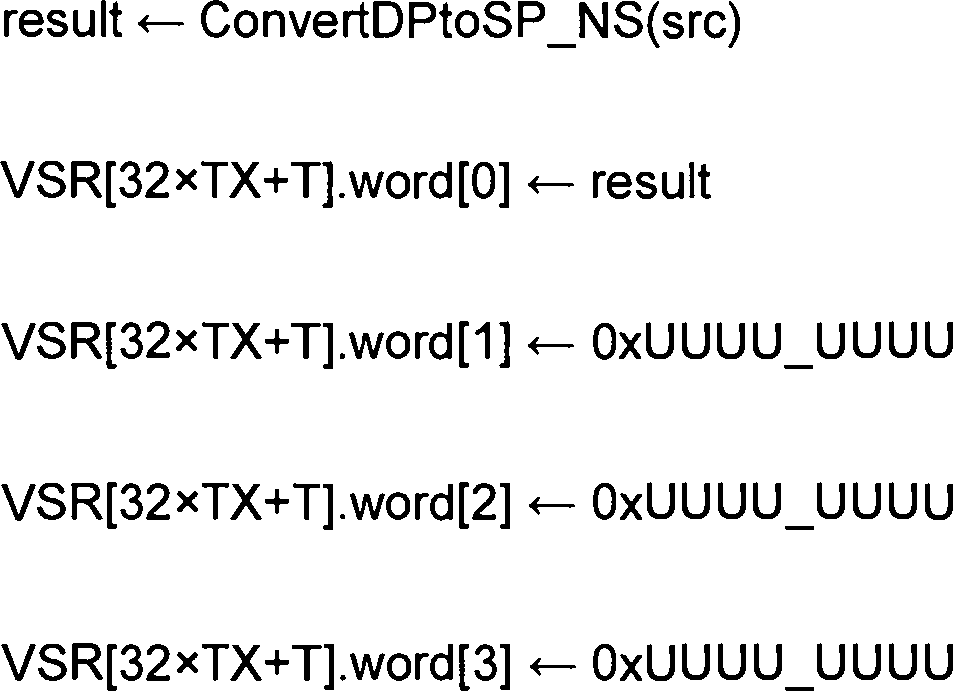
- XT sei der Wert TX, der mit T verkettet ist.
- XB sei der Wert BX, der mit B verkettet ist.
- src sei der Gleitkommawert mit einfacher
Präzision im Doppelwortelement 0 von VSR[XB], dargestellt im Format mit doppelter Präzision. - src wird in
das Wortelement 0 von VSR[XT] im Format mit einfacher Präzision gestellt. Die Verschlüsselung von SNaN-Werten wird beibehalten (d. h. sie werden nicht in eine QNaN umgewandelt).
- Let XT be the value TX concatenated with T.
- Let XB be the value BX concatenated with B.
- src is the single-precision floating-point value in VSR double word element 0 [XB] represented in double-precision format.
- src is placed in the
word element 0 of VSR [XT] in single-precision format. The encryption of SNaN values is retained (ie they are not converted to a QNaN).
Die Inhalte der Doppelwortelemente 1, 2 und 3 von VSR[XT] sind nicht definiert.The contents of the
Geänderte SonderregisterChanged special registers
- KeineNone
VSR-Datenlayout für xscvdpspnVSR data layout for xscvdpspn
-
src = VSR[XB]src = VSR [XB] -
Die Bits 0 bis 63 von 128 Bits enthalten SP
Bits 0 through 63 of 128 bits contain SP
-
tgt = VSR[XT]tgt = VSR [XT] -
Die Bits 0 bis 31 von 128 Bits enthalten SP
Bits 0 to 31 of 128 bits contain SP
Weitere Details in Bezug auf die XSCVSSPVSPSPLT-Anweisung werden im Folgenden beschrieben. In einem Beispiel enthält diese Anweisung zwei Felder, die einen Operationscode identifizieren (wobei z. B. ein Feld einen primären Operationscode aufweist, der mit einem erweiterten Operationscode eines anderen Felds kombiniert (z. B. verkettet) ist), um die Anweisung zu identifizieren; ein erstes Feld (z. B. T-Feld) und ein erstes Bit (z. B. TX-Bit; verkettet), die ein erstes Register angeben; und ein zweites Feld (z. B. B-Feld) und ein zweites Bit (z. B. BX-Bit; verkettet), die ein zweites Register angeben. Beispiel-Pseudocode lautet wie folgt: 
- XT sei der Wert TX, der mit T verkettet ist.
- XB sei der Wert BX, der mit B verkettet ist.
- src sei der Gleitkommawert mit einfacher
Präzision im Doppelwortelement 0 von VSR[XB], dargestellt im Format mit doppelter Präzision. Die Verschlüsselung von SNaN-Werten wird beibehalten (d. h. sie werden nicht in eine QNaN umgewandelt). - src wird in jedes Wortelement von VSR[XT] im Format mit einfacher Präzision gestellt.
- Let XT be the value TX concatenated with T.
- Let XB be the value BX concatenated with B.
- src is the single-precision floating-point value in VSR double word element 0 [XB] represented in double-precision format. The encryption of SNaN values is retained (ie they are not converted to a QNaN).
- src is placed in each word element of VSR [XT] in single-precision format.
Geänderte SonderregisterChanged special registers
- KeineNone
VSR-Datenlayout für xscvsspvspspltVSR data layout for xscvsspvspsplt
-
src = VSR[XB]src = VSR [XB] -
Die Bits 0 bis 63 von 128 Bits enthalten SP
Bits 0 through 63 of 128 bits contain SP
-
tgt = VSR[XT]tgt = VSR [XT] -
Die Bits 0 bis 31, die Bits 32 bis 63, die Bits 64 bis 96 und die Bits 97 bis 127 von 128 Bits enthalten SP
Bits 0 through 31,bits 32 through 63, bits 64 through 96, and bits 97 through 127 of 128 bits contain SP
Außerdem werden Beispiele für Code-Snippets zum Umwandeln eines 64-Bit-Skalars mit einfacher Präzision in ein 32-Bit-Vektorelement mit einfacher Präzision mit Nachbildung (splat) im Folgenden beschrieben: C-Quelle 


Weitere Details in Bezug auf XSCVDPSP werden im Folgenden bereitgestellt. In einem Beispiel enthält diese Anweisung zwei Felder, die einen Operationscode identifizieren (wobei z. B. ein Feld einen primären Operationscode aufweist, der mit einem erweiterten Operationscode eines anderen Felds kombiniert (z. B. verkettet) ist), um die Anweisung zu identifizieren; ein erstes Feld (z. B. T-Feld) und ein erstes Bit (z. B. TX-Bit; verkettet), die ein erstes Register angeben; und ein zweites Feld (z. B. B-Feld) und ein zweites Bit (z. B. BX-Bit; verkettet), die ein zweites Register angeben. Beispiel-Pseudocode lautet wie folgt: 

- XT sei der Wert TX, der mit T verkettet ist.
- XB sei der Wert BX, der mit B verkettet ist.
- src sei der Gleitkommawert mit doppelter
Präzision im Doppelwortelement 0 von VSR[XB]. - Wenn src eine SNaN ist, lautet das Ergebnis src, umgewandelt in eine QNaN (d. h. Bit 12 von src wird
auf 1 gesetzt). VXSNAN wird auf 1 gesetzt. - Ansonsten, wenn src eine QNaN, eine Unendlichkeit oder eine Null ist, ist das Ergebnis src.
- Ansonsten ist das Ergebnis src, unter Verwendung des durch RN angegebenen Rundungsmodus auf einfache Präzision gerundet.
- Let XT be the value TX concatenated with T.
- Let XB be the value BX concatenated with B.
- Let src be the double precision floating point value in
double word element 0 of VSR [XB]. - If src is a SNaN, the result is src, converted to a QNaN (ie bit 12 of src is set to 1). VXSNAN is set to 1.
- Otherwise, if src is a QNaN, an infinity or a zero, the result is src.
- Otherwise, the result src is rounded to simple precision using the rounding mode indicated by RN.
Das Ergebnis wird in das Wortelement 0 von VSR[XT] im Format mit einfacher Präzision gestellt.The result is placed in the
Die Inhalte der Doppelwortelemente 1, 2 und 3 von VSR[XT] sind nicht definiert.The contents of the
FPRF wird auf die Klasse und das Vorzeichen des Ergebnisses eingestellt. FR wird so eingerichtet, dass angegeben wird, ob das Ergebnis beim Runden erhöht worden ist. FI wird so eingerichtet, dass angegeben wird, ob das Ergebnis ungenau ist.FPRF is set to the class and sign of the result. FR is set up to indicate whether the result has been increased in the round. FI is set up to indicate if the result is inaccurate.
Wenn eine Ausnahme Invalid Operation mit Trap-Aktivierung auftritt, werden VSR[XT] und FPRF nicht modifiziert, und FR und FI werden auf 0 gesetzt.When an exception Invalid operation with trap activation occurs, VSR [XT] and FPRF are not modified, and FR and FI are set to 0.
Geänderte Sonderregister 
VSR-Datenlayout für xscvdpspVSR data layout for xscvdpsp
-
src = VSR[XB]src = VSR [XB] -
Die Bits 0 bis 63 von 128 Bits enthalten DP
Bits 0 to 63 of 128 bits contain DP
-
tgt – VSR[XT tgt - VSR [XT -
Die Bits 0 bis 31 von 128 Bits enthalten SP
Bits 0 to 31 of 128 bits contain SP
Hierin wird ausführlich eine erweiterte VSX-Einrichtung mit Unterstützung von Anweisungen beschrieben, die skalare Zahlen mit einfacher Präzision unter Verwendung einer 64-Bit-Darstellung berechnen, und von Anweisungen, die Vektorzahlen mit einer Präzision unter Verwendung einer 32-Bit-Darstellung berechnen. Ferner wird eine Funktion zum Übersetzen von einer ersten in eine zweite Darstellung bereitgestellt. In einer ersten Ausführungsform wird eine explizite Umwandlung von 64-Bit- in 32-Bit- und 32-Bit- in 64-Bit-Operationen verwendet. In einer zweiten Ausführungsform werden Anweisungen verwendet, um ein Umwandeln zwischen Darstellungen mit einfacher Präzision vorzunehmen unter Verwendung von Umwandlungen mit doppelter Präzision/einfacher Präzision, um ein Umwandeln zwischen 32-Bit- und 64-Bit-Darstellungen von Zahlen mit einfacher Präzision vorzunehmen, wobei die 64-Bit-Darstellung einer Zahl mit einfacher Präzision eine ähnliche Form aufweist wie die Operation mit doppelter Präzision. In einer weiteren Ausführungsform stellt die Umwandlungsoperation auch eine Splat-Funktion bereit, in der ein 32-Bit-Wert mit einfacher Präzision in einer Vielzahl von Elementpositionen nachgebildet wird. In einer Ausführungsform stellt die Umwandlungsoperation auch eine Auswahlfunktion bereit, in der ein 32-Bit-Wert mit einfacher Präzision aus einer Vielzahl von Elementpositionen mithilfe eines Positionsindikators ausgewählt wird.Described in detail herein is an extended VSX device with support for instructions that compute simple-precision scalar numbers using a 64-bit representation, and instructions that calculate vector numbers with precision using a 32-bit representation. Furthermore, a function for translating from a first to a second representation is provided. In a first embodiment, explicit conversion from 64-bit to 32-bit and 32-bit to 64-bit operations is used. In a second embodiment, instructions are used to perform conversion between single-precision representations using double precision / single precision transformations to convert between 32-bit and 64-bit representations of single-precision numbers, where The 64-bit representation of a single precision number is similar in shape to the double precision operation. In another embodiment, the conversion operation also provides a splat function in which a 32-bit single precision value is replicated in a plurality of element locations. In one embodiment, the conversion operation Also provides a selection function in which a 32-bit single-precision value from a plurality of element positions is selected using a position indicator.
Gemäß einem oder mehreren Aspekten werden mehrere in einer Architektur angeordnete Darstellungen verwendet. Eine Funktion wird bereitgestellt, um 64-Bit-Zahlen mit einfacher Präzision in einem ersten Betriebsmodus und 32-Bit-Zahlen mit einfacher Präzision in einem zweiten Betriebsmodus aufzunehmen und zu identifizieren. Eine Funktion wird bereitgestellt, um eine erste und zweite Operation auf der Grundlage des Operationstyps zu identifizieren, der notwendig ist, um kompatibel mit der ersten und zweiten traditionellen Verschlüsselung zusammenzuwirken, die erste und zweite Verschlüsselungen darstellt. Eine Technik zum Übersetzen zwischen der ersten und zweiten Darstellung wird bereitgestellt.In one or more aspects, multiple architectural representations are used. A function is provided to record and identify single-precision 64-bit numbers in a first mode of operation and single precision 32-bit numbers in a second mode of operation. A function is provided to identify a first and second operation based on the type of operation necessary to cooperate with the first and second traditional encryptions representing first and second encryptions. A technique for translating between the first and second representations is provided.
Durch ein Umwandeln zwischen einer Darstellung und einer anderen kann die Ausführungskomplexität verringert werden, indem die Notwendigkeit entfällt, eine Prüfung von Grenzbedingungen auszuführen. Ferner werden durch ein Einfügen einer Umwandlungsanweisung zum Umwandeln einer Datendarstellung in eine andere die Anzahl der zu verschlüsselnden Anweisungen sowie die Kosten der Entschlüsselungslogik und Umsetzung verringert.By converting between one representation and another, the execution complexity can be reduced by eliminating the need to carry out a boundary condition check. Further, by inserting a conversion instruction to convert one data representation to another, the number of instructions to be encrypted and the cost of the decryption logic and implementation are reduced.
Gemäß einem oder mehreren Aspekten erfolgt ein Aktivieren des Mischens von 32-Bit-Darstellung mit einfacher Präzision, die zur Vektorberechnung verwendet wird, und von 64-Bit-Gleitkommadarstellung mit einfacher Präzision, die zur skalaren Berechnung verwendet wird. Neue Anweisungen für eine Formatumwandlung von einfacher Präzision in einfache Präzision werden zum Umwandeln aus einem 64-Bit-Format in ein anderes 32-Bit-Format oder umgekehrt bereitgestellt. Außerdem wird eine Umwandlungsanweisung, die eine 64-Bit-Einfachpräzision in eine 32-Bit-Einfachpräzision umwandelt, und eine Nachbildung bereitgestellt, in der derselbe Wert in dem Register viermal nachgebildet wird, was eine übliche Operation für eine Vektor-Skalar-Operation ist. Die Umwandlung wird ohne Berücksichtigung von Signalisierungsmerkmalen ausgeführt, weil eine Umwandlung dieses Typs keine Berechnungsanweisung ist.In one or more aspects, enabling the mixing of 32-bit single-precision representation used for vector computation and 64-bit single-precision floating-point representation used for scalar computation. New instructions for simple-precision to simple-precision format conversion are provided for converting from a 64-bit format to another 32-bit format, or vice versa. In addition, a conversion instruction that converts a 64-bit single precision to a 32-bit single precision and a replica in which the same value is replicated four times in the register, which is a common operation for a vector scalar operation. The conversion is performed without consideration of signaling features because a conversion of this type is not a computation instruction.
Des Weiteren wird eine Compiler-Technik bereitgestellt, um die Berechnung unter Verwendung von zwei unterschiedlichen Gleitkommadarstellungen für denselben 32-Bit-Gleitkommadatentyp mit einfacher Präzision zu erleichtern. Der Compiler wird erweitert, um zu erkennen, dass verwendete Daten in der einen oder einer anderen Darstellung vorliegen können und eine Prüfung ausgeführt werden muss, um sicherzustellen, dass die verwendeten Daten das entsprechende Format haben, das durch eine Anweisung verwendet wird. Dies wird erreicht, indem jeder Anweisung ein Datentyp zugeordnet wird, und der Datentyp der Anweisung, die ein Ergebnis erzeugt, muss derselbe sein wie der Datentyp der Anweisung, die das Ergebnis verwendet. Wenn dies nicht der Fall ist, wird eine Umwandlung eingefügt. Die Formatumwandlungen werden direkt von Register zu Register ausgeführt, ohne dass eine Ausnahme gesetzt wird.Furthermore, a compiler technique is provided to facilitate computation using two different floating-point representations for the same single-precision 32-bit floating-point data type. The compiler expands to recognize that data used may be in one or the other representation and that a check must be performed to ensure that the data used has the appropriate format used by an instruction. This is accomplished by assigning a data type to each instruction, and the data type of the instruction that produces a result must be the same as the data type of the instruction that uses the result. If this is not the case, a conversion is inserted. The format conversions are executed directly from register to register without an exception being made.
In einem Aspekt werden Gleitkommaregister verwendet, die zwei verschiedene Darstellungen jeder Gleitkommazahl enthalten können. Anweisungen geben an, welcher Typ von Gleitkommazahl für Operanden der Anweisung verwendet werden soll und erlangen/speichern den Operanden aus einer der ausgewählten Darstellungen, sofern vorhanden. Des Weiteren hat ein Compiler Kenntnis von den Gleitkommaregistern und fügt nach Bedarf Umwandlungsanweisungen ein, wenn das Gleitkommaregister die falsche Darstellung enthält.In one aspect, floating point registers are used, which may contain two different representations of each floating point number. Statements indicate which type of floating-point number to use for operands of the instruction and obtain / store the operand from one of the selected representations, if any. Furthermore, a compiler is aware of the floating point registers and inserts conversion instructions as needed when the floating point register contains the wrong representation.
In einem bestimmten Beispiel wird eine Anweisung bereitgestellt, die aus einem ersten in einer Architektur angeordneten Format (z. B. das SP64 breite binäre 64-Bit-Gleitkommaformat mit einfacher Präzision gemäß der Definition der POWER ISA) in einem Register einer Registerklasse (die eine mehrfach adressierbare Registerdatei sein kann) in ein zweites in einer Architektur angeordnetes Format umwandelt (z. B. das SP32 breite binäre 32-Bit-Gleitkommaformat mit einfacher Präzision gemäß der Speicherformatdefinition IEEE 754 und einer ähnlichen POWER ISA-Definition) für ein Registerdateiformat.In one particular example, an instruction is provided consisting of a first architecture-arranged format (e.g., the SP64 64-bit binary precision simple-precision floating-point variable as defined by POWER ISA) in a register of a register class (the one multi-addressable register file) into a second architecture-arranged format (e.g., the SP32 wide 32-bit single-precision floating-point floating-point format according to the IEEE 754 memory format definition and a similar POWER ISA definition) for a register file format.
Die Umwandlung von SP64 in SP32 wird zum Beispiel verwendet, um die Verwaltung von verschiedenen internen Formaten durch den Compiler gemäß der Architekturdefinition aufzunehmen, wobei jede Zahl z. B. eine exakte Entsprechung hat (die Formatumwandlung von SP64 in SP32). Diese ist verschieden von einer Umwandlung von DP (doppelte Präzision) in SP, die eine benutzerdefinierte Operation ist.For example, the conversion from SP64 to SP32 is used to accommodate the management of various internal formats by the compiler according to the architectural definition, where each number is e.g. B. has an exact match (the format conversion from SP64 to SP32). This is different from converting DP (double precision) into SP, which is a custom operation.
Zum Beispiel muss die Umwandlung von DP in SP DP-Zahlen zu SP-Zahlen zuordnen, sogar für DP-Zahlen, die keine Darstellung in dem SP-Format haben. Sie kann dies durch ein Ausführen einer Rundung von Überschuss-Mantissenbits ausführen (gemäß einem von vielen möglichen Rundungsmodi wie beispielsweise abschneiden, auf Null runden, auf –Unendlichkeit runden, auf +Unendlichkeit runden, weg von Null runden, auf geradzahlig runden, auf ungeradzahlig runden uvm.), ein Ausführen einer Flush-Operation auf Null für kleine Zahlen, die in DP, aber nicht in SP darstellbar sind, und ein Sättigen von großen Zahlen, die in DP, aber nicht in SP darstellbar sind, auf +Unendlichkeit oder – Unendlichkeit. Im Vergleich verarbeitet die Umwandlung von SP64 in SP32 in einem Beispiel ausschließlich SP-Zahlen, sodass in mindestens einer Ausführungsform die Operation zum Umwandeln von SP64 in SP32 nicht definiert ist, wenn eine Eingabe nicht in einem darstellbaren IEEE-SP-Gleitkommabereich vorliegt. Kompatible Hardware kann gemäß einem Aspekt dieser Ausführungsform beliebig vorgehen, sie kann eine außerhalb des gültigen Bereichs (unzulässige) SP64-Biteingabe so behandeln, als wäre sie eine DP-Zahl und sie runden; sie kann einen Spezifikations-Interrupt für außerhalb des gültigen Bereichs liegende Zahlen setzen; sie kann ein Zufallsergebnis erzeugen; oder sie kann überhaupt kein Ergebnis erzeugen.For example, converting DP to SP must map DP numbers to SP numbers, even for DP numbers that do not have representation in the SP format. It can accomplish this by performing rounding on excess mantissa bits (round one of many possible rounding modes such as round off, round to zero, round to infinity, round to + infinity, round off zero, round to even, round to odd and so on), doing a flush operation to zero for small ones Numbers that can be represented in DP, but not in SP, and a saturation of large numbers that can be represented in DP, but not in SP, on + infinity or infinity. In comparison, in one example, the conversion from SP64 to SP32 processes only SP numbers, so in at least one embodiment, the operation to convert SP64 to SP32 is undefined when an input is not in an IEEE SP representable floating point range. Compatible hardware may be arbitrary according to one aspect of this embodiment; it may treat an out-of-range (invalid) SP64 bit input as if it were a DP number and round it; it can set a specification interrupt for out-of-range numbers; it can produce a random result; or it can not produce any result at all.
In einem weiteren Beispiel ist eine Umwandlung von DP in SP eine benutzerdefinierte Anweisung zur Datentypumwandlung, und gemäß der Definition dieser benutzerdefinierten Anweisung sollte eine SNaN (d. h. eine Signalisierungs-Nichtzahl, wobei NaN eine Nichtzahl-Angabe gemäß dem IEEE-Standard ist) eine Ausnahme setzen. In einer Ausführungsform kann diese benutzerdefinierte Anweisung auch so definiert sein, dass sie während einer Zahlenumwandlung Ausnahmen für arithmetische Bedingungen setzt (d. h. Unterlauf oder Überlauf). Im Vergleich ist die Umwandlung von SP64 in SP32 eine Formatumwandlung, die einer internen Operation eines Compilers entspricht, der die Hardware nutzt. In einem Beispiel entspricht jeder gültige Datenpunkt in dem SP64-Bit-Format genau einem Datenpunkt in dem SP32-Format. Wenn ein derartiger Datenpunkt als eine Eingabe bereitgestellt wird (und insbesondere SNaNs enthält), werden die Datenpunkte aus der einen Formatdarstellung der zweiten Darstellung zugeordnet, und es wird kein Interrupt gesetzt.In another example, a conversion from DP to SP is a user-defined data type conversion instruction, and according to the definition of this user-defined instruction, an SNaN (ie, a signaling nonnumber, where NaN is an IEEE nonnumber indication) should be exempted , In one embodiment, this custom instruction may also be defined to set exceptions to arithmetic conditions during a number conversion (i.e., underflow or overflow). In comparison, the conversion from SP64 to SP32 is a format conversion that corresponds to an internal operation of a compiler using the hardware. In one example, each valid data point in the SP64 bit format corresponds to exactly one data point in the SP32 format. If such a data point is provided as an input (and contains in particular SNaNs), the data points from the one format representation are assigned to the second representation, and no interrupt is set.
In einer Ausführungsform wird eine gültige Zahl mit einfacher Präzision direkt aus einem ersten, in einer Architektur angeordneten Registerformat in ein zweites Registerformat umgewandelt, wobei die Anweisung abgeschlossen wird und das umgewandelte Ergebnis in ein Zielregister für IEEE-Gleitkommazahl- oder Nichtzahl-Eingaben mit einfacher Präzision geschrieben wird. In einem Beispiel wird eine Signalisierungs-NaN in dem Zielregister als eine Signalisierungs-NaN beibehalten.In one embodiment, a valid single precision number is directly converted from a first register format arranged in an architecture to a second register format, completing the instruction and converting the converted result to a target register for IEEE floating point or non-number single precision inputs is written. In one example, a signaling NaN is retained in the destination register as a signaling NaN.
Wie einem Fachmann klar sein wird, können ein oder mehrere Aspekte der vorliegenden Erfindung als ein System, Verfahren oder Computerprogrammprodukt verkörpert werden. Dementsprechend können ein oder mehrere Aspekte der vorliegenden Erfindung in Gestalt einer vollständigen Hardware-Ausführungsform, einer vollständigen Software-Ausführungsform (einschließlich Firmware, residente Software, Mikrocode usw.) oder einer Ausführungsform vorliegen, die Software- und Hardware-Aspekte kombiniert, auf die alle hierin als „Schaltung”, „Modul” oder „System” Bezug genommen werden kann. Ferner können ein oder mehrere Aspekte der vorliegenden Erfindung die Form eines Computerprogrammprodukts annehmen, das in einem oder mehreren computerlesbaren Medien mit einem darin ausgeführten computerlesbaren Programmcode verkörpert ist.As one skilled in the art will appreciate, one or more aspects of the present invention may be embodied as a system, method, or computer program product. Accordingly, one or more aspects of the present invention may be in the form of a complete hardware embodiment, a complete software embodiment (including firmware, resident software, microcode, etc.) or an embodiment that combines software and hardware aspects to which all may be referred to herein as a "circuit," "module," or "system." Further, one or more aspects of the present invention may take the form of a computer program product embodied in one or more computer readable media having computer readable program code embodied therein.
Jede Kombination von einem oder mehreren computerlesbaren Medien kann verwendet werden. Das computerlesbare Medium kann ein computerlesbares Speichermedium sein. Ein computerlesbares Speichermedium kann zum Beispiel ein elektronisches, magnetisches, optisches, elektromagnetisches, Infrarot- oder Halbleitersystem, eine derartige Vorrichtung oder Einheit oder jede geeignete Kombination aus dem Vorgenannten sein, es ist aber nicht darauf beschränkt. Zu spezielleren Beispielen (eine nicht erschöpfende Liste) für das computerlesbare Speichermedium würde Folgendes zählen: eine elektrische Verbindung mit einer oder mehreren Drahtleitungen, eine tragbare Computerdiskette, eine Festplatte, ein Direktzugriffspeicher (RAM), ein Nur-Lese-Speicher (ROM), ein löschbarer programmierbarer Nur-Lese-Speicher (EPROM oder Flash-Speicher), ein Lichtwellenleiter, ein tragbarer CD-ROM, eine optische Speichereinheit, eine Magnetspeichereinheit oder jede geeignete Kombination des Vorgenannten. In dem Kontext dieses Dokuments kann ein computerlesbares Speichermedium jedes konkrete Medium sein, das ein Programm enthalten oder speichern kann, das von oder in Verbindung mit einem System, einer Vorrichtung oder einer Einheit zur Anweisungsausführung verwendet werden kann.Any combination of one or more computer readable media may be used. The computer readable medium may be a computer readable storage medium. A computer-readable storage medium may be, for example, but not limited to, an electronic, magnetic, optical, electromagnetic, infrared, or semiconductor system, apparatus, or device, or any suitable combination of the foregoing. More specific examples (a non-exhaustive list) of the computer readable storage medium would include: an electrical connection to one or more wirewires, a portable computer disk, a hard disk, Random Access Memory (RAM), Read Only Memory (ROM) erasable programmable read only memory (EPROM or flash memory), an optical fiber, a portable CD-ROM, an optical storage unit, a magnetic storage unit, or any suitable combination of the foregoing. In the context of this document, a computer readable storage medium may be any tangible medium that may contain or store a program that may be used by or in connection with an instruction execution system, apparatus, or device.
Unter folgender Bezugnahme auf
In einem computerlesbaren Medium verkörperter Programmcode kann unter Verwendung eines geeigneten Mediums übertragen werden, einschließlich drahtlos, drahtgebunden, über ein Lichtwellenleiterkabel, HF usw. oder eine geeignete Kombination des Vorgenannten, er ist aber nicht darauf beschränkt.Program code embodied in a computer readable medium may be transmitted using a suitable medium, including, but not limited to, wireless, wireline, fiber optic cable, RF, etc., or any suitable combination of the foregoing.
Computerprogrammcode zum Ausführen von Operationen für einen oder mehrere Aspekte der vorliegenden Erfindung kann in jeder Kombination von einer oder mehreren Programmiersprachen geschrieben werden, einschließlich einer objektorientierten Programmiersprache wie Java, Smalltalk, C++ oder dergleichen und herkömmlichen prozeduralen Programmiersprachen wie der Programmiersprache „C”, Assembler oder ähnlichen Programmiersprachen. Der Programmcode kann vollständig auf dem Computer des Benutzers, teilweise auf dem Computer des Benutzers, als eigenständiges Softwarepaket, teilweise auf dem Computer des Benutzers und teilweise auf einem entfernt angeordneten Computer oder vollständig auf dem entfernt angeordneten Computer oder Server ausgeführt werden. In dem letzteren Szenario kann der entfernt angeordnete Computer mit dem Computer des Benutzers über jeden Typ von Netzwerk verbunden sein, einschließlich ein lokales Netzwerk (LAN) oder ein Weitverkehrsnetz (WAN), oder die Verbindung kann zu einem externen Computer hergestellt werden (zum Beispiel über das Internet unter Nutzung eines Internet-Dienstanbieters). Computer program code for performing operations for one or more aspects of the present invention may be written in any combination of one or more programming languages, including an object-oriented programming language such as Java, Smalltalk, C ++ or the like and conventional procedural programming languages such as the "C", Assembler or similar programming languages. The program code may be executed entirely on the user's computer, partially on the user's computer, as a standalone software package, partially on the user's computer and partly on a remote computer, or entirely on the remote computer or server. In the latter scenario, the remote computer may be connected to the user's computer via any type of network, including a local area network (LAN) or a wide area network (WAN), or the connection may be made to an external computer (e.g. the Internet using an internet service provider).
Ein oder mehrere Aspekte der vorliegenden Erfindung werden hierin unter Bezugnahme auf Veranschaulichungen des Ablaufplans und/oder der Blockschaubilder von Verfahren, Vorrichtungen (Systemen) und Computerprogrammprodukten gemäß Ausführungsformen der Erfindung beschrieben. Es versteht sich, dass jeder Block in den Ablaufplan-Veranschaulichungen und/oder Blockschaubildern und Kombinationen von Blöcken in den Ablaufplan-Veranschaulichungen und/oder Blockschaubildern durch Computerprogrammanweisungen umgesetzt werden können. Diese Computerprogrammanweisungen können für einen Prozessor eines Mehrzweckcomputers, eines Spezialcomputers oder andere Vorrichtungen, die programmierbare Daten verarbeiten, bereitgestellt werden, um eine Maschine zu erzeugen, sodass die Anweisungen, die über den Prozessor des Computers oder andere Vorrichtungen, die programmierbare Daten verarbeiten, ausgeführt werden, Mittel zum Umsetzen der Funktionen/Handlungen erstellen, die in dem Ablaufplan und/oder dem Block oder den Blöcken des Blockschaubilds angegeben sind.One or more aspects of the present invention are described herein with reference to flowchart illustrations and / or block diagrams of methods, apparatus (systems), and computer program products according to embodiments of the invention. It is understood that each block in the flowchart illustrations and / or block diagrams and combinations of blocks in the flowchart illustrations and / or block diagrams can be implemented by computer program instructions. These computer program instructions may be provided to a processor of a general purpose computer, a special purpose computer, or other devices that process programmable data to generate a machine so that the instructions that are executed via the computer's processor or other devices that process programmable data are executed , Means for implementing the functions / actions indicated in the flowchart and / or the block or blocks of the block diagram.
Diese Computerprogrammanweisungen können auch in einem computerlesbaren Medium gespeichert werden, das einen Computer, eine andere Vorrichtung, die programmierbare Daten verarbeitet, oder andere Einheiten so steuern kann, dass sie auf eine bestimmte Weise funktionieren, sodass die in dem computerlesbaren Medium gespeicherten Anweisungen einen Fertigungsartikel erzeugen, einschließlich Anweisungen, die die in dem Ablaufplan und/oder dem Block oder den Blöcken des Blockschaubilds angegebene Funktion/Handlung umsetzen.These computer program instructions may also be stored in a computer readable medium that may control a computer, other device that processes programmable data, or other devices to function in a particular manner such that the instructions stored in the computer readable medium produce an article of manufacture including instructions that implement the function / action specified in the flowchart and / or the block or blocks of the block diagram.
Die Computerprogrammanweisungen können auch auf einen Computer, eine andere Vorrichtung, die programmierbare Daten verarbeitet, oder andere Einheiten geladenwerden, um die Ausführung einer Serie von Arbeitsschritten auf dem Computer, einer anderen Vorrichtung, die programmierbare Daten ausführt, oder anderen Einheiten zu veranlassen, um einen über den Computer umgesetzten Prozess zu erzeugen, sodass die Anweisungen, die auf dem Computer oder einer anderen programmierbaren Vorrichtung ausgeführt werden, Prozesse zum Umsetzen der Funktionen/Handlungen bereitstellen, die in dem Ablaufplan und/oder dem Block oder den Blöcken des Blockschaubilds angegeben sind.The computer program instructions may also be loaded on a computer, other device that processes programmable data, or other devices to perform a series of operations on the computer, another device that executes programmable data, or other devices computer generated process so that the instructions executed on the computer or other programmable device provide processes for implementing the functions / actions indicated in the flowchart and / or the block or blocks of the block diagram.
Der Ablaufplan und die Blockschaubilder in den Figuren veranschaulichen die Architektur, die Funktionalität und den Betrieb von möglichen Umsetzungen von Systemen, Verfahren und Computerprogrammprodukten gemäß verschiedenen Ausführungsformen von einem oder mehreren Aspekten der vorliegenden Erfindung. Diesbezüglich kann jeder Block in dem Ablaufplan oder in den Blockschaubildern ein Modul, ein Segment oder einen Codeabschnitt darstellen, der eine oder mehrere ausführbare Anweisungen zum Umsetzen der angegebenen logischen Funktion(en) aufweist. Es ist ebenfalls anzumerken, dass in einigen alternativen Umsetzungen die in dem Block angegebenen Funktionen in einer anderen Reihenfolge auftreten können als in den Figuren angegeben. Zum Beispiel können zwei nacheinander gezeigte Blöcke tatsächlich im Wesentlichen parallel ausgeführt werden, oder die Blöcke können manchmal in der umgekehrten Reihenfolge ausgeführt werden, was von der beteiligten Funktionalität abhängt. Es wird ebenfalls angemerkt, dass jeder Block in den Blockschaubildern und/oder in der Ablaufplan-Veranschaulichung und Kombinationen von Blöcken in den Blockschaubildern und/oder der Ablaufplan-Veranschaulichung durch spezielle Systeme auf der Grundlage von Hardware, die die angegebenen Funktionen oder Handlungen ausführen, oder Kombinationen von spezieller Hardware und Computeranweisungen umgesetzt werden können.The flowchart and block diagrams in the figures illustrate the architecture, functionality, and operation of possible implementations of systems, methods, and computer program products according to various embodiments of one or more aspects of the present invention. In this regard, each block in the flowchart or block diagrams may represent a module, segment or code section having one or more executable instructions for implementing the specified logical function (s). It should also be noted that in some alternative implementations, the functions specified in the block may occur in a different order than indicated in the figures. For example, two blocks shown in succession may in fact be executed substantially in parallel, or the blocks may sometimes be executed in the reverse order, depending on the functionality involved. It is also noted that each block in the block diagrams and / or in the flowchart illustration and combinations of blocks in the block diagrams and / or flowchart illustration by specific systems based on hardware performing the specified functions or acts, or combinations of specialized hardware and computer instructions.
Zusätzlich zu Vorgenanntem können ein oder mehrere Aspekte der vorliegenden Erfindung durch einen Dienstanbieter bereitgestellt, angeboten, eingesetzt, verwaltet, gewartet werden usw., der eine Verwaltung von Umgebungen von Kunden anbietet. Zum Beispiel kann der Dienstanbieter Computercode und/oder eine Computer-Infrastruktur erstellen, pflegen, unterstützen usw., die einen oder mehrere Aspekte der vorliegenden Erfindung für einen oder mehrere Kunden ausführen. Im Gegenzug kann der Dienstanbieter zum Beispiel eine Bezahlung von dem Kunden unter einem Abonnement und/oder einer Gebührenvereinbarung erhalten. Zusätzlich oder alternativ kann der Dienstanbieter eine Bezahlung aus dem Verkauf von Werbeinhalten an einen oder mehrere Fremdanbieter erhalten.In addition to the foregoing, one or more aspects of the present invention may be provided, offered, deployed, managed, maintained, etc., by a service provider that provides management of customer environments. For example, the service provider may create, maintain, support, etc., computer code and / or computer infrastructure that perform one or more aspects of the present invention for one or more customers. In return, for example, the service provider may receive payment from the customer under a subscription and / or fee agreement. Additionally or alternatively, the service provider may receive a payment from the sale of advertising content to one or more third parties.
Unter einem Aspekt der vorliegenden Erfindung kann eine Anwendung zum Ausführen von einem oder mehreren Aspekten der vorliegenden Erfindung verwendet werden. Zum Beispiel weist die Verwendung einer Anwendung ein Bereitstellen einer Computer-Infrastruktur auf, die fähig ist, einen oder mehrere Aspekte der vorliegenden Erfindung auszuführen.In one aspect of the present invention, an application for carrying out one or more aspects of the present invention may be used. For example, the use of an application includes providing a computer infrastructure capable of performing one or more aspects of the present invention.
Als weiterer Aspekt der vorliegenden Erfindung kann eine Datenverarbeitungs-Infrastruktur verwendet werden, die ein Integrieren von computerlesbarem Code in ein Datenverarbeitungssystem aufweist, in dem der Code in Kombination mit dem Datenverarbeitungssystem fähig ist, einen oder mehrere Aspekte der vorliegenden Erfindung auszuführen.As another aspect of the present invention, a data processing infrastructure may be used that includes integrating computer readable code into a data processing system in which the code in combination with the data processing system is capable of performing one or more aspects of the present invention.
Als noch weiterer Aspekt der vorliegenden Erfindung kann ein Prozess zum Integrieren von Datenverarbeitungs-Infrastruktur bereitgestellt werden, die ein Integrieren von computerlesbarem Code in ein Computersystem aufweist. Das Computersystem weist ein computerlesbares Medium auf, wobei das Computer-Medium einen oder mehrere Aspekte der vorliegenden Erfindung aufweist. Der Code in Kombination mit dem Computersystem ist fähig, einen oder mehrere Aspekte der vorliegenden Erfindung auszuführen.As yet another aspect of the present invention, a process for integrating computing infrastructure may be provided that includes integrating computer-readable code into a computer system. The computer system includes a computer readable medium, the computer medium having one or more aspects of the present invention. The code in combination with the computer system is capable of carrying out one or more aspects of the present invention.
Obwohl verschiedene Ausführungsformen oben beschrieben werden, sind dies nur Beispiele. Zum Beispiel können Datenverarbeitungsumgebungen von anderen Architekturen einen oder mehrere Aspekte der vorliegenden Erfindung verkörpern und verwenden. Ferner gelten ein oder mehrere Aspekte der vorliegenden Erfindung für jedes Format mit mehreren Darstellungen. In einem bestimmten Beispiel können ein oder mehrere Aspekte auf eine Definition einer (128-Bit-) Gleitkommaerweiterung mit Vierfach-Präzision angewendet werden, die ein 64-Bit-Format mit doppelter Präzision und ein 128-Bit-Format mit doppelter Präzision unterstützt. Ein oder mehrere Aspekte können auf ein Konsolidieren mehrerer Erweiterungen angewendet werden, die verschiedene Formatdefinitionen für einen Datentyp unterstützen. Ferner können andere Anweisungen verwendet werden, ohne von einem Erfindungsgedanken der vorliegenden Erfindung abzuweichen.Although various embodiments are described above, these are only examples. For example, computing environments of other architectures may embody and use one or more aspects of the present invention. Furthermore, one or more aspects of the present invention apply to any multi-representation format. In one particular example, one or more aspects may be applied to a definition of a quad-precision (128-bit) floating-point extension that supports a 64-bit double precision format and a double precision 128-bit format. One or more aspects can be applied to consolidating multiple extensions that support different format definitions for a data type. Furthermore, other instructions may be used without departing from the spirit of the present invention.
Ferner können weitere Typen von Datenverarbeitungsumgebungen von einem oder mehreren Aspekten der vorliegenden Erfindung profitieren. Als Beispiel kann eine Umgebung einen Emulator (z. B. Software oder andere Emulationsmechanismen) enthalten, durch den eine bestimmte Architektur (beispielsweise einschließlich Anweisungsausführung, in einer Architektur angeordnete Funktionen wie Adressübersetzung und in einer Architektur angeordnete Register) oder eine Untergruppe davon emuliert wird (z. B. auf einem nativen Computersystem mit einem Prozessor und Speicher). In einer derartigen Umgebung können eine oder mehrere Emulationsfunktionen des Emulators einen oder mehrere Aspekte der vorliegenden Erfindung emulieren, auch wenn ein Computer, der den Emulator ausführt, eine andere Architektur haben kann wie die emulierten Funktionen. Zum Beispiel wird im Emulationsmodus die spezifische emulierte Anweisung oder Operation entschlüsselt, und eine entsprechende Emulationsfunktion wird erstellt, um die einzelne Anweisung oder Operation umzusetzen.Further, other types of computing environments may benefit from one or more aspects of the present invention. As an example, an environment may include an emulator (eg, software or other emulation mechanisms) that emulates a particular architecture (eg, including instruction execution, architecture-arranged functions such as address translation and architecture-arranged registers), or a subset thereof ( on a native computer system with a processor and memory, for example). In such an environment, one or more emulation functions of the emulator may emulate one or more aspects of the present invention, even though a computer executing the emulator may have a different architecture than the emulated functions. For example, in emulation mode, the specific emulated instruction or operation is decrypted, and a corresponding emulation function is created to translate the single instruction or operation.
In einer Emulationsumgebung enthält ein Host-Computer zum Beispiel einen Speicher zum Speichern von Anweisungen und Daten; eine Anweisungsabrufeinheit zum Abrufen von Anweisungen aus dem Speicher und zum optionalen Bereitstellen einer lokalen Pufferung für die abgerufene Anweisung; eine Anweisungsentschlüsselungseinheit zum Empfangen der abgerufenen Anweisungen und zum Ermitteln des Typs von Anweisungen, die abgerufen wurden; und eine Anweisungsausführungseinheit zum Ausführen der Anweisungen. Die Ausführung kann ein Laden von Daten aus dem Speicher in ein Register enthalten; ein Zurückspeichern der Daten aus dem Register in den Speicher; oder ein Ausführen eines arithmetischen oder logischen Operationstyps, wie durch die Entschlüsselungseinheit ermittelt. In einem Beispiel ist jede Einheit in Software umgesetzt. Zum Beispiel werden die Operationen, die durch die Einheiten ausgeführt werden als eine oder mehrere Subroutinen in der Emulator-Software umgesetzt.For example, in an emulation environment, a host computer includes memory for storing instructions and data; an instruction fetch unit for fetching instructions from the memory and optionally providing local buffering for the fetched instruction; an instruction decryption unit for receiving the retrieved instructions and determining the type of instructions that have been retrieved; and an instruction execution unit for executing the instructions. The implementation may include loading data from memory into a register; restoring the data from the register to memory; or performing an arithmetic or logical operation type as determined by the decryption unit. In one example, each unit is implemented in software. For example, the operations performed by the units are implemented as one or more subroutines in the emulator software.
Als weiteres Beispiel ist ein Datenverarbeitungssystem verwendbar, das zum Speichern und/oder Ausführen von Programmcode geeignet ist, das mindestens einen Prozessor enthält, der direkt oder indirekt über einen Systembus mit Speicherelementen verbunden ist. Die Speicherelemente enthalten zum Beispiel einen lokalen Speicher, der während der tatsächlichen Ausführung des Programmcodes verwendet wird, einen Massenspeicher und einen Cache-Zwischenspeicher, die eine vorübergehende Speicherung von mindestens einigem Programmcode bereitstellen, um die Anzahl zu verringern, wie oft Code während der Ausführung aus dem Massenspeicher abgerufen werden muss.As another example, a data processing system suitable for storing and / or executing program code including at least one processor directly or indirectly connected to memory elements via a system bus may be used. For example, the memory elements include local memory used during the actual execution of the program code, mass storage, and cache memory that provide temporary storage of at least some program code to reduce the number of times code executes during execution the mass storage must be retrieved.
Eingabe-/Ausgabe- oder E/A-Einheiten (einschließlich Tastaturen, Anzeigen, Zeigeeinheiten, DASD, Band, CDs, DVDs, Thumb-Drives und andere Speichermedien usw., die jedoch nicht darauf beschränkt sind) können entweder direkt oder über zwischengeschaltete E/A-Controller mit dem System verbunden werden. Netzwerkadapter können ebenfalls mit dem System verbunden werden, um zu ermöglichen, dass das Datenverarbeitungssystem mit anderen Datenverarbeitungssystemen oder entfernt angeordneten Druckern oder Speichereinheiten über dazwischenliegende private oder öffentliche Netzwerke verbunden werden kann. Modems, Kabelmodems oder Ethernet-Karten sind nur einige der verfügbaren Typen von Netzwerkadaptern. Input / output or I / O devices (including, but not limited to, keyboards, displays, pointing devices, DASD, tape, CDs, DVDs, thumb drives, and other storage media, etc.) can be used either directly or through intermediate E's / A controller connected to the system. Network adapters may also be connected to the system to allow the data processing system to connect to other data processing systems or remotely located printers or storage units via intervening private or public networks. Modems, cable modems, or Ethernet cards are just a few of the types of network adapters available.
Die hierin verwendete Terminologie dient nur zum Zweck der Beschreibung von bestimmten Ausführungsformen und soll die Erfindung keinesfalls einschränken. Die hierin verwendeten Singularformen „ein”, „eine” und „der/die/das” sollen auch die Pluralformen mit einschließen, es sei denn, der Kontext gibt eindeutig anderes vor. Es versteht sich des Weiteren, dass die Begriffe „weist auf” und/oder „aufweisend” bei Verwendung in dieser Patentschrift das Vorhandensein von ausgewiesenen Merkmalen, Ganzzahlen, Schritten, Operationen, Elementen und/oder Komponenten angeben, das Vorhandensein oder die Hinzufügung von einem oder mehreren anderen Merkmalen, Ganzzahlen, Schritten, Operationen, Elementen, Komponenten und/oder Gruppen davon aber nicht ausschließen.The terminology used herein is for the purpose of describing particular embodiments only and is not intended to limit the invention in any way. The singular forms "a," "an," and "the" used herein are also to include the plural forms unless the context clearly dictates otherwise. It is further understood that the terms "pointing to" and / or "having" as used in this specification indicate the presence of designated features, integers, steps, operations, elements and / or components, the presence or addition of one or several other features, integers, steps, operations, elements, components and / or groups thereof, however.
Die entsprechenden Strukturen, Materialien, Handlungen und Entsprechungen aller Mittel oder Schritt-plus-Funktion-Elemente, in den nachstehenden Ansprüchen sollen, sofern vorhanden, alle Strukturen, Materialien oder Handlungen zum Ausführen der Funktion in Kombination mit anderen beanspruchten Elementen enthalten, wie speziell beansprucht. Die Beschreibung der vorliegenden Erfindung wurde zum Zweck der Veranschaulichung und Beschreibung erstellt, sie soll aber keineswegs erschöpfend oder auf die Erfindung in der offenbarten Form eingeschränkt sein. Für Fachleute sind viele Modifizierungen und Variationen offenkundig, ohne von dem Schutzbereich und dem Erfindungsgedanken der Erfindung abzuweichen. Die Ausführungsform wurde ausgewählt und beschrieben, um die Grundgedanken der Erfindung und die praktische Anwendung am besten zu erklären und es anderen Fachleuten zu ermöglichen, die Erfindung für verschiedene Ausführungsformen mit verschiedenen Modifizierungen zu verstehen, die für die vorgesehene bestimmte Verwendung geeignet sind.The corresponding structures, materials, acts, and equivalents of all means or step-plus-function elements in the appended claims, if any, are intended to include any structures, materials, or acts to perform the function in combination with other claimed elements, as specifically claimed , The description of the present invention has been presented for purposes of illustration and description, but is in no sense intended to be exhaustive or limited to the invention in the form disclosed. Many modifications and variations will be apparent to those skilled in the art without departing from the scope and spirit of the invention. The embodiment has been chosen and described in order to best explain the principles of the invention and the practical application thereof, and to enable others skilled in the art to understand the invention for various embodiments with various modifications suitable for the particular use contemplated.
RFC02182.r6 – VSX Scalar Single-PrecisionRFC02182.r6 - VSX Scalar Single-Precision
Skalare Gleitkommadaten mit doppelter Präzision werden in VSRs und Speicher im Format mit doppelter Präzision dargestellt.Scalar double-precision floating point data is represented in VSRs and memory in double precision format.
Vektor-Gleitkommadaten mit doppelter Präzision werden in VSRs und Speicher im Format mit doppelter Präzision dargestellt.Vector precision double-floating point data is represented in VSRs and memory in double precision format.
Skalare Gleitkommadaten mit einfacher Präzision werden in VSRs im Format mit doppelter Präzision und im Speicher im Format mit einfacher Präzision dargestellt.Single-precision scalar floating-point data is represented in VSRs in double-precision format and in single-precision format memory.
Vektor-Gleitkommadaten mit einfacher Präzision werden in VSRs und Speicher im Format mit einfacher Präzision dargestellt.Simple precision vector floating point data is represented in VSRs and memory in single precision format.
Operanden mit doppelter Präzision können als Eingabe für skalare arithmetische Operationen mit doppelter Präzision verwendet werden.Double precision operands can be used as input for double precision scalar arithmetic operations.
Operanden mit doppelter Präzision können als Eingabe für skalare arithmetische Operationen mit einfacher Präzision verwendet werden, wenn ein Erfassen von Überlauf- und Unterlaufausnahmen deaktiviert ist.Double precision operands can be used as input for simple precision scalar arithmetic operations when overflow and underflow exception detection is disabled.
Operanden mit einfacher Präzision können als Eingabe für skalare arithmetische Operationen mit doppelter Präzision und einfacher Präzision verwendet werden.Single precision operands can be used as input for scalar arithmetic operations with double precision and simple precision.
Operanden mit doppelter Präzision können als Eingabe für arithmetische Vektor-Operationen mit doppelter Präzision verwendet werden.Double precision operands can be used as input for double precision arithmetic vector operations.
Operanden mit einfacher Präzision können als Eingabe für arithmetische Vektor-Operationen mit einfacher Präzision verwendet werden.Single precision operands can be used as input for simple precision arithmetic vector operations.
Anweisungen werden auch für Verarbeitungen bereitgestellt, für die keine doppelte Präzision oder einfache Präzision erforderlich ist. Außerdem werden Anweisungen bereitgestellt, um auf eine Ganzzahlen-Darstellung in VSRs zuzugreifen. Instructions are also provided for processes that do not require double precision or simple precision. In addition, instructions are provided to access an integer representation in VSRs.
Für skalare Daten mit einfacher Präzision wird eine Umwandlung vom Format mit einfacher Präzision in ein Format mit doppelter Präzision beim Laden aus dem Speicher in ein VSR ausgeführt, und eine Umwandlung vom Format mit doppelter Präzision in ein Format mit einfacher Präzision wird beim Speichern aus einem VSR in den Speicher ausgeführt. Durch diese Anweisungen werden keine Gleitkommaausnahmen verursacht.For single precision scalar data, a single precision format is converted to a double precision format when loaded from memory into a VSR, and a double precision format to a single precision format is converted to a VSR when saved executed in the memory. These statements do not cause floating-point exceptions.
Anweisungen werden zum Umwandeln zwischen Formaten mit einfacher Präzision und doppelter Präzision für skalare und Vektor-Daten in VSRs bereitgestellt.Instructions are provided for converting between single precision and double precision formats for scalar and vector data in VSRs.
Eine Anweisung wird bereitgestellt, um einen Operanden mit doppeltem Präzisionsformat in einem VSR explizit in einen mit einfacher Präzision umzuwandeln. Eine skalare Gleitkommazahl mit einfacher Präzision ist für sechs Anweisungstypen aktiviert.An instruction is provided to explicitly convert a double precision format operand in a VSR to a single precision one. A single precision scalar floating-point number is enabled for six types of statements.
1. Load Scalar Single-Precision (Skalar mit einfacher Präzision laden)1. Load Scalar Single-Precision (load scalar with simple precision)
Diese Anweisungsform greift im Speicher auf einen Gleitkomma-Operanden im Format mit einfacher Präzision zu, wandelt ihn in ein Format mit doppelter Präzision um und lädt ihn in einen VSR. Durch diese Anweisungen werden keine Gleitkommaausnahmen verursacht.This instruction format accesses a single-precision floating-point operand in memory, converts it to a double-precision format, and loads it into a VSR. These statements do not cause floating-point exceptions.
2. Scalar Round to Single-Precision (Skalar auf einfache Präzision runden)2. Scalar Round to Single-Precision (scalar to simple precision rounding)
xsrsp rundet einen Operanden mit doppelter Präzision auf einfache Präzision, wobei der Exponent auf einen Bereich mit einfacher Präzision geprüft wird und alle Ausnahmen gemäß jeweiligen Aktivierungs-Bits bearbeitet werden, und stellt diesen Operanden in ein VSR im Format mit doppelter Präzision. Für Ergebnisse, die durch arithmetische Anweisungen mit einfacher Präzision, Ladevorgänge mit einfacher Präzision und andere Instanzen von xsrsp erzeugt wurden, ändert xsrsp den Wert nicht. Werte, deren Größenordnung größer als 2319 ist, wenn Overflow aktiviert ist (OE = 1), erzeugen nicht definierte Ergebnisse, da der Wert nicht in den normalisierten Bereich zurück skaliert werden kann. Werte, deren Größenordnung kleiner als 2–318 ist, wenn Underflow aktiviert ist (UE = 1), erzeugen nicht definierte Ergebnisse, da der Wert nicht in den normalisierten Bereich zurück skaliert werden kann.xsrsp rounds a double-precision operand to simple precision, testing the exponent for a single-precision range and handling all the exceptions according to their respective activation bits, and puts that operand into a double-precision format VSR. For results generated by single precision arithmetic instructions, single precision loads, and other instances of xsrsp, xsrsp does not change the value. Values greater than 2319 when overflow is enabled (OE = 1) produce undefined results because the value can not be scaled back to the normalized range. Values smaller than 2-318 when underflow is enabled (UE = 1) will produce undefined results because the value can not be scaled back to the normalized range.
3. Scalar Convert Single-Precision to Double-Precision (Skalar von einfacher Präzision in doppelte Präzision umwandeln)3. Scalar Convert Single-Precision to Double-Precision (Convert scalar from simple precision to double precision)
xscvspdp greift auf einen Gleitkomma-Operanden im Format mit einfacher Präzision aus dem Wortelement 0 des Quellen-VSR zu, wandelt ihn in ein Format mit doppelter Präzision um und stellt ihn in das Doppelwortelement 0 des Ziel-VSR.xscvspdp accesses a single-precision floating-point operand from the
4. Scalar Convert Double-Precision to Single-Precision (Skalar von doppelter Präzision in einfache Präzision umwandeln)4. Scalar Convert Double-Precision to Single-Precision (Convert Scalar from Double Precision to Simple Precision)
xscvdpsp rundet den Gleitkommawert mit doppelter Präzision im Doppelwertelement 0 des Quellen-VSR auf einfache Präzision und stellt das Ergebnis in das Wortelement 0 des Ziel-VSR im Format mit einfacher Präzision. Diese Funktion würde verwendet, um skalare Gleitkommadaten in ein Format zu portieren, das für Vektor-Operationen mit einfacher Präzision kompatibel ist. Werte, deren Größenordnung größer als 2319 ist, wenn Overflow aktiviert ist (OE = 1), erzeugen nicht definierte Ergebnisse, da der Wert nicht in den normalisierten Bereich zurück skaliert werden kann. Werte, deren Größenordnung kleiner als 2–318 ist, wenn Underflow aktiviert ist (UE = 1), erzeugen nicht definierte Ergebnisse, da der Wert nicht in den normalisierten Bereich zurück skaliert werden kann.xscvdpsp rounds the double-precision floating-point value in the double-valued
5. VSX Scalar Single-Precision Arithmetic (VSX Skalar mit einfacher Präzision berechnen)5. VSX Scalar single-precision arithmetic (calculate VSX scalar with single precision)
Diese Anweisungsform nimmt Operanden aus den VSRs im Doppelformat, führt die Operation durch, als ob ein Zwischenergebnis mit infiniter Präzision und unbegrenztem Exponentenbereich erzeugt würde, und zwingt dieses Zwischenergebnis dann passend in ein Format mit einfacher Präzision. Status-Bits im FPSCR und optional in dem Bedingungsregister werden so eingerichtet, dass sie das Ergebnis mit einfacher Präzision wiedergeben. Das Ergebnis wird dann in den Ziel-VSR im Format mit doppelter Präzision gestellt. Das Ergebnis liegt in dem Bereich, der durch das einfache Format unterstützt wird.This instruction form takes operands from the VSRs in double format, performs the operation as if an intermediate result were generated with infinite precision and infinite exponent range, and then forcibly forces this intermediate result into a single precision format. Status bits in the FPSCR and optionally in the condition register are set up to produce the result with simple precision play. The result is then placed in the target VSR in double precision format. The result is in the range supported by the simple format.
Wenn ein Eingabewert nicht im Format mit einfacher Präzision dargestellt werden kann und weder OE = 1 noch UE = 1 ist, sind das in den Ziel-VSR gestellte Ergebnis und die Einstellung von Status-Bits in dem FPSCR nicht definiert.If an input value can not be represented in single-precision format and neither OE = 1 nor UE = 1, the result set in the target VSR and the setting of status bits in the FPSCR are undefined.
Wenn der Eingabewert für xsresp oder xsrsqrtesp nicht im Format mit einfacher Präzision darstellbar ist, sind das Ergebnis, das in den Ziel-VSR gestellt wird, und die Einstellung der Status-Bits in dem FPSCR nicht definiert.If the input value for xsresp or xsrsqrtesp can not be represented in single-precision format, the result set in the target VSR and the setting of the status bits in the FPSCR are undefined.
6. Store VSX Scalar Single-Precision (VSX Skalar mit einfacher Präzision speichern)6. Store VSX Scalar single-precision (save VSX scalar with simple precision)
sstxsspx wandelt einen Wert mit einfacher Präzision, der im Format mit doppelter Präzision vorliegt, in ein Format mit einfacher Präzision um und speichert diesen Operanden im Speicher. Durch stxsspx werden keine Gleitkommaausnahmen verursacht. (Von dem gespeicherten Wert wird effektiv angenommen, dass er das Ergebnis einer Anweisung eines der vorhergehenden fünf Typen ist).sstxsspx converts a single-precision, single-precision value to a single-precision format and stores that operand in memory. Stxsspx does not cause floating-point exceptions. (The stored value is effectively assumed to be the result of an instruction of one of the previous five types).
Wenn das Ergebnis einer Anweisung Load VSX Scalar Single-Precision (lxsspx), einer Anweisung VSX Scalar Round to Single-Precision (xsrsp) oder einer Anweisung VSX Scalar Single-Precision Arithmetic[1] in einem VSR gespeichert wird, sind die niedrigstwertigen 29 Bits von FRACTION Null. Anweisungen VSX Scalar Single-Precision Arithmetic: xsaddsp, xsdivsp, xsmulsp, xsresp, xssubsp, xsmaddasp, xsmaddmsp, xsmsubasp, xsmsubmsp, xsnmaddasp, xsnmaddmsp, xsnmsubasp, xsnmsubmsp.When the result of a Load VSX Scalar Single Precision (lxsspx) instruction, a VSX Scalar Round to Single Precision (xsrsp) instruction, or a VSX Scalar Single Precision Arithmetic [1] instruction is stored in a VSR, the least significant are 29 bits from FRACTION zero. VSX Scalar Single-Precision Arithmetic Instructions: xsaddsp, xsdivsp, xsmulsp, xsresp, xssubsp, xsmaddasp, xsmaddmsp, xsmsubasp, xsmsubmsp, xsnmaddasp, xsnmaddmsp, xsnmsubasp, xsnmsubmsp.
VSX Scalar Round to Single-Precision (xsrsp) wird bereitgestellt, um eine Wertumwandlung von doppelter Präzision in einfache Präzision mit entsprechender Ausnahmenprüfung und Rundung zu gestatten. xsrsp sollte verwendet werden, um Gleitkommawerte mit doppelter Präzision in Werte mit einfacher Präzision umzuwandeln, bevor sie in Speicherelementen mit einfachem Format gespeichert werden oder als Operanden für arithmetische Anweisungen mit einfacher Präzision verwendet werden. Werte, die durch Lade- und arithmetische Anweisungen mit einfacher Präzision erzeugt werden, sind bereits Werte mit einfacher Präzision und können direkt in Speicherelementen mit einfachem Format gespeichert werden oder direkt als Operanden für arithmetische Anweisungen mit einfacher Präzision verwendet werden, ohne dass dem Speichern oder der arithmetischen Anweisung ein xsrsp vorausgeht.VSX Scalar Round to Single Precision (xsrsp) is provided to allow double precision precision conversion to simple precision with appropriate exceptions checking and rounding. xsrsp should be used to convert double precision floating point values to single precision values before storing them in simple format memory elements or as operands for simple precision arithmetic instructions. Values generated by single-precision loading and arithmetic instructions are already single-precision values and can be stored directly in simple-format memory elements or used directly as operands for simple-precision arithmetic instructions without the need for saving or writing arithmetic instruction precedes an xsrsp.
Ein Wert mit einfacher Präzision kann in skalaren arithmetischen Operationen mit doppelter Präzision verwendet werden. Mit Ausnahme von xsresp oder xsrsqrtesp kann jeder Wert mit doppelter Präzision in skalaren arithmetischen Operationen mit einfacher Präzision verwendet werden, wenn OE = 0 und UE = 0 sind. Wenn OE = 1 oder UE = 1 sind oder wenn es sich um die Anweisung xsresp oder xsrsqrtesp handelt, müssen Quellen-Operanden im Format mit einfacher Präzision dargestellt werden können.A single precision value can be used in double precision scalar arithmetic operations. With the exception of xsresp or xsrsqrtesp, any value with double precision can be used in single-precision scalar arithmetic operations when OE = 0 and UE = 0. If OE = 1 or UE = 1, or if it is the xsresp or xsrsqrtesp directive, then source operands must be able to be represented in single-precision format.
Einige Umsetzungen können arithmetische Anweisungen mit einfacher Präzision schneller als arithmetische Anweisungen mit doppelter Präzision ausführen. Daher sollten Daten und Anweisungen mit einfacher Präzision verwendet werden, wenn keine Genauigkeit mit doppelter Präzision erforderlich ist.Some implementations can perform simple precision arithmetic instructions faster than double precision arithmetic instructions. Therefore, single-precision data and instructions should be used when double-precision accuracy is not required.
Operanden mit ganzzahligem WertOperands with integer value
Anweisungen werden bereitgestellt, um Gleitkomma-Operanden auf ganzzahlige Werte im Gleitkommaformat zu runden. Um einen Austausch von Daten zwischen der Gleitkomma- und Ganzzahlen-Verarbeitung zu erleichtern, werden Anweisungen zum Umwandeln zwischen Gleitkommaformat mit doppelter und einfacher Präzision und ganzzahligem Wort- und Doppelwortformat in einem VSR bereitgestellt. Berechnungen mit Operanden mit ganzzahligem Wert können unter Verwendung von arithmetischen Anweisungen mit der erforderlichen Präzision ausgeführt werden. (Es ist möglich, dass die Ergebnisse keine ganzzahligen Werte sind.) Die drei Gruppen von Anweisungen, die speziell zum Unterstützen von Operanden mit ganzzahligen Werten bereitgestellt werden, werden im Folgenden beschrieben.Instructions are provided to round floating point operands to integer values in floating point format. To facilitate data exchange between floating point and integer processing, instructions are provided for converting between double and single precision floating point format and integer word and double word format in a VSR. Calculations with integer-valued operands can be performed using precision arithmetic instructions. (It is possible that the results are not integer values.) The three groups of instructions specifically provided to support integer-valued operands are described below.
1. Runden auf eine Gleitkomma-Ganzzahl1. Round to a floating-point integer
Die Anweisungen VSX Scalar Round to Double-Precision Integer runden einen Operanden mit doppelter Präzision auf einen ganzzahligen Wert im Format mit doppelter Präzision. Anweisungen VSX Scalar Round to Double-Precision Integer. xsrdpi, xsrdpip, xsrdpim, xsrdpiz, xsrdpic.The VSX Scalar Round to Double-Precision Integer instructions round off a double-precision operand to an integer value in double-precision format. Instructions VSX Scalar Round to Double-Precision Integer. xsrdpi, xsrdpip, xsrdpim, xsrdpiz, xsrdpic.
Die Anweisungen VSX Vector Round to Double-Precision Integer runden jedes Vektor-Operandenelement mit doppelter Präzision auf einen ganzzahligen Wert im Format mit doppelter Präzision. Anweisungen VSX Vector Round to Double-Precision Integer: xvrdpi, xvrdpip, xvrdpim, xvrdpiz, xvrdpic. The VSX Vector Round to Double-Precision Integer instructions round each vector precision double-operand element to a double-precision integer value. VSX Vector Round to Double-Precision Integer instructions: xvrdpi, xvrdpip, xvrdpim, xvrdpiz, xvrdpic.
Die Anweisungen VSX Vector Round to Single-Precision Integer runden jedes Vektor-Operandenelement mit einfacher Präzision auf einen ganzzahligen Wert im Format mit einfacher Präzision. Anweisungen VSX Vector Round to Single-Precision Integer. xvrspi, xvrspip, xvrspim, xvrspiz, xvrspic.The VSX Vector Round to Single Precision Integer instructions round each vector operand element with single precision to an integer value in single precision format. Instructions VSX Vector Round to Single-Precision Integer. xvrspi, xvrspip, xvrspim, xvrspiz, xvrspic.
Mit Ausnahme von xsrdpic, xvrdpic und xvrspic wird eine Rundung unter Verwendung des Rundungsmodus vorgenommen, der durch den Operationscode angegeben wird. Für xsrdpic, xvrdpic und xvrspic wird eine Rundung unter Verwendung des Rundungsmodus vorgenommen, der durch RN angegeben wird.With the exception of xsrdpic, xvrdpic, and xvrspic, rounding is performed using the rounding mode specified by the opcode. For xsrdpic, xvrdpic, and xvrspic, rounding is performed using the rounding mode specified by RN.
Die Anweisungen VSX Round to Floating-Point Integer können die Ausnahmen Invalid Operation (Ungültige Operation) (VXSNAN) verursachen. Anweisungen VSX Round to Floating-Point Integer. xsrdpi, xsrdpip, xsrdpim, xsrdpiz, xsrdpic, xvrdpi, xvrdpip, xvrdpim, xvrdpiz, xvrdpic, xvrspi, xvrspip, xvrspim, xvrspiz und xvrspic.The VSX Round to Floating-Point Integer statements may cause the Invalid Operation (VXSNAN) exceptions. Instructions VSX Round to Floating-Point Integer. xsrdpi, xsrdpip, xsrdpim, xsrdpiz, xsrdpic, xvrdpi, xvrdpip, xvrdpim, xvrdpiz, xvrdpic, xvrspi, xvrspip, xvrspim, xvrspiz, and xvrspic.
xsrdpic, xvrdpic und xvrspic können auch die Ausnahme Inexact (Ungenau) verursachen.xsrdpic, xvrdpic and xvrspic may also cause the exception Inexact.
2. Umwandeln eines Gleitkommaformats in ein ganzzahliges Format2. Convert a floating-point format into an integer format
Die Anweisungen VSX Scalar Double-Precision to Integer Format Conversion wandeln einen Operanden mit doppelter Präzision in ein ganzzahliges 32-Bit- oder 64-Bit-Format mit oder ohne Vorzeichen um. Anweisungen VSX Scalar Double-Precision to Integer Format Conversion: xscvdpsxds, xscvdpsxws, xscvdpuxds, xscvdpuxws.The VSX Scalar Double-Precision to Integer Format Conversion instructions convert a double-precision operand into either 32-bit or 64-bit integer or unsigned format. Instructions VSX Scalar Double-Precision to Integer Format Conversion: xscvdpsxds, xscvdpsxws, xscvdpuxds, xscvdpuxws.
Die Anweisungen VSX Vector Double-Precision to Integer Format Conversion wandeln Vektor-Operandenelemente mit doppelter Präzision in ein ganzzahliges 32-Bit- oder 64-Bit-Format mit oder ohne Vorzeichen um. Anweisungen VSX Vector Double-Precision to Integer Format Conversion: xvcvdpsxds, xvcvdpsxws, xvcvdpuxds, xvcvdpuxws.The VSX Vector Double-Precision to Integer Format Conversion instructions convert double-precision vector operand elements into either 32-bit or 64-bit integer or unsigned format. Statements VSX Vector Double-Precision to Integer Format Conversion: xvcvdpsxds, xvcvdpsxws, xvcvdpuxds, xvcvdpuxws.
Die Anweisungen VSX Vector Single-Precision to Integer Doubleword Format Conversion wandeln den Wert mit einfacher Präzision in jedem ungeradzahlig nummerierten Wortelement des Quellen-Vektor-Operanden in ein ganzzahliges 64-Bit-Format mit oder ohne Vorzeichen um. Anweisungen VSX Vector Double-Precision to Integer Format Conversion: xvcvspsxds, xvcvspuxds.The VSX Vector Single Precision to Integer Doubleword Format Conversion instructions convert the single-precision value in each odd-numbered word element of the source vector operand to 64-bit or unsigned integer 64-bit format. Statements VSX Vector Double-Precision to Integer Format Conversion: xvcvspsxds, xvcvspuxds.
Die Anweisungen VSX Vector Single-Precision to Integer Word Format Conversion wandeln den Wert mit einfacher Präzision in jedem Wortelement des Quellen-Vektor-Operanden in ein ganzzahliges 32-Bit-Format mit oder ohne Vorzeichen um. Anweisungen VSX Vector Single-Precision to Integer Word Format Conversion: xvcvspsxws, xvcvspuxws.The VSX Vector Single-Precision to Integer Word Format Conversion instructions convert the single precision value in each word element of the source vector operand into an integer 32-bit or unsigned format. Instructions VSX Vector Single-Precision to Integer Word Format Conversion: xvcvspsxws, xvcvspuxws.
Eine Rundung wird unter Verwendung des Rundungsmodus „Auf Null runden” ausgeführt. Diese Anweisungen können die Ausnahmen Invalid Operation (VXSNAN, VXCVI) und Inexact verursachen.Rounding is performed using the round to zero rounding mode. These statements can cause the Invalid Operation (VXSNAN, VXCVI) and Inexact exceptions.
3. Umwandeln eines ganzzahligen Formats in ein Gleitkommaformat3. Convert an integer format to a floating-point format
Die Anweisungen VSX Scalar Integer Doubleword to Double-Precision Format Conversion wandeln eine 64-Bit-Ganzzahl mit oder ohne Vorzeichen in einen Gleitkommawert mit doppelter Präzision um und geben das Ergebnis im Format mit doppelter Präzision zurück. Anweisungen VSX Scalar Integer Doubleword to Double-Precision Format Conversion: xscvsxddp, xscvuxddp.The VSX Scalar Integer Doubleword to Double-Precision Format Conversion instructions convert a 64-bit unsigned or unsigned integer into a double-precision floating-point value and return the result in double-precision format. Instructions VSX Scalar Integer Doubleword to Double-Precision Format Conversion: xscvsxddp, xscvuxddp.
Die Anweisungen VSX Scalar Integer Doubleword to Single-Precision Format Conversion wandeln eine 64-Bit-Ganzzahl mit oder ohne Vorzeichen in einen Gleitkommawert mit einfacher Präzision um und geben das Ergebnis im Format mit doppelter Präzision zurück. Anweisungen VSX Scalar Integer Doubleword to Single-Precision Format Conversion: xscvsxddp, xscvuxddp.The VSX Scalar Integer Doubleword to Single-Precision Format Conversion instructions convert a 64-bit unsigned or integer integer into a single-precision floating-point value and return the result in double-precision format. Instructions VSX Scalar Integer Doubleword to Single-Precision Format Conversion: xscvsxddp, xscvuxddp.
Die Anweisungen VSX Vector Integer Doubleword to Double-Precision Format Conversion wandeln die 64-Bit-Ganzzahl mit oder ohne Vorzeichen in jedem Doppelwortelement in dem Quellen-Vektor-Operanden in ein Gleitkommaformat mit doppelter Präzision um. Anweisungen VSX Vector Integer Doubleword to Double-Precision Format Conversion: xscvsxddp, xscvuxddp.The VSX Vector Integer Doubleword to Double-Precision Format Conversion instructions convert the 64-bit unsigned or unsigned integer in each double word element in the source vector operand into double precision floating point format. Instructions VSX Vector Integer Doubleword to Double-Precision Format Conversion: xscvsxddp, xscvuxddp.
Die Anweisungen VSX Vector Integer Word to Double-Precision Format Conversion wandeln die 32-Bit-Ganzzahl mit oder ohne Vorzeichen in jedem ungeradzahligen Wortelement in dem Quellen-Vektor-Operanden in ein Gleitkommaformat mit doppelter Präzision um. Anweisungen VSX Vector Integer Word to Double-Precision Format Conversion: xscvsxwdp, xscvuxwdp. The VSX Vector Integer Word to Double-Precision Format Conversion instructions convert the 32-bit unsigned or unsigned integer in each odd word element in the source vector operand to double precision floating point format. VSX Vector Integer Word to Double-Precision Format Conversion Instructions: xscvsxwdp, xscvuxwdp.
Die Anweisungen VSX Vector Integer Doubleword to Single-Precision Format Conversion wandeln die 64-Bit-Ganzzahl mit oder ohne Vorzeichen in jedem Doppelwortelement in dem Quellen-Vektor-Operanden in ein Gleitkommaformat mit einfacher Präzision um. Anweisungen VSX Vector Integer Doubleword to Single-Precision Format Conversion: xscvsxdsp, xscvuxdsp.The VSX Vector Integer Doubleword to Single-Precision Format Conversion instructions convert the 64-bit unsigned or unsigned integer in each doubleword element in the source vector operand to single precision floating point format. Instructions VSX Vector Integer Doubleword to Single-Precision Format Conversion: xscvsxdsp, xscvuxdsp.
Die Anweisungen VSX Vector Integer Word to Single-Precision Format Conversion wandeln die 32-Bit-Ganzzahl mit oder ohne Vorzeichen in jedem Wortelement in dem Quellen-Vektor-Operanden in ein Gleitkommaformat mit einfacher Präzision um. Anweisungen VSX Vector Integer Word to Single-Precision Format Conversion: xscvsxwsp, xscvuxwsp.The VSX Vector Integer Word to Single-Precision Format Conversion Instruction Converts the 32-bit unsigned or unsigned integer in each word element in the source-vector operand to single-precision floating-point format. Instructions VSX Vector Integer Word to Single-Precision Format Conversion: xscvsxwsp, xscvuxwsp.
Eine Rundung wird unter Verwendung des in RN spezifizierten Rundungsmodus vorgenommen. Aufgrund der Einschränkungen des Quellenformats kann nur eine Inexact-Ausnahme erzeugt werden.Rounding is done using the rounding mode specified in RN. Due to the limitations of the source format, only an Inexact exception can be generated.
ConvertSPo4toSP(x)ConvertSPo4toSP (x)
x ist ein Gleitkommawert mit einfacher Präzision im Format mit doppelter Präzision.x is a single precision floating point value in double precision format.
Gibt den Wert x im Format mit einfacher Präzision zurück. x muss mit einfacher Präzision dargestellt werden können, ansonsten ist das zurückgegebene Ergebnis nicht definiert. Für x kann eine Denormalisierung erforderlich sein. Es wird keine Rundung ausgeführt. Wenn x eine SNaN ist, wird es in eine SNaN mit einfacher Präzision mit denselben Nutzdaten wie x umgewandelt.Returns the value x in single-precision format. x must be able to be represented with simple precision, otherwise the returned result is not defined. For x, denormalization may be required. No rounding is performed. If x is a SNaN, it is converted to a simple precision SNaN with the same payload as x.


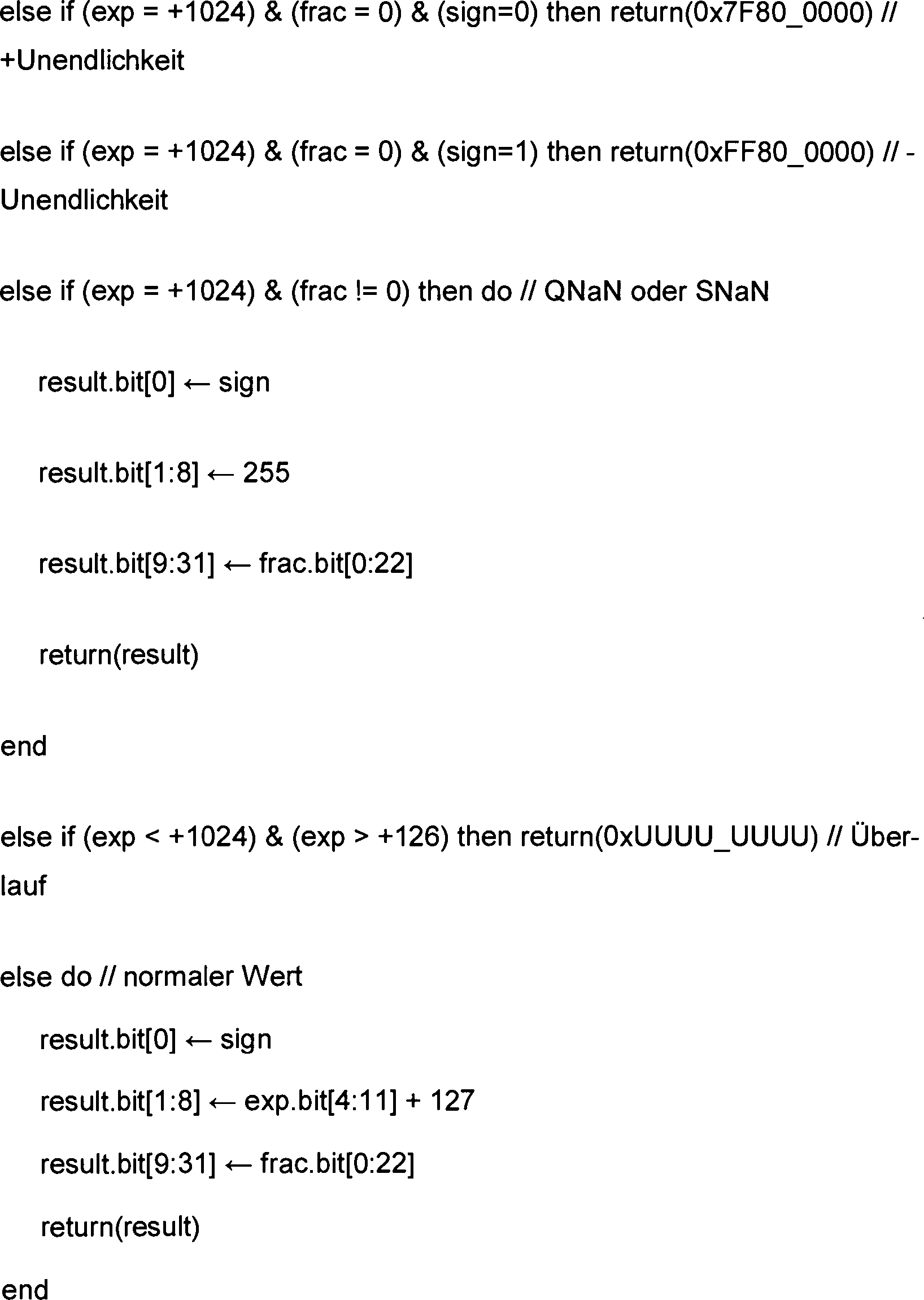
ConvertSPtoSP64(x)ConvertSPtoSP64 (x)
- x ist ein Gleitkommawert im Format mit einfacher Präzision.x is a floating-point value in single-precision format.
Gibt den Wert x im Format mit doppelter Präzision zurück. Wenn x eine SNaN ist, wird es in eine SNaN mit doppelter Präzision mit denselben Nutzdaten wie x umgewandelt.Returns the value x in double-precision format. If x is a SNaN, it is converted to a double precision SNaN with the same payload as x.

Load VSX Scalar as Integer Word Algebraic Indexed XX1-form 
In einem Beispiel enthält diese Anweisung zwei Felder, die einen Operationscode identifizieren (wobei z. B. ein Feld; Bits 0 bis 5, einen primären Operationscode aufweist, der mit einem erweiterten Operationscode eines anderen Felds, Bits 21 bis 30 kombiniert (z. B. verkettet) ist), um die Anweisung zu identifizieren; ein erstes Feld (z. B. T-Feld; Bits 6 bis 10) und ein erstes Bit (z. B. TX-Feld; Bit 31); ein zweites Feld (z. B. RA; Bits 11 bis 15); und ein drittes Feld (z. B. RB; Bits 16 bis 20). 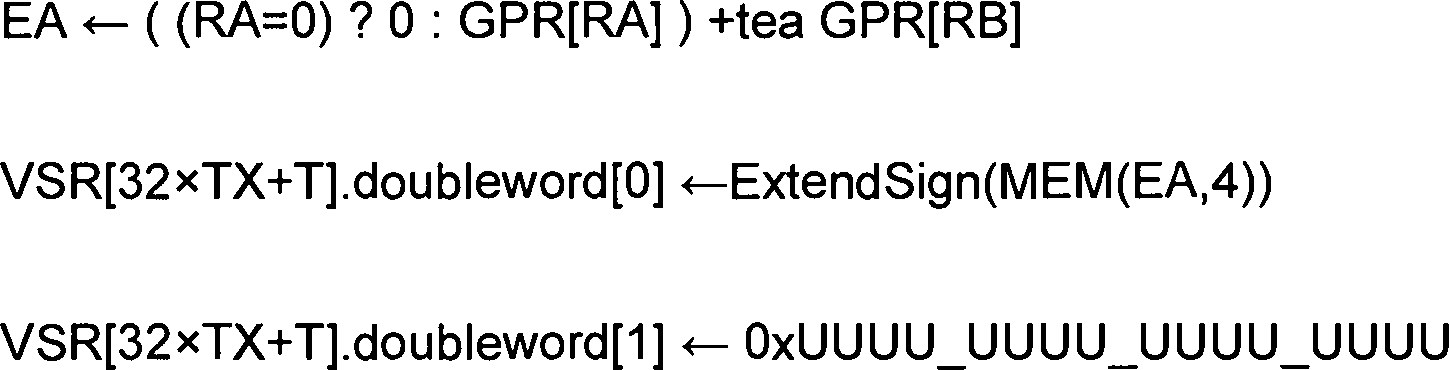
- XT sei der Wert TX, der mit T verkettet ist.
- EA sei die Summe der Inhalte von GPR[RA]
oder 0,wenn RA gleich 0 ist, und der Inhalte von GPR[RB].
- Let XT be the value TX concatenated with T.
- EA is the sum of the contents of GPR [RA] or 0 if RA is 0 and the contents of GPR [RB].
Der ganzzahlige 32-Bit-Wert mit Vorzeichen in dem Wort im Speicher unter der Adresse EA wird auf ein Doppelwort vorzeichenerweitert und in das Doppelwortelement 0 von VSR[XT] gestellt.The integer 32-bit signed value in the word in memory at the address EA is sign extended to a doubleword and placed in the
Die Inhalte des Doppelwortelements 1 von VSR[XT] sind nicht definiert.The contents of the
Wenn EA nicht an Wortgrenzen ausgerichtet ist (d. h. Bits 62:63 von EA sind nicht 0), darf statt einem Ausführen des Speicherzugriffs der Systemausrichtungsfehler-Handler aufgerufen werden.If EA is not aligned to word boundaries (i.e., EA's bits 62:63 are not 0), then the system alignment error handler may be called instead of performing memory access.
Geänderte SonderregisterChanged special registers
- KeineNone
VSR-Datenlayout für IxsiwaxVSR data layout for Ixsiwax
-
tgt = VSR[XT]tgt = VSR [XT] -
Die Bits 0 bis 63 von 128 Bits enthalten SD.
Bits 0 to 63 of 128 bits contain SD.
Load VSX Scalar as Integer Word and Zero Indexed XX1-form 
In einem Beispiel enthält diese Anweisung zwei Felder, die einen Operationscode identifizieren (wobei z. B. ein Feld, Bits 0 bis 5, einen primären Operationscode aufweist, der mit einem erweiterten Operationscode eines anderen Felds, Bits 21 bis 30 kombiniert (z. B. verkettet) ist), um die Anweisung zu identifizieren; ein erstes Feld (z. B. T-Feld; Bits 6 bis 10) und ein erstes Bit (z. B. TX-Feld; Bit 31); ein zweites Feld (z. B. RA; Bits 11 bis 15); und ein drittes Feld (z. B. RB; Bits 16 bis 20). 
- XT sei der Wert TX, der mit T verkettet ist.
- EA sei die Summe der Inhalte von GPR[RA]
oder 0,wenn RA gleich 0 ist, und der Inhalte von GPR[RB].
- Let XT be the value TX concatenated with T.
- EA is the sum of the contents of GPR [RA] or 0 if RA is 0 and the contents of GPR [RB].
Der ganzzahlige 32-Bit-Wert ohne Vorzeichen in dem Wort im Speicher unter der Adresse EA wird um Null auf ein Doppelwort erweitert und in das Doppelwortelement 0 von VSR[XT] gestellt.The unsigned integer 32-bit value in the word in memory at the address EA is expanded by zero to a double word and placed in the
Die Inhalte des Doppelwortelements 1 von VSR[XT] sind nicht definiert.The contents of the
Wenn EA nicht an Wortgrenzen ausgerichtet ist (d. h. Bits 62:63 von EA sind nicht 0), darf statt einem Ausführen des Speicherzugriffs der Systemausrichtungsfehler-Handler aufgerufen werden.If EA is not aligned to word boundaries (i.e., EA's bits 62:63 are not 0), then the system alignment error handler may be called instead of performing memory access.
Geänderte Sonderregister Changed special registers
- KeineNone
VSR-Datenlayout für IxsiwzxVSR data layout for Ixsiwzx
-
stgt = VSR[XT]stgt = VSR [XT] -
Die Bits 0 bis 63 von 128 Bits enthalten UD.
Bits 0 to 63 of 128 bits contain UD.
Load VSX Scalar Single-Precision Indexed XX1-form 
In einem Beispiel enthält diese Anweisung zwei Felder, die einen Operationscode identifizieren (wobei z. B. ein Feld, Bits 0 bis 5, einen primären Operationscode aufweist, der mit einem erweiterten Operationscode eines anderen Felds, Bits 21 bis 30 kombiniert (z. B. verkettet) ist), um die Anweisung zu identifizieren; ein erstes Feld (z. B. T-Feld; Bits 6 bis 10) und ein erstes Bit (z. B. TX-Feld; Bit 31); ein zweites Feld (z. B. RA; Bits 11 bis 15); und ein drittes Feld (z. B. RB; Bits 16 bis 20). 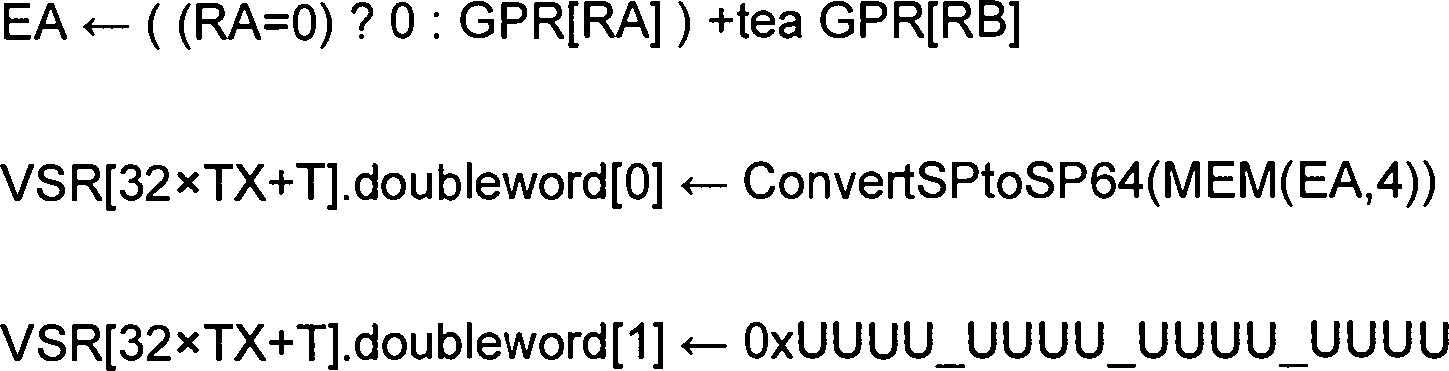
- XT sei der Wert TX, der mit T verkettet ist.
- EA sei die Summe der Inhalte von GPR[RA]
oder 0,wenn RA gleich 0 ist, und der Inhalte von GPR[RB].
- Let XT be the value TX concatenated with T.
- EA is the sum of the contents of GPR [RA] or 0 if RA is 0 and the contents of GPR [RB].
Der Gleitkommawert mit einfacher Präzision in dem Wort im Speicher unter der Adresse EA wird in das Doppelwortelement 0 von VSR[XT] im Format mit doppelter Präzision gestellt.The single-precision floating-point value in the word in memory at the address EA is placed in the double-
Die Inhalte des Doppelwortelements 1 von VSR[XT] sind nicht definiert.The contents of the
Wenn EA nicht an Wortgrenzen ausgerichtet ist (d. h. Bits 62:63 von EA sind nicht 0), darf statt einem Ausführen des Speicherzugriffs der Systemausrichtungsfehler-Handler aufgerufen werden.If EA is not aligned to word boundaries (i.e., EA's bits 62:63 are not 0), then the system alignment error handler may be called instead of performing memory access.
Geänderte SonderregisterChanged special registers
- KeineNone
VSR-Datenlayout für lxsspxVSR data layout for lxsspx
-
tgt = VSR[XT]tgt = VSR [XT] -
Die Bits 0 bis 63 von 128 Bits enthalten DP.
Bits 0 to 63 of 128 bits contain DP.
Store VSX Scalar as Integer Word Indexed XX1-form 
In einem Beispiel enthält diese Anweisung zwei Felder, die einen Operationscode identifizieren (wobei z. B. ein Feld, Bits 0 bis 5, einen primären Operationscode aufweist, der mit einem erweiterten Operationscode eines anderen Felds, Bits 21 bis 30 kombiniert (z. B. verkettet) ist), um die Anweisung zu identifizieren; ein erstes Feld (z. B. S-Feld; Bits 6 bis 10) und ein erstes Bit (z. B. SX-Feld; Bit 31); ein zweites Feld (z. B. RA; Bits 11 bis 15); und ein drittes Feld (z. B. RB; Bits 16 bis 20). 
- XS sei der Wert SX, der mit S verkettet ist.
- EA sei die Summe der Inhalte von GPR[RA]
oder 0,wenn RA gleich 0 ist, und der Inhalte von GPR[RB].
- Let XS be the value SX, which is concatenated with S.
- EA is the sum of the contents of GPR [RA] or 0 if RA is 0 and the contents of GPR [RB].
Die Inhalte von Wortelement 1 von VSR[XS] werden in das Wort im Speicher unter der Adresse EA im Format mit einfacher Präzision gestellt.The contents of
Wenn EA nicht an Wortgrenzen ausgerichtet ist (d. h. Bits 62:63 von EA sind nicht 0), darf statt einem Ausführen des Speicherzugriffs der Systemausrichtungsfehler-Handler aufgerufen werden.If EA is not aligned to word boundaries (i.e., EA's bits 62:63 are not 0), then the system alignment error handler may be called instead of performing memory access.
Geänderte SonderregisterChanged special registers
- KeineNone
VSR-Datenlayout für stxsspxVSR data layout for stxsspx
-
src = VSR[XS]src = VSR [XS] -
Die Bits 32 bis 63 von 128 Bits enthalten SW/UW.
Bits 32 through 63 of 128 bits contain SW / UW.
Store VSX Scalar Single-Precision Indexed XX1-form 
In einem Beispiel enthält diese Anweisung zwei Felder, die einen Operationscode identifizieren (wobei z. B. ein Feld, Bits 0 bis 5, einen primären Operationscode aufweist, der mit einem erweiterten Operationscode eines anderen Felds, Bits 21 bis 30 kombiniert (z. B. verkettet) ist), um die Anweisung zu identifizieren; ein erstes Feld (z. B. S-Feld; Bits 6 bis 10) und ein erstes Bit (z. B. SX-Feld; Bit 31); ein zweites Feld (z. B. RA; Bits 11 bis 15); und ein drittes Feld (z. B. RB; Bits 16 bis 20). 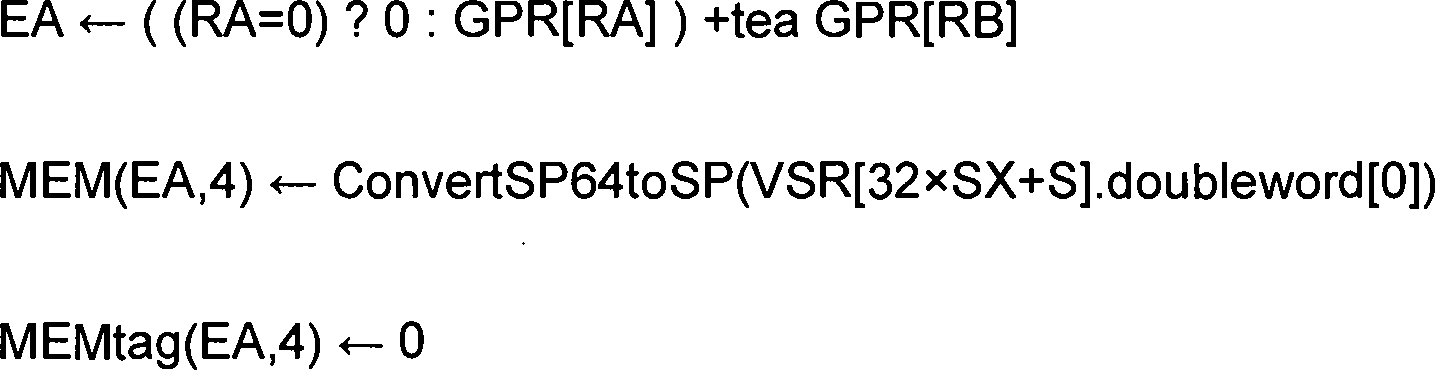
- XS sei der Wert SX, der mit S verkettet ist.
- EA sei die Summe der Inhalte von GPR[RA]
oder 0,wenn RA gleich 0 ist, und der Inhalte von GPR[RB].
- Let XS be the value SX, which is concatenated with S.
- EA is the sum of the contents of GPR [RA] or 0 if RA is 0 and the contents of GPR [RB].
Der Wert mit einfacher Präzision im Gleitkommaformat mit doppelter Präzision im Doppelwortelement 0 von VSR[XT] wird in das Wort im Speicher unter der Adresse EA im Format mit einfacher Präzision gestellt.The single-precision value in the double-precision floating-point format in VSR double word element 0 [XT] is placed in the word in memory at the address EA in single-precision format.
Wenn EA nicht an Wortgrenzen ausgerichtet ist (d. h. Bits 62:63 von EA sind nicht 0), darf statt einem Ausführen des Speicherzugriffs der Systemausrichtungsfehler-Handler aufgerufen werden.If EA is not aligned to word boundaries (i.e., EA's bits 62:63 are not 0), then the system alignment error handler may be called instead of performing memory access.
Geänderte SonderregisterChanged special registers
- KeineNone
VSR-Datenlayout für stxsspx VSR data layout for stxsspx
-
src = VSR[XS]src = VSR [XS] -
Die Bits 0 bis 63 von 128 Bits enthalten DP.
Bits 0 to 63 of 128 bits contain DP.
VSX Scalar Add Single-Precision XX3-form 
In einem Beispiel enthält diese Anweisung zwei Felder, die einen Operationscode identifizieren (wobei z. B. ein Feld, Bits 0 bis 5, einen primären Operationscode aufweist, der mit einem erweiterten Operationscode eines anderen Felds, Bits 21 bis 28 kombiniert (z. B. verkettet) ist), um die Anweisung zu identifizieren; ein erstes Feld (z. B. T-Feld; Bits 6 bis 10) und ein erstes Bit (z. B. TX-Feld; Bit 31); ein zweites Feld (z. B. A-Feld; Bits 11 bis 15) und ein zweites Bit (z. B. AX-Feld; Bit 29); und ein drittes Feld (z. B. B-Feld; Bits 16 bis 20) und ein drittes Bit (z. B. BX-Feld; Bit 30). 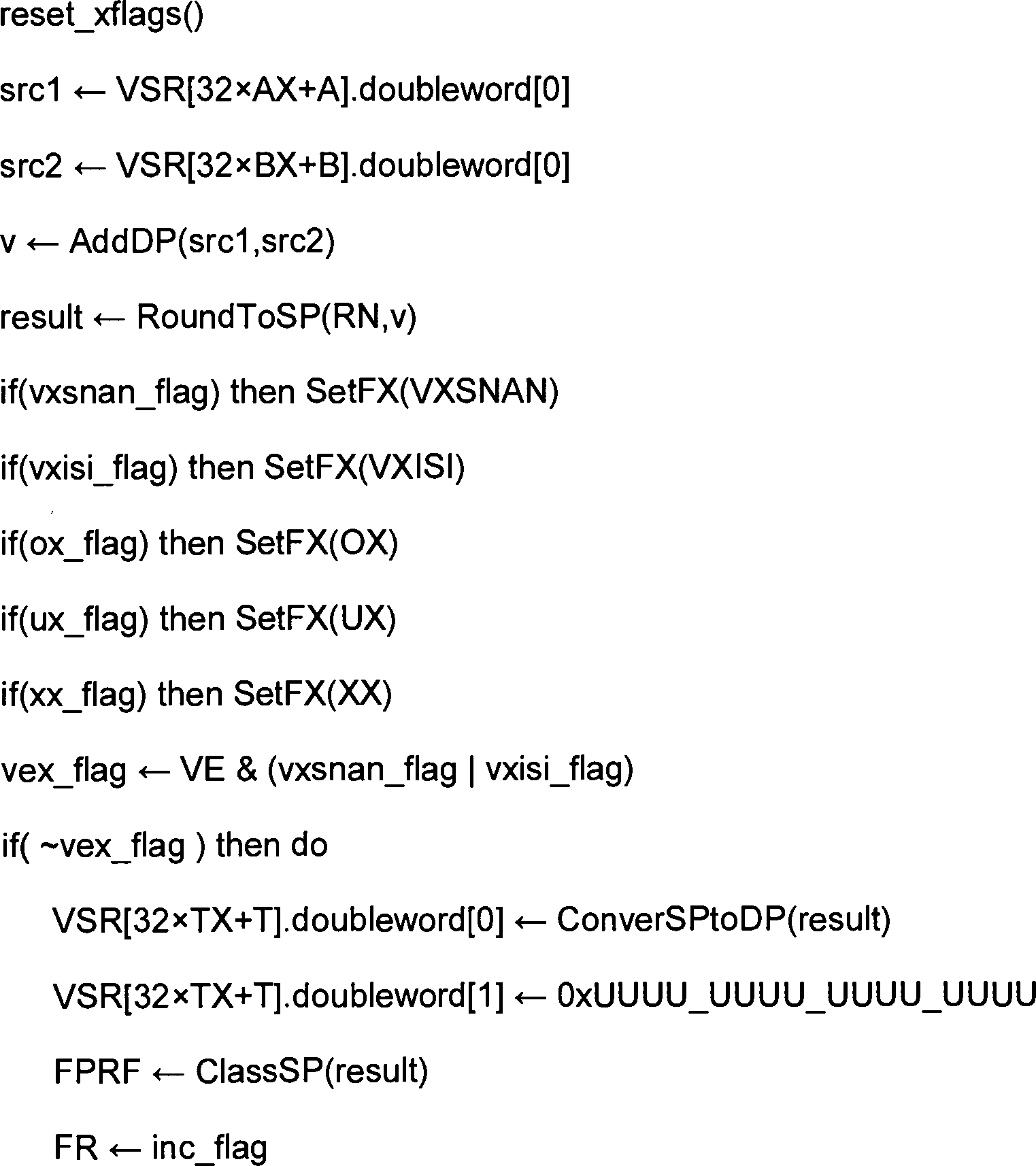
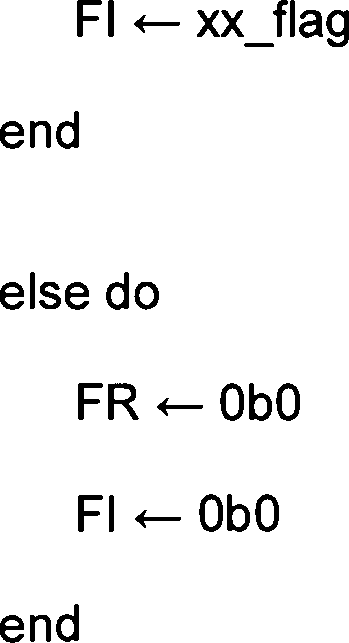
- XT sei der Wert TX, der mit T verkettet ist.
- XA sei der Wert AX, der mit A verkettet ist.
- XB sei der Wert BX, der mit B verkettet ist.
- src1 sei der Gleitkommawert mit doppelter
Präzision im Doppelwortelement 0 von VSR[XA]. - src2 sei der Gleitkommawert mit doppelter
Präzision im Doppelwortelement 0 von VSR[XB]. - src2 wird zu src1 addiert, wodurch eine Summe mit unbegrenztem Bereich und unbegrenzter Präzision erzeugt wird. Gleitkommaaddition beruht auf Exponentenvergleich und Addition der beiden Mantissen. Die Exponenten der zwei Operanden werden verglichen und die den kleineren Exponenten begleitende Mantisse wird nach rechts verschoben, wobei ihr Exponent für jedes verschobene Bit um Eins erhöht wird, bis die beiden Exponenten gleich sind. Die beiden Mantissen werden dann entsprechend addiert oder subtrahiert, abhängig von den Vorzeichen der Operanden, um eine Zwischensumme zu bilden. Alle 53 Bits der Mantisse sowie alle drei Schutzbits (G, R und X) fließen in die Berechnung ein.
- Let XT be the value TX concatenated with T.
- Let XA be the value AX concatenated with A.
- Let XB be the value BX concatenated with B.
- src1 is the double precision floating point value in the
double word element 0 of VSR [XA]. - src2 is the double-precision floating-point value in double-
word element 0 of VSR [XB]. - src2 is added to src1, producing a sum with unlimited range and unlimited precision. Floating-point addition is based on exponent comparison and addition of the two mantissas. The exponents of the two operands are compared, and the mantissa accompanying the smaller exponent is shifted right, increasing its exponent by one for each shifted bit until the two exponents are equal. The two mantissas are then added or subtracted accordingly, depending on the sign of the operands, to form a subtotal. All 53 bits of the mantissa as well as all three protection bits (G, R and X) are included in the calculation.
Die Summe wird normalisiert. Gleitkommanormalisierung beruht auf einem Verschieben der Mantisse nach links, bis das höchstwertige Bit 1 ist, und einem Vermindern des Exponenten um die Anzahl von Bits, um die die Mantisse verschoben wurde.The sum is normalized. Floating-point normalization relies on shifting the mantissa to the left until the most significant bit is 1 and decreasing the exponent by the number of bits by which the mantissa was shifted.
Das Zwischenergebnis wird unter Verwendung des durch RN angegebenen Rundungsmodus auf einfache Präzision gerundet.The intermediate result is rounded to simple precision using the rounding mode indicated by RN.
Das Ergebnis wird in das Doppelwortelement 0 von VSR[XT] im Format mit doppelter Präzision gestellt.The result is placed in
Die Inhalte des Doppelwortelements 1 von VSR[XT] sind nicht definiert.The contents of the
FPRF wird auf die Klasse und das Vorzeichen des Ergebnisses gesetzt, das im Format mit einfacher Präzision dargestellt ist. FR wird so eingerichtet, dass angegeben wird, ob das Ergebnis beim Runden erhöht worden ist. FI wird so eingerichtet, dass angegeben wird, ob das Ergebnis ungenau ist.FPRF is set to the class and sign of the result, which is represented in single precision format. FR is set up to indicate whether the result has been increased in the round. FI is set up to indicate if the result is inaccurate.
Wenn eine Ausnahme Invalid Operation mit Trap-Aktivierung auftritt, werden VSR[XT] und FPRF nicht modifiziert, und FR und FI werden auf 0 gesetzt.When an exception Invalid operation with trap activation occurs, VSR [XT] and FPRF are not modified, and FR and FI are set to 0.
Geänderte Sonderregister 
VSR-Datenlayout für xsaddspVSR data layout for xsaddsp
-
src1 = VSR[XA]src1 = VSR [XA] -
Die Bits 0 bis 63 von 128 Bits enthalten DP.
Bits 0 to 63 of 128 bits contain DP.
-
src2 = VSR[XB]src2 = VSR [XB] -
Die Bits 0 bis 63 von 128 Bits enthalten DP.
Bits 0 to 63 of 128 bits contain DP.
-
tgt = VSR[XT] tgt = VSR [XT] -
Die Bits 0 bis 63 von 128 Bits enthalten DP.
Bits 0 to 63 of 128 bits contain DP.
VSX Scalar Convert Signed Integer Doubleword to floating-point format and round to Single-Precision XX2-form 
In einem Beispiel enthält diese Anweisung zwei Felder, die einen Operationscode identifizieren (wobei z. B. ein Feld, Bits 0 bis 5, einen primären Operationscode aufweist, der mit einem erweiterten Operationscode eines anderen Felds, Bits 21 bis 29 kombiniert (z. B. verkettet) ist), um die Anweisung zu identifizieren; ein erstes Feld (z. B. T-Feld; Bits 6 bis 10) und ein erstes Bit (z. B. TX-Feld; Bit 31); und ein zweites Feld (z. B. B-Feld; Bits 16 bis 20) und ein zweites Bit (z. B. BX-Feld; Bit 30). 
- XT sei der Wert TX, der mit T verkettet ist.
- XB sei der Wert BX, der mit B verkettet ist.
- src sei der ganzzahlige
Zweierkomplementwert im Doppelwortelement 0 von VSR[XB]. - src wird in Gleitkommaformat umgewandelt und unter Verwendung des durch RN angegebenen Rundungsmodus auf einfache Präzision gerundet.
- Let XT be the value TX concatenated with T.
- Let XB be the value BX concatenated with B.
- Let src be the integer two's complement value in
double word element 0 of VSR [XB]. - src is converted to floating-point format and rounded to simple precision using the rounding mode indicated by RN.
Das Ergebnis wird in das Doppelwortelement 0 von VSR[XT] im Format mit doppelter Präzision gestellt.The result is placed in
Die Inhalte des Doppelwortelements 1 von VSR[XT] sind nicht definiert.The contents of the
FPRF wird auf die Klasse und das Vorzeichen des Ergebnisses gesetzt, das im Format mit einfacher Präzision dargestellt ist. FR wird so eingerichtet, dass angegeben wird, ob das Ergebnis beim Runden erhöht worden ist. FI wird so eingerichtet, dass angegeben wird, ob das Ergebnis ungenau ist.FPRF is set to the class and sign of the result, which is represented in single precision format. FR is set up to indicate whether the result has been increased in the round. FI is set up to indicate if the result is inaccurate.
Geänderte Sonderregister 
VSR-Datenlayout für xscvsxdsp VSR data layout for xscvsxdsp
-
src = VSR[XB]src = VSR [XB] -
Die Bits 0 bis 63 von 128 Bits enthalten SD.
Bits 0 to 63 of 128 bits contain SD.
-
tgt = VSR[XT tgt = VSR [XT -
Die Bits 0 bis 63 von 128 Bits enthalten DP.
Bits 0 to 63 of 128 bits contain DP.
VSX Scalar Convert Unsigned Integer Doubleword to floating-point format and round to Single-Precision XX2-form 
In einem Beispiel enthält diese Anweisung zwei Felder, die einen Operationscode identifizieren (wobei z. B. ein Feld, Bits 0 bis 5, einen primären Operationscode aufweist, der mit einem erweiterten Operationscode eines anderen Felds, Bits 21 bis 29 kombiniert (z. B. verkettet) ist), um die Anweisung zu identifizieren; ein erstes Feld (z. B. T-Feld; Bits 6 bis 10) und ein erstes Bit (z. B. TX-Feld; Bit 31); und ein zweites Feld (z. B. B-Feld; Bits 16 bis 20) und ein zweites Bit (z. B. BX-Feld; Bit 30). 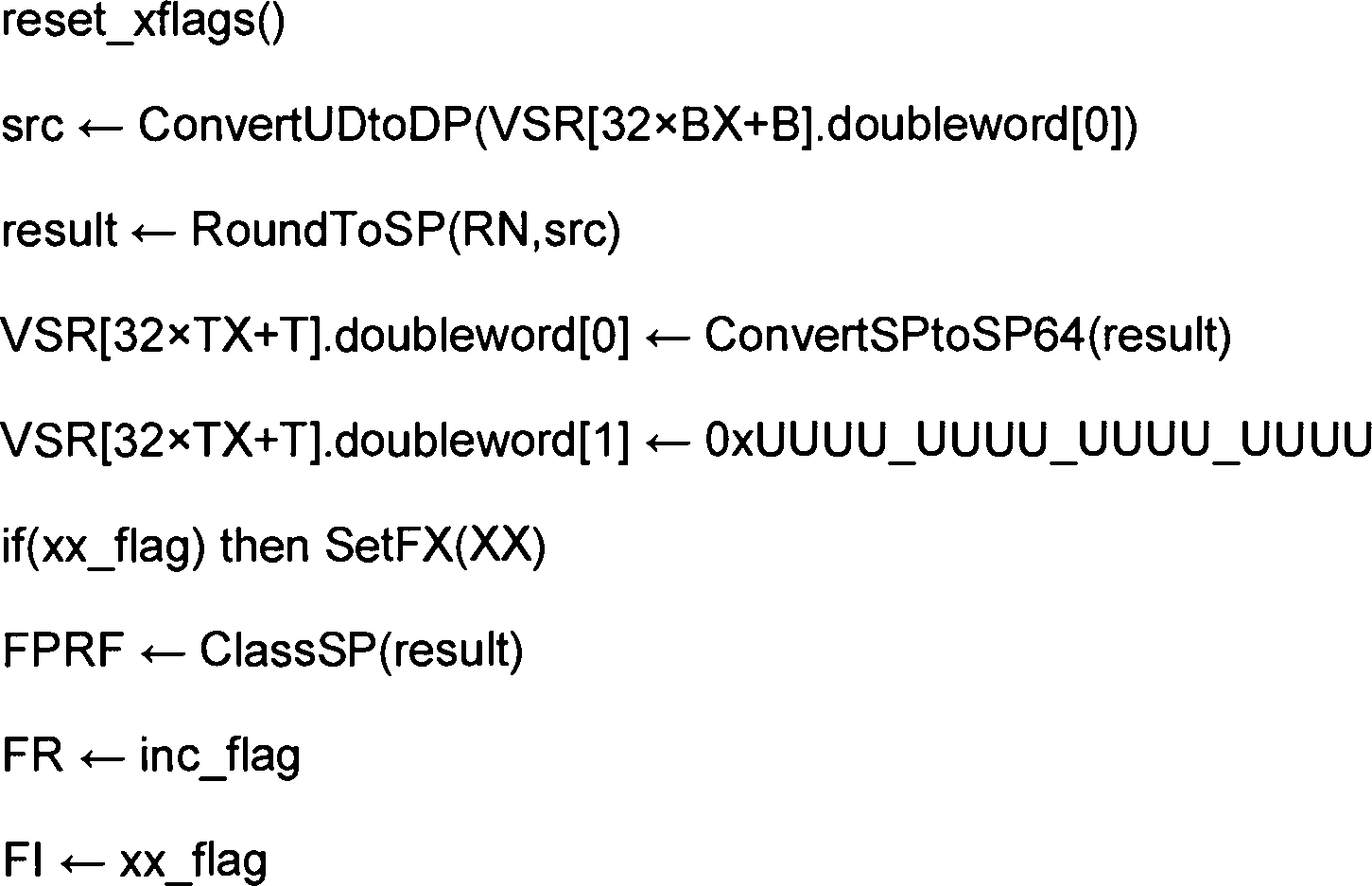
- XT sei der Wert TX, der mit T verkettet ist.
- XB sei der Wert BX, der mit B verkettet ist.
- src sei der ganzzahlige Wert ohne
Vorzeichen im Doppelwortelement 0 von VSR[XB]. - src wird in Gleitkommaformat umgewandelt und unter Verwendung des durch RN angegebenen Rundungsmodus auf einfache Präzision gerundet.
- Let XT be the value TX concatenated with T.
- Let XB be the value BX concatenated with B.
- src is the unsigned integer value in the
double word element 0 of VSR [XB]. - src is converted to floating-point format and rounded to simple precision using the rounding mode indicated by RN.
Das Ergebnis wird in das Doppelwortelement 0 von VSR[XT] im Format mit doppelter Präzision gestellt.The result is placed in
Die Inhalte des Doppelwortelements 1 von VSR[XT] sind nicht definiert.The contents of the
FPRF wird auf die Klasse und das Vorzeichen des Ergebnisses gesetzt, das im Format mit einfacher Präzision dargestellt ist. FR wird so eingerichtet, dass angegeben wird, ob das Ergebnis beim Runden erhöht worden ist. FI wird so eingerichtet, dass angegeben wird, ob das Ergebnis ungenau ist.FPRF is set to the class and sign of the result, which is represented in single precision format. FR is set up to indicate whether the result has been increased in the round. FI is set up to indicate if the result is inaccurate.
Geänderte Sonderregister 
VSR-Datenlayout für xscvuxdsp VSR data layout for xscvuxdsp
-
src = VSR[XB]src = VSR [XB] -
Die Bits 0 bis 63 von 128 Bits enthalten UD.
Bits 0 to 63 of 128 bits contain UD.
-
tgt = VSR[XT]tgt = VSR [XT] -
Die Bits 0 bis 63 von 128 Bits enthalten DP.
Bits 0 to 63 of 128 bits contain DP.
VSX Scalar Divide Single-Precision XX3-form 
In einem Beispiel enthält diese Anweisung zwei Felder, die einen Operationscode identifizieren (wobei z. B. ein Feld, Bits 0 bis 5, einen primären Operationscode aufweist, der mit einem erweiterten Operationscode eines anderen Felds, Bits 21 bis 28 kombiniert (z. B. verkettet) ist), um die Anweisung zu identifizieren; ein erstes Feld (z. B. T-Feld; Bits 6 bis 10) und ein erstes Bit (z. B. TX-Feld; Bit 31); ein zweites Feld (z. B. A-Feld; Bits 11 bis 15) und ein zweites Bit (z. B. AX-Feld; Bit 29); und ein drittes Feld (z. B. B-Feld; Bits 16 bis 20) und ein drittes Bit (z. B. BX-Feld; Bit 30). 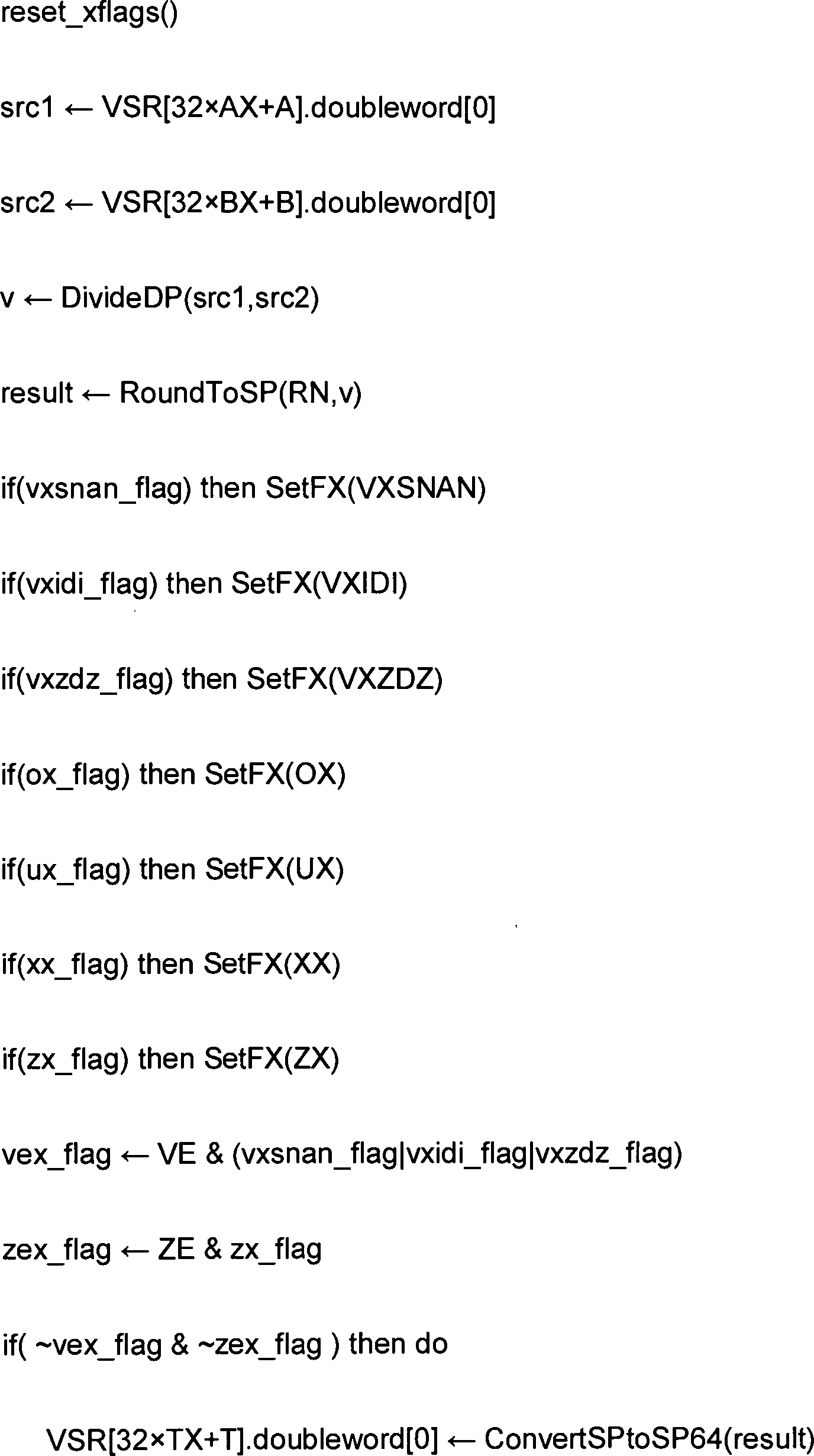
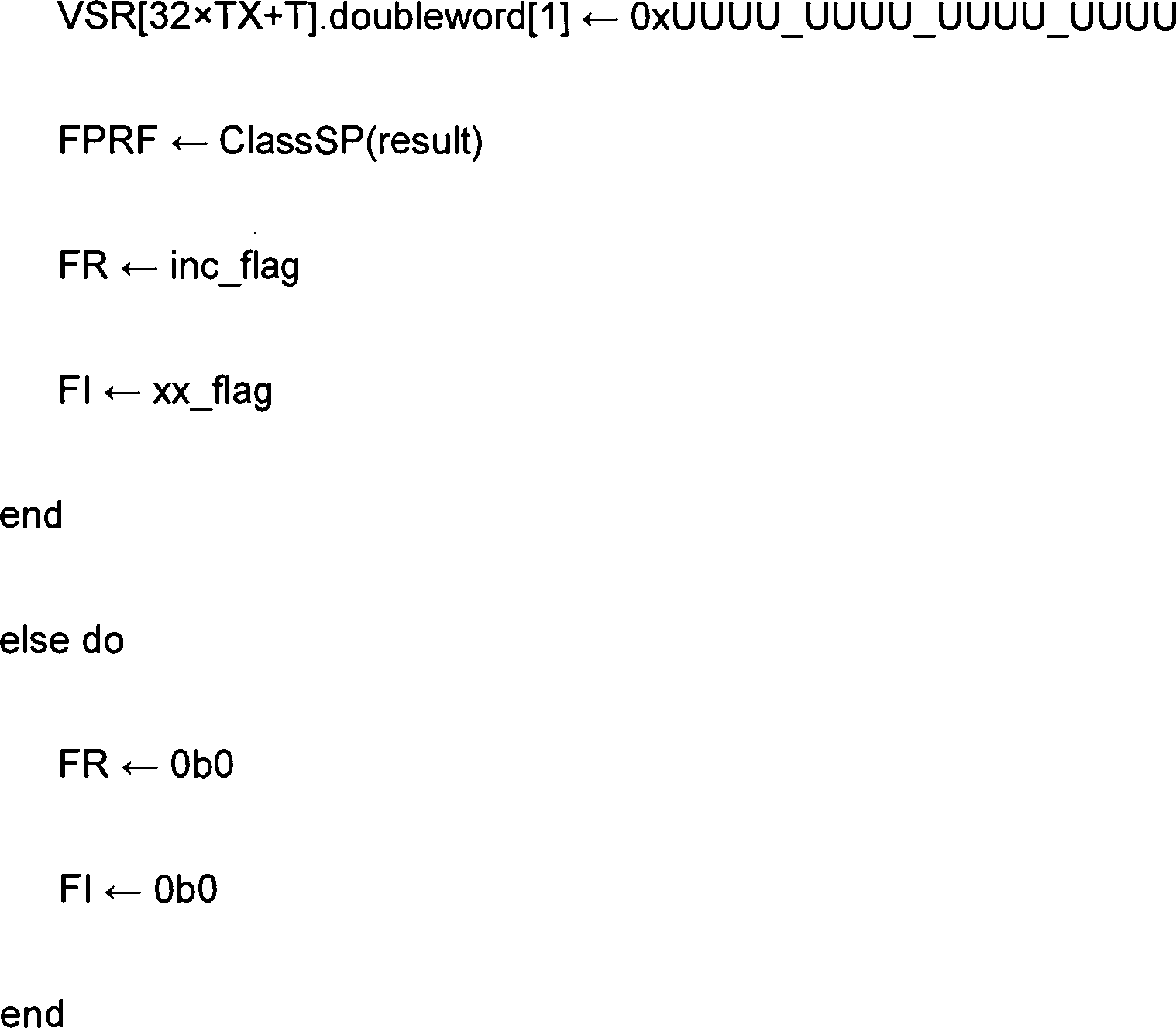
- XT sei der Wert TX, der mit T verkettet ist.
- XA sei der Wert AX, der mit A verkettet ist.
- XB sei der Wert BX, der mit B verkettet ist.
- src1 sei der Gleitkommawert mit doppelter
Präzision im Doppelwortelement 0 von VSR[XA]. - src2 sei der Gleitkommawert mit doppelter
Präzision im Doppelwortelement 0 von VSR[XB]. - src1 wird durch src2 dividiert, wodurch ein Quotient mit unbegrenztem Bereich und unbegrenzter Präzision erzeugt wird. Gleitkommadivision beruht auf Exponentensubtraktion und Division der Mantissen.
- Let XT be the value TX concatenated with T.
- Let XA be the value AX concatenated with A.
- Let XB be the value BX concatenated with B.
- src1 is the double precision floating point value in the
double word element 0 of VSR [XA]. - src2 is the double-precision floating-point value in double-
word element 0 of VSR [XB]. - src1 is divided by src2, creating a quotient with unlimited range and unlimited precision. Floating-point division is based on exponent subtraction and division of mantissas.
Der Quotient wird normalisiert. Gleitkommanormalisierung beruht auf einem Verschieben der Mantisse nach links, bis das höchstwertige Bit 1 ist, und einem Vermindern des Exponenten um die Anzahl von Bits, um die die Mantisse verschoben wurde.The quotient is normalized. Floating-point normalization relies on shifting the mantissa to the left until the most significant bit is 1 and decreasing the exponent by the number of bits by which the mantissa was shifted.
Das Zwischenergebnis wird unter Verwendung des durch RN angegebenen Rundungsmodus auf einfache Präzision gerundet.The intermediate result is rounded to simple precision using the rounding mode indicated by RN.
Das Ergebnis wird in das Doppelwortelement 0 von VSR[XT] im Format mit doppelter Präzision gestellt.The result is placed in
Die Inhalte des Doppelwortelements 1 von VSR[XT] sind nicht definiert.The contents of the
FPRF wird auf die Klasse und das Vorzeichen des Ergebnisses gesetzt, das im Format mit einfacher Präzision dargestellt ist. FR wird so eingerichtet, dass angegeben wird, ob das Ergebnis beim Runden erhöht worden ist. FI wird so eingerichtet, dass angegeben wird, ob das Ergebnis ungenau ist.FPRF is set to the class and sign of the result, which is represented in single precision format. FR is set up to indicate whether the result has been increased in the round. FI is set up to indicate if the result is inaccurate.
Wenn eine Ausnahme Invalid Operation mit Trap-Aktivierung oder eine Ausnahme Zero Divide (Nullteilung) mit Trap-Aktivierung auftritt, werden VSR[XT] und FPRF nicht modifiziert, und FR und FI werden auf 0 gesetzt.If an exception Invalid operation with trap activation or a Zero Divide exception with trap activation occurs, VSR [XT] and FPRF are not modified, and FR and FI are set to 0.
Geänderte Sonderregister 
VSR-Datenlayout für xsdivspVSR data layout for xsdivsp
-
src1 = VSR[XA]src1 = VSR [XA] -
Die Bits 0 bis 63 von 128 Bits enthalten DP.
Bits 0 to 63 of 128 bits contain DP.
-
src2 = VSR[XB]src2 = VSR [XB] -
Die Bits 0 bis 63 von 128 Bits enthalten DP.
Bits 0 to 63 of 128 bits contain DP.
-
tgt = VSR[XT]tgt = VSR [XT] -
Die Bits 0 bis 63 von 128 Bits enthalten DP.
Bits 0 to 63 of 128 bits contain DP.
VSX Scalar Multiply-Add Single-Precision XX3-form 
In einem Beispiel enthält diese Anweisung zwei Felder, die einen Operationscode identifizieren (wobei z. B. ein Feld, Bits 0 bis 5, einen primären Operationscode aufweist, der mit einem erweiterten Operationscode eines anderen Felds, Bits 21 bis 28 kombiniert (z. B. verkettet) ist), um die Anweisung zu identifizieren; ein erstes Feld (z. B. T-Feld; Bits 6 bis 10) und ein erstes Bit (z. B. TX-Feld; Bit 31); ein zweites Feld (z. B. A-Feld; Bits 11 bis 15) und ein zweites Bit (z. B. AX-Feld; Bit 29); und ein drittes Feld (z. B. B-Feld; Bits 16 bis 20) und ein drittes Bit (z. B. BX-Feld; Bit 30).In one example, this instruction includes two fields identifying an opcode (eg, one field,

In einem Beispiel enthält diese Anweisung zwei Felder, die einen Operationscode identifizieren (wobei z. B. ein Feld, Bits 0 bis 5, einen primären Operationscode aufweist, der mit einem erweiterten Operationscode eines anderen Felds, Bits 21 bis 28 kombiniert (z. B. verkettet) ist), um die Anweisung zu identifizieren; ein erstes Feld (z. B. T-Feld; Bits 6 bis 10) und ein erstes Bit (z. B. TX-Feld; Bit 31); ein zweites Feld (z. B. A-Feld; Bits 11 bis 15) und ein zweites Bit (z. B. AX-Feld; Bit 29); und ein drittes Feld (z. B. B-Feld; Bits 16 bis 20) und ein drittes Bit (z. B. BX-Feld; Bit 30). 


- XT sei der Wert TX, der mit T verkettet ist.
- XA sei der Wert AX, der mit A verkettet ist.
- XB sei der Wert BX, der mit B verkettet ist.
- Let XT be the value TX concatenated with T.
- Let XA be the value AX concatenated with A.
- Let XB be the value BX concatenated with B.
Für xsmaddasp wird wie folgt vorgegangen.
- – src1 sei der Gleitkommawert mit doppelter
Präzision im Doppelwortelement 0 von VSR[XA]. - – src2 sei der Gleitkommawert mit doppelter
Präzision im Doppelwortelement 0 von VSR[XT]. - – src3 sei der Gleitkommawert mit doppelter
Präzision im Doppelwortelement 0 von VSR[XB].
- Let src1 be the double-precision floating-point value in double-
word element 0 of VSR [XA]. - - src2 is the double precision floating point value in the
double word element 0 of VSR [XT]. - Let src3 be the double precision floating point value in
double word element 0 of VSR [XB].
Für xsmaddmsp wird wie folgt vorgegangen.
- – src1 sei der Gleitkommawert mit doppelter
Präzision im Doppelwortelement 0 von VSR[XA]. - – src2 sei der Gleitkommawert mit doppelter
Präzision im Doppelwortelement 0 von VSR[XB]. - – src3 sei der Gleitkommawert mit doppelter
Präzision im Doppelwortelement 0 von VSR[XT].
- src1 wird mit src3 multipliziert, wodurch ein Produkt mit unbegrenztem Bereich und unbegrenzter Präzision erzeugt wird. Gleitkommamultiplikation beruht auf Exponentenaddition und Multiplikation der Mantissen.
- src2 wird zum Produkt addiert, wodurch eine Summe mit unbegrenztem Bereich und unbegrenzter Präzision erzeugt wird. Gleitkommaaddition beruht auf Exponentenvergleich und Addition der beiden Mantissen. Die Exponenten der zwei Operanden werden verglichen und die den kleineren Exponenten begleitende Mantisse wird nach rechts verschoben, wobei ihr Exponent für jedes verschobene Bit um Eins erhöht wird, bis die beiden Exponenten gleich sind. Die beiden Mantissen werden dann entsprechend addiert oder subtrahiert, abhängig von den Vorzeichen der Operanden, um eine Zwischensumme zu bilden. Alle 53 Bits der Mantisse sowie alle drei Schutzbits (G, R und X) fließen in die Berechnung ein.
- Let src1 be the double-precision floating-point value in double-
word element 0 of VSR [XA]. - Let src2 be the double-precision floating-point value in
double word element 0 of VSR [XB]. - Let src3 be the double precision floating point value in the
double word element 0 of VSR [XT].
- src1 is multiplied by src3, creating a product with unlimited range and unlimited precision. Floating point multiplication is based on exponent addition and multiplication of mantissas.
- src2 is added to the product, creating a sum with unlimited range and unlimited precision. Floating-point addition is based on exponent comparison and addition of the two mantissas. The exponents of the two operands are compared, and the mantissa accompanying the smaller exponent is shifted right, increasing its exponent by one for each shifted bit until the two exponents are equal. The two mantissas are then added or subtracted accordingly, depending on the sign of the operands, to form a subtotal. All 53 bits of the mantissa as well as all three protection bits (G, R and X) are included in the calculation.
Die Summe wird normalisiert. Gleitkommanormalisierung beruht auf einem Verschieben der Mantisse nach links, bis das höchstwertige Bit 1 ist, und einem Vermindern des Exponenten um die Anzahl von Bits, um die die Mantisse verschoben wurde. The sum is normalized. Floating-point normalization relies on shifting the mantissa to the left until the most significant bit is 1 and decreasing the exponent by the number of bits by which the mantissa was shifted.
Das Zwischenergebnis wird unter Verwendung des durch RN angegebenen Rundungsmodus auf einfache Präzision gerundet.The intermediate result is rounded to simple precision using the rounding mode indicated by RN.
Das Ergebnis wird in das Doppelwortelement 0 von VSR[XT] im Format mit doppelter Präzision gestellt.The result is placed in
Die Inhalte des Doppelwortelements 1 von VSR[XT] sind nicht definiert.The contents of the
FPRF wird auf die Klasse und das Vorzeichen des Ergebnisses gesetzt, das im Format mit einfacher Präzision dargestellt ist. FR wird so eingerichtet, dass angegeben wird, ob das Ergebnis beim Runden erhöht worden ist. FI wird so eingerichtet, dass angegeben wird, ob das Ergebnis ungenau ist.FPRF is set to the class and sign of the result, which is represented in single precision format. FR is set up to indicate whether the result has been increased in the round. FI is set up to indicate if the result is inaccurate.
Wenn eine Ausnahme Invalid Operation mit Trap-Aktivierung auftritt, werden VSR[XT] und FPRF nicht modifiziert, und FR und FI werden auf 0 gesetzt.When an exception Invalid operation with trap activation occurs, VSR [XT] and FPRF are not modified, and FR and FI are set to 0.
Geänderte Sonderregister 
VSR-Datenlayout für xsmadd(a|m)spVSR data layout for xsmadd (a | m) sp
-
src1 = VSR[XA]src1 = VSR [XA] -
Die Bits 0 bis 63 von 128 Bits enthalten DP.
Bits 0 to 63 of 128 bits contain DP.
-
src2 = xsmaddasp ? VSR[XT] : VSR[XB]src2 = xsmaddasp? VSR [XT]: VSR [XB] -
Die Bits 0 bis 63 von 128 Bits enthalten DP.
Bits 0 to 63 of 128 bits contain DP.
-
src3 = xsmaddasp ? VSR[XB] : VSR[XT]src3 = xsmaddasp? VSR [XB]: VSR [XT] -
Die Bits 0 bis 63 von 128 Bits enthalten DP.
Bits 0 to 63 of 128 bits contain DP.
-
tgt = VSR[XT]tgt = VSR [XT] -
Die Bits 0 bis 63 von 128 Bits enthalten DP.
Bits 0 to 63 of 128 bits contain DP.
VSX Scalar Multiply-Subtract Single-Precision XX3-form 
In einem Beispiel enthält diese Anweisung zwei Felder, die einen Operationscode identifizieren (wobei z. B. ein Feld, Bits 0 bis 5, einen primären Operationscode aufweist, der mit einem erweiterten Operationscode eines anderen Felds, Bits 21 bis 28 kombiniert (z. B. verkettet) ist), um die Anweisung zu identifizieren; ein erstes Feld (z. B. T-Feld; Bits 6 bis 10) und ein erstes Bit (z. B. TX-Feld; Bit 31); ein zweites Feld (z. B. A-Feld; Bits 11 bis 15) und ein zweites Bit (z. B. AX-Feld; Bit 29); und ein drittes Feld (z. B. B-Feld; Bits 16 bis 20) und ein drittes Bit (z. B. BX-Feld; Bit 30).In one example, this instruction includes two fields identifying an opcode (eg, one field,

In einem Beispiel enthält diese Anweisung zwei Felder, die einen Operationscode identifizieren (wobei z. B. ein Feld, Bits 0 bis 5, einen primären Operationscode aufweist, der mit einem erweiterten Operationscode eines anderen Felds, Bits 21 bis 28 kombiniert (z. B. verkettet) ist), um die Anweisung zu identifizieren; ein erstes Feld (z. B. T-Feld; Bits 6 bis 10) und ein erstes Bit (z. B. TX-Feld; Bit 31); ein zweites Feld (z. B. A-Feld; Bits 11 bis 15) und ein zweites Bit (z. B. AX-Feld; Bit 29); und ein drittes Feld (z. B. B-Feld; Bits 16 bis 20) und ein drittes Bit (z. B. BX-Feld; Bit 30). 


- XT sei der Wert TX, der mit T verkettet ist.
- XA sei der Wert AX, der mit A verkettet ist.
- XB sei der Wert BX, der mit B verkettet ist.
- Let XT be the value TX concatenated with T.
- Let XA be the value AX concatenated with A.
- Let XB be the value BX concatenated with B.
Für xsmsubasp wird wie folgt vorgegangen.
- – src1 sei der Gleitkommawert mit doppelter
Präzision im Doppelwortelement 0 von VSR[XA]. - – src2 sei der Gleitkommawert mit doppelter
Präzision im Doppelwortelement 0 von VSR[XT]. - – src3 sei der Gleitkommawert mit doppelter
Präzision im Doppelwortelement 0 von VSR[XB].
- Let src1 be the double-precision floating-point value in double-
word element 0 of VSR [XA]. - - src2 is the double precision floating point value in the
double word element 0 of VSR [XT]. - Let src3 be the double precision floating point value in
double word element 0 of VSR [XB].
Für xsmsubmsp wird wie folgt vorgegangen.
- – src1 sei der Gleitkommawert mit doppelter
Präzision im Doppelwortelement 0 von VSR[XA]. - – src2 sei der Gleitkommawert mit doppelter
Präzision im Doppelwortelement 0 von VSR[XB]. - – src3 sei der Gleitkommawert mit doppelter
Präzision im Doppelwortelement 0 von VSR[XT].
- src1 wird mit src3 multipliziert, wodurch ein Produkt mit unbegrenztem Bereich und unbegrenzter Präzision erzeugt wird. Gleitkommamultiplikation beruht auf Exponentenaddition und Multiplikation der Mantissen.
- src2 wird negiert und zum Produkt addiert, wodurch eine Summe mit unbegrenztem Bereich und unbegrenzter Präzision erzeugt wird. Gleitkommaaddition beruht auf Exponentenvergleich und Addition der beiden Mantissen. Die Exponenten der zwei Operanden werden verglichen und die den kleineren Exponenten begleitende Mantisse wird nach rechts verschoben, wobei ihr Exponent für jedes verschobene Bit um Eins erhöht wird, bis die beiden Exponenten gleich sind. Die beiden Mantissen werden dann entsprechend addiert oder subtrahiert, abhängig von den Vorzeichen der Operanden, um eine Zwischensumme zu bilden. Alle 53 Bits der Mantisse sowie alle drei Schutzbits (G, R und X) fließen in die Berechnung ein.
- Let src1 be the double-precision floating-point value in double-
word element 0 of VSR [XA]. - Let src2 be the double-precision floating-point value in
double word element 0 of VSR [XB]. - Let src3 be the double precision floating point value in the
double word element 0 of VSR [XT].
- src1 is multiplied by src3, creating a product with unlimited range and unlimited precision. Floating point multiplication is based on exponent addition and multiplication of mantissas.
- src2 is negated and added to the product, creating a sum with unlimited range and unlimited precision. Floating-point addition is based on exponent comparison and addition of the two mantissas. The exponents of the two operands are compared, and the mantissa accompanying the smaller exponent is shifted right, increasing its exponent by one for each shifted bit until the two exponents are equal. The two mantissas are then added or subtracted accordingly, depending on the sign of the operands, to form a subtotal. All 53 bits of the mantissa as well as all three protection bits (G, R and X) are included in the calculation.
Das Ergebnis mit unbegrenztem Bereich und unbegrenzter Präzision wird normalisiert. Gleitkommanormalisierung beruht auf einem Verschieben der Mantisse nach links, bis das höchstwertige Bit 1 ist, und einem Vermindern des Exponenten um die Anzahl von Bits, um die die Mantisse verschoben wurde.The result with unlimited range and unlimited precision is normalized. Floating-point normalization relies on shifting the mantissa to the left until the most significant bit is 1 and decreasing the exponent by the number of bits by which the mantissa was shifted.
Das Zwischenergebnis wird unter Verwendung des durch RN angegebenen Rundungsmodus auf einfache Präzision gerundet. The intermediate result is rounded to simple precision using the rounding mode indicated by RN.
Das Ergebnis wird in das Doppelwortelement 0 von VSR[XT] im Format mit doppelter Präzision gestellt.The result is placed in
Die Inhalte des Doppelwortelements 1 von VSR[XT] sind nicht definiert.The contents of the
FPRF wird auf die Klasse und das Vorzeichen des Ergebnisses gesetzt, das im Format mit einfacher Präzision dargestellt ist. FR wird so eingerichtet, dass angegeben wird, ob das Ergebnis beim Runden erhöht worden ist. FI wird so eingerichtet, dass angegeben wird, ob das Ergebnis ungenau ist.FPRF is set to the class and sign of the result, which is represented in single precision format. FR is set up to indicate whether the result has been increased in the round. FI is set up to indicate if the result is inaccurate.
Wenn eine Ausnahme Invalid Operation mit Trap-Aktivierung auftritt, werden VSR[XT] und FPRF nicht modifiziert, und FR und FI werden auf 0 gesetzt.When an exception Invalid operation with trap activation occurs, VSR [XT] and FPRF are not modified, and FR and FI are set to 0.
Geänderte Sonderregister 
VSR-Datenlayout für xsmsub(a|m)spVSR data layout for xsmsub (a | m) sp
-
src1 = VSR[XA]src1 = VSR [XA] -
Die Bits 0 bis 63 von 128 Bits enthalten DP.
Bits 0 to 63 of 128 bits contain DP.
-
ssrc2 = xsmsubasp ? VSR[XT] : VSR[XB]ssrc2 = xsmsubasp? VSR [XT]: VSR [XB] -
Die Bits 0 bis 63 von 128 Bits enthalten DP.
Bits 0 to 63 of 128 bits contain DP.
-
src3 = xsmsubasp ? VSR[XB] : VSR[XT]src3 = xsmsubasp? VSR [XB]: VSR [XT] -
Die Bits 0 bis 63 von 128 Bits enthalten DP.
Bits 0 to 63 of 128 bits contain DP.
-
tgt = VSR[XT]tgt = VSR [XT] -
Die Bits 0 bis 63 von 128 Bits enthalten DP.
Bits 0 to 63 of 128 bits contain DP.
VSX Scalar Multiply Single-Precision XX3-form 
In einem Beispiel enthält diese Anweisung zwei Felder, die einen Operationscode identifizieren (wobei z. B. ein Feld, Bits 0 bis 5, einen primären Operationscode aufweist, der mit einem erweiterten Operationscode eines anderen Felds, Bits 21 bis 28 kombiniert (z. B. verkettet) ist), um die Anweisung zu identifizieren; ein erstes Feld (z. B. T-Feld; Bits 6 bis 10) und ein erstes Bit (z. B. TX-Feld; Bit 31); ein zweites Feld (z. B. A-Feld; Bits 11 bis 15) und ein zweites Bit (z. B. AX-Feld; Bit 29); und ein drittes Feld (z. B. B-Feld; Bits 16 bis 20) und ein drittes Bit (z. B. BX-Feld; Bit 30). 

- XT sei der Wert TX, der mit T verkettet ist.
- XA sei der Wert AX, der mit A verkettet ist.
- XB sei der Wert BX, der mit B verkettet ist.
- src1 sei der Gleitkommawert mit doppelter
Präzision im Doppelwortelement 0 von VSR[XA]. - src2 sei der Gleitkommawert mit doppelter
Präzision im Doppelwortelement 0 von VSR[XB]. - src1 wird mit src2 multipliziert, wodurch ein Produkt mit unbegrenztem Bereich und unbegrenzter Präzision erzeugt wird. Gleitkommamultiplikation beruht auf Exponentenaddition und Multiplikation der Mantissen.
- Let XT be the value TX concatenated with T.
- Let XA be the value AX concatenated with A.
- Let XB be the value BX concatenated with B.
- src1 is the double precision floating point value in the
double word element 0 of VSR [XA]. - src2 is the double-precision floating-point value in double-
word element 0 of VSR [XB]. - src1 is multiplied by src2, creating a product with unlimited range and unlimited precision. Floating point multiplication is based on exponent addition and multiplication of mantissas.
Das Produkt wird normalisiert. Gleitkommanormalisierung beruht auf einem Verschieben der Mantisse nach links, bis das höchstwertige Bit 1 ist, und einem Vermindern des Exponenten um die Anzahl von Bits, um die die Mantisse verschoben wurde.The product is normalized. Floating-point normalization relies on shifting the mantissa to the left until the most significant bit is 1 and decreasing the exponent by the number of bits by which the mantissa was shifted.
Das Zwischenergebnis wird unter Verwendung des durch RN angegebenen Rundungsmodus auf einfache Präzision gerundet.The intermediate result is rounded to simple precision using the rounding mode indicated by RN.
Das Ergebnis wird in das Doppelwortelement 0 von VSR[XT] im Format mit doppelter Präzision gestellt.The result is placed in
Die Inhalte des Doppelwortelements 1 von VSR[XT] sind nicht definiert. The contents of the
FPRF wird auf die Klasse und das Vorzeichen des Ergebnisses gesetzt, das im Format mit einfacher Präzision dargestellt ist. FR wird so eingerichtet, dass angegeben wird, ob das Ergebnis beim Runden erhöht worden ist. FI wird so eingerichtet, dass angegeben wird, ob das Ergebnis ungenau ist.FPRF is set to the class and sign of the result, which is represented in single precision format. FR is set up to indicate whether the result has been increased in the round. FI is set up to indicate if the result is inaccurate.
Wenn eine Ausnahme Invalid Operation mit Trap-Aktivierung auftritt, werden VSR[XT] und FPRF nicht modifiziert, und FR und FI werden auf 0 gesetzt.When an exception Invalid operation with trap activation occurs, VSR [XT] and FPRF are not modified, and FR and FI are set to 0.
Geänderte Sonderregister 

VSR-Datenlayout für xsmulspVSR data layout for xsmulsp
-
src1 = VSR[XA]src1 = VSR [XA] -
Die Bits 0 bis 63 von 128 Bits enthalten DP.
Bits 0 to 63 of 128 bits contain DP.
-
src2 = VSR[XB]src2 = VSR [XB] -
Die Bits 0 bis 63 von 128 Bits enthalten DP.
Bits 0 to 63 of 128 bits contain DP.
-
tgt = VSR[XT]tgt = VSR [XT] -
Die Bits 0 bis 63 von 128 Bits enthalten DP.
Bits 0 to 63 of 128 bits contain DP.
VSX Scalar Negative Multiply-Add Single-Precision XX3-form 
In einem Beispiel enthält diese Anweisung zwei Felder, die einen Operationscode identifizieren (wobei z. B. ein Feld, Bits 0 bis 5, einen primären Operationscode aufweist, der mit einem erweiterten Operationscode eines anderen Felds, Bits 21 bis 28 kombiniert (z. B. verkettet) ist), um die Anweisung zu identifizieren; ein erstes Feld (z. B. T-Feld; Bits 6 bis 10) und ein erstes Bit (z. B. TX-Feld; Bit 31); ein zweites Feld (z. B. A-Feld; Bits 11 bis 15) und ein zweites Bit (z. B. AX-Feld; Bit 29); und ein drittes Feld (z. B. B-Feld; Bits 16 bis 20) und ein drittes Bit (z. B. BX-Feld; Bit 30).In one example, this instruction includes two fields identifying an opcode (eg, one field,

In einem Beispiel enthält diese Anweisung zwei Felder, die einen Operationscode identifizieren (wobei z. B. ein Feld, Bits 0 bis 5, einen primären Operationscode aufweist, der mit einem erweiterten Operationscode eines anderen Felds, Bits 21 bis 28 kombiniert (z. B. verkettet) ist), um die Anweisung zu identifizieren; ein erstes Feld (z. B. T-Feld; Bits 6 bis 10) und ein erstes Bit (z. B. TX-Feld; Bit 31); ein zweites Feld (z. B. A-Feld; Bits 11 bis 15) und ein zweites Bit (z. B. AX-Feld; Bit 29); und ein drittes Feld (z. B. B-Feld; Bits 16 bis 20) und ein drittes Bit (z. B. BX-Feld; Bit 30). 

- XT sei der Wert TX, der mit T verkettet ist.
- XA sei der Wert AX, der mit A verkettet ist.
- XB sei der Wert BX, der mit B verkettet ist.
- Let XT be the value TX concatenated with T.
- Let XA be the value AX concatenated with A.
- Let XB be the value BX concatenated with B.
Für xsnmaddasp wird wie folgt vorgegangen.
- – src1 sei der Gleitkommawert mit doppelter
Präzision im Doppelwortelement 0 von VSR[XA]. - – src2 sei der Gleitkommawert mit doppelter
Präzision im Doppelwortelement 0 von VSR[XT]. - – src3 sei der Gleitkommawert mit doppelter
Präzision im Doppelwortelement 0 von VSR[XB].
- Let src1 be the double-precision floating-point value in double-
word element 0 of VSR [XA]. - - src2 is the double precision floating point value in the
double word element 0 of VSR [XT]. - Let src3 be the double precision floating point value in
double word element 0 of VSR [XB].
Für xsnmaddmsp wird wie folgt vorgegangen.
- – src1 sei der Gleitkommawert mit doppelter
Präzision im Doppelwortelement 0 von VSR[XA]. - – src2 sei der Gleitkommawert mit doppelter
Präzision im Doppelwortelement 0 von VSR[XB]. - – src3 sei der Gleitkommawert mit doppelter
Präzision im Doppelwortelement 0 von VSR[XT].
- src1 wird mit src3 multipliziert, wodurch ein Produkt mit unbegrenztem Bereich und unbegrenzter Präzision erzeugt wird. Gleitkommamultiplikation beruht auf Exponentenaddition und Multiplikation der Mantissen.
- src2 wird zum Produkt addiert, wodurch eine Summe mit unbegrenztem Bereich und unbegrenzter Präzision erzeugt wird. Gleitkommaaddition beruht auf Exponentenvergleich und Addition der beiden Mantissen. Die Exponenten der zwei Operanden werden verglichen und die den kleineren Exponenten begleitende Mantisse wird nach rechts verschoben, wobei ihr Exponent für jedes verschobene Bit um Eins erhöht wird, bis die beiden Exponenten gleich sind. Die beiden Mantissen werden dann entsprechend addiert oder subtrahiert, abhängig von den Vorzeichen der Operanden, um eine Zwischensumme zu bilden. Alle 53 Bits der Mantisse sowie alle drei Schutzbits (G, R und X) fließen in die Berechnung ein.
- Let src1 be the double-precision floating-point value in double-
word element 0 of VSR [XA]. - Let src2 be the double-precision floating-point value in
double word element 0 of VSR [XB]. - Let src3 be the double precision floating point value in the
double word element 0 of VSR [XT].
- src1 is multiplied by src3, creating a product with unlimited range and unlimited precision. Floating point multiplication is based on exponent addition and multiplication of mantissas.
- src2 is added to the product, creating a sum with unlimited range and unlimited precision. Floating-point addition is based on exponent comparison and addition of the two mantissas. The exponents of the two operands are compared, and the mantissa accompanying the smaller exponent is shifted right, increasing its exponent by one for each shifted bit until the two exponents are equal. The two mantissas are then added or subtracted accordingly, depending on the sign of the operands, to form a subtotal. All 53 bits of the mantissa as well as all three protection bits (G, R and X) are included in the calculation.
Die Summe wird normalisiert. Gleitkommanormalisierung beruht auf einem Verschieben der Mantisse nach links, bis das höchstwertige Bit 1 ist, und einem Vermindern des Exponenten um die Anzahl von Bits, um die die Mantisse verschoben wurde.The sum is normalized. Floating-point normalization relies on shifting the mantissa to the left until the most significant bit is 1 and decreasing the exponent by the number of bits by which the mantissa was shifted.
Das Zwischenergebnis wird unter Verwendung des durch RN angegebenen Rundungsmodus auf einfache Präzision gerundet.The intermediate result is rounded to simple precision using the rounding mode indicated by RN.
Das Ergebnis wird negiert und in das Doppelwortelement 0 von VSR[XT] im Format mit doppelter Präzision gestellt.The result is negated and placed in
Die Inhalte des Doppelwortelements 1 von VSR[XT] sind nicht definiert.The contents of the
FPRF wird auf die Klasse und das Vorzeichen des Ergebnisses gesetzt, das im Format mit einfacher Präzision dargestellt ist. FR wird so eingerichtet, dass angegeben wird, ob das Ergebnis beim Runden erhöht worden ist. FI wird so eingerichtet, dass angegeben wird, ob das Ergebnis ungenau ist.FPRF is set to the class and sign of the result, which is represented in single precision format. FR is set up to indicate whether the result has been increased in the round. FI is set up to indicate if the result is inaccurate.
Wenn eine Ausnahme Invalid Operation mit Trap-Aktivierung auftritt, werden VSR[XT] und FPRF nicht modifiziert, und FR und FI werden auf 0 gesetzt.When an exception Invalid operation with trap activation occurs, VSR [XT] and FPRF are not modified, and FR and FI are set to 0.
Geänderte Sonderregister 
VSR-Datenlayout für xsnmadd(a|m)spVSR data layout for xsnmadd (a | m) sp
-
src1 = VSR[XA]src1 = VSR [XA] -
Die Bits 0 bis 63 von 128 Bits enthalten DP.
Bits 0 to 63 of 128 bits contain DP.
-
src2 = xsnmadda(dp|sp) ? VSR[XT] : VSR[XB]src2 = xsnmadda (dp | sp)? VSR [XT]: VSR [XB] -
Die Bits 0 bis 63 von 128 Bits enthalten DP.
Bits 0 to 63 of 128 bits contain DP.
-
src3 = xsnmadda(dp|sp) ? VSR[XB] : VSR[XT]src3 = xsnmadda (dp | sp)? VSR [XB]: VSR [XT] -
Die Bits 0 bis 63 von 128 Bits enthalten DP.
Bits 0 to 63 of 128 bits contain DP.
-
tgt = VSR[XT]tgt = VSR [XT] -
Die Bits 0 bis 63 von 128 Bits enthalten DP.
Bits 0 to 63 of 128 bits contain DP.
VSX Scalar Negative Multiply-Subtract Single-Precision XX3-form 
In einem Beispiel enthält diese Anweisung zwei Felder, die einen Operationscode identifizieren (wobei z. B. ein Feld, Bits 0 bis 5, einen primären Operationscode aufweist, der mit einem erweiterten Operationscode eines anderen Felds, Bits 21 bis 28 kombiniert (z. B. verkettet) ist), um die Anweisung zu identifizieren; ein erstes Feld (z. B. T-Feld; Bits 6 bis 10) und ein erstes Bit (z. B. TX-Feld; Bit 31); ein zweites Feld (z. B. A-Feld; Bits 11 bis 15) und ein zweites Bit (z. B. AX-Feld; Bit 29); und ein drittes Feld (z. B. B-Feld; Bits 16 bis 20) und ein drittes Bit (z. B. BX-Feld; Bit 30).In one example, this instruction includes two fields identifying an opcode (eg, one field,

In einem Beispiel enthält diese Anweisung zwei Felder, die einen Operationscode identifizieren (wobei z. B. ein Feld, Bits 0 bis 5, einen primären Operationscode aufweist, der mit einem erweiterten Operationscode eines anderen Felds, Bits 21 bis 28 kombiniert (z. B. verkettet) ist), um die Anweisung zu identifizieren; ein erstes Feld (z. B. T-Feld; Bits 6 bis 10) und ein erstes Bit (z. B. TX-Feld; Bit 31); ein zweites Feld (z. B. A-Feld; Bits 11 bis 15) und ein zweites Bit (z. B. AX-Feld; Bit 29); und ein drittes Feld (z. B. B-Feld; Bits 16 bis 20) und ein drittes Bit (z. B. BX-Feld; Bit 30). 
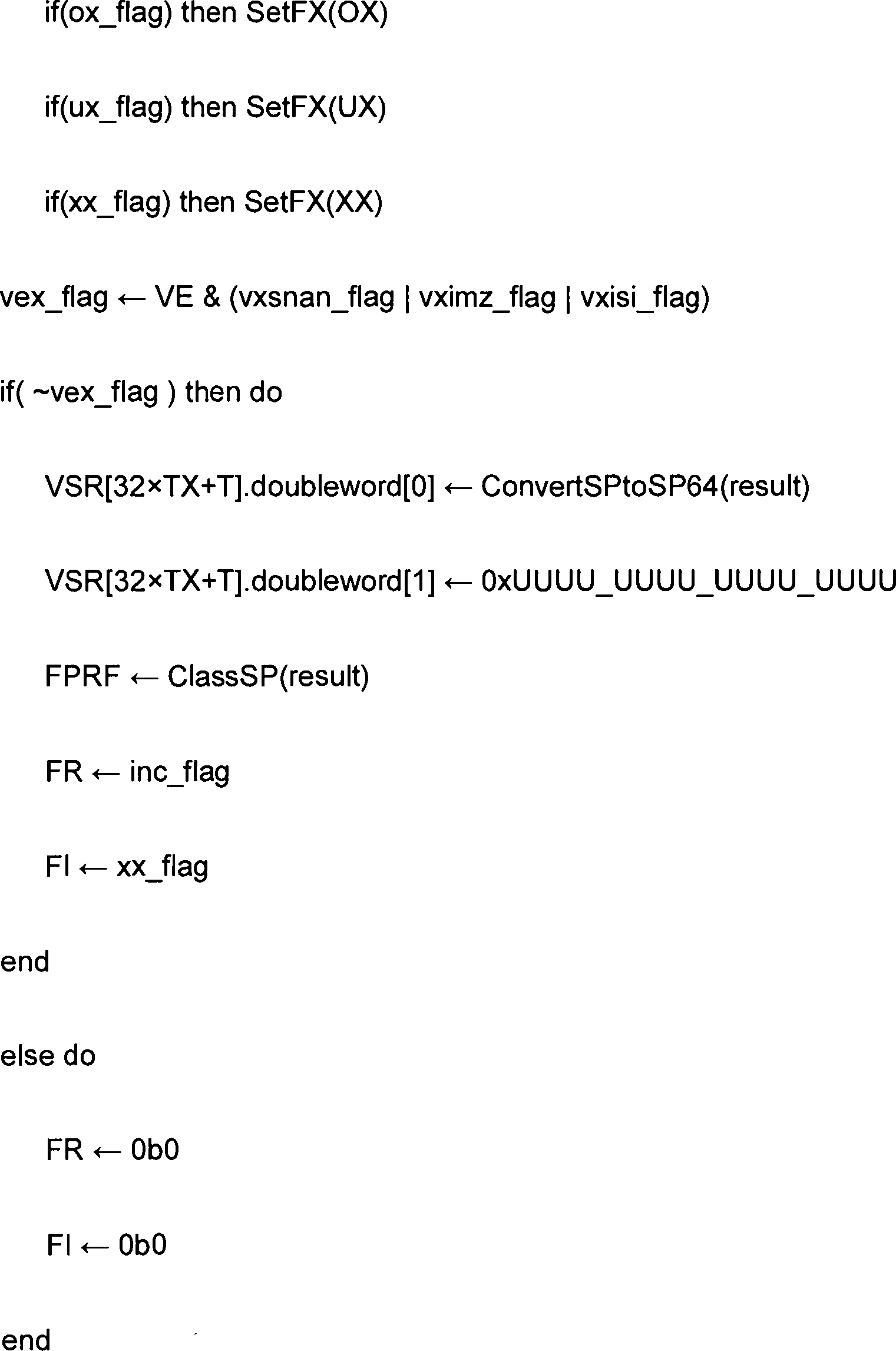
- XT sei der Wert TX, der mit T verkettet ist.
- XA sei der Wert AX, der mit A verkettet ist.
- XB sei der Wert BX, der mit B verkettet ist.
- Let XT be the value TX concatenated with T.
- Let XA be the value AX concatenated with A.
- Let XB be the value BX concatenated with B.
Für xsnmsubasp wird wie folgt vorgegangen.
- – src1 sei der Gleitkommawert mit doppelter
Präzision im Doppelwortelement 0 von VSR[XA]. - – src2 sei der Gleitkommawert mit doppelter
Präzision im Doppelwortelement 0 von VSR[XT]. - – src3 sei der Gleitkommawert mit doppelter
Präzision im Doppelwortelement 0 von VSR[XB].
- Let src1 be the double-precision floating-point value in double-
word element 0 of VSR [XA]. - - src2 is the double precision floating point value in the
double word element 0 of VSR [XT]. - Let src3 be the double precision floating point value in
double word element 0 of VSR [XB].
Für xsnmsubmsp wird wie folgt vorgegangen.
- – src1 sei der Gleitkommawert mit doppelter
Präzision im Doppelwortelement 0 von VSR[XA]. - – src2 sei der Gleitkommawert mit doppelter
Präzision im Doppelwortelement 0 von VSR[XB]. - – src3 sei der Gleitkommawert mit doppelter
Präzision im Doppelwortelement 0 von VSR[XT].
- src1 wird mit src3 multipliziert, wodurch ein Produkt mit unbegrenztem Bereich und unbegrenzter Präzision erzeugt wird. Gleitkommamultiplikation beruht auf Exponentenaddition und Multiplikation der Mantissen.
- src2 wird negiert und zum Produkt addiert, wodurch eine Summe mit unbegrenztem Bereich und unbegrenzter Präzision erzeugt wird. Gleitkommaaddition beruht auf Exponentenvergleich und Addition der beiden Mantissen. Die Exponenten der zwei Operanden werden verglichen und die den kleineren Exponenten begleitende Mantisse wird nach rechts verschoben, wobei ihr Exponent für jedes verschobene Bit um Eins erhöht wird, bis die beiden Exponenten gleich sind. Die beiden Mantissen werden dann entsprechend addiert oder subtrahiert, abhängig von den Vorzeichen der Operanden, um eine Zwischensumme zu bilden. Alle 53 Bits der Mantisse sowie alle drei Schutzbits (G, R und X) fließen in die Berechnung ein.
- Let src1 be the double-precision floating-point value in double-
word element 0 of VSR [XA]. - Let src2 be the double-precision floating-point value in
double word element 0 of VSR [XB]. - Let src3 be the double precision floating point value in the
double word element 0 of VSR [XT].
- src1 is multiplied by src3, creating a product with unlimited range and unlimited precision. Floating point multiplication is based on exponent addition and multiplication of mantissas.
- src2 is negated and added to the product, creating a sum with unlimited range and unlimited precision. Floating-point addition is based on exponent comparison and addition of the two mantissas. The exponents of the two operands are compared, and the mantissa accompanying the smaller exponent is shifted right, increasing its exponent by one for each shifted bit until the two exponents are equal. The two mantissas are then added or subtracted accordingly, depending on the sign of the operands, to form a subtotal. All 53 bits of the mantissa as well as all three protection bits (G, R and X) are included in the calculation.
Die Summe wird normalisiert. Gleitkommanormalisierung beruht auf einem Verschieben der Mantisse nach links, bis das höchstwertige Bit 1 ist, und einem Vermindern des Exponenten um die Anzahl von Bits, um die die Mantisse verschoben wurde.The sum is normalized. Floating-point normalization relies on shifting the mantissa to the left until the most significant bit is 1 and decreasing the exponent by the number of bits by which the mantissa was shifted.
Das Zwischenergebnis wird unter Verwendung des durch RN angegebenen Rundungsmodus auf einfache Präzision gerundet.The intermediate result is rounded to simple precision using the rounding mode indicated by RN.
Das Ergebnis wird negiert und in das Doppelwortelement 0 von VSR[XT] im Format mit doppelter Präzision gestellt.The result is negated and placed in
Die Inhalte des Doppelwortelements 1 von VSR[XT] sind nicht definiert.The contents of the
FPRF wird auf die Klasse und das Vorzeichen des Ergebnisses gesetzt, das im Format mit einfacher Präzision dargestellt ist. FR wird so eingerichtet, dass angegeben wird, ob das Ergebnis beim Runden erhöht worden ist. FI wird so eingerichtet, dass angegeben wird, ob das Ergebnis ungenau ist.FPRF is set to the class and sign of the result, which is represented in single precision format. FR is set up to indicate whether the result has been increased in the round. FI is set up to indicate if the result is inaccurate.
Wenn eine Ausnahme Invalid Operation mit Trap-Aktivierung auftritt, werden VSR[XT] und FPRF nicht modifiziert, und FR und FI werden auf 0 gesetzt.When an exception Invalid operation with trap activation occurs, VSR [XT] and FPRF are not modified, and FR and FI are set to 0.
Geänderte Sonderregister 
VSR-Datenlayout für xsnmsub(a|m)spVSR data layout for xsnmsub (a | m) sp
-
src1 = VSR[XA src1 = VSR [XA -
Die Bits 0 bis 63 von 128 Bits enthalten DP.
Bits 0 to 63 of 128 bits contain DP.
-
src2 = xsnmsubasp ? VSR[XT] : VSR[XB]src2 = xsnmsubasp? VSR [XT]: VSR [XB] -
Die Bits 0 bis 63 von 128 Bits enthalten DP.
Bits 0 to 63 of 128 bits contain DP.
-
src3 = xsnmsubasp ? VSR[XB] : VSR[XT]src3 = xsnmsubasp? VSR [XB]: VSR [XT] -
Die Bits 0 bis 63 von 128 Bits enthalten DP.
Bits 0 to 63 of 128 bits contain DP.
-
tgt = VSR[XT]tgt = VSR [XT]
VSX Scalar Reciprocal Estimate Single-Precision XX2-form 
In einem Beispiel enthält diese Anweisung zwei Felder, die einen Operationscode identifizieren (wobei z. B. ein Feld, Bits 0 bis 5, einen primären Operationscode aufweist, der mit einem erweiterten Operationscode eines anderen Felds, Bits 21 bis 29 kombiniert (z. B. verkettet) ist), um die Anweisung zu identifizieren; ein erstes Feld (z. B. T-Feld; Bits 6 bis 10) und ein erstes Bit (z. B. TX-Feld; Bit 31); und ein zweites Feld (z. B. B-Feld; Bits 16 bis 20) und ein zweites Bit (z. B. BX-Feld; Bit 30). 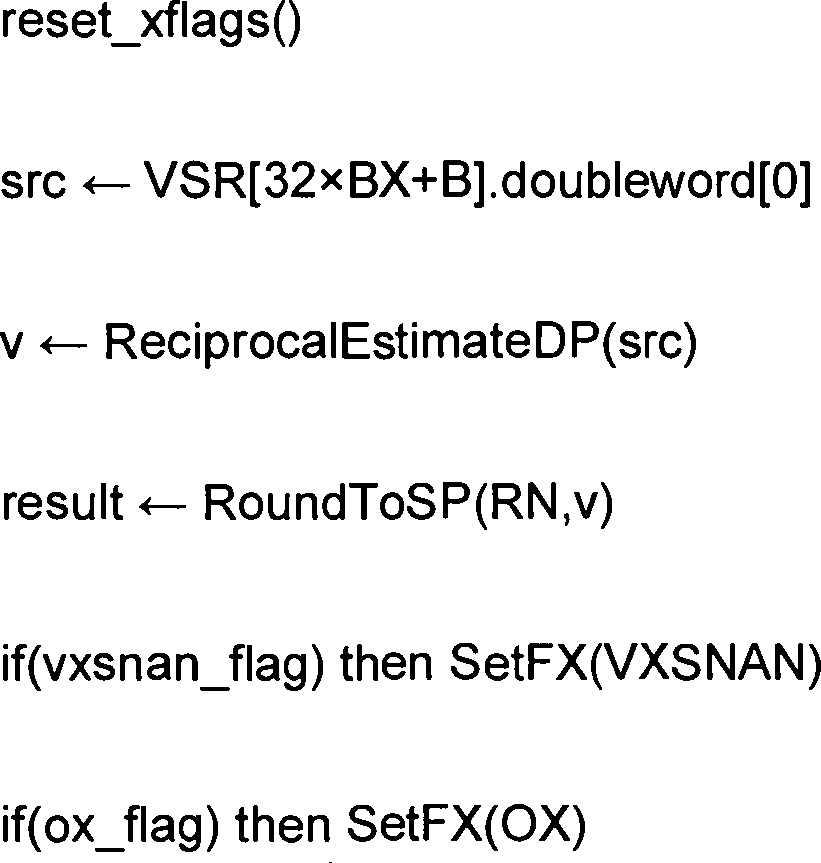

- XT sei der Wert TX, der mit T verkettet ist.
- XB sei der Wert BX, der mit B verkettet ist.
- src sei der Gleitkommawert mit doppelter
Präzision im Doppelwortelement 0 von VSR[XB].
- Let XT be the value TX concatenated with T.
- Let XB be the value BX concatenated with B.
- Let src be the double precision floating point value in
double word element 0 of VSR [XB].
Eine Gleitkommaschätzung mit doppelter Präzision des Reziprokwerts von src wird in das Doppelwortelement 0 von VSR[XT] im Format mit doppelter Präzision gestellt.A double-precision floating-point estimate of src is placed in double-
Sofern der Reziprokwert von src keine Null, kein Unendlich oder keine QNnaN (stille Nichtzahl) ist, weist die Schätzung einen relativen Präzisionsfehler auf, der nicht größer als ein 16284-stel des Reziprokwerts von src ist. Das heißt 
Die Operation mit verschiedenen speziellen Werten des Operanden ist im Folgenden zusammengefasst. 
- 1. Kein Ergebnis, wenn ZE = 1
- 2. Kein Ergebnis, wenn VE = 1
- 1. No result if ZE = 1
- 2. No result if VE = 1
Die Inhalte des Doppelwortelements 1 von VSR[XT] sind nicht definiert.The contents of the
FPRF wird auf die Klasse und das Vorzeichen des Ergebnisses gesetzt, das im Format mit einfacher Präzision dargestellt ist. FR wird auf einen nicht definierten Wert gesetzt. FI wird auf einen nicht definierten Wert gesetzt.FPRF is set to the class and sign of the result, which is represented in single precision format. FR is set to an undefined value. FI is set to an undefined value.
Wenn eine Ausnahme Invalid Operation mit Trap-Aktivierung oder eine Ausnahme Zero Divide mit Trap-Aktivierung auftritt, werden VSR[XT] und FPRF nicht modifiziert.If an exception Invalid operation with trap activation or a Zero Divide exception with trap activation occurs, VSR [XT] and FPRF are not modified.
Die Ergebnisse der Ausführung dieser Anweisungen zwischen Umsetzungen und zwischen verschiedenen Ausführungen derselben Umsetzung dürfen verschieden ausfallen.The results of executing these instructions between conversions and between different implementations of the same implementation may be different.
Geänderte Sonderregister 
VSR-Datenlayout für xsrespVSR data layout for xsresp
-
src = VSR[XB]src = VSR [XB] -
Die Bits 0 bis 63 von 128 Bits enthalten DP.
Bits 0 to 63 of 128 bits contain DP.
-
tgt = VSR[XT]tgt = VSR [XT] -
Die Bits 0 bis 63 von 128 Bits enthalten DP.
Bits 0 to 63 of 128 bits contain DP.
VSX Scalar Round to Single-Precision XX2-form 
In einem Beispiel enthält diese Anweisung zwei Felder, die einen Operationscode identifizieren (wobei z. B. ein Feld, Bits 0 bis 5, einen primären Operationscode aufweist, der mit einem erweiterten Operationscode eines anderen Felds, Bits 21 bis 29 kombiniert (z. B. verkettet) ist), um die Anweisung zu identifizieren; ein erstes Feld (z. B. T-Feld; Bits 6 bis 10) und ein erstes Bit (z. B. TX-Feld; Bit 31); und ein zweites Feld (z. B. B-Feld; Bits 16 bis 20) und ein zweites Bit (z. B. BX-Feld; Bit 30). 

- XT sei der Wert TX, der mit T verkettet ist.
- XB sei der Wert BX, der mit B verkettet ist.
- src sei der Gleitkommawert mit doppelter
Präzision im Doppelwortelement 0 von VSR[XB]. - src wird auf einfache Präzision gerundet unter Verwendung des Rundungsmodus, der durch das Gleitkomma-Rundungssteuerfeld RN des FPSCR angegeben wird.
- Let XT be the value TX concatenated with T.
- Let XB be the value BX concatenated with B.
- Let src be the double precision floating point value in
double word element 0 of VSR [XB]. - src is rounded to simple precision using the rounding mode indicated by the floating point rounding control field RN of the FPSCR.
Das Ergebnis wird in das Doppelwortelement 0 von VSR[XT] im Format mit doppelter Präzision gestellt.The result is placed in
Die Inhalte des Doppelwortelements 1 von VSR[XT] sind nicht definiert.The contents of the
FPRF wird auf die Klasse und das Vorzeichen des Ergebnisses gesetzt, das im Format mit einfacher Präzision dargestellt ist.FPRF is set to the class and sign of the result, which is represented in single precision format.
Wenn eine ungültige Operationsausnahme mit Trap-Aktivierung auftritt, werden VSR[XT] und FPRF nicht modifiziert.If an invalid operation exception with trap activation occurs, VSR [XT] and FPRF are not modified.
Geänderte Sonderregister 
VSR-Datenlayout für xsrspVSR data layout for xsrsp
-
src = VSR[XB]src = VSR [XB] -
Die Bits 0 bis 63 von 128 Bits enthalten DP.
Bits 0 to 63 of 128 bits contain DP.
-
tgt = VSR[XT]tgt = VSR [XT] -
Die Bits 0 bis 63 von 128 Bits enthalten DP.
Bits 0 to 63 of 128 bits contain DP.
VSX Scalar Round to Single-Precision XX2-form 
In einem Beispiel enthält diese Anweisung zwei Felder, die einen Operationscode identifizieren (wobei z. B. ein Feld, Bits 0 bis 5, einen primären Operationscode aufweist, der mit einem erweiterten Operationscode eines anderen Felds, Bits 21 bis 29 kombiniert (z. B. verkettet) ist), um die Anweisung zu identifizieren; ein erstes Feld (z. B. T-Feld; Bits 6 bis 10) und ein erstes Bit (z. B. TX-Feld; Bit 31); und ein zweites Feld (z. B. B-Feld; Bits 16 bis 20) und ein zweites Bit (z. B. BX-Feld; Bit 30). 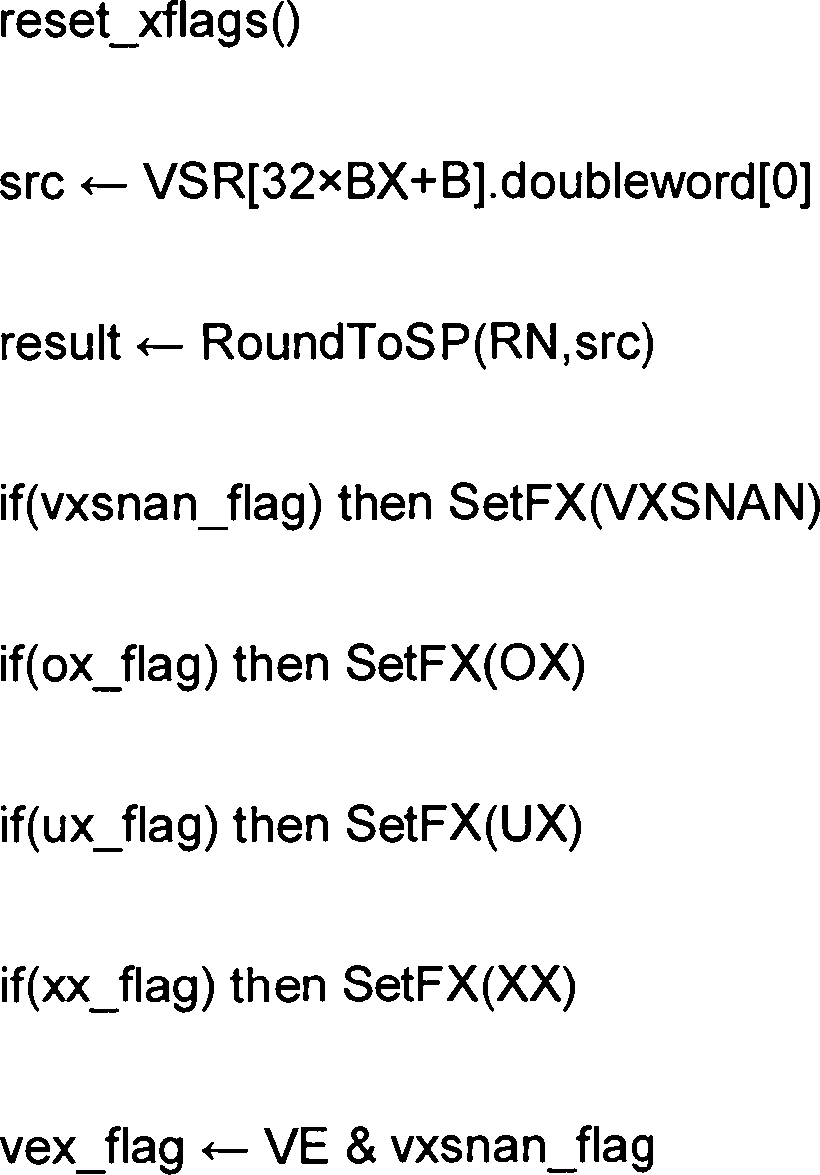

- XT sei der Wert TX, der mit T verkettet ist.
- XB sei der Wert BX, der mit B verkettet ist.
- src sei der Gleitkommawert mit doppelter
Präzision im Doppelwortelement 0 von VSR[XB]. - src wird auf einfache Präzision gerundet unter Verwendung des Rundungsmodus, der durch das Gleitkomma-Rundungssteuerfeld RN des FPSCR angegeben wird.
- Let XT be the value TX concatenated with T.
- Let XB be the value BX concatenated with B.
- Let src be the double precision floating point value in
double word element 0 of VSR [XB]. - src is rounded to simple precision using the rounding mode indicated by the floating point rounding control field RN of the FPSCR.
Das Ergebnis wird in das Doppelwortelement 0 von VSR[XT] im Format mit doppelter Präzision gestellt.The result is placed in
Die Inhalte des Doppelwortelements 1 von VSR[XT] sind nicht definiert.The contents of the
FPRF wird auf die Klasse und das Vorzeichen des Ergebnisses gesetzt, das im Format mit einfacher Präzision dargestellt ist.FPRF is set to the class and sign of the result, which is represented in single precision format.
Wenn eine ungültige Operationsausnahme mit Trap-Aktivierung auftritt, werden VSR[XT] und FPRF nicht modifiziert.If an invalid operation exception with trap activation occurs, VSR [XT] and FPRF are not modified.
Geänderte Sonderregister 
VSR-Datenlayout für xsrspVSR data layout for xsrsp
-
src = VSR[XB]src = VSR [XB] -
Die Bits 0 bis 63 von 128 Bits enthalten DP.
Bits 0 to 63 of 128 bits contain DP.
-
tgt = VSR[XT]tgt = VSR [XT] -
Die Bits 0 bis 63 von 128 Bits enthalten DP.
Bits 0 to 63 of 128 bits contain DP.
VSX Scalar Reciprocal Square Root Estimate Single-Precision XX2-form 
In einem Beispiel enthält diese Anweisung zwei Felder, die einen Operationscode identifizieren (wobei z. B. ein Feld, Bits 0 bis 5, einen primären Operationscode aufweist, der mit einem erweiterten Operationscode eines anderen Felds, Bits 21 bis 29 kombiniert (z. B. verkettet) ist), um die Anweisung zu identifizieren; ein erstes Feld (z. B. T-Feld; Bits 6 bis 10) und ein erstes Bit (z. B. TX-Feld; Bit 31); und ein zweites Feld (z. B. B-Feld; Bits 16 bis 20) und ein zweites Bit (z. B. BX-Feld; Bit 30). 


- XT sei der Wert TX, der mit T verkettet ist.
- XB sei der Wert BX, der mit B verkettet ist.
- src sei der Gleitkommawert mit doppelter
Präzision im Doppelwortelement 0 von VSR[XB].
- Let XT be the value TX concatenated with T.
- Let XB be the value BX concatenated with B.
- Let src be the double precision floating point value in
double word element 0 of VSR [XB].
Eine Gleitkommaschätzung mit einfacher Präzision der reziproken Quadratwurzel von src wird in das Doppelwortelement 0 von VSR[XT] im Format mit doppelter Präzision gestellt.A single-precision floating-point estimate of the reciprocal square root of src is placed in
Sofern der Reziprokwert der Quadratwurzel von src keine Null, kein Unendlich oder keine QNaN ist, weist die Schätzung einen relativen Präzisionsfehler auf, der nicht größer als ein 16284-stel des Reziprokwert von src ist. Das heißt 
Die Operation mit verschiedenen speziellen Werten des Operanden ist im Folgenden zusammengefasst.The operation with various special values of the operand is summarized below.

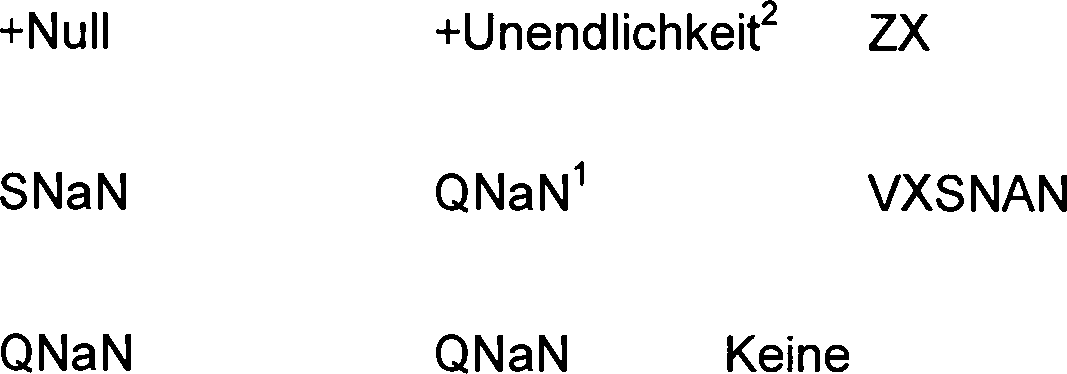
- 1. Kein Ergebnis, wenn VE = 11. No result if VE = 1
- 2. Kein Ergebnis, wenn ZE = 12. No result if ZE = 1
Die Inhalte des Doppelwortelements 1 von VSR[XT] sind nicht definiert.The contents of the
FPRF wird auf die Klasse und das Vorzeichen des Ergebnisses gesetzt, das im Format mit einfacher Präzision dargestellt ist. FR wird auf einen nicht definierten Wert gesetzt. FI wird auf einen nicht definierten Wert gesetzt.FPRF is set to the class and sign of the result, which is represented in single precision format. FR is set to an undefined value. FI is set to an undefined value.
Wenn eine Ausnahme Invalid Operation mit Trap-Aktivierung oder eine Ausnahme Zero Divide mit Trap-Aktivierung auftritt, werden VSR[XT] und FPRF nicht modifiziert.If an exception Invalid operation with trap activation or a Zero Divide exception with trap activation occurs, VSR [XT] and FPRF are not modified.
Die Ergebnisse der Ausführung dieser Anweisungen zwischen Umsetzungen und zwischen verschiedenen Ausführungen derselben Umsetzung dürfen verschieden ausfallen.The results of executing these instructions between conversions and between different implementations of the same implementation may be different.
Geänderte Sonderregister 
VSR-Datenlayout für xsrsqrtespVSR data layout for xsrsqrtesp
-
src = VSR[XB]src = VSR [XB] -
Die Bits 0 bis 63 von 128 Bits enthalten DP.
Bits 0 to 63 of 128 bits contain DP.
-
tgt = VSR[XT]tgt = VSR [XT] -
Die Bits 0 bis 63 von 128 Bits enthalten DP.
Bits 0 to 63 of 128 bits contain DP.
VSX Scalar Square Root Single-Precision XX-form 
In einem Beispiel enthält diese Anweisung zwei Felder, die einen Operationscode identifizieren (wobei z. B. ein Feld, Bits 0 bis 5, einen primären Operationscode aufweist, der mit einem erweiterten Operationscode eines anderen Felds, Bits 21 bis 29 kombiniert (z. B. verkettet) ist), um die Anweisung zu identifizieren; ein erstes Feld (z. B. T-Feld; Bits 6 bis 10) und ein erstes Bit (z. B. TX-Feld; Bit 31); und ein zweites Feld (z. B. B-Feld; Bits 16 bis 20) und ein zweites Bit (z. B. BX-Feld; Bit 30). 

- XT sei der Wert TX, der mit T verkettet ist.
- XB sei der Wert BX, der mit B verkettet ist.
- src sei der Gleitkommawert mit doppelter
Präzision im Doppelwortelement 0 von VSR[XB].
- Let XT be the value TX concatenated with T.
- Let XB be the value BX concatenated with B.
- Let src be the double precision floating point value in
double word element 0 of VSR [XB].
Die Quadratwurzel von src mit unbegrenzter Präzision wird erzeugt.The square root of src with unlimited precision is generated.
Das Zwischenergebnis wird auf einfache Präzision gerundet unter Verwendung des Rundungsmodus, der durch das Gleitkomma-Rundungssteuerfeld RN des FPSCR angegeben wird.The intermediate result is rounded to simple precision using the rounding mode indicated by the floating point rounding control field RN of the FPSCR.
Das Ergebnis wird in das Doppelwortelement 0 von VSR[XT] im Format mit doppelter Präzision gestellt.The result is placed in
Die Inhalte des Doppelwortelements 1 von VSR[XT] sind nicht definiert.The contents of the
FPRF wird auf die Klasse und das Vorzeichen des Ergebnisses gesetzt, das im Format mit einfacher Präzision dargestellt ist. FR wird so eingerichtet, dass angegeben wird, ob das Ergebnis beim Runden erhöht worden ist. FI wird so eingerichtet, dass angegeben wird, ob das Ergebnis ungenau ist.FPRF is set to the class and sign of the result, which is represented in single precision format. FR is set up to indicate whether the result has been increased in the round. FI is set up to indicate if the result is inaccurate.
Wenn eine Ausnahme Invalid Operation mit Trap-Aktivierung auftritt, werden VSR[XT] und FPRF nicht modifiziert, und FR und FI werden auf 0 gesetzt.When an exception Invalid operation with trap activation occurs, VSR [XT] and FPRF are not modified, and FR and FI are set to 0.
Geänderte Sonderregister 
VSR-Datenlayout für xssqrtspVSR data layout for xssqrtsp
-
src = VSR[XB]src = VSR [XB] -
Die Bits 0 bis 63 von 128 Bits enthalten DP.
Bits 0 to 63 of 128 bits contain DP.
-
tgt = VSR[XT]tgt = VSR [XT] -
Die Bits 0 bis 63 von 128 Bits enthalten DP.
Bits 0 to 63 of 128 bits contain DP.
VSX Scalar Subtract Single-Precision XX3-form 
In einem Beispiel enthält diese Anweisung zwei Felder, die einen Operationscode identifizieren (wobei z. B. ein Feld, Bits 0 bis 5, einen primären Operationscode aufweist, der mit einem erweiterten Operationscode eines anderen Felds, Bits 21 bis 28 kombiniert (z. B. verkettet) ist), um die Anweisung zu identifizieren; ein erstes Feld (z. B. T-Feld; Bits 6 bis 10) und ein erstes Bit (z. B. TX-Feld; Bit 31); ein zweites Feld (z. B. A-Feld; Bits 11 bis 15) und ein zweites Bit (z. B. AX-Feld; Bit 29); und ein drittes Feld (z. B. B-Feld; Bits 16 bis 20) und ein drittes Bit (z. B. BX-Feld; Bit 30). 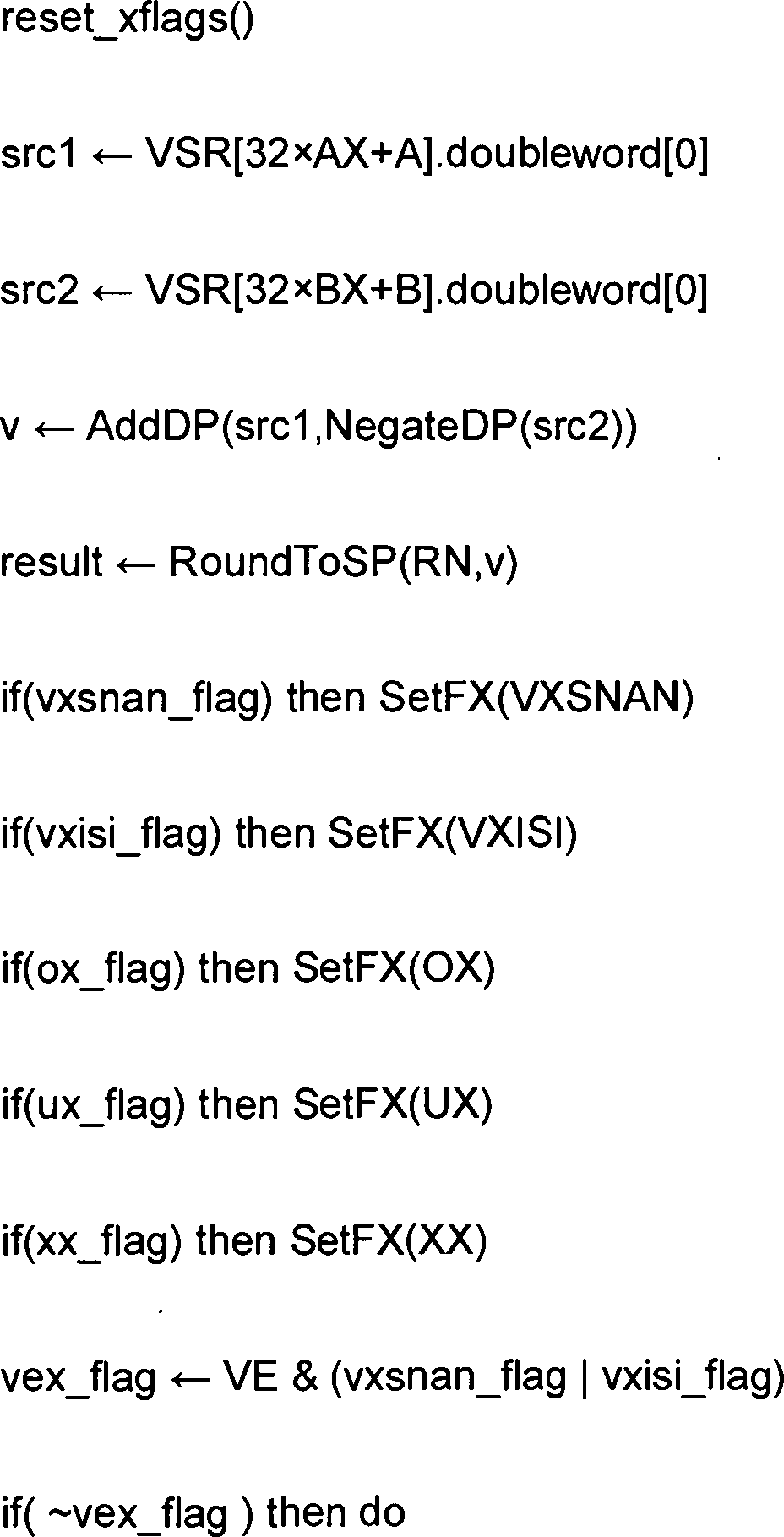

- XT sei der Wert TX, der mit T verkettet ist.
- XA sei der Wert AX, der mit A verkettet ist.
- XB sei der Wert BX, der mit B verkettet ist.
- src1 sei der Gleitkommawert mit doppelter
Präzision im Doppelwortelement 0 von VSR[XA]. - src2 sei der Gleitkommawert mit doppelter
Präzision im Doppelwortelement 0 von VSR[XB]. - src2 wird negiert und zu src1 addiert, wodurch die Summe v mit unbegrenztem Bereich und unbegrenzter Präzision erzeugt wird. Gleitkommaaddition beruht auf Exponentenvergleich und Addition der beiden Mantissen. Die Exponenten der zwei Operanden werden verglichen und die den kleineren Exponenten begleitende Mantisse wird nach rechts verschoben, wobei ihr Exponent für jedes verschobene Bit um Eins erhöht wird, bis die beiden Exponenten gleich sind. Die beiden Mantissen werden dann entsprechend addiert oder subtrahiert, abhängig von den Vorzeichen der Operanden, um eine Zwischensumme zu bilden. Alle 53 Bits der Mantisse sowie alle drei Schutzbits (G, R und X) fließen in die Berechnung ein.
- v wird normalisiert und auf einfache Präzision gerundet unter Verwendung des Rundungsmodus, der durch das Gleitkomma-Rundungssteuerfeld RN des FPSCR angegeben wird. Gleitkommanormalisierung beruht auf einem Verschieben der Mantisse nach links, bis
das höchstwertige Bit 1 ist, und einem Vermindern des Exponenten um die Anzahl von Bits, um die die Mantisse verschoben wurde.
- Let XT be the value TX concatenated with T.
- Let XA be the value AX concatenated with A.
- Let XB be the value BX concatenated with B.
- src1 is the double precision floating point value in the
double word element 0 of VSR [XA]. - src2 is the double-precision floating-point value in double-
word element 0 of VSR [XB]. - src2 is negated and added to src1, producing the sum v with unlimited range and unlimited precision. Floating-point addition is based on exponent comparison and addition of the two mantissas. The exponents of the two operands are compared, and the mantissa accompanying the smaller exponent is shifted right, increasing its exponent by one for each shifted bit until the two exponents are equal. The two mantissas are then added or subtracted accordingly, depending on the sign of the operands, to form a subtotal. All 53 bits of the mantissa as well as all three protection bits (G, R and X) are included in the calculation.
- v is normalized and rounded to simple precision using the rounding mode specified by the floating point rounding control field RN of the FPSCR. Floating-point normalization relies on shifting the mantissa to the left until the most significant bit is 1 and decreasing the exponent by the number of bits by which the mantissa was shifted.
Das Ergebnis wird in das Doppelwortelement 0 von VSR[XT] gestellt.The result is placed in the
Die Inhalte des Doppelwortelements 1 von VSR[XT] sind nicht definiert.The contents of the
FPRF wird auf die Klasse und das Vorzeichen des Ergebnisses gesetzt, das im Format mit einfacher Präzision dargestellt ist. FR wird so eingerichtet, dass angegeben wird, ob das Ergebnis beim Runden erhöht worden ist. FI wird so eingerichtet, dass angegeben wird, ob das Ergebnis ungenau ist.FPRF is set to the class and sign of the result, which is represented in single precision format. FR is set up to indicate whether the result has been increased in the round. FI is set up to indicate if the result is inaccurate.
Wenn eine Ausnahme Invalid Operation mit Trap-Aktivierung auftritt, werden VSR[XT] und FPRF nicht modifiziert, und FR und FI werden auf 0 gesetzt.When an exception Invalid operation with trap activation occurs, VSR [XT] and FPRF are not modified, and FR and FI are set to 0.
Geänderte Sonderregister 
VSR-Datenlayout für xssubspVSR data layout for xssubsp
-
src1 = VSR[XA]src1 = VSR [XA] -
Die Bits 0 bis 63 von 128 Bits enthalten DP.
Bits 0 to 63 of 128 bits contain DP.
-
src2 = VSR[XB]src2 = VSR [XB] -
Die Bits 0 bis 63 von 128 Bits enthalten DP.
Bits 0 to 63 of 128 bits contain DP.
-
tgt = VSR[XT]tgt = VSR [XT] -
Die Bits 0 bis 63 von 128 Bits enthalten DP.
Bits 0 to 63 of 128 bits contain DP.
POWER ISA AS – Buch 1 – Kapitel 7. Vector-Scalar Floating-Point Operations [Category: VSX]POWER ISA AS - Book 1 - Chapter 7. Vector-Scalar Floating-Point Operations [Category: VSX]
7.6.2 VSX-Anweisung – Beschreibungskonventionen7.6.2 VSX instruction - description conventions
7.6.2.1 VSX-Anweisung – RTL-Operatoren7.6.2.1 VSX statement - RTL operators
-
x{y}x {y} - Rückgabe von Bit y von x.Returning bit y from x.
-
x{y:z}x {y: z} - Rückgabe von Bits y:z von x.Return bits y: z from x.
-
x = yx = y - Der Wert von y wird in x gestellt.The value of y is set in x.
-
x |= yx | = y - Der Wert von y wird einer ODER-Verknüpfung mit dem Wert x unterzogen und in x gestellt.The value of y is ORed with the value x and placed in x.
-
–x-x - Rückgabe des Einerkomplements von x.Return the one-time completion of x.
-
|x| x -
Rückgabe von 1, wenn die Inhalte von x gleich 0 sind, ansonsten Rückgabe von 0.
Return 1 if the contents of x equals 0, otherwise return 0.
-
x || yx || y - Rückgabe des Werts von x, verkettet mit dem Wert von y. Zum Beispiel ist 0b010 || 0b111 dasselbe wie 0b010111.Return the value of x, concatenated with the value of y. For example, 0b010 || 0b111 same as 0b010111.
-
x ^ yx ^ y - Rückgabe des Werts von x ausgenommen ODER-Verknüpfung mit dem Wert von y.Return the value of x except OR with the value of y.
-
x ? y : zx? Y Z - Wenn der Wert von x wahr ist, Rückgabe des Werts von y, ansonsten Rückgabe des Werts z.If the value of x is true, return the value of y, otherwise return the value z.
-
x + yx + y - x und y sind ganzzahlige Werte.x and y are integer values.
- Rückgabe der Summe aus x und y.Return the sum of x and y.
-
+tea+ tea - Siehe Power AS ISA.See Power AS ISA.
-
x – y x - y - x und y sind ganzzahlige Werte.x and y are integer values.
- Rückgabe der Differenz von x und y.Return the difference of x and y.
-
x != yx! = y - x und y sind ganzzahlige Werte.x and y are integer values.
-
Rückgabe von 1, wenn x nicht gleich y ist, ansonsten Rückgabe von 0.
Return 1 if x is not equal to y, otherwise returns 0.
-
x <= yx <= y - x und y sind ganzzahlige Werte.x and y are integer values.
-
Rückgabe von 1, wenn x kleiner/gleich y ist, ansonsten Rückgabe von 0.
Return 1 if x is less than or equal to y, otherwise returns 0.
-
x >= yx> = y - x und y sind ganzzahlige Werte.x and y are integer values.
-
Rückgabe von 1, wenn x größer/gleich y ist, ansonsten Rückgabe von 0.
Return 1 if x is greater than or equal to y, otherwise returns 0.
7.6.2.2 VSX-Anweisung – RTL-Funktionsaufrufe7.6.2.2 VSX instruction - RTL function calls
AddDP(x, y)AddDP (x, y)
- x und y sind Gleitkommawerte mit doppelter Präzision.x and y are double precision floating point values.
- Wenn x oder y eine SNaN ist, wird vxsnan_flag auf 1 gesetzt.If x or y is a SNaN, vxsnan_flag is set to 1.
- Wenn x eine Unendlichkeit ist und y eine Unendlichkeit des entgegengesetzten Vorzeichens ist, wird vxisi_flag auf 1 gesetzt.If x is an infinity and y is an infinity of the opposite sign, then vxisi_flag is set to 1.
- Wenn x eine QNaN ist, Rückgabe von x.If x is a QNaN, return from x.
- Ansonsten, wenn x eine SNaN ist, Rückgabe von x, dargestellt als eine QNaN.Otherwise, if x is a SNaN, return of x, represented as a QNaN.
- Ansonsten, wenn y eine QNaN ist, Rückgabe von y.Otherwise, if y is a QNaN, return y.
- Ansonsten, wenn y eine SNaN ist, Rückgabe von y, dargestellt als eine QNaN.Otherwise, if y is a SNaN, return y, represented as a QNaN.
- Ansonsten, wenn x und y Unendlichkeiten mit entgegengesetztem Vorzeichen sind, Rückgabe der standardmäßigen QNaN.Otherwise, if x and y are infinity of opposite sign, return the default QNaN.
- Ansonsten Rückgabe der normalisierten Summe von x und y mit unbegrenztem Bereich und unbegrenzter Präzision.Otherwise return the normalized sum of x and y with unlimited range and unlimited precision.
AddSP(x, y)AddSP (x, y)
- x und y sind Gleitkommawerte mit einfacher Präzision.x and y are single precision floating point values.
- Wenn x oder y eine SNaN ist, wird vxsnan_flag auf 1 gesetzt.If x or y is a SNaN, vxsnan_flag is set to 1.
- Wenn x eine Unendlichkeit ist und y eine Unendlichkeit des entgegengesetzten Vorzeichens ist, wird vxisi_flag auf 1 gesetzt.If x is an infinity and y is an infinity of the opposite sign, then vxisi_flag is set to 1.
- Wenn x eine QNaN ist, Rückgabe von x.If x is a QNaN, return from x.
- Ansonsten, wenn x eine SNaN ist, Rückgabe von x, dargestellt als eine QNaN.Otherwise, if x is a SNaN, return of x, represented as a QNaN.
- Ansonsten, wenn y eine QNaN ist, Rückgabe von y.Otherwise, if y is a QNaN, return y.
- Ansonsten, wenn y eine SNaN ist, Rückgabe von y, dargestellt als eine QNaN.Otherwise, if y is a SNaN, return y, represented as a QNaN.
- Ansonsten, wenn x und y Unendlichkeiten mit entgegengesetztem Vorzeichen sind, Rückgabe der standardmäßigen QNaN.Otherwise, if x and y are infinity of opposite sign, return the default QNaN.
- Ansonsten Rückgabe der normalisierten Summe von x addiert zu y mit unbegrenztem Bereich und unbegrenzter Präzision.Otherwise return the normalized sum of x added to y with unlimited range and unlimited precision.
ClassDP(x, y)ClassDP (x, y)
- Rückgabe einer 5-Bit-Charakterisierung der Gleitkommazahl x mit doppelter Präzision.Return a 5-bit characterization of the double precision floating point number x.
- 0b10001 = Stille Nichtzahl0b10001 = silence non-count
- 0b01001 = –Unendlichkeit0b01001 = -Infinity
- 0b01000 = –Normalisierte Zahl0b01000 = -Normalized number
- 0b11000 = –Denormalisierte Zahl0b11000 = -Denormalized number
- 0b10010 = –Null0b10010 = -null
- 0b00010 = +Null 0b00010 = + zero
- 0b10100 = +Denormalisierte Zahl0b10100 = + denormalized number
- 0b00100 = +Normalisierte Zahl0b00100 = + normalized number
- 0b00101 = +Unendlichkeit0b00101 = + infinity
ClassSP(x, y)ClassSP (x, y)
- Rückgabe einer 5-Bit-Charakterisierung der Gleitkommazahl x mit einfacher Präzision.Return a 5-bit characterization of the floating-point number x with single precision.
- 0b10001 = Stille Nichtzahl0b10001 = silence non-count
- 0b01001 = –Unendlichkeit0b01001 = -Infinity
- 0b01000 = –Normalisierte Zahl0b01000 = -Normalized number
- 0b11000 = –Denormalisierte Zahl0b11000 = -Denormalized number
- 0b10010 = –Null0b10010 = -null
- 0b00010 = +Null0b00010 = + zero
- 0b10100 = +Denormalisierte Zahl0b10100 = + denormalized number
- 0b00100 = +Normalisierte Zahl0b00100 = + normalized number
- 0b00101 = +Unendlichkeit0b00101 = + infinity
CompareEQDP(x, y)CompareEQDP (x, y)
- x und y sind Gleitkommawerte mit doppelter Präzision.x and y are double precision floating point values.
- Wenn x oder y eine NaN ist, Rückgabe von 0.If x or y is a NaN, return from 0.
- Ansonsten, wenn x gleich y ist, Rückgabe von 1.Otherwise, if x is y, return from 1.
- Ansonsten Rückgabe von 0.Otherwise return from 0.
CompareEQSP(x, y)CompareEQSP (x, y)
- x und y sind Gleitkommawerte mit einfacher Präzision.x and y are single precision floating point values.
- Wenn x oder y eine NaN ist, Rückgabe von 0.If x or y is a NaN, return from 0.
- Ansonsten, wenn x gleich y ist, Rückgabe von 1.Otherwise, if x is y, return from 1.
- Ansonsten Rückgabe von 0.Otherwise return from 0.
CompareGTDP(x, y)CompareGTDP (x, y)
- x und y sind Gleitkommawerte mit doppelter Präzision.x and y are double precision floating point values.
- Wenn x oder y eine NaN ist, Rückgabe von 0.If x or y is a NaN, return from 0.
- Ansonsten, wenn x größer als y ist, Rückgabe von 1. Ansonsten Rückgabe von 0.Otherwise, if x is greater than y, return from 1. Otherwise, return from 0.
CompareGTSP(x, y)CompareGTSP (x, y)
- x und y sind Gleitkommawerte mit einfacher Präzision.x and y are single precision floating point values.
- Wenn x oder y eine NaN ist, Rückgabe von 0.If x or y is a NaN, return from 0.
- Ansonsten, wenn x größer als y ist, Rückgabe von 1.Otherwise, if x is greater than y, return from 1.
- Ansonsten Rückgabe von 0.Otherwise return from 0.
CompareLTDP(x, y)Compare LTDP (x, y)
- x und y sind Gleitkommawerte mit doppelter Präzision.x and y are double precision floating point values.
- Wenn x oder y eine NaN ist, Rückgabe von 0.If x or y is a NaN, return from 0.
- Ansonsten, wenn x kleiner als y ist, Rückgabe von 1.Otherwise, if x is less than y, return from 1.
- Ansonsten Rückgabe von 0.Otherwise return from 0.
CompareLTSP(x, y)Compare LTSP (x, y)
- x und y sind Gleitkommawerte mit einfacher Präzision.x and y are single precision floating point values.
- Wenn x oder y eine NaN ist, Rückgabe von 0.If x or y is a NaN, return from 0.
- Ansonsten, wenn x kleiner als y ist, Rückgabe von 1.Otherwise, if x is less than y, return from 1.
- Ansonsten Rückgabe von 0.Otherwise return from 0.
ConvertDPtoSD(x) ConvertDPtoSD (x)
- x ist ein ganzzahliger Wert mit doppelter Präzision.x is an integer value with double precision.
- Wenn x eine NaN ist,If x is a NaN,
- Rückgabe von 0x8000_0000_0000_0000, vxcvi_flag wird auf 1 gesetzt, und vxsnan_flag wird auf 1 gesetzt, wenn x eine SNaN ist.Return from 0x8000_0000_0000_0000, vxcvi_flag is set to 1, and vxsnan_flag is set to 1 if x is a SNaN.
- Ansonsten wird wie folgt vorgegangen.Otherwise, the procedure is as follows.
- Wenn x größer ist als 263 – 1, Rückgabe von 0x7FFF_FFFF_FFFF_FFFF und vxcvi_flag wird auf 1 gesetzt.If x is greater than 2 63 - 1, return from 0x7FFF_FFFF_FFFF_FFFF and vxcvi_flag will be set to 1.
- Ansonsten, wenn x kleiner ist als –263, Rückgabe von 0x8000_0000_0000_0000 und vxcvi_flag wird auf 1 gesetzt.Otherwise, if x is less than -2 63 , return from 0x8000_0000_0000_0000 and vxcvi_flag will be set to 1.
- Ansonsten Rückgabe des Werts x im 64-Bit-Ganzzahlenformat mit Vorzeichen.Otherwise, return the value x in signed 64-bit integer format.
ConvertDPtoSW(x)ConvertDPtoSW (x)
- x ist ein ganzzahliger Wert mit doppelter Präzision.x is an integer value with double precision.
- Wenn x eine NaN ist, Rückgabe von 0x8000_0000, vxcvi_flag wird auf 1 gesetzt, und vxsnan_flag wird auf 1 gesetzt, wenn x eine SNaN ist.If x is a NaN, returning 0x8000_0000, vxcvi_flag is set to 1, and vxsnan_flag is set to 1 if x is a SNaN.
- Ansonsten wird wie folgt vorgegangen.Otherwise, the procedure is as follows.
- Wenn x größer ist als 231 – 1, Rückgabe von 0x7FFF_FFFF und vxcvi_flag wird auf 1 gesetzt.If x is greater than 2 31 - 1, return from 0x7FFF_FFFF and vxcvi_flag will be set to 1.
- Ansonsten, wenn x kleiner ist als –231, Rückgabe von 0x8000_0000 und vxcvi_flag wird auf 1 gesetzt.Otherwise, if x is less than -2 31 , return from 0x8000_0000 and vxcvi_flag will be set to 1.
- Ansonsten Rückgabe des Werts x im 32-Bit-Ganzzahlenformat mit Vorzeichen.Otherwise, return the value x in 32-bit signed integer format.
ConvertDPtoUD(x)ConvertDPtoUD (x)
- x ist ein ganzzahliger Wert mit doppelter Präzision.x is an integer value with double precision.
- Wenn x eine NaN ist, Rückgabe von 0x0000_0000_0000_0000, vxcvi_flag wird auf 1 gesetzt, und vxsnan_flag wird auf 1 gesetzt, wenn x eine SNaN ist.If x is a NaN, returning 0x0000_0000_0000_0000, vxcvi_flag is set to 1, and vxsnan_flag is set to 1 if x is a SNaN.
- Ansonsten wird wie folgt vorgegangen.Otherwise, the procedure is as follows.
- Wenn x größer ist als 264 – 1, Rückgabe von 0xFFFF_FFFF_FFFF_FFFF und vxcvi_flag wird auf 1 gesetzt.If x is greater than 2 64 - 1, return from 0xFFFF_FFFF_FFFF_FFFF and vxcvi_flag will be set to 1.
- Ansonsten, wenn x kleiner ist als 0, Rückgabe von 0x0000_0000_0000_0000 und vxcvi_flag wird auf 1 gesetzt.Otherwise, if x is less than 0, return 0x0000_0000_0000_0000 and vxcvi_flag will be set to 1.
- Ansonsten Rückgabe des Werts x im 64-Bit-Ganzzahlenformat ohne Vorzeichen.Otherwise return value x in 64-bit unsigned integer format.
ConvertDPtoUW(x)ConvertDPtoUW (x)
- x ist ein ganzzahliger Wert mit doppelter Präzision.x is an integer value with double precision.
- Wenn x eine NaN ist, Rückgabe von 0x0000_0000, vxcvi_flag wird auf 1 gesetzt, und vxsnan_flag wird auf 1 gesetzt, wenn x eine SNaN ist.If x is a NaN, returning 0x0000_0000, vxcvi_flag is set to 1, and vxsnan_flag is set to 1 if x is a SNaN.
- Ansonsten wird wie folgt vorgegangen.Otherwise, the procedure is as follows.
- Wenn x größer ist als 232 – 1, Rückgabe von 0xFFFF_FFFF und vxcvi_flag wird auf 1 gesetzt.If x is greater than 2 32 - 1, returns 0xFFFF_FFFF and vxcvi_flag is set to 1.
- Ansonsten, wenn x kleiner ist als 0, Rückgabe von 0x0000_0000 und vxcvi_flag wird auf 1 gesetzt.Otherwise, if x is less than 0, return 0x0000_0000 and vxcvi_flag will be set to 1.
- Ansonsten Rückgabe des Werts x im 32-Bit-Ganzzahlenformat ohne Vorzeichen.Otherwise, return the value x in 32-bit unsigned integer format.
ConvertFPtoDP(x)ConvertFPtoDP (x)
- Rückgabe des Gleitkommawerts x im DP-Format.Return the floating-point value x in DP format.
ConvertFPtoSP(x)ConvertFPtoSP (x)
- Rückgabe des Gleitkommawerts x im Format mit einfacher Präzision.Return the floating point value x in single precision format.
ConvertSDtoFP(x)ConvertSDtoFP (x)
- x ist ein 64-Bit-Ganzzahlenwert mit Vorzeichen.x is a signed 64-bit integer value.
- Rückgabe des Werts x umgewandelt in Gleitkommaformat mit unbegrenzter Mantissenpräzision.Returns the value x converted to floating-point format with unlimited mantissa precision.
ConvertSPo4toSP(x)ConvertSPo4toSP (x)
- x ist ein Gleitkommawert mit einfacher Präzision im Format mit doppelter Präzision.x is a single precision floating point value in double precision format.
Gibt den Wert x im Format mit einfacher Präzision zurück. x muss mit einfacher Präzision dargestellt werden können, andernfalls wird das Ergebnis als nicht definiert zurückgegeben. Für x kann eine Denormalisierung erforderlich sein. Es wird keine Rundung ausgeführt. Wenn x eine SNaN ist, wird es in eine SNaN mit einfacher Präzision mit denselben Nutzdaten wie x umgewandelt. Returns the value x in single-precision format. x must be able to be represented with simple precision, otherwise the result will be returned as undefined. For x, denormalization may be required. No rounding is performed. If x is a SNaN, it is converted to a simple precision SNaN with the same payload as x.


ConvertSPtoDP(x) ConvertSPtoDP (x)
- x ist ein Gleitkommawert mit einfacher Präzision.x is a floating-point value with simple precision.
- Wenn x eine SNaN ist, wird vxsnan_flag auf 1 gesetzt.If x is a SNaN, vxsnan_flag is set to 1.
- Wenn x eine SNaN ist, Rückgabe von x dargestellt als QNaN im Gleitkommaformat mit doppelter Präzision.If x is a SNaN, returning x represented as QNaN in double precision floating point format.
- Ansonsten, wenn x eine QNaN ist, Rückgabe von x im Gleitkommaformt mit doppelter Präzision.Otherwise, if x is a QNaN, returning x in floating-point format with double precision.
- Ansonsten Rückgabe des Werts x im Gleitkommaformat mit doppelter Präzision.Otherwise return the value x in floating point format with double precision.
ConvertSPtoSD(x)ConvertSPtoSD (x)
- x ist ein ganzzahliger Wert mit einfacher Präzision.x is an integer value with single precision.
- Wenn x eine NaN ist, Rückgabe von 0x8000_0000_0000_0000, vxcvi_flag wird auf 1 gesetzt, und vxsnan_flag wird auf 1 gesetzt, wenn x eine SNaN ist.If x is a NaN, returning 0x8000_0000_0000_0000, vxcvi_flag is set to 1, and vxsnan_flag is set to 1 if x is a SNaN.
- Ansonsten wird wie folgt vorgegangen.Otherwise, the procedure is as follows.
- Wenn x größer ist als 263 – 1, Rückgabe von 0x7FFF_FFFF_FFFF_FFFF und vxcvi_flag wird auf 1 gesetzt.If x is greater than 2 63 - 1, return from 0x7FFF_FFFF_FFFF_FFFF and vxcvi_flag will be set to 1.
- Ansonsten, wenn x kleiner ist als –263, Rückgabe von 0x8000_0000_0000_0000 und vxcvi_flag wird auf 1 gesetzt.Otherwise, if x is less than -2 63 , return from 0x8000_0000_0000_0000 and vxcvi_flag will be set to 1.
- Ansonsten Rückgabe des Werts x im 64-Bit-Ganzzahlenformat mit Vorzeichen.Otherwise, return the value x in signed 64-bit integer format.
ConvertSPtoSP64(x)ConvertSPtoSP64 (x)
- x ist ein Gleitkommawert im Format mit einfacher Präzision.x is a floating-point value in single-precision format.
Gibt den Wert x im Format mit doppelter Präzision zurück. Wenn x eine SNaN ist, wird es in eine SNaN mit doppelter Präzision mit denselben Nutzdaten wie x umgewandelt.Returns the value x in double-precision format. If x is a SNaN, it is converted to a double precision SNaN with the same payload as x.


ConvertSPtoSW(x) ConvertSPtoSW (x)
- x ist ein ganzzahliger Wert mit einfacher Präzision.x is an integer value with single precision.
- Wenn x eine NaN ist, Rückgabe von 0x8000_0000, vxcvi_flag wird auf 1 gesetzt, und vxsnan_flag wird auf 1 gesetzt, wenn x eine SNaN ist.If x is a NaN, returning 0x8000_0000, vxcvi_flag is set to 1, and vxsnan_flag is set to 1 if x is a SNaN.
- Ansonsten wird wie folgt vorgegangen.Otherwise, the procedure is as follows.
- Wenn x größer ist als 231 – 1, Rückgabe von 0x7FFF_FFFF und vxcvi_flag wird auf 1 gesetzt.If x is greater than 2 31 - 1, return from 0x7FFF_FFFF and vxcvi_flag will be set to 1.
- Ansonsten, wenn x kleiner ist als –231, Rückgabe von 0x8000_0000 und vxcvi_flag wird auf 1 gesetzt.Otherwise, if x is less than -2 31 , return from 0x8000_0000 and vxcvi_flag will be set to 1.
- Ansonsten Rückgabe des Werts x im 32-Bit-Ganzzahlenformat mit Vorzeichen.Otherwise, return the value x in 32-bit signed integer format.
ConvertSPtoUD(x)ConvertSPtoUD (x)
- x ist ein ganzzahliger Wert mit einfacher Präzision.x is an integer value with single precision.
- Wenn x eine NaN ist, Rückgabe von 0x0000_0000_0000_0000, vxcvi_flag wird auf 1 gesetzt, und vxsnan_flag wird auf 1 gesetzt, wenn x eine SNaN ist.If x is a NaN, returning 0x0000_0000_0000_0000, vxcvi_flag is set to 1, and vxsnan_flag is set to 1 if x is a SNaN.
- Ansonsten wird wie folgt vorgegangen.Otherwise, the procedure is as follows.
- Wenn x größer ist als 264 – 1, Rückgabe von 0xFFFF_FFFF_FFFF_FFFF und vxcvi_flag wird auf 1 gesetzt.If x is greater than 2 64 - 1, return from 0xFFFF_FFFF_FFFF_FFFF and vxcvi_flag will be set to 1.
- Ansonsten, wenn x kleiner ist als 0, Rückgabe von 0x0000_0000_0000_0000 und vxcvi_flag wird auf 1 gesetzt.Otherwise, if x is less than 0, return 0x0000_0000_0000_0000 and vxcvi_flag will be set to 1.
- Ansonsten Rückgabe des Werts x im 64-Bit-Ganzzahlenformat ohne Vorzeichen.Otherwise return value x in 64-bit unsigned integer format.
ConvertSPtoUW(x)ConvertSPtoUW (x)
- x ist ein ganzzahliger Wert mit einfacher Präzision.x is an integer value with single precision.
- Wenn x eine NaN ist, Rückgabe von 0x0000_0000, vxcvi_flag wird auf 1 gesetzt, und vxsnan_flag wird auf 1 gesetzt, wenn x eine SNaN ist.If x is a NaN, returning 0x0000_0000, vxcvi_flag is set to 1, and vxsnan_flag is set to 1 if x is a SNaN.
- Ansonsten wird wie folgt vorgegangen.Otherwise, the procedure is as follows.
- Wenn x größer ist als 232 – 1, Rückgabe von 0xFFFF_FFFF und vxcvi_flag wird auf 1 gesetzt.If x is greater than 2 32 - 1, returns 0xFFFF_FFFF and vxcvi_flag is set to 1.
- Ansonsten, wenn x kleiner ist als 0, Rückgabe von 0x0000_0000 und vxcvi_flag wird auf 1 gesetzt.Otherwise, if x is less than 0, return 0x0000_0000 and vxcvi_flag will be set to 1.
- Ansonsten Rückgabe des Werts x im 32-Bit-Ganzzahlenformat ohne Vorzeichen.Otherwise, return the value x in 32-bit unsigned integer format.
ConvertSWtoFP(x)ConvertSWtoFP (x)
- x ist ein 32-Bit-Ganzzahlenwert mit Vorzeichen.x is a signed 32-bit integer value.
- Rückgabe des Werts x umgewandelt in Gleitkommaformat mit unbegrenzter Mantissenpräzision.Returns the value x converted to floating-point format with unlimited mantissa precision.
ConvertUDtoFP(x)ConvertUDtoFP (x)
- x ist ein 64-Bit-Ganzzahlenwert ohne Vorzeichen.x is a 64-bit unsigned integer value.
- Rückgabe des Werts x umgewandelt in Gleitkommaformat mit unbegrenzter Mantissenpräzision.Returns the value x converted to floating-point format with unlimited mantissa precision.
ConvertUWtoFP(x)ConvertUWtoFP (x)
- x ist ein 32-Bit-Ganzzahlenwert ohne Vorzeichen.x is a 32-bit unsigned integer value.
- Rückgabe des Werts x umgewandelt in Gleitkommaformat mit unbegrenzter Mantissenpräzision.Returns the value x converted to floating-point format with unlimited mantissa precision.
DivideDP(x, y)DivideDP (x, y)
- x und y sind Gleitkommawerte mit doppelter Präzision.x and y are double precision floating point values.
- Wenn x oder y eine SNaN ist, wird vxsnan_flag auf 1 gesetzt.If x or y is a SNaN, vxsnan_flag is set to 1.
- Wenn x eine Null ist und y eine Null ist, wird vxzdz_flag auf 1 gesetzt.If x is zero and y is zero, vxzdz_flag is set to 1.
- Wenn x ein finiter Nicht-Null-Wert ist und y eine Null ist, wird zx_flag auf 1 gesetzt.If x is a finite nonzero value and y is a zero, zx_flag is set to 1.
- Wenn x eine Unendlichkeit ist und y eine Unendlichkeit ist, wird vxidi_flag auf 1 gesetzt.If x is an infinity and y is an infinity, vxidi_flag is set to 1.
- Wenn x eine QNaN ist, Rückgabe von x.If x is a QNaN, return from x.
- Ansonsten, wenn x eine SNaN ist, Rückgabe von x, dargestellt als eine QNaN.Otherwise, if x is a SNaN, return of x, represented as a QNaN.
- Ansonsten, wenn y eine QNaN ist, Rückgabe von y.Otherwise, if y is a QNaN, return y.
- Ansonsten, wenn y eine SNaN ist, Rückgabe von y, dargestellt als eine QNaN.Otherwise, if y is a SNaN, return y, represented as a QNaN.
- Ansonsten, wenn x eine Null ist und y eine Null ist, Rückgabe der standardmäßigen QNaN.Otherwise, if x is a zero and y is a zero, returning the default QNaN.
- Ansonsten, wenn x ein finiter Nicht-Null-Wert ist und y eine Null mit demselben Vorzeichen wie x ist, Rückgabe von +Unendlichkeit. Otherwise, if x is a finite nonzero value and y is a zero of the same sign as x, returning + infinity.
- Ansonsten, wenn x ein finiter Nicht-Null-Wert ist und y eine Null mit dem entgegengesetzten Vorzeichen von x ist, Rückgabe von –Unendlichkeit.Otherwise, if x is a finite nonzero value and y is a null with the opposite sign of x, return from infinity.
- Ansonsten, wenn x eine Unendlichkeit ist und y eine Unendlichkeit ist, Rückgabe der standardmäßigen QNaN.Otherwise, if x is an infinity and y is an infinity, returning the default QNaN.
- Ansonsten Rückgabe des normalisierten Quotienten von x dividiert durch y mit unbegrenztem Bereich und unbegrenzter Präzision.Otherwise return the normalized quotient of x divided by y with unlimited range and unlimited precision.
DivideSP(x, y)DivideSP (x, y)
- x und y sind Gleitkommawerte mit einfacher Präzision.x and y are single precision floating point values.
- Wenn x oder y eine SNaN ist, wird vxsnan_flag auf 1 gesetzt.If x or y is a SNaN, vxsnan_flag is set to 1.
- Wenn x eine Null ist und y eine Null ist, wird vxzdz_flag auf 1 gesetzt.If x is zero and y is zero, vxzdz_flag is set to 1.
- Wenn x ein finiter Nicht-Null-Wert ist und y eine Null ist, wird zx_flag auf 1 gesetzt.If x is a finite nonzero value and y is a zero, zx_flag is set to 1.
- Wenn x eine Unendlichkeit ist und y eine Unendlichkeit ist, wird vxidi_flag auf 1 gesetzt.If x is an infinity and y is an infinity, vxidi_flag is set to 1.
- Wenn x eine QNaN ist, Rückgabe von x.If x is a QNaN, return from x.
- Ansonsten, wenn x eine SNaN ist, Rückgabe von x, dargestellt als eine QNaN.Otherwise, if x is a SNaN, return of x, represented as a QNaN.
- Ansonsten, wenn y eine QNaN ist, Rückgabe von y.Otherwise, if y is a QNaN, return y.
- Ansonsten, wenn y eine SNaN ist, Rückgabe von y, dargestellt als eine QNaN.Otherwise, if y is a SNaN, return y, represented as a QNaN.
- Ansonsten, wenn x eine Null ist und y eine Null ist, Rückgabe der standardmäßigen QNaN.Otherwise, if x is a zero and y is a zero, returning the default QNaN.
- Ansonsten, wenn x ein finiter Nicht-Null-Wert ist und y eine Null mit demselben Vorzeichen wie x ist, Rückgabe von +Unendlichkeit.Otherwise, if x is a finite nonzero value and y is a zero of the same sign as x, returning + infinity.
- Ansonsten, wenn x ein finiter Nicht-Null-Wert ist und y eine Null mit dem entgegengesetzten Vorzeichen von x ist, Rückgabe von –Unendlichkeit.Otherwise, if x is a finite nonzero value and y is a null with the opposite sign of x, return from infinity.
- Ansonsten, wenn x eine Unendlichkeit ist und y eine Unendlichkeit ist, Rückgabe der standardmäßigen QNaN.Otherwise, if x is an infinity and y is an infinity, returning the default QNaN.
- Ansonsten Rückgabe des normalisierten Quotienten von x dividiert durch y mit unbegrenztem Bereich und unbegrenzter Präzision.Otherwise return the normalized quotient of x divided by y with unlimited range and unlimited precision.
DenormDP(x)DenormDP (x)
- x ist ein Gleitkommawert mit unbegrenztem Bereich und unbegrenzter Präzision.x is a floating-point value with unlimited range and unlimited precision.
- Rückgabe des Werts x, wobei seine Mantisse um eine Anzahl von Bits nach rechts verschoben ist, die gleich der Differenz von den –1022 und dem unverzerrten Exponenten von x und seinem auf –1022 gesetzten unverzerrten Exponenten ist.Returning the value x, with its mantissa shifted to the right by a number of bits equal to the difference between the -1022 and the undistorted exponent of x and its undistorted exponent set to -1022.
DenormSP(x)DenormSP (x)
- x ist ein Gleitkommawert mit unbegrenztem Bereich und unbegrenzter Präzision.x is a floating-point value with unlimited range and unlimited precision.
- Rückgabe des Werts x, wobei seine Mantisse um eine Anzahl von Bits nach rechts verschoben ist, die gleich der Differenz von den –126 und dem unverzerrten Exponenten von x und seinem auf –126 gesetzten unverzerrten Exponenten ist.Returning the value x, with its mantissa shifted to the right by a number of bits equal to the difference between the -126 and the undistorted exponent of x and its undistorted exponent set to -126.
IsInf(x)Isinf (x)
-
Rückgabe von 1, wenn x eine Unendlichkeit ist, ansonsten Rückgabe von 0.
Return 1 if x is an infinity, otherwise return 0.
IsNaN(x)IsNaN (x)
-
Rückgabe von 1, wenn x eine SNaN oder eine QNaN ist, ansonsten Rückgabe von 0.
Return 1 if x is a SNaN or a QNaN, otherwise returns 0.
IsNeg(x)IsNeg (x)
-
Rückgabe von 1, wenn x ein negativer Nicht-Null-Wert ist, ansonsten Rückgabe von 0.
Return 1 if x is a negative non-zero value, otherwise return 0.
IsSNaN(x)IsSNaN (x)
-
Rückgabe von 1, wenn x eine SNaN ist, ansonsten Rückgabe von 0.
Return 1 if x is a SNaN, otherwise return 0.
IsZero(x) IsZero (x)
-
Rückgabe von 1, wenn x eine Null ist, ansonsten Rückgabe von 0.
Return 1 if x is a zero, otherwise return 0.
MaximumDP(x, y)Maximum DP (x, y)
- x und y sind Gleitkommawerte mit doppelter Präzision.x and y are double precision floating point values.
- Wenn x oder y eine SNaN ist, wird vxsnan_flag auf 1 gesetzt.If x or y is a SNaN, vxsnan_flag is set to 1.
- Wenn x eine QNaN ist und y keine NaN ist, Rückgabe von y.If x is a QNaN and y is not NaN, return y.
- Ansonsten, wenn x eine QNaN ist, Rückgabe von x.Otherwise, if x is a QNaN, return from x.
- Ansonsten, wenn x eine SNaN ist, Rückgabe von x, dargestellt als eine QNaN.Otherwise, if x is a SNaN, return of x, represented as a QNaN.
- Ansonsten, wenn y eine QNaN ist, Rückgabe von x.Otherwise, if y is a QNaN, return x.
- Ansonsten, wenn y eine SNaN ist, Rückgabe von y, dargestellt als eine QNaN.Otherwise, if y is a SNaN, return y, represented as a QNaN.
- Ansonsten Rückgabe des größeren Werts von x und y, wobei +0 größer als –0 betrachtet wird.Otherwise return the larger value of x and y, where +0 is considered greater than -0.
MaximumSP(x, y)Maximum SP (x, y)
- x und y sind Gleitkommawerte mit einfacher Präzision.x and y are single precision floating point values.
- Wenn x oder y eine SNaN ist, wird vxsnan_flag auf 1 gesetzt.If x or y is a SNaN, vxsnan_flag is set to 1.
- Wenn x eine QNaN ist und y keine NaN ist, Rückgabe von y.If x is a QNaN and y is not NaN, return y.
- Ansonsten, wenn x eine QNaN ist, Rückgabe von x.Otherwise, if x is a QNaN, return from x.
- Ansonsten, wenn x eine SNaN ist, Rückgabe von x, dargestellt als eine QNaN.Otherwise, if x is a SNaN, return of x, represented as a QNaN.
- Ansonsten, wenn y eine QNaN ist, Rückgabe von x.Otherwise, if y is a QNaN, return x.
- Ansonsten, wenn y eine SNaN ist, Rückgabe von y, dargestellt als eine QNaN.Otherwise, if y is a SNaN, return y, represented as a QNaN.
- Ansonsten Rückgabe des größeren Werts von x und y, wobei +0 größer als –0 betrachtet wird.Otherwise return the larger value of x and y, where +0 is considered greater than -0.
MEM(x, y)MEM (x, y)
Inhalte einer Folge von y Byte eines Speichers. Die Folge hängt von der Endianität des Speicherzugriffs ab wie folgt.
- – Bei Big-Endian-Speicherzugriffen beginnt die Folge mit dem Byte an Adresse x und endet mit dem Byte an Adresse x + y – 1.
- – Bei Little-Endian-Speicherzugriffen beginnt die Folge mit dem Byte an Adresse x + y – 1 und endet mit dem Byte an Adresse x.
- For big-endian memory accesses, the sequence begins with the byte at address x and ends with the byte at address x + y-1.
- - For little endian memory accesses, the sequence begins with the byte at address x + y - 1 and ends with the byte at address x.
MEMtag(x, y)MEMtag (x, y)
- Tag-Bit oder -Bits, die der Folge von y Byte des Speichers zugeordnet sind.Tag bits or bits assigned to the sequence of y bytes of memory.
MinimumDP(x, y)Minimum DP (x, y)
- x und y sind Gleitkommawerte mit doppelter Präzision.x and y are double precision floating point values.
- Wenn x oder y eine SNaN ist, wird vxsnan_flag auf 1 gesetzt.If x or y is a SNaN, vxsnan_flag is set to 1.
- Wenn x eine QNaN ist und y keine NaN ist, Rückgabe von y.If x is a QNaN and y is not NaN, return y.
- Ansonsten, wenn x eine QNaN ist, Rückgabe von x.Otherwise, if x is a QNaN, return from x.
- Ansonsten, wenn x eine SNaN ist, Rückgabe von x, dargestellt als eine QNaN.Otherwise, if x is a SNaN, return of x, represented as a QNaN.
- Ansonsten, wenn y eine QNaN ist, Rückgabe von x.Otherwise, if y is a QNaN, return x.
- Ansonsten, wenn y eine SNaN ist, Rückgabe von y, dargestellt als eine QNaN.Otherwise, if y is a SNaN, return y, represented as a QNaN.
- Ansonsten Rückgabe des kleineren Werts von x und y, wobei –0 kleiner als +0 betrachtet wird.Otherwise return the smaller value of x and y, where -0 is considered less than +0.
MinimumSP(x, y)Minimum SP (x, y)
- x und y sind Gleitkommawerte mit einfacher Präzision.x and y are single precision floating point values.
- Wenn x oder y eine SNaN ist, wird vxsnan_flag auf 1 gesetzt.If x or y is a SNaN, vxsnan_flag is set to 1.
- Wenn x eine QNaN ist und y keine NaN ist, Rückgabe von y.If x is a QNaN and y is not NaN, return y.
- Ansonsten, wenn x eine QNaN ist, Rückgabe von x.Otherwise, if x is a QNaN, return from x.
- Ansonsten, wenn x eine SNaN ist, Rückgabe von x, dargestellt als eine QNaN.Otherwise, if x is a SNaN, return of x, represented as a QNaN.
- Ansonsten, wenn y eine QNaN ist, Rückgabe von x.Otherwise, if y is a QNaN, return x.
- Ansonsten, wenn y eine SNaN ist, Rückgabe von y, dargestellt als eine QNaN.Otherwise, if y is a SNaN, return y, represented as a QNaN.
- Ansonsten Rückgabe des kleineren Werts von x und y, wobei –0 kleiner als +0 betrachtet wird.Otherwise return the smaller value of x and y, where -0 is considered less than +0.
MultiplyAddDP(x, y, z) MultiplyAddDP (x, y, z)
- x, y und z sind Gleitkommawerte mit doppelter Präzision.x, y, and z are double precision floating point values.
- Wenn x, y oder z eine SNaN ist, wird vxsnan_flag auf 1 gesetzt.If x, y, or z is a SNaN, vxsnan_flag is set to 1.
- Wenn x eine Null ist und y eine Unendlichkeit ist oder x eine Unendlichkeit ist und y eine Null ist, wird vximz_flag auf 1 gesetzt.If x is a zero and y is an infinity or x is an infinity and y is a zero, vximz_flag is set to 1.
- Wenn das Produkt aus x und y eine Unendlichkeit ist und z eine Unendlichkeit des entgegengesetzten Vorzeichens ist, wird vxisi_flag auf 1 gesetzt.If the product of x and y is an infinity and z is an infinity of the opposite sign, then vxisi_flag is set to 1.
- Wenn x eine QNaN ist, Rückgabe von x.If x is a QNaN, return from x.
- Ansonsten, wenn x eine SNaN ist, Rückgabe von x, dargestellt als eine QNaN.Otherwise, if x is a SNaN, return of x, represented as a QNaN.
- Ansonsten, wenn z eine QNaN ist, Rückgabe von z.Otherwise, if z is a QNaN, return from z.
- Ansonsten, wenn z eine SNaN ist, Rückgabe von z, dargestellt als eine QNaN.Otherwise, if z is a SNaN, return z, represented as a QNaN.
- Ansonsten, wenn y eine QNaN ist, Rückgabe von y.Otherwise, if y is a QNaN, return y.
- Ansonsten, wenn y eine SNaN ist, Rückgabe von y, dargestellt als eine QNaN.Otherwise, if y is a SNaN, return y, represented as a QNaN.
- Ansonsten, wenn x eine Null ist und y eine Unendlichkeit ist oder x eine Unendlichkeit ist und y eine Null ist, Rückgabe der standardmäßigen QNaN.Otherwise, if x is a zero and y is an infinity or x is an infinity and y is a zero, returning the default QNaN.
- Ansonsten, wenn das Produkt aus x und y eine Unendlichkeit ist und z eine Unendlichkeit des entgegengesetzten Vorzeichens ist, Rückgabe der standardmäßigen QNaN.Otherwise, if the product of x and y is an infinity and z is an infinity of the opposite sign, returning the default QNaN.
- Ansonsten Rückgabe der normalisierten Summe von z und dem Produkt aus x und y mit unbegrenztem Bereich und unbegrenzter Präzision.Otherwise return the normalized sum of z and the product of x and y with unlimited range and unlimited precision.
MultiplyAddSP(x, y, z)MultiplyAddSP (x, y, z)
- x, y und z sind Gleitkommawerte mit einfacher Präzision.x, y, and z are single precision floating point values.
- Wenn x, y oder z eine SNaN ist, wird vxsnan_flag auf 1 gesetzt.If x, y, or z is a SNaN, vxsnan_flag is set to 1.
- Wenn x eine Null ist und y eine Unendlichkeit ist oder x eine Unendlichkeit ist und y eine Null ist, wird vximz_flag auf 1 gesetzt.If x is a zero and y is an infinity or x is an infinity and y is a zero, vximz_flag is set to 1.
- Wenn das Produkt aus x und y eine Unendlichkeit ist und z eine Unendlichkeit des entgegengesetzten Vorzeichens ist, wird vxisi_flag auf 1 gesetzt.If the product of x and y is an infinity and z is an infinity of the opposite sign, then vxisi_flag is set to 1.
- Wenn x eine QNaN ist, Rückgabe von x.If x is a QNaN, return from x.
- Ansonsten, wenn x eine SNaN ist, Rückgabe von x, dargestellt als eine QNaN.Otherwise, if x is a SNaN, return of x, represented as a QNaN.
- Ansonsten, wenn z eine QNaN ist, Rückgabe von z.Otherwise, if z is a QNaN, return from z.
- Ansonsten, wenn z eine SNaN ist, Rückgabe von z, dargestellt als eine QNaN.Otherwise, if z is a SNaN, return z, represented as a QNaN.
- Ansonsten, wenn y eine QNaN ist, Rückgabe von y.Otherwise, if y is a QNaN, return y.
- Ansonsten, wenn y eine SNaN ist, Rückgabe von y, dargestellt als eine QNaN.Otherwise, if y is a SNaN, return y, represented as a QNaN.
- Ansonsten, wenn x eine Null ist und y eine Unendlichkeit ist oder x eine Unendlichkeit ist und y eine Null ist, Rückgabe der standardmäßigen QNaN.Otherwise, if x is a zero and y is an infinity or x is an infinity and y is a zero, returning the default QNaN.
- Ansonsten, wenn das Produkt aus x und y eine Unendlichkeit ist und z eine Unendlichkeit des entgegengesetzten Vorzeichens ist, Rückgabe der standardmäßigen QNaN.Otherwise, if the product of x and y is an infinity and z is an infinity of the opposite sign, returning the default QNaN.
- Ansonsten Rückgabe der normalisierten Summe von z und dem Produkt aus x und y mit unbegrenztem Bereich und unbegrenzter Präzision.Otherwise return the normalized sum of z and the product of x and y with unlimited range and unlimited precision.
MultiplyDP(x, y)MultiplyDP (x, y)
- x und y sind Gleitkommawerte mit doppelter Präzision.x and y are double precision floating point values.
- Wenn x oder y eine SNaN ist, wird vxsnan_flag auf 1 gesetzt.If x or y is a SNaN, vxsnan_flag is set to 1.
- Wenn x eine Null ist und y eine Unendlichkeit ist oder x eine Unendlichkeit ist und y eine Null ist, wird vximz_flag auf 1 gesetzt.If x is a zero and y is an infinity or x is an infinity and y is a zero, vximz_flag is set to 1.
- Wenn x eine QNaN ist, Rückgabe von x.If x is a QNaN, return from x.
- Ansonsten, wenn x eine SNaN ist, Rückgabe von x, dargestellt als eine QNaN.Otherwise, if x is a SNaN, return of x, represented as a QNaN.
- Ansonsten, wenn y eine QNaN ist, Rückgabe von y.Otherwise, if y is a QNaN, return y.
- Ansonsten, wenn y eine SNaN ist, Rückgabe von y, dargestellt als eine QNaN.Otherwise, if y is a SNaN, return y, represented as a QNaN.
- Ansonsten, wenn x eine Null ist und y eine Unendlichkeit ist oder x eine Unendlichkeit ist und y eine Null ist, Rückgabe der standardmäßigen QNaN.Otherwise, if x is a zero and y is an infinity or x is an infinity and y is a zero, returning the default QNaN.
- Ansonsten Rückgabe des normalisierten Produkts aus x und y mit unbegrenztem Bereich und unbegrenzter Präzision.Otherwise return the normalized product of x and y with unlimited range and unlimited precision.
MultiplySP(x, y) MultiplySP (x, y)
- x und y sind Gleitkommawerte mit einfacher Präzision.x and y are single precision floating point values.
- Wenn x oder y eine SNaN ist, wird vxsnan_flag auf 1 gesetzt.If x or y is a SNaN, vxsnan_flag is set to 1.
- Wenn x eine Null ist und y eine Unendlichkeit ist oder x eine Unendlichkeit ist und y eine Null ist, wird vximz_flag auf 1 gesetzt.If x is a zero and y is an infinity or x is an infinity and y is a zero, vximz_flag is set to 1.
- Wenn x eine QNaN ist, Rückgabe von x.If x is a QNaN, return from x.
- Ansonsten, wenn x eine SNaN ist, Rückgabe von x, dargestellt als eine QNaN.Otherwise, if x is a SNaN, return of x, represented as a QNaN.
- Ansonsten, wenn y eine QNaN ist, Rückgabe von y.Otherwise, if y is a QNaN, return y.
- Ansonsten, wenn y eine SNaN ist, Rückgabe von y, dargestellt als eine QNaN.Otherwise, if y is a SNaN, return y, represented as a QNaN.
- Ansonsten, wenn x eine Null ist und y eine Unendlichkeit ist oder x eine Unendlichkeit ist und y eine Null ist, Rückgabe der standardmäßigen QNaN.Otherwise, if x is a zero and y is an infinity or x is an infinity and y is a zero, returning the default QNaN.
- Ansonsten Rückgabe des normalisierten Produkts aus x und y mit unbegrenztem Bereich und unbegrenzter Präzision.Otherwise return the normalized product of x and y with unlimited range and unlimited precision.
NegateDP(x)NegateDP (x)
- Wenn der Gleitkommawert x mit doppelter Präzision eine NaN ist, Rückgabe von x.If the double-precision floating-point value x is a NaN, return x.
- Ansonsten Rückgabe des Gleitkommawerts x mit doppelter Präzision mit ergänztem Vorzeichen-Bit.Otherwise, return the double precision floating point value x with the sign bit supplemented.
NegateSP(x)NegateSP (x)
- Wenn der Gleitkommawert x mit einfacher Präzision eine NaN ist, Rückgabe von X.If the single-precision floating-point value x is a NaN, return X.
- Ansonsten Rückgabe des Gleitkommawerts x mit einfacher Präzision mit ergänztem Vorzeichen-Bit.Otherwise return the floating-point value x with single precision with added sign bit.
ReciprocalEstimateDP(x)ReciprocalEstimateDP (x)
- x ist ein Gleitkommawert mit doppelter Präzision.x is a floating-point value with double precision.
- Wenn x eine SNaN ist, wird vxsnan_flag auf 1 gesetzt.If x is a SNaN, vxsnan_flag is set to 1.
- Wenn x eine Null ist, wird zx_flag auf 1 gesetzt.If x is zero, zx_flag is set to 1.
- Wenn x eine QNaN ist, Rückgabe von x.If x is a QNaN, return from x.
- Ansonsten, wenn x eine SNaN ist, Rückgabe von x, dargestellt als eine QNaN.Otherwise, if x is a SNaN, return of x, represented as a QNaN.
- Ansonsten, wenn x eine Null ist, Rückgabe einer Unendlichkeit mit dem Vorzeichen von X.Otherwise, if x is a zero, returning an infinity with the sign of X.
- Ansonsten, wenn x eine Unendlichkeit ist, Rückgabe einer Null mit dem Vorzeichen von x.Otherwise, if x is an infinity, return a zero with the sign of x.
- Ansonsten Rückgabe einer Schätzung des Reziprokwerts von x mit unbegrenztem Exponentenbereich.Otherwise, return an estimate of the reciprocal of x with unlimited exponent range.
ReciprocalEstimateSP(x)ReciprocalEstimateSP (x)
- x ist ein Gleitkommawert mit einfacher Präzision.x is a floating-point value with simple precision.
- Wenn x eine SNaN ist, wird vxsnan_flag auf 1 gesetzt.If x is a SNaN, vxsnan_flag is set to 1.
- Wenn x eine Null ist, wird zx_flag auf 1 gesetzt.If x is zero, zx_flag is set to 1.
- Wenn x eine QNaN ist, Rückgabe von x.If x is a QNaN, return from x.
- Ansonsten, wenn x eine SNaN ist, Rückgabe von x, dargestellt als eine QNaN.Otherwise, if x is a SNaN, return of x, represented as a QNaN.
- Ansonsten, wenn x eine Null ist, Rückgabe einer Unendlichkeit mit dem Vorzeichen von x.Otherwise, if x is a zero, returning an infinity with the sign of x.
- Ansonsten, wenn x eine Unendlichkeit ist, Rückgabe einer Null mit dem Vorzeichen von x.Otherwise, if x is an infinity, return a zero with the sign of x.
- Ansonsten Rückgabe einer Schätzung des Reziprokwerts von x mit unbegrenztem Exponentenbereich.Otherwise, return an estimate of the reciprocal of x with unlimited exponent range.
ReciprocalSquareRootEstimateDP(x)ReciprocalSquareRootEstimateDP (x)
- x ist ein Gleitkommawert mit doppelter Präzision.x is a floating-point value with double precision.
- Wenn x eine SNaN ist, wird vxsnan_flag auf 1 gesetzt.If x is a SNaN, vxsnan_flag is set to 1.
- Wenn x eine Null ist, wird zx_flag auf 1 gesetzt.If x is zero, zx_flag is set to 1.
- Wenn x eine negative Nicht-Null-Zahl ist, wird vxsqrt_flag auf 1 gesetzt.If x is a negative nonzero number, vxsqrt_flag is set to 1.
- Wenn x eine QNaN ist, Rückgabe von x.If x is a QNaN, return from x.
- Ansonsten, wenn x eine SNaN ist, Rückgabe von x, dargestellt als eine QNaN.Otherwise, if x is a SNaN, return of x, represented as a QNaN.
- Ansonsten, wenn x ein negativer Nicht-Null-Wert ist, Rückgabe der standardmäßigen QNaN.Otherwise, if x is a negative nonzero value, return the default QNaN.
- Ansonsten Rückgabe einer Schätzung des Reziprokwerts der Quadratwurzel von x mit unbegrenztem Exponentenbereich.Otherwise, return an estimate of the reciprocal of the square root of x with unlimited exponent range.
ReciprocalSquareRootEstimateSP(x) ReciprocalSquareRootEstimateSP (x)
- x ist ein Gleitkommawert mit einfacher Präzision.x is a floating-point value with simple precision.
- Wenn x eine SNaN ist, wird vxsnan_flag auf 1 gesetzt.If x is a SNaN, vxsnan_flag is set to 1.
- Wenn x eine Null ist, wird zx_flag auf 1 gesetzt.If x is zero, zx_flag is set to 1.
- Wenn x eine negative Nicht-Null-Zahl ist, wird vxsqrt_flag auf 1 gesetzt.If x is a negative nonzero number, vxsqrt_flag is set to 1.
- Wenn x eine QNaN ist, Rückgabe von x.If x is a QNaN, return from x.
- Ansonsten, wenn x eine SNaN ist, Rückgabe von x, dargestellt als eine QNaN.Otherwise, if x is a SNaN, return of x, represented as a QNaN.
- Ansonsten, wenn x ein negativer Nicht-Null-Wert ist, Rückgabe der standardmäßigen QNaN.Otherwise, if x is a negative nonzero value, return the default QNaN.
- Ansonsten Rückgabe einer Schätzung des Reziprokwerts der Quadratwurzel von x mit unbegrenztem Exponentenbereich.Otherwise, return an estimate of the reciprocal of the square root of x with unlimited exponent range.
reset_xflags()reset_xflags ()
- vxsnan_flag wird auf 0 gesetzt.vxsnan_flag is set to 0.
- vximz_flag wird auf 0 gesetzt.vximz_flag is set to 0.
- vxidi_flag wird auf 0 gesetzt.vxidi_flag is set to 0.
- vxisi_flag wird auf 0 gesetzt.vxisi_flag is set to 0.
- vxzdz_flag wird auf 0 gesetzt.vxzdz_flag is set to 0.
- vxsqrt_flag wird auf 0 gesetzt.vxsqrt_flag is set to 0.
- vxcvi_flag wird auf 0 gesetzt.vxcvi_flag is set to 0.
- vxvc_flag wird auf 0 gesetzt.vxvc_flag is set to 0.
- ox_flag wird auf 0 gesetzt.ox_flag is set to 0.
- ux_flag wird auf 0 gesetzt.ux_flag is set to 0.
- xx_flag wird auf 0 gesetzt.xx_flag is set to 0.
- zx_flag wird auf 0 gesetzt:zx_flag is set to 0:
RoundToDP(x, y)RoundToDP (x, y)
- x ist eine 2-Bit-Ganzzahl ohne Vorzeichen, die einen von vier Rundungsmodi angibt.x is a 2-bit unsigned integer indicating one of four rounding modes.
- 0b00 Runden auf nächste gerade Zahl0b00 rounds to next even number
- 0b01 Runden in Richtung Null0b01 laps towards zero
- 0b10 Runden in Richtung +Unendlichkeit0b10 laps towards + infinity
- 0b10 Runden in Richtung –Unendlichkeit0b10 laps towards -Infinity
- x ist ein normalisierter Gleitkommawert mit unbegrenztem Bereich und unbegrenzter Präzision.x is a normalized floating-point value with unlimited range and unlimited precision.
- Rückgabe des Werts y gerundet auf doppelte Präzision unter Steuerung des durch x angegebenen Rundungsmodus.Return the value y rounded to double precision under control of the rounding mode indicated by x.

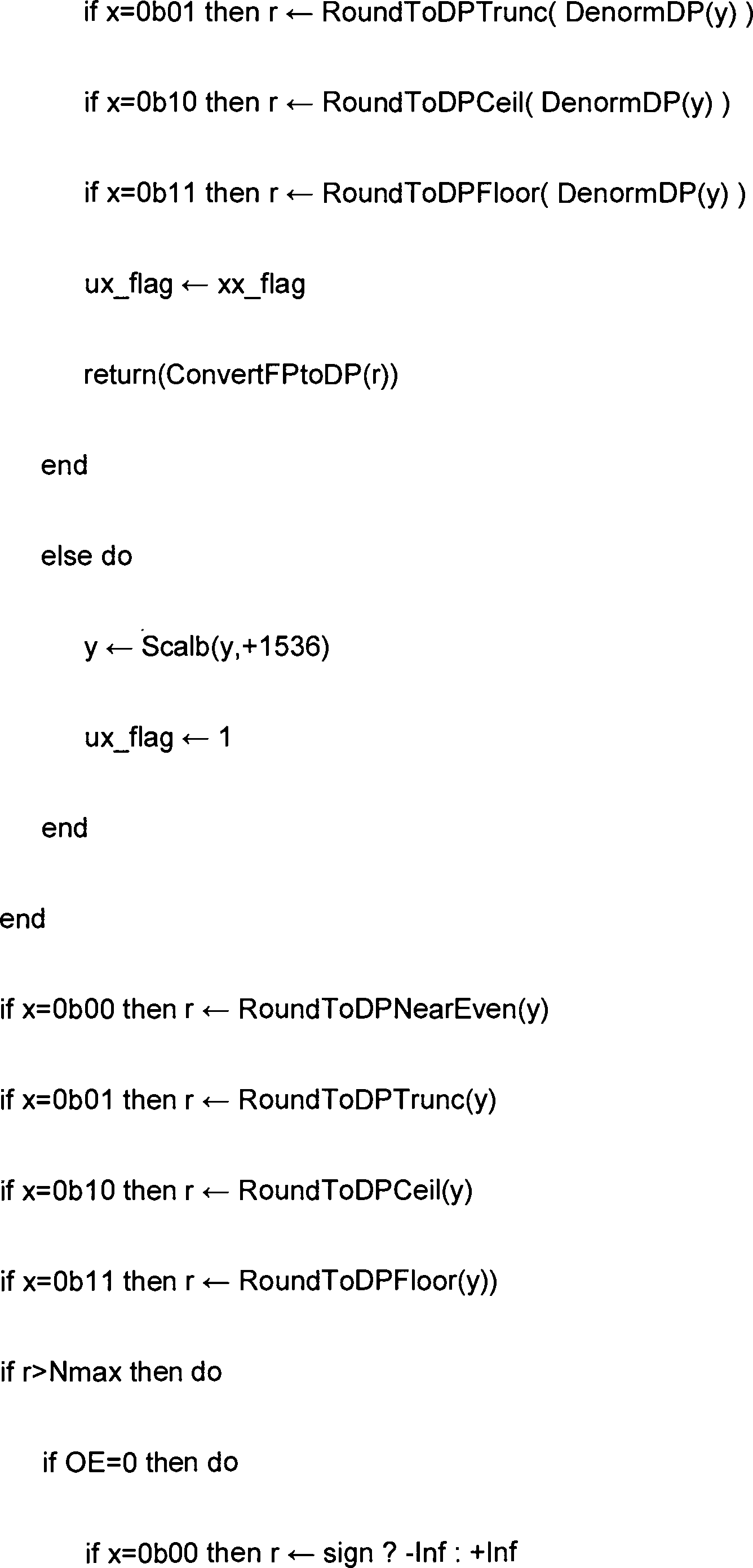

RoundToDPCeil(x)RoundToDPCeil (x)
- x ist ein Gleitkommawert mit unbegrenztem Bereich und unbegrenzter Präzision.x is a floating-point value with unlimited range and unlimited precision.
- Wenn x eine QNaN ist, Rückgabe von x.If x is a QNaN, return from x.
- Ansonsten, wenn x eine Unendlichkeit ist, Rückgabe von x.Otherwise, if x is an infinity, return x.
- Ansonsten wird wie folgt vorgegangen.Otherwise, the procedure is as follows.
- Rückgabe der kleinsten Gleitkommazahl mit unbegrenztem Exponentenbereich, aber Mantissenpräzision mit doppelter Präzision, deren Wert größer/gleich x ist.Return the smallest floating point number with unlimited exponent range, but double precision mantissa precision whose value is greater than or equal to x.
- Wenn die Größe des zurückgegebenen Werts größer als x ist, wird inc_flag auf 1 gesetzt.If the size of the returned value is greater than x, inc_flag is set to 1.
- Wenn der zurückgegebene Wert nicht gleich x ist, wird xx_flag auf 1 gesetzt.If the value returned is not equal to x, xx_flag is set to 1.
RoundToDPFloor(x) RoundToDPFloor (x)
- x ist ein Gleitkommawert mit unbegrenztem Bereich und unbegrenzter Präzision.x is a floating-point value with unlimited range and unlimited precision.
- Wenn x eine QNaN ist, Rückgabe von x.If x is a QNaN, return from x.
- Ansonsten, wenn x eine Unendlichkeit ist, Rückgabe von x.Otherwise, if x is an infinity, return x.
- Ansonsten wird wie folgt vorgegangen.Otherwise, the procedure is as follows.
- Rückgabe der größten Gleitkommazahl mit unbegrenztem Exponentenbereich, aber Mantissenpräzision mit doppelter Präzision, deren Wert kleiner/gleich x ist.Return the largest floating-point number with unlimited exponent range, but double precision mantissa precision whose value is less than or equal to x.
- Wenn die Größe des zurückgegebenen Werts größer als x ist, wird inc_flag auf 1 gesetzt.If the size of the returned value is greater than x, inc_flag is set to 1.
- Wenn der zurückgegebene Wert nicht gleich x ist, wird xx_flag auf 1 gesetzt.If the value returned is not equal to x, xx_flag is set to 1.
RoundToDPIntegerCeil(x)RoundToDPIntegerCeil (x)
- x ist ein Gleitkommawert mit doppelter Präzision.x is a floating-point value with double precision.
- Wenn x eine SNaN ist, wird vxsnan_flag auf 1 gesetzt.If x is a SNaN, vxsnan_flag is set to 1.
- Wenn x eine QNaN ist, Rückgabe von x.If x is a QNaN, return from x.
- Ansonsten, wenn x eine SNaN ist, Rückgabe von x, dargestellt als eine QNaN.Otherwise, if x is a SNaN, return of x, represented as a QNaN.
- Ansonsten, wenn x eine Unendlichkeit ist, Rückgabe von x.Otherwise, if x is an infinity, return x.
- Ansonsten wird wie folgt vorgegangen.Otherwise, the procedure is as follows.
- Rückgabe des kleinsten ganzzahligen Gleitkommawerts mit doppelter Präzision, dessen Wert größer/gleich x ist.Returns the smallest integer floating-point value with double precision whose value is greater than or equal to x.
- Wenn die Größe des zurückgegebenen Werts größer als x ist, wird inc_flag auf 1 gesetzt.If the size of the returned value is greater than x, inc_flag is set to 1.
- Wenn der zurückgegebene Wert nicht gleich x ist, wird xx_flag auf 1 gesetzt.If the value returned is not equal to x, xx_flag is set to 1.
RoundToDPIntegerFloor(x)RoundToDPIntegerFloor (x)
- x ist ein Gleitkommawert mit doppelter Präzision.x is a floating-point value with double precision.
- Wenn x eine SNaN ist, wird vxsnan_flag auf 1 gesetzt.If x is a SNaN, vxsnan_flag is set to 1.
- Wenn x eine QNaN ist, Rückgabe von x.If x is a QNaN, return from x.
- Ansonsten, wenn x eine SNaN ist, Rückgabe von x, dargestellt als eine QNaN.Otherwise, if x is a SNaN, return of x, represented as a QNaN.
- Ansonsten, wenn x eine Unendlichkeit ist, Rückgabe von x.Otherwise, if x is an infinity, return x.
- Ansonsten wird wie folgt vorgegangen.Otherwise, the procedure is as follows.
- Rückgabe des größten ganzzahligen Gleitkommawerts mit doppelter Präzision, dessen Wert kleiner/gleich x ist.Return the largest integer floating-point value with double precision whose value is less than or equal to x.
- Wenn die Größe des zurückgegebenen Werts größer als x ist, wird inc_flag auf 1 gesetzt.If the size of the returned value is greater than x, inc_flag is set to 1.
- Wenn der zurückgegebene Wert nicht gleich x ist, wird xx_flag auf 1 gesetzt.If the value returned is not equal to x, xx_flag is set to 1.
RoundToDPIntegerNearAway(x)RoundToDPIntegerNearAway (x)
- x ist ein Gleitkommawert mit doppelter Präzision.x is a floating-point value with double precision.
- Wenn x eine SNaN ist, wird vxsnan_flag auf 1 gesetzt.If x is a SNaN, vxsnan_flag is set to 1.
- Wenn x eine QNaN ist, Rückgabe von x.If x is a QNaN, return from x.
- Ansonsten, wenn x eine SNaN ist, Rückgabe von x, dargestellt als eine QNaN.Otherwise, if x is a SNaN, return of x, represented as a QNaN.
- Ansonsten, wenn x eine Unendlichkeit ist, Rückgabe von x.Otherwise, if x is an infinity, return x.
- Ansonsten wird wie folgt vorgegangen.Otherwise, the procedure is as follows.
- Rückgabe des größten ganzzahligen Gleitkommawerts mit doppelter Präzision, dessen Wert kleiner/gleich x + 0,5 ist, wenn x > 0 ist, oder des kleinsten ganzzahligen Gleitkommawerts mit doppelter Präzision, dessen Wert größer/gleich x – 0,5 ist, wenn x < 0 ist.Return the largest double-precision integer floating-point value whose value is less than or equal to x + 0.5 if x> 0, or the smallest integer floating-point value with double precision whose value is greater than / equal to x-0.5 if x <0 is.
- Wenn die Größe des zurückgegebenen Werts größer als x ist, wird inc_flag auf 1 gesetzt.If the size of the returned value is greater than x, inc_flag is set to 1.
- Wenn der zurückgegebene Wert nicht gleich x ist, wird xx_flag auf 1 gesetzt.If the value returned is not equal to x, xx_flag is set to 1.
RoundToDPIntegerNearEven(x)RoundToDPIntegerNearEven (x)
- x ist ein Gleitkommawert mit doppelter Präzision.x is a floating-point value with double precision.
- Wenn x eine SNaN ist, wird vxsnan_flag auf 1 gesetzt.If x is a SNaN, vxsnan_flag is set to 1.
- Wenn x eine QNaN ist, Rückgabe von x.If x is a QNaN, return from x.
- Ansonsten, wenn x eine SNaN ist, Rückgabe von x, dargestellt als eine QNaN.Otherwise, if x is a SNaN, return of x, represented as a QNaN.
- Ansonsten, wenn x eine Unendlichkeit ist, Rückgabe von x.Otherwise, if x is an infinity, return x.
- Ansonsten wird wie folgt vorgegangen.Otherwise, the procedure is as follows.
- Rückgabe des ganzzahligen Gleitkommawerts mit doppelter Präzision, der dem Wert x am nächsten ist (im Fall einer Entscheidungssituation wird der ganzzahlige Gleitkommawert mit dem niedrigstwertigen Bit gleich 0 verwendet). Return the integer floating-point value with double precision closest to the value x (in case of a decision situation, the integer floating-point value with the least significant bit equal to 0 is used).
- Wenn die Größe des zurückgegebenen Werts größer als x ist, wird inc_flag auf 1 gesetzt.If the size of the returned value is greater than x, inc_flag is set to 1.
- Wenn der zurückgegebene Wert nicht gleich x ist, wird xx_flag auf 1 gesetzt.If the value returned is not equal to x, xx_flag is set to 1.
RoundToDPIntegerTrunc(x)RoundToDPIntegerTrunc (x)
- x ist ein Gleitkommawert mit doppelter Präzision.x is a floating-point value with double precision.
- Wenn x eine SNaN ist, wird vxsnan_flag auf 1 gesetzt.If x is a SNaN, vxsnan_flag is set to 1.
- Wenn x eine QNaN ist, Rückgabe von x.If x is a QNaN, return from x.
- Ansonsten, wenn x eine SNaN ist, Rückgabe von x, dargestellt als eine QNaN.Otherwise, if x is a SNaN, return of x, represented as a QNaN.
- Ansonsten, wenn x eine Unendlichkeit ist, Rückgabe von x.Otherwise, if x is an infinity, return x.
- Ansonsten wird wie folgt vorgegangen.Otherwise, the procedure is as follows.
- Rückgabe des größten ganzzahligen Gleitkommawerts mit doppelter Präzision, dessen Wert kleiner/gleich x ist, wenn x > 0 ist, oder des kleinsten ganzzahligen Gleitkommawerts mit doppelter Präzision, dessen Wert größer/gleich x ist, wenn x < 0 ist.Return the largest double-precision integer floating-point value whose value is less than or equal to x if x> 0, or the smallest integer floating-point value of double precision whose value is greater than or equal to x if x <0.
- Wenn die Größe des zurückgegebenen Werts größer als x ist, wird inc_flag auf 1 gesetzt.If the size of the returned value is greater than x, inc_flag is set to 1.
- Wenn der zurückgegebene Wert nicht gleich x ist, wird xx_flag auf 1 gesetzt.If the value returned is not equal to x, xx_flag is set to 1.
RoundToDPNearEven(x)RoundToDPNearEven (x)
- x ist ein Gleitkommawert mit unbegrenztem Bereich und unbegrenzter Präzision.x is a floating-point value with unlimited range and unlimited precision.
- Wenn x eine QNaN ist, Rückgabe von x.If x is a QNaN, return from x.
- Ansonsten, wenn x eine Unendlichkeit ist, Rückgabe von x.Otherwise, if x is an infinity, return x.
- Ansonsten wird wie folgt vorgegangen.Otherwise, the procedure is as follows.
- Rückgabe der Gleitkommazahl mit unbegrenztem Exponentenbereich, aber einer Mantissenpräzision von doppelter Präzision, die dem Wert x am nächsten ist (im Fall einer Entscheidungssituation wird die Gleitkommazahl mit unbegrenztem Exponentenbereich, aber einer Mantissenpräzision von doppelter Präzision mit dem niedrigstwertigen Bit gleich 0 verwendet).Return the floating-point number with unlimited exponent range, but a double precision mantissa precision closest to the value x (in the case of a decision situation, the floating-point number is used with unlimited exponent range, but a mundane precision of double precision with the least significant bit equal to 0).
- Wenn die Größe des zurückgegebenen Werts größer als x ist, wird inc_flag auf 1 gesetzt.If the size of the returned value is greater than x, inc_flag is set to 1.
- Wenn der zurückgegebene Wert nicht gleich x ist, wird xx_flag auf 1 gesetzt.If the value returned is not equal to x, xx_flag is set to 1.
RoundToDPTrunc(x)RoundToDPTrunc (x)
- x ist ein Gleitkommawert mit unbegrenztem Bereich und unbegrenzter Präzision.x is a floating-point value with unlimited range and unlimited precision.
- Wenn x eine QNaN ist, Rückgabe von x.If x is a QNaN, return from x.
- Ansonsten, wenn x eine Unendlichkeit ist, Rückgabe von x.Otherwise, if x is an infinity, return x.
- Ansonsten wird wie folgt vorgegangen.Otherwise, the procedure is as follows.
- Rückgabe der größten Gleitkommazahl mit unbegrenztem Exponentenbereich, aber einer Mantissenpräzision von doppelter Präzision, die kleiner/gleich dem Wert x ist, wenn x > 0 ist, oder der kleinsten Gleitkommazahl mit unbegrenztem Exponentenbereich, aber einer Mantissenpräzision von doppelter Präzision, die größer/gleich dem Wert x ist, wenn x < 0 ist.Return the largest floating-point number with unlimited exponent range, but double precision mantissa precision less than or equal to x if x> 0, or the smallest floating-point number with unlimited exponent range, but with double precision of mantissa precision greater than or equal to Value x is when x <0.
- Wenn die Größe des zurückgegebenen Werts größer als x ist, wird inc_flag auf 1 gesetzt.If the size of the returned value is greater than x, inc_flag is set to 1.
- Wenn der zurückgegebene Wert nicht gleich x ist, wird xx_flag auf 1 gesetzt.If the value returned is not equal to x, xx_flag is set to 1.
RoundToSP(x, y)RoundToSP (x, y)
- x ist eine 2-Bit-Ganzzahl ohne Vorzeichen, die einen von vier Rundungsmodi angibt.x is a 2-bit unsigned integer indicating one of four rounding modes.
- 0b00 Runden auf nächste gerade Zahl0b00 rounds to next even number
- 0b01 Runden in Richtung Null0b01 laps towards zero
- 0b10 Runden in Richtung +Unendlichkeit0b10 laps towards + infinity
- 0b10 Runden in Richtung –Unendlichkeit0b10 laps towards -Infinity
- x ist ein normalisierter Gleitkommawert mit unbegrenztem Bereich und unbegrenzter Präzision.x is a normalized floating-point value with unlimited range and unlimited precision.
- Rückgabe des Werts y gerundet auf einfache Präzision unter Steuerung des durch x angegebenen Rundungsmodus.Return the value y rounded to simple precision under control of the rounding mode indicated by x.


RoundToSPCeil(x) RoundToSPCeil (x)
- x ist ein Gleitkommawert mit unbegrenztem Bereich und unbegrenzter Präzision.x is a floating-point value with unlimited range and unlimited precision.
- Wenn x eine QNaN ist, Rückgabe von x.If x is a QNaN, return from x.
- Ansonsten, wenn x eine Unendlichkeit ist, Rückgabe von x.Otherwise, if x is an infinity, return x.
- Ansonsten wird wie folgt vorgegangen.Otherwise, the procedure is as follows.
- Rückgabe der kleinsten Gleitkommazahl mit unbegrenztem Exponentenbereich, aber Mantissenpräzision mit einfacher Präzision, deren Wert größer/gleich x ist.Returns the smallest floating-point number with unlimited exponent range, but single-precision mantissa precision whose value is greater than or equal to x.
- Wenn die Größe des zurückgegebenen Werts größer als x ist, wird inc_flag auf 1 gesetzt.If the size of the returned value is greater than x, inc_flag is set to 1.
- Wenn der zurückgegebene Wert nicht gleich x ist, wird xx_flag auf 1 gesetzt.If the value returned is not equal to x, xx_flag is set to 1.
RoundToSPFloor(x)RoundToSPFloor (x)
- x ist ein Gleitkommawert mit unbegrenztem Bereich und unbegrenzter Präzision.x is a floating-point value with unlimited range and unlimited precision.
- Wenn x eine QNaN ist, Rückgabe von x.If x is a QNaN, return from x.
- Ansonsten, wenn x eine Unendlichkeit ist, Rückgabe von x.Otherwise, if x is an infinity, return x.
- Ansonsten wird wie folgt vorgegangen.Otherwise, the procedure is as follows.
- Rückgabe der größten Gleitkommazahl mit unbegrenztem Exponentenbereich, aber Mantissenpräzision mit einfacher Präzision, deren Wert kleiner/gleich x ist.Return the largest floating point number with unlimited exponent range, but single precision mantissa precision whose value is less than or equal to x.
- Wenn die Größe des zurückgegebenen Werts größer als x ist, wird inc_flag auf 1 gesetzt.If the size of the returned value is greater than x, inc_flag is set to 1.
- Wenn der zurückgegebene Wert nicht gleich x ist, wird xx_flag auf 1 gesetzt.If the value returned is not equal to x, xx_flag is set to 1.
RoundToSPIntegerCeil(x)RoundToSPIntegerCeil (x)
- x ist ein Gleitkommawert mit einfacher Präzision.x is a floating-point value with simple precision.
- Wenn x eine SNaN ist, wird vxsnan_flag auf 1 gesetzt.If x is a SNaN, vxsnan_flag is set to 1.
- Wenn x eine QNaN ist, Rückgabe von x.If x is a QNaN, return from x.
- Ansonsten, wenn x eine SNaN ist, Rückgabe von x, dargestellt als eine QNaN.Otherwise, if x is a SNaN, return of x, represented as a QNaN.
- Ansonsten, wenn x eine Unendlichkeit ist, Rückgabe von x.Otherwise, if x is an infinity, return x.
- Ansonsten wird wie folgt vorgegangen.Otherwise, the procedure is as follows.
- Rückgabe des kleinsten ganzzahligen Gleitkommawerts mit einfacher Präzision, dessen Wert größer/gleich x ist.Return of the smallest integer single-precision floating-point value whose value is greater than or equal to x.
- Wenn die Größe des zurückgegebenen Werts größer als x ist, wird inc_flag auf 1 gesetzt.If the size of the returned value is greater than x, inc_flag is set to 1.
- Wenn der zurückgegebene Wert nicht gleich x ist, wird xx_flag auf 1 gesetzt.If the value returned is not equal to x, xx_flag is set to 1.
RoundToSPIntegerFloor(x)RoundToSPIntegerFloor (x)
- x ist ein Gleitkommawert mit einfacher Präzision.x is a floating-point value with simple precision.
- Wenn x eine SNaN ist, wird vxsnan_flag auf 1 gesetzt.If x is a SNaN, vxsnan_flag is set to 1.
- Wenn x eine QNaN ist, Rückgabe von x.If x is a QNaN, return from x.
- Ansonsten, wenn x eine SNaN ist, Rückgabe von x, dargestellt als eine QNaN.Otherwise, if x is a SNaN, return of x, represented as a QNaN.
- Ansonsten, wenn x eine Unendlichkeit ist, Rückgabe von x.Otherwise, if x is an infinity, return x.
- Ansonsten wird wie folgt vorgegangen.Otherwise, the procedure is as follows.
- Rückgabe des größten ganzzahligen Gleitkommawerts mit einfacher Präzision, dessen Wert kleiner/gleich x ist.Return the largest integer single-precision floating-point value whose value is less than or equal to x.
- Wenn die Größe des zurückgegebenen Werts größer als x ist, wird inc_flag auf 1 gesetzt.If the size of the returned value is greater than x, inc_flag is set to 1.
- Wenn der zurückgegebene Wert nicht gleich x ist, wird xx_flag auf 1 gesetzt.If the value returned is not equal to x, xx_flag is set to 1.
RoundToSPIntegerNearAway(x)RoundToSPIntegerNearAway (x)
- x ist ein Gleitkommawert mit einfacher Präzision.x is a floating-point value with simple precision.
- Wenn x eine SNaN ist, wird vxsnan_flag auf 1 gesetzt.If x is a SNaN, vxsnan_flag is set to 1.
- Wenn x eine QNaN ist, Rückgabe von x.If x is a QNaN, return from x.
- Ansonsten, wenn x eine SNaN ist, Rückgabe von x, dargestellt als eine QNaN.Otherwise, if x is a SNaN, return of x, represented as a QNaN.
- Ansonsten, wenn x eine Unendlichkeit ist, Rückgabe von x.Otherwise, if x is an infinity, return x.
- Ansonsten wird wie folgt vorgegangen.Otherwise, the procedure is as follows.
- Rückgabe von x, wenn x eine Gleitkomma-Ganzzahl ist; ansonsten Rückgabe des größten ganzzahligen Gleitkommawerts mit einfacher Präzision, dessen Wert kleiner/gleich x + 0,5 ist, wenn x > 0 ist, oder des kleinsten ganzzahligen Gleitkommawerts mit einfacher Präzision, dessen Wert größer/gleich x – 0,5 ist, wenn x < 0 ist.Returning x if x is a floating-point integer; otherwise returning the largest integer single precision floating point value whose value is less than or equal to x + 0.5 if x> 0, or the smallest single precision integer floating point value whose value is greater than or equal to x - 0.5 if x <0.
- Wenn die Größe des zurückgegebenen Werts größer als x ist, wird inc_flag auf 1 gesetzt.If the size of the returned value is greater than x, inc_flag is set to 1.
- Wenn der zurückgegebene Wert nicht gleich x ist, wird xx_flag auf 1 gesetzt.If the value returned is not equal to x, xx_flag is set to 1.
RoundToSPIntegerNearEven(x)RoundToSPIntegerNearEven (x)
- x ist ein Gleitkommawert mit einfacher Präzision.x is a floating-point value with simple precision.
- Wenn x eine SNaN ist, wird vxsnan_flag auf 1 gesetzt.If x is a SNaN, vxsnan_flag is set to 1.
- Wenn x eine QNaN ist, Rückgabe von x.If x is a QNaN, return from x.
- Ansonsten, wenn x eine SNaN ist, Rückgabe von x, dargestellt als eine QNaN.Otherwise, if x is a SNaN, return of x, represented as a QNaN.
- Ansonsten, wenn x eine Unendlichkeit ist, Rückgabe von x.Otherwise, if x is an infinity, return x.
- Ansonsten wird wie folgt vorgegangen.Otherwise, the procedure is as follows.
- Rückgabe von x, wenn x eine Gleitkomma-Ganzzahl ist; ansonsten Rückgabe des ganzzahligen Gleitkommawerts mit einfacher Präzision, der dem Wert x am nächsten ist (im Fall einer Entscheidungssituation wird der ganzzahlige Gleitkommawert mit einfacher Präzision mit dem niedrigstwertigen Bit gleich 0 verwendet).Returning x if x is a floating-point integer; otherwise return the integer single precision floating point value closest to the value x (in the case of a decision situation, the integer single precision floating point value with the least significant bit equal to 0 is used).
- Wenn die Größe des zurückgegebenen Werts größer als x ist, wird inc_flag auf 1 gesetzt.If the size of the returned value is greater than x, inc_flag is set to 1.
- Wenn der zurückgegebene Wert nicht gleich x ist, wird xx_flag auf 1 gesetzt.If the value returned is not equal to x, xx_flag is set to 1.
RoundToSPIntegerTrunc(x)RoundToSPIntegerTrunc (x)
- x ist ein Gleitkommawert mit einfacher Präzision.x is a floating-point value with simple precision.
- Wenn x eine QNaN ist, Rückgabe von x.If x is a QNaN, return from x.
- Ansonsten, wenn x eine SNaN ist, Rückgabe von x dargestellt als eine QNaN, und vxsnan_flag wird auf 1 gesetzt.Otherwise, if x is a SNaN, return of x is represented as a QNaN, and vxsnan_flag is set to 1.
- Ansonsten, wenn x eine Unendlichkeit ist, Rückgabe von x.Otherwise, if x is an infinity, return x.
- Ansonsten wird wie folgt vorgegangen.Otherwise, the procedure is as follows.
- Rückgabe des größten ganzzahligen Gleitkommawerts mit einfacher Präzision, dessen Wert kleiner/gleich x ist, wenn x > 0 ist, oder des kleinsten ganzzahligen Gleitkommawerts mit einfacher Präzision, dessen Wert größer/gleich x ist, wenn x < 0 ist.Return the largest integer floating-point value with single precision whose value is less than or equal to x if x> 0, or the smallest single-precision floating-point value whose value is greater than or equal to x if x <0.
- Wenn die Größe des zurückgegebenen Werts größer als x ist, wird inc_flag auf 1 gesetzt.If the size of the returned value is greater than x, inc_flag is set to 1.
- Wenn der zurückgegebene Wert nicht gleich x ist, wird xx_flag auf 1 gesetzt.If the value returned is not equal to x, xx_flag is set to 1.
RoundToSPNearEven(x)RoundToSPNearEven (x)
- x ist ein Gleitkommawert mit unbegrenztem Bereich und unbegrenzter Präzision.x is a floating-point value with unlimited range and unlimited precision.
- Wenn x eine QNaN ist, Rückgabe von x.If x is a QNaN, return from x.
- Ansonsten, wenn x eine Unendlichkeit ist, Rückgabe von x.Otherwise, if x is an infinity, return x.
- Ansonsten wird wie folgt vorgegangen.Otherwise, the procedure is as follows.
- Rückgabe der Gleitkommazahl mit unbegrenztem Exponentenbereich, aber einer Mantissenpräzision von einfacher Präzision, die dem Wert x am nächsten ist (im Fall einer Entscheidungssituation wird die Gleitkommazahl mit unbegrenztem Exponentenbereich, aber einer Mantissenpräzision von einfacher Präzision mit dem niedrigstwertigen Bit gleich 0 verwendet).Returning the floating-point number with unlimited exponent range, but a single-precision mantissa precision closest to the value x (in the case of a decision situation, the floating-point number is used with unlimited exponent range, but a mundane precision of least precision with the least significant bit equal to 0).
- Wenn die Größe des zurückgegebenen Werts größer als x ist, wird inc_flag auf 1 gesetzt.If the size of the returned value is greater than x, inc_flag is set to 1.
- Wenn der zurückgegebene Wert nicht gleich x ist, wird xx_flag auf 1 gesetzt.If the value returned is not equal to x, xx_flag is set to 1.
RoundToSPTrunc(x)RoundToSPTrunc (x)
- x ist ein Gleitkommawert mit unbegrenztem Bereich und unbegrenzter Präzision.x is a floating-point value with unlimited range and unlimited precision.
- Wenn x eine QNaN ist, Rückgabe von x.If x is a QNaN, return from x.
- Ansonsten, wenn x eine Unendlichkeit ist, Rückgabe von x.Otherwise, if x is an infinity, return x.
- Ansonsten wird wie folgt vorgegangen.Otherwise, the procedure is as follows.
- Rückgabe der größten Gleitkommazahl mit unbegrenztem Exponentenbereich, aber einer Mantissenpräzision von einfacher Präzision, die kleiner/gleich dem Wert x ist, wenn x > 0 ist, oder der kleinsten Gleitkommazahl mit einfacher Präzision, die größer/gleich dem Wert x ist, wenn x < 0 ist.Return the largest floating-point number with infinite exponent range, but a single-precision mantissa precision less than or equal to x if x> 0, or the smallest single-precision floating-point number greater than / equal to x if x < 0 is.
- Wenn die Größe des zurückgegebenen Werts größer als x ist, wird inc_flag auf 1 gesetzt.If the size of the returned value is greater than x, inc_flag is set to 1.
- Wenn der zurückgegebene Wert nicht gleich x ist, wird xx_flag auf 1 gesetzt.If the value returned is not equal to x, xx_flag is set to 1.
Scalb(x, y) Scalb (x, y)
- x ist ein Gleitkommawert mit unbegrenztem Bereich und unbegrenzter Präzision.x is a floating-point value with unlimited range and unlimited precision.
- y ist eine Ganzzahl mit Vorzeichen.y is a signed integer.
- Ergebnis des Multiplizierens des Gleitkommawerts x mit 2y.Result of multiplying the floating-point value x by 2y.
SetFX(x)SetFX (x)
- x ist eine der Ausnahmenmarkierungen im FPSCR.x is one of the exception marks in the FPSCR.
- Wenn die Inhalte von x 0 sind, werden FX und x auf 1 gesetzt.If the contents of x are 0, FX and x are set to 1.
SquareRootDP(x)SquareRootDP (x)
- x ist ein Gleitkommawert mit doppelter Präzision.x is a floating-point value with double precision.
- Wenn x eine SNaN ist, wird vxsnan_flag auf 1 gesetzt.If x is a SNaN, vxsnan_flag is set to 1.
- Wenn x ein negativer Nicht-Null-Wert ist, wird vxsqrt_flag auf 1 gesetzt.If x is a negative nonzero value, vxsqrt_flag is set to 1.
- Wenn x eine QNaN ist, Rückgabe von x.If x is a QNaN, return from x.
- Ansonsten, wenn x eine SNaN ist, Rückgabe von x, dargestellt als eine QNaN.Otherwise, if x is a SNaN, return of x, represented as a QNaN.
- Ansonsten, wenn x ein negativer Nicht-Null-Wert ist, Rückgabe der standardmäßigen QNaN.Otherwise, if x is a negative nonzero value, return the default QNaN.
- Ansonsten Rückgabe der normalisierten Quadratwurzel von x mit unbegrenztem Bereich und unbegrenzter Präzision.Otherwise, return the normalized square root of x with unlimited range and unlimited precision.
- SquareRootSP(x) x ist ein Gleitkommawert mit einfacher Präzision.SquareRootSP (x) x is a floating-point value with simple precision.
- Wenn x eine SNaN ist, wird vxsnan_flag auf 1 gesetzt.If x is a SNaN, vxsnan_flag is set to 1.
- Wenn x ein negativer Nicht-Null-Wert ist, wird vxsqrt_flag auf 1 gesetzt.If x is a negative nonzero value, vxsqrt_flag is set to 1.
- Wenn x eine QNaN ist, Rückgabe von x.If x is a QNaN, return from x.
- Ansonsten, wenn x eine SNaN ist, Rückgabe von x, dargestellt als eine QNaN.Otherwise, if x is a SNaN, return of x, represented as a QNaN.
- Ansonsten, wenn x ein negativer Nicht-Null-Wert ist, Rückgabe der standardmäßigen QNaN.Otherwise, if x is a negative nonzero value, return the default QNaN.
- Ansonsten Rückgabe der normalisierten Quadratwurzel von x mit unbegrenztem Bereich und unbegrenzter Präzision.Otherwise, return the normalized square root of x with unlimited range and unlimited precision.
VSX Vector Add Single-Precision XX3-form 
In einem Beispiel enthält diese Anweisung zwei Felder, die einen Operationscode identifizieren (wobei z. B. ein Feld, Bits 0 bis 5, einen primären Operationscode aufweist, der mit einem erweiterten Operationscode eines anderen Felds, Bits 21 bis 28 kombiniert (z. B. verkettet) ist), um die Anweisung zu identifizieren; ein erstes Feld (z. B. T-Feld; Bits 6 bis 10) und ein erstes Bit (z. B. TX-Feld; Bit 31); ein zweites Feld (z. B. A-Feld; Bits 11 bis 15) und ein zweites Bit (z. B. AX-Feld; Bit 29); und ein drittes Feld (z. B. B-Feld; Bits 16 bis 20) und ein zweites Bit (z. B. BX-Feld; Bit 30). 

- XT sei der Wert TX, der mit T verkettet ist.
- XA sei der Wert AX, der mit A verkettet ist.
- XB sei der Wert BX, der mit B verkettet ist.
- Let XT be the value TX concatenated with T.
- Let XA be the value AX concatenated with A.
- Let XB be the value BX concatenated with B.
Für jedes Vektorelement i von 0 bis 3 ist wie folgt vorzugehen.
- src1 sei der Gleitkomma-Operand mit einfacher Präzision im Wortelement i von VSR[XA].
- src2 sei der Gleitkomma-Operand mit einfacher Präzision im Wortelement i von VSR[XB].
- src2 wird zu src1 addiert, wodurch eine Summe mit unbegrenztem Bereich und unbegrenzter Präzision erzeugt wird. Gleitkommaaddition beruht auf Exponentenvergleich und Addition der beiden Mantissen. Die Exponenten der zwei Operanden werden verglichen und die den kleineren Exponenten begleitende Mantisse wird nach rechts verschoben, wobei ihr Exponent für jedes verschobene Bit um Eins erhöht wird, bis die beiden Exponenten gleich sind. Die beiden Mantissen werden dann entsprechend addiert oder subtrahiert, abhängig von den Vorzeichen der Operanden, um eine Zwischensumme zu bilden. Alle 53 Bits der Mantisse sowie alle drei Schutzbits (G, R und X) fließen in die Berechnung ein.
- Let src1 be the single-precision floating-point operand in word element i of VSR [XA].
- Let src2 be the single-precision floating-point operand in the word element i of VSR [XB].
- src2 is added to src1, producing a sum with unlimited range and unlimited precision. Floating-point addition is based on exponent comparison and addition of the two mantissas. The exponents of the two operands are compared, and the mantissa accompanying the smaller exponent is shifted right, increasing its exponent by one for each shifted bit until the two exponents are equal. The two mantissas are then added or subtracted accordingly, depending on the sign of the operands, to form a subtotal. All 53 bits of the mantissa as well as all three protection bits (G, R and X) are included in the calculation.
Die Summe wird normalisiert. Gleitkommanormalisierung beruht auf einem Verschieben der Mantisse nach links, bis das höchstwertige Bit 1 ist, und einem Vermindern des Exponenten um die Anzahl von Bits, um die die Mantisse verschoben wurde.The sum is normalized. Floating-point normalization relies on shifting the mantissa to the left until the most significant bit is 1 and decreasing the exponent by the number of bits by which the mantissa was shifted.
Das Zwischenergebnis wird auf einfache Präzision gerundet unter Verwendung des Rundungsmodus, der durch das Gleitkomma-Rundungssteuerfeld RN des FPSCR angegeben wird.The intermediate result is rounded to simple precision using the rounding mode indicated by the floating point rounding control field RN of the FPSCR.
Das Ergebnis wird in das Wortelement i von VSR[XT] im Format mit einfacher Präzision gestellt.The result is placed in the word element i of VSR [XT] in single-precision format.
Wenn eine ungültige Ausnahme mit Trap-Aktivierung in irgendeinem Element des Vektors auftritt, werden keine Ergebnisse in VSR[XT] geschrieben. If an invalid exception with trap activation occurs in any element of the vector, no results are written in VSR [XT].
Geänderte Sonderregister 
VSR-Datenlayout für xvaddspVSR data layout for xvaddsp
-
src1 = VSR[XA]src1 = VSR [XA] -
Die Bits 0 bis 31, die Bits 32 bis 63, die Bits 64 bis 95 und die Bits 96 bis 127 von 128 Bits enthalten SP
Bits 0 through 31,bits 32 through 63, bits 64 through 95, and bits 96 through 127 of 128 bits contain SP
-
src2 = VSR[XB]src2 = VSR [XB] -
Die Bits 0 bis 31, die Bits 32 bis 63, die Bits 64 bis 95 und die Bits 96 bis 127 von 128 Bits enthalten SP
Bits 0 through 31,bits 32 through 63, bits 64 through 95, and bits 96 through 127 of 128 bits contain SP
-
tgt = VSR[XT]tgt = VSR [XT] -
Die Bits 0 bis 31, die Bits 32 bis 63, die Bits 64 bis 95 und die Bits 96 bis 127 von 128 Bits enthalten SP
Bits 0 through 31,bits 32 through 63, bits 64 through 95, and bits 96 through 127 of 128 bits contain SP
RFC02242.r3: BFP/VSX Miscellaneous OperationsRFC02242.r3: BFP / VSX Miscellaneous Operations
ConvertDPtoSP(x)ConvertDPtoSP (x)
- x ist ein Gleitkommawert mit doppelter Präzision.x is a floating-point value with double precision.
- Wenn x eine SNaN ist, wird vxsnan_flag auf 1 gesetzt.If x is a SNaN, vxsnan_flag is set to 1.
- Wenn x eine SNaN ist, Rückgabe von x, umgewandelt in eine QNaN im Gleitkommaformat mit einfacher Präzision.If x is a SNaN, return from x, converted to a QNaN in floating-point format with single precision.
- Ansonsten, wenn x eine QNaN, eine Unendlichkeit oder eine Null ist, Rückgabe von x im Gleitkommaformt mit einfacher Präzision.Otherwise, if x is a QNaN, an infinity or a zero, returning x in single-precision floating-point form.
- Ansonsten wird x, gerundet auf einfache Präzision unter Verwendung des in RN angegebenen Rundungsmodus, im Gleitkommaformat mit einfacher Präzision zurückgegeben.Otherwise, x rounded to simple precision using the rounding mode specified in RN is returned in single precision floating point format.
- ox_flag wird auf 1 gesetzt, wenn die Rundung von x zu einer Ausnahme Overflow (Überlauf) geführt hat.ox_flag is set to 1 if the rounding from x to an exception has resulted in overflow.
- ox_flag wird auf 1 gesetzt, wenn die Rundung von x zu einer Ausnahme Underflow (Unterlauf) geführt hat.ox_flag is set to 1 if the rounding from x to an exception has resulted in underflow.
- xx_flag wird auf 1 gesetzt, wenn die Rundung von x zu einem ungenauen Ergebnis führt.xx_flag is set to 1 if the rounding of x leads to an inaccurate result.
- inc_flag wird auf 1 gesetzt, wenn sich die Mantisse des Ergebnisses während der Rundung erhöht hat.inc_flag is set to 1 if the mantissa of the result has increased during rounding.
ConvertDPtoSP_NS(x)ConvertDPtoSP_NS (x)
- x ist ein Gleitkommawert mit einfacher Präzision, der im Format mit doppelter Präzision dargestellt wird.x is a single-precision floating-point value represented in double-precision format.
- Gibt x im Format mit einfacher Präzision zurück.Returns x in single-precision format.

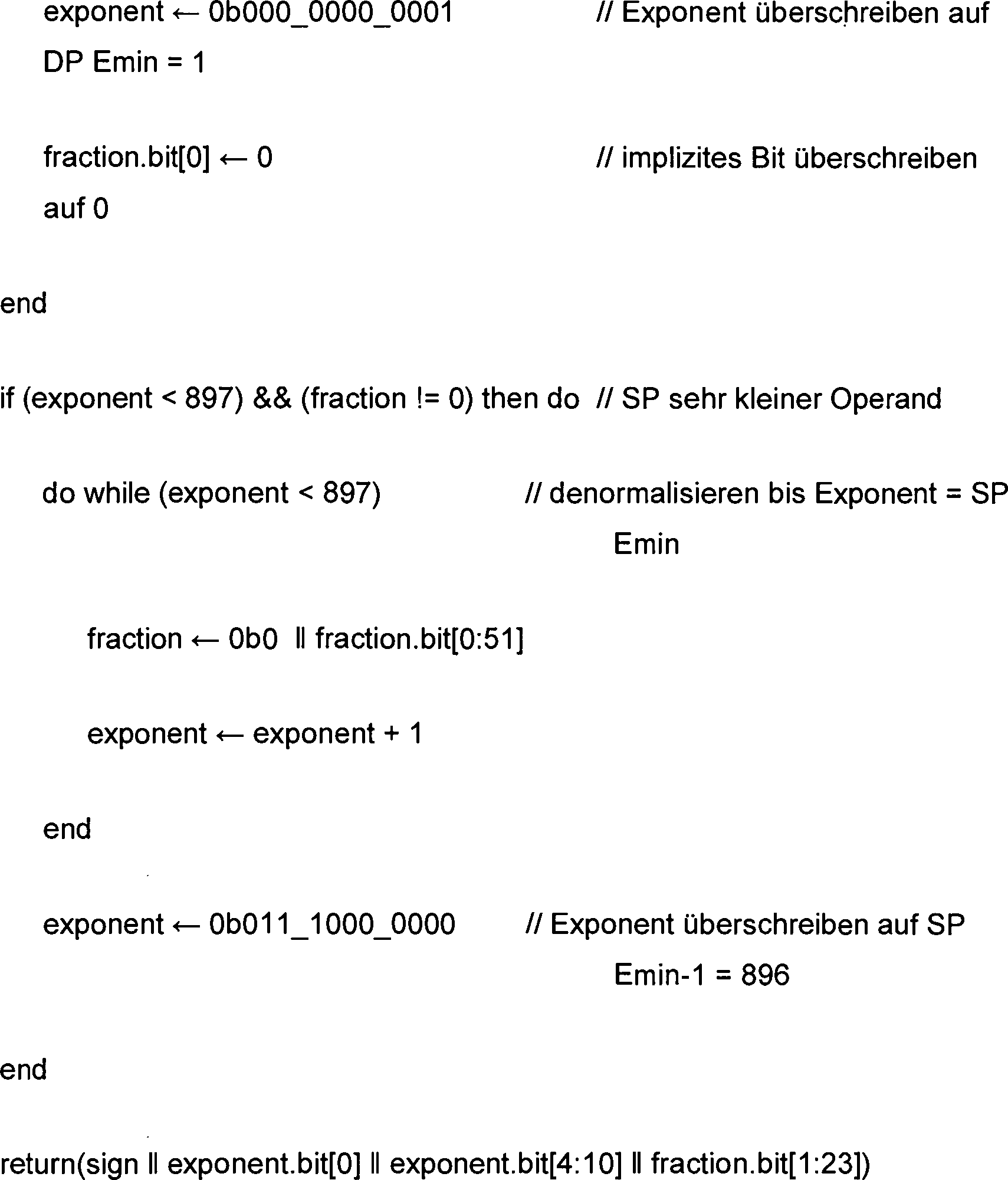
Wenn x nicht mit einfacher Präzision darstellbar ist, werden einige Exponenten- und/oder Mantissen-Bits verworfen, die wahrscheinlich unerwünschte Ergebnisse erzeugen. Die niedrigstwertigen 29 Bits der Mantisse von x werden verworfen, mehr, wenn der unverzerrte Exponent von x kleiner ist als –126 (d. h. denormal). Finite Werte von x mit einem unverzerrten Exponenten, der kleiner ist als –155, geben ein Ergebnis von Null zurück. Finite Werte von x mit einem unverzerrten Exponenten, der größer ist als +127, führen zu einem Verwerfen von Mantissenbits des Exponenten. SNaN-Eingaben ohne Mantissenbits in den oberen Bits der Mantisse geben Unendlichkeit als das Ergebnis zurück. Für keinen dieser Fälle wird ein Status gesetzt.If x can not be represented with simple precision, some exponent and / or mantissa bits are discarded which are likely to produce undesirable results. The least significant 29 bits of the mantissa of x are discarded, more if the undistorted exponent of x is less than -126 (i.e., denormal). Finite values of x with an undistorted exponent less than -155 return a result of zero. Finite values of x with an undistorted exponent greater than +127 will discard mantissa bits of the exponent. SNaN inputs without mantissa bits in the upper bits of the mantissa return infinity as the result. For none of these cases will a status be set.
ConvertSPtoDP_NS(x)ConvertSPtoDP_NS (x)
- x ist ein Gleitkommawert mit einfacher Präzision.x is a floating-point value with simple precision.
- Gibt x im Format mit doppelter Präzision zurück.Returns x in double-precision format.
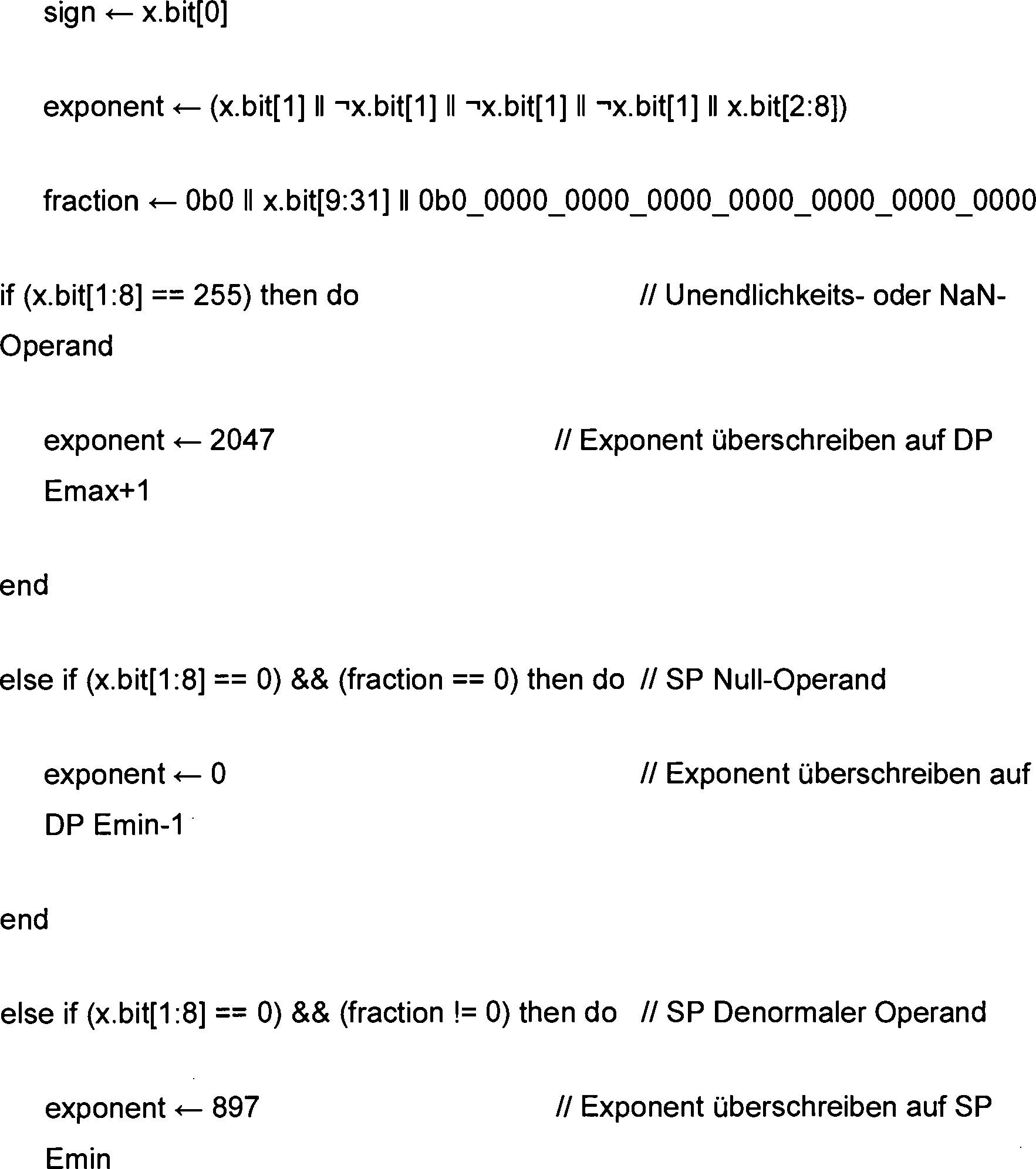

Scalar round Double-Precision to single-precision and Convert to Single-Precision format 
In einem Beispiel enthält diese Anweisung zwei Felder, die einen Operationscode identifizieren (wobei z. B. ein Feld, Bits 0 bis 5, einen primären Operationscode aufweist, der mit einem erweiterten Operationscode eines anderen Felds, Bits 21 bis 3029 kombiniert (z. B. verkettet) ist), um die Anweisung zu identifizieren; ein erstes Feld (z. B. ST-Feld; Bits 6 bis 10) und ein erstes Bit (z. B. SXTX-Feld; Bit 31); und ein zweites Feld (z. B. RA; Bits 11 bis 15). B-Feld; Bits 16 bis 20) und ein zweites Bit (z. B. BX-Feld; Bit 30), die ein zweites Register angeben. 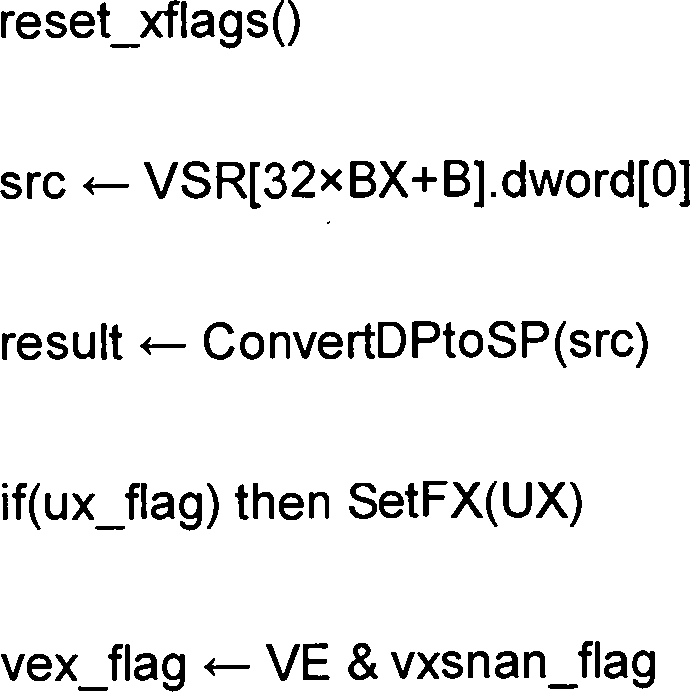
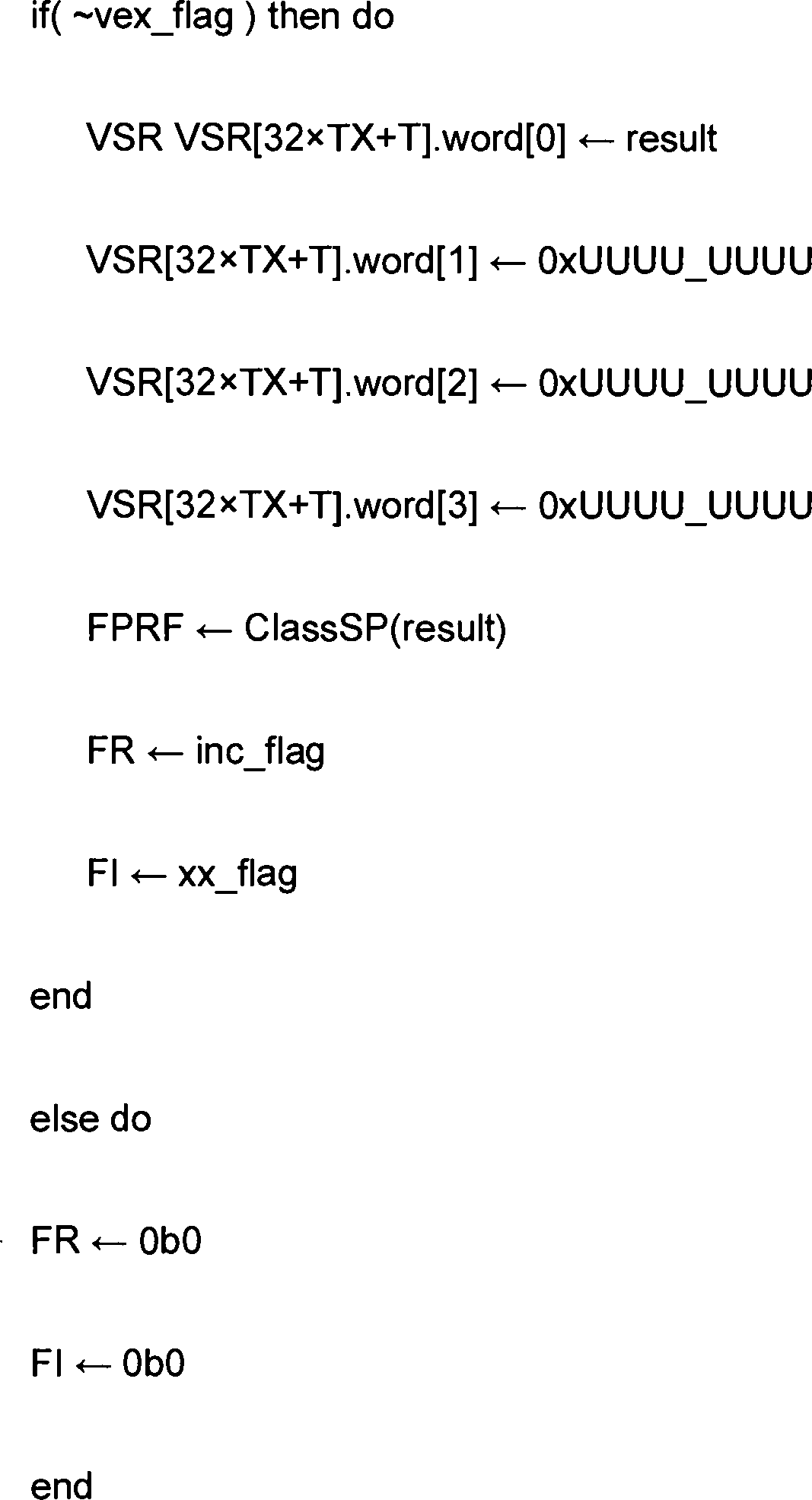
- XT sei der Wert TX, der mit T verkettet ist.
- XB sei der Wert BX, der mit B verkettet ist.
- src sei der Gleitkommawert mit doppelter
Präzision im Doppelwortelement 0 von VSR[XB]. - Wenn src eine SNaN ist, lautet das Ergebnis src, umgewandelt in eine QNaN (d. h. Bit 12 von src wird
auf 1 gesetzt). VXSNAN wird auf 1 gesetzt. - Ansonsten, wenn src eine QNaN, eine Unendlichkeit oder eine Null ist, ist das Ergebnis src.
- Ansonsten ist das Ergebnis src, unter Verwendung des durch RN angegebenen Rundungsmodus auf einfache Präzision gerundet.
- Let XT be the value TX concatenated with T.
- Let XB be the value BX concatenated with B.
- Let src be the double precision floating point value in
double word element 0 of VSR [XB]. - If src is a SNaN, the result is src, converted to a QNaN (ie bit 12 of src is set to 1). VXSNAN is set to 1.
- Otherwise, if src is a QNaN, an infinity or a zero, the result is src.
- Otherwise, the result src is rounded to simple precision using the rounding mode indicated by RN.
Das Ergebnis wird in das Wortelement 0 von VSR[XT] im Format mit einfacher Präzision gestellt.The result is placed in the
Die Inhalte der Doppelwortelemente 1, 2 und 3 von VSR[XT] sind nicht definiert.The contents of the
FPRF wird auf die Klasse und das Vorzeichen des Ergebnisses eingestellt. FR wird so eingerichtet, dass angegeben wird, ob das Ergebnis beim Runden erhöht worden ist. FI wird so eingerichtet, dass angegeben wird, ob das Ergebnis ungenau ist.FPRF is set to the class and sign of the result. FR is set up to indicate whether the result has been increased in the round. FI is set up to indicate if the result is inaccurate.
Wenn eine Ausnahme Invalid Operation mit Trap-Aktivierung auftritt, werden VSR[XT] und FPRF nicht modifiziert, und FR und FI werden auf 0 gesetzt.When an exception Invalid operation with trap activation occurs, VSR [XT] and FPRF are not modified, and FR and FI are set to 0.
Geänderte Sonderregister 
VSR-Datenlayout für xscvdpspVSR data layout for xscvdpsp
-
src = VSR[XB]src = VSR [XB] -
Die Bits 0 bis 63 von 128 Bits enthalten DP
Bits 0 to 63 of 128 bits contain DP
-
tgt = VSR[XT]tgt = VSR [XT] -
Die Bits 0 bis 31 von 128 Bits enthalten SP
Bits 0 to 31 of 128 bits contain SP
Scalar Convert Scalar Single-Precision to Vector Single-Precision format Non-signalling 
In einem Beispiel enthält diese Anweisung zwei Felder, die einen Operationscode identifizieren (wobei z. B. ein Feld, Bits 0 bis 5, einen primären Operationscode aufweist, der mit einem erweiterten Operationscode eines anderen Felds, Bits 21 bis 29 kombiniert (z. B. verkettet) ist), um die Anweisung zu identifizieren; ein erstes Feld (z. B. T-Feld; Bits 6 bis 10) und ein erstes Bit (z. B. TX-Feld; Bit 31); und ein zweites Feld (z. B. B-Feld; Bits 16 bis 20) und ein zweites Bit (z. B. BX-Feld; Bit 30). 
- XT sei der Wert TX, der mit T verkettet ist.
- XB sei der Wert BX, der mit B verkettet ist.
- src sei der Gleitkommawert mit einfacher
Präzision im Doppelwortelement 0 von VSR[XB], dargestellt im Format mit doppelter Präzision. - src wird in
das Wortelement 0 von VSR[XT] im Format mit einfacher Präzision gestellt.
- Let XT be the value TX concatenated with T.
- Let XB be the value BX concatenated with B.
- src is the single-precision floating-point value in VSR double word element 0 [XB] represented in double-precision format.
- src is placed in the
word element 0 of VSR [XT] in single-precision format.
Die Inhalte der Doppelwortelemente 1, 2 und 3 von VSR[XT] sind nicht definiert.The contents of the
Geänderte SonderregisterChanged special registers
- KeineNone
VSR-Datenlayout für xscvdpspnVSR data layout for xscvdpspn
-
src = VSR[XB]src = VSR [XB] -
Die Bits 0 bis 63 von 128 Bits enthalten SP
Bits 0 through 63 of 128 bits contain SP
-
tgt = VSR[XT] tgt = VSR [XT] -
Die Bits 0 bis 31 von 128 Bits enthalten SP
Bits 0 to 31 of 128 bits contain SP
- xscvdpsp soll zum Umwandeln eines skalaren Werts mit doppelter Präzision in ein Vektorformat mit einfacher Präzision verwendet werden.xscvdpsp is meant to be used to convert a double precision scalar value into a single precision vector format.
- xscvdpspn soll zum Umwandeln eines skalaren Werts mit einfacher Präzision in ein Vektorformat mit einfacher Präzision verwendet werden.xscvdpspn is meant to be used to convert a single precision scalar value into a single precision vector format.
Scalar Convert Single-Precision to Double-Precision format 
In einem Beispiel enthält diese Anweisung zwei Felder, die einen Operationscode identifizieren (wobei z. B. ein Feld, Bits 0 bis 5, einen primären Operationscode aufweist, der mit einem erweiterten Operationscode eines anderen Felds, Bits 21 bis 29 kombiniert (z. B. verkettet) ist), um die Anweisung zu identifizieren; ein erstes Feld (z. B. T-Feld; Bits 6 bis 10) und ein erstes Bit (z. B. TX-Feld; Bit 31); und ein zweites Feld (z. B. B-Feld) und ein zweites Bit (z. B. BX-Feld; Bit 30). 
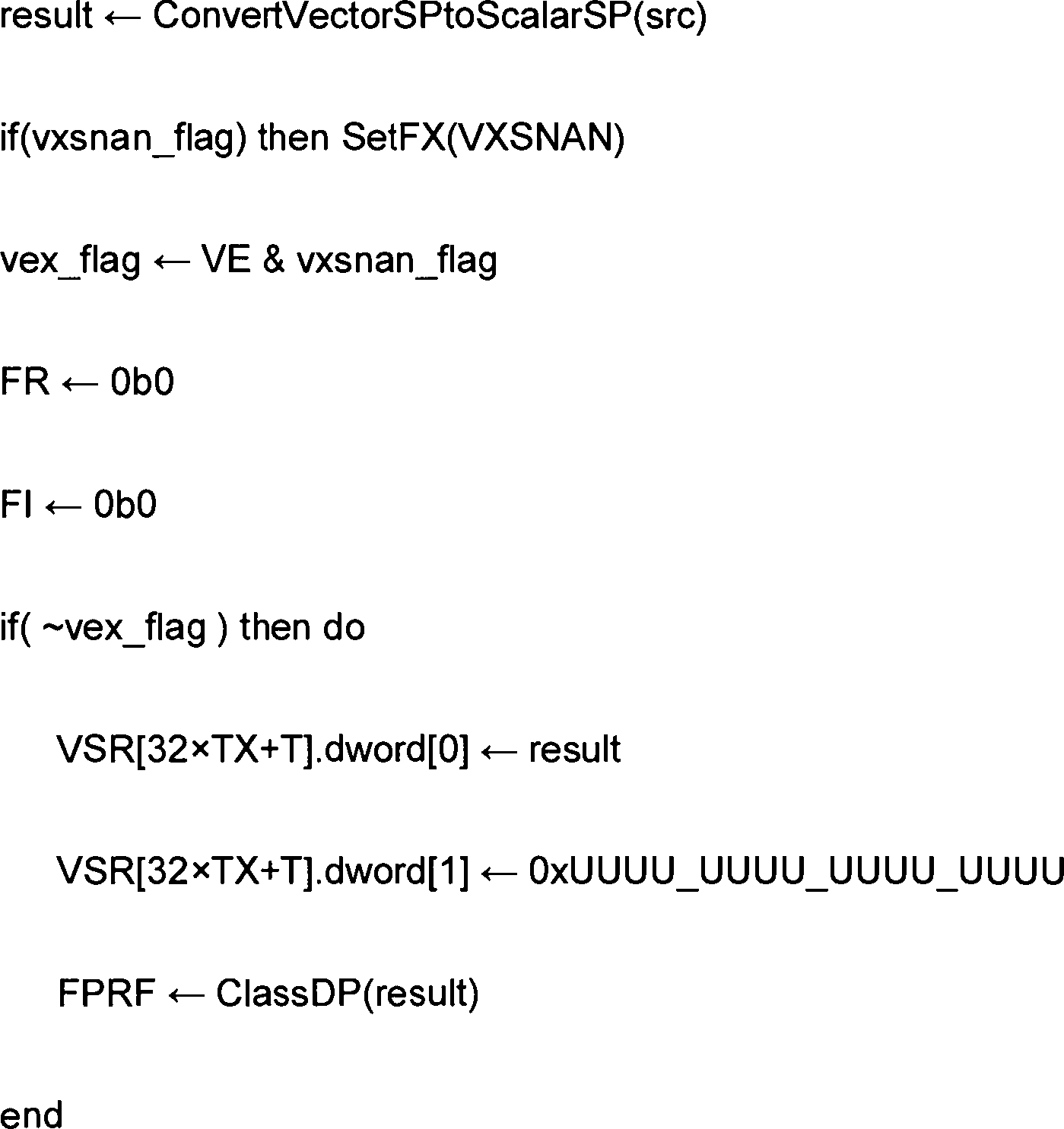
- XT sei der Wert TX, der mit T verkettet ist.
- XB sei der Wert BX, der mit B verkettet ist.
- src sei der Gleitkommawert mit einfacher
Präzision im Wortelement 0 von VSR[XB]. - Wenn src eine SNaN ist, lautet das Ergebnis src, umgewandelt in eine QNaN (d. h. Bit 9 von src wird
auf 1 gesetzt). VXSNAN wird auf 1 gesetzt. - Ansonsten ist das Ergebnis src.
- Let XT be the value TX concatenated with T.
- Let XB be the value BX concatenated with B.
- Let src be the single-precision floating-point value in
word element 0 of VSR [XB]. - If src is a SNaN, the result is src, converted to a QNaN (ie bit 9 of src is set to 1). VXSNAN is set to 1.
- Otherwise, the result is src.
Das Ergebnis wird in das Doppelwortelement 0 von VSR[XT] im Format mit doppelter Präzision gestellt.The result is placed in
Die Inhalte des Doppelwortelements 1 von VSR[XT] sind nicht definiert.The contents of the
FPRF wird auf die Klasse und das Vorzeichen des Ergebnisses eingestellt. FR wird auf 0 gesetzt. FI wird auf 0 gesetzt.FPRF is set to the class and sign of the result. FR is set to 0. FI is set to 0.
Wenn eine Ausnahme Invalid Operation mit Trap-Aktivierung auftritt, wird VSR[XT] nicht modifiziert, FPRF wird nicht modifiziert, FR wird auf 0 gesetzt und FI wird auf 0 gesetzt.When an exception Invalid operation with trap activation occurs, VSR [XT] is not modified, FPRF is not modified, FR is set to 0 and FI is set to 0.
Geänderte Sonderregister 
VSR Data Layout for xscvspdpVSR Data Layout for xscvspdp
-
src = VSR[XB]src = VSR [XB] -
Die Bits 0 bis 31 von 128 Bits enthalten SP.
Bits 0 to 31 of 128 bits contain SP.
-
tgt = VSR[XT]tgt = VSR [XT] -
Die Bits 0 bis 63 von 128 Bits enthalten DP.
Bits 0 to 63 of 128 bits contain DP.
Scalar Convert Single-Precision to Double-Precision format Non-signalling 
In einem Beispiel enthält diese Anweisung zwei Felder, die einen Operationscode identifizieren (wobei z. B. ein Feld, Bits 0 bis 5, einen primären Operationscode aufweist, der mit einem erweiterten Operationscode eines anderen Felds, Bits 21 bis 

- XT sei der Wert TX, der mit T verkettet ist.
- XB sei der Wert BX, der mit B verkettet ist.
- src sei der Gleitkommawert mit einfacher
Präzision im Wortelement 0 von VSR[XB]. - src wird in
das Doppelwortelement 0 von VSR[XT] im Format mit doppelter Präzision gestellt.
- Let XT be the value TX concatenated with T.
- Let XB be the value BX concatenated with B.
- Let src be the single-precision floating-point value in
word element 0 of VSR [XB]. - src is placed in
double word element 0 of VSR [XT] in double precision format.
Die Inhalte des Doppelwortelements 1 von VSR[XT] sind nicht definiert.The contents of the
Geänderte Sonderregister Changed special registers
- KeineNone
VSR Data Layout for xscvspdpnVSR Data Layout for xscvspdpn
-
src = VSR[XB]src = VSR [XB] -
Die Bits 0 bis 31 von 128 Bits enthalten SP
Bits 0 to 31 of 128 bits contain SP
-
tgt = VSR[XT]tgt = VSR [XT] -
Die Bits 0 bis 63 von 128 Bits enthalten DPxscvspdp soll zum Umwandeln eines Vektor-Gleitkommawerts mit einfacher Präzision in ein skalares Format mit doppelter Präzision verwendet werden.
Bits 0 to 63 of 128 bits contain DPxscvspdp to be used to convert a single precision floating point vector value into a double precision scalar format.
- xscvspdpn soll zum Umwandeln eines Vektor-Gleitkommawerts mit einfacher Präzision in ein skalares Format mit einfacher Präzision verwendet werden.xscvspdpn is meant to be used to convert a single precision floating point vector value into a single precision scalar format.
VSX Logical Equivalent 
In einem Beispiel enthält diese Anweisung zwei Felder, die einen Operationscode identifizieren (wobei z. B. ein Feld, Bits 0 bis 5, einen primären Operationscode aufweist, der mit einem erweiterten Operationscode eines anderen Felds, Bits 21 bis 28 kombiniert (z. B. verkettet) ist), um die Anweisung zu identifizieren; ein erstes Feld (z. B. T-Feld; Bits 6 bis 10) und ein erstes Bit (z. B. TX-Feld; Bit 31); ein zweites Feld (z. B. A-Feld; Bits 11 bis 15) und ein zweites Bit (z. B. AX-Feld; Bit 29); und ein drittes Feld (z. B. B-Feld; Bits 16 bis 20) und ein drittes Bit (z. B. BX-Feld; Bit 30). 
- XT sei der Wert TX, der mit T verkettet ist.
- XA sei der Wert AX, der mit A verkettet ist.
- XB sei der Wert BX, der mit B verkettet ist.
- Let XT be the value TX concatenated with T.
- Let XA be the value AX concatenated with A.
- Let XB be the value BX concatenated with B.
Die Inhalte von VSR[XA] werden einer XOR-Verknüpfung mit den Inhalten von VSR[XB] unterzogen und das ergänzte Ergebnis wird in VSR[XT] gestellt.The contents of VSR [XA] are XORed with the contents of VSR [XB] and the supplemented result is put in VSR [XT].
Geänderte Sonderregister:Changed special registers:
- KeineNone
VSX Logical NAND 
In einem Beispiel enthält diese Anweisung zwei Felder, die einen Operationscode identifizieren (wobei z. B. ein Feld, Bits 0 bis 5, einen primären Operationscode aufweist, der mit einem erweiterten Operationscode eines anderen Felds, Bits 21 bis 28 kombiniert (z. B. verkettet) ist), um die Anweisung zu identifizieren; ein erstes Feld (z. B. T-Feld; Bits 6 bis 10) und ein erstes Bit (z. B. TX-Feld; Bit 31); ein zweites Feld (z. B. A-Feld; Bits 11 bis 15) und ein zweites Bit (z. B. AX-Feld; Bit 29); und ein drittes Feld (z. B. B-Feld; Bits 16 bis 20) und ein drittes Bit (z. B. BX-Feld; Bit 30). 
- XT sei der Wert TX, der mit T verkettet ist.
- XA sei der Wert AX, der mit A verkettet ist.
- XB sei der Wert BX, der mit B verkettet ist.
- Let XT be the value TX concatenated with T.
- Let XA be the value AX concatenated with A.
- Let XB be the value BX concatenated with B.
Die Inhalte von VSR[XA] werden einer UND-Verknüpfung mit den Inhalten von VSR[XB] unterzogen und das ergänzte Ergebnis wird in VSR[XT] gestellt.The contents of VSR [XA] are ANDed with the contents of VSR [XB] and the supplemented result is placed in VSR [XT].
Geänderte Sonderregister:Changed special registers:
- KeineNone
VSX Logical OR with Complement 
In einem Beispiel enthält diese Anweisung zwei Felder, die einen Operationscode identifizieren (wobei z. B. ein Feld, Bits 0 bis 5, einen primären Operationscode aufweist, der mit einem erweiterten Operationscode eines anderen Felds, Bits 21 bis 28 kombiniert (z. B. verkettet) ist), um die Anweisung zu identifizieren; ein erstes Feld (z. B. T-Feld; Bits 6 bis 10) und ein erstes Bit (z. B. TX-Feld; Bit 31); ein zweites Feld (z. B. A-Feld; Bits 11 bis 15) und ein zweites Bit (z. B. AX-Feld; Bit 29); und ein drittes Feld (z. B. B-Feld; Bits 16 bis 20) und ein drittes Bit (z. B. BX-Feld; Bit 30). 
- XT sei der Wert TX, der mit T verkettet ist.
- XA sei der Wert AX, der mit A verkettet ist.
- XB sei der Wert BX, der mit B verkettet ist.
- Let XT be the value TX concatenated with T.
- Let XA be the value AX concatenated with A.
- Let XB be the value BX concatenated with B.
Die Inhalte von VSR[XA] werden einer ODER-Verknüpfung mit dem Komplement der Inhalte von VSR[XB] unterzogen und das Ergebnis wird in VSR[XT] gestellt.The contents of VSR [XA] are ORed with the complement of the contents of VSR [XB] and the result is placed in VSR [XT].
Geänderte Sonderregister:Changed special registers:
- KeineNone
Claims (21)
Applications Claiming Priority (3)
| Application Number | Priority Date | Filing Date | Title |
|---|---|---|---|
| US13/234,520 US9411585B2 (en) | 2011-09-16 | 2011-09-16 | Multi-addressable register files and format conversions associated therewith |
| US13/234,520 | 2011-09-16 | ||
| PCT/IB2012/054582 WO2013038302A1 (en) | 2011-09-16 | 2012-09-05 | Multi-addressable register files and format conversions associated therewith |
Publications (1)
| Publication Number | Publication Date |
|---|---|
| DE112012003864T5 true DE112012003864T5 (en) | 2014-07-10 |
Family
ID=47881772
Family Applications (1)
| Application Number | Title | Priority Date | Filing Date |
|---|---|---|---|
| DE112012003864.9T Withdrawn DE112012003864T5 (en) | 2011-09-16 | 2012-09-05 | Multiple addressable register files and associated format conversions |
Country Status (6)
| Country | Link |
|---|---|
| US (2) | US9411585B2 (en) |
| JP (1) | JP5963866B2 (en) |
| CN (1) | CN103797459B (en) |
| DE (1) | DE112012003864T5 (en) |
| GB (1) | GB2509037B (en) |
| WO (1) | WO2013038302A1 (en) |
Families Citing this family (22)
| Publication number | Priority date | Publication date | Assignee | Title |
|---|---|---|---|---|
| US8281109B2 (en) * | 2007-12-27 | 2012-10-02 | Intel Corporation | Compressed instruction format |
| US9323529B2 (en) * | 2012-07-18 | 2016-04-26 | International Business Machines Corporation | Reducing register read ports for register pairs |
| US9298459B2 (en) | 2012-07-18 | 2016-03-29 | International Business Machines Corporation | Managing register pairing |
| US9323532B2 (en) * | 2012-07-18 | 2016-04-26 | International Business Machines Corporation | Predicting register pairs |
| US9729167B2 (en) * | 2013-10-01 | 2017-08-08 | Oracle International Corporation | System and method for conversion of numeric values between different number base formats, for use with software applications |
| US10061581B2 (en) | 2014-01-31 | 2018-08-28 | Qualcomm Incorporated | On-the-fly conversion during load/store operations in a vector processor |
| US9529653B2 (en) * | 2014-10-09 | 2016-12-27 | International Business Machines Corporation | Processor register error correction management |
| US10235219B2 (en) * | 2015-07-27 | 2019-03-19 | Sony Interactive Entertainment America Llc | Backward compatibility by algorithm matching, disabling features, or throttling performance |
| CN107315715B (en) * | 2016-04-26 | 2020-11-03 | 中科寒武纪科技股份有限公司 | An apparatus and method for performing matrix addition/subtraction operations |
| GB2553783B (en) | 2016-09-13 | 2020-11-04 | Advanced Risc Mach Ltd | Vector multiply-add instruction |
| US10459843B2 (en) * | 2016-12-30 | 2019-10-29 | Texas Instruments Incorporated | Streaming engine with separately selectable element and group duplication |
| US10175944B2 (en) * | 2017-04-12 | 2019-01-08 | Intel Corporation | Mixed-precision floating-point arithmetic circuitry in specialized processing blocks |
| US11093822B2 (en) | 2017-04-28 | 2021-08-17 | Intel Corporation | Variable precision and mix type representation of multiple layers in a network |
| US10282206B1 (en) * | 2017-05-16 | 2019-05-07 | Cadence Design Systems, Inc. | Alias register file for supporting mixed width datapath in a configurable processor |
| US10338925B2 (en) | 2017-05-24 | 2019-07-02 | Microsoft Technology Licensing, Llc | Tensor register files |
| US10372456B2 (en) | 2017-05-24 | 2019-08-06 | Microsoft Technology Licensing, Llc | Tensor processor instruction set architecture |
| US10514913B2 (en) * | 2017-06-23 | 2019-12-24 | International Business Machines Corporation | Compiler controls for program regions |
| US10725739B2 (en) | 2017-06-23 | 2020-07-28 | International Business Machines Corporation | Compiler controls for program language constructs |
| CN111275197B (en) * | 2018-12-05 | 2023-11-10 | 上海寒武纪信息科技有限公司 | Computing methods, devices, computer equipment and storage media |
| US11372643B2 (en) | 2018-11-09 | 2022-06-28 | Intel Corporation | Systems and methods for performing instructions to convert to 16-bit floating-point format |
| CN112181494B (en) * | 2020-09-28 | 2022-07-19 | 中国人民解放军国防科技大学 | A Realization Method of Floating Point Physical Register File |
| US12405792B2 (en) * | 2023-09-27 | 2025-09-02 | Qualcomm Incorporated | Processing unit including a dynamically allocatable vector register file for non-vector instruction processing |
Family Cites Families (71)
| Publication number | Priority date | Publication date | Assignee | Title |
|---|---|---|---|---|
| US4595911A (en) | 1983-07-14 | 1986-06-17 | Sperry Corporation | Programmable data reformat system |
| US5341506A (en) * | 1984-12-10 | 1994-08-23 | Nec Corporation | Data flow processor with a full-to-half word convertor |
| US4758585A (en) | 1985-08-16 | 1988-07-19 | Warner-Lambert Company | Saturated cycloalkyl (B) pyrrol-1 (2H)- acetic acid amides and derivatives thereof |
| US4748585A (en) | 1985-12-26 | 1988-05-31 | Chiarulli Donald M | Processor utilizing reconfigurable process segments to accomodate data word length |
| JPS62249230A (en) | 1986-04-23 | 1987-10-30 | Pfu Ltd | arithmetic processing unit |
| US5063497A (en) | 1987-07-01 | 1991-11-05 | Digital Equipment Corporation | Apparatus and method for recovering from missing page faults in vector data processing operations |
| US5278840A (en) | 1987-07-01 | 1994-01-11 | Digital Equipment Corporation | Apparatus and method for data induced condition signalling |
| WO1991011765A1 (en) | 1990-01-29 | 1991-08-08 | Teraplex, Inc. | Architecture for minimal instruction set computing system |
| EP0446721B1 (en) | 1990-03-16 | 2000-12-20 | Texas Instruments Incorporated | Distributed processing memory |
| JP2651267B2 (en) * | 1990-07-26 | 1997-09-10 | 富士通株式会社 | Arithmetic processing device and arithmetic processing method |
| JP2616182B2 (en) | 1990-08-29 | 1997-06-04 | 三菱電機株式会社 | Data processing device |
| US5493687A (en) | 1991-07-08 | 1996-02-20 | Seiko Epson Corporation | RISC microprocessor architecture implementing multiple typed register sets |
| US5437043A (en) | 1991-11-20 | 1995-07-25 | Hitachi, Ltd. | Information processing apparatus having a register file used interchangeably both as scalar registers of register windows and as vector registers |
| US5278945A (en) | 1992-01-10 | 1994-01-11 | American Neuralogical, Inc. | Neural processor apparatus |
| US5423051A (en) | 1992-09-24 | 1995-06-06 | International Business Machines Corporation | Execution unit with an integrated vector operation capability |
| US5341320A (en) | 1993-03-01 | 1994-08-23 | Motorola, Inc. | Method for rapidly processing floating-point operations which involve exceptions |
| US5450607A (en) | 1993-05-17 | 1995-09-12 | Mips Technologies Inc. | Unified floating point and integer datapath for a RISC processor |
| US5669013A (en) | 1993-10-05 | 1997-09-16 | Fujitsu Limited | System for transferring M elements X times and transferring N elements one time for an array that is X*M+N long responsive to vector type instructions |
| US5487022A (en) | 1994-03-08 | 1996-01-23 | Texas Instruments Incorporated | Normalization method for floating point numbers |
| DE69519449T2 (en) | 1994-05-05 | 2001-06-21 | Conexant Systems, Inc. | Space pointer data path |
| US5685009A (en) | 1994-07-20 | 1997-11-04 | Exponential Technology, Inc. | Shared floating-point registers and register port-pairing in a dual-architecture CPU |
| US5758176A (en) | 1994-09-28 | 1998-05-26 | International Business Machines Corporation | Method and system for providing a single-instruction, multiple-data execution unit for performing single-instruction, multiple-data operations within a superscalar data processing system |
| US5537606A (en) | 1995-01-31 | 1996-07-16 | International Business Machines Corporation | Scalar pipeline replication for parallel vector element processing |
| US5805475A (en) | 1995-02-10 | 1998-09-08 | International Business Machines Corporation | Load-store unit and method of loading and storing single-precision floating-point registers in a double-precision architecture |
| US5668984A (en) | 1995-02-27 | 1997-09-16 | International Business Machines Corporation | Variable stage load path and method of operation |
| US5761103A (en) | 1995-03-08 | 1998-06-02 | Texas Instruments Incorporated | Left and right justification of single precision mantissa in a double precision rounding unit |
| US5825678A (en) | 1995-03-31 | 1998-10-20 | International Business Machines Corporation | Method and apparatus for determining floating point data class |
| US5822778A (en) | 1995-06-07 | 1998-10-13 | Advanced Micro Devices, Inc. | Microprocessor and method of using a segment override prefix instruction field to expand the register file |
| US6295599B1 (en) | 1995-08-16 | 2001-09-25 | Microunity Systems Engineering | System and method for providing a wide operand architecture |
| US5623600A (en) | 1995-09-26 | 1997-04-22 | Trend Micro, Incorporated | Virus detection and removal apparatus for computer networks |
| US5768169A (en) | 1995-10-02 | 1998-06-16 | Intel Corporation | Method and apparatus for improved processing of numeric applications in the presence of subnormal numbers in a computer system |
| US6792523B1 (en) | 1995-12-19 | 2004-09-14 | Intel Corporation | Processor with instructions that operate on different data types stored in the same single logical register file |
| US5701508A (en) | 1995-12-19 | 1997-12-23 | Intel Corporation | Executing different instructions that cause different data type operations to be performed on single logical register file |
| US6058465A (en) | 1996-08-19 | 2000-05-02 | Nguyen; Le Trong | Single-instruction-multiple-data processing in a multimedia signal processor |
| US6195746B1 (en) | 1997-01-31 | 2001-02-27 | International Business Machines Corporation | Dynamically typed register architecture |
| US6009511A (en) | 1997-06-11 | 1999-12-28 | Advanced Micro Devices, Inc. | Apparatus and method for tagging floating point operands and results for rapid detection of special floating point numbers |
| DE69820067D1 (en) | 1997-07-31 | 2004-01-08 | Corning Oti Srl | ACUSTO-OPTICAL DEVICES WITH ACOUSTIC ABSORBER |
| US5978901A (en) | 1997-08-21 | 1999-11-02 | Advanced Micro Devices, Inc. | Floating point and multimedia unit with data type reclassification capability |
| US6131104A (en) | 1998-03-27 | 2000-10-10 | Advanced Micro Devices, Inc. | Floating point addition pipeline configured to perform floating point-to-integer and integer-to-floating point conversion operations |
| US6178482B1 (en) | 1997-11-03 | 2001-01-23 | Brecis Communications | Virtual register sets |
| US6237083B1 (en) | 1998-02-13 | 2001-05-22 | Advanced Micro Devices, Inc. | Microprocessor including multiple register files mapped to the same logical storage and inhibiting sychronization between the register files responsive to inclusion of an instruction in an instruction sequence |
| US6105129A (en) | 1998-02-18 | 2000-08-15 | Advanced Micro Devices, Inc. | Converting register data from a first format type to a second format type if a second type instruction consumes data produced by a first type instruction |
| EP0942357A3 (en) | 1998-03-11 | 2000-03-22 | Matsushita Electric Industrial Co., Ltd. | Data processor compatible with a plurality of instruction formats |
| JP3901670B2 (en) | 1998-03-11 | 2007-04-04 | 松下電器産業株式会社 | Data processing device |
| US6192467B1 (en) | 1998-03-31 | 2001-02-20 | Intel Corporation | Executing partial-width packed data instructions |
| US6185671B1 (en) | 1998-03-31 | 2001-02-06 | Intel Corporation | Checking data type of operands specified by an instruction using attributes in a tagged array architecture |
| US6263426B1 (en) * | 1998-04-30 | 2001-07-17 | Intel Corporation | Conversion from packed floating point data to packed 8-bit integer data in different architectural registers |
| US5995122A (en) | 1998-04-30 | 1999-11-30 | Intel Corporation | Method and apparatus for parallel conversion of color values from a single precision floating point format to an integer format |
| US6292815B1 (en) | 1998-04-30 | 2001-09-18 | Intel Corporation | Data conversion between floating point packed format and integer scalar format |
| US6282554B1 (en) | 1998-04-30 | 2001-08-28 | Intel Corporation | Method and apparatus for floating point operations and format conversion operations |
| US6282634B1 (en) | 1998-05-27 | 2001-08-28 | Arm Limited | Apparatus and method for processing data having a mixed vector/scalar register file |
| JP3123047B2 (en) | 1998-10-02 | 2001-01-09 | 日本電気株式会社 | Microprocessor |
| US6163764A (en) * | 1998-10-12 | 2000-12-19 | Intel Corporation | Emulation of an instruction set on an instruction set architecture transition |
| US6321327B1 (en) | 1998-12-30 | 2001-11-20 | Intel Corporation | Method for setting a bit associated with each component of packed floating-pint operand that is normalized in SIMD operations |
| US6857061B1 (en) | 2000-04-07 | 2005-02-15 | Nintendo Co., Ltd. | Method and apparatus for obtaining a scalar value directly from a vector register |
| US6715061B1 (en) | 2000-07-12 | 2004-03-30 | Via Technologies, Inc. | Multimedia-instruction acceleration device for increasing efficiency and method for the same |
| JP3779540B2 (en) | 2000-11-08 | 2006-05-31 | 株式会社ルネサステクノロジ | SIMD operation method that can specify multiple registers |
| US6839828B2 (en) | 2001-08-14 | 2005-01-04 | International Business Machines Corporation | SIMD datapath coupled to scalar/vector/address/conditional data register file with selective subpath scalar processing mode |
| US6934830B2 (en) | 2002-09-26 | 2005-08-23 | Sun Microsystems, Inc. | Method and apparatus for reducing register file access times in pipelined processors |
| US7430656B2 (en) | 2002-12-31 | 2008-09-30 | Intel Corporation | System and method of converting data formats and communicating between execution units |
| US20040158741A1 (en) | 2003-02-07 | 2004-08-12 | Peter Schneider | System and method for remote virus scanning in wireless networks |
| GB2409063B (en) | 2003-12-09 | 2006-07-12 | Advanced Risc Mach Ltd | Vector by scalar operations |
| US7284092B2 (en) | 2004-06-24 | 2007-10-16 | International Business Machines Corporation | Digital data processing apparatus having multi-level register file |
| US7257695B2 (en) | 2004-12-28 | 2007-08-14 | Intel Corporation | Register file regions for a processing system |
| US8904151B2 (en) * | 2006-05-02 | 2014-12-02 | International Business Machines Corporation | Method and apparatus for the dynamic identification and merging of instructions for execution on a wide datapath |
| KR101386470B1 (en) * | 2007-07-16 | 2014-04-18 | 엘지전자 주식회사 | Washing machine |
| US7849294B2 (en) * | 2008-01-31 | 2010-12-07 | International Business Machines Corporation | Sharing data in internal and memory representations with dynamic data-driven conversion |
| US7877582B2 (en) | 2008-01-31 | 2011-01-25 | International Business Machines Corporation | Multi-addressable register file |
| US8291496B2 (en) | 2008-05-12 | 2012-10-16 | Enpulz, L.L.C. | Server based malware screening |
| US8346828B2 (en) | 2008-10-14 | 2013-01-01 | International Business Machines Corporation | System and method for storing numbers in first and second formats in a register file |
| US8458684B2 (en) | 2009-08-19 | 2013-06-04 | International Business Machines Corporation | Insertion of operation-and-indicate instructions for optimized SIMD code |
-
2011
- 2011-09-16 US US13/234,520 patent/US9411585B2/en not_active Expired - Fee Related
-
2012
- 2012-09-05 DE DE112012003864.9T patent/DE112012003864T5/en not_active Withdrawn
- 2012-09-05 WO PCT/IB2012/054582 patent/WO2013038302A1/en not_active Ceased
- 2012-09-05 JP JP2014530347A patent/JP5963866B2/en not_active Expired - Fee Related
- 2012-09-05 GB GB1406331.7A patent/GB2509037B/en active Active
- 2012-09-05 CN CN201280045033.7A patent/CN103797459B/en active Active
- 2012-12-17 US US13/716,998 patent/US9395981B2/en not_active Expired - Fee Related
Also Published As
| Publication number | Publication date |
|---|---|
| GB2509037A (en) | 2014-06-18 |
| WO2013038302A1 (en) | 2013-03-21 |
| US20130103932A1 (en) | 2013-04-25 |
| GB2509037B (en) | 2016-03-23 |
| US9411585B2 (en) | 2016-08-09 |
| CN103797459B (en) | 2016-10-05 |
| JP5963866B2 (en) | 2016-08-03 |
| US20130073838A1 (en) | 2013-03-21 |
| JP2014533390A (en) | 2014-12-11 |
| GB201406331D0 (en) | 2014-05-21 |
| CN103797459A (en) | 2014-05-14 |
| US9395981B2 (en) | 2016-07-19 |
Similar Documents
| Publication | Publication Date | Title |
|---|---|---|
| DE112012003864T5 (en) | Multiple addressable register files and associated format conversions | |
| DE112012003837T5 (en) | Differentiated statement activation with subfunction granularity | |
| DE102018005181B4 (en) | PROCESSOR FOR A CONFIGURABLE SPATIAL ACCELERATOR WITH PERFORMANCE, ACCURACY AND ENERGY REDUCTION CHARACTERISTICS | |
| US9824063B2 (en) | Method, apparatus and instructions for parallel data conversions | |
| DE112010004887B4 (en) | Processor, system, method and machine-readable medium for performing a shift and exclusive-OR operation in a single instruction | |
| DE69233361T2 (en) | Single-chip microcomputer | |
| DE102007063809B3 (en) | Instructions and logic for processing strings | |
| TWI544407B (en) | Floating point scaling processors, methods, systems, and instructions | |
| DE69625790T2 (en) | METHOD AND DEVICE FOR ADAPTABLE OPERATIONS BY A PROCESSOR | |
| DE19735350B4 (en) | Vector processor for performing parallel operations and methods therefor | |
| DE102018005169A1 (en) | PROCESSORS AND METHODS FOR CONFIGURABLE NETWORK-BASED DATA FLUID OPERATOR CIRCUITS | |
| DE112007002101T5 (en) | Instruction and logic for performing a dot product operation | |
| DE112014006508T5 (en) | Processors, methods, systems, and instructions for floating-point addition with three source operands | |
| DE102015007943A1 (en) | Mechanisms for a weight shift in folding neural networks | |
| DE19735348A1 (en) | Digital signal parallel vector processor for multimedia applications | |
| DE112013005416T5 (en) | A method, apparatus, instructions and logic for providing vector address conflict detection functionality | |
| DE102014004563A1 (en) | Commands and logic to provide improved paging capabilities for Secure Enclave page caches | |
| DE112011105666T5 (en) | Command and logic for providing vector loading OP / memory OP with step functionality | |
| DE102015002215A1 (en) | Sorting processor, methods, systems and commands | |
| DE112014000252T5 (en) | Instruction "Vector floating point test data class immediate" | |
| DE112013005466T5 (en) | Statement "Vector generate mask" | |
| DE112013005500T5 (en) | Instruction for rotating and inserting a vector element under a mask | |
| DE112013003741T5 (en) | Systems, devices and methods for performing conflict detection and transferring contents of one register to data element locations of another register | |
| DE19735349B4 (en) | Vector processor and method of operation thereof | |
| DE112012006946T5 (en) | Method and apparatus for scheduling storage instructions across atomic domains in binary translation |
Legal Events
| Date | Code | Title | Description |
|---|---|---|---|
| R012 | Request for examination validly filed | ||
| R082 | Change of representative |
Representative=s name: SPIES & BEHRNDT PATENTANWAELTE PARTG MBB, DE Representative=s name: LIFETECH IP SPIES & BEHRNDT PATENTANWAELTE PAR, DE Representative=s name: LIFETECH IP SPIES DANNER & PARTNER PATENTANWAE, DE Representative=s name: LIFETECH IP SPIES DANNER & PARTNER, PATENTANWA, DE |
|
| R082 | Change of representative |
Representative=s name: SPIES & BEHRNDT PATENTANWAELTE PARTG MBB, DE Representative=s name: LIFETECH IP SPIES & BEHRNDT PATENTANWAELTE PAR, DE Representative=s name: LIFETECH IP SPIES DANNER & PARTNER PATENTANWAE, DE |
|
| R082 | Change of representative |
Representative=s name: SPIES & BEHRNDT PATENTANWAELTE PARTG MBB, DE Representative=s name: LIFETECH IP SPIES & BEHRNDT PATENTANWAELTE PAR, DE |
|
| R082 | Change of representative |
Representative=s name: SPIES & BEHRNDT PATENTANWAELTE PARTG MBB, DE |
|
| R016 | Response to examination communication | ||
| R119 | Application deemed withdrawn, or ip right lapsed, due to non-payment of renewal fee |