DE10349423A1 - Sulfoximine-substituted parimidines as CDK and / or VEGF inhibitors, their preparation and use as medicaments - Google Patents
Sulfoximine-substituted parimidines as CDK and / or VEGF inhibitors, their preparation and use as medicaments Download PDFInfo
- Publication number
- DE10349423A1 DE10349423A1 DE10349423A DE10349423A DE10349423A1 DE 10349423 A1 DE10349423 A1 DE 10349423A1 DE 10349423 A DE10349423 A DE 10349423A DE 10349423 A DE10349423 A DE 10349423A DE 10349423 A1 DE10349423 A1 DE 10349423A1
- Authority
- DE
- Germany
- Prior art keywords
- alkyl
- alkoxy
- group
- diseases
- optionally
- Prior art date
- Legal status (The legal status is an assumption and is not a legal conclusion. Google has not performed a legal analysis and makes no representation as to the accuracy of the status listed.)
- Ceased
Links
- 238000002360 preparation method Methods 0.000 title claims abstract description 30
- 239000003814 drug Substances 0.000 title claims abstract description 14
- 239000002525 vasculotropin inhibitor Substances 0.000 title 1
- 108091007914 CDKs Proteins 0.000 claims abstract description 34
- 102000003903 Cyclin-dependent kinases Human genes 0.000 claims abstract description 29
- 108090000266 Cyclin-dependent kinases Proteins 0.000 claims abstract description 29
- 208000037265 diseases, disorders, signs and symptoms Diseases 0.000 claims abstract description 27
- 201000010099 disease Diseases 0.000 claims abstract description 17
- 102000009484 Vascular Endothelial Growth Factor Receptors Human genes 0.000 claims abstract description 15
- 239000003112 inhibitor Substances 0.000 claims abstract description 13
- 229940079593 drug Drugs 0.000 claims abstract description 6
- XEEYBQQBJWHFJM-UHFFFAOYSA-N Iron Chemical compound [Fe] XEEYBQQBJWHFJM-UHFFFAOYSA-N 0.000 claims description 59
- -1 C 1 -C 6 -alkoxy Chemical group 0.000 claims description 56
- 150000001875 compounds Chemical class 0.000 claims description 52
- 125000002887 hydroxy group Chemical group [H]O* 0.000 claims description 51
- 229910052736 halogen Inorganic materials 0.000 claims description 40
- 150000002367 halogens Chemical class 0.000 claims description 40
- 206010028980 Neoplasm Diseases 0.000 claims description 30
- 229910052739 hydrogen Inorganic materials 0.000 claims description 27
- 239000001257 hydrogen Substances 0.000 claims description 26
- IJGRMHOSHXDMSA-UHFFFAOYSA-N Atomic nitrogen Chemical compound N#N IJGRMHOSHXDMSA-UHFFFAOYSA-N 0.000 claims description 24
- 125000001072 heteroaryl group Chemical group 0.000 claims description 24
- 239000000203 mixture Substances 0.000 claims description 20
- 108010024986 Cyclin-Dependent Kinase 2 Proteins 0.000 claims description 18
- 102100036239 Cyclin-dependent kinase 2 Human genes 0.000 claims description 18
- QVGXLLKOCUKJST-UHFFFAOYSA-N atomic oxygen Chemical compound [O] QVGXLLKOCUKJST-UHFFFAOYSA-N 0.000 claims description 18
- 229910052760 oxygen Inorganic materials 0.000 claims description 18
- 239000001301 oxygen Substances 0.000 claims description 18
- 150000003839 salts Chemical class 0.000 claims description 18
- 201000011510 cancer Diseases 0.000 claims description 15
- 125000001997 phenyl group Chemical group [H]C1=C([H])C([H])=C(*)C([H])=C1[H] 0.000 claims description 15
- 125000003118 aryl group Chemical group 0.000 claims description 14
- UFHFLCQGNIYNRP-UHFFFAOYSA-N Hydrogen Chemical compound [H][H] UFHFLCQGNIYNRP-UHFFFAOYSA-N 0.000 claims description 13
- 208000015122 neurodegenerative disease Diseases 0.000 claims description 13
- 229910052757 nitrogen Inorganic materials 0.000 claims description 13
- 125000006700 (C1-C6) alkylthio group Chemical group 0.000 claims description 12
- 102100032857 Cyclin-dependent kinase 1 Human genes 0.000 claims description 12
- 101710106279 Cyclin-dependent kinase 1 Proteins 0.000 claims description 12
- 125000000217 alkyl group Chemical group 0.000 claims description 12
- 150000002431 hydrogen Chemical class 0.000 claims description 12
- HBAQYPYDRFILMT-UHFFFAOYSA-N 8-[3-(1-cyclopropylpyrazol-4-yl)-1H-pyrazolo[4,3-d]pyrimidin-5-yl]-3-methyl-3,8-diazabicyclo[3.2.1]octan-2-one Chemical class C1(CC1)N1N=CC(=C1)C1=NNC2=C1N=C(N=C2)N1C2C(N(CC1CC2)C)=O HBAQYPYDRFILMT-UHFFFAOYSA-N 0.000 claims description 11
- 125000000882 C2-C6 alkenyl group Chemical group 0.000 claims description 11
- 125000003601 C2-C6 alkynyl group Chemical group 0.000 claims description 10
- 125000000753 cycloalkyl group Chemical group 0.000 claims description 10
- 208000035475 disorder Diseases 0.000 claims description 10
- 230000004770 neurodegeneration Effects 0.000 claims description 10
- 125000005842 heteroatom Chemical group 0.000 claims description 9
- 125000006577 C1-C6 hydroxyalkyl group Chemical group 0.000 claims description 8
- NINIDFKCEFEMDL-UHFFFAOYSA-N Sulfur Chemical compound [S] NINIDFKCEFEMDL-UHFFFAOYSA-N 0.000 claims description 8
- SNOOUWRIMMFWNE-UHFFFAOYSA-M sodium;6-[(3,4,5-trimethoxybenzoyl)amino]hexanoate Chemical compound [Na+].COC1=CC(C(=O)NCCCCCC([O-])=O)=CC(OC)=C1OC SNOOUWRIMMFWNE-UHFFFAOYSA-M 0.000 claims description 8
- 239000000126 substance Substances 0.000 claims description 8
- 229910052717 sulfur Inorganic materials 0.000 claims description 8
- 239000011593 sulfur Substances 0.000 claims description 8
- 125000004434 sulfur atom Chemical group 0.000 claims description 8
- 201000004384 Alopecia Diseases 0.000 claims description 7
- 208000024172 Cardiovascular disease Diseases 0.000 claims description 7
- 208000035473 Communicable disease Diseases 0.000 claims description 7
- 208000036142 Viral infection Diseases 0.000 claims description 7
- 230000001154 acute effect Effects 0.000 claims description 7
- 231100000360 alopecia Toxicity 0.000 claims description 7
- 230000001684 chronic effect Effects 0.000 claims description 7
- 230000009385 viral infection Effects 0.000 claims description 7
- 125000000027 (C1-C10) alkoxy group Chemical group 0.000 claims description 6
- 208000023275 Autoimmune disease Diseases 0.000 claims description 6
- 125000006374 C2-C10 alkenyl group Chemical group 0.000 claims description 6
- 125000005865 C2-C10alkynyl group Chemical group 0.000 claims description 6
- 108010025464 Cyclin-Dependent Kinase 4 Proteins 0.000 claims description 6
- 102100036252 Cyclin-dependent kinase 4 Human genes 0.000 claims description 6
- 206010003246 arthritis Diseases 0.000 claims description 6
- 125000004093 cyano group Chemical group *C#N 0.000 claims description 6
- 230000003176 fibrotic effect Effects 0.000 claims description 6
- 239000000543 intermediate Substances 0.000 claims description 6
- 208000037803 restenosis Diseases 0.000 claims description 6
- 206010003210 Arteriosclerosis Diseases 0.000 claims description 5
- 208000011775 arteriosclerosis disease Diseases 0.000 claims description 5
- 208000030533 eye disease Diseases 0.000 claims description 5
- 230000012010 growth Effects 0.000 claims description 5
- 239000000825 pharmaceutical preparation Substances 0.000 claims description 5
- 125000002924 primary amino group Chemical group [H]N([H])* 0.000 claims description 5
- 208000030507 AIDS Diseases 0.000 claims description 4
- 108010025454 Cyclin-Dependent Kinase 5 Proteins 0.000 claims description 4
- 108010025468 Cyclin-Dependent Kinase 6 Proteins 0.000 claims description 4
- 102100026804 Cyclin-dependent kinase 6 Human genes 0.000 claims description 4
- 102100026805 Cyclin-dependent-like kinase 5 Human genes 0.000 claims description 4
- 206010011831 Cytomegalovirus infection Diseases 0.000 claims description 4
- 206010012289 Dementia Diseases 0.000 claims description 4
- 208000010412 Glaucoma Diseases 0.000 claims description 4
- 206010018364 Glomerulonephritis Diseases 0.000 claims description 4
- 208000005176 Hepatitis C Diseases 0.000 claims description 4
- 208000023105 Huntington disease Diseases 0.000 claims description 4
- XQFRJNBWHJMXHO-RRKCRQDMSA-N IDUR Chemical compound C1[C@H](O)[C@@H](CO)O[C@H]1N1C(=O)NC(=O)C(I)=C1 XQFRJNBWHJMXHO-RRKCRQDMSA-N 0.000 claims description 4
- 206010028116 Mucosal inflammation Diseases 0.000 claims description 4
- 201000010927 Mucositis Diseases 0.000 claims description 4
- 208000018737 Parkinson disease Diseases 0.000 claims description 4
- 208000031481 Pathologic Constriction Diseases 0.000 claims description 4
- 201000004681 Psoriasis Diseases 0.000 claims description 4
- 206010002026 amyotrophic lateral sclerosis Diseases 0.000 claims description 4
- 125000000051 benzyloxy group Chemical group [H]C1=C([H])C([H])=C(C([H])=C1[H])C([H])([H])O* 0.000 claims description 4
- 210000004556 brain Anatomy 0.000 claims description 4
- 229910052799 carbon Inorganic materials 0.000 claims description 4
- 125000003178 carboxy group Chemical group [H]OC(*)=O 0.000 claims description 4
- 208000002672 hepatitis B Diseases 0.000 claims description 4
- 208000032839 leukemia Diseases 0.000 claims description 4
- 201000006417 multiple sclerosis Diseases 0.000 claims description 4
- 125000000449 nitro group Chemical group [O-][N+](*)=O 0.000 claims description 4
- 244000045947 parasite Species 0.000 claims description 4
- 230000002062 proliferating effect Effects 0.000 claims description 4
- 208000024827 Alzheimer disease Diseases 0.000 claims description 3
- OKTJSMMVPCPJKN-UHFFFAOYSA-N Carbon Chemical compound [C] OKTJSMMVPCPJKN-UHFFFAOYSA-N 0.000 claims description 3
- 208000011231 Crohn disease Diseases 0.000 claims description 3
- 102100036329 Cyclin-dependent kinase 3 Human genes 0.000 claims description 3
- 102100026810 Cyclin-dependent kinase 7 Human genes 0.000 claims description 3
- 102100024456 Cyclin-dependent kinase 8 Human genes 0.000 claims description 3
- 206010012442 Dermatitis contact Diseases 0.000 claims description 3
- 208000007342 Diabetic Nephropathies Diseases 0.000 claims description 3
- 206010012689 Diabetic retinopathy Diseases 0.000 claims description 3
- 201000009273 Endometriosis Diseases 0.000 claims description 3
- 108091007911 GSKs Proteins 0.000 claims description 3
- 102000019058 Glycogen Synthase Kinase 3 beta Human genes 0.000 claims description 3
- 108010051975 Glycogen Synthase Kinase 3 beta Proteins 0.000 claims description 3
- 102000004103 Glycogen Synthase Kinases Human genes 0.000 claims description 3
- 208000017604 Hodgkin disease Diseases 0.000 claims description 3
- 208000010747 Hodgkins lymphoma Diseases 0.000 claims description 3
- 101000715946 Homo sapiens Cyclin-dependent kinase 3 Proteins 0.000 claims description 3
- 101000911952 Homo sapiens Cyclin-dependent kinase 7 Proteins 0.000 claims description 3
- 101000980937 Homo sapiens Cyclin-dependent kinase 8 Proteins 0.000 claims description 3
- 208000007766 Kaposi sarcoma Diseases 0.000 claims description 3
- 206010027476 Metastases Diseases 0.000 claims description 3
- 206010038563 Reocclusion Diseases 0.000 claims description 3
- 230000000973 chemotherapeutic effect Effects 0.000 claims description 3
- 208000019425 cirrhosis of liver Diseases 0.000 claims description 3
- 208000010247 contact dermatitis Diseases 0.000 claims description 3
- 230000006378 damage Effects 0.000 claims description 3
- 208000033679 diabetic kidney disease Diseases 0.000 claims description 3
- 238000009472 formulation Methods 0.000 claims description 3
- 201000011066 hemangioma Diseases 0.000 claims description 3
- 239000003018 immunosuppressive agent Substances 0.000 claims description 3
- 238000003780 insertion Methods 0.000 claims description 3
- 230000037431 insertion Effects 0.000 claims description 3
- 208000028867 ischemia Diseases 0.000 claims description 3
- 230000003211 malignant effect Effects 0.000 claims description 3
- 210000003584 mesangial cell Anatomy 0.000 claims description 3
- 230000009401 metastasis Effects 0.000 claims description 3
- 201000003142 neovascular glaucoma Diseases 0.000 claims description 3
- 201000009925 nephrosclerosis Diseases 0.000 claims description 3
- 239000000546 pharmaceutical excipient Substances 0.000 claims description 3
- 206010039073 rheumatoid arthritis Diseases 0.000 claims description 3
- 208000011580 syndromic disease Diseases 0.000 claims description 3
- 230000002792 vascular Effects 0.000 claims description 3
- 230000029663 wound healing Effects 0.000 claims description 3
- PFQPCIBUEFRBKW-UNQQDFMRSA-N (2r)-2-[[5-bromo-2-[4-(methylsulfonimidoyl)anilino]pyrimidin-4-yl]amino]propan-1-ol Chemical compound C1=C(Br)C(N[C@@H](CO)C)=NC(NC=2C=CC(=CC=2)S(C)(=N)=O)=N1 PFQPCIBUEFRBKW-UNQQDFMRSA-N 0.000 claims description 2
- LPPPFWQCXCFAAN-FXBGSENESA-N (2r,3r)-3-[5-bromo-2-[4-(methylsulfonimidoyl)anilino]pyrimidin-4-yl]oxybutan-2-ol Chemical compound C1=C(Br)C(O[C@H](C)[C@H](O)C)=NC(NC=2C=CC(=CC=2)S(C)(=N)=O)=N1 LPPPFWQCXCFAAN-FXBGSENESA-N 0.000 claims description 2
- QFUXJZMXUXQIIB-FXBGSENESA-N (2r,3r)-3-[[5-bromo-2-[4-(methylsulfonimidoyl)anilino]pyrimidin-4-yl]amino]butan-2-ol Chemical compound C1=C(Br)C(N[C@H](C)[C@H](O)C)=NC(NC=2C=CC(=CC=2)S(C)(=N)=O)=N1 QFUXJZMXUXQIIB-FXBGSENESA-N 0.000 claims description 2
- CJGRDNJVZKGEBB-UHFFFAOYSA-N 5-bromo-2-n-[4-(methylsulfonimidoyl)phenyl]-4-n-propan-2-ylpyrimidine-2,4-diamine Chemical compound C1=C(Br)C(NC(C)C)=NC(NC=2C=CC(=CC=2)S(C)(=N)=O)=N1 CJGRDNJVZKGEBB-UHFFFAOYSA-N 0.000 claims description 2
- 201000001320 Atherosclerosis Diseases 0.000 claims description 2
- 102100024457 Cyclin-dependent kinase 9 Human genes 0.000 claims description 2
- 208000022461 Glomerular disease Diseases 0.000 claims description 2
- 101000980930 Homo sapiens Cyclin-dependent kinase 9 Proteins 0.000 claims description 2
- 229960003444 immunosuppressant agent Drugs 0.000 claims description 2
- 238000004519 manufacturing process Methods 0.000 claims description 2
- 239000007787 solid Substances 0.000 claims description 2
- 238000002054 transplantation Methods 0.000 claims description 2
- 239000008177 pharmaceutical agent Substances 0.000 claims 6
- 208000027418 Wounds and injury Diseases 0.000 claims 2
- 208000014674 injury Diseases 0.000 claims 2
- 210000001519 tissue Anatomy 0.000 claims 2
- 201000006474 Brain Ischemia Diseases 0.000 claims 1
- 206010063209 Chronic allograft nephropathy Diseases 0.000 claims 1
- 206010052779 Transplant rejections Diseases 0.000 claims 1
- 230000001363 autoimmune Effects 0.000 claims 1
- 229940125721 immunosuppressive agent Drugs 0.000 claims 1
- 229940126601 medicinal product Drugs 0.000 claims 1
- VCPUNBBMXZYLCA-OCHUMUFISA-N n-[[3-[[5-bromo-4-[[(2r)-1-hydroxypropan-2-yl]amino]pyrimidin-2-yl]amino]phenyl]-methyl-oxo-$l^{6}-sulfanylidene]nitramide Chemical compound C1=C(Br)C(N[C@@H](CO)C)=NC(NC=2C=C(C=CC=2)S(C)(=O)=N[N+]([O-])=O)=N1 VCPUNBBMXZYLCA-OCHUMUFISA-N 0.000 claims 1
- 125000001424 substituent group Chemical group 0.000 claims 1
- 150000003230 pyrimidines Chemical class 0.000 abstract description 6
- 229940083082 pyrimidine derivative acting on arteriolar smooth muscle Drugs 0.000 abstract description 5
- IAZDPXIOMUYVGZ-UHFFFAOYSA-N Dimethylsulphoxide Chemical compound CS(C)=O IAZDPXIOMUYVGZ-UHFFFAOYSA-N 0.000 description 62
- 239000000243 solution Substances 0.000 description 43
- 210000004027 cell Anatomy 0.000 description 35
- XEKOWRVHYACXOJ-UHFFFAOYSA-N Ethyl acetate Chemical compound CCOC(C)=O XEKOWRVHYACXOJ-UHFFFAOYSA-N 0.000 description 30
- LFQSCWFLJHTTHZ-UHFFFAOYSA-N Ethanol Chemical compound CCO LFQSCWFLJHTTHZ-UHFFFAOYSA-N 0.000 description 22
- WEVYAHXRMPXWCK-UHFFFAOYSA-N Acetonitrile Chemical compound CC#N WEVYAHXRMPXWCK-UHFFFAOYSA-N 0.000 description 21
- 238000000034 method Methods 0.000 description 21
- VEXZGXHMUGYJMC-UHFFFAOYSA-N Hydrochloric acid Chemical compound Cl VEXZGXHMUGYJMC-UHFFFAOYSA-N 0.000 description 20
- 238000006243 chemical reaction Methods 0.000 description 18
- 239000000047 product Substances 0.000 description 18
- 206010012812 Diffuse cutaneous mastocytosis Diseases 0.000 description 17
- 238000005160 1H NMR spectroscopy Methods 0.000 description 16
- 230000022131 cell cycle Effects 0.000 description 16
- HEMHJVSKTPXQMS-UHFFFAOYSA-M Sodium hydroxide Chemical compound [OH-].[Na+] HEMHJVSKTPXQMS-UHFFFAOYSA-M 0.000 description 15
- 230000026731 phosphorylation Effects 0.000 description 14
- 238000006366 phosphorylation reaction Methods 0.000 description 14
- 230000000694 effects Effects 0.000 description 13
- 239000011734 sodium Substances 0.000 description 12
- 238000004587 chromatography analysis Methods 0.000 description 11
- 239000000758 substrate Substances 0.000 description 11
- 230000006870 function Effects 0.000 description 10
- 108090000623 proteins and genes Proteins 0.000 description 10
- ZKHQWZAMYRWXGA-KQYNXXCUSA-N Adenosine triphosphate Chemical compound C1=NC=2C(N)=NC=NC=2N1[C@@H]1O[C@H](COP(O)(=O)OP(O)(=O)OP(O)(O)=O)[C@@H](O)[C@H]1O ZKHQWZAMYRWXGA-KQYNXXCUSA-N 0.000 description 9
- OKKJLVBELUTLKV-UHFFFAOYSA-N Methanol Chemical compound OC OKKJLVBELUTLKV-UHFFFAOYSA-N 0.000 description 9
- 229960001456 adenosine triphosphate Drugs 0.000 description 9
- IXCSERBJSXMMFS-UHFFFAOYSA-N hydrogen chloride Substances Cl.Cl IXCSERBJSXMMFS-UHFFFAOYSA-N 0.000 description 9
- 229910000041 hydrogen chloride Inorganic materials 0.000 description 9
- 239000012074 organic phase Substances 0.000 description 9
- 102000016736 Cyclin Human genes 0.000 description 8
- 108050006400 Cyclin Proteins 0.000 description 8
- NBIIXXVUZAFLBC-UHFFFAOYSA-N Phosphoric acid Chemical compound OP(O)(O)=O NBIIXXVUZAFLBC-UHFFFAOYSA-N 0.000 description 8
- QAOWNCQODCNURD-UHFFFAOYSA-N Sulfuric acid Chemical compound OS(O)(=O)=O QAOWNCQODCNURD-UHFFFAOYSA-N 0.000 description 8
- 102000005789 Vascular Endothelial Growth Factors Human genes 0.000 description 8
- 108010019530 Vascular Endothelial Growth Factors Proteins 0.000 description 8
- 229940043378 cyclin-dependent kinase inhibitor Drugs 0.000 description 8
- 230000014509 gene expression Effects 0.000 description 8
- 230000008569 process Effects 0.000 description 8
- 125000005555 sulfoximide group Chemical group 0.000 description 8
- 101100327242 Drosophila melanogaster CycE gene Proteins 0.000 description 7
- 101100273648 Mus musculus Ccna2 gene Proteins 0.000 description 7
- 108091008605 VEGF receptors Proteins 0.000 description 7
- 230000035772 mutation Effects 0.000 description 7
- 238000012360 testing method Methods 0.000 description 7
- 210000004881 tumor cell Anatomy 0.000 description 7
- XLYOFNOQVPJJNP-UHFFFAOYSA-N water Substances O XLYOFNOQVPJJNP-UHFFFAOYSA-N 0.000 description 7
- QTBSBXVTEAMEQO-UHFFFAOYSA-N Acetic acid Chemical compound CC(O)=O QTBSBXVTEAMEQO-UHFFFAOYSA-N 0.000 description 6
- 102000004190 Enzymes Human genes 0.000 description 6
- 108090000790 Enzymes Proteins 0.000 description 6
- PXIPVTKHYLBLMZ-UHFFFAOYSA-N Sodium azide Chemical compound [Na+].[N-]=[N+]=[N-] PXIPVTKHYLBLMZ-UHFFFAOYSA-N 0.000 description 6
- 230000015572 biosynthetic process Effects 0.000 description 6
- 238000005259 measurement Methods 0.000 description 6
- 230000001105 regulatory effect Effects 0.000 description 6
- ISPUYSGFPPFZAX-SCSAIBSYSA-N (2r)-2-[(5-bromo-2-chloropyrimidin-4-yl)amino]propan-1-ol Chemical compound OC[C@@H](C)NC1=NC(Cl)=NC=C1Br ISPUYSGFPPFZAX-SCSAIBSYSA-N 0.000 description 5
- RYHBNJHYFVUHQT-UHFFFAOYSA-N 1,4-Dioxane Chemical compound C1COCCO1 RYHBNJHYFVUHQT-UHFFFAOYSA-N 0.000 description 5
- 102000003846 Carbonic anhydrases Human genes 0.000 description 5
- 108090000209 Carbonic anhydrases Proteins 0.000 description 5
- 108020004414 DNA Proteins 0.000 description 5
- 101100059444 Mus musculus Ccnb1 gene Proteins 0.000 description 5
- 230000018199 S phase Effects 0.000 description 5
- 239000000460 chlorine Substances 0.000 description 5
- 230000000415 inactivating effect Effects 0.000 description 5
- 230000005764 inhibitory process Effects 0.000 description 5
- LENZDBCJOHFCAS-UHFFFAOYSA-N tris Chemical compound OCC(N)(CO)CO LENZDBCJOHFCAS-UHFFFAOYSA-N 0.000 description 5
- 238000005406 washing Methods 0.000 description 5
- 108010033040 Histones Proteins 0.000 description 4
- 101000891649 Homo sapiens Transcription elongation factor A protein-like 1 Proteins 0.000 description 4
- 101100112680 Ostreococcus tauri CycD gene Proteins 0.000 description 4
- FAPWRFPIFSIZLT-UHFFFAOYSA-M Sodium chloride Chemical class [Na+].[Cl-] FAPWRFPIFSIZLT-UHFFFAOYSA-M 0.000 description 4
- 239000007983 Tris buffer Substances 0.000 description 4
- 230000004913 activation Effects 0.000 description 4
- 229910000147 aluminium phosphate Inorganic materials 0.000 description 4
- 239000012131 assay buffer Substances 0.000 description 4
- 230000008033 biological extinction Effects 0.000 description 4
- 230000033228 biological regulation Effects 0.000 description 4
- 230000006369 cell cycle progression Effects 0.000 description 4
- 239000002875 cyclin dependent kinase inhibitor Substances 0.000 description 4
- 238000001035 drying Methods 0.000 description 4
- 210000002889 endothelial cell Anatomy 0.000 description 4
- 230000002401 inhibitory effect Effects 0.000 description 4
- 230000007246 mechanism Effects 0.000 description 4
- 239000012071 phase Substances 0.000 description 4
- 239000002244 precipitate Substances 0.000 description 4
- 102000004169 proteins and genes Human genes 0.000 description 4
- 230000017854 proteolysis Effects 0.000 description 4
- 102000005962 receptors Human genes 0.000 description 4
- 108020003175 receptors Proteins 0.000 description 4
- 230000022983 regulation of cell cycle Effects 0.000 description 4
- 239000002904 solvent Substances 0.000 description 4
- 238000003786 synthesis reaction Methods 0.000 description 4
- 230000016596 traversing start control point of mitotic cell cycle Effects 0.000 description 4
- NOVPSHLSKWPHFB-UHFFFAOYSA-N 4-(methylsulfonimidoyl)aniline Chemical compound CS(=N)(=O)C1=CC=C(N)C=C1 NOVPSHLSKWPHFB-UHFFFAOYSA-N 0.000 description 3
- 102100024633 Carbonic anhydrase 2 Human genes 0.000 description 3
- 101710167917 Carbonic anhydrase 2 Proteins 0.000 description 3
- 102100024458 Cyclin-dependent kinase inhibitor 2A Human genes 0.000 description 3
- 230000005778 DNA damage Effects 0.000 description 3
- 231100000277 DNA damage Toxicity 0.000 description 3
- KCXVZYZYPLLWCC-UHFFFAOYSA-N EDTA Chemical compound OC(=O)CN(CC(O)=O)CCN(CC(O)=O)CC(O)=O KCXVZYZYPLLWCC-UHFFFAOYSA-N 0.000 description 3
- 230000010190 G1 phase Effects 0.000 description 3
- 230000020172 G2/M transition checkpoint Effects 0.000 description 3
- 241000238631 Hexapoda Species 0.000 description 3
- 108091000080 Phosphotransferase Proteins 0.000 description 3
- 108091023040 Transcription factor Proteins 0.000 description 3
- 102000040945 Transcription factor Human genes 0.000 description 3
- ZMANZCXQSJIPKH-UHFFFAOYSA-N Triethylamine Chemical compound CCN(CC)CC ZMANZCXQSJIPKH-UHFFFAOYSA-N 0.000 description 3
- 239000004480 active ingredient Substances 0.000 description 3
- 125000000484 butyl group Chemical group [H]C([*])([H])C([H])([H])C([H])([H])C([H])([H])[H] 0.000 description 3
- 102000007588 cdc25 Phosphatases Human genes 0.000 description 3
- 108010046616 cdc25 Phosphatases Proteins 0.000 description 3
- KRKNYBCHXYNGOX-UHFFFAOYSA-N citric acid Chemical compound OC(=O)CC(O)(C(O)=O)CC(O)=O KRKNYBCHXYNGOX-UHFFFAOYSA-N 0.000 description 3
- 238000001816 cooling Methods 0.000 description 3
- 239000013078 crystal Substances 0.000 description 3
- 238000011161 development Methods 0.000 description 3
- VHJLVAABSRFDPM-QWWZWVQMSA-N dithiothreitol Chemical compound SC[C@@H](O)[C@H](O)CS VHJLVAABSRFDPM-QWWZWVQMSA-N 0.000 description 3
- 108020001507 fusion proteins Proteins 0.000 description 3
- 102000037865 fusion proteins Human genes 0.000 description 3
- 239000003102 growth factor Substances 0.000 description 3
- 239000005556 hormone Substances 0.000 description 3
- 229940088597 hormone Drugs 0.000 description 3
- RAXXELZNTBOGNW-UHFFFAOYSA-N imidazole Natural products C1=CNC=N1 RAXXELZNTBOGNW-UHFFFAOYSA-N 0.000 description 3
- DOVHFGDRDUHLBX-UHFFFAOYSA-N imino-methyl-(3-nitrophenyl)-oxo-$l^{6}-sulfane Chemical compound CS(=N)(=O)C1=CC=CC([N+]([O-])=O)=C1 DOVHFGDRDUHLBX-UHFFFAOYSA-N 0.000 description 3
- 238000000021 kinase assay Methods 0.000 description 3
- 239000003446 ligand Substances 0.000 description 3
- VLKZOEOYAKHREP-UHFFFAOYSA-N n-Hexane Chemical compound CCCCCC VLKZOEOYAKHREP-UHFFFAOYSA-N 0.000 description 3
- 239000003960 organic solvent Substances 0.000 description 3
- 102000020233 phosphotransferase Human genes 0.000 description 3
- 230000035755 proliferation Effects 0.000 description 3
- 230000005855 radiation Effects 0.000 description 3
- 108091008598 receptor tyrosine kinases Proteins 0.000 description 3
- 102000027426 receptor tyrosine kinases Human genes 0.000 description 3
- 238000010992 reflux Methods 0.000 description 3
- 229920006395 saturated elastomer Polymers 0.000 description 3
- 150000003462 sulfoxides Chemical class 0.000 description 3
- LSGOVYNHVSXFFJ-UHFFFAOYSA-N vanadate(3-) Chemical compound [O-][V]([O-])([O-])=O LSGOVYNHVSXFFJ-UHFFFAOYSA-N 0.000 description 3
- YBADLXQNJCMBKR-UHFFFAOYSA-N (4-nitrophenyl)acetic acid Chemical compound OC(=O)CC1=CC=C([N+]([O-])=O)C=C1 YBADLXQNJCMBKR-UHFFFAOYSA-N 0.000 description 2
- MLTFFVSGGPGNSP-UHFFFAOYSA-N 1-methylsulfinyl-4-nitrobenzene Chemical compound CS(=O)C1=CC=C([N+]([O-])=O)C=C1 MLTFFVSGGPGNSP-UHFFFAOYSA-N 0.000 description 2
- HZAXFHJVJLSVMW-UHFFFAOYSA-N 2-Aminoethan-1-ol Chemical compound NCCO HZAXFHJVJLSVMW-UHFFFAOYSA-N 0.000 description 2
- NHQDETIJWKXCTC-UHFFFAOYSA-N 3-chloroperbenzoic acid Chemical compound OOC(=O)C1=CC=CC(Cl)=C1 NHQDETIJWKXCTC-UHFFFAOYSA-N 0.000 description 2
- SIKXIUWKPGWBBF-UHFFFAOYSA-N 5-bromo-2,4-dichloropyrimidine Chemical compound ClC1=NC=C(Br)C(Cl)=N1 SIKXIUWKPGWBBF-UHFFFAOYSA-N 0.000 description 2
- CXZZZOVIAJPVJW-UHFFFAOYSA-N 5-bromo-2-n-(4-methylsulfinylphenyl)-4-n-propan-2-ylpyrimidine-2,4-diamine Chemical compound C1=C(Br)C(NC(C)C)=NC(NC=2C=CC(=CC=2)S(C)=O)=N1 CXZZZOVIAJPVJW-UHFFFAOYSA-N 0.000 description 2
- XKRFYHLGVUSROY-UHFFFAOYSA-N Argon Chemical compound [Ar] XKRFYHLGVUSROY-UHFFFAOYSA-N 0.000 description 2
- KHBQMWCZKVMBLN-UHFFFAOYSA-N Benzenesulfonamide Chemical group NS(=O)(=O)C1=CC=CC=C1 KHBQMWCZKVMBLN-UHFFFAOYSA-N 0.000 description 2
- 206010006187 Breast cancer Diseases 0.000 description 2
- 208000026310 Breast neoplasm Diseases 0.000 description 2
- HEDRZPFGACZZDS-UHFFFAOYSA-N Chloroform Chemical compound ClC(Cl)Cl HEDRZPFGACZZDS-UHFFFAOYSA-N 0.000 description 2
- 230000004543 DNA replication Effects 0.000 description 2
- 230000006820 DNA synthesis Effects 0.000 description 2
- ZAFNJMIOTHYJRJ-UHFFFAOYSA-N Diisopropyl ether Chemical compound CC(C)OC(C)C ZAFNJMIOTHYJRJ-UHFFFAOYSA-N 0.000 description 2
- YLQBMQCUIZJEEH-UHFFFAOYSA-N Furan Chemical compound C=1C=COC=1 YLQBMQCUIZJEEH-UHFFFAOYSA-N 0.000 description 2
- 102000003964 Histone deacetylase Human genes 0.000 description 2
- 108090000353 Histone deacetylase Proteins 0.000 description 2
- AYFVYJQAPQTCCC-GBXIJSLDSA-N L-threonine Chemical compound C[C@@H](O)[C@H](N)C(O)=O AYFVYJQAPQTCCC-GBXIJSLDSA-N 0.000 description 2
- GUBGYTABKSRVRQ-QKKXKWKRSA-N Lactose Natural products OC[C@H]1O[C@@H](O[C@H]2[C@H](O)[C@@H](O)C(O)O[C@@H]2CO)[C@H](O)[C@@H](O)[C@H]1O GUBGYTABKSRVRQ-QKKXKWKRSA-N 0.000 description 2
- TWRXJAOTZQYOKJ-UHFFFAOYSA-L Magnesium chloride Chemical compound [Mg+2].[Cl-].[Cl-] TWRXJAOTZQYOKJ-UHFFFAOYSA-L 0.000 description 2
- 206010029113 Neovascularisation Diseases 0.000 description 2
- JUJWROOIHBZHMG-UHFFFAOYSA-N Pyridine Chemical compound C1=CC=NC=C1 JUJWROOIHBZHMG-UHFFFAOYSA-N 0.000 description 2
- SMWDFEZZVXVKRB-UHFFFAOYSA-N Quinoline Chemical compound N1=CC=CC2=CC=CC=C21 SMWDFEZZVXVKRB-UHFFFAOYSA-N 0.000 description 2
- YTPLMLYBLZKORZ-UHFFFAOYSA-N Thiophene Chemical compound C=1C=CSC=1 YTPLMLYBLZKORZ-UHFFFAOYSA-N 0.000 description 2
- 241000700605 Viruses Species 0.000 description 2
- 238000002835 absorbance Methods 0.000 description 2
- 230000003213 activating effect Effects 0.000 description 2
- 230000033115 angiogenesis Effects 0.000 description 2
- 230000002491 angiogenic effect Effects 0.000 description 2
- 230000006907 apoptotic process Effects 0.000 description 2
- 238000003556 assay Methods 0.000 description 2
- 239000002585 base Substances 0.000 description 2
- 201000008275 breast carcinoma Diseases 0.000 description 2
- 239000002775 capsule Substances 0.000 description 2
- 125000004432 carbon atom Chemical group C* 0.000 description 2
- 230000032823 cell division Effects 0.000 description 2
- 230000004663 cell proliferation Effects 0.000 description 2
- 230000008859 change Effects 0.000 description 2
- 108010072268 cyclin-dependent kinase-activating kinase Proteins 0.000 description 2
- 230000003247 decreasing effect Effects 0.000 description 2
- ZUOUZKKEUPVFJK-UHFFFAOYSA-N diphenyl Chemical compound C1=CC=CC=C1C1=CC=CC=C1 ZUOUZKKEUPVFJK-UHFFFAOYSA-N 0.000 description 2
- 239000008298 dragée Substances 0.000 description 2
- 239000000417 fungicide Substances 0.000 description 2
- 239000001963 growth medium Substances 0.000 description 2
- 230000007062 hydrolysis Effects 0.000 description 2
- 238000006460 hydrolysis reaction Methods 0.000 description 2
- OSHPSKAPWFEQST-UHFFFAOYSA-N imino-methyl-(4-nitrophenyl)-oxo-$l^{6}-sulfane Chemical compound CS(=N)(=O)C1=CC=C([N+]([O-])=O)C=C1 OSHPSKAPWFEQST-UHFFFAOYSA-N 0.000 description 2
- 108091006086 inhibitor proteins Proteins 0.000 description 2
- AWJUIBRHMBBTKR-UHFFFAOYSA-N isoquinoline Chemical compound C1=NC=CC2=CC=CC=C21 AWJUIBRHMBBTKR-UHFFFAOYSA-N 0.000 description 2
- 239000008101 lactose Substances 0.000 description 2
- 239000007788 liquid Substances 0.000 description 2
- HQKMJHAJHXVSDF-UHFFFAOYSA-L magnesium stearate Chemical compound [Mg+2].CCCCCCCCCCCCCCCCCC([O-])=O.CCCCCCCCCCCCCCCCCC([O-])=O HQKMJHAJHXVSDF-UHFFFAOYSA-L 0.000 description 2
- 230000011278 mitosis Effects 0.000 description 2
- KYVZULQLIIPXRN-UHFFFAOYSA-N n-[(3-aminophenyl)-methyl-oxo-$l^{6}-sulfanylidene]nitramide Chemical compound [O-][N+](=O)N=S(=O)(C)C1=CC=CC(N)=C1 KYVZULQLIIPXRN-UHFFFAOYSA-N 0.000 description 2
- IFTXZZAQNMXJTG-UHFFFAOYSA-N n-[methyl-(3-nitrophenyl)-oxo-$l^{6}-sulfanylidene]nitramide Chemical compound [O-][N+](=O)N=S(=O)(C)C1=CC=CC([N+]([O-])=O)=C1 IFTXZZAQNMXJTG-UHFFFAOYSA-N 0.000 description 2
- 230000002018 overexpression Effects 0.000 description 2
- 230000001717 pathogenic effect Effects 0.000 description 2
- 230000001575 pathological effect Effects 0.000 description 2
- 230000029279 positive regulation of transcription, DNA-dependent Effects 0.000 description 2
- 239000011541 reaction mixture Substances 0.000 description 2
- 230000010076 replication Effects 0.000 description 2
- FSYKKLYZXJSNPZ-UHFFFAOYSA-N sarcosine Chemical compound C[NH2+]CC([O-])=O FSYKKLYZXJSNPZ-UHFFFAOYSA-N 0.000 description 2
- 239000000725 suspension Substances 0.000 description 2
- 239000003826 tablet Substances 0.000 description 2
- 239000000454 talc Substances 0.000 description 2
- 229910052623 talc Inorganic materials 0.000 description 2
- 230000001131 transforming effect Effects 0.000 description 2
- 150000003852 triazoles Chemical class 0.000 description 2
- 230000004614 tumor growth Effects 0.000 description 2
- OWBTYPJTUOEWEK-UHFFFAOYSA-N (-)-(2R,3R)--2,3-butanediol Natural products CC(O)C(C)O OWBTYPJTUOEWEK-UHFFFAOYSA-N 0.000 description 1
- BKMMTJMQCTUHRP-GSVOUGTGSA-N (2r)-2-aminopropan-1-ol Chemical compound C[C@@H](N)CO BKMMTJMQCTUHRP-GSVOUGTGSA-N 0.000 description 1
- KTONHQWVGGOXAH-RFZPGFLSSA-N (2r,3r)-3-(5-bromo-2-chloropyrimidin-4-yl)oxybutan-2-ol Chemical compound C[C@@H](O)[C@@H](C)OC1=NC(Cl)=NC=C1Br KTONHQWVGGOXAH-RFZPGFLSSA-N 0.000 description 1
- CUGDYSSBTWBKII-LXGUWJNJSA-N (2r,3r,4r,5s)-6-(dimethylamino)hexane-1,2,3,4,5-pentol Chemical compound CN(C)C[C@H](O)[C@@H](O)[C@H](O)[C@H](O)CO CUGDYSSBTWBKII-LXGUWJNJSA-N 0.000 description 1
- IKXCHOUDIPZROZ-LXGUWJNJSA-N (2r,3r,4r,5s)-6-(ethylamino)hexane-1,2,3,4,5-pentol Chemical compound CCNC[C@H](O)[C@@H](O)[C@H](O)[C@H](O)CO IKXCHOUDIPZROZ-LXGUWJNJSA-N 0.000 description 1
- XJQPUMGIUIXVMH-XIVKRJNJSA-N (3r)-3-[[5-bromo-2-[4-(methylsulfonimidoyl)anilino]pyrimidin-4-yl]amino]-2-methylbutan-2-ol Chemical compound C1=C(Br)C(N[C@H](C)C(C)(C)O)=NC(NC=2C=CC(=CC=2)S(C)(=N)=O)=N1 XJQPUMGIUIXVMH-XIVKRJNJSA-N 0.000 description 1
- OWBTYPJTUOEWEK-QWWZWVQMSA-N (R,R)-butane-2,3-diol Chemical compound C[C@@H](O)[C@@H](C)O OWBTYPJTUOEWEK-QWWZWVQMSA-N 0.000 description 1
- MIOPJNTWMNEORI-GMSGAONNSA-N (S)-camphorsulfonic acid Chemical compound C1C[C@@]2(CS(O)(=O)=O)C(=O)C[C@@H]1C2(C)C MIOPJNTWMNEORI-GMSGAONNSA-N 0.000 description 1
- CRPTXKKKIGGDBX-UHFFFAOYSA-N (z)-but-2-ene Chemical group [CH2]C=CC CRPTXKKKIGGDBX-UHFFFAOYSA-N 0.000 description 1
- JYEUMXHLPRZUAT-UHFFFAOYSA-N 1,2,3-triazine Chemical compound C1=CN=NN=C1 JYEUMXHLPRZUAT-UHFFFAOYSA-N 0.000 description 1
- SPIWTTJEIQYNPK-UHFFFAOYSA-N 1-[[1,3-bis(methylamino)-2,4-dihydropyrimidin-2-yl]oxy]propan-2-ol Chemical class CNN1CC=CN(NC)C1OCC(C)O SPIWTTJEIQYNPK-UHFFFAOYSA-N 0.000 description 1
- ZGCHLAJIRWDGFE-UHFFFAOYSA-N 1-aminopropane-1,1-diol Chemical compound CCC(N)(O)O ZGCHLAJIRWDGFE-UHFFFAOYSA-N 0.000 description 1
- 125000004973 1-butenyl group Chemical group C(=CCC)* 0.000 description 1
- 125000004972 1-butynyl group Chemical group [H]C([H])([H])C([H])([H])C#C* 0.000 description 1
- NEZGPRYOJVPJKL-UHFFFAOYSA-N 1-methylsulfanyl-4-nitrobenzene Chemical compound CSC1=CC=C([N+]([O-])=O)C=C1 NEZGPRYOJVPJKL-UHFFFAOYSA-N 0.000 description 1
- MSWZFWKMSRAUBD-IVMDWMLBSA-N 2-amino-2-deoxy-D-glucopyranose Chemical compound N[C@H]1C(O)O[C@H](CO)[C@@H](O)[C@@H]1O MSWZFWKMSRAUBD-IVMDWMLBSA-N 0.000 description 1
- KJJPLEZQSCZCKE-UHFFFAOYSA-N 2-aminopropane-1,3-diol Chemical compound OCC(N)CO KJJPLEZQSCZCKE-UHFFFAOYSA-N 0.000 description 1
- 125000004974 2-butenyl group Chemical group C(C=CC)* 0.000 description 1
- 125000000069 2-butynyl group Chemical group [H]C([H])([H])C#CC([H])([H])* 0.000 description 1
- 125000003903 2-propenyl group Chemical group [H]C([*])([H])C([H])=C([H])[H] 0.000 description 1
- YPMXUTJIOWFKKM-UHFFFAOYSA-N 3-(methylsulfonimidoyl)aniline Chemical compound CS(=N)(=O)C1=CC=CC(N)=C1 YPMXUTJIOWFKKM-UHFFFAOYSA-N 0.000 description 1
- YKFROQCFVXOUPW-UHFFFAOYSA-N 4-(methylthio) aniline Chemical compound CSC1=CC=C(N)C=C1 YKFROQCFVXOUPW-UHFFFAOYSA-N 0.000 description 1
- WIFPJDJJFUSIFP-UHFFFAOYSA-N 4-aminobutane-1,2,3-triol Chemical compound NCC(O)C(O)CO WIFPJDJJFUSIFP-UHFFFAOYSA-N 0.000 description 1
- FGDGJJNJEUYMFK-UHFFFAOYSA-N 4-n,6-n-diphenylpyrimidine-4,6-diamine Chemical class C=1C(NC=2C=CC=CC=2)=NC=NC=1NC1=CC=CC=C1 FGDGJJNJEUYMFK-UHFFFAOYSA-N 0.000 description 1
- BTJIUGUIPKRLHP-UHFFFAOYSA-M 4-nitrophenolate Chemical compound [O-]C1=CC=C([N+]([O-])=O)C=C1 BTJIUGUIPKRLHP-UHFFFAOYSA-M 0.000 description 1
- RNXSZXRTNRVNIQ-UHFFFAOYSA-N 5-bromo-2-chloro-n-propan-2-ylpyrimidin-4-amine Chemical compound CC(C)NC1=NC(Cl)=NC=C1Br RNXSZXRTNRVNIQ-UHFFFAOYSA-N 0.000 description 1
- VIAQBRQTCROBQF-UHFFFAOYSA-N 5-bromo-2-n-(4-methylsulfanylphenyl)-4-n-propan-2-ylpyrimidine-2,4-diamine Chemical compound C1=CC(SC)=CC=C1NC1=NC=C(Br)C(NC(C)C)=N1 VIAQBRQTCROBQF-UHFFFAOYSA-N 0.000 description 1
- VTUOBSBPLNOCSS-UHFFFAOYSA-N 5-bromo-2-n-(4-methylsulfanylphenyl)-4-n-propan-2-ylpyrimidine-2,4-diamine;hydrochloride Chemical compound Cl.C1=CC(SC)=CC=C1NC1=NC=C(Br)C(NC(C)C)=N1 VTUOBSBPLNOCSS-UHFFFAOYSA-N 0.000 description 1
- ZCYVEMRRCGMTRW-UHFFFAOYSA-N 7553-56-2 Chemical compound [I] ZCYVEMRRCGMTRW-UHFFFAOYSA-N 0.000 description 1
- 244000215068 Acacia senegal Species 0.000 description 1
- 102100036464 Activated RNA polymerase II transcriptional coactivator p15 Human genes 0.000 description 1
- 108020000948 Antisense Oligonucleotides Proteins 0.000 description 1
- WKBOTKDWSSQWDR-UHFFFAOYSA-N Bromine atom Chemical compound [Br] WKBOTKDWSSQWDR-UHFFFAOYSA-N 0.000 description 1
- 101700006667 CA1 Proteins 0.000 description 1
- 239000004215 Carbon black (E152) Substances 0.000 description 1
- 102100025518 Carbonic anhydrase 1 Human genes 0.000 description 1
- 102000006459 Checkpoint Kinase 1 Human genes 0.000 description 1
- 108010019244 Checkpoint Kinase 1 Proteins 0.000 description 1
- ZAMOUSCENKQFHK-UHFFFAOYSA-N Chlorine atom Chemical compound [Cl] ZAMOUSCENKQFHK-UHFFFAOYSA-N 0.000 description 1
- 102000008169 Co-Repressor Proteins Human genes 0.000 description 1
- 108010060434 Co-Repressor Proteins Proteins 0.000 description 1
- 206010009944 Colon cancer Diseases 0.000 description 1
- 229920002261 Corn starch Polymers 0.000 description 1
- 108010025461 Cyclin-Dependent Kinase 9 Proteins 0.000 description 1
- 102000013702 Cyclin-Dependent Kinase 9 Human genes 0.000 description 1
- 230000004544 DNA amplification Effects 0.000 description 1
- FEWJPZIEWOKRBE-JCYAYHJZSA-N Dextrotartaric acid Chemical compound OC(=O)[C@H](O)[C@@H](O)C(O)=O FEWJPZIEWOKRBE-JCYAYHJZSA-N 0.000 description 1
- 108010093502 E2F Transcription Factors Proteins 0.000 description 1
- 102000001388 E2F Transcription Factors Human genes 0.000 description 1
- PXGOKWXKJXAPGV-UHFFFAOYSA-N Fluorine Chemical compound FF PXGOKWXKJXAPGV-UHFFFAOYSA-N 0.000 description 1
- 241000233866 Fungi Species 0.000 description 1
- 230000010337 G2 phase Effects 0.000 description 1
- 108010010803 Gelatin Proteins 0.000 description 1
- 208000034951 Genetic Translocation Diseases 0.000 description 1
- SXRSQZLOMIGNAQ-UHFFFAOYSA-N Glutaraldehyde Chemical compound O=CCCCC=O SXRSQZLOMIGNAQ-UHFFFAOYSA-N 0.000 description 1
- 229920000084 Gum arabic Polymers 0.000 description 1
- 101001059454 Homo sapiens Serine/threonine-protein kinase MARK2 Proteins 0.000 description 1
- 229910021577 Iron(II) chloride Inorganic materials 0.000 description 1
- KDXKERNSBIXSRK-YFKPBYRVSA-N L-lysine Chemical compound NCCCC[C@H](N)C(O)=O KDXKERNSBIXSRK-YFKPBYRVSA-N 0.000 description 1
- 239000004472 Lysine Substances 0.000 description 1
- KDXKERNSBIXSRK-UHFFFAOYSA-N Lysine Natural products NCCCCC(N)C(O)=O KDXKERNSBIXSRK-UHFFFAOYSA-N 0.000 description 1
- 102100025169 Max-binding protein MNT Human genes 0.000 description 1
- 241001465754 Metazoa Species 0.000 description 1
- 241000699670 Mus sp. Species 0.000 description 1
- 101150092630 Myt1 gene Proteins 0.000 description 1
- MBBZMMPHUWSWHV-BDVNFPICSA-N N-methylglucamine Chemical compound CNC[C@H](O)[C@@H](O)[C@H](O)[C@H](O)CO MBBZMMPHUWSWHV-BDVNFPICSA-N 0.000 description 1
- DKCQDMGOEDIPTL-UHFFFAOYSA-N N=S(=O)C1=CC=CC=C1 Chemical compound N=S(=O)C1=CC=CC=C1 DKCQDMGOEDIPTL-UHFFFAOYSA-N 0.000 description 1
- 238000005481 NMR spectroscopy Methods 0.000 description 1
- 208000012902 Nervous system disease Diseases 0.000 description 1
- 208000025966 Neurological disease Diseases 0.000 description 1
- GRYLNZFGIOXLOG-UHFFFAOYSA-N Nitric acid Chemical compound O[N+]([O-])=O GRYLNZFGIOXLOG-UHFFFAOYSA-N 0.000 description 1
- 208000022873 Ocular disease Diseases 0.000 description 1
- ZCQWOFVYLHDMMC-UHFFFAOYSA-N Oxazole Chemical compound C1=COC=N1 ZCQWOFVYLHDMMC-UHFFFAOYSA-N 0.000 description 1
- 229910019142 PO4 Inorganic materials 0.000 description 1
- 241000224016 Plasmodium Species 0.000 description 1
- 206010060862 Prostate cancer Diseases 0.000 description 1
- WTKZEGDFNFYCGP-UHFFFAOYSA-N Pyrazole Chemical compound C=1C=NNC=1 WTKZEGDFNFYCGP-UHFFFAOYSA-N 0.000 description 1
- CZPWVGJYEJSRLH-UHFFFAOYSA-N Pyrimidine Chemical compound C1=CN=CN=C1 CZPWVGJYEJSRLH-UHFFFAOYSA-N 0.000 description 1
- 102100022151 Ragulator complex protein LAMTOR1 Human genes 0.000 description 1
- 201000000582 Retinoblastoma Diseases 0.000 description 1
- 108050002653 Retinoblastoma protein Proteins 0.000 description 1
- 108010077895 Sarcosine Proteins 0.000 description 1
- 229940124639 Selective inhibitor Drugs 0.000 description 1
- 102100028904 Serine/threonine-protein kinase MARK2 Human genes 0.000 description 1
- KEAYESYHFKHZAL-UHFFFAOYSA-N Sodium Chemical compound [Na] KEAYESYHFKHZAL-UHFFFAOYSA-N 0.000 description 1
- 102000015774 TYK2 Kinase Human genes 0.000 description 1
- 108010010057 TYK2 Kinase Proteins 0.000 description 1
- FEWJPZIEWOKRBE-UHFFFAOYSA-N Tartaric acid Natural products [H+].[H+].[O-]C(=O)C(O)C(O)C([O-])=O FEWJPZIEWOKRBE-UHFFFAOYSA-N 0.000 description 1
- FZWLAAWBMGSTSO-UHFFFAOYSA-N Thiazole Chemical compound C1=CSC=N1 FZWLAAWBMGSTSO-UHFFFAOYSA-N 0.000 description 1
- AYFVYJQAPQTCCC-UHFFFAOYSA-N Threonine Natural products CC(O)C(N)C(O)=O AYFVYJQAPQTCCC-UHFFFAOYSA-N 0.000 description 1
- 239000004473 Threonine Substances 0.000 description 1
- 241000223996 Toxoplasma Species 0.000 description 1
- 241000223104 Trypanosoma Species 0.000 description 1
- 108700025716 Tumor Suppressor Genes Proteins 0.000 description 1
- 102000044209 Tumor Suppressor Genes Human genes 0.000 description 1
- 108010078814 Tumor Suppressor Protein p53 Proteins 0.000 description 1
- 108090000848 Ubiquitin Proteins 0.000 description 1
- 102000044159 Ubiquitin Human genes 0.000 description 1
- 101150040313 Wee1 gene Proteins 0.000 description 1
- 240000008042 Zea mays Species 0.000 description 1
- 235000005824 Zea mays ssp. parviglumis Nutrition 0.000 description 1
- 235000002017 Zea mays subsp mays Nutrition 0.000 description 1
- 239000000205 acacia gum Substances 0.000 description 1
- 235000010489 acacia gum Nutrition 0.000 description 1
- BZKPWHYZMXOIDC-UHFFFAOYSA-N acetazolamide Chemical compound CC(=O)NC1=NN=C(S(N)(=O)=O)S1 BZKPWHYZMXOIDC-UHFFFAOYSA-N 0.000 description 1
- 229960000571 acetazolamide Drugs 0.000 description 1
- 239000002253 acid Substances 0.000 description 1
- 230000002378 acidificating effect Effects 0.000 description 1
- 239000013543 active substance Substances 0.000 description 1
- 239000002671 adjuvant Substances 0.000 description 1
- 239000003513 alkali Substances 0.000 description 1
- 125000003545 alkoxy group Chemical group 0.000 description 1
- HSFWRNGVRCDJHI-UHFFFAOYSA-N alpha-acetylene Natural products C#C HSFWRNGVRCDJHI-UHFFFAOYSA-N 0.000 description 1
- CHKQALUEEULCPZ-UHFFFAOYSA-N amino 2,4,6-trimethylbenzenesulfonate Chemical compound CC1=CC(C)=C(S(=O)(=O)ON)C(C)=C1 CHKQALUEEULCPZ-UHFFFAOYSA-N 0.000 description 1
- 150000001413 amino acids Chemical class 0.000 description 1
- 150000008059 anilinopyrimidines Chemical class 0.000 description 1
- 239000005557 antagonist Substances 0.000 description 1
- 239000000074 antisense oligonucleotide Substances 0.000 description 1
- 238000012230 antisense oligonucleotides Methods 0.000 description 1
- 238000013459 approach Methods 0.000 description 1
- 239000008346 aqueous phase Substances 0.000 description 1
- 239000007864 aqueous solution Substances 0.000 description 1
- 229910052786 argon Inorganic materials 0.000 description 1
- 150000005840 aryl radicals Chemical class 0.000 description 1
- 239000012298 atmosphere Substances 0.000 description 1
- 125000002393 azetidinyl group Chemical group 0.000 description 1
- 125000004069 aziridinyl group Chemical group 0.000 description 1
- 125000005605 benzo group Chemical group 0.000 description 1
- MSWZFWKMSRAUBD-UHFFFAOYSA-N beta-D-galactosamine Natural products NC1C(O)OC(CO)C(O)C1O MSWZFWKMSRAUBD-UHFFFAOYSA-N 0.000 description 1
- 239000003613 bile acid Substances 0.000 description 1
- 239000011230 binding agent Substances 0.000 description 1
- 230000004071 biological effect Effects 0.000 description 1
- 239000004305 biphenyl Substances 0.000 description 1
- 235000010290 biphenyl Nutrition 0.000 description 1
- 210000004204 blood vessel Anatomy 0.000 description 1
- GDTBXPJZTBHREO-UHFFFAOYSA-N bromine Substances BrBr GDTBXPJZTBHREO-UHFFFAOYSA-N 0.000 description 1
- 229910052794 bromium Inorganic materials 0.000 description 1
- 239000000872 buffer Substances 0.000 description 1
- 125000005510 but-1-en-2-yl group Chemical group 0.000 description 1
- 239000000969 carrier Substances 0.000 description 1
- 239000012876 carrier material Substances 0.000 description 1
- 239000004359 castor oil Substances 0.000 description 1
- 235000019438 castor oil Nutrition 0.000 description 1
- 230000015556 catabolic process Effects 0.000 description 1
- 230000023359 cell cycle switching, meiotic to mitotic cell cycle Effects 0.000 description 1
- 230000010261 cell growth Effects 0.000 description 1
- 230000006727 cell loss Effects 0.000 description 1
- 238000001516 cell proliferation assay Methods 0.000 description 1
- 239000013000 chemical inhibitor Substances 0.000 description 1
- 208000022605 chemotherapy-induced alopecia Diseases 0.000 description 1
- 229910052801 chlorine Inorganic materials 0.000 description 1
- 230000000052 comparative effect Effects 0.000 description 1
- 230000000536 complexating effect Effects 0.000 description 1
- 238000010276 construction Methods 0.000 description 1
- 235000005822 corn Nutrition 0.000 description 1
- 238000012937 correction Methods 0.000 description 1
- 239000012043 crude product Substances 0.000 description 1
- 238000002425 crystallisation Methods 0.000 description 1
- 230000008025 crystallization Effects 0.000 description 1
- 125000004122 cyclic group Chemical group 0.000 description 1
- 125000000392 cycloalkenyl group Chemical group 0.000 description 1
- 125000001047 cyclobutenyl group Chemical group C1(=CCC1)* 0.000 description 1
- 125000001995 cyclobutyl group Chemical group [H]C1([H])C([H])([H])C([H])(*)C1([H])[H] 0.000 description 1
- 125000001162 cycloheptenyl group Chemical group C1(=CCCCCC1)* 0.000 description 1
- 125000000582 cycloheptyl group Chemical group [H]C1([H])C([H])([H])C([H])([H])C([H])([H])C([H])(*)C([H])([H])C1([H])[H] 0.000 description 1
- 125000000596 cyclohexenyl group Chemical group C1(=CCCCC1)* 0.000 description 1
- 125000000113 cyclohexyl group Chemical group [H]C1([H])C([H])([H])C([H])([H])C([H])(*)C([H])([H])C1([H])[H] 0.000 description 1
- 125000002433 cyclopentenyl group Chemical group C1(=CCCC1)* 0.000 description 1
- 125000001511 cyclopentyl group Chemical group [H]C1([H])C([H])([H])C([H])([H])C([H])(*)C1([H])[H] 0.000 description 1
- 125000000298 cyclopropenyl group Chemical group [H]C1=C([H])C1([H])* 0.000 description 1
- 125000001559 cyclopropyl group Chemical group [H]C1([H])C([H])([H])C1([H])* 0.000 description 1
- 125000002704 decyl group Chemical group [H]C([H])([H])C([H])([H])C([H])([H])C([H])([H])C([H])([H])C([H])([H])C([H])([H])C([H])([H])C([H])([H])C([H])([H])* 0.000 description 1
- 238000006731 degradation reaction Methods 0.000 description 1
- 238000012217 deletion Methods 0.000 description 1
- 230000037430 deletion Effects 0.000 description 1
- 230000030609 dephosphorylation Effects 0.000 description 1
- 238000006209 dephosphorylation reaction Methods 0.000 description 1
- 238000001212 derivatisation Methods 0.000 description 1
- 238000001514 detection method Methods 0.000 description 1
- 125000000532 dioxanyl group Chemical group 0.000 description 1
- 125000005879 dioxolanyl group Chemical group 0.000 description 1
- 239000006185 dispersion Substances 0.000 description 1
- 238000004090 dissolution Methods 0.000 description 1
- 238000009826 distribution Methods 0.000 description 1
- 125000005883 dithianyl group Chemical group 0.000 description 1
- 239000002934 diuretic Substances 0.000 description 1
- 229940030606 diuretics Drugs 0.000 description 1
- 239000003480 eluent Substances 0.000 description 1
- 239000003995 emulsifying agent Substances 0.000 description 1
- 239000000839 emulsion Substances 0.000 description 1
- 230000009088 enzymatic function Effects 0.000 description 1
- 238000006911 enzymatic reaction Methods 0.000 description 1
- 238000001952 enzyme assay Methods 0.000 description 1
- 229940031098 ethanolamine Drugs 0.000 description 1
- 125000001495 ethyl group Chemical group [H]C([H])([H])C([H])([H])* 0.000 description 1
- 125000002534 ethynyl group Chemical group [H]C#C* 0.000 description 1
- 210000003527 eukaryotic cell Anatomy 0.000 description 1
- 239000012065 filter cake Substances 0.000 description 1
- 239000000706 filtrate Substances 0.000 description 1
- 239000011737 fluorine Substances 0.000 description 1
- 229910052731 fluorine Inorganic materials 0.000 description 1
- 235000003599 food sweetener Nutrition 0.000 description 1
- 235000011389 fruit/vegetable juice Nutrition 0.000 description 1
- 125000000524 functional group Chemical group 0.000 description 1
- 239000008273 gelatin Substances 0.000 description 1
- 229920000159 gelatin Polymers 0.000 description 1
- 235000019322 gelatine Nutrition 0.000 description 1
- 235000011852 gelatine desserts Nutrition 0.000 description 1
- 229960002442 glucosamine Drugs 0.000 description 1
- ZEMPKEQAKRGZGQ-XOQCFJPHSA-N glycerol triricinoleate Natural products CCCCCC[C@@H](O)CC=CCCCCCCCC(=O)OC[C@@H](COC(=O)CCCCCCCC=CC[C@@H](O)CCCCCC)OC(=O)CCCCCCCC=CC[C@H](O)CCCCCC ZEMPKEQAKRGZGQ-XOQCFJPHSA-N 0.000 description 1
- 125000003187 heptyl group Chemical group [H]C([*])([H])C([H])([H])C([H])([H])C([H])([H])C([H])([H])C([H])([H])C([H])([H])[H] 0.000 description 1
- 239000004009 herbicide Substances 0.000 description 1
- 150000002390 heteroarenes Chemical class 0.000 description 1
- 125000000623 heterocyclic group Chemical group 0.000 description 1
- 125000000592 heterocycloalkyl group Chemical group 0.000 description 1
- 125000004051 hexyl group Chemical group [H]C([H])([H])C([H])([H])C([H])([H])C([H])([H])C([H])([H])C([H])([H])* 0.000 description 1
- 238000004128 high performance liquid chromatography Methods 0.000 description 1
- 229930195733 hydrocarbon Natural products 0.000 description 1
- 150000002430 hydrocarbons Chemical class 0.000 description 1
- JUINSXZKUKVTMD-UHFFFAOYSA-N hydrogen azide Chemical compound N=[N+]=[N-] JUINSXZKUKVTMD-UHFFFAOYSA-N 0.000 description 1
- 230000003463 hyperproliferative effect Effects 0.000 description 1
- 125000002632 imidazolidinyl group Chemical group 0.000 description 1
- 238000007866 imination reaction Methods 0.000 description 1
- 150000002466 imines Chemical class 0.000 description 1
- 238000011065 in-situ storage Methods 0.000 description 1
- 230000002779 inactivation Effects 0.000 description 1
- 238000010348 incorporation Methods 0.000 description 1
- 238000002347 injection Methods 0.000 description 1
- 239000007924 injection Substances 0.000 description 1
- 150000007529 inorganic bases Chemical class 0.000 description 1
- 238000009434 installation Methods 0.000 description 1
- 239000011630 iodine Substances 0.000 description 1
- 229910052740 iodine Inorganic materials 0.000 description 1
- 239000002608 ionic liquid Substances 0.000 description 1
- 230000005865 ionizing radiation Effects 0.000 description 1
- NMCUIPGRVMDVDB-UHFFFAOYSA-L iron dichloride Chemical compound Cl[Fe]Cl NMCUIPGRVMDVDB-UHFFFAOYSA-L 0.000 description 1
- 125000000959 isobutyl group Chemical group [H]C([H])([H])C([H])(C([H])([H])[H])C([H])([H])* 0.000 description 1
- 125000001972 isopentyl group Chemical group [H]C([H])([H])C([H])(C([H])([H])[H])C([H])([H])C([H])([H])* 0.000 description 1
- 125000001449 isopropyl group Chemical group [H]C([H])([H])C([H])(*)C([H])([H])[H] 0.000 description 1
- 230000002147 killing effect Effects 0.000 description 1
- 231100000518 lethal Toxicity 0.000 description 1
- 230000001665 lethal effect Effects 0.000 description 1
- 230000000670 limiting effect Effects 0.000 description 1
- 239000002502 liposome Substances 0.000 description 1
- 229910001629 magnesium chloride Inorganic materials 0.000 description 1
- 235000019359 magnesium stearate Nutrition 0.000 description 1
- 230000001404 mediated effect Effects 0.000 description 1
- 239000002609 medium Substances 0.000 description 1
- 230000004060 metabolic process Effects 0.000 description 1
- 125000002496 methyl group Chemical group [H]C([H])([H])* 0.000 description 1
- 150000007522 mineralic acids Chemical class 0.000 description 1
- 230000000394 mitotic effect Effects 0.000 description 1
- 125000002757 morpholinyl group Chemical group 0.000 description 1
- XGXNTJHZPBRBHJ-UHFFFAOYSA-N n-phenylpyrimidin-2-amine Chemical class N=1C=CC=NC=1NC1=CC=CC=C1 XGXNTJHZPBRBHJ-UHFFFAOYSA-N 0.000 description 1
- 125000001624 naphthyl group Chemical group 0.000 description 1
- 230000014399 negative regulation of angiogenesis Effects 0.000 description 1
- 210000000944 nerve tissue Anatomy 0.000 description 1
- 230000000926 neurological effect Effects 0.000 description 1
- 125000004433 nitrogen atom Chemical group N* 0.000 description 1
- 208000002154 non-small cell lung carcinoma Diseases 0.000 description 1
- 125000001400 nonyl group Chemical group [H]C([*])([H])C([H])([H])C([H])([H])C([H])([H])C([H])([H])C([H])([H])C([H])([H])C([H])([H])C([H])([H])[H] 0.000 description 1
- 238000010606 normalization Methods 0.000 description 1
- 235000015097 nutrients Nutrition 0.000 description 1
- 125000002347 octyl group Chemical group [H]C([*])([H])C([H])([H])C([H])([H])C([H])([H])C([H])([H])C([H])([H])C([H])([H])C([H])([H])[H] 0.000 description 1
- 239000003921 oil Substances 0.000 description 1
- 150000007524 organic acids Chemical class 0.000 description 1
- 150000007530 organic bases Chemical class 0.000 description 1
- 230000003204 osmotic effect Effects 0.000 description 1
- 125000000466 oxiranyl group Chemical group 0.000 description 1
- 125000004430 oxygen atom Chemical group O* 0.000 description 1
- 108700042657 p16 Genes Proteins 0.000 description 1
- 125000001147 pentyl group Chemical group C(CCCC)* 0.000 description 1
- 239000000575 pesticide Substances 0.000 description 1
- NBIIXXVUZAFLBC-UHFFFAOYSA-K phosphate Chemical compound [O-]P([O-])([O-])=O NBIIXXVUZAFLBC-UHFFFAOYSA-K 0.000 description 1
- 239000010452 phosphate Substances 0.000 description 1
- 150000003904 phospholipids Chemical class 0.000 description 1
- 125000004193 piperazinyl group Chemical group 0.000 description 1
- 125000003386 piperidinyl group Chemical group 0.000 description 1
- 229920001515 polyalkylene glycol Polymers 0.000 description 1
- 229920001592 potato starch Polymers 0.000 description 1
- 239000003755 preservative agent Substances 0.000 description 1
- 102000004196 processed proteins & peptides Human genes 0.000 description 1
- 108090000765 processed proteins & peptides Proteins 0.000 description 1
- 125000001436 propyl group Chemical group [H]C([*])([H])C([H])([H])C([H])([H])[H] 0.000 description 1
- 201000001514 prostate carcinoma Diseases 0.000 description 1
- 150000003212 purines Chemical class 0.000 description 1
- 125000003072 pyrazolidinyl group Chemical group 0.000 description 1
- UMJSCPRVCHMLSP-UHFFFAOYSA-N pyridine Natural products COC1=CC=CN=C1 UMJSCPRVCHMLSP-UHFFFAOYSA-N 0.000 description 1
- XVIAPHVAGFEFFN-UHFFFAOYSA-N pyrimidine-5-carbonitrile Chemical class N#CC1=CN=CN=C1 XVIAPHVAGFEFFN-UHFFFAOYSA-N 0.000 description 1
- 125000000719 pyrrolidinyl group Chemical group 0.000 description 1
- 125000004621 quinuclidinyl group Chemical group N12C(CC(CC1)CC2)* 0.000 description 1
- 150000003254 radicals Chemical class 0.000 description 1
- 230000009467 reduction Effects 0.000 description 1
- 230000002829 reductive effect Effects 0.000 description 1
- 230000009711 regulatory function Effects 0.000 description 1
- 238000011160 research Methods 0.000 description 1
- 230000028617 response to DNA damage stimulus Effects 0.000 description 1
- 230000001177 retroviral effect Effects 0.000 description 1
- 238000012552 review Methods 0.000 description 1
- 229940043230 sarcosine Drugs 0.000 description 1
- 230000019491 signal transduction Effects 0.000 description 1
- 239000011780 sodium chloride Substances 0.000 description 1
- 239000012312 sodium hydride Substances 0.000 description 1
- 229910000104 sodium hydride Inorganic materials 0.000 description 1
- 210000002023 somite Anatomy 0.000 description 1
- 238000001228 spectrum Methods 0.000 description 1
- 239000003381 stabilizer Substances 0.000 description 1
- 238000010186 staining Methods 0.000 description 1
- 239000007858 starting material Substances 0.000 description 1
- 230000000707 stereoselective effect Effects 0.000 description 1
- 238000003756 stirring Methods 0.000 description 1
- 239000004575 stone Substances 0.000 description 1
- 229940124530 sulfonamide Drugs 0.000 description 1
- 150000003456 sulfonamides Chemical class 0.000 description 1
- 239000000829 suppository Substances 0.000 description 1
- 239000003765 sweetening agent Substances 0.000 description 1
- 235000012222 talc Nutrition 0.000 description 1
- 230000008685 targeting Effects 0.000 description 1
- 239000011975 tartaric acid Substances 0.000 description 1
- 235000002906 tartaric acid Nutrition 0.000 description 1
- ISHLCKAQWKBMAU-UHFFFAOYSA-N tert-butyl n-diazocarbamate Chemical compound CC(C)(C)OC(=O)N=[N+]=[N-] ISHLCKAQWKBMAU-UHFFFAOYSA-N 0.000 description 1
- 125000003718 tetrahydrofuranyl group Chemical group 0.000 description 1
- 229940124597 therapeutic agent Drugs 0.000 description 1
- 125000004568 thiomorpholinyl group Chemical group 0.000 description 1
- 229930192474 thiophene Natural products 0.000 description 1
- 208000037816 tissue injury Diseases 0.000 description 1
- 230000002103 transcriptional effect Effects 0.000 description 1
- 230000037426 transcriptional repression Effects 0.000 description 1
- 108091006107 transcriptional repressors Proteins 0.000 description 1
- 230000007704 transition Effects 0.000 description 1
- ITMCEJHCFYSIIV-UHFFFAOYSA-M triflate Chemical compound [O-]S(=O)(=O)C(F)(F)F ITMCEJHCFYSIIV-UHFFFAOYSA-M 0.000 description 1
- 125000005455 trithianyl group Chemical group 0.000 description 1
- 230000005747 tumor angiogenesis Effects 0.000 description 1
- 125000001493 tyrosinyl group Chemical group [H]OC1=C([H])C([H])=C(C([H])=C1[H])C([H])([H])C([H])(N([H])[H])C(*)=O 0.000 description 1
- 241000701447 unidentified baculovirus Species 0.000 description 1
- 235000015112 vegetable and seed oil Nutrition 0.000 description 1
- 239000008158 vegetable oil Substances 0.000 description 1
- 235000013311 vegetables Nutrition 0.000 description 1
- 125000000391 vinyl group Chemical group [H]C([*])=C([H])[H] 0.000 description 1
- 229920002554 vinyl polymer Polymers 0.000 description 1
- 239000000080 wetting agent Substances 0.000 description 1
Classifications
-
- C—CHEMISTRY; METALLURGY
- C07—ORGANIC CHEMISTRY
- C07D—HETEROCYCLIC COMPOUNDS
- C07D239/00—Heterocyclic compounds containing 1,3-diazine or hydrogenated 1,3-diazine rings
- C07D239/02—Heterocyclic compounds containing 1,3-diazine or hydrogenated 1,3-diazine rings not condensed with other rings
- C07D239/24—Heterocyclic compounds containing 1,3-diazine or hydrogenated 1,3-diazine rings not condensed with other rings having three or more double bonds between ring members or between ring members and non-ring members
- C07D239/28—Heterocyclic compounds containing 1,3-diazine or hydrogenated 1,3-diazine rings not condensed with other rings having three or more double bonds between ring members or between ring members and non-ring members with hetero atoms or with carbon atoms having three bonds to hetero atoms with at the most one bond to halogen, directly attached to ring carbon atoms
- C07D239/46—Two or more oxygen, sulphur or nitrogen atoms
- C07D239/47—One nitrogen atom and one oxygen or sulfur atom, e.g. cytosine
-
- A—HUMAN NECESSITIES
- A61—MEDICAL OR VETERINARY SCIENCE; HYGIENE
- A61K—PREPARATIONS FOR MEDICAL, DENTAL OR TOILETRY PURPOSES
- A61K31/00—Medicinal preparations containing organic active ingredients
- A61K31/33—Heterocyclic compounds
- A61K31/395—Heterocyclic compounds having nitrogen as a ring hetero atom, e.g. guanethidine or rifamycins
- A61K31/495—Heterocyclic compounds having nitrogen as a ring hetero atom, e.g. guanethidine or rifamycins having six-membered rings with two or more nitrogen atoms as the only ring heteroatoms, e.g. piperazine or tetrazines
- A61K31/505—Pyrimidines; Hydrogenated pyrimidines, e.g. trimethoprim
-
- A—HUMAN NECESSITIES
- A61—MEDICAL OR VETERINARY SCIENCE; HYGIENE
- A61P—SPECIFIC THERAPEUTIC ACTIVITY OF CHEMICAL COMPOUNDS OR MEDICINAL PREPARATIONS
- A61P1/00—Drugs for disorders of the alimentary tract or the digestive system
- A61P1/04—Drugs for disorders of the alimentary tract or the digestive system for ulcers, gastritis or reflux esophagitis, e.g. antacids, inhibitors of acid secretion, mucosal protectants
-
- A—HUMAN NECESSITIES
- A61—MEDICAL OR VETERINARY SCIENCE; HYGIENE
- A61P—SPECIFIC THERAPEUTIC ACTIVITY OF CHEMICAL COMPOUNDS OR MEDICINAL PREPARATIONS
- A61P1/00—Drugs for disorders of the alimentary tract or the digestive system
- A61P1/16—Drugs for disorders of the alimentary tract or the digestive system for liver or gallbladder disorders, e.g. hepatoprotective agents, cholagogues, litholytics
-
- A—HUMAN NECESSITIES
- A61—MEDICAL OR VETERINARY SCIENCE; HYGIENE
- A61P—SPECIFIC THERAPEUTIC ACTIVITY OF CHEMICAL COMPOUNDS OR MEDICINAL PREPARATIONS
- A61P13/00—Drugs for disorders of the urinary system
- A61P13/12—Drugs for disorders of the urinary system of the kidneys
-
- A—HUMAN NECESSITIES
- A61—MEDICAL OR VETERINARY SCIENCE; HYGIENE
- A61P—SPECIFIC THERAPEUTIC ACTIVITY OF CHEMICAL COMPOUNDS OR MEDICINAL PREPARATIONS
- A61P15/00—Drugs for genital or sexual disorders; Contraceptives
-
- A—HUMAN NECESSITIES
- A61—MEDICAL OR VETERINARY SCIENCE; HYGIENE
- A61P—SPECIFIC THERAPEUTIC ACTIVITY OF CHEMICAL COMPOUNDS OR MEDICINAL PREPARATIONS
- A61P17/00—Drugs for dermatological disorders
-
- A—HUMAN NECESSITIES
- A61—MEDICAL OR VETERINARY SCIENCE; HYGIENE
- A61P—SPECIFIC THERAPEUTIC ACTIVITY OF CHEMICAL COMPOUNDS OR MEDICINAL PREPARATIONS
- A61P17/00—Drugs for dermatological disorders
- A61P17/06—Antipsoriatics
-
- A—HUMAN NECESSITIES
- A61—MEDICAL OR VETERINARY SCIENCE; HYGIENE
- A61P—SPECIFIC THERAPEUTIC ACTIVITY OF CHEMICAL COMPOUNDS OR MEDICINAL PREPARATIONS
- A61P17/00—Drugs for dermatological disorders
- A61P17/12—Keratolytics, e.g. wart or anti-corn preparations
-
- A—HUMAN NECESSITIES
- A61—MEDICAL OR VETERINARY SCIENCE; HYGIENE
- A61P—SPECIFIC THERAPEUTIC ACTIVITY OF CHEMICAL COMPOUNDS OR MEDICINAL PREPARATIONS
- A61P17/00—Drugs for dermatological disorders
- A61P17/14—Drugs for dermatological disorders for baldness or alopecia
-
- A—HUMAN NECESSITIES
- A61—MEDICAL OR VETERINARY SCIENCE; HYGIENE
- A61P—SPECIFIC THERAPEUTIC ACTIVITY OF CHEMICAL COMPOUNDS OR MEDICINAL PREPARATIONS
- A61P19/00—Drugs for skeletal disorders
- A61P19/02—Drugs for skeletal disorders for joint disorders, e.g. arthritis, arthrosis
-
- A—HUMAN NECESSITIES
- A61—MEDICAL OR VETERINARY SCIENCE; HYGIENE
- A61P—SPECIFIC THERAPEUTIC ACTIVITY OF CHEMICAL COMPOUNDS OR MEDICINAL PREPARATIONS
- A61P25/00—Drugs for disorders of the nervous system
-
- A—HUMAN NECESSITIES
- A61—MEDICAL OR VETERINARY SCIENCE; HYGIENE
- A61P—SPECIFIC THERAPEUTIC ACTIVITY OF CHEMICAL COMPOUNDS OR MEDICINAL PREPARATIONS
- A61P25/00—Drugs for disorders of the nervous system
- A61P25/14—Drugs for disorders of the nervous system for treating abnormal movements, e.g. chorea, dyskinesia
-
- A—HUMAN NECESSITIES
- A61—MEDICAL OR VETERINARY SCIENCE; HYGIENE
- A61P—SPECIFIC THERAPEUTIC ACTIVITY OF CHEMICAL COMPOUNDS OR MEDICINAL PREPARATIONS
- A61P25/00—Drugs for disorders of the nervous system
- A61P25/14—Drugs for disorders of the nervous system for treating abnormal movements, e.g. chorea, dyskinesia
- A61P25/16—Anti-Parkinson drugs
-
- A—HUMAN NECESSITIES
- A61—MEDICAL OR VETERINARY SCIENCE; HYGIENE
- A61P—SPECIFIC THERAPEUTIC ACTIVITY OF CHEMICAL COMPOUNDS OR MEDICINAL PREPARATIONS
- A61P25/00—Drugs for disorders of the nervous system
- A61P25/28—Drugs for disorders of the nervous system for treating neurodegenerative disorders of the central nervous system, e.g. nootropic agents, cognition enhancers, drugs for treating Alzheimer's disease or other forms of dementia
-
- A—HUMAN NECESSITIES
- A61—MEDICAL OR VETERINARY SCIENCE; HYGIENE
- A61P—SPECIFIC THERAPEUTIC ACTIVITY OF CHEMICAL COMPOUNDS OR MEDICINAL PREPARATIONS
- A61P27/00—Drugs for disorders of the senses
- A61P27/02—Ophthalmic agents
-
- A—HUMAN NECESSITIES
- A61—MEDICAL OR VETERINARY SCIENCE; HYGIENE
- A61P—SPECIFIC THERAPEUTIC ACTIVITY OF CHEMICAL COMPOUNDS OR MEDICINAL PREPARATIONS
- A61P29/00—Non-central analgesic, antipyretic or antiinflammatory agents, e.g. antirheumatic agents; Non-steroidal antiinflammatory drugs [NSAID]
-
- A—HUMAN NECESSITIES
- A61—MEDICAL OR VETERINARY SCIENCE; HYGIENE
- A61P—SPECIFIC THERAPEUTIC ACTIVITY OF CHEMICAL COMPOUNDS OR MEDICINAL PREPARATIONS
- A61P31/00—Antiinfectives, i.e. antibiotics, antiseptics, chemotherapeutics
-
- A—HUMAN NECESSITIES
- A61—MEDICAL OR VETERINARY SCIENCE; HYGIENE
- A61P—SPECIFIC THERAPEUTIC ACTIVITY OF CHEMICAL COMPOUNDS OR MEDICINAL PREPARATIONS
- A61P31/00—Antiinfectives, i.e. antibiotics, antiseptics, chemotherapeutics
- A61P31/12—Antivirals
-
- A—HUMAN NECESSITIES
- A61—MEDICAL OR VETERINARY SCIENCE; HYGIENE
- A61P—SPECIFIC THERAPEUTIC ACTIVITY OF CHEMICAL COMPOUNDS OR MEDICINAL PREPARATIONS
- A61P31/00—Antiinfectives, i.e. antibiotics, antiseptics, chemotherapeutics
- A61P31/12—Antivirals
- A61P31/14—Antivirals for RNA viruses
-
- A—HUMAN NECESSITIES
- A61—MEDICAL OR VETERINARY SCIENCE; HYGIENE
- A61P—SPECIFIC THERAPEUTIC ACTIVITY OF CHEMICAL COMPOUNDS OR MEDICINAL PREPARATIONS
- A61P31/00—Antiinfectives, i.e. antibiotics, antiseptics, chemotherapeutics
- A61P31/12—Antivirals
- A61P31/14—Antivirals for RNA viruses
- A61P31/18—Antivirals for RNA viruses for HIV
-
- A—HUMAN NECESSITIES
- A61—MEDICAL OR VETERINARY SCIENCE; HYGIENE
- A61P—SPECIFIC THERAPEUTIC ACTIVITY OF CHEMICAL COMPOUNDS OR MEDICINAL PREPARATIONS
- A61P31/00—Antiinfectives, i.e. antibiotics, antiseptics, chemotherapeutics
- A61P31/12—Antivirals
- A61P31/20—Antivirals for DNA viruses
- A61P31/22—Antivirals for DNA viruses for herpes viruses
-
- A—HUMAN NECESSITIES
- A61—MEDICAL OR VETERINARY SCIENCE; HYGIENE
- A61P—SPECIFIC THERAPEUTIC ACTIVITY OF CHEMICAL COMPOUNDS OR MEDICINAL PREPARATIONS
- A61P33/00—Antiparasitic agents
-
- A—HUMAN NECESSITIES
- A61—MEDICAL OR VETERINARY SCIENCE; HYGIENE
- A61P—SPECIFIC THERAPEUTIC ACTIVITY OF CHEMICAL COMPOUNDS OR MEDICINAL PREPARATIONS
- A61P35/00—Antineoplastic agents
-
- A—HUMAN NECESSITIES
- A61—MEDICAL OR VETERINARY SCIENCE; HYGIENE
- A61P—SPECIFIC THERAPEUTIC ACTIVITY OF CHEMICAL COMPOUNDS OR MEDICINAL PREPARATIONS
- A61P35/00—Antineoplastic agents
- A61P35/02—Antineoplastic agents specific for leukemia
-
- A—HUMAN NECESSITIES
- A61—MEDICAL OR VETERINARY SCIENCE; HYGIENE
- A61P—SPECIFIC THERAPEUTIC ACTIVITY OF CHEMICAL COMPOUNDS OR MEDICINAL PREPARATIONS
- A61P35/00—Antineoplastic agents
- A61P35/04—Antineoplastic agents specific for metastasis
-
- A—HUMAN NECESSITIES
- A61—MEDICAL OR VETERINARY SCIENCE; HYGIENE
- A61P—SPECIFIC THERAPEUTIC ACTIVITY OF CHEMICAL COMPOUNDS OR MEDICINAL PREPARATIONS
- A61P37/00—Drugs for immunological or allergic disorders
-
- A—HUMAN NECESSITIES
- A61—MEDICAL OR VETERINARY SCIENCE; HYGIENE
- A61P—SPECIFIC THERAPEUTIC ACTIVITY OF CHEMICAL COMPOUNDS OR MEDICINAL PREPARATIONS
- A61P37/00—Drugs for immunological or allergic disorders
- A61P37/02—Immunomodulators
- A61P37/06—Immunosuppressants, e.g. drugs for graft rejection
-
- A—HUMAN NECESSITIES
- A61—MEDICAL OR VETERINARY SCIENCE; HYGIENE
- A61P—SPECIFIC THERAPEUTIC ACTIVITY OF CHEMICAL COMPOUNDS OR MEDICINAL PREPARATIONS
- A61P43/00—Drugs for specific purposes, not provided for in groups A61P1/00-A61P41/00
-
- A—HUMAN NECESSITIES
- A61—MEDICAL OR VETERINARY SCIENCE; HYGIENE
- A61P—SPECIFIC THERAPEUTIC ACTIVITY OF CHEMICAL COMPOUNDS OR MEDICINAL PREPARATIONS
- A61P9/00—Drugs for disorders of the cardiovascular system
-
- A—HUMAN NECESSITIES
- A61—MEDICAL OR VETERINARY SCIENCE; HYGIENE
- A61P—SPECIFIC THERAPEUTIC ACTIVITY OF CHEMICAL COMPOUNDS OR MEDICINAL PREPARATIONS
- A61P9/00—Drugs for disorders of the cardiovascular system
- A61P9/10—Drugs for disorders of the cardiovascular system for treating ischaemic or atherosclerotic diseases, e.g. antianginal drugs, coronary vasodilators, drugs for myocardial infarction, retinopathy, cerebrovascula insufficiency, renal arteriosclerosis
-
- C—CHEMISTRY; METALLURGY
- C07—ORGANIC CHEMISTRY
- C07D—HETEROCYCLIC COMPOUNDS
- C07D239/00—Heterocyclic compounds containing 1,3-diazine or hydrogenated 1,3-diazine rings
- C07D239/02—Heterocyclic compounds containing 1,3-diazine or hydrogenated 1,3-diazine rings not condensed with other rings
- C07D239/24—Heterocyclic compounds containing 1,3-diazine or hydrogenated 1,3-diazine rings not condensed with other rings having three or more double bonds between ring members or between ring members and non-ring members
- C07D239/28—Heterocyclic compounds containing 1,3-diazine or hydrogenated 1,3-diazine rings not condensed with other rings having three or more double bonds between ring members or between ring members and non-ring members with hetero atoms or with carbon atoms having three bonds to hetero atoms with at the most one bond to halogen, directly attached to ring carbon atoms
- C07D239/46—Two or more oxygen, sulphur or nitrogen atoms
-
- C—CHEMISTRY; METALLURGY
- C07—ORGANIC CHEMISTRY
- C07D—HETEROCYCLIC COMPOUNDS
- C07D239/00—Heterocyclic compounds containing 1,3-diazine or hydrogenated 1,3-diazine rings
- C07D239/02—Heterocyclic compounds containing 1,3-diazine or hydrogenated 1,3-diazine rings not condensed with other rings
- C07D239/24—Heterocyclic compounds containing 1,3-diazine or hydrogenated 1,3-diazine rings not condensed with other rings having three or more double bonds between ring members or between ring members and non-ring members
- C07D239/28—Heterocyclic compounds containing 1,3-diazine or hydrogenated 1,3-diazine rings not condensed with other rings having three or more double bonds between ring members or between ring members and non-ring members with hetero atoms or with carbon atoms having three bonds to hetero atoms with at the most one bond to halogen, directly attached to ring carbon atoms
- C07D239/46—Two or more oxygen, sulphur or nitrogen atoms
- C07D239/48—Two nitrogen atoms
Landscapes
- Health & Medical Sciences (AREA)
- Chemical & Material Sciences (AREA)
- Organic Chemistry (AREA)
- Life Sciences & Earth Sciences (AREA)
- Veterinary Medicine (AREA)
- Public Health (AREA)
- General Health & Medical Sciences (AREA)
- Medicinal Chemistry (AREA)
- Animal Behavior & Ethology (AREA)
- Pharmacology & Pharmacy (AREA)
- Nuclear Medicine, Radiotherapy & Molecular Imaging (AREA)
- General Chemical & Material Sciences (AREA)
- Chemical Kinetics & Catalysis (AREA)
- Engineering & Computer Science (AREA)
- Bioinformatics & Cheminformatics (AREA)
- Virology (AREA)
- Oncology (AREA)
- Biomedical Technology (AREA)
- Neurology (AREA)
- Neurosurgery (AREA)
- Communicable Diseases (AREA)
- Immunology (AREA)
- Dermatology (AREA)
- Molecular Biology (AREA)
- Psychology (AREA)
- Tropical Medicine & Parasitology (AREA)
- Heart & Thoracic Surgery (AREA)
- Cardiology (AREA)
- Rheumatology (AREA)
- Urology & Nephrology (AREA)
- Hematology (AREA)
- Ophthalmology & Optometry (AREA)
- Pain & Pain Management (AREA)
- Hospice & Palliative Care (AREA)
- AIDS & HIV (AREA)
- Biotechnology (AREA)
- Psychiatry (AREA)
- Vascular Medicine (AREA)
- Orthopedic Medicine & Surgery (AREA)
- Physical Education & Sports Medicine (AREA)
Abstract
Die
vorliegende Erfindung betrifft Pyrimidinderivate der allgemeinen
Formel I 

Description
Die vorliegende Erfindung betrifft sulfoximinsubstituierte Pyrimidinderivate, deren Verfahren zur Herstellung sowie deren Verwendung als Medikament zur Behandlung verschiedener Erkrankungen.The The present invention relates to sulfoximine-substituted pyrimidine derivatives, their method of preparation and their use as a medicament for the treatment of various diseases.
Die Zyklin-abhängigen Kinasen (cyclin-dependent kinase, CDK) sind eine Enzymfamilie, die eine wichtige Rolle bei der Regulation des Zellzyklus spielt und somit ein besonders interessantes Ziel für die Entwicklung kleiner inhibitorischer Moleküle darstellt. Selektive Inhibitoren der CDKs können zur Behandlung von Krebs oder anderen Erkrankungen, die Störungen der Zellproliferation zur Ursache haben, verwendet werden.The cyclin-dependent Kinases (cyclin-dependent kinase, CDK) are an enzyme family that plays an important role in the regulation of the cell cycle and thus a particularly interesting target for the development of small inhibitory molecules represents. Selective inhibitors of CDKs may be used to treat cancer or other disorders that disrupt cell proliferation to the cause have to be used.
Rezeptortyrosinkinasen und deren Liganden, die spezifisch die Funktion von Endothelzellen regulieren, sind in entscheidender Weise an der physiologischen, wie auch der pathogenen Angiogenese beteiligt. Von besonderer Bedeutung ist hier das Vascular Endothelial Growth Factors (VEGF)/VEGF-Rezeptor System. In pathologischen Situationen, die mit einer verstärkten Neovaskularisation einhergehen, wie z.B. Tumorerkrankungen, wurde eine erhöhte Expression von angiogenen Wachstumsfaktoren und ihrer Rezeptoren gefunden. Inhibitoren des VEGF/VEGF-Rezeptorsystems können die Ausbildung eines Blutgefäßsystems im Tumor inhibieren, damit den Tumor von der Sauerstoff- und Nährstoffversorgung abscheiden und somit das Tumorwachstum inhibieren.receptor and their ligands, specifically the function of endothelial cells regulate, are critically important to the physiological, as well as the pathogenic angiogenesis involved. Really important Here is the Vascular Endothelial Growth Factors (VEGF) / VEGF receptor System. In pathological situations with increased neovascularization go along, such. Tumor disease, was an increased expression of angiogenic growth factors and their receptors. Inhibitors of the VEGF / VEGF receptor system may be the formation of a blood vessel system in the tumor inhibit, thus the tumor from the oxygen and nutrient supply and thus inhibit tumor growth.
Pyrimidine
und Analoga sind bereits als Wirkstoffe beschrieben wie beispielsweise
die 2-Anilino-Pyrimidine als Fungizide (
Insbesondere wurden in WO 02/016888 und WO 03/7076437 Pyrimidinderivate offenbart, die inhibitorische Wirkungen bezüglich CDKs aufweisen. Verbindungen, die eine Phenylsulfonamid-Gruppe enthalten sind als Inhibitoren der humanen Carbonahydrasen (insbes. Carbonahydrase-2) bekannt und werden als Diuretica u.a. zur Behandlung von Glaucom eingesetzt. Das Stickstoffatom und die Sauerstoffatome des Sulfonamids binden über Wasserstoffbrücken mit dem Zink2+-Ion und der Aminosäure Thr 199 im aktiven Zentrum Carboanhydrase-2 und blockieren dadurch deren enzymatische Funtion (A. Casini, F. Abbate, A. Scozzafava, C.T. Supuran, Bioorganic. Med. Chem L. 2003, 1, 2759.3). Die klinische Verwendung von CDK-Inhibitoren, die eine Phenylsulfonamid-Gruppe enthalten, könnte durch die Möglichkeit der Inhibition der Carboanhydrasen und ein daraus resultierendes Nebenwirkungsspektrum eingeschränkt sein.In particular, WO 02/016888 and WO 03/7076437 have disclosed pyrimidine derivatives which have inhibitory effects on CDKs. Compounds which contain a phenylsulfonamide group are known as inhibitors of human carbonahydrases (in particular carbonahydrase-2) and are used as diuretics, inter alia, for the treatment of glaucoma. The nitrogen atom and the oxygen atoms of the sulfonamide bind by hydrogen bonding with the zinc 2+ ion and the amino acid Thr 199 in the active site carbonic anhydrase-2 and thereby block their enzymatic function (A. Casini, F. Abbate, A. Scozzafava, CT Supuran, Bioorganic Med Med Chem 2003, 1, 2759.3). The clinical use of CDK inhibitors containing a phenylsulfonamide group could be limited by the potential for inhibition of carbonic anhydrases and the resulting spectrum of side effects.
Sulfoximine sind wie beispielsweise sulfonimidoyl- modifizierte Triazole als Fungizide (H. Kawanishi, H. Morimoto, T. Nakano, T. Watanabe, K. Oda, K. Tsujihara, Heterocycles 1998, 49, 181) oder Arylalkylsulfoximine als Herbizide und Pestizide (Shell International Research, Ger. P. 2 129 678) als Wirkstoffe beschrieben.sulfoximines are such as sulfonimidoyl modified triazoles as Fungicides (H. Kawanishi, H. Morimoto, T. Nakano, T. Watanabe, K. Oda, K. Tsujihara, Heterocycles 1998, 49, 181) or arylalkyl sulfoximines as herbicides and pesticides (Shell International Research, Ger. P. 2,129,678) as active ingredients.
Die Aufgabe der vorliegenden Erfindung ist es Verbindungen bereitzustellen, die verbesserte pharmazeutische Eigenschaften, insbesondere eine Reduzierung der Carboanhydrase-2-Inhibition, als die bereits bekannten CDK-Inhibitoren aufweisen.The The object of the present invention is to provide compounds the improved pharmaceutical properties, in particular a Reduction of carbonic anhydrase-2 inhibition, as already known Have CDK inhibitors.
Überraschenderweise wurde nun gefunden, dass erfindungsgemäße Substanzen, die eine Arylsulfoximin-, insbesondere eine Phenylsulfoximin-Gruppe, enthalten, nicht mehr in der Lage sind, Carboanhydrasen zu inhibieren. Zusätzlich wurde gefunden, dass erfindungsgemäße Substanzen entweder:
- • Zyklin-abhängige Kinasen und VEGF-Rezeptortyrosinkinasen oder
- • Zyklin-abhängige Kinasen oder
- • VEGF-Rezeptortyrosinkinasen
- • cyclin-dependent kinases and VEGF receptor tyrosine kinases or
- • cyclin-dependent kinases or
- • VEGF receptor tyrosine kinases
Es
wurde nun gefunden, dass Verbindungen der allgemeinen Formel I 
D,
E, G,
L, M und T jeweils unabhängig voneinander für Kohlenstoff,
Sauerstoff, Stickstoff oder Schwefel stehen,
R1 für Wasserstoff,
Halogen, C1-C6-Alkyl,
C2-C6-Alkenyl, C2-C6-Alkinyl, CN,
Nitro oder für
die Gruppe -COR8, -O-C1-C6-Alkyl steht
R2 für gegebenenfalls
ein- oder mehrfach, gleich oder verschieden mit Hydroxy, Halogen,
C1-C6-Alkoxy, C1-C6-Alkylthio, Amino,
Cyano, C1-C6-Alkyl, -NH-(CH2)n-C3-C10-Cycloalkyl, C3-C10-Cycloalkyl, C1-C6-Hydroxyalkyl,
C2-C6-Alkenyl, C2-C6-Alkinyl, C1-C6-Alkoxy-C1-C6-Alkyl, C1-C6-Alkoxy-C1-C6-Alkoxy-C1-C6-Alkyl, -NHC1-C6-Alkyl, -N(C1-C6-Alkyl)2,
-SO(C1-C6-Alkyl),
-SO2(C1-C6-Alkyl), C1-C6-Alkanoyl, -CONR9R10, -COR8, C1-C6-AlkylOAc, Carboxy,
Aryl, Heteroaryl, -(CH2)n-Aryl,
-(CH2)n-Heteroaryl,
Phenyl-(CH2)n-R8, -(CH2)nPO3(R8)2 oder mit der Gruppe -R6 oder
-NR9R10 substituiertes
C1-C10-Alkyl, C2-C10-Alkenyl, C2-C10-Alkinyl, C3-C10-Cycloalkyl, Aryl oder Heteroaryl steht
und das Phenyl, C3-C10-Cycloalkyl,
Aryl, Heteroaryl, -(CH2)n-Aryl
und -(CH2)n-Heteroaryl
selbst gegebenenfalls ein- oder mehrfach, gleich oder verschieden
mit Halogen, Hydroxy, C1-C6-Alkyl,
C1-C6-Alkoxy, oder mit
der Gruppe -CF3 oder -OCF3 substituiert
sein kann, und der Ring des C3-C10-Cycloalkyls und das C1-C10-Alkyl gegebenenfalls durch ein- oder mehrere
Stickstoff, Sauerstoff und/- oder
Schwefel-Atome unterbrochen sein kann und/oder durch ein oder mehrere
=C=O Gruppen im Ring unterbrochen sein kann und/- oder gegebenenfalls ein oder mehrere
mögliche
Doppelbindungen im Ring enthalten sein können,
X für Sauerstoff,
Schwefel oder für
die Gruppe -NH-, -N(C1-C3-Alkyl)- steht
oder
X
und R2 gemeinsam einen C3-C10 -Cycloalkyl-Ring bilden, der gegebenenfalls
ein oder mehrere Heteroatome enthalten kann und gegebenenfalls ein-
oder mehrfach mit Hydroxy, C1-C6-Alkyl,
C1-C6-Alkoxy, Halogen oder der
Gruppe -NR9R10 substituiert
sein kann,
R3 für Wasserstoff, Hydroxy, Halogen,
OCF3 oder für die Gruppe -NR9R10, -NR11(CO)NR9R10 oder -NR11(CO)OR12 oder für gegebenenfalls
ein- oder mehrfach, gleich oder verschieden mit Hydroxy, C1-C6-Alkoxy oder
der Gruppe -NR9R10 substituiertes
C1-C6-Alkyl oder C1-C6-Alkoxy steht,
m
für 0–4 steht,
R4 fürWasserstoff
oder für
die Gruppe -COR8, NO2,
Trimethylsilanyl (TMS), tert.-Butyl-dimethylsilanyl (TBDMS), tert.-Butyl-diphenylsilanyl
(TBDPS), Triethylsilanyl (TES) oder -SO2R7 steht oder für gegebenenfalls ein- oder
mehrfach, gleich oder verschieden mit Hydroxy, Halogen, C1-C6-Alkoxy, C1-C6-Alkylthio, Cyano, C3-C10-Cycloalkyl, C1-C6-Hydroxyalkyl,
C2-C6-Alkenyl, C2-C6-Alkinyl, C1-C6- Alkoxy-C1-C6-Alkyl, C1-C6-Alkoxy-C1-C6-Alkoxy-C1-C6-Alkyl oder mit der Gruppe -CONR9R10, -COR8, -CF3, -OCF3 oder -NR9R10 substituiertes C1-C10-Alkyl, C2-C10-Alkenyl, C2-C10-Alkinyl steht,
R5 für gegebenenfalls
ein- oder mehrfach, gleich oder verschieden mit Hydroxy, C1-C6-Alkoxy ,Halogen
oder der Gruppe -NR9R10 substituiertes
C1-C10-Alkyl, C2-C6-Alkenyl, C2-C6-Alkinyl oder
C3-C10-Cycloalkyl steht,
oder
R4 und R5 gemeinsam
einen C5-C10-Cycloalkylring
der Gruppe 
V,
W und Y jeweils unabhängig
voneinander für
gegebenenfalls mit Hydroxy, C1-C10-Alkyl, C1-C10-Alkoxy oder -NR9R10 substituiertes -CH2-
steht, wobei C1-C10-Alkyl
oder C1-C10Alkoxy
ebenfalls ein oder mehrfach, gleich oder verschieden mit Hydroxy,
-NR9R10 oder C1-C10-Alkoxy substituiert
sein kann und/ oder
durch ein oder mehrere =C=O Gruppen im
Ring unterbrochen sein kann und/oder
gegebenenfalls ein oder
mehrere Doppelbindungen im Ring enthalten sein können, steht
R6 für einen
Heteroaryl oder einen C3-C10-Cycloalkyl-Ring,
der gegebenenfalls ein oder mehrere Heteroatome enthalten kann und
gegebenenfalls ein- oder mehrfach, gleich oder verschieden mit Hydroxy,
C1-C6-Alkyl, C1-C6-Alkoxy oder
Halogen substituiert sein kann, steht,
R7 für gegebenenfalls
ein- oder mehrfach, gleich oder verschieden mit Halogen, Hydroxy,
C1-C6-Alkyl, C1-C6-Alkoxy oder
mit der Gruppe Trimethylsilanyl (TMS) oder -NR9R10 substituiertes C1-C10-Alkyl oder Aryl steht
R8 für C1-C6-Alkyl , Hydroxy,
C1-C6-Alkoxy, C1-C6-Alkylthio, Benzoxy
oder -NR9R10 steht,
R9 und R10 jeweils
unabhängig
voneinander für
Wasserstoff, C1-C6-Alkyl,
C1-C6-Alkoxy, Hydroxy, Hydroxy-C1-C6-Alkyl, Dihydroxy-C1-C6-Alkyl, Phenyl, Heteroaryl oder für die Gruppe
-(CH2)nNR9R10, -CNHNH2 oder-NR9R10 stehen
oder
R9 und
R10 gemeinsam einen C3-C10-Cycloalkyl-Ring bilden der gegebenenfalls
durch ein- oder mehrere Stickstoff, Sauerstoff und/oder Schwefel-Atome
unterbrochen sein kann und/ oder durch ein oder mehrere =C=O Gruppen
im Ring unterbrochen sein kann und/oder gegebenenfalls ein oder
mehrere mögliche
Doppelbindungen im Ring enthalten sein können, steht,
R11 für
Wasserstoff oder C1-C6-Alkyl
steht,
R12 für C1-C6-Alkyl steht und
n für 1–6 steht,
bedeuten,
sowie deren Isomeren, Diastereomeren, Enantiomeren und Salze, die
bekannten Nachteile überwinden.It has now been found that compounds of general formula I
D, E, G,
L, M and T are each independently carbon, oxygen, nitrogen or sulfur,
R 1 represents hydrogen, halogen, C 1 -C 6 -alkyl, C 2 -C 6 -alkenyl, C 2 -C 6 -alkynyl, CN, nitro or for the group -COR 8 , -OC 1 -C 6 -alkyl stands
R 2 is optionally mono- or polysubstituted, identically or differently, by hydroxyl, halogen, C 1 -C 6 -alkoxy, C 1 -C 6 -alkylthio, amino, cyano, C 1 -C 6 -alkyl, -NH- (CH 2) 2 2 ) n -C 3 -C 10 -cycloalkyl, C 3 -C 10 -cycloalkyl, C 1 -C 6 -hydroxyalkyl, C 2 -C 6 -alkenyl, C 2 -C 6 -alkynyl, C 1 -C 6 - Alkoxy-C 1 -C 6 -alkyl, C 1 -C 6 -alkoxy-C 1 -C 6 -alkoxy-C 1 -C 6 -alkyl, -NHC 1 -C 6 -alkyl, -N (C 1 -C 6- alkyl) 2 , -SO (C 1 -C 6 -alkyl), -SO 2 (C 1 -C 6 -alkyl), C 1 -C 6 -alkanoyl, -CONR 9 R 10 , -COR 8 , C C 1 -C 6 -alkyl OAc, carboxy, aryl, heteroaryl, - (CH 2 ) n -aryl, - (CH 2 ) n -heteroaryl, phenyl- (CH 2 ) n -R 8 , - (CH 2 ) n PO 3 (R 8 ) 2 or C 1 -C 10 -alkyl substituted by the group -R 6 or -NR 9 R 10 , C 2 -C 10 -alkenyl, C 2 -C 10 -alkynyl, C 3 -C 10 -cycloalkyl , Aryl or heteroaryl and the phenyl, C 3 -C 10 -cycloalkyl, aryl, heteroaryl, - (CH 2 ) n -aryl and - (CH 2 ) n -Heteroaryl itself optionally one or more times, same or different with halogen , Hydroxy, C 1 -C 6 -alkyl, C 1 -C 6 -alkoxy, or may be substituted with the group -CF 3 or -OCF 3 , and the ring of C 3 -C 10 -cycloalkyl and the C 1 -C 10 -alkyl optionally substituted by or - several nitrogen, oxygen and / or sulfur atoms can be interrupted and / or can be interrupted by one or more = C = O groups in the ring and / or optionally one or more possible double bonds can be contained in the ring,
X is oxygen, sulfur or the group -NH-, -N (C 1 -C 3 -alkyl) - stands
or
X and R 2 together form a C 3 -C 10 -cycloalkyl ring which may optionally contain one or more heteroatoms and optionally mono- or polysubstituted by hydroxyl, C 1 -C 6 -alkyl, C 1 -C 6 -alkoxy, Halogen or the group -NR 9 R 10 may be substituted,
R 3 is hydrogen, hydroxy, halogen, OCF 3 or the group -NR 9 R 10 , -NR 11 (CO) NR 9 R 10 or -NR 11 (CO) OR 12 or optionally mono- or polysubstituted, the same or is C 1 -C 6 -alkyl or C 1 -C 6 -alkoxy substituted by hydroxy, C 1 -C 6 -alkoxy or by the group -NR 9 R 10 ,
m stands for 0-4,
R 4 is hydrogen or the group -COR 8 , NO 2 , trimethylsilanyl (TMS), tert-butyl-dimethylsilanyl (TBDMS), tert-butyl-diphenylsilanyl (TBDPS), triethylsilanyl (TES) or -SO 2 R 7 or optionally mono- or polysubstituted, identically or differently, with hydroxyl, halogen, C 1 -C 6 -alkoxy, C 1 -C 6 -alkylthio, cyano, C 3 -C 10 -cycloalkyl, C 1 -C 6 -hydroxyalkyl, C 2 -C 6 -alkenyl, C 2 -C 6 -alkynyl, C 1 -C 6 -alkoxy-C 1 -C 6 -alkyl, C 1 -C 6 -alkoxy-C 1 -C 6 -alkoxy-C 1 C 6 alkyl or C 1 -C 10 -alkyl, C 2 -C 10 -alkenyl, substituted by the group -CONR 9 R 10 , -COR 8 , -CF 3 , -OCF 3 or -NR 9 R 10 , C C 2 -C 10 -alkynyl,
R 5 is optionally mono- or polysubstituted, identically or differently, by hydroxy, C 1 -C 6 -alkoxy, halogen or the group -NR 9 R 10 -substituted C 1 -C 10 -alkyl, C 2 -C 6 -alkenyl, C C 2 -C 6 -alkynyl or C 3 -C 10 -cycloalkyl,
or
R 4 and R 5 together form a C 5 -C 10 -cycloalkyl ring of the group
V, W and Y are each independently of the other optionally substituted by hydroxy, C 1 -C 10 alkyl, C 1 -C 10 alkoxy or -NR 9 R 10 substituted -CH 2 -, wherein C 1 -C 10 alkyl or C 1 -C 10 alkoxy may also be mono- or polysubstituted, identically or differently, by hydroxy, -NR 9 R 10 or C 1 -C 10 -alkoxy and / or
may be interrupted by one or more = C = O groups in the ring and / or
optionally one or more double bonds may be contained in the ring is
R 6 represents a heteroaryl or a C 3 -C 10 -cycloalkyl ring which may optionally contain one or more heteroatoms and optionally mono- or polysubstituted, identical or different, with hydroxyl, C 1 -C 6 -alkyl, C 1 -C 6 alkoxy or halogen can be substituted, stands,
R 7 represents optionally mono- or polysubstituted, identically or differently, with halogen, hydroxy, C 1 -C 6 -alkyl, C 1 -C 6 -alkoxy or with the group trimethylsilanyl (TMS) or -NR 9 R 10 -substituted C 1 - C 10 alkyl or aryl
R 8 is C 1 -C 6 -alkyl, hydroxy, C 1 -C 6 -alkoxy, C 1 -C 6 -alkylthio, benzoxy or -NR 9 R 10 ,
R 9 and R 10 are each independently hydrogen, C 1 -C 6 alkyl, C 1 -C 6 alkoxy, hydroxy, hydroxyC 1 -C 6 alkyl, dihydroxyC 1 -C 6 alkyl, phenyl , Heteroaryl or the group - (CH 2 ) n NR 9 R 10 , -CNHNH 2 or -NR 9 R 10
or
R 9 and R 10 together form a C 3 -C 10 cycloalkyl ring which may optionally be interrupted by one or more nitrogen, oxygen and / or sulfur atoms and / or by one or more = C = O groups in the ring may be interrupted and / or optionally one or more possible double bonds may be contained in the ring is,
R 11 is hydrogen or C 1 -C 6 -alkyl,
R 12 is C 1 -C 6 alkyl and
n stands for 1-6,
and their isomers, diastereomers, enantiomers and salts overcome the known disadvantages.
Unter Alkyl ist jeweils ein geradkettiger oder verzweigter Alkylrest, wie beispielsweise Methyl, Ethyl, Propyl, Isopropyl, Butyl, Isobutyl, sek. Butyl, tert. Butyl, Pentyl, Isopentyl, Hexyl, Heptyl, Octyl, Nonyl und Decyl, zu verstehen.Under Alkyl is in each case a straight-chain or branched alkyl radical, such as methyl, ethyl, propyl, isopropyl, butyl, isobutyl, sec. Butyl, tert. Butyl, pentyl, isopentyl, hexyl, heptyl, octyl, Nonyl and decyl, to understand.
Unter Alkoxy ist jeweils ein geradkettiger oder verzweigter Alkoxyrest, wie beispielsweise Methyloxy, Ethyloxy, Propyloxy, Isopropyloxy, Butyloxy, Isobutyloxy, sek. Butyloxy, Pentyloxy, Isopentyloxy, Hexyloxy, Heptyloxy, Octyloxy, Nonyloxy, Decyloxy, Undecyloxy oder Dodecyloxy zu verstehen.Under Alkoxy is in each case a straight-chain or branched alkoxy radical, such as methyloxy, ethyloxy, propyloxy, isopropyloxy, Butyloxy, isobutyloxy, sec. Butyloxy, pentyloxy, isopentyloxy, hexyloxy, Heptyloxy, octyloxy, nonyloxy, decyloxy, undecyloxy or dodecyloxy to understand.
Unter Cycloalkyl ist jeweils Cyclopropyl, Cyclobutyl, Cyclopentyl, Cyclohexyl und Cycloheptyl zu verstehen.Under Cycloalkyl is in each case cyclopropyl, cyclobutyl, cyclopentyl, cyclohexyl and to understand cycloheptyl.
Heterocycloalkyl steht für einen 3–12 Kohlenstoffatome umfassenden Alkylring, der anstelle des Kohlenstoffes ein oder mehrere, gleich oder verschiedene Heteroatome, wie z. B. Sauerstoff, Schwefel oder Stickstoff enthält. Als Heterocycloalkyle seien z. B. genannt: Oxiranyl, Oxethanyl, Aziridinyl, Azetidinyl, Tetrahydrofuranyl, Pyrrolidinyl, Dioxolanyl, Imidazolidinyl, Pyrazolidinyl, Dioxanyl, Piperidinyl, Morpholinyl, Dithianyl, Thiomorpholinyl, Piperazinyl, Trithianyl, Chinuclidinyl etc.heterocycloalkyl stands for a 3-12 Carbon atoms comprising alkyl ring instead of the carbon one or more, identical or different heteroatoms, such as. B. Contains oxygen, sulfur or nitrogen. As Heterocycloalkyle be z. B. called: oxiranyl, oxethanyl, aziridinyl, azetidinyl, tetrahydrofuranyl, Pyrrolidinyl, dioxolanyl, imidazolidinyl, pyrazolidinyl, dioxanyl, Piperidinyl, morpholinyl, dithianyl, thiomorpholinyl, piperazinyl, Trithianyl, quinuclidinyl etc.
Unter den Ringsystemen, bei denen gegebenenfalls ein- oder mehrere mögliche Doppelbindungen im Ring enthalten sein können, sind zum Beispiel Cycloalkenyle wie Cyclopropenyl, Cyclobutenyl, Cyclopentenyl, Cyclohexenyl, Cycloheptenyl zu verstehen, wobei die Anknüpfung sowohl an der Doppelbindung wie auch an den Einfachbindungen erfolgen kann.Under the ring systems, in which optionally one or more possible double bonds can be contained in the ring, are, for example, cycloalkenyls such as cyclopropenyl, cyclobutenyl, Cyclopentenyl, cyclohexenyl, cycloheptenyl to understand, where the linking both at the double bond and at the single bonds can.
Unter Halogen ist jeweils Fluor, Chlor, Brom oder Jod zu verstehen.Under Halogen is to be understood in each case fluorine, chlorine, bromine or iodine.
Die Alkenyl-Substituenten sind jeweils geradkettig oder verzweigt, wobei beispielsweise folgenden Reste gemeint sind: Vinyl, Propen- 1-yl, Propen-2-yl, But-1-en-1-yl, But-1-en-2-yl, But-2-en-1-yl, But-2-en-2-yl, 2-Methyl-prop-2-en-1-yl, 2-Methyl-prop-1-en-1-yl, But-1-en-3-yl, Ethinyl, Prop-1-in-1-yl, But-1-in-1-yl, But-2-in-1-yl, But-3-en-1-yl, Allyl.The alkenyl substituents are in each case straight-chain or branched, where the following are, for example, the following radicals: vinyl, propen-1-yl, propen-2-yl, but-1-en-1-yl, but-1-en-2-yl , But-2-en-1-yl, but-2-en-2-yl, 2-methylprop-2-en-1-yl, 2-methylprop-1-en-1-yl, But 1-en-3-yl, ethynyl, prop-1-yn-1-yl, but-1-yn-1-yl, But-2-yn-1-yl, but-3-en-1-yl, allyl.
Der Arylrest hat jeweils 6–12 Kohlenstoffatome wie beispielsweise Naphthyl, Biphenyl und insbesondere Phenyl.Of the Aryl radical has 6-12 each Carbon atoms such as naphthyl, biphenyl and in particular Phenyl.
Unter Heteroaryl ist ein Heteroarylrest zu verstehen, der jeweils auch benzokondensiert sein kann. Beispielsweise seien als 5-Ringheteroaromaten genannt: Thiophen, Furan, Oxazol, Thiazol, Imidazol, Pyrazol, Triazol, Thia-4H-Pyrazol und Benzoderivate davon und als 6-Ring-Heteroaromaten Pyridin, Pyrimidin, Triazin, Chinolin, Isochinolin und deren benzokondensierte Derivate.Under Heteroaryl is to be understood as a heteroaryl radical, which also includes may be benzo-fused. For example, as 5-ring heteroaromatics called: thiophene, furan, oxazole, thiazole, imidazole, pyrazole, triazole, Thia-4H-pyrazole and benzo derivatives thereof and as 6-membered heteroaromatic pyridine, pyrimidine, Triazine, quinoline, isoquinoline and their benzo-fused derivatives.
Ist eine saure Funktion enthalten, sind als Salze die physiologisch verträglichen Salze organischer und anorganischer Basen geeignet, wie beispielsweise die gut löslichen Alkali- und Erdalkalisalze sowie N-Methyl-glukamin, Dimethylglukamin, Ethyl-glukamin, Lysin, 1,6-Hexadiamin, Ethanolamin, Glukosamin, Sarkosin, Serinol, Tris-hydroxy-methyl-amino-methan, Aminopropandiol, Sovak-Base, 1-Amino-2,3,4-butantriol.is contain an acidic function, are as salts the physiological acceptable Salts of organic and inorganic bases suitable, such as the well soluble Alkali and alkaline earth salts and N-methyl-glucamine, dimethylglucamine, Ethyl glucamine, lysine, 1,6-hexadiamine, ethanolamine, glucosamine, Sarcosine, serinol, tris-hydroxy-methyl-amino-methane, aminopropanediol, Sovak base, 1-amino-2,3,4-butanetriol.
Ist eine basische Funktion enthalten, sind die physiologisch verträglichen Salze organischer und anorganischer Säuren geeignet wie Salzsäure, Schwefelsäure, Phosphorsäure, Zitronensäure, Weinsäure u.a.is contain a basic function, are the physiologically acceptable Salts of organic and inorganic acids such as hydrochloric acid, sulfuric acid, phosphoric acid, citric acid, tartaric acid and the like are suitable.
Besonders
wirksam sind solche Verbindungen der allgemeinen Formel (I) in der
Q
für Phenyl
steht,
R1 für Wasserstoff, Halogen, C1-C6-Alkyl, CN oder
Nitro steht,
R2 für gegebenenfalls ein- oder
mehrfach, gleich oder verschieden mit Hydroxy, Halogen, C1-C6-Alkoxy, C1-C6-Alkylthio, Amino,
Cyano, C1-C6-Alkyl, -NH-(CH2)n-C3-C10-Cycloalkyl, C3-C10-Cycloalkyl, C1-C6-Hydroxyalkyl,
C2-C6-Alkenyl, C2-C6-Alkinyl, C1-C6-Alkoxy-C1-C6-Alkyl, C1-C6-Alkoxy-C1-C6-Alkoxy-C1-C6-Alkyl, -NHC1-C6-Alkyl, -N(C1-C6-Alkyl)2,
-SO(C1-C6-Alkyl),
-SO2(C1-C6-Alkyl), C1-C6-Alkanoyl, -CONR9R10, -COR8, C1-C6-AlkylOAc, Carboxy,
Aryl, Heteroaryl, -(CH2)n-Aryl,
-(CH2)n-Heteroaryl,
Phenyl-(CH2)nR8, -(CH2)nPO3(R8)2 oder mit der Gruppe -R6 oder
-NR9R10 substituiertes
C1-C10-Alkyl, C2-C10-Alkenyl, C2-C10-Alkinyl,0 C3-C10-Cycloalkyl, Aryl oder Heteroaryl steht
und das Phenyl, C3-C10-Cycloalkyl,
Aryl, Heteroaryl, -(CH2)n-Aryl
und -(CH2)n-Heteroaryl
selbst gegebenenfalls ein- oder mehrfach, gleich oder verschieden
mit Halogen, Hydroxy, C1-C6-Alkyl,
C1-C6-Alkoxy, oder mit
der Gruppe -CF3 oder -OCF3 substituiert
sein kann, und der Ring des C3-C10-Cycloalkyls und das C1-C10-Alkyl gegebenenfalls durch ein- oder mehrere
Stickstoff, Sauerstoff und/- oder
Schwefel-Atome unterbrochen sein kann und/ oder durch ein oder mehrere
=C=O Gruppen im Ring unterbrochen sein kann und/- oder gegebenenfalls ein oder mehrere
mögliche
Doppelbindungen im Ring enthalten sein können,
X für Sauerstoff,
Schwefel oder für
die Gruppe -NH-, -N(C1-C3-Alkyl)- steht
oder
X
und R2 gemeinsam einen C3-C10-Cycloalkyl-Ring bilden, der gegebenenfalls
ein oder mehrere Heteroatome enthalten kann und gegebenenfalls ein-
oder mehrfach mit Hydroxy, C1-C6-Alkyl,
C1-C6-Alkoxy, Halogen oder der
Gruppe -NR9R10 substituiert
sein kann,
R3 für Wasserstoff, Hydroxy, Halogen,
OCF3 oder für die Gruppe -NR9R10, -NR11(CO)NR9R10 oder -NR11(CO)OR1 2 oder für
gegebenenfalls ein- oder mehrfach, gleich oder verschieden mit Hydroxy,
C1-C6-Alkoxy oder
der Gruppe -NR9R10 substituiertes
C1-C6-Alkyl oder C1-C6-Alkoxy steht,
m
für 0–4 steht,
R4 für
Wasserstoff oder für
die Gruppe -COR8, NO2,
Trimethylsilanyl (TMS), tert.-Butyl-dimethylsilanyl (TBDMS), tert.-Butyl-diphenylsilanyl
(TBDPS), Triethylsilanyl (TES) oder für -SO2R7 steht oder für gegebenenfalls ein- oder
mehrfach, gleich oder verschieden mit Halogen, Hydroxy, C1-C6-Alkoxy, C1-C6-Alkylthio, C3-C10-Cycloalkyl,
C1-C6-Hydroxyalkyl
oder mit der Gruppe -NR9R10 substituiertes
C1-C10-Alkyl oder C2-C6-Alkenyl steht,
R5 für gegebenenfalls
ein- oder mehrfach, gleich oder verschieden mit Halogen, Hydroxy,
C1-C6-Alkoxy oder mit
der Gruppe -NR9R10 substituiertes
C1-C10-Alkyl oder
C3-C10-Cycloalkyl
steht,
R6 für einen Heteroaryl oder C3-C10-Cycloalkyl-Ring,
der gegebenenfalls ein oder mehrere Heteroatome enthalten kann und
gegebenenfalls ein- oder mehrfach, gleich oder verschieden mit Hydroxy,
C1-C6-Alkyl, C1-C6-Alkoxy oder
Halogen substituiert sein kann steht,
R7 für gegebenenfalls
ein- oder mehrfach, gleich oder verschieden mit Halogen, Hydroxy,
C1-C6-Alkyl, C1-C6-Alkoxy oder
mit der Gruppe Trimethylsilanyl (TMS) oder-NR9R10substituiertes C1-C10-Alkyl, Phenyl oder Toloyl steht
R8 für
Hydroxy, C1-C6-Alkoxy,
C1-C6-Alkylthio,
Benzoxy oder -NR9R10 steht,
R9 und R10 jeweils
unabhängig
voneinander für
Wasserstoff, Phenyl, C1-C6-Alkyl, C1-C6-Alkoxy, Hydroxy, Hydroxy-C1-C6-Alkyl, Dihydroxy-C1-C6-Alkyl,
Heteroaryl oder für
die Gruppe -(CH2)nNR9R10, -CNHNH2 oder-NR9R10 stehen
oder
R9 und
R10 gemeinsam einen C3-C10-Cycloalkyl-Ring bilden der gegebenenfalls
durch ein- oder mehrere Stickstoff, Sauerstoff und/oder Schwefel-Atome
unterbrochen sein kann und/ oder durch ein oder mehrere =C=O Gruppen
im Ring unterbrochen sein kann und/oder gegebenenfalls ein oder
mehrere mögliche
Doppelbindungen im Ring enthalten sein können, steht,
R11 für
Wasserstoff oder C1-C6-Alkyl
steht,
R1 2 für C1-C6-Alkyl steht
und
n für
1–6 steht,
bedeuten,
sowie deren Isomeren, Diastereomeren, Enantiomeren und Salze.Particularly effective are those compounds of general formula (I) in the
Q is phenyl,
R 1 is hydrogen, halogen, C 1 -C 6 -alkyl, CN or nitro,
R 2 is optionally mono- or polysubstituted, identically or differently, by hydroxyl, halogen, C 1 -C 6 -alkoxy, C 1 -C 6 -alkylthio, amino, cyano, C 1 -C 6 -alkyl, -NH- (CH 2) 2 2 ) n -C 3 -C 10 -cycloalkyl, C 3 -C 10 -cycloalkyl, C 1 -C 6 -hydroxyalkyl, C 2 -C 6 -alkenyl, C 2 -C 6 -alkynyl, C 1 -C 6 - Alkoxy-C 1 -C 6 -alkyl, C 1 -C 6 -alkoxy-C 1 -C 6 -alkoxy-C 1 -C 6 -alkyl, -NHC 1 -C 6 -alkyl, -N (C 1 -C 6- alkyl) 2 , -SO (C 1 -C 6 -alkyl), -SO 2 (C 1 -C 6 -alkyl), C 1 -C 6 -alkanoyl, -CONR 9 R 10 , -COR 8 , C C 1 -C 6 -alkyl OAc, carboxy, aryl, heteroaryl, - (CH 2 ) n -aryl, - (CH 2 ) n -heteroaryl, phenyl- (CH 2 ) n R 8 , - (CH 2 ) n PO 3 ( R 8 ) 2 or C 1 -C 10 -alkyl substituted by -R 6 or -NR 9 R 10 , C 2 -C 10 -alkenyl, C 2 -C 10 -alkynyl, C 3 -C 10 -cycloalkyl , Aryl or heteroaryl and the phenyl, C 3 -C 10 -cycloalkyl, aryl, heteroaryl, - (CH 2 ) n -aryl and - (CH 2 ) n -Heteroaryl itself optionally one or more times, same or different with halogen , Hydroxy, C 1 -C 6 -alkyl, C 1 -C 6 -alkoxy, or may be substituted with the group -CF 3 or -OCF 3 , and the ring of C 3 -C 10 -cycloalkyl and the C 1 -C 10 -alkyl optionally substituted by or - several nitrogen, oxygen and / or sulfur atoms can be interrupted and / or can be interrupted by one or more = C = O groups in the ring and / or optionally one or more possible double bonds can be contained in the ring,
X is oxygen, sulfur or the group -NH-, -N (C 1 -C 3 -alkyl) - stands
or
X and R 2 together form a C 3 -C 10 -cycloalkyl ring which may optionally contain one or more heteroatoms and optionally mono- or polysubstituted by hydroxyl, C 1 -C 6 -alkyl, C 1 -C 6 -alkoxy, Halogen or the group -NR 9 R 10 may be substituted,
R 3 is hydrogen, hydroxy, halogen, OCF 3 or the group -NR 9 R 10 , -NR 11 (CO) NR 9 R 10 or -NR 11 (CO) OR 1 2 or optionally mono- or polysubstituted by identical or C 1 -C 6 -alkyl or C 1 -C 6 -alkoxy substituted by hydroxy, C 1 -C 6 -alkoxy or by the group -NR 9 R 10 ,
m stands for 0-4,
R 4 is hydrogen or the group -COR 8 , NO 2 , trimethylsilanyl (TMS), tert-butyl-dimethylsilanyl (TBDMS), tert-butyl-diphenylsilanyl (TBDPS), triethylsilanyl (TES) or -SO 2 R 7 or optionally mono- or polysubstituted, identically or differently, with halogen, hydroxyl, C 1 -C 6 -alkoxy, C 1 -C 6 -alkylthio, C 3 -C 10 -cycloalkyl, C 1 -C 6 -hydroxyalkyl or C 1 -C 10 -alkyl or C 2 -C 6 -alkenyl substituted by the group -NR 9 R 10 ,
R 5 is optionally mono- or polysubstituted, identically or differently, by halogen, hydroxyl, C 1 -C 6 -alkoxy or C 1 -C 10 -alkyl or C 3 -C 10 -cycloalkyl substituted by -NR 9 R 10 .
R 6 is a heteroaryl or C 3 -C 10 -cycloalkyl ring which may optionally contain one or more heteroatoms and optionally mono- or polysubstituted, identical or different, with hydroxy, C 1 -C 6 -alkyl, C 1 -C 6 Alkoxy or halogen can be substituted,
R 7 is optionally mono- or polysubstituted, identically or differently, by halogen, hydroxyl, C 1 -C 6 -alkyl, C 1 -C 6 -alkoxy or C 1 - substituted by the group trimethylsilanyl (TMS) or -NR 9 R 10 - C 10 alkyl, phenyl or toloyl
R 8 is hydroxy, C 1 -C 6 -alkoxy, C 1 -C 6 -alkylthio, benzoxy or -NR 9 R 10 ,
R 9 and R 10 are each independently hydrogen, phenyl, C 1 -C 6 alkyl, C 1 -C 6 alkoxy, hydroxy, hydroxyC 1 -C 6 alkyl, dihydroxyC 1 -C 6 alkyl , Heteroaryl or the group - (CH 2 ) n NR 9 R 10 , -CNHNH 2 or -NR 9 R 10
or
R 9 and R 10 together form a C 3 -C 10 cycloalkyl ring which may optionally be interrupted by one or more nitrogen, oxygen and / or sulfur atoms and / or by one or more = C = O groups in the ring may be interrupted and / or optionally one or more possible double bonds may be contained in the ring is,
R 11 is hydrogen or C 1 -C 6 -alkyl,
R 1 2 is C 1 -C 6 -alkyl and
n stands for 1-6,
and their isomers, diastereomers, enantiomers and salts.
Besonders
wirksam sind weiterhin solche Verbindungen der allgemeinen Formel
(I) in der
Q für
Phenyl steht,
R1 Halogen steht
R2 für
gegebenenfalls ein- oder mehrfach mit Hydroxy substituiertes C1-C10-Alkyl steht,
X für Sauerstoff oder -NH- steht
m
für 0 steht,
R4 für
Wasserstoff oder NO2 und
R5 für C1-C10-Alkyl steht,
bedeuten, sowie deren Isomeren, Diastereomeren, Enantiomeren und
Salze.Also particularly effective are those compounds of general formula (I) in the
Q is phenyl,
R 1 is halogen
R 2 is C 1 -C 10 -alkyl optionally mono- or polysubstituted by hydroxy,
X is oxygen or -NH-
m stands for 0,
R 4 is hydrogen or NO 2 and
R 5 is C 1 -C 10 -alkyl, and their isomers, diastereomers, enantiomers and salts.
Die erfindungsgemäßen Verbindungen inhibieren im wesentlichen Zyklinabhängige Kinasen, worauf auch deren Wirkung zum Beispiel gegen Krebs, wie solide Tumoren und Leukämie, Autoimmunerkrankungen wie Psoriasis, Alopezie, und Multiple Sklerose, Chemotherapeutika-induzierte Alopezie und Mukositis, kardiovaskuläre Erkrankungen, wie Stenosen, Arteriosklerosen und Restenosen, infektiöse Erkrankungen, wie z. B. durch unizelluläre Parasiten, wie Trypanosoma, Toxoplasma oder Plasmodium, oder durch Pilze hervorgerufen, nephrologische Erkrankungen, wie z. B. Glomerulonephritis, chronische neurodegenerative Erkrankungen, wie Huntington's Erkrankung, amyotrophe Lateralsklerose, Parkinsonsche Erkrankung, AIDS Dementia und Alzheimer'sche Erkrankung, akute neurodegenerative Erkrankungen, wie Ischämien des Gehirns und Neurotraumata, virale Infektionen, wie z. B. Cytomegalus-Infektionen, Herpes, Hepatitis B und C, und HIV Erkrankungen basiert.The Compounds of the invention essentially inhibit cyclin-dependent kinases, and so on their effect for example against cancer, such as solid tumors and leukemia, autoimmune diseases like Psoriasis, alopecia, and multiple sclerosis, chemotherapy-induced Alopecia and mucositis, cardiovascular diseases such as strictures, Atherosclerosis and restenosis, infectious diseases such. B. by unicellular Parasites, such as Trypanosoma, Toxoplasma or Plasmodium, or by Fungi, nephrological diseases such. B. glomerulonephritis, chronic neurodegenerative diseases, such as Huntington's disease, amyotrophic Lateral sclerosis, Parkinson's disease, AIDS dementia and Alzheimer's disease, acute neurodegenerative diseases, such as brain ischaemia and neurotrauma, viral infections such. As cytomegalovirus infections, herpes, hepatitis B and C, and HIV-based illnesses.
Der eukaryote Zellteilungszyklus stellt die Duplikation des Genoms und seine Verteilung auf die Tochterzellen sicher, indem er eine koordinierte und regulierte Abfolge von Ereignissen durchläuft. Der Zellzyklus wird in vier aufeinanderfolgende Phasen eingeteilt: die G1 Phase repräsentiert die Zeit vor der DNA-Replikation, in der die Zelle wächst und für externe Stimuli empfänglich ist. In der S Phase repliziert die Zelle ihre DNA, und in der G2 Phase bereitet sie sich auf den Eintritt in die Mitose vor. In der Mitose (M Phase) wird die replizierte DNA getrennt und die Zellteilung vollzogen.Of the eukaryotic cell division cycle represents the duplication of the genome and his distribution to the daughter cells safely by having a coordinated and undergoes a regulated sequence of events. The cell cycle is in divided into four consecutive phases: the G1 phase represents the time before DNA replication in which the cell is growing and for external Stimuli receptive is. In the S phase, the cell replicates its DNA, and in the G2 Phase prepares them for entry into mitosis. In the Mitosis (M phase) separates the replicated DNA and cell division completed.
Die Zyklin-abhängigen Kinasen (CDKs), eine Familie von Serin/Threonin-Kinasen, deren Mitglieder die Bindung eines Zyklins (Cyc) als regulatorische Untereinheit zu ihrer Aktivierung benötigen, treiben die Zelle durch den Zellzyklus. Unterschiedliche CDK/Cyc Paare sind in den verschiedenen Phasen des Zellzyklus aktiv. Für die grundlegende Funktion des Zellzyklus bedeutende CDK/Cyc Paare sind beispielsweise CDK4(6)/CycD, CDK2/CycE, CDK2/CycA, CDK1/CycA und CDK1/CycB. Einige Mitglieder der CDK-Enzymfamilie haben eine regulatorische Funktion indem sie die Aktivität der vorgenannten Zellzyklus-CDKs beeinflussen, während anderen Mitgliedern der CDK-Enzymfamlie noch keine bestimmte Funktion zugeordnet werden konnte. Eine von diesen, CDK5, zeichnet sich dadurch aus, dass sie eine atypische, von den Zyklinen abweichende, regulatorische Untereinheit besitzt (p35), und ihre Aktivität im Gehirn am höchsten ist.The cyclin-dependent Kinases (CDKs), a family of serine / threonine kinases whose members bind of a cyclin (Cyc) as a regulatory subunit for its activation need, drive the cell through the cell cycle. Different CDK / Cyc Couples are active in different phases of the cell cycle. For the basic Function of the cell cycle significant CDK / Cyc pairs are for example CDK4 (6) / CycD, CDK2 / CycE, CDK2 / CycA, CDK1 / CycA and CDK1 / CycB. Some Members of the CDK enzyme family have a regulatory function by the activity the aforementioned cell cycle CDKs influence while others Members of the CDK enzyme family have not yet been assigned a specific function could be. One of these, CDK5, is characterized by that they are an atypical, deviating from the cyclins, regulatory Subunit possesses (p35), and its activity in the brain is highest.
Der
Eintritt in den Zellzyklus und das Durchlaufen des "Restriction Point", der die Unabhängigkeit
einer Zelle von weiteren Wachstumssignalen für den Abschluss der begonnenen
Zellteilung markiert, werden durch die Aktivität der CDK4(6)/CycD und CDK2/CycE
Komplexe kontrolliert. Das wesentliche Substrat dieser CDK-Komplexe
ist das Retinoblastoma-Protein (Rb), das Produkt des Retinoblastoma
Tumorsuppressor Gens. Rb ist ein transkriptionelles Ko-Repressor Protein.
Neben anderen noch weitgehend unverstandenen Mechanismen, bindet
und inaktiviert Rb Transkriptionsfaktoren vom E2F-Typ, und bildet
transkriptionelle Repressorkomplexe mit Histon-Deacetylasen (HDAC)
(Zhang H.S. et al. (2000). Exit from G1 and S phase of the cell
cycle is regulated by repressor complexes containing HDAC-Rb-hSWI/SNF
and RbhSWI/SNF. Cell/101, 79–89).
Durch die Phosphorylierung des Rb durch CDKs werden gebundene E2F
Transkriptionsfaktoren freigesetzt und führen zu transkriptioneller
Aktivierung von Genen, deren Produkte für die DNA Synthese und die Progression
durch die S-Phase benötigt
werden. Zusätzlich
bewirkt die Rb-Phosphorylierung die Auflösung der Rb-HDAC Komplexe,
wodurch weitere Gene aktiviert werden. Die Phosphorylierung von
Rb durch CDK's ist
mit dem Überschreiten
des "Restriction
Point" gleichzusetzen.
Für die
Progression durch die S-Phase und deren Abschluss ist die Aktivität der CDK2/CycE
und CDK2/CycA Komplexe notwendig, z. B. wird die Aktivität der Transkriptionsfaktoren
vom E2F-Typ mittels Phosphorylierung durch CDK2/CycA abgeschaltet
sobald die Zellen in die S-Phase eingetreten sind. Nach vollständiger Replikation
der DNA steuert die CDK1 im Komplex mit CycA oder CycB den Eintritt
und das Durchlaufen der Phasen G2 und M (
Entsprechend der außerordentlichen Bedeutung des Zellteilungszyklus ist das Durchlaufen des Zyklus streng reguliert und kontrolliert. Die Enzyme, die für die Progression durch den Zyklus notwendig sind, müssen zu dem richtigen Zeitpunkt aktiviert werden, und auch wieder abgeschaltet werden sobald die entsprechende Phase durchlaufen ist. Entsprechende Kontrollpunkte ("Checkpoints") arretieren die Progression durch den Zellzyklus falls DNA-Schäden detektiert werden, oder die DNA-Replikation, oder der Aufbau des Spindelapparates noch nicht beendet ist.Corresponding the extraordinary Importance of the cell division cycle is strictly going through the cycle regulated and controlled. The enzymes responsible for progression through the Cycle are necessary, too activated at the right time, and also switched off again as soon as the appropriate phase has passed. Appropriate Control points ("checkpoints") lock the Progression through the cell cycle in case of DNA damage be detected, or DNA replication, or the structure of the Spindle apparatus is not finished yet.
Die Aktivität der CDKs wird durch verschiedene Mechanismen, wie Synthese und Degradation der Zykline, Komplexierung der CDKs mit den entsprechenden Zyklinen, Phosphorylierung und Dephosphorylierung regulatorischer Threonin- und Tyrosin-Reste, und die Bindung natürlicher inhibitorischer Proteine, direkt kontrolliert. Während die Proteinmenge der CDKs in einer proliferierenden Zelle relativ konstant ist, oszilliert die Menge der einzelnen Zykline mit dem Durchlaufen des Zyklus. So wird zum Beispiel die Expression von CycD während der frühen G1 Phase durch Wachstumsfaktoren stimuliert, und die Expression von CycE wird nach Überschreiten des "Restriction Point" durch die Aktivierung der Transkriptionsfaktoren vom E2F-Typ induziert. Die Zykline selbst werden durch Ubiquitin-vermittelte Proteolyse abgebaut. Aktivierende und inaktivierende Phosphorylierungen regulieren die Aktivität der CDKs, zum Beispiel phosphorylieren CDK-aktivierende Kinasen (CAKs) Thr160/161 der CDK1, wohingegen die Familie der Wee1/Myt1 Kinasen CDK1 durch Phosphorylierung von Thr14 und Tyr15 inaktivieren. Diese inaktivierenden Phosphorylierungen können durch cdc25 Phosphatasen wieder aufgehoben werden. Sehr bedeutsam ist die Regulation der Aktivität der CDK/Cyc-Komplexe durch zwei Familien natürlicher CDK Inhibitorproteine (CKIs), den Proteinprodukten der p21 Genfamilie (p21, p27, p57) und der p16 Genfamilie (p15, p16, p18, p19). Mitglieder der p21 Familie binden an Zyklin-Komplexe der CDKs 1,2,4,6, inhibieren aber nur Komplexe die CDK1 oder CDK2 enthalten. Mitglieder der p16 Familie sind spezifische Inhibitoren der CDK4- und CDK6-Komplexe.The activity The CDKs is driven by different mechanisms, such as synthesis and degradation the cyclins, complexing of the CDKs with the corresponding cyclins, Phosphorylation and dephosphorylation of regulatory threonine and tyrosine residues, and the bond of natural inhibitory proteins, directly controlled. While the protein amount of CDKs is relatively constant in a proliferating cell, oscillates the amount of each cyclone as it goes through the cycle. For example, the expression of CycD during the early G1 phase stimulated by growth factors, and the expression of CycE will pass after of the "Restriction Point "through the Activation of the transcription factors induced by the E2F type. The Cyclins themselves are degraded by ubiquitin-mediated proteolysis. Activating and inactivating phosphorylations regulate the activity CDKs, for example, phosphorylate CDK activating kinases (CAKs) Thr160 / 161 of CDK1, whereas the family of Wee1 / Myt1 Inactivate kinases CDK1 by phosphorylation of Thr14 and Tyr15. These inactivating phosphorylations can be caused by cdc25 phosphatases be lifted again. Very important is the regulation of activity of the CDK / Cyc complexes by two families of natural CDK inhibitor proteins (CKIs), the protein products of the p21 gene family (p21, p27, p57) and the p16 gene family (p15, p16, p18, p19). Members of the p21 Family bind to cyclin complexes of CDKs 1,2,4,6, but inhibit only complexes containing CDK1 or CDK2. Members of the p16 family are specific inhibitors of the CDK4 and CDK6 complexes.
Oberhalb dieser komplexen direkten Regulation der Aktivität der CDKs liegt die Ebene der Kontrollpunkt-Regulation. Kontrollpunkte erlauben der Zelle das geordnete Ablaufen der einzelnen Phasen während des Zellzyklusses zu verfolgen. Die wichtigsten Kontrollpunkte liegen am Übergang von G1 nach S und von G2 nach M. Der G1-Kontrollpunkt stellt sicher, dass die Zelle keine DNA-Synthese beginnt falls sie nicht entsprechend ernährt ist, mit anderen Zellen oder dem Substrat korrekt interagiert, und ihre DNA intakt ist. Der G2/M Kontrollpunkt stellt die vollständige Replikation der DNA und den Aufbau der mitotischen Spindel sicher, bevor die Zelle in die Mitose eintritt. Der G1 Kontrollpunkt wird von dem Genprodukt des p53 Tumorsuppressorgens aktiviert. p53 wird nach Detektion von Veränderungen im Metabolismus oder der genomischen Integrität der Zelle aktiviert und kann entweder einen Stopp der Zellzyklusprogression oder Apoptose auslösen. Dabei spielt die transkriptionelle Aktivierung der Expression des CDK Inhibitorproteins p21 durch p53 eine entscheidende Rolle. Ein zweiter Zweig des G1 Kontrollpunktes umfasst die Aktivierung der ATM und Chk1 Kinasen nach DNA-Schädigung durch UV-Licht oder ionisierende Strahlung und schließlich die Phosphorylierung und den nachfolgenden proteolytischen Abbau der cdc25A Phosphatase (Mailand N. et al. (2000). Rapid destruction of human cdc25A in response to DNA damage. Science 288, 1425–1429). Daraus resultiert eine Arretierung des Zellzykluses, da die inhibitorische Phosphorylierung der CDKs nicht entfernt wird. Nach Aktivierung des G2/M Kontrollpunktes durch Schädigung der DNA sind beide Mechanismen in ähnlicher Weise daran beteiligt, die Progression durch den Zellzyklus zu stoppen.Above this complex direct regulation of the activity of the CDKs is the level the checkpoint regulation. Control points allow the cell the orderly progression of the individual phases during the cell cycle follow. The most important checkpoints are at the transition from G1 to S and from G2 to M. The G1 checkpoint ensures that the cell does not begin DNA synthesis if it does not correspond nourished is, interacts correctly with other cells or the substrate, and their DNA is intact. The G2 / M checkpoint represents complete replication the DNA and the construction of the mitotic spindle sure before the Cell enters mitosis. The G1 checkpoint is from the Gene product of the p53 tumor suppressor gene activated. p53 will be after Detection of changes is activated in the metabolism or genomic integrity of the cell either trigger a stop of cell cycle progression or apoptosis. there plays the transcriptional activation of the expression of the CDK Inhibitor protein p21 by p53 plays a crucial role. A second Branch of the G1 checkpoint involves the activation of the ATM and Chk1 kinases after DNA damage by UV light or ionizing radiation and finally the Phosphorylation and the subsequent proteolytic degradation of cdc25A phosphatase (Milan N. et al. (2000). Rapid destruction of human cdc25A in response to DNA damage. Science 288, 1425-1429). This results in a locking of the cell cycle, since the inhibitory Phosphorylation of the CDKs is not removed. After activation of the G2 / M checkpoint by DNA damage are both mechanisms in a similar way Involved in stopping the progression through the cell cycle.
Der Verlust der Regulation des Zellzyklusses und der Verlust der Funktion der Kontrollpunkte sind Charakteristika von Tumorzellen. Der CDK-Rb-Signalweg ist in über 90% humaner Tumorzellen von Mutationen betroffen. Diese Mutationen, die schließlich zur inaktivierenden Phosphorylierung des RB führen, schließen die Überexpression von D- und E-Zyklinen durch Genamplifikation oder chromosomale Translokationen, inaktivierende Mutationen oder Deletionen von CDK-Inhibitoren des p16-Typs, sowie erhöhten (p27) oder verminderten (CycD) Proteinabbau ein. Die zweite Gruppe von Genen, die durch Mutationen in Tumorzellen getroffen sind, kodiert für Komponenten der Kontrollpunkte. So ist p53, das essentiell für die G1 und G2/M Kontrollpunkte ist, das am häufigsten mutierte Gen in humanen Tumoren (ca. 50%). In Tumorzellen, die p53 ohne Mutation exprimieren, wird es häufig aufgrund einer stark erhöhten Proteindegradation inaktiviert. In ähnlicher Weise sind die Gene anderer für die Funktion der Kontrollpunkte notwendiger Proteine von Mutationen betroffen, zum Beispiel ATM (inaktivierende Mutationen) oder cdc25 Phosphatasen (Überexpression).Of the Loss of cell cycle regulation and loss of function The control points are characteristics of tumor cells. The CDK-Rb signaling pathway is in over 90% of human tumor cells affected by mutations. These mutations, the finally lead to inactivating phosphorylation of RB, conclude overexpression of D and E cyclins by gene amplification or chromosomal translocations, inactivating Mutations or deletions of p16-type CDK inhibitors, as well increased (p27) or decreased (CycD) protein degradation. The second group genes encoded by mutations in tumor cells for components the checkpoints. So is p53, which is essential for the G1 and G2 / M checkpoints is the most common mutant gene in human tumors (about 50%). In tumor cells, the p53 Without expressing mutation, it is often due to a greatly increased protein degradation inactivated. In a similar way are the genes of others for the function of the control points of necessary proteins of mutations affected, for example, ATM (inactivating mutations) or cdc25 Phosphatases (overexpression).
Überzeugende experimentelle Daten deuten darauf hin, dass CDK2/Cyc-Komplexe eine entscheidende Position während der Zellzyklusprogression einnehmen: (1) Sowohl dominant-negative Formen der CDK2, wie die transkriptionelle Repression der CDK2 Expression durch anti-sense Oligonukleotide bewirken einen Stopp der Zellzyklusprogression. (2) Die Inaktivierung des CycA Gens in Mäusen ist letal. (3) Die Störung der Funktion des CDK2/CycA Komplexes in Zellen mittels zell-permeabler Peptide führte zur Tumorzell-selektiven Apoptose (Chen Y.N.P. et al. (1999). Selective killing of transformed cells by cyclin/cyclin-dependent kinase 2 antagonists. Proc. Natl. Acad. Sci. USA 96, 4325-4329).Convincing experimental data suggest that CDK2 / Cyc complexes occupy a crucial position during cell cycle progression: (1) Both dominant-negative forms of CDK2, Like transcriptional repression of CDK2 expression by anti-sense oligonucleotides, cell cycle progression stops. (2) The inactivation of the CycA gene in mice is lethal. (3) Disruption of the function of the CDK2 / CycA complex in cells by cell-permeable peptides led to tumor cell-selective apoptosis (Chen YNP et al., 1999. Selective killing of transformed cells by cyclin / cyclin-dependent kinase 2 antagonists. Proc Natl Acad Sci USA 96, 4325-4329).
Veränderungen der Zellzykluskontrolle spielen nicht nur bei Krebserkrankungen ein Rolle. Der Zellzyklus wird durch eine Reihe von Viren, sowohl durch transformierende, wie durch nicht-transformierende, aktiviert um die Vermehrung der Viren in der Wirtszelle zu ermöglichen. Der fälschliche Eintritt in den Zellzyklus von normalerweise post-mitotischen Zellen wird mit verschiedenen neurodegenerativen Erkrankungen in Zusammenhang gebracht. Die Mechanismen der Zellzyklusregulation, ihrer Veränderungen in Krankheiten und eine Vielzahl von Ansätzen zur Entwicklung von Inhibitoren der Zellzyklusprogression und speziell der CDKs wurden bereits in mehreren Publikationen ausführlich zusammenfassend beschrieben (Sielecki T.M. et al. (2000). Cyclin-dependent kinase inhibitors: useful targets in cell cycle regulation. J. Med. Chem. 43, 1–18; Fry D.W. & Garrett M.D. (2000). Inhibitors of cyclindependent kinases as therapeutic agents for the treatment of cancer. Curr. Opin. Oncol. Endo. Metab. Invest. Drugs 2, 40–59; Rosiania G.R. & Chang Y.T. (2000). Targeting hyperproliferative disorders with cyclin dependent kinase inhibitors. Exp. Opin. Ther. Pafents 10, 215–230; Meijer L. et al. (1999). Properties and potential applications of chemical inhibitors of cyclin-dependent kinases. Pharmacol. Ther. 82, 279–284; Senderowicz A.M. & Sausville E.A. (2000). Preclinical and clinical development of cyclin-dependent kinase modulators. J. Nafl. Cancer Inst. 92, 376–387).changes Cell cycle control is not limited to cancer a role. The cell cycle is affected by a number of viruses, both by transforming, as by non-transforming, activated to allow the proliferation of viruses in the host cell. The fake one Entry into the cell cycle of normally post-mitotic cells is associated with various neurodegenerative diseases brought. The mechanisms of cell cycle regulation, its changes in diseases and a variety of approaches to the development of inhibitors The cell cycle progression and especially the CDKs have already been reported in several publications in detail in summary (Sielecki T.M. et al., (2000), Cyclin-dependent kinase inhibitors: useful targets in cell cycle regulation. J. Med. Chem. 43, 1-18; Fry D.W. & Garrett M.D. (2000). Inhibitors of cyclindependent kinases as therapeutic agents for the treatment of cancer. Curr. Opin. Oncol. Endo. Metab. Invest. Drugs 2, 40-59; Rosiania G.R. & Chang Y.T. (2000). Targeting hyperproliferative disorders with cyclin dependent kinase inhibitors. Exp. Opin. Ther. Pafents 10, 215-230; Meijer L. et al. (1999). Properties and potential applications of chemical inhibitors of cyclin-dependent kinases. Pharmacol. Ther. 82, 279-284; Senderowicz AT THE. & Sausville E.A. (2000). Preclinical and clinical development of cyclin-dependent kinase modulator. J. Nafl. Cancer Inst. 92, 376-387).
Zur Verwendung der erfindungsgemäßen Verbindungen als Arzneimittel werden diese in die Form eines pharmazeutischen Präparats gebracht, das neben dem Wirkstoff für die enterale oder parenterale Applikation geeignete pharmazeutische, organische oder anorganische inerte Trägermaterialien, wie zum Beispiel, Wasser, Gelatine, Gummi arabicum, Milchzucker, Stärke, Magnesiumstearat, Talk, pflanzliche Öle, Polyalkylenglykole usw. enthält. Die pharmazeutischen Präparate können in fester Form, zum Beispiel als Tabletten, Dragees, Suppositorien, Kapseln oder in flüssiger Form, zum Beispiel als Lösungen, Suspensionen oder Emulsionen vorliegen. Gegebenenfalls enthalten sie darüber hinaus Hilfsstoffe, wie Konservierungs-, Stabilisierungs-, Netzmittel oder Emulgatoren; Salze zur Veränderung des osmotischen Drucks oder Puffer. Diese pharmazeutischen Präparate sind ebenfalls Gegenstand der vorliegenden Erfindung.to Use of the compounds of the invention As medicines, these are in the form of a pharmaceutical preparation brought in addition to the active ingredient for enteral or parenteral Application suitable pharmaceutical, organic or inorganic inert carrier materials, such as, water, gelatin, gum arabic, lactose, Strength, Magnesium stearate, talc, vegetable oils, polyalkylene glycols, etc. contains. The pharmaceutical preparations can in solid form, for example as tablets, dragees, suppositories, Capsules or in liquid Shape, for example as solutions, Suspensions or emulsions are present. If necessary included her about it In addition, adjuvants, such as preservatives, stabilizers, wetting agents or emulsifiers; Salts for change osmotic pressure or buffer. These pharmaceutical preparations are also the subject of the present invention.
Für die parenterale Anwendung sind insbesondere Injektionslösungen oder Suspensionen, insbesondere wässrige Lösungen der aktiven Verbindungen in polyhydroxyethoxyliertem Rizinusöl, geeignet.For the parenteral In particular, use is made of injection solutions or suspensions, in particular aqueous solutions the active compounds in polyhydroxyethoxylated castor oil.
Als Trägersysteme können auch grenzflächenaktive Hilfsstoffe wie Salze der Gallensäuren oder tierische oder pflanzliche Phospholipide, aber auch Mischungen davon sowie Liposomen oder deren Bestandteile verwendet werden.When carrier systems can also surface-active Excipients such as salts of bile acids or animal or vegetable Phospholipids, but also mixtures thereof and liposomes or their Components are used.
Für die orale Anwendung sind insbesondere Tabletten, Dragees oder Kapseln mit Talkum und/oder Kohlenwasserstoffträger oder -binder, wie zum Beispiel Lactose, Mais- oder Kartoffelstärke, geeignet. Die Anwendung kann auch in flüssiger Form erfolgen, wie zum Beispiel als Saft, dem gegebenenfalls ein Süßstoff beigefügt ist.For the oral In particular, tablets, dragees or capsules are used Talc and / or hydrocarbon carriers or binders, such as Lactose, corn or potato starch, suitable. The application can also be done in liquid form, such as Example as juice, which may be accompanied by a sweetener.
Die enteralen, parenteralen und oralen Applikationen sind ebenfalls Gegenstand der vorliegenden Erfindung.The enteral, parenteral and oral applications are also Subject of the present invention.
Die Dosierung der Wirkstoffe kann je nach Verabfolgungsweg, Alter und Gewicht des Patienten, Art und Schwere der zu behandelnden Erkrankung und ähnlichen Faktoren variieren. Die tägliche Dosis beträgt 0,5-1000 mg, vorzugsweise 50–200 mg, wobei die Dosis als einmal zu verabreichende Einzeldosis oder unterteilt in 2 oder mehreren Tagesdosen gegeben werden kann.The Dosage of active ingredients may vary depending on the route of administration, age and Weight of the patient, type and severity of the disease to be treated and similar Factors vary. The daily Dose is 0.5-1000 mg, preferably 50-200 mg, where the dose is to be administered as a single dose or once divided into 2 or more daily doses can be given.
Erfindungsgemäße Verbindungen der allgeimeinen Formel I können zum anderen auch Rezeptortyrosinkinasen und deren Liganden, die spezifisch die Funktion von Endothelzellen regulieren, inhibieren. Rezeptortyrosinkinasen und deren Liganden, die spezifisch die Funktion von Endothelzellen regulieren, sind in entscheidender Weise an der physiologischen, wie auch der pathogenen Angiogenese beteiligt. Von besonderer Bedeutung ist hier das VEGF/VEGF-Rezeptor System. In pathologischen Situationen die mit einer verstärkten Neovaskularisation einhergehen wurde eine erhöhte Expression von angiogenen Wachstumsfaktoren und ihrer Rezeptoren gefunden. So exprimieren die meisten soliden Tumoren große Mengen an VEGF, und die Expression der VEGF-Rezeptoren ist vorzugsweise in den Endothelzellen, die in der Nähe der Tumoren liegen oder durch diese hindurchführen, deutlich erhöht (Plate et al., Cancer Res. 53, 5822–5827, 1993). Die Inaktivierung des VEGF/VEGF-Rezeptorsystems durch VEGF-neutralisierende Antikörper (Kim et al., Nature 362, 841–844, 1993), retrovirale Expression dominant-negativer VEGF-Rezeptorvarianten (Millauer et al., Nature 367, 576–579, 1994), rekominanter VEGF-neutralisierender Rezeptorvarianten (Goldman et al., Proc. Natl. Acad. Sci. USA 95, 8795–8800, 1998), oder niedermolekularer Inhibitoren der VEGF-Rezeptortyrosinkinase (Fong et al., Cancer Res. 59, 99–106, 1999; Wedge et al., Cancer Res. 60, 970–975, 2000; Wood et al., Cancer Res. 60, 2178–2189, 2000) resultierten in einem verringerten Tumorwachstum und einer verringerten Tumorvaskularisierung. Somit ist die Hemmung der Angiogenese ein möglicher Behandlungsmodus für Tumorerkrankungen.On the other hand, compounds of general formula I according to the invention can also inhibit receptor tyrosine kinases and their ligands which specifically regulate the function of endothelial cells. Receptor tyrosine kinases and their ligands, which specifically regulate the function of endothelial cells, are critically involved in both physiological and pathogenic angiogenesis. Of particular importance here is the VEGF / VEGF receptor system. In pathological situations associated with increased neovascularization, increased expression of angiogenic growth factors and their receptors has been found. Thus, most solid tumors express high levels of VEGF, and expression of the VEGF receptors is preferably significantly increased in the endothelial cells that are adjacent to or pass through the tumors (Plate et al., Cancer Res. 53, 5822 -5827, 1993). The inacti VEGF-Neutralizing Antibodies to the VEGF / VEGF Receptor System (Kim et al., Nature 362, 841-844, 1993), retroviral expression of dominant-negative VEGF receptor variants (Millauer et al., Nature 367, 576-579, 1994 ), recombinant VEGF-neutralizing receptor variants (Goldman et al., Proc Natl Acad Sci USA 95, 8795-8800, 1998), or low molecular weight inhibitors of VEGF receptor tyrosine kinase (Fong et al., Cancer Res. 59, 99 -106, 1999; Wedge et al., Cancer Res. 60, 970-975, 2000; Wood et al., Cancer Res. 60, 2178-2189, 2000) resulted in decreased tumor growth and reduced tumor vascularization. Thus, inhibition of angiogenesis is a potential mode of treatment for tumor diseases.
Erfindungsgemäße Verbindungen
können
dementsprechend entweder Zyklinabhängigen Kinasen, wie CDK1, CDK2,
CDK3, CDK4, CDK5, CDK6, CDK7, CDK8 und CDK9, sowie der Glycogen-Synthase-Kinase
(GSK-3β)
und VEGF-Rezeptortyrosinkinasen
oder Zyklin-abhängigen
Kinasen oder VEGF-Rezeptortyrosinkinasen
inhibieren. Diese Wirkungen tragen dazu bei, dass die erfindungsgemäßen Verbindungen
verwendet werden können
bei der Behandlung von Krebs, Angiofribroma, Arthritis, Augenerkrankungen,
Autoimmunerkrankungen, Chemotherapeutika-induzierter Alopezie und
Mukositis, Crohn-Krankheit, Endometriose, fibrotische Erkrankungen, Hämangioma,
kardiovaskulären
Erkrankungen, infektiösen
Erkrankungen, nephrologischen Erkrankungen, chronischen und akuten
neurodegenerativen Erkrankungen, sowie von Verletzungen des Nervengewebes,
viralen Infektionen, zur Hemmung der Reocclusion von Gefäßen nach
Ballonkatheterbehandlung, bei der Gefäßprothetik oder nach dem Einsetzen
von mechanischen Vorrichtungen zum Offenhalten von Gefäßen, wie
z. B. Stents, als Immunsuppressiva, zur Unterstützung der narbenfreien Wundheilung,
bei Altersflecken und bei Kontaktdermatitis, wobei
unter Krebs
solide Tumoren, Tumor- oder Metastasenwachstum, Kaposis Sarkom,
Morbus Hodgkin und Leukämie,
unter
Arthritis, rheumatoide Arthritis, unter Augenerkrankungen, diabetische
Retinopathie, Neovaskulares Glaukom,
unter Autoimmunerkrankungen
Psoriasis, Alopezie und Multiple Sklerose,
unter fibrotische
Erkrankungen, Leberzirrhose, mesangialzellproliferative Erkrankungen,
Arteriosklerose,
unter infektiösen Erkrankungen durch unizelluläre Parasiten
hervorgerufene Erkrankungen,
unter kardiovaskulären Erkrankungen
Stenosen, wie z. B. Stent-induzierte Restenose, Arteriosklerosen
und Restenosen,
unter nephrologischen Erkrankungen Glomerulonephritis,
diabetische Nephropatie, maligne Nephrosklerose, thrombische mikroangiopatische
Syndrome, Transplantationsabstoßungen
und Glomerulopathie,
unter chronisch neurodegenerativen Erkrankungen
Huntington's Erkrankung,
amyotrophe Lateralsklerose, Parkinsonsche Erkrankung, AIDS Dementia
und Alzheimer'sche
Erkrankung,
unter akut neurodegenerativen Erkrankungen Ischämien des
Gehirns und Neurotraumata,
und unter viralen Infektionen Cytomegalus-Infektionen,
Herpes, Hepatitis B oder C, und HIV Erkrankungen zu verstehen sind.Accordingly, compounds according to the invention can be either cyclin-dependent kinases, such as CDK1, CDK2, CDK3, CDK4, CDK5, CDK6, CDK7, CDK8 and CDK9, as well as glycogen synthase kinase (GSK-3β) and VEGF receptor tyrosine kinases or cyclin-dependent kinases or VEGF Inhibit receptor tyrosine kinases. These effects contribute to the compounds of the present invention being useful in the treatment of cancer, angiofibribroma, arthritis, ocular diseases, autoimmune diseases, chemotherapeutic-induced alopecia and mucositis, Crohn's disease, endometriosis, fibrotic disorders, hemangiomas, cardiovascular diseases, infectious diseases , nephrological disorders, chronic and acute neurodegenerative disorders, as well as nerve tissue injuries, viral infections, to inhibit reocclusion of vessels after balloon catheterization, in vascular prosthetics, or after insertion of mechanical devices to hold vessels open, such as. As stents, as immunosuppressants, to support the scar-free wound healing, in age spots and contact dermatitis, wherein
cancer, solid tumors, tumor or metastasis growth, Kaposis sarcoma, Hodgkin's disease and leukemia,
arthritis, rheumatoid arthritis, eye diseases, diabetic retinopathy, neovascular glaucoma,
psoriasis, alopecia and multiple sclerosis in autoimmune diseases,
fibrotic diseases, liver cirrhosis, mesangial cell proliferative disorders, arteriosclerosis,
infectious diseases caused by unicellular parasites,
cardiovascular diseases include strictures, such as Stent-induced restenosis, arteriosclerosis and restenosis,
nephrological disorders include glomerulonephritis, diabetic nephropathy, malignant nephrosclerosis, thrombic microangiopathic syndromes, transplantation rejection and glomerulopathy,
Chronic Neurodegenerative Diseases Huntington's Disease, Amyotrophic Lateral Sclerosis, Parkinson's Disease, AIDS Dementia and Alzheimer's Disease
ischemia of the brain and neurotraumata in acute neurodegenerative diseases,
and viral infections are cytomegalovirus infections, herpes, hepatitis B or C, and HIV disorders.
Ebenfalls Gegenstand der vorliegenden Erfindung sind Arzneimittel zur Behandlung der oben aufgeführten Erkrankungen, die mindestens eine Verbindung gemäß der allgemeinen Formel (I) enthalten, sowie Arzneimittel mit geeigneten Formulierungs- und Trägerstoffen.Also The present invention relates to medicaments for treatment the above listed Diseases which contain at least one compound according to the general formula (I) as well as drugs with suitable formulation and Excipients.
Die erfindungsgemäßen Verbindungen der allgemeinen Formel I sind unter anderem hervorragende Inhibitoren der Zyklin-abhängigen Kinasen, wie CDK1, CDK2, CDK3, CDK4, CDK5, CDK6, CDK7, CDK8 und CDK9, sowie der Glycogen-Synthase-Kinase (GSK-3ß).The Compounds of the invention of general formula I are, inter alia, excellent inhibitors the cyclin-dependent Kinases such as CDK1, CDK2, CDK3, CDK4, CDK5, CDK6, CDK7, CDK8 and CDK9, and glycogen synthase kinase (GSK-3β).
Die
für die
Herstellung der erfindungsgemäßen Verbindungen
der allgemeinen Formel I vorzugsweise verwendeten Zwischenprodukte
der allgemeinen Formeln (IIa) oder (IIb) 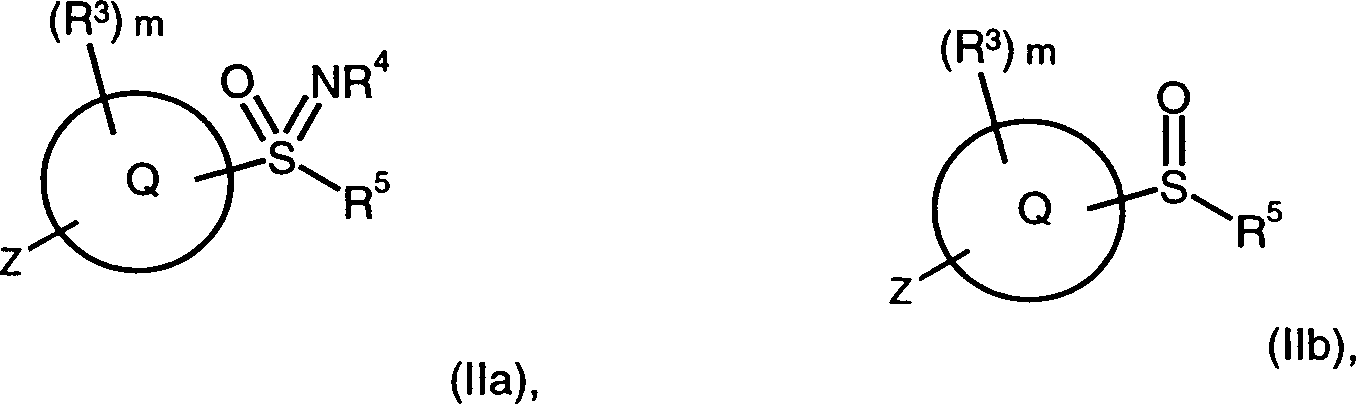
Die
für die
Herstellung der erfindungsgemäßen Verbindungen
der allgemeinen Formel I ebenfalls vorzugsweise verwendeten Zwischenprodukte
der allgemeinen Formel IIIa oder IIIb 
Soweit
die Herstellung der Ausgangsverbindungen nicht beschrieben wird,
sind diese bekannt oder analog zu bekannten Verbindungen oder hier
beschriebenen Verfahren herstellbar. Es ist ebenfalls möglich, alle
hier beschriebenen 
Die Isomerengemische können nach üblichen Methoden wie beispielsweise Kristallisation, Chromatographie oder Salzbildung in die Enantiomeren bzw. E/Z-Isomeren aufgetrennt werden.The Isomer mixtures can according to usual Methods such as crystallization, chromatography or Salt formation are separated into the enantiomers or E / Z isomers.
Die Herstellung der Salze erfolgt in üblicher Weise, indem man eine Lösung der Verbindung der Formel I mit der äquivalenten Menge oder einem Überschuß einer Base oder Säure, die gegebenenfalls in Lösung ist, versetzt und den Niederschlag abtrennt oder in üblicher Weise die Lösung aufarbeitet.The Preparation of the salts is carried out in the usual manner by adding a solution the compound of formula I with the equivalent amount or an excess of one Base or acid, which is possibly in solution, offset and the precipitate separated or worked up in the usual way, the solution.
Herstellung der ertindungsgemäßen Verbindungenmanufacturing the compounds according to the invention
Eine der wichtigsten Methoden der Darstellung von Sulfoximinen ist die Umsetzung eines Sulfoxides mit Stickstoffwasserstoffsäure, die in situ z.B. aus der Reaktion von Natriumazid und konz. Schwefelsäure erzeugt wird (M. Reggelin, C. Zur, Synthesis 2000, 1, 1). Die Reaktion kann in einem organischen Lösungsmittel, wie Chloroform, durchgeführt werden. Weitere Methoden zur Synthese von Sulfoximinen sind z.B. die Umsetzung von Sulfoxiden mit
- a) TsN3 ((a) R. Tanaka, K. Yamabe, J. Chem. Soc. Chem. Commun. 1983, 329; (b) H. Kwart, A.A. Kahn, J. Am. Chem. Soc. 1967, 89, 1959)).
- b) N-tosylimino phenyl iodinan und kat. Mengen Cu(I)triflat (J.F.K. Müller, P. Vogt, Tetrahedron Lett. 1998, 39, 4805)
- c) Boc-Azid und kat. Mengen Eisen(II)chlorid (T. Bach, C. Korber, Tetrahedron Lett. 1998, 39, 5015) oder
- d) o-Mesitylensulfonylhydroxylamin (MSH) (C.R. Johnson, R.A. Kirchhoff, H.G. Corkins, J. Org. Chem. 1974, 39, 2458).
- a) TsN 3 ((a) R. Tanaka, K. Yamabe, J. Chem. Soc. Chem. Commun. 1983, 329; (b) H. Kwart, AA Kahn, J. Am. Chem. Soc. 1967, 89, 1959)).
- b) N-tosylimino-phenyl iodinan and cat. Quantities of Cu (I) triflate (JFK Müller, P. Vogt, Tetrahedron Lett. 1998, 39, 4805)
- c) Boc-azide and cat. Amounts of iron (II) chloride (T. Bach, C. Korber, Tetrahedron Lett. 1998, 39, 5015) or
- d) o-mesitylenesulfonylhydroxylamine (MSH) (CR Johnson, RA Kirchhoff, HG Corkins, J. Org. Chem. 1974, 39, 2458).
Sulfoximine besitzen in bezug auf Struktur und Konfiguration in der Regel eine hohe Stabilität (C. Bolm, J.P. Hildebrand, J. Org. Chem. 2000, 65, 169). Diese Eigenschaften der funktionellen Gruppe erlauben oftmals auch drastische Reaktionsbedingungen und ermöglichen die einfache Derivatisierung der Sulfoximine am Imin-Stickstoff und dem α-Kohlenstoff. Enantiomerenreine Sulfoximine werden auch als Auxiliare in der diastereoselektiven Synthese verwendet ((a) S.G. Pyne, Sulfur Reports 1992, 12, 57; (b) C.R. Johnson, Aldrichchimica Acta 1985, 18, 3). Die Darstellung enantiomerenreiner Sulfoximine ist z.B. über die Racematspaltung mit enantiomerenreiner Campher-10-sulfonsäure beschrieben ((a) C.R. Johnson, C.W. Schroeck, J. Am. Chem. Soc. 1973, 95, 7418; (b) C.S. Shiner, A.H. Berks, J. Org. Chem. 1988, 53, 5543). Eine weitere Methode zur Darstellung optisch aktiver Sulfoximine besteht in der stereoselektiven Iminierung von optisch aktiven Sulfoxiden unter Verwendung von MSH ((a) C. Bolm, P. Müller, K. Harms, Acta Chem. Scand. 1996, 50, 305; (b) Y. Tamura, J. Minamikawa, K. Sumoto, S. Fujii, M. Ikeda, J. Org. Chem. 1973, 38, 1239).Sulfoximines generally have a high stability in terms of structure and configuration (C. Bolm, JP Hildebrand, J. Org. Chem. 2000, 65, 169). These properties of the functional group allow often drastic reaction conditions and allow the simple derivatization of sulfoximines on imine nitrogen and the α-carbon. Enantiomerically pure sulfoximines are also used as auxiliaries in diastereoselective synthesis ((a) SG Pyne, Sulfur Reports 1992, 12, 57; (b) CR Johnson, Aldrichchimica Acta 1985, 18, 3). The preparation of enantiomerically pure sulfoximines is described, for example, via the racemate resolution with enantiopure camphor-10-sulfonic acid ((a) CR Johnson, CW Schroeck, J. Am. Chem. Soc. 1973, 95, 7418; (b) CS Shiner, AH Berks, J. Org. Chem. 1988, 53, 5543). Another method for preparing optically active sulfoximines is the stereoselective imination of optically active sulfoxides using MSH ((a) C. Bolm, P. Muller, K. Harms, Acta Chem. Scand. 1996, 50, 305; (b Y. Tamura, J. Minamikawa, K. Sumoto, S. Fujii, M. Ikeda, J. Org. Chem. 1973, 38, 1239).
Die nachfolgenden Beispiele erläutern die Herstellung der erfindungsgemäßen Verbindungen, ohne den Umfang der beanspruchten Verbindungen auf diese Beispiele zu beschränken.The explain the following examples the preparation of the compounds according to the invention, without the To limit the scope of the claimed compounds to these examples.
Verfahrensvariante
1 
Bsp.
1.0) Herstellung von (R)-2-[(5-Brom-2-{[(RS)-4-(methylsulfonimidoyl)phenyl]amino}pyrimidin-4-yl)amino]propan-1-ol 
Methode AMethod A
40 mg (0.23 mmol) rac-4-(methylsulfonimidoyl)-anilin und 62 mg (0.23 mmol) (R)-2-(5-Brom-2-chlor-pyrimidin-4-ylamino)-propan-1-ol werden unter Argon mit 0.5 ml 1-Butyl-3-Methyl-imidazoliumtetrafluoroborat (Übersichtsartikel zu ionischen Flüssigkeiten: a) T. Welton, Chem. Rev. 1999, 99, 2071 b) H. Zhao, Aldrichimica Acta 2002, 35, 75 c) M.J. Earle, K.R. Seddon, ACS Symposium Series 2002, 819, 10) versetzt und 10 min bei Raumtemperatur gerührt. Das Reaktionsgemisch wird auf 60 °C erwärmt und weitere 3 h bei dieser Temperatur gerührt. Man versetzt mit 0.08 ml einer 4 molaren Lösung von Chlorwasserstoff in Dioxan und rührt 60 h bei 60 °C. Nach dem Abkühlen wird das Reaktionsgemisch mit 10 ml Essigester versetzt und 10 min gerührt. Das organische Lösungsmittel wird dekantiert und der Rückstand in 10 ml Methanol gelöst. Man versetzt mit 200 ml Essigester und wäscht anschließend mit 50 ml einer gesättigten NaCl-Lösung. Die organische Phase wird getrocknet (Na2SO4), filtriert und eingeengt. Der verbleibende Rückstand wird chromatographisch (DCM/Ethanol, 8 : 2) gereinigt. Man erhält 23 mg (0.06 mmol, entsprechend 26 d. Theorie) des Produktes.40 mg (0.23 mmol) of rac-4- (methylsulfonimidoyl) -aniline and 62 mg (0.23 mmol) of (R) -2- (5-bromo-2-chloro-pyrimidin-4-ylamino) -propan-1-ol under argon with 0.5 ml of 1-butyl-3-methyl-imidazolium tetrafluoroborate (review of ionic liquids: a) T. Welton, Chem. Rev. 1999, 99, 2071 b) H. Zhao, Aldrichimica Acta 2002, 35, 75 c) MJ Earle, KR Seddon, ACS Symposium Series 2002, 819, 10) and stirred for 10 min at room temperature. The reaction mixture is heated to 60 ° C and stirred for a further 3 h at this temperature. It is mixed with 0.08 ml of a 4 molar solution of hydrogen chloride in dioxane and stirred for 60 h at 60 ° C. After cooling, the reaction mixture is mixed with 10 ml of ethyl acetate and stirred for 10 min. The organic solvent is decanted and the residue is dissolved in 10 ml of methanol. It is mixed with 200 ml of ethyl acetate and then washed with 50 ml of a saturated NaCl solution. The organic phase is dried (Na 2 SO 4 ), filtered and concentrated. The remaining residue is purified by chromatography (DCM / ethanol, 8: 2). 23 mg (0.06 mmol, corresponding to 26 d of theory) of the product are obtained.
Methode BMethod B
Eine
Lösung
von 267 mg (1.0 mmol) (R)-2-(5-Brom-2-chlor-pyrimidin-4-ylamino)-propan-1-ol
in 2 ml Acetonitril wird bei Raumtemperatur zu 171 mg (1.0 mmol)
rac-4-(methylsulfonimidoyl)-anilin in 1 ml Acetonitril gegeben.
Der Ansatz wird mit 0.25 ml einer 4 molaren Lösung von Chlorwasserstoff in
Dioxan versetzt und über
Nacht unter Rückfluss
gerührt.
Das Lösungsmittel
wird abgezogen und der verbleibende Rückstand chromatographisch (DCM/EtOH
8 : 2) gereinigt. Das erhaltene Rohprodukt wird abschliessend per
HPLC gereinigt:
Säule:
Luna C18(2) 5μ
Länge × ID: 150 × 4,6 mm
Eluenten:
C = H2O, D = ACN, C/0.5 g NH4Ac/I
Fluß: 1,0 ml/min
Gradient:
5 → 100%
D(15') + 100% D(5')
Detektor:
PDA 214 nm
Temperatur: 21 °C
RT
in min: 20,3A solution of 267 mg (1.0 mmol) of (R) -2- (5-bromo-2-chloro-pyrimidin-4-ylamino) -propan-1-ol in 2 ml of acetonitrile is added at room temperature to 171 mg (1.0 mmol). rac-4- (methylsulfonimidoyl) -aniline in 1 ml of acetonitrile. The mixture is treated with 0.25 ml of a 4 molar solution of hydrogen chloride in dioxane and stirred overnight under reflux. The solvent is removed and the remaining residue is purified by chromatography (DCM / EtOH 8: 2). The crude product obtained is finally purified by HPLC:
Column: Luna C18 (2) 5μ
Length × ID: 150 × 4.6 mm
Eluents: C = H 2 O, D = ACN, C / 0.5 g NH 4 Ac / I
Flow: 1.0 ml / min
Gradient: 5 → 100% D (15 ') + 100% D (5')
Detector: PDA 214 nm
Temperature: 21 ° C
RT in minutes: 20.3
Man
erhält
53 mg (0.13 mmol, entsprechend 13% d. Theorie) des Produktes.
1H-NMR (DMSO): 9.71 (s, 1 H), 8.11 (s, 1H),
7.91 (d, 2H), 7.78 (d, 2H), 6.41 (d, 1H), 4,89 (t, 1 H), 4. 25 (m, 1H),
3.96 (br, 1 H), 3.53 (m, 2H), 3.03 (s, 3H), 1.21 (d, 3H).
MS:
400 (ES).53 mg (0.13 mmol, corresponding to 13% of theory) of the product are obtained.
1 H-NMR (DMSO): 9.71 (s, 1H), 8.11 (s, 1H), 7.91 (d, 2H), 7.78 (d, 2H), 6.41 (d, 1H), 4.89 (t, 1 H), 4.25 (m, 1H), 3.96 (br, 1H), 3.53 (m, 2H), 3.03 (s, 3H), 1.21 (d, 3H).
MS: 400 (ES).
Bsp.
1.1) Herstellung von (R)-2-[(5-Brom-2-{[(RS)-3-(methyl-N-nitrosulfonimidoyl)phenyl]amino}pyrimidin-4-yl)amino]propan-1-ol 
Eine
Lösung
von 37 mg (0.17 mmol) rac-3-(methyl-N-nitrosulfonimidoyl)-anilin
in 3 ml Acetonitril wird mit 91 mg (0.34 mmol) (R)-2-(5-Brom-2-chlor-pyrimidin-4-ylamino)-propan-1-ol
und 0.06 ml einer 4 molaren Lösung
von Chlorwasserstoff in Dioxan versetzt und über Nacht unter Rückfluss
gerührt.
Es werden weitere 0.05 ml der 4 molaren Lösung von Chlorwasserstoff in
Dioxan zugegeben und weitere 6 h refluxiert. Nach DC Kontrolle wird
erneut mit 92 mg (0.34 mmol) (R)-2-(5-Brom-2-chlor-pyrimidin-4-ylamino)-propan-1-ol
versetzt und über
Nacht refluxiert. Nach dem Erkalten wird der Ansatz mit gesättigter
NaHCO3 Lösung
basisch gestellt und gegen Essigester extrahiert. Die vereinten
organischen Phasen werden getrocknet (Na2SO4), filtriert und eingeengt. Der erhaltene
Rückstand
wird chromatographisch (DCM/EtOH 95 : 5) gereinigt. Man erhält 24 mg (0.05
mmol, entsprechend 32 % d. Theorie) des Produktes (Diastereomere
A/B 1 : 1).
1H-NMR (DMSO): 9.85 (s,
2H, A+B), 8.73 (m, 1H, A), 8.69 (m, 1H, B), 8.11 (s, 1H, A), 8.10
(s, 1H, B), 7.92 (m, 2H, A+B), 7.58 (m, 4H, A+B), 6.40 (m, 2H, A+B),
4.86 (t, 2H, A+B), 4.32 (m, 2H, A+B), 3.68 (s, 3H, A), 3.66 (s, 3H,
B), 3.55 (m, 4H, A+B), 1.23 (d, 3H, A), 1.21 (d, 3H, B).
MS:
445 (ES).A solution of 37 mg (0.17 mmol) of rac-3- (methyl-N-nitrosulfonimidoyl) -aniline in 3 ml of acetonitrile is treated with 91 mg (0.34 mmol) of (R) -2- (5-bromo-2-chloro-pyrimidine -4-ylamino) -propan-1-ol and 0.06 ml of a 4 molar solution of hydrogen chloride in dioxane and stirred overnight under reflux. Another 0.05 ml of the 4 molar solution of hydrogen chloride in dioxane are added and the mixture is refluxed for a further 6 hours. After TLC control, 92 mg (0.34 mmol) of (R) -2- (5-bromo-2-chloro-pyrimidin-4-ylamino) -propan-1-ol are added again and the mixture is refluxed overnight. After cooling, the mixture is basified with saturated NaHCO 3 solution and extracted against ethyl acetate. The combined organic phases are dried (Na 2 SO 4 ), filtered and concentrated. The residue obtained is purified by chromatography (DCM / EtOH 95: 5). This gives 24 mg (0.05 mmol, corresponding to 32% of theory) of the product (diastereomers A / B 1: 1).
1 H-NMR (DMSO): 9.85 (s, 2H, A + B), 8.73 (m, 1H, A), 8.69 (m, 1H, B), 8.11 (s, 1H, A), 8.10 (s, 1H, B), 7.92 (m, 2H, A + B), 7.58 (m, 4H, A + B), 6.40 (m, 2H, A + B), 4.86 (t, 2H, A + B), 4.32 (m, 2H, A + B), 3.68 (s, 3H, A), 3.66 (s, 3H, B), 3.55 (m, 4H, A + B), 1.23 (d, 3H, A), 1.21 ( d, 3H, B).
MS: 445 (ES).
In
analoger Verfahrensweise zu der oben beschriebenen Verfahrensvariante
werden auch die nachfolgenden Verbindungen hergestellt: Bsp.
1.2) Herstellung von (R,R)-3-[(5-Brom-2-{[(RS)-4-(methylsulfonimidoyl)phenyl]amino}pyrimidin-4-yl)amino]butan-2-ol
(Verfahrensvariante 1, Methode A) 
MS: 414 (ES).In an analogous procedure to the process variant described above, the following compounds are also prepared: Ex. 1.2) Preparation of (R, R) -3 - [(5-Bromo-2 - {[(RS) -4- (methylsulfonimidoyl) phenyl] amino} pyrimidin-4-yl) amino] butan-2-ol (Process Variant 1, Method A)
MS: 414 (ES).
Bsp.
1.3) Herstellung von (R)-3-[(5-Brom-2-{[(RS)-4-(methylsulfonimidoyl)phenyl]amino}pyrimidin-4-yl)amino]-2-methyl-butan-2-ol, (Verfahrensvariante
1, Methode A) 
- 1H-NMR (DMSO): 9.72 (s, 1H), 8.11 (s, 1H), 7.90 (d, 2H), 7.78 (d, 2H), 6.10 (d, 1H), 4.87 (s, 1H), 4.07 (m, 1H), 3.98 (s, 1H), 3.01 (s, 3H), 1.19 (m, 9H). 1 H-NMR (DMSO): 9.72 (s, 1H), 8.11 (s, 1H), 7.90 (d, 2H), 7.78 (d, 2H), 6.10 (d, 1H), 4.87 (s, 1H), 4.07 (m, 1H), 3.98 (s, 1H), 3.01 (s, 3H), 1.19 (m, 9H).
- MS: 428 (ES).MS: 428 (ES).
1.4)
Herstellung von (R,R)-3-[(5-Brom-2-{[(RS)-4-(methylsulfonimidoyl)phenyl]amino}pyrimidin-4-yl)oxy]butan-2-ol
(Verfahrensvariante 1, Methode A) 
- 1H-NMR (DMSO): 10.12 (s, 1H), 8.45 (s, 1H), 7.92 (d, 2H), 7.84 (d, 2H), 5.21 (m, 1H), 4.91 (d, 1H), 4.04 (s, 1H), 3.87 (m, 1H), 3.03 (s, 3H), 1.28 (d, 3H), 1.13 (d, 3H). 1 H-NMR (DMSO): 10.12 (s, 1H), 8.45 (s, 1H), 7.92 (d, 2H), 7.84 (d, 2H), 5.21 (m, 1H), 4.91 (d, 1H), 4.04 (s, 1H), 3.87 (m, 1H), 3.03 (s, 3H), 1.28 (d, 3H), 1.13 (d, 3H).
- MS: 415 (ES).MS: 415 (ES).
Verfahrensvariante
2 
Bs p. 2.0Bs p. 2.0
Herstellung
von rac-5-Brom-N2-[4-(methylsulfonimidoyl)phenyl]
-N4-isopropylpyrimidin-2,4-diamin 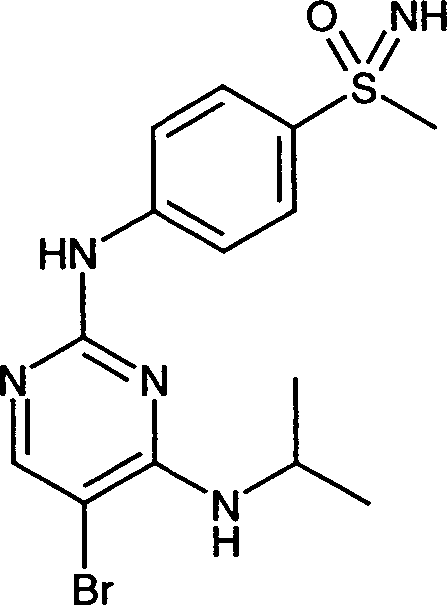
185
mg (0.50 mmol) 5-Brom-N4-isopropyl-N2-(4-methansulfinyl-phenyl)-pyrimidin-2,4-diamin
in 1 ml DCM werden mit 40 mg (0.55 mmol) Natriumazidversetzt. Der
Ansatz wird bei 0°C
langsam mit 0.13 ml konzentrierter Schwefelsäure versetzt und anschliessend
auf 45°C
erwärmt.
Nach 16 h wird der Ansatz auf Raumtemperatur abgekühlt, mit
2 ml 1 N NaOH Lösung
versetzt und gegen Essigester extrahiert. Die vereinten organischen
Phasen werden getrocknet (Na2SO4),
filtriert und eingeengt. Der verbleibende Rückstand wird chromatographisch
(DCM/EtOH 9:1) gereinigt. Man erhält 38 mg (0.10 mmol, entsprechend
20 % d. Theorie) des Produktes.
1H-NMR(DMSO):
9.70 (s, 1H), 8.08 (s, 1H), 7.90 (d, 2H), 7.77 (d, 2H), 6.62 (d,
1H), 4.35 (m, 1H), 3.99 (s, 1H), 3.03 (s, 3H), 1.29 (d, 6H).
MS:
384 (ES).185 mg (0.50 mmol) of 5-bromo-N 4 -isopropyl-N 2 - (4-methanesulfinyl-phenyl) -pyrimidine-2,4-diamine in 1 ml of DCM are treated with 40 mg (0.55 mmol) of sodium azide. The mixture is slowly added at 0 ° C with 0.13 ml of concentrated sulfuric acid and then heated to 45 ° C. After 16 h, the mixture is cooled to room temperature, treated with 2 ml of 1 N NaOH solution and extracted against ethyl acetate. The combined organic phases are dried (Na 2 SO 4 ), filtered and concentrated. The remaining residue is purified by chromatography (DCM / EtOH 9: 1). 38 mg (0.10 mmol, corresponding to 20% of theory) of the product are obtained.
1 H-NMR (DMSO): 9.70 (s, 1H), 8.08 (s, 1H), 7.90 (d, 2H), 7.77 (d, 2H), 6.62 (d, 1H), 4.35 (m, 1H), 3.99 (s, 1H), 3.03 (s, 3H), 1.29 (d, 6H).
MS: 384 (ES).
Herstellung
der Zwischenprodukte a)
Herstellung von rac-4-(methylsulfonimidoyl)-anilin 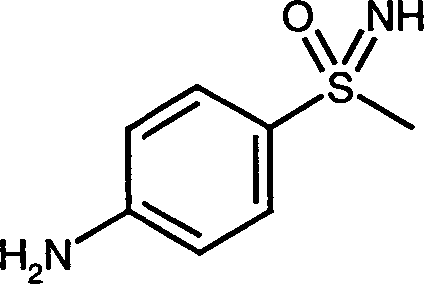
Eine
Lösung
von 2.45 g (12.2 mmol) rac-4-(methylsulfonimidoyl)-nitrobenzol in
150 ml Ethanol wird bei Raumtemperatur unter Verwendung von 0.80
g Pd/C (10% × 50%
H2O) unter einer Wasserstoffatmosphäre bei Normaldruck über 4 h
hydriert. Die Wasserstoffaufnahme beträgt 920 ml. Der Ansatz wird
filtriert und eingeengt. Der erhaltene Rückstand wird mit Diisopropylether
digeriert. Man erhält
1.90 g (11.2 mmol, entsprechend 92 % d. Theorie).
1N-NMR
(DMSO): 7.53 (d, 2H), 6.64 (d, 2H), 5.91 (s, 2H), 3.68 (s, 1H),
2.93 (s, 3H).
ES: 171 (ES).A solution of 2.45 g (12.2 mmol) of rac-4- (methylsulfonimidoyl) -nitrobenzene in 150 ml of ethanol is added at room temperature using 0.80 g of Pd / C (10% × 50% H 2 O) under a hydrogen atmosphere at atmospheric pressure above 4 hydrogenated h. The hydrogen uptake is 920 ml. The mixture is filtered and concentrated. The residue obtained is digested with diisopropyl ether. This gives 1.90 g (11.2 mmol, corresponding to 92% of theory).
1 N-NMR (DMSO): 7.53 (d, 2H), 6.64 (d, 2H), 5.91 (s, 2H), 3.68 (s, 1H), 2.93 (s, 3H).
ES: 171 (ES).
b)
Herstellung von rac-4-(methylsulfonimidoyl)-nitrobenzol 
1.56
g (8.5 mmol) 1-Methansulfinyl-4-nitro-benzol in 20 ml DCM werden
mit 0.70 g (9.5 mmol) Natriumazid versetzt. Der Ansatz wird bei
0 °C langsam
mit 2.3 ml konzentrierter Schwefelsäure versetzt und anschließend auf
45 °C erwärmt. Nach
16 h wird der Ansatz auf Raumtemperatur abgekühlt, mit Wasser versetzt und
gegen DCM extrahiert. Die wässrige
Phase wird mit 15 %iger NaOH Lösung
auf pH 11 gestellt und gegen DCM extrahiert. Die vereinten organischen Phasen
werden getrocknet (Na2SO4),
filtriert und eingeengt. Man erhält
1.08 g (5.4 mmol, entsprechend 63 % d. Theorie) des Produktes.
1H-NMR (DMSO): 8.43 (d, 2H), 8.17 (d, 2H),
4.62 (s, 1H), 3.18 (s, 3H).
ES: 201 (ES).1.56 g (8.5 mmol) of 1-methanesulfinyl-4-nitrobenzene in 20 ml of DCM are mixed with 0.70 g (9.5 mmol) of sodium azide. The mixture is slowly added at 0 ° C with 2.3 ml of concentrated sulfuric acid and then heated to 45 ° C. After 16 h, the batch is cooled to room temperature, treated with water and extracted against DCM. The aqueous phase is adjusted to pH 11 with 15% NaOH solution and extracted against DCM. The combined organic phases are dried (Na 2 SO 4 ), filtered and concentrated. This gives 1.08 g (5.4 mmol, corresponding to 63% of theory) of the product.
1 H-NMR (DMSO): 8.43 (d, 2H), 8.17 (d, 2H), 4.62 (s, 1H), 3.18 (s, 3H).
ES: 201 (ES).
c)
Herstellung von 1-Methansulfinyl-4-nitrobenzol 
Eine
Lösung
von 16.0 g (95 mmol) 1-Methylsulfanyl-4-nitro-benzol in 400 ml DCM
wird bei Raumtemperatur mit 24.6 g (100 mmol) 3-Chlorperoxybenzoesäure (ca. 70 %) versetzt. Nach
1 h wird der Ansatz mit DCM verdünnt
und mit gesättigter
NaHCO3-Lösung
gewaschen. Die organische Phase wird getrocknet (Na2SO4), filtriert und eingeengt. Der verbleibende
Rückstand
wird chromatographisch (DCM/EtOH 8 : 2) gereinigt. Man erhält 7.6 g
(41 mmol, entsprechend 43 % d. Theorie) des Produktes.
1H-NMR (DMSO): 8.41 (d, 2H), 7.97 (d, 2H),
2.86 (s, 3H).
ES: 186 (ES).A solution of 16.0 g (95 mmol) of 1-methylsulfanyl-4-nitro-benzene in 400 ml of DCM is treated at room temperature with 24.6 g (100 mmol) of 3-chloroperoxybenzoic acid (about 70%). After 1 h, the reaction is diluted with DCM and washed with saturated NaHCO 3 solution. The organic phase is dried (Na 2 SO 4 ), filtered and concentrated. The remaining residue is purified by chromatography (DCM / EtOH 8: 2). This gives 7.6 g (41 mmol, corresponding to 43% of theory) of the product.
1 H-NMR (DMSO): 8.41 (d, 2H), 7.97 (d, 2H), 2.86 (s, 3H).
ES: 186 (ES).
d)
Herstellung von rac-3-(methylsulfonimidoyl)-anilin 
Eine
Lösung
von 200 mg (1.00 mmol) rac-3-(methylsulfonimidoyl)-nitrobenzol in
20 ml THF wird bei Raumtemperatur mit 8 ml einer ca. 10%igen Lösung von
Ti(III)Cl in 20-30%iger Salzsäure
versetzt. Nach 3 h werden weitere 2 ml der ca. 10%igen Lösung von
Ti(III)Cl in 20-30%iger Salzsäure
zugegeben und über
Nacht bei Raumtemperatur gerührt.
Der Ansatz wird mit 1 N NaOH Lösung
basisch gestellt und mit Essigester versetzt. Es wird filtriert
und der Filterkuchen mit Essigester/McOH (3 : 2) gewaschen. Das
organische Lösungsmittel
wird am Rotationsverdampfer abgezogen und der Rückstand gegen Essigester extrahiert.
Die vereinten organischen Phasen werden getrocknet (Na2SO4), filtriert und eingeengt. Der erhaltene
Rückstand
wird chromatographisch (DCM/ EtOH 95 :5) gereinigt. Man erhält 82 mg
(0.48, entsprechend 48% d. Theorie) des Produktes.
1H-NMR (DMSO): 7.19 (m, 1H), 7.11 (m, 1H),
7.00 (m, 1H), 6.75 (m, 1H), 5.56 (s, 2H), 3.96 (s, 1H), 2.98 (s,
3H).
ES: 171 (ES).A solution of 200 mg (1.00 mmol) of rac-3- (methylsulfonimidoyl) -nitrobenzene in 20 ml of THF is added at room temperature with 8 ml of an approximately 10% solution of Ti (III) Cl in 20-30% hydrochloric acid. After 3 hours, a further 2 ml of the approximately 10% solution of Ti (III) Cl in 20-30% strength hydrochloric acid are added and the mixture is stirred overnight at room temperature. The mixture is made basic with 1N NaOH solution and treated with ethyl acetate. It is filtered and the filter cake washed with ethyl acetate / MeOH (3: 2). The organic solvent is stripped off on a rotary evaporator and the residue is extracted against ethyl acetate. The combined organic phases are dried (Na 2 SO 4 ), filtered and concentrated. The residue obtained is purified by chromatography (DCM / EtOH 95: 5). This gives 82 mg (0.48, corresponding to 48% of theory) of the product.
1 H-NMR (DMSO): 7.19 (m, 1H), 7.11 (m, 1H), 7.00 (m, 1H), 6.75 (m, 1H), 5.56 (s, 2H), 3.96 (s, 1H), 2.98 (s, 3H).
ES: 171 (ES).
e)
Herstellung von rac-3-(methyl-N-nitrosulfonimidoyl)-anilin 
Eine
Lösung
von 100 mg (0.41 mmol) rac-3-(methyl-N-nitrosulfonimidoyl)-nitrobenzol in 8
ml THF wird bei Raumtemperatur mit 3.1 ml einer ca. 10%igen Lösung von
Ti(III)Cl in 20–30%iger
Salzsäure
versetzt. Nach 1 h werden weitere 1.0 ml der ca. 10%igen Lösung von
Ti(III)Cl in 20-30%iger Salzsäure
zugegeben und weitere 45 min bei Raumtemperatur gerührt. Der
Ansatz wird mit 1 N NaOH Lösung
basisch gestellt und mit Essigester extrahiert. Die vereinten organischen
Phasen werden getrocknet (Na2SO4),
filtriert und eingeengt. Der erhaltene Rückstand wird chromatographisch
(DCM/EtOH 95 :5) gereinigt. Man erhält 40 mg (0.19mmol, entsprechend
45% d. Theorie) des Produktes.
1H-NMR
(DMSO): 7.33 (m, 1H), 7.13 (m, 1H), 7.03 (m, 1H), 6.90 (m, 1H),
5.88 (s, 2H), 3.59 (s, 3H).
ES: 216 (ES).A solution of 100 mg (0.41 mmol) of rac-3- (methyl-N-nitrosulfonimidoyl) -nitrobenzene in 8 ml of THF at room temperature with 3.1 ml of an approximately 10% solution of Ti (III) Cl in 20-30% added hydrochloric acid. After 1 h, another 1.0 ml of about 10% solution of Ti (III) Cl in 20-30% hydrochloric acid are added and stirred for a further 45 min at room temperature. The mixture is basified with 1 N NaOH solution and extracted with ethyl acetate. The combined organic phases are dried (Na 2 SO 4 ), filtered and concentrated. The residue obtained is purified by chromatography (DCM / EtOH 95: 5). 40 mg (0.19 mmol, corresponding to 45% of theory) of the product are obtained.
1 H-NMR (DMSO): 7.33 (m, 1H), 7.13 (m, 1H), 7.03 (m, 1H), 6.90 (m, 1H), 5.88 (s, 2H), 3.59 (s, 3H).
ES: 216 (ES).
f)
Herstellung von rac-3-(methyl-N-nitrosulfonimidoyl)-nitrobenzol
(A) und rac-3-(methylsulfonimidoyl)-nitrobenzol (B) 
1.0 g (6.45 mmol) rac-S-methyl-S-phenyl-sulfonimid werden vorsichtig mit 3 ml konz. Schwefelsäure versetzt. Der Ansatz wird unter Rühren bei 0 °C vorsichtig tropfenweise mit 1 ml rauchender Salpetersäure versetzt und langsam über Nacht auf Raumtemperatur erwärmt. Die Reaktionslösung wird vorsichtig auf eisgekühlte 1 N NaOH Lösung gegeben. Der basische Ansatz wird gegen Essigester extrahiert. Die vereinten organischen Phasen werden getrocknet (Na2SO4), filtriert und eingeengt. Der erhaltene Rückstand wird mit 15 ml McOH versetzt. Der gebildete Niederschlag wird abgesaugt und mit Diisopropylether gewaschen. Nach dem Trocknen erhält man 485 mg (1.98 mmol, entsprechend 31 % d. Theorie) des Produktes A. Das Filtrat wird einrotiert und der gebildete Niederschlag chromatographisch (DCM/EtOH 97 : 3) gereinigt. Man erhält 200 mg (1.00 mmol, entsprechend 16 % d. Theorie) des Produktes B.1.0 g (6.45 mmol) of rac-S-methyl-S-phenyl-sulfonimide are carefully mixed with 3 ml of conc. Sulfuric acid added. The mixture is carefully added dropwise with stirring at 0 ° C with 1 ml of fuming nitric acid and slowly warmed to room temperature overnight. The reaction solution is carefully poured onto ice Cooled 1N NaOH solution. The basic mixture is extracted against ethyl acetate. The combined organic phases are dried (Na 2 SO 4 ), filtered and concentrated. The residue obtained is mixed with 15 ml of MeOH. The precipitate formed is filtered off with suction and washed with diisopropyl ether. After drying, 485 mg (1.98 mmol, corresponding to 31% of theory) of the product A are obtained. The filtrate is concentrated in a rotary evaporator and the precipitate formed is purified by chromatography (DCM / EtOH 97: 3). 200 mg (1.00 mmol, corresponding to 16% of theory) of the product B are obtained.
rac-3-(methyl-N-nitrosulfonimidoyl)-nitrobenzol(A):rac-3- (N-methyl-nitrosulfonimidoyl) nitrobenzene (A):
- 1H-NMR (DMSO): 8.79 (m, 1H), 8.64 (m, 1H), 8.49 (m, 1H), 8.05 (m, 1H), 3.88 (s, 3H). 1 H-NMR (DMSO): 8.79 (m, 1H), 8.64 (m, 1H), 8.49 (m, 1H), 8.05 (m, 1H), 3.88 (s, 3H).
- MS: 216 (ES).MS: 216 (ES).
rac-3-(methylsulfonimidoyl)-nitrobenzol (B):rac-3- (methylsulfonimidoyl) nitrobenzene (B):
- 1H-NMR (DMSO): 8.65 (m, 1H), 8.48 (m, 1H), 8.35 (m, 1H), 7.90 (m, 1H), 4.62 (s, 1H), 3.17 (s, 3H). 1 H-NMR (DMSO): 8.65 (m, 1H), 8.48 (m, 1H), 8.35 (m, 1H), 7.90 (m, 1H), 4.62 (s, 1H), 3.17 (s, 3H).
- MS: 201 (ES).MS: 201 (ES).
g)
Herstellung von 5-Brom-N4-isopropyl-N2-(4-methansulfinyl-phenyl)pyrimidin-2,4-diamin 
1.77
g (4.6 mmol) 5-Brom-N4-isopropyl-N2-(4-methylsulfanyl-phenyl)-pyrimidin-2,4-diamin hydrochlorid
werden in 40 ml DCM aufgenommen und mit 1.73 g (5.5 mmol) 3-Chlorperoxybenzoesäure (55%)
versetzt. Der Ansatz wird 90 min bei Raumtemperatur gerührt und
anschließend
mit DCM verdünnt.
Man wäscht
mit gesättigter
NaHCO3-Lösung
und gesättigter
NaCl- Lösung.
Die organische Phase wird getrocknet (Na2SO4), filtriert und eingeengt. Der verbleibende
Rückstand
wird chromatographisch (DCM/EtOH 9 :1) gereinigt. Man erhält 553 mg
(1.5 mmol, entsprechend 33 % d. Theorie) des Produktes.
1H-NMR (DMSO): 9.55 (s, 1H), 8.08 (s, 1H),
7.90 (d, 2H), 7.53 (d, 2H), 6.53 (d, 1H), 4.35 (m, 1H), 2.70 (s,
3H), 1.25 (d, 6H).
MS: 369 (ES).1.77 g (4.6 mmol) of 5-bromo-N 4 -isopropyl-N 2 - (4-methylsulfanyl-phenyl) -pyrimidine-2,4-diamine hydrochloride are taken up in 40 ml of DCM and treated with 1.73 g (5.5 mmol) of 3- Chloroperoxybenzoic acid (55%). The batch is stirred for 90 min at room temperature and then diluted with DCM. It is washed with saturated NaHCO 3 solution and saturated NaCl solution. The organic phase is dried (Na 2 SO 4 ), filtered and concentrated. The remaining residue is purified by chromatography (DCM / EtOH 9: 1). This gives 553 mg (1.5 mmol, corresponding to 33% of theory) of the product.
1 H-NMR (DMSO): 9.55 (s, 1H), 8.08 (s, 1H), 7.90 (d, 2H), 7.53 (d, 2H), 6.53 (d, 1H), 4.35 (m, 1H), 2.70 (s, 3H), 1.25 (d, 6H).
MS: 369 (ES).
h)
Herstellung von 5-Brom-N4-isopropyl-N2-(4-methylsulfanyl-phenyl)-pyrimidin-2,4-diamin 
Eine
Lösung
von 4.08 g (16.3 mmol) (5-Brom-2-chlor-pyrimidin-4-yl)-isopropyl-amin in 20 ml Acetonitril wird
bei Raumtemperatur mit einer Lösung
von 2 ml (16.3 mmol) 4-Methylsulfanyl-phenylamin in 10 ml Acetonitril
versetzt. Der Ansatz wird mit 4.1 ml einer 4 molaren Lösung von
Chlorwasserstoff in Dioxan und 4.1 ml Wasser versetzt und anschließend 16
h unter Rückfluss
gerührt.
Nach dem Erkalten wird der gebildete Niederschlag abgesaugt, mit
Wasser gewaschen und getrocknet. Man erhält 4.94 g (12.7 mmol, entsprechend
78 d. Theorie) des Produktes in Form des Hydrochlorides.
1H-NMR (DMSO): 10.39 (s, 1H), 8.18 (s, 1H),
7.88 (br, 1H), 7.49 (d, 2H), 7.29 (d, 2H), 4.30 (m, 1H), 2.5 (s,
3H), 1.21 (d, 6H).
MS: 353 (ES).A solution of 4.08 g (16.3 mmol) (5-bromo-2-chloro-pyrimidin-4-yl) -isopropyl-amine in 20 ml acetonitrile is added at room temperature with a solution of 2 ml (16.3 mmol) 4-methylsulfanyl-phenylamine in 10 ml of acetonitrile. The mixture is mixed with 4.1 ml of a 4 molar solution of hydrogen chloride in dioxane and 4.1 ml of water and then stirred under reflux for 16 h. After cooling, the educated becomes low sucked off, washed with water and dried. This gives 4.94 g (12.7 mmol, corresponding to 78 d of theory) of the product in the form of the hydrochloride.
1 H-NMR (DMSO): 10.39 (s, 1H), 8.18 (s, 1H), 7.88 (br, 1H), 7.49 (d, 2H), 7.29 (d, 2H), 4.30 (m, 1H), 2.5 (s, 3H), 1.21 (d, 6H).
MS: 353 (ES).
Weitere
Zwischenprodukte 
i)
Herstellung von (R)-2-(5-Brom-2-chlor-pyrimidin-4-ylamino)-propan-1-ol 
Eine
Lösung
von 22.8 g (100 mmol) 5-Brom-2,4-dichlor-pyrimidin in 100 ml Acetonitril
wird bei 0 °C zunächst mit
17.0 ml (125 mmol) Triethylamin und anschließend mit 9.4 g (125 mmol) D-Alaninol
versetzt. Der Ansatz wird über
Nacht bei Raumtemperatur gerührt.
Der gebildete Niederschlag wird abgesaugt, mit Wasser gewaschen
und vollständig
getrocknet. Man erhält
21.5 g (81 mmol, entsprechend 81 % d. Theorie) des Produktes.
1H-NMR (DMSO): 8.21 (s, 1H), 7.05 (d, 1H),
4.86 (t, 1H), 4.16 (m, 1H), 3.41 (m, 2H), 1.17 (d, 3H).A solution of 22.8 g (100 mmol) of 5-bromo-2,4-dichloro-pyrimidine in 100 ml of acetonitrile is initially at 0 ° C with 17.0 ml (125 mmol) of triethylamine and then with 9.4 g (125 mmol) of D-alaninol added. The mixture is stirred overnight at room temperature. The precipitate formed is filtered off with suction, washed with water and dried completely. This gives 21.5 g (81 mmol, corresponding to 81% of theory) of the product.
1 H-NMR (DMSO): 8.21 (s, 1H), 7.05 (d, 1H), 4.86 (t, 1H), 4.16 (m, 1H), 3.41 (m, 2H), 1.17 (d, 3H).
j)
Herstellung von (R, R)-3-(5-Brom-2-chlor-pyrimidin-4-yloxy)-butan-2-ol 
Eine
Lösung
von 1.35 g (15.0 mmol) (R, R)-(-)-2,3-Butandiol in 50 ml THF wird
bei 0 °C
portionsweise mit 480 mg (11.0 mmol) Natriumhydrid (55 %ige Dispersion)
versetzt und anschließend
10 min bei Raumtemperatur gerührt.
Die entstandene Lösung
wird bei 0 °C
zu 2.27 g (10.0 mmol) 5-Brom-2,4-dichlorpyrimidin
in 25 ml THF gegeben. Der Ansatz wird langsam auf Raumtemperatur
erwärmt
und 12 h gerührt.
Das Lösungsmittel
wird abgezogen und der erhaltene Rückstand chromatographisch (Hexan/Essigester
1 : 1) gereinigt. Man erhält
2.29 g (8.1 mmol, entsprechend 81 % d. Theorie) des Produktes.
1H-NMR (DMSO): 8.44 (s, 1H), 5.18 (q, 1H),
3.96 (q, 1H), 2.02 (d, 1H), 1.4 (d, 3H), 1.28 (d, 3H).
MS:
281 (ES).A solution of 1.35 g (15.0 mmol) of (R, R) - (-) - 2,3-butanediol in 50 ml of THF is added in portions at 0 ° C with 480 mg (11.0 mmol) of sodium hydride (55% dispersion) and then stirred for 10 min at room temperature. The resulting solution is added at 0 ° C to 2.27 g (10.0 mmol) of 5-bromo-2,4-dichloropyrimidine in 25 ml of THF. The reaction is slowly warmed to room temperature and stirred for 12 h. The solvent is stripped off and the residue obtained is purified by chromatography (hexane / ethyl acetate 1: 1). This gives 2.29 g (8.1 mmol, corresponding to 81% of theory) of the product.
1 H-NMR (DMSO): 8.44 (s, 1H), 5.18 (q, 1H), 3.96 (q, 1H), 2.02 (d, 1H), 1.4 (d, 3H), 1.28 (d, 3H).
MS: 281 (ES).
In
analoger Verfahrensweise zu den oben jeweils beschriebenen Verfahrensvarianten
werden auch die nachfolgenden Verbindungen hergestellt: 
Die nachfolgenden Beispiele beschreiben die biologische Wirkung der erfindungsgemäßen Verbindungen ohne die Erfindung auf diese Beispiele zu beschränken.The The following examples describe the biological effect of Compounds of the invention without limiting the invention to these examples.
Beispiel 1example 1
CDK1/CycB Kinase AssayCDK1 / CycB kinase assay
Rekombinante CDK1- und CycB-GST-Fusionsproteine, gereinigt aus Bakulovirus-infizierten Insektenzellen (Sf9), wurden von ProQinase GmbH, Freiburg, gekauft. Das als Kinase-Substrat verwendet Histon IIIS ist über die Fa. Sigma käuflich zu erwerben.recombinant CDK1 and CycB GST fusion proteins purified from baculovirus-infected Insect cells (Sf9) were purchased from ProQinase GmbH, Freiburg. The histone IIIS used as a kinase substrate is about the Fa. Sigma for sale to acquire.
CDK1/CycB (200 ng/Meßpunkt) wurde für 15 min bei 22°C in Anwesenheit verschiedener Konzentrationen an Testsubstanzen (0 μM, sowie innerhalb des Bereiches 0,01–100 μM) in Assaypuffer [50 mM Tris/HCl pH8,0, 10 mM MgCl2, 0,1 mM Na ortho-Vanadat, 1,0 mM Dithiothreitol, 0,5 μM Adenosintrisphosphat (ATP), 10 μg/Meßpunkt Histon IIIS, 0,2 μCi/Messpunkt 33P-gamma ATP, 0,05% NP40, 12,5% Dimethylsulfoxid) inkubiert. Die Reaktion wurde durch Zugabe von EDTA-Lösung (250 mM, pH8,0, 14 μl/Meßpunkt) gestoppt.CDK1 / CycB (200 ng / measuring point) was for 15 min at 22 ° C in the presence of various concentrations of test substances (0 μM, as well as within the range 0.01-100 μM) in assay buffer [50mM Tris / HCl pH8.0, 10mM MgCl2, 0.1mM Na ortho-vanadate, 1.0 mM dithiothreitol, 0.5 μM Adenosine trisphosphate (ATP), 10 μg / measuring point histone IIIS, 0.2 μCi / measuring point 33P-gamma ATP, 0.05% NP40, 12.5% dimethylsulfoxide). The Reaction was by addition of EDTA solution (250 mM, pH 8.0, 14 μl / measuring point) stopped.
Von jedem Reaktionsansatz wurden 10 μl auf P30 Filterstreifen (Fa. Wallac) aufgetragen, und nicht-eingebautes 33P-ATP wurde durch dreimaliges Waschen der Filterstreifen für je 10 min in 0,5%iger Phosphorsäure entfernt. Nach dem Trocknen der Filterstreifen für 1 Stunde bei 70°C wurden die Filterstreifen mit Szintillator-Streifen (MeltiLexTM A, Fa. Wallac) bedeckt und für 1 Stunde bei 90°C eingebrannt. Die Menge an eingebautem 33P (Substratphosphorylierung) wurde durch Szintillationsmessung in einem Gamma-Strahlungsmessgerät (Wallac) bestimmt.From each reaction was 10 μl applied to P30 filter strips (Wallac), and non-built-in 33P-ATP was prepared by washing the filter strips for 10 times three times min in 0.5% phosphoric acid away. After drying the filter strips for 1 hour at 70 ° C were the filter strips with scintillator strips (MeltiLex ™ A, Fa. Wallac) and covered for 1 hour at 90 ° C baked. The amount of incorporated 33P (substrate phosphorylation) was determined by scintillation measurement in a gamma radiation meter (Wallac) certainly.
Beispiel 2Example 2
CDK2/CycE Kinase AssayCDK2 / CycE kinase assay
Rekombinante CDK2- und CycE-GST-Fusionsproteine, gereinigt aus Bakulovirus-infizierten Insektenzellen (Sf9), wurden von ProQinase GmbH, Freiburg, gekauft. Histon IIIS, das als Kinase-Substrat verwendet wurde, wurde bei der Fa. Sigma gekauft.recombinant CDK2 and CycE GST fusion proteins purified from baculovirus-infected Insect cells (Sf9) were purchased from ProQinase GmbH, Freiburg. Histone IIIS, which was used as a kinase substrate, was added purchased from the company Sigma.
CDK2/CycE (50 ng/Meßpunkt) wurde für 15 min bei 22°C in Anwesenheit verschiedener Konzentrationen an Testsubstanzen (0 μM, sowie innerhalb des Bereiches 0,01–100 μM) in Assaypuffer [50 mM Tris/HCl pH8,0, 10 mM MgCl2, 0,1 mM Na ortho-Vanadat, 1,0 mM Dithiothreitol, 0,5 μM Adenosintrisphosphat (ATP), 10 μg/Messpunkt Histon IIIS, 0,2 μCi/Messpunkt 33P-gamma ATP, 0,05% NP40, 12,5% Dimethylsulfoxid] inkubiert. Die Reaktion wurde durch Zugabe von EDTA-Lösung (250 mM, pH8,0, 14 μl/Meßpunkt) gestoppt.CDK2 / CycE (50 ng / measuring point) was incubated for 15 min at 22 ° C in the presence of various concentrations of test substances (0 μM, as well as within the range 0.01-100 μM) in assay buffer [50 mM Tris / HCl pH8.0, 10 mM MgCl 2 , 0.1 mM Na ortho-vanadate, 1.0 mM dithiothreitol, 0.5 μM adenosine trisphosphate (ATP), 10 μg / measuring point histone IIIS, 0.2 μCi / measuring point 33 P-gamma ATP, 0, 05% NP40, 12.5% dimethylsulfoxide]. The reaction was stopped by addition of EDTA solution (250 mM, pH 8.0, 14 μl / measurement point).
Von jedem Reaktionsansatz wurden 10 μl auf P30 Filterstreifen (Fa. Wallac) aufgetragen, und nicht-eingebautes 33P-ATP wurde durch dreimaliges Waschen der Filterstreifen für je 10 min in 0,5%iger Phosphorsäure entfernt. Nach dem Trocknen der Filterstreifen für 1 Stunde bei 70°C wurden die Filterstreifen mit Szintillator-Streifen (MeltiLexTM A, Fa. Wallac) bedeckt und für 1 Stunde bei 90°C eingebrannt. Die Menge an eingebautem 33P (Substratphosphorylierung) wurde durch Szintillationsmessung in einem Gamma-Strahlungsmessgerät (Wallac) bestimmt.10 μl of each reaction was applied to P30 filter strips (Wallac Co.) and unincorporated 33 P-ATP was removed by washing the filter strips three times each for 10 minutes in 0.5% phosphoric acid. After drying the filter strips for 1 hour at 70 ° C, the filter strips were covered with scintillator strips (MeltiLex ™ A, Wallac) and baked at 90 ° C for 1 hour. The amount of incorporated 33 P (substrate phosphorylation) was determined by scintillation measurement in a gamma radiation meter (Wallac).
Beispiel 3Example 3
VEGF Rezeptor-2 Kinase AssayVEGF receptor-2 kinase assay
Rekombinante VEGF Rezeptortyrosinkinase-2 wurde als GST-Fusionsprotein aus Bakulovirus-infizierten Insektenzellen (Sf9) gereinigt. Poly-(GIu4Tyr), das als Kinase-Substrat verwendet wurde, wurde bei der Fa. Sigma gekauft. VEGF Rezeptortyrosinkinase (90 ng/Meßpunkt) wurde für 10 min bei 22°C in Anwesenheit verschiedener Konzentrationen an Testsubstanzen (0 μM, sowie innerhalb des Bereiches 0,001–30 μM) in 30 μl Assaypuffer [40 mM Tris/HCl pH5,5, 10 mM MgCl2, 1 mM MnCl2, 3 μM Na ortho-Vanadat, 1,0 mM Dithiothreitol, 8 μM Adenosintrisphosphat (ATP), 27 μg/Meßpunkt poly(Glu4Tyr), 0,2 μCi/Meßpunkt 33P-gamma ATP, 1 % Dimethylsulfoxid] inkubiert. Die Reaktion wurde durch Zugabe von EDTA-Lösung (250 mM, pH7,0, 10 μl/Meßpunkt) gestoppt.recombinant VEGF receptor tyrosine kinase-2 was derived from baculovirus as a GST fusion protein Insect cells (Sf9) purified. Poly (GIu4Tyr) acting as a kinase substrate was purchased from Sigma. VEGF receptor tyrosine kinase (90 ng / measuring point) was for 10 minutes at 22 ° C in the presence of various concentrations of test substances (0 μM, as well as within the range 0.001-30 μM) in 30 μl of assay buffer [40 mM Tris / HCl pH 5.5, 10 mM MgCl 2, 1 mM MnCl 2, 3 μM Na ortho-vanadate, 1.0 mM dithiothreitol, 8 μM Adenosine trisphosphate (ATP), 27 μg / assay point poly (Glu4Tyr), 0.2 μCi / measuring point 33P-gamma ATP, 1% dimethylsulfoxide]. The reaction was by addition from EDTA solution (250 mM, pH 7.0, 10 μl / measuring point) stopped.
Von jedem Reaktionsansatz wurden 10 μl auf P30 Filterstreifen (Fa. Wallac) aufgetragen, und nicht-eingebautes 33P-ATP wurde durch dreimaliges Waschen der Filterstreifen für je 10 min in 0,5%iger Phosphorsäure entfernt. Nach dem Trocknen der Filterstreifen für 1 Stunde bei 70°C wurden die Filterstreifen mit Szintillator-Streifen (MeltiLexTM A, Fa. Wallac) bedeckt und für 1 Stunde bei 90°C eingebrannt. Die Menge an eingebautem 33P (Substratphosphorylierung) wurde durch Szintillationsmessung in einem gamma-Strahlungsmeßgerät (Wallac) bestimmt. Die IC50-Werte bestimmen sich aus der Inhibitorkonzentration, die notwendig ist, um den Phosphateinbau auf 50% des ungehemmten Einbaus nach Abzug des Leerwertes (EDTA- gestoppte Reaktion) zu hemmen.From each reaction was 10 μl applied to P30 filter strips (Wallac), and non-built-in 33P-ATP was prepared by washing the filter strips for 10 times three times min in 0.5% phosphoric acid away. After drying the filter strips for 1 hour at 70 ° C were the filter strips with scintillator strips (MeltiLex ™ A, Fa. Wallac) and covered for 1 hour at 90 ° C baked. The amount of incorporated 33P (substrate phosphorylation) was determined by scintillation measurement in a gamma radiation meter (Wallac) certainly. The IC50 values are determined from the inhibitor concentration, which is necessary for the phosphate incorporation on 50% of the uninhibited Installation after deduction of the blank value (EDTA-stopped reaction).
Beispiel 4Example 4
Proliferationsassayproliferation assay
Kultivierte humane Tumorzellen (MCF7, hormonunabhängige menschliche Mammakarzinomazellen, bezogen von ATCC HTB22; NCI-H460, menschliche nicht kleinzellige Lungenkarzinomazellen, ATCC HTB-177, HCT 116, menschliche Kolonkarzinomazellen, ATCC CCL-247; DU 145, hormonunabhängige menschliche Prostatakarzinomzellen, ATCC HTB-81; MaTu-MDR, hormonunabhängige, multiple Arzneimittel resistente menschliche Mammakarzinomzellen, EPO-GmbH, Berlin) wurden in einer Dichte von ca. 5000 Zellen/Messpunkt, je nach Wachstumsgeschwindigkeit der jeweiligen Zellen in einer 96-Loch Multititerplatte in 200 μl des entsprechenden Wachstumsmediums ausplattiert. Nach 24 Stunden wurden die Zellen einer Platte (Nullpunkt-Platte) mit Kristallviolett gefärbt (s.u.), während das Medium der anderen Platten durch frisches Kulturmedium (200 μl), dem die Testsubstanzen in verschiedenen Konzentrationen (0 μM, sowie im Bereich 0,01–30 μM; die finale Konzentration des Lösungsmittels Dimethylsulfoxid betrug 0,5%) zugesetzt waren, ersetzt. Die Zellen wurden für 4 Tage in Anwesenheit der Testsubstanzen inkubiert. Die Zellproliferation wurde durch Färbung der Zellen mit Kristallviolett bestimmt: Die Zellen wurden durch Zugabe von 20 μl/Messpunkt einer 11 %igen Glutaraldehyd-Lösung 15 min bei Raumtemperatur fixiert. Nach dreimaligem Waschen der fixierten Zellen mit Wasser wurden die Platten bei Raumtemperatur getrocknet. Die Zellen wurden durch Zugabe von 100 μl/Messpunkt einer 0,1 %igen Kristallviolett-Lösung (pH durch Zugabe von Essigsäure auf pH3 eingestellt) gefärbt. Nach dreimaligem Waschen der gefärbten Zellen mit Wasser wurden die Platten bei Raumtemperatur getrocknet. Der Farbstoff wurde durch Zugabe von 100 μl/Messpunkt einer 10%igen Essigsäure-Lösung gelöst. Die Extinktion wurde photometrisch bei einer Wellenlänge von 595 nm bestimmt. Die prozentuale Änderung des Zellwachstums wurde durch Normalisierung der Messwerte auf die Extinktionwerte der Nullpunktplatte (= 0%) und die Extinktion der unbehandelten (0 μM) Zellen (= 100%) berechnet.Cultured human tumor cells (MCF7, hormone-independent human breast carcinoma cells purchased from ATCC HTB22; NCI-H460, human non-small cell lung carcinoma cells, ATCC HTB-177, HCT 116, human colon carcinoma cells, ATCC CCL-247; DU 145, hormone-independent human prostate carcinoma cells, ATCC HTB- 81, MaTu-MDR, hormone-independent, multiple drug-resistant human breast carcinoma cells, EPO GmbH, Berlin) were in a density of about 5000 cells / measurement point, depending on the growth rate of the respective cells in a 96-well multititer plate in 200 .mu.l of the corresponding growth medium plated. After 24 hours, the cells of one plate (zero point plate) were stained with crystal violet (see below), while the medium of the other plates was replaced by fresh culture medium (200 μl) containing the test substances at various concentrations (0 μM and in the range 0.01 -30 μM, the final concentration of the solvent dimethyl sulfoxide was 0.5%) were added. The cells were incubated for 4 days in the presence of the test substances. Cell proliferation was determined by staining the cells with crystal violet. The cells were fixed by adding 20 μl / measuring point of an 11% glutaraldehyde solution for 15 minutes at room temperature. After washing three times the fi xed cells with water, the plates were dried at room temperature. The cells were stained by adding 100 μl / measuring point of a 0.1% crystal violet solution (pH adjusted to pH3 by addition of acetic acid). After washing the stained cells three times with water, the plates were dried at room temperature. The dye was dissolved by adding 100 μl / measuring point of a 10% acetic acid solution. The extinction was determined photometrically at a wavelength of 595 nm. The percentage change in cell growth was calculated by normalizing the measurements to the absorbance values of the zero plate (= 0%) and the absorbance of the untreated (0 μM) cells (= 100%).
Beispiel 5Example 5
CarboanhydraseassayCarboanhydraseassay
Das Prinzip des Assays beruht auf der Hydrolyse von 4-Nitrophenyl Acetat durch Carbonanhydrasen (Pocker & Stone, Biochemistry, 1967, 6, 668.), mit anschließender photometrischer Bestimmung des entstandenen Farbstoffs 4-Nitrophenolat bei 400 nm mittels eines 96-Kanal Spektralphotometers.The The principle of the assay is based on the hydrolysis of 4-nitrophenyl acetate by carbonic anhydrases (Pocker & Stone, Biochemistry, 1967, 6, 668.), followed by photometric determination the resulting dye 4-nitrophenolate at 400 nm using a 96-channel spectrophotometer.
2 μl der Testverbindungen, gelöst in DMSO (100x der finalen Konzentration), in einem Konzentrationsbereich von 0.03–10 μM (final) wurden als Vierfachbestimmungen in die Löcher einer 96-Loch Mikrotiter-Platte pipettiert. Löcher, die Lösungsmittel ohne Testverbindungen enthielten dienten al Referenzwerte (1. Löcher ohne Carboanhydrase zur Korrektur der nichtenzymatischen Hydrolyse des Substrates, und 2. Löcher mit Carboanhydrase zur Bestimmung der Aktivität des nicht-inhibierten Enzyms). 188 μl Assaypuffer (10 mM Tris/HCl pH7.4, 80 mM NaCl) ohne oder mit 3 units/Loch an Carboanhydrase 1 oder II wurdenin die Löcher der Mikrotiterplatte pipettiert. Die enzymatische Reaktion wurde durch die Zugabe von 10 μl der Substratlösung (1 mM 4-Nitrophenyl Acetat (Fluka #4602), gelöst in Wasserfreiem Acetonitril, gestartet (finale Substratkonzentration: 50 μM). The Platte wurde bei Raumtemperatur 15 min inkubiert. Die Extinktionen wurden photometrisch bei einer Wellenlänge von 400 nm gemessen. Die Enzyminhibition wurde nach Normalisation der Meßwerte auf die Extinktion der Reaktionen in den Löchern ohne Enzym (= 100% Inhibition) und auf die Extinktion der Reaktionen in den Löchern mit nicht-inhibiertem Enzym (= 0% Inhibition) berechnet.2 μl of the test compounds, solved in DMSO (100x the final concentration), in a concentration range from 0.03-10 μM (final) were pipetted into the wells of a 96-well microtiter plate as quadruplicate determinations. holes, the solvents without test compounds contained al reference values (1st holes without Carbonic anhydrase for correction of nonenzymatic hydrolysis of Substrates, and 2. holes with carbonic anhydrase to determine the activity of the non-inhibited enzyme). 188 μl assay buffer (10mM Tris / HCl pH7.4, 80mM NaCl) with no or 3 units / well Carbonic anhydrase 1 or II were pipetted into the wells of the microtiter plate. The enzymatic reaction was monitored by the addition of 10 μl of the substrate solution (1 mM 4-nitrophenyl acetate (Fluka # 4602) dissolved in anhydrous acetonitrile, started (final substrate concentration: 50 μM). The plate was at room temperature Incubated for 15 min. The extinctions were photometrically at a wavelength measured from 400 nm. The enzyme inhibition was after normalization the measured values on the extinction of the reactions in the holes without enzyme (= 100% inhibition) and on the extinction of the reactions in the holes with non-inhibited Enzyme (= 0% inhibition) calculated.
Die
Ergebnisse aus den Beispielen und die Vergleichsdaten sind in den
nachfolgenden Tabellen 1 bis 3 angegeben. Zum Nachweis der Überlegenheit
der erfindungsgemäßen Verbindungen
gegenüber
den bekannten Verbindungen wurden die erfindungsgemäßen Verbindungen
mit bekannten Referenzverbindungen und einer strukturähnlichen
bekannten Verbindung Bsp. 10 aus WO 00/12486 in Enzymtests verglichen.
Das Ergebnis ist in den folgenden Tabellen 1 und 2 aufgeführt. In
Tabelle 3 werden die verbesserten Daten der erfindungsgemäßen Verbindungen
im Vergleich zu Verbindung Bsp. 10 aus WO 00/12486 und Acetazolamid dargestellt Tabelle
1 
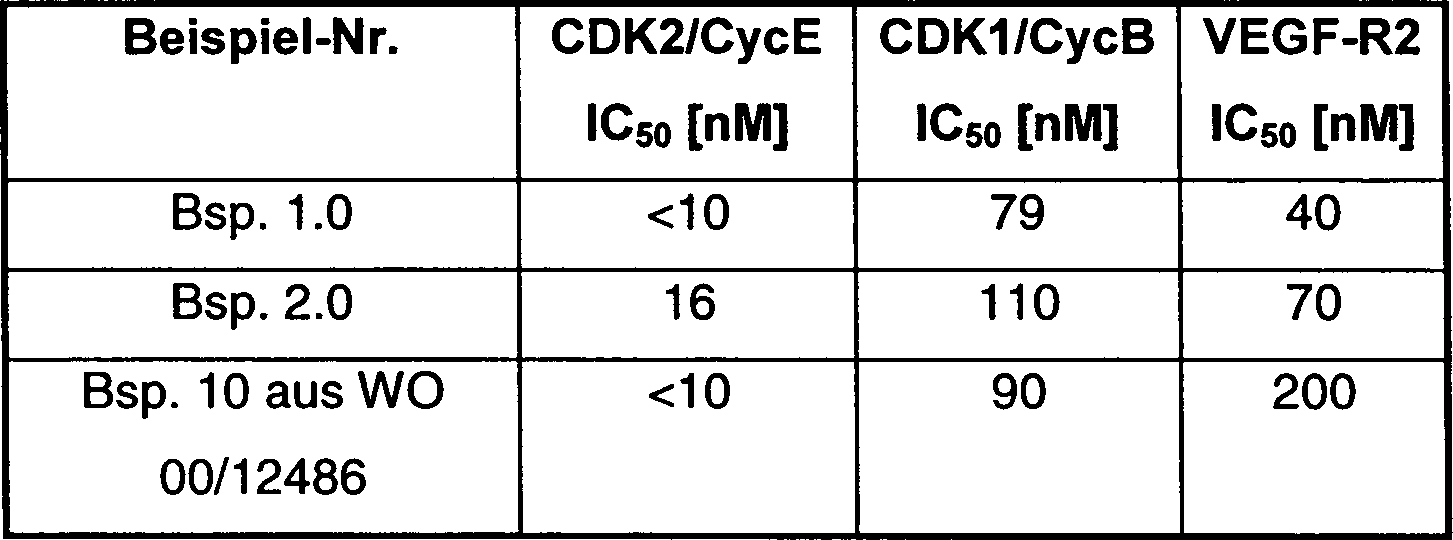

Claims (24)


Priority Applications (38)
| Application Number | Priority Date | Filing Date | Title |
|---|---|---|---|
| DE10349423A DE10349423A1 (en) | 2003-10-16 | 2003-10-16 | Sulfoximine-substituted parimidines as CDK and / or VEGF inhibitors, their preparation and use as medicaments |
| JO2004138A JO2534B1 (en) | 2003-10-16 | 2004-09-30 | Sulfoximine substituted pyrimidines as cdk-and /or vegf inhibitors their production and use as pharmaceutical agents |
| HR20090348T HRP20090348T1 (en) | 2003-10-16 | 2004-10-12 | Sulfoximine-substituted pyrimidines for use as cd and/or vegf-inhibitors, the production thereof and their use as drugs |
| PL04790500T PL1673352T3 (en) | 2003-10-16 | 2004-10-12 | Sulfoximine-substituted pyrimidines for use as cd and/or vegf-inhibitors, the production thereof and their use as drugs |
| MXPA06004091A MXPA06004091A (en) | 2003-10-16 | 2004-10-12 | Sulfoximine-substituted pyrimidines for use as cdk and/or vegf inhibitors, the production thereof and their use as drugs. |
| RU2006116466/04A RU2410378C2 (en) | 2003-10-16 | 2004-10-12 | Sulfoximin-substituted pyrimidines as cdk and/or vegf inhibitors, their obtaining and application as medications |
| PT04790500T PT1673352E (en) | 2003-10-16 | 2004-10-12 | Sulfoximine-substituted pyrimidines for use as cd and/or vegf-inhibitors, the production thereof and their use as drugs |
| PCT/EP2004/011661 WO2005037800A1 (en) | 2003-10-16 | 2004-10-12 | Sulfoximine-substituted pyrimidines for use as cdk and/or vegf inhibitors, the production thereof and their use as drugs |
| ES04790500T ES2324475T3 (en) | 2003-10-16 | 2004-10-12 | PYRIMIDINES REPLACED WITH SULFOXIMINE AS INHIBITING AGENTS OF CDK AND / OR VEGF, ITS PREPARATION AND USE AS MEDICATIONS. |
| EP04790500A EP1673352B1 (en) | 2003-10-16 | 2004-10-12 | Sulfoximine-substituted pyrimidines for use as cd and/or vegf-inhibitors, the production thereof and their use as drugs |
| AT04790500T ATE427939T1 (en) | 2003-10-16 | 2004-10-12 | SULFOXIMIN SUBSTITUTED PYRIMIDINES AS CDK AND/OR VEGF INHITORS, THEIR PRODUCTION AND USE AS MEDICINAL PRODUCTS |
| MEP-2008-158A ME00158B (en) | 2003-10-16 | 2004-10-12 | SULFOXIMIN-SUBSTITUTED PYRIMIDINES AS CDK AND / OR VEGF INHIBITORS, THEIR PREPARATION AND THEIR USE AS MEDICAMENTS |
| UAA200605171A UA86041C2 (en) | 2003-10-16 | 2004-10-12 | Sulfoximine-substituted pyrimidines for use as cdk and/or vegf inhibitors, the production thereof and their use as drugs |
| SI200431148T SI1673352T1 (en) | 2003-10-16 | 2004-10-12 | Sulfoximine-substituted pyrimidines for use as cd and/or vegf-inhibitors, the production thereof and their use as drugs |
| JP2006534714A JP4700006B2 (en) | 2003-10-16 | 2004-10-12 | Sulfoximine-substituted pyrimidines as CDK- and / or VEGF inhibitors, their production and use as pharmaceuticals |
| YU20060264A RS51657B (en) | 2003-10-16 | 2004-10-12 | PYRIMIDINS SUBSTITUTED BY SULFOXYIMINS AS CDKs / OR VEGF INHIBITORS, THEIR PRODUCTION AND USE AS A MEDICINE |
| AU2004281960A AU2004281960B2 (en) | 2003-10-16 | 2004-10-12 | Sulfoximine-substituted pyrimidines for use as CDK and/or VEGF inhibitors, the production thereof and their use as drugs |
| US12/095,947 US8507510B2 (en) | 2003-10-16 | 2004-10-12 | Sulfoximine-substituted pyrimidines as CDK- and/or VEGF inhibitors, their production and use as pharmaceutical agents |
| DE502004009330T DE502004009330D1 (en) | 2003-10-16 | 2004-10-12 | SULFOXIMIN-SUBSTITUTED PYRIMIDINES AS CDK AND / OR VEGF INHITERS, THEIR PREPARATION AND THEIR USE AS DRUGS |
| HK06114263.5A HK1093731B (en) | 2003-10-16 | 2004-10-12 | Sulfoximine-substituted pyrimidines for use as cdk and/or vegf inhibitors, the production thereof and their use as drugs |
| NZ546510A NZ546510A (en) | 2003-10-16 | 2004-10-12 | Sulfoximine-substituted pyrimidines for use as cdk and/or VEGF inhibitors, the production thereof and their use as drugs |
| DK04790500T DK1673352T3 (en) | 2003-10-16 | 2004-10-12 | Sulfoxime substituted pyrimidines as CDK and / or VEGF inhibitors, their preparation and use as a drug |
| CA2542492A CA2542492C (en) | 2003-10-16 | 2004-10-12 | Sulfoximine-substituted pyrimidines as cdk- and/or vegf inhibitors, their production and use as pharmaceutical agents |
| CN2004800304726A CN1867553B (en) | 2003-10-16 | 2004-10-12 | Sulfoximine-substituted pyrimidines as CDK-and/or VEGF inhibitors, their production and use as pharmaceutical agents |
| BRPI0415421-5A BRPI0415421A (en) | 2003-10-16 | 2004-10-12 | sulfoximine-substituted pyrimidines as cdk and / or vegf inhibitors, their preparation and their use as a medicament |
| TW093130948A TWI347844B (en) | 2003-10-16 | 2004-10-13 | Sulfoximine-substituted pyrimidines as cdk-and/or vegf inhibitors, their production and use as pharmaceutical agents |
| GT200400206A GT200400206A (en) | 2003-10-16 | 2004-10-13 | PYRIMIDINES REPLACED WITH SULFOXIMINE AS CDK AND / OR VEGF INHIBITORS, THEIR PREPARATION AND ITS USES AS A MEDICINAL PRODUCT. |
| MYPI20044268A MY140291A (en) | 2003-10-16 | 2004-10-15 | Sulfoximine-substituted pyrimidines for use as cd and/or vegf inhibitors, the production thereof and their use as drugs |
| PE2004001003A PE20050907A1 (en) | 2003-10-16 | 2004-10-15 | PYRIMIDINES SUBSTITUTED WITH SULFOXIMINE AS CYCLINE-DEPENDENT KINASE INHIBITORS |
| ARP040103755A AR046119A1 (en) | 2003-10-16 | 2004-10-15 | PYRIMIDINES REPLACED WITH SULFOXIMINE AS CDK AND / OR VEGF INHIBITORS ITS PREPARATION AND ITS USES AS A MEDICINAL PRODUCT |
| US10/966,098 US7338958B2 (en) | 2003-10-16 | 2004-10-18 | Sulfoximine-substituted pyrimidines as CDK-and/or VEGF inhibitors, their production and use as pharmaceutical agents |
| IL174952A IL174952A (en) | 2003-10-16 | 2006-04-11 | Sulfoximine-substituted pyrimidine derivatives, intermediates for their preparation and their use in the manufacture of pharmaceutical agents for treating various diseases |
| CR8363A CR8363A (en) | 2003-10-16 | 2006-04-25 | PYRIMIDINES REPLACED WITH SULFOXIMIN AS INHIBITORS OF CDK AND / OR VEGF, ITS PREPARATION AND ITS USES AS A MEDICINAL PRODUCT |
| EC2006006568A ECSP066568A (en) | 2003-10-16 | 2006-05-12 | PYRIMIDINES REPLACED WITH SULFOXIMINE AS CDK AND / OR VEGF INHIBITORS, THEIR PREPARATION AND THEIR USES AS A MEDICINAL PRODUCT |
| ZA200603885A ZA200603885B (en) | 2003-10-16 | 2006-05-15 | Sulfoximine-substituted pyrimidines for use as CDK and/or VEGF inhibitors, the production thereof and their use as drugs |
| KR1020067009424A KR101117387B1 (en) | 2003-10-16 | 2006-05-15 | Sulfoxymine-Substituted Pyrimidines for Use as CDX and / or WEP inhibitors, Preparations thereof, and Use as Pharmaceuticals |
| NO20062174A NO337290B1 (en) | 2003-10-16 | 2006-05-15 | Sulfoximine-substituted pyrimidines for use as CDK and / or VEGF inhibitors, their preparation and their use as drugs |
| CY20091100726T CY1110058T1 (en) | 2003-10-16 | 2009-07-08 | PYRIMIDINE SUBSTITUTES SULFOXIMINED AS CDK AND / OR VEGF INSPECTORS, PREPARED AND USED AS PHARMACEUTICAL PARTICULARS |
Applications Claiming Priority (1)
| Application Number | Priority Date | Filing Date | Title |
|---|---|---|---|
| DE10349423A DE10349423A1 (en) | 2003-10-16 | 2003-10-16 | Sulfoximine-substituted parimidines as CDK and / or VEGF inhibitors, their preparation and use as medicaments |
Publications (1)
| Publication Number | Publication Date |
|---|---|
| DE10349423A1 true DE10349423A1 (en) | 2005-06-16 |
Family
ID=34442222
Family Applications (2)
| Application Number | Title | Priority Date | Filing Date |
|---|---|---|---|
| DE10349423A Ceased DE10349423A1 (en) | 2003-10-16 | 2003-10-16 | Sulfoximine-substituted parimidines as CDK and / or VEGF inhibitors, their preparation and use as medicaments |
| DE502004009330T Expired - Lifetime DE502004009330D1 (en) | 2003-10-16 | 2004-10-12 | SULFOXIMIN-SUBSTITUTED PYRIMIDINES AS CDK AND / OR VEGF INHITERS, THEIR PREPARATION AND THEIR USE AS DRUGS |
Family Applications After (1)
| Application Number | Title | Priority Date | Filing Date |
|---|---|---|---|
| DE502004009330T Expired - Lifetime DE502004009330D1 (en) | 2003-10-16 | 2004-10-12 | SULFOXIMIN-SUBSTITUTED PYRIMIDINES AS CDK AND / OR VEGF INHITERS, THEIR PREPARATION AND THEIR USE AS DRUGS |
Country Status (35)
| Country | Link |
|---|---|
| US (2) | US8507510B2 (en) |
| EP (1) | EP1673352B1 (en) |
| JP (1) | JP4700006B2 (en) |
| KR (1) | KR101117387B1 (en) |
| CN (1) | CN1867553B (en) |
| AR (1) | AR046119A1 (en) |
| AT (1) | ATE427939T1 (en) |
| AU (1) | AU2004281960B2 (en) |
| BR (1) | BRPI0415421A (en) |
| CA (1) | CA2542492C (en) |
| CR (1) | CR8363A (en) |
| CY (1) | CY1110058T1 (en) |
| DE (2) | DE10349423A1 (en) |
| DK (1) | DK1673352T3 (en) |
| EC (1) | ECSP066568A (en) |
| ES (1) | ES2324475T3 (en) |
| GT (1) | GT200400206A (en) |
| HR (1) | HRP20090348T1 (en) |
| IL (1) | IL174952A (en) |
| JO (1) | JO2534B1 (en) |
| ME (1) | ME00158B (en) |
| MX (1) | MXPA06004091A (en) |
| MY (1) | MY140291A (en) |
| NO (1) | NO337290B1 (en) |
| NZ (1) | NZ546510A (en) |
| PE (1) | PE20050907A1 (en) |
| PL (1) | PL1673352T3 (en) |
| PT (1) | PT1673352E (en) |
| RS (1) | RS51657B (en) |
| RU (1) | RU2410378C2 (en) |
| SI (1) | SI1673352T1 (en) |
| TW (1) | TWI347844B (en) |
| UA (1) | UA86041C2 (en) |
| WO (1) | WO2005037800A1 (en) |
| ZA (1) | ZA200603885B (en) |
Cited By (1)
| Publication number | Priority date | Publication date | Assignee | Title |
|---|---|---|---|---|
| DE102005062742A1 (en) * | 2005-12-22 | 2007-06-28 | Bayer Schering Pharma Ag | New sulfoximine-substituted pyrimidines useful for treating e.g. diseases caused by inflammatory, allergic or proliferative processes, oncological diseases, cancer, eye, autoimmune and neurodegerative diseases |
Families Citing this family (95)
| Publication number | Priority date | Publication date | Assignee | Title |
|---|---|---|---|---|
| DE50213202D1 (en) * | 2001-05-29 | 2009-02-26 | Bayer Schering Pharma Ag | CDK INHIBITOR PYRIMIDINES, THEIR PREPARATION AND THEIR USE AS DRUGS |
| TWI329105B (en) | 2002-02-01 | 2010-08-21 | Rigel Pharmaceuticals Inc | 2,4-pyrimidinediamine compounds and their uses |
| GB0205688D0 (en) | 2002-03-09 | 2002-04-24 | Astrazeneca Ab | Chemical compounds |
| WO2003076434A1 (en) | 2002-03-09 | 2003-09-18 | Astrazeneca Ab | 4- imidazolyl substuited pyrimidine derivatives with cdk inhibitiory activity |
| GB0205690D0 (en) | 2002-03-09 | 2002-04-24 | Astrazeneca Ab | Chemical compounds |
| GB0205693D0 (en) | 2002-03-09 | 2002-04-24 | Astrazeneca Ab | Chemical compounds |
| NZ537752A (en) | 2002-07-29 | 2006-12-22 | Rigel Pharmaceuticals Inc | Use of 2,4-pyrimidinediamine compounds in the preparation of medicaments for treating autoimmune diseases |
| US7157455B2 (en) | 2003-02-10 | 2007-01-02 | Hoffmann-La Roche Inc. | 4-Aminopyrimidine-5-one derivatives |
| GB0311274D0 (en) | 2003-05-16 | 2003-06-18 | Astrazeneca Ab | Chemical compounds |
| GB0311276D0 (en) | 2003-05-16 | 2003-06-18 | Astrazeneca Ab | Chemical compounds |
| JP4886511B2 (en) | 2003-07-30 | 2012-02-29 | ライジェル ファーマシューティカルズ, インコーポレイテッド | Method for treating or preventing autoimmune diseases with 2,4-pyrimidinediamine compounds |
| DE10349423A1 (en) * | 2003-10-16 | 2005-06-16 | Schering Ag | Sulfoximine-substituted parimidines as CDK and / or VEGF inhibitors, their preparation and use as medicaments |
| JP4812763B2 (en) | 2004-05-18 | 2011-11-09 | ライジェル ファーマシューティカルズ, インコーポレイテッド | Cycloalkyl-substituted pyrimidinediamine compounds and uses thereof |
| GB2420559B (en) | 2004-11-15 | 2008-08-06 | Rigel Pharmaceuticals Inc | Stereoisomerically enriched 3-aminocarbonyl bicycloheptene pyrimidinediamine compounds and their uses |
| KR101278397B1 (en) | 2005-01-19 | 2013-06-25 | 리겔 파마슈티칼스, 인크. | Prodrugs of 2,4-pyrimidinediamine compounds and their uses |
| EP1705177A1 (en) * | 2005-03-23 | 2006-09-27 | Schering Aktiengesellschaft | N-aryl-sulfoximine-substituted pyrimidines as CDK- and/or VEGF inhibitors, their production and use as pharmaceutical agents |
| EP1710246A1 (en) * | 2005-04-08 | 2006-10-11 | Schering Aktiengesellschaft | Sulfoximine-pyrimidine Macrocycles and the salts thereof, a process for making them, and their pharmaceutical use against cancer |
| US20070203161A1 (en) | 2006-02-24 | 2007-08-30 | Rigel Pharmaceuticals, Inc. | Compositions and methods for inhibition of the jak pathway |
| SG137989A1 (en) | 2005-06-08 | 2008-01-28 | Rigel Pharmaceuticals Inc | Compositions and methods for inhibition of the JAK pathway |
| EP1928437A2 (en) | 2005-08-26 | 2008-06-11 | Braincells, Inc. | Neurogenesis by muscarinic receptor modulation |
| EP2258359A3 (en) | 2005-08-26 | 2011-04-06 | Braincells, Inc. | Neurogenesis by muscarinic receptor modulation with sabcomelin |
| CA2623374A1 (en) | 2005-09-30 | 2007-04-05 | Astrazeneca Ab | Imidazo [1,2-a] pyridine having anti-cell-proliferation activity |
| JP2009512711A (en) | 2005-10-21 | 2009-03-26 | ブレインセルス,インコーポレイティド | Regulation of neurogenesis by PDE inhibition |
| WO2007053596A1 (en) | 2005-10-31 | 2007-05-10 | Braincells, Inc. | Gaba receptor mediated modulation of neurogenesis |
| US7705009B2 (en) | 2005-11-22 | 2010-04-27 | Hoffman-La Roche Inc. | 4-aminopyrimidine-5-thione derivatives |
| FR2894746B1 (en) * | 2005-12-09 | 2008-06-13 | Ipanema Technologies Sa | METHOD AND DEVICE FOR REMOTELY CONTROLLING CONGESTION OF MESH FLOWS IN A PACKET MODE TELECOMMUNICATION NETWORK |
| EP1803723A1 (en) * | 2006-01-03 | 2007-07-04 | Bayer Schering Pharma Aktiengesellschaft | (2,4,9-triaza-1(2,4)-pyrimidina-3(1,3)-benzenacyclononaphan-3^4-yl)-sulfoximide derivatives as selective inhibitors of the aurora kinase for the treatment of cancer |
| JP2009528295A (en) | 2006-02-24 | 2009-08-06 | ライジェル ファーマシューティカルズ, インコーポレイテッド | Compositions and methods for inhibition of the JAK pathway |
| US20100216734A1 (en) | 2006-03-08 | 2010-08-26 | Braincells, Inc. | Modulation of neurogenesis by nootropic agents |
| WO2007134136A2 (en) | 2006-05-09 | 2007-11-22 | Braincells, Inc. | Neurogenesis by modulating angiotensin |
| DE102006027156A1 (en) | 2006-06-08 | 2007-12-13 | Bayer Schering Pharma Ag | New sulfimide compounds are protein kinase inhibitors useful to treat e.g. cancer, Hodgkin's lymphoma, Kaposi's sarcoma, cardiovascular disease, Crohn's disease, endometriosis and hemangioma |
| EP1878726A1 (en) * | 2006-07-12 | 2008-01-16 | Bayer Schering Pharma Aktiengesellschaft | Substituted sulphoximines as Tie2 inhibitors and salts thereof, pharmaceutical compositions comprising the same, methods of preparing the same and uses of the same |
| DE102006041382A1 (en) * | 2006-08-29 | 2008-03-20 | Bayer Schering Pharma Ag | Carbamoyl sulfoximides as protein kinase inhibitors |
| US20100184806A1 (en) | 2006-09-19 | 2010-07-22 | Braincells, Inc. | Modulation of neurogenesis by ppar agents |
| JP5161233B2 (en) | 2006-10-19 | 2013-03-13 | ライジェル ファーマシューティカルズ, インコーポレイテッド | 2,4-pyrimidinamine derivatives as inhibitors of JAK kinase for the treatment of autoimmune diseases |
| US8558002B2 (en) * | 2006-11-16 | 2013-10-15 | Allergan, Inc. | Sulfoximines as kinase inhibitors |
| WO2008061236A2 (en) * | 2006-11-16 | 2008-05-22 | Allergan, Inc. | Sulfoximines as kinase inhibitors |
| US8143410B2 (en) | 2006-11-16 | 2012-03-27 | Allergan, Inc. | Kinase inhibitors |
| EP2022785A1 (en) * | 2007-06-20 | 2009-02-11 | Bayer Schering Pharma Aktiengesellschaft | Alkynylpyrimidines as Tie2 kinase inhibitors |
| JP5529757B2 (en) * | 2008-01-17 | 2014-06-25 | バイエル・インテレクチュアル・プロパティ・ゲゼルシャフト・ミット・ベシュレンクテル・ハフツング | Sulfoximine-substituted quinazoline derivatives as immunomodulators, their preparation and use as pharmaceuticals |
| SG165655A1 (en) | 2008-04-16 | 2010-11-29 | Portola Pharm Inc | 2, 6-diamino- pyrimidin- 5-yl-carboxamides as syk or JAK kinases inhibitors |
| US8138339B2 (en) | 2008-04-16 | 2012-03-20 | Portola Pharmaceuticals, Inc. | Inhibitors of protein kinases |
| ES2546502T3 (en) | 2008-04-16 | 2015-09-24 | Portola Pharmaceuticals, Inc. | 2,6-Diamino-pyrimidin-5-yl-carboxamides as inhibitors of syk or JAK kinases |
| JP2011518219A (en) | 2008-04-22 | 2011-06-23 | ポートラ ファーマシューティカルズ, インコーポレイテッド | Inhibitors of protein kinases |
| EP2161259A1 (en) * | 2008-09-03 | 2010-03-10 | Bayer CropScience AG | 4-Haloalkyl substituted Diaminopyrimidine |
| EP2179992A1 (en) | 2008-10-21 | 2010-04-28 | Bayer Schering Pharma Aktiengesellschaft | Sulfon substituted aniline pyrimidine derivatives as CDK inhibitors, their manufacture and use as medicine |
| EP2179993A1 (en) | 2008-10-21 | 2010-04-28 | Bayer Schering Pharma Aktiengesellschaft | Sulfoxide substituted aniline pyrimidine derivatives as CDK inhibitors, their manufacture and use as medicine |
| EP2179991A1 (en) * | 2008-10-21 | 2010-04-28 | Bayer Schering Pharma Aktiengesellschaft | Sulfoximine substituted aniline pyrimidine derivatives as CDK inhibitors, their manufacture and use as medicine |
| WO2010099217A1 (en) | 2009-02-25 | 2010-09-02 | Braincells, Inc. | Modulation of neurogenesis using d-cycloserine combinations |
| DE102009001438A1 (en) | 2009-03-10 | 2010-09-16 | Bayer Schering Pharma Aktiengesellschaft | New carbonylamino-substituted anilino-pyrimidine compounds are tyrosine kinase-2 inhibitors, useful for treating diseases associated with inflammatory conditions e.g. bronchitis, rheumatoid arthritis, psoriasis and Guillain Barre syndrome |
| DE102009015070A1 (en) | 2009-03-30 | 2010-10-14 | Bayer Schering Pharma Aktiengesellschaft | New phenyl-pyrimidin-2-yl-amine compounds are tyrosine kinase 2 inhibitors useful for treating e.g. rheumatoid arthritis, Crohn's disease, asthma, multiple sclerosis, adult respiratory distress syndrome, allergic alveolitis and uveitis |
| MX337849B (en) * | 2009-07-28 | 2016-03-09 | Rigel Pharmaceuticals Inc | Compositions and methods for inhibition of the jak pathway. |
| DE102010014426A1 (en) * | 2010-04-01 | 2011-10-06 | Bayer Schering Pharma Aktiengesellschaft | Use of new pan-CDK inhibitors for the treatment of tumors |
| DE102010014427A1 (en) | 2010-04-01 | 2011-10-06 | Bayer Schering Pharma Aktiengesellschaft | Combination, to treat e.g. tumors e.g. breast cancer, and psoriasis comprises substituted N-(4-hydrosulfonimidoylphenyl)-5-(trifluoromethyl)pyrimidin-2-amine compounds and antihyperproliferative, cytostatic or cytotoxic substances |
| HUE029196T2 (en) | 2010-06-04 | 2017-02-28 | Hoffmann La Roche | Aminopyrimidine derivatives as lrrk2 modulators |
| DE102010046720A1 (en) | 2010-09-23 | 2012-03-29 | Bayer Schering Pharma Aktiengesellschaft | Process for the preparation of pan-CDK inhibitors of the formula (I), as well as intermediates of the preparation |
| EP2635557A2 (en) | 2010-11-01 | 2013-09-11 | Portola Pharmaceuticals, Inc. | Nicotinamides as jak kinase modulators |
| US20130317029A1 (en) | 2010-11-01 | 2013-11-28 | Portola Pharmaceuticals, Inc. | Oxypyrimidines as syk modulators |
| AU2011323484B2 (en) | 2010-11-01 | 2016-10-06 | Portola Pharmaceuticals, Inc. | Benzamides and nicotinamides as Syk modulators |
| US8815882B2 (en) | 2010-11-10 | 2014-08-26 | Genentech, Inc. | Pyrazole aminopyrimidine derivatives as LRRK2 modulators |
| EP2527332A1 (en) | 2011-05-24 | 2012-11-28 | Bayer Intellectual Property GmbH | 4-Aryl-N-phenyl-1,3,5-triazin-2-amines containing a sulfoximine group as CDK9 inhibitors |
| TW201636330A (en) * | 2011-05-24 | 2016-10-16 | 拜耳知識產權公司 | 4-aryl-N-phenyl-1,3,5-triazabenzene-2-amine containing a sulfonium imine group |
| CA2848615C (en) * | 2011-09-16 | 2020-02-25 | Bayer Intellectual Property Gmbh | Disubstituted 5-fluoro pyrimidine derivatives containing a sulfoximine group |
| CN103814029B (en) | 2011-09-23 | 2016-10-12 | 拜耳知识产权有限责任公司 | Substituted imidazopyridazines |
| US9498471B2 (en) | 2011-10-20 | 2016-11-22 | The Regents Of The University Of California | Use of CDK9 inhibitors to reduce cartilage degradation |
| CA2856301C (en) | 2011-11-23 | 2020-10-06 | Portola Pharmaceuticals, Inc. | Pyrazine kinase inhibitors |
| WO2013139734A1 (en) | 2012-03-21 | 2013-09-26 | Bayer Intellectual Property Gmbh | Use of (rs)-s-cyclopropyl-s-(4-{[4-{[1r, 2r)-2-hydroxy-1-methylpropyl]oxy}-5-(trifluoromethyl)pyrimidin-2-yl]amino}phenyl)sulfoximide for treating specific tumours |
| WO2014058921A2 (en) | 2012-10-08 | 2014-04-17 | Portola Pharmaceuticals, Inc. | Substituted pyrimidinyl kinase inhibitors |
| EP2909176B1 (en) | 2012-10-18 | 2016-07-20 | Bayer Pharma Aktiengesellschaft | 5-fluoro-n-(pyridin-2-yl)pyridin-2-amine derivatives containing a sulfone group |
| CA2888383A1 (en) | 2012-10-18 | 2014-04-24 | Bayer Pharma Aktiengesellschaft | N-(pyridin-2-yl)pyrimidin-4-amine derivatives containing a sulfone group |
| TW201418243A (en) | 2012-11-15 | 2014-05-16 | Bayer Pharma AG | N-(pyridin-2-yl)pyrimidin-4-amine derivatives containing a sulfoximine group |
| CA2891358C (en) | 2012-11-15 | 2021-05-18 | Bayer Pharma Aktiengesellschaft | 5-fluoro-n-(pyridin-2-yl)pyridin-2-amine derivatives containing a sulfoximine group |
| US9499492B2 (en) * | 2012-11-15 | 2016-11-22 | Bayer Pharma Aktiengesellschaft | 4-(ortho)-fluorophenyl-5-fluoropyrimidin-2-yl amines containing a sulfoximine group |
| WO2014173815A1 (en) | 2013-04-23 | 2014-10-30 | Bayer Pharma Aktiengesellschaft | Use of (rs)-s-cyclopropyl-s-(4-{[4-{[(1r, 2r)-2-hydroxy-1-methylpropyl]oxy}-5- (trifluoromethyl)pyrimidin-2-yl]amino}phenyl)sulphoximide for the treatment of specific tumours |
| CA2916103A1 (en) | 2013-06-21 | 2014-12-24 | Bayer Pharma Aktiengesellschaft | Diaminoheteroaryl substituted pyrazoles |
| CA2917096C (en) | 2013-07-04 | 2021-05-18 | Bayer Pharma Aktiengesellschaft | Sulfoximine substituted 5-fluoro-n-(pyridin-2-yl)pyridin-2-amine derivatives and their use as cdk9 kinase inhibitors |
| EP3063138A1 (en) | 2013-10-30 | 2016-09-07 | Bayer Pharma Aktiengesellschaft | Heteroaryl substituted pyrazoles |
| WO2015089210A1 (en) * | 2013-12-12 | 2015-06-18 | Allergan, Inc. | Substituted dialkyl(oxido)-λ4-sulfanylidene nicotinamide derivatives as kinase inhibitors |
| CA2942119A1 (en) | 2014-03-13 | 2015-09-17 | Bayer Pharma Aktiengesellschaft | 5-fluoro-n-(pyridin-2-yl)pyridin-2-amine derivatives containing a sulfone group |
| CA2944251C (en) | 2014-04-01 | 2022-10-18 | Bayer Pharma Aktiengesellschaft | Disubstituted 5-fluoro pyrimidine derivatives containing a sulfondiimine group |
| JP6605493B2 (en) | 2014-04-11 | 2019-11-13 | バイエル ファーマ アクチエンゲゼルシャフト | New macrocyclic compounds |
| TWI700283B (en) | 2014-08-04 | 2020-08-01 | 德商拜耳製藥公司 | 2-(morpholin-4-yl)-1,7-naphthyridines |
| JP6930913B2 (en) | 2014-10-14 | 2021-09-01 | ザ リージェンツ オブ ザ ユニバーシティ オブ カリフォルニアThe Regents Of The University Of California | Usage of CDK9 and BRD4 inhibitors to inhibit inflammation |
| ES2720525T3 (en) | 2014-10-16 | 2019-07-22 | Bayer Pharma AG | Fluorinated benzofuranyl-pyrimidine derivatives containing a sulfone group |
| CN107001341B (en) | 2014-10-16 | 2020-08-07 | 拜耳医药股份有限公司 | Fluorinated benzofuranyl-pyrimidine derivatives containing sulfonimide groups |
| US10717749B2 (en) | 2015-09-29 | 2020-07-21 | Bayer Pharma Aktiengesellschaft | Macrocyclic sulfondiimine compounds |
| CA3001085A1 (en) | 2015-10-08 | 2017-04-13 | Bayer Pharma Aktiengesellschaft | Novel modified macrocyclic compounds |
| WO2017060322A2 (en) | 2015-10-10 | 2017-04-13 | Bayer Pharma Aktiengesellschaft | Ptefb-inhibitor-adc |
| WO2018177889A1 (en) | 2017-03-28 | 2018-10-04 | Bayer Aktiengesellschaft | Novel ptefb inhibiting macrocyclic compounds |
| CA3057892A1 (en) | 2017-03-28 | 2018-10-04 | Bayer Aktiengesellschaft | Novel ptefb inhibiting macrocyclic compounds |
| KR101936054B1 (en) | 2017-06-23 | 2019-01-11 | 한국과학기술연구원 | Anti-inflammatory 6-phenoxypyrimidine derivatives, process for their preparation and pharmaceutical composition containing them |
| EA202091894A1 (en) | 2018-02-13 | 2020-12-28 | Байер Акциенгезельшафт | APPLICATION of 5-FLUORO-4- (4-FLUORO-2-METHOXYPHENYL) -N- {4 - [(S-METHYLSULFONIMIDOIL) METHYL] PYRIDIN-2-YL} PYRIDINE-2-AMINE FOR TREATMENT OF DIFFUS B-LARGE PHOTOCELL |
| KR20210107069A (en) | 2018-12-21 | 2021-08-31 | 다이이찌 산쿄 가부시키가이샤 | Combination of antibody-drug conjugates and kinase inhibitors |
| WO2022266394A1 (en) * | 2021-06-18 | 2022-12-22 | The Trustees Of Columbia University In The City Of New York | Novel isomerohydrolase inhibitor for treatment of atrophic form of age-related macular degeneration and stargardt disease |
| WO2024169952A1 (en) | 2023-02-16 | 2024-08-22 | Gasherbrum Bio, Inc. | Heterocyclic glp-1 agonists |
Citations (6)
| Publication number | Priority date | Publication date | Assignee | Title |
|---|---|---|---|---|
| WO1998041512A1 (en) * | 1997-03-14 | 1998-09-24 | Celltech Therapeutics Limited | Substituted 2-anilinopyrimidines useful as protein kinase inhibitors |
| WO2000053595A1 (en) * | 1999-03-06 | 2000-09-14 | Astrazeneca Ab | Pyrimidine compounds |
| WO2001064654A1 (en) * | 2000-03-01 | 2001-09-07 | Astrazeneca Ab | Pyrimidine compounds |
| WO2002096888A1 (en) * | 2001-05-29 | 2002-12-05 | Schering Aktiengesellschaft | Cdk inhibiting pyrimidines, production thereof and their use as medicaments |
| WO2002096887A1 (en) * | 2001-05-30 | 2002-12-05 | Astrazeneca Ab | 2-anilino-pyrimidine derivatives as cyclin dependent kinase inhibitors |
| WO2005035951A1 (en) | 2003-10-08 | 2005-04-21 | The Lubrizol Corporation | System containing oxygen enriched diesel particulate filter and method thereof |
Family Cites Families (9)
| Publication number | Priority date | Publication date | Assignee | Title |
|---|---|---|---|---|
| US5187189A (en) * | 1991-01-22 | 1993-02-16 | American Home Products Corporation | S-aminoalkyl-s-arylsulfoximines as antiarrhythmic agents |
| US5902817A (en) * | 1997-04-09 | 1999-05-11 | Guilford Pharmaceuticals Inc. | Certain sulfoxide and sulfone derivatives |
| GB9828511D0 (en) | 1998-12-24 | 1999-02-17 | Zeneca Ltd | Chemical compounds |
| JP2000232898A (en) * | 1999-02-17 | 2000-08-29 | Kyowa Medex Co Ltd | Quantitative analysis of substance and reagent therefor |
| AU2001281059A1 (en) * | 2000-08-02 | 2002-02-13 | Smith Kline Beecham Corporation | Fatty acid synthase inhibitors |
| JP2005526765A (en) * | 2002-03-11 | 2005-09-08 | シエーリング アクチエンゲゼルシャフト | CDK-inhibiting 2-heteroaryl-pyrimidines, their production and use as pharmaceuticals |
| US7288547B2 (en) * | 2002-03-11 | 2007-10-30 | Schering Ag | CDK-inhibitory 2-heteroaryl-pyrimidines, their production and use as pharmaceutical agents |
| AU2003285614B2 (en) * | 2002-12-20 | 2009-05-14 | Pfizer Products, Inc. | Pyrimidine derivatives for the treatment of abnormal cell growth |
| DE10349423A1 (en) * | 2003-10-16 | 2005-06-16 | Schering Ag | Sulfoximine-substituted parimidines as CDK and / or VEGF inhibitors, their preparation and use as medicaments |
-
2003
- 2003-10-16 DE DE10349423A patent/DE10349423A1/en not_active Ceased
-
2004
- 2004-09-30 JO JO2004138A patent/JO2534B1/en active
- 2004-10-12 JP JP2006534714A patent/JP4700006B2/en not_active Expired - Fee Related
- 2004-10-12 DK DK04790500T patent/DK1673352T3/en active
- 2004-10-12 PT PT04790500T patent/PT1673352E/en unknown
- 2004-10-12 MX MXPA06004091A patent/MXPA06004091A/en active IP Right Grant
- 2004-10-12 AT AT04790500T patent/ATE427939T1/en active
- 2004-10-12 PL PL04790500T patent/PL1673352T3/en unknown
- 2004-10-12 EP EP04790500A patent/EP1673352B1/en not_active Expired - Lifetime
- 2004-10-12 AU AU2004281960A patent/AU2004281960B2/en not_active Ceased
- 2004-10-12 WO PCT/EP2004/011661 patent/WO2005037800A1/en not_active Ceased
- 2004-10-12 HR HR20090348T patent/HRP20090348T1/en unknown
- 2004-10-12 BR BRPI0415421-5A patent/BRPI0415421A/en active Search and Examination
- 2004-10-12 RU RU2006116466/04A patent/RU2410378C2/en not_active IP Right Cessation
- 2004-10-12 UA UAA200605171A patent/UA86041C2/en unknown
- 2004-10-12 DE DE502004009330T patent/DE502004009330D1/en not_active Expired - Lifetime
- 2004-10-12 RS YU20060264A patent/RS51657B/en unknown
- 2004-10-12 CA CA2542492A patent/CA2542492C/en not_active Expired - Fee Related
- 2004-10-12 ME MEP-2008-158A patent/ME00158B/en unknown
- 2004-10-12 SI SI200431148T patent/SI1673352T1/en unknown
- 2004-10-12 CN CN2004800304726A patent/CN1867553B/en not_active Expired - Fee Related
- 2004-10-12 US US12/095,947 patent/US8507510B2/en not_active Expired - Fee Related
- 2004-10-12 NZ NZ546510A patent/NZ546510A/en not_active IP Right Cessation
- 2004-10-12 ES ES04790500T patent/ES2324475T3/en not_active Expired - Lifetime
- 2004-10-13 GT GT200400206A patent/GT200400206A/en unknown
- 2004-10-13 TW TW093130948A patent/TWI347844B/en not_active IP Right Cessation
- 2004-10-15 PE PE2004001003A patent/PE20050907A1/en not_active Application Discontinuation
- 2004-10-15 MY MYPI20044268A patent/MY140291A/en unknown
- 2004-10-15 AR ARP040103755A patent/AR046119A1/en unknown
- 2004-10-18 US US10/966,098 patent/US7338958B2/en not_active Expired - Fee Related
-
2006
- 2006-04-11 IL IL174952A patent/IL174952A/en not_active IP Right Cessation
- 2006-04-25 CR CR8363A patent/CR8363A/en unknown
- 2006-05-12 EC EC2006006568A patent/ECSP066568A/en unknown
- 2006-05-15 KR KR1020067009424A patent/KR101117387B1/en not_active Expired - Fee Related
- 2006-05-15 ZA ZA200603885A patent/ZA200603885B/en unknown
- 2006-05-15 NO NO20062174A patent/NO337290B1/en not_active IP Right Cessation
-
2009
- 2009-07-08 CY CY20091100726T patent/CY1110058T1/en unknown
Patent Citations (6)
| Publication number | Priority date | Publication date | Assignee | Title |
|---|---|---|---|---|
| WO1998041512A1 (en) * | 1997-03-14 | 1998-09-24 | Celltech Therapeutics Limited | Substituted 2-anilinopyrimidines useful as protein kinase inhibitors |
| WO2000053595A1 (en) * | 1999-03-06 | 2000-09-14 | Astrazeneca Ab | Pyrimidine compounds |
| WO2001064654A1 (en) * | 2000-03-01 | 2001-09-07 | Astrazeneca Ab | Pyrimidine compounds |
| WO2002096888A1 (en) * | 2001-05-29 | 2002-12-05 | Schering Aktiengesellschaft | Cdk inhibiting pyrimidines, production thereof and their use as medicaments |
| WO2002096887A1 (en) * | 2001-05-30 | 2002-12-05 | Astrazeneca Ab | 2-anilino-pyrimidine derivatives as cyclin dependent kinase inhibitors |
| WO2005035951A1 (en) | 2003-10-08 | 2005-04-21 | The Lubrizol Corporation | System containing oxygen enriched diesel particulate filter and method thereof |
Cited By (3)
| Publication number | Priority date | Publication date | Assignee | Title |
|---|---|---|---|---|
| DE102005062742A1 (en) * | 2005-12-22 | 2007-06-28 | Bayer Schering Pharma Ag | New sulfoximine-substituted pyrimidines useful for treating e.g. diseases caused by inflammatory, allergic or proliferative processes, oncological diseases, cancer, eye, autoimmune and neurodegerative diseases |
| DE102006031224A1 (en) * | 2005-12-22 | 2008-01-17 | Bayer Schering Pharma Ag | New sulfoximine-substituted pyrimidines useful for treating e.g. diseases caused by inflammatory, allergic or proliferative processes, oncological diseases, cancer, eye, autoimmune and neurodegerative diseases |
| US7825128B2 (en) | 2005-12-22 | 2010-11-02 | Bayer Schering Pharma Ag | Sulfoximine-substituted pyrimidines, processes for production thereof and use thereof as drugs |
Also Published As
Similar Documents
| Publication | Publication Date | Title |
|---|---|---|
| DE10349423A1 (en) | Sulfoximine-substituted parimidines as CDK and / or VEGF inhibitors, their preparation and use as medicaments | |
| EP1530574B1 (en) | Macrocyclic pyrimidines, the production thereof and the use of the same as medicaments | |
| EP1392662B1 (en) | Cdk inhibiting pyrimidines, production thereof and their use as medicaments | |
| EP1794134A1 (en) | Substituted 2-anilinopyrimidines as cell cycle kinase inhibitors or receptor tyrosine kinase inhibitors, production of said substances and use of the latter as medicaments | |
| DE69920509T2 (en) | PYRIMIDINE COMPOUNDS | |
| EP1483260A1 (en) | Cdk inhibiting 2-heteroaryl pyrimidine, the production thereof, and use thereof as a medicament | |
| EP1387840B1 (en) | 3,5-diamino-1,2,4-triazoles as kinase inhibitors | |
| DE102006031224A1 (en) | New sulfoximine-substituted pyrimidines useful for treating e.g. diseases caused by inflammatory, allergic or proliferative processes, oncological diseases, cancer, eye, autoimmune and neurodegerative diseases | |
| EP1705177A1 (en) | N-aryl-sulfoximine-substituted pyrimidines as CDK- and/or VEGF inhibitors, their production and use as pharmaceutical agents | |
| DE10212098A1 (en) | New 2-anilino-pyrimidine derivatives, are potent cyclin dependent kinase inhibitors, useful e.g. for treating cancer, autoimmune, cardiovascular or neurodegenerative diseases or viral infections | |
| DE102004049622A1 (en) | Novel para-sulfonamido-substituted 2-anilinopyrimidines are useful in a wide range of medicaments and as cell cycle kinase inhibitors or receptor tyrosine kinase inhibitors | |
| DE10127581A1 (en) | New 2-anilino-pyrimidine derivatives, are potent cyclin dependent kinase inhibitors, useful e.g. for treating cancer, autoimmune, cardiovascular or neurodegenerative diseases or viral infections | |
| DE10212100A1 (en) | New 2-aminopyrimidine derivatives are cyclin-dependent kinase inhibitors useful for treating e.g. cancer, autoimmune diseases, cardiovascular diseases, infectious diseases or viral infections | |
| DE10255984A1 (en) | New 2-aminopyrimidine derivatives are cyclin-dependent kinase inhibitors useful for treating e.g. cancer, autoimmune diseases, cardiovascular diseases, infectious diseases or viral infections | |
| HK1093731B (en) | Sulfoximine-substituted pyrimidines for use as cdk and/or vegf inhibitors, the production thereof and their use as drugs |
Legal Events
| Date | Code | Title | Description |
|---|---|---|---|
| OP8 | Request for examination as to paragraph 44 patent law | ||
| 8127 | New person/name/address of the applicant |
Owner name: BAYER SCHERING PHARMA AG, 13353 BERLIN, DE |
|
| 8127 | New person/name/address of the applicant |
Owner name: BAYER SCHERING PHARMA AKIENGESELLSCHAFT, 13353, DE |
|
| 8131 | Rejection |