DE10313937A1 - dispersants - Google Patents
dispersants Download PDFInfo
- Publication number
- DE10313937A1 DE10313937A1 DE10313937A DE10313937A DE10313937A1 DE 10313937 A1 DE10313937 A1 DE 10313937A1 DE 10313937 A DE10313937 A DE 10313937A DE 10313937 A DE10313937 A DE 10313937A DE 10313937 A1 DE10313937 A1 DE 10313937A1
- Authority
- DE
- Germany
- Prior art keywords
- monomers
- weight
- group
- carbon atoms
- ethylenically unsaturated
- Prior art date
- Legal status (The legal status is an assumption and is not a legal conclusion. Google has not performed a legal analysis and makes no representation as to the accuracy of the status listed.)
- Withdrawn
Links
- 239000002270 dispersing agent Substances 0.000 title claims abstract description 33
- 239000000178 monomer Substances 0.000 claims abstract description 39
- 229920001577 copolymer Polymers 0.000 claims abstract description 30
- 125000004432 carbon atom Chemical group C* 0.000 claims abstract description 25
- 150000001875 compounds Chemical class 0.000 claims abstract description 18
- CERQOIWHTDAKMF-UHFFFAOYSA-N Methacrylic acid Chemical compound CC(=C)C(O)=O CERQOIWHTDAKMF-UHFFFAOYSA-N 0.000 claims abstract description 13
- 229920001223 polyethylene glycol Polymers 0.000 claims abstract description 12
- IAYPIBMASNFSPL-UHFFFAOYSA-N Ethylene oxide Chemical group C1CO1 IAYPIBMASNFSPL-UHFFFAOYSA-N 0.000 claims abstract description 9
- 125000002877 alkyl aryl group Chemical group 0.000 claims abstract description 8
- 125000000217 alkyl group Chemical group 0.000 claims abstract description 8
- 125000002947 alkylene group Chemical group 0.000 claims abstract description 8
- 125000003118 aryl group Chemical group 0.000 claims abstract description 8
- 125000002887 hydroxy group Chemical group [H]O* 0.000 claims abstract description 7
- 125000001033 ether group Chemical group 0.000 claims abstract description 6
- 229920001515 polyalkylene glycol Polymers 0.000 claims abstract description 5
- 150000008064 anhydrides Chemical class 0.000 claims abstract description 4
- BDHFUVZGWQCTTF-UHFFFAOYSA-M sulfonate Chemical compound [O-]S(=O)=O BDHFUVZGWQCTTF-UHFFFAOYSA-M 0.000 claims abstract description 4
- 150000001991 dicarboxylic acids Chemical class 0.000 claims abstract description 3
- 150000002763 monocarboxylic acids Chemical class 0.000 claims abstract description 3
- -1 aralkyl radical Chemical class 0.000 claims description 38
- 239000006185 dispersion Substances 0.000 claims description 23
- 239000000843 powder Substances 0.000 claims description 21
- 239000004568 cement Substances 0.000 claims description 20
- 229910052784 alkaline earth metal Inorganic materials 0.000 claims description 15
- 125000005396 acrylic acid ester group Chemical group 0.000 claims description 12
- 239000004014 plasticizer Substances 0.000 claims description 12
- 125000005397 methacrylic acid ester group Chemical group 0.000 claims description 11
- 229920000642 polymer Polymers 0.000 claims description 11
- 229920001451 polypropylene glycol Polymers 0.000 claims description 11
- 238000001694 spray drying Methods 0.000 claims description 11
- XTXRWKRVRITETP-UHFFFAOYSA-N Vinyl acetate Chemical compound CC(=O)OC=C XTXRWKRVRITETP-UHFFFAOYSA-N 0.000 claims description 10
- 229920002554 vinyl polymer Polymers 0.000 claims description 9
- NIXOWILDQLNWCW-UHFFFAOYSA-N 2-Propenoic acid Natural products OC(=O)C=C NIXOWILDQLNWCW-UHFFFAOYSA-N 0.000 claims description 8
- VGGSQFUCUMXWEO-UHFFFAOYSA-N Ethene Chemical compound C=C VGGSQFUCUMXWEO-UHFFFAOYSA-N 0.000 claims description 8
- 239000005977 Ethylene Substances 0.000 claims description 8
- 229910052783 alkali metal Inorganic materials 0.000 claims description 8
- 150000001340 alkali metals Chemical class 0.000 claims description 8
- 238000000034 method Methods 0.000 claims description 8
- 239000000126 substance Substances 0.000 claims description 8
- 125000000391 vinyl group Chemical group [H]C([*])=C([H])[H] 0.000 claims description 8
- SMZOUWXMTYCWNB-UHFFFAOYSA-N 2-(2-methoxy-5-methylphenyl)ethanamine Chemical compound COC1=CC=C(C)C=C1CCN SMZOUWXMTYCWNB-UHFFFAOYSA-N 0.000 claims description 7
- 230000008569 process Effects 0.000 claims description 7
- NIXOWILDQLNWCW-UHFFFAOYSA-M Acrylate Chemical compound [O-]C(=O)C=C NIXOWILDQLNWCW-UHFFFAOYSA-M 0.000 claims description 6
- 239000003513 alkali Substances 0.000 claims description 6
- 230000000694 effects Effects 0.000 claims description 6
- 238000006116 polymerization reaction Methods 0.000 claims description 6
- 239000011230 binding agent Substances 0.000 claims description 5
- 150000002334 glycols Chemical class 0.000 claims description 5
- 229920001748 polybutylene Polymers 0.000 claims description 5
- VZCYOOQTPOCHFL-OWOJBTEDSA-N Fumaric acid Chemical compound OC(=O)\C=C\C(O)=O VZCYOOQTPOCHFL-OWOJBTEDSA-N 0.000 claims description 4
- CPLXHLVBOLITMK-UHFFFAOYSA-N Magnesium oxide Chemical compound [Mg]=O CPLXHLVBOLITMK-UHFFFAOYSA-N 0.000 claims description 4
- 239000000853 adhesive Substances 0.000 claims description 4
- 230000001070 adhesive effect Effects 0.000 claims description 4
- 150000001298 alcohols Chemical class 0.000 claims description 4
- 150000005215 alkyl ethers Chemical class 0.000 claims description 4
- 238000010276 construction Methods 0.000 claims description 4
- 239000010440 gypsum Substances 0.000 claims description 4
- 229910052602 gypsum Inorganic materials 0.000 claims description 4
- 229920001519 homopolymer Polymers 0.000 claims description 4
- VZCYOOQTPOCHFL-UHFFFAOYSA-N trans-butenedioic acid Natural products OC(=O)C=CC(O)=O VZCYOOQTPOCHFL-UHFFFAOYSA-N 0.000 claims description 4
- 229920001567 vinyl ester resin Polymers 0.000 claims description 4
- XEEYSDHEOQHCDA-UHFFFAOYSA-N 2-methylprop-2-ene-1-sulfonic acid Chemical compound CC(=C)CS(O)(=O)=O XEEYSDHEOQHCDA-UHFFFAOYSA-N 0.000 claims description 3
- 235000008733 Citrus aurantifolia Nutrition 0.000 claims description 3
- GOOHAUXETOMSMM-UHFFFAOYSA-N Propylene oxide Chemical compound CC1CO1 GOOHAUXETOMSMM-UHFFFAOYSA-N 0.000 claims description 3
- 235000011941 Tilia x europaea Nutrition 0.000 claims description 3
- 238000000889 atomisation Methods 0.000 claims description 3
- 150000001735 carboxylic acids Chemical class 0.000 claims description 3
- 239000004571 lime Substances 0.000 claims description 3
- 238000002360 preparation method Methods 0.000 claims description 3
- 150000003839 salts Chemical class 0.000 claims description 3
- AGBXYHCHUYARJY-UHFFFAOYSA-N 2-phenylethenesulfonic acid Chemical compound OS(=O)(=O)C=CC1=CC=CC=C1 AGBXYHCHUYARJY-UHFFFAOYSA-N 0.000 claims description 2
- HRPVXLWXLXDGHG-UHFFFAOYSA-N Acrylamide Chemical compound NC(=O)C=C HRPVXLWXLXDGHG-UHFFFAOYSA-N 0.000 claims description 2
- GAWIXWVDTYZWAW-UHFFFAOYSA-N C[CH]O Chemical group C[CH]O GAWIXWVDTYZWAW-UHFFFAOYSA-N 0.000 claims description 2
- 229910019142 PO4 Inorganic materials 0.000 claims description 2
- OFOBLEOULBTSOW-UHFFFAOYSA-N Propanedioic acid Natural products OC(=O)CC(O)=O OFOBLEOULBTSOW-UHFFFAOYSA-N 0.000 claims description 2
- WYURNTSHIVDZCO-UHFFFAOYSA-N Tetrahydrofuran Chemical group C1CCOC1 WYURNTSHIVDZCO-UHFFFAOYSA-N 0.000 claims description 2
- BZHJMEDXRYGGRV-UHFFFAOYSA-N Vinyl chloride Chemical compound ClC=C BZHJMEDXRYGGRV-UHFFFAOYSA-N 0.000 claims description 2
- 239000000654 additive Substances 0.000 claims description 2
- 230000000996 additive effect Effects 0.000 claims description 2
- 150000001336 alkenes Chemical class 0.000 claims description 2
- 150000004645 aluminates Chemical class 0.000 claims description 2
- 229910052799 carbon Inorganic materials 0.000 claims description 2
- 239000003086 colorant Substances 0.000 claims description 2
- 150000001993 dienes Chemical class 0.000 claims description 2
- 239000001530 fumaric acid Substances 0.000 claims description 2
- 229910052739 hydrogen Inorganic materials 0.000 claims description 2
- 230000002209 hydrophobic effect Effects 0.000 claims description 2
- 239000000395 magnesium oxide Substances 0.000 claims description 2
- VZCYOOQTPOCHFL-UPHRSURJSA-N maleic acid Chemical compound OC(=O)\C=C/C(O)=O VZCYOOQTPOCHFL-UPHRSURJSA-N 0.000 claims description 2
- 239000011976 maleic acid Substances 0.000 claims description 2
- FPYJFEHAWHCUMM-UHFFFAOYSA-N maleic anhydride Chemical compound O=C1OC(=O)C=C1 FPYJFEHAWHCUMM-UHFFFAOYSA-N 0.000 claims description 2
- FQPSGWSUVKBHSU-UHFFFAOYSA-N methacrylamide Chemical compound CC(=C)C(N)=O FQPSGWSUVKBHSU-UHFFFAOYSA-N 0.000 claims description 2
- 239000010452 phosphate Substances 0.000 claims description 2
- NBIIXXVUZAFLBC-UHFFFAOYSA-K phosphate Chemical compound [O-]P([O-])([O-])=O NBIIXXVUZAFLBC-UHFFFAOYSA-K 0.000 claims description 2
- 235000019353 potassium silicate Nutrition 0.000 claims description 2
- 150000003254 radicals Chemical class 0.000 claims description 2
- 238000007789 sealing Methods 0.000 claims description 2
- 239000002002 slurry Substances 0.000 claims description 2
- NTHWMYGWWRZVTN-UHFFFAOYSA-N sodium silicate Chemical compound [Na+].[Na+].[O-][Si]([O-])=O NTHWMYGWWRZVTN-UHFFFAOYSA-N 0.000 claims description 2
- 150000003460 sulfonic acids Chemical class 0.000 claims description 2
- NLVXSWCKKBEXTG-UHFFFAOYSA-N vinylsulfonic acid Chemical compound OS(=O)(=O)C=C NLVXSWCKKBEXTG-UHFFFAOYSA-N 0.000 claims description 2
- JAHNSTQSQJOJLO-UHFFFAOYSA-N 2-(3-fluorophenyl)-1h-imidazole Chemical compound FC1=CC=CC(C=2NC=CN=2)=C1 JAHNSTQSQJOJLO-UHFFFAOYSA-N 0.000 claims 1
- QAOWNCQODCNURD-UHFFFAOYSA-L Sulfate Chemical compound [O-]S([O-])(=O)=O QAOWNCQODCNURD-UHFFFAOYSA-L 0.000 claims 1
- 239000002253 acid Substances 0.000 claims 1
- 150000001732 carboxylic acid derivatives Chemical class 0.000 claims 1
- 239000011440 grout Substances 0.000 claims 1
- LVHBHZANLOWSRM-UHFFFAOYSA-N methylenebutanedioic acid Natural products OC(=O)CC(=C)C(O)=O LVHBHZANLOWSRM-UHFFFAOYSA-N 0.000 claims 1
- 150000003857 carboxamides Chemical class 0.000 abstract description 2
- 230000000379 polymerizing effect Effects 0.000 abstract description 2
- 125000003710 aryl alkyl group Chemical group 0.000 abstract 1
- 239000000203 mixture Substances 0.000 description 18
- 239000005018 casein Substances 0.000 description 15
- BECPQYXYKAMYBN-UHFFFAOYSA-N casein, tech. Chemical compound NCCCCC(C(O)=O)N=C(O)C(CC(O)=O)N=C(O)C(CCC(O)=N)N=C(O)C(CC(C)C)N=C(O)C(CCC(O)=O)N=C(O)C(CC(O)=O)N=C(O)C(CCC(O)=O)N=C(O)C(C(C)O)N=C(O)C(CCC(O)=N)N=C(O)C(CCC(O)=N)N=C(O)C(CCC(O)=N)N=C(O)C(CCC(O)=O)N=C(O)C(CCC(O)=O)N=C(O)C(COP(O)(O)=O)N=C(O)C(CCC(O)=N)N=C(O)C(N)CC1=CC=CC=C1 BECPQYXYKAMYBN-UHFFFAOYSA-N 0.000 description 15
- 235000021240 caseins Nutrition 0.000 description 15
- 239000003999 initiator Substances 0.000 description 15
- XLYOFNOQVPJJNP-UHFFFAOYSA-N water Substances O XLYOFNOQVPJJNP-UHFFFAOYSA-N 0.000 description 15
- 239000004570 mortar (masonry) Substances 0.000 description 13
- WSFSSNUMVMOOMR-UHFFFAOYSA-N Formaldehyde Chemical compound O=C WSFSSNUMVMOOMR-UHFFFAOYSA-N 0.000 description 9
- 238000005259 measurement Methods 0.000 description 7
- 238000012545 processing Methods 0.000 description 7
- 239000002202 Polyethylene glycol Substances 0.000 description 6
- 239000000243 solution Substances 0.000 description 6
- 230000009969 flowable effect Effects 0.000 description 5
- 239000000047 product Substances 0.000 description 5
- 238000012360 testing method Methods 0.000 description 5
- 239000004372 Polyvinyl alcohol Substances 0.000 description 4
- LXEKPEMOWBOYRF-UHFFFAOYSA-N [2-[(1-azaniumyl-1-imino-2-methylpropan-2-yl)diazenyl]-2-methylpropanimidoyl]azanium;dichloride Chemical compound Cl.Cl.NC(=N)C(C)(C)N=NC(C)(C)C(N)=N LXEKPEMOWBOYRF-UHFFFAOYSA-N 0.000 description 4
- 230000006399 behavior Effects 0.000 description 4
- 238000001035 drying Methods 0.000 description 4
- 229920002451 polyvinyl alcohol Polymers 0.000 description 4
- BWFJQOYMXHEGNQ-UHFFFAOYSA-M potassium;2-methyl-2-(prop-2-enoylamino)propane-1-sulfonate Chemical compound [K+].[O-]S(=O)(=O)CC(C)(C)NC(=O)C=C BWFJQOYMXHEGNQ-UHFFFAOYSA-M 0.000 description 4
- 238000000518 rheometry Methods 0.000 description 4
- 102220206201 rs1057524801 Human genes 0.000 description 4
- 230000035939 shock Effects 0.000 description 4
- 238000013459 approach Methods 0.000 description 3
- 239000004566 building material Substances 0.000 description 3
- 239000003638 chemical reducing agent Substances 0.000 description 3
- KRKNYBCHXYNGOX-UHFFFAOYSA-N citric acid Chemical compound OC(=O)CC(O)(C(O)=O)CC(O)=O KRKNYBCHXYNGOX-UHFFFAOYSA-N 0.000 description 3
- 230000000052 comparative effect Effects 0.000 description 3
- HDERJYVLTPVNRI-UHFFFAOYSA-N ethene;ethenyl acetate Chemical group C=C.CC(=O)OC=C HDERJYVLTPVNRI-UHFFFAOYSA-N 0.000 description 3
- 239000000945 filler Substances 0.000 description 3
- 239000007787 solid Substances 0.000 description 3
- 238000003860 storage Methods 0.000 description 3
- OZAIFHULBGXAKX-UHFFFAOYSA-N 2-(2-cyanopropan-2-yldiazenyl)-2-methylpropanenitrile Chemical compound N#CC(C)(C)N=NC(C)(C)C#N OZAIFHULBGXAKX-UHFFFAOYSA-N 0.000 description 2
- XHZPRMZZQOIPDS-UHFFFAOYSA-N 2-Methyl-2-[(1-oxo-2-propenyl)amino]-1-propanesulfonic acid Chemical compound OS(=O)(=O)CC(C)(C)NC(=O)C=C XHZPRMZZQOIPDS-UHFFFAOYSA-N 0.000 description 2
- IKHGUXGNUITLKF-UHFFFAOYSA-N Acetaldehyde Chemical compound CC=O IKHGUXGNUITLKF-UHFFFAOYSA-N 0.000 description 2
- CIWBSHSKHKDKBQ-JLAZNSOCSA-N Ascorbic acid Chemical compound OC[C@H](O)[C@H]1OC(=O)C(O)=C1O CIWBSHSKHKDKBQ-JLAZNSOCSA-N 0.000 description 2
- SOGAXMICEFXMKE-UHFFFAOYSA-N Butylmethacrylate Chemical compound CCCCOC(=O)C(C)=C SOGAXMICEFXMKE-UHFFFAOYSA-N 0.000 description 2
- MHAJPDPJQMAIIY-UHFFFAOYSA-N Hydrogen peroxide Chemical class OO MHAJPDPJQMAIIY-UHFFFAOYSA-N 0.000 description 2
- KFZMGEQAYNKOFK-UHFFFAOYSA-N Isopropanol Chemical compound CC(C)O KFZMGEQAYNKOFK-UHFFFAOYSA-N 0.000 description 2
- BAPJBEWLBFYGME-UHFFFAOYSA-N Methyl acrylate Chemical compound COC(=O)C=C BAPJBEWLBFYGME-UHFFFAOYSA-N 0.000 description 2
- VVQNEPGJFQJSBK-UHFFFAOYSA-N Methyl methacrylate Chemical compound COC(=O)C(C)=C VVQNEPGJFQJSBK-UHFFFAOYSA-N 0.000 description 2
- ZLMJMSJWJFRBEC-UHFFFAOYSA-N Potassium Chemical compound [K] ZLMJMSJWJFRBEC-UHFFFAOYSA-N 0.000 description 2
- VYPSYNLAJGMNEJ-UHFFFAOYSA-N Silicium dioxide Chemical compound O=[Si]=O VYPSYNLAJGMNEJ-UHFFFAOYSA-N 0.000 description 2
- PPBRXRYQALVLMV-UHFFFAOYSA-N Styrene Chemical compound C=CC1=CC=CC=C1 PPBRXRYQALVLMV-UHFFFAOYSA-N 0.000 description 2
- 150000001252 acrylic acid derivatives Chemical class 0.000 description 2
- 238000005452 bending Methods 0.000 description 2
- 239000003795 chemical substances by application Substances 0.000 description 2
- 239000000084 colloidal system Substances 0.000 description 2
- 239000013065 commercial product Substances 0.000 description 2
- 239000003995 emulsifying agent Substances 0.000 description 2
- 229920001038 ethylene copolymer Polymers 0.000 description 2
- 238000009472 formulation Methods 0.000 description 2
- 230000009477 glass transition Effects 0.000 description 2
- 239000003292 glue Substances 0.000 description 2
- 230000000977 initiatory effect Effects 0.000 description 2
- 125000000956 methoxy group Chemical group [H]C([H])([H])O* 0.000 description 2
- 238000002156 mixing Methods 0.000 description 2
- 230000010355 oscillation Effects 0.000 description 2
- 229910052700 potassium Inorganic materials 0.000 description 2
- 239000011591 potassium Substances 0.000 description 2
- GEHJYWRUCIMESM-UHFFFAOYSA-L sodium sulfite Chemical compound [Na+].[Na+].[O-]S([O-])=O GEHJYWRUCIMESM-UHFFFAOYSA-L 0.000 description 2
- 239000007921 spray Substances 0.000 description 2
- 238000005507 spraying Methods 0.000 description 2
- 229920002818 (Hydroxyethyl)methacrylate Polymers 0.000 description 1
- KCZIUKYAJJEIQG-UHFFFAOYSA-N 1,3,5-triazin-2-amine Chemical class NC1=NC=NC=N1 KCZIUKYAJJEIQG-UHFFFAOYSA-N 0.000 description 1
- YAJYJWXEWKRTPO-UHFFFAOYSA-N 2,3,3,4,4,5-hexamethylhexane-2-thiol Chemical compound CC(C)C(C)(C)C(C)(C)C(C)(C)S YAJYJWXEWKRTPO-UHFFFAOYSA-N 0.000 description 1
- LCPVQAHEFVXVKT-UHFFFAOYSA-N 2-(2,4-difluorophenoxy)pyridin-3-amine Chemical compound NC1=CC=CN=C1OC1=CC=C(F)C=C1F LCPVQAHEFVXVKT-UHFFFAOYSA-N 0.000 description 1
- 229920000536 2-Acrylamido-2-methylpropane sulfonic acid Polymers 0.000 description 1
- GOXQRTZXKQZDDN-UHFFFAOYSA-N 2-Ethylhexyl acrylate Chemical compound CCCCC(CC)COC(=O)C=C GOXQRTZXKQZDDN-UHFFFAOYSA-N 0.000 description 1
- OMIGHNLMNHATMP-UHFFFAOYSA-N 2-hydroxyethyl prop-2-enoate Chemical compound OCCOC(=O)C=C OMIGHNLMNHATMP-UHFFFAOYSA-N 0.000 description 1
- PMNLUUOXGOOLSP-UHFFFAOYSA-M 2-sulfanylpropanoate Chemical compound CC(S)C([O-])=O PMNLUUOXGOOLSP-UHFFFAOYSA-M 0.000 description 1
- FRIBMENBGGCKPD-UHFFFAOYSA-N 3-(2,3-dimethoxyphenyl)prop-2-enal Chemical compound COC1=CC=CC(C=CC=O)=C1OC FRIBMENBGGCKPD-UHFFFAOYSA-N 0.000 description 1
- ATVJXMYDOSMEPO-UHFFFAOYSA-N 3-prop-2-enoxyprop-1-ene Chemical compound C=CCOCC=C ATVJXMYDOSMEPO-UHFFFAOYSA-N 0.000 description 1
- FEIQOMCWGDNMHM-UHFFFAOYSA-N 5-phenylpenta-2,4-dienoic acid Chemical compound OC(=O)C=CC=CC1=CC=CC=C1 FEIQOMCWGDNMHM-UHFFFAOYSA-N 0.000 description 1
- 229920005789 ACRONAL® acrylic binder Polymers 0.000 description 1
- QGZKDVFQNNGYKY-UHFFFAOYSA-O Ammonium Chemical compound [NH4+] QGZKDVFQNNGYKY-UHFFFAOYSA-O 0.000 description 1
- 241000894006 Bacteria Species 0.000 description 1
- OKTJSMMVPCPJKN-UHFFFAOYSA-N Carbon Chemical compound [C] OKTJSMMVPCPJKN-UHFFFAOYSA-N 0.000 description 1
- FEWJPZIEWOKRBE-JCYAYHJZSA-N Dextrotartaric acid Chemical compound OC(=O)[C@H](O)[C@@H](O)C(O)=O FEWJPZIEWOKRBE-JCYAYHJZSA-N 0.000 description 1
- JIGUQPWFLRLWPJ-UHFFFAOYSA-N Ethyl acrylate Chemical compound CCOC(=O)C=C JIGUQPWFLRLWPJ-UHFFFAOYSA-N 0.000 description 1
- WOBHKFSMXKNTIM-UHFFFAOYSA-N Hydroxyethyl methacrylate Chemical compound CC(=C)C(=O)OCCO WOBHKFSMXKNTIM-UHFFFAOYSA-N 0.000 description 1
- DGAQECJNVWCQMB-PUAWFVPOSA-M Ilexoside XXIX Chemical compound C[C@@H]1CC[C@@]2(CC[C@@]3(C(=CC[C@H]4[C@]3(CC[C@@H]5[C@@]4(CC[C@@H](C5(C)C)OS(=O)(=O)[O-])C)C)[C@@H]2[C@]1(C)O)C)C(=O)O[C@H]6[C@@H]([C@H]([C@@H]([C@H](O6)CO)O)O)O.[Na+] DGAQECJNVWCQMB-PUAWFVPOSA-M 0.000 description 1
- 229920001732 Lignosulfonate Polymers 0.000 description 1
- 235000019738 Limestone Nutrition 0.000 description 1
- 102000014171 Milk Proteins Human genes 0.000 description 1
- 108010011756 Milk Proteins Proteins 0.000 description 1
- 229920003171 Poly (ethylene oxide) Polymers 0.000 description 1
- 239000011398 Portland cement Substances 0.000 description 1
- LSNNMFCWUKXFEE-UHFFFAOYSA-N Sulfurous acid Chemical class OS(O)=O LSNNMFCWUKXFEE-UHFFFAOYSA-N 0.000 description 1
- FEWJPZIEWOKRBE-UHFFFAOYSA-N Tartaric acid Natural products [H+].[H+].[O-]C(=O)C(O)C(O)C([O-])=O FEWJPZIEWOKRBE-UHFFFAOYSA-N 0.000 description 1
- 229920004482 WACKER® Polymers 0.000 description 1
- HCHKCACWOHOZIP-UHFFFAOYSA-N Zinc Chemical compound [Zn] HCHKCACWOHOZIP-UHFFFAOYSA-N 0.000 description 1
- IQYMRQZTDOLQHC-ZQTLJVIJSA-N [(1R,4S)-2-bicyclo[2.2.1]heptanyl] prop-2-enoate Chemical compound C1C[C@H]2C(OC(=O)C=C)C[C@@H]1C2 IQYMRQZTDOLQHC-ZQTLJVIJSA-N 0.000 description 1
- 238000003916 acid precipitation Methods 0.000 description 1
- 239000008186 active pharmaceutical agent Substances 0.000 description 1
- PNEYBMLMFCGWSK-UHFFFAOYSA-N aluminium oxide Inorganic materials [O-2].[O-2].[O-2].[Al+3].[Al+3] PNEYBMLMFCGWSK-UHFFFAOYSA-N 0.000 description 1
- 125000003277 amino group Chemical group 0.000 description 1
- 150000003863 ammonium salts Chemical class 0.000 description 1
- 229910052925 anhydrite Inorganic materials 0.000 description 1
- 239000012736 aqueous medium Substances 0.000 description 1
- 239000007864 aqueous solution Substances 0.000 description 1
- 235000010323 ascorbic acid Nutrition 0.000 description 1
- 229960005070 ascorbic acid Drugs 0.000 description 1
- 239000011668 ascorbic acid Substances 0.000 description 1
- 239000002585 base Substances 0.000 description 1
- 230000009286 beneficial effect Effects 0.000 description 1
- 230000000740 bleeding effect Effects 0.000 description 1
- 230000000903 blocking effect Effects 0.000 description 1
- 239000008364 bulk solution Substances 0.000 description 1
- CQEYYJKEWSMYFG-UHFFFAOYSA-N butyl acrylate Chemical compound CCCCOC(=O)C=C CQEYYJKEWSMYFG-UHFFFAOYSA-N 0.000 description 1
- AXCZMVOFGPJBDE-UHFFFAOYSA-L calcium dihydroxide Chemical compound [OH-].[OH-].[Ca+2] AXCZMVOFGPJBDE-UHFFFAOYSA-L 0.000 description 1
- 239000000920 calcium hydroxide Substances 0.000 description 1
- 229910001861 calcium hydroxide Inorganic materials 0.000 description 1
- OSGAYBCDTDRGGQ-UHFFFAOYSA-L calcium sulfate Chemical compound [Ca+2].[O-]S([O-])(=O)=O OSGAYBCDTDRGGQ-UHFFFAOYSA-L 0.000 description 1
- 150000001720 carbohydrates Chemical class 0.000 description 1
- 150000004649 carbonic acid derivatives Chemical class 0.000 description 1
- 229920003086 cellulose ether Polymers 0.000 description 1
- 230000008859 change Effects 0.000 description 1
- 238000006243 chemical reaction Methods 0.000 description 1
- 238000004140 cleaning Methods 0.000 description 1
- 230000015271 coagulation Effects 0.000 description 1
- 238000005345 coagulation Methods 0.000 description 1
- 239000007859 condensation product Substances 0.000 description 1
- 239000000470 constituent Substances 0.000 description 1
- 238000007334 copolymerization reaction Methods 0.000 description 1
- 238000005336 cracking Methods 0.000 description 1
- MRIZMKJLUDDMHF-UHFFFAOYSA-N cumene;hydrogen peroxide Chemical compound OO.CC(C)C1=CC=CC=C1 MRIZMKJLUDDMHF-UHFFFAOYSA-N 0.000 description 1
- 239000013530 defoamer Substances 0.000 description 1
- 230000001687 destabilization Effects 0.000 description 1
- LSXWFXONGKSEMY-UHFFFAOYSA-N di-tert-butyl peroxide Chemical class CC(C)(C)OOC(C)(C)C LSXWFXONGKSEMY-UHFFFAOYSA-N 0.000 description 1
- HRKQOINLCJTGBK-UHFFFAOYSA-N dihydroxidosulfur Chemical class OSO HRKQOINLCJTGBK-UHFFFAOYSA-N 0.000 description 1
- 238000009826 distribution Methods 0.000 description 1
- WNAHIZMDSQCWRP-UHFFFAOYSA-N dodecane-1-thiol Chemical compound CCCCCCCCCCCCS WNAHIZMDSQCWRP-UHFFFAOYSA-N 0.000 description 1
- 239000002552 dosage form Substances 0.000 description 1
- 150000002148 esters Chemical class 0.000 description 1
- SUPCQIBBMFXVTL-UHFFFAOYSA-N ethyl 2-methylprop-2-enoate Chemical compound CCOC(=O)C(C)=C SUPCQIBBMFXVTL-UHFFFAOYSA-N 0.000 description 1
- 238000001704 evaporation Methods 0.000 description 1
- 238000011049 filling Methods 0.000 description 1
- 239000012530 fluid Substances 0.000 description 1
- 239000010881 fly ash Substances 0.000 description 1
- QJQZEJFUIOWFMS-UHFFFAOYSA-N formaldehyde;sulfanediol Chemical class O=C.OSO QJQZEJFUIOWFMS-UHFFFAOYSA-N 0.000 description 1
- 238000004108 freeze drying Methods 0.000 description 1
- 230000036571 hydration Effects 0.000 description 1
- 238000006703 hydration reaction Methods 0.000 description 1
- 230000007062 hydrolysis Effects 0.000 description 1
- 238000006460 hydrolysis reaction Methods 0.000 description 1
- 125000004356 hydroxy functional group Chemical group O* 0.000 description 1
- 229910052500 inorganic mineral Inorganic materials 0.000 description 1
- 230000002045 lasting effect Effects 0.000 description 1
- 239000006028 limestone Substances 0.000 description 1
- 230000005923 long-lasting effect Effects 0.000 description 1
- 238000004519 manufacturing process Methods 0.000 description 1
- 239000011159 matrix material Substances 0.000 description 1
- 230000010198 maturation time Effects 0.000 description 1
- 235000021239 milk protein Nutrition 0.000 description 1
- 239000011707 mineral Substances 0.000 description 1
- 230000004048 modification Effects 0.000 description 1
- 238000012986 modification Methods 0.000 description 1
- PNJWIWWMYCMZRO-UHFFFAOYSA-N pent‐4‐en‐2‐one Natural products CC(=O)CC=C PNJWIWWMYCMZRO-UHFFFAOYSA-N 0.000 description 1
- JRKICGRDRMAZLK-UHFFFAOYSA-N peroxydisulfuric acid Chemical class OS(=O)(=O)OOS(O)(=O)=O JRKICGRDRMAZLK-UHFFFAOYSA-N 0.000 description 1
- 230000002085 persistent effect Effects 0.000 description 1
- 239000000049 pigment Substances 0.000 description 1
- 229920005646 polycarboxylate Polymers 0.000 description 1
- 229920000867 polyelectrolyte Polymers 0.000 description 1
- 229920002503 polyoxyethylene-polyoxypropylene Polymers 0.000 description 1
- USHAGKDGDHPEEY-UHFFFAOYSA-L potassium persulfate Chemical compound [K+].[K+].[O-]S(=O)(=O)OOS([O-])(=O)=O USHAGKDGDHPEEY-UHFFFAOYSA-L 0.000 description 1
- HJWLCRVIBGQPNF-UHFFFAOYSA-N prop-2-enylbenzene Chemical compound C=CCC1=CC=CC=C1 HJWLCRVIBGQPNF-UHFFFAOYSA-N 0.000 description 1
- NHARPDSAXCBDDR-UHFFFAOYSA-N propyl 2-methylprop-2-enoate Chemical compound CCCOC(=O)C(C)=C NHARPDSAXCBDDR-UHFFFAOYSA-N 0.000 description 1
- PNXMTCDJUBJHQJ-UHFFFAOYSA-N propyl prop-2-enoate Chemical compound CCCOC(=O)C=C PNXMTCDJUBJHQJ-UHFFFAOYSA-N 0.000 description 1
- 230000001681 protective effect Effects 0.000 description 1
- 230000009467 reduction Effects 0.000 description 1
- 230000001105 regulatory effect Effects 0.000 description 1
- 230000002040 relaxant effect Effects 0.000 description 1
- 229920005989 resin Polymers 0.000 description 1
- 239000011347 resin Substances 0.000 description 1
- XWGJFPHUCFXLBL-UHFFFAOYSA-M rongalite Chemical compound [Na+].OCS([O-])=O XWGJFPHUCFXLBL-UHFFFAOYSA-M 0.000 description 1
- 239000004576 sand Substances 0.000 description 1
- 238000004904 shortening Methods 0.000 description 1
- 229910052708 sodium Inorganic materials 0.000 description 1
- 239000011734 sodium Substances 0.000 description 1
- CHQMHPLRPQMAMX-UHFFFAOYSA-L sodium persulfate Substances [Na+].[Na+].[O-]S(=O)(=O)OOS([O-])(=O)=O CHQMHPLRPQMAMX-UHFFFAOYSA-L 0.000 description 1
- 235000010265 sodium sulphite Nutrition 0.000 description 1
- 238000003756 stirring Methods 0.000 description 1
- LSNNMFCWUKXFEE-UHFFFAOYSA-L sulfite Chemical class [O-]S([O-])=O LSNNMFCWUKXFEE-UHFFFAOYSA-L 0.000 description 1
- 150000003871 sulfonates Chemical class 0.000 description 1
- 125000001273 sulfonato group Chemical group [O-]S(*)(=O)=O 0.000 description 1
- 239000011975 tartaric acid Substances 0.000 description 1
- 235000002906 tartaric acid Nutrition 0.000 description 1
- 125000000999 tert-butyl group Chemical group [H]C([H])([H])C(*)(C([H])([H])[H])C([H])([H])[H] 0.000 description 1
- CIHOLLKRGTVIJN-UHFFFAOYSA-N tert‐butyl hydroperoxide Chemical class CC(C)(C)OO CIHOLLKRGTVIJN-UHFFFAOYSA-N 0.000 description 1
- 239000002562 thickening agent Substances 0.000 description 1
- 239000011701 zinc Substances 0.000 description 1
- 229910052725 zinc Inorganic materials 0.000 description 1
Classifications
-
- C—CHEMISTRY; METALLURGY
- C09—DYES; PAINTS; POLISHES; NATURAL RESINS; ADHESIVES; COMPOSITIONS NOT OTHERWISE PROVIDED FOR; APPLICATIONS OF MATERIALS NOT OTHERWISE PROVIDED FOR
- C09K—MATERIALS FOR MISCELLANEOUS APPLICATIONS, NOT PROVIDED FOR ELSEWHERE
- C09K23/00—Use of substances as emulsifying, wetting, dispersing, or foam-producing agents
-
- C—CHEMISTRY; METALLURGY
- C04—CEMENTS; CONCRETE; ARTIFICIAL STONE; CERAMICS; REFRACTORIES
- C04B—LIME, MAGNESIA; SLAG; CEMENTS; COMPOSITIONS THEREOF, e.g. MORTARS, CONCRETE OR LIKE BUILDING MATERIALS; ARTIFICIAL STONE; CERAMICS; REFRACTORIES; TREATMENT OF NATURAL STONE
- C04B24/00—Use of organic materials as active ingredients for mortars, concrete or artificial stone, e.g. plasticisers
- C04B24/16—Sulfur-containing compounds
- C04B24/161—Macromolecular compounds comprising sulfonate or sulfate groups
- C04B24/163—Macromolecular compounds comprising sulfonate or sulfate groups obtained by reactions only involving carbon-to-carbon unsaturated bonds
-
- C—CHEMISTRY; METALLURGY
- C04—CEMENTS; CONCRETE; ARTIFICIAL STONE; CERAMICS; REFRACTORIES
- C04B—LIME, MAGNESIA; SLAG; CEMENTS; COMPOSITIONS THEREOF, e.g. MORTARS, CONCRETE OR LIKE BUILDING MATERIALS; ARTIFICIAL STONE; CERAMICS; REFRACTORIES; TREATMENT OF NATURAL STONE
- C04B24/00—Use of organic materials as active ingredients for mortars, concrete or artificial stone, e.g. plasticisers
- C04B24/24—Macromolecular compounds
- C04B24/26—Macromolecular compounds obtained by reactions only involving carbon-to-carbon unsaturated bonds
- C04B24/2641—Polyacrylates; Polymethacrylates
- C04B24/2647—Polyacrylates; Polymethacrylates containing polyether side chains
-
- C—CHEMISTRY; METALLURGY
- C04—CEMENTS; CONCRETE; ARTIFICIAL STONE; CERAMICS; REFRACTORIES
- C04B—LIME, MAGNESIA; SLAG; CEMENTS; COMPOSITIONS THEREOF, e.g. MORTARS, CONCRETE OR LIKE BUILDING MATERIALS; ARTIFICIAL STONE; CERAMICS; REFRACTORIES; TREATMENT OF NATURAL STONE
- C04B24/00—Use of organic materials as active ingredients for mortars, concrete or artificial stone, e.g. plasticisers
- C04B24/24—Macromolecular compounds
- C04B24/26—Macromolecular compounds obtained by reactions only involving carbon-to-carbon unsaturated bonds
- C04B24/2688—Copolymers containing at least three different monomers
- C04B24/2694—Copolymers containing at least three different monomers containing polyether side chains
-
- C—CHEMISTRY; METALLURGY
- C08—ORGANIC MACROMOLECULAR COMPOUNDS; THEIR PREPARATION OR CHEMICAL WORKING-UP; COMPOSITIONS BASED THEREON
- C08J—WORKING-UP; GENERAL PROCESSES OF COMPOUNDING; AFTER-TREATMENT NOT COVERED BY SUBCLASSES C08B, C08C, C08F, C08G or C08H
- C08J3/00—Processes of treating or compounding macromolecular substances
- C08J3/12—Powdering or granulating
- C08J3/122—Pulverisation by spraying
-
- C—CHEMISTRY; METALLURGY
- C04—CEMENTS; CONCRETE; ARTIFICIAL STONE; CERAMICS; REFRACTORIES
- C04B—LIME, MAGNESIA; SLAG; CEMENTS; COMPOSITIONS THEREOF, e.g. MORTARS, CONCRETE OR LIKE BUILDING MATERIALS; ARTIFICIAL STONE; CERAMICS; REFRACTORIES; TREATMENT OF NATURAL STONE
- C04B2103/00—Function or property of ingredients for mortars, concrete or artificial stone
- C04B2103/40—Surface-active agents, dispersants
- C04B2103/408—Dispersants
-
- C—CHEMISTRY; METALLURGY
- C04—CEMENTS; CONCRETE; ARTIFICIAL STONE; CERAMICS; REFRACTORIES
- C04B—LIME, MAGNESIA; SLAG; CEMENTS; COMPOSITIONS THEREOF, e.g. MORTARS, CONCRETE OR LIKE BUILDING MATERIALS; ARTIFICIAL STONE; CERAMICS; REFRACTORIES; TREATMENT OF NATURAL STONE
- C04B2111/00—Mortars, concrete or artificial stone or mixtures to prepare them, characterised by specific function, property or use
- C04B2111/60—Flooring materials
- C04B2111/62—Self-levelling compositions
Landscapes
- Chemical & Material Sciences (AREA)
- Engineering & Computer Science (AREA)
- Ceramic Engineering (AREA)
- Organic Chemistry (AREA)
- Chemical Kinetics & Catalysis (AREA)
- Materials Engineering (AREA)
- Structural Engineering (AREA)
- Medicinal Chemistry (AREA)
- Health & Medical Sciences (AREA)
- Polymers & Plastics (AREA)
- Curing Cements, Concrete, And Artificial Stone (AREA)
- Addition Polymer Or Copolymer, Post-Treatments, Or Chemical Modifications (AREA)
- Emulsifying, Dispersing, Foam-Producing Or Wetting Agents (AREA)
- Macromonomer-Based Addition Polymer (AREA)
- Floor Finish (AREA)
- Polyethers (AREA)
- Lubricants (AREA)
Abstract
Gegenstand der Erfindung sind Dispergiermittel auf der Basis von Copolymerisaten, erhältlich durch Polymerisation von DOLLAR A a) 5 bis 70 Gew.-% von einem oder mehreren Monomeren aus der Gruppe, umfassend ethylenisch ungesättigte Monocarbonsäuren, ethylenisch ungesättigten Carbonsäureamide, ethylenisch ungesättigte Dicarbonsäuren und deren Anhydride, mit jeweils 4 bis 8 C-Atomen sowie (Meth)acrylsäuremonoester von Dialkoholen mit 2 bis 8 C-Atomen, DOLLAR A b) 1 bis 40 Gew.-% von einem oder mehreren Monomeren aus der Gruppe, umfassend ethylenisch ungesättigte, sulfonat- oder sulfat-funktionelle Verbindungen, DOLLAR A c) 10 bis 80 Gew.-% von einem oder mehreren Monomeren aus der Gruppe, umfassend ethylenisch ungesättigte Verbindungen von Polyethylenglykolen mit 1 bis 300 Ethylenoxideinheiten und endständigen OH-Gruppen oder Ethergruppen -OR', wobei R' ein Alkyl-, Aryl-, Alkaryl-, Aralkyl-Rest mit 1 bis 40 C-Atomen sein kann, DOLLAR A d) 5 bis 80 Gew.-% von einem oder mehreren Monomeren aus der Gruppe, umfassend ethylenisch ungesättigte Verbindungen von Polyalkylenglykol mit 1 bis 300 Alkylenoxideinheiten von Alkylengruppen mit 3 bis 4 C-Atomen und endständigen OH-Gruppen oder Ethergruppen -OR', wobei R' ein Alkyl-, Aryl-, Alkaryl-, Aralkyl-Rest mit 1 bis 40 C-Atomen sein kann, DOLLAR A jeweils bezogen auf das Gesamtgewicht des Copolymerisats, wobei sich die Angaben in Gew.-% auf 100 Gew.-% aufaddieren.The invention relates to dispersants based on copolymers, obtainable by polymerizing DOLLAR A a) 5 to 70% by weight of one or more monomers from the group comprising ethylenically unsaturated monocarboxylic acids, ethylenically unsaturated carboxamides, ethylenically unsaturated dicarboxylic acids and their anhydrides , each with 4 to 8 carbon atoms and (meth) acrylic acid monoesters of dialcohols with 2 to 8 carbon atoms, DOLLAR A b) 1 to 40% by weight of one or more monomers from the group comprising ethylenically unsaturated, sulfonate or sulfate-functional compounds, DOLLAR A c) 10 to 80% by weight of one or more monomers from the group comprising ethylenically unsaturated compounds of polyethylene glycols having 1 to 300 ethylene oxide units and terminal OH groups or ether groups -OR ', where R 'can be an alkyl, aryl, alkaryl, aralkyl radical having 1 to 40 C atoms, DOLLAR A d) 5 to 80% by weight of one or more Monomers from the group comprising ethylenically unsaturated compounds of polyalkylene glycol with 1 to 300 alkylene oxide units of alkylene groups with 3 to 4 carbon atoms and terminal OH groups or ether groups -OR ', where R' is an alkyl, aryl, alkaryl, aralkyl May be a residue with 1 to 40 carbon atoms, DOLLAR A in each case based on the total weight of the copolymer, the details in% by weight adding up to 100% by weight.
Description
Die Erfindung betrifft Dispergiermittel auf der Basis von Polyoxyalkenyl-funktionellen Copolymerisaten, Verfahren zu deren Herstellung sowie deren Verwendung.The The invention relates to dispersants based on polyoxyalkenyl functional Copolymers, processes for their preparation and their use.
Mörtelmassen auf der Basis von anorganischen Bindemitteln wie Zement, Kalk und Gips werden zur Verbesserung deren Verarbeitbarkeit, beispielsweise deren Fließfähigkeit, Dispergiermittel zugesetzt. Um solche Mörtelmassen in einer verarbeitbaren Konsistenz zur Verfügung zu stellen, ist im allgemeinen wesentlich mehr Anmachwasser erforderlich, als für den Aushärtungs- bzw. Hydratationsschritt zur Verfestigung des Mörtels. Dieser überschüssige, bei der Aushärtung verdunstende Wasseranteil führt zur Verschlechterung der mechanischen Festigkeit der Baustoffmassen. Um die Konsistenz, das heißt die Fließfähigkeit von Mörtelmassen bei einem gegebenen Wasser-Bindemittel-Verhältnis zu verbessern, werden Dispergiermittel, sogenannte Verflüssiger zugegeben.mortars based on inorganic binders such as cement, lime and Gypsum is used to improve its workability, for example their fluidity, Dispersant added. To such mortar masses in a workable Consistency available in general, much more mixing water is required, as for the curing or hydration step to solidify the mortar. This excess, at the curing evaporating water content leads to deteriorate the mechanical strength of the building materials. To the consistency, that is the fluidity of mortar masses a given water-binder ratio To improve, dispersants, so-called plasticizers are added.
Als Verflüssiger für fließfähige hydraulisch abbindende Mörtelsysteme sind aus der WO-A 97/13732 Stoffe auf der Basis von Ligninsulfonat bekannt. Die DE-A 19538821 beschreibt Sulfonathaltige Kondensationsprodukte auf Basis von Amino-S-Triazinen mit wenigstens zwei Aminogruppen und Formaldehyd. In der WO-A 00/75208 werden Kondensate von sulfonierten Aromaten und Formaldehyd beschrieben. Derartige Verflüssiger sind jedoch teilweise – zumindest für Innenanwendungen, wegen der Freisetzung von Formaldehyd – ökologisch umstritten.As condenser for flowable hydraulic setting mortar systems are substances based on lignin sulfonate from WO-A 97/13732 known. DE-A 19538821 describes condensation products containing sulfonate based on amino-S-triazines with at least two amino groups and formaldehyde. WO-A 00/75208 describes condensates of sulfonated Aromatics and formaldehyde are described. Such condensers are however partially - at least for indoor applications, because of the release of formaldehyde - ecologically controversial.
Bekannt sind weiterhin, beispielsweise aus der DE-A 19539460, Verflüssiger für zementäre Systeme auf der Basis von 2-Methyl-2-Acrylamidopropansulfonsäure oder anderen starken Polyelektrolyten. Diese Dispergiermittel können in der Regel nur in Kombination mit emulgatorstabilisierten Polymerdispersionen verwendet werden. In Verbindung mit den im Baubereich mehrheitlich verwendeten polyvinylalkoholstabilisierten Dispersio nen haben diese den Nachteil, dass sie zu einer massiven Destabilisierung von Polymerdispersionen (bis hin zur Koagulation) oder den daraus hergestellten Redispersionspulvern führen. Sollte eine Abmischung mit Polyvinylalkohol-stabilisierten Dispersionen nicht sofort koagulieren, so äußert sich dies vornehmlich darin, dass in der Anwendung die zementären Mischungen bereits beim Anrühren stark ansteifen, frühzeitig erstarren oder die geforderten Ausbreitmaße von hydraulisch abbindenden Spachtelmassen nicht mehr erreicht werden. Dazu kommt meist ein starkes Schwinden der Zementmatrix, das bis zu einer Rißbildung führen kann.Known are also, for example from DE-A 19539460, plasticizers for cement systems the base of 2-methyl-2-acrylamidopropanesulfonic acid or other strong polyelectrolytes. These dispersants can be used in usually only in combination with emulsifier-stabilized polymer dispersions be used. In connection with the majority in the construction sector Used polyvinyl alcohol-stabilized dispersions have these the disadvantage that they lead to a massive destabilization of polymer dispersions (up to towards coagulation) or the redispersion powders produced therefrom to lead. Should be mixed with polyvinyl alcohol-stabilized dispersions does not coagulate immediately, so says This is mainly due to the fact that the cement mixes are used already when touching stiff strongly, early solidify or the required spread of hydraulically setting Fillers can no longer be achieved. This usually comes with strong shrinkage of the cement matrix, which leads to cracking to lead can.
Ein weiterer Nachteil der bisher genannten Verflüssiger ist das Faktum, dass die verflüssigende Wirkung nicht über einen ausreichend langen Zeitraum anhält. Dies führt zu einer Verkürzung der Verarbeitungszeit, welche dann problematisch wird, wenn zwischen Anrühren der Baustoffmasse und deren Verarbeitung ein längerer Zeitraum liegt.On Another disadvantage of the previously mentioned condensers is the fact that the liquefying Effect not over lasts for a sufficiently long period of time. This leads to a shortening of the Processing time, which becomes problematic when between Touch the building material mass and its processing is a longer period.
Eine länger anhaltende verflüssigende Wirkung zeigen sogenannte Hochleistungsverflüssiger. Aus der EP-A 792850 sind zementäre Zusammensetzungen bekannt, welche als Verflüssiger Copolymere enthalten aus kurzkettigen Polyalkylenglykol-(meth)acrylaten, langkettigen Polyalkylenglykol-(meth)acrylaten und ethylenisch ungesättigten Carbonsäuren. Die EP-A 590983 betrifft Zementverflüssiger auf der Basis von Copolymeren aus (Meth)acrylsäure, ethylenisch ungesättigten Sulfonaten, Polyethylenglykol-(meth)allylether, Ester der (Meth)acrylsäure mit Polyethylenglykolmonoethern, sowie gegebenenfalls (Meth)acrylsäureester. In der DE-A 10063291 werden Zementverflüssiger auf Polycarboxylat-Basis beschrieben, wobei im Copolymer noch Comonomereinheiten mit Polyoxyalkylen-Gruppen und Comonomereinheiten mit OH-, CO- oder Sulfonat-Gruppen enthalten sind. Die EP-A 816298 beschreibt Verflüssiger, welche durch Copolymerisation von Polyoxyethylen-funktionellen Monomeren, Polyoxyethylen-Polyoxypropylen-haltigen Monomeren und ethylenisch ungesättigten sulfonatfunktionellen Comonomeren erhalten werden.A longer persistent liquefying So-called high-performance condensers have an effect. From EP-A 792850 are cement Compositions known which contain copolymers as a plasticizer from short-chain polyalkylene glycol (meth) acrylates, long-chain Polyalkylene glycol (meth) acrylates and ethylenically unsaturated Carboxylic acids. EP-A 590983 relates to cement plasticizers based on copolymers from (meth) acrylic acid, ethylenically unsaturated Sulfonates, polyethylene glycol (meth) allyl ether, esters of (meth) acrylic acid with Polyethylene glycol monoethers, and optionally (meth) acrylic acid esters. DE-A 10063291 describes cementitious plasticizers based on polycarboxylates described, with comonomer units with polyoxyalkylene groups in the copolymer and contain comonomer units with OH, CO or sulfonate groups are. EP-A 816298 describes plasticizers which are obtained by copolymerization of polyoxyethylene functional monomers, polyoxyethylene-polyoxypropylene-containing Monomers and ethylenically unsaturated sulfonate-functional comonomers can be obtained.
Diese Verflüssiger zeichnen sich durch längeranhaltende verflüssigende Wirkung aus, neigen aber zur Wasserabsonderung (Bluten). Damit einher gehen eine erschwerte Verarbeitung (Verteilung auf dem zu glättenden Untergrund) und eine geringe Selbstheilung.This condenser are characterized by longer lasting liquefying Effect, but tend to excrete water (bleeding). Along with it difficult processing (distribution on the surface to be smoothed) Underground) and low self-healing.
Weiterhin wird Casein als Verflüssiger in fließfähigen hydraulisch abbindenden Mörtelsystemen eingesetzt. Casein bietet einzigartige Verlaufs-, Verarbeitungs- und Selbstheilungseigenschaften für fließfähige hydraulisch abbindende Mörtelsysteme und weist zusätzlich einen Bindemittelcharakter auf. Casein ist ein Milcheiweiß, das durch Säurefällung erhalten wird. Es ist – abhängig von der jeweiligen Saison und Futterqualität – durch starke Qualitätsschwankungen gekennzeichnet. Dies erschwert den Einsatz in fließfähigen hydraulisch abbindenden Mörtelsystemen. Weiterhin neigen caseinhaltige fließfähige hydraulisch abbindende Mörtelsysteme nach der Verarbeitung zur Bildung von Schimmelkulturen, was in Wohnbereichen nicht wünschenswert ist.Casein is also used as a plasticizer in flowable hydraulically setting mortar systems. Casein offers unique leveling, processing and self-healing properties for flowable hydraulically setting mortar systems and also has a binding character. Casein is a milk protein that is obtained by acid precipitation. Depending on the season and feed quality, it is characterized by large fluctuations in quality. This complicates the use in fluid hydraulic setting mortar systems. Furthermore, casein-containing, flowable, hydraulically setting mortar systems tend to form mold cultures after processing, which is not desirable in living areas.
Es bestand daher die Aufgabe, Dispergiermittel zur Verfügung zu stellen, welche in zementären Systemen eine langanhaltende verflüssigende Wirkung zeigen, sowohl mit emulgator- als auch schutzkolloid-stabilisierten Systemen verträglich sind, und die vorteilhaften rheologischen Eigenschaften von Casein zeigen.It there was therefore the task of providing dispersants put which in cement Systems show a long-lasting liquefying effect, both are compatible with emulsifier and protective colloid stabilized systems, and show the beneficial rheological properties of casein.
Gegenstand der Erfindung sind Dispergiermittel auf der Basis von Copolymerisaten erhältlich durch Polymerisation von
- a) 5 bis 70 Gew.-% einem oder mehreren Monomeren aus der Gruppe umfassend ethylenisch ungesättigte Monocarbonsäuren, ethylenisch ungesättigte Carbonsäureamide, ethylenisch ungesättigte Dicarbonsäuren und deren Anhydride, mit jeweils 4 bis 8 C-Atome, sowie (Meth)acrylsäuremonoester von Dialkoholen mit 2 bis 8 C-Atomen,
- b) 1 bis 40 Gew.-% von einem oder mehreren Monomeren aus der Gruppe umfassend ethylenisch ungesättigte, sulfonat- oder sulfat-funktionelle Verbindungen,
- c) 10 bis 80 Gew.-% von einem oder mehreren Monomeren aus der Gruppe umfassend ethylenisch ungesättigte Verbindungen von Polyethylenglykolen mit 1 bis 300 Ethylenoxideinheiten, und endständigen OH-Gruppen oder Ethergruppen -OR', wobei R' ein Alkyl-, Aryl-, Alkaryl-, Aralkyl-Rest mit 1 bis 40 C-Atomen sein kann,
- d) 5 bis 80 Gew.-% von einem oder mehreren Monomeren aus der Gruppe umfassend ethylenisch ungesättigte Verbindungen von Polyalkylenglykol mit 1 bis 300 Alkylenoxideinheiten von Alkylengruppen mit 3 bis 4 C-Atomen, und endständigen OH-Gruppen oder Ethergruppen -OR', wobei R' ein Alkyl-, Aryl-, Alkaryl-, Aralkyl-Rest mit 1 bis 40 C-Atomen sein kann, jeweils bezogen auf das Gesamtgewicht des Copolymerisats, wobei sich die Angaben in Gew.-% auf 100 Gew.-% aufaddieren.
- a) 5 to 70% by weight of one or more monomers from the group comprising ethylenically unsaturated monocarboxylic acids, ethylenically unsaturated carboxamides, ethylenically unsaturated dicarboxylic acids and their anhydrides, each with 4 to 8 C atoms, and (meth) acrylic acid monoesters of dialcohols with 2 up to 8 carbon atoms,
- b) 1 to 40% by weight of one or more monomers from the group comprising ethylenically unsaturated, sulfonate or sulfate-functional compounds,
- c) 10 to 80% by weight of one or more monomers from the group comprising ethylenically unsaturated compounds of polyethylene glycols having 1 to 300 ethylene oxide units and terminal OH groups or ether groups -OR ', where R' is an alkyl, aryl, Can be alkaryl, aralkyl radical with 1 to 40 C atoms,
- d) 5 to 80 wt .-% of one or more monomers from the group comprising ethylenically unsaturated compounds of polyalkylene glycol with 1 to 300 alkylene oxide units of alkylene groups with 3 to 4 carbon atoms, and terminal OH groups or ether groups -OR ', where R 'can be an alkyl, aryl, alkaryl, aralkyl radical having 1 to 40 C atoms, in each case based on the total weight of the copolymer, the details in% by weight adding up to 100% by weight.
Geeignete Monomere a) sind Acrylsäure, Methacrylsäure, Itaconsäure, Fumarsäure, Maleinsäure, sowie die Salze der genannten Carbonsäuren, Maleinsäureanhydrid, Acrylamid, Methacrylamid, Hydroxyethyl(meth)acrylat, Hydroxypropyl(meth)acrylat, Hydroxybutyl(meth)acrylat. Bevorzugt werden Acrylsäure und Methacrylsäure sowie deren Salze. Die Monomereinheiten a) sind vorzugsweise in einer Menge von 5 bis 40 Gew.-%, besonders bevorzugt 10 bis 20 Gew.-% copolymerisiert.suitable Monomers a) are acrylic acid, methacrylic acid, itaconic, fumaric acid, maleic acid, and the salts of the carboxylic acids mentioned, maleic anhydride, Acrylamide, methacrylamide, hydroxyethyl (meth) acrylate, hydroxypropyl (meth) acrylate, Hydroxybutyl (meth) acrylate. Acrylic acid and methacrylic acid are preferred as well their salts. The monomer units a) are preferably in one Amount of 5 to 40% by weight, particularly preferably 10 to 20% by weight copolymerized.
Geeignete Monomere b) sind Vinylsulfonsäure und deren Alkali- und Erdalkalimetallsalze, Styrolsulfonsäure und deren Alkali- und Erdalkalimetallsalze, Methallylsulfonsäure und deren Alkali- und Erdalkalimetallsalze, p-Methallyloxyphenylsulfonsäure und deren Alkali- und Erdalkalimetallsalze, und Sulfonsäuren der allgemeinen Formel CH2=CR1-CO-X-CR2R3-R4-SO3H sowie deren Alkali- und Erdalkalimetallsalze, wobei X = 0 oder NH, und R1, R2, R3 gleich oder verschieden sind und die Bedeutung H und C1- bis C3-Alkyl haben, und R4 C1- bis C4-Alkylen ist. Bevorzugt werden 2-Acrylamido-2-methylpropansulfonsäure und Methallylsulfonsäure sowie jeweils deren Alkali- und Erdalkalimetallsalze. Die Monomereinheiten b) sind vorzugsweise in einer Menge von 1 bis 20 Gew.-%, besonders bevorzugt 5 bis 15 Gew.-% copolymerisiert.Suitable monomers b) are vinylsulfonic acid and alkali metal and alkaline earth metal salts, styrenesulfonic acid and their alkali metal and alkaline earth metal salts, methallylsulfonic acid and its alkali metal and alkaline earth metal salts, p-Methallyloxyphenylsulfonsäure and alkali metal and alkaline earth metal salts, and sulfonic acids of the general formula CH 2 = CR 1 - CO-X-CR 2 R 3 -R 4 -SO 3 H and their alkali and alkaline earth metal salts, where X = 0 or NH, and R 1 , R 2 , R 3 are identical or different and the meaning H and C 1 - have to C 3 alkyl, and R 4 is C 1 to C 4 alkylene. 2-Acrylamido-2-methylpropanesulfonic acid and methallylsulfonic acid as well as their alkali and alkaline earth metal salts are preferred. The monomer units b) are preferably copolymerized in an amount of 1 to 20% by weight, particularly preferably 5 to 15% by weight.
Bevorzugte Monomere c) sind die Acrylsäureester und Methacrylsäureester von Polyethylenglykolen und deren Alkylether mit 1 bis 6 C-Atomen, jeweils mit 1 bis 150 Ethylenoxideinheiten. Besonders bevorzugt sind die Acrylsäureester und Methacrylsäureester von Polyethylenglykolen mit jeweils 20 bis 150 Ethylenoxideinheiten und jeweils mit endständiger Hydroxy-Gruppe oder Methoxygruppe. Die Monomereinheiten c) sind vorzugsweise in einer Menge von 30 bis 70 Gew.-% copolymerisiert.preferred Monomers c) are the acrylic acid esters and methacrylic acid ester of polyethylene glycols and their alkyl ethers with 1 to 6 carbon atoms, each with 1 to 150 ethylene oxide units. Are particularly preferred the acrylic acid esters and methacrylic acid ester of polyethylene glycols each with 20 to 150 ethylene oxide units and each with a terminal Hydroxy group or methoxy group. The monomer units are c) preferably copolymerized in an amount of 30 to 70 wt .-%.
Bevorzugte Monomere d) sind die Acrylsäureester und Methacrylsäureester von Polypropylenglykolen und Polybutylenglykolen sowie deren Alkylether mit 1 bis 6 C-Atomen, mit jeweils 3 bis 100 Alkylenoxideinheiten. Besonders bevorzugt sind die Acrylsäureester und Methacrylsäureester von Polypropylenglykolen mit 3 bis 50 Propylenoxideinheiten und mit endständiger Hydroxy- oder Methoxygruppe. Vorzugsweise sind die genannten Acrylsäureester und Methacrylsäureester von Polypropylenglykolen bzw. Polybutylenglykolen in einer Menge von 5 bis 35 Gew.-% copolymerisiert.preferred Monomers d) are the acrylic acid esters and methacrylic acid ester of polypropylene glycols and polybutylene glycols and their alkyl ethers with 1 to 6 carbon atoms, each with 3 to 100 alkylene oxide units. The acrylic acid esters and methacrylic acid esters are particularly preferred of polypropylene glycols with 3 to 50 propylene oxide units and with terminal Hydroxy or methoxy group. The acrylic acid esters mentioned are preferably and methacrylic acid ester of polypropylene glycols or polybutylene glycols in an amount copolymerized from 5 to 35% by weight.
In einer weiteren bevorzugten Ausführungsform leiten sich die Monomereinheiten d) von Acrylsäureestern und Methacrylsäureestern von Polypropylenglykolen und Polybutylenglykolen ab, besonders bevorzugt Polypropylenglykolen ab, welche 3 bis 35 Propylenoxid- oder Butylenoxid-Einheiten enthalten, auf welche 5 bis 80 Ethylenoxid-Einheiten aufgekappt sind. Diese Monomereinheiten sind in einer Menge von 30 bis 70 Gew.-% copolymerisiert.In a further preferred embodiment, the monomer units d) are derived from acrylic acid esters and methacrylic acid esters from polypropylene glycols and polybutylene glycols, particularly preferably polypropylene glycols which contain 3 to 35 propylene oxide or butylene oxide units, to which 5 to 80 ethylene oxide units are tapped. These monomer units are copolymerized in an amount of 30 to 70% by weight.
Gegebenenfalls können noch hydrophobe Comonomereinheiten e) enthalten sein, welche sich von (Meth)acrylsäurestern von Alkoholen mit 1 bis 15 C-Atomen oder Vinylaromaten ableiten. Beispiele hierfür sind Methylacrylat, Methylmethacrylat, Ethylacrylat, Ethylmethacrylat, Propylacrylat, Propylmethacrylat, n-Butylacrylat, n-Butylmethacrylat, 2-Ethylhexylacrylat, Norbornylacrylat, Styrol und Vinyltoluol. Falls Comonomereinhei ten d) enthalten sind, dann in einer Menge von 0.5 bis 10 Gew.-%.Possibly can still contain hydrophobic comonomer units e), which are of (meth) acrylic acid esters derived from alcohols with 1 to 15 carbon atoms or vinyl aromatics. Examples of this are methyl acrylate, methyl methacrylate, ethyl acrylate, ethyl methacrylate, Propyl acrylate, propyl methacrylate, n-butyl acrylate, n-butyl methacrylate, 2-ethylhexyl acrylate, norbornyl acrylate, styrene and vinyl toluene. If Comonomer units d) are included, then in an amount of 0.5 up to 10% by weight.
Die Herstellung der Copolymerisate erfolgt mittels radikalisch initierter Polymerisation, vorzugsweise in wässrigem Medium bei einer Temperatur von 40°C bis 95°C, oder in einer Masse-Lösungs- oder Gelpolymerisation bei einer Temperatur von 40°C bis 150°C. Geeignete Initiatoren sind wasserlösliche Initiatoren wie die Natrium-, Kalium- und Ammoniumsalze der Peroxodischwefelsäure, Wasserstoffperoxid, t-Butylperoxid, t-Butylhydroperoxid, Kaliumperoxodiphosphat, tert.-Butylperoxopivalat, Cumolhydroperoxid, Isopropylbenzolmonohydroperoxid, Azobisisobutyronitril, 2,2'-Azobis(2-methylpropionamidin)dihydrochlorid. Die genannten Initiatoren werden im allgemeinen in einer Menge von 0.01 bis 0.5 Gew.-%, bezogen auf das Gesamtgewicht der Monomere, eingesetzt. Es können auch Kombinationen aus den genannten Initiatoren mit Reduktionsmitteln eingesetzt werden. Geeignete Reduktionsmittel sind die Sulfite und Bisulfite der Alkalimetalle und von Ammonium, beispielsweise Natriumsulfit, die Derivate der Sulfoxylsäure wie Zink- oder Alkaliformaldehydsulfoxylate, beispielsweise Natriumhydroxymethansulfinat, und Ascorbinsäure. Die Reduktionsmittelmenge beträgt vorzugsweise 0.01 bis 2.5 Gew.-%, bezogen auf das Gesamtgewicht der Monomere.The The copolymers are prepared by means of free radical initiation Polymerization, preferably in an aqueous medium at one temperature of 40 ° C up to 95 ° C, or in a bulk solution or Gel polymerization at a temperature of 40 ° C to 150 ° C. Suitable initiators are water-soluble Initiators such as the sodium, potassium and ammonium salts of peroxodisulfuric acid, hydrogen peroxide, t-butyl peroxide, t-butyl hydroperoxide, potassium peroxodiphosphate, tert-butyl peroxopivalate, Cumene hydroperoxide, isopropylbenzene monohydroperoxide, azobisisobutyronitrile, 2,2'-azobis (2-methylpropionamidine) dihydrochloride. The initiators mentioned are generally in an amount of 0.01 to 0.5% by weight, based on the total weight of the monomers, used. It can also combinations of the initiators mentioned with reducing agents be used. Suitable reducing agents are the sulfites and Bisulfites of alkali metals and ammonium, for example sodium sulfite, the derivatives of sulfoxylic acid such as zinc or alkali formaldehyde sulfoxylates, for example sodium hydroxymethanesulfinate, and ascorbic acid. The Amount of reducing agent preferably 0.01 to 2.5 wt .-%, based on the total weight of the monomers.
Zur Steuerung des Molekulargewichts können während der Polymerisation regelnde Substanzen eingesetzt werden. Falls Regler eingesetzt werden, werden diese üblicherweise in Mengen zwischen 0.01 bis 5.0 Gew.-%, bezogen auf die zu polymerisierenden Monomeren, eingesetzt und separat oder auch vorgemischt mit Reaktionskomponenten dosiert. Beispiele solcher Substanzen sind n-Dodecylmercaptan, tert.-Dodecylmercaptan, Mercaptopropionsäure, Mercaptopropionsäuremethylester, Isopropanol und Acetaldehyd.to Control of molecular weight can be regulating during the polymerization Substances are used. If regulators are used, this usually in amounts between 0.01 to 5.0 wt .-%, based on the to be polymerized Monomers, used and separately or premixed with reaction components dosed. Examples of such substances are n-dodecyl mercaptan, tert-dodecyl mercaptan, mercaptopropionic mercaptopropionate, Isopropanol and acetaldehyde.
Die Monomere können insgesamt vorgelegt werden, insgesamt zudosiert werden oder in Anteilen vorgelegt werden und der Rest nach der Initiierung der Polymerisation zudosiert werden. Die Dosierungen können separat (räumlich und zeitlich) durchgeführt werden oder die zu dosierenden Komponenten können alle oder teilweise voremulgiert dosiert werden.The Monomers can be presented in total, added in total or in portions be submitted and the rest after the initiation of the polymerization be added. The dosages can be separated (spatially and temporally) carried out or all or part of the components to be dosed can be pre-emulsified be dosed.
Die damit erhältlichen wässrigen Lösungen oder wässrigen Dispersionen der Copolymerisate können als solche als Dispergiermittel eingesetzt werden. Die Lösungen oder Dispersionen können auch getrocknet werden, beispielsweise mittels Walzen- oder Sprühtrocknung, und die Copolymerisate als Pulver eingesetzt werden. Unabhängig von der Darreichungsform eignen sich die Copolymerisate zur Verwendung als Dispergiermittel. Vorzugsweise als Verdüsungshilfe bei der Spühtrocknung von wässrigen Dispersionen.The available with it aqueous solutions or watery As such, dispersions of the copolymers can be used as dispersants be used. The solutions or dispersions can can also be dried, for example by means of roller or spray drying, and the copolymers are used as powder. Independent of In the dosage form, the copolymers are suitable for use as a dispersant. Preferably as an atomization aid for spray drying of watery Dispersions.
Eine weitere bevorzugte Verwendung ist die als Zementverflüssiger. Bei einer Verwendung der getrockneten oder gelösten Dispergiermittel ohne Polymervergütung werden diese mit 0.1 bis 0.7 Gew.-%, bezogen auf die Gesamtmasse der zementären Trockenmischung, eingesetzt.A another preferred use is as a cement plasticizer. When using the dried or dissolved dispersants without polymer compensation these are 0.1 to 0.7 wt .-%, based on the total mass the cement Dry mix, used.
In einer besonders bevorzugten Ausführungsform werden die Dispergiermittel als Verdüsungshilfe bei der Sprühtrocknung von wässrigen Dispersionen von Homo- oder Mischpolymerisaten aus einem oder mehreren Monomeren aus der Gruppe umfassend Vinylester von unverzweigten oder verzweigten Alkylcarbonsäuren mit 1 bis 18 C-Atomen, Acrylsäureester oder Methacrylsäureester von verzweigten oder unverzweigten Alkoholen mit 1 bis 15 C-Atomen, Diene, Olefine, Vinylaromaten und Vinylhalogenide eingesetzt, und die damit erhältlichen, in Wasser redispergierbaren Redispersionspulver zur Modifizierung von Baustoffmassen eingesetzt. Am meisten bevorzugt wird die Verwendung der die Dispergiermittel enthaltenden Redispersionspulver als Zusatz mit verflüssigender (dispergierender) Wirkung, insbesondere für mineralische Bindemittelsysteme oder pigmenthaltige Zubereitungen.In a particularly preferred embodiment are the dispersants as spraying aids in spray drying of watery Dispersions of homopolymers or copolymers of one or more Monomers from the group comprising vinyl esters of unbranched or branched alkyl carboxylic acids with 1 to 18 carbon atoms, acrylic acid ester or methacrylic acid ester of branched or unbranched alcohols with 1 to 15 carbon atoms, Dienes, olefins, vinyl aromatics and vinyl halides are used, and the available redispersible powder redispersible in water for modification of building materials. Use is most preferred the redispersion powder containing the dispersants as an additive with liquefying (dispersing) effect, especially for mineral binder systems or preparations containing pigment.
Beispiele für bevorzugte Homo- und Mischpolymerisate sind Vinylacetat-Homopolymerisate, Mischpolymerisate von Vinylacetat mit Ethylen, Mischpolymerisate von Vinylacetat mit Ethylen und einem oder mehreren weiteren Vinylestern, Mischpolymerisate von Vinylacetat mit Ethylen und Acrylsäureester, Mischpolymerisate von Vinylacetat mit Ethylen und Vinylchlorid, Styrol-Acrylsäureester-Copolymerisate, Styrol-1,3-Butadien-Copolymerisate.Examples for preferred Homopolymers and copolymers are vinyl acetate homopolymers, copolymers of vinyl acetate with ethylene, copolymers of vinyl acetate with Ethylene and one or more other vinyl esters, copolymers of vinyl acetate with ethylene and acrylic acid esters, copolymers of vinyl acetate with ethylene and vinyl chloride, styrene-acrylic acid ester copolymers, Styrene-1,3-butadiene copolymers.
Zur Herstellung der in Wasser redispergierbaren Polymerpulver werden die wässrigen Dispersionen der Polymerisate, nach Zusatz der erfindungsgemäßen Dispergiermittel als Verdüsungshilfe, getrocknet, beispielsweise mittels Wirbelschichttrocknung, Gefriertrocknung oder Sprühtrocknung. Vorzugsweise werden die Dispersionen sprühgetrocknet. Die Sprühtrocknung erfolgt dabei in üblichen Sprühtrocknungsanlagen, wobei die Zerstäubung mittels Ein-, Zwei- oder Mehrstoffdüsen oder mit einer rotierenden Scheibe erfolgen kann. Die Austrittstemperatur wird im allgemeinen im Bereich von 45°C bis 120°C, bevorzugt 60°C bis 90°C, je nach Anlage, Tg des Harzes und gewünschtem Trocknungsgrad, gewählt.The aqueous dispersions are used to prepare the polymer powders redispersible in water the polymers, after addition of the dispersants according to the invention as a spraying aid, dried, for example by means of fluidized-bed drying, freeze drying or spray drying. The dispersions are preferably spray dried. Spray drying is carried out in conventional spray drying systems, and atomization can be carried out using one-, two- or multi-component nozzles or with a rotating disc. The outlet temperature is generally selected in the range from 45 ° C. to 120 ° C., preferably 60 ° C. to 90 ° C., depending on the system, the Tg of the resin and the desired degree of drying.
In der Regel wird das Dispergiermittel in einer Gesamtmenge von 3 bis 30 Gew.-%, bezogen auf die polymeren Bestandteile der Dispersion, eingesetzt. Das heißt die Gesamtmenge an Dispergiermittel vor dem Trocknungsvorgang soll mindestens 3 bis 30 Gew.-%, bezogen auf den Polymeranteil betragen; bevorzugt werden 5 bis 20 Gew.-% bezogen auf den Polymeranteil eingesetzt.In usually the dispersant in a total amount of 3 to 30% by weight, based on the polymeric constituents of the dispersion, used. This means the total amount of dispersant should be before the drying process at least 3 to 30 wt .-%, based on the polymer content; 5 to 20% by weight, based on the polymer content, are preferably used.
Die damit erhältlichen, in Wasser redispergierbaren Polymerpulver-Zusammensetzungen können in den dafür typischen Anwendungsbereichen eingesetzt werden. Beispielsweise in bauchemischen Produkten, gegebenenfalls in Verbindung mit hydraulisch abbindenden Bindemitteln wie Zementen (Portland-, Aluminat-, Trass-, Hütten-, Magnesia-, Phosphatzement), oder Gips, Kalk und Wasserglas, für die Herstellung von Bauklebern, insbesondere Fliesenkleber und Vollwärmeschutzkleber, Putzen, Spachtelmassen, Fußbodenspachtelmassen, Verlaufsmassen, Dicht schlämmen, Fugenmörtel und Farben. Besonders bevorzugt in selbstverlaufenden Bodenspachtelmassen und Fließestrichen.The available with it polymer powder compositions redispersible in water can be found in the typical of it Applications are used. For example in construction chemicals Products, if necessary in connection with hydraulically setting Binders such as cements (Portland, aluminate, trass, metallurgical, magnesia, Phosphate cement), or gypsum, lime and water glass, for manufacture of construction adhesives, in particular tile adhesives and full heat protection adhesives, Cleaning, leveling compounds, floor leveling compounds, Leveling compounds, sealing slurries, grouts and colors. Particularly preferred in self-leveling floor fillers and flowing screed.
Typische
Rezepturen von selbstverlaufenden, hydraulisch abbindenden Massen
enthalten
100 bis 500 Gew.-Teile Zement wie Portlandzement
und/oder Tonerdezement,
300 bis 800 Gew.-Teile Füllstoffe
wie Sand und/oder Kalksteinmehl und/oder Silicastäube und/oder
Flugaschen,
0 bis 200 Gew.-Teile Anhydrit, Halbhydrat und/oder
Gips,
0 bis 50 Gew.-Teile Calciumhydroxid,
0 bis 5 Gew.-Teile
Entschäumer,
0.5
bis 10 Gew.-Teile Dispergiermittel,
1 bis 100 Gew.-Teile Redispersionspulver,
0.5
bis 5 Gew.-Teile Verzögerer
wie Weinsäure,
Citronensäure
oder Saccharide,
0.5 bis 5 Gew.-Teile Beschleuniger beispielsweise
Alkalicarbonate,
0.2 bis 3 Gew.-Teile Verdicker wie Celluloseether,
wobei
sich die Anteile auf 1000 Gew.-Teile aufaddieren, und die Trockenmischung,
je nach gewünschter
Konsistenz mit der entsprechenden Menge Wasser angerührt wird.Typical formulations of self-leveling, hydraulically setting compounds included
100 to 500 parts by weight of cement such as Portland cement and / or alumina cement,
300 to 800 parts by weight of fillers such as sand and / or limestone powder and / or silica dust and / or fly ash,
0 to 200 parts by weight of anhydrite, hemihydrate and / or gypsum,
0 to 50 parts by weight of calcium hydroxide,
0 to 5 parts by weight of defoamer,
0.5 to 10 parts by weight of dispersant,
1 to 100 parts by weight of redispersion powder,
0.5 to 5 parts by weight of retarders such as tartaric acid, citric acid or saccharides,
0.5 to 5 parts by weight of accelerator, for example alkali carbonates,
0.2 to 3 parts by weight of thickeners such as cellulose ether,
the proportions add up to 1000 parts by weight, and the dry mixture, depending on the desired consistency, is mixed with the appropriate amount of water.
Mit der erfindungsgemäßen Vorgehensweise werden Dispergiermittel erhalten, die in der Anwendung für selbstverlaufende Spachtelmassen (SVM) eine den caseinhaltigen Massen vergleichbare Verarbeitungskonsistenz (Rheologie) und Selbstheilung aufweisen. Weiterhin sind diese Produkte wenig empfindlich gegenüber Bakterienbefall und mit gleichbleibender Qualität herstellbar. Die erfindungsgemäßen Dispergiermittel sind vollständig mit emulgator- oder polyvinylalkoholstabilisierten Dispersionen verträglich und können damit sehr einfach beispielsweise durch Sprühtrocknung in redispergierbare Dispersionspulver überführt werden.With the procedure according to the invention dispersants are obtained which are used for self-leveling Filling compounds (SVM) comparable to the casein-containing compounds Show processing consistency (rheology) and self-healing. Furthermore, these products are not very sensitive to bacteria and with consistent quality produced. The dispersants of the invention are Completely with emulsifier or polyvinyl alcohol stabilized dispersions compatible and can thus very easily, for example by spray drying into redispersible Dispersion powder are transferred.
Die
Rheologie von selbstverlaufenden, hydraulisch abbindenden Massen
läßt sich
mittels folgender Kenngrößen charakterisieren:
Speichermodul
G' [Pa]:
Maß für die während des
Scherprozesses in der Substanz gespeicherte Deformationsenergie.
Diese Energie steht nach der Entlastung vollständig zur Verfügung. G' repräsentiert
das elastische Verhalten der Messprobe.
Verlustmodul G'' [Pa]:
Maß für die während des Scherprozesses in
der Substanz verbrauchte und danach für die Substanz verlorene Deformationsenergie.
Diese Energie wird entweder zur Veränderung der Probenstruktur
aufgebraucht und/oder an die Umgebung abgegeben. G'' repräsentiert das viskose Verhalten
der Messprobe.
Verlustfaktor tan δ = G''/G':
Quotient der
verlorenen und gespeicherten Deformationsenergie Der Verlustfaktor
gibt das Verhältnis
zwischen dem viskosen und dem elastischen Anteil des Deformationsverhaltens
an.The rheology of self-leveling, hydraulically setting masses can be characterized using the following parameters:
Memory module G '[Pa]:
Measure of the deformation energy stored in the substance during the shear process. This energy is fully available after the discharge. G 'represents the elastic behavior of the measurement sample.
Loss modulus G '' [Pa]:
Measure of the deformation energy consumed in the substance during the shear process and then lost for the substance. This energy is either used up to change the sample structure and / or released into the environment. G '' represents the viscous behavior of the measurement sample.
Loss factor tan δ = G '' / G ':
Quotient of the lost and stored deformation energy The loss factor indicates the relationship between the viscous and the elastic part of the deformation behavior.
Bisher
bekannte Hochleistungsverflüssiger
zeigen in den Zementleimmischungen im linear-viskoelastischen (LVE)
Bereich eine Rheologie, wie sie in
Wird die zwischenzeitlich erhöhte Deformation auf das Ausgangsniveau zurückgenommen, so wird bei konventionellen (Hochleistungs) Verflüssigern ein sehr schnelles Relaxieren des ze mentären Systems beobachtet (Abb. 1/III), während bei caseinhaltigen Zementleimen die Relaxation vergleichsweise langsam abläuft (Abb. 2/III). Dabei übersteigt innerhalb weniger Minuten, im allgemeinen innerhalb weniger als 15 Minuten, der Speichermodul wieder den Verlustmodul, das Ausgangsniveau wird wieder erreicht. Dies ist eine mögliche Erklärung für die sehr gute Selbstheilung von caseinhaltigen Selbstverlaufsmassen.Becomes the meanwhile increased Deformation is reduced to the initial level, so with conventional (High performance) liquefiers a very rapid relaxation of the cementary system was observed (Fig. 1 / III) while with casein-containing cement glues, the relaxation is comparatively slow expires (Fig. 2 / III). Thereby exceeds within a few minutes, generally within less than 15 minutes, the memory module again the loss module, the initial level will be reached again. This is a possible explanation for the very good self-healing of casein-containing self-leveling masses.
Die neuen synthetisch hergestellten Produkte zeichnen sich durch dem Casein vergleichbare rheologische Eigenschaften in fließfähigen hydraulisch abbindenden Mörtelsystemen aus: Auch hier wird im Bereich I (Abb. 3/I) ein gegenüber dem Verlustmodul erhöhter Speichermodul gefunden. In Bereich II (Abb. 3/II) zeigt sich – wie auch bei caseinhaltigen SVM – ein langsamer Abfall des Speichermoduls auf einen meßbaren Wert, und beim Relaxieren wird ebenfalls ein Überschneiden der Meßkurven von Speicher- und Verlustmodul beobachtet. Der Speichermodul liegt daraufhin wieder auf höherem Niveau als der Verlustmodul.The new synthetically manufactured products are characterized by the Casein comparable rheological properties in flowable hydraulic setting mortar systems off: Here too, area I (Fig. 3 / I) is compared to the Loss modulus increased Memory module found. Area II (Fig. 3 / II) shows - as well for casein-containing SVM - a slow fall of the memory module to a measurable value, and while relaxing will also overlap the measurement curves observed by memory and loss module. The memory module is located then again on higher Level than the loss modulus.
Die nachfolgenden Beispiele dienen der weiteren Erläuterung der Erfindung:The The following examples serve to further explain the invention:
Beispiel 1:Example 1:
In einem 16 l Reaktor wurden 11.74 l demineralisiertes Wasser, 234 g Acrylsäure, 1.50 kg Methacrylat-Polyethylenglykol-Methylether (45 EO-Einheiten) (Bisomer® S20W, 60 % in H2O), 336.3 g Kalium-2-Acrylamido-2-Methyl-propansulfonat (50 % in H2O) und 234.0 g Methacrylat-Polypropylenglykol (9 PO-Einheiten) (Blemmer® PP500) vorgelegt. Die Vorlage wurde auf 80°C erwärmt und danach eine Stoßdosierung von 210 g des Initiators 2,2'-Azobis(2-methylpropionamidin)dihydrochlorid (WAKO® V50, 3 in H2O) zugegeben. Die Initiatordosierung wurde nach 5 Minuten mit 400 g/h eingefahren und lief über eine Zeitraum von 2.5 Stunden.In a 16 l reactor, 11.74 l of demineralized water, 234 g of acrylic acid, 1.50 kg methacrylate-polyethylene glycol methyl ether (45 EO units) (Bisomer ® S20W, 60% in H 2 O), 336.3 g of potassium 2-acrylamido-2 -Methyl propanesulfonate (50% in H 2 O) and 234.0 g of methacrylate-polypropylene glycol (9 PO units) (Blemmer ® PP500). The initial charge was heated to 80 ° C. and then a batch dose of 210 g of the initiator 2,2'-azobis (2-methylpropionamidine) dihydrochloride ( WAKO® V50, 3 in H 2 O) was added. The initiator metering was run in after 5 minutes at 400 g / h and ran over a period of 2.5 hours.
Danach wurde noch eine Stoßdosierung von 75 g der Initiatorlösung zugegeben, für 30 Minuten die Temperatur bei 80°C gehalten und anschließend der Ansatz auf 25°C abgekühlt.After that was still a shock dosage of 75 g of the initiator solution admitted for 30 minutes the temperature at 80 ° C held and then the approach to 25 ° C cooled.
Man erhielt eine 8.9 %-ige alkalilösliche Dispersion mit einem pH-Wert von 3.1.you received an 8.9% alkali-soluble Dispersion with a pH of 3.1.
Beispiel 2:Example 2:
In einem 16 l Reaktor wurden 11.85 l demineralisiertes Wasser, 234.4 g Acrylsäure, 1.40 kg Methacrylat-Polyethylenglykol-Methylether (45 EO-Einheiten) (Bisomer® S20W, 60 % in H2O), 468.7 g Kalium-2-Acrylamido-2-Methyl-propansulfonat (50 % in H2O) und 468.3 g Methacrylat-Polypropylenglykol (9 PO-Einheiten) (Blemmer® PP500) vorgelegt. Die Vorlage wurde auf 80°C erwärmt und danach eine Stoßdosierung von 210 g des Initiators 2,2'-Azobis(2-methylpropionamidin)dihydrochlorid (WAKO® V50, 3 % in H2O) zugegeben. Die Initiatordosierung wurde nach 5 Minuten mit 400 g/h eingefahren und lief über eine Zeitraum von 2.5 Stunden.In a 16 l reactor, 11.85 l of demineralized water, 234.4 g acrylic acid, 1.40 kg methacrylate-polyethylene glycol methyl ether (45 EO units) (Bisomer ® S20W, 60% in H 2 O), 468.7 g of potassium 2-acrylamido-2 -Methyl propanesulfonate (50% in H 2 O) and 468.3 g of methacrylate-polypropylene glycol (9 PO units) (Blemmer ® PP500). The initial charge was heated to 80 ° C. and then a batch dose of 210 g of the initiator 2,2'-azobis (2-methylpropionamidine) dihydrochloride ( WAKO® V50, 3% in H 2 O) was added. The initiator metering was run in after 5 minutes at 400 g / h and ran over a period of 2.5 hours.
Danach wurde noch eine Stoßdosierung von 75 g der Initiatorlösung zugegeben, für 30 Minuten die Temperatur bei 80°C gehalten und anschließend der Ansatz auf 25°C abgekühlt.After that was still a shock dosage of 75 g of the initiator solution admitted for 30 minutes the temperature at 80 ° C held and then the approach to 25 ° C cooled.
Man erhielt eine 8.4 %-ige alkalilösliche Dispersion mit einem pH-Wert von 3.2.you received an 8.4% alkali-soluble Dispersion with a pH of 3.2.
Beispiel 3:Example 3:
In einem 16 l Reaktor wurden 11.83 l demineralisiertes Wasser, 234.2 g Acrylsäure, 1.42 kg Methacrylat-Polyethylenglykol-Methylether (45 EO-Einheiten) (Bisomer® S20W, 60 % in H2O), 468.4 g Kalium-2-Acrylamido-2-Methyl-propansulfonat (50 % in H2O) und 468.9 g Methacrylat-Polypropylenglykol (9 PO-Einheiten) (Blemmer® PP500) vorgelegt. Die Vorlage wurde auf 80°C erwärmt und danach eine Stoßdosierung von 210 g einer wässrigen Kaliumpersulfat-Lösung (3 % in H2O) zugegeben. Die Initiatordosierung wurde nach 5 Minuten mit 400 g/h eingefahren und lief über eine Zeitraum von 2.5 Stunden.In a 16 l reactor, 11.83 l of demineralized water, 234.2 g acrylic acid, 1:42 kg methacrylate-polyethylene glycol methyl ether (45 EO units) (Bisomer ® S20W, 60% in H 2 O), 468.4 g of potassium 2-acrylamido-2 -Methyl propanesulfonate (50% in H 2 O) and 468.9 g of methacrylate-polypropylene glycol (9 PO units) (Blemmer ® PP500). The template was heated to 80 ° C and then a shock do sation of 210 g of an aqueous potassium persulfate solution (3% in H 2 O) added. The initiator metering was run in after 5 minutes at 400 g / h and ran over a period of 2.5 hours.
Danach wurde noch eine Stoßdosierung von 75 g der Initiatorlösung zugegeben, für 30 Minuten die Temperatur bei 80°C gehalten und anschließend der Ansatz auf 25°C abgekühlt.After that was still a shock dosage of 75 g of the initiator solution admitted for 30 minutes the temperature at 80 ° C held and then the approach to 25 ° C cooled.
Man erhielt eine 8.7 %ige alkalilösliche Dispersion mit einem pH-Wert von 3.1.you received an 8.7% alkali-soluble Dispersion with a pH of 3.1.
Beispiel 4:Example 4:
In einem 16 l Reaktor wurden 11.79 l demineralisiertes Wasser, 234.5 g Acrylsäure, 1.51 kg Methacrylat-Polyethylenglykol-Methylether (45 EO-Einheiten) (Bisomer® S20W, 60 % in H2O), 335.2 g Kalium-2-Acrylamido-2-Methyl-propansulfonat (50 % in H2O) und 235.0 g Methacrylat-Polypropylenglykol (9 PO-Einheiten)(Blemmer® PP500) vorgelegt. Die Vorlage wurde auf 80°C erwärmt und danach eine Stoßdosierung von 210 g 2,2'-Azobis(2-methylpropionamidin)dihydrochlorid (WAKO® V50, 3 % in H2O) zugegeben. Die Initiatordosierung wurde nach 5 Minuten mit 400 g/h eingefahren und lief über eine Zeitraum von 2.5 Stunden. Danach wurde noch eine Stoßdosierung von 75 g der Initiatorlösung zugegeben, für 30 Minuten die Temperatur bei 80°C gehalten und anschließend der Ansatz auf 25°C abgekühlt.In a 16 l reactor, 11.79 l of demineralized water, 234.5 g acrylic acid, 1:51 kg methacrylate-polyethylene glycol methyl ether (45 EO units) (Bisomer ® S20W, 60% in H 2 O), 335.2 g of potassium 2-acrylamido-2 -Methyl propanesulfonate (50% in H 2 O) and 235.0 g of methacrylate-polypropylene glycol (9 PO units) (Blemmer ® PP500). The initial charge was heated to 80 ° C. and then a batch dose of 210 g of 2,2'-azobis (2-methylpropionamidine) dihydrochloride ( WAKO® V50, 3% in H 2 O) was added. The initiator metering was run in after 5 minutes at 400 g / h and ran over a period of 2.5 hours. Then a burst metering of 75 g of the initiator solution was added, the temperature was kept at 80 ° C. for 30 minutes and the mixture was then cooled to 25 ° C.
Man erhielt eine 9.2 %-ige alkalilösliche Dispersion mit einem pH-Wert von 3.3.you received a 9.2% alkali-soluble Dispersion with a pH of 3.3.
Beispiele 5 und 6:Examples 5 and 6:
Die Beispiele 3 und 4 wurden mit Natriumpersulfat als Initiator wiederholt. Man erhielt alkalilösliche Dispersionen mit einem Feststoffgehalt von 9.1 bzw. 9.0 % und einem pH von 3.2.The Examples 3 and 4 were repeated with sodium persulfate as the initiator. Alkali-soluble dispersions were obtained with a solids content of 9.1 or 9.0% and a pH of 3.2.
Die Dispersionen aus den Beispielen 1 bis 6 wurden mit einer Polyvinylalkohol-stabilisierten Vinylacetat-Ethylen Dispersion (Festgehalt 58 %, Glasübergangstemperatur T9 = 17°C) sowie 5 Gew.-% teilverseiftem Polyvinylalkohol (Hydrolysegrad ca. 90 Mol-%) unter Verwendung von 16 Gew.-% Antiblockmitteln mittels einer Druckdüse in einem Gleichstrom-Trockenturm einem Sprühtrocknungsprozeß unterworfen.The dispersions from Examples 1 to 6 were used with a polyvinyl alcohol-stabilized vinyl acetate-ethylene dispersion (solids content 58%, glass transition temperature T 9 = 17 ° C.) and 5% by weight of partially saponified polyvinyl alcohol (degree of hydrolysis approx. 90 mol%) of 16% by weight of antiblocking agents is subjected to a spray drying process by means of a pressure nozzle in a direct current drying tower.
Man erhielt rieselfähige, redispergierbare, blockfreie Dispersionspulver (Pulver 1 bis 6) mit einer Schüttdichte von 400 bis 550 g/l.you got free flowing, redispersible, non-blocking dispersion powder (powder 1 to 6) with a bulk density from 400 to 550 g / l.
Die
durch Sprühtrocknung
hergestellten Redispersionspulver wurden im Vergleich zu Marktprodukten in
der in Tabelle 1 angegebenen Selbstverlaufsmassen-Formulierung untersucht.
Die einzelnen Komponenten wurden trocken gemischt und anschließend mit
24 g Wasser pro 100 g Trockenmischung angerührt. Tabelle
1: 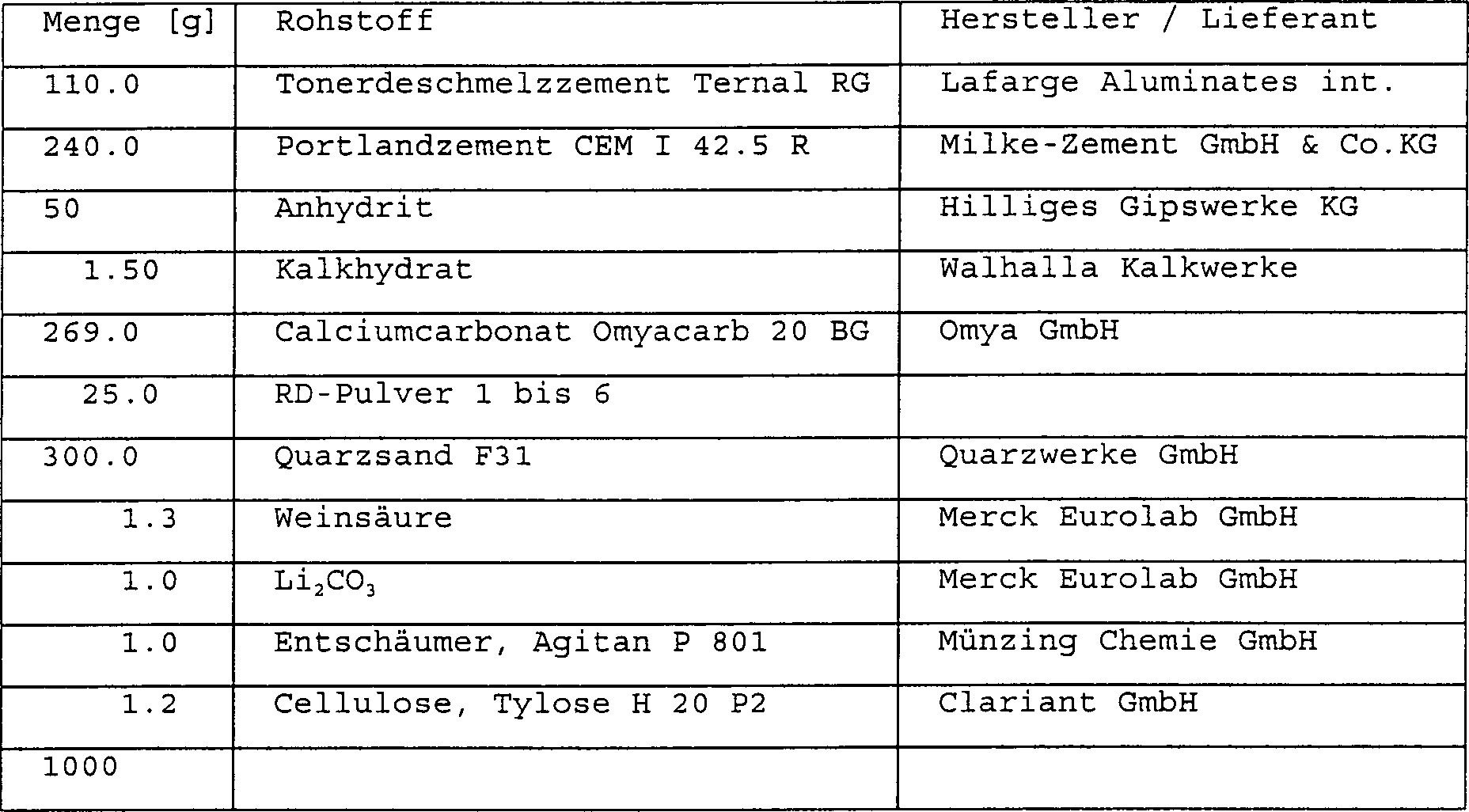
Anwendungstechnische Prüfungen:Application tests:
Bestimmung des Ausbreitmaßes (Ausb.):Determination of the slump (yield):
Die Bestimmung des Fließverhaltens erfolgte nach DIN EN 12706 nach einem Zeitraum von 1, 15 und 30 Minuten.The Determination of flow behavior was carried out according to DIN EN 12706 after a period of 1, 15 and 30 Minutes.
Bestimmung der Biegezugfestigkeit (BZ):Determination of bending tensile strength (BZ):
Die Bestimmung der Biegezugfestigkeit erfolgte nach 1 Tag (1d) und 7 Tagen (7d) und wurde in Anlehnung an prEN 13851 an Prismen 40 × 40 × 160 mm3 vorgenommen.The bending tensile strength was determined after 1 day (1d) and 7 days (7d) and was carried out on prisms 40 × 40 × 160 mm 3 based on prEN 13851.
Bestimmung der Druckfestigkeit (DF):Determination of compressive strength (DF):
Die Bestimmung der Druckfestigkeit erfolgte nach 1 Tag (1d) und 7 Tagen (7d) und wurde in Anlehnung an prEN 13851 an Normprismen 40 × 40 × 160 mm3 vorgenommen.The compressive strength was determined after 1 day (1d) and 7 days (7d) and was carried out on standard prisms 40 × 40 × 160 mm 3 based on prEN 13851.
Als Vergleichsmischung V1 diente ein Mörtel mit einem Redispersionspulver auf Basis eines mit Polyvinylalkohol stabilisierten Vinylacetat-Ethylen-Copolymers mit T4 = 17°C (RE 5011L, Wacker Chemie GmbH) und 4.6 ‰ Casein 90 mesh (Fa. Wengenroth) als Dispergiermittel.A mortar with a redispersion powder based on a vinyl acetate-ethylene copolymer stabilized with polyvinyl alcohol with T 4 = 17 ° C (RE 5011L, Wacker Chemie GmbH) and 4.6 ‰ casein 90 mesh (Wengenroth) served as the comparative mixture V1.
Als Vergleichsmischung V2 diente ein Redispersionspulver auf Basis eines mit Polyvinylalkohol stabilisierten Vinylacetat-Ethylen-Copolymers mit einer Tg = 21°C und einem festen zugemischten Polycarboxyaltetherverflüssiger auf Basis Methacrylsäure/Methoxypolyethylenglycolmethacrylat (ca. 17 mol Ethylenoxid). Es handelt sich um ein Handelsprodukt der Firma Elotex, das Pulver Elotex FL51.A redispersion powder based on a vinyl acetate-ethylene copolymer stabilized with polyvinyl alcohol and having a T g = 21 ° C. and a solid admixed polycarboxyaltether plasticizer based on methacrylic acid / methoxypolyethylene glycol methacrylate (approx. 17 mol ethylene oxide) served as comparative mixture V2. It is a commercial product from Elotex, the powder Elotex FL51.
Als
Vergleichsmischung V3 diente ein Redispersionspulver auf Basis eines
Styrol-Butylacrylat-Copolymers mit einer Glasübergangstemperatur Tg = 16°C und einem
dispergierenden Verdüsungsschutzkolloid aus
einem Wasserlöslichen
Copolymer Methacrylsäure/Methylmethacrylat/Hydroxyethylacrylat
(ca. 30/10/60). Es handelt sich um ein Handelsprodukt der Firma
BASF AG, das Pulver Acronal DS 3504. Tabelle
2: 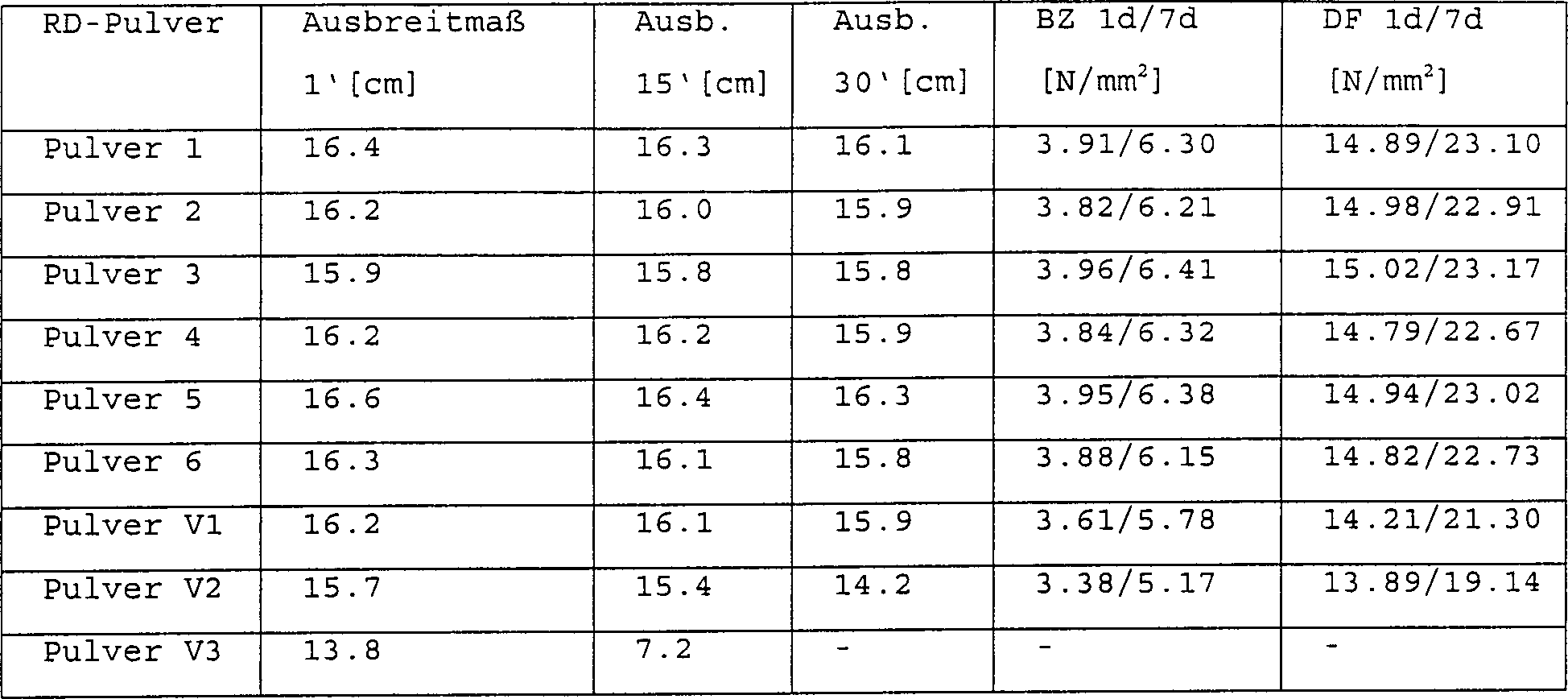
Diskussion der Ergebnisse:Discussion of the results:
Die mit den Versuchsprodukten hergestellten Pulver 1 bis 6 modifizierten Mörtel weisen gegenüber der caseinhaltigen Vergleichsmischung V1 vergleichbare Verarbeitungseigenschaften des Frischmörtels auf. Das Ausbreitmaß bleibt nahezu konstant über die Zeit. Die Anfangsfestigkeiten nach 1 d liegen um 4 bis 10 % über denen von V1.The modified powders 1 to 6 prepared with the test products mortar point towards processing properties comparable to the casein-containing comparison mixture V1 of fresh mortar on. The slump remains almost constant above the time. The initial strength after 1 day is 4 to 10% higher than that from V1.
Der Zusatz von V2 und V3 bewirkt in der eingesetzten Rezeptur teilweise eine Reduktion des Ausbreitmaßes über die Zeit sowie niedrigere Festigkeiten.The The addition of V2 and V3 partially results in the recipe used a reduction in the slump across the Time as well as lower strengths.
Rheologische Messungen:Rheological measurements:
Für die Messungen wurden die in Tabelle 3 angegebenen Rezepturen für das Referenzsystem und das Versuchssystem eingesetzt. Beide Mischungen wurden mit 35 g Wasser auf 100 g Trockenmischung angerührt.For the measurements were the recipes given in Table 3 for the reference system and the test system used. Both mixtures were mixed with 35 g water to 100 g dry mixture touched.
Die
Komponenten wurden trocken vorgemischt, anschließend wurde das Wasser zu der
Mischung gegeben und 1 Minute mit einem Dissolver (⌀ Rührscheibe
5 cm) bei 1000 U/min. gerührt.
Bei caseinhaltigen Mischungen bzw. den Versuchssystemen betrug die nachfolgende
Reifezeit 5 Minuten, bei Zementleimen mit synthetischen Verflüssigern
2 Minuten. Abschließend
wurde einheitlich 10 Sekunden bei 1000 U/min. gerührt. Tabelle
3: 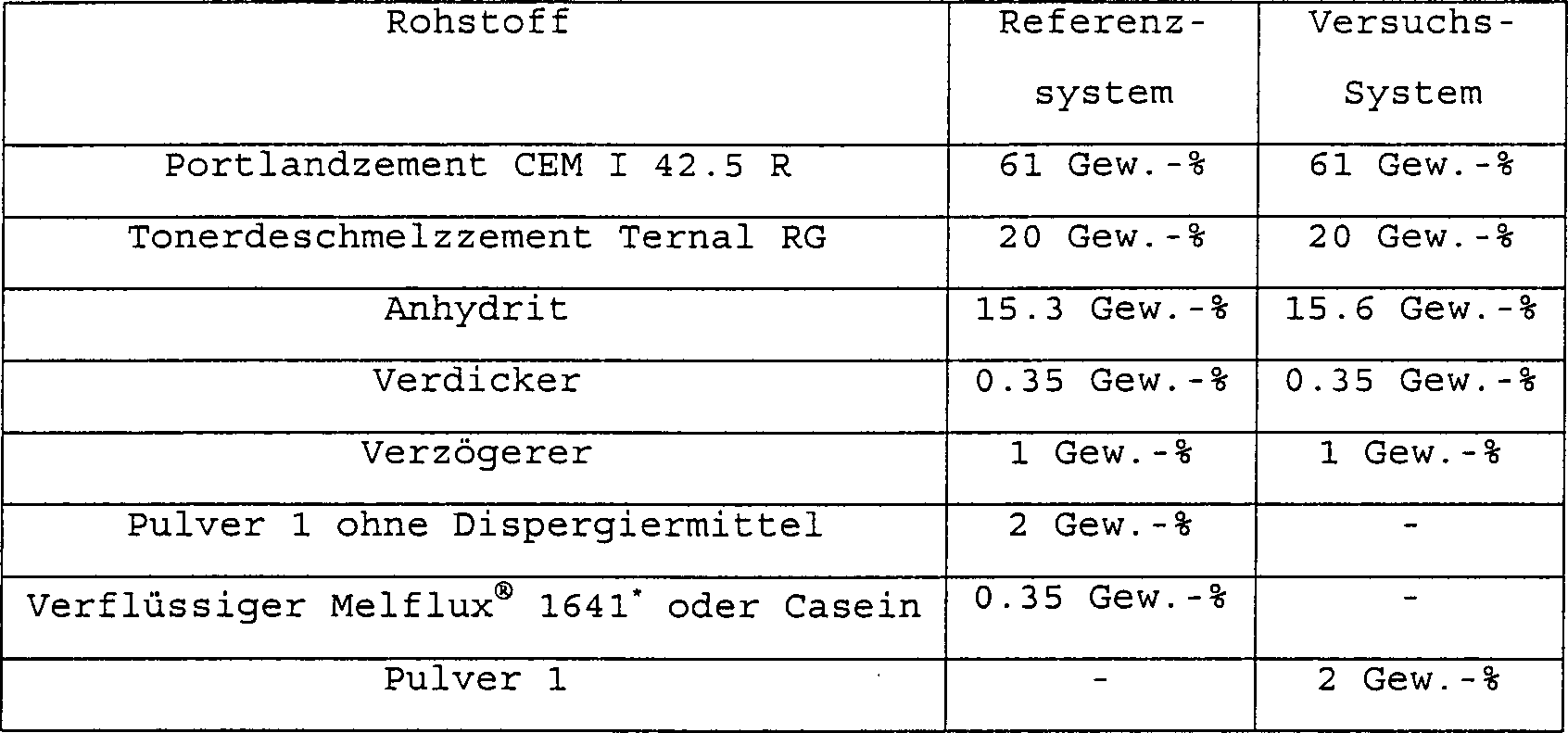
Melflux 1641 ist ein pulverförmiger Verflüssiger der Degussa. (SKW Polymers).Melflux® 1641 is a powder condenser the Degussa. (SKW Polymers).
Vor Beginn der rheologischen Untersuchung wurden das Referenz- und Versuchssystem durch Variation des Wassergehaltes und/oder des Dispergiermittelgehaltes auf ein Ausbreitmaß nach 1 Minute von 15 ± 0.5 cm eingestellt. Die Bestimmung erfolgt in Anlehnung an DIN EN 12706 (Ausgabe Dez. 1999).In front The reference and experimental system became the beginning of the rheological examination by varying the water content and / or the dispersant content to a slump 1 minute from 15 ± 0.5 cm set. The determination is based on DIN EN 12706 (December 1999 edition).
Die rheologischen Untersuchungen erfolgten mit einem luftgelagerten Rheometer (MC 200, Fa. Paar-Physika) mit eingebautem Zylindermeßsystem (MS-Z 40 P). Die Anfangsviskosität der Zementleime betrug 1000-6000 mPas. In Oszillation durchgeführte Zeitversuche mit jeder Probe bei niedriger Deformation (γ: 0.01 – 1%) und Kreisfrequenz (ω: 1 – 10/s) stellten sicher, dass die Ergebnisse der späteren Belastungs- und Entlastungsversuche nicht auf erste Abbindeprozesse oder Erhärtungsvorgänge zurückzuführen waren.The rheological examinations were carried out with an air bearing Rheometer (MC 200, from Paar-Physika) with built-in cylinder measuring system (MS-Z 40 P). The initial viscosity the cement paste was 1000-6000 mPas. Time trials carried out in oscillation with each sample with low deformation (γ: 0.01 - 1%) and angular frequency (ω: 1 - 10 / s) made sure that the results of later stress and relief attempts were not due to initial setting processes or hardening processes.
Das
Messprogramm für
die Belastungs- und Entlastungsversuche ist in 3 Abschnitte gegliedert.
In den Abschnitten 1 und 3 erfolgt die Oszillationsmessung innerhalb
des linearviskoelastischen Bereichs bei einer Deformation von γ = 0.1 und
einer Kreisfrequenz ω =
10/s. Die Belastung (Abschnitt 2) erfolgt außerhalb des linear-viskoelastischen
Bereichs (Deformation γ =
100%, Kreisfrequenz ω =
10/s). Es
wurden folgende Messkurven erhalten: 

Claims (15)
Priority Applications (11)
| Application Number | Priority Date | Filing Date | Title |
|---|---|---|---|
| DE10313937A DE10313937A1 (en) | 2003-03-27 | 2003-03-27 | dispersants |
| ES04717094T ES2268638T3 (en) | 2003-03-27 | 2004-03-04 | DISPERSING AGENTS. |
| US10/551,108 US8314170B2 (en) | 2003-03-27 | 2004-03-04 | Dispersing agents |
| PCT/EP2004/002211 WO2004085335A1 (en) | 2003-03-27 | 2004-03-04 | Dispersing agents |
| RU2005132959/03A RU2337080C2 (en) | 2003-03-27 | 2004-03-04 | Dispersants |
| EP04717094A EP1606227B1 (en) | 2003-03-27 | 2004-03-04 | Dispersing agents |
| AT04717094T ATE335714T1 (en) | 2003-03-27 | 2004-03-04 | DISPERSANT |
| DE502004001165T DE502004001165D1 (en) | 2003-03-27 | 2004-03-04 | Dispersant |
| JP2006500047A JP5144928B2 (en) | 2003-03-27 | 2004-03-04 | Dispersant, method for producing the same, method for using the same, method for producing redispersed powder using the dispersant, redispersed powder obtained by the method, and redispersed powder containing the dispersant |
| CNB2004800083564A CN100566804C (en) | 2003-03-27 | 2004-03-04 | Dispersing agent |
| TW093108046A TWI253953B (en) | 2003-03-27 | 2004-03-25 | Dispersants |
Applications Claiming Priority (1)
| Application Number | Priority Date | Filing Date | Title |
|---|---|---|---|
| DE10313937A DE10313937A1 (en) | 2003-03-27 | 2003-03-27 | dispersants |
Publications (1)
| Publication Number | Publication Date |
|---|---|
| DE10313937A1 true DE10313937A1 (en) | 2004-10-14 |
Family
ID=32980759
Family Applications (2)
| Application Number | Title | Priority Date | Filing Date |
|---|---|---|---|
| DE10313937A Withdrawn DE10313937A1 (en) | 2003-03-27 | 2003-03-27 | dispersants |
| DE502004001165T Expired - Lifetime DE502004001165D1 (en) | 2003-03-27 | 2004-03-04 | Dispersant |
Family Applications After (1)
| Application Number | Title | Priority Date | Filing Date |
|---|---|---|---|
| DE502004001165T Expired - Lifetime DE502004001165D1 (en) | 2003-03-27 | 2004-03-04 | Dispersant |
Country Status (10)
| Country | Link |
|---|---|
| US (1) | US8314170B2 (en) |
| EP (1) | EP1606227B1 (en) |
| JP (1) | JP5144928B2 (en) |
| CN (1) | CN100566804C (en) |
| AT (1) | ATE335714T1 (en) |
| DE (2) | DE10313937A1 (en) |
| ES (1) | ES2268638T3 (en) |
| RU (1) | RU2337080C2 (en) |
| TW (1) | TWI253953B (en) |
| WO (1) | WO2004085335A1 (en) |
Cited By (1)
| Publication number | Priority date | Publication date | Assignee | Title |
|---|---|---|---|---|
| DE102021117771A1 (en) | 2021-07-09 | 2023-01-12 | Fels-Werke Gmbh | Lining mortar with sealing function |
Families Citing this family (34)
| Publication number | Priority date | Publication date | Assignee | Title |
|---|---|---|---|---|
| US6894123B2 (en) | 2003-03-21 | 2005-05-17 | E.I. Du Pont De Nemours And Company | Acetoacetylated polyvinyl polymers and curable coating compositions made therefrom |
| KR101121761B1 (en) | 2004-11-23 | 2012-03-23 | 세종대학교산학협력단 | A Preparation process of dispersant for increasing dispersion stability of pigment or non-aqueous dye, and dispersion prepared by using the same |
| CN1948210A (en) * | 2005-10-14 | 2007-04-18 | 株式会社日本触媒 | Cement mixing agent |
| KR20090018643A (en) * | 2006-05-22 | 2009-02-20 | 도아고세이가부시키가이샤 | Dispersant |
| GB0614314D0 (en) * | 2006-07-19 | 2006-08-30 | Croda Int Plc | Co-polymers in hair styling applications |
| DE102006049524A1 (en) * | 2006-10-20 | 2008-04-24 | Evonik Degussa Gmbh | Aqueous dispersions of precipitated silicas and silicates to increase the early strength in cementitious preparations |
| WO2008132196A1 (en) * | 2007-05-01 | 2008-11-06 | Akzo Nobel Coatings International B.V. | Antifouling coating composition based on curable polyorganosiloxane polyoxyalkylene copolymers |
| WO2009144081A1 (en) * | 2008-04-16 | 2009-12-03 | Akzo Nobel N.V. | Rheology influencing additive for mineral building materials |
| JP5345700B2 (en) * | 2008-12-08 | 2013-11-20 | コンストラクション リサーチ アンド テクノロジー ゲーエムベーハー | Dispersant containing copolymer mixture |
| AU2009335187B2 (en) * | 2008-12-08 | 2014-05-08 | Construction Research & Technology Gmbh | Copolymer containing acid building blocks and various types of polyether building blocks |
| ES2455265T3 (en) * | 2009-07-15 | 2014-04-15 | Basf Se | Mixtures containing branched oligomeric or polymeric compounds, their preparation and use |
| MX2012006055A (en) * | 2009-11-25 | 2012-12-05 | Basf Constr Polymers Gmbh | Dispersant. |
| DE102009054563A1 (en) * | 2009-12-11 | 2011-06-16 | Wacker Chemie Ag | Production of mineral bonded coatings with ductile properties |
| RU2426702C1 (en) * | 2010-02-01 | 2011-08-20 | Федеральное государственное образовательное учреждение высшего профессионального образования "Казанский государственный архитектурно-строительный университет" (КазГАСУ) | Composition gypsum binder |
| JP5403764B2 (en) * | 2010-05-17 | 2014-01-29 | ダウ グローバル テクノロジーズ エルエルシー | Cellulose ether composition for dry mortar formulations |
| EP2426095A1 (en) * | 2010-09-03 | 2012-03-07 | Sika Technology AG | Dispersing agent for gipsum composition |
| IN2014DN07672A (en) * | 2012-03-14 | 2015-06-26 | Toho Chem Ind Co Ltd | |
| DE102012209210A1 (en) * | 2012-05-31 | 2013-12-05 | Wacker Chemie Ag | Vinyl acetate copolymers for hydraulically setting building materials |
| CN103787608B (en) * | 2012-10-30 | 2016-01-20 | 辽宁奥克化学股份有限公司 | A kind of high containing cement concrete polycarboxylate water-reducer and synthetic method thereof |
| EP2886580A1 (en) * | 2013-12-20 | 2015-06-24 | Construction Research & Technology GmbH | Additive for rheology improvement of inorganic binders |
| US9890054B2 (en) | 2016-02-04 | 2018-02-13 | Martin Marietta Magnesia Specialties, Llc | Process for producing a stabilized magnesium hydroxide slurry |
| CN104086714B (en) * | 2014-07-10 | 2016-06-08 | 中化化工科学技术研究总院 | A kind of tetrapolymer dispersion agent and its preparation method |
| RU2562313C1 (en) * | 2014-08-01 | 2015-09-10 | федеральное государственное автономное образовательное учреждение высшего образования "Нижегородский государственный университет им. Н.И. Лобачевского" | Cement composition |
| EP3018108A1 (en) * | 2014-11-10 | 2016-05-11 | Basf Se | Polymer with polyether side chains |
| CN105086568B (en) * | 2015-08-10 | 2017-07-07 | 洛阳盛嘉化工有限公司 | A kind of dispersion anti-settling agent for highly diluted than non-powder PVC gloves coating |
| WO2017158441A1 (en) * | 2016-03-17 | 2017-09-21 | Lubrizol Oilfield Solutions, Inc. | Carboxylic acid/acrylamidoalkane sulfonic acid/styrene sulfonate copolymers for ultrahigh temperature and pressure retardation of oil-well cement |
| US10442732B2 (en) * | 2016-05-20 | 2019-10-15 | United States Gypsum Company | Gypsum slurries with linear polycarboxylate dispersants |
| JP6768198B2 (en) * | 2017-03-07 | 2020-10-14 | 日油株式会社 | Manufacturing method of dispersant for inorganic powder and dispersant for inorganic powder |
| RU2659432C1 (en) * | 2017-04-10 | 2018-07-02 | Общество с ограниченной ответственностью "Экспонента" | Rheology regulator for inorganic binder-based dispersion systems |
| JP7107970B2 (en) * | 2017-05-31 | 2022-07-27 | ローム アンド ハース カンパニー | Free standing dispersant film |
| JP7593997B2 (en) * | 2019-08-22 | 2024-12-03 | アルテコ エヌ.ブイ. | Glycol-based heat transfer fluids containing organic carboxylic acids or their salts, methods for their preparation and uses |
| WO2022230388A1 (en) * | 2021-04-30 | 2022-11-03 | デンカ株式会社 | Pumpability improver, cement concrete, and spraying cement concrete |
| CN114853938B (en) * | 2022-04-24 | 2024-01-26 | 合肥工业大学 | A terpolymer hyperdispersant and a method for modifying nano-SiO2 based on it |
| CN115716888B (en) * | 2022-10-25 | 2023-08-15 | 山东日科化学股份有限公司 | Dispersing agent and preparation method and application thereof |
Citations (4)
| Publication number | Priority date | Publication date | Assignee | Title |
|---|---|---|---|---|
| EP0331308A2 (en) * | 1988-03-04 | 1989-09-06 | Takemoto Yushi Kabushiki Kaisha | Cement dispersion agents, method of producing same, and method of providing fluidizing property to hydraulic cement compositions using same |
| EP0792850A1 (en) * | 1996-02-22 | 1997-09-03 | Nippon Shokubai Co., Ltd. | Cementitions composition comprising acrylic copolymers |
| DE10063291A1 (en) * | 2000-12-19 | 2002-06-20 | Skw Polymers Gmbh | Use of polycarboxylate-based plasticizers for anhydrite-based liquid screeds |
| DE19962568C2 (en) * | 1999-12-23 | 2002-06-20 | Wacker Polymer Systems Gmbh | Process for the preparation of polyvinyl alcohol-stabilized 1,3-diene (meth) acrylic acid ester copolymers |
Family Cites Families (19)
| Publication number | Priority date | Publication date | Assignee | Title |
|---|---|---|---|---|
| DE2704929B1 (en) * | 1977-02-07 | 1978-05-24 | Hoechst Ag | Condenser combination for building materials |
| JPS62216950A (en) * | 1986-03-16 | 1987-09-24 | 竹本油脂株式会社 | Dispersant for cement |
| CA2037058C (en) * | 1989-07-25 | 1997-02-04 | Hideyuki Tahara | Cement additive, method for producing the same, and cement composition |
| JP2628486B2 (en) | 1992-09-30 | 1997-07-09 | 竹本油脂株式会社 | Dispersant for cement |
| DE19538821A1 (en) | 1995-03-31 | 1996-10-02 | Sueddeutsche Kalkstickstoff | Melamine-formaldehyde condensates with a low formate content |
| WO1997013733A1 (en) | 1995-10-11 | 1997-04-17 | Alcell Technologies Inc. | Lignin-based concrete admixtures |
| DE19539460A1 (en) | 1995-10-24 | 1997-04-30 | Basf Ag | Drying aqueous polymer dispersions |
| DE19549084A1 (en) * | 1995-12-29 | 1997-07-03 | Wacker Chemie Gmbh | Powdery, redispersible binders |
| DE19620817A1 (en) * | 1996-05-23 | 1997-11-27 | Wacker Chemie Gmbh | Flexible building material masses |
| JP3181226B2 (en) | 1996-06-28 | 2001-07-03 | 竹本油脂株式会社 | Fluidity decrease inhibitor for hydraulic cement composition and method for preventing fluidity decrease of hydraulic cement composition |
| JP4651905B2 (en) * | 1996-12-26 | 2011-03-16 | 株式会社日本触媒 | Method for producing polycarboxylic acid for cement dispersant |
| DE19806482A1 (en) * | 1998-02-17 | 1999-08-19 | Sueddeutsche Kalkstickstoff | Water-soluble or water-swellable copolymers containing sulfo groups, processes for their preparation and their use |
| AU4907400A (en) | 1999-06-04 | 2000-12-28 | Handy Chemicals Limited | Cement superplasticiser |
| JP3327901B2 (en) * | 1999-10-08 | 2002-09-24 | 竹本油脂株式会社 | Method for producing polyetherester monomer |
| JP3610310B2 (en) * | 2001-03-08 | 2005-01-12 | 竹本油脂株式会社 | Method for producing polyetherester monomer |
| JP2002362952A (en) | 2001-06-12 | 2002-12-18 | Taiheiyo Cement Corp | Production process of cement dispersant |
| JP3759432B2 (en) * | 2001-06-20 | 2006-03-22 | 花王株式会社 | Dispersant for hydraulic composition |
| JP4562955B2 (en) * | 2001-06-20 | 2010-10-13 | 花王株式会社 | Dispersant for self-leveling material and dispersant for amorphous refractory |
| JP2003286058A (en) * | 2002-03-27 | 2003-10-07 | Nippon Paper Industries Co Ltd | Cement dispersing agent and cement composition |
-
2003
- 2003-03-27 DE DE10313937A patent/DE10313937A1/en not_active Withdrawn
-
2004
- 2004-03-04 AT AT04717094T patent/ATE335714T1/en not_active IP Right Cessation
- 2004-03-04 ES ES04717094T patent/ES2268638T3/en not_active Expired - Lifetime
- 2004-03-04 CN CNB2004800083564A patent/CN100566804C/en not_active Expired - Lifetime
- 2004-03-04 RU RU2005132959/03A patent/RU2337080C2/en not_active IP Right Cessation
- 2004-03-04 DE DE502004001165T patent/DE502004001165D1/en not_active Expired - Lifetime
- 2004-03-04 US US10/551,108 patent/US8314170B2/en active Active
- 2004-03-04 JP JP2006500047A patent/JP5144928B2/en not_active Expired - Fee Related
- 2004-03-04 EP EP04717094A patent/EP1606227B1/en not_active Expired - Lifetime
- 2004-03-04 WO PCT/EP2004/002211 patent/WO2004085335A1/en not_active Ceased
- 2004-03-25 TW TW093108046A patent/TWI253953B/en not_active IP Right Cessation
Patent Citations (4)
| Publication number | Priority date | Publication date | Assignee | Title |
|---|---|---|---|---|
| EP0331308A2 (en) * | 1988-03-04 | 1989-09-06 | Takemoto Yushi Kabushiki Kaisha | Cement dispersion agents, method of producing same, and method of providing fluidizing property to hydraulic cement compositions using same |
| EP0792850A1 (en) * | 1996-02-22 | 1997-09-03 | Nippon Shokubai Co., Ltd. | Cementitions composition comprising acrylic copolymers |
| DE19962568C2 (en) * | 1999-12-23 | 2002-06-20 | Wacker Polymer Systems Gmbh | Process for the preparation of polyvinyl alcohol-stabilized 1,3-diene (meth) acrylic acid ester copolymers |
| DE10063291A1 (en) * | 2000-12-19 | 2002-06-20 | Skw Polymers Gmbh | Use of polycarboxylate-based plasticizers for anhydrite-based liquid screeds |
Cited By (2)
| Publication number | Priority date | Publication date | Assignee | Title |
|---|---|---|---|---|
| DE102021117771A1 (en) | 2021-07-09 | 2023-01-12 | Fels-Werke Gmbh | Lining mortar with sealing function |
| EP4119520A1 (en) | 2021-07-09 | 2023-01-18 | Fels-Werke GmbH | Levelling mortar with sealing function |
Also Published As
| Publication number | Publication date |
|---|---|
| DE502004001165D1 (en) | 2006-09-21 |
| US8314170B2 (en) | 2012-11-20 |
| JP2006521193A (en) | 2006-09-21 |
| CN1934048A (en) | 2007-03-21 |
| US20060264565A1 (en) | 2006-11-23 |
| EP1606227B1 (en) | 2006-08-09 |
| WO2004085335A1 (en) | 2004-10-07 |
| ATE335714T1 (en) | 2006-09-15 |
| TWI253953B (en) | 2006-05-01 |
| ES2268638T3 (en) | 2007-03-16 |
| RU2337080C2 (en) | 2008-10-27 |
| CN100566804C (en) | 2009-12-09 |
| TW200424006A (en) | 2004-11-16 |
| EP1606227A1 (en) | 2005-12-21 |
| RU2005132959A (en) | 2007-06-10 |
| JP5144928B2 (en) | 2013-02-13 |
Similar Documents
| Publication | Publication Date | Title |
|---|---|---|
| EP1606227B1 (en) | Dispersing agents | |
| EP1466937B1 (en) | Polyvinylalcohol stabilised redispersing powder with fluidising properties | |
| EP1086934B1 (en) | Cementitious compositions comprising redispersable polymer powders | |
| EP1189955B1 (en) | Copolymers based on unsaturated mono- or dicarboxylic acid derivatives and oxyalkylene glycol alkenyl ethers, method for the production and use thereof | |
| EP1182179B2 (en) | Use of ammonia-free polymer dispersions as an additive for building materials based on hydraulic binders | |
| DE10049127C2 (en) | Redispersible dispersion powder composition, process for its preparation and its use | |
| WO2000047533A1 (en) | Powdery polyethercarboxylate-based polymeric compositions | |
| EP1133455B1 (en) | Vinyl aromatic-1,3-diene copolymers stabilised with protection colloids and used for modifying materials containing plaster or calcium carbonate | |
| EP0946617A2 (en) | The use of polymers containing caboxyl groups and polyalkylene oxide ether side-chains as additives in mineral building materials | |
| EP1498446A1 (en) | Redispersion powders containing pozzolanic components | |
| WO2004092094A1 (en) | Redispersion powder composition with a binding acceleration effect | |
| EP1110978A1 (en) | Process for preparing copolymers of vinylester and (meth)acrylic ester | |
| WO2018224519A1 (en) | Method for producing an aqueous dispersion, and redispersible dispersion powder produced therefrom | |
| EP1347002B1 (en) | Polymer dispersions as an additive for building materials | |
| EP1963020B2 (en) | Use of comb polymers as a grinding agent for preparations containing cement | |
| EP1670830A2 (en) | Polymeric compositions containing modified polyvinyl alcohols | |
| EP1682462B1 (en) | Redispersible dispersion powders for heat insulating composite system | |
| EP1792922A1 (en) | Dispersion powders stabilized by protective colloids | |
| DE19629948A1 (en) | Process for the preparation of sterically stabilized, emulsifier-free, aqueous polymer dispersions and powders prepared therefrom for use in building materials | |
| EP2695866B1 (en) | Modified rheology additive | |
| DE10260989A1 (en) | Use of water-soluble polymers as drying aids for the production of redispersion powders and / or powdery, polymeric dispersants |
Legal Events
| Date | Code | Title | Description |
|---|---|---|---|
| OP8 | Request for examination as to paragraph 44 patent law | ||
| 8130 | Withdrawal |