DE102023135175A1 - Process for the preparation of amino acid esters and organic sulfonic acid salts as well as amino acid esters and their salts - Google Patents
Process for the preparation of amino acid esters and organic sulfonic acid salts as well as amino acid esters and their salts Download PDFInfo
- Publication number
- DE102023135175A1 DE102023135175A1 DE102023135175.3A DE102023135175A DE102023135175A1 DE 102023135175 A1 DE102023135175 A1 DE 102023135175A1 DE 102023135175 A DE102023135175 A DE 102023135175A DE 102023135175 A1 DE102023135175 A1 DE 102023135175A1
- Authority
- DE
- Germany
- Prior art keywords
- acid
- alcohol
- particularly preferably
- lactam
- alkoxylated
- Prior art date
- Legal status (The legal status is an assumption and is not a legal conclusion. Google has not performed a legal analysis and makes no representation as to the accuracy of the status listed.)
- Pending
Links
- 150000003839 salts Chemical class 0.000 title claims abstract description 99
- 238000000034 method Methods 0.000 title claims abstract description 76
- 230000008569 process Effects 0.000 title claims abstract description 45
- -1 amino acid esters Chemical class 0.000 title claims description 131
- 150000003460 sulfonic acids Chemical class 0.000 title claims description 7
- 238000002360 preparation method Methods 0.000 title description 3
- 239000000203 mixture Substances 0.000 claims abstract description 408
- LFQSCWFLJHTTHZ-UHFFFAOYSA-N Ethanol Chemical compound CCO LFQSCWFLJHTTHZ-UHFFFAOYSA-N 0.000 claims abstract description 176
- 125000002887 hydroxy group Chemical group [H]O* 0.000 claims abstract description 150
- 239000003599 detergent Substances 0.000 claims abstract description 141
- 150000003951 lactams Chemical class 0.000 claims abstract description 117
- 238000004140 cleaning Methods 0.000 claims abstract description 110
- 239000002253 acid Substances 0.000 claims abstract description 102
- XLYOFNOQVPJJNP-UHFFFAOYSA-N water Substances O XLYOFNOQVPJJNP-UHFFFAOYSA-N 0.000 claims abstract description 83
- 150000002596 lactones Chemical class 0.000 claims abstract description 68
- 150000001413 amino acids Chemical class 0.000 claims abstract description 50
- 150000001261 hydroxy acids Chemical class 0.000 claims abstract description 44
- 238000009472 formulation Methods 0.000 claims description 101
- JBKVHLHDHHXQEQ-UHFFFAOYSA-N epsilon-caprolactam Chemical compound O=C1CCCCCN1 JBKVHLHDHHXQEQ-UHFFFAOYSA-N 0.000 claims description 96
- 239000007788 liquid Substances 0.000 claims description 92
- QAOWNCQODCNURD-UHFFFAOYSA-N Sulfuric acid Chemical compound OS(O)(=O)=O QAOWNCQODCNURD-UHFFFAOYSA-N 0.000 claims description 91
- AFVFQIVMOAPDHO-UHFFFAOYSA-N Methanesulfonic acid Chemical compound CS(O)(=O)=O AFVFQIVMOAPDHO-UHFFFAOYSA-N 0.000 claims description 87
- 238000004851 dishwashing Methods 0.000 claims description 78
- 239000004094 surface-active agent Substances 0.000 claims description 78
- 150000001875 compounds Chemical class 0.000 claims description 70
- 229940024606 amino acid Drugs 0.000 claims description 65
- 235000001014 amino acid Nutrition 0.000 claims description 63
- 125000002947 alkylene group Chemical group 0.000 claims description 61
- 102000004190 Enzymes Human genes 0.000 claims description 55
- 108090000790 Enzymes Proteins 0.000 claims description 55
- 229940088598 enzyme Drugs 0.000 claims description 54
- PAPBSGBWRJIAAV-UHFFFAOYSA-N ε-Caprolactone Chemical compound O=C1CCCCCO1 PAPBSGBWRJIAAV-UHFFFAOYSA-N 0.000 claims description 50
- YIWUKEYIRIRTPP-UHFFFAOYSA-N 2-ethylhexan-1-ol Chemical compound CCCCC(CC)CO YIWUKEYIRIRTPP-UHFFFAOYSA-N 0.000 claims description 41
- 150000001298 alcohols Chemical class 0.000 claims description 39
- 239000012459 cleaning agent Substances 0.000 claims description 37
- JVTAAEKCZFNVCJ-UHFFFAOYSA-N lactic acid Chemical compound CC(O)C(O)=O JVTAAEKCZFNVCJ-UHFFFAOYSA-N 0.000 claims description 32
- QCDWFXQBSFUVSP-UHFFFAOYSA-N 2-phenoxyethanol Chemical compound OCCOC1=CC=CC=C1 QCDWFXQBSFUVSP-UHFFFAOYSA-N 0.000 claims description 30
- 150000002148 esters Chemical group 0.000 claims description 30
- 239000004744 fabric Substances 0.000 claims description 30
- 229940098779 methanesulfonic acid Drugs 0.000 claims description 30
- 150000002191 fatty alcohols Chemical class 0.000 claims description 27
- 150000007513 acids Chemical class 0.000 claims description 26
- 239000007787 solid Substances 0.000 claims description 26
- 239000002904 solvent Substances 0.000 claims description 26
- 229960005323 phenoxyethanol Drugs 0.000 claims description 25
- 239000000654 additive Substances 0.000 claims description 23
- 239000004599 antimicrobial Substances 0.000 claims description 21
- KRKNYBCHXYNGOX-UHFFFAOYSA-N citric acid Chemical compound OC(=O)CC(O)(C(O)=O)CC(O)=O KRKNYBCHXYNGOX-UHFFFAOYSA-N 0.000 claims description 21
- 125000006413 ring segment Chemical group 0.000 claims description 21
- 150000007524 organic acids Chemical class 0.000 claims description 19
- 229920005862 polyol Polymers 0.000 claims description 18
- 239000004753 textile Substances 0.000 claims description 18
- 150000007522 mineralic acids Chemical class 0.000 claims description 17
- JOXIMZWYDAKGHI-UHFFFAOYSA-N toluene-4-sulfonic acid Chemical compound CC1=CC=C(S(O)(=O)=O)C=C1 JOXIMZWYDAKGHI-UHFFFAOYSA-N 0.000 claims description 16
- 239000004310 lactic acid Substances 0.000 claims description 15
- 235000014655 lactic acid Nutrition 0.000 claims description 15
- 108091005804 Peptidases Proteins 0.000 claims description 14
- 239000004365 Protease Substances 0.000 claims description 14
- 150000003077 polyols Chemical class 0.000 claims description 14
- YLQLIQIAXYRMDL-UHFFFAOYSA-N propylheptyl alcohol Chemical compound CCCCCC(CO)CCC YLQLIQIAXYRMDL-UHFFFAOYSA-N 0.000 claims description 14
- 108010065511 Amylases Proteins 0.000 claims description 13
- 102000013142 Amylases Human genes 0.000 claims description 13
- NBIIXXVUZAFLBC-UHFFFAOYSA-N Phosphoric acid Chemical compound OP(O)(O)=O NBIIXXVUZAFLBC-UHFFFAOYSA-N 0.000 claims description 13
- 235000019418 amylase Nutrition 0.000 claims description 13
- 238000005406 washing Methods 0.000 claims description 13
- VEXZGXHMUGYJMC-UHFFFAOYSA-N Hydrochloric acid Chemical compound Cl VEXZGXHMUGYJMC-UHFFFAOYSA-N 0.000 claims description 12
- BTCSSZJGUNDROE-UHFFFAOYSA-N gamma-aminobutyric acid Chemical compound NCCCC(O)=O BTCSSZJGUNDROE-UHFFFAOYSA-N 0.000 claims description 12
- 235000011187 glycerol Nutrition 0.000 claims description 12
- 108090001060 Lipase Proteins 0.000 claims description 11
- 102000004882 Lipase Human genes 0.000 claims description 11
- 239000004367 Lipase Substances 0.000 claims description 11
- 125000002091 cationic group Chemical group 0.000 claims description 11
- 235000019421 lipase Nutrition 0.000 claims description 11
- XUJLWPFSUCHPQL-UHFFFAOYSA-N 11-methyldodecan-1-ol Chemical compound CC(C)CCCCCCCCCCO XUJLWPFSUCHPQL-UHFFFAOYSA-N 0.000 claims description 10
- PTJWCLYPVFJWMP-UHFFFAOYSA-N 2-[[3-hydroxy-2-[[3-hydroxy-2,2-bis(hydroxymethyl)propoxy]methyl]-2-(hydroxymethyl)propoxy]methyl]-2-(hydroxymethyl)propane-1,3-diol Chemical compound OCC(CO)(CO)COCC(CO)(CO)COCC(CO)(CO)CO PTJWCLYPVFJWMP-UHFFFAOYSA-N 0.000 claims description 10
- QDTDKYHPHANITQ-UHFFFAOYSA-N 7-methyloctan-1-ol Chemical compound CC(C)CCCCCCO QDTDKYHPHANITQ-UHFFFAOYSA-N 0.000 claims description 10
- 108010084185 Cellulases Proteins 0.000 claims description 10
- 102000005575 Cellulases Human genes 0.000 claims description 10
- 102000035195 Peptidases Human genes 0.000 claims description 10
- 230000007062 hydrolysis Effects 0.000 claims description 10
- 238000006460 hydrolysis reaction Methods 0.000 claims description 10
- 238000004519 manufacturing process Methods 0.000 claims description 10
- 102000004157 Hydrolases Human genes 0.000 claims description 9
- 108090000604 Hydrolases Proteins 0.000 claims description 9
- 239000004435 Oxo alcohol Substances 0.000 claims description 9
- 229940025131 amylases Drugs 0.000 claims description 9
- ULQISTXYYBZJSJ-UHFFFAOYSA-N 12-hydroxyoctadecanoic acid Chemical compound CCCCCCC(O)CCCCCCCCCCC(O)=O ULQISTXYYBZJSJ-UHFFFAOYSA-N 0.000 claims description 8
- LBLYYCQCTBFVLH-UHFFFAOYSA-N 2-Methylbenzenesulfonic acid Chemical compound CC1=CC=CC=C1S(O)(=O)=O LBLYYCQCTBFVLH-UHFFFAOYSA-N 0.000 claims description 8
- AEMRFAOFKBGASW-UHFFFAOYSA-N Glycolic acid Chemical compound OCC(O)=O AEMRFAOFKBGASW-UHFFFAOYSA-N 0.000 claims description 8
- 102000004316 Oxidoreductases Human genes 0.000 claims description 8
- 108090000854 Oxidoreductases Proteins 0.000 claims description 8
- 108010059820 Polygalacturonase Proteins 0.000 claims description 8
- 230000000996 additive effect Effects 0.000 claims description 8
- 108010005774 beta-Galactosidase Proteins 0.000 claims description 8
- 102000005936 beta-Galactosidase Human genes 0.000 claims description 8
- 108010093305 exopolygalacturonase Proteins 0.000 claims description 8
- 229920000728 polyester Polymers 0.000 claims description 8
- 102100032487 Beta-mannosidase Human genes 0.000 claims description 7
- 108090000371 Esterases Proteins 0.000 claims description 7
- 108700020962 Peroxidase Proteins 0.000 claims description 7
- 102000003992 Peroxidases Human genes 0.000 claims description 7
- 108010064785 Phospholipases Proteins 0.000 claims description 7
- 102000015439 Phospholipases Human genes 0.000 claims description 7
- 235000008206 alpha-amino acids Nutrition 0.000 claims description 7
- 108010055059 beta-Mannosidase Proteins 0.000 claims description 7
- 108010005400 cutinase Proteins 0.000 claims description 7
- 108010002430 hemicellulase Proteins 0.000 claims description 7
- PBLZLIFKVPJDCO-UHFFFAOYSA-N 12-aminododecanoic acid Chemical compound NCCCCCCCCCCCC(O)=O PBLZLIFKVPJDCO-UHFFFAOYSA-N 0.000 claims description 6
- SLXKOJJOQWFEFD-UHFFFAOYSA-N 6-aminohexanoic acid Chemical compound NCCCCCC(O)=O SLXKOJJOQWFEFD-UHFFFAOYSA-N 0.000 claims description 6
- IWHLYPDWHHPVAA-UHFFFAOYSA-N 6-hydroxyhexanoic acid Chemical compound OCCCCCC(O)=O IWHLYPDWHHPVAA-UHFFFAOYSA-N 0.000 claims description 6
- 101710121765 Endo-1,4-beta-xylanase Proteins 0.000 claims description 6
- DHMQDGOQFOQNFH-UHFFFAOYSA-N Glycine Chemical compound NCC(O)=O DHMQDGOQFOQNFH-UHFFFAOYSA-N 0.000 claims description 6
- QNAYBMKLOCPYGJ-REOHCLBHSA-N L-alanine Chemical compound C[C@H](N)C(O)=O QNAYBMKLOCPYGJ-REOHCLBHSA-N 0.000 claims description 6
- FFDGPVCHZBVARC-UHFFFAOYSA-N N,N-dimethylglycine Chemical group CN(C)CC(O)=O FFDGPVCHZBVARC-UHFFFAOYSA-N 0.000 claims description 6
- 235000004279 alanine Nutrition 0.000 claims description 6
- 229960003767 alanine Drugs 0.000 claims description 6
- 150000001371 alpha-amino acids Chemical class 0.000 claims description 6
- 229960002684 aminocaproic acid Drugs 0.000 claims description 6
- UCMIRNVEIXFBKS-UHFFFAOYSA-N beta-alanine Chemical compound NCCC(O)=O UCMIRNVEIXFBKS-UHFFFAOYSA-N 0.000 claims description 6
- 229960003692 gamma aminobutyric acid Drugs 0.000 claims description 6
- HNJBEVLQSNELDL-UHFFFAOYSA-N pyrrolidin-2-one Chemical compound O=C1CCCN1 HNJBEVLQSNELDL-UHFFFAOYSA-N 0.000 claims description 6
- FSYKKLYZXJSNPZ-UHFFFAOYSA-N sarcosine Chemical group C[NH2+]CC([O-])=O FSYKKLYZXJSNPZ-UHFFFAOYSA-N 0.000 claims description 6
- CHZLVSBMXZSPNN-UHFFFAOYSA-N 2,4-dimethylbenzenesulfonic acid Chemical compound CC1=CC=C(S(O)(=O)=O)C(C)=C1 CHZLVSBMXZSPNN-UHFFFAOYSA-N 0.000 claims description 5
- IRLYGRLEBKCYPY-UHFFFAOYSA-N 2,5-dimethylbenzenesulfonic acid Chemical compound CC1=CC=C(C)C(S(O)(=O)=O)=C1 IRLYGRLEBKCYPY-UHFFFAOYSA-N 0.000 claims description 5
- BRETYAHLENMEAI-UHFFFAOYSA-N 2,6-dimethylbenzenesulfonic acid Chemical compound CC1=CC=CC(C)=C1S(O)(=O)=O BRETYAHLENMEAI-UHFFFAOYSA-N 0.000 claims description 5
- JBVOQKNLGSOPNZ-UHFFFAOYSA-N 2-propan-2-ylbenzenesulfonic acid Chemical compound CC(C)C1=CC=CC=C1S(O)(=O)=O JBVOQKNLGSOPNZ-UHFFFAOYSA-N 0.000 claims description 5
- JDQDSEVNMTYMOC-UHFFFAOYSA-N 3-methylbenzenesulfonic acid Chemical compound CC1=CC=CC(S(O)(=O)=O)=C1 JDQDSEVNMTYMOC-UHFFFAOYSA-N 0.000 claims description 5
- KWXICGTUELOLSQ-UHFFFAOYSA-N 4-dodecylbenzenesulfonic acid Chemical compound CCCCCCCCCCCCC1=CC=C(S(O)(=O)=O)C=C1 KWXICGTUELOLSQ-UHFFFAOYSA-N 0.000 claims description 5
- SJZRECIVHVDYJC-UHFFFAOYSA-N 4-hydroxybutyric acid Chemical compound OCCCC(O)=O SJZRECIVHVDYJC-UHFFFAOYSA-N 0.000 claims description 5
- VEZXCJBBBCKRPI-UHFFFAOYSA-N beta-propiolactone Chemical compound O=C1CCO1 VEZXCJBBBCKRPI-UHFFFAOYSA-N 0.000 claims description 5
- CCIVGXIOQKPBKL-UHFFFAOYSA-N ethanesulfonic acid Chemical compound CCS(O)(=O)=O CCIVGXIOQKPBKL-UHFFFAOYSA-N 0.000 claims description 5
- KCXFHTAICRTXLI-UHFFFAOYSA-N propane-1-sulfonic acid Chemical compound CCCS(O)(=O)=O KCXFHTAICRTXLI-UHFFFAOYSA-N 0.000 claims description 5
- BMYNFMYTOJXKLE-UHFFFAOYSA-N 3-azaniumyl-2-hydroxypropanoate Chemical compound NCC(O)C(O)=O BMYNFMYTOJXKLE-UHFFFAOYSA-N 0.000 claims description 4
- CKLJMWTZIZZHCS-REOHCLBHSA-N L-aspartic acid Chemical compound OC(=O)[C@@H](N)CC(O)=O CKLJMWTZIZZHCS-REOHCLBHSA-N 0.000 claims description 4
- ZDXPYRJPNDTMRX-VKHMYHEASA-N L-glutamine Chemical compound OC(=O)[C@@H](N)CCC(N)=O ZDXPYRJPNDTMRX-VKHMYHEASA-N 0.000 claims description 4
- 229910000147 aluminium phosphate Inorganic materials 0.000 claims description 4
- 238000011109 contamination Methods 0.000 claims description 4
- 150000003950 cyclic amides Chemical class 0.000 claims description 4
- ZDXPYRJPNDTMRX-UHFFFAOYSA-N glutamine Natural products OC(=O)C(N)CCC(N)=O ZDXPYRJPNDTMRX-UHFFFAOYSA-N 0.000 claims description 4
- 230000000813 microbial effect Effects 0.000 claims description 4
- 150000005846 sugar alcohols Chemical class 0.000 claims description 4
- 150000003952 β-lactams Chemical class 0.000 claims description 4
- 150000003953 γ-lactams Chemical class 0.000 claims description 4
- MTCFGRXMJLQNBG-REOHCLBHSA-N (2S)-2-Amino-3-hydroxypropansäure Chemical compound OC[C@H](N)C(O)=O MTCFGRXMJLQNBG-REOHCLBHSA-N 0.000 claims description 3
- JIRHAGAOHOYLNO-UHFFFAOYSA-N (3-cyclopentyloxy-4-methoxyphenyl)methanol Chemical compound COC1=CC=C(CO)C=C1OC1CCCC1 JIRHAGAOHOYLNO-UHFFFAOYSA-N 0.000 claims description 3
- MIOPJNTWMNEORI-GMSGAONNSA-N (S)-camphorsulfonic acid Chemical compound C1C[C@@]2(CS(O)(=O)=O)C(=O)C[C@@H]1C2(C)C MIOPJNTWMNEORI-GMSGAONNSA-N 0.000 claims description 3
- GUOSQNAUYHMCRU-UHFFFAOYSA-N 11-Aminoundecanoic acid Chemical compound NCCCCCCCCCCC(O)=O GUOSQNAUYHMCRU-UHFFFAOYSA-N 0.000 claims description 3
- 229940114072 12-hydroxystearic acid Drugs 0.000 claims description 3
- YEJRWHAVMIAJKC-UHFFFAOYSA-N 4-Butyrolactone Chemical compound O=C1CCCO1 YEJRWHAVMIAJKC-UHFFFAOYSA-N 0.000 claims description 3
- BRIXOPDYGQCZFO-UHFFFAOYSA-N 4-ethylphenylsulfonic acid Chemical compound CCC1=CC=C(S(O)(=O)=O)C=C1 BRIXOPDYGQCZFO-UHFFFAOYSA-N 0.000 claims description 3
- YKVIWISPFDZYOW-UHFFFAOYSA-N 6-Decanolide Chemical compound CCCCC1CCCCC(=O)O1 YKVIWISPFDZYOW-UHFFFAOYSA-N 0.000 claims description 3
- GHBSPIPJMLAMEP-UHFFFAOYSA-N 6-pentyloxan-2-one Chemical compound CCCCCC1CCCC(=O)O1 GHBSPIPJMLAMEP-UHFFFAOYSA-N 0.000 claims description 3
- 239000004475 Arginine Substances 0.000 claims description 3
- DCXYFEDJOCDNAF-UHFFFAOYSA-N Asparagine Natural products OC(=O)C(N)CC(N)=O DCXYFEDJOCDNAF-UHFFFAOYSA-N 0.000 claims description 3
- 239000004471 Glycine Substances 0.000 claims description 3
- XUJNEKJLAYXESH-REOHCLBHSA-N L-Cysteine Chemical compound SC[C@H](N)C(O)=O XUJNEKJLAYXESH-REOHCLBHSA-N 0.000 claims description 3
- ONIBWKKTOPOVIA-BYPYZUCNSA-N L-Proline Chemical compound OC(=O)[C@@H]1CCCN1 ONIBWKKTOPOVIA-BYPYZUCNSA-N 0.000 claims description 3
- ODKSFYDXXFIFQN-BYPYZUCNSA-P L-argininium(2+) Chemical compound NC(=[NH2+])NCCC[C@H]([NH3+])C(O)=O ODKSFYDXXFIFQN-BYPYZUCNSA-P 0.000 claims description 3
- DCXYFEDJOCDNAF-REOHCLBHSA-N L-asparagine Chemical compound OC(=O)[C@@H](N)CC(N)=O DCXYFEDJOCDNAF-REOHCLBHSA-N 0.000 claims description 3
- WHUUTDBJXJRKMK-VKHMYHEASA-N L-glutamic acid Chemical compound OC(=O)[C@@H](N)CCC(O)=O WHUUTDBJXJRKMK-VKHMYHEASA-N 0.000 claims description 3
- HNDVDQJCIGZPNO-YFKPBYRVSA-N L-histidine Chemical compound OC(=O)[C@@H](N)CC1=CN=CN1 HNDVDQJCIGZPNO-YFKPBYRVSA-N 0.000 claims description 3
- AGPKZVBTJJNPAG-WHFBIAKZSA-N L-isoleucine Chemical compound CC[C@H](C)[C@H](N)C(O)=O AGPKZVBTJJNPAG-WHFBIAKZSA-N 0.000 claims description 3
- ROHFNLRQFUQHCH-YFKPBYRVSA-N L-leucine Chemical compound CC(C)C[C@H](N)C(O)=O ROHFNLRQFUQHCH-YFKPBYRVSA-N 0.000 claims description 3
- KDXKERNSBIXSRK-YFKPBYRVSA-N L-lysine Chemical compound NCCCC[C@H](N)C(O)=O KDXKERNSBIXSRK-YFKPBYRVSA-N 0.000 claims description 3
- FFEARJCKVFRZRR-BYPYZUCNSA-N L-methionine Chemical compound CSCC[C@H](N)C(O)=O FFEARJCKVFRZRR-BYPYZUCNSA-N 0.000 claims description 3
- COLNVLDHVKWLRT-QMMMGPOBSA-N L-phenylalanine Chemical compound OC(=O)[C@@H](N)CC1=CC=CC=C1 COLNVLDHVKWLRT-QMMMGPOBSA-N 0.000 claims description 3
- AYFVYJQAPQTCCC-GBXIJSLDSA-N L-threonine Chemical compound C[C@@H](O)[C@H](N)C(O)=O AYFVYJQAPQTCCC-GBXIJSLDSA-N 0.000 claims description 3
- QIVBCDIJIAJPQS-VIFPVBQESA-N L-tryptophane Chemical compound C1=CC=C2C(C[C@H](N)C(O)=O)=CNC2=C1 QIVBCDIJIAJPQS-VIFPVBQESA-N 0.000 claims description 3
- OUYCCCASQSFEME-QMMMGPOBSA-N L-tyrosine Chemical compound OC(=O)[C@@H](N)CC1=CC=C(O)C=C1 OUYCCCASQSFEME-QMMMGPOBSA-N 0.000 claims description 3
- KZSNJWFQEVHDMF-BYPYZUCNSA-N L-valine Chemical compound CC(C)[C@H](N)C(O)=O KZSNJWFQEVHDMF-BYPYZUCNSA-N 0.000 claims description 3
- JHWNWJKBPDFINM-UHFFFAOYSA-N Laurolactam Chemical compound O=C1CCCCCCCCCCCN1 JHWNWJKBPDFINM-UHFFFAOYSA-N 0.000 claims description 3
- ROHFNLRQFUQHCH-UHFFFAOYSA-N Leucine Natural products CC(C)CC(N)C(O)=O ROHFNLRQFUQHCH-UHFFFAOYSA-N 0.000 claims description 3
- KDXKERNSBIXSRK-UHFFFAOYSA-N Lysine Natural products NCCCCC(N)C(O)=O KDXKERNSBIXSRK-UHFFFAOYSA-N 0.000 claims description 3
- 239000004472 Lysine Substances 0.000 claims description 3
- SECXISVLQFMRJM-UHFFFAOYSA-N N-Methylpyrrolidone Chemical compound CN1CCCC1=O SECXISVLQFMRJM-UHFFFAOYSA-N 0.000 claims description 3
- ONIBWKKTOPOVIA-UHFFFAOYSA-N Proline Natural products OC(=O)C1CCCN1 ONIBWKKTOPOVIA-UHFFFAOYSA-N 0.000 claims description 3
- 108010077895 Sarcosine Proteins 0.000 claims description 3
- MTCFGRXMJLQNBG-UHFFFAOYSA-N Serine Natural products OCC(N)C(O)=O MTCFGRXMJLQNBG-UHFFFAOYSA-N 0.000 claims description 3
- AYFVYJQAPQTCCC-UHFFFAOYSA-N Threonine Natural products CC(O)C(N)C(O)=O AYFVYJQAPQTCCC-UHFFFAOYSA-N 0.000 claims description 3
- 239000004473 Threonine Substances 0.000 claims description 3
- QIVBCDIJIAJPQS-UHFFFAOYSA-N Tryptophan Natural products C1=CC=C2C(CC(N)C(O)=O)=CNC2=C1 QIVBCDIJIAJPQS-UHFFFAOYSA-N 0.000 claims description 3
- KZSNJWFQEVHDMF-UHFFFAOYSA-N Valine Natural products CC(C)C(N)C(O)=O KZSNJWFQEVHDMF-UHFFFAOYSA-N 0.000 claims description 3
- 229920005628 alkoxylated polyol Polymers 0.000 claims description 3
- 125000005529 alkyleneoxy group Chemical group 0.000 claims description 3
- ODKSFYDXXFIFQN-UHFFFAOYSA-N arginine Natural products OC(=O)C(N)CCCNC(N)=N ODKSFYDXXFIFQN-UHFFFAOYSA-N 0.000 claims description 3
- 235000009582 asparagine Nutrition 0.000 claims description 3
- 229960001230 asparagine Drugs 0.000 claims description 3
- 229940009098 aspartate Drugs 0.000 claims description 3
- 150000001277 beta hydroxy acids Chemical class 0.000 claims description 3
- 125000003180 beta-lactone group Chemical group 0.000 claims description 3
- 125000004122 cyclic group Chemical group 0.000 claims description 3
- XUJNEKJLAYXESH-UHFFFAOYSA-N cysteine Natural products SCC(N)C(O)=O XUJNEKJLAYXESH-UHFFFAOYSA-N 0.000 claims description 3
- 235000018417 cysteine Nutrition 0.000 claims description 3
- GPLRAVKSCUXZTP-UHFFFAOYSA-N diglycerol Chemical compound OCC(O)COCC(O)CO GPLRAVKSCUXZTP-UHFFFAOYSA-N 0.000 claims description 3
- 108700003601 dimethylglycine Chemical group 0.000 claims description 3
- 150000001281 gamma hydroxy acids Chemical class 0.000 claims description 3
- 125000000457 gamma-lactone group Chemical group 0.000 claims description 3
- 229930195712 glutamate Natural products 0.000 claims description 3
- HNDVDQJCIGZPNO-UHFFFAOYSA-N histidine Natural products OC(=O)C(N)CC1=CN=CN1 HNDVDQJCIGZPNO-UHFFFAOYSA-N 0.000 claims description 3
- 229960000310 isoleucine Drugs 0.000 claims description 3
- AGPKZVBTJJNPAG-UHFFFAOYSA-N isoleucine Natural products CCC(C)C(N)C(O)=O AGPKZVBTJJNPAG-UHFFFAOYSA-N 0.000 claims description 3
- 229930182817 methionine Natural products 0.000 claims description 3
- 229940078490 n,n-dimethylglycine Drugs 0.000 claims description 3
- PSZYNBSKGUBXEH-UHFFFAOYSA-N naphthalene-1-sulfonic acid Chemical compound C1=CC=C2C(S(=O)(=O)O)=CC=CC2=C1 PSZYNBSKGUBXEH-UHFFFAOYSA-N 0.000 claims description 3
- COLNVLDHVKWLRT-UHFFFAOYSA-N phenylalanine Natural products OC(=O)C(N)CC1=CC=CC=C1 COLNVLDHVKWLRT-UHFFFAOYSA-N 0.000 claims description 3
- 229960000380 propiolactone Drugs 0.000 claims description 3
- 229940043230 sarcosine Drugs 0.000 claims description 3
- 125000000467 secondary amino group Chemical group [H]N([*:1])[*:2] 0.000 claims description 3
- 125000001302 tertiary amino group Chemical group 0.000 claims description 3
- OUYCCCASQSFEME-UHFFFAOYSA-N tyrosine Natural products OC(=O)C(N)CC1=CC=C(O)C=C1 OUYCCCASQSFEME-UHFFFAOYSA-N 0.000 claims description 3
- 239000004474 valine Substances 0.000 claims description 3
- TXBCBTDQIULDIA-UHFFFAOYSA-N 2-[[3-hydroxy-2,2-bis(hydroxymethyl)propoxy]methyl]-2-(hydroxymethyl)propane-1,3-diol Chemical compound OCC(CO)(CO)COCC(CO)(CO)CO TXBCBTDQIULDIA-UHFFFAOYSA-N 0.000 claims description 2
- 150000002314 glycerols Chemical class 0.000 claims description 2
- 238000006243 chemical reaction Methods 0.000 abstract description 86
- 239000000126 substance Substances 0.000 abstract description 11
- 150000004028 organic sulfates Chemical class 0.000 abstract 1
- 230000002194 synthesizing effect Effects 0.000 abstract 1
- 239000000047 product Substances 0.000 description 57
- IAYPIBMASNFSPL-UHFFFAOYSA-N Ethylene oxide Chemical compound C1CO1 IAYPIBMASNFSPL-UHFFFAOYSA-N 0.000 description 45
- IJGRMHOSHXDMSA-UHFFFAOYSA-N Atomic nitrogen Chemical compound N#N IJGRMHOSHXDMSA-UHFFFAOYSA-N 0.000 description 44
- 239000011541 reaction mixture Substances 0.000 description 39
- 229920000642 polymer Polymers 0.000 description 37
- 238000010992 reflux Methods 0.000 description 36
- 125000004432 carbon atom Chemical group C* 0.000 description 33
- 239000002736 nonionic surfactant Substances 0.000 description 30
- 125000000217 alkyl group Chemical group 0.000 description 28
- HEMHJVSKTPXQMS-UHFFFAOYSA-M Sodium hydroxide Chemical compound [OH-].[Na+] HEMHJVSKTPXQMS-UHFFFAOYSA-M 0.000 description 27
- PEDCQBHIVMGVHV-UHFFFAOYSA-N Glycerine Chemical compound OCC(O)CO PEDCQBHIVMGVHV-UHFFFAOYSA-N 0.000 description 24
- 239000003945 anionic surfactant Substances 0.000 description 24
- LYCAIKOWRPUZTN-UHFFFAOYSA-N Ethylene glycol Chemical compound OCCO LYCAIKOWRPUZTN-UHFFFAOYSA-N 0.000 description 23
- 239000007844 bleaching agent Substances 0.000 description 23
- 150000001412 amines Chemical class 0.000 description 22
- 239000007864 aqueous solution Substances 0.000 description 22
- 229910052757 nitrogen Inorganic materials 0.000 description 22
- 239000003795 chemical substances by application Substances 0.000 description 20
- DNIAPMSPPWPWGF-UHFFFAOYSA-N monopropylene glycol Natural products CC(O)CO DNIAPMSPPWPWGF-UHFFFAOYSA-N 0.000 description 20
- 238000007792 addition Methods 0.000 description 18
- 239000000463 material Substances 0.000 description 18
- 125000005233 alkylalcohol group Chemical group 0.000 description 17
- KWIUHFFTVRNATP-UHFFFAOYSA-N Betaine Natural products C[N+](C)(C)CC([O-])=O KWIUHFFTVRNATP-UHFFFAOYSA-N 0.000 description 16
- 239000002280 amphoteric surfactant Substances 0.000 description 16
- 229960003237 betaine Drugs 0.000 description 16
- 239000004615 ingredient Substances 0.000 description 16
- KWIUHFFTVRNATP-UHFFFAOYSA-O N,N,N-trimethylglycinium Chemical compound C[N+](C)(C)CC(O)=O KWIUHFFTVRNATP-UHFFFAOYSA-O 0.000 description 15
- 239000002888 zwitterionic surfactant Substances 0.000 description 14
- 229920002873 Polyethylenimine Polymers 0.000 description 13
- 125000001301 ethoxy group Chemical group [H]C([H])([H])C([H])([H])O* 0.000 description 13
- 239000001117 sulphuric acid Substances 0.000 description 13
- 235000014113 dietary fatty acids Nutrition 0.000 description 12
- 238000005886 esterification reaction Methods 0.000 description 12
- 229930195729 fatty acid Natural products 0.000 description 12
- 239000000194 fatty acid Substances 0.000 description 12
- 239000011734 sodium Substances 0.000 description 12
- 238000005160 1H NMR spectroscopy Methods 0.000 description 11
- 229910052783 alkali metal Inorganic materials 0.000 description 11
- 150000008051 alkyl sulfates Chemical class 0.000 description 11
- RTZKZFJDLAIYFH-UHFFFAOYSA-N ether Substances CCOCC RTZKZFJDLAIYFH-UHFFFAOYSA-N 0.000 description 11
- 150000004665 fatty acids Chemical class 0.000 description 11
- OKKJLVBELUTLKV-VMNATFBRSA-N methanol-d1 Chemical compound [2H]OC OKKJLVBELUTLKV-VMNATFBRSA-N 0.000 description 11
- 229920000223 polyglycerol Polymers 0.000 description 11
- FBPFZTCFMRRESA-FSIIMWSLSA-N D-Glucitol Natural products OC[C@H](O)[C@H](O)[C@@H](O)[C@H](O)CO FBPFZTCFMRRESA-FSIIMWSLSA-N 0.000 description 10
- FBPFZTCFMRRESA-JGWLITMVSA-N D-glucitol Chemical compound OC[C@H](O)[C@@H](O)[C@H](O)[C@H](O)CO FBPFZTCFMRRESA-JGWLITMVSA-N 0.000 description 10
- GOOHAUXETOMSMM-UHFFFAOYSA-N Propylene oxide Chemical compound CC1CO1 GOOHAUXETOMSMM-UHFFFAOYSA-N 0.000 description 10
- 150000005215 alkyl ethers Chemical class 0.000 description 10
- 230000005587 bubbling Effects 0.000 description 10
- DHNRXBZYEKSXIM-UHFFFAOYSA-N chloromethylisothiazolinone Chemical compound CN1SC(Cl)=CC1=O DHNRXBZYEKSXIM-UHFFFAOYSA-N 0.000 description 10
- 238000004821 distillation Methods 0.000 description 10
- 238000007046 ethoxylation reaction Methods 0.000 description 10
- 239000000178 monomer Substances 0.000 description 10
- 239000000843 powder Substances 0.000 description 10
- 108090000765 processed proteins & peptides Proteins 0.000 description 10
- 229960004063 propylene glycol Drugs 0.000 description 10
- 239000000600 sorbitol Substances 0.000 description 10
- 235000010356 sorbitol Nutrition 0.000 description 10
- 235000011149 sulphuric acid Nutrition 0.000 description 10
- ZLMJMSJWJFRBEC-UHFFFAOYSA-N Potassium Chemical compound [K] ZLMJMSJWJFRBEC-UHFFFAOYSA-N 0.000 description 9
- 239000003093 cationic surfactant Substances 0.000 description 9
- 239000011162 core material Substances 0.000 description 9
- 125000000524 functional group Chemical group 0.000 description 9
- 239000002689 soil Substances 0.000 description 9
- 230000006641 stabilisation Effects 0.000 description 9
- 238000011105 stabilization Methods 0.000 description 9
- 239000007858 starting material Substances 0.000 description 9
- NIXOWILDQLNWCW-UHFFFAOYSA-M Acrylate Chemical compound [O-]C(=O)C=C NIXOWILDQLNWCW-UHFFFAOYSA-M 0.000 description 8
- 244000060011 Cocos nucifera Species 0.000 description 8
- 235000013162 Cocos nucifera Nutrition 0.000 description 8
- QAOWNCQODCNURD-UHFFFAOYSA-L Sulfate Chemical compound [O-]S([O-])(=O)=O QAOWNCQODCNURD-UHFFFAOYSA-L 0.000 description 8
- 230000015572 biosynthetic process Effects 0.000 description 8
- 150000004985 diamines Chemical class 0.000 description 8
- WGCNASOHLSPBMP-UHFFFAOYSA-N hydroxyacetaldehyde Natural products OCC=O WGCNASOHLSPBMP-UHFFFAOYSA-N 0.000 description 8
- 229910052751 metal Inorganic materials 0.000 description 8
- 239000002184 metal Substances 0.000 description 8
- 229920005646 polycarboxylate Polymers 0.000 description 8
- 229910052700 potassium Inorganic materials 0.000 description 8
- 239000011591 potassium Substances 0.000 description 8
- DGAQECJNVWCQMB-PUAWFVPOSA-M Ilexoside XXIX Chemical compound C[C@@H]1CC[C@@]2(CC[C@@]3(C(=CC[C@H]4[C@]3(CC[C@@H]5[C@@]4(CC[C@@H](C5(C)C)OS(=O)(=O)[O-])C)C)[C@@H]2[C@]1(C)O)C)C(=O)O[C@H]6[C@@H]([C@H]([C@@H]([C@H](O6)CO)O)O)O.[Na+] DGAQECJNVWCQMB-PUAWFVPOSA-M 0.000 description 7
- 229910019142 PO4 Inorganic materials 0.000 description 7
- 229920002125 Sokalan® Polymers 0.000 description 7
- 239000012190 activator Substances 0.000 description 7
- WPYMKLBDIGXBTP-UHFFFAOYSA-N benzoic acid Chemical compound OC(=O)C1=CC=CC=C1 WPYMKLBDIGXBTP-UHFFFAOYSA-N 0.000 description 7
- 239000000470 constituent Substances 0.000 description 7
- 150000002009 diols Chemical class 0.000 description 7
- 125000001495 ethyl group Chemical group [H]C([H])([H])C([H])([H])* 0.000 description 7
- 125000002496 methyl group Chemical group [H]C([H])([H])* 0.000 description 7
- 239000003755 preservative agent Substances 0.000 description 7
- 229910052708 sodium Inorganic materials 0.000 description 7
- 238000003786 synthesis reaction Methods 0.000 description 7
- LVDKZNITIUWNER-UHFFFAOYSA-N Bronopol Chemical compound OCC(Br)(CO)[N+]([O-])=O LVDKZNITIUWNER-UHFFFAOYSA-N 0.000 description 6
- VZCYOOQTPOCHFL-OWOJBTEDSA-N Fumaric acid Chemical compound OC(=O)\C=C\C(O)=O VZCYOOQTPOCHFL-OWOJBTEDSA-N 0.000 description 6
- SXRSQZLOMIGNAQ-UHFFFAOYSA-N Glutaraldehyde Chemical compound O=CCCCC=O SXRSQZLOMIGNAQ-UHFFFAOYSA-N 0.000 description 6
- UFHFLCQGNIYNRP-UHFFFAOYSA-N Hydrogen Chemical compound [H][H] UFHFLCQGNIYNRP-UHFFFAOYSA-N 0.000 description 6
- XEEYBQQBJWHFJM-UHFFFAOYSA-N Iron Chemical compound [Fe] XEEYBQQBJWHFJM-UHFFFAOYSA-N 0.000 description 6
- 229920002266 Pluriol® Polymers 0.000 description 6
- 239000002202 Polyethylene glycol Substances 0.000 description 6
- FAPWRFPIFSIZLT-UHFFFAOYSA-M Sodium chloride Chemical compound [Na+].[Cl-] FAPWRFPIFSIZLT-UHFFFAOYSA-M 0.000 description 6
- 239000003054 catalyst Substances 0.000 description 6
- 239000002738 chelating agent Substances 0.000 description 6
- 229960004106 citric acid Drugs 0.000 description 6
- 239000000975 dye Substances 0.000 description 6
- 239000006260 foam Substances 0.000 description 6
- 239000003112 inhibitor Substances 0.000 description 6
- 239000012071 phase Substances 0.000 description 6
- 235000021317 phosphate Nutrition 0.000 description 6
- 229920001223 polyethylene glycol Polymers 0.000 description 6
- 235000013772 propylene glycol Nutrition 0.000 description 6
- 239000003826 tablet Substances 0.000 description 6
- VZCYOOQTPOCHFL-UHFFFAOYSA-N trans-butenedioic acid Natural products OC(=O)C=CC(O)=O VZCYOOQTPOCHFL-UHFFFAOYSA-N 0.000 description 6
- VXWBQOJISHAKKM-UHFFFAOYSA-N (4-formylphenyl)boronic acid Chemical compound OB(O)C1=CC=C(C=O)C=C1 VXWBQOJISHAKKM-UHFFFAOYSA-N 0.000 description 5
- QJRVOJKLQNSNDB-UHFFFAOYSA-N 4-dodecan-3-ylbenzenesulfonic acid Chemical compound CCCCCCCCCC(CC)C1=CC=C(S(O)(=O)=O)C=C1 QJRVOJKLQNSNDB-UHFFFAOYSA-N 0.000 description 5
- CERQOIWHTDAKMF-UHFFFAOYSA-N Methacrylic acid Chemical class CC(=C)C(O)=O CERQOIWHTDAKMF-UHFFFAOYSA-N 0.000 description 5
- GSEJCLTVZPLZKY-UHFFFAOYSA-N Triethanolamine Chemical compound OCCN(CCO)CCO GSEJCLTVZPLZKY-UHFFFAOYSA-N 0.000 description 5
- 239000003513 alkali Substances 0.000 description 5
- 150000001340 alkali metals Chemical class 0.000 description 5
- 230000008901 benefit Effects 0.000 description 5
- 229920001400 block copolymer Polymers 0.000 description 5
- 238000005260 corrosion Methods 0.000 description 5
- 230000007797 corrosion Effects 0.000 description 5
- 230000000694 effects Effects 0.000 description 5
- 230000032050 esterification Effects 0.000 description 5
- 239000012634 fragment Substances 0.000 description 5
- 239000011521 glass Substances 0.000 description 5
- 239000003752 hydrotrope Substances 0.000 description 5
- 239000012535 impurity Substances 0.000 description 5
- 230000002335 preservative effect Effects 0.000 description 5
- 230000002829 reductive effect Effects 0.000 description 5
- 159000000000 sodium salts Chemical class 0.000 description 5
- 239000013042 solid detergent Substances 0.000 description 5
- BDHFUVZGWQCTTF-UHFFFAOYSA-N sulfonic acid Chemical compound OS(=O)=O BDHFUVZGWQCTTF-UHFFFAOYSA-N 0.000 description 5
- 125000000008 (C1-C10) alkyl group Chemical group 0.000 description 4
- 125000004169 (C1-C6) alkyl group Chemical group 0.000 description 4
- UDQMXYJSNNCRAS-UHFFFAOYSA-N 2,3-dichlorophenylpiperazine Chemical compound ClC1=CC=CC(N2CCNCC2)=C1Cl UDQMXYJSNNCRAS-UHFFFAOYSA-N 0.000 description 4
- HZAXFHJVJLSVMW-UHFFFAOYSA-N 2-Aminoethan-1-ol Chemical compound NCCO HZAXFHJVJLSVMW-UHFFFAOYSA-N 0.000 description 4
- XPMMAKUHNMSONL-UHFFFAOYSA-N 6-methylpiperidin-2-one Chemical compound CC1CCCC(=O)N1 XPMMAKUHNMSONL-UHFFFAOYSA-N 0.000 description 4
- 239000004382 Amylase Substances 0.000 description 4
- XKRFYHLGVUSROY-UHFFFAOYSA-N Argon Chemical compound [Ar] XKRFYHLGVUSROY-UHFFFAOYSA-N 0.000 description 4
- KRKNYBCHXYNGOX-UHFFFAOYSA-K Citrate Chemical compound [O-]C(=O)CC(O)(CC([O-])=O)C([O-])=O KRKNYBCHXYNGOX-UHFFFAOYSA-K 0.000 description 4
- RUPBZQFQVRMKDG-UHFFFAOYSA-M Didecyldimethylammonium chloride Chemical compound [Cl-].CCCCCCCCCC[N+](C)(C)CCCCCCCCCC RUPBZQFQVRMKDG-UHFFFAOYSA-M 0.000 description 4
- DBVJJBKOTRCVKF-UHFFFAOYSA-N Etidronic acid Chemical compound OP(=O)(O)C(O)(C)P(O)(O)=O DBVJJBKOTRCVKF-UHFFFAOYSA-N 0.000 description 4
- KFZMGEQAYNKOFK-UHFFFAOYSA-N Isopropanol Chemical compound CC(C)O KFZMGEQAYNKOFK-UHFFFAOYSA-N 0.000 description 4
- ABLZXFCXXLZCGV-UHFFFAOYSA-N Phosphorous acid Chemical class OP(O)=O ABLZXFCXXLZCGV-UHFFFAOYSA-N 0.000 description 4
- 229920000388 Polyphosphate Polymers 0.000 description 4
- 102100037486 Reverse transcriptase/ribonuclease H Human genes 0.000 description 4
- CDBYLPFSWZWCQE-UHFFFAOYSA-L Sodium Carbonate Chemical compound [Na+].[Na+].[O-]C([O-])=O CDBYLPFSWZWCQE-UHFFFAOYSA-L 0.000 description 4
- 150000001299 aldehydes Chemical class 0.000 description 4
- 150000003863 ammonium salts Chemical class 0.000 description 4
- DMSMPAJRVJJAGA-UHFFFAOYSA-N benzo[d]isothiazol-3-one Chemical compound C1=CC=C2C(=O)NSC2=C1 DMSMPAJRVJJAGA-UHFFFAOYSA-N 0.000 description 4
- MRUAUOIMASANKQ-UHFFFAOYSA-O carboxymethyl-[3-(dodecanoylamino)propyl]-dimethylazanium Chemical compound CCCCCCCCCCCC(=O)NCCC[N+](C)(C)CC(O)=O MRUAUOIMASANKQ-UHFFFAOYSA-O 0.000 description 4
- 239000004927 clay Substances 0.000 description 4
- BYNQFCJOHGOKSS-UHFFFAOYSA-N diclosan Chemical compound OC1=CC(Cl)=CC=C1OC1=CC=C(Cl)C=C1 BYNQFCJOHGOKSS-UHFFFAOYSA-N 0.000 description 4
- 239000000945 filler Substances 0.000 description 4
- 239000003205 fragrance Substances 0.000 description 4
- 229960000587 glutaral Drugs 0.000 description 4
- LEQAOMBKQFMDFZ-UHFFFAOYSA-N glyoxal Chemical compound O=CC=O LEQAOMBKQFMDFZ-UHFFFAOYSA-N 0.000 description 4
- 229920000578 graft copolymer Polymers 0.000 description 4
- 239000001257 hydrogen Substances 0.000 description 4
- 229910052739 hydrogen Inorganic materials 0.000 description 4
- 230000001965 increasing effect Effects 0.000 description 4
- 125000001972 isopentyl group Chemical group [H]C([H])([H])C([H])(C([H])([H])[H])C([H])([H])C([H])([H])* 0.000 description 4
- BEGLCMHJXHIJLR-UHFFFAOYSA-N methylisothiazolinone Chemical compound CN1SC=CC1=O BEGLCMHJXHIJLR-UHFFFAOYSA-N 0.000 description 4
- 239000003960 organic solvent Substances 0.000 description 4
- 239000010452 phosphate Substances 0.000 description 4
- 239000001205 polyphosphate Substances 0.000 description 4
- 150000004760 silicates Chemical class 0.000 description 4
- 239000000344 soap Substances 0.000 description 4
- NLJMYIDDQXHKNR-UHFFFAOYSA-K sodium citrate Chemical compound O.O.[Na+].[Na+].[Na+].[O-]C(=O)CC(O)(CC([O-])=O)C([O-])=O NLJMYIDDQXHKNR-UHFFFAOYSA-K 0.000 description 4
- 239000001509 sodium citrate Substances 0.000 description 4
- 239000007921 spray Substances 0.000 description 4
- 150000003467 sulfuric acid derivatives Chemical class 0.000 description 4
- 125000006273 (C1-C3) alkyl group Chemical group 0.000 description 3
- DNIAPMSPPWPWGF-GSVOUGTGSA-N (R)-(-)-Propylene glycol Chemical compound C[C@@H](O)CO DNIAPMSPPWPWGF-GSVOUGTGSA-N 0.000 description 3
- FKKAGFLIPSSCHT-UHFFFAOYSA-N 1-dodecoxydodecane;sulfuric acid Chemical compound OS(O)(=O)=O.CCCCCCCCCCCCOCCCCCCCCCCCC FKKAGFLIPSSCHT-UHFFFAOYSA-N 0.000 description 3
- SMZOUWXMTYCWNB-UHFFFAOYSA-N 2-(2-methoxy-5-methylphenyl)ethanamine Chemical compound COC1=CC=C(C)C=C1CCN SMZOUWXMTYCWNB-UHFFFAOYSA-N 0.000 description 3
- NIXOWILDQLNWCW-UHFFFAOYSA-N 2-Propenoic acid Natural products OC(=O)C=C NIXOWILDQLNWCW-UHFFFAOYSA-N 0.000 description 3
- QTBSBXVTEAMEQO-UHFFFAOYSA-N Acetic acid Chemical compound CC(O)=O QTBSBXVTEAMEQO-UHFFFAOYSA-N 0.000 description 3
- 101100345345 Arabidopsis thaliana MGD1 gene Proteins 0.000 description 3
- BTBUEUYNUDRHOZ-UHFFFAOYSA-N Borate Chemical compound [O-]B([O-])[O-] BTBUEUYNUDRHOZ-UHFFFAOYSA-N 0.000 description 3
- KXDHJXZQYSOELW-UHFFFAOYSA-N Carbamic acid Chemical class NC(O)=O KXDHJXZQYSOELW-UHFFFAOYSA-N 0.000 description 3
- VEXZGXHMUGYJMC-UHFFFAOYSA-M Chloride anion Chemical compound [Cl-] VEXZGXHMUGYJMC-UHFFFAOYSA-M 0.000 description 3
- MHAJPDPJQMAIIY-UHFFFAOYSA-N Hydrogen peroxide Chemical compound OO MHAJPDPJQMAIIY-UHFFFAOYSA-N 0.000 description 3
- JVTAAEKCZFNVCJ-REOHCLBHSA-N L-lactic acid Chemical compound C[C@H](O)C(O)=O JVTAAEKCZFNVCJ-REOHCLBHSA-N 0.000 description 3
- OKKJLVBELUTLKV-UHFFFAOYSA-N Methanol Chemical compound OC OKKJLVBELUTLKV-UHFFFAOYSA-N 0.000 description 3
- 239000004721 Polyphenylene oxide Substances 0.000 description 3
- OFOBLEOULBTSOW-UHFFFAOYSA-N Propanedioic acid Natural products OC(=O)CC(O)=O OFOBLEOULBTSOW-UHFFFAOYSA-N 0.000 description 3
- WYURNTSHIVDZCO-UHFFFAOYSA-N Tetrahydrofuran Chemical compound C1CCOC1 WYURNTSHIVDZCO-UHFFFAOYSA-N 0.000 description 3
- YXFVVABEGXRONW-UHFFFAOYSA-N Toluene Chemical compound CC1=CC=CC=C1 YXFVVABEGXRONW-UHFFFAOYSA-N 0.000 description 3
- 150000001241 acetals Chemical class 0.000 description 3
- 125000000129 anionic group Chemical group 0.000 description 3
- KGBXLFKZBHKPEV-UHFFFAOYSA-N boric acid Chemical compound OB(O)O KGBXLFKZBHKPEV-UHFFFAOYSA-N 0.000 description 3
- 239000004327 boric acid Substances 0.000 description 3
- 125000005620 boronic acid group Chemical class 0.000 description 3
- 150000004649 carbonic acid derivatives Chemical class 0.000 description 3
- 150000001735 carboxylic acids Chemical class 0.000 description 3
- 239000000969 carrier Substances 0.000 description 3
- 230000003197 catalytic effect Effects 0.000 description 3
- 239000007795 chemical reaction product Substances 0.000 description 3
- 229910017052 cobalt Inorganic materials 0.000 description 3
- 239000010941 cobalt Substances 0.000 description 3
- GUTLYIVDDKVIGB-UHFFFAOYSA-N cobalt atom Chemical compound [Co] GUTLYIVDDKVIGB-UHFFFAOYSA-N 0.000 description 3
- MRUAUOIMASANKQ-UHFFFAOYSA-N cocamidopropyl betaine Chemical group CCCCCCCCCCCC(=O)NCCC[N+](C)(C)CC([O-])=O MRUAUOIMASANKQ-UHFFFAOYSA-N 0.000 description 3
- 229940073507 cocamidopropyl betaine Drugs 0.000 description 3
- 239000002270 dispersing agent Substances 0.000 description 3
- SYELZBGXAIXKHU-UHFFFAOYSA-N dodecyldimethylamine N-oxide Chemical compound CCCCCCCCCCCC[N+](C)(C)[O-] SYELZBGXAIXKHU-UHFFFAOYSA-N 0.000 description 3
- 239000003792 electrolyte Substances 0.000 description 3
- 239000002979 fabric softener Substances 0.000 description 3
- 239000001530 fumaric acid Substances 0.000 description 3
- 239000000499 gel Substances 0.000 description 3
- 239000008187 granular material Substances 0.000 description 3
- 239000004519 grease Substances 0.000 description 3
- NAQMVNRVTILPCV-UHFFFAOYSA-N hexane-1,6-diamine Chemical compound NCCCCCCN NAQMVNRVTILPCV-UHFFFAOYSA-N 0.000 description 3
- 229910052742 iron Inorganic materials 0.000 description 3
- 238000010409 ironing Methods 0.000 description 3
- 125000001449 isopropyl group Chemical group [H]C([H])([H])C([H])(*)C([H])([H])[H] 0.000 description 3
- 238000010412 laundry washing Methods 0.000 description 3
- 239000012669 liquid formulation Substances 0.000 description 3
- VZCYOOQTPOCHFL-UPHRSURJSA-N maleic acid Chemical compound OC(=O)\C=C/C(O)=O VZCYOOQTPOCHFL-UPHRSURJSA-N 0.000 description 3
- 239000011976 maleic acid Substances 0.000 description 3
- 244000005700 microbiome Species 0.000 description 3
- 230000003287 optical effect Effects 0.000 description 3
- 239000002245 particle Substances 0.000 description 3
- 108010087558 pectate lyase Proteins 0.000 description 3
- NBIIXXVUZAFLBC-UHFFFAOYSA-K phosphate Chemical compound [O-]P([O-])([O-])=O NBIIXXVUZAFLBC-UHFFFAOYSA-K 0.000 description 3
- 150000003013 phosphoric acid derivatives Chemical class 0.000 description 3
- 229920000570 polyether Polymers 0.000 description 3
- 235000011176 polyphosphates Nutrition 0.000 description 3
- 229910052707 ruthenium Inorganic materials 0.000 description 3
- 239000011780 sodium chloride Substances 0.000 description 3
- 125000001424 substituent group Chemical group 0.000 description 3
- 239000000758 substrate Substances 0.000 description 3
- BDHFUVZGWQCTTF-UHFFFAOYSA-M sulfonate Chemical compound [O-]S(=O)=O BDHFUVZGWQCTTF-UHFFFAOYSA-M 0.000 description 3
- 239000003760 tallow Substances 0.000 description 3
- 238000012546 transfer Methods 0.000 description 3
- JSPLKZUTYZBBKA-UHFFFAOYSA-N trioxidane Chemical compound OOO JSPLKZUTYZBBKA-UHFFFAOYSA-N 0.000 description 3
- HRXKRNGNAMMEHJ-UHFFFAOYSA-K trisodium citrate Chemical compound [Na+].[Na+].[Na+].[O-]C(=O)CC(O)(CC([O-])=O)C([O-])=O HRXKRNGNAMMEHJ-UHFFFAOYSA-K 0.000 description 3
- OHOTVSOGTVKXEL-UHFFFAOYSA-K trisodium;2-[bis(carboxylatomethyl)amino]propanoate Chemical compound [Na+].[Na+].[Na+].[O-]C(=O)C(C)N(CC([O-])=O)CC([O-])=O OHOTVSOGTVKXEL-UHFFFAOYSA-K 0.000 description 3
- 239000004711 α-olefin Substances 0.000 description 3
- JNYAEWCLZODPBN-JGWLITMVSA-N (2r,3r,4s)-2-[(1r)-1,2-dihydroxyethyl]oxolane-3,4-diol Chemical compound OC[C@@H](O)[C@H]1OC[C@H](O)[C@H]1O JNYAEWCLZODPBN-JGWLITMVSA-N 0.000 description 2
- 125000006699 (C1-C3) hydroxyalkyl group Chemical group 0.000 description 2
- 125000004178 (C1-C4) alkyl group Chemical group 0.000 description 2
- GDJZZWYLFXAGFH-UHFFFAOYSA-N 1,6-dimethylcyclohexa-2,4-diene-1-sulfonic acid Chemical compound CC1C=CC=CC1(C)S(O)(=O)=O GDJZZWYLFXAGFH-UHFFFAOYSA-N 0.000 description 2
- OMXANELYEWRDAW-UHFFFAOYSA-N 1-Hexacosene Chemical compound CCCCCCCCCCCCCCCCCCCCCCCCC=C OMXANELYEWRDAW-UHFFFAOYSA-N 0.000 description 2
- AFFLGGQVNFXPEV-UHFFFAOYSA-N 1-decene Chemical compound CCCCCCCCC=C AFFLGGQVNFXPEV-UHFFFAOYSA-N 0.000 description 2
- SPURMHFLEKVAAS-UHFFFAOYSA-N 1-docosene Chemical compound CCCCCCCCCCCCCCCCCCCCC=C SPURMHFLEKVAAS-UHFFFAOYSA-N 0.000 description 2
- CRSBERNSMYQZNG-UHFFFAOYSA-N 1-dodecene Chemical compound CCCCCCCCCCC=C CRSBERNSMYQZNG-UHFFFAOYSA-N 0.000 description 2
- GQEZCXVZFLOKMC-UHFFFAOYSA-N 1-hexadecene Chemical compound CCCCCCCCCCCCCCC=C GQEZCXVZFLOKMC-UHFFFAOYSA-N 0.000 description 2
- HFDVRLIODXPAHB-UHFFFAOYSA-N 1-tetradecene Chemical compound CCCCCCCCCCCCC=C HFDVRLIODXPAHB-UHFFFAOYSA-N 0.000 description 2
- JAHNSTQSQJOJLO-UHFFFAOYSA-N 2-(3-fluorophenyl)-1h-imidazole Chemical compound FC1=CC=CC(C=2NC=CN=2)=C1 JAHNSTQSQJOJLO-UHFFFAOYSA-N 0.000 description 2
- ZKWJQNCOTNUNMF-QXMHVHEDSA-N 2-[dimethyl-[3-[[(z)-octadec-9-enoyl]amino]propyl]azaniumyl]acetate Chemical compound CCCCCCCC\C=C/CCCCCCCC(=O)NCCC[N+](C)(C)CC([O-])=O ZKWJQNCOTNUNMF-QXMHVHEDSA-N 0.000 description 2
- LUYIHWDYPAZCNN-UHFFFAOYSA-N 2-butyl-1,2-benzothiazol-3-one Chemical compound C1=CC=C2C(=O)N(CCCC)SC2=C1 LUYIHWDYPAZCNN-UHFFFAOYSA-N 0.000 description 2
- UGHLEPMKNSFGCE-UHFFFAOYSA-N 2-ethylbenzenesulfonic acid Chemical compound CCC1=CC=CC=C1S(O)(=O)=O UGHLEPMKNSFGCE-UHFFFAOYSA-N 0.000 description 2
- OSCJHTSDLYVCQC-UHFFFAOYSA-N 2-ethylhexyl 4-[[4-[4-(tert-butylcarbamoyl)anilino]-6-[4-(2-ethylhexoxycarbonyl)anilino]-1,3,5-triazin-2-yl]amino]benzoate Chemical compound C1=CC(C(=O)OCC(CC)CCCC)=CC=C1NC1=NC(NC=2C=CC(=CC=2)C(=O)NC(C)(C)C)=NC(NC=2C=CC(=CC=2)C(=O)OCC(CC)CCCC)=N1 OSCJHTSDLYVCQC-UHFFFAOYSA-N 0.000 description 2
- XEEYSDHEOQHCDA-UHFFFAOYSA-N 2-methylprop-2-ene-1-sulfonic acid Chemical compound CC(=C)CS(O)(=O)=O XEEYSDHEOQHCDA-UHFFFAOYSA-N 0.000 description 2
- 125000003542 3-methylbutan-2-yl group Chemical group [H]C([H])([H])C([H])(*)C([H])(C([H])([H])[H])C([H])([H])[H] 0.000 description 2
- DHMQDGOQFOQNFH-UHFFFAOYSA-M Aminoacetate Chemical compound NCC([O-])=O DHMQDGOQFOQNFH-UHFFFAOYSA-M 0.000 description 2
- QGZKDVFQNNGYKY-UHFFFAOYSA-O Ammonium Chemical compound [NH4+] QGZKDVFQNNGYKY-UHFFFAOYSA-O 0.000 description 2
- 101100313763 Arabidopsis thaliana TIM22-2 gene Proteins 0.000 description 2
- 239000005711 Benzoic acid Substances 0.000 description 2
- BVKZGUZCCUSVTD-UHFFFAOYSA-M Bicarbonate Chemical compound OC([O-])=O BVKZGUZCCUSVTD-UHFFFAOYSA-M 0.000 description 2
- OKTJSMMVPCPJKN-UHFFFAOYSA-N Carbon Chemical compound [C] OKTJSMMVPCPJKN-UHFFFAOYSA-N 0.000 description 2
- 206010012186 Delayed delivery Diseases 0.000 description 2
- OKKJLVBELUTLKV-MZCSYVLQSA-N Deuterated methanol Chemical compound [2H]OC([2H])([2H])[2H] OKKJLVBELUTLKV-MZCSYVLQSA-N 0.000 description 2
- WSWCOQWTEOXDQX-MQQKCMAXSA-N E-Sorbic acid Chemical compound C\C=C\C=C\C(O)=O WSWCOQWTEOXDQX-MQQKCMAXSA-N 0.000 description 2
- QIGBRXMKCJKVMJ-UHFFFAOYSA-N Hydroquinone Chemical compound OC1=CC=C(O)C=C1 QIGBRXMKCJKVMJ-UHFFFAOYSA-N 0.000 description 2
- VQTUBCCKSQIDNK-UHFFFAOYSA-N Isobutene Chemical compound CC(C)=C VQTUBCCKSQIDNK-UHFFFAOYSA-N 0.000 description 2
- TWRXJAOTZQYOKJ-UHFFFAOYSA-L Magnesium chloride Chemical compound [Mg+2].[Cl-].[Cl-] TWRXJAOTZQYOKJ-UHFFFAOYSA-L 0.000 description 2
- KFSLWBXXFJQRDL-UHFFFAOYSA-N Peracetic acid Chemical compound CC(=O)OO KFSLWBXXFJQRDL-UHFFFAOYSA-N 0.000 description 2
- 229920003171 Poly (ethylene oxide) Chemical group 0.000 description 2
- 229920001273 Polyhydroxy acid Polymers 0.000 description 2
- 229920002396 Polyurea Polymers 0.000 description 2
- KJTLSVCANCCWHF-UHFFFAOYSA-N Ruthenium Chemical compound [Ru] KJTLSVCANCCWHF-UHFFFAOYSA-N 0.000 description 2
- ABBQHOQBGMUPJH-UHFFFAOYSA-M Sodium salicylate Chemical compound [Na+].OC1=CC=CC=C1C([O-])=O ABBQHOQBGMUPJH-UHFFFAOYSA-M 0.000 description 2
- PPBRXRYQALVLMV-UHFFFAOYSA-N Styrene Chemical compound C=CC1=CC=CC=C1 PPBRXRYQALVLMV-UHFFFAOYSA-N 0.000 description 2
- GHDBLWVVUWTQCG-UHFFFAOYSA-N acetonitrile;n,n-dimethylmethanamine Chemical class CC#N.CN(C)C GHDBLWVVUWTQCG-UHFFFAOYSA-N 0.000 description 2
- 239000004480 active ingredient Substances 0.000 description 2
- 239000000853 adhesive Substances 0.000 description 2
- 230000001070 adhesive effect Effects 0.000 description 2
- 125000001931 aliphatic group Chemical group 0.000 description 2
- XXROGKLTLUQVRX-UHFFFAOYSA-N allyl alcohol Chemical compound OCC=C XXROGKLTLUQVRX-UHFFFAOYSA-N 0.000 description 2
- 150000001414 amino alcohols Chemical class 0.000 description 2
- 125000003277 amino group Chemical group 0.000 description 2
- 239000003242 anti bacterial agent Substances 0.000 description 2
- 229910052786 argon Inorganic materials 0.000 description 2
- 125000003118 aryl group Chemical group 0.000 description 2
- 239000012298 atmosphere Substances 0.000 description 2
- GGNQRNBDZQJCCN-UHFFFAOYSA-N benzene-1,2,4-triol Chemical compound OC1=CC=C(O)C(O)=C1 GGNQRNBDZQJCCN-UHFFFAOYSA-N 0.000 description 2
- 235000010233 benzoic acid Nutrition 0.000 description 2
- CADWTSSKOVRVJC-UHFFFAOYSA-N benzyl(dimethyl)azanium;chloride Chemical compound [Cl-].C[NH+](C)CC1=CC=CC=C1 CADWTSSKOVRVJC-UHFFFAOYSA-N 0.000 description 2
- 229960003168 bronopol Drugs 0.000 description 2
- 108010089934 carbohydrase Proteins 0.000 description 2
- 229910052799 carbon Inorganic materials 0.000 description 2
- BVKZGUZCCUSVTD-UHFFFAOYSA-N carbonic acid Chemical class OC(O)=O BVKZGUZCCUSVTD-UHFFFAOYSA-N 0.000 description 2
- YCIMNLLNPGFGHC-UHFFFAOYSA-N catechol Chemical compound OC1=CC=CC=C1O YCIMNLLNPGFGHC-UHFFFAOYSA-N 0.000 description 2
- HNEGQIOMVPPMNR-IHWYPQMZSA-N citraconic acid Chemical compound OC(=O)C(/C)=C\C(O)=O HNEGQIOMVPPMNR-IHWYPQMZSA-N 0.000 description 2
- 229940018557 citraconic acid Drugs 0.000 description 2
- 230000000052 comparative effect Effects 0.000 description 2
- 239000008139 complexing agent Substances 0.000 description 2
- 229920001577 copolymer Polymers 0.000 description 2
- 230000007423 decrease Effects 0.000 description 2
- 238000005238 degreasing Methods 0.000 description 2
- 150000001991 dicarboxylic acids Chemical class 0.000 description 2
- 229910001873 dinitrogen Inorganic materials 0.000 description 2
- BNIILDVGGAEEIG-UHFFFAOYSA-L disodium hydrogen phosphate Chemical compound [Na+].[Na+].OP([O-])([O-])=O BNIILDVGGAEEIG-UHFFFAOYSA-L 0.000 description 2
- 238000009826 distribution Methods 0.000 description 2
- 239000003822 epoxy resin Substances 0.000 description 2
- 125000001033 ether group Chemical group 0.000 description 2
- 150000002170 ethers Chemical class 0.000 description 2
- 238000005187 foaming Methods 0.000 description 2
- LNTHITQWFMADLM-UHFFFAOYSA-N gallic acid Chemical compound OC(=O)C1=CC(O)=C(O)C(O)=C1 LNTHITQWFMADLM-UHFFFAOYSA-N 0.000 description 2
- 239000007789 gas Substances 0.000 description 2
- 150000002334 glycols Chemical class 0.000 description 2
- 229940015043 glyoxal Drugs 0.000 description 2
- LNEPOXFFQSENCJ-UHFFFAOYSA-N haloperidol Chemical compound C1CC(O)(C=2C=CC(Cl)=CC=2)CCN1CCCC(=O)C1=CC=C(F)C=C1 LNEPOXFFQSENCJ-UHFFFAOYSA-N 0.000 description 2
- 239000003906 humectant Substances 0.000 description 2
- 125000002768 hydroxyalkyl group Chemical group 0.000 description 2
- 230000006872 improvement Effects 0.000 description 2
- 125000000959 isobutyl group Chemical group [H]C([H])([H])C([H])(C([H])([H])[H])C([H])([H])* 0.000 description 2
- 125000004491 isohexyl group Chemical group C(CCC(C)C)* 0.000 description 2
- JJTUDXZGHPGLLC-UHFFFAOYSA-N lactide Chemical compound CC1OC(=O)C(C)OC1=O JJTUDXZGHPGLLC-UHFFFAOYSA-N 0.000 description 2
- 238000004900 laundering Methods 0.000 description 2
- 229940048866 lauramine oxide Drugs 0.000 description 2
- 230000005923 long-lasting effect Effects 0.000 description 2
- FPYJFEHAWHCUMM-UHFFFAOYSA-N maleic anhydride Chemical compound O=C1OC(=O)C=C1 FPYJFEHAWHCUMM-UHFFFAOYSA-N 0.000 description 2
- 239000011572 manganese Substances 0.000 description 2
- WPBNNNQJVZRUHP-UHFFFAOYSA-L manganese(2+);methyl n-[[2-(methoxycarbonylcarbamothioylamino)phenyl]carbamothioyl]carbamate;n-[2-(sulfidocarbothioylamino)ethyl]carbamodithioate Chemical compound [Mn+2].[S-]C(=S)NCCNC([S-])=S.COC(=O)NC(=S)NC1=CC=CC=C1NC(=S)NC(=O)OC WPBNNNQJVZRUHP-UHFFFAOYSA-L 0.000 description 2
- 238000002844 melting Methods 0.000 description 2
- 230000008018 melting Effects 0.000 description 2
- BDAGIHXWWSANSR-UHFFFAOYSA-N methanoic acid Natural products OC=O BDAGIHXWWSANSR-UHFFFAOYSA-N 0.000 description 2
- LVHBHZANLOWSRM-UHFFFAOYSA-N methylenebutanedioic acid Natural products OC(=O)CC(=C)C(O)=O LVHBHZANLOWSRM-UHFFFAOYSA-N 0.000 description 2
- 230000004048 modification Effects 0.000 description 2
- 238000012986 modification Methods 0.000 description 2
- 229910052750 molybdenum Inorganic materials 0.000 description 2
- 239000011733 molybdenum Substances 0.000 description 2
- 150000004682 monohydrates Chemical class 0.000 description 2
- 229920006030 multiblock copolymer Polymers 0.000 description 2
- NYNKJVPRTLBJNQ-UHFFFAOYSA-N n'-(3-aminopropyl)-n'-dodecylpropane-1,3-diamine Chemical compound CCCCCCCCCCCCN(CCCN)CCCN NYNKJVPRTLBJNQ-UHFFFAOYSA-N 0.000 description 2
- VAMFXQBUQXONLZ-UHFFFAOYSA-N n-alpha-eicosene Natural products CCCCCCCCCCCCCCCCCCC=C VAMFXQBUQXONLZ-UHFFFAOYSA-N 0.000 description 2
- 125000004108 n-butyl group Chemical group [H]C([H])([H])C([H])([H])C([H])([H])C([H])([H])* 0.000 description 2
- 125000003136 n-heptyl group Chemical group [H]C([H])([H])C([H])([H])C([H])([H])C([H])([H])C([H])([H])C([H])([H])C([H])([H])* 0.000 description 2
- 125000001280 n-hexyl group Chemical group C(CCCCC)* 0.000 description 2
- 125000000740 n-pentyl group Chemical group [H]C([H])([H])C([H])([H])C([H])([H])C([H])([H])C([H])([H])* 0.000 description 2
- 125000004123 n-propyl group Chemical group [H]C([H])([H])C([H])([H])C([H])([H])* 0.000 description 2
- 229910021527 natrosilite Inorganic materials 0.000 description 2
- 125000001971 neopentyl group Chemical group [H]C([*])([H])C(C([H])([H])[H])(C([H])([H])[H])C([H])([H])[H] 0.000 description 2
- CCCMONHAUSKTEQ-UHFFFAOYSA-N octadec-1-ene Chemical compound CCCCCCCCCCCCCCCCC=C CCCMONHAUSKTEQ-UHFFFAOYSA-N 0.000 description 2
- JPMIIZHYYWMHDT-UHFFFAOYSA-N octhilinone Chemical compound CCCCCCCCN1SC=CC1=O JPMIIZHYYWMHDT-UHFFFAOYSA-N 0.000 description 2
- 239000003605 opacifier Substances 0.000 description 2
- 230000036961 partial effect Effects 0.000 description 2
- JRKICGRDRMAZLK-UHFFFAOYSA-L peroxydisulfate Chemical compound [O-]S(=O)(=O)OOS([O-])(=O)=O JRKICGRDRMAZLK-UHFFFAOYSA-L 0.000 description 2
- 125000001997 phenyl group Chemical group [H]C1=C([H])C([H])=C(*)C([H])=C1[H] 0.000 description 2
- 239000000049 pigment Substances 0.000 description 2
- 239000004014 plasticizer Substances 0.000 description 2
- 229920001983 poloxamer Polymers 0.000 description 2
- 229920000647 polyepoxide Polymers 0.000 description 2
- 239000004848 polyfunctional curative Substances 0.000 description 2
- 238000006116 polymerization reaction Methods 0.000 description 2
- 229920002635 polyurethane Polymers 0.000 description 2
- 239000004814 polyurethane Substances 0.000 description 2
- 125000001436 propyl group Chemical group [H]C([*])([H])C([H])([H])C([H])([H])[H] 0.000 description 2
- QQONPFPTGQHPMA-UHFFFAOYSA-N propylene Natural products CC=C QQONPFPTGQHPMA-UHFFFAOYSA-N 0.000 description 2
- 125000004805 propylene group Chemical group [H]C([H])([H])C([H])([*:1])C([H])([H])[*:2] 0.000 description 2
- 125000006239 protecting group Chemical group 0.000 description 2
- 230000001681 protective effect Effects 0.000 description 2
- WQGWDDDVZFFDIG-UHFFFAOYSA-N pyrogallol Chemical compound OC1=CC=CC(O)=C1O WQGWDDDVZFFDIG-UHFFFAOYSA-N 0.000 description 2
- 125000001453 quaternary ammonium group Chemical group 0.000 description 2
- 229920005604 random copolymer Polymers 0.000 description 2
- 239000000376 reactant Substances 0.000 description 2
- 230000035484 reaction time Effects 0.000 description 2
- 230000009467 reduction Effects 0.000 description 2
- 230000003716 rejuvenation Effects 0.000 description 2
- 238000000518 rheometry Methods 0.000 description 2
- 238000007142 ring opening reaction Methods 0.000 description 2
- YGSDEFSMJLZEOE-UHFFFAOYSA-N salicylic acid Chemical compound OC(=O)C1=CC=CC=C1O YGSDEFSMJLZEOE-UHFFFAOYSA-N 0.000 description 2
- 238000007789 sealing Methods 0.000 description 2
- 125000002914 sec-butyl group Chemical group [H]C([H])([H])C([H])([H])C([H])(*)C([H])([H])[H] 0.000 description 2
- 125000003548 sec-pentyl group Chemical group [H]C([H])([H])C([H])([H])C([H])([H])C([H])(*)C([H])([H])[H] 0.000 description 2
- 229910000029 sodium carbonate Inorganic materials 0.000 description 2
- 235000017550 sodium carbonate Nutrition 0.000 description 2
- 235000019832 sodium triphosphate Nutrition 0.000 description 2
- QUCDWLYKDRVKMI-UHFFFAOYSA-M sodium;3,4-dimethylbenzenesulfonate Chemical compound [Na+].CC1=CC=C(S([O-])(=O)=O)C=C1C QUCDWLYKDRVKMI-UHFFFAOYSA-M 0.000 description 2
- 239000008247 solid mixture Substances 0.000 description 2
- 239000000243 solution Substances 0.000 description 2
- 230000000087 stabilizing effect Effects 0.000 description 2
- 150000008054 sulfonate salts Chemical class 0.000 description 2
- 150000003871 sulfonates Chemical class 0.000 description 2
- 239000013589 supplement Substances 0.000 description 2
- 230000000153 supplemental effect Effects 0.000 description 2
- 125000000999 tert-butyl group Chemical group [H]C([H])([H])C(*)(C([H])([H])[H])C([H])([H])[H] 0.000 description 2
- ZDLBWMYNYNATIW-UHFFFAOYSA-N tetracos-1-ene Chemical compound CCCCCCCCCCCCCCCCCCCCCCC=C ZDLBWMYNYNATIW-UHFFFAOYSA-N 0.000 description 2
- 229920006345 thermoplastic polyamide Polymers 0.000 description 2
- 239000002562 thickening agent Substances 0.000 description 2
- 229910052723 transition metal Inorganic materials 0.000 description 2
- 150000003628 tricarboxylic acids Chemical class 0.000 description 2
- 239000010457 zeolite Substances 0.000 description 2
- DNIAPMSPPWPWGF-VKHMYHEASA-N (+)-propylene glycol Chemical compound C[C@H](O)CO DNIAPMSPPWPWGF-VKHMYHEASA-N 0.000 description 1
- DNISEZBAYYIQFB-PHDIDXHHSA-N (2r,3r)-2,3-diacetyloxybutanedioic acid Chemical compound CC(=O)O[C@@H](C(O)=O)[C@H](C(O)=O)OC(C)=O DNISEZBAYYIQFB-PHDIDXHHSA-N 0.000 description 1
- BUHVIAUBTBOHAG-FOYDDCNASA-N (2r,3r,4s,5r)-2-[6-[[2-(3,5-dimethoxyphenyl)-2-(2-methylphenyl)ethyl]amino]purin-9-yl]-5-(hydroxymethyl)oxolane-3,4-diol Chemical compound COC1=CC(OC)=CC(C(CNC=2C=3N=CN(C=3N=CN=2)[C@H]2[C@@H]([C@H](O)[C@@H](CO)O2)O)C=2C(=CC=CC=2)C)=C1 BUHVIAUBTBOHAG-FOYDDCNASA-N 0.000 description 1
- GGAUUQHSCNMCAU-ZXZARUISSA-N (2s,3r)-butane-1,2,3,4-tetracarboxylic acid Chemical compound OC(=O)C[C@H](C(O)=O)[C@H](C(O)=O)CC(O)=O GGAUUQHSCNMCAU-ZXZARUISSA-N 0.000 description 1
- XOMRRQXKHMYMOC-NRFANRHFSA-N (3s)-3-hexadecanoyloxy-4-(trimethylazaniumyl)butanoate Chemical compound CCCCCCCCCCCCCCCC(=O)O[C@@H](CC([O-])=O)C[N+](C)(C)C XOMRRQXKHMYMOC-NRFANRHFSA-N 0.000 description 1
- PHIQHXFUZVPYII-ZCFIWIBFSA-O (R)-carnitinium Chemical compound C[N+](C)(C)C[C@H](O)CC(O)=O PHIQHXFUZVPYII-ZCFIWIBFSA-O 0.000 description 1
- PSBDWGZCVUAZQS-UHFFFAOYSA-N (dimethylsulfonio)acetate Chemical compound C[S+](C)CC([O-])=O PSBDWGZCVUAZQS-UHFFFAOYSA-N 0.000 description 1
- CEGRHPCDLKAHJD-UHFFFAOYSA-N 1,1,1-propanetricarboxylic acid Chemical compound CCC(C(O)=O)(C(O)=O)C(O)=O CEGRHPCDLKAHJD-UHFFFAOYSA-N 0.000 description 1
- CVHZOJJKTDOEJC-UHFFFAOYSA-M 1,1-dioxo-1,2-benzothiazol-3-olate Chemical compound C1=CC=C2C([O-])=NS(=O)(=O)C2=C1 CVHZOJJKTDOEJC-UHFFFAOYSA-M 0.000 description 1
- YPFDHNVEDLHUCE-UHFFFAOYSA-N 1,3-propanediol Substances OCCCO YPFDHNVEDLHUCE-UHFFFAOYSA-N 0.000 description 1
- RYHBNJHYFVUHQT-UHFFFAOYSA-N 1,4-Dioxane Chemical compound C1COCCO1 RYHBNJHYFVUHQT-UHFFFAOYSA-N 0.000 description 1
- IAUGBVWVWDTCJV-UHFFFAOYSA-N 1-(prop-2-enoylamino)propane-1-sulfonic acid Chemical compound CCC(S(O)(=O)=O)NC(=O)C=C IAUGBVWVWDTCJV-UHFFFAOYSA-N 0.000 description 1
- VXNZUUAINFGPBY-UHFFFAOYSA-N 1-Butene Chemical compound CCC=C VXNZUUAINFGPBY-UHFFFAOYSA-N 0.000 description 1
- 229940106006 1-eicosene Drugs 0.000 description 1
- FIKTURVKRGQNQD-UHFFFAOYSA-N 1-eicosene Natural products CCCCCCCCCCCCCCCCCC=CC(O)=O FIKTURVKRGQNQD-UHFFFAOYSA-N 0.000 description 1
- LIKMAJRDDDTEIG-UHFFFAOYSA-N 1-hexene Chemical compound CCCCC=C LIKMAJRDDDTEIG-UHFFFAOYSA-N 0.000 description 1
- ZGZHWIAQICBGKN-UHFFFAOYSA-N 1-nonanoylpyrrolidine-2,5-dione Chemical compound CCCCCCCCC(=O)N1C(=O)CCC1=O ZGZHWIAQICBGKN-UHFFFAOYSA-N 0.000 description 1
- FXNDIJDIPNCZQJ-UHFFFAOYSA-N 2,4,4-trimethylpent-1-ene Chemical compound CC(=C)CC(C)(C)C FXNDIJDIPNCZQJ-UHFFFAOYSA-N 0.000 description 1
- WSWCOQWTEOXDQX-UHFFFAOYSA-N 2,4-Hexadienoic acid Chemical compound CC=CC=CC(O)=O WSWCOQWTEOXDQX-UHFFFAOYSA-N 0.000 description 1
- CHHHXKFHOYLYRE-UHFFFAOYSA-M 2,4-Hexadienoic acid, potassium salt (1:1), (2E,4E)- Chemical compound [K+].CC=CC=CC([O-])=O CHHHXKFHOYLYRE-UHFFFAOYSA-M 0.000 description 1
- LCPVQAHEFVXVKT-UHFFFAOYSA-N 2-(2,4-difluorophenoxy)pyridin-3-amine Chemical compound NC1=CC=CN=C1OC1=CC=C(F)C=C1F LCPVQAHEFVXVKT-UHFFFAOYSA-N 0.000 description 1
- PRAMZQXXPOLCIY-UHFFFAOYSA-N 2-(2-methylprop-2-enoyloxy)ethanesulfonic acid Chemical compound CC(=C)C(=O)OCCS(O)(=O)=O PRAMZQXXPOLCIY-UHFFFAOYSA-N 0.000 description 1
- TWDUKWCXYKWSKZ-UHFFFAOYSA-N 2-(7-methyloctanoyloxy)benzenesulfonic acid Chemical class CC(C)CCCCCC(=O)OC1=CC=CC=C1S(O)(=O)=O TWDUKWCXYKWSKZ-UHFFFAOYSA-N 0.000 description 1
- AIIITCMZOKMJIM-UHFFFAOYSA-N 2-(prop-2-enoylamino)propane-2-sulfonic acid Chemical compound OS(=O)(=O)C(C)(C)NC(=O)C=C AIIITCMZOKMJIM-UHFFFAOYSA-N 0.000 description 1
- 229920000536 2-Acrylamido-2-methylpropane sulfonic acid Polymers 0.000 description 1
- XHZPRMZZQOIPDS-UHFFFAOYSA-N 2-Methyl-2-[(1-oxo-2-propenyl)amino]-1-propanesulfonic acid Chemical compound OS(=O)(=O)CC(C)(C)NC(=O)C=C XHZPRMZZQOIPDS-UHFFFAOYSA-N 0.000 description 1
- XNCSCQSQSGDGES-UHFFFAOYSA-N 2-[2-[bis(carboxymethyl)amino]propyl-(carboxymethyl)amino]acetic acid Chemical compound OC(=O)CN(CC(O)=O)C(C)CN(CC(O)=O)CC(O)=O XNCSCQSQSGDGES-UHFFFAOYSA-N 0.000 description 1
- OTKWLUKIHNEGIG-UHFFFAOYSA-N 2-[3-(hexadecanoylamino)propyl-dimethylazaniumyl]acetate Chemical compound CCCCCCCCCCCCCCCC(=O)NCCC[N+](C)(C)CC([O-])=O OTKWLUKIHNEGIG-UHFFFAOYSA-N 0.000 description 1
- ZMXWTYDZWPGTOM-LKAWRWRFSA-N 2-[3-[[(z,12r)-12-hydroxyoctadec-9-enoyl]amino]propyl-dimethylazaniumyl]acetate Chemical compound CCCCCC[C@@H](O)C\C=C/CCCCCCCC(=O)NCCC[N+](C)(C)CC([O-])=O ZMXWTYDZWPGTOM-LKAWRWRFSA-N 0.000 description 1
- DMICZDHECYMGHD-KTKRTIGZSA-N 2-[bis(2-hydroxyethyl)-[(Z)-octadec-9-enyl]azaniumyl]acetate Chemical compound CCCCCCCC\C=C/CCCCCCCC[N+](CCO)(CCO)CC([O-])=O DMICZDHECYMGHD-KTKRTIGZSA-N 0.000 description 1
- QEJSCTLHIOVBLH-UHFFFAOYSA-N 2-[bis(2-hydroxyethyl)-octadecylazaniumyl]acetate Chemical compound CCCCCCCCCCCCCCCCCC[N+](CCO)(CCO)CC([O-])=O QEJSCTLHIOVBLH-UHFFFAOYSA-N 0.000 description 1
- NPKLJZUIYWRNMV-UHFFFAOYSA-N 2-[decyl(dimethyl)azaniumyl]acetate Chemical compound CCCCCCCCCC[N+](C)(C)CC([O-])=O NPKLJZUIYWRNMV-UHFFFAOYSA-N 0.000 description 1
- HVYJSOSGTDINLW-UHFFFAOYSA-N 2-[dimethyl(octadecyl)azaniumyl]acetate Chemical compound CCCCCCCCCCCCCCCCCC[N+](C)(C)CC([O-])=O HVYJSOSGTDINLW-UHFFFAOYSA-N 0.000 description 1
- KKMIHKCGXQMFEU-UHFFFAOYSA-N 2-[dimethyl(tetradecyl)azaniumyl]acetate Chemical compound CCCCCCCCCCCCCC[N+](C)(C)CC([O-])=O KKMIHKCGXQMFEU-UHFFFAOYSA-N 0.000 description 1
- AMRBZKOCOOPYNY-QXMHVHEDSA-N 2-[dimethyl-[(z)-octadec-9-enyl]azaniumyl]acetate Chemical compound CCCCCCCC\C=C/CCCCCCCC[N+](C)(C)CC([O-])=O AMRBZKOCOOPYNY-QXMHVHEDSA-N 0.000 description 1
- LMVGXBRDRZOPHA-UHFFFAOYSA-N 2-[dimethyl-[3-(16-methylheptadecanoylamino)propyl]azaniumyl]acetate Chemical compound CC(C)CCCCCCCCCCCCCCC(=O)NCCC[N+](C)(C)CC([O-])=O LMVGXBRDRZOPHA-UHFFFAOYSA-N 0.000 description 1
- QVRMIJZFODZFNE-UHFFFAOYSA-N 2-[dimethyl-[3-(octadecanoylamino)propyl]azaniumyl]acetate Chemical compound CCCCCCCCCCCCCCCCCC(=O)NCCC[N+](C)(C)CC([O-])=O QVRMIJZFODZFNE-UHFFFAOYSA-N 0.000 description 1
- KWIPUXXIFQQMKN-UHFFFAOYSA-N 2-azaniumyl-3-(4-cyanophenyl)propanoate Chemical compound OC(=O)C(N)CC1=CC=C(C#N)C=C1 KWIPUXXIFQQMKN-UHFFFAOYSA-N 0.000 description 1
- WGPVWXXJNUNBNB-UHFFFAOYSA-N 2-carboxyphenolate;2-hydroxyethylazanium Chemical compound NCCO.OC(=O)C1=CC=CC=C1O WGPVWXXJNUNBNB-UHFFFAOYSA-N 0.000 description 1
- XMWLVXXYIYBETQ-UHFFFAOYSA-N 2-hydroxy-3-(2-methylprop-2-enoylamino)propane-1-sulfonic acid Chemical compound CC(=C)C(=O)NCC(O)CS(O)(=O)=O XMWLVXXYIYBETQ-UHFFFAOYSA-N 0.000 description 1
- KOQQKLZTINXBAS-UHFFFAOYSA-N 2-hydroxy-3-prop-2-enoxypropane-1-sulfonic acid Chemical compound OS(=O)(=O)CC(O)COCC=C KOQQKLZTINXBAS-UHFFFAOYSA-N 0.000 description 1
- 125000000954 2-hydroxyethyl group Chemical group [H]C([*])([H])C([H])([H])O[H] 0.000 description 1
- VSSGDAWBDKMCMI-UHFFFAOYSA-N 2-methyl-2-(2-methylprop-2-enoylamino)propane-1-sulfonic acid Chemical compound CC(=C)C(=O)NC(C)(C)CS(O)(=O)=O VSSGDAWBDKMCMI-UHFFFAOYSA-N 0.000 description 1
- AGBXYHCHUYARJY-UHFFFAOYSA-N 2-phenylethenesulfonic acid Chemical compound OS(=O)(=O)C=CC1=CC=CC=C1 AGBXYHCHUYARJY-UHFFFAOYSA-N 0.000 description 1
- JSIAIROWMJGMQZ-UHFFFAOYSA-N 2h-triazol-4-amine Chemical class NC1=CNN=N1 JSIAIROWMJGMQZ-UHFFFAOYSA-N 0.000 description 1
- KFNGWPXYNSJXOP-UHFFFAOYSA-N 3-(2-methylprop-2-enoyloxy)propane-1-sulfonic acid Chemical compound CC(=C)C(=O)OCCCS(O)(=O)=O KFNGWPXYNSJXOP-UHFFFAOYSA-N 0.000 description 1
- IXOCGRPBILEGOX-UHFFFAOYSA-N 3-[3-(dodecanoylamino)propyl-dimethylazaniumyl]-2-hydroxypropane-1-sulfonate Chemical compound CCCCCCCCCCCC(=O)NCCC[N+](C)(C)CC(O)CS([O-])(=O)=O IXOCGRPBILEGOX-UHFFFAOYSA-N 0.000 description 1
- ONYHQNURMVNRJZ-QXMHVHEDSA-N 3-[3-[[(Z)-docos-13-enoyl]amino]propyl-dimethylazaniumyl]-2-hydroxypropane-1-sulfonate Chemical compound CCCCCCCC\C=C/CCCCCCCCCCCC(=O)NCCC[N+](C)(C)CC(O)CS([O-])(=O)=O ONYHQNURMVNRJZ-QXMHVHEDSA-N 0.000 description 1
- CNIGBCBFYDWQHS-QXMHVHEDSA-N 3-[dimethyl-[3-[[(z)-octadec-9-enoyl]amino]propyl]azaniumyl]-2-hydroxypropane-1-sulfonate Chemical compound CCCCCCCC\C=C/CCCCCCCC(=O)NCCC[N+](C)(C)CC(O)CS([O-])(=O)=O CNIGBCBFYDWQHS-QXMHVHEDSA-N 0.000 description 1
- DDGPBVIAYDDWDH-UHFFFAOYSA-N 3-[dodecyl(dimethyl)azaniumyl]-2-hydroxypropane-1-sulfonate Chemical compound CCCCCCCCCCCC[N+](C)(C)CC(O)CS([O-])(=O)=O DDGPBVIAYDDWDH-UHFFFAOYSA-N 0.000 description 1
- ZRKSKKQONQUFMR-UHFFFAOYSA-N 3-amino-2-methyl-3-oxoprop-1-ene-1-sulfonic acid Chemical compound NC(=O)C(C)=CS(O)(=O)=O ZRKSKKQONQUFMR-UHFFFAOYSA-N 0.000 description 1
- QOXOZONBQWIKDA-UHFFFAOYSA-N 3-hydroxypropyl Chemical group [CH2]CCO QOXOZONBQWIKDA-UHFFFAOYSA-N 0.000 description 1
- NYUTUWAFOUJLKI-UHFFFAOYSA-N 3-prop-2-enoyloxypropane-1-sulfonic acid Chemical compound OS(=O)(=O)CCCOC(=O)C=C NYUTUWAFOUJLKI-UHFFFAOYSA-N 0.000 description 1
- OSWFIVFLDKOXQC-UHFFFAOYSA-N 4-(3-methoxyphenyl)aniline Chemical compound COC1=CC=CC(C=2C=CC(N)=CC=2)=C1 OSWFIVFLDKOXQC-UHFFFAOYSA-N 0.000 description 1
- CYDQOEWLBCCFJZ-UHFFFAOYSA-N 4-(4-fluorophenyl)oxane-4-carboxylic acid Chemical compound C=1C=C(F)C=CC=1C1(C(=O)O)CCOCC1 CYDQOEWLBCCFJZ-UHFFFAOYSA-N 0.000 description 1
- MOMKYJPSVWEWPM-UHFFFAOYSA-N 4-(chloromethyl)-2-(4-methylphenyl)-1,3-thiazole Chemical compound C1=CC(C)=CC=C1C1=NC(CCl)=CS1 MOMKYJPSVWEWPM-UHFFFAOYSA-N 0.000 description 1
- 108010011619 6-Phytase Proteins 0.000 description 1
- RZVAJINKPMORJF-UHFFFAOYSA-N Acetaminophen Chemical compound CC(=O)NC1=CC=C(O)C=C1 RZVAJINKPMORJF-UHFFFAOYSA-N 0.000 description 1
- QTBSBXVTEAMEQO-UHFFFAOYSA-M Acetate Chemical compound CC([O-])=O QTBSBXVTEAMEQO-UHFFFAOYSA-M 0.000 description 1
- 229920002126 Acrylic acid copolymer Polymers 0.000 description 1
- 102000004400 Aminopeptidases Human genes 0.000 description 1
- 108090000915 Aminopeptidases Proteins 0.000 description 1
- 239000004875 Anti-Odour Agent Substances 0.000 description 1
- 101710152845 Arabinogalactan endo-beta-1,4-galactanase Proteins 0.000 description 1
- 102000015790 Asparaginase Human genes 0.000 description 1
- 108010024976 Asparaginase Proteins 0.000 description 1
- 241000894006 Bacteria Species 0.000 description 1
- 108700038091 Beta-glucanases Proteins 0.000 description 1
- 239000007848 Bronsted acid Substances 0.000 description 1
- COVZYZSDYWQREU-UHFFFAOYSA-N Busulfan Chemical compound CS(=O)(=O)OCCCCOS(C)(=O)=O COVZYZSDYWQREU-UHFFFAOYSA-N 0.000 description 1
- UXVMQQNJUSDDNG-UHFFFAOYSA-L Calcium chloride Chemical compound [Cl-].[Cl-].[Ca+2] UXVMQQNJUSDDNG-UHFFFAOYSA-L 0.000 description 1
- 102000005367 Carboxypeptidases Human genes 0.000 description 1
- 108010006303 Carboxypeptidases Proteins 0.000 description 1
- 102100035882 Catalase Human genes 0.000 description 1
- 108010053835 Catalase Proteins 0.000 description 1
- 229940123150 Chelating agent Drugs 0.000 description 1
- 108010022172 Chitinases Proteins 0.000 description 1
- 102000012286 Chitinases Human genes 0.000 description 1
- 108010023736 Chondroitinases and Chondroitin Lyases Proteins 0.000 description 1
- 102000011413 Chondroitinases and Chondroitin Lyases Human genes 0.000 description 1
- RYGMFSIKBFXOCR-UHFFFAOYSA-N Copper Chemical compound [Cu] RYGMFSIKBFXOCR-UHFFFAOYSA-N 0.000 description 1
- 108010025880 Cyclomaltodextrin glucanotransferase Proteins 0.000 description 1
- QXNVGIXVLWOKEQ-UHFFFAOYSA-N Disodium Chemical class [Na][Na] QXNVGIXVLWOKEQ-UHFFFAOYSA-N 0.000 description 1
- KCXVZYZYPLLWCC-UHFFFAOYSA-N EDTA Chemical compound OC(=O)CN(CC(O)=O)CCN(CC(O)=O)CC(O)=O KCXVZYZYPLLWCC-UHFFFAOYSA-N 0.000 description 1
- 101710147028 Endo-beta-1,4-galactanase Proteins 0.000 description 1
- 239000004386 Erythritol Substances 0.000 description 1
- UNXHWFMMPAWVPI-UHFFFAOYSA-N Erythritol Natural products OCC(O)C(O)CO UNXHWFMMPAWVPI-UHFFFAOYSA-N 0.000 description 1
- BDAGIHXWWSANSR-UHFFFAOYSA-M Formate Chemical compound [O-]C=O BDAGIHXWWSANSR-UHFFFAOYSA-M 0.000 description 1
- 108010073178 Glucan 1,4-alpha-Glucosidase Proteins 0.000 description 1
- 102100022624 Glucoamylase Human genes 0.000 description 1
- 244000068988 Glycine max Species 0.000 description 1
- 235000010469 Glycine max Nutrition 0.000 description 1
- 101000605014 Homo sapiens Putative L-type amino acid transporter 1-like protein MLAS Proteins 0.000 description 1
- 108050009363 Hyaluronidases Proteins 0.000 description 1
- 102000001974 Hyaluronidases Human genes 0.000 description 1
- 102000004195 Isomerases Human genes 0.000 description 1
- 108090000769 Isomerases Proteins 0.000 description 1
- 108010029541 Laccase Proteins 0.000 description 1
- JVTAAEKCZFNVCJ-UHFFFAOYSA-M Lactate Chemical compound CC(O)C([O-])=O JVTAAEKCZFNVCJ-UHFFFAOYSA-M 0.000 description 1
- 102000003960 Ligases Human genes 0.000 description 1
- 108090000364 Ligases Proteins 0.000 description 1
- 102000003820 Lipoxygenases Human genes 0.000 description 1
- 108090000128 Lipoxygenases Proteins 0.000 description 1
- 108090000856 Lyases Proteins 0.000 description 1
- 102000004317 Lyases Human genes 0.000 description 1
- MQHWFIOJQSCFNM-UHFFFAOYSA-L Magnesium salicylate Chemical compound [Mg+2].OC1=CC=CC=C1C([O-])=O.OC1=CC=CC=C1C([O-])=O MQHWFIOJQSCFNM-UHFFFAOYSA-L 0.000 description 1
- 102100024295 Maltase-glucoamylase Human genes 0.000 description 1
- ZOKXTWBITQBERF-UHFFFAOYSA-N Molybdenum Chemical compound [Mo] ZOKXTWBITQBERF-UHFFFAOYSA-N 0.000 description 1
- QGCUAFIULMNFPJ-UHFFFAOYSA-N Myristamidopropyl betaine Chemical compound CCCCCCCCCCCCCC(=O)NCCC[N+](C)(C)CC([O-])=O QGCUAFIULMNFPJ-UHFFFAOYSA-N 0.000 description 1
- UDPYEFRYPGXIAL-UHFFFAOYSA-N NC(=O)C(C)=CCS(O)(=O)=O Chemical compound NC(=O)C(C)=CCS(O)(=O)=O UDPYEFRYPGXIAL-UHFFFAOYSA-N 0.000 description 1
- 239000006057 Non-nutritive feed additive Substances 0.000 description 1
- 101710163270 Nuclease Proteins 0.000 description 1
- JPYHHZQJCSQRJY-UHFFFAOYSA-N Phloroglucinol Natural products CCC=CCC=CCC=CCC=CCCCCC(=O)C1=C(O)C=C(O)C=C1O JPYHHZQJCSQRJY-UHFFFAOYSA-N 0.000 description 1
- 108090001050 Phosphoric Diester Hydrolases Proteins 0.000 description 1
- 102000004861 Phosphoric Diester Hydrolases Human genes 0.000 description 1
- 229920000805 Polyaspartic acid Polymers 0.000 description 1
- 229920002367 Polyisobutene Polymers 0.000 description 1
- 102100038206 Putative L-type amino acid transporter 1-like protein MLAS Human genes 0.000 description 1
- 108091007187 Reductases Proteins 0.000 description 1
- 108010083644 Ribonucleases Proteins 0.000 description 1
- 102000006382 Ribonucleases Human genes 0.000 description 1
- 240000004808 Saccharomyces cerevisiae Species 0.000 description 1
- 108010022999 Serine Proteases Proteins 0.000 description 1
- 102000012479 Serine Proteases Human genes 0.000 description 1
- BQCADISMDOOEFD-UHFFFAOYSA-N Silver Chemical compound [Ag] BQCADISMDOOEFD-UHFFFAOYSA-N 0.000 description 1
- 239000004115 Sodium Silicate Substances 0.000 description 1
- PMZURENOXWZQFD-UHFFFAOYSA-L Sodium Sulfate Chemical compound [Na+].[Na+].[O-]S([O-])(=O)=O PMZURENOXWZQFD-UHFFFAOYSA-L 0.000 description 1
- UIIMBOGNXHQVGW-DEQYMQKBSA-M Sodium bicarbonate-14C Chemical compound [Na+].O[14C]([O-])=O UIIMBOGNXHQVGW-DEQYMQKBSA-M 0.000 description 1
- 239000004280 Sodium formate Substances 0.000 description 1
- DBMJMQXJHONAFJ-UHFFFAOYSA-M Sodium laurylsulphate Chemical compound [Na+].CCCCCCCCCCCCOS([O-])(=O)=O DBMJMQXJHONAFJ-UHFFFAOYSA-M 0.000 description 1
- 239000004283 Sodium sorbate Substances 0.000 description 1
- 239000004902 Softening Agent Substances 0.000 description 1
- 108090000787 Subtilisin Proteins 0.000 description 1
- KDYFGRWQOYBRFD-UHFFFAOYSA-N Succinic acid Natural products OC(=O)CCC(O)=O KDYFGRWQOYBRFD-UHFFFAOYSA-N 0.000 description 1
- ATJFFYVFTNAWJD-UHFFFAOYSA-N Tin Chemical compound [Sn] ATJFFYVFTNAWJD-UHFFFAOYSA-N 0.000 description 1
- RTAQQCXQSZGOHL-UHFFFAOYSA-N Titanium Chemical compound [Ti] RTAQQCXQSZGOHL-UHFFFAOYSA-N 0.000 description 1
- 102000004357 Transferases Human genes 0.000 description 1
- 108090000992 Transferases Proteins 0.000 description 1
- 108060008539 Transglutaminase Proteins 0.000 description 1
- ZJCCRDAZUWHFQH-UHFFFAOYSA-N Trimethylolpropane Chemical compound CCC(CO)(CO)CO ZJCCRDAZUWHFQH-UHFFFAOYSA-N 0.000 description 1
- 241000209140 Triticum Species 0.000 description 1
- 235000021307 Triticum Nutrition 0.000 description 1
- 102000003425 Tyrosinase Human genes 0.000 description 1
- 108060008724 Tyrosinase Proteins 0.000 description 1
- XTXRWKRVRITETP-UHFFFAOYSA-N Vinyl acetate Chemical compound CC(=O)OC=C XTXRWKRVRITETP-UHFFFAOYSA-N 0.000 description 1
- 238000009825 accumulation Methods 0.000 description 1
- LMESJJCHPWBJHQ-UHFFFAOYSA-N acetic acid;2,3-dihydroxybutanedioic acid Chemical compound CC(O)=O.OC(=O)C(O)C(O)C(O)=O LMESJJCHPWBJHQ-UHFFFAOYSA-N 0.000 description 1
- PDIZYYQQWUOPPK-UHFFFAOYSA-N acetic acid;2-(methylamino)acetic acid Chemical compound CC(O)=O.CC(O)=O.CNCC(O)=O PDIZYYQQWUOPPK-UHFFFAOYSA-N 0.000 description 1
- WFACTXCBWPYESL-UHFFFAOYSA-N acetonitrile;4-methylmorpholine Chemical class CC#N.CN1CCOCC1 WFACTXCBWPYESL-UHFFFAOYSA-N 0.000 description 1
- 239000003377 acid catalyst Substances 0.000 description 1
- 238000007259 addition reaction Methods 0.000 description 1
- 125000003158 alcohol group Chemical group 0.000 description 1
- 229910001854 alkali hydroxide Inorganic materials 0.000 description 1
- 229910000288 alkali metal carbonate Inorganic materials 0.000 description 1
- 150000008041 alkali metal carbonates Chemical class 0.000 description 1
- 150000008044 alkali metal hydroxides Chemical class 0.000 description 1
- 150000001336 alkenes Chemical class 0.000 description 1
- 125000003342 alkenyl group Chemical group 0.000 description 1
- 108090000637 alpha-Amylases Proteins 0.000 description 1
- 102000005840 alpha-Galactosidase Human genes 0.000 description 1
- 108010030291 alpha-Galactosidase Proteins 0.000 description 1
- 108010028144 alpha-Glucosidases Proteins 0.000 description 1
- 229910000323 aluminium silicate Inorganic materials 0.000 description 1
- VWSRWGFGAAKTQG-UHFFFAOYSA-N ammonium benzoate Chemical compound [NH4+].[O-]C(=O)C1=CC=CC=C1 VWSRWGFGAAKTQG-UHFFFAOYSA-N 0.000 description 1
- 229940090948 ammonium benzoate Drugs 0.000 description 1
- 229940047662 ammonium xylenesulfonate Drugs 0.000 description 1
- 150000008064 anhydrides Chemical class 0.000 description 1
- 150000001450 anions Chemical class 0.000 description 1
- 230000000845 anti-microbial effect Effects 0.000 description 1
- 239000002518 antifoaming agent Substances 0.000 description 1
- 239000003963 antioxidant agent Substances 0.000 description 1
- 239000008346 aqueous phase Substances 0.000 description 1
- 125000003710 aryl alkyl group Chemical group 0.000 description 1
- 229960003272 asparaginase Drugs 0.000 description 1
- DCXYFEDJOCDNAF-UHFFFAOYSA-M asparaginate Chemical compound [O-]C(=O)C(N)CC(N)=O DCXYFEDJOCDNAF-UHFFFAOYSA-M 0.000 description 1
- 235000003704 aspartic acid Nutrition 0.000 description 1
- IHRIVUSMZMVANI-UHFFFAOYSA-N azane;2-methylbenzenesulfonic acid Chemical compound [NH4+].CC1=CC=CC=C1S([O-])(=O)=O IHRIVUSMZMVANI-UHFFFAOYSA-N 0.000 description 1
- LUAVFCBYZUMYCE-UHFFFAOYSA-N azanium;2-propan-2-ylbenzenesulfonate Chemical compound [NH4+].CC(C)C1=CC=CC=C1S([O-])(=O)=O LUAVFCBYZUMYCE-UHFFFAOYSA-N 0.000 description 1
- 239000002585 base Substances 0.000 description 1
- 125000002511 behenyl group Chemical group [H]C([*])([H])C([H])([H])C([H])([H])C([H])([H])C([H])([H])C([H])([H])C([H])([H])C([H])([H])C([H])([H])C([H])([H])C([H])([H])C([H])([H])C([H])([H])C([H])([H])C([H])([H])C([H])([H])C([H])([H])C([H])([H])C([H])([H])C([H])([H])C([H])([H])C([H])([H])[H] 0.000 description 1
- 230000009286 beneficial effect Effects 0.000 description 1
- 229960001716 benzalkonium Drugs 0.000 description 1
- 229960002233 benzalkonium bromide Drugs 0.000 description 1
- 229960000686 benzalkonium chloride Drugs 0.000 description 1
- 229940050390 benzoate Drugs 0.000 description 1
- CYDRXTMLKJDRQH-UHFFFAOYSA-N benzododecinium Chemical compound CCCCCCCCCCCC[N+](C)(C)CC1=CC=CC=C1 CYDRXTMLKJDRQH-UHFFFAOYSA-N 0.000 description 1
- KHSLHYAUZSPBIU-UHFFFAOYSA-M benzododecinium bromide Chemical compound [Br-].CCCCCCCCCCCC[N+](C)(C)CC1=CC=CC=C1 KHSLHYAUZSPBIU-UHFFFAOYSA-M 0.000 description 1
- 150000001565 benzotriazoles Chemical class 0.000 description 1
- 108010051210 beta-Fructofuranosidase Proteins 0.000 description 1
- 102000006995 beta-Glucosidase Human genes 0.000 description 1
- 108010047754 beta-Glucosidase Proteins 0.000 description 1
- OQFSQFPPLPISGP-UHFFFAOYSA-N beta-carboxyaspartic acid Natural products OC(=O)C(N)C(C(O)=O)C(O)=O OQFSQFPPLPISGP-UHFFFAOYSA-N 0.000 description 1
- 238000006065 biodegradation reaction Methods 0.000 description 1
- 238000004061 bleaching Methods 0.000 description 1
- 239000006172 buffering agent Substances 0.000 description 1
- KDYFGRWQOYBRFD-NUQCWPJISA-N butanedioic acid Chemical compound O[14C](=O)CC[14C](O)=O KDYFGRWQOYBRFD-NUQCWPJISA-N 0.000 description 1
- IAQRGUVFOMOMEM-UHFFFAOYSA-N butene Natural products CC=CC IAQRGUVFOMOMEM-UHFFFAOYSA-N 0.000 description 1
- NSQPPSOSXWOZNH-UHFFFAOYSA-L calcium benzoate Chemical compound [Ca+2].[O-]C(=O)C1=CC=CC=C1.[O-]C(=O)C1=CC=CC=C1 NSQPPSOSXWOZNH-UHFFFAOYSA-L 0.000 description 1
- 239000004301 calcium benzoate Substances 0.000 description 1
- 235000010237 calcium benzoate Nutrition 0.000 description 1
- 239000001110 calcium chloride Substances 0.000 description 1
- 229910001628 calcium chloride Inorganic materials 0.000 description 1
- 235000011148 calcium chloride Nutrition 0.000 description 1
- MCFVRESNTICQSJ-RJNTXXOISA-L calcium sorbate Chemical compound [Ca+2].C\C=C\C=C\C([O-])=O.C\C=C\C=C\C([O-])=O MCFVRESNTICQSJ-RJNTXXOISA-L 0.000 description 1
- 235000010244 calcium sorbate Nutrition 0.000 description 1
- 239000004303 calcium sorbate Substances 0.000 description 1
- AVVIDTZRJBSXML-UHFFFAOYSA-L calcium;2-carboxyphenolate;dihydrate Chemical compound O.O.[Ca+2].OC1=CC=CC=C1C([O-])=O.OC1=CC=CC=C1C([O-])=O AVVIDTZRJBSXML-UHFFFAOYSA-L 0.000 description 1
- HZQXCUSDXIKLGS-UHFFFAOYSA-L calcium;dibenzoate;trihydrate Chemical compound O.O.O.[Ca+2].[O-]C(=O)C1=CC=CC=C1.[O-]C(=O)C1=CC=CC=C1 HZQXCUSDXIKLGS-UHFFFAOYSA-L 0.000 description 1
- 238000004364 calculation method Methods 0.000 description 1
- 239000002775 capsule Substances 0.000 description 1
- 125000002915 carbonyl group Chemical group [*:2]C([*:1])=O 0.000 description 1
- 125000003178 carboxy group Chemical group [H]OC(*)=O 0.000 description 1
- 229960004203 carnitine Drugs 0.000 description 1
- 239000000919 ceramic Substances 0.000 description 1
- 230000008859 change Effects 0.000 description 1
- 239000003638 chemical reducing agent Substances 0.000 description 1
- 239000003086 colorant Substances 0.000 description 1
- 239000013065 commercial product Substances 0.000 description 1
- 238000009833 condensation Methods 0.000 description 1
- 230000005494 condensation Effects 0.000 description 1
- 239000007859 condensation product Substances 0.000 description 1
- 238000006482 condensation reaction Methods 0.000 description 1
- 229920013750 conditioning polymer Polymers 0.000 description 1
- 238000010276 construction Methods 0.000 description 1
- 150000001879 copper Chemical class 0.000 description 1
- 229910052802 copper Inorganic materials 0.000 description 1
- 239000010949 copper Substances 0.000 description 1
- 239000006071 cream Substances 0.000 description 1
- STZIXLPVKZUAMV-UHFFFAOYSA-N cyclopentane-1,1,2,2-tetracarboxylic acid Chemical compound OC(=O)C1(C(O)=O)CCCC1(C(O)=O)C(O)=O STZIXLPVKZUAMV-UHFFFAOYSA-N 0.000 description 1
- JQZRVMZHTADUSY-UHFFFAOYSA-L di(octanoyloxy)tin Chemical compound [Sn+2].CCCCCCCC([O-])=O.CCCCCCCC([O-])=O JQZRVMZHTADUSY-UHFFFAOYSA-L 0.000 description 1
- 229960004670 didecyldimethylammonium chloride Drugs 0.000 description 1
- 229940105990 diglycerin Drugs 0.000 description 1
- 150000004683 dihydrates Chemical class 0.000 description 1
- 238000010790 dilution Methods 0.000 description 1
- 239000012895 dilution Substances 0.000 description 1
- 229940042399 direct acting antivirals protease inhibitors Drugs 0.000 description 1
- 229910000397 disodium phosphate Inorganic materials 0.000 description 1
- 235000019800 disodium phosphate Nutrition 0.000 description 1
- VTIIJXUACCWYHX-UHFFFAOYSA-L disodium;carboxylatooxy carbonate Chemical compound [Na+].[Na+].[O-]C(=O)OOC([O-])=O VTIIJXUACCWYHX-UHFFFAOYSA-L 0.000 description 1
- NOPFSRXAKWQILS-UHFFFAOYSA-N docosan-1-ol Chemical compound CCCCCCCCCCCCCCCCCCCCCCO NOPFSRXAKWQILS-UHFFFAOYSA-N 0.000 description 1
- LQZZUXJYWNFBMV-UHFFFAOYSA-N dodecan-1-ol Chemical compound CCCCCCCCCCCCO LQZZUXJYWNFBMV-UHFFFAOYSA-N 0.000 description 1
- 229940069096 dodecene Drugs 0.000 description 1
- MOTZDAYCYVMXPC-UHFFFAOYSA-N dodecyl hydrogen sulfate Chemical compound CCCCCCCCCCCCOS(O)(=O)=O MOTZDAYCYVMXPC-UHFFFAOYSA-N 0.000 description 1
- 229940043264 dodecyl sulfate Drugs 0.000 description 1
- 230000035622 drinking Effects 0.000 description 1
- 239000003974 emollient agent Substances 0.000 description 1
- 239000000839 emulsion Substances 0.000 description 1
- 238000005265 energy consumption Methods 0.000 description 1
- 238000005516 engineering process Methods 0.000 description 1
- 239000003623 enhancer Substances 0.000 description 1
- 230000002708 enhancing effect Effects 0.000 description 1
- UNXHWFMMPAWVPI-ZXZARUISSA-N erythritol Chemical compound OC[C@H](O)[C@H](O)CO UNXHWFMMPAWVPI-ZXZARUISSA-N 0.000 description 1
- 229940009714 erythritol Drugs 0.000 description 1
- 235000019414 erythritol Nutrition 0.000 description 1
- CCIVGXIOQKPBKL-UHFFFAOYSA-M ethanesulfonate Chemical class CCS([O-])(=O)=O CCIVGXIOQKPBKL-UHFFFAOYSA-M 0.000 description 1
- 150000002169 ethanolamines Chemical class 0.000 description 1
- BEFDCLMNVWHSGT-UHFFFAOYSA-N ethenylcyclopentane Chemical compound C=CC1CCCC1 BEFDCLMNVWHSGT-UHFFFAOYSA-N 0.000 description 1
- 229940071106 ethylenediaminetetraacetate Drugs 0.000 description 1
- 230000007717 exclusion Effects 0.000 description 1
- 235000019387 fatty acid methyl ester Nutrition 0.000 description 1
- 238000005189 flocculation Methods 0.000 description 1
- 230000016615 flocculation Effects 0.000 description 1
- 235000019253 formic acid Nutrition 0.000 description 1
- 229940074391 gallic acid Drugs 0.000 description 1
- 235000004515 gallic acid Nutrition 0.000 description 1
- 229930182470 glycoside Natural products 0.000 description 1
- 238000000892 gravimetry Methods 0.000 description 1
- 150000008282 halocarbons Chemical class 0.000 description 1
- 239000011121 hardwood Substances 0.000 description 1
- 238000010438 heat treatment Methods 0.000 description 1
- BXWNKGSJHAJOGX-UHFFFAOYSA-N hexadecan-1-ol Chemical compound CCCCCCCCCCCCCCCCO BXWNKGSJHAJOGX-UHFFFAOYSA-N 0.000 description 1
- PMYUVOOOQDGQNW-UHFFFAOYSA-N hexasodium;trioxido(trioxidosilyloxy)silane Chemical compound [Na+].[Na+].[Na+].[Na+].[Na+].[Na+].[O-][Si]([O-])([O-])O[Si]([O-])([O-])[O-] PMYUVOOOQDGQNW-UHFFFAOYSA-N 0.000 description 1
- 229920001519 homopolymer Polymers 0.000 description 1
- 230000036571 hydration Effects 0.000 description 1
- 238000006703 hydration reaction Methods 0.000 description 1
- 229930195733 hydrocarbon Natural products 0.000 description 1
- 150000003840 hydrochlorides Chemical class 0.000 description 1
- 230000002209 hydrophobic effect Effects 0.000 description 1
- 238000010348 incorporation Methods 0.000 description 1
- 230000002401 inhibitory effect Effects 0.000 description 1
- 239000001573 invertase Substances 0.000 description 1
- 235000011073 invertase Nutrition 0.000 description 1
- 238000005342 ion exchange Methods 0.000 description 1
- 239000002563 ionic surfactant Substances 0.000 description 1
- 150000002500 ions Chemical class 0.000 description 1
- CPJRRXSHAYUTGL-UHFFFAOYSA-N isopentenyl alcohol Chemical compound CC(=C)CCO CPJRRXSHAYUTGL-UHFFFAOYSA-N 0.000 description 1
- 108010059345 keratinase Proteins 0.000 description 1
- 230000002147 killing effect Effects 0.000 description 1
- 229940001447 lactate Drugs 0.000 description 1
- 229960000448 lactic acid Drugs 0.000 description 1
- 229940075468 lauramidopropyl betaine Drugs 0.000 description 1
- IZWSFJTYBVKZNK-UHFFFAOYSA-N lauryl sulfobetaine Chemical compound CCCCCCCCCCCC[N+](C)(C)CCCS([O-])(=O)=O IZWSFJTYBVKZNK-UHFFFAOYSA-N 0.000 description 1
- 239000010985 leather Substances 0.000 description 1
- 239000003446 ligand Substances 0.000 description 1
- 108010062085 ligninase Proteins 0.000 description 1
- 230000000670 limiting effect Effects 0.000 description 1
- 239000006210 lotion Substances 0.000 description 1
- PJJZFXPJNUVBMR-UHFFFAOYSA-L magnesium benzoate Chemical compound [Mg+2].[O-]C(=O)C1=CC=CC=C1.[O-]C(=O)C1=CC=CC=C1 PJJZFXPJNUVBMR-UHFFFAOYSA-L 0.000 description 1
- 229910001629 magnesium chloride Inorganic materials 0.000 description 1
- 229940072082 magnesium salicylate Drugs 0.000 description 1
- 230000014759 maintenance of location Effects 0.000 description 1
- 238000005259 measurement Methods 0.000 description 1
- OETHQSJEHLVLGH-UHFFFAOYSA-N metformin hydrochloride Chemical compound Cl.CN(C)C(=N)N=C(N)N OETHQSJEHLVLGH-UHFFFAOYSA-N 0.000 description 1
- 150000004702 methyl esters Chemical class 0.000 description 1
- 239000003094 microcapsule Substances 0.000 description 1
- 238000002156 mixing Methods 0.000 description 1
- 239000003607 modifier Substances 0.000 description 1
- 150000002762 monocarboxylic acid derivatives Chemical class 0.000 description 1
- HESSGHHCXGBPAJ-UHFFFAOYSA-N n-[3,5,6-trihydroxy-1-oxo-4-[3,4,5-trihydroxy-6-(hydroxymethyl)oxan-2-yl]oxyhexan-2-yl]acetamide Chemical compound CC(=O)NC(C=O)C(O)C(C(O)CO)OC1OC(CO)C(O)C(O)C1O HESSGHHCXGBPAJ-UHFFFAOYSA-N 0.000 description 1
- 230000007935 neutral effect Effects 0.000 description 1
- 150000002825 nitriles Chemical class 0.000 description 1
- MGFYIUFZLHCRTH-UHFFFAOYSA-N nitrilotriacetic acid Chemical class OC(=O)CN(CC(O)=O)CC(O)=O MGFYIUFZLHCRTH-UHFFFAOYSA-N 0.000 description 1
- QJGQUHMNIGDVPM-UHFFFAOYSA-N nitrogen group Chemical group [N] QJGQUHMNIGDVPM-UHFFFAOYSA-N 0.000 description 1
- 239000004745 nonwoven fabric Substances 0.000 description 1
- 238000005580 one pot reaction Methods 0.000 description 1
- SJGALSBBFTYSBA-UHFFFAOYSA-N oxaziridine Chemical compound C1NO1 SJGALSBBFTYSBA-UHFFFAOYSA-N 0.000 description 1
- 239000001254 oxidized starch Substances 0.000 description 1
- 235000013808 oxidized starch Nutrition 0.000 description 1
- 239000006179 pH buffering agent Substances 0.000 description 1
- 125000000913 palmityl group Chemical group [H]C([*])([H])C([H])([H])C([H])([H])C([H])([H])C([H])([H])C([H])([H])C([H])([H])C([H])([H])C([H])([H])C([H])([H])C([H])([H])C([H])([H])C([H])([H])C([H])([H])C([H])([H])C([H])([H])[H] 0.000 description 1
- FJKROLUGYXJWQN-UHFFFAOYSA-N papa-hydroxy-benzoic acid Natural products OC(=O)C1=CC=C(O)C=C1 FJKROLUGYXJWQN-UHFFFAOYSA-N 0.000 description 1
- 239000006072 paste Substances 0.000 description 1
- 239000011049 pearl Substances 0.000 description 1
- WXZMFSXDPGVJKK-UHFFFAOYSA-N pentaerythritol Chemical compound OCC(CO)(CO)CO WXZMFSXDPGVJKK-UHFFFAOYSA-N 0.000 description 1
- YWAKXRMUMFPDSH-UHFFFAOYSA-N pentene Chemical compound CCCC=C YWAKXRMUMFPDSH-UHFFFAOYSA-N 0.000 description 1
- QPCDCPDFJACHGM-UHFFFAOYSA-K pentetate(3-) Chemical compound OC(=O)CN(CC([O-])=O)CCN(CC([O-])=O)CCN(CC(O)=O)CC([O-])=O QPCDCPDFJACHGM-UHFFFAOYSA-K 0.000 description 1
- 239000000137 peptide hydrolase inhibitor Substances 0.000 description 1
- 239000002304 perfume Substances 0.000 description 1
- 125000005385 peroxodisulfate group Chemical group 0.000 description 1
- 150000004965 peroxy acids Chemical class 0.000 description 1
- FHHJDRFHHWUPDG-UHFFFAOYSA-N peroxysulfuric acid Chemical compound OOS(O)(=O)=O FHHJDRFHHWUPDG-UHFFFAOYSA-N 0.000 description 1
- 230000002688 persistence Effects 0.000 description 1
- 150000002989 phenols Chemical class 0.000 description 1
- QCDYQQDYXPDABM-UHFFFAOYSA-N phloroglucinol Chemical compound OC1=CC(O)=CC(O)=C1 QCDYQQDYXPDABM-UHFFFAOYSA-N 0.000 description 1
- 229960001553 phloroglucinol Drugs 0.000 description 1
- 229920003023 plastic Polymers 0.000 description 1
- 239000004033 plastic Substances 0.000 description 1
- 239000004584 polyacrylic acid Substances 0.000 description 1
- 229920001515 polyalkylene glycol Polymers 0.000 description 1
- 229920000768 polyamine Polymers 0.000 description 1
- 108010064470 polyaspartate Proteins 0.000 description 1
- 238000006068 polycondensation reaction Methods 0.000 description 1
- 229920000151 polyglycol Polymers 0.000 description 1
- 239000010695 polyglycol Substances 0.000 description 1
- 229920001282 polysaccharide Polymers 0.000 description 1
- 239000005017 polysaccharide Substances 0.000 description 1
- 229920001343 polytetrafluoroethylene Polymers 0.000 description 1
- 239000004810 polytetrafluoroethylene Substances 0.000 description 1
- 229920000166 polytrimethylene carbonate Polymers 0.000 description 1
- XAEFZNCEHLXOMS-UHFFFAOYSA-M potassium benzoate Chemical compound [K+].[O-]C(=O)C1=CC=CC=C1 XAEFZNCEHLXOMS-UHFFFAOYSA-M 0.000 description 1
- 239000004300 potassium benzoate Substances 0.000 description 1
- 235000010235 potassium benzoate Nutrition 0.000 description 1
- 229940103091 potassium benzoate Drugs 0.000 description 1
- FRMWBRPWYBNAFB-UHFFFAOYSA-M potassium salicylate Chemical compound [K+].OC1=CC=CC=C1C([O-])=O FRMWBRPWYBNAFB-UHFFFAOYSA-M 0.000 description 1
- 229960003629 potassium salicylate Drugs 0.000 description 1
- CHHHXKFHOYLYRE-STWYSWDKSA-M potassium sorbate Chemical compound [K+].C\C=C\C=C\C([O-])=O CHHHXKFHOYLYRE-STWYSWDKSA-M 0.000 description 1
- 235000010241 potassium sorbate Nutrition 0.000 description 1
- 239000004302 potassium sorbate Substances 0.000 description 1
- 229940069338 potassium sorbate Drugs 0.000 description 1
- 238000002203 pretreatment Methods 0.000 description 1
- 230000002265 prevention Effects 0.000 description 1
- 125000002924 primary amino group Chemical group [H]N([H])* 0.000 description 1
- 230000035755 proliferation Effects 0.000 description 1
- UIIIBRHUICCMAI-UHFFFAOYSA-N prop-2-ene-1-sulfonic acid Chemical compound OS(=O)(=O)CC=C UIIIBRHUICCMAI-UHFFFAOYSA-N 0.000 description 1
- 125000002572 propoxy group Chemical group [*]OC([H])([H])C(C([H])([H])[H])([H])[H] 0.000 description 1
- 230000005588 protonation Effects 0.000 description 1
- 229940079877 pyrogallol Drugs 0.000 description 1
- 238000010526 radical polymerization reaction Methods 0.000 description 1
- 229960004889 salicylic acid Drugs 0.000 description 1
- 210000002374 sebum Anatomy 0.000 description 1
- 229910052709 silver Inorganic materials 0.000 description 1
- 239000004332 silver Substances 0.000 description 1
- WXMKPNITSTVMEF-UHFFFAOYSA-M sodium benzoate Chemical compound [Na+].[O-]C(=O)C1=CC=CC=C1 WXMKPNITSTVMEF-UHFFFAOYSA-M 0.000 description 1
- 239000004299 sodium benzoate Substances 0.000 description 1
- 235000010234 sodium benzoate Nutrition 0.000 description 1
- 229960000999 sodium citrate dihydrate Drugs 0.000 description 1
- FQENQNTWSFEDLI-UHFFFAOYSA-J sodium diphosphate Chemical compound [Na+].[Na+].[Na+].[Na+].[O-]P([O-])(=O)OP([O-])([O-])=O FQENQNTWSFEDLI-UHFFFAOYSA-J 0.000 description 1
- HLBBKKJFGFRGMU-UHFFFAOYSA-M sodium formate Chemical compound [Na+].[O-]C=O HLBBKKJFGFRGMU-UHFFFAOYSA-M 0.000 description 1
- 235000019254 sodium formate Nutrition 0.000 description 1
- 235000019982 sodium hexametaphosphate Nutrition 0.000 description 1
- 239000001540 sodium lactate Substances 0.000 description 1
- 235000011088 sodium lactate Nutrition 0.000 description 1
- 229940005581 sodium lactate Drugs 0.000 description 1
- 235000019333 sodium laurylsulphate Nutrition 0.000 description 1
- 235000019983 sodium metaphosphate Nutrition 0.000 description 1
- 235000019795 sodium metasilicate Nutrition 0.000 description 1
- 229960001922 sodium perborate Drugs 0.000 description 1
- 229940045872 sodium percarbonate Drugs 0.000 description 1
- CHQMHPLRPQMAMX-UHFFFAOYSA-L sodium persulfate Substances [Na+].[Na+].[O-]S(=O)(=O)OOS([O-])(=O)=O CHQMHPLRPQMAMX-UHFFFAOYSA-L 0.000 description 1
- 239000001488 sodium phosphate Substances 0.000 description 1
- 235000019830 sodium polyphosphate Nutrition 0.000 description 1
- 229940048086 sodium pyrophosphate Drugs 0.000 description 1
- 229960004025 sodium salicylate Drugs 0.000 description 1
- NTHWMYGWWRZVTN-UHFFFAOYSA-N sodium silicate Chemical compound [Na+].[Na+].[O-][Si]([O-])=O NTHWMYGWWRZVTN-UHFFFAOYSA-N 0.000 description 1
- 229910052911 sodium silicate Inorganic materials 0.000 description 1
- LROWVYNUWKVTCU-STWYSWDKSA-M sodium sorbate Chemical compound [Na+].C\C=C\C=C\C([O-])=O LROWVYNUWKVTCU-STWYSWDKSA-M 0.000 description 1
- 235000019250 sodium sorbate Nutrition 0.000 description 1
- 229910052938 sodium sulfate Inorganic materials 0.000 description 1
- 235000011152 sodium sulphate Nutrition 0.000 description 1
- YKLJGMBLPUQQOI-UHFFFAOYSA-M sodium;oxidooxy(oxo)borane Chemical compound [Na+].[O-]OB=O YKLJGMBLPUQQOI-UHFFFAOYSA-M 0.000 description 1
- 235000010199 sorbic acid Nutrition 0.000 description 1
- 239000004334 sorbic acid Substances 0.000 description 1
- 229940075582 sorbic acid Drugs 0.000 description 1
- 238000010561 standard procedure Methods 0.000 description 1
- 238000006467 substitution reaction Methods 0.000 description 1
- 125000000020 sulfo group Chemical group O=S(=O)([*])O[H] 0.000 description 1
- 229940117986 sulfobetaine Drugs 0.000 description 1
- 125000001273 sulfonato group Chemical group [O-]S(*)(=O)=O 0.000 description 1
- 125000000542 sulfonic acid group Chemical group 0.000 description 1
- 150000003462 sulfoxides Chemical class 0.000 description 1
- 238000013268 sustained release Methods 0.000 description 1
- 239000012730 sustained-release form Substances 0.000 description 1
- 108010038851 tannase Proteins 0.000 description 1
- RJSZFSOFYVMDIC-UHFFFAOYSA-N tert-butyl n,n-dimethylcarbamate Chemical compound CN(C)C(=O)OC(C)(C)C RJSZFSOFYVMDIC-UHFFFAOYSA-N 0.000 description 1
- FRPJTGXMTIIFIT-UHFFFAOYSA-N tetraacetylethylenediamine Chemical compound CC(=O)C(N)(C(C)=O)C(N)(C(C)=O)C(C)=O FRPJTGXMTIIFIT-UHFFFAOYSA-N 0.000 description 1
- 150000004685 tetrahydrates Chemical class 0.000 description 1
- 235000019818 tetrasodium diphosphate Nutrition 0.000 description 1
- 239000001577 tetrasodium phosphonato phosphate Substances 0.000 description 1
- 229910052718 tin Inorganic materials 0.000 description 1
- 239000012974 tin catalyst Substances 0.000 description 1
- 229910052719 titanium Inorganic materials 0.000 description 1
- 239000010936 titanium Substances 0.000 description 1
- 102000003601 transglutaminase Human genes 0.000 description 1
- 150000003624 transition metals Chemical class 0.000 description 1
- 150000003852 triazoles Chemical class 0.000 description 1
- UNXRWKVEANCORM-UHFFFAOYSA-I triphosphate(5-) Chemical compound [O-]P([O-])(=O)OP([O-])(=O)OP([O-])([O-])=O UNXRWKVEANCORM-UHFFFAOYSA-I 0.000 description 1
- RYFMWSXOAZQYPI-UHFFFAOYSA-K trisodium phosphate Chemical compound [Na+].[Na+].[Na+].[O-]P([O-])([O-])=O RYFMWSXOAZQYPI-UHFFFAOYSA-K 0.000 description 1
- 229910000406 trisodium phosphate Inorganic materials 0.000 description 1
- 235000019801 trisodium phosphate Nutrition 0.000 description 1
- UEVAMYPIMMOEFW-UHFFFAOYSA-N trolamine salicylate Chemical compound OCCN(CCO)CCO.OC(=O)C1=CC=CC=C1O UEVAMYPIMMOEFW-UHFFFAOYSA-N 0.000 description 1
- 229910052720 vanadium Inorganic materials 0.000 description 1
- GPPXJZIENCGNKB-UHFFFAOYSA-N vanadium Chemical compound [V]#[V] GPPXJZIENCGNKB-UHFFFAOYSA-N 0.000 description 1
- ZTWTYVWXUKTLCP-UHFFFAOYSA-N vinylphosphonic acid Chemical compound OP(O)(=O)C=C ZTWTYVWXUKTLCP-UHFFFAOYSA-N 0.000 description 1
- NLVXSWCKKBEXTG-UHFFFAOYSA-N vinylsulfonic acid Chemical compound OS(=O)(=O)C=C NLVXSWCKKBEXTG-UHFFFAOYSA-N 0.000 description 1
- 239000004034 viscosity adjusting agent Substances 0.000 description 1
- 239000000080 wetting agent Substances 0.000 description 1
- 108010083879 xyloglucan endo(1-4)-beta-D-glucanase Proteins 0.000 description 1
- 229910003319 β-Na2Si2O5 Inorganic materials 0.000 description 1
- 150000003955 ε-lactams Chemical class 0.000 description 1
Classifications
-
- C—CHEMISTRY; METALLURGY
- C07—ORGANIC CHEMISTRY
- C07C—ACYCLIC OR CARBOCYCLIC COMPOUNDS
- C07C227/00—Preparation of compounds containing amino and carboxyl groups bound to the same carbon skeleton
- C07C227/22—Preparation of compounds containing amino and carboxyl groups bound to the same carbon skeleton from lactams, cyclic ketones or cyclic oximes, e.g. by reactions involving Beckmann rearrangement
-
- C—CHEMISTRY; METALLURGY
- C11—ANIMAL OR VEGETABLE OILS, FATS, FATTY SUBSTANCES OR WAXES; FATTY ACIDS THEREFROM; DETERGENTS; CANDLES
- C11D—DETERGENT COMPOSITIONS; USE OF SINGLE SUBSTANCES AS DETERGENTS; SOAP OR SOAP-MAKING; RESIN SOAPS; RECOVERY OF GLYCEROL
- C11D1/00—Detergent compositions based essentially on surface-active compounds; Use of these compounds as a detergent
- C11D1/008—Polymeric surface-active agents
-
- C—CHEMISTRY; METALLURGY
- C11—ANIMAL OR VEGETABLE OILS, FATS, FATTY SUBSTANCES OR WAXES; FATTY ACIDS THEREFROM; DETERGENTS; CANDLES
- C11D—DETERGENT COMPOSITIONS; USE OF SINGLE SUBSTANCES AS DETERGENTS; SOAP OR SOAP-MAKING; RESIN SOAPS; RECOVERY OF GLYCEROL
- C11D1/00—Detergent compositions based essentially on surface-active compounds; Use of these compounds as a detergent
- C11D1/38—Cationic compounds
- C11D1/52—Carboxylic amides, alkylolamides or imides or their condensation products with alkylene oxides
Landscapes
- Chemical & Material Sciences (AREA)
- Organic Chemistry (AREA)
- Chemical Kinetics & Catalysis (AREA)
- Life Sciences & Earth Sciences (AREA)
- Engineering & Computer Science (AREA)
- Oil, Petroleum & Natural Gas (AREA)
- Wood Science & Technology (AREA)
- Organic Low-Molecular-Weight Compounds And Preparation Thereof (AREA)
Abstract
Die vorliegende Erfindung betrifft ein Esteramin und sein Salz, erhältlich durch ein Verfahren, umfassend das Umsetzen von Alkohol, Lacton und/oder Hydroxysäure, Lactam und/oder Aminosäure mit Säure, das Verfahren zur Synthese eines Esteramins und seiner Salze, seines Organosulfats oder - vorzugsweise - Organosulfonatsalze; eine solche Reaktion, die den Schritt des Umsetzens von mindestens einer Komponente A (Alkohol), mindestens einer Komponente B (Lacton und/oder Hydroxysäure) und mindestens einer Komponente C (Lactam und/oder Aminosäure) in Gegenwart von mindestens einer Komponente D (einer Säure) umfasst, gefolgt von einer optionalen Entfernung von Wasser und/oder Entfernung von überschüssigem Alkohol, wobei das molare Verhältnis von Komponente C (Lactam) zu Komponente D (Säure) innerhalb eines Bereichs von 1:0,9 bis 1:1,5 liegt, bevorzugt etwa 1:0,95 bis 1:1,1 und besonders bevorzugt 1:1 bis 1:1,08 und ganz besonders bevorzugt etwa 1:0,5, also genau 1:1,05, und das molare Verhältnis von Komponente C (Lactam) zur Gesamtzahl der Hydroxygruppen in Komponente A (Alkohol) höchstens 1:1 beträgt, vorzugsweise Komponente C kleiner als gleich der Gesamtzahl der Hydroxygruppen in Komponente A (Alkohol), und das molare Verhältnis von Komponente B (Lacton/Hydroxysäure) zur Gesamtzahl der Hydroxygruppen in Komponente A (Alkohol) beträgt 1:0,1 bis 1:10.Eingeschlossen sind auch die Verwendung des Esteramins und seiner Salze sowie Zusammensetzungen, die diese enthalten, insbesondere für den Bereich der Reinigungs- und Reinigungsmittel. Des Weiteren sind Verfahren zur Verwendung solcher Substanzen enthalten.The present invention relates to an esteramine and its salt obtainable by a process comprising reacting alcohol, lactone and/or hydroxy acid, lactam and/or amino acid with acid, the process for synthesizing an esteramine and its salts, its organosulfate or - preferably - organosulfonate salts; such a reaction which comprises the step of reacting at least one component A (alcohol), at least one component B (lactone and/or hydroxy acid) and at least one component C (lactam and/or amino acid) in the presence of at least one component D (an acid), followed by optional removal of water and/or removal of excess alcohol, wherein the molar ratio of component C (lactam) to component D (acid) is within a range of 1:0.9 to 1:1.5, preferably about 1:0.95 to 1:1.1 and particularly preferably 1:1 to 1:1.08 and very particularly preferably about 1:0.5, i.e. exactly 1:1.05, and the molar ratio of component C (lactam) to the total number of hydroxy groups in component A (alcohol) is at most 1:1, preferably component C is less than equal to the total number of hydroxy groups in component A (alcohol), and the molar ratio of component B (Lactone/hydroxy acid) to the total number of hydroxy groups in component A (alcohol) is 1:0.1 to 1:10. Also included are the use of the esteramine and its salts as well as compositions containing them, in particular for the field of cleaning and detergents. Furthermore, methods for using such substances are included.
Description
Die Erfindung betrifft ein Verfahren zur Synthese von Aminosäureestern und deren Säuresalzen. Die Erfindung betrifft auch Aminosäureester und deren Salze, die durch ein solches Verfahren erhältlich sind.The invention relates to a process for the synthesis of amino acid esters and their acid salts. The invention also relates to amino acid esters and their salts which are obtainable by such a process.
Die Esteramine und ihre Salze, die durch ein Verfahren gemäß der vorliegenden Erfindung erhältlich oder erhalten werden können, können in spezifischen Zusammensetzungen verwendet werden, wie z. B. Waschmittel-, Reinigungs- und/oder Stoff- und Haushaltspflegemittel/-formulierungen.The esteramines and their salts obtainable or obtainable by a process according to the present invention can be used in specific compositions such as detergent, cleaning and/or fabric and household care compositions/formulations.
Ein Vorteil kann darin gesehen werden, dass die Esteramine und ihre Salze, die durch ein erfindungsgemäßes Verfahren erhältlich oder erhalten werden, verbesserte Tondispergiereigenschaften und/oder einen verbesserten Weißgrad gegenüber Esteraminen aufweisen, die beispielsweise auf alkoxylierten und nicht alkoxylierten Di- und Polyolen unterschiedlicher Struktur basieren, und insbesondere im Vergleich zu bekannten Esteraminen ohne Sulfat- oder Sulfonatgruppen.An advantage can be seen in the fact that the esteramines and their salts obtainable or obtained by a process according to the invention have improved clay dispersing properties and/or an improved whiteness compared to esteramines based, for example, on alkoxylated and non-alkoxylated diols and polyols of different structure, and in particular compared to known esteramines without sulfate or sulfonate groups.
In einem weiteren, unabhängigen Aspekt zeigen die Esteramine und ihre Salze, die durch ein Verfahren gemäß der vorliegenden Erfindung erhältlich oder erhalten werden können, verbesserte biologische Abbaubarkeitseigenschaften, wenn sie beispielsweise innerhalb von Reinigungsmitteln eingesetzt werden.In a further independent aspect, the esteramines and their salts obtainable or obtainable by a process according to the present invention exhibit improved biodegradability properties when used, for example, within cleaning agents.
Aufgrund des Klimawandels ist es heute eines der wichtigsten Ziele der Wasch- und Reinigungsmittelindustrie, den CO2-Ausstoß pro Waschgang deutlich zu senken, indem z.B. die Kaltwasserbedingungen verbessert werden, indem die Reinigungseffizienz bei niedrigen Temperaturen von unter 40, 30 oder 20 Grad oder noch kälter verbessert wird, um die Menge der pro Waschgang verwendeten Chemikalien zu senken. Erhöhung der Gewichtseffizienz der Reinigungstechnologien, Einführung von biobasierten Komponenten usw. Daher ist ein wichtiges Ziel der D&C-Industrie der Bedarf an biologisch abbaubaren Inhaltsstoffen, um die Nachhaltigkeit der Reinigungsformulierungen (und insbesondere der Wasch- und Geschirrspülformulierungen) zu verbessern und die Ansammlung nicht abbaubarer Verbindungen im Ökosystem zu vermeiden. Daher besteht die Notwendigkeit, Verbindungen bereitzustellen, die biologisch abbaubar sind und dennoch mindestens die gleiche Leistung aufweisen wie bereits bekannte, aber nicht biologisch abbaubare Verbindungen, wie sie unter definierten Bedingungen innerhalb von 28 Tagen gemessen werden, wie sie von vielen Anwendern, insbesondere im Bereich der Detergenzien, gefordert werden, und als zukünftige Anforderung durch die geltenden Rechtsvorschriften in mehreren Ländern und Regionen der Welt.Due to climate change, one of the most important objectives of the D&C industry today is to significantly reduce the CO2 emissions per wash cycle, for example by improving cold water conditions, improving cleaning efficiency at low temperatures below 40, 30 or 20 degrees or even colder, reducing the amount of chemicals used per wash cycle, increasing the weight efficiency of cleaning technologies, introducing bio-based components, etc. Therefore, a key objective of the D&C industry is the need for biodegradable ingredients to improve the sustainability of cleaning formulations (and especially laundry and dishwashing formulations) and avoid the accumulation of non-degradable compounds in the ecosystem. Therefore, there is a need to provide compounds that are biodegradable and yet have at least the same performance as already known but non-biodegradable compounds, as measured under defined conditions within 28 days, as required by many users, especially in the detergents sector, and as a future requirement by the current legislation in several countries and regions of the world.
Eine solche Reduzierung der CO2-Emissionen oder der Wunsch, den „Fußabdruck“ eines Produkts zu verbessern, stößt auf ein hohes und noch weiter steigendes Interesse in der Industrie und bei den Verbrauchern, sei es in Bezug auf seine Herkunft wie natürliche oder erneuerbare Ressourcen, oder - alles im Vergleich zu früheren Produkten - seine Herstellung in Bezug auf Produktionseffizienz und damit reduzierten Energieverbrauch. seine Effizienz bei der Nutzung, wie z. B. reduzierte Mengen bei gleicher Leistung oder höhere Leistung bei gleicher verwendeter Menge, seine Persistenz in der natürlichen Umgebung während und/oder nach seiner Verwendung, wie z. B. biologischer Abbau.Such a reduction in CO2 emissions or the desire to improve the "footprint" of a product generates a high and even increasing interest among industry and consumers, either in relation to its origin such as natural or renewable resources, or - all in comparison with previous products - its manufacture in terms of production efficiency and therefore reduced energy consumption, its efficiency in use, such as reduced quantities for the same performance or higher performance for the same quantity used, its persistence in the natural environment during and/or after its use, such as biodegradation.
Als Folge dieser Trends besteht ein starker Bedarf an neuen biologisch abbaubaren Reinigungsadditiven, die mindestens vergleichbare Reinigungseigenschaften und eine Reduzierung des CO2-Fußabdrucks bieten, indem sie biologisch abgeleitet, biologisch abbaubar oder sogar beides sind. Die Materialien sollten vorzugsweise eine gute primäre Reinigungsaktivität aufweisen, Schmutz für ölige/fettige und partikuläre Flecken entfernen und/oder zu einer verbesserten Erhaltung des Weißgrades führen, wodurch die Menge an suspendierten und emulgierten öligen/fettigen und partikulären Verschmutzungen minimiert wird, die sich wieder auf den Oberflächen der Textilien oder harten Oberflächen usw. ablagern.As a consequence of these trends, there is a strong need for new biodegradable cleaning additives that offer at least comparable cleaning properties and a reduction of the carbon footprint by being bio-derived, biodegradable or even both. The materials should preferably have good primary cleaning activity, remove soil for oily/greasy and particulate stains and/or lead to improved whiteness retention, thus minimizing the amount of suspended and emulsified oily/greasy and particulate soils that redeposit on the surfaces of the textiles or hard surfaces, etc.
Kenntnisse des Stands der TechnikKnowledge of the state of the art
Organosulfatsalze wie Alkylsulfatsalze und Alkylethersulfatsalze sind als wasserlösliche Salze bekannt, die als Reinigungsmittel oder Netzmittel eingesetzt werden.Organosulfate salts such as alkyl sulfate salts and alkyl ether sulfate salts are known as water-soluble salts used as cleaning agents or wetting agents.
Aminosäureester aus Aminosäuren mit gleich oder mehr als 3 Kohlenstoffatomen können aus den entsprechenden Lactamen synthetisiert werden. Diese Synthese umfasst als ersten Schritt die Ringöffnung des Lactams, um die Aminosäure in Gegenwart einer Säure zu erhalten, und als zweiten Schritt die Veresterungsreaktion mit einem Alkohol.Amino acid esters of amino acids with equal to or more than 3 carbon atoms can be synthesized from the corresponding lactams. This synthesis involves the ring opening of the lactam to obtain the amino acid in the presence of an acid as a first step and the esterification reaction with an alcohol as a second step.
Die
Polymere, die einen Polylacton- oder Polyhydroxysäureblock in Kombination mit einem terminalen Esteraminanteil enthalten, sind in der Literatur beschrieben:
- Man erhält sie in einer mindestens zweistufigen Reaktionssequenz, wobei Mono- oder Polyole mit Lactonen oder Hydroxysäuren unter typischen Bedingungen für solche Polymerisationen oder Polykondensationen wie katalytische Mengen von Zinnkatalysatoren (Zinn(II)octoat etc.) umgesetzt werden. In einem zweiten Schritt werden die Hydroxyendgruppen der erhaltenen Polyester mit Aminosäuren verestert. Dies geschieht mit Methoden, die eine selektive Veresterung ermöglichen, wie z.B. die Verwendung geschützter Aminosäuren (Schutzgruppenchemie):
- Solche Polymere aus Monoalkoholen wie MPEG sind in
WO2014169403 US20150361219 WO2016008401 WO2010055343 K. Nagahama et al., Chemistry Letters 2010, 39 (3); 250-251 US20170056548 - Die Polyester werden aus Lactonen wie Caprolacton oder Lactid oder aus Hydroxysäuren wie Milchsäure oder Glykolsäure synthetisiert. In
US20150361219 US20170056548
- Solche Polymere aus Monoalkoholen wie MPEG sind in
- They are obtained in a reaction sequence of at least two stages, whereby mono- or polyols are reacted with lactones or hydroxy acids under typical conditions for such polymerizations or polycondensations, such as catalytic amounts of tin catalysts (tin(II) octoate, etc.). In a second step, the hydroxy end groups of the resulting polyesters are esterified with amino acids. This is done using methods that enable selective esterification, such as the use of protected amino acids (protecting group chemistry):
- Such polymers of monoalcohols such as MPEG are in
WO2014169403 US20150361219 WO2016008401 WO2010055343 K. Nagahama et al., Chemistry Letters 2010, 39 (3); 250-251 US20170056548 - The polyesters are synthesized from lactones such as caprolactone or lactide or from hydroxy acids such as lactic acid or glycolic acid. In
US20150361219 US20170056548
- Such polymers of monoalcohols such as MPEG are in
Es ist bekannt, dass Caprolacton oder 6-Hydroxyhexansäure mit katalytischen Mengen an Brönsted-Säuren wie Salz-, Schwefel-, Phosphor-, Methansulfonsäure und p-Toluolsulfonsäure an Hydroxygruppen polymerisiert werden können (
Objektobject
Es besteht ein kontinuierlicher Bedarf an einem verbesserten Verfahren zur Herstellung von Sulfonatsalzen von Aminosäureestern mit hoher Ausbeute bei schnellen Reaktionszeiten, ohne Umgang mit organischen Lösungsmitteln und ohne Umgang mit gasförmigen korrosiven Säuren. Es besteht auch ein Bedarf an einem Verfahren zur Herstellung von Sulfonatsalzen von Aminosäureestern in einer Reaktion mit hoher Ausbeute, wodurch die Reaktionszeit und die Komplexität der Synthese reduziert werden.There is a continuing need for an improved process for producing sulfonate salts of amino acid esters in high yield with fast reaction times, without handling organic solvents, and without handling gaseous corrosive acids. There is also a need for a process for producing sulfonate salts of amino acid esters in a high yield reaction, thereby reducing reaction time and synthesis complexity.
Es besteht ein kontinuierlicher Bedarf an Aminosäureestersalzen, die einen Aminosäureester, der in Waschmittelformulierungen aktiv ist, mit einem Sulfonat-Waschmittel kombinieren, um sie in verbesserte Waschmittelformulierungen für Textil- und Haushaltspflegeanwendungen wie die Reinigung von harten Oberflächen und Wäsche einzuarbeiten.There is a continuing need for amino acid ester salts that combine an amino acid ester active in detergent formulations with a sulfonate detergent for incorporation into improved detergent formulations for textile and home care applications such as hard surface cleaning and laundry.
Es war eine Aufgabe der vorliegenden Erfindung, Esteramine und ihre Salze und ein Verfahren zu ihrer Herstellung bereitzustellen, das den oben identifizierten Zielen und Bedürfnissen entspricht.It was an object of the present invention to provide esteramines and their salts and a process for their preparation which meet the goals and needs identified above.
Dieses Ziel wurde durch die vorliegende Erfindung erreicht, wie es im Folgenden beschrieben wird und wie es in den Ansprüchen zum Ausdruck kommt.This object has been achieved by the present invention as described below and as expressed in the claims.
Es zeigte sich nun, dass eine Reaktion von Lactonen oder Hydroxysäuren mit Lactamen oder Aminosäuren auf Hydroxygruppen enthaltende Strukturen in Gegenwart äquimolärer Mengen von Brönsted-Säuren Verbindungen ergibt, die einen Oligo-/Polylacton- oder Oligo-/Polyhydroxysäureblock und eine Esteramin-Endgruppe tragen. Der Einschluss eines Alkohols in diese polymerisationsartige Reaktion führt dazu, dass die Esteramine und ihre Salze im Mittelpunkt dieser vorliegenden Erfindung stehen.It has now been found that a reaction of lactones or hydroxy acids with lactams or amino acids on structures containing hydroxy groups in the presence of equimolar amounts of Bronsted acids produces compounds which carry an oligo-/polylactone or oligo-/polyhydroxy acid block and an esteramine end group. The inclusion of an alcohol in this polymerization-like reaction means that the esteramines and their salts are the focus of this present invention.
In einer einstufigen Reaktion wird die Reaktion eines Lactons oder einer Hydroxysäure und die Veresterung der Hydroxyendgruppe mit Aminosäure erreicht, wenn Lactone oder Hydroxysäuren mit Lactamen oder Aminosäuren in Gegenwart stöchiometrischer Mengen von Säuren, bezogen auf eine Aminosäure oder Lactam, copolymerisiert werden. Der Einschluss eines Alkohols in diese Reaktion führt dazu, dass die Esteramine und ihre Salze im Mittelpunkt dieser vorliegenden Erfindung stehen.In a one-step reaction, the reaction of a lactone or hydroxy acid and esterification of the hydroxy end group with amino acid is achieved when lactones or hydroxy acids are copolymerized with lactams or amino acids in the presence of stoichiometric amounts of acids relative to an amino acid or lactam. The inclusion of an alcohol in this reaction makes the esteramines and their salts the focus of this present invention.
DefinitionenDefinitions
In dieser Beschreibung und in den folgenden Ansprüchen werden, sofern der Kontext nichts anderes erfordert, das Wort „umfassen“ und Variationen wie „umfasst“ und „umfassend“ so verstanden, dass sie die Einbeziehung einer bestimmten ganzen Zahl oder eines bestimmten Schritts oder einer Gruppe von ganzen Zahlen oder Schritten implizieren, jedoch nicht den Ausschluss einer anderen ganzen Zahl oder eines anderen Schritts oder einer Gruppe von ganzen Zahlen oder Schritten. Wenn der Begriff „umfassend“ hierin verwendet wird, kann er durch den Begriff „enthaltend“ oder „einschließlich“ ersetzt werden, oder manchmal, wenn er hierin verwendet wird, durch den Begriff „haben“.
Wenn der Begriff „bestehend aus“ hierin verwendet wird, schließt er alle Elemente, Schritte oder Bestandteile aus, die nicht in dem Anspruchselement angegeben sind. Wenn der Begriff „im Wesentlichen bestehend aus“ verwendet wird, schließt er Materialien oder Schritte nicht aus, die die grundlegenden und neuen Merkmale des Anspruchs nicht wesentlich beeinflussen.In this specification and in the following claims, unless the context otherwise requires, the word "comprise" and variations such as "comprises" and "comprising" are understood to imply the inclusion of a particular integer or step or group of integers or steps, but not the exclusion of any other integer or step or group of integers or steps. When used herein, the term "comprising" may be replaced by the term "containing" or "including," or sometimes when used herein, by the term "having."
When used herein, the term "consisting of" excludes any element, step, or component not specified in the claim element. When used herein, the term "consisting essentially of" does not exclude materials or steps that do not substantially affect the basic and novel features of the claim.
In jedem Fall hierin kann jeder der Begriffe „umfassend“, „im Wesentlichen bestehend aus“ und „bestehend aus“ durch einen der beiden anderen Begriffe ersetzt werden. „umfassend“ kann in einer bevorzugten Ausführungsform durch „im Wesentlichen bestehend aus“ ersetzt werden, und beide können in einer noch bevorzugteren Ausführungsform durch „bestehend aus“ ersetzt werden.
Die Zusammensetzungen der vorliegenden Offenbarung können „umfassen“ (d. h. andere Bestandteile enthalten), „im Wesentlichen aus Bestandteilen bestehen“ (hauptsächlich oder fast nur die genannten Bestandteile und andere Bestandteile in nur sehr geringen Mengen, hauptsächlich nur als Verunreinigungen enthalten) oder „bestehen“ (d. h. nur die genannten Bestandteile enthalten und darüber hinaus nur Verunreinigungen enthalten, die in einem technischen Umfeld nicht vermeidbar sind, vorzugsweise nur die Bestandteile) die Bestandteile der vorliegenden Offenbarung.
In ähnlicher Weise sind die Begriffe „im Wesentlichen frei von...“ oder „im Wesentlichen frei von...“ oder „(enthaltend/umfassend) im Wesentlichen nein...“ können hierin verwendet werden; Dies bedeutet, dass das angegebene Material zumindest nicht absichtlich zu der Zusammensetzung hinzugefügt wird, um ein Teil davon zu sein, oder, vorzugsweise, nicht in analytisch nachweisbaren Mengen vorhanden ist. Es soll Zusammensetzungen umfassen, bei denen das angegebene Material nur als Verunreinigung in einem der anderen absichtlich enthaltenen Materialien vorhanden ist. Das angegebene Material kann, wenn überhaupt, in einem Gehalt von weniger als 1 % oder sogar weniger als 0,1 % oder sogar weniger als 0,01 % oder sogar 0 Gew.-% der Zusammensetzung vorhanden sein.In any case herein, any of the terms "comprising,""consisting essentially of," and "consisting of" may be replaced with either of the other two terms. "Comprising" may be replaced with "consisting essentially of" in a preferred embodiment, and both may be replaced with "consisting of" in an even more preferred embodiment.
The compositions of the present disclosure may "comprise" (ie contain other constituents), "consist essentially of constituents" (contain mainly or almost only the constituents mentioned and other constituents in only very small amounts, mainly only as impurities) or "consist of" (ie contain only the constituents mentioned and furthermore contain only impurities that are unavoidable in a technical environment, preferably only the constituents) the constituents of the present disclosure.
Similarly, the terms "substantially free of..." or "substantially free of..." or "(containing/comprising) substantially no..." may be used herein; this means that the specified material is at least not intentionally added to the composition to be a part of it, or, preferably, is not present in analytically detectable amounts. It is intended to include compositions in which the specified material is present only as an impurity in one of the other intentionally included materials. The specified material may be present, if at all, at a level of less than 1%, or even less than 0.1%, or even less than 0.01%, or even 0% by weight of the composition.
Im Allgemeinen, wie hierin verwendet, bedeutet der Begriff „erhältlich durch“, dass entsprechende Produkte nicht notwendigerweise durch das entsprechende Verfahren oder Verfahren, das in dem jeweiligen spezifischen Kontext beschrieben ist, hergestellt (d. h. erhalten) werden müssen, sondern es werden auch Produkte umfasst, die alle Merkmale eines Produkts aufweisen, das durch das entsprechende Verfahren oder Verfahren hergestellt (erhalten) wurde, wobei die Produkte tatsächlich nicht durch ein solches Verfahren oder Verfahren hergestellt (erhalten) wurden. Der Begriff „erhältlich durch“ umfasst jedoch auch den einschränkenderen Begriff „erhalten durch“, d. h. Produkte, die tatsächlich durch ein im jeweiligen spezifischen Kontext beschriebenes Verfahren oder Verfahren hergestellt (erhalten) wurden.In general, as used herein, the term "obtainable by" means that corresponding products do not necessarily have to be made (i.e., obtained) by the corresponding process or method described in the respective specific context, but also includes products having all the characteristics of a product made (obtained) by the corresponding process or method, wherein the products are not actually made (obtained) by such a process or method. However, the term "obtainable by" also includes the more restrictive term "obtained by," i.e., products actually made (obtained) by a process or method described in the respective specific context.
Wenn hierin eine Definition verwendet wird, die verlangt, dass eine Verbindung oder ein Substituent einer Verbindung aus „mindestens einer Anzahl von Kohlenstoffatomen“ besteht, bezieht sich die Anzahl der Kohlenstoffatome auf die Gesamtzahl der Kohlenstoffatome in der Verbindung oder dem Substituenten einer Verbindung. Zum Beispiel muss für einen Substituenten, der als „Alkylether mit mindestens 8 Kohlenstoffatomen, die Alkylenoxidgruppen umfassen“ offenbart ist, die Gesamtzahl von mindestens 8 Kohlenstoffatomen die Summe der Anzahl der Kohlenstoffatome des Alkylteils und der Anzahl der Kohlenstoffatome der Alkylenoxideinheiten sein.
Alle diese Begriffe, die nicht spezifisch definiert sind, haben ihre gewöhnliche Bedeutung, wie sie auf dem Gebiet der organischen Chemie bekannt ist.When a definition is used herein that requires a compound or substituent of a compound to consist of "at least a number of carbon atoms," the number of carbon atoms refers to the total number of carbon atoms in the compound or substituent of a compound. For example, for a substituent disclosed as "alkyl ethers having at least 8 carbon atoms comprising alkylene oxide groups," the total number of at least 8 carbon atoms must be the sum of the number of carbon atoms of the alkyl portion and the number of carbon atoms of the alkylene oxide units.
All these terms, which are not specifically defined, have their ordinary meaning as known in the field of organic chemistry.
Der Begriff „eine Hydroxygruppe enthaltend“ bedeutet, dass nur eine Gruppe -OH vorhanden ist. Jede funktionalisierte Gruppe, die von einer Hydroxygruppe, wie z. B. einer Ethergruppe, abgeleitet ist, wird nicht als -OH-Gruppe betrachtet.The term "containing a hydroxy group" means that only one -OH group is present. Any functionalized group derived from a hydroxy group, such as an ether group, is not considered an -OH group.
Der Begriff „mindestens zwei Hydroxygruppen enthaltend“ bedeutet, dass zwei oder mehr -OH-Gruppen vorhanden sind. Der Begriff „Hydroxygruppe“ ist gleichbedeutend mit dem Begriff „Hydroxylgruppe“ oder „-OH-Gruppe“. Alkohole/Verbindungen, die nur eine Hydroxygruppe aufweisen, wie z.B. Methanol oder Ethanol, fallen folglich nicht unter die Definition eines Alkohols, der mindestens zwei Hydroxygruppen gemäß der Verbindung (A) der vorliegenden Erfindung enthält. Jede funktionalisierte Gruppe, die von einer Hydroxygruppe, wie z. B. einer Ethergruppe, abgeleitet ist, wird nicht als -OH-Gruppe betrachtet.The term "containing at least two hydroxy groups" means that two or more -OH groups are present. The term "hydroxy group" is synonymous with the term "hydroxyl group" or "-OH group". Alcohols/compounds that have only one hydroxy group, such as methanol or ethanol, therefore do not fall under the definition of an alcohol that contains at least two hydroxy groups according to the Compound (A) of the present invention. Any functionalized group derived from a hydroxy group, such as an ether group, is not considered to be an -OH group.
Wie hierin verwendet, werden die Artikel „a“ und „an“, wenn sie in einem Anspruch oder einer Ausführungsform verwendet werden, so verstanden, dass sie eines oder mehrere der beanspruchten oder beschriebenen Elemente bedeuten. Wie hierin verwendet, sind die Begriffe „einschließen“ und „einschließlich“ nicht einschränkend zu verstehen und umfassen daher mehr als den spezifischen Gegenstand, der nach diesen Wörtern erwähnt wird.As used herein, the articles "a" and "an," when used in a claim or embodiment, are understood to mean one or more of the elements claimed or described. As used herein, the terms "include" and "including" are not intended to be limiting and therefore encompass more than the specific subject matter mentioned after those words.
Der Begriff „ungefähr“, wie er hier verwendet wird, umfasst die genaue Zahl „X“, die z. B. als „etwa X%“ usw. erwähnt wird, und kleine Variationen von X, einschließlich von minus 5 bis plus 5 % Abweichung von X (wobei X für diese Berechnung auf 100 % eingestellt ist), vorzugsweise von minus 2 bis plus 2 %, besonders bevorzugt von minus 1 bis plus 1 %, noch mehr bevorzugt von minus 0,5 bis plus 0,5 % und kleinere Abweichungen. Natürlich, wenn der gegebene Wert X selbst schon „100%“ ist (wie z.B. für Reinheit etc.), dann kann und meint der Begriff „ungefähr“ eindeutig nur Abweichungen davon, die kleiner als „100“ sind.The term "approximately" as used herein includes the exact number "X", e.g. mentioned as "about X%", etc., and small variations of X, including from minus 5 to plus 5% deviation from X (with X set to 100% for this calculation), preferably from minus 2 to plus 2%, more preferably from minus 1 to plus 1%, even more preferably from minus 0.5 to plus 0.5%, and smaller deviations. Of course, if the given value X itself is already "100%" (such as for purity, etc.), then the term "approximately" can and clearly means only deviations therefrom that are smaller than "100".
Der Begriff „wasserfrei“ bedeutet, dass die Zusammensetzung nicht mehr als 5 Gew.-% Wasser, bezogen auf die Gesamtmenge des Lösungsmittels, in einer anderen Ausführungsform nicht mehr als 1 Gew.-% Wasser, bezogen auf die Gesamtmenge des Lösungsmittels, enthält, in einer weiteren Ausführungsform überhaupt kein Wasser enthält.The term "anhydrous" means that the composition contains no more than 5% by weight of water based on the total amount of solvent, in another embodiment no more than 1% by weight of water based on the total amount of solvent, in another embodiment contains no water at all.
Alle hier angegebenen Temperaturen sind in Grad Celsius (°C) angegeben, sofern nicht anders angegeben. Sofern nicht anders angegeben, werden alle Messungen bei 20 °C und unter atmosphärischem Druck durchgeführt. In allen Ausführungsformen der vorliegenden Offenbarung beziehen sich alle Prozentsätze auf das Gewicht der Gesamtzusammensetzung, sofern nicht ausdrücklich etwas anderes angegeben ist. Alle Verhältnisse sind Gewichtsverhältnisse, sofern nicht ausdrücklich anders angegeben.All temperatures reported herein are in degrees Celsius (°C) unless otherwise specified. Unless otherwise noted, all measurements are made at 20°C and under atmospheric pressure. In all embodiments of the present disclosure, all percentages are by weight of the total composition unless expressly stated otherwise. All ratios are by weight unless expressly stated otherwise.
Der Ausdruck „Stoffpflegezusammensetzung“ soll Zusammensetzungen und Formulierungen umfassen, die für die Behandlung von Textilien entwickelt wurden. Zu diesen Zusammensetzungen gehören unter anderem Waschreinigungsmittel und Waschmittel, Weichmacherzusammensetzungen, Stoffverbesserungsmittel, Stofferfrischungsmittel, Wäschevorwäsche, Wäschevorbehandlung, Waschzusatzstoffe, Sprühprodukte, chemische Reinigungsmittel oder -zusammensetzungen, Wäschespülzusatz, Waschzusatz, Stoffbehandlung nach dem Spülen, Bügelhilfe, Einheitsdosisformulierung, Formulierung mit verzögerter Lieferung, Waschmittel, Waschmittel, die auf oder in einem porösen Substrat oder einer Vliesfolie enthalten sind, und andere geeignete Formen, die für einen Fachmann auf dem Gebiet im Hinblick auf die hierin enthaltenen und hierin unten beschriebenen Lehren bei der Beschreibung der Zusammensetzungen offensichtlich sein können. Solche Zusammensetzungen können als Vorwäschebehandlung, als Nachwäschebehandlung verwendet oder während des Spül- oder Waschzyklus des Waschvorgangs hinzugefügt werden, und wie hierin weiter unten beschrieben, wenn die Verwendung und Anwendung des erfindungsgemäßen Esteramins und seiner Salze beschrieben wird.The term "fabric care composition" is intended to encompass compositions and formulations designed for the treatment of textiles. Such compositions include, but are not limited to, laundry cleaning and detergent compositions, softening compositions, fabric improvers, fabric fresheners, laundry prewash, laundry pretreatment, laundry additives, spray products, chemical cleaning agents or compositions, laundry rinse additive, laundry additive, post-rinse fabric treatment, ironing aid, unit dose formulation, delayed delivery formulation, laundry detergent, laundry detergent contained on or in a porous substrate or nonwoven film, and other suitable forms that may be apparent to one of ordinary skill in the art in view of the teachings contained herein and described herein below in describing the compositions. Such compositions may be used as a prewash treatment, as a postwash treatment, or added during the rinse or wash cycle of the laundry process, and as described further herein when describing the use and application of the esteramine and its salts of the present invention.
„Sulfonate“ im Sinne der vorliegenden Erfindung sind die Anionen, die von Sulfonsäuren abgeleitet sind, vorzugsweise Alkansulfonsäure und/oder Arylsulfonsäure, besonders bevorzugt Alkansulfonsäure, ganz besonders bevorzugt Methansulfonsäure; Solche Säuren werden verwendet, um die Esteramine zumindest teilweise zu protonieren und so die Sulfonate der Esteramine zu bilden.“Sulfonates” in the sense of the present invention are the anions derived from sulfonic acids, preferably alkanesulfonic acid and/or arylsulfonic acid, particularly preferably alkanesulfonic acid, very particularly preferably methanesulfonic acid; Such acids are used to at least partially protonate the esteramines and thus form the sulfonates of the esteramines.
In dieser Beschreibung kann der Begriff „erfindungsgemäße Verbindung“ anstelle der „erfindungsgemäßen Esteramine und/oder ihrer Salze“ und „Esteramin(e) und/oder ihr(e) Salz(e) dieser (vorliegenden) Erfindung“ verwendet werden, was bedeutet, dass diejenigen Verbindungen, die hierin als erfindungsgemäß offenbart sind, durch ihre Struktur und/oder ihr Verfahren definiert sind, um sie herzustellen oder durch das hierin definierte Verfahren zu erhalten, definiert sind.In this specification, the term "inventive compound" may be used instead of "inventive esteramines and/or their salts" and "esteramine(s) and/or their salt(s) of this (present) invention", which means that those compounds disclosed herein as being inventive are defined by their structure and/or method of preparing them or obtaining them by the method defined herein.
Detaillierte BeschreibungDetailed description
Die Definitionen und ihre Präferenzen, die im vorigen Abschnitt „Definition“ angegeben sind, sind als Teil dieser Erfindung enthalten, wie hierin unten beschrieben.The definitions and their preferences set forth in the previous “Definition” section are included as part of this invention as described herein below.
Die spezifischen Ausführungsformen, wie sie in dieser Offenbarung beschrieben sind, werden von der vorliegenden Erfindung als Teil dieser Erfindung umfasst; Die verschiedenen weiteren Optionen, die in dieser vorliegenden Beschreibung als „optional“, „bevorzugt“, „mehr bevorzugt“, „noch bevorzugter“ oder „am meisten bevorzugt“ (oder „bevorzugt“ usw.) offenbart sind, können einzeln und unabhängig voneinander (es sei denn, eine solche unabhängige Auswahl ist aufgrund der Natur dieses Merkmals nicht möglich oder wenn eine solche unabhängige Auswahl ausdrücklich ausgeschlossen ist) ausgewählt und dann innerhalb einer der anderen Ausführungsformen kombiniert werden (wobei andere derartige Optionen und Präferenzen können auch individuell und unabhängig ausgewählt werden, es sei denn, eine solche unabhängige Auswahl ist aufgrund der Natur dieses Merkmals nicht möglich oder wenn eine solche unabhängige Auswahl ausdrücklich ausgeschlossen ist), wobei jede einzelne und alle derartigen möglichen Kombinationen als Teil dieser Erfindung als individuelle Ausführungsformen enthalten sind.The specific embodiments as described in this disclosure are included in the present invention as part of this invention; the various other options which are designated in this present description as "optional", "preferred", "more preferred", "even more preferred" or "most preferred" are most preferred" (or "preferred", etc.) may be selected individually and independently of one another (unless such independent selection is not possible due to the nature of that feature or when such independent selection is expressly excluded) and then combined within any of the other embodiments (other such options and preferences may also be selected individually and independently, unless such independent selection is not possible due to the nature of that feature or when such independent selection is expressly excluded), each and all such possible combinations being included as part of this invention as individual embodiments.
Verbindung: Esteramine und ihre SalzeCompound: Esteramines and their salts
Die vorliegende Erfindung bezieht sich auf Esteramine und ihre Salze, die durch ein Verfahren erhältlich sind, das den Schritt der Umsetzung von A + B + C in Gegenwart von D mit
- (A) mindestens einen Alkohol, der mindestens eine Hydroxygruppe trägt, wobei gegebenenfalls mindestens eine Hydroxygruppe in einem Schritt vor Schritt a) mit mindestens einem Alkylenoxid, bevorzugt mindestens 1 und bis zu 200, bevorzugt 1 bis 100, besonders bevorzugt bis zu 50 Mol Alkylenoxid pro Hydroxygruppe alkoxyliert werden kann,
- (B) mindestens ein Lacton und/oder (bevorzugt oder) Hydroxysäure, besonders bevorzugt nur Lacton,
- (C) mit mindestens einem Lactam und/oder (bevorzugt oder) mindestens einer Aminosäure, besonders bevorzugt nur Lactam, und
- (D) eine anorganische oder organische Säure, wobei die organische oder anorganische Säure vorzugsweise einen pKa-Wert im Bereich von -3 und bis +5, besonders bevorzugt von -2,5 bis 1,5 aufweist, bevorzugt organische Säure, besonders bevorzugt Sulfonsäuren, noch mehr bevorzugt Alkansulfonsäure und/oder Arylsulfonsäure, besonders bevorzugt Alkansulfonsäure, ganz besonders bevorzugt Methansulfonsäure,
Komponente C (Lactam) bis Komponente D (Säure) in einem Bereich von 1:0,9 bis 1:1,5, bevorzugt etwa 1:0,95 bis 1:1,1 und besonders bevorzugt 1:1 bis 1:1,08 und ganz besonders bevorzugt etwa 1:1,02 wie genau 1:1,02 liegt, und
Komponente C (Lactam) pro Hydroxygruppe in Komponente A (Alkohol) höchstens 1:1, vorzugsweise Komponente C kleiner als gleich pro Hydroxygruppe in Komponente A (Alkohol), und Komponente B (Lacton/Hydroxysäure) pro Hydroxygruppe in Komponente A (Alkohol) von 1:0,1 bis 1:10.The present invention relates to esteramines and their salts obtainable by a process comprising the step of reacting A + B + C in the presence of D with
- (A) at least one alcohol which carries at least one hydroxyl group, where optionally at least one hydroxyl group can be alkoxylated in a step before step a) with at least one alkylene oxide, preferably at least 1 and up to 200, preferably 1 to 100, particularly preferably up to 50 mol of alkylene oxide per hydroxyl group,
- (B) at least one lactone and/or (preferably or) hydroxy acid, particularly preferably only lactone,
- (C) with at least one lactam and/or (preferably or) at least one amino acid, particularly preferably only lactam, and
- (D) an inorganic or organic acid, wherein the organic or inorganic acid preferably has a pKa value in the range from -3 to +5, particularly preferably from -2.5 to 1.5, preferably organic acid, particularly preferably sulfonic acids, even more preferably alkanesulfonic acid and/or arylsulfonic acid, particularly preferably alkanesulfonic acid, very particularly preferably methanesulfonic acid,
Component C (lactam) to component D (acid) in a range of 1:0.9 to 1:1.5, preferably about 1:0.95 to 1:1.1 and particularly preferably 1:1 to 1:1.08 and most preferably about 1:1.02, such as exactly 1:1.02, and
Component C (lactam) per hydroxy group in component A (alcohol) at most 1:1, preferably component C less than or equal to per hydroxy group in component A (alcohol), and component B (lactone/hydroxy acid) per hydroxy group in component A (alcohol) from 1:0.1 to 1:10.
In einer alternativen Ausführungsform betrifft die Erfindung Esteramine und deren Salze, die durch ein Verfahren erhältlich sind, das den Schritt der Umsetzung von A + B + C in Gegenwart von D mit
- (A) mindestens einen Alkohol, der mindestens eine Hydroxygruppe trägt, wobei gegebenenfalls mindestens eine Hydroxygruppe in einem Schritt vor Schritt a) mit mindestens einem Alkylenoxid, bevorzugt mindestens 1 und bis zu 200, bevorzugt 1 bis 100, besonders bevorzugt bis zu 50 Mol Alkylenoxid pro Hydroxygruppe alkoxyliert werden kann,
- (B) mindestens ein Lacton und/oder (bevorzugt oder) Hydroxysäure, besonders bevorzugt nur Lacton,
- (C) mit mindestens einem Lactam und/oder (bevorzugt oder) mindestens einer Aminosäure, besonders bevorzugt nur Lactam, und
- (D) eine anorganische oder organische Säure, wobei die organische oder anorganische Säure vorzugsweise einen pKa-Wert im Bereich von -3 und bis +5, besonders bevorzugt von -2,5 bis 1,5 aufweist, bevorzugt organische Säure, besonders bevorzugt Sulfonsäuren, noch mehr bevorzugt Alkansulfonsäure und/oder Arylsulfonsäure, besonders bevorzugt Alkansulfonsäure, ganz besonders bevorzugt Methansulfonsäure,
- (A) at least one alcohol which carries at least one hydroxyl group, where optionally at least one hydroxyl group can be alkoxylated in a step before step a) with at least one alkylene oxide, preferably at least 1 and up to 200, preferably 1 to 100, particularly preferably up to 50 mol of alkylene oxide per hydroxyl group,
- (B) at least one lactone and/or (preferably or) hydroxy acid, particularly preferably only lactone,
- (C) with at least one lactam and/or (preferably or) at least one amino acid, particularly preferably only lactam, and
- (D) an inorganic or organic acid, wherein the organic or inorganic acid preferably has a pKa value in the range from -3 to +5, particularly preferably from -2.5 to 1.5, preferably organic acid, particularly preferably sulfonic acids, even more preferably alkanesulfonic acid and/or arylsulfonic acid, particularly preferably alkanesulfonic acid, very particularly preferably methanesulfonic acid,
Alkohole, die eine Hydroxygruppe enthalten, sind dem Stand der Technik wohlbekannt. In ähnlicher Weise sind Alkohole, die mindestens zwei Hydroxygruppen gemäß Verbindung (A) enthalten, dem Fachmann bekannt. Wie oben erwähnt, kann der jeweilige Alkohol eine, zwei, drei, vier, fünf oder sogar mehr Hydroxygruppen innerhalb des jeweiligen Moleküls/der jeweiligen Verbindung enthalten. Der jeweilige Alkohol kann lineare, verzweigte und/oder cyclische Alkylfragmente enthalten. Darüber hinaus kann der jeweilige Alkohol auch aromatische Fragmente sowie Kombinationen von Alkyl- und aromatischen Fragmenten („Aralkyl“-Fragmente) enthalten. Des Weiteren kann der jeweilige Alkohol auch Alkyletherfragmente enthalten. Beispiele für Alkohole gemäß Verbindung (A) sind Glycerin, Pentaerythrit, Sorbit, 1,1,1-Trimethylolpropan (TMP), Erythrit oder alkoxylierte Alkohole, wie z.B. Polyethylenglykol.
Viele Alkohole gemäß Verbindung (A) der vorliegenden Erfindung sind im Handel erhältlich, beispielsweise unter dem Handelsnamen „Pluronic(s)“ oder „Pluriol“ (z.B. als Polyethylenglykol-Block(co)polymere) der BASF SE.Alcohols containing one hydroxy group are well known in the art. Similarly, alcohols containing at least two hydroxy groups according to compound (A) are known to the person skilled in the art. As mentioned above, the respective alcohol can contain one, two, three, four, five or even more hydroxy groups within the respective molecule/compound. The respective alcohol can contain linear, branched and/or cyclic alkyl fragments. In addition, the respective alcohol can also contain aromatic fragments and combinations of alkyl and aromatic fragments ("aralkyl" fragments). Furthermore, the respective alcohol can also contain alkyl ether fragments. Examples of alcohols according to compound (A) are glycerin, pentaerythritol, sorbitol, 1,1,1-trimethylolpropane (TMP), erythritol or alkoxylated alcohols, such as polyethylene glycol.
Many alcohols according to compound (A) of the present invention are commercially available, for example under the trade name “Pluronic(s)” or “Pluriol” (e.g. as polyethylene glycol block (co)polymers) from BASF SE.
Der Alkohol (A) für das erfindungsgemäße Esteramin und das erfindungsgemäße Verfahren, wie hierin beschrieben, ist ausgewählt aus
- (Aa) Monoalkohole wie C1- bis C36-Alkanole, ausgewählt aus den Gruppen der nicht-alkoxylierten linearen C2- bis C36-Alkohole, wie Mischungen solcher Alkohole ausgewählt aus C6-bis C22-Fettalkoholen, bevorzugt C8- bis C22-Fettalkoholen, besonders bevorzugt C12- und C14-Fettalkoholen, ganz besonders bevorzugt C16- und C18-Fettalkoholen; nicht alkoxylierte verzweigte C3- bis C36-Alkohole wie 2-Ethylhexanol, 2-Propylheptanol, Isotridecanol, Isononanol, C9-C17-Oxoalkohole; alkoxylierte lineare C2- bis C36-Alkohole wie alkoxylierte Mischungen von C6- bis C22-Fettalkoholen, bevorzugt alkoxylierte Mischungen von C8- bis C22-Fettalkoholen, besonders bevorzugt alkoxylierte Mischungen von C12- und C14-Fettalkoholen, ganz besonders bevorzugt alkoxylierte Mischungen von C16- und C18-Fettalkoholen; alkoxylierte verzweigte C3- bis C36-Alkohole wie alkoxyliertes 2-Ethylhexanol, alkoxyliertes 2-Propylheptanol, alkoxyliertes Isotridecanol, alkoxyliertes Isononanol, alkoxylierte C9-C17-Oxoalkohole;
- (Ab) Dialkohole wie Alkandiole, polyalkoxylierte C2-C6-Alkandiole mit mindestens zwei Hydroxygruppen,
- (Ac) Oligoalkohole wie Zuckeralkohole, polyalkoxylierte Zuckeralkohole, C3-C6-Alkantriole, polyalkoxylierte C3-C6-Alkantriole mit mindestens drei Hydroxygruppen,
- (Ad) Polyole wie C5-C6-Alkanpolyole, polyalkoxylierte C5-C6-Alkanpolyole, Polyetherole wie Polyglycerin oder Di- oder Tripentaerythrit, alkoxylierte Polyetherole wie alkoxyliertes Polyglycerin, alkoxylierter Di- oder Tripentaerythrit,
- (Ae) Phenoxyalkanole, wie Phenoxyethanol;
- (Aa) monoalcohols such as C1 to C36 alkanols, selected from the groups of non-alkoxylated linear C2 to C36 alcohols, such as mixtures of such alcohols selected from C6 to C22 fatty alcohols, preferably C8 to C22 fatty alcohols, particularly preferably C12 and C14 fatty alcohols, very particularly preferably C16 and C18 fatty alcohols; non-alkoxylated branched C3 to C36 alcohols such as 2-ethylhexanol, 2-propylheptanol, isotridecanol, isononanol, C9-C17 oxo alcohols; alkoxylated linear C2 to C36 alcohols such as alkoxylated mixtures of C6 to C22 fatty alcohols, preferably alkoxylated mixtures of C8 to C22 fatty alcohols, particularly preferably alkoxylated mixtures of C12 and C14 fatty alcohols, very particularly preferably alkoxylated mixtures of C16 and C18 fatty alcohols; alkoxylated branched C3 to C36 alcohols such as alkoxylated 2-ethylhexanol, alkoxylated 2-propylheptanol, alkoxylated isotridecanol, alkoxylated isononanol, alkoxylated C9-C17 oxo alcohols;
- (Ab) dialcohols such as alkanediols, polyalkoxylated C2-C6 alkanediols with at least two hydroxy groups,
- (Ac) Oligoalcohols such as sugar alcohols, polyalkoxylated sugar alcohols, C3-C6 alkanetriols, polyalkoxylated C3-C6 alkanetriols with at least three hydroxy groups,
- (Ad) Polyols such as C5-C6 alkane polyols, polyalkoxylated C5-C6 alkane polyols, polyetherols such as polyglycerol or di- or tripentaerythritol, alkoxylated polyetherols such as alkoxylated polyglycerol, alkoxylated di- or tripentaerythritol,
- (Ae) Phenoxyalkanols, such as phenoxyethanol;
In einer bevorzugteren Ausführungsform ist der Alkohol (A), der für das erfindungsgemäße Esteramin und das erfindungsgemäße Verfahren verwendet wird, ein alkoxylierter Alkohol, der durch Alkoxylierung mindestens einer Hydroxygruppe des Alkohols nach Anspruch 2 mit einem oder mehreren Alkylenoxiden erhalten wird, um Alkylenoxyketten zu erzeugen, die eine oder mehrere Einheiten umfassen, die aus Alkylenoxiden ausgewählt sind, ausgewählt von C2- bis C22-Alkylenoxiden, vorzugsweise C2-C4-Alkylenoxide, wobei die von dem/den Alkylenoxid(en) stammenden Einheiten in zufälliger, Block- oder Mehrfachblockordnung oder Kombinationen davon, vorzugsweise als Block, angeordnet sein können.In a more preferred embodiment, the alcohol (A) used for the esteramine and process of the invention is an alkoxylated alcohol obtained by alkoxylating at least one hydroxy group of the alcohol of claim 2 with one or more alkylene oxides to produce alkyleneoxy chains comprising one or more units selected from alkylene oxides selected from C2 to C22 alkylene oxides, preferably C2-C4 alkylene oxides, wherein the units derived from the alkylene oxide(s) may be arranged in random, block or multi-block order or combinations thereof, preferably as block.
Die Alkoxylierung des Alkohols kann erreicht werden, indem entweder die Alkoxylierungsreaktion mit nur einem Alkylenoxid oder mit mehr als einem Alkylenoxid durchgeführt wird. Wenn mehr als ein Alkylenoxid verwendet wird, umfassen die resultierenden Alkyleetheralkohole entweder zufällig verteilte Alkylenoxideinheiten oder einen Block aus einem Alkylenoxid, gefolgt von einem Block aus einem anderen Alkylenoxid oder einem Block aus einem Alkylenoxid, gefolgt von einem weiteren Block, der zwei oder mehr Alkylenoxide umfasst, die in zufälliger Reihenfolge angeordnet sind, oder einem Block, der zwei oder mehr Alkylenoxide umfasst, gefolgt von einem weiteren Block, der zwei oder mehr Alkylenoxide umfasst Alkylenoxide, wobei sich jeder dieser Blöcke in ihrer relativen Menge an Alkylenoxiden, ihrer Anordnung von Alkylenoxiden und/oder der Identität der Alkylenoxide unterscheidet, so dass sich zwei miteinander verbundene Blöcke in ihrer chemischen Zusammensetzung und Anordnung unterscheiden; Jede solche Kombination von Anordnungen ist prinzipiell möglich und wird als solche von der vorliegenden Erfindung umfasst.
In einer Ausführungsform der vorliegenden Erfindung werden Alkylalkohole verwendet, die mit nur einem einzigen Alkylenoxid alkoxyliert sind. In einer weiteren Ausführungsform werden Alkylalkohole verwendet, die mit einem ersten Alkylenoxid alkoxyliert sind, gefolgt von einer Alkoxylierung mit einem zweiten Alkylenoxid, wodurch eine Blockstruktur aus verschiedenen Alkylenoxidblöcken gebildet wird.
Im Rahmen der vorliegenden Erfindung ist es auch bevorzugt, dass, falls die Verbindung (A) einen alkoxylierten Alkohol umfasst, das alkoxylierte Fragment umfasst, das auf mindestens einem C2-C22-Alkylenoxid, vorzugsweise C2-C4-Alkylenoxiden, besonders bevorzugt auf Ethylenoxid und/oder Propylenoxid basiert, ganz besonders bevorzugt der jeweilige Alkohol mindestens einen Block auf Basis von Ethylenoxid und/oder Propylenoxid umfasst, und noch mehr bevorzugt enthält nur einen Block, der aus Ethylenoxid besteht oder aus zwei Blöcken besteht, wobei der erste Block - vorzugsweise der „innere Block“, der direkt mit der Hydroxygruppe des Alkohols verbunden ist - bestehend aus Ethylenoxid und ein zweiter Block - vorzugsweise der "äußere Block, der mit dem Ethylenoxidblock verbunden ist - aus Propylenoxid besteht.Alkoxylation of the alcohol can be achieved by either carrying out the alkoxylation reaction with only one alkylene oxide or with more than one alkylene oxide. When more than one alkylene oxide is used, the resulting alkyl ether alcohols comprise either randomly distributed alkylene oxide units, or a block of one alkylene oxide followed by a block of another alkylene oxide, or a block of one alkylene oxide followed by another block comprising two or more alkylene oxides arranged in random order, or a block comprising two or more alkylene oxides followed by another block comprising two or more alkylene oxides, each of these blocks differing in their relative amount of alkylene oxides, their arrangement of alkylene oxides and/or the identity of the alkylene oxides, such that two interconnected blocks differ in their chemical composition and arrangement; any such combination of arrangements is in principle possible and as such is encompassed by the present invention.
In one embodiment of the present invention, alkyl alcohols alkoxylated with only a single alkylene oxide are used. In another embodiment, alkyl alcohols alkoxylated with a first alkylene oxide are used, followed by alkoxylation with a second alkylene oxide, thereby forming a block structure of various alkylene oxide blocks.
In the context of the present invention, it is also preferred that, if the compound (A) comprises an alkoxylated alcohol, the alkoxylated fragment comprises at least one C2-C22 alkylene oxide, preferably C2-C4 alkylene oxides, particularly preferably ethylene oxide and/or propylene oxide, very particularly preferably the respective alcohol comprises at least one block based on ethylene oxide and/or propylene oxide, and even more preferably contains only one block consisting of ethylene oxide or consisting of two blocks, the first block - preferably the "inner block" directly linked to the hydroxy group of the alcohol - consisting of ethylene oxide and a second block - preferably the "outer block linked to the ethylene oxide block - consisting of propylene oxide.
Das mindestens eine Lacton und/oder Hydroxysäure (Verbindung B) für das erfindungsgemäße Esteramin und deren Salze und das erfindungsgemäße Verfahren ist ausgewählt aus den Gruppen i) und/oder ii), mit
- i) Lacton(e), d. h. cyclische Ester, beginnend mit α-Lacton (drei Ringatome), gefolgt von β-Lacton (vier Ringatome), γ-Lacton (fünf Ringatome) usw.; solche Lactone sind vorzugsweise β-Propiolacton, g-Butyrolacton, δ-Valerolalacton, g-Valerolalacton, e-Caprolacton, d-Decalacton, g-Decalacton, e-Decalacton; vorzugsweise Caprolacton; und
- ii) Hydroxysäure(n), die sich durch Hydrolyse von jedem Lacton ableiten kann, insbesondere von einem beliebigen Lacton innerhalb der Gruppe i) vor, insbesondere eine α-, β- oder γ-Hydroxysäure, die durch Hydrolyse von dem entsprechenden Lacton abgeleitet ist, und Milchsäure, Glykolsäure, 4-Hydroxybutansäure, 6-Hydroxyhexansäure, 12-Hydroxystearinsäure, Zitronensäure; Bevorzugt Milchsäure oder Caprolacton, besonders bevorzugt Caprolacton.
- i) Lactone(s), ie cyclic esters starting with α-lactone (three ring atoms), followed by β-lactone (four ring atoms), γ-lactone (five ring atoms), etc.; such lactones are preferably β-propiolactone, g-butyrolactone, δ-valerolalactone, g-valerolalactone, e-caprolactone, d-decalactone, g-decalactone, e-decalactone; preferably caprolactone; and
- ii) hydroxy acid(s) which can be derived by hydrolysis from any lactone, in particular from any lactone within group i), in particular an α-, β- or γ-hydroxy acid derived by hydrolysis from the corresponding lactone, and lactic acid, glycolic acid, 4-hydroxybutanoic acid, 6-hydroxyhexanoic acid, 12-hydroxystearic acid, citric acid; preferably lactic acid or caprolactone, particularly preferably caprolactone.
Lactame sind cyclische Amide, beginnend mit Alpha-Lactam (drei Ringatome), gefolgt von Beta-Lactam (vier Ringatome), Gamma-Lactam (fünf Ringatome) und so weiter. Bei der Hydrolyse bilden Lactame die entsprechende Alpha-, Beta- und Gamma-Aminosäure.
Alle Lactame mit mindestens drei Kohlenstoffatomen im Lactamring können in der vorliegenden Erfindung als Verbindungen C verwendet werden. In einer Ausführungsform der vorliegenden Erfindung werden Lactame mit vier bis zwölf Kohlenstoffatomen im Lactamring verwendet.
In einer anderen, bevorzugten Ausführungsform der vorliegenden Erfindung werden Lactame mit fünf bis sieben Kohlenstoffatomen im Lactamring verwendet. In einer weiteren, noch bevorzugteren Ausführungsform wird ein Lactam mit sechs Kohlenstoffatomen im Lactamring, Epsilon-Lactam, verwendet.Lactams are cyclic amides, starting with alpha-lactam (three ring atoms), followed by beta-lactam (four ring atoms), gamma-lactam (five ring atoms), and so on. Upon hydrolysis, lactams form the corresponding alpha, beta, and gamma amino acids.
All lactams having at least three carbon atoms in the lactam ring can be used in the present invention as compounds C. In one embodiment of the present invention, lactams having four to twelve carbon atoms in the lactam ring are used.
In another preferred embodiment of the present invention, lactams having five to seven carbon atoms in the lactam ring are used. In another, even more preferred embodiment, a lactam having six carbon atoms in the lactam ring, epsilon-lactam, is used.
Genauer gesagt ist das mindestens eine Lactam oder die Aminosäure (C) für das erfindungsgemäße Esteramin und deren Salze und das erfindungsgemäße Verfahren ausgewählt aus Lactamen, die cyclische Amide sind, beginnend mit Alpha-Lactam (drei Ringatome), gefolgt von Beta-Lactam (vier Ringatome), Gamma-Lactam (fünf Ringatome) und so weiter, wie Epsilon-Caprolactam, Gamma-Butyrolactam, Piparidon, Laurolactam, N-Methylpyrrolidon; und den entsprechenden Alpha-, Beta-, Gamma-Aminosäuren usw., die aus den Lactamen durch Hydrolyse gewonnen werden können, und Alpha-Aminosäuren wie Alanin, Glycin, Leucin, Isoleucin, Valin, Prolin, Phenylalanin, Arginin, Asparagin, Asparaginsäure, Aspartat, Glutamin, Glutamat, Histidin, Lysin, Threonin, Tryptophan, Tyrosin, Cystein, Methionin, Serin; Alpha-Aminosäuren mit sekundären oder tertiären Aminogruppen wie Sarkosin, N,N-Dimethylglycin; andere Aminosäuren wie 6-Aminohexansäure, 4-Aminobutansäure, 3-Aminopropansäure, 12-Amino-Dodecansäure, 11-Aminoundecansäure;
bevorzugt Alanin, 6-Aminohexansäure, 4-Aminobuttersäure, Milchsäure und Caprolactam, besonders bevorzugt Milchsäure und/oder Epsilon-Caprolactam, ganz besonders bevorzugt Epsilon-Caprolactam.More specifically, the at least one lactam or amino acid (C) for the esteramine and salts thereof and the process according to the invention is selected from lactams which are cyclic amides starting with alpha-lactam (three ring atoms), followed by beta-lactam (four ring atoms), gamma-lactam (five ring atoms) and so on, such as epsilon-caprolactam, gamma-butyrolactam, piparidone, laurolactam, N-methylpyrrolidone; and the corresponding alpha-, beta-, gamma-amino acids, etc., which can be obtained from the lactams by hydrolysis, and alpha-amino acids such as alanine, glycine, leucine, isoleucine, valine, proline, phenylalanine, arginine, asparagine, aspartic acid, aspartate, glutamine, glutamate, histidine, lysine, threonine, tryptophan, tyrosine, cysteine, methionine, serine; alpha-amino acids with secondary or tertiary amino groups such as sarcosine, N,N-dimethylglycine; other amino acids such as 6-aminohexanoic acid, 4-aminobutanoic acid, 3-aminopropanoic acid, 12-aminododecanoic acid, 11-aminoundecanoic acid;
preferably alanine, 6-aminohexanoic acid, 4-aminobutyric acid, lactic acid and caprolactam, particularly preferably lactic acid and/or epsilon-caprolactam, very particularly preferably epsilon-caprolactam.
Die Säure (D) für das erfindungsgemäße Esteramin und deren Salze und das erfindungsgemäße Verfahren ist ausgewählt aus
- i) Alkylsulfonsäuren, wie Methansulfonsäure, Ethylsulfonsäure, Propylsulfonsäure, Kampfersulfonsäure; Alkylarylsulfonsäuren und insbesondere Alkylbenzolsulfonsäuren, wie Toluolsulfonsäure (einschließlich ihres Isomerengemisches), p-Toluolsulfonsäure, o-Toluolsulfonsäure, m-Toluolsulfonsäure, Xylolsulfonsäure (Isomerengemisch), 2 ,6-Dimethylbenzolsulfonsäure, 2 ,5-Dimethylbenzolsulfonsäure, 2 ,4-Dimethylbenzolsulfonsäure, 4-Dodecylbenzolsulfonsäure, iso-Propylbenzolsulfonsäure, Ethylbenzolsulfonsäure und Naphthalinsulfonsäure, und
- ii) anorganische Säuren wie Schwefelsäure, Salzsäure, Bromwasserstoffsäure, Phosphorsäure; vorzugsweise Schwefelsäure; bevorzugt eine Säure ausgewählt aus Gruppe i), besonders bevorzugt para-Toluolsulfonsäure und/oder Methansulfonsäure, ganz besonders bevorzugt Methansulfonsäure.
- (i) alkylsulfonic acids, such as methanesulfonic acid, ethylsulfonic acid, propylsulfonic acid, camphorsulfonic acid; alkylarylsulfonic acids and in particular alkylbenzenesulfonic acids, such as toluenesulfonic acid (including its isomer mixture), p-toluenesulfonic acid, o-toluenesulfonic acid, m-toluenesulfonic acid, xylenesulfonic acid (isomer mixture), 2,6-dimethylbenzenesulfonic acid, 2,5-dimethylbenzenesulfonic acid, 2,4-dimethylbenzenesulfonic acid, 4-dodecylbenzenesulfonic acid, isopropylbenzenesulfonic acid, ethylbenzenesulfonic acid and naphthalenesulfonic acid, and
- (ii) inorganic acids such as sulphuric acid, hydrochloric acid, hydrobromic acid, phosphoric acid; preferably sulphuric acid; preferably an acid selected from group i), particularly preferably para-toluenesulfonic acid and/or methanesulfonic acid, very particularly preferably methanesulfonic acid.
In einer alternativen bevorzugten Ausführungsform für das erfindungsgemäße Esteramin und das erfindungsgemäße Verfahren wird Schwefelsäure als Säure (D) eingesetzt. Als Ergebnis erhält man dann das Esteramin als zumindest teilweise sulfatiertes Esteraminsalz, da die Schwefelsäure das Esteramin nicht nur zumindest teilweise protoniert, sondern auch die Hydroxygruppen des Monoalkohols oder Di- und Polyols zumindest teilweise teilweise sulfatiert.In an alternative preferred embodiment for the esteramine according to the invention and the process according to the invention, sulfuric acid is used as acid (D). The result is then the esteramine as an at least partially sulfated esteramine salt, since the sulfuric acid not only at least partially protonates the esteramine, but also at least partially sulfates the hydroxy groups of the monoalcohol or di- and polyol.
Je nach eingesetzter Säure erhält man das Esteramin als zumindest teilweise protoniertes Salz in kationischer oder zwitterionischer Form, wenn ein Di- oder Polyol eingesetzt wird. Wenn Schwefelsäure eingesetzt wird, wird das erhaltene Esteramin sulfatiert und somit das sulfatierte Esteramin in zwitterionischer Form erhalten. Mit den anderen Säuren neben der Schwefelsäure erhält man das Esteramin als zumindest teilweise protoniertes Esteramin und damit in kationischer Form.
Im Falle eines Monoalkohols erhält man bei Verwendung von Schwefelsäure das Esteramin als zumindest teilweise protoniertes Esteramin und ein sulfatiertes Monoalkohol-Gegenion.Depending on the acid used, the esteramine is obtained as an at least partially protonated salt in cationic or zwitterionic form if a di- or polyol is used. If sulfuric acid is used, the resulting esteramine is sulfated and thus the sulfated esteramine is obtained in zwitterionic form. With the other acids besides sulfuric acid, the esteramine is obtained as an at least partially protonated esteramine and thus in cationic form.
In the case of a monoalcohol, the use of sulfuric acid yields the esteramine as at least partially protonated esteramine and a sulfated monoalcohol counterion.
In einer bevorzugten Ausführungsform erhält man das Esteramin, wenn die Verbindungen A, B, C und D in einem molaren Verhältnis OH (der Alkoholkomponente A) : B (Lacton/Hydroxysäure) : C (Lactam/Aminosäure): D (Säure) ist, die (1) : (0,1 - 10, vorzugsweise 0,1 - 5) : (0,1 - 1) : (0,1 - 1,5); Alle Kombinationen der einzelnen Zahlen in dem vorhergehenden Verhältnis sind explizit Teil dieser Erfindung, d.h. eine beliebige Anzahl der Bereiche kann einzeln gewählt werden, um zu einem bestimmten definierten Gesamtverhältnis von A:B:C:D zu gelangen.
Zur Klarstellung: Wenn die Alkoholkomponente A mehr als eine Hydroxygruppe enthält, bezieht sich die „OH-Zahl“ (Hydroxyzahl) in dem oben genannten Verhältnis auf jede HydroxygruppeIn a preferred embodiment, the esteramine is obtained when the compounds A, B, C and D are in a molar ratio OH (of the alcohol component A) : B (lactone/hydroxy acid) : C (lactam/amino acid) : D (acid) which is (1) : (0.1 - 10, preferably 0.1 - 5) : (0.1 - 1) : (0.1 - 1.5); All combinations of the individual numbers in the preceding ratio are explicitly part of this invention, i.e. any number of the ranges can be selected individually to arrive at a certain defined overall ratio of A:B:C:D.
For the avoidance of doubt, if the alcohol component A contains more than one hydroxy group, the “OH number” (hydroxy number) refers to each hydroxy group in the ratio given above
In einer bevorzugten Ausführungsform weist das Esteramin gemäß einer der vorhergehenden Ausführungsformen eine Struktur auf, die aus einem ersten, aus Alkohol resultierenden „Block“ (X) besteht, der eine oder mehrere Hydroxygruppen trägt, von denen mindestens eine Hydroxygruppe über eine Esterfunktion mit einem zweiten Block (Y) verknüpft ist, der sich aus einem einzelnen Lacton oder einem Oligo- oder Polyesterblock ergibt, und ein dritter Block (Z), der sich aus der Addition einer Aminosäure oder eines Lactams an einen solchen zweiten Block ergibt, so dass das Esteramin die Struktur „XYZ“ oder „X(Y)nZ“ aufweist, wobei n ganze Zahlen von 1 bis 10 sind, wenn der Alkohol (A) ein Monoalkohol (aus der Gruppe Aa) ist, während n eine beliebige Zahl von 0,1 bis 10 für das Esteramin sein kann, wenn der verwendete Alkohol (A) aus den Gruppen (Ab) ausgewählt wird, (Ac) und/oder (Ad), wie hierin zuvor definiert.In a preferred embodiment, the esteramine according to any of the preceding embodiments has a structure consisting of a first alcohol-resulting "block" (X) bearing one or more hydroxy groups, of which at least one hydroxy group is linked via an ester function to a second block (Y) resulting from a single lactone or an oligo- or polyester block, and a third block (Z) resulting from the addition of an amino acid or a lactam to such a second block, so that the esteramine has the structure "XYZ" or "X(Y)nZ", where n are integers from 1 to 10 when the alcohol (A) is a monoalcohol (from group Aa), while n can be any number from 0.1 to 10 for the esteramine when the alcohol (A) used is selected from groups (Ab), (Ac) and/or (Ad) as defined hereinbefore.
Die Strukturen der erfindungsgemäßen Esteramine können in Formel (I) wie folgt dargestellt werden:
- R
- Monoalkohol, Di- oder Polyol, gegebenenfalls alkoxyliert
- o
- 0,1 bis 10 (und jede Zahl und Dezimalzahl dazwischen)
- p
- 0,1-1 (und jede Zahl und Dezimalzahl dazwischen)
- n
- 1-13
- m
- 1-13
- R1, R2
- Wasserstoff oder C1-C6-Alkyl (linear oder verzweigt)
- R3, R4
- Wasserstoff oder C1-C6-Alkyl linear oder verzweigt) oder Phenyl.
- R
- Monoalcohol, di- or polyol, optionally alkoxylated
- O
- 0.1 to 10 (and every number and decimal in between)
- p
- 0.1-1 (and every number and decimal in between)
- n
- 1-13
- m
- 1-13
- R1, R2
- Hydrogen or C1-C6 alkyl (linear or branched)
- R3, R4
- hydrogen or C1-C6-alkyl (linear or branched) or phenyl.
Wenn der Alkohol R in Formel (I) eine alkoxylierte Alkoholgruppe ist, dann ist die Hydroxygruppe in der Alkoholreaktion wie folgt:
Einem Fachmann ist klar, dass die Definition der Esteramine gemäß Formel (I) und (II) das Ergebnis einer optimierten Art und Weise zur Durchführung der jeweiligen Reaktion und des jeweiligen Verfahrens ist, wobei alle funktionellen Gruppen (des jeweiligen Ausgangsmaterials oder eines beliebigen Zwischenprodukts) eine vollständige Reaktion durchlaufen haben. Klar ist aber auch, dass eine vollständige Reaktion (der Umwandlungsgrad von 100%) eine idealisierte Annahme ist. In der Realität liegt der Umwandlungsgrad in der Regel unter 100%. Es können nicht umgesetzte Hydroxygruppen usw. vorhanden sein. Diese Tatsache ist dem Fachmann für derartige Reaktionen ebenso bekannt wie der Aufbau nach den Formeln. Unabhängig davon ist die Reaktion zum Erhalten der genannten Struktur in der obigen Beschreibung offenbart. Durch Befolgen der allgemeinen Reaktionsbedingungen sowie der spezifischen Reaktionsbedingungen, die hierin einschließlich des Beispielabschnitts beschrieben sind, ist die reale Struktur für jeden einzelnen Fall/jede Reaktionsbedingung für einen Fachmann naheliegend oder kann unter Verwendung von Standardverfahren, wie z. B. denen, die im Versuchsabschnitt beschrieben sind, bestimmt werden.It is clear to a person skilled in the art that the definition of the esteramines according to formula (I) and (II) is the result of an optimized way of carrying out the respective reaction and process, whereby all functional groups (of the respective starting material or any intermediate) have undergone a complete reaction. However, it is also clear that a complete reaction (the degree of conversion of 100%) is an idealized assumption. In reality, the degree of conversion is usually below 100%. Unreacted hydroxy groups, etc. may be present. This fact is known to the person skilled in the art for such reactions, as is the construction according to the formulas. Regardless, the reaction to obtain the mentioned structure is disclosed in the description above. By following the general reaction conditions as well as the specific reaction conditions described herein including the example section, the real structure for each individual case/reaction condition is obvious to a person skilled in the art or can be determined using standard procedures such as those described in the experimental section.
Der Vollständigkeit halber wird im Zusammenhang mit der vorliegenden Erfindung, insbesondere aber im Zusammenhang mit den Esteraminen gemäß Formel (I) und noch mehr den Alkyoxylierungsreaktionen, die zu den Alkoholen der Formel (II) führen, erwähnt, dass die in dem erfindungsgemäßen Verfahren verwendeten Reaktionen einem Fachmann bekannt sein können, die zu statistischen Verteilungen führen können. Das heißt, wenn z.B. "20 Ethylenoxid („20 EO“) Einheiten pro funktioneller Gruppe des zu reagierenden Moleküls (d.h. im Folgenden „Kern“ genannt) verwendet werden, bedeutet das nicht zwangsläufig, dass jede dieser funktionellen Gruppen des Kerns tatsächlich genau 20 EO-Einheiten trägt; im Gegenteil, das resultierende Produkt, das aus einer solchen Reaktion erhalten wird, ist ein Gemisch verschiedener leicht unterschiedlicher Produkte, wobei das Hauptprodukt, das in dem Produkt des Verfahrens enthalten ist, das Produkt mit einem Kern ist, der an jeder funktionellen Gruppe mit genau 20 EO-Einheiten pro funktioneller Gruppe modifiziert wird; Aus statistischen Gründen wird dieses „Hauptprodukt“ (das das Zielprodukt des Reaktionsprozesses ist und das durch die hier in Betracht gezogene Struktur der Formeln (I) und (II) definiert ist) jedoch von vielen Produkten begleitet, die geringfügige Variationen zu diesem Hauptprodukt aufweisen, wobei z. B. das gleiche Kernmolekül mit EO modifiziert ist, aber die Längen der EO-Ketten pro funktioneller Gruppe geringfügig von 20 abweichen: manche Ketten sind etwas länger und manche etwas kürzer, eine typischerweise noch kleinere Menge trägt noch mehr EO und manche noch weniger EO, eine noch kleinere Menge unterscheidet sich in größerem Maße usw.
Je mehr funktionelle Gruppen der Kern trägt (z.B. je mehr Hydroxygruppen der Alkohol trägt) und je mehr z.B. Alkylenoxid-Einheiten pro funktioneller Gruppe verwendet werden, desto größer ist die Gesamtabweichung von dem über die Formeln dargestellten „Zielmolekül“: Das bedeutet, dass der Gehalt des Zielmoleküls (das in der Formel (I) und (II) dargestellt ist) innerhalb der erhaltenen Produktmischung abnimmt (d.h. dieser Gehalt liegt dann unter 100% der Gesamtmenge an B. erhaltene Verbindung), und es sind mehr verschiedene, geringfügige Variationen des Zielmoleküls zusätzlich zu dem Zielmolekül vorhanden.
Dies stellt jedoch kein Problem dar, da die Erklärung für solche Reaktionen hier das gleiche „Problem“ ist, das für jede einzelne Polymerisationsreaktion beobachtet wird: Jedes Polymer, das hergestellt wird, ist durch eine chemische Struktur definiert. Die Darstellung einer solchen Polymerstruktur ist jedoch genauso schwierig wie bei den Strukturen, die in dieser vorliegenden Erfindung in Betracht gezogen werden: Je genauer die Struktur eines Polymers definiert ist, desto mehr ist diese dargestellte Struktur falsch. Daher werden Polymere durch die Monomere, aus denen sie hergestellt werden, die angewandte Reaktion (z. B. „durch radikalische Polymerisation“, die dann impliziert, wie die monomeren Einheiten verknüpft sind) und bestimmte andere typische Werte wie das Molekulargewicht Mw, Mn, den Polydispersitätsindex (d. h. die Breite der Molekulargewichtsverteilung) usw. beschrieben - was in der Tat nichts anderes ist, als zu sagen, dass das aus der Polymerreaktion erhaltene Polymerprodukt ein Gemisch verschiedener Polymere ist Moleküle, die unterschiedliche Kettenlängen, leicht unterschiedliche Ordnungen monomerer Einheiten innerhalb einer Kette (wenn mehr als ein Monomer verwendet wird), leicht unterschiedliche Mengen jeder monomeren Einheit innerhalb einer Kette (wenn mehr als eine monomere Einheit verwendet wird) usw. haben.
Für die vorliegende Struktur, die in dieser vorliegenden Erfindung in Betracht gezogen wird, kann die gleiche Schwierigkeit auftreten, wie sie für eine Beschreibung eines Polymermoleküls erläutert wird, jedoch kompliziert durch die Tatsache, dass ein definiertes organisches Molekül oder Moleküle ebenfalls verwendet wird/werden: Das Molekül ist/sind eine klar chemisch definierte „organische Struktur“, die genau abgegrenzt werden kann. Die Modifikationen durch die erfindungsgemäße Reaktion werden jedoch durch Additionsreaktionen mit in der Regel unvollständiger Umsetzung eingeführt, wodurch das gleiche Konzept wie bei der Beschreibung von Polymeren (und deren „relativer Beschreibung“ über Ausgangsstoffe, d.h. Monomere) in ein - nach Formel - scheinbar klar definiertes organisches Molekül eingeführt wird.
Dies bedeutet für die gegenwärtig betrachtete Struktur, dass sie zwar wie eine klar definierte Struktur eines „typischen organischen Moleküls“ erscheint, dies aber in Wirklichkeit nicht unbedingt der Fall ist: Die vorliegende Struktur ist eine Kombination aus klar definierter organisch-chemischer Struktur (d.h. der Kern, wie z.B. die einzelnen verwendeten Ausgangsstoffe A, B, C und D), die miteinander verschmolzen sind, mit „Polymerbeschreibungen“ der alkoxylierten Teile (wenn ein alkoxylierter Alkohol verwendet wird; solche Teile, die B. Oligomere oder Polymere (abhängig von der Menge der monomeren Einheiten, die für die Alkoxylierung verwendet werden) und auch abhängig davon, wie vollständig die verschiedenen Veresterungen verlaufen. Dies ist bei der Definition der vorliegenden Struktur zu berücksichtigen: Die „organischen Strukturteile“ (d.h. die Ausgangsstoffe A, B, C und D) lassen sich organisch einfach und eindeutig definieren, während die „polymeren Strukturteile“ (d.h. die alkoxylierten Teile und die durch Veresterung gebildeten Strukturen) - auf dem Papier - ebenfalls der „organisch-chemischen Strukturbeschreibung“ zu folgen scheinen. sollte aber auch mit dem Auge eines Polymerchemikers betrachtet werden.
Vor diesem Hintergrund ist klar, dass die „Struktur der Formel (I)“ und "... der Formel (II)" ist eine Kombination aus organisch-chemischer Beschreibung für die verwendeten Ausgangsstoffe und einer polymerchemischen Beschreibung für die aloxylierten Teile und die aus Veresterungsreaktionen resultierenden Ketten und damit das „Zielmolekül“ der Reaktion, aber keine „100%-Struktur“ wie bei anderen organischen Molekülen: Die gezeigte Struktur ist die „Hauptkomponente“ des beschriebenen Prozesses, Das Produkt enthält kleinere Mengen vieler leichter Variationen dieser Hauptkomponente nebeneinander, wie hierin zuvor erläutert.For the sake of completeness, in connection with the present invention, but in particular in connection with the esteramines according to formula (I) and even more the alkoxylation reactions which lead to the alcohols of formula (II), it is mentioned that the reactions used in the process according to the invention may be known to a person skilled in the art and may lead to statistical distributions. That is, if, for example, "20 ethylene oxide ("20 EO") units are used per functional group of the molecule to be reacted (i.e., hereinafter referred to as "core"), this does not necessarily mean that each of these functional groups of the core actually carries exactly 20 EO units; on the contrary, the resulting product obtained from such a reaction is a mixture of various slightly different products, the main product contained in the product of the process being the product with a core modified at each functional group with exactly 20 EO units per functional group; however, for statistical reasons, this "main product" (which is the target product of the reaction process and which is defined by the structure of formulas (I) and (II) considered here) is accompanied by many products which have slight variations from this main product, e.g. the same core molecule being modified with EO, but the lengths of the EO chains per functional group slightly deviating from 20: some chains are slightly longer and some are slightly shorter, a typically an even smaller amount carries even more EO and some even less EO, an even smaller amount differs to a greater extent, etc.
The more functional groups the core carries (e.g. the more hydroxy groups the alcohol carries) and the more e.g. alkylene oxide units are used per functional group, the greater the overall deviation from the “target molecule” represented via the formulas: This means that the content of the target molecule (represented in formula (I) and (II)) within the obtained product mixture decreases (i.e. this content is then below 100% of the total amount of B. obtained compound), and more different, minor variations of the target molecule are present in addition to the target molecule.
However, this does not pose a problem, since the explanation for such reactions here is the same "problem" observed for any single polymerization reaction: every polymer that is produced is defined by a chemical structure. However, the representation of such a polymer structure is just as difficult as for the structures considered in this present invention: the more precisely the structure of a polymer is defined, the more this represented structure is incorrect. Therefore, polymers are described by the monomers from which they are made, the reaction applied (e.g. “by radical polymerization”, which then implies how the monomeric units are linked) and certain other typical values such as the molecular weight Mw, Mn, the polydispersity index (i.e. the width of the molecular weight distribution), etc. - which is in fact nothing more than saying that the polymer product obtained from the polymer reaction is a mixture of different polymer molecules having different chain lengths, slightly different orders of monomeric units within a chain (if more than one monomer is used), slightly different amounts of each monomeric unit within a chain (if more than one monomeric unit is used), etc.
For the present structure considered in this present invention, the same difficulty may arise as explained for a description of a polymer molecule, but complicated by the fact that a defined organic molecule or molecules is also used: the molecule is/are a clearly chemically defined "organic structure" that can be precisely delimited. However, the modifications by the reaction according to the invention are introduced by addition reactions with usually incomplete conversion, thus introducing the same concept as in the description of polymers (and their "relative description" via starting materials, i.e. monomers) into an - according to formula - apparently clearly defined organic molecule.
This means for the structure currently considered that although it appears to be a clearly defined structure of a “typical organic molecule”, in reality this is not necessarily the case: the structure at hand is a combination of clearly defined organic chemical structure (i.e. the core, such as the individual starting materials A, B, C and D used) fused together, with “polymer descriptions” of the alkoxylated parts (if an alkoxylated alcohol is used; such parts that are oligomeric or polymeric depending on the amount of monomeric units used for the alkoxylation) and also depending on how complete the various esterifications proceed. This is to be taken into account when defining the structure at hand: the “organic structural parts” (i.e. the starting materials A, B, C and D) can be defined organically in a simple and unambiguous way, while the “polymeric structural parts” (i.e. the alkoxylated parts and the structures formed by esterification) - on paper - also follow the “organic chemical structural description” but should also be viewed through the eyes of a polymer chemist.
With this in mind, it is clear that the "structure of formula (I)" and "... of formula (II)" is a combination of organic chemical description for the starting materials used and a polymer chemical description for the aloxylated parts and the chains resulting from esterification reactions and thus the "target molecule" of the reaction, but not a "100% structure" as with other organic molecules: The structure shown is the "main component" of the described process, the product contains smaller amounts of many slight variations of this main component side by side, as explained hereinbefore.
Prozessprocess
Umfasst von dieser Erfindung ist auch ein Verfahren zur Herstellung eines Esteramins und seines Salzes, vorzugsweise eines Esteramins und seines Salzes gemäß einer der vorhergehenden Ausführungsformen, die hierin zuvor offenbart wurden, umfassend die Schritte des Umsetzens
- (A) mindestens einen Alkohol mit mindestens einer Hydroxygruppe, wobei gegebenenfalls mindestens eine Hydroxygruppe in einem Schritt vor Schritt a) mit mindestens einem Alkylenoxid, bevorzugt mindestens 1 und bis zu 200, bevorzugt 1 bis 100, besonders bevorzugt bis zu 50 Mol Alkylenoxid pro Hydroxygruppe alkoxyliert werden kann,
- (B) mit mindestens einem Lacton und/oder mindestens einer Hydroxysäure, besonders bevorzugt nur Lacton oder nur Hydroxysäure, besonders bevorzugt nur mindestens auf Lacton, ganz besonders bevorzugt nur einem Lacton, und
- (C) mit mindestens einem Lactam und/oder mindestens einer Aminosäure, besonders bevorzugt nur Lactam oder nur Aminosäure, besonders bevorzugt nur Lactam, ganz besonders bevorzugt nur einem Lactam,
- (D) in Gegenwart einer anorganischen oder organischen Säure, wobei die organische oder anorganische Säure vorzugsweise einen pKa-Wert im Bereich von -3 und bis +5, besonders bevorzugt von -2,5 bis 1,5 aufweist, eine solche Säure besonders bevorzugt eine organische Säure oder Schwefelsäure, besonders bevorzugt eine organische Säure, noch stärker bevorzugt eine Sulfonsäure, ganz besonders bevorzugt Methansulfonsäure,
- (A) at least one alcohol having at least one hydroxyl group, where optionally at least one hydroxyl group can be alkoxylated in a step prior to step a) with at least one alkylene oxide, preferably at least 1 and up to 200, preferably 1 to 100, particularly preferably up to 50 mol of alkylene oxide per hydroxyl group,
- (B) with at least one lactone and/or at least one hydroxy acid, particularly preferably only lactone or only hydroxy acid, particularly preferably only at least one lactone, very particularly preferably only one lactone, and
- (C) with at least one lactam and/or at least one amino acid, particularly preferably only lactam or only amino acid, particularly preferably only lactam, very particularly preferably only one lactam,
- (D) in the presence of an inorganic or organic acid, wherein the organic or inorganic acid preferably has a pKa value in the range from -3 to +5, particularly preferably from -2.5 to 1.5, such an acid particularly preferably being an organic acid or sulphuric acid, particularly preferably an organic acid, even more preferably a sulphonic acid, very particularly preferably methanesulphonic acid,
A, B, C und D sind diejenigen, wie sie hierin zuvor definiert sind; Jede von A, B, C und D kann einzeln aus jeder der hierin genannten Ausführungsformen und ihren bevorzugten Versionen davon ausgewählt werden, insbesondere aus denen, die in dem Abschnitt erwähnt werden, der die erfindungsgemäßen Esteramine und ihre Salze beschreibt.A, B, C and D are those as defined hereinbefore; Each of A, B, C and D can be individually selected from any of the embodiments mentioned herein and their preferred versions thereof, in particular from those mentioned in the section describing the esteramines and their salts of the invention.
Die Reaktion des Prozesses erfolgt durch Zugabe einer Mischung aus Ausgangsstoffen A, B und C und anschließender Zugabe der Säure; Die Zugabe der Säure erfolgt vorzugsweise über einen bestimmten Zeitraum. Die Reaktion kann in Gegenwart eines Lösungsmittels oder ohne Lösungsmittel erfolgen.The reaction of the process takes place by adding a mixture of starting materials A, B and C and then adding the acid; the addition of the acid is preferably carried out over a certain period of time. The reaction can take place in the presence of a solvent or without a solvent.
Die Umsetzung des Lactamrings erfolgt vorzugsweise durch Umsetzung des mindestens einen Lactams und/oder der Aminosäure mit dem mindestens einen Lacton und/oder der Hydroxysäure und mit der Säure. Diese Reaktion wird in einer wässrigen Lösung durchgeführt. In einer Ausführungsform der vorliegenden Anmeldung findet diese Reaktion mit der Säure in einer wässrigen Lösung statt, die nur Wasser enthält.The reaction of the lactam ring is preferably carried out by reacting the at least one lactam and/or the amino acid with the at least one lactone and/or the hydroxy acid and with the acid. This reaction is carried out in an aqueous solution. In one embodiment of the present application, this reaction with the acid takes place in an aqueous solution that contains only water.
Der Begriff „wässrige Lösung“ bedeutet, dass das Lösungsmittel mehr als 50 Gew.-% Wasser enthält, bezogen auf die Gesamtmenge des Lösungsmittels. In einer weiteren Ausführungsform bedeutet der Begriff, dass das Lösungsmittel mehr als 80 Gew.-% Wasser enthält, bezogen auf die Gesamtmenge des Lösungsmittels. In einer anderen Ausführungsform bedeutet der Begriff, dass das Lösungsmittel mehr als 95 Gew.-% Wasser enthält, bezogen auf die Gesamtmenge des Lösungsmittels. In einer weiteren Ausführungsform bedeutet der Begriff, dass das Lösungsmittel mehr als 99 Gew.-% Wasser enthält, bezogen auf die Gesamtmenge des Lösungsmittels. In einer noch weiteren Ausführungsform bedeutet der Begriff, dass das Lösungsmittel nur Wasser enthält.
In einer anderen, bevorzugteren Ausführungsform findet die Reaktion statt, wobei das/die verwendete(n) Lösungsmittel(e) minimiert wird, d. h. unter „im Wesentlichen wasserfreien Bedingungen“, was bedeutet, dass die Menge an Wasser innerhalb des Reaktionsgemisches minimiert wird, indem nicht aktiv Wasser eingebracht wird; Wasser kann jedoch als Hydratwasser und/oder als Verunreinigung in einer verwendeten Verbindung eingebracht werden.The term "aqueous solution" means that the solvent contains more than 50% by weight of water based on the total amount of solvent. In another embodiment, the term means that the solvent contains more than 80% by weight of water based on the total amount of solvent. In another embodiment, the term means that the solvent contains more than 95% by weight of water based on the total amount of solvent. In another embodiment, the term means that the solvent contains more than 99% by weight of water based on the total amount of solvent. In yet another embodiment, the term means that the solvent contains only water.
In another, more preferred embodiment, the reaction takes place while minimizing the solvent(s) used, i.e., under "substantially anhydrous conditions," meaning that the amount of water within the reaction mixture is minimized by not actively introducing water; however, water may be introduced as water of hydration and/or as an impurity in a compound used.
In einer Ausführungsform der vorliegenden Erfindung ist zu Beginn kein zusätzliches Lösungsmittel außer Wasser im Prozess vorhanden - mit Ausnahme von Wasser, das als Verunreinigung in einen der Ausgangsstoffe A, B, C und/oder D eingebracht werden kann. Vorzugsweise wird eine solche Wassermenge minimiert, indem kein Ausgangsmaterial verwendet wird, das Wasser enthält; Wenn eine Säure als wässrige Lösung verwendet wird, ist die Konzentration dieser Säure so hoch wie kommerziell akzeptabel, d.h. es werden die typischerweise „konzentrierten“ Säuren verwendet, wie sie im Handel erhältlich sind.In one embodiment of the present invention, no additional solvent other than water is initially present in the process - except for water that may be introduced as an impurity in any of the feedstocks A, B, C and/or D. Preferably, such an amount of water is minimized by not using a feedstock that contains water; if an acid is used as an aqueous solution, the concentration of that acid is as high as is commercially acceptable, i.e., the typically "concentrated" acids as are commercially available are used.
Auch wenn eine Hydroxysäure verwendet wird, bildet sich bei der Kondensation Wasser; Daher reduziert die Verwendung von Lactonen anstelle von Hydroxysäuren die Menge an Wasser, die während der Reaktion erzeugt wird, und daher werden solche Lactone gegenüber der Verwendung von Hydroxysäuren bevorzugt.
In ähnlicher Weise können die Lactame flüssig verwendet werden (in der Regel bei Temperaturen über Raumtemperatur, d.h. über ihren Schmelzpunkten), aber aus kommerziellen Gründen kann es aufgrund der viel einfacheren Handhabung und auch der geringeren Energiekosten, da ein Schmelzen vermieden wird, die Verwendung von festem Ausgangsmaterial als wässrige Lösungen bevorzugt werden.
In all diesen Fällen, in denen Wasser als Teil des Ausgangsmaterials (der Ausgangsstoffe) verwendet wird, muss dieses Wasser - einschließlich des Wassers, das während der Kondensationsreaktionen entsteht - während und/oder nach der Reaktion entfernt werden. Die Entnahme des Wassers kann mit den üblichen Mitteln wie z.B. Destillieren von Wasser bei erhöhter Temperatur oder unter Verwendung von reduziertem Druck, gegebenenfalls auch bei höheren Temperaturen über Raumtemperatur, erfolgen.Even if a hydroxy acid is used, water is formed during condensation; therefore, using lactones instead of hydroxy acids reduces the amount of water produced during the reaction and hence such lactones are preferred over using hydroxy acids.
Similarly, the lactams can be used liquid (usually at temperatures above room temperature, i.e. above their melting points), but for commercial reasons it may be preferred to use solid starting material as aqueous solutions due to much easier handling and also lower energy costs since melting is avoided.
In all those cases where water is used as part of the starting material(s), this water - including the water formed during the condensation reactions - must be removed during and/or after the reaction. The removal of the water can be carried out by the usual means, such as distilling water at elevated temperature or using reduced pressure, if necessary also at higher temperatures than room temperature.
In einer Ausführungsform der vorliegenden Erfindung wird das Lactam ausgewählt aus der Gruppe, die aus einem Lactam mit fünf Kohlenstoffatomen im Lactamring und einem Lactam mit sechs Kohlenstoffatomen im Lactamring besteht, und die Reaktion mit Säure wird in einer wässrigen Lösung durchgeführt. In einer anderen Ausführungsform der vorliegenden Erfindung weist das Lactam fünf Kohlenstoffatome im Lactamring auf und die Reaktion mit der Säure wird in einer wässrigen Lösung durchgeführt.
In einer bevorzugten Ausführungsform der vorgenannten Ausführungsformen ist die Säure eine Alkyl- oder Arylsulfonsäure, vorzugsweise eine Alkylsulfonsäure und ganz besonders bevorzugt Methansulfonsäure.In one embodiment of the present invention, the lactam is selected from the group consisting of a lactam having five carbon atoms in the lactam ring and a lactam having six carbon atoms in the lactam ring, and the reaction with acid is carried out in an aqueous solution. In another embodiment of the present invention, the lactam has five carbon atoms in the lactam ring, and the reaction with acid is carried out in an aqueous solution.
In a preferred embodiment of the above embodiments, the acid is an alkyl or aryl sulfonic acid, preferably an alkyl sulfonic acid and most preferably methane sulfonic acid.
In einer Ausführungsform wird die Lactam/Aminosäure entweder in Wasser gelöst oder in einer wässrigen Phase dispergiert. Die typische Konzentration von Lactam/Aminosäure in Wasser liegt im Bereich von 50 Gew.-% bis 99 Gew.-%, bezogen auf das Gesamtgewicht von Lactam/Aminosäure und Wasser. In einer Ausführungsform der vorliegenden Erfindung liegt die Konzentration von Lactam/Aminosäure in Wasser im Bereich von 55 bis 90 Gew.-%, bezogen auf das Gesamtgewicht der Lactam/Aminosäure und des Wassers. In einer weiteren Ausführungsform liegt die Konzentration von Lactam/Aminosäure in Wasser im Bereich von 65 bis 80 Gew.-%, bezogen auf das Gesamtgewicht der Lactam/Aminosäure und des Wassers.In one embodiment, the lactam/amino acid is either dissolved in water or dispersed in an aqueous phase. The typical concentration of lactam/amino acid in water is in the range of 50 wt.% to 99 wt.%, based on the total weight of lactam/amino acid and water. In one In one embodiment of the present invention, the concentration of lactam/amino acid in water is in the range of 55 to 90% by weight, based on the total weight of the lactam/amino acid and the water. In another embodiment, the concentration of lactam/amino acid in water is in the range of 65 to 80% by weight, based on the total weight of the lactam/amino acid and the water.
In einer Ausführungsform wird Schwefelsäure als konzentrierte Schwefelsäure verwendet. In einer anderen Ausführungsform wird Schwefelsäure als 96 bis 98 Gew.-%ige Schwefelsäurelösung in Wasser verwendet. In einer weiteren Ausführungsform wird Schwefelsäure als 80 Gew.- %ige Schwefelsäurelösung in Wasser eingesetzt.
In einer bevorzugten Ausführungsform wird Methansulfonsäure als konzentrierte Methansulfonsäure eingesetzt. In einer anderen bevorzugten Ausführungsform wird Methansulfonsäure als etwa 70 Gew.-% Methansulfonsäurelösung in Wasser oder als „reine“ Säure, z. B. typischerweise nahe 100 Gew.-% Reinheit (gleich „etwa 100 Gew.%“) verwendet; Es kann aber auch jede Konzentration dazwischen eingesetzt werden. In einer weiteren bevorzugten Ausführungsform wird Methansulfonsäure als etwa 70 Gew.-% Methansulfonsäure-Lösung in Wasser eingesetzt.In one embodiment, sulfuric acid is used as concentrated sulfuric acid. In another embodiment, sulfuric acid is used as a 96 to 98 wt.% sulfuric acid solution in water. In a further embodiment, sulfuric acid is used as an 80 wt.% sulfuric acid solution in water.
In a preferred embodiment, methanesulfonic acid is used as concentrated methanesulfonic acid. In another preferred embodiment, methanesulfonic acid is used as about 70 wt.% methanesulfonic acid solution in water or as "pure" acid, e.g., typically near 100 wt.% purity (equal to "about 100 wt.%); however, any concentration in between may be used. In another preferred embodiment, methanesulfonic acid is used as about 70 wt.% methanesulfonic acid solution in water.
In einer Ausführungsform der vorliegenden Erfindung wird die Gesamtmenge an Säure zu Beginn der Reaktion zu dem Gemisch von A+B+C zugegeben. In einer anderen Ausführungsform wird die Säure für eine Dauer von 0,1 bis 10 h zu dem Gemisch von A+B+C getropft, vorausgesetzt, dass während der Reaktion die Säure immer vorhanden ist.In one embodiment of the present invention, the total amount of acid is added to the mixture of A+B+C at the beginning of the reaction. In another embodiment, the acid is added dropwise to the mixture of A+B+C for a period of 0.1 to 10 hours, provided that the acid is always present during the reaction.
Für die Reaktion liegt das molare Verhältnis von Komponente C (Lactam) zu Komponente D (Säure) in einem Bereich von 1:0,9 bis 1:1,5, bevorzugt etwa 1:0,95 bis 1:1,1 und besonders bevorzugt 1:1 bis 1:1,08 und ganz besonders bevorzugt etwa 1:1,02, also genau 1:1,02, und das Verhältnis der Komponente C (Lactam) zur Gesamtzahl der Hydroxygruppen in der Komponente A (Alkohol) höchstens 1:1 beträgt, vorzugsweise ist die Menge der Komponente C kleiner als gleich der Gesamtzahl der Hydroxygruppen in der Komponente A (Alkohol), und das molare Verhältnis der Komponente B (Lacton/Hydroxysäure) zur Gesamtzahl der Hydroxygruppen in der Komponente A (Alkohol) beträgt 1:0,1 bis 1:10.For the reaction, the molar ratio of component C (lactam) to component D (acid) is in a range from 1:0.9 to 1:1.5, preferably about 1:0.95 to 1:1.1 and particularly preferably 1:1 to 1:1.08 and very particularly preferably about 1:1.02, i.e. exactly 1:1.02, and the ratio of component C (lactam) to the total number of hydroxyl groups in component A (alcohol) is at most 1:1, preferably the amount of component C is less than equal to the total number of hydroxyl groups in component A (alcohol), and the molar ratio of component B (lactone/hydroxy acid) to the total number of hydroxyl groups in component A (alcohol) is 1:0.1 to 1:10.
Die Reaktion des Gemisches von A+B+C in Gegenwart der Säure D erfolgt bei Temperaturen von 50 bis 150°C. In einer Ausführungsform der Erfindung wird die Reaktion bei Temperaturen von 80 bis 140°C durchgeführt. In einer anderen Ausführungsform wird die Reaktion bei Temperaturen von 90 bis 130°C durchgeführt. In einer Ausführungsform der vorliegenden Erfindung wird die Temperatur für die Dauer der Reaktion konstant gehalten. In einer anderen Ausführungsform wird die Temperatur innerhalb des Temperaturbereichs während der Dauer der Reaktion variiert. Die Reaktion des Gemisches von A+B+C in Gegenwart von Säure D wird für eine Dauer von 0,1 bis 15 Stunden durchgeführt. In einer anderen Ausführungsform der vorliegenden Erfindung beträgt die Dauer 1 bis 10 Stunden. In einer anderen Ausführungsform beträgt die Dauer 2 bis 5 Stunden. In einer Ausführungsform der vorliegenden Erfindung wird die Reaktion unter atmosphärischem Druck durchgeführt. In einer anderen Ausführungsform wird die Reaktion in einem geschlossenen Gefäß unter einem Druck von 1 bis 10 bar durchgeführt. In einer weiteren Ausführungsform wird die Reaktion in einem geschlossenen Gefäß unter einem Druck von 1 bis 5 bar durchgeführt. In einer anderen Ausführungsform wird die Reaktion in einem geschlossenen Gefäß unter einem Druck von 1 bis 4 bar durchgeführt.
In einer Ausführungsform wird eine Schutzatmosphäre aus beispielsweise Stickstoffgas oder Argongas verwendet, um die Reaktion durchzuführen. In einer anderen Ausführungsform wird die Reaktion bei einer Temperatur von 50 bis 150°C bei atmosphärischem Druck für eine Dauer von 0,1 bis 10 h durchgeführt. In einer weiteren Ausführungsform der vorliegenden Erfindung wird die Reaktion bei einer Temperatur von 90 bis 130°C für 3 Stunden unter Atmosphärendruck durchgeführt. In einer anderen Ausführungsform der vorliegenden Erfindung wird die Reaktion bei einer Temperatur von 50 bis 150°C für eine Dauer von 0,1 bis 10 h Stunden in einem geschlossenen Gefäß unter einem Druck von 1,0 bis 10 bar durchgeführt.The reaction of the mixture of A+B+C in the presence of acid D takes place at temperatures of 50 to 150°C. In one embodiment of the invention, the reaction is carried out at temperatures of 80 to 140°C. In another embodiment, the reaction is carried out at temperatures of 90 to 130°C. In one embodiment of the present invention, the temperature is kept constant for the duration of the reaction. In another embodiment, the temperature is varied within the temperature range during the duration of the reaction. The reaction of the mixture of A+B+C in the presence of acid D is carried out for a duration of 0.1 to 15 hours. In another embodiment of the present invention, the duration is 1 to 10 hours. In another embodiment, the duration is 2 to 5 hours. In one embodiment of the present invention, the reaction is carried out under atmospheric pressure. In another embodiment, the reaction is carried out in a closed vessel under a pressure of 1 to 10 bar. In a further embodiment, the reaction is carried out in a closed vessel under a pressure of 1 to 5 bar. In another embodiment, the reaction is carried out in a closed vessel under a pressure of 1 to 4 bar.
In one embodiment, a protective atmosphere of, for example, nitrogen gas or argon gas is used to carry out the reaction. In another embodiment, the reaction is carried out at a temperature of 50 to 150°C at atmospheric pressure for a period of 0.1 to 10 hours. In a further embodiment of the present invention, the reaction is carried out at a temperature of 90 to 130°C for 3 hours under atmospheric pressure. In another embodiment of the present invention, the reaction is carried out at a temperature of 50 to 150°C for a period of 0.1 to 10 hours in a closed vessel under a pressure of 1.0 to 10 bar.
Obwohl die Erfindung nicht eingeschränkt werden soll, wird davon ausgegangen, dass bei dieser Reaktion prinzipiell drei bis fünf parallele Veresterungsreaktionen ablaufen, - je nach verwendetem Ausgangsmaterial: Eine Veresterungsreaktion ist die Reaktion der Hydroxygruppe des Alkohols mit dem Lacton/Hydroxysäure; die zweite ist die Reaktion der Hydroxygruppe des Alkohols mit dem Lactam; die dritte ist die Reaktion der Hydroxygruppe der Hydroxysäure oder des geöffneten Lactons mit dem Lactam; die vierte ist die Reaktion der Hydroxygruppe der Hydroxysäure oder des geöffneten Lactons mit der Schwefelsäure; Die fünfte ist die Reaktion der Hydroxygruppe des Alkohols mit der Schwefelsäure.Although the invention is not intended to be limited, it is assumed that in principle three to five parallel esterification reactions take place in this reaction, depending on the starting material used: One esterification reaction is the reaction of the hydroxy group of the alcohol with the lactone/hydroxy acid; the second is the reaction of the hydroxy group of the alcohol with the lactam; the third is the reaction of the hydroxy group of the hydroxy acid or the opened lactone with the lactam; the fourth is the reaction of the hydroxy group of the hydroxy acid or the opened lactone with the sulfuric acid; the fifth is the reaction of the hydroxy group of the alcohol with the sulfuric acid.
Ein Ester der Carbongruppe wird gebildet durch Ringöffnung des Lactams mit Säure und mindestens einem Alkohol ausgewählt aus der Gruppe bestehend aus i) linearem Alkylalkohol mit mindestens einer Hydroxygruppe, ii) verzweigtem Alkylalkohol mit mindestens einer Hydroxygruppe, iii) linearem Alkylether Alkohol mit mindestens einer Hydroxygruppe, iv) verzweigtem Alkylether Alkohol mit mindestens einer Hydroxygruppe, v) Phenoxyalkanole, die mindestens eine Hydroxygruppe enthalten, und vi) alle Mischungen davon, die mehr als einen Alkohol enthalten, ausgewählt aus einer beliebigen Gruppe von i) bis v).
Ein weiterer Ester wird gebildet aus Schwefelsäure und mindestens einem Alkohol ausgewählt aus der Gruppe bestehend aus I i) linearem Alkylalkohol mit mindestens einer Hydroxygruppe, ii) verzweigtem Alkylalkohol mit mindestens einer Hydroxygruppe, iii) linearem Alkyletheralkohol mit mindestens einer Hydroxygruppe, iv) verzweigtem Alkyletheralkohol mit mindestens einer Hydroxygruppe, v) Phenoxyalkanolen mit mindestens einer Hydroxygruppe, und vi) alle Mischungen davon, die mehr als einen Alkohol enthalten, ausgewählt aus einer beliebigen Gruppe von i) bis v); Diese zweite Veresterungsreaktion findet nicht mit den anderen Säuren statt, d.h. nicht mit Säuren wie Methansulfonsäure.An ester of the carboxyl group is formed by ring opening of the lactam with acid and at least one alcohol selected from the group consisting of i) linear alkyl alcohol with at least one hyd roxy group, ii) branched alkyl alcohol having at least one hydroxy group, iii) linear alkyl ether alcohol having at least one hydroxy group, iv) branched alkyl ether alcohol having at least one hydroxy group, v) phenoxyalkanols containing at least one hydroxy group, and vi) all mixtures thereof containing more than one alcohol selected from any group from i) to v).
A further ester is formed from sulphuric acid and at least one alcohol selected from the group consisting of I i) linear alkyl alcohol having at least one hydroxy group, ii) branched alkyl alcohol having at least one hydroxy group, iii) linear alkyl ether alcohol having at least one hydroxy group, iv) branched alkyl ether alcohol having at least one hydroxy group, v) phenoxyalkanols having at least one hydroxy group, and vi) all mixtures thereof containing more than one alcohol selected from any group from i) to v); This second esterification reaction does not take place with the other acids, i.e. not with acids such as methanesulphonic acid.
In einer Ausführungsform der vorliegenden Erfindung wird mindestens ein linearer oder verzweigter C2- bis C36-Alkohol verwendet, der mindestens eine Hydroxygruppe enthält. In einer bevorzugten Ausführungsform davon wird mindestens ein C8- bis C22-Fettalkohol eingesetzt, der mindestens eine Hydroxygruppe enthält. In einer bevorzugteren Ausführungsform davon wird ein Gemisch aus C16- und C18-Fettalkoholen verwendet, die jeweils mindestens eine Hydroxygruppe enthalten. In einer anderen, bevorzugteren Ausführungsform davon wird ein Gemisch aus C18- und C22-Fettalkoholen verwendet, die jeweils mindestens eine Hydroxygruppe enthalten. In einer weiteren, bevorzugteren Ausführungsform davon wird mindestens ein verzweigter C9- bis C17-Alkohol verwendet. In einer weiteren bevorzugten Ausführungsform davon werden lineare oder verzweigte C8- bis C10-Monoalkohole eingesetzt, die mindestens eine Hydroxygruppe enthalten. In einer weiteren, noch bevorzugteren Ausführungsform davon werden 2-Propylheptanol oder 2-Ethylhexanol eingesetzt. In einer weiteren, noch bevorzugteren Ausführungsform davon wird 2-Ethylhexanol eingesetzt.In one embodiment of the present invention, at least one linear or branched C2 to C36 alcohol is used which contains at least one hydroxy group. In a preferred embodiment thereof, at least one C8 to C22 fatty alcohol is used which contains at least one hydroxy group. In a more preferred embodiment thereof, a mixture of C16 and C18 fatty alcohols is used, each containing at least one hydroxy group. In another, more preferred embodiment thereof, a mixture of C18 and C22 fatty alcohols is used, each containing at least one hydroxy group. In a further, more preferred embodiment thereof, at least one branched C9 to C17 alcohol is used. In a further preferred embodiment thereof, linear or branched C8 to C10 monoalcohols are used which contain at least one hydroxy group. In a further, even more preferred embodiment thereof, 2-propylheptanol or 2-ethylhexanol is used. In a further, even more preferred embodiment thereof, 2-ethylhexanol is used.
In einer anderen Ausführungsform werden Alkyletheralkohole eingesetzt. Alkyletheralkohole sind beispielsweise Alkylalkohole, die mit Ethylenoxid und/oder Propylenoxid und/oder Butylenoxid alkoxyliert sind. In einer Ausführungsform der vorliegenden Erfindung wird mindestens ein linearer oder verzweigter C2- bis C36-Alkohol verwendet, der mindestens eine, vorzugsweise mindestens zwei Hydroxygruppen enthält, die mit Ethylenoxid und/oder Propylenoxid und/oder Butylenoxid alkoxyliert sind. In einer anderen Ausführungsform wird mindestens ein C8- bis C22-Alkohol eingesetzt, der mindestens eine, vorzugsweise mindestens zwei Hydroxygruppen enthält, die mit Ethylenoxid und/oder Propylenoxid und/oder Butylenoxid alkoxyliert sind.
Die Alkoxylierung des Alkohols erfolgt entweder mit nur einem Alkylenoxid oder mit mehr als einem Alkylenoxid. Wenn mehr als ein Alkylenoxid verwendet wird, umfassen die resultierenden Alkyletheralkohole entweder zufällig verteilte Alkylenoxideinheiten oder einen Block eines Alkylenoxids, gefolgt von einem Block eines anderen Alkylenoxids. In einer Ausführungsform der vorliegenden Erfindung werden Alkylalkohole verwendet, die mit nur einem einzigen Alkylenoxid alkoxyliert sind. In einer weiteren Ausführungsform werden Alkylalkohole verwendet, die mit einem ersten Alkylenoxid alkoxyliert sind, gefolgt von einer Alkoxylierung mit einem zweiten Alkylenoxid, wodurch eine Blockstruktur aus verschiedenen Alkylenoxidblöcken gebildet wird. In noch einer anderen Ausführungsform wird alkoxyliertes 2-Propylheptanol verwendet.In another embodiment, alkyl ether alcohols are used. Alkyl ether alcohols are, for example, alkyl alcohols that are alkoxylated with ethylene oxide and/or propylene oxide and/or butylene oxide. In one embodiment of the present invention, at least one linear or branched C2 to C36 alcohol is used that contains at least one, preferably at least two hydroxy groups that are alkoxylated with ethylene oxide and/or propylene oxide and/or butylene oxide. In another embodiment, at least one C8 to C22 alcohol is used that contains at least one, preferably at least two hydroxy groups that are alkoxylated with ethylene oxide and/or propylene oxide and/or butylene oxide.
Alkoxylation of the alcohol occurs either with only one alkylene oxide or with more than one alkylene oxide. When more than one alkylene oxide is used, the resulting alkyl ether alcohols comprise either randomly distributed alkylene oxide units or a block of one alkylene oxide followed by a block of another alkylene oxide. In one embodiment of the present invention, alkyl alcohols alkoxylated with only a single alkylene oxide are used. In another embodiment, alkyl alcohols alkoxylated with a first alkylene oxide are used, followed by alkoxylation with a second alkylene oxide, thereby forming a block structure of various alkylene oxide blocks. In yet another embodiment, alkoxylated 2-propylheptanol is used.
In einer weiteren bevorzugten Ausführungsform der vorliegenden Erfindung wird mindestens ein Phenoxyalkanol verwendet. In einer anderen, stärker bevorzugten Ausführungsform wird Phenoxyethanol verwendet.In another preferred embodiment of the present invention, at least one phenoxyalkanol is used. In another, more preferred embodiment, phenoxyethanol is used.
Die Veresterungsreaktion von wird bei Temperaturen im Bereich von 80 bis 200°C durchgeführt. In einer anderen Ausführungsform der vorliegenden Erfindung wird die Veresterungsreaktion bei Temperaturen im Bereich von 120 bis 140°C durchgeführt. In einer Ausführungsform der vorliegenden Erfindung wird die Temperatur für die Dauer der Reaktion konstant gehalten. In einer anderen Ausführungsform wird die Temperatur innerhalb des Temperaturbereichs während der Dauer der Reaktion variiert. Die Reaktionsdauer beträgt 1 bis 30 Stunden. In einer anderen Ausführungsform der vorliegenden Erfindung beträgt die Dauer der Reaktion 2 bis 5 Stunden. In einer weiteren Ausführungsform wird die Reaktion in einem geschlossenen Gefäß unter einem Druck von 1 bis 10 bar durchgeführt. In einer weiteren Ausführungsform wird die Reaktion in einem geschlossenen Gefäß unter einem Druck von 1 bis 5 bar durchgeführt. In einer anderen Ausführungsform wird die Reaktion in einem geschlossenen Gefäß unter einem Druck von 1 bis 4 bar durchgeführt. In einer Ausführungsform wird eine Schutzatmosphäre aus beispielsweise Stickstoffgas oder Argongas verwendet, um die Reaktion durchzuführen. In einer anderen Ausführungsform wird die Reaktion bei einer Temperatur von 80 bis 200°C bei atmosphärischem Druck für eine Dauer von 0,1 bis 10 h durchgeführt. In einer weiteren Ausführungsform der vorliegenden Erfindung wird die Reaktion bei einer Temperatur von 90 bis 130°C für 3 Stunden unter Atmosphärendruck durchgeführt. In einer anderen Ausführungsform der vorliegenden Erfindung wird die Reaktion bei einer Temperatur von 80 bis 200°C für eine Dauer von 0,1 bis 30 h Stunden in einem geschlossenen Gefäß unter einem Druck von 1,0 bis 10 bar durchgeführt.The esterification reaction of is carried out at temperatures in the range of 80 to 200 ° C. In another embodiment of the present invention, the esterification reaction is carried out at temperatures in the range of 120 to 140 ° C. In one embodiment of the present invention, the temperature is kept constant for the duration of the reaction. In another embodiment, the temperature is varied within the temperature range during the duration of the reaction. The reaction duration is 1 to 30 hours. In another embodiment of the present invention, the duration of the reaction is 2 to 5 hours. In another embodiment, the reaction is carried out in a closed vessel under a pressure of 1 to 10 bar. In another embodiment, the reaction is carried out in a closed vessel under a pressure of 1 to 5 bar. In another embodiment, the reaction is carried out in a closed vessel under a pressure of 1 to 4 bar. In one embodiment, a protective atmosphere of, for example, nitrogen gas or argon gas is used to carry out the reaction. In another embodiment, the reaction is carried out at a temperature of 80 to 200°C at atmospheric pressure for a period of 0.1 to 10 hours. In a further embodiment of the present invention, the reaction is carried out at a temperature of 90 to 130°C for 3 hours under atmospheric pressure. In another embodiment of the present invention, the reaction is carried out at a temperature of 80 to 200°C for a period of 0.1 to 30 hours in a closed vessel under a pressure of 1.0 to 10 bar.
In einer Ausführungsform der vorliegenden Erfindung wird die Reaktion durchgeführt, indem mindestens ein Lactam mit mindestens 3 Kohlenstoffatomen in einer wässrigen Lösung und mindestens ein Alkohol ausgewählt aus der Gruppe bestehend aus linearem Alkylalkohol, der mindestens eine Hydroxygruppe enthält, verzweigter Alkylalkohol, der mindestens eine Hydroxygruppe enthält, linearer Alkyletheralkohol, der mindestens eine Hydroxygruppe enthält, verzweigter Alkyletheralkohol, der mindestens eine Hydroxygruppe enthält, Phenoxyalkanole, die mindestens eine Hydroxygruppe enthält, und alle Mischungen davon, und mindestens eine Lacton- und/oder Hydroxysäure, wie zuvor definiert, und Zugabe von Säure, gefolgt von Versiegelung des Gefäßes, um das Gemisch bei einer Temperatur von 80 bis 200°C für 1 bis 30 h umzusetzen.
In einer weiteren Ausführungsform der vorliegenden Erfindung erfolgt die Umsetzung durch Mischen von mindestens einem Lactam mit mindestens 3 Kohlenstoffatomen und mindestens einem Alkohol ausgewählt aus der Gruppe bestehend aus linearem Alkylalkohol, der mindestens eine Hydroxygruppe enthält, verzweigtem Alkylalkohol, der mindestens eine Hydroxygruppe enthält, linearem Alkylalkohol, der mindestens eine Hydroxygruppe enthält, verzweigter Alkyletheralkohol, der mindestens eine Hydroxygruppe enthält, Phenoxyalkanole, die mindestens eine Hydroxygruppe enthält, und alle Mischungen davon, und mindestens ein Lacton und/oder eine Hydroxysäure, wie zuvor definiert, und Zugabe von Säure, gefolgt von einer Versiegelung des Gefäßes, um das Gemisch bei einer Temperatur von 80 bis 200°C für 1 bis 30 h bei einem Druck von 1,0 bis 10 bar umzusetzen.In one embodiment of the present invention, the reaction is carried out by reacting at least one lactam having at least 3 carbon atoms in an aqueous solution and at least one alcohol selected from the group consisting of linear alkyl alcohol containing at least one hydroxy group, branched alkyl alcohol containing at least one hydroxy group, linear alkyl ether alcohol containing at least one hydroxy group, branched alkyl ether alcohol containing at least one hydroxy group, phenoxyalkanols containing at least one hydroxy group, and all mixtures thereof, and at least one lactone and/or hydroxy acid as previously defined, and adding acid, followed by sealing the vessel to react the mixture at a temperature of 80 to 200°C for 1 to 30 h.
In a further embodiment of the present invention, the reaction is carried out by mixing at least one lactam having at least 3 carbon atoms and at least one alcohol selected from the group consisting of linear alkyl alcohol containing at least one hydroxy group, branched alkyl alcohol containing at least one hydroxy group, linear alkyl alcohol containing at least one hydroxy group, branched alkyl ether alcohol containing at least one hydroxy group, phenoxyalkanols containing at least one hydroxy group, and all mixtures thereof, and at least one lactone and/or hydroxy acid as previously defined, and adding acid, followed by sealing the vessel to react the mixture at a temperature of 80 to 200°C for 1 to 30 h at a pressure of 1.0 to 10 bar.
Nach der Reaktion können Wasser und/oder überschüssiger Alkohol entfernt werden. Die Entfernung von Wasser und Alkohol kann durch alle im Stand der Technik bekannten Techniken erfolgen, beispielsweise durch Anlegen eines Vakuums. In einer Ausführungsform der vorliegenden Erfindung wird die optionale Entfernung von Wasser und/oder überschüssigem Alkohol unter Anlegen eines Vakuums im Bereich von 0,1 mbar bis 800 mbar durchgeführt. In einer anderen Ausführungsform wird ein Vakuum im Bereich von 1 mbar bis 500 mbar angelegt. In einer weiteren Ausführungsform wird ein Vakuum im Bereich von 10 mbar bis 100 mbar angelegtAfter the reaction, water and/or excess alcohol can be removed. The removal of water and alcohol can be carried out by any technique known in the art, for example by applying a vacuum. In one embodiment of the present invention, the optional removal of water and/or excess alcohol is carried out by applying a vacuum in the range from 0.1 mbar to 800 mbar. In another embodiment, a vacuum in the range from 1 mbar to 500 mbar is applied. In a further embodiment, a vacuum in the range from 10 mbar to 100 mbar is applied.
VerwendungenUses
Ein weiterer Gegenstand der vorliegenden Erfindung ist die Verwendung der vorstehend genannten Esteramine und ihrer Salze in Reinigungsmitteln.
Die Esteramine und ihre Salze können Reinigungsmitteln zugesetzt werden.Another object of the present invention is the use of the above-mentioned esteramines and their salts in cleaning agents.
The esteramines and their salts can be added to cleaning agents.
Die Esteramine und/oder ihre Salze liegen in den genannten Formulierungen in einer Konzentration von 0,1 bis 5 Gew.-%, vorzugsweise in einer Konzentration von 0,5 bis 2 Gew.-%, vor.The esteramines and/or their salts are present in the formulations mentioned in a concentration of 0.1 to 5 wt.%, preferably in a concentration of 0.5 to 2 wt.%.
Die erfindungsgemäßen Esteramine und ihre Salze können auch einer Reinigungszusammensetzung zugesetzt werden, die etwa 1 bis etwa 70 Gew.-% eines Tensidsystems umfasst. Die erfindungsgemäßen Esteramine und/oder ihre Salze können in einer Reinigungszusammensetzung in einer Konzentration von etwa 0,1 Gew.-% bis etwa 5 Gew.-% der Zusammensetzung oder in einer Konzentration von etwa 0,5 Gew.-% bis etwa 2 Gew.-% der Zusammensetzung vorliegen.The esteramines and their salts of the present invention can also be added to a cleaning composition comprising from about 1% to about 70% by weight of a surfactant system. The esteramines and/or their salts of the present invention can be present in a cleaning composition at a concentration of from about 0.1% to about 5% by weight of the composition, or at a concentration of from about 0.5% to about 2% by weight of the composition.
Daher ist ein weiterer Gegenstand der vorliegenden Erfindung die Verwendung der Esteramine und ihrer Salze dieser Erfindung und/oder erhalten durch ein erfindungsgemäßes Verfahren und/oder wie vorstehend beschrieben, in Textil- und Haushaltspflegeprodukten, insbesondere Reinigungsmitteln zur verbesserten Entfernung von öligen und fettigen Flecken, Entfernung von festem Schmutz wie Ton, Verhinderung von Vergrauung von Gewebeoberflächen und/oder Antikalkmitteln, wobei die Reinigungszusammensetzung vorzugsweise eine Waschmittelformulierung und/oder eine Geschirrspülmittelformulierung, besonders bevorzugt eine Flüssigwaschmittelformulierung und/oder eine flüssige Handgeschirrspülmittelformulierung ist.Therefore, a further object of the present invention is the use of the esteramines and their salts of this invention and/or obtained by a process according to the invention and/or as described above, in textile and household care products, in particular cleaning agents for improved removal of oily and greasy stains, removal of solid dirt such as clay, prevention of greying of fabric surfaces and/or anti-limescale agents, wherein the cleaning composition is preferably a detergent formulation and/or a dishwashing detergent formulation, particularly preferably a liquid detergent formulation and/or a liquid hand dishwashing detergent formulation.
Ein weiterer Gegenstand der vorliegenden Erfindung ist daher auch eine Reinigungszusammensetzung, ein Textil- und Haushaltspflegeprodukt, ein industrielles und institutionelles Reinigungsprodukt, vorzugsweise in Waschmitteln, in Reinigungsmitteln und/oder in Textil- und Haushaltspflegeprodukten, die jeweils mindestens ein Esteramin oder Salz davon enthalten, wie oben definiert oder durch ein erfindungsgemäßes Verfahren erhalten oder erhalten werden können und/oder wie hierin beschrieben.
Ein weiterer Gegenstand der vorliegenden Erfindung ist ein Textil- und Haushaltspflegeprodukt, eine Reinigungszusammensetzung, ein industrielles und institutionelles Reinigungsprodukt, vorzugsweise ein Waschmittel, eine Reinigungszusammensetzung und/oder ein Stoff- und Haushaltspflegeprodukt, die jeweils mindestens ein Esteramin oder Salz davon enthalten.A further subject matter of the present invention is therefore also a cleaning composition, a textile and household care product, an industrial and institutional cleaning product, preferably in detergents, in cleaning agents and/or in textile and household care products, each containing at least one esteramine or salt thereof as defined above or which can be obtained or obtained by a process according to the invention and/or as described herein.
Another object of the present invention is a textile and household care product, a cleaning composition, an industrial and institutional cleaning product, preferably a washing agent, a cleaning composition and/or a fabric and household care product, each containing at least one esteramine or salt thereof.
In einer bevorzugten Ausführungsform handelt es sich um eine Reinigungszusammensetzung und/oder ein Stoff- und Haushaltspflegeprodukt und/oder ein industrielles und institutionelles Reinigungsprodukt, das mindestens ein Esteramin oder Salz davon enthält, wie oben definiert. Insbesondere handelt es sich um eine Reinigungszusammensetzung zur Verbesserung der Reinigungsleistung, insbesondere um eine verbesserte Primärspülung, vorzugsweise um eine Waschmittelformulierung und/oder eine manuelle Geschirrspülmittelformulierung , besonders bevorzugt um eine flüssige Waschmittelformulierung und/oder eine flüssige manuelle Geschirrspülmittelformulierung.In a preferred embodiment, it is a cleaning composition and/or a fabric and household care product and/or an industrial and institutional cleaning product containing at least one esteramine or salt thereof as defined above. In particular, it is a cleaning composition for improving cleaning performance, in particular an improved primary rinse, preferably a detergent formulation and/or a manual dishwashing detergent formulation, particularly preferably a liquid detergent formulation and/or a liquid manual dishwashing detergent formulation.
In einer bevorzugten Ausführungsform ist die erfindungsgemäße Reinigungszusammensetzung eine flüssige oder feste Waschmittelzusammensetzung, vorzugsweise eine flüssige Waschmittelzusammensetzung.In a preferred embodiment, the cleaning composition according to the invention is a liquid or solid detergent composition, preferably a liquid detergent composition.
In einer anderen bevorzugten Ausführungsform ist die erfindungsgemäße Reinigungszusammensetzung eine flüssige oder feste (z. B. Pulver- oder Tab-/Einheitsdosis) Reinigungsmittelzusammensetzung für manuelles oder maschinelles Geschirrspülen, vorzugsweise eine flüssige manuelle Geschirrspülmittelzusammensetzung. Solche Kompositionen sind einem Fachmann auf dem Gebiet bekannt.In another preferred embodiment, the cleaning composition according to the invention is a liquid or solid (e.g. powder or tablet/unit dose) detergent composition for manual or machine dishwashing, preferably a liquid manual dishwashing detergent composition. Such compositions are known to a person skilled in the art.
In einer anderen Ausführungsform ist die Reinigungszusammensetzung der vorliegenden Erfindung eine Reinigungszusammensetzung für harte Oberflächen, die zum Reinigen verschiedener Oberflächen wie Hartholz, Fliesen, Keramik, Kunststoff, Leder, Metall, Glas verwendet werden kann.In another embodiment, the cleaning composition of the present invention is a hard surface cleaning composition that can be used to clean various surfaces such as hardwood, tile, ceramic, plastic, leather, metal, glass.
In einer Ausführungsform der vorliegenden Erfindung ist das erfindungsgemäße Esteramin oder sein Salz Bestandteil einer Reinigungsmittel oder eines Textil- und Haushaltspflegemittels, vorzugsweise einer Wäschereinigungszusammensetzung, eines Wäschepflegemittels oder Wäschebehandlungsprodukts oder Wäschewaschmittels, vorzugsweise einer Flüssigwaschmittelformulierung oder eines Flüssigwaschmittelprodukts, die jeweils zusätzlich mindestens ein Tensid enthalten, vorzugsweise mindestens ein anionisches Tensid.In one embodiment of the present invention, the esteramine according to the invention or its salt is a component of a cleaning agent or a textile and household care agent, preferably a laundry cleaning composition, a laundry care agent or laundry treatment product or laundry detergent, preferably a liquid detergent formulation or a liquid detergent product, each of which additionally contains at least one surfactant, preferably at least one anionic surfactant.
In einer Ausführungsform ist es im Rahmen der vorliegenden Erfindung auch bevorzugt, dass die Reinigungszusammensetzung (neben mindestens einem Esteramin oder Salz davon, wie oben beschrieben) zusätzlich mindestens ein Enzym umfasst, bevorzugt ausgewählt aus einem oder mehreren gegebenenfalls weiter umfassend mindestens einem Enzym, bevorzugt ausgewählt aus einer oder mehreren Lipasen, Hydrolasen, Amylasen, Proteasen, Cellulasen, Hemicellulasen, Phospholipasen, Esterasen, Pektinasen, Laktasen, Pektatlyasen, Cutinasen, DNasen, Xylanasen, Oxikoreduktasen, Dispersine, Mannanasen und Peroxidasen sowie Kombinationen von mindestens zwei der vorgenannten Typen, vorzugsweise wobei mindestens ein Enzym aus Lipasen ausgewählt ist.
Noch bevorzugter sind die Reinigungsmittel der vorliegenden Erfindung, die mindestens ein erfindungsgemäßes Esteramin oder Salz enthalten und gegebenenfalls weiter mindestens ein Tensid oder ein Tensidsystem umfassen - wie zuvor beschrieben - solche für eine verbesserte Reinigungsleistung in Wäsche- und manuellen Geschirrspülanwendungen, noch genauer für eine verbesserte Reinigungsleistung (solche Aktionen wie zuvor beschrieben), wie z. B. solche auf Textilien und Geschirr, und kann zusätzlich mindestens ein Enzym enthalten, ausgewählt aus der Liste bestehend aus gegebenenfalls weiter umfassend mindestens einem Enzym, bevorzugt ausgewählt aus einem oder mehreren gegebenenfalls weiter umfassend mindestens einem Enzym, bevorzugt ausgewählt aus einer oder mehreren Lipasen, Hydrolasen, Amylasen, Proteasen, Cellulasen, Hemicellulasen, Phospholipasen, Esterasen, Pektinasen, Laktasen, Pektatlyasen, Cutinasen, DNasen, Xylanasen, Oxicoreduktasen, Dispersine, Mannanasen und Peroxidasen und Kombinationen von mindestens zwei der vorhergehenden Typen, bevorzugt ausgewählt aus einer oder mehreren Lipasen, Hydrolasen, Amylasen, Proteasen, Cellulasen und Kombinationen von mindestens zwei der vorhergehenden Typen, besonders bevorzugt ist mindestens ein Enzym aus Lipasen ausgewählt.In one embodiment, it is also preferred within the scope of the present invention that the cleaning composition (in addition to at least one esteramine or salt thereof, as described above) additionally comprises at least one enzyme, preferably selected from one or more optionally further comprising at least one enzyme, preferably selected from one or more lipases, hydrolases, amylases, proteases, cellulases, hemicellulases, phospholipases, esterases, pectinases, lactases, pectate lyases, cutinases, DNases, xylanases, oxyreductases, dispersins, mannanases and peroxidases as well as combinations of at least two of the aforementioned types, preferably wherein at least one enzyme is selected from lipases.
Even more preferred are the cleaning compositions of the present invention which contain at least one esteramine or salt according to the invention and optionally further comprise at least one surfactant or surfactant system - as previously described - those for improved cleaning performance in laundry and manual dishwashing applications, more particularly for improved cleaning performance (such actions as previously described), such as. B. those on textiles and dishes, and can additionally contain at least one enzyme selected from the list consisting of optionally further comprising at least one enzyme, preferably selected from one or more optionally further comprising at least one enzyme, preferably selected from one or more lipases, hydrolases, amylases, proteases, cellulases, hemicellulases, phospholipases, esterases, pectinases, lactases, pectate lyases, cutinases, DNases, xylanases, oxicoreductases, dispersins, mannanases and peroxidases and combinations of at least two of the preceding types, preferably selected from one or more lipases, hydrolases, amylases, proteases, cellulases and combinations of at least two of the preceding types, particularly preferably at least one enzyme is selected from lipases.
Nach einer Ausführungsform kann das erfindungsgemäße Esteramin oder dessen Salz in Reinigungsmitteln verwendet werden, die ein Tensidsystem umfassen, das C10-C15-Alkylbenzolsulfonate (LAS) als primäres Tensid und ein oder mehrere zusätzliche Tenside umfasst, die aus nichtionischen, kationischen, amphoteren, zwitterionischen oder anderen anionischen Tensiden oder Mischungen davon ausgewählt sind.In one embodiment, the esteramine or salt thereof according to the invention can be used in cleaning compositions comprising a surfactant system comprising C10-C15 alkylbenzenesulfonates (LAS) as the primary surfactant and one or more additional surfactants selected from nonionic, cationic, amphoteric, zwitterionic or other anionic surfactants or mixtures thereof.
In einer weiteren Ausführungsform kann das erfindungsgemäße Esteramin oder sein Salz in Reinigungsmitteln oder Textil- und Haushaltspflegeprodukten verwendet werden, vorzugsweise in einer Wäschereinigungszusammensetzung, einem Wäschepflegemittel oder Wäschewaschmittel, vorzugsweise einer Flüssigwaschmittelformulierung oder einem Flüssigwaschmittelprodukt, enthaltend C12-C18-Alkylethoxylat-Tenside mit 5-10 Ethoxy-Einheiten als Primärtensid und einem oder mehreren zusätzlichen Tensiden, ausgewählt aus anionischen, kationische, amphotere, zwitterionische oder andere nichtionische Tenside oder Mischungen davon.In a further embodiment, the esteramine according to the invention or its salt can be used in cleaning agents or textile and household care products, preferably in a laundry cleaning composition, a laundry care agent or laundry detergent, preferably a liquid detergent formulation or a liquid detergent product, containing C12-C18 alkyl ethoxylate surfactants having 5-10 ethoxy units as primary surfactant and one or more additional surfactants selected from anionic, cationic, amphoteric, zwitterionic or other nonionic surfactants or mixtures thereof.
In einer weiteren Ausführungsform kann das erfindungsgemäße Esteramin oder sein Salz in den Reinigungsmitteln oder Stoff- und Haushaltspflegemitteln verwendet werden, vorzugsweise in einer Wäschereinigungszusammensetzung, einem Wäschepflegemittel oder Wäschebehandlungsmittel oder Wäschewaschmittel, vorzugsweise einer Flüssigwaschmittelformulierung oder einem Flüssigwaschmittelprodukt, umfassend C8-C18 lineare oder verzweigte Alkylethersulfate mit 1-5 Ethoxyeinheiten als Primärtensid und einem oder mehreren zusätzlichen Tensiden ausgewählt aus nichtionischen, kationischen, amphoteren, zwitterionischen oder anderen anionischen Tensiden oder Mischungen davon.
In einer Ausführungsform der vorliegenden Erfindung ist das Esteramin oder Salz davon ein Bestandteil einer Reinigungszusammensetzung, wie vorzugsweise einer Wasch- oder Geschirrspülformulierung, besonders bevorzugt einer flüssigen Wasch- oder manuellen Geschirrspülformulierung, die jeweils zusätzlich mindestens ein Tensid, vorzugsweise mindestens ein anionisches Tensid, enthalten.In a further embodiment, the esteramine or its salt according to the invention can be used in the cleaning agents or fabric and household care agents, preferably in a laundry cleaning composition, a laundry care agent or laundry treatment agent or laundry detergent, preferably a liquid detergent formulation or a liquid detergent product comprising C8-C18 linear or branched alkyl ether sulfates having 1-5 ethoxy units as primary surfactant and one or more additional surfactants selected from nonionic, cationic, amphoteric, zwitterionic or other anionic surfactants or mixtures thereof.
In one embodiment of the present invention, the esteramine or salt thereof is a component of a cleaning composition, such as preferably a laundry or dishwashing formulation, more preferably a liquid laundry or manual dishwashing formulation, each additionally containing at least one surfactant, preferably at least one anionic surfactant.
In einer weiteren Ausführungsform umfasst diese Erfindung auch eine Zusammensetzung, die mindestens ein Esteramin oder Salz davon umfasst, wie hierin zuvor beschrieben, ferner ein antimikrobielles Mittel, wie es im Folgenden offenbart wird, vorzugsweise ausgewählt aus der Gruppe bestehend aus 2-Phenoxyethanol, besonders bevorzugt umfasst das antimikrobielle Mittel in einer Menge im Bereich von 2 ppm bis 5 Gew.-% der Zusammensetzung; Noch stärker bevorzugt enthaltend 0,1 bis 2 % Phenoxyethanol.
In einer weiteren Ausführungsform umfasst diese Erfindung auch eine Zusammensetzung, vorzugsweise eine Reinigungszusammensetzung, besonders bevorzugt eine flüssige Waschmittelzusammensetzung oder eine flüssige Handgeschirrzusammensetzung, noch mehr bevorzugt eine flüssige Waschmittelzusammensetzung oder eine flüssige Weichspülmittelzusammensetzung zur Verwendung in der Wäscherei, eine solche Zusammensetzung umfassend ein Esteramin oder sein Salz in den vorstehend beschriebenen Mengen, wie hierin vorstehend beschrieben, Eine solche Zusammensetzung umfasst ferner 4,4'-Dichoro-2-hydroxydiphenylether in einer Konzentration von 0,001 bis 3 %, bevorzugt 0,002 bis 1 %, besonders bevorzugt 0,01 bis 0,6 Gew.-% jeweils der Zusammensetzung.In a further embodiment, this invention also encompasses a composition comprising at least one esteramine or salt thereof as hereinbefore described, further comprising an antimicrobial agent as disclosed hereinafter, preferably selected from the group consisting of 2-phenoxyethanol, more preferably comprising the antimicrobial agent in an amount ranging from 2 ppm to 5% by weight of the composition; even more preferably containing 0.1 to 2% phenoxyethanol.
In a further embodiment, this invention also comprises a composition, preferably a cleaning composition, more preferably a liquid detergent composition or a liquid hand dishwashing composition, even more preferably a liquid detergent composition or a liquid fabric softener composition for use in the laundry, such a composition comprising an esteramine or its salt in the amounts described above, as described hereinbefore. Such a composition further comprises 4,4'-dichoro-2-hydroxydiphenyl ether in a concentration of 0.001 to 3%, preferably 0.002 to 1%, more preferably 0.01 to 0.6% by weight of the composition in each case.
In einer weiteren Ausführungsform umfasst diese Erfindung auch eine Zusammensetzung, insbesondere eine Reinigungszusammensetzung, besonders bevorzugt eine Reinigungszusammensetzung in flüssiger, fester oder halbfester Form, vorzugsweise eine konzentrierte Flüssigwaschmittelformulierung, eine Einzeldosis-Waschmittelformulierung, eine flüssige Handgeschirrspülmittelformulierung oder eine feste automatische Geschirrspülformulierung, besonders bevorzugt eine Waschmittelformulierung, enthaltend ein Esteramin oder sein Salz, wie hierin beschrieben, und in den Mengen, wie vorstehend beschrieben, wobei eine solche Zusammensetzung vorzugsweise eine Detergenzienzusammensetzung ist, wobei eine solche Zusammensetzung ferner ein antimikrobielles Mittel umfasst, wie nachfolgend offenbart, bevorzugt ausgewählt aus der Gruppe bestehend aus 2-Phenoxyethanol, besonders bevorzugt das antimikrobielle Mittel in einer Menge im Bereich von 2ppm bis 5 Gew.-% der Zusammensetzung; Noch stärker bevorzugt enthaltend 0,1 bis 2 % Phenoxyethanol.In a further embodiment, this invention also encompasses a composition, in particular a cleaning composition, more preferably a cleaning composition in liquid, solid or semi-solid form, preferably a concentrated liquid detergent formulation, a single dose detergent formulation, a liquid hand dishwashing formulation or a solid automatic dishwashing formulation, more preferably a detergent formulation containing an esteramine or its salt as described herein and in the amounts as described above, such composition preferably being a detergent composition, such composition further comprising an antimicrobial agent as disclosed below, preferably selected from the group consisting of 2-phenoxyethanol, more preferably the antimicrobial agent in an amount ranging from 2 ppm to 5% by weight of the composition; even more preferably containing 0.1 to 2% phenoxyethanol.
In einer weiteren Ausführungsform umfasst diese Erfindung auch ein Verfahren zum Konservieren einer wässrigen Zusammensetzung gegen mikrobielle Kontamination oder Wachstum, insbesondere eine Reinigungszusammensetzung, besonders bevorzugt eine Reinigungszusammensetzung in flüssiger, fester oder halbfester Form, vorzugsweise eine konzentrierte Flüssigwaschmittelformulierung, eine Einzeldosis-Waschmittelformulierung, eine flüssige Handgeschirrspülmittelformulierung oder eine feste maschinelle Geschirrspülformulierung, Besonders bevorzugt ist eine Waschmittelformulierung, die ein Esteramin oder sein Salz, wie hierin beschrieben, und in den zuvor beschriebenen Mengen umfasst, wobei eine solche Zusammensetzung vorzugsweise eine Waschmittelzusammensetzung ist, wobei ein solches Verfahren die Zugabe von mindestens einem antimikrobiellen Mittel umfasst, das aus den offenbarten antimikrobiellen Mitteln, wie nachfolgend offenbart, ausgewählt ist, wobei dieses antimikrobielle Mittel vorzugsweise 2-Phenoxyethanol ist.In a further embodiment, this invention also encompasses a method of preserving an aqueous composition against microbial contamination or growth, in particular a cleaning composition, more preferably a cleaning composition in liquid, solid or semi-solid form, preferably a concentrated liquid detergent formulation, a single dose detergent formulation, a liquid hand dishwashing formulation or a solid machine dishwashing formulation. More preferably, a detergent formulation comprising an esteramine or its salt as described herein and in the amounts described above, such composition preferably being a detergent composition, such method comprising the addition of at least one antimicrobial agent selected from the disclosed antimicrobial agents as disclosed below, said antimicrobial agent preferably being 2-phenoxyethanol.
In einer weiteren Ausführungsform umfasst diese Erfindung auch ein Verfahren zum Waschen von Gewebe oder zum Reinigen von harten Oberflächen, wobei dieses Verfahren das Behandeln eines Gewebes oder einer harten Oberfläche mit einer Reinigungszusammensetzung umfasst, besonders bevorzugt einer flüssigen Waschmittelzusammensetzung oder einer flüssigen Handgeschirrzusammensetzung, noch stärker bevorzugt einer flüssigen Waschmittelzusammensetzung oder einer flüssigen Weichspülerzusammensetzung zur Verwendung in der Wäscherei, eine solche Zusammensetzung, die ein Esteramin oder sein Salz in den zuvor beschriebenen Mengen umfasst, wobei eine solche Zusammensetzung ferner 4,4'-Dichoro-2-hydroxydiphenylether umfasst.
Wie hierin verwendet, umfasst der Begriff „Reinigungsmittel“, wie er für die erfindungsgemäßen Zusammensetzungen und Produkte verwendet wird, Zusammensetzungen und Formulierungen, die zum Reinigen von verschmutztem Material ausgelegt sind. Zu diesen Zusammensetzungen gehören unter anderem Waschmittelreinigungsmittel und Waschmittel, Stoffweichmachermittel, gewebeverbessernde Zusammensetzungen, Stofferfrischungsmittel, Wäschevorwäsche, Wäschevorbehandlung, Waschzusätze, Sprühprodukte, chemische Reinigungsmittel oder -zusammensetzungen, Wäschespülzusatz, Waschzusatz, Stoffbehandlung nach dem Spülen, Bügelhilfsmittel, Geschirrspülmittel, Reinigungsmittel für harte Oberflächen, Einheitsdosisformulierungen, Formulierung für verzögerte Lieferung, Reinigungsmittel, das auf oder in einem porösen Substrat oder einer Vliesfolie enthalten ist, und andere geeignete Formen, die für einen Fachmann im Hinblick auf die hierin enthaltenen Lehren offensichtlich sein können. Solche Zusammensetzungen können als Vorwäschebehandlung, als Nachwäschebehandlung verwendet werden oder können während des Spül- oder Waschzyklus des Waschvorgangs hinzugefügt werden. Die Reinigungszusammensetzungen können eine Form aufweisen, die aus Flüssigkeit, Pulver, einphasiger oder mehrphasiger Einzeldosis, Beutel, Tablette, Gel, Paste, Riegel oder Flocke ausgewählt ist.In a further embodiment, this invention also encompasses a method for washing fabrics or cleaning hard surfaces, which method comprises treating a fabric or hard surface with a cleaning composition, more preferably a liquid detergent composition or a liquid hand dishwashing composition, even more preferably preferably a liquid detergent composition or a liquid fabric softener composition for laundry use, such a composition comprising an esteramine or its salt in the amounts described above, such composition further comprising 4,4'-dichoro-2-hydroxydiphenyl ether.
As used herein, the term "cleaning agent" as used for the compositions and products of the present invention encompasses compositions and formulations designed to clean soiled material. Such compositions include, but are not limited to, laundry detergent and laundry detergents, fabric softening agents, fabric improvement compositions, fabric fresheners, laundry prewash, laundry pretreatment, laundry additives, spray products, chemical cleaning agents or compositions, laundry rinse additive, laundry additive, post-rinse fabric treatment, ironing aids, dishwashing detergents, hard surface cleaners, unit dose formulations, delayed delivery formulation, detergent contained on or in a porous substrate or nonwoven film, and other suitable forms that may be apparent to one of skill in the art in view of the teachings contained herein. Such compositions may be used as a prewash treatment, a postwash treatment, or may be added during the rinse or wash cycle of the laundry process. The cleaning compositions may be in a form selected from liquid, powder, single-phase or multi-phase unit dose, sachet, tablet, gel, paste, bar or flake.
Die erfindungsgemäßen Reinigungsmittel umfassen ein Tensidsystem in einer Menge, die ausreicht, um die gewünschten Reinigungseigenschaften bereitzustellen. In einigen Ausführungsformen umfasst die Reinigungszusammensetzung, bezogen auf das Gewicht der Zusammensetzung, etwa 1 % bis etwa 70 % eines Tensidsystems. In anderen Ausführungsformen umfasst die flüssige Reinigungszusammensetzung nach Gewicht der Zusammensetzung etwa 2 % bis etwa 60 % des Tensidsystems. In weiteren Ausführungsformen umfasst die Reinigungszusammensetzung, bezogen auf das Gewicht der Zusammensetzung, etwa 5 % bis etwa 30 % des Tensidsystems. Das Tensidsystem kann ein tersives Tensid umfassen, das ausgewählt ist aus anionischen Tensiden, nichtionischen Tensiden, kationischen Tensiden, zwitterionischen Tensiden, amphoteren Tensiden, ampholytischen Tensiden und Mischungen davon. Der Durchschnittsfachmann wird verstehen, dass ein abschreckendes Tensid ein beliebiges Tensid oder ein Gemisch von Tensiden umfasst, das verschmutztes Material reinigen, Flecken entfernen oder waschen kann.The cleaning compositions of the present invention comprise a surfactant system in an amount sufficient to provide the desired cleaning properties. In some embodiments, the cleaning composition comprises from about 1% to about 70% of a surfactant system by weight of the composition. In other embodiments, the liquid cleaning composition comprises from about 2% to about 60% of the surfactant system by weight of the composition. In further embodiments, the cleaning composition comprises from about 5% to about 30% of the surfactant system by weight of the composition. The surfactant system can comprise a surfactant selected from anionic surfactants, nonionic surfactants, cationic surfactants, zwitterionic surfactants, amphoteric surfactants, ampholytic surfactants, and mixtures thereof. One of ordinary skill in the art will understand that a deterrent surfactant comprises any surfactant or mixture of surfactants capable of cleaning, removing stains, or laundering soiled material.
Noch bevorzugter enthalten die Zusammensetzungen oder Produkte der vorliegenden Erfindung, wie sie hierin beschrieben sind, mindestens ein erfindungsgemäßes Esteramin und/oder dessen Salz, das durch das erfindungsgemäße Verfahren, wie hierin beschrieben, erhalten oder erhältlich ist, und in den Mengen, wie im vorstehenden Absatz angegeben, gegebenenfalls weiterhin mindestens ein Tensid oder ein Tensidsystem in Mengen von etwa 1 % bis etwa 70 Gew.-% der Zusammensetzung oder des Produkts, sind vorzugsweise solche zur Primärreinigung (d. h. Entfernung von Flecken) und besonders bevorzugt innerhalb von Wäschereianwendungen, und können zusätzlich mindestens ein Enzym umfassen, das ausgewählt ist aus Lipasen, Hydrolasen, Amylasen, Proteasen, Cellulasen, Mannanasen, Hemicellulasen, Phospholipasen, Esterasen, Xylanasen, DNasen, Dispersinen, Pektinasen, Oxidoreduktasen, Cutinasen, Laktasen und Peroxidasen, besonders bevorzugt mindestens zwei der vorgenannten Typen.More preferably, the compositions or products of the present invention as described herein contain at least one esteramine and/or its salt according to the invention obtained or obtainable by the process according to the invention as described herein and, in the amounts as indicated in the previous paragraph, optionally further comprise at least one surfactant or surfactant system in amounts of from about 1% to about 70% by weight of the composition or product, are preferably those for primary cleaning (i.e., stain removal) and particularly preferably within laundry applications, and may additionally comprise at least one enzyme selected from lipases, hydrolases, amylases, proteases, cellulases, mannanases, hemicellulases, phospholipases, esterases, xylanases, DNases, dispersins, pectinases, oxidoreductases, cutinases, lactases and peroxidases, particularly preferably at least two of the aforementioned types.
Der Begriff „Reinigungsmittel“, wie er hier verwendet wird, umfasst Zusammensetzungen und Formulierungen sowie Produkte, die zum Reinigen von verschmutztem Material ausgelegt sind. Zu diesen Zusammensetzungen, Formulierungen und Produkten gehören solche, die zum Reinigen von verschmutztem Material oder verschmutzten Oberflächen jeglicher Art bestimmt sind.The term "cleaning agents" as used herein includes compositions and formulations as well as products designed to clean soiled material. Such compositions, formulations and products include those designed to clean soiled material or soiled surfaces of any kind.
Zusammensetzungen für die „industrielle und institutionelle Reinigung“ umfassen solche Reinigungsmittel, die für die Verwendung in der industriellen und institutionellen Reinigung ausgelegt sind, wie z. B. solche zur Reinigung von verschmutztem Material oder Oberflächen jeglicher Art, wie z. B. Reiniger für harte Oberflächen für Oberflächen jeglicher Art, einschließlich Fliesen, Teppiche, PVC-Oberflächen, Holzoberflächen, Metalloberflächen, lackierte Oberflächen.Compositions for “industrial and institutional cleaning” include those cleaning compositions designed for use in industrial and institutional cleaning, such as those for cleaning soiled material or surfaces of any kind, such as hard surface cleaners for surfaces of any kind including tiles, carpets, PVC surfaces, wooden surfaces, metal surfaces, painted surfaces.
„Zusammensetzungen für Textilien und Haushaltspflege“ umfassen Reinigungsmittel, einschließlich, aber nicht beschränkt auf Waschmittelreinigungsmittel und Waschmittel, Textilweichmacherzusammensetzungen, gewebeverbessernde Zusammensetzungen, Stoffauffrischungsmittel, Wäschevorwäsche, Wäschevorbehandlung, Waschmittelzusätze, Sprühprodukte, chemische Reinigungsmittel oder -zusammensetzungen, Wäschespülzusatz, Waschzusatz, Stoffbehandlung nach dem Spülen, Bügelhilfe, Geschirrspülmittel, Reinigungsmittel für harte Oberflächen, Einheitsdosis-Formulierung, Formulierung mit verzögerter Abgabe, Reinigungsmittel, die auf oder in einem porösen Substrat oder einer Vliesfolie enthalten sind, und andere geeignete Formen, die für einen Fachmann auf dem Gebiet im Hinblick auf die hierin enthaltenen Lehren offensichtlich sein können. Solche Zusammensetzungen können als Vorwäschebehandlung, als Nachwaschbehandlung verwendet werden oder können während des Spül- oder Waschzyklus des Waschvorgangs zugegeben werden, vorzugsweise während des Waschzyklus des Wasch- oder Geschirrspülvorgangs.“Textile and home care compositions” include cleaning agents including, but not limited to, laundry detergents and laundry detergents, fabric softening compositions, fabric improvement compositions, fabric refreshers, laundry pre-wash, laundry pre-treatment, laundry additives, spray products, chemical cleaning agents or compositions, laundry rinse additive, laundry additive, post-rinse fabric treatment, ironing aid, dishwashing detergent, hard surface cleaner, unit dose formulation, sustained release formulation, cleaning agents contained on or in a porous substrate or nonwoven film, and others suitable forms which may be apparent to one skilled in the art in view of the teachings contained herein. Such compositions may be used as a pre-wash treatment, as a post-wash treatment, or may be added during the rinse or wash cycle of the laundry operation, preferably during the wash cycle of the laundry or dishwashing operation.
Die erfindungsgemäßen Reinigungsmittel können in beliebiger Form vorliegen, nämlich in Form einer Flüssigkeit; ein Feststoff wie ein Pulver, ein Granulat, ein Agglomerat, eine Paste, eine Tablette, ein Beutel, ein Riegel, ein Gel; eine Emulsion; Typen, die in Zwei- oder Mehrkammerbehältern geliefert werden; einphasige oder mehrphasige Einzeldosis; ein Sprüh- oder Schaumwaschmittel; vorbefeuchtete Tücher (d. h. die Reinigungszusammensetzung in Kombination mit einem Vliesmaterial, wie es in
Die flüssigen Reinigungsmittel der vorliegenden Erfindung weisen vorzugsweise eine Viskosität von 50 bis 10000 mPa*s auf; flüssige manuelle Geschirrspülmittel (auch flüssige manuelle „Geschirrspülmittelmittel“) haben eine Viskosität von vorzugsweise von 100 bis 10000 mPa*s, besonders bevorzugt von 200 bis 5000 mPa*s und ganz besonders bevorzugt von 500 bis 3000 mPa*s bei 20 1/s und 20°C; Flüssigwäschereinigungsmittel haben eine Viskosität von vorzugsweise von 50 bis 3000 mPa*s, besonders bevorzugt von 100 bis 1500 mPa*s und ganz besonders bevorzugt von 200 bis 1000 mPa*s bei 20 1/s und 20°C.The cleaning compositions of the invention may be in any form, namely a liquid; a solid such as a powder, a granule, an agglomerate, a paste, a tablet, a sachet, a bar, a gel; an emulsion; types supplied in two or more compartment containers; single-phase or multi-phase single dose; a spray or foam detergent; pre-moistened wipes (i.e. the cleaning composition in combination with a nonwoven material as described in
The liquid cleaning agents of the present invention preferably have a viscosity of from 50 to 10,000 mPa*s; liquid manual dishwashing agents (also liquid manual "dishwashing detergent agents") have a viscosity of preferably from 100 to 10,000 mPa*s, more preferably from 200 to 5,000 mPa*s and most preferably from 500 to 3,000 mPa*s at 20 1/s and 20°C; liquid laundry cleaning agents have a viscosity of preferably from 50 to 3,000 mPa*s, more preferably from 100 to 1,500 mPa*s and most preferably from 200 to 1,000 mPa*s at 20 1/s and 20°C.
Die Reinigungsmittel können auch ergänzende Reinigungszusätze enthalten. Geeignete ergänzende Reinigungsadditive umfassen Builder, Strukturierungsmittel oder Verdickungsmittel, Tonschmutzentfernungs-/Anti-Redepositionsmittel, polymere Schmutztrennmittel, polymere Dispergiermittel, polymere Fettreinigungsmittel, Enzyme, Enzymstabilisierungssysteme, Bleichverbindungen, Bleichmittel, Bleichmittel, Bleichaktivatoren, Bleichkatalysatoren, Aufheller, Farbstoffe, Farbstoffe, Farbübertragungshemmmittel, Chelatbildner, Schaumunterdrücker, Weichmacher und Duftstoffe.The cleaning compositions may also contain supplemental cleaning additives. Suitable supplemental cleaning additives include builders, structurants or thickeners, clay soil removal/anti-redeposition agents, polymeric soil release agents, polymeric dispersants, polymeric grease cleaners, enzymes, enzyme stabilizing systems, bleaching compounds, bleaching agents, bleach activators, bleach catalysts, brighteners, dyes, colorants, color transfer inhibitors, chelating agents, suds suppressors, softeners and fragrances.
Alle derartigen Reinigungsmittel, ihre Bestandteile einschließlich (Zusatz-)Reinigungszusätze, ihre allgemeinen Zusammensetzungen und spezifischeren Zusammensetzungen sind bekannt, wie beispielsweise in den Veröffentlichungen 800542 und 800500, wie sie von Protegas, Liechtenstein, veröffentlicht wurden, und auch aus der
Somit umfasst die vorliegende Erfindung auch alle derartig offenbarten Zusammensetzungen der vorstehend erwähnten Offenbarungen aus dem Stand der Technik, aber darüber hinaus mindestens eines der erfindungsgemäßen Esteramine und/oder deren Salze zusätzlich zu oder als Ersatz für ein bereits in einem solchen Stand der Technik enthaltenes Esteramin oder Esteraminsalz oder eine solche Verbindung, die durch solche erfindungsgemäßen Esteramin oder Salze ersetzt werden kann - solche Ersetzungen, die einem Fachmann bekannt sind -. wobei der Gehalt des erfindungsgemäßen Esteramins oder seines Salzes in den genannten Formulierungen in einer Konzentration von allgemein 0,05 bis 20 Gew.-%, bevorzugt bis zu 10 Gew.-%, besonders bevorzugt 0,1 bis 5 Gew.-%, noch stärker bevorzugt in einer Konzentration von 0,5 bis 2 Gew.-% vorliegt.All such cleaning agents, their components including (additional) cleaning additives, their general compositions and more specific compositions are known, for example as described in publications 800542 and 800500 as published by Protegas, Liechtenstein, and also from
Thus, the present invention also encompasses all such disclosed compositions of the above-mentioned disclosures from the prior art, but in addition at least one of the esteramines according to the invention and/or their salts in addition to or as a replacement for an esteramine or esteramine salt already contained in such prior art or such a compound that can be replaced by such esteramine or salts according to the invention - such replacements that are known to a person skilled in the art -. wherein the content of the esteramine according to the invention or its salt in the formulations mentioned is present in a concentration of generally 0.05 to 20 wt. %, preferably up to 10 wt. %, particularly preferably 0.1 to 5 wt. %, even more preferably in a concentration of 0.5 to 2 wt. %.
Die flüssigen Reinigungsmittel der vorliegenden Erfindung können jeden geeigneten pH-Wert aufweisen. Vorzugsweise wird der pH-Wert der Zusammensetzung auf einen Wert zwischen 4 und 14 eingestellt. Besonders bevorzugt hat die Zusammensetzung einen pH-Wert von 6 bis 13, noch stärker bevorzugt von 6 bis 10, ganz besonders bevorzugt von 7 bis 9. Der pH-Wert der Zusammensetzung kann unter Verwendung von pH-modifizierenden Bestandteilen, die in der Technik bekannt sind, eingestellt werden und wird als eine Produktkonzentration von 10 % in demineralisiertem Wasser bei 25 °C gemessen. Zum Beispiel kann NaOH verwendet werden, und der tatsächliche Gewichtsprozentsatz von NaOH kann variiert und auf den gewünschten pH-Wert, wie z. B. pH 8,0, getrimmt werden. In einer Ausführungsform der vorliegenden Erfindung wird ein pH-Wert >7 unter Verwendung von Aminen, vorzugsweise Alkanolalaminen, besonders bevorzugt Triethanolamin, eingestellt.The liquid cleaning compositions of the present invention may have any suitable pH. Preferably, the pH of the composition is adjusted to a value between 4 and 14. More preferably, the composition has a pH of from 6 to 13, even more preferably from 6 to 10, most preferably from 7 to 9. The pH of the composition may be adjusted using pH modifying ingredients known in the art and is measured as a 10% product concentration in demineralized water at 25°C. For example, NaOH may be used and the actual weight percent of NaOH may be varied and trimmed to the desired pH, such as pH 8.0. In one embodiment of the present invention, a pH >7 is adjusted using amines, preferably alkanolamines, most preferably triethanolamine.
Die Auswahl der zusätzlichen Tenside und weiteren Bestandteile (beide weiter unten im Kapitel „Reinigungsadditive“ näher beschrieben) in diesen Ausführungsformen kann von der Anwendung und dem gewünschten Nutzen abhängen.The selection of additional surfactants and other ingredients (both described in more detail below in the “Cleaning Additives” chapter) in these embodiments may depend on the application and the desired benefit.
Allgemeine Beschreibung von Reinigungsmitteln, Formulierungen und deren InhaltsstoffenGeneral description of cleaning agents, formulations and their ingredients
Reinigungszusammensetzungen, wie z. B. Stoff- und Haushaltspflegeprodukte und Formulierungen für die industrielle und institutionelle Reinigung, insbesondere wie Wasch- und Handgeschirrspülmittel, sind dem Fachmann bekannt. Jede einem Fachmann bekannte Zusammensetzung usw. kann im Zusammenhang mit der jeweiligen Verwendung verwendet werden, indem mindestens eine erfindungsgemäße Verbindung, vorzugsweise mindestens eine solche erfindungsgemäße Verbindung in Mengen, die geeignet sind, eine bestimmte Eigenschaft innerhalb einer solchen Zusammensetzung auszudrücken, enthalten ist, insbesondere wenn eine solche Zusammensetzung in ihrem Verwendungsbereich verwendet wird.Cleaning compositions such as fabric and household care products and formulations for industrial and institutional cleaning, in particular such as laundry and hand dishwashing detergents, are known to those skilled in the art. Any composition etc. known to a person skilled in the art can be used in connection with the respective use by containing at least one compound according to the invention, preferably at least one such compound according to the invention in amounts suitable for expressing a particular property within such a composition, in particular when such a composition is used in its field of use.
ReinigungszusätzeCleaning additives
Die erfindungsgemäßen Reinigungsmittel und -formulierungen können - und tun dies vorzugsweise - zusätzliche Reinigungszusätze (hier auch als „Hilfsmittel“ abgekürzt) enthalten, wobei solche Zusatzstoffe vorzugsweise zusätzlich zu einem Tensidsystem, wie zuvor definiert, sind. Geeignete ergänzende Reinigungsadditive umfassen Builder, Cobuilder, Strukturiermittel oder Verdickungsmittel, Tonschmutzentfernungs-/Anti-Redepositionsmittel, polymere Schmutztrennmittel, Dispergiermittel wie polymere Dispergiermittel, polymere Fettreinigungsmittel, Lösungsvermittler, Chelatbildner, Enzyme, Enzymstabilisierungssysteme, Bleichmittel, Bleichmittel, Bleichmittel, Bleichaktivatoren, Bleichkatalysatoren, Aufheller, Mittel zur Bekämpfung von Geruchsstörungen, Pigmente, Farbstoffe, Trübungsmittel, Farbstoffe, Farbstoffe, Farbübertragungsmittel Hemmmittel, Chelatbildner, Schaumverstärker, Schaumunterdrücker (Antischaummittel), Farbsprenkel, Silberpflege, Anlauf- und/oder Korrosionsschutzmittel, Alkalinitätsquellen, pH-Regler, pH-Puffermittel, Hydrotrope, Waschpartikel, antibakterielle Mittel, Antioxidantien, Weichmacher, Trägerstoffe, Verarbeitungshilfsmittel, Proparfüms und Parfüms. Alle diese Ergänzungen werden weiter unten in den folgenden Kapiteln detailliert und beispielhaft erläutert. Flüssige Reinigungsmittel können zusätzlich Rheologiekontroll-/Modifizierungsmittel, Weichmacher, Feuchthaltemittel, hautverjüngende Wirkstoffe und Lösungsmittel umfassen - und vorzugsweise mindestens eines davon umfassen.
Feste Zusammensetzungen können zusätzlich Füllstoffe, Bleichmittel, Bleichaktivatoren und katalytische Materialien umfassen - und vorzugsweise auch mindestens einen davon umfassen. Geeignete Beispiele für solche Reinigungszusätze und Verwendungszwecke finden sich in
Solid compositions may additionally comprise fillers, bleaching agents, bleach activators and catalytic materials - and preferably also comprise at least one of these. Suitable examples of such cleaning additives and uses can be found in
Der Durchschnittsfachmann wird verstehen, dass ein abschreckendes Tensid ein beliebiges Tensid oder ein Gemisch von Tensiden umfasst, das verschmutztes Material reinigen, Flecken entfernen oder waschen kann.
Daher umfassen die erfindungsgemäßen Reinigungsmittel, wie z. B. Stoff- und Haushaltspflegeprodukte, sowie Formulierungen für die industrielle und institutionelle Reinigung, insbesondere wie Wasch- und Handgeschirrspülmittel, vorzugsweise zusätzlich ein Tensidsystem und noch bevorzugter auch weitere Zusatzstoffe, wie die oben und nachfolgend näher beschriebene.
Das Tensidsystem kann aus einem Tensid oder aus einer Kombination von Tensiden zusammengesetzt sein, die ausgewählt sind aus anionischen Tensiden, nichtionischen Tensiden, kationischen Tensiden, zwitterionischen Tensiden, amphoteren Tensiden und Mischungen davon. Der Durchschnittsfachmann wird verstehen, dass ein Tensidsystem für Detergenzien ein beliebiges Tensid oder eine Mischung von Tensiden umfasst, die verschmutztem Material Reinigungs-, Fleckenentfernungs- oder Waschvorteile bieten.
Die erfindungsgemäßen Reinigungsmittel umfassen vorzugsweise ein Tensidsystem in einer Menge, die ausreicht, um die gewünschten Reinigungseigenschaften bereitzustellen. In einigen Ausführungsformen umfasst die Reinigungszusammensetzung, bezogen auf das Gewicht der Zusammensetzung, etwa 1 % bis etwa 70 % eines Tensidsystems. In anderen Ausführungsformen umfasst die flüssige Reinigungszusammensetzung nach Gewicht der Zusammensetzung etwa 2 % bis etwa 60 % des Tensidsystems. In weiteren Ausführungsformen umfasst die Reinigungszusammensetzung, bezogen auf das Gewicht der Zusammensetzung, etwa 5 % bis etwa 30 % des Tensidsystems. Das Tensidsystem kann ein tersives Tensid umfassen, das ausgewählt ist aus anionischen Tensiden, nichtionischen Tensiden, kationischen Tensiden, zwitterionischen Tensiden, amphoteren Tensiden und Mischungen davon.One of ordinary skill in the art will understand that a deterrent surfactant includes any surfactant or mixture of surfactants that can clean, remove stains or wash soiled material.
Therefore, the cleaning agents according to the invention, such as fabric and household care products, as well as formulations for industrial and institutional cleaning, in particular such as laundry detergents and hand dishwashing detergents, preferably additionally comprise a surfactant system and even more preferably also further additives, such as those described in more detail above and below.
The surfactant system may be comprised of one surfactant or a combination of surfactants selected from anionic surfactants, nonionic surfactants, cationic surfactants, zwitterionic surfactants, amphoteric surfactants, and mixtures thereof. One of ordinary skill in the art will understand that a surfactant system for detergents includes any surfactant or mixture of surfactants that provides cleaning, stain removal, or laundering benefits to soiled material.
The cleaning compositions of the present invention preferably comprise a surfactant system in an amount sufficient to provide the desired cleaning properties. In some embodiments, the cleaning composition comprises from about 1% to about 70% of a surfactant system by weight of the composition. In other embodiments, the liquid cleaning composition comprises from about 2% to about 60% of the surfactant system by weight of the composition. In further embodiments, the cleaning composition comprises from about 5% to about 30% of the surfactant system by weight of the composition. The surfactant system may comprise a surfactant selected from anionic surfactants, nonionic surfactants, cationic surfactants, zwitterionic surfactants, amphoteric surfactants, and mixtures thereof.
Gewebe-Waschmittel-KompositionenFabric detergent compositions
„Gewebe-Waschmittel-Zusammensetzung“ kann jede Zusammensetzung, Formulierung oder jedes Produkt sein, die zur Verwendung in der Wäscherei bestimmt ist, einschließlich Wäschepflege, Wäschereinigung usw.; Daher wird dieser Begriff im Folgenden verwendet, um jede Zusammensetzung, Formulierung oder jedes Produkt zu bezeichnen.‘Fabric detergent composition’ may be any composition, formulation or product intended for use in laundry, including laundry care, laundry cleaning, etc.; therefore, this term is used hereinafter to refer to any composition, formulation or product.
In Waschmittelzusammensetzungen tragen anionische Tenside in der Regel den weitaus größten Anteil an Tensiden innerhalb einer solchen Formulierung bei. Daher umfassen die erfindungsgemäßen Reinigungsmittel für die Verwendung in der Wäscherei vorzugsweise mindestens ein anionisches Tensid und gegebenenfalls weitere Tenside, ausgewählt aus einer der hierin beschriebenen Tensidklassen, vorzugsweise aus nichtionischen Tensiden und/oder amphoteren Tensiden und/oder zwitterionischen Tensiden und/oder kationischen Tensiden.In detergent compositions, anionic surfactants generally make up by far the largest proportion of surfactants within such a formulation. Therefore, the cleaning agents according to the invention for use in laundry preferably comprise at least one anionic surfactant and optionally further surfactants selected from one of the surfactant classes described herein, preferably from nonionic surfactants and/or amphoteric surfactants and/or zwitterionic surfactants and/or cationic surfactants.
Reinigungsmittel können - und tun dies vorzugsweise auch - anionische Tenside enthalten, die auch in Kombinationen von mehr als einem anderen Tensid eingesetzt werden können.
Nicht einschränkende Beispiele von anionischen Tensiden - die auch in Kombinationen von mehr als einem Tensid eingesetzt werden können - umfassen hierin nützliche C9-C20-lineare Alkylbenzolsulfonate (LAS), C10-C20-Primär-, Verzweigketten- und zufällige Alkylsulfate (AS); C10-C18 sekundäre (2,3) Alkylsulfate; C10-C18-Alkylalkoxysulfate (AExS), worin x von 1 bis 30 ist; C10-C18-Alkylalkoxycarboxylate, umfassend 1 bis 5 Ethoxyeinheiten; mittelkettige verzweigte Alkylsulfate, wie in
Bevorzugte Beispiele geeigneter anionischer Tenside sind Alkalimetall- und Ammoniumsalze von C8-C12-Alkylsulfaten, von C12-C18-Fettalkoholethersulfaten, von C12-C18-Fettalkoholpolyethersulfaten, von Schwefelsäurehalbestern von ethoxylierten C4-C12-Alkylphenolen (Ethoxylierung: 3 bis 50 mol Ethylenoxid/mol), von C12-C18-Alkylsulfonsäuren, von C12-C18-Sulfo-Fettsäure-Alkylsäuren, z.B. von C12-C18-Sulfo-Fettsäuremethylestern, von C10-C18-Alkylarylsulfonsäuren, vorzugsweise von n-C10-C18-Alkylbenzolsulfonsäuren, von C10-C18-Al-kylalkoxycarboxylcarboxylaten und von Seifen wie z.B. C8-C24-carbonsäuren. Bevorzugt sind die Alkalimetallsalze der vorgenannten Verbindungen, besonders bevorzugt die Natriumsalze. In einer Ausführungsform der vorliegenden Erfindung sind anionische Tenside ausgewählt aus n-C10-C18-Alkylbenzolsulfonsäuren und aus Fettalkoholpolyethersulfaten, die im Rahmen der vorliegenden Erfindung insbesondere Schwefelsäurehalbester ethoxylierter C12-C18-Alkanole (Ethoxylierung: 1 bis 50 mol Ethylenoxid/mol), vorzugsweise n-C12-C18-Alkanole sind.
In einer Ausführungsform der vorliegenden Erfindung können auch Alkoholpolyethersulfate eingesetzt werden, die von verzweigten (d. h. synthetischen) C11-C18-Alkanolen (Ethoxylierung: 1 bis 50 mol Ethylenoxid/mol) abgeleitet sind.
Vorzugsweise ist die Alkoxylierungsgruppe beider Arten von alkoxylierten Alkylsulfaten, basierend auf C12-C18-Fettalkoholen oder basierend auf verzweigten (d. h. synthetischen) C11-C18-Alkoholen, eine Ethoxylierungsgruppe, und ein mittlerer Ethoxylierungsgrad eines der alkoxylierten Alkylsulfate beträgt 1 bis 5, vorzugsweise 1 bis 3.
Vorzugsweise umfasst die erfindungsgemäße Waschmittelformulierung mindestens 1 Gew.-% bis 50 Gew.-%, vorzugsweise im Bereich von größer oder gleich etwa 2 Gew.-% bis gleich oder kleiner als etwa 30 Gew.-%, besonders bevorzugt im Bereich von größer oder gleich 3 Gew.-% bis kleiner oder gleich 25 Gew.-%, und am meisten bevorzugt im Bereich von größer oder gleich 5 Gew.-% bis kleiner oder gleich 25 Gew.-% eines oder mehrerer anionischer Tenside, wie oben beschrieben, basierend auf der jeweiligen Gesamtzusammensetzung, einschließlich anderer Komponenten und Wasser und/oder Lösungsmitteln.
In einer bevorzugten Ausführungsform der vorliegenden Erfindung sind anionische Tenside ausgewählt aus C10-C15 linearen Alkylbenzolsulfonaten, C10-C18-Alkylethersulfaten mit 1-5 Ethoxyeinheiten und C10-C18-Alkylsulfaten.Cleaning agents can - and preferably do - contain anionic surfactants, which can also be used in combinations with more than one other surfactant.
Non-limiting examples of anionic surfactants - which may also be used in combinations of more than one surfactant - useful herein include C9-C20 linear alkylbenzenesulfonates (LAS), C10-C20 primary, branched chain and random alkyl sulfates (AS); C10-C18 secondary (2,3) alkyl sulfates; C10-C18 alkyl alkoxy sulfates (AExS) where x is from 1 to 30; C10-C18 alkyl alkoxy carboxylates comprising 1 to 5 ethoxy units; medium chain branched alkyl sulfates as in
Preferred examples of suitable anionic surfactants are alkali metal and ammonium salts of C8-C12 alkyl sulfates, of C12-C18 fatty alcohol ether sulfates, of C12-C18 fatty alcohol polyether sulfates, of sulfuric acid half esters of ethoxylated C4-C12 alkylphenols (ethoxylation: 3 to 50 mol ethylene oxide/mol), of C12-C18 alkylsulfonic acids, of C12-C18 sulfo fatty acid alkyl acids, e.g. of C12-C18 sulfo fatty acid methyl esters, of C10-C18 alkylarylsulfonic acids, preferably of n-C10-C18 alkylbenzenesulfonic acids, of C10-C18 alkylalkoxycarboxylcarboxylates and of soaps such as C8-C24 carboxylic acids. The alkali metal salts of the aforementioned compounds are preferred, particularly preferably the sodium salts. In one embodiment of the present invention, anionic surfactants are selected from n-C10-C18-alkylbenzenesulfonic acids and from fatty alcohol polyether sulfates, which in the context of the present invention are in particular sulfuric acid half esters of ethoxylated C12-C18-alkanols (ethoxylation: 1 to 50 mol ethylene oxide/mol), preferably n-C12-C18-alkanols.
In one embodiment of the present invention, alcohol polyether sulfates derived from branched (ie synthetic) C11-C18 alkanols (ethoxylation: 1 to 50 mol ethylene oxide/mol) can also be used.
Preferably, the alkoxylation group of both types of alkoxylated alkyl sulfates based on C12-C18 fatty alcohols or based on branched (i.e. synthetic) C11-C18 alcohols is an ethoxylation group, and an average degree of ethoxylation of one of the alkoxylated alkyl sulfates is 1 to 5, preferably 1 to 3.
Preferably, the detergent formulation according to the invention comprises at least 1 wt.% to 50 wt.%, preferably in the range of greater than or equal to about 2 wt.% to equal to or less than about 30 wt.%, more preferably in the range of greater than or equal to 3 wt.% to less than or equal to 25 wt.%, and most preferably in the range of greater than or equal to 5 wt.% to less than or equal to 25 wt.% of one or more anionic surfactants as described above, based on the respective total composition, including other components and water and/or solvents.
In a preferred embodiment of the present invention, anionic surfactants are selected from C10-C15 linear alkylbenzenesulfonates, C10-C18 alkyl ether sulfates having 1-5 ethoxy units and C10-C18 alkyl sulfates.
Reinigungsmittel können auch nichtionische Tenside enthalten - die auch in Kombinationen von mehr als einem anderen Tensid eingesetzt werden können.
Nicht einschränkende Beispiele für nichtionische Tenside - die auch in Kombinationen von mehr als einem anderen Tensid eingesetzt werden können - umfassen: C8-C18-Al-kylethoxylate, wie z. B. nichtionische NEODOL-Tenside® von Shell; Ethylenoxid/Propylenoxid-Blockalkoxylate als PLURONIC® von BASF; C14-C22 mittelkettige verzweigte Alkylalkoxylate, BAEx, worin x von 1 bis 30 ist, wie in
Bevorzugte Beispiele für nichtionische Tenside sind insbesondere alkoxylierte Alkohole und alkoxylierte Fettalkohole, Di- und Multiblockcopolymere von Ethylenoxid und Propylenoxid sowie Reaktionsprodukte von Sorbitan mit Ethylenoxid oder Propylenoxid, ferner Alkylphenolethoxylate, Alkylglykoside, Polyhydroxyfettsäureamide (Glucamide). Beispiele für (zusätzliche) amphotere Tenside sind sogenannte Aminoxide.
Bevorzugte Beispiele für alkoxylierte Alkohole und alkoxylierte Fettalkohole sind beispielsweise Verbindungen der allgemeinen Formel (A)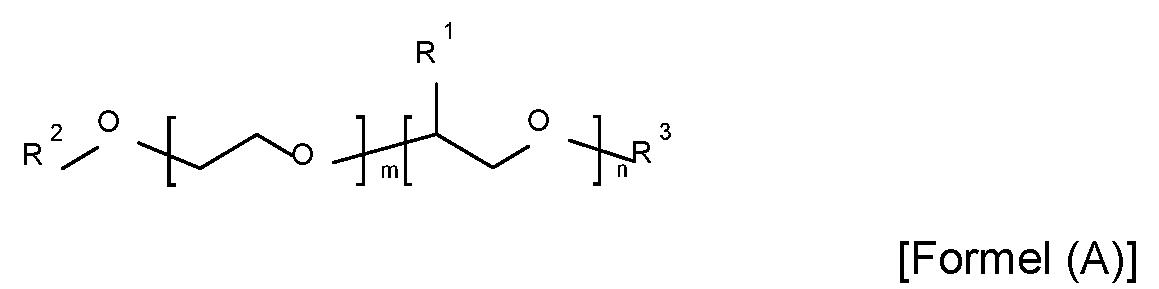
- R1
- ausgewählt ist aus linearem C1-C10-Alkyl, bevorzugt Ethyl und besonders bevorzugt Methyl,
- R2
- ausgewählt ist aus C8-C22-Alkyl, z.B. n-C8H17, n-C10H21, n-C12H25, n-C14H29, n-C16H33 oder n-C18H37,
- R3
- ausgewählt ist aus C1-C10-Alkyl, Methyl, Ethyl, n-Propyl, Isopropyl, n-Butyl, Isobutyl, sec-Butyl, tert-Butyl, n-Pentyl, Isopentyl, sec-Pentyl, Neopentyl, 1,2-Dimethylpropyl, Isoamyl, n-Hexyl, Isohexyl, sec-Hexyl, n-Heptyl, n-Octyl, 2-Ethylhexyl, n-Nonyl, n-Decyl oder Isodecyl,
- m und n
- liegen im Bereich von null bis 300, wobei die Summe von n und m mindestens eins ist. Vorzugsweise liegt m im Bereich von 1 bis 100 und n im Bereich von 0 bis 30.
Non-limiting examples of nonionic surfactants - which can also be used in combinations of more than one other surfactant - include: C8-C18 alkyl ethoxylates such as nonionic NEODOL surfactants® from Shell; ethylene oxide/propylene oxide block alkoxylates as PLURONIC® from BASF; C14-C22 medium chain branched alkyl alkoxylates, BAEx, where x is from 1 to 30, as in
Preferred examples of non-ionic surfactants are in particular alkoxylated alcohols and alkoxylated fatty alcohols, di- and multiblock copolymers of ethylene oxide and propylene oxide and reaction products of sorbitan with ethylene oxide or propylene oxide, as well as alkylphenol ethoxylates, alkyl glycosides, polyhydroxy fatty acid amides (glucamides). Examples of (additional) amphoteric surfactants are so-called amine oxides.
Preferred examples of alkoxylated alcohols and alkoxylated fatty alcohols are, for example, compounds of the general formula (A)
- R1
- is selected from linear C1-C10 alkyl, preferably ethyl and particularly preferably methyl,
- R2
- is selected from C8-C22 alkyl, e.g. n-C8H17, n-C10H21, n-C12H25, n-C14H29, n-C16H33 or n-C18H37,
- R3
- is selected from C1-C10 alkyl, methyl, ethyl, n-propyl, isopropyl, n-butyl, isobutyl, sec-butyl, tert-butyl, n-pentyl, isopentyl, sec-pentyl, neopentyl, 1,2-dimethylpropyl, isoamyl, n-hexyl, isohexyl, sec-hexyl, n-heptyl, n-octyl, 2-ethylhexyl, n-nonyl, n-decyl or isodecyl,
- m and n
- are in the range from zero to 300, where the sum of n and m is at least one. Preferably, m is in the range from 1 to 100 and n is in the range from 0 to 30.
Dabei kann es sich bei Verbindungen der allgemeinen Formel (A) um Blockcopolymere oder Random-Copolymere handeln, wobei Blockcopolymere bevorzugt sind.
Weitere bevorzugte Beispiele für alkoxylierte Alkohole und alkoxylierte Fettalkohole sind beispielsweise Verbindungen der allgemeinen Formel (B) 
- R1
- gleich oder verschieden ist und ausgewählt ist aus linearem C1-C4-Alkyl, bevorzugt jeweils identisch und Ethyl und besonders bevorzugt Methyl,
- R4
- ausgewählt ist aus C6-C20-Alkyl, insbesondere n-C8H17, n-C10H21, n-C12H25, n-C14H29, n-C16H33, n-C18H37,
- ein
- eine Zahl im Bereich von Null bis 6, vorzugsweise 1 bis 6 ist,
- b
- eine Zahl im Bereich von Null bis 20, vorzugsweise 4 bis 20 ist,
- d
- ist eine Zahl im Bereich von 4 bis 25.
Further preferred examples of alkoxylated alcohols and alkoxylated fatty alcohols are, for example, compounds of the general formula (B)
- R1
- is the same or different and is selected from linear C1-C4-alkyl, preferably identical in each case, and ethyl and particularly preferably methyl,
- R4
- is selected from C6-C20-alkyl, in particular n-C8H17, n-C10H21, n-C12H25, n-C14H29, n-C16H33, n-C18H37,
- a
- is a number in the range from zero to 6, preferably 1 to 6,
- b
- is a number in the range from zero to 20, preferably 4 to 20,
- d
- is a number in the range 4 to 25.
Vorzugsweise ist mindestens eines von a und b größer als Null.
Dabei kann es sich bei Verbindungen der allgemeinen Formel (B) um Blockcopolymere oder Random-Copolymere handeln, wobei Blockcopolymere bevorzugt sind.
Weitere geeignete nichtionische Tenside sind ausgewählt aus Di- und Multiblock-Copolymeren, die aus Ethylenoxid und Propylenoxid zusammengesetzt sind. Weitere geeignete nichtionische Tenside sind ausgewählt aus ethoxylierten oder propoxylierten Sorbitanestern. Alkylphenolethoxylate oder Alkylpolyglykoside oder Polyhydroxyfettsäureamide (Glucamide) sind ebenfalls geeignet. Eine Übersicht geeigneter weiterer nichtionischer Tenside findet sich in
Selbstverständlich können auch Mischungen aus zwei oder mehr verschiedenen nichtionischen Tensiden vorhanden sein.
In einer bevorzugten Ausführungsform der vorliegenden Erfindung sind nichtionische Tenside ausgewählt aus C12/14- und C16/18-Fettalkoholalkoxylaten, C13/15-Oxoalkoholalkoxylaten, C13-Alkoholalkoxylaten und 2-Propylheptylalkoholalkoxylaten, jeweils mit 3 - 15 Ethoxyeinheiten, vorzugsweise 5-10 Ethoxyeinheiten, oder mit 1-3 Propoxy- und 2-15 Ethoxyeinheiten.Preferably, at least one of a and b is greater than zero.
Compounds of the general formula (B) can be block copolymers or random copolymers, with block copolymers being preferred.
Other suitable nonionic surfactants are selected from di- and multiblock copolymers composed of ethylene oxide and propylene oxide. Other suitable nonionic surfactants are selected from ethoxylated or propoxylated sorbitan esters. Alkylphenol ethoxylates or alkyl polyglycosides or Polyhydroxy fatty acid amides (glucamides) are also suitable. An overview of other suitable non-ionic surfactants can be found in
Of course, mixtures of two or more different non-ionic surfactants can also be present.
In a preferred embodiment of the present invention, nonionic surfactants are selected from C12/14 and C16/18 fatty alcohol alkoxylates, C13/15 oxo alcohol alkoxylates, C13 alcohol alkoxylates and 2-propylheptyl alcohol alkoxylates, each with 3-15 ethoxy units, preferably 5-10 ethoxy units, or with 1-3 propoxy and 2-15 ethoxy units.
Reinigungsmittel können auch amphotere Tenside enthalten - die auch in Kombinationen von mehr als einem anderen Tensid eingesetzt werden können.
Nicht einschränkende Beispiele von amphoteren Tensiden - die auch in Kombinationen von mehr als einem anderen Tensid eingesetzt werden können - umfassen: wasserlösliche Aminoxide, die eine Alkyleinheit von etwa 8 bis etwa 18 Kohlenstoffatomen enthalten, und 2 Einheiten, ausgewählt aus der Gruppe bestehend aus Alkyleinheiten und Hydroxyalkyleinheiten, die etwa 1 bis etwa 3 Kohlenstoffatome enthalten; und wasserlösliche Sulfoxide, die einen Alkylanteil von etwa 10 bis etwa 18 Kohlenstoffatomen und einen Teil ausgewählt aus der Gruppe bestehend aus Alkyleinheiten und Hydroxyalkyleinheiten von etwa 1 bis etwa 3 Kohlenstoffatomen enthalten. Siehe
In einer bevorzugten Ausführungsform der vorliegenden Erfindung sind amphotere Tenside ausgewählt aus C8-C18-Alkyldimethylaminoxiden und C8-C18-Alkyl-di(hydroxyethyl)aminoxid.Cleaning agents can also contain amphoteric surfactants - which can also be used in combinations of more than one other surfactant.
Non-limiting examples of amphoteric surfactants - which may also be used in combinations of more than one other surfactant - include: water-soluble amine oxides containing one alkyl moiety of about 8 to about 18 carbon atoms and 2 moieties selected from the group consisting of alkyl moieties and hydroxyalkyl moieties containing about 1 to about 3 carbon atoms; and water-soluble sulfoxides containing one alkyl moiety of about 10 to about 18 carbon atoms and a moiety selected from the group consisting of alkyl moieties and hydroxyalkyl moieties of about 1 to about 3 carbon atoms. See
In a preferred embodiment of the present invention, amphoteric surfactants are selected from C8-C18 alkyldimethylamine oxides and C8-C18 alkyldi(hydroxyethyl)amine oxide.
Reinigungsmittel können auch zwitterionische Tenside enthalten - die auch in Kombinationen von mehr als einem anderen Tensid eingesetzt werden können.
Geeignete zwitterionische Tenside umfassen Betaine, wie z.B. Alkylbetaine, Alkylamidobetain, Amidazoliniumbetain, Sulfobetain (INCI Sultaines) sowie die Phosphobetaine. Beispiele für geeignete Betaine und Sulfobetaine sind die folgenden (gemäß INCI bezeichnet): Mandelamidopropyl von Betainen, Apricotamidopropyl betaines, Avocadamidopropyl von Betainen, Babassuamidopropyl von Betainen, Behenamidopropyl betaines, Behenyl von Betainen, Canol amidopropyl betaine, Capryl/Capramidopropyl betaines, Carnitin, Cetyl von Betainen, Cocamidoethyl von Betainen, Cocamidopropyl betaines, Cocamidopropyl hydroxysultaine, Coco betaines, Coco Hydroxysultaine, Coco/Oleam Idopropyl-Betaine, Coco-Sultaine, Decyl-Betaine, Dihydroxyethyl-Oleylglycinat, Dihydroxyethyl-Sojaglycinat, Dihydroxyethylstearylglycinat, Dihydroxyethyltalgglycinat, Dimethiconpropyl-Propyl von PG-Betainen, Erucamidopropylhydroxysultain, hydrierter Talg von Betainen, Isostearamidopropyl-Betaine, Lauramidopropyl-Betaine, Lauryl-Hydroxysultaine, Laurylsultain, Milkamidopropyl-Betaine, Minkamidopropyl-Betaine, Myristamidopropyl-Betaine, Myristyl von Betaine, Oleamidopropylbetaine, Oleamidopropylhydroxysultaine, Oleyl von Betainen, Olivamidopropyl von Betainen, Palmamidopropyl Betaine, Palmitamidopropyl Betaine, Palmitoylcarnitin, Palmkernelamidopropyl Betaine, Polytetrafluorethylen Acetoxypropyl von Betainen, Ricinoleam Idopropyl Betaine, Sesamidopropyl Betaine, Soyamidopropyl Betaine, Stearamidopropyl Betaine, Stearyl von Betainen, Tallowamidopropyl Betaine, Tallowamidopropyl Betaine, Tallowamidopropyl Hydroxysultain, Talg von Betainen, Talg von Betainen Dihydroxyethyl von Betainen, Undecylenamidopropylbetainen und Weizengermamidopropylbetainen.Cleaning agents can also contain zwitterionic surfactants – which can also be used in combinations of more than one other surfactant.
Suitable zwitterionic surfactants include betaines, such as alkyl betaines, alkylamidobetaine, amidazolinium betaine, sulfobetaine (INCI sultaines) and phosphobetaines. Examples of suitable betaines and sulfobetaines are the following (designated according to INCI): Mandelamidopropyl of betaines, Apricotamidopropyl betaines, Avocadamidopropyl of betaines, Babassuamidopropyl of betaines, Behenamidopropyl betaines, Behenyl of betaines, Canol amidopropyl betaine, Capryl/Capramidopropyl betaines, Carnitine, Cetyl of betaines, Cocamidoethyl of betaines, Cocamidopropyl betaines, Cocamidopropyl hydroxysultaine, Coco betaines, Coco Hydroxysultaine, Coco/Oleam Idopropyl-Betaine, Coco-Sultaine, Decyl-Betaine, Dihydroxyethyl Oleyl Glycinate, Dihydroxyethyl Soya Glycinate, Dihydroxyethyl Stearyl Glycinate, Dihydroxyethyl Tallow Glycinate, Dimethiconepropyl Propyl of PG-Betaines, Erucamidopropyl Hydroxysultaine, hydrogenated sebum from Betaines, Isostearamidopropyl Betaine, Lauramidopropyl Betaine, Lauryl Hydroxysultaine, Laurylsultaine, Milkamidopropyl Betaine, Minkamidopropyl Betaine, Myristamidopropyl Betaine, Myristyl Betaine, Oleamidopropyl Betaine, Oleamidopropyl Hydroxysultaine, Oleyl Betaine, Olivamidopropyl Betaine, Palmamidopropyl Betaine, Palmitamidopropyl Betaine, Palmitoylcarnitine, Palm Kernelamidopropyl Betaine, Polytetrafluoroethylene Acetoxypropyl Betaine, Ricinoleam Idopropyl Betaine, Sesamidopropyl Betaine, Soyamidopropyl Betaine, Stearamidopropyl Betaine, Stearyl Betaine, Tallowamidopropyl Betaine, Tallowamidopropyl Betaine, Tallowamidopropyl Hydroxysultaine, Tallow of Betaines, Tallow of Betaines Dihydroxyethyl Betaines, undecylenamidopropylbetaines and wheat germamidopropylbetaines.
Bevorzugte Betaine sind beispielsweise C12-C18-Alkylbetaine und Sulfobetaine. Das zwitterionische Tensid ist vorzugsweise ein Betain-Tensid, bevorzugter ein Cocoamidopropylbetain-Tensid.
Nicht einschränkende Beispiele von kationischen Tensiden - die auch in Kombinationen von mehr als einem anderen Tensid eingesetzt werden können - umfassen: die quaternären Ammoniumtenside, die bis zu 26 Kohlenstoffatome aufweisen können, umfassen: alkoxylierte quaternäre Ammonium-Tenside (AQA), wie in
Non-limiting examples of cationic surfactants - which can also be used in combinations of more than one other surfactant - include: the quaternary ammonium surfactants, which can have up to 26 carbon atoms, include: alkoxylated quaternary ammonium surfactants (AQA) as in
Erfindungsgemäße Zusammensetzungen können mindestens einen Builder umfassen. Im Rahmen der vorliegenden Erfindung wird keine Unterscheidung zwischen Konstrukteuren und solchen Komponenten gemacht, die an anderer Stelle als „Co-Builder“ bezeichnet werden. Beispiele für Builder sind Komplexbildner, im Folgenden auch als Komplexbildner, Ionenaustauscher und Fällungsmittel bezeichnet. Die Builder werden aus Citrat, Phosphaten, Silikaten, Carbonaten, Phosphonaten, Aminocarboxylaten und Polycarboxylaten ausgewählt.
Im Rahmen der vorliegenden Erfindung umfasst der Begriff Citrat die Mono- und die Dialkalimetallsalze und insbesondere die Mono- und vorzugsweise das Trinatriumsalz der Zitronensäure, Ammonium oder substituierte Ammoniumsalze der Zitronensäure sowie Zitronensäure. Citrat kann als wasserfreie Verbindung oder als Hydrat, beispielsweise als Natriumcitrat-Dihydrat, verwendet werden. Die Citratmengen werden unter Bezugnahme auf wasserfreies Trinatriumcitrat berechnet.
Der Begriff Phosphat umfasst Natriummetaphosphat, Natriumorthophosphat, Natriumhydrogenphosphat, Natriumpyrophosphat und Polyphosphate wie Natriumtripolyphosphat. Vorzugsweise ist die erfindungsgemäße Zusammensetzung jedoch frei von Phosphaten und Polyphosphaten, wobei Wasserstoffphosphate subsumiert werden, beispielsweise frei von Trinatriumphosphat, Pentanatriumtripolyphosphat und Hexanatriummetaphosphat („phosphatfrei“). Im Zusammenhang mit Phosphaten und Polyphosphaten sollte „frei von“ im Rahmen der vorliegenden Erfindung so verstanden werden, dass der Gehalt an Phosphat und Polyphosphat insgesamt im Bereich von 10 ppm bis 0,2 Gew.-% der jeweiligen Zusammensetzung liegt, bestimmt durch Gravimetrie.
Der Begriff Karbonate umfasst Alkalimetallcarbonate und Alkalihydrogencarbonate, bevorzugt sind die Natriumsalze. Besonders bevorzugt ist Na2CO3.
Beispiele für Phosphonate sind Hydroxyalkanphosphonate und Aminoalkanphosphonate. Unter den Hydroxyalkanphosphonaten ist das 1-Hydroxyethan-1,1-diphosphonat (HEDP) als Builder von besonderer Bedeutung. Es wird bevorzugt als Natriumsalz eingesetzt, wobei das Dinatriumsalz neutral und das Tetranatriumsalz alkalisch (pH 9) ist. Geeignete Aminoalkanphosphonate sind vorzugsweise Ethylendiamintetramethylenphosphonat (EDTMP), Diethylentriamin-penta¬methylenphosphonat (DTPMP) sowie deren höhere Homologe. Sie werden bevorzugt in Form der neutral reagierenden Natriumsalze eingesetzt, z.B. als Hexanatriumsalz von EDTMP oder als Hepta- und Octa-Natriumsalze von DTPMP.Compositions according to the invention can comprise at least one builder. In the context of the present invention, no distinction is made between constructors and those components which are referred to elsewhere as "co-builders". Examples of builders are complexing agents, also referred to below as complexing agents, ion exchangers and precipitants. The builders are selected from citrate, phosphates, silicates, carbonates, phosphonates, aminocarboxylates and polycarboxylates.
In the context of the present invention, the term citrate includes the mono- and dialkali metal salts and in particular the mono- and preferably the trisodium salt of citric acid, ammonium or substituted ammonium salts of citric acid and citric acid. Citrate can be used as an anhydrous compound or as a hydrate, for example as sodium citrate dihydrate. The citrate amounts are calculated with reference to anhydrous trisodium citrate.
The term phosphate includes sodium metaphosphate, sodium orthophosphate, sodium hydrogen phosphate, sodium pyrophosphate and polyphosphates such as sodium tripolyphosphate. Preferably, however, the composition according to the invention is free of phosphates and polyphosphates, which includes hydrogen phosphates, for example free of trisodium phosphate, pentasodium tripolyphosphate and hexasodium metaphosphate ("phosphate-free"). In connection with phosphates and polyphosphates, "free of" should be understood in the context of the present invention to mean that the total content of phosphate and polyphosphate is in the range from 10 ppm to 0.2% by weight of the respective composition, determined by gravimetry.
The term carbonates includes alkali metal carbonates and alkali hydrogen carbonates, with sodium salts being preferred. Na2CO3 is particularly preferred.
Examples of phosphonates are hydroxyalkanephosphonates and aminoalkanephosphonates. Among the hydroxyalkanephosphonates, 1-hydroxyethane-1,1-diphosphonate (HEDP) is of particular importance as a builder. It is preferably used as the sodium salt, with the disodium salt being neutral and the tetrasodium salt being alkaline (pH 9). Suitable aminoalkanephosphonates are preferably ethylenediaminetetramethylenephosphonate (EDTMP), diethylenetriaminepentamethylenephosphonate (DTPMP) and their higher homologues. They are preferably used in the form of the neutrally reacting sodium salts, e.g. as the hexasodium salt of EDTMP or as the hepta- and octa-sodium salts of DTPMP.
Beispiele für Aminocarboxylate und Polycarboxylate sind Nitrilotriacetate, Ethylendiamintetraacetat, Diethylentriaminpentaacetat, Triethylentetraaminhexaacetat, Propylendiamintetraessigsäure, Ethanoldiglycine, Methylglycindiacetat und Glutamindiacetat. Der Begriff Aminocarboxylate und Polycarboxylate umfasst auch deren jeweilige nicht substituierte oder substituierte Ammoniumsalze und die Alkalimetallsalze wie die Natriumsalze, insbesondere der jeweiligen vollständig neutralisierten Verbindung.
Silikate im Rahmen der vorliegenden Erfindung umfassen insbesondere Natriumdisilikat und Natriummetasilikat, Alumosilikate wie z.B. Zeolithe und Schichtsilikate, insbesondere solche der Formel α-Na2Si2O5, β-Na2Si2O5 und δ-Na2Si2O5.
Die erfindungsgemäßen Zusammensetzungen können einen oder mehrere Builder enthalten, die aus Materialien ausgewählt sind, die oben nicht erwähnt sind. Beispiele für Builder sind α-Hydroxypropionsäure und oxidierte Stärke.
In einer Ausführungsform der vorliegenden Erfindung ist Builder aus Polycarboxylaten ausgewählt. Der Begriff „Polycarboxylate“ umfasst nichtpolymere Polycarboxylate wie Bernsteinsäure, C2-C16-Alkyldisuccinate, C2-C16-Alkenyldisuccinate, Ethylendiamin-N,N'-Bernsteinsäure, Weinsäurediacetat, Alkalimetallmalonate, Weinsäuremonoacetat, Propantricarbonsäure, Butantetracarbonsäure und Cyclopentantetracarbonsäure.
Oligomere oder polymere Polycarboxylate sind beispielsweise Polyasparaginsäure oder insbesondere Alkalimetallsalze von (Meth)acrylsäure-Homopolymeren oder (Meth)acrylsäure-Copolymeren.
Geeignete Co-Monomere sind monoethylenisch ungesättigte Dicarbonsäuren wie Maleinsäure, Fumarsäure, Maleinsäureanhydrid, Itaconsäure und Citraconsäure. Ein geeignetes Polymer ist insbesondere Polyacrylsäure, die vorzugsweise ein gewichtsmittleres Molekulargewicht Mw im Bereich von 2000 bis 40 000 g/mol, bevorzugt 2000 bis 10 000 g/mol, insbesondere 3000 bis 8000 g/mol aufweist. Weitere geeignete copolymere Polycarboxylate sind insbesondere solche von Acrylsäure mit Methacrylsäure und von Acrylsäure oder Methacrylsäure mit Maleinsäure und/oder Fumarsäure.
Es ist auch möglich, Copolymere aus mindestens einem Monomer aus der Gruppe bestehend aus monoethylenisch ungesättigten C3-C10-Mono- oder C4-C10-Dicarbonsäuren oder deren Anhydriden, wie Maleinsäure, Maleinsäureanhydrid, Acrylsäure, Methacrylsäure, Fumarsäure, Itaconsäure und Citraconsäure, mit mindestens einem hydrophil oder hydrophob modifizierten Co-Monomer wie unten aufgeführt einzusetzen.
Geeignete hydrophobe Comonomere sind beispielsweise Isobuten, Diisobuten, Buten, Penten, Hexen und Styrol, Olefine mit zehn oder mehr Kohlenstoffatomen oder Mischungen davon, wie z.B. 1-Decen, 1-Dodecen, 1-Tetradecen, 1-Hexadecen, 1-Octadecen, 1-Eicosen, 1-Docosen, 1-Tetracosen und 1-Hexacosen, C22-α-Olefin, ein Gemisch aus C20-C24-α-Olefinen und Polyisobuten mit durchschnittlich 12 bis 100 Kohlenstoffatomen pro Molekül.
Geeignete hydrophile Co-Monomere sind Monomere mit Sulfonat- oder Phosphonatgruppen, sowie nichtionische Monomere mit Hydroxylfunktion oder Alkylenoxidgruppen. Als Beispiele seien genannt: Allylalkohol, Isoprenol, Methoxypolyethylenglykol(meth)acrylat, Methoxypolypro-pylenglykol(meth)acrylat, Methoxypolybutylenglykol(meth)acrylat, Methoxypoly(propylenoxid-co-ethylenoxid)(meth)acrylat, Ethoxypolyethylenglykol(meth)acrylat, Ethoxypolypropylengly-kol(meth)acrylat, Ethoxypolybutylenglykol(meth)acrylat und Ethoxypoly(propylenoxid-co-ethylenoxid)(meth)acrylat. Polyalkylenglykole können dabei 3 bis 50, insbesondere 5 bis 40 und insbesondere 10 bis 30 Alkylenoxideinheiten pro Molekül umfassen.
Besonders bevorzugte Sulfonsäuregruppen-haltige Monomere sind hierbei 1-Acrylamido-1-pro-pansulfonsäure, 2-Acrylamido-2-propansulfonsäure, 2-Acrylamido-2-methylpropansulfonsäure, 2-Methacrylamido-2-methylpropansulfonsäure, 3-Methacrylamido-2-hydroxypropansulfonsäure, Allylsulfonsäure, Methallylsulfonsäure, Allyloxybenzolsulfonsäure, Methallyloxybenzolsulfonsäure, 2-Hydroxy-3-(2-propenyloxy)propansulfonsäure, 2-Methyl-2-propen-1-sulfonsäure, Styrolsulfonsäure, Vinylsulfonsäure, 3-Sulfopropylacrylat, 2-Sulfoethylmethacrylat, 3-Sulfopropylmethacrylat, Sulfomethacrylamid, Sulfomethylmethacrylamid und Salze dieser Säuren, wie Natrium-, Kalium- oder Ammoniumsalze davon.
Besonders bevorzugte phosphonatgruppenhaltige Monomere sind Vinylphosphonsäure und ihre Salze.
Darüber hinaus können amphotere Polymere auch als Builder verwendet werden. Erfindungsgemäße Zusammensetzungen können beispielsweise im Bereich von insgesamt 0,1 bis 70 Gew.-%, bevorzugt 10 bis 50 Gew.-%, bevorzugt bis zu 20 Gew.-%, an Buildern, insbesondere bei festen Formulierungen, enthalten. Erfindungsgemäße flüssige Formulierungen enthalten vorzugsweise im Bereich von 0,1 bis 8 Gew.-% Builder.Examples of aminocarboxylates and polycarboxylates are nitrilotriacetates, ethylenediaminetetraacetate, diethylenetriaminepentaacetate, triethylenetetraaminehexaacetate, propylenediaminetetraacetic acid, ethanoldiglycines, methylglycine diacetate and glutamine diacetate. The term aminocarboxylates and polycarboxylates also includes their respective unsubstituted or substituted ammonium salts and the alkali metal salts such as the sodium salts, in particular of the respective fully neutralized compound.
Silicates in the context of the present invention include in particular sodium disilicate and sodium metasilicate, aluminosilicates such as zeolites and layered silicates, in particular those of the formula α-Na2Si2O5, β-Na2Si2O5 and δ-Na2Si2O5.
The compositions of the invention may contain one or more builders selected from materials not mentioned above. Examples of builders are α-hydroxypropionic acid and oxidized starch.
In one embodiment of the present invention, builder is selected from polycarboxylates. The term "polycarboxylates" includes non-polymeric polycarboxylates such as succinic acid, C2-C16 alkyl disuccinates, C2-C16 alkenyl disuccinates, ethylenediamine-N,N'-succinic acid, tartaric acid diacetate, alkali metal malonates, tartaric acid monoacetate, propanetricarboxylic acid, butanetetracarboxylic acid and cyclopentanetetracarboxylic acid.
Oligomeric or polymeric polycarboxylates are, for example, polyaspartic acid or, in particular, alkali metal salts of (meth)acrylic acid homopolymers or (meth)acrylic acid copolymers.
Suitable comonomers are monoethylenically unsaturated dicarboxylic acids such as maleic acid, fumaric acid, maleic anhydride, itaconic acid and citraconic acid. A suitable polymer is in particular polyacrylic acid, which preferably has a weight-average molecular weight Mw in the range from 2000 to 40,000 g/mol, preferably 2000 to 10,000 g/mol, in particular 3000 to 8000 g/mol. Other suitable copolymeric polycarboxylates are in particular those of acrylic acid with methacrylic acid and of acrylic acid or methacrylic acid with maleic acid and/or fumaric acid.
It is also possible to use copolymers of at least one monomer from the group consisting of monoethylenically unsaturated C3-C10 mono- or C4-C10 dicarboxylic acids or their anhydrides, such as maleic acid, maleic anhydride, acrylic acid, methacrylic acid, fumaric acid, itaconic acid and citraconic acid, with at least one hydrophilically or hydrophobically modified co-monomer as listed below.
Suitable hydrophobic comonomers are, for example, isobutene, diisobutene, butene, pentene, hexene and styrene, olefins with ten or more carbon atoms or mixtures thereof, such as 1-decene, 1-dodecene, 1-tetradecene, 1-hexadecene, 1-octadecene, 1-eicosene, 1-docosene, 1-tetracosene and 1-hexacosene, C22-α-olefin, a mixture of C20-C24-α-olefins and polyisobutene with an average of 12 to 100 carbon atoms per molecule.
Suitable hydrophilic comonomers are monomers with sulfonate or phosphonate groups, as well as nonionic monomers with hydroxyl function or alkylene oxide groups. Examples include: allyl alcohol, isoprenol, methoxypolyethylene glycol (meth)acrylate, methoxypolypropylene glycol (meth)acrylate, methoxypolybutylene glycol (meth)acrylate, methoxypoly(propylene oxide-co-ethylene oxide) (meth)acrylate, ethoxypolyethylene glycol (meth)acrylate, ethoxypolypropylene glycol (meth)acrylate, ethoxypolybutylene glycol (meth)acrylate and ethoxypoly(propylene oxide-co-ethylene oxide) (meth)acrylate. Polyalkylene glycols can comprise 3 to 50, in particular 5 to 40 and in particular 10 to 30 alkylene oxide units per molecule.
Particularly preferred monomers containing sulfonic acid groups are 1-acrylamido-1-propanesulfonic acid, 2-acrylamido-2-propanesulfonic acid, 2-acrylamido-2-methylpropanesulfonic acid, 2-methacrylamido-2-methylpropanesulfonic acid, 3-methacrylamido-2-hydroxypropanesulfonic acid, allylsulfonic acid, methallylsulfonic acid, allyloxybenzenesulfonic acid, methallyloxybenzenesulfonic acid, 2-hydroxy-3-(2-propenyloxy)propanesulfonic acid, 2-methyl-2-propen-1-sulfonic acid, styrenesulfonic acid, vinylsulfonic acid, 3-sulfopropyl acrylate, 2-sulfoethyl methacrylate, 3-sulfopropyl methacrylate, sulfomethacrylamide, sulfomethylmethacrylamide and salts of these acids, such as sodium, potassium or ammonium salts thereof.
Particularly preferred monomers containing phosphonate groups are vinylphosphonic acid and its salts.
In addition, amphoteric polymers can also be used as builders. Compositions according to the invention can, for example, contain a total of 0.1 to 70% by weight, preferably 10 to 50% by weight, preferably up to 20% by weight, of builders, particularly in solid formulations. Liquid formulations according to the invention preferably contain a builder in the range from 0.1 to 8% by weight.
Die erfindungsgemäßen Formulierungen können einen oder mehrere Alkaliträger umfassen. Alkaliträger sorgen beispielsweise für einen pH-Wert von mindestens 9, wenn ein alkalischer pH-Wert gewünscht wird. Geeignet sind beispielsweise die oben genannten Alkalicarbonate, Alkalihydrogencarbonate und Alkalimetallmetasilikate sowie zusätzlich Alkalihydroxide. Ein bevorzugtes Alkalimetall ist jeweils Kalium, besonders bevorzugt Natrium. In einer Ausführungsform der vorliegenden Erfindung wird ein pH-Wert >7 unter Verwendung von Aminen, vorzugsweise Alkanolalaminen, besonders bevorzugt Triethanolamin, eingestellt.The formulations according to the invention can comprise one or more alkali carriers. Alkali carriers ensure, for example, a pH of at least 9 if an alkaline pH is desired. Suitable examples are the above-mentioned alkali carbonates, alkali hydrogen carbonates and alkali metal metasilicates as well as alkali hydroxides. A preferred alkali metal is potassium, particularly preferably sodium. In one embodiment of the present invention, a pH of >7 is set using amines, preferably alkanolamines, particularly preferably triethanolamine.
In einer Ausführungsform der vorliegenden Erfindung umfasst die erfindungsgemäße Waschmittelformulierung oder -zusammensetzung zusätzlich mindestens ein Enzym.
Nützliche Enzyme sind beispielsweise eine oder mehrere Hydrolasen, ausgewählt aus Lipasen, Amylasen, Proteasen, Cellulasen, Hemicellulasen, Phospholipasen, Esterasen, Pektinasen, Laktasen und Peroxidasen sowie Kombinationen von mindestens zwei der vorgenannten Typen.
In einer Ausführungsform umfasst die erfindungsgemäße Zusammensetzung zusätzlich mindestens ein Enzym.
Vorzugsweise ist das mindestens eine Enzym ein Detergenzenzym.
In einer Ausführungsform wird das Enzym als Oxidoreduktase (EC1), Transferase (EC2), Hydrolase (EC3), Lyase (EC4), Isomerase (EC5) oder Ligase (EC6) klassifiziert (die EC-Nummerierung erfolgt gemäß Enzymnomenklatur, Empfehlungen (1992) des Nomenklaturausschusses der Internationalen Union für Biochemie und Molekularbiologie einschließlich ihrer 1993-1999 veröffentlichten Ergänzungen). Vorzugsweise handelt es sich bei dem Enzym um eine Hydrolase (EC3).
In einer bevorzugten Ausführungsform ist das Enzym ausgewählt aus der Gruppe bestehend aus Proteasen, Amylasen, Lipasen, Cellulasen, Mannanasen, Hemicellulasen, Phospholipasen, Esterasen, Pektinasen, Laktasen, Peroxidasen, Xylanasen, Cutinasen, Pektatlyasen, Keratinasen, Reduktasen, Oxidasen, Phenoloxidasen, Lipoxygenasen, Ligninasen, Pullulanasen, Tannasen, Pentosanasen, Malanasen, Beta-Glucanasen, Arabinosidedasen, Hyaluronidasen, Chondroitinasen, Laccasen, Nukleasen, DNasen, Phosphodiesterasen, Phytasen, Carbohydrasen, Galactanasen, Xanthanasen, Xyloglucanasen, Oxidoreduktase, Perhydrolasen, Aminopeptidase, Asparaginase, Carbohydrase, Carboxypeptidase, Katalase, Chitinase, Cyclodextrin-Glykosyltransferase, Alpha-Galactosidase, Beta-Galactosidase, Glucoamylase, Alpha-Glucosidase, Beta-Glucosidase, Invertase, Ribonuklease, Transglutaminase und Dispersine sowie Kombinationen von mindestens zwei der vorgenannten Typen. Besonders bevorzugt ist das Enzym ausgewählt aus der Gruppe bestehend aus Proteasen, Amylasen, Lipasen, Cellulasen, Mannanasen, Xylanasen, DNasen, Dispersinen, Pektinasen, Oxidoreduktasen und Cutinasen und Kombinationen von mindestens zwei der vorhergehenden Typen. Am meisten bevorzugt ist das Enzym eine Protease, bevorzugt eine Serinprotease, besonders bevorzugt eine Subtilisinprotease. Solche Enzyme können in die Zusammensetzung in Mengen eingebaut werden, die ausreichen, um eine wirksame Menge zur Erzielung einer vorteilhaften Wirkung bereitzustellen, vorzugsweise für primäre Wascheffekte und/oder sekundäre Wascheffekte, wie Anti-Greying- oder Antipilling-Wirkungen (z. B. im Falle von Cellulasen). Vorzugsweise liegt das Enzym in der Zusammensetzung in Konzentrationen von etwa 0,00001 % bis etwa 5 %, bevorzugt von etwa 0,00001 % bis etwa 2 %, besonders bevorzugt von etwa 0,0001 % bis etwa 1 % oder noch bevorzugter von etwa 0,001 % bis etwa 0,5 Gew.-% Enzymprotein der Zusammensetzung vor. Vorzugsweise umfasst die enzymhaltige Zusammensetzung ferner ein Enzymstabilisierungssystem.
Vorzugsweise umfasst die hierin beschriebene enzymhaltige Zusammensetzung von etwa 0,001 % bis etwa 10 %, von etwa 0,005 % bis etwa 8 % oder von etwa 0,01 % bis etwa 6 Gew.- % der Zusammensetzung eines Enzymstabilisierungssystems. Das Enzymstabilisierungssystem kann ein beliebiges Stabilisierungssystem sein, das mit dem Enzym kompatibel ist.In one embodiment of the present invention, the detergent formulation or composition according to the invention additionally comprises at least one enzyme.
Useful enzymes include, for example, one or more hydrolases selected from lipases, amylases, proteases, cellulases, hemicellulases, phospholipases, esterases, pectinases, lactases and peroxidases, as well as combinations of at least two of the aforementioned types.
In one embodiment, the composition according to the invention additionally comprises at least one enzyme.
Preferably, the at least one enzyme is a detergent enzyme.
In one embodiment, the enzyme is designated as oxidoreductase (EC1), transferase (EC2), hydrolase (EC3), Lyase (EC4), isomerase (EC5) or ligase (EC6) (EC numbering is according to Enzyme Nomenclature, Recommendations (1992) of the Nomenclature Committee of the International Union of Biochemistry and Molecular Biology including its supplements published 1993-1999). Preferably, the enzyme is a hydrolase (EC3).
In a preferred embodiment, the enzyme is selected from the group consisting of proteases, amylases, lipases, cellulases, mannanases, hemicellulases, phospholipases, esterases, pectinases, lactases, peroxidases, xylanases, cutinases, pectate lyases, keratinases, reductases, oxidases, phenol oxidases, lipoxygenases, ligninases, pullulanases, tannases, pentosanases, malanases, beta-glucanases, arabinosidedases, hyaluronidases, chondroitinases, laccases, nucleases, DNases, phosphodiesterases, phytases, carbohydrases, galactanases, xanthanases, xyloglucanases, oxidoreductase, perhydrolases, aminopeptidase, Asparaginase, carbohydrase, carboxypeptidase, catalase, chitinase, cyclodextrin glycosyltransferase, alpha-galactosidase, beta-galactosidase, glucoamylase, alpha-glucosidase, beta-glucosidase, invertase, ribonuclease, transglutaminase and dispersins and combinations of at least two of the aforementioned types. The enzyme is particularly preferably selected from the group consisting of proteases, amylases, lipases, cellulases, mannanases, xylanases, DNases, dispersins, pectinases, oxidoreductases and cutinases and combinations of at least two of the preceding types. Most preferably the enzyme is a protease, preferably a serine protease, particularly preferably a subtilisin protease. Such enzymes may be incorporated into the composition in amounts sufficient to provide an effective amount to achieve a beneficial effect, preferably for primary washing effects and/or secondary washing effects such as anti-greying or anti-pilling effects (e.g. in the case of cellulases). Preferably, the enzyme is present in the composition at concentrations of from about 0.00001% to about 5%, preferably from about 0.00001% to about 2%, more preferably from about 0.0001% to about 1%, or even more preferably from about 0.001% to about 0.5% enzyme protein by weight of the composition. Preferably, the enzyme-containing composition further comprises an enzyme stabilization system.
Preferably, the enzyme-containing composition described herein comprises from about 0.001% to about 10%, from about 0.005% to about 8%, or from about 0.01% to about 6% by weight of the composition of an enzyme stabilization system. The enzyme stabilization system can be any stabilization system that is compatible with the enzyme.
Vorzugsweise umfasst das Enzymstabilisierungssystem mindestens eine Verbindung, ausgewählt aus der Gruppe bestehend aus Polyolen (vorzugsweise 1,3-Propandiol, Ethylenglykol, Glycerin, 1,2-Propandiol oder Sorbit), Salzen (vorzugsweise CaCl2, MgCl2 oder NaCl), kurzkettigen (vorzugsweise C1-C6) Carbonsäuren (vorzugsweise Ameisensäure, Formiat (vorzugsweise Natriumformiat), Essigsäure, Acetat oder Lactat), Borat, Borsäure, Boronsäuren (bevorzugt, 4-Formylphenylboronsäure (4-FPBA)), Peptidaldehyde, Peptidacetale und Peptidaldehydhydrosulfit-Addukte. Vorzugsweise umfasst das Enzymstabilisierungssystem eine Kombination aus mindestens zwei der Verbindungen, ausgewählt aus der Gruppe bestehend aus Salzen, Polyolen und kurzkettigen Carbonsäuren, und vorzugsweise eine oder mehrere der Verbindungen, ausgewählt aus der Gruppe bestehend aus Borat, Borsäure, Boronsäuren (vorzugsweise 4-Formylphenyboronsäure (4-FPBA)), Peptidaldehyden, Peptidacetale und Peptidaldehydhydrosulfit-Addukte. Insbesondere, wenn Proteasen in der Zusammensetzung vorhanden sind, können Proteaseinhibitoren zugesetzt werden, vorzugsweise ausgewählt aus Borat, Borsäure, Boronsäuren (vorzugsweise 4-FPBA), Peptidaldehyden (bevorzugt Peptidaldehyden wie Z-VAL-H oder Z-GAY-H), Peptidacetalen und Peptidaldehydhydrosulfit-Addukten. Die erfindungsgemäßen Zusammensetzungen können ein oder mehrere Bleichmittel (Bleichmittel) enthalten.
Bevorzugte Bleichmittel sind ausgewählt aus Natriumperborat, wasserfrei oder beispielsweise als Monohydrat oder als Tetrahydrat oder sogenanntes Dihydrat, Natriumpercarbonat, wasserfrei oder beispielsweise als Monohydrat, und Natriumpersulfat, wobei der Begriff „Persulfat“ jeweils das Salz der Persäure H2SO5 und auch das Peroxodisulfat umfasst.
Dabei kann es sich bei den Alkalimetallsalzen jeweils auch um Alkalihydrogencarbonat, Alkalimetallhydrogenperborat und Alkalimetallhydrogenpersulfat handeln. Bevorzugt sind jedoch jeweils die Dialkalimetallsalze.Preferably, the enzyme stabilization system comprises at least one compound selected from the group consisting of polyols (preferably 1,3-propanediol, ethylene glycol, glycerin, 1,2-propanediol or sorbitol), salts (preferably CaCl2, MgCl2 or NaCl), short chain (preferably C1-C6) carboxylic acids (preferably formic acid, formate (preferably sodium formate), acetic acid, acetate or lactate), borate, boric acid, boronic acids (preferably, 4-formylphenylboronic acid (4-FPBA)), peptide aldehydes, peptide acetals and peptide aldehyde hydrosulfite adducts. Preferably, the enzyme stabilization system comprises a combination of at least two of the compounds selected from the group consisting of salts, polyols and short chain carboxylic acids, and preferably one or more of the compounds selected from the group consisting of borate, boric acid, boronic acids (preferably 4-formylphenylboronic acid (4-FPBA)), peptide aldehydes, peptide acetals and peptide aldehyde hydrosulfite adducts. In particular, when proteases are present in the composition, protease inhibitors may be added, preferably selected from borate, boric acid, boronic acids (preferably 4-FPBA), peptide aldehydes (preferably peptide aldehydes such as Z-VAL-H or Z-GAY-H), peptide acetals and peptide aldehyde hydrosulfite adducts. The compositions according to the invention may contain one or more bleaching agents (bleaching agents).
Preferred bleaching agents are selected from sodium perborate, anhydrous or, for example, as monohydrate or as tetrahydrate or so-called dihydrate, sodium percarbonate, anhydrous or, for example, as monohydrate, and sodium persulfate, where the term “persulfate” includes the salt of the peracid H2SO5 and also the peroxodisulfate.
The alkali metal salts can also be alkali metal hydrogen carbonate, alkali metal hydrogen perborate and alkali metal hydrogen persulfate. However, the dialkali metal salts are preferred.
Die erfindungsgemäßen Formulierungen können einen oder mehrere Bleichkatalysatoren umfassen. Bleichkatalysatoren können ausgewählt werden aus Bleichkatalysatoren auf Oxaziridiniumbasis, bleichverstärkenden Übergangsmetallsalzen oder Übergangsmetallkomplexen wie beispielsweise Mangan-, Eisen-, Kobalt-, Ruthenium- oder Molybdänsalenkomplexen oder Carbonylkomplexen. Mangan-, Eisen-, Kobalt-, Ruthenium-, Molybdän-, Titan-, Vanadium- und Kupferkomplexe mit stickstoffhaltigen Dreibeinliganden sowie Kobalt-, Eisen-, Kupfer- und Rutheniumamin-Komplexe können ebenfalls als Bleichkatalysatoren eingesetzt werden.The formulations according to the invention can comprise one or more bleach catalysts. Bleach catalysts can be selected from oxaziridinium-based bleach catalysts, bleach-enhancing transition metal salts or transition metal complexes such as manganese, iron, cobalt, ruthenium or molybdenum salen complexes or carbonyl complexes. Manganese, iron, cobalt, ruthenium, molybdenum, titanium, vanadium and copper complexes with nitrogen-containing tripod ligands as well as cobalt, iron, copper and ruthenium amine complexes can also be used as bleach catalysts.
Erfindungsgemäße Formulierungen können einen oder mehrere Bleichaktivatoren umfassen, z.B. Tetraacetylethylendiamin, Tetraacetylmethylendiamin, Tetraacetylglycoluril, Tetraacetylhexyldiamin, acylierte Phenolsulfonate wie z.B. n-Nonanoyl- oder Isononanoyloxybenzolsulfonate, N-Methylmorpholinium-acetonitrilsalze („MMA-Salze“), Trimethylammoniumacetonitrilsalze, N-Acylimide wie z.B. N-Nonanoylsuccinimid, 1,5-Diacetyl-2,2-dioxohexahydro-1,3, 5-Triazin („DADHT“) oder Nitrilquats (Trimethylammoniumacetonitrilsalze).Formulations according to the invention can comprise one or more bleach activators, e.g. tetraacetylethylenediamine, tetraacetylmethylenediamine, tetraacetylglycoluril, tetraacetylhexyldiamine, acylated phenolsulfonates such as e.g. n-nonanoyl or isononanoyloxybenzenesulfonates, N-methylmorpholinium acetonitrile salts ("MMA salts"), trimethylammonium acetonitrile salts, N-acylimides such as e.g. N-nonanoylsuccinimide, 1,5-diacetyl-2,2-dioxohexahydro-1,3,5-triazine ("DADHT") or nitrile quats (trimethylammonium acetonitrile salts).
Die erfindungsgemäßen Formulierungen können einen oder mehrere Korrosionsinhibitoren umfassen. Im vorliegenden Fall sind darunter solche Verbindungen zu verstehen, die die Korrosion von Metall hemmen. Beispiele für geeignete Korrosionsinhibitoren sind Triazole, insbesondere Benzotriazole, Bisbenzotriazole, Aminotriazole, Alkylaminotriazole, auch Phenolderivate wie z.B. Hydrochinon, Pyrocatechol, Hydroxy-hydrochinon, Gallussäure, Phloroglucinol oder Pyrogallol.
In einer Ausführungsform der vorliegenden Erfindung enthalten erfindungsgemäße Formulierungen insgesamt im Bereich von 0,1 bis 1,5 Gew.-% Korrosionsinhibitor.The formulations according to the invention can comprise one or more corrosion inhibitors. In the present case, these are understood to mean compounds which inhibit the corrosion of metal. Examples of suitable corrosion inhibitors are triazoles, in particular benzotriazoles, bisbenzotriazoles, aminotriazoles, alkylaminotriazoles, and also phenol derivatives such as hydroquinone, pyrocatechol, hydroxyhydroquinone, gallic acid, phloroglucinol or pyrogallol.
In one embodiment of the present invention, formulations according to the invention contain a total of 0.1 to 1.5% by weight of corrosion inhibitor.
Die erfindungsgemäßen Formulierungen können auch weitere Reinigungspolymere und/oder Schmutzfreisetzungspolymere umfassen.
Zu den zusätzlichen Reinigungspolymeren können unter anderem „multifunktionale Polyethylenimine“ (z. B. Sokalan HP20 von BASF) und/oder „multifunktionale Diamine“ (z. B. Sokalan®® HP96 von BASF) sowie die in
Geeignete multifunktionale Diamine sind typischerweise ethoxylierte C2- bis C12-Alkylendia-mine, vorzugsweise Hexamethylendiamin, die weiter quaternisiert und gegebenenfalls sulfatiert sind. Typische multifunktionale Diamine haben ein gewichtsmittleres Molekulargewicht Mw im Bereich von 2000 bis 10000, besonders bevorzugt 3000 bis 8000 und am meisten bevorzugt 4000 bis 6000 g/mol. In einer bevorzugten Ausführungsform der Erfindung kann ethoxyliertes Hexamethylendiamin, ferner quaternisiert und sulfatiert, eingesetzt werden, das durchschnittlich 10 bis 50, bevorzugt 15 bis 40 und noch mehr bevorzugt 20 bis 30 Ethylenoxid (EO)-Gruppen pro NH-funktioneller Gruppe enthält und das vorzugsweise zwei kationische Ammoniumgruppen und zwei anionische Sulfatgruppen trägt.
In einer bevorzugten Ausführungsform der vorliegenden Erfindung können die Reinigungsmittel mindestens ein multifunktionales Polyethylenimin und/oder mindestens ein multifunktionales Diamin enthalten, insbesondere eines der beanspruchten Polymere von Sokalan HP20, Sokalan®® HP96 und/oder eines der in
Somit ist ein Aspekt der vorliegenden Erfindung eine Waschmittelzusammensetzung, insbesondere ein Flüssigwaschmittel, umfassend (i) mindestens eine erfindungsgemäße Verbindung und (ii) mindestens eine Verbindung, ausgewählt aus multifunktionalen Polyethyleniminen und multifunktionalen Diaminen und Mischungen davon.
In einer Ausführungsform der vorliegenden Erfindung beträgt das Verhältnis der mindestens einen erfindungsgemäßen Verbindung und (ii) der mindestens einen Verbindung, ausgewählt aus multifunktionalen Polyethyleniminen und multifunktionalen Diaminen und deren Mischungen, 10:1 bis 1:10, bevorzugt von 5:1 bis 1:5 und besonders bevorzugt von 3:1 bis 1:3.The formulations according to the invention can also comprise other cleaning polymers and/or soil release polymers.
Additional cleaning polymers may include “multifunctional polyethyleneimines” (e.g. Sokalan HP20 from BASF) and/or “multifunctional diamines” (e.g. Sokalan® HP96 from BASF) as well as the
Suitable multifunctional diamines are typically ethoxylated C2 to C12 alkylenediamines, preferably hexamethylenediamine, which are further quaternized and optionally sulfated. Typical multifunctional diamines have a weight-average molecular weight Mw in the range from 2000 to 10,000, particularly preferably 3000 to 8000 and most preferably 4000 to 6000 g/mol. In a preferred embodiment of the invention, ethoxylated hexamethylenediamine, further quaternized and sulfated, can be used, which contains on average 10 to 50, preferably 15 to 40 and even more preferably 20 to 30 ethylene oxide (EO) groups per NH-functional group and which preferably carries two cationic ammonium groups and two anionic sulfate groups.
In a preferred embodiment of the present invention, the cleaning agents may contain at least one multifunctional polyethyleneimine and/or at least one multifunctional diamine, in particular one of the claimed polymers of Sokalan HP20, Sokalan® HP96 and/or one of the
Thus, one aspect of the present invention is a detergent composition, in particular a liquid detergent, comprising (i) at least one compound according to the invention and (ii) at least one compound selected from multifunctional polyethyleneimines and multifunctional diamines and mixtures thereof.
In one embodiment of the present invention, the ratio of the at least one compound according to the invention and (ii) the at least one compound selected from multifunctional Polyethylenimines and multifunctional diamines and mixtures thereof, 10:1 to 1:10, preferably from 5:1 to 1:5 and particularly preferably from 3:1 to 1:3.
Reinigungsmittel, Textil- und Haushaltspflegeprodukte und insbesondere die Waschmittelformulierungen, die die erfindungsgemäße Verbindung umfassen, können ebenfalls mindestens ein antimikrobielles Mittel (auch „Konservierungsmittel“ genannt) enthalten.
Ein antimikrobielles Mittel ist eine chemische Verbindung, die Mikroorganismen abtötet oder ihr Wachstum oder ihre Vermehrung hemmt. Mikroorganismen können Bakterien, Hefen oder Schimmelpilze sein. Ein Konservierungsmittel ist ein antimikrobielles Mittel, das wässrigen Produkten und Zusammensetzungen zugesetzt werden kann, um die ursprüngliche Leistung, Eigenschaften und Integrität der Produkte und Zusammensetzungen zu erhalten, indem kontaminierende Mikroorganismen abgetötet oder ihr Wachstum gehemmt wird.
Die Zusammensetzung/Formulierung kann einen oder mehrere antimikrobielle Wirkstoffe und/oder Konservierungsmittel enthalten, wie im Patent
Besonders interessant für die Reinigungsmittel und Textil- und Haushaltspflegeprodukte und speziell für die Waschmittelformulierungen sind die folgenden antimikrobiellen Mittel und/oder Konservierungsmittel:
- 4,4'-Dichlor-2-hydroxydiphenylether (weitere Bezeichnungen: 5-Chlor-2-(4-chlorphenoxy)phenol, Diclosan, DCPP), Tinosan® HP 100 (Handelsprodukt der BASF SE, das 30 % des antimikrobiell wirksamen 4,4'-Dichoro-2-hydroxydiphenylethers enthält); 2-Phenoxyethanol (weitere Bezeichnungen: Phenoxyethanol, Methylphenylglykol, Phenoxetyethanol, Ethylenglykolphenylether, Ethylenglykolmonophenylether, 2-(Phenoxy)ethanol, 2-Phenoxy-1-ethanol); 2-Brom-2-nitropropan-1,3-diol (weitere Bezeichnungen: 2-Brom-2-nitro-1,3-propandiol, Bronopol); Glutaraldehyd (weitere Bezeichnungen: 1-5-Pentandien, Pentan-1,5-Zifferblatt, Glutaral, GlutarDialdehyd); Glyoxal (weitere Namen: Ethandium, Oxylaldehyd, 1,2-Ethandium); 2-Butyl-benzo[d]isothiazol-3-on („BBIT“); 2-Methyl-2H-isothiazol-3-on („MIT“); 2-Octyl-2H-isothiazol-3-on („OIT“); 5-Chlor-2-methyl-2H-isothiazol-3-on („CIT“ oder „CMIT“); Gemisch aus 5-Chlor-2-methyl-2H-isothiazol-3-on („CMIT“) und 2-Methyl-2H-isothiazol-3-on („MIT“) (Gemisch aus CMIT/MIT); 1,2-Benzisothiazol-3(2H)-on („BIT“); Hexa-2,4-diensäure (Trivialname „Sorbinsäure“) und ihre Salze, z. B. Calciumsorb-at, Natriumsorbat; Kalium (E,E)-hexa-2,4-dienoat (Kaliumsorbat); Milchsäure und ihre Salze; L-(+)-Milchsäure; insbesondere Natriumlactat; Benzoesäure und Salze der Benzoesäure, z.B. Natriumbenzoat, Ammoniumbenzoat, Calciumbenzoat, Magnesiumbenzoat, MEA-Benzoat, Kaliumbenzoat; Salicylsäure und ihre Salze, z.B. Calciumsalicylat, Magnesiumsalicylat, MEA-Salicylat, Natriumsalicylat, Kaliumsalicylat, TEA-Salicylat; Benzalkoniumchlorid, Benzalkoniumbromid, Benzalkoniumsaccharinat; Didecyldimethylammoniumchlorid („DDAC“); N-(3-Aminopropyl)-N-dodecylpropan-1,3-diamin („Diamin“); Peressigsäure; Wasserstoffperoxid.
An antimicrobial agent is a chemical compound that kills microorganisms or inhibits their growth or proliferation. Microorganisms can be bacteria, yeasts or molds. A preservative is an antimicrobial agent that can be added to aqueous products and compositions to maintain the original performance, properties and integrity of the products and compositions by killing contaminating microorganisms or inhibiting their growth.
The composition/formulation may contain one or more antimicrobial agents and/or preservatives as described in the patent
The following antimicrobial agents and/or preservatives are of particular interest for cleaning agents and textile and household care products and especially for detergent formulations:
- 4,4'-dichloro-2-hydroxydiphenyl ether (other names: 5-chloro-2-(4-chlorophenoxy)phenol, diclosan, DCPP), Tinosan® HP 100 (commercial product of BASF SE, which contains 30% of the antimicrobially effective 4,4'-dichloro-2-hydroxydiphenyl ether); 2-phenoxyethanol (other names: phenoxyethanol, methylphenyl glycol, phenoxetyethanol, ethylene glycol phenyl ether, ethylene glycol monophenyl ether, 2-(phenoxy)ethanol, 2-phenoxy-1-ethanol); 2-bromo-2-nitropropane-1,3-diol (other names: 2-bromo-2-nitro-1,3-propanediol, bronopol); Glutaraldehyde (other names: 1-5-pentandiene, pentane-1,5-dial, glutaral, glutardialdehyde); glyoxal (other names: ethandium, oxyaldehyde, 1,2-ethandium); 2-butyl-benzo[d]isothiazol-3-one (“BBIT”); 2-methyl-2H-isothiazol-3-one (“MIT”); 2-octyl-2H-isothiazol-3-one (“OIT”); 5-chloro-2-methyl-2H-isothiazol-3-one (“CIT” or “CMIT”); mixture of 5-chloro-2-methyl-2H-isothiazol-3-one (“CMIT”) and 2-methyl-2H-isothiazol-3-one (“MIT”) (mixture of CMIT/MIT); 1,2-benzisothiazol-3(2H)-one (“BIT”); Hexa-2,4-dienoic acid (common name "sorbic acid") and its salts, e.g. calcium sorbate, sodium sorbate; potassium (E,E)-hexa-2,4-dienoate (potassium sorbate); lactic acid and its salts; L-(+)-lactic acid; in particular sodium lactate; benzoic acid and salts of benzoic acid, e.g. sodium benzoate, ammonium benzoate, calcium benzoate, magnesium benzoate, MEA benzoate, potassium benzoate; salicylic acid and its salts, e.g. calcium salicylate, magnesium salicylate, MEA salicylate, sodium salicylate, potassium salicylate, TEA salicylate; benzalkonium chloride, benzalkonium bromide, benzalkonium saccharinate; didecyldimethylammonium chloride ("DDAC"); N-(3-aminopropyl)-N-dodecylpropane-1,3-diamine ("diamine"); peracetic acid; Hydrogen peroxide.
Mindestens ein antimikrobielles Mittel oder Konservierungsmittel kann der erfindungsgemäßen Zusammensetzung in einer Konzentration von 0,001 bis 10 % bezogen auf das Gesamtgewicht der Zusammensetzung zugesetzt werden.
Vorzugsweise enthält die Zusammensetzung 2-Phenoxyethanol in einer Konzentration von 0,1 bis 2 % oder 4,4'-Dichlor-2-hydroxydiphenylether (DCPP) in einer Konzentration von 0,005 bis 0,6 %.
Die Erfindung umfasst auch ein Verfahren zur Erhaltung einer erfindungsgemäßen wässrigen Zusammensetzung gegen mikrobielle Kontamination oder Wachstum, wobei dieses Verfahren die Zugabe von mindestens einem antimikrobiellen Mittel oder Konservierungsmittel, vorzugsweise 2-Phenoxyethanol, umfasst.
Die Erfindung umfasst auch ein Verfahren zur Bereitstellung einer antimikrobiellen Wirkung auf Textilien nach Behandlung mit einem festen Waschmittel (z. B. Pulver, Granulate, Kapseln, Tabletten, Riegel usw.), einem flüssigen Waschmittel, einem Weichspüler oder einem Nachspülen, das 4,4'-Dichlor-2-hydroxydiphenylether (DCPP) enthält.At least one antimicrobial agent or preservative may be added to the composition of the invention in a concentration of 0.001 to 10% based on the total weight of the composition.
Preferably, the composition contains 2-phenoxyethanol in a concentration of 0.1 to 2% or 4,4'-dichloro-2-hydroxydiphenyl ether (DCPP) in a concentration of 0.005 to 0.6%.
The invention also includes a method for preserving an aqueous composition according to the invention against microbial contamination or growth, which method comprises adding at least one antimicrobial agent or preservative, preferably 2-phenoxyethanol.
The invention also encompasses a method for providing an antimicrobial effect to textiles after treatment with a solid detergent (e.g. powder, granules, capsules, tablets, bars, etc.), a liquid detergent, a fabric softener or a rinse containing 4,4'-dichloro-2-hydroxydiphenyl ether (DCPP).
Die erfindungsgemäßen Formulierungen können auch Wasser und/oder zusätzliche organische Lösungsmittel, z. B. Ethanol oder Propylenglykol, umfassen.The formulations according to the invention may also comprise water and/or additional organic solvents, e.g. ethanol or propylene glycol.
Weitere optionale Bestandteile können unter anderem Viskositätsmodifikatoren, kationische Tenside, Schaumverstärkungs- oder Schaumreduktionsmittel, Duftstoffe, Farbstoffe, optische Aufheller und Farbübertragungshemmmittel sein.Other optional ingredients may include viscosity modifiers, cationic surfactants, foam enhancing or reducing agents, fragrances, dyes, optical brighteners and dye transfer inhibitors.
Zusammensetzungen für GeschirrspülmittelCompositions for dishwashing detergents
Ein weiterer Aspekt der vorliegenden Erfindung ist auch eine Geschirrspülzusammensetzung, die mindestens eine erfindungsgemäße Verbindung(en), wie oben beschrieben, umfasst.Another aspect of the present invention is also a dishwashing composition comprising at least one compound(s) according to the invention as described above.
Somit ist ein Aspekt der vorliegenden Erfindung auch die Verwendung der erfindungsgemäßen Verbindung(en), wie oben beschrieben, in Geschirrspülanwendungen, wie z. B. manuellen oder automatisierten Geschirrspülanwendungen.Thus, one aspect of the present invention is also the use of the compound(s) of the invention as described above in dishwashing applications, such as manual or automated dishwashing applications.
Erfindungsgemäße Geschirrspülmittel können in Form einer flüssigen, halbflüssigen, Creme, Lotion, eines Gels oder einer festen Zusammensetzung vorliegen, wobei feste Ausführungsformen beispielsweise Pulver und Tabletten umfassen. Flüssige Zusammensetzungen werden typischerweise für manuelle Geschirrspülanwendungen bevorzugt, während feste Formulierungen und Beutelformulierungen (bei denen die Beutel neben flüssigen Bestandteilen auch Feststoffe enthalten können) typischerweise für automatisierte Geschirrspülmittel bevorzugt werden; In einigen Regionen der Welt werden jedoch auch flüssige automatisierte Geschirrspülmittel verwendet und fallen somit natürlich auch unter den Begriff „Geschirrspülmittel“.Dishwashing detergents according to the invention may be in the form of a liquid, semi-liquid, cream, lotion, gel or solid composition, with solid embodiments including, for example, powders and tablets. Liquid compositions are typically preferred for manual dishwashing applications, while solid formulations and sachet formulations (where the sachets may contain solids in addition to liquid ingredients) are typically preferred for automated dishwashing detergents; however, in some regions of the world, liquid automated dishwashing detergents are also used and thus naturally also fall within the term "dishwashing detergent".
Die Geschirrspülmittel sind zum direkten oder indirekten Auftragen auf Geschirr und Metall- und Glasoberflächen wie Trink- und andere Gläser, Becher, Geschirr und Kochgeschirr wie Töpfe und Pfannen sowie Besteck wie Gabeln, Löffel, Messer und dergleichen bestimmt.
Das erfindungsgemäße Verfahren zum Reinigen von Geschirr-, Metall- und/oder Glasoberflächen umfasst den Schritt des Auftragens der Geschirrspülmittel, vorzugsweise in flüssiger Form, auf die Oberfläche, entweder direkt oder mittels eines Reinigungsgeräts, d. h. in reiner Form. Die Zusammensetzung wird direkt auf die zu behandelnde Oberfläche und/oder auf eine Reinigungsvorrichtung oder ein Reinigungsgerät, wie z. B. ein Spültuch, einen Schwamm oder eine Spülbürste und dergleichen, aufgetragen, ohne dass sie (unmittelbar) vor dem Auftragen einer größeren Verdünnung unterzogen wird. Die Reinigungsvorrichtung oder das Reinigungsgerät wird vorzugsweise vor oder nach der Abgabe der Zusammensetzung an sie befeuchtet. Bei dem erfindungsgemäßen Verfahren kann die Zusammensetzung auch in verdünnter Form angewendet werden.The dishwashing detergents are intended for direct or indirect application to dishes and metal and glass surfaces such as drinking and other glasses, cups, dishes and cookware such as pots and pans as well as cutlery such as forks, spoons, knives and the like.
The method according to the invention for cleaning dishware, metal and/or glass surfaces comprises the step of applying the dishwashing detergent, preferably in liquid form, to the surface, either directly or by means of a cleaning device, i.e. in pure form. The composition is applied directly to the surface to be treated and/or to a cleaning device or cleaning device, such as a dishcloth, sponge or dishwashing brush and the like, without being subjected to any major dilution (immediately) before application. The cleaning device or cleaning device is preferably moistened before or after the composition is delivered to it. In the method according to the invention, the composition can also be applied in diluted form.
Sowohl die reine als auch die verdünnte Anwendung führen zu einer überlegenen Reinigungsleistung, d.h. die erfindungsgemäßen Formulierungen, die mindestens eine erfindungsgemäße Verbindung(en) enthalten, weisen hervorragende Entfettungseigenschaften auf. Der Aufwand zum Entfernen von fett- und/oder öligen Verschmutzungen von den Geschirr-, Metall- und/oder Glasoberflächen wird durch das Vorhandensein der erfindungsgemäßen Verbindung(en) verringert, selbst wenn der verwendete Tensidgehalt geringer ist als bei herkömmlichen Zusammensetzungen.Both pure and diluted use result in superior cleaning performance, i.e. the formulations according to the invention, which contain at least one compound(s) according to the invention, have excellent degreasing properties. The effort required to remove greasy and/or oily soiling from the dishes, metal and/or glass surfaces is reduced by the presence of the compound(s) according to the invention, even if the surfactant content used is lower than in conventional compositions.
Vorzugsweise ist die Zusammensetzung so formuliert, dass sie hervorragende Fettreinigungseigenschaften (Entfettungseigenschaften), lang anhaltende Seifenlauge und/oder eine verbesserte Viskositätskontrolle bei verringerten Temperaturexpositionen bietet; Vorzugsweise sind mindestens zwei, besonders bevorzugt alle drei Eigenschaften in der erfindungsgemäßen Geschirrspülzusammensetzung vorhanden. Optionale - vorzugsweise vorhandene - weitere Vorteile der erfindungsgemäßen manuellen Geschirrspülzusammensetzung umfassen Schmutzentfernung, Glanz und/oder Handpflege; Besonders bevorzugt sind mindestens zwei und ganz besonders bevorzugt alle drei weiteren Vorteile in der erfindungsgemäßen Geschirrspülzusammensetzung vorhanden.Preferably, the composition is formulated to provide excellent grease cleaning (degreasing) properties, long lasting suds and/or improved viscosity control at reduced temperature exposures; Preferably, at least two, more preferably all three properties are present in the dishwashing composition of the invention. Optional - preferably present - further benefits of the manual dishwashing composition of the invention include soil removal, shine and/or hand care; More preferably, at least two, and most preferably all three further benefits are present in the dishwashing composition of the invention.
In einer Ausführungsform der vorliegenden Erfindung ist die erfindungsgemäße(n) Verbindung(en) eine Komponente einer manuellen Geschirrspülformulierung, die zusätzlich mindestens ein Tensid, vorzugsweise mindestens ein anionisches Tensid, umfasst.In one embodiment of the present invention, the compound(s) of the invention is a component of a manual dishwashing formulation which additionally comprises at least one surfactant, preferably at least one anionic surfactant.
In einer anderen Ausführungsform der vorliegenden Erfindung ist die erfindungsgemäße(n) Verbindung(en) eine Komponente einer manuellen Geschirrspülformulierung, die zusätzlich mindestens ein anionisches Tensid und mindestens ein weiteres Tensid umfasst, vorzugsweise ausgewählt aus amphoteren Tensiden und/oder zwitterionischen Tensiden. In einer bevorzugten Ausführungsform der vorliegenden Erfindung enthalten die manuellen Geschirrspülformulierungen mindestens ein amphoteres Tensid, vorzugsweise ein Aminoxid, oder mindestens ein zwitterionisches Tensid, vorzugsweise ein Betain, oder Mischungen davon, um die Schaumbildung, die Reinigungskraft und/oder die Milde der Waschmittelzusammensetzung zu unterstützen.In another embodiment of the present invention, the compound(s) of the invention is a component of a manual dishwashing formulation which additionally comprises at least one anionic surfactant and at least one further surfactant, preferably selected from amphoteric surfactants and/or zwitterionic surfactants. In a preferred embodiment of the present invention, the manual dishwashing formulations contain at least one amphoteric surfactant, preferably an amine oxide, or at least one zwitterionic surfactant, preferably a betaine, or mixtures thereof to assist the foaming, cleaning power and/or mildness of the detergent composition.
Beispiele für geeignete anionische Tenside sind bereits oben für Gewebe-Waschmittel-Zusammensetzungen genannt.
Bevorzugte anionische Tenside für Geschirrspülmittel sind ausgewählt aus C10-C15 linearen Alkylbenzolsulfonaten, C10-C18-Alkylethersulfaten mit 1-5 Ethoxyeinheiten und C10-C18-Alkylsulfaten.
Vorzugsweise umfasst die erfindungsgemäße Formulierung des manuellen Geschirrspülmittels mindestens 1 Gew.-% bis 50 Gew.-%, vorzugsweise im Bereich von größer oder gleich etwa 3 Gew.-% bis gleich oder kleiner als etwa 35 Gew.-%, besonders bevorzugt im Bereich von größer oder gleich 5 Gew.-% bis kleiner oder gleich 30 Gew.-%, und am meisten bevorzugt im Bereich von größer oder gleich 5 Gew.-% bis kleiner oder gleich 20 Gew.-% eines oder mehrerer anionischer Tenside, wie oben beschrieben, basierend auf der jeweiligen Gesamtzusammensetzung, einschließlich anderer Komponenten und Wasser und/oder Lösungsmitteln.Examples of suitable anionic surfactants are already mentioned above for fabric detergent compositions.
Preferred anionic surfactants for dishwashing detergents are selected from C10-C15 linear alkylbenzenesulfonates, C10-C18 alkyl ether sulfates with 1-5 ethoxy units and C10-C18 alkyl sulfates.
Preferably, the formulation of the manual dishwashing detergent according to the invention comprises at least 1 wt.% to 50 wt.%, preferably in the range of greater than or equal to about 3 wt.% to equal to or less than about 35 wt.%, particularly preferably in the range of greater than or equal to 5 wt.% to less than or equal to 30 wt.%, and most preferably in the range of greater than or equal to 5 wt.% to less than or equal to 20 wt.% of one or more anionic surfactants as described above, based on the respective total composition, including other components and water and/or solvents.
Erfindungsgemäße Geschirrspülmittel können mindestens ein amphoteres Tensid enthalten. Beispiele für geeignete amphotere Tenside für Geschirrspülmittel sind bereits oben für Waschmittelzusammensetzungen erwähnt.
Bevorzugte amphotere Tenside für Geschirrspülmittel sind ausgewählt aus C8-C18-Alkyldime-thylaminoxiden und C8-C18-Alkyl-di(hydroxyethyl)aminoxid.
Die erfindungsgemäße Handgeschirrspülmittelzusammensetzung umfasst vorzugsweise 1 Gew.- % bis 15 Gew.-%, bevorzugt 2 Gew.-% bis 12 Gew.-%, besonders bevorzugt 3 Gew.-% bis 10 Gew.-% der Zusammensetzung eines amphoteren Tensids, vorzugsweise eines Aminoxidtensids. Vorzugsweise umfasst die erfindungsgemäße Zusammensetzung ein Gemisch der anionischen Tenside und Alkyldimethylaminoxide in einem Gewichtsverhältnis von weniger als etwa 10:1, besonders bevorzugt weniger als etwa 8:1, besonders bevorzugt von etwa 5:1 bis etwa 2:1. Die Zugabe des amphoteren Tensids sorgt für gute Schaumeigenschaften in der Spülmittelzusammensetzung.Dishwashing detergents according to the invention can contain at least one amphoteric surfactant. Examples of suitable amphoteric surfactants for dishwashing detergents have already been mentioned above for detergent compositions.
Preferred amphoteric surfactants for dishwashing detergents are selected from C8-C18 alkyl dimethylamine oxides and C8-C18 alkyl di(hydroxyethyl)amine oxide.
The hand dishwashing detergent composition of the invention preferably comprises from 1% to 15%, preferably from 2% to 12%, more preferably from 3% to 10% by weight of the composition of an amphoteric surfactant, preferably an amine oxide surfactant. Preferably, the composition of the invention comprises a mixture of the anionic surfactants and alkyldimethylamine oxides in a weight ratio of less than about 10:1, more preferably less than about 8:1, more preferably from about 5:1 to about 2:1. The addition of the amphoteric surfactant provides good foaming properties in the detergent composition.
Erfindungsgemäße Geschirrspülmittel können mindestens ein zwitterionisches Tensid enthalten.
Beispiele für geeignete zwitterionische Tenside für Geschirrspülmittel sind bereits oben für Waschmittelzusammensetzungen erwähnt.
Bevorzugte zwitterionische Tenside für Geschirrspülmittel sind ausgewählt aus Betain-Tensiden, bevorzugter aus Cocoamidopropylbetain-Tensiden.Dishwashing detergents according to the invention can contain at least one zwitterionic surfactant.
Examples of suitable zwitterionic surfactants for dishwashing detergents are already mentioned above for detergent compositions.
Preferred zwitterionic surfactants for dishwashing detergents are selected from betaine surfactants, more preferably from cocoamidopropyl betaine surfactants.
In einer bevorzugten Ausführungsform der vorliegenden Erfindung ist das zwitterionische Tensid Cocamidopropylbetain.
Die erfindungsgemäße Handgeschirrspülmittelzusammensetzung umfasst gegebenenfalls 1 Gew.-% bis 15 Gew.-%, bevorzugt 2 Gew.-% bis 12 Gew.-%, besonders bevorzugt 3 Gew.-% bis 10 Gew.-% der Zusammensetzung eines zwitterionischen Tensids, vorzugsweise eines Betain-Tensids.In a preferred embodiment of the present invention, the zwitterionic surfactant is cocamidopropyl betaine.
The hand dishwashing detergent composition according to the invention optionally comprises 1% to 15%, preferably 2% to 12%, particularly preferably 3% to 10% by weight of the composition of a zwitterionic surfactant, preferably a betaine surfactant.
Erfindungsgemäße Geschirrspülmittel können mindestens ein kationisches Tensid enthalten. Beispiele für geeignete kationische Tenside für Geschirrspülmittel sind bereits oben für Waschmittelzusammensetzungen erwähnt.
Kationische Tenside sind, wenn sie in der Zusammensetzung vorhanden sind, in einer wirksamen Menge vorhanden, besonders bevorzugt von 0,1 Gew.-% bis 5 Gew.-%, vorzugsweise 0,2 Gew.- % bis 2 Gew.-% der Zusammensetzung.Dishwashing detergents according to the invention can contain at least one cationic surfactant. Examples of suitable cationic surfactants for dishwashing detergents have already been mentioned above for detergent compositions.
Cationic surfactants, when present in the composition, are present in an effective amount, more preferably from 0.1% to 5%, preferably 0.2% to 2% by weight of the composition.
Erfindungsgemäße Geschirrspülmittel können mindestens ein nichtionisches Tensid enthalten. Beispiele für geeignete nichtionische Tenside für Geschirrspülmittel sind bereits oben für Waschmittel genannt.
Bevorzugte nichtionische Tenside sind die Kondensationsprodukte von Guerbet-Alkoholen mit 2 bis 18 Mol, bevorzugt 2 bis 15, besonders bevorzugt 5 bis 12 Ethylenoxid pro Mol Alkohol. Andere bevorzugte nichtionische Tenside für die Verwendung hierin umfassen Fettalkoholpolyglykolether, Alkylpolyglucoside und Fettsäureglucamide.
Die erfindungsgemäße Handgeschirr-Reinigungsmittelzusammensetzung kann 0,1 Gew.-% bis 10 Gew.-%, vorzugsweise 0,3 Gew.-% bis 5 Gew.-%, besonders bevorzugt 0,4 Gew.-% bis 2 Gew.-% der Zusammensetzung eines linearen oder verzweigten C10-alkoxylierten nichtionischen Tensids mit einem durchschnittlichen Alkoxylierungsgrad von 2 bis 6 enthalten, vorzugsweise von 3 bis 5. Vorzugsweise ist das lineare oder verzweigte C10-alkoxylierte nichtionische Tensid ein verzweigtes C10-ethoxyliertes nichtionisches Tensid mit einem mittleren Ethoxylierungsgrad von 2 bis 6, vorzugsweise von 3 bis 5. Vorzugsweise umfasst die Zusammensetzung 60 Gew.-% bis 100 Gew.-%, bevorzugt 80 Gew.-% bis 100 Gew.-%, besonders bevorzugt 100 Gew.-% des gesamten linearen oder verzweigten C10-alkoxylierten nichtionischen Tensids des verzweigten C10-ethoxylierten nichtionischen Tensids. Das lineare oder verzweigte C10-alkoxylierte nichtionische Tensid ist vorzugsweise ein 2-Propylheptylethoxyliertes nichtionisches Tensid mit einem mittleren Ethoxylierungsgrad von 3 bis 5. Ein geeignetes 2-Propylheptylethoxyliertes nichtionisches Tensid mit einem mittleren Ethoxylierungsgrad von 4 ist Lutensol® XP40, kommerziell erhältlich von BASF SE, Ludwigshafen, Deutschland. Die Verwendung eines 2-Propylheptylethoxylierten nichtionischen Tensids mit einem mittleren Ethoxylierungsgrad von 3 bis 5 führt zu verbesserten Schaumwerten und langlebigen Schäumen.
Somit ist ein Aspekt der vorliegenden Erfindung eine manuelle Geschirrspülmittelzusammensetzung, insbesondere eine flüssige manuelle Geschirrspülmittelzusammensetzung, umfassend (i) mindestens ein erfindungsgemäßes Esteramin und/oder dessen Salz und (ii) mindestens ein weiteres 2-Propylheptylethoxyliertes nichtionisches Tensid mit einem mittleren Ethoxylierungsgrad von 3 bis 5.Dishwashing detergents according to the invention can contain at least one non-ionic surfactant. Examples of suitable non-ionic surfactants for dishwashing detergents have already been mentioned above for detergents.
Preferred nonionic surfactants are the condensation products of Guerbet alcohols with 2 to 18 moles, preferably 2 to 15, more preferably 5 to 12, of ethylene oxide per mole of alcohol. Other preferred nonionic surfactants for use herein include fatty alcohol polyglycol ethers, alkyl polyglucosides and fatty acid glucamides.
The hand dishwashing detergent composition according to the invention can contain 0.1% to 10%, preferably 0.3% to 5%, particularly preferably 0.4% to 2% by weight of the composition of a linear or branched C10-alkoxylated nonionic surfactant having an average degree of alkoxylation of 2 to 6, preferably 3 to 5. Preferably, the linear or branched C10-alkoxylated nonionic surfactant is a branched C10-ethoxylated nonionic surfactant having an average degree of ethoxylation of 2 to 6, preferably 3 to 5. Preferably, the composition comprises 60% to 100%, preferably 80% to 100%, particularly preferably 100% by weight of the total linear or branched C10-alkoxylated nonionic surfactant of the branched C10-ethoxylated nonionic Surfactant. The linear or branched C10 alkoxylated nonionic surfactant is preferably a 2-propylheptylethoxylated nonionic surfactant with an average degree of ethoxylation of 3 to 5. A suitable 2-propylheptylethoxylated nonionic surfactant with an average degree of ethoxylation of 4 is Lutensol® XP40, commercially available from BASF SE, Ludwigshafen, Germany. The use of a 2-propylheptylethoxylated nonionic surfactant with an average degree of ethoxylation of 3 to 5 results in improved foam values and long-lasting foams.
Thus, one aspect of the present invention is a manual dishwashing detergent composition, in particular a liquid manual dishwashing detergent composition, comprising (i) at least one esteramine according to the invention and/or its salt and (ii) at least one further 2-propylheptylethoxylated nonionic surfactant having an average degree of ethoxylation of 3 to 5.
Erfindungsgemäße Geschirrspülmittel können mindestens ein Hydrotrop in einer wirksamen Menge enthalten, um die Verträglichkeit der flüssigen Handgeschirrspülmittelzusammensetzungen mit Wasser zu gewährleisten.Dishwashing detergents according to the invention can contain at least one hydrotrope in an effective amount to ensure compatibility of the liquid hand dishwashing detergent compositions with water.
Geeignete Hydrotrope für die Verwendung hierin umfassen anionische Hydrotrope, insbesondere Natrium-, Kalium- und Ammoniumxylolsulfonat, Natrium-, Kalium- und Ammoniumtoluolsulfonat, Natrium, Kalium und Ammoniumcumolsulfonat sowie Mischungen davon und verwandte Verbindungen, wie im
Die erfindungsgemäßen flüssigen Handgeschirrspülmittelzusammensetzungen umfassen typischerweise 0,1 Gew.-% bis 15 Gew.-% der gesamten flüssigen Reinigungsmittelzusammensetzung eines Hydrotrops oder Mischungen davon, vorzugsweise 1 Gew.-% bis 10 Gew.-%, am meisten bevorzugt 2 Gew.-% bis 5 Gew.-% der gesamten flüssigen manuellen Geschirrspülzusammensetzung.Suitable hydrotropes for use herein include anionic hydrotropes, particularly sodium, potassium and ammonium xylenesulfonate, sodium, potassium and ammonium toluenesulfonate, sodium, potassium and ammonium cumenesulfonate and mixtures thereof and related compounds as in
The liquid hand dishwashing compositions of the invention typically comprise from 0.1% to 15% by weight of the total liquid detergent composition of a hydrotrope or mixtures thereof, preferably from 1% to 10%, most preferably from 2% to 5% by weight of the total liquid manual dishwashing composition.
Erfindungsgemäße Geschirrspülmittel können mindestens ein organisches Lösungsmittel enthalten.
Beispiele für organische Lösungsmittel sind C4-C14-Ether und -Diether, Glykole, alkoxylierte Glykole, C6-C16-Glykolether, alkoxylierte aromatische Alkohole, aromatische Alkohole, aliphatische verzweigte Alkohole, alkoxylierte aliphatische verzweigte Alkohole, alkoxylierte lineare C1-C5-Alkohole, lineare C1-C5-Alkohole, Amine, C8-C14-Alkyl- und Cycloalkylkohlenwasserstoffe und Halogenkohlenwasserstoffe sowie Mischungen davon.
Wenn vorhanden, enthalten die flüssigen Geschirrspülmittel 0,01 Gew.-% bis 20 Gew.-%, vorzugsweise 0,5 Gew.-% bis 15 Gew.-%, besonders bevorzugt 1 Gew.-% bis 10 Gew.-%, am meisten bevorzugt 1 Gew.-% bis 5 Gew.-% der flüssigen Waschmittelzusammensetzung eines Lösungsmittels. Diese Lösungsmittel können in Verbindung mit einem wässrigen flüssigen Träger, wie z. B. Wasser, verwendet werden, oder sie können verwendet werden, ohne dass ein wässriger flüssiger Träger vorhanden ist. Bei Systemen mit höheren Lösungsmitteln können die absoluten Werte der Viskosität sinken, aber es gibt einen lokalen Maximalpunkt im Viskositätsprofil.Dishwashing detergents according to the invention can contain at least one organic solvent.
Examples of organic solvents are C4-C14 ethers and diethers, glycols, alkoxylated glycols, C6-C16 glycol ethers, alkoxylated aromatic alcohols, aromatic alcohols, aliphatic branched alcohols, alkoxylated aliphatic branched alcohols, alkoxylated linear C1-C5 alcohols, linear C1-C5 alcohols, amines, C8-C14 alkyl and cycloalkyl hydrocarbons and halogenated hydrocarbons, and mixtures thereof.
When present, the liquid dishwashing detergents contain from 0.01% to 20%, preferably from 0.5% to 15%, more preferably from 1% to 10%, most preferably from 1% to 5%, by weight of the liquid detergent composition of a solvent. These solvents may be used in conjunction with an aqueous liquid carrier, such as water, or they may be used without an aqueous liquid carrier being present. In systems with higher solvents, the absolute values of viscosity may decrease, but there is a local maximum point in the viscosity profile.
Die hierin enthaltenen Geschirrspülmittel können ferner 30 Gew.-% bis 90 Gew.-% eines wässrigen flüssigen Trägers umfassen, der Wasser umfasst, in dem die anderen wesentlichen und optionalen Bestandteile gelöst, dispergiert oder suspendiert sind. Besonders bevorzugt umfassen die erfindungsgemäßen Zusammensetzungen 45 Gew.-% bis 85 Gew.-%, noch stärker bevorzugt 60 Gew.-% bis 80 Gew.-% des wässrigen flüssigen Trägers. Der wässrige Flüssigkeitsträger kann jedoch auch andere Materialien enthalten, die bei Raumtemperatur (25 °C) flüssig sind oder sich in dem flüssigen Träger auflösen und die neben der eines inerten Füllstoffs auch eine andere Funktion erfüllen können.The dishwashing compositions contained herein may further comprise from 30% to 90% by weight of an aqueous liquid carrier comprising water in which the other essential and optional ingredients are dissolved, dispersed or suspended. More preferably, the compositions of the invention comprise from 45% to 85%, even more preferably from 60% to 80% by weight of the aqueous liquid carrier. However, the aqueous liquid carrier may also contain other materials which are liquid at room temperature (25°C) or which dissolve in the liquid carrier and which may serve another function besides that of an inert filler.
Erfindungsgemäße Geschirrspülmittel können mindestens einen Elektrolyten enthalten. Geeignete Elektrolyte sind bevorzugt ausgewählt aus anorganischen Salzen, noch stärker bevorzugt ausgewählt aus einwertigen Salzen, ganz besonders bevorzugt Natriumchlorid.
Die erfindungsgemäßen flüssigen Handgeschirrspülmittel können 0,1 Gew.-% bis 5 Gew.-%, vorzugsweise 0,2 Gew.-% bis 2 Gew.-% der Zusammensetzung eines Elektrolyten enthalten.Dishwashing detergents according to the invention can contain at least one electrolyte. Suitable electrolytes are preferably selected from inorganic salts, even more preferably selected from monovalent salts, very particularly preferably sodium chloride.
The liquid hand dishwashing detergents according to the invention can contain 0.1% to 5%, preferably 0.2% to 2% by weight of the composition of an electrolyte.
Manuelle Geschirrspülformulierungen, die das erfindungsgemäße Esteramin und/oder dessen Salz(e) enthalten, können auch mindestens ein antimikrobielles Mittel enthalten.
Beispiele für geeignete antimikrobielle Mittel für Geschirrspülmittel sind bereits oben für Waschmittelzusammensetzungen erwähnt.
Das antimikrobielle Mittel kann dem erfindungsgemäßen Handgeschirrspülmittel in einer Konzentration von 0,0001 Gew.-% bis 10 Gew.-% bezogen auf das Gesamtgewicht der Zusammensetzung zugesetzt werden. Vorzugsweise enthält die Formulierung 2-Phenoxyethanol in einer Konzentration von 0,01 Gew.-% bis 5 Gew.-%, besonders bevorzugt 0,1 Gew.-% bis 2 Gew.-% und/oder 4,4'-Dichlor-2-hydroxydiphenylether in einer Konzentration von 0,001 Gew.-% bis 1 Gew.-%, besonders bevorzugt 0,002 Gew.-% bis 0,6 Gew.-% (in allen Fällen bezogen auf das Gesamtgewicht der Zusammensetzung).Manual dishwashing formulations containing the esteramine and/or its salt(s) of the invention may also contain at least one antimicrobial agent.
Examples of suitable antimicrobial agents for dishwashing detergents are already mentioned above for detergent compositions.
The antimicrobial agent can be added to the hand dishwashing detergent according to the invention in a concentration of 0.0001% to 10% by weight based on the total weight of the composition. Preferably, the formulation contains 2-phenoxyethanol in a concentration of 0.01% to 5% by weight, particularly preferably 0.1% to 2% by weight and/or 4,4'-dichloro-2-hydroxydiphenyl ether in a concentration of 0.001% to 1% by weight, particularly preferably 0.002% to 0.6% by weight (in all cases based on the total weight of the composition).
Weitere zusätzliche Bestandteile sind wie z.B. Konditionierungspolymere, Reinigungspolymere, oberflächenmodifizierende Polymere, Bodenflockungspolymere, rheologiemodifizierende Polymere, Enzyme, Strukturmittel, Builder, Chelatbildner, zyklische Diamine, Weichmacher, Feuchthaltemittel, hautverjüngende Wirkstoffe, Carbonsäuren, Waschpartikel, Bleichmittel und Bleichaktivatoren, Duftstoffe, Mittel zur Bekämpfung von Geruchsstörungen, Pigmente, Farbstoffe, Trübungsmittel, Perlen, Perlglanzpartikel, Mikrokapseln, antibakterielle Mittel, pH-Einsteller einschließlich NaOH und Alkanolamine wie Monoethanolamine und Puffermittel.Other additional ingredients include conditioning polymers, cleaning polymers, surface modifying polymers, soil flocculation polymers, rheology modifying polymers, enzymes, structuring agents, builders, chelating agents, cyclic diamines, plasticizers, humectants, skin rejuvenating agents, carboxylic acids, detergent particles, bleaching agents and bleach activators, fragrances, odor control agents, pigments, dyes, opacifiers, pearls, pearlescent particles, microcapsules, antibacterial agents, pH adjusters including NaOH and alkanolamines such as monoethanolamines and buffering agents.
Allgemeine Reinigungsmittel und Formulierungen für die WäschereiGeneral cleaning products and laundry formulations
Die offenbarten flüssigen Formulierungen in diesem Kapitel können und werden bevorzugt 0 bis 2 % 2-Phenoxyethanol, vorzugsweise etwa 1 %, zusätzlich zu allen anderen genannten Bestandteilen enthalten.
Die oben und unten offenbarten flüssigen Formulierungen können und werden bevorzugt 0-0,2% 4,4'-Dichoro-2-hydroxydiphenylether, vorzugsweise etwa 0,15 %, zusätzlich zu allen anderen genannten Bestandteilen enthalten. Die bleichmittelfreien festen Waschmittelzusammensetzungen können zusätzlich zu allen anderen genannten Bestandteilen 0-0,2 % 4,4'-Dichoro-2-hydroxydiphenylethe, vorzugsweise etwa 0,15 %, enthalten.
Die offenbarten Formulierungen in diesem Kapitel können und werden bevorzugt ein oder mehrere Enzyme umfassen, die aus den vorstehend offenbarten Enzymen ausgewählt sind, besonders bevorzugt eine Protease und/oder eine Amylase, wobei noch mehr bevorzugt die Protease eine Protease mit mindestens 90% Sequenzidentität zu SEQ ID NO: 22 von
The liquid formulations disclosed above and below can and will preferably contain 0-0.2% 4,4'-dichoro-2-hydroxydiphenyl ether, preferably about 0.15%, in addition to all other recited ingredients. The bleach-free solid detergent compositions can contain 0-0.2% 4,4'-dichoro-2-hydroxydiphenyl ether, preferably about 0.15%, in addition to all other recited ingredients.
The disclosed formulations in this chapter may and will preferably comprise one or more enzymes selected from the enzymes disclosed above, particularly preferably a protease and/or an amylase, wherein even more preferably the protease is a protease having at least 90% sequence identity to SEQ ID NO: 22 of
Die Tabellen in diesem Kapitel zeigen allgemeine Reinigungszusammensetzungen bestimmter Typen, die typischen Zusammensetzungen entsprechen, die mit typischen Waschbedingungen korrelieren, wie sie typischerweise in verschiedenen Regionen und Ländern der Welt verwendet werden. Die mindestens eine erfindungsgemäße Verbindung kann solchen Formulierungen in geeigneten Mengen, wie hierin beschrieben, zugesetzt werden.The tables in this chapter show general cleaning compositions of certain types corresponding to typical compositions that correlate with typical washing conditions typically used in various regions and countries of the world. The at least one compound of the invention can be added to such formulations in suitable amounts as described herein.
Wenn keine erfindungsgemäße Verbindung zugesetzt wird, handelt es sich bei einer gezeigten Formulierung um eine „Vergleichsformulierung“; Wenn die gewählte Menge in dem allgemeinen Bereich liegt, wie er hierin offenbart ist, und speziell innerhalb von Bereichen, die hierin als bevorzugte Mengen für die verschiedenen Bestandteile und die erfindungsgemäße Verbindung offenbart sind, ist die Formulierung eine erfindungsgemäße Formulierung. Bestandteile (außer der erfindungsgemäßen Verbindung), die mit Mengen aufgeführt sind, die „null%“ in dem genannten Bereich enthalten, können vorhanden sein, müssen aber nicht unbedingt vorhanden sein, und zwar sowohl in der erfindungsgemäßen als auch in der vergleichenden Formulierung. Daher soll jede Zahl, die von einem gegebenen Bereich umfaßt wird, in die in diesem Kapitel gezeigten Formulierungen eingeschlossen werden, und alle möglichen Variationen und Permutationen sollen ebenfalls eingeschlossen werden.If no inventive compound is added, a formulation shown is a "comparative" formulation; if the amount chosen is within the general range disclosed herein, and specifically within ranges disclosed herein as preferred amounts for the various ingredients and the inventive compound, the formulation is an inventive formulation. Ingredients (other than the inventive compound) listed with amounts that include "zero%" in the stated range may, but are not necessarily present in both the inventive and comparative formulations. Therefore, any number encompassed by a given range is intended to be included in the formulations shown in this section, and all possible variations and permutations are also intended to be included.
In einer bevorzugten Ausführungsform wird die erfindungsgemäße Verbindung in einem Waschmittel eingesetzt.In a preferred embodiment, the compound according to the invention is used in a detergent.
Flüssigwaschmittel gemäß der vorliegenden Erfindung bestehen aus:
Bevorzugte Flüssigwaschmittel gemäß der vorliegenden Erfindung setzen sich zusammen aus:
Feste Waschmittel (wie z.B. Pulver, Granulate oder Tabletten) gemäß der vorliegenden Erfindung bestehen aus:
Bevorzugte feste Waschmittel gemäß der vorliegenden Erfindung sind zusammengesetzt aus:
In einer bevorzugten Ausführungsform wird mindestens ein Esteramin und/oder Salz davon gemäß der vorliegenden Erfindung in einem manuellen Geschirrspülmittel verwendet.In a preferred embodiment, at least one esteramine and/or salt thereof according to the present invention is used in a manual dishwashing detergent.
Flüssige manuelle Geschirrspülmittel gemäß der vorliegenden Erfindung bestehen aus:
Bevorzugte flüssige manuelle Geschirrspülmittel dieser vorliegenden Erfindung bestehen aus:
In den folgenden Tabellen:In the following tables:
„Erfindungsgemäße(r) Verbindung(en)“ = mindestens ein Esteramin und/oder ein Salz davon, wie in dieser vorliegenden Erfindung beschrieben“Compound(s) of the invention” = at least one esteramine and/or a salt thereof as described in this present invention
Allgemeine Formel für erfindungsgemäße Waschmittelzusammensetzungen: Zahlen: Gew.-%
Erfindunsemäße Flüssiwäscherahmenformulierunen:
Erfindungsgemäße Flüssigwäscherahmenformulierungen - Fortsetzung:
Erfindungsgemäße Waschpulverrahmenformulierungen:
Erfindungsgemäße Waschpulverrahmenformulierungen - Fortsetzung:
Weitere typische Flüssigwaschmittelformulierungen LD1, LD2 und LD3 sind in den folgenden drei Tabellen aufgeführt: (Zahlen: Gew.-% aktiv)Other typical liquid detergent formulations LD1, LD2 and LD3 are listed in the following three tables: (Figures: wt% active)
Flüssigwaschmittel 1- LD1 „ausgezeichnetes“ Reinigungsmittel;
Flüssigwaschmittel 2- LD2 „mittlere“ Hochleistungswaschmittel
Flüssigwaschmittel 3- LD3 „mittlere“ Leistung „biobasiertes“ Reinigungsmittel
Alle drei vorhergehenden Tabellen zu LD1, LD2, LD3: *„Pfropfpolymer" = (Polyethylenglykol von Mn 6000 g/mol als Pfropfbasis, gepfropft mit 40 Gew.-% Vinylacetat (bezogen auf das Gesamtpolymergewicht; hergestellt nach allgemeiner Offenbarung von
Erfindungsgemäße Formulierungen für flüssige manuelle Geschirrspülrahmen:
Es ist bevorzugt, dass innerhalb des jeweiligen Waschmittels, der Reinigungszusammensetzung und/oder des Stoffes und des Haushaltspflegeprodukts das mindestens eine Esteramin und/oder Salz davon, wie in dieser Erfindung beschrieben, in einer Konzentration von etwa 0,1 % bis etwa 10 %, bevorzugt von etwa 0,2 % bis 5 %, besonders bevorzugt von etwa 0,5 % bis etwa 5 %, vorliegt. alle in Bezug auf das Gesamtgewicht einer solchen Zusammensetzung oder eines solchen Erzeugnisses im Verhältnis zum Gesamtgewicht dieser Zusammensetzung oder dieses Erzeugnisses und alle Zahlen dazwischen, einschließlich aller Bereiche, die sich aus der Auswahl eines der genannten unteren Grenzwerte ergeben, einschließlich weiterer 0,2, 0,3, 0,4, 1, 1,5, 2, 2,5, 3, 3,5 und 4 und des Kämmens mit einem der genannten oberen Grenzwerte, einschließlich 19, 18, 17, 16, 14, 13, 12, 11, 9, 8, 7 und 6.It is preferred that within the respective detergent, cleaning composition and/or fabric and household care product, the at least one esteramine and/or salt thereof as described in this invention is present in a concentration of from about 0.1% to about 10%, preferably from about 0.2% to 5%, particularly preferably from about 0.5% to about 5%. all with respect to the Total weight of such composition or article in relation to the total weight of that composition or article and all numbers therebetween, including all ranges resulting from the selection of any of the said lower limits, including further 0.2, 0.3, 0.4, 1, 1.5, 2, 2.5, 3, 3.5 and 4 and combing with any of the said upper limits, including 19, 18, 17, 16, 14, 13, 12, 11, 9, 8, 7 and 6.
Die spezifischen Ausführungsformen, wie sie in dieser Offenbarung beschrieben sind, werden von der vorliegenden Erfindung als Teil dieser Erfindung umfasst; Die verschiedenen weiteren Optionen, die in dieser vorliegenden Beschreibung als „optional“, „bevorzugt“, „mehr bevorzugt“, „noch bevorzugter“ oder „am meisten bevorzugt“ offenbart sind, können einzeln und unabhängig voneinander ausgewählt werden (es sei denn, eine solche unabhängige Auswahl ist aufgrund der Natur dieses Merkmals nicht möglich oder wenn eine solche unabhängige Auswahl ausdrücklich ausgeschlossen ist) ausgewählt und dann innerhalb einer der anderen Ausführungsformen kombiniert werden (wobei andere derartige Optionen und Präferenzen auch einzeln und unabhängig ausgewählt), wobei jede einzelne und alle derartigen möglichen Kombinationen als Teil dieser Erfindung als individuelle Ausführungsformen enthalten sind,
und insbesondere mit den bevorzugten Ausführungsformen, die im folgenden Abschnitt offenbart sind.The specific embodiments as described in this disclosure are included in the present invention as part of this invention; the various other options disclosed in this present description as "optional", "preferred", "more preferred", "even more preferred" or "most preferred" may be individually and independently selected (unless such independent selection is not possible due to the nature of that feature or when such independent selection is expressly excluded) and then combined within any of the other embodiments (with other such options and preferences also being individually and independently selected), each and all such possible combinations being included as part of this invention as individual embodiments,
and in particular with the preferred embodiments disclosed in the following section.
Bevorzugte AusführungsformenPreferred embodiments
Ausführungsform 1Embodiment 1
Esteramin und sein Salz, erhältlich durch ein Verfahren, das den Schritt der Umsetzung von A + B + C in Gegenwart von D mit
- i) mindestens einen Alkohol, der mindestens eine Hydroxygruppe trägt, wobei gegebenenfalls mindestens eine Hydroxygruppe in einem Schritt vor Schritt a) mit mindestens einem Alkylenoxid, bevorzugt mindestens 1 und bis zu 200, bevorzugt 1 bis 100, besonders bevorzugt bis zu 50 Mol Alkylenoxid pro Hydroxygruppe alkoxyliert werden kann,
- ii) mindestens ein Lacton und/oder (bevorzugt oder) Hydroxysäure, besonders bevorzugt nur Lacton,
- iii) mit mindestens einem Lactam und/oder (bevorzugt oder) mindestens einer Aminosäure, besonders bevorzugt nur Lactam, und
- iv) eine anorganische oder organische Säure, wobei die organische oder anorganische Säure vorzugsweise einen pKa-Wert im Bereich von -3 und bis +5, besonders bevorzugt von -2,5 bis 1,5 aufweist, bevorzugt organische Säure, besonders bevorzugt Sulfonsäuren, noch mehr bevorzugt Alkansulfonsäure und/oder Arylsulfonsäure, besonders bevorzugt Alkansulfonsäure, ganz besonders bevorzugt Methansulfonsäure,
Komponente C (Lactam) bis Komponente D (Säure) in einem Bereich von 1:0,9 bis 1:1,5, bevorzugt etwa 1:0,95 bis 1:1,1 und besonders bevorzugt 1:1 bis 1:1,08 und ganz besonders bevorzugt etwa 1:1,02 wie genau 1:1,02 liegt, und
Komponente C (Lactam) pro Hydroxygruppe in Komponente A (Alkohol) höchstens 1:1, vorzugsweise Komponente C kleiner als gleich pro Hydroxygruppe in Komponente A (Alkohol), und Komponente B (Lacton/Hydroxysäure) pro Hydroxygruppe in Komponente A (Alkohol) von 1:0,1 bis 1:10.Esteramine and its salt, obtainable by a process comprising the step of reacting A + B + C in the presence of D with
- i) at least one alcohol which carries at least one hydroxyl group, where optionally at least one hydroxyl group can be alkoxylated in a step prior to step a) with at least one alkylene oxide, preferably at least 1 and up to 200, preferably 1 to 100, particularly preferably up to 50 mol of alkylene oxide per hydroxyl group,
- ii) at least one lactone and/or (preferably or) hydroxy acid, particularly preferably only lactone,
- iii) with at least one lactam and/or (preferably or) at least one amino acid, particularly preferably only lactam, and
- iv) an inorganic or organic acid, wherein the organic or inorganic acid preferably has a pKa value in the range from -3 to +5, particularly preferably from -2.5 to 1.5, preferably organic acid, particularly preferably sulfonic acids, even more preferably alkanesulfonic acid and/or arylsulfonic acid, particularly preferably alkanesulfonic acid, very particularly preferably methanesulfonic acid,
Component C (lactam) to component D (acid) in a range of 1:0.9 to 1:1.5, preferably about 1:0.95 to 1:1.1 and particularly preferably 1:1 to 1:1.08 and most preferably about 1:1.02, such as exactly 1:1.02, and
Component C (lactam) per hydroxy group in component A (alcohol) at most 1:1, preferably component C less than or equal to per hydroxy group in component A (alcohol), and component B (lactone/hydroxy acid) per hydroxy group in component A (alcohol) from 1:0.1 to 1:10.
Ausführungsform 2Embodiment 2
Esteramin nach Ausführungsform 1, wobei der Alkohol (A) ausgewählt ist aus
- (Aa) Monoalkohole wie C1- bis C36-Alkanole, ausgewählt aus den Gruppen der nicht-alkoxylierten linearen C2- bis C36-Alkohole, wie Mischungen solcher Alkohole ausgewählt aus C6-bis C22-Fettalkoholen, bevorzugt C8- bis C22-Fettalkoholen, besonders bevorzugt C12- und C14-Fettalkoholen, ganz besonders bevorzugt C16- und C18-Fettalkoholen; nicht alkoxylierte verzweigte C3- bis C36-Alkohole wie 2-Ethylhexanol, 2-Propylheptanol, Isotridecanol, Isononanol, C9-C17-Oxoalkohole; alkoxylierte lineare C2- bis C36-Alkohole wie alkoxylierte Mischungen von C6- bis C22-Fettalkoholen, bevorzugt alkoxylierte Mischungen von C8- bis C22-Fettalkoholen, besonders bevorzugt alkoxylierte Mischungen von C12- und C14-Fettalkoholen, ganz besonders bevorzugt alkoxylierte Mischungen von C16- und C18-Fettalkoholen; alkoxylierte verzweigte C3- bis C36-Alkohole wie alkoxyliertes 2-Ethylhexanol, alkoxyliertes 2-Propylheptanol, alkoxyliertes Isotridecanol, alkoxyliertes Isononanol, alkoxylierte C9-C17-Oxoalkohole;
- (Ab) Dialkohole wie Alkandiole, polyalkoxylierte C2-C6-Alkandiole mit mindestens zwei Hydroxygruppen,
- (Ac) Oligoalkohole wie polyalkoxylierte C3-C6-Alkantriole mit mindestens drei Hydroxygruppen,
- (Ad) Polyole wie Zuckeralkohole, polyalkoxylierte C5-C6-Alkanpolyole, Glycerole wie Diglycerin, Triglycerinpolyglycerin, Dipentaerythrit, Tripentaerythrit; und/oder
- (Ae) Phenoxyalkanole, wie Phenoxyethanol;
- (Aa) monoalcohols such as C1 to C36 alkanols, selected from the groups of non-alkoxylated linear C2 to C36 alcohols, such as mixtures of such alcohols selected from C6 to C22 fatty alcohols, preferably C8 to C22 fatty alcohols, particularly preferably C12 and C14 fatty alcohols, very particularly preferably C16 and C18 fatty alcohols; non-alkoxylated branched C3 to C36 alcohols such as 2-ethylhexanol, 2-propylheptanol, isotridecanol, isononanol, C9-C17 oxo alcohols; alkoxylated linear C2 to C36 alcohols such as alkoxylated mixtures of C6 to C22 fatty alcohols, preferably alkoxylated mixtures of C8 to C22 fatty alcohols, particularly preferably alkoxylated mixtures of C12 and C14 fatty alcohols, very particularly preferably alkoxylated mixtures of C16 and C18 fatty alcohols; alkoxylated branched C3 to C36 alcohols such as alkoxylated 2-ethylhexanol, alkoxylated 2-propylheptanol, alkoxylated isotridecanol, alkoxylated isononanol, alkoxylated C9-C17 oxo alcohols;
- (Ab) dialcohols such as alkanediols, polyalkoxylated C2-C6 alkanediols with at least two hydroxy groups,
- (Ac) Oligoalcohols such as polyalkoxylated C3-C6 alkanetriols with at least three hydroxy groups,
- (Ad) polyols such as sugar alcohols, polyalkoxylated C5-C6 alkane polyols, glycerols such as diglycerol, triglycerolpolyglycerol, dipentaerythritol, tripentaerythritol; and/or
- (Ae) Phenoxyalkanols, such as phenoxyethanol;
Ausführungsform 3Embodiment 3
Esteramin nach Ausführungsform 1 oder 2, wobei die Säure (D) ausgewählt ist aus
- i) Alkylsulfonsäuren, wie Methansulfonsäure, Ethylsulfonsäure, Propylsulfonsäure, Kampfersulfonsäure; Alkylarylsulfonsäuren und insbesondere Alkylbenzolsulfonsäuren, wie Toluolsulfonsäure (einschließlich ihres Isomerengemisches), p-Toluolsulfonsäure, o-Toluolsulfonsäure, m-Toluolsulfonsäure, Xylolsulfonsäure (Isomerengemisch), 2 ,6-Dimethylbenzolsulfonsäure, 2 ,5-Dimethylbenzolsulfonsäure, 2 ,4-Dimethylbenzolsulfonsäure, 4-Dodecylbenzolsulfonsäure, iso-Propylbenzolsulfonsäure, Ethylbenzolsulfonsäure und Naphthalinsulfonsäure,
- ii) anorganische Säuren wie Schwefelsäure, Salzsäure, Bromwasserstoffsäure, Phosphorsäure; vorzugsweise Schwefelsäure;
- (i) alkylsulfonic acids, such as methanesulfonic acid, ethylsulfonic acid, propylsulfonic acid, camphorsulfonic acid; alkylarylsulfonic acids and in particular alkylbenzenesulfonic acids, such as toluenesulfonic acid (including its isomer mixture), p-toluenesulfonic acid, o-toluenesulfonic acid, m-toluenesulfonic acid, xylenesulfonic acid (isomer mixture), 2,6-dimethylbenzenesulfonic acid, 2,5-dimethylbenzenesulfonic acid, 2,4-dimethylbenzenesulfonic acid, 4-dodecylbenzenesulfonic acid, isopropylbenzenesulfonic acid, ethylbenzenesulfonic acid and naphthalenesulfonic acid,
- (ii) inorganic acids such as sulphuric acid, hydrochloric acid, hydrobromic acid, phosphoric acid; preferably sulphuric acid;
Ausführungsform 4Embodiment 4
Esteramin nach einer der Ausführungsformen 1 bis 3, wobei das mindestens eine Lacton und/oder Hydroxysäure (B) ausgewählt ist aus den Gruppen i) und/oder ii), mit
- i) Lacton(e), d. h. cyclische Ester, beginnend mit α-Lacton (drei Ringatome), gefolgt von β-Lacton (vier Ringatome), γ-Lacton (fünf Ringatome) usw.; solche Lactone sind vorzugsweise β-Propiolacton, g-Butyrolacton, δ-Valerolalacton, g-Valerolalacton, e-Caprolacton, d-Decalacton, g-Decalacton, e-Decalacton; vorzugsweise Caprolacton;
- ii) Hydroxysäure(n), die sich von jedem Lacton durch Hydrolyse ableiten lassen, insbesondere von einem beliebigen Lacton innerhalb der Gruppe i) vor, insbesondere eine α-, β- oder γ-Hyd-roxysäure, die von dem entsprechenden Lacton durch Hydrolyse abgeleitet ist, und Milchsäure, Glykolsäure, 4-Hydroxybutansäure, 6-Hydroxyhexansäure, 12-Hydroxystearinsäure, Zitronensäure;
- i) Lactone(s), ie cyclic esters starting with α-lactone (three ring atoms), followed by β-lactone (four ring atoms), γ-lactone (five ring atoms), etc.; such lactones are preferably β-propiolactone, g-butyrolactone, δ-valerolalactone, g-valerolalactone, e-caprolactone, d-decalactone, g-decalactone, e-decalactone; preferably caprolactone;
- (ii) hydroxy acid(s) derivable from any lactone by hydrolysis, in particular from any lactone within group (i), in particular an α-, β- or γ-hydroxy acid derived from the corresponding lactone by hydrolysis, and lactic acid, glycolic acid, 4-hydroxybutanoic acid, 6-hydroxyhexanoic acid, 12-hydroxystearic acid, citric acid;
Ausführungsform 5Embodiment 5
Esteramin nach einer der Ausführungsformen 1 bis 4, wobei das Lactam oder die Aminosäure (C) ausgewählt ist aus Lactamen, die cyclische Amide sind, beginnend mit Alpha-Lactam (drei Ringatome), gefolgt von Beta-Lactam (vier Ringatome), Gamma-Lactam (fünf Ringatome) und so weiter, wie Epsilon-Caprolactam, Gamma-Butyrolactam, Piparidon, Laurolactam; und die entsprechenden Alpha-, Beta-, Gamma-Aminosäuren usw., die aus den Lactamen durch Hydrolyse gewonnen werden können; N-Methylpyrrolidon; und Alpha-Aminosäuren wie Alanin, Glycin, Leucin, Isoleucin, Valin, Prolin, Phenylalanin, Arginin, Asparagin, Aspartat, Glutamin, Glutamat, Histidin, Lysin, Threonin, Tryptophan, Tyrosin, Cystein, Methionin, Serin; Alpha-Aminosäuren mit sekundären oder tertiären Aminogruppen wie Sarkosin, N,N-Dimethylglycin; andere Aminosäuren wie 6-Aminohexansäure, 4-Aminobutansäure, 3-Aminopropansäure, 12-Amino-Dodecansäure, 11-Aminoundecansäure;
Bevorzugt Alanin, 6-Aminohexansäure, 4-Aminobuttersäure, besonders bevorzugt Epsilon-Caprolactam.Esteramine according to any one of embodiments 1 to 4, wherein the lactam or amino acid (C) is selected from lactams which are cyclic amides starting with alpha-lactam (three ring atoms), followed by beta-lactam (four ring atoms), gamma-lactam (five ring atoms) and so on, such as epsilon-caprolactam, gamma-butyrolactam, piparidone, laurolactam; and the corresponding alpha-, beta-, gamma-amino acids etc. which can be obtained from the lactams by hydrolysis; N-methylpyrrolidone; and alpha-amino acids such as alanine, glycine, leucine, isoleucine, valine, proline, phenylalanine, arginine, asparagine, aspartate, glutamine, glutamate, histidine, lysine, threonine, tryptophan, tyrosine, cysteine, methionine, serine; Alpha-amino acids with secondary or tertiary amino groups such as sarcosine, N,N-dimethylglycine; other amino acids such as 6-aminohexanoic acid, 4-aminobutanoic acid, 3-aminopropanoic acid, 12-aminododecanoic acid, 11-aminoundecanoic acid;
Preferably alanine, 6-aminohexanoic acid, 4-aminobutyric acid, particularly preferably epsilon-caprolactam.
Ausführungsform 6Embodiment 6
Esteramin nach einer der Ausführungsformen 1 bis 5, wobei das Esteramin zumindest teilweise als sulfatiertes Esteramin erhalten wird, wenn Schwefelsäure als Säure (D) verwendet wird und mindestens ein Alkohol (A) ausgewählt wird, der mehr als eine Hydroxygruppe enthält, und als zumindest teilweise protoniertes Esteramin und ein sulfatiertes Monoalkohol-Gegenion erhalten wird, wenn ein Monoalkohol als Alkohol (A) und Schwefelsäure als Säure (D) eingesetzt wird.Esteramine according to any one of embodiments 1 to 5, wherein the esteramine is obtained at least partially as a sulfated esteramine when sulfuric acid is used as acid (D) and at least one alcohol (A) is selected which contains more than one hydroxy group, and is obtained as an at least partially protonated esteramine and a sulfated monoalcohol counterion when a monoalcohol is used as alcohol (A) and sulfuric acid is used as acid (D).
Ausführungsform 7Embodiment 7
Esteramin nach einer der Ausführungsformen 1 bis 6, wobei der eingesetzte Alkohol (A) ein alkoxylierter Alkohol ist, der durch Alkoxylierung mindestens einer Hydroxygruppe des Alkohols nach Ausführungsform 2 mit einem oder mehreren Alkylenoxiden erhalten wird, um Alkylenoxyketten zu erzeugen, die eine oder mehrere Einheiten enthalten, die aus Alkylenoxiden ausgewählt sind, ausgewählt von C2- bis C22-Alkylenoxiden, vorzugsweise C2-C4-Alkylenoxide, wobei die von dem/den Alkylenoxid(en) stammenden Einheiten in zufälliger, Block- oder Mehrfachblockordnung oder Kombinationen davon, vorzugsweise als Block, angeordnet sein können.Esteramine according to any one of embodiments 1 to 6, wherein the alcohol (A) used is an alkoxylated alcohol obtained by alkoxylating at least one hydroxy group of the alcohol according to embodiment 2 with one or more alkylene oxides to produce alkyleneoxy chains containing one or more units selected from alkylene oxides selected from C2 to C22 alkylene oxides, preferably C2-C4 alkylene oxides, wherein the units originating from the alkylene oxide(s) may be arranged in random, block or multiple block order or combinations thereof, preferably as a block.
Ausführungsform 8Embodiment 8
Esteramin nach einer der Ausführungsformen 6 bis 7, wobei die Säure (D) so gewählt ist, dass das Esteramin als Salz in zwitterionischer oder kationischer Form erhalten wird, vorzugsweise ist die gewählte Säure Methansulfonsäure und das erhaltene Esteramin ist ein Salz in kationischer Form, wobei die zwitterionische Form zusätzlich erfordert, dass mindestens ein Alkohol ausgewählt wird, der mehr als eine Hydroxygruppe enthält.Esteramine according to any one of embodiments 6 to 7, wherein the acid (D) is selected such that the esteramine is obtained as a salt in zwitterionic or cationic form, preferably the acid selected is methanesulfonic acid and the esteramine obtained is a salt in cationic form, wherein the zwitterionic form additionally requires that at least one alcohol is selected which contains more than one hydroxy group.
Ausführungsform 9Embodiment 9
Esteramin nach einer der Ausführungsformen 1 bis 8, wobei die Verbindungen A, B, C und D in einem molaren Verhältnis OH (der Alkoholkomponente A) : B (Lacton/Hydroxysäure) : C (Lactam/Aminosäure): D (Säure) eingesetzt werden, die (1) : (0,1 - 10, vorzugsweise 0,1 - 5) : (0,1 - 1) : (0,1 - 1,5) ist.Esteramine according to one of embodiments 1 to 8, wherein the compounds A, B, C and D are used in a molar ratio OH (of the alcohol component A) : B (lactone/hydroxy acid) : C (lactam/amino acid) : D (acid) which is (1) : (0.1 - 10, preferably 0.1 - 5) : (0.1 - 1) : (0.1 - 1.5).
Ausführungsform 10Embodiment 10
Esteramin nach einer der Ausführungsformen 1 bis 9, wobei die Struktur aus einem ersten, aus Alkohol resultierenden „Block“ (X) besteht, der eine oder mehrere Hydroxygruppen trägt, von denen mindestens eine Hydroxygruppe über eine Esterfunktion an einen zweiten Block (Y) gebunden ist, der sich aus einem einzelnen Lacton oder einem Oligo- oder Polyesterblock ergibt, und ein dritter Block (Z), der sich aus der Addition einer Aminosäure oder eines Lactams an einen solchen zweiten Block ergibt, so dass das Esteramin die Struktur „XYZ“ oder „X(Y)nZ“ aufweist, wobei n ganze Zahlen von 1 bis 10 sind, wenn der Alkohol (A) ein Monoalkohol (aus der Gruppe Aa) ist, während n eine beliebige Zahl von 0,1 bis 10 für das Esteramin sein kann, wenn der verwendete Alkohol (A) aus den Gruppen (Ab) ausgewählt wird, (Ac) und/oder (Ad).Esteramine according to any one of embodiments 1 to 9, wherein the structure consists of a first alcohol-resulting "block" (X) carrying one or more hydroxy groups, of which at least one hydroxy group is bonded via an ester function to a second block (Y) resulting from a single lactone or an oligo- or polyester block, and a third block (Z) resulting from the addition of an amino acid or a lactam to such a second block, so that the esteramine has the structure "XYZ" or "X(Y)nZ", where n are integers from 1 to 10 when the alcohol (A) is a monoalcohol (from group Aa), while n can be any number from 0.1 to 10 for the esteramine when the alcohol (A) used is selected from groups (Ab), (Ac) and/or (Ad).
Ausführungsform 11Embodiment 11
Verfahren zur Herstellung eines Esteramins nach einer der Ausführungsformen 1 bis 10, umfassend die Schritte des Umsetzens
- i) mindestens einen Alkohol, der mindestens eine Hydroxygruppe trägt, vorzugsweise mindestens zwei Hydroxygruppen, wobei gegebenenfalls mindestens eine Hydroxygruppe in einem Schritt vor Schritt a) mit mindestens einem Alkylenoxid, bevorzugt mindestens 1 und bis zu 200, bevorzugt 1 bis 100, besonders bevorzugt bis zu 50 Mol Alkylenoxid pro Hydroxygruppe alkoxyliert werden kann,
- ii) mit mindestens einem Lacton und/oder (bevorzugt oder) Hydroxysäure, besonders bevorzugt nur Lacton, und
- iii) mit mindestens einem Lactam und/oder (bevorzugt oder) mindestens einer Aminosäure, besonders bevorzugt nur Lactam,
- iv) in Gegenwart einer anorganischen oder organischen Säure, wobei die organische oder
- i) at least one alcohol which carries at least one hydroxyl group, preferably at least two hydroxyl groups, where optionally at least one hydroxyl group can be alkoxylated in a step before step a) with at least one alkylene oxide, preferably at least 1 and up to 200, preferably 1 to 100, particularly preferably up to 50 mol of alkylene oxide per hydroxyl group,
- ii) with at least one lactone and/or (preferably or) hydroxy acid, particularly preferably only lactone, and
- iii) with at least one lactam and/or (preferably or) at least one amino acid, particularly preferably only lactam,
- (iv) in the presence of an inorganic or organic acid, the organic or
Ausführungsform 12Embodiment 12
Verfahren nach Ausführungsform 11, wobei das molare Verhältnis von Komponente C (Lactam) zu Komponente D (Säure) innerhalb eines Bereichs von 1:0,9 bis 1:1,5, bevorzugt etwa 1:0,95 bis 1:1,1 und besonders bevorzugt 1:1 bis 1:1,08 und ganz besonders bevorzugt etwa 1:1,02 wie genau 1:1,02 liegt, und
Komponente C (Lactam) pro Hydroxygruppe in Komponente A (Alkohol) höchstens 1:1, vorzugsweise Komponente C kleiner als gleich pro Hydroxygruppe in Komponente A (Alkohol), und Komponente B (Lacton/Hydroxysäure) pro Hydroxygruppe in Komponente A (Alkohol) von 1:0,1 bis 1:10.Process according to embodiment 11, wherein the molar ratio of component C (lactam) to component D (acid) is within a range of 1:0.9 to 1:1.5, preferably about 1:0.95 to 1:1.1, and particularly preferably 1:1 to 1:1.08, and most preferably about 1:1.02, such as exactly 1:1.02, and
Component C (lactam) per hydroxy group in component A (alcohol) at most 1:1, preferably component C less than or equal to per hydroxy group in component A (alcohol), and component B (lactone/hydroxy acid) per hydroxy group in component A (alcohol) from 1:0.1 to 1:10.
Ausführungsform 13Embodiment 13
Verfahren nach Ausführungsform 11 oder 12, wobei die Verbindungen A, B, C und D in einem molaren Verhältnis OH (der Alkoholkomponente A) : B (Lacton/Hydroxysäure) : C (Lactam/Aminosäure): D (Säure) eingesetzt werden, die (1) : (0,1 - 10, vorzugsweise 0,1 - 5) : (0,1 -1): (0,1 - 1,5) ist.Process according to embodiment 11 or 12, wherein the compounds A, B, C and D are used in a molar ratio OH (of the alcohol component A) : B (lactone/hydroxy acid) : C (lactam/amino acid) : D (acid) which is (1) : (0.1 - 10, preferably 0.1 - 5) : (0.1 -1) : (0.1 - 1.5).
Ausführungsform 14Embodiment 14
Verwendung eines Esteramins oder eines Salzes davon nach einer der Ausführungsformen 1 bis 10 oder erhalten durch das Verfahren nach einer der Ausführungsformen 11 bis 13 in einer Zusammensetzung, d. h. einem Textil- und Haushaltspflegeprodukt, einer Reinigungszusammensetzung oder einem industriellen und institutionellen Reinigungsprodukt.Use of an esteramine or a salt thereof according to any one of embodiments 1 to 10 or obtained by the process according to any one of embodiments 11 to 13 in a composition, i.e. a textile and household care product, a cleaning composition or an industrial and institutional cleaning product.
Ausführungsform 15Embodiment 15
Verwendung nach Ausführungsform 14, wobei die Zusammensetzung mindestens ein Esteramin und/oder mindestens ein Salz davon in einer Konzentration von etwa 0,1 % bis etwa 5 Gew.-% bezogen auf das Gesamtgewicht einer solchen Zusammensetzung oder eines solchen Produkts umfasst.Use according to embodiment 14, wherein the composition comprises at least one esteramine and/or at least one salt thereof in a concentration of about 0.1% to about 5% by weight based on the total weight of such composition or product.
Ausführungsform 16Embodiment 16
Verwendung nach Ausführungsform 14 oder 15, wobei die Zusammensetzung in flüssiger oder halbflüssiger Form vorliegt.Use according to embodiment 14 or 15, wherein the composition is in liquid or semi-liquid form.
Ausführungsform 17Embodiment 17
Verwendung nach einer der Ausführungsformen 14 bis 16, wobei ferner mindestens eine der folgenden Erfordernisse erfüllt wird:
- a. mindestens ein Enzym enthaltend,
- b. enthaltend etwa 1 bis etwa 70 Gew.-% eines Tensidsystems,
- c. mindestens einen weiteren Reinigungszusatz in wirksamen Mengen enthaltend, und
- d. die eine verbesserte Waschleistung aufweisen, vorzugsweise in der Primärreinigung.
- a. containing at least one enzyme,
- b. containing about 1 to about 70% by weight of a surfactant system,
- c. containing at least one other cleaning additive in effective amounts, and
- d. which have improved washing performance, preferably in primary cleaning.
Ausführungsform 18Embodiment 18
Zusammensetzung, die ein Waschmittel, eine Reinigungsmittel oder ein Textil- und Haushaltspflegeprodukt ist, enthaltend mindestens ein Esteramin und/oder ein Salz davon nach einer der Ausführungsformen 1 bis 10 oder durch das Verfahren nach einer der Ausführungsformen 11 bis 13 erhalten oder erhältlich ist, umfassend das mindestens eine Esteramin und/oder das mindestens eine Salz davon in einer Konzentration von vorzugsweise etwa 0,1 % bis etwa 5 % in Gew.-% bezogen auf das Gesamtgewicht dieser Zusammensetzung oder dieses Erzeugnisses, und gegebenenfalls weiterhin mindestens eines der folgenden Merkmale aufweisend: a) bis c)
- a. mindestens ein Enzym, vorzugsweise ausgewählt aus einer oder mehreren Lipasen, Hydrolasen, Amylasen, Proteasen, Cellulasen, Mannanasen, Hemicellulasen, Phospholipasen, Esterasen, Xylanasen, DNasen, Dispersinen, Pektinasen, Oxidoreduktasen, Cutinasen, Laktasen und Peroxidasen, besonders bevorzugt mindestens zwei der vorgenannten Typen,
- b. etwa 1 bis etwa 70 Gew.-% eines Tensidsystems,
- c. mindestens ein weiteres Reinigungshilfsmittel in wirksamen Mengen,
- a. at least one enzyme, preferably selected from one or more lipases, hydrolases, amylases, proteases, cellulases, mannanases, hemicellulases, phospholipases, esterases, xylana sen, DNases, dispersins, pectinases, oxidoreductases, cutinases, lactases and peroxidases, particularly preferably at least two of the aforementioned types,
- b. about 1 to about 70% by weight of a surfactant system,
- c. at least one other cleaning agent in effective quantities,
Ausführungsform 19Embodiment 19
Zusammensetzung nach Ausführungsform 18, die in flüssiger oder halbflüssiger Form vorliegt, vorzugsweise eine konzentrierte Flüssigwaschmittelformulierung, eine Einzeldosis-Waschmittelformulierung, eine flüssige Handgeschirrspülmittelformulierung oder eine feste maschinelle Geschirrspülformulierung, besonders bevorzugt eine flüssige Waschmittelformulierung,
gegebenenfalls ferner enthaltend mindestens ein antimikrobielles Mittel, vorzugsweise 2-Phenoxyethanol, in einer Menge im Bereich von 2ppm bis 5%, besonders bevorzugt 0,1 bis 2 Gew.- % der Zusammensetzung, und
gegebenenfalls 4,4'-Dichlor-2-hydroxydiphenylether in einer Konzentration von 0,001 bis 3 %, bevorzugt 0,002 bis 1 %, besonders bevorzugt 0,01 bis 0,6 Gew.-% der Zusammensetzung.Composition according to embodiment 18, which is in liquid or semi-liquid form, preferably a concentrated liquid detergent formulation, a single-dose detergent formulation, a liquid hand dishwashing detergent formulation or a solid machine dishwashing formulation, particularly preferably a liquid detergent formulation,
optionally further comprising at least one antimicrobial agent, preferably 2-phenoxyethanol, in an amount ranging from 2 ppm to 5%, particularly preferably 0.1 to 2% by weight of the composition, and
optionally 4,4'-dichloro-2-hydroxydiphenyl ether in a concentration of 0.001 to 3%, preferably 0.002 to 1%, particularly preferably 0.01 to 0.6% by weight of the composition.
Ausführungsform 20Embodiment 20
Verfahren zum Konservieren einer Zusammensetzung nach einer der Ausführungsformen 18 oder 19 gegen mikrobielle Kontamination oder Wachstum, wobei dieses Verfahren die Zugabe eines antimikrobiellen Wirkstoffs, ausgewählt aus der Gruppe bestehend aus 2-Phenoxyethanol, zu der Zusammensetzung umfasst, die eine wässrige Zusammensetzung ist, die Wasser als Lösungsmittel enthält.A method of preserving a composition according to any one of embodiments 18 or 19 against microbial contamination or growth, said method comprising adding an antimicrobial agent selected from the group consisting of 2-phenoxyethanol to the composition, which is an aqueous composition containing water as a solvent.
Ausführungsform 21Embodiment 21
Verfahren zum Waschen von Geweben oder zum Reinigen harter Oberflächen, wobei das Verfahren das Behandeln eines Gewebes oder einer harten Oberfläche mit einer Zusammensetzung nach einer der Ausführungsformen 18 bis 19 umfasst, wobei die Zusammensetzung 4,4'-Dichlor-2-hydroxydiphenylether, vorzugsweise 4,4'-Dichlor-2-hydroxydiphenylether in einer Konzentration von 0,001 bis 3 %, bevorzugt 0,002 bis 1 %, besonders bevorzugt 0,01 bis 0,6 %, umfasst, jeweils nach Gewicht der Zusammensetzung.A method for washing fabrics or cleaning hard surfaces, the method comprising treating a fabric or hard surface with a composition according to any one of embodiments 18 to 19, wherein the composition comprises 4,4'-dichloro-2-hydroxydiphenyl ether, preferably 4,4'-dichloro-2-hydroxydiphenyl ether in a concentration of 0.001 to 3%, preferably 0.002 to 1%, particularly preferably 0.01 to 0.6%, each by weight of the composition.
BeispieleExamples
Methodikmethodology
1H NMR, gemessen in MeOD (deuteriertes Methanol) mit dem Bruker Avance 400 MHz Spektrometer.
Die Hydroxywerte werden nach
The hydroxy values are determined according to
Abkürzungen in der Beispieltabelle:Abbreviations in the example table:
2-EH = 2-Ethylhexanol; Caprolacton = Epsilon-Caprolacton; Caprolactam = Epsilon-Caprolactam; MSA = Methansulfonsäure; Pluriol E 4000 = ; Polyglycerin HT = ; Pluriol A 16 TE (Glycerin + 5 EO/OH) = Glycerin, ethoxyliert mit 5 Mol-Äquivalenten Ethylenoxid (=EO) pro Hydroxygruppe; Trispentaerythrit +20 (EO/OH) = Trispentaerythrit ethoxyliert mit 20 Mol-Äquivalenten Ethylenoxid (=EO) pro Hydroxygruppe 2-EH = 2-ethylhexanol; caprolactone = epsilon-caprolactone; caprolactam = epsilon-caprolactam; MSA = methanesulfonic acid; Pluriol E 4000 = ; polyglycerin HT = ; Pluriol A 16 TE (glycerin + 5 EO/OH) = glycerin, ethoxylated with 5 molar equivalents of ethylene oxide (=EO) per hydroxy group; trispentaerythritol +20 (EO/OH) = trispentaerythritol ethoxylated with 20 molar equivalents of ethylene oxide (=EO) per hydroxy group
Beispiel 1: 2-Ethylhexanol, Ester mit 3 Mol Caprolacton und 1 Mol Caprolactam, als MethansulfonsäuresalzExample 1: 2-Ethylhexanol, ester with 3 moles of caprolactone and 1 mole of caprolactam, as methanesulfonic acid salt
In einem 4-Hals-Gefäß mit Thermometer, Rückflusskühler, Stickstoffeinlass, Tropftrichter und Rührer wurden 31,6 g 2-Ethylhexanol, 69,2 g Epsilon-Caprolacton und 28,3 g Epsilon-Caprolactam (80%ige wässrige Lösung) gegeben. 28,0 g Methansulfonsäure (70%ige wässrige Lösung) wurden innerhalb von 15 Minuten zugegeben. Die Temperatur stieg während der Zugabe von Raumtemperatur auf 52°C. Das Reaktionsgemisch wurde bis zum Rückfluss erhitzt und 9 Stunden lang unter Rückfluss gerührt. Der Rückflusskondensator wurde durch einen Destillationskopf ersetzt, und das Reaktionsgemisch wurde auf 125-140°C Badtemperatur erhitzt und 12,5 Stunden lang unter einem konstanten Stickstoffstrom gerührt, der durch das Reaktionsgemisch blubberte. Aus dem Reaktionsgemisch wurde Wasser abdestilliert. Es wurde Vakuum angelegt und das Gemisch wurde für weitere 5 Stunden bei 140°C Badtemperatur und 5 mbar Vakuum gerührt. Es wurden 124,8 g eines weißen Feststoffs erhalten. 1H-NMR in MeOD zeigte eine 95%ige Umwandlung in 2-Ethylhexanol, Ester mit 3 Mol Caprolacton und 1 Mol Caprolactam als Methansulfonsäuresalz.In a 4-neck vessel equipped with a thermometer, reflux condenser, nitrogen inlet, dropping funnel and stirrer, 31.6 g of 2-ethylhexanol, 69.2 g of epsilon-caprolactone and 28.3 g of epsilon-caprolactam (80% aqueous solution) were added. 28.0 g of methanesulfonic acid (70% aqueous solution) was added over 15 minutes. The temperature rose from room temperature to 52°C during the addition. The reaction mixture was heated to reflux and stirred under reflux for 9 hours. The reflux condenser was replaced with a distillation head and the reaction mixture was heated to 125-140°C bath temperature and stirred for 12.5 hours under a constant stream of nitrogen bubbling through the reaction mixture. Water was distilled from the reaction mixture. Vacuum was applied and the mixture was stirred for a further 5 hours at 140°C bath temperature and 5 mbar vacuum. 124.8 g of a white solid were obtained. 1H-NMR in MeOD showed 95% conversion to 2-ethylhexanol, ester with 3 moles of caprolactone and 1 mole of caprolactam as methanesulfonic acid salt.
Beispiel 2: 2-Ethylhexanol, Ester mit 3 Mol Milchsäure und 1 Mol Caprolactam, als MethansulfonsäuresalzExample 2: 2-Ethylhexanol, ester with 3 moles of lactic acid and 1 mole of caprolactam, as methanesulfonic acid salt
In einem 4-Hals-Gefäß mit Thermometer, Rückflusskühler, Stickstoffeinlass, Tropftrichter und Rührer wurden 39,5 g 2-Ethylhexanol, 75,0 g Milchsäure (90 % in Wasser) und 35,4 g Epsilon-Caprolactam (80 % wässrige Lösung) gegeben. 35,0 g Methansulfonsäure (70%ige wässrige Lösung) wurden innerhalb von 15 Minuten zugegeben. Die Temperatur stieg während der Zugabe von Raumtemperatur auf 33°C. Das Reaktionsgemisch wurde bis zum Rückfluss erhitzt und 4 Stunden lang unter Rückfluss gerührt. Der Rückflusskondensator wurde durch einen Destillationskopf ersetzt, und das Reaktionsgemisch wurde auf 125-140°C Badtemperatur erhitzt und 11 Stunden lang unter einem konstanten Stickstoffstrom gerührt, der durch das Reaktionsgemisch blubberte. Aus dem Reaktionsgemisch wurde Wasser abdestilliert. Es wurde Vakuum angelegt und das Gemisch für weitere 15 Stunden bei 140°C Badtemperatur und 5 mbar Vakuum gerührt. Es wurden 119,0 g eines weißen Feststoffs erhalten. 1H-NMR in MeOD zeigte eine vollständige Umwandlung in 2-Ethylhexanol, Ester mit 3 Mol Milchsäure und 1 Mol Caprolactam als Methansulfonsäuresalz.In a 4-neck vessel equipped with a thermometer, reflux condenser, nitrogen inlet, dropping funnel and stirrer, 39.5 g of 2-ethylhexanol, 75.0 g of lactic acid (90% in water) and 35.4 g of epsilon-caprolactam (80% aqueous solution) were added. 35.0 g of methanesulfonic acid (70% aqueous solution) was added over 15 minutes. The temperature rose from room temperature to 33°C during the addition. The reaction mixture was heated to reflux and stirred under reflux for 4 hours. The reflux condenser was replaced with a distillation head and the reaction mixture was heated to 125-140°C bath temperature and stirred for 11 hours under a constant stream of nitrogen bubbling through the reaction mixture. Water was distilled from the reaction mixture. Vacuum was applied and the mixture was stirred for a further 15 hours at 140°C bath temperature and 5 mbar vacuum. 119.0 g of a white solid were obtained. 1H-NMR in MeOD showed complete conversion to 2-ethylhexanol, ester with 3 moles of lactic acid and 1 mole of caprolactam as methanesulfonic acid salt.
Beispiel 3: Polyethylenglykol, Molekulargewicht 4000 g/mol, Ester mit 6 Mol Caprolacton und 2 Mol Caprolactam, als MethansulfonsäuresalzExample 3: Polyethylene glycol, molecular weight 4000 g/mol, ester with 6 moles caprolactone and 2 moles caprolactam, as methanesulfonic acid salt
In einem 4-Hals-Gefäß mit Thermometer, Rückflusskühler, Stickstoffeinlass, Tropftrichter und Rührer wurden 123,1 g Polyethylenglykol, Molekulargewicht 4000 g/mol (Pluriol® E 4000), 20,5 g Epsilon-Caprolacton und 6,8 g Epsilon-Caprolactam auf 120 °C Badtemperatur erhitzt. 6,3 g Methansulfonsäure wurden innerhalb von 5 Minuten zugegeben. Der Rückflusskondensator wurde durch einen Destillationskopf ersetzt, und das Reaktionsgemisch wurde 9,5 Stunden lang bei 120°C Badtemperatur unter einem konstanten Stickstoffstrom gerührt, der durch das Reaktionsgemisch blubberte. Aus dem Reaktionsgemisch wurde Wasser abdestilliert. Die Badtemperatur wurde auf 140°C erhöht und das Gemisch wurde für weitere 6 Stunden gerührt. Es wurden 145,0 g eines weißen Feststoffs erhalten. 1H-NMR in MeOD zeigte eine vollständige Umwandlung in Polyethylenglykol, Molekulargewicht 4000 g/mol, Ester mit 6 Mol Caprolacton und 2 Mol Caprolactam als Methansulfonsäuresalz.In a 4-neck vessel equipped with a thermometer, reflux condenser, nitrogen inlet, dropping funnel and stirrer, 123.1 g of polyethylene glycol, molecular weight 4000 g/mol (Pluriol® E 4000), 20.5 g of epsilon-caprolactone and 6.8 g of epsilon-caprolactam were heated to 120 °C bath temperature. 6.3 g of methanesulfonic acid were added over 5 minutes. The reflux condenser was replaced by a distillation head and the reaction mixture was stirred for 9.5 hours at 120 °C bath temperature under a constant stream of nitrogen bubbling through the reaction mixture. Water was distilled off from the reaction mixture. The bath temperature was increased to 140 °C and the mixture was stirred for an additional 6 hours. 145.0 g of a white solid was obtained. 1H NMR in MeOD showed complete conversion to polyethylene glycol, molecular weight 4000 g/mol, ester with 6 mol caprolactone and 2 mol caprolactam as methanesulfonic acid salt.
Beispiel 4: Polyglycerin, Ester mit 2 Mol Caprolacton pro Hydroxygruppe und 0,5 Mol Caprolactam pro Hydroxygruppe, sulfatiert mit 0,5 Mol Schwefelsäure pro HydroxygruppeExample 4: Polyglycerol, ester with 2 moles of caprolactone per hydroxy group and 0.5 moles of caprolactam per hydroxy group, sulfated with 0.5 moles of sulfuric acid per hydroxy group
In einem 4-Hals-Gefäß mit Thermometer, Rückflusskühler, Stickstoffeinlass, Tropftrichter und Rührer wurden 24,4 g Polyglycerin (Hydroxyzahl 1148 mgKOH/g), 115,3 g Epsilon-Caprolacton und 35,4 g Epsilon-Caprolactam (80%ige wässrige Lösung) gegeben. 26,1 g Schwefelsäure (96%) wurden innerhalb von 15 Minuten zugegeben. Die Temperatur wurde während der Zugabe von Raumtemperatur auf 40°C erhöht. Das Reaktionsgemisch wurde auf Rückfluss erhitzt und 22 Stunden lang unter Rückfluss gerührt. Der Rückflusskondensator wurde durch einen Destillationskopf ersetzt, und das Reaktionsgemisch wurde auf 125-140°C Badtemperatur erhitzt und 12,5 Stunden lang unter einem konstanten Stickstoffstrom gerührt, der durch das Reaktionsgemisch blubberte. Aus dem Reaktionsgemisch wurde Wasser abdestilliert. Es wurde Vakuum angelegt und das Gemisch für weitere 12 Stunden bei 140°C Badtemperatur und 5 mbar Vakuum gerührt. Es wurden 185,0 g eines braunen Feststoffs erhalten. 1H-NMR in MeOD zeigte eine vollständige Umwandlung in Polyglycerin, Ester mit 2 Mol Caprolacton pro Hydroxygruppe und 0,5 Mol Caprolactam pro Hydroxygruppe, sulfatiert mit 0,5 Mol Schwefelsäure pro Hydroxygruppe.In a 4-neck vessel equipped with a thermometer, reflux condenser, nitrogen inlet, dropping funnel and stirrer, 24.4 g of polyglycerol (hydroxy number 1148 mgKOH/g), 115.3 g of epsilon-caprolactone and 35.4 g of epsilon-caprolactam (80% aqueous solution) were added. 26.1 g of sulfuric acid (96%) were added within 15 minutes. The temperature was increased from room temperature to 40°C during the addition. The reaction mixture was heated to reflux and stirred under reflux for 22 hours. The reflux condenser was replaced with a distillation head and the reaction mixture was heated to 125-140°C bath temperature and stirred for 12.5 hours under a constant stream of nitrogen bubbling through the reaction mixture. Water was distilled from the reaction mixture. Vacuum was applied and the mixture was stirred for an additional 12 hours at 140°C bath temperature and 5 mbar vacuum. 185.0 g of a brown solid was obtained. 1H NMR in MeOD showed complete conversion to polyglycerol, ester with 2 moles of caprolactone per hydroxy group and 0.5 moles of caprolactam per hydroxy group, sulfated with 0.5 moles of sulfuric acid per hydroxy group.
Beispiel 5: Polyglycerin, Ester mit 2 Mol Caprolacton pro Hydroxygruppe und 1 Mol Caprolactam pro Hydroxygruppe, als MethansulfonsäuresalzExample 5: Polyglycerol, ester with 2 moles of caprolactone per hydroxy group and 1 mole of caprolactam per hydroxy group, as methanesulfonic acid salt
In einem 4-Hals-Gefäß mit Thermometer, Rückflusskühler, Stickstoffeinlass, Tropftrichter und Rührer wurden 17,1 g Polyglycerin (Hydroxyzahl 1148 mgKOH/g), 80,7 g Epsilon-Caprolacton und 49,5 g Epsilon-Caprolactam (80%ige wässrige Lösung) gegeben. 49,0 g Methansulfonsäure (70%ige wässrige Lösung) wurden innerhalb von 5 Minuten zugegeben. Die Temperatur stieg während der Zugabe von Raumtemperatur auf 30°C. Das Reaktionsgemisch wurde auf Rückfluss erhitzt und 5 Stunden unter Rückfluss gerührt. Der Rückflusskondensator wurde durch einen Destillationskopf ersetzt, und das Reaktionsgemisch wurde auf 125-140°C Badtemperatur erhitzt und 12 Stunden lang unter einem konstanten Stickstoffstrom gerührt, der durch das Reaktionsgemisch blubberte. Aus dem Reaktionsgemisch wurde Wasser abdestilliert. Es wurde Vakuum angelegt und das Gemisch für weitere 12 Stunden bei 140°C Badtemperatur und 5 mbar Vakuum gerührt. Es wurden 150,0 g eines beigefarbenen Feststoffs erhalten. 1H-NMR in MeOD zeigte eine vollständige Umwandlung in Polyglycerin, Ester mit 2 Mol Caprolacton pro Hydroxygruppe und 1 Mol Caprolactam pro Hydroxygruppe, als MethansulfonsäuresalzIn a 4-neck vessel equipped with a thermometer, reflux condenser, nitrogen inlet, dropping funnel and stirrer, 17.1 g of polyglycerol (hydroxy number 1148 mgKOH/g), 80.7 g of epsilon-caprolactone and 49.5 g of epsilon-caprolactam (80% aqueous solution) were added. 49.0 g of methanesulfonic acid (70% aqueous solution) was added over 5 minutes. The temperature rose from room temperature to 30°C during the addition. The reaction mixture was heated to reflux and stirred under reflux for 5 hours. The reflux condenser was replaced with a distillation head and the reaction mixture was heated to 125-140°C bath temperature and stirred for 12 hours under a constant stream of nitrogen bubbling through the reaction mixture. Water was distilled from the reaction mixture. Vacuum was applied and the mixture was stirred for a further 12 hours at 140°C bath temperature and 5 mbar vacuum. 150.0 g of a beige solid were obtained. 1H-NMR in MeOD showed complete conversion to polyglycerol, ester with 2 moles of caprolactone per hydroxy group and 1 mole of caprolactam per hydroxy group, as methanesulfonic acid salt
Beispiel 6: Polyglycerin, Ester mit 2 Mol Caprolacton pro Hydroxygruppe und 0,5 Mol Caprolactam pro Hydroxygruppe, als MethansulfonsäuresalzExample 6: Polyglycerol, ester with 2 moles of caprolactone per hydroxy group and 0.5 moles of caprolactam per hydroxy group, as methanesulfonic acid salt
In einem 4-Hals-Gefäß mit Thermometer, Rückflusskühler, Stickstoffeinlass, Tropftrichter und Rührer wurden 21,9 g Polyglycerin (Hydroxyzahl 1148 mgKOH/g), 103,8 g Epsilon-Caprolacton und 31,8 g Epsilon-Caprolactam (80%ige wässrige Lösung) gegeben. 31,5 g Methansulfonsäure (70%ige wässrige Lösung) wurden innerhalb von 5 Minuten zugegeben. Die Temperatur stieg während der Zugabe von Raumtemperatur auf 30°C. Das Reaktionsgemisch wurde auf Rückfluss erhitzt und 5 Stunden unter Rückfluss gerührt. Der Rückflusskondensator wurde durch einen Destillationskopf ersetzt, und das Reaktionsgemisch wurde auf 125-140°C Badtemperatur erhitzt und 17 Stunden lang unter einem konstanten Strom von Stickstoff gerührt, der durch das Reaktionsgemisch blubberte. Aus dem Reaktionsgemisch wurde Wasser abdestilliert. Es wurde Vakuum angelegt und das Gemisch für weitere 12 Stunden bei 140°C Badtemperatur und 5 mbar Vakuum gerührt. Es wurden 151,0 g eines beigefarbenen Feststoffs erhalten. 1H-NMR in MeOD zeigte eine vollständige Umwandlung in Polyglycerin, Ester mit 2 Mol Caprolacton pro Hydroxygruppe und 0,5 Mol Caprolactam pro Hydroxygruppe, als MethansulfonsäuresalzIn a 4-neck vessel equipped with a thermometer, reflux condenser, nitrogen inlet, dropping funnel and stirrer, 21.9 g of polyglycerol (hydroxy number 1148 mgKOH/g), 103.8 g of epsilon-caprolactone and 31.8 g of epsilon-caprolactam (80% aqueous solution) were added. 31.5 g of methanesulfonic acid (70% aqueous solution) was added over 5 minutes. The temperature rose from room temperature to 30°C during the addition. The reaction mixture was heated to reflux and stirred under reflux for 5 hours. The reflux condenser was replaced with a distillation head and the reaction mixture was heated to 125-140°C bath temperature and stirred for 17 hours under a constant stream of nitrogen bubbling through the reaction mixture. Water was distilled from the reaction mixture. Vacuum was applied and the mixture was stirred for a further 12 hours at 140°C bath temperature and 5 mbar vacuum. 151.0 g of a beige solid were obtained. 1H-NMR in MeOD showed complete conversion to polyglycerol, ester with 2 moles of caprolactone per hydroxy group and 0.5 moles of caprolactam per hydroxy group, as methanesulfonic acid salt
Beispiel 7: Glycerinethoxylat, Molekulargewicht 750 g/mol, Ester mit 2 Mol Caprolacton und 2 Mol Caprolactam, als MethansulfonsäuresalzExample 7: Glycerol ethoxylate, molecular weight 750 g/mol, ester with 2 moles of caprolactone and 2 moles of caprolactam, as methanesulfonic acid salt
In einem 4-Hals-Gefäß mit Thermometer, Rückflusskühler, Stickstoffeinlass, Tropftrichter und Rührer wurden 154,3 g Glycerinethoxylat, Molekulargewicht 750 g/mol, 50,2 g Epsilon-Caprolacton und 49,8 g Epsilon-Caprolactam auf 120 °C Badtemperatur erhitzt. 42,5 g Methansulfonsäure wurden innerhalb von 5 Minuten zugegeben. Der Rückflusskühler wurde durch einen Destillationskopf ersetzt, und das Reaktionsgemisch wurde 9 Jahre lang gerührt. Stunden bei 135°C Badtemperatur unter einem konstanten Stickstoffstrom, der durch das Reaktionsgemisch sprudelt. Aus dem Reaktionsgemisch wurde Wasser abdestilliert. Es wurde Vakuum angelegt und das Gemisch für weitere 15 Stunden bei 140°C Badtemperatur und 5 mbar Vakuum gerührt. Es wurden 290,0 g eines braunen Feststoffs erhalten. 1H-NMR in MeOD ergab eine 96%ige Umwandlung in Glycerinethoxylat, Molekulargewicht 750 g/mol, Ester mit 2 Mol Caprolacton und 2 Mol Caprolactam als Methansulfonsäuresalz.In a 4-neck vessel equipped with a thermometer, reflux condenser, nitrogen inlet, dropping funnel and stirrer, 154.3 g of glycerol ethoxylate, molecular weight 750 g/mol, 50.2 g of epsilon-caprolactone and 49.8 g of epsilon-caprolactam were heated to 120 °C bath temperature. 42.5 g of methanesulfonic acid were added over 5 minutes. The reflux condenser was replaced by a distillation head and the reaction mixture was stirred for 9 hours at 135 °C bath temperature under a constant stream of nitrogen bubbling through the reaction mixture. Water was distilled off from the reaction mixture. Vacuum was applied and the mixture was stirred for a further 15 hours at 140 °C bath temperature and 5 mbar vacuum. 290.0 g of a brown solid was obtained. 1H NMR in MeOD gave 96% conversion to glycerol ethoxylate, molecular weight 750 g/mol, ester with 2 moles of caprolactone and 2 moles of caprolactam as methanesulfonic acid salt.
Beispiel 8: Trispentaerythrit, ethoxyliert mit 160 Mol Ethylenoxid, Ester mit 24 Mol Caprolacton und 8 Mol Caprolactam, als MethansulfonsäuresalzExample 8: Trispentaerythritol, ethoxylated with 160 moles of ethylene oxide, ester with 24 moles of caprolactone and 8 moles of caprolactam, as methanesulfonic acid salt
In einem 4-Hals-Gefäß mit Thermometer, Rückflusskühler, Stickstoffeinlass, Tropftrichter und Rührer wurden 200,0 g Trispentaerythrit, ethoxyliert mit 160 Mol Ethylenoxid, 74,0 g Epsilon-Caprolacton, 30,6 g Epsilon-Caprolactam (80%ige wässrige Lösung) und 13,1 g Wasser gegeben. 21,7 g Methansulfonsäure wurden innerhalb von 5 Minuten zugegeben. Die Temperatur stieg während der Zugabe von Raumtemperatur auf 45°C. Das Reaktionsgemisch wurde bis zum Rückfluss erhitzt und 3 h lang unter Rückfluss gerührt. Der Rückflusskondensator wurde durch einen Destillationskopf ersetzt, und das Reaktionsgemisch wurde 6 Stunden lang bei 135°C Badtemperatur unter einem konstanten Stickstoffstrom gerührt, der durch das Reaktionsgemisch blubberte. Aus dem Reaktionsgemisch wurde Wasser abdestilliert. Es wurden 310,0 g eines braunen Feststoffs erhalten. 1H-NMR in MeOD ergab eine 97 %ige Umwandlung in Trispentaerythrit, ethoxyliert mit 160 Mol Ethylenoxid, Ester mit 24 Mol Caprolacton und 8 Mol Caprolactam als MethansulfonsäuresalzIn a 4-neck vessel equipped with a thermometer, reflux condenser, nitrogen inlet, dropping funnel and stirrer, 200.0 g of trispentaerythritol ethoxylated with 160 moles of ethylene oxide, 74.0 g of epsilon-caprolactone, 30.6 g of epsilon-caprolactam (80% aqueous solution) and 13.1 g of water were added. 21.7 g of methanesulfonic acid was added over 5 minutes. The temperature rose from room temperature to 45°C during the addition. The reaction mixture was heated to reflux and stirred under reflux for 3 h. The reflux condenser was replaced with a distillation head and the reaction mixture was stirred for 6 h at 135°C bath temperature under a constant stream of nitrogen bubbling through the reaction mixture. Water was distilled off from the reaction mixture. 310.0 g of a brown solid was obtained. 1H-NMR in MeOD gave 97% conversion to trispentaerythritol ethoxylated with 160 mol ethylene oxide, ester with 24 mol caprolactone and 8 mol caprolactam as methanesulfonic acid salt
Beispiel 9: Sorbit, Ester mit 6 Mol Caprolacton und 3 Mol Caprolactam, sulfatiert mit 3 Mol SchwefelsäureExample 9: Sorbitol, ester with 6 moles of caprolactone and 3 moles of caprolactam, sulfated with 3 moles of sulfuric acid
In einem 4-Hals-Gefäß mit Thermometer, Rückflusskühler, Stickstoffeinlass, Tropftrichter und Rührer wurden 36,4 g Sorbit, 137,0 g Epsilon-Caprolacton, 84,9 g Epsilon-Caprolactam (80%ige wässrige Lösung) und 34,6 g Wasser gegeben. 62,5 g Schwefelsäure (96%) wurden innerhalb von 5 Minuten zugegeben. Die Temperatur wurde während der Zugabe von Raumtemperatur auf 40°C erhöht. Das Reaktionsgemisch wurde auf Rückfluss erhitzt und 3 Stunden unter Rückfluss gerührt. Der Rückflusskondensator wurde durch einen Destillationskopf ersetzt, und das Reaktionsgemisch wurde auf 125-140°C Badtemperatur erhitzt und 5 Stunden lang unter einem konstanten Stickstoffstrom gerührt, der durch das Reaktionsgemisch blubberte. Aus dem Reaktionsgemisch wurde Wasser abdestilliert. Es wurde Vakuum angelegt und das Gemisch wurde für weitere 5 Stunden bei 140°C Badtemperatur und 750 mbar Vakuum gerührt. Es wurden 270,0 g eines beigefarbenen Feststoffs erhalten. 1H-NMR in MeOD ergab eine 97%ige Umwandlung in Sorbit, Ester mit 6 Mol Caprolacton und 3 Mol Caprolactam, sulfatiert mit 3 Mol Schwefelsäure.In a 4-neck vessel equipped with a thermometer, reflux condenser, nitrogen inlet, dropping funnel and stirrer, 36.4 g of sorbitol, 137.0 g of epsilon-caprolactone, 84.9 g of epsilon-caprolactam (80% aqueous solution) and 34.6 g of water were added. 62.5 g of sulfuric acid (96%) was added over 5 minutes. The temperature was raised from room temperature to 40°C during the addition. The reaction mixture was heated to reflux and stirred under reflux for 3 hours. The reflux condenser was replaced with a distillation head and the reaction mixture was heated to 125-140°C bath temperature and stirred for 5 hours under a constant stream of nitrogen bubbling through the reaction mixture. Water was distilled from the reaction mixture. Vacuum was applied and the mixture was stirred for an additional 5 hours at 140°C bath temperature and 750 mbar vacuum. 270.0 g of a beige solid was obtained. 1H NMR in MeOD gave 97% conversion to sorbitol, ester with 6 mol caprolactone and 3 mol caprolactam, sulfated with 3 mol sulfuric acid.
Beispiel 10: Sorbit, Ester mit 12 Mol Caprolacton und 3 Mol Caprolactam, sulfatiert mit 3 Mol SchwefelsäureExample 10: Sorbitol, ester with 12 moles of caprolactone and 3 moles of caprolactam, sulfated with 3 moles of sulfuric acid
In einem 4-Hals-Gefäß mit Thermometer, Rückflusskühler, Stickstoffeinlass, Tropftrichter und Rührer wurden 36,4 g Sorbit, 273,9 g Epsilon-Caprolacton, 84,9 g Epsilon-Caprolactam (80%ige wässrige Lösung) und 34,6 g Wasser gegeben. 62,5 g Schwefelsäure (96%) wurden innerhalb von 5 Minuten zugegeben. Die Temperatur wurde während der Zugabe von Raumtemperatur auf 40°C erhöht. Das Reaktionsgemisch wurde auf Rückfluss erhitzt und 3 Stunden unter Rückfluss gerührt. Der Rückflusskondensator wurde durch einen Destillationskopf ersetzt, und das Reaktionsgemisch wurde auf 125-140°C Badtemperatur erhitzt und 2 Stunden lang unter einem konstanten Stickstoffstrom gerührt, der durch das Reaktionsgemisch blubberte. Aus dem Reaktionsgemisch wurde Wasser abdestilliert. Es wurde Vakuum angelegt und das Gemisch wurde für weitere 5 Stunden bei 140°C Badtemperatur und 750 mbar Vakuum gerührt. Es wurden 430,0 g eines beigen Feststoffs erhalten. 1H-NMR in MeOD ergab eine 99%ige Umwandlung in Sorbit, Ester mit 12 Mol Caprolacton und 3 Mol Caprolactam, sulfatiert mit 3 Mol Schwefelsäure.In a 4-neck vessel equipped with a thermometer, reflux condenser, nitrogen inlet, dropping funnel and stirrer, 36.4 g of sorbitol, 273.9 g of epsilon-caprolactone, 84.9 g of epsilon-caprolactam (80% aqueous solution) and 34.6 g of water were added. 62.5 g of sulfuric acid (96%) was added over 5 minutes. The temperature was raised from room temperature to 40°C during the addition. The reaction mixture was heated to reflux and stirred under reflux for 3 hours. The reflux condenser was replaced with a distillation head and the reaction mixture was heated to 125-140°C bath temperature and stirred for 2 hours under a constant stream of nitrogen bubbling through the reaction mixture. Water was distilled from the reaction mixture. Vacuum was applied and the mixture was stirred for a further 5 hours at 140°C bath temperature and 750 mbar vacuum. 430.0 g of a beige solid was obtained. 1H-NMR in MeOD gave 99% conversion to sorbitol, ester with 12 mol caprolactone and 3 mol caprolactam, sulfated with 3 mol sulfuric acid.
ZITATE ENTHALTEN IN DER BESCHREIBUNGQUOTES INCLUDED IN THE DESCRIPTION
Diese Liste der vom Anmelder aufgeführten Dokumente wurde automatisiert erzeugt und ist ausschließlich zur besseren Information des Lesers aufgenommen. Die Liste ist nicht Bestandteil der deutschen Patent- bzw. Gebrauchsmusteranmeldung. Das DPMA übernimmt keinerlei Haftung für etwaige Fehler oder Auslassungen.This list of documents listed by the applicant was generated automatically and is included solely for the better information of the reader. The list is not part of the German patent or utility model application. The DPMA accepts no liability for any errors or omissions.
Zitierte PatentliteraturCited patent literature
- FR 2977585 B1 [0010]FR 2977585 B1 [0010]
- WO 2015172158 [0011]WO 2015172158 [0011]
- WO 2011002746 [0012]WO 2011002746 [0012]
- SU 1276661 [0014]SU1276661 [0014]
- JP 49076822 [0015]JP49076822 [0015]
- JP 51036735 [0015]JP51036735 [0015]
- WO 2019/007750 [0016]WO 2019/007750 [0016]
- WO 2019/007754 [0016]WO 2019/007754 [0016]
- WO 2019/110371 [0017]WO 2019/110371 [0017]
- WO 2020/002162 [0018]WO 2020/002162 [0018]
- WO 2020/144030 [0019]WO 2020/144030 [0019]
- WO 2022/002761 [0020]WO 2022/002761 [0020]
- WO 2014169403 [0021]WO 2014169403 [0021]
- US 20150361219 [0021]US20150361219 [0021]
- WO 2016008401 [0021]WO 2016008401 [0021]
- WO 2010055343 [0021]WO 2010055343 [0021]
- US 20170056548 [0021]US20170056548 [0021]
- US 6121165 [0106]US6121165 [0106]
- US 5980931 [0106]US5980931 [0106]
- WO 2022/136409 [0108]WO 2022/136409 [0108]
- WO 2022/136408 [0108]WO 2022/136408 [0108]
- WO 9905242 [0112, 0116]WO 9905242 [0112, 0116]
- US 5576282 [0112]US5576282 [0112]
- US 6306812 B1 [0112]US 6306812 B1 [0112]
- WO 6326348 B1 [0112]WO 6326348 B1 [0112]
- US 6020303 [0116, 0117]US6020303 [0116, 0117]
- US 6060443 [0116]US6060443 [0116]
- US 6008181 [0116]US6008181 [0116]
- WO 9905243 [0116]WO 9905243 [0116]
- WO 9905244 [0116]WO 9905244 [0116]
- US 6153577 [0117]US6153577 [0117]
- US 6093856 [0117]US6093856 [0117]
- US 4565647 [0117]US 4565647 [0117]
- US 4483780 [0117]US4483780 [0117]
- US 4483779 [0117]US 4483779 [0117]
- US 5332528 [0117]US 5332528 [0117]
- US 6482994 [0117]US6482994 [0117]
- WO 0142408 [0117]WO 0142408 [0117]
- EP 0851023 A [0119]EP 0851023 A [0119]
- DE 19819187 A [0119]DE 19819187 A [0119]
- WO 0132816 [0120]WO 0132816 [0120]
- US 4681704 [0120]US 4681704 [0120]
- US 4133779 [0120]US 4133779 [0120]
- US 6136769 [0122]US6136769 [0122]
- US 6004922 [0122]US6004922 [0122]
- WO 9835002 [0122]WO 9835002 [0122]
- WO 9835003 [0122]WO 9835003 [0122]
- WO 9835004 [0122]WO 9835004 [0122]
- WO 9835005 [0122]WO 9835005 [0122]
- WO 9835006 [0122]WO 9835006 [0122]
- US 4228042 [0122]US 4228042 [0122]
- US 4239660 [0122]US4239660 [0122]
- US 4260529 [0122]US4260529 [0122]
- US 6022844 [0122]US6022844 [0122]
- US 6221825 [0122]US6221825 [0122]
- WO 0047708 [0122]WO 0047708 [0122]
- WO 2021/254828 [0131]WO 2021/254828 [0131]
- WO 2022/136408 A1 [0131]WO 2022/136408 A1 [0131]
- WO 2022/136409 A1 [0131]WO 2022/136409 A1 [0131]
- WO 2021/165468 [0131]WO 2021/165468 [0131]
- WO 2023/021103 [0131]WO 2023/021103 [0131]
- WO 2023/021104 [0131]WO 2023/021104 [0131]
- WO 2023/021105 [0131]WO 2023/021105 [0131]
- WO 2023/117494 [0131]WO 2023/117494 [0131]
- WO 2021/115912 A1 [0132]WO 2021/115912 A1 [0132]
- US 3915903 [0151]US3915903 [0151]
- EP 1921147 B1 [0157]EP1921147B1 [0157]
- WO 2021032881 A1 [0157]WO 2021032881 A1 [0157]
- WO 2007138054 A1 [0178]WO 2007138054 A1 [0178]
Zitierte Nicht-PatentliteraturCited non-patent literature
- TRIVEDI, T. J. et al. ChemSusChem 2011, Nummer 4, Seiten 604-608 [0013]TRIVEDI, T. J. et al. ChemSusChem 2011, Number 4, pages 604-608 [0013]
- K. Nagahama et al., Chemistry Letters 2010, 39 (3); 250-251 [0021]K. Nagahama et al., Chemistry Letters 2010, 39 (3); 250-251 [0021]
- N. Stanley et al., J. Polym. Sci. A: Polymerchemie 2014, 52, 2139-2145 [0022]N. Stanley et al., J. Polym. Sci. A: Polymer Chemistry 2014, 52, 2139-2145 [0022]
- DIN 53240-1 [0203]DIN53240-1 [0203]
Claims (11)
Applications Claiming Priority (2)
| Application Number | Priority Date | Filing Date | Title |
|---|---|---|---|
| EP22214180 | 2022-12-16 | ||
| EP22214180.6 | 2022-12-16 |
Publications (1)
| Publication Number | Publication Date |
|---|---|
| DE102023135175A1 true DE102023135175A1 (en) | 2024-06-27 |
Family
ID=84829611
Family Applications (1)
| Application Number | Title | Priority Date | Filing Date |
|---|---|---|---|
| DE102023135175.3A Pending DE102023135175A1 (en) | 2022-12-16 | 2023-12-14 | Process for the preparation of amino acid esters and organic sulfonic acid salts as well as amino acid esters and their salts |
Country Status (1)
| Country | Link |
|---|---|
| DE (1) | DE102023135175A1 (en) |
Citations (64)
| Publication number | Priority date | Publication date | Assignee | Title |
|---|---|---|---|---|
| JPS4976822A (en) | 1972-11-29 | 1974-07-24 | ||
| US3915903A (en) | 1972-07-03 | 1975-10-28 | Procter & Gamble | Sulfated alkyl ethoxylate-containing detergent composition |
| JPS5136735A (en) | 1974-09-25 | 1976-03-27 | Kensuke Asakura | Kyoryosetsuzokubu no kisokozo |
| US4133779A (en) | 1975-01-06 | 1979-01-09 | The Procter & Gamble Company | Detergent composition containing semi-polar nonionic detergent and alkaline earth metal anionic detergent |
| US4228042A (en) | 1978-06-26 | 1980-10-14 | The Procter & Gamble Company | Biodegradable cationic surface-active agents containing ester or amide and polyalkoxy group |
| US4239660A (en) | 1978-12-13 | 1980-12-16 | The Procter & Gamble Company | Detergent composition comprising a hydrolyzable cationic surfactant and specific alkalinity source |
| US4260529A (en) | 1978-06-26 | 1981-04-07 | The Procter & Gamble Company | Detergent composition consisting essentially of biodegradable nonionic surfactant and cationic surfactant containing ester or amide |
| US4483780A (en) | 1982-04-26 | 1984-11-20 | The Procter & Gamble Company | Detergent compositions containing polyglycoside and polyethoxylate detergent surfactants |
| US4483779A (en) | 1982-04-26 | 1984-11-20 | The Procter & Gamble Company | Detergent compositions comprising polyglycoside and polyethoxylate surfactants and anionic fluorescer |
| US4565647A (en) | 1982-04-26 | 1986-01-21 | The Procter & Gamble Company | Foaming surfactant compositions |
| SU1276661A1 (en) | 1983-02-17 | 1986-12-15 | Институт фармакологии АМН СССР | Amino acid hexadecylsulfates possessing neurotropic and nootropic activity |
| US4681704A (en) | 1984-03-19 | 1987-07-21 | The Procter & Gamble Company | Detergent composition containing semi-polar nonionic detergent alkaline earth metal anionic detergent and amino alkylbetaine detergent |
| US5332528A (en) | 1990-09-28 | 1994-07-26 | The Procter & Gamble Company | Polyhydroxy fatty acid amides in soil release agent-containing detergent compositions |
| US5576282A (en) | 1995-09-11 | 1996-11-19 | The Procter & Gamble Company | Color-safe bleach boosters, compositions and laundry methods employing same |
| EP0851023A2 (en) | 1996-12-23 | 1998-07-01 | Unilever N.V. | Machine dishwashing tablets containing a peracid |
| WO1998035005A1 (en) | 1997-02-11 | 1998-08-13 | The Procter & Gamble Company | A cleaning composition |
| WO1998035002A1 (en) | 1997-02-11 | 1998-08-13 | The Procter & Gamble Company | Cleaning compositions |
| WO1998035003A1 (en) | 1997-02-11 | 1998-08-13 | The Procter & Gamble Company | Detergent compound |
| WO1998035004A1 (en) | 1997-02-11 | 1998-08-13 | The Procter & Gamble Company | Solid detergent compositions |
| WO1998035006A1 (en) | 1997-02-11 | 1998-08-13 | The Procter & Gamble Company | Liquid cleaning composition |
| WO1999005243A1 (en) | 1997-07-21 | 1999-02-04 | The Procter & Gamble Company | Detergent compositions containing mixtures of crystallinity-disrupted surfactants |
| WO1999005242A1 (en) | 1997-07-21 | 1999-02-04 | The Procter & Gamble Company | Improved alkylbenzenesulfonate surfactants |
| WO1999005244A1 (en) | 1997-07-21 | 1999-02-04 | The Procter & Gamble Company | Improved alkyl aryl sulfonate surfactants |
| US5980931A (en) | 1996-10-25 | 1999-11-09 | The Procter & Gamble Company | Cleansing products having a substantially dry substrate |
| DE19819187A1 (en) | 1998-04-30 | 1999-11-11 | Henkel Kgaa | Solid dishwasher detergent with phosphate and crystalline layered silicates |
| US6004922A (en) | 1996-05-03 | 1999-12-21 | The Procter & Gamble Company | Laundry detergent compositions comprising cationic surfactants and modified polyamine soil dispersents |
| US6008181A (en) | 1996-04-16 | 1999-12-28 | The Procter & Gamble Company | Mid-Chain branched Alkoxylated Sulfate Surfactants |
| US6020303A (en) | 1996-04-16 | 2000-02-01 | The Procter & Gamble Company | Mid-chain branched surfactants |
| US6022844A (en) | 1996-03-05 | 2000-02-08 | The Procter & Gamble Company | Cationic detergent compounds |
| US6060443A (en) | 1996-04-16 | 2000-05-09 | The Procter & Gamble Company | Mid-chain branched alkyl sulfate surfactants |
| US6093856A (en) | 1996-11-26 | 2000-07-25 | The Procter & Gamble Company | Polyoxyalkylene surfactants |
| WO2000047708A1 (en) | 1999-02-10 | 2000-08-17 | The Procter & Gamble Company | Low density particulate solids useful in laundry detergents |
| US6121165A (en) | 1997-07-31 | 2000-09-19 | The Procter & Gamble Company | Wet-like cleaning articles |
| US6136769A (en) | 1996-05-17 | 2000-10-24 | The Procter & Gamble Company | Alkoxylated cationic detergency ingredients |
| US6221825B1 (en) | 1996-12-31 | 2001-04-24 | The Procter & Gamble Company | Thickened, highly aqueous liquid detergent compositions |
| WO2001032816A1 (en) | 1999-10-29 | 2001-05-10 | The Procter & Gamble Company | Laundry detergent compositions with fabric care |
| WO2001042408A2 (en) | 1999-12-08 | 2001-06-14 | The Procter & Gamble Company | Ether-capped poly(oxyalkylated) alcohol surfactants |
| US6306812B1 (en) | 1997-03-07 | 2001-10-23 | Procter & Gamble Company, The | Bleach compositions containing metal bleach catalyst, and bleach activators and/or organic percarboxylic acids |
| US6326348B1 (en) | 1996-04-16 | 2001-12-04 | The Procter & Gamble Co. | Detergent compositions containing selected mid-chain branched surfactants |
| US6482994B2 (en) | 1997-08-02 | 2002-11-19 | The Procter & Gamble Company | Ether-capped poly(oxyalkylated) alcohol surfactants |
| WO2007138054A1 (en) | 2006-05-31 | 2007-12-06 | The Procter & Gamble Company | Cleaning compositions with amphiphilic graft polymers based on polyalkylene oxides and vinyl esters |
| WO2010055343A1 (en) | 2008-11-14 | 2010-05-20 | Membrane Extraction Technology Ltd | Degradable supports for tide synthesis |
| WO2011002746A1 (en) | 2009-06-29 | 2011-01-06 | Inolex Investment Corporation | Non-petrochemically derived cationic emulsifiers that are neutralized amino acid esters and related compositions and methods |
| EP1921147B1 (en) | 1994-02-24 | 2011-06-08 | Henkel AG & Co. KGaA | Improved enzymes and detergents containing them |
| WO2014169403A1 (en) | 2013-04-19 | 2014-10-23 | 上海珀理玫化学科技有限公司 | Biodegradable surfactant, preparation method and use thereof |
| FR2977585B1 (en) | 2011-07-06 | 2015-08-28 | Ard Sa | PROCESS FOR PREPARING ESTERS |
| WO2015172158A1 (en) | 2014-05-09 | 2015-11-12 | Inolex Investment Corporation | Non-petrochemically derived cationic emulsifiers and related compositions and methods |
| WO2016008401A1 (en) | 2014-07-15 | 2016-01-21 | 腾鑫 | Pharmaceutical composition comprising docetaxel |
| US20170056548A1 (en) | 2009-02-06 | 2017-03-02 | Kensey Nash Corporation | Multibranched bioadhesive compounds and synthetic methods therefor |
| WO2019007754A1 (en) | 2017-07-07 | 2019-01-10 | Basf Se | Alkoxylated esteramines and salts thereof |
| WO2019110371A1 (en) | 2017-12-05 | 2019-06-13 | Basf Se | Organic sulfonic acid salts of amino acid esters and process for their preparation |
| WO2020002162A1 (en) | 2018-06-29 | 2020-01-02 | Basf Se | Esteramine salts |
| WO2020144030A1 (en) | 2019-01-08 | 2020-07-16 | Basf Se | Process for the preparation of organosulfate salts of amino acids esters |
| WO2021032881A1 (en) | 2019-08-22 | 2021-02-25 | Basf Se | Amylase variants |
| WO2021115912A1 (en) | 2019-12-09 | 2021-06-17 | Basf Se | Formulations comprising a hydrophobically modified polyethyleneimine and one or more enzymes |
| WO2021165468A1 (en) | 2020-02-21 | 2021-08-26 | Basf Se | Alkoxylated polyalkylene imines or alkoxylated polyamines with improved biodegradability |
| WO2021254828A1 (en) | 2020-06-17 | 2021-12-23 | Basf Se | Amphiphilic alkoxylated polyethylene/-propylene imine copolymers for multi-benefit detergent formulations |
| WO2022002761A2 (en) | 2020-07-03 | 2022-01-06 | Basf Se | Sulfatized esteramines |
| WO2022136409A1 (en) | 2020-12-23 | 2022-06-30 | Basf Se | Amphiphilic alkoxylated polyalkylene imines or alkoxylated polyamines |
| WO2022136408A1 (en) | 2020-12-23 | 2022-06-30 | Basf Se | New alkoxylated polyalkylene imines or alkoxylated polyamines |
| WO2023021105A1 (en) | 2021-08-19 | 2023-02-23 | Basf Se | Modified alkoxylated polyalkylene imines or modified alkoxylated polyamines |
| WO2023021104A1 (en) | 2021-08-19 | 2023-02-23 | Basf Se | Modified alkoxylated polyalkylene imines and modified alkoxylated polyamines obtainable by a process comprising the steps a) to d) |
| WO2023021103A1 (en) | 2021-08-19 | 2023-02-23 | Basf Se | Modified alkoxylated oligoalkylene imines and modified alkoxylated oligoamines |
| WO2023117494A1 (en) | 2021-12-20 | 2023-06-29 | Basf Se | Polypropylene imine polymers (ppi), their preparation, uses, and compositions comprising such ppi |
-
2023
- 2023-12-14 DE DE102023135175.3A patent/DE102023135175A1/en active Pending
Patent Citations (68)
| Publication number | Priority date | Publication date | Assignee | Title |
|---|---|---|---|---|
| US3915903A (en) | 1972-07-03 | 1975-10-28 | Procter & Gamble | Sulfated alkyl ethoxylate-containing detergent composition |
| JPS4976822A (en) | 1972-11-29 | 1974-07-24 | ||
| JPS5136735A (en) | 1974-09-25 | 1976-03-27 | Kensuke Asakura | Kyoryosetsuzokubu no kisokozo |
| US4133779A (en) | 1975-01-06 | 1979-01-09 | The Procter & Gamble Company | Detergent composition containing semi-polar nonionic detergent and alkaline earth metal anionic detergent |
| US4260529A (en) | 1978-06-26 | 1981-04-07 | The Procter & Gamble Company | Detergent composition consisting essentially of biodegradable nonionic surfactant and cationic surfactant containing ester or amide |
| US4228042A (en) | 1978-06-26 | 1980-10-14 | The Procter & Gamble Company | Biodegradable cationic surface-active agents containing ester or amide and polyalkoxy group |
| US4239660A (en) | 1978-12-13 | 1980-12-16 | The Procter & Gamble Company | Detergent composition comprising a hydrolyzable cationic surfactant and specific alkalinity source |
| US4483780A (en) | 1982-04-26 | 1984-11-20 | The Procter & Gamble Company | Detergent compositions containing polyglycoside and polyethoxylate detergent surfactants |
| US4483779A (en) | 1982-04-26 | 1984-11-20 | The Procter & Gamble Company | Detergent compositions comprising polyglycoside and polyethoxylate surfactants and anionic fluorescer |
| US4565647A (en) | 1982-04-26 | 1986-01-21 | The Procter & Gamble Company | Foaming surfactant compositions |
| US4565647B1 (en) | 1982-04-26 | 1994-04-05 | Procter & Gamble | Foaming surfactant compositions |
| SU1276661A1 (en) | 1983-02-17 | 1986-12-15 | Институт фармакологии АМН СССР | Amino acid hexadecylsulfates possessing neurotropic and nootropic activity |
| US4681704A (en) | 1984-03-19 | 1987-07-21 | The Procter & Gamble Company | Detergent composition containing semi-polar nonionic detergent alkaline earth metal anionic detergent and amino alkylbetaine detergent |
| US5332528A (en) | 1990-09-28 | 1994-07-26 | The Procter & Gamble Company | Polyhydroxy fatty acid amides in soil release agent-containing detergent compositions |
| EP1921147B1 (en) | 1994-02-24 | 2011-06-08 | Henkel AG & Co. KGaA | Improved enzymes and detergents containing them |
| US5576282A (en) | 1995-09-11 | 1996-11-19 | The Procter & Gamble Company | Color-safe bleach boosters, compositions and laundry methods employing same |
| US6022844A (en) | 1996-03-05 | 2000-02-08 | The Procter & Gamble Company | Cationic detergent compounds |
| US6020303A (en) | 1996-04-16 | 2000-02-01 | The Procter & Gamble Company | Mid-chain branched surfactants |
| US6326348B1 (en) | 1996-04-16 | 2001-12-04 | The Procter & Gamble Co. | Detergent compositions containing selected mid-chain branched surfactants |
| US6060443A (en) | 1996-04-16 | 2000-05-09 | The Procter & Gamble Company | Mid-chain branched alkyl sulfate surfactants |
| US6008181A (en) | 1996-04-16 | 1999-12-28 | The Procter & Gamble Company | Mid-Chain branched Alkoxylated Sulfate Surfactants |
| US6004922A (en) | 1996-05-03 | 1999-12-21 | The Procter & Gamble Company | Laundry detergent compositions comprising cationic surfactants and modified polyamine soil dispersents |
| US6136769A (en) | 1996-05-17 | 2000-10-24 | The Procter & Gamble Company | Alkoxylated cationic detergency ingredients |
| US5980931A (en) | 1996-10-25 | 1999-11-09 | The Procter & Gamble Company | Cleansing products having a substantially dry substrate |
| US6153577A (en) | 1996-11-26 | 2000-11-28 | The Procter & Gamble Company | Polyoxyalkylene surfactants |
| US6093856A (en) | 1996-11-26 | 2000-07-25 | The Procter & Gamble Company | Polyoxyalkylene surfactants |
| EP0851023A2 (en) | 1996-12-23 | 1998-07-01 | Unilever N.V. | Machine dishwashing tablets containing a peracid |
| US6221825B1 (en) | 1996-12-31 | 2001-04-24 | The Procter & Gamble Company | Thickened, highly aqueous liquid detergent compositions |
| WO1998035002A1 (en) | 1997-02-11 | 1998-08-13 | The Procter & Gamble Company | Cleaning compositions |
| WO1998035005A1 (en) | 1997-02-11 | 1998-08-13 | The Procter & Gamble Company | A cleaning composition |
| WO1998035006A1 (en) | 1997-02-11 | 1998-08-13 | The Procter & Gamble Company | Liquid cleaning composition |
| WO1998035004A1 (en) | 1997-02-11 | 1998-08-13 | The Procter & Gamble Company | Solid detergent compositions |
| WO1998035003A1 (en) | 1997-02-11 | 1998-08-13 | The Procter & Gamble Company | Detergent compound |
| US6306812B1 (en) | 1997-03-07 | 2001-10-23 | Procter & Gamble Company, The | Bleach compositions containing metal bleach catalyst, and bleach activators and/or organic percarboxylic acids |
| WO1999005244A1 (en) | 1997-07-21 | 1999-02-04 | The Procter & Gamble Company | Improved alkyl aryl sulfonate surfactants |
| WO1999005242A1 (en) | 1997-07-21 | 1999-02-04 | The Procter & Gamble Company | Improved alkylbenzenesulfonate surfactants |
| WO1999005243A1 (en) | 1997-07-21 | 1999-02-04 | The Procter & Gamble Company | Detergent compositions containing mixtures of crystallinity-disrupted surfactants |
| US6121165A (en) | 1997-07-31 | 2000-09-19 | The Procter & Gamble Company | Wet-like cleaning articles |
| US6482994B2 (en) | 1997-08-02 | 2002-11-19 | The Procter & Gamble Company | Ether-capped poly(oxyalkylated) alcohol surfactants |
| DE19819187A1 (en) | 1998-04-30 | 1999-11-11 | Henkel Kgaa | Solid dishwasher detergent with phosphate and crystalline layered silicates |
| WO2000047708A1 (en) | 1999-02-10 | 2000-08-17 | The Procter & Gamble Company | Low density particulate solids useful in laundry detergents |
| WO2001032816A1 (en) | 1999-10-29 | 2001-05-10 | The Procter & Gamble Company | Laundry detergent compositions with fabric care |
| WO2001042408A2 (en) | 1999-12-08 | 2001-06-14 | The Procter & Gamble Company | Ether-capped poly(oxyalkylated) alcohol surfactants |
| WO2007138054A1 (en) | 2006-05-31 | 2007-12-06 | The Procter & Gamble Company | Cleaning compositions with amphiphilic graft polymers based on polyalkylene oxides and vinyl esters |
| WO2010055343A1 (en) | 2008-11-14 | 2010-05-20 | Membrane Extraction Technology Ltd | Degradable supports for tide synthesis |
| US20170056548A1 (en) | 2009-02-06 | 2017-03-02 | Kensey Nash Corporation | Multibranched bioadhesive compounds and synthetic methods therefor |
| WO2011002746A1 (en) | 2009-06-29 | 2011-01-06 | Inolex Investment Corporation | Non-petrochemically derived cationic emulsifiers that are neutralized amino acid esters and related compositions and methods |
| FR2977585B1 (en) | 2011-07-06 | 2015-08-28 | Ard Sa | PROCESS FOR PREPARING ESTERS |
| US20150361219A1 (en) | 2013-04-19 | 2015-12-17 | Polymer Chemical Co. Ltd. | Biodegradable surfactant, preparation method and use thereof |
| WO2014169403A1 (en) | 2013-04-19 | 2014-10-23 | 上海珀理玫化学科技有限公司 | Biodegradable surfactant, preparation method and use thereof |
| WO2015172158A1 (en) | 2014-05-09 | 2015-11-12 | Inolex Investment Corporation | Non-petrochemically derived cationic emulsifiers and related compositions and methods |
| WO2016008401A1 (en) | 2014-07-15 | 2016-01-21 | 腾鑫 | Pharmaceutical composition comprising docetaxel |
| WO2019007754A1 (en) | 2017-07-07 | 2019-01-10 | Basf Se | Alkoxylated esteramines and salts thereof |
| WO2019007750A1 (en) | 2017-07-07 | 2019-01-10 | Basf Se | Alkoxylated esteramines and salts thereof |
| WO2019110371A1 (en) | 2017-12-05 | 2019-06-13 | Basf Se | Organic sulfonic acid salts of amino acid esters and process for their preparation |
| WO2020002162A1 (en) | 2018-06-29 | 2020-01-02 | Basf Se | Esteramine salts |
| WO2020144030A1 (en) | 2019-01-08 | 2020-07-16 | Basf Se | Process for the preparation of organosulfate salts of amino acids esters |
| WO2021032881A1 (en) | 2019-08-22 | 2021-02-25 | Basf Se | Amylase variants |
| WO2021115912A1 (en) | 2019-12-09 | 2021-06-17 | Basf Se | Formulations comprising a hydrophobically modified polyethyleneimine and one or more enzymes |
| WO2021165468A1 (en) | 2020-02-21 | 2021-08-26 | Basf Se | Alkoxylated polyalkylene imines or alkoxylated polyamines with improved biodegradability |
| WO2021254828A1 (en) | 2020-06-17 | 2021-12-23 | Basf Se | Amphiphilic alkoxylated polyethylene/-propylene imine copolymers for multi-benefit detergent formulations |
| WO2022002761A2 (en) | 2020-07-03 | 2022-01-06 | Basf Se | Sulfatized esteramines |
| WO2022136409A1 (en) | 2020-12-23 | 2022-06-30 | Basf Se | Amphiphilic alkoxylated polyalkylene imines or alkoxylated polyamines |
| WO2022136408A1 (en) | 2020-12-23 | 2022-06-30 | Basf Se | New alkoxylated polyalkylene imines or alkoxylated polyamines |
| WO2023021105A1 (en) | 2021-08-19 | 2023-02-23 | Basf Se | Modified alkoxylated polyalkylene imines or modified alkoxylated polyamines |
| WO2023021104A1 (en) | 2021-08-19 | 2023-02-23 | Basf Se | Modified alkoxylated polyalkylene imines and modified alkoxylated polyamines obtainable by a process comprising the steps a) to d) |
| WO2023021103A1 (en) | 2021-08-19 | 2023-02-23 | Basf Se | Modified alkoxylated oligoalkylene imines and modified alkoxylated oligoamines |
| WO2023117494A1 (en) | 2021-12-20 | 2023-06-29 | Basf Se | Polypropylene imine polymers (ppi), their preparation, uses, and compositions comprising such ppi |
Non-Patent Citations (4)
| Title |
|---|
| DIN 53240-1 |
| K. Nagahama et al., Chemistry Letters 2010, 39 (3); 250-251 |
| N. Stanley et al., J. Polym. Sci. A: Polymerchemie 2014, 52, 2139-2145 |
| TRIVEDI, T. J. et al. ChemSusChem 2011, Nummer 4, Seiten 604-608 |
Similar Documents
| Publication | Publication Date | Title |
|---|---|---|
| JP2024531324A (en) | Modified alkoxylated polyalkyleneimines or modified alkoxylated polyamines | |
| JP2024531328A (en) | Modified alkoxylated polyalkyleneimines and modified alkoxylated polyamines obtainable by the process comprising steps a) to d) | |
| JP2024531330A (en) | Modified alkoxylated oligoalkyleneimines and modified alkoxylated oligoamines | |
| JP2025500270A (en) | Polypropyleneimine polymers (PPIs), their preparation, uses, and compositions containing such PPIs | |
| EP3046948B1 (en) | Modified polyaspartic acids, their preparation and their use as dispersion agent and scale inhibitors in washing, rinsing and cleaning compositions and in water treatment | |
| EP3047003A1 (en) | Use of modified polyaspartic acids in dishwashing detergents | |
| EP3046949B1 (en) | Method for producing polyaspartic acids | |
| JP2024531178A (en) | Biodegradable graft polymers for preventing dye migration. | |
| EP3230344A1 (en) | Method for producing polyaspartic acid by means of a precondensate | |
| DE10031620A1 (en) | liquid detergent | |
| EP3347405A1 (en) | Method for producing polyaspartic acid under reflux cooling | |
| EP2245131B1 (en) | Low-concentration liquid detergents or cleaners containing perfume | |
| JP2024531193A (en) | Biodegradable Graft Polymers | |
| JP2024531187A (en) | Biodegradable Graft Polymers | |
| US20240209285A1 (en) | Ether sulfates based on isomeric tridecyl alcohol mixtures | |
| DE102023135175A1 (en) | Process for the preparation of amino acid esters and organic sulfonic acid salts as well as amino acid esters and their salts | |
| WO2024089071A1 (en) | Textile treatment composition for anti-yellowing | |
| DE102023116717A1 (en) | Esteramine mixture | |
| GB2627342A (en) | Process for the preparation of amino acids esters and organic sulfonic acids salts thereof and amino acid esters and their salts | |
| DE102012221021A1 (en) | Detergents and cleaning agents with alkyl polypentosides | |
| WO2024042005A1 (en) | Process for producing sulfatized esteramines | |
| WO2024200177A1 (en) | Process for the preparation of amino acid esters as organoether sulfate salts from alkoxylated alcohols | |
| DE102023212238A1 (en) | Opaque liquid detergents | |
| JP2025500419A (en) | Water-soluble grafted polymers, their preparation, use and compositions containing such polymers - Patents.com | |
| DE69831850T3 (en) | Use of a crystal growth inhibitor to reduce abrasion of tissues |