DE102015005800A1 - Thiadiazolochinoxalinderivate - Google Patents
Thiadiazolochinoxalinderivate Download PDFInfo
- Publication number
- DE102015005800A1 DE102015005800A1 DE102015005800.2A DE102015005800A DE102015005800A1 DE 102015005800 A1 DE102015005800 A1 DE 102015005800A1 DE 102015005800 A DE102015005800 A DE 102015005800A DE 102015005800 A1 DE102015005800 A1 DE 102015005800A1
- Authority
- DE
- Germany
- Prior art keywords
- atoms
- compounds
- groups
- independently
- formula
- Prior art date
- Legal status (The legal status is an assumption and is not a legal conclusion. Google has not performed a legal analysis and makes no representation as to the accuracy of the status listed.)
- Withdrawn
Links
- 150000001875 compounds Chemical class 0.000 claims abstract description 127
- 238000000034 method Methods 0.000 claims abstract description 16
- 230000001105 regulatory effect Effects 0.000 claims abstract description 15
- 230000003287 optical effect Effects 0.000 claims abstract description 7
- 230000008569 process Effects 0.000 claims abstract description 7
- 239000000975 dye Substances 0.000 claims description 73
- 125000004432 carbon atom Chemical group C* 0.000 claims description 46
- -1 or A 21 and A 22 Chemical compound 0.000 claims description 41
- 125000000217 alkyl group Chemical group 0.000 claims description 31
- 229910052731 fluorine Inorganic materials 0.000 claims description 31
- 125000003118 aryl group Chemical group 0.000 claims description 23
- 229910052801 chlorine Inorganic materials 0.000 claims description 20
- 125000001072 heteroaryl group Chemical group 0.000 claims description 19
- 125000003545 alkoxy group Chemical group 0.000 claims description 18
- 125000004435 hydrogen atom Chemical group [H]* 0.000 claims description 15
- 229920000642 polymer Polymers 0.000 claims description 14
- UHOVQNZJYSORNB-UHFFFAOYSA-N Benzene Chemical compound C1=CC=CC=C1 UHOVQNZJYSORNB-UHFFFAOYSA-N 0.000 claims description 12
- YTPLMLYBLZKORZ-UHFFFAOYSA-N Thiophene Chemical compound C=1C=CSC=1 YTPLMLYBLZKORZ-UHFFFAOYSA-N 0.000 claims description 10
- 125000004430 oxygen atom Chemical group O* 0.000 claims description 10
- 150000003254 radicals Chemical class 0.000 claims description 10
- 229910052736 halogen Inorganic materials 0.000 claims description 9
- 150000002367 halogens Chemical class 0.000 claims description 9
- 229910052760 oxygen Inorganic materials 0.000 claims description 9
- UFWIBTONFRDIAS-UHFFFAOYSA-N Naphthalene Chemical compound C1=CC=CC2=CC=CC=C21 UFWIBTONFRDIAS-UHFFFAOYSA-N 0.000 claims description 8
- 125000004434 sulfur atom Chemical group 0.000 claims description 8
- YLQBMQCUIZJEEH-UHFFFAOYSA-N Furan Chemical compound C=1C=COC=1 YLQBMQCUIZJEEH-UHFFFAOYSA-N 0.000 claims description 7
- 229910052794 bromium Inorganic materials 0.000 claims description 7
- 229910052740 iodine Inorganic materials 0.000 claims description 7
- NIHNNTQXNPWCJQ-UHFFFAOYSA-N o-biphenylenemethane Natural products C1=CC=C2CC3=CC=CC=C3C2=C1 NIHNNTQXNPWCJQ-UHFFFAOYSA-N 0.000 claims description 7
- JUJWROOIHBZHMG-UHFFFAOYSA-N Pyridine Chemical compound C1=CC=NC=C1 JUJWROOIHBZHMG-UHFFFAOYSA-N 0.000 claims description 6
- SMWDFEZZVXVKRB-UHFFFAOYSA-N Quinoline Chemical compound N1=CC=CC2=CC=CC=C21 SMWDFEZZVXVKRB-UHFFFAOYSA-N 0.000 claims description 6
- TXCDCPKCNAJMEE-UHFFFAOYSA-N dibenzofuran Chemical compound C1=CC=C2C3=CC=CC=C3OC2=C1 TXCDCPKCNAJMEE-UHFFFAOYSA-N 0.000 claims description 6
- IYYZUPMFVPLQIF-UHFFFAOYSA-N dibenzothiophene Chemical compound C1=CC=C2C3=CC=CC=C3SC2=C1 IYYZUPMFVPLQIF-UHFFFAOYSA-N 0.000 claims description 6
- 230000000694 effects Effects 0.000 claims description 6
- 229910052739 hydrogen Inorganic materials 0.000 claims description 6
- 125000001997 phenyl group Chemical group [H]C1=C([H])C([H])=C(*)C([H])=C1[H] 0.000 claims description 6
- 125000001181 organosilyl group Chemical group [SiH3]* 0.000 claims description 5
- 125000003107 substituted aryl group Chemical group 0.000 claims description 5
- 229930192474 thiophene Natural products 0.000 claims description 5
- 125000001140 1,4-phenylene group Chemical group [H]C1=C([H])C([*:2])=C([H])C([H])=C1[*:1] 0.000 claims description 4
- FCEHBMOGCRZNNI-UHFFFAOYSA-N 1-benzothiophene Chemical compound C1=CC=C2SC=CC2=C1 FCEHBMOGCRZNNI-UHFFFAOYSA-N 0.000 claims description 4
- 125000004453 alkoxycarbonyl group Chemical group 0.000 claims description 4
- 125000005194 alkoxycarbonyloxy group Chemical group 0.000 claims description 4
- 125000004448 alkyl carbonyl group Chemical group 0.000 claims description 4
- 125000005196 alkyl carbonyloxy group Chemical group 0.000 claims description 4
- 239000004065 semiconductor Substances 0.000 claims description 4
- CZPWVGJYEJSRLH-UHFFFAOYSA-N Pyrimidine Chemical compound C1=CN=CN=C1 CZPWVGJYEJSRLH-UHFFFAOYSA-N 0.000 claims description 3
- 125000002947 alkylene group Chemical group 0.000 claims description 3
- RFRXIWQYSOIBDI-UHFFFAOYSA-N benzarone Chemical compound CCC=1OC2=CC=CC=C2C=1C(=O)C1=CC=C(O)C=C1 RFRXIWQYSOIBDI-UHFFFAOYSA-N 0.000 claims description 3
- 125000006165 cyclic alkyl group Chemical group 0.000 claims description 3
- UMJSCPRVCHMLSP-UHFFFAOYSA-N pyridine Natural products COC1=CC=CN=C1 UMJSCPRVCHMLSP-UHFFFAOYSA-N 0.000 claims description 3
- VJYJJHQEVLEOFL-UHFFFAOYSA-N thieno[3,2-b]thiophene Chemical compound S1C=CC2=C1C=CS2 VJYJJHQEVLEOFL-UHFFFAOYSA-N 0.000 claims description 3
- 125000004959 2,6-naphthylene group Chemical group [H]C1=C([H])C2=C([H])C([*:1])=C([H])C([H])=C2C([H])=C1[*:2] 0.000 claims description 2
- RNXIRXYZZGOBQG-UHFFFAOYSA-N 2h-indeno[2,1-b]thiophene Chemical compound C1=CC=C2C3=CCSC3=CC2=C1 RNXIRXYZZGOBQG-UHFFFAOYSA-N 0.000 claims description 2
- FZWLAAWBMGSTSO-UHFFFAOYSA-N Thiazole Chemical compound C1=CSC=N1 FZWLAAWBMGSTSO-UHFFFAOYSA-N 0.000 claims description 2
- 238000004043 dyeing Methods 0.000 claims description 2
- 230000005669 field effect Effects 0.000 claims description 2
- 125000005010 perfluoroalkyl group Chemical group 0.000 claims description 2
- CRUIOQJBPNKOJG-UHFFFAOYSA-N thieno[3,2-e][1]benzothiole Chemical compound C1=C2SC=CC2=C2C=CSC2=C1 CRUIOQJBPNKOJG-UHFFFAOYSA-N 0.000 claims description 2
- RMBPEFMHABBEKP-UHFFFAOYSA-N fluorene Chemical compound C1=CC=C2C3=C[CH]C=CC3=CC2=C1 RMBPEFMHABBEKP-UHFFFAOYSA-N 0.000 claims 1
- 238000004519 manufacturing process Methods 0.000 claims 1
- 239000000049 pigment Substances 0.000 claims 1
- 239000004973 liquid crystal related substance Substances 0.000 abstract description 33
- 238000002360 preparation method Methods 0.000 abstract description 7
- DTDZVQXOCHUQLZ-UHFFFAOYSA-N thiadiazolo[5,4-f]quinoxaline Chemical class C1=CC2=NC=CN=C2C2=C1N=NS2 DTDZVQXOCHUQLZ-UHFFFAOYSA-N 0.000 abstract description 6
- 239000000543 intermediate Substances 0.000 abstract description 4
- 239000000203 mixture Substances 0.000 description 25
- 230000009102 absorption Effects 0.000 description 19
- 238000010521 absorption reaction Methods 0.000 description 19
- YXFVVABEGXRONW-UHFFFAOYSA-N Toluene Chemical compound CC1=CC=CC=C1 YXFVVABEGXRONW-UHFFFAOYSA-N 0.000 description 15
- 239000000460 chlorine Substances 0.000 description 15
- 239000011521 glass Substances 0.000 description 15
- IMNFDUFMRHMDMM-UHFFFAOYSA-N N-Heptane Chemical compound CCCCCCC IMNFDUFMRHMDMM-UHFFFAOYSA-N 0.000 description 12
- 230000005540 biological transmission Effects 0.000 description 12
- OKTJSMMVPCPJKN-UHFFFAOYSA-N Carbon Chemical compound [C] OKTJSMMVPCPJKN-UHFFFAOYSA-N 0.000 description 10
- OKKJLVBELUTLKV-UHFFFAOYSA-N Methanol Chemical compound OC OKKJLVBELUTLKV-UHFFFAOYSA-N 0.000 description 9
- 125000003342 alkenyl group Chemical group 0.000 description 9
- 229910052799 carbon Inorganic materials 0.000 description 9
- 239000004642 Polyimide Substances 0.000 description 8
- 239000007850 fluorescent dye Substances 0.000 description 8
- 229920001721 polyimide Polymers 0.000 description 8
- 125000001424 substituent group Chemical group 0.000 description 8
- 239000011203 carbon fibre reinforced carbon Substances 0.000 description 7
- 230000010287 polarization Effects 0.000 description 7
- 230000008033 biological extinction Effects 0.000 description 6
- 239000010408 film Substances 0.000 description 6
- 150000002430 hydrocarbons Chemical group 0.000 description 6
- 229910052757 nitrogen Inorganic materials 0.000 description 6
- 239000000243 solution Substances 0.000 description 6
- 239000000126 substance Substances 0.000 description 6
- 239000000758 substrate Substances 0.000 description 6
- 229910052717 sulfur Inorganic materials 0.000 description 6
- 125000000304 alkynyl group Chemical group 0.000 description 5
- 230000008859 change Effects 0.000 description 5
- 230000000875 corresponding effect Effects 0.000 description 5
- 238000005259 measurement Methods 0.000 description 5
- 230000005855 radiation Effects 0.000 description 5
- ZUIWNGWDBJZBPF-UHFFFAOYSA-N 4,7-bis[5-[4-(3-ethylheptyl)-2-fluorophenyl]thiophen-2-yl]-5,6-dinitro-2,1,3-benzothiadiazole Chemical compound [N+](=O)([O-])C=1C(=C(C=2C(=NSN=2)C=1C=1SC(=CC=1)C1=C(C=C(C=C1)CCC(CCCC)CC)F)C=1SC(=CC=1)C1=C(C=C(C=C1)CCC(CCCC)CC)F)[N+](=O)[O-] ZUIWNGWDBJZBPF-UHFFFAOYSA-N 0.000 description 4
- WYURNTSHIVDZCO-UHFFFAOYSA-N Tetrahydrofuran Chemical group C1CCOC1 WYURNTSHIVDZCO-UHFFFAOYSA-N 0.000 description 4
- 125000004183 alkoxy alkyl group Chemical group 0.000 description 4
- 238000004737 colorimetric analysis Methods 0.000 description 4
- NZNMSOFKMUBTKW-UHFFFAOYSA-N cyclohexanecarboxylic acid Chemical compound OC(=O)C1CCCCC1 NZNMSOFKMUBTKW-UHFFFAOYSA-N 0.000 description 4
- 125000000113 cyclohexyl group Chemical group [H]C1([H])C([H])([H])C([H])([H])C([H])(*)C([H])([H])C1([H])[H] 0.000 description 4
- NNBZCPXTIHJBJL-UHFFFAOYSA-N decalin Chemical compound C1CCCC2CCCCC21 NNBZCPXTIHJBJL-UHFFFAOYSA-N 0.000 description 4
- ZUOUZKKEUPVFJK-UHFFFAOYSA-N diphenyl Chemical compound C1=CC=CC=C1C1=CC=CC=C1 ZUOUZKKEUPVFJK-UHFFFAOYSA-N 0.000 description 4
- 239000002019 doping agent Substances 0.000 description 4
- 230000005281 excited state Effects 0.000 description 4
- 230000005283 ground state Effects 0.000 description 4
- 125000005842 heteroatom Chemical group 0.000 description 4
- 125000000623 heterocyclic group Chemical group 0.000 description 4
- 239000000463 material Substances 0.000 description 4
- 229910052751 metal Inorganic materials 0.000 description 4
- 239000002184 metal Substances 0.000 description 4
- 125000002080 perylenyl group Chemical group C1(=CC=C2C=CC=C3C4=CC=CC5=CC=CC(C1=C23)=C45)* 0.000 description 4
- 238000010791 quenching Methods 0.000 description 4
- 238000002834 transmittance Methods 0.000 description 4
- SNDHCLFDBPEPAP-UHFFFAOYSA-N 4,7-bis[5-[4-(3-ethylheptyl)-2-fluorophenyl]thiophen-2-yl]-2,1,3-benzothiadiazole-5,6-diamine Chemical compound NC=1C(=C(C=2C(=NSN=2)C=1C=1SC(=CC=1)C1=C(C=C(C=C1)CCC(CCCC)CC)F)C=1SC(=CC=1)C1=C(C=C(C=C1)CCC(CCCC)CC)F)N SNDHCLFDBPEPAP-UHFFFAOYSA-N 0.000 description 3
- 239000004215 Carbon black (E152) Substances 0.000 description 3
- RWRDLPDLKQPQOW-UHFFFAOYSA-N Pyrrolidine Chemical group C1CCNC1 RWRDLPDLKQPQOW-UHFFFAOYSA-N 0.000 description 3
- 125000002723 alicyclic group Chemical group 0.000 description 3
- 239000000987 azo dye Substances 0.000 description 3
- 235000010290 biphenyl Nutrition 0.000 description 3
- 238000006243 chemical reaction Methods 0.000 description 3
- 125000001309 chloro group Chemical class Cl* 0.000 description 3
- 239000000470 constituent Substances 0.000 description 3
- 150000004985 diamines Chemical class 0.000 description 3
- 239000011737 fluorine Substances 0.000 description 3
- 229930195733 hydrocarbon Natural products 0.000 description 3
- RAXXELZNTBOGNW-UHFFFAOYSA-N imidazole Chemical group C1=CNC=N1 RAXXELZNTBOGNW-UHFFFAOYSA-N 0.000 description 3
- 238000002156 mixing Methods 0.000 description 3
- 230000000704 physical effect Effects 0.000 description 3
- 229920006395 saturated elastomer Polymers 0.000 description 3
- 238000001228 spectrum Methods 0.000 description 3
- 239000003381 stabilizer Substances 0.000 description 3
- VLLMWSRANPNYQX-UHFFFAOYSA-N thiadiazole Chemical compound C1=CSN=N1.C1=CSN=N1 VLLMWSRANPNYQX-UHFFFAOYSA-N 0.000 description 3
- 230000007704 transition Effects 0.000 description 3
- CYPYTURSJDMMMP-WVCUSYJESA-N (1e,4e)-1,5-diphenylpenta-1,4-dien-3-one;palladium Chemical compound [Pd].[Pd].C=1C=CC=CC=1\C=C\C(=O)\C=C\C1=CC=CC=C1.C=1C=CC=CC=1\C=C\C(=O)\C=C\C1=CC=CC=C1.C=1C=CC=CC=1\C=C\C(=O)\C=C\C1=CC=CC=C1 CYPYTURSJDMMMP-WVCUSYJESA-N 0.000 description 2
- SJSRFXJWBKOROD-UHFFFAOYSA-N 1,1'-bi(cyclohexyl)-1-carboxylic acid Chemical class C1CCCCC1C1(C(=O)O)CCCCC1 SJSRFXJWBKOROD-UHFFFAOYSA-N 0.000 description 2
- YJTKZCDBKVTVBY-UHFFFAOYSA-N 1,3-Diphenylbenzene Chemical group C1=CC=CC=C1C1=CC=CC(C=2C=CC=CC=2)=C1 YJTKZCDBKVTVBY-UHFFFAOYSA-N 0.000 description 2
- WQADWIOXOXRPLN-UHFFFAOYSA-N 1,3-dithiane Chemical group C1CSCSC1 WQADWIOXOXRPLN-UHFFFAOYSA-N 0.000 description 2
- YBYIRNPNPLQARY-UHFFFAOYSA-N 1H-indene Chemical compound C1=CC=C2CC=CC2=C1 YBYIRNPNPLQARY-UHFFFAOYSA-N 0.000 description 2
- 125000005714 2,5- (1,3-dioxanylene) group Chemical group [H]C1([H])OC([H])([*:1])OC([H])([H])C1([H])[*:2] 0.000 description 2
- 125000003903 2-propenyl group Chemical group [H]C([*])([H])C([H])=C([H])[H] 0.000 description 2
- JDAPWASZKZMAIV-UHFFFAOYSA-N 4,9-bis[5-[4-(3-ethylheptyl)-2-fluorophenyl]thiophen-2-yl]-6,7-dimethyl-[1,2,5]thiadiazolo[3,4-g]quinoxaline Chemical compound C(C)C(CCC1=CC(=C(C=C1)C1=CC=C(S1)C=1C=2C(C(=C3N=C(C(=NC=13)C)C)C=1SC(=CC=1)C1=C(C=C(C=C1)CCC(CCCC)CC)F)=NSN=2)F)CCCC JDAPWASZKZMAIV-UHFFFAOYSA-N 0.000 description 2
- KDCGOANMDULRCW-UHFFFAOYSA-N 7H-purine Chemical group N1=CNC2=NC=NC2=C1 KDCGOANMDULRCW-UHFFFAOYSA-N 0.000 description 2
- QTBSBXVTEAMEQO-UHFFFAOYSA-N Acetic acid Chemical compound CC(O)=O QTBSBXVTEAMEQO-UHFFFAOYSA-N 0.000 description 2
- CSCPPACGZOOCGX-UHFFFAOYSA-N Acetone Chemical compound CC(C)=O CSCPPACGZOOCGX-UHFFFAOYSA-N 0.000 description 2
- XKRFYHLGVUSROY-UHFFFAOYSA-N Argon Chemical compound [Ar] XKRFYHLGVUSROY-UHFFFAOYSA-N 0.000 description 2
- IJGRMHOSHXDMSA-UHFFFAOYSA-N Atomic nitrogen Chemical compound N#N IJGRMHOSHXDMSA-UHFFFAOYSA-N 0.000 description 2
- 0 Cc1nc2c(-c3ccc(-c4ccc(*)c(F)c4F)[s]3)c3n[s]nc3c(-c3ccc(-c(ccc(*)c4F)c4F)[s]3)c2nc1C Chemical compound Cc1nc2c(-c3ccc(-c4ccc(*)c(F)c4F)[s]3)c3n[s]nc3c(-c3ccc(-c(ccc(*)c4F)c4F)[s]3)c2nc1C 0.000 description 2
- HEDRZPFGACZZDS-UHFFFAOYSA-N Chloroform Chemical compound ClC(Cl)Cl HEDRZPFGACZZDS-UHFFFAOYSA-N 0.000 description 2
- QSJXEFYPDANLFS-UHFFFAOYSA-N Diacetyl Chemical group CC(=O)C(C)=O QSJXEFYPDANLFS-UHFFFAOYSA-N 0.000 description 2
- PXGOKWXKJXAPGV-UHFFFAOYSA-N Fluorine Chemical compound FF PXGOKWXKJXAPGV-UHFFFAOYSA-N 0.000 description 2
- XEEYBQQBJWHFJM-UHFFFAOYSA-N Iron Chemical compound [Fe] XEEYBQQBJWHFJM-UHFFFAOYSA-N 0.000 description 2
- 229930192627 Naphthoquinone Natural products 0.000 description 2
- 239000004988 Nematic liquid crystal Substances 0.000 description 2
- PXHVJJICTQNCMI-UHFFFAOYSA-N Nickel Chemical compound [Ni] PXHVJJICTQNCMI-UHFFFAOYSA-N 0.000 description 2
- KDLHZDBZIXYQEI-UHFFFAOYSA-N Palladium Chemical compound [Pd] KDLHZDBZIXYQEI-UHFFFAOYSA-N 0.000 description 2
- PCNDJXKNXGMECE-UHFFFAOYSA-N Phenazine Chemical group C1=CC=CC2=NC3=CC=CC=C3N=C21 PCNDJXKNXGMECE-UHFFFAOYSA-N 0.000 description 2
- XYFCBTPGUUZFHI-UHFFFAOYSA-N Phosphine Chemical compound P XYFCBTPGUUZFHI-UHFFFAOYSA-N 0.000 description 2
- NQRYJNQNLNOLGT-UHFFFAOYSA-N Piperidine Chemical group C1CCNCC1 NQRYJNQNLNOLGT-UHFFFAOYSA-N 0.000 description 2
- KYQCOXFCLRTKLS-UHFFFAOYSA-N Pyrazine Chemical group C1=CN=CC=N1 KYQCOXFCLRTKLS-UHFFFAOYSA-N 0.000 description 2
- 229910004298 SiO 2 Inorganic materials 0.000 description 2
- DTQVDTLACAAQTR-UHFFFAOYSA-N Trifluoroacetic acid Chemical compound OC(=O)C(F)(F)F DTQVDTLACAAQTR-UHFFFAOYSA-N 0.000 description 2
- DZBUGLKDJFMEHC-UHFFFAOYSA-N acridine Chemical compound C1=CC=CC2=CC3=CC=CC=C3N=C21 DZBUGLKDJFMEHC-UHFFFAOYSA-N 0.000 description 2
- 125000002877 alkyl aryl group Chemical group 0.000 description 2
- 125000005248 alkyl aryloxy group Chemical group 0.000 description 2
- MWPLVEDNUUSJAV-UHFFFAOYSA-N anthracene Chemical compound C1=CC=CC2=CC3=CC=CC=C3C=C21 MWPLVEDNUUSJAV-UHFFFAOYSA-N 0.000 description 2
- 229910052785 arsenic Inorganic materials 0.000 description 2
- 125000003710 aryl alkyl group Chemical group 0.000 description 2
- 125000002102 aryl alkyloxo group Chemical group 0.000 description 2
- 125000004104 aryloxy group Chemical group 0.000 description 2
- 125000004429 atom Chemical group 0.000 description 2
- IOJUPLGTWVMSFF-UHFFFAOYSA-N benzothiazole Chemical compound C1=CC=C2SC=NC2=C1 IOJUPLGTWVMSFF-UHFFFAOYSA-N 0.000 description 2
- 239000004305 biphenyl Substances 0.000 description 2
- 244000309464 bull Species 0.000 description 2
- 238000004587 chromatography analysis Methods 0.000 description 2
- WDECIBYCCFPHNR-UHFFFAOYSA-N chrysene Chemical compound C1=CC=CC2=CC=C3C4=CC=CC=C4C=CC3=C21 WDECIBYCCFPHNR-UHFFFAOYSA-N 0.000 description 2
- 239000012141 concentrate Substances 0.000 description 2
- 238000010276 construction Methods 0.000 description 2
- 239000012043 crude product Substances 0.000 description 2
- 238000002425 crystallisation Methods 0.000 description 2
- 230000008025 crystallization Effects 0.000 description 2
- 125000004122 cyclic group Chemical group 0.000 description 2
- VZFUCHSFHOYXIS-UHFFFAOYSA-N cycloheptane carboxylic acid Natural products OC(=O)C1CCCCCC1 VZFUCHSFHOYXIS-UHFFFAOYSA-N 0.000 description 2
- 125000000582 cycloheptyl group Chemical group [H]C1([H])C([H])([H])C([H])([H])C([H])([H])C([H])(*)C([H])([H])C1([H])[H] 0.000 description 2
- HGCIXCUEYOPUTN-UHFFFAOYSA-N cyclohexene Chemical group C1CCC=CC1 HGCIXCUEYOPUTN-UHFFFAOYSA-N 0.000 description 2
- 125000001511 cyclopentyl group Chemical group [H]C1([H])C([H])([H])C([H])([H])C([H])(*)C1([H])[H] 0.000 description 2
- 230000005670 electromagnetic radiation Effects 0.000 description 2
- 230000005284 excitation Effects 0.000 description 2
- 125000001153 fluoro group Chemical group F* 0.000 description 2
- 229910052732 germanium Inorganic materials 0.000 description 2
- DMEGYFMYUHOHGS-UHFFFAOYSA-N heptamethylene Natural products C1CCCCCC1 DMEGYFMYUHOHGS-UHFFFAOYSA-N 0.000 description 2
- PQNFLJBBNBOBRQ-UHFFFAOYSA-N indane Chemical group C1=CC=C2CCCC2=C1 PQNFLJBBNBOBRQ-UHFFFAOYSA-N 0.000 description 2
- AWJUIBRHMBBTKR-UHFFFAOYSA-N isoquinoline Chemical compound C1=NC=CC2=CC=CC=C21 AWJUIBRHMBBTKR-UHFFFAOYSA-N 0.000 description 2
- CTAPFRYPJLPFDF-UHFFFAOYSA-N isoxazole Chemical group C=1C=NOC=1 CTAPFRYPJLPFDF-UHFFFAOYSA-N 0.000 description 2
- 230000031700 light absorption Effects 0.000 description 2
- 125000002496 methyl group Chemical group [H]C([H])([H])* 0.000 description 2
- 125000003136 n-heptyl group Chemical group [H]C([H])([H])C([H])([H])C([H])([H])C([H])([H])C([H])([H])C([H])([H])C([H])([H])* 0.000 description 2
- 125000001280 n-hexyl group Chemical group C(CCCCC)* 0.000 description 2
- 125000000740 n-pentyl group Chemical group [H]C([H])([H])C([H])([H])C([H])([H])C([H])([H])C([H])([H])* 0.000 description 2
- 150000002791 naphthoquinones Chemical class 0.000 description 2
- 150000002825 nitriles Chemical class 0.000 description 2
- 125000000449 nitro group Chemical group [O-][N+](*)=O 0.000 description 2
- 125000000962 organic group Chemical group 0.000 description 2
- 230000010355 oscillation Effects 0.000 description 2
- 239000012071 phase Substances 0.000 description 2
- YNPNZTXNASCQKK-UHFFFAOYSA-N phenanthrene Chemical compound C1=CC=C2C3=CC=CC=C3C=CC2=C1 YNPNZTXNASCQKK-UHFFFAOYSA-N 0.000 description 2
- RDOWQLZANAYVLL-UHFFFAOYSA-N phenanthridine Chemical compound C1=CC=C2C3=CC=CC=C3C=NC2=C1 RDOWQLZANAYVLL-UHFFFAOYSA-N 0.000 description 2
- 229910052698 phosphorus Inorganic materials 0.000 description 2
- BBEAQIROQSPTKN-UHFFFAOYSA-N pyrene Chemical compound C1=CC=C2C=CC3=CC=CC4=CC=C1C2=C43 BBEAQIROQSPTKN-UHFFFAOYSA-N 0.000 description 2
- 230000000171 quenching effect Effects 0.000 description 2
- XSCHRSMBECNVNS-UHFFFAOYSA-N quinoxaline Chemical compound N1=CC=NC2=CC=CC=C21 XSCHRSMBECNVNS-UHFFFAOYSA-N 0.000 description 2
- 229910052711 selenium Inorganic materials 0.000 description 2
- 229910052710 silicon Inorganic materials 0.000 description 2
- 239000007787 solid Substances 0.000 description 2
- 125000006850 spacer group Chemical group 0.000 description 2
- 229910052714 tellurium Inorganic materials 0.000 description 2
- 125000000999 tert-butyl group Chemical group [H]C([H])([H])C(*)(C([H])([H])[H])C([H])([H])[H] 0.000 description 2
- 238000002371 ultraviolet--visible spectrum Methods 0.000 description 2
- IWIOHRVOBOYWQE-UHFFFAOYSA-N (1-cyclohexylcyclohexyl)benzene Chemical class C1CCCCC1C1(C=2C=CC=CC=2)CCCCC1 IWIOHRVOBOYWQE-UHFFFAOYSA-N 0.000 description 1
- BUHVIAUBTBOHAG-FOYDDCNASA-N (2r,3r,4s,5r)-2-[6-[[2-(3,5-dimethoxyphenyl)-2-(2-methylphenyl)ethyl]amino]purin-9-yl]-5-(hydroxymethyl)oxolane-3,4-diol Chemical compound COC1=CC(OC)=CC(C(CNC=2C=3N=CN(C=3N=CN=2)[C@H]2[C@@H]([C@H](O)[C@@H](CO)O2)O)C=2C(=CC=CC=2)C)=C1 BUHVIAUBTBOHAG-FOYDDCNASA-N 0.000 description 1
- 125000006737 (C6-C20) arylalkyl group Chemical group 0.000 description 1
- ICPSWZFVWAPUKF-UHFFFAOYSA-N 1,1'-spirobi[fluorene] Chemical compound C1=CC=C2C=C3C4(C=5C(C6=CC=CC=C6C=5)=CC=C4)C=CC=C3C2=C1 ICPSWZFVWAPUKF-UHFFFAOYSA-N 0.000 description 1
- ZFXBERJDEUDDMX-UHFFFAOYSA-N 1,2,3,5-tetrazine Chemical group C1=NC=NN=N1 ZFXBERJDEUDDMX-UHFFFAOYSA-N 0.000 description 1
- UGUHFDPGDQDVGX-UHFFFAOYSA-N 1,2,3-thiadiazole Chemical group C1=CSN=N1 UGUHFDPGDQDVGX-UHFFFAOYSA-N 0.000 description 1
- JYEUMXHLPRZUAT-UHFFFAOYSA-N 1,2,3-triazine Chemical group C1=CN=NN=C1 JYEUMXHLPRZUAT-UHFFFAOYSA-N 0.000 description 1
- HTJMXYRLEDBSLT-UHFFFAOYSA-N 1,2,4,5-tetrazine Chemical group C1=NN=CN=N1 HTJMXYRLEDBSLT-UHFFFAOYSA-N 0.000 description 1
- BBVIDBNAYOIXOE-UHFFFAOYSA-N 1,2,4-oxadiazole Chemical group C=1N=CON=1 BBVIDBNAYOIXOE-UHFFFAOYSA-N 0.000 description 1
- YGTAZGSLCXNBQL-UHFFFAOYSA-N 1,2,4-thiadiazole Chemical group C=1N=CSN=1 YGTAZGSLCXNBQL-UHFFFAOYSA-N 0.000 description 1
- FYADHXFMURLYQI-UHFFFAOYSA-N 1,2,4-triazine Chemical group C1=CN=NC=N1 FYADHXFMURLYQI-UHFFFAOYSA-N 0.000 description 1
- UDGKZGLPXCRRAM-UHFFFAOYSA-N 1,2,5-thiadiazole Chemical group C=1C=NSN=1 UDGKZGLPXCRRAM-UHFFFAOYSA-N 0.000 description 1
- JYNLTWJPPFIEFR-UHFFFAOYSA-N 1,2-dicyclohexylcyclohexene Chemical class C1CCCCC1C1=C(C2CCCCC2)CCCC1 JYNLTWJPPFIEFR-UHFFFAOYSA-N 0.000 description 1
- UUSUFQUCLACDTA-UHFFFAOYSA-N 1,2-dihydropyrene Chemical compound C1=CC=C2C=CC3=CCCC4=CC=C1C2=C43 UUSUFQUCLACDTA-UHFFFAOYSA-N 0.000 description 1
- QWUWMCYKGHVNAV-UHFFFAOYSA-N 1,2-dihydrostilbene Chemical compound C=1C=CC=CC=1CCC1=CC=CC=C1 QWUWMCYKGHVNAV-UHFFFAOYSA-N 0.000 description 1
- FKASFBLJDCHBNZ-UHFFFAOYSA-N 1,3,4-oxadiazole Chemical group C1=NN=CO1 FKASFBLJDCHBNZ-UHFFFAOYSA-N 0.000 description 1
- MBIZXFATKUQOOA-UHFFFAOYSA-N 1,3,4-thiadiazole Chemical group C1=NN=CS1 MBIZXFATKUQOOA-UHFFFAOYSA-N 0.000 description 1
- JIHQDMXYYFUGFV-UHFFFAOYSA-N 1,3,5-triazine Chemical group C1=NC=NC=N1 JIHQDMXYYFUGFV-UHFFFAOYSA-N 0.000 description 1
- BCMCBBGGLRIHSE-UHFFFAOYSA-N 1,3-benzoxazole Chemical compound C1=CC=C2OC=NC2=C1 BCMCBBGGLRIHSE-UHFFFAOYSA-N 0.000 description 1
- VDFVNEFVBPFDSB-UHFFFAOYSA-N 1,3-dioxane Chemical group C1COCOC1 VDFVNEFVBPFDSB-UHFFFAOYSA-N 0.000 description 1
- 150000000093 1,3-dioxanes Chemical class 0.000 description 1
- KVGZZAHHUNAVKZ-UHFFFAOYSA-N 1,4-Dioxin Chemical compound O1C=COC=C1 KVGZZAHHUNAVKZ-UHFFFAOYSA-N 0.000 description 1
- QQFSIGWYINAJOB-UHFFFAOYSA-N 1,4-dicyclohexylbenzene Chemical class C1CCCCC1C1=CC=C(C2CCCCC2)C=C1 QQFSIGWYINAJOB-UHFFFAOYSA-N 0.000 description 1
- FLBAYUMRQUHISI-UHFFFAOYSA-N 1,8-naphthyridine Chemical compound N1=CC=CC2=CC=CN=C21 FLBAYUMRQUHISI-UHFFFAOYSA-N 0.000 description 1
- KHUFHLFHOQVFGB-UHFFFAOYSA-N 1-aminoanthracene-9,10-dione Chemical class O=C1C2=CC=CC=C2C(=O)C2=C1C=CC=C2N KHUFHLFHOQVFGB-UHFFFAOYSA-N 0.000 description 1
- WJFKNYWRSNBZNX-UHFFFAOYSA-N 10H-phenothiazine Chemical compound C1=CC=C2NC3=CC=CC=C3SC2=C1 WJFKNYWRSNBZNX-UHFFFAOYSA-N 0.000 description 1
- TZMSYXZUNZXBOL-UHFFFAOYSA-N 10H-phenoxazine Chemical compound C1=CC=C2NC3=CC=CC=C3OC2=C1 TZMSYXZUNZXBOL-UHFFFAOYSA-N 0.000 description 1
- QWENRTYMTSOGBR-UHFFFAOYSA-N 1H-1,2,3-Triazole Chemical group C=1C=NNN=1 QWENRTYMTSOGBR-UHFFFAOYSA-N 0.000 description 1
- HYZJCKYKOHLVJF-UHFFFAOYSA-N 1H-benzimidazole Chemical group C1=CC=C2NC=NC2=C1 HYZJCKYKOHLVJF-UHFFFAOYSA-N 0.000 description 1
- BAXOFTOLAUCFNW-UHFFFAOYSA-N 1H-indazole Chemical group C1=CC=C2C=NNC2=C1 BAXOFTOLAUCFNW-UHFFFAOYSA-N 0.000 description 1
- KAESVJOAVNADME-UHFFFAOYSA-N 1H-pyrrole Natural products C=1C=CNC=1 KAESVJOAVNADME-UHFFFAOYSA-N 0.000 description 1
- USYCQABRSUEURP-UHFFFAOYSA-N 1h-benzo[f]benzimidazole Chemical group C1=CC=C2C=C(NC=N3)C3=CC2=C1 USYCQABRSUEURP-UHFFFAOYSA-N 0.000 description 1
- JUUZQMUWOVDZSD-UHFFFAOYSA-N 1h-imidazole;pyrazine Chemical compound C1=CNC=N1.C1=CN=CC=N1 JUUZQMUWOVDZSD-UHFFFAOYSA-N 0.000 description 1
- IGHOZKDBCCFNNC-UHFFFAOYSA-N 1h-imidazole;quinoxaline Chemical compound C1=CNC=N1.N1=CC=NC2=CC=CC=C21 IGHOZKDBCCFNNC-UHFFFAOYSA-N 0.000 description 1
- 125000004206 2,2,2-trifluoroethyl group Chemical group [H]C([H])(*)C(F)(F)F 0.000 description 1
- VEPOHXYIFQMVHW-XOZOLZJESA-N 2,3-dihydroxybutanedioic acid (2S,3S)-3,4-dimethyl-2-phenylmorpholine Chemical compound OC(C(O)C(O)=O)C(O)=O.C[C@H]1[C@@H](OCCN1C)c1ccccc1 VEPOHXYIFQMVHW-XOZOLZJESA-N 0.000 description 1
- UXGVMFHEKMGWMA-UHFFFAOYSA-N 2-benzofuran Chemical compound C1=CC=CC2=COC=C21 UXGVMFHEKMGWMA-UHFFFAOYSA-N 0.000 description 1
- LYTMVABTDYMBQK-UHFFFAOYSA-N 2-benzothiophene Chemical compound C1=CC=CC2=CSC=C21 LYTMVABTDYMBQK-UHFFFAOYSA-N 0.000 description 1
- YQSAPDQJFZPHOJ-UHFFFAOYSA-N 2-cyclohexyl-1,3-dithiane Chemical compound C1CCCCC1C1SCCCS1 YQSAPDQJFZPHOJ-UHFFFAOYSA-N 0.000 description 1
- SMHSPYVJAUGNOI-UHFFFAOYSA-N 2-cyclohexyl-1,4-dioxane Chemical class C1CCCCC1C1OCCOC1 SMHSPYVJAUGNOI-UHFFFAOYSA-N 0.000 description 1
- ZKTFZNPTAJIXMK-UHFFFAOYSA-N 2-cyclohexylbenzoic acid Chemical compound OC(=O)C1=CC=CC=C1C1CCCCC1 ZKTFZNPTAJIXMK-UHFFFAOYSA-N 0.000 description 1
- HYYFAYFMSHAWFA-UHFFFAOYSA-N 2-cyclohexylethylbenzene Chemical compound C1CCCCC1CCC1=CC=CC=C1 HYYFAYFMSHAWFA-UHFFFAOYSA-N 0.000 description 1
- IBLVSWYGUFGDMF-UHFFFAOYSA-N 2-cyclohexylethylcyclohexane Chemical compound C1CCCCC1CCC1CCCCC1 IBLVSWYGUFGDMF-UHFFFAOYSA-N 0.000 description 1
- HUTHUTALXJNNRS-UHFFFAOYSA-N 2-cyclohexylpyridine Chemical class C1CCCCC1C1=CC=CC=N1 HUTHUTALXJNNRS-UHFFFAOYSA-N 0.000 description 1
- YJDDXMSIMBMMGY-UHFFFAOYSA-N 2-cyclohexylpyrimidine Chemical class C1CCCCC1C1=NC=CC=N1 YJDDXMSIMBMMGY-UHFFFAOYSA-N 0.000 description 1
- 125000004493 2-methylbut-1-yl group Chemical group CC(C*)CC 0.000 description 1
- WLPATYNQCGVFFH-UHFFFAOYSA-N 2-phenylbenzonitrile Chemical group N#CC1=CC=CC=C1C1=CC=CC=C1 WLPATYNQCGVFFH-UHFFFAOYSA-N 0.000 description 1
- VHMICKWLTGFITH-UHFFFAOYSA-N 2H-isoindole Chemical group C1=CC=CC2=CNC=C21 VHMICKWLTGFITH-UHFFFAOYSA-N 0.000 description 1
- MJFITTKTVWJPNO-UHFFFAOYSA-N 3h-dithiole;nickel Chemical class [Ni].C1SSC=C1 MJFITTKTVWJPNO-UHFFFAOYSA-N 0.000 description 1
- IOKDXTRINBWYJH-UHFFFAOYSA-N 4,7-bis(5-bromothiophen-2-yl)-5,6-dimethyl-2,1,3-benzothiadiazole Chemical compound BrC1=CC=C(S1)C1=C(C(=C(C=2C1=NSN=2)C=1SC(=CC=1)Br)C)C IOKDXTRINBWYJH-UHFFFAOYSA-N 0.000 description 1
- XEVOZPRNEPMHAF-UHFFFAOYSA-N 4,7-dibromo-5,6-dinitro-2,1,3-benzothiadiazole Chemical compound BrC1=C([N+]([O-])=O)C([N+](=O)[O-])=C(Br)C2=NSN=C21 XEVOZPRNEPMHAF-UHFFFAOYSA-N 0.000 description 1
- FURZYCFZFBYJBT-UHFFFAOYSA-N 4-(4-pentylcyclohexyl)benzonitrile Chemical compound C1CC(CCCCC)CCC1C1=CC=C(C#N)C=C1 FURZYCFZFBYJBT-UHFFFAOYSA-N 0.000 description 1
- NSPMIYGKQJPBQR-UHFFFAOYSA-N 4H-1,2,4-triazole Chemical group C=1N=CNN=1 NSPMIYGKQJPBQR-UHFFFAOYSA-N 0.000 description 1
- 125000001054 5 membered carbocyclic group Chemical group 0.000 description 1
- 125000004008 6 membered carbocyclic group Chemical group 0.000 description 1
- QNGKGXNZGWIDGS-UHFFFAOYSA-N 6-cyclohexyl-5-ethyl-5-phenylcyclohexa-1,3-diene Chemical compound C=1C=CC=CC=1C1(CC)C=CC=CC1C1CCCCC1 QNGKGXNZGWIDGS-UHFFFAOYSA-N 0.000 description 1
- 125000001960 7 membered carbocyclic group Chemical group 0.000 description 1
- 125000003627 8 membered carbocyclic group Chemical group 0.000 description 1
- BPMFPOGUJAAYHL-UHFFFAOYSA-N 9H-Pyrido[2,3-b]indole Chemical compound C1=CC=C2C3=CC=CC=C3NC2=N1 BPMFPOGUJAAYHL-UHFFFAOYSA-N 0.000 description 1
- FMMWHPNWAFZXNH-UHFFFAOYSA-N Benz[a]pyrene Chemical compound C1=C2C3=CC=CC=C3C=C(C=C3)C2=C2C3=CC=CC2=C1 FMMWHPNWAFZXNH-UHFFFAOYSA-N 0.000 description 1
- TVUCWNFCVWNAEK-UHFFFAOYSA-N C(C)C(CCC1=CC(=C(C=C1)B(O)O)F)CCCC Chemical compound C(C)C(CCC1=CC(=C(C=C1)B(O)O)F)CCCC TVUCWNFCVWNAEK-UHFFFAOYSA-N 0.000 description 1
- RSOILICUEWXSLA-UHFFFAOYSA-N CC(C)(C1)N(C)C(C)(C)CC1OC(CCCCCCCCC(OC1CC(C)(C)N(C)C(C)(C)C1)=O)=O Chemical compound CC(C)(C1)N(C)C(C)(C)CC1OC(CCCCCCCCC(OC1CC(C)(C)N(C)C(C)(C)C1)=O)=O RSOILICUEWXSLA-UHFFFAOYSA-N 0.000 description 1
- XITRBUPOXXBIJN-UHFFFAOYSA-N CC(C)(C1)NC(C)(C)CC1OC(CCCCCCCCC(OC1CC(C)(C)NC(C)(C)C1)=O)=O Chemical compound CC(C)(C1)NC(C)(C)CC1OC(CCCCCCCCC(OC1CC(C)(C)NC(C)(C)C1)=O)=O XITRBUPOXXBIJN-UHFFFAOYSA-N 0.000 description 1
- XDTMQSROBMDMFD-UHFFFAOYSA-N Cyclohexane Chemical compound C1CCCCC1 XDTMQSROBMDMFD-UHFFFAOYSA-N 0.000 description 1
- OTMSDBZUPAUEDD-UHFFFAOYSA-N Ethane Chemical compound CC OTMSDBZUPAUEDD-UHFFFAOYSA-N 0.000 description 1
- UFHFLCQGNIYNRP-UHFFFAOYSA-N Hydrogen Chemical compound [H][H] UFHFLCQGNIYNRP-UHFFFAOYSA-N 0.000 description 1
- YHBTXTFFTYXOFV-UHFFFAOYSA-N Liquid thiophthene Chemical compound C1=CSC2=C1C=CS2 YHBTXTFFTYXOFV-UHFFFAOYSA-N 0.000 description 1
- 239000004594 Masterbatch (MB) Substances 0.000 description 1
- ZCQWOFVYLHDMMC-UHFFFAOYSA-N Oxazole Chemical group C1=COC=N1 ZCQWOFVYLHDMMC-UHFFFAOYSA-N 0.000 description 1
- WTKZEGDFNFYCGP-UHFFFAOYSA-N Pyrazole Chemical group C=1C=NNC=1 WTKZEGDFNFYCGP-UHFFFAOYSA-N 0.000 description 1
- 239000007868 Raney catalyst Substances 0.000 description 1
- 229910000564 Raney nickel Inorganic materials 0.000 description 1
- NINIDFKCEFEMDL-UHFFFAOYSA-N Sulfur Chemical compound [S] NINIDFKCEFEMDL-UHFFFAOYSA-N 0.000 description 1
- 238000006069 Suzuki reaction reaction Methods 0.000 description 1
- XBDYBAVJXHJMNQ-UHFFFAOYSA-N Tetrahydroanthracene Natural products C1=CC=C2C=C(CCCC3)C3=CC2=C1 XBDYBAVJXHJMNQ-UHFFFAOYSA-N 0.000 description 1
- DHXVGJBLRPWPCS-UHFFFAOYSA-N Tetrahydropyran Chemical group C1CCOCC1 DHXVGJBLRPWPCS-UHFFFAOYSA-N 0.000 description 1
- DPOPAJRDYZGTIR-UHFFFAOYSA-N Tetrazine Chemical group C1=CN=NN=N1 DPOPAJRDYZGTIR-UHFFFAOYSA-N 0.000 description 1
- YPWFISCTZQNZAU-UHFFFAOYSA-N Thiane Chemical group C1CCSCC1 YPWFISCTZQNZAU-UHFFFAOYSA-N 0.000 description 1
- 239000007983 Tris buffer Substances 0.000 description 1
- 229910052769 Ytterbium Inorganic materials 0.000 description 1
- HCHKCACWOHOZIP-UHFFFAOYSA-N Zinc Chemical compound [Zn] HCHKCACWOHOZIP-UHFFFAOYSA-N 0.000 description 1
- DGEZNRSVGBDHLK-UHFFFAOYSA-N [1,10]phenanthroline Chemical compound C1=CN=C2C3=NC=CC=C3C=CC2=C1 DGEZNRSVGBDHLK-UHFFFAOYSA-N 0.000 description 1
- 238000000862 absorption spectrum Methods 0.000 description 1
- 229960000583 acetic acid Drugs 0.000 description 1
- 239000002253 acid Substances 0.000 description 1
- 150000007513 acids Chemical class 0.000 description 1
- 230000009471 action Effects 0.000 description 1
- 125000004423 acyloxy group Chemical group 0.000 description 1
- 150000001336 alkenes Chemical class 0.000 description 1
- 125000003302 alkenyloxy group Chemical group 0.000 description 1
- 150000001345 alkine derivatives Chemical class 0.000 description 1
- HSFWRNGVRCDJHI-UHFFFAOYSA-N alpha-acetylene Natural products C#C HSFWRNGVRCDJHI-UHFFFAOYSA-N 0.000 description 1
- 150000001412 amines Chemical class 0.000 description 1
- 125000003277 amino group Chemical group 0.000 description 1
- 125000002490 anilino group Chemical group [H]N(*)C1=C([H])C([H])=C([H])C([H])=C1[H] 0.000 description 1
- 150000004056 anthraquinones Chemical class 0.000 description 1
- 229910052786 argon Inorganic materials 0.000 description 1
- 239000012300 argon atmosphere Substances 0.000 description 1
- 125000005129 aryl carbonyl group Chemical group 0.000 description 1
- 125000005199 aryl carbonyloxy group Chemical group 0.000 description 1
- 125000005161 aryl oxy carbonyl group Chemical group 0.000 description 1
- 125000000732 arylene group Chemical group 0.000 description 1
- 125000005200 aryloxy carbonyloxy group Chemical group 0.000 description 1
- 125000000751 azo group Chemical group [*]N=N[*] 0.000 description 1
- WMUIZUWOEIQJEH-UHFFFAOYSA-N benzo[e][1,3]benzoxazole Chemical compound C1=CC=C2C(N=CO3)=C3C=CC2=C1 WMUIZUWOEIQJEH-UHFFFAOYSA-N 0.000 description 1
- FZICDBOJOMQACG-UHFFFAOYSA-N benzo[h]isoquinoline Chemical compound C1=NC=C2C3=CC=CC=C3C=CC2=C1 FZICDBOJOMQACG-UHFFFAOYSA-N 0.000 description 1
- SIKJAQJRHWYJAI-UHFFFAOYSA-N benzopyrrole Natural products C1=CC=C2NC=CC2=C1 SIKJAQJRHWYJAI-UHFFFAOYSA-N 0.000 description 1
- QRUDEWIWKLJBPS-UHFFFAOYSA-N benzotriazole Chemical group C1=CC=C2N[N][N]C2=C1 QRUDEWIWKLJBPS-UHFFFAOYSA-N 0.000 description 1
- 239000012964 benzotriazole Chemical group 0.000 description 1
- 150000001482 benzyl phenyl ethers Chemical class 0.000 description 1
- ZDZHCHYQNPQSGG-UHFFFAOYSA-N binaphthyl group Chemical group C1(=CC=CC2=CC=CC=C12)C1=CC=CC2=CC=CC=C12 ZDZHCHYQNPQSGG-UHFFFAOYSA-N 0.000 description 1
- 230000033228 biological regulation Effects 0.000 description 1
- 230000015572 biosynthetic process Effects 0.000 description 1
- 150000004074 biphenyls Chemical class 0.000 description 1
- 125000004369 butenyl group Chemical group C(=CCC)* 0.000 description 1
- 125000000480 butynyl group Chemical group [*]C#CC([H])([H])C([H])([H])[H] 0.000 description 1
- 150000001721 carbon Chemical group 0.000 description 1
- 125000002915 carbonyl group Chemical group [*:2]C([*:1])=O 0.000 description 1
- 239000003054 catalyst Substances 0.000 description 1
- 238000009903 catalytic hydrogenation reaction Methods 0.000 description 1
- 238000006555 catalytic reaction Methods 0.000 description 1
- 235000013985 cinnamic acid Nutrition 0.000 description 1
- WBYWAXJHAXSJNI-UHFFFAOYSA-N cinnamic acid group Chemical class C(C=CC1=CC=CC=C1)(=O)O WBYWAXJHAXSJNI-UHFFFAOYSA-N 0.000 description 1
- WCZVZNOTHYJIEI-UHFFFAOYSA-N cinnoline Chemical compound N1=NC=CC2=CC=CC=C21 WCZVZNOTHYJIEI-UHFFFAOYSA-N 0.000 description 1
- 239000003086 colorant Substances 0.000 description 1
- 230000000295 complement effect Effects 0.000 description 1
- 238000009833 condensation Methods 0.000 description 1
- 230000005494 condensation Effects 0.000 description 1
- 230000008878 coupling Effects 0.000 description 1
- 238000010168 coupling process Methods 0.000 description 1
- 238000005859 coupling reaction Methods 0.000 description 1
- 238000006880 cross-coupling reaction Methods 0.000 description 1
- 125000000392 cycloalkenyl group Chemical group 0.000 description 1
- 125000000753 cycloalkyl group Chemical group 0.000 description 1
- 125000001162 cycloheptenyl group Chemical group C1(=CCCCCC1)* 0.000 description 1
- 125000000596 cyclohexenyl group Chemical group C1(=CCCCC1)* 0.000 description 1
- DQZKGSRJOUYVPL-UHFFFAOYSA-N cyclohexyl benzoate Chemical class C=1C=CC=CC=1C(=O)OC1CCCCC1 DQZKGSRJOUYVPL-UHFFFAOYSA-N 0.000 description 1
- IGARGHRYKHJQSM-UHFFFAOYSA-N cyclohexylbenzene Chemical class C1CCCCC1C1=CC=CC=C1 IGARGHRYKHJQSM-UHFFFAOYSA-N 0.000 description 1
- WVIIMZNLDWSIRH-UHFFFAOYSA-N cyclohexylcyclohexane Chemical class C1CCCCC1C1CCCCC1 WVIIMZNLDWSIRH-UHFFFAOYSA-N 0.000 description 1
- 125000000522 cyclooctenyl group Chemical group C1(=CCCCCCC1)* 0.000 description 1
- 125000000640 cyclooctyl group Chemical group [H]C1([H])C([H])([H])C([H])([H])C([H])([H])C([H])(*)C([H])([H])C([H])([H])C1([H])[H] 0.000 description 1
- NLUNLVTVUDIHFE-UHFFFAOYSA-N cyclooctylcyclooctane Chemical compound C1CCCCCCC1C1CCCCCCC1 NLUNLVTVUDIHFE-UHFFFAOYSA-N 0.000 description 1
- 125000002433 cyclopentenyl group Chemical group C1(=CCCC1)* 0.000 description 1
- 230000009849 deactivation Effects 0.000 description 1
- 239000003989 dielectric material Substances 0.000 description 1
- WYACBZDAHNBPPB-UHFFFAOYSA-N diethyl oxalate Chemical compound CCOC(=O)C(=O)OCC WYACBZDAHNBPPB-UHFFFAOYSA-N 0.000 description 1
- 125000005594 diketone group Chemical group 0.000 description 1
- 238000004821 distillation Methods 0.000 description 1
- HKNRNTYTYUWGLN-UHFFFAOYSA-N dithieno[3,2-a:2',3'-d]thiophene Chemical compound C1=CSC2=C1SC1=C2C=CS1 HKNRNTYTYUWGLN-UHFFFAOYSA-N 0.000 description 1
- 230000009977 dual effect Effects 0.000 description 1
- 125000006575 electron-withdrawing group Chemical group 0.000 description 1
- 238000005516 engineering process Methods 0.000 description 1
- 229940052296 esters of benzoic acid for local anesthesia Drugs 0.000 description 1
- JUFLTGRGLUCRCU-UHFFFAOYSA-N ethanediimidoyl dicyanide Chemical compound N#CC(=N)C(=N)C#N JUFLTGRGLUCRCU-UHFFFAOYSA-N 0.000 description 1
- 125000001495 ethyl group Chemical group [H]C([H])([H])C([H])([H])* 0.000 description 1
- 125000002534 ethynyl group Chemical group [H]C#C* 0.000 description 1
- 238000001704 evaporation Methods 0.000 description 1
- 230000008020 evaporation Effects 0.000 description 1
- 238000000605 extraction Methods 0.000 description 1
- 230000002349 favourable effect Effects 0.000 description 1
- 238000001914 filtration Methods 0.000 description 1
- GVEPBJHOBDJJJI-UHFFFAOYSA-N fluoranthrene Natural products C1=CC(C2=CC=CC=C22)=C3C2=CC=CC3=C1 GVEPBJHOBDJJJI-UHFFFAOYSA-N 0.000 description 1
- 238000001506 fluorescence spectroscopy Methods 0.000 description 1
- 125000003709 fluoroalkyl group Chemical group 0.000 description 1
- 125000002485 formyl group Chemical group [H]C(*)=O 0.000 description 1
- 230000006870 function Effects 0.000 description 1
- JKFAIQOWCVVSKC-UHFFFAOYSA-N furazan Chemical group C=1C=NON=1 JKFAIQOWCVVSKC-UHFFFAOYSA-N 0.000 description 1
- 239000012362 glacial acetic acid Substances 0.000 description 1
- 230000009477 glass transition Effects 0.000 description 1
- 150000002366 halogen compounds Chemical class 0.000 description 1
- 125000005549 heteroarylene group Chemical group 0.000 description 1
- 125000005553 heteroaryloxy group Chemical group 0.000 description 1
- 125000006038 hexenyl group Chemical group 0.000 description 1
- 125000005980 hexynyl group Chemical group 0.000 description 1
- 239000001257 hydrogen Substances 0.000 description 1
- 125000002887 hydroxy group Chemical group [H]O* 0.000 description 1
- 150000002466 imines Chemical class 0.000 description 1
- PJULCNAVAGQLAT-UHFFFAOYSA-N indeno[2,1-a]fluorene Chemical compound C1=CC=C2C=C3C4=CC5=CC=CC=C5C4=CC=C3C2=C1 PJULCNAVAGQLAT-UHFFFAOYSA-N 0.000 description 1
- PZOUSPYUWWUPPK-UHFFFAOYSA-N indole Natural products CC1=CC=CC2=C1C=CN2 PZOUSPYUWWUPPK-UHFFFAOYSA-N 0.000 description 1
- RKJUIXBNRJVNHR-UHFFFAOYSA-N indolenine Natural products C1=CC=C2CC=NC2=C1 RKJUIXBNRJVNHR-UHFFFAOYSA-N 0.000 description 1
- HOBCFUWDNJPFHB-UHFFFAOYSA-N indolizine Chemical group C1=CC=CN2C=CC=C21 HOBCFUWDNJPFHB-UHFFFAOYSA-N 0.000 description 1
- 125000001041 indolyl group Chemical group 0.000 description 1
- 239000011261 inert gas Substances 0.000 description 1
- 239000004615 ingredient Substances 0.000 description 1
- 229910052742 iron Inorganic materials 0.000 description 1
- 125000000959 isobutyl group Chemical group [H]C([H])([H])C([H])(C([H])([H])[H])C([H])([H])* 0.000 description 1
- 125000001449 isopropyl group Chemical group [H]C([H])([H])C([H])(*)C([H])([H])[H] 0.000 description 1
- ZLTPDFXIESTBQG-UHFFFAOYSA-N isothiazole Chemical group C=1C=NSC=1 ZLTPDFXIESTBQG-UHFFFAOYSA-N 0.000 description 1
- 230000001795 light effect Effects 0.000 description 1
- 239000007788 liquid Substances 0.000 description 1
- DZVCFNFOPIZQKX-LTHRDKTGSA-M merocyanine Chemical class [Na+].O=C1N(CCCC)C(=O)N(CCCC)C(=O)C1=C\C=C\C=C/1N(CCCS([O-])(=O)=O)C2=CC=CC=C2O\1 DZVCFNFOPIZQKX-LTHRDKTGSA-M 0.000 description 1
- 229910044991 metal oxide Inorganic materials 0.000 description 1
- 150000004706 metal oxides Chemical class 0.000 description 1
- 125000001434 methanylylidene group Chemical group [H]C#[*] 0.000 description 1
- 230000004048 modification Effects 0.000 description 1
- 238000012986 modification Methods 0.000 description 1
- UVEWQKMPXAHFST-UHFFFAOYSA-N n,1-diphenylmethanimine Chemical class C=1C=CC=CC=1C=NC1=CC=CC=C1 UVEWQKMPXAHFST-UHFFFAOYSA-N 0.000 description 1
- 125000004108 n-butyl group Chemical group [H]C([H])([H])C([H])([H])C([H])([H])C([H])([H])* 0.000 description 1
- 125000004123 n-propyl group Chemical group [H]C([H])([H])C([H])([H])C([H])([H])* 0.000 description 1
- 125000001624 naphthyl group Chemical group 0.000 description 1
- 150000002828 nitro derivatives Chemical class 0.000 description 1
- 125000004365 octenyl group Chemical group C(=CCCCCCC)* 0.000 description 1
- 125000005069 octynyl group Chemical group [H]C([H])([H])C([H])([H])C([H])([H])C([H])([H])C([H])([H])C([H])([H])C#C* 0.000 description 1
- 239000012788 optical film Substances 0.000 description 1
- 239000011368 organic material Substances 0.000 description 1
- 239000003960 organic solvent Substances 0.000 description 1
- WCPAKWJPBJAGKN-UHFFFAOYSA-N oxadiazole Chemical group C1=CON=N1 WCPAKWJPBJAGKN-UHFFFAOYSA-N 0.000 description 1
- 229910052763 palladium Inorganic materials 0.000 description 1
- SLIUAWYAILUBJU-UHFFFAOYSA-N pentacene Chemical compound C1=CC=CC2=CC3=CC4=CC5=CC=CC=C5C=C4C=C3C=C21 SLIUAWYAILUBJU-UHFFFAOYSA-N 0.000 description 1
- RGSFGYAAUTVSQA-UHFFFAOYSA-N pentamethylene Natural products C1CCCC1 RGSFGYAAUTVSQA-UHFFFAOYSA-N 0.000 description 1
- 125000002255 pentenyl group Chemical group C(=CCCC)* 0.000 description 1
- 125000005981 pentynyl group Chemical group 0.000 description 1
- 125000005005 perfluorohexyl group Chemical group FC(F)(F)C(F)(F)C(F)(F)C(F)(F)C(F)(F)C(F)(F)* 0.000 description 1
- 125000005007 perfluorooctyl group Chemical group FC(C(C(C(C(C(C(C(F)(F)F)(F)F)(F)F)(F)F)(F)F)(F)F)(F)F)(F)* 0.000 description 1
- CSHWQDPOILHKBI-UHFFFAOYSA-N peryrene Natural products C1=CC(C2=CC=CC=3C2=C2C=CC=3)=C3C2=CC=CC3=C1 CSHWQDPOILHKBI-UHFFFAOYSA-N 0.000 description 1
- 229950000688 phenothiazine Drugs 0.000 description 1
- 229910000073 phosphorus hydride Inorganic materials 0.000 description 1
- 150000004032 porphyrins Chemical class 0.000 description 1
- 125000004368 propenyl group Chemical group C(=CC)* 0.000 description 1
- 125000002568 propynyl group Chemical group [*]C#CC([H])([H])[H] 0.000 description 1
- CPNGPNLZQNNVQM-UHFFFAOYSA-N pteridine Chemical compound N1=CN=CC2=NC=CN=C21 CPNGPNLZQNNVQM-UHFFFAOYSA-N 0.000 description 1
- 238000000746 purification Methods 0.000 description 1
- PBMFSQRYOILNGV-UHFFFAOYSA-N pyridazine Chemical group C1=CC=NN=C1 PBMFSQRYOILNGV-UHFFFAOYSA-N 0.000 description 1
- 125000000168 pyrrolyl group Chemical group 0.000 description 1
- JWVCLYRUEFBMGU-UHFFFAOYSA-N quinazoline Chemical compound N1=CN=CC2=CC=CC=C21 JWVCLYRUEFBMGU-UHFFFAOYSA-N 0.000 description 1
- 230000009467 reduction Effects 0.000 description 1
- 238000010992 reflux Methods 0.000 description 1
- 239000011347 resin Substances 0.000 description 1
- 229920005989 resin Polymers 0.000 description 1
- 125000002914 sec-butyl group Chemical group [H]C([H])([H])C([H])([H])C([H])(*)C([H])([H])[H] 0.000 description 1
- MABNMNVCOAICNO-UHFFFAOYSA-N selenophene Chemical group C=1C=C[se]C=1 MABNMNVCOAICNO-UHFFFAOYSA-N 0.000 description 1
- VMNDCBPWBMKDBI-UHFFFAOYSA-N silinane Chemical group C1CC[SiH2]CC1 VMNDCBPWBMKDBI-UHFFFAOYSA-N 0.000 description 1
- 229910052709 silver Inorganic materials 0.000 description 1
- 239000004332 silver Substances 0.000 description 1
- 239000007790 solid phase Substances 0.000 description 1
- 239000002904 solvent Substances 0.000 description 1
- 238000004611 spectroscopical analysis Methods 0.000 description 1
- 125000003003 spiro group Chemical group 0.000 description 1
- 150000001629 stilbenes Chemical class 0.000 description 1
- 125000000547 substituted alkyl group Chemical group 0.000 description 1
- PXQLVRUNWNTZOS-UHFFFAOYSA-N sulfanyl Chemical class [SH] PXQLVRUNWNTZOS-UHFFFAOYSA-N 0.000 description 1
- 239000011593 sulfur Substances 0.000 description 1
- 238000003786 synthesis reaction Methods 0.000 description 1
- 150000001911 terphenyls Chemical class 0.000 description 1
- IFLREYGFSNHWGE-UHFFFAOYSA-N tetracene Chemical compound C1=CC=CC2=CC3=CC4=CC=CC=C4C=C3C=C21 IFLREYGFSNHWGE-UHFFFAOYSA-N 0.000 description 1
- RAOIDOHSFRTOEL-UHFFFAOYSA-N tetrahydrothiophene Chemical group C1CCSC1 RAOIDOHSFRTOEL-UHFFFAOYSA-N 0.000 description 1
- CXWXQJXEFPUFDZ-UHFFFAOYSA-N tetralin Chemical group C1=CC=C2CCCCC2=C1 CXWXQJXEFPUFDZ-UHFFFAOYSA-N 0.000 description 1
- 150000004905 tetrazines Chemical class 0.000 description 1
- 150000003536 tetrazoles Chemical group 0.000 description 1
- 125000004001 thioalkyl group Chemical group 0.000 description 1
- XOLBLPGZBRYERU-UHFFFAOYSA-N tin dioxide Chemical compound O=[Sn]=O XOLBLPGZBRYERU-UHFFFAOYSA-N 0.000 description 1
- 229910001887 tin oxide Inorganic materials 0.000 description 1
- 150000001608 tolans Chemical class 0.000 description 1
- 125000005407 trans-1,4-cyclohexylene group Chemical group [H]C1([H])C([H])([H])[C@]([H])([*:2])C([H])([H])C([H])([H])[C@@]1([H])[*:1] 0.000 description 1
- 230000009466 transformation Effects 0.000 description 1
- 125000002023 trifluoromethyl group Chemical group FC(F)(F)* 0.000 description 1
- 125000000391 vinyl group Chemical group [H]C([*])=C([H])[H] 0.000 description 1
- 238000001429 visible spectrum Methods 0.000 description 1
- NAWDYIZEMPQZHO-UHFFFAOYSA-N ytterbium Chemical compound [Yb] NAWDYIZEMPQZHO-UHFFFAOYSA-N 0.000 description 1
- 239000011701 zinc Substances 0.000 description 1
- 229910052725 zinc Inorganic materials 0.000 description 1
Images

Classifications
-
- C—CHEMISTRY; METALLURGY
- C09—DYES; PAINTS; POLISHES; NATURAL RESINS; ADHESIVES; COMPOSITIONS NOT OTHERWISE PROVIDED FOR; APPLICATIONS OF MATERIALS NOT OTHERWISE PROVIDED FOR
- C09K—MATERIALS FOR MISCELLANEOUS APPLICATIONS, NOT PROVIDED FOR ELSEWHERE
- C09K19/00—Liquid crystal materials
- C09K19/04—Liquid crystal materials characterised by the chemical structure of the liquid crystal components, e.g. by a specific unit
- C09K19/06—Non-steroidal liquid crystal compounds
- C09K19/34—Non-steroidal liquid crystal compounds containing at least one heterocyclic ring
- C09K19/3491—Non-steroidal liquid crystal compounds containing at least one heterocyclic ring having sulfur as hetero atom
- C09K19/3497—Non-steroidal liquid crystal compounds containing at least one heterocyclic ring having sulfur as hetero atom the heterocyclic ring containing sulfur and nitrogen atoms
-
- C—CHEMISTRY; METALLURGY
- C09—DYES; PAINTS; POLISHES; NATURAL RESINS; ADHESIVES; COMPOSITIONS NOT OTHERWISE PROVIDED FOR; APPLICATIONS OF MATERIALS NOT OTHERWISE PROVIDED FOR
- C09K—MATERIALS FOR MISCELLANEOUS APPLICATIONS, NOT PROVIDED FOR ELSEWHERE
- C09K19/00—Liquid crystal materials
- C09K19/04—Liquid crystal materials characterised by the chemical structure of the liquid crystal components, e.g. by a specific unit
- C09K19/40—Liquid crystal materials characterised by the chemical structure of the liquid crystal components, e.g. by a specific unit containing elements other than carbon, hydrogen, halogen, oxygen, nitrogen or sulfur, e.g. silicon, metals
-
- C—CHEMISTRY; METALLURGY
- C09—DYES; PAINTS; POLISHES; NATURAL RESINS; ADHESIVES; COMPOSITIONS NOT OTHERWISE PROVIDED FOR; APPLICATIONS OF MATERIALS NOT OTHERWISE PROVIDED FOR
- C09K—MATERIALS FOR MISCELLANEOUS APPLICATIONS, NOT PROVIDED FOR ELSEWHERE
- C09K19/00—Liquid crystal materials
- C09K19/52—Liquid crystal materials characterised by components which are not liquid crystals, e.g. additives with special physical aspect: solvents, solid particles
-
- C—CHEMISTRY; METALLURGY
- C09—DYES; PAINTS; POLISHES; NATURAL RESINS; ADHESIVES; COMPOSITIONS NOT OTHERWISE PROVIDED FOR; APPLICATIONS OF MATERIALS NOT OTHERWISE PROVIDED FOR
- C09K—MATERIALS FOR MISCELLANEOUS APPLICATIONS, NOT PROVIDED FOR ELSEWHERE
- C09K19/00—Liquid crystal materials
- C09K19/52—Liquid crystal materials characterised by components which are not liquid crystals, e.g. additives with special physical aspect: solvents, solid particles
- C09K19/60—Pleochroic dyes
-
- G—PHYSICS
- G02—OPTICS
- G02F—OPTICAL DEVICES OR ARRANGEMENTS FOR THE CONTROL OF LIGHT BY MODIFICATION OF THE OPTICAL PROPERTIES OF THE MEDIA OF THE ELEMENTS INVOLVED THEREIN; NON-LINEAR OPTICS; FREQUENCY-CHANGING OF LIGHT; OPTICAL LOGIC ELEMENTS; OPTICAL ANALOGUE/DIGITAL CONVERTERS
- G02F1/00—Devices or arrangements for the control of the intensity, colour, phase, polarisation or direction of light arriving from an independent light source, e.g. switching, gating or modulating; Non-linear optics
- G02F1/01—Devices or arrangements for the control of the intensity, colour, phase, polarisation or direction of light arriving from an independent light source, e.g. switching, gating or modulating; Non-linear optics for the control of the intensity, phase, polarisation or colour
- G02F1/13—Devices or arrangements for the control of the intensity, colour, phase, polarisation or direction of light arriving from an independent light source, e.g. switching, gating or modulating; Non-linear optics for the control of the intensity, phase, polarisation or colour based on liquid crystals, e.g. single liquid crystal display cells
- G02F1/133—Constructional arrangements; Operation of liquid crystal cells; Circuit arrangements
- G02F1/1333—Constructional arrangements; Manufacturing methods
- G02F1/1347—Arrangement of liquid crystal layers or cells in which the final condition of one light beam is achieved by the addition of the effects of two or more layers or cells
- G02F1/13475—Arrangement of liquid crystal layers or cells in which the final condition of one light beam is achieved by the addition of the effects of two or more layers or cells in which at least one liquid crystal cell or layer is doped with a pleochroic dye, e.g. GH-LC cell
-
- C—CHEMISTRY; METALLURGY
- C09—DYES; PAINTS; POLISHES; NATURAL RESINS; ADHESIVES; COMPOSITIONS NOT OTHERWISE PROVIDED FOR; APPLICATIONS OF MATERIALS NOT OTHERWISE PROVIDED FOR
- C09K—MATERIALS FOR MISCELLANEOUS APPLICATIONS, NOT PROVIDED FOR ELSEWHERE
- C09K2219/00—Aspects relating to the form of the liquid crystal [LC] material, or by the technical area in which LC material are used
- C09K2219/13—Aspects relating to the form of the liquid crystal [LC] material, or by the technical area in which LC material are used used in the technical field of thermotropic switches
Landscapes
- Chemical & Material Sciences (AREA)
- Physics & Mathematics (AREA)
- Crystallography & Structural Chemistry (AREA)
- Engineering & Computer Science (AREA)
- Materials Engineering (AREA)
- Organic Chemistry (AREA)
- Nonlinear Science (AREA)
- General Physics & Mathematics (AREA)
- Mathematical Physics (AREA)
- Optics & Photonics (AREA)
- Nitrogen And Oxygen Or Sulfur-Condensed Heterocyclic Ring Systems (AREA)
- Plural Heterocyclic Compounds (AREA)
- Organic Low-Molecular-Weight Compounds And Preparation Thereof (AREA)
- Liquid Crystal (AREA)
- Liquid Crystal Substances (AREA)
- Heterocyclic Carbon Compounds Containing A Hetero Ring Having Oxygen Or Sulfur (AREA)
Abstract
Die vorliegende Erfindung betrifft Thiadiazolochinoxalinderivate der Formel I,worin R11, R12, A11, A12, A21, A22, Z11, Z12, Z21, Z22, W, X11, X12, r und s die in Anspruch 1 angegebene Bedeutung haben, Verfahren und Zwischenprodukte zu deren Herstellung, die Verwendung der Verbindungen der Formel I für optische, elektrooptische und elektronische Zwecke, insbesondere in Flüssigkristallmedien und in Vorrichtungen zur Regulierung des Energie-Durchtritts von einem Außenraum in einen Innenraum, sowie diese FK-Medien und die diese Medien enthaltende Vorrichtungen.The present invention relates to thiadiazoloquinoxaline derivatives of the formula I in which R11, R12, A11, A12, A21, A22, Z11, Z12, Z21, Z22, W, X11, X12, r and s are as defined in claim 1, processes and intermediates for their preparation, the use of the compounds of the formula I for optical, electro-optical and electronic purposes, in particular in liquid-crystal media and in devices for regulating the passage of energy from an external space into an interior, as well as these LC media and the devices containing these media.
Description
Die vorliegende Erfindung betrifft Thiadiazolochinoxalinderivate, Verfahren und Zwischenprodukte zu deren Herstellung, deren Verwendung für optische, elektrooptische und elektronische Zwecke, insbesondere in Flüssigkristall-(FK-)Medien und in Vorrichtungen zur Regulierung des Energie-Durchtritts von einem Außenraum in einen Innenraum, sowie diese FK-Medien und die diese Medien enthaltende Vorrichtungen.The present invention relates to thiadiazoloquinoxaline derivatives, to processes and intermediates for their preparation, to their use for optical, electro-optical and electronic purposes, in particular in liquid crystal (LC) media and in devices for regulating the passage of energy from an external space to an interior, and to the latter FK media and the devices containing these media.
Flüssigkristalle werden vor allem als Dielektrika in Anzeigevorrichtungen verwendet, da die optischen Eigenschaften solcher Substanzen durch eine angelegte Spannung beeinflußt werden können. Elektrooptische Vorrichtungen auf der Basis von Flüssigkristallen sind dem Fachmann bestens bekannt und können auf verschiedenen Effekten beruhen. Derartige Vorrichtungen sind beispielsweise Zellen mit dynamischer Streuung, DAP-Zellen (Deformation aufgerichteter Phasen), TN-Zellen mit verdrillt nematischer (”twisted nematic”) Struktur, STN-Zellen (”supertwisted nematic”), SBE-Zellen (”superbirefringence effect”), OMI-Zellen (”optical mode interference”) und Gast-Wirt-(engl.: guest-host)Zellen.Liquid crystals are mainly used as dielectrics in display devices, since the optical properties of such substances can be influenced by an applied voltage. Electro-optical devices based on liquid crystals are well known to the person skilled in the art and can be based on various effects. Such devices include, for example, dynamic scattering cells, DAP cells (upright phase deformation), twisted nematic (TN) cells, supertwisted nematic (STN) cells, and superbirefringence effect (SBE) cells. ), OMI cells ("optical mode interference") and guest-host cells.
Die letztgenannten Vorrichtungen basierend auf dem Guest-Host-Effekt wurden erstmals von Heilmeier und Zanoni beschrieben (
Neben der Anwendung in FK-Anzeigen sind solche Vorrichtungen als Schaltelemente zur Regulierung des Licht- oder Energiedurchtritts z. B. aus
Bevorzugt wird durch die Vorrichtung der Durchtritt von Energie aus Sonneneinstrahlung, entweder direkt oder indirekt, reguliert.Preferably, the device regulates the passage of energy from solar radiation, either directly or indirectly.
Der regulierte Energiedurchtritt erfolgt von einem Außenraum, bevorzugt der unmittelbar der Sonneneinstrahlung ausgesetzten Umwelt, in einen Innenraum, beispielsweise ein Gebäude oder ein Fahrzeug, oder eine andere von der Umgebung weitgehend abgeschlossene Einheit.The regulated energy transmission takes place from an external space, preferably the immediate solar radiation exposed environment, in an interior, for example a building or a vehicle, or another unit largely closed off from the environment.
Unter dem Begriff Energie wird im Rahmen der vorliegenden Erfindung insbesondere Energie durch elektromagnetische Strahlung im UV-A-, VIS-, sowie NIR-Bereich verstanden. Insbesondere wird darunter Energie durch Strahlung verstanden, welche von den üblicherweise in Fenstern verwendeten Materialien (z. B. Glas) nicht oder nur in einem vernachlässigbaren Umfang absorbiert wird. Gemäß den üblicherweise verwendeten Definitionen wird unter dem UV-A-Bereich eine Wellenlänge von 320 bis 380 nm verstanden, unter dem VIS-Bereich eine Wellenlänge von 380 nm bis 780 nm verstanden und unter dem NIR-Bereich eine Wellenlänge von 780 nm bis 2000 nm verstanden. Entsprechend wird unter dem Begriff Licht allgemein elektromagnetische Strahlung mit Wellenlängen zwischen 320 und 2000 nm verstanden.The term energy is understood in the context of the present invention, in particular energy by electromagnetic radiation in the UV-A, VIS, and NIR range. In particular, this is understood as meaning energy by radiation which is not or only to a negligible extent absorbed by the materials typically used in windows (eg glass). According to the definitions commonly used, the UV-A range is understood as meaning a wavelength of 320 to 380 nm, the VIS range being understood as a wavelength of 380 nm to 780 nm, and a wavelength of 780 nm to 2000 nm under the NIR range Understood. Accordingly, the term light is generally understood to mean electromagnetic radiation having wavelengths between 320 and 2000 nm.
Unter einem dichroitischen Farbstoff wird im Rahmen der vorliegenden Erfindung eine lichtabsorbierende Verbindung verstanden, bei der die Absorptionseigenschaften von der Ausrichtung der Verbindung zur Polarisationsrichtung des Lichts abhängig sind. Typischerweise weist eine dichroitische Farbstoffverbindung gemäß der vorliegenden Erfindung eine langgestreckte Form auf, d. h. die Verbindung ist in einer Raumrichtung deutlich länger (Längsachse) als in den anderen beiden Raumrichtungen.In the context of the present invention, a dichroic dye is understood as meaning a light-absorbing compound in which the absorption properties depend on the orientation of the compound relative to the direction of polarization of the light. Typically, a dichroic dye compound according to the present invention has an elongated shape, i. H. the connection is significantly longer in one spatial direction (longitudinal axis) than in the other two spatial directions.
Auf dem Gebiet der Vorrichtungen zur Regulierung des Energie-Durchtritts von einem Außenraum in einen Innenraum sind in den vergangenen Jahren mehrere unterschiedliche technische Lösungen vorgeschlagen worden.Several different technical solutions have been proposed in the field of devices for regulating the passage of energy from an exterior to an interior in recent years.
Eine vorteilhafte Lösung ist die Verwendung von Schaltschichten enthaltend ein flüssigkristallines Medium in Kombination mit einem oder mehreren dichroitischen Farbstoffen. Durch Anlegen einer Spannung kann bei diesen Schaltschichten eine Veränderung der räumlichen Ausrichtung der Moleküle der dichroitischen Verbindung erzielt werden, welche aufgrund ihrer richtungsabhängigen Absorption eine Änderung der Transmission der Schaltschicht bewirkt. Eine entsprechende Vorrichtung ist beispielsweise in
Alternativ kann eine solche Transmissionsänderung auch ohne elektrische Spannung durch einen Temperatur-induzierten Übergang von einem isotropen Zustand des flüssigkristallinen Mediums zu einem flüssigkristallinen Zustand erzielt werden, wie beispielsweise in
Aus dem Stand der Technik sind Flüssigkristallmedien für Anzeigeelemente vom Guest-Host-Typ bekannt, die Cyanobiphenylderivate und einen oder mehrere dichroitische Farbstoffe enthalten (
Weiterhin ist es bekannt, Vorrichtungen enthaltend eine Schaltschicht enthaltend ein flüssigkristallines Medium mit mindestens einem dichroitischen Farbstoff so zu gestalten, daß die von dem Farbstoff absorbierte Energie teilweise als Fluoreszenzstrahlung wieder emittiert wird, die ihrerseits auf eine Solarzelle geleitet wird, welche sie in elektrische Energie umwandelt (
Weiterhin sind bereits allgemein Thiadiazolochinoxalinderivate für verschiedene Verwendungen bekannt, beispielsweise in 
Zur Verwendung in den oben genannten Vorrichtungen sind Rylen-Farbstoffe beschrieben worden, beispielsweise in
Der Erfindung liegt die Aufgabe zugrunde, neue dichroitische Farbstoffe bereitzustellen, die die oben genannte Nachteile nicht oder nur in geringem Maße zeigen und darüber hinaus mindestens eine, bevorzugt mehrere der folgenden gewünschten Eigenschaften aufweisen: gute Löslichkeit der Farbstoffe im flüssigkristallinen Medium, gute Licht- und Temperaturstabilität und hohe Anisotropie der Absorption, d. h. ein hohes Vermögen des Farbstoffs zur Ausrichtung mit dem Flüssigkristall. Zudem sollten die Farbstoffe eine starke Lichtabsorption im VIS- und/oder NIR-Bereich des Lichts aufweisen. Weiterhin lag der Erfindung die Aufgabe zugrunde Verbindungen bereitzustellen, die nicht nur eine günstige Kombination der anwendungstechnischen Parameter aufweisen, sondern sich zusätzlich noch durch besonders hohe Farbreinheit auszeichnen.The invention has for its object to provide new dichroic dyes which do not or only to a limited extent show the abovementioned disadvantages and moreover have at least one, preferably more of the following desired properties: good solubility of the dyes in the liquid-crystalline medium, good light and Temperature stability and high anisotropy of absorption, d. H. a high capacity of the dye for alignment with the liquid crystal. In addition, the dyes should have a strong light absorption in the VIS and / or NIR range of the light. A further object of the invention was to provide compounds which not only have a favorable combination of performance parameters, but are additionally distinguished by particularly high color purity.
Überraschend wurde gefunden, daß eine oder mehrere der oben genannten Anforderungen erfüllt werden durch Verbindungen der Formel I.Surprisingly, it has been found that one or more of the abovementioned requirements are satisfied by compounds of the formula I.
Gegenstand der vorliegenden Erfindung sind somit Verbindungen der Formel I, 
W S oder Se,
X11, X12 gleich oder verschieden H, Alkyl mit 1-6 C-Atomen, worin ein oder mehrere H-Atome durch F ersetzt sein können und ein oder mehrere CH2-Gruppen durch -O- oder -S- so ersetzt sein können, daß keine O- oder S-Atome benachbart sind, Perfluoralkyl mit 1-6 C-Atomen, Halogen, CN, SF5, eine Aryl- oder Heteroarylgruppe, die mit einem oder mehreren Resten L substituiert sein kann, und alternativ auch die Gruppen X11 und X12 gemeinsam eine geradkettige oder verzweigte Alkylengruppe mit 2 bis 10 C-Atomen, in der ein, mehrere oder sämtliche H-Atome durch F ersetzt sein können,
R11, R12 gleich oder verschieden F, geradkettiges oder verzweigtes Alkyl mit 1 bis 25 C-Atomen, worin auch eine oder mehrere nicht benachbarte CH2-Gruppen jeweils unabhängig voneinander durch -C(Rz)=C(Rz)-, -C≡C-, -N(Rz)-, -O-, -S-, -CO-, -CO-O-, -O-CO-, -O-CO-O- so ersetzt sein können, daß O- und/oder S-Atome nicht direkt miteinander verknüpft sind, und worin auch ein oder mehrere H-Atome durch F, Cl, Br, I, oder CN ersetzt sein können,
Rz bei jedem Auftreten gleich oder verschieden H, Halogen, geradkettiges, verzweigtes oder cyclisches Alkyl mit 1 bis 25 C-Atomen, worin auch eine oder mehrere nicht benachbarte CH2-Gruppen durch -O-, -S-, -CO-, -CO-O-, -O-CO-, -O-CO-O- so ersetzt sein können, daß O- und/oder S-Atome nicht direkt miteinander verknüpft sind, und worin auch ein oder mehrere H-Atome durch F oder Cl ersetzt sein können,
A11, A12 jeweils unabhängig voneinander eine Aryl- oder Heteroarylgruppe, die mit einem oder mehreren Resten L substituiert sein kann;
A21, A22 jeweils unabhängig voneinander definiert sind wie A11 oder eine cyclische Alkylgruppe mit 3 bis 10 C-Atomen, in der 1 bis 4 CH2-Gruppen durch O so ersetzt sein können, daß keine zwei O-Atome benachbart sind,
L bei jedem Auftreten gleich oder verschieden OH, CH2OH, F, Cl, Br, I, -CN, -NO2, SF5, -NCO, -NCS, -OCN, -SCN, -C(=O)N(Rz)2, -C(=O)Y1, -C(=O)Rz, -N(Rz)2, optional substituiertes Silyl, optional substituiertes Aryl mit 6 bis 20 C Atomen, oder geradkettiges oder verzweigtes Alkyl, Alkoxy, Alkylcarbonyl, Alkoxycarbonyl, Alkylcarbonlyoxy oder Alkoxycarbonyloxy mit 1 bis 25 C-Atomen, worin auch ein oder mehrere H-Atome durch F oder Cl ersetzt sein können,
Z11, Z12 bei jedem Auftreten gleich oder verschieden eine Einfachbindung, -CRx1=CRx2-, -C≡C- oder -C(O)-,
Z21, Z22 bei jedem Auftreten gleich oder verschieden definiert sind wie Z11 oder -O-, -S-, -CRy1R2-, -CF2O-, -OCF2-, -C(O)-O-, -O-C(O)-, -O-C(O)-O-, -OCH2-, -CH2O-, -SCH2-, -CH2S-, -CF2S-, -SCF2-, -(CH2)n1-, -CF2CH2-, -CH2CF2-, -(CF2)n1-, -CH=CH-COO, -OCO-CH=CH-,
Rx1, Rx2 unabhängig voneinander H, F, Cl, CN, Alkyl mit 1-12 C-Atomen;
Ry1, Ry2 jeweils unabhängig voneinander H oder Alkyl mit 1-12 C-Atomen;
r, s unabhängig voneinander 0, 1, 2 oder 3;
n1 1, 2, 3 oder 4
bedeuten, mit der Maßgabe, daß die Verbindung der Formel 
WS or Se,
X 11 , X 12 are identical or different H, alkyl having 1-6 C atoms, wherein one or more H atoms may be replaced by F and one or more CH 2 groups are replaced by -O- or -S- so may be that no O or S atoms are adjacent, perfluoroalkyl having 1-6 C atoms, halogen, CN, SF 5 , an aryl or heteroaryl group which may be substituted by one or more L radicals, and alternatively also the Groups X 11 and X 12 together are a straight-chain or branched alkylene group having 2 to 10 C atoms, in which one, several or all H atoms may be replaced by F,
R 11 , R 12 are identical or different F, straight-chain or branched alkyl having 1 to 25 C atoms, in which one or more non-adjacent CH 2 groups are each independently denoted by -C (R z ) = C (R z ) - , -C≡C-, -N (R z ) -, -O-, -S-, -CO-, -CO-O-, -O-CO-, -O-CO-O- may thus be replaced in that O and / or S atoms are not directly linked to one another, and in which also one or more H atoms can be replaced by F, Cl, Br, I, or CN,
R z in each occurrence is identical or different and is H, halogen, straight-chain, branched or cyclic alkyl having 1 to 25 C atoms, in which also one or more nonadjacent CH 2 groups is represented by -O-, -S-, -CO-, -CO-O-, -O-CO-, -O-CO-O- can be replaced so that O and / or S atoms are not directly linked to each other, and wherein also one or more H atoms by F or Cl can be replaced,
A 11 , A 12 each independently represent an aryl or heteroaryl group which may be substituted by one or more L groups;
A 21 , A 22 are each independently defined as A 11 or a cyclic alkyl group having 3 to 10 C atoms, in which 1 to 4 CH 2 groups may be replaced by O so that no two O atoms are adjacent,
L for each occurrence is the same or different OH, CH 2 OH, F, Cl, Br, I, -CN, -NO 2 , SF 5 , -NCO, -NCS, -OCN, -SCN, -C (= O) N (R z) 2, -C (= O) Y 1, -C (= O) R z, -N (R z) 2, optionally substituted silyl, optionally substituted aryl having 6 to 20 C atoms, or straight or branched Alkyl, alkoxy, alkylcarbonyl, alkoxycarbonyl, alkylcarbonyloxy or alkoxycarbonyloxy having 1 to 25 C atoms, in which also one or more H atoms may be replaced by F or Cl,
Z 11 , Z 12 are, identically or differently, each time a single bond, -CR x1 = CR x2 -, -C≡C- or -C (O) -,
Z 21, Z 22 are defined identically or differently on each occurrence, such as 11 or Z is -O-, -S-, -CR y1 R 2 -, -CF 2 O-, -OCF 2 -, -C (O) -O -, -OC (O) -, -OC (O) -O-, -OCH 2 -, -CH 2 O-, -SCH 2 -, -CH 2 S-, -CF 2 S-, -SCF 2 - , - (CH 2) n1 -, -CF 2 CH 2 -, -CH 2 CF 2 -, - (CF 2) n1 -, -CH = CH-COO, -OCO-CH = CH-,
R x1 , R x2 independently of one another are H, F, Cl, CN, alkyl having 1-12 C atoms;
R y1 , R y2 are each independently H or alkyl of 1-12 C atoms;
r, s are independently 0, 1, 2 or 3;
with the proviso that the compound of formula
Weiterer Gegenstand der Erfindung ist die Verwendung von dichroitischen Farbstoffen der Formel I und FK-Medien wie vor- und nachstehend beschrieben für optische, elektrooptische und elektronische Zwecke, insbesondere in Vorrichtungen zur Regulierung des Energie-Durchtritts von einem Außenraum in einen Innenraum. Another object of the invention is the use of dichroic dyes of the formula I and FK media as described above and below for optical, electro-optical and electronic purposes, in particular in devices for regulating the passage of energy from an outside space into an interior.
Weiterer Gegenstand der Erfindung ist ein FK-Medium enthaltend
- – eine Farbstoffkomponente A), enthaltend einen oder mehrere Verbindungen der Formel I sowie optional weitere dichroitische Farbstoffe,
- – eine flüssigkristalline Komponente B), im Folgenden auch als ”FK-Hostmischung” bezeichnet, enthaltend eine oder mehrere, vorzugsweise zwei oder mehr mesogene Verbindungen.
- A dye component A) containing one or more compounds of the formula I and optionally further dichroic dyes,
- A liquid-crystalline component B), hereinafter also referred to as "FK-host mixture", containing one or more, preferably two or more mesogenic compounds.
Bevorzugt sind FK-Medien, worin Komponente B) eine FK-Verbindung oder eine FK-Mischung ist, die eine nematische Flüssigkristallphase aufweist.Preference is given to LC media in which component B) is an LC compound or an LC mixture which has a nematic liquid crystal phase.
Weiterer Gegenstand der Erfindung sind Verfahren und Zwischenprodukte zur Herstellung der Verbindungen der Formel I.Another object of the invention are methods and intermediates for the preparation of the compounds of formula I.
Weiterer Gegenstand der Erfindung sind Vorrichtungen zur Regulierung des Energie-Durchtritts von einem Außenraum in einen Innenraum.Another object of the invention are devices for regulating the passage of energy from an outside space into an interior space.
Vor- und nachstehend gelten folgende Bedeutungen:
Der Begriff ”organische Gruppe” bedeutet eine Kohlenstoff- oder Kohlenwasserstoffgruppe.Above and below, the following meanings apply:
The term "organic group" means a carbon or hydrocarbon group.
Der Begriff ”Kohlenstoffgruppe” bedeutet eine ein- oder mehrbindige organische Gruppe enthaltend mindestens ein Kohlenstoffatom, wobei diese entweder keine weiteren Atome enthält (wie z. B. -C≡C-), oder gegebenenfalls ein oder mehrere weitere Atome wie beispielsweise N, O, S, P, Si, Se, As, Te oder Ge enthält (z. B. Carbonyl etc.). Der Begriff ”Kohlenwasserstoffgruppe” bedeutet eine Kohlenstoffgruppe, die zusätzlich ein oder mehrere H-Atome und gegebenenfalls ein oder mehrere Heteroatome wie beispielsweise N, O, S, P, Si, Se, As, Te oder Ge enthält.The term "carbon group" means a monovalent or polyvalent organic group containing at least one carbon atom, which either contains no further atoms (such as -C≡C-), or optionally one or more further atoms such as N, O. , S, P, Si, Se, As, Te or Ge (e.g., carbonyl, etc.). The term "hydrocarbon group" means a carbon group which additionally contains one or more H atoms and optionally one or more heteroatoms such as, for example, N, O, S, P, Si, Se, As, Te or Ge.
”Halogen” bedeutet F, Cl, Br oder I."Halogen" means F, Cl, Br or I.
Eine Kohlenstoff- oder Kohlenwasserstoffgruppe kann eine gesättigte oder ungesättigte Gruppe sein. Ungesättigte Gruppen sind beispielsweise Aryl-, Alkenyl- oder Alkinylgruppen. Ein Kohlenstoff- oder Kohlenwasserstoffrest mit 3 oder mehr C-Atomen kann geradkettig, verzweigt und/oder cyclisch sein, und kann auch Spiroverknüpfungen oder kondensierte Ringe aufweisen.A carbon or hydrocarbon group may be a saturated or unsaturated group. Unsaturated groups are, for example, aryl, alkenyl or alkynyl groups. A carbon or hydrocarbon radical having 3 or more C atoms may be straight-chain, branched and / or cyclic, and may also have spiro linkages or fused rings.
Die Begriffe ”Alkyl”, ”Aryl”, ”Heteroaryl” etc. umfassen auch mehrbindige Gruppen, beispielsweise Alkylen, Arylen, Heteroarylen etc.The terms "alkyl", "aryl", "heteroaryl" etc. also include polyvalent groups, for example alkylene, arylene, heteroarylene, etc.
Der Begriff ”Aryl” bedeutet eine aromatische Kohlenstoffgruppe oder eine davon abgeleitete Gruppe. Der Begriff ”Heteroaryl” bedeutet ”Aryl” gemäß vorstehender Definition, enthaltend ein oder mehrere Heteroatome.The term "aryl" means an aromatic carbon group or a group derived therefrom. The term "heteroaryl" means "aryl" as defined above containing one or more heteroatoms.
Bevorzugte Kohlenstoff- und Kohlenwasserstoffgruppen sind gegebenenfalls substituiertes Alkyl, Alkenyl, Alkinyl, Alkoxy, Alkylcarbonyl, Alkoxycarbonyl, Alkylcarbonyloxy und Alkoxycarbonyloxy mit 1 bis 40, vorzugsweise 1 bis 25, besonders bevorzugt 1 bis 18 C-Atomen, gegebenenfalls substituiertes Aryl oder Aryloxy mit 6 bis 40, vorzugsweise 6 bis 25 C-Atomen, oder gegebenenfalls substituiertes Alkylaryl, Arylalkyl, Alkylaryloxy, Arylalkyloxy, Arylcarbonyl, Aryloxycarbonyl, Arylcarbonyloxy und Aryloxycarbonyloxy mit 6 bis 40, vorzugsweise 6 bis 25 C-Atomen.Preferred carbon and hydrocarbon groups are optionally substituted alkyl, alkenyl, alkynyl, alkoxy, alkylcarbonyl, alkoxycarbonyl, alkylcarbonyloxy and alkoxycarbonyloxy having from 1 to 40, preferably 1 to 25, more preferably 1 to 18 carbon atoms, optionally substituted aryl or aryloxy having 6 to 40, preferably 6 to 25 C-atoms, or optionally substituted alkylaryl, arylalkyl, alkylaryloxy, arylalkyloxy, arylcarbonyl, aryloxycarbonyl, arylcarbonyloxy and aryloxycarbonyloxy having 6 to 40, preferably 6 to 25 C-atoms.
Weitere bevorzugte Kohlenstoff- und Kohlenwasserstoffgruppen sind C1-C40 Alkyl, C2-C40 Alkenyl, C2-C40 Alkinyl, C3-C40 Allyl, C4-C40 Alkyldienyl, C4-C40 Polyenyl, C6-C40 Aryl, C6-C40 Alkylaryl, C6-C40 Arylalkyl, C6-C40 Alkylaryloxy, C6-C40 Arylalkyloxy, C2-C40 Heteroaryl, C4-C40 Cycloalkyl, C4-C40 Cycloalkenyl, etc. Besonders bevorzugt sind C1-C22 Alkyl, C2-C22 Alkenyl, C2-C22 Alkinyl, C3-C22 Allyl, C4-C22 Alkyldienyl, C6-C12 Aryl, C6-C20 Arylalkyl und C2-C20 Heteroaryl.Further preferred carbon and hydrocarbon groups are C 1 -C 40 alkyl, C 2 -C 40 alkenyl, C 2 -C 40 alkynyl, C 3 -C 40 allyl, C 4 -C 40 alkyl dienyl, C 4 -C 40 polyenyl, C 6 -C 40 aryl, C 6 -C 40 alkylaryl, C 6 -C 40 arylalkyl, C 6 -C 40 alkylaryloxy, C 6 -C 40 arylalkyloxy, C 2 -C 40 heteroaryl, C 4 -C 40 cycloalkyl, C 4 -C 40 cycloalkenyl, etc. Particularly preferred are C 1 -C 22 alkyl, C 2 -C 22 alkenyl, C 2 -C 22 alkynyl, C 3 -C 22 allyl, C 4 -C 22 alkyl dienyl, C 6 -C 12 Aryl, C 6 -C 20 arylalkyl and C 2 -C 20 heteroaryl.
Weitere bevorzugte Kohlenstoff- und Kohlenwasserstoffgruppen sind geradkettige, verzweigte oder cyclische Alkylreste mit 1 bis 40, vorzugsweise 1 bis 25 C-Atomen, welche unsubstituiert oder durch F, Cl, Br, I oder CN ein- oder mehrfach substituiert sind, und worin ein mehrere nicht benachbarte CH2-Gruppen jeweils unabhängig voneinander durch -C(Rz)=C(Rz)-, -C≡C-, -N(Rz)-, -O-, -S-, -CO-, -CO-O-, -O-CO-, -O-CO-O- so ersetzt sein können, daß O- und/oder S-Atome nicht direkt miteinander verknüpft sind.Further preferred carbon and hydrocarbon groups are straight-chain, branched or cyclic alkyl radicals having 1 to 40, preferably 1 to 25, carbon atoms which are unsubstituted or monosubstituted or polysubstituted by F, Cl, Br, I or CN, and in which one or more non-adjacent CH 2 groups each independently of one another by -C (R z) = C (R z) -, -C≡C-, -N (R z) -, -O-, -S-, -CO-, -CO-O-, - O-CO-, -O-CO-O- can be replaced so that O and / or S atoms are not directly linked to one another.
Rz bedeutet vorzugsweise H, Halogen, eine geradkettige, verzweigte oder cyclische Alkylkette mit 1 bis 25 C-Atomen, in der auch ein oder mehrere nicht benachbarte C-Atome durch -O-, -S-, -CO-, -CO-O-, -O-CO- oder -O-CO-O- ersetzt sein können, wobei auch ein oder mehrere H-Atome durch Fluor ersetzt sein können, eine optional substituierte Aryl- oder Aryloxygruppe mit 6 bis 40 C-Atomen, oder eine optional substituierte Heteroaryl- oder Heteroaryloxygruppe mit 2 bis 40 C-Atomen.R z is preferably H, halogen, a straight-chain, branched or cyclic alkyl chain having 1 to 25 C atoms, in which one or more nonadjacent C atoms are substituted by -O-, -S-, -CO-, -CO- O-, -O-CO- or -O-CO-O- may be replaced, wherein one or more H atoms may be replaced by fluorine, an optionally substituted aryl or aryloxy group having 6 to 40 carbon atoms, or an optionally substituted heteroaryl or heteroaryloxy group having 2 to 40 carbon atoms.
Bevorzugte Alkylgruppen sind beispielsweise Methyl, Ethyl, n-Propyl, Isopropyl, n-Butyl, Isobutyl, s-Butyl, t-Butyl, 2-Methylbutyl, n-Pentyl, s-Pentyl, Cyclopentyl, n-Hexyl, Cyclohexyl, 2-Ethylhexyl, n-Heptyl, Cycloheptyl, n-Octyl, Cyclooctyl, n-Nonyl, n-Decyl, n-Undecyl, n-Dodecyl, Dodecanyl, Trifluoromethyl, Perfluoro-n-butyl, 2,2,2-Trifluoroethyl, Perfluorooctyl und Perfluorohexyl.Examples of preferred alkyl groups are methyl, ethyl, n-propyl, isopropyl, n-butyl, isobutyl, s-butyl, t-butyl, 2-methylbutyl, n-pentyl, s-pentyl, cyclopentyl, n-hexyl, cyclohexyl, 2- Ethylhexyl, n-heptyl, cycloheptyl, n-octyl, cyclooctyl, n-nonyl, n-decyl, n-undecyl, n-dodecyl, dodecanyl, trifluoromethyl, perfluoro-n-butyl, 2,2,2-trifluoroethyl, perfluorooctyl and perfluorohexyl.
Bevorzugte Alkenylgruppen sind beispielsweise Ethenyl, Propenyl, Butenyl, Pentenyl, Cyclopentenyl, Hexenyl, Cyclohexenyl, Heptenyl, Cycloheptenyl, Octenyl und Cyclooctenyl.Preferred alkenyl groups are, for example, ethenyl, propenyl, butenyl, pentenyl, cyclopentenyl, hexenyl, cyclohexenyl, heptenyl, cycloheptenyl, octenyl and cyclooctenyl.
Bevorzugte Alkinylgruppen sind beispielsweise Ethinyl, Propinyl, Butinyl, Pentinyl, Hexinyl und Octinyl.Preferred alkynyl groups are, for example, ethynyl, propynyl, butynyl, pentynyl, hexynyl and octynyl.
Bevorzugte Alkoxygruppen sind beispielsweise Methoxy, Ethoxy, 2-Methoxyethoxy, n-Propoxy, i-Propoxy, n-Butoxy, i-Butoxy, s-Butoxy, t-Butoxy, 2-Methylbutoxy, n-Pentoxy, n-Hexoxy, n-Heptoxy, n-Octoxy, n-Nonoxy, n-Decoxy, n-Undecoxy und n-Dodecoxy.Preferred alkoxy groups are, for example, methoxy, ethoxy, 2-methoxyethoxy, n-propoxy, i-propoxy, n-butoxy, i-butoxy, s-butoxy, t-butoxy, 2-methylbutoxy, n-pentoxy, n-hexoxy, n- Heptoxy, n-octoxy, n-nonoxy, n-decoxy, n-undecoxy and n-dodecoxy.
Bevorzugte Aminogruppen sind beispielsweise Dimethylamino, Methylamino, Methylphenylamino und Phenylamino.Preferred amino groups are, for example, dimethylamino, methylamino, methylphenylamino and phenylamino.
Aryl- und Heteroarylgruppen können einkernig oder mehrkernig sein, d. h. sie können einen Ring (wie z. B. Phenyl) oder zwei oder mehr Ringe aufweisen, welche auch anelliert (wie z. B. Naphthyl) oder kovalent verknüpft sein können (wie z. B. Biphenyl), oder eine Kombination von anellierten und verknüpften Ringen beinhalten. Heteroarylgruppen enthalten ein oder mehrere Heteroatome, vorzugsweise ausgewählt aus O, N, S und Se. Ein solches Ringsystem kann auch einzelne nichtkonjugierte Einheiten enthalten, wie es beispielsweise beim Fluoren-Grundkörper der Fall ist.Aryl and heteroaryl groups can be mononuclear or polynuclear, i. H. they may have a ring (such as phenyl) or two or more rings which may also be fused (such as naphthyl) or covalently linked (such as biphenyl) or a combination of fused and linked rings. Heteroaryl groups contain one or more heteroatoms, preferably selected from O, N, S and Se. Such a ring system can also contain individual non-conjugated units, as is the case, for example, with the fluorene basic body.
Besonders bevorzugt sind ein-, zwei- oder dreikernige Arylgruppen mit 6 bis 25 C-Atomen sowie ein-, zwei- oder dreikernige Heteroarylgruppen mit 2 bis 25 C-Atomen, welche optional anellierte Ringe enthalten und optional substituiert sind. Ferner bevorzugt sind 5-, 6- oder 7-gliedrige Aryl- und Heteroarylgruppen, worin auch eine oder mehrere CH-Gruppen durch N, S oder O so ersetzt sein können, daß O-Atome und/oder S-Atome nicht direkt miteinander verknüpft sind.Particularly preferred are mono-, di- or trinuclear aryl groups having 6 to 25 carbon atoms and mono-, di- or trinuclear heteroaryl groups having 2 to 25 carbon atoms, which optionally contain fused rings and are optionally substituted. Also preferred are 5-, 6- or 7-membered aryl and heteroaryl groups, wherein also one or more CH groups can be replaced by N, S or O so that O atoms and / or S atoms do not directly linked are.
Bevorzugte Arylgruppen sind beispielsweise abgeleitet aus den Grundkörpern Benzol, Biphenyl, Terphenyl, [1,1':3',1'']Terphenyl, Naphthalin, Anthracen, Binaphthyl, Phenanthren, Pyren, Dihydropyren, Chrysen, Perylen, Tetracen, Pentacen, Benzpyren, Fluoren, Inden, Indenofluoren, Spirobifluoren, etc.Preferred aryl groups are derived, for example, from the parent compounds benzene, biphenyl, terphenyl, [1,1 ': 3', 1 ''] terphenyl, naphthalene, anthracene, binaphthyl, phenanthrene, pyrene, dihydropyrene, chrysene, perylene, tetracene, pentacene, benzpyrene , Fluorene, indene, indenofluorene, spirobifluorene, etc.
Bevorzugte Heteroarylgruppen sind beispielsweise 5-gliedrige Ringe wie Pyrrol, Pyrazol, Imidazol, 1,2,3-Triazol, 1,2,4-Triazol, Tetrazol, Furan, Thiophen, Selenophen, Oxazol, Isoxazol, 1,2-Thiazol, 1,3-Thiazol, 1,2,3-Oxadiazol, 1,2,4-Oxadiazol, 1,2,5-Oxadiazol, 1,3,4-Oxadiazol, 1,2,3-Thiadiazol, 1,2,4-Thiadiazol, 1,2,5-Thiadiazol, 1,3,4-Thiadiazol, 6-gliedrige Ringe wie Pyridin, Pyridazin, Pyrimidin, Pyrazin, 1,3,5-Triazin, 1,2,4-Triazin, 1,2,3-Triazin, 1,2,4,5-Tetrazin, 1,2,3,4-Tetrazin, 1,2,3,5-Tetrazin, oder kondensierte Gruppen wie Indol, Isoindol, Indolizin, Indazol, Benzimidazol, Benzotriazol, Purin, Naphthimidazol, Phenanthrimidazol, Pyridimidazol, Pyrazinimidazol, Chinoxalinimidazol, Benzoxazol, Naphthoxazol, Anthroxazol, Phenanthroxazol, Isoxazol, Benzothiazol, Benzofuran, Isobenzofuran, Dibenzofuran, Chinolin, Isochinolin, Pteridin, Benzo-5,6-chinolin, Benzo-6,7-chinolin, Benzo-7,8-chinolin, Benzoisochinolin, Acridin, Phenothiazin, Phenoxazin, Benzopyridazin, Benzopyrimidin, Chinoxalin, Phenazin, Naphthyridin, Azacarbazol, Benzocarbolin, Phenanthridin, Phenanthrolin, Thieno[2,3b]thiophen, Thieno[3,2b]thiophen, Dithienothiophen, Dihydrothieno[3,4-b][1,4]dioxin, Isobenzothiophen, Dibenzothiophen, Benzothiadiazothiophen, oder Kombinationen dieser Gruppen. Die Heteroarylgruppen können auch mit Alkyl, Alkoxy, Thioalkyl, Fluor, Fluoralkyl oder weiteren Aryl- oder Heteroarylgruppen substituiert sein.Preferred heteroaryl groups are, for example, 5-membered rings such as pyrrole, pyrazole, imidazole, 1,2,3-triazole, 1,2,4-triazole, tetrazole, furan, thiophene, selenophene, oxazole, isoxazole, 1,2-thiazole, 1 , 3-thiazole, 1,2,3-oxadiazole, 1,2,4-oxadiazole, 1,2,5-oxadiazole, 1,3,4-oxadiazole, 1,2,3-thiadiazole, 1,2,4 Thiadiazole, 1,2,5-thiadiazole, 1,3,4-thiadiazole, 6-membered rings such as pyridine, pyridazine, pyrimidine, pyrazine, 1,3,5-triazine, 1,2,4-triazine, 1, 2,3-triazine, 1,2,4,5-tetrazine, 1,2,3,4-tetrazine, 1,2,3,5-tetrazine, or condensed groups such as indole, isoindole, indolizine, indazole, benzimidazole, Benzotriazole, purine, naphthimidazole, phenanthrimidazole, pyridimidazole, pyrazine imidazole, quinoxaline imidazole, benzoxazole, naphthoxazole, anthroxazole, phenanthroxazole, isoxazole, benzothiazole, benzofuran, isobenzofuran, dibenzofuran, quinoline, isoquinoline, pteridine, benzo-5,6-quinoline, benzo-6, 7-quinoline, benzo-7,8-quinoline, benzoisoquinoline, acridine, phenothiazine, phenoxazine, benzopyridazine, benzopyrimidine, Quinoxaline, phenazine, naphthyridine, azacarbazole, benzocarboline, phenanthridine, phenanthroline, thieno [2,3b] thiophene, thieno [3,2b] thiophene, dithienothiophene, dihydrothieno [3,4-b] [1,4] dioxin, isobenzothiophene, dibenzothiophene , Benzothiadiazothiophene, or combinations of these groups. The heteroaryl groups may also be substituted by alkyl, alkoxy, thioalkyl, fluorine, fluoroalkyl or other aryl or heteroaryl groups.
Die (nicht-aromatischen) alicyclischen und heterocyclischen Gruppen umfassen sowohl gesättigte Ringe, d. h. solche die ausschließlich Einfachbindungen enthalten, als auch teilweise ungesättigte Ringe, d. h. solche die auch Mehrfachbindungen enthalten können. Heterocyclische Ringe enthalten ein oder mehrere Heteroatome, vorzugsweise ausgewählt aus Si, O, N, S und Se.The (non-aromatic) alicyclic and heterocyclic groups include both saturated rings, ie those which contain only single bonds, and partially unsaturated rings, ie those which may also contain multiple bonds. Heterocyclic rings contain one or more heteroatoms, preferably selected from Si, O, N, S and Se.
Die (nicht-aromatischen) alicyclischen und heterocyclischen Gruppen können einkernig sein, d. h. nur einen Ring enthalten (wie z. B. Cyclohexan), oder mehrkernig sein, d. h. mehrere Ringe enthalten (wie z. B. Decahydronaphthalin oder Bicyclooctan). Besonders bevorzugt sind gesättigte Gruppen. Ferner bevorzugt sind ein-, zwei- oder dreikernige Gruppen mit 3 bis 25 C-Atomen, welche optional anellierte Ringe enthalten und optional substituiert sind. Ferner bevorzugt sind 5-, 6-, 7- oder 8-gliedrige carbocyclische Gruppen worin auch ein oder mehrere C-Atome durch Si ersetzt sein können und/oder eine oder mehrere CH-Gruppen durch N ersetzt sein können und/oder eine oder mehrere nicht-benachbarte CH2-Gruppen durch -O- und/oder -S- ersetzt sein können.The (non-aromatic) alicyclic and heterocyclic groups may be mononuclear, that is, contain only one ring (such as cyclohexane), or be polynuclear, that is, contain multiple rings (such as decahydronaphthalene or bicyclooctane). Particularly preferred are saturated groups. Also preferred are mono-, di- or trinuclear groups having 3 to 25 carbon atoms, which optionally contain fused rings and are optionally substituted. Also preferred are 5-, 6-, 7- or 8-membered carbocyclic groups wherein also one or more carbon atoms may be replaced by Si and / or one or more CH groups may be replaced by N and / or one or more non-adjacent CH 2 groups may be replaced by -O- and / or -S-.
Bevorzugte alicyclische und heterocyclische Gruppen sind beispielsweise 5-gliedrige Gruppen wie Cyclopentan, Tetrahydrofuran, Tetrahydrothiofuran, Pyrrolidin, 6-gliedrige Gruppen wie Cyclohexan, Silinan, Cyclohexen, Tetrahydropyran, Tetrahydrothiopyran, 1,3-Dioxan, 1,3-Dithian, Piperidin, 7-gliedrige Gruppen wie Cycloheptan, und anellierte Gruppen wie Tetahydronaphthalin, Decahydronaphthalin, Indan, Bicyclo[1.1.1]pentan-1,3-diyl, Bicyclo[2.2.2]octan-1,4-diyl, Spiro[3.3]heptan-2,6-diyl, Octahydro-4,7-methano-indan-2,5-diyl.Preferred alicyclic and heterocyclic groups are, for example, 5-membered groups such as cyclopentane, tetrahydrofuran, tetrahydrothiofuran, pyrrolidine, 6-membered groups such as cyclohexane, silinane, cyclohexene, tetrahydropyran, tetrahydrothiopyran, 1,3-dioxane, 1,3-dithiane, piperidine, 7 -gliedrige groups such as cycloheptane, and fused groups such as tetrahydronaphthalene, decahydronaphthalene, indane, bicyclo [1.1.1] pentane-1,3-diyl, bicyclo [2.2.2] octane-1,4-diyl, spiro [3.3] heptane 2,6-diyl, octahydro-4,7-methano-indan-2,5-diyl.
Die Aryl-, Heteroaryl-, Kohlenstoff- und Kohlenwasserstoffreste weisen gegebenenfalls einen oder mehrere Substituenten auf, welche vorzugsweise ausgewählt sind aus der Gruppe enthaltend Silyl, Sulfo, Sulfonyl, Formyl, Amin, Imin, Nitril, Mercapto, Nitro, Halogen, C1-12 Alkyl, C6-12 Aryl, C1-12 Alkoxy, Hydroxy, oder Kombinationen dieser Gruppen.The aryl, heteroaryl, carbon and hydrocarbon radicals optionally have one or more substituents, which are preferably selected from the group comprising silyl, sulfo, sulfonyl, formyl, amine, imine, nitrile, mercapto, nitro, halogen, C 1 12 alkyl, C 6-12 aryl, C 1-12 alkoxy, hydroxy, or combinations of these groups.
Bevorzugte Substituenten sind beispielsweise löslichkeitsfördernde Gruppen wie Alkyl oder Alkoxy, elektronenziehende Gruppen wie Fluor, Nitro oder Nitril, oder Substituenten zur Erhöhung der Glastemperatur (Tg) im Polymer, insbesondere voluminöse Gruppen wie z. B. t-Butyl oder gegebenenfalls substituierte Arylgruppen.Preferred substituents are, for example, solubility-promoting groups such as alkyl or alkoxy, electron-withdrawing groups such as fluorine, nitro or nitrile, or substituents for increasing the glass transition temperature (Tg) in the polymer, in particular bulky groups such. B. t-butyl or optionally substituted aryl groups.
Bevorzugte Substituenten, im Folgenden auch als ”L” bezeichnet, sind F, Cl, Br, I, -CN, -NO2, -NCO, -NCS, -OCN, -SCN, -C(=O)N(Rz)2, -C(=O)Y1, -C(=O)Rz, -N(Rz)2, worin Rz die oben angegebene Bedeutung hat und Y1 Halogen bedeutet, optional substituiertes Silyl oder Aryl mit 6 bis 40, vorzugsweise 6 bis 20 C Atomen, und geradkettiges oder verzweigtes Alkyl, Alkoxy, Alkylcarbonyl, Alkoxycarbonyl, Alkylcarbonyloxy oder Alkoxycarbonyloxy mit 1 bis 25 C-Atomen, worin ein oder mehrere H-Atome gegebenenfalls durch F oder Cl ersetzt sein können.Preferred substituents, hereinafter also referred to as "L", are F, Cl, Br, I, -CN, -NO 2 , -NCO, -NCS, -OCN, -SCN, -C (= O) N (R z ) 2 , -C (= O) Y 1 , -C (= O) R z , -N (R z ) 2 , wherein R z is as defined above and Y 1 is halogen, optionally substituted silyl or aryl with 6 to 40, preferably 6 to 20 C atoms, and straight-chain or branched alkyl, alkoxy, alkylcarbonyl, alkoxycarbonyl, alkylcarbonyloxy or alkoxycarbonyloxy having 1 to 25 C atoms, in which one or more H atoms may optionally be replaced by F or Cl.
”Substituiertes Silyl oder Aryl” bedeutet vorzugsweise durch Halogen, -CN, Ry1, -ORy1, -CO-Ry1, -CO-O-Ry1, -O-CO-Ry1 oder -O-CO-O-Ry1 substituiert, worin Ry1 die oben angegebene Bedeutung hat."Substituted silyl or aryl" is preferably substituted by halogen, -CN, R y1 , -OR y1 , -CO-R y1 , -CO-OR y1 , -O-CO-R y1 or -O-CO-OR y1 , wherein R y1 has the meaning given above.
Besonders bevorzugte Substituenten L sind beispielsweise F, Cl, CN, NO2, CH3, C2H5, OCH3, OC2H5, COCH3, COC2H5, COOCH3, COOC2H5, CF3, OCF3, OCHF2, OC2F5, ferner Phenyl.Particularly preferred substituents L are, for example, F, Cl, CN, NO 2 , CH 3 , C 2 H 5 , OCH 3 , OC 2 H 5 , COCH 3 , COC 2 H 5 , COOCH 3 , COOC 2 H 5 , CF 3 , OCF 3 , OCHF 2 , OC 2 F 5 , furthermore phenyl.
Eine weitere bevorzugte Ausführungsform der Erfindung betrifft Verbindungen der Formel I, worin R11, R12, A11, A12, A21, A22, Z11, Z12, Z21, Z22, W, X11 und X12 die oben für Formel I angegebenen Bedeutungen haben, mit der Maßgabe daß wenn r und s gleich sind mindestens eine der Gruppen
A11 und A12, oder
R11 und R12, oder
A21 und A22, oder
Z11 und Z12, oder
Z21 und Z22, oder
X11 und X12
voneinander verschieden sind, oder daß r gleich 0,1 oder 2 und s gleich r + 1 bedeuten.A further preferred embodiment of the invention relates to compounds of the formula I in which R 11 , R 12 , A 11 , A 12 , A 21 , A 22 , Z 11 , Z 12 , Z 21 , Z 22 , W, X 11 and X 12 have the meanings given above for formula I, with the proviso that when r and s are the same, at least one of the groups
A 11 and A 12 , or
R 11 and R 12 , or
A 21 and A 22 , or
Z 11 and Z 12, or
Z 21 and Z 22 , or
X 11 and X 12
are different from each other, or that r is equal to 0.1 or 2 and s is r + 1.
In einer weiteren bevorzugten Ausführungsform steht in Formel I W für -S-.In a further preferred embodiment, in formula I W is -S-.
In einer besonders bevorzugten Ausführungsform stehen X11 und X12 jeweils unabhängig voneinander für H, CH3, C2H5, F, Cl, CF3, OCF3, -CN oder gemeinsam 1,4-Butylen, 1,3-Hexafluorpropyliden oder 1,4-Octafluorbutyliden, ganz besonders bevorzugt beide für CH3.In a particularly preferred embodiment, X 11 and X 12 are each independently H, CH 3 , C 2 H 5 , F, Cl, CF 3 , OCF 3 , -CN or together 1,4-butylene, 1,3-hexafluoropropylidene or 1,4-octafluorobutylidene, most preferably both CH 3 .
Für Z11 und Z12 ist es bevorzugt, daß sie unabhängig voneinander für eine Einfachbindung, -CH=CH-, -CF=CF- oder -C≡C- stehen, ganz besonders bevorzugt für eine Einfachbindung.For Z 11 and Z 12 , it is preferred that they independently represent a single bond, -CH = CH-, -CF = CF- or -C≡C-, most preferably a single bond.
Z21 und Z22 bedeuten bevorzugt unabhängig voneinander eine Einfachbindung, -CH2CH2-, -CF2CF2-, -CH=CH-, -CF=CF-, -C≡C-, -OCH2-, -CH2O-, -OCF2-, oder -CF2O-, besonders bevorzugt -OCF2- , -CF2O- oder eine Einfachbindung, und ganz besonders bevorzugt eine Einfachbindung. Z 21 and Z 22 are preferably each independently a single bond, -CH 2 CH 2 -, -CF 2 CF 2 -, -CH = CH-, -CF = CF-, -C≡C-, -OCH 2 -, - CH 2 O, -OCF 2 -, or -CF 2 O-, more preferably -OCF 2 -, -CF 2 O- or a single bond, and most preferably a single bond.
Für A11, A12, A21, A22 ist es bevorzugt, daß sie bei jedem Auftreten gleich oder verschieden eine Arylgruppe mit 6 bis 15 C-Atomen oder eine Heteroarylgruppe mit 2 bis 15 C-Atomen darstellen, die mit einem oder mehreren Resten L substituiert sein können. Besonders bevorzugt sind A11, A12, A21, A22 bei jedem Auftreten gleich oder verschieden gewählt aus wahlweise mit Resten L substituierten Gruppen abgeleitet aus den Grundkörpern Benzol, Fluoren, Naphthalin, Pyridin, Pyrimidin, Thiophen, Thiadiazol, Dihydrothienodioxin, Benzothiophen, Dibenzothiophen, Benzodithiophen, Cyclopentadithiophen, Thienothiophen, Indenothiophen, Furan, Benzofuran, Dibenzofuran und Chinolin, ganz besonders bevorzugt Benzol, Naphthalin, Thiadiazol und Thiophen.For A 11 , A 12 , A 21 , A 22 , it is preferred that they represent identically or differently each occurrence an aryl group having 6 to 15 C atoms or a heteroaryl group having 2 to 15 C atoms, with one or more Rests L can be substituted. A 11 , A 12 , A 21 , A 22 are each preferably identically or differently selected from groups optionally substituted by groups L derived from the parent compounds benzene, fluorene, naphthalene, pyridine, pyrimidine, thiophene, thiadiazole, dihydrothienedioxine, benzothiophene, Dibenzothiophene, benzodithiophene, cyclopentadithiophene, thienothiophene, indenothiophene, furan, benzofuran, dibenzofuran and quinoline, most preferably benzene, naphthalene, thiadiazole and thiophene.
Besonders bevorzugte Substituenten L sind beispielsweise F, Cl, CN, CH3, C2H5, OCH3, CF3, OCF3, OCHF2, OC2F5, ferner Phenyl.Particularly preferred substituents L are, for example, F, Cl, CN, CH 3 , C 2 H 5 , OCH 3 , CF 3 , OCF 3 , OCHF 2 , OC 2 F 5 , and also phenyl.
Die Gruppen R11 und R12 sind bevorzugt unabhängig voneinander F, eine geradkettige Alkyl- oder Alkoxylgruppe mit 1 bis 15 C-Atomen oder eine verzweigte Alkyl- oder Alkoxygruppe mit 3 bis 20 C-Atomen worin auch ein oder mehrere H-Atome durch F ersetzt sein können. Ganz besonders bevorzugt bedeuten R11 und R12 jeweils unabhängig voneinander eine geradkettige Alkyl- oder Alkoxylgruppe mit 1 bis 10 C-Atomen oder eine verzweigte Alkyl- oder Alkoxygruppe mit 3 bis 15 C-Atomen.The groups R 11 and R 12 are preferably independently of one another F, a straight-chain alkyl or alkoxyl group having 1 to 15 C atoms or a branched alkyl or alkoxy group having 3 to 20 C atoms in which also one or more H atoms are replaced by F can be replaced. Most preferably, R 11 and R 12 each independently represent a straight-chain alkyl or alkoxyl group having 1 to 10 C atoms or a branched alkyl or alkoxy group having 3 to 15 C atoms.
Die Gruppen Rx1 und Rx2 sind bevorzugt bei jedem Auftreten gleich oder verschieden H, F, oder eine Alkylgruppe mit 1 bis 6 C-Atomen. Besonders bevorzugt sind Rx1 und Rx2 bei jedem Auftreten gleich oder verschieden H oder F, ganz besonders bevorzugt H.The groups R x1 and R x2 are preferred in each occurrence, identically or differently, H, F, or an alkyl group having 1 to 6 carbon atoms. Particularly preferably, R x1 and R x2 at each occurrence, identically or differently, H or F, most preferably H.
Für die Indizes r und s gilt, daß sie unabhängig voneinander bevorzugt gleich 1, 2 oder 3 sind, besonders bevorzugt gleich 1 oder 2, ganz besonders bevorzugt gleich 1.For the indices r and s, it is true that, independently of one another, they are preferably equal to 1, 2 or 3, more preferably equal to 1 or 2, very particularly preferably equal to 1.
Bevorzugte Ausführungsformen der Formel I sind die folgenden Formeln I-1, I-2 und I-3. 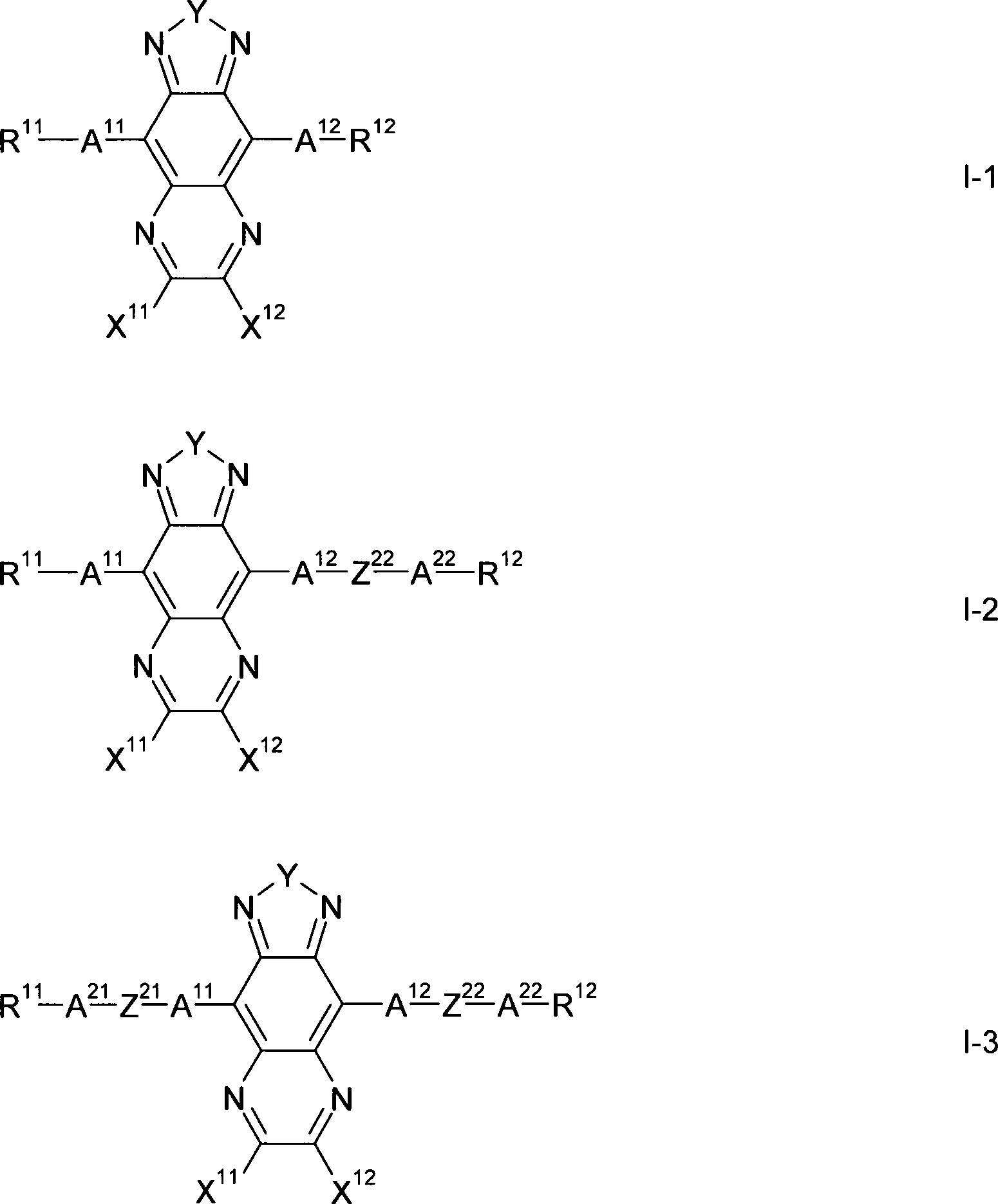
Es ist für die Formeln I-1, I-2 und I-3 bevorzugt, daß mindestens ein direkt an Thiadiazolochinoxalin gebundenes A11 oder A12 für 1,4-Phenylen, 2,6-Naphthylen oder eine schwefelhaltige Heteroarylgruppe steht, besonders bevorzugt für Thiophen. Die Gruppen können mit einem oder mehreren Resten L substituiert sein.It is preferable for the formulas I-1, I-2 and I-3 that at least one A 11 or A 12 bonded directly to thiadiazoloquinoxaline is 1,4-phenylene, 2,6-naphthylene or a sulfur-containing heteroaryl group for thiophene. The groups may be substituted by one or more L radicals.
Bevorzugte Ausführungsformen von Verbindungen der Formel I-1, I-2 und I-3 werden bevorzugt ausgewählt aus den Verbindungen der Formeln I-1-1 bis I-1-10, I-2-1 bis I-2-12 und I-3-1 bis I-3-10. 

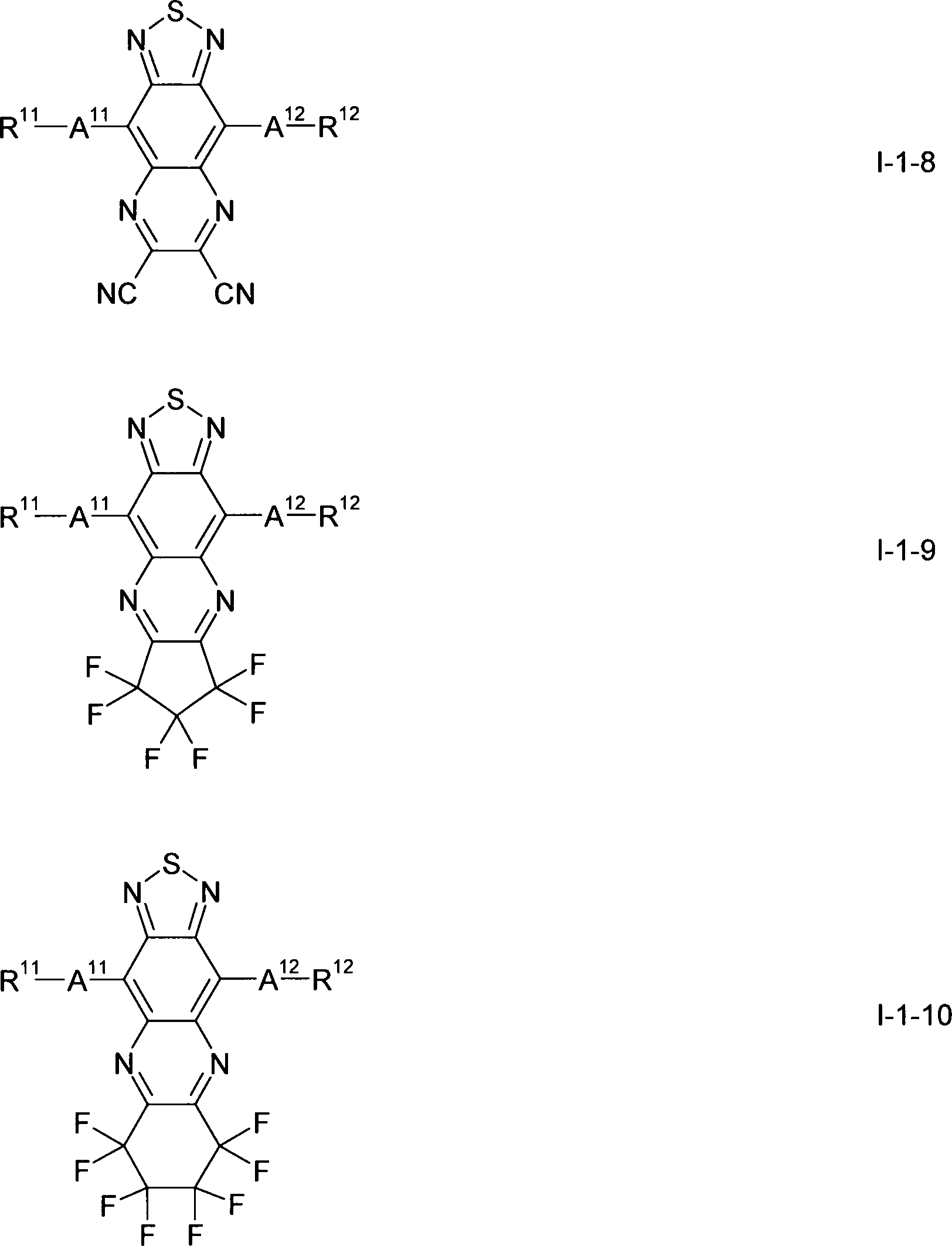


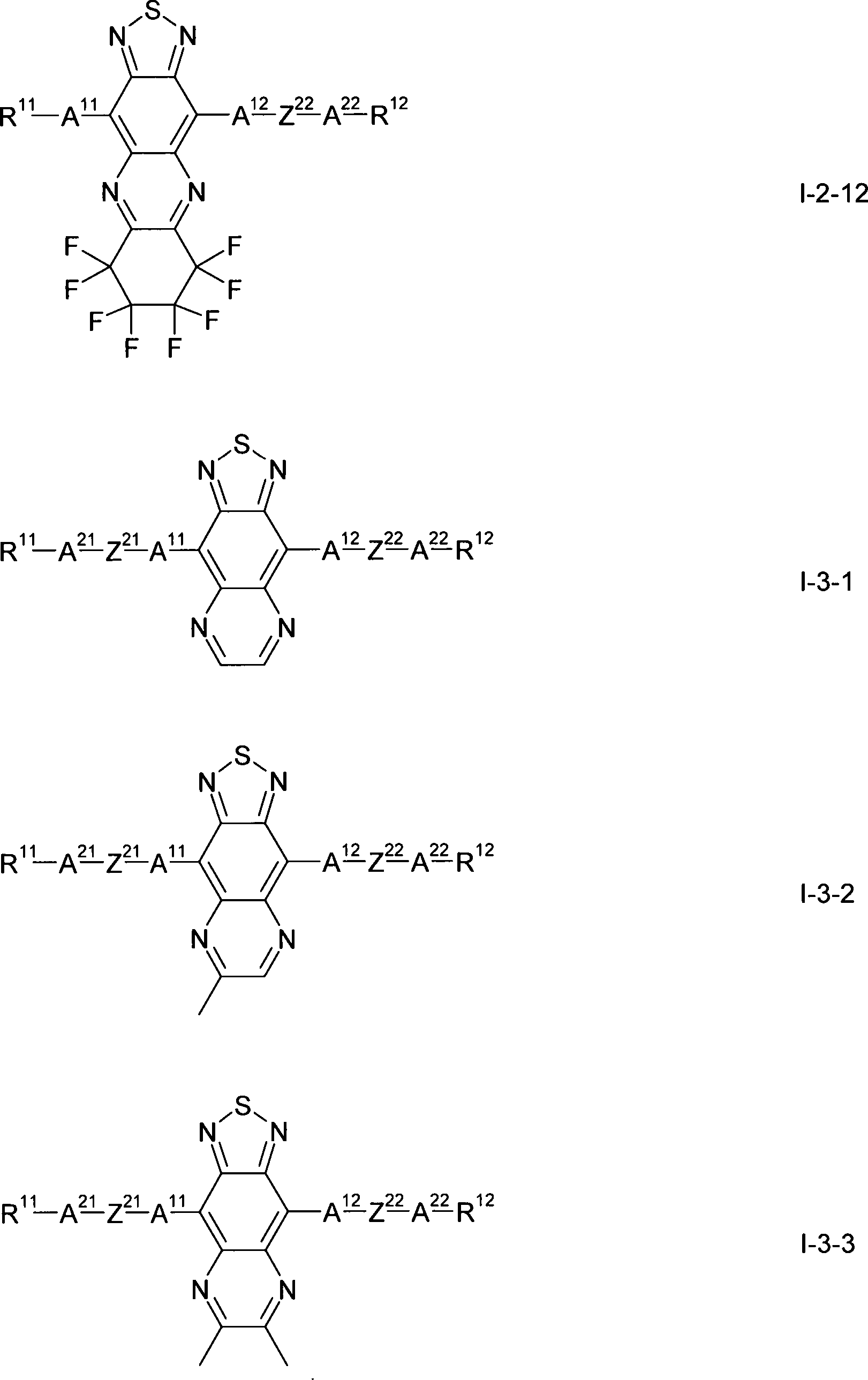

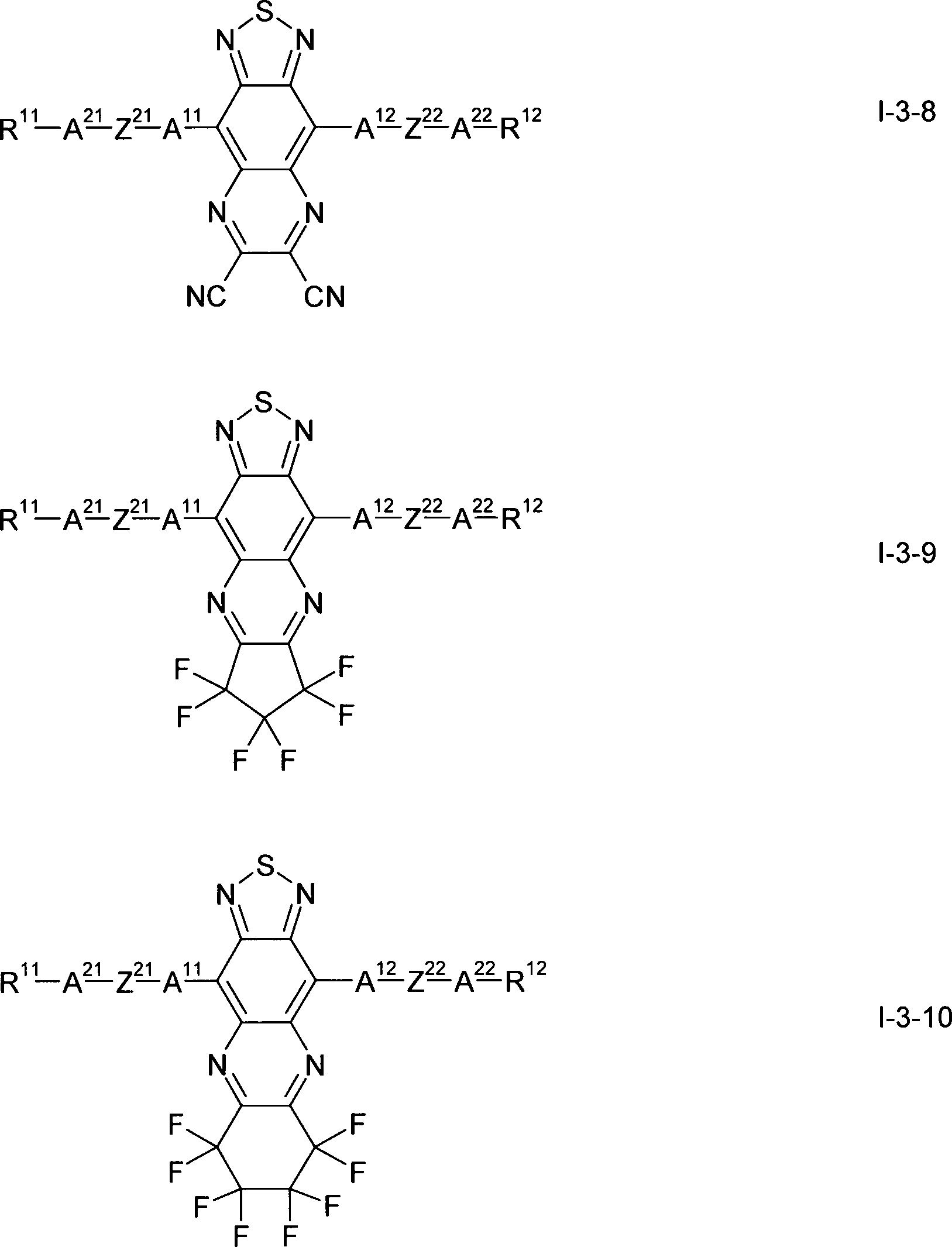
Unter den Formeln I-1-1 bis I-1-10, I-2-1 bis I-2-12 und I-3-1 bis I-3-10 sind die Formeln I-1-3, I-2-4 und I-3-3 besonders bevorzugt.Among the formulas I-1-1 to I-1-10, I-2-1 to I-2-12 and I-3-1 to I-3-10, the formulas I-1-3, I-2 -4 and I-3-3 are particularly preferred.
Bevorzugte Ausführungsformen von Verbindungen der Formel I-1-3, I-2-4 und I-3-3 sind 
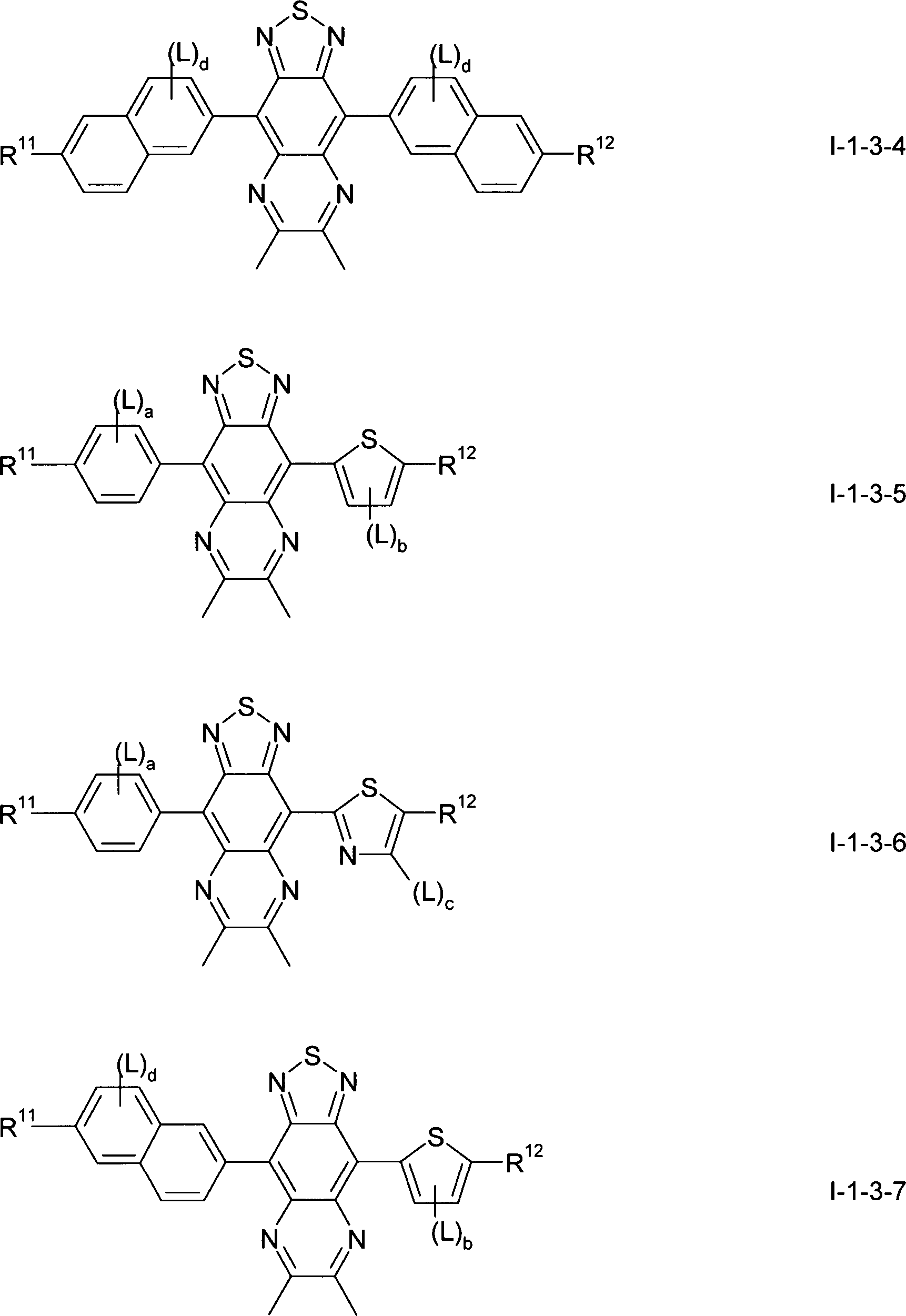
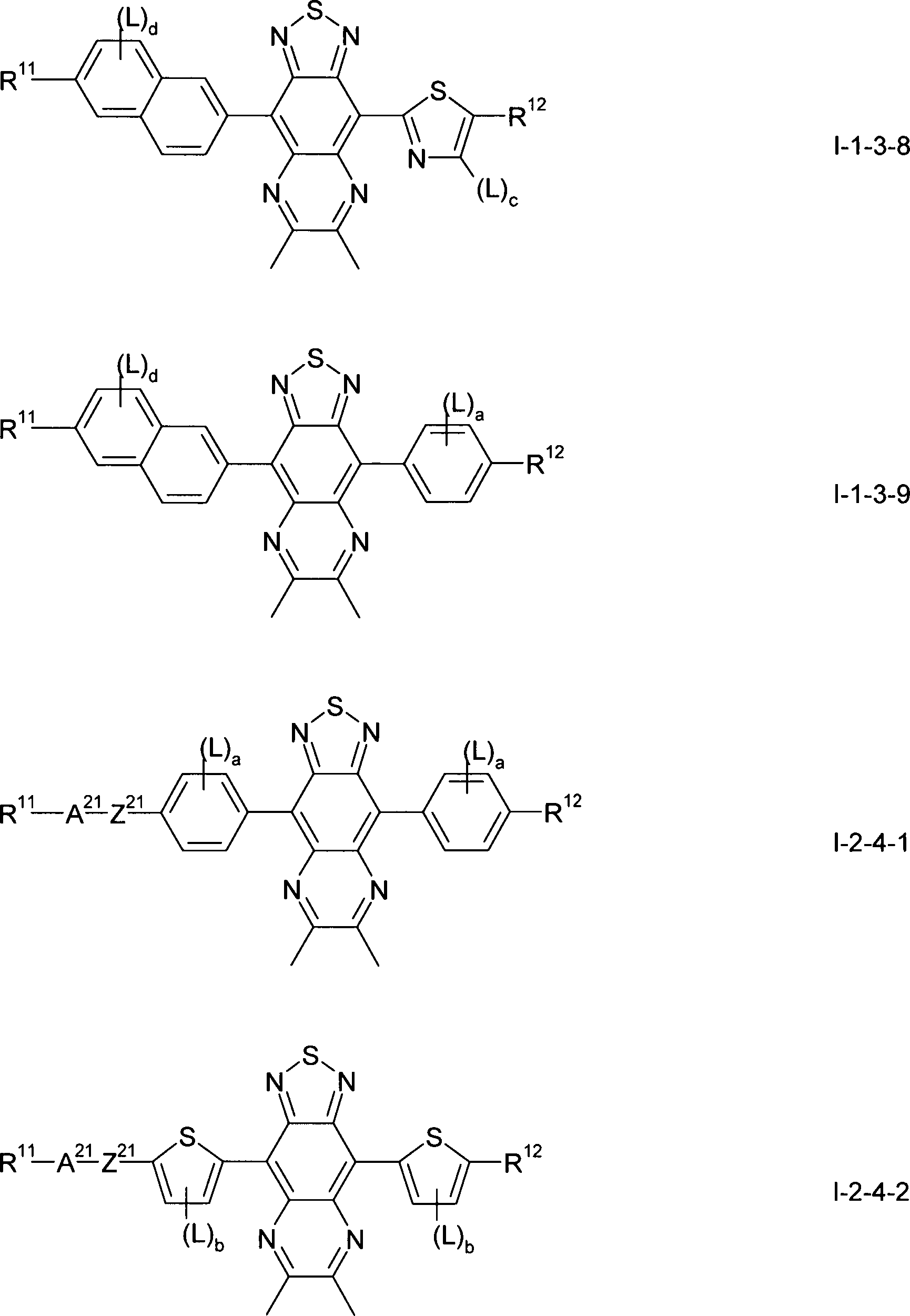
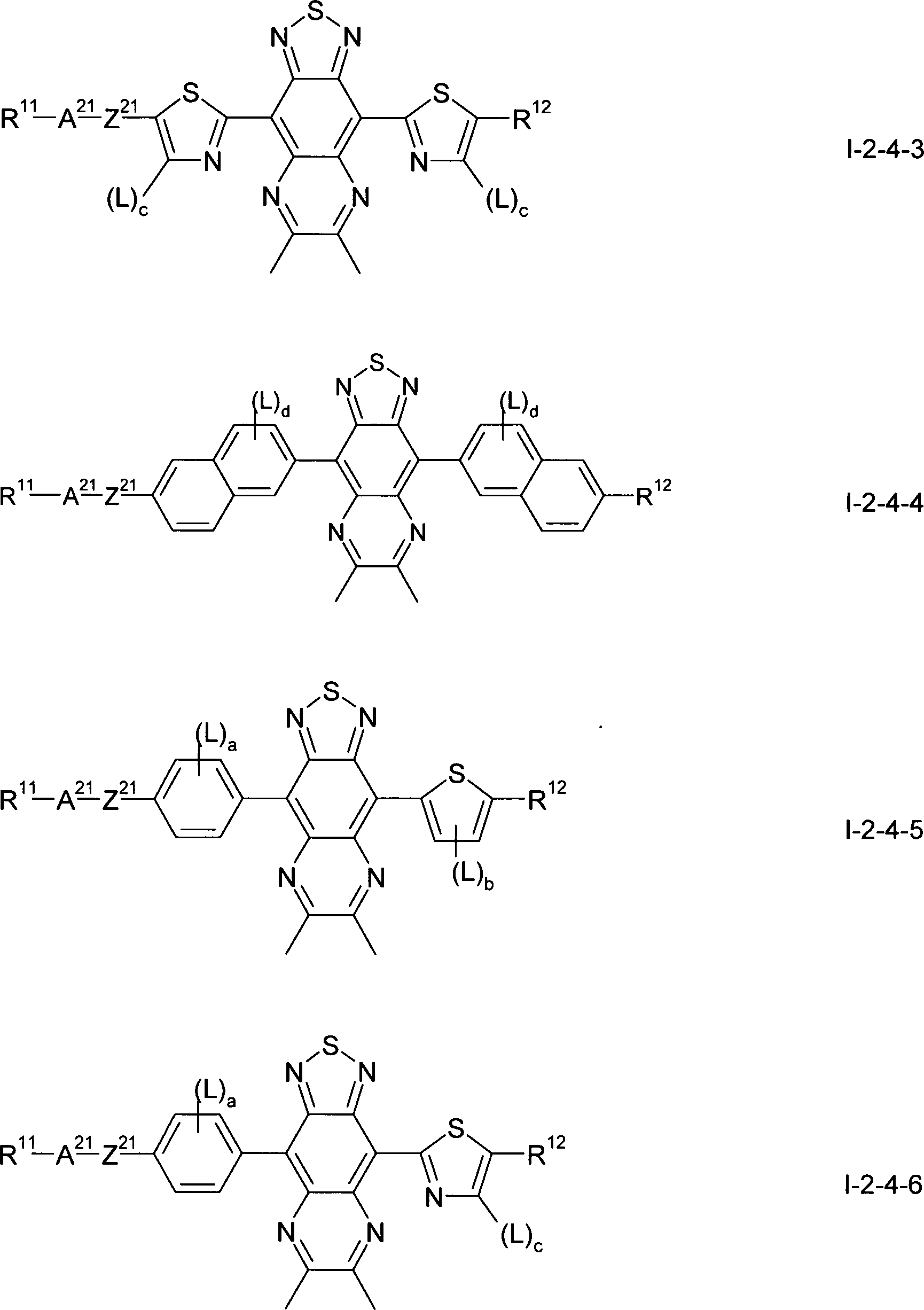


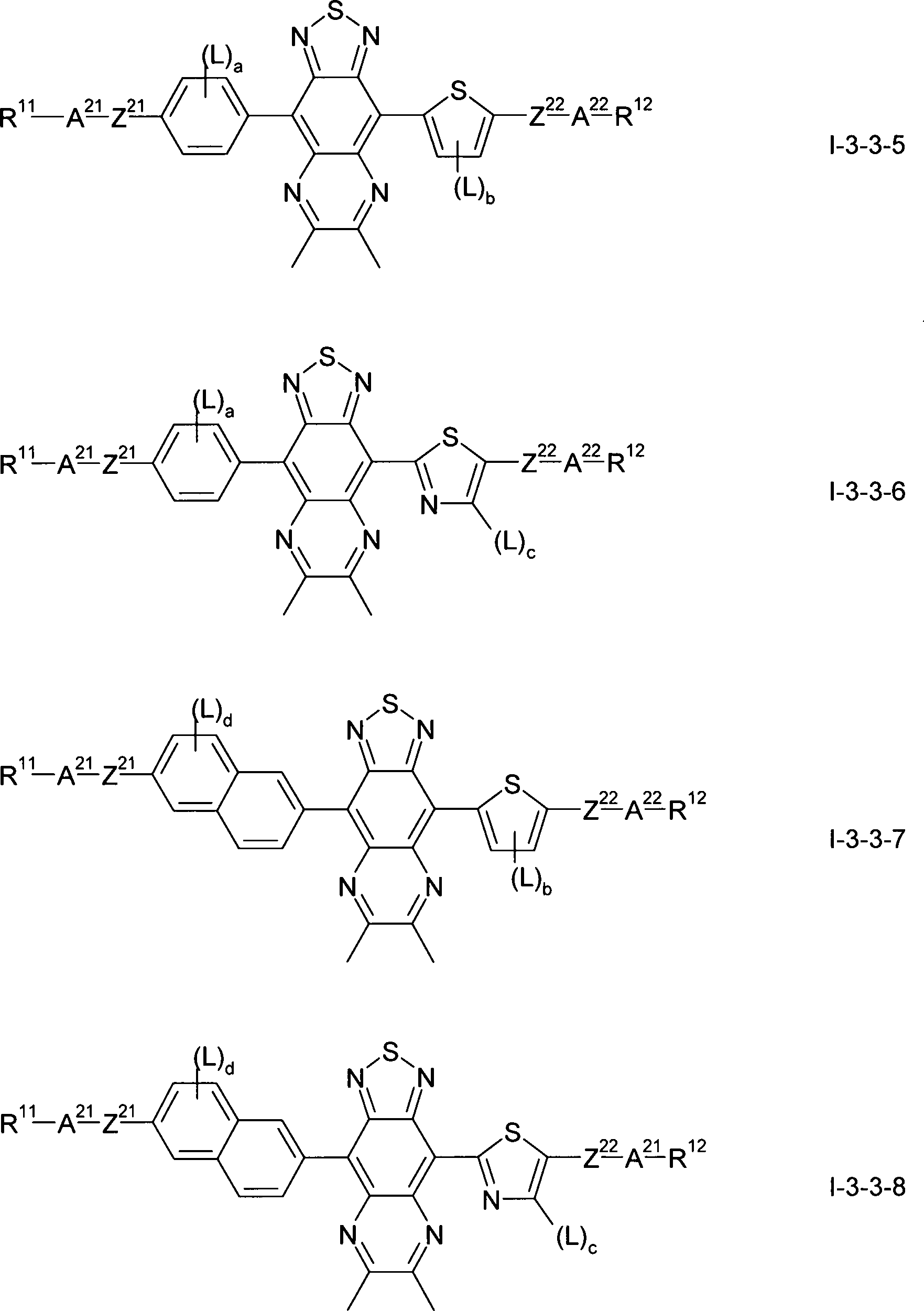
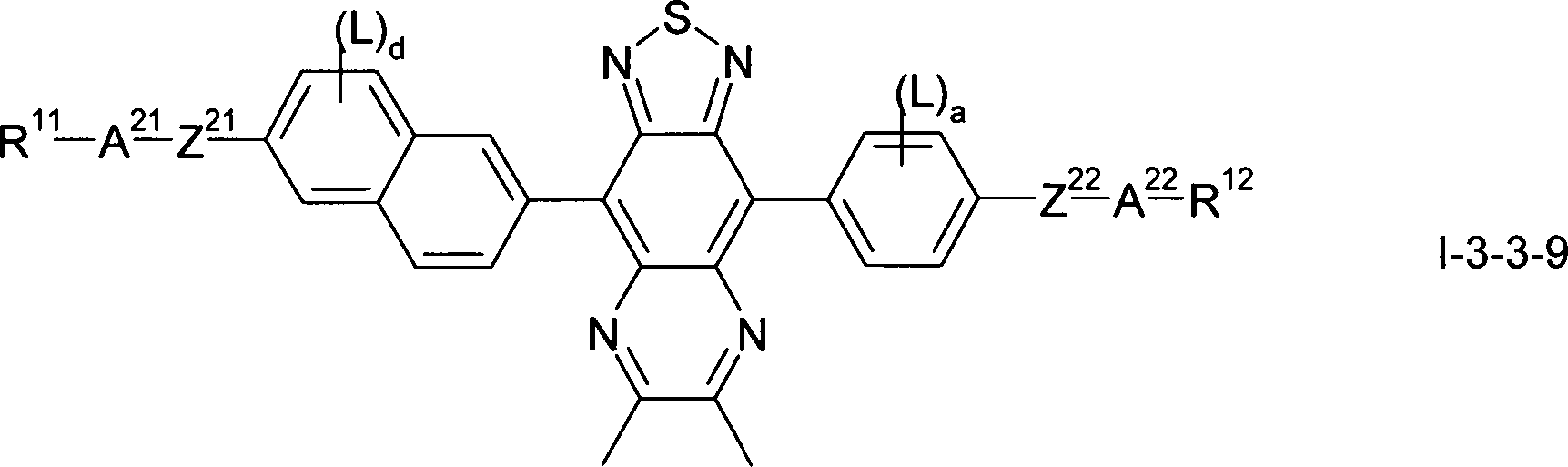
a unabhängig voneinander 0, 1, 2, 3, oder 4,
b unabhängig voneinander 0, 1 oder 2,
c unabhängig voneinander 0 oder 1, und
d unabhängig voneinander 1, 2, 3, 4, 5 oder 6 bedeuten. Ganz besonders bevorzugte Verbindungen der Formel I sind ausgewählt aus der Gruppe der folgenden Unterformeln: 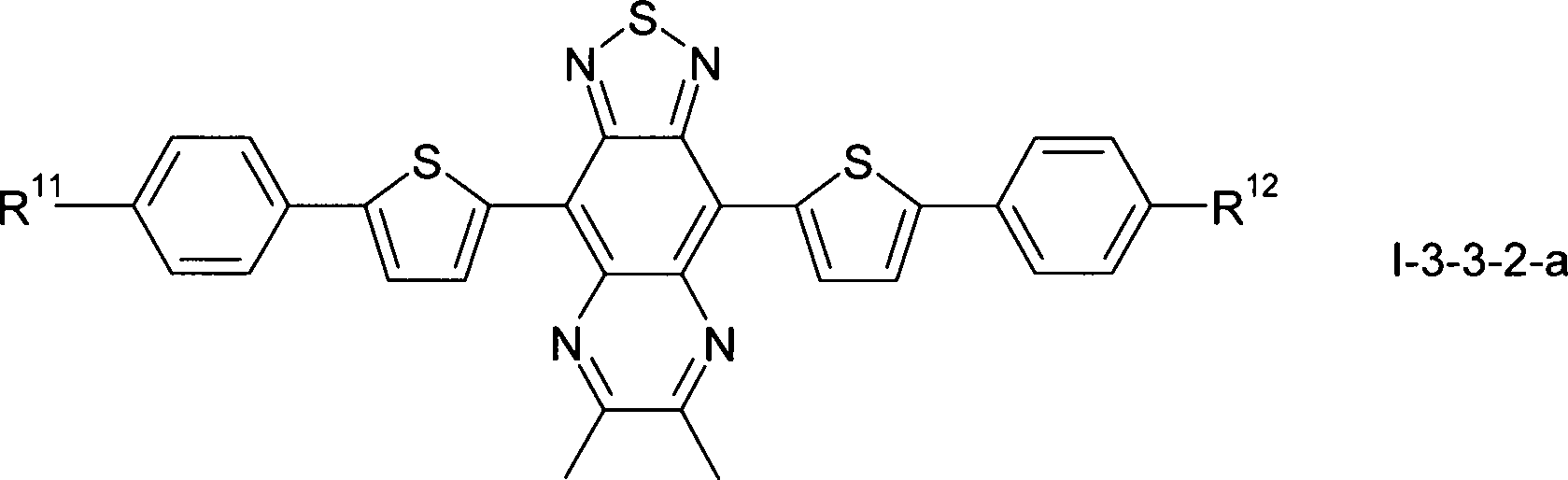


a independently 0, 1, 2, 3, or 4,
b independently 0, 1 or 2,
c independently 0 or 1, and
d are independently 1, 2, 3, 4, 5 or 6. Very particularly preferred compounds of the formula I are selected from the group of the following sub-formulas:
Besonders bevorzugt sind die oben angegebenen Teilformeln I-1-2, I-1-4, I-2-1 bis 1-2-12, I-3-2, I-3-4, sowie I-1-3-5 bis I-1-3-9, I-2-4-5 bis I-2-1-14 und 1-3-3-5 bis 1-3-3-9. Solche unsymmetrisch substituierten Verbindungen zeichnen sich durch besonders gute Löslichkeit aus.Particularly preferred are the above-mentioned partial formulas I-1-2, I-1-4, I-2-1 to 1-2-12, I-3-2, I-3-4, and I-1-3- 5 to I-1-3-9, I-2-4-5 to I-2-1-14 and 1-3-3-5 to 1-3-3-9. Such unsymmetrically substituted compounds are characterized by particularly good solubility.
Weiterer Gegenstand der Erfindung sind Zwischenprodukte der Formeln II und III, wobei wobei R11, R12, W, A11, A12, A21, A22, Z11, Z12, Z21, Z22, r und s die oben für Formel I angegebene Bedeutung haben.Another object of the invention are intermediates of formulas II and III, wherein wherein R 11 , R 12 , W, A 11 , A 12 , A 21 , A 22 , Z 11 , Z 12 , Z 21 , Z 22 , r and s the have the meaning given above for formula I.
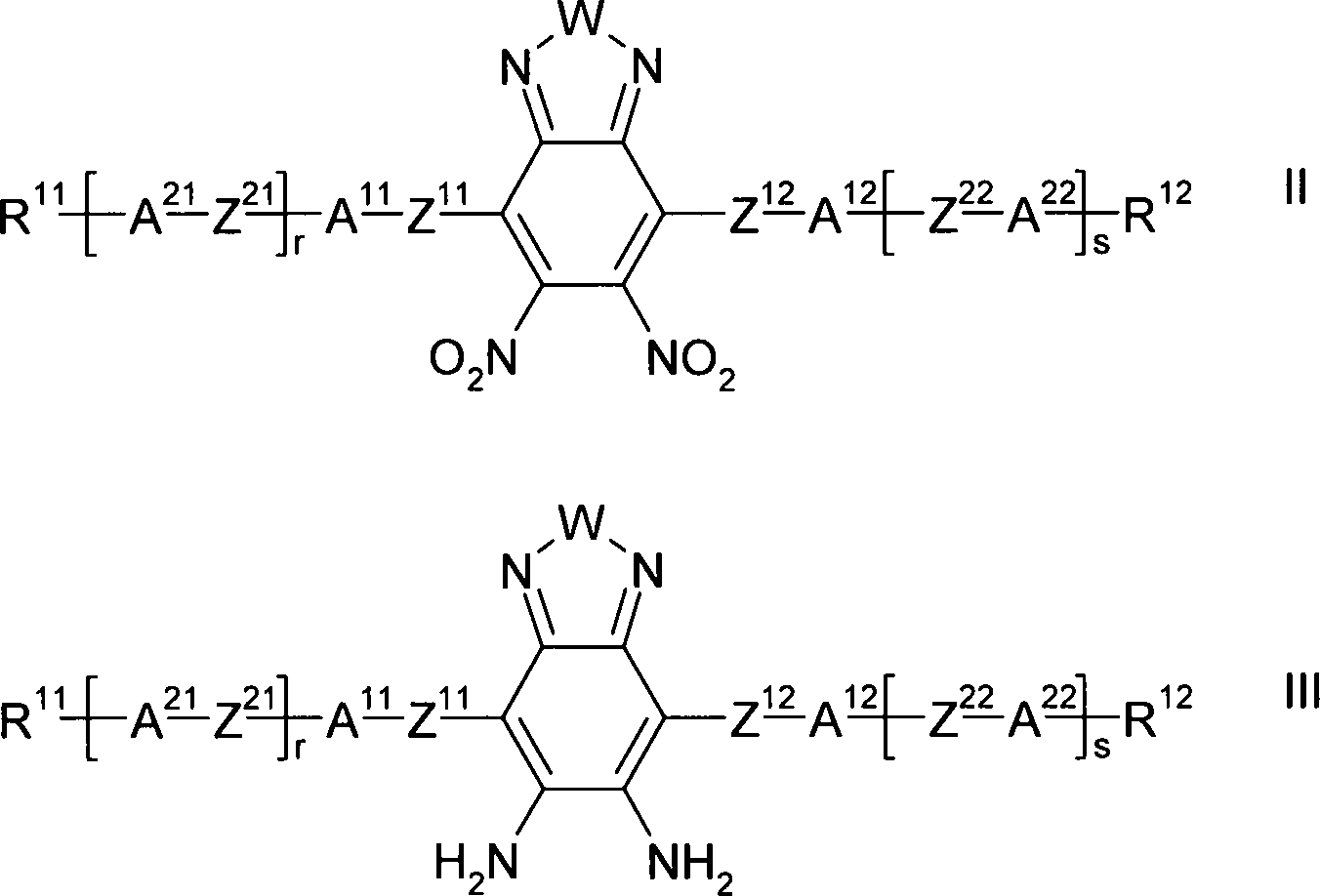
Weiterer Gegenstand der Erfindung sind Verfahren zur Herstellung der Verbindungen der Formel I, dadurch gekennzeichnet, daß die Verbindungen der Formel II oder III gemäß dem in Schema 1 beschriebenen Verfahren zu Verbindungen der Formel I umgesetzt werden.Another object of the invention are methods for preparing the compounds of formula I, characterized in that the compounds of formula II or III are reacted according to the method described in
Die Verbindungen nach Formel I können in Analogie zu dem Fachmann bekannten und in Standardwerken der organischen Chemie beschriebenen Verfahren, wie beispielsweise
Ein bevorzugtes Verfahren zur Herstellung von Verbindungen der Formel I ist in Schema 1 dargestellt.A preferred method for the preparation of compounds of formula I is shown in
Dabei wird in Anlehnung an die in

Alternativ kann aus 1 auch in einem ersten Reaktionsschritt durch Reduktion das Diamin 5 erhalten werden, welches dann nach Aufbau des Thiadiazolochinoxalin-Grundkörpers 6 die Möglichkeit zu weiteren Abwandlungen zu Verbindungen der Formel I eröffnet. Nach
Aus den Diaminen 3 lassen sich nach

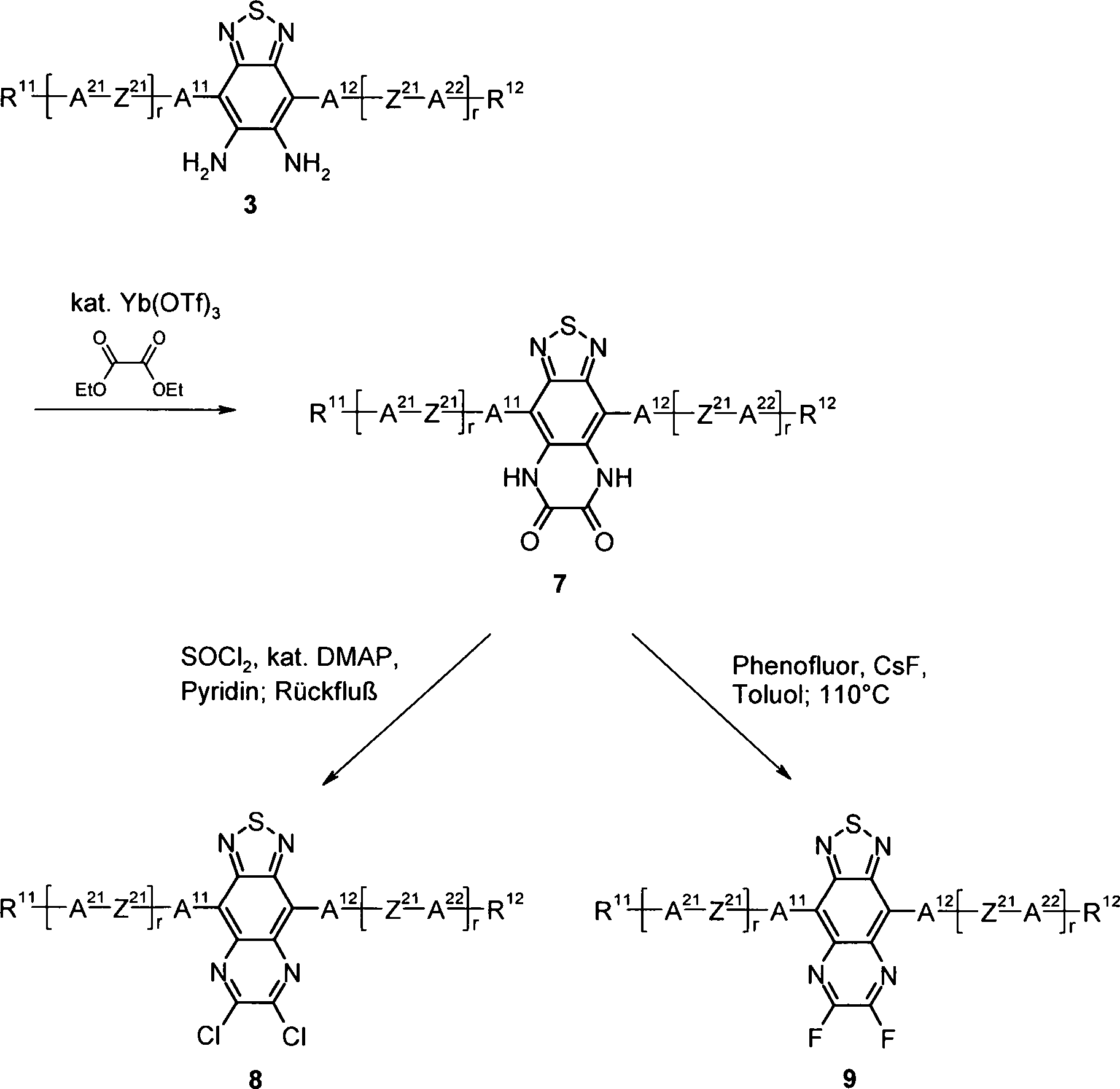
Die Verbindung der Formel I ist bevorzugt ein positiv dichroitischer Farbstoff, d. h. ein Farbstoff, welcher einen positiven Anisotropiegrad R aufweist. Der Anisotropiegrad R wird ermittelt, wie in den Ausführungsbeispielen angegeben, aus dem Wert für den Extinktionskoeffizienten der FK-Mischung enthaltend den Farbstoff bei Ausrichtung der Moleküle parallel zur Polarisationsrichtung des Lichts und dem Wert für den Extinktionskoeffizienten bei senkrechter Ausrichtung der Moleküle zur Polarisationsrichtung des Lichts. Besonders bevorzugt ist der Anisotropiegrad R größer als 0.4, ganz besonders bevorzugt größer als 0.6 und am stärksten bevorzugt größer als 0.7.The compound of formula I is preferably a positive dichroic dye, i. H. a dye which has a positive degree of anisotropy R. The degree of anisotropy R is determined, as indicated in the exemplary embodiments, from the value for the extinction coefficient of the LC mixture containing the dye when the molecules are aligned parallel to the polarization direction of the light and the value for the extinction coefficient when the molecules are perpendicular to the polarization direction of the light. More preferably, the degree of anisotropy R is greater than 0.4, even more preferably greater than 0.6, and most preferably greater than 0.7.
Bevorzugt erreicht die Absorption ein Maximum, wenn die Polarisationsrichtung des Lichts parallel zur Richtung der längsten Ausdehnung des Moleküls gemäß Formel I ist, und sie erreicht ein Minimum, wenn die Polarisationsrichtung des Lichts senkrecht zur Richtung der längsten Ausdehnung des Moleküls gemäß Formel I ist.Preferably, the absorption reaches a maximum when the direction of polarization of the light is parallel to the direction of the longest dimension of the molecule according to formula I, and reaches a minimum when the polarization direction of the light is perpendicular to the direction of the longest dimension of the molecule according to formula I.
Weiterhin bevorzugt ist die Verbindung der Formel I ein fluoreszierender Farbstoff. Unter Fluoreszenz wird dabei verstanden, daß eine Verbindung durch Absorption von Licht einer bestimmten Wellenlänge in einen elektronisch angeregten Zustand versetzt wird, wobei die Verbindung anschließend unter Emission von Licht in den Grundzustand übergeht. Bevorzugt hat das emittierte Licht längere Wellenlänge als das absorbierte Licht. Weiterhin bevorzugt ist der Übergang vom angeregten Zustand in den Grundzustand Spin-erlaubt, erfolgt also ohne Änderung des Spins. Weiterhin bevorzugt ist die Lebensdauer des angeregten Zustands der fluoreszierenden Verbindung kürzer als 10–5 s, besonders bevorzugt kürzer als 10–6 s, ganz besonders bevorzugt zwischen 10–9 und 10–7 s.Further preferably, the compound of formula I is a fluorescent dye. Fluorescence is understood here to mean that a compound is converted into an electronically excited state by absorption of light of a specific wavelength, the compound then being converted into the ground state with the emission of light. Preferably, the emitted light has a longer wavelength than the absorbed light. Furthermore, the transition from the excited state to the ground state is preferably spin-allowed, that is, without changing the spin. Further preferably, the lifetime of the excited state of the fluorescent compound is shorter than 10 -5 s, more preferably shorter than 10 -6 s, most preferably between 10 -9 and 10 -7 s.
Gegenstand der vorliegenden Erfindung sind auch flüssigkristalline Medien enthaltend neben einer oder mehreren erfindungsgemäßen Verbindungen der Formel I als weitere Bestandteile 2 bis 40, vorzugsweise 4 bis 30 Komponenten. Besonders bevorzugt enthalten diese Medien neben einer oder mehreren erfindungsgemäßen Verbindungen 7 bis 25 Komponenten. Diese weiteren Bestandteile werden vorzugsweise ausgewählt aus nematischen oder nematogenen (monotropen oder isotropen) Substanzen, insbesondere Substanzen aus den Klassen der Azoxybenzole, Benzylidenaniline, Biphenyle, Terphenyle, 1,3-Dioxane, 2,5-Tetrahydropyrane, Phenyl- oder Cyclohexylbenzoate, Cyclohexancarbonsäurephenyl- oder -cyclohexylester, Phenyl- oder Cyclohexylester der Cyclohexylbenzoesäure, Phenyl- oder Cyclohexylester der Cyclohexylcyclohexancarbonsäure, Cyclohexylphenylester der Benzoesäure, der Cyclohexancarbonsäure, bzw. der Cyclohexylcyclohexancarbonsäure, Phenylcyclohexane, Cyclohexylbiphenyle, Phenylcyclohexylcyclohexane, Cyclohexylcyclohexane, Cyclohexylcyclohexylcyclohexene, 1,4-Biscyclohexylbenzole, 4',4'-Biscyclohexylbiphenyle, Phenyl- oder Cyclohexylpyrimidine, Phenyl- oder Cyclohexylpyridine, Phenyl- oder Cyclohexyldioxane, Phenyl- oder Cyclohexyl-1,3-dithiane, 1,2-Diphenylethane, 1,2-Dicyclohexylethane, 1-Phenyl-2-cyclohexylethane, 1-Cyclohexyl-2-(4-phenylcyclohexyl)ethane, 1-Cyclohexyl-2-biphenylethane, 1-Phenyl-2-cyclohexylphenylethane, gegebenenfalls halogenierten Stilbene, Benzylphenylether, Tolane und substituierten Zimtsäuren. Die 1,4-Phenylengruppen in diesen Verbindungen können auch einfach oder mehrfach fluoriert sein. The present invention also liquid-crystalline media containing in addition to one or more compounds of the formula I according to the invention as further constituents 2 to 40, preferably 4 to 30 components. With particular preference, these media contain, in addition to one or more compounds according to the invention, 7 to 25 components. These further constituents are preferably selected from nematic or nematogenic (monotropic or isotropic) substances, in particular substances from the classes of azoxybenzenes, benzylideneanilines, biphenyls, terphenyls, 1,3-dioxanes, 2,5-tetrahydropyrans, phenyl- or cyclohexylbenzoates, cyclohexanecarboxylic acid phenyl- or -cyclohexyl esters, phenyl or cyclohexyl esters of cyclohexylbenzoic acid, phenyl or cyclohexyl esters of cyclohexylcyclohexanecarboxylic acid, cyclohexylphenyl esters of benzoic acid, cyclohexanecarboxylic acid or of cyclohexylcyclohexanecarboxylic acid, phenylcyclohexanes, cyclohexylbiphenyls, phenylcyclohexylcyclohexanes, cyclohexylcyclohexanes, cyclohexylcyclohexylcyclohexenes, 1,4-biscyclohexylbenzenes, 4 ', 4 '-Cyclohexylbiphenyls, phenyl- or cyclohexylpyrimidines, phenyl- or cyclohexylpyridines, phenyl- or cyclohexyl-dioxanes, phenyl- or cyclohexyl-1,3-dithiane, 1,2-diphenylethane, 1,2-dicyclohexylethane, 1-phenyl-2-cyclohexylethane, 1-cyclohexyl-2- (4-p henylcyclohexyl) ethane, 1-cyclohexyl-2-biphenylethane, 1-phenyl-2-cyclohexylphenylethane, optionally halogenated stilbenes, benzylphenyl ethers, tolans and substituted cinnamic acids. The 1,4-phenylene groups in these compounds may also be mono- or polyfluorinated.
Die wichtigsten als weitere Bestandteile erfindungsgemäßer Medien in Frage kommenden Verbindungen lassen sich durch die Formeln (IV), (V), (VI), (VII) und (VIII) charakterisieren:
In den Formeln (IV), (V), (VI), (VII) und (VIII) bedeuten L und E, die gleich oder verschieden sein können, jeweils unabhängig voneinander einen bivalenten Rest aus der
aus -Phe-, -Cyc-, -Phe-Phe-, -Phe-Cyc-, -Cyc-Cyc-, -Pyr-, -Dio-, -Thp-, -G-Phe- und -G-Cyc- sowie deren Spiegelbilder gebildeten Gruppe, wobei Phe unsubstituiertes oder durch Fluor substituiertes 1,4-Phenylen, Cyc trans-1,4-Cyclohexylen oder 1,4-Cyclohexenylen, Pyr Pyrimidin-2,5-diyl oder Pyridin-2,5-diyl, Dio 1,3-Dioxan-2,5-diyl, Thp Tetrahydropyran-2,5-diyl und G 2-(trans-1,4-Cyclohexyl)-ethyl, Pyrimidin-2,5-diyl, Pyridin-2,5-diyl, 1,3-Dioxan-2,5-diyl oder Tetrahydropyran-2,5-diyl bedeuten.In the formulas (IV), (V), (VI), (VII) and (VIII), L and E, which may be the same or different, each independently represents a bivalent radical of
of -Phe, -Cyc, -Phe-Phe, -Phe-Cyc, -Cyc-Cyc, -Pyr-, -Dio, -Hp-, -G-Phe- and -G-Cyc- and their mirror images formed group, wherein Phe is unsubstituted or fluorine-substituted 1,4-phenylene, Cyc trans-1,4-cyclohexylene or 1,4-cyclohexenylene, Pyr pyrimidine-2,5-diyl or pyridine-2,5-diyl ,
Vorzugsweise ist einer der Reste L und E Cyc oder Phe. E ist vorzugsweise Cyc, Phe oder Phe-Cyc. Vorzugsweise enthalten die erfindungsgemäßen Medien eine oder mehrere Komponenten ausgewählt aus den Verbindungen der Formeln (IV), (V), (VI), (VII) und (VIII), worin L und E ausgewählt sind aus der Gruppe Cyc und Phe und gleichzeitig eine oder mehrere Komponenten ausgewählt aus den Verbindungen der Formeln (IV), (V), (VI), (VII) und (VIII), worin einer der Reste L und E ausgewählt ist aus der Gruppe Cyc und Phe und der andere Rest ausgewählt ist aus der Gruppe -Phe-Phe-, -Phe-Cyc-, -Cyc-Cyc-, -G-Phe- und -G-Cyc-, und gegebenenfalls eine oder mehrere Komponenten ausgewählt aus den Verbindungen der Formeln (IV), (V), (VI), (VII) und (VIII), worin die Reste L und E ausgewählt sind aus der
Gruppe -Phe-Cyc-, -Cyc-Cyc-, -G-Phe- und -G-Cyc-.Preferably, one of L and E is Cyc or Phe. E is preferably Cyc, Phe or Phe-Cyc. The media according to the invention preferably contain one or more components selected from the compounds of the formulas (IV), (V), (VI), (VII) and (VIII), in which L and E are selected from the group Cyc and Phe and at the same time one or a plurality of components selected from the compounds of the formulas (IV), (V), (VI), (VII) and (VIII), wherein one of the radicals L and E is selected from the group consisting of Cyc and Phe and the other radical is selected from the group -Phe-Phe-, -Phe-Cyc-, -Cyc-Cyc-, -G-Phe- and -G-Cyc-, and optionally one or more components selected from the compounds of the formulas (IV), ( V), (VI), (VII) and (VIII), wherein the radicals L and E are selected from
Group -Phe-Cyc, -Cyc-Cyc, -G-Phe and -G-Cyc-.
R' und R'' bedeuten in einer kleineren Untergruppe der Verbindungen der Formeln (IV), (V), (VI), (VII) und (VIII) jeweils unabhängig voneinander Alkyl, Alkenyl, Alkoxy, Alkoxyalkyl (Oxaalkyl), Alkenyloxy oder Alkanoyloxy mit bis zu 8 C-Atomen. Im folgenden wird diese kleinere Untergruppe Gruppe A genannt und die Verbindungen werden mit den Teilformeln (IVa), (Va), (VIa), (VIIa) und (VIIIa) bezeichnet. Bei den meisten dieser Verbindungen sind R' und R'' voneinander verschieden, wobei einer dieser Reste meist Alkyl, Alkenyl, Alkoxy oder Alkoxyalkyl (Oxaalkyl) ist.R 'and R "in a smaller subgroup of the compounds of the formulas (IV), (V), (VI), (VII) and (VIII) are each independently alkyl, alkenyl, alkoxy, alkoxyalkyl (oxaalkyl), alkenyloxy or Alkanoyloxy with up to 8 carbon atoms. Hereinafter, this smaller subgroup will be called group A and the compounds will be denoted by the subformulae (IVa), (Va), (VIa), (VIIa) and (VIIIa). In most of these compounds, R 'and R "are different from one another, one of these radicals usually being alkyl, alkenyl, alkoxy or alkoxyalkyl (oxaalkyl).
In einer anderen als Gruppe B bezeichneten kleineren Untergruppe der Verbindungen der Formeln (IV), (V), (VI), (VII) und (VIII) bedeutet R'' -F, -Cl, -NCS oder -(O)iCH3-kFk, wobei i 0 oder 1 und k 1, 2 oder 3 ist. Die Verbindungen, in denen R'' diese Bedeutung hat, werden mit den Teilformeln (IVb), (Vb), (VIb), (VIIb) und (VIIb) bezeichnet. Besonders bevorzugt sind solche Verbindungen der Teilformeln (IVb), (Vb), (VIb), (VIIb) und (VIIb), in denen R'' die Bedeutung -F, -Cl, -NCS, -CF3, -OCHF2 oder -OCF3 hat.In a different group B smaller subgroup of the compounds of formulas (IV), (V), (VI), (VII) and (VIII) designated R '' is -F, -Cl, -NCS or - (O) i CH 3-k F k , where i is 0 or 1 and k is 1, 2 or 3. The compounds in which R "has this meaning are designated by the subformulae (IVb), (Vb), (VIb), (VIIb) and (VIIb). Particular preference is given to those compounds of the subformulae (IVb), (Vb), (VIb), (VIIb) and (VIIb) in which R "is -F, -Cl, -NCS, -CF 3 , -OCHF 2 or -OCF 3 has.
In den Verbindungen der Gruppe B, die mit den Teilformeln (IVb), (Vb), (VIb), (VIIb) und (VIIb) bezeichnet werden, hat R' die bei den Verbindungen der Teilformeln (IVa) bis (VIIIa) angegebene Bedeutung und ist vorzugsweise Alkyl, Alkenyl, Alkoxy oder Alkoxyalkyl (Oxaalkyl). In the compounds of group B, which are designated by the sub-formulas (IVb), (Vb), (VIb), (VIIb) and (VIIb), R 'has the formula given for the compounds of sub-formulas (IVa) to (VIIIa) Meaning and is preferably alkyl, alkenyl, alkoxy or alkoxyalkyl (oxaalkyl).
In einer weiteren kleineren Untergruppe der Verbindungen der Formeln (IV), (V), (VI), (VII) und (VIII) bedeutet R'' -CN. Diese Untergruppe wird im Folgenden als Gruppe C bezeichnet und die Verbindungen dieser Untergruppe werden entsprechend mit Teilformeln (IVc), (Vc), (VIc), (VIIc) und (VIIIc) beschrieben. In den Verbindungen der Teilformeln (IVc), (Vc), (VIc), (VIIc) und (VIIIc) hat R' die bei den Verbindungen der Teilformeln ('Va) bis (VIIIa) angegebene Bedeutung und ist vorzugsweise Alkyl, Alkenyl, Alkoxy oder Alkoxyalkyl (Oxaalkyl).In a further smaller subgroup of the compounds of the formulas (IV), (V), (VI), (VII) and (VIII) R "denotes -CN. This subgroup is hereinafter referred to as Group C, and the compounds of this subgroup are described respectively by Partial Formulas (IVc), (Vc), (VIc), (VIIc) and (VIIIc). In the compounds of sub-formulas (IVc), (Vc), (VIc), (VIIc) and (VIIIc), R 'has the meaning given for the compounds of sub-formulas (' Va) to (VIIIa) and is preferably alkyl, alkenyl, Alkoxy or alkoxyalkyl (oxaalkyl).
Neben den bevorzugten Verbindungen der Gruppen A, B und C sind auch andere Verbindungen der Formeln (IV), (V), (VI), (VII) und (VIII) mit anderen Varianten der vorgesehenen Substituenten gebräuchlich. All diese Substanzen sind nach literaturbekannten Methoden oder in Analogie dazu erhältlich.In addition to the preferred compounds of the groups A, B and C, other compounds of the formulas (IV), (V), (VI), (VII) and (VIII) with other variants of the substituents provided are also customary. All these substances are available by literature methods or by analogy.
Die erfindungsgemäßen Medien enthalten neben den erfindungsgemäßen Verbindungen der allgemeinen Formel I vorzugsweise eine oder mehrere Verbindungen aus den Gruppen A, B und/oder C. Die Massenanteile der Verbindungen aus diesen Gruppen an den erfindungsgemäßen Medien betragen: In addition to the compounds of the general formula I according to the invention, the media according to the invention preferably contain one or more compounds from groups A, B and / or C. The mass fractions of the compounds from these groups on the media according to the invention are as follows:
Gruppe A:Group A:
- 0 bis 90%, vorzugsweise 20 bis 90%, insbesondere 30 bis 90%.0 to 90%, preferably 20 to 90%, especially 30 to 90%.
Gruppe B:Group B:
- 0 bis 80%, vorzugsweise 10 bis 80%, insbesondere 10 bis 70%.0 to 80%, preferably 10 to 80%, especially 10 to 70%.
Gruppe C:Group C:
- 0 bis 80%, vorzugsweise 5 bis 80%, insbesondere 5 bis 50%.0 to 80%, preferably 5 to 80%, especially 5 to 50%.
Die dichroitische Verbindung der Formel I liegt bevorzugt in einem Anteil von 0.01 bis 10 Gew.-%, besonders bevorzugt 0.05 bis 7 Gew.-% und ganz besonders bevorzugt 0.1 bis 7 Gew.-% in der Schaltschicht vor. Die Medien enthalten vorzugsweise eine, zwei, drei, vier oder fünf erfindungsgemäße Verbindungen der Formel I.The dichroic compound of the formula I is preferably present in a proportion of 0.01 to 10 wt .-%, particularly preferably 0.05 to 7 wt .-% and most preferably 0.1 to 7 wt .-% in the switching layer. The media preferably contain one, two, three, four or five compounds of the formula I according to the invention.
Bevorzugt ist das erfindungsgemäße FK-Medium ein nematischer Flüssigkristall.The FK medium according to the invention is preferably a nematic liquid crystal.
Die Herstellung der erfindungsgemäßen Medien erfolgt in an sich üblicher Weise. In der Regel werden die Komponenten ineinander gelöst, vorzugsweise bei erhöhter Temperatur. Vorzugsweise erfolgt das Mischen unter Inertgas, beispielsweise unter Stickstoff oder Argon. Anschließend werden eine oder mehrere Farbstoffe der Formel I und optional weitere dichroitische Farbstoffe hinzugegeben, bevorzugt bei erhöhter Temperatur, besonders bevorzugt bei mehr als 40°C und ganz besonders bevorzugt bei mehr als 50°C. In der Regel wird die gewünschte Menge der in geringerer Menge verwendeten Komponenten in der den Hauptbestandteil ausmachenden Komponenten gelöst. Es ist auch möglich Lösungen der Komponenten in einem organischen Lösungsmittel, z. B. in Aceton, Toluol, Chloroform oder Methanol, zu mischen und das Lösungsmittel nach Durchmischung wieder zu entfernen, beispielsweise durch Destillation. Das Verfahren zur Herstellung der erfindungsgemäßen FK-Medien ist ein weiterer Gegenstand der Erfindung.The preparation of the media according to the invention is carried out in a conventional manner. In general, the components are dissolved in each other, preferably at elevated temperature. The mixing is preferably carried out under inert gas, for example under nitrogen or argon. Subsequently, one or more dyes of the formula I and optionally further dichroic dyes are added, preferably at elevated temperature, more preferably at more than 40 ° C and most preferably at more than 50 ° C. As a rule, the desired amount of the components used in lesser amount is dissolved in the components making up the main component. It is also possible solutions of the components in an organic solvent, for. For example, in acetone, toluene, chloroform or methanol, and to remove the solvent after mixing again, for example by distillation. The process for producing the LC media according to the invention is a further subject of the invention.
Weiterer Gegenstand der Erfindung ist die Verwendung eines FK-Mediums enthaltend mindestens eine Verbindung der Formel I in einer Flüssigkristallanzeige vom Guest-Host-Typ.Another object of the invention is the use of a FK medium containing at least one compound of formula I in a liquid crystal display of the guest-host type.
Weiterer Gegenstand der Erfindung ist eine Flüssigkristallanzeige vom Guest-Host-Typ enthalten ein FK-Medium, das mindestens eine Verbindung der Formel I enthält.Another object of the invention is a liquid crystal display of the guest-host type contain a FK medium containing at least one compound of formula I.
Weiterer Gegenstand der Erfindung ist die Verwendung einer Mischung, enthaltend ein flüssigkristallines Medium und mindestens eine Verbindung einer Formel I in einer Vorrichtung zur Regulierung des Energie-Durchtritts von einem Außenraum in einen Innenraum.Another object of the invention is the use of a mixture containing a liquid-crystalline medium and at least one compound of a formula I in a device for regulating the passage of energy from an outside space into an interior space.
Die erfindungsgemäße Vorrichtung enthält bevorzugt in der Schaltschicht zusätzlich zu einer oder mehreren Verbindungen der Formel I, und bevorzugt einem flüssigkristallinen Medium, noch weitere dichroitische Farbstoffe mit anderer Struktur als Formel I. Besonders bevorzugt enthält sie einen, zwei, drei oder vier weitere Farbstoffe, ganz besonders bevorzugt zwei oder drei weitere Farbstoffe und am stärksten bevorzugt drei weitere Farbstoffe mit anderer Struktur als Formel I.The inventive device preferably contains in the switching layer in addition to one or more compounds of the formula I, and preferably a liquid-crystalline medium, even more dichroic Dyes having a structure other than formula I. Particularly preferably it contains one, two, three or four further dyes, very particularly preferably two or three further dyes and most preferably three further dyes having a structure other than formula I.
Bezüglich der Eigenschaft des Dichroismus gelten die für die Verbindung der Formel I beschriebenen bevorzugten Eigenschaften auch für die optionalen weiteren dichroitischen Farbstoffe als bevorzugt.With regard to the property of dichroism, the preferred properties described for the compound of the formula I are also preferred for the optional further dichroic dyes.
Die Absorptionsspektren der dichroitischen Farbstoffe der Schaltschicht ergänzen sich bevorzugt derart, daß für das Auge der Eindruck von schwarzer Farbe entsteht. Bevorzugt decken die zwei oder mehr dichroitischen Farbstoffe des erfindungsgemäßen flüssigkristallinen Mediums einen großen Teil des sichtbaren Spektrums ab. Wie genau eine Mischung von Farbstoffen hergestellt werden kann, die für das Auge schwarz bzw. grau erscheint, ist dem Fachmann bekannt und beispielsweise in
Die Einstellung des Farbortes einer Mischung aus Farbstoffen wird im Rahmen der Farbmetrik beschrieben. Hierzu werden die Spektren der Einzelfarbstoffe unter Berücksichtigung des Lambert-Beer'schen Gesetzes zu einem Gesamtspektrum berechnet und unter der zugehörigen Beleuchtung, z. B. für Tageslicht die Lichtart D65, gemäß den Regeln der Farbmetrik in die entsprechenden Farborte und Helligkeitswerte umgerechnet. Die Lage des Weißpunktes ist durch die jeweilige Lichtart, z. B. D65 festgelegt und in Tabellen (z. B. obenstehende Literaturstelle) aufgeführt. Durch Änderung der Anteile der verschiedenen Farbstoffe lassen sich verschiedene Farborte einstellen.The setting of the color locus of a mixture of dyes is described in the context of colorimetry. For this purpose, the spectra of the individual dyes are calculated taking into account Lambert-Beer's law to an overall spectrum and under the associated lighting, z. For example, for daylight type D65, converted into the corresponding color locations and brightness values according to the rules of colorimetry. The location of the white point is determined by the respective type of light, z. D65 and listed in tables (eg above reference). By changing the proportions of the different dyes, different color loci can be set.
Gemäß einer bevorzugten Ausführungsform enthält die Schaltschicht einen oder mehrere dichroitische Farbstoffe, die Licht im roten und NIR-Bereich, d. h. von 600 bis 2000 nm Wellenlänge absorbieren, bevorzugt im Bereich von 650 bis 1800 nm, besonders bevorzugt im Bereich von 650 bis 1300 nm. In einer bevorzugten Ausführung sind diese dichroitischen Farbstoffe gewählt aus Azoverbindungen, Anthrachinonen, Methinverbindungen, Azomethinverbindungen, Merocyaninverbindungen, Naphthochinonen, Tetrazinen, Perylenen, Terrylenen, Quaterrylenen, höheren Rylenen, Pyrromethenen, Azofarbstoffen, Nickeldithiolenen, (Metall-)Phthalocyaninen, (Metall-)Naphthalocyaninen und (Metall-)Porphyrinen. Besonders bevorzugt sind darunter Perylene und Terrylene.In accordance with a preferred embodiment, the switching layer contains one or more dichroic dyes containing light in the red and NIR regions, i. H. of 600 to 2000 nm wavelength, preferably in the range of 650 to 1800 nm, more preferably in the range of 650 to 1300 nm. In a preferred embodiment, these dichroic dyes are selected from azo compounds, anthraquinones, methine compounds, azomethine compounds, merocyanine compounds, naphthoquinones, tetrazines , Perylenes, terrylenes, quaterrylenes, higher rylenes, pyrromethenes, azo dyes, nickel dithiolenes, (metal) phthalocyanines, (metal) naphthalocyanines and (metal) porphyrins. Particularly preferred are perylenes and terrylenes.
Die weiteren dichroitischen Farbstoffe der Schaltschicht mit anderer Struktur als Formel I sind bevorzugt gewählt aus den in
Die genannten Farbstoffe gehören zu den dem Fachmann bekannten Klassen von dichroitischen Farbstoffen, die vielfach in der Literatur beschrieben sind. So sind z. B. Anthrachinonfarbstoffe beschrieben in
Gemäß einer bevorzugten Ausführungsform enthält die Schaltschicht der erfindungsgemäßen Vorrichtung neben Verbindungen der Formel I ausschließlich dichroitische Farbstoffe gewählt aus Rylen-Farbstoffen.According to a preferred embodiment, the switching layer of the device according to the invention contains compounds of the formula I exclusively dichroic dyes selected from rylene dyes.
Beispiele für bevorzugte weitere dichroitische Farbstoffe, die in der Schaltschicht der erfindungsgemäßen Vorrichtung enthalten sein können, sind in der folgenden Tabelle 1 abgebildet: Tabelle 1 

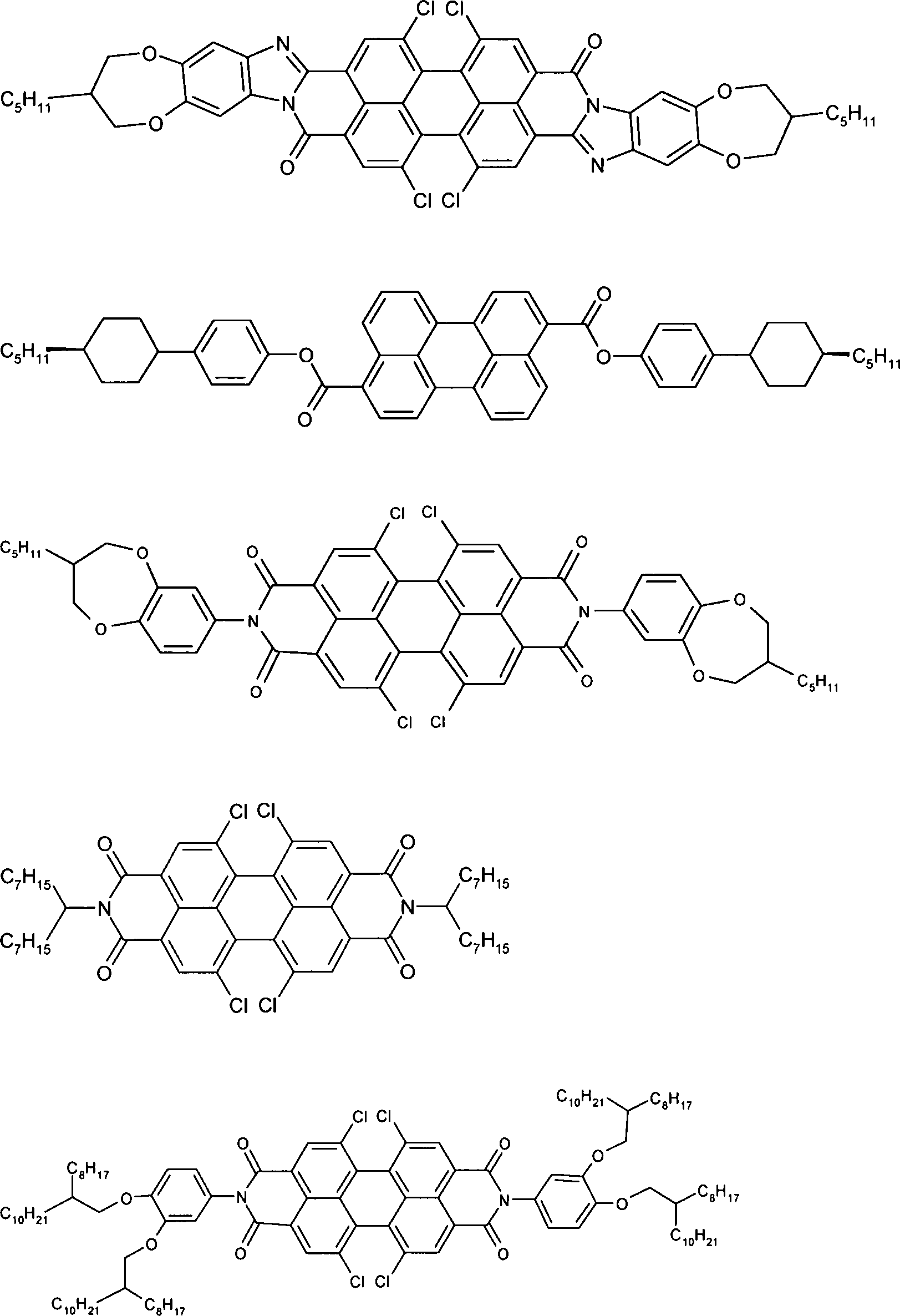


In einer bevorzugten Ausführungsform enthält die Schaltschicht der erfindungsgemäßen Vorrichtung eine oder mehrere Quencherverbindungen. Dies ist insbesondere dann bevorzugt, wenn die erfindungsgemäße Vorrichtung in ihrer Schaltschicht einen oder mehrere fluoreszierende Farbstoffe enthält.In a preferred embodiment, the switching layer of the device according to the invention contains one or more quencher compounds. This is particularly preferred when the device according to the invention contains one or more fluorescent dyes in its switching layer.
Quencherverbindungen sind Verbindungen, welche die Fluoreszenz löschen. Die Quencherverbindungen können in der Schaltschicht die elektronische Anregungsenergie von Nachbarmolekülen, wie z. B. fluoreszierenden Farbstoffen, übernehmen und gehen dabei in einen elektronisch angeregten Zustand über. Der gequenchte fluoreszierende Farbstoff wechselt dadurch in den elektronischen Grundzustand und wird so an der Fluoreszenz oder einer Folgereaktion gehindert. Die Quencherverbindung selbst kehrt durch strahlungslose Desaktivierung oder durch Abgabe von Licht in den Grundzustand zurück und steht zum erneuten Quenchen wieder zur Verfügung.Quencher compounds are compounds that quench the fluorescence. The quencher compounds can in the switching layer, the electronic excitation energy of neighboring molecules such. As fluorescent dyes, take over and go into an electronically excited state. The quenched fluorescent dye thereby changes to the electronic ground state and is thus prevented from fluorescence or a subsequent reaction. The quencher compound itself returns to the ground state by radiationless deactivation or by the emission of light and is available again for re-quenching.
In der Schaltschicht der erfindungsgemäßen Vorrichtung können der Quencherverbindung unterschiedliche Funktionen zukommen. Zum einen kann die Quencherverbindung zur Verlängerung der Lebensdauer eines Farbstoffsystems, durch Deaktivierung elektronischer Anregungsenergie, beitragen. Zum anderen eliminiert die Quencherverbindung ästhetisch ggf. unerwünschte zusätzliche Farbeffekte, z. B. farbiges Abstrahlen in den Innenraum, die von den fluoreszierenden Farbstoffen in der Schaltschicht ausgehen.In the switching layer of the device according to the invention, the quencher connection can have different functions. First, the quencher compound can help extend the life of a dye system by deactivating electronic excitation energy. On the other hand, the quencher compound eliminates aesthetically possibly undesirable additional color effects, eg. B. colored radiation into the interior, emanating from the fluorescent dyes in the switching layer.
Um ein effektives Quenchen zu erzielen, ist die Quencherverbindung dem jeweiligen Farbstoffsystem, insbesondere dem am langwelligsten absorbierenden Farbstoff einer Farbstoffkombination, anzupassen. Wie dies zu tun ist, ist dem Fachmann bekannt.In order to achieve effective quenching, the quencher compound must be adapted to the particular dye system, in particular the longest-wave absorbing dye of a dye combination. How to do this is known to the person skilled in the art.
Bevorzugte Quencherverbindungen sind beispielweise in
In einer bevorzugten Ausführungsform der erfindungsgemäßen Schaltschicht sind gegebenenfalls enthaltene Quencherverbindungen so gewählt, daß die Fluoreszenz im sichtbaren Teil des Spektrums unterdrückt wird.In a preferred embodiment of the switching layer according to the invention optionally contained quencher compounds are chosen so that the fluorescence is suppressed in the visible part of the spectrum.
Die erfindungsgemäße Vorrichtung ist bevorzugt zur Regulierung des Energie-Durchtritts in Form von Sonnenlicht aus der Umgebung in einen Innenraum geeignet. Dabei erfolgt der zu regulierende Energie-Durchtritt von der Umwelt (dem Außenraum) in einen Innenraum. Der Innenraum kann dabei ein beliebiger weitgehend von der Umgebung abgeschlossener Raum sein, beispielsweise ein Gebäude, ein Fahrzeug, oder ein Container.The device according to the invention is preferably suitable for regulating the passage of energy in the form of sunlight from the environment into an interior space. In this case, the energy passage to be regulated takes place from the environment (the outside space) into an interior space. The interior can be any space largely closed off from the environment, for example a building, a vehicle, or a container.
Gegenstand der Erfindung ist daher weiterhin die Verwendung der Vorrichtung zur Regulierung des Energie-Durchtritts von einem Außenraum in einen Innenraum.The invention therefore further relates to the use of the device for regulating the passage of energy from an external space into an interior space.
Die Vorrichtung kann jedoch auch zur ästhetischen Raumgestaltung eingesetzt werden, beispielsweise für Licht- und Farbeffekte. Beispielsweise können Tür- und Wandelemente enthaltend die erfindungsgemäße Vorrichtung in grau oder in Farbe nach transparent geschaltet werden. Des weiteren kann die Vorrichtung auch eine weiße oder farbige flächige Hinterleuchtung, die in der Helligkeit moduliert wird, oder eine gelbe flächige Hinterleuchtung, die mit einer blauen Gast-Wirtsanzeige in ihrer Farbe moduliert wird, umfassen. Es können eine oder beide Glasseiten der erfindungsgemäßen Vorrichtung mit angerauhtem oder strukturiertem Glas versehen sein zur Lichtauskopplung und/oder zur Lichteffekterzeugung. However, the device can also be used for aesthetic interior design, for example for light and color effects. For example, door and wall elements containing the device according to the invention can be switched to gray in color or in color. Furthermore, the device may also include a white or colored areal backlight that is modulated in brightness, or a yellow areal backlight that is color-modulated with a blue guest-host display. One or both glass sides of the device according to the invention can be provided with roughened or structured glass for light extraction and / or for light effect generation.
In einer nochmals alternativen Verwendung wird die Vorrichtung zur Regulierung des Lichteinfalls auf die Augen eingesetzt, beispielsweise in Schutzbrillen, Visieren oder Sonnenbrillen, wobei die Vorrichtung in einem Schaltzustand den Lichteinfall auf die Augen gering hält, und in einem anderen Schaltzustand den Lichteinfall weniger stark verringert.In a further alternative use, the device is used to regulate the incidence of light on the eyes, for example in goggles, visors or sunglasses, the device in a switching state keeps the light on the eyes low, and less reduced in another switching state, the light.
Die erfindungsgemäße Vorrichtung ist bevorzugt in einer Öffnung einer größeren flächigen Struktur angeordnet, wobei die flächige Struktur selbst nicht oder nur geringfügig Energie-Durchtritt zuläßt, und wobei die Öffnung relativ gesehen energiedurchlässiger ist. Bevorzugt ist die flächige Struktur eine Wand oder eine sonstige Begrenzung eines Innenraums nach außen. Weiterhin bevorzugt bedeckt die flächige Struktur eine mindestens genauso große Fläche, besonders bevorzugt eine mindestens doppelt so große Fläche wie die Öffnung in ihr, in der die erfindungsgemäße Vorrichtung angeordnet ist.The device according to the invention is preferably arranged in an opening of a larger areal structure, the areal structure itself not or only slightly permitting passage of energy, and the opening being relatively more transparent to energy. Preferably, the planar structure is a wall or other boundary of an interior to the outside. Further preferably, the planar structure covers at least as large area, more preferably at least twice as large area as the opening in it, in which the device according to the invention is arranged.
Bevorzugt ist die Vorrichtung dadurch gekennzeichnet, daß sie eine Flächenausdehnung von mindestens 0.05 m2 aufweist, bevorzugt mindestens 0.1 m2, besonders bevorzugt mindestens 0.5 m2 und ganz besonders bevorzugt mindestens 0.8 m2.Preferably, the device is characterized in that it has a surface area of at least 0.05 m 2 , preferably at least 0.1 m 2 , more preferably at least 0.5 m 2 and most preferably at least 0.8 m 2 .
Die Vorrichtung ist bevorzugt in einer wie oben beschriebenen, relativ gesehen energiedurchlässigeren Öffnung eines Gebäudes, eines Containers, eines Fahrzeugs oder eines sonstigen weitgehend geschlossenen Raums aufgebracht. Die Vorrichtung kann allgemein für beliebige Innenräume verwendet werden, besonders wenn diese nur begrenzten Luftaustausch mit der Umgebung aufweisen und lichtdurchlässige Begrenzungsflächen aufweisen, durch die Energie-Eintrag von außen in Form von Lichtenergie stattfinden kann. Besonders relevant ist die Verwendung der Vorrichtung für Innenräume, welche starker Sonneneinstrahlung durch lichtdurchlässige Flächen, beispielsweise durch Fensterflächen, ausgesetzt sind.The device is preferably applied in a relatively more energy-permeable opening of a building, a container, a vehicle or another largely enclosed space as described above. The device can generally be used for any interior spaces, especially if they have only limited air exchange with the environment and have transparent boundary surfaces through which energy input from the outside can take place in the form of light energy. Particularly relevant is the use of the device for interiors, which are exposed to strong sunlight through translucent surfaces, for example through window surfaces.
Die erfindungsgemäße Vorrichtung ist schaltbar. Unter Schaltung wird dabei eine Änderung des Energie-Durchtritts durch die Vorrichtung verstanden. Die erfindungsgemäße Vorrichtung ist bevorzugt elektrisch schaltbar, wie beispielsweise in
Sie kann aber auch thermisch schaltbar sein, wie beispielsweise in
Ist die Vorrichtung elektrisch schaltbar, umfaßt sie bevorzugt zwei oder mehr Elektroden, die zu beiden Seiten der Schaltschicht angebracht sind. Die Elektroden bestehen bevorzugt aus ITO oder aus einer dünnen, bevorzugt transparenten Metall- und/oder Metalloxidschicht, beispielsweise aus Silber oder FTO (Fluor-dotiertes Zinnoxid) oder einem alternativen, dem Fachmann für diese Verwendung bekannten Material. Die Elektroden sind bevorzugt mit elektrischen Anschlüssen versehen. Die Spannung wird bevorzugt durch eine Batterie, einen Akkumulator, oder durch externe Stromversorgung bereitgestellt.If the device is electrically switchable, it preferably comprises two or more electrodes mounted on either side of the switching layer. The electrodes preferably consist of ITO or of a thin, preferably transparent metal and / or metal oxide layer, for example of silver or FTO (fluorine-doped tin oxide) or an alternative material known to the person skilled in the art for this use. The electrodes are preferably provided with electrical connections. The voltage is preferably provided by a battery, an accumulator, or by external power supply.
Der Schaltvorgang erfolgt im Fall von elektrischer Schaltung durch eine Ausrichtung der Moleküle des flüssigkristallinen Mediums durch das Anlegen von Spannung.The switching operation takes place in the case of electrical switching by aligning the molecules of the liquid-crystalline medium by the application of voltage.
In einer bevorzugten Ausführungsform wird dabei die Vorrichtung von einem Zustand mit hoher Absorption, d. h. geringer Lichtdurchlässigkeit, der ohne Spannung vorliegt, in einen Zustand mit geringerer Absorption, d. h. höherer Lichtdurchlässigkeit, überführt. Bevorzugt ist das flüssigkristalline Medium der Schaltschicht in beiden Zuständen nematisch. Der spannungslose Zustand ist bevorzugt dadurch gekennzeichnet, daß die Moleküle des flüssigkristallinen Mediums, und damit die Moleküle der Verbindung der Formel I, parallel zur Ebene der Schaltschicht ausgerichtet vorliegen. Dies wird bevorzugt durch eine entsprechend gewählte Orientierungsschicht erreicht. Der Zustand unter Spannung ist bevorzugt dadurch gekennzeichnet, daß die Moleküle des flüssigkristallinen Mediums, und damit die Moleküle der Verbindung der Formel I, senkrecht zur Ebene der Schaltschicht vorliegen.In a preferred embodiment, the device is thereby moved from a state of high absorption, ie low light transmittance, which is present without voltage, to a state of lower Absorption, ie higher light transmission, transferred. Preferably, the liquid-crystalline medium of the switching layer is nematic in both states. The stress-free state is preferably characterized in that the molecules of the liquid-crystalline medium, and thus the molecules of the compound of formula I, are aligned parallel to the plane of the switching layer. This is preferably achieved by a correspondingly selected orientation layer. The state under tension is preferably characterized in that the molecules of the liquid-crystalline medium, and thus the molecules of the compound of formula I, are perpendicular to the plane of the switching layer.
In einer zur oben genannten Ausführungsform alternativen Ausführungsform wird die Vorrichtung von einem Zustand mit geringer Absorption, d. h. hoher Lichtdurchlässigkeit, der ohne Spannung vorliegt, in einen Zustand mit höherer Absorption, d. h. geringerer Lichtdurchlässigkeit, überführt. Bevorzugt ist das flüssigkristalline Medium der Schaltschicht in beiden Zuständen nematisch. Der spannungslose Zustand ist bevorzugt dadurch gekennzeichnet, daß die Moleküle des flüssigkristallinen Mediums der Schaltschicht, und damit die Moleküle der Verbindung der Formel I, senkrecht zur Ebene der Schaltschicht ausgerichtet vorliegen. Dies wird bevorzugt durch eine entsprechend gewählte Orientierungsschicht erreicht. Der Zustand unter Spannung ist bevorzugt dadurch gekennzeichnet, daß die Moleküle des flüssigkristallinen Mediums der Schaltschicht, und damit die Moleküle der Verbindung der Formel I, parallel zur Ebene der Schaltschicht vorliegen.In an alternative embodiment to the above-mentioned embodiment, the device is moved from a low absorption state, i. H. high light transmittance, which exists without voltage, in a state of higher absorption, d. H. lower light transmission, transferred. Preferably, the liquid-crystalline medium of the switching layer is nematic in both states. The de-energized state is preferably characterized in that the molecules of the liquid-crystalline medium of the switching layer, and thus the molecules of the compound of the formula I, are aligned perpendicular to the plane of the switching layer. This is preferably achieved by a correspondingly selected orientation layer. The state under tension is preferably characterized in that the molecules of the liquid-crystalline medium of the switching layer, and thus the molecules of the compound of the formula I, are present parallel to the plane of the switching layer.
Gemäß einer bevorzugten Ausführungsform der Erfindung kann die Vorrichtung ohne externe Stromversorgung betrieben werden, indem die nötige Energie durch eine Solarzelle oder eine sonstige Vorrichtung zur Umwandlung von Licht und/oder Wärmeenergie in elektrische Energie bereitgestellt wird, die mit der Vorrichtung verbunden ist. Die Bereitstellung der Energie durch die Solarzelle kann direkt oder indirekt, d. h. über eine dazwischengeschaltete Batterie oder Akkumulator oder sonstige Einheit zur Speicherung von Energie, erfolgen. Bevorzugt ist die Solarzelle außen an der Vorrichtung angebracht oder sie ist innerer Bestandteil der Vorrichtung, wie beispielsweise in
Die erfindungsgemäße Vorrichtung weist bevorzugt die folgende Schichtenabfolge auf, wobei zusätzlich weitere Schichten vorhanden sein können. Bevorzugt grenzen die im Folgenden angegebenen Schichten in der Vorrichtung direkt aneinander.
- – Substratschicht, bevorzugt aus Glas oder Polymer
- – elektrisch leitfähige transparente Schicht, bevorzugt aus ITO
- – Orientierungsschicht
- – Schaltschicht, enthaltend eine oder mehrere Verbindungen der Formel I
- – Orientierungsschicht
- – elektrisch leitfähige transparente Schicht, bevorzugt aus ITO
- – Substratschicht, bevorzugt aus Glas oder Polymer
- Substrate layer, preferably of glass or polymer
- - electrically conductive transparent layer, preferably of ITO
- - Orientation layer
- - Switching layer containing one or more compounds of the formula I.
- - Orientation layer
- - electrically conductive transparent layer, preferably of ITO
- Substrate layer, preferably of glass or polymer
Die bevorzugten Ausführungsformen der einzelnen Schichten werden im Folgenden dargestellt.The preferred embodiments of the individual layers are shown below.
Bevorzugt umfaßt die erfindungsgemäße Vorrichtung eine oder mehrere, besonders bevorzugt zwei Orientierungsschichten. Die Orientierungsschichten liegen bevorzugt direkt angrenzend an die beiden Seiten der Schaltschicht enthaltend die Verbindung der Formel I vor.The device according to the invention preferably comprises one or more, particularly preferably two orientation layers. The orientation layers are preferably directly adjacent to the two sides of the switching layer containing the compound of formula I.
Als Orientierungsschichten der erfindungsgemäßen Vorrichtung können beliebige dem Fachmann hierzu bekannte Schichten verwendet werden. Bevorzugt sind Polyimid-Schichten, besonders bevorzugt Schichten aus geriebenem Polyimid. Auf bestimmte, dem Fachmann bekannte Art geriebenes Polyimid führt zu einer Ausrichtung der Moleküle des flüssigkristallinen Mediums in Reiberichtung, wenn die Moleküle parallel zur Orientierungsschicht vorliegen (planare Ausrichtung). Dabei ist es bevorzugt, daß die Moleküle des flüssigkristallinen Mediums nicht völlig planar auf der Orientierungsschicht vorliegen, sondern einen leichten Aufstellwinkel aufweisen (pretilt). Zum Erreichen von vertikaler Ausrichtung der Verbindungen des flüssigkristallinen Mediums zur Oberfläche der Orientierungsschicht (homöotrope Ausrichtung) wird bevorzugt auf bestimmte Art behandeltes Polyimid als Material für die Orientierungsschicht eingesetzt (Polyimid für sehr hohe Pretiltwinkel). Weiterhin können Polymere, die durch einen Belichtungsvorgang mit polarisiertem Licht erhalten wurden, als Orientierungsschicht zum Erreichen einer Ausrichtung der Verbindungen des flüssigkristallinen Mediums gemäß einer Orientierungsachse verwendet werden (photoalignment).As orientation layers of the device according to the invention, it is possible to use any layers known to the person skilled in the art for this purpose. Preference is given to polyimide layers, particularly preferably layers of rubbed polyimide. Polyimide rubbed in a manner known to the person skilled in the art leads to alignment of the molecules of the liquid-crystalline medium in the rubbing direction when the molecules are present parallel to the orientation layer (planar alignment). It is preferred that the molecules of the liquid-crystalline medium are not completely planar on the orientation layer, but have a slight setting angle (pretilt). In order to achieve vertical alignment of the compounds of the liquid-crystalline medium to the surface of the orientation layer (homeotropic alignment), polyimide treated in a specific manner is preferably used as material for the orientation layer (polyimide for very high pretilt angles). Furthermore, polymers obtained by a polarized light exposure process may be used as an alignment layer for achieving alignment of the compounds of the liquid-crystalline medium according to an orientation axis (photoalignment).
Weiterhin bevorzugt ist in der erfindungsgemäßen Vorrichtung die Schaltschicht zwischen zwei Substratschichten angeordnet bzw. von diesen eingeschlossen. Die Substratschichten können beispielsweise aus Glas oder einem Polymer, bevorzugt einem lichtdurchlässigen Polymer, bestehen.Furthermore, in the device according to the invention, the switching layer is preferably arranged between two substrate layers or enclosed by them. The substrate layers may consist, for example, of glass or a polymer, preferably a transparent polymer.
Bevorzugt ist die Vorrichtung dadurch gekennzeichnet, daß sie keinen Polarisator auf Polymerbasis, besonders bevorzugt keinen in fester Materiephase vorliegenden Polarisator und ganz besonders bevorzugt überhaupt keinen Polarisator umfaßt. The device is preferably characterized in that it does not comprise a polymer-based polarizer, more preferably no solid-phase polarizer, and most preferably no polarizer at all.
Die Vorrichtung kann jedoch gemäß einer alternativen Ausführungsform auch einen oder mehrere Polarisatoren aufweisen. Bevorzugt sind die Polarisatoren in diesem Fall Linearpolarisatoren.However, according to an alternative embodiment, the device may also have one or more polarizers. In this case, the polarizers are preferably linear polarizers.
Wenn genau ein Polarisator vorhanden ist, so ist dessen Absorptionsrichtung bevorzugt senkrecht stehend zur Orientierungsachse der Verbindungen des flüssigkristallinen Mediums der erfindungsgemäßen Vorrichtung auf derjenigen Seite der Schaltschicht, auf der sich der Polarisator befindet.If exactly one polarizer is present, its absorption direction is preferably perpendicular to the orientation axis of the compounds of the liquid-crystalline medium of the device according to the invention on that side of the switching layer on which the polarizer is located.
In der erfindungsgemäßen Vorrichtung können sowohl absorptive als auch reflektive Polarisatoren eingesetzt werden. Bevorzugt werden Polarisatoren verwendet, die als dünne optische Filme vorliegen. Beispiele für reflektive Polarisatoren, die in der erfindungsgemäßen Vorrichtung verwendet werden können, sind DRPF-(diffusive reflective polariser film, 3M), DBEF-(dual brightness enhanced film, 3M), DBR-(layered-polymer distributed Bragg reflectors, wie in
Weiterhin bevorzugt enthält erfindungsgemäße Vorrichtung ein Lichtleitsystem, das Licht zu einer Solarzelle oder einer sonstigen Vorrichtung zur Umwandlung von Licht und/oder Wärmeenergie in elektrische Energie leitet, bevorzugt wie in
In einer bevorzugten Ausführungsform ist die erfindungsgemäße Vorrichtung Bestandteil eines Fensters, besonders bevorzugt eines Fensters enthaltend mindestens eine Glasfläche, ganz besonders bevorzugt eines Fensters, welche Mehrscheiben-Isolierglas enthält.In a preferred embodiment, the device according to the invention is part of a window, particularly preferably a window containing at least one glass surface, most preferably a window containing multi-pane insulating glass.
Unter Fenster wird dabei insbesondere eine Struktur in einem Gebäude verstanden, welche einen Rahmen und mindestens eine von diesem Rahmen umfaßte Glasscheibe enthält. Bevorzugt enthält sie einen wärmeisolierenden Rahmen und zwei oder mehr Glasscheiben (Mehrscheiben-Isolierglas).In this case, a window is understood in particular as meaning a structure in a building which contains a frame and at least one glass pane encompassed by this frame. Preferably, it contains a heat-insulating frame and two or more glass sheets (multi-pane insulating glass).
Gemäß einer bevorzugten Ausführungsform ist die erfindungsgemäße Vorrichtung direkt auf einer Glasfläche eines Fensters aufgebracht, besonders bevorzugt im Zwischenraum zwischen zwei Glasscheiben von Mehrscheiben-Isolierglas.According to a preferred embodiment, the device according to the invention is applied directly to a glass surface of a window, more preferably in the space between two glass panes of multi-pane insulating glass.
Ein Fenster enthaltend eine erfindungsgemäße Vorrichtung, bevorzugt mit den oben angegebenen bevorzugten Merkmalen, ist weiterer Gegenstand der Erfindung.A window containing a device according to the invention, preferably with the preferred features specified above, is a further subject of the invention.
Aufgrund der elektronischen Eigenschaften der erfindungsgemäßen Verbindungen sind sie neben der Verwendung als Farbstoff auch als organische Halbleiter geeignet. Weiterer Gegenstand der Erfindung ist daher die Verwendung von Verbindungen der Formel I in organischen elektronischen Bauelementen, wie beispielsweise organischen Leuchtdioden (OLED), organischen Feldeffekttransistoren (OFET), gedruckten Schaltungen, Radiofrequenz-Identifikationselementen (RFID), Beleuchtungselementen, photovoltaischen Vorrichtungen und optischen Sensoren.Due to the electronic properties of the compounds of the invention they are suitable in addition to the use as a dye as organic semiconductors. Another object of the invention is therefore the use of compounds of formula I in organic electronic components, such as organic light emitting diodes (OLED), organic field effect transistors (OFET), printed circuits, radio frequency identification (RFID) elements, lighting elements, photovoltaic devices and optical sensors.
Aufgrund ihrer Farbigkeit und guten Löslichkeit in organischen Materialien sind die erfindungsgemäßen Verbindungen hervorragend als Farbstoffe geeignet. Ebenfalls Gegenstand der Erfindung ist daher die Verwendung von Farbstoffen der Formel I zum Anfärben eines Polymers.Because of their colourfulness and good solubility in organic materials, the compounds according to the invention are outstandingly suitable as dyes. The invention likewise provides for the use of dyes of the formula I for dyeing a polymer.
Die folgenden Beispiele erläutern die vorliegende Erfindung ohne sie zu begrenzen. Sie zeigen dem Fachmann jedoch bevorzugte Mischungskonzepte mit bevorzugt einzusetzenden Verbindungen und deren jeweiligen Konzentrationen sowie deren Kombinationen miteinander. Außerdem illustrieren die Beispiele, welche Eigenschaften und Eigenschftskombinationen zugänglich sind. The following examples illustrate the present invention without limiting it. However, they show the skilled person preferred mixing concepts with preferably used compounds and their respective concentrations and their combinations with each other. In addition, the examples illustrate which properties and property combinations are accessible.
In der vorliegenden Anmeldung und in den folgenden Beispielen sind die Strukturen der Flüssigkristallverbindungen durch Akronyme angegeben, wobei die Transformation in chemische Formeln gemäß folgender Tabellen A und B erfolgt. Alle Reste CnH2n+1 und CmH2m+1 sind geradkettige Alkylreste mit n bzw. m C-Atomen; n, m und k sind ganze Zahlen und bedeuten vorzugsweise 0, 1, 2, 3, 4, 5, 6, 7, 8, 9, 10, 11 oder 12. Die Codierung gemäß Tabelle B versteht sich von selbst. In Tabelle A ist nur das Akronym für den Grundkörper angegeben. Im Einzelfall folgt getrennt von Akronym für den Grundkörper mit einem Strich ein Code für die Substituenten R1 *, R2 *, L1* und L2*:
In einer bevorzugten Ausführungsform der vorliegenden Erfindung enthalten die erfindungsgemäßen FK-Medien eine oder mehrere Verbindungen ausgewählt aus der Gruppe bestehend aus Verbindungen der Tabelle A und B. Tabelle A 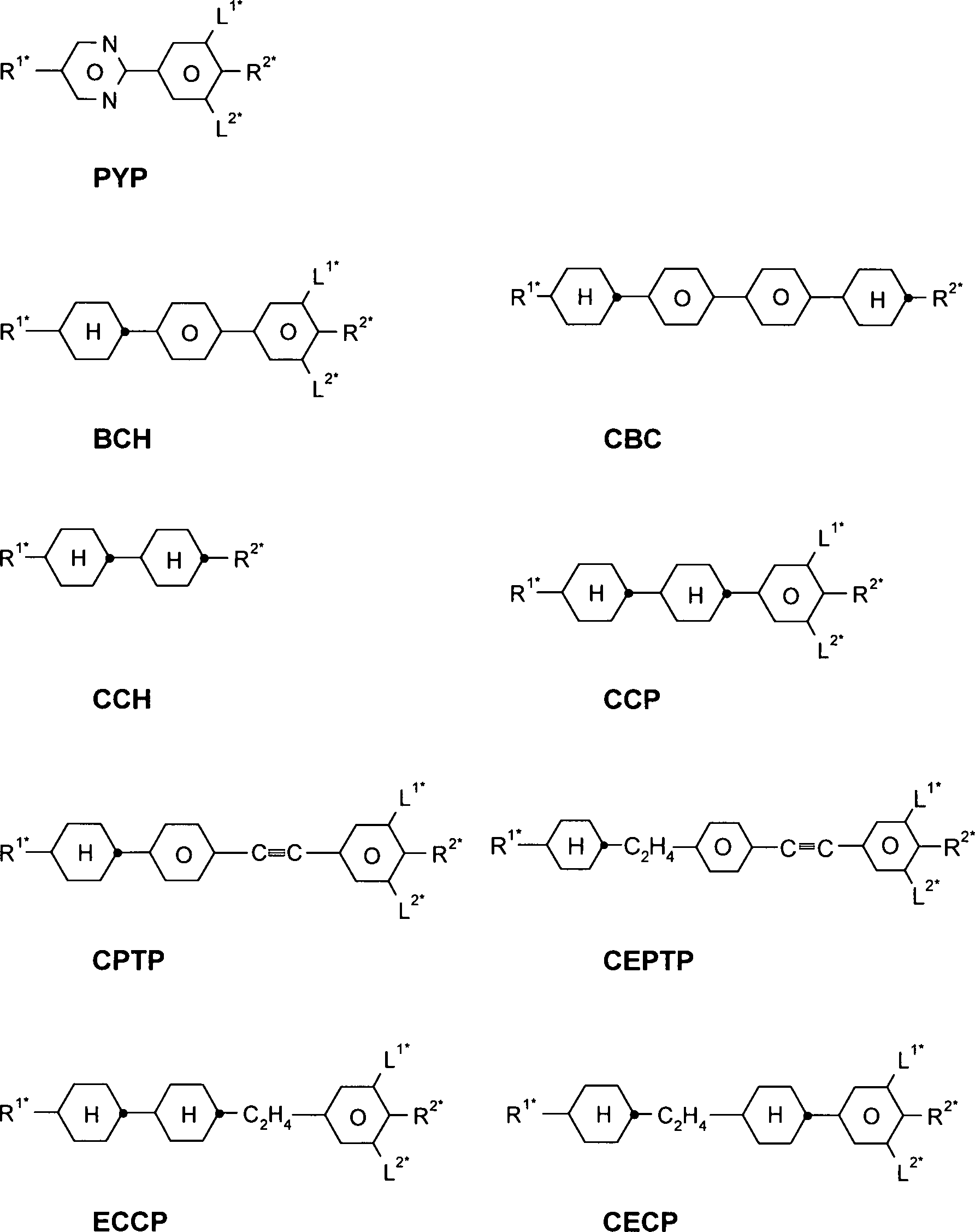
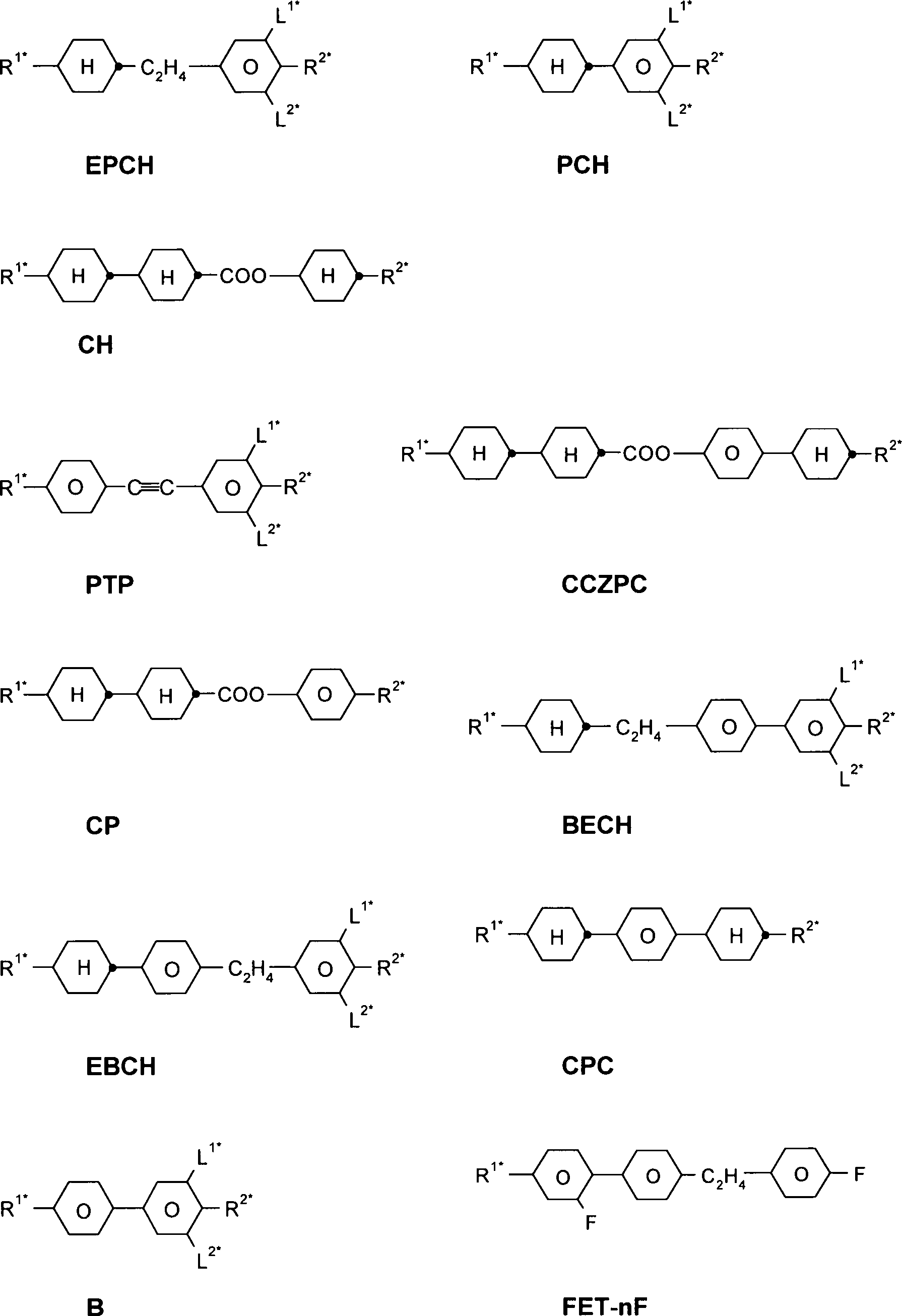


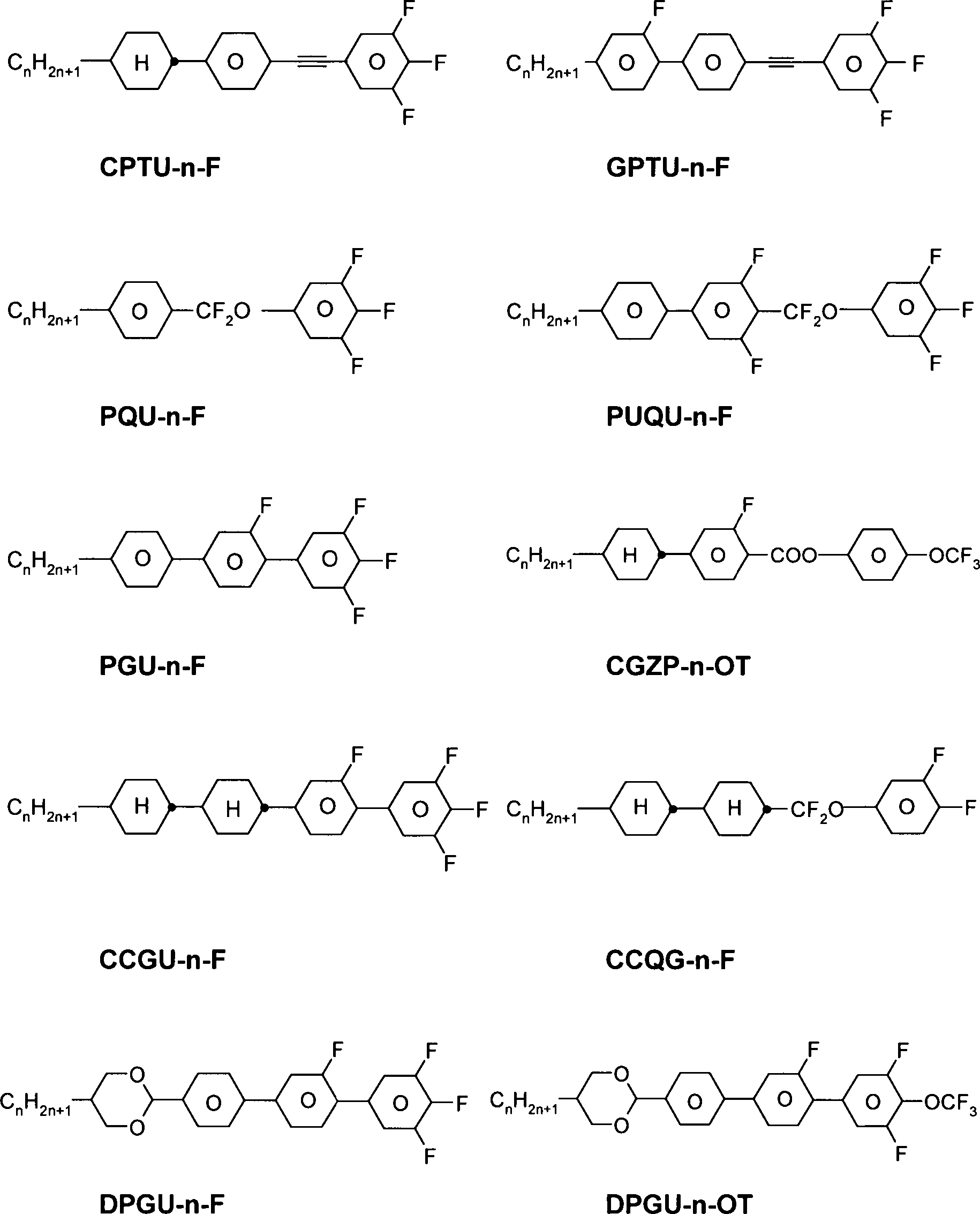

Es ist weiterhin bevorzugt, daß das flüssigkristalline Medium der Schaltschicht einen oder mehrere chirale Dotierstoffe enthält. Bevorzugt liegen in diesem Fall in der Schaltschicht der Vorrichtung die Moleküle des flüssigkristallinen Medium gegeneinander verdrillt vor, besonders bevorzugt wie aus dem TN-Modus von Displays bekannt.It is further preferred that the liquid-crystalline medium of the switching layer contains one or more chiral dopants. In this case, the molecules of the liquid-crystalline medium are preferably twisted in relation to one another in the switching layer of the device, particularly preferably as known from the TN mode of displays.
Gemäß einer alternativen, ebenfalls bevorzugten Ausführungsform, enthält das flüssigkristalline Medium der Schaltschicht keine chiralen Dotierstoffe. Bevorzugt liegen in diesem Fall in der Schaltschicht der Vorrichtung die Moleküle des flüssigkristallinen Medium nicht gegeneinander verdrillt vor.According to an alternative, likewise preferred embodiment, the liquid-crystalline medium of the switching layer contains no chiral dopants. In this case, the molecules of the liquid-crystalline medium are preferably not twisted against each other in the switching layer of the device.
Vorzugsweise enthalten die FK-Medien 0 bis 10 Gew.%, insbesondere 0,01 bis 5 Gew.% und besonders bevorzugt 0,1 bis 3 Gew.% an Dotierstoffen. Vorzugsweise enthalten die FK-Medien einen oder mehrere Dotierstoffe ausgewählt aus der Gruppe bestehend aus Verbindungen der Tabelle C. Tabelle C 

In der Tabelle D werden mögliche Stabilisatoren angegeben, die den erfindungsgemäßen FK-Medien zugesetzt werden können. (n bedeutet hier eine ganze Zahl von 1 bis 12). Vorzugsweise enthalten die FK-Medien 0 bis 10 Gew.%, insbesondere 0,01 bis 5 Gew.% und besonders bevorzugt 0,1 bis 3 Gew.% an Stabilisatoren. Vorzugsweise enthalten die FK-Medien einen oder mehrere Stabilisatoren ausgewählt aus der Gruppe bestehend aus Verbindungen der Tabelle D. Tabelle D 



Die Anteile dieser Verbindungen und anderer Mindermengenkomponenten werden bei der Angabe der Anteile der flüssigkristallinen Verbindungen und der dichroitischen Farbstoffe vernachlässigt.The proportions of these compounds and other minor components are neglected in indicating the proportions of the liquid crystalline compounds and the dichroic dyes.
Es versteht sich für den Fachmann von selbst, daß die erfindungsgemäßen FK-Medien auch Verbindungen enthalten können, worin beispielsweise H, N, O, Cl oder F durch die entsprechenden Isotope ersetzt sind.It goes without saying for the person skilled in the art that the LC media according to the invention can also contain compounds in which, for example, H, N, O, Cl or F are replaced by the corresponding isotopes.
Alle Prozentangaben und Mengenverhältnisse sind Gewichtsprozent.All percentages and proportions are by weight.
BeispieleExamples
Die vorliegende Erfindung wird durch die nachfolgenden nicht einschränkenden Beispiele detailliert beschrieben.The present invention will be described in detail by the following non-limiting examples.
Alle physikalischen Eigenschaften werden nach
Der Anisotropiegrad R wird ermittelt aus dem Wert für den Extinktionskoeffizienten E(p) (Extinktionskoeffizient der Mischung bei paralleler Ausrichtung der Moleküle zur Polarisationsrichtung des Lichts) und dem Wert für den Extinktionskoeffizienten der Mischung E(s) (Extinktionskoeffizient der Mischung bei senkrechter Ausrichtung der Moleküle zur Polarisationsrichtung des Lichts), jeweils bei der Wellenlänge des Maximums der Absorptionsbande des betreffenden Farbstoffs. Hat der Farbstoff mehrere Absorptionsbanden, so wird die intensivste Absorptionsbande ausgewählt. Die Ausrichtung der Moleküle der Mischung wird durch eine Orientierungsschicht erreicht, wie sie dem Fachmann auf dem Gebiet der LC-Displaytechnik bekannt ist. Zur Eliminierung von Einflüssen durch flüssigkristallines Medium, sonstigen Absorptionen oder Reflexionen wird jeweils gegen eine identisch vorliegende Mischung, die keinen Farbstoff enthält, gemessen und der erhaltene Wert subtrahiert. Die Messung erfolgt mit linear polarisiertem Licht, dessen Schwingungsrichtung entweder parallel zur Orientierungsrichtung ist (Bestimmung von E(p)) oder senkrecht zur Orientierungsrichtung ist (Bestimmung von E(s)). Dies kann durch einen Linearpolarisator erreicht werden, wobei der Polarisator gegen die Vorrichtung gedreht wird, um die beiden unterschiedlichen Schwingungsrichtungen zu realisieren. Die Messung von E(p) und E(s) erfolgt also über die Drehung der Schwingungsrichtung des eingestrahlten polarisierten Lichts. Der Anisotropiegrad R wird aus den erhaltenen Werten für E(s) und E(p) nach der Formel 
Eine sorgfältig entgaste Mischung von 4-(3-Ethylheptyl)-2-fluor-benzolboronsäure (2.1 g, 7.7 mmol), 4,7-Bis-(5-brom-thiophen-2-yl)-5,6-dimethyl-benzo[1,2,5]thiadiazol (2.0 g, 3.65 mmol), Tris(dibenzylidenaceton)dipalladium(0) (37 mg, 0.04 mmol), Tris(otolyl)phosphin (50 mg, 0.16 mmol), Toluol (65 ml) und 2 M wäßriger Na2CO3-Lösung (40 ml) wird unter Argonatmosphäre 18 h unter Rückfluß erhitzt. Man läßt den Ansatz abkühlen, arbeitete auf wie üblich und reinigt das Rohprodukt durch Chromatographie (SiO2; Toluol/n-Heptan 2:3). Nachfolgende Kristallisation aus Toluol/n-Heptan 1:1. liefert 5,6-Dinitro-4,7-bis-{5-[4-(3-ethyl-heptyl)-2-fluor-phenyl]-thiophen-2-yl}-benzo[1,2,5]thiadiazol (11) als gelblichen Feststoff. 1.2. 5,6-Diamino-4,7-bis-{5-[4-(3-ethyl-heptyl)-2-fluor-phenyl]-thiophen-2-yl}-benzo[1,2,5]thiadiazol [13] 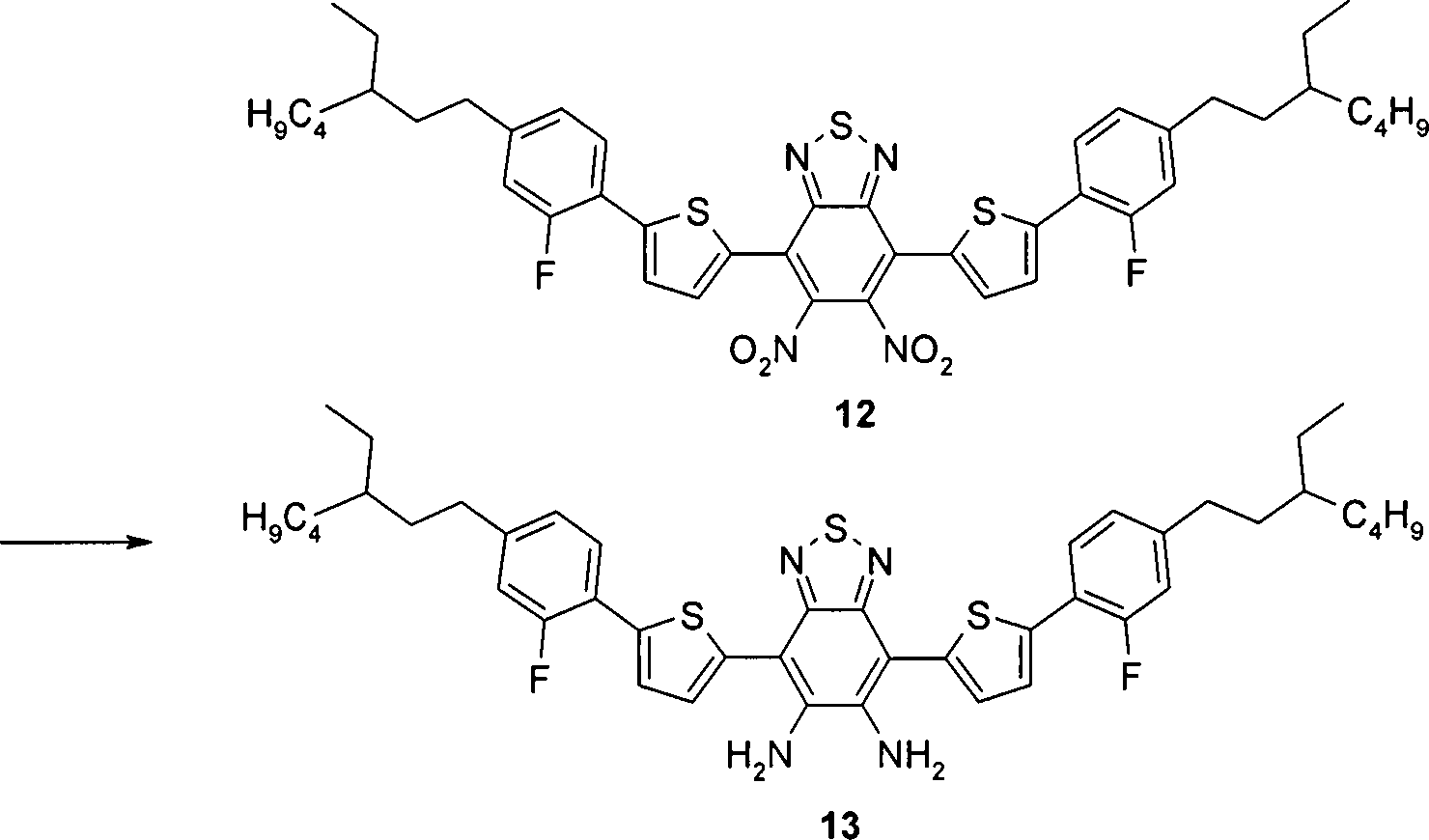
Eine Lösung von 5,6-Dinitro-4,7-bis-{5-[4-(3-ethyl-heptyl)-2-fluor-phenyl]-thiophen-2-yl}-benzo[1,2,5]thiadiazol (6.3 g, 7.5 mmol) in THF (65 ml) wird in Gegenwart von Nickelschwamm-Katalysator (Johnson-Matheson A-7000) bei Normaldruck und Raumtemperatur bis zur äquivalenten Wasserstoffaufnahme hydriert. Filtration und Eindampfen zur Trockne liefert 5,6-Diamino-4,7-bis-{5-[4-(3-ethyl-heptyl)-2-fluor-phenyl]-thiophen-2-yl}-benzo[1,2,5]thiadiazol (13) als bräunliches Harz, das ohne weitere Aufreinigung in die nächste Stufe eingesetzt wird. 1.3. 4,9-Bis-{5-[4-(3-ethyl-heptyl)-2-fluorphenyl]-thiophen-2-yl}-6,7-dimethyl-2-thia-1,3,5,8-tetraaza-cyclopenta[b]naphthalin [TDC-1] 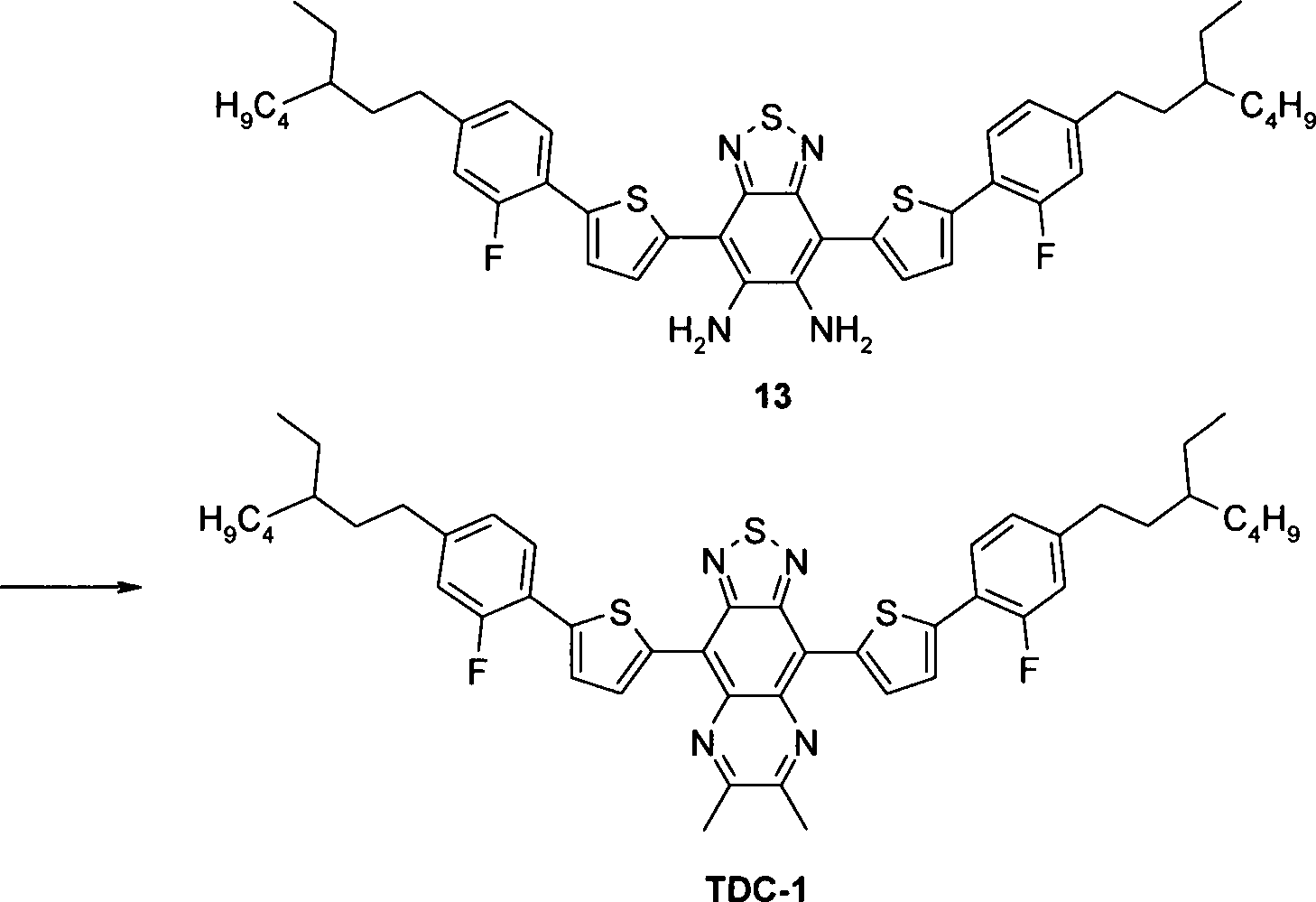
Eine Lösung von 13 (5.8 g, 7.5 mmol) in Methanol (300 ml) wird mit Diacetyl (1.3 ml, 15 mmol) versetzt und 18 h unter Rückfluß erhitzt. Man arbeitet wie üblich wäßrig auf und reinigt das Rohprodukt durch Chromatographie (SiO2; n-Heptan/Toluol 1:1). Nachfolgende Kristallisation aus n-Heptan liefert 5,6-Diamino-4,7-bis-{5-[4-(3-ethyl-heptyl)-2-fluor-phenyl]-thiophen-2-yl}-benzo[1,2,5]thiadiazol als blauen Feststoff vom Schmp. 160°C.A solution of 13 (5.8 g, 7.5 mmol) in methanol (300 ml) is added with diacetyl (1.3 ml, 15 mmol) and heated at reflux for 18 h. The mixture is worked up as usual aqueous and the crude product is purified by chromatography (SiO 2 , n-heptane / toluene 1: 1). Subsequent crystallization from n-heptane affords 5,6-diamino-4,7-bis- {5- [4- (3-ethyl-heptyl) -2-fluoro-phenyl] -thiophen-2-yl} -benzo [1 , 2.5] thiadiazole as a blue solid of mp. 160 ° C.
In Analogie zu Beispiel 1 werden die nachfolgenden Verbindungen erhalten: 

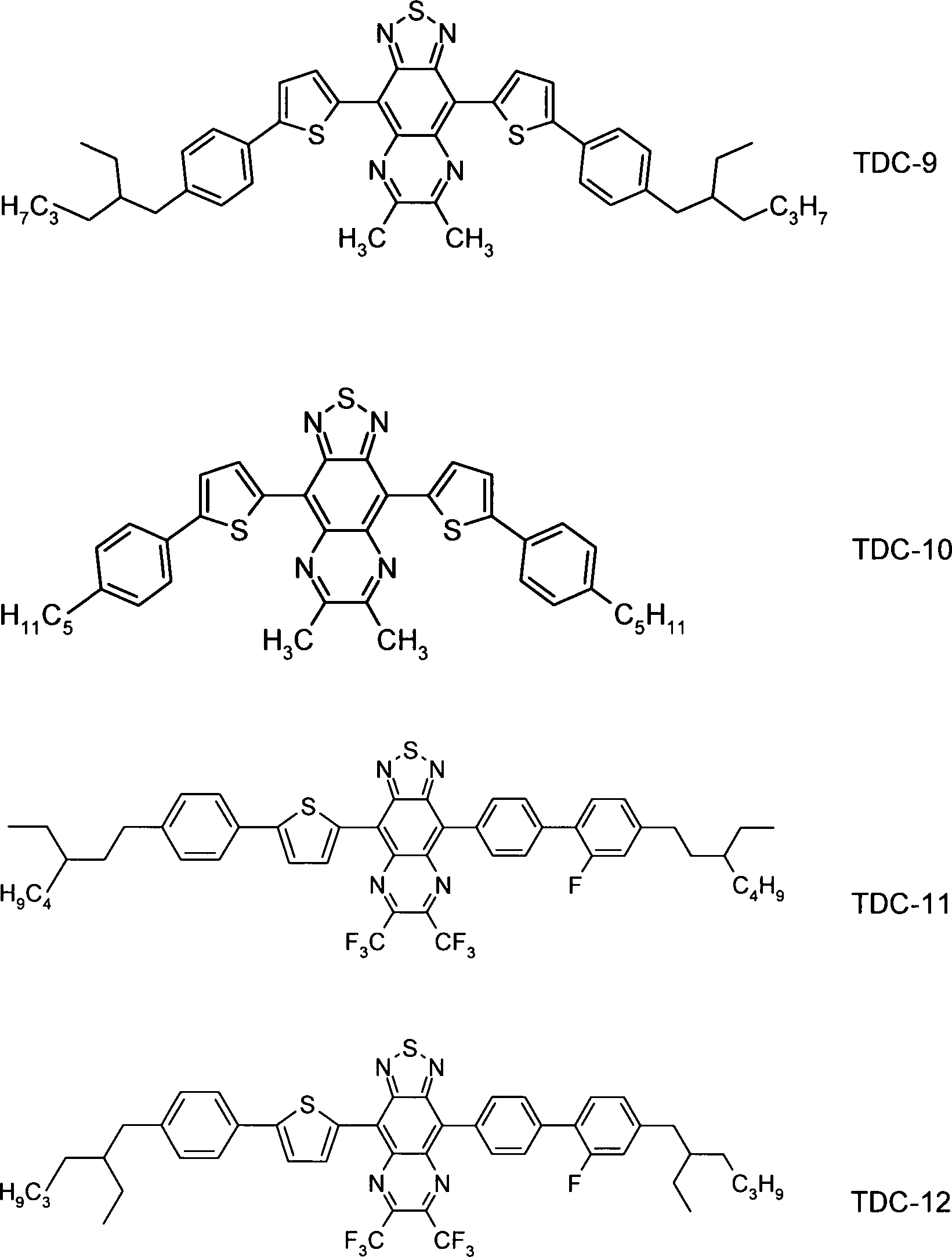


Anwendungsbeispiele applications
Die hergestellten Farbstoffe werden auf ihre physikalischen Eigenschaften hin untersucht, um ihre Eignung zur Verwendung in Vorrichtungen zur Regulierung der Energie-Transmission festzustellen. Zum Vergleich werden die entsprechenden Eigenschaften für die Verbindungen D-1 und D-2 (Struktur siehe unten) angegeben.The dyes prepared are evaluated for physical properties to determine their suitability for use in energy transmission regulation devices. For comparison, the corresponding properties are given for the compounds D-1 and D-2 (structure see below).
Herstellung von flüssigkristallinen FarbstoffmischungenPreparation of liquid-crystalline dye mixtures
Eine FK-Grundmischung G-1 wird wie folgt hergestellt:
Es werden die folgenden Farbstoffe in den angegebenen Anteilen in der Grundmischung G-1 gelöst: Mischungsbeispiel M-1
Strukturen der weiteren verwendeten Farbstoffe: Tabelle 2 
In Tabelle 3 sind Absorptionsmaximum, Anisotropiegrad und Löslichkeit für den Farbstoff TDC-1 aufgeführt. Das Absorptionsmaximum der Vergleichssubstanz D-1 ist vergleichbar mit dem von TDC-1. Tabelle 3
Die Messungen zeigen, daß die erfindungsgemäßen Thiadiazolochinoxalin-Verbindungen hervorragende Eigenschaften in Bezug auf Anisotropiegrad und Löslichkeit in flüssigkristallinen Medien aufweisen. Der Vergleich des UV-VIS-Spektrums von TDC-1 (Mischung M-1) mit dem vom Absorptionsbereich vergleichbaren Rylenfarbstoff D-1 (Mischung M-2) zeigt außerdem, daß bei TDC-1 keine Banden im Bereich 500–550 nm vorliegen. Hierdurch lassen sich Anwendungen realisieren, die deutlich besser innerhalb ihrer Farbart bleiben. D. h. bei Verwendung von TDC-1 liegen Hell und Dunkel näher in ihren Farbarten als bei Verwendung von D-1. Des weiteren kann man wegen der schmaleren Bande auch deutlich bessere Farbsättigungen erreichen.The measurements show that the thiadiazoloquinoxaline compounds according to the invention have excellent properties with regard to the degree of anisotropy and solubility in liquid-crystalline media. The comparison of the UV-VIS spectrum of TDC-1 (M-1 mixture) with the absorption-like rylene dye D-1 (M-2 blend) also shows that there are no bands in the range 500-550 nm for TDC-1 , As a result, applications can be realized that remain significantly better within their chromaticity. Ie. when using TDC-1, light and dark are closer in their color schemes than when using D-1. Furthermore, you can achieve much better color saturation because of the narrower band.
Verwendung von flüssigkristallinen Medien enthaltend die Farbstoffe in Vorrichtungen zur Regulierung des EnergiedurchtrittsUse of liquid-crystalline media containing the dyes in devices for regulating the energy transmission
Um die Vorrichtung herzustellen, wird die Flüssigkristallmischung M-3 in den Zwischenraum der folgenden Schichtenanordnung gefüllt:
- – Substratschicht
- – ITO-Schicht
- – Polyimid-Orientierungsschicht
- – mit Spacern offengehaltener Zwischenraum
- – Polyimid-Orientierungsschicht
- – ITO-Schicht
- – Substratschicht
- - Substrate layer
- - ITO layer
- - Polyimide orientation layer
- - Space kept open with spacers
- - Polyimide orientation layer
- - ITO layer
- - Substrate layer
Die Flüssigkristallschicht ist in dieser Anordnung planar mit antiparallelem Pretiltwinkel orientiert. Diese Orientierung wird durch zwei antiparallel zueinander geriebene Polyimidschichten erreicht. Die Dicke der flüssigkristallinen Schicht wird durch Spacer definiert und beträgt üblicherweise 25 μm. The liquid crystal layer is oriented in this arrangement planar with antiparallel pretilt angle. This orientation is achieved by two polyimide layers rubbed antiparallel to each other. The thickness of the liquid-crystalline layer is defined by spacers and is usually 25 μm.
Es werden Werte für den Lichttransmissionsgrad τv jeweils für den dunklen und den hellen Schaltzustand der Vorrichtung ermittelt und im Folgenden aufgeführt. Der helle Schaltzustand wird durch Anlegen einer Spannung erreicht, während der dunkle Schaltzustand ohne Spannung vorliegt. Weiterhin wird der Farbort der Vorrichtung (in CIE-Koordinaten) im Dunkel- und im Hellzustand ermittelt.Values for the light transmittance τ v in each case for the dark and light switching state of the device are determined and listed below. The bright switching state is achieved by applying a voltage, while the dark switching state is present without voltage. Furthermore, the color locus of the device (in CIE coordinates) is determined in the dark and in the bright state.
Die Messung erfolgt mit der Vorrichtung enthaltend das flüssigkristalline Medium mit Farbstoffen im Meßstrahl und einer baugleichen Vorrichtung, entsprechend ohne die Farbstoffe im Referenzstrahl. Hierdurch werden Reflexions- und Absorptionsverluste der Zelle eliminiert.The measurement is carried out with the device containing the liquid-crystalline medium with dyes in the measuring beam and a device of identical construction, correspondingly without the dyes in the reference beam. As a result, reflection and absorption losses of the cell are eliminated.
Der Wert τv und die CIE-Koordinaten (x, y) sind wie folgt definiert:
τv = Lichttransmissionsgrad, bestimmt nach
Der Farbort (für weiß, grau schwarz) der hier zugrunde gelegten Normlichtart D65 liegt bei x = 0.3127 und y = 0.3290 (
τ v = light transmission, determined by
The color locus (for white, gray black) of the standard illuminant D65 used here is x = 0.3127 and y = 0.3290 (
Erhaltene Meßwerte für die Vorrichtung (Doppelzelle):
- – Dunkelzustand: x = 0,148; y = 0,160; τv = 12,6%
- – Hellzustand: x = 0,256; y = 0,305; τv = 56,5%
- - dark state: x = 0.148; y = 0.160; τ v = 12.6%
- - bright state: x = 0.256; y = 0.305; τ v = 56.5%
Im Beispiel zeigt sich eine gute Stabilität des flüssigkristallinen Mediums und eine gute Löslichkeit der Farbstoffe im flüssigkristallinen Medium.The example shows good stability of the liquid-crystalline medium and good solubility of the dyes in the liquid-crystalline medium.
Weiterhin zeigt das Beispiel, daß sich die Vorrichtung durch Anlegen einer Spannung von einem Dunkelzustand mit deutlich geringerer Lichttransmission zu einem Hellzustand mit deutlich erhöhter Lichttransmission schalten läßt.Furthermore, the example shows that the device can be switched by applying a voltage from a dark state with significantly lower light transmission to a bright state with significantly increased light transmission.
Weiterhin wird beobachtet, daß mit dem Farbstoff TDC-1 in Kombination mit Farbstoff D-2 eine Mischung mit besonders guter Farbsättigung im Blau erhalten wird.Furthermore, it is observed that with the dye TDC-1 in combination with Dye D-2 a mixture with particularly good color saturation in the blue is obtained.
ZITATE ENTHALTEN IN DER BESCHREIBUNG QUOTES INCLUDE IN THE DESCRIPTION
Diese Liste der vom Anmelder aufgeführten Dokumente wurde automatisiert erzeugt und ist ausschließlich zur besseren Information des Lesers aufgenommen. Die Liste ist nicht Bestandteil der deutschen Patent- bzw. Gebrauchsmusteranmeldung. Das DPMA übernimmt keinerlei Haftung für etwaige Fehler oder Auslassungen.This list of the documents listed by the applicant has been generated automatically and is included solely for the better information of the reader. The list is not part of the German patent or utility model application. The DPMA assumes no liability for any errors or omissions.
Zitierte PatentliteraturCited patent literature
- WO 2009/141295 [0004, 0010, 0012, 0013, 0015, 0115, 0121, 0131] WO 2009/141295 [0004, 0010, 0012, 0013, 0015, 0115, 0121, 0131]
- WO 2010/118422 [0004, 0012, 0116] WO 2010/118422 [0004, 0012, 0116]
- US 2010/0259698 [0011] US 2010/0259698 [0011]
- US 6033598 [0012] US 6033598 [0012]
- US 5762824 [0012] US 5762824 [0012]
- WO 2013/004677 [0015] WO 2013/004677 [0015]
- WO 2014/090373 [0015, 0115] WO 2014/090373 [0015, 0115]
- EP 34832 [0099] EP 34832 [0099]
- EP 44893 [0099] EP 44893 [0099]
- EP 48583 [0099] EP 48583 [0099]
- EP 54217 [0099] EP 54217 [0099]
- EP 56492 [0099] EP 56492 [0099]
- EP 59036 [0099] EP 59036 [0099]
- GB 2065158 [0099] GB 2065158 [0099]
- GB 2065695 [0099] GB 2065695 [0099]
- GB 2081736 [0099] GB 2081736 [0099]
- GB 2082196 [0099] GB 2082196 [0099]
- GB 2094822 [0099] GB 2094822 [0099]
- GB 2094825 [0099] GB 2094825 [0099]
- JP 55-123673 [0099] JP 55-123673 [0099]
- DE 3017877 [0099] DE 3017877 [0099]
- DE 3040102 [0099] DE 3040102 [0099]
- DE 3115147 [0099] DE 3115147 [0099]
- DE 3115762 [0099] DE 3115762 [0099]
- DE 3150803 [0099] DE 3150803 [0099]
- DE 3201120 [0099] DE 3201120 [0099]
- DE 3126108 [0099] DE 3126108 [0099]
- DE 3202761 [0099] DE 3202761 [0099]
- EP 43904 [0099] EP 43904 [0099]
- DE 3123519 [0099] DE 3123519 [0099]
- WO 82/2054 [0099] WO 82/2054 [0099]
- GB 2079770 [0099] GB 2079770 [0099]
- JP 56-57850 [0099] JP 56-57850 [0099]
- JP 56-104984 [0099] JP 56-104984 [0099]
- US 4308161 [0099] US 4308161 [0099]
- US 4308162 [0099] US 4308162 [0099]
- US 4340973 [0099] US 4340973 [0099]
- EP 60895 [0099] EP 60895 [0099]
- EP 68427 [0099, 0099] EP 68427 [0099, 0099]
- WO 82/1191 [0099] WO 82/1191 [0099]
- EP 2166040 [0099] EP 2166040 [0099]
- US 2011/0042651 [0099] US 2011/0042651 [0099]
- EP 47027 [0099] EP 47027 [0099]
- EP 68895 [0099] EP 68895 [0099]
- DE 3110960 [0099] DE 3110960 [0099]
- EP 698649 [0099] EP 698649 [0099]
- US 7038745 [0130] US 7038745 [0130]
- US 6099758 [0130] US 6099758 [0130]
- US 2011/0043732 [0130] US 2011/0043732 [0130]
- US 7023602 [0130] US 7023602 [0130]
Zitierte Nicht-PatentliteraturCited non-patent literature
- G. H. Heilmeier et al., Appl. Phys. Lett., 1968, 13, 91f [0003] GH Heilmeier et al., Appl. Phys. Lett., 1968, 13, 91f [0003]
- J. Mater. Chem. C, 2014, 2, 5133–5141 [0014] J. Mater. Chem. C, 2014, 2, 5133-5141 [0014]
- Polymeren für organische Halbleiter, in Chem. Mater. 2012, 24, 2178–2185 [0014] Polymers for organic semiconductors, in Chem. Mater. 2012, 24, 2178-2185 [0014]
- Bull. Korean Chem. Soc. 2013, 34(2), 661–664 [0014] Bull. Korean Chem. Soc. 2013, 34 (2), 661-664 [0014]
- Houben Weyl, Methoden der Organischen Chemie, Thieme Verlag, Stuttgart [0069] Houben Weyl, Methods of Organic Chemistry, Thieme Verlag, Stuttgart [0069]
- T. L. Tam, H. Li, K. J. Tan, C. Kloc, Y. M. Lam, S. G. Mhaisalkar, A. C. Grimsdale, Org. Lett. 2010, 12, 3340–3343 [0071] TL Tam, H. Li, KJ Tan, C. Kloc, YM Lam, SG Mhaisalkar, AC Grimsdale, Org. Lett. 2010, 12, 3340-3343 [0071]
- C. Kitamura, S. Tanaka, Y. Yamashita, Chem. Mater. 1996, 8, 570–578 [0071] C. Kitamura, S. Tanaka, Y. Yamashita, Chem. Mater. 1996, 8, 570-578 [0071]
-
M. Cushman, W. C. Wong, A. Bacher, J. Chem. Soc. Perkin 1, 1986, 1043–1050 [0071] M. Cushman, WC Wong, A. Bacher, J. Chem. Soc.
Perkin 1, 1986, 1043-1050 [0071] - O. W. Webster, D. R. Hartter, R. W. Begland, W. A. Sheppard, A. Cairncross, J. Org. Chem. 1972, 37, 4133–4136 [0071] OW Webster, DR Hartter, RW Begland, WA Sheppard, A. Cairncross, J. Org. Chem. 1972, 37, 4133-4136 [0071]
- H. W. Rothkopf, D. Wöhrle, R. Müller, G. Koßmehl, Chem. Ber. 1975, 108, 875–886 [0071] HW Rothkopf, D. Wöhrle, R. Müller, G. Kossmehl, Chem. Ber. 1975, 108, 875-886 [0071]
- K. Susumu et al., J. Phys. Chem. A 2011, 115, 5525–5539 [0072] K. Susumu et al., J. Phys. Chem. A 2011, 115, 5525-5539 [0072]
- L. Wang et al., Synth. Comm. 2004, 34(8), 1349–1357 [0073] L. Wang et al., Synth. Comm. 2004, 34 (8), 1349-1357 [0073]
- Ch. Zhu et al., ChemMedChem 2012, 7, 823–835 [0073] Ch. Zhu et al., Chem. Med. Chem. 2012, 7, 823-835 [0073]
- T. Fujimoto, F. Becker und T. Ritter, Org. Process Res. Dev. 2014, 18, 1041–1044 [0073] T. Fujimoto, F. Becker and T. Ritter, Org. Process Res. Dev. 2014, 18, 1041-1044 [0073]
- Manfred Richter, Einführung in die Farbmetrik, 2. Auflage, 1981, ISBN 3-11-008209-8, Verlag Walter de Gruyter & Co., [0095] Manfred Richter, Introduction to Colorimetry, 2nd Edition, 1981, ISBN 3-11-008209-8, Verlag Walter de Gruyter & Co., [0095]
- B. Bahadur, Liquid Crystals – Applications and Uses, Vol. 3, 1992, World Scientific Publishing, Abschnitt 11.2.1 [0098] B. Bahadur, Liquid Crystals - Applications and Uses, Vol. 3, 1992, World Scientific Publishing, Section 11.2.1 [0098]
- T. Uchida, C. Shishido, H. Seki und M. Wada: Mol. Cryst. Lig. Cryst. 39, 39–52 (1977) [0099] T. Uchida, C. Shishido, H. Seki and M. Wada: Mol. Cryst. Lig. Cryst. 39, 39-52 (1977) [0099]
- H. Seki, C. Shishido, S. Yasui und T. Uchida: Jpn. J. Appl. Phys. 21, 191–192 (1982) [0099] H. Seki, C. Shishido, S. Yasui, and T. Uchida: Jpn. J. Appl. Phys. 21, 191-192 (1982) [0099]
- Tabelle 8.1 auf Seite 279 in Joseph R. Lakowicz, Principles of Fluorescence Spectroscopy, 3 rd Edition, 2010, ISBN 10: 0-387-31278-1, Verlag Springer Science + Business Media LLC [0106] Table 8.1 on page 279 in Joseph R. Lakowicz, Principles of Fluorescence Spectroscopy, 3 rd Edition, 2010, ISBN 10: 0-387-31278- 1, Springer Science + Business Media LLC [0106]
- ”Merck Liquid Crystals, Physical Properties of Liquid Crystals”, Status Nov. 1997, Merck KGaA, Deutschland [0149] "Merck Liquid Crystals, Physical Properties of Liquid Crystals", Status Nov. 1997, Merck KGaA, Germany [0149]
- „Polarized Light in Optics and Spectroscopy”, D. S. Kliger et al., Academic Press, 1990 [0150] "Polarized Light in Optics and Spectroscopy", DS Kliger et al., Academic Press, 1990 [0150]
- B. Bahadur, Liquid Crystals – Applications and Uses, Vol. 3, 1992, World Scientific Publishing, Abschnitt 11.4.2. [0150] B. Bahadur, Liquid Crystals - Applications and Uses, Vol. 3, 1992, World Scientific Publishing, Section 11.4.2. [0150]
- DIN EN410 [0166] DIN EN410 [0166]
- Manfred Richter, Einführung in die Farbmetrik, zweite Auflage 1991, ISBN 3-11-008209-8 [0166] Manfred Richter, Introduction to Colorimetry, second edition 1991, ISBN 3-11-008209-8 [0166]
Claims (14)
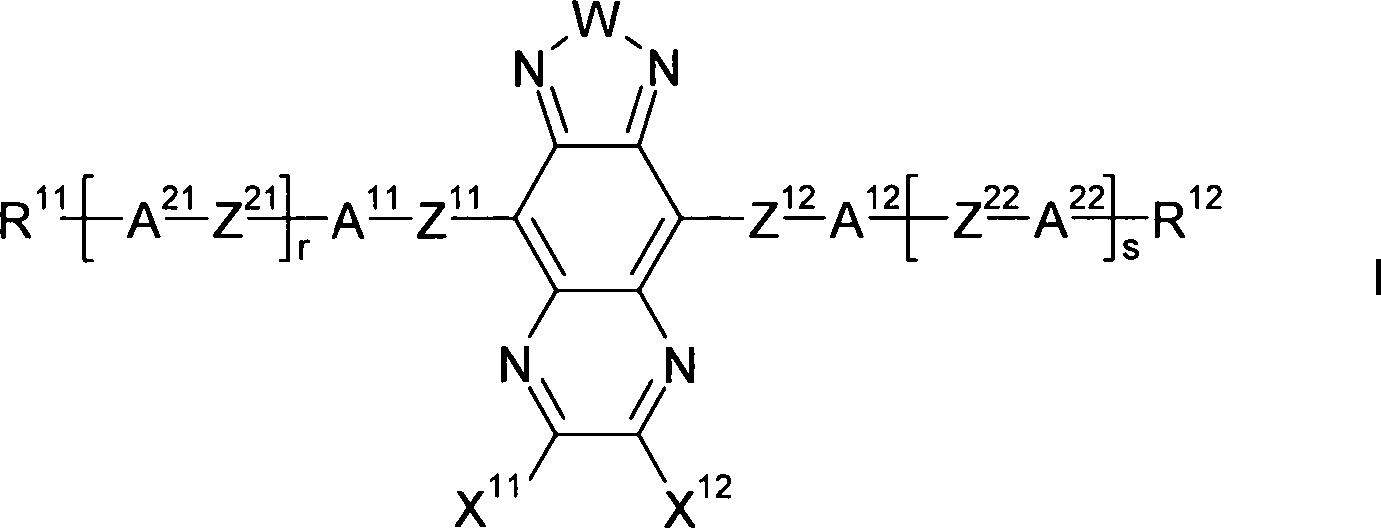
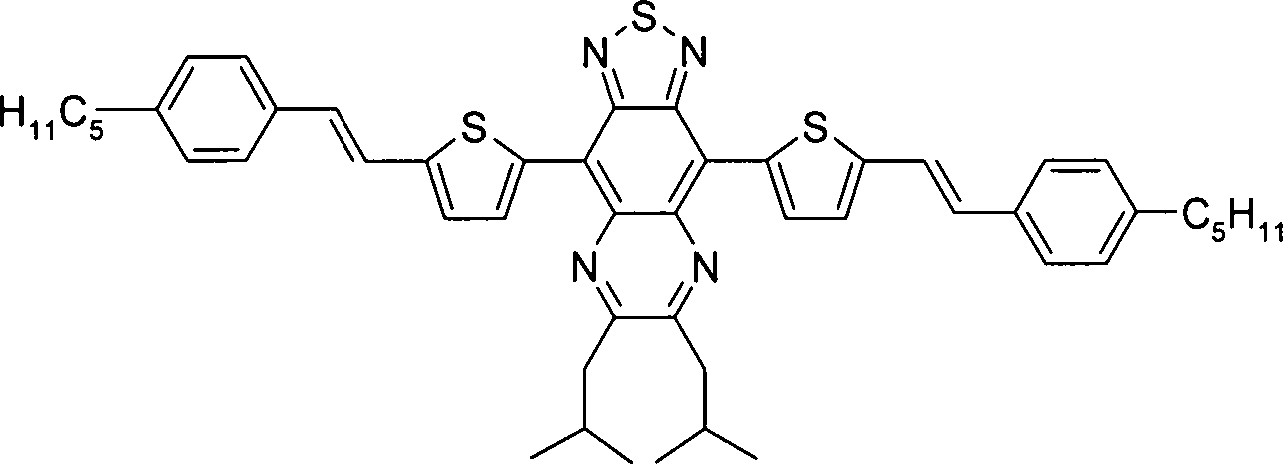

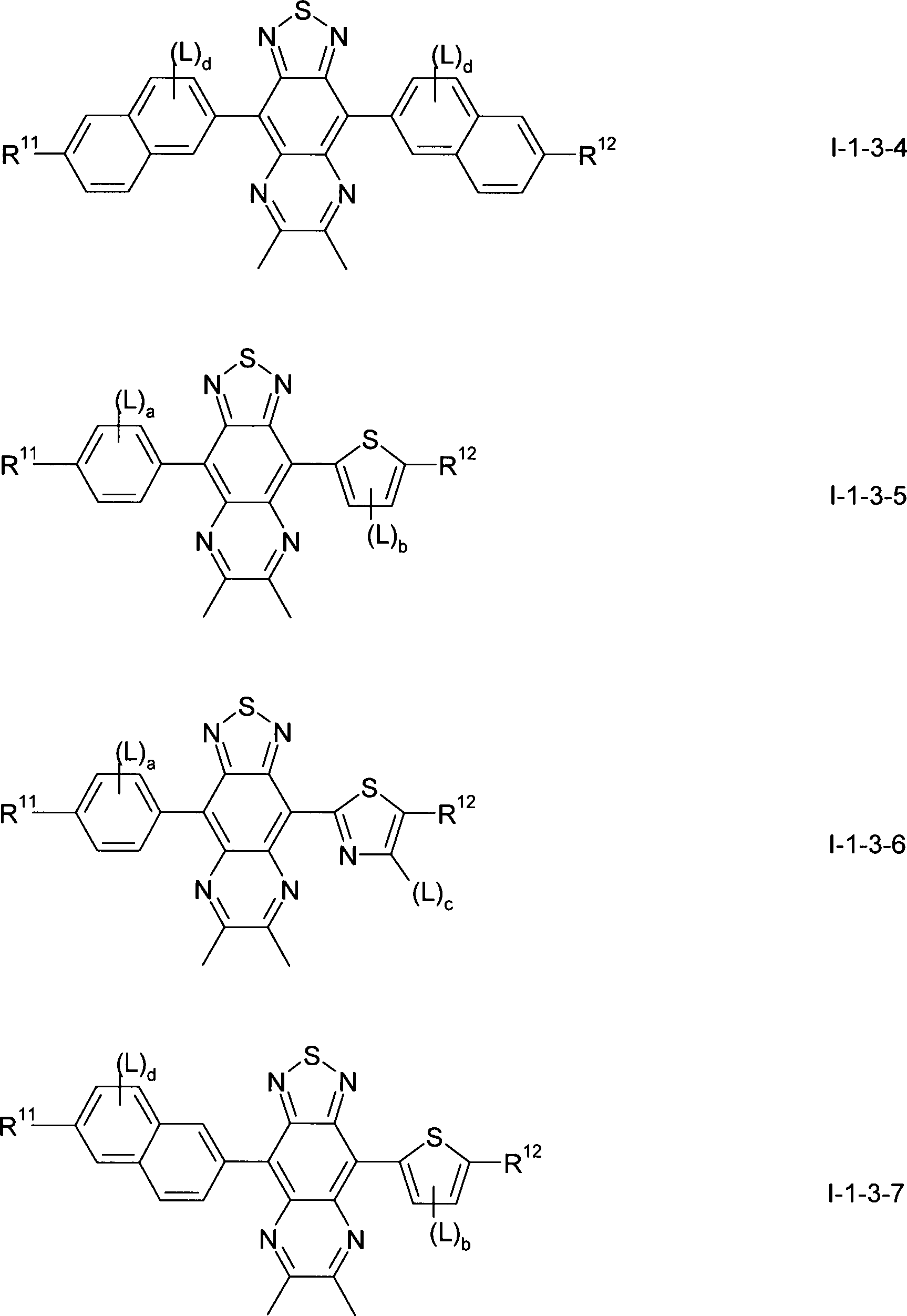
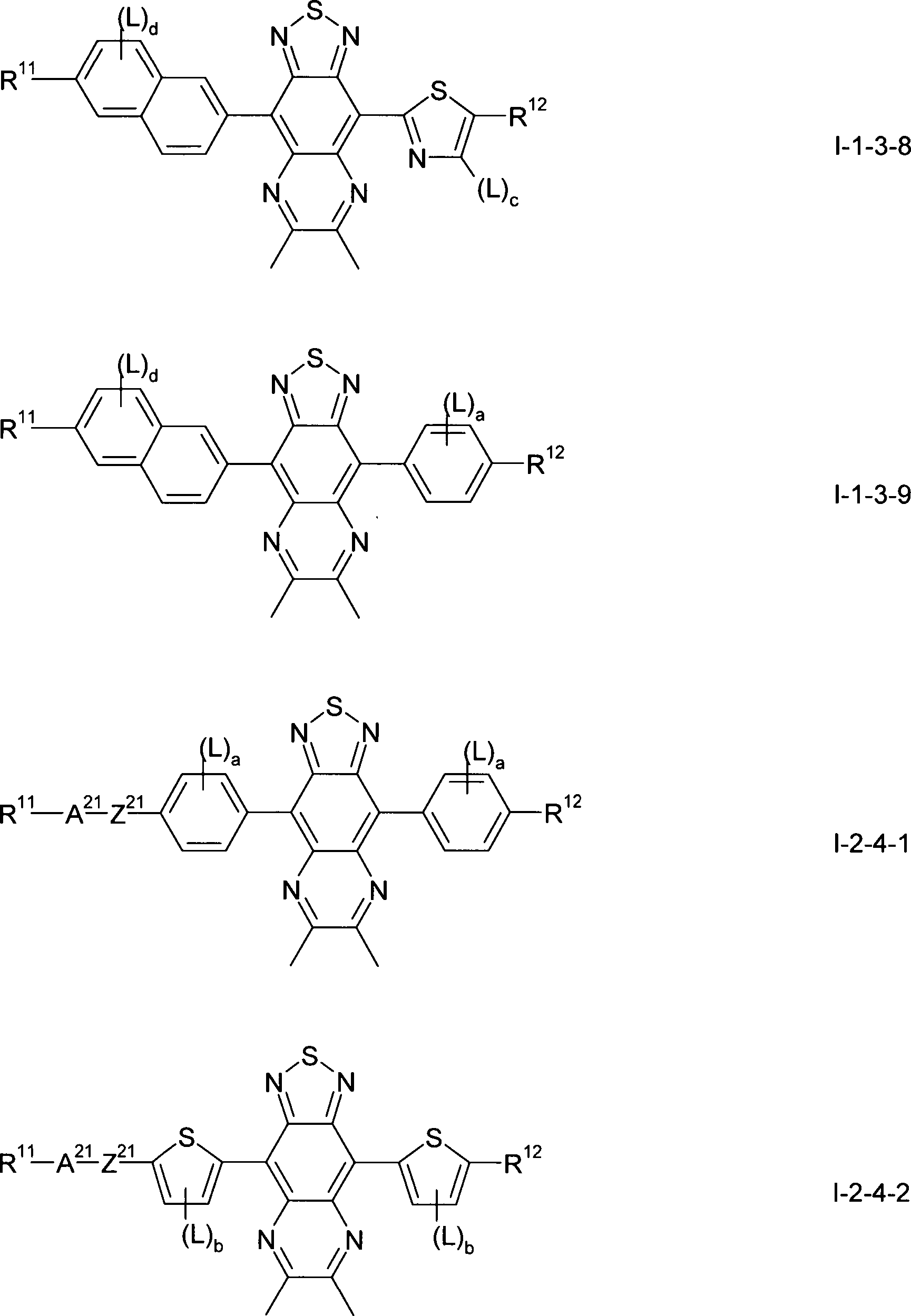

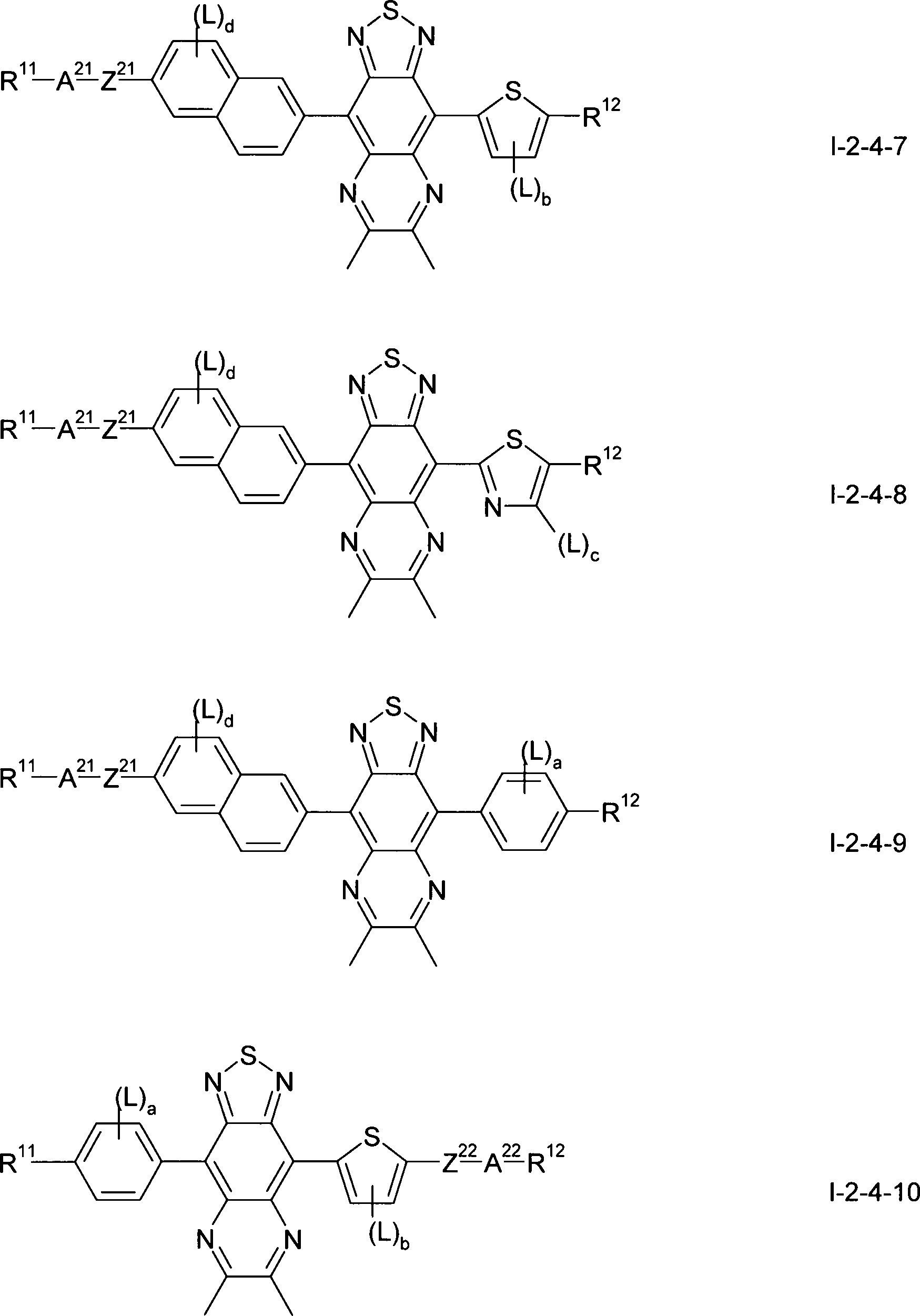


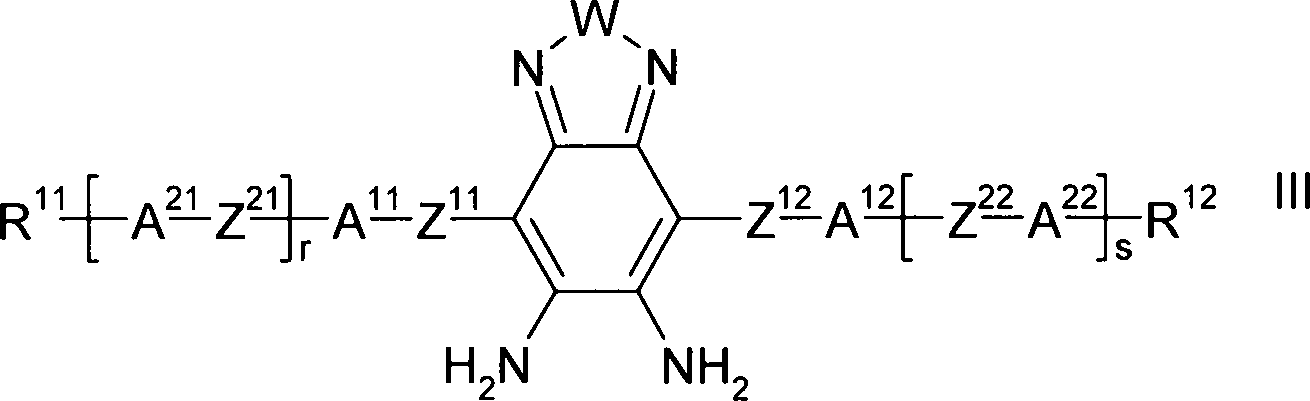
Priority Applications (8)
| Application Number | Priority Date | Filing Date | Title |
|---|---|---|---|
| DE102015005800.2A DE102015005800A1 (en) | 2015-05-06 | 2015-05-06 | Thiadiazolochinoxalinderivate |
| JP2017557321A JP6695356B2 (en) | 2015-05-06 | 2016-04-13 | Thiadiazoloquinoxaline derivative |
| CN201680026171.9A CN107580622B (en) | 2015-05-06 | 2016-04-13 | Thiadiazoloquinoxaline Derivatives |
| EP16716166.0A EP3292182B1 (en) | 2015-05-06 | 2016-04-13 | Thiadiazoloquinoxaline derivatives |
| US15/571,645 US10738240B2 (en) | 2015-05-06 | 2016-04-13 | Thiadiazoloquinoxaline derivatives |
| KR1020177035095A KR102593680B1 (en) | 2015-05-06 | 2016-04-13 | Thiadiazoloquinoxaline derivatives |
| PCT/EP2016/000609 WO2016177449A1 (en) | 2015-05-06 | 2016-04-13 | Thiadiazoloquinoxaline derivatives |
| TW105114022A TWI698441B (en) | 2015-05-06 | 2016-05-05 | Thiadiazoloquinoxaline derivatives |
Applications Claiming Priority (1)
| Application Number | Priority Date | Filing Date | Title |
|---|---|---|---|
| DE102015005800.2A DE102015005800A1 (en) | 2015-05-06 | 2015-05-06 | Thiadiazolochinoxalinderivate |
Publications (1)
| Publication Number | Publication Date |
|---|---|
| DE102015005800A1 true DE102015005800A1 (en) | 2016-11-10 |
Family
ID=55752247
Family Applications (1)
| Application Number | Title | Priority Date | Filing Date |
|---|---|---|---|
| DE102015005800.2A Withdrawn DE102015005800A1 (en) | 2015-05-06 | 2015-05-06 | Thiadiazolochinoxalinderivate |
Country Status (8)
| Country | Link |
|---|---|
| US (1) | US10738240B2 (en) |
| EP (1) | EP3292182B1 (en) |
| JP (1) | JP6695356B2 (en) |
| KR (1) | KR102593680B1 (en) |
| CN (1) | CN107580622B (en) |
| DE (1) | DE102015005800A1 (en) |
| TW (1) | TWI698441B (en) |
| WO (1) | WO2016177449A1 (en) |
Cited By (1)
| Publication number | Priority date | Publication date | Assignee | Title |
|---|---|---|---|---|
| WO2017174619A1 (en) | 2016-04-08 | 2017-10-12 | Merck Patent Gmbh | Intermediates and procedures for the synthesis of functional materials |
Families Citing this family (24)
| Publication number | Priority date | Publication date | Assignee | Title |
|---|---|---|---|---|
| JP6972103B2 (en) * | 2016-07-19 | 2021-11-24 | メルク・パテント・ゲゼルシヤフト・ミツト・ベシユレンクテル・ハフツングMerck Patent GmbH | Liquid crystal medium |
| GB2564134A (en) * | 2017-07-04 | 2019-01-09 | The Univ Of Hull | Asymmetric mesogens and a method of manufacture |
| US11667845B2 (en) * | 2018-06-11 | 2023-06-06 | Merck Patent Gmbh | Liquid crystalline medium |
| US12043782B2 (en) | 2018-06-20 | 2024-07-23 | Merck Patent Gmbh | Liquid crystalline medium |
| EP3856869B1 (en) * | 2018-09-25 | 2024-04-03 | Merck Patent GmbH | Azo dye |
| CN113166652B (en) * | 2018-11-23 | 2025-01-21 | 默克专利股份有限公司 | Dichroic dye compositions |
| JP7612584B2 (en) | 2018-12-19 | 2025-01-14 | メルク・パテント・ゲゼルシヤフト・ミツト・ベシユレンクテル・ハフツング | Switching layers used in switching elements |
| US11849595B2 (en) | 2019-08-02 | 2023-12-19 | Samsung Electronics Co., Ltd. | Near-infrared absorbers, near-infrared absorbing/blocking films and photoelectric devices and organic sensors and electronic devices |
| EP3839620B1 (en) | 2019-12-16 | 2025-02-26 | Merck Patent GmbH | Device for the regulation of light transmission |
| KR102764008B1 (en) * | 2020-01-30 | 2025-02-05 | 삼성전자주식회사 | Infrared absorbing material, infrared absorbing/cutting film and photoelectric diode and organic sensor and electronic device |
| KR20210147635A (en) | 2020-05-29 | 2021-12-07 | 삼성전자주식회사 | Infrared absorbing material, infrared absorbing/cutting film, photoelectric device, sensor, and electronic device |
| CN114163455B (en) * | 2020-09-10 | 2025-11-25 | Dic株式会社 | Compounds, compositions, liquid crystal compositions, and liquid crystal display elements or dimming elements |
| KR20230116055A (en) | 2020-12-11 | 2023-08-03 | 메르크 파텐트 게엠베하 | light transmission control device |
| TW202317855A (en) | 2021-08-06 | 2023-05-01 | 德商馬克專利公司 | Switching layers for use in a window element |
| US11925101B2 (en) | 2021-09-15 | 2024-03-05 | Raynergy Tek Incorporation | Organic semiconducting compound and the organic photoelectric components using the same |
| WO2023094404A1 (en) | 2021-11-24 | 2023-06-01 | Merck Patent Gmbh | Liquid crystal medium and liquid crystal display |
| CN114478587B (en) * | 2021-12-29 | 2023-07-28 | 南京邮电大学 | A kind of near-infrared second zone dye, nanoparticle and its preparation method and application |
| CN115093433B (en) * | 2022-05-30 | 2023-09-26 | 华南理工大学 | A hydrophilic organic near-infrared absorbing dye and its preparation method and application |
| KR102573401B1 (en) | 2023-02-21 | 2023-09-01 | (주)현대포멕스 | Table lighting device that can remove shadows formed on the subject |
| CN121311566A (en) | 2023-06-05 | 2026-01-09 | 默克专利股份有限公司 | Liquid crystal media |
| WO2025061649A1 (en) | 2023-09-20 | 2025-03-27 | Merck Patent Gmbh | Liquid crystal medium |
| US20250236795A1 (en) | 2024-01-18 | 2025-07-24 | Merck Patent Gmbh | Liquid-crystalline medium |
| WO2025190813A1 (en) | 2024-03-11 | 2025-09-18 | Merck Patent Gmbh | Liquid-crystal medium |
| CN119493307B (en) * | 2024-10-03 | 2025-07-22 | 北华航天工业学院 | Alignment method and application of cyanobiphenyl liquid crystal doped with organic donor material |
Citations (46)
| Publication number | Priority date | Publication date | Assignee | Title |
|---|---|---|---|---|
| JPS55123673A (en) | 1979-03-16 | 1980-09-24 | Mitsui Toatsu Chem Inc | Liquid crystal color display device |
| DE3017877A1 (en) | 1979-05-14 | 1980-11-27 | Mitsubishi Chem Ind | ANTHRACHINONE COMPOUNDS, THEIR PRODUCTION AND USE |
| JPS5657850A (en) | 1979-10-18 | 1981-05-20 | Nippon Kanko Shikiso Kenkyusho:Kk | Azo compound and dichromatic dye for liquid crystal consisting of the same |
| GB2065158A (en) | 1979-12-13 | 1981-06-24 | Standard Telephones Cables Ltd | Anthraquinone Dichroic Dyes |
| GB2065695A (en) | 1979-10-12 | 1981-07-01 | Hitachi Ltd | Guest-host type liquid crystal composition and liquid crystal display device using the same |
| JPS56104984A (en) | 1980-01-24 | 1981-08-21 | Nippon Kanko Shikiso Kenkyusho:Kk | Bichromic pigment for yellow liquid crystal |
| EP0034832A1 (en) | 1980-02-26 | 1981-09-02 | Siemens Aktiengesellschaft | Liquid crystal with an incorporated pleochroic anthraquinone dyestuff and its use |
| US4308162A (en) | 1980-12-08 | 1981-12-29 | General Electric Company | Novel yellow azo dyes and dichroic liquid crystal compositions made therewith |
| US4308161A (en) | 1980-08-04 | 1981-12-29 | General Electric Company | Novel yellow azo dyes and dichroic liquid crystal compositions made therewith |
| EP0043904A2 (en) | 1980-07-10 | 1982-01-20 | F. HOFFMANN-LA ROCHE & CO. Aktiengesellschaft | Mixtures containing a dyestuff, dyestuffs and their use in liquid crystal mixtures |
| GB2079770A (en) | 1980-06-30 | 1982-01-27 | Gen Electric | Novel tris-azo dyes and liquid crystal compositions made therewith |
| EP0044893A1 (en) | 1980-07-29 | 1982-02-03 | Imperial Chemical Industries Plc | Anthraquinone compounds and process for their preparation |
| GB2081736A (en) | 1980-07-29 | 1982-02-24 | Secr Defence | Liquid Crystal Materials Containing Diamino-Dihydroxy Anthraquinone Pleochroic Dyes |
| GB2082196A (en) | 1980-07-29 | 1982-03-03 | Secr Defence | Liquid Crystal Materials Containing Anthraquinone Pleochroic Dyes |
| EP0047027A1 (en) | 1980-08-22 | 1982-03-10 | BBC Aktiengesellschaft Brown, Boveri & Cie. | Liquid crystals mixture |
| EP0048583A1 (en) | 1980-09-22 | 1982-03-31 | Hitachi, Ltd. | Liquid crystal compositions containing pleochroic anthraquinone dyes, liquid crystal devices containing the compositions, and the dyes |
| WO1982001191A1 (en) | 1980-10-03 | 1982-04-15 | Yamada Y | Composition for liquid crystal color display |
| DE3040102A1 (en) | 1980-10-24 | 1982-06-03 | Merck Patent Gmbh, 6100 Darmstadt | DICHROITIC ANTHRACHINONE DYES, THIS CONTAINING LIQUID CRYSTALINE DIELECTRICS AND ELECTRO-OPTICAL DISPLAY ELEMENT |
| EP0054217A1 (en) | 1980-12-12 | 1982-06-23 | Bayer Ag | Anthraquinone dyes, process for their preparation, their use, as well as liquid-crystal material containing anthraquinone dyes |
| US4340973A (en) | 1979-09-29 | 1982-07-20 | Nippon Electric Co., Ltd. | Selective calling receiver including a voltage converter with low power consumption |
| EP0056492A1 (en) | 1981-01-10 | 1982-07-28 | BASF Aktiengesellschaft | Dyes for liquid crystal mixtures |
| EP0059036A1 (en) | 1981-02-25 | 1982-09-01 | Imperial Chemical Industries Plc | Pleochroic anthraquinone dyes |
| DE3150803A1 (en) | 1981-01-12 | 1982-09-09 | Nippon Electric Co., Ltd., Tokyo | ANTRACHINONE DYES AND LIQUID CRYSTAL DISPLAYING CONTAINERS THEREOF |
| GB2094825A (en) | 1981-01-17 | 1982-09-22 | Mitsubishi Chem Ind | Liquid crystal compositions containing pleochroic anthraquinone dyes |
| GB2094822A (en) | 1981-02-25 | 1982-09-22 | Ici Plc | Anthraquinone dyes |
| DE3110960A1 (en) | 1981-03-20 | 1982-09-30 | Basf Ag, 6700 Ludwigshafen | ELECTROPHOTOGRAPHIC RECORDING MATERIAL |
| DE3115147A1 (en) | 1981-04-15 | 1982-11-04 | Basf Ag, 6700 Ludwigshafen | Dyes for liquid-crystal mixtures |
| DE3115762A1 (en) | 1981-04-18 | 1982-11-11 | Merck Patent Gmbh, 6100 Darmstadt | "DICHROITIC ANTHRACHINONE DYES, THIS CONTAINING LIQUID CRYSTAL DIELECTRICS AND ELECTROOPRIC DISPLAY ELEMENT" |
| DE3123519A1 (en) | 1981-06-13 | 1982-12-30 | Bayer Ag, 5090 Leverkusen | LIQUID CRYSTAL MATERIAL CONTAINING AZO COLORS |
| EP0068427A1 (en) | 1981-06-26 | 1983-01-05 | Mitsubishi Kasei Corporation | Liquid crystal composition |
| EP0068895A2 (en) | 1981-06-29 | 1983-01-05 | Autotrol Corporation | Water softener control |
| DE3126108A1 (en) | 1981-07-02 | 1983-01-20 | Merck Patent Gmbh, 6100 Darmstadt | "LIQUID CRYSTAL DIELECTRIC, NEW DICHROITIC NAPHTHOQUINONE DYES AND ELECTRO-OPTICAL DISPLAY ELEMENT" |
| DE3202761A1 (en) | 1982-01-28 | 1983-08-04 | Merck Patent Gmbh, 6100 Darmstadt | LIQUID CRYSTAL DIELECTRIC, NEW COLORS, METHOD FOR THEIR PRODUCTION AND ELECTRO-OPTICAL DISPLAY ELEMENT |
| EP0698649A1 (en) | 1994-08-26 | 1996-02-28 | Basf Aktiengesellschaft | Use of thermoplastically processible long time stable electroluminescent materials |
| US5762824A (en) | 1995-11-10 | 1998-06-09 | Chisso Corporation | Liquid crystal composition and liquid crystal display element |
| US6033598A (en) | 1995-11-10 | 2000-03-07 | Mitsubishi Chemical Corporation | Liquid-crystal composition and liquid-crystal display element |
| US6099758A (en) | 1997-09-17 | 2000-08-08 | Merck Patent Gesellschaft Mit Beschrankter Haftung | Broadband reflective polarizer |
| US7023602B2 (en) | 1999-05-17 | 2006-04-04 | 3M Innovative Properties Company | Reflective LCD projection system using wide-angle Cartesian polarizing beam splitter and color separation and recombination prisms |
| US7038745B2 (en) | 1993-12-21 | 2006-05-02 | 3M Innovative Properties Company | Brightness enhancing reflective polarizer |
| WO2009141295A1 (en) | 2008-05-21 | 2009-11-26 | Technische Universiteit Eindhoven | Optical device with anisotropic luminescent material |
| EP2166040A1 (en) | 2008-09-22 | 2010-03-24 | Radiant Color N.V. | Novel lipophilic fluorescent dyes and a process for their production |
| US20100259698A1 (en) | 2009-04-10 | 2010-10-14 | Ravenbrick Llc | Thermally Switched Optical Filter Incorporating a Guest-Host Architecture |
| US20110042651A1 (en) | 2006-04-07 | 2011-02-24 | Basf Se | Liquid crystalline rylene tetracarboxylic acid derivatives and use thereof |
| US20110043732A1 (en) | 2006-12-21 | 2011-02-24 | 3M Innovative Properties Company | Hybrid polarizer |
| WO2013004677A1 (en) | 2011-07-05 | 2013-01-10 | Peer+ B.V. | Liquid crystal dye mixture |
| WO2014090373A1 (en) | 2012-12-13 | 2014-06-19 | Merck Patent Gmbh | Liquid-crystalline medium |
Family Cites Families (12)
| Publication number | Priority date | Publication date | Assignee | Title |
|---|---|---|---|---|
| US20070181179A1 (en) * | 2005-12-21 | 2007-08-09 | Konarka Technologies, Inc. | Tandem photovoltaic cells |
| JP5029032B2 (en) * | 2007-01-23 | 2012-09-19 | 三菱化学株式会社 | Dichroic dye composition, liquid crystal composition containing the same, and liquid crystal element |
| US20090308380A1 (en) * | 2008-06-16 | 2009-12-17 | Konarka Technologies, Inc. | Telescoping Devices |
| US8628685B2 (en) * | 2008-06-27 | 2014-01-14 | Transitions Optical, Inc | Mesogen-containing compounds |
| CN101928382A (en) * | 2009-06-25 | 2010-12-29 | 中国科学院化学研究所 | A kind of block conjugated polymer and its preparation method and application |
| EP2536700B1 (en) * | 2010-02-15 | 2019-10-02 | Merck Patent GmbH | Semiconducting polymers |
| ITMI20111268A1 (en) * | 2011-07-07 | 2013-01-08 | Eni Spa | LUMINESCENT SOLAR CONCENTRATOR INCLUDING DISSOLVED BENZOSELENADIAZOLIC COMPOUNDS |
| US20150175747A1 (en) * | 2012-07-25 | 2015-06-25 | National University Of Singapore | Highly Emissive Far-Red/Near-Infrared Fluorescent Conjugated Polymer-Based Nanoparticles |
| CN103936967B (en) * | 2013-01-17 | 2016-09-07 | 海洋王照明科技股份有限公司 | Containing thiadiazoles quinoxaline unit Naphthalenetetracarbacidic acidic diimide copolymer and its preparation method and application |
| CN105190419A (en) | 2013-05-08 | 2015-12-23 | 默克专利股份有限公司 | Device with two liquid crystal switching layers for regulating the passage of optical energy |
| CN105377995B (en) | 2013-05-24 | 2018-09-04 | 默克专利股份有限公司 | Devices containing dichroic dye compounds for modulating energy penetration |
| CN105683822B (en) * | 2013-10-17 | 2019-10-01 | 默克专利股份有限公司 | For adjusting the device of light entrance |
-
2015
- 2015-05-06 DE DE102015005800.2A patent/DE102015005800A1/en not_active Withdrawn
-
2016
- 2016-04-13 KR KR1020177035095A patent/KR102593680B1/en active Active
- 2016-04-13 WO PCT/EP2016/000609 patent/WO2016177449A1/en not_active Ceased
- 2016-04-13 JP JP2017557321A patent/JP6695356B2/en active Active
- 2016-04-13 EP EP16716166.0A patent/EP3292182B1/en active Active
- 2016-04-13 US US15/571,645 patent/US10738240B2/en active Active
- 2016-04-13 CN CN201680026171.9A patent/CN107580622B/en active Active
- 2016-05-05 TW TW105114022A patent/TWI698441B/en active
Patent Citations (50)
| Publication number | Priority date | Publication date | Assignee | Title |
|---|---|---|---|---|
| JPS55123673A (en) | 1979-03-16 | 1980-09-24 | Mitsui Toatsu Chem Inc | Liquid crystal color display device |
| DE3017877A1 (en) | 1979-05-14 | 1980-11-27 | Mitsubishi Chem Ind | ANTHRACHINONE COMPOUNDS, THEIR PRODUCTION AND USE |
| US4340973A (en) | 1979-09-29 | 1982-07-20 | Nippon Electric Co., Ltd. | Selective calling receiver including a voltage converter with low power consumption |
| GB2065695A (en) | 1979-10-12 | 1981-07-01 | Hitachi Ltd | Guest-host type liquid crystal composition and liquid crystal display device using the same |
| JPS5657850A (en) | 1979-10-18 | 1981-05-20 | Nippon Kanko Shikiso Kenkyusho:Kk | Azo compound and dichromatic dye for liquid crystal consisting of the same |
| GB2065158A (en) | 1979-12-13 | 1981-06-24 | Standard Telephones Cables Ltd | Anthraquinone Dichroic Dyes |
| JPS56104984A (en) | 1980-01-24 | 1981-08-21 | Nippon Kanko Shikiso Kenkyusho:Kk | Bichromic pigment for yellow liquid crystal |
| EP0034832A1 (en) | 1980-02-26 | 1981-09-02 | Siemens Aktiengesellschaft | Liquid crystal with an incorporated pleochroic anthraquinone dyestuff and its use |
| GB2079770A (en) | 1980-06-30 | 1982-01-27 | Gen Electric | Novel tris-azo dyes and liquid crystal compositions made therewith |
| EP0043904A2 (en) | 1980-07-10 | 1982-01-20 | F. HOFFMANN-LA ROCHE & CO. Aktiengesellschaft | Mixtures containing a dyestuff, dyestuffs and their use in liquid crystal mixtures |
| EP0044893A1 (en) | 1980-07-29 | 1982-02-03 | Imperial Chemical Industries Plc | Anthraquinone compounds and process for their preparation |
| GB2081736A (en) | 1980-07-29 | 1982-02-24 | Secr Defence | Liquid Crystal Materials Containing Diamino-Dihydroxy Anthraquinone Pleochroic Dyes |
| GB2082196A (en) | 1980-07-29 | 1982-03-03 | Secr Defence | Liquid Crystal Materials Containing Anthraquinone Pleochroic Dyes |
| US4308161A (en) | 1980-08-04 | 1981-12-29 | General Electric Company | Novel yellow azo dyes and dichroic liquid crystal compositions made therewith |
| EP0047027A1 (en) | 1980-08-22 | 1982-03-10 | BBC Aktiengesellschaft Brown, Boveri & Cie. | Liquid crystals mixture |
| EP0048583A1 (en) | 1980-09-22 | 1982-03-31 | Hitachi, Ltd. | Liquid crystal compositions containing pleochroic anthraquinone dyes, liquid crystal devices containing the compositions, and the dyes |
| WO1982001191A1 (en) | 1980-10-03 | 1982-04-15 | Yamada Y | Composition for liquid crystal color display |
| EP0060895A1 (en) | 1980-10-03 | 1982-09-29 | MITSUI TOATSU CHEMICALS, Inc. | Composition for liquid crystal color display |
| DE3040102A1 (en) | 1980-10-24 | 1982-06-03 | Merck Patent Gmbh, 6100 Darmstadt | DICHROITIC ANTHRACHINONE DYES, THIS CONTAINING LIQUID CRYSTALINE DIELECTRICS AND ELECTRO-OPTICAL DISPLAY ELEMENT |
| US4308162A (en) | 1980-12-08 | 1981-12-29 | General Electric Company | Novel yellow azo dyes and dichroic liquid crystal compositions made therewith |
| WO1982002054A1 (en) | 1980-12-08 | 1982-06-24 | Gen Electric | Novel yellow azo dyes and dichroic liquid crystal compositions made therefrom |
| EP0054217A1 (en) | 1980-12-12 | 1982-06-23 | Bayer Ag | Anthraquinone dyes, process for their preparation, their use, as well as liquid-crystal material containing anthraquinone dyes |
| EP0056492A1 (en) | 1981-01-10 | 1982-07-28 | BASF Aktiengesellschaft | Dyes for liquid crystal mixtures |
| DE3150803A1 (en) | 1981-01-12 | 1982-09-09 | Nippon Electric Co., Ltd., Tokyo | ANTRACHINONE DYES AND LIQUID CRYSTAL DISPLAYING CONTAINERS THEREOF |
| GB2094825A (en) | 1981-01-17 | 1982-09-22 | Mitsubishi Chem Ind | Liquid crystal compositions containing pleochroic anthraquinone dyes |
| DE3201120A1 (en) | 1981-01-17 | 1982-10-21 | Hitachi, Ltd., Tokyo | LIQUID CRYSTAL COMPOSITION |
| GB2094822A (en) | 1981-02-25 | 1982-09-22 | Ici Plc | Anthraquinone dyes |
| EP0059036A1 (en) | 1981-02-25 | 1982-09-01 | Imperial Chemical Industries Plc | Pleochroic anthraquinone dyes |
| DE3110960A1 (en) | 1981-03-20 | 1982-09-30 | Basf Ag, 6700 Ludwigshafen | ELECTROPHOTOGRAPHIC RECORDING MATERIAL |
| DE3115147A1 (en) | 1981-04-15 | 1982-11-04 | Basf Ag, 6700 Ludwigshafen | Dyes for liquid-crystal mixtures |
| DE3115762A1 (en) | 1981-04-18 | 1982-11-11 | Merck Patent Gmbh, 6100 Darmstadt | "DICHROITIC ANTHRACHINONE DYES, THIS CONTAINING LIQUID CRYSTAL DIELECTRICS AND ELECTROOPRIC DISPLAY ELEMENT" |
| DE3123519A1 (en) | 1981-06-13 | 1982-12-30 | Bayer Ag, 5090 Leverkusen | LIQUID CRYSTAL MATERIAL CONTAINING AZO COLORS |
| EP0068427A1 (en) | 1981-06-26 | 1983-01-05 | Mitsubishi Kasei Corporation | Liquid crystal composition |
| EP0068895A2 (en) | 1981-06-29 | 1983-01-05 | Autotrol Corporation | Water softener control |
| DE3126108A1 (en) | 1981-07-02 | 1983-01-20 | Merck Patent Gmbh, 6100 Darmstadt | "LIQUID CRYSTAL DIELECTRIC, NEW DICHROITIC NAPHTHOQUINONE DYES AND ELECTRO-OPTICAL DISPLAY ELEMENT" |
| DE3202761A1 (en) | 1982-01-28 | 1983-08-04 | Merck Patent Gmbh, 6100 Darmstadt | LIQUID CRYSTAL DIELECTRIC, NEW COLORS, METHOD FOR THEIR PRODUCTION AND ELECTRO-OPTICAL DISPLAY ELEMENT |
| US7038745B2 (en) | 1993-12-21 | 2006-05-02 | 3M Innovative Properties Company | Brightness enhancing reflective polarizer |
| EP0698649A1 (en) | 1994-08-26 | 1996-02-28 | Basf Aktiengesellschaft | Use of thermoplastically processible long time stable electroluminescent materials |
| US5762824A (en) | 1995-11-10 | 1998-06-09 | Chisso Corporation | Liquid crystal composition and liquid crystal display element |
| US6033598A (en) | 1995-11-10 | 2000-03-07 | Mitsubishi Chemical Corporation | Liquid-crystal composition and liquid-crystal display element |
| US6099758A (en) | 1997-09-17 | 2000-08-08 | Merck Patent Gesellschaft Mit Beschrankter Haftung | Broadband reflective polarizer |
| US7023602B2 (en) | 1999-05-17 | 2006-04-04 | 3M Innovative Properties Company | Reflective LCD projection system using wide-angle Cartesian polarizing beam splitter and color separation and recombination prisms |
| US20110042651A1 (en) | 2006-04-07 | 2011-02-24 | Basf Se | Liquid crystalline rylene tetracarboxylic acid derivatives and use thereof |
| US20110043732A1 (en) | 2006-12-21 | 2011-02-24 | 3M Innovative Properties Company | Hybrid polarizer |
| WO2009141295A1 (en) | 2008-05-21 | 2009-11-26 | Technische Universiteit Eindhoven | Optical device with anisotropic luminescent material |
| EP2166040A1 (en) | 2008-09-22 | 2010-03-24 | Radiant Color N.V. | Novel lipophilic fluorescent dyes and a process for their production |
| US20100259698A1 (en) | 2009-04-10 | 2010-10-14 | Ravenbrick Llc | Thermally Switched Optical Filter Incorporating a Guest-Host Architecture |
| WO2010118422A2 (en) | 2009-04-10 | 2010-10-14 | Ravenbrick, Llc | Thermally switched optical filter incorporating a guest-host architecture |
| WO2013004677A1 (en) | 2011-07-05 | 2013-01-10 | Peer+ B.V. | Liquid crystal dye mixture |
| WO2014090373A1 (en) | 2012-12-13 | 2014-06-19 | Merck Patent Gmbh | Liquid-crystalline medium |
Non-Patent Citations (23)
| Title |
|---|
| "Merck Liquid Crystals, Physical Properties of Liquid Crystals", Status Nov. 1997, Merck KGaA, Deutschland |
| „Polarized Light in Optics and Spectroscopy", D. S. Kliger et al., Academic Press, 1990 |
| B. Bahadur, Liquid Crystals – Applications and Uses, Vol. 3, 1992, World Scientific Publishing, Abschnitt 11.2.1 |
| B. Bahadur, Liquid Crystals – Applications and Uses, Vol. 3, 1992, World Scientific Publishing, Abschnitt 11.4.2. |
| Bull. Korean Chem. Soc. 2013, 34(2), 661–664 |
| C. Kitamura, S. Tanaka, Y. Yamashita, Chem. Mater. 1996, 8, 570–578 |
| Ch. Zhu et al., ChemMedChem 2012, 7, 823–835 |
| DIN EN410 |
| G. H. Heilmeier et al., Appl. Phys. Lett., 1968, 13, 91f |
| H. Seki, C. Shishido, S. Yasui und T. Uchida: Jpn. J. Appl. Phys. 21, 191–192 (1982) |
| H. W. Rothkopf, D. Wöhrle, R. Müller, G. Koßmehl, Chem. Ber. 1975, 108, 875–886 |
| Houben Weyl, Methoden der Organischen Chemie, Thieme Verlag, Stuttgart |
| K. Susumu et al., J. Phys. Chem. A 2011, 115, 5525–5539 |
| L. Wang et al., Synth. Comm. 2004, 34(8), 1349–1357 |
| M. Cushman, W. C. Wong, A. Bacher, J. Chem. Soc. Perkin 1, 1986, 1043–1050 |
| Manfred Richter, Einführung in die Farbmetrik, 2. Auflage, 1981, ISBN 3-11-008209-8, Verlag Walter de Gruyter & Co., |
| Manfred Richter, Einführung in die Farbmetrik, zweite Auflage 1991, ISBN 3-11-008209-8 |
| O. W. Webster, D. R. Hartter, R. W. Begland, W. A. Sheppard, A. Cairncross, J. Org. Chem. 1972, 37, 4133–4136 |
| Polymeren für organische Halbleiter, in Chem. Mater. 2012, 24, 2178–2185 |
| T. Fujimoto, F. Becker und T. Ritter, Org. Process Res. Dev. 2014, 18, 1041–1044 |
| T. L. Tam, H. Li, K. J. Tan, C. Kloc, Y. M. Lam, S. G. Mhaisalkar, A. C. Grimsdale, Org. Lett. 2010, 12, 3340–3343 |
| T. Uchida, C. Shishido, H. Seki und M. Wada: Mol. Cryst. Lig. Cryst. 39, 39–52 (1977) |
| Tabelle 8.1 auf Seite 279 in Joseph R. Lakowicz, Principles of Fluorescence Spectroscopy, 3 rd Edition, 2010, ISBN 10: 0-387-31278-1, Verlag Springer Science + Business Media LLC |
Cited By (1)
| Publication number | Priority date | Publication date | Assignee | Title |
|---|---|---|---|---|
| WO2017174619A1 (en) | 2016-04-08 | 2017-10-12 | Merck Patent Gmbh | Intermediates and procedures for the synthesis of functional materials |
Also Published As
| Publication number | Publication date |
|---|---|
| CN107580622B (en) | 2021-03-23 |
| US10738240B2 (en) | 2020-08-11 |
| EP3292182A1 (en) | 2018-03-14 |
| KR102593680B1 (en) | 2023-10-26 |
| KR20180002824A (en) | 2018-01-08 |
| CN107580622A (en) | 2018-01-12 |
| TW201702249A (en) | 2017-01-16 |
| JP2018521151A (en) | 2018-08-02 |
| WO2016177449A1 (en) | 2016-11-10 |
| EP3292182B1 (en) | 2019-02-27 |
| TWI698441B (en) | 2020-07-11 |
| US20180142153A1 (en) | 2018-05-24 |
| JP6695356B2 (en) | 2020-05-20 |
Similar Documents
| Publication | Publication Date | Title |
|---|---|---|
| EP3292182B1 (en) | Thiadiazoloquinoxaline derivatives | |
| EP3004251B1 (en) | Device for controlling the passage of energy, containing a dichroic dye compound | |
| KR102414126B1 (en) | liquid medium | |
| KR102824189B1 (en) | Dichromatic dye composition | |
| EP3230406B1 (en) | Device for controlling the passage of energy | |
| KR102788760B1 (en) | Liquid crystal medium | |
| TWI746586B (en) | Liquid crystalline medium | |
| EP3186334B1 (en) | Device for controlling the passage of energy | |
| JP7447099B2 (en) | Azo dye | |
| WO2024251656A1 (en) | Liquid crystalline medium |
Legal Events
| Date | Code | Title | Description |
|---|---|---|---|
| R119 | Application deemed withdrawn, or ip right lapsed, due to non-payment of renewal fee |