Die vorliegende Erfindung betrifft ein System zum Be- und Entladen eines Stückguts bzw. Artikels auf ein und von einem FTF.The present invention relates to a system for loading and unloading piece goods or articles onto and from an AGV.
Sowohl beim „Case-Picking“ als auch beim „Piece-Picking“ werden Lagerbehältnissen auftragsorientiert aus einem Lager zu einem Kommissionier-Arbeitsplatz zwecks Artikelentnahme und -abgabe transportiert. Das Lager weist Regale auf, in denen die Artikel mit oder ohne Ladungsträger bevorratet sein können. Die Ein- und Auslagerung der Artikel erfolgt mittels Regalbediengeräten, deren Lastaufnahmemittel (LAM) üblicherweise horizontal und ggf. vertikal in Regalgassen beweglich sind, die zwischen den Regalen definiert sind. Die Regalbediengeräte werden über Vertikalförderer bzw. Lifte mit den Artikeln versorgt, die wiederum stirnseitig an den Regalen und Regalgassen angeordnet sind. Eine derartige Anordnung wird z.B. in dem Dokument US 7 261 509 B2 offenbart. Die Lifte fördern die Artikel vertikal zu einer Fördertechnik-Ebene, die sich ebenfalls stirnseitig an die Regale und Regalgassen anschließt. Diese Fördertechnik-Ebene wird auch als „Vorzone“ bezeichnet.With “case picking” as well as with “piece picking”, storage containers are transported order-oriented from a warehouse to a picking workstation for the purpose of picking and delivering items. The warehouse has shelves in which the articles with or without load carriers can be stored. The storage and retrieval of the articles is carried out by means of storage and retrieval devices, the load handling devices (LAM) of which can usually be moved horizontally and possibly vertically in aisles of shelves that are defined between the shelves. The storage and retrieval machines are supplied with the articles via vertical conveyors or lifts, which in turn are arranged on the front of the shelves and aisles. Such an arrangement is for example in the document US 7 261 509 B2 disclosed. The lifts convey the articles vertically to a conveyor technology level, which is also connected to the front of the shelves and aisles. This conveyor technology level is also referred to as the “pre-zone”.
Die Vorzone weist üblicherweise eine Vielzahl von Fördertechnik-Stichstrecken auf, die als Pufferstrecken eingesetzt werden, um die jeweiligen Regalgassen fördertechnisch mit einem Sortierkreisel zu verbinden, der die ausgelagerten Artikel in eine gewünschte Reihenfolge bringt, d.h. die Artikel in der gewünschten Reihenfolge an eine oder mehrere Zielstellen (z.B. Kommissionierarbeitsplatz) abgibt. Eine Vorzone mit Pufferstrecken zwischen einem zentral angeordneten Sortierkreisel und stirnseitig angeordneten Liften ist in dem Dokument US 2010/300048 A1 offenbart. Da die Pufferstrecken und der Sortierkreisel jeweils einen unveränderbaren Streckenverlauf aufweisen und da der Sortierkreisel eine begrenzte Aufnahmekapazität hat, ist es erforderlich, dass die Regalbediengeräte und die Lifte, die zwei separate Sequenzierungsstufen darstellen, die Artikel vorsequenzieren. Dies bedeutet, dass die Regalbediengeräte die Artikel in einer vorbestimmten Reihenfolge auslagern (erste Sqeuenzierungsstufe), die grob, aber nicht exakt, der gewünschten Reihenfolge entspricht. Wenn mehrere Regalbediengeräte übereinander betrieben werden, stellt eine (Regal-)Ebene, aus welcher die Lifte die von den Regalbediengeräten bereitgestellten Artikel abholen, um sie vertikal in Richtung Vorzone zu transportieren, eine weitere, zweite Sequenzierungsstufe dar. In einer dritten Sequenzierungsstufe (Sortierkreisel) erfolgt die finale Sequenzierung in Form einer Abgabe an die Zielstelle(n). Ein Planungs- und Steueraufwand ist in diesem Fall also erheblich, um die Artikel in der gewünschten Reihenfolge zum Arbeitsplatz (Zielstelle) zu bringen. Die Planung muss in drei Stufen vorab erfolgen und beginnt bereits mit der Auswahl eines der Regalbediengeräte. Die Regalbediengeräte müssen dann sequenzbedingt mitunter sehr weite Wege innerhalb der Regalgassen zurücklegen, um einen durch die (Vor-)Sequenz vorgegebenen Artikel auszulagern und zu dem stirnseitigen Lift zu bringen.The pre-zone usually has a large number of conveyor branch lines, which are used as buffer lines to connect the respective rack aisles with a sorting gyro, which brings the outsourced articles into a desired order, ie the articles in the desired order to one or more Surrenders target points (e.g. picking workstation). A pre-zone with buffer sections between a centrally arranged sorting roundabout and elevators arranged at the end is in the document US 2010/300048 A1 disclosed. Since the buffer sections and the sorting roundabout each have an unchangeable route and since the sorting roundabout has a limited capacity, it is necessary that the storage and retrieval machines and the lifts, which represent two separate sequencing stages, pre-sequence the articles. This means that the storage and retrieval units remove the articles in a predetermined order (first sequencing level), which roughly, but not exactly, corresponds to the desired order. If several stacker cranes are operated on top of each other, a (rack) level from which the lifts pick up the articles provided by the stacker cranes in order to transport them vertically towards the front zone represents a further, second sequencing stage. In a third sequencing stage (sorting gyro) the final sequencing takes place in the form of a delivery to the target site (s). In this case, planning and control costs are considerable in order to bring the articles to the workplace (target point) in the desired sequence. Planning must take place in three stages in advance and begins with the selection of one of the storage and retrieval machines. Due to the sequence, the storage and retrieval machines must then cover very long distances within the rack aisles in order to remove an article specified by the (pre-) sequence and bring it to the front lift.
Ein weiteres Problem stellt ein für das System zur Verfügung stehende Raum dar. Die Vorzone ist dem Lager in der Regel stirnseitig vorgelagert. Die Vorzone ist üblicherweise (im Vergleich zum Lager) relativ klein. Die in der Vorzone eingesetzten Stetigförderer (z.B. Rollenbahnen, Gurt- bzw. Bandförderer, Riemenförderer, Kettenförderer, etc.) haben einen festen und nicht - ohne weiteres - veränderbaren Streckenverlauf. Nach einer Inbetriebnahme der Anlage ist der Streckenverlauf, insbesondere in der Vorzone, eigentlich fest vorgegeben und unveränderbar. Die fördertechnischen Komponenten der Vorzone sind gerade wegen des spärlichen Raums für Wartungsarbeiten oftmals schwer zugänglich. Das Dokument DE 101 36 354 A1 offenbart in seiner 1 einen relativ komplexen Streckenverlauf der Fördertechnik in der Vorzone, um zwei Arbeitsplätze über zwei separate Fördertechnikkreisläufe mit Lagerbehältern zu versorgen. In der Regel wird die Vorzone von einer weiteren Fördertechnik für Auftragsbehälter durchquert, so dass noch weniger Raum zur Verfügung steht.Another problem is the space available for the system. The front zone is usually in front of the warehouse. The pre-zone is usually relatively small (compared to the warehouse). The continuous conveyors used in the pre-zone (e.g. roller conveyors, belt or belt conveyors, belt conveyors, chain conveyors, etc.) have a fixed and not - easily - changeable route. After the system has been commissioned, the route, especially in the pre-zone, is actually fixed and cannot be changed. The conveyor components of the pre-zone are often difficult to access, precisely because of the limited space for maintenance work. The document DE 101 36 354 A1 revealed in his 1 a relatively complex route of the conveyor technology in the pre-zone in order to supply two workplaces with storage containers via two separate conveyor technology circuits. As a rule, the pre-zone is crossed by another conveyor system for order containers, so that even less space is available.
Unter einem „Stetigförderer“ (engl. Steady conveyor) ist ein Förderer zu verstehen, der Fördergut (Schütt- oder Stückgut) in einem stetigen Fluss von einer oder mehreren Aufgabestellen (Quellen) zu einer oder mehreren Abgabestellen (Zielen) transportiert. Beispiele für Stetigförderer sind: Gurtförderer, Rollenförderer, Kettenförderer und Kreisförderer. Typische Merkmale von Stetigförderern sind: kontinuierlicher/diskretkontinuierlicher Fördergutstrom, Zentralantrieb im Dauerbetrieb, Be- und Entladung im Betrieb, stets aufnahme-/abgabebereit, und ortsfeste Einrichtungen. Die kontinuierliche Arbeitsweise ermöglicht den Transport relativ großer Mengen in kurzer Zeit (im Vergleich zu Unstetigförderern).A “steady conveyor” is to be understood as a conveyor that transports goods (bulk or piece goods) in a steady flow from one or more feed points (sources) to one or more delivery points (destinations). Examples of continuous conveyors are: belt conveyors, roller conveyors, chain conveyors and circular conveyors. Typical features of continuous conveyors are: continuous / discrete-continuous flow of goods to be conveyed, central drive in continuous operation, loading and unloading in operation, always ready to receive / deliver, and stationary equipment. The continuous operation enables the transport of relatively large quantities in a short time (compared to discontinuous conveyors).
Ein stirnseitiger Transfer der Artikel aus und in die Regale über die stirnseitig angeordneten Lifte stellt einen Durchsatzengpass dar. Unter einem Durchsatz wird nachfolgend eine Anzahl von Ein-/Auslagerungen pro Zeiteinheit bzw. eine Anzahl von Picks pro Zeiteinheit verstanden. In dem Dokument WO 2007/134840 A , welches auf die Patentanmelderin zurückgeht, wird ein Lager-Layout offenbart, das sich von der stirnseitigen Anordnung der Lifte abwendet. Die WO 2007/134840 A schlägt vor, jeweils mehrere Lifte seitlich an den Längsseiten der Regale zu positionieren, um den Durchsatz - im Vergleich zu stirnseitig angeordneten Liften - zu erhöhen. Diese Vielzahl von Liften ist aber wiederum an konventionelle Stetigförderer gekoppelt, die die ausgelagerten Artikel zu in der Regl weit entfernten (Kommissionier-)Arbeitsplätzen bringen. Durch den Einsatz von Stetigförderern in der Vorzone ist bei der WO 2007/134840 A weiterhin eine Vorsequenzierung mittels der Regalbediengeräte innerhalb des Lagers bzw. innerhalb der Regale erforderlich. Die Stetigförderer benötigen außerdem relativ viel Platz und erschweren somit u.a. eine räumliche Verdichtung des Lager-Layouts.A frontal transfer of the articles from and into the shelves via the frontally arranged elevators represents a throughput bottleneck. In the following, a throughput is understood to mean a number of storage / retrieval per unit of time or a number of picks per unit of time. In the document WO 2007/134840 A , which goes back to the applicant, a warehouse layout is disclosed that turns away from the frontal arrangement of the lifts. the WO 2007/134840 A suggests placing several lifts on the side of the shelves to increase throughput compared to lifts arranged at the front. This large number of lifts is in turn linked to conventional continuous conveyors, which Bring outsourced articles to (picking) workplaces that are generally far away. By using continuous conveyors in the pre-zone, the WO 2007/134840 A Pre-sequencing by means of the storage and retrieval units within the warehouse or within the shelves is still required. The continuous conveyors also require a relatively large amount of space and thus make it difficult, among other things, to compact the warehouse layout.
Ein anderer konzeptioneller Ansatz ist in dem Dokument WO 2007 149 711 A2 beschrieben. Dort werden autarke Fahrzeuge (Shuttle) offenbart, die Kleinstregale innerhalb einer Aktionsfläche von einem Lagerbereich in einen Kommissionierbereich bewegen. Dies bedeutet, dass zu kommissionierende Artikel nicht aus den Regalen ausgelagert und mittels den Fahrzeugen zu Arbeitsplätzen transportiert werden, sondern dass die Fahrzeuge die Regale direkt an die Arbeitsplätze transportieren. Aber auch hier ist der Planungsaufwand erheblich. Die Sequenzierung ist erschwert, weil ganze Regale in der richtige Reihenfolge (und Orientierung) zum Arbeitsplatz gebracht werden müssen.Another conceptual approach is in the document WO 2007 149 711 A2 described. There, self-sufficient vehicles (shuttles) are disclosed, which move small shelves within an action area from a storage area to a picking area. This means that items to be picked are not removed from the shelves and transported to workplaces by means of the vehicles, but that the vehicles transport the shelves directly to the workplaces. But here, too, the planning effort is considerable. Sequencing is made more difficult because entire shelves have to be brought to the workplace in the correct order (and orientation).
Das Dokument DE 10 2008 039 764 A1 offenbart fahrerlose Transportfahrzeuge mit oberseitig angebrachten, kammzinkenartigen Auflagerstegen, auf denen Güter transportiert werden. Diese kammzinkenartigen Stege kämmen mit horizontal angeordneten, zueinander beabstandeten Rollen einer Rollenbahn, die die Güter von den Stegen auskämmen oder die die Güter an die Stege abgeben. Die Güter werden senkrecht zu einer Fahrtrichtung des Transportfahrzeugs zugeführt und abgeführt. Das Fahrzeug kann während eines Transfers kontinuierlich durch die Rollen der Rollenbahn hindurchfahren. Jedoch werden dazu zwingend Anschläge benötigt, um die Güter während des Transfers zu halten. Zum Entladen des Fahrzeugs reicht ein statischer Anschlag aus. Zum Beladen des Fahrzeugs werden bewegliche Anschläge benötigt.The document DE 10 2008 039 764 A1 discloses driverless transport vehicles with comb-tine-like support webs attached to the top, on which goods are transported. These comb-tine-like webs mesh with horizontally arranged, spaced-apart rollers of a roller conveyor, which comb out the goods from the webs or which deliver the goods to the webs. The goods are supplied and removed perpendicular to a direction of travel of the transport vehicle. The vehicle can run continuously through the rollers of the roller conveyor during a transfer. However, stops are required to hold the goods during the transfer. A static stop is sufficient to unload the vehicle. Movable stops are required to load the vehicle.
Beim Entladen der Fahrzeuge wird relativ viel Zeit benötigt, da die abgegebenen Güter erst seitlich über die Rollenbahn abgeführt werden müssen, bevor ein nachfolgendes Fahrzeug sein Gut an die Rollenbahn abgeben kann. Ähnliches gilt bei einem Beladevorgang. Ein nachfolgendes Fahrzeug kann erst beladen werden, wenn das vorausfahrende Fahrzeug sein Gut vollständig aufgenommen hat. Dies bedeutet, dass sowohl beim Entladen als auch beim Beladen Abstände eingehalten werden müssen bzw. Lücken zwischen aufeinanderfolgenden Gütern oder Fahrzeugen generiert werden. Die Be- und Entladung kann also nicht in Form eines kontinuierlichen Stroms erfolgen, bei dem die Güter unmittelbar ohne Abstände aufeinanderfolgen bzw. fließen.A relatively long time is required when unloading the vehicles, since the goods delivered must first be removed laterally over the roller conveyor before a subsequent vehicle can deliver its goods to the roller conveyor. The same applies to a loading process. A vehicle behind can only be loaded when the vehicle in front has fully picked up its goods. This means that clearances must be maintained during both unloading and loading, or gaps are generated between successive goods or vehicles. The loading and unloading cannot therefore take place in the form of a continuous stream in which the goods follow one another or flow immediately without any gaps.
Beim Beladen der Fahrzeuge muss der Anschlag bewegt werden, da der Anschlag das abzugebende Gut zuerst festhalten und dann freigeben muss. Für die Bewegung des Anschlags sind mechanische Kulissen oder gesteuerte Aktuatoren erforderlich. Aktuatoren müssen gesteuert werden, so dass eine entsprechende Steuerung benötigt wird.When loading the vehicles, the stop must be moved because the stop must first hold the goods to be dispensed and then release them. Mechanical scenes or controlled actuators are required to move the stop. Actuators must be controlled so that a corresponding control is required.
Das Dokument DE 37 18 206 A1 offenbart eine Fördervorrichtung, bei der die Förderbänder mit einer Bürstenvelourdecke versehen sind, um die Fördereigenschaften signifikant zu verbessern.The document DE 37 18 206 A1 discloses a conveyor device in which the conveyor belts are provided with a brush velor cover in order to significantly improve the conveying properties.
Das Dokument US 4 508 484 A betrifft eine Anlage zum automatischen Entfernern und Aufnehmen von Lasten mittels eines Transportfahrzeugs.The document U.S. 4,508,484 A relates to a system for automatically removing and picking up loads by means of a transport vehicle.
Das Dokument WO 2009/ 143 335 A2 betrifft Tablare und eine Vorrichtung sowie ein Verfahren zum Entfernen von Kartons von den Tablaren.The document WO 2009/143 335 A2 relates to trays and a device and a method for removing cardboard boxes from the trays.
Das Dokument EP 2 607 292 A1 betrifft ein System zum Tranpsort von auf Hilfsmitteln angeordneten Gütern.The document EP 2 607 292 A1 relates to a system for the transport of goods arranged on auxiliary equipment.
Es ist daher eine Aufgabe der vorliegenden Erfindung, ein System zum Beladen und Entladen eines Stückguts auf ein und von einem FTF vorzusehen, dass die oben erwähnten Nachteile überwindet.It is therefore an object of the present invention to provide a system for loading and unloading piece goods onto and from an AGV that overcomes the disadvantages mentioned above.
Die Aufgabe wird durch ein System nach Anspruch 1 gelöst.The object is achieved by a system according to claim 1.
Das System ermöglicht eine lückenlose, d.h. kontinuierliche, Beladung der Transportfahrzeuge. Das System ermöglicht auch einen lückenlosen Strom von entladenen Stückgütern. Dies ist möglich, weil auf Anschläge verzichtet wird, die die Stückgüter während eines Transfers halten. Dies ist ferner möglich, weil die Be- und Entladung parallel zur Fahrrichtung, insbesondere in der Fahrrichtung, des FTF erfolgt, während sich das FTF kontinuierlich durch den Trennförderer hindurchbewegt. Der Trennförderer ist angetrieben und fördert die Stückgüter somit in der gleichen Richtung, wie das FTF durch den Trennförderer hindurchfährt.The system enables uninterrupted, i.e. continuous, loading of the transport vehicles. The system also enables an uninterrupted flow of unloaded general cargo. This is possible because there are no stops that hold the piece goods during a transfer. This is also possible because the loading and unloading takes place parallel to the direction of travel, in particular in the direction of travel, of the AGV, while the AGV moves continuously through the separating conveyor. The separating conveyor is driven and thus conveys the piece goods in the same direction as the AGV moves through the separating conveyor.
Bei einer besonderen Ausgestaltung definiert der Trennförderer eine plane Förderfläche, die einen spitzen Winkel mit der Transportfläche einschließt.In a special embodiment, the separating conveyor defines a planar conveying surface which forms an acute angle with the conveying surface.
Der Trennförderer taucht dann kämmend in die Transportfläche ein, um das Stückgut aktiv aufgrund seines Antriebs auszuheben.The separating conveyor then plunges into the transport surface with a comb in order to actively lift the piece goods due to its drive.
Vorzugsweise weist die Aufnahme an ihrem in einer Fahrrichtung des FTF stromabwärts gelegenen Ende fingerartige Vorsprünge auf, die senkrecht aus der Transportfläche hervorstehen.At its end located downstream in a travel direction of the AGV, the receptacle preferably has finger-like projections which protrude perpendicularly from the transport surface.
Die fingerartigen Vorsprünge verhindern beim Beladen des FTF, dass das Stückgut vom FTF herunterfällt bzw. in Fahrrichtung vorn über das FTF übersteht. Die fingerartigen Vorsprünge wirken als Anschläge. Die fingerartigen Vorsprünge unterstützen die Positionierung der Stückgüter an einer gewünschten, vorgegebenen Position auf der Aufnahme selbst.When the AGV is loaded, the finger-like projections prevent the piece goods from falling off the AGV or protruding over the front of the AGV in the direction of travel. The finger-like projections act as stops. The finger-like projections support the positioning of the piece goods at a desired, predetermined position on the receptacle itself.
Bei einer weiteren Ausgestaltung ist der Trennförderer ein endlos umlaufender Bandförderer.In a further embodiment, the separating conveyor is an endlessly revolving belt conveyor.
Insbesondere ist ein Endbereich des Bandförderers, der in die Aufnahme eintaucht, schwenkbar ausgebildet.In particular, an end region of the belt conveyor that dips into the receptacle is designed to be pivotable.
Ferner wird eine Pufferstation mit dem erfindungsgemäßen System zum Be- und Entladen sowie mit einer angetriebenen Puffer-Fördertechnik vorgeschlagen. Außerdem wird ein Arbeitsplatz mit dem erfindungsgemäßen System zum Be- und Entladen und mindestens einer angetriebenen Pufferbahn vorgeschlagen, die sich an den Trennförderer anschließt.Furthermore, a buffer station with the system according to the invention for loading and unloading and with a driven buffer conveyor technology is proposed. In addition, a workstation with the system according to the invention for loading and unloading and at least one driven buffer line is proposed, which is connected to the separating conveyor.
Es versteht sich, dass die vorstehend genannten und die nachstehend noch zu erläuternden Merkmale nicht nur in der jeweils angegebenen Kombination, sondern auch in anderen Kombinationen oder in Alleinstellung verwendbar sind, ohne den Rahmen der vorliegenden Erfindung zu verlassen.It goes without saying that the features mentioned above and those yet to be explained below can be used not only in the respectively specified combination, but also in other combinations or on their own, without departing from the scope of the present invention.
Ausführungsbeispiele der Erfindung sind in der Zeichnung dargestellt und werden in der nachfolgenden Beschreibung näher erläutert. Es zeigen:
- 1 ein Blockdiagramm eines Lager- und Kommissioniersystems;
- 2 ein FTF mit Aufsatz (2A) und ein FTF ohne Aufsatz (2B);
- 3 eine Materialflussrechnerarchitektur;
- 4 eine perspektivische Ansicht einer FTF-Ebene unterhalb einer Regalanordnung;
- 5 eine Draufsicht auf einen Teil einer FTF-Ebene;
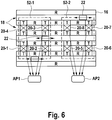
- 6 ein Blockdiagramm in Draufsicht zur Verdeutlichung einer Zuordnung von Vertikalförderern zu Arbeitsplätzen;
- 7 eine Draufsicht (7A) auf eine FTF-Ebene zur Verdeutlichung möglicher Fahrwege und eine Draufsicht (7B) auf eine Topologie zur Verdeutlichung möglicher Segmente;
- 8 zeigt eine Seitenansicht eines Systems (8A) zum Be- und Entladen von Stückgütern und eine Seitenansicht eines Systems (8B) zum Be- und Entladen von Stückgütern gemäß der Erfindung;
- 9 zeigt eine perspektivische Ansicht einer Beladestation und einer Entladestation, die eine Materialflussverbindung zwischen einem FTS und Stetigförderern herstellen;
- 10 eine perspektivische Ansicht einer Pufferstation;
- 11 eine perspektivische Ansicht eines Arbeitsplatzes; und
- 12 ein Flussdiagramm.
Exemplary embodiments of the invention are shown in the drawing and are explained in more detail in the following description. Show it: - 1 a block diagram of a storage and picking system;
- 2 an AGV with attachment ( 2A) and an AGV without attachment ( 2 B) ;
- 3 a material flow computer architecture;
- 4th a perspective view of an AGV level below a shelf arrangement;
- 5 a plan view of part of an FTF level;
- 6th a block diagram in plan view to illustrate an assignment of vertical conveyors to workplaces;
- 7th a top view ( 7A) on an AGV level to illustrate possible routes and a top view ( 7B) a topology to illustrate possible segments;
- 8th shows a side view of a system ( 8A) for loading and unloading piece goods and a side view of a system ( 8B) for loading and unloading piece goods according to the invention;
- 9 shows a perspective view of a loading station and an unloading station which establish a material flow connection between an AGV and continuous conveyors;
- 10 a perspective view of a buffer station;
- 11 a perspective view of a work station; and
- 12th a flow chart.
Wenn im Nachfolgenden von vertikalen bzw. horizontalen Orientierungen gesprochen wird, versteht es sich von selbst, dass Elemente, die mit diesen Orientierungen verknüpft sind, jederzeit durch eine entsprechende Drehung miteinander vertauscht werden können, so dass derartige Orientierungen nicht einschränkend zu verstehen sind.If vertical or horizontal orientations are spoken of in the following, it goes without saying that elements that are linked to these orientations can be exchanged with one another at any time by a corresponding rotation, so that such orientations are not to be understood as restrictive.
Wie in der (Intra-)Logistik üblich, werden in Lager- und Kommissioniersystemen (Distributionsanlagen, Materialhandhabungsanlagen, etc.) eine Längsrichtung mit „X“, eine Querrichtung mit „Z“ und eine Höhenrichtung mit „Y“ bezeichnet. Die Richtungen X, Y und Z definieren vorzugsweise ein kartesisches Koordinatensystem.As is common in (intra) logistics, in storage and order-picking systems (distribution systems, material handling systems, etc.), a longitudinal direction is designated with “X”, a transverse direction with “Z” and a height direction with “Y”. The directions X, Y and Z preferably define a Cartesian coordinate system.
Unter einer Lageranordnung bzw. einer Regalanordnung 14 wird nachfolgend eine Vielzahl von Regalen 16 verstanden, die meist parallel in Form von Einzelregalen oder Doppelregalen angeordnet sind. Doppelregale sind Einzelregale, die Rücken an Rücken aufgestellt sind. Die Regale 16 erstrecken sich im Wesentlichen längs. Regalgassen 18 sind quer zwischen den Regalen 16 definiert und dienen als Aktionsraum für Regalbediengeräte 22 und Artikeltransfers. Die Regale 16 enden an sich jeweils gegenüberliegenden (kurzen) Stirnseiten, die wiederum in einer Ebene senkrecht zur Längsrichtung bzw. zu den (langen) Längsseiten der Regale 16 und zu den Regalgassen 18 orientiert sind. Die Regale 16 selbst weisen eine Vielzahl von (Regal-)Lagerplätzen bzw. Stellplätzen R auf, die in übereinanderliegenden Regalebenen angeordnet sind. Eine Regalzeile erstreckt sich in der horizontalen Richtung innerhalb eines Lagers und weist üblicherweise viele Lager- bzw. Stellplätze R übereinander und nebeneinander auf.Under a storage arrangement or a shelf arrangement 14th is followed by a variety of shelves 16 understood, which are usually arranged in parallel in the form of single shelves or double shelves. Double shelves are single shelves that are set up back to back. The shelves 16 extend essentially longitudinally. Shelf aisles 18th are across between the shelves 16 defined and serve as an action space for storage and retrieval machines 22nd and article transfers. The shelves 16 end at opposite (short) front sides, which in turn are in a plane perpendicular to the longitudinal direction or to the (long) longitudinal sides of the shelves 16 and to the shelf aisles 18th are oriented. The shelves 16 themselves have a large number of (shelf) storage spaces or parking spaces R. which are arranged in stacked shelf levels. A row of racks extends in the horizontal direction within a warehouse and usually has many storage spaces R. one above the other and side by side.
Unter einem „Artikel“ wird nachfolgend eine Lager- und/oder Kommissioniereinheit innerhalb eines Lager- und Kommissioniersystems 10 verstanden. Die Lagereinheit, die auch als Lagergut bezeichnet wird, kann ein Lagerladehilfsmittel sowie den Artikel selbst umfassen. Die Lagereinheit kann aber auch nur den Artikel umfassen, wenn man das Lagerladehilfsmittel weglässt. Als Lagerladehilfsmittel werden üblicherweise Ladehilfsmittel eingesetzt, wie z.B. Paletten, Gitterboxen, Container, Behälter, Kartons, Tablare, (Hänge-)Taschen und Ähnliches. Unter einem „Artikel“ ist insbesondere ein Stückgut zu verstehen. Die Artikel sind durch einen Artikeltyp unterscheidbare (kleinste) Einheiten eines Artikelsortiments. Stückgüter sind individualisierte, unterscheidbare Artikel, die einzeln gehandhabt werden können und deren Bestand stückweise oder als Gebinde (Case) geführt wird. Ein „Gebinde“ ist ein allgemeiner Begriff für eine handhabbare Ladeeinheit, die manuell oder mittels technischem Gerät (z.B. Fördertechnik, Regalbediengerät, Lastaufnahmemittel, etc.) bewegt werden kann. Auch eine Untermenge einer Ladeeinheit, z.B. ein Getränkekasten auf einer voll mit Getränkekästen beladenen Palette, wird als Gebinde bezeichnet. Die Begriffe „Artikel“, „Gebinde“, „Lagergut“ und „Stückgut“ werden nachfolgend gleichwertig verwendet.An “article” is hereinafter referred to as a storage and / or order-picking unit within a storage and order-picking system 10 Understood. The storage unit, which is also referred to as storage goods, can comprise a storage loading aid and the article itself. However, the storage unit can also only include the article if the storage loading aid is omitted. Load aids such as pallets, lattice boxes, containers, totes, cardboard boxes, trays, (hanging) bags and the like are usually used as storage loading aids. An “article” includes, in particular, piece goods to understand. The articles are (smallest) units of an article range that can be distinguished by an article type. Piece goods are individualized, distinguishable items that can be handled individually and whose inventory is managed in pieces or as a case. A “container” is a general term for a manageable loading unit that can be moved manually or by means of a technical device (eg conveyor technology, storage and retrieval device, load handling equipment, etc.). A subset of a loading unit, for example a beverage crate on a pallet fully loaded with beverage crates, is also referred to as a container. The terms “article”, “container”, “stored goods” and “piece goods” are used equally in the following.
Die Begriffe „Regalplatz“, „Lagerplatz“, „Stellplatz“, „Palettenplatz“ und „Speicherplatz“ werden äquivalent benutzt. Mit diesen „Plätzen“ sind Orte innerhalb des Systems 10 gemeint, wo die Artikel bevorratet werden. Ein „Regalplatz“ ist ein Ort, wo die Artikel innerhalb einer Lagereinrichtung (auch langfristig) zum Zwecke einer Kommissionierung bereitgehalten werden. Ein „Transferplatz“ ist ein Regalplatz, der benachbart zu einem Vertikalförderer angeordnet ist. Der Transferplatz dient einer vorübergehenden Pufferung eines oder mehrerer Artikel und ist materialflusstechnisch mit dem entsprechenden Vertikalförderer verbunden, um den oder die Artikel mit dem Vertikalförderer auszutauschen. Der Transferplatz dient einer Entkopplung der Vertikalförderer von Regalbediengeräten. Die Vertikalförderer müssen für einen Artikeltransfer nicht auf die Regalbediengeräte warten und umgekehrt.The terms “shelf space”, “storage space”, “storage space”, “pallet space” and “storage space” are used equivalently. These “places” are places within the system 10 means where the articles are stored. A “shelf space” is a place where the articles are kept ready within a storage facility (even for a long time) for the purpose of order picking. A “transfer station” is a shelf space that is arranged adjacent to a vertical conveyor. The transfer station is used for temporary buffering of one or more articles and is connected to the corresponding vertical conveyor in terms of material flow in order to exchange the article or articles with the vertical conveyor. The transfer station is used to decouple the vertical conveyors from the storage and retrieval machines. The vertical conveyors do not have to wait for the stacker cranes to transfer an item and vice versa.
Bei der Erfindung können verschiedene Typen von Förderern zum Einsatz kommen (z.B. Rollenförderer, Gurtförderer, Kettenförderer, Hängeförderer, Riemenförderer, Bandförderer, etc.). Die Begriffe „Förderer“ und „Fördertechnik“ werden nachfolgend äquivalent benutzt. Eine Fördertechnik umfasst im Wesentlichen alle technischen und organisatorischen Einrichtungen (z.B. Antriebe, Sensoren, Weichen, Steuerungselemente, etc.) zum Bewegen oder Transportieren von Fördergütern (d.h. Artikeln) und zum Lenken von Materialströmen.Various types of conveyors can be used in the invention (e.g. roller conveyors, belt conveyors, chain conveyors, overhead conveyors, belt conveyors, belt conveyors, etc.). The terms "conveyor" and "conveyor technology" are used equivalently in the following. Conveyor technology essentially comprises all technical and organizational equipment (e.g. drives, sensors, switches, control elements, etc.) for moving or transporting conveyed goods (i.e. articles) and for directing material flows.
Des Weiteren arbeitet die vorliegende Erfindung im Wesentlichen nach dem Prinzip „Ware zum Mann“. Bei dem „Ware-zum-Mann“-Prinzip werden die zu kommissionierenden Artikel zu einer Bedienperson hin transportiert, damit die Bedienperson, die nachfolgend auch als „Kommissionierer“ bezeichnet werden wird, aus Gründen einer besseren Ergonomie möglichst wenig bis gar nicht laufen muss, um einen Kommissioniervorgang (auftragsorientiertes Greifen und Abgeben von Artikeln) durchzuführen. Die zu kommissionierenden Artikel werden mittels den Ladehilfsmitteln innerhalb des Systems 10 transportiert, insbesondere von und zu Pick-Stationen (d.h. Kommissionierarbeitsplätzen) und Vertikalförderern 20.Furthermore, the present invention works essentially according to the “goods to man” principle. In the "goods-to-man" principle, the items to be picked are transported to an operator so that the operator, who is also referred to as the "picker" in the following, has to walk as little or not at all for reasons of better ergonomics. to carry out a picking process (order-oriented picking and dispensing of articles). The items to be picked are stored in the system using the loading aids 10 transported, in particular from and to pick stations (ie picking workstations) and vertical conveyors 20th .
Ein (Kommissionier-) „Auftrag‟ besteht aus einer oder mehreren Auftragspositionen, die auch als Auftragszeilen bezeichnet werden. Eine Auftragszeile gibt eine jeweilige Menge (Stückzahl) eines Artikeltyps an, den ein Kunde bestellt hat.A (picking) "order" consists of one or more order items, which are also referred to as order lines. An order line specifies a respective quantity (number of pieces) of an article type that a customer has ordered.
1 zeigt ein Blockdiagramm eines Lager- und Kommissioniersystems 10, das z.B. als Distributionsanlage eines Einzelhändlers oder eines Online-Händlers verwendet werden kann. Das Lager- und Kommissioniersystem 10 wird nachfolgend auch kurz als „System 10“ bezeichnet werden. 1 Figure 3 shows a block diagram of a storage and picking system 10 that can be used, for example, as a distribution system by a retailer or an online retailer. The storage and picking system 10 will also be referred to as "System 10" for short in the following.
Das System 10 weist einen Wareneingang WE sowie einen Warenausgang WA auf. Ein Materialfluss 12 innerhalb und außerhalb des Systems 10 ist durch Pfeile verdeutlicht. Der Materialfluss 12 erfolgt innerhalb des Systems 10 vorzugsweise unter Einsatz von Regalbediengeräten 22, Vertikalförderern 20 und einem fahrerlosen Transportsystem (FTS). Gegenfalls wird auch konventionelle Fördertechnik eingesetzt.The system 10 indicates a goods receipt WE as well as a goods issue WA on. A flow of material 12th inside and outside the system 10 is indicated by arrows. The material flow 12th takes place within the system 10 preferably using storage and retrieval machines 22nd , Vertical conveyors 20th and a driverless transport system (AGV). If necessary, conventional conveyor technology is also used.
Zwischen dem Wareneingang WE und dem Warenausgang WA der 1 ist eine Regalanordnung 14 mit mehreren Regalen 16 vorgesehen, die zwischen sich (Regal-)Gassen 18 definieren. Die Regale 16 erstrecken sich im Wesentlichen in der Längsrichtung X und sind in der Querrichtung Z zueinander beabstandet. Der Materialfluss 12 in der Höhenrichtung Y (senkrecht zur Zeichnungsebene) erfolgt innerhalb der Regalanordnung 14 im Wesentlichen mittels Vertikalförderern 20. Die Vertikalförderer 20 werden auch als Lifte bezeichnet. Dabei handelt es sich vorzugsweise um Stetigförderer, die den Materialfluss 12 ausschließlich in der vertikalen Richtung Y durchführen. Die Vertikalförderer 20 sind stationär, d.h. sie bewegen sich nicht relativ zu den Regalen 16. Die Vertikalförderer 20 können außerhalb und innerhalb der Regale 16 angeordnet sein. Bei einer Anordnung innerhalb der Regale 16 spricht man von Regal-integrierten Vertikalförderern 20. Eine entsprechende Regalanordnung 14 mit Regal-integrierten Vertikalförderern 20 ist exemplarisch in der WO 2012/113681 beschrieben, auf die diesbezüglich Bezug genommen wird. Derartige Regal-integrierte Vertikalförderer 20 sind in der 1, insbesondere in den ersten drei Regalen 16 von links gezeigt. Neben den Regal-integrierten Vertikalförderern 20 können ergänzend und/oder alternativ weitere Vertikalförderer 20 innerhalb der Regalgassen 18 vorgesehen sein. Eine derartige Anordnung ist exemplarisch in der WO 2007/134840 A1 beschrieben, auf die diesbezüglich Bezug genommen wird. In der 1 ist die zweite Regalgasse 18 von rechts sehr breit gewählt. Diese Regalgasse 18 kann in Z schmaler ausgelegt werden, so dass jeder der Vertikalförderer 20 an beide Regale 16 links und rechts angrenzt. Die Zwischenräume in X können mit Regalplätzen R aufgefüllt werden.Between incoming goods WE and outgoing goods WA the 1 is a shelf arrangement 14th with multiple shelves 16 provided which define (shelf) lanes 18 between them. The shelves 16 extend essentially in the longitudinal direction X and are spaced apart from one another in the transverse direction Z. The material flow 12th in the height direction Y (perpendicular to the plane of the drawing) takes place within the shelf arrangement 14th essentially by means of vertical conveyors 20th . The vertical conveyor 20th are also known as lifts. These are preferably continuous conveyors that control the flow of material 12th perform in the vertical direction Y only. The vertical conveyor 20th are stationary, meaning they don't move relative to the shelves 16 . The vertical conveyor 20th can be outside and inside the shelves 16 be arranged. When arranged within the shelves 16 one speaks of shelf-integrated vertical conveyors 20th . A corresponding shelf arrangement 14th with shelf-integrated vertical conveyors 20th is exemplary in the WO 2012/113681 described, to which reference is made in this regard. Such shelf-integrated vertical conveyors 20th are in the 1 , especially on the first three shelves 16 shown from left. In addition to the shelf-integrated vertical conveyors 20th additional vertical conveyors can be used in addition and / or as an alternative 20th within the shelf aisles 18th be provided. Such an arrangement is exemplified in WO 2007/134840 A1 described, to which reference is made in this regard. In the 1 is the second shelf aisle 18th chosen very broadly from the right. This shelf aisle 18th can be designed narrower in Z, so that each of the vertical conveyors 20th to both shelves 16 adjoins left and right. The spaces in X can be filled with shelf spaces R. be replenished.
In der Regalanordnung 14 sind den Regalen 16 immer mehrere Vertikalförderer 20 zugeordnet, die entweder innerhalb der Regale 16 oder in den Regalgassen 18 über die Längsrichtung X verteilt, angeordnet sind. Die (materialflusstechnische) Zuordnung kann aber auch über eine Regalgasse 18 hinweg erfolgen, wie es exemplarisch für das Regal 16 der 1 gezeigt ist, das am weitesten rechts angeordnet ist. In und an dem am weitesten rechts angeordneten Regal 16 der 1 ist überhaupt kein Vertikalförderer 20 angeordnet. Die materialflusstechnische Anbindung erfolgt über das oder die Regalbediengeräte 22 an das links daneben angeordnete Regal 16.In the shelf arrangement 14th are the shelves 16 always several vertical conveyors 20th assigned to either inside the shelves 16 or in the aisles 18th distributed over the longitudinal direction X, are arranged. The (material flow technical) assignment can also be done via a rack aisle 18th take place, as exemplified by the shelf 16 the 1 which is located furthest to the right is shown. In and on the shelf furthest to the right 16 the 1 is not a vertical conveyor at all 20th arranged. The material flow connection is made via the storage and retrieval system (s) 22nd to the shelf next to it on the left 16 .
Die Regalbediengeräte 22 (nachfolgend auch „RBG“ genannt) holen nicht näher bezeichnete und gezeigte Lagergüter bzw. Artikel aus den Regalplätzen R in den Regalen 16 ab, oder lagern sie in die Regalplätze R in den Regalen 16 ein. Zu diesem Zweck verfügen die RBG 22 über nicht näher bezeichnete und gezeigte Lastaufnahmemittel (nachfolgend auch „LAM“ genannt), mit denen die Lagergüter bzw. Artikel zwecks Ein- und Auslagerung im Wesentlichen in der Z-Richtung bewegt werden. Die RBG 22 bewegen sich im Wesentlichen innerhalb der Regalgassen 18 und dienen dem Materialfluss 12 in der X-Richtung innerhalb der Regalanordnung 14. Wenn die RBG 22 über hier nicht näher gezeigte und bezeichnete Maste verfügen, decken die RBG 22 den Materialfluss 12 auch in der Höhenrichtung Y ab. Die Regale 16 können vertikal modular aufgebaut sein, wobei pro Modul mindestens ein RBG 22 vorgesehen ist. Die RBG 22 fahren in der Regel schienengeführt. Entsprechende Schienen sind nicht dargestellt.The storage and retrieval machines 22nd (hereinafter also referred to as "SRM") fetch storage goods or items that are not shown in detail from the shelves R. in the shelves 16 or store them in the shelves R. in the shelves 16 on. For this purpose, the RBG 22nd Via unspecified and shown load handling devices (hereinafter also referred to as "LAM"), with which the stored goods or articles are moved essentially in the Z direction for the purpose of storage and retrieval. The RBG 22nd move essentially within the rack aisles 18th and serve the material flow 12th in the X direction within the shelf arrangement 14th . When the RBG 22nd have masts that are not shown and designated here, cover the SRM 22nd the material flow 12th also in the height direction Y from. The shelves 16 can have a vertical modular structure, with at least one storage and retrieval machine per module 22nd is provided. The RBG 22nd usually run on rails. Corresponding rails are not shown.
Ohne Mast und ohne Hubfunktion bedienen die RBG 22 nur eine einzige Regalebene. Man spricht in diesem Fall von Einebenen-Regalbediengeräten, die auch als Shuttle (ohne Hubfunktion) bezeichnet werden. Alle RBG-Typen können verwendet werden.The storage and retrieval machines operate without a mast and without a lifting function 22nd only one shelf level. In this case, one speaks of single-level storage and retrieval machines, which are also referred to as shuttles (without lifting function). All types of SRM can be used.
Generell gilt, dass sich die RBG 22 vorzugsweise nur innerhalb der Regalanordnung 14 bewegen. Der Materialfluss 12 außerhalb der Regalanordnung 14, z.B. von und zu (Kommissionier-)Arbeitsplätzen AP, erfolgt im Wesentlichen mittels autonomen, fahrerlosen Transportfahrzeugen 28 (nachfolgend auch als „FTF“ bezeichnet), die in der Intralogistik auch als „Shuttle“ bezeichnet werden. Diese FTF bzw. Shuttle 28 bewegen sich außerhalb der Regalanordnung 14 in einer FTF-Ebene 24, die eine Fahr- bzw. Aktionsfläche 26 aufweist.In general, the RBG 22nd preferably only within the shelf arrangement 14th move. The material flow 12th outside the shelf arrangement 14th , e.g. from and to (picking) workplaces AP , takes place mainly by means of autonomous, driverless transport vehicles 28 (hereinafter also referred to as "AGV"), which are also referred to as "shuttle" in intralogistics. This AGV or shuttle 28 move outside the shelf arrangement 14th in one AGV level 24 that have a driving or action area 26th having.
In der 1 sind exemplarisch zwei Arbeitsplätze AP1 und AP2 gezeigt. Die Arbeitsplätze AP sind vorzugsweise entlang der oder den Längsseiten der Regalanordnung 14 in der FTF-Ebene 24 angeordnet, so dass der Materialfluss 12 zu den Arbeitsplätzen mittels der FTF 28 im Wesentlichen in der Querrichtung Z erfolgt. Es können mehr oder weniger Arbeitsplätze AP vorgesehen werden. Die Arbeitsplätze AP sind in der Fläche 26 angeordnet und über die FTF 28 materialflusstechnisch an die Regalanordnung 14 gekoppelt. Die FTF-Ebene 24 kann, vorzugsweise in Form einer einzigen flachen, horizontalen Ebene unterhalb, oberhalb oder innerhalb der Regalanordnung 14 vorgesehen sein. Die FTF-Ebene 24 ist materialflusstechnisch über die Vertikalförderer 20 mit den Regalen 16 verbunden.In the 1 two workplaces AP1 and AP2 are shown as examples. The workplaces AP are preferably along the long side or sides of the shelf arrangement 14th at the AGV level 24 arranged so that the flow of material 12th to the workplaces by means of the AGV 28 takes place essentially in the transverse direction Z. There can be more or fewer jobs AP are provided. The workplaces AP are in the area 26th arranged and via the AGV 28 material flow to the shelf arrangement 14th coupled. The AGV level 24 can, preferably in the form of a single flat, horizontal plane below, above or within the shelf arrangement 14th be provided. The AGV level 24 is material flow via the vertical conveyor 20th with the shelves 16 connected.
Im Fall einer Kommissionierung an einem der Arbeitsplätze AP1 oder AP2 lagern die RBG 22 die entsprechenden Artikel auftragsorientiert aus den Regalplätzen R aus, transportieren die ausgelagerten Artikel im Wesentlichen horizontal zu Transferplätzen T, die gegenüberliegend zu den Vertikalförderern 20 innerhalb der Regale 16 anstatt von Regalplätzen R angeordnet sind und die zum Austauschen der Artikel mit den Vertikalförderern 20 eingerichtet sind. Die Vertikalförderer 20 holen die auf den Transferplätzen T, vorzugsweise doppeltief, gepufferten Artikel ab und transportieren sie in der vertikalen Richtung Y in die FTF-Ebene 24. In der FTF-Ebene 24 werden die von den Vertikalförderern 20 bereitgestellten Artikel an die FTF 28 abgegeben, die die abgegebenen Artikel wiederum zu den entsprechenden Zielstellen, nämlich z.B. den Arbeitsplätzen AP1 und/oder AP2 fahren. Entsprechende Fahrwege (Routen im navigationstechnischen Sinne) werden auftrags- und sequenzorientiert von einem Flottenmanager FM (Steuerungssoftware inkl. entsprechender Hardware) bestimmt und individuell an die FTF 28 kommuniziert. Der Flottenmanager FM kann Teil eines übergeordneten Materialflussrechners MFR (Hard- und Software) sein, der wiederum Teil eines Lagerverwaltungsrechners (Hard- und Software) LVR sein kann. In der 1 sind diese Steuerungskomponenten FM, MFR und LVR als voneinander unabhängige, separate Komponenten gezeigt.In the case of picking at one of the workstations AP1 or AP2, the storage and retrieval machines are stored 22nd the corresponding articles order-oriented from the shelf spaces R. out, transport the outsourced articles essentially horizontally to transfer locations T that are opposite to the vertical conveyors 20th inside the shelves 16 instead of shelf space R. are arranged and for exchanging the articles with the vertical conveyors 20th are set up. The vertical conveyor 20th pick them up at the transfer stations T , preferably double-deep, buffered articles and transport them in the vertical direction Y into the AGV level 24 . At the AGV level 24 are those of the vertical conveyors 20th provided articles to the AGV 28 released, which in turn drive the released articles to the corresponding target locations, namely, for example, the workplaces AP1 and / or AP2. Corresponding routes (routes in the sense of navigation technology) are order and sequence-oriented by a fleet manager FM (Control software including corresponding hardware) determined and individually to the AGV 28 communicates. The fleet manager FM can be part of a higher-level material flow computer MFR (Hardware and software), which in turn is part of a warehouse management computer (hardware and software) LVR can be. In the 1 are these control components FM , MFR and LVR shown as independent, separate components.
Die 2A und 2B zeigen perspektivische Ansichten einer ersten Ausführungsform eines FTF 28. 2A zeigt ein FTF 28, welches zum Arbeiten in Hüfthöhe eines Kommissioniers geeignet ist, indem zwischen einem eigentlichen Fahrzeug 30 und einer z.B. lamellenförmigen (Artikel-)Aufnahme 32 ein (Erhöhungs-)Aufsatz 34 vorgesehen ist, so dass sich eine Oberseite der Aufnahme 32 in einer Höhe von ca. 700 mm befindet. In der 2B ist das gleiche Fahrzeug 30 mit einer Artikelaufnahme 32, aber ohne Aufsatz 34 gezeigt.the 2A and 2 B show perspective views of a first embodiment of an AGV 28 . 2A shows an AGV 28 , which is suitable for working at waist height of an order picker by between an actual vehicle 30th and a lamellar (article) receptacle 32, for example, a (elevation) attachment 34 is provided so that an upper side of the receptacle 32 is located at a height of approx. 700 mm. In the 2 B is the same vehicle 30th with an article recording 32 , but without an attachment 34 shown.
Generell handelt es sich bei den FTF 28 um automatisiert geführte Fahrzeuge, die Transportaufgaben in dem System 10 schnell, billig und skalierbar lösen. Die FTF 28 bewegen sich vorzugsweise entlang einem vordefinierten Transportnetzwerk, welches z.B. durch schwarze Linien ausgebildet ist, die auf einen Boden der Fläche 26 geklebt oder gemalt sind (siehe auch 4). Entlang dieses Transportnetzwerks können bspw. mehrere RFID-Marker als Implementierung von Wegpunkten 44 vorgesehen werden, die exemplarisch in 5 gezeigt sind. Eine Linie zwischen zwei benachbarten Wegpunkten 44 wird nachfolgend als Segment 46 bezeichnet. Es versteht sich die Segmente 46 auch in Form von virtuellen Verbindungslinien realisiert sein können, z.B. wenn ein internes GPS- oder Laser-Navigationssystem eingesetzt wird. Analoges gilt für die Wegpunkte 44. Die geometrische Abmessung der Fläche 26, die Wegpunkte 44 und die Segmente 46 definieren eine Topologie der FTF-Ebene 24. Diese Topologie ist als „Karte“ der FTF-Ebene 24 ggf. einschließlich Ortbeschreibungen der Vertikalförderer 20, Regalsteher und sonstiger (Fahr-)Hindernisse zu verstehen.Generally speaking, these are AGVs 28 to automated guided vehicles, the transport tasks in the system 10 fast, cheap and solve scalable. The AGV 28 preferably move along a predefined transport network, which is formed, for example, by black lines that point to a floor of the surface 26th are glued or painted (see also 4th ). For example, several RFID markers can be used to implement waypoints along this transport network 44 are provided, which are exemplified in 5 are shown. A line between two adjacent waypoints 44 is hereinafter referred to as a segment 46 designated. It goes without saying the segments 46 can also be implemented in the form of virtual connecting lines, for example if an internal GPS or laser navigation system is used. The same applies to the waypoints 44 . The geometric dimension of the area 26th who have favourited waypoints 44 and the segments 46 define a topology of the AGV level 24 . This topology is a "map" of the AGV level 24 possibly including descriptions of the locations of the vertical conveyors 20th To understand shelf supports and other (driving) obstacles.
Die FTF 28 können Artikel puffern sowie von und zu vorgegebenen Stationen (z.B. den Arbeitsplätzen AP) hin transportieren oder von dort abholen. Eine Be- und Entladung der FTF 28 erfolgt vorzugsweise passiv. Dies bedeutet z.B., dass die FTF 28 keine Sensoren zum Identifizieren des Artikels oder zum aktiven Initiieren von Be- und Entladevorgängen aufweist. Eine passive Be- und Entladung z.B. unter Verwendung von Rampen, wird nachfolgend unter Bezugnahme auf 8ff noch näher beschrieben werden.The AGV 28 can buffer articles as well as from and to specified stations (e.g. the workstations AP ) transport to or pick up from there. Loading and unloading the AGV 28 preferably takes place passively. This means, for example, that the AGV 28 has no sensors to identify the article or to actively initiate loading and unloading processes. Passive loading and unloading, for example using ramps, is described below with reference to FIG 8ff to be described in more detail.
Exemplarische FTF 28 sowie deren Komponenten und Steuerungsverfahren sind in der DE 10 2012 023 999 A1 , DE 20 2013 010 696 U1 und DE 10 2012 006 738 A1 beschrieben, auf die hier Bezug genommen wird.Exemplary AGV 28 as well as their components and control procedures are in the DE 10 2012 023 999 A1 , DE 20 2013 010 696 U1 and DE 10 2012 006 738 A1 which are incorporated herein by reference.
Eine Gruppe von zusammengehörigen FTF 28 in dem gemeinsamen Transportnetzwerk wird nachfolgend auch als Flotte bezeichnet. Eine Flottensteuerung (Erzeugen, Vergeben und Kontrollieren von FTF-Fahraufträgen) erfolgt durch den Flottenmanager FM. Die Flottensteuerung kann z.B. als separate Java-Anwendung ausgeführt sein, die über TCP (WiFi) mit den FTF 28 verbunden ist und die über ein anderes, vorzugsweise proprietäres, Kommunikationsprotokoll (LAN) mit dem Materialflussrechner MFR verbunden ist. Darauf wird später noch näher eingegangen werden.A group of related AGVs 28 in the common transport network is also referred to below as a fleet. The fleet manager controls the fleet (generation, assignment and control of AGV driving orders) FM . The fleet control can, for example, be implemented as a separate Java application that connects to the FTF via TCP (WiFi) 28 is connected and via another, preferably proprietary, communication protocol (LAN) with the material flow computer MFR connected is. This will be discussed in more detail later.
Jedes der FTF 28 kann eine oder mehrere der nachfolgend genannten Komponenten aufweisen: eine Kamera, um den schwarzen Linien des Transportnetzwerks zu folgen; einen Abstandssensor zum Erfassen von Hindernissen oder anderen FTF 28 in der Umgebung; ein WiFi-Modul zum Kommunizieren mit dem Flottenmanager FM; einen austauschbaren (Energie-)Akkumulator; einen Mikrocomputer bzw. Mikrocontroller für eine lokale Fahrzeugsteuerung; ein Speicher-Modul zum Hinterlegen von Informationen z.B. zur Topologie und von Fahraufträgen; und/oder ein RFID-Lesegerät zum Erfassen der Wegpunkte 44. Die Wegpunkte 44 können auch als QR-Codes realisiert sein. Die Energieversorgung kann alternativ über PowerCaps erfolgen, die an Austauschstationen ausgetauscht werden können, wobei zusätzlich auch induktive Ladestationen eingesetzt werden können.Each of the AGVs 28 may have one or more of the following components: a camera to follow the black lines of the transport network; a distance sensor to detect obstacles or other AGVs 28 in the neighborhood; a WiFi module for communicating with the fleet manager FM ; a replaceable (energy) accumulator; a microcomputer or microcontroller for local vehicle control; a memory module for storing information, for example on the topology and driving orders; and / or an RFID reader for capturing the waypoints 44 . The waypoints 44 can also be implemented as QR codes. The energy supply can alternatively take place via PowerCaps, which can be exchanged at exchange stations, whereby inductive charging stations can also be used.
Jedes der FTF 28 ist eingerichtet, den schwarzen Linien zu folgen und einen minimal erforderlichen Abstand zu anderen, insbesondere vorausfahrenden, FTF 28 einzuhalten. Während eines Betriebs empfangen die FTF 28 jeweils eine Liste von Segmenten 46 vom Flottenmanager FM, die nacheinander passiert werden müssen und die einen oder mehrere FTF-spezifische Fahraufträge bzw. Fahrwege definieren. Für jedes der FTF 28 wird ein individueller Fahrweg bzw. eine Route durch den Flottenmanager FM berechnet. Jedes der FTF 28 hat Kenntnis von der Topologie des Transportnetzwerks, z.B. um von einem Wegpunkt 44 zu einem benachbarten Wegpunkt 44 gemäß spezifisch ausgewählten Segmenten 46 zu fahren, oder um eine Fahrzeit zu berechnen, oder an vorbestimmten Positionen anzuhalten. Zu diesem Zweck wird die Topologie des Transportnetzwerks vom Flottenmanager FM an die FTF 28 vorzugsweise während eines Systemstarts übermittelt.Each of the AGVs 28 is set up to follow the black lines and maintain a minimum required distance from other AGVs, especially those in front 28 to be observed. The AGVs receive during operation 28 a list of segments each 46 from the fleet manager FM that have to be passed one after the other and that define one or more AGV-specific driving orders or routes. For each of the AGVs 28 becomes an individual travel route or route by the fleet manager FM calculated. Each of the AGVs 28 has knowledge of the topology of the transport network, e.g. around a waypoint 44 to an adjacent waypoint 44 according to specifically selected segments 46 to drive, or to calculate a travel time, or to stop at predetermined positions. For this purpose, the topology of the transport network is determined by the fleet manager FM to the FTF 28 preferably transmitted during a system start.
3 zeigt allgemein eine Architektur der FTF 28 und deren Steuerung. Der Materialflussrechner MFR ist ein gewöhnliches Steuersystem, um Transporte in einem Lager unter Verwendung unterschiedlicher Hardware-Systeme zu organisieren. Der Materialflussrechner MFR kommuniziert über ein (vorzugsweise proprietäres) Kommunikationsprotokoll 36 mit dem Flottenmanager FM. Jedes der FTF 28 wird einem Flottenmanager FM zugewiesen, wobei jedes Transportnetzwerk vorzugsweise von einem eigenen Flottenmanager FM gesteuert wird. Es versteht sich, dass mehrere Flottenmanager FM parallel in einem System 10 betrieben werden können. Dann gibt es aber auch mehrere Flotten von FTF 28. 3 generally shows an architecture of the AGV 28 and their control. The material flow computer MFR is a common control system to organize transports in a warehouse using different hardware systems. The material flow computer MFR communicates via a (preferably proprietary) communication protocol 36 with the fleet manager FM . Each of the AGVs 28 becomes a fleet manager FM assigned, each transport network preferably by its own fleet manager FM is controlled. It is understood that several fleet managers FM in parallel in one system 10 can be operated. But then there are also several FTF fleets 28 .
Der Flottenmanager FM repräsentiert allgemein ein Steuerungsmodul für alle FTF 28 im Transportnetzwerk. Der FM ist auch für eine Ausführung und Bestätigung von Transportaufträgen bzw. FTF-spezifischen Fahraufträgen im Transportnetzwerk verantwortlich. Die Transportaufträge erhält der FM vom MFR. Nach Erhalt der Transportaufträge wählt der FM geeignete FTF 28 aus, berechnet Fahrwege bzw. Routen und sendet die entsprechenden Listen der benötigten Segmente 46 als FTF-Fahraufträge an die ausgewählten FTF 28. Herstellerseitig sind die FTF 28 nicht mit Informationen zu einem Projektspezifischen Lager-Layout (Regalanordnung 14) versehen. Die erforderliche Information zur Topologie des Transportnetzwerks wird vom FM an jedes der FTF 28 z.B. während einer Konfigurationsphase übertragen. FTF-Fahraufträge und FTF-Konfigurationen werden z.B. über die TCP-Verbindung übertragen.The fleet manager FM generally represents a control module for all AGVs 28 in the transport network. the FM is also responsible for the execution and confirmation of transport orders or AGV-specific driving orders in the transport network. The transport orders are sent to the FM from the MFR . After receiving the transport orders, the FM suitable AGV 28 from, calculates routes or routes and sends the corresponding lists of the required segments 46 as AGV driving orders to the selected AGV 28 . The AGVs are provided by the manufacturer 28 not with information on a project-specific warehouse layout (shelf arrangement 14th ) Mistake. The information required for The topology of the transport network is determined by the FM to each of the AGVs 28 eg transferred during a configuration phase. AGV drive orders and AGV configurations are transmitted via the TCP connection, for example.
Eine Integration eines der FTF 28 in eine Flottensteuerung stellt einen separaten Vorgang dar. Zu diesem Zweck werden alle relevanten FTF-Parameter definiert. Entsprechende Dateien werden automatisch gelesen, wenn der FM gestartet wird. Des Weiteren werden Projekt-spezifische Netzwerkparameter an die FTF 28 übertragen. Diese Datei enthält eine Liste aller eingesetzter FTF 28 und definiert alle erforderlichen Parameter für jedes der FTF 28. Die nachfolgenden Daten können in den entsprechenden Dateien enthalten sein: eine herstellerseitig vorgesehene eindeutige Seriennummer des jeweiligen FTF 28; eine Nummer der Flotte; eine Nummer des jeweiligen FTF 28 innerhalb der Flotte; einen Heimatpunkt, z.B. ein (RFID-)Code eines Wegpunkts 44; einen Ladepunkt zum Aufladen einer Batterie der FTF 28; die IP-Netzwerkadresse des FM; ein Ladezustand; ein Störungszustand; einen Stand eines Kilometer- oder Betriebsstundenzählers; oder andere Parameter, die zur Kommunikation innerhalb des Netzwerks und zur Navigation innerhalb des Transportnetzwerks erforderlich sind.An integration of one of the AGVs 28 in a fleet control is a separate process. For this purpose, all relevant AGV parameters are defined. Corresponding files are read automatically when the FM is started. Furthermore, project-specific network parameters are sent to the AGV 28 transfer. This file contains a list of all AGVs used 28 and defines all required parameters for each of the AGVs 28 . The following data can be contained in the corresponding files: a unique serial number provided by the manufacturer of the respective AGV 28 ; a number of the fleet; a number of the respective AGV 28 within the fleet; a home point, e.g. a (RFID) code of a waypoint 44 ; a charging point for charging a battery of the AGV 28 ; the IP network address of the FM ; a state of charge; a fault condition; a reading of an odometer or operating hours counter; or other parameters required for communication within the network and for navigation within the transport network.
Das Transportnetzwerk weist die Wegpunkte 44 sowie die Segmente 46 auf, die zwei Wegpunkte 44, vorzugsweise unidirektional, miteinander verbinden. Für jeden der Wegpunkte 44 ist ein eigener ID-Code vergeben. Physisch entspricht jedes der Segmente 46 einer schwarzen Linie, die gerade oder gekrümmt ausgebildet sein kann, auf dem Boden der Fläche 26 (siehe 4 und 5). Die Topologie des Transportnetzwerks, d.h. die Anordnung und die Orte der Wegepunkte 44 und der Segmente 46 dazwischen, sind dem FM und den FTF 28 bekannt. Jedoch benötigen beide Komponenten unterschiedliche Dateiinformationen. Der FM benötigt z.B. lediglich eine logische Topologie des Transportnetzwerks, wohingegen die FTF 28 eine exakte Länge jedes Segments wissen sollten, um z.B. korrekt bei einem Ziel-Wegpunkt 44 anhalten zu können, indem die Fahrzeit und eine Wegstrecke zum Bremsen vorab berechnet werden.The transport network shows the waypoints 44 as well as the segments 46 on, the two waypoints 44 , preferably unidirectional, connect with each other. For each of the waypoints 44 a separate ID code is assigned. Physically, each of the segments corresponds 46 a black line, which can be straight or curved, on the bottom of the surface 26th (please refer 4th and 5 ). The topology of the transport network, ie the arrangement and locations of the waypoints 44 and the segments 46 in between, are that FM and the AGV 28 famous. However, both components require different file information. the FM only requires, for example, a logical topology of the transport network, whereas the AGV 28 should know the exact length of each segment, for example to be correct for a destination waypoint 44 to be able to stop by calculating the driving time and a distance to brake in advance.
Nachfolgend wird eine Schnittstelle zwischen dem FM und den FTF 28, insbesondere die Kommunikation zwischen ihnen, beschrieben.The following is an interface between the FM and the AGV 28 , especially the communication between them.
Nach einem Start oder Neustart aktiviert jedes der FTF 28 eine Weg- und Abstandsteuerung. Falls ein Weg (schwarze Linie) nicht erfassbar ist, hält das FTF 28 an, ohne sich zu bewegen. Anderenfalls folgt es der Linie bis ein erster Wegpunkt 44 (z.B. RFID-Marker) erreicht ist. Falls weitere FTF 28 oder sonstige Hindernisse auf dem Weg erfasst werden, muss das betroffene FTF 28 warten. Danach sendet das FTF eine Konfigurationsanfrage an den FM, die eine Seriennummer des FTF 28 und den RFID-Code des aktuellen Wegpunkts 44 enthält. Diese Anfrage wird solange (periodisch) wiederholt, bis der FM eine geeignete Konfiguration an das anfragende FTF 28 überträgt. Die Konfigurationsantwort des FM beinhaltet die Topologie des gesamten Transportnetzwerks sowie andere Projekt-spezifische Parameter, wie z.B. eine FTF-ID und eine Flotten-ID. Das FTF 28 speichert alle Informationen und ist dann für FTF-Fahraufträge vom FM bereit.After a start or restart, each of the AGVs is activated 28 a path and distance control. If a path (black line) cannot be recorded, the AGV stops 28 without moving. Otherwise it follows the line to a first waypoint 44 (e.g. RFID marker) has been reached. If further AGVs 28 or other obstacles on the way are detected, the AGV concerned must 28 wait. The AGV then sends a configuration request to the FM that is a serial number of the AGV 28 and the RFID code of the current waypoint 44 contains. This request is repeated (periodically) until the FM a suitable configuration for the requesting AGV 28 transmits. The configuration response of the FM includes the topology of the entire transport network as well as other project-specific parameters, such as an AGV ID and a fleet ID. The AGV 28 saves all information and is then available for AGV driving orders from FM ready.
Um eines der FTF 28 durch das Transportnetzwerk zu bewegen, sendet der FM einen FTF-Fahrauftrag an das FTF 28. Der FTF-Fahrauftrag enthält eine Auftrags-ID, die ursprünglich vom MFR kommt, sowie eine Liste der Segmente 46. Des Weiteren können optionale Parameter enthalten sein, um z.B. eine maximale Geschwindigkeit und Beschleunigung des FTF 28 festzulegen. Die Segmente 46 werden an eine aktuelle interne Route des betroffenen FTF 28 angehängt, die leer sein kann. Dies bedeutet, dass der FM die interne Route des FTF 28 erweitert. Solange eine aktuelle interne Route des FTF 28 nicht leer ist, setzt das FTF 28 seine Fahrt fort. Jedes Mal, wenn ein Wegpunkt 44 passiert wird, d.h. ein entsprechender RFID-Marker erfasst wird, entfernt das FTF 28 das erste Segment der internen Route und sendet eine FTF-Statusmeldung an den FM, die die verbleibende Route und den entsprechenden RFID-Code des letzten Wegpunkts 44 enthält. Wenn das FTF 28 das letzte Segment 46 der internen Route erreicht, verringert es automatisch seine Geschwindigkeit und hält exakt am entsprechenden Wegpunkt 44 an. Die resultierende FTF-Statusmeldung enthält dann eine leere Restroute. Der FM sendet üblicherweise immer dann einen neuen FTF-Fahrauftrag, wenn die interne Restroute nur noch maximal drei abzufahrende Segmente 46 enthält.To one of the FTF 28 to move through the transport network, the sends FM an AGV transport order to the AGV 28 . The AGV transport order contains an order ID originally from MFR comes, as well as a list of the segments 46 . Furthermore, optional parameters can be included, for example a maximum speed and acceleration of the AGV 28 to be determined. The segments 46 are transferred to a current internal route of the affected AGV 28 appended, which can be empty. This means that the FM the internal route of the AGV 28 expanded. As long as a current internal route of the AGV 28 is not empty, the AGV resumes 28 his journey continues. Every time a waypoint 44 is passed, ie a corresponding RFID marker is detected, the AGV removes it 28 the first segment of the internal route and sends an FTF status message to the FM showing the remaining route and the corresponding RFID code of the last waypoint 44 contains. When the AGV 28 the last segment 46 the internal route, it automatically reduces its speed and stops exactly at the corresponding waypoint 44 on. The resulting AGV status message then contains an empty remaining route. the FM usually sends a new AGV drive order when the internal remaining route only has a maximum of three segments to be traveled 46 contains.
Nachfolgend wird eine Schnittstelle zwischen dem FM und dem MFR beschrieben. Es wird also beschrieben, wie die Kommunikation zwischen dem FM und dem MFR abläuft. Üblicherweise erfolgt diese Kommunikation über ein (proprietäres) Kommunikationsprotokoll. Zu beachten ist, dass ein FM auch mit mehreren MFR kommunizieren kann, falls es erforderlich ist.The following is an interface between the FM and the MFR described. So it describes how the communication between the FM and the MFR expires. This communication usually takes place via a (proprietary) communication protocol. It should be noted that a FM also with several MFR can communicate if necessary.
Üblicherweise hat der MFR keine Kenntnis von der Anzahl, dem Typ oder speziellen Eigenschaften der verschiedenen FTF 28 in der Flotte. Der MFR kommuniziert lediglich mit dem FM, um eines der FTF 28 zu einem gewünschten Wegpunkt 44 zu lenken bzw. zu navigieren. Dazu muss der MFR den RFID-Code von allen relevanten Wegpunkten 44 kennen. Üblicherweise sind alle Wegpunkte 44 mit einer Beladestation oder Entladestation für die FTF 28 verknüpft, auf die nachfolgend noch näher eingegangen werden wird.Usually the MFR no knowledge of the number, type or special properties of the various AGVs 28 in the fleet. the MFR only communicates with the FM to one of the AGVs 28 to a desired waypoint 44 to steer or to navigate. To do this, the MFR the RFID code of all relevant waypoints 44 know. Usually all are waypoints 44 with a loading or unloading station for the AGV 28 linked, which will be discussed in more detail below.
Wenn der FM einen Transportauftrag vom MFR empfängt, wählt der FM automatisch ein geeignetes FTF 28 aus. Falls das FTF 28 den Ziel-Wegpunkt 44 erreicht, sendet der FM eine entsprechende Mitteilung, dass der Transportauftrag erledigt ist, an den MFR.If the FM a transport order from MFR receives, he chooses FM automatically a suitable AGV 28 the end. If the AGV 28 the destination waypoint 44 reached, the sends FM a corresponding notification that the transport order has been completed to the MFR .
Insbesondere definiert jeder Transportauftrag eine Auftrags-ID. Die Auftrags-ID wird zum Verfolgen benutzt. Die Auftrags-ID wird an das FTF 28 gesendet. Die Auftrags-ID kann aber auch verwendet werden, um eine vorherige Bewegung mit dem gleichen FTF 28 fortzusetzen, um z.B. eine Auto-Auswahl des FTF 28 durch den FM zu verhindern.In particular, each transport order defines an order ID. The job ID is used for tracking. The order ID is sent to the AGV 28 sent. The order ID can also be used to record a previous movement with the same AGV 28 continue, for example, to auto-select the AGV 28 through the FM to prevent.
Falls der FM einen neuen Transportauftrag erhält, prüft der FM zuerst, ob es ein FTF 28 gibt, welches mit dieser Auftrags-ID verknüpft ist. Falls ja, verwendet der FM vorzugsweise dieses vorausgewählte FTF 28, um den Auftrag auszuführen. Um diese Funktion ausführen zu können, haben die FTF 28 Kenntnis von den Auftrags-IDs.If the FM receives a new transport order, the checks FM first whether there is an AGV 28 which is linked to this order ID. If so, the FM preferably this pre-selected AGV 28 to execute the job. In order to be able to carry out this function, the AGV 28 Knowledge of the order IDs.
Exemplarische Transportaufträge sind: Beladeauftrag; Entladeauftrag; und/oder Fahrauftrag.Exemplary transport orders are: loading order; Unloading order; and / or driving order.
Der FM ist auch zur Vermeidung von Kollisionen an Kreuzungspunkten (Wegpunkten 44) verantwortlich.the FM is also used to avoid collisions at intersection points (waypoints 44 ) responsible.
4 zeigt eine perspektivische Ansicht einer Ausführungsform des Systems 10, bei welcher die FTF-Ebene 24 unterhalb der Regale 16 der Regalanordnung 14 angeordnet ist und sich über eine Grundfläche der Regalanordnung 14 hinaus erstreckt. Die Vertikalförderer 20 sind seitlich relativ zu den Regalen 16 in Regalgassen 18 angeordnet. Jedes der Regale 16 ist materialflusstechnisch an mehrere der Vertikalförderer 20 gekoppelt. In der 4 sind jeweils vier nicht näher bezeichnete Regalmodule übereinander angeordnet. Jedes der Regalmodule wird von mindestens einem (nicht dargestellten) RBG 22 innerhalb der entsprechenden Regalgassen 18 bedient. In den Regalgassen 18, wo die Vertikalförderer 20 angeordnet sind, fahren keine RBG 22. Vertikal orientierte Regalsteher (Pfosten) der Regale 16 reichen in die (dreidimensionale) FTF-Ebene 24 hinein und stellen in diesem Sinne Hindernisse für die FTF 28 dar, die auf der Fahrfläche 26 entlang von Fahrwegen 40 (schwarze Linien) verfahrbar sind. Es versteht sich, dass die FTF 28 auch auf eine andere Weise automatisiert geführt werden können, wie z.B. mittels eines lokalen GPS-Systems, welches ohne die schwarzen Linien auskommt, mittels Induktionsschleifen oder mittels einer Gleitsteinführung in Nuten, die im Boden der Fläche 26 vorgesehen sind und die Fahrwege 40 bzw. die Segmente 46 definieren. 4th Figure 13 shows a perspective view of one embodiment of the system 10 at which the AGV level 24 below the shelves 16 the shelf arrangement 14th is arranged and extends over a base of the shelf arrangement 14th extends beyond. The vertical conveyor 20th are laterally relative to the shelves 16 in shelf aisles 18th arranged. Each of the shelves 16 is material flow to several of the vertical conveyors 20th coupled. In the 4th four shelf modules, not designated in detail, are arranged one above the other. Each of the shelf modules is supported by at least one (not shown) SRM 22nd within the corresponding shelf aisles 18th served. In the shelf aisles 18th where the vertical conveyor 20th are arranged, do not operate SRMs 22nd . Vertically oriented shelf supports (posts) for the shelves 16 reach into the (three-dimensional) AGV level 24 in and in this sense represent obstacles for the AGV 28 represent that on the runway 26th along driveways 40 (black lines) are movable. It goes without saying that the FTF 28 can also be guided automatically in another way, such as by means of a local GPS system that does without the black lines, by means of induction loops or by means of a sliding block guide in grooves in the bottom of the surface 26th are provided and the routes 40 or the segments 46 define.
Ferner ist in der 4 in der FTF-Ebene 24 exemplarisch ein Arbeitsplatz AP gezeigt, der materialflusstechnisch über die FTF 28 an die Regale 16 angebunden ist. Die FTF 28 können sich frei unterhalb der Regale 16 entlang der Fahrwege 40 bewegen. Die FTF-Ebene 24 ist, mit Ausnahme der Regalsteher und den Gestellen der Vertikalförderer 20, barrierefrei, insbesondere frei von Regalplätzen R. Die Fahrwege 40 werden so gewählt, dass die FTF 28 nicht mit den Regalstehern oder den (Maschinen-)Gestellen der Vertikalförderer 20 kollidieren.Furthermore, in the 4th at the AGV level 24 an example of a workplace AP shown, the material flow via the AGV 28 to the shelves 16 is connected. The AGV 28 can move freely below the shelves 16 along the driveways 40 move. The AGV level 24 is, with the exception of the shelf uprights and the racks, of the vertical conveyor 20th , barrier-free, especially free of shelf space R. . The driveways 40 are chosen so that the AGV 28 not with the uprights or the (machine) frames of the vertical conveyor 20th collide.
5 zeigt eine Draufsicht auf einen Ausschnitt einer FTF-Ebene 24. Eine Liftanordnung 42 ist in der 5 zentral angeordnet und weist einen Vertikalförderer 20 mit zwei Plätzen auf, die in Z direkt nebeneinander angeordnet sind. So ist eine doppeltiefe Handhabung möglich. Ferner sind drei Fahrwege 40-1 bis 40-3 gezeigt, die sich im Wesentlichen horizontal in der 5 entlang der Längsrichtung X erstrecken und die sich jeweils aus einer Vielzahl von Segmenten 46 zusammensetzen. Transport- bzw. Fahrrichtungen der FTF 28 sind durch kleine schwarze Dreiecke angedeutet. Unten in der 5 verläuft ein erster Fahrweg 40-1 von links nach rechts, um die FTF 28 vom Wareneingang WE (siehe 1) zwecks Einlagerung von Artikeln in Richtung des Vertikalförderers 20 zu leiten. Parallel versetzt dazu ist darüber ein zweiter Fahrweg 40-2 gezeigt, der die FTF 28 von links nach rechts zu den Arbeitsplätzen AP leitet, z.B. zwecks Kommissionierung. Parallel dazu ist darüber ein weiterer Fahrweg 40-3 gezeigt, wo sich die FTF 28 von rechts nach links bewegen, um von den Arbeitsplätzen AP zum Warenausgang WA zu gelangen. Ferner sind die Wegpunkte 44 exemplarisch in Form kleiner schwarzer Quadrate (QR-Code, RFID-Code, Barcode, etc.) gezeigt.. Regalsteher 48 sind mit größeren schwarzen Quadraten angedeutet. Die Fahrwege 40 sind so gelegt, dass die FTF 28 nicht mit den Regalstehern 48 kollidieren. 5 shows a plan view of a section of an AGV plane 24 . A lift arrangement 42 is in the 5 centrally located and has a vertical conveyor 20th with two places that are arranged directly next to each other in Z. So double-deep handling is possible. There are also three routes 40-1 until 40-3 shown, which is essentially horizontal in the 5 extending along the longitudinal direction X and each consisting of a plurality of segments 46 put together. Transport and travel directions of the AGV 28 are indicated by small black triangles. Down in the 5 a first driveway runs 40-1 left to right to the AGV 28 from incoming goods WE (please refer 1 ) for the purpose of storing articles in the direction of the vertical conveyor 20th to direct. At the same time there is a second driveway above it 40-2 shown of the FTF 28 from left to right to the workplaces AP directs, e.g. for order picking. At the same time there is another driveway above it 40-3 shown where the AGV 28 move from right to left to get out of jobs AP to goods issue WA to get. Furthermore are the waypoints 44 exemplarily shown in the form of small black squares (QR code, RFID code, barcode, etc.) .. Shelf uprights 48 are indicated with larger black squares. The driveways 40 are placed so that the AGV 28 not with the shelf supports 48 collide.
Nachfolgend wird die Liftanordnung 42 der 5 näher betrachtet werden. Die beiden Plätze des Vertikalförderers liegen in der Richtung Z direkt nebeneinander. Das nicht näher gezeigte und bezeichnete LAM des Vertikalförderers ist dazu eingerichtet, Artikel aktiv mit den FTF 28 auszutauschen. Dazu kann der Vertikalförderer 20 z.B. in Z teleskopierbare Zinken, die mit den Aufsätzen 34 (vgl. 2) z.B. kämmen, oder seitliche Greifer aufweisen, um die Artikel doppeltief auszuheben oder abzusetzen. Das LAM des Vertikalförderers 20 kann auch zur Einfach- oder Mehrfachtiefenhandhabung der Artikel eingerichtet sein. Das LAM des Vertikalförderers 20 kann ferner über Stetigförderer verfügen, um Artikel zwischen sich und den FTF 28 zu bewegen.The following is the lift arrangement 42 the 5 be considered more closely. The two places of the vertical conveyor are directly next to each other in the Z direction. The not shown and designated LAM of the vertical conveyor is set up to actively use the AGV 28 to exchange. The vertical conveyor can do this 20th E.g. in Z telescopic tines that come with the attachments 34 (see. 2 ) For example, comb, or have lateral grippers in order to lift out or set down the article at double depth. The LAM of the vertical conveyor 20th can also be set up for single or multi-depth handling of the articles. The LAM of the vertical conveyor 20th can also have continuous conveyors to move items between itself and the AGV 28 to move.
Die Liftanordnung 42 umfasst einen räumlichen Bereich, in welchem Artikel zwischen den FTF 28 und dem Vertikalförderer 20 ausgetauscht werden. Rechts neben dem Vertikalförderer 20 erstrecken sich zwei Segmente 46, die im unmittelbaren Bereich des Vertikalförderers 20 parallel angeordnet sind und sich im Wesentlichen in der Querrichtung Z erstrecken. Links neben dem Vertikalförderer 20 erstrecken sich ebenfalls zwei Segmente 46, die sich im unmittelbaren Bereich der Vertikalförderer 20-1 und 20-2 wiederum parallel in der Querrichtung Z erstrecken. In der 5 sind rechts neben dem Vertikalförderer 20 vier FTF 28-1 bis 28-4 gezeigt, die Artikel zwecks Einlagerung zum Vertikalförderer 20 hin transportieren. Die FTF 28-5 und 28-6 dienen einer Auslagerung von Artikeln aus der darüber angeordneten Regalanordnung 14, die mit dem Vertikalförderer 20 auf das Niveau der FTF-Ebene 24 verbracht werden. Die FTF 28-5 und 28-6 fahren über den zweiten Fahrweg 40-2 zu einem durch einen (Kommissionier-)Auftrag vorbestimmten Arbeitsplatz AP, der in diesem Fall der Zielstelle entspricht. Auf ihrem Weg dorthin können die FTF 28-5 und 28-6 eine Sequenzierungsharfe 50 passieren.The lift arrangement 42 includes a spatial area in which articles between the AGVs 28 and the vertical conveyor 20th be replaced. To the right of the vertical conveyor 20th two segments extend 46 that are in the immediate vicinity of the vertical conveyor 20th are arranged in parallel and extend essentially in the transverse direction Z. To the left of the vertical conveyor 20th also extend two segments 46 located in the immediate area of the vertical conveyor 20-1 and 20-2 again extend parallel in the transverse direction Z. In the 5 are to the right of the vertical conveyor 20th four AGVs 28-1 until 28-4 shown, the articles for storage on the vertical conveyor 20th transport there. The AGV 28-5 and 28-6 are used to move articles from the shelf arrangement above 14th that with the vertical conveyor 20th to the level of the AGV level 24 be spent. The AGV 28-5 and 28-6 drive over the second route 40-2 to a workstation predetermined by a (picking) order AP which in this case corresponds to the target location. On their way there, the AGVs 28-5 and 28-6 a sequencing harp 50 happen.
Die Sequenzierungsharfe 50 ist in der 5 links von der Liftanordnung 42 vorgesehen und umfasst exemplarisch fünf Fahrwege 40, die sich anfänglich parallel zueinander erstrecken, um hinsichtlich einer Sequenz chaotisch ausgelagerte Artikel in eine definierte Reihenfolge zu bringen, die z.B. durch einen Kommissionierauftrag vorgegeben ist. Im Beispiel der 5 sind die Artikel aufsteigend von links nach rechts in der Reihenfolge „1-5“ zu sortieren. Unabhängig davon, in welcher Reihenfolge die Artikel von den Vertikalförderern 20-1 bis 20-2 in die FTF-Ebene 24 gebracht werden, können die Artikel mittels der Sequenzierungsharfe 50 in die vorgegebene Reihenfolge gebracht werden. Die entsprechenden FTF 28 werden, sobald sie in der definierten Reihenfolge innerhalb der Sequenzierungsharfe 50 angekommen sind, über den Fahrweg 40-2 in Richtung des Arbeitsplatzes AP abgezogen. Am Arbeitsplatz AP angekommen, der in der 5 nicht gezeigt ist, können die Artikel in der vordefinierten Reihenfolge entnommen werden. Die FTF 28 sind dann vorzugsweise wieder leer und können entweder fertig kommissionierte Aufträge über den dritten Fahrweg 40-3 zum Warenausgang WA transportieren oder von dort zu den Liftanordnungen 42 zurückgeleitet werden, um weitere Artikel von den Vertikalförderern 20 abzuholen. Die leeren FTF 28 können auch in den WE fahren, um einzulagernde Artikel zu den Vertikalförderern 20 zu transportieren.The sequencing harp 50 is in the 5 to the left of the lift arrangement 42 provided and includes five routes as an example 40 which initially extend parallel to one another in order to bring items that have been randomly removed from the warehouse in terms of a sequence into a defined order, which is specified, for example, by a picking order. In the example of the 5 the articles are to be sorted in ascending order from left to right in the order "1-5". Regardless of the order in which the articles are removed from the vertical conveyors 20-1 until 20-2 to the AGV level 24 the articles can be brought in using the sequencing harp 50 be brought into the specified order. The corresponding AGV 28 once they are in the defined order within the sequencing harp 50 arrived via the driveway 40-2 towards the workplace AP deducted. At work AP arrived in the 5 is not shown, the articles can be removed in the predefined order. The AGV 28 are then preferably empty again and either ready-picked orders can be sent via the third route 40-3 to goods issue WA transport or from there to the lift arrangements 42 are returned to other items from the vertical conveyors 20th to pick up. The empty AGV 28 can also be used in the WE drive to the articles to be stored on the vertical conveyors 20th to transport.
Ähnliches gilt für die FTF 28, die Artikel zur Einlagerung bereitgestellt haben. Sobald die Vertikalförderer 20 die Artikel übernommen haben, können die entsprechend geleerten FTF 28 entweder Fahraufträge annehmen, um aus der Regalanordnung 14 ausgelagerte Artikel zu den Arbeitsplätzen AP zu bringen, oder um zum Warenausgang WA zu fahren, der wiederum mit dem Wareneingang verbunden ist, um dort erneut zwecks Einlagerung beladen zu werden.The same applies to the AGV 28 who have made items available for storage. As soon as the vertical conveyor 20th have taken over the articles, the accordingly emptied AGVs 28 either accept driving orders to get off the shelf arrangement 14th outsourced articles to the jobs AP to bring, or to the goods issue WA to drive, which in turn is connected to the incoming goods area, in order to be reloaded there for the purpose of storage.
Die Sequenzierung, d.h. die Anordnung der Artikel gemäß einer gewünschten Reihenfolge, erfolgt endgültig in der FTF-Ebene 24, indem der Flottenmanager FM die FTF-Fahraufträge entsprechend berechnet, koordiniert und ausgibt. Eine Sequenzbildung im Bereich der Regalanordnung 14, die üblicherweise durch die RBG 22 beim Auslagern der Artikel aus den Regalplätzen R und/oder beim Einlagern der ausgelagerten Artikel in die Transferplätze T erfolgt, ist nicht erforderlich. Die RBG 22 (siehe 1) holen die Artikel, die zu einem Auftrag gehören, wegoptimiert ab. Wegoptimiert bedeutet, dass die Artikel ohne Berücksichtigung irgendeiner Sequenz von den RBG 22 abgeholt werden. Die abgeholten Artikel können den Vertikalförderern 20 unsequenziert, d.h. noch nicht in der gewünschten aufsteigenden oder absteigenden (absoluten) Reihenfolge, an den Transferplätzen T (Pufferplätze im Regal 16) bereitgestellt werden, wobei hier eine Vorsequenzierung erfolgen kann, insbesondere wenn die Artikel mehrfachtief gehandhabt werden. Die absolute Reihenfolge, in welcher die zu einem einzelnen Kommissionierauftrag gehörenden Artikel, z.B. gemäß einem Packmuster für den Zielladungsträger, am Arbeitsplatz AP bereitgestellt werden müssen, ist an dieser Stelle irrelevant. Die endgültige Sequenzierung erfolgt ausschließlich in der FTF-Ebene 24. Die Auswahl der Vertikalförderer 20 stellt lediglich eine optionale Vorsequenzierung dar, die vorzugsweise aber ebenfalls nicht erfolgt bzw. erfolgen muss. Die Auswahl der RBG 22 der auszulagernden Artikel innerhalb des Regals 16 erfolgt vorzugsweise ausschließlich wegoptimiert, d.h. die Wege der RBG 22 werden so kurz wie möglich gewählt, was in einer chaotischen Auslagerung aus den Regalplätzen R resultiert. Lediglich die Auswahl der Transferplätze T, an die die abgeholten Artikel von den RBG 22 abgegeben werden, kann als Vorsequenzierung berücksichtigt werden.The sequencing, ie the arrangement of the articles according to a desired order, is finally carried out in the AGV level 24 by the fleet manager FM calculates, coordinates and issues the AGV driving orders accordingly. A sequence formation in the area of the shelf arrangement 14th , which are usually carried out by the RBG 22nd when removing the articles from the shelves R. and / or when storing the removed articles in the transfer locations T is not required. The RBG 22nd (please refer 1 ) pick up the articles belonging to an order in a route-optimized manner. Path-optimized means that the articles are sent from the RBG 22nd be collected. The picked up articles can be used on the vertical conveyors 20th unsequenced, ie not yet in the desired ascending or descending (absolute) order at the transfer stations T (Buffer spaces on the shelf 16 ) are provided, whereby a pre-sequencing can take place here, in particular if the articles are handled at multiple depths. The absolute sequence in which the articles belonging to an individual picking order, for example according to a packing pattern for the target load carrier, at the workplace AP must be provided is irrelevant at this point. The final sequencing takes place exclusively in the FTF level 24 . The selection of the vertical conveyor 20th represents only an optional pre-sequencing, which, however, preferably also does not take place or does not have to take place. The selection of the RBG 22nd the items to be outsourced within the shelf 16 preferably takes place exclusively route-optimized, ie the routes of the storage and retrieval systems 22nd are chosen as short as possible, resulting in a chaotic removal from the shelf spaces R. results. Only the selection of the transfer places T to which the items picked up by the RBG 22nd can be considered as pre-sequencing.
Die großen Artikelströme zwecks Ein- und Auslagerung können in der FTF-Ebene 24 gehandhabt werden, weil sehr viele FTF 28 frei innerhalb der FTF-Ebene 24 - entlang von vorgegebenen Fahrwegen 40 - fahren können. In der FT-Ebene 24 ist ausreichend Raum vorhanden, auch für Sequenzierungsaufgaben. Eine konventionelle Fördertechnik bietet die zur Sequenzierung benötigten Puffermöglichkeiten nicht, insbesondere nicht zur Entkopplung der Maschinen (Vertikalförderer 20, RBG 22 und Fördertechnik untereinander).The large flow of articles for storage and retrieval can be done on the AGV level 24 handled because a lot of AGVs 28 freely within the AGV level 24 - along given routes 40 - can drive. In the FT level 24 there is enough space available, also for sequencing tasks. Conventional conveyor technology does not offer the buffer options required for sequencing, especially not for decoupling the machines (vertical conveyor 20th , RBG 22nd and conveyor technology among each other).
6 dient der Illustration einer Zuordnung von Vertikalförderern 20 zu Arbeitsplätzen AP. Gezeigt sind drei nicht näher bezeichnete Regalblöcke und zwei Arbeitsplätze AP1 und AP2. Jeder Regalblock weist zwei Regale 16 auf, die eine Regalgassen 18 zwischen sich definieren, in welcher RBG 22 verfahrbar sind, um Artikel in die und aus den Regalplätzen R ein- und auszulagern. Die Vertikalförderer 20 sind zwischen den Regalblöcken angrenzend an die Regale 16 angeordnet. Es sind insgesamt acht Vertikalförderer 20-1 bis 20-8 gezeigt, die in zwei Liftgruppen 52-1 und 52-2 aufgeteilt sind. Die Vertikalförderer 20-1 bis 20-4 gehören zur ersten Liftgruppe 52-1. Die Vertikalförderer 20-5 bis 20-8 gehören zur zweiten Liftgruppe 52-2. Die erste Liftgruppe 52-1 ist dem ersten Arbeitsplatz AP1 zugeordnet. Die zweite Liftgruppe 52-2 ist dem zweiten Arbeitsplatz AP2 zugeordnet. Diese Zuordnung ist in 6 durch Pfeile angedeutet. Jeder der Lifte bzw. Vertikalförderer 20-1 bis 20-8 dient der Versorgung seines ihm zugeordneten Arbeitsplatzes AP. Der Transport der Artikel erfolgt über die FTF 28, die in der 6 nicht gezeigt sind. Jeder der Liftgruppen 52-1 und 52-2 kann eine eigene Flotte von FTF 28 zugeordnet sein. Unabhängig davon, in welcher Reihenfolge die Vertikalförderer 20 der entsprechenden Liftgruppen 52-1 bzw. 52-2 die Artikel in der FTF-Ebene 24 andienen, können die FTF 28 die angedienten Artikel in der gewünschten Reihenfolge, d.h. sequenziert, zum jeweiligen Arbeitsplatz AP transportieren. 6th serves to illustrate an assignment of vertical conveyors 20th to jobs AP . Three shelving blocks, not designated in any more detail, are shown and two workstations AP1 and AP2. Each shelf block has two shelves 16 on one of the shelf aisles 18th define between them in which S / R 22nd are movable to move items in and out of the shelf spaces R. to store and retrieve. The vertical conveyor 20th are between the shelf blocks adjacent to the shelves 16 arranged. There are a total of eight vertical conveyors 20-1 until 20-8 shown operating in two lift groups 52-1 and 52-2 are divided. The vertical conveyor 20-1 until 20-4 belong to the first lift group 52-1 . The vertical conveyor 20-5 until 20-8 belong to the second lift group 52-2 . The first lift group 52-1 is assigned to the first work center AP1. The second group of lifts 52-2 is assigned to the second work center AP2. This assignment is in 6th indicated by arrows. Each of the lifts or vertical conveyors 20-1 until 20-8 serves to supply his assigned job AP . The articles are transported via the AGV 28 that are in the 6th are not shown. Each of the lift groups 52-1 and 52-2 can have its own fleet of AGVs 28 be assigned. Regardless of the order in which the vertical conveyors are used 20th of the corresponding lift groups 52-1 or. 52-2 the articles in the AGV level 24 can be offered by the FTF 28 the offered articles in the desired order, ie sequenced, to the respective workstation AP transport.
Eine Anzahl der FTF 28, die eine Flotte bilden, kann jederzeit variiert werden. Wenn z.B. die zweite Liftgruppe 52-2 außergewöhnlich viele Artikel zum Arbeitsplatz AP2 bringen muss, können vorübergehend FTF 28, die zur ersten Flotte gehören, die wiederum der ersten Liftgruppe 52-1 zugeordnet ist, der zweiten Liftgruppe 52-2 zugeordnet werden. Alternativ kann einer der Vertikalförderer 20-1 bis 20-4 der ersten Liftgruppe 52-1 für eine gewisse Zeit der zweiten Liftgruppe 52-2 zugeordnet werden. So kann bspw. der Vertikalförderer 20-3 inkl. seiner FTF 28 für eine gewisse Zeit der zweiten Liftgruppe 52-2 zugeordnet werden.A number of AGVs 28 that form a fleet can be varied at any time. If, for example, the second lift group 52-2 AGVs can temporarily bring an unusually large number of items to workstation AP2 28 that belong to the first fleet, which in turn belong to the first lift group 52-1 is assigned to the second lift group 52-2 be assigned. Alternatively, one of the vertical conveyors 20-1 until 20-4 the first lift group 52-1 for a certain time of the second lift group 52-2 be assigned. For example, the vertical conveyor 20-3 including his AGV 28 for a certain time of the second lift group 52-2 be assigned.
Es versteht sich, dass die Vertikalförderer 20 einer Liftgruppe 52 auch entfernt relativ zueinander angeordnet sein können. Es ist nicht erforderlich, dass die Vertikalförderer 20 einer Liftgruppe 52 alle direkt benachbart zueinander angeordnet sind. Die FTF 28 sind in der Lage, auch weit entfernte Vertikalförderer 20 materialflusstechnisch an einen entsprechenden Arbeitsplatz AP anzubinden. Diese freie Zuordenbarkeit der FTF 28 zu den Vertikalförderern 20 bzw. zu den Arbeitsplätzen AP und die sich daraus ergebenden Materialströme sind mit einer konventionellen Vorzone bzw. deren Fördertechnik nicht darstellbar. Bei der konventionellen Fördertechnik handelt es sich um Stetigförderer, deren Streckenführung und Verlauf fest vorgegeben sind und sich nicht ohne weiteres kurzfristig, und insbesondere vorübergehend, ändern lässt.It goes without saying that the vertical conveyor 20th a lift group 52 can also be arranged remotely relative to one another. It is not necessary to have the vertical conveyor 20th a lift group 52 are all arranged directly adjacent to one another. The AGV 28 are able to handle even distant vertical conveyors 20th material flow to a corresponding workplace AP to connect. This free assignment of the AGV 28 to the vertical conveyors 20th or to the workplaces AP and the resulting material flows cannot be represented with a conventional pre-zone or its conveyor technology. Conventional conveyor technology involves continuous conveyors, the routing and course of which are fixed and cannot easily be changed at short notice, especially temporarily.
7A dient u.a. der Verdeutlichung einer Sequenzierung. 7A zeigt eine Draufsicht auf eine FTF-Ebene 24, die exemplarisch u.a. acht Vertikalförderer 20-1 bis 20-8 sowie einen Arbeitsplatz AP (geometrisch) einschließt. Die darüber oder darunter angeordneten Regale 16 sind nicht gezeigt. Jeweils rechts neben den Vertikalförderern 20 sind zwei Rechtecke inklusive einer Zahl zwischen 1 und 16 gezeigt. Diese Rechtecke repräsentieren sechzehn Artikel, die zur Abarbeitung eines Auftrags am Arbeitsplatz AP in einer aufsteigenden Reihenfolge von #1 bis #16 benötigt werden. Diese Artikel stehen z.B. auf hier nicht dargestellten Transferplätzen T (Bzw. Übergabeplätzen in der FTF-Ebene) der Vertikalförderer 20 und wurden von den RBG 22 „chaotisch“ auf den Transferplätzen abgestellt. „Chaotisch“ bedeutet in diesem Zusammenhang, dass die RBG 22 die Artikel ohne Berücksichtigung irgendeiner Sequenz, d.h. unsequenziert, aus den Regalen 16 ausgelagert und - optional vorsequenziert - auf den Transferplätzen T abgestellt haben. Zumindest der Auslagerungsvorgang erfolgt vorzugsweise wegoptimiert. Dies bedeutet, dass die RBG 22, sofern sie frei, d.h. nicht beladen, sind, alle Artikel des Auftrags beim Passieren eines entsprechenden Regalplatzes R mitnehmen und an den nächsten freien Transferplatz T abgeben können. Somit sind die Artikel chaotisch über die Vertikalförderer 20-1 bis 20-8 verteilt. 7A serves, among other things, to clarify a sequencing. 7A shows a plan view of an AGV plane 24 , which exemplarily include eight vertical conveyors 20-1 until 20-8 as well as a job AP (geometrically) includes. The shelves arranged above or below 16 are not shown. Each to the right of the vertical conveyors 20th two rectangles including a number between 1 and 16 are shown. These rectangles represent sixteen items that are used to process an order in the workplace AP in an ascending order from # 1 to # 16. These articles are, for example, on transfer stations that are not shown here T (Or transfer points on the AGV level) of the vertical conveyor 20th and were from the RBG 22nd "Chaotically" placed on the transfer stations. "Chaotic" in this context means that the RBG 22nd the items off the shelves without regard to any sequence, that is, unsequenced 16 outsourced and - optionally pre-sequenced - on the transfer stations T have turned off. At least the removal process is preferably carried out in a route-optimized manner. This means that the RBG 22nd if they are free, ie not loaded, all articles of the order when they pass through a corresponding shelf space R. take it with you and take it to the next free transfer space T can submit. Thus the articles are chaotic about the vertical conveyor 20-1 until 20-8 distributed.
Es versteht sich, dass die gezeigte Zuordnung (zwei Artikel pro Vertikalförderer 20) lediglich zum Zwecke einer vereinfachten Erläuterung gewählt ist, um eine zeitliche Komponente auszublenden. Natürlich kann jeder der Vertikalförderer 20 - über die Zeit - mehr als zwei Artikel in die FTF-Ebene 24 transportieren, sobald ein zugeordneter Transferplatz T bzw. Übergabeplatz wieder frei ist. Die 7A zeigt eine Momentaufnahme, bei der die RBG 22 alle Artikel #1 bis #16 auf den Transferplätzen T abgestellt haben bzw. die Artikel #1 bis #16 bereits in die FTF-Ebene 24 zu Übergabeplätzen verbracht wurden. Die Übergabeplätze liegen in der FTF-Ebene und stellen die Orte bzw. Bereiche dar, wo die Vertikalförderer die Artikel an die FTF 28 übergeben. Dabei kann es sich um Vorrichtungen handeln, die separat zu den Vertikalförderern angeordnet sind. Es kann sich aber auch um die Vertikalförderer 20 selbst handeln, z.B. wenn sich deren LAM in der FTF-Ebene 24 zwecks Übergabe an die FTF 28 befinden.It goes without saying that the assignment shown (two items per vertical conveyor 20th ) is chosen only for the purpose of a simplified explanation in order to hide a temporal component. Of course, everyone can use the vertical conveyors 20th - over time - more than two articles in the AGV level 24 as soon as an assigned transfer location T or transfer point is free again. the 7A shows a snapshot in which the RBG 22nd all items # 1 to # 16 on the transfer stations T or have already put items # 1 to # 16 on the AGV level 24 were brought to transfer points. The transfer points are on the AGV level and represent the locations or areas where the vertical conveyors deliver the articles to the AGV 28 to hand over. These can be devices that are arranged separately from the vertical conveyors. But it can also be the vertical conveyor 20th act yourself, e.g. if their LAM is on the AGV level 24 for the purpose of handover to the FTF 28 condition.
Am Arbeitsplatz AP der 7A werden die Artikel in einer aufsteigenden Reihenfolge #1 bis #16 benötigt. Zu diesem Zweck erteilt der Flottenmanager FM (nicht dargestellt) einem ersten FTF 28-1 einen ersten FTF-Fahrauftrag, um den Artikel #1 vom Vertikalförderer 20-2 über einen Fahrweg 40-1 zum Arbeitsplatz AP zu transportieren, der die Segmente 46-1 bis 46-6 entlang der Wegpunkte 44 umfasst. Ein zweites FTF 28-2 bekommt einen FTF-Fahrauftrag zum Transport des Artikels #2 vom Vertikalförderer 20-2 zum Arbeitsplatz AP. Der Fahrweg 40-2 des zweiten FTF 28-2 umfasst ebenfalls die Segmente 46-1 bis 46-6. Der Artikel #3 ist vom dritten Vertikalförderer 20-3 abzuholen. Der FM erteilt einem dritten FTF 28-3 einen dritten FTF-Fahrauftrag, der einen FTF-spezifischen Fahrweg 40-3 definiert, der z.B. die Segmente 46-7 bis 46-12 und 46-5 sowie 46-6 umfasst. Es versteht sich, dass die FTF-Fahraufträge zeitlich so aufeinander abgestimmt sind, dass die Artikel #1 bis #3 in der gewünschten aufsteigenden Reihenfolge beim Arbeitsplatz AP ankommen. Dabei kann die Wahl des Fahrwegs 40 bzw. die Auswahl der entsprechenden Segmente 46 einen Einfluss auf die Reihenfolge haben.At work AP the 7A the articles are required in an ascending order # 1 to # 16. For this purpose, the fleet manager grants FM (not shown) a first AGV 28-1 a first AGV driving order to get item # 1 from the vertical conveyor 20-2 over a driveway 40-1 to the workplace AP to transport the segments 46-1 until 46-6 along the waypoints 44 includes. A second AGV 28-2 receives an AGV driving order for the transport of article # 2 from Vertical conveyor 20-2 to the workplace AP . The driveway 40-2 of the second AGV 28-2 also includes the segments 46-1 until 46-6 . Item # 3 is from the third vertical conveyor 20-3 to pick up. the FM granted to a third AGV 28-3 a third AGV driving order, which is an AGV-specific route 40-3 defines, for example, the segments 46-7 until 46-12 and 46-5 as 46-6 includes. It goes without saying that the AGV driving orders are timed so that items # 1 to # 3 are in the desired ascending order at the workplace AP arrive. The choice of the route can be chosen 40 or the selection of the corresponding segments 46 have an impact on the order.
In der 7A ist ein alternativer Fahrweg 40-3' für das dritte FTF 28-3 gezeigt (siehe Strichlinien). Dieser alternative Fahrweg 40-3' umfasst die Segmente 46-7 bis 46-10, 46-13 und 46-14. Dieser alternative Fahrweg 40-3' ist kürzer als der andere Fahrweg 40-3 für das dritte FTF 28-3. Unter der Voraussetzung, dass die FTF 28 alle mit einer gleichen (konstanten) Geschwindigkeit fahren, kommt das dritte FTF 28-3 bei einer Auswahl des alternativen Fahrwegs 40-3' früher als gemäß seinem ursprünglichen Fahrweg 40-3 am Arbeitsplatz AP an.In the 7A is an alternative route 40-3 ' for the third AGV 28-3 shown (see dashed lines). This alternative route 40-3 ' includes the segments 46-7 until 46-10 , 46-13 and 46-14 . This alternative route 40-3 ' is shorter than the other route 40-3 for the third AGV 28-3 . Provided that the AGV 28 all drive at the same (constant) speed, the third AGV arrives 28-3 when selecting the alternative route 40-3 ' earlier than according to its original route 40-3 at work AP on.
Im Gegensatz zu klassischen Fördertechniken (z.B. Rollenbahnen oder Bandförderer) sind die Fahrwege 40 frei aus den Segmenten 46 zusammensetzbar. Zwar gibt es bei klassischen Fördertechniken möglicherweise ebenfalls mehrere mögliche Strecken von einem ersten zu einem zweiten Punkt innerhalb eines Lagers. Jedoch ist die Anzahl dieser möglichen Strecken begrenzt und verschwindend gering im Vergleich zu der großen, nahezu unendlichen Anzahl von konstruierbaren Streckenverläufen bzw. Fahrwegen 40, die sich aus dem „Baukasten“ der Segmente 46 zusammensetzen lassen. Diese Mannigfaltigkeit von möglichen Fahrwegen 40 ist ein Aspekt, der die finale Reihenfolgebildung in der FTF-Ebene 24 möglich macht, insbesondere wenn sehr viele FTF 28 gleichzeitig betrieben werden. Dies wird nachfolgend anhand der 7B näher beschrieben werden.In contrast to classic conveying technology (e.g. roller conveyors or belt conveyors), the routes are 40 free from the segments 46 composable. It is true that with classic conveyor technology there may also be several possible routes from a first to a second point within a warehouse. However, the number of these possible routes is limited and negligibly small compared to the large, almost infinite number of route courses or routes that can be constructed 40 , which is made up of the "modular system" of the segments 46 put together. This variety of possible routes 40 is one aspect that defines the final sequence at the AGV level 24 makes possible, especially if there are a lot of AGVs 28 operated simultaneously. This is explained below using the 7B are described in more detail.
Die 7B zeigt eine exemplarische Topologie 60, die ein Raster 62 aus Gitterpunkten bzw. Wegpunkten 44 aufweist. Die Topologie 60 umfasst ferner Hindernisse, wie z.B. einen Vertikalförderer 20 und Regalsteher 48. Es versteht sich, dass die Topologie 60 die Positionen dieser Elemente aufweist. Die Topologie 60 kann ferner die Abmessungen der Fahrfläche 26 aufweisen.the 7B shows an exemplary topology 60 who have favourited a grid 62 from grid points or waypoints 44 having. The topology 60 also includes obstacles such as a vertical conveyor 20th and shelf stands 48 . It goes without saying that the topology 60 the positions of these elements. The topology 60 can also change the dimensions of the runway 26th exhibit.
Die Wegpunkte 44 der 7B stellen Schnittpunkte eines (imaginären) Gitters dar, das durch Strichlinien in der linken oberen Ecke angedeutet ist. Exemplarisch sind 25 Gitterpunkte 44-1 bis 44-25 gezeigt, die entlang eines regelmäßigen Gitters angeordnet sind. Es versteht sich, dass das Gitter nicht regelmäßig aufgebaut sein muss. Die Wegpunkte 44 können auch chaotisch über die Fläche 26 verteilt sein.The waypoints 44 the 7B represent intersections of an (imaginary) grid, which is indicated by dashed lines in the upper left corner. Are exemplary 25th Grid points 44-1 until 44-25 shown, which are arranged along a regular lattice. It goes without saying that the grid does not have to be constructed regularly. The waypoints 44 can also be messy about the area 26th be distributed.
Die Wegpunkte 44 sind über Segmente 46 miteinander verbindbar. Die Segmente 46 sind so definiert, dass die FTF 28 während einer Fahrt entlang den Segmenten 46 nicht mit Hindernissen (z.B. den Regalstehern 48) kollidieren. Über die Segmente 46 ist ein Wegpunkt 44, z.B. der Wegpunkt 44-13, nicht nur mit seinen unmittelbar nächsten Nachbarn (44-8, 44-12, 44-14 und 44-18) verbunden, sondern über diagonale Segmente 46' auch mit weiter entfernten Wegpunkten 44 (44-7, 44-9, 44-17 und 44-19). Die Segmente 46'' sind gekrümmt und verbinden den Wegpunkt 44-13 z.B. mit den Wegpunkten 44-6, 44.2, 44-4, 44-10, 44-16, 44-22, 44-24 oder 44-20. Andere Segmente 46 sind beliebig definierbar, z.B. das Segment 46''' entlang einer Geraden vom Wegpunkt 44-7 zum Wegpunkt 44-23. Die Möglichkeiten, Segmente 46 zu definieren, und somit Fahrwege 40 zu bauen, sind unbegrenzt, insbesondere weil der Verlauf der Verbindung, d.h. des Segments 46, zwischen zwei Wegpunkten 46 beliebig definiert werden kann.The waypoints 44 are across segments 46 connectable to each other. The segments 46 are defined in such a way that the AGV 28 while driving along the segments 46 not with obstacles (e.g. the shelf supports 48 ) collide. About the segments 46 is a waypoint 44 , e.g. the waypoint 44-13 , not only with its immediate neighbors ( 44-8 , 44-12 , 44-14 and 44-18 ) connected, but via diagonal segments 46 ' even with waypoints further away 44 ( 44-7 , 44-9 , 44-17 and 44-19 ). The segments 46 '' are curved and connect the waypoint 44-13 eg with the waypoints 44-6 , 44.2, 44-4 , 44-10 , 44-16 , 44-22 , 44-24 or 44-20 . Other segments 46 can be freely defined, e.g. the segment 46 ''' along a straight line from the waypoint 44-7 to the waypoint 44-23 . The possibilities, segments 46 to define, and thus routes 40 to build are unlimited, especially because of the course of the connection, i.e. the segment 46 , between two waypoints 46 can be defined arbitrarily.
Zurückkehrend zur 7A kann neben der Wahl des Verlaufs des Fahrwegs 40 von einem Start-Vertikalförderer 20 zum Ziel-Arbeitsplatz AP (d.h. neben der Auswahl der Segmente 46) die Reihenfolge ferner durch eine Startzeit, zu welcher das entsprechende FTF 28 losfährt, oder durch eine Geschwindigkeit beeinflusst werden, mit der sich das entsprechende FTF 28 bewegt.Returning to the 7A can in addition to the choice of the route of the route 40 from a start vertical conveyor 20th to the target workplace AP (ie next to the selection of the segments 46 ) the sequence also by a start time at which the corresponding AGV 28 starts moving or is influenced by a speed at which the corresponding AGV 28 emotional.
Außerdem können die FTF 28 Sequenzierungsharfen 50 durchfahren (vgl. 5), die in der 7A aber nicht gezeigt sind.In addition, the AGV 28 Sequencing harps 50 drive through (cf. 5 ) in the 7A but are not shown.
Zusätzlich können in der FTF-Ebene 24 Puffer-Einrichtungen (in 7A nicht gezeigt) vorgesehen sein, die nachfolgend unter Bezugnahme auf 10 noch näher beschrieben werden.In addition, on the AGV level 24 Buffer facilities (in 7A not shown) may be provided below with reference to 10 to be described in more detail.
Außerdem versteht es sich, dass im Beispiel der 7A mehr oder weniger als drei FTF 28-1 bis 28-3 eingesetzt werden können, um den Kommissionierauftrag zu erledigen, der die Artikel #1 bis #16 umfasst. Der Verlauf der Fahrwege 40 der FTF 28 ist aufgrund der Barrierefreiheit, wenn man von den Vertikalförderern 20 und den Regalstehern 48 absieht, frei wählbar.In addition, it goes without saying that in the example of 7A more or less than three AGVs 28-1 until 28-3 can be used to complete the picking order that includes items # 1 to # 16. The course of the routes 40 the AGV 28 is due to the accessibility when one of the vertical conveyors 20th and the shelf stands 48 refrains, freely selectable.
Als weitere Sequenzierungsalternative können die FTF 28 Überholmanöver ausführen, indem die FTF 28 z.B. eine Schleife anstatt geradeaus fahren. Während das eine FTF 28 eine Schleife fährt, kann ein anderes FTF 28 auf der Geradeausspur überholen. Natürlich ist dieser Vorgang auch umgekehrt möglich, so dass das FTF 28 auf der Schleife überholt, während das andere FTF 28 geradeaus fährt. In diesem Fall kann es sinnvoll sein, zusätzlich die Fahrgeschwindigkeiten anzupassen.As a further alternative to sequencing, the FTF 28 Carry out overtaking maneuvers by the AGV 28 eg drive in a loop instead of straight ahead. While the one AGV 28 drives in a loop, another AGV can 28 Overtaking in the straight lane. Of course, this process can also be reversed, so that the AGV 28 on the Loop overtakes while the other AGV 28 drives straight ahead. In this case it can make sense to also adjust the driving speed.
Nachfolgend wird eine in den Figuren nicht näher veranschaulichte Kommunikation zwischen dem Materialflussrechner MFR und dem Flottenmanager FM in Zusammenhang mit einem Beladevorgang bei einer Beladestation 130 beschrieben.Communication between the material flow computer, which is not illustrated in more detail in the figures, is described below MFR and the fleet manager FM in connection with a loading process at a loading station 130 described.
Ein beliebiges Stückgut 116, z.B. mit der #1001, ist zur Beladung bereit. Das Stückgut #1001 steht z.B. unmittelbar vor dem Trennförderer 102. Bevor eine Übergabe an ein FTF 28 initiiert werden kann, muss ein neues FTF 28 angefordert werden, um an einem entsprechenden Belade-Wegpunkt 44 anzuhalten bzw. diesen synchronisiert zu durchfahren. Dazu sendet der Materialflussrechner MFR einen Fahrauftrag an den Flottenmanager FM, der die Information enthält, dass das Stückgut #1001 z.B. am Wegpunkt #13 zur Abholung bereitsteht. Der Flottenmanager FM empfängt diesen Fahrauftrag und prüft, ob bereits eine entsprechende Auftrags-ID im System existiert. Falls nicht, wird ein neues FTF 28 mit der Bezeichnung z.B. W42 ausgewählt, um den Wegpunkt #13 zu fahren. Der Fahrauftrag wird gespeichert, die Fahrauftrags-ID und eine geeignete Route werden an das ausgewählte FTF 28 übermittelt.Any piece of cargo 116 , for example with # 1001, is ready for loading. The piece goods # 1001 are, for example, directly in front of the separating conveyor 102 . Before a handover to an AGV 28 can be initiated, a new AGV 28 be requested to arrive at a corresponding loading waypoint 44 to stop or to drive through this synchronized. To do this, the material flow computer sends MFR a driving order to the fleet manager FM which contains the information that the general cargo # 1001 is ready for collection at waypoint # 13, for example. The fleet manager FM receives this transport order and checks whether a corresponding order ID already exists in the system. If not, a new AGV will be used 28 with the designation e.g. W42 selected to drive waypoint # 13. The transport order is saved, the transport order ID and a suitable route are sent to the selected AGV 28 transmitted.
Das ausgewählte FTF 28 fährt zu dem gewünschten Wegpunkt Nr. 13 und sendet ein entsprechendes Signal an den Flottenmanager FM. Der Flottenmanager FM findet einen Auftrag für diese Auftrags-ID und kann nun den Auftrag abschließen.The selected AGV 28 drives to the desired waypoint no. 13 and sends a corresponding signal to the fleet manager FM . The fleet manager FM finds a job for this job ID and can now complete the job.
Der Materialflussrechner MFR startet dann den Transfer des Stückguts Nr. #1001. Dies bedeutet, dass die Beladung des FTF 28 mit der Bezeichnung W42 initiiert werden kann. Zu diesem Zweck wird ein Signal an eine weitere Steuerung ausgegeben, die für die Fördertechnik verantwortlich ist, um das Stückgut #1001 von der Fördertechnik auf den Trennförderer 102 und vom Trennförderer 102 auf das FTF 28 zu bewegen. Anschließend wird das FTF 28 an einen gewünschten Zielort verfahren, um das Stückgut #1001 aufnehmen.The material flow computer MFR then starts the transfer of piece goods no. # 1001. This means that the loading of the AGV 28 can be initiated with the designation W42. For this purpose, a signal is output to another controller that is responsible for the conveyor system in order to transfer the piece goods # 1001 from the conveyor system to the separating conveyor 102 and from the separation conveyor 102 on the AGV 28 to move. Then the AGV 28 Move to a desired destination to pick up piece goods # 1001.
Auf ähnliche Weise läuft ein Entladevorgang ab.A discharge process takes place in a similar manner.
Bezugnehmend auf die 8 sowie 2A und 2B werden nachfolgend Systeme 100 zum Be- und Entladen von Stückgütern 116 auf ein und von einem FTF 28 beschrieben.Referring to the 8th as well as 2A and 2B subsequently become systems 100 for loading and unloading piece goods 116 to and from an AGV 28 described.
Wie in 8A gezeigt, weist ein erstes System 100 mindestens eine Aufnahmevorrichtung bzw. Aufnahme 32, wie sie bereits in der 2 gezeigt ist, und einen Trennförderer 102 auf, der nachfolgend noch näher beschrieben wird.As in 8A shown has a first system 100 at least one receiving device or recording 32 as they are already in the 2 and a separation conveyor 102 which is described in more detail below.
Der Trennförderer 102 weist eine Vielzahl von angetriebenen Einzelförderern 104 auf, die quer (d.h. in der Z-Richtung) nebeneinander angeordnet und quer zueinander beabstandet sind. Die Einzelförderer 104 erstrecken sich im Wesentlichen geradlinig parallel zur Längsrichtung X. Die Einzelförderer 104 können z.B. durch Riemenförderer 106 mit jeweils einem endlos umlaufenden Trum 108 oder als (hier nicht gezeigte) Röllchenförderer ausgebildet sein. Die Einzelförderer 104 sind angetrieben, wobei ein entsprechender Antrieb und ein Maschinengestellt der Einzelförderer 104 hier nicht gezeigt sind.The separating conveyor 102 has a large number of powered individual conveyors 104 which are arranged transversely (ie in the Z-direction) next to one another and are spaced apart transversely from one another. The individual sponsors 104 extend essentially in a straight line parallel to the longitudinal direction X. The individual conveyors 104 can for example by belt conveyor 106 each with an endlessly revolving strand 108 or be designed as a roller conveyor (not shown here). The individual sponsors 104 are driven, with a corresponding drive and a machine frame of the individual conveyor 104 are not shown here.
Der Trennförderer 102 kämmt mit einer Vielzahl von Stützlamelle 110, die nachfolgend auch kurz als Lamellen 110 bezeichnet werden. Wie in der 2 gezeigt, sind die Lamellen 110 vorzugsweise alle gleich ausgebildet und erstrecken sich geradlinig entlang der Längsrichtung X. Die Lamellen 110 bilden gemeinsam die Aufnahme 32. In der 2 umfasst die Aufnahme 32 z.B. acht, in der Seitenansicht L-förmige, Lamellen 110-1 bis 110-8. Die Lamellen 110-1 bis 110-8 erstrecken parallel zur Längsrichtung X und sind in der Querrichtung Z gleich zueinander beabstandet, um Lücken 118 zwischen sich zu definieren. In der 2 sind sieben Lücken 118-1 bis 118-7 gezeigt. Es versteht sich, dass der Trennförderer 102 (8) in diesem Fall vorzugsweise sieben Einzelförderer 104 aufweist, die so angeordnet sind, dass sie mit den Lücken 118-1 bis 118-7 berührungslos kämmen, wenn das FTF 28 entlang der Längsrichtung X (siehe Fahrrichtung 122) durch den Trennförderer 102 fährt, wie es exemplarisch in der 8 gezeigt ist.The separating conveyor 102 combs with a variety of support lamella 110 , hereinafter also referred to as lamellas 110 are designated. Like in the 2 shown are the slats 110 preferably all of the same design and extend in a straight line along the longitudinal direction X. The lamellae 110 together form the recording 32 . In the 2 includes the recording 32 E.g. eight slats, L-shaped in the side view 110-1 until 110-8 . The slats 110-1 until 110-8 extend parallel to the longitudinal direction X and are equally spaced from one another in the transverse direction Z to create gaps 118 to define between them. In the 2 are seven gaps 118-1 until 118-7 shown. It goes without saying that the separation conveyor 102 ( 8th ) in this case preferably seven individual conveyors 104 which are arranged to match the gaps 118-1 until 118-7 Comb without contact when the AGV 28 along the longitudinal direction X (see direction of travel 122 ) through the separation conveyor 102 drives, as exemplified in the 8th is shown.
Die Lamellen 110 bzw. deren Oberseiten definieren eine im Wesentlichen plane Transportfläche 112, wenn man von fingerartigen, optionalen Vorsprüngen 124 absieht, die an einem stromabwärts gelegenen Ende der Lamellen 110 als Anschlag für die Stückgüter 116 vorgesehen sein können. Die Transportfläche 112 ist in der 2B mit einer Hilfslinie 114 umrandet dargestellt. In einem beladenen Zustand des FTF 28 sitzt das Stückgut 116 auf der Oberseite der Lamellen 110 flächig auf. Eine vordere Kante des Stückguts 116 stößt dabei vorzugsweise an die Vorsprünge 124 an, die senkrecht aus der Transportfläche 112 vorstehen. Die gezeigten Vorsprünge sind statisch, weil sie einstückig mit den Lamellen 110 ausgebildet sind. Alternativ können aktive Vorsprünge 124 vorgesehen sein, die ein- und ausfahrbar sind. Die Vorsprünge können ergänzend auch an einem stromaufwärts gelegenen Ende der Lamellen 110 vorgesehen sein. Außerdem können die seitlich in Z außen vorgesehen Lamellen 110 leicht erhöht gegenüber den mittleren Lamellen ausgebildet sein, um einen seitlichen Rand in der Transportfläche 112 auszubilden, der ein seitliches Abrutschen von geladenen Stückgütern 116 während einer Fahrt des FTF 28 verhindert. Die Transportfläche 112 bildet dann ein „Nest“, in welchem die Stückgüter 116 insbesondere während einer Fahrt des FTF 28 sicher sitzen.The slats 110 or their upper sides define an essentially planar transport surface 112 if you think of finger-like, optional protrusions 124 apart from that at a downstream end of the lamellae 110 as a stop for the piece goods 116 can be provided. The transport area 112 is in the 2 B with a guide 114 outlined. In a loaded state of the AGV 28 the piece goods sit 116 on top of the slats 110 flat on. A front edge of the piece goods 116 preferably abuts the projections 124 that is perpendicular to the transport surface 112 protrude. The protrusions shown are static because they are integral with the slats 110 are trained. Alternatively, active protrusions 124 be provided that are retractable and extendable. In addition, the projections can also be at an upstream end of the lamellae 110 be provided. In addition, the lamellae provided on the outside in Z can be used 110 be designed to be slightly increased compared to the middle slats, around a lateral edge in the transport surface 112 to train the side slipping of loaded piece goods 116 while the AGV is driving 28 prevented. The transport area 112 then forms a "Nest" in which the piece goods 116 especially while the AGV is driving 28 sit safely.
Die Lücken 118 weisen vorzugsweise eine konstante Tiefe LT (siehe 8) über ihre Länge in der Längsrichtung X auf, um Kollisionen zwischen den Einzelförderern 104 im eingetauchten Zustand und dem FTF 28 zu vermeiden. Ein unteres Ende des Trennförderers 102 ist in einer Höhe H1 angeordnet, die zwischen einer Höhe H2 der Transportfläche 112 und einer Höhe H3 liegt, die durch eine Oberseite des Basisfahrzeugs 30 bestimmt ist. Die Tiefe LT der Lücken 118 entspricht also einer Differenz der Höhen H2 und H3. Eine Eintauchtiefe des Trennförderers 102 in die Aufnahme 32 entspricht einer Differenz der Höhen H2 und H1.The gaps 118 preferably have a constant depth LT (please refer 8th ) over their length in the longitudinal direction X to avoid collisions between the individual conveyors 104 in the submerged state and the AGV 28 to avoid. A lower end of the separation conveyor 102 is arranged at a height H1, which is between a height H2 of the transport surface 112 and a height H3 passing through an upper surface of the base vehicle 30th is determined. The depth LT of the gaps 118 thus corresponds to a difference between the heights H2 and H3. An immersion depth of the separating conveyor 102 in the recording 32 corresponds to a difference between the heights H2 and H1.
8A und 8B zeigen jeweils einen Entladevorgang, bei dem das Stückgut 116 aus der Aufnahme 32 mittels des Trennförderers 102 ausgehoben wird. Dazu wird der Trennförderer 102 mit einer Fördergeschwindigkeit betrieben, die im Wesentlichen einer Fahrgeschwindigkeit des FTF 28 entspricht, das vorzugsweise kontinuierlich durch den Trennförderer 102 hindurchfährt. Beim Entladen kann die Fördergeschwindigkeit leicht höher als die Fahrgeschwindigkeit eingestellt sein, damit das Stückgut 116 auf den Trennförderer 102 aufgezogen wird. Beim Beladen kann die Fahrgeschwindigkeit leicht höher sein, um das Stückgut 116 auf das FTF 28 zu ziehen. Durch die leicht höhere Geschwindigkeit (z.B. 5% größer) wird der Transfervorgang drücken bzw. ziehend unterstützt. Zurückkehrend zum Entladen wird das Trum 108 der Einzelförderer 104 in der 8A im Uhrzeigersinn bewegt, wenn das FTF 28 von links nach rechts in der 8A durch den Trennförderer 102 fährt. Die Förderfläche 120 schließt mit der Transportfläche 112 eine spitzen Winkel α ein, der so gewählt ist, dass der Trennförderer 102 für das Stückgut 116 kein Hindernis beim Entladen darstellt, welches das Stückgut 116 nach links von der Aufnahme 32 abschieben würde. Der Trennförderer 102 stellt eine Rampe dar. 8A and 8B each show an unloading process in which the piece goods 116 from the recording 32 by means of the separating conveyor 102 is excavated. The separating conveyor is used for this 102 operated at a conveyor speed that is essentially the speed of the AGV 28 corresponds, which is preferably continuous through the separation conveyor 102 drives through. When unloading, the conveyor speed can be set slightly higher than the travel speed, so that the piece goods 116 onto the separating conveyor 102 is raised. When loading, the travel speed can be slightly higher for the cargo 116 on the AGV 28 to pull. The transfer process is supported by pushing or pulling due to the slightly higher speed (e.g. 5% higher). Returning to unloading becomes the strand 108 the individual sponsor 104 in the 8A Moved clockwise when the AGV 28 from left to right in the 8A through the separation conveyor 102 moves. The conveying area 120 closes with the transport area 112 an acute angle α one that is chosen so that the separating conveyor 102 for the general cargo 116 does not represent an obstacle during unloading, which the piece goods 116 to the left of the recording 32 would deport. The separating conveyor 102 represents a ramp.
Es versteht sich, dass der Trennförderer 102 auch horizontal orientiert sein kann, wobei das FTF 28 dann auf einer Fläche fährt, die im Bereich des Trennförderers 102 mit dem Winkel α gegenüber der Horizontalen abfällt. Der Trennförderer 102 selbst kann leicht abfallenden gegenüber der Horizontalen geneigt sein. Dies ist insbesondere von Vorteil, wenn der Trennförderer 102 als (antriebsloser) Röllchenförderer ausgebildet ist, weil die FTF 28 dann die Stückgüter 116 durch bloßes Unterfahren abgeben können, wobei die abgegebenen Stückgüter 116 nach der Abgabe allein aufgrund von Schwerkraft zumindest noch ein Stück weiter transportiert werden.It goes without saying that the separation conveyor 102 can also be oriented horizontally, whereby the AGV 28 then travels on a surface that is in the area of the separating conveyor 102 with the angle α slopes away from the horizontal. The separating conveyor 102 itself can be inclined slightly sloping relative to the horizontal. This is particularly advantageous when the separating conveyor 102 is designed as a (non-powered) roller conveyor because the AGV 28 then the piece goods 116 can deliver by simply driving under, whereby the delivered piece goods 116 be transported at least a little further after the delivery solely due to gravity.
In der 8A fährt das FTF 28 beim Entladen von links nach rechts. Beim Beladen fährt das FTF von rechts nach links, wobei der bzw. die Vorsprünge 124 dann wiederum am stromabwärts gelegenen Ende des FTF, d.h. in der 8A rechts, angeordnet sind. Der Trennförderer 102 wird beim Beladen in einer umgekehrten Richtung betrieben, d.h. im Gegenuhrzeigersinn. Wiederum ist die Fördergeschwindigkeit des Trennförderers 102 im Wesentlichen genauso groß wie die Fahrgeschwindigkeit des FTF 28. Der in der 8A nicht gezeigte Flottenmanager FM (siehe 1) synchronisiert dazu den Trennförderer 102 mit dem durch den Trennförderer 102 hindurchfahrenden FTF 28, so dass der Trennförderer 102 zum Zeitpunkt der Übergabe des Stückguts 116 auf die Aufnahme 32 in Betrieb ist. Der Flottenmanager FM empfängt von FTF 28 ein Signal, sobald das FTF 28 den Wegpunkt 44 erfasst hat, der dem System 100 zugeordnet ist. Natürlich können die Einzelförderer zumindest beim Entladen auch kontinuierlich betrieben werden, so dass eine Synchronisation entfällt. Die Synchronisation kann auch beim Beladen entfallen, wenn das FTF 28 am Übergabepunkt anhält, also nicht kontinuierlich unter dem Trennförderer 102 hindurchfährt.In the 8A drives the AGV 28 when unloading from left to right. When loading, the AGV moves from right to left, with the protrusion (s) 124 then again at the downstream end of the AGV, ie in the 8A right, are arranged. The separating conveyor 102 is operated in the opposite direction when loading, ie counterclockwise. Again is the conveying speed of the separating conveyor 102 essentially the same as the speed of the AGV 28 . The Indian 8A Fleet managers not shown FM (please refer 1 ) synchronizes the separating conveyor 102 with the one through the separating conveyor 102 passing AGV 28 so that the separation conveyor 102 at the time of handover of the piece goods 116 on the recording 32 is in operation. The fleet manager FM receives from FTF 28 a signal as soon as the AGV 28 the waypoint 44 who has captured the system 100 assigned. Of course, the individual conveyors can also be operated continuously, at least during unloading, so that synchronization is not required. The synchronization can also be omitted during loading if the AGV 28 stops at the transfer point, i.e. not continuously under the separating conveyor 102 drives through.
8B zeigt ein zweites System 100 zum Entladen eines Stückguts 116 von einem FTF 28. Das System 100 der 8B unterscheidet sich vom System der 8A im Wesentlichen in der Ausführung des Trennförderers 102 und in der Ausführung der Aufnahme 32. 8B shows a second system 100 for unloading piece goods 116 from an AGV 28 . The system 100 the 8B differs from the system of 8A essentially in the design of the separating conveyor 102 and in the execution of the recording 32 .
Der Trennförderer 102 ist als ein einziger Bandförderer 125 ausgeführt, der in Z ungefähr so breit wie die Aufnahme 32 ist. An seinem unteren Endbereich 126 ist der Bandförderer 125 schenkbar ausgebildet, wie es durch einen Pfeil 126 angedeutet ist. Ein unterer Abschnitt 127 des Bandförderers 125 ist nach oben schwenkbar, um Sicherheitsanforderungen zu entsprechen, damit sich Menschen nicht verletzen können. Das Trum des Bandförderers 125 wird in der 8B beim Entladen des Stückguts 116 gegen den Uhrzeigersinn bewegt.The separating conveyor 102 is as a single belt conveyor 125 executed, the one in Z about as wide as the recording 32 is. At its lower end 126 is the belt conveyor 125 designed to be donated, as indicated by an arrow 126 is indicated. A lower section 127 of the belt conveyor 125 can be swiveled up to meet safety requirements so that people cannot be injured. The strand of the belt conveyor 125 is in the 8B when unloading the piece goods 116 Moved counterclockwise.
Die Aufnahme 32 der 8B ist vorzugsweise genau gleich wie die Aufnahme 32 der 8A dimensioniert. Jedoch weist die Aufnahme 32 der 8B flexible Bürsten 128 anstatt der Stützlamellen 110 auf. Die Bürsten 128 sind so hart, dass sie das Stückgüter 116 in einem Mindestabstand zur Oberseite 129 des FTF 28 halten können. Die Bürsten 128 sind elastisch verformbar, dass sie unter dem Trennförderer 102 wegtauchen können. Die Bürsten 128 sind vorzugsweise teppichartig dicht angeordnet, können aber alternativ auch wie die Stützlamellen in der 8A auf dem FTF 28 angeordnet sein.The recording 32 the 8B is preferably exactly the same as the recording 32 the 8A dimensioned. However, the inclusion points 32 the 8B flexible brushes 128 instead of the support lamellas 110 on. The brushes 128 are so hard that they are the piece goods 116 at a minimum distance from the top 129 of the AGV 28 can hold. The brushes 128 are elastically deformable that they are under the separation conveyor 102 can dive away. The brushes 128 are preferably arranged densely in the manner of a carpet, but can alternatively also be used like the support lamellae in the 8A on the AGV 28 be arranged.
9 zeigt das System 100 zum Be- und Entladen von Stückgütern 116 in einem Anwendungsbeispiel. Die 9 zeigt perspektivisch die Anbindung eines FTS über eine Beladestation 130 und über eine Entladestation 132 an eine konventionelle Fördertechnik , insbesondere an klassische Stetigförderer 134, wie z.B. eine Rollenbahn oder einen Bandförderer. Der Fahrweg 40 verläuft parallel unter dem Trennförderer 102 hindurch. Bei der Entladestation 132 kämmt der entsprechende Trennförderer 102 die Stückgüter aus und fördert sie auf den sich daran anschließenden Stetigförderer 134. Bei der Beladestation 130 leitet der entsprechende Trennförderer 102 die Stückgüter 116 über seine kämmenden Einzelförderer 104 auf die Aufnahme 32 eines passierenden FTF 28. Die Beladestation 130 wird über eine weitere Fördertechnik 134 mit den Stückgütern 116 versorgt, wie es durch Pfeile angedeutet ist. Die Fördertechnik 134 zur Beladestation 130 liegt tiefer als die Fördertechnik 134, die von der Entladestation 132 weg führt. 9 shows the system 100 for loading and unloading piece goods 116 in an application example. the 9 shows in perspective the connection of an AGV via a loading station 130 and over an unloading station 132 to conventional conveyor technology, especially to classic continuous conveyors 134 such as a roller conveyor or a belt conveyor. The driveway 40 runs parallel under the separating conveyor 102 through. At the unloading station 132 the corresponding separating conveyor combs 102 the piece goods and conveys them to the continuous conveyor connected to it 134 . At the loading station 130 the corresponding separating conveyor leads 102 the piece goods 116 via its combing individual conveyors 104 on the recording 32 of a passing AGV 28 . The loading station 130 is about another conveyor technology 134 with the general cargo 116 supplied as indicated by arrows. The conveyor technology 134 to the loading station 130 lies deeper than the conveyor technology 134 coming from the unloading station 132 leads away.
Die 9 zeigt also eine Anbindung der FTF 28, wie sie bspw. in der FTF-Ebene 24 ( 4 und 5) eingesetzt werden, an eine konventionelle Fördertechnik 134. Ferner ist in der 9 ein Kommissionierer 136 gezeigt, der einen Handkommissionierwagen 138 schiebt.the 9 shows a connection to the AGV 28 such as, for example, in the AGV level 24 ( 4th and 5 ) can be used on conventional conveyor technology 134 . Furthermore, in the 9 a picker 136 shown of a manual order picking trolley 138 pushes.
Die Erfindung ist also jederzeit in existierende Lager- und Kommissioniersysteme integrierbar und an konventionelle Fördertechniken anbindbar.The invention can therefore be integrated into existing storage and order-picking systems at any time and connected to conventional conveyor technology.
10 zeigt eine perspektivische Ansicht einer weiteren Anwendung des Systems 100 zum Be- und Entladen von Stückgütern 116 bei einer Pufferstation 140, die z.B. in einer FTF-Ebene 24 eingesetzt werden kann. 10 Figure 3 shows a perspective view of another application of the system 100 for loading and unloading piece goods 116 at a buffer station 140 that are, for example, on an AGV level 24 can be used.
An den Trennförderer 102 der 10 schließt sich eine, hier bidirektional, angetriebene Puffer-Fördertechnik 142 (FILO-Prinzip) mit vier Pufferplätzen für vier Stückgüter 116 an. Im Fall eines unidirektional angetrieben Fördertechnik 142 könnte am anderen Ende ein weiterer Trennförderer 102 (nicht gezeigt in 10) zum Beladen der FTF 28 vorgesehen sein (FIFO-Prinzip). In der 10 folgt das FTF 28 dem Fahrweg 40, der parallel zu den Einzelförderern 104 des Trennförderers 102 orientiert ist. Das FTF 28 fährt in der 10 von rechts nach links um Stückgüter 116 abzugeben.To the separating conveyor 102 the 10 This is followed by a, here bidirectional, driven buffer conveyor system 142 (FILO principle) with four buffer spaces for four piece goods 116 on. In the case of a unidirectional driven conveyor system 142 could be another separating conveyor at the other end 102 (not shown in 10 ) for loading the AGV 28 provided (FIFO principle). In the 10 the AGV follows 28 the driveway 40 , which runs parallel to the individual sponsors 104 of the separating conveyor 102 is oriented. The AGV 28 drives in the 10 from right to left around piece goods 116 submit.
Sobald ein abgegebenes Stückgut 116 auf den Trennförderer 102 steht, kann es in Richtung der Puffer-Fördertechnik 142 weiter gefördert werden. Die Puffer-Fördertechnik 142 kann segmentartig ausgebildet sein, um die Stückgüter 116 einzeln von einem Pufferplatz zu einem anderen Pufferplatz zu bewegen.As soon as a delivered piece goods 116 onto the separating conveyor 102 stands, it can go in the direction of the buffer conveyor system 142 be further promoted. The buffer conveyor technology 142 can be designed segment-like to the piece goods 116 move individually from one buffer place to another buffer place.
Sobald die Pufferstation 140, die hier maximal fünf Stückgüter 116 aufnehmen kann, voll ist, kann sie die gepufferten Stückgüter 116 wieder an leere FTF 28 abgeben. Zu diesem Zweck wird sowohl die Puffer-Fördertechnik 142 als auch der Trennförderer 102 in einer umgekehrten Richtung betrieben. Die (leeren) FTF 28, die in der 10 nicht gezeigt sind, fahren dann von links nach rechts entlang des Fahrwegs 40 kämmend durch den Trennförderer 102 hindurch.Once the buffer station 140 , here a maximum of five piece goods 116 is full, it can hold the buffered piece goods 116 back to empty AGV 28 submit. For this purpose, both the buffer conveyor technology 142 as well as the separating conveyor 102 operated in a reverse direction. The (empty) AGV 28 that are in the 10 are not shown, then drive from left to right along the driveway 40 combing through the separating conveyor 102 through.
Der Einsatz der Pufferstation 140 in einer FTF-Ebene 24 ist immer dann sinnvoll, wenn z.B. mehr Stückgüter 116 in der FTF-Ebene 24 sequenziert werden müssen, als FTF 28 vorhanden sind. In diesem Fall können die FTF 28 die zu sequenzierenden Stückgüter 116 von den Vertikalförderern 20 abholen und vorübergehend an eine (oder mehrere) Pufferstationen 140 abgeben, um sie von dort bedarfsabhängig wieder abzuholen.The use of the buffer station 140 in one AGV level 24 always makes sense if, for example, there are more piece goods 116 at the AGV level 24 must be sequenced as an AGV 28 available. In this case, the AGV 28 the piece goods to be sequenced 116 from the vertical conveyors 20th and temporarily to one (or more) buffer stations 140 drop them off to pick them up from there as required.
11 zeigt eine perspektivische Ansicht einer weiteren Ausführungsform eines Arbeitsplatzes AP, wie er z.B. in der FTF-Ebene 24 der 4 eingesetzt werden kann. 11 shows a perspective view of a further embodiment of a work station AP as he does at the AGV level, for example 24 the 4th can be used.
Der Arbeitsplatz AP der 11 weist zwei Entladestationen 132 auf, um die Stückgüter 116 (z.B. Lagerbehälter) in Richtung eines Kommissionierers 136 über angetriebene Pufferbahnen 150 zu verteilen. In der 11 sind exemplarisch sechs Pufferbahnen 150-1 bis 150-6 gezeigt, die parallel zueinander und entlang der Längsrichtung X angeordnet sind. Die zweite und fünfte Pufferbahn 150-2 und 150-5 ist ferner mit jeweils einer Umsetzeinrichtung 152 versehen, um die Stückgüter 116 quer in die restlichen Pufferbahnen 150-1, 150-3, 150-4 und 150-6 zu verteilen. Die Umsetzeinrichtungen 152 können z.B. durch heb- und senkbare Riemenförderer realisiert sein.The workplace AP the 11 has two unloading stations 132 on to the piece goods 116 (e.g. storage container) in the direction of an order picker 136 via powered buffer tracks 150 to distribute. In the 11 are exemplary six buffer lanes 150-1 until 150-6 shown, which are arranged parallel to one another and along the longitudinal direction X. The second and fifth buffer lane 150-2 and 150-5 is also each with a conversion device 152 provided to the piece goods 116 across into the remaining buffer lanes 150-1 , 150-3 , 150-4 and 150-6 to distribute. The transfer devices 152 can be implemented, for example, by raising and lowering belt conveyors.
Der Arbeitsplatz AP der 11 kann ferner eine Anzeige 154 aufweisen. Der Kommissionierer 136 bekommt über die Anzeige 154 angezeigt, wie viele Artikel er aus welchem Behälter in ein Zielbehältnis 156 (z.B. Auftragsbehälter) abgeben muss. Das Zielbehältnis 156 kann ebenfalls mittels eines FTF 28 entlang eines Fahrwegs 40 von und zum Kommissionierer 136 bewegt werden. Die FTF 28 können also sowohl zum Einlagern als auch zum Auslagern der Artikel und zum Kommissionieren bzw. zum Transportieren von Lager- und Auftragsbehältnissen eingesetzt werden.The workplace AP the 11 can also display an ad 154 exhibit. The order picker 136 gets about the ad 154 shows how many articles are from which container in a target container 156 (e.g. order container). The target container 156 can also be done using an AGV 28 along a driveway 40 from and to the order picker 136 be moved. The AGV 28 can therefore be used both for storing and retrieving the articles and for commissioning or transporting storage and order containers.
12 zeigt ein Flussdiagramm, das verallgemeinert das oben beschriebene Verfahren zum chaotischen Auslagern und sequenzierten Bereitstellen der Artikel an dem Arbeitsplatz AP erläutert. 12th shows a flowchart which generalizes the method described above for the chaotic retrieval and sequenced provision of the articles at the workstation AP explained.
In einem ersten Schritt S10 werden die Kommissionieraufträge bzw. der Kommissionierauftrag analysiert, um die Regalplätze R zu bestimmen, in welchen die benötigten Artikel gelagert sind. In einem Schritt S12 werden RBG- und Vertikalförderaufträge erzeugt und an die RBG 22 und die Vertikalförderer 20 übertragen. In einem Schritt S14 werden die benötigten Artikel von den RBG 22 ausgelagert und von den Vertikalförderern 20 vertikal in die FTF-Ebene 24 transportiert. In einem Schritt S16 werden FTF-spezifische Fahraufträge bzw. FTF-Fahraufträge erzeugt und an die betroffenen bzw. ausgewählten FTF 28 übertragen. In einem Schritt S18 werden die FTF-Fahraufträge von den FTF 28 ausgeführt, um die Artikel in der gewünschten absoluten Reihenfolge an die Arbeitsplätze AP abzugeben.In a first step S10, the order-picking orders or the order-picking order are analyzed to determine the shelf locations R. to determine in which the required articles are stored. In a step S12, SRM and vertical conveyor orders are generated and sent to the SRM 22nd and the vertical conveyor 20th transfer. In a step S14, the required articles are from the SRM 22nd outsourced and from the vertical conveyors 20th vertically in the AGV level 24 transported. In a step S16, AGV-specific travel orders or AGV travel orders are generated and sent to the affected or selected AGV 28 transfer. In a step S18, the AGV drive orders from the AGV 28 executed in order to deliver the articles in the desired absolute order to the jobs AP submit.
Bisher wurde im Wesentlichen eine Auslagerung mit finaler sequenzierter Übergabe an eine Zielstelle, wie z.B. einen der Arbeitsplätze AP, zwecks Kommissionierung beschrieben. Der Materialfluss 12 erfolgte dabei aus der Regalanordnung 12 über die Vertikalförderer 20, die in Bezug auf die FTF-Fahraufträge bzw. FTF-Fahrwege Startstellen in der FTF-Ebene 24 darstellten, an die Arbeitsplätze AP, die in Bezug auf die FTF-Fahraufträge bzw. FTF-Fahrwege 40 die Zielstellen darstellten.So far, it has essentially been an outsourcing with a final sequenced handover to a target location, such as one of the workstations AP , described for order picking. The material flow 12th took place from the shelf arrangement 12th via the vertical conveyor 20th , the starting points on the AGV level with regard to the AGV transport orders or AGV travel routes 24 represented to the jobs AP that are related to the AGV drive orders or AGV routes 40 the target sites represented.
Es versteht sich von selbst, dass die Erfindung auch beim Einlagern ihre Vorteile hat. Der Materialfluss 12 ist beim Einlagern umgekehrt gerichtet, d.h. die dann einlagernden Vertikalförderer 20 sind dann Zielstellen für die FTF 28, die aus dem WE (siehe 1) kommen, und (nicht in der 1 dargestellte) Vereinzelungsstationen, wo z.B. sortenreine Wareneingangspaletten einzeln auf die FTF 28 vereinzelt werden, sind dann Startstellen für die FTF 28 in der FTF-Ebene 24. Die FTF-Ebene 24 stellt dann hinsichtlich einer Materialflussplanung eine Stufe beim Prozess der Artikelverteilung dar. Bei der Artikelverteilung werden die WE-Artikel materialflusstechnisch über die Regalanordnung 14 verteilt (SKU-Spread), so dass später beim Auslagern alle Artikel eines beliebigen Kommssionierauftrags aus den Regalplätzen R von vorzugsweise einer einzigen Regalgasse 18 auslagerbar sind. Auch ein Lagerfüllgrad, der im Idealfall in jedem Bereich der Regalanordnung 14 gleich sein sollte, kann bei der Planung des Wareneinlagerungsprozesses berücksichtigt werden.It goes without saying that the invention also has its advantages when it comes to storage. The material flow 12th is directed the other way around during storage, ie the vertical conveyor that is then stored 20th are then target points for the AGV 28 that from the WE (please refer 1 ) come, and (not in the 1 shown) separation stations, where, for example, sorted goods-in pallets individually on the AGV 28 are isolated, are then starting points for the AGV 28 at the AGV level 24 . The AGV level 24 then represents a stage in the process of article distribution with regard to material flow planning. During article distribution, the GR articles are material flow-technically via the shelf arrangement 14th distributed (SKU-Spread), so that later when retrieving all articles of any picking order from the shelf positions R. preferably from a single rack aisle 18th can be outsourced. Also a storage level, which ideally in every area of the shelf arrangement 14th should be the same, can be taken into account when planning the goods storage process.
Hier spielt die FTF-Ebene 24 eine entscheidende Rolle, weil, im Gegensatz zur klassischen Vorzone mit Stetigförderern, jeder Regalplatz R über einen kürzesten Weg erreichbar ist. Die FTF 28 können sich frei unterhalb, oberhalb oder in der Regalanordnung 14 entlang von Wareneingangsartikel-spezifisch frei wählbaren, vorzugsweise wegoptimierten, Fahrwegen 40 bewegen. Die FTF 28 fahren solche Vertikalförderer 20 an, die möglichst nah zu einem gewünschten Einlagerungsregalplatz R liegen. Bei einer mehrfachtiefen Handhabung spielt auch die Sequenz wieder eine Rolle, so dass die FTF-Ebene 24 auch beim Einlagern sequenzierend arbeitet.This is where the AGV level plays 24 a crucial role because, in contrast to the classic pre-zone with continuous conveyors, every shelf space R. can be reached via the shortest route. The AGV 28 can be freely below, above or in the shelf arrangement 14th along goods receipt items that can be freely selected, preferably route-optimized, routes 40 move. The AGV 28 drive such vertical conveyors 20th as close as possible to a desired storage rack space R. lie. In the case of multi-depth handling, the sequence also plays a role again, so that the AGV level 24 also works sequentially during storage.
BezugszeichenlisteList of reference symbols
-
1010
-
Lager- und KommissioniersystemStorage and picking system
-
WEWE
-
WareneingangGoods Receipt
-
WAWA
-
WarenausgangOutgoing goods
-
1212th
-
Materialflussmaterial flow
-
1414th
-
RegalanordnungShelf arrangement
-
1616
-
Regalshelf
-
1818th
-
(Regal-)Gasse(Shelf) alley
-
2020th
-
VertikalfördererVertical conveyor
-
TT
-
TransferplätzeTransfer places
-
RR.
-
RegalplätzeShelf spaces
-
2222nd
-
Regalbediengerät/RBGStorage and retrieval unit / SRM
-
APAP
-
ArbeitsplatzWorkplace
-
2424
-
FTF-EbeneAGV level
-
2626th
-
Fahr-/AktionsflächeDriving / action area
-
2828
-
Fahrerloses Transportfahrzeug (FTF)/ShuttleDriverless transport vehicle (AGV) / shuttle
-
MFRMFR
-
MaterialflussrechnerMaterial flow computer
-
LVRLVR
-
LagerverwaltungsrechnerWarehouse management computer
-
FMFM
-
FlottenmanagerFleet manager
-
3030th
-
(Basis-)Fahrzeug(Base) vehicle
-
3232
-
ArtikelaufnahmeArticle recording
-
3434
-
AufsatzEssay
-
3636
-
(proprietäres) Kommunikationsprotokoll(proprietary) communication protocol
-
4040
-
FahrwegTrack
-
4242
-
LiftanordnungLift arrangement
-
4444
-
WegpunktWaypoint
-
4646
-
Segmentsegment
-
4848
-
RegalsteherShelf stand
-
5050
-
SequenzierungsharfeSequencing harp
-
5252
-
LiftgruppeLift group
-
6060
-
Topologietopology
-
6262
-
RasterGrid
-
100100
-
System zu Be-/EntladenLoading / unloading system
-
102102
-
TrennfördererSeparating conveyor
-
104104
-
EinzelfördererIndividual sponsor
-
106106
-
RiemenfördererBelt conveyor
-
108108
-
TrumDream
-
110110
-
(Stütz-)Lamelle(Support) lamella
-
112112
-
TransportflächeTransport area
-
114114
-
HilfslinieAuxiliary line
-
116116
-
StückgutGeneral cargo
-
118118
-
Lückegap
-
LTLT
-
Mindesttiefe von 118 = H2 - H3/LückentiefeMinimum depth of 118 = H2 - H3 / gap depth
-
H1-H3H1-H3
-
Höhen Eindringtiefe = H2 - H1Heights penetration depth = H2 - H1
-
αα
-
Winkel zwischen 102 und 112Angle between 102 and 112
-
120120
-
Förderfläche von 102Funding area of 102
-
122122
-
Fahrrichtung von 28Driving direction from 28
-
124124
-
fingerartiger Vorsprung/Anschlagfinger-like projection / stop
-
125125
-
BandfördererBelt conveyor
-
126126
-
Pfeilarrow
-
127127
-
unterer Abschnitt von 125lower section of 125
-
128128
-
Bürstento brush
-
129129
-
Oberseite von 28Top of 28
-
130130
-
BeladestationLoading station
-
132132
-
EntladestationUnloading station
-
134134
-
StetigfördererContinuous conveyor
-
136136
-
KommissioniererOrder picker
-
138138
-
HandkommissionierwagenManual order picking trolley
-
140140
-
PufferstationBuffer station
-
142142
-
Puffer-FördertechnikBuffer conveyor technology
-
150150
-
PufferbahnenBuffer lanes
-
152152
-
UmsetzeinrichtungTransfer device
-
154154
-
Anzeigeadvertisement
-
156156
-
ZielbehältnisTarget container