DE102007032111B4 - New proteases and detergents and cleaning agents containing these proteases - Google Patents
New proteases and detergents and cleaning agents containing these proteases Download PDFInfo
- Publication number
- DE102007032111B4 DE102007032111B4 DE102007032111.4A DE102007032111A DE102007032111B4 DE 102007032111 B4 DE102007032111 B4 DE 102007032111B4 DE 102007032111 A DE102007032111 A DE 102007032111A DE 102007032111 B4 DE102007032111 B4 DE 102007032111B4
- Authority
- DE
- Germany
- Prior art keywords
- protease
- acid sequence
- weight
- acid
- agent
- Prior art date
- Legal status (The legal status is an assumption and is not a legal conclusion. Google has not performed a legal analysis and makes no representation as to the accuracy of the status listed.)
- Expired - Fee Related
Links
- 108091005804 Peptidases Proteins 0.000 title claims abstract description 165
- 239000004365 Protease Substances 0.000 title claims abstract description 161
- 239000003599 detergent Substances 0.000 title claims description 93
- 239000012459 cleaning agent Substances 0.000 title claims description 36
- 102000035195 Peptidases Human genes 0.000 title description 145
- 125000003275 alpha amino acid group Chemical group 0.000 claims abstract description 59
- 102100037486 Reverse transcriptase/ribonuclease H Human genes 0.000 claims abstract 19
- GOJUJUVQIVIZAV-UHFFFAOYSA-N 2-amino-4,6-dichloropyrimidine-5-carbaldehyde Chemical group NC1=NC(Cl)=C(C=O)C(Cl)=N1 GOJUJUVQIVIZAV-UHFFFAOYSA-N 0.000 claims abstract 2
- -1 rinse aid Substances 0.000 claims description 126
- 239000003795 chemical substances by application Substances 0.000 claims description 110
- 102000004190 Enzymes Human genes 0.000 claims description 94
- 108090000790 Enzymes Proteins 0.000 claims description 94
- 229940088598 enzyme Drugs 0.000 claims description 94
- 239000000203 mixture Substances 0.000 claims description 78
- 238000000034 method Methods 0.000 claims description 66
- 150000007523 nucleic acids Chemical class 0.000 claims description 60
- 229920000642 polymer Polymers 0.000 claims description 56
- 239000002253 acid Substances 0.000 claims description 49
- 238000005406 washing Methods 0.000 claims description 44
- 239000004753 textile Substances 0.000 claims description 41
- 239000000126 substance Substances 0.000 claims description 40
- 150000003839 salts Chemical class 0.000 claims description 37
- 239000003112 inhibitor Substances 0.000 claims description 35
- 108091005658 Basic proteases Proteins 0.000 claims description 33
- 108091028043 Nucleic acid sequence Proteins 0.000 claims description 33
- 102000039446 nucleic acids Human genes 0.000 claims description 31
- 108020004707 nucleic acids Proteins 0.000 claims description 31
- 239000007844 bleaching agent Substances 0.000 claims description 28
- 238000004140 cleaning Methods 0.000 claims description 28
- 239000004094 surface-active agent Substances 0.000 claims description 28
- XLYOFNOQVPJJNP-UHFFFAOYSA-N water Substances O XLYOFNOQVPJJNP-UHFFFAOYSA-N 0.000 claims description 28
- 230000008569 process Effects 0.000 claims description 26
- 150000007513 acids Chemical class 0.000 claims description 25
- 238000004851 dishwashing Methods 0.000 claims description 19
- 238000006467 substitution reaction Methods 0.000 claims description 18
- 244000005700 microbiome Species 0.000 claims description 17
- 102000004316 Oxidoreductases Human genes 0.000 claims description 15
- 108090000854 Oxidoreductases Proteins 0.000 claims description 15
- 239000000463 material Substances 0.000 claims description 15
- 241000193422 Bacillus lentus Species 0.000 claims description 14
- 230000007797 corrosion Effects 0.000 claims description 14
- 238000005260 corrosion Methods 0.000 claims description 14
- 239000007787 solid Substances 0.000 claims description 12
- 239000002216 antistatic agent Substances 0.000 claims description 11
- 239000002537 cosmetic Substances 0.000 claims description 11
- 108090000765 processed proteins & peptides Proteins 0.000 claims description 11
- 241000193830 Bacillus <bacterium> Species 0.000 claims description 10
- 239000000975 dye Substances 0.000 claims description 10
- 239000007788 liquid Substances 0.000 claims description 10
- 102000004196 processed proteins & peptides Human genes 0.000 claims description 10
- 108010065511 Amylases Proteins 0.000 claims description 9
- 102000013142 Amylases Human genes 0.000 claims description 9
- 108090001060 Lipase Proteins 0.000 claims description 9
- 102000004882 Lipase Human genes 0.000 claims description 9
- 239000004367 Lipase Substances 0.000 claims description 9
- 235000019418 amylase Nutrition 0.000 claims description 9
- 239000006260 foam Substances 0.000 claims description 9
- 235000019421 lipase Nutrition 0.000 claims description 9
- 239000002773 nucleotide Substances 0.000 claims description 9
- 125000003729 nucleotide group Chemical group 0.000 claims description 9
- 239000002304 perfume Substances 0.000 claims description 9
- BQCADISMDOOEFD-UHFFFAOYSA-N Silver Chemical compound [Ag] BQCADISMDOOEFD-UHFFFAOYSA-N 0.000 claims description 8
- 230000008878 coupling Effects 0.000 claims description 8
- 238000010168 coupling process Methods 0.000 claims description 8
- 238000005859 coupling reaction Methods 0.000 claims description 8
- 230000003287 optical effect Effects 0.000 claims description 8
- 229910052709 silver Inorganic materials 0.000 claims description 8
- 239000004332 silver Substances 0.000 claims description 8
- 238000012546 transfer Methods 0.000 claims description 8
- 108010002430 hemicellulase Proteins 0.000 claims description 7
- 239000010985 leather Substances 0.000 claims description 7
- 102100032487 Beta-mannosidase Human genes 0.000 claims description 6
- 108010055059 beta-Mannosidase Proteins 0.000 claims description 6
- 229920001184 polypeptide Polymers 0.000 claims description 6
- 101710121765 Endo-1,4-beta-xylanase Proteins 0.000 claims description 5
- 239000003792 electrolyte Substances 0.000 claims description 5
- 239000002904 solvent Substances 0.000 claims description 5
- 108010038851 tannase Proteins 0.000 claims description 5
- 241000894006 Bacteria Species 0.000 claims description 4
- 241000233866 Fungi Species 0.000 claims description 4
- 239000006096 absorbing agent Substances 0.000 claims description 4
- 150000007524 organic acids Chemical class 0.000 claims description 4
- 235000005985 organic acids Nutrition 0.000 claims description 4
- 235000011837 pasties Nutrition 0.000 claims description 4
- 239000000843 powder Substances 0.000 claims description 4
- 239000004382 Amylase Substances 0.000 claims description 3
- 108010059892 Cellulase Proteins 0.000 claims description 3
- 239000003082 abrasive agent Substances 0.000 claims description 3
- 108010047754 beta-Glucosidase Proteins 0.000 claims description 3
- 102000006995 beta-Glucosidase Human genes 0.000 claims description 3
- 229940106157 cellulase Drugs 0.000 claims description 3
- 229940059442 hemicellulase Drugs 0.000 claims description 3
- 239000003752 hydrotrope Substances 0.000 claims description 3
- 239000000123 paper Substances 0.000 claims description 3
- 239000011814 protection agent Substances 0.000 claims description 3
- 238000000746 purification Methods 0.000 claims description 3
- 239000003352 sequestering agent Substances 0.000 claims description 3
- 239000002562 thickening agent Substances 0.000 claims description 3
- 239000008139 complexing agent Substances 0.000 claims description 2
- 239000000645 desinfectant Substances 0.000 claims description 2
- 229910001385 heavy metal Inorganic materials 0.000 claims description 2
- 150000007522 mineralic acids Chemical class 0.000 claims description 2
- 239000008177 pharmaceutical agent Substances 0.000 claims description 2
- 108090000623 proteins and genes Proteins 0.000 description 116
- 102000004169 proteins and genes Human genes 0.000 description 103
- 235000018102 proteins Nutrition 0.000 description 102
- 235000019419 proteases Nutrition 0.000 description 70
- 239000002736 nonionic surfactant Substances 0.000 description 51
- 125000004432 carbon atom Chemical group C* 0.000 description 48
- IAYPIBMASNFSPL-UHFFFAOYSA-N Ethylene oxide Chemical compound C1CO1 IAYPIBMASNFSPL-UHFFFAOYSA-N 0.000 description 47
- 239000000178 monomer Substances 0.000 description 41
- 235000001014 amino acid Nutrition 0.000 description 35
- 229920002678 cellulose Polymers 0.000 description 32
- 150000001875 compounds Chemical class 0.000 description 32
- 108020004414 DNA Proteins 0.000 description 31
- 235000010980 cellulose Nutrition 0.000 description 31
- 230000000694 effects Effects 0.000 description 29
- 229920001577 copolymer Polymers 0.000 description 27
- 239000001913 cellulose Substances 0.000 description 24
- 150000001413 amino acids Chemical class 0.000 description 23
- 235000014113 dietary fatty acids Nutrition 0.000 description 23
- 239000000194 fatty acid Substances 0.000 description 23
- 229930195729 fatty acid Natural products 0.000 description 23
- 239000011572 manganese Substances 0.000 description 23
- 230000035772 mutation Effects 0.000 description 23
- 239000003205 fragrance Substances 0.000 description 21
- 239000011734 sodium Substances 0.000 description 21
- 150000001298 alcohols Chemical class 0.000 description 19
- 125000000217 alkyl group Chemical group 0.000 description 19
- 238000002360 preparation method Methods 0.000 description 19
- BVKZGUZCCUSVTD-UHFFFAOYSA-L Carbonate Chemical compound [O-]C([O-])=O BVKZGUZCCUSVTD-UHFFFAOYSA-L 0.000 description 18
- 108010056079 Subtilisins Proteins 0.000 description 18
- 102000005158 Subtilisins Human genes 0.000 description 18
- 150000002191 fatty alcohols Chemical class 0.000 description 18
- 230000006870 function Effects 0.000 description 18
- 150000003254 radicals Chemical class 0.000 description 18
- NIXOWILDQLNWCW-UHFFFAOYSA-N 2-Propenoic acid Natural products OC(=O)C=C NIXOWILDQLNWCW-UHFFFAOYSA-N 0.000 description 17
- 238000012217 deletion Methods 0.000 description 16
- 230000037430 deletion Effects 0.000 description 16
- 150000004665 fatty acids Chemical class 0.000 description 16
- 239000000047 product Substances 0.000 description 16
- SMZOUWXMTYCWNB-UHFFFAOYSA-N 2-(2-methoxy-5-methylphenyl)ethanamine Chemical compound COC1=CC=C(C)C=C1CCN SMZOUWXMTYCWNB-UHFFFAOYSA-N 0.000 description 15
- 229910052783 alkali metal Inorganic materials 0.000 description 15
- 125000002091 cationic group Chemical group 0.000 description 15
- 229910052751 metal Inorganic materials 0.000 description 15
- 239000002184 metal Substances 0.000 description 15
- NLXLAEXVIDQMFP-UHFFFAOYSA-N Ammonia chloride Chemical compound [NH4+].[Cl-] NLXLAEXVIDQMFP-UHFFFAOYSA-N 0.000 description 14
- 238000006243 chemical reaction Methods 0.000 description 14
- 238000003780 insertion Methods 0.000 description 14
- 230000037431 insertion Effects 0.000 description 14
- 229920006395 saturated elastomer Polymers 0.000 description 14
- 125000006850 spacer group Chemical group 0.000 description 14
- LFQSCWFLJHTTHZ-UHFFFAOYSA-N Ethanol Chemical compound CCO LFQSCWFLJHTTHZ-UHFFFAOYSA-N 0.000 description 13
- 239000004615 ingredient Substances 0.000 description 13
- 239000002689 soil Substances 0.000 description 13
- 239000000758 substrate Substances 0.000 description 13
- CERQOIWHTDAKMF-UHFFFAOYSA-N Methacrylic acid Chemical compound CC(=C)C(O)=O CERQOIWHTDAKMF-UHFFFAOYSA-N 0.000 description 12
- 210000004027 cell Anatomy 0.000 description 12
- KRKNYBCHXYNGOX-UHFFFAOYSA-N citric acid Chemical compound OC(=O)CC(O)(C(O)=O)CC(O)=O KRKNYBCHXYNGOX-UHFFFAOYSA-N 0.000 description 12
- 229920001296 polysiloxane Polymers 0.000 description 12
- 150000004760 silicates Chemical class 0.000 description 12
- 239000010457 zeolite Substances 0.000 description 12
- 150000001735 carboxylic acids Chemical class 0.000 description 11
- 239000003086 colorant Substances 0.000 description 11
- 239000004744 fabric Substances 0.000 description 11
- 239000012634 fragment Substances 0.000 description 11
- 239000011521 glass Substances 0.000 description 11
- 238000004519 manufacturing process Methods 0.000 description 11
- 230000036961 partial effect Effects 0.000 description 11
- VZCYOOQTPOCHFL-UHFFFAOYSA-N trans-butenedioic acid Natural products OC(=O)C=CC(O)=O VZCYOOQTPOCHFL-UHFFFAOYSA-N 0.000 description 11
- 229920002126 Acrylic acid copolymer Polymers 0.000 description 10
- VEXZGXHMUGYJMC-UHFFFAOYSA-M Chloride anion Chemical compound [Cl-] VEXZGXHMUGYJMC-UHFFFAOYSA-M 0.000 description 10
- 108020004705 Codon Proteins 0.000 description 10
- 229910021536 Zeolite Inorganic materials 0.000 description 10
- 239000012190 activator Substances 0.000 description 10
- 125000000129 anionic group Chemical group 0.000 description 10
- 239000003945 anionic surfactant Substances 0.000 description 10
- 125000003118 aryl group Chemical group 0.000 description 10
- HNPSIPDUKPIQMN-UHFFFAOYSA-N dioxosilane;oxo(oxoalumanyloxy)alumane Chemical compound O=[Si]=O.O=[Al]O[Al]=O HNPSIPDUKPIQMN-UHFFFAOYSA-N 0.000 description 10
- 239000000835 fiber Substances 0.000 description 10
- 230000001976 improved effect Effects 0.000 description 10
- 238000002703 mutagenesis Methods 0.000 description 10
- 231100000350 mutagenesis Toxicity 0.000 description 10
- OFOBLEOULBTSOW-UHFFFAOYSA-N Propanedioic acid Natural products OC(=O)CC(O)=O OFOBLEOULBTSOW-UHFFFAOYSA-N 0.000 description 9
- 239000013543 active substance Substances 0.000 description 9
- 125000001931 aliphatic group Chemical group 0.000 description 9
- 125000004093 cyano group Chemical group *C#N 0.000 description 9
- 230000002255 enzymatic effect Effects 0.000 description 9
- VZCYOOQTPOCHFL-UPHRSURJSA-N maleic acid Chemical compound OC(=O)\C=C/C(O)=O VZCYOOQTPOCHFL-UPHRSURJSA-N 0.000 description 9
- 239000011976 maleic acid Substances 0.000 description 9
- 239000002609 medium Substances 0.000 description 9
- 229910052757 nitrogen Inorganic materials 0.000 description 9
- 229910052760 oxygen Inorganic materials 0.000 description 9
- 239000003531 protein hydrolysate Substances 0.000 description 9
- 230000002797 proteolythic effect Effects 0.000 description 9
- 239000002994 raw material Substances 0.000 description 9
- 229910052708 sodium Inorganic materials 0.000 description 9
- 235000019832 sodium triphosphate Nutrition 0.000 description 9
- 238000003860 storage Methods 0.000 description 9
- 238000003786 synthesis reaction Methods 0.000 description 9
- IJGRMHOSHXDMSA-UHFFFAOYSA-N Atomic nitrogen Chemical compound N#N IJGRMHOSHXDMSA-UHFFFAOYSA-N 0.000 description 8
- 241000588724 Escherichia coli Species 0.000 description 8
- DGAQECJNVWCQMB-PUAWFVPOSA-M Ilexoside XXIX Chemical group C[C@@H]1CC[C@@]2(CC[C@@]3(C(=CC[C@H]4[C@]3(CC[C@@H]5[C@@]4(CC[C@@H](C5(C)C)OS(=O)(=O)[O-])C)C)[C@@H]2[C@]1(C)O)C)C(=O)O[C@H]6[C@@H]([C@H]([C@@H]([C@H](O6)CO)O)O)O.[Na+] DGAQECJNVWCQMB-PUAWFVPOSA-M 0.000 description 8
- 229910019142 PO4 Inorganic materials 0.000 description 8
- GOOHAUXETOMSMM-UHFFFAOYSA-N Propylene oxide Chemical group CC1CO1 GOOHAUXETOMSMM-UHFFFAOYSA-N 0.000 description 8
- 108010009736 Protein Hydrolysates Proteins 0.000 description 8
- CDBYLPFSWZWCQE-UHFFFAOYSA-L Sodium Carbonate Chemical compound [Na+].[Na+].[O-]C([O-])=O CDBYLPFSWZWCQE-UHFFFAOYSA-L 0.000 description 8
- 108090000787 Subtilisin Proteins 0.000 description 8
- 101710135785 Subtilisin-like protease Proteins 0.000 description 8
- 150000001340 alkali metals Chemical class 0.000 description 8
- 230000015572 biosynthetic process Effects 0.000 description 8
- 125000003178 carboxy group Chemical group [H]OC(*)=O 0.000 description 8
- 238000009472 formulation Methods 0.000 description 8
- 230000007062 hydrolysis Effects 0.000 description 8
- 238000006460 hydrolysis reaction Methods 0.000 description 8
- 229910052748 manganese Inorganic materials 0.000 description 8
- 235000021317 phosphate Nutrition 0.000 description 8
- 239000005871 repellent Substances 0.000 description 8
- 238000012216 screening Methods 0.000 description 8
- 239000000344 soap Substances 0.000 description 8
- 239000013598 vector Substances 0.000 description 8
- 150000003751 zinc Chemical class 0.000 description 8
- 229920002245 Dextrose equivalent Polymers 0.000 description 7
- FAPWRFPIFSIZLT-UHFFFAOYSA-M Sodium chloride Chemical class [Na+].[Cl-] FAPWRFPIFSIZLT-UHFFFAOYSA-M 0.000 description 7
- 229920002472 Starch Polymers 0.000 description 7
- 235000019270 ammonium chloride Nutrition 0.000 description 7
- 230000027455 binding Effects 0.000 description 7
- 239000000872 buffer Substances 0.000 description 7
- 229910017052 cobalt Inorganic materials 0.000 description 7
- 239000010941 cobalt Substances 0.000 description 7
- GUTLYIVDDKVIGB-UHFFFAOYSA-N cobalt atom Chemical compound [Co] GUTLYIVDDKVIGB-UHFFFAOYSA-N 0.000 description 7
- 125000000118 dimethyl group Chemical group [H]C([H])([H])* 0.000 description 7
- 108020001507 fusion proteins Proteins 0.000 description 7
- 102000037865 fusion proteins Human genes 0.000 description 7
- PYGSKMBEVAICCR-UHFFFAOYSA-N hexa-1,5-diene Chemical group C=CCCC=C PYGSKMBEVAICCR-UHFFFAOYSA-N 0.000 description 7
- 229930195733 hydrocarbon Natural products 0.000 description 7
- 230000003647 oxidation Effects 0.000 description 7
- 238000007254 oxidation reaction Methods 0.000 description 7
- 229920005646 polycarboxylate Polymers 0.000 description 7
- 230000002940 repellent Effects 0.000 description 7
- 239000003381 stabilizer Substances 0.000 description 7
- 235000019698 starch Nutrition 0.000 description 7
- 125000000542 sulfonic acid group Chemical group 0.000 description 7
- 239000003760 tallow Substances 0.000 description 7
- ITWBWJFEJCHKSN-UHFFFAOYSA-N 1,4,7-triazonane Chemical compound C1CNCCNCCN1 ITWBWJFEJCHKSN-UHFFFAOYSA-N 0.000 description 6
- 229920001817 Agar Polymers 0.000 description 6
- 241000194110 Bacillus sp. (in: Bacteria) Species 0.000 description 6
- LSNNMFCWUKXFEE-UHFFFAOYSA-M Bisulfite Chemical compound OS([O-])=O LSNNMFCWUKXFEE-UHFFFAOYSA-M 0.000 description 6
- 239000004215 Carbon black (E152) Substances 0.000 description 6
- WQZGKKKJIJFFOK-GASJEMHNSA-N Glucose Natural products OC[C@H]1OC(O)[C@H](O)[C@@H](O)[C@@H]1O WQZGKKKJIJFFOK-GASJEMHNSA-N 0.000 description 6
- PEDCQBHIVMGVHV-UHFFFAOYSA-N Glycerine Chemical compound OCC(O)CO PEDCQBHIVMGVHV-UHFFFAOYSA-N 0.000 description 6
- HEMHJVSKTPXQMS-UHFFFAOYSA-M Sodium hydroxide Chemical compound [OH-].[Na+] HEMHJVSKTPXQMS-UHFFFAOYSA-M 0.000 description 6
- ULUAUXLGCMPNKK-UHFFFAOYSA-N Sulfobutanedioic acid Chemical class OC(=O)CC(C(O)=O)S(O)(=O)=O ULUAUXLGCMPNKK-UHFFFAOYSA-N 0.000 description 6
- 239000008272 agar Substances 0.000 description 6
- 229940025131 amylases Drugs 0.000 description 6
- QVGXLLKOCUKJST-UHFFFAOYSA-N atomic oxygen Chemical compound [O] QVGXLLKOCUKJST-UHFFFAOYSA-N 0.000 description 6
- WQZGKKKJIJFFOK-VFUOTHLCSA-N beta-D-glucose Chemical compound OC[C@H]1O[C@@H](O)[C@H](O)[C@@H](O)[C@@H]1O WQZGKKKJIJFFOK-VFUOTHLCSA-N 0.000 description 6
- 239000000969 carrier Substances 0.000 description 6
- 230000015556 catabolic process Effects 0.000 description 6
- 239000003054 catalyst Substances 0.000 description 6
- 230000008859 change Effects 0.000 description 6
- 230000004927 fusion Effects 0.000 description 6
- 229960001031 glucose Drugs 0.000 description 6
- 125000002887 hydroxy group Chemical group [H]O* 0.000 description 6
- 230000008018 melting Effects 0.000 description 6
- 238000002844 melting Methods 0.000 description 6
- 125000002496 methyl group Chemical group [H]C([H])([H])* 0.000 description 6
- 230000004048 modification Effects 0.000 description 6
- 238000012986 modification Methods 0.000 description 6
- 239000001301 oxygen Substances 0.000 description 6
- 150000003013 phosphoric acid derivatives Chemical class 0.000 description 6
- 238000007747 plating Methods 0.000 description 6
- 229920001451 polypropylene glycol Polymers 0.000 description 6
- 239000000243 solution Substances 0.000 description 6
- 230000006641 stabilisation Effects 0.000 description 6
- 238000011105 stabilization Methods 0.000 description 6
- 239000008107 starch Substances 0.000 description 6
- 235000000346 sugar Nutrition 0.000 description 6
- 108010084185 Cellulases Proteins 0.000 description 5
- 102000005575 Cellulases Human genes 0.000 description 5
- 244000060011 Cocos nucifera Species 0.000 description 5
- 235000013162 Cocos nucifera Nutrition 0.000 description 5
- 229920001353 Dextrin Polymers 0.000 description 5
- 239000004375 Dextrin Substances 0.000 description 5
- ZLMJMSJWJFRBEC-UHFFFAOYSA-N Potassium Chemical compound [K] ZLMJMSJWJFRBEC-UHFFFAOYSA-N 0.000 description 5
- KKEYFWRCBNTPAC-UHFFFAOYSA-N Terephthalic acid Chemical compound OC(=O)C1=CC=C(C(O)=O)C=C1 KKEYFWRCBNTPAC-UHFFFAOYSA-N 0.000 description 5
- 239000002535 acidifier Substances 0.000 description 5
- 238000007792 addition Methods 0.000 description 5
- 239000011543 agarose gel Substances 0.000 description 5
- 229910000288 alkali metal carbonate Inorganic materials 0.000 description 5
- 150000008041 alkali metal carbonates Chemical class 0.000 description 5
- 125000002947 alkylene group Chemical group 0.000 description 5
- 150000003863 ammonium salts Chemical class 0.000 description 5
- 239000002280 amphoteric surfactant Substances 0.000 description 5
- 238000004458 analytical method Methods 0.000 description 5
- 238000013459 approach Methods 0.000 description 5
- 239000003093 cationic surfactant Substances 0.000 description 5
- 230000000295 complement effect Effects 0.000 description 5
- 235000019425 dextrin Nutrition 0.000 description 5
- 238000009826 distribution Methods 0.000 description 5
- 150000002148 esters Chemical class 0.000 description 5
- 239000008103 glucose Substances 0.000 description 5
- 229910052739 hydrogen Inorganic materials 0.000 description 5
- 239000001257 hydrogen Substances 0.000 description 5
- 230000001965 increasing effect Effects 0.000 description 5
- 238000002955 isolation Methods 0.000 description 5
- 239000003446 ligand Substances 0.000 description 5
- 239000003921 oil Substances 0.000 description 5
- 239000002245 particle Substances 0.000 description 5
- 239000011591 potassium Substances 0.000 description 5
- 229910052700 potassium Inorganic materials 0.000 description 5
- 230000009466 transformation Effects 0.000 description 5
- 229910052723 transition metal Inorganic materials 0.000 description 5
- 239000001226 triphosphate Substances 0.000 description 5
- XEEYSDHEOQHCDA-UHFFFAOYSA-N 2-methylprop-2-ene-1-sulfonic acid Chemical compound CC(=C)CS(O)(=O)=O XEEYSDHEOQHCDA-UHFFFAOYSA-N 0.000 description 4
- HGINCPLSRVDWNT-UHFFFAOYSA-N Acrolein Chemical compound C=CC=O HGINCPLSRVDWNT-UHFFFAOYSA-N 0.000 description 4
- CURLTUGMZLYLDI-UHFFFAOYSA-N Carbon dioxide Chemical compound O=C=O CURLTUGMZLYLDI-UHFFFAOYSA-N 0.000 description 4
- KRKNYBCHXYNGOX-UHFFFAOYSA-K Citrate Chemical compound [O-]C(=O)CC(O)(CC([O-])=O)C([O-])=O KRKNYBCHXYNGOX-UHFFFAOYSA-K 0.000 description 4
- 229910020366 ClO 4 Inorganic materials 0.000 description 4
- RGHNJXZEOKUKBD-SQOUGZDYSA-N D-gluconic acid Chemical compound OC[C@@H](O)[C@@H](O)[C@H](O)[C@@H](O)C(O)=O RGHNJXZEOKUKBD-SQOUGZDYSA-N 0.000 description 4
- VZCYOOQTPOCHFL-OWOJBTEDSA-N Fumaric acid Chemical compound OC(=O)\C=C\C(O)=O VZCYOOQTPOCHFL-OWOJBTEDSA-N 0.000 description 4
- PWHULOQIROXLJO-UHFFFAOYSA-N Manganese Chemical compound [Mn] PWHULOQIROXLJO-UHFFFAOYSA-N 0.000 description 4
- BPQQTUXANYXVAA-UHFFFAOYSA-N Orthosilicate Chemical compound [O-][Si]([O-])([O-])[O-] BPQQTUXANYXVAA-UHFFFAOYSA-N 0.000 description 4
- 229920003171 Poly (ethylene oxide) Polymers 0.000 description 4
- 108010076504 Protein Sorting Signals Proteins 0.000 description 4
- KDYFGRWQOYBRFD-UHFFFAOYSA-N Succinic acid Natural products OC(=O)CCC(O)=O KDYFGRWQOYBRFD-UHFFFAOYSA-N 0.000 description 4
- 230000002378 acidificating effect Effects 0.000 description 4
- 230000009471 action Effects 0.000 description 4
- 239000004480 active ingredient Substances 0.000 description 4
- WNLRTRBMVRJNCN-UHFFFAOYSA-N adipic acid Chemical compound OC(=O)CCCCC(O)=O WNLRTRBMVRJNCN-UHFFFAOYSA-N 0.000 description 4
- 150000001338 aliphatic hydrocarbons Chemical class 0.000 description 4
- 239000003513 alkali Substances 0.000 description 4
- AVKUERGKIZMTKX-NJBDSQKTSA-N ampicillin Chemical compound C1([C@@H](N)C(=O)N[C@H]2[C@H]3SC([C@@H](N3C2=O)C(O)=O)(C)C)=CC=CC=C1 AVKUERGKIZMTKX-NJBDSQKTSA-N 0.000 description 4
- 229960000723 ampicillin Drugs 0.000 description 4
- 150000001450 anions Chemical group 0.000 description 4
- 239000007864 aqueous solution Substances 0.000 description 4
- 229920003086 cellulose ether Polymers 0.000 description 4
- 238000007385 chemical modification Methods 0.000 description 4
- 238000006731 degradation reaction Methods 0.000 description 4
- 238000001212 derivatisation Methods 0.000 description 4
- UKMSUNONTOPOIO-UHFFFAOYSA-N docosanoic acid Chemical compound CCCCCCCCCCCCCCCCCCCCCC(O)=O UKMSUNONTOPOIO-UHFFFAOYSA-N 0.000 description 4
- POULHZVOKOAJMA-UHFFFAOYSA-N dodecanoic acid Chemical compound CCCCCCCCCCCC(O)=O POULHZVOKOAJMA-UHFFFAOYSA-N 0.000 description 4
- 238000002474 experimental method Methods 0.000 description 4
- 238000005187 foaming Methods 0.000 description 4
- 239000007789 gas Substances 0.000 description 4
- 239000008187 granular material Substances 0.000 description 4
- IPCSVZSSVZVIGE-UHFFFAOYSA-N hexadecanoic acid Chemical compound CCCCCCCCCCCCCCCC(O)=O IPCSVZSSVZVIGE-UHFFFAOYSA-N 0.000 description 4
- 125000004435 hydrogen atom Chemical group [H]* 0.000 description 4
- 229910052742 iron Inorganic materials 0.000 description 4
- BPHPUYQFMNQIOC-NXRLNHOXSA-N isopropyl beta-D-thiogalactopyranoside Chemical compound CC(C)S[C@@H]1O[C@H](CO)[C@H](O)[C@H](O)[C@H]1O BPHPUYQFMNQIOC-NXRLNHOXSA-N 0.000 description 4
- 150000004965 peroxy acids Chemical class 0.000 description 4
- XNGIFLGASWRNHJ-UHFFFAOYSA-N phthalic acid Chemical compound OC(=O)C1=CC=CC=C1C(O)=O XNGIFLGASWRNHJ-UHFFFAOYSA-N 0.000 description 4
- 239000013612 plasmid Substances 0.000 description 4
- 238000003752 polymerase chain reaction Methods 0.000 description 4
- 229920006324 polyoxymethylene Polymers 0.000 description 4
- 239000002243 precursor Substances 0.000 description 4
- 238000011084 recovery Methods 0.000 description 4
- 229920002545 silicone oil Polymers 0.000 description 4
- 235000020183 skimmed milk Nutrition 0.000 description 4
- 229910000029 sodium carbonate Inorganic materials 0.000 description 4
- 235000017550 sodium carbonate Nutrition 0.000 description 4
- 159000000000 sodium salts Chemical class 0.000 description 4
- 238000010561 standard procedure Methods 0.000 description 4
- 150000003467 sulfuric acid derivatives Chemical class 0.000 description 4
- 230000002195 synergetic effect Effects 0.000 description 4
- 229910052719 titanium Inorganic materials 0.000 description 4
- 239000010936 titanium Substances 0.000 description 4
- UZNHKBFIBYXPDV-UHFFFAOYSA-N trimethyl-[3-(2-methylprop-2-enoylamino)propyl]azanium;chloride Chemical compound [Cl-].CC(=C)C(=O)NCCC[N+](C)(C)C UZNHKBFIBYXPDV-UHFFFAOYSA-N 0.000 description 4
- UNXRWKVEANCORM-UHFFFAOYSA-I triphosphate(5-) Chemical compound [O-]P([O-])(=O)OP([O-])(=O)OP([O-])([O-])=O UNXRWKVEANCORM-UHFFFAOYSA-I 0.000 description 4
- 229910052720 vanadium Inorganic materials 0.000 description 4
- 239000001993 wax Substances 0.000 description 4
- ODKSFYDXXFIFQN-UHFFFAOYSA-N Arginine Chemical compound OC(=O)C(N)CCCNC(N)=N ODKSFYDXXFIFQN-UHFFFAOYSA-N 0.000 description 3
- 241001328119 Bacillus gibsonii Species 0.000 description 3
- 241000194108 Bacillus licheniformis Species 0.000 description 3
- BVKZGUZCCUSVTD-UHFFFAOYSA-M Bicarbonate Chemical compound OC([O-])=O BVKZGUZCCUSVTD-UHFFFAOYSA-M 0.000 description 3
- 102000005701 Calcium-Binding Proteins Human genes 0.000 description 3
- 108010045403 Calcium-Binding Proteins Proteins 0.000 description 3
- ZAMOUSCENKQFHK-UHFFFAOYSA-N Chlorine atom Chemical compound [Cl] ZAMOUSCENKQFHK-UHFFFAOYSA-N 0.000 description 3
- DHMQDGOQFOQNFH-UHFFFAOYSA-N Glycine Chemical compound NCC(O)=O DHMQDGOQFOQNFH-UHFFFAOYSA-N 0.000 description 3
- FYYHWMGAXLPEAU-UHFFFAOYSA-N Magnesium Chemical compound [Mg] FYYHWMGAXLPEAU-UHFFFAOYSA-N 0.000 description 3
- 229920000168 Microcrystalline cellulose Polymers 0.000 description 3
- ABLZXFCXXLZCGV-UHFFFAOYSA-N Phosphorous acid Chemical class OP(O)=O ABLZXFCXXLZCGV-UHFFFAOYSA-N 0.000 description 3
- 229920000289 Polyquaternium Polymers 0.000 description 3
- 229910006069 SO3H Inorganic materials 0.000 description 3
- 239000004115 Sodium Silicate Substances 0.000 description 3
- 229920002125 Sokalan® Polymers 0.000 description 3
- QAOWNCQODCNURD-UHFFFAOYSA-N Sulfuric acid Chemical compound OS(O)(=O)=O QAOWNCQODCNURD-UHFFFAOYSA-N 0.000 description 3
- 150000001252 acrylic acid derivatives Chemical class 0.000 description 3
- 150000008044 alkali metal hydroxides Chemical class 0.000 description 3
- 229910000318 alkali metal phosphate Inorganic materials 0.000 description 3
- 229910052910 alkali metal silicate Inorganic materials 0.000 description 3
- 108090000637 alpha-Amylases Proteins 0.000 description 3
- 150000001408 amides Chemical class 0.000 description 3
- 150000001412 amines Chemical class 0.000 description 3
- 125000000539 amino acid group Chemical group 0.000 description 3
- 239000004599 antimicrobial Substances 0.000 description 3
- 150000001565 benzotriazoles Chemical class 0.000 description 3
- 238000010170 biological method Methods 0.000 description 3
- 238000004061 bleaching Methods 0.000 description 3
- 229920001400 block copolymer Polymers 0.000 description 3
- 229940041514 candida albicans extract Drugs 0.000 description 3
- 125000002915 carbonyl group Chemical group [*:2]C([*:1])=O 0.000 description 3
- 230000003197 catalytic effect Effects 0.000 description 3
- 239000000919 ceramic Substances 0.000 description 3
- 239000000460 chlorine Substances 0.000 description 3
- 229910052801 chlorine Inorganic materials 0.000 description 3
- 238000010367 cloning Methods 0.000 description 3
- 239000011248 coating agent Substances 0.000 description 3
- 238000000576 coating method Methods 0.000 description 3
- 238000004590 computer program Methods 0.000 description 3
- 229910052802 copper Inorganic materials 0.000 description 3
- 108010005400 cutinase Proteins 0.000 description 3
- 230000029087 digestion Effects 0.000 description 3
- 238000005516 engineering process Methods 0.000 description 3
- 230000007613 environmental effect Effects 0.000 description 3
- 150000002170 ethers Chemical class 0.000 description 3
- 238000007046 ethoxylation reaction Methods 0.000 description 3
- 238000013467 fragmentation Methods 0.000 description 3
- 238000006062 fragmentation reaction Methods 0.000 description 3
- 239000000499 gel Substances 0.000 description 3
- 230000002068 genetic effect Effects 0.000 description 3
- 125000005647 linker group Chemical group 0.000 description 3
- 239000011777 magnesium Substances 0.000 description 3
- 229910052749 magnesium Inorganic materials 0.000 description 3
- 229920003145 methacrylic acid copolymer Polymers 0.000 description 3
- 235000019813 microcrystalline cellulose Nutrition 0.000 description 3
- 239000005445 natural material Substances 0.000 description 3
- 229920005615 natural polymer Polymers 0.000 description 3
- QIQXTHQIDYTFRH-UHFFFAOYSA-N octadecanoic acid Chemical compound CCCCCCCCCCCCCCCCCC(O)=O QIQXTHQIDYTFRH-UHFFFAOYSA-N 0.000 description 3
- 239000007800 oxidant agent Substances 0.000 description 3
- 230000001590 oxidative effect Effects 0.000 description 3
- HWGNBUXHKFFFIH-UHFFFAOYSA-I pentasodium;[oxido(phosphonatooxy)phosphoryl] phosphate Chemical compound [Na+].[Na+].[Na+].[Na+].[Na+].[O-]P([O-])(=O)OP([O-])(=O)OP([O-])([O-])=O HWGNBUXHKFFFIH-UHFFFAOYSA-I 0.000 description 3
- 229920003023 plastic Polymers 0.000 description 3
- 239000004033 plastic Substances 0.000 description 3
- 239000004584 polyacrylic acid Substances 0.000 description 3
- 229920001223 polyethylene glycol Polymers 0.000 description 3
- 239000001267 polyvinylpyrrolidone Substances 0.000 description 3
- 229920000036 polyvinylpyrrolidone Polymers 0.000 description 3
- 235000013855 polyvinylpyrrolidone Nutrition 0.000 description 3
- 239000011241 protective layer Substances 0.000 description 3
- 230000017854 proteolysis Effects 0.000 description 3
- 230000006798 recombination Effects 0.000 description 3
- 238000005215 recombination Methods 0.000 description 3
- 230000002829 reductive effect Effects 0.000 description 3
- 108091008146 restriction endonucleases Proteins 0.000 description 3
- 239000011780 sodium chloride Substances 0.000 description 3
- 235000019351 sodium silicates Nutrition 0.000 description 3
- 230000000087 stabilizing effect Effects 0.000 description 3
- 125000001424 substituent group Chemical group 0.000 description 3
- 238000006277 sulfonation reaction Methods 0.000 description 3
- 230000008961 swelling Effects 0.000 description 3
- 238000012360 testing method Methods 0.000 description 3
- 230000014616 translation Effects 0.000 description 3
- 239000002023 wood Substances 0.000 description 3
- 210000002268 wool Anatomy 0.000 description 3
- 239000012138 yeast extract Substances 0.000 description 3
- ALSTYHKOOCGGFT-KTKRTIGZSA-N (9Z)-octadecen-1-ol Chemical compound CCCCCCCC\C=C/CCCCCCCCO ALSTYHKOOCGGFT-KTKRTIGZSA-N 0.000 description 2
- 108091032973 (ribonucleotides)n+m Proteins 0.000 description 2
- POILWHVDKZOXJZ-ARJAWSKDSA-M (z)-4-oxopent-2-en-2-olate Chemical compound C\C([O-])=C\C(C)=O POILWHVDKZOXJZ-ARJAWSKDSA-M 0.000 description 2
- QLAJNZSPVITUCQ-UHFFFAOYSA-N 1,3,2-dioxathietane 2,2-dioxide Chemical compound O=S1(=O)OCO1 QLAJNZSPVITUCQ-UHFFFAOYSA-N 0.000 description 2
- RTBFRGCFXZNCOE-UHFFFAOYSA-N 1-methylsulfonylpiperidin-4-one Chemical compound CS(=O)(=O)N1CCC(=O)CC1 RTBFRGCFXZNCOE-UHFFFAOYSA-N 0.000 description 2
- ZGZHWIAQICBGKN-UHFFFAOYSA-N 1-nonanoylpyrrolidine-2,5-dione Chemical compound CCCCCCCCC(=O)N1C(=O)CCC1=O ZGZHWIAQICBGKN-UHFFFAOYSA-N 0.000 description 2
- 102100024341 10 kDa heat shock protein, mitochondrial Human genes 0.000 description 2
- OPIFSICVWOWJMJ-AEOCFKNESA-N 5-bromo-4-chloro-3-indolyl beta-D-galactoside Chemical compound O[C@@H]1[C@@H](O)[C@@H](O)[C@@H](CO)O[C@H]1OC1=CNC2=CC=C(Br)C(Cl)=C12 OPIFSICVWOWJMJ-AEOCFKNESA-N 0.000 description 2
- QTBSBXVTEAMEQO-UHFFFAOYSA-M Acetate Chemical compound CC([O-])=O QTBSBXVTEAMEQO-UHFFFAOYSA-M 0.000 description 2
- GUBGYTABKSRVRQ-XLOQQCSPSA-N Alpha-Lactose Chemical compound O[C@@H]1[C@@H](O)[C@@H](O)[C@@H](CO)O[C@H]1O[C@@H]1[C@@H](CO)O[C@H](O)[C@H](O)[C@H]1O GUBGYTABKSRVRQ-XLOQQCSPSA-N 0.000 description 2
- QGZKDVFQNNGYKY-UHFFFAOYSA-N Ammonia Chemical compound N QGZKDVFQNNGYKY-UHFFFAOYSA-N 0.000 description 2
- UIERETOOQGIECD-UHFFFAOYSA-N Angelic acid Natural products CC=C(C)C(O)=O UIERETOOQGIECD-UHFFFAOYSA-N 0.000 description 2
- 239000004475 Arginine Substances 0.000 description 2
- 241000193744 Bacillus amyloliquefaciens Species 0.000 description 2
- 101000740449 Bacillus subtilis (strain 168) Biotin/lipoyl attachment protein Proteins 0.000 description 2
- 235000021357 Behenic acid Nutrition 0.000 description 2
- CPELXLSAUQHCOX-UHFFFAOYSA-M Bromide Chemical compound [Br-] CPELXLSAUQHCOX-UHFFFAOYSA-M 0.000 description 2
- WKBOTKDWSSQWDR-UHFFFAOYSA-N Bromine atom Chemical compound [Br] WKBOTKDWSSQWDR-UHFFFAOYSA-N 0.000 description 2
- 108010059013 Chaperonin 10 Proteins 0.000 description 2
- 102220603688 Cip1-interacting zinc finger protein_S154D_mutation Human genes 0.000 description 2
- 235000008733 Citrus aurantifolia Nutrition 0.000 description 2
- 108700010070 Codon Usage Proteins 0.000 description 2
- 108010025880 Cyclomaltodextrin glucanotransferase Proteins 0.000 description 2
- RGHNJXZEOKUKBD-UHFFFAOYSA-N D-gluconic acid Natural products OCC(O)C(O)C(O)C(O)C(O)=O RGHNJXZEOKUKBD-UHFFFAOYSA-N 0.000 description 2
- SRBFZHDQGSBBOR-IOVATXLUSA-N D-xylopyranose Chemical compound O[C@@H]1COC(O)[C@H](O)[C@H]1O SRBFZHDQGSBBOR-IOVATXLUSA-N 0.000 description 2
- 108010067770 Endopeptidase K Proteins 0.000 description 2
- IMROMDMJAWUWLK-UHFFFAOYSA-N Ethenol Chemical class OC=C IMROMDMJAWUWLK-UHFFFAOYSA-N 0.000 description 2
- DBVJJBKOTRCVKF-UHFFFAOYSA-N Etidronic acid Chemical compound OP(=O)(O)C(O)(C)P(O)(O)=O DBVJJBKOTRCVKF-UHFFFAOYSA-N 0.000 description 2
- 241001295925 Gegenes Species 0.000 description 2
- 108010010803 Gelatin Proteins 0.000 description 2
- 206010064571 Gene mutation Diseases 0.000 description 2
- SXRSQZLOMIGNAQ-UHFFFAOYSA-N Glutaraldehyde Chemical compound O=CCCCC=O SXRSQZLOMIGNAQ-UHFFFAOYSA-N 0.000 description 2
- 241000223198 Humicola Species 0.000 description 2
- VEXZGXHMUGYJMC-UHFFFAOYSA-N Hydrochloric acid Chemical compound Cl VEXZGXHMUGYJMC-UHFFFAOYSA-N 0.000 description 2
- QIGBRXMKCJKVMJ-UHFFFAOYSA-N Hydroquinone Chemical compound OC1=CC=C(O)C=C1 QIGBRXMKCJKVMJ-UHFFFAOYSA-N 0.000 description 2
- ODKSFYDXXFIFQN-BYPYZUCNSA-P L-argininium(2+) Chemical compound NC(=[NH2+])NCCC[C@H]([NH3+])C(O)=O ODKSFYDXXFIFQN-BYPYZUCNSA-P 0.000 description 2
- GUBGYTABKSRVRQ-QKKXKWKRSA-N Lactose Natural products OC[C@H]1O[C@@H](O[C@H]2[C@H](O)[C@@H](O)C(O)O[C@@H]2CO)[C@H](O)[C@@H](O)[C@H]1O GUBGYTABKSRVRQ-QKKXKWKRSA-N 0.000 description 2
- 239000005639 Lauric acid Substances 0.000 description 2
- 101500021084 Locusta migratoria 5 kDa peptide Proteins 0.000 description 2
- 239000004435 Oxo alcohol Substances 0.000 description 2
- 235000021314 Palmitic acid Nutrition 0.000 description 2
- NBIIXXVUZAFLBC-UHFFFAOYSA-N Phosphoric acid Chemical compound OP(O)(O)=O NBIIXXVUZAFLBC-UHFFFAOYSA-N 0.000 description 2
- 239000002202 Polyethylene glycol Substances 0.000 description 2
- 241000589516 Pseudomonas Species 0.000 description 2
- 229920000297 Rayon Polymers 0.000 description 2
- 229910004298 SiO 2 Inorganic materials 0.000 description 2
- 206010040844 Skin exfoliation Diseases 0.000 description 2
- UIIMBOGNXHQVGW-UHFFFAOYSA-M Sodium bicarbonate Chemical compound [Na+].OC([O-])=O UIIMBOGNXHQVGW-UHFFFAOYSA-M 0.000 description 2
- 235000021355 Stearic acid Nutrition 0.000 description 2
- 241000187747 Streptomyces Species 0.000 description 2
- 241000223258 Thermomyces lanuginosus Species 0.000 description 2
- 235000011941 Tilia x europaea Nutrition 0.000 description 2
- ZJCCRDAZUWHFQH-UHFFFAOYSA-N Trimethylolpropane Chemical compound CCC(CO)(CO)CO ZJCCRDAZUWHFQH-UHFFFAOYSA-N 0.000 description 2
- ZZXDRXVIRVJQBT-UHFFFAOYSA-M Xylenesulfonate Chemical compound CC1=CC=CC(S([O-])(=O)=O)=C1C ZZXDRXVIRVJQBT-UHFFFAOYSA-M 0.000 description 2
- WHMDKBIGKVEYHS-IYEMJOQQSA-L Zinc gluconate Chemical compound [Zn+2].OC[C@@H](O)[C@@H](O)[C@H](O)[C@@H](O)C([O-])=O.OC[C@@H](O)[C@@H](O)[C@H](O)[C@@H](O)C([O-])=O WHMDKBIGKVEYHS-IYEMJOQQSA-L 0.000 description 2
- CANRESZKMUPMAE-UHFFFAOYSA-L Zinc lactate Chemical compound [Zn+2].CC(O)C([O-])=O.CC(O)C([O-])=O CANRESZKMUPMAE-UHFFFAOYSA-L 0.000 description 2
- UAOKXEHOENRFMP-ZJIFWQFVSA-N [(2r,3r,4s,5r)-2,3,4,5-tetraacetyloxy-6-oxohexyl] acetate Chemical compound CC(=O)OC[C@@H](OC(C)=O)[C@@H](OC(C)=O)[C@H](OC(C)=O)[C@@H](OC(C)=O)C=O UAOKXEHOENRFMP-ZJIFWQFVSA-N 0.000 description 2
- ZOIORXHNWRGPMV-UHFFFAOYSA-N acetic acid;zinc Chemical compound [Zn].CC(O)=O.CC(O)=O ZOIORXHNWRGPMV-UHFFFAOYSA-N 0.000 description 2
- SWLWZVHQLWXZTQ-UHFFFAOYSA-N acetonitrile;4-methylmorpholin-4-ium;methyl sulfate Chemical compound CC#N.COS([O-])(=O)=O.C[NH+]1CCOCC1 SWLWZVHQLWXZTQ-UHFFFAOYSA-N 0.000 description 2
- 239000000654 additive Substances 0.000 description 2
- 230000000996 additive effect Effects 0.000 description 2
- 230000001464 adherent effect Effects 0.000 description 2
- 239000001361 adipic acid Substances 0.000 description 2
- 235000011037 adipic acid Nutrition 0.000 description 2
- 150000001299 aldehydes Chemical class 0.000 description 2
- 229910052784 alkaline earth metal Inorganic materials 0.000 description 2
- 125000003342 alkenyl group Chemical group 0.000 description 2
- 150000008051 alkyl sulfates Chemical class 0.000 description 2
- 230000002009 allergenic effect Effects 0.000 description 2
- 102000004139 alpha-Amylases Human genes 0.000 description 2
- 229910052782 aluminium Inorganic materials 0.000 description 2
- XAGFODPZIPBFFR-UHFFFAOYSA-N aluminium Chemical compound [Al] XAGFODPZIPBFFR-UHFFFAOYSA-N 0.000 description 2
- 125000003277 amino group Chemical group 0.000 description 2
- JFCQEDHGNNZCLN-UHFFFAOYSA-N anhydrous glutaric acid Natural products OC(=O)CCCC(O)=O JFCQEDHGNNZCLN-UHFFFAOYSA-N 0.000 description 2
- 230000000890 antigenic effect Effects 0.000 description 2
- 239000003963 antioxidant agent Substances 0.000 description 2
- 235000006708 antioxidants Nutrition 0.000 description 2
- 229940027983 antiseptic and disinfectant quaternary ammonium compound Drugs 0.000 description 2
- 101150010487 are gene Proteins 0.000 description 2
- 150000005840 aryl radicals Chemical class 0.000 description 2
- 239000002585 base Substances 0.000 description 2
- 229940116226 behenic acid Drugs 0.000 description 2
- 230000009286 beneficial effect Effects 0.000 description 2
- 230000008901 benefit Effects 0.000 description 2
- GGNQRNBDZQJCCN-UHFFFAOYSA-N benzene-1,2,4-triol Chemical compound OC1=CC=C(O)C(O)=C1 GGNQRNBDZQJCCN-UHFFFAOYSA-N 0.000 description 2
- CADWTSSKOVRVJC-UHFFFAOYSA-N benzyl(dimethyl)azanium;chloride Chemical class [Cl-].C[NH+](C)CC1=CC=CC=C1 CADWTSSKOVRVJC-UHFFFAOYSA-N 0.000 description 2
- 102000005936 beta-Galactosidase Human genes 0.000 description 2
- 108010005774 beta-Galactosidase Proteins 0.000 description 2
- AFYNADDZULBEJA-UHFFFAOYSA-N bicinchoninic acid Chemical compound C1=CC=CC2=NC(C=3C=C(C4=CC=CC=C4N=3)C(=O)O)=CC(C(O)=O)=C21 AFYNADDZULBEJA-UHFFFAOYSA-N 0.000 description 2
- 230000001588 bifunctional effect Effects 0.000 description 2
- 238000010352 biotechnological method Methods 0.000 description 2
- OHJMTUPIZMNBFR-UHFFFAOYSA-N biuret Chemical compound NC(=O)NC(N)=O OHJMTUPIZMNBFR-UHFFFAOYSA-N 0.000 description 2
- GDTBXPJZTBHREO-UHFFFAOYSA-N bromine Substances BrBr GDTBXPJZTBHREO-UHFFFAOYSA-N 0.000 description 2
- 229910052794 bromium Inorganic materials 0.000 description 2
- KDYFGRWQOYBRFD-NUQCWPJISA-N butanedioic acid Chemical compound O[14C](=O)CC[14C](O)=O KDYFGRWQOYBRFD-NUQCWPJISA-N 0.000 description 2
- 239000002775 capsule Substances 0.000 description 2
- 150000001720 carbohydrates Chemical class 0.000 description 2
- 239000001569 carbon dioxide Substances 0.000 description 2
- 229910002092 carbon dioxide Inorganic materials 0.000 description 2
- BVKZGUZCCUSVTD-UHFFFAOYSA-N carbonic acid Chemical class OC(O)=O BVKZGUZCCUSVTD-UHFFFAOYSA-N 0.000 description 2
- 150000004649 carbonic acid derivatives Chemical class 0.000 description 2
- 150000001732 carboxylic acid derivatives Chemical group 0.000 description 2
- 239000012876 carrier material Substances 0.000 description 2
- YCIMNLLNPGFGHC-UHFFFAOYSA-N catechol Chemical compound OC1=CC=CC=C1O YCIMNLLNPGFGHC-UHFFFAOYSA-N 0.000 description 2
- 229920006317 cationic polymer Polymers 0.000 description 2
- 150000001768 cations Chemical class 0.000 description 2
- 150000001805 chlorine compounds Chemical class 0.000 description 2
- 239000008199 coating composition Substances 0.000 description 2
- 150000001868 cobalt Chemical class 0.000 description 2
- QAHREYKOYSIQPH-UHFFFAOYSA-L cobalt(II) acetate Chemical class [Co+2].CC([O-])=O.CC([O-])=O QAHREYKOYSIQPH-UHFFFAOYSA-L 0.000 description 2
- 238000010668 complexation reaction Methods 0.000 description 2
- 239000012141 concentrate Substances 0.000 description 2
- 235000008504 concentrate Nutrition 0.000 description 2
- 238000012790 confirmation Methods 0.000 description 2
- 239000000470 constituent Substances 0.000 description 2
- GHVNFZFCNZKVNT-UHFFFAOYSA-N decanoic acid Chemical compound CCCCCCCCCC(O)=O GHVNFZFCNZKVNT-UHFFFAOYSA-N 0.000 description 2
- 238000004925 denaturation Methods 0.000 description 2
- 230000036425 denaturation Effects 0.000 description 2
- CEJLBZWIKQJOAT-UHFFFAOYSA-N dichloroisocyanuric acid Chemical compound ClN1C(=O)NC(=O)N(Cl)C1=O CEJLBZWIKQJOAT-UHFFFAOYSA-N 0.000 description 2
- 150000005690 diesters Chemical class 0.000 description 2
- 235000013870 dimethyl polysiloxane Nutrition 0.000 description 2
- YIOJGTBNHQAVBO-UHFFFAOYSA-N dimethyl-bis(prop-2-enyl)azanium Chemical class C=CC[N+](C)(C)CC=C YIOJGTBNHQAVBO-UHFFFAOYSA-N 0.000 description 2
- 229940042399 direct acting antivirals protease inhibitors Drugs 0.000 description 2
- 239000007884 disintegrant Substances 0.000 description 2
- VTIIJXUACCWYHX-UHFFFAOYSA-L disodium;carboxylatooxy carbonate Chemical compound [Na+].[Na+].[O-]C(=O)OOC([O-])=O VTIIJXUACCWYHX-UHFFFAOYSA-L 0.000 description 2
- 238000004090 dissolution Methods 0.000 description 2
- 125000003438 dodecyl group Chemical group [H]C([H])([H])C([H])([H])C([H])([H])C([H])([H])C([H])([H])C([H])([H])C([H])([H])C([H])([H])C([H])([H])C([H])([H])C([H])([H])C([H])([H])* 0.000 description 2
- 239000002552 dosage form Substances 0.000 description 2
- 239000003814 drug Substances 0.000 description 2
- 238000004520 electroporation Methods 0.000 description 2
- 238000005538 encapsulation Methods 0.000 description 2
- 230000032050 esterification Effects 0.000 description 2
- 238000005886 esterification reaction Methods 0.000 description 2
- 125000001495 ethyl group Chemical group [H]C([H])([H])C([H])([H])* 0.000 description 2
- 238000001704 evaporation Methods 0.000 description 2
- 239000000284 extract Substances 0.000 description 2
- 238000000605 extraction Methods 0.000 description 2
- 235000013305 food Nutrition 0.000 description 2
- 239000001530 fumaric acid Substances 0.000 description 2
- 125000000524 functional group Chemical group 0.000 description 2
- 239000000417 fungicide Substances 0.000 description 2
- LNTHITQWFMADLM-UHFFFAOYSA-N gallic acid Chemical compound OC(=O)C1=CC(O)=C(O)C(O)=C1 LNTHITQWFMADLM-UHFFFAOYSA-N 0.000 description 2
- 238000005227 gel permeation chromatography Methods 0.000 description 2
- 239000008273 gelatin Substances 0.000 description 2
- 229920000159 gelatin Polymers 0.000 description 2
- 235000019322 gelatine Nutrition 0.000 description 2
- 235000011852 gelatine desserts Nutrition 0.000 description 2
- 239000000174 gluconic acid Substances 0.000 description 2
- 235000012208 gluconic acid Nutrition 0.000 description 2
- 229960000587 glutaral Drugs 0.000 description 2
- 150000004676 glycans Chemical class 0.000 description 2
- LEQAOMBKQFMDFZ-UHFFFAOYSA-N glyoxal Chemical compound O=CC=O LEQAOMBKQFMDFZ-UHFFFAOYSA-N 0.000 description 2
- 238000005469 granulation Methods 0.000 description 2
- 230000003179 granulation Effects 0.000 description 2
- 229910052735 hafnium Inorganic materials 0.000 description 2
- 210000004209 hair Anatomy 0.000 description 2
- 125000000623 heterocyclic group Chemical group 0.000 description 2
- FUZZWVXGSFPDMH-UHFFFAOYSA-N hexanoic acid Chemical compound CCCCCC(O)=O FUZZWVXGSFPDMH-UHFFFAOYSA-N 0.000 description 2
- XMBWDFGMSWQBCA-UHFFFAOYSA-N hydrogen iodide Chemical compound I XMBWDFGMSWQBCA-UHFFFAOYSA-N 0.000 description 2
- QAOWNCQODCNURD-UHFFFAOYSA-M hydrogensulfate Chemical compound OS([O-])(=O)=O QAOWNCQODCNURD-UHFFFAOYSA-M 0.000 description 2
- 125000002768 hydroxyalkyl group Chemical group 0.000 description 2
- 230000003053 immunization Effects 0.000 description 2
- 238000002649 immunization Methods 0.000 description 2
- 230000005847 immunogenicity Effects 0.000 description 2
- 230000002779 inactivation Effects 0.000 description 2
- 239000003262 industrial enzyme Substances 0.000 description 2
- 230000003993 interaction Effects 0.000 description 2
- 239000000543 intermediate Substances 0.000 description 2
- 238000010409 ironing Methods 0.000 description 2
- 125000001449 isopropyl group Chemical group [H]C([H])([H])C([H])(*)C([H])([H])[H] 0.000 description 2
- 239000008101 lactose Substances 0.000 description 2
- 239000010410 layer Substances 0.000 description 2
- 239000004571 lime Substances 0.000 description 2
- 229920002521 macromolecule Polymers 0.000 description 2
- 229940099596 manganese sulfate Drugs 0.000 description 2
- 239000011702 manganese sulphate Substances 0.000 description 2
- 235000007079 manganese sulphate Nutrition 0.000 description 2
- WPBNNNQJVZRUHP-UHFFFAOYSA-L manganese(2+);methyl n-[[2-(methoxycarbonylcarbamothioylamino)phenyl]carbamothioyl]carbamate;n-[2-(sulfidocarbothioylamino)ethyl]carbamodithioate Chemical compound [Mn+2].[S-]C(=S)NCCNC([S-])=S.COC(=O)NC(=S)NC1=CC=CC=C1NC(=S)NC(=O)OC WPBNNNQJVZRUHP-UHFFFAOYSA-L 0.000 description 2
- SQQMAOCOWKFBNP-UHFFFAOYSA-L manganese(II) sulfate Chemical compound [Mn+2].[O-]S([O-])(=O)=O SQQMAOCOWKFBNP-UHFFFAOYSA-L 0.000 description 2
- PGOMUAXHEQEHJB-UHFFFAOYSA-N manganese;octadecanoic acid Chemical compound [Mn].CCCCCCCCCCCCCCCCCC(O)=O PGOMUAXHEQEHJB-UHFFFAOYSA-N 0.000 description 2
- 239000003550 marker Substances 0.000 description 2
- 238000010297 mechanical methods and process Methods 0.000 description 2
- 230000005226 mechanical processes and functions Effects 0.000 description 2
- 229910021645 metal ion Inorganic materials 0.000 description 2
- 150000002739 metals Chemical class 0.000 description 2
- 229920000609 methyl cellulose Polymers 0.000 description 2
- 239000001923 methylcellulose Substances 0.000 description 2
- 229940016286 microcrystalline cellulose Drugs 0.000 description 2
- 239000008108 microcrystalline cellulose Substances 0.000 description 2
- 238000010369 molecular cloning Methods 0.000 description 2
- 229910052750 molybdenum Inorganic materials 0.000 description 2
- WQEPLUUGTLDZJY-UHFFFAOYSA-N n-Pentadecanoic acid Natural products CCCCCCCCCCCCCCC(O)=O WQEPLUUGTLDZJY-UHFFFAOYSA-N 0.000 description 2
- BXWNKGSJHAJOGX-UHFFFAOYSA-N n-hexadecyl alcohol Natural products CCCCCCCCCCCCCCCCO BXWNKGSJHAJOGX-UHFFFAOYSA-N 0.000 description 2
- 125000004123 n-propyl group Chemical group [H]C([H])([H])C([H])([H])C([H])([H])* 0.000 description 2
- 125000004433 nitrogen atom Chemical group N* 0.000 description 2
- QJGQUHMNIGDVPM-UHFFFAOYSA-N nitrogen group Chemical group [N] QJGQUHMNIGDVPM-UHFFFAOYSA-N 0.000 description 2
- GLDOVTGHNKAZLK-UHFFFAOYSA-N octadecan-1-ol Chemical compound CCCCCCCCCCCCCCCCCCO GLDOVTGHNKAZLK-UHFFFAOYSA-N 0.000 description 2
- OQCDKBAXFALNLD-UHFFFAOYSA-N octadecanoic acid Natural products CCCCCCCC(C)CCCCCCCCC(O)=O OQCDKBAXFALNLD-UHFFFAOYSA-N 0.000 description 2
- WWZKQHOCKIZLMA-UHFFFAOYSA-N octanoic acid Chemical compound CCCCCCCC(O)=O WWZKQHOCKIZLMA-UHFFFAOYSA-N 0.000 description 2
- 229940055577 oleyl alcohol Drugs 0.000 description 2
- XMLQWXUVTXCDDL-UHFFFAOYSA-N oleyl alcohol Natural products CCCCCCC=CCCCCCCCCCCO XMLQWXUVTXCDDL-UHFFFAOYSA-N 0.000 description 2
- 125000000962 organic group Chemical group 0.000 description 2
- 235000019831 pentapotassium triphosphate Nutrition 0.000 description 2
- ATGAWOHQWWULNK-UHFFFAOYSA-I pentapotassium;[oxido(phosphonatooxy)phosphoryl] phosphate Chemical compound [K+].[K+].[K+].[K+].[K+].[O-]P([O-])(=O)OP([O-])(=O)OP([O-])([O-])=O ATGAWOHQWWULNK-UHFFFAOYSA-I 0.000 description 2
- 239000000137 peptide hydrolase inhibitor Substances 0.000 description 2
- 150000002989 phenols Chemical class 0.000 description 2
- NBIIXXVUZAFLBC-UHFFFAOYSA-K phosphate Chemical compound [O-]P([O-])([O-])=O NBIIXXVUZAFLBC-UHFFFAOYSA-K 0.000 description 2
- 239000010452 phosphate Substances 0.000 description 2
- 235000011007 phosphoric acid Nutrition 0.000 description 2
- 150000003014 phosphoric acid esters Chemical class 0.000 description 2
- 239000000049 pigment Substances 0.000 description 2
- 239000013600 plasmid vector Substances 0.000 description 2
- 229920000435 poly(dimethylsiloxane) Polymers 0.000 description 2
- 229920000172 poly(styrenesulfonic acid) Polymers 0.000 description 2
- 229920000058 polyacrylate Polymers 0.000 description 2
- 229920001281 polyalkylene Polymers 0.000 description 2
- 229920001282 polysaccharide Polymers 0.000 description 2
- 239000005017 polysaccharide Substances 0.000 description 2
- 229910052573 porcelain Inorganic materials 0.000 description 2
- 230000004481 post-translational protein modification Effects 0.000 description 2
- 238000012545 processing Methods 0.000 description 2
- 235000019833 protease Nutrition 0.000 description 2
- 108020001775 protein parts Proteins 0.000 description 2
- WQGWDDDVZFFDIG-UHFFFAOYSA-N pyrogallol Chemical compound OC1=CC=CC(O)=C1O WQGWDDDVZFFDIG-UHFFFAOYSA-N 0.000 description 2
- 150000003856 quaternary ammonium compounds Chemical class 0.000 description 2
- 239000002964 rayon Substances 0.000 description 2
- 230000001603 reducing effect Effects 0.000 description 2
- 238000006268 reductive amination reaction Methods 0.000 description 2
- 230000002441 reversible effect Effects 0.000 description 2
- 102220194842 rs34886500 Human genes 0.000 description 2
- 229910052707 ruthenium Inorganic materials 0.000 description 2
- 150000004671 saturated fatty acids Chemical class 0.000 description 2
- 238000000926 separation method Methods 0.000 description 2
- 150000003384 small molecules Chemical class 0.000 description 2
- 229940045872 sodium percarbonate Drugs 0.000 description 2
- 238000001228 spectrum Methods 0.000 description 2
- 239000008117 stearic acid Substances 0.000 description 2
- 239000004575 stone Substances 0.000 description 2
- BDHFUVZGWQCTTF-UHFFFAOYSA-M sulfonate Chemical compound [O-]S(=O)=O BDHFUVZGWQCTTF-UHFFFAOYSA-M 0.000 description 2
- AKEJUJNQAAGONA-UHFFFAOYSA-N sulfur trioxide Chemical compound O=S(=O)=O AKEJUJNQAAGONA-UHFFFAOYSA-N 0.000 description 2
- 238000004381 surface treatment Methods 0.000 description 2
- 229920001059 synthetic polymer Polymers 0.000 description 2
- 239000007885 tablet disintegrant Substances 0.000 description 2
- FRPJTGXMTIIFIT-UHFFFAOYSA-N tetraacetylethylenediamine Chemical compound CC(=O)C(N)(C(C)=O)C(N)(C(C)=O)C(C)=O FRPJTGXMTIIFIT-UHFFFAOYSA-N 0.000 description 2
- TUNFSRHWOTWDNC-HKGQFRNVSA-N tetradecanoic acid Chemical compound CCCCCCCCCCCCC[14C](O)=O TUNFSRHWOTWDNC-HKGQFRNVSA-N 0.000 description 2
- 108010031354 thermitase Proteins 0.000 description 2
- JOXIMZWYDAKGHI-UHFFFAOYSA-N toluene-4-sulfonic acid Chemical compound CC1=CC=C(S(O)(=O)=O)C=C1 JOXIMZWYDAKGHI-UHFFFAOYSA-N 0.000 description 2
- 238000012250 transgenic expression Methods 0.000 description 2
- 150000003624 transition metals Chemical class 0.000 description 2
- URAYPUMNDPQOKB-UHFFFAOYSA-N triacetin Chemical compound CC(=O)OCC(OC(C)=O)COC(C)=O URAYPUMNDPQOKB-UHFFFAOYSA-N 0.000 description 2
- WGIWBXUNRXCYRA-UHFFFAOYSA-H trizinc;2-hydroxypropane-1,2,3-tricarboxylate Chemical compound [Zn+2].[Zn+2].[Zn+2].[O-]C(=O)CC(O)(CC([O-])=O)C([O-])=O.[O-]C(=O)CC(O)(CC([O-])=O)C([O-])=O WGIWBXUNRXCYRA-UHFFFAOYSA-H 0.000 description 2
- 239000012137 tryptone Substances 0.000 description 2
- 235000013311 vegetables Nutrition 0.000 description 2
- 229940071104 xylenesulfonate Drugs 0.000 description 2
- 239000011701 zinc Substances 0.000 description 2
- 239000004246 zinc acetate Substances 0.000 description 2
- 229960000314 zinc acetate Drugs 0.000 description 2
- 235000013904 zinc acetate Nutrition 0.000 description 2
- 239000011746 zinc citrate Substances 0.000 description 2
- 235000006076 zinc citrate Nutrition 0.000 description 2
- 229940068475 zinc citrate Drugs 0.000 description 2
- 239000011670 zinc gluconate Substances 0.000 description 2
- 235000011478 zinc gluconate Nutrition 0.000 description 2
- 229960000306 zinc gluconate Drugs 0.000 description 2
- 239000011576 zinc lactate Substances 0.000 description 2
- 235000000193 zinc lactate Nutrition 0.000 description 2
- 229940050168 zinc lactate Drugs 0.000 description 2
- XOOUIPVCVHRTMJ-UHFFFAOYSA-L zinc stearate Chemical compound [Zn+2].CCCCCCCCCCCCCCCCCC([O-])=O.CCCCCCCCCCCCCCCCCC([O-])=O XOOUIPVCVHRTMJ-UHFFFAOYSA-L 0.000 description 2
- LPEBYPDZMWMCLZ-CVBJKYQLSA-L zinc;(z)-octadec-9-enoate Chemical compound [Zn+2].CCCCCCCC\C=C/CCCCCCCC([O-])=O.CCCCCCCC\C=C/CCCCCCCC([O-])=O LPEBYPDZMWMCLZ-CVBJKYQLSA-L 0.000 description 2
- 150000003754 zirconium Chemical class 0.000 description 2
- 229910052726 zirconium Inorganic materials 0.000 description 2
- BUHVIAUBTBOHAG-FOYDDCNASA-N (2r,3r,4s,5r)-2-[6-[[2-(3,5-dimethoxyphenyl)-2-(2-methylphenyl)ethyl]amino]purin-9-yl]-5-(hydroxymethyl)oxolane-3,4-diol Chemical compound COC1=CC(OC)=CC(C(CNC=2C=3N=CN(C=3N=CN=2)[C@H]2[C@@H]([C@H](O)[C@@H](CO)O2)O)C=2C(=CC=CC=2)C)=C1 BUHVIAUBTBOHAG-FOYDDCNASA-N 0.000 description 1
- FFLHFURRPPIZTQ-UHFFFAOYSA-N (5-acetyloxy-2,5-dihydrofuran-2-yl) acetate Chemical compound CC(=O)OC1OC(OC(C)=O)C=C1 FFLHFURRPPIZTQ-UHFFFAOYSA-N 0.000 description 1
- ZQEOKONOFKQRIR-NUEKZKHPSA-N (5R,6R,7R)-3,5,6-triacetyl-3,5,6,7-tetrahydroxy-7-(hydroxymethyl)nonane-2,4,8-trione Chemical compound C(C)(=O)[C@@]([C@]([C@@](C(C(O)(C(C)=O)C(C)=O)=O)(O)C(C)=O)(O)C(C)=O)(O)CO ZQEOKONOFKQRIR-NUEKZKHPSA-N 0.000 description 1
- 125000004169 (C1-C6) alkyl group Chemical group 0.000 description 1
- BJEPYKJPYRNKOW-REOHCLBHSA-N (S)-malic acid Chemical compound OC(=O)[C@@H](O)CC(O)=O BJEPYKJPYRNKOW-REOHCLBHSA-N 0.000 description 1
- WBYWAXJHAXSJNI-VOTSOKGWSA-M .beta-Phenylacrylic acid Natural products [O-]C(=O)\C=C\C1=CC=CC=C1 WBYWAXJHAXSJNI-VOTSOKGWSA-M 0.000 description 1
- UYXFOIMFLBVYDL-UHFFFAOYSA-N 1,2,4,7-tetramethyl-1,4,7-triazonane Chemical compound CC1CN(C)CCN(C)CCN1C UYXFOIMFLBVYDL-UHFFFAOYSA-N 0.000 description 1
- KTZQTRPPVKQPFO-UHFFFAOYSA-N 1,2-benzoxazole Chemical compound C1=CC=C2C=NOC2=C1 KTZQTRPPVKQPFO-UHFFFAOYSA-N 0.000 description 1
- 150000005206 1,2-dihydroxybenzenes Chemical class 0.000 description 1
- YRIZYWQGELRKNT-UHFFFAOYSA-N 1,3,5-trichloro-1,3,5-triazinane-2,4,6-trione Chemical compound ClN1C(=O)N(Cl)C(=O)N(Cl)C1=O YRIZYWQGELRKNT-UHFFFAOYSA-N 0.000 description 1
- BCMCBBGGLRIHSE-UHFFFAOYSA-N 1,3-benzoxazole Chemical compound C1=CC=C2OC=NC2=C1 BCMCBBGGLRIHSE-UHFFFAOYSA-N 0.000 description 1
- HHBCEKAWSILOOP-UHFFFAOYSA-N 1,3-dibromo-1,3,5-triazinane-2,4,6-trione Chemical compound BrN1C(=O)NC(=O)N(Br)C1=O HHBCEKAWSILOOP-UHFFFAOYSA-N 0.000 description 1
- KEQGZUUPPQEDPF-UHFFFAOYSA-N 1,3-dichloro-5,5-dimethylimidazolidine-2,4-dione Chemical compound CC1(C)N(Cl)C(=O)N(Cl)C1=O KEQGZUUPPQEDPF-UHFFFAOYSA-N 0.000 description 1
- WLDGDTPNAKWAIR-UHFFFAOYSA-N 1,4,7-trimethyl-1,4,7-triazonane Chemical compound CN1CCN(C)CCN(C)CC1 WLDGDTPNAKWAIR-UHFFFAOYSA-N 0.000 description 1
- 150000005208 1,4-dihydroxybenzenes Chemical class 0.000 description 1
- LRPVVAOGGZFVFO-UHFFFAOYSA-N 1,5,9-trimethyl-1,5,9-triazacyclododecane Chemical compound CN1CCCN(C)CCCN(C)CCC1 LRPVVAOGGZFVFO-UHFFFAOYSA-N 0.000 description 1
- LYPVKWMHGFMDPD-UHFFFAOYSA-N 1,5-diacetyl-1,3,5-triazinane-2,4-dione Chemical compound CC(=O)N1CN(C(C)=O)C(=O)NC1=O LYPVKWMHGFMDPD-UHFFFAOYSA-N 0.000 description 1
- IAUGBVWVWDTCJV-UHFFFAOYSA-N 1-(prop-2-enoylamino)propane-1-sulfonic acid Chemical compound CCC(S(O)(=O)=O)NC(=O)C=C IAUGBVWVWDTCJV-UHFFFAOYSA-N 0.000 description 1
- HLZKNKRTKFSKGZ-UHFFFAOYSA-N 1-Tetradecanol Natural products CCCCCCCCCCCCCCO HLZKNKRTKFSKGZ-UHFFFAOYSA-N 0.000 description 1
- FEFQUIPMKBPKAR-UHFFFAOYSA-N 1-benzoylazepan-2-one Chemical compound C=1C=CC=CC=1C(=O)N1CCCCCC1=O FEFQUIPMKBPKAR-UHFFFAOYSA-N 0.000 description 1
- IIZPXYDJLKNOIY-JXPKJXOSSA-N 1-palmitoyl-2-arachidonoyl-sn-glycero-3-phosphocholine Chemical compound CCCCCCCCCCCCCCCC(=O)OC[C@H](COP([O-])(=O)OCC[N+](C)(C)C)OC(=O)CCC\C=C/C\C=C/C\C=C/C\C=C/CCCCC IIZPXYDJLKNOIY-JXPKJXOSSA-N 0.000 description 1
- OWEGMIWEEQEYGQ-UHFFFAOYSA-N 100676-05-9 Natural products OC1C(O)C(O)C(CO)OC1OCC1C(O)C(O)C(O)C(OC2C(OC(O)C(O)C2O)CO)O1 OWEGMIWEEQEYGQ-UHFFFAOYSA-N 0.000 description 1
- HYZJCKYKOHLVJF-UHFFFAOYSA-N 1H-benzimidazole Chemical compound C1=CC=C2NC=NC2=C1 HYZJCKYKOHLVJF-UHFFFAOYSA-N 0.000 description 1
- MPJQXAIKMSKXBI-UHFFFAOYSA-N 2,7,9,14-tetraoxa-1,8-diazabicyclo[6.6.2]hexadecane-3,6,10,13-tetrone Chemical compound C1CN2OC(=O)CCC(=O)ON1OC(=O)CCC(=O)O2 MPJQXAIKMSKXBI-UHFFFAOYSA-N 0.000 description 1
- CFPOJWPDQWJEMO-UHFFFAOYSA-N 2-(1,2-dicarboxyethoxy)butanedioic acid Chemical class OC(=O)CC(C(O)=O)OC(C(O)=O)CC(O)=O CFPOJWPDQWJEMO-UHFFFAOYSA-N 0.000 description 1
- AIIITCMZOKMJIM-UHFFFAOYSA-N 2-(prop-2-enoylamino)propane-2-sulfonic acid Chemical compound OS(=O)(=O)C(C)(C)NC(=O)C=C AIIITCMZOKMJIM-UHFFFAOYSA-N 0.000 description 1
- XHZPRMZZQOIPDS-UHFFFAOYSA-N 2-Methyl-2-[(1-oxo-2-propenyl)amino]-1-propanesulfonic acid Chemical compound OS(=O)(=O)CC(C)(C)NC(=O)C=C XHZPRMZZQOIPDS-UHFFFAOYSA-N 0.000 description 1
- LSZBMXCYIZBZPD-UHFFFAOYSA-N 2-[(1-hydroperoxy-1-oxohexan-2-yl)carbamoyl]benzoic acid Chemical compound CCCCC(C(=O)OO)NC(=O)C1=CC=CC=C1C(O)=O LSZBMXCYIZBZPD-UHFFFAOYSA-N 0.000 description 1
- JTXMVXSTHSMVQF-UHFFFAOYSA-N 2-acetyloxyethyl acetate Chemical compound CC(=O)OCCOC(C)=O JTXMVXSTHSMVQF-UHFFFAOYSA-N 0.000 description 1
- IJVRPNIWWODHHA-UHFFFAOYSA-N 2-cyanoprop-2-enoic acid Chemical compound OC(=O)C(=C)C#N IJVRPNIWWODHHA-UHFFFAOYSA-N 0.000 description 1
- WROUWQQRXUBECT-UHFFFAOYSA-N 2-ethylacrylic acid Chemical compound CCC(=C)C(O)=O WROUWQQRXUBECT-UHFFFAOYSA-N 0.000 description 1
- OSCJHTSDLYVCQC-UHFFFAOYSA-N 2-ethylhexyl 4-[[4-[4-(tert-butylcarbamoyl)anilino]-6-[4-(2-ethylhexoxycarbonyl)anilino]-1,3,5-triazin-2-yl]amino]benzoate Chemical compound C1=CC(C(=O)OCC(CC)CCCC)=CC=C1NC1=NC(NC=2C=CC(=CC=2)C(=O)NC(C)(C)C)=NC(NC=2C=CC(=CC=2)C(=O)OCC(CC)CCCC)=N1 OSCJHTSDLYVCQC-UHFFFAOYSA-N 0.000 description 1
- GDNYDTQPGWENAQ-UHFFFAOYSA-N 2-hydroxy-1-(2-methylprop-2-enoylamino)propane-1-sulfonic acid Chemical compound CC(O)C(S(O)(=O)=O)NC(=O)C(C)=C GDNYDTQPGWENAQ-UHFFFAOYSA-N 0.000 description 1
- KOQQKLZTINXBAS-UHFFFAOYSA-N 2-hydroxy-3-prop-2-enoxypropane-1-sulfonic acid Chemical compound OS(=O)(=O)CC(O)COCC=C KOQQKLZTINXBAS-UHFFFAOYSA-N 0.000 description 1
- NZCIWANIJJJEML-UHFFFAOYSA-N 2-methyl-1,4,7-triazonane Chemical compound CC1CNCCNCCN1 NZCIWANIJJJEML-UHFFFAOYSA-N 0.000 description 1
- VSSGDAWBDKMCMI-UHFFFAOYSA-N 2-methyl-2-(2-methylprop-2-enoylamino)propane-1-sulfonic acid Chemical compound CC(=C)C(=O)NC(C)(C)CS(O)(=O)=O VSSGDAWBDKMCMI-UHFFFAOYSA-N 0.000 description 1
- 125000004398 2-methyl-2-butyl group Chemical group CC(C)(CC)* 0.000 description 1
- AGBXYHCHUYARJY-UHFFFAOYSA-N 2-phenylethenesulfonic acid Chemical compound OS(=O)(=O)C=CC1=CC=CC=C1 AGBXYHCHUYARJY-UHFFFAOYSA-N 0.000 description 1
- JBVOQKNLGSOPNZ-UHFFFAOYSA-N 2-propan-2-ylbenzenesulfonic acid Chemical compound CC(C)C1=CC=CC=C1S(O)(=O)=O JBVOQKNLGSOPNZ-UHFFFAOYSA-N 0.000 description 1
- JSIAIROWMJGMQZ-UHFFFAOYSA-N 2h-triazol-4-amine Chemical class NC1=CNN=N1 JSIAIROWMJGMQZ-UHFFFAOYSA-N 0.000 description 1
- MMINFSMURORWKH-UHFFFAOYSA-N 3,6-dioxabicyclo[6.2.2]dodeca-1(10),8,11-triene-2,7-dione Chemical class O=C1OCCOC(=O)C2=CC=C1C=C2 MMINFSMURORWKH-UHFFFAOYSA-N 0.000 description 1
- KFNGWPXYNSJXOP-UHFFFAOYSA-N 3-(2-methylprop-2-enoyloxy)propane-1-sulfonic acid Chemical compound CC(=C)C(=O)OCCCS(O)(=O)=O KFNGWPXYNSJXOP-UHFFFAOYSA-N 0.000 description 1
- YNJSNEKCXVFDKW-UHFFFAOYSA-N 3-(5-amino-1h-indol-3-yl)-2-azaniumylpropanoate Chemical class C1=C(N)C=C2C(CC(N)C(O)=O)=CNC2=C1 YNJSNEKCXVFDKW-UHFFFAOYSA-N 0.000 description 1
- RUACIFFMSHZUKZ-UHFFFAOYSA-O 3-Acrylamidopropyl trimethylammonium Chemical class C[N+](C)(C)CCCNC(=O)C=C RUACIFFMSHZUKZ-UHFFFAOYSA-O 0.000 description 1
- ZRKSKKQONQUFMR-UHFFFAOYSA-N 3-amino-2-methyl-3-oxoprop-1-ene-1-sulfonic acid Chemical compound NC(=O)C(C)=CS(O)(=O)=O ZRKSKKQONQUFMR-UHFFFAOYSA-N 0.000 description 1
- YYPNJNDODFVZLE-UHFFFAOYSA-N 3-methylbut-2-enoic acid Chemical compound CC(C)=CC(O)=O YYPNJNDODFVZLE-UHFFFAOYSA-N 0.000 description 1
- NYUTUWAFOUJLKI-UHFFFAOYSA-N 3-prop-2-enoyloxypropane-1-sulfonic acid Chemical compound OS(=O)(=O)CCCOC(=O)C=C NYUTUWAFOUJLKI-UHFFFAOYSA-N 0.000 description 1
- BNNMDMGPZUOOOE-UHFFFAOYSA-N 4-methylbenzenesulfonic acid Chemical compound CC1=CC=C(S(O)(=O)=O)C=C1.CC1=CC=C(S(O)(=O)=O)C=C1 BNNMDMGPZUOOOE-UHFFFAOYSA-N 0.000 description 1
- BLFGQHDZMHMURV-UHFFFAOYSA-N 4-oxo-2-phenylchromene-3-carboxylic acid Chemical class O1C2=CC=CC=C2C(=O)C(C(=O)O)=C1C1=CC=CC=C1 BLFGQHDZMHMURV-UHFFFAOYSA-N 0.000 description 1
- UHPMCKVQTMMPCG-UHFFFAOYSA-N 5,8-dihydroxy-2-methoxy-6-methyl-7-(2-oxopropyl)naphthalene-1,4-dione Chemical compound CC1=C(CC(C)=O)C(O)=C2C(=O)C(OC)=CC(=O)C2=C1O UHPMCKVQTMMPCG-UHFFFAOYSA-N 0.000 description 1
- REJHVSOVQBJEBF-UHFFFAOYSA-N 5-azaniumyl-2-[2-(4-azaniumyl-2-sulfonatophenyl)ethenyl]benzenesulfonate Chemical class OS(=O)(=O)C1=CC(N)=CC=C1C=CC1=CC=C(N)C=C1S(O)(=O)=O REJHVSOVQBJEBF-UHFFFAOYSA-N 0.000 description 1
- XSVSPKKXQGNHMD-UHFFFAOYSA-N 5-bromo-3-methyl-1,2-thiazole Chemical compound CC=1C=C(Br)SN=1 XSVSPKKXQGNHMD-UHFFFAOYSA-N 0.000 description 1
- UZJGVXSQDRSSHU-UHFFFAOYSA-N 6-(1,3-dioxoisoindol-2-yl)hexaneperoxoic acid Chemical compound C1=CC=C2C(=O)N(CCCCCC(=O)OO)C(=O)C2=C1 UZJGVXSQDRSSHU-UHFFFAOYSA-N 0.000 description 1
- CJIJXIFQYOPWTF-UHFFFAOYSA-N 7-hydroxycoumarin Natural products O1C(=O)C=CC2=CC(O)=CC=C21 CJIJXIFQYOPWTF-UHFFFAOYSA-N 0.000 description 1
- 229920000936 Agarose Polymers 0.000 description 1
- 229910018072 Al 2 O 3 Inorganic materials 0.000 description 1
- 102000002260 Alkaline Phosphatase Human genes 0.000 description 1
- 108020004774 Alkaline Phosphatase Proteins 0.000 description 1
- 244000144725 Amygdalus communis Species 0.000 description 1
- 235000011437 Amygdalus communis Nutrition 0.000 description 1
- 241000228245 Aspergillus niger Species 0.000 description 1
- 240000006439 Aspergillus oryzae Species 0.000 description 1
- 241000304886 Bacilli Species 0.000 description 1
- 101000642797 Bacillus amyloliquefaciens Subtilisin BPN' Proteins 0.000 description 1
- 235000014469 Bacillus subtilis Nutrition 0.000 description 1
- OMPJBNCRMGITSC-UHFFFAOYSA-N Benzoylperoxide Chemical compound C=1C=CC=CC=1C(=O)OOC(=O)C1=CC=CC=C1 OMPJBNCRMGITSC-UHFFFAOYSA-N 0.000 description 1
- 108700038091 Beta-glucanases Proteins 0.000 description 1
- 108091003079 Bovine Serum Albumin Proteins 0.000 description 1
- 108010073997 Bromide peroxidase Proteins 0.000 description 1
- WJSLZXMQHNTOBA-UHFFFAOYSA-N C(CCC(=O)O)(=O)O.C(CCC(=O)O)(=O)O.C(CCC(=O)O)(=O)O.OCC(O)CO Chemical class C(CCC(=O)O)(=O)O.C(CCC(=O)O)(=O)O.C(CCC(=O)O)(=O)O.OCC(O)CO WJSLZXMQHNTOBA-UHFFFAOYSA-N 0.000 description 1
- 240000007436 Cananga odorata Species 0.000 description 1
- 241000283707 Capra Species 0.000 description 1
- 239000005632 Capric acid (CAS 334-48-5) Substances 0.000 description 1
- 239000005635 Caprylic acid (CAS 124-07-2) Substances 0.000 description 1
- KXDHJXZQYSOELW-UHFFFAOYSA-N Carbamic acid Chemical class NC(O)=O KXDHJXZQYSOELW-UHFFFAOYSA-N 0.000 description 1
- 229920002134 Carboxymethyl cellulose Polymers 0.000 description 1
- 108010053835 Catalase Proteins 0.000 description 1
- 102000016938 Catalase Human genes 0.000 description 1
- 108010031396 Catechol oxidase Proteins 0.000 description 1
- 102000030523 Catechol oxidase Human genes 0.000 description 1
- 229910052684 Cerium Inorganic materials 0.000 description 1
- 150000000703 Cerium Chemical class 0.000 description 1
- QDHHCQZDFGDHMP-UHFFFAOYSA-N Chloramine Chemical class ClN QDHHCQZDFGDHMP-UHFFFAOYSA-N 0.000 description 1
- 108010035722 Chloride peroxidase Proteins 0.000 description 1
- VYZAMTAEIAYCRO-UHFFFAOYSA-N Chromium Chemical compound [Cr] VYZAMTAEIAYCRO-UHFFFAOYSA-N 0.000 description 1
- 241000589585 Chryseobacterium balustinum Species 0.000 description 1
- WBYWAXJHAXSJNI-SREVYHEPSA-N Cinnamic acid Chemical compound OC(=O)\C=C/C1=CC=CC=C1 WBYWAXJHAXSJNI-SREVYHEPSA-N 0.000 description 1
- 241000207199 Citrus Species 0.000 description 1
- 102000008186 Collagen Human genes 0.000 description 1
- 108010035532 Collagen Proteins 0.000 description 1
- 108091035707 Consensus sequence Proteins 0.000 description 1
- 229920000742 Cotton Polymers 0.000 description 1
- 241000699800 Cricetinae Species 0.000 description 1
- 244000303965 Cyamopsis psoralioides Species 0.000 description 1
- 229920000858 Cyclodextrin Polymers 0.000 description 1
- GUBGYTABKSRVRQ-CUHNMECISA-N D-Cellobiose Chemical compound O[C@@H]1[C@@H](O)[C@H](O)[C@@H](CO)O[C@H]1O[C@@H]1[C@@H](CO)OC(O)[C@H](O)[C@H]1O GUBGYTABKSRVRQ-CUHNMECISA-N 0.000 description 1
- FBPFZTCFMRRESA-FSIIMWSLSA-N D-Glucitol Natural products OC[C@H](O)[C@H](O)[C@@H](O)[C@H](O)CO FBPFZTCFMRRESA-FSIIMWSLSA-N 0.000 description 1
- FBPFZTCFMRRESA-KVTDHHQDSA-N D-Mannitol Chemical compound OC[C@@H](O)[C@@H](O)[C@H](O)[C@H](O)CO FBPFZTCFMRRESA-KVTDHHQDSA-N 0.000 description 1
- FBPFZTCFMRRESA-JGWLITMVSA-N D-glucitol Chemical compound OC[C@H](O)[C@@H](O)[C@H](O)[C@H](O)CO FBPFZTCFMRRESA-JGWLITMVSA-N 0.000 description 1
- PHOQVHQSTUBQQK-SQOUGZDYSA-N D-glucono-1,5-lactone Chemical compound OC[C@H]1OC(=O)[C@H](O)[C@@H](O)[C@@H]1O PHOQVHQSTUBQQK-SQOUGZDYSA-N 0.000 description 1
- WQZGKKKJIJFFOK-QTVWNMPRSA-N D-mannopyranose Chemical compound OC[C@H]1OC(O)[C@@H](O)[C@@H](O)[C@@H]1O WQZGKKKJIJFFOK-QTVWNMPRSA-N 0.000 description 1
- 102000012410 DNA Ligases Human genes 0.000 description 1
- 108010061982 DNA Ligases Proteins 0.000 description 1
- 238000001712 DNA sequencing Methods 0.000 description 1
- FEWJPZIEWOKRBE-JCYAYHJZSA-N Dextrotartaric acid Chemical compound OC(=O)[C@H](O)[C@@H](O)C(O)=O FEWJPZIEWOKRBE-JCYAYHJZSA-N 0.000 description 1
- 102000016680 Dioxygenases Human genes 0.000 description 1
- 108010028143 Dioxygenases Proteins 0.000 description 1
- 108090000204 Dipeptidase 1 Proteins 0.000 description 1
- 206010013786 Dry skin Diseases 0.000 description 1
- 108010083608 Durazym Proteins 0.000 description 1
- 102000016942 Elastin Human genes 0.000 description 1
- 108010014258 Elastin Proteins 0.000 description 1
- 241000196324 Embryophyta Species 0.000 description 1
- 101100379079 Emericella variicolor andA gene Proteins 0.000 description 1
- 102000005593 Endopeptidases Human genes 0.000 description 1
- 108010059378 Endopeptidases Proteins 0.000 description 1
- VGGSQFUCUMXWEO-UHFFFAOYSA-N Ethene Chemical compound C=C VGGSQFUCUMXWEO-UHFFFAOYSA-N 0.000 description 1
- 239000005977 Ethylene Substances 0.000 description 1
- KRHYYFGTRYWZRS-UHFFFAOYSA-M Fluoride anion Chemical compound [F-] KRHYYFGTRYWZRS-UHFFFAOYSA-M 0.000 description 1
- BDAGIHXWWSANSR-UHFFFAOYSA-M Formate Chemical compound [O-]C=O BDAGIHXWWSANSR-UHFFFAOYSA-M 0.000 description 1
- RFSUNEUAIZKAJO-ARQDHWQXSA-N Fructose Chemical compound OC[C@H]1O[C@](O)(CO)[C@@H](O)[C@@H]1O RFSUNEUAIZKAJO-ARQDHWQXSA-N 0.000 description 1
- 229930091371 Fructose Natural products 0.000 description 1
- 239000005715 Fructose Substances 0.000 description 1
- 241000223218 Fusarium Species 0.000 description 1
- 241000427940 Fusarium solani Species 0.000 description 1
- 102220644676 Galectin-related protein_D96L_mutation Human genes 0.000 description 1
- 108700039691 Genetic Promoter Regions Proteins 0.000 description 1
- 241000193385 Geobacillus stearothermophilus Species 0.000 description 1
- 244000068988 Glycine max Species 0.000 description 1
- 235000010469 Glycine max Nutrition 0.000 description 1
- 241000282412 Homo Species 0.000 description 1
- 241001480714 Humicola insolens Species 0.000 description 1
- 102220475889 Hydroxycarboxylic acid receptor 1_R99A_mutation Human genes 0.000 description 1
- 229920001479 Hydroxyethyl methyl cellulose Polymers 0.000 description 1
- SHBUUTHKGIVMJT-UHFFFAOYSA-N Hydroxystearate Chemical compound CCCCCCCCCCCCCCCCCC(=O)OO SHBUUTHKGIVMJT-UHFFFAOYSA-N 0.000 description 1
- 235000010254 Jasminum officinale Nutrition 0.000 description 1
- 240000005385 Jasminum sambac Species 0.000 description 1
- 108010076876 Keratins Proteins 0.000 description 1
- 102000011782 Keratins Human genes 0.000 description 1
- 150000008575 L-amino acids Chemical class 0.000 description 1
- CKLJMWTZIZZHCS-REOHCLBHSA-N L-aspartic acid Chemical compound OC(=O)[C@@H](N)CC(O)=O CKLJMWTZIZZHCS-REOHCLBHSA-N 0.000 description 1
- HNDVDQJCIGZPNO-YFKPBYRVSA-N L-histidine Chemical compound OC(=O)[C@@H](N)CC1=CN=CN1 HNDVDQJCIGZPNO-YFKPBYRVSA-N 0.000 description 1
- KDXKERNSBIXSRK-YFKPBYRVSA-N L-lysine Chemical compound NCCCC[C@H](N)C(O)=O KDXKERNSBIXSRK-YFKPBYRVSA-N 0.000 description 1
- 108010029541 Laccase Proteins 0.000 description 1
- 102000003960 Ligases Human genes 0.000 description 1
- 108090000364 Ligases Proteins 0.000 description 1
- 108010054320 Lignin peroxidase Proteins 0.000 description 1
- 239000006142 Luria-Bertani Agar Substances 0.000 description 1
- KDXKERNSBIXSRK-UHFFFAOYSA-N Lysine Natural products NCCCCC(N)C(O)=O KDXKERNSBIXSRK-UHFFFAOYSA-N 0.000 description 1
- 239000004472 Lysine Substances 0.000 description 1
- 241000193386 Lysinibacillus sphaericus Species 0.000 description 1
- SPAGIJMPHSUYSE-UHFFFAOYSA-N Magnesium peroxide Chemical compound [Mg+2].[O-][O-] SPAGIJMPHSUYSE-UHFFFAOYSA-N 0.000 description 1
- 229920002774 Maltodextrin Polymers 0.000 description 1
- GUBGYTABKSRVRQ-PICCSMPSSA-N Maltose Natural products O[C@@H]1[C@@H](O)[C@H](O)[C@@H](CO)O[C@@H]1O[C@@H]1[C@@H](CO)OC(O)[C@H](O)[C@H]1O GUBGYTABKSRVRQ-PICCSMPSSA-N 0.000 description 1
- 108010059896 Manganese peroxidase Proteins 0.000 description 1
- 229930195725 Mannitol Natural products 0.000 description 1
- 229920000877 Melamine resin Polymers 0.000 description 1
- 241001465754 Metazoa Species 0.000 description 1
- 108010011756 Milk Proteins Proteins 0.000 description 1
- 102000014171 Milk Proteins Human genes 0.000 description 1
- 241000699666 Mus <mouse, genus> Species 0.000 description 1
- WHNWPMSKXPGLAX-UHFFFAOYSA-N N-Vinyl-2-pyrrolidone Chemical compound C=CN1CCCC1=O WHNWPMSKXPGLAX-UHFFFAOYSA-N 0.000 description 1
- 125000001429 N-terminal alpha-amino-acid group Chemical group 0.000 description 1
- UDPYEFRYPGXIAL-UHFFFAOYSA-N NC(=O)C(C)=CCS(O)(=O)=O Chemical compound NC(=O)C(C)=CCS(O)(=O)=O UDPYEFRYPGXIAL-UHFFFAOYSA-N 0.000 description 1
- 229910002651 NO3 Inorganic materials 0.000 description 1
- NHNBFGGVMKEFGY-UHFFFAOYSA-N Nitrate Chemical compound [O-][N+]([O-])=O NHNBFGGVMKEFGY-UHFFFAOYSA-N 0.000 description 1
- 108700026244 Open Reading Frames Proteins 0.000 description 1
- 241000283973 Oryctolagus cuniculus Species 0.000 description 1
- 240000007594 Oryza sativa Species 0.000 description 1
- 235000007164 Oryza sativa Nutrition 0.000 description 1
- 102000004020 Oxygenases Human genes 0.000 description 1
- 108090000417 Oxygenases Proteins 0.000 description 1
- 241001494479 Pecora Species 0.000 description 1
- 108010029182 Pectin lyase Proteins 0.000 description 1
- 108700020962 Peroxidase Proteins 0.000 description 1
- 102000003992 Peroxidases Human genes 0.000 description 1
- JPYHHZQJCSQRJY-UHFFFAOYSA-N Phloroglucinol Natural products CCC=CCC=CCC=CCC=CCCCCC(=O)C1=C(O)C=C(O)C=C1O JPYHHZQJCSQRJY-UHFFFAOYSA-N 0.000 description 1
- OAICVXFJPJFONN-UHFFFAOYSA-N Phosphorus Chemical compound [P] OAICVXFJPJFONN-UHFFFAOYSA-N 0.000 description 1
- LGRFSURHDFAFJT-UHFFFAOYSA-N Phthalic anhydride Natural products C1=CC=C2C(=O)OC(=O)C2=C1 LGRFSURHDFAFJT-UHFFFAOYSA-N 0.000 description 1
- 240000008299 Pinus lambertiana Species 0.000 description 1
- 240000004713 Pisum sativum Species 0.000 description 1
- 235000010582 Pisum sativum Nutrition 0.000 description 1
- 240000002505 Pogostemon cablin Species 0.000 description 1
- 235000011751 Pogostemon cablin Nutrition 0.000 description 1
- 229920002845 Poly(methacrylic acid) Polymers 0.000 description 1
- 229920000691 Poly[bis(2-chloroethyl) ether-alt-1,3-bis[3-(dimethylamino)propyl]urea] Polymers 0.000 description 1
- 239000004952 Polyamide Substances 0.000 description 1
- 229920000805 Polyaspartic acid Polymers 0.000 description 1
- 239000004698 Polyethylene Substances 0.000 description 1
- 108010059820 Polygalacturonase Proteins 0.000 description 1
- 102100038946 Proprotein convertase subtilisin/kexin type 6 Human genes 0.000 description 1
- 241000589755 Pseudomonas mendocina Species 0.000 description 1
- 241000700159 Rattus Species 0.000 description 1
- 241000220317 Rosa Species 0.000 description 1
- 241001292348 Salipaludibacillus agaradhaerens Species 0.000 description 1
- 238000012300 Sequence Analysis Methods 0.000 description 1
- 102000012479 Serine Proteases Human genes 0.000 description 1
- 108010022999 Serine Proteases Proteins 0.000 description 1
- 229910008051 Si-OH Inorganic materials 0.000 description 1
- 229910006358 Si—OH Inorganic materials 0.000 description 1
- 244000061456 Solanum tuberosum Species 0.000 description 1
- 235000002595 Solanum tuberosum Nutrition 0.000 description 1
- 108700037663 Subtilisin-like proteases Proteins 0.000 description 1
- QAOWNCQODCNURD-UHFFFAOYSA-L Sulfate Chemical compound [O-]S([O-])(=O)=O QAOWNCQODCNURD-UHFFFAOYSA-L 0.000 description 1
- NINIDFKCEFEMDL-UHFFFAOYSA-N Sulfur Chemical compound [S] NINIDFKCEFEMDL-UHFFFAOYSA-N 0.000 description 1
- LSNNMFCWUKXFEE-UHFFFAOYSA-N Sulfurous acid Chemical compound OS(O)=O LSNNMFCWUKXFEE-UHFFFAOYSA-N 0.000 description 1
- FEWJPZIEWOKRBE-UHFFFAOYSA-N Tartaric acid Natural products [H+].[H+].[O-]C(=O)C(O)C(O)C([O-])=O FEWJPZIEWOKRBE-UHFFFAOYSA-N 0.000 description 1
- WYURNTSHIVDZCO-UHFFFAOYSA-N Tetrahydrofuran Chemical compound C1CCOC1 WYURNTSHIVDZCO-UHFFFAOYSA-N 0.000 description 1
- RTAQQCXQSZGOHL-UHFFFAOYSA-N Titanium Chemical compound [Ti] RTAQQCXQSZGOHL-UHFFFAOYSA-N 0.000 description 1
- 108020004566 Transfer RNA Proteins 0.000 description 1
- GSEJCLTVZPLZKY-UHFFFAOYSA-N Triethanolamine Chemical compound OCCN(CCO)CCO GSEJCLTVZPLZKY-UHFFFAOYSA-N 0.000 description 1
- 239000007983 Tris buffer Substances 0.000 description 1
- 235000021307 Triticum Nutrition 0.000 description 1
- 244000098338 Triticum aestivum Species 0.000 description 1
- 102000003425 Tyrosinase Human genes 0.000 description 1
- 108060008724 Tyrosinase Proteins 0.000 description 1
- XTXRWKRVRITETP-UHFFFAOYSA-N Vinyl acetate Chemical compound CC(=O)OC=C XTXRWKRVRITETP-UHFFFAOYSA-N 0.000 description 1
- 238000002441 X-ray diffraction Methods 0.000 description 1
- HCHKCACWOHOZIP-UHFFFAOYSA-N Zinc Chemical compound [Zn] HCHKCACWOHOZIP-UHFFFAOYSA-N 0.000 description 1
- QCWXUUIWCKQGHC-UHFFFAOYSA-N Zirconium Chemical compound [Zr] QCWXUUIWCKQGHC-UHFFFAOYSA-N 0.000 description 1
- NJSSICCENMLTKO-HRCBOCMUSA-N [(1r,2s,4r,5r)-3-hydroxy-4-(4-methylphenyl)sulfonyloxy-6,8-dioxabicyclo[3.2.1]octan-2-yl] 4-methylbenzenesulfonate Chemical compound C1=CC(C)=CC=C1S(=O)(=O)O[C@H]1C(O)[C@@H](OS(=O)(=O)C=2C=CC(C)=CC=2)[C@@H]2OC[C@H]1O2 NJSSICCENMLTKO-HRCBOCMUSA-N 0.000 description 1
- VHSPRUFVQLFKKA-UHFFFAOYSA-N [Cl-].CC=CC(=O)NCCC[N+](C)(C)C Chemical compound [Cl-].CC=CC(=O)NCCC[N+](C)(C)C VHSPRUFVQLFKKA-UHFFFAOYSA-N 0.000 description 1
- FVRSQWGTUKVMMG-UHFFFAOYSA-I [O-]P([O-])(=O)OP(=O)([O-])OP(=O)([O-])[O-].[K+].[K+].[K+].[K+].[K+].[K+] Chemical compound [O-]P([O-])(=O)OP(=O)([O-])OP(=O)([O-])[O-].[K+].[K+].[K+].[K+].[K+].[K+] FVRSQWGTUKVMMG-UHFFFAOYSA-I 0.000 description 1
- 238000005903 acid hydrolysis reaction Methods 0.000 description 1
- 230000003213 activating effect Effects 0.000 description 1
- 230000004913 activation Effects 0.000 description 1
- 125000002252 acyl group Chemical group 0.000 description 1
- 230000010933 acylation Effects 0.000 description 1
- 238000005917 acylation reaction Methods 0.000 description 1
- 230000006978 adaptation Effects 0.000 description 1
- 125000003158 alcohol group Chemical group 0.000 description 1
- GZCGUPFRVQAUEE-SLPGGIOYSA-N aldehydo-D-glucose Chemical compound OC[C@@H](O)[C@@H](O)[C@H](O)[C@@H](O)C=O GZCGUPFRVQAUEE-SLPGGIOYSA-N 0.000 description 1
- 229920000615 alginic acid Polymers 0.000 description 1
- 235000010443 alginic acid Nutrition 0.000 description 1
- 150000001335 aliphatic alkanes Chemical class 0.000 description 1
- 229910001413 alkali metal ion Inorganic materials 0.000 description 1
- 150000001342 alkaline earth metals Chemical class 0.000 description 1
- 238000005904 alkaline hydrolysis reaction Methods 0.000 description 1
- 150000001336 alkenes Chemical class 0.000 description 1
- 150000004703 alkoxides Chemical class 0.000 description 1
- 150000003973 alkyl amines Chemical class 0.000 description 1
- 150000008055 alkyl aryl sulfonates Chemical class 0.000 description 1
- 229940045714 alkyl sulfonate alkylating agent Drugs 0.000 description 1
- 150000008052 alkyl sulfonates Chemical class 0.000 description 1
- 125000005263 alkylenediamine group Polymers 0.000 description 1
- 235000020224 almond Nutrition 0.000 description 1
- WQZGKKKJIJFFOK-PHYPRBDBSA-N alpha-D-galactose Chemical compound OC[C@H]1O[C@H](O)[C@H](O)[C@@H](O)[C@H]1O WQZGKKKJIJFFOK-PHYPRBDBSA-N 0.000 description 1
- 229940024171 alpha-amylase Drugs 0.000 description 1
- BJEPYKJPYRNKOW-UHFFFAOYSA-N alpha-hydroxysuccinic acid Natural products OC(=O)C(O)CC(O)=O BJEPYKJPYRNKOW-UHFFFAOYSA-N 0.000 description 1
- 229910000147 aluminium phosphate Inorganic materials 0.000 description 1
- 238000005576 amination reaction Methods 0.000 description 1
- 125000004103 aminoalkyl group Chemical group 0.000 description 1
- 229910021529 ammonia Inorganic materials 0.000 description 1
- QGZKDVFQNNGYKY-UHFFFAOYSA-O ammonium group Chemical group [NH4+] QGZKDVFQNNGYKY-UHFFFAOYSA-O 0.000 description 1
- 238000010171 animal model Methods 0.000 description 1
- 235000021120 animal protein Nutrition 0.000 description 1
- 150000001449 anionic compounds Chemical class 0.000 description 1
- 229940069428 antacid Drugs 0.000 description 1
- 239000003159 antacid agent Substances 0.000 description 1
- 230000000844 anti-bacterial effect Effects 0.000 description 1
- 230000000843 anti-fungal effect Effects 0.000 description 1
- 230000000845 anti-microbial effect Effects 0.000 description 1
- 239000012753 anti-shrinkage agent Substances 0.000 description 1
- PYMYPHUHKUWMLA-UHFFFAOYSA-N arabinose Natural products OCC(O)C(O)C(O)C=O PYMYPHUHKUWMLA-UHFFFAOYSA-N 0.000 description 1
- 150000004982 aromatic amines Chemical class 0.000 description 1
- 235000003704 aspartic acid Nutrition 0.000 description 1
- 125000004429 atom Chemical group 0.000 description 1
- 230000001580 bacterial effect Effects 0.000 description 1
- 239000003899 bactericide agent Substances 0.000 description 1
- 239000000022 bacteriostatic agent Substances 0.000 description 1
- 239000011324 bead Substances 0.000 description 1
- 235000013871 bee wax Nutrition 0.000 description 1
- 239000012166 beeswax Substances 0.000 description 1
- 238000005452 bending Methods 0.000 description 1
- ZYGHJZDHTFUPRJ-UHFFFAOYSA-N benzo-alpha-pyrone Natural products C1=CC=C2OC(=O)C=CC2=C1 ZYGHJZDHTFUPRJ-UHFFFAOYSA-N 0.000 description 1
- XJHABGPPCLHLLV-UHFFFAOYSA-N benzo[de]isoquinoline-1,3-dione Chemical class C1=CC(C(=O)NC2=O)=C3C2=CC=CC3=C1 XJHABGPPCLHLLV-UHFFFAOYSA-N 0.000 description 1
- 150000008366 benzophenones Chemical class 0.000 description 1
- QRUDEWIWKLJBPS-UHFFFAOYSA-N benzotriazole Chemical compound C1=CC=C2N[N][N]C2=C1 QRUDEWIWKLJBPS-UHFFFAOYSA-N 0.000 description 1
- 239000012964 benzotriazole Substances 0.000 description 1
- 125000003236 benzoyl group Chemical group [H]C1=C([H])C([H])=C(C([H])=C1[H])C(*)=O 0.000 description 1
- 235000019400 benzoyl peroxide Nutrition 0.000 description 1
- SRBFZHDQGSBBOR-UHFFFAOYSA-N beta-D-Pyranose-Lyxose Natural products OC1COC(O)C(O)C1O SRBFZHDQGSBBOR-UHFFFAOYSA-N 0.000 description 1
- OQFSQFPPLPISGP-UHFFFAOYSA-N beta-carboxyaspartic acid Natural products OC(=O)C(N)C(C(O)=O)C(O)=O OQFSQFPPLPISGP-UHFFFAOYSA-N 0.000 description 1
- 102000006635 beta-lactamase Human genes 0.000 description 1
- GUBGYTABKSRVRQ-QUYVBRFLSA-N beta-maltose Chemical compound OC[C@H]1O[C@H](O[C@H]2[C@H](O)[C@@H](O)[C@H](O)O[C@@H]2CO)[C@H](O)[C@@H](O)[C@@H]1O GUBGYTABKSRVRQ-QUYVBRFLSA-N 0.000 description 1
- 230000000975 bioactive effect Effects 0.000 description 1
- 230000002210 biocatalytic effect Effects 0.000 description 1
- 238000012742 biochemical analysis Methods 0.000 description 1
- 229920002988 biodegradable polymer Polymers 0.000 description 1
- 239000004621 biodegradable polymer Substances 0.000 description 1
- 230000033228 biological regulation Effects 0.000 description 1
- 239000001045 blue dye Substances 0.000 description 1
- KGBXLFKZBHKPEV-UHFFFAOYSA-N boric acid Chemical compound OB(O)O KGBXLFKZBHKPEV-UHFFFAOYSA-N 0.000 description 1
- 239000004327 boric acid Substances 0.000 description 1
- 229940098773 bovine serum albumin Drugs 0.000 description 1
- WQZQEUCNSUNRRW-UHFFFAOYSA-N butanedioic acid propane-1,2,3-triol Chemical class OCC(O)CO.OC(=O)CCC(O)=O.OC(=O)CCC(O)=O WQZQEUCNSUNRRW-UHFFFAOYSA-N 0.000 description 1
- JHIWVOJDXOSYLW-UHFFFAOYSA-N butyl 2,2-difluorocyclopropane-1-carboxylate Chemical compound CCCCOC(=O)C1CC1(F)F JHIWVOJDXOSYLW-UHFFFAOYSA-N 0.000 description 1
- 244000309466 calf Species 0.000 description 1
- 229940077731 carbohydrate nutrients Drugs 0.000 description 1
- 235000014633 carbohydrates Nutrition 0.000 description 1
- 229910052799 carbon Inorganic materials 0.000 description 1
- 150000007942 carboxylates Chemical class 0.000 description 1
- 150000001244 carboxylic acid anhydrides Chemical class 0.000 description 1
- 229920003123 carboxymethyl cellulose sodium Polymers 0.000 description 1
- 239000004203 carnauba wax Substances 0.000 description 1
- 235000013869 carnauba wax Nutrition 0.000 description 1
- BECPQYXYKAMYBN-UHFFFAOYSA-N casein, tech. Chemical class NCCCCC(C(O)=O)N=C(O)C(CC(O)=O)N=C(O)C(CCC(O)=N)N=C(O)C(CC(C)C)N=C(O)C(CCC(O)=O)N=C(O)C(CC(O)=O)N=C(O)C(CCC(O)=O)N=C(O)C(C(C)O)N=C(O)C(CCC(O)=N)N=C(O)C(CCC(O)=N)N=C(O)C(CCC(O)=N)N=C(O)C(CCC(O)=O)N=C(O)C(CCC(O)=O)N=C(O)C(COP(O)(O)=O)N=C(O)C(CCC(O)=N)N=C(O)C(N)CC1=CC=CC=C1 BECPQYXYKAMYBN-UHFFFAOYSA-N 0.000 description 1
- 150000001767 cationic compounds Chemical class 0.000 description 1
- 238000004113 cell culture Methods 0.000 description 1
- 229960000541 cetyl alcohol Drugs 0.000 description 1
- 238000012512 characterization method Methods 0.000 description 1
- 239000007795 chemical reaction product Substances 0.000 description 1
- 229910052804 chromium Inorganic materials 0.000 description 1
- 239000011651 chromium Substances 0.000 description 1
- 235000013985 cinnamic acid Nutrition 0.000 description 1
- 229930016911 cinnamic acid Natural products 0.000 description 1
- 150000001851 cinnamic acid derivatives Chemical class 0.000 description 1
- 235000020971 citrus fruits Nutrition 0.000 description 1
- 238000005352 clarification Methods 0.000 description 1
- 229920001436 collagen Polymers 0.000 description 1
- 239000000084 colloidal system Substances 0.000 description 1
- 239000013065 commercial product Substances 0.000 description 1
- 238000005056 compaction Methods 0.000 description 1
- 230000000052 comparative effect Effects 0.000 description 1
- 238000013329 compounding Methods 0.000 description 1
- 239000007859 condensation product Substances 0.000 description 1
- 230000003750 conditioning effect Effects 0.000 description 1
- 239000000356 contaminant Substances 0.000 description 1
- 238000007334 copolymerization reaction Methods 0.000 description 1
- 239000011258 core-shell material Substances 0.000 description 1
- 235000001671 coumarin Nutrition 0.000 description 1
- 150000004775 coumarins Chemical class 0.000 description 1
- 239000006071 cream Substances 0.000 description 1
- LDHQCZJRKDOVOX-NSCUHMNNSA-N crotonic acid Chemical compound C\C=C\C(O)=O LDHQCZJRKDOVOX-NSCUHMNNSA-N 0.000 description 1
- 238000012364 cultivation method Methods 0.000 description 1
- 239000012228 culture supernatant Substances 0.000 description 1
- 238000012258 culturing Methods 0.000 description 1
- 229940071118 cumenesulfonate Drugs 0.000 description 1
- 229940097362 cyclodextrins Drugs 0.000 description 1
- 230000009089 cytolysis Effects 0.000 description 1
- 238000000354 decomposition reaction Methods 0.000 description 1
- 230000003111 delayed effect Effects 0.000 description 1
- 238000000280 densification Methods 0.000 description 1
- 230000008021 deposition Effects 0.000 description 1
- 238000013461 design Methods 0.000 description 1
- 210000001047 desmosome Anatomy 0.000 description 1
- 230000035618 desquamation Effects 0.000 description 1
- 238000001514 detection method Methods 0.000 description 1
- 238000011161 development Methods 0.000 description 1
- 230000018109 developmental process Effects 0.000 description 1
- 239000008121 dextrose Substances 0.000 description 1
- 239000012933 diacyl peroxide Substances 0.000 description 1
- 125000004663 dialkyl amino group Chemical group 0.000 description 1
- 238000000502 dialysis Methods 0.000 description 1
- RXKJFZQQPQGTFL-UHFFFAOYSA-N dihydroxyacetone Chemical compound OCC(=O)CO RXKJFZQQPQGTFL-UHFFFAOYSA-N 0.000 description 1
- GQOKIYDTHHZSCJ-UHFFFAOYSA-M dimethyl-bis(prop-2-enyl)azanium;chloride Chemical compound [Cl-].C=CC[N+](C)(C)CC=C GQOKIYDTHHZSCJ-UHFFFAOYSA-M 0.000 description 1
- 239000012153 distilled water Substances 0.000 description 1
- 239000012990 dithiocarbamate Substances 0.000 description 1
- 150000004659 dithiocarbamates Chemical class 0.000 description 1
- BRDYCNFHFWUBCZ-UHFFFAOYSA-N dodecaneperoxoic acid Chemical compound CCCCCCCCCCCC(=O)OO BRDYCNFHFWUBCZ-UHFFFAOYSA-N 0.000 description 1
- YRIUSKIDOIARQF-UHFFFAOYSA-N dodecyl benzenesulfonate Chemical compound CCCCCCCCCCCCOS(=O)(=O)C1=CC=CC=C1 YRIUSKIDOIARQF-UHFFFAOYSA-N 0.000 description 1
- MOTZDAYCYVMXPC-UHFFFAOYSA-N dodecyl hydrogen sulfate Chemical compound CCCCCCCCCCCCOS(O)(=O)=O MOTZDAYCYVMXPC-UHFFFAOYSA-N 0.000 description 1
- 229940043264 dodecyl sulfate Drugs 0.000 description 1
- 229940071161 dodecylbenzenesulfonate Drugs 0.000 description 1
- 229940079593 drug Drugs 0.000 description 1
- 230000037336 dry skin Effects 0.000 description 1
- 230000009977 dual effect Effects 0.000 description 1
- 239000000428 dust Substances 0.000 description 1
- 229920002549 elastin Polymers 0.000 description 1
- 238000002003 electron diffraction Methods 0.000 description 1
- 239000003995 emulsifying agent Substances 0.000 description 1
- 239000000839 emulsion Substances 0.000 description 1
- 229940066758 endopeptidases Drugs 0.000 description 1
- 239000003623 enhancer Substances 0.000 description 1
- 230000009088 enzymatic function Effects 0.000 description 1
- DPUOLQHDNGRHBS-KTKRTIGZSA-N erucic acid Chemical class CCCCCCCC\C=C/CCCCCCCCCCCC(O)=O DPUOLQHDNGRHBS-KTKRTIGZSA-N 0.000 description 1
- RTZKZFJDLAIYFH-UHFFFAOYSA-N ether Substances CCOCC RTZKZFJDLAIYFH-UHFFFAOYSA-N 0.000 description 1
- 238000006266 etherification reaction Methods 0.000 description 1
- 229940071087 ethylenediamine disuccinate Drugs 0.000 description 1
- 230000008020 evaporation Effects 0.000 description 1
- 108010093305 exopolygalacturonase Proteins 0.000 description 1
- 239000002360 explosive Substances 0.000 description 1
- 238000001400 expression cloning Methods 0.000 description 1
- 238000001125 extrusion Methods 0.000 description 1
- 239000003925 fat Substances 0.000 description 1
- 206010016256 fatigue Diseases 0.000 description 1
- 235000019387 fatty acid methyl ester Nutrition 0.000 description 1
- 230000002349 favourable effect Effects 0.000 description 1
- 238000012262 fermentative production Methods 0.000 description 1
- 239000000834 fixative Substances 0.000 description 1
- 238000001917 fluorescence detection Methods 0.000 description 1
- 230000022244 formylation Effects 0.000 description 1
- 238000006170 formylation reaction Methods 0.000 description 1
- 238000004108 freeze drying Methods 0.000 description 1
- 235000015203 fruit juice Nutrition 0.000 description 1
- 230000001408 fungistatic effect Effects 0.000 description 1
- 229930182830 galactose Natural products 0.000 description 1
- 229940074391 gallic acid Drugs 0.000 description 1
- 235000004515 gallic acid Nutrition 0.000 description 1
- 238000001502 gel electrophoresis Methods 0.000 description 1
- 238000012239 gene modification Methods 0.000 description 1
- 230000005017 genetic modification Effects 0.000 description 1
- 235000013617 genetically modified food Nutrition 0.000 description 1
- 230000002070 germicidal effect Effects 0.000 description 1
- 235000012209 glucono delta-lactone Nutrition 0.000 description 1
- 229960003681 gluconolactone Drugs 0.000 description 1
- 108010046301 glucose peroxidase Proteins 0.000 description 1
- 125000002791 glucosyl group Chemical group C1([C@H](O)[C@@H](O)[C@H](O)[C@H](O1)CO)* 0.000 description 1
- 239000003292 glue Substances 0.000 description 1
- 239000001087 glyceryl triacetate Substances 0.000 description 1
- 235000013773 glyceryl triacetate Nutrition 0.000 description 1
- 125000001046 glycoluril group Chemical group [H]C12N(*)C(=O)N(*)C1([H])N(*)C(=O)N2* 0.000 description 1
- 229930182470 glycoside Natural products 0.000 description 1
- 229940015043 glyoxal Drugs 0.000 description 1
- 238000000227 grinding Methods 0.000 description 1
- VBJZVLUMGGDVMO-UHFFFAOYSA-N hafnium atom Chemical compound [Hf] VBJZVLUMGGDVMO-UHFFFAOYSA-N 0.000 description 1
- 150000004820 halides Chemical class 0.000 description 1
- 125000001475 halogen functional group Chemical group 0.000 description 1
- 230000036541 health Effects 0.000 description 1
- HNDVDQJCIGZPNO-UHFFFAOYSA-N histidine Natural products OC(=O)C(N)CC1=CN=CN1 HNDVDQJCIGZPNO-UHFFFAOYSA-N 0.000 description 1
- 238000007163 homologation reaction Methods 0.000 description 1
- 150000001469 hydantoins Chemical class 0.000 description 1
- 150000002430 hydrocarbons Chemical class 0.000 description 1
- 150000002433 hydrophilic molecules Chemical class 0.000 description 1
- 230000002209 hydrophobic effect Effects 0.000 description 1
- 125000001165 hydrophobic group Chemical group 0.000 description 1
- 229920013821 hydroxy alkyl cellulose Polymers 0.000 description 1
- 238000005470 impregnation Methods 0.000 description 1
- 230000006872 improvement Effects 0.000 description 1
- 239000012535 impurity Substances 0.000 description 1
- 238000001727 in vivo Methods 0.000 description 1
- 238000011065 in-situ storage Methods 0.000 description 1
- 238000011534 incubation Methods 0.000 description 1
- 230000001939 inductive effect Effects 0.000 description 1
- 230000002401 inhibitory effect Effects 0.000 description 1
- 229910001412 inorganic anion Inorganic materials 0.000 description 1
- 150000002484 inorganic compounds Chemical class 0.000 description 1
- 229910010272 inorganic material Inorganic materials 0.000 description 1
- 150000002500 ions Chemical class 0.000 description 1
- 150000002576 ketones Chemical class 0.000 description 1
- 150000003951 lactams Chemical class 0.000 description 1
- 150000002596 lactones Chemical group 0.000 description 1
- 238000002386 leaching Methods 0.000 description 1
- 239000000787 lecithin Substances 0.000 description 1
- 235000010445 lecithin Nutrition 0.000 description 1
- 229940067606 lecithin Drugs 0.000 description 1
- 229920005610 lignin Polymers 0.000 description 1
- 230000000670 limiting effect Effects 0.000 description 1
- 150000002632 lipids Chemical class 0.000 description 1
- 239000008297 liquid dosage form Substances 0.000 description 1
- 230000004807 localization Effects 0.000 description 1
- 230000005923 long-lasting effect Effects 0.000 description 1
- 239000006210 lotion Substances 0.000 description 1
- 229960004995 magnesium peroxide Drugs 0.000 description 1
- 159000000003 magnesium salts Chemical class 0.000 description 1
- 238000012423 maintenance Methods 0.000 description 1
- 239000001630 malic acid Substances 0.000 description 1
- 235000011090 malic acid Nutrition 0.000 description 1
- 150000002696 manganese Chemical class 0.000 description 1
- 239000000594 mannitol Substances 0.000 description 1
- 235000010355 mannitol Nutrition 0.000 description 1
- 238000005259 measurement Methods 0.000 description 1
- 230000010534 mechanism of action Effects 0.000 description 1
- 230000001404 mediated effect Effects 0.000 description 1
- 150000007974 melamines Chemical class 0.000 description 1
- 108010003855 mesentericopeptidase Proteins 0.000 description 1
- 150000002734 metacrylic acid derivatives Chemical class 0.000 description 1
- 125000000956 methoxy group Chemical group [H]C([H])([H])O* 0.000 description 1
- 150000004702 methyl esters Chemical class 0.000 description 1
- WBYWAXJHAXSJNI-UHFFFAOYSA-N methyl p-hydroxycinnamate Natural products OC(=O)C=CC1=CC=CC=C1 WBYWAXJHAXSJNI-UHFFFAOYSA-N 0.000 description 1
- 230000000813 microbial effect Effects 0.000 description 1
- 108010020132 microbial serine proteinases Proteins 0.000 description 1
- 235000021239 milk protein Nutrition 0.000 description 1
- 238000000465 moulding Methods 0.000 description 1
- 229940043348 myristyl alcohol Drugs 0.000 description 1
- 125000001421 myristyl group Chemical group [H]C([*])([H])C([H])([H])C([H])([H])C([H])([H])C([H])([H])C([H])([H])C([H])([H])C([H])([H])C([H])([H])C([H])([H])C([H])([H])C([H])([H])C([H])([H])C([H])([H])[H] 0.000 description 1
- GOQYKNQRPGWPLP-UHFFFAOYSA-N n-heptadecyl alcohol Natural products CCCCCCCCCCCCCCCCCO GOQYKNQRPGWPLP-UHFFFAOYSA-N 0.000 description 1
- 229910021527 natrosilite Inorganic materials 0.000 description 1
- 230000023837 negative regulation of proteolysis Effects 0.000 description 1
- 230000007935 neutral effect Effects 0.000 description 1
- 238000006386 neutralization reaction Methods 0.000 description 1
- MGFYIUFZLHCRTH-UHFFFAOYSA-N nitrilotriacetic acid Chemical compound OC(=O)CN(CC(O)=O)CC(O)=O MGFYIUFZLHCRTH-UHFFFAOYSA-N 0.000 description 1
- SXLLDUPXUVRMEE-UHFFFAOYSA-N nonanediperoxoic acid Chemical compound OOC(=O)CCCCCCCC(=O)OO SXLLDUPXUVRMEE-UHFFFAOYSA-N 0.000 description 1
- 235000015097 nutrients Nutrition 0.000 description 1
- 229960002446 octanoic acid Drugs 0.000 description 1
- 230000009965 odorless effect Effects 0.000 description 1
- 238000006384 oligomerization reaction Methods 0.000 description 1
- 229920001542 oligosaccharide Polymers 0.000 description 1
- 150000002482 oligosaccharides Chemical class 0.000 description 1
- 238000005457 optimization Methods 0.000 description 1
- 150000002891 organic anions Chemical class 0.000 description 1
- 150000007530 organic bases Chemical class 0.000 description 1
- 125000004430 oxygen atom Chemical group O* 0.000 description 1
- 125000000913 palmityl group Chemical group [H]C([*])([H])C([H])([H])C([H])([H])C([H])([H])C([H])([H])C([H])([H])C([H])([H])C([H])([H])C([H])([H])C([H])([H])C([H])([H])C([H])([H])C([H])([H])C([H])([H])C([H])([H])C([H])([H])[H] 0.000 description 1
- 108010087558 pectate lyase Proteins 0.000 description 1
- 108020004410 pectinesterase Proteins 0.000 description 1
- 230000035515 penetration Effects 0.000 description 1
- HVAMZGADVCBITI-UHFFFAOYSA-N pent-4-enoic acid Chemical compound OC(=O)CCC=C HVAMZGADVCBITI-UHFFFAOYSA-N 0.000 description 1
- 230000008447 perception Effects 0.000 description 1
- 210000001322 periplasm Anatomy 0.000 description 1
- XCRBXWCUXJNEFX-UHFFFAOYSA-N peroxybenzoic acid Chemical compound OOC(=O)C1=CC=CC=C1 XCRBXWCUXJNEFX-UHFFFAOYSA-N 0.000 description 1
- 239000000546 pharmaceutical excipient Substances 0.000 description 1
- PATMLLNMTPIUSY-UHFFFAOYSA-N phenoxysulfonyl 7-methyloctanoate Chemical compound CC(C)CCCCCC(=O)OS(=O)(=O)OC1=CC=CC=C1 PATMLLNMTPIUSY-UHFFFAOYSA-N 0.000 description 1
- QCDYQQDYXPDABM-UHFFFAOYSA-N phloroglucinol Chemical compound OC1=CC(O)=CC(O)=C1 QCDYQQDYXPDABM-UHFFFAOYSA-N 0.000 description 1
- 229960001553 phloroglucinol Drugs 0.000 description 1
- AQSJGOWTSHOLKH-UHFFFAOYSA-N phosphite(3-) Chemical class [O-]P([O-])[O-] AQSJGOWTSHOLKH-UHFFFAOYSA-N 0.000 description 1
- 150000003009 phosphonic acids Chemical class 0.000 description 1
- 150000003016 phosphoric acids Chemical class 0.000 description 1
- 229910052698 phosphorus Inorganic materials 0.000 description 1
- 239000011574 phosphorus Substances 0.000 description 1
- 229910052615 phyllosilicate Inorganic materials 0.000 description 1
- 229920002647 polyamide Polymers 0.000 description 1
- 229920002959 polymer blend Polymers 0.000 description 1
- 229920005862 polyol Polymers 0.000 description 1
- 229920002503 polyoxyethylene-polyoxypropylene Polymers 0.000 description 1
- 239000005077 polysulfide Substances 0.000 description 1
- 229920001021 polysulfide Polymers 0.000 description 1
- 150000008117 polysulfides Polymers 0.000 description 1
- 229920002451 polyvinyl alcohol Polymers 0.000 description 1
- 235000019422 polyvinyl alcohol Nutrition 0.000 description 1
- 239000011148 porous material Substances 0.000 description 1
- BITYAPCSNKJESK-UHFFFAOYSA-N potassiosodium Chemical compound [Na].[K] BITYAPCSNKJESK-UHFFFAOYSA-N 0.000 description 1
- 150000003109 potassium Chemical class 0.000 description 1
- 159000000001 potassium salts Chemical class 0.000 description 1
- 235000019353 potassium silicate Nutrition 0.000 description 1
- WSHYKIAQCMIPTB-UHFFFAOYSA-M potassium;2-oxo-3-(3-oxo-1-phenylbutyl)chromen-4-olate Chemical compound [K+].[O-]C=1C2=CC=CC=C2OC(=O)C=1C(CC(=O)C)C1=CC=CC=C1 WSHYKIAQCMIPTB-UHFFFAOYSA-M 0.000 description 1
- 238000001556 precipitation Methods 0.000 description 1
- 230000002028 premature Effects 0.000 description 1
- 238000003825 pressing Methods 0.000 description 1
- 150000003138 primary alcohols Chemical class 0.000 description 1
- 239000011164 primary particle Substances 0.000 description 1
- 230000037452 priming Effects 0.000 description 1
- UIIIBRHUICCMAI-UHFFFAOYSA-N prop-2-ene-1-sulfonic acid Chemical compound OS(=O)(=O)CC=C UIIIBRHUICCMAI-UHFFFAOYSA-N 0.000 description 1
- 235000004252 protein component Nutrition 0.000 description 1
- 230000012743 protein tagging Effects 0.000 description 1
- 230000006337 proteolytic cleavage Effects 0.000 description 1
- 229940024999 proteolytic enzymes for treatment of wounds and ulcers Drugs 0.000 description 1
- 108010009004 proteose-peptone Proteins 0.000 description 1
- 150000003220 pyrenes Chemical class 0.000 description 1
- 229940079877 pyrogallol Drugs 0.000 description 1
- 230000005855 radiation Effects 0.000 description 1
- 239000011535 reaction buffer Substances 0.000 description 1
- 230000035484 reaction time Effects 0.000 description 1
- 230000010076 replication Effects 0.000 description 1
- 238000011160 research Methods 0.000 description 1
- 235000009566 rice Nutrition 0.000 description 1
- 238000005096 rolling process Methods 0.000 description 1
- 102220227884 rs1064793082 Human genes 0.000 description 1
- 102220045656 rs587782283 Human genes 0.000 description 1
- 210000004767 rumen Anatomy 0.000 description 1
- 150000003873 salicylate salts Chemical class 0.000 description 1
- 235000003441 saturated fatty acids Nutrition 0.000 description 1
- 125000002914 sec-butyl group Chemical group [H]C([H])([H])C([H])([H])C([H])(*)C([H])([H])[H] 0.000 description 1
- 150000003333 secondary alcohols Chemical class 0.000 description 1
- 230000035945 sensitivity Effects 0.000 description 1
- 238000012163 sequencing technique Methods 0.000 description 1
- 239000002453 shampoo Substances 0.000 description 1
- 125000005373 siloxane group Chemical group [SiH2](O*)* 0.000 description 1
- 239000012748 slip agent Substances 0.000 description 1
- 235000017557 sodium bicarbonate Nutrition 0.000 description 1
- 229910000030 sodium bicarbonate Inorganic materials 0.000 description 1
- 229910001415 sodium ion Inorganic materials 0.000 description 1
- 239000012418 sodium perborate tetrahydrate Substances 0.000 description 1
- 229910000031 sodium sesquicarbonate Inorganic materials 0.000 description 1
- 235000018341 sodium sesquicarbonate Nutrition 0.000 description 1
- IBDSNZLUHYKHQP-UHFFFAOYSA-N sodium;3-oxidodioxaborirane;tetrahydrate Chemical compound O.O.O.O.[Na+].[O-]B1OO1 IBDSNZLUHYKHQP-UHFFFAOYSA-N 0.000 description 1
- 239000007909 solid dosage form Substances 0.000 description 1
- 239000008247 solid mixture Substances 0.000 description 1
- 239000000600 sorbitol Substances 0.000 description 1
- 230000009870 specific binding Effects 0.000 description 1
- 238000001694 spray drying Methods 0.000 description 1
- 238000007619 statistical method Methods 0.000 description 1
- 229940012831 stearyl alcohol Drugs 0.000 description 1
- 125000004079 stearyl group Chemical group [H]C([*])([H])C([H])([H])C([H])([H])C([H])([H])C([H])([H])C([H])([H])C([H])([H])C([H])([H])C([H])([H])C([H])([H])C([H])([H])C([H])([H])C([H])([H])C([H])([H])C([H])([H])C([H])([H])C([H])([H])C([H])([H])[H] 0.000 description 1
- 125000000547 substituted alkyl group Chemical group 0.000 description 1
- 239000001384 succinic acid Substances 0.000 description 1
- 150000005846 sugar alcohols Polymers 0.000 description 1
- 150000003871 sulfonates Chemical class 0.000 description 1
- 150000003460 sulfonic acids Chemical class 0.000 description 1
- 229910052717 sulfur Inorganic materials 0.000 description 1
- 239000011593 sulfur Substances 0.000 description 1
- 150000003470 sulfuric acid monoesters Chemical class 0.000 description 1
- 239000006228 supernatant Substances 0.000 description 1
- 229950009390 symclosene Drugs 0.000 description 1
- 235000020357 syrup Nutrition 0.000 description 1
- 239000006188 syrup Substances 0.000 description 1
- 239000011975 tartaric acid Substances 0.000 description 1
- 235000002906 tartaric acid Nutrition 0.000 description 1
- KUCOHFSKRZZVRO-UHFFFAOYSA-N terephthalaldehyde Chemical compound O=CC1=CC=C(C=O)C=C1 KUCOHFSKRZZVRO-UHFFFAOYSA-N 0.000 description 1
- 229920001897 terpolymer Polymers 0.000 description 1
- 150000003568 thioethers Chemical class 0.000 description 1
- 210000001541 thymus gland Anatomy 0.000 description 1
- UIERETOOQGIECD-ONEGZZNKSA-N tiglic acid Chemical compound C\C=C(/C)C(O)=O UIERETOOQGIECD-ONEGZZNKSA-N 0.000 description 1
- LDHQCZJRKDOVOX-UHFFFAOYSA-N trans-crotonic acid Natural products CC=CC(O)=O LDHQCZJRKDOVOX-UHFFFAOYSA-N 0.000 description 1
- LOIYMIARKYCTBW-OWOJBTEDSA-N trans-urocanic acid Chemical compound OC(=O)\C=C\C1=CNC=N1 LOIYMIARKYCTBW-OWOJBTEDSA-N 0.000 description 1
- LOIYMIARKYCTBW-UHFFFAOYSA-N trans-urocanic acid Natural products OC(=O)C=CC1=CNC=N1 LOIYMIARKYCTBW-UHFFFAOYSA-N 0.000 description 1
- 238000005809 transesterification reaction Methods 0.000 description 1
- 230000001131 transforming effect Effects 0.000 description 1
- 230000009261 transgenic effect Effects 0.000 description 1
- 230000007704 transition Effects 0.000 description 1
- 229960002622 triacetin Drugs 0.000 description 1
- 150000003626 triacylglycerols Chemical class 0.000 description 1
- 150000003918 triazines Chemical class 0.000 description 1
- 150000003852 triazoles Chemical class 0.000 description 1
- ZKWDCFPLNQTHSH-UHFFFAOYSA-N tribromoisocyanuric acid Chemical compound BrN1C(=O)N(Br)C(=O)N(Br)C1=O ZKWDCFPLNQTHSH-UHFFFAOYSA-N 0.000 description 1
- 150000005691 triesters Chemical class 0.000 description 1
- LENZDBCJOHFCAS-UHFFFAOYSA-N tris Chemical compound OCC(N)(CO)CO LENZDBCJOHFCAS-UHFFFAOYSA-N 0.000 description 1
- WCTAGTRAWPDFQO-UHFFFAOYSA-K trisodium;hydrogen carbonate;carbonate Chemical compound [Na+].[Na+].[Na+].OC([O-])=O.[O-]C([O-])=O WCTAGTRAWPDFQO-UHFFFAOYSA-K 0.000 description 1
- 108010087967 type I signal peptidase Proteins 0.000 description 1
- 125000001493 tyrosinyl group Chemical group [H]OC1=C([H])C([H])=C(C([H])=C1[H])C([H])([H])C([H])(N([H])[H])C(*)=O 0.000 description 1
- ORHBXUUXSCNDEV-UHFFFAOYSA-N umbelliferone Chemical compound C1=CC(=O)OC2=CC(O)=CC=C21 ORHBXUUXSCNDEV-UHFFFAOYSA-N 0.000 description 1
- HFTAFOQKODTIJY-UHFFFAOYSA-N umbelliferone Natural products Cc1cc2C=CC(=O)Oc2cc1OCC=CC(C)(C)O HFTAFOQKODTIJY-UHFFFAOYSA-N 0.000 description 1
- 125000004417 unsaturated alkyl group Chemical group 0.000 description 1
- 150000003672 ureas Chemical class 0.000 description 1
- 238000010200 validation analysis Methods 0.000 description 1
- GPPXJZIENCGNKB-UHFFFAOYSA-N vanadium Chemical compound [V]#[V] GPPXJZIENCGNKB-UHFFFAOYSA-N 0.000 description 1
- NLVXSWCKKBEXTG-UHFFFAOYSA-N vinylsulfonic acid Chemical compound OS(=O)(=O)C=C NLVXSWCKKBEXTG-UHFFFAOYSA-N 0.000 description 1
- 238000004078 waterproofing Methods 0.000 description 1
- 239000000080 wetting agent Substances 0.000 description 1
- 230000002087 whitening effect Effects 0.000 description 1
- 238000010626 work up procedure Methods 0.000 description 1
- 230000037303 wrinkles Effects 0.000 description 1
- 108010068608 xanthan lyase Proteins 0.000 description 1
- 108010083879 xyloglucan endo(1-4)-beta-D-glucanase Proteins 0.000 description 1
- 238000004383 yellowing Methods 0.000 description 1
- 229910052725 zinc Inorganic materials 0.000 description 1
- 150000003752 zinc compounds Chemical class 0.000 description 1
- SRWMQSFFRFWREA-UHFFFAOYSA-M zinc formate Chemical compound [Zn+2].[O-]C=O SRWMQSFFRFWREA-UHFFFAOYSA-M 0.000 description 1
- GAWWVVGZMLGEIW-GNNYBVKZSA-L zinc ricinoleate Chemical compound [Zn+2].CCCCCC[C@@H](O)C\C=C/CCCCCCCC([O-])=O.CCCCCC[C@@H](O)C\C=C/CCCCCCCC([O-])=O GAWWVVGZMLGEIW-GNNYBVKZSA-L 0.000 description 1
- 229940100530 zinc ricinoleate Drugs 0.000 description 1
- MXODCLTZTIFYDV-JHZYRPMRSA-L zinc;(1r,4ar,4br,10ar)-1,4a-dimethyl-7-propan-2-yl-2,3,4,4b,5,6,10,10a-octahydrophenanthrene-1-carboxylate Chemical compound [Zn+2].C([C@@H]12)CC(C(C)C)=CC1=CC[C@@H]1[C@]2(C)CCC[C@@]1(C)C([O-])=O.C([C@@H]12)CC(C(C)C)=CC1=CC[C@@H]1[C@]2(C)CCC[C@@]1(C)C([O-])=O MXODCLTZTIFYDV-JHZYRPMRSA-L 0.000 description 1
- ZPEJZWGMHAKWNL-UHFFFAOYSA-L zinc;oxalate Chemical compound [Zn+2].[O-]C(=O)C([O-])=O ZPEJZWGMHAKWNL-UHFFFAOYSA-L 0.000 description 1
Images


Classifications
-
- C—CHEMISTRY; METALLURGY
- C12—BIOCHEMISTRY; BEER; SPIRITS; WINE; VINEGAR; MICROBIOLOGY; ENZYMOLOGY; MUTATION OR GENETIC ENGINEERING
- C12Y—ENZYMES
- C12Y304/00—Hydrolases acting on peptide bonds, i.e. peptidases (3.4)
- C12Y304/21—Serine endopeptidases (3.4.21)
- C12Y304/21062—Subtilisin (3.4.21.62)
-
- C—CHEMISTRY; METALLURGY
- C11—ANIMAL OR VEGETABLE OILS, FATS, FATTY SUBSTANCES OR WAXES; FATTY ACIDS THEREFROM; DETERGENTS; CANDLES
- C11D—DETERGENT COMPOSITIONS; USE OF SINGLE SUBSTANCES AS DETERGENTS; SOAP OR SOAP-MAKING; RESIN SOAPS; RECOVERY OF GLYCEROL
- C11D3/00—Other compounding ingredients of detergent compositions covered in group C11D1/00
- C11D3/16—Organic compounds
- C11D3/38—Products with no well-defined composition, e.g. natural products
- C11D3/386—Preparations containing enzymes, e.g. protease or amylase
-
- C—CHEMISTRY; METALLURGY
- C12—BIOCHEMISTRY; BEER; SPIRITS; WINE; VINEGAR; MICROBIOLOGY; ENZYMOLOGY; MUTATION OR GENETIC ENGINEERING
- C12N—MICROORGANISMS OR ENZYMES; COMPOSITIONS THEREOF; PROPAGATING, PRESERVING, OR MAINTAINING MICROORGANISMS; MUTATION OR GENETIC ENGINEERING; CULTURE MEDIA
- C12N9/00—Enzymes; Proenzymes; Compositions thereof; Processes for preparing, activating, inhibiting, separating or purifying enzymes
- C12N9/14—Hydrolases (3)
- C12N9/48—Hydrolases (3) acting on peptide bonds (3.4)
- C12N9/50—Proteinases, e.g. Endopeptidases (3.4.21-3.4.25)
- C12N9/52—Proteinases, e.g. Endopeptidases (3.4.21-3.4.25) derived from bacteria or Archaea
- C12N9/54—Proteinases, e.g. Endopeptidases (3.4.21-3.4.25) derived from bacteria or Archaea bacteria being Bacillus
Landscapes
- Chemical & Material Sciences (AREA)
- Life Sciences & Earth Sciences (AREA)
- Organic Chemistry (AREA)
- Health & Medical Sciences (AREA)
- Engineering & Computer Science (AREA)
- Wood Science & Technology (AREA)
- Genetics & Genomics (AREA)
- Bioinformatics & Cheminformatics (AREA)
- Zoology (AREA)
- General Health & Medical Sciences (AREA)
- Biochemistry (AREA)
- General Engineering & Computer Science (AREA)
- Microbiology (AREA)
- Biotechnology (AREA)
- Biomedical Technology (AREA)
- Molecular Biology (AREA)
- Medicinal Chemistry (AREA)
- Chemical Kinetics & Catalysis (AREA)
- Oil, Petroleum & Natural Gas (AREA)
- Enzymes And Modification Thereof (AREA)
- Detergent Compositions (AREA)
Abstract
Protease umfassend eine Aminosäuresequenz, die ausgewählt ist aus der Gruppe bestehend aus a) Aminosäuresequenz, die zu der in SEQ ID NO. 1 angegebenen Aminosäuresequenz zu mindestens 70,6% identisch ist b) Aminosäuresequenz, die zu der in SEQ ID NO. 2 angegebenen Aminosäuresequenz zu mindestens 67,5% identisch ist.A protease comprising an amino acid sequence selected from the group consisting of a) amino acid sequence corresponding to that shown in SEQ ID NO. 1 is at least 70.6% identical to the amino acid sequence indicated b) amino acid sequence which corresponds to the amino acid sequence shown in SEQ ID NO. 2 amino acid sequence is identical to at least 67.5% identical.
Description
Die vorliegende Anmeldung betrifft eine neue Proteasen, deren DNA aus Bodenproben erhalten wurde, alle hinreichend ähnlichen Proteasen und Nukleinsäuren sowie technische Einsatzmöglichkeiten für diese Proteasen, vor allem ihren Einsatz in Wasch- und Reinigungsmitteln.The present application relates to a novel proteases whose DNA was obtained from soil samples, all sufficiently similar proteases and nucleic acids and technical applications for these proteases, especially their use in detergents and cleaners.
Proteasen gehören zu den technisch bedeutendsten Enzymen überhaupt. Hierunter sind wiederum Proteasen vom Subtilisin-Typ (Subtilasen, Subtilopeptidasen, EC 3.4.21.62) besonders wichtig, welche aufgrund der katalytisch wirksamen Aminosäuren den Serin-Proteasen zugerechnet werden. Sie wirken als unspezifische Endopeptidasen, das heißt, sie hydrolysieren beliebige Säureamidbindungen, die im Inneren von Peptiden oder Proteinen liegen. Ihr pH-Optimum liegt meist im deutlich alkalischen Bereich. Einen Überblick über diese Familie bietet beispielsweise der Artikel „Subtilases: Subtilisin-like Proteases” von R. Siezen, Seite 75–95 in „Subtilisin enzymes”, herausgegegeben von R. Bott und C. Betzel, New York, 1996. Subtilasen werden natürlicherweise von Mikroorganismen gebildet; hierunter sind insbesondere die von Bacillus-Spezies gebildeten und sekretierten Subtilisine als bedeutendste Gruppe innerhalb der Subtilasen zu erwähnen.Proteases are among the most technically important enzymes of all. Of these, in turn, proteases of the subtilisin type (subtilases, subtilopeptidases, EC 3.4.21.62) are particularly important, which are attributed to the serine proteases due to the catalytically active amino acids. They act as nonspecific endopeptidases, that is, they hydrolyze any acid amide linkages that are internal to peptides or proteins. Their pH optimum is usually in the clearly alkaline range. For an overview of this family, see for example the article "Subtilases: Subtilisin-like Proteases" by R. Siezen, pages 75-95 in "Subtilisin enzymes", edited by R. Bott and C. Betzel, New York, 1996. Subtilases become natural formed by microorganisms; Of these, in particular, the subtilisins formed and secreted by Bacillus species are to be mentioned as the most important group within the subtilases.
Proteasen sind neben anderen Enzymen etablierte aktive Inhaltsstoffe von Wasch- und Reinigungsmitteln. Sie bewirken dabei den Abbau proteinhaltiger Anschmutzungen auf dem Reinigungsgut. Günstigenfalls ergeben sich Synergieeffekte zwischen den Enzymen und den übrigen Bestandteilen der betreffenden Mittel. Unter den Wasch- und Reinigungsmittelproteasen nehmen Subtilasen aufgrund ihrer günstigen enzymatischen Eigenschaften wie Stabilität oder pH-Optimum eine herausragende Stellung ein. Sie eignen sich daneben noch für eine Vielzahl weiterer technischer Verwendungsmöglichkeiten, beispielsweise als Bestandteile von Kosmetika oder in der organisch-chemischen Synthese.Proteases are, in addition to other enzymes, established active ingredients of detergents and cleaners. They cause the breakdown of protein-containing stains on the items to be cleaned. At best, there are synergies between the enzymes and the remaining components of the funds concerned. Among the detergent and detergent proteases, subtilases occupy an outstanding position due to their favorable enzymatic properties such as stability or pH optimum. They are also suitable for a variety of other technical uses, for example as components of cosmetics or in the organic-chemical synthesis.
Beispiele für die in Wasch- und Reinigungsmitteln bevorzugt eingesetzten Proteasen vom Subtilisin-Typ sind die Subtilisine BPN' und Carlsberg, die Protease PB92, die Subtilisine 147 und 309, die Alkalische Protease aus Bacillus lentus, Subtilisin DY und die den Subtilasen, nicht mehr jedoch den Subtilisinen im engeren Sinne zuzuordnenden Enzyme Thermitase, Proteinase K und die Proteasen TW3 und TW7.Examples of the subtilisin-type proteases preferably used in detergents and cleaners are the subtilisins BPN 'and Carlsberg, the protease PB92, the subtilisins 147 and 309, the alkaline protease from Bacillus lentus, subtilisin DY and those the subtilases, but no longer Enzymes Thermitase, Proteinase K, and Proteases TW3 and TW7, which can be classified as subtilisins in the narrower sense.
Das Subtilisin BPN', welches aus Bacillus amyloliquefaciens, beziehungsweise B. subtilis stammt, ist aus den Arbeiten von Vasantha et al. (1984) in J. Bacteriol., Volume 159, S. 811–819 und von J. A. Wells et al. (1983) in Nucleic Acids Research, Volume 11, S. 7911–7925 bekannt. Subtilisin BPN' dient insbesondere hinsichtlich der Numerierung der Positionen als Referenzenzym der Subtilisine.The subtilisin BPN ', which is derived from Bacillus amyloliquefaciens, or B. subtilis, is known from the work of Vasantha et al. (1984) in J. Bacteriol., Volume 159, pp. 811-819 and by J.A. Wells et al. (1983) in Nucleic Acids Research,
Subtilisin Carlsberg ist in weiterentwickelter Form unter dem Handelsnamen Alcalase® von der Firma Novozymes A/S, Bagsvaerd, Dänemark, erhältlich. Sie wird in den Publikationen von E. L. Smith et al. (1968) in J. Biol. Chem., Volume 243, S. 2184–2191, und von Jacobs et al. (1985) in Nucl. Acids Res., Band 13, S. 8913–8926 beschrieben und wird natürlicherweise von Bacillus licheniformis gebildet.Subtilisin Carlsberg in a developed form under the trade names Alcalase ® from Novozymes A / S, Bagsvaerd, Denmark. It is described in the publications of EL Smith et al. (1968) in J. Biol. Chem., Volume 243, pp. 2184-2191, and Jacobs et al. (1985) in Nucl. Acids Res., Vol. 13, pp. 8913-8926 and is naturally produced by Bacillus licheniformis.
Die Protease PB92 wird natürlicherweise von dem alkaliphilen Bakterium Bacillus nov. spec. 92 produziert und war unter dem Handelsnamen Maxacal® von der Fa. Gist-Brocades, Delft, Niederlande, erhältlich. In ihrer ursprüglichen Sequenz wird sie in der Patentanmeldung
Die Subtilisine 147 und 309 werden unter den Handelsnamen Esperase®, beziehungsweise Savinase® von der Firma Novozymes vertrieben. Sie stammen ursprünglich aus Bacillus-Stämmen, die mit der Anmeldung
Das Subtilisin DY ist ursprünglich von Nedkov et al. 1985 in Biol. Chem Hoppe-Seyler, Band 366, S. 421–430 beschrieben worden.The subtilisin DY is originally from Nedkov et al. Chem., 1985, in Biol. Chem. Hoppe-Seyler, Vol. 366, pp. 421-430.
Weitere verwendbare Proteasen sind beispielsweise die unter den Handelsnamen Durazym®, Relase®, Everlase®, Nafizym, Natalase®, Kannase® und Ovozyme® von der Firma Novozymes, die unter den Handelsnamen, Purafect®, Purafect® OxP, Purafect® Prime und Properase® von der Firma Genencor, das unter dem Handelsnamen Protosol® von der Firma Advanced Biochemicals Ltd., Thane, Indien, das unter dem Handelsnamen Wuxi® von der Firma Wuxi Snyder Bioproducts Ltd., China, die unter den Handelsnamen Proleather® und Protease P® von der Firma Amano Pharmaceuticals Ltd., Nagoya, Japan, und das unter der Bezeichnung Proteinase K-16 von der Firma Kao Corp., Tokyo, Japan, erhältlichen Enzyme.Other usable proteases are, for example, under the trade names Durazym ®, relase ®, Everlase® ®, Nafizym, Natalase ®, Kannase® ® and Ovozyme ® from Novozymes, the ® under the trade names Purafect ®, Purafect ® OxP, Purafect Prime and Properase.RTM ® from Genencor, that under the trade name Protosol® ® from Advanced Biochemicals Ltd., Thane, India, under the trade name Wuxi ® from Wuxi Snyder Bioproducts Ltd., China, under the trade names Proleather® ® and Protease P® from Amano Pharmaceuticals Ltd., Nagoya, Japan, and the enzyme available under the name Proteinase K-16 from Kao Corp., Tokyo, Japan.
Eine weitere verwendbare Protease wird in der US amerikanischen Patentanmeldung US2004/0209343 A1 gemäß SEQ ID NO.1 offenbart und unter dem Handelsnamen Liquanase® von dem Unternehmen Novozymes vertrieben.Another useful protease is in the US American patent application US2004 / 0209343 A1 discloses SEQ ID NO.1 and sold under the trade name Liquanase ® by the company Novozymes.
Die in erfindungsgemäßen Mitteln eingesetzten Proteasen stammen entweder ursprünglich aus Mikroorganismen, beispielsweise aus Mikroorganismen der Gattungen Bacillus, Streptomyces, Humicola, oder Pseudomonas, und/oder werden nach an sich bekannten biotechnologischen Verfahren durch geeignete Mikroorganismen produziert, beispielsweise durch transgene Expressionswirte der Gattungen Bacillus oder durch filamentöse Fungi.The proteases used in the compositions according to the invention are either originally derived from microorganisms, for example from microorganisms of the genera Bacillus, Streptomyces, Humicola or Pseudomonas, and / or are produced by biotechnological methods known per se by suitable microorganisms, for example by transgenic expression hosts of the genera Bacillus or by filamentous fungi.
Das klassische Vorgehen zur Gewinnung neuer Enzyme besteht darin, Mikroorganismen-haltige Proben aus natürlichen Habitaten zu entnehmen und unter den als geeignet angesehenen Bedingungen – zum Beispiel in alkalischem Milieu – zu kultivieren. Auf diese Weise erhält man Anreicherungskulturen von Mikroorganismen, die mit einer gewissen Wahrscheinlichkeit auch Enzyme, darunter Alkalische Proteasen enthalten, welche unter den betreffenden Bedingungen aktiv sind. Hieraus werden dann beispielsweise über Ausplattieren auf proteinhaltigen Agarplatten und Ausmessen der gebildeten Lysehöfe die Mikroorganismen mit den leistungsfähigsten Enzyme ausgewählt und aufgereinigt beziehungsweise die betreffenden Gene kloniert.The classical procedure for obtaining new enzymes is to take samples of microorganisms from natural habitats and to cultivate them under the conditions considered suitable, for example in an alkaline medium. In this way enrichment cultures of microorganisms are obtained, which with a certain probability also contain enzymes, including alkaline proteases, which are active under the conditions in question. From this, the microorganisms with the most efficient enzymes are then selected and purified or cloned, for example, by plating on proteinaceous agar plates and measuring the lysis farms formed.
Solch ein Vorgehen wird beispielsweise in dem Lehrbuch „Alkalophilic Mikroorganisms. A new microbil world” von K. Horikoshi und T. Akiba (1982), Japan Scientific Societies Press, Springer-Verlag, New York, Heidelberg, Berlin, ISBN 0-387-10924-2, Kapitel 2, Seiten 9–26 beschrieben. Beispielsweise auch
So werden bereits natürlicherweise, vorzugsweise mikrobiell gebildete alkalische Proteasen in Wasch- und Reinigungsmitteln eingesetzt. Beispielsweise ist nach der Anmeldung
Weitere Alkalische Proteasen, die von Mikroorganismen gebildet werden, die aus natürlichen Habitaten isolierbar sind, gehen beispielsweise aus den Anmeldungen
Natürliche Proteasen werden über an sich bekannte Mutagenese-Verfahren beispielsweise für den Einsatz in Wasch- und Reinigungsmitteln optimiert. Dazu gehören Punktmutagenese, Deletion, Insertion oder Fusion mit anderen Proteinen oder Proteinteilen oder über sonstige Modifikationen. Die Strategie, in die bekannten Moleküle gezielte Punktmutationen einzuführen, etwa um die Waschleistung der Subtilisine zu verbessern, wird auch als Rationales Protein-Design bezeichnet. Eine ähnliche Strategie der Leistungsverbesserung besteht darin, die Oberflächenladungen und/oder den isoelektrischen Punkt der Moleküle und darüber ihre Wechselwirkungen mit dem Substrat zu verändern. So kann beispielsweise über Punktmutationen die Nettoladung der Subtilisine verändert werden, um darüber die Substratbindung insbesondere für den Einsatz in Wasch- und Reinigungsmitteln zu beeinflussen. Eine weitere, insbesondere ergänzende Strategie besteht darin, die Stabilität der betreffenden Proteasen zu erhöhen und damit ihre Wirksamkeit zu erhöhen. Eine Stabilisierung über Kopplung an ein Polymer ist für Proteasen für Kosmetika beispielsweise in dem Patent
Eine moderne Richtung der Enzymentwicklung besteht darin, Elemente aus bekannten, miteinander verwandten Proteinen über statistische Verfahren zu neuen Enzymen mit bislang nicht erreichten Eigenschaften zu kombinieren. Solche Verfahren werden auch unter dem Oberbegriff Directed Evolution zusammengefaßt. Dazu gehören beispielsweise folgende Verfahren: Die StEP-Methode (Zhao et al. (1998), Nat. Biotechnol., Band 16, S. 258–261), Random priming recombination (Shao et al., (1998), Nucleic Acids Res., Band 26, S. 681–683), DNA-Shuffling (Stemmer, W. P. C. (1994), Nature, Band 370, S. 389–391) oder RACHITT (Coco, W. M. et al. (2001), Nat. Biotechnol., Band 19, S. 354–359). Eine weitere Shuffling-Methode mit der Bezeichnung „Recombining ligation reaction” (RLR) ist in
Hinsichtlich der Anwendung von Proteasen in Wasch- und Reinigungsmitteln ist bekannt, dass Proteasen zur Verbesserung der Wasch- beziehungsweise Reinigungsleistung zusammen mit weiteren Enzymen, beispielsweise Amylasen, Cellulasen, Hemicellulasen, Mannanasen, β-Glucosidasen, Oxidasen, Oxidoreduktasen oder Lipasen eingesetzt werden können. Ebenso ist der Einsatz von Proteasen in Waschmitteln in Kombination mit anderen Wirkstoffen wie etwa Bleichmitteln oder Soil-Release-Wirkstoffen dem Fachmann bekannt.With regard to the use of proteases in detergents and cleaning agents it is known that proteases can be used to improve the washing or cleaning performance together with other enzymes, for example amylases, cellulases, hemicellulases, mannanases, β-glucosidases, oxidases, oxidoreductases or lipases. Likewise, the use of proteases in detergents in combination with other active ingredients such as bleaching agents or soil release agents is known in the art.
Es ist ferner bekannt, dass einige für den Einsatz in Waschmitteln etablierte Proteasen auch für kosmetische Zwecke oder für die organisch-chemische Synthese geeignet sind.It is also known that some proteases established for use in detergents are also suitable for cosmetic purposes or for organic-chemical synthesis.
Die hier beispielhaft dargestellten, diversen technischen Einsatzgebiete erfordern Proteasen mit unterschiedlichen Eigenschaften, was beispielsweise die Reaktionsbedingungen, die Stabilität oder die Substratspezifität angeht. Umgekehrt hängen die technischen Einsatzmöglichkeiten der Proteasen, beispielsweise im Kontext einer Wasch- oder Reinigungsmittelrezeptur, von weiteren Faktoren wie Stabilität des Enzyms gegenüber hohen Temperaturen, gegenüber oxidierenden Agentien, dessen Denaturierung durch Tenside, von Faltungseffekten oder von erwünschten Synergien mit anderen Inhaltsstoffen ab.The various technical fields of application described here by way of example require proteases with different properties, such as the reaction conditions, the stability or the substrate specificity. Conversely, the technical utility of the proteases, for example in the context of a detergent formulation, depends on other factors such as stability of the enzyme to high temperatures, oxidizing agents, denaturation by surfactants, folding effects, or desired synergies with other ingredients.
Somit besteht nach wie vor ein hoher Bedarf an technisch einsetzbaren Proteasen, die aufgrund der Vielzahl ihrer Einsatzgebiete in ihrer Gesamtheit ein breites Spektrum an Eigenschaften bis hin zu sehr subtilen Leistungsunterschieden abdecken.Thus, there is still a high demand for technically useful proteases, which cover a wide range of properties due to the variety of their applications in their entirety to very subtle differences in performance.
Die Basis hierfür wird durch neue Proteasen erweitert, welche ihrerseits hinsichtlich spezieller Einsatzgebiete gezielt weiterentwickelt werden können.The basis for this is extended by new proteases, which in turn can be further developed specifically for specific applications.
Der vorliegenden Erfindung lag also die Aufgabe zugrunde, weitere, noch nicht bekannte Proteasen aufzufinden. Hiermit verbunden ist eine weitere Aufgabe der vorliegenden Erfindung, eine solche weitere, noch nicht bekannte Proteasen aufzufinden, die hinsichtlich spezieller Einsatzgebiete gezielt weiterentwickelt werden kann. Das jeweilige Wildtyp-Enzym sollte sich vorzugsweise dadurch auszeichnen, dass es bei Verwendung in einem entsprechenden Mittel den für diesen Einsatzzweck etablierten Enzymen zumindest nahekommt. Hierbei war insbesondere der Beitrag zur Leistung eines Wasch- oder Reinigungsmittels von Interesse.It is an object of the present invention to find further, not yet known proteases. Linked to this is a further object of the present invention to find such a further, not yet known proteases, which can be further developed specifically with regard to special fields of use. The respective wild-type enzyme should preferably be distinguished by the fact that, when used in an appropriate agent, it at least approximates the enzymes established for this purpose. In particular, the contribution to the performance of a detergent or cleaning agent was of interest.
Weitere Aufgaben der vorliegenden Erfindung können darin gesehen werden, Proteasen, insbesondere vom Subtilisin-Typ, bereitzustellen, die gegenüber dem Stand der Technik eine verbesserte Stabilität gegenüber Temperatureinflüssen, pH-Wert-Schwankungen, denaturierenden oder oxidierenden Agentien, proteolytischem Abbau, hohen Temperaturen, sauren oder alkalischen Bedingungen oder gegenüber einer Veränderung der Redox-Verhältnisse aufweisen. Weitere Aufgaben können in einer verringerten Immunogenität bzw. verringerten allergenen Wirkung gesehen werden.Further objects of the present invention can be seen to provide proteases, in particular of the subtilisin type, which have improved stability with respect to the prior art to temperature influences, pH fluctuations, denaturing or oxidizing agents, proteolytic degradation, high temperatures, acidic or alkaline conditions or to a change in the redox ratios. Other tasks can be seen in a reduced immunogenicity or reduced allergenic effect.
Eine weitere besondere Aufgabe der vorliegenden Erfindung war es, Proteasen ausfindig zu machen, die bei Temperaturen von 20 bis 60°C eine gute Waschleistung, vorzugsweise eine verbesserte Waschleistung im Vergleich zu den im Stand der Technik offenbarten Proteasen, insbesondere denjenigen vom Subtilisin-Typ, aufweisen.A further particular object of the present invention was to find proteases which, at temperatures of from 20 to 60 ° C., have a good washing performance, preferably an improved washing performance, in comparison with the proteases disclosed in the prior art, in particular those of the subtilisin type, exhibit.
Eine weitere besondere Aufgabe der vorliegenden Erfindung war es, Proteasen ausfindig zu machen, die in Bezug auf die im Stand der Technik bekannten homologen Proteasen eine verbesserte Waschleistung in Bezug auf zumindest eine Anschmutzung, vorzugsweise in Bezug auf mehrere Anschmutzungen, aufweisen.Another particular object of the present invention has been to find proteases which have improved detergency relative to at least one soiling, preferably with respect to multiple soils, with respect to the homologous proteases known in the art.
Weitere Teilaufgaben bestanden darin, Nukleinsäuren zur Verfügung zu stellen, die für derartige Proteasen kodieren, und Vektoren, Wirtszellen und Herstellverfahren zur Verfügung zu stellen, die zur Gewinnung derartiger Proteasen genutzt werden können. Ferner sollten entsprechende Mittel, insbesondere Wasch- und Reinigungsmittel, entsprechende Wasch- und Reinigungsverfahren sowie entsprechende Verwendungsmöglichkeiten für derartige Proteasen zur Verfügung gestellt werden. Schließlich sollten technische Einsatzmöglichkeiten für die gefundenen Proteasen definiert werden.Other subtasks have been to provide nucleic acids encoding such proteases, and to provide vectors, host cells, and methods of production that can be used to obtain such proteases. Furthermore, appropriate means, in particular washing and cleaning agents, appropriate washing and cleaning methods and corresponding uses for such proteases should be made available. Finally, technical applications for the proteases found should be defined.
Zur Bewältigung dieser Aufgaben wurden die für Proteasen, insbesondere alkalische Proteasen, codierenden Nukleinsäuren selbst unmittelbar aus Bodenproben isoliert, das heißt ohne den Umweg über die Isolierung von Stämmen. Weil die betreffenden Nukleinsäuren in diesem Fall originär nicht einem speziellen Stamm, das heißt nicht einem speziellen Genom, zugeordnet werden können, handelt es sich hierbei um so genannte Metagenom-DNA. To accomplish these tasks, the nucleic acids encoding proteases, especially alkaline proteases, were themselves isolated directly from soil samples, that is, without the detour via isolation of strains. Because the nucleic acids in question in this case can not be originally assigned to a specific strain, that is to say to a specific genome, this is called metagenome DNA.
Die Aufgabe wird erfindungsgemäß gelöst gemäß der Lehre des Anspruchs 1. Einen Gegenstand der Erfindung bilden somit eine Protease umfassend eine Aminosäuresequenz, die ausgewählt ist aus der Gruppe bestehend aus
- a) Aminosäuresequenz, die zu der in SEQ ID NO.1 angegebenen Aminosäuresequenz zu
mindestens - b) Aminosäuresequenz, die zu der in SEQ ID NO.2 angegebenen Aminosäuresequenz zu mindestens 67,5% identisch ist.
- a) amino acid sequence which is at least 70.6% identical to the amino acid sequence given in SEQ ID NO.1
- b) Amino acid sequence which is at least 67.5% identical to the amino acid sequence given in SEQ ID NO.
Hiermit sind als weitere Erfindungsgegenstände die zugehörigen Nukleinsäuren, entsprechende natürliche Zellen, geeignete Verfahren zu ihrer Identifizierung, insbesondere auf den Nukleinsäuren aufbauende molekularbiologische Verfahren und Verfahrenselemente sowie Mittel, Wasch- und Reinigungsmittel, Wasch- und Reinigungsverfahren und über die betreffenden Proteasen gekennzeichnete Verwendungsmöglichkeiten verbunden.Hereby, as further subject matters of the invention, the associated nucleic acids, corresponding natural cells, suitable methods for their identification, in particular molecular biology based on the nucleic acids and process elements and means, detergents and cleaning agents, washing and cleaning processes and applications characterized by the proteases concerned associated.
Bereits das in SEQ ID NO.1 angegebene Enzym weist eine proteolytische Aktivität auf, so dass die Proteasen für ihre Anwendung in Wasch- und Reinigungsmitteln als geeignet anzusehen sind. Aufgrund der zur Verfügung gestellten DNA ist eine zusätzliche Optimierung dieses Enzyms, beispielsweise über weitere Punktmutationen möglich. Ferner kann diese DNA in Shuffling-Ansätze eingebracht und damit zur Erzeugung völlig neuartiger Proteasen genutzt werden.Already the enzyme indicated in SEQ ID NO.1 has a proteolytic activity, so that the proteases are to be regarded as suitable for their use in detergents and cleaners. Due to the DNA provided, an additional optimization of this enzyme is possible, for example via further point mutations. Furthermore, this DNA can be incorporated into shuffling approaches and thus used to generate completely new proteases.
Unter einem Enzym ist im Sinne der vorliegenden Anmeldung ein Protein zu verstehen, das eine bestimmte biokatalytische Funktion ausübt. Unter Protease im Sinne der vorliegenden Anmeldung wird ein Enzym verstanden, welches die Hydrolyse von Peptidbindungen katalysiert und dadurch in der Lage ist, Peptide oder Proteine zu spalten.For the purposes of the present application, an enzyme is to be understood as meaning a protein which has a specific biocatalytic function. For the purposes of the present application, protease is understood as meaning an enzyme which catalyzes the hydrolysis of peptide bonds and is thereby able to cleave peptides or proteins.
Ein Protein ist im Sinne der vorliegenden Anmeldung ein aus den natürlichen Aminosäuren zusammengesetztes, weitgehend linear aufgebautes, zur Ausübung seiner Funktion zumeist dreidimensionale Struktur annehmendes Polymer, d. h. ein Polypeptid, zu verstehen. Ein Peptid bezeichnet In der vorliegenden Anmeldung werden die proteinogenen, natürlich vorkommenden L-Aminosäuren mit den international gebräuchlichen 1- und 3-Buchstaben-Codes bezeichnet. Zahlreiche Proteine werden als sogenannte Präproteine, also zusammen mit einem Signalpeptid gebildet. Darunter ist dann der N-terminale Teil des Proteins zu verstehen, dessen Funktion zumeist darin besteht, die Ausschleusung des gebildeten Proteins aus der produzierenden Zelle in das Periplasma oder das umgebende Medium und/oder dessen korrekte Faltung zu gewährleisten. Anschließend wird das Signalpeptid unter natürlichen Bedigungen durch eine Signalpeptidase vom übrigen Protein abgespalten, so dass dieses seine eigentliche katalytische Aktivität ohne die zunächst vorhandenen N-terminalen Aminosäuren ausübt. Pro-Proteine sind inaktive Vorstufen von Proteinen. Deren Vorläufer mit Signalsequenz werden als Prä-Pro-Proteine bezeichnet. Für technische Anwendungen sind aufgrund ihrer enzymatischen Aktivität die maturen, d. h. reifen Peptide, d. h. die nach ihrer Herstellung prozessierten Enzyme gegenüber den Präproteinen bevorzugt. Die Proteine können von den sie produzierenden Zellen nach der Herstellung der Polypeptidkette modifiziert werden, beispielsweise durch Anknüpfung von Zuckermolekülen, Formylierungen, Aminierungen, usw. Solche Modifikationen werden als posttranslationale Modifikationen bezeichnet. Diese posttranslationalen Modifizierungen können, müssen jedoch nicht einen Einfluss auf die Funktion des Proteins ausüben.For the purposes of the present application, a protein is a polymer composed of the natural amino acids and has a largely linear structure, assuming the function of a mostly three-dimensional structure to perform its function. H. a polypeptide to understand. In the present application, the proteinogenic, naturally occurring L-amino acids are designated by the internationally used 1- and 3-letter codes. Numerous proteins are formed as so-called pre-proteins, ie together with a signal peptide. By this is meant the N-terminal part of the protein, the function of which is usually to ensure the discharge of the protein formed from the producing cell into the periplasm or the surrounding medium and / or its correct folding. Subsequently, the signal peptide is cleaved under natural conditions by a signal peptidase from the rest of the protein, so that this exerts its actual catalytic activity without the initially present N-terminal amino acids. Pro-proteins are inactive precursors of proteins. Their signal sequence precursors are referred to as pre-pro proteins. For technical applications due to their enzymatic activity are the maturen, d. H. mature peptides, d. H. preference is given to the enzymes processed after their preparation in preference to the preproteins. The proteins may be modified by the cells producing them after production of the polypeptide chain, for example, by attachment of sugar molecules, formylations, aminations, etc. Such modifications are referred to as post-translational modifications. These post-translational modifications may or may not have an effect on the function of the protein.
Im Sinne der vorliegenden Erfindung werden alle Enzyme, Proteine, Fragmente und Derivate, sofern sie nicht explizit als solche angesprochen zu werden brauchen, unter dem Oberbegriff Proteine zusammengefasst. Durch Vergleich mit bekannten Enzymen, die beispielsweise in allgemein zugänglichen Datenbanken hinterlegt sind, lässt sich aus der Aminosäure- oder Nukleotid-Sequenz die enzymatische Aktivität eines betrachteten Enzyms folgern. Diese kann durch andere Bereiche des Proteins, die nicht an der eigentlichen Reaktion beteiligt sind, qualitativ oder quantitativ modifiziert werden. Dies könnte beispielsweise die Enzymstabilität, die Aktivität, die Reaktionsbedingungen oder die Substratspezifität betreffen.For the purposes of the present invention, all enzymes, proteins, fragments and derivatives, unless they need to be addressed explicitly as such, are summarized under the generic term proteins. By comparison with known enzymes, which are deposited for example in generally accessible databases, the enzymatic activity of a considered enzyme can be deduced from the amino acid or nucleotide sequence. This can be qualitatively or quantitatively modified by other regions of the protein that are not involved in the actual reaction. This could, for example, relate to enzyme stability, activity, reaction conditions or substrate specificity.
Solch ein Vergleich geschieht dadurch, dass ähnliche Abfolgen in den Nukleotid- oder Aminosäuresequenzen der betrachteten Proteine einander zugeordnet werden. Dies nennt man Homologisierung. Eine tabellarische Zuordnung der betreffenden Positionen wird als Alignment bezeichnet. Bei der Analyse von Nukleotidsequenzen sind wiederum beide komplementären Stränge und jeweils allen drei möglichen Leserastern zu berücksichtigen; ebenso die Degeneriertheit des genetischen Codes und die organismenspezifische Verwendung der Codons (Codon-Usage). Inzwischen werden Alignments über Computerprogramme erstellt, wie beispielsweise durch die Algorithmen FASTA oder BLAST; dieses Vorgehen wird beispielsweise von D. J. Lipman und W. R. Pearson (1985) in Science, Band 227, S. 1435–1441 beschrieben.Such a comparison is accomplished by associating similar sequences in the nucleotide or amino acid sequences of the proteins of interest. This is called homologization. A The tabular assignment of the relevant positions is referred to as alignment. In the analysis of nucleotide sequences, in turn, both complementary strands and all three possible reading frames are to be taken into account; as well as the degeneracy of the genetic code and the organism-specific use of codons (codon usage). Meanwhile, alignments are created using computer programs, such as the algorithms FASTA or BLAST; This procedure is described, for example, by DJ Lipman and WR Pearson (1985) in Science, Vol. 227, pp. 1435-1441.
Eine Zusammenstellung aller in den verglichenen Sequenzen übereinstimmenden Positionen wird als Konsensus-Sequenz bezeichnet.A summary of all matching positions in the compared sequences is called a consensus sequence.
Solch ein Vergleich erlaubt auch eine Aussage über die Ähnlichkeit oder Homologie der verglichenen Sequenzen zueinander. Diese wird in Prozent Identität, das heißt dem Anteil der identischen Nukleotide oder Aminosäurereste an denselben bzw. in einem Alignment einander entsprechenden Positionen wiedergegeben. Ein weiter gefaßter Homologiebegriff bezieht die konservierten Aminosäure-Austausche in diesen Wert mit ein. Es ist dann von Prozent Ähnlichkeit die Rede. Solche Aussagen können über ganze Proteine oder Gene oder nur über einzelne Bereiche getroffen werden.Such a comparison also allows a statement about the similarity or homology of the compared sequences to each other. This is represented in percent identity, that is the proportion of identical nucleotides or amino acid residues at the same or in an alignment corresponding positions. A broader concept of homology includes the conserved amino acid substitutions in this value. It then speaks of percent similarity. Such statements can be made about whole proteins or genes or only over individual areas.
Homologe Bereiche von verschiedenen Proteinen sind durch Übereinstimmungen in der Aminosäuresequenz definiert. Diese können auch durch identische Funktion gekennzeichnet sein. Sie geht bis zu völligen Identitäten in kleinsten Bereichen, sogenannten Boxen, die nur wenige Aminosäuren umfassen und meist für die Gesamtaktivität essentielle Funktionen ausüben. Unter den Funktionen der homologen Bereiche sind kleinste Teilfunktionen der vom gesamten Protein ausgeübten Funktion zu verstehen, wie beispielsweise die Ausbildung einzelner Wasserstoffbrückenbindungen zur Komplexierung eines Substrats oder Übergangskomplexes.Homologous regions of different proteins are defined by matches in amino acid sequence. These can also be identified by identical function. It goes as far as complete identities in the smallest areas, so-called boxes, which contain only a few amino acids and usually perform essential functions for the overall activity. The functions of the homologous regions are to be understood as the smallest partial functions of the function carried out by the entire protein, such as, for example, the formation of individual hydrogen bonds for the complexation of a substrate or transition complex.
Die erfindungsgemäßen Aminosäuresequenzen sind, wie in den Beispielen zur vorliegenden Anmeldung beschrieben, von Nukleinsäuren abgeleitet worden, die aus einem proteolytisch aktiven Bakterium aus einer Bodenprobe sowie direkt aus einer Bodenprobe im Rahmen eines so genannten Metgenom-Screenings isoliert worden sind.The amino acid sequences according to the invention have, as described in the examples for the present application, been derived from nucleic acids which have been isolated from a proteolytically active bacterium from a soil sample and directly from a soil sample in the context of so-called metgenome screening.
Eine erfindungsgemäße Nukleinsäuresequenz ist unter SEQ ID NO.3 angegeben. Diese Nukleinsäure codiert für ein Polypeptid, welches eine für Subtilisine typische Einteilung in Signalpeptid, Propeptid und reife (mature) Protease aufweist. Das Gesamtlängenprotein ist unter SEQ ID NO.2 und die reife (mature) Protease unter SEQ ID NO.1 angegeben. Hiermit ist das tatsächlich aktive reife Protein gemeint, weil dieses die technisch relevante Funktion ausübt. Besonders bevorzugt ist daher die Aminosäuresequenz der reifen, aktiven Protease.A nucleic acid sequence according to the invention is indicated under SEQ ID NO. This nucleic acid codes for a polypeptide which has a subtilisin-typical division into signal peptide, propeptide and mature protease. The full-length protein is given under SEQ ID NO. 2 and the mature protease under SEQ ID NO. By this is meant the actually active mature protein, because this exerts the technically relevant function. Therefore, the amino acid sequence of the mature, active protease is particularly preferred.
Wie in Beispiel 3 dargestellt ist, wurde zu dieser Protease in der ”Non-redundant Genbank” (Altschul, Stephan F., Thomas L. Madden, Alejandro A. Schaffer, Jinghui Zhang, Hheng Zhang, Webb Miller, and David J. Lipman (1997): ”Gapped BLAST and PSI-BLAST: a new generation of Protein database search programs”; Nucleic Acids Res., 25, S. 3389–3402.) ein Homologievergleich mit den bisher bekannten Proteasen durchgeführt.As shown in Example 3, this protease was added to the "Non-redundant Genbank" (Altschul, Stephan F., Thomas L. Madden, Alejandro A. Schaffer, Jinghui Zhang, Hheng Zhang, Webb Miller, and David J. Lipman (1997): "Gapped BLAST and PSI-BLAST: a new generation of protein database search programs"; Nucleic Acids Res., 25, pp. 3389-3402.) Performed a homology comparison with the previously known proteases.
Als hierzu nächstähnliches beschriebenes Enzym wurde die Protease TA39 identifiziert (Genbank-Eintrag SUBT_BACS9). Die wie alle nachfolgenden Homologiewerte über das Computer-Programm Vector NTI® Suite 7.0, erhältlich von der Firma InforMax, Inc., Bethesda, USA, mit den vorgegebenen Default-Parametern ermittelte Identität auf Aminosäureebene beträgt 70,5% (vergleiche
In einer weiteren bevorzugten Ausführungsform der Erfindung ist die Protease dadurch gekennzeichnet, dass sie eine Aminosäuresequenz umfasst, die ausgewählt ist aus der Gruppe bestehend aus
- a) Aminosäuresequenz, die zu der in SEQ ID NO.1 angegebenen Aminosäuresequenz zunehmend bevorzugt zu mindestens 72,5%, 75%, 77,5%, 80%, 82,5%, 85%, 87,5%, 90%, 91%, 92%, 93%, 94%, 95%, 96%, 97%, 98%, 99% und ganz besonders bevorzugt zu 100% identisch ist.
- b) Aminosäuresequenz, die zu der in SEQ ID NO.2 angegebenen Aminosäuresequenz zunehmend bevorzugt zu
mindestens 70%, 72,5%, 75%, 77,5%, 80%, 82,5%, 85%, 87,5%, 90%, 91%, 92%, 93%, 94%, 95%, 96%, 97%, 98%, 99% und ganz besonders bevorzugt zu 100% identisch ist.
- a) Amino acid sequence which is more preferably at least 72.5%, 75%, 77.5%, 80%, 82.5%, 85%, 87.5%, 90% to the amino acid sequence given in SEQ ID NO.1 , 91%, 92%, 93%, 94%, 95%, 96%, 97%, 98%, 99%, and most preferably 100% identical.
- b) an amino acid sequence which is more preferably at least 70%, 72.5%, 75%, 77.5%, 80%, 82.5%, 85%, 87.5%, of the amino acid sequence given in SEQ ID NO. , 90%, 91%, 92%, 93%, 94%, 95%, 96%, 97%, 98%, 99%, and most preferably 100% identical.
Proteine können auch über die Reaktion mit einem Antiserum oder einem bestimmten Antikörper zu Gruppen immunologisch verwandter Proteine zusammengefasst werden. Die Angehörigen einer Gruppe zeichnen sich dadurch aus, dass sie von einem bestimmten Antikörper oder einem Antiserum erkannt werden. Sie besitzen daher mindestens ein gemeinsames Epitop bzw. eine antigene Determinante, das bzw. die von dem jeweiligen Antikörper erkannt wird bzw. die Bildung einen solchen Antikörpers bei einer Immunisierung mit dem jeweiligen Protein induziert, beispielsweise bei der Immunisierung eines Versuchstieres wie einer Maus, Ratte, Hamster, Kaninchen, Ziege oder Schaf.Proteins can also be grouped into groups of immunologically related proteins by reaction with an antiserum or antibody. The members of a group are characterized by being recognized by a particular antibody or antiserum. They therefore have at least one common epitope or an antigenic determinant, which is recognized by the respective antibody or the formation of such an antibody in an immunization with the respective protein induced, for example in the immunization of an experimental animal such as a mouse, rat , Hamster, rabbit, goat or sheep.
Einen weiteren Erfindungsgegenstand bilden daher Proteasen, die dadurch gekennzeichnet sind, dass sie mindestens eine und zunehmend bevorzugt zwei, drei oder vier übereinstimmende antigene Determinanten mit einer erfindungsgemäßen Protease aufweisen.A further subject of the invention therefore proteases, which are characterized in that they have at least one and increasingly preferably two, three or four matching antigenic determinants with a protease according to the invention.
In einer weiteren Ausführungsform der Erfindung ist eine erfindungsgemäße Protease natürlicherweise in einem Organismus vorhanden, der aus einem natürlichen Habitat isolierbar ist.In a further embodiment of the invention, a protease according to the invention is naturally present in an organism which is isolable from a natural habitat.
Diese Ausführungsform ist deshalb besonders vorteilhaft, weil dann der zugehörige Organismus selbst in Kultur genommen werden kann. Vorteilhafterweise lassen sich dann aus dessen Zellextrakten oder Kulturüberständen die erfindungsgemäßen Proteasen isolieren und herstellen.This embodiment is particularly advantageous because then the associated organism itself can be taken into culture. Advantageously, the proteases of the invention can then be isolated from their cell extracts or culture supernatants and prepared.
Hierunter sind jene Proteasen bevorzugt, wobei es sich bei dem genannten Organismus um einen Mikroorganismus handelt, vorzugsweise um einen Pilz, um ein gramnegatives oder um ein grampositives Bakterium, und hierunter besonders bevorzugt um eines der Gattung Bacillus.Of these, those proteases are preferred, wherein the said organism is a microorganism, preferably a fungus, a Gram-negative or a Gram-positive bacterium, and of these particularly preferably one of the genus Bacillus.
Denn besonders für diese Organismen sind im Stand der Technik Kultivierungsmethoden bekannt und etabliert. Das gilt insbesondere für Bacilli, die in der technischen Enzymherstellung eine herausragende Rolle einnehmen. Auch bei der im Rahmen eines Metagenom-Screeningverfahrens, wie es in den Beispielen beschrieben ist, erhaltenen Nukleinsäure ist davon auszugehen, dass die isolierte DNA von einem natürlichen Organismus gebildet worden ist und auch in vivo für ein funktionelles Protein kodiert.Because especially for these organisms cultivation methods are known and established in the prior art. This is especially true for Bacilli, which play a prominent role in the technical production of enzymes. Also in the case of the nucleic acid obtained as part of a metagenome screening method, as described in the examples, it is to be assumed that the isolated DNA has been formed by a natural organism and also codes in vivo for a functional protein.
Proteasen bzw. Enzyme im allgemeinen können durch verschiedene Verfahren, z. B. gezielte genetische Veränderung durch Mutageneseverfahren, weiterentwickelt und für bestimmte Einsatzzwecke oder hinsichtlich spezieller Eigenschaften, beispielsweise katalytische Aktivität, Stabilität, usw., optimiert werden. Änderungen der Nukleotidsequenz, wie sie beispielsweise durch an sich bekannte molekularbiologische Methoden herbeigeführt werden können, werden demnach als Mutationen bezeichnet. Je nach Art der Änderung kennt man beispielsweise Deletions-, Insertions- oder Substitutionsmutationen oder solche, bei denen verschiedene Gene oder Teile von Genen miteinander fusioniert (shuffling) werden; dies sind Genmutationen. Die zugehörigen Organismen werden als Mutanten bezeichnet. Die von mutierten Nukleinsäuren abgeleiteten Proteine werden als Varianten bezeichnet. So führen beispielsweise Deletions-, Insertions-, Substitutionsmutationen oder Fusionen zu deletions-, insertions-, substitutionsmutierten oder Fusionsgenen und auf Proteinebene zu entsprechenden Deletions-, Insertions- oder Substitutionsvarianten, beziehungsweise Fusionsproteinen.Proteases or enzymes in general can be prepared by various methods, e.g. For example, targeted genetic modification by mutagenesis, further developed and for certain applications or specific properties, such as catalytic activity, stability, etc., to be optimized. Changes in the nucleotide sequence, as can be brought about, for example, by molecular biological methods known per se, are accordingly termed mutations. Depending on the nature of the change, for example, deletion, insertion or substitution mutations or those in which different genes or parts of genes are shuffled together; these are gene mutations. The associated organisms are called mutants. The proteins derived from mutant nucleic acids are called variants. Thus, for example, deletion, insertion, substitution mutations or fusions lead to deletion, insertion, substitution mutated or fusion genes and at the protein level to corresponding deletion, insertion or substitution variants or fusion proteins.
Für die Beschreibung von Punktmutationen, die genau eine Aminosäureposition betreffen (Aminosäureaustausche), wird folgende Konvention angewendet: zunächst wird die natürlicherweise vorhandene Aminosäure in Form des international gebräuchlichen Einbuchstaben-Codes bezeichnet, dann folgt die zugehörige Sequenzposition und schließlich die eingefügte Aminosäure. Mehrere Austausche innerhalb derselben Polypeptidkette werden durch Schrägstriche voneinander getrennt.For the description of point mutations which concern exactly one amino acid position (amino acid substitutions), the following convention is used: first, the naturally occurring amino acid is designated in the form of the international one-letter code, followed by the associated sequence position and finally the inserted amino acid. Several exchanges within the same polypeptide chain are separated by slashes.
Es ist aus dem Stand der Technik weiterhin allgemein bekannt, dass sich vorteilhafte Eigenschaften einzelner Mutationen, z. B. einzelner Punktmutationen, ergänzen können. Eine hinsichtlich bestimmter Eigenschaften bereits optimierte Protease, zum Beispiel hinsichtlich ihrer Stabilität gegenüber Tensiden oder anderen Komponenten, kann erfindungsgemäß zusätzlich weiterentwickelt werden.It is also well known in the art that beneficial properties of individual mutations, e.g. B. single point mutations, can complement. An already optimized with respect to certain properties protease, for example, in terms of their stability to surfactants or other components, according to the invention can be further developed.
Unter Fragmenten werden alle Proteine oder Peptide verstanden, die kleiner sind als natürliche Proteine und beispielsweise auch synthetisch erhalten werden können. Aufgrund ihrer Aminosäuresequenzen können sie den betreffenden vollständigen Proteinen zugeordnet werden. Sie können beispielsweise gleiche Strukturen annehmen oder proteolytische Aktivitäten oder Teilaktivitäten ausüben, wie beispielsweise die Komplexierung eines Substrats. Fragmente und Deletionsvarianten von Ausgangsproteinen sind prinzipiell gleichartig; während Fragmente eher kleinere Bruchstücke darstellen, fehlen den Deletionsmutanten eher nur kurze Bereiche, und damit nur einzelne Teilfunktionen. Fragments are understood as meaning all proteins or peptides which are smaller than natural proteins and, for example, can be obtained synthetically. Due to their amino acid sequences, they can be assigned to the relevant complete proteins. For example, they may adopt the same structures or perform proteolytic or partial activities, such as the complexation of a substrate. Fragments and deletion variants of starting proteins are in principle similar; while fragments tend to be smaller fragments, the deletion mutants tend to lack only short regions, and thus only individual subfunctions.
Unter chimären oder hybriden Proteinen sind im Sinne der vorliegenden Anmeldung solche Proteine zu verstehen, deren Sequenz die Sequenzen oder Teilsequenzen von mindestens zwei Ausgangsproteinen umfasst. Die Ausgangsproteine können diesbezüglich aus verschiedenen oder aus demselben Organismus stammen. Chimäre oder hybride Proteine können beispielsweise durch Rekombinationsmutagenese erhalten werden. Der Sinn einer solchen Rekombination kann beispielsweise darin bestehen, mithilfe des heranfusionierten Proteinteils eine bestimmte enzymatische Funktion herbeizuführen oder zu modifizieren. Es ist dabei im Sinne der vorliegenden Erfindung unwesentlich, ob solch ein chimäres Protein aus einer einzelnen Polypeptidkette oder mehreren Untereinheiten besteht, auf welche sich unterschiedliche Funktionen verteilen können.For the purposes of the present application, chimeric or hybrid proteins are understood as meaning those proteins whose sequence comprises the sequences or partial sequences of at least two starting proteins. The source proteins may be derived from different or from the same organism. Chimeric or hybrid proteins may be obtained, for example, by recombinant mutagenesis. For example, the purpose of such recombination may be to induce or modify a particular enzymatic function using the fused protein portion. For the purposes of the present invention, it is irrelevant whether such a chimeric protein consists of a single polypeptide chain or several subunits to which different functions can be distributed.
Unter durch Insertionsmutation erhaltene Proteine sind solche Varianten zu verstehen, die durch Einfügen eines Proteinfragments in die Ausgangssequenzen erhalten worden sind. Sie sind ihrer prinzipiellen Gleichartigkeit wegen den chimären Proteinen zuzuordnen. Sie unterscheiden sich von jenen lediglich im Größenverhältnis des unveränderten Proteinteils zur Größe des gesamten Proteins. In solchen insertionsmutierten Proteinen ist der Anteil an Fremdprotein geringer als in chimären Proteinen.By proteins obtained by insertion mutation are meant those variants obtained by inserting a protein fragment into the starting sequences. They are due to their principle similarity to the chimeric proteins. They differ from those only in the size ratio of the unchanged protein part to the size of the entire protein. In such insertionsmutierten proteins, the proportion of foreign protein is lower than in chimeric proteins.
Inversionsmutagenese, also eine partielle Sequenzumkehrung, kann als Sonderform sowohl der Deletion, als auch der Insertion angesehen werden. Dasselbe gilt für eine von der ursprünglichen Aminosäureabfolge abweichende Neugruppierung verschiedener Molekülteile. Sie kann sowohl als Deletionsvariante, als Insertionsvariante, als auch als Shuffling-Variante des ursprünglichen Proteins angesehen werden.Inversion mutagenesis, ie a partial sequence reversal, can be regarded as a special form of both the deletion and the insertion. The same applies to a new grouping of different parts of the molecule which deviates from the original amino acid sequence. It can be regarded as a deletion variant, as an insertion variant, as well as a shuffling variant of the original protein.
Unter Derivaten werden im Sinne der vorliegenden Anmeldung solche Proteine verstanden, deren reine Aminosäurekette chemisch modifiziert worden ist. Solche Derivatisierungen können beispielsweise biologisch im Zusammenhang mit der Proteinbiosynthese durch die Wirtszelle erfolgen. Hierfür können molekularbiologische Methoden eingesetzt werden. Sie können aber auch chemisch durchgeführt werden, etwa durch die chemische Umwandlung einer Seitenkette einer Aminosäure oder durch kovalente Bindung einer anderen Verbindung an das Protein. Bei solch einer Verbindung kann es sich beispielsweise auch um andere Proteine handeln, die beispielsweise über bifunktionelle chemische Verbindungen an erfindungsgemäße Proteine gebunden werden. Derartige Modifizierungen können beispielsweise die Substratspezifität oder die Bindungsstärke an das Substrat beeinflussen oder eine vorübergehende Blockierung der enzymatischen Aktivität herbeiführen, wenn es sich bei der angekoppelten Substanz um einen Inhibitor handelt. Dies kann beispielsweise für den Zeitraum der Lagerung sinnvoll sein. Ebenso ist unter Derivatisierung die kovalente Bindung an einen makromolekularen Träger zu verstehen, genauso wie auch ein nichtkovalenter Einschluss in geeignete makromolekulare Käfigstrukturen.For the purposes of the present application, derivatives are understood as meaning those proteins whose pure amino acid chain has been chemically modified. Such derivatizations can be carried out, for example, biologically in connection with protein biosynthesis by the host cell. For this molecular biological methods can be used. However, they can also be carried out chemically, for example by the chemical transformation of a side chain of an amino acid or by covalent binding of another compound to the protein. Such a compound may, for example, also be other proteins which are bound, for example via bifunctional chemical compounds, to proteins according to the invention. Such modifications may, for example, affect the substrate specificity or binding strength to the substrate or cause a temporary blockage of the enzymatic activity when the coupled substance is an inhibitor. This can be useful, for example, for the period of storage. Also, derivatization is understood to mean covalent attachment to a macromolecular carrier, as well as noncovalent inclusion in suitable macromolecular cage structures.
Einen weiteren Gegenstand der Erfindung stellt somit eine Protease dar, die dadurch gekennzeichnet ist, dass sie aus einer erfindungsgemäßen Protease als Ausgangsmolekül erhaltbar ist durch Fragmentierung, Deletions-, Insertions- oder Substitutionsmutagenese und eine Aminosäuresequenz umfasst, die über eine Länge von mindestens 265 und zunehmend bevorzugt mindestens 260, 250, 240, 230, 220, 210, 200, 190, 180, 170, 160, 150, 140, 130, 120, 110, 100, 90, 80, 70, 60 und 50 zusammenhängenden Aminosäurepositionen mit dem Ausgangsmolekül übereinstimmt.A further subject of the invention thus represents a protease, which is characterized in that it is obtainable from a protease according to the invention as the starting molecule by fragmentation, deletion, insertion or substitution mutagenesis and an amino acid sequence which extends over a length of at least 265 and increasingly preferably at least 260, 250, 240, 230, 220, 210, 200, 190, 180, 170, 160, 150, 140, 130, 120, 110, 100, 90, 80, 70, 60 and 50 contiguous amino acid positions with the parent molecule matches.
So ist es beispielsweise möglich, an den Termini oder in den Loops des Enzyms einzelne Aminosäuren zu deletieren, ohne dass dadurch die proteolytische Aktivität verlorengeht. Solche Mutationen werden beispielsweise in
Zahlreiche Dokumente des Stands der Technik offenbaren vorteilhafte Wirkungen von Insertionen und Substitionen in Subtilasen; darunter auch die Publikationen
Einen weiteren Gegenstand der Erfindung stellt eine Protease dar, die dadurch gekennzeichnet ist, dass sie aus einer erfindungsgemäßen Protease als Ausgangsmolekül erhaltbar ist und einen oder mehrere Aminosäureaustausche in Positionen aufweist, die den Positionen 3, 4, 36, 42, 47, 56, 61, 69, 87, 96, 99, 101, 102, 104, 114, 118, 120, 130, 139, 141, 142, 154, 157, 188, 193, 199, 205, 211, 224, 229, 236, 237, 242, 243, 255 und 268 der Alkalischen Protease aus Bacillus lentus gemäß SEQ ID NO.5 in einem Alignment zugeordnet sind. Die Aminosäurepositionen werden hierbei durch ein Alignment der Aminosäuresequenz einer erfindungsgemäßen Protease mit der Aminosäuresequenz der Alkalischen Protease aus Bacillus lentus, wie sie in SEQ ID NO.5 angegeben ist, zugeordnet. Auf diese Art und Weise werden so genannte homologe Positionen bestimmt. Ein Beispiel für ein solches Alignment ist in
Eine endgültige Bestätigung in der Zuordnung homologer Positionen, d. h. insbesondere deren funktionelle Entsprechung, können letztlich nur Vergleichsversuche liefern, wonach die beiden auf der Basis eines Alignments einander zugeordneten Positionen in beiden miteinander verglichenen Proteasen auf die gleiche Weise punktmutiert werden und beobachtet wird, ob bei beiden die enzymatische Aktivität auf gleiche Weise verändert wird. Geht beispielsweise ein Aminosäureaustausch in einer bestimmten Position der B. lentus-Alkalische Protease (BLAP WT in dem Alignment in
In den genannten Positionen liegen in dem Wildtypmolekül der B. lentus-Alkalischen Protease folgende Aminosäurereste: S3, V4, S36, N42, A47, T56, G61, T69, E87, A96, R99, A101, I102, S104, N114, H118, A120, S130, S139, T141, S142, S154, S157, A188, V193, V199, G205, L211, A224, K229, S236, N237, N242, H243, N255 beziehungsweise T268.In said positions, the B. lentus alkaline protease wildtype molecule has the following amino acid residues: S3, V4, S36, N42, A47, T56, G61, T69, E87, A96, R99, A101, I102, S104, N114, H118, A120, S130, S139, T141, S142, S154, S157, A188, V193, V199, G205, L211, A224, K229, S236, N237, N242, H243, N255 and T268, respectively.
Da neben der Alkalischen Protease aus Bacillus licheniformis oder der Alkalischen Protease aus Bacillus amyloliquefaciens die Bacillus lentus-Alkalische Protease im Stand der Technik ein wichtiges Referenzmolekül zur Beschreibung neuer Proteasen und von Punktmutationen darstellt und die hier beschriebenen neuen Proteasen und somit auch ihre Sequenz bislang unbekannt sind, erscheint es vorteilhaft, in der Zuordnung der Punktmutationen auf diese Zählung, d. h. der Zählung der Bacillus lentus-Alkalischen Protease, Bezug zu nehmen. Zum anderen richtet sich die Zählung im Allgemeinen nach dem reifen (maturen) Protein.In addition to the Bacillus licheniformis alkaline protease or the Bacillus amyloliquefaciens alkaline protease, the Bacillus lentus alkaline protease in the prior art is an important reference molecule for describing new proteases and point mutations, and the novel proteases described herein and hence their sequence are heretofore unknown , it appears advantageous in the assignment of the point mutations on this count, d. H. the count of Bacillus lentus alkaline protease. On the other hand, the count is generally based on the mature (mature) protein.
Aus der Anmeldung
Hierunter sind dementsprechend solche bevorzugt, bei denen die weiteren Aminosäureaustausche in einer oder mehreren der Positionen 3, 4, 61, 188, 193, 199 und 211 vorliegen.Of these, accordingly preferred are those in which the further amino acid substitutions in one or more of the
Hierunter sind entsprechend dem oben Gesagten wiederum solche bevorzugt, bei denen es sich um einen oder mehrere der Aminosäureaustausche 3T, 4I, 61A, 188P, 193M, 199I und 211D oder 211G handelt, sofern die entsprechend homologen Positionen nicht schon natürlicherweise von einer dieser bevorzugten Aminosäuren eingenommen werden.Among these, according to what has been stated above, those which are one or more of the amino acid substitutions 3T, 4I, 61A, 188P, 193M, 199I and 211D or 211G are again preferred, provided that the corresponding homologous positions are not already naturally of one of these preferred amino acids be taken.
Die Austausche S3T und V4I führen, wie insbesondere in
Ein weiterer Gegenstand der Erfindung ist eine zuvor beschriebene Protease, die zusätzlich stabilisiert ist, insbesondere durch Kopplung an ein Polymer.Another object of the invention is a protease described above, which is additionally stabilized, in particular by coupling to a polymer.
Denn eine Erhöhung der Stabilität bei der Lagerung und/oder während des Einsatzes, beispielsweise beim Waschprozess führt dazu, dass ihre Aktivität länger anhält und damit in der Wirkung verstärkt wird. Als Stabilisierungsmöglichkeiten kommen alle im Stand der Technik beschriebenen und zweckmäßigen Strategien in Betracht, bespielsweise gemäß
Alternativ hierzu sind auch solche Stabilisierungen geeignet, die über Punktmutagenese des Moleküls selbst möglich sind (und aufgrund der Sequenzunterschiede bereits unter die oben beschriebenen Ausführungsformen fallen). Denn diese Stabilisierungen erfordern im Anschluß an die Proteingewinnung keine weiteren Arbeitsschritte. Einige hierfür geeignete Punktmutationen sind an sich aus dem Stand der Technik bekannt. So können gemäß
Weitere Möglichkeiten sind beispielsweise:
- – Veränderung der Bindung von Metallionen, insbesondere der Calcium-Bindungsstellen, beispielsweise gemäß der Lehre der Anmeldungen
WO 88/08028 A1 WO 88/08033 A1 WO 88/08033A1 - – Gemäß dem Patent
US 5453372 A
- - Modification of the binding of metal ions, in particular the calcium binding sites, for example according to the teaching of the applications
WO 88/08028 A1 WO 88/08033 A1 WO 88 / 08033A1 - - According to the patent
US 5453372 A
Eine andere Möglichkeit zur Stabilisierung gegenüber erhöhter Temperatur und dem Einwirken von Tensiden wäre in Anwendung der Lehre aus
Bevorzugte Ausführungsformen sind solche, bei denen das Molekül auf mehrere Arten stabilisiert wird. Denn beispielsweise nach
Eine Protease wie vorstehend beschrieben, kann mindestens eine chemische Modifikation aufweisen. Eine Protease mit einer solchen Veränderung wird auch als Derivat bezeichnet, d. h. die Protease ist derivatisiert.A protease as described above may have at least one chemical modification. A protease with such a change is also called a derivative, i. H. the protease is derivatized.
Unter Derivaten werden daher solche Proteine verstanden, die durch eine zusätzliche Modifikation aus den ausgeführten Proteinen erhalten werden. Bevorzugt handelt es sich hierbei um eine chemische Modifikation der erfindungsgemäßen Proteine. Derartige Modifikationen können beispielsweise die Stabilität, Substratspezifität oder die Bindungsstärke an das Substrat oder die enzymatische Aktivität beeinflussen. Sie können auch dazu dienen, um die Allergenizität und/oder Immunogenizität des Proteins herabzusetzen und damit beispielsweise dessen Hautverträglichkeit zu erhöhen.Derivatives are therefore understood as meaning those proteins which are obtained by additional modification from the exported proteins. This is preferably a chemical modification of the proteins according to the invention. Such modifications may affect, for example, stability, substrate specificity, or binding strength to the substrate or enzymatic activity. They can also serve to reduce the allergenicity and / or immunogenicity of the protein and thus, for example, increase its skin compatibility.
Solche Derivatisierungen, insbesondere chemische Modifikationen, können beispielsweise auf biologischem Wege erfolgen, etwa im Zusammenhang mit der Proteinbiosynthese durch den produzierenden Wirtsorganismus. Hier sind Kopplungen niedrigmolekularer Verbindungen wie von Lipiden oder Oligosacchariden besonders hervorzuheben.Such derivatizations, in particular chemical modifications, can be carried out, for example, by biological means, for example in connection with protein biosynthesis by the producing host organism. Here, couplings of low molecular weight compounds such as lipids or oligosaccharides are particularly noteworthy.
Derivatisierungen können aber auch auf chemischem Wege durchgeführt werden, etwa durch die chemische Umwandlung einer Seitenkette oder durch kovalente Bindung einer anderen, beispielsweise makromolekularen Verbindung an das Protein. Eine solche chemische Modifikation wird beispielsweise in der Anmeldung
Unter Derivaten erfindungsgemäßer Proteine können im weitesten Sinne auch Präparationen dieser Enzyme verstanden werden. Je nach Gewinnung, Aufarbeitung oder Präparation kann ein Protein mit diversen anderen Stoffen vergesellschaftet sein, beispielsweise aus der Kultur der produzierenden Mikroorganismen. Ein Protein kann auch, beispielsweise zur Erhöhung seiner Lagerstabilität, mit bestimmten anderen Stoffen gezielt versetzt worden sein. Erfindungsgemäß sind deshalb auch alle Präparationen eines erfindungsgemäßen Proteins. Das ist auch unabhängig davon, ob es in einer bestimmten Präparation tatsächlich diese enzymatische Aktivität entfaltet oder nicht. Denn es kann gewünscht sein, dass es bei der Lagerung keine oder nur geringe Aktivität besitzt, und erst zum Zeitpunkt der Verwendung seine proteolytische Funktion entfaltet. Dies kann beispielsweise über entsprechende Begleitstoffe gesteuert werden. Insbesondere die gemeinsame Präparation von Proteasen mit Protease-Inhibitoren ist vorteilhaft und aus dem Stand der Technik bekannt (
Die Lösung einer Teilaufgabe und somit einen eigenständigen Erfindungsgegenstand bilden Nukleinsäuremoleküle, die für eine erfindungsgemäße Protease kodieren sowie Vektoren, enthaltend eine solche Nukleinsäure.The solution of a partial task and thus an independent subject of the invention form nucleic acid molecules which code for a protease according to the invention as well as vectors containing such a nucleic acid.
Unter Nukleinsäuren sind im Sinne der vorliegenden Anmeldung die natürlicherweise aus Nukleotiden aufgebauten als Informationsträger dienenden Moleküle zu verstehen, die für die lineare Aminosäureabfolge in Proteinen oder Enzymen codieren. Sie können als Einzelstrang, als ein zu diesem Einzelstrang komplementärer Einzelstrang oder als Doppelstrang vorliegen. Als der natürlicherweise dauerhaftere Informationsträger ist die Nukleinsäure DNA für molekularbiologische Arbeiten bevorzugt. Demgegenüber wird für die Realisierung der Erfindung in natürlicher Umgebung, wie beispielsweise in einer exprimierenden Zelle, eine RNA gebildet, weshalb erfindungswesentliche RNA-Moleküle ebenfalls Ausführungsformen der vorliegenden Erfindung darstellen.For the purposes of the present application, nucleic acids are understood to mean the molecules which are naturally constructed from nucleotides and serve as information carriers, which code for the linear amino acid sequence in proteins or enzymes. They can be present as a single strand, as a single strand that is complementary to this single strand, or as a double strand. As the naturally more durable information carrier, the nucleic acid DNA is preferred for molecular biology work. In contrast, for the realization of the invention in a natural environment, such as in an expressing cell, an RNA is formed, which is why essential RNA molecules of the invention are also embodiments of the present invention.
Bei DNA sind die Sequenzen beider komplementärer Stränge in jeweils allen drei möglichen Leserastern zu berücksichtigen. Ferner ist zu berücksichtigen, dass verschiedene Codon-Triplets für dieselben Aminosäuren codieren können, so dass eine bestimmte Aminosäure-Abfolge von mehreren unterschiedlichen und möglicherweise nur geringe Identität aufweisenden Nukleotidsequenzen abgeleitet werden kann, was als Degeneriertheit des genetischen Codes bezeichnet wird. Außerdem weisen verschiedene Organismen Unterschiede im Gebrauch dieser Codons auf. Aus diesen Gründen müssen sowohl Aminosäuresequenzen als auch Nukleotidsequenzen in die Betrachtung des Schutzbereichs einbezogen werden. Daher sind sämtliche Nukleotidsequenzen in die Erfindung mit eingeschlossen, die eine der vorstehend beschriebenen Oxidasen kodieren können. Der Fachmann ist in der Lage, diese Nukleotidsequenzen zweifelsfrei zu bestimmen, da trotz der Degeneriertheit des genetischen Codes einzelnen Codons definierte Aminosäuren zuzuordnen sind. Daher kann der Fachmann ausgehend von einer sind jeweils nur als eine beispielhafte Codierung für eine bestimmte Aminosäurefolge anzusehen.For DNA, consider the sequences of both complementary strands in all three possible reading frames. Further, it should be appreciated that different codon triplets may encode the same amino acids so that a particular amino acid sequence may be derived from a plurality of different and possibly low identity nucleotide sequences, which is referred to as the degeneracy of the genetic code. In addition, various organisms have differences in the use of these codons. For these reasons, both amino acid sequences and nucleotide sequences must be included in the consideration of the scope. Therefore, all nucleotide sequences are included in the invention which can encode any of the oxidases described above. The skilled person is able to determine these nucleotide sequences beyond doubt, because despite the degeneracy of the genetic code individual codons defined amino acids are assigned. Therefore, one of ordinary skill in the art, on the basis of one example, may be considered only as an exemplary coding for a particular amino acid sequence.
Die einem Protein entsprechende Informationseinheit wird auch im Sinne der vorliegenden Anmeldung als Gen bezeichnet.The information unit corresponding to a protein is also referred to as gene within the meaning of the present application.
Einem Fachmann ist es über heutzutage allgemein bekannte Methoden, wie beispielsweise die chemische Synthese oder die Polymerase-Kettenreaktion (PCR) in Verbindung mit molekularbiologischen und/oder proteinchemischen Standardmethoden möglich, anhand bekannter DNA- und/oder Aminosäuresequenzen die entsprechenden Nukleinsäuren bis hin zu vollständigen Genen herzustellen. Derartige Methoden sind beispielsweise aus Sambrook, J., Fritsch, E. F. and Maniatis, T. 2001. Molecular cloning: a laboratory manual, 3. Edition Cold Spring Laboratory Pressbekannt.A person skilled in the art can use well-known methods such as chemical synthesis or the polymerase chain reaction (PCR) in combination with molecular biological and / or proteinchemical standard methods, using known DNA and / or amino acid sequences, the corresponding nucleic acids to complete genes manufacture. Such methods are known, for example, from Sambrook, J., Fritsch, E.F. and Maniatis, T. 2001. Molecular cloning: a laboratory manual, 3rd Edition Cold Spring Laboratory Press.
Änderungen der Nukleotidsequenz, wie sie beispielsweise durch an sich bekannte molekularbiologische Methoden herbeigeführt werden können, werden als Mutationen bezeichnet. Je nach Art der Änderung kennt man beispielsweise Deletions-, Insertions- oder Substitutionsmutationen oder solche, bei denen verschiedene Gene oder Teile von Genen miteinander fusioniert oder rekombiniert werden; dies sind Genmutationen. Die zugehörigen Organismen werden als Mutanten bezeichnet. Die von mutierten Nukleinsäuren abgeleiteten Proteine werden als Varianten bezeichnet. So führen beispielsweise Deletions-, Insertions- Substitutionsmutationen oder Fusionen zu deletions-, insertions-substitutionsmutierten oder Fusionsgenen und auf Proteinebene zu entsprechenden Deletions-, Insertions- oder Substitutionsvarianten, beziehungsweise Fusionsproteinen.Changes in the nucleotide sequence, as can be brought about, for example, by molecular biological methods known per se, are referred to as mutations. Depending on the nature of the change, one knows, for example, deletion, insertion or substitution mutations or those in which different genes or parts of genes are fused together or recombined; these are gene mutations. The associated organisms are called mutants. The proteins derived from mutant nucleic acids are called variants. Thus, for example, deletion, insertion substitution mutations or fusions lead to deletion, insertion-substitution-mutated or fusion genes and, at the protein level, to corresponding deletion, insertion or substitution variants or fusion proteins.
In einer weiteren bevorzugten Ausführungsform der Erfindung ist das Nukleinsäuremolekül, das für eine erfindungsgemäße Protease kodiert, dadurch gekennzeichnet, dass es eine Nukleinsäuresequenz umfasst, die ausgewählt ist aus der Gruppe bestehend aus
- a) Nukleinsäuresequenz, die zu der in SEQ ID NO.3 angegebenen Nukleinsäuresequenz in einem Teilstück von mindestens 300 zusammenhängenden Nukleotiden mindestens zu 72,5% identisch ist
- b) Nukleinsäuresequenz, die zu der in SEQ ID NO.3 angegebenen Nukleinsäuresequenz in den Positionen 364 bis 1290 mindestens zu 70,6% identisch ist
- c) Nukleinsäuresequenz, die zu der in SEQ ID NO.3 angegebenen Nukleinsäuresequenz über die gesamte Länge mindestens zu 59,5% identisch ist.
- a) nucleic acid sequence which is at least 72.5% identical to the nucleic acid sequence given in SEQ ID NO. 3 in a section of at least 300 contiguous nucleotides
- b) Nucleic acid sequence which is at least 70.6% identical to the nucleic acid sequence indicated in SEQ ID NO.3 in positions 364 to 1290
- c) Nucleic acid sequence which is at least 59.5% identical to the nucleic acid sequence given in SEQ ID NO. 3 over its entire length.
In weiteren Ausführungsformen der Erfindung ist das Nukleinsäuremolekül dadurch gekennzeichnet, dass es eine Nukleinsäuresequenz umfasst, die zu der in SEQ ID NO. 3 angegebenen Nukleinsäuresequenz in einem Teilstück von zunehmend bevorzugt 400, 500, 600, 700, 800, 900, 1000, 1100 zusammenhängenden Nukleinsäureresten mindestens zu 70,6% identisch ist. In einer weiteren Ausführungsform der Erfindung ist das Nukleinsäuremolekül dadurch gekennzeichnet, dass es eine Nukleinsäuresequenz umfasst, die zu der in SEQ ID NO. 3 angegebenen Nukleinsäuresequenz mindestens zu 70,6% identisch ist.In further embodiments of the invention, the nucleic acid molecule is characterized in that it comprises a nucleic acid sequence which corresponds to the amino acid sequence shown in SEQ ID NO. 3 nucleic acid sequence in a portion of increasingly preferably 400, 500, 600, 700, 800, 900, 1000, 1100 contiguous nucleic acid residues is at least 70.6% identical. In a further embodiment of the invention, the nucleic acid molecule is characterized in that it comprises a nucleic acid sequence which corresponds to the amino acid sequence shown in SEQ ID NO. 3 identified nucleic acid sequence is at least 70.6% identical.
In einer weiteren Ausführungsform der Erfindung ist das Nukleinsäuremolekül, das für eine erfindungsgemäße Protease kodiert, dadurch gekennzeichnet, dass es eine Nukleinsäuresequenz umfasst, die zu der in SEQ ID NO.3 angegebenen Nukleinsäuresequenz in einem Teilstück von mindestens 300 zusammenhängenden Nukleotiden zunehmend bevorzugt zu mindestens 72,5%, 75%, 77,5%, 80%, 82,5%, 85%, 87,5%, 90%, 92,5%, 95%, 96%, 97%, 98%, 99% und ganz besonders bevorzugt zu 100% identisch ist.In a further embodiment of the invention, the nucleic acid molecule coding for a protease according to the invention is characterized in that it comprises a nucleic acid sequence which is increasingly preferably at least 72 to the nucleic acid sequence given in SEQ ID NO.3 in a segment of at least 300 contiguous nucleotides , 5%, 75%, 77.5%, 80%, 82.5%, 85%, 87.5%, 90%, 92.5%, 95%, 96%, 97%, 98%, 99% and most preferably 100% identical.
In weiteren Ausführungsformen der Erfindung ist das Nukleinsäuremolekül, das für eine erfindungsgemäße Protease kodiert, dadurch gekennzeichnet, dass es eine Nukleinsäuresequenz umfasst, die zu der in SEQ ID NO. 3 angegebenen Nukleinsäuresequenz in einem Teilstück von zunehmend bevorzugt 400, 500, 600, 700, 800, 900, 1000, 1100 zusammenhängenden Nukleinsäureresten zunehmend bevorzugt zu mindestens 72,5%, 75%, 77,5%, 80%, 82,5%, 85%, 87,5%, 90%, 92,5%, 95%, 96%, 97%, 98%, 99% und ganz besonders bevorzugt zu 100% identisch ist.In further embodiments of the invention, the nucleic acid molecule which codes for a protease according to the invention is characterized in that it comprises a nucleic acid sequence which corresponds to the amino acid sequence shown in SEQ ID NO. 3 nucleic acid sequence in a portion of increasingly preferably 400, 500, 600, 700, 800, 900, 1000, 1100 contiguous nucleic acid residues increasingly preferably at least 72.5%, 75%, 77.5%, 80%, 82.5% , 85%, 87.5%, 90%, 92.5%, 95%, 96%, 97%, 98%, 99%, and most preferably 100% identical.
In einer weiteren bevorzugten Ausführungsform der Erfindung ist das Nukleinsäuremolekül, das für eine erfindungsgemäße Protease kodiert, dadurch gekennzeichnet, dass es eine Nukleinsäuresequenz umfasst, die zu der in SEQ ID NO. 3 angegebenen Nukleinsäuresequenz in den Positionen 364 bis 1290 zunehmend bevorzugt zu mindestens 72,5%, 75%, 77,5%, 80%, 82,5%, 85%, 87,5%, 90%, 92,5%, 95%, 96%, 97%, 98%, 99% und ganz besonders bevorzugt zu 100% identisch ist. Mit diesen Positionen ist wie vorstehend erläutert der Bereich gemeint, der für das reife (mature), das heißt aktive Protein codiert. Auch das Stop-Codon ist einbezogen, denn dessen Existenz sorgt dafür, dass nicht ein größeres, evtl. nicht mehr funktionsfähiges, ungewolltes Fusionsprotein gebildet wird. Somit ist bei einer Klonierung darauf zu achten, dass an dieser Stelle ebenfalls ein Stop-Codon liegt, wenn nicht gezielt über den C-Terminus eine Proteinfusion herbeigeführt werden soll. Sollte sich später herausstellen, dass das reife (mature) Protein nur von einem Teil dieser Sequenz gebildet wird, so gilt der Schutzbereich entsprechend für diesen Teil.In a further preferred embodiment of the invention, the nucleic acid molecule which codes for a protease according to the invention is characterized in that it comprises a nucleic acid sequence which corresponds to the amino acid sequence shown in SEQ ID NO. 3, more preferably at least 72.5%, 75%, 77.5%, 80%, 82.5%, 85%, 87.5%, 90%, 92.5%, of the nucleic acid sequence in positions 364 to 1290, 95%, 96%, 97%, 98%, 99% and most preferably 100% identical. By these positions is meant, as explained above, the region coding for the mature, that is, active protein. Also, the stop codon is included, because its existence ensures that not a larger, possibly no longer functional, unwanted fusion protein is formed. Thus, in the case of cloning, care must be taken to ensure that a stop codon is also present at this point, if no targeted protein fusion is to be induced via the C-terminus. Should it later turn out that the mature protein is only formed by a part of this sequence, the scope of protection applies accordingly to this part.
In einer weiteren Ausführungsform der Erfindung ist das Nukleinsäuremolekül dadurch gekennzeichnet, dass es eine Nukleinsäuresequenz umfasst, die zu der in SEQ ID NO. 3 angegebenen Nukleinsäuresequenz über die gesamte Länge zunehmend bevorzugt zu mindestens 60%, 65%, 70%, 72,5%, 75%, 77,5%, 80%, 82,5%, 85%, 87,5%, 90%, 92,5%, 95%, 96%, 97%, 98%, 99% und ganz besonders bevorzugt zu 100% identisch ist.In a further embodiment of the invention, the nucleic acid molecule is characterized in that it comprises a nucleic acid sequence which corresponds to the amino acid sequence shown in SEQ ID NO. 3 over the entire length of the nucleic acid sequence increasingly more preferably at least 60%, 65%, 70%, 72.5%, 75%, 77.5%, 80%, 82.5%, 85%, 87.5%, 90 %, 92.5%, 95%, 96%, 97%, 98%, 99%, and most preferably 100% identical.
Bevorzugt sind solche Nukleinsäuren, die für reife (mature) Proteine codieren, und zunehmend bevorzugt sind besonders solche, die für zunehmend aktivere Varianten der erfindungsgemäßen Proteine codieren.Preference is given to those nucleic acids which code for mature proteins, and those which code for increasingly active variants of the proteins according to the invention are increasingly preferred.
Weiterhin bevorzugt sind solche Nukleinsäuren, von denen eines oder vorzugsweise mehrere Codons durch synonyme Codons ersetzt worden sind.Further preferred are those nucleic acids of which one or preferably several codons have been replaced by synonymous codons.
Dieser Aspekt bezieht sich auf die heterologe Expression der betreffenden Proteasen. So besitzt jeder Organismus, insbesondere jeder Produktionsstamm über eine gewisse Codon-Usage. Hierbei kann es zu Engpässen in der Proteinbiosynthese kommen, wenn die auf der transgenen Nukleinsäure liegenden Codons in der Wirtszelle einer vergleichsweise geringen Zahl von beladenen tRNAs gegenüberstehen. Synonyme Codons codieren dagegen für dieselben Aminosäuren und können in Abhängigkeit vom Wirt besser translatiert werden. Dieses gegebenenfalls notwendige Umschreiben hängt somit von der Wahl des Expressionssystems. Insbesondere bei Proben aus unbekannten, eventuell nicht kultivierbaren Organismen kann eine entsprechende Anpassung notwendig sein. This aspect relates to the heterologous expression of the proteases in question. Thus every organism, especially every production strain, has a certain codon usage. This can lead to bottlenecks in protein biosynthesis, if the lying on the transgenic nucleic acid codons in the host cell of a relatively small number of loaded tRNAs face. Synonymous codons encode the same amino acids and can be better translated depending on the host. This possibly necessary rewriting thus depends on the choice of the expression system. Especially with samples from unknown, possibly non-cultivable organisms, a corresponding adaptation may be necessary.
Hiermit werden alle Arten von Mitteln, insbesondere Gemische, Rezepturen, Lösungen etc., deren Einsetzbarkeit durch Zugabe eines oben beschriebenen, erfindungsgemäßen Proteins verbessert wird, in den Schutzbereich der vorliegenden Erfindung eingeschlossen. Es kann sich dabei je nach Einsatzgebiet beispielsweise um feste Gemische, beispielsweise Pulver mit gefriergetrockeneten oder verkapselten Proteinen, oder um gelförmige oder flüssige Mittel handeln. Bevorzugte Rezepturen enthalten beispielsweise Puffersubstanzen, Stabilisatoren, Reaktionspartner und/oder Cofaktoren der Proteasen und/oder andere mit den Proteasen synergistische Inhaltsstoffe. Insbesondere sind darunter Mittel für die weiter unten ausgeführten Einsatzgebiete zu verstehen. Weitere Einsatzgebiete gehen aus dem Stand der Technik hervor und werden beispielsweise in dem Handbuch „Industrial enyzmes and their applications” von H. Uhlig, Wiley-Verlag, New York, 1998 dargestellt.This includes all types of compositions, especially mixtures, formulations, solutions, etc., the utility of which is improved by addition of a protein of the invention described above, within the scope of the present invention. Depending on the field of application, these may be, for example, solid mixtures, for example powders with freeze-dried or encapsulated proteins, or gel or liquid agents. Preferred formulations contain, for example, buffer substances, stabilizers, reaction partners and / or cofactors of the proteases and / or other ingredients synergistic with the proteases. In particular, this appropriation is to be understood as the areas of application set out below. Further fields of application emerge from the prior art and are described, for example, in the manual "Industrial Enzymes and their Applications" by H. Uhlig, Wiley-Verlag, New York, 1998.
In bevorzugten Ausführungsformen der Erfindung ist ein erfindungsgemäßes Mittel dadurch gekennzeichnet, dass es ein Waschmittel, Handwaschmittel, Spülmittel, Handgeschirrspülmittel, Maschinengeschirrspülmittel, Reinigungsmittel, Zahnprothesen- oder Kontaktlinsenpflegemittel, Nachspülmittel, Desinfektionsmittel, kosmetisches Mittel, pharmazeutisches Mittel oder ein Mittel zur Behandlung von Filtermedien, Textilien, Pelzen, Papier, Fellen oder Leder, ist.In preferred embodiments of the invention, an agent according to the invention is characterized in that it comprises a detergent, hand washing detergent, dishwashing detergent, hand dishwashing detergent, machine dishwashing detergent, cleaning agent, denture or contact lens care agent, rinse aid, disinfectant, cosmetic agent, pharmaceutical agent or a means for treating filter media, textiles , Furs, paper, skins or leather, is.
Diesem Erfindungsgegenstand werden als bevorzugte Ausführungsform Mittel zugerechnet, bei denen es sich um Wasch- oder Reinigungsmittel handelt.This subject of the invention are attributed as a preferred embodiment means, which are detergents or cleaning agents.
Denn wie in den Ausführungsbeispielen der vorliegenden Anmeldung gezeigt ist, konnte für Wasch- und Reinigungsmitteln mit einer erfindungsgemäß bevorzugten Protease eine Leistungssteigerung gegenüber einem proteasefreien Mittel festgestellt werden und eine sehr gute Reinigungsleistung im Hinblick auf Protease-sensitive Anschmutzungen erreicht werden.As shown in the exemplary embodiments of the present application, it was possible to ascertain an increase in performance compared with a protease-free agent for detergents and cleaners with a protease which is preferred according to the invention, and a very good cleaning performance with regard to protease-sensitive soiling can be achieved.
Zu diesem Erfindungsgegenstand zählen alle denkbaren Reinigungsmittelarten, sowohl Konzentrate als auch unverdünnt anzuwendende Mittel, zum Einsatz im kommerziellen Maßstab, in der Waschmaschine oder bei der Hand-Wäsche beziehungsweise -Reinigung. Dazu gehören beispielsweise Waschmittel für Textilien, Teppiche, oder Naturfasern, für die nach der vorliegenden Erfindung die Bezeichnung Waschmittel verwendet wird. Dazu gehören beispielsweise auch Geschirrspülmittel für Geschirrspülmaschinen oder manuelle Geschirrspülmittel oder Reiniger für harte Oberflächen wie Metall, Glas, Porzellan, Keramik, Kacheln, Stein, lackierte Oberflächen, Kunststoffe, Holz oder Leder; für solche wird nach der vorliegenden Erfindung die Bezeichnung Reinigungsmittel verwendet.This subject matter of the invention includes all conceivable types of detergents, both concentrates and agents to be used undiluted, for use on a commercial scale, in the washing machine or in hand washing or cleaning. These include, for example, detergents for textiles, carpets, or natural fibers, for which according to the present invention the term laundry detergent is used. These include, for example, dishwashing detergents for dishwashers or manual dishwashing detergents or cleaners for hard surfaces such as metal, glass, porcelain, ceramics, tiles, stone, painted surfaces, plastics, wood or leather; for such according to the present invention, the term cleaning agent is used.
Ein erfindungsgemäßes Mittel kann sowohl ein Mittel für Großverbraucher oder technische Anwender als auch ein Produkt für den Privatverbraucher sein, wobei alle im Stand der Technik etablierten Wasch- und Reinigungsmittelarten ebenfalls Ausführungsformen der vorliegenden Erfindung darstellen. Dazu gehören beispielsweise Konzentrate und unverdünnt anzuwendende Mittel zum Einsatz im kommerziellen Maßstab, in der Waschmaschine oder bei der Handwäsche beziehungsweise -reinigung. Ebenso gehören dazu beispielsweise Waschmittel für Textilien, Teppiche, oder Naturfasern, für die nach der vorliegenden Erfindung die Bezeichnung Waschmittel verwendet wird. Weiterhin gehören dazu beispielsweise auch Geschirrspülmittel für Geschirrspülmaschinen oder manuelle Geschirrspülmittel oder Reiniger für harte Oberflächen wie Metall, Glas, Porzellan, Keramik, Kacheln, Stein, lackierte Oberflächen, Kunststoffe, Holz oder Leder; für solche wird nach der vorliegenden Erfindung die Bezeichnung Reinigungsmittel verwendet.An agent according to the invention can be either a means for large consumers or technical users as well as a product for the private consumer, wherein all types of detergents and cleaning agents established in the prior art also constitute embodiments of the present invention. These include, for example, concentrates and undiluted agents for use on a commercial scale, in the washing machine or in hand washing or cleaning. Likewise, for example, laundry detergents for textiles, carpets, or natural fibers, for which according to the present invention, the term detergent is used. Furthermore, these include, for example, dishwashing detergents for dishwashers or manual dishwashing detergents or cleaners for hard surfaces such as metal, glass, porcelain, ceramics, tiles, stone, painted surfaces, plastics, wood or leather; for such according to the present invention, the term cleaning agent is used.
Ausführungsformen der vorliegenden Erfindung umfassen alle etablierten und/oder alle zweckmäßigen Darreichungsformen. Dazu zählen beispielsweise feste, pulverförmige, flüssige, gelförmige oder pastöse Mittel, die gegebenenfalls auch aus mehreren Phasen bestehen können sowie in komprimierter oder nicht komprimierter Form vorliegen können. Einen weiteren Erfindungsgegenstand stellen daher Mittel dar, die dadurch gekennzeichnet sind, dass sie als Einkomponentensystem vorliegen. Solche Mittel bestehen bevorzugt aus einer Phase. Selbstverständlich können erfindungsgemäße Mittel aber auch aus mehreren Phasen bestehen. Einen weiteren Erfindungsgegenstand bilden daher Mittel, die dadurch gekennzeichnet sind, dass sie in mehrere Komponenten aufgeteilt sind. Zu den erfindungsgemäßen Darreichungsformen zählen ferner Extrudate, Granulate, Tabletten oder Pouches, die sowohl in Großgebinden als auch portionsweise abgepackt vorliegen können. Bevorzugt ist ein erfindungsgemäßes Mittel dadurch gekennzeichnet, dass es die Protease in einer Menge von 2 μg bis 20 mg, vorzugsweise von 5 μg bis 17,5 mg, besonders bevorzugt von 20 μg bis 15 mg und ganz besonders bevorzugt von 50 μg bis 10 mg pro g des Mittels enthält.Embodiments of the present invention include all established and / or all appropriate dosage forms. These include, for example, solid, powdery, liquid, gelatinous or pasty agents, which may optionally also consist of several phases and may be present in compressed or uncompressed form. Another subject of the invention are therefore agents which are characterized in that they are present as a one-component system. Such means preferably consist of one phase. Of course, means according to the invention may also consist of several phases. A further subject of the invention therefore form means which are characterized in that they are divided into several components. The dosage forms according to the invention also include extrudates, granules, tablets or pouches, which may be present both in large packages and in portions. Preferably, an agent according to the invention is characterized in that it contains the protease in an amount of from 2 μg to 20 mg, preferably from 5 μg to 17.5 mg, more preferably from 20 μg to 15 mg and most preferably from 50 μg to 10 mg contains per g of the agent.
Erfindungsgemäße Mittel können in fester Form vorliegen. Einen weiteren Gegenstand der Erfindung stellen daher Mittel dar, die dadurch gekennzeichnet sind, dass sie in fester Form vorliegen. In einer bevorzugten Ausführungsform liegt das Mittel als rieselfähiges Pulver mit einem Schüttgewicht von 300 g/l bis 1200 g/l, insbesondere 500 g/l bis 900 g/l oder 600 g/l bis 850 g/l, vor.Compositions of the invention may be in solid form. Another object of the invention are therefore agents which are characterized in that they are in solid form. In a preferred embodiment, the agent is present as a free-flowing powder having a bulk density of 300 g / l to 1200 g / l, in particular 500 g / l to 900 g / l or 600 g / l to 850 g / l.
Alternativ können erfindungsgemäße Mittel auch flüssig oder pastös sein. Einen weiteren Gegenstand der Erfindung ist das Mittel daher dadurch gekennzeichnet, dass es in pastöser oder flüssiger Form vorliegt, insbesondere in Form eines nicht-wäßrigen Flüssigwaschmittels oder einer nicht-wäßrigen Paste oder in Form eines wäßrigen Flüssigwaschmittels oder einer wasserhaltigen Paste.Alternatively, agents according to the invention may also be liquid or pasty. Another object of the invention, the agent is therefore characterized in that it is present in pasty or liquid form, in particular in the form of a non-aqueous liquid detergent or a non-aqueous paste or in the form of an aqueous liquid detergent or a water-containing paste.
Das erfindungsgemäße Mittel, insbesondere Wasch- oder Reinigungsmittel, kann in einem Behältnis, vorzugsweise einem luftdurchlässigen Behältnis, verpackt sein, aus dem es kurz vor Gebrauch oder während des Waschvorgangs freigesetzt wird, insbesondere kann die Protease und/oder weitere Inhaltsstoffe des Mittels mit einer bei Raumtemperatur oder bei Abwesenheit von Wasser für das Enzym undurchlässigen Substanz umhüllt sein, welche unter Anwendungsbedingungen des Mittels durchlässig für das Enzym wird. Das Mittel ist somit dadurch gekennzeichnet, dass die Protease mit einer bei Raumtemperatur oder bei Abwesenheit von Wasser für die Protease undurchlässigen Substanz umhüllt ist.The agent according to the invention, in particular washing or cleaning agent, can be packaged in a container, preferably an air-permeable container, from which it is released shortly before use or during the washing process, in particular the protease and / or further ingredients of the composition can be combined with a Enveloped at room temperature or in the absence of water for the enzyme, which becomes permeable to the enzyme under conditions of use of the agent. The agent is thus characterized in that the protease is coated with a substance which is impermeable to the protease at room temperature or in the absence of water.
Erfindungsgemäße Mittel können ausschließlich eine Protease enthalten. Alternativ können sie auch weitere Proteasen oder andere Enzyme in einer für die Wirksamkeit des Mittels zweckmäßigen Konzentration enthalten. Einen weiteren Gegenstand der Erfindung stellen somit Mittel dar, die ferner eines oder mehrere weitere Enzyme umfassen, wobei prinzipiell alle im Stand der Technik für diese Zwecke etablierten Enzyme einsetzbar sind. Als weitere Enzyme bevorzugt einsetzbar sind alle Enzyme, die in dem erfindungsgemäßen Mittel eine katalytische Aktivität entfalten können, insbesondere Proteasen, Amylasen, Cellulasen, Hemicellulasen, Mannanasen, Tannasen, Xylanasen, Xanthanasen, β-Glucosidasen, Carrageenasen, Oxidasen, Oxidoreduktasen oder Lipasen, sowie vorzugsweise deren Gemische. Diese Enzyme sind im Prinzip natürlichen Ursprungs; ausgehend von den natürlichen Molekülen stehen für den Einsatz in Wasch- und Reinigungsmitteln verbesserte Varianten zur Verfügung, die entsprechend bevorzugt eingesetzt werden. Erfindungsgemäße Mittel enthalten Enzyme vorzugsweise in Gesamtmengen von 1 × 10⁻⁸ bis 5 Gewichts-Prozent bezogen auf aktives Protein. Bevorzugt sind die Enzyme von 0,001 bis 5 Gew.-%, weiter bevorzugt von 0,01 bis 5 Gew.-%, noch weiter bevorzugt von 0,05 bis 4 Gew.-% und besonders bevorzugt von 0,075 bis 3,5 Gew.-% in erfindungsgemäßen Mitteln enthalten, wobei jedes enthaltene Enzym in den genannten Mengenverhältnissen vorliegen kann.Compositions according to the invention may contain only one protease. Alternatively, they may also contain other proteases or other enzymes in a concentration effective for the effectiveness of the agent. A further subject of the invention thus represents agents which further comprise one or more further enzymes, wherein in principle all enzymes established in the prior art for these purposes can be used. Preferred enzymes which can be used as enzymes are all enzymes which can display catalytic activity in the agent according to the invention, in particular proteases, amylases, cellulases, hemicellulases, mannanases, tannases, xylanases, xanthanases, .beta.-glucosidases, carrageenases, oxidases, oxidoreductases or lipases preferably their mixtures. These enzymes are basically of natural origin; Starting from the natural molecules, improved variants are available for use in detergents and cleaners, which are preferably used accordingly. Compositions according to the invention preferably contain enzymes in total amounts of 1 × 10 -8 to 5 percent by weight based on active protein. Preferably, the enzymes are from 0.001 to 5% by weight, more preferably from 0.01 to 5% by weight, even more preferably from 0.05 to 4% by weight and most preferably from 0.075 to 3.5% by weight. % contained in agents according to the invention, wherein each enzyme contained can be present in the stated proportions.
Die Proteinkonzentration kann mit Hilfe bekannter Methoden, zum Beispiel dem BOA-Verfahren (Bicinchoninsäure; 2,2'-Bichinolyl-4,4'-dicarbonsäure) oder dem Biuret-Verfahren (A. G. Gornall, C. S. Bardawill und M. M. David, J. Biol. Chem., 177 (1948), S. 751–766) bestimmt werden. Besonders bevorzugt unterstützen die weiteren Enzyme die Wirkung des Mittels, beispielsweise die Reinigungsleistung eines Wasch- oder Reinigungsmittels, hinsichtlich bestimmter Anschmutzungen oder Flecken. Besonders bevorzugt zeigen die Enzyme synergistische Effekte hinsichtlich ihrer Wirkung gegenüber bestimmter Anschmutzungen oder Flecken, d. h. die in der Mittelzusammensetzung enthaltenen Enzyme unterstützen sich in ihrer Reinigungsleistung gegenseitig. Synergistische Effekte können nicht nur zwischen verschiedenen Enzymen, sondern auch zwischen einem oder mehreren Enzymen und weiteren Inhaltsstoffen des erfindungsgemäßen Mittels auftreten. In einer weiteren bevorzugten Ausführungsform der Erfindung ist das erfindungsgemäße Mittel somit dadurch gekennzeichnet, dass es mindestens ein weiteres Enzym enthält, welches eine Protease, Amylase, Cellulase, Hemicellulase, Mannanase, Tannase, Xylanase, Xanthanase, β-Glucosidase, Carrageenase, Oxidase, Oxidoreduktase oder eine Lipase ist.The protein concentration can be determined by known methods, for example the BOA method (bicinchoninic acid, 2,2'-biquinolyl-4,4'-dicarboxylic acid) or the biuret method (AG Gornall, CS Bardawill and MM David, J. Biol. Chem., 177 (1948), pp. 751-766). The further enzymes particularly preferably support the effect of the agent, for example the cleaning performance of a washing or cleaning agent, with regard to certain stains or stains. Most preferably, the enzymes exhibit synergistic effects on their action against certain soils or stains, i. H. the enzymes contained in the middle composition mutually support each other in their cleaning performance. Synergistic effects can occur not only between different enzymes, but also between one or more enzymes and other ingredients of the composition according to the invention. In a further preferred embodiment of the invention, the agent according to the invention is therefore characterized in that it contains at least one further enzyme which comprises a protease, amylase, cellulase, hemicellulase, mannanase, tannase, xylanase, xanthanase, β-glucosidase, carrageenase, oxidase, oxidoreductase or a lipase.
Die in erfindungsgemäßen Mitteln eingesetzten Enzyme stammen entweder ursprünglich aus Mikroorganismen, etwa der Gattungen Bacillus, Streptomyces, Humicola, oder Pseudomonas, und/oder werden nach an sich bekannten biotechnologischen Verfahren durch geeignete Mikroorganismen produziert, beispielsweise durch transgene Expressionswirte der Gattungen Bacillus oder durch filamentöse Fungi.The enzymes used in the compositions according to the invention are either originally derived from microorganisms, such as the genera Bacillus, Streptomyces, Humicola or Pseudomonas, and / or are produced by biotechnological methods known per se by suitable microorganisms, for example by transgenic expression hosts of the genera Bacillus or by filamentous fungi ,
In erfindungsgemäßen Mitteln wird die erfindungsgemäße Protease beispielsweise mit einzelnen oder mehreren der folgenden Inhaltsstoffe kombiniert: nichtionische, anionische und/oder kationische Tenside, (gegebenenfalls weitere) Bleichmittel, Bleichaktivatoren, Bleichkatalysatoren, Builder und/oder Cobuilder, Säuren, alkalische Substanzen, Hydrotropen, Lösungsmittel, Verdicker, Sequestrierungsmittel, Elektrolyte, optische Aufheller, Vergrauungsinhibitoren, Korrosionsinhibitoren, insbesondere Silberschutzmittel (Silberkorrosionsinhibitoren), Soil-Release-Wirkstoffe, Farbtransfer(oder -Übertragungs)-Inhibitoren, Schauminhibitoren, Abrasivstoffe, Farbstoffe, Duftstoffe, Parfums, antimikrobielle Wirkstoffe, UV-Schutzmittel bzw. -Absorbenzien, Antistatika, Perlglanzmitteln und Hautschutzmitteln, Enzyme wie beispielsweise Protease, Amylase, Cellulase, Hemicellulase, Mannanase, Tannase, Xylanase, Xanthanase, β-Glucosidase, Carrageenase, Oxidase, Oxidoreduktase oder eine Lipase, Stabilisatoren, insbesondere Enzymstabilisatoren, und andere Komponenten, die aus dem Stand der Technik bekannt sind. In einer weiteren Ausführungsform der Erfindung ist ein erfindungsgemäßes Mittel somit dadurch gekennzeichnet, dass es mindestens eine weitere Komponente enthält, ausgewählt aus der Gruppe bestehend aus Tensiden, Buildern, Säuren, alkalischen Substanzen, Hydrotropen, Lösungsmitteln, Verdickungsmitteln, Bleichmitteln, Farbstoffen, Parfums, Korrosionsinhibitoren, Sequestriermitteln, Elektrolyten, optischen Aufhellern, Vergrauungsinhibitoren, Silberkorrosionsinhibitoren, Farbübertragungsinhibitoren, Schauminhibitoren, Abrasivstoffen, UV-Absorbenzien, Lösungsmitteln, Antistatika, Perlglanzmitteln und Hautschutzmitteln. In agents according to the invention, the protease according to the invention is combined, for example, with one or more of the following ingredients: nonionic, anionic and / or cationic surfactants, (optionally further) bleaching agents, bleach activators, bleach catalysts, builders and / or cobuilders, acids, alkaline substances, hydrotropes, solvents , Thickeners, sequestering agents, electrolytes, optical brighteners, grayness inhibitors, corrosion inhibitors, especially silver protectants (silver corrosion inhibitors), soil release agents, color transfer (or transfer) inhibitors, foam inhibitors, abrasives, dyes, fragrances, perfumes, antimicrobial agents, UV- Protectants or antacids, antistatic agents, pearlescers and skin protection agents, enzymes such as protease, amylase, cellulase, hemicellulase, mannanase, tannase, xylanase, xanthanase, β-glucosidase, carrageenase, oxidase, oxidoreductase or a lipase, Stabili in particular enzyme stabilizers, and other components known in the art. In a further embodiment of the invention, an agent according to the invention is therefore characterized in that it contains at least one further component selected from the group consisting of surfactants, builders, acids, alkaline substances, hydrotropes, solvents, thickeners, bleaching agents, dyes, perfumes, corrosion inhibitors , Sequestering agents, electrolytes, optical brighteners, grayness inhibitors, silver corrosion inhibitors, color transfer inhibitors, foam inhibitors, abrasives, UV absorbers, solvents, antistatic agents, pearlescing agents and skin protection agents.
Die zu wählenden Inhaltsstoffe wie auch die Bedingungen, unter denen das Mittel eingesetzt wird, wie beispielsweise Temperatur, pH-Wert, Ionenstärke, Redox-Verhältnisse oder mechanische Einflüsse, sollten für das jeweilige Reinigungsproblem optimiert sein. So liegen übliche Temperaturen für Wasch- und Reinigungsmittel in Bereichen von 10°C bei manuellen Mitteln über 40°C und 60°C bis hin zu 95° bei maschinellen Mitteln oder bei technischen Anwendungen. Da bei modernen Wasch- und Spülmaschinen die Temperatur meist stufenlos einstellbar ist, sind auch alle Zwischenstufen der Temperatur eingeschlossen. Vorzugsweise werden die Inhaltsstoffe der betreffenden Mittel aufeinander abgestimmt. Bevorzugt sind Synergien hinsichtlich der Reinigungsleistung. Besonders bevorzugt diesbezüglich sind Synergien, die in einem Temperaturbereich zwischen 20°C und 60°C vorhanden sind, da auch die in den erfindungsgemäßen Mitteln enthaltene Protease in diesem Temperaturbereich katalytisch aktiv ist.The ingredients to be selected as well as the conditions under which the agent is used, such as temperature, pH, ionic strength, redox ratios or mechanical influences, should be optimized for the respective cleaning problem. For example, normal temperatures for detergents and cleaners range from 10 ° C for manual agents above 40 ° C and 60 ° C up to 95 ° for mechanical or technical applications. Since the temperature is usually infinitely adjustable in modern washing machines and dishwashers, all intermediate stages of the temperature are included. Preferably, the ingredients of the respective agents are coordinated. Synergies in terms of cleaning performance are preferred. Particularly preferred in this regard are synergies which are present in a temperature range between 20.degree. C. and 60.degree. C., since the protease contained in the agents according to the invention is catalytically active in this temperature range.
In einer weiteren bevorzugten Ausführungsform umfasst ein erfindungsgemäßes Mittel, insbesondere ein Wasch- oder Reinigungsmittel, ferner
- – 5 Gew.-
% bis 70 Gew.-%, insbesondere 5 Gew.-% bis 30 Gew.-% Tenside und/oder - – 10 Gew.-% bis 65 Gew.-%, insbesondere 12 Gew.-% bis 60 Gew. -% wasserlösliches oder wasserdispergierbares anorganisches Buildermaterial und/oder
- – 0,5 Gew.-
% bis 10 Gew.-%,insbesondere 1 Gew.-% bis 8 Gew.-%, wasserlösliche organische Buildersubstanzen und/oder - – 0,01 bis 15 Gew.-% feste anorganische und/oder organische Säuren beziehungsweise saure Salze und/oder
- – 0,01 bis 5 Gew.-% Komplexbildner für Schwermetalle und/oder
- – 0,01 bis 5 Gew.-% Vergrauungsinhibitor und/oder
- – 0,01 bis 5 Gew. -% Farbübertragungsinhibitor und/oder
- – 0,01 bis 5 Gew.-% Schauminhibitor.
- - 5 wt .-% to 70 wt .-%, in particular 5 wt .-% to 30 wt .-% of surfactants and / or
- From 10% by weight to 65% by weight, in particular from 12% by weight to 60% by weight, of water-soluble or water-dispersible inorganic builder material and / or
- From 0.5% by weight to 10% by weight, in particular from 1% by weight to 8% by weight, of water-soluble organic builders and / or
- 0.01 to 15% by weight of solid inorganic and / or organic acids or acid salts and / or
- 0.01 to 5% by weight complexing agent for heavy metals and / or
- 0.01 to 5% by weight of grayness inhibitor and / or
- 0.01 to 5% by weight of color transfer inhibitor and / or
- - 0.01 to 5 wt .-% foam inhibitor.
Optional kann das Mittel ferner optische Aufheller umfassen. Die optischen Aufheller werden bevorzugt von 0,01 bis 5 Gew-% eingesetzt.Optionally, the means may further comprise optical brighteners. The optical brighteners are preferably used from 0.01 to 5% by weight.
Die Proteaseaktivität in derartigen Mitteln kann nach der in Tenside, Band 7 (1970), S. 125–132 beschriebenen Methode ermittelt werden. Sie wird dementsprechend in PE (Protease-Einheiten) angegeben.The protease activity in such agents can be determined by the method described in Tenside, Vol. 7 (1970), pp. 125-132. It is accordingly stated in PE (protease units).
Bei dem Vergleich der Leistungen zweier Waschmittelenzyme, wie etwa in den Beispielen der vorliegenden Anmeldung, muß zwischen proteingleichem und aktivitätsgleichem Einsatz unterschieden werden. Insbesondere bei gentechnisch erhaltenen, weitgehend nebenaktivitätsfreien Präparationen ist der proteingleiche Einsatz angebracht. Denn damit ist eine Aussage darüber möglich, ob dieselben Proteinmengen – als Maß für den Ertrag der fermentativen Produktion – zu vergleichbaren Ergebnissen führen. Klaffen die jeweiligen Verhältnisse von Aktivsubstanz zu Gesamtprotein (die Werte der spezifischen Aktivität) auseinander, so ist ein aktivitätsgleicher Vergleich zu empfehlen, weil hierüber die jeweiligen enzymatischen Eigenschaften verglichen werden. Generell gilt, dass eine niedrige spezifische Aktivität durch Zugabe einer größeren Proteinmenge ausgeglichen werden kann. Hierbei handelt es sich letztlich um eine ökonomische Erwägung.When comparing the performance of two detergent enzymes, such as in the examples of the present application, a distinction must be made between the same protein and the same activity. Particularly in the case of genetically engineered, largely side-activity-free preparations, the use of the same protein is appropriate. Because this is a statement on whether the same amounts of protein - as a measure of the yield of fermentative production - lead to comparable results. If the respective ratios of active substance to total protein (the values of the specific activity) diverge, then an activity-equivalent comparison is recommended because this compares the respective enzymatic properties. In general, a low specific activity can be compensated by adding a larger amount of protein. This is ultimately an economic consideration.
Einen eigenen Erfindungsgegenstand stellt die Verwendung eines oben beschriebenen erfindungsgemäßen Mittels zur Entfernung von protease-sensitiven Anschmutzungen auf Textilien oder harten Oberflächen, d. h. zur Reinigung von Textilien oder von harten Oberflächen, dar. A separate subject of the invention is the use of an agent according to the invention described above for the removal of protease-sensitive soiling on textiles or hard surfaces, ie for the cleaning of textiles or hard surfaces.
Denn erfindungsgemäße Mittel können, insbesondere entsprechend den oben beschriebenen Eigenschaften, dazu verwendet werden, um von Textilien oder von harten Oberflächen proteinhaltige Verunreinigungen zu beseitigen. Ausführungsformen stellen beispielsweise die Handwäsche, die manuelle Entfernung von Flecken von Textilien oder von harten Oberflächen oder die Verwendung im Zusammenhang mit einem maschinellen Verfahren dar.For agents according to the invention can be used, in particular in accordance with the properties described above, to remove proteinaceous impurities from textiles or from hard surfaces. Embodiments include, for example, hand washing, manual removal of stains from fabrics or hard surfaces, or use in conjunction with a machine process.
In einer bevorzugten Ausführungsform dieser Verwendung werden die betreffenden erfindungsgemäßen Mittel, vorzugsweise Wasch- beziehungsweise Reinigungsmittel, nach einer der oben ausgeführten Ausführungsform bereitgestellt.In a preferred embodiment of this use, the relevant agents according to the invention, preferably detergents or cleaning agents, are provided according to one of the embodiments set forth above.
Einen weiteren eigenen Erfindungsgegenstand stellen Verfahren zur Reinigung von Textilien oder von harten Oberflächen dar, bei denen wenigstens in einem der Verfahrensschritte ein erfindungsgemäßes Mittel verwendet wird. Das Verfahren zur Reinigung von Textilien oder harten Oberflächen ist demnach dadurch gekennzeichnet, dass in mindestens einem Verfahrensschritt ein erfindungsgemäßes Mittel angewendet ist.A further subject of the invention are processes for the cleaning of textiles or of hard surfaces, in which an agent according to the invention is used at least in one of the process steps. The process for the cleaning of textiles or hard surfaces is accordingly characterized in that an agent according to the invention is used in at least one process step.
Hierunter fallen sowohl manuelle als auch maschinelle Verfahren, wobei maschinelle Verfahren aufgrund ihrer präziseren Steuerbarkeit, was beispielsweise die eingesetzten Mengen und Einwirkzeiten angeht, bevorzugt sind.This includes both manual and mechanical processes, with mechanical processes being preferred on account of their more precise controllability, for example with regard to the quantities and reaction times used.
Verfahren zur Reinigung von Textilien zeichnen sich im allgemeinen dadurch aus, dass in mehreren Verfahrensschritten verschiedene reinigungsaktive Substanzen auf das Reinigungsgut aufgebracht und nach der Einwirkzeit abgewaschen werden, oder dass das Reinigungsgut in sonstiger Weise mit einem Waschmittel oder einer Lösung dieses Mittels behandelt wird. Das gleiche gilt für Verfahren zur Reinigung von allen anderen Materialien als Textilien, welche unter dem Begriff harte Oberflächen zusammengefasst werden. Alle denkbaren Wasch- oder Reinigungsverfahren können in wenigstens einem der Verfahrensschritte um ein erfindungsgemäßes Mittel bereichert werden, und stellen dann Ausführungsformen der vorliegenden Erfindung dar.Methods for cleaning textiles are generally distinguished by the fact that various cleaning-active substances are applied to the items to be cleaned in a plurality of process steps and washed off after the action time, or that the items to be cleaned are otherwise treated with a detergent or a solution of this agent. The same applies to processes for cleaning all other materials than textiles, which are summarized by the term hard surfaces. All conceivable washing or cleaning methods can be enriched in at least one of the method steps by an agent according to the invention, and then represent embodiments of the present invention.
In einer weiteren bevorzugten Ausführungsform solcher Verfahren werden die betreffenden erfindungsgemäßen Enzyme im Rahmen einer der oben ausgeführten Rezepturen für erfindungsgemäße Mittel, vorzugsweise erfindungsgemäße Wasch- beziehungsweise Reinigungsmittel, bereitgestellt.In a further preferred embodiment of such processes, the relevant enzymes according to the invention are provided in the context of one of the formulations set forth above for agents according to the invention, preferably detergents or cleaners according to the invention.
Da bevorzugte erfindungsgemäße Enzyme natürlicherweise bereits eine proteinauflösende Aktivität besitzen und diese auch in Medien entfalten, die sonst keine Reinigungskraft besitzen, wie beispielsweise in bloßem Puffer, kann ein einzelner Teilschritt eines solchen Verfahrens zur maschinellen Reinigung von Textilien darin bestehen, dass gewünschtenfalls neben stabilisierenden Verbindungen, Salzen oder Puffersubstanzen als einzige reinigungsaktive Komponente ein erfindungsgemäßes Enzym aufgebracht wird. Dies stellt eine besonders bevorzugte Ausführungsform der vorliegenden Erfindung dar.Since preferred enzymes according to the invention naturally already have a protein-dissolving activity and also unfold them in media which otherwise have no cleaning power, for example in bare buffer, a single substep of such a process for the automated cleaning of textiles may consist in optionally adding, in addition to stabilizing compounds, Salts or buffer substances is applied as the only cleaning-active component of an enzyme according to the invention. This represents a particularly preferred embodiment of the present invention.
In einer weiteren Ausführungsform der Erfindung ist das Verfahren zur Reinigung von Textilien oder harten Oberflächen daher dadurch gekennzeichnet, dass in mindestens einem Verfahrensschritt eine Protease nach einem der Ansprüche 1 bis 11 proteolytisch aktiv ist. Bevorzugt wird die Protease in einer Menge von 40 μg bis 4 g, vorzugsweise von 50 μg bis 3 g, besonders bevorzugt von 100 μg bis 2 g und ganz besonders bevorzugt von 200 μg bis 1 g pro Anwendung eingesetzt.In a further embodiment of the invention, the process for the purification of textiles or hard surfaces is therefore characterized in that in at least one process step, a protease according to any one of
Bevorzugte Ausführungsformen dieses Erfindungsgegenstandes stellen Verfahren zur Behandlung von Textilrohstoffen oder zur Textilpflege dar, bei denen in wenigstens einem der Verfahrensschritte eine erfindungsgemäße Alkalische Protease aktiv wird.Preferred embodiments of this subject matter of the invention are processes for the treatment of textile raw materials or for textile care, in which an alkaline protease according to the invention becomes active in at least one of the process steps.
Hierunter sind Verfahren für Textilrohstoffe, Fasern oder Textilien mit natürlichen Bestandteilen bevorzugt, und ganz besonders für solche mit Wolle oder Seide.Among these, methods for textile raw materials, fibers or textiles with natural components are preferred, and especially for those with wool or silk.
Es kann sich dabei beispielsweise um Verfahren handeln, in denen Materialien zur Verarbeitung in Textilien vorbereitet werden, etwa zur Antifilzausrüstung, oder beispielsweise um Verfahren, welche die Reinigung getragener Textilien um eine pflegende Komponente bereichern. Wegen der oben beschriebenen Wirkung von Proteasen auf natürliche, proteinhaltige Rohstoffe handelt es sich in bevorzugten Ausführungsformen um Verfahren zur Behandlung von Textilrohstoffen, Fasern oder Textilien mit natürlichen Bestandteilen, insbesondere mit Wolle oder Seide.These may be, for example, processes in which materials for processing in textiles are prepared, for example for anti-fungal finishing, or, for example, for processes which enrich the cleaning of worn textiles with a nourishing component. Because of the above-described effect of proteases on natural, proteinaceous raw materials are in preferred Embodiments for processes for the treatment of textile raw materials, fibers or textiles with natural constituents, in particular with wool or silk.
Erfindungsgemäße Enzyme sind entsprechend der vorstehenden Ausführungen vorteilhaft in erfindungsgemäßen Mitteln, insbesondere Wasch- und Reinigungsmitteln, und Verfahren, insbesondere Wasch- und Reinigungsverfahren, einsetzbar. Sie können dazu verwendet werden, um von Textilien oder von harten Oberflächen proteinhaltige Verunreinigungen zu beseitigen. Ausführungsformen stellen beispielsweise die Handwäsche, die manuelle Entfernung von Flecken von Textilien oder von harten Oberflächen oder die Verwendung im Zusammenhang mit einem maschinellen Verfahren dar.According to the above statements, enzymes according to the invention are advantageously usable in agents according to the invention, in particular detergents and cleaners, and processes, in particular washing and cleaning processes. They can be used to remove proteinaceous contaminants from textiles or hard surfaces. Embodiments include, for example, hand washing, manual removal of stains from fabrics or hard surfaces, or use in conjunction with a machine process.
Einen weiteren Gegenstand der Erfindung bildet daher die Verwendung einer erfindungsgemäßen Protease, wie sie vorstehend beschreiben wurde zur Reinigung von Textilien oder von harten Oberflächen. Bevorzugt wird die Protease in einer Menge von 40 μg bis 4 g, vorzugsweise von 50 μg bis 3 g, besonders bevorzugt von 100 μg bis 2 g und ganz besonders bevorzugt von 200 μg bis 1 g pro Anwendung eingesetzt.Another object of the invention is therefore the use of a protease according to the invention, as described above for the cleaning of textiles or hard surfaces. Preferably, the protease is used in an amount of from 40 μg to 4 g, preferably from 50 μg to 3 g, more preferably from 100 μg to 2 g and most preferably from 200 μg to 1 g per application.
In einer bevorzugten Ausführungsform dieser Verwendung werden die betreffenden erfindungsgemäßen Alkalischen Proteasen im Rahmen einer der oben ausgeführten Rezepturen für erfindungsgemäße Mittel, vorzugsweise Wasch-, beziehungsweise Reinigungsmittel bereitgestellt.In a preferred embodiment of this use, the alkaline proteases according to the invention are provided in the context of one of the formulations set forth above for compositions according to the invention, preferably detergents or cleaners.
Eine weitere Ausführungsform dieses Erfindungsgegenstands stellt die Verwendung einer erfindungsgemäßen Alkalischen Protease zur Aktivierung oder Deaktivierung von Inhaltsstoffen von Wasch- oder Reinigungsmitteln dar.A further embodiment of this subject of the invention is the use of an alkaline protease according to the invention for activating or deactivating ingredients of detergents or cleaners.
Denn wie bekannt ist, können Protein-Bestandteile von Wasch- oder Reinigungsmitteln durch das Einwirken einer Protease inaktiviert werden. Diesen ansonsten eher unerwünschten Effekt gezielt einzusetzen, ist ein Gegenstand der vorliegenden Erfindung. Ebenso ist es wie oben beschrieben möglich, dass durch Proteolyse eine andere Komponente erst aktiviert wird, etwa, wenn sie ein Hybridprotein aus dem eigentlichen Enzym und dem dazu passenden Inhibitor darstellt, wie dies beispielsweise in der Anmeldung
Entsprechend dem oben Gesagten stellen auch folgende Verwendungen Ausführungsformen der vorliegenden Erfindung dar:
- – Die Verwendung einer erfindungsgemäßen Alkalischen Protease zur Gewinnung oder Behandlung von Rohmaterialien oder Zwischenprodukten in der Textilherstellung, insbesondere zum Entfernen von Schutzschichten auf Geweben;
- – die Verwendung einer erfindungsgemäßen Alkalischen Protease zur Behandlung von Textilrohstoffen oder zur Textilpflege und hierunter bevorzugt
- – die entsprechende Verwendung für Textilrohstoffe, Fasern oder Textilien mit natürlichen Bestandteilen und ganz besonders für solche mit Wolle oder Seide.
- The use of an alkaline protease according to the invention for the recovery or treatment of raw materials or intermediates in textile production, in particular for the removal of protective layers on fabrics;
- The use of an alkaline protease according to the invention for the treatment of textile raw materials or for textile care and among these are preferred
- - the corresponding use for textile raw materials, fibers or textiles with natural components and especially for those with wool or silk.
Die vorliegende Erfindung wird auch in Form von solchen eine erfindungsgemäße Alkalische Protease enthaltenden Mitteln verwirklicht, bei denen es sich um Kosmetika handelt. Hierunter werden alle Arten von reinigenden und pflegenden Mitteln für menschliche Haut oder Haar verstanden, insbesondere reinigende Mittel.The present invention is also realized in the form of such an alkaline protease-containing agent of the present invention, which are cosmetics. This is understood to mean all types of cleansing and conditioning agents for human skin or hair, in particular cleansing agents.
Denn Proteasen spielen auch im Zellerneuerungsprozeß der menschlichen Haut (Desquamation) eine entscheidende Rolle (T. Egelrud et al., Acta Derm. Venerol., Band 71 (1991), S. 471–474). Dementsprechend werden Proteasen auch als bioaktive Komponenten in Hautpflegemitteln verwendet, um den Abbau der in trockener Haut vermehrten Desmosomenstrukturen zu unterstützen. Der Einsatz von Subtilisin-Proteasen mit Aminosäureaustauschen in den Positionen R99G/A/S, S154D/E und/oder L211 D/E für kosmetische Zwecke wird beispielsweise in
Dementsprechend werden auch entsprechende kosmetische Reinigungs- und Pflegeverfahren und die Verwendung derartiger proteolytischer Enzyme zu kosmetischen Zwecken in diesen Erfindungsgegenstand einbezogen, insbesondere in entsprechenden Mitteln, wie beispielsweise Shampoos, Seifen oder Waschlotionen, oder in Pflegemitteln, die beispielsweise in Form von Cremes angeboten werden. Auch die Verwendung in einem schälenden Arzneimittel, beziehungsweise zu dessen Herstellung ist in diesen Anspruch eingeschlossen.Accordingly, corresponding cosmetic cleaning and care methods and the use of such proteolytic enzymes for cosmetic purposes are also included in this subject matter, in particular in appropriate agents, such as shampoos, soaps or washing lotions, or in care products that are offered, for example in the form of creams. Also, the use in a peeling drug, or for its production is included in this claim.
Neben dem Einsatz in Wasch- und Reinigungsmitteln und Kosmetika sind im Stand der Technik zahlreiche Anwendungsmöglichkeiten von Proteasaen, insbesondere Subtilasen etabliert. Einen Überblick hierüber bietet beispielsweise das Handbuch „Industrial enyzmes and their applications” von H. Uhlig, Wiley-Verlag, New York, 1998. All diese Techniken können erfindungsgemäße Alkalischen Proteasen bereichert werden. Sollte sich herausstellen, dass sie durch den Einsatz erfindungsgemäßer Proteasen weiterentwickelt werden können, so sind diese in den Schutzbereich der vorliegenden Erfindung eingeschlossen. Hierzu gehören insbesondere folgende Einsatzgebiete:
- – die Verwendung einer erfindungsgemäßen Alkalischen Proteasen zur biochemischen Analyse oder zur Synthese von niedermolekularen Verbindungen oder von Proteinen;
- – darunter bevorzugt die Verwendung zur Endgruppenbestimmung im Rahmen einer Peptid-Sequenzanalyse;
- – die Verwendung einer erfindungsgemäßen Alkalischen Proteasen zur Präparation, Reinigung oder Synthese von Naturstoffen oder biologischen Wertstoffen, vorzugsweise im Rahmen entsprechender Mittel oder Verfahren;
- – die Verwendung einer erfindungsgemäßen Alkalischen Proteasen zur Synthese von Proteinen oder anderen niedermolekularen chemischen Verbindungen;
- – die Verwendung einer erfindungsgemäßen Alkalischen Proteasen zur Behandlung von natürlichen Rohstoffen, insbesondere zur Oberflächenbehandlung, ganz besonders in einem Verfahren zur Behandlung von Leder, vorzugsweise im Rahmen entsprechender Mittel oder Verfahren;
- – die Verwendung einer erfindungsgemäßen Alkalischen Proteasen zur Behandlung von photographischen Filmen, insbesondere zur Entfernung von gelatinhaltigen oder ähnlichen Schutzschichten; und
- – die Verwendung einer erfindungsgemäßen Alkalischen Proteasen zur Herstellung von Lebensmitteln oder von Futtermitteln.
- The use of an alkaline protease according to the invention for the biochemical analysis or for the synthesis of low molecular weight compounds or of proteins;
- - including preferred use for end-group determination in a peptide sequence analysis;
- The use of an alkaline protease according to the invention for the preparation, purification or synthesis of natural substances or biological valuable substances, preferably in the context of appropriate agents or processes;
- The use of an alkaline protease according to the invention for the synthesis of proteins or other low-molecular-weight chemical compounds;
- The use of an alkaline protease according to the invention for the treatment of natural raw materials, in particular for surface treatment, more particularly in a process for the treatment of leather, preferably in the context of appropriate agents or processes;
- The use of an alkaline protease according to the invention for the treatment of photographic films, in particular for the removal of gelatin-containing or similar protective layers; and
- The use of an alkaline protease according to the invention for the production of food or feed.
Grundsätzlich wird der Einsatz erfindungsgemäßer Alkalischer Proteasen in allen weiteren Technikgebieten in den Schutzbereich der vorliegenden Anmeldung eingeschlossen, für die es sich als geeignet herausstellt.In principle, the use of alkaline proteases according to the invention in all other fields of technology is included in the scope of protection of the present application, for which it has proven to be suitable.
Die zuvor beschriebenen erfindungsgemäßen Mittel bzw. die nach dem zuvor beschriebenen erfindungsgemäßen Verfahren hergestellten Mittel enthalten gegebenenfalls weitere Inhaltsstoffe wie weitere Enzyme, Enzymstabilisatoren, Tenside, z. B. nichtionische, anionische und/oder amphotere Tenside, und/oder Bleichmittel, und/oder Builder, sowie gegebenenfalls weitere übliche Inhaltsstoffe, die im folgenden ausgeführt werden.The agents according to the invention or the agents prepared by the process according to the invention described above optionally contain further ingredients such as further enzymes, enzyme stabilizers, surfactants, e.g. As nonionic, anionic and / or amphoteric surfactants, and / or bleaching agents, and / or builder, and optionally other conventional ingredients, which are carried out in the following.
Gerüststoffebuilders
Zu den Gerüststoffen zählen insbesondere die Zeolithe, Silikate, Carbonate, organische Cobuilder und – wo keine ökologischen Vorurteile gegen ihren Einsatz bestehen – auch die Phosphate.The builders include, in particular, the zeolites, silicates, carbonates, organic cobuilders and, where there are no ecological prejudices against their use, also the phosphates.
Der eingesetzte feinkristalline, synthetische und gebundenes Wasser enthaltende Zeolith ist vorzugsweise Zeolith A und/oder P. Als Zeolith P wird Zeolith MAP® (Handelsprodukt der Firma Crosfield) besonders bevorzugt. Geeignet sind jedoch auch Zeolith X sowie Mischungen aus A, X und/oder P. Kommerziell erhältlich und im Rahmen der vorliegenden Erfindung bevorzugt einsetzbar ist beispielsweise auch ein Co-Kristallisat aus Zeolith X und Zeolith A (ca. 80 Gew.-% Zeolith X), das durch die Formel
Mit Vorzug werden kristalline schichtförmige Silikate der allgemeinen Formel NaMSixO2x+1·yH2O eingesetzt, worin M Natrium oder Wasserstoff darstellt, x eine Zahl von 1,9 bis 22, vorzugsweise von 1,9 bis 4, wobei besonders bevorzugte Werte für x 2, 3 oder 4 sind, und y für eine Zahl von 0 bis 33, vorzugsweise von 0 bis 20 steht. Die kristallinen schichtförmigen Silikate der Formel NaMSixO2x+1·yH2O werden beispielsweise von der Firma Clariant GmbH (Deutschland) unter dem Handelsnamen Na-SKS vertrieben. Beispiele für diese Silikate sind Na-SKS-1 (Na2Si22O45·xH2O, Kenyait), Na-SKS-2 (Na2Si14O29·xH2O, Magadiit), Na-SKS-3 (Na2Si8O17·xH2O) oder Na-SKS-4 (Na2Si4O9·xH2O, Makatit).Preference is given to using crystalline layer-form silicates of the general formula NaMSi x O 2x + 1 .yH 2 O, in which M represents sodium or hydrogen, x a number from 1.9 to 22, preferably from 1.9 to 4, particularly preferred values x is 2, 3 or 4, and y is a number from 0 to 33, preferably from 0 to 20. The crystalline layer-form silicates of the formula NaMSi x O 2x + 1 .yH 2 O are for example sold by Clariant GmbH (Germany) under the trade name Na-SKS. Examples of these silicates are Na-SKS-1 (Na 2 Si 22 O 45 .xH 2 O, Kenyaite), Na-SKS-2 (Na 2 Si 14 O 29 .xH 2 O, magadiite), Na-SKS-3 (Na 2 Si 8 O 17 .xH 2 O) or Na-SKS-4 (Na 2 Si 4 O 9 .xH 2 O, Makatite).
Für die Zwecke der vorliegenden Erfindung besonders geeignet sind kristalline Schichtsilikate der Formel NaMSixO2x+1·yH2O, in denen x für 2 steht. Insbesondere sind sowohl β- als auch δ-Natriumdisilikate Na2Si2O5·yH2O sowie weiterhin vor allem Na-SKS-5 (α-Na2Si2O5), Na-SKS-7 (β-Na2Si2O5, Natrosilit), Na-SKS-9 (NaHSi2O5·H2O), Na-SKS-10 (NaHSi2O5·3H2O, Kanemit), Na-SKS-11 (t-Na2Si2O5) und Na-SKS-13 (NaHSi2O5), insbesondere aber Na-SKS-6 (6-Na2Si2O5) bevorzugt.Particularly suitable for the purposes of the present invention are crystalline phyllosilicates of the formula NaMSixO 2x + 1 .yH 2 O, in which x is 2. In particular, both β- and δ-sodium disilicates are Na 2 Si 2 O 5 .yH 2 O and furthermore especially Na-SKS-5 (α-Na 2 Si 2 O 5 ), Na-SKS-7 (β-Na 2 Si 2 O 5, natrosilite), Na-SKS-9 (NaHSi 2 O 5 · H 2 O), Na-SKS-10 (NaHSi 2 O 5 · 3H 2 O, kanemite), Na-SKS-11 (t- Na 2 Si 2 O 5 ) and Na-SKS-13 (NaHSi 2 O 5 ), but especially Na-SKS-6 (6-Na 2 Si 2 O 5 ).
Wasch- oder Reinigungsmittel enthalten vorzugsweise einen Gewichtsanteil des kristallinen schichtförmigen Silikats der Formel NaMSixO2x+1·yH2O von 0,1 bis 20 Gew.-%, bevorzugt von 0,2 bis 15 Gew.-% und insbesondere von 0,4 bis 10 Gew.-%, jeweils bezogen auf das Gesamtgewicht dieser Mittel.Detergents or cleaning agents preferably contain a weight fraction of the crystalline layered silicate of the formula NaMSi x O 2x + 1 · yH 2 O of from 0.1 to 20% by weight, preferably from 0.2 to 15% by weight and in particular of 0 , 4 to 10 wt .-%, each based on the total weight of these agents.
Einsetzbar sind auch amorphe Natriumsilikate mit einem Modul Na2O:SiO2 von 1:2 bis 1:3,3, vorzugsweise von 1:2 bis 1:2,8 und insbesondere von 1:2 bis 1:2,6, welche vorzugsweise löseverzögert sind und Sekundärwascheigenschaften aufweisen. Die Löseverzögerung gegenüber herkömmlichen amorphen Natriumsilikaten kann dabei auf verschiedene Weise, beispielsweise durch Oberflächenbehandlung, Compoundierung, Kompaktierung/Verdichtung oder durch Übertrocknung hervorgerufen worden sein. Im Rahmen dieser Erfindung wird unter dem Begriff ”amorph” verstanden, dass die Silikate bei Röntgenbeugungsexperimenten keine scharfen Röntgenreflexe liefern, wie sie für kristalline Substanzen typisch sind, sondern allenfalls ein oder mehrere Maxima der gestreuten Röntgenstrahlung, die eine Breite von mehreren Gradeinheiten des Beugungswinkels aufweisen, hervorrufen.It is also possible to use amorphous sodium silicates with a Na 2 O: SiO 2 modulus of from 1: 2 to 1: 3.3, preferably from 1: 2 to 1: 2.8 and in particular from 1: 2 to 1: 2.6, which preferably delayed release and have secondary washing properties. The dissolution delay compared with conventional amorphous sodium silicates may have been caused in various ways, for example by surface treatment, compounding, compaction / densification or by overdrying. In the context of this invention, the term "amorphous" is understood to mean that the silicates do not yield sharp X-ray reflections typical of crystalline substances in X-ray diffraction experiments, but at most one or more maxima of the scattered X-rays having a width of several degrees of diffraction angle , cause.
Alternativ oder in Kombination mit den vorgenannten amorphen Natriumsilikaten werden röntgenamorphe Silikate eingesetzt, deren Silikatpartikel bei Elektronenbeugungsexperimenten verwaschene oder sogar scharfe Beugungsmaxima liefern. Dies ist so zu interpretieren, dass die Produkte mikrokristalline Bereiche der Größe zehn bis einige Hundert nm aufweisen, wobei Werte bis max. 50 nm und insbesondere bis max. 20 nm bevorzugt sind. Derartige röntgenamorphe Silikate, weisen ebenfalls eine Löseverzögerung gegenüber den herkömmlichen Wassergläsern auf. Insbesondere bevorzugt sind verdichtete/kompaktierte amorphe Silikate, compoundierte amorphe Silikate und übertrocknete röntgenamorphe Silikate.Alternatively or in combination with the abovementioned amorphous sodium silicates, X-ray-amorphous silicates are used whose silicate particles give washed-out or even sharp diffraction maxima in electron diffraction experiments. This is to be interpreted as meaning that the products have microcrystalline regions of the size of ten to a few hundred nm, with values of up to max. 50 nm and in particular up to max. 20 nm are preferred. Such X-ray amorphous silicates also have a dissolution delay compared to conventional water glasses. Particularly preferred are compacted / compacted amorphous silicates, compounded amorphous silicates and overdried X-ray amorphous silicates.
Im Rahmen der vorliegenden Erfindung ist es bevorzugt, dass diese(s) Silikat(e), vorzugsweise Alkalisilikate, besonders bevorzugt kristalline oder amorphe Alkalidisilikate, in Wasch- oder Reinigungsmitteln in Mengen von 3 bis 60 Gew.-%, vorzugsweise von 8 bis 50 Gew.-% und insbesondere von 20 bis 40 Gew.-%, jeweils bezogen auf das Gewicht des Wasch- oder Reinigungsmittels, enthalten sind.In the context of the present invention, it is preferred that these silicate (s), preferably alkali metal silicates, particularly preferably crystalline or amorphous alkali metal disilicates, be present in detergents or cleaners in amounts of from 3 to 60% by weight, preferably from 8 to 50 Wt .-% and in particular from 20 to 40 wt .-%, each based on the weight of the washing or cleaning agent, are included.
Selbstverständlich ist auch ein Einsatz der allgemein bekannten Phosphate als Buildersubstanzen möglich, sofern ein derartiger Einsatz nicht aus ökologischen Gründen vermieden werden sollte. Unter der Vielzahl der kommerziell erhältlichen Phosphate haben die Alkalimetallphosphate unter besonderer Bevorzugung von Pentanatrium- bzw. Pentakaliumtriphosphat (Natrium- bzw. Kaliumtripolyphosphat) in der Wasch- und Reinigungsmittel-Industrie die größte Bedeutung.Of course, a use of the well-known phosphates as builders is possible, unless such use should not be avoided for environmental reasons. Among the large number of commercially available phosphates, the alkali metal phosphates, with a particular preference for pentasodium or pentapotassium triphosphate (sodium or potassium tripolyphosphate), have the greatest importance in the washing and cleaning agent industry.
Alkalimetallphosphate ist dabei die summarische Bezeichnung für die Alkalimetall-(insbesondere Natrium- und Kalium-)Salze der verschiedenen Phosphorsäuren, bei denen man Metaphosphorsäuren (HPO3)n und Orthophosphorsäure H3PO4 neben höhermolekularen Vertretern unterscheiden kann. Die Phosphate vereinen dabei mehrere Vorteile in sich: Sie wirken als Alkaliträger, verhindern Kalkbeläge auf Maschinenteilen bzw. Kalkinkrustationen in Geweben und tragen überdies zur Reinigungsleistung bei.Alkali metal phosphates is the summary term for the alkali metal (especially sodium and potassium) salts of various phosphoric acids, in which one can distinguish metaphosphoric acids (HPO 3 ) n and orthophosphoric H 3 PO 4 in addition to higher molecular weight representatives. The phosphates combine several advantages: they act as alkali carriers, prevent lime deposits on machine parts or lime incrustations in fabrics and also contribute to the cleaning performance.
Technisch besonders wichtige Phosphate sind das Pentanatriumtriphosphat, Na5P3O10 (Natriumtripolyphosphat) sowie das entsprechende Kaliumsalz Pentakaliumtriphosphat, K5P3O10 (Kaliumtripolyphosphat). Erfindungsgemäß bevorzugt eingesetzt werden weiterhin die Natriumkaliumtripolyphosphate.Technically particularly important phosphates are the pentasodium triphosphate, Na 5 P 3 O 10 (sodium tripolyphosphate) and the corresponding potassium salt pentapotassium triphosphate, K 5 P 3 O 10 (potassium tripolyphosphate). The sodium potassium tripolyphosphates are also preferably used according to the invention.
Werden im Rahmen der vorliegenden Anmeldung Phosphate als wasch- oder reinigungsaktive Substanzen in Wasch- oder Reinigungsmitteln eingesetzt, so enthalten bevorzugte Mittel diese(s) Phosphat(e), vorzugsweise Alkalimetallphosphat(e), besonders bevorzugt Pentanatrium- bzw. Pentakaliumtriphosphat (Natrium- bzw. Kaliumtripolyphosphat), in Mengen von 5 bis 80 Gew.-%, vorzugsweise von 15 bis 75 Gew.-% uns insbesondere von 20 bis 70 Gew.-%, jeweils bezogen auf das Gewicht des Wasch- oder Reinigungsmittels. If phosphates are used as detergents or cleaning agents in the context of the present application, preferred agents comprise these phosphate (s), preferably alkali metal phosphate (s), more preferably pentasodium or pentapotassium triphosphate (sodium or pentasodium) Potassium tripolyphosphate), in amounts of from 5 to 80% by weight, preferably from 15 to 75% by weight, in particular from 20 to 70% by weight, based in each case on the weight of the washing or cleaning agent.
Weitere Gerüststoffe sind die Alkaliträger. Als Alkaliträger gelten beispielsweise Alkalimetallhydroxide, Alkalimetallcarbonate, Alkalimetallhydrogencarbonate, Alkalimetallsesquicarbonate, die genannten Alkalisilikate, Alkalimetasilikate, und Mischungen der vorgenannten Stoffe, wobei im Sinne dieser Erfindung bevorzugt die Alkalicarbonate, insbesondere Natriumcarbonat, Natriumhydrogencarbonat oder Natriumsesquicarbonat eingesetzt werden. Besonders bevorzugt ist ein Buildersystem enthaltend eine Mischung aus Tripolyphosphat und Natriumcarbonat. Aufgrund ihrer im Vergleich mit anderen Buildersubstanzen geringen chemischen Kompatibilität mit den übrigen Inhaltsstoffen von Wasch- oder Reinigungsmitteln, werden die Alkalimetallhydroxide bevorzugt nur in geringen Mengen, vorzugsweise in Mengen unterhalb 10 Gew.-%, bevorzugt unterhalb 6 Gew.-%, besonders bevorzugt unterhalb 4 Gew.-% und insbesondere unterhalb 2 Gew.-%, jeweils bezogen auf das Gesamtgewicht des Wasch- oder Reinigungsmittels, eingesetzt. Besonders bevorzugt werden Mittel, welche bezogen auf ihr Gesamtgewicht weniger als 0,5 Gew.-% und insbesondere keine Alkalimetallhydroxide enthalten.Further builders are the alkali carriers. Suitable alkali carriers are, for example, alkali metal hydroxides, alkali metal carbonates, alkali metal hydrogencarbonates, alkali metal sesquicarbonates, the alkali silicates, alkali metal silicates and mixtures of the abovementioned substances, preference being given to using alkali metal carbonates, in particular sodium carbonate, sodium bicarbonate or sodium sesquicarbonate for the purposes of this invention. Particularly preferred is a builder system comprising a mixture of tripolyphosphate and sodium carbonate. Because of their low chemical compatibility with the other ingredients of detergents or cleaners compared with other builders, the alkali metal hydroxides are preferably only in small amounts, preferably in amounts below 10 wt .-%, preferably below 6 wt .-%, more preferably below 4 wt .-% and in particular below 2 wt .-%, each based on the total weight of the detergent or cleaning agent used. Particularly preferred are agents which, based on their total weight, contain less than 0.5% by weight and in particular no alkali metal hydroxides.
Besonders bevorzugt ist der Einsatz von Carbonat(en) und/oder Hydrogencarbonat(en), vorzugsweise Alkalicarbonat(en), besonders bevorzugt Natriumcarbonat, in Mengen von 2 bis 50 Gew.-%, vorzugsweise von 5 bis 40 Gew.-% und insbesondere von 7,5 bis 30 Gew.-%, jeweils bezogen auf das Gewicht des Wasch- oder Reinigungsmittels. Besonders bevorzugt werden Mittel, welche bezogen auf das Gewicht des Wasch- oder Reinigungsmittels weniger als 20 Gew.-%, vorzugsweise weniger als 17 Gew.-%, bevorzugt weniger als 13 Gew.-% und insbesondere weniger als 9 Gew.-% Carbonat(e) und/oder Hydrogencarbonat(e), vorzugsweise Alkalicarbonat(e), besonders bevorzugt Natriumcarbonat enthalten.Particularly preferred is the use of carbonate (s) and / or bicarbonate (s), preferably alkali metal carbonate (s), more preferably sodium carbonate, in amounts of 2 to 50 wt .-%, preferably from 5 to 40 wt .-% and in particular from 7.5 to 30 wt .-%, each based on the weight of the washing or cleaning agent. Particularly preferred are agents which, based on the weight of the washing or cleaning agent less than 20 wt .-%, preferably less than 17 wt .-%, preferably less than 13 wt .-% and in particular less than 9 wt .-% carbonate (e) and / or bicarbonate (s), preferably alkali metal carbonate (s), particularly preferably sodium carbonate.
Als organische Cobuilder sind insbesondere Polycarboxylate/Polycarbonsäuren, polymere Polycarboxylate, Asparaginsäure, Polyacetale, Dextrine, weitere organische Cobuilder (siehe unten) sowie Phosphonate zu nennen. Diese Stoffklassen werden nachfolgend beschrieben.Particularly suitable organic co-builders are polycarboxylates / polycarboxylic acids, polymeric polycarboxylates, aspartic acid, polyacetals, dextrins, other organic cobuilders (see below) and phosphonates. These classes of substances are described below.
Brauchbare organische Gerüstsubstanzen sind beispielsweise die in Form der freien Säure und/oder ihrer Natriumsalze einsetzbaren Polycarbonsäuren, wobei unter Polycarbonsäuren solche Carbonsäuren verstanden werden, die mehr als eine Säurefunktion tragen. Beispielsweise sind dies Citronensäure, Adipinsäure, Bernsteinsäure, Glutarsäure, Äpfelsäure, Weinsäure, Maleinsäure, Fumarsäure, Zuckersäuren, Aminocarbonsäuren, Nitrilotriessigsäure (NTA), sofern ein derartiger Einsatz aus ökologischen Gründen nicht zu beanstanden ist, sowie Mischungen aus diesen. Die freien Säuren besitzen neben ihrer Builderwirkung typischerweise auch die Eigenschaft einer Säuerungskomponente und dienen somit auch zur Einstellung eines niedrigeren und milderen pH-Wertes von Wasch- oder Reinigungsmitteln. Insbesondere sind hierbei Citronensäure, Bernsteinsäure, Glutarsäure, Adipinsäure, Gluconsäure und beliebige Mischungen aus diesen zu nennen.Useful organic builders are, for example, the polycarboxylic acids which can be used in the form of the free acid and / or their sodium salts, polycarboxylic acids meaning those carboxylic acids which carry more than one acid function. These are, for example, citric acid, adipic acid, succinic acid, glutaric acid, malic acid, tartaric acid, maleic acid, fumaric acid, sugar acids, aminocarboxylic acids, nitrilotriacetic acid (NTA), if such use is not objectionable for ecological reasons, and mixtures of these. In addition to their builder effect, the free acids also typically have the property of an acidifying component and thus also serve to set a lower and milder pH of detergents or cleaners. In particular, citric acid, succinic acid, glutaric acid, adipic acid, gluconic acid and any desired mixtures of these can be mentioned here.
Als Gerüststoffe sind weiter polymere Polycarboxylate geeignet, dies sind beispielsweise die Alkalimetallsalze der Polyacrylsäure oder der Polymethacrylsäure, beispielsweise solche mit einer relativen Molekülmasse von 500 bis 70000 g/mol.Further suitable builders are polymeric polycarboxylates, for example the alkali metal salts of polyacrylic acid or of polymethacrylic acid, for example those having a relative molecular mass of from 500 to 70,000 g / mol.
Bei den für polymere Polycarboxylate angegebenen Molmassen handelt es sich im Sinne dieser Schrift um gewichtsmittlere Molmassen Mw der jeweiligen Säureform, die grundsätzlich mittels Gelpermeationschromatographie (GPC) bestimmt wurden, wobei ein UV-Detektor eingesetzt wurde. Die Messung erfolgte dabei gegen einen externen Polyacrylsäure-Standard, der aufgrund seiner strukturellen Verwandtschaft mit den untersuchten Polymeren realistische Molgewichtswerte liefert. Diese Angaben weichen deutlich von den Molgewichtsangaben ab, bei denen Polystyrolsulfonsäuren als Standard eingesetzt werden. Die gegen Polystyrolsulfonsäuren gemessenen Molmassen sind in der Regel deutlich höher als die in dieser Schrift angegebenen Molmassen.For the purposes of this document, the molecular weights stated for polymeric polycarboxylates are weight-average molar masses M w of the particular acid form, which were determined in principle by means of gel permeation chromatography (GPC), a UV detector being used. The measurement was carried out against an external polyacrylic acid standard, which provides realistic molecular weight values due to its structural relationship with the polymers investigated. These data differ significantly from the molecular weight data, in which polystyrene sulfonic acids are used as standard. The molar masses measured against polystyrenesulfonic acids are generally significantly higher than the molecular weights specified in this document.
Geeignete Polymere sind insbesondere Polyacrylate, die bevorzugt eine Molekülmasse von 2000 bis 20000 g/mol aufweisen. Aufgrund ihrer überlegenen Löslichkeit können aus dieser Gruppe wiederum die kurzkettigen Polyacrylate, die Molmassen von 2000 bis 10000 g/mol, und besonders bevorzugt von 3000 bis 5000 g/mol, aufweisen, bevorzugt sein.Suitable polymers are, in particular, polyacrylates which preferably have a molecular weight of 2,000 to 20,000 g / mol. Because of their superior solubility, the short-chain polyacrylates, which have molar masses of from 2000 to 10000 g / mol, and particularly preferably from 3000 to 5000 g / mol, may again be preferred from this group.
Geeignet sind weiterhin copolymere Polycarboxylate, insbesondere solche der Acrylsäure mit Methacrylsäure und der Acrylsäure oder Methacrylsäure mit Maleinsäure. Als besonders geeignet haben sich Copolymere der Acrylsäure mit Maleinsäure erwiesen, die 50 bis 90 Gew.-% Acrylsäure und 50 bis 10 Gew.-% Maleinsäure enthalten. Ihre relative Molekülmasse, bezogen auf freie Säuren, beträgt im allgemeinen 2000 bis 70000 g/mol, vorzugsweise 20000 bis 50000 g/mol und insbesondere 30000 bis 40000 g/mol. Also suitable are copolymeric polycarboxylates, in particular those of acrylic acid with methacrylic acid and of acrylic acid or methacrylic acid with maleic acid. Copolymers of acrylic acid with maleic acid which contain 50 to 90% by weight of acrylic acid and 50 to 10% by weight of maleic acid have proven to be particularly suitable. Their relative molecular weight, based on free acids, is generally from 2000 to 70000 g / mol, preferably from 20,000 to 50,000 g / mol and in particular from 30,000 to 40,000 g / mol.
Die (co-)polymeren Polycarboxylate können entweder als Pulver oder als wäßrige Lösung eingesetzt werden. Der Gehalt von Wasch- oder Reinigungsmitteln an (co-)polymeren Polycarboxylaten beträgt vorzugsweise 0,5 bis 20 Gew.-%, insbesondere 3 bis 10 Gew.-%.The (co) polymeric polycarboxylates can be used either as a powder or as an aqueous solution. The content of detergents or cleaners to (co) polymeric polycarboxylates is preferably 0.5 to 20 wt .-%, in particular 3 to 10 wt .-%.
Zur Verbesserung der Wasserlöslichkeit können die Polymere auch Allylsulfonsäuren, wie beispielsweise Allyloxybenzolsulfonsäure und Methallylsulfonsäure, als Monomer enthalten.To improve the water solubility, the polymers may also contain allylsulfonic acids such as allyloxybenzenesulfonic acid and methallylsulfonic acid as a monomer.
Insbesondere bevorzugt sind auch biologisch abbaubare Polymere aus mehr als zwei verschiedenen Monomereinheiten, beispielsweise solche, die als Monomere Salze der Acrylsäure und der Maleinsäure sowie Vinylalkohol bzw. Vinylalkohol-Derivate oder die als Monomere Salze der Acrylsäure und der 2-Alkylallylsulfonsäure sowie Zucker-Derivate enthalten.Also particularly preferred are biodegradable polymers of more than two different monomer units, for example those which contain as monomers salts of acrylic acid and maleic acid and vinyl alcohol or vinyl alcohol derivatives or as monomers salts of acrylic acid and 2-alkylallylsulfonic acid and sugar derivatives ,
Weitere bevorzugte Copolymere sind solche, die als Monomere Acrolein und Acrylsäure/Acrylsäuresalze bzw. Acrolein und Vinylacetat aufweisen.Further preferred copolymers are those which have as their monomers acrolein and acrylic acid / acrylic acid salts or acrolein and vinyl acetate.
Ebenso sind als weitere bevorzugte Buildersubstanzen polymere Aminodicarbonsäuren, deren Salze oder deren Vorläufersubstanzen zu nennen. Besonders bevorzugt sind Polyasparaginsäuren bzw. deren Salze.Also to be mentioned as further preferred builders polymeric aminodicarboxylic acids, their salts or their precursors. Particular preference is given to polyaspartic acids or their salts.
Weitere geeignete Buildersubstanzen sind Polyacetale, welche durch Umsetzung von Dialdehyden mit Polyolcarbonsäuren, welche 5 bis 7 C-Atome und mindestens 3 Hydroxylgruppen aufweisen, erhalten werden können. Bevorzugte Polyacetale werden aus Dialdehyden wie Glyoxal, Glutaraldehyd, Terephthalaldehyd sowie deren Gemischen und aus Polyolcarbonsäuren wie Gluconsäure und/oder Glucoheptonsäure erhalten.Further suitable builder substances are polyacetals which can be obtained by reacting dialdehydes with polyolcarboxylic acids which have 5 to 7 C atoms and at least 3 hydroxyl groups. Preferred polyacetals are obtained from dialdehydes such as glyoxal, glutaraldehyde, terephthalaldehyde and mixtures thereof and from polyol carboxylic acids such as gluconic acid and / or glucoheptonic acid.
Weitere geeignete organische Buildersubstanzen sind Dextrine, beispielsweise Oligomere bzw. Polymere von Kohlenhydraten, die durch partielle Hydrolyse von Stärken erhalten werden können. Die Hydrolyse kann nach üblichen, beispielsweise säure- oder enzymkatalysierten Verfahren durchgeführt werden. Vorzugsweise handelt es sich um Hydrolyseprodukte mit mittleren Molmassen im Bereich von 400 bis 500000 g/mol. Dabei ist ein Polysaccharid mit einem Dextrose-Äquivalent (DE) im Bereich von 0,5 bis 40, insbesondere von 2 bis 30 bevorzugt, wobei DE ein gebräuchliches Maß für die reduzierende Wirkung eines Polysaccharids im Vergleich zu Dextrose, welche ein DE von 100 besitzt, ist. Brauchbar sind sowohl Maltodextrine mit einem DE zwischen 3 und 20 und Trockenglucosesirupe mit einem DE zwischen 20 und 37 als auch sogenannte Gelbdextrine und Weißdextrine mit höheren Molmassen im Bereich von 2000 bis 30000 g/mol.Further suitable organic builder substances are dextrins, for example oligomers or polymers of carbohydrates, which can be obtained by partial hydrolysis of starches. The hydrolysis can be carried out by customary, for example acid or enzyme catalyzed processes. Preferably, it is hydrolysis products having average molecular weights in the range of 400 to 500,000 g / mol. In this case, a polysaccharide with a dextrose equivalent (DE) in the range from 0.5 to 40, in particular from 2 to 30 is preferred, DE being a common measure of the reducing action of a polysaccharide compared to dextrose, which has a DE of 100 , is. Usable are both maltodextrins with a DE between 3 and 20 and dry glucose syrups with a DE between 20 and 37 and so-called yellow dextrins and white dextrins with higher molecular weights in the range from 2000 to 30,000 g / mol.
Bei den oxidierten Derivaten derartiger Dextrine handelt es sich um deren Umsetzungsprodukte mit Oxidationsmitteln, welche in der Lage sind, mindestens eine Alkoholfunktion des Saccharidrings zur Carbonsäurefunktion zu oxidieren.The oxidized derivatives of such dextrins are their reaction products with oxidizing agents which are capable of oxidizing at least one alcohol function of the saccharide ring to the carboxylic acid function.
Auch Oxydisuccinate und andere Derivate von Disuccinaten, vorzugsweise Ethylendiamindisuccinat, sind weitere geeignete Cobuilder. Dabei wird Ethylendiamin-N,N'-disuccinat (EDDS) bevorzugt in Form seiner Natrium- oder Magnesiumsalze verwendet. Weiterhin bevorzugt sind in diesem Zusammenhang auch Glycerindisuccinate und Glycerintrisuccinate. Geeignete Einsatzmengen liegen in zeolithhaltigen und/oder silicathaltigen Formulierungen bei 3 bis 15 Gew.-%.Oxydisuccinates and other derivatives of disuccinates, preferably ethylenediamine disuccinate, are other suitable co-builders. In this case, ethylenediamine-N, N'-disuccinate (EDDS) is preferably used in the form of its sodium or magnesium salts. Also preferred in this context are glycerol disuccinates and glycerol trisuccinates. Suitable amounts are in zeolithhaltigen and / or silicate-containing formulations at 3 to 15 wt .-%.
Weitere brauchbare organische Cobuilder sind beispielsweise acetylierte Hydroxycarbonsäuren bzw. deren Salze, welche gegebenenfalls auch in Lactonform vorliegen können und welche mindestens 4 Kohlenstoffatome und mindestens eine Hydroxygruppe sowie maximal zwei Säuregruppen enthalten.Other useful organic cobuilders are, for example, acetylated hydroxycarboxylic acids or their salts, which may optionally also be present in lactone form and which contain at least 4 carbon atoms and at least one hydroxyl group and a maximum of two acid groups.
Darüber hinaus können alle Verbindungen, die in der Lage sind, Komplexe mit Erdalkaliionen auszubilden, als Gerüststoffe eingesetzt werden.In addition, all compounds capable of forming complexes with alkaline earth ions can be used as builders.
Zur Gruppe der Tenside werden die nichtionischen, die anionischen, die kationischen und die amphoteren Tenside gezählt.The group of surfactants includes nonionic, anionic, cationic and amphoteric surfactants.
Als nichtionische Tenside können alle dem Fachmann bekannten nichtionischen Tenside eingesetzt werden. Als nichtionische Tenside eignen sich beispielsweise Alkylglykoside der allgemeinen Formel RO(G)x, in der R einem primären geradkettigen oder methylverzweigten, insbesondere in 2-Stellung methylverzweigten aliphatischen Rest mit 8 bis 22, vorzugsweise 12 bis 18 C-Atomen entspricht und G das Symbol ist, das für eine Glykoseeinheit mit 5 oder 6 C-Atomen, vorzugsweise für Glucose, steht. Der Oligomerisierungsgrad x, der die Verteilung von Monoglykosiden und Oligoglykosiden angibt, ist eine beliebige Zahl zwischen 1 und 10; vorzugsweise liegt x bei 1,2 bis 1,4. As nonionic surfactants, it is possible to use all nonionic surfactants known to the person skilled in the art. Suitable nonionic surfactants are, for example, alkyl glycosides of the general formula RO (G) x in which R corresponds to a primary straight-chain or methyl-branched, especially methyl-branched, 2-position aliphatic radical having 8 to 22, preferably 12 to 18, carbon atoms and G is the symbol which is a glycose unit having 5 or 6 C atoms, preferably glucose. The degree of oligomerization x, which indicates the distribution of monoglycosides and oligoglycosides, is any number between 1 and 10; preferably x is 1.2 to 1.4.
Eine weitere Klasse bevorzugt eingesetzter nichtionischer Tenside, die entweder als alleiniges nichtionisches Tensid oder in Kombination mit anderen nichtionischen Tensiden eingesetzt werden, sind alkoxylierte, vorzugsweise ethoxylierte oder ethoxylierte und propoxylierte Fettsäurealkylester, vorzugsweise mit 1 bis 4 Kohlenstoffatomen in der Alkylkette.Another class of preferred nonionic surfactants used either as the sole nonionic surfactant or in combination with other nonionic surfactants are alkoxylated, preferably ethoxylated or ethoxylated and propoxylated fatty acid alkyl esters, preferably having from 1 to 4 carbon atoms in the alkyl chain.
Auch nichtionische Tenside vom Typ der Aminoxide, beispielsweise N-Kokosalkyl-N,N-dimethylaminoxid und N-Talgalkyl-N,N-dihydroxyethylaminoxid, und der Fettsäurealkanolamide können geeignet sein. Die Menge dieser nichtionischen Tenside beträgt vorzugsweise nicht mehr als die der ethoxylierten Fettalkohole, insbesondere nicht mehr als die Hälfte davon.Nonionic surfactants of the amine oxide type, for example N-cocoalkyl-N, N-dimethylamine oxide and N-tallowalkyl-N, N-dihydroxyethylamine oxide, and the fatty acid alkanolamides may also be suitable. The amount of these nonionic surfactants is preferably not more than that of the ethoxylated fatty alcohols, especially not more than half thereof.
Weitere geeignete Tenside sind Polyhydroxyfettsäureamide der Formel, 
Zur Gruppe der Polyhydroxyfettsäureamide gehören auch Verbindungen der Formel 
[Z] wird vorzugsweise durch reduktive Aminierung eines reduzierten Zuckers erhalten, beispielsweise Glucose, Fructose, Maltose, Lactose, Galactose, Mannose oder Xylose. Die N-Alkoxy- oder N-Aryloxy-substituierten Verbindungen können durch Umsetzung mit Fettsäuremethylestern in Gegenwart eines Alkoxids als Katalysator in die gewünschten Polyhydroxyfettsäureamide überführt werden.[Z] is preferably obtained by reductive amination of a reduced sugar, for example glucose, fructose, maltose, lactose, galactose, mannose or xylose. The N-alkoxy- or N-aryloxy-substituted compounds can be converted into the desired polyhydroxy fatty acid amides by reaction with fatty acid methyl esters in the presence of an alkoxide as catalyst.
Als bevorzugte Tenside werden schwachschäumende nichtionische Tenside eingesetzt. Mit besonderem Vorzug enthalten Wasch- oder Reinigungsmittel, insbesondere Reinigungsmittel für das maschinelle Geschirrspülen, nichtionische Tenside aus der Gruppe der alkoxylierten Alkohole. Als nichtionische Tenside werden vorzugsweise alkoxylierte, vorteilhafterweise ethoxylierte, insbesondere primäre Alkohole mit vorzugsweise 8 bis 18 C-Atomen und durchschnittlich 1 bis 12 Mol Ethylenoxid (EO) pro Mol Alkohol eingesetzt, in denen der Alkoholrest linear oder bevorzugt in 2-Stellung methylverzweigt sein kann bzw. lineare und methylverzweigte Reste im Gemisch enthalten kann, so wie sie üblicherweise in Oxoalkoholresten vorliegen. Insbesondere sind jedoch Alkoholethoxylate mit linearen Resten aus Alkoholen nativen Ursprungs mit 12 bis 18 C-Atomen, z. B. aus Kokos-, Palm-, Talgfett- oder Oleylalkohol, und durchschnittlich 2 bis 8 Mol EO pro Mol Alkohol bevorzugt. Zu den bevorzugten ethoxylierten Alkoholen gehören beispielsweise C12-14-Alkohole mit 3 EO oder 4 EO, C9-11-Alkohol mit 7 EO, C13-15-Alkohole mit 3 EO, 5 EO, 7 EO oder 8 EO, C12-18-Alkohole mit 3 EO, 5 EO oder 7 EO und Mischungen aus diesen, wie Mischungen aus C12-14-Alkohol mit 3 EO und C12-18-Alkohol mit 5 EO. Die angegebenen Ethoxylierungsgrade stellen statistische Mittelwerte dar, die für ein spezielles Produkt einer ganzen oder einer gebrochenen Zahl entsprechen können. Bevorzugte Alkoholethoxylate weisen eine eingeengte Homologenverteilung auf (narrow range ethoxylates, NRE). Zusätzlich zu diesen nichtionischen Tensiden können auch Fettalkohole mit mehr als 12 EO eingesetzt werden. Beispiele hierfür sind Talgfettalkohol mit 14 EO, 25 EO, 30 EO oder 40 EO.Low-foaming nonionic surfactants are used as preferred surfactants. With particular preference, washing or cleaning agents, in particular automatic dishwashing detergents, contain nonionic surfactants from the group of the alkoxylated alcohols. The nonionic surfactants used are preferably alkoxylated, advantageously ethoxylated, in particular primary, alcohols having preferably 8 to 18 carbon atoms and on average 1 to 12 moles of ethylene oxide (EO) per mole of alcohol, in which the alcohol radical can be linear or preferably methyl-branched in the 2-position or linear and methyl-branched radicals in the mixture can contain, as they are usually present in Oxoalkoholresten. In particular, however, alcohol ethoxylates with linear radicals of alcohols of native origin having 12 to 18 carbon atoms, for. From coconut, palm, tallow or oleyl alcohol, and on average from 2 to 8 moles of EO per mole of alcohol. The preferred ethoxylated alcohols include, for example, C 12-14 alcohols with 3 EO or 4 EO, C 9-11 alcohols with 7 EO, C 13-15 alcohols with 3 EO, 5 EO, 7 EO or 8 EO, C 12-18 alcohols with 3 EO, 5 EO or 7 EO and mixtures of these, such as mixtures of C 12-14 -alcohol with 3 EO and C 12-18 Alcohol with 5 EO. The stated degrees of ethoxylation represent statistical averages, which may correspond to a particular product of an integer or a fractional number. Preferred alcohol ethoxylates have a narrow homolog distribution (narrow range ethoxylates, NRE). In addition to these nonionic surfactants, fatty alcohols with more than 12 EO can also be used. Examples include tallow fatty alcohol with 14 EO, 25 EO, 30 EO or 40 EO.
Mit besonderem Vorzug werden daher ethoxylierte Niotenside, die aus C6-20-Monohydroxyalkanolen oder C6-20-Alkylphenolen oder C16-20-Fettalkoholen und mehr als 12 Mol, vorzugsweise mehr als 15 Mol und insbesondere mehr als 20 Mol Ethylenoxid pro Mol Alkohol gewonnen wurden, eingesetzt. Ein besonders bevorzugtes Niotensid wird aus einem geradkettigen Fettalkohol mit 16 bis 20 Kohlenstoffatomen (C16-20-Alkohol), vorzugsweise einem C18-Alkohol und mindestens 12 Mol, vorzugsweise mindestens 15 Mol und insbesondere mindestens 20 Mol Ethylenoxid gewonnen. Hierunter sind die sogenannten „narrow range ethoxylates” besonders bevorzugt.Particular preference is therefore given to ethoxylated nonionic surfactants consisting of C 6-20 monohydroxyalkanols or C 6-20 alkylphenols or C 16-20 fatty alcohols and more than 12 mol, preferably more than 15 mol and in particular more than 20 mol of ethylene oxide per mol Alcohol was used. A particularly preferred nonionic surfactant is obtained from a straight-chain fatty alcohol having 16 to 20 carbon atoms (C 16-20 alcohol), preferably a C 18 -alcohol and at least 12 mol, preferably at least 15 mol and especially at least 20 mol of ethylene oxide. Of these, the so-called "narrow range ethoxylates" are particularly preferred.
Mit besonderem Vorzug werden weiterhin Kombinationen aus einem oder mehreren Talgfettalkoholen mit 20 bis 30 EO und Silikonentschäumern eingesetzt.With particular preference further combinations of one or more tallow fatty alcohols with 20 to 30 EO and silicone defoamers are used.
Insbesondere bevorzugt sind nichtionische Tenside, die einen Schmelzpunkt oberhalb Raumtemperatur aufweisen. Nichtionische(s) Tensid(e) mit einem Schmelzpunkt oberhalb von 20°C, vorzugsweise oberhalb von 25°C, besonders bevorzugt zwischen 25 und 60°C und insbesondere zwischen 26,6 und 43,3°C, ist/sind besonders bevorzugt.Particular preference is given to nonionic surfactants which have a melting point above room temperature. Nonionic surfactant (s) having a melting point above 20 ° C, preferably above 25 ° C, more preferably between 25 and 60 ° C and especially between 26.6 and 43.3 ° C, is / are particularly preferred ,
Geeignete nichtionische Tenside, die Schmelz- bzw. Erweichungspunkte im genannten Temperaturbereich aufweisen, sind beispielsweise schwachschäumende nichtionische Tenside, die bei Raumtemperatur fest oder hochviskos sein können. Werden Niotenside eingesetzt, die bei Raumtemperatur hochviskos sind, so ist bevorzugt, dass diese eine Viskosität oberhalb von 20 Pa·s, vorzugsweise oberhalb von 35 Pa·s und insbesondere oberhalb 40 Pa·s aufweisen. Auch Niotenside, die bei Raumtemperatur wachsartige Konsistenz besitzen, sind, je nach ihrem Anwendungszweck bevorzugt.Suitable nonionic surfactants which have melting or softening points in the temperature range mentioned are, for example, low-foaming nonionic surfactants which may be solid or highly viscous at room temperature. If nonionic surfactants are used which are highly viscous at room temperature, it is preferred that they have a viscosity above 20 Pa · s, preferably above 35 Pa · s and in particular above 40 Pa · s. Also, nonionic surfactants having waxy consistency at room temperature are preferred depending on their purpose.
Niotenside aus der Gruppe der alkoxylierten Alkohole, besonders bevorzugt aus der Gruppe der gemischt alkoxylierten Alkohole und insbesondere aus der Gruppe der EO-AO-EO-Niotenside, werden ebenfalls mit besonderem Vorzug eingesetzt.Nonionic surfactants from the group of alkoxylated alcohols, more preferably from the group of mixed alkoxylated alcohols and in particular from the group of EO-AO-EO-Niotenside, are also used with particular preference.
Das bei Raumtemperatur feste Niotensid besitzt vorzugsweise Propylenoxideinheiten im Molekül. Vorzugsweise machen solche PO-Einheiten bis zu 25 Gew.-%, besonders bevorzugt bis zu 20 Gew.-% und insbesondere bis zu 15 Gew.-% der gesamten Molmasse des nichtionischen Tensids aus. Besonders bevorzugte nichtionische Tenside sind ethoxylierte Monohydroxyalkanole oder Alkylphenole, die zusätzlich Polyoxyethylen-Polyoxypropylen Blockcopolymereinheiten aufweisen. Der Alkohol- bzw. Alkylphenolanteil solcher Niotensidmoleküle macht dabei vorzugsweise mehr als 30 Gew.-%, besonders bevorzugt mehr als 50 Gew.-% und insbesondere mehr als 70 Gew.-% der gesamten Molmasse solcher Niotenside aus. Bevorzugte Mittel sind dadurch gekennzeichnet, dass sie ethoxylierte und propoxylierte Niotenside enthalten, bei denen die Propylenoxideinheiten im Molekül bis zu 25 Gew.-%, bevorzugt bis zu 20 Gew.-% und insbesondere bis zu 15 Gew.-% der gesamten Molmasse des nichtionischen Tensids ausmachen.The nonionic surfactant solid at room temperature preferably has propylene oxide units in the molecule. Preferably, such PO units make up to 25 wt .-%, more preferably up to 20 wt .-% and in particular up to 15 wt .-% of the total molecular weight of the nonionic surfactant from. Particularly preferred nonionic surfactants are ethoxylated monohydroxyalkanols or alkylphenols which additionally have polyoxyethylene-polyoxypropylene block copolymer units. The alcohol or alkylphenol content of such nonionic surfactant molecules preferably makes up more than 30% by weight, more preferably more than 50% by weight and in particular more than 70% by weight, of the total molecular weight of such nonionic surfactants. Preferred agents are characterized in that they contain ethoxylated and propoxylated nonionic surfactants in which the propylene oxide units in the molecule up to 25 wt .-%, preferably up to 20 wt .-% and in particular up to 15 wt .-% of the total molecular weight of the nonionic Make up surfactants.
Bevorzugt einzusetzende Tenside stammen aus den Gruppen der alkoxylierten Niotenside, insbesondere der ethoxylierten primären Alkohole und Mischungen dieser Tenside mit strukturell komplizierter aufgebauten Tensiden wie Polyoxypropylen/Polyoxyethylen/Polyoxypropylen ((PO/EO/PO)-Tenside). Solche (PO/EO/PO)-Niotenside zeichnen sich darüber hinaus durch gute Schaumkontrolle aus.Preferably used surfactants come from the groups of alkoxylated nonionic surfactants, in particular the ethoxylated primary alcohols and mixtures of these surfactants with structurally complicated surfactants such as polyoxypropylene / polyoxyethylene / polyoxypropylene ((PO / EO / PO) surfactants). Such (PO / EO / PO) nonionic surfactants are also characterized by good foam control.
Weitere besonders bevorzugt einzusetzende Niotenside mit Schmelzpunkten oberhalb Raumtemperatur enthalten 40 bis 70% eines Polyoxypropylen/Polyoxyethylen/Polyoxypropylen-Blockpolymerblends, der 75 Gew.-% eines umgekehrten Block-Copolymers von Polyoxyethylen und Polyoxypropylen mit 17 Mol Ethylenoxid und 44 Mol Propylenoxid und 25 Gew.-% eines Block-Copolymers von Polyoxyethylen und Polyoxypropylen, initiiert mit Trimethylolpropan und enthaltend 24 Mol Ethylenoxid und 99 Mol Propylenoxid pro Mol Trimethylolpropan, enthält.More particularly preferred nonionic surfactants having melting points above room temperature contain from 40 to 70% of a polyoxypropylene / polyoxyethylene / polyoxypropylene block polymer blend containing 75% by weight of a reverse block copolymer of polyoxyethylene and polyoxypropylene with 17 moles of ethylene oxide and 44 moles of propylene oxide and 25% by weight. % of a block copolymer of polyoxyethylene and polyoxypropylene initiated with trimethylolpropane and containing 24 moles of ethylene oxide and 99 moles of propylene oxide per mole of trimethylolpropane.
Als besonders bevorzugte Niotenside haben sich im Rahmen der vorliegenden Erfindung schwachschäumende Niotenside erwiesen, welche alternierende Ethylenoxid- und Alkylenoxideinheiten aufweisen. Unter diesen sind wiederum Tenside mit EO-AO-EO-AO-Blöcken bevorzugt, wobei jeweils eine bis zehn EO- bzw. AO-Gruppen aneinander gebunden sind, bevor ein Block aus den jeweils anderen Gruppen folgt. Hier sind nichionische Tenside der allgemeinen Formel 
Die bevorzugten Niotenside der vorstehenden Formel lassen sich durch bekannte Methoden aus den entsprechenden Alkoholen R1-OH und Ethylen- bzw. Alkylenoxid herstellen. Der Rest R1 in der vorstehenden Formel kann je nach Herkunft des Alkohols variieren. Werden native Quellen genutzt, weist der Rest R1 eine gerade Anzahl von Kohlenstoffatomen auf und ist in der Regel unverzweigt, wobei die linearen Reste aus Alkoholen nativen Ursprungs mit 12 bis 18 C-Atomen, z. B. aus Kokos-, Palm-, Talgfett- oder Oleylalkohol, bevorzugt sind. Aus synthetischen Quellen zugängliche Alkohole sind beispielsweise die Guerbetalkohole oder in 2-Stellung methylverzweigte bzw. lineare und methylverzweigte Reste im Gemisch, so wie sie üblicherweise in Oxoalkoholresten vorliegen. Unabhängig von der Art des zur Herstellung der in den Mitteln enthaltenen Niotenside eingesetzten Alkohols sind Niotenside bevorzugt, bei denen R1 in der vorstehenden Formel für einen Alkylrest mit 6 bis 24, vorzugsweise 8 bis 20, besonders bevorzugt 9 bis 15 und insbesondere 9 bis 11 Kohlenstoffatomen steht.The preferred nonionic surfactants of the above formula can be prepared by known methods from the corresponding alcohols R 1 -OH and ethylene or alkylene oxide. The radical R 1 in the above formula may vary depending on the origin of the alcohol. When native sources are used, the radical R 1 has an even number of carbon atoms and is usually unbranched, the linear radicals being selected from alcohols of native origin having 12 to 18 C atoms, eg. B. from coconut, palm, tallow or oleyl alcohol, are preferred. Alcohols which are accessible from synthetic sources are, for example, the Guerbet alcohols or methyl-branched or linear and methyl-branched radicals in the 2-position, as they are usually present in oxo alcohol radicals. Irrespective of the type of alcohol used to prepare the nonionic surfactants contained in the compositions, preference is given to nonionic surfactants in which R 1 in the above formula is an alkyl radical having 6 to 24, preferably 8 to 20, particularly preferably 9 to 15 and in particular 9 to 11 Carbon atoms.
Als Alkylenoxideinheit, die alternierend zur Ethylenoxideinheit in den bevorzugten Niotensiden enthalten ist, kommt neben Propylenoxid insbesondere Butylenoxid in Betracht. Aber auch weitere Alkylenoxide, bei denen R2 bzw. R3 unabhängig voneinander ausgewählt sind aus -CH2CH2-CH3 bzw. CH(CH3)2 sind geeignet. Bevorzugt werden Niotenside der vorstehenden Formel eingesetzt, bei denen R2 bzw. R3 für einen Rest -CH3, w und x unabhängig voneinander für Werte von 3 oder 4 und y und z unabhängig voneinander für Werte von 1 oder 2 stehen.As the alkylene oxide unit which is contained in the preferred nonionic surfactants in alternation with the ethylene oxide unit, in particular butylene oxide is considered in addition to propylene oxide. But also other alkylene oxides in which R 2 or R 3 are independently selected from -CH 2 CH 2 -CH 3 or CH (CH 3 ) 2 are suitable. Preference is given to using nonionic surfactants of the above formula in which R 2 or R 3 is a radical -CH 3 , w and x independently of one another for values of 3 or 4 and y and z independently of one another are values of 1 or 2.
Zusammenfassend sind insbesondere nichtionische Tenside bevorzugt, die einen C9-15-Alkylrest mit 1 bis 4 Ethylenoxideinheiten, gefolgt von 1 bis 4 Propylenoxideinheiten, gefolgt von 1 bis 4 Ethylenoxideinheiten, gefolgt von 1 bis 4 Propylenoxideinheiten aufweisen. Diese Tenside weisen in wässriger Lösung die erforderliche niedrige Viskosität auf und sind erfindungsgemäß mit besonderem Vorzug einsetzbar.In summary, particularly preferred are nonionic surfactants having a C 9-15 alkyl group having 1 to 4 ethylene oxide units followed by 1 to 4 propylene oxide units followed by 1 to 4 ethylene oxide units followed by 1 to 4 propylene oxide units. These surfactants have the required low viscosity in aqueous solution and can be used according to the invention with particular preference.
Tenside der allgemeinen Formel
Bevorzugt werden insbesondere solche endgruppenverschlossene poly(oxyalkylierten) Niotenside, die gemäß der Formel
Besonders bevorzugt sind Tenside der Formel
Besonders bevorzugt werden weiterhin solche endgruppenverschlossene poly(oxyalkylierten) Niotenside der Formel
Weitere bevorzugt einsetzbare Niotenside sind die endgruppenverschlossenen poly(oxyalkylierten) Niotenside der Formel
Wie vorstehend beschrieben, kann jedes R3 in der obenstehenden Formel unterschiedlich sein, falls x ≥ 2 ist. Hierdurch kann die Alkylenoxideinheit in der eckigen Klammer variiert werden. Steht x beispielsweise für 3, kann der Rest R3 ausgewählt werden, um Ethylenoxid-(R3 = H) oder Propylenoxid-(R3 = CH3)Einheiten zu bilden, die in jedweder Reihenfolge aneinandergefügt sein können, beispielsweise (EO)(PO)(EO), (EO)(EO)(PO), (EO)(EO)(EO), (PO)(EO)(PO), (PO)(PO)(EO) und (PO)(PO)(PO). Der Wert 3 für x ist hierbei beispielhaft gewählt worden und kann durchaus größer sein, wobei die Variationsbreite mit steigenden x-Werten zunimmt und beispielsweise eine große Anzahl(EO)-Gruppen, kombiniert mit einer geringen Anzahl(PO)-Gruppen einschließt, oder umgekehrt.As described above, each R 3 in the above formula may be different if x ≥ 2. As a result, the alkylene oxide unit in the square bracket can be varied. Is for example, x 3, the radical R may be selected 3 to form ethylene oxide (R 3 = H) or propylene oxide (R 3 = CH 3) units which can be joined together in any order, for example, (EO) ( PO) (EO), (EO) (EO) (PO), (EO) (EO) (EO), (PO) (EO) (PO), (PO) (PO) (EO) and (PO) ( PO) (PO). The value 3 for x has been selected here by way of example and may well be greater, with the variation width increasing with increasing x values and including, for example, a large number (EO) groups combined with a small number (PO) groups, or vice versa ,
Besonders bevorzugte endgruppenverschlossene poly(oxyalkylierte) Alkohole der obenstehenden Formel weisen Werte von k = 1 und j = 1 auf, so dass sich die vorstehende Formel zu
Die angegebenen C-Kettenlängen sowie Ethoxylierungsgrade bzw. Alkoxylierungsgrade der vorgenannten Niotenside stellen statistische Mittelwerte dar, die für ein spezielles Produkt eine ganze oder eine gebrochene Zahl sein können. Aufgrund der Herstellverfahren bestehen Handelsprodukte der genannten Formeln zumeist nicht aus einem individuellen Vertreter, sondern aus Gemischen, wodurch sich sowohl für die C-Kettenlängen als auch für die Ethoxylierungsgrade bzw. Alkoxylierungsgrade Mittelwerte und daraus folgend gebrochene Zahlen ergeben können.The stated C chain lengths and degrees of ethoxylation or degrees of alkoxylation of the abovementioned nonionic surfactants represent statistical mean values which, for a specific product, may be an integer or a fractional number. Due to the manufacturing process, commercial products of the formulas mentioned are usually not made of an individual representative, but of mixtures, which may result in mean values for the C chain lengths as well as for the degrees of ethoxylation or degrees of alkoxylation and subsequently broken numbers.
Selbstverständlich können die vorgenannten nichtionischen Tenside nicht nur als Einzelsubstanzen, sondern auch als Tensidgemische aus zwei, drei, vier oder mehr Tensiden eingesetzt werden. Als Tensidgemische werden dabei nicht Mischungen nichtionischer Tenside bezeichnet, die in ihrer Gesamtheit unter eine der oben genannten allgemeinen Formeln fallen, sondern vielmehr solche Mischungen, die zwei, drei, vier oder mehr nichtionische Tenside enthalten, die durch unterschiedliche der vorgenannten allgemeinen Formeln beschrieben werden können.Of course, the aforementioned nonionic surfactants can be used not only as individual substances, but also as surfactant mixtures of two, three, four or more surfactants. Surfactant mixtures are not mixtures of nonionic surfactants which in their entirety fall under one of the abovementioned general formulas, but rather those mixtures which are two, three, four or more nonionic surfactants, which may be described by different of the aforementioned general formulas.
Als anionische Tenside werden beispielsweise solche vom Typ der Sulfonate und Sulfate eingesetzt. Als Tenside vom Sulfonat-Typ kommen dabei vorzugsweise C9-13-Alkylbenzolsulfonate, Olefinsulfonate, d. h. Gemische aus Alken- und Hydroxyalkansulfonaten sowie Disulfonaten, wie man sie beispielsweise aus C12-18-Monoolefinen mit end- oder innenständiger Doppelbindung durch Sulfonieren mit gasförmigem Schwefeltrioxid und anschließende alkalische oder saure Hydrolyse der Sulfonierungsprodukte erhält, in Betracht. Geeignet sind auch Alkansulfonate, die aus C12-18-Alkanen beispielsweise durch Sulfochlorierung oder Sulfoxidation mit anschließender Hydrolyse bzw. Neutralisation gewonnen werden. Ebenso sind auch die Ester von α-Sulfofettsäuren (Estersulfonate), z. B. die α-sulfonierten Methylester der hydrierten Kokos-, Palmkern- oder Talgfettsäuren geeignet.As anionic surfactants, for example, those of the sulfonate type and sulfates are used. The surfactants of the sulfonate type are preferably C 9-13 -alkylbenzenesulfonates, olefinsulfonates, ie mixtures of alkene and hydroxyalkanesulfonates and disulfonates, as are obtained, for example, from C 12-18 -monoolefins having terminal or internal double bonds by sulfonation with gaseous sulfur trioxide and subsequent alkaline or acid hydrolysis of the sulfonation products into consideration. Also suitable are alkanesulfonates which are obtained from C 12-18 alkanes, for example by sulfochlorination or sulfoxidation with subsequent hydrolysis or neutralization. Likewise, the esters of α-sulfo fatty acids (ester sulfonates), z. As the α-sulfonated methyl esters of hydrogenated coconut, palm kernel or tallow fatty acids suitable.
Weitere geeignete Aniontenside sind sulfierte Fettsäureglycerinester. Unter Fettsäureglycerinestern sind die Mono-, Di- und Triester sowie deren Gemische zu verstehen, wie sie bei der Herstellung durch Veresterung von einem Monoglycerin mit 1 bis 3 Mol Fettsäure oder bei der Umesterung von Triglyceriden mit 0,3 bis 2 Mol Glycerin erhalten werden. Bevorzugte sulfierte Fettsäureglycerinester sind dabei die Sulfierprodukte von gesättigten Fettsäuren mit 6 bis 22 Kohlenstoffatomen, beispielsweise der Capronsäure, Caprylsäure, Caprinsäure, Myristinsäure, Laurinsäure, Palmitinsäure, Stearinsäure oder Behensäure.Further suitable anionic surfactants are sulfated fatty acid glycerol esters. Fatty acid glycerol esters are to be understood as meaning the mono-, di- and triesters and mixtures thereof, as obtained in the preparation by esterification of a monoglycerol with 1 to 3 moles of fatty acid or in the transesterification of triglycerides with 0.3 to 2 moles of glycerol. Preferred sulfated fatty acid glycerol esters are the sulfonation products of saturated fatty acids having 6 to 22 carbon atoms, for example caproic acid, caprylic acid, capric acid, myristic acid, lauric acid, palmitic acid, stearic acid or behenic acid.
Als Alk(en)ylsulfate werden die Alkali- und insbesondere die Natriumsalze der Schwefelsäurehalbester der C12-C18-Fettalkohole, beispielsweise aus Kokosfettalkohol, Talgfettalkohol, Lauryl-, Myristyl-, Cetyl- oder Stearylalkohol oder der C10-C20-Oxoalkohole und diejenigen Halbester sekundärer Alkohole dieser Kettenlängen bevorzugt. Weiterhin bevorzugt sind Alk(en)ylsulfate der genannten Kettenlänge, welche einen synthetischen, auf petrochemischer Basis hergestellten geradkettigen Alkylrest enthalten, die ein analoges Abbauverhalten besitzen wie die adäquaten Verbindungen auf der Basis von fettchemischen Rohstoffen. Aus waschtechnischem Interesse sind die C12-C16-Alkylsulfate und C12-C15-Alkylsulfate sowie C14-C15-Alkylsulfate bevorzugt. Auch 2,3-Alkylsulfate, welche als Handelsprodukte der Shell Oil Company unter dem Namen DAN® erhalten werden können, sind geeignete Aniontenside.Alk (en) ylsulfates are the alkali metal salts and in particular the sodium salts of the sulfuric monoesters of C 12 -C 18 fatty alcohols, for example coconut fatty alcohol, tallow fatty alcohol, lauryl, myristyl, cetyl or stearyl alcohol or the C 10 -C 20 oxo alcohols and those half-esters of secondary alcohols of these chain lengths are preferred. Also preferred are alk (en) ylsulfates of said chain length, which contain a synthetic, produced on a petrochemical basis straight-chain alkyl radical, which have an analogous degradation behavior as the adequate compounds based on oleochemical raw materials. Of washing technology interest, the C 12 -C 16 alkyl sulfates and C 12 -C 15 alkyl sulfates and C 14 -C 15 alkyl sulfates are preferred. Also 2,3-alkyl sulfates, which can be obtained as commercial products of Shell Oil Company under the name DAN ® , are suitable anionic surfactants.
Auch die Schwefelsäuremonoester der mit 1 bis 6 Mol Ethylenoxid ethoxylierten geradkettigen oder verzweigten C7-21-Alkohole, wie 2-Methyl-verzweigte C9-11-Alkohole mit im Durchschnitt 3,5 Mol Ethylenoxid (EO) oder C12-18-Fettalkohole mit 1 bis 4 EO, sind geeignet. Sie werden in Reinigungsmitteln aufgrund ihres hohen Schaumverhaltens nur in relativ geringen Mengen, beispielsweise in Mengen von 1 bis 5 Gew.-%, eingesetzt.The sulfuric acid monoesters of straight-chain or branched C 7-21 -alcohols ethoxylated with from 1 to 6 mol of ethylene oxide, such as 2-methyl-branched C 9-11- alcohols having on average 3.5 mol of ethylene oxide (EO) or C 12-18 . Fatty alcohols with 1 to 4 EO are suitable. Due to their high foaming behavior, they are only used in detergents in relatively small amounts, for example in amounts of from 1 to 5% by weight.
Weitere geeignete Aniontenside sind auch die Salze der Alkylsulfobernsteinsäure, die auch als Sulfosuccinate oder als Sulfobernsteinsäureester bezeichnet werden und die Monoester und/oder Diester der Sulfobernsteinsäure mit Alkoholen, vorzugsweise Fettalkoholen und insbesondere ethoxylierten Fettalkoholen, darstellen. Bevorzugte Sulfosuccinate enthalten C8-18-Fettalkoholreste oder Mischungen aus diesen. Insbesondere bevorzugte Sulfosuccinate enthalten einen Fettalkoholrest, der sich von ethoxylierten Fettalkoholen ableitet, die für sich betrachtet nichtionische Tenside darstellen. Dabei sind wiederum Sulfosuccinate, deren Fettalkohol-Reste sich von ethoxylierten Fettalkoholen mit eingeengter Homologenverteilung ableiten, besonders bevorzugt. Ebenso ist es auch möglich, Alk(en)ylbernsteinsäure mit vorzugsweise 8 bis 18 Kohlenstoffatomen in der Alk(en)ylkette oder deren Salze einzusetzen.Further suitable anionic surfactants are also the salts of alkylsulfosuccinic acid, which are also referred to as sulfosuccinates or as sulfosuccinic acid esters and which are monoesters and / or diesters of sulfosuccinic acid with alcohols, preferably fatty alcohols and in particular ethoxylated fatty alcohols. Preferred sulfosuccinates contain C 8-18 fatty alcohol residues or mixtures of these. Particularly preferred sulfosuccinates contain a fatty alcohol residue derived from ethoxylated fatty alcohols, which by themselves are nonionic surfactants. Sulfosuccinates, whose fatty alcohol residues are derived from ethoxylated fatty alcohols with a narrow homolog distribution, are again particularly preferred. Likewise, it is also possible to use alk (en) ylsuccinic acid having preferably 8 to 18 carbon atoms in the alk (en) yl chain or salts thereof.
Als weitere anionische Tenside kommen insbesondere Seifen in Betracht. Geeignet sind gesättigte Fettsäureseifen, wie die Salze der Laurinsäure, Myristinsäure, Palmitinsäure, Stearinsäure, hydrierte Erucasäure und Behensäure sowie insbesondere aus natürlichen Fettsäuren, z. B. Kokos-, Palmkern- oder Talgfettsäuren, abgeleitete Seifengemische.As further anionic surfactants are particularly soaps into consideration. Suitable are saturated fatty acid soaps, such as the salts of lauric acid, myristic acid, palmitic acid, stearic acid, hydrogenated erucic acid and behenic acid and in particular from natural fatty acids, for. Coconut, palm kernel or tallow fatty acids, derived soap mixtures.
Die anionischen Tenside einschließlich der Seifen können in Form ihrer Natrium-, Kalium- oder Ammoniumsalze sowie als lösliche Salze organischer Basen, wie Mono-, Di- oder Triethanolamin, vorliegen. Vorzugsweise liegen die anionischen Tenside in Form ihrer Natrium- oder Kaliumsalze, insbesondere in Form der Natriumsalze vor.The anionic surfactants, including the soaps, may be in the form of their sodium, potassium or ammonium salts and as soluble salts of organic bases, such as mono-, di- or triethanolamine. The anionic surfactants are preferably present in the form of their sodium or potassium salts, in particular in the form of the sodium salts.
An Stelle der genannten Tenside oder in Verbindung mit ihnen können auch kationische und/oder amphotere Tenside eingesetzt werden.Instead of the surfactants mentioned or in conjunction with them, it is also possible to use cationic and / or amphoteric surfactants.
Als kationische Aktivsubstanzen können beispielsweise kationische Verbindungen der nachfolgenden Formeln eingesetzt werden: 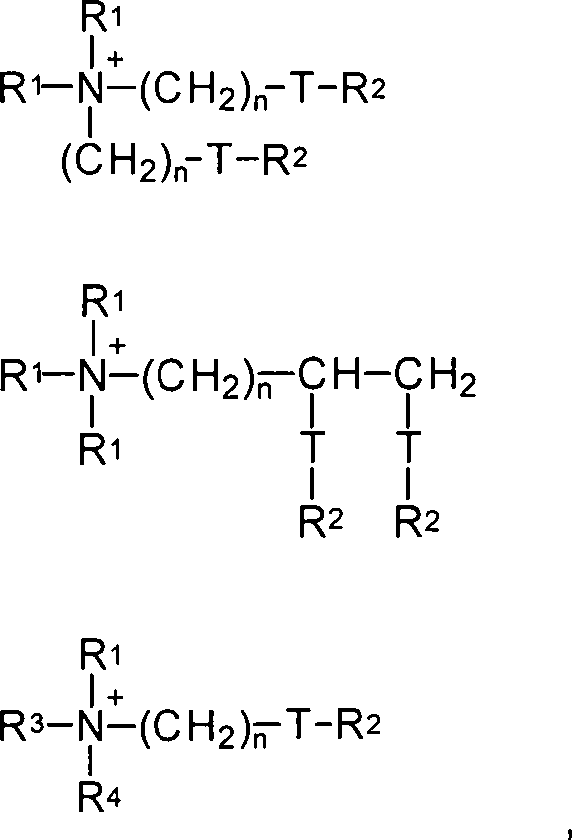
In maschinellen Geschirrspülmitteln, beträgt der Gehalt an kationischen und/oder amphoteren Tensiden vorzugsweise weniger als 6 Gew.-%, bevorzugt weniger als 4 Gew.-%, ganz besonders bevorzugt weniger als 2 Gew.-% und insbesondere weniger als 1 Gew.-%. Maschinelle Geschirrspülmittel, welche keine kationischen oder amphoteren Tenside enthalten, werden besonders bevorzugt.In automatic dishwashing detergents, the content of cationic and / or amphoteric surfactants is preferably less than 6% by weight, preferably less than 4% by weight, very particularly preferably less than 2% by weight and in particular less than 1% by weight. %. Automatic dishwashing detergents containing no cationic or amphoteric surfactants are particularly preferred.
Polymerepolymers
Zur Gruppe der Polymere zählen insbesondere die wasch- oder reinigungsaktiven Poylmere, beispielsweise die Klarspülpolymere und/oder als Enthärter wirksame Polymere. Generell sind in Wasch- oder Reinigungsmitteln neben nichtionischen Polymeren auch kationische, anionische und amphotere Polymere einsetzbar.The group of polymers includes, in particular, the washing or cleaning-active polymers, for example the rinse aid polymers and / or polymers which act as softeners. In general, cationic, anionic and amphoteric polymers can be used in detergents or cleaners in addition to nonionic polymers.
„Kationische Polymere” im Sinne der vorliegenden Erfindung sind Polymere, welche eine positive Ladung im Polymermolekül tragen. Diese kann beispielsweise durch in der Polymerkette vorliegende (Alkyl-)Ammoniumgruppierungen oder andere positiv geladene Gruppen realisiert werden. Besonders bevorzugte kationische Polymere stammen aus den Gruppen der quaternierten Cellulose-Derivate, der Polysiloxane mit quaternären Gruppen, der kationischen Guar-Derivate, der polymeren Dimethyldiallylammoniumsalze und deren Copolymere mit Estern und Amiden von Acrylsäure und Methacrylsäure, der Copolymere des Vinylpyrrolidons mit quaternierten Derivaten des Dialkylaminoacrylats und -methacrylats, der Vinylpyrrolidon-Methoimidazoliniumchlorid-Copolymere, der quaternierter Polyvinylalkohole oder der unter den INCI-Bezeichnungen Polyquaternium 2, Polyquaternium 17, Polyquaternium 18 und Polyquaternium 27 angegeben Polymere."Cationic polymers" in the context of the present invention are polymers which carry a positive charge in the polymer molecule. This can be realized, for example, by (alkyl) ammonium groups or other positively charged groups present in the polymer chain. Particularly preferred cationic polymers come from the groups of quaternized cellulose derivatives, the polysiloxanes with quaternary groups, the cationic guar derivatives, the polymeric dimethyldiallylammonium salts and their copolymers with esters and amides of acrylic acid and methacrylic acid, the copolymers of vinylpyrrolidone with quaternized derivatives of dialkylamino and methacrylates, the vinylpyrrolidone-methoimidazolinium chloride copolymers, the quaternized polyvinyl alcohols or the polymers specified under the INCI names
„Amphotere Poylmere” im Sinne der vorliegenden Erfindung weisen neben einer positiv geladenen Gruppe in der Polymerkette weiterhin auch negativ geladenen Gruppen bzw. Monomereinheiten auf. Bei diesen Gruppen kann es sich beispielsweise um Carbonsäuren, Sulfonsäuren oder Phosphonsäuren handeln.For the purposes of the present invention, "amphoteric polymers" further comprise, in addition to a positively charged group in the polymer chain, also negatively charged groups or monomer units. These groups may be, for example, carboxylic acids, sulfonic acids or phosphonic acids.
Bevorzugte Wasch- oder Reinigungsmittel, insbesondere bevorzugte maschinelle Geschirrspülmittel, sind dadurch gekennzeichnet, dass sie ein Polymer a) enthalten, welches Monomereinheiten der Formel R1R2C=CR3R4 aufweist, in der jeder Rest R1, R2, R3, R4 unabhängig voneinander ausgewählt ist aus Wasserstoff, derivatisierter Hydroxygruppe, C1-30 linearen oder verzweigten Alkylgruppen, Aryl, Aryl substitutierten C1-30 linearen oder verzweigten Alkylgruppen, polyalkoyxylierte Alkylgruppen, heteroatomaren organischen Gruppen mit mindestens einer positiven Ladung ohne geladenen Stickstoff, mindestens ein quaterniertes N-Atom oder mindestens eine Aminogruppe mit einer positiven Ladung im Teilbereich des pH-Bereichs von 2 bis 11, oder Salze hiervon, mit der Maßgabe, dass mindestens ein Rest R1, R2, R3, R4 eine heteroatomare organische Gruppe mit mindestens einer positiven Ladung ohne geladenen Stickstoff, mindestens ein quaterniertes N-Atom oder mindestens eine Aminogruppe mit einer positiven Ladung ist.Preferred washing or cleaning agents, in particular preferred automatic dishwashing agents, are characterized in that they contain a polymer a) which has monomer units of the formula R 1 R 2 C =CR 3 R 4 in which each R 1 , R 2 , R 4 radical 3 , R 4 is independently selected from hydrogen, derivatized hydroxy, C 1-30 linear or branched alkyl groups, aryl, aryl substituted C 1-30 linear or branched alkyl groups, polyalkoxylated alkyl groups, heteroatomic organic groups having at least one positive charge without charged nitrogen , at least one quaternized nitrogen atom or at least one amino group having a positive charge in the partial range of the pH range of 2 to 11, or salts thereof, with the proviso that at least one radical R 1 , R 2 , R 3 , R 4 is a heteroatomic organic group having at least one positive charge without charged nitrogen, at least one quaternized N atom or at least one amino group having a positive charge.
Im Rahmen der vorliegenden Anmeldung besonders bevorzugte kationische oder amphotere Polymere enthalten als Monomereinheit eine Verbindung der allgemeinen Formel 
Bevorzugte Reste R1 und R4 in der vorstehenden Formel sind ausgewählt aus -CH3, -CH2-CH3, -CH2-CH2-CH3, -CH(CH3)-CH3, -CH2-OH, -CH2-CH2-OH, -CH(OH)-CH3, -CH2-CH2-CH2-OH, -CH2-CH(OH)-CH3, -CH(OH)-CH2-CH3, und -(CH2CH2-O)nH.Preferred radicals R 1 and R 4 in the above formula are selected from -CH 3 , -CH 2 -CH 3 , -CH 2 -CH 2 -CH 3 , -CH (CH 3 ) -CH 3 , -CH 2 -OH , -CH 2 -CH 2 -OH, -CH (OH) -CH 3 , -CH 2 -CH 2 -CH 2 -OH, -CH 2 -CH (OH) -CH 3 , -CH (OH) -CH 2 -CH 3 , and - (CH 2 CH 2 -O) n H.
Ganz besonders bevorzugt werden Polymere, welche eine kationische Monomereinheit der vorstehenden allgemeinen Formel aufweisen, bei der R1 und R4 für H stehen, R2 und R3 für Methyl stehen und x und y jeweils 1 sind. Die entsprechenden Monomereinheiten der Formel 
Weitere besonders bevorzugte kationische oder amphotere Polymere enthalten eine Monomereinheit der allgemeinen Formel 
Ganz besonders bevorzugt werden im Rahmen der vorliegenden Anmeldung Polymere, welche eine kationsche Monomereinheit der vorstehenden allgemeinen Formel aufweisen, bei der R1 für H und R2, R3, R4 und R5 für Methyl stehen und x für 3 steht. Die entsprechenden Monomereinheiten der Formel 
Erfindungsgemäß bevorzugt werden Polymere eingesetzt, die als Monomereinheiten Diallyldimethylammoniumsalze und/oder Acrylamidopropyltrimethylammoniumsalze enthalten. According to the invention, preference is given to using polymers which contain diallyldimethylammonium salts and / or acrylamidopropyltrimethylammonium salts as monomer units.
Die zuvor erwähnten amphoteren Polymere weisen nicht nur kationische Gruppen, sondern auch anionische Gruppen bzw. Monomereinheiten auf. Derartige anionische Monomereinheiten stammen beispielsweise aus der Gruppe der linearen oder verzweigten, gesättigten oder ungesättigten Carboxylate, der linearen oder verzweigten, gesättigten oder ungesättigten Phosphonate, der linearen oder verzweigten, gesättigten oder ungesättigten Sulfate oder der linearen oder verzweigten, gesättigten oder ungesättigten Sulfonate. Bevorzugte Monomereinheiten sind die Acrylsäure, die (Meth)acrylsäure, die (Dimethyl)acrylsäure, die (Ethyl)acrylsäure, die Cyanoacrylsäure, die Vinylessingsäure, die Allylessigsäure, die Crotonsäure, die Maleinsäure, die Fumarsäure, die Zimtsäure und ihre Derivate, die Allylsulfonsäuren, wie beispielsweise Allyloxybenzolsulfonsäure und Methallylsulfonsäure oder die Allylphosphonsäuren.The aforementioned amphoteric polymers have not only cationic groups but also anionic groups or monomer units. Such anionic monomer units are derived, for example, from the group of linear or branched, saturated or unsaturated carboxylates, linear or branched, saturated or unsaturated phosphonates, linear or branched, saturated or unsaturated sulfates or linear or branched, saturated or unsaturated sulfonates. Preferred monomer units are acrylic acid, (meth) acrylic acid, (dimethyl) acrylic acid, (ethyl) acrylic acid, cyanoacrylic acid, vinylessingic acid, allylacetic acid, crotonic acid, maleic acid, fumaric acid, cinnamic acid and its derivatives, allylsulfonic acids such as allyloxybenzenesulfonic acid and methallylsulfonic acid or the allylphosphonic acids.
Bevorzugte einsetzbare amphotere Polymere stammen aus der Gruppe der Alkylacrylamid/Acrylsäure-Copolymere, der Alkylacrylamid/Methacrylsäure-Copolymere, der Alkylacrylamid/Methylmethacrylsäure-Copolymere, der Alkylacrylamid/Acrylsäure/Alkyl-aminoalkyl(meth)acrylsäure-Copolymere, der Alkylacrylamid/Methacrylsäure/Alkylaminoalkyl(meth)-acrylsäure-Copolymere, der Alkylacrylamid/Methylmethacrylsäure/Alkylaminoalkyl(meth)acrylsäure-Copolymere, der Alkylacrylamid/Alkymethacrylat/Alkylaminoethylmethacrylat/Alkylmethacrylat-Copolymere sowie der Copolymere aus ungesättigten Carbonsäuren, kationisch derivatisierten ungesättigten Carbonsäuren und gegebenenfalls weiteren ionischen oder nichtionogenen Monomeren.Preferred employable amphoteric polymers are selected from the group of the alkylacrylamide / acrylic acid copolymers, the alkylacrylamide / methacrylic acid copolymers, the alkylacrylamide / methylmethacrylic acid copolymers, the alkylacrylamide / acrylic acid / alkylaminoalkyl (meth) acrylic acid copolymers, the alkylacrylamide / methacrylic acid / alkylaminoalkyl (meth) acrylic acid copolymers, the alkylacrylamide / methylmethacrylic acid / alkylaminoalkyl (meth) acrylic acid copolymers, the alkylacrylamide / alkymethacrylate / alkylaminoethylmethacrylate / alkylmethacrylate copolymers and the copolymers of unsaturated carboxylic acids, cationically derivatized unsaturated carboxylic acids and optionally further ionic or nonionogenic monomers.
Bevorzugt einsetzbare zwitterionische Polymere stammen aus der Gruppe der Acrylamidoalkyltrialkylammoniumchlorid/Acrylsäure-Copolymere sowie deren Alkali- und Ammoniumsalze, der Acrylamidoalkyltrialkylammoniumchlorid/Methacrylsäure-Copolymere sowie deren Alkali- und Ammoniumsalze und der Methacroylethylbetain/Methacrylat-Copolymere.Preferably usable zwitterionic polymers are selected from the group of acrylamidoalkyltrialkylammonium chloride / acrylic acid copolymers and their alkali metal and ammonium salts, the acrylamidoalkyltrialkylammonium chloride / methacrylic acid copolymers and their alkali metal and ammonium salts and the methacroylethylbetaine / methacrylate copolymers.
Bevorzugt werden weiterhin amphotere Polymere, welche neben einem oder mehreren anionischen Monomeren als kationische Monomere Methacrylamidoalkyltrialkylammoniumchlorid und Dimethyl(diallyl)ammoniumchlorid umfassen.Also preferred are amphoteric polymers which comprise, in addition to one or more anionic monomers as cationic monomers, methacrylamidoalkyltrialkylammonium chloride and dimethyl (diallyl) ammonium chloride.
Besonders bevorzugte amphotere Polymere stammen aus der Gruppe der Methacrylamidoalkyltrialkylammoniumchlorid/Dimethyl(diallyl)ammoniumchlorid/Acrylsäure-Copolymere, der Methacryl-amidoalkyltrialkylammoniumchlorid/Dimethyl(diallyl)ammoniumchlorid/Methacrylsäure-Copolymere und der Methacrylamidoalkyltrialkylammoniumchlorid/Dimethyl(diallyl)ammoniumchlorid/Alkyl(meth)acrylsäure-Copolymere sowie deren Alkali- und Ammoniumsalze.Particularly preferred amphoteric polymers are selected from the group consisting of the methacrylamidoalkyltrialkylammonium chloride / dimethyl (diallyl) ammonium chloride / acrylic acid copolymers, the methacrylamidoalkyltrialkylammonium chloride / dimethyl (diallyl) ammonium chloride / methacrylic acid copolymers and the methacrylamidoalkyltrialkylammonium chloride / dimethyl (diallyl) ammonium chloride / alkyl (meth) acrylic acid -Copolymers and their alkali metal and ammonium salts.
Insbesondere bevorzugt werden amphotere Polymere aus der Gruppe der Methacrylamidopropyltrimethylammoniumchlorid/Dimethyl(diallyl)ammoniumchlorid/Acryl säure-Copolymere, der Methacrylamidopropyltrimethylammoniumchlorid/Dimethyl(diallyl)ammonium-chlorid/Acrylsäure-Copolymere und der Methacrylamidopropyltrimethylammonium-chlorid/Dimethyl(diallyl)ammoniumchlorid/Alkyl(meth)acrylsäure-Copolymere sowie deren Alkali- und Ammoniumsalze.Particular preference is given to amphoteric polymers from the group of the methacrylamidopropyltrimethylammonium chloride / dimethyl (diallyl) ammonium chloride / acrylic acid copolymers, the methacrylamidopropyltrimethylammonium chloride / dimethyl (diallyl) ammonium chloride / acrylic acid copolymers and the methacrylamidopropyltrimethylammonium chloride / dimethyl (diallyl) ammonium chloride / alkyl ( meth) acrylic acid copolymers and their alkali metal and ammonium salts.
In einer besonders bevorzugten Ausführungsform der vorliegenden Erfindung liegen die Polymere in vorkonfektionierter Form vor. Zur Konfektionierung der Polymere eignet sich dabei u. a.
- – die Verkapselung der Polymere mittels wasserlöslicher oder wasserdispergierbarer Beschichtungsmittel, vorzugsweise mittels wasserlöslicher oder wasserdispergierbarer natürlicher oder synthetischer Polymere;
- – die Verkapselung der Polymere mittels wasserunlöslicher, schmelzbarer Beschichtungsmittel, vorzugsweise mittels wasserunlöslicher Beschichtungsmittel aus der Gruppe der Wachse oder Paraffine mit einem Schmelzpunkt oberhalb 30°C;
- – die Cogranulation der Polymere mit inerten Trägermaterialien, vorzugsweise mit Trägermaterialien aus der Gruppe der wasch- oder reinigungsaktiven Substanzen, besonders bevorzugt aus der Gruppe der Builder (Gerüststoffe) oder Cobuilder.
- The encapsulation of the polymers by means of water-soluble or water-dispersible coating compositions, preferably by means of water-soluble or water-dispersible natural or synthetic polymers;
- - The encapsulation of the polymers by means of water-insoluble, fusible coating compositions, preferably by means of water-insoluble coating agents from the group of waxes or paraffins having a melting point above 30 ° C;
- - The cogranulation of the polymers with inert support materials, preferably with support materials from the group of washing or cleaning-active substances, particularly preferably from the group of builders (builders) or cobuilders.
Wasch- oder Reinigungsmittel enthalten die vorgenannten kationischen und/oder amphoteren Polymere vorzugsweise in Mengen zwischen 0,01 und 10 Gew.-%, jeweils bezogen auf das Gesamtgewicht des Wasch- oder Reinigungsmittels. Bevorzugt werden im Rahmen der vorliegenden Anmeldung jedoch solche Wasch- oder Reinigungsmittel, bei denen der Gewichtsanteil der kationischen und/oder amphoteren Polymere zwischen 0,01 und 8 Gew.-%, vorzugsweise zwischen 0,01 und 6 Gew.-%, bevorzugt zwischen 0,01 und 4 Gew.-%, besonders bevorzugt zwischen 0,01 und 2 Gew.-% und insbesondere zwischen 0,01 und 1 Gew.-%, jeweils bezogen auf das Gesamtgewicht des maschinellen Geschirrspülmittels, beträgt.Detergents or cleaning agents contain the aforementioned cationic and / or amphoteric polymers preferably in amounts of between 0.01 and 10 wt .-%, each based on the total weight of the detergent or cleaning agent. In the context of the present application, however, preference is given to those detergents or cleaners in which the weight fraction of the cationic and / or amphoteric polymers is between 0.01 and 8% by weight, preferably between 0.01 and 6% by weight, preferably between 0.01 and 4 wt .-%, particularly preferably between 0.01 and 2 wt .-% and in particular between 0.01 and 1 wt .-%, each based on the total weight of the automatic dishwashing agent is.
Als Enthärter wirksame Polymere sind beispielsweise die Sulfonsäuregruppen-haltigen Polymere, welche mit besonderem Vorzug eingesetzt werden. Effective polymers as softeners are, for example, the sulfonic acid-containing polymers which are used with particular preference.
Besonders bevorzugt als Sulfonsäuregruppen-haltige Polymere einsetzbar sind Copolymere aus ungesättigten Carbonsäuren, Sulfonsäuregruppen-haltigen Monomeren und gegebenenfalls weiteren ionogenen oder nichtionogenen Monomeren.Particularly preferred as sulfonic acid-containing polymers are copolymers of unsaturated carboxylic acids, sulfonic acid-containing monomers and optionally other ionic or nonionic monomers.
Im Rahmen der vorliegenden Erfindung sind als Monomer ungesättigte Carbonsäuren der Formel
Unter den ungesättigten Carbonsäuren, die sich durch die vorstehende Formel beschreiben lassen, sind insbesondere Acrylsäure (R1 = R2 = R3 = H), Methacrylsäure (R1 = R2 = H; R3 = CH3) und/oder Maleinsäure (R1 = COOH; R2 = R3 = H) bevorzugt.Among the unsaturated carboxylic acids which can be described by the above formula are in particular acrylic acid (R 1 = R 2 = R 3 = H), methacrylic acid (R 1 = R 2 = H, R 3 = CH 3 ) and / or maleic acid (R 1 = COOH; R 2 = R 3 = H) is preferred.
Bei den Sulfonsäuregruppen-haltigen Monomeren sind solche der Formel
Unter diesen Monomeren bevorzugt sind solche der Formeln
Besonders bevorzugte Sulfonsäuregruppen-haltige Monomere sind dabei 1-Acrylamido-1-propansulfonsäure, 2-Acrylamido-2-propansulfonsäure, 2-Acrylamido-2-methyl-1-propansulfonsäure, 2-Methacrylamido-2-methyl-1-propansulfonsäure, 3-Methacrylamido-2-hydroxy-propansulfonsäure, Allylsulfonsäure, Methallylsulfonsäure, Allyloxybenzolsulfonsäure, Methallyloxybenzolsulfonsäure, 2-Hydroxy-3-(2-propenyloxy)propansulfonsäure, 2-Methyl-2-propen1-sulfonsäure, Styrolsulfonsäure, Vinylsulfonsäure, 3-Sulfopropylacrylat, 3-Sulfopropylmethacrylat, Sulfomethacrylamid, Sulfomethylmethacrylamid sowie wasserlösliche Salze der genannten Säuren.Particularly preferred monomers containing sulfonic acid groups are 1-acrylamido-1-propanesulfonic acid, 2-acrylamido-2-propanesulfonic acid, 2-acrylamido-2-methyl-1-propanesulfonic acid, 2-methacrylamido-2-methyl-1-propanesulfonic acid, 3 Methacrylamido-2-hydroxypropanesulfonic acid, allylsulfonic acid, methallylsulfonic acid, allyloxybenzenesulfonic acid, methallyloxybenzenesulfonic acid, 2-hydroxy-3- (2-propenyloxy) propanesulfonic acid, 2-methyl-2-propene-1-sulfonic acid, styrenesulfonic acid, vinylsulfonic acid, 3-sulfopropyl acrylate, 3-sulfopropyl methacrylate , Sulfomethacrylamide, sulfomethylmethacrylamide and water-soluble salts of said acids.
Als weitere ionogene oder nichtionogene Monomere kommen insbesondere ethylenisch ungesättigte Verbindungen in Betracht. Vorzugsweise beträgt der Gehalt der eingesetzten Polymere an diesen weiteren ionogene oder nichtionogenen Monomeren weniger als 20 Gew.-%, bezogen auf das Polymer. Besonders bevorzugt zu verwendende Polymere bestehen lediglich aus Monomeren der Formel R1(R2)C=C(R3)COOH und Monomeren der Formel R5(R6)C=C(R7)-X-SO3H.Particularly suitable other ionic or nonionic monomers are ethylenically unsaturated compounds. The content of the polymers used in these other ionic or nonionic monomers is preferably less than 20% by weight, based on the polymer. Particularly preferred polymers to be used consist only of monomers of the formula R 1 (R 2 ) C =C (R 3 ) COOH and monomers of the formula R 5 (R 6 ) C =C (R 7 ) -X-SO 3 H.
Weitere besonders bevorzugte Copolymere bestehen aus
- i) einer oder mehreren ungesättigter Carbonsäuren aus der Gruppe Acrylsäure, Methacrylsäure und/oder Maleinsäure
- ii) einem oder mehreren Sulfonsäuregruppen-haltigen Monomeren der Formeln:
H2C=CH-X-SO3H H2C=C(CH3)-X-SO3H HO3S-X-(R6)C=C(R7)-X-SO3H, bis 4, -COO-(CH2)k- mit k = 1bis 6, -C(O)-NH-C(CH3)2- und -C(O)-NH-CH(CH2CH3)- - iii) gegebenenfalls weiteren ionogenen oder nichtionogenen Monomeren. Die Copolymere können die Monomere aus den Gruppen i) und ii) sowie gegebenenfalls
- iii) in variierenden Mengen enthalten, wobei sämtliche Vertreter aus der Gruppe i) mit sämtlichen Vertretern aus der Gruppe ii) und sämtlichen Vertretern aus der Gruppe iii) kombiniert werden können. Besonders bevorzugte Polymere weisen bestimmte Struktureinheiten auf, die nachfolgend beschrieben werden.
- i) one or more unsaturated carboxylic acids from the group of acrylic acid, methacrylic acid and / or maleic acid
- ii) one or more sulfonic acid group-containing monomers of the formulas:
H 2 C = CH-X-SO 3 H H 2 C = C (CH 3 ) -X-SO 3 H HO 3 SX- (R 6 ) C = C (R 7 ) -X-SO 3 H, - iii) optionally further ionogenic or nonionic monomers. The copolymers may contain the monomers from groups i) and ii) and optionally
- iii) in varying quantities, whereby all representatives from group i) can be combined with all representatives from group ii) and all representatives from group iii). Particularly preferred polymers have certain structural units, which are described below.
So sind beispielsweise Copolymere bevorzugt, die Struktureinheiten der Formel
Diese Polymere werden durch Copolymerisation von Acrylsäure mit einem Sulfonsäuregruppen-haltigen Acrylsäurederivat hergestellt. Copolymerisiert man das Sulfonsäuregruppen-haltige Acrylsäurederivat mit Methacrylsäure, gelangt man zu einem anderen Polymer, dessen Einsatz ebenfalls bevorzugt ist. Die entsprechenden Copolymere enthalten die Struktureinheiten der Formel
Völlig analog lassen sich Acrylsäure und/oder Methacrylsäure auch mit Sulfonsäuregruppen-haltigen Methacrylsäurederivaten copolymerisieren, wodurch die Struktureinheiten im Molekül verändert werden. So sind Copolymere, welche Struktureinheiten der Formel
Anstelle von Acrylsäure und/oder Methacrylsäure bzw. in Ergänzung hierzu kann auch Maleinsäure als besonders bevorzugtes Monomer aus der Gruppe i) eingesetzt werden. Man gelangt auf diese Weise zu erfindungsgemäß bevorzugten Copolymeren, die Struktureinheiten der Formel
In den Polymeren können die Sulfonsäuregruppen ganz oder teilweise in neutralisierter Form vorliegen, d. h. dass das acide Wasserstoffatom der Sulfonsäuregruppe in einigen oder allen Sulfonsäuregruppen gegen Metallionen, vorzugsweise Alkalimetallionen und insbesondere gegen Natriumionen, ausgetauscht sein kann. Der Einsatz von teil- oder vollneutralisierten sulfonsäuregruppenhaltigen Copolymeren ist erfindungsgemäß bevorzugt.In the polymers, the sulfonic acid groups may be wholly or partially in neutralized form, d. H. the acidic acid of the sulfonic acid group in some or all sulfonic acid groups can be exchanged for metal ions, preferably alkali metal ions and in particular for sodium ions. The use of partially or fully neutralized sulfonic acid-containing copolymers is preferred according to the invention.
Die Monomerenverteilung der erfindungsgemäß bevorzugt eingesetzten Copolymeren beträgt bei Copolymeren, die nur Monomere aus den Gruppen i) und ii) enthalten, vorzugsweise jeweils 5 bis 95 Gew.-% i) bzw. ii), besonders bevorzugt 50 bis 90 Gew.-% Monomer aus der Gruppe i) und 10 bis 50 Gew.-% Monomer aus der Gruppe ii), jeweils bezogen auf das Polymer.The monomer distribution of the copolymers preferably used according to the invention in the case of copolymers which contain only monomers from groups i) and ii) is preferably in each case from 5 to 95% by weight i) or ii), particularly preferably from 50 to 90% by weight monomer from group i) and from 10 to 50% by weight of monomer from group ii), in each case based on the polymer.
Bei Terpolymeren sind solche besonders bevorzugt, die 20 bis 85 Gew.-% Monomer aus der Gruppe i), 10 bis 60 Gew.-% Monomer aus der Gruppe ii) sowie 5 bis 30 Gew.-% Monomer aus der Gruppe iii) enthalten.In the case of terpolymers, particular preference is given to those containing from 20 to 85% by weight of monomer from group i), from 10 to 60% by weight of monomer from group ii) and from 5 to 30% by weight of monomer from group iii) ,
Die Molmasse der erfindungsgemäß bevorzugt eingesetzten Sulfo-Copolymere kann variiert werden, um die Eigenschaften der Polymere dem gewünschten Verwendungszweck anzupassen. Bevorzugte Wasch- oder Reinigungsmittel sind dadurch gekennzeichnet, dass die Copolymere Molmassen von 2000 bis 200.000 gmol–1, vorzugsweise von 4000 bis 25.000 gmol–1 und insbesondere von 5000 bis 15.000 gmol–1 aufweisen.The molar mass of the sulfo copolymers preferably used according to the invention can be varied in order to adapt the properties of the polymers to the desired end use. Preferred washing or cleaning agents are characterized in that the copolymers have molar masses of 2000 to 200,000 gmol -1 , preferably from 4000 to 25,000 gmol -1 and in particular from 5000 to 15,000 gmol -1 .
Bleichmittelbleach
Die Bleichmittel sind eine mit besonderem Vorzug eingesetzte wasch- oder reinigungsaktive Substanz. Unter den als Bleichmittel dienenden, in Wasser H2O2 liefernden Verbindungen haben das Natriumpercarbonat, das Natriumperborattetrahydrat und das Natriumperboratmonohydrat besondere Bedeutung. Weitere brauchbare Bleichmittel sind beispielsweise Peroxypyrophosphate, Citratperhydrate sowie H2O2 liefernde persaure Salze oder Persäuren, wie Perbenzoate, Peroxophthalate, Diperazelainsäure, Phthaloiminopersäure oder Diperdodecandisäure.The bleaching agents are a particularly preferred washing or cleaning substance. Among the compounds serving as bleaches in water H 2 O 2 , sodium percarbonate, sodium perborate tetrahydrate and sodium perborate monohydrate are of particular importance. Other useful bleaching agents are, for example, peroxypyrophosphates, citrate perhydrates and H 2 O 2 -producing peracidic salts or peracids, such as perbenzoates, peroxophthalates, diperazelaic acid, phthaloimino peracid or diperdodecanedioic acid.
Weiterhin können auch Bleichmittel aus der Gruppe der organischen Bleichmittel eingesetzt werden. Typische organische Bleichmittel sind die Diacylperoxide, wie z. B. Dibenzoylperoxid. Weitere typische organische Bleichmittel sind die Peroxysäuren, wobei als Beispiele besonders die Alkylperoxysäuren und die Arylperoxysäuren genannt werden. Bevorzugte Vertreter sind (a) die Peroxybenzoesäure und ihre ringsubstituierten Derivate, wie Alkylperoxybenzoesäuren, aber auch Peroxy-α-Naphtoesäure und Magnesiummonoperphthalat, (b) die aliphatischen oder substituiert aliphatischen Peroxysäuren, wie Peroxylaurinsäure, Peroxystearinsäure, ε-Phthalimidoperoxycapronsäure [Phthaliminoperoxyhexansäure (PAP)], o-Carboxybenzamidoperoxycapronsäure, N-Nonenylamidoperadipinsäure und N-Nonenylamidopersuccinate, und (c) aliphatische und araliphatische Peroxydicarbonsäuren, wie 1,12-Diperoxycarbonsäure, 1,9-Diperoxyazelainsäure, Diperocysebacinsäure, Diperoxybrassylsäure, die Diperoxyphthalsäuren, 2-Decyldiperoxybutan-1,4-disäure, N,N-Terephthaloyl-di(6-aminopercapronsäue).Furthermore, bleaching agents from the group of organic bleaching agents can also be used. Typical organic bleaching agents are the diacyl peroxides, such as. B. dibenzoyl peroxide. Other typical organic bleaches are the peroxyacids, examples of which include the alkyl peroxyacids and the aryl peroxyacids. Preferred representatives are (a) the peroxybenzoic acid and its ring-substituted derivatives, such as alkylperoxybenzoic acids, but also peroxy-α-naphthoic acid and magnesium monoperphthalate, (b) the aliphatic or substituted aliphatic peroxyacids, such as peroxylauric acid, peroxystearic acid, ε-phthalimidoperoxycaproic acid [phthaliminoperoxyhexanoic acid (PAP)] , o-Carboxybenzamidoperoxycaproic acid, N-Nonenylamidoperadipic Acid and N-Nonenylamidopersuccinate, and (c) aliphatic and araliphatic peroxydicarboxylic acids, such as 1,12-Diperoxycarboxylic acid, 1,9-Diperoxyazelaic acid, Diperocysebacic acid, Diperoxybrassic acid, the Diperoxyphthalic acids, 2-Decyldiperoxybutan-1,4- diacid, N, N-terephthaloyl-di (6-aminopercapronate).
Als Bleichmittel können auch Chlor oder Brom freisetzende Substanzen eingesetzt werden. Unter den geeigneten Chlor oder Brom freisetzenden Materialien kommen beispielsweise heterozyklische N-Brom- und N-Chloramide, beispielsweise Trichlorisocyanursäure, Tribromisocyanursäure, Dibromisocyanursäure und/oder Dichlorisocyanursäure (DICA) und/oder deren Salze mit Kationen wie Kalium und Natrium in Betracht. Hydantoinverbindungen, wie 1,3-Dichlor-5,5-dimethylhydanthoin sind ebenfalls geeignet. As a bleaching agent and chlorine or bromine releasing substances can be used. Among the suitable chlorine or bromine releasing materials are, for example, heterocyclic N-bromo- and N-chloroamides, for example trichloroisocyanuric acid, tribromoisocyanuric acid, dibromoisocyanuric acid and / or dichloroisocyanuric acid (DICA) and / or salts thereof with cations such as potassium and sodium. Hydantoin compounds such as 1,3-dichloro-5,5-dimethylhydantoin are also suitable.
Erfindungsgemäß werden Wasch- oder Reinigungsmittel, insbesondere maschinelle Geschirrspülmittel, bevorzugt, die 1 bis 35 Gew.-%, vorzugsweise 2,5 bis 30 Gew.-%, besonders bevorzugt 3,5 bis 20 Gew.-% und insbesondere 5 bis 15 Gew.-% Bleichmittel, vorzugsweise Natriumpercarbonat, enthalten.According to the invention, washing or cleaning agents, in particular automatic dishwashing agents, are preferred which contain from 1 to 35% by weight, preferably from 2.5 to 30% by weight, particularly preferably from 3.5 to 20% by weight and in particular from 5 to 15% by weight % Bleach, preferably sodium percarbonate.
Der Aktivsauerstoffgehalt der Wasch- oder Reinigungsmittel, insbesondere der maschinellen Geschirrspülmittel, beträgt, jeweils bezogen auf das Gesamtgewicht des Mittels, vorzugsweise zwischen 0,4 und 10 Gew.-%, besonders bevorzugt zwischen 0,5 und 8 Gew.-% und insbesondere zwischen 0,6 und 5 Gew.-%. Besonders bevorzugte Mittel weisen einen Aktivsauerstoffgehalt oberhalb 0,3 Gew.-%, bevorzugt oberhalb 0,7 Gew.-%, besonders bevorzugt oberhalb 0,8 Gew.-% und insbesondere oberhalb 1,0 Gew.-% auf.The active oxygen content of the washing or cleaning agents, in particular the automatic dishwashing agents, in each case based on the total weight of the composition, preferably between 0.4 and 10 wt .-%, particularly preferably between 0.5 and 8 wt .-% and in particular between 0.6 and 5 wt .-%. Particularly preferred compositions have an active oxygen content above 0.3 wt .-%, preferably above 0.7 wt .-%, more preferably above 0.8 wt .-% and in particular above 1.0 wt .-% to.
BleichaktivatorenBleach activators
Bleichaktivatoren werden in Wasch- oder Reinigungsmitteln beispielsweise eingesetzt, um beim Reinigen bei Temperaturen von 60°C und darunter eine verbesserte Bleichwirkung zu erreichen. Als Bleichaktivatoren können Verbindungen, die unter Perhydrolysebedingungen aliphatische Peroxocarbonsäuren mit vorzugsweise 1 bis 10 C-Atomen, insbesondere 2 bis 4 C-Atomen, und/oder gegebenenfalls substituierte Perbenzoesäure ergeben, eingesetzt werden. Geeignet sind Substanzen, die C- und/oder N-Acylgruppen der genannten C-Atomzahl und/oder gegebenenfalls substituierte Benzoylgruppen tragen. Bevorzugt sind mehrfach acylierte Alkylendiamine, insbesondere Tetraacetylethylendiamin (TAED), acylierte Triazinderivate, insbesondere 1,5-Diacetyl-2,4-dioxohexahydro-1,3,5-triazin (DADHT), acylierte Glykolurile, insbesondere Tetraacetylglykoluril (TAGU), N-Acylimide, insbesondere N-Nonanoylsuccinimid (NOSI), acylierte Phenolsulfonate, insbesondere n-Nonanoyl- oder Isononanoyloxybenzolsulfonat (n- bzw. iso-NOBS), Carbonsäureanhydride, insbesondere Phthalsäureanhydrid, acylierte mehrwertige Alkohole, insbesondere Triacetin, Ethylenglykoldiacetat und 2,5-Diacetoxy-2,5-dihydrofuran, n-Methyl-Morpholinium-Acetonitril-Methylsulfat (MMA) sowie acetyliertes Sorbitol und Mannitol beziehungsweise deren Mischungen (SORMAN), acylierte Zuckerderivate, insbesondere Pentaacetylglukose (PAG), Pentaacetylfruktose, Tetraacetylxylose und Octaacetyllactose sowie acetyliertes, gegebenenfalls N-alkyliertes Glucamin und Gluconolacton, und/oder N-acylierte Lactame, beispielsweise N-Benzoylcaprolactam. Hydrophil substituierte Acylacetale und Acyllactame werden ebenfalls bevorzugt eingesetzt. Auch Kombinationen konventioneller Bleichaktivatoren können eingesetzt werden.Bleach activators are used in laundry detergents or cleaners, for example, to achieve an improved bleaching effect when cleaned at temperatures of 60 ° C and below. As bleach activators, it is possible to use compounds which, under perhydrolysis conditions, give aliphatic peroxycarboxylic acids having preferably 1 to 10 C atoms, in particular 2 to 4 C atoms, and / or optionally substituted perbenzoic acid. Suitable substances are those which carry C and / or N-acyl groups of the stated C atom number and / or optionally substituted benzoyl groups. Preference is given to polyacylated alkylenediamines, in particular tetraacetylethylenediamine (TAED), acylated triazine derivatives, in particular 1,5-diacetyl-2,4-dioxohexahydro-1,3,5-triazine (DADHT), acylated glycolurils, in particular tetraacetylglycoluril (TAGU), N- Acylimides, in particular N-nonanoylsuccinimide (NOSI), acylated phenolsulfonates, in particular n-nonanoyl or isononanoyloxybenzenesulfonate (n- or iso-NOBS), carboxylic anhydrides, in particular phthalic anhydride, acylated polyhydric alcohols, in particular triacetin, ethylene glycol diacetate and 2,5-diacetoxy- 2,5-dihydrofuran, n-methyl-morpholinium-acetonitrile-methylsulfate (MMA) and also acetylated sorbitol and mannitol or mixtures thereof (SORMAN), acylated sugar derivatives, in particular pentaacetylglucose (PAG), pentaacetyl-fructose, tetraacetyl-xylose and octaacetyl lactose as well as acetylated, optionally N- alkylated glucamine and gluconolactone, and / or N-acylated lactams, for example N-benzoyl-caprolactam. Hydrophilic substituted acyl acetals and acyl lactams are also preferably used. Combinations of conventional bleach activators can also be used.
Diese Bleichaktivatoren werden vorzugsweise in Mengen bis 10 Gew.-%, insbesondere 0,1 Gew.-% bis 8 Gew.-%, besonders 2 bis 8 Gew.-% und besonders bevorzugt 2 bis 6 Gew.-%, jeweils bezogen auf das Gesamtgewicht der bleichaktivatorhaltigen Mittel, eingesetzt.These bleach activators are preferably used in amounts of up to 10% by weight, in particular from 0.1% by weight to 8% by weight, especially from 2 to 8% by weight and more preferably from 2 to 6% by weight, based in each case on the total weight of bleach activator-containing agents.
Weitere im Rahmen der vorliegenden Anmeldung bevorzugt eingesetzte Bleichaktivatoren sind Verbindungen aus der Gruppe der kationischen Nitrile, insbesondere kationische Nitrile der Formel 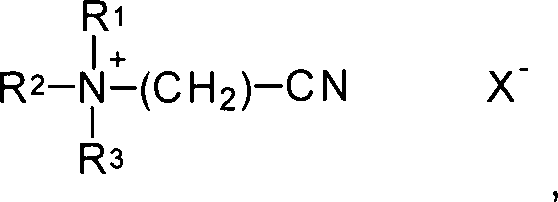
Besonders bevorzugt ist ein kationisches Nitril der Formel 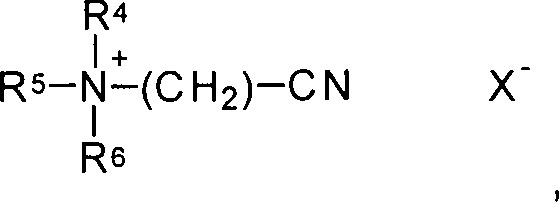
Bleichkatalysatorenbleach catalysts
Zusätzlich zu den konventionellen Bleichaktivatoren oder an deren Stelle können auch sogenannte Bleichkatalysatoren eingesetzt werden. Bei diesen Stoffen handelt es sich um bleichverstärkende Übergangsmetallsalze bzw. Übergangsmetallkomplexe wie beispielsweise Mn-, Fe-, Co-, Ru- oder Mo-Salenkomplexe oder -carbonylkomplexe. Auch Mn-, Fe-, Co-, Ru-, Mo-, Ti-, V- und Cu-Komplexe mit N-haltigen Tripod-Liganden sowie Co-, Fe-, Cu- und Ru-Amminkomplexe sind als Bleichkatalysatoren verwendbar.In addition to the conventional bleach activators or in their place, so-called bleach catalysts can also be used. These substances are bleach-enhancing transition metal salts or transition metal complexes such as Mn, Fe, Co, Ru or Mo saline complexes or carbonyl complexes. Mn, Fe, Co, Ru, Mo, Ti, V and Cu complexes with N-containing tripod ligands and Co, Fe, Cu and Ru ammine complexes can also be used as bleach catalysts.
Bleichverstärkende Übergangsmetallkomplexe, insbesondere mit den Zentralatomen Mn, Fe, Co, Cu, Mo, V, Ti und/oder Ru, bevorzugt ausgewählt aus der Gruppe der Mangan- und/oder Cobaltsalze und/oder -komplexe, besonders bevorzugt der Cobalt(ammin)-Komplexe, der Cobalt(acetat)-Komplexe, der Cobalt(Carbonyl)-Komplexe, der Chloride des Cobalts oder Mangans, des Mangansulfats werden in üblichen Mengen, vorzugsweise in einer Menge bis zu 5 Gew.-%, insbesondere von 0,0025 Gew.-% bis 1 Gew.-% und besonders bevorzugt von 0,01 Gew.-% bis 0,25 Gew.-%, jeweils bezogen auf das Gesamtgewicht der erfinderischen Mittel, eingesetzt. In speziellen Fällen kann jedoch auch mehr Bleichaktivator eingesetzt werden.Bleach-enhancing transition metal complexes, in particular having the central atoms Mn, Fe, Co, Cu, Mo, V, Ti and / or Ru, preferably selected from the group of the manganese and / or cobalt salts and / or complexes, particularly preferably the cobalt (ammine) Complexes, the cobalt (acetate) complexes, the cobalt (carbonyl) complexes, the chlorides of cobalt or manganese, of the manganese sulfate are in conventional amounts, preferably in an amount up to 5 wt .-%, in particular of 0.0025 Wt .-% to 1 wt .-% and particularly preferably from 0.01 wt .-% to 0.25 wt .-%, each based on the total weight of the inventive agents used. In special cases, however, more bleach activator can also be used.
Mit besonderem Vorzug werden Komplexe des Mangans in der Oxidationsstufe II, III, IV oder IV eingesetzt, die vorzugsweise einen oder mehrere makrocyclische(n) Ligand(en) mit den Donorfunktionen N, NR, PR, O und/oder S enthalten. Vorzugsweise werden Liganden eingesetzt, die Stickstoff-Donorfunktionen aufweisen. Dabei ist es besonders bevorzugt, Bleichkatalysator(en) in den erfindungsgemäßen Mitteln einzusetzen, welche als makromolekularen Liganden 1,4,7-Trimethyl-1,4,7-triazacyclononan (Me-TACN), 1,4,7-Triazacyclononan (TACN), 1,5,9-Trimethyl-1,5,9-triazacyclododecan (Me-TACD), 2-Methyl-1,4,7-trimethyl-1,4,7-triazacyclononan (Me/Me-TACN) und/oder 2-Methyl-1,4,7-triazacyclononan (Me/TACN) enthalten. Geeignete Mangankomplexe sind beispielsweise [MnIII 2(μ-O)1(μ-OAc)2(TACN)2](ClO4)2, [MnIIIMnIV(μ-O)2(μ-OAc)1(TACN)2](BPh4)2, [MnIV 4(μ-O)6(TACN)4](ClO4)4, [MnIII 2(μ-O)1(μ-OAc)2(Me-TACN)2](ClO4)2, [MnIIIMnIV(μ-O)1(μ-OAc)2(Me-TACN)2](ClO4)3, [MnIV 2(μ-O)3(Me-TACN)2](PF6)2 und [MnIV 2(μ-O)3(Me/Me-TACN)2](PF6)2(OAc = OC(O)CH3).It is particularly preferred to use complexes of manganese in the oxidation state II, III, IV or IV, which preferably contain one or more macrocyclic ligands with the donor functions N, NR, PR, O and / or S. Preferably, ligands are used which have nitrogen donor functions. It is particularly preferred to use bleach catalyst (s) in the compositions of the invention, which as
Zur Steigerung der Wasch-, beziehungsweise Reinigungsleistung von Wasch- oder Reinigungsmitteln können die erfindungsgemäßen Wasch- und Reinigungsmittel weitere Enzyme enthalten. Hierzu gehören insbesondere Proteasen, Amylasen, Lipasen, Hemicellulasen, Cellulasen oder Oxidoreduktasen, sowie vorzugsweise deren Gemische. Diese Enzyme sind im Prinzip natürlichen Ursprungs; ausgehend von den natürlichen Molekülen stehen für den Einsatz in Wasch- und Reinigungsmitteln verbesserte Varianten zur Verfügung, die entsprechend bevorzugt eingesetzt werden. Wasch- oder Reinigungsmittel enthalten Enzyme vorzugsweise in Gesamtmengen von 1 × 10⁻⁶ bis 5 Gew.-% bezogen auf aktives Protein. Die Proteinkonzentration kann mit Hilfe bekannter Methoden, zum Beispiel dem BCA-Verfahren oder dem Biuret-Verfahren bestimmt werden.To increase the washing or cleaning performance of detergents or cleaners, the detergents and cleaners according to the invention may contain further enzymes. These include in particular proteases, amylases, lipases, hemicellulases, cellulases or oxidoreductases, and preferably mixtures thereof. These enzymes are basically of natural origin; Starting from the natural molecules, improved variants are available for use in detergents and cleaners, which are preferably used accordingly. Detergents or cleaning agents contain enzymes preferably in total amounts of 1 × 10 -6 to 5 wt .-% based on active protein. The protein concentration can be determined by known methods, for example the BCA method or the biuret method.
Unter den Proteasen sind solche vom Subtilisin-Typ bevorzugt. Beispiele hierfür sind die Subtilisine BPN' und Carlsberg sowie deren weiterentwickelte Formen, die Protease PB92, die Subtilisine 147 und 309, die Alkalische Protease aus Bacillus lentus, Subtilisin DY und die den Subtilasen, nicht mehr jedoch den Subtilisinen im engeren Sinne zuzuordnenden Enzyme Thermitase, Proteinase K und die Proteasen TW3 und TW7.Among the proteases, those of the subtilisin type are preferable. Examples of these are the subtilisins BPN 'and Carlsberg and their further developed forms, the protease PB92, the subtilisins 147 and 309, the alkaline protease from Bacillus lentus, subtilisin DY and the enzymes thermitase which can no longer be assigned to the subtilisins in the narrower sense, Proteinase K and the proteases TW3 and TW7.
Beispiele für erfindungsgemäß einsetzbare Amylasen sind die α-Amylasen aus Bacillus licheniformis, aus B. amyloliquefaciens, aus B. stearothermophilus, aus Aspergillus niger und A. oryzae sowie die für den Einsatz in Wasch- und Reinigungsmitteln verbesserten Weiterentwicklungen der vorgenannten Amylasen. Desweiteren sind für diesen Zweck die α-Amylase aus Bacillus sp. A 7-7 (DSM 12368) und die Cyclodextrin-Glucanotransferase (CGTase) aus B. agaradherens (DSM 9948) hervorzuheben.Examples of amylases which can be used according to the invention are the α-amylases from Bacillus licheniformis, from B. amyloliquefaciens, from B. stearothermophilus, from Aspergillus niger and A. oryzae as well as the further developments of the abovementioned amylases which are improved for use in detergents and cleaners. Furthermore, for this purpose, the α-amylase from Bacillus sp. A 7-7 (DSM 12368) and the cyclodextrin glucanotransferase (CGTase) from B. agaradherens (DSM 9948).
Erfindungsgemäß einsetzbar sind weiterhin Lipasen oder Cutinasen, insbesondere wegen ihrer Triglycerid-spaltenden Aktivitäten, aber auch, um aus geeigneten Vorstufen in situ Persäuren zu erzeugen. Hierzu gehören beispielsweise die ursprünglich aus Humicola lanuginosa (Thermomyces lanuginosus) erhältlichen, beziehungsweise weiterentwickelten Lipasen, insbesondere solche mit dem Aminosäureaustausch D96L. Desweiteren sind beispielsweise die Cutinasen einsetzbar, die ursprünglich aus Fusarium solani pisi und Humicola insolens isoliert worden sind. Einsetzbar sind weiterhin Lipasen, beziehungsweise Cutinasen, deren Ausgangsenzyme ursprünglich aus Pseudomonas mendocina und Fusarium solanii isoliert worden sind. Also usable according to the invention are lipases or cutinases, in particular because of their triglyceride-splitting activities, but also in order to generate in situ peracids from suitable precursors. These include, for example, the lipases originally obtainable from Humicola lanuginosa (Thermomyces lanuginosus) or further developed, in particular those with the amino acid exchange D96L. Furthermore, for example, the cutinases can be used, which were originally isolated from Fusarium solani pisi and Humicola insolens. It is also possible to use lipases, or cutinases, whose initial enzymes were originally isolated from Pseudomonas mendocina and Fusarium solanii.
Weiterhin können Enzyme eingesetzt werden, die unter dem Begriff Hemicellulasen zusammengefaßt werden. Hierzu gehören beispielsweise Mannanasen, Xanthanlyasen, Pektinlyasen (=Pektinasen), Pektinesterasen, Pektatlyasen, Xyloglucanasen (=Xylanasen), Pullulanasen und β-Glucanasen. Weitere einsetzbare Enzyme sind Carrageenasen sowie Tannasen.Furthermore, enzymes can be used, which are summarized by the term hemicellulases. These include, for example, mannanases, xanthan lyases, pectin lyases (= pectinases), pectin esterases, pectate lyases, xyloglucanases (= xylanases), pullulanases and β-glucanases. Further usable enzymes are carrageenases and tannases.
Ebenso können in den erfindungsgemäßen Mitteln Perhydrolasen eingesetzt werden.Likewise, perhydrolases can be used in the compositions according to the invention.
Zur Erhöhung der bleichenden Wirkung können erfindungsgemäß weitere Oxidoreduktasen, beispielsweise weitere Oxidasen, Oxygenasen, Katalasen, Peroxidasen, wie Halo-, Chloro-, Bromo-, Lignin-, Glucose- oder Mangan-peroxidasen, Dioxygenasen oder Laccasen (Phenoloxidasen, Polyphenoloxidasen) eingesetzt werden. Vorteilhafterweise werden zusätzlich vorzugsweise organische, besonders bevorzugt aromatische, mit den Enzymen wechselwirkende Verbindungen zugegeben, um die Aktivität der betreffenden Oxidoreduktasen zu verstärken (Enhancer) oder um bei stark unterschiedlichen Redoxpotentialen zwischen den oxidierenden Enzymen und den Anschmutzungen den Elektronenfluss zu gewährleisten (Mediatoren).To increase the bleaching effect according to the invention further oxidoreductases, for example, further oxidases, oxygenases, catalases, peroxidases, such as halo-, chloro-, bromo-, lignin, glucose or manganese peroxidases, dioxygenases or laccases (phenol oxidases, polyphenol oxidases) can be used , Advantageously, it is additionally preferred to add organic, particularly preferably aromatic, compounds which interact with the enzymes in order to enhance the activity of the relevant oxidoreductases (enhancers) or to ensure the flow of electrons (mediators) at greatly varying redox potentials between the oxidizing enzymes and the soils.
Die Enzyme können in jeder nach dem Stand der Technik etablierten Form eingesetzt werden. Hierzu gehören beispielsweise die durch Granulation, Extrusion oder Lyophilisierung erhaltenen festen Präparationen oder, insbesondere bei flüssigen oder gelförmigen Mitteln, Lösungen der Enzyme, vorteilhafterweise möglichst konzentriert, wasserarm und/oder mit Stabilisatoren versetzt.The enzymes can be used in any form known in the art. These include, for example, the solid preparations obtained by granulation, extrusion or lyophilization or, especially in the case of liquid or gel-form detergents, solutions of the enzymes, advantageously as concentrated as possible, sparing in water and / or added with stabilizers.
Alternativ können die Enzyme sowohl für die feste als auch für die flüssige Darreichungsform verkapselt werden, beispielsweise durch Sprühtrocknung oder Extrusion der Enzymlösung zusammen mit einem vorzugsweise natürlichen Polymer oder in Form von Kapseln, beispielsweise solchen, bei denen die Enzyme wie in einem erstarrten Gel eingeschlossen sind oder in solchen vom Kern-Schale-Typ, bei dem ein enzymhaltiger Kern mit einer Wasser-, Luft- und/oder Chemikalien-undurchlässigen Schutzschicht überzogen ist. In aufgelagerten Schichten können zusätzlich weitere Wirkstoffe, beispielsweise Stabilisatoren, Emulgatoren, Pigmente, Bleich- oder Farbstoffe aufgebracht werden. Derartige Kapseln werden nach an sich bekannten Methoden, beispielsweise durch Schüttel- oder Rollgranulation oder in Fluid-bed-Prozessen aufgebracht. Vorteilhafterweise sind derartige Granulate, beispielsweise durch Aufbringen polymerer Filmbildner, staubarm und aufgrund der Beschichtung lagerstabil.Alternatively, the enzymes may be encapsulated for both the solid and liquid dosage forms, for example by spray-drying or extruding the enzyme solution together with a preferably natural polymer or in the form of capsules, for example those in which the enzymes are entrapped as in a solidified gel or in those of the core-shell type, in which an enzyme-containing core is coated with a water, air and / or chemical impermeable protective layer. In deposited layers, further active ingredients, for example stabilizers, emulsifiers, pigments, bleaches or dyes, may additionally be applied. Such capsules are applied by methods known per se, for example by shaking or rolling granulation or in fluid-bed processes. Advantageously, such granules, for example by applying polymeric film-forming agent, low in dust and storage stable due to the coating.
Weiterhin ist es möglich, zwei oder mehrere Enzyme zusammen zu konfektionieren, so dass ein einzelnes Granulat mehrere Enzymaktivitäten aufweist.Furthermore, it is possible to assemble two or more enzymes together so that a single granule has several enzyme activities.
Ein Protein und/oder Enzym kann besonders während der Lagerung gegen Schädigungen wie beispielsweise Inaktivierung, Denaturierung oder Zerfall etwa durch physikalische Einflüsse, Oxidation oder proteolytische Spaltung geschützt werden. Bei mikrobieller Gewinnung der Proteine und/oder Enzyme ist eine Inhibierung der Proteolyse besonders bevorzugt, insbesondere wenn auch die Mittel Proteasen enthalten. Wasch- oder Reinigungsmittel können zu diesem Zweck Stabilisatoren enthalten; die Bereitstellung derartiger Mittel stellt eine bevorzugte Ausführungsform der vorliegenden Erfindung dar.A protein and / or enzyme may be particularly protected during storage against damage such as inactivation, denaturation or degradation, such as by physical influences, oxidation or proteolytic cleavage. In the case of microbial recovery of the proteins and / or enzymes, inhibition of proteolysis is particularly preferred, especially if the agents also contain proteases. Detergents may contain stabilizers for this purpose; the provision of such means constitutes a preferred embodiment of the present invention.
GlaskorrosionsinhibitorenGlass corrosion inhibitors
Glaskorrosionsinhibitoren verhindern das Auftreten von Trübungen, Schlieren und Kratzern aber auch das Irisieren der Glasoberfläche von maschinell gereinigten Gläsern. Bevorzugte Glaskorrosionsinhibitoren stammen aus der Gruppe der Magnesium- und Zinksalze sowie der Magnesium- und Zinkkomplexe.Glass corrosion inhibitors prevent the occurrence of haze, streaks and scratches, but also iridescence of the glass surface of machine-cleaned glasses. Preferred glass corrosion inhibitors come from the group of magnesium and zinc salts and magnesium and zinc complexes.
Das Spektrum der erfindungsgemäß bevorzugten Zinksalze, vorzugsweise organischer Säuren, besonders bevorzugt organischer Carbonsäuren, reicht von Salzen, die in Wasser schwer oder nicht löslich sind, also eine Löslichkeit unterhalb 100 mg/l, vorzugsweise unterhalb 10 mg/l, insbesondere unterhalb 0,01 mg/l aufweisen, bis zu solchen Salzen, die in Wasser eine Löslichkeit oberhalb 100 mg/l, vorzugsweise oberhalb 500 mg/l, besonders bevorzugt oberhalb 1 g/l und insbesondere oberhalb 5 g/l aufweisen (alle Löslichkeiten bei 20°C Wassertemperatur). Zu der ersten Gruppe von Zinksalzen gehören beispielsweise das Zinkcitrat, das Zinkoleat und das Zinkstearat, zu der Gruppe der löslichen Zinksalze gehören beispielsweise das Zinkformiat, das Zinkacetat, das Zinklactat und das Zinkgluconat.The spectrum of the invention preferred zinc salts, preferably organic acids, particularly preferably organic carboxylic acids, ranging from salts which are difficult or insoluble in water, ie a solubility below 100 mg / l, preferably below 10 mg / l, in particular below 0.01 have mg / l, to those salts which have a solubility in water above 100 mg / l, preferably above 500 mg / l, more preferably above 1 g / l and in particular above 5 g / l (all solubilities at 20 ° C water temperature). The first group of zinc salts includes, for example, zinc citrate, zinc oleate and zinc stearate, and the group of soluble zinc salts includes, for example, zinc formate, zinc acetate, zinc lactate and zinc gluconate.
Mit besonderem Vorzug wird als Glaskorrosionsinhibitor mindestens ein Zinksalz einer organischen Carbonsäure, besonders bevorzugt ein Zinksalz aus der Gruppe Zinkstearat, Zinkoleat, Zinkgluconat, Zinkacetat, Zinklactat und Zinkcitrat eingesetzt. Auch Zinkricinoleat, Zinkabietat und Zinkoxalat sind bevorzugt.With particular preference is used as the glass corrosion inhibitor at least one zinc salt of an organic carboxylic acid, particularly preferably a zinc salt from the group zinc stearate, zinc oleate, zinc gluconate, zinc acetate, zinc lactate and zinc citrate. Zinc ricinoleate, zinc abietate and zinc oxalate are also preferred.
Im Rahmen der vorliegenden Erfindung beträgt der Gehalt an Zinksalz in Wasch- oder Reinigungsmittelsn vorzugsweise zwischen 0,1 bis 5 Gew.-%, bevorzugt zwischen 0,2 bis 4 Gew.-% und insbesondere zwischen 0,4 bis 3 Gew.-%, bzw. der Gehalt an Zink in oxidierter Form (berechnet als Zn2+) zwischen 0,01 bis 1 Gew.-%, vorzugsweise zwischen 0,02 bis 0,5 Gew.-% und insbesondere zwischen 0,04 bis 0,2 Gew.-%, jeweils bezogen auf das Gesamtgewicht des glaskorrosionsinhibitorhaltigen Mittels.In the context of the present invention, the content of zinc salt in detergents or cleaners is preferably between 0.1 and 5% by weight, preferably between 0.2 and 4% by weight and in particular between 0.4 and 3% by weight. , or the content of zinc in oxidized form (calculated as Zn 2+ ) between 0.01 to 1 wt .-%, preferably between 0.02 to 0.5 wt .-% and in particular between 0.04 to 0, 2 wt .-%, each based on the total weight of the glass corrosion inhibitor-containing agent.
Korrosionsinhibitoren dienen dem Schutze des Spülgutes oder der Maschine, wobei im Bereich des maschinellen Geschirrspulens besonders Silberschutzmittel eine besondere Bedeutung haben. Einsetzbar sind die bekannten Substanzen des Standes der Technik. Allgemein können vor allem Silberschutzmittel ausgewählt aus der Gruppe der Triazole, der Benzotriazole, der Bisbenzotriazole, der Aminotriazole, der Alkylaminotriazole und der Übergangsmetallsalze oder -komplexe eingesetzt werden. Besonders bevorzugt zu verwenden sind Benzotriazol und/oder Alkylaminotriazol. Erfindungsgemäß bevorzugt werden 3-Amino-5-alkyl-1,2,4-triazole bzw. ihre physiologisch verträglichen Salze eingesetzt, wobei diese Substanzen mit besonderem Vorzug in einer Konzentration von 0,001 bis 10 Gew.-%, vorzugsweise 0,0025 bis 2 Gew.-%, besonders bevorzugt 0,01 bis 0,04 Gew.-% eingesetzt werden. Bevorzugte Säuren für die Salzbildung sind Salzsäure, Schwefelsäure, Phosphorsäure, Kohlensäure, schweflige Säure, organische Carbonsäuren wie Essig-, Glykol-, Citronen-, Bernsteinsäure. Ganz besonders wirksam sind 5-Pentyl-, 5-Heptyl-, 5-Nonyl-, 5-Undecyl-, 5-Isononyl-, 5-Versatic-10-säurealkyl-3-amino-1,2,4-triazole sowie Mischungen dieser Substanzen.Corrosion inhibitors serve to protect the items to be washed or the machine, with particular silver protectants being of particular importance in the field of automatic dishwashing. It is possible to use the known substances of the prior art. In general, silver protectants selected from the group of triazoles, benzotriazoles, bisbenzotriazoles, aminotriazoles, alkylaminotriazoles and transition metal salts or complexes can be used in particular. Particularly preferred to use are benzotriazole and / or alkylaminotriazole. According to the invention, preference is given to using 3-amino-5-alkyl-1,2,4-triazoles or their physiologically tolerated salts, these substances being particularly preferably used in a concentration of 0.001 to 10% by weight, preferably 0.0025 to 2 Wt .-%, particularly preferably 0.01 to 0.04 wt .-% are used. Preferred acids for salt formation are hydrochloric acid, sulfuric acid, phosphoric acid, carbonic acid, sulphurous acid, organic carboxylic acids such as acetic, glycolic, citric, succinic acid. Especially effective are 5-pentyl, 5-heptyl, 5-nonyl, 5-undecyl, 5-isononyl, 5-versatic-10-alkyl-3-amino-1,2,4-triazoles and mixtures of these substances.
Man findet in Reinigerformulierungen darüber hinaus häufig aktivchlorhaltige Mittel, die das Korrodieren der Silberoberfläche deutlich vermindern können. In chlorfreien Reinigern werden besonders Sauerstoff- und Stickstoff-haltige organische redoxaktive Verbindungen, wie zwei- und dreiwertige Phenole, z. B. Hydrochinon, Brenzkatechin, Hydroxyhydrochinon, Gallussäure, Phloroglucin, Pyrogallol bzw. Derivate dieser Verbindungsklassen eingesetzt. Auch salz- und komplexartige anorganische Verbindungen, wie Salze der Metalle Mn, Ti, Zr, Hf, V, Co und Ce finden häufig Verwendung. Bevorzugt sind hierbei die Übergangsmetallsalze, die ausgewählt sind aus der Gruppe der Mangan- und/oder Cobaltsalze und/oder -komplexe, besonders bevorzugt der Cobalt(ammin)-Komplexe, der Cobalt(acetat)-Komplexe, der Cobalt-(Carbonyl)-Komplexe, der Chloride des Cobalts oder Mangans und des Mangansulfats. Ebenfalls können Zinkverbindungen zur Verhinderung der Korrosion am Spülgut eingesetzt werden.In addition, cleaner formulations often contain active chlorine-containing agents which can markedly reduce the corrosion of the silver surface. In chlorine-free cleaners are particularly oxygen and nitrogen-containing organic redox-active compounds such as di- and trihydric phenols, eg. As hydroquinone, pyrocatechol, hydroxyhydroquinone, gallic acid, phloroglucinol, pyrogallol or derivatives of these classes of compounds used. Also, salt and complex inorganic compounds, such as salts of the metals Mn, Ti, Zr, Hf, V, Co and Ce are often used. Preferred here are the transition metal salts which are selected from the group of the manganese and / or cobalt salts and / or complexes, particularly preferably the cobalt (ammin) complexes, the cobalt (acetate) complexes, the cobalt (carbonyl) - Complexes, the chlorides of cobalt or manganese and manganese sulfate. Also, zinc compounds can be used to prevent corrosion on the items to be washed.
Anstelle von oder zusätzlich zu den vorstehend beschriebenen Silberschutzmitteln, beispielsweise den Benzotriazolen, können redoxaktive Substanzen eingesetzt werden. Diese Substanzen sind vorzugsweise anorganische redoxaktive Substanzen aus der Gruppe der Mangan-, Titian-, Zirkonium-, Hafnium-, Vanadium-, Cobalt- und Cer-Salze und/oder -Komplexe, wobei die Metalle vorzugsweise in einer der Oxidationsstufen II, III, IV, V oder VI vorliegen.Instead of or in addition to the silver protectants described above, for example the benzotriazoles, redox-active substances can be used. These substances are preferably inorganic redox-active substances from the group of manganese, titanium, zirconium, hafnium, vanadium, cobalt and cerium salts and / or complexes, wherein the metals preferably in one of the oxidation states II, III, IV, V or VI are present.
Die verwendeten Metallsalze bzw. Metallkomplexe sollen zumindest teilweise in Wasser löslich sein. Die zur Salzbildung geeigneten Gegenionen umfassen alle üblichen ein-, zwei-, oder dreifach negativ geladenen anorganischen Anionen, z. B. Oxid, Sulfat, Nitrat, Fluorid, aber auch organische Anionen wie z. B. Stearat.The metal salts or metal complexes used should be at least partially soluble in water. The counterions suitable for salt formation comprise all customary mono-, di- or tri-positively negatively charged inorganic anions, eg. As oxide, sulfate, nitrate, fluoride, but also organic anions such. Stearate.
Besonders bevorzugte Metallsalze und/oder Metallkomplexe sind ausgewählt aus der Gruppe MnSO4, Mn(II)-citrat, Mn(II)-stearat, Mn(II)-acetylacetonat, Mn(II)-[1-Hydroxyethan-1,1-diphosphonat], V2O5, V2O4, VO2, TiOSO4, K2TiF6, K2ZrF6, CoSO4, Co(NO3)2, Ce(NO3)3, sowie deren Gemische, so dass die Metallsalze und/oder Metallkomplexe ausgewählt aus der Gruppe MnSO4, Mn(II)-citrat, Mn(II)-stearat, Mn(II)-acetylacetonat, Mn(II)-[1-Hydroxyethan-1,1-diphosphonat], V2O5, V2O4, VO2, TiOSO4, K2TiF6, K2ZrF6, CoSO4, Co(NO3)2, Ce(NO3)3 mit besonderem Vorzug eingesetzt werden.Particularly preferred metal salts and / or metal complexes are selected from the group MnSO 4 , Mn (II) citrate, Mn (II) stearate, Mn (II) acetylacetonate, Mn (II) - [1-hydroxyethane-1,1- diphosphonate], V 2 O 5 , V 2 O 4 , VO 2 , TiOSO 4 , K 2 TiF 6 , K 2 ZrF 6 , CoSO 4 , Co (NO 3 ) 2 , Ce (NO 3 ) 3 , and mixtures thereof, such that the metal salts and / or metal complexes are selected from the group MnSO 4 , Mn (II) citrate, Mn (II) stearate, Mn (II) acetylacetonate, Mn (II) - [1-hydroxyethane-1,1- diphosphonate], V 2 O 5 , V 2 O 4 , VO 2 , TiOSO 4 , K 2 TiF 6 , K 2 ZrF 6 , CoSO 4 , Co (NO 3 ) 2 , Ce (NO 3 ) 3 are used with particular preference ,
Die anorganischen redoxaktiven Substanzen, insbesondere Metallsalze bzw. Metallkomplexe sind vorzugsweise beschichtet, d. h. vollständig mit einem wasserdichten, bei den Reinigungstemperaturen aber leichtlöslichen Material überzogen, um ihre vorzeitige Zersetzung oder Oxidation bei der Lagerung zu verhindern. Bevorzugte Coatingmaterialien, die nach bekannten Verfahren, etwa Schmelzcoatingverfahren nach Sandwik aus der Lebensmittelindustrie, aufgebracht werden, sind Paraffine, Mikrowachse, Wachse natürlichen Ursprungs wie Carnaubawachs, Candellilawachs, Bienenwachs, höherschmelzende Alkohole wie beispielsweise Hexadecanol, Seifen oder Fettsäuren.The inorganic redox-active substances, in particular metal salts or metal complexes, are preferably coated, ie completely coated with a water-tight material which is readily soluble in the cleaning temperatures, in order to prevent their premature decomposition or oxidation during storage. Preferred coating materials, which are applied by known methods, such as Sandwik melt coating processes from the food industry, are paraffins, microwaxes, natural waxes Origin such as carnauba wax, candellila wax, beeswax, higher melting alcohols such as hexadecanol, soaps or fatty acids.
Die genannten Metallsalze und/oder Metallkomplexe sind in Reinigungsmitteln, vorzugsweise in einer Menge von 0,05 bis 6 Gew.-%, vorzugsweise 0,2 bis 2,5 Gew.-%, jeweils bezogen auf das gesamte Mittel enthalten.The metal salts and / or metal complexes mentioned are contained in cleaning agents, preferably in an amount of 0.05 to 6 wt .-%, preferably 0.2 to 2.5 wt .-%, each based on the total agent.
Um den Zerfall vorgefertigter Formkörper zu erleichtern, ist es möglich, Desintegrationshilfsmittel, sogenannte Tablettensprengmittel, in diese Mittel einzuarbeiten, um die Zerfallszeiten zu verkürzen. Unter Tablettensprengmitteln bzw. Zerfallsbeschleunigern werden Hilfsstoffe verstanden, die für den raschen Zerfall von Tabletten in Wasser oder anderen Medien und für die Freisetzung der Wirkstoffe sorgen.In order to facilitate the disintegration of preformed moldings, it is possible to incorporate disintegration aids, so-called tablet disintegrants, into these compositions in order to shorten the disintegration times. By tablet disintegrants or disintegrants are meant auxiliaries which ensure the rapid disintegration of tablets in water or other media and for the release of the active ingredients.
Diese Stoffe, die auch aufgrund ihrer Wirkung als ”Spreng” mittel bezeichnet werden, vergrößern bei Wasserzutritt ihr Volumen, wobei einerseits das Eigenvolumen vergrößert (Quellung), andererseits auch über die Freisetzung von Gasen ein Druck erzeugt werden kann, der die Tablette in kleinere Partikel zerfallen läßt. Altbekannte Desintegrationshilfsmittel sind beispielsweise Carbonat/Citronensäure-Systeme, wobei auch andere organische Säuren eingesetzt werden können. Quellende Desintegrationshilfsmittel sind beispielsweise synthetische Polymere wie Polyvinylpyrrolidon (PVP) oder natürliche Polymere bzw. modifizierte Naturstoffe wie Cellulose und Stärke und ihre Derivate, Alginate oder Casein-Derivate.These substances, which are also referred to as "explosives" due to their effect, increase their volume upon ingress of water, on the one hand increasing the intrinsic volume (swelling), and on the other hand creating a pressure via the release of gases which can break the tablet into smaller particles decays. Well-known disintegration aids are, for example, carbonate / citric acid systems, although other organic acids can also be used. Swelling disintegration aids are, for example, synthetic polymers such as polyvinylpyrrolidone (PVP) or natural polymers or modified natural substances such as cellulose and starch and their derivatives, alginates or casein derivatives.
Bevorzugt werden Desintegrationshilfsmittel in Mengen von 0,5 bis 10 Gew.-%, vorzugsweise 3 bis 7 Gew.-% und insbesondere 4 bis 6 Gew.-%, jeweils bezogen auf das Gesamtgewicht des desintegrationshilfsmittelhaltigen Mittels, eingesetzt.Disintegration aids are preferably used in amounts of from 0.5 to 10% by weight, preferably from 3 to 7% by weight and in particular from 4 to 6% by weight, based in each case on the total weight of the disintegration assistant-containing agent.
Als bevorzugte Desintegrationsmittel werden Desintegrationsmittel auf Cellulosebasis eingesetzt, so dass bevorzugte Wasch- oder Reinigungsmittel ein solches Desintegrationsmittel auf Cellulosebasis in Mengen von 0,5 bis 10 Gew.-%, vorzugsweise 3 bis 7 Gew.-% und insbesondere 4 bis 6 Gew.-% enthalten. Reine Cellulose weist die formale Bruttozusammensetzung (C6H10O5)n auf und stellt formal betrachtet ein β-1,4-Polyacetal von Cellobiose dar, die ihrerseits aus zwei Molekülen Glucose aufgebaut ist. Geeignete Cellulosen bestehen dabei aus ca. 500 bis 5000 Glucose-Einheiten und haben demzufolge durchschnittliche Molmassen von 50.000 bis 500.000. Als Desintegrationsmittel auf Cellulosebasis verwendbar sind im Rahmen der vorliegenden Erfindung auch Cellulose-Derivate, die durch polymeranaloge Reaktionen aus Cellulose erhältlich sind. Solche chemisch modifizierten Cellulosen umfassen dabei beispielsweise Produkte aus Veresterungen bzw. Veretherungen, in denen Hydroxy-Wasserstoffatome substituiert wurden. Aber auch Cellulosen, in denen die Hydroxy-Gruppen gegen funktionelle Gruppen, die nicht über ein Sauerstoffatom gebunden sind, ersetzt wurden, lassen sich als Cellulose-Derivate einsetzen. In die Gruppe der Cellulose-Derivate fallen beispielsweise Alkalicellulosen, Carboxymethylcellulose (CMC), Celluloseester und -ether sowie Aminocellulosen. Die genannten Cellulosederivate werden vorzugsweise nicht allein als Desintegrationsmittel auf Cellulosebasis eingesetzt, sondern in Mischung mit Cellulose verwendet. Der Gehalt dieser Mischungen an Cellulosederivaten beträgt vorzugsweise unterhalb 50 Gew.-%, besonders bevorzugt unterhalb 20 Gew.-%, bezogen auf das Desintegrationsmittel auf Cellulosebasis. Besonders bevorzugt wird als Desintegrationsmittel auf Cellulosebasis reine Cellulose eingesetzt, die frei von Cellulosederivaten ist.Preferred disintegrating agents are cellulosic disintegrating agents, so that preferred washing or cleaning agents comprise such cellulose-based disintegrants in amounts of from 0.5 to 10% by weight, preferably from 3 to 7% by weight and in particular from 4 to 6% by weight. % contain. Pure cellulose has the formal gross composition (C 6 H 10 O 5 ) n and is formally a β-1,4-polyacetal of cellobiose, which in turn is composed of two molecules of glucose. Suitable celluloses consist of about 500 to 5000 glucose units and therefore have average molecular weights of 50,000 to 500,000. Cellulose-based disintegrating agents which can be used in the context of the present invention are also cellulose derivatives obtainable by polymer-analogous reactions of cellulose. Such chemically modified celluloses include, for example, products of esterifications or etherifications in which hydroxy hydrogen atoms have been substituted. Celluloses in which the hydroxy groups have been replaced by functional groups which are not bonded via an oxygen atom can also be used as cellulose derivatives. The group of cellulose derivatives includes, for example, alkali metal celluloses, carboxymethylcellulose (CMC), cellulose esters and ethers, and aminocelluloses. The cellulose derivatives mentioned are preferably not used alone as disintegrating agents based on cellulose, but used in admixture with cellulose. The content of these mixtures of cellulose derivatives is preferably below 50% by weight, particularly preferably below 20% by weight, based on the cellulose-based disintegrating agent. It is particularly preferred to use cellulose-based disintegrating agent which is free of cellulose derivatives.
Die als Desintegrationshilfsmittel eingesetzte Cellulose wird vorzugsweise nicht in feinteiliger Form eingesetzt, sondern vor dem Zumischen zu den zu verpressenden Vorgemischen in eine gröbere Form überführt, beispielsweise granuliert oder kompaktiert. Die Teilchengrößen solcher Desintegrationsmittel liegen zumeist oberhalb 200 μm, vorzugsweise zu mindestens 90 Gew.-% zwischen 300 und 1600 um und insbesondere zu mindestens 90 Gew.-% zwischen 400 und 1200 um.The cellulose used as a disintegration aid is preferably not used in finely divided form, but converted into a coarser form, for example granulated or compacted, before it is added to the premixes to be tabletted. The particle sizes of such disintegrating agents are usually above 200 μm, preferably at least 90% by weight between 300 and 1600 μm and in particular at least 90% by weight between 400 and 1200 μm.
Als weiteres Desintegrationsmittel auf Cellulosebasis oder als Bestandteil dieser Komponente kann mikrokristalline Cellulose eingesetzt werden. Diese mikrokristalline Cellulose wird durch partielle Hydrolyse von Cellulosen unter solchen Bedingungen erhalten, die nur die amorphen Bereiche (ca. 30% der Gesamt-Cellulosemasse) der Cellulosen angreifen und vollständig auflösen, die kristallinen Bereiche (ca. 70%) aber unbeschadet lassen. Eine nachfolgende Desaggregation der durch die Hydrolyse entstehenden mikrofeinen Cellulosen liefert die mikrokristallinen Cellulosen, die Primärteilchengrößen von ca. 5 μm aufweisen und beispielsweise zu Granulaten mit einer mittleren Teilchengröße von 200 μm kompaktierbar sind.As a further disintegrating agent based on cellulose or as a component of this component microcrystalline cellulose can be used. This microcrystalline cellulose is obtained by partial hydrolysis of celluloses under conditions which attack and completely dissolve only the amorphous regions (about 30% of the total cellulose mass) of the celluloses, leaving the crystalline regions (about 70%) intact. Subsequent deaggregation of the microfine celluloses produced by the hydrolysis yields the microcrystalline celluloses which have primary particle sizes of about 5 μm and can be compacted, for example, into granules having an average particle size of 200 μm.
Bevorzugte Desintegrationshilfsmittel, vorzugsweise ein Desintegrationshilfsmittel auf Cellulosebasis, vorzugsweise in granularer, cogranulierter oder kompaktierter Form, sind in den desintegrationsmittelhaltigen Mitteln in Mengen von 0,5 bis 10 Gew.-%, vorzugsweise von 3 bis 7 Gew.-% und insbesondere von 4 bis 6 Gew.-%, jeweils bezogen auf das Gesamtgewicht des desintegrationsmittelhaltigen Mittels, enthalten.Preferred disintegration aids, preferably a disintegration aid based on cellulose, preferably in granular, cogranulated or compacted form, are in the desintegrationsmittelhaltigen Agents in amounts of from 0.5 to 10 wt .-%, preferably from 3 to 7 wt .-% and in particular from 4 to 6 wt .-%, each based on the total weight of the disintegrating agent-containing agent.
Erfindungsgemäß bevorzugt können darüber hinaus weiterhin gasentwickelnde Brausesysteme als Tablettendesintegrationshilfsmittel eingesetzt werden. Das gasentwickelnde Brausesystem kann aus einer einzigen Substanz bestehen, die bei Kontakt mit Wasser ein Gas freisetzt. Unter diesen Verbindungen ist insbesondere das Magnesiumperoxid zu nennen, das bei Kontakt mit Wasser Sauerstoff freisetzt. Üblicherweise besteht das gasfreisetzende Sprudelsystem jedoch seinerseits aus mindestens zwei Bestandteilen, die miteinander unter Gasbildung reagieren. Während hier eine Vielzahl von Systemen denk- und ausführbar ist, die beispielsweise Stickstoff, Sauerstoff oder Wasserstoff freisetzen, wird sich das in den Wasch- und Reinigungsmittel eingesetzte Sprudelsystem sowohl anhand ökonomischer als auch anhand ökologischer Gesichtspunkte auswählen lassen. Bevorzugte Brausesysteme bestehen aus Alkalimetallcarbonat und/oder -hydrogencarbonat sowie einem Acidifizierungsmittel, das geeignet ist, aus den Alkalimetallsalzen in wäßrige Lösung Kohlendioxid freizusetzen.Furthermore, according to the invention, gas-evolving effervescent systems can furthermore be used as tablet disintegration auxiliaries. The gas-evolving effervescent system may consist of a single substance that releases a gas upon contact with water. Among these compounds, mention should be made in particular of magnesium peroxide, which liberates oxygen on contact with water. Usually, however, the gas-releasing effervescent system in turn consists of at least two constituents which react with one another to form gas. While a variety of systems are conceivable and executable here, which release, for example, nitrogen, oxygen or hydrogen, the bubble system used in detergents and cleaners can be selected both on the basis of economic and environmental considerations. Preferred effervescent systems consist of alkali metal carbonate and / or bicarbonate and an acidifying agent which is suitable for liberating carbon dioxide from the alkali metal salts in aqueous solution.
Als Acidifizierungsmittel, die aus den Alkalisalzen in wäßriger Lösung Kohlendioxid freisetzen, sind beispielsweise Borsäure sowie Alkalimetallhydrogensulfate, Alkalimetalldihydrogenphosphate und andere anorganische Salze einsetzbar. Bevorzugt werden allerdings organische Acidifizierungsmittel verwendet, wobei die Citronensäure ein besonders bevorzugtes Acidifizierungsmittel ist. Bevorzugt sind Acidifizierungsmittel im Brausesystem aus der Gruppe der organischen Di-, Tri- und Oligocarbonsäuren bzw. Gemische.Acidifying agents which release carbon dioxide from the alkali metal salts in aqueous solution include, for example, boric acid and alkali metal hydrogen sulfates, alkali metal dihydrogen phosphates and other inorganic salts. However, preference is given to using organic acidifying agents, the citric acid being a particularly preferred acidifying agent. Acidifying agents in the effervescent system from the group of organic di-, tri- and oligocarboxylic acids or mixtures are preferred.
Als Parfümöle bzw. Duftstoffe können im Rahmen der vorliegenden Erfindung einzelne Riechstoffverbindungen, z. B. die synthetischen Produkte vom Typ der Ester, Ether, Aldehyde, Ketone, Alkohole und Kohlenwasserstoffe verwendet werden. Bevorzugt werden jedoch Mischungen verschiedener Riechstoffe verwendet, die gemeinsam eine ansprechende Duftnote erzeugen. Solche Parfümöle können auch natürliche Riechstoffgemische enthalten, wie sie aus pflanzlichen Quellen zugänglich sind, z. B. Pinie-, Citrus-, Jasmin-, Patchouly-, Rosen- oder Ylang-Ylang-Öl.As perfume oils or fragrances can in the present invention, individual fragrance compounds, eg. As the synthetic products of the ester type, ethers, aldehydes, ketones, alcohols and hydrocarbons are used. Preferably, however, mixtures of different fragrances are used, which together produce an attractive fragrance. Such perfume oils may also contain natural fragrance mixtures as are available from vegetable sources, e.g. Pine, citrus, jasmine, patchouly, rose or ylang-ylang oil.
Um wahrnehmbar zu sein, muss ein Riechstoff flüchtig sein, wobei neben der Natur der funktionellen Gruppen und der Struktur der chemischen Verbindung auch die Molmasse eine wichtige Rolle spielt. So besitzen die meisten Riechstoffe Molmassen bis etwa 200 Dalton, während Molmassen von 300 Dalton und darüber eher eine Ausnahme darstellen. Auf Grund der unterschiedlichen Flüchtigkeit von Riechstoffen verändert sich der Geruch eines aus mehreren Riechstoffen zusammengesetzten Parfüms bzw. Duftstoffs während des Verdampfens, wobei man die Geruchseindrücke in ”Kopfnote” (top note), ”Herz- bzw. Mittelnote” (middle note bzw. body) sowie ”Basisnote” (end note bzw. dry out) unterteilt. Da die Geruchswahrnehmung zu einem großen Teil auch auf der Geruchsintensität beruht, besteht die Kopfnote eines Parfüms bzw. Duftstoffs nicht allein aus leichtflüchtigen Verbindungen, während die Basisnote zum größten Teil aus weniger flüchtigen, d. h. haftfesten Riechstoffen besteht. Bei der Komposition von Parfüms können leichter flüchtige Riechstoffe beispielsweise an bestimmte Fixative gebunden werden, wodurch ihr zu schnelles Verdampfen verhindert wird. Bei der nachfolgenden Einteilung der Riechstoffe in ”leichter flüchtige” bzw. ”haftfeste” Riechstoffe ist also über den Geruchseindruck und darüber, ob der entsprechende Riechstoff als Kopf- oder Herznote wahrgenommen wird, nichts ausgesagt.In order to be perceptible, a fragrance must be volatile, whereby besides the nature of the functional groups and the structure of the chemical compound, the molecular weight also plays an important role. For example, most odorants have molecular weights up to about 200 daltons, while molecular weights of 300 daltons and above are more of an exception. Due to the different volatility of fragrances, the smell of a perfume or fragrance composed of several fragrances changes during evaporation, whereby the odor impressions in "top note", "middle note" or "body note" ) and "base note" (end note or dry out). Since odor perception is also largely based on the odor intensity, the top note of a perfume or fragrance does not consist solely of volatile compounds, while the base note consists largely of less volatile, d. H. adherent fragrances. For example, in the composition of perfumes, more volatile fragrances can be bound to certain fixatives, preventing them from evaporating too quickly. In the subsequent classification of the fragrances in "more volatile" or "adherent" fragrances so nothing about the olfactory impression and whether the corresponding fragrance is perceived as a head or middle note, nothing said.
Die Duftstoffe können direkt verarbeitet werden, es kann aber auch vorteilhaft sein, die Duftstoffe auf Träger aufzubringen, die durch eine langsamere Duftfreisetzung für langanhaltenden Duft sorgen. Als solche Trägermaterialien haben sich beispielsweise Cyclodextrine bewährt, wobei die Cyclodextrin-Parfüm-Komplexe zusätzlich noch mit weiteren Hilfsstoffen beschichtet werden können.The fragrances can be processed directly, but it can also be advantageous to apply the fragrances on carriers that provide a slower fragrance release for long-lasting fragrance. As such carrier materials, for example, cyclodextrins have been proven, the cyclodextrin-perfume complexes can be additionally coated with other excipients.
Farbstoffedyes
Bevorzugte Farbstoffe, deren Auswahl dem Fachmann keinerlei Schwierigkeit bereitet, besitzen eine hohe Lagerstabilität und Unempfindlichkeit gegenüber den übrigen Inhaltsstoffen der Mittel und gegen Licht sowie keine ausgeprägte Substantivität gegenüber den mit den farbstoffhaltigen Mitteln zu behandelnden Substraten wie beispielsweise Textilien, Glas, Keramik oder Kunststoffgeschirr, um diese nicht anzufärben.Preferred dyes, the selection of which presents no difficulty for the skilled person, have a high storage stability and insensitivity to the other ingredients of the agents and to light and no pronounced substantivity to the substrates to be treated with the dye-containing agents, such as textiles, glass, ceramics or plastic crockery do not stain them.
Bei der Wahl des Färbemittels muss beachtet werden, dass die Färbemittel eine hohe Lagerstabilität und Unempfindlichkeit gegenüber Licht aufweisen. Gleichzeitig ist auch bei der Wahl geeigneter Färbemittel zu berücksichtigen, dass Färbemittel unterschiedliche Stabilitäten gegenüber Oxidation aufweisen. Im Allgemeinen gilt, dass wasserunlösliche Färbemittel gegen Oxidation stabiler sind als wasserlösliche Färbemittel. Abhängig von der Löslichkeit und damit auch von der Oxidationsempfindlichkeit variiert die Konzentration des Färbemittels in den Wasch- oder Reinigungsmitteln. Bei gut wasserlöslichen Färbemitteln werden typischerweise Färbemittel-Konzentrationen im Bereich von einigen 10–2 bis 10–3 Gew.-% gewählt. Bei den auf Grund ihrer Brillanz insbesondere bevorzugten, allerdings weniger gut wasserlöslichen Pigmentfarbstoffen liegt die geeignete Konzentration des Färbemittels in Wasch- oder Reinigungsmitteln dagegen typischerweise bei einigen 10–3 bis 10–4 Gew.-%.When choosing the colorant, it must be taken into account that the colorants have a high storage stability and insensitivity to light. At the same time, it should also be taken into account when choosing suitable colorants that colorants have different stabilities to oxidation. In general, water-insoluble colorants are more stable to oxidation than water-soluble colorants. Depending on the solubility and thus also on the sensitivity to oxidation, the concentration of the Dyes in the detergents or cleaners. In the case of readily water-soluble colorants, colorant concentrations in the range of a few 10 -2 to 10 -3 % by weight are typically selected. By contrast, in the case of the particularly preferred, but less readily water-soluble, pigment dyes due to their brilliance, the suitable concentration of the colorant in detergents or cleaners is typically about 10 -3 to 10 -4 % by weight.
Es werden Färbemittel bevorzugt, die im Waschprozeß oxidativ zerstört werden können sowie Mischungen derselben mit geeigneten blauen Farbstoffen, sog. Blautönern. Es hat sich als vorteilhaft erwiesen Färbemittel einzusetzen, die in Wasser oder bei Raumtemperatur in flüssigen organischen Substanzen löslich sind. Geeignet sind beispielsweise anionische Färbemittel, z. B. anionische Nitrosofarbstoffe.Dyeing agents which can be oxidatively destroyed in the washing process and mixtures thereof with suitable blue dyes, so-called blue toners, are preferred. It has proved to be advantageous to use colorants which are soluble in water or at room temperature in liquid organic substances. Suitable examples are anionic colorants, for. B. anionic nitrosofarbstoffe.
Zusätzlich zu den bisher ausführlich beschriebenen Komponenten können die Wasch- und Reinigungsmittel weitere Inhaltsstoffe enthalten, welche die anwendungstechnischen und/oder ästhetischen Eigenschaften dieser Mittel weiter verbessern. Bevorzugte Mittel enthalten einen oder mehrere Stoffe aus der Gruppe der Elektrolyte, pH-Stellmittel, Fluoreszenzmittel, Hydrotope, Schauminhibitoren, Silikonöle, Antiredepositionsmittel, optische Aufheller, Vergrauungsinhibitoren, Einlaufverhinderer, Knitterschutzmittel, Farbübertragungsinhibitoren, antimikrobiellen Wirkstoffen, Germizide, Fungizide, Antioxidantien, Antistatika, Bügelhilfsmittel, Phobier- und Imprägniermittel, Quell- und Schiebefestmittel sowie UV-Absorber.In addition to the components described in detail so far, the detergents and cleaners can contain further ingredients which further improve the performance and / or aesthetic properties of these compositions. Preferred agents contain one or more of the group of electrolytes, pH adjusters, fluorescers, hydrotopes, foam inhibitors, silicone oils, anti redeposition agents, optical brighteners, grayness inhibitors, anti-shrinkage agents, anti-crease agents, color transfer inhibitors, antimicrobial agents, germicides, fungicides, antioxidants, antistatic agents, ironing aids , Phobic and impregnating agents, swelling and anti-slip agents and UV absorbers.
Als Elektrolyte aus der Gruppe der anorganischen Salze kann eine breite Anzahl der verschiedensten Salze eingesetzt werden. Bevorzugte Kationen sind die Alkali- und Erdalkalimetalle, bevorzugte Anionen sind die Halogenide und Sulfate. Aus herstellungstechnischer Sicht ist der Einsatz von NaCl oder MgCl2 in den Wasch- oder Reinigungsmitteln bevorzugt.As electrolytes from the group of inorganic salts, a wide number of different salts can be used. Preferred cations are the alkali and alkaline earth metals, preferred anions are the halides and sulfates. From a manufacturing point of view, the use of NaCl or MgCl 2 in the washing or cleaning agents is preferred.
Um den pH-Wert von Wasch- oder Reinigungsmitteln in den gewünschten Bereich zu bringen, kann der Einsatz von pH-Stellmitteln angezeigt sein. Einsetzbar sind hier sämtliche bekannten Säuren bzw. Laugen, sofern sich ihr Einsatz nicht aus anwendungstechnischen oder ökologischen Gründen bzw. aus Gründen des Verbraucherschutzes verbietet. Üblicherweise überschreitet die Menge dieser Stellmittel 1 Gew.-% der Gesamtformulierung nicht.In order to bring the pH of detergents or cleaners into the desired range, the use of pH adjusters may be indicated. Can be used here are all known acids or alkalis, unless their use is not for technical application or environmental reasons or for reasons of consumer protection prohibited. Usually, the amount of these adjusting agents does not exceed 1% by weight of the total formulation.
Als Schauminhibitoren, kommen u. a. Seifen, Öle, Fette, Paraffine oder Silikonöle in Betracht, die gegebenenfalls auf Trägermaterialien aufgebracht sein können. Als Trägermaterialien eignen sich beispielsweise anorganische Salze wie Carbonate oder Sulfate, Cellulosederivate oder Silikate sowie Mischungen der vorgenannten Materialien. Im Rahmen der vorliegenden Anmeldung bevorzugte Mittel enthalten Paraffine, vorzugsweise unverzweigte Paraffine (n-Paraffine) und/oder Silikone, vorzugsweise linear-polymere Silikone, welche nach dem Schema (R2SiO)x aufgebaut sind und auch als Silikonöle bezeichnet werden. Diese Silikonöle stellen gewöhnlich klare, farblose, neutrale, geruchsfreie, hydrophobe Flüssigkeiten mit einem Molekulargewicht zwischen 1000 und 150.000, und Viskositäten zwischen 10 und 1.000.000 mPa·s dar.Suitable foam inhibitors are, inter alia, soaps, oils, fats, paraffins or silicone oils, which may optionally be applied to support materials. Suitable carrier materials are, for example, inorganic salts such as carbonates or sulfates, cellulose derivatives or silicates and mixtures of the abovementioned materials. In the context of the present application preferred agents include paraffins, preferably unbranched paraffins (n-paraffins) and / or silicones, preferably linear-polymeric silicones, which are constructed according to the scheme (R 2 SiO) x and are also referred to as silicone oils. These silicone oils usually are clear, colorless, neutral, odorless, hydrophobic liquids having a molecular weight between 1,000 and 150,000, and viscosities between 10 and 1,000,000 mPa · s.
Geeignete Antiredepositionsmittel, die auch als soil repellents bezeichnet werden, sind beispielsweise nichtionische Celluloseether wie Methylcellulose und Methylhydroxypropylcellulose mit einem Anteil an Methoxygruppen von 15 bis 30 Gew.-% und an Hydroxypropylgruppen von 1 bis 15 Gew.-%, jeweils bezogen auf den nichtionischen Celluloseether sowie die aus dem Stand der Technik bekannten Polymere der Phthalsäure und/oder Terephthalsäure bzw. von deren Derivaten, insbesondere Polymere aus Ethylenterephthalaten und/oder Polyethylenglycolterephthalaten oder anionisch und/oder nichtionisch modifizierten Derivaten von diesen. Insbesondere bevorzugt von diesen sind die sulfonierten Derivate der Phthalsäure- und Terephthalsäure-Polymere.Suitable anti-redeposition agents, which are also referred to as soil repellents, are, for example, nonionic cellulose ethers such as methylcellulose and methylhydroxypropylcellulose with a proportion of methoxy groups of 15 to 30% by weight and of hydroxypropyl groups of 1 to 15% by weight, based in each case on the nonionic cellulose ether as well as the known from the prior art polymers of phthalic acid and / or terephthalic acid or derivatives thereof, in particular polymers of ethylene terephthalates and / or polyethylene glycol terephthalates or anionic and / or nonionic modified derivatives thereof. Especially preferred of these are the sulfonated derivatives of the phthalic and terephthalic acid polymers.
Optische Aufheller (sogenannte „Weißtöner”) können den Wasch- oder Reinigungsmitteln zugesetzt werden, um Vergrauungen und Vergilbungen der behandelten Textilien zu beseitigen. Diese Stoffe ziehen auf die Faser auf und bewirken eine Aufhellung und vorgetäuschte Bleichwirkung, indem sie unsichtbare Ultraviolettstrahlung in sichtbares längerwelliges Licht umwandeln, wobei das aus dem Sonnenlicht absorbierte ultraviolette Licht als schwach bläuliche Fluoreszenz abgestrahlt wird und mit dem Gelbton der vergrauten bzw. vergilbten Wäsche reines Weiß ergibt. Geeignete Verbindungen stammen beispielsweise aus den Substanzklassen der 4,4'-Diamino-2,2'-stilbendisulfonsäuren (Flavonsäuren), 4,4'-Distyryl-biphenylen, Methylumbelliferone, Cumarine, Dihydrochinolinone, 1,3-Diarylpyrazoline, Naphthalsäureimide, Benzoxazol-, Benzisoxazol- und Benzimidazol-Systeme sowie der durch Heterocyclen substituierten Pyrenderivate.Optical brighteners (so-called "whiteners") can be added to the detergents or cleaners to eliminate graying and yellowing of the treated textiles. These fabrics impinge on the fiber and cause whitening and bleaching by transforming invisible ultraviolet radiation into visible longer wavelength light, emitting the ultraviolet light absorbed from the sunlight as faint bluish fluorescence, and pure with the yellowness of the grayed or yellowed wash White results. Suitable compounds are derived, for example, from the substance classes of 4,4'-diamino-2,2'-stilbenedisulfonic acids (flavonic acids), 4,4'-distyrylbiphenyls, methylumbelliferones, coumarins, dihydroquinolinones, 1,3-diarylpyrazolines, naphthalimides, benzoxazole , Benzisoxazole and benzimidazole systems as well as heterocyclic substituted pyrene derivatives.
Vergrauungsinhibitoren haben die Aufgabe, den von der Faser abgelösten Schmutz in der Flotte suspendiert zu halten und so das Wiederaufziehen des Schmutzes zu verhindern. Hierzu sind wasserlösliche Kolloide meist organischer Natur geeignet, beispielsweise die wasserlöslichen Salze polymerer Carbonsäuren, Leim, Gelatine, Salze von Ethersulfonsäuren der Stärke oder der Cellulose oder Salze von sauren Schwefelsäureestern der Cellulose oder der Stärke. Auch wasserlösliche, saure Gruppen enthaltende Polyamide sind für diesen Zweck geeignet. Weiterhin lassen sich lösliche Stärkepräparate und andere als die obengenannten Stärkeprodukte verwenden, z. B. abgebaute Stärke, Aldehydstärken usw. Auch Polyvinylpyrrolidon ist brauchbar. Als Vergrauungsinhibitoren einsetzbar sind weiterhin Celluloseether wie Carboxymethylcellulose (Na-Salz), Methylcellulose, Hydroxyalkylcellulose und Mischether wie Methylhydroxyethylcellulose, Methylhydroxypropylcellulose, Methylcarboxy-methylcellulose und deren Gemische.Grayness inhibitors have the task of keeping the dirt detached from the fiber suspended in the liquor and thus preventing the dirt from being rebuilt. These are water-soluble Colloids mostly organic nature suitable, for example, the water-soluble salts of polymeric carboxylic acids, glue, gelatin, salts of ether sulfonic acids or cellulose or salts of acidic sulfuric acid esters of cellulose or starch. Also, water-soluble polyamides containing acidic groups are suitable for this purpose. Furthermore, soluble starch preparations and other than the above-mentioned starch products can be used, for. Degraded starch, aldehyde levels, etc. Also, polyvinylpyrrolidone is useful. Also usable as graying inhibitors are cellulose ethers such as carboxymethylcellulose (sodium salt), methylcellulose, hydroxyalkylcellulose and mixed ethers such as methylhydroxyethylcellulose, methylhydroxypropylcellulose, methylcarboxymethylcellulose and mixtures thereof.
Da textile Flächengebilde, insbesondere aus Reyon, Zellwolle, Baumwolle und deren Mischungen, zum Knittern neigen können, weil die Einzelfasern gegen Durchbiegen, Knicken, Pressen und Quetschen quer zur Faserrichtung empfindlich sind, können synthetische Knitterschutzmittel eingesetzt werden. Hierzu zählen beispielsweise synthetische Produkte auf der Basis von Fettsäuren, Fettsäureestern, Fettsäureamiden, -alkylolestern, -alkylolamiden oder Fettalkoholen, die meist mit Ethylenoxid umgesetzt sind, oder Produkte auf der Basis von Lecithin oder modifizierter Phosphorsäureester.Since textile fabrics, in particular of rayon, rayon, cotton and their mixtures, can tend to wrinkle because the individual fibers are sensitive to bending, buckling, pressing and crushing transversely to the fiber direction, synthetic anti-crease agents can be used. These include, for example, synthetic products based on fatty acids, fatty acid esters, fatty acid amides, alkylol esters, -alkylolamides or fatty alcohols, which are usually reacted with ethylene oxide, or products based on lecithin or modified phosphoric acid ester.
Phobier- und Imprägnierverfahren dienen der Ausrüstung von Textilien mit Substanzen, welche die Ablagerung von Schmutz verhindern oder dessen Auswaschbarkeit erleichtern. Bevorzugte Phobier- und Imprägniermittel sind perfluorierte Fettsäuren, auch in Form ihrer Aluminium- u. Zirconiumsalze, organische Silikate, Silikone, Polyacrylsäureester mit perfluorierter Alkohol-Komponente oder mit perfluoriertem Acyl- oder Sulfonyl-Rest gekoppelte, polymerisierbare Verbindungen. Auch Antistatika können enthalten sein. Die schmutzabweisende Ausrüstung mit Phobier- und Imprägniermitteln wird oft als eine Pflegeleicht-Ausrüstung eingestuft. Das Eindringen der Imprägniermittel in Form von Lösungen oder Emulsionen der betreffenden Wirkstoffe kann durch Zugabe von Netzmitteln erleichtert werden, welche die Oberflächenspannung herabsetzen. Ein weiteres Einsatzgebiet von Phobier- und Imprägniermitteln ist die wasserabweisende Ausrüstung von Textilwaren, Zelten, Planen, Leder usw., bei der im Gegensatz zum Wasserdichtmachen die Gewebeporen nicht verschlossen werden, der Stoff also atmungsaktiv bleibt (Hydrophobieren). Die zum Hydrophobieren verwendeten Hydrophobiermittel überziehen Textilien, Leder, Papier, Holz usw. mit einer sehr dünnen Schicht hydrophober Gruppen, wie längere Alkyl-Ketten oder Siloxan-Gruppen. Geeignete Hydrophobiermittel sind z. B. Paraffine, Wachse, Metallseifen usw. mit Zusätzen an Aluminium- oder Zirconium-Salzen, quartäre Ammonium-Verbindungen mit langkettigen Alkyl-Resten, Harnstoff-Derivate, Fettsäure-modifizierte Melaminharze, Chrom-Komplexsalze, Silikone, Zinn-organische Verbindungen und Glutardialdehyd sowie perfluorierte Verbindungen. Die hydrophobierten Materialien fühlen sich nicht fettig an; dennoch perlen – ähnlich wie an gefetteten Stoffen – Wassertropfen an ihnen ab, ohne zu benetzen. So haben z. B. Silikon-imprägnierte Textilien einen weichen Griff und sind Wasser- und schmutzabweisend; Flecke aus Tinte, Wein, Fruchtsäften und dergleichen sind leichter zu entfernen.Phobic and impregnation processes are used to furnish textiles with substances that prevent the deposition of dirt or facilitate its leaching ability. Preferred repellents and impregnating agents are perfluorinated fatty acids, also in the form of their aluminum u. Zirconium salts, organic silicates, silicones, polyacrylic acid esters with perfluorinated alcohol component or with perfluorinated acyl or sulfonyl radical coupled, polymerizable compounds. Antistatic agents may also be included. The antisoiling equipment with repellents and impregnating agents is often classified as an easy-care finish. The penetration of the impregnating agent in the form of solutions or emulsions of the active substances in question can be facilitated by adding wetting agents which reduce the surface tension. A further field of application of repellents and impregnating agents is the water-repellent finish of textiles, tents, tarpaulins, leather, etc., in which, in contrast to waterproofing, the fabric pores are not closed, so the fabric remains breathable (hydrophobing). The water repellents used for hydrophobizing coat textiles, leather, paper, wood, etc. with a very thin layer of hydrophobic groups, such as longer alkyl chains or siloxane groups. Suitable water repellents are z. As paraffins, waxes, metal soaps, etc. with additions of aluminum or zirconium salts, quaternary ammonium compounds with long-chain alkyl radicals, urea derivatives, fatty acid-modified melamine resins, chromium complex salts, silicones, tin-organic compounds and glutaric dialdehyde as well as perfluorinated compounds. The hydrophobized materials do not feel greasy; nevertheless, similar to greasy substances, water droplets emit from them without moistening. So z. Silicone-impregnated textiles have a soft feel and are water and dirt repellent; Stains from ink, wine, fruit juices and the like are easier to remove.
Zur Bekämpfung von Mikroorganismen können antimikrobielle Wirkstoffe eingesetzt werden. Hierbei unterscheidet man je nach antimikrobiellem Spektrum und Wirkungsmechanismus zwischen Bakteriostatika und Bakteriziden, Fungistatika und Fungiziden usw. Wichtige Stoffe aus diesen Gruppen sind beispielsweise Benzalkoniumchloride, Alkylarlylsulfonate, Halogenphenole und Phenolmercuriacetat, wobei auch gänzlich auf diese Verbindungen verzichtet werden kann.Antimicrobial agents can be used to combat microorganisms. Depending on the antimicrobial spectrum and mechanism of action, a distinction is made between bacteriostatic agents and bactericides, fungistatics and fungicides, etc. Important substances from these groups are, for example, benzalkonium chlorides, alkylarylsulfonates, halophenols and phenolmercuric acetate, although it is entirely possible to do without these compounds.
Um unerwünschte, durch Sauerstoffeinwirkung und andere oxidative Prozesse verursachte Veränderungen an den Wasch- und Reinigungsmitteln und/oder den behandelten Textilien zu verhindern, können die Mittel Antioxidantien enthalten. Zu dieser Verbindungsklasse gehören beispielsweise substituierte Phenole, Hydrochinone, Brenzcatechine und aromatische Amine sowie organische Sulfide, Polysulfide, Dithiocarbamate, Phosphite und Phosphonate.To prevent undesirable changes to the detergents and cleaners and / or the treated fabrics caused by exposure to oxygen and other oxidative processes, the compositions may contain anti-oxidants. This class of compounds includes, for example, substituted phenols, hydroquinones, catechols and aromatic amines, as well as organic sulfides, polysulfides, dithiocarbamates, phosphites and phosphonates.
Ein erhöhter Tragekomfort kann aus der zusätzlichen Verwendung von Antistatika resultieren. Antistatika vergrößern die Oberflächenleitfähigkeit und ermöglichen damit ein verbessertes Abfließen gebildeter Ladungen. Äußere Antistatika sind in der Regel Substanzen mit wenigstens einem hydrophilen Molekülliganden und geben auf den Oberflächen einen mehr oder minder hygroskopischen Film. Diese zumeist grenzflächenaktiven Antistatika lassen sich in stickstoffhaltige (Amine, Amide, quartäre Ammoniumverbindungen), phosphorhaltige (Phosphorsäureester) und schwefelhaltige (Alkylsulfonate, Alkylsulfate) Antistatika unterteilen. Lauryl- (bzw. Stearyl-) dimethylbenzylammoniumchloride eignen sich ebenfalls als Antistatika für Textilien bzw. als Zusatz zu Waschmitteln, wobei zusätzlich ein Avivageeffekt erzielt wird.Increased comfort may result from the additional use of antistatic agents. Antistatic agents increase the surface conductivity and thus allow an improved drainage of formed charges. External antistatic agents are generally substances with at least one hydrophilic molecule ligand and give a more or less hygroscopic film on the surfaces. These mostly surface-active antistatic agents can be subdivided into nitrogen-containing (amines, amides, quaternary ammonium compounds), phosphorus-containing (phosphoric acid esters) and sulfur-containing (alkyl sulfonates, alkyl sulfates) antistatic agents. Lauryl (or stearyl) dimethylbenzylammonium chlorides are also suitable as antistatic agents for textiles or as an additive to detergents, wherein additionally a softening effect is achieved.
Zur Verbesserung des Wasserabsorptionsvermögens, der Wiederbenetzbarkeit der behandelten Textilien und zur Erleichterung des Bügelns der behandelten Textilien können Silikonderivate eingesetzt werden. Diese verbessern zusätzlich das Ausspülverhalten von Wasch- oder Reinigungsmitteln durch ihre schauminhibierenden Eigenschaften. Bevorzugte Silikonderivate sind beispielsweise Polydialkyl- oder Alkylarylsiloxane, bei denen die Alkylgruppen ein bis fünf C-Atome aufweisen und ganz oder teilweise fluoriert sind. Bevorzugte Silikone sind Polydimethylsiloxane, die gegebenenfalls derivatisiert sein können und dann aminofunktionell oder quaterniert sind bzw. Si-OH-, Si-H- und/oder Si-Cl-Bindungen aufweisen. Weitere bevorzugte Silikone sind die Polyalkylenoxid-modifizierten Polysiloxane, also Polysiloxane, welche beispielsweise Polyethylenglykole aufweisen sowie die Polyalkylenoxid-modifizierten Dimethylpolysiloxane.Silicone derivatives can be used to improve water absorbency, rewettability of the treated fabrics and to facilitate ironing of the treated fabrics. These additionally improve the rinsing out of detergents or cleaning agents by their foam-inhibiting properties. Preferred silicone derivatives are, for example, polydialkyl or alkylaryl siloxanes in which the alkyl groups have one to five carbon atoms and are completely or partially fluorinated. Preferred silicones are polydimethylsiloxanes, which may optionally be derivatized and are then amino-functional or quaternized or have Si-OH, Si-H and / or Si-Cl bonds. Further preferred silicones are the polyalkylene oxide-modified polysiloxanes, ie polysiloxanes which comprise, for example, polyethylene glycols and the polyalkylene oxide-modified dimethylpolysiloxanes.
Schließlich können erfindungsgemäß auch UV-Absorber eingesetzt werden, die auf die behandelten Textilien aufziehen und die Lichtbeständigkeit der Fasern verbessern. Verbindungen, die diese gewünschten Eigenschaften aufweisen, sind beispielsweise die durch strahlungslose Desaktivierung wirksamen Verbindungen und Derivate des Benzophenons mit Substituenten in 2- und/oder 4-Stellung. Weiterhin sind auch substituierte Benzotriazole, in 3-Stellung Phenylsubstituierte Acrylate (Zimtsäurederivate), gegebenenfalls mit Cyanogruppen in 2-Stellung, Salicylate, organische Ni-Komplexe sowie Naturstoffe wie Umbelliferon und die körpereigene Urocansäure geeignet.Finally, according to the invention, it is also possible to use UV absorbers which are absorbed by the treated textiles and improve the light resistance of the fibers. Compounds having these desired properties include, for example, the non-radiative deactivating compounds and derivatives of benzophenone having substituents in the 2- and / or 4-position. Also suitable are substituted benzotriazoles, phenyl-substituted acrylates (cinnamic acid derivatives) in the 3-position, optionally with cyano groups in the 2-position, salicylates, organic Ni complexes and natural substances such as umbelliferone and the body's own urocanic acid.
Proteinhydrolysate sind auf Grund ihrer faserpflegenden Wirkung weitere im Rahmen der vorliegenden Erfindung bevorzugte Aktivsubstanzen aus dem Gebiet der Wasch- und Reinigungsmittel. Proteinhydrolysate sind Produktgemische, die durch sauer, basisch oder enzymatisch katalysierten Abbau von Proteinen (Eiweißen) erhalten werden. Erfindungsgemäß können Proteinhydrolysate sowohl pflanzlichen als auch tierischen Ursprungs eingesetzt werden. Tierische Proteinhydrolysate sind beispielsweise Elastin-, Kollagen-, Keratin-, Seiden- und Milcheiweiß-Proteinhydrolysate, die auch in Form von Salzen vorliegen können. Erfindungsgemäß bevorzugt ist die Verwendung von Proteinhydrolysaten pflanzlichen Ursprungs, z. B. Soja-, Mandel-, Reis-, Erbsen-, Kartoffel- und Weizenproteinhydrolysate. Wenngleich der Einsatz der Proteinhydrolysate als solche bevorzugt ist, können an deren Stelle gegebenenfalls auch anderweitig erhaltene Aminosäuregemische oder einzelne Aminosäuren wie beispielsweise Arginin, Lysin, Histidin oder Pyrroglutaminsäure eingesetzt werden. Ebenfalls möglich ist der Einsatz von Derivaten der Proteinhydrolysate, beispielsweise in Form ihrer Fettsäure-Kondensationsprodukte.Protein hydrolyzates are due to their fiber-care effect further in the context of the present invention preferred active substances from the field of detergents and cleaners. Protein hydrolysates are product mixtures obtained by acid, alkaline or enzymatically catalyzed degradation of proteins (proteins). According to the invention, protein hydrolysates of both vegetable and animal origin can be used. Animal protein hydrolysates are, for example, elastin, collagen, keratin, silk and milk protein protein hydrolysates, which may also be present in the form of salts. Preferred according to the invention is the use of protein hydrolysates of plant origin, eg. Soybean, almond, rice, pea, potato and wheat protein hydrolysates. Although the use of the protein hydrolysates is preferred as such, amino acid mixtures or individual amino acids obtained otherwise, such as, for example, arginine, lysine, histidine or pyrroglutamic acid, may also be used in their place. Also possible is the use of derivatives of protein hydrolysates, for example in the form of their fatty acid condensation products.
Die nachfolgenden Beispiele erläutern die Erfindung weiter, ohne sie jedoch darauf einzuschränken.The following examples further illustrate the invention without, however, limiting it thereto.
BeispieleExamples
Alle molekularbiologischen Arbeitsschritte folgen Standardmethoden, wie sie beispielsweise in dem Handbuch von Fritsch, Sambrook und Maniatis „Molecular cloning: a laboratory manual”, Cold Spring Harbour Laboratory Press, New York, 1989, oder vergleichbaren einschlägigen Werken angegeben sind. Enzyme und Baukästen (Kits) wurden nach den Angaben der jeweiligen Hersteller eingesetzt.All molecular biology procedures are followed by standard methods such as those described in the Handbook of Fritsch, Sambrook and Maniatis "Molecular Cloning: a Laboratory Manual", Cold Spring Harbor Laboratory Press, New York, 1989, or similar pertinent works. Enzymes and kits were used according to the instructions of the respective manufacturers.
Beispiel 1: Gewinnung von Zellmaterial aus BodenhabitatenExample 1: Extraction of cell material from soil habitats
Bodenproben wurden von verschiedenen Standorten in Deutschland genommen, in Wasser aufgenommen und Schwebstoffe durch 30minütiges Stehenlassen sedimentiert. Der Überstand wurde auf 5%igen Agarplatten mit HSP10-Festmedium (0,1 g Hefeextrakt, Fa. Difco, Heidelberg; 0,1 g Casein-Pepton, tryptisch verdaut, Fa. Difco; 0,1 g lösliche Stärke (Fa. Merck, Best.-Nr. 1.01251); 2 g Na2CO3; ad 1000 ml destilliertes Wasser; pH10) ausplattiert und für ca. 1–2 Wochen bei 12°C kultiviert. Der erhaltene Bakterien-Rasen wurde mechanisch von der Agaroberfläche gewonnen.Soil samples were taken from various locations in Germany, taken up in water and sedimented by suspended solids for 30 minutes. The supernatant was assayed on 5% agar plates with HSP10 solid medium (0.1 g yeast extract, Difco Co., Heidelberg, 0.1 g casein peptone, tryptic digested, Difco Co., 0.1 g soluble starch (Merck , Order No. 1.01251), 2 g of Na 2 CO 3 , 1000 ml of distilled water, pH 10) and cultured at 12 ° C. for approximately 1-2 weeks. The resulting bacterial lawn was mechanically recovered from the agar surface.
Beispiel 2: Anlage von Expressions-Genbanken und Primärscreening auf proteolytische AktivitätExample 2: Generation of expression libraries and primary screening for proteolytic activity
Zur Darstellung und Charakterisierung von proteolytisch aktiven Enzymen aus dem Material der oben gewonnenen Habitate wurde eine Expressionsklonierung der aus den gemäß Beispiel 1 erhaltenen Bakterien gewonnenen DNA in das gram-negative heterologe Wirtsbakterium Escherichia coli durchgeführt. Für den Fall, dass native Promotorregionen der transformierten DNA in E. coli nicht funktionell sind, d. h. keine Expression der transformierten DNA bewirken, wurde ein Expressionssystem verwendet, welches einen induzierbaren Vektor-codierten Promotor zur Verfügung stellt. In diesem Fall handelte es sich um pUC18 (GenBank, National Institutes of Health, Bethesda, MD, USA; Zugangsnummer 108752;
Für ein Screening erwiesen sich die E. coli Stämme JM109 und DH12S als geeignet und vorteilhaft für ein Protease-Aktivitätsscreening, weil sie eine hinreichend niedrige endogene proteolytische Aktivität aufweisten. Dies hatten Vorversuche mit Extrakten dieser mit dem Vektor transformierten Wirtsorganismen gezeigt. For screening, E. coli strains JM109 and DH12S were found to be useful and advantageous for protease activity screening because of their sufficiently low endogenous proteolytic activity. This had been shown by preliminary experiments with extracts of these vector-transformed host organisms.
Die Aufarbeitung der DNA aus der nach Beispiel 1 erhaltenen Probe erfolgte nach Zhou et al. (1996), Appl. Environ. Microbiol., Band 62, Seiten 316–322. Diese gereinigte Metagenom-DNA wurde mit Restriktionsenzymen hydrolysiert. Hierbei wurde vorzugsweise eine Partialrestriktion mit dem Restriktionsenzym Alu I zur Darstellung von Fragmentgrößen im Bereich von 2–10 kb durchgeführt.The workup of the DNA from the sample obtained according to Example 1 was carried out according to Zhou et al. (1996) Appl. Environ. Microbiol., Vol. 62, pp. 316-322. This purified metagenomic DNA was hydrolyzed with restriction enzymes. In this case, a partial restriction with the restriction enzyme Alu I was preferably carried out to display fragment sizes in the range of 2-10 kb.
Für die Darstellung präparativer Mengen an Metagenom-DNA in der geforderten Größe wurde zunächst die optimale Restriktions-Inkubationsdauer durch Aufnahme einer Enzymkinetik bestimmt. Hierzu wurden 2 μg der DNA-Präparation in dem von dem Hersteller von Alu I (Fa. New England Biolabs, Schwalbach, Deutschland; Katalog-Nr. R0137S) angebotenen entsprechenden Reaktionspuffer, ggf. unter Zugabe von Rinderserumalbumin (BSA, nach Herstellerangabe), bei 37°C inkubiert. Durch Zugabe von 0,2 Einheiten (units) Alul wurde die Reaktion bei ein Gesamtvolumen von 30 μl gestartet. Danach wurde in 2minütigen Intervallen 6 μl aus dem Ansatz entnommen und die Reaktion durch Zugabe von 1 × Stoppuffer (6×: 10 mM Tris, pH 7,0; 20% Glycerin; 0,1% SDS) auf Eis beendet und anschließend auf einem 0,7%igen Agarosegel analysiert (
Der präparative Partialverdau erfolgte über die identische Durchführung des vorstehend beschriebenen Ansatzes in 30 parallelen Ansätzen. Nach Abstoppen der Reaktion durch Zugabe von 1× Stoppuffer wurde der Ansatz auf einem 0.7%igen Agarosegel elektrophoretisch aufgetrennt, der Gelbereich mit DNA der Größen 2–10 kb ausgeschnitten und dieser mittels Elektroelution in Dialyseschläuchen bei 4°C isoliert. Die DNA wurde abschließend mit 1/10 Vol. 3M Na-Acetat und 2.5-fachem Volumen Ethanol gefällt und in einem adäquaten Volumen aufgenommen. Zur weiteren Abtrennung von etwaig vorhandenen kleineren DNA Bruchstücken wurde die Gelelektrophorese, Elektroporation und Fällung wiederholt.The preparative partial digestion was carried out by carrying out the same approach as described above in 30 parallel batches. After stopping the reaction by adding 1 × stop buffer, the batch was electrophoresed on a 0.7% agarose gel, the gel region was excised with DNA of sizes 2-10 kb and this isolated by electroelution in dialysis tubing at 4 ° C. The DNA was finally precipitated with 1/10 volume 3M Na-acetate and 2.5 times volume of ethanol and taken up in an adequate volume. For further separation of any smaller DNA fragments present, gel electrophoresis, electroporation and precipitation were repeated.
Die Ligation in den Plasmidvektor pUC18 erfolgte über Nacht bei 16°C in einem Gesamtvolumen von 15 μl unter Einsatz von 150 ng dephosphoryliertem Vektor und 440 ng der so erhaltenen fragmentierten Metagenom-DNA sowie einer angemessenen Menge T4-DNA-Ligase (hier 400 NEB-Units) in 1 × Ligase-Puffer. Der Vektor war zuvor mit dem Restriktionsenzym Sma I linearisiert und mit Alkalischer Phosphatase aus Kalbsthymus dephosphoryliert worden.The ligation into the plasmid vector pUC18 was carried out overnight at 16 ° C. in a total volume of 15 μl using 150 ng of dephosphorylated vector and 440 ng of the fragmented metagenome DNA thus obtained, and an appropriate amount of T4 DNA ligase (here 400 μg). Units) in 1 × ligase buffer. The vector had previously been linearized with the restriction enzyme Sma I and dephosphorylated with calf thymus alkaline phosphatase.
Die Transformation kompetenter E. coli DH12S-Zellen (Fa. Gibco Life Technologies, Karlsruhe, Katalog-Nummer 18312017) erfolgte über Elektro-Transformation. Hierfür wurden 1 μl Ligationsansatz und 25 μl Zellen gemischt, in einer Elektroporationsküvette 1 min lang auf Eis inkubiert und im Elektroporator (BTX® ECM630, Genetronics Inc. San Diego, USA) nach Herstellerangaben behandelt. Nach sofortiger Überführung in 1 ml SOC-Medium (2% Bacto-Trypton; 0,5% Hefeextrakt; 10 mM NaCl; 2,5 mM KCl; pH 7,0, eingestellt mit NaOH; autoklaviert; supplementiert mit 10 mM MgSO4 und MgCl2 sowie 20 mM D(+)Glucose) folgten eine Erholungsphase von 1 h bei 37°C und wie in Beispiel 1 eine Plattierung auf Agarplatten mit HSP10-Festmedium.The transformation of competent E. coli DH12S cells (Gibco Life Technologies, Karlsruhe, catalog number 18312017) was carried out by electro-transformation. For this, 1 ul of ligation mixture and 25 ul cells were mixed, incubated in an electroporation for 1 min on ice and in the electroporator (BTX ECM630 ®, Genetronics, Inc. San Diego, USA) treated according to manufacturer's instructions. After immediate transfer to 1 ml of SOC medium (2% Bacto-tryptone; 0.5% yeast extract; 10 mM NaCl; 2.5 mM KCl; pH 7.0, adjusted with NaOH; autoclaved; supplemented with 10 mM MgSO 4 and MgCl 2 and 20 mM D (+) glucose) followed a recovery period of 1 h at 37 ° C and, as in Example 1, plating on agar plates with HSP10 solid medium.
Zur Untersuchung der Qualität der Genbank wurden die Anzahl der insgesamt erzeugten Primärtransformanten und die Anzahl Insert-tragender Klone über Blau/Weiß-Selektion in einer Testplattierung bestimmt. Hierfür wurden je 1 und 10 μl des Transformationsansatzes auf LB-Medium mit Ampicillin/IPTG/X-Gal ausplattiert und über Nacht bei 37°C inkubiert.To examine the quality of the Genbank, the number of total generated primary transformants and the number of insert-carrying clones via blue / white selection were determined in a test plating. For this purpose, 1 and 10 .mu.l of the transformation mixture were plated out on LB medium with ampicillin / IPTG / X-Gal and incubated overnight at 37.degree.
Beispiel 3: Screening auf proteolytische AktivitätExample 3: Screening for proteolytic activity
Zur Untersuchung der Qualität der nach Beispiel 2 hergestellten Genbank in E. coli DH12S wurde die Anzahl der insgesamt erzeugten Primärtransformanten und die Anzahl Insert-tragender Klone über Blau/Weiß-Selektion in einer Testplattierung bestimmt. Hierfür wurden je 1 und 10 μl des Transformationsansatzes auf 5%igen Agarplatten mit LB-Medium (10 g Trypton, 5 g Hefe-Extrakt, 5 g NaCl, 1 ml 1 N NaOH pro I), welches zusätzlich mit 100 μg/ml Ampicillin, 0,2 mM (oder 4 μg/ml) IPTG und 0,2 mM (oder 1 μg/ml) X-Gal versetzt war, ausplattiert und über Nacht bei 37°C inkubiert.To examine the quality of the gene bank prepared according to Example 2 in E. coli DH12S, the number of total primary transformants produced and the number of insert-carrying clones via blue / white selection were determined in a test plating. For this purpose, each 1 and 10 .mu.l of the transformation mixture on 5% agar plates with LB medium (10 g tryptone, 5 g yeast extract, 5 g NaCl, 1 ml 1 N NaOH per I), which in addition with 100 ug / ml ampicillin , 0.2mM (or 4μg / ml) IPTG and 0.2mM (or 1μg / ml) X-gal, plated and incubated overnight at 37 ° C.
Zur Bestätigung der tatsächlich klonierten Insertgrößen erfolgte die Isolation der Plasmide ausgewählter Kandidaten über Minipräparation (Kit der Fa. Qiagen, Hilden, Deutschland) und ein geeigneter Restriktionsverdau zur Excision des Inserts durchgeführt. Die erhaltenen Fragmente wurden auf einem 0,7%igen Agarosegel aufgetrennt. Tatsächlich enthielten alle Vektoren Inserts von ca. 2 bis 10 kb Größe (
Beim Screening der Genbanken wurde die Fähigkeit einzelner rekombinanter E. coli Klone in Metagenom-Banken zum Abbau von Skim Milk ermittelt. Hierfür wurde LB-Agar mit 2% Skim Milk (Fa. Difco, Bestell-Nr. 232100) verwendet, auf welcher Klone, die zum Abbau befähigt sind, durch Klärungshöfe auf dem trüben Substrat zu identifizieren sind. Vor Gebrauch wurden den Platten IPTG (0.2 mM) zur Induktion des lac-Promotors und Ampicillin (100 μg/ml) zur Ausübung des Selektionsdrucks auf die Transformanten zugesetzt. Screening of the gene banks revealed the ability of individual recombinant E. coli clones in metagenome banks to degrade skim milk. For this purpose, LB agar with 2% Skim Milk (Difco, Order No. 232100) was used, on which clones which are capable of degradation can be identified by clarification farms on the cloudy substrate. Before use, IPTG (0.2 mM) was added to the plates to induce the lac promoter and ampicillin (100 μg / ml) to exert the selection pressure on the transformants.
Entsprechend des Titers der jeweils erzeugten Bank wurde ein definiertes Volumen des Transformationsansatzes mit ca. 10.000 Kolonien je Selektionsagar-Platte (14 cm Durchmesser) mittels Glaskugeln gleichmäßig ausplattiert (primäre Plattierung). Zur Identifizieurng von positiven Klonen im Tieftemperaturbereich wurden die Platten bis zu zwei Wochen bei 20°C zur Protease-Expression und Freisetzung inkubiert.According to the titer of each bank generated a defined volume of the transformation approach with approximately 10,000 colonies per selection agar plate (14 cm diameter) was evenly plated by means of glass beads (primary plating). To identify positive clones in the cryogenic region, the plates were incubated for up to two weeks at 20 ° C for protease expression and release.
Die Validierung der Plasmid-vermittelten Proteasebildung erfolgte durch erneute Vereinzelung der Primärklone und anschließend durch Isolierung, Retransformation und erneutes Screening. Die hieraus hervorgegangenen Transformanten zeigten eine erneute Hofbildung auf Skim Milk-Medium (
Aus einem so erhaltenen, Protease-positiven Klon wurde die Plasmid-DNA nach Standardmethoden (Minipräparation, Kit der Fa. Qiagen GmbH, Hilden, Deutschland, verwendet nach Herstellerangaben) isoliert, das Insert über Sac I/Hind III-Verdau präpariert und nach Standardmethoden sequenziert. Hierbei kamen zunächst die das Insert flankierenden pUC18-kompatiblen Primer (M13 forward: 5'-GTAAAACGACGGCCAG-3'; M13 reverse: 5'-CAGGAAACAGCTATGAC-3') zum Einsatz, um schließlich die Gesamtsequenz über sogenanntes Primer-walking zu erhalten, wie es aus dem Stand der Technik bekannt ist (vergleiche beispielsweise R. J. Kaiser et al. (1989): ”Specific primer-directed DNA sequencing using automated fluorescence detection”; Nucl. Acids Res., 17 (15), S. 6087–6102).From a protease-positive clone obtained in this way, the plasmid DNA was isolated by standard methods (minipreparation kit from Qiagen GmbH, Hilden, Germany, used according to the manufacturer's instructions), the insert was prepared via Sac I / Hind III digestion and by standard methods sequenced. Initially, the pUC18-compatible primers flanking the insert (M13 forward: 5'-GTAAAACGACGGCCAG-3 ', M13 reverse: 5'-CAGGAAACAGCTATGAC-3') were used to finally obtain the total sequence via so-called primer walking, such as It is known from the prior art (see, for example, RJ Kaiser et al. (1989): "Specific primer-directed DNA sequencing using automated fluorescence detection"; Nucl. Acids Res., 17 (15), pp. 6087-6102). ,
Die Sequenz wurde mittels Polymerase-Kettenreaktion (PCR) amplifiziert, in den E.coli-Vektor pUC19 kloniert und gemäß dem Budapester Vertrag bei der DSMZ-Deutsche Sammlung für Mikroorganismen und Zellkulturen GmbH (Inhoffenstraße 7B, D-38124 Braunschweig) unter der Nummer DSM 19493 hinterlegt.The sequence was amplified by means of polymerase chain reaction (PCR), cloned into the E. coli vector pUC19 and according to the Budapest Treaty at the DSMZ German Collection of Microorganisms and Cell Cultures GmbH (Inhoffenstraße 7B, D-38124 Braunschweig) under the number DSM Deposited in 19493.
Die Sequenzierung ergab einen Bereich mit einem offenen Leserahmen, dessen DNA-Sequenz in SEQ ID NO.3 angegeben ist. Die hiervon abgeleitete Aminosäuresequenz ist offenbart als SEQ ID NO.4 bzw. SEQ ID NO.2. Sie umfasst wahrscheinlich das komplette Präproprotein.Sequencing revealed a region with an open reading frame whose DNA sequence is given in SEQ ID NO.3. The deduced amino acid sequence is disclosed as SEQ ID NO.4 and SEQ ID NO.2, respectively. It probably includes the complete preproprotein.
Beispiel 4: Bestimmung der Ähnlichkeiten der Aminosäuresequenzen der reifen Protease (SEQ ID NO. 1) mit ihren nächsten TreffernExample 4: Determination of Similarities of the Mature Protease Amino Acid Sequences (SEQ ID NO: 1) with their nearest hits
Es wurde ein Homologievergleich mit den bisher bekannten Proteasen in der ”Nonredundant Genbank” (Altschul, Stephan F., Thomas L. Madden, Alejandro A. Schaffer, Jinghui Zhang, Hheng Zhang, Webb Miller, and David J. Lipman (1997): ”Gapped BLAST and PSI-BLAST: a new generation of protein database search programs”; Nucleic Acids Res., 25, S. 3389–3402.) durchgeführt. Die angegebenen Identitätswerte wurden mit dem Computer-Programm Vector NTI® Suite 7.0 (erhältlich von der Firma InforMax, Inc., Bethesda, USA) mit den vorgegebenen Default-Parametern ermittelt. Die Ergebnisse sind in folgender Tabelle 1 zusammengestellt. Tabelle 1:
Wie vorstehend bereits beschrieben, wurde als nächstähnliches Enzym die Protease TA 39 identifiziert (Genbank-Eintrag SUBT_BACS9). Die ermittelte Identität auf Aminosäureebene beträgt 70,5% bezogen auf das reife (mature) Enzym gemäß SEQ ID NO.1. Die Identitätswerte zu den Aminosäuresequenzen der drei folgenden Datenbankeinträge, die in dem Homologievergleich die nächstniedrigeren (im Vergleich mit TA 39) Identitätswerte ergaben, sind in der vorstehenden Tabelle 1 ebenfalls angegeben.As already described above, the protease TA 39 was identified as the next-similar enzyme (Genbank entry SUBT_BACS9). The determined identity at the amino acid level is 70.5% based on the mature enzyme according to SEQ ID NO.1. Identity values for the amino acid sequences of the three subsequent database entries which gave the next lower (compared to TA 39) identity values in the homology comparison are also given in Table 1 above.
Beschreibung der FigurenDescription of the figures
Darin bedeuten:
- SEQ ID NO.1 (mature):
- Erfindungsgemäße Protease gemäß SEQ ID NO.1 (reifes Enzym)
- SUBT_BACS9:
- Protease TA 39 (Genbank-Eintrag SUBT_BACS9)
- Blap WT:
- Alkalische Protease aus Bacillus lentus DSM 5483 (
WO 92/21760 A1
- SEQ ID NO.1 (mature):
- Protease according to the invention according to SEQ ID NO.1 (mature enzyme)
- SUBT_BACS9:
- Protease TA 39 (Genbank entry SUBT_BACS9)
- Blap WT:
- Alkaline protease from Bacillus lentus DSM 5483 (
WO 92/21760 A1
Es folgt ein Sequenzprotokoll nach WIPO St. 25.This is followed by a sequence protocol according to WIPO St. 25. Dieses kann von der amtlichen Veröffentlichungsplattform des DPMA heruntergeladen werden.This can be downloaded from the official publication platform of the DPMA.
Claims (29)
Priority Applications (1)
| Application Number | Priority Date | Filing Date | Title |
|---|---|---|---|
| DE102007032111.4A DE102007032111B4 (en) | 2007-07-09 | 2007-07-09 | New proteases and detergents and cleaning agents containing these proteases |
Applications Claiming Priority (1)
| Application Number | Priority Date | Filing Date | Title |
|---|---|---|---|
| DE102007032111.4A DE102007032111B4 (en) | 2007-07-09 | 2007-07-09 | New proteases and detergents and cleaning agents containing these proteases |
Publications (2)
| Publication Number | Publication Date |
|---|---|
| DE102007032111A1 DE102007032111A1 (en) | 2009-01-15 |
| DE102007032111B4 true DE102007032111B4 (en) | 2017-07-20 |
Family
ID=40121377
Family Applications (1)
| Application Number | Title | Priority Date | Filing Date |
|---|---|---|---|
| DE102007032111.4A Expired - Fee Related DE102007032111B4 (en) | 2007-07-09 | 2007-07-09 | New proteases and detergents and cleaning agents containing these proteases |
Country Status (1)
| Country | Link |
|---|---|
| DE (1) | DE102007032111B4 (en) |
Families Citing this family (7)
| Publication number | Priority date | Publication date | Assignee | Title |
|---|---|---|---|---|
| WO2016069544A1 (en) | 2014-10-27 | 2016-05-06 | Danisco Us Inc. | Serine proteases |
| WO2016069548A2 (en) * | 2014-10-27 | 2016-05-06 | Danisco Us Inc. | Serine proteases |
| US10590367B2 (en) | 2014-12-19 | 2020-03-17 | Novozymes A/S | Protease variants and polynucleotides encoding same |
| EP3234125B1 (en) | 2014-12-19 | 2020-04-15 | Novozymes A/S | Protease variants |
| US10400230B2 (en) | 2014-12-19 | 2019-09-03 | Novozymes A/S | Protease variants and polynucleotides encoding same |
| EP3741849A3 (en) * | 2014-12-19 | 2021-03-17 | Novozymes A/S | Protease variants and polynucleotides encoding same |
| DE102015208655A1 (en) * | 2015-05-11 | 2016-11-17 | Henkel Ag & Co. Kgaa | enzyme stabilizers |
Citations (3)
| Publication number | Priority date | Publication date | Assignee | Title |
|---|---|---|---|---|
| WO2003055974A2 (en) * | 2001-12-22 | 2003-07-10 | Henkel Kommanditgesellschaft Auf Aktien | Novel alkaline protease from bacillus sp. (dsm 14392) and washing and cleaning products comprising said novel alkaline protease |
| WO2004067737A2 (en) * | 2003-01-30 | 2004-08-12 | Novozymes A/S | Subtilases |
| WO2004083362A2 (en) * | 2003-03-21 | 2004-09-30 | Novozymes A/S | Modification of subtilases using protein modelling based on the jp170 three-dimensional structure |
Family Cites Families (35)
| Publication number | Priority date | Publication date | Assignee | Title |
|---|---|---|---|---|
| GB1234445A (en) | 1967-10-03 | 1971-06-03 | ||
| US4990452A (en) | 1986-02-12 | 1991-02-05 | Genex Corporation | Combining mutations for stabilization of subtilisin |
| EP0479396B1 (en) | 1987-02-27 | 1999-06-09 | Genencor International, Inc. | Transformation of alkalophilic bacillus strains |
| JP3155984B2 (en) | 1987-04-06 | 2001-04-16 | ノヴォザイムズ・アクティーゼルスカブ | Manipulating electrostatic interactions at metal ion binding sites for protein stabilization |
| US4914031A (en) | 1987-04-10 | 1990-04-03 | Amgen, Inc. | Subtilisin analogs |
| DE69033388T2 (en) | 1989-08-25 | 2000-05-11 | Henkel Research Corp., Santa Rosa | ALKALINE PROTEOLYTIC ENZYME AND METHOD FOR PRODUCING THE SAME |
| DE4013142C2 (en) | 1990-04-25 | 1998-08-27 | Solvay Enzymes Gmbh & Co Kg | Process for the targeted change of the properties of enzymes by chemical modification and chemically modified enzymes |
| US5230891A (en) | 1990-08-20 | 1993-07-27 | Kanebo Limited | Modified protease, method of producing the same and cosmetic products containing the modified protease |
| MY107664A (en) | 1991-01-17 | 1996-05-30 | Kao Corp | Novel alkaline proteinase and process for producing the same |
| US5340735A (en) | 1991-05-29 | 1994-08-23 | Cognis, Inc. | Bacillus lentus alkaline protease variants with increased stability |
| EP0525610A3 (en) | 1991-07-27 | 1993-03-24 | Solvay Enzymes Gmbh & Co. Kg | Process for increasing the stability of enzymes and stabilized enzymes |
| US5275945A (en) | 1991-10-08 | 1994-01-04 | Vista Chemical Company | Alkaline proteases stable in heavy-duty detergent liquids |
| DK28792D0 (en) | 1992-03-04 | 1992-03-04 | Novo Nordisk As | NEW ENZYM |
| DK39093D0 (en) | 1993-04-01 | 1993-04-01 | Novo Nordisk As | ENZYME |
| WO1995007770A1 (en) | 1993-09-17 | 1995-03-23 | Thermedics Detection Inc. | Device for sorting and distributing of packaging units |
| ATE512226T1 (en) | 1994-02-24 | 2011-06-15 | Henkel Ag & Co Kgaa | IMPROVED ENZYMES AND DETERGENTS WITH IT |
| WO1995026398A1 (en) | 1994-03-28 | 1995-10-05 | Novo Nordisk A/S | A modified cellulase and an enzyme preparation comprising a modified cellulase |
| US6110884A (en) | 1994-03-29 | 2000-08-29 | Novo Nordisk A/S | Protease variants |
| US5602004A (en) | 1994-07-20 | 1997-02-11 | Novo Nordisk Biotech, Inc. | Thermophilic fungal expression system |
| EP0871719A1 (en) | 1995-02-17 | 1998-10-21 | The Procter & Gamble Company | Psychrophilic protease and psychrophilic bacteria |
| DE19530816A1 (en) | 1995-08-23 | 1997-02-27 | Cognis Bio Umwelt | Use of mutant subtilisin protease in cosmetic products |
| DE19545874A1 (en) | 1995-12-08 | 1997-06-12 | Basf Ag | Process for the continuous production of homopolymers of ethyleneimine |
| WO1999049057A1 (en) | 1998-03-26 | 1999-09-30 | The Procter & Gamble Company | Serine protease variants having amino acid deletions and substitutions |
| WO1999057258A1 (en) | 1998-05-01 | 1999-11-11 | The Procter & Gamble Company | Laundry detergent and/or fabric care compositions comprising a modified transferase |
| WO1999057154A1 (en) | 1998-05-01 | 1999-11-11 | The Procter & Gamble Company | Fabric care compositions comprising cellulose binding domains |
| AR020106A1 (en) | 1998-06-26 | 2002-04-10 | Procter & Gamble | STABILIZED VARIANTS OF THE STREPTOMYCES SUBTILISIN INHIBITOR, A MUTING GENE THAT CODIFIES AND COMPOSITION THAT INCLUDES SUCH VARIANTS |
| CN1317052A (en) | 1998-07-07 | 2001-10-10 | 宝洁公司 | Proteases fused with variants of streptomyces subtilisin proteases inhibitor |
| FR2782323B1 (en) | 1998-08-12 | 2002-01-11 | Proteus | PROCESS FOR THE IN VITRO PRODUCTION OF RECOMBINANT POLYNUCLEOTIDE SEQUENCES, SEQUENCE BANKS AND SEQUENCES THUS OBTAINED |
| CA2343878A1 (en) | 1998-10-28 | 2000-05-04 | Novozymes A/S | Method for generating a gene library |
| CA2379712A1 (en) | 1999-07-22 | 2001-02-01 | The Procter & Gamble Company | Subtilisin protease variants having amino acid deletions and substitutions in defined epitope regions |
| DE10121463A1 (en) | 2001-05-02 | 2003-02-27 | Henkel Kgaa | New alkaline protease variants and washing and cleaning agents containing these new alkaline protease variants |
| DE10153792A1 (en) | 2001-10-31 | 2003-05-22 | Henkel Kgaa | New alkaline protease variants and washing and cleaning agents containing these new alkaline protease variants |
| DE10162728A1 (en) | 2001-12-20 | 2003-07-10 | Henkel Kgaa | New alkaline protease from Bacillus gibsonii (DSM 14393) and washing and cleaning agents containing this new alkaline protease |
| DE10162727A1 (en) | 2001-12-20 | 2003-07-10 | Henkel Kgaa | New alkaline protease from Bacillus gibsonii (DSM 14391) and washing and cleaning agents containing this new alkaline protease |
| DE10163883A1 (en) | 2001-12-22 | 2003-07-10 | Henkel Kgaa | New alkaline protease from Bacillus sp. (DSM 14390) and detergents and cleaning agents containing this new alkaline protease |
-
2007
- 2007-07-09 DE DE102007032111.4A patent/DE102007032111B4/en not_active Expired - Fee Related
Patent Citations (3)
| Publication number | Priority date | Publication date | Assignee | Title |
|---|---|---|---|---|
| WO2003055974A2 (en) * | 2001-12-22 | 2003-07-10 | Henkel Kommanditgesellschaft Auf Aktien | Novel alkaline protease from bacillus sp. (dsm 14392) and washing and cleaning products comprising said novel alkaline protease |
| WO2004067737A2 (en) * | 2003-01-30 | 2004-08-12 | Novozymes A/S | Subtilases |
| WO2004083362A2 (en) * | 2003-03-21 | 2004-09-30 | Novozymes A/S | Modification of subtilases using protein modelling based on the jp170 three-dimensional structure |
Non-Patent Citations (1)
| Title |
|---|
| NARINX E u.a. Nucleotide and derived amino acid sequences of the subtilisin from the antartic psychotroph Bacillus TA39, 1992, Biochimica et Biophysica Acta, Vol. 1131, S. 111-113. * |
Also Published As
| Publication number | Publication date |
|---|---|
| DE102007032111A1 (en) | 2009-01-15 |
Similar Documents
| Publication | Publication Date | Title |
|---|---|---|
| EP1737952B1 (en) | Novel alkaline proteases, and detergents and cleaners containing the same | |
| EP1697510B1 (en) | Novel alkaline protease and washing and cleaning products containing said novel alkaline protease | |
| DE102007038031A1 (en) | Agents containing proteases | |
| EP2358858B1 (en) | Detergents and cleaning agents containing proteases from bacillus pumilus | |
| DE102007033104A1 (en) | Agent containing proteases from Stenotrophomonas maltophilia | |
| DE102007036756A1 (en) | New proteases and detergents and cleaners containing these new proteases | |
| WO2007131657A2 (en) | Novel alkaline protease from bacillus gibsonii and washing and cleaning agents containing said novel alkaline protease | |
| EP2016175A1 (en) | Subtilisin from bacillus pumilus and washing and cleaning agents containing said novel subtilisin | |
| EP1442120A2 (en) | Alkaline protease variants and detergents and cleansers containing these alkaline protease variants | |
| WO2003054185A1 (en) | Novel alkaline protease from bacillus gibsonii (dsm 14391) and washing and cleaning agents containing said novel alkaline protease | |
| DE102007032111B4 (en) | New proteases and detergents and cleaning agents containing these proteases | |
| WO2008086916A1 (en) | Novel alkaline protease from bacillus gibsonii and washing and cleaning agents containing said novel alkaline protease | |
| EP3161118B1 (en) | Cleaning agent containing amylases | |
| EP2059582A2 (en) | High-concentration enzyme granules and detergents or cleaners comprising such high-concentration enzyme granules | |
| DE102007044415A1 (en) | Performance-enhanced proteases and detergents and cleaners containing these proteases | |
| WO2005118793A2 (en) | Alkaline protease variants having improved performance and washing and cleaning agents containing said alkaline protease variants having improved performance | |
| EP3218474B1 (en) | Detergents and cleaners, comprising at least two proteases | |
| WO2017089162A1 (en) | Protease variants having improved enzyme stability in detergents and cleaning agents | |
| DE102009027540A1 (en) | New protease comprising a specific amino acid sequence, useful e.g. for biochemical analysis or synthesis of low molecular weight compounds or proteins | |
| DE102006042797A1 (en) | Enzyme granules with a high concentration of enzyme, especially e.g. alkaline protease or subtilisin types, useful in detergents and cleaning materials, especially tablets for washing machines and dishwashers | |
| EP3353274B1 (en) | Use of high-concentration enzyme granules for increasing the storage stability of enzymes | |
| EP3224358B1 (en) | Use of whey protein isolate in enzyme-containing detergents or cleaning agents in order to increase enzyme stability | |
| WO2008089860A2 (en) | Methods for the enzymatic production of hydrogen peroxide | |
| WO2016096392A1 (en) | Use of inorganic oxides, hydroxides or oxyhydroxides in enzyme-containing detergents or cleaning agents in order to increase enzyme stability |
Legal Events
| Date | Code | Title | Description |
|---|---|---|---|
| R012 | Request for examination validly filed |
Effective date: 20140324 |
|
| R016 | Response to examination communication | ||
| R016 | Response to examination communication | ||
| R016 | Response to examination communication | ||
| R018 | Grant decision by examination section/examining division | ||
| R020 | Patent grant now final | ||
| R119 | Application deemed withdrawn, or ip right lapsed, due to non-payment of renewal fee |