DE102005030941A1 - Polyethylene molding compound for the production of injection-molded finished parts - Google Patents
Polyethylene molding compound for the production of injection-molded finished parts Download PDFInfo
- Publication number
- DE102005030941A1 DE102005030941A1 DE102005030941A DE102005030941A DE102005030941A1 DE 102005030941 A1 DE102005030941 A1 DE 102005030941A1 DE 102005030941 A DE102005030941 A DE 102005030941A DE 102005030941 A DE102005030941 A DE 102005030941A DE 102005030941 A1 DE102005030941 A1 DE 102005030941A1
- Authority
- DE
- Germany
- Prior art keywords
- molecular weight
- molding composition
- range
- copolymer
- polyethylene molding
- Prior art date
- Legal status (The legal status is an assumption and is not a legal conclusion. Google has not performed a legal analysis and makes no representation as to the accuracy of the status listed.)
- Withdrawn
Links
- 238000000465 moulding Methods 0.000 title claims abstract description 47
- -1 Polyethylene Polymers 0.000 title claims abstract description 44
- 239000004698 Polyethylene Substances 0.000 title claims abstract description 43
- 229920000573 polyethylene Polymers 0.000 title claims abstract description 43
- 150000001875 compounds Chemical class 0.000 title claims description 18
- 238000004519 manufacturing process Methods 0.000 title claims description 7
- 239000000203 mixture Substances 0.000 claims abstract description 46
- VGGSQFUCUMXWEO-UHFFFAOYSA-N Ethene Chemical compound C=C VGGSQFUCUMXWEO-UHFFFAOYSA-N 0.000 claims abstract description 38
- 239000005977 Ethylene Substances 0.000 claims abstract description 38
- 229920001038 ethylene copolymer Polymers 0.000 claims abstract description 23
- 229920001577 copolymer Polymers 0.000 claims abstract description 20
- 229920001519 homopolymer Polymers 0.000 claims abstract description 16
- NNBZCPXTIHJBJL-UHFFFAOYSA-N decalin Chemical compound C1CCCC2CCCCC21 NNBZCPXTIHJBJL-UHFFFAOYSA-N 0.000 claims abstract description 13
- 238000009826 distribution Methods 0.000 claims abstract description 13
- PXXNTAGJWPJAGM-UHFFFAOYSA-N vertaline Natural products C1C2C=3C=C(OC)C(OC)=CC=3OC(C=C3)=CC=C3CCC(=O)OC1CC1N2CCCC1 PXXNTAGJWPJAGM-UHFFFAOYSA-N 0.000 claims abstract description 6
- 239000001257 hydrogen Substances 0.000 claims description 27
- 229910052739 hydrogen Inorganic materials 0.000 claims description 27
- VXNZUUAINFGPBY-UHFFFAOYSA-N 1-Butene Chemical compound CCC=C VXNZUUAINFGPBY-UHFFFAOYSA-N 0.000 claims description 25
- UFHFLCQGNIYNRP-UHFFFAOYSA-N Hydrogen Chemical compound [H][H] UFHFLCQGNIYNRP-UHFFFAOYSA-N 0.000 claims description 25
- 239000003054 catalyst Substances 0.000 claims description 18
- 238000006116 polymerization reaction Methods 0.000 claims description 17
- 238000006243 chemical reaction Methods 0.000 claims description 15
- 239000000725 suspension Substances 0.000 claims description 14
- LIKMAJRDDDTEIG-UHFFFAOYSA-N 1-hexene Chemical compound CCCCC=C LIKMAJRDDDTEIG-UHFFFAOYSA-N 0.000 claims description 6
- 238000002347 injection Methods 0.000 claims description 6
- 239000007924 injection Substances 0.000 claims description 6
- 238000000034 method Methods 0.000 claims description 5
- 239000000178 monomer Substances 0.000 claims description 5
- KWKAKUADMBZCLK-UHFFFAOYSA-N 1-octene Chemical compound CCCCCCC=C KWKAKUADMBZCLK-UHFFFAOYSA-N 0.000 claims description 4
- 150000001336 alkenes Chemical class 0.000 claims description 4
- 229910052799 carbon Inorganic materials 0.000 claims description 4
- JRZJOMJEPLMPRA-UHFFFAOYSA-N olefin Natural products CCCCCCCC=C JRZJOMJEPLMPRA-UHFFFAOYSA-N 0.000 claims description 4
- YWAKXRMUMFPDSH-UHFFFAOYSA-N pentene Chemical compound CCCC=C YWAKXRMUMFPDSH-UHFFFAOYSA-N 0.000 claims description 4
- 230000008569 process Effects 0.000 claims description 4
- WSSSPWUEQFSQQG-UHFFFAOYSA-N 4-methyl-1-pentene Chemical compound CC(C)CC=C WSSSPWUEQFSQQG-UHFFFAOYSA-N 0.000 claims description 3
- 125000004432 carbon atom Chemical group C* 0.000 claims description 3
- TVMXDCGIABBOFY-UHFFFAOYSA-N n-Octanol Natural products CCCCCCCC TVMXDCGIABBOFY-UHFFFAOYSA-N 0.000 claims description 2
- 150000003623 transition metal compounds Chemical class 0.000 claims description 2
- 238000001746 injection moulding Methods 0.000 abstract description 10
- 229920000642 polymer Polymers 0.000 description 13
- IJGRMHOSHXDMSA-UHFFFAOYSA-N Atomic nitrogen Chemical compound N#N IJGRMHOSHXDMSA-UHFFFAOYSA-N 0.000 description 10
- 239000000375 suspending agent Substances 0.000 description 10
- 239000007789 gas Substances 0.000 description 7
- 238000005336 cracking Methods 0.000 description 5
- 229910052757 nitrogen Inorganic materials 0.000 description 5
- 230000002902 bimodal effect Effects 0.000 description 4
- 238000010924 continuous production Methods 0.000 description 3
- 238000001035 drying Methods 0.000 description 3
- 238000005469 granulation Methods 0.000 description 3
- 230000003179 granulation Effects 0.000 description 3
- 239000000155 melt Substances 0.000 description 3
- 239000012778 molding material Substances 0.000 description 3
- VLKZOEOYAKHREP-UHFFFAOYSA-N n-Hexane Chemical compound CCCCCC VLKZOEOYAKHREP-UHFFFAOYSA-N 0.000 description 3
- 229920000847 nonoxynol Polymers 0.000 description 3
- 239000000843 powder Substances 0.000 description 3
- 239000000654 additive Substances 0.000 description 2
- 230000000052 comparative effect Effects 0.000 description 2
- 230000000694 effects Effects 0.000 description 2
- 150000002431 hydrogen Chemical class 0.000 description 2
- 239000000463 material Substances 0.000 description 2
- 229920000098 polyolefin Polymers 0.000 description 2
- 230000009467 reduction Effects 0.000 description 2
- 238000000926 separation method Methods 0.000 description 2
- 238000004904 shortening Methods 0.000 description 2
- 239000000243 solution Substances 0.000 description 2
- VOITXYVAKOUIBA-UHFFFAOYSA-N triethylaluminium Chemical compound CC[Al](CC)CC VOITXYVAKOUIBA-UHFFFAOYSA-N 0.000 description 2
- XLYOFNOQVPJJNP-UHFFFAOYSA-N water Chemical compound O XLYOFNOQVPJJNP-UHFFFAOYSA-N 0.000 description 2
- 239000006096 absorbing agent Substances 0.000 description 1
- 239000012190 activator Substances 0.000 description 1
- 239000003963 antioxidant agent Substances 0.000 description 1
- 230000001174 ascending effect Effects 0.000 description 1
- 230000008859 change Effects 0.000 description 1
- 239000000945 filler Substances 0.000 description 1
- 239000003063 flame retardant Substances 0.000 description 1
- 230000014509 gene expression Effects 0.000 description 1
- 239000012760 heat stabilizer Substances 0.000 description 1
- 230000000977 initiatory effect Effects 0.000 description 1
- 238000011005 laboratory method Methods 0.000 description 1
- 239000004611 light stabiliser Substances 0.000 description 1
- 230000007774 longterm Effects 0.000 description 1
- 239000012968 metallocene catalyst Substances 0.000 description 1
- 239000002991 molded plastic Substances 0.000 description 1
- 238000004806 packaging method and process Methods 0.000 description 1
- 239000000049 pigment Substances 0.000 description 1
- 239000002685 polymerization catalyst Substances 0.000 description 1
- 230000000379 polymerizing effect Effects 0.000 description 1
- 230000004043 responsiveness Effects 0.000 description 1
- 239000004071 soot Substances 0.000 description 1
- 239000007921 spray Substances 0.000 description 1
- 125000000383 tetramethylene group Chemical group [H]C([H])([*:1])C([H])([H])C([H])([H])C([H])([H])[*:2] 0.000 description 1
Classifications
-
- C—CHEMISTRY; METALLURGY
- C08—ORGANIC MACROMOLECULAR COMPOUNDS; THEIR PREPARATION OR CHEMICAL WORKING-UP; COMPOSITIONS BASED THEREON
- C08F—MACROMOLECULAR COMPOUNDS OBTAINED BY REACTIONS ONLY INVOLVING CARBON-TO-CARBON UNSATURATED BONDS
- C08F297/00—Macromolecular compounds obtained by successively polymerising different monomer systems using a catalyst of the ionic or coordination type without deactivating the intermediate polymer
- C08F297/06—Macromolecular compounds obtained by successively polymerising different monomer systems using a catalyst of the ionic or coordination type without deactivating the intermediate polymer using a catalyst of the coordination type
- C08F297/08—Macromolecular compounds obtained by successively polymerising different monomer systems using a catalyst of the ionic or coordination type without deactivating the intermediate polymer using a catalyst of the coordination type polymerising mono-olefins
- C08F297/083—Macromolecular compounds obtained by successively polymerising different monomer systems using a catalyst of the ionic or coordination type without deactivating the intermediate polymer using a catalyst of the coordination type polymerising mono-olefins the monomers being ethylene or propylene
-
- C—CHEMISTRY; METALLURGY
- C08—ORGANIC MACROMOLECULAR COMPOUNDS; THEIR PREPARATION OR CHEMICAL WORKING-UP; COMPOSITIONS BASED THEREON
- C08L—COMPOSITIONS OF MACROMOLECULAR COMPOUNDS
- C08L23/00—Compositions of homopolymers or copolymers of unsaturated aliphatic hydrocarbons having only one carbon-to-carbon double bond; Compositions of derivatives of such polymers
- C08L23/02—Compositions of homopolymers or copolymers of unsaturated aliphatic hydrocarbons having only one carbon-to-carbon double bond; Compositions of derivatives of such polymers not modified by chemical after-treatment
- C08L23/04—Homopolymers or copolymers of ethene
-
- B—PERFORMING OPERATIONS; TRANSPORTING
- B29—WORKING OF PLASTICS; WORKING OF SUBSTANCES IN A PLASTIC STATE IN GENERAL
- B29C—SHAPING OR JOINING OF PLASTICS; SHAPING OF MATERIAL IN A PLASTIC STATE, NOT OTHERWISE PROVIDED FOR; AFTER-TREATMENT OF THE SHAPED PRODUCTS, e.g. REPAIRING
- B29C45/00—Injection moulding, i.e. forcing the required volume of moulding material through a nozzle into a closed mould; Apparatus therefor
-
- C—CHEMISTRY; METALLURGY
- C08—ORGANIC MACROMOLECULAR COMPOUNDS; THEIR PREPARATION OR CHEMICAL WORKING-UP; COMPOSITIONS BASED THEREON
- C08F—MACROMOLECULAR COMPOUNDS OBTAINED BY REACTIONS ONLY INVOLVING CARBON-TO-CARBON UNSATURATED BONDS
- C08F10/00—Homopolymers and copolymers of unsaturated aliphatic hydrocarbons having only one carbon-to-carbon double bond
- C08F10/02—Ethene
-
- C—CHEMISTRY; METALLURGY
- C08—ORGANIC MACROMOLECULAR COMPOUNDS; THEIR PREPARATION OR CHEMICAL WORKING-UP; COMPOSITIONS BASED THEREON
- C08F—MACROMOLECULAR COMPOUNDS OBTAINED BY REACTIONS ONLY INVOLVING CARBON-TO-CARBON UNSATURATED BONDS
- C08F210/00—Copolymers of unsaturated aliphatic hydrocarbons having only one carbon-to-carbon double bond
- C08F210/16—Copolymers of ethene with alpha-alkenes, e.g. EP rubbers
-
- C—CHEMISTRY; METALLURGY
- C08—ORGANIC MACROMOLECULAR COMPOUNDS; THEIR PREPARATION OR CHEMICAL WORKING-UP; COMPOSITIONS BASED THEREON
- C08F—MACROMOLECULAR COMPOUNDS OBTAINED BY REACTIONS ONLY INVOLVING CARBON-TO-CARBON UNSATURATED BONDS
- C08F297/00—Macromolecular compounds obtained by successively polymerising different monomer systems using a catalyst of the ionic or coordination type without deactivating the intermediate polymer
- C08F297/06—Macromolecular compounds obtained by successively polymerising different monomer systems using a catalyst of the ionic or coordination type without deactivating the intermediate polymer using a catalyst of the coordination type
- C08F297/08—Macromolecular compounds obtained by successively polymerising different monomer systems using a catalyst of the ionic or coordination type without deactivating the intermediate polymer using a catalyst of the coordination type polymerising mono-olefins
-
- C—CHEMISTRY; METALLURGY
- C08—ORGANIC MACROMOLECULAR COMPOUNDS; THEIR PREPARATION OR CHEMICAL WORKING-UP; COMPOSITIONS BASED THEREON
- C08L—COMPOSITIONS OF MACROMOLECULAR COMPOUNDS
- C08L23/00—Compositions of homopolymers or copolymers of unsaturated aliphatic hydrocarbons having only one carbon-to-carbon double bond; Compositions of derivatives of such polymers
- C08L23/02—Compositions of homopolymers or copolymers of unsaturated aliphatic hydrocarbons having only one carbon-to-carbon double bond; Compositions of derivatives of such polymers not modified by chemical after-treatment
- C08L23/04—Homopolymers or copolymers of ethene
- C08L23/06—Polyethene
-
- C—CHEMISTRY; METALLURGY
- C08—ORGANIC MACROMOLECULAR COMPOUNDS; THEIR PREPARATION OR CHEMICAL WORKING-UP; COMPOSITIONS BASED THEREON
- C08L—COMPOSITIONS OF MACROMOLECULAR COMPOUNDS
- C08L23/00—Compositions of homopolymers or copolymers of unsaturated aliphatic hydrocarbons having only one carbon-to-carbon double bond; Compositions of derivatives of such polymers
- C08L23/02—Compositions of homopolymers or copolymers of unsaturated aliphatic hydrocarbons having only one carbon-to-carbon double bond; Compositions of derivatives of such polymers not modified by chemical after-treatment
- C08L23/04—Homopolymers or copolymers of ethene
- C08L23/08—Copolymers of ethene
- C08L23/0807—Copolymers of ethene with unsaturated hydrocarbons only containing four or more carbon atoms
- C08L23/0815—Copolymers of ethene with unsaturated hydrocarbons only containing four or more carbon atoms with aliphatic 1-olefins containing one carbon-to-carbon double bond
-
- C—CHEMISTRY; METALLURGY
- C08—ORGANIC MACROMOLECULAR COMPOUNDS; THEIR PREPARATION OR CHEMICAL WORKING-UP; COMPOSITIONS BASED THEREON
- C08L—COMPOSITIONS OF MACROMOLECULAR COMPOUNDS
- C08L2205/00—Polymer mixtures characterised by other features
- C08L2205/02—Polymer mixtures characterised by other features containing two or more polymers of the same C08L -group
-
- C—CHEMISTRY; METALLURGY
- C08—ORGANIC MACROMOLECULAR COMPOUNDS; THEIR PREPARATION OR CHEMICAL WORKING-UP; COMPOSITIONS BASED THEREON
- C08L—COMPOSITIONS OF MACROMOLECULAR COMPOUNDS
- C08L2205/00—Polymer mixtures characterised by other features
- C08L2205/03—Polymer mixtures characterised by other features containing three or more polymers in a blend
-
- C—CHEMISTRY; METALLURGY
- C08—ORGANIC MACROMOLECULAR COMPOUNDS; THEIR PREPARATION OR CHEMICAL WORKING-UP; COMPOSITIONS BASED THEREON
- C08L—COMPOSITIONS OF MACROMOLECULAR COMPOUNDS
- C08L23/00—Compositions of homopolymers or copolymers of unsaturated aliphatic hydrocarbons having only one carbon-to-carbon double bond; Compositions of derivatives of such polymers
- C08L23/02—Compositions of homopolymers or copolymers of unsaturated aliphatic hydrocarbons having only one carbon-to-carbon double bond; Compositions of derivatives of such polymers not modified by chemical after-treatment
- C08L23/04—Homopolymers or copolymers of ethene
- C08L23/08—Copolymers of ethene
-
- C—CHEMISTRY; METALLURGY
- C08—ORGANIC MACROMOLECULAR COMPOUNDS; THEIR PREPARATION OR CHEMICAL WORKING-UP; COMPOSITIONS BASED THEREON
- C08L—COMPOSITIONS OF MACROMOLECULAR COMPOUNDS
- C08L2314/00—Polymer mixtures characterised by way of preparation
- C08L2314/02—Ziegler natta catalyst
Landscapes
- Chemical & Material Sciences (AREA)
- Health & Medical Sciences (AREA)
- Chemical Kinetics & Catalysis (AREA)
- Medicinal Chemistry (AREA)
- Polymers & Plastics (AREA)
- Organic Chemistry (AREA)
- Inorganic Chemistry (AREA)
- Engineering & Computer Science (AREA)
- Mechanical Engineering (AREA)
- Manufacturing & Machinery (AREA)
- Compositions Of Macromolecular Compounds (AREA)
- Injection Moulding Of Plastics Or The Like (AREA)
- Addition Polymer Or Copolymer, Post-Treatments, Or Chemical Modifications (AREA)
- Manufacture Of Macromolecular Shaped Articles (AREA)
- Materials For Medical Uses (AREA)
- Materials Engineering (AREA)
Abstract
Description
Die vorliegende Erfindung betrifft eine Polyethylen Formmasse mit multimodaler Molmassenverteilung, die sich besonders eignet zum Herstellen von spritzgegossenen Fertigteilen, wie zum Beispiel Verschlüsse und Flaschen, und ein Verfahren zum Herstellen dieser Formmasse in Gegenwart eines geeigneten Katalysators, vorzugsweise ein Ziegler Katalysator.The The present invention relates to a polyethylene molding compound with multimodal Molar mass distribution, which is particularly suitable for the production of injection molded finished parts, such as closures and Bottles, and a method for producing this molding material in the presence a suitable catalyst, preferably a Ziegler catalyst.
Die Erfindung betrifft ferner die Verwendung einer solchen Formmasse zur Herstellung von spritzgegossenen Fertigteilen, und durch Spritzgieß-Verfahren hergestellte Fertigteilen.The The invention further relates to the use of such a molding composition for the production of injection-molded finished parts, and by injection molding manufactured finished parts.
Die Ausdrücke „Polyethylen Formmasse mit multimodaler Molmassenverteilung" oder einfach „multimodales Polyethylen" stehen für eine Polyethylen Formmasse, bzw. ein Polyethylen, die über eine mehrstufige, aus aufeinander folgenden Polymerisationsschritten bestehenden Reaktionsabfolge hergestellt werden. Bei einem Verfahren zum Herstellen von Polyolefinen mit multimodaler Molmassenverteilung werden Monomere und Wasserstoff in Gegenwart eines Suspensionsmittels und eines geeigneten Katalysators, vorzugsweise eines Ziegler Katalysators, zuerst in einem ersten Reaktor unter ersten Reaktionsbedingungen polymerisiert, dann in einen zweiten Reaktor überführt und dort unter zweiten Reaktionsbedingungen weiter polymerisiert, dann ggf. in einen weiteren Reaktor überführt und dort unter weiteren Reaktionsbedingungen weiter polymerisiert, und so fort, wobei sich die ersten Reaktionsbedingungen von den zweiten und den weiteren Reaktionsbedingungen insofern unterscheiden, als sie zu Polyolefinen mit jeweils unterschiedlichen Molmassen führen.The Terms "polyethylene Molding composition with multimodal molecular weight distribution "or simply" multimodal polyethylene "stands for a polyethylene Molding material, or a polyethylene, which has a multi-level, off to each other following reaction steps existing reaction sequence getting produced. In a process for producing polyolefins with multimodal molecular weight distribution become monomers and hydrogen in the presence of a suspending agent and a suitable catalyst, preferably a Ziegler catalyst, first in a first Reactor polymerized under first reaction conditions, then in transferred a second reactor and there further polymerized under second reaction conditions, then if necessary, transferred to another reactor and there further polymerized under further reaction conditions, and so forth, with the first reaction conditions of the second and the other reaction conditions in so far as they lead to polyolefins each having different molecular weights.
Obwohl die Ziegler Katalysatoren besonders geeignet für die bevorzugten Anwendungen der vorliegenden Erfindung sind, ist es möglich auch andere Katalysatoren verwenden, zum Beispiel Katalysatoren mit einem einheitlichen Katalysatorzentrum (oder „single site" Katalysatoren), wie z. B. die Metallocen-Katalysatoren.Even though the Ziegler catalysts are particularly suitable for the preferred applications of the present invention, it is also possible other catalysts use, for example, catalysts with a single catalyst center (or "single site "catalysts), such as As the metallocene catalysts.
Polyethylen wird in großem Umfang zur Herstellung von spritzgegossene Fertigteilen verwendet. Die dafür geeigneten Polyethylene sollten hohe mechanische Festigkeit und Steifigkeit aufweisen, um dünnwandige Spritzgussteile herstellen zu können. Daneben muss der Werkstoff in hohem Masse beständig gegenüber Spannungsrissbildung sein. Wenn die Fertigteilen als Lebensmittelverpackungen verwendet werden, muss der Werkstoff auch ein ausgezeichnetes organoleptisches Verhalten aufweisen. Für die oben genannten Spritzgieß-Anwendungen, muss sich die Formmasse zudem leicht verarbeiten und besonders verspritzen lassen.polyethylene will be in great Scope used for the production of injection-molded finished parts. The one for it suitable polyethylenes should have high mechanical strength and Have stiffness to thin-walled To produce injection molded parts. In addition, the material must be highly resistant to stress cracking. If the finished parts are used as food packaging, the material must also have an excellent organoleptic behavior exhibit. For the above injection molding applications, In addition, the molding compound must be easy to process and spray to let.
Polyethylenformmassen mit unimodaler Molmassenverteilung haben Nachteile bezüglich ihrer Verarbeitbarkeit, ihrer Spannungsrissfestigkeit und ihrer mechanischen Zähigkeit, die unzureichend für Spritzgieß-Anwendungen sind.Polyethylene molding compounds with unimodal molar mass distribution have disadvantages with respect to their Processability, its stress cracking resistance and its mechanical properties Toughness, the inadequate for Injection molding applications are.
Demgegenüber stellen Formmassen mit bimodaler Molmassenverteilung einen technischen Fortschritt dar. Eine Formmasse für spritzgegossene Fertigteile auf Basis von Polyethylen, die eine bimodale Molmassenverteilung besitzt, lässt sich relativ leicht verarbeiten und besitzt bessere mechanische Eigenschaften im Vergleich zu üblichen unimodalen Formmassen. Obwohl eine Formmasse mit bimodaler Molmassenverteilung leichter zu verarbeiten ist und bei gleicher Dichte eine bessere Spannungsrissfestigkeit und höhere mechanische Festigkeit hat, trotzdem sind die mechanischen Eigenschaften, und insbesondere die Spannungsrissbeständigkeit, die Belastbarkeit und die Steifigkeit einer bimodalen Formmasse noch zu verbessern.In contrast, ask Molding compounds with bimodal molar mass distribution a technical advance dar. A molding material for Injection-molded prefabricated parts based on polyethylene, the one bimodal molecular weight distribution, can be relatively easily processed and has better mechanical properties compared to usual ones unimodal molding compounds. Although a molding compound with bimodal molecular weight distribution easier to work with and for the same density better Stress crack resistance and higher has mechanical strength, yet the mechanical properties, and in particular the stress cracking resistance, the load capacity and to further improve the rigidity of a bimodal molding compound.
Aufgabe der vorliegenden Erfindung ist die Entwicklung einer Formmasse auf der Basis von Polyethylen, die unter Beibehaltung einer guten Verarbeitbarkeit im Hinblick auf ihren Einsatz in der Spritzgussverarbeitung deutliche Vorteile bezüglich mechanischer Belastbarkeit bei erhöhter Steifigkeit und bezüglich Spannungsrissbeständigkeit aufweist.task The present invention relates to the development of a molding compound the base of polyethylene, while maintaining a good processability with regard to their use in injection molding clear Advantages regarding mechanical load capacity with increased rigidity and with regard to stress crack resistance having.
Gelöst wird diese Aufgabe durch eine Formmasse der eingangs genannten Gattung, deren Kennzeichenmerkmale darin zu sehen sind, dass die Formmasse eine 25 bis 50 Gew.-% eines niedermolekularen Ethylenhomopolymers A, 28 bis 50 Gew.-% eines hochmolekularen Ethylen-Copolymers B und 15 bis 40 Gew.-% eines ultrahochmolekularen Ethylen-Copolymers C enthält, wobei alle Prozentangaben bezogen auf das Gesamtgewicht der Formmasse sind, und dass die Formmasse eine Dichte bei einer Temperatur von 23°C im Bereich von 0.940 bis 0.957 g/cm3, einen MFR (190°C/2.16 kg) im Bereich von 0.5 bis 4 dg/min, und eine Viskositätszahl VZ3 des Gemisches aus Ethylenhomopolymer A, Copolymer B und Ethylen-Copolymers C, gemessen nach ISO/R 1191 in Dekalin bei einer Temperatur von 135°C, im Bereich von 150 bis 300 cm3/g besitzt.This object is achieved by a molding composition of the type mentioned above, the characteristics of which are to be seen in that the molding composition is a 25 to 50 wt .-% of a low molecular weight ethylene homopolymer A, 28 to 50 wt .-% of a high molecular weight ethylene copolymer B and 15 to 40 wt .-% of an ultra-high molecular weight ethylene copolymer C, all percentages are based on the total weight of the molding composition, and that the molding composition has a density at a temperature of 23 ° C. in the range of 0.940 to 0.957 g / cc, an MFR (190 ° C / 2.16 kg) in the range of 0.5 to 4 dg / min, and a viscosity number VZ 3 of the mixture of ethylene homopolymer A, copolymer B and ethylene copolymer C. according to ISO / R 1191 in decalin at a temperature of 135 ° C, in the range of 150 to 300 cm 3 / g.
Die Ausdrücke „niedermolekulares Ethylenhomopolymer A", „hochmolekulares Ethylen-Copolymer B" und „ultrahochmolekulares Ethylen-Copolymer C" stehen für ein Ethylenhomopolymer A, bzw. ein Ethylen-Copolymer B und ein Ethylen-Copolymer C, die untereinander unterschiedliche, aufsteigende, molekulare Gewichte haben.The Expressions "low molecular weight Ethylene homopolymer A "," high molecular weight Ethylene copolymer B "and" ultra high molecular weight Ethylene copolymer C "stand for a Ethylene homopolymer A, or an ethylene copolymer B and an ethylene copolymer C, the mutually different, ascending, molecular Have weights.
Dank dieser Kombination von Merkmalen, und insbesondere dank der Multimodaler Molmassenverteilung, diesen bestimmten Bereichen von MFR, Viskositätszahl VZ3 und Dichte, ist die Polyethylen-Formmasse der vorliegenden Erfindung vorteilhaft leicht verarbeitbar und die Polyethylen-Formmasse hat gleichzeitig verbesserte Belastbarkeit und Steifigkeit.Thanks to this combination of features, and particularly thanks to the multimodal molecular weight distribution, these particular ranges of MFR, viscosity number VZ 3 and density, the polyethylene molding composition of the present invention is advantageously readily processable and the polyethylene molding compound simultaneously has improved strength and rigidity.
Das hochmolekulare Ethylen-Copolymer B und/oder das ultrahochmolekulare Ethylen-Copolymer C sind bevorzugt Copolymere aus Ethylen und einem anderen Olefin, die bevorzugt 4 bis 8 C-Atomen hat. Als Monomer wird also Ethylen eingesetzt und als Comonomer wird vorzugsweise 1-Buten, 1-Penten, 1-Hexen, 1 Octen, 4-Methylpenten-1 oder eine Kombination von diesen eingesetzt. Bevorzugte Comonomere sind 1-Buten, 1-Hexen und 4-Methylpenten-1. Besonders bevorzugt ist 1-Buten.The high molecular weight ethylene copolymer B and / or the ultra-high molecular weight Ethylene copolymer C are preferably copolymers of ethylene and a another olefin which preferably has 4 to 8 carbon atoms. The monomer is therefore ethylene is used and as comonomer is preferably 1-butene, 1-pentene, 1-hexene, 1 octene, 4-methylpentene-1 or a combination of these used. Preferred comonomers are 1-butene, 1-hexene and 4-methylpentene-1. Especially preferred is 1-butene.
Das hochmolekulare Copolymer B enthält bevorzugt Comonomere in einer Menge im Bereich von 1 bis 10 Gew.-%, weiterhin bevorzugt im Bereich von 1 bis 8 Gew.-%, insbesondere im Bereich von 1 bis 6, bezogen auf das Gewicht von Copolymer B.The high molecular weight copolymer B contains preferably comonomers in an amount in the range from 1 to 10% by weight, furthermore preferably in the range from 1 to 8% by weight, in particular in the range of 1 to 6, based on the weight of copolymer B.
Das ultrahochmolekulare Copolymer C enthält bevorzugt Comonomere in einer Menge im Bereich von 1 bis 10 Gew.-%, weiterhin bevorzugt im Bereich von 1 bis 8 Gew.-%, insbesondere bevorzugt im Bereich von 1 bis 6, bezogen auf das Gewicht von Copolymer C.The Ultra-high molecular weight copolymer C preferably contains comonomers in an amount in the range of 1 to 10 wt .-%, further preferred in the range of 1 to 8 wt .-%, particularly preferably in the range from 1 to 6, based on the weight of copolymer C.
Diese bevorzugten Mengen Comonomer ermöglichen eine verbesserte Spannungsrissbeständigkeit zu erreichen. In Rahmen dieser bevorzugten Bereiche, hat die Polyethylen-Formmasse vorteilhaft eine noch verbesserte Kombination von mechanischen Eigenschaften.These allow preferred amounts of comonomer to achieve improved stress cracking resistance. In frame Of these preferred ranges, the polyethylene molding composition has advantages an even better combination of mechanical properties.
Das ultrahochmolekulare Ethylencopolymer C enthält bevorzugt ebenfalls eines oder mehrere der vorstehend genannten beispielhaften Comonomeren.The Ultra high molecular weight ethylene copolymer C preferably also contains one or more of the above exemplified comonomers.
Vorzugsweise besitzt die Polyethylen Formmasse eine Dichte bei einer Temperatur von 23°C im Bereich von 0.942 bis 0.957 g/cm3, weiterhin vorzugsweise im Bereich von 0.945 bis 0.957 g/cm3, insbesondere im Bereich von 0.948 bis 0.957 g/cm3.The polyethylene molding composition preferably has a density at a temperature of 23 ° C. in the range from 0.942 to 0.957 g / cm 3 , more preferably in the range from 0.945 to 0.957 g / cm 3 , in particular in the range from 0.948 to 0.957 g / cm 3 .
Auf diese Weise, ist die Steifigkeit der Polyethylen-Formmasse vorteilhaft noch erhöht, ohne dass diese Erhöhung der Steifigkeit eine wesentliche Änderung der anderen mechanischen Eigenschaften und der Verarbeitbarkeit impliziert.On In this way, the stiffness of the polyethylene molding compound is advantageous still increased, without that increase the stiffness is a significant change of the other mechanical Properties and processability implied.
Vorzugsweise besitzt die Polyethylen-Formmasse eine Viskositätszahl VZ3 des Gemisches aus Ethylenhomopolymer A, Copolymer B und Ethylen-Copolymers C, gemessen nach ISO/R 1191 in Dekalin bei einer Temperatur von 135°C, im Bereich von 150 bis 280 cm3/g, weiterhin bevorzugt im Bereich von 180 bis 260 cm3/g, insbesondere im Bereich von 180 bis 240 cm3/g.Preferably, the polyethylene molding composition has a viscosity number VZ 3 of the mixture of ethylene homopolymer A, copolymer B and ethylene copolymer C, measured according to ISO / R 1191 in decalin at a temperature of 135 ° C, in the range of 150 to 280 cm 3 / g , furthermore preferably in the range from 180 to 260 cm 3 / g, in particular in the range from 180 to 240 cm 3 / g.
Vorzugsweise besitzt die Polyethylen-Formmasse einen Schmelzflussindex gemäß ISO 1133, Bedingung D, ausgedrückt als MFR(190°C/2.16 kg), im Bereich von 0,5 bis 3 dg/min, weiterhin bevorzugt im Bereich von 0.7 bis 3 dg/min, insbesondere im Bereich von 1 bis 2.7 dg/min.Preferably the polyethylene molding compound has a melt flow index according to ISO 1133, Condition D expressed as MFR (190 ° C / 2.16 kg), in the range of 0.5 to 3 dg / min, more preferably in the range of 0.7 to 3 dg / min, in particular in the range of 1 to 2.7 dg / min.
Die Polyethylen-Formmasse wird vorzugsweise über eine mehrstufige, aus aufeinander folgenden Polymerisationsschritten bestehenden Reaktionsabfolge hergestellt. Zum Beispiel, wenn die Reaktionsabfolge ist dreistufig, wird eine trimodale Polyethylen-Formmasse hergestellt, während wenn die Reaktionsabfolge ist vierstufig, wird eine quadrimodale Polyethylen-Formmasse hergestellt.The Polyethylene molding composition is preferably over a multi-level, from one another following reaction steps existing reaction sequence produced. For example, if the reaction sequence is three-step, For example, a trimodal polyethylene molding compound is prepared while the reaction sequence is four-stage, becomes a quadrimodal polyethylene molding compound produced.
Um ein multimodales Polyethylen zu erhalten, wird die Polymerisation mehrstufig, d.h. in mehreren hintereinander geschalteten Stufen geführt, wobei die Molmasse jeweils mit Hilfe von zudosiertem Wasserstoff vorzugsweise geregelt wird. Insbesondere, wird das Polymerisationsverfahren so durchgeführt, dass im ersten Reaktor die höchste Wasserstoffkonzentration eingestellt wird. In den nachgeschalteten weiteren Reaktoren wird nach und nach die Wasserstoffkonzentration reduziert und eine bestimmte Comonomerkonzentration eingesetzt. Als Monomer, wie oben gesagt, wird also Ethylen eingesetzt und als Comonomer, vorzugsweise, ein Olefin mit 4 bis 8 C-Atomen.In order to obtain a multimodal polyethylene, the polymerization is carried out in several stages, that is, in several stages connected in series, wherein the molecular weight is preferably controlled in each case by means of metered hydrogen. In particular, the polymerization process is carried out so that in the first Reactor the highest hydrogen concentration is set. In the downstream further reactors, the hydrogen concentration is gradually reduced and a certain comonomer concentration is used. As monomer, as stated above, therefore, ethylene is used and as a comonomer, preferably, an olefin having 4 to 8 carbon atoms.
Die Molmassenverteilung der Polyethylen-Formmasse der vorliegenden Erfindung ist bevorzugt trimodal. Auf diese Weise, ist es möglich die oben genannten vorteilhaften mechanischen Eigenschaften zu erhalten, ohne das Herstellungsverfahren übermäßig zu komplizieren. Damit werden die Anzahl von Reaktoren und die Dimension der Anlage auch vorteilhaft limitiert. In diesem Fall wird vorzugsweise die Polymerisation von Ethylen in einem kontinuierlichen Verfahren in drei hintereinander in Serie geschalteten Reaktoren betrieben. Um eine trimodale Molmassenverteilung zu erhalten, werden in den drei Reaktoren unterschiedliche Reaktionsbedingungen eingestellt. In den ersten Reaktor wird ein geeigneter Katalysator, zum Beispiel ein Ziegler Katalysator, eingespeist, zusätzlich Suspensionsmittel, Cokatalysator, Ethylen und Wasserstoff. Die Suspension aus dem ersten Reaktor wird danach in einen zweiten Reaktor überführt in dem Ethylen, Wasserstoff, zusätzlich eine bestimmter Menge an Comonomer, zum Beispiel 1-Buten, zugegeben werden. Die Menge an Wasserstoff in dem zweiten Reaktor wird reduziert im Vergleich zur Menge an Wasserstoff in dem ersten Reaktor. Die Suspension aus dem zweiten Reaktor wird in den dritten Reaktor überführt. In den dritten Reaktor wird neben Ethylen, Wasserstoff, ein Comonomer, zum Beispiel 1-Buten, eingegeben. Die Menge an Wasserstoff in dem dritten Reaktor wird reduziert im Vergleich zur Menge an Wasserstoff in dem zweiten Reaktor. Die den dritten Reaktor verlassende Polymersuspension wird nach Abtrennen des Suspensionsmittels und Trocknen des Pulvers der Granulierung zugeführt.The Molar mass distribution of the polyethylene molding composition of the present invention is preferably trimodal. In this way, it is possible the to obtain the aforementioned advantageous mechanical properties without unduly complicating the manufacturing process. This will be the number of reactors and the dimension of the plant also advantageously limited. In this case, preferably Polymerization of ethylene in a continuous process in operated three series-connected reactors. Around To obtain a trimodal molecular weight distribution, in the three Reactors set different reaction conditions. In the first reactor becomes a suitable catalyst, for example a Ziegler catalyst, fed, in addition suspending agent, cocatalyst, Ethylene and hydrogen. The suspension from the first reactor is then transferred to a second reactor in the Ethylene, hydrogen, in addition a certain amount of comonomer, for example 1-butene become. The amount of hydrogen in the second reactor is reduced compared to the amount of hydrogen in the first reactor. The Suspension from the second reactor is transferred to the third reactor. In the third reactor is in addition to ethylene, hydrogen, a comonomer, for example, 1-butene, entered. The amount of hydrogen in the third reactor is reduced compared to the amount of hydrogen in the second reactor. The polymer suspension leaving the third reactor is after separating the suspending agent and drying the powder fed to the granulation.
Die bevorzugte Trimodalität, d.h. die bevorzugte trimodale Konfiguration der Kurve, die die Molmassenverteilung verkörpert, kann als Maß für die Lage der Schwerpunkte der drei Einzelmolmassenverfeilungen mit Hilfe der Viskositätszahlen VZ nach ISO/R 1191 der in den aufeinander folgenden Polymerisationsstufen gebildeten Polymeren beschrieben werden. Hierbei sind folgende Bandbreiten der in den einzelnen Reaktionsstufen gebildeten Polymeren vorzugsweise zu berücksichtigen.The preferred trimodality, i.e. the preferred trimodal configuration of the curve, which is the molecular weight distribution embodies can be used as a measure of the location the emphasis of the three single molar masses with the help the viscosity numbers VZ according to ISO / R 1191 of those formed in the successive polymerization stages Be described polymers. Here are the following bandwidths the polymer formed in the individual reaction stages preferably to take into account.
Das Polyethylen wird durch Polymerisation der Monomeren zum Beispiel in Suspension, vorzugsweise bei Temperaturen im Bereich von 70 bis 90°C, vorzugsweise von 80 bis 90°C, bei einem bevorzugten Druck im Bereich von 2 bis 20 bar, vorzugsweise von 2 bis 10 bar erhalten. Die Polymerisation wird vorzugsweise in Gegenwart eines geeigneten hochaktiven Katalysators, zum Beispiel eines Ziegler Katalysators, erhalten. Der Ziegler Katalysator ist vorzugsweise aus einer Übergangsmetallverbindung und einer aluminiumorganischen Verbindung vorzugsweise zusammengesetzt.The Polyethylene is made by polymerizing the monomers, for example in suspension, preferably at temperatures in the range of 70 to 90 ° C, preferably from 80 to 90 ° C, at a preferred pressure in the range of 2 to 20 bar, preferably obtained from 2 to 10 bar. The polymerization is preferably in the presence of a suitable high activity catalyst, for example of a Ziegler catalyst. The Ziegler catalyst is preferably from a transition metal compound and an organoaluminum compound is preferably compounded.
Die an dem Polymer nach dem ersten Polymerisationsschritt gemessene Viskositätszahl VZ1 ist die Viskositätszahl des niedermolekularen Ethylenhomopolymers A und liegt vorzugsweise im Bereich von 50 bis 150 cm3/g, weiterhin vorzugsweise von 60 bis 120 cm3/g, insbesondere von 65 bis 100 cm3/g.The viscosity number VZ 1 measured on the polymer after the first polymerization step is the viscosity number of the low molecular weight ethylene homopolymer A and is preferably in the range of 50 to 150 cm 3 / g, more preferably 60 to 120 cm 3 / g, especially 65 to 100 cm 3 / g.
Die an dem Polymer nach dem zweiten Polymerisationsschritt gemessene Viskositätszahl VZ2 stellt die Viskositätszahl des Gemisches aus Ethylenhomopolymer A und Ethylen-Copolymer B dar. VZ2 liegt vorzugsweise im Bereich von 70 bis 180 cm3/g, weiterhin vorzugsweise von 90 bis 170 cm3/g, insbesondere von 100 bis 160 cm3/g.The viscosity number VZ 2 measured on the polymer after the second polymerization step represents the viscosity number of the mixture of ethylene homopolymer A and ethylene copolymer B. VZ 2 is preferably in the range from 70 to 180 cm 3 / g, more preferably from 90 to 170 cm 3 / g, in particular from 100 to 160 cm 3 / g.
Die erfindungsgemäße Polyethylen Formmasse kann neben dem Polyethylen noch weitere optionale Zusatzstoffe enthalten. Solche Zusatzstoffe sind beispielsweise Wärmestabilisatoren, Antioxidantien, UV-Absorber, Lichtschutzmittel, Metallides-aktivatoren, peroxidzerstörende Verbindungen, basische Costabilisatoren in Mengen von 0 bis 10 Gew.-%, vorzugsweise 0 bis 5 Gew.-%, aber auch Ruß, Füllstoffe, Pigmente, Flammschutzmittel, oder Kombinationen von diesen in Gesamtmengen von 0 bis 50 Gew.-%, bezogen auf das Gesamtgewicht der Mischung. Die erfindungsgemäße Formmasse lässt sich vorteilhaft nach dem Spritzgussverfahren zu spritzgegossenen, vorzugsweise zu rotationssysmetrischen Fertigteilen verarbeiten, wie z. B. Verschlüsse von blasgeformten Kunststoffteilen oder Flaschen.The polyethylene according to the invention In addition to the polyethylene, molding compound may also contain other optional additives contain. Such additives are, for example, heat stabilizers, Antioxidants, UV absorbers, light stabilizers, Metallides activators, peroxide Compounds, basic costabilizers in amounts of 0 to 10 wt .-%, preferably 0 to 5% by weight, but also soot, fillers, Pigments, flame retardants, or combinations of these in bulk from 0 to 50 wt .-%, based on the total weight of the mixture. The molding composition according to the invention let yourself advantageous injection molded by injection molding, preferably process to rotationally symmetrical finished parts, such. B. closures of Blow molded plastic parts or bottles.
Beispiel 1 (Erfindung)Example 1 (Invention)
Die Polymerisation von Ethylen wurde in einem kontinuierlichen Verfahren in drei hintereinander in Serie geschalteten Reaktoren betrieben. In den ersten Reaktor wurde ein Ziegler Katalysator, der nach der Vorschrift der WO 91/18934, Beispiel 2, hergestellt wurde und in der WO die Operations-Nummer 2.2 hat, in einer Menge von 14.3 mmol/h eingespeist, zusätzlich ausreichend Suspensionsmittel (Hexan), Triethyl-Aluminium als Cokatalysator in einer Menge von 180 mmol/h, Ethylen und Wasserstoff. Die Menge an Ethylen (= 51.7 kg/h) und die Menge an Wasserstoff (= 62 g/h) wurden so eingestellt, dass im Gasraum des ersten Reaktors ein prozentualer Anteil von 24 Vol.-% Ethylen und ein prozentualer Anteil von 68 Vol.-% Wasserstoff gemessen wurden, der Rest war ein Gemisch aus Stickstoff und verdampftem Suspensionsmittel. Die Polymerisation in dem ersten Reaktor wurde bei einer Temperatur von 84°C durchgeführt. Die Suspension aus dem ersten Reaktor wurde danach in einen zweiten Reaktor überführt in dem der prozentuale Anteil an Wasserstoff im Gasraum auf 55 Vol.-% reduziert war und in den neben einer Menge von 54.5 kg/h an Ethylen zusätzlich eine geringe Menge an 1-Buten, zugegeben über gelöste Anteile in rückgeführtem Suspensionsmittel, wurden. Die Reduzierung der Menge an Wasserstoff erfolgte über eine H2-Zwischenentspannung. Im Gasraum des zweiten Reaktors wurden 40 Vol.-% Ethylen, 55 Vol.-% Wasserstoff und 0.4 Vol.-% 1-Buten gemessen, der Rest war ein Gemisch aus Stickstoff und verdampftem Suspensionsmittel. Die Polymerisation in dem zweiten Reaktor wurde bei einer Temperatur von 85°C durchgeführt. Die Suspension aus dem zweiten Reaktor wurde über eine weitere H2-Zwischenentspannung, mit der die Menge an Wasserstoff in dem Gasraum im dritten Reaktor auf 2.1 Vol.-% eingestellt wurde, in den dritten Reaktor überführt. In den dritten Reaktor wurde neben einer Menge von 38.3 kg/h an Ethylen zusätzlich eine Menge von 3900 g/h 1-Buten eingegeben. Im Gasraum des dritten Reaktors wurde ein prozentualer Anteil an Ethylen von 79 Vol.-%, ein prozentualer Anteil von Wasserstoff von 2.1 Vol.-% und ein prozentualer Anteil von 1-Buten von 11 Vol.-% gemessen, der Rest war ein Gemisch aus Stickstoff und verdampftem Suspensionsmittel. Die Polymerisation in dem dritten Reaktor wurde bei einer Temperatur von 85°C durchgeführt. Die für die vorstehend beschriebene, kaskadierte Fahrweise erforderliche Langzeitaktivität des Polymerisationskatalysators wurde durch einen Ziegler Katalysator mit der in der eingangs genannten WO angegebenen Zusammensetzung gewährleistet. Ein Maß für die Tauglichkeit dieses Katalysators ist seine extrem hohe Wasserstoffansprechbarkeit und seine über eine lange Zeitdauer von 1 bis 8 h gleich bleibend hohe Aktivität. Die den dritten Reaktor verlassende Polymersuspension wurde nach Abtrennen des Suspensionsmittels und Trocknen des Pulvers der Granulierung zugeführt.The polymerization of ethylene was operated in a continuous process in three series-connected reactors. In the first reactor, a Ziegler catalyst, which was prepared according to the instructions of WO 91/18934, Example 2, and in the WO has the operation number 2.2, in a Amount of 14.3 mmol / h fed, in addition sufficient suspension medium (hexane), triethyl aluminum as cocatalyst in an amount of 180 mmol / h, ethylene and hydrogen. The amount of ethylene (= 51.7 kg / h) and the amount of hydrogen (= 62 g / h) were adjusted so that in the gas space of the first reactor, a percentage of 24 vol .-% ethylene and a percentage of 68 vol % Hydrogen were measured, the remainder being a mixture of nitrogen and vaporized suspending agent. The polymerization in the first reactor was carried out at a temperature of 84 ° C. The suspension from the first reactor was then transferred to a second reactor in which the percentage of hydrogen in the headspace was reduced to 55% by volume and in addition to an amount of 54.5 kg / h of ethylene additionally a small amount of 1- Butene added via dissolved portions in recycled suspending agent. The reduction of the amount of hydrogen was via a H 2 intermediate relaxation. In the gas space of the second reactor, 40% by volume of ethylene, 55% by volume of hydrogen and 0.4% by volume of 1-butene were measured, the remainder being a mixture of nitrogen and vaporized suspending agent. The polymerization in the second reactor was carried out at a temperature of 85 ° C. The suspension from the second reactor was transferred to the third reactor via a further H 2 intermediate expansion with which the amount of hydrogen in the gas space in the third reactor was adjusted to 2.1% by volume. In addition to the third reactor, in addition to an amount of 38.3 kg / h of ethylene, an amount of 3900 g / h of 1-butene was additionally charged. In the gas space of the third reactor, a percentage of ethylene of 79% by volume, a percentage of hydrogen of 2.1% by volume and a percentage of 1-butene of 11% by volume were measured, the remainder being a mixture of nitrogen and vaporized suspending agent. The polymerization in the third reactor was carried out at a temperature of 85 ° C. The long-term activity of the polymerization catalyst required for the above-described cascaded mode of operation was ensured by a Ziegler catalyst having the composition given in the aforementioned WO. A measure of the suitability of this catalyst is its extremely high hydrogen responsiveness and its consistently high activity over a long period of 1 to 8 hours. The polymer suspension leaving the third reactor was fed to the granulation after separation of the suspending agent and drying of the powder.
Auf einer Spritzgießmaschine KM 250 der Fa. Krauss Maffei (max. Schließkraft 2750 kN und einem Schneckendurchmesser von 50 mm) wurden auf einem 4-fach Werkzeug mit Kegelanguß Verschlüsse mit einem Durchmesser von 40 mm und einer Wanddicke von 2 mm mit einer Massetemperatur von 210°C und einem Nachdruck von 750 bar abgespritzt. Die Werkzeugoberflächentemperatur betrug 30°C. Die hergestellten Verschlüsse wiesen eine einwandfreie Oberfläche auf.On an injection molding machine KM 250 from Krauss Maffei (maximum closing force 2750 kN and one screw diameter of 50 mm) were mounted on a 4-cavity mold with cone sprue shutters a diameter of 40 mm and a wall thickness of 2 mm with a Melt temperature of 210 ° C and hosed down to a pressure of 750 bar. The tool surface temperature was 30 ° C. The manufactured closures had a perfect surface on.
Die
Viskositätszahlen
wie oben beschrieben und die Mengenanteile WA, WB und WC an Polymer
A, B und C, die für
die Polyethylen Formmasse hergestellt nach Beispiel 1 gelten, sind
in der nachfolgend aufgeführten
Tabelle 1 angegeben. Tabelle
1 
Die Abkürzungen in der Tabelle 1 haben die folgende Bedeutung:
- – WA, WB, WC = Gewicht, in [%], des niedermolekularen Ethylenhomopolymers A, bzw. des hochmolekularen Copolymers B und des ultrahochmolekularen Ethylen-Copolymers C;
- – VZ1, VZ2, VZ3 = Viskositätszahl, in [cm3/g], des niedermolekularen Ethylenhomopolymers A, bzw. des Gemisches aus Polymer A und Polymer B, und des Gemisches aus Ethylenhomopolymer A, Copolymer B und Ethylen-Copolymers C, gemessen nach ISO/R 1191 in Dekalin bei einer Temperatur von 135°C:
- – Dichte: gemessen bei 23°C nach ISO 1183, in [g/cm3];
- – MFR(190°C/2.16 kg) = Schmelzflussindex gemäß ISO 1133, Bedingung D, in [dg/min].
- – ESCR
= Spannungsrisbeständigkeit
gemessen nach der Messmethode nach M. Fleißner (Full Notch Creep Test),
in [h], unter den Bedingungen: 80°C,
2.5 MPa, Wasser/2% Arkopal. Diese Labormethode ist von M. Fleißner in
Kunststoffe 77 (1987), S. 45 ff., beschrieben und entspricht der
inzwischen geltenden ISO/CD 16770. Diese Publikation zeigt, dass
zwischen der Bestimmung des langsamen Risswachstums im Zeitstandversuch
an rundum gekerbten Probestäben
und dem spröden
Ast der Zeitstandsinnendruckprüfung
nach ISO 1167 ein Zusammenhang besteht. Eine Verkürzung der
Zeit bis zum Versagen wird durch die Verkürzung der Rissinitiierungszeit
durch die Kerbe (1.6 mm/Rasierklinge) in 2%iger wässriger
Arkopal-Lösung
als spannungsrissförderndem
Medium bei einer Temperatur von 80°C und einer Zugspannung von
2.5 MPa erreicht. Die Probenherstellung erfolgt, indem drei Probekörper mit
den Abmessungen 10 × 10 × 90 mm
aus einer 10 mm dicken Pressplatte herausgesägt werden. Die Probekörper werden
rundum mit einer Rasierklinge in einer eigens dafür angefertigten
Kerbvorrichtung (siehe
5 in der Publikation) in der Mitte gekerbt. Die Kerbtiefe beträgt 1.6 mm; - – ACN = Kerbschlagzähigkeit, gemessen nach ISO 179-1/1eA/DIN 53453 in [kJ/m2] bei +23°C;
- – Spirallänge = Länge der Spirale, in [mm], die im Spiraltest gespritzt wird. Wie es in Spritzgieß-Anwendungen bekannt ist, ist die resultierende Länge einer gespritzten Testspirale ein Maß für das Verarbeitungsverhalten in Spritzgieß-Verfahren. Die Angaben beziehen sich auf eine Spritztemperatur von 190°C bei einem Einspritzdruck von 1050 bar und einer Wanddicke der Spirale von 1 mm.
- - W A, W B, W C = weight, in [%], the low molecular weight ethylene homopolymer A, or the high molecular weight copolymer B and the ultrahigh molecular weight ethylene copolymer C;
- - VZ 1 , VZ 2 , VZ 3 = viscosity number, in [cm 3 / g] of the low molecular weight ethylene homopolymer A, or of the mixture of polymer A and polymer B, and the mixture of ethylene homopolymer A, copolymer B and ethylene copolymer C. , measured according to ISO / R 1191 in decalin at a temperature of 135 ° C:
- - density: measured at 23 ° C according to ISO 1183, in [g / cm 3 ];
- MFR (190 ° C / 2.16 kg) = melt flow index according to ISO 1133, condition D, in [dg / min].
- - ESCR = voltage resistance measured by the method of M. Fleissner (Full Notch Creep Test), in [h], under the conditions: 80 ° C, 2.5 MPa, water / 2% Arkopal. This laboratory method is described by M. Fleißner in Kunststoffe 77 (1987), p. 45 ff., And corresponds to the meanwhile valid ISO / CD 16770. This publication shows that between the determination of the slow crack growth in the creep test on allround notched test bars and the brittle branch of the crescent internal pressure test in accordance with ISO 1167. Shortening the time to failure is achieved by shortening the crack initiation time through the notch (1.6 mm / razor blade) in 2% aqueous Arkopal solution as a stress cracking medium at a temperature of 80 ° C and a tensile stress of 2.5 MPa. Samples are prepared by sawing three 10 × 10 × 90 mm specimens from a 10 mm thick press plate. The specimens are all around with a razor blade in a specially prepared notching device (see
5 in the publication) in the middle. The notch depth is 1.6 mm; - - ACN = notched impact strength, measured to ISO 179-1 / 1eA / DIN 53453 in [kJ / m 2 ] at + 23 ° C;
- - Spiral length = length of the spiral, in [mm], which is injected in the spiral test. As is known in injection molding applications, the resulting length of a sprayed test coil is a measure of the processing behavior in injection molding processes. The data refer to an injection temperature of 190 ° C at an injection pressure of 1050 bar and a wall thickness of the spiral of 1 mm.
Beispiel 2 (Vergleichsbeispiel)Example 2 (comparative example)
Die Polymerisation von Ethylen wurde in einem kontinuierlichen Verfahren in zwei hintereinander in Serie geschalteten Reaktoren betrieben. In den ersten Reaktor wurde ein Ziegler Katalysator, der nach der Vorschrift der WO 91/18934, Beispiel 2, hergestellt wurde und in der WO die Operations-Nummer 2.2 hat, in einer Menge von 14.3 mmol/h eingespeist, zusätzlich ausreichend Suspensionsmittel, Triethyl-Aluminium als Cokatalysator in einer Menge von 180 mmol/h, Ethylen und Wasserstoff. Die Menge an Ethylen (= 71.5 kg/h) und die Menge an Wasserstoff (= 79 g/h) wurden so eingestellt, dass im Gasraum des ersten Reaktors ein prozentualer Anteil von 26 Vol.-Ethylen und ein prozentualer Anteil von 61 Vol.-% Wasserstoff gemessen wurden. Daneben wurde noch ein prozentualer Anteil von 1.2 Vol % Buten-1 gemessen, der über gelöste Anteile an Buten-1 in rückgeführtem Suspensionsmittel zugeführt wurden, der Rest war ein Gemisch aus Stickstoff und verdampftem Suspensionsmittel. Die Polymerisation in dem ersten Reaktor wurde bei einer Temperatur von 84°C durchgeführt. Die Suspension aus dem ersten Reaktor wurde danach in einen zweiten Reaktor überführt in dem der prozentuale Anteil an Wasserstoff im Gasraum auf 19 Vol.-% reduziert war und in den neben einer Menge von 58.5 kg/h an Ethylen zusätzlich 2350 l/h an 1-Buten zugegeben wurden. Die Reduzierung der Menge an Wasserstoff erfolgte über eine H2-Zwischenentspannung. Im Gasraum des zweiten Reaktors wurden 67 Vol.-% Ethy len, 19 Vol.-% Wasserstoff und 6.5 Vol.-% 1-Buten gemessen, der Rest war ein Gemisch aus Stickstoff und verdampftem Suspensionsmittel. Die Polymerisation in dem zweiten Reaktor wurde bei einer Temperatur von 85°C durchgeführt. Die den zweiten Reaktor verlassende Polymersuspension wurde nach Abtrennen des Suspensionsmittels und Trocknen des Pulvers der Granulierung zugeführt.The polymerization of ethylene was carried out in a continuous process in two consecutive Series switched reactors operated. In the first reactor, a Ziegler catalyst, which was prepared according to the instructions of WO 91/18934, Example 2, and in the WO has the operation number 2.2, fed in an amount of 14.3 mmol / h, in addition sufficient suspending agent, triethyl Aluminum as cocatalyst in an amount of 180 mmol / h, ethylene and hydrogen. The amount of ethylene (= 71.5 kg / h) and the amount of hydrogen (= 79 g / h) were adjusted so that in the gas space of the first reactor, a percentage of 26 vol. Ethylene and a percentage of 61 vol. -% hydrogen were measured. In addition, a percentage of 1.2% by volume of butene-1 was measured, which was supplied via dissolved portions of butene-1 in recycled suspension medium, the remainder was a mixture of nitrogen and vaporized suspension medium. The polymerization in the first reactor was carried out at a temperature of 84 ° C. The suspension from the first reactor was then transferred to a second reactor in which the percentage of hydrogen in the gas space was reduced to 19 vol .-% and in addition to an amount of 58.5 kg / h of ethylene additionally 2350 l / h to 1 Were added. The reduction of the amount of hydrogen took place via a H2 intermediate relaxation. 67 vol .-% ethylene, 19 vol .-% hydrogen and 6.5 vol .-% of 1-butene were measured in the gas space of the second reactor, the remainder was a mixture of nitrogen and vaporized suspension medium. The polymerization in the second reactor was carried out at a temperature of 85 ° C. The polymer suspension leaving the second reactor was fed to the granulation after separation of the suspending agent and drying of the powder.
Auf einer Spritzgießmaschine KM 250 der Fa. Krauss Maffei (max. Schließkraft 2750 kN und einem Schneckendurchmesser von 50 mm) wurden auf einem 4-fach Werkzeug mit Kegelanguß Verschlüsse mit einem Durchmesser von 40 mm und einer Wanddicke von 2 mm mit einer Massetemperatur von 210°C und einem Nachdruck von 750 bar abgespritzt Die Werkzeugoberflächentemperatur betrug 30°C. Die hergestellten Verschlüsse wiesen eine einwandfreie Oberfläche auf.On an injection molding machine KM 250 from Krauss Maffei (maximum closing force 2750 kN and one screw diameter of 50 mm) were mounted on a 4-cavity mold with cone sprue shutters a diameter of 40 mm and a wall thickness of 2 mm with a Melt temperature of 210 ° C and a pressure of 750 bar hosed The mold surface temperature was 30 ° C. The manufactured closures had a perfect surface on.
Die
Viskositätszahlen
wie oben beschrieben und die Mengenanteile WA,
WB und WC an Polymer
A, B und C, die für
die Polyethylen Formmasse hergestellt nach dem Vergleichsbeispiel
gelten, sind in der nachfolgend aufgeführten Tabelle 2 angegeben. Tabelle
2 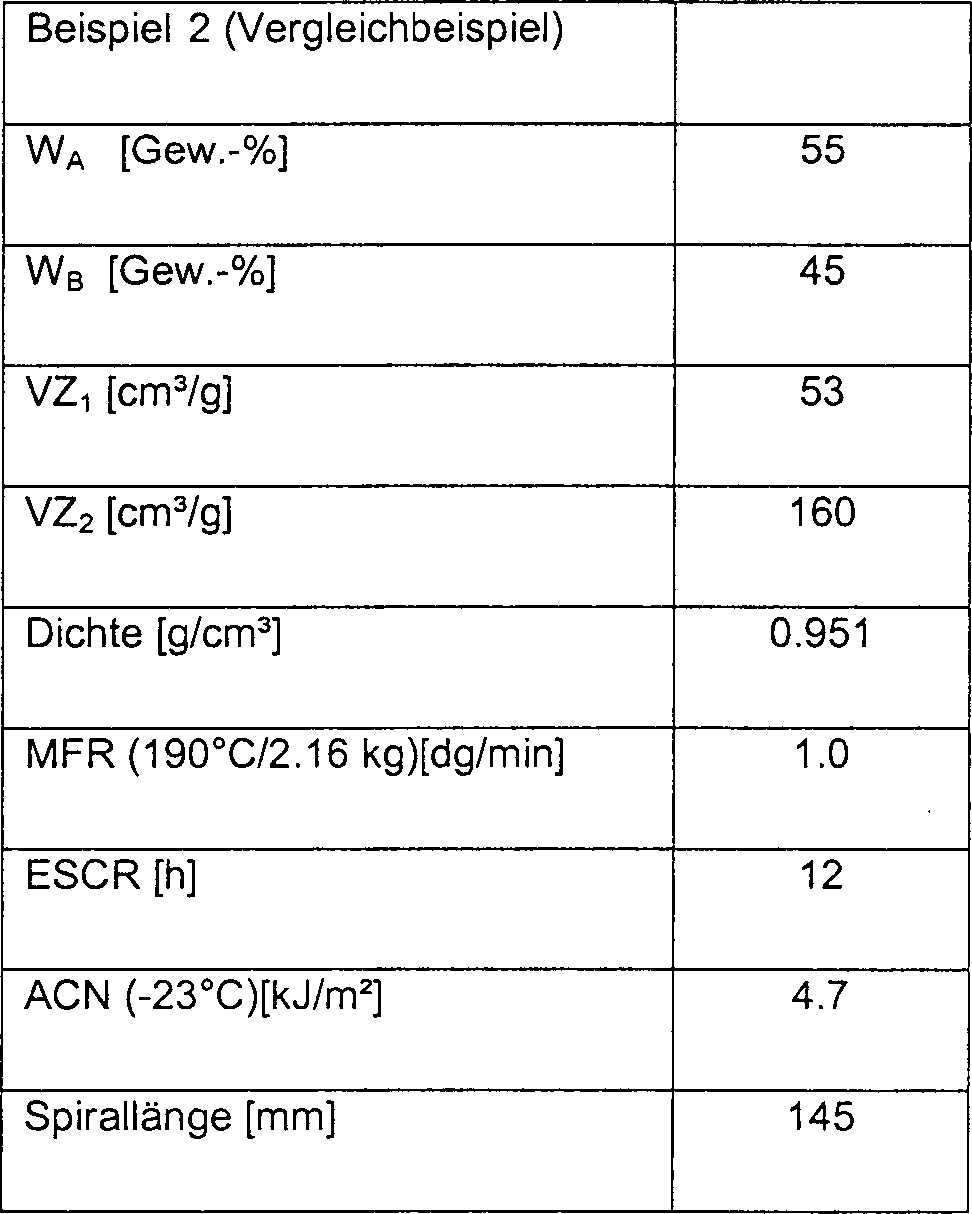
Claims (12)
Priority Applications (14)
| Application Number | Priority Date | Filing Date | Title |
|---|---|---|---|
| DE102005030941A DE102005030941A1 (en) | 2005-06-30 | 2005-06-30 | Polyethylene molding compound for the production of injection-molded finished parts |
| US11/922,667 US9000095B2 (en) | 2005-06-30 | 2006-06-27 | Polyethylene molding composition for producing injection-molded finished parts |
| RU2008103322/05A RU2411264C2 (en) | 2005-06-30 | 2006-06-27 | Polyethylene moulding composition for pressure casting finished parts |
| KR1020077030642A KR20080028892A (en) | 2005-06-30 | 2006-06-27 | Polyethylene Molding Composition for Manufacturing Injection Molded Products |
| AT06777475T ATE462759T1 (en) | 2005-06-30 | 2006-06-27 | POLYETHYLENE MOLDING COMPOSITION FOR PRODUCING INJECTION MOLDED FINISHED COMPONENTS |
| JP2008518814A JP2008545029A (en) | 2005-06-30 | 2006-06-27 | Polyethylene molding composition for manufacturing injection molded parts |
| EP06777475A EP1896532B1 (en) | 2005-06-30 | 2006-06-27 | Polyethylene molding composition for producing injection-molded finished parts |
| CN2006800235886A CN101213248B (en) | 2005-06-30 | 2006-06-27 | Polyethylene molding composition for producing injection-molded finished parts |
| DE602006013315T DE602006013315D1 (en) | 2005-06-30 | 2006-06-27 | POLYETHYLENE FORMAL COMPOSITION FOR PRODUCING INJECTION MOLDED COMPONENTS |
| PCT/EP2006/063580 WO2007003530A1 (en) | 2005-06-30 | 2006-06-27 | Polyethylene molding composition for producing injection-molded finished parts |
| AU2006265210A AU2006265210A1 (en) | 2005-06-30 | 2006-06-27 | Polyethylene molding composition for producing injection-molded finished parts |
| CA002612724A CA2612724A1 (en) | 2005-06-30 | 2006-06-27 | Polyethylene molding composition for producing injection-molded finished parts |
| BRPI0612837A BRPI0612837B1 (en) | 2005-06-30 | 2006-06-27 | polyethylene molding composition, process for preparing it, use of a polyethylene molding composition, and injection molded finished part |
| TW095124045A TW200706582A (en) | 2005-06-30 | 2006-06-30 | Polyethylene molding composition for producing injection-molded finished parts |
Applications Claiming Priority (1)
| Application Number | Priority Date | Filing Date | Title |
|---|---|---|---|
| DE102005030941A DE102005030941A1 (en) | 2005-06-30 | 2005-06-30 | Polyethylene molding compound for the production of injection-molded finished parts |
Publications (1)
| Publication Number | Publication Date |
|---|---|
| DE102005030941A1 true DE102005030941A1 (en) | 2007-01-11 |
Family
ID=36741334
Family Applications (2)
| Application Number | Title | Priority Date | Filing Date |
|---|---|---|---|
| DE102005030941A Withdrawn DE102005030941A1 (en) | 2005-06-30 | 2005-06-30 | Polyethylene molding compound for the production of injection-molded finished parts |
| DE602006013315T Active DE602006013315D1 (en) | 2005-06-30 | 2006-06-27 | POLYETHYLENE FORMAL COMPOSITION FOR PRODUCING INJECTION MOLDED COMPONENTS |
Family Applications After (1)
| Application Number | Title | Priority Date | Filing Date |
|---|---|---|---|
| DE602006013315T Active DE602006013315D1 (en) | 2005-06-30 | 2006-06-27 | POLYETHYLENE FORMAL COMPOSITION FOR PRODUCING INJECTION MOLDED COMPONENTS |
Country Status (13)
| Country | Link |
|---|---|
| US (1) | US9000095B2 (en) |
| EP (1) | EP1896532B1 (en) |
| JP (1) | JP2008545029A (en) |
| KR (1) | KR20080028892A (en) |
| CN (1) | CN101213248B (en) |
| AT (1) | ATE462759T1 (en) |
| AU (1) | AU2006265210A1 (en) |
| BR (1) | BRPI0612837B1 (en) |
| CA (1) | CA2612724A1 (en) |
| DE (2) | DE102005030941A1 (en) |
| RU (1) | RU2411264C2 (en) |
| TW (1) | TW200706582A (en) |
| WO (1) | WO2007003530A1 (en) |
Cited By (2)
| Publication number | Priority date | Publication date | Assignee | Title |
|---|---|---|---|---|
| WO2009077142A1 (en) * | 2007-12-18 | 2009-06-25 | Basell Polyolefine Gmbh | Pe moulding composition for producing injection-molded screw cap closures and high-strenght screw cap closure for carbonated beverages produced therewith |
| EP2746334A1 (en) | 2012-12-19 | 2014-06-25 | Borealis AG | Polyethylene blend with improved ESCR |
Families Citing this family (44)
| Publication number | Priority date | Publication date | Assignee | Title |
|---|---|---|---|---|
| DE102007031449A1 (en) * | 2007-07-05 | 2009-01-08 | Basell Polyolefine Gmbh | PE molding compound for blow molding small hollow bodies with low density |
| DE102007031450A1 (en) * | 2007-07-05 | 2009-01-08 | Basell Polyolefine Gmbh | PE molding compound for blow molding small hollow bodies with low density |
| KR101141494B1 (en) * | 2007-09-05 | 2012-05-03 | 에스케이이노베이션 주식회사 | Ethylene copolymer having multiple pitch in molecular weight distribution and the method of preparing the same |
| CN102197078B (en) | 2008-08-28 | 2013-12-11 | 陶氏环球技术有限责任公司 | Process and compositions for injections blow molding |
| EP2328968B1 (en) | 2008-08-29 | 2017-05-03 | Basell Polyolefine GmbH | Polyethylene for injection moldings |
| US9187627B2 (en) * | 2008-10-23 | 2015-11-17 | Equistar Chemicals, Lp | Polyethylene having faster crystallization rate and improved environmental stress cracking resistance |
| US8114493B2 (en) | 2009-04-28 | 2012-02-14 | Equistar Chemicals, Lp | Polyethylene pipe resins |
| US8372178B2 (en) * | 2009-05-01 | 2013-02-12 | E I Du Pont De Nemours And Company | Silver particles and processes for making them |
| TW201100185A (en) * | 2009-05-01 | 2011-01-01 | Du Pont | Silver particles and a process for making them |
| RU2545063C2 (en) * | 2009-06-03 | 2015-03-27 | Базелль Полиолефине Гмбх | Polyethylene composition and finished products obtained from it |
| US20110048527A1 (en) * | 2009-08-25 | 2011-03-03 | E.I. Du Pont De Nemours And Company | Silver thick film paste compositions and their use in conductors for photovoltaic cells |
| US7932323B1 (en) | 2009-11-04 | 2011-04-26 | Equistar Chemicals, Lp | Polyolefin-based adhesives having improved oxidative stability |
| WO2013144324A1 (en) * | 2012-03-28 | 2013-10-03 | Borealis Ag | Multimodal polymer |
| JP2014088476A (en) * | 2012-10-29 | 2014-05-15 | Hosokawa Yoko Co Ltd | Polyethylene film, laminate and container |
| US20140127438A1 (en) | 2012-11-08 | 2014-05-08 | Robert L. Sherman, Jr. | Stabilized high-density polyethylene composition with improved resistance to deterioration and stabilizer system |
| EP2743305B1 (en) * | 2012-12-17 | 2015-07-22 | Borealis AG | Process for the preparation of a high density polyethylene blend |
| RU2635568C2 (en) * | 2013-10-15 | 2017-11-14 | Базелл Полиолефин Гмбх | Polyethylene for casting under pressure |
| WO2016205192A1 (en) * | 2015-06-15 | 2016-12-22 | Herring George Birks | Compositions for injection moulding |
| EP3380532B1 (en) | 2015-11-23 | 2019-12-25 | SABIC Global Technologies B.V. | High density polyethylene for the production of pipes |
| DE102016202196A1 (en) | 2016-02-12 | 2017-08-17 | Wacker Chemie Ag | Crosslinkable compositions based on organyloxysilane-terminated polymers |
| ES2755384T3 (en) | 2016-09-12 | 2020-04-22 | Thai Polyethylene Co Ltd | Multimodal polyethylene container |
| PT3293205T (en) * | 2016-09-12 | 2019-10-31 | Scg Chemicals Co Ltd | Process for the preparation of multimodal polyethylene |
| EP3293214B1 (en) * | 2016-09-12 | 2019-12-25 | Thai Polyethylene Co., Ltd. | High performances multimodal ultra high molecular weight polyethylene |
| ES2767704T3 (en) * | 2016-09-12 | 2020-06-18 | Thai Polyethylene Co Ltd | Multimodal polyethylene pipe |
| CN109790229B (en) | 2016-09-12 | 2021-08-06 | 泰国聚乙烯有限公司 | Bimodal polyethylene composition and pipe comprising the same |
| PT3293207T (en) * | 2016-09-12 | 2019-10-25 | Scg Chemicals Co Ltd | MULTIMODAL POLYETHYLENE TUBE |
| PT3293211T (en) * | 2016-09-12 | 2019-09-12 | Scg Chemicals Co Ltd | MULTIMODAL POLYETHYLENE THREADED COVER |
| PT3293210T (en) | 2016-09-12 | 2019-06-12 | Scg Chemicals Co Ltd | Multimodal polyethylene film |
| EP3293209B1 (en) * | 2016-09-12 | 2019-08-14 | Thai Polyethylene Co., Ltd. | Multimodal polyethylene thin film |
| CN109863178B (en) * | 2016-10-28 | 2021-11-16 | 尤尼威蒂恩技术有限责任公司 | Controlling reactor split and product parameters |
| CN110234495B (en) | 2017-01-26 | 2021-11-12 | Sabic环球技术有限责任公司 | Method for producing a tube by biaxial stretching |
| CN121246218A (en) | 2017-03-17 | 2026-01-02 | Sabic环球技术有限责任公司 | Method for producing tubes by biaxial stretching |
| CN110621474B (en) | 2017-03-30 | 2021-06-29 | Sabic环球技术有限责任公司 | Method for modifying and connecting oriented pipes |
| US9963529B1 (en) | 2017-04-19 | 2018-05-08 | Nova Chemicals (International) S.A. | Multi reactor solution polymerization |
| US10538654B2 (en) | 2017-04-19 | 2020-01-21 | Nova Chemicals (International) S.A. | Multi reactor solution polymerization, polyethylene and polyethylene film |
| KR102605947B1 (en) | 2017-12-26 | 2023-11-28 | 다우 글로벌 테크놀로지스 엘엘씨 | Dual reactor solution process for the production of multimodal ethylene-based polymers |
| ES2946586T3 (en) | 2017-12-26 | 2023-07-21 | Dow Global Technologies Llc | Procedure for the production of multimodal ethylene-based polymers |
| CN111683980B (en) * | 2017-12-26 | 2024-03-05 | 陶氏环球技术有限责任公司 | Multimodal ethylene polymer processing systems and methods |
| KR102649280B1 (en) | 2017-12-26 | 2024-03-21 | 다우 글로벌 테크놀로지스 엘엘씨 | Multimodal ethylene-based polymer composition with improved toughness |
| WO2019133394A1 (en) | 2017-12-26 | 2019-07-04 | Dow Global Technologies, Llc | Compositions comprising multimodal ethylene based polymers and low density polyethylene (ldpe) |
| CN111670117B (en) | 2018-01-25 | 2023-03-28 | Sabic环球技术有限责任公司 | Pipe with high abrasion resistance |
| WO2020221876A1 (en) | 2019-05-02 | 2020-11-05 | Sabic Global Technologies B.V. | Pipe for transport of chlorinated water |
| WO2021148352A1 (en) | 2020-01-21 | 2021-07-29 | Sabic Global Technologies B.V. | Pipe for transport of water containing chlorinated disinfectant |
| CN119731490A (en) | 2022-08-24 | 2025-03-28 | Sabic环球技术有限责任公司 | Geothermal heating and cooling system |
Family Cites Families (63)
| Publication number | Priority date | Publication date | Assignee | Title |
|---|---|---|---|---|
| US3718634A (en) * | 1967-05-17 | 1973-02-27 | Gaf Corp | Polymerization of alkyl vinyl ethers with catalyst based on dialkyl aluminum halide and water |
| JPS5910724B2 (en) * | 1979-08-24 | 1984-03-10 | 旭化成株式会社 | Continuous polymerization of ethylene |
| DE3124223A1 (en) * | 1981-06-20 | 1982-12-30 | Hoechst Ag, 6000 Frankfurt | "METHOD FOR PRODUCING A POLYOLEFIN AND CATALYST THEREFOR" |
| DE3124580A1 (en) * | 1981-06-23 | 1983-01-05 | Bayer Ag, 5090 Leverkusen | FUNGICIDAL AGENT |
| US4536550A (en) * | 1983-04-21 | 1985-08-20 | Asahi Kasei Kogyo Kabushiki Kaisha | Polyethylene composition |
| DE3918646A1 (en) | 1989-06-08 | 1990-12-13 | Hoechst Ag | PROCESS FOR PREPARING A POLY-L-OLEFIN |
| DE4017661A1 (en) | 1990-06-01 | 1991-12-05 | Hoechst Ag | METHOD FOR PRODUCING A POLY-1 OLEFIN |
| US5648309A (en) * | 1990-06-01 | 1997-07-15 | Hoechst Aktiengesellschaft | Process for the preparation of a poly-1-olefin |
| JP3045548B2 (en) | 1990-12-28 | 2000-05-29 | 日本石油化学株式会社 | Polyethylene composition |
| US5338589A (en) * | 1991-06-05 | 1994-08-16 | Hoechst Aktiengesellschaft | Polyethylene molding composition |
| JP2716615B2 (en) * | 1991-10-25 | 1998-02-18 | 丸善ポリマー株式会社 | Method for producing ethylene polymer composition |
| US6221410B1 (en) * | 1992-09-25 | 2001-04-24 | Cryovac, Inc. | Backseamed casing and packaged product incorporating same |
| US5258161A (en) * | 1992-06-15 | 1993-11-02 | Union Carbide Chemicals & Plastics Technology Corporation | Blown film extrusion |
| JP2693691B2 (en) * | 1992-07-31 | 1997-12-24 | 信越化学工業株式会社 | Reusing method of cured silicone rubber |
| CA2103401C (en) * | 1992-11-19 | 2002-12-17 | Mamoru Takahashi | Ethylene copolymer composition |
| BE1006439A3 (en) * | 1992-12-21 | 1994-08-30 | Solvay Societe Annonyme | Method for preparing a composition of polymers of ethylene, polymer composition and use of ethylene. |
| KR100190268B1 (en) | 1993-04-26 | 1999-06-01 | 에인혼 해롤드 | Process for polymerizing monomers in fludized beds |
| US5350807A (en) * | 1993-06-25 | 1994-09-27 | Phillips Petroleum Company | Ethylene polymers |
| FI96216C (en) | 1994-12-16 | 1996-05-27 | Borealis Polymers Oy | Process for the production of polyethylene |
| NO315857B1 (en) * | 1995-03-28 | 2003-11-03 | Japan Polyolefines Co Ltd | Ethylene <alpha> olefin copolymer, blend, film, laminated material, electrically insulating material and power cable containing this |
| DE19515678B4 (en) * | 1995-04-28 | 2007-12-27 | Basell Polyolefine Gmbh | Polyethylene tube with improved mechanical properties |
| US5882750A (en) * | 1995-07-03 | 1999-03-16 | Mobil Oil Corporation | Single reactor bimodal HMW-HDPE film resin with improved bubble stability |
| PT837915E (en) * | 1995-07-10 | 2001-12-28 | Borealis Tech Oy | COATING COMPOSITION |
| SE504455C2 (en) * | 1995-07-10 | 1997-02-17 | Borealis Polymers Oy | Cable sheath composition, its use and methods for its manufacture |
| CN1146586C (en) | 1995-10-18 | 2004-04-21 | 智索股份有限公司 | Olefin homopolymer or copolymer composition and process for producing the same |
| US5925448A (en) * | 1995-11-07 | 1999-07-20 | Union Carbide Chemicals & Plastics Technology Corporation | Film extruded from a blend of ethylene copolymers |
| SG60151A1 (en) * | 1996-11-15 | 1999-02-22 | Sumitomo Chemical Co | Propylene-1-butene copolymer |
| US6180736B1 (en) * | 1996-12-20 | 2001-01-30 | Exxon Chemical Patents Inc | High activity metallocene polymerization process |
| FI111166B (en) * | 1997-01-10 | 2003-06-13 | Borealis Polymers Oy | Extrusion coating |
| SG67489A1 (en) * | 1997-04-07 | 1999-09-21 | Mitsui Chemicals Inc | Laminating propylene/1-butene random copolymer composition and composite film using the same |
| EP0905151A1 (en) | 1997-09-27 | 1999-03-31 | Fina Research S.A. | Production of polyethylene having a broad molecular weight distribution |
| US6225410B1 (en) | 1997-12-25 | 2001-05-01 | Mitsui Chemicals | Ethylene/α-olefin copolymer and process for preparing the same |
| FI981034A7 (en) * | 1998-05-08 | 1999-11-09 | Borealis Polymers Oy | HD polyethylene compositions and method for preparing them |
| TW460485B (en) * | 1998-06-19 | 2001-10-21 | Japan Polyolefins Co Ltd | Ethylene.Α-olefin copolymer, and combinations, films and use thereof |
| US6509106B1 (en) * | 1998-08-18 | 2003-01-21 | Eastman Chemical Company | Blends containing linear low density polyethylene, high density polyethylene, and low density polyethylene particularly suitable for extrusion coating and films |
| EP0989141A1 (en) * | 1998-09-25 | 2000-03-29 | Fina Research S.A. | Production of multimodal polyethelene |
| SE9804407D0 (en) * | 1998-12-18 | 1998-12-18 | Borealis Polymers Oy | A multimodal polymer composition |
| EP1041113A1 (en) * | 1999-03-30 | 2000-10-04 | Fina Research S.A. | Polyolefins and uses thereof |
| US6242548B1 (en) * | 1999-05-13 | 2001-06-05 | Dyneon Llc | Fluoroplastic polymers with improved characteristics |
| KR100575121B1 (en) * | 1999-06-28 | 2006-05-03 | 미쓰이 가가쿠 가부시키가이샤 | Processes of producing olefinic thermoplastic elastomer compositions, and compositions obtainable thereby |
| DE19929812A1 (en) | 1999-06-30 | 2001-01-04 | Elenac Gmbh | Polyethylene molding compound and pipe made from it with improved mechanical properties |
| DE19945980A1 (en) | 1999-09-24 | 2001-03-29 | Elenac Gmbh | Polyethylene molding compound with improved ESCR stiffness ratio and swelling rate, process for its production and hollow bodies made from it |
| US6586541B2 (en) * | 2000-02-02 | 2003-07-01 | E. I. Du Pont De Nemours And Company | Process for production of polyolefins |
| US6455638B2 (en) * | 2000-05-11 | 2002-09-24 | Dupont Dow Elastomers L.L.C. | Ethylene/α-olefin polymer blends comprising components with differing ethylene contents |
| TW577908B (en) * | 2001-03-14 | 2004-03-01 | Mitsui Chemicals Inc | Olefinic thermoplastic elastomer composition |
| EP1266738B8 (en) | 2001-06-14 | 2005-11-02 | Innovene Manufacturing Belgium NV | Method of compounding a multimodal polyethylene composition |
| KR20080077284A (en) * | 2001-08-17 | 2008-08-21 | 다우 글로벌 테크놀로지스 인크. | Bimodal Polyethylene Compositions and Articles Made therefrom |
| EP1425344B1 (en) * | 2001-08-31 | 2005-01-26 | Dow Global Technologies Inc. | Multimodal polyethylene material |
| KR100495177B1 (en) * | 2001-08-31 | 2005-06-14 | 미쓰이 가가쿠 가부시키가이샤 | Olefinic thermoplastic elastomer, method of producing thereof, and use thereof |
| EP1304353A1 (en) * | 2001-10-18 | 2003-04-23 | Atofina Research S.A. | Physical blends of polyethylenes |
| KR20050035183A (en) * | 2001-11-30 | 2005-04-15 | 엑손모빌 케미칼 패턴츠 인코포레이티드 | Ethylene/alpha-olefin copolymer made with a non-single-site/single-site catalyst combination, its preparation and use |
| US6649698B1 (en) * | 2002-05-17 | 2003-11-18 | Equistar Chemicals, Lp | Polyethylene blends |
| KR20050088310A (en) | 2002-12-19 | 2005-09-05 | 바젤 폴리올레핀 게엠베하 | Polyethylene blow moulding composition for producing small containers |
| DE10259491A1 (en) | 2002-12-19 | 2004-07-01 | Basell Polyolefine Gmbh | Polyethylene moulding material for production of blow-moulded containers comprises low-mol. wt. ethylene homopolymer, high-mol. wt. copolymer of ethylene and 4-8C olefin, and ultrahigh-mol. wt. ethylene copolymer |
| EP1578862B1 (en) * | 2002-12-24 | 2006-07-12 | Basell Polyolefine GmbH | Polyethylene blow moulding composition for producing jerry cans |
| ES2268470T3 (en) * | 2002-12-24 | 2007-03-16 | Basell Polyolefine Gmbh | COMPOSITION OF POLYETHYLENE FOR MOLDING BY BLOWING INTENDED FOR THE PRODUCTION OF LARGE CONTAINERS. |
| JP2006512475A (en) | 2002-12-24 | 2006-04-13 | バーゼル・ポリオレフィン・ゲーエムベーハー | Polyethylene composition for producing an L-ring drum |
| DE102004055587A1 (en) | 2004-11-18 | 2006-05-24 | Basell Polyolefine Gmbh | Polyethylene molded mass, useful for the external covering of electro cables, comprises low molecular ethylene homopolymers, high molecular copolymers of ethylene and other 4-8C olefin and of ultrahigh molecular ethylene copolymer |
| DE102004055588A1 (en) * | 2004-11-18 | 2006-05-24 | Basell Polyolefine Gmbh | Polyethylene molded mass, useful for preparing protective coating for steel tubes, comprises low molecular ethylene homopolymers, high molecular copolymers of ethylene and other 4-8C olefin and of ultrahigh molecular ethylene copolymer |
| DE102005009916A1 (en) * | 2005-03-01 | 2006-09-07 | Basell Polyolefine Gmbh | Polyethylene molding compound for producing blown films with improved mechanical properties |
| DE102005009895A1 (en) * | 2005-03-01 | 2006-09-07 | Basell Polyolefine Gmbh | Polyethylene molding compound for producing blown films with improved mechanical properties |
| DE102005009896A1 (en) | 2005-03-01 | 2006-09-07 | Basell Polyolefine Gmbh | Polyethylene molding compound for producing blown films with improved mechanical properties |
| DE102005040390A1 (en) * | 2005-08-25 | 2007-03-01 | Basell Polyolefine Gmbh | Multi-modal polyethylene moulding material for production of pipes, e.g. water pipes, comprises low-mol. wt. ethylene homopolymer, high-mol. wt. ethylene copolymer and ultrahigh-mol. wt. ethylene copolymer |
-
2005
- 2005-06-30 DE DE102005030941A patent/DE102005030941A1/en not_active Withdrawn
-
2006
- 2006-06-27 US US11/922,667 patent/US9000095B2/en active Active
- 2006-06-27 JP JP2008518814A patent/JP2008545029A/en active Pending
- 2006-06-27 EP EP06777475A patent/EP1896532B1/en active Active
- 2006-06-27 KR KR1020077030642A patent/KR20080028892A/en not_active Withdrawn
- 2006-06-27 CN CN2006800235886A patent/CN101213248B/en active Active
- 2006-06-27 AT AT06777475T patent/ATE462759T1/en not_active IP Right Cessation
- 2006-06-27 DE DE602006013315T patent/DE602006013315D1/en active Active
- 2006-06-27 WO PCT/EP2006/063580 patent/WO2007003530A1/en not_active Ceased
- 2006-06-27 RU RU2008103322/05A patent/RU2411264C2/en active
- 2006-06-27 BR BRPI0612837A patent/BRPI0612837B1/en active IP Right Grant
- 2006-06-27 AU AU2006265210A patent/AU2006265210A1/en not_active Abandoned
- 2006-06-27 CA CA002612724A patent/CA2612724A1/en not_active Abandoned
- 2006-06-30 TW TW095124045A patent/TW200706582A/en unknown
Cited By (3)
| Publication number | Priority date | Publication date | Assignee | Title |
|---|---|---|---|---|
| WO2009077142A1 (en) * | 2007-12-18 | 2009-06-25 | Basell Polyolefine Gmbh | Pe moulding composition for producing injection-molded screw cap closures and high-strenght screw cap closure for carbonated beverages produced therewith |
| US8663790B2 (en) | 2007-12-18 | 2014-03-04 | Basell Polyolefine Gmbh | PE moulding composition for producing injection-molded screw cap closures and high-strength screw cap closure for carbonated beverages produced therewith |
| EP2746334A1 (en) | 2012-12-19 | 2014-06-25 | Borealis AG | Polyethylene blend with improved ESCR |
Also Published As
| Publication number | Publication date |
|---|---|
| EP1896532B1 (en) | 2010-03-31 |
| US20100010163A1 (en) | 2010-01-14 |
| TW200706582A (en) | 2007-02-16 |
| AU2006265210A1 (en) | 2007-01-11 |
| BRPI0612837A2 (en) | 2012-10-09 |
| JP2008545029A (en) | 2008-12-11 |
| DE602006013315D1 (en) | 2010-05-12 |
| US9000095B2 (en) | 2015-04-07 |
| CA2612724A1 (en) | 2007-01-11 |
| ATE462759T1 (en) | 2010-04-15 |
| WO2007003530A1 (en) | 2007-01-11 |
| CN101213248A (en) | 2008-07-02 |
| RU2008103322A (en) | 2009-08-10 |
| KR20080028892A (en) | 2008-04-02 |
| RU2411264C2 (en) | 2011-02-10 |
| EP1896532A1 (en) | 2008-03-12 |
| BRPI0612837B1 (en) | 2017-03-28 |
| CN101213248B (en) | 2012-01-04 |
Similar Documents
| Publication | Publication Date | Title |
|---|---|---|
| DE102005030941A1 (en) | Polyethylene molding compound for the production of injection-molded finished parts | |
| DE60306811T2 (en) | Polyethylene molding compound for the manufacture of containers by blow molding and L-ring-conrainer produced therewith | |
| DE602004004277T2 (en) | Multimodal polyethylene composition for injection molded caps and closure devices | |
| DE60203706T2 (en) | HETEROPHASIC PROPYLENE POLYMER | |
| DE602004009687T2 (en) | MOLDING POLYMER | |
| DE60002322T2 (en) | INJECTION MOLDING PROCESS USING POLYMER BLENDS | |
| DE69714429T2 (en) | METHOD FOR PRODUCING CREPTING-RESISTANT POLYPROPYLENE BLOCK COPOLYMERS | |
| EP1228101B1 (en) | Polyethylene moulding compound with an improved escr-stiffness relation and an improved swelling rate, a method for the production thereof and the use thereof | |
| DE60213631T3 (en) | PROPYLENE COPOLYMER WITH RANDOM COMONOMER DISTRIBUTION | |
| DE69835745T2 (en) | BRANCHED POLYPROPYLENE | |
| EP1320570B1 (en) | Polyethylene moulding compound suitable as a pipe material with excellent processing properties | |
| DE602004008781T2 (en) | Multimodal polyethylene composition for pipes | |
| DE102007016348A1 (en) | Polyethylene molding compound for producing hollow bodies by thermoforming and fuel tanks produced therewith | |
| DE102007031449A1 (en) | PE molding compound for blow molding small hollow bodies with low density | |
| EP1053265B1 (en) | Process for the preparation of injection-stretch-blow moulded containers made of olefin polymers | |
| EP0791609B1 (en) | Process for the manufacture of pipes from a propylene-ethylene copolymer | |
| DE102005009896A1 (en) | Polyethylene molding compound for producing blown films with improved mechanical properties | |
| EP0808870B1 (en) | High molecular weight ethylene/propylene reactor blend having broad molecular weight distribution | |
| DE102004055588A1 (en) | Polyethylene molded mass, useful for preparing protective coating for steel tubes, comprises low molecular ethylene homopolymers, high molecular copolymers of ethylene and other 4-8C olefin and of ultrahigh molecular ethylene copolymer | |
| DE102005009895A1 (en) | Polyethylene molding compound for producing blown films with improved mechanical properties | |
| DE10259491A1 (en) | Polyethylene moulding material for production of blow-moulded containers comprises low-mol. wt. ethylene homopolymer, high-mol. wt. copolymer of ethylene and 4-8C olefin, and ultrahigh-mol. wt. ethylene copolymer | |
| DE60306810T2 (en) | POLYETHYLENE FORMING FOR MANUFACTURING CONTAINERS THROUGH BLOW SHAPES AND WHOLESALE MAKES THEREFOR | |
| DE69925492T2 (en) | POLYETHYLENE COMPOSITIONS WITH IMPROVED OPTICAL AND MECHANICAL PROPERTIES AND IMPROVED PROCESSABILITY IN THE MELT | |
| DE60306808T2 (en) | POLYETHYLENE FORMING TO MANUFACTURE CONTAINERS THROUGH BLOW SHAPES AND SMALL-HOLLOW BASKETS MANUFACTURED THEREIN | |
| US20250019532A1 (en) | High Performance Multimodal Ultra High Molecular Weight Polyethylene |
Legal Events
| Date | Code | Title | Description |
|---|---|---|---|
| 8139 | Disposal/non-payment of the annual fee |