DE102005009916A1 - Polyethylene molding compound for producing blown films with improved mechanical properties - Google Patents
Polyethylene molding compound for producing blown films with improved mechanical properties Download PDFInfo
- Publication number
- DE102005009916A1 DE102005009916A1 DE102005009916A DE102005009916A DE102005009916A1 DE 102005009916 A1 DE102005009916 A1 DE 102005009916A1 DE 102005009916 A DE102005009916 A DE 102005009916A DE 102005009916 A DE102005009916 A DE 102005009916A DE 102005009916 A1 DE102005009916 A1 DE 102005009916A1
- Authority
- DE
- Germany
- Prior art keywords
- range
- molecular weight
- polyethylene
- molding composition
- high molecular
- Prior art date
- Legal status (The legal status is an assumption and is not a legal conclusion. Google has not performed a legal analysis and makes no representation as to the accuracy of the status listed.)
- Withdrawn
Links
Classifications
-
- C—CHEMISTRY; METALLURGY
- C08—ORGANIC MACROMOLECULAR COMPOUNDS; THEIR PREPARATION OR CHEMICAL WORKING-UP; COMPOSITIONS BASED THEREON
- C08L—COMPOSITIONS OF MACROMOLECULAR COMPOUNDS
- C08L23/00—Compositions of homopolymers or copolymers of unsaturated aliphatic hydrocarbons having only one carbon-to-carbon double bond; Compositions of derivatives of such polymers
- C08L23/02—Compositions of homopolymers or copolymers of unsaturated aliphatic hydrocarbons having only one carbon-to-carbon double bond; Compositions of derivatives of such polymers not modified by chemical after-treatment
- C08L23/04—Homopolymers or copolymers of ethene
- C08L23/06—Polyethene
-
- C—CHEMISTRY; METALLURGY
- C08—ORGANIC MACROMOLECULAR COMPOUNDS; THEIR PREPARATION OR CHEMICAL WORKING-UP; COMPOSITIONS BASED THEREON
- C08F—MACROMOLECULAR COMPOUNDS OBTAINED BY REACTIONS ONLY INVOLVING CARBON-TO-CARBON UNSATURATED BONDS
- C08F210/00—Copolymers of unsaturated aliphatic hydrocarbons having only one carbon-to-carbon double bond
- C08F210/02—Ethene
-
- C—CHEMISTRY; METALLURGY
- C08—ORGANIC MACROMOLECULAR COMPOUNDS; THEIR PREPARATION OR CHEMICAL WORKING-UP; COMPOSITIONS BASED THEREON
- C08F—MACROMOLECULAR COMPOUNDS OBTAINED BY REACTIONS ONLY INVOLVING CARBON-TO-CARBON UNSATURATED BONDS
- C08F210/00—Copolymers of unsaturated aliphatic hydrocarbons having only one carbon-to-carbon double bond
-
- C—CHEMISTRY; METALLURGY
- C08—ORGANIC MACROMOLECULAR COMPOUNDS; THEIR PREPARATION OR CHEMICAL WORKING-UP; COMPOSITIONS BASED THEREON
- C08J—WORKING-UP; GENERAL PROCESSES OF COMPOUNDING; AFTER-TREATMENT NOT COVERED BY SUBCLASSES C08B, C08C, C08F, C08G or C08H
- C08J5/00—Manufacture of articles or shaped materials containing macromolecular substances
- C08J5/18—Manufacture of films or sheets
-
- C—CHEMISTRY; METALLURGY
- C08—ORGANIC MACROMOLECULAR COMPOUNDS; THEIR PREPARATION OR CHEMICAL WORKING-UP; COMPOSITIONS BASED THEREON
- C08L—COMPOSITIONS OF MACROMOLECULAR COMPOUNDS
- C08L23/00—Compositions of homopolymers or copolymers of unsaturated aliphatic hydrocarbons having only one carbon-to-carbon double bond; Compositions of derivatives of such polymers
- C08L23/02—Compositions of homopolymers or copolymers of unsaturated aliphatic hydrocarbons having only one carbon-to-carbon double bond; Compositions of derivatives of such polymers not modified by chemical after-treatment
- C08L23/04—Homopolymers or copolymers of ethene
-
- C—CHEMISTRY; METALLURGY
- C08—ORGANIC MACROMOLECULAR COMPOUNDS; THEIR PREPARATION OR CHEMICAL WORKING-UP; COMPOSITIONS BASED THEREON
- C08L—COMPOSITIONS OF MACROMOLECULAR COMPOUNDS
- C08L23/00—Compositions of homopolymers or copolymers of unsaturated aliphatic hydrocarbons having only one carbon-to-carbon double bond; Compositions of derivatives of such polymers
- C08L23/02—Compositions of homopolymers or copolymers of unsaturated aliphatic hydrocarbons having only one carbon-to-carbon double bond; Compositions of derivatives of such polymers not modified by chemical after-treatment
- C08L23/04—Homopolymers or copolymers of ethene
- C08L23/08—Copolymers of ethene
- C08L23/0807—Copolymers of ethene with unsaturated hydrocarbons only containing four or more carbon atoms
-
- C—CHEMISTRY; METALLURGY
- C08—ORGANIC MACROMOLECULAR COMPOUNDS; THEIR PREPARATION OR CHEMICAL WORKING-UP; COMPOSITIONS BASED THEREON
- C08J—WORKING-UP; GENERAL PROCESSES OF COMPOUNDING; AFTER-TREATMENT NOT COVERED BY SUBCLASSES C08B, C08C, C08F, C08G or C08H
- C08J2323/00—Characterised by the use of homopolymers or copolymers of unsaturated aliphatic hydrocarbons having only one carbon-to-carbon double bond; Derivatives of such polymers
- C08J2323/02—Characterised by the use of homopolymers or copolymers of unsaturated aliphatic hydrocarbons having only one carbon-to-carbon double bond; Derivatives of such polymers not modified by chemical after treatment
- C08J2323/04—Homopolymers or copolymers of ethene
-
- C—CHEMISTRY; METALLURGY
- C08—ORGANIC MACROMOLECULAR COMPOUNDS; THEIR PREPARATION OR CHEMICAL WORKING-UP; COMPOSITIONS BASED THEREON
- C08L—COMPOSITIONS OF MACROMOLECULAR COMPOUNDS
- C08L2205/00—Polymer mixtures characterised by other features
- C08L2205/03—Polymer mixtures characterised by other features containing three or more polymers in a blend
-
- C—CHEMISTRY; METALLURGY
- C08—ORGANIC MACROMOLECULAR COMPOUNDS; THEIR PREPARATION OR CHEMICAL WORKING-UP; COMPOSITIONS BASED THEREON
- C08L—COMPOSITIONS OF MACROMOLECULAR COMPOUNDS
- C08L23/00—Compositions of homopolymers or copolymers of unsaturated aliphatic hydrocarbons having only one carbon-to-carbon double bond; Compositions of derivatives of such polymers
- C08L23/02—Compositions of homopolymers or copolymers of unsaturated aliphatic hydrocarbons having only one carbon-to-carbon double bond; Compositions of derivatives of such polymers not modified by chemical after-treatment
- C08L23/04—Homopolymers or copolymers of ethene
- C08L23/08—Copolymers of ethene
Landscapes
- Chemical & Material Sciences (AREA)
- Health & Medical Sciences (AREA)
- Chemical Kinetics & Catalysis (AREA)
- Medicinal Chemistry (AREA)
- Polymers & Plastics (AREA)
- Organic Chemistry (AREA)
- Engineering & Computer Science (AREA)
- Manufacturing & Machinery (AREA)
- Materials Engineering (AREA)
- Manufacture Of Macromolecular Shaped Articles (AREA)
- Addition Polymer Or Copolymer, Post-Treatments, Or Chemical Modifications (AREA)
- Compositions Of Macromolecular Compounds (AREA)
- Injection Moulding Of Plastics Or The Like (AREA)
- Blow-Moulding Or Thermoforming Of Plastics Or The Like (AREA)
Abstract
Die Erfindung betrifft eine Polyethylen-Formmasse mit multimodaler Molmassenverteilung, die sich besonders eignet zum Blasformen von Folien mit Schichtdicken im Bereich von 8 bis 200 mum. Die Formmasse besitzt eine Dichte bei einer Temperatur von 23 DEG C im Bereich von 0,940 bis 0,950 g/cm·3· und einen MFI¶190/5¶ im Bereich von 0,10 bis 0,50 dg/min. Sie enthält 40 bis 60 Gew.-% eines ersten niedermolekularen Ethylenhomopolymers A, 25 bis 45 Gew.-% eines zweiten hochmolekularen Copolymers B aus Ethylen und einem anderen Olefin mit 4 bis 8 C-Atomen und 10 bis 30 Gew.-% eines dritten hochmolekularen Ethylencopolymers C. Mit der erfindungsgemäßen Formmasse lassen sich bei hoher Abzugsgeschwindigkeit und bei sehr guter Blasenstabilität stippenfreie Dünnfolien mit verbesserten mechanischen Eigenschaften herstellen.The invention relates to a polyethylene molding composition having a multimodal molecular weight distribution which is particularly suitable for blow molding films having layer thicknesses in the range from 8 to 200 μm. The molding compound has a density at a temperature of 23.degree. C. in the range from 0.940 to 0.950 g / cm.sup.3 and an MFI.sub.105 / 5.degree. In the range from 0.10 to 0.50 dg / min. It contains 40 to 60 wt .-% of a first low molecular weight ethylene homopolymer A, 25 to 45 wt .-% of a second high molecular weight copolymer B of ethylene and another olefin having 4 to 8 carbon atoms and 10 to 30 wt .-% of a third high molecular weight ethylene copolymer C. With the molding composition according to the invention, speck-free thin films with improved mechanical properties can be produced at a high take-off speed and with very good bubble stability.
Description
Die vorliegende Erfindung betrifft eine Polyethylen (PE) Formmasse mit multimodaler Molmassenverteilung, d.h. eine Formmasse, die aus mehreren PE Fraktionen zusammengesetzt ist, die sich zunächst einmal durch jeweils unterschiedliche Molmassen unterscheiden lassen. Die erfindungsgemäße multimodale PE Formmasse eignet sich besonders zum Herstellen von Blasfolien mit verbesserten mechanischen Eigenschaften. Die Erfindung bezieht sich auch auf ein Verfahren zum Herstellen dieser Formmasse in Gegenwart eines katalytischen Systems aus Ziegler Katalysator und Cokatalysator über eine mehrstufige, aus aufeinanderfolgenden Polymerisationen bestehende Reaktionsabfolge. Die Erfindung betrifft ferner eine Blasfolie mit einem völlig neuartigen Eigenschaftsprofil, die aus der Formmasse durch Blasformen hergestellt ist.The The present invention relates to a polyethylene (PE) molding composition with multimodal molecular weight distribution, i. a molding compound that consists of several PE fractions is composed, first of all by different Let molar masses differ. The multimodal invention PE molding compound is particularly suitable for the production of blown films with improved mechanical properties. The invention relates also to a process for producing this molding composition in the presence a catalytic system of Ziegler catalyst and cocatalyst over a multistage, consisting of successive polymerizations Reaction sequence. The invention further relates to a blown film one completely novel property profile, from the molding compound by blow molding is made.
Polyethylen wird in großem Umfang zum Herstellen von Folien nach dem Blasverfahren verwendet, weil dazu ein Werkstoff mit besonders hoher mechanischer Festigkeit benötigt wird, der sich aber auch in der Schmelze nach dem Blasverfahren verarbeiten lässt. Polyethylen hat zudem den besonderen Vorteil, dass es daneben auch eine gute chemische Beständigkeit aufweist und ein geringes Eigengewicht besitzt.polyethylene will be in great Scope used to make foils by blow molding because a material with particularly high mechanical strength is needed, but also process in the melt after the blowing process leaves. Polyethylene also has the particular advantage that it is next to it a good chemical resistance has and has a low weight.
Die EP-A-603,935 beschreibt bereits eine Formmasse auf Basis von Polyethylen, die eine bimodale Molmassenverteilung besitzt und die sich zur Herstellung von Folien und Formteilen mit guten mechanischen Eigenschaften eignet.The EP-A-603,935 already describes a molding composition based on polyethylene, which has a bimodal molecular weight distribution and which is used for the production of films and moldings with good mechanical properties.
Alle bekannten Folien aus bimodalem Polyethylen, die eine ausreichend hohe mechanische Festigkeit aufweisen, ausgedrückt durch den DDI, das ist der "Dart Drop Impact" gemäß ASTM D 1709, Methode A, im Bereich von größer 300 g, besitzen aber 1709, Methode A, im Bereich von größer 300 g, besitzen aber den gravierenden Nachteil, dass sie nur eine relativ bescheidene Blasenstabilität bei der Verarbeitung an den Tag legen. Umgekehrt zeigen die Folien, die aus bimodalem PE bei zufrieden stellender Blasenstabilität hergestellt sind, nachteiliger Weise nur eine bescheidene mechanische Festigkeit, ausgedrückt als DDI im Bereich von etwa 150 bis 200 g.All known films of bimodal polyethylene, which is a sufficient have high mechanical strength, expressed by the DDI, that is the "Dart Drop Impact" according to ASTM D 1709, method A, in the range of greater than 300 g, but have 1709, Method A, in the range of greater than 300 g, but have the serious disadvantage that they are only a relative modest bubble stability during processing. Conversely, the slides show made of bimodal PE with satisfactory bubble stability, disadvantageously only a modest mechanical strength, expressed as DDI in the range of about 150 to 200 g.
Aufgabe der vorliegenden Erfindung war somit die Entwicklung einer neuen PE Formmasse, die bei sehr guter Blasenstabilität eine extrem gute Ausziehfähigkeit besitzt, d.h. die auch bei sehr hohen Abzugsgeschwindigkeiten die Herstellung von sehr dünnen Folien mit hervorragender Betriebssicherheit verbindet. In Kombination damit soll die mechanische Festigkeit der mit der erfindungsgemäßen, neuen PE-Formmasse hergestellten Folien, ausgedrückt als ihr DDI, im Bereich von mehr als 400 g für eine 20 μm Standard Folie liegen.task The present invention was thus the development of a new PE molding compound with very good bladder stability an extremely good pullout ability has, i. which also at very high take-off speeds Production of very thin Foils with outstanding operational reliability connects. In combination so that the mechanical strength of the inventive, new Sheets produced in the PE molding composition, expressed as their DDI, in the range of more than 400 g for a 20 μm Standard foil lie.
Gelöst wird diese Aufgabe durch eine Formmasse der eingangs genannten Gattung, deren Kennzeichenmerkmale darin zu sehen sind, dass sie 40 bis 60 Gew.-% eines ersten niedermolekularen Ethylenhomopolymers A, 25 bis 45 Gew.-% eines zweiten hochmolekularen Copolymers B aus Ethylen und einem anderen Olefin mit 4 bis 8 C-Atomen und 10 bis 30 Gew.-% eines dritten hochmolekularen Ethylen-copolymers C enthält, wobei alle Prozentangaben bezogen sind auf das Gesamtgewicht der Formmasse.Is solved this object is achieved by a molding compound of the type mentioned in the introduction, whose characteristic features are to be seen in that they 40 to 60 % By weight of a first low molecular weight ethylene homopolymer A, 25 to 45% by weight of a second high molecular weight copolymer B of ethylene and another olefin having 4 to 8 C atoms and 10 to 30 wt .-% a third high molecular weight ethylene copolymer C, wherein all percentages are based on the total weight of the molding composition.
Die
Erfindung betrifft ferner auch ein Verfahren zum Herstellen dieser
Formmasse in kaskadierter Suspensionspolymerisation, die im Prinzip
in der
Die erfindungsgemäße Polyethylen Formmasse besitzt eine Dichte bei einer Temperatur von 23 °C im Bereich von 0,940 bis 0,948 g/cm3 und eine breite trimodale Molmassenverteilung. Das zweite hochmolekulare Copolymer B enthält nur geringe Anteile an weiteren Olefincomonomereinheiten mit 4 bis 8 C-Atomen, nämlich von 0,4 bis 3,0 Gew.-%, bezogen auf das Gewicht der zweiten hochmolekularen Fraktion B. Beispiele für solche Comonomere sind 1-Buten, 1-Penten, 1-Hexen, 1-Octen oder 4-Methylpenten-1. Das dritte hochmolekulare Ethylen-copolymer C enthält ebenfalls eines oder mehrere der vorstehend genannten Comonomeren in einer Menge im Bereich von 3 bis 15 Gew.-%, bezogen auf das Gewicht der dritten hochmolekularen Fraktion C.The polyethylene molding composition of the invention has a density at a temperature of 23 ° C in the range of 0.940 to 0.948 g / cm 3 and a broad trimodal molecular weight distribution. The second high molecular weight copolymer B contains only small proportions of further olefin comonomer units having 4 to 8 C atoms, namely from 0.4 to 3.0 wt .-%, based on the weight of the second high molecular weight fraction B. Examples of such comonomers are 1 Butene, 1-pentene, 1-hexene, 1-octene or 4-methylpentene-1. The third high molecular weight ethylene copolymer C also contains one or more of the abovementioned comonomers in an amount in the range from 3 to 15% by weight, based on the weight of the third high molecular weight fraction C.
Die erfindungsgemäße Formmasse besitzt ferner einen Schmelzflussindex gemäß ISO 1133, ausgedrückt als MFI190/5 im Bereich von 0,10 bis 0,50 g/10 min, vorzugsweise von 0,15 bis 0,23 g/10 min, und eine Viskositätszahl VZges, gemessen nach ISO/R 1191 in Dekalin bei einer Temperatur von 135 °C, im Bereich von 300 bis 480, insbesondere von 370 bis 440 cm3/g.The molding composition of the invention also has a melt flow index according to ISO 1133, out Presses MFI 190/5 in the range of 0.10 to 0.50 g / 10 min, preferably 0.15 to 0.23 g / 10 min, and a viscosity number VZ ges , measured according to ISO / R 1191 in decalin a temperature of 135 ° C, in the range of 300 to 480, in particular from 370 to 440 cm 3 / g.
Die
Trimodalität
kann als Maß für die Lage
der Schwerpunkte der drei Einzelmolmassenverteilungen mit Hilfe
der Viskositätszahlen
VZ nach ISO/R 1191 der in den aufeinanderfolgenden Polymerisationsstufen gebildeten
Polymeren beschrieben werden. Hierbei sind folgende Bandbreiten
der in den einzelnen Reaktionsstufen gebildeten Polymeren zu berücksichtigen:
Die
an dem Polymer nach der ersten Polymerisationsstufe gemessene Viskositätszahl VZ1 ist identisch mit der Viskositätszahl VZA des ersten niedermolekularen Polyethylens
A und liegt erfindungsgemäß im Bereich
von 70 bis 110 cm3/g.The trimodality can be described as a measure of the position of the centers of gravity of the three single-molecule distributions with the aid of the viscosity numbers VZ according to ISO / R 1191 of the polymers formed in the successive polymerization stages. In this case, the following bandwidths of the polymers formed in the individual reaction stages are to be considered:
The viscosity number VZ 1 measured on the polymer after the first polymerization stage is identical to the viscosity number VZ A of the first low molecular weight polyethylene A and, according to the invention, is in the range from 70 to 110 cm 3 / g.
Die an dem Polymer nach der zweiten Polymerisationsstufe gemessene Viskositätszahl VZ2 entspricht nicht VZB des in der zweiten Polymerisationsstufe gebildeten, zweiten hochmolekularen Polyethylens B, die sich nur rechnerisch bestimmen lässt, sondern sie stellt die Viskositätszahl des Gemisches aus Polymer A plus Polymer B dar. VZ2 liegt erfindungsgemäß im Bereich von 300 bis 400 cm3/g, vorzugsweise von 320 bis 380 cm3/g.The viscosity number VZ 2 measured on the polymer after the second polymerization stage does not correspond to VZ B of the second high-molecular-weight polyethylene B formed in the second polymerization stage, which can be determined only by calculation, but represents the viscosity number of the mixture of polymer A plus polymer B. VZ 2 is according to the invention in the range of 300 to 400 cm 3 / g, preferably from 320 to 380 cm 3 / g.
Die an dem Polymer nach der dritten Polymerisationsstufe gemessene Viskositätszahl VZ3 entspricht nicht VZC für das in der dritten Polymerisationsstufe gebildete, dritte hochmolekulare Copolymer C, die sich ebenfalls nur durch Berechnung ermitteln lässt, sondern sie stellt die Viskositätszahl des Gemisches aus Polymer A plus Polymer B plus Polymer C dar. VZ3 liegt erfindungsgemäß im Bereich von 300 bis 480, insbesondere von 370 bis 490 cm3/g.The viscosity number VZ 3 measured on the polymer after the third polymerization stage does not correspond to VZ C for the third high molecular copolymer C formed in the third polymerization stage, which can also be determined only by calculation, but instead represents the viscosity number of the mixture of polymer A plus polymer B plus polymer C dar. VZ 3 is according to the invention in the range of 300 to 480, in particular from 370 to 490 cm 3 / g.
Das Polyethylen wird durch Polymerisation der Monomeren in Suspension bei Temperaturen im Bereich von 70 bis 90 °C, vorzugsweise von 80 bis 90 °C, einem Druck im Bereich von 2 bis 10 bar und in Gegenwart eines hochaktiven Ziegler-Katalysators erhalten, der aus einer Übergangsmetallverbindung und einer aluminiumorganischen Verbindung zusammengesetzt ist. Die Polymerisation wird dreistufig, d.h. in drei hintereinander geschalteten Stufen geführt, wobei die Molmasse jeweils mit Hilfe von zudosiertem Wasserstoff geregelt wird.The Polyethylene is suspended by polymerization of the monomers at temperatures in the range of 70 to 90 ° C, preferably from 80 to 90 ° C, a Pressure in the range of 2 to 10 bar and in the presence of a highly active Ziegler catalyst obtained from a transition metal compound and an organoaluminum compound is composed. The polymerization becomes three-stage, i. in three consecutive stages guided, wherein the molecular weight in each case with the aid of metered hydrogen is regulated.
Die erfindungsgemäße PE Formmasse kann neben dem Polyethylen noch weitere Zusatzstoffe enthalten. Solche Zusatzstoffe sind beispielsweise Wärmestabilisatoren, Antioxidantien, UV-Stabilisatoren, Lichtschutzmittel, Metalldesaktivatoren, Peroxid zerstörende Verbindungen, basische Costabilisatoren in Mengen von 0 bis 10 Gew.-%, vorzugsweise 0 bis 5 Gew.-%, aber auch Füllstoffe, Verstärkungsmittel, Weichmacher, Gleitmittel, Emulgatoren, Pigmente, optische Aufheller, Flammschutzmittel, Antistatika, Treibmittel oder Kombinationen von diesen in Gesamtmengen von 0 bis 50 Gew.-%, bezogen auf das Gesamtgewicht der Mischung.The PE molding composition according to the invention may contain other additives in addition to the polyethylene. Such additives are, for example, heat stabilizers, antioxidants, UV stabilizers, light stabilizers, metal deactivators, peroxide destructive Compounds, basic costabilizers in amounts of 0 to 10 wt .-%, preferably 0 to 5 wt .-%, but also fillers, reinforcing agents, Plasticizers, lubricants, emulsifiers, pigments, optical brighteners, Flame retardants, antistatic agents, propellants or combinations of this in total amounts of 0 to 50 wt .-%, based on the total weight the mixture.
Die erfindungsgemäße Formmasse eignet sich besonders gut zur Herstellung von Blasfolien nach dem Blasformverfahren, bei dem die Polyethylen Formmasse zunächst in einem Extruder bei Temperaturen im Bereich von 200 bis 250 °C plastifiziert und dann in schmelzflüssigem Zustand durch eine ringförmige Düse in eine schlauchförmige Blase ausgepresst, durch Pressuft abgekühlt und anschließend über Rollen flach gelegt und aufgewickelt wird. Folien aus der erfindungsgemäßen PE Formmasse haben dann eine Schichtdicke im Bereich von 8 bis 200 μm, vorzugsweise von 10 bis 100 μm.The molding composition according to the invention is particularly suitable for the production of blown films after the Blow molding process in which the polyethylene molding compound is initially in an extruder at temperatures in the range of 200 to 250 ° C plasticized and then in molten Condition by an annular Nozzle in a tubular Bubble squeezed, cooled by compressed air and then on rollers laid flat and wound up. Films from the PE molding composition according to the invention then have a layer thickness in the range of 8 to 200 microns, preferably from 10 to 100 μm.
Die erfindungsgemäße Formmasse lässt sich besonders gut nach dem Folienblasverfahren verarbeiten, weil sie auch unter den bei der großtechnischen Herstellung im Betrieb üblichen Verarbeitungsbedingungen eine stets optimale Blasenstabilität gewährleistet, d.h. die Folienblase bleibt auch bei hohen Abzugsgeschwindigkeiten stabil über der Ringdüse stehen und zeigt keine Tendenz dazu, spontan ihre Blasengeometrie unkontrolliert durch vertikales Schwingen zu verändern.The molding composition according to the invention let yourself process very well after the blown film process, because they even among those at the large-scale Production in operation usual Processing conditions ensures always optimal bubble stability, i.e. The film bubble remains at high take-off speeds stable over the ring nozzle stand and show no tendency to spontaneously uncontrolled their bubble geometry to change by vertical swinging.
Das
Merkmal der Blasenstabilität
wird nach folgender Methode bestimmt:
Zur Beurteilung der Blasenstabilität werden
bei der Blasfolienproduktion Abzugsgeschwindigkeiten von 58, 63, 70,
77 und 87 m/min (= maximale Wickelgeschwindigkeit) eingestellt.
Nach Erreichen der jeweiligen Abzugsgeschwindigkeit und der Nachregelung
der Halslänge
auf 90 cm durch Verstellen des Kühlluftgebläses wird das
vertikale Schwingen der Folienblase beobachtet.The characteristic of bubble stability is determined by the following method:
To assess the bubble stability, takeoff speeds of 58, 63, 70, 77 and 87 m / min (= maximum winding speed) are set in blown film production. After reaching the respective take-off speed and the readjustment of the neck length to 90 cm by adjusting the cooling air blower, the vertical oscillation of the film bubble is observed.
Ergibt sich über einen Beobachtungszeitraum von einer (1) min ein Schwingungsweg der beginnenden Blasenaufweitung im Bereich von ± 2 cm, gilt die Prüfung bei dieser Geschwindigkeitsstufe als beendet und bestanden.If, over an observation period of one (1) min, a vibration path of incipient bubble expansion in the range of ± 2 cm is obtained, the test is considered to be completed at this speed level passed.
Daran anschließend findet bei der gleichen Geschwindigkeitsstufe die Schockprüfung statt. Für die Schockprüfung wird die Blase in vertikale Schwingungen versetzt. Das geschieht durch volles Öffnen der Irisblende am Kühlluftgebläse über eine Zeitdauer von ca. 7 s. Danach wird wieder in die Ausgangsposition zurückgestellt, was durch den Druck der Kühlluft zu kontrollieren ist. Bei Raumtemperaturen von größer als 25 °C genügt allein das Öffnen der Irisblende nicht, um die Folienblase in Schwingung zu versetzen. In dem Fall wird nach der Öffnung eine völlige Schließung der Irisblende für maximal 3 s vorgenommen, dann wird wieder in die Ausgangsposition zurückgestellt (Kontrolle durch Luftdruck).it subsequently The shock test takes place at the same speed level. For the shock test will be the bubble is set in vertical vibrations. That happens through full opening the iris diaphragm on the cooling air blower via a Duration of about 7 s. After that, it will return to its starting position reset which by the pressure of the cooling air to control. At room temperatures greater than 25 ° C is enough the opening the iris diaphragm not to vibrate the foil bubble. In the case will be after the opening a complete one closure the iris diaphragm for maximum 3 seconds, then returns to the starting position reset (Control by air pressure).
Innerhalb von 2 min müssen bei der Schockprüfung die Schwingungen der Folienblase auf das Maß von ± 2 cm abgeklungen sein, dann gilt die Prüfung als beendet und bestanden. Danach wird die Anlage auf die nächstfolgende, höhere Abzugsgeschwindigkeit eingestellt.Within of 2 min in the shock test the vibrations of the film bubble have subsided to the extent of ± 2 cm, then the exam is valid as finished and passed. Thereafter, the attachment is moved to the next, higher Pulling speed set.
Wird bei einer bestimmten Abzugsgeschwindigkeit die Schockprüfung oder die Prüfung vor dem Schock nicht bestanden, wird die Stabilitätsnote entsprechend der vorherigen, niedrigen Abzugsgeschwindigkeit vergeben.Becomes at a certain take-off speed the shock test or the exam failed before the shock, the stability grade is accordingly the previous, low take-off speed.
Der
DDI (= "Dart Drop
Impact"), die Festigkeit
der Folie, wird nach folgender Messmethode bestimmt:
ASTM D
1709, Methode A. Wenn nicht anders angegeben, beziehen sich alle
Angaben auf eine 20 μm
Standardfolie. Die Einheit wird in g angegeben.The DDI (= "Dart Drop Impact"), the strength of the film, is determined by the following measurement method:
ASTM D 1709, Method A. Unless otherwise indicated, all references are to a 20 μm standard film. The unit is given in g.
Beispiel 1example 1
Die Polymerisation von Ethylen wurde in einem kontinuierlichen Verfahren in drei hintereinander in Serie geschalteten Reaktoren betrieben.The Polymerization of ethylene was in a continuous process operated in three series-connected reactors.
In
den ersten Reaktor wurde ein Ziegler Katalysator, dessen Komponente
a der nach der Vorschrift der EP-A 401 776, Beispiel 1, hergestellt
wurde und folgende analytische Zusammensetzung hatte:
Ti 6,2
Gew.-%
Mg 70,8 Gew.-%
Cl 23,0 Gew.-%,
mit einer ausreichenden
Menge an Triethylaluminium voraktiviert und dann in einer Menge
von 4,8 mmol/h eingespeist, zusätzlich
ausreichend Suspensionsmittel (Hexan), Ethylen und Wasserstoff.
Die Menge an Ethylen (= 46 kg/h) und die Menge an Wasserstoff (=
58 g/h) wurden so eingestellt, dass im Gasraum (Analysenmessgas-Temperatur
= 5±1 °C) des ersten
Reaktors ein prozentualer Anteil von 17 Vol.-% Ethylen und ein prozentualer
Anteil von 69 Vol.-% Wasserstoff gemessen wurden, der Rest war ein
Gemisch aus Stickstoff und verdampftem Suspensionsmittel.In the first reactor, a Ziegler catalyst whose component a was prepared according to the specification of EP-A 401 776, Example 1, and had the following analytical composition:
Ti 6.2% by weight
Mg 70.8% by weight
Cl 23.0% by weight,
preactivated with a sufficient amount of triethylaluminum and then fed in an amount of 4.8 mmol / h, in addition sufficient suspending agent (hexane), ethylene and hydrogen. The amount of ethylene (= 46 kg / h) and the amount of hydrogen (= 58 g / h) were adjusted so that in the gas space (analysis measuring gas temperature = 5 ± 1 ° C) of the first reactor, a percentage of 17 vol % Of ethylene and a percentage of 69% hydrogen by volume, the remainder being a mixture of nitrogen and vaporized suspending agent.
Die Polymerisation in dem ersten Reaktor wurde bei einer Temperatur von 84 °C und unter einem Druck von 8,9 bar, entsprechend 0,89 MPa, durchgeführt.The Polymerization in the first reactor was at a temperature of 84 ° C and under a pressure of 8.9 bar, corresponding to 0.89 MPa performed.
Die Suspension aus dem ersten Reaktor wurde danach in einen zweiten Reaktor überführt in dem der prozentuale Anteil an Wasserstoff im Gasraum (Analysenmessgas-Temperatur = 5±1 °C) auf 3,6 Vol.-% reduziert war und in den neben einer Menge von 32,6 kg/h an Ethylen zusätzlich eine Menge von 300 g/h an 1-Buten zugegeben wurden. Die Reduzierung der Menge an Wasser stoff erfolgte über eine H2-Zwischenentspannung. Im Gasraum des zweiten Reaktors wurden 69 Vol.-% Ethylen, 3,6 Vol.-% Wasserstoff und 2,9 Vol.-% 1-Buten gemessen, der Rest war ein Gemisch aus Stickstoff und verdampftem Suspensionsmittel.The suspension from the first reactor was then transferred to a second reactor in which the percentage of hydrogen in the gas space (analysis measuring gas temperature = 5 ± 1 ° C) was reduced to 3.6 vol .-% and in addition to an amount of 32.6 kg / h of ethylene in addition to an amount of 300 g / h of 1-butene were added. The reduction of the amount of hydrogen was carried out via a H 2 intermediate relaxation. 69% by volume of ethylene, 3.6% by volume of hydrogen and 2.9% by volume of 1-butene were measured in the gas space of the second reactor, the remainder being a mixture of nitrogen and vaporized suspension medium.
Die Polymerisation in dem zweiten Reaktor wurde bei einer Temperatur von 84 °C und unter einem Druck von 2,5 bar, entsprechend 0,25 MPa, durchgeführt.The Polymerization in the second reactor was at a temperature of 84 ° C and under a pressure of 2.5 bar, corresponding to 0.25 MPa performed.
Die Suspension aus dem zweiten Reaktor wurde über eine weitere, ohne Abgas betriebene Zwischenentspannung in den dritten Reaktor überführt. Mit einer zudosierten Menge an Wasserstoff wurde die H2-Konzentration auf 3,2 Vol.-% im Gasraum eingestellt.The suspension from the second reactor was transferred to the third reactor via a further, without exhaust gas operated Zwischenentspannung. With a metered amount of hydrogen, the H 2 concentration was adjusted to 3.2 vol .-% in the gas space.
In den dritten Reaktor wurde neben einer Menge von 17,2 kg/h an Ethylen zusätzlich eine Menge von 1680 g/h 1-Buten und 1,5 g/h Wasserstoff eingegeben. Im Gasraum des dritten Reaktors (Analysenmessgas-Temperatur = 5±1 °C) wurde ein prozentualer Anteil an Ethylen von 67 Vol.-%, ein prozentualer Anteil von Wasserstoff von 3,2 Vol.-% und ein prozentualer Anteil von 1-Buten von 9,7 Vol.-% gemessen, der Rest war ein Gemisch aus Stickstoff und verdampftem Suspensionsmittel.In addition to an amount of 17.2 kg / h of ethylene, an amount of 1680 g / h of 1-butene and 1.5 g / h of hydrogen were additionally added to the third reactor. In the gas space of the third reactor (Analysmess gas temperature = 5 ± 1 ° C) was a percentage of ethylene of 67 vol .-%, a percentage of hydrogen of 3.2 vol .-% and a percentage of 1-butene of 9.7 vol. -% measured, the remainder was a mixture of nitrogen and vaporized suspension medium.
Die Polymerisation in dem dritten Reaktor wurde bei einer Temperatur von 84 °C und unter einem Druck von 2,7 bar, entsprechend 0,27 MPa, durchgeführt.The Polymerization in the third reactor was at a temperature of 84 ° C and under a pressure of 2.7 bar, corresponding to 0.27 MPa performed.
Die für die vorstehend beschriebene, kaskadierte Fahrweise erforderliche Langzeitaktivität des Polymerisationskatalysators wurde durch den Ziegler Katalysator mit der in der eingangs genannten EP-A angegebenen Zusammensetzung gewährleistet. Ein Maß für die Tauglichkeit dieses Katalysators ist seine extrem hohe Wasserstoffansprechbarkeit und seine über eine lange Zeitdauer von 1 bis 8 h gleichbleibend hohe Aktivität.The for the described above, cascaded driving required long-term activity of the polymerization catalyst was by the Ziegler catalyst with the in the aforementioned Guaranteed EP-A composition specified. A measure of fitness this catalyst is its extremely high hydrogen responsiveness and his over a long period of 1 to 8 hours of consistently high activity.
Die den dritten Reaktor verlassende Polymersuspension wird nach Abtrennen des Suspensionsmittels und Trocknen des Pulvers der Granulierung zugeführt.The The polymer suspension leaving the third reactor is removed after separation of the suspending agent and drying the powder of the granulation fed.
Die nach Beispiel 1 hergestellte Polyethylen Formmasse besaß Viskositätszahlen VZ1, VZ3 und VZges, Mengenanteile wA, wB und wC an Polymer A, B und C und Schmelzindices MI1, MI2 und MI3, die in der nachfolgend aufgeführten Tabelle 1 angegeben sind.The polyethylene molding composition prepared according to Example 1 had viscosity numbers VZ 1 , VZ 3 and VZ ges , proportions w A , w B and w C of polymer A, B and C and melt indices MI 1 , MI 2 and MI 3 , which are listed below Table 1 are given.
Tabelle
1 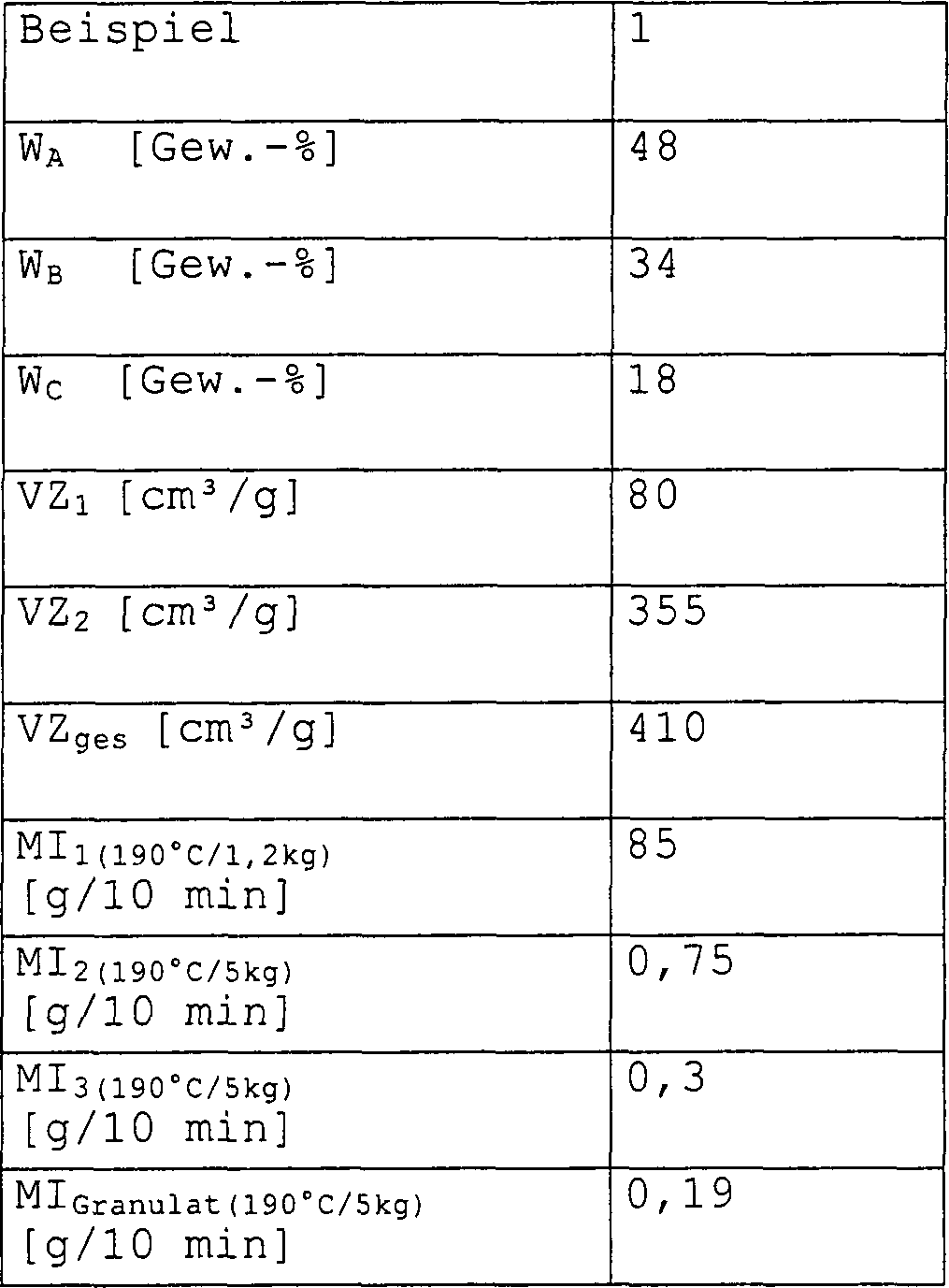
Die Abkürzungen der physikalischen Eigenschaften in der Tabelle 2 haben die folgende Bedeutung:
- WA bis WC
- = Mengenanteil der jeweiligen Einzelkomponente an der gesamten Formmasse = Reaktorsplit, bestimmt durch die Mengenzugabe an Ethylen in den jeweiligen Reaktor.
- VZ1 bis VZges
- = Viskositätszahl der jeweils den Reaktor verlassenden Einzelkomponente, bzw. Mischung, gemessen nach nach ISO/R 1191 in Dekalin bei einer Temperatur von 135 °C.
- MI1 bis MI3
- = Schmelzindex der jeweils den Reaktor verlassenden Einzelkomponente oder Mischung gemessen nach ISO 1133 unter Angabe der Temperatur und des Auflagegewichts.
- MIGranulat
- = Schmelzindex des Endprodukts nach Extrusion.
- W A to W C
- = Proportion of each individual component of the total molding material = reactor split, determined by the amount of ethylene added to the respective reactor.
- VZ 1 to VZ ges
- = Viscosity number of the individual component leaving the reactor, or mixture, measured according to ISO / R 1191 in decalin at a temperature of 135 ° C.
- MI 1 to MI 3
- = Melt index of the individual component or mixture leaving the reactor in each case, measured in accordance with ISO 1133, indicating the temperature and the coating weight.
- MI granules
- = Melt index of the final product after extrusion.
Aus
der so hergestellten Formmasse wurde auf folgende Art eine Folie
hergestellt:
Auf einer Alpine Folienblasanlage mit einem Extruder,
der einen Durchmesser d1 von 50 mm und eine
Länge von
21 × d1 (= 1,05 m) besaß und dem eine Ringdüse mit einem
Durchmesser d2 von 120 mm und einer Spaltbreite
von 1 mm nachgeschaltet war, wurde eine Folie mit einer Dicke von
20 μm bei
einem Aufblasverhältnis von
4: 1 und einer Halslänge
von 7,5 × d2 (= 90 cm) hergestellt. Die Massetemperatur
der Formmasse im Extruder betrug 225 bis 230 °C.From the molding composition thus prepared, a film was produced in the following manner:
On an Alpine Folienblasanlage with an extruder, which had a diameter d 1 of 50 mm and a length of 21 × d 1 (= 1.05 m) and that an annular nozzle with a diameter d 2 of 120 mm and a gap width of 1 mm A film with a thickness of 20 microns at a blow-up ratio of 4: 1 and a neck length of 7.5 × d 2 (= 90 cm) was prepared. The melt temperature of the molding compound in the extruder was 225 to 230 ° C.
Die Folieneigenschaften sind in der nachfolgenden Tabelle 2 dargestellt.The Film properties are shown in Table 2 below.
VergleichsbeispielComparative example
Mit einem handelsüblichen Folienrohstoff der Firma Borealis, der unter der Bezeichnung FS 1470 im Handel erhältlich ist, wurde auf derselben Anlage und unter denselben Bedingungen wie mit der erfindungsgemäßen Folie ebenfalls eine 20 μm Folie hergestellt. Die Massetemperatur der Formmasse im Extruder lag bei 220 bis 225 °C.With a commercial one Film raw material of the company Borealis, called FS 1470 commercially available is, was on the same plant and under the same conditions as with the film according to the invention likewise a 20 μm Foil made. The melt temperature of the molding compound in the extruder was 220-225 ° C.
Die Folieneigenschaften sind in der nachfolgenden Tabelle 2 dargestellt.The Film properties are shown in Table 2 below.
Tabelle
2 
Die Stippenbewertung wurde visuell vorgenommen.The Speck assessment was done visually.
Claims (11)
Priority Applications (15)
| Application Number | Priority Date | Filing Date | Title |
|---|---|---|---|
| DE102005009916A DE102005009916A1 (en) | 2005-03-01 | 2005-03-01 | Polyethylene molding compound for producing blown films with improved mechanical properties |
| DE602006013426T DE602006013426D1 (en) | 2005-03-01 | 2006-02-23 | POLYETHYLENE MOLD FOR THE MANUFACTURE OF BLOW FILMS WITH IMPROVED MECHANICAL PROPERTIES |
| US11/885,357 US20080166535A1 (en) | 2005-03-01 | 2006-02-23 | Polyethylene Molding Composition for Producing Blown Films Having Improved Mechanical Properties |
| JP2007557472A JP2008531802A (en) | 2005-03-01 | 2006-02-23 | Polyethylene molding composition for producing blown film with improved mechanical properties |
| AU2006219906A AU2006219906A1 (en) | 2005-03-01 | 2006-02-23 | Polyethylene molding composition for producing blown films having improved mechanical properties |
| PCT/EP2006/060222 WO2006092377A1 (en) | 2005-03-01 | 2006-02-23 | Polyethylene molding composition for producing blown films having improved mechanical properties |
| RU2007136031/05A RU2401286C2 (en) | 2005-03-01 | 2006-02-23 | Polyethylene moulding composition for making films through extrusion blowing, having improved mechanical properties |
| AT06708478T ATE463529T1 (en) | 2005-03-01 | 2006-02-23 | POLYETHYLENE MOLDING COMPOUND FOR PRODUCING BLOWN FILM WITH IMPROVED MECHANICAL PROPERTIES |
| EP06708478A EP1853650B1 (en) | 2005-03-01 | 2006-02-23 | Polyethylene molding composition for producing blown films having improved mechanical properties |
| KR1020077019964A KR20070115922A (en) | 2005-03-01 | 2006-02-23 | Polyethylene molding composition for the manufacture of blown films with improved mechanical properties |
| BRPI0607393A BRPI0607393B1 (en) | 2005-03-01 | 2006-02-23 | movie |
| CA002598603A CA2598603A1 (en) | 2005-03-01 | 2006-02-23 | Polyethylene molding composition for producing blown films having improved mechanical properties |
| CN2006800051577A CN101124264B (en) | 2005-03-01 | 2006-02-23 | Polyethylene molding composition for producing blown films with improved mechanical properties |
| TW095106870A TW200641023A (en) | 2005-03-01 | 2006-03-01 | Polyethylene molding composition for producing blown films having improved mechanical properties |
| US13/228,224 US8673437B2 (en) | 2005-03-01 | 2011-09-08 | Films having improved mechanical properties |
Applications Claiming Priority (1)
| Application Number | Priority Date | Filing Date | Title |
|---|---|---|---|
| DE102005009916A DE102005009916A1 (en) | 2005-03-01 | 2005-03-01 | Polyethylene molding compound for producing blown films with improved mechanical properties |
Publications (1)
| Publication Number | Publication Date |
|---|---|
| DE102005009916A1 true DE102005009916A1 (en) | 2006-09-07 |
Family
ID=36234978
Family Applications (2)
| Application Number | Title | Priority Date | Filing Date |
|---|---|---|---|
| DE102005009916A Withdrawn DE102005009916A1 (en) | 2005-03-01 | 2005-03-01 | Polyethylene molding compound for producing blown films with improved mechanical properties |
| DE602006013426T Active DE602006013426D1 (en) | 2005-03-01 | 2006-02-23 | POLYETHYLENE MOLD FOR THE MANUFACTURE OF BLOW FILMS WITH IMPROVED MECHANICAL PROPERTIES |
Family Applications After (1)
| Application Number | Title | Priority Date | Filing Date |
|---|---|---|---|
| DE602006013426T Active DE602006013426D1 (en) | 2005-03-01 | 2006-02-23 | POLYETHYLENE MOLD FOR THE MANUFACTURE OF BLOW FILMS WITH IMPROVED MECHANICAL PROPERTIES |
Country Status (13)
| Country | Link |
|---|---|
| US (2) | US20080166535A1 (en) |
| EP (1) | EP1853650B1 (en) |
| JP (1) | JP2008531802A (en) |
| KR (1) | KR20070115922A (en) |
| CN (1) | CN101124264B (en) |
| AT (1) | ATE463529T1 (en) |
| AU (1) | AU2006219906A1 (en) |
| BR (1) | BRPI0607393B1 (en) |
| CA (1) | CA2598603A1 (en) |
| DE (2) | DE102005009916A1 (en) |
| RU (1) | RU2401286C2 (en) |
| TW (1) | TW200641023A (en) |
| WO (1) | WO2006092377A1 (en) |
Cited By (2)
| Publication number | Priority date | Publication date | Assignee | Title |
|---|---|---|---|---|
| US20120108766A1 (en) * | 2009-06-03 | 2012-05-03 | Basell Polyolefine Gmbh | Polyethylene Composition and Finished Products Made Thereof |
| US11952480B2 (en) | 2018-02-05 | 2024-04-09 | Exxonmobil Chemical Patents Inc. | Enhanced processability of LLDPE by addition of ultra-high molecular weight density polyethylene |
Families Citing this family (34)
| Publication number | Priority date | Publication date | Assignee | Title |
|---|---|---|---|---|
| DE102004020524A1 (en) | 2004-04-26 | 2005-11-10 | Basell Polyolefine Gmbh | Polyethylene for film, e.g. stretch film, used in carrier bags, contains ethylene homopolymers and/or copolymers of ethylene with 1-alkenes |
| DE102005030941A1 (en) * | 2005-06-30 | 2007-01-11 | Basell Polyolefine Gmbh | Polyethylene molding compound for the production of injection-molded finished parts |
| DE102005040390A1 (en) * | 2005-08-25 | 2007-03-01 | Basell Polyolefine Gmbh | Multi-modal polyethylene moulding material for production of pipes, e.g. water pipes, comprises low-mol. wt. ethylene homopolymer, high-mol. wt. ethylene copolymer and ultrahigh-mol. wt. ethylene copolymer |
| US20090272721A1 (en) * | 2005-09-28 | 2009-11-05 | Tadahiro Ohmi | Athmosphere-Controlled Bonding Apparatus, Bonding Method, and Electronic Device |
| US8722833B2 (en) * | 2006-12-22 | 2014-05-13 | Basell Polyolefine Gmbh | Multimodal polyethylene composition, mixed catalyst and process for preparing the composition |
| ATE497992T1 (en) * | 2006-12-22 | 2011-02-15 | Basell Polyolefine Gmbh | MULTIMODAL POLYETHYLENE COMPOSITION, MIXED CATALYSAOTR AND METHOD FOR PREPARING THE COMPOSITION |
| DE102007017903A1 (en) | 2007-04-13 | 2008-10-16 | Basell Polyolefine Gmbh | Polyethylene and catalyst composition and process for its preparation |
| RU2436815C2 (en) * | 2009-09-07 | 2011-12-20 | Общество с ограниченной ответственностью "ОСБИО" | Polymer composite material for making electrolysis baths |
| GB2498936A (en) * | 2012-01-31 | 2013-08-07 | Norner Innovation As | Polyethylene with multi-modal molecular weight distribution |
| WO2013144324A1 (en) | 2012-03-28 | 2013-10-03 | Borealis Ag | Multimodal polymer |
| US9346897B2 (en) | 2013-05-14 | 2016-05-24 | Chevron Phillips Chemical Company Lp | Peroxide treated metallocene-based polyolefins with improved melt strength |
| GB201313937D0 (en) | 2013-08-05 | 2013-09-18 | Ineos Europe Ag | Polymerisation process |
| USD782771S1 (en) | 2015-04-03 | 2017-03-28 | Geo Plastics | Tight head drum |
| WO2016198273A1 (en) * | 2015-06-10 | 2016-12-15 | Borealis Ag | Multimodal copolymer of ethylene and at least two alpha-olefin comonomers and final articles made thereof |
| ES2755384T3 (en) | 2016-09-12 | 2020-04-22 | Thai Polyethylene Co Ltd | Multimodal polyethylene container |
| PT3293207T (en) | 2016-09-12 | 2019-10-25 | Scg Chemicals Co Ltd | MULTIMODAL POLYETHYLENE TUBE |
| EP3293214B1 (en) | 2016-09-12 | 2019-12-25 | Thai Polyethylene Co., Ltd. | High performances multimodal ultra high molecular weight polyethylene |
| ES2767704T3 (en) | 2016-09-12 | 2020-06-18 | Thai Polyethylene Co Ltd | Multimodal polyethylene pipe |
| PT3293205T (en) | 2016-09-12 | 2019-10-31 | Scg Chemicals Co Ltd | Process for the preparation of multimodal polyethylene |
| PT3293210T (en) | 2016-09-12 | 2019-06-12 | Scg Chemicals Co Ltd | Multimodal polyethylene film |
| EP3293209B1 (en) | 2016-09-12 | 2019-08-14 | Thai Polyethylene Co., Ltd. | Multimodal polyethylene thin film |
| PT3293211T (en) | 2016-09-12 | 2019-09-12 | Scg Chemicals Co Ltd | MULTIMODAL POLYETHYLENE THREADED COVER |
| CN109790229B (en) | 2016-09-12 | 2021-08-06 | 泰国聚乙烯有限公司 | Bimodal polyethylene composition and pipe comprising the same |
| US10538654B2 (en) | 2017-04-19 | 2020-01-21 | Nova Chemicals (International) S.A. | Multi reactor solution polymerization, polyethylene and polyethylene film |
| US9963529B1 (en) | 2017-04-19 | 2018-05-08 | Nova Chemicals (International) S.A. | Multi reactor solution polymerization |
| KR102649280B1 (en) | 2017-12-26 | 2024-03-21 | 다우 글로벌 테크놀로지스 엘엘씨 | Multimodal ethylene-based polymer composition with improved toughness |
| KR102605947B1 (en) | 2017-12-26 | 2023-11-28 | 다우 글로벌 테크놀로지스 엘엘씨 | Dual reactor solution process for the production of multimodal ethylene-based polymers |
| ES2946586T3 (en) | 2017-12-26 | 2023-07-21 | Dow Global Technologies Llc | Procedure for the production of multimodal ethylene-based polymers |
| CN111683980B (en) * | 2017-12-26 | 2024-03-05 | 陶氏环球技术有限责任公司 | Multimodal ethylene polymer processing systems and methods |
| WO2019133394A1 (en) | 2017-12-26 | 2019-07-04 | Dow Global Technologies, Llc | Compositions comprising multimodal ethylene based polymers and low density polyethylene (ldpe) |
| CN110809603B (en) * | 2018-03-21 | 2022-05-03 | Lg化学株式会社 | Polyolefin resin composition and stretched film using the same |
| KR102308710B1 (en) * | 2018-03-21 | 2021-10-05 | 주식회사 엘지화학 | Polyolefin resin composition and stretch film using the same |
| USD938128S1 (en) | 2020-01-06 | 2021-12-07 | Geo Plastics | Nestable drum |
| USD1001413S1 (en) | 2020-06-30 | 2023-10-10 | Geo Plastics | Nestable drum |
Family Cites Families (32)
| Publication number | Priority date | Publication date | Assignee | Title |
|---|---|---|---|---|
| US615684A (en) | 1898-12-13 | Kitchen-cabinet | ||
| JPS5910724B2 (en) * | 1979-08-24 | 1984-03-10 | 旭化成株式会社 | Continuous polymerization of ethylene |
| DE3124223A1 (en) * | 1981-06-20 | 1982-12-30 | Hoechst Ag, 6000 Frankfurt | "METHOD FOR PRODUCING A POLYOLEFIN AND CATALYST THEREFOR" |
| US4536550A (en) * | 1983-04-21 | 1985-08-20 | Asahi Kasei Kogyo Kabushiki Kaisha | Polyethylene composition |
| JP2643348B2 (en) * | 1988-09-01 | 1997-08-20 | 三井石油化学工業株式会社 | Polyethylene resin composition and film |
| DE3918646A1 (en) | 1989-06-08 | 1990-12-13 | Hoechst Ag | PROCESS FOR PREPARING A POLY-L-OLEFIN |
| US5648309A (en) * | 1990-06-01 | 1997-07-15 | Hoechst Aktiengesellschaft | Process for the preparation of a poly-1-olefin |
| DE4017661A1 (en) | 1990-06-01 | 1991-12-05 | Hoechst Ag | METHOD FOR PRODUCING A POLY-1 OLEFIN |
| JP3045548B2 (en) | 1990-12-28 | 2000-05-29 | 日本石油化学株式会社 | Polyethylene composition |
| US5338589A (en) * | 1991-06-05 | 1994-08-16 | Hoechst Aktiengesellschaft | Polyethylene molding composition |
| JP2716615B2 (en) * | 1991-10-25 | 1998-02-18 | 丸善ポリマー株式会社 | Method for producing ethylene polymer composition |
| BE1006439A3 (en) * | 1992-12-21 | 1994-08-30 | Solvay Societe Annonyme | Method for preparing a composition of polymers of ethylene, polymer composition and use of ethylene. |
| US5350807A (en) * | 1993-06-25 | 1994-09-27 | Phillips Petroleum Company | Ethylene polymers |
| IT1269194B (en) * | 1994-01-21 | 1997-03-21 | Spherilene Srl | HIGH PROCESSABILITY POLYMERIC COMPOSITIONS BASED ON LLDPE |
| FI96216C (en) | 1994-12-16 | 1996-05-27 | Borealis Polymers Oy | Process for the production of polyethylene |
| US5882750A (en) * | 1995-07-03 | 1999-03-16 | Mobil Oil Corporation | Single reactor bimodal HMW-HDPE film resin with improved bubble stability |
| SE504455C2 (en) * | 1995-07-10 | 1997-02-17 | Borealis Polymers Oy | Cable sheath composition, its use and methods for its manufacture |
| PT837915E (en) | 1995-07-10 | 2001-12-28 | Borealis Tech Oy | COATING COMPOSITION |
| CN1146586C (en) * | 1995-10-18 | 2004-04-21 | 智索股份有限公司 | Olefin homopolymer or copolymer composition and process for producing the same |
| KR100573305B1 (en) * | 1997-06-06 | 2006-04-24 | 이스트만 케미칼 레진즈 인코포레이티드 | High Density Polyethylene Films With Improved Barrier |
| EP0905151A1 (en) | 1997-09-27 | 1999-03-31 | Fina Research S.A. | Production of polyethylene having a broad molecular weight distribution |
| US6242548B1 (en) * | 1999-05-13 | 2001-06-05 | Dyneon Llc | Fluoroplastic polymers with improved characteristics |
| DE19945980A1 (en) * | 1999-09-24 | 2001-03-29 | Elenac Gmbh | Polyethylene molding compound with improved ESCR stiffness ratio and swelling rate, process for its production and hollow bodies made from it |
| EP1266738B8 (en) * | 2001-06-14 | 2005-11-02 | Innovene Manufacturing Belgium NV | Method of compounding a multimodal polyethylene composition |
| KR20080077284A (en) * | 2001-08-17 | 2008-08-21 | 다우 글로벌 테크놀로지스 인크. | Bimodal Polyethylene Compositions and Articles Made therefrom |
| KR20050088310A (en) | 2002-12-19 | 2005-09-05 | 바젤 폴리올레핀 게엠베하 | Polyethylene blow moulding composition for producing small containers |
| DE10259491A1 (en) | 2002-12-19 | 2004-07-01 | Basell Polyolefine Gmbh | Polyethylene moulding material for production of blow-moulded containers comprises low-mol. wt. ethylene homopolymer, high-mol. wt. copolymer of ethylene and 4-8C olefin, and ultrahigh-mol. wt. ethylene copolymer |
| ES2268470T3 (en) | 2002-12-24 | 2007-03-16 | Basell Polyolefine Gmbh | COMPOSITION OF POLYETHYLENE FOR MOLDING BY BLOWING INTENDED FOR THE PRODUCTION OF LARGE CONTAINERS. |
| EP1578862B1 (en) * | 2002-12-24 | 2006-07-12 | Basell Polyolefine GmbH | Polyethylene blow moulding composition for producing jerry cans |
| JP2006512475A (en) | 2002-12-24 | 2006-04-13 | バーゼル・ポリオレフィン・ゲーエムベーハー | Polyethylene composition for producing an L-ring drum |
| DE102004055588A1 (en) | 2004-11-18 | 2006-05-24 | Basell Polyolefine Gmbh | Polyethylene molded mass, useful for preparing protective coating for steel tubes, comprises low molecular ethylene homopolymers, high molecular copolymers of ethylene and other 4-8C olefin and of ultrahigh molecular ethylene copolymer |
| DE102004055587A1 (en) | 2004-11-18 | 2006-05-24 | Basell Polyolefine Gmbh | Polyethylene molded mass, useful for the external covering of electro cables, comprises low molecular ethylene homopolymers, high molecular copolymers of ethylene and other 4-8C olefin and of ultrahigh molecular ethylene copolymer |
-
2005
- 2005-03-01 DE DE102005009916A patent/DE102005009916A1/en not_active Withdrawn
-
2006
- 2006-02-23 AU AU2006219906A patent/AU2006219906A1/en not_active Abandoned
- 2006-02-23 JP JP2007557472A patent/JP2008531802A/en not_active Withdrawn
- 2006-02-23 CN CN2006800051577A patent/CN101124264B/en active Active
- 2006-02-23 KR KR1020077019964A patent/KR20070115922A/en not_active Withdrawn
- 2006-02-23 RU RU2007136031/05A patent/RU2401286C2/en active
- 2006-02-23 CA CA002598603A patent/CA2598603A1/en not_active Abandoned
- 2006-02-23 AT AT06708478T patent/ATE463529T1/en not_active IP Right Cessation
- 2006-02-23 WO PCT/EP2006/060222 patent/WO2006092377A1/en not_active Ceased
- 2006-02-23 US US11/885,357 patent/US20080166535A1/en not_active Abandoned
- 2006-02-23 BR BRPI0607393A patent/BRPI0607393B1/en active IP Right Grant
- 2006-02-23 DE DE602006013426T patent/DE602006013426D1/en active Active
- 2006-02-23 EP EP06708478A patent/EP1853650B1/en active Active
- 2006-03-01 TW TW095106870A patent/TW200641023A/en unknown
-
2011
- 2011-09-08 US US13/228,224 patent/US8673437B2/en active Active
Cited By (3)
| Publication number | Priority date | Publication date | Assignee | Title |
|---|---|---|---|---|
| US20120108766A1 (en) * | 2009-06-03 | 2012-05-03 | Basell Polyolefine Gmbh | Polyethylene Composition and Finished Products Made Thereof |
| US9090719B2 (en) * | 2009-06-03 | 2015-07-28 | Basell Polyolefine Gmbh | Polyethylene composition and finished products made thereof |
| US11952480B2 (en) | 2018-02-05 | 2024-04-09 | Exxonmobil Chemical Patents Inc. | Enhanced processability of LLDPE by addition of ultra-high molecular weight density polyethylene |
Also Published As
| Publication number | Publication date |
|---|---|
| BRPI0607393B1 (en) | 2017-02-21 |
| CN101124264B (en) | 2012-05-09 |
| CA2598603A1 (en) | 2006-09-08 |
| RU2401286C2 (en) | 2010-10-10 |
| AU2006219906A1 (en) | 2006-09-08 |
| RU2007136031A (en) | 2009-04-10 |
| TW200641023A (en) | 2006-12-01 |
| DE602006013426D1 (en) | 2010-05-20 |
| EP1853650B1 (en) | 2010-04-07 |
| KR20070115922A (en) | 2007-12-06 |
| US20110318559A1 (en) | 2011-12-29 |
| EP1853650A1 (en) | 2007-11-14 |
| US8673437B2 (en) | 2014-03-18 |
| CN101124264A (en) | 2008-02-13 |
| WO2006092377A1 (en) | 2006-09-08 |
| ATE463529T1 (en) | 2010-04-15 |
| US20080166535A1 (en) | 2008-07-10 |
| JP2008531802A (en) | 2008-08-14 |
| BRPI0607393A2 (en) | 2010-03-16 |
Similar Documents
| Publication | Publication Date | Title |
|---|---|---|
| DE102005009916A1 (en) | Polyethylene molding compound for producing blown films with improved mechanical properties | |
| DE102005009896A1 (en) | Polyethylene molding compound for producing blown films with improved mechanical properties | |
| DE102005009895A1 (en) | Polyethylene molding compound for producing blown films with improved mechanical properties | |
| DE60306811T2 (en) | Polyethylene molding compound for the manufacture of containers by blow molding and L-ring-conrainer produced therewith | |
| DE60202660T3 (en) | Film with high impact resistance | |
| EP1320570B1 (en) | Polyethylene moulding compound suitable as a pipe material with excellent processing properties | |
| DE60203707T2 (en) | Process for the preparation of a lipid composition | |
| DE69820060T2 (en) | Film-forming terpolymer from propylene and process for producing such terpolymers | |
| EP1228101B1 (en) | Polyethylene moulding compound with an improved escr-stiffness relation and an improved swelling rate, a method for the production thereof and the use thereof | |
| DE69921780T2 (en) | POLYMER FILMS | |
| DE69508277T2 (en) | METHOD FOR PRODUCING POLYETHYLENE | |
| DE60211012T2 (en) | Transparent and flexible polypropylene compositions | |
| DE69919834T2 (en) | POLYPROPYLENE COMPOSITION FOR THE PREPARATION OF SOLID-BODY-ORIENTED FILM | |
| DE69919393T2 (en) | POLYMER COMPOSITION FOR TUBES | |
| DE102005040390A1 (en) | Multi-modal polyethylene moulding material for production of pipes, e.g. water pipes, comprises low-mol. wt. ethylene homopolymer, high-mol. wt. ethylene copolymer and ultrahigh-mol. wt. ethylene copolymer | |
| EP1008628B1 (en) | Highly impact resistant polypropylene composition comprising talc | |
| DE602004011231T2 (en) | Multimodal polyethylene composition with improved homogeneity | |
| DE102007031449A1 (en) | PE molding compound for blow molding small hollow bodies with low density | |
| DE102005030941A1 (en) | Polyethylene molding compound for the production of injection-molded finished parts | |
| DE69029620T2 (en) | New polypropylene fiber and manufacturing process | |
| DE102007016348A1 (en) | Polyethylene molding compound for producing hollow bodies by thermoforming and fuel tanks produced therewith | |
| DE19606510A1 (en) | High molecular weight polypropylene with a broad molecular weight distribution | |
| DE102005006886A1 (en) | Biaxially oriented polypropylene film | |
| DE69610334T2 (en) | MULTILAYERED FILMS BASED ON LLDPE | |
| DE602005003763T2 (en) | Transparent, easily rip-off film |
Legal Events
| Date | Code | Title | Description |
|---|---|---|---|
| 8139 | Disposal/non-payment of the annual fee |