CN1926139A - Fused pyrazole derivatives - Google Patents
Fused pyrazole derivatives Download PDFInfo
- Publication number
- CN1926139A CN1926139A CNA2005800063442A CN200580006344A CN1926139A CN 1926139 A CN1926139 A CN 1926139A CN A2005800063442 A CNA2005800063442 A CN A2005800063442A CN 200580006344 A CN200580006344 A CN 200580006344A CN 1926139 A CN1926139 A CN 1926139A
- Authority
- CN
- China
- Prior art keywords
- pyrazolo
- phenyl
- alkyl
- chloro
- difluoro
- Prior art date
- Legal status (The legal status is an assumption and is not a legal conclusion. Google has not performed a legal analysis and makes no representation as to the accuracy of the status listed.)
- Pending
Links
Classifications
-
- C—CHEMISTRY; METALLURGY
- C07—ORGANIC CHEMISTRY
- C07D—HETEROCYCLIC COMPOUNDS
- C07D487/00—Heterocyclic compounds containing nitrogen atoms as the only ring hetero atoms in the condensed system, not provided for by groups C07D451/00 - C07D477/00
- C07D487/02—Heterocyclic compounds containing nitrogen atoms as the only ring hetero atoms in the condensed system, not provided for by groups C07D451/00 - C07D477/00 in which the condensed system contains two hetero rings
- C07D487/04—Ortho-condensed systems
-
- A—HUMAN NECESSITIES
- A61—MEDICAL OR VETERINARY SCIENCE; HYGIENE
- A61P—SPECIFIC THERAPEUTIC ACTIVITY OF CHEMICAL COMPOUNDS OR MEDICINAL PREPARATIONS
- A61P1/00—Drugs for disorders of the alimentary tract or the digestive system
- A61P1/04—Drugs for disorders of the alimentary tract or the digestive system for ulcers, gastritis or reflux esophagitis, e.g. antacids, inhibitors of acid secretion, mucosal protectants
-
- A—HUMAN NECESSITIES
- A61—MEDICAL OR VETERINARY SCIENCE; HYGIENE
- A61P—SPECIFIC THERAPEUTIC ACTIVITY OF CHEMICAL COMPOUNDS OR MEDICINAL PREPARATIONS
- A61P1/00—Drugs for disorders of the alimentary tract or the digestive system
- A61P1/16—Drugs for disorders of the alimentary tract or the digestive system for liver or gallbladder disorders, e.g. hepatoprotective agents, cholagogues, litholytics
-
- A—HUMAN NECESSITIES
- A61—MEDICAL OR VETERINARY SCIENCE; HYGIENE
- A61P—SPECIFIC THERAPEUTIC ACTIVITY OF CHEMICAL COMPOUNDS OR MEDICINAL PREPARATIONS
- A61P11/00—Drugs for disorders of the respiratory system
-
- A—HUMAN NECESSITIES
- A61—MEDICAL OR VETERINARY SCIENCE; HYGIENE
- A61P—SPECIFIC THERAPEUTIC ACTIVITY OF CHEMICAL COMPOUNDS OR MEDICINAL PREPARATIONS
- A61P11/00—Drugs for disorders of the respiratory system
- A61P11/06—Antiasthmatics
-
- A—HUMAN NECESSITIES
- A61—MEDICAL OR VETERINARY SCIENCE; HYGIENE
- A61P—SPECIFIC THERAPEUTIC ACTIVITY OF CHEMICAL COMPOUNDS OR MEDICINAL PREPARATIONS
- A61P11/00—Drugs for disorders of the respiratory system
- A61P11/16—Central respiratory analeptics
-
- A—HUMAN NECESSITIES
- A61—MEDICAL OR VETERINARY SCIENCE; HYGIENE
- A61P—SPECIFIC THERAPEUTIC ACTIVITY OF CHEMICAL COMPOUNDS OR MEDICINAL PREPARATIONS
- A61P15/00—Drugs for genital or sexual disorders; Contraceptives
-
- A—HUMAN NECESSITIES
- A61—MEDICAL OR VETERINARY SCIENCE; HYGIENE
- A61P—SPECIFIC THERAPEUTIC ACTIVITY OF CHEMICAL COMPOUNDS OR MEDICINAL PREPARATIONS
- A61P17/00—Drugs for dermatological disorders
-
- A—HUMAN NECESSITIES
- A61—MEDICAL OR VETERINARY SCIENCE; HYGIENE
- A61P—SPECIFIC THERAPEUTIC ACTIVITY OF CHEMICAL COMPOUNDS OR MEDICINAL PREPARATIONS
- A61P17/00—Drugs for dermatological disorders
- A61P17/02—Drugs for dermatological disorders for treating wounds, ulcers, burns, scars, keloids, or the like
-
- A—HUMAN NECESSITIES
- A61—MEDICAL OR VETERINARY SCIENCE; HYGIENE
- A61P—SPECIFIC THERAPEUTIC ACTIVITY OF CHEMICAL COMPOUNDS OR MEDICINAL PREPARATIONS
- A61P17/00—Drugs for dermatological disorders
- A61P17/06—Antipsoriatics
-
- A—HUMAN NECESSITIES
- A61—MEDICAL OR VETERINARY SCIENCE; HYGIENE
- A61P—SPECIFIC THERAPEUTIC ACTIVITY OF CHEMICAL COMPOUNDS OR MEDICINAL PREPARATIONS
- A61P19/00—Drugs for skeletal disorders
-
- A—HUMAN NECESSITIES
- A61—MEDICAL OR VETERINARY SCIENCE; HYGIENE
- A61P—SPECIFIC THERAPEUTIC ACTIVITY OF CHEMICAL COMPOUNDS OR MEDICINAL PREPARATIONS
- A61P19/00—Drugs for skeletal disorders
- A61P19/02—Drugs for skeletal disorders for joint disorders, e.g. arthritis, arthrosis
-
- A—HUMAN NECESSITIES
- A61—MEDICAL OR VETERINARY SCIENCE; HYGIENE
- A61P—SPECIFIC THERAPEUTIC ACTIVITY OF CHEMICAL COMPOUNDS OR MEDICINAL PREPARATIONS
- A61P19/00—Drugs for skeletal disorders
- A61P19/08—Drugs for skeletal disorders for bone diseases, e.g. rachitism, Paget's disease
- A61P19/10—Drugs for skeletal disorders for bone diseases, e.g. rachitism, Paget's disease for osteoporosis
-
- A—HUMAN NECESSITIES
- A61—MEDICAL OR VETERINARY SCIENCE; HYGIENE
- A61P—SPECIFIC THERAPEUTIC ACTIVITY OF CHEMICAL COMPOUNDS OR MEDICINAL PREPARATIONS
- A61P21/00—Drugs for disorders of the muscular or neuromuscular system
-
- A—HUMAN NECESSITIES
- A61—MEDICAL OR VETERINARY SCIENCE; HYGIENE
- A61P—SPECIFIC THERAPEUTIC ACTIVITY OF CHEMICAL COMPOUNDS OR MEDICINAL PREPARATIONS
- A61P25/00—Drugs for disorders of the nervous system
-
- A—HUMAN NECESSITIES
- A61—MEDICAL OR VETERINARY SCIENCE; HYGIENE
- A61P—SPECIFIC THERAPEUTIC ACTIVITY OF CHEMICAL COMPOUNDS OR MEDICINAL PREPARATIONS
- A61P25/00—Drugs for disorders of the nervous system
- A61P25/28—Drugs for disorders of the nervous system for treating neurodegenerative disorders of the central nervous system, e.g. nootropic agents, cognition enhancers, drugs for treating Alzheimer's disease or other forms of dementia
-
- A—HUMAN NECESSITIES
- A61—MEDICAL OR VETERINARY SCIENCE; HYGIENE
- A61P—SPECIFIC THERAPEUTIC ACTIVITY OF CHEMICAL COMPOUNDS OR MEDICINAL PREPARATIONS
- A61P27/00—Drugs for disorders of the senses
- A61P27/02—Ophthalmic agents
-
- A—HUMAN NECESSITIES
- A61—MEDICAL OR VETERINARY SCIENCE; HYGIENE
- A61P—SPECIFIC THERAPEUTIC ACTIVITY OF CHEMICAL COMPOUNDS OR MEDICINAL PREPARATIONS
- A61P27/00—Drugs for disorders of the senses
- A61P27/02—Ophthalmic agents
- A61P27/06—Antiglaucoma agents or miotics
-
- A—HUMAN NECESSITIES
- A61—MEDICAL OR VETERINARY SCIENCE; HYGIENE
- A61P—SPECIFIC THERAPEUTIC ACTIVITY OF CHEMICAL COMPOUNDS OR MEDICINAL PREPARATIONS
- A61P29/00—Non-central analgesic, antipyretic or antiinflammatory agents, e.g. antirheumatic agents; Non-steroidal antiinflammatory drugs [NSAID]
-
- A—HUMAN NECESSITIES
- A61—MEDICAL OR VETERINARY SCIENCE; HYGIENE
- A61P—SPECIFIC THERAPEUTIC ACTIVITY OF CHEMICAL COMPOUNDS OR MEDICINAL PREPARATIONS
- A61P3/00—Drugs for disorders of the metabolism
- A61P3/08—Drugs for disorders of the metabolism for glucose homeostasis
- A61P3/10—Drugs for disorders of the metabolism for glucose homeostasis for hyperglycaemia, e.g. antidiabetics
-
- A—HUMAN NECESSITIES
- A61—MEDICAL OR VETERINARY SCIENCE; HYGIENE
- A61P—SPECIFIC THERAPEUTIC ACTIVITY OF CHEMICAL COMPOUNDS OR MEDICINAL PREPARATIONS
- A61P31/00—Antiinfectives, i.e. antibiotics, antiseptics, chemotherapeutics
-
- A—HUMAN NECESSITIES
- A61—MEDICAL OR VETERINARY SCIENCE; HYGIENE
- A61P—SPECIFIC THERAPEUTIC ACTIVITY OF CHEMICAL COMPOUNDS OR MEDICINAL PREPARATIONS
- A61P31/00—Antiinfectives, i.e. antibiotics, antiseptics, chemotherapeutics
- A61P31/04—Antibacterial agents
-
- A—HUMAN NECESSITIES
- A61—MEDICAL OR VETERINARY SCIENCE; HYGIENE
- A61P—SPECIFIC THERAPEUTIC ACTIVITY OF CHEMICAL COMPOUNDS OR MEDICINAL PREPARATIONS
- A61P31/00—Antiinfectives, i.e. antibiotics, antiseptics, chemotherapeutics
- A61P31/12—Antivirals
- A61P31/14—Antivirals for RNA viruses
- A61P31/16—Antivirals for RNA viruses for influenza or rhinoviruses
-
- A—HUMAN NECESSITIES
- A61—MEDICAL OR VETERINARY SCIENCE; HYGIENE
- A61P—SPECIFIC THERAPEUTIC ACTIVITY OF CHEMICAL COMPOUNDS OR MEDICINAL PREPARATIONS
- A61P31/00—Antiinfectives, i.e. antibiotics, antiseptics, chemotherapeutics
- A61P31/12—Antivirals
- A61P31/14—Antivirals for RNA viruses
- A61P31/18—Antivirals for RNA viruses for HIV
-
- A—HUMAN NECESSITIES
- A61—MEDICAL OR VETERINARY SCIENCE; HYGIENE
- A61P—SPECIFIC THERAPEUTIC ACTIVITY OF CHEMICAL COMPOUNDS OR MEDICINAL PREPARATIONS
- A61P31/00—Antiinfectives, i.e. antibiotics, antiseptics, chemotherapeutics
- A61P31/12—Antivirals
- A61P31/20—Antivirals for DNA viruses
- A61P31/22—Antivirals for DNA viruses for herpes viruses
-
- A—HUMAN NECESSITIES
- A61—MEDICAL OR VETERINARY SCIENCE; HYGIENE
- A61P—SPECIFIC THERAPEUTIC ACTIVITY OF CHEMICAL COMPOUNDS OR MEDICINAL PREPARATIONS
- A61P35/00—Antineoplastic agents
-
- A—HUMAN NECESSITIES
- A61—MEDICAL OR VETERINARY SCIENCE; HYGIENE
- A61P—SPECIFIC THERAPEUTIC ACTIVITY OF CHEMICAL COMPOUNDS OR MEDICINAL PREPARATIONS
- A61P35/00—Antineoplastic agents
- A61P35/04—Antineoplastic agents specific for metastasis
-
- A—HUMAN NECESSITIES
- A61—MEDICAL OR VETERINARY SCIENCE; HYGIENE
- A61P—SPECIFIC THERAPEUTIC ACTIVITY OF CHEMICAL COMPOUNDS OR MEDICINAL PREPARATIONS
- A61P37/00—Drugs for immunological or allergic disorders
- A61P37/02—Immunomodulators
-
- A—HUMAN NECESSITIES
- A61—MEDICAL OR VETERINARY SCIENCE; HYGIENE
- A61P—SPECIFIC THERAPEUTIC ACTIVITY OF CHEMICAL COMPOUNDS OR MEDICINAL PREPARATIONS
- A61P37/00—Drugs for immunological or allergic disorders
- A61P37/02—Immunomodulators
- A61P37/06—Immunosuppressants, e.g. drugs for graft rejection
-
- A—HUMAN NECESSITIES
- A61—MEDICAL OR VETERINARY SCIENCE; HYGIENE
- A61P—SPECIFIC THERAPEUTIC ACTIVITY OF CHEMICAL COMPOUNDS OR MEDICINAL PREPARATIONS
- A61P39/00—General protective or antinoxious agents
- A61P39/02—Antidotes
-
- A—HUMAN NECESSITIES
- A61—MEDICAL OR VETERINARY SCIENCE; HYGIENE
- A61P—SPECIFIC THERAPEUTIC ACTIVITY OF CHEMICAL COMPOUNDS OR MEDICINAL PREPARATIONS
- A61P43/00—Drugs for specific purposes, not provided for in groups A61P1/00-A61P41/00
-
- A—HUMAN NECESSITIES
- A61—MEDICAL OR VETERINARY SCIENCE; HYGIENE
- A61P—SPECIFIC THERAPEUTIC ACTIVITY OF CHEMICAL COMPOUNDS OR MEDICINAL PREPARATIONS
- A61P7/00—Drugs for disorders of the blood or the extracellular fluid
- A61P7/02—Antithrombotic agents; Anticoagulants; Platelet aggregation inhibitors
-
- A—HUMAN NECESSITIES
- A61—MEDICAL OR VETERINARY SCIENCE; HYGIENE
- A61P—SPECIFIC THERAPEUTIC ACTIVITY OF CHEMICAL COMPOUNDS OR MEDICINAL PREPARATIONS
- A61P9/00—Drugs for disorders of the cardiovascular system
-
- A—HUMAN NECESSITIES
- A61—MEDICAL OR VETERINARY SCIENCE; HYGIENE
- A61P—SPECIFIC THERAPEUTIC ACTIVITY OF CHEMICAL COMPOUNDS OR MEDICINAL PREPARATIONS
- A61P9/00—Drugs for disorders of the cardiovascular system
- A61P9/04—Inotropic agents, i.e. stimulants of cardiac contraction; Drugs for heart failure
-
- C—CHEMISTRY; METALLURGY
- C07—ORGANIC CHEMISTRY
- C07D—HETEROCYCLIC COMPOUNDS
- C07D471/00—Heterocyclic compounds containing nitrogen atoms as the only ring hetero atoms in the condensed system, at least one ring being a six-membered ring with one nitrogen atom, not provided for by groups C07D451/00 - C07D463/00
- C07D471/02—Heterocyclic compounds containing nitrogen atoms as the only ring hetero atoms in the condensed system, at least one ring being a six-membered ring with one nitrogen atom, not provided for by groups C07D451/00 - C07D463/00 in which the condensed system contains two hetero rings
- C07D471/04—Ortho-condensed systems
Landscapes
- Health & Medical Sciences (AREA)
- Chemical & Material Sciences (AREA)
- Organic Chemistry (AREA)
- Life Sciences & Earth Sciences (AREA)
- Chemical Kinetics & Catalysis (AREA)
- Veterinary Medicine (AREA)
- General Chemical & Material Sciences (AREA)
- Medicinal Chemistry (AREA)
- Nuclear Medicine, Radiotherapy & Molecular Imaging (AREA)
- Pharmacology & Pharmacy (AREA)
- Animal Behavior & Ethology (AREA)
- General Health & Medical Sciences (AREA)
- Public Health (AREA)
- Engineering & Computer Science (AREA)
- Bioinformatics & Cheminformatics (AREA)
- Virology (AREA)
- Oncology (AREA)
- Immunology (AREA)
- Physical Education & Sports Medicine (AREA)
- Pulmonology (AREA)
- Communicable Diseases (AREA)
- Orthopedic Medicine & Surgery (AREA)
- Diabetes (AREA)
- Rheumatology (AREA)
- Neurology (AREA)
- Ophthalmology & Optometry (AREA)
- Dermatology (AREA)
- Biomedical Technology (AREA)
- Cardiology (AREA)
- Neurosurgery (AREA)
- Molecular Biology (AREA)
- Hospice & Palliative Care (AREA)
- Heart & Thoracic Surgery (AREA)
- Hematology (AREA)
- Endocrinology (AREA)
- Emergency Medicine (AREA)
- Reproductive Health (AREA)
- Tropical Medicine & Parasitology (AREA)
- AIDS & HIV (AREA)
- Psychiatry (AREA)
Abstract
Description
本发明涉及氮杂吲唑类,其衍生物,它们的制备方法,包含它们的药物制剂,和使用它们的方法。The present invention relates to azaindazoles, their derivatives, processes for their preparation, pharmaceutical formulations containing them, and methods of using them.
促分裂原活化蛋白激酶(MAP)属于脯氨酸-定向的丝氨酸/苏氨酸激酶家族,它们通过双重磷酸化激活它们的底物。该激酶通过包括营养的和渗透压力、紫外光、生长因子、内毒素和炎性细胞因子的多种信号而被激活。MAP激酶中的一组是包括各种同工型的p38激酶组(例如p38α、p39β、p38γ和p38δ)。该p38激酶负责磷酸化和激活转录因子以及其它激酶,并且被物理和化学胁迫、促炎细胞因子和细菌脂多糖激活。Mitogen-activated protein kinases (MAPs) belong to a family of proline-directed serine/threonine kinases that activate their substrates by dual phosphorylation. This kinase is activated by a variety of signals including nutritional and osmotic stress, ultraviolet light, growth factors, endotoxins and inflammatory cytokines. One group of MAP kinases is the p38 kinase group comprising various isoforms (eg p38α, p39β, p38γ and p38δ). The p38 kinase is responsible for phosphorylating and activating transcription factors and other kinases, and is activated by physical and chemical stress, pro-inflammatory cytokines and bacterial lipopolysaccharide.
更重要的是,已经表明p38磷酸化的产物介导包括TNF和IL-1的炎性细胞因子的产生,以及环氧化酶-2的产生。这些细胞因子的每一种都涉及多种疾病状态和病症。例如,TNF-α是一种主要由激活的单核细胞和巨噬细胞产生的细胞因子。它的过量或未调节的产生牵涉在类风湿性关节炎的发病机理中起病因的作用。最近,已经表明TNF产生的抑制在炎症、炎性肠病、多发性硬化和哮喘的治疗中有广泛应用。TNF还涉及病毒感染,例如尤其是HIV、流感病毒以及包括1型单纯疱疹病毒(HSV-1)、2型单纯疱疹病毒(HSV-2)、巨细胞病毒(CMV)、水痘-带状疱疹病毒(VZV)、Epstein-Barr病毒、人疱疹病毒-6(HHV-6)、人疱疹病毒-7(HHV-7)、人疱疹病毒-8(HHV-8)在内的疱疹病毒、假狂犬病和鼻气管炎等。同样地,IL-1也是由激活的单核细胞和巨噬细胞产生的,并且在许多包括类风湿性关节炎、发热和骨重吸收的减少在内的病理生理反应中起作用。另外,p38的介入可能与中风、阿尔茨海默氏病、骨关节炎、肺损伤、脓毒性休克、血管发生、皮炎、牛皮癣和特异性皮炎有关。J.Exp.Opin.Ther.Patents,(2000)10(1)。More importantly, products of p38 phosphorylation have been shown to mediate the production of inflammatory cytokines including TNF and IL-1, as well as cyclooxygenase-2. Each of these cytokines has been implicated in a variety of disease states and disorders. For example, TNF-α is a cytokine mainly produced by activated monocytes and macrophages. Its excess or unregulated production has been implicated in an etiological role in the pathogenesis of rheumatoid arthritis. Recently, inhibition of TNF production has been shown to have broad applications in the treatment of inflammation, inflammatory bowel disease, multiple sclerosis and asthma. TNF has also been implicated in viral infections such as HIV, influenza virus and others including herpes simplex virus type 1 (HSV-1), herpes simplex virus type 2 (HSV-2), cytomegalovirus (CMV), varicella-zoster virus Herpes viruses including (VZV), Epstein-Barr virus, human herpesvirus-6 (HHV-6), human herpesvirus-7 (HHV-7), human herpesvirus-8 (HHV-8), pseudorabies and Rhinotracheitis, etc. Likewise, IL-1 is also produced by activated monocytes and macrophages and plays a role in many pathophysiological responses including rheumatoid arthritis, fever and decreased bone resorption. In addition, the involvement of p38 may be related to stroke, Alzheimer's disease, osteoarthritis, lung injury, septic shock, angiogenesis, dermatitis, psoriasis and atopic dermatitis. J. Exp. Opin. Ther. Patents, (2000) 10(1).
通过抑制p38激酶而对这些细胞因子进行抑制有益于控制、减少和缓解许多这些疾病的病症。Inhibition of these cytokines through inhibition of p38 kinase would be beneficial in controlling, reducing and alleviating the symptoms of many of these diseases.
本发明提供式Ia,1b或Ic的化合物或其药用盐,The present invention provides a compound of formula Ia, 1b or Ic or a pharmaceutically acceptable salt thereof,

其中:in:
R1是芳基,杂芳基,芳烷基或环烷基; R is aryl, heteroaryl, aralkyl or cycloalkyl;
R2是芳基,杂芳基,环烷基,支链烷基或杂环基; R is aryl, heteroaryl, cycloalkyl, branched alkyl or heterocyclyl;
R3是氢或烷基;R 3 is hydrogen or alkyl;
R4是氢,烷基,羟基,氨基,杂烷基,杂环基,杂环基烷基,羟基环烷基,环烷基烷基,烷基磺酰基,烷基亚磺酰氨基,芳基,杂芳基,芳烷基,杂芳烷基,-(CHRa)r-C(=O)-Rb,-(CHRa)r-O-C(=O)-Rb,-(CHRa)r-NH-C(=O)-Rb或-SO2-Rb,其中Ra是氢,烷基或杂烷基;Rb是烷基,羟基,氨基,杂烷基,芳基,芳烷基,杂芳基,或杂环基;r是0至4; R4 is hydrogen, alkyl, hydroxy, amino, heteroalkyl, heterocyclyl, heterocyclylalkyl, hydroxycycloalkyl, cycloalkylalkyl, alkylsulfonyl, alkylsulfonylamino, aryl base, heteroaryl, aralkyl, heteroaralkyl, -(CHR a ) r -C(=O)-R b , -(CHR a ) r -OC(=O)-R b , -(CHR a ) r -NH-C(=O)-R b or -SO 2 -R b , wherein R a is hydrogen, alkyl or heteroalkyl; R b is alkyl, hydroxyl, amino, heteroalkyl, aryl Base, aralkyl, heteroaryl, or heterocyclyl; r is 0 to 4;
R5是氢,烷基,杂烷基,芳烷基,杂芳烷基,杂环基,羟基环烷基,-C(=O)-Rc或-SO2-Rc,其中Rc是烷基,杂烷基,芳基,芳烷基,杂芳基或杂环基;R 5 is hydrogen, alkyl, heteroalkyl, aralkyl, heteroaralkyl, heterocyclyl, hydroxycycloalkyl, -C(=O)-R c or -SO 2 -R c , wherein R c is alkyl, heteroalkyl, aryl, aralkyl, heteroaryl or heterocyclyl;
X和Y是氮,或X和Y之一为氮并且另一个为CRd;并且Z是N或CRd,其中Rd是氢,烷基,羟基,烷氧基,氨基,卤代烷基,氰基,卤素,杂烷基,C(=O)-Re或-SO2-Re,其中Re是氢或烷基;X and Y are nitrogen, or one of X and Y is nitrogen and the other is CRd ; and Z is N or CRd , where Rd is hydrogen, alkyl, hydroxyl, alkoxy, amino, haloalkyl, cyano Base, halogen, heteroalkyl, C(=O)-R e or -SO 2 -R e , wherein R e is hydrogen or alkyl;
W是O,S(O)m,CH2或NRf,其中m是0至2,且Rf是氢,烷基,杂烷基,杂环基,羟基环烷基,-C(=O)-Rg或-SO2-Rg,其中Rg是烷基,芳基,芳烷基,杂芳基,杂烷基或杂环基;W is O, S(O) m , CH 2 or NR f , wherein m is 0 to 2, and R f is hydrogen, alkyl, heteroalkyl, heterocyclyl, hydroxycycloalkyl, -C(=O )-R g or -SO 2 -R g , wherein R g is alkyl, aryl, aralkyl, heteroaryl, heteroalkyl or heterocyclyl;
或者R4和Rf与它们连接的原子一起可以形成杂环;Or R and R together with the atoms to which they are attached may form a heterocyclic ring;
A是O,CH2,S(O)n,C(=O),NRh,或CH(ORh),其中n是0至2,且Rh是氢或烷基,A is O, CH 2 , S(O) n , C(=O), NR h , or CH(OR h ), wherein n is 0 to 2, and Rh is hydrogen or alkyl,
或者R1和Rh可以形成杂环基;Or R and R can form a heterocyclyl;
k是0或1;k is 0 or 1;
B是O,S(O)j,CH(ORi),NRj,或C(=O),其中j是0,1或2;Ri是氢或烷基,Rj是氢,烷基,-C(=O)-Rk,或-SO2Rm,其中Rk是烷基,芳基或芳烷基;并且Rm是烷基。B is O, S(O) j , CH(OR i ), NR j , or C(=O), where j is 0, 1, or 2; R i is hydrogen or alkyl, R j is hydrogen, alkyl , -C(=O)-R k , or -SO 2 R m , wherein R k is alkyl, aryl, or aralkyl; and R m is alkyl.
在另一个实施方案中,本发明提供式I的化合物或其药用盐,溶剂化物或前药:In another embodiment, the present invention provides a compound of formula I or a pharmaceutically acceptable salt, solvate or prodrug thereof:
其中:in:
R1是芳基,杂芳基,芳烷基或环烷基; R is aryl, heteroaryl, aralkyl or cycloalkyl;
R2是芳基,杂芳基,环烷基或杂环基; R is aryl, heteroaryl, cycloalkyl or heterocyclyl;
R3是氢或烷基;R 3 is hydrogen or alkyl;
R4是氢,烷基,杂烷基,杂环基,羟基环烷基,芳基,杂芳基,芳烷基,杂芳烷基,-C(=O)-Ra,或-SO2-Ra,其中Ra是烷基,杂烷基,芳基,芳烷基,杂芳基,或杂环基; R is hydrogen, alkyl, heteroalkyl, heterocyclyl, hydroxycycloalkyl, aryl, heteroaryl, aralkyl, heteroaralkyl, -C(=O)-R a , or -SO 2 -R a , wherein R a is alkyl, heteroalkyl, aryl, aralkyl, heteroaryl, or heterocyclyl;
R5是氢,烷基,杂烷基,芳烷基,杂芳烷基,杂环基,羟基环烷基,-C(=O)-Rb或-SO2-Rb,其中Rb是烷基,杂烷基,芳基,芳烷基,杂芳基或杂环基;R 5 is hydrogen, alkyl, heteroalkyl, aralkyl, heteroaralkyl, heterocyclyl, hydroxycycloalkyl, -C(=O)-R b or -SO 2 -R b , wherein R b is alkyl, heteroalkyl, aryl, aralkyl, heteroaryl or heterocyclyl;
X,Y和Z各自独立地是N或CRc,其中Rc是氢,烷基,羟基,烷氧基,氨基,卤代烷基,氰基,卤素,杂烷基,C(=O)-Rd或-SO2-Rd,其中Rd是氢或烷基;X, Y and Z are each independently N or CR c , wherein R c is hydrogen, alkyl, hydroxy, alkoxy, amino, haloalkyl, cyano, halogen, heteroalkyl, C(=O)-R d or -SO 2 -R d , wherein R d is hydrogen or alkyl;
W是O,S(O)m,CH2或NRe,其中m是0至2,并且Re是氢,烷基,杂烷基,杂环基,羟基环烷基,-C(=O)-Rf或-SO2-Rf,其中Rf是烷基,芳基,芳烷基,杂芳基,杂烷基或杂环基,或W is O, S(O) m , CH 2 or NR e , wherein m is 0 to 2, and R e is hydrogen, alkyl, heteroalkyl, heterocyclyl, hydroxycycloalkyl, -C(=O )-R f or -SO 2 -R f , wherein R f is alkyl, aryl, aralkyl, heteroaryl, heteroalkyl or heterocyclyl, or
R4和Re可以形成杂环;R 4 and R e can form a heterocycle;
A是O,CH2,S(O)n,C(=O),NRg,或CH(ORg),其中m是0至2,并且Rg是氢或烷基,或A is O, CH2 , S(O) n , C(=O), NRg , or CH( ORg ), wherein m is 0 to 2, and Rg is hydrogen or alkyl, or
R1和Rg可以形成杂环基;R 1 and R g can form a heterocyclic group;
k是0或1;k is 0 or 1;
B是O,S(O)j,CH(ORh),NRi,或C(=O),其中j是0,1或2;Rh是氢或烷基,Ri是氢,烷基,-C(=O)-Rj,或-SO2Rk,其中Rj是烷基,芳基或芳烷基;并且Rk是烷基。B is O, S(O) j , CH(OR h ), NR i , or C(=O), where j is 0, 1 or 2; Rh is hydrogen or alkyl, R i is hydrogen, alkyl , -C(=O) -Rj , or -SO2Rk , wherein Rj is alkyl, aryl, or aralkyl; and Rk is alkyl.
另一方面本发明提供包含一种或多种式Ia,Ib或Ic的化合物和为此的药用载体、稀释剂、和/或赋形剂的药物制剂。In another aspect the invention provides pharmaceutical formulations comprising one or more compounds of formula Ia, Ib or Ic and pharmaceutically acceptable carriers, diluents, and/or excipients therefor.
本发明的化合物是蛋白激酶的抑制剂,表现有效的体内抗p38活性。它们对细胞周期蛋白依赖性激酶和酪氨酸激酶相关的p38激酶是选择性的。因此,本发明的化合物可以用于治疗由促炎细胞因子例如TNF和IL-1介导的疾病。因此,本发明的另一个方面提供了用于治疗p38介导的疾病或病症的方法,其中对患者施用治疗有效量的一种或多种式I的化合物。The compounds of the present invention are inhibitors of protein kinases and exhibit potent anti-p38 activity in vivo. They are selective for cyclin-dependent kinases and tyrosine kinase-associated p38 kinases. Accordingly, the compounds of the present invention are useful in the treatment of diseases mediated by pro-inflammatory cytokines such as TNF and IL-1. Accordingly, another aspect of the invention provides a method for treating a p38-mediated disease or condition, wherein a therapeutically effective amount of one or more compounds of formula I is administered to a patient.
本公开内容中引用的所有出版物通过参考完整地结合于此。All publications cited in this disclosure are hereby incorporated by reference in their entirety.
除非另外指出,用于本申请(包括说明书和权利要求书)的下列术语具有以下给出的定义。应当指出,如用于说明书和后附权利要求书中,单数形式“一个”,“一种”,“所述”和“该”包括复数对象,除非上下文清楚地指明不同。Unless otherwise indicated, the following terms used in this application (including the specification and claims) have the definitions given below. It should be noted that, as used in the specification and the appended claims, the singular forms "a," "an," "the" and "the" include plural referents unless the context clearly dictates otherwise.
烷基基团是指一至六个碳原子的直链饱和一价烃基或三至六个碳原子的支链饱和一价烃基,例如,甲基,乙基,丙基,2-丙基,n-丁基,异-丁基,叔-丁基,苯基,等。The alkyl group refers to a straight-chain saturated monovalent hydrocarbon group of one to six carbon atoms or a branched saturated monovalent hydrocarbon group of three to six carbon atoms, for example, methyl, ethyl, propyl, 2-propyl, n -butyl, iso-butyl, tert-butyl, phenyl, etc.
“亚烷基”是指一至六个碳原子的直链饱和二价烃基或三至六个碳原子的支链饱和二价烃基,例如亚甲基、亚乙基、2,2-二甲基亚乙基、亚丙基、2-甲基亚丙基、亚丁基、亚戊基等。"Alkylene" refers to a straight-chain saturated divalent hydrocarbon group of one to six carbon atoms or a branched saturated divalent hydrocarbon group of three to six carbon atoms, such as methylene, ethylene, 2,2-dimethyl Ethylene, propylene, 2-methylpropylene, butylene, pentylene, etc.
“烷氧基”是指式-OR的基团,其中R为如本文定义的烷基。烷氧基的实例包括但不限于,甲氧基、乙氧基、异丙氧基等。"Alkoxy" means a radical of the formula -OR wherein R is alkyl as defined herein. Examples of alkoxy include, but are not limited to, methoxy, ethoxy, isopropoxy, and the like.
“烷氧基烷基”是指式Ra’-O-Rb’-的基团,其中Ra’是烷基并且Rb’是如本文定义的亚烷基。例举性的烷氧基烷基包括例如2-甲氧基乙基,3-甲氧基丙基,1-甲基-2-甲氧基乙基,1-(2-甲氧基乙基)-3-甲氧基丙基,和1-(2-甲氧基乙基)-3-甲氧基丙基。"Alkoxyalkyl" means a group of formula Ra' - ORb'- , wherein Ra ' is alkyl and Rb ' is alkylene as defined herein. Exemplary alkoxyalkyl groups include, for example, 2-methoxyethyl, 3-methoxypropyl, 1-methyl-2-methoxyethyl, 1-(2-methoxyethyl )-3-methoxypropyl, and 1-(2-methoxyethyl)-3-methoxypropyl.
“烷基磺酰基烷基”是指式Ra’-SO2-Rb’-的基团(moiety),其中Ra’是烷基并且Rb’是如本文定义的亚烷基。例举性的烷基磺酰基烷基包括例如3-甲磺酰基丙基,2-甲磺酰基乙基,2-甲磺酰基丙基,等。"Alkylsulfonylalkyl" means a moiety of formula Ra' - SO2 - Rb'- , wherein Ra ' is alkyl and Rb ' is alkylene as defined herein. Exemplary alkylsulfonylalkyl groups include, for example, 3-methanesulfonylpropyl, 2-methanesulfonylethyl, 2-methanesulfonylpropyl, and the like.
“烷基氨基”是指式-NR-R′的基团,其中R是氢或烷基并且R′是如本文定义的烷基。"Alkylamino" means a group of formula -NR-R' wherein R is hydrogen or alkyl and R' is alkyl as defined herein.
″烷氧基氨基″是指式-NR-OR′的基团,其中R是氢或烷基并且R′是如本文定义的烷基。"Alkoxyamino" means a group of formula -NR-OR' wherein R is hydrogen or alkyl and R' is alkyl as defined herein.
″烷硫基(alkylsulfanyl)″是指式-SR的基团,其中R是如本文定义的烷基。"Alkylsulfanyl" means a group of formula -SR wherein R is alkyl as defined herein.
″烷基磺酰基″是指式-SO2R的基团,其中R是如本文定义的烷基。"Alkylsulfonyl" means a radical of formula -SO2R wherein R is alkyl as defined herein.
″氨基烷基″是指基团-R-R′,其中R′是氨基并且R是如本文定义的亚烷基。″氨基烷基″包括氨基甲基,氨基乙基,1-氨基丙基,2-氨基丙基,等。″氨基烷基″的氨基部分可以被烷基取代一次或两次以分别提供″烷基氨基烷基″和″二烷基氨基烷基″。″烷基氨基烷基″包括甲基氨基甲基,甲基氨基乙基,甲基氨基丙基,乙基氨基乙基等。″二烷基氨基烷基″包括二甲基氨基甲基,二甲基氨基乙基,二甲基氨基丙基,N-甲基-N-乙基氨基乙基,等。"Aminoalkyl" refers to the group -R-R' wherein R' is amino and R is alkylene as defined herein. "Aminoalkyl" includes aminomethyl, aminoethyl, 1-aminopropyl, 2-aminopropyl, and the like. The amino moiety of an "aminoalkyl" may be substituted once or twice with an alkyl group to provide "alkylaminoalkyl" and "dialkylaminoalkyl", respectively. "Alkylaminoalkyl" includes methylaminomethyl, methylaminoethyl, methylaminopropyl, ethylaminoethyl and the like. "Dialkylaminoalkyl" includes dimethylaminomethyl, dimethylaminoethyl, dimethylaminopropyl, N-methyl-N-ethylaminoethyl, and the like.
″氨基烷氧基″是指基团-OR-R′,其中R′是氨基并且R是如本文定义的亚烷基。″烷基磺酰基酰氨基″是指式-NR′SO2-R的基团,其中R是烷基并且R′是氢或烷基。"Aminoalkoxy" refers to the group -OR-R' wherein R' is amino and R is alkylene as defined herein. "Alkylsulfonylamino" refers to a group of formula -NR'SO2 -R, wherein R is alkyl and R' is hydrogen or alkyl.
″氨基″是指基团-NR’R,其中R’和R各自独立地是氢或烷基。"Amino" refers to the group -NR'R, wherein R' and R are each independently hydrogen or alkyl.
“芳基”指一价单环或双环芳香烃基,其任选地独立地被一个或多个取代基,优选一个、两个或三个取代基取代,所述取代基各自优选地选自由下列各项组成的组:烷基、羟基、烷氧基、卤代烷基、卤代烷氧基、卤素、硝基、氰基、氨基、单烷基-和二烷基氨基、亚甲二氧基、亚乙二氧基、酰基、杂烷基、任选取代的芳基、任选取代的杂芳基、任选取代的芳烷基、和任选取代的杂芳烷基。特别优选的芳基取代基是卤化物。更具体地,术语芳基包括但不限于苯基、1-萘基、2-萘基等,它们各自可以被取代或者未被取代。"Aryl" refers to a monovalent monocyclic or bicyclic aromatic hydrocarbon group, which is optionally substituted independently by one or more substituents, preferably one, two or three substituents, each of which is preferably selected from the group consisting of Groups consisting of: alkyl, hydroxy, alkoxy, haloalkyl, haloalkoxy, halogen, nitro, cyano, amino, mono- and dialkylamino, methylenedioxy, ethylene Dioxy, acyl, heteroalkyl, optionally substituted aryl, optionally substituted heteroaryl, optionally substituted aralkyl, and optionally substituted heteroaralkyl. Particularly preferred aryl substituents are halides. More specifically, the term aryl includes, but is not limited to, phenyl, 1-naphthyl, 2-naphthyl, etc., each of which may be substituted or unsubstituted.
“芳烷基”是指式Ara-Rz-的基团,其中Ara是任选取代的芳基并且Rz是如本文定义的亚烷基。"Aralkyl" means a group of formula Ar a -R z - wherein Ar a is optionally substituted aryl and R z is alkylene as defined herein.
“取代的芳烷基”或“任选取代的芳烷基”是指其中芳基部分分别是取代的或任选取代的。"Substituted aralkyl" or "optionally substituted aralkyl" means wherein the aryl moiety is substituted or optionally substituted, respectively.
“环烷基”是指三至七个环碳的饱和一价环烃基,例如环丙基、环丁基、环己基、4-甲基环己基等。环烷基可以任选地被一个或多个取代基,优选一个、两个或三个取代基取代。优选地,环烷基取代基选自由下列各项组成的组:烷基,羟基,烷氧基,卤代烷基,卤代烷氧基,卤素,氨基,一-和二-烷基氨基,杂烷基,酰基,芳基和杂芳基。"Cycloalkyl" refers to a saturated monovalent cyclic hydrocarbon group of three to seven ring carbons, such as cyclopropyl, cyclobutyl, cyclohexyl, 4-methylcyclohexyl and the like. Cycloalkyl groups may optionally be substituted with one or more substituents, preferably one, two or three substituents. Preferably, the cycloalkyl substituents are selected from the group consisting of alkyl, hydroxy, alkoxy, haloalkyl, haloalkoxy, halogen, amino, mono- and di-alkylamino, heteroalkyl, Acyl, aryl and heteroaryl.
“环烷基烷基”是指式Rc’-Rd’-的基团,其中Rc’是环烷基并且Rd’是如本文定义的亚烷基。"Cycloalkylalkyl" means a group of formula Rc' - Rd'- , wherein Rc ' is cycloalkyl and Rd ' is alkylene as defined herein.
“卤代”,″卤素″和“卤化物”在本文中交换使用并且是指氟,氯,溴,或碘。优选的卤化物是氟和氯,氟是特别优选的卤化物。"Halo", "halogen" and "halide" are used interchangeably herein and refer to fluorine, chlorine, bromine, or iodine. Preferred halides are fluorine and chlorine, with fluorine being a particularly preferred halide.
“卤代烷基”是指被一个或多个相同或不同的卤原子取代的烷基,例如,-CH2Cl,-CF3,-CH2CF3,-CH2CCl3,等。"Haloalkyl" refers to an alkyl group substituted by one or more same or different halogen atoms, for example, -CH 2 Cl, -CF 3 , -CH 2 CF 3 , -CH 2 CCl 3 , etc.
“杂烷基”是指如本文定义的、其中一个或多个(优选一个,两个或三个)氢原子已经被取代基替换的烷基基团,所述取代基独立地选自由-ORa’,-NRb’Rc’(其中如果Rb’和Rc’都独立地为烷基,环烷基或环烷基烷基,则n是0或1,如果不是则n为0)和-S(O)nRd’(其中n是0至2的整数)组成的组,条件是杂烷基基团的连接点是通过碳原子,其中Ra’是氢、酰基、烷氧羰基、烷基、羟基烷基、烷氧基烷基、烷基磺酰基、氨基羰基、氨基磺酰基氨基、环烷基、或环烷基烷基;Rb’和Rc’各自独立地是氢、酰基、烷氧基羰基、氨基羰基、氨基羰基、氨基磺酰基氨基、羟基烷基、烷氧基烷基、烷基磺酰基、环烷基、环烷基烷基、烷基磺酰基、氨基磺酰基、一-或二-烷基氨基磺酰基、氨基烷基、一-或二-烷基氨基烷基、羟基烷基、烷氧基烷基、羟基烷基磺酰基或烷氧基烷基磺酰基;并且当n是0时,Rd’是氢,烷基,环烷基,环烷基烷基,或芳基,并且当n是1或2时,Rd’是烷基,环烷基,环烷基烷基,羟基烷基,烷氧基烷基,烷基氨基,氨基羰基,氨基磺酰基氨基,烷基磺酰基,氨基,或任选取代的苯基。代表性的实例包括但不限于,2-羟基乙基,3-羟基丙基,2-羟基-1-羟基甲基乙基,2,3-二羟基丙基,1-羟基甲基乙基,3-羟基丁基,2,3-二羟基丁基,2-羟基-1-甲基丙基,2-氨基乙基,3-氨基丙基,2-甲基磺酰基乙基,氨基磺酰基甲基,氨基磺酰基乙基,氨基磺酰基丙基,甲基氨基磺酰基甲基,甲基氨基磺酰基乙基,甲基氨基磺酰基丙基,等。因此,羟基烷基和烷氧基烷基是杂烷基的子集。"Heteroalkyl" refers to an alkyl group as defined herein wherein one or more (preferably one, two or three) hydrogen atoms have been replaced by substituents independently selected from the group consisting of -OR a ', -NR b'Rc ' (where n is 0 or 1 if both Rb ' and Rc ' are independently alkyl, cycloalkyl, or cycloalkylalkyl, and n is 0 if not ) and -S(O) n R d ' (wherein n is an integer from 0 to 2), with the proviso that the point of attachment of the heteroalkyl group is through a carbon atom, where R a ' is hydrogen, acyl, alkane Oxycarbonyl, alkyl, hydroxyalkyl, alkoxyalkyl, alkylsulfonyl, aminocarbonyl, aminosulfonylamino, cycloalkyl, or cycloalkylalkyl; R b ' and R c ' are each independently is hydrogen, acyl, alkoxycarbonyl, aminocarbonyl, aminocarbonyl, aminosulfonylamino, hydroxyalkyl, alkoxyalkyl, alkylsulfonyl, cycloalkyl, cycloalkylalkyl, alkylsulfonyl , aminosulfonyl, mono- or di-alkylaminosulfonyl, aminoalkyl, mono- or di-alkylaminoalkyl, hydroxyalkyl, alkoxyalkyl, hydroxyalkylsulfonyl or alkoxy alkylsulfonyl; and when n is 0, Rd ' is hydrogen, alkyl, cycloalkyl, cycloalkylalkyl, or aryl, and when n is 1 or 2, Rd ' is alkyl , cycloalkyl, cycloalkylalkyl, hydroxyalkyl, alkoxyalkyl, alkylamino, aminocarbonyl, aminosulfonylamino, alkylsulfonyl, amino, or optionally substituted phenyl. Representative examples include, but are not limited to, 2-hydroxyethyl, 3-hydroxypropyl, 2-hydroxy-1-hydroxymethylethyl, 2,3-dihydroxypropyl, 1-hydroxymethylethyl, 3-hydroxybutyl, 2,3-dihydroxybutyl, 2-hydroxy-1-methylpropyl, 2-aminoethyl, 3-aminopropyl, 2-methylsulfonylethyl, aminosulfonyl Methyl, aminosulfonylethyl, aminosulfonylpropyl, methylaminosulfonylmethyl, methylaminosulfonylethyl, methylaminosulfonylpropyl, etc. Thus, hydroxyalkyl and alkoxyalkyl are subsets of heteroalkyl.
“杂芳基”指5-12个环原子的一价单环或二环基团,具有至少一个芳环,其包含一个、两个或三个选自N、O或S(优选N或O)的环杂原子,其余的环原子是C,条件是杂芳基团的连接点是在芳环上。该杂芳环任选地独立地被一个或多个取代基取代,优选一个、两个或三个取代基,所述取代基独立地选自烷基、卤代烷基、羟基、烷氧基、卤素、硝基和氰基。更具体地,术语杂芳基包括但不限于吡啶基、呋喃基、噻吩基、噻唑基、异噻唑基、三唑基、咪唑基、异噁唑基、吡咯基、吡唑基、嘧啶基、苯并呋喃基、四氢苯并呋喃基、异苯并呋喃基、苯并噻唑基、苯并异噻唑基、苯并三唑基、吲哚基、异吲哚基、苯并噁唑基、喹啉基、四氢喹啉基、异喹啉基、苯并咪唑基、苯并异噁唑基或苯并噻吩基、咪唑并[1,2-a]-吡啶基、咪唑[2,1-b]噻唑基及其衍生物。"Heteroaryl" means a monovalent monocyclic or bicyclic group of 5-12 ring atoms, having at least one aromatic ring containing one, two or three rings selected from N, O or S (preferably N or O ), the remaining ring atoms are C, provided that the point of attachment of the heteroaryl group is on the aromatic ring. The heteroaromatic ring is optionally substituted independently by one or more substituents, preferably one, two or three substituents, said substituents are independently selected from alkyl, haloalkyl, hydroxy, alkoxy, halogen , nitro and cyano. More specifically, the term heteroaryl includes, but is not limited to, pyridyl, furyl, thienyl, thiazolyl, isothiazolyl, triazolyl, imidazolyl, isoxazolyl, pyrrolyl, pyrazolyl, pyrimidinyl, Benzofuryl, tetrahydrobenzofuryl, isobenzofuryl, benzothiazolyl, benzisothiazolyl, benzotriazolyl, indolyl, isoindolyl, benzoxazolyl, Quinolinyl, tetrahydroquinolinyl, isoquinolinyl, benzimidazolyl, benzisoxazolyl or benzothienyl, imidazo[1,2-a]-pyridyl, imidazo[2,1 -b] thiazolyl and derivatives thereof.
“杂芳基烷基”是指式Arz-Ry-的基团,其中Arz是杂芳基并且Ry是如本文定义的亚烷基。"Heteroarylalkyl" means a group of formula Ar z -R y - wherein Ar z is heteroaryl and R y is alkylene as defined herein.
“杂环基”指3-8个环原子的饱和或不饱和的非芳环基,其中一或两个环原子是选自N、O或S(O)n(其中n为0-2的整数)的杂原子,优选N或O,其余的环原子是C,其中一个或两个C原子可以任选地被羰基基团取代。该杂环基环可以任选地被一个或多个,优选一个、两个或三个取代基独立地取代,所述取代基各自独立地选自:烷基、卤代烷基、羟基烷基、卤素、硝基、氰基、氰基烷基、羟基、烷氧基、氨基、单烷基氨基和二烷基氨基、芳烷基、-(X)n-C(O)Re(其中X是O或NRf,n是0或1,Re是氢、烷基、卤代烷基、羟基(当n是0时)、烷氧基、氨基、单烷基氨基和二烷基氨基、或任选地取代的苯基,并且Rf是H或烷基)、-亚烷基-C(O)Rg(其中Rg是烷基、-ORh或NRiRj,且Rh是氢、烷基或卤代烷基,和Ri和Rj独立地是氢或烷基)、或-S(O)nRk(其中n为0-2的整数),使得当n为0时,Rk是氢、烷基、环烷基或环烷基烷基,和当n是1或2时,Rk是烷基、环烷基、环烷基烷基、氨基、酰氨基、单烷基氨基、或二烷基氨基。特别优选的一组杂环基取代基包括烷基,卤代烷基,羟基烷基,卤素,羟基,烷氧基,氨基,一-和二-烷基氨基,芳烷基,和-S(O)nRk。更具体地,术语杂环基包括但不限于四氢呋喃基、吡啶基、四氢吡喃基、哌啶子基、N-甲基哌啶-3-基、哌嗪子基、N-甲基吡咯烷-3-基、3-吡咯烷子基、吗啉代、硫代吗啉代、硫代吗啉代-1-氧化物、硫代吗啉代-1,1-二氧化物、4-(1,1-二氧代-四氢-2H-噻喃基)、吡咯啉基、咪唑啉基、N-甲磺酰基-哌啶-4-基、及其衍生物,它们分别可以任选地被取代。"Heterocyclic group" refers to a saturated or unsaturated non-aromatic ring group of 3-8 ring atoms, wherein one or two ring atoms are selected from N, O or S(O) n (wherein n is 0-2 integer) heteroatoms, preferably N or O, and the remaining ring atoms are C, wherein one or two C atoms may optionally be substituted by a carbonyl group. The heterocyclyl ring may be optionally substituted independently by one or more, preferably one, two or three substituents each independently selected from the group consisting of: alkyl, haloalkyl, hydroxyalkyl, halogen , nitro, cyano, cyanoalkyl, hydroxy, alkoxy, amino, monoalkylamino and dialkylamino, aralkyl, -(X) n -C(O)R e (wherein X is O or NR f , n is 0 or 1, Re is hydrogen, alkyl, haloalkyl, hydroxy (when n is 0), alkoxy, amino, monoalkylamino and dialkylamino, or optionally substituted phenyl, and R f is H or alkyl), -alkylene-C(O)R g (wherein R g is alkyl, -OR h or NR i R j , and R h is hydrogen, Alkyl or haloalkyl, and R i and R j are independently hydrogen or alkyl), or -S(O) n R k (wherein n is an integer of 0-2), so that when n is 0, R k is hydrogen, alkyl, cycloalkyl or cycloalkylalkyl, and when n is 1 or 2, R k is alkyl, cycloalkyl, cycloalkylalkyl, amino, amido, monoalkylamino , or dialkylamino. A particularly preferred group of heterocyclyl substituents includes alkyl, haloalkyl, hydroxyalkyl, halo, hydroxy, alkoxy, amino, mono- and di-alkylamino, aralkyl, and -S(O) n R k . More specifically, the term heterocyclyl includes, but is not limited to, tetrahydrofuryl, pyridyl, tetrahydropyranyl, piperidino, N-methylpiperidin-3-yl, piperazino, N-methylpyrrole Alkyl-3-yl, 3-pyrrolidino, morpholino, thiomorpholino, thiomorpholino-1-oxide, thiomorpholino-1,1-dioxide, 4- (1,1-dioxo-tetrahydro-2H-thiopyranyl), pyrrolinyl, imidazolinyl, N-methylsulfonyl-piperidin-4-yl, and derivatives thereof, which can be optionally to be replaced.
″杂环基烷基″是指式-R-R′的基团,其中R是亚烷基并且R′是如本文定义的杂环基。"Heterocyclylalkyl" means a group of formula -R-R' wherein R is alkylene and R' is heterocyclyl as defined herein.
″杂环基氧基″是指式-OR的基团,其中R是如本文定义的杂环基。"Heterocyclyloxy" refers to a radical of formula -OR wherein R is heterocyclyl as defined herein.
″杂环基烷氧基″是指式-OR-R′的基团,其中R是亚烷基并且R′是如本文定义的杂环基。"Heterocyclylalkoxy" means a radical of the formula -OR-R' wherein R is alkylene and R' is heterocyclyl as defined herein.
″羟基烷氧基″是指式-OR的基团,其中R是如本文定义的羟基烷基。"Hydroxyalkoxy" refers to a radical of formula -OR wherein R is hydroxyalkyl as defined herein.
″羟基烷基氨基″是指式-NR-R′的基团,其中R是氢或烷基并且R′是如本文定义的羟基烷基。"Hydroxyalkylamino" means a group of formula -NR-R' wherein R is hydrogen or alkyl and R' is hydroxyalkyl as defined herein.
″羟基烷基氨基烷基″是指式-R-NR′-R″的基团,其中R是亚烷基,R′是氢或烷基,并且R″是如本文定义的羟基烷基。"Hydroxyalkylaminoalkyl" refers to a group of formula -R-NR'-R", wherein R is alkylene, R' is hydrogen or alkyl, and R" is hydroxyalkyl as defined herein.
“羟基烷基”是指杂烷基的一个子集并且具体是指如本文定义的烷基基团,其被一个或多个、优选一个、两个或三个羟基所取代,条件是相同的碳原子不携带多于一个的羟基。代表性的实例包括但不限于,羟基甲基,2-羟基乙基,2-羟基丙基,3-羟基丙基,1-(羟基甲基)-2-甲基丙基,2-羟基丁基,3-羟基丁基,4-羟基丁基,2,3-二羟基丙基,2-羟基-1-羟基甲基乙基,2,3-二羟基丁基,3,4-二羟基丁基和2-(羟基甲基)-3-羟基丙基。"Hydroxyalkyl" refers to a subset of heteroalkyl and specifically refers to an alkyl group as defined herein, which is substituted by one or more, preferably one, two or three hydroxy groups, provided that A carbon atom does not carry more than one hydroxyl group. Representative examples include, but are not limited to, hydroxymethyl, 2-hydroxyethyl, 2-hydroxypropyl, 3-hydroxypropyl, 1-(hydroxymethyl)-2-methylpropyl, 2-hydroxybutyl Base, 3-hydroxybutyl, 4-hydroxybutyl, 2,3-dihydroxypropyl, 2-hydroxy-1-hydroxymethylethyl, 2,3-dihydroxybutyl, 3,4-dihydroxy Butyl and 2-(hydroxymethyl)-3-hydroxypropyl.
“羟基环烷基”是指如本文定义的环烷基基团的一个子集,并且特别是指如本文定义的环烷基,其中所述环烷基基团中的一个或多个、优选一个、两个或三个氢原子已经被羟基取代基所取代。代表性的实例包括,但不限于2-,3-,或4-羟基环己基,等。"Hydroxycycloalkyl" refers to a subset of cycloalkyl groups as defined herein, and in particular to cycloalkyl groups as defined herein, wherein one or more of said cycloalkyl groups, preferably One, two or three hydrogen atoms have been replaced by hydroxyl substituents. Representative examples include, but are not limited to, 2-, 3-, or 4-hydroxycyclohexyl, and the like.
“离去基团”具有合成有机化学中常规相关的含义,即能够被亲核体置换的原子或基团,包括卤素(如氯、溴和碘)、链烷烃磺酰氧基、芳烃磺酰氧基、烷基羰氧基(例如乙酰氧基)、芳基羰基氧、甲磺酰氧基、甲苯磺酰氧基、三氟甲磺酰氧基、芳氧基(例如2,4-二硝基苯氧基)、甲氧基、N,O-二甲基羟基氨基等。"Leaving group" has the meaning conventionally associated in synthetic organic chemistry, that is, an atom or group capable of being displaced by a nucleophile, including halogens (such as chlorine, bromine, and iodine), alkanesulfonyloxy, arenesulfonyl Oxygen, alkylcarbonyloxy (such as acetoxy), arylcarbonyloxy, methanesulfonyloxy, tosyloxy, trifluoromethanesulfonyloxy, aryloxy (such as 2,4-di Nitrophenoxy), methoxy, N, O-dimethylhydroxylamino, etc.
“任选取代的苯基”指任选地被一个或多个取代基,优选一个或两个选自下组的取代基独立地取代的苯环:烷基、羟基、烷氧基、卤代烷基、卤代烷氧基、卤素、硝基、氰基、氨基、亚甲基二氧基、亚乙基二氧基和酰基。"Optionally substituted phenyl" refers to a phenyl ring optionally substituted independently with one or more substituents, preferably one or two substituents selected from the group consisting of alkyl, hydroxy, alkoxy, haloalkyl , haloalkoxy, halogen, nitro, cyano, amino, methylenedioxy, ethylenedioxy and acyl.
“药用赋形剂”是指用于制备药物组合物的通常是安全、非毒性的并且既无生物学上的也无其它方面的不良作用的赋形剂,而且包括可用于兽用以及人类药用的赋形剂。说明书和权利要求书中使用的”药用赋形剂”包括一种或一种以上的这种赋形剂。"Pharmaceutical excipient" refers to excipients used in the preparation of pharmaceutical compositions that are generally safe, non-toxic, and have neither biological nor other adverse effects, and include excipients that can be used in animals and humans Pharmaceutical excipients. A "pharmaceutically acceptable excipient" as used in the specification and claims includes one or more than one such excipient.
化合物的“药用盐”是指药学可接受并具有母体化合物的预期药理学活性的化合物。此类盐包括:(1)酸加成盐,与无机酸形成的酸加成盐,无机酸例如盐酸、氢溴酸、硫酸、硝酸、磷酸等;或与有机酸形成的酸加成盐,有机酸例如是乙酸、丙酸、己酸、环戊烷丙酸、羟基乙酸、丙酮酸、乳酸、丙二酸、琥珀酸、苹果酸、马来酸、富马酸、酒石酸、柠檬酸、苯甲酸、3-(4-羟基苯甲酰基)苯甲酸、肉桂酸、扁桃酸、甲磺酸、乙磺酸、1,2-乙烷-二磺酸、2-羟基乙磺酸、苯磺酸、4-氯代苯磺酸、2-萘磺酸、4-甲苯磺酸、樟脑磺酸、4-甲基双环[2.2.2]-辛-2-烯-1-羧酸、葡庚糖酸、3-苯基丙酸、三甲基乙酸、叔丁基乙酸、十二烷基硫酸、葡糖酸、谷氨酸、羟基萘甲酸、水杨酸、硬脂酸、粘康酸等;或(2)当母体化合物中存在的酸性质子被金属离子代替时生成的盐,所述的金属离子例如是碱金属离子、碱土金属离子或铝离子;或与有机碱配位时生成的盐,所述的有机碱例如是乙醇胺、二乙醇胺、三乙醇胺、氨丁三醇、N-甲基葡糖胺等。A "pharmaceutically acceptable salt" of a compound refers to a compound that is pharmaceutically acceptable and possesses the desired pharmacological activity of the parent compound. Such salts include: (1) acid addition salts, acid addition salts formed with inorganic acids such as hydrochloric acid, hydrobromic acid, sulfuric acid, nitric acid, phosphoric acid, etc.; or acid addition salts formed with organic acids, Organic acids are, for example, acetic acid, propionic acid, caproic acid, cyclopentanepropionic acid, glycolic acid, pyruvic acid, lactic acid, malonic acid, succinic acid, malic acid, maleic acid, fumaric acid, tartaric acid, citric acid, benzene Formic acid, 3-(4-hydroxybenzoyl)benzoic acid, cinnamic acid, mandelic acid, methanesulfonic acid, ethanesulfonic acid, 1,2-ethane-disulfonic acid, 2-hydroxyethanesulfonic acid, benzenesulfonic acid , 4-chlorobenzenesulfonic acid, 2-naphthalenesulfonic acid, 4-toluenesulfonic acid, camphorsulfonic acid, 4-methylbicyclo[2.2.2]-oct-2-ene-1-carboxylic acid, glucoheptose acid, 3-phenylpropionic acid, trimethylacetic acid, tert-butylacetic acid, lauryl sulfate, gluconic acid, glutamic acid, hydroxynaphthoic acid, salicylic acid, stearic acid, muconic acid, etc.; or (2) salts generated when the acidic protons present in the parent compound are replaced by metal ions, such as alkali metal ions, alkaline earth metal ions or aluminum ions; or salts generated when coordinated with an organic base, The organic base is, for example, ethanolamine, diethanolamine, triethanolamine, tromethamine, N-methylglucamine and the like.
本文中使用的术语“前-药”和“前药”可以互换使用,并且是指当将此类前药给予哺乳动物受试者时在体内可以释放出式I的活性母体药物的任何化合物。式I的化合物的前药是通过修饰式I的化合物中存在的一个或多个官能团来制得,制备所采用的方式应使该修饰可以体内裂解释放出母体化合物。前药包括式I的化合物,其中式I的化合物中羟基、氨基、巯基、羧基或羰基分别与任何可以在体内裂解再生出游离羟基、氨基或巯基的基团结合。前药的实例包括但不限于式I的化合物中的羟基官能团的酯(例如醋酸酯、二烷基氨基乙酸酯、甲酸酯、磷酸酯、硫酸酯和苯甲酸酯衍生物)和氨基甲酸酯(例如N,N-二甲基氨基羰基),羧基官能团基团的酯基(例如乙基酯、吗啉代乙醇酯),氨基官能团的N-酰基衍生物(例如N-乙酰基)N-曼尼希碱类,席夫碱类和烯胺酮(enaminones),酮和醛官能团的肟、缩醛、缩酮、烯醇酯等,参见Bundegaard,H.“前药的设计(Design ofProdrugs)”p 1-92,Elesevier,New York-Oxford(1985)。As used herein, the terms "pro-drug" and "prodrug" are used interchangeably and refer to any compound that releases the active parent drug of Formula I in vivo when such prodrug is administered to a mammalian subject . Prodrugs of compounds of formula I are prepared by modifying one or more functional groups present in the compound of formula I in such a way that the modification can be cleaved in vivo to release the parent compound. Prodrugs include compounds of formula I, wherein the hydroxy, amino, mercapto, carboxyl or carbonyl groups in the compound of formula I are bonded to any group that can be cleaved in vivo to regenerate a free hydroxy, amino or mercapto group, respectively. Examples of prodrugs include, but are not limited to, esters (e.g., acetate, dialkylglycine, formate, phosphate, sulfate, and benzoate derivatives) of hydroxy functional groups in compounds of formula I and amino groups. Formate esters (e.g. N,N-dimethylaminocarbonyl), ester groups of carboxyl functional groups (e.g. ethyl ester, morpholinoethanol ester), N-acyl derivatives of amino functional groups (e.g. N-acetyl ) N-Mannich bases, Schiff bases and enaminones (enaminones), oximes, acetals, ketals, enol esters, etc. of ketone and aldehyde functional groups, see Bundegaard, H. "Design of prodrugs ( Design of Prodrugs)" p 1-92, Elesevier, New York-Oxford (1985).
“保护基团”指当连接到分子中的反应性基团上时掩蔽、降低或防止该反应性的一组原子。保护基团的实例可以参见Green和Wuts,ProtectiveGroups in Organic Chemistry(Wiley,2nd ed.1991)和Harrison和Harrison等,有机合成方法概要(Compendium of Synthetic Organic Methods),1-8卷(JohnWiley和Sons,1971-1996)。有代表性的氨基保护基团包括甲酰基、乙酰基、三氟乙酰基、苄基、苄氧基羰基(CBZ)、叔-丁氧基羰基(Boc)、三甲基甲硅烷基(TMS)、2-三甲基甲硅烷基-乙磺酰基(SES)、三苯甲基和取代的三苯甲基基团、烯丙氧基羰基,9-芴基甲基氧基羰基(FMOC)、硝基-藜芦基氧基羰基(NVOC)等。有代表性的羟基保护基团包括羟基被酰基化或被烷基化的基团,如苄基和三苯甲基醚以及烷基醚、四氢吡喃基醚、三烷基甲硅烷基醚和烯丙基醚。"Protecting group" refers to a group of atoms that, when attached to a reactive group in a molecule, masks, reduces or prevents that reactivity. Examples of protecting groups can be found in Green and Wuts, Protective Groups in Organic Chemistry (Wiley, 2nd ed. 1991) and Harrison and Harrison et al., Compendium of Synthetic Organic Methods, vol. 1-8 (John Wiley and Sons , 1971-1996). Representative amino protecting groups include formyl, acetyl, trifluoroacetyl, benzyl, benzyloxycarbonyl (CBZ), tert-butoxycarbonyl (Boc), trimethylsilyl (TMS) , 2-trimethylsilyl-ethanesulfonyl (SES), trityl and substituted trityl groups, allyloxycarbonyl, 9-fluorenylmethyloxycarbonyl (FMOC), Nitro-veratryloxycarbonyl (NVOC), etc. Representative hydroxyl protecting groups include acylated or alkylated groups such as benzyl and trityl ethers as well as alkyl ethers, tetrahydropyranyl ethers, trialkylsilyl ethers and allyl ether.
疾病的“治疗”或“疗法”包括:(1)预防疾病,也就是使疾病的临床症状不会在哺乳动物中发展,所述的哺乳动物可能与该疾病接触或易患有该疾病但不曾经历或显现出疾病的该症状;(2)抑制疾病,也就是阻止或减轻该疾病或其临床症状的发展;或(3)缓解疾病,也就是引起疾病或其临床症状的减退。"Treatment" or "therapy" of a disease includes: (1) prophylaxis of a disease, that is, preventing the development of clinical symptoms of a disease in mammals that may have been exposed to or are susceptible to the disease but have not experiencing or manifesting such symptoms of a disease; (2) inhibiting a disease, that is, arresting or alleviating the development of the disease or its clinical symptoms; or (3) relieving the disease, that is, causing a decrease in the disease or its clinical symptoms.
“治疗有效量”指当施用给哺乳动物治疗疾病时,足以实现对该疾病的治疗的化合物的量。“治疗有效量”应根据化合物、疾病及其严重性、被治疗哺乳动物的年龄、体重等来改变。A "therapeutically effective amount" refers to an amount of a compound which, when administered to a mammal to treat a disease, is sufficient to effect treatment of the disease. The "therapeutically effective amount" will vary depending on the compound, the disease and its severity, the age, body weight, etc. of the mammal being treated.
如本文所用,术语“以上定义的那些”和“本文定义的那些”在本文中交换使用,并且当指一个变量时,通过引用包括该变量的广义定义以及优选的、更优选的和最优选的定义(如果有的话)。As used herein, the terms "those defined above" and "those defined herein" are used interchangeably herein, and when referring to a variable, include by reference the variable's broad definition as well as preferred, more preferred and most preferred Definition (if any).
“调节剂”是指与靶相互作用的分子。所述相互作用包括但不限于,激动剂,拮抗剂等,如本文定义。"Modulator" refers to a molecule that interacts with a target. Such interactions include, but are not limited to, agonists, antagonists, etc., as defined herein.
“任选的”或“任选地”是指随后描述的事件或情形可以但是不一定发生,并且该描述包括其中所述事件或情形发生的情况和其中不发生的情况。"Optional" or "optionally" means that the subsequently described event or circumstance can but need not occur, and that the description includes instances where said event or circumstance occurs and instances where it does not.
“疾病状态”是指任何疾病,病症,症状,或指征。"Disease state" means any disease, disorder, symptom, or indication.
“惰性有机溶剂”或“惰性溶剂”是指溶剂在与其结合描述的反应条件下是惰性,包括例如,苯,甲苯,乙腈,四氢呋喃,N,N-二甲基甲酰胺,氯仿,甲叉二氯或二氯甲烷,二氯乙烷,二乙基醚,乙酸乙酯,丙酮,甲基乙基酮,甲醇,乙醇,丙醇,异丙醇,叔丁醇,二噁烷,吡啶等。除非指示相反,用于本发明的反应的溶剂是惰性溶剂。"Inert organic solvent" or "inert solvent" means a solvent that is inert under the reaction conditions described in connection therewith, including, for example, benzene, toluene, acetonitrile, tetrahydrofuran, N,N-dimethylformamide, chloroform, methylene Chlorine or dichloromethane, dichloroethane, diethyl ether, ethyl acetate, acetone, methyl ethyl ketone, methanol, ethanol, propanol, isopropanol, tert-butanol, dioxane, pyridine, etc. Unless indicated to the contrary, the solvents used in the reactions of the present invention are inert solvents.
“溶剂化物”是指溶剂加和形式,其含有化学计量或非化学计量的量的溶剂。一些化合物在晶体固态下具有捕获固定摩尔比率的溶剂分子的倾向,由此形成溶剂化物。如果该溶剂是水,形成的溶剂化物是水合物,当所述溶剂是醇,形成的溶剂化物是醇化物。通过将一个或多个水分子与所述物质之一结合形成水合物,其中水分子保持其分子状态H2O,这个结合可以形成一个或多个水合物。"Solvate" refers to solvent addition forms that contain stoichiometric or non-stoichiometric amounts of solvent. Some compounds have a tendency to trap a fixed molar ratio of solvent molecules in the crystalline solid state, thereby forming solvates. If the solvent is water, the solvate formed is a hydrate, and when the solvent is alcohol, the solvate formed is an alcoholate. One or more hydrates may be formed by combining one or more water molecules with one of the substances to form a hydrate, wherein the water molecules retain their molecular state H2O .
“受试者”是哺乳动物和非哺乳动物。哺乳动物是指哺乳纲的任何成员,包括但不限于,人类;非人类灵长目,如黑猩猩属和其它类人猿和猴种;耕畜如牛,马,羊,山羊,和猪;家畜如兔子,狗,和猫;实验动物,包括啮齿类,如大鼠,小鼠和豚鼠等。非哺乳动物的实例包括但不限于,鸟类等。术语“受试者”不指示具体年龄或性别。"Subjects" are mammals and non-mammals. Mammal means any member of the class Mammalia, including, but not limited to, humans; non-human primates such as chimpanzees and other species of apes and monkeys; farm animals such as cattle, horses, sheep, goats, and pigs; domestic animals such as rabbits, dogs , and cats; experimental animals, including rodents, such as rats, mice and guinea pigs. Examples of non-mammals include, but are not limited to, birds and the like. The term "subject" does not indicate a specific age or gender.
术语“以上定义的那些”和“本文定义的那些”当指一个变量时,通过引用包括该变量的广义定义以及优选的、更优选的和最优选的定义(如果有的话)。The terms "those defined above" and "those defined herein" when referring to a variable include by reference the broad definition of that variable as well as preferred, more preferred and most preferred definitions, if any.
术语“治疗”,“接触”和“反应”,当指化学反应时,是指在适当条件下加入或混合物两种或多种试剂以生产所示和/或所需产物。应当理解,生产所示和/或所需产物的反应不一定是由最初加入的两种试剂的组合直接导致,即,可以存在在混合物中产生的一种或多种中间体,其最终导致所示和/或所需产物的形成。The terms "treating", "contacting" and "reacting", when referring to a chemical reaction, mean adding or mixing two or more reagents under appropriate conditions to produce the indicated and/or desired product. It should be understood that the reaction to produce the shown and/or desired product does not necessarily result directly from the combination of the two reagents initially added, i.e., there may be one or more intermediates produced in the mixture which ultimately lead to the and/or formation of the desired product.
通常,用于本申请的命名法是基于AUTONOMTMv.4.0,一种用于产生IUPAC系统命名的Beilstein Institute计算机化系统。本文所示的化学结构是使用ISIS2.2版制备的。在本文结构中任何在碳、氧或氮原子上的空化合价表示氢的存在。In general, the nomenclature used in this application is based on AUTONOM ™ v.4.0, a Beilstein Institute computerized system for generating IUPAC systematic nomenclature. The chemical structures shown herein were prepared using ISIS (R) version 2.2. Any empty valences on carbon, oxygen or nitrogen atoms in the structures herein indicate the presence of hydrogen.
在许多实施方案中,本发明的化合物是式Ia的化合物。In many embodiments, the compound of the invention is a compound of Formula Ia.
在式Ia的某些实施方案中,k是0。In certain embodiments of Formula Ia, k is 0.
在式Ia的某些实施方案中,R3是氢。In certain embodiments of Formula Ia, R3 is hydrogen.
在式Ia的某些实施方案中,X和Y是氮。在其它实施方案中,X和Y之一是氮并且另一个是CRd。In certain embodiments of Formula Ia, X and Y are nitrogen. In other embodiments, one of X and Y is nitrogen and the other is CR d .
在式Ia的许多实施方案中,主题化合物可以是式II的化合物,In many embodiments of Formula Ia, the subject compound may be a compound of Formula II,

其中X,Y,Z,A,R1,R2和R4如本文所定义。wherein X, Y, Z, A, R 1 , R 2 and R 4 are as defined herein.
在式II的某些实施方案中,X和Y是氮。在其它实施方案中,X和Y之一是氮并且另一个是CRd。In certain embodiments of formula II, X and Y are nitrogen. In other embodiments, one of X and Y is nitrogen and the other is CR d .
在式Ia的某些实施方案中,本发明的化合物可以是式III的化合物In certain embodiments of Formula Ia, the compound of the invention may be a compound of Formula III
其中A,W,R1,R2和R4如本文所定义。wherein A, W, R 1 , R 2 and R 4 are as defined herein.
在式Ia,II或III的某些实施方案中,A可以是O,S或NRh,并且更优选O。In certain embodiments of Formula Ia, II or III, A may be O, S or NR h , and is more preferably O.
在式Ia的某些实施方案中,本发明的化合物可以是式IV的化合物,In certain embodiments of Formula Ia, the compound of the invention may be a compound of Formula IV,

其中W,R1,R2和R4如本文所定义。wherein W, R 1 , R 2 and R 4 are as defined herein.
在式Ia,II,III或IV的实施方案中,R1可以是任选取代的苯基。In embodiments of formula Ia, II, III or IV, R 1 may be optionally substituted phenyl.
在式Ia,II,III或IV的某些实施方案中,R1是2-卤代苯基或2,4-二卤代苯基。In certain embodiments of formula Ia, II, III or IV, R 1 is 2-halophenyl or 2,4-dihalophenyl.
在式Ia,II,III或IV的某些实施方案中,R2是任选取代的苯基,任选取代的噻吩基,或任选取代的吡啶基。更优选地,R2是任选取代的苯基。In certain embodiments of formula Ia, II, III or IV, R is optionally substituted phenyl, optionally substituted thienyl, or optionally substituted pyridyl. More preferably, R2 is optionally substituted phenyl.
在式Ia,II,III或IV的某些实施方案中,R2是2-卤代苯基,2,4-二卤代苯基,2-烷氧基苯基,2-烷氧基-4-卤代苯基或2-烷氧基-5-卤代苯基。In certain embodiments of formula Ia, II, III or IV, R is 2 -halophenyl, 2,4-dihalophenyl, 2-alkoxyphenyl, 2-alkoxy- 4-halophenyl or 2-alkoxy-5-halophenyl.
在式Ia,II,III或IV的某些实施方案中,R2是被下列基团任选取代的苯基:卤素,烷基,氨基,烷氧基,卤代烷基,羟基,羟基烷氧基,烷硫基,烷氧基氨基,杂芳基,杂环基,杂环基烷基,杂环基氧基,杂环基烷氧基,氨基烷氧基,羟基烷基氨基,羟基烷基氨基烷基,芳烷基氧基,或吡啶基烷基氧基。In certain embodiments of Formula Ia, II, III or IV, R is phenyl optionally substituted by: halogen, alkyl, amino, alkoxy, haloalkyl, hydroxy, hydroxyalkoxy , Alkylthio, Alkoxyamino, Heteroaryl, Heterocyclyl, Heterocyclylalkyl, Heterocyclyloxy, Heterocyclylalkoxy, Aminoalkoxy, Hydroxyalkylamino, Hydroxyalkyl Aminoalkyl, aralkyloxy, or pyridylalkyloxy.
在式Ia,II,III或IV的某些实施方案中,R2是被下列基团任选取代的苯基:氯,氟,溴,甲基,甲氧基,三氟甲基,吡啶基,吗啉代,苄氧基,4-甲基哌啶基,2-甲氧基乙基-甲基氨基,异丙氧基,吡啶-2-基乙氧基,氨基,甲硫基,2,3-二羟基丙氧基,2-羟基乙氧基,2-(吗啉-4-基)-乙氧基,2-(二甲基氨基)-乙氧基,3,4-二羟基丁氧基,吗啉-4-基甲基,(2-羟基丙基)-氨基甲基,羟基甲基,乙氧基,哌啶-4-基氧基,或吡喃-4-基氧基。In certain embodiments of formula Ia, II, III or IV, R is phenyl optionally substituted by chloro, fluoro, bromo, methyl, methoxy, trifluoromethyl, pyridyl , morpholino, benzyloxy, 4-methylpiperidinyl, 2-methoxyethyl-methylamino, isopropoxy, pyridin-2-ylethoxy, amino, methylthio, 2 , 3-dihydroxypropoxy, 2-hydroxyethoxy, 2-(morpholin-4-yl)-ethoxy, 2-(dimethylamino)-ethoxy, 3,4-dihydroxy Butoxy, morpholin-4-ylmethyl, (2-hydroxypropyl)-aminomethyl, hydroxymethyl, ethoxy, piperidin-4-yloxy, or pyran-4-yloxy base.
在式Ia的某些实施方案中,本发明的化合物可以是式V的化合物,In certain embodiments of Formula Ia, the compound of the invention may be a compound of Formula V,

其中:in:
p和q各自独立地为0-4;p and q are each independently 0-4;
每个R6独立地为卤素,烷基,烷氧基,卤代烷基,或氰基;each R is independently halogen, alkyl, alkoxy, haloalkyl, or cyano;
每个R7独立地为卤素,烷基,卤代烷基,氰基,杂烷基,杂环基,羟基环烷基或-C(=O)-Rn,其中Rn是烷基,杂烷基,芳基,芳烷基,杂芳基或杂环基;并且Each R is independently halogen, alkyl, haloalkyl, cyano, heteroalkyl, heterocyclyl, hydroxycycloalkyl, or -C(=O) -Rn , wherein Rn is alkyl, heteroalk radical, aryl, aralkyl, heteroaryl or heterocyclyl; and
X,Y,A,W和R4如本文所定义。X, Y, A, W and R4 are as defined herein.
在式V的某些实施方案中,X和Y是氮。在其它实施方案中,X和Y之一是氮并且另一个是CRd。In certain embodiments of formula V, X and Y are nitrogen. In other embodiments, one of X and Y is nitrogen and the other is CR d .
在式Ia的某些实施方案中,本发明的化合物可以是式VI的化合物,In certain embodiments of Formula Ia, the compound of the invention may be a compound of Formula VI,
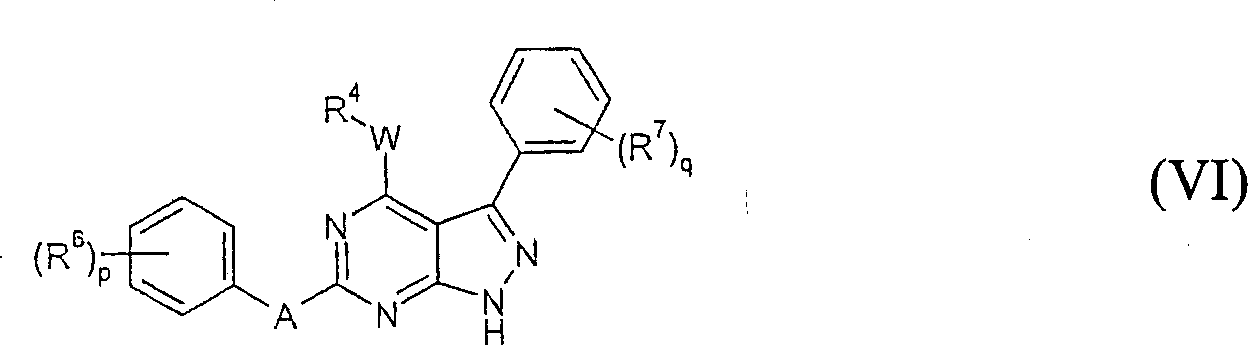
其中p,q,A,W,R4,R6和R7如本文所定义。wherein p, q, A, W, R 4 , R 6 and R 7 are as defined herein.
在式V或VI的某些实施方案中,A可以是O,S或NRh,更优选O。In certain embodiments of formula V or VI, A may be O, S or NR h , more preferably O.
在式Ia的某些实施方案中,本发明的化合物可以是式VII的化合物,In certain embodiments of Formula Ia, the compound of the invention may be a compound of Formula VII,

其中p,q,W,R4,R6和R7如本文所定义。wherein p, q, W, R 4 , R 6 and R 7 are as defined herein.
在式Ia,II,III,IV,V,VI或VII的某些实施方案中,W可以是NRf或O。In certain embodiments of Formula Ia, II, III, IV, V, VI or VII, W can be NR f or O.
在式Ia的某些实施方案中,本发明的化合物可以是式VIII的化合物,In certain embodiments of Formula Ia, the compound of the invention may be a compound of Formula VIII,

其中p,q,A,R4,R6,R7和Rf如本文所定义。wherein p, q, A, R4 , R6 , R7 and Rf are as defined herein.
在式VIII的某些实施方案中,A可以是O,S或NRh,更优选O。In certain embodiments of formula VIII, A may be O, S or NR h , more preferably O.
在式Ia的某些实施方案中,本发明的化合物可以是式IX的化合物,In certain embodiments of Formula Ia, the compound of the invention may be a compound of Formula IX,
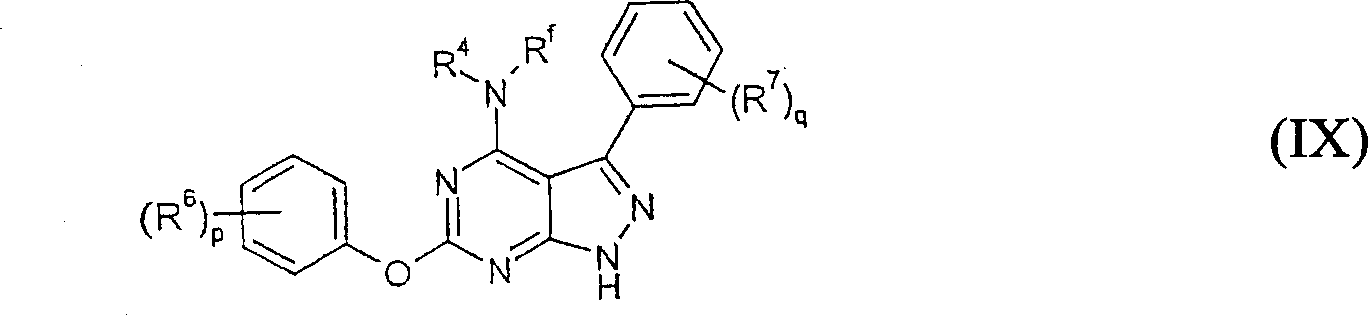
其中p,q,R4,R6,R7和Rf如本文所定义。wherein p, q, R4 , R6 , R7 and Rf are as defined herein.
在式Ia的某些实施方案中,本发明的化合物可以是式X的化合物,In certain embodiments of Formula Ia, the compound of the invention may be a compound of Formula X,
其中p,q,A,R4,R6,和R7如本文所定义。wherein p, q, A, R4 , R6 , and R7 are as defined herein.
在式X的某些实施方案中,A可以是O,S或NRf,更优选O。In certain embodiments of formula X, A may be O, S or NR f , more preferably O.
在式Ia的某些实施方案中,本发明的化合物可以是式XI的化合物,In certain embodiments of Formula Ia, the compound of the invention may be a compound of Formula XI,
其中p,q,R4R6,和R7如本文所定义。wherein p, q, R 4 R 6 , and R 7 are as defined herein.
在式V,VI,VII,VIII,IX,X或XI的优选实施方案中,p是1或2和R6是卤素。优选R6是氟或氯,并且更优选氟。In preferred embodiments of formula V, VI, VII, VIII, IX, X or XI, p is 1 or 2 and R is halogen. Preferably R6 is fluorine or chlorine, and more preferably fluorine.
在式V,VI,VII,VIII,IX,X或XI的某些实施方案中,R2是卤素,烷基,氨基,烷氧基,卤代烷基,羟基,羟基烷氧基,烷硫基,烷氧基氨基,杂芳基,杂环基,杂环基烷基,杂环基氧基,杂环基烷氧基,氨基烷氧基,羟基烷基氨基,羟基烷基氨基烷基,芳烷基氧基,或吡啶基烷基氧基。In certain embodiments of formula V, VI, VII, VIII, IX, X or XI, R is halo , alkyl, amino, alkoxy, haloalkyl, hydroxy, hydroxyalkoxy, alkylthio, Alkoxyamino, heteroaryl, heterocyclyl, heterocyclylalkyl, heterocyclyloxy, heterocyclylalkoxy, aminoalkoxy, hydroxyalkylamino, hydroxyalkylaminoalkyl, aryl Alkyloxy, or pyridylalkyloxy.
在式V,VI,VII,VIII,IX,X或XI的某些实施方案中,R2是氯,氟,溴,甲基,甲氧基,三氟甲基,吡啶基,吗啉代,苄氧基,4-甲基哌啶基,2-甲氧基乙基-甲基氨基,异丙氧基,吡啶-2-基乙氧基,氨基,甲硫基,2,3-二羟基丙氧基,2-羟基乙氧基,2-(吗啉-4-基)-乙氧基,2-(二甲基氨基)-乙氧基,3,4-二羟基丁氧基,吗啉-4-基甲基,(2-羟基丙基)-氨基甲基,羟基甲基,乙氧基,哌啶-4-基氧基,或吡喃-4-基氧基。In certain embodiments of formula V, VI, VII, VIII, IX, X or XI, R is chloro, fluoro, bromo, methyl, methoxy, trifluoromethyl, pyridyl, morpholino, Benzyloxy, 4-methylpiperidinyl, 2-methoxyethyl-methylamino, isopropoxy, pyridin-2-ylethoxy, amino, methylthio, 2,3-dihydroxy Propoxy, 2-hydroxyethoxy, 2-(morpholin-4-yl)-ethoxy, 2-(dimethylamino)-ethoxy, 3,4-dihydroxybutoxy, Lin-4-ylmethyl, (2-hydroxypropyl)-aminomethyl, hydroxymethyl, ethoxy, piperidin-4-yloxy, or pyran-4-yloxy.
在式Ia,II,III,IV,V,VI,VII,VIII,IX,X或XI的某些实施方案中,R4是杂烷基,杂环基,杂环基烷基,杂芳烷基,羟基环烷基,-(CHRa)r-C(=O)-Rb,或R4和Rf与它们连接的氮一起形成杂环基。In certain embodiments of Formula Ia, II, III, IV, V, VI, VII, VIII, IX, X or XI, R is heteroalkyl , heterocyclyl, heterocyclylalkyl, heteroarylalkyl radical, hydroxycycloalkyl, -(CHR a ) r -C(=O)-R b , or R 4 and R f together with the nitrogen to which they are attached form a heterocyclyl.
在式Ia,II,III,IV,V,VI,VII,VIII,IX,X或XI的某些实施方案中,R4是杂烷基。In certain embodiments of formula Ia, II, III, IV, V, VI, VII, VIII, IX, X or XI, R is heteroalkyl.
在其中R4是杂烷基的式Ia,II,III,IV,V,VI,VII,VIII,IX,X或XI的某些实施方案中,R4可以是羟基烷基,烷氧基烷基,羟基烷氧基烷基,氨基烷基,烷基磺酰基烷基,烷基磺酰基氨基烷基或氨基磺酰基氨基烷基。In certain embodiments of formula Ia, II, III, IV , V, VI, VII, VIII, IX, X or XI wherein R is heteroalkyl, R can be hydroxyalkyl, alkoxyalkane radical, hydroxyalkoxyalkyl, aminoalkyl, alkylsulfonylalkyl, alkylsulfonylaminoalkyl or aminosulfonylaminoalkyl.
在式Ia,II,III,IV,V,VI,VII,VIII,IX,X或XI的某些实施方案中,R4是羟基烷基。In certain embodiments of formula Ia, II, III, IV, V, VI, VII, VIII, IX, X or XI, R is hydroxyalkyl.
在其中R4是羟基烷基的式Ia,II,III,IV,V,VI,VII,VIII,IX,X或XI的某些实施方案中,R4可以是2-羟基丙基,2,3-二羟基丙基,1-羟基丙-2-基,2-羟基乙基,2,3,4,5,6-五羟基己基,1,5-二羟基戊-3-基,3,4-二羟基丁基,1,3-二羟基丁-2-基,2-羟基甲基-1,3-二羟基丙-2-基,3-羟基-3-甲基丁基,2-羟基-2-甲基丙基,3-羟基-3-甲基丁-2-基,4,5-二羟基苯基,3-羟基丙基,或1,3-二羟基-2-甲基丙-2-基。优选的羟基烷基包括(R)-2-羟基丙基和(S)-2-羟基丙基。In certain embodiments of formula Ia, II, III, IV, V, VI, VII, VIII, IX, X, or XI wherein R is hydroxyalkyl, R can be 2-hydroxypropyl, 2 , 3-dihydroxypropyl, 1-hydroxypropan-2-yl, 2-hydroxyethyl, 2,3,4,5,6-pentahydroxyhexyl, 1,5-dihydroxypentan-3-yl, 3, 4-dihydroxybutyl, 1,3-dihydroxybutan-2-yl, 2-hydroxymethyl-1,3-dihydroxypropan-2-yl, 3-hydroxy-3-methylbutyl, 2- Hydroxy-2-methylpropyl, 3-hydroxy-3-methylbutan-2-yl, 4,5-dihydroxyphenyl, 3-hydroxypropyl, or 1,3-dihydroxy-2-methyl prop-2-yl. Preferred hydroxyalkyl groups include (R)-2-hydroxypropyl and (S)-2-hydroxypropyl.
在式Ia,II,III,IV,V,VI,VII,VIII,IX,X或XI的某些实施方案中,R4是杂环基。In certain embodiments of formula Ia, II, III, IV, V, VI, VII, VIII, IX, X or XI, R is heterocyclyl .
在其中R4是杂环基的式Ia,II,III,IV,V,VI,VII,VIII,IX,X或XI的某些实施方案中,R4可以是四氢吡喃-4-基,哌啶-4-基,1-甲磺酰基哌啶-4-基,3-羟基四氢吡喃-4-基,3-羟基四氢呋喃-4-基,或3-羟基六氢呋喃并(furo)[3,2-b]呋喃-3-基。In certain embodiments of formula Ia, II, III, IV, V, VI, VII, VIII, IX, X or XI wherein R is heterocyclyl , R can be tetrahydropyran- 4 -yl , piperidin-4-yl, 1-methylsulfonylpiperidin-4-yl, 3-hydroxytetrahydropyran-4-yl, 3-hydroxytetrahydrofuran-4-yl, or 3-hydroxyhexahydrofuro( furo)[3,2-b]furan-3-yl.
在式Ia,II,III,IV,V,VI,VII,VIII,IX,X或XI的某些实施方案中,R4是杂环基烷基。In certain embodiments of formula Ia, II, III, IV, V, VI, VII, VIII, IX, X or XI, R is heterocyclylalkyl.
在其中R4是杂环基烷基的式Ia,II,III,IV,V,VI,VII,VIII,IX,X或XI的某些实施方案中,R4可以是3-(吗啉-4-基)-丙基,2-(吗啉-4-基)-乙基,3-(4-甲基哌嗪-1-基)-丙基,2-(四氢呋喃-4-基)-乙基,四氢呋喃-2-基甲基,3-氟氧杂环丁烷-3-基甲基,3-羟基甲基氧杂环丁烷-3-基甲基,2,2-二甲基[1,3]二氧戊环-4-基甲基,2-(吡咯烷-2,5-二酮-1-基)-乙基,2-(咪唑啉-2-酮-1-基)-乙基,2-(2,2-二甲基[1,3]二氧戊环-4-基)-乙基,3-(2,2-二甲基[1,3]二氧戊环-4-基)-丙基,2-(吡咯烷-2-酮-1-基)-乙基,2-(4-甲基哌嗪-1-基)-乙基,2-(4-甲磺酰基哌嗪-1-基)-乙基,2-(噁唑烷-2-酮-1-基)-乙基,1,4-二噁烷-2-基甲基,2-(吡咯烷-1-基)-乙基,1-甲基哌啶-4-基甲基,或2-(3-甲基-咪唑啉-2-酮-1-基)-乙基。In certain embodiments of formula Ia, II, III, IV, V, VI, VII, VIII, IX, X, or XI, wherein R is heterocyclylalkyl , R can be 3- (morpholine- 4-yl)-propyl, 2-(morpholin-4-yl)-ethyl, 3-(4-methylpiperazin-1-yl)-propyl, 2-(tetrahydrofuran-4-yl)- Ethyl, tetrahydrofuran-2-ylmethyl, 3-fluorooxetan-3-ylmethyl, 3-hydroxymethyloxetan-3-ylmethyl, 2,2-dimethyl [1,3]dioxolan-4-ylmethyl, 2-(pyrrolidin-2,5-dione-1-yl)-ethyl, 2-(imidazolin-2-one-1-yl )-ethyl, 2-(2,2-dimethyl[1,3]dioxolan-4-yl)-ethyl, 3-(2,2-dimethyl[1,3]diox Pentyl-4-yl)-propyl, 2-(pyrrolidin-2-one-1-yl)-ethyl, 2-(4-methylpiperazin-1-yl)-ethyl, 2-( 4-methylsulfonylpiperazin-1-yl)-ethyl, 2-(oxazolidin-2-one-1-yl)-ethyl, 1,4-dioxan-2-ylmethyl, 2 -(pyrrolidin-1-yl)-ethyl, 1-methylpiperidin-4-ylmethyl, or 2-(3-methyl-imidazolidin-2-on-1-yl)-ethyl.
在式Ia,II,III,IV,V,VI,VII,VIII,IX,X或XI的某些实施方案中,R4是杂芳烷基。In certain embodiments of formula Ia, II, III, IV, V, VI, VII, VIII, IX, X or XI, R is heteroaralkyl.
在其中R4是杂芳烷基的式Ia,II,III,IV,V,VI,VII,VIII,IX,X或XI的某些实施方案中,R4可以是2-(2-甲基咪唑-1-基)-乙基,2-(氧氮杂二唑(oxazdiazol)-2-基)-乙基,2-(4-甲基-2,3-二氢-[1,2,4]三唑-3-酮-5-基)-乙基,2-(1-甲基咪唑-2-基)-乙基,2-(1-甲氧基甲基-[1,2,4]-三唑-3-基)-乙基,2-(2-甲氧基甲基-[1,2,4]-三唑-3-基)-乙基,2-([1,2,4]-三唑-3-基)-乙基,2-(2,4-二氢-[1,2,4]-三唑-3-酮-4-基)-乙基。In certain embodiments of formula Ia, II, III, IV, V, VI, VII, VIII, IX, X or XI wherein R is heteroaralkyl, R can be 2-(2 - methyl Imidazol-1-yl)-ethyl, 2-(oxazdiazol-2-yl)-ethyl, 2-(4-methyl-2,3-dihydro-[1,2, 4] Triazol-3-one-5-yl)-ethyl, 2-(1-methylimidazol-2-yl)-ethyl, 2-(1-methoxymethyl-[1,2, 4]-triazol-3-yl)-ethyl, 2-(2-methoxymethyl-[1,2,4]-triazol-3-yl)-ethyl, 2-([1, 2,4]-triazol-3-yl)-ethyl, 2-(2,4-dihydro-[1,2,4]-triazol-3-on-4-yl)-ethyl.
在式Ia,II,III,IV,V,VI,VII,VIII,IX,X或XI的某些实施方案中,R4是-(CHRa)r-C(=O)-Rb。In certain embodiments of Formula Ia, II, III, IV, V, VI, VII, VIII, IX, X or XI, R 4 is -(CHR a ) r -C(=O)-R b .
在其中R4是-(CHRa)r-C(=O)-Rb的式Ia,II,III,IV,V,VI,VII,VIII,IX,X或XI的某些实施方案中,r是1,2或3,Ra是氢,并且Rb是叔-丁氧基,羟基,吗啉-4-基,二甲基氨基或甲基。In certain embodiments of formula Ia, II, III, IV, V, VI, VII, VIII, IX, X or XI, wherein R is -(CHR a ) r -C(=O)-R b , r is 1, 2 or 3, R a is hydrogen, and R b is tert-butoxy, hydroxy, morpholin-4-yl, dimethylamino or methyl.
在其中R4是-(CHRa)r-C(=O)-Rb的式Ia,II,III,IV,V,VI,VII,VIII,IX,X或XI的某些实施方案中,r是1,Ra是羟基甲基或1-羟基乙基,并且Rb是叔-丁氧基,羟基,吗啉-4-基,二甲基氨基或甲基。In certain embodiments of formula Ia, II, III, IV, V, VI, VII, VIII, IX, X or XI, wherein R is -(CHR a ) r -C(=O)-R b , r is 1, R a is hydroxymethyl or 1-hydroxyethyl, and R b is tert-butoxy, hydroxy, morpholin-4-yl, dimethylamino or methyl.
在式Ia,II,III,IV,V,VI,VII,VIII,IX,X或XI的某些实施方案中,R4和Rf和它们连接的氮一起形成杂环基。In certain embodiments of Formula Ia, II, III, IV, V, VI, VII, VIII, IX, X or XI, R and R together with the nitrogen to which they are attached form a heterocyclyl.
在其中R4和Rf和它们连接的氮一起形成杂环基的式Ia,II,III,IV,V,VI,VII,VIII,IX,X或XI的某些实施方案中,这些杂环基可以是1,1-二氧代-1λ*6*-硫代吗啉-4-基,1,1-二氧代-1λ*6*-[1,2]噻嗪烷(thiazinan)-2-基,4-甲基哌嗪-1-基,4-羟基哌啶-1-基,4-甲磺酰基哌嗪-1-基,吗啉-4-基,4-羟基甲基哌啶-1-基,4-(2-羟基乙基)-哌啶-1-基,3-羟基氮杂环丁烷-1-基,2-羟基甲基吡咯烷-1-基,3-羟基哌啶-1-基,4-(嘧啶-2-基)-哌嗪-1-基,或3-羟基吡咯烷(pyrrolodin)-1-基。In certain embodiments of formula Ia, II, III, IV, V, VI, VII, VIII, IX, X or XI, wherein R and R together with the nitrogen to which they are attached form a heterocyclyl group, these heterocycles The base can be 1,1-dioxo-1λ * 6 * -thiomorpholin-4-yl, 1,1-dioxo-1λ * 6 * -[1,2]thiazinan- 2-yl, 4-methylpiperazin-1-yl, 4-hydroxypiperidin-1-yl, 4-methylsulfonylpiperazin-1-yl, morpholin-4-yl, 4-hydroxymethylpiper Pyridin-1-yl, 4-(2-hydroxyethyl)-piperidin-1-yl, 3-hydroxyazetidin-1-yl, 2-hydroxymethylpyrrolidin-1-yl, 3- Hydroxypiperidin-1-yl, 4-(pyrimidin-2-yl)-piperazin-1-yl, or 3-hydroxypyrrolidin-1-yl.
在式Ia,II,III,IV,V,VI,VII,VIII,IX,X或XI的某些实施方案中,R4是羟基环烷基。In certain embodiments of formula Ia, II, III, IV, V, VI, VII, VIII, IX, X or XI, R is hydroxycycloalkyl.
在其中R4是羟基环烷基的式Ia,II,III,IV,V,VI,VII,VIII,IX,X或XI的某些实施方案中,R4可以是羟基环己-2-基,羟基环戊-2-基,或1,3-二羟基环己-5-基。In certain embodiments of formula Ia, II, III, IV, V, VI, VII, VIII, IX, X or XI wherein R is hydroxycycloalkyl , R can be hydroxycyclohex-2-yl , hydroxycyclopent-2-yl, or 1,3-dihydroxycyclohex-5-yl.
在式Ib的某些实施方案中,X和Y是氮。在其它实施方案中,X和Y之一是氮并且另一个是CRd。In certain embodiments of formula Ib, X and Y are nitrogen. In other embodiments, one of X and Y is nitrogen and the other is CR d .
在式Ib的某些实施方案中,本发明的化合物可以是更具体地式XII的化合物:In certain embodiments of formula Ib, the compound of the invention may be more specifically a compound of formula XII:
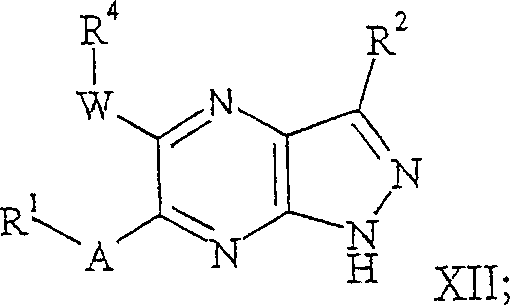
其中A,W,R1,R2和R4如本文所定义。wherein A, W, R 1 , R 2 and R 4 are as defined herein.
在式Ib的某些实施方案中,本发明的化合物可以是更具体地式XIII的化合物:In certain embodiments of formula Ib, the compound of the invention may be more specifically a compound of formula XIII:
其中W,R1,R2和R4如本文所定义。wherein W, R 1 , R 2 and R 4 are as defined herein.
在式Ib的某些实施方案中,本发明的化合物可以是更具体地式XIV的化合物:In certain embodiments of formula Ib, the compound of the invention may be, more specifically, a compound of formula XIV:
其中p,q,A,X,Y,W,R4,R6和R7如本文所定义。wherein p, q, A, X, Y, W, R 4 , R 6 and R 7 are as defined herein.
在式XIV的某些实施方案中,X和Y是氮。在其它实施方案中,X和Y之一是氮并且另一个是CRd。In certain embodiments of formula XIV, X and Y are nitrogen. In other embodiments, one of X and Y is nitrogen and the other is CR d .
在式Ib的某些实施方案中,本发明的化合物可以是更具体地式XV的化合物:In certain embodiments of formula Ib, the compound of the invention may be more specifically a compound of formula XV:

其中p,q,A,W,R4,R6和R7如本文所定义。wherein p, q, A, W, R 4 , R 6 and R 7 are as defined herein.
在式Ib的某些实施方案中,本发明的化合物可以是更具体地式XVI的化合物:In certain embodiments of formula Ib, the compound of the invention may be more specifically a compound of formula XVI:

其中p,q,W,R4,R6和R7如本文所定义。wherein p, q, W, R 4 , R 6 and R 7 are as defined herein.
在式Ic的某些实施方案中,Z是CRc从而主题化合物可以由式XVII表示:In certain embodiments of Formula Ic, Z is CR c such that the subject compound can be represented by Formula XVII:
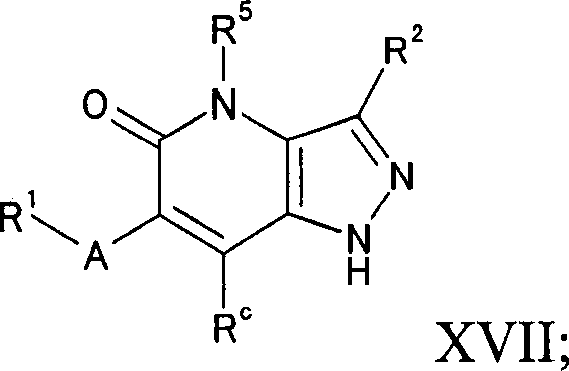
其中A,R1,R2,R5和Rc如上定义。wherein A, R 1 , R 2 , R 5 and R c are as defined above.
在式Ic的某些实施方案中,本发明的化合物可以由式XVIII表示:In certain embodiments of Formula Ic, compounds of the invention may be represented by Formula XVIII:

其中in
p和q各自独立地是0-4;p and q are each independently 0-4;
每个R6独立地为卤素,烷基,烷氧基,卤代烷基,或氰基;each R is independently halogen, alkyl, alkoxy, haloalkyl, or cyano;
每个R7独立地为卤素,烷基,卤代烷基,氰基,杂烷基,杂环基,羟基环烷基或-C(=O)-Rn,其中Rn是烷基,杂烷基,芳基,芳烷基,杂芳基或杂环基;并且Each R is independently halogen, alkyl, haloalkyl, cyano, heteroalkyl, heterocyclyl, hydroxycycloalkyl or -C(=O) -Rn , wherein Rn is alkyl, heteroalk radical, aryl, aralkyl, heteroaryl or heterocyclyl; and
A和R5如本文所定义。A and R 5 are as defined herein.
在式Ic的具体实施方案中,本发明的化合物可以由式XIX表示:In a particular embodiment of formula Ic, compounds of the invention may be represented by formula XIX:

其中p,q,,R5R6和R7如本文所定义。wherein p, q, R 5 R 6 and R 7 are as defined herein.
在其中R1,R2,R3,R4,R5,R6,R7,Ra,Rb,Rc,Rd,Re,Rf,Rg,Rh,Ri,Rj或Rk中任何一个是烷基或者含有烷基基团的本发明的实施方案中,这些烷基优选是低级烷基,即C1-C6烷基,并且更优选C1-C4烷基。where R 1 , R 2 , R 3 , R 4 , R 5 , R 6 , R 7 , R a , R b , R c , R d , R e , R f , R g , R h , R i , In embodiments of the invention where either R j or R k is alkyl or contains alkyl groups, these alkyl groups are preferably lower alkyl, i.e. C 1 -C 6 alkyl, and more preferably C 1 -C 4 alkyl.
式I化合物的药用酸加成盐包括从无机酸衍生的盐,所述无机酸如盐酸、硝酸、磷酸、硫酸、氢溴酸、氢碘酸、亚磷酸等;以及从有机酸衍生的盐,所述有机酸如脂肪族一-和二羧酸、苯基取代的链烷酸、羟基链烷酸、链烷二羧酸、芳香酸、脂肪族和芳香族磺酸等。这些盐包括硫酸盐、焦硫酸盐、硫酸氢盐、亚硫酸盐、硝酸盐、磷酸盐、磷酸氢盐、磷酸二氢盐、偏磷酸盐、焦磷酸盐、盐酸盐、氢溴酸盐、氢碘酸盐、乙酸盐、丙酸盐、辛酸盐、异丁酸盐、草酸盐、丙二酸盐、琥珀酸盐、辛二酸盐、癸二酸盐、富马酸盐、马来酸盐、扁桃酸盐、苯甲酸盐、氯代苯甲酸盐、甲基苯甲酸盐、二硝基苯甲酸盐、邻苯二甲酸盐、苯磺酸盐、甲苯磺酸盐、苯基乙酸盐、柠檬酸盐、乳酸盐、马来酸盐、酒石酸盐、甲烷磺酸盐等。还包括氨基酸的盐如精氨酸盐等,和葡糖酸盐,半乳糖醛酸(参见例如Berge等,J.of Pharmaceutical Science,1977,66,1-19)。Pharmaceutically acceptable acid addition salts of compounds of formula I include salts derived from inorganic acids such as hydrochloric acid, nitric acid, phosphoric acid, sulfuric acid, hydrobromic acid, hydroiodic acid, phosphorous acid, etc.; and salts derived from organic acids , the organic acids such as aliphatic mono- and dicarboxylic acids, phenyl-substituted alkanoic acids, hydroxyalkanoic acids, alkanedicarboxylic acids, aromatic acids, aliphatic and aromatic sulfonic acids, and the like. These salts include sulfates, pyrosulfates, bisulfates, sulfites, nitrates, phosphates, hydrogenphosphates, dihydrogenphosphates, metaphosphates, pyrophosphates, hydrochlorides, hydrobromides, Hydroiodide, Acetate, Propionate, Caprylate, Isobutyrate, Oxalate, Malonate, Succinate, Suberate, Sebacate, Fumarate, Maleate, Mandelate, Benzoate, Chlorobenzoate, Methylbenzoate, Dinitrobenzoate, Phthalate, Benzenesulfonate, Toluenesulfonate salt, phenylacetate, citrate, lactate, maleate, tartrate, methanesulfonate, etc. Also included are salts of amino acids such as arginine salts, etc., and gluconate, galacturonic acid (see, for example, Berge et al., J. of Pharmaceutical Science, 1977, 66, 1-19).
碱性化合物的酸加成盐的制备可以通过以常规方式将游离碱形式与足够量的所需的酸接触来制备盐。通过以常规方式将该盐形式与碱接触并分离游离碱,可以再生出游离碱形式。该游离碱形式在某些物理性质如在极性溶剂中的溶解度有些不同于它们各自的盐形式,但对于本发明的目的,这些盐与它们各自的游离碱在其它方面是等价的。Preparation of Acid Addition Salts of Basic Compounds Salts may be prepared by contacting the free base form with a sufficient amount of the desired acid in the conventional manner. The free base form can be regenerated by contacting the salt form with a base and isolating the free base in the conventional manner. The free base forms differ somewhat from their respective salt forms in certain physical properties, such as solubility in polar solvents, but the salts are otherwise equivalent to their respective free bases for the purposes of the present invention.
以下在表1中显示按照本发明的代表性化合物。Representative compounds according to the present invention are shown in Table 1 below.
表1
本发明的化合物可以通过在以下显示和描述的例举性合成反应路线中所示的各种方法制备。Compounds of the present invention can be prepared by various methods shown in the exemplary synthetic schemes shown and described below.
用于制备这些化合物的原材料和试剂通常可以获自商品供应商,如Aldrich Chemical Co.,或者通过本领域技术人员已知的方法制备,遵循在参考文献如Fieser and Fieser’s Reagents for Organic Synthesis;Wiley &Sons:纽约,1991,卷1-15;Rodd’s Chemistry of Carbon Compounds,ElsevierScience Publishers,1989,卷1-5和增刊;和Organic Reactions,Wiley &Sons:纽约,1991,卷1-40中阐述的步骤。下列合成反应路线仅仅是举例说明可以合成本发明化合物的一些方法,可以进行这些合成反应路线的各种变化,在参考本申请包含的公开内容以后,给本领域技术人员提供了这些变化的启示。Starting materials and reagents for the preparation of these compounds are generally available from commercial suppliers, such as Aldrich Chemical Co., or prepared by methods known to those skilled in the art, following references such as Fieser and Fieser's Reagents for Organic Synthesis; Wiley & Sons : New York, 1991, vol. 1-15; Rodd's Chemistry of Carbon Compounds, Elsevier Science Publishers, 1989, vol. 1-5 and supplements; and Organic Reactions, Wiley & Sons: New York, 1991, vol. 1-40. The following synthetic schemes are merely illustrative of some of the ways in which the compounds of the present invention may be synthesized. Variations of these synthetic schemes may be made and are suggested to those skilled in the art upon reference to the disclosure contained herein.
如果需要,使用常规技术,包括但不限于,过滤,蒸馏,结晶,色谱法等,合成反应路线的原材料和中间体可以分离和纯化。可以使用常规方法,包括物理常数和光谱数据,表征这些材料。Starting materials and intermediates of the synthetic schemes can be isolated and purified if desired, using conventional techniques including, but not limited to, filtration, distillation, crystallization, chromatography, and the like. These materials can be characterized using conventional methods, including physical constants and spectral data.
除非另外指出,本文所述的反应优选在惰性气氛下在大气压力下,在约-78℃到约150℃、更优选约0℃至约125℃、最优选和便利地在约室温(或环境温度)例如约20℃下进行。Unless otherwise indicated, the reactions described herein are preferably performed under an inert atmosphere at atmospheric pressure, at a temperature from about -78°C to about 150°C, more preferably from about 0°C to about 125°C, most preferably and conveniently at about room temperature (or ambient temperature) such as about 20°C.
制备本发明的吡唑并嘧啶化合物的具体方法之一在以下反应路线I中显示。One of the specific methods for preparing the pyrazolopyrimidine compounds of the present invention is shown in Scheme I below.
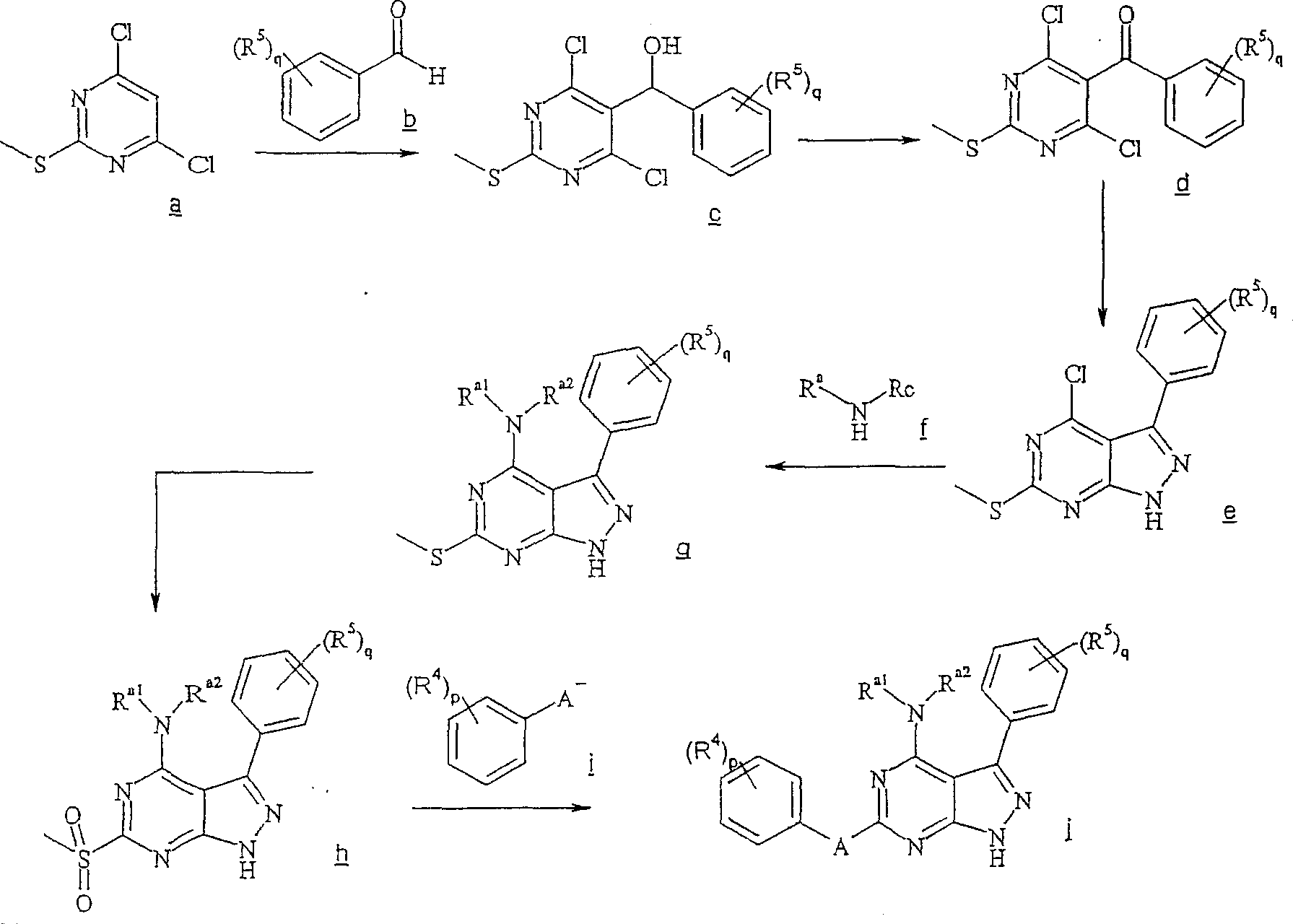
反应路线IReaction Scheme I
在反应路线I中,使用碱,如二异丙基酰胺锂(LDA)或本领域技术人员公知的其它适当的碱,将二氯硫代嘧啶 a脱质子化。脱质子化的嘧啶 a与苯甲醛 b或其衍生物反应以生成醇 c。该醇 c被氧化,例如通过氧化锰,以生成嘧啶苯基酮 d。将酮 d与肼反应,获得吡唑并嘧啶 e形式的闭环产物。吡唑并嘧啶 e与亲核体如胺 f反应,替换了吡唑并嘧啶 e上的氯基团,获得氨基吡唑并嘧啶 f。备选地,醇盐RaO-或硫代醇盐RaS-可以用于替换胺 f。氨基吡唑并嘧啶 f上的硫代基团可以然后被氧化,例如使用过硫酸氢钾制剂,间氯过苯甲酸,或本领域技术人员已知的其它氧化剂,以生成磺酰基吡唑并嘧啶衍生物 g。吡唑并嘧啶衍生物 g上的磺酰基基团然后用亲核芳基基团 h置换,以生成按照本发明的吡唑并嘧啶 i,所述亲核芳基基团 h如任选取代的酚盐,任选取代的苯胺,或任选取代的硫代酚盐。In Scheme I, dichlorothiopyrimidine a is deprotonated using a base such as lithium diisopropylamide (LDA) or other suitable base known to those skilled in the art. Deprotonated pyrimidine a reacts with benzaldehyde b or its derivatives to generate alcohol c . The alcohol c is oxidized, for example by manganese oxidation, to give the pyrimidine phenone d . Reaction of ketone d with hydrazine affords the ring-closed product in the form of pyrazolopyrimidine e . Reaction of pyrazolopyrimidine e with a nucleophile such as amine f replaces the chlorine group on pyrazolopyrimidine e to give aminopyrazolopyrimidine f . Alternatively, alkoxide R a O - or thioalkoxide R a S - can be used in place of amine f . The thio group on the aminopyrazolopyrimidine f can then be oxidized, for example using potassium persulfate, m-chloroperbenzoic acid, or other oxidizing agents known to those skilled in the art, to yield the sulfonylpyrazolopyrimidine derivative g . The sulfonyl group on the pyrazolopyrimidine derivative g is then replaced with a nucleophilic aryl group h such as optionally substituted phenate, optionally substituted aniline, or optionally substituted thiophenate.
本发明的吡唑并吡啶酮化合物可以如以下反应路线II中所示的吡唑化合物制备,其中PG是保护基并且可以在各种情形中是相同的或不同的。The pyrazolopyridone compounds of the present invention can be prepared as pyrazole compounds shown in Scheme II below, wherein PG is a protecting group and can be the same or different in each case.

反应路线IIReaction Scheme II
在反应路线II中,硝基吡唑羧酸化合物 k的酯化生成硝基吡唑酯,其随后保护环氮原子之一以提供保护的区域异构体(regioisomers) m, n的混合物,将它们分离。保护基可以包含例如,2-(三甲基甲硅烷基)乙氧基-甲基基团。2-保护的吡唑化合物 m然后用还原剂处理,以提供醇 o,所述还原剂如硼氢化钠或本领域技术人员已知的其它适当的还原剂。醇 o用氧化锰(IV)或以上讨论的其它适当的氧化剂氧化,以提供吡唑甲醛化合物 p。醛 p与α-芳基氧酯 q的阴离子的缩合反应提供α-芳基氧基-β-羟基酯 r。使用还原剂如铁,在氯化铵的存在下或者本领域技术人员已知的其它适当的还原条件下,将α-芳基氧基-β-羟基酯 r的硝基还原,导致伴随的环形成和β-羟基基团的消除,以提供吡唑并吡啶酮衍生物 s。酰胺氮然后在常规条件下用烷基化剂如烷基或杂烷基碘化物RcI烷基化,以获得N-烷基吡唑并吡啶酮 t。在RcI上存在的官能团,如羟基,可以被保护和在反应路线II的最后随后脱保护。In Scheme II, the esterification of the nitropyrazole carboxylic acid compound k produces the nitropyrazole ester, which is subsequently protected on one of the ring nitrogen atoms to provide a mixture of protected regioisomers m , n , They separate. Protecting groups may include, for example, a 2-(trimethylsilyl)ethoxy-methyl group. The 2-protected pyrazole compound m is then treated with a reducing agent such as sodium borohydride or other suitable reducing agent known to those skilled in the art to provide the alcohol o . Alcohol o is oxidized with manganese(IV) oxide or other suitable oxidizing agents discussed above to provide the pyrazole carboxaldehyde compound p . The condensation reaction of the aldehyde p with the anion of the α-aryloxyester q provides the α-aryloxy-β-hydroxyester r . Reduction of the nitro group of the α-aryloxy-β-hydroxy ester r using a reducing agent such as iron in the presence of ammonium chloride or other suitable reducing conditions known to those skilled in the art results in the concomitant ring Formation and elimination of the β-hydroxy group to afford pyrazolopyridone derivatives s . The amide nitrogen is then alkylated with an alkylating agent such as an alkyl or heteroalkyl iodide RcI under conventional conditions to afford the N-alkylpyrazolopyridone t . Functional groups present on RcI , such as hydroxyl groups, can be protected and subsequently deprotected at the end of Scheme II.
N-烷基化的吡唑并吡啶酮 t的吡唑啉环部分的脱保护,接着在碳酸钾的存在下用一氯化碘处理,或在本领域技术人员已知的其它适当的碘化作用条件下,提供碘吡唑并吡啶酮 u。碘吡唑并吡啶酮 u的吡唑1-位然后用Boc等保护基保护,与适当的芳基或杂芳基化合物 v交叉偶联反应(例如,在钯催化剂的存在下与芳基硼酸的Suzuki偶联),提供保护的芳基氧基碘吡唑并吡啶酮 w。然后去除吡唑啉环氮原子上的保护基,获得按照本发明的吡唑并吡啶酮化合物 x。Deprotection of the pyrazoline ring moiety of N-alkylated pyrazolopyridones followed by treatment with iodine monochloride in the presence of potassium carbonate, or other appropriate iodination known to those skilled in the art Under the action conditions, the iodopyrazolopyridone u is provided. The pyrazole 1-position of iodopyrazolopyridone u is then protected with a protecting group such as Boc, and cross-coupling with an appropriate aryl or heteroaryl compound v (for example, in the presence of a palladium catalyst with arylboronic acid Suzuki coupling), providing a protected aryloxyiodopyrazolopyridone w . The protecting group on the nitrogen atom of the pyrazoline ring is then removed to obtain the pyrazolopyridone compound x according to the present invention.
本领域技术人员应当理解,对上述反应路线的修改也被考虑和属于本发明的范围内。例如,某些步骤涉及对与特定反应条件不相容的官能团使用保护基。Those skilled in the art will appreciate that modifications to the above reaction schemes are also contemplated and within the scope of the present invention. For example, certain procedures involve the use of protecting groups for functional groups that are incompatible with particular reaction conditions.
在以下实施例部分描述生产式(I)的化合物的更多具体细节。More specific details for the production of compounds of formula (I) are described in the Examples section below.
本发明包括药物组合物,其包含至少一种本发明的化合物、或单独异构体、异构体的外消旋或非外消旋混合物、或其药用盐或溶剂化物,以及至少一种药用载体,和任选地其它治疗性和/或预防性成分。The present invention includes pharmaceutical compositions comprising at least one compound of the present invention, or individual isomers, racemic or non-racemic mixtures of isomers, or pharmaceutically acceptable salts or solvates thereof, and at least one A pharmaceutically acceptable carrier, and optionally other therapeutic and/or prophylactic ingredients.
通常,本发明的化合物通过用于类似用途的药剂的可接受的给药方式中的任何一种,以治疗有效量施用。适当的剂量范围典型地为每日1-500mg,优选每日1-100mg,最优选每日1-30mg,这取决于多种因素如治疗的疾病的严重性,受试者的年龄和相对健康,所用化合物的效能,给药途径和形式,给药针对的适应征,和参与专业医生的偏好和经验。治疗这些疾病的本领域普通技术人员在没有过度实验下,依赖于个人知识和本申请公开内容,将能够确定本发明化合物对于给定疾病的治疗有效量。In general, the compounds of the invention are administered in a therapeutically effective amount by any of the accepted modes of administration for pharmaceutical agents for similar uses. An appropriate dosage range is typically 1-500 mg per day, preferably 1-100 mg per day, most preferably 1-30 mg per day, depending on factors such as the severity of the disease being treated, the age and relative health of the subject , the potency of the compound used, the route and form of administration, the indication for which it is administered, and the preference and experience of the participating professional physicians. One of ordinary skill in the art of treating these diseases will, without undue experimentation, relying on personal knowledge and the disclosure of this application, be able to determine a therapeutically effective amount of a compound of the invention for a given disease.
通常,本发明的化合物可以作为药物制剂给药,所述药物制剂包括适合于口服(包括口含和舌下),直肠,鼻,局部,肺,阴道,或肠胃外(包括肌内,动脉内,鞘内,皮下和静脉内)给药的那些或适合于通过吸入或吹入的形式的那些。优选的给药方式通常是口服,使用常规日剂量给药方案,其可以按照痛苦程度加以调整。In general, the compounds of the present invention can be administered as pharmaceutical formulations including those suitable for oral (including buccal and sublingual), rectal, nasal, topical, pulmonary, vaginal, or parenteral (including intramuscular, intraarterial). , intrathecal, subcutaneous and intravenous) or those in a form suitable for administration by inhalation or insufflation. The preferred mode of administration is usually oral, using a conventional daily dosage regimen which can be adjusted according to the degree of affliction.
本发明的一种或多种化合物,与一种或多种常规辅剂,载体,或稀释剂一起,可以放入药物组合物和单位剂型的形式。药物组合物和单位剂型可以包含常规比例的常规成分,含有或不含另外的活性化合物或有效成分,并且单位剂型可以含有与将使用的期望日剂量范围相当的任何适当的有效量的活性成分。可以将药物组合物作为以下形式使用:用于口服使用的固体,如片剂或填充胶囊,半固体,粉末,缓释制剂,或液体如溶液,混悬剂,乳剂,酏剂,或填充胶囊;或用于直肠或阴道给药的栓剂形式;或用于肠胃外使用的无菌注射液的形式。每片剂含有约一(1)毫克活性成分或更宽地,约0.01至约一百(100)毫克的制剂因此是适当的代表性的单位剂型。One or more compounds of the present invention, together with one or more conventional adjuvants, carriers, or diluents, can be put into the form of pharmaceutical compositions and unit dosage forms. Pharmaceutical compositions and unit dosage forms may contain conventional ingredients in conventional proportions, with or without additional active compounds or active ingredients, and unit dosage forms may contain any suitable effective amount of active ingredient commensurate with the desired daily dosage range to be used. The pharmaceutical composition can be available as a solid for oral use, such as a tablet or filled capsule, a semi-solid, powder, sustained release formulation, or a liquid such as a solution, suspension, emulsion, elixir, or filled capsule or in the form of suppositories for rectal or vaginal administration; or in the form of sterile injectable solutions for parenteral use. Formulations containing from about one (1) milligram or, more broadly, from about 0.01 to about one hundred (100) milligrams of active ingredient per tablet are thus suitable representative unit dosage forms.
本发明的化合物可以以各种各样的口服给药剂型配制。药物组合物和剂型可以包含本发明的一种或多种化合物或其药用盐作为活性成分。药用载体可以是固体或液体。固体形式的制剂包括散剂,片剂,丸剂,胶囊,扁囊剂,栓剂和可分散的颗粒剂。固体载体可以是一种或多种可以用作稀释剂、调味剂、增溶剂、润滑剂、混悬剂、粘合剂、防腐剂、片剂崩解剂的物质,或包封材料。在散剂中,载体通常是精细固体,其为与精细活性成分的混合物。在片剂中,活性成分通常与具有所需粘合能力的适当比例的载体混合,并以所需形状和尺寸压缩。散剂和片剂优选含有百分之约一(1)至约七十(70)的活性化合物。适当的载体包括但不限于碳酸镁,硬脂酸镁,滑石,糖,乳糖,果胶,糊精,淀粉,明胶,黄蓍胶,甲基纤维素,羧甲基纤维素钠,低熔点蜡,可可脂等。术语“制剂”意欲包括活性化合物与包封材料如载体的制剂,提供胶囊,其中活性成分与或不与载体一起,被与其相关的载体包围。类似地,包括扁囊剂和锭剂。片剂,散剂,胶囊,丸剂,扁囊剂和锭剂可以是用于口服给药的固体形式。The compounds of the present invention can be formulated in a wide variety of dosage forms for oral administration. Pharmaceutical compositions and dosage forms may contain as an active ingredient one or more compounds of the invention, or pharmaceutically acceptable salts thereof. Pharmaceutical carriers can be solid or liquid. Solid form preparations include powders, tablets, pills, capsules, cachets, suppositories and dispersible granules. A solid carrier can be one or more substances which may act as diluents, flavoring agents, solubilizers, lubricants, suspending agents, binders, preservatives, tablet disintegrating agents, or an encapsulating material. In powders, the carrier is usually a finely divided solid, which is in admixture with the finely divided active ingredient. In tablets, the active ingredient usually is mixed with the carrier having the necessary binding capacity in suitable proportions and compacted in the shape and size desired. Powders and tablets preferably contain from about one (1) to about seventy (70) percent active compound. Suitable carriers include, but are not limited to, magnesium carbonate, magnesium stearate, talc, sugar, lactose, pectin, dextrin, starch, gelatin, tragacanth, methylcellulose, sodium carboxymethylcellulose, low-melting waxes , cocoa butter, etc. The term "preparation" is intended to include the formulation of the active compound with encapsulating material such as carrier, providing a capsule in which the active ingredient, with or without carriers, is surrounded by a carrier in its association. Similarly, cachets and lozenges are included. Tablets, powders, capsules, pills, cachets and lozenges can be solid forms for oral administration.
其它适用于口服给药的形式包括液体形式制剂,包括乳剂,糖浆,酏剂,水溶液,水性混悬液,或在即将使用前转变为液体形式制剂的固体形式制剂。乳剂可以在溶液,例如在丙二醇溶液中制备,或者可以含有乳化剂,例如,如卵磷脂,脱水山梨醇单油酸酯,或阿拉伯胶。水溶液可以如下制备:将活性成分溶解在水中并加入适当的着色剂,调味剂,稳定剂,和增稠剂。水性混悬液可以如下制备:将精细活性成分分散在水中,水中含有粘性材料,如天然或合成树胶,树脂,甲基纤维素,羧甲基纤维素钠,和其它公知的混悬剂。固体形式制剂包括溶液,混悬剂,和乳剂,并且除了活性成分以外,还可以含有着色剂,调味剂,稳定剂,缓冲剂,人工和天然甜味剂,分散剂,增稠剂,增溶剂等。Other forms suitable for oral administration include liquid form preparations, including emulsions, syrups, elixirs, aqueous solutions, aqueous suspensions, or solid form preparations which are to be converted to liquid form preparations immediately before use. Emulsions may be prepared in solutions, for example, in propylene glycol solutions, or may contain emulsifying agents, such as, for example, lecithin, sorbitan monooleate, or acacia. Aqueous solutions can be prepared by dissolving the active component in water and adding suitable colorants, flavors, stabilizing, and thickening agents. Aqueous suspensions can be prepared by dispersing the finely divided active ingredient in water with viscous material, such as natural or synthetic gums, resins, methylcellulose, sodium carboxymethylcellulose, and other known suspending agents. Solid form preparations include solutions, suspensions, and emulsions, and may contain, in addition to the active ingredient, coloring agents, flavoring agents, stabilizers, buffers, artificial and natural sweeteners, dispersants, thickeners, solubilizers wait.
本发明的化合物可以配制用于肠胃外给药(例如,通过注射,例如推注或连续输注)并且可以以单位剂型存在于安瓿,预充注射器,小体积输注或多剂量容器,含有加入的防腐剂。组合物可以采取这些形式,如混悬剂,溶液,或油性或水性载体中的乳剂,例如聚乙二醇水溶液中的溶液。油性或非水性载体、稀释剂、溶剂或载体的实例包括丙二醇,聚乙二醇,植物油(例如,橄榄油),和可注射有机酯类(例如,油酸乙酯),并且可以含有配制试剂如防腐剂,润湿剂,乳化剂或混悬剂,稳定剂和/或分散剂。备选地,活性成分可以是粉末形式,其通过无菌分离无菌固体或通过从溶液中冻干而获得,所述溶液用于在使用前用适当载体构造,例如无菌、无热原的水。The compounds of the invention may be formulated for parenteral administration (e.g., by injection, such as bolus injection or continuous infusion) and may be presented in unit dosage form in ampoules, prefilled syringes, small-volume infusions or in multi-dose containers containing added of preservatives. The compositions may take such forms as suspensions, solutions, or emulsions in oily or aqueous vehicles, for example solutions in aqueous polyethylene glycol. Examples of oily or non-aqueous carriers, diluents, solvents or vehicles include propylene glycol, polyethylene glycol, vegetable oils (e.g., olive oil), and injectable organic esters (e.g., ethyl oleate), and may contain formulation agents Such as preservatives, wetting agents, emulsifying or suspending agents, stabilizing and/or dispersing agents. Alternatively, the active ingredient may be in powder form, obtained by aseptic isolation of sterile solid or by lyophilization from solution for constitution with a suitable vehicle, e.g. sterile, pyrogen-free, before use. water.
本发明的化合物被配制作为软膏,乳膏或洗剂,或作为透皮贴剂用于局部给药于表皮。软膏和乳膏可以例如用水性或油性基质,加入适当增稠剂和/或胶凝剂配制。洗剂可以用水性或油性基质配制,并且通常还含有一种或多种乳化剂,稳定剂,分散剂,混悬剂,增稠剂,或着色剂。适合于口中局部给药的制剂包括锭剂,其包含调味剂基质(通常为蔗糖和阿拉伯胶或黄蓍胶)中的活性成分;锭剂,其包含惰性基质(如明胶和甘油或蔗糖和阿拉伯胶)中的活性成分;和漱口剂,其包含在适当液体载体中的活性成分。The compounds of the invention are formulated as ointments, creams or lotions, or as a transdermal patch for topical administration to the epidermis. Ointments and creams may, for example, be formulated with an aqueous or oily base with the addition of suitable thickening and/or gelling agents. Lotions may be formulated with an aqueous or oily base, and generally also contain one or more emulsifying agents, stabilizing agents, dispersing agents, suspending agents, thickening agents, or coloring agents. Formulations suitable for topical administration in the mouth include lozenges comprising the active ingredient in a flavored base, usually sucrose and acacia or tragacanth; lozenges comprising an inert base such as gelatin and glycerin or sucrose and acacia; gums); and mouthwashes, which contain the active ingredients in a suitable liquid carrier.
本发明的化合物可以配制为作为栓剂给药。低熔点蜡,如脂肪酸甘油酯或可可脂的混合物首先被熔化,例如通过搅拌来均匀分散活性成分。然后将熔化的均匀混合物倒入便利的按大小排好了的模,允许冷却并固化。The compounds of the invention may be formulated for administration as suppositories. A low-melting wax, such as a mixture of fatty acid glycerides or cocoa butter, is first melted, eg, by stirring, to uniformly disperse the active ingredient. The molten homogeneous mixture is then poured into convenient sized molds and allowed to cool and solidify.
本发明的化合物可以配制用于阴道给药。除了活性成分以外,含有诸如本领域已知的载体的阴道栓剂,棉塞,软膏,凝胶,糊剂,泡沫剂或喷雾剂是适当的。The compounds of the invention may be formulated for vaginal administration. Pessaries, tampons, ointments, gels, pastes, foams or sprays containing in addition to the active ingredient such carriers as are known in the art are appropriate.
本发明的化合物可以配制用于经鼻给药。将溶液或混悬剂通过常规方法直接施用于鼻腔,所述常规方法例如,使用滴管,移液管或喷雾器。可以以单或多剂量形式提供制剂。在滴管或移液管的后者情形中,这可以通过患者施用适当的、预定量的溶液或混悬剂来实现。在喷雾器的情形中,这可以通过借助于计量雾化喷雾泵来实现。The compounds of the invention may be formulated for nasal administration. Solutions or suspensions are applied directly to the nasal cavity by conventional means, for example, with a dropper, pipette or spray. Formulations may be presented in single or multiple dose form. In the latter case of a dropper or pipette, this can be achieved by the patient administering an appropriate, predetermined amount of the solution or suspension. In the case of a sprayer, this can be achieved by means of a metered atomizing spray pump.
本发明的化合物可以配制用于气溶胶给药,特别是对于呼吸道,并且包括鼻内给药。化合物通常具有小的粒径,例如约五(5)微米或以下。该粒径可以通过本领域已知的方法获得,例如通过微粉化。在加压包装中提供活性成分,所述包装中具有适当的推进剂如氯氟碳(CFC),例如,二氯二氟甲烷,三氯氟甲烷,或二氯四氟乙烷,或二氧化碳或其它适当的气体。气溶胶还可以便利地含有表面活性剂如卵磷脂。药物的剂量可以通过计量阀控制。备选地,活性成分可以以干燥粉末形式提供,例如化合物在适当的粉末基质如乳糖、淀粉、淀粉衍生物如羟基丙基甲基纤维素和聚乙烯吡咯烷(PVP)中的粉末混合物。粉末载体将在鼻腔中形成凝胶。粉末组合物可以以单位剂量形式提供,例如在例如明胶胶囊或药筒或泡眼包装中,从中粉末可以借助吸入器施用。The compounds of the invention may be formulated for aerosol administration, especially to the respiratory tract, and including intranasal administration. The compounds typically have a small particle size, eg, about five (5) microns or less. This particle size can be obtained by methods known in the art, for example by micronization. The active ingredient is supplied in a pressurized pack with a suitable propellant such as a chlorofluorocarbon (CFC), for example, dichlorodifluoromethane, trichlorofluoromethane, or dichlorotetrafluoroethane, or carbon dioxide or other suitable gases. Aerosols may also conveniently contain a surfactant such as lecithin. The dosage of the drug can be controlled by a metering valve. Alternatively, the active ingredient may be presented in dry powder form, for example a powder mix of the compound in a suitable powder base such as lactose, starch, starch derivatives such as hydroxypropylmethylcellulose and polyvinylpyrrolidine (PVP). The powder carrier will form a gel in the nasal cavity. Powder compositions may be presented in unit dosage form, for example, in eg gelatin capsules or cartridges or blister packs, from which the powder may be administered by means of an inhaler.
当需要时,制剂可以用肠溶包衣制备,所述肠溶包衣适合于活性成分的缓释或控释给药。例如,本发明的化合物可以在透皮或皮下药物递送装置中配制。当化合物的持续释放是必需的时候和当患者对治疗方案的依从是关键的时候,这些递送系统是有利的。将透皮递送系统中的化合物经常附着在皮肤粘性的固体支持体上。目的化合物也可以与渗透增强剂,例如,月桂氮酮(1-十二烷基氮杂环庚烷-2-酮)组合。通过外科手术或注射将缓释递送系统皮下插入皮下层。皮下植入物将化合物包封在液体可溶解的膜中,例如硅橡胶,或生物可降解的聚合物,例如聚乳酸。When desired, formulations can be prepared with enteric coatings suitable for slow or controlled release administration of the active ingredient. For example, compounds of the invention may be formulated in transdermal or subcutaneous drug delivery devices. These delivery systems are advantageous when sustained release of the compound is required and when patient compliance with the treatment regimen is critical. Compounds in transdermal delivery systems are often attached to a skin-adhesive solid support. The compound of interest can also be combined with a penetration enhancer, for example, laurocaprine (1-dodecylazepan-2-one). The sustained release delivery system is inserted subcutaneously into the subcutaneous layer by surgery or injection. Subcutaneous implants encapsulate the compound in a liquid-dissolvable membrane, such as silicone rubber, or a biodegradable polymer, such as polylactic acid.
药物制剂优选是单位剂型。这种形式中,制剂被再分成含有适量活性组分的单位剂量。单位剂型可以是包装制剂,所述包装包含离散量的制剂,如包装片剂,胶囊,和小瓶或安瓿中的粉末。此外,单位剂型可以是胶囊,片剂,扁囊剂,或锭剂本身,或者它可以是适当数目的包装形式的这些中的任何一种。The pharmaceutical formulations are preferably in unit dosage form. In such form, the preparation is subdivided into unit doses containing appropriate quantities of the active component. The unit dosage form can be a packaged preparation, the package containing discrete quantities of preparation, such as packeted tablets, capsules, and powders in vials or ampoules. Also, the unit dosage form can be a capsule, tablet, cachet, or lozenge itself, or it can be the appropriate number of any of these in packaged form.
其它适当的药用载体和它们的制剂在Remington:The Science andPractice of Pharmacy 1995,E.W. Martin编辑,Mack Publishing Company,19th版,Easton,Pennsylvania中描述。在以下实施例中描述了含有本发明的化合物的代表性药物制剂。Other suitable pharmaceutical carriers and their formulations are described in Remington: The Science and Practice of Pharmacy 1995, edited by EW Martin, Mack Publishing Company, 19th edition, Easton, Pennsylvania. Representative pharmaceutical formulations containing compounds of the invention are described in the Examples below.
本发明的化合物有效用于,但不限于,治疗人类或其它哺乳动物中的任何病症或疾病,其是由这些哺乳动物中过多或不受调节的TNF或p38激酶生产所加重或导致。因此,本发明提供了治疗p38-介导的疾病的方法,其包括向需要其的受试者或患者施用有效量本发明的化合物,或其药用盐,溶剂化物或前药。The compounds of the invention are useful for, but not limited to, treating any condition or disease in humans or other mammals which is aggravated or caused by excessive or unregulated TNF or p38 kinase production in these mammals. Accordingly, the present invention provides methods of treating p38-mediated diseases comprising administering to a subject or patient in need thereof an effective amount of a compound of the present invention, or a pharmaceutically acceptable salt, solvate or prodrug thereof.
本发明的化合物将用于,但不限于,治疗受试者的炎症,和用作治疗发热的退热药。本发明的化合物将用于治疗关节炎,包括但不限于,类风湿性关节炎、脊椎关节病、痛风性关节炎、骨关节炎、系统性红斑狼疮和幼年型关节炎、骨关节炎、痛风性关节炎和其它关节炎疾病。该化合物将用于治疗肺病或肺炎症,包括成人呼吸窘迫综合征、肺肉瘤病、哮喘、矽肺病和慢性肺炎性疾病。该化合物还用于治疗病毒和细菌感染,包括脓毒病、脓毒性休克、革兰氏阴性脓毒病、疟疾、脑膜炎、恶病质继发感染或恶性肿瘤、恶病质继发获得性免疫缺陷综合征(AIDS)、AIDS、ARC(AIDS相关并发症)、肺炎、和疱疹病毒。所述化合物还用于治疗骨吸收疾病,例如骨质疏松症、内毒素性休克、中毒性休克综合征、再灌注损伤、自身免疫性疾病,包括移植物对宿主的反应和同种异体移植排斥、心血管病,包括动脉粥样硬化、血栓形成、充血性心力衰竭、和心脏再灌注损伤、肾再灌注损伤、肝病和肾炎,以及感染引起的肌痛。The compounds of the present invention will be useful, but not limited to, in the treatment of inflammation in a subject, and as antipyretics in the treatment of fever. The compounds of the present invention will be useful in the treatment of arthritis, including but not limited to, rheumatoid arthritis, spondyloarthropathy, gouty arthritis, osteoarthritis, systemic lupus erythematosus and juvenile arthritis, osteoarthritis, gout Arthritis and other arthritic diseases. The compound will be used in the treatment of lung disease or pneumonia, including adult respiratory distress syndrome, pulmonary sarcoidosis, asthma, silicosis and chronic pneumonia disease. The compound is also indicated for the treatment of viral and bacterial infections, including sepsis, septic shock, Gram-negative sepsis, malaria, meningitis, infection or malignancy secondary to cachexia, acquired immunodeficiency syndrome secondary to cachexia (AIDS), AIDS, ARC (AIDS-related complications), pneumonia, and herpes virus. The compounds are also useful in the treatment of bone resorption disorders such as osteoporosis, endotoxic shock, toxic shock syndrome, reperfusion injury, autoimmune diseases including graft versus host reactions and allograft rejection , cardiovascular disease, including atherosclerosis, thrombosis, congestive heart failure, and cardiac reperfusion injury, renal reperfusion injury, liver disease and nephritis, and myalgia caused by infection.
该化合物还用于治疗阿尔茨海默氏病,流感、多发性硬化、癌症、糖尿病、系统性红斑狼疮(SLE)、皮肤相关性病症例如牛皮癣、湿疹、烧伤、皮炎、瘢痕形成和疤痕组织形成。此外,本发明的化合物还将用于治疗胃肠道疾病例如炎性肠病、局限性回肠炎、胃炎、过敏性肠综合征和溃疡性结肠炎。该化合物还将用于治疗眼病,例如视网膜炎、视网膜病、葡萄膜炎、恐光症、和对眼组织的急性损伤。本发明的化合物还将用于治疗血管生成,包括瘤形成、转移;眼科疾病例如角膜移植排斥、眼新血管形成、视网膜新血管形成,包括损伤或感染后的新血管形成、糖尿病性视网膜病、晶状体后纤维增生和新生血管性青光眼;溃疡性疾病,例如胃溃疡;病理性,但非恶性病症,例如血管瘤,包括新生儿血管瘤、鼻咽血管纤维瘤和骨无血管形成性坏死;糖尿病性肾病和心肌病;以及妇女生殖系统疾病例如子宫内膜异位。本发明的化合物还可以用于预防环加氧酶-2的产生并具有镇痛药性质。因此,式I化合物有效用于治疗疼痛。The compound is also used in the treatment of Alzheimer's disease, influenza, multiple sclerosis, cancer, diabetes, systemic lupus erythematosus (SLE), skin-related conditions such as psoriasis, eczema, burns, dermatitis, scarring and scar tissue formation . In addition, the compounds of the present invention will be useful in the treatment of gastrointestinal disorders such as inflammatory bowel disease, Crohn's disease, gastritis, irritable bowel syndrome and ulcerative colitis. The compounds will also be useful in the treatment of eye diseases such as retinitis, retinopathy, uveitis, photophobia, and acute damage to ocular tissue. The compounds of the invention will also be useful in the treatment of angiogenesis, including neoplasia, metastasis; ophthalmic diseases such as corneal transplant rejection, ocular neovascularization, retinal neovascularization, including neovascularization following injury or infection, diabetic retinopathy, Retrolentic fibroplasia and neovascular glaucoma; ulcerative disease, such as gastric ulcer; pathological, but nonmalignant conditions, such as hemangiomas, including neonatal hemangioma, nasopharyngeal angiofibroma, and avascular necrosis of bone; diabetes nephropathy and cardiomyopathy; and reproductive system diseases in women such as endometriosis. The compounds of the present invention are also useful in the prevention of cyclooxygenase-2 production and have analgesic properties. Accordingly, the compounds of formula I are useful in the treatment of pain.
式I化合物的其它应用包括治疗HCV,急性哮喘,牛皮癣,慢性阻塞性肺病(COPD),和可以用抗-TNF化合物治疗的其它疾病。Other applications of compounds of formula I include the treatment of HCV, acute asthma, psoriasis, chronic obstructive pulmonary disease (COPD), and other diseases that can be treated with anti-TNF compounds.
除了用于人类的治疗,这些化合物还用于包括哺乳动物、啮齿动物等的宠物动物(companion animals)、外来动物和家畜的兽医治疗。更优选的动物包括马、狗和猫。In addition to use in the treatment of humans, these compounds are also used in the veterinary treatment of companion animals, exotic animals, and livestock, including mammals, rodents, and the like. More preferred animals include horses, dogs and cats.
本发明的化合物还可用于共同治疗,部分地或完全地代替其它常规抗炎药,例如与甾类、环加氧酶-2抑制剂、NSAIDs、DMARDS、免疫抑制剂、5-脂氧化酶抑制剂、LTB4拮抗剂和LTA4水解酶抑制剂共同给药。The compounds of the invention can also be used in co-therapy, partially or completely replacing other conventional anti-inflammatory drugs, for example with steroids, cyclooxygenase-2 inhibitors, NSAIDs, DMARDS, immunosuppressants, 5-lipoxygenase inhibitors Drugs, LTB 4 antagonists and LTA 4 hydrolase inhibitors co-administered.
本文中使用的术语“TNF介导的疾病”指TNF通过TNF本身的控制,或者通过TNF导致另一种单核因子(例如但不限于IL-1,IL-6或IL-8)被释放而发挥作用的任何和所有病症和疾病状况。例如,在一种疾病状况中,IL-1是一种主要成分,它的产生或作用响应于TNF而加剧或分泌,因此这种疾病被认为是TNF介导的疾病。As used herein, the term "TNF-mediated disease" refers to TNF through the control of TNF itself, or through the release of another monokine (such as but not limited to IL-1, IL-6 or IL-8) caused by TNF. Any and all illnesses and disease conditions that play a role. For example, in a disease state in which IL-1 is a major component, its production or action is exacerbated or secreted in response to TNF, and thus the disease is considered a TNF-mediated disease.
本文中使用的术语“p38介导的疾病”指通过p38本身的控制,或者通过p38导致另一种因子(例如但不限于IL-1,IL-6或IL-8)被释放,而发挥作用的任何和所有病症和疾病状况。例如,在一种疾病状况中,其中IL-1是一种主要成分,它的产生或作用响应于p38而加剧或分泌,因此这种疾病被认为是p38介导的疾病。As used herein, the term "p38-mediated disease" refers to a disease that acts through the control of p38 itself, or through the release of another factor (such as but not limited to, IL-1, IL-6 or IL-8) caused by p38 any and all illnesses and conditions. For example, in a disease condition in which IL-1 is a major component, its production or action is exacerbated or secreted in response to p38, and thus the disease is considered to be a p38-mediated disease.
因为TNF-β与TNF-α(也称为恶液质素)存在密切的结构同源性,并且因为它们均诱导类似的生物反应并结合相同的细胞受体,所以,TNF-α和TNF-β的合成都被本发明的化合物所抑制,因此被本发明总称为“TNF”,除非另有具体说明。Because TNF-β shares close structural homology with TNF-α (also known as cachectin), and because they both induce similar biological responses and bind to the same cellular receptors, TNF-α and TNF- The synthesis of β is inhibited by the compounds of the present invention, and therefore is collectively referred to as "TNF" by the present invention, unless otherwise specified.
实施例Example
提供下列制剂和实施例以使本领域技术人员能够更清楚地理解和实施本发明。它们不应当认为是限制本发明的范围,而应当认为仅仅是例举性的和代表性的。The following formulations and examples are provided to enable those skilled in the art to more clearly understand and practice the present invention. They should not be considered as limiting the scope of the invention, but as illustrative and representative only.
除非另外指出,所有温度,包括熔点(即,MP)是摄氏度(℃)。应当理解,生产所示和/或所需产物的反应不一定是由最初加入的两种试剂的组合直接导致,即,可以存在在混合物中产生的一种或多种中间体,其最终导致所示和/或所需产物的形成。下列缩略语可以用于实施例中。All temperatures, including melting points (ie, MP) are in degrees Celsius (° C.) unless otherwise indicated. It should be understood that the reaction to produce the shown and/or desired product does not necessarily result directly from the combination of the two reagents initially added, i.e., there may be one or more intermediates produced in the mixture which ultimately lead to the and/or formation of the desired product. The following abbreviations may be used in the examples.
ABBREVIATIONS:DCM:二氯甲烷;DMF:N,N-二甲基甲酰胺;DMAP:4-二甲基氨基吡啶;gc:气相色谱法;HMPA:六甲基磷酰胺;hplc:高效液相色谱法;mCPBA:m-氯过苯甲酸;MeCN:乙腈;TEA:三乙基胺;THF:四氢呋喃;LDA:二异丙基胺锂;TLC:薄层色谱法;RT:室温ABBREVIATIONS: DCM: dichloromethane; DMF: N,N-dimethylformamide; DMAP: 4-dimethylaminopyridine; gc: gas chromatography; HMPA: hexamethylphosphoramide; hplc: high performance liquid chromatography mCPBA: m-chloroperbenzoic acid; MeCN: acetonitrile; TEA: triethylamine; THF: tetrahydrofuran; LDA: lithium diisopropylamide; TLC: thin layer chromatography; RT: room temperature
实施例1:根据反应路线I的方法,合成(S)-1-[3-(2-氯苯基)-6-(2,4-二氟苯氧基)-1H-吡唑并[3,4-d]嘧啶-4-基氨基]丙-2-醇Example 1: Synthesis of (S)-1-[3-(2-chlorophenyl)-6-(2,4-difluorophenoxy)-1H-pyrazolo[3 according to the method of Reaction Scheme I ,4-d]pyrimidin-4-ylamino]propan-2-ol
步骤1.制备(2-氯苯基-(4,6-二氯-2-甲硫基嘧啶-5-基)-甲醇.Step 1. Preparation of (2-chlorophenyl-(4,6-dichloro-2-methylthiopyrimidin-5-yl)-methanol.
在-78℃在氮气下通过注射器向4,6-二氯-2-(甲硫基)嘧啶(Aldrich)(5.0g,25.64mmol)在无水THF(130mL)中的溶液缓慢加入2.0M LDA(23.0mL,1.8eq)在THF中的溶液。将获得的混合物在-78℃下搅拌另外20分钟,之后通过注射器滴加2-氯苯甲醛(Aldrich)(7.2mL,2eq)。将反应混合物在-78℃下搅拌另外30分钟,然后用饱和氯化铵溶液淬灭。加入乙酸乙酯,使得混合物升温至RT。分离水层并用乙酸乙酯萃取。用盐水洗涤合并的有机层,通过硫酸镁干燥,过滤并浓缩以提供油状粗制产物(14.2g)。应用硅胶快速柱色谱进行纯化,用己烷中的5%乙酸乙酯洗脱,获得标题化合物(8.60g,(M+H)+=336,M.P.=109.5-112.5℃),其在静置后结晶,获得白色固体。To a solution of 4,6-dichloro-2-(methylthio)pyrimidine (Aldrich) (5.0 g, 25.64 mmol) in anhydrous THF (130 mL) was slowly added 2.0 M LDA via syringe at -78 °C under nitrogen (23.0 mL, 1.8 eq) in THF. The resulting mixture was stirred at -78°C for another 20 minutes before 2-chlorobenzaldehyde (Aldrich) (7.2 mL, 2 eq) was added dropwise via syringe. The reaction mixture was stirred at -78°C for an additional 30 minutes, then quenched with saturated ammonium chloride solution. Ethyl acetate was added and the mixture was allowed to warm to RT. The aqueous layer was separated and extracted with ethyl acetate. The combined organic layers were washed with brine, dried over magnesium sulfate, filtered and concentrated to afford the crude product as an oil (14.2 g). Purification using flash column chromatography on silica gel, eluting with 5% ethyl acetate in hexanes, afforded the title compound (8.60 g, (M+H) + =336, MP = 109.5-112.5 °C), which after standing Crystallization gave a white solid.
步骤2.制备(2-氯苯基)-(4,6-二氯-2-甲硫基嘧啶-5-基)-甲酮Step 2. Preparation of (2-chlorophenyl)-(4,6-dichloro-2-methylthiopyrimidin-5-yl)-methanone
向(2-氯苯基)-(4,6-二氯-2-甲硫基嘧啶-5-基)-甲醇(8.6g,25.6mmol)在甲苯(300mL)中的溶液加入氧化锰(IV)(Aldrich)(22.3g,10eq),在搅拌下将获得的混合物加热至回流总共5小时。将反应冷却至RT,然后过滤通过3.5cm硅藻土垫,浓缩滤液以获得8.84g粗制产物。通过硅胶快速柱色谱进行纯化,梯度洗脱,从纯己烷开始,进展到己烷中的2%乙酸乙酯,最后己烷中5%乙酸乙酯,获得标题化合物,为灰白色粉末(1.388g,(M+H)+=333)。To a solution of (2-chlorophenyl)-(4,6-dichloro-2-methylthiopyrimidin-5-yl)-methanol (8.6 g, 25.6 mmol) in toluene (300 mL) was added manganese (IV ) (Aldrich) (22.3 g, 10 eq), the resulting mixture was heated to reflux with stirring for a total of 5 hours. The reaction was cooled to RT, then filtered through a 3.5 cm pad of celite, and the filtrate was concentrated to obtain 8.84 g of crude product. Purification by flash column chromatography on silica gel, gradient elution starting with pure hexane, progressing to 2% ethyl acetate in hexane, and finally 5% ethyl acetate in hexane afforded the title compound as an off-white powder (1.388 g , (M+H) + =333).
步骤3.制备4-氯-3-(2-氯苯基)-6-甲硫基-1H-吡唑并[3,4-d]嘧啶.Step 3. Preparation of 4-chloro-3-(2-chlorophenyl)-6-methylthio-1H-pyrazolo[3,4-d]pyrimidine.
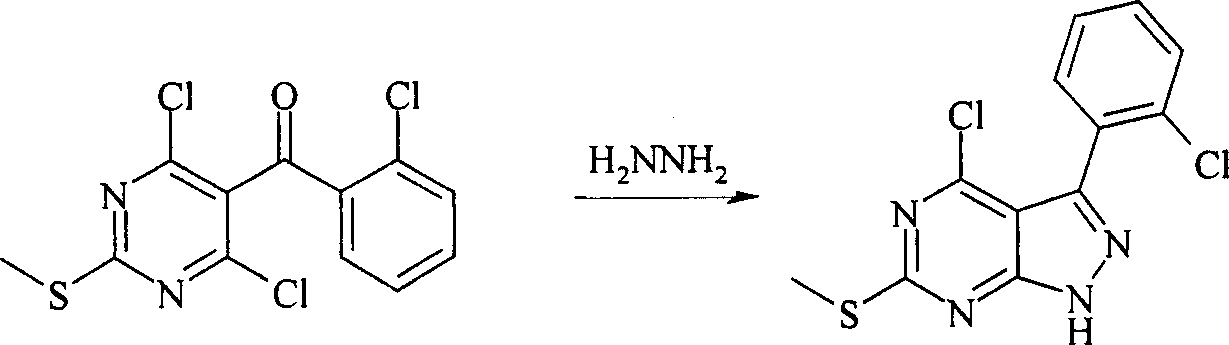
向(2-氯苯基)-(4,6-二氯-2-甲硫基嘧啶-5-基)-甲酮(875mg,2.62mmol)和N,N-二异丙基乙基胺(0.69mL,1.5eq)在THF(20mL)中混合物在0℃下在搅拌同时滴加到肼(83μL,1eq)在THF(20mL)中的溶液。在加入完成后,2小时内将反应逐渐升温至RT。通过TLC分析显示仍有原材料剩余。向反应混合物中滴加另外3mL肼(17μL)在THF(10mL)中的溶液,将反应混合物在RT下搅拌过夜。用乙酸乙酯(150mL)和水(50mL)稀释反应混合物。分离有机层,用水(4×50mL)和盐水(1×50mL)洗涤,通过硫酸镁干燥,过滤并浓缩获得标题化合物,为淡黄色粉末(867mg,(M+H)+=311)。To (2-chlorophenyl)-(4,6-dichloro-2-methylthiopyrimidin-5-yl)-methanone (875mg, 2.62mmol) and N,N-diisopropylethylamine ( A mixture of 0.69 mL, 1.5 eq) in THF (20 mL) was added dropwise to a solution of hydrazine (83 μL, 1 eq) in THF (20 mL) while stirring at 0°C. After the addition was complete, the reaction was gradually warmed to RT over 2 hours. Analysis by TLC showed starting material remaining. An additional 3 mL of hydrazine (17 μL) in THF (10 mL) was added dropwise to the reaction mixture and the reaction mixture was stirred overnight at RT. The reaction mixture was diluted with ethyl acetate (150 mL) and water (50 mL). The organic layer was separated, washed with water (4 x 50 mL) and brine (1 x 50 mL), dried over magnesium sulfate, filtered and concentrated to afford the title compound as a light yellow powder (867 mg, (M+H) + = 311).
步骤4.制备(S)-1-[3-(2-氯苯基)-6-甲硫基-1H-吡唑并[3,4-d]嘧啶-4-基氨基]-丙-2-醇Step 4. Preparation of (S)-1-[3-(2-chlorophenyl)-6-methylthio-1H-pyrazolo[3,4-d]pyrimidin-4-ylamino]-propan-2 -alcohol
向4-氯-3-(2-氯-苯基)-6-甲硫基-1H-吡唑并[3,4-d]嘧啶(300mg,0.964mmol)和N,N-二异丙基乙基胺(0.34mL,2eq)在THF(5mL)中的混合物滴加(S)-(+)-1-氨基-2-丙醇(Aldrich)(0.217g,3eq)在THF中的溶液。将获得的混合物在RT下搅拌过夜。通过TLC分析监视反应。用乙酸乙酯(150mL)和水(70mL)稀释反应混合物。分离有机层,用水(2×70mL)和盐水(1×70mL)洗涤,通过硫酸镁干燥,过滤并浓缩获得标题化合物,为灰白色固体(328mg,(M+H)+=350)。To 4-chloro-3-(2-chloro-phenyl)-6-methylthio-1H-pyrazolo[3,4-d]pyrimidine (300mg, 0.964mmol) and N,N-diisopropyl A mixture of ethylamine (0.34 mL, 2 eq) in THF (5 mL) was added dropwise to a solution of (S)-(+)-1-amino-2-propanol (Aldrich) (0.217 g, 3 eq) in THF. The obtained mixture was stirred overnight at RT. The reaction was monitored by TLC analysis. The reaction mixture was diluted with ethyl acetate (150 mL) and water (70 mL). The organic layer was separated, washed with water (2 x 70 mL) and brine (1 x 70 mL), dried over magnesium sulfate, filtered and concentrated to afford the title compound as an off-white solid (328 mg, (M+H) + = 350).
步骤5.制备(S)-1-[3-(2-氯苯基)-6-甲磺酰基-1H-吡唑并[3,4d]嘧啶-4-基氨基]丙-2-醇Step 5. Preparation of (S)-1-[3-(2-chlorophenyl)-6-methanesulfonyl-1H-pyrazolo[3,4d]pyrimidin-4-ylamino]propan-2-ol
向(S)-1-[3-(2-氯苯基)-6-甲硫基-1H-吡唑并[3,4-d]嘧啶-4-基氨基]丙-2-醇(320mg,0.915mmol)在THF(15mL)和甲醇(5mL)中的溶液加入间-氯过苯甲酸(Aldrich)(431mg,2.1eq),将获得的混合物在RT下搅拌30小时。通过TLC分析监视反应。用乙酸乙酯(170mL)和饱和碳酸氢钠(50mL)稀释反应混合物。分离有机层,用饱和碳酸氢钠(3×50mL)和盐水(1×50mL)洗涤,通过硫酸镁干燥,过滤并浓缩获得标题化合物,为灰白色粉末(325mg,(M+H)+=382)。To (S)-1-[3-(2-chlorophenyl)-6-methylthio-1H-pyrazolo[3,4-d]pyrimidin-4-ylamino]propan-2-ol (320mg , 0.915 mmol) in THF (15 mL) and methanol (5 mL) was added m-chloroperbenzoic acid (Aldrich) (431 mg, 2.1 eq) and the resulting mixture was stirred at RT for 30 hours. The reaction was monitored by TLC analysis. The reaction mixture was diluted with ethyl acetate (170 mL) and saturated sodium bicarbonate (50 mL). The organic layer was separated, washed with saturated sodium bicarbonate (3 x 50 mL) and brine (1 x 50 mL), dried over magnesium sulfate, filtered and concentrated to afford the title compound as an off-white powder (325 mg, (M+H) + = 382) .
步骤6.制备(S)-1-[3-(2-氯苯基)-6-(2,4-二氟苯氧基)-1H-吡唑并[3,4-d]嘧啶-4-基氨基]丙-2-醇Step 6. Preparation of (S)-1-[3-(2-chlorophenyl)-6-(2,4-difluorophenoxy)-1H-pyrazolo[3,4-d]pyrimidine-4 -Amino]propan-2-ol

向在微波反应容器中的2,4-二氟苯酚(Aldrich)(0.15mL,4eq)在DMSO(2mL)中的0℃溶液加入叔-丁醇钾在THF(1.61mL,4.1eq)中的1.0M溶液。将获得的溶液升温至RT并搅拌10分钟,然后将反应混合物放置在微波反应器中并在150℃加热1小时。冷却反应混合物,用乙酸乙酯(150mL)和水(50mL)稀释。分离有机层,用水(2×50mL)和盐水(1×50mL)洗涤,通过硫酸镁干燥,过滤并浓缩以提供粗制化合物(370mg)。通过制备薄层色谱法纯化,用在DCM中的5%甲醇洗脱,获得标题化合物,为白色粉末(109mg,(M+H)+=432,M.P.=254.6-258.2℃)。To a 0 °C solution of 2,4-difluorophenol (Aldrich) (0.15 mL, 4 eq) in DMSO (2 mL) in a microwave reaction vessel was added potassium tert-butoxide in THF (1.61 mL, 4.1 eq) 1.0M solution. The obtained solution was warmed to RT and stirred for 10 min, then the reaction mixture was placed in a microwave reactor and heated at 150 °C for 1 h. The reaction mixture was cooled and diluted with ethyl acetate (150 mL) and water (50 mL). The organic layer was separated, washed with water (2 x 50 mL) and brine (1 x 50 mL), dried over magnesium sulfate, filtered and concentrated to afford the crude compound (370 mg). Purification by preparative thin layer chromatography eluting with 5% methanol in DCM afforded the title compound as a white powder (109 mg, (M+H) + = 432, MP = 254.6-258.2°C).
在表1中显示按照上述实施例制备的另外的化合物。In Table 1 additional compounds prepared according to the above examples are shown.
实施例2:按照反应路线II合成3-(2-氯-苯基)-6-(2,4-二氟-苯氧基)-4-甲基-1,4-二氢-吡唑并[4,3-b]吡啶-5-酮Example 2: Synthesis of 3-(2-chloro-phenyl)-6-(2,4-difluoro-phenoxy)-4-methyl-1,4-dihydro-pyrazolo according to reaction scheme II [4,3-b]pyridin-5-one
步骤1.制备4-硝基-1H-吡唑-3-羧酸,乙酯Step 1. Preparation of 4-nitro-1H-pyrazole-3-carboxylic acid, ethyl ester

在搅拌、0℃下,将乙酰氯(50mL)滴加到乙醇(450mL)中。在完成加入后,移去冰浴,将混合物在RT下搅拌30分钟。向该混合物中加入4-硝基-1H-吡唑-3-羧酸(Aldrich)(10g,63.65mmol),将获得的均匀混合物在RT下搅拌总共48小时。通过TLC监视反应。在减压下去除溶剂,然后与乙酸乙酯一起共蒸发四次。高真空下浓缩残余物,获得标题化合物,为白色粉末(11.426g,(M-H)+=184,M.P.=128.0-130.1℃)。Acetyl chloride (50 mL) was added dropwise to ethanol (450 mL) at 0°C with stirring. After complete addition, the ice bath was removed and the mixture was stirred at RT for 30 minutes. To this mixture was added 4-nitro-1H-pyrazole-3-carboxylic acid (Aldrich) (10 g, 63.65 mmol) and the resulting homogeneous mixture was stirred at RT for a total of 48 hours. The reaction was monitored by TLC. The solvent was removed under reduced pressure, then co-evaporated four times with ethyl acetate. The residue was concentrated under high vacuum to obtain the title compound as a white powder (11.426 g, (MH) + = 184, MP = 128.0-130.1 °C).
步骤2.制备4-硝基-1-(2-三甲基甲硅烷基-乙氧基甲基)-1H-吡唑-3-羧酸乙酯和4-硝基-2-(2-三甲基甲硅烷基-乙氧基甲基)-2H-吡唑-3-羧酸乙酯Step 2. Preparation of ethyl 4-nitro-1-(2-trimethylsilyl-ethoxymethyl)-1H-pyrazole-3-carboxylate and 4-nitro-2-(2- Trimethylsilyl-ethoxymethyl)-2H-pyrazole-3-carboxylic acid ethyl ester
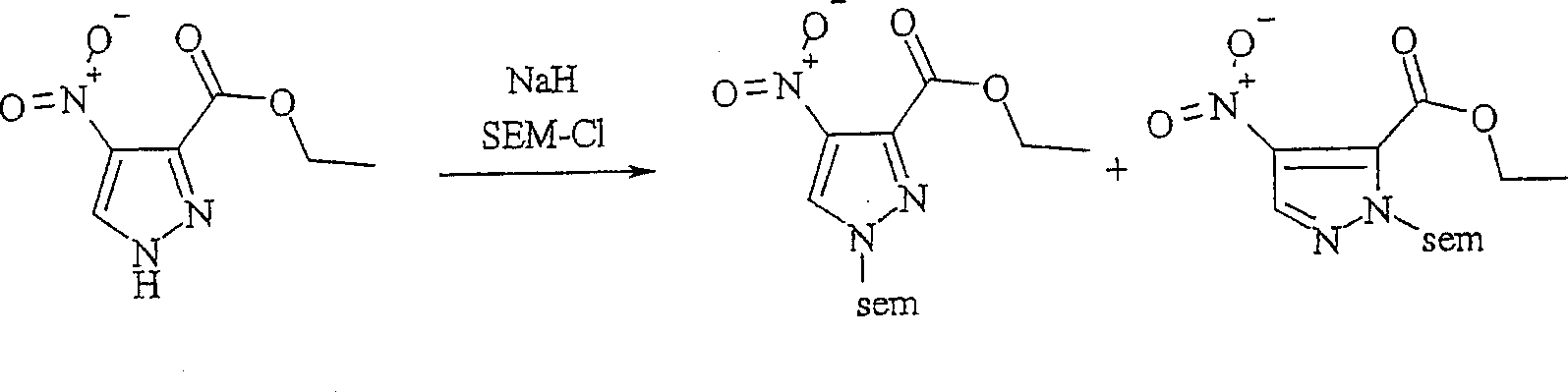
向4-硝基-1H-吡唑-3-羧酸乙酯(6.4g,34.58mmol)在二甲基甲酰胺(80mL)中的0℃溶液加入氢化钠(2.07g,1.5eq),将获得的混合物从0℃到RT搅拌1小时。向该混合物中加入2-(三甲基甲硅烷基)乙氧基-甲基氯(Aldrich)(9.17mL,1.5eq),将获得的混合物在RT下搅拌2天。通过TLC监视反应。用乙酸乙酯(300mL)和水(100mL)稀释反应混合物。分离有机层,用水(6×100mL)和盐水(1×100mL)洗涤,通过硫酸镁干燥,过滤并浓缩以获得10g粗制产物。使用己烷中的5%乙酸乙酯,通过柱色谱法纯化,获得4-硝基-2-(2-三甲基甲硅烷基-乙氧基甲基)-2H-吡唑-3-羧酸乙酯(3.82g),为无色油,和4-硝基-1-(2-三甲基甲硅烷基-乙氧基甲基)-1H-吡唑-3-羧酸乙酯(4.055g),为淡棕褐色油。(M-H)+=314。To a 0° C. solution of ethyl 4-nitro-1H-pyrazole-3-carboxylate (6.4 g, 34.58 mmol) in dimethylformamide (80 mL) was added sodium hydride (2.07 g, 1.5 eq), and The obtained mixture was stirred from 0 °C to RT for 1 h. To this mixture was added 2-(trimethylsilyl)ethoxy-methyl chloride (Aldrich) (9.17 mL, 1.5 eq) and the resulting mixture was stirred at RT for 2 days. The reaction was monitored by TLC. The reaction mixture was diluted with ethyl acetate (300 mL) and water (100 mL). The organic layer was separated, washed with water (6 x 100 mL) and brine (1 x 100 mL), dried over magnesium sulfate, filtered and concentrated to obtain 10 g of crude product. Purification by column chromatography using 5% ethyl acetate in hexanes afforded 4-nitro-2-(2-trimethylsilyl-ethoxymethyl)-2H-pyrazole-3-carboxy ethyl ester (3.82 g) as a colorless oil, and ethyl 4-nitro-1-(2-trimethylsilyl-ethoxymethyl)-1H-pyrazole-3-carboxylate ( 4.055 g), as a pale tan oil. (MH) + =314.
步骤3.制备[4-硝基-2-(2-三甲基甲硅烷基-乙氧基甲基)-2H-吡唑-3-基]-甲醇.Step 3. Preparation of [4-nitro-2-(2-trimethylsilyl-ethoxymethyl)-2H-pyrazol-3-yl]-methanol.

向4-硝基-2-(2-三甲基甲硅烷基-乙氧基甲基)-2H-吡唑-3-羧酸乙酯(10g,31.7mmol)在THF(200mL)中的0℃溶液加入甲醇(24mL),接着一次性加入硼氢化钠(9.59g,8eq)。将获得的混合物在0℃搅拌20分钟。然后将反应混合物加入饱和氯化铵水溶液(600mL)和乙酸乙酯(800mL)在冰浴中的混合物。在搅拌下在0℃加入4N HCl溶液,将水层的pH调整到约4。分离有机层和用盐水(1×500mL)洗涤,通过硫酸镁干燥,过滤并浓缩获得标题化合物(7.76g),为微红色油。M+=273。To the 0 °C solution was added methanol (24 mL) followed by sodium borohydride (9.59 g, 8 eq) in one portion. The obtained mixture was stirred at 0°C for 20 minutes. The reaction mixture was then added to a mixture of saturated aqueous ammonium chloride (600 mL) and ethyl acetate (800 mL) in an ice bath. The pH of the aqueous layer was adjusted to about 4 by adding 4N HCl solution at 0°C with stirring. The organic layer was separated and washed with brine (1 x 500 mL), dried over magnesium sulfate, filtered and concentrated to afford the title compound (7.76 g) as a reddish oil. M + =273.
步骤4.制备4-硝基-2-(2-三甲基甲硅烷基-乙氧基甲基)-2H-吡唑3-甲醛.Step 4. Preparation of 4-nitro-2-(2-trimethylsilyl-ethoxymethyl)-2H-pyrazole 3-carbaldehyde.
向[4-硝基-2-(2-三甲基甲硅烷基-乙氧基甲基)-2H-吡唑-3-基]甲醇(7.776g,28.38mmol)在氯仿(500mL)中的溶液加入二氧化锰(29.18g,9eq)。将获得的混合物在回流下加热4小时,冷却到RT并搅拌过夜。将反应混合物再次加热至回流3小时,使用另外的氯仿,过滤通过3cm硅藻土塞。浓缩滤液,获得4.55g粗制物质,通过硅胶色谱法纯化,用己烷中的2-4%乙酸乙酯梯度,获得标题化合物,为无色油(1.55g).M+=271To [4-nitro-2-(2-trimethylsilyl-ethoxymethyl)-2H-pyrazol-3-yl]methanol (7.776g, 28.38mmol) in chloroform (500mL) To the solution was added manganese dioxide (29.18g, 9eq). The obtained mixture was heated at reflux for 4 hours, cooled to RT and stirred overnight. The reaction mixture was reheated to reflux for 3 hours with additional chloroform and filtered through a 3 cm plug of celite. Concentration of the filtrate afforded 4.55 g of crude material, which was purified by silica gel chromatography using a gradient of 2-4% ethyl acetate in hexanes to afford the title compound as a colorless oil (1.55 g). M + = 271
步骤5:制备2-(2,4-二氟苯氧基)-3-羟基-3-[4-硝基-2-(2-三甲基甲硅烷基-乙氧基甲基)-2H-吡唑-3-基]丙酸甲酯.Step 5: Preparation of 2-(2,4-difluorophenoxy)-3-hydroxy-3-[4-nitro-2-(2-trimethylsilyl-ethoxymethyl)-2H -Pyrazol-3-yl]propionic acid methyl ester.

向二异丙基胺(0.3mL,2.1eq)在二乙基醚(3mL)中的-78℃溶液加入正丁基锂在己烷(Aldrich)(0.84mL,2.1eq)中的2.5M溶液。将获得的混合物搅拌15分钟。通过注射器向该混合物中加入(2,4-二氟苯氧基)乙酸甲酯(425mg,2.1eq)在二乙基醚(2mL)中的溶液,将获得的混合物在-78℃下搅拌30分钟,之后加入4-硝基-2-(2-三甲基甲硅烷基-乙氧基甲基)-2H-吡唑-3-甲醛(271mg,1mmol)在二乙基醚(2mL)中的溶液。将获得的混合物搅拌2小时。用饱和氯化铵水溶液稀释-78℃反应混合物,然后用乙酸乙酯(150mL)和水(25mL)稀释。分离有机层,用盐水(1×50mL)洗涤,通过硫酸镁干燥,过滤并浓缩,获得油状粗制产物(709mg)。通过制备薄层色谱法纯化粗制产物,使用己烷中的25%乙酸乙酯洗脱,获得标题化合物,为非对映体混合物(257mg,稠的无色油)。M+=473。To a -78°C solution of diisopropylamine (0.3 mL, 2.1 eq) in diethyl ether (3 mL) was added a 2.5 M solution of n-butyllithium in hexane (Aldrich) (0.84 mL, 2.1 eq) . The obtained mixture was stirred for 15 minutes. To this mixture was added a solution of methyl (2,4-difluorophenoxy)acetate (425 mg, 2.1 eq) in diethyl ether (2 mL) via syringe, and the resulting mixture was stirred at -78 °C for 30 minutes, after which 4-nitro-2-(2-trimethylsilyl-ethoxymethyl)-2H-pyrazole-3-carbaldehyde (271 mg, 1 mmol) in diethyl ether (2 mL) was added The solution. The obtained mixture was stirred for 2 hours. The -78°C reaction mixture was diluted with saturated aqueous ammonium chloride, then diluted with ethyl acetate (150 mL) and water (25 mL). The organic layer was separated, washed with brine (1 x 50 mL), dried over magnesium sulfate, filtered and concentrated to give the crude product as an oil (709 mg). The crude product was purified by preparative thin layer chromatography eluting with 25% ethyl acetate in hexanes to afford the title compound as a mixture of diastereomers (257 mg, thick colorless oil). M + =473.
步骤6:制备6-(2,4-二氟苯氧基)-1-(2-三甲基甲硅烷基-乙氧基甲基)-1,4-二氢-吡唑并[4,3-b]吡啶-5-酮.Step 6: Preparation of 6-(2,4-difluorophenoxy)-1-(2-trimethylsilyl-ethoxymethyl)-1,4-dihydro-pyrazolo[4, 3-b]pyridin-5-one.

向2-(2,4-二氟苯氧基)-3-羟基-3-[4-硝基-2-(2-三甲基甲硅烷基-乙氧基甲基)-2H-吡唑-3-基]丙酸甲酯(125mg,0.264mmol)在乙醇(2mL)和水(1mL)中的溶液加入氯化铵(74mg,5.2eq),接着加入铁粉(Fisher Brand,Electrolytic)。将获得的混合物在RT下搅拌45分钟,回流过夜,冷却至RT,用乙醇稀释,用另外的乙醇过滤通过3cm硅藻土床。浓缩滤液,用乙酸乙酯(80mL)和水(40mL)稀释残余物。分离有机层,用水(2×40mL)和盐水(1×40mL)洗涤,通过硫酸镁干燥,过滤并浓缩获得标题化合物,为稠的棕褐色油(98mg,(M+H)+=394)。To 2-(2,4-difluorophenoxy)-3-hydroxyl-3-[4-nitro-2-(2-trimethylsilyl-ethoxymethyl)-2H-pyrazole A solution of methyl-3-yl]propionate (125 mg, 0.264 mmol) in ethanol (2 mL) and water (1 mL) was added ammonium chloride (74 mg, 5.2 eq) followed by iron powder (Fisher Brand, Electrolytic). The resulting mixture was stirred at RT for 45 min, refluxed overnight, cooled to RT, diluted with ethanol and filtered through a 3 cm bed of celite with additional ethanol. The filtrate was concentrated, and the residue was diluted with ethyl acetate (80 mL) and water (40 mL). The organic layer was separated, washed with water (2 x 40 mL) and brine (1 x 40 mL), dried over magnesium sulfate, filtered and concentrated to afford the title compound as a thick tan oil (98 mg, (M+H) + = 394).
步骤7:制备6-(2,4-二氟苯氧基)-4-甲基-1-(2-三甲基甲硅烷基-乙氧基甲基)-1,4-二氢-吡唑并[4,3-b]吡啶-5-酮.Step 7: Preparation of 6-(2,4-difluorophenoxy)-4-methyl-1-(2-trimethylsilyl-ethoxymethyl)-1,4-dihydro-pyridine Azolo[4,3-b]pyridin-5-one.

向6-(2,4-二氟苯氧基)-1-(2-三甲基甲硅烷基-乙氧基甲基)-1,4-二氢-吡唑并[4,3-b]吡啶-5-酮(98mg,0.249mmol)在二甲基甲酰胺(1mL)中的0℃溶液加入氢化钠(在油中的60%分散体,Aldrich)(15mg,1.5eq),将获得的混合物搅拌30分钟,之后加入甲基碘(25μL,1.5eq),将混合物搅拌另外1小时,从0℃升温至RT。用乙酸乙酯(35mL)和水(25mL)稀释反应混合物,用水(2×25mL)和盐水(1×25mL)洗涤,通过硫酸镁干燥,过滤并浓缩,获得标题化合物,为棕褐色粉末(118mg,(M+H)+=408)。To 6-(2,4-difluorophenoxy)-1-(2-trimethylsilyl-ethoxymethyl)-1,4-dihydro-pyrazolo[4,3-b A solution of ]pyridin-5-one (98 mg, 0.249 mmol) in dimethylformamide (1 mL) at 0 °C was added to sodium hydride (60% dispersion in oil, Aldrich) (15 mg, 1.5 eq) to give The mixture was stirred for 30 min, after which methyl iodide (25 μL, 1.5 eq) was added and the mixture was stirred for another 1 h, warming from 0 °C to RT. The reaction mixture was diluted with ethyl acetate (35 mL) and water (25 mL), washed with water (2 x 25 mL) and brine (1 x 25 mL), dried over magnesium sulfate, filtered and concentrated to afford the title compound as a tan powder (118 mg , (M+H) + = 408).
步骤8:制备6-(2,4-二氟苯氧基)-3-碘-4-甲基-1,4-二氢-吡唑并[4,3-b]吡啶-5-酮.Step 8: Preparation of 6-(2,4-difluorophenoxy)-3-iodo-4-methyl-1,4-dihydro-pyrazolo[4,3-b]pyridin-5-one.

向6-(2,4-二氟苯氧基)-4-甲基-1-(2-三甲基甲硅烷基-乙氧基甲基)-1,4-二氢-吡唑并[4,3-b]吡啶-5-酮(118mg,0.289mmol)在氯仿(25mL)中的溶液加入一氯化碘(141mg,3eq),接着加入碳酸钾(200mg,5eq),将获得的混合物在回流下在搅拌下加热(黑暗中)24小时。加入另外的一氯化碘(大大过量),将获得的溶液在回流下搅拌另外16小时。将反应混合物冷却至RT,用DCM稀释,用Na2S2O3(aq)水溶液接着盐水洗涤2x。通过硫酸镁干燥有机层,过滤并浓缩,获得油状粗制产物(97mg)。通过制备TLC纯化,用己烷中的60%乙酸乙酯洗脱,获得标题化合物,为灰白色粉末(12mg,(M+H)+=462)。To 6-(2,4-difluorophenoxy)-4-methyl-1-(2-trimethylsilyl-ethoxymethyl)-1,4-dihydro-pyrazolo[ 4,3-b]pyridin-5-one (118mg, 0.289mmol) in chloroform (25mL) was added iodine monochloride (141mg, 3eq), followed by potassium carbonate (200mg, 5eq), and the obtained mixture Heat with stirring (in the dark) at reflux for 24 hours. Further iodine monochloride (large excess) was added and the resulting solution was stirred at reflux for a further 16 hours. The reaction mixture was cooled to RT, diluted with DCM, washed 2x with aq . Na2S2O3 (aq) followed by brine. The organic layer was dried over magnesium sulfate, filtered and concentrated to give the crude product as an oil (97 mg). Purification by preparative TLC, eluting with 60% ethyl acetate in hexanes, afforded the title compound as an off-white powder (12 mg, (M+H) + = 462).
步骤9:制备6-(2,4-二氟苯氧基)-3-碘-4-甲基-5-氧代-4,5-二氢-吡唑并[4,3-b]吡啶-1-羧酸叔-丁酯.Step 9: Preparation of 6-(2,4-difluorophenoxy)-3-iodo-4-methyl-5-oxo-4,5-dihydro-pyrazolo[4,3-b]pyridine - tert-Butyl 1-carboxylate.

向6-(2,4-二氟苯氧基)-3-碘-4-甲基-1,4-二氢-吡唑并[4,3-b]吡啶-5-酮(12mg,0.0298mmol)在THF(5mL)中的溶液加入BOC2O(16mg,2.5eq)和DMAP(催化量)。将获得的混合物回流加热30分钟,冷却至RT,用乙酸乙酯(35mL)和水(25mL)洗脱。分离有机层,连续用水(2×25mL),0.5NHCl(2×20mL)和盐水(1×25mL)洗涤,通过硫酸镁干燥,过滤并浓缩,获得标题化合物,为白色粉末(18mg,(M+H)+=504)。To 6-(2,4-difluorophenoxy)-3-iodo-4-methyl-1,4-dihydro-pyrazolo[4,3-b]pyridin-5-one (12mg, 0.0298 mmol) in THF (5 mL) was added with BOC2O (16 mg, 2.5 eq) and DMAP (catalytic amount). The resulting mixture was heated at reflux for 30 min, cooled to RT and eluted with ethyl acetate (35 mL) and water (25 mL). The organic layer was separated, washed successively with water (2 x 25 mL), 0.5N HCl (2 x 20 mL) and brine (1 x 25 mL), dried over magnesium sulfate, filtered and concentrated to afford the title compound as a white powder (18 mg, (M+ H) + = 504).
步骤10:制备3-(2-氯苯基)-6-(2,4-二氟苯氧基)-4-甲基-5-氧代-4,5-二氢-吡唑并[4,3-b]吡啶-1-羧酸叔-丁酯.Step 10: Preparation of 3-(2-chlorophenyl)-6-(2,4-difluorophenoxy)-4-methyl-5-oxo-4,5-dihydro-pyrazolo[4 , 3-b]pyridine-1-carboxylic acid tert-butyl ester.
向6-(2,4-二氟苯氧基)-3-碘-4-甲基-5-氧代-4,5-二氢-吡唑并[4,3-b]吡啶-1-羧酸叔-丁酯(18mg)在苯(1.3mL)和甲醇(0.26mL)中的溶液加入1M碳酸钠水溶液(76μL,2eq),2-氯苯基硼酸(12mg,2eq),和Pd(PPh3)4(13mg,0.3eq)。用氩气清洗混合物,回流加热2小时,冷却至RT,用乙酸乙酯(35mL)和水(25mL)稀释。分离有机层,用盐水(1×25mL)洗涤,通过硫酸镁干燥,过滤并浓缩,获得粗制产物((M+H)+=488),在不纯化下将其用于下列步骤。To 6-(2,4-difluorophenoxy)-3-iodo-4-methyl-5-oxo-4,5-dihydro-pyrazolo[4,3-b]pyridine-1- A solution of tert-butyl carboxylate (18 mg) in benzene (1.3 mL) and methanol (0.26 mL) was added with 1M aqueous sodium carbonate (76 μL, 2 eq), 2-chlorophenylboronic acid (12 mg, 2 eq), and Pd( PPh 3 ) 4 (13 mg, 0.3 eq). The mixture was purged with argon, heated at reflux for 2 hours, cooled to RT, and diluted with ethyl acetate (35 mL) and water (25 mL). The organic layer was separated, washed with brine (1 x 25 mL), dried over magnesium sulfate, filtered and concentrated to obtain the crude product ((M+H) + = 488), which was used in the following step without purification.
步骤11:制备3-(2-氯苯基)-6-(2,4-二氟苯氧基)-4-甲基-1,4-二氢-吡唑并[4,3-b]吡啶-5-酮.Step 11: Preparation of 3-(2-chlorophenyl)-6-(2,4-difluorophenoxy)-4-methyl-1,4-dihydro-pyrazolo[4,3-b] Pyridin-5-one.
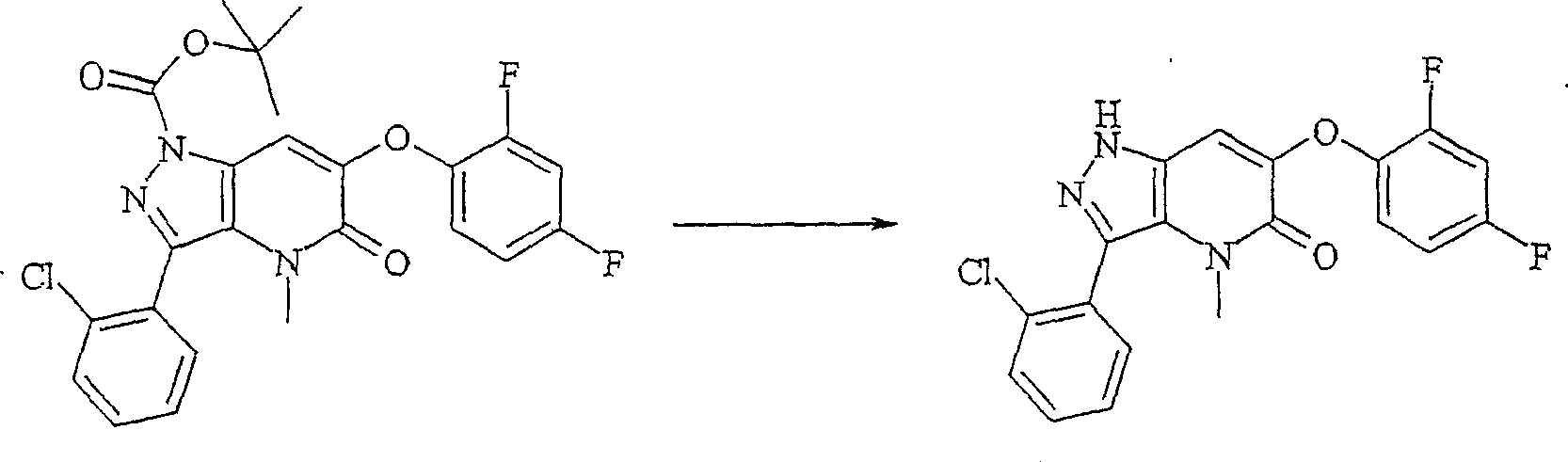
将粗制3-(2-氯苯基)-6-(2,4-二氟苯氧基)-4-甲基-5-氧代-4,5-二氢-吡唑并[4,3-b]吡啶-1-羧酸叔-丁酯(0.0298mmol)在0.5M甲醇钠在甲醇(Aldrich)(7mL)中的溶液中的混合物在RT下搅拌1小时。55℃减压去除溶剂,将获得的残余物用乙酸乙酯(35mL)和水(25mL)稀释。分离有机层,用盐水(1×25mL)洗涤,通过硫酸镁干燥,过滤,浓缩,通过制备薄层色谱法纯化,用己烷中的60%乙酸乙酯洗脱,获得标题化合物(5.2mg,(M+H)+=388),为白色粉末。The crude 3-(2-chlorophenyl)-6-(2,4-difluorophenoxy)-4-methyl-5-oxo-4,5-dihydro-pyrazolo[4, 3-b] A mixture of tert-butyl pyridine-1-carboxylate (0.0298 mmol) in a 0.5 M solution of sodium methoxide in methanol (Aldrich) (7 mL) was stirred at RT for 1 h. The solvent was removed under reduced pressure at 55°C, and the obtained residue was diluted with ethyl acetate (35 mL) and water (25 mL). The organic layer was separated, washed with brine (1 x 25 mL), dried over magnesium sulfate, filtered, concentrated, and purified by preparative thin layer chromatography eluting with 60% ethyl acetate in hexanes to afford the title compound (5.2 mg, (M+H) + =388), white powder.
实施例3:合成吡啶-2-羧酸[3-(2-氯-苯基)-6-(2,4-二氟-苯氧基)-1H-吡唑并[3,4-d]嘧啶-4-基]-酰胺Example 3: Synthesis of pyridine-2-carboxylic acid [3-(2-chloro-phenyl)-6-(2,4-difluoro-phenoxy)-1H-pyrazolo[3,4-d] Pyrimidin-4-yl]-amide
步骤1:制备3-(2-氯-苯基)-6-甲硫基-1H-吡唑并[3,4-d]嘧啶-4基胺.Step 1: Preparation of 3-(2-chloro-phenyl)-6-methylthio-1H-pyrazolo[3,4-d]pyrimidin-4 ylamine.

将200mg 4-氯-3-(2-氯-苯基)-6-甲基-1H-吡唑并[3,4-d]嘧啶(来自实施例1的步骤4)溶解在5ml甲醇中的7N氨,将溶液在80℃下在密封管中搅拌过夜。将获得的反应混合物真空浓缩,然后在60ml乙酸乙酯中萃取。将溶液首先用水、然后用盐水洗涤,干燥,在真空去除溶剂后,获得190mg(90%))3-(2-氯-苯基)-6-甲硫基-1H-吡唑并[3,4-d]嘧啶-4基胺,为淡棕褐色固体,MS:292(M+H)。将该粗制3-(2-氯-苯基)-6-甲硫基-1H-吡唑并[3,4-d]嘧啶-4基胺在不进一步纯化下用于下一步骤。200 mg of 4-chloro-3-(2-chloro-phenyl)-6-methyl-1H-pyrazolo[3,4-d]pyrimidine (from step 4 of Example 1) was dissolved in 5 ml of methanol 7N ammonia and the solution was stirred overnight at 80°C in a sealed tube. The reaction mixture obtained was concentrated in vacuo, then extracted in 60 ml ethyl acetate. The solution was washed first with water, then with brine, dried to afford 190 mg (90%) of 3-(2-chloro-phenyl)-6-methylthio-1H-pyrazolo[3, after removal of the solvent in vacuo, 4-d] Pyrimidin-4-ylamine as a pale tan solid, MS: 292 (M+H). The crude 3-(2-chloro-phenyl)-6-methylthio-1H-pyrazolo[3,4-d]pyrimidin-4 ylamine was used in the next step without further purification.
步骤2:制备吡啶-2-羧酸[3-(2-氯-苯基)-6-甲硫基-1H-吡唑并[3,4-d]嘧啶-4-基]-酰胺Step 2: Preparation of pyridine-2-carboxylic acid [3-(2-chloro-phenyl)-6-methylthio-1H-pyrazolo[3,4-d]pyrimidin-4-yl]-amide
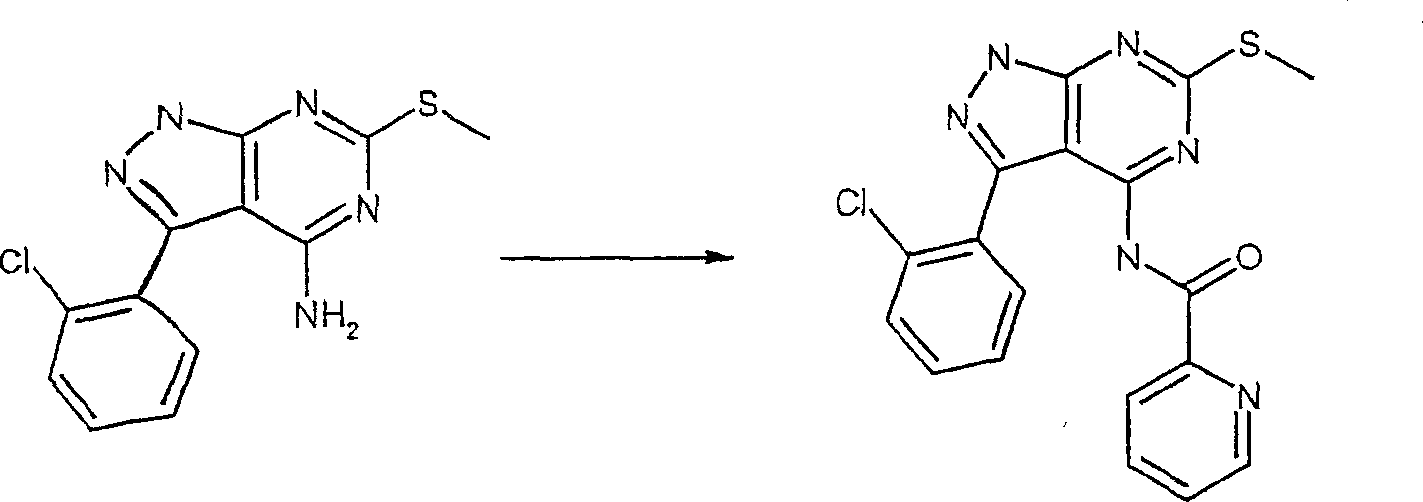
将吡啶-2-羧酸(78mg,0.64mmol)放置在5ml亚硫酰(二)氯中并回流3小时。然后真空去除过量的亚硫酰(二)氯,将粗制酰基氯悬浮在2ml无水THF中。将酰基氯溶液加入3-(2-氯-苯基)-6-甲硫基-1H-吡唑并[3,4-d]嘧啶-4-基胺(190mg,0.64mmol)和二异丙基胺(247mg,1.92mmol)在6ml无水THF中的混合物。将反应混合物回流15小时。在冷却至RT后,将获得的混合物在60ml乙酸乙酯和15ml盐水之间分配。用3N HCl洗涤有机层3次,接着用饱和碳酸氢钠溶液和盐水洗涤。在用硫酸钠干燥和真空溶剂蒸发后,获得140mg吡啶-2-羧酸[3-(2-氯-苯基)-6-甲硫基-1H-吡唑并[3,4-d]嘧啶-4-基]-酰胺,MS:397.1(M+H)。Pyridine-2-carboxylic acid (78mg, 0.64mmol) was placed in 5ml of thionyl(di)chloride and refluxed for 3 hours. Excess thionyl(di)chloride was then removed in vacuo and the crude acid chloride was suspended in 2 ml dry THF. The acid chloride solution was added to 3-(2-chloro-phenyl)-6-methylthio-1H-pyrazolo[3,4-d]pyrimidin-4-ylamine (190mg, 0.64mmol) and diisopropyl A mixture of phenylamine (247mg, 1.92mmol) in 6ml anhydrous THF. The reaction mixture was refluxed for 15 hours. After cooling to RT, the obtained mixture was partitioned between 60 ml ethyl acetate and 15 ml brine. The organic layer was washed 3 times with 3N HCl, followed by saturated sodium bicarbonate solution and brine. After drying over sodium sulfate and solvent evaporation in vacuo, 140 mg of pyridine-2-carboxylic acid [3-(2-chloro-phenyl)-6-methylthio-1H-pyrazolo[3,4-d]pyrimidine was obtained -4-yl]-amide, MS: 397.1 (M+H).
步骤3:制备吡啶-2-羧酸[3-(2-氯-苯基)-6-甲磺酰基-1H-吡唑并[3,4-d]嘧啶-4-基-酰胺Step 3: Preparation of pyridine-2-carboxylic acid [3-(2-chloro-phenyl)-6-methanesulfonyl-1H-pyrazolo[3,4-d]pyrimidin-4-yl-amide

将吡啶-2-羧酸[3-(2-氯-苯基)-6-甲硫基-1H-吡唑并{3,4嘧啶-4-基}-酰胺(140mg,0.35mmol)溶解在9ml THF和3ml甲醇中。向该溶液中加入间氯过苯甲酸[190mg(77%),0.84mmol]。将混合物在温度下搅拌4小时。将反应混合物置于60ml乙酸乙酯中,用饱和碳酸氢钠溶液洗涤3次和用盐水洗涤1次。在用硫酸钠干燥有机层和真空去除溶剂后,获得105mg粗制吡啶-2-羧酸[3-(2-氯-苯基)-6-甲磺酰基-1H-吡唑并[3,4-d]嘧啶-4-基-酰胺,MS:429.1(M+H),并且在不进一步纯化下用于下一步骤。Pyridine-2-carboxylic acid [3-(2-chloro-phenyl)-6-methylthio-1H-pyrazolo{3,4-pyrimidin-4-yl}-amide (140 mg, 0.35 mmol) was dissolved in 9ml THF and 3ml methanol. To this solution was added m-chloroperbenzoic acid [190 mg (77%), 0.84 mmol]. The mixture was stirred at temperature for 4 hours. The reaction mixture was taken up in 60 ml of ethyl acetate, washed 3 times with saturated sodium bicarbonate solution and 1 time with brine. After drying the organic layer over sodium sulfate and removing the solvent in vacuo, 105 mg of crude pyridine-2-carboxylic acid [3-(2-chloro-phenyl)-6-methanesulfonyl-1H-pyrazolo[3,4 -d] Pyrimidin-4-yl-amide, MS: 429.1 (M+H), and used in the next step without further purification.
步骤4:制备吡啶-2-羧酸[3-(2-氯-苯基)-6-(2,4-二氟-苯氧基)-1H-吡唑并[3,4-d]嘧啶-4-基]-酰胺Step 4: Preparation of pyridine-2-carboxylic acid [3-(2-chloro-phenyl)-6-(2,4-difluoro-phenoxy)-1H-pyrazolo[3,4-d]pyrimidine -4-yl]-amide

向在无水NMP(2ml)中的吡啶-2-羧酸[3-2(2-氯-苯基)-6-甲磺酰基-1H-吡唑并[3,4-d]嘧啶-4-基]-酰胺(105mg,0.24mmol)加入在0.5ml NMP中的无水碳酸钾(25mg,0.18mmol)和2,4-二氟-苯酚(47mg,0.36mmol)。将混合物在120℃加热2小时。在冷却后,将反应混合物在50ml乙酸乙酯和20ml盐水之间分配。用盐水洗涤有机层超过2次,用硫酸钠干燥,真空浓缩。将粗制混合物色谱分离两次,首先使用二氯甲烷中的5%甲醇,然后用己烷中的50%乙酸乙酯,以获得18mg标题化合物,为白色固体,MS:479(M+H)。To pyridine-2-carboxylic acid [3-2(2-chloro-phenyl)-6-methanesulfonyl-1H-pyrazolo[3,4-d]pyrimidine-4 in dry NMP (2ml) -Yl]-amide (105mg, 0.24mmol) was added to anhydrous potassium carbonate (25mg, 0.18mmol) and 2,4-difluoro-phenol (47mg, 0.36mmol) in 0.5ml NMP. The mixture was heated at 120°C for 2 hours. After cooling, the reaction mixture was partitioned between 50 ml ethyl acetate and 20 ml brine. The organic layer was washed more than 2 times with brine, dried over sodium sulfate, and concentrated in vacuo. The crude mixture was chromatographed twice, first with 5% methanol in dichloromethane, then with 50% ethyl acetate in hexanes, to afford 18 mg of the title compound as a white solid, MS: 479 (M+H) .
按照上述实施例制备的另外的化合物在表1中显示。Additional compounds prepared according to the above examples are shown in Table 1.
实施例4:合成(R)-1-[6-(2,4-二氟-苯氧基)-3-(2-乙氧基-5-氟-苯基)-1H-吡唑并[3,4-d]嘧啶-4-基氨基]-丙-2-醇Example 4: Synthesis of (R)-1-[6-(2,4-difluoro-phenoxy)-3-(2-ethoxy-5-fluoro-phenyl)-1H-pyrazolo[ 3,4-d]pyrimidin-4-ylamino]-propan-2-ol
步骤1.制备4,6-二氯-2-甲硫基-嘧啶-5-甲醛Step 1. Preparation of 4,6-dichloro-2-methylthio-pyrimidine-5-carbaldehyde

将氯氧化磷(213mL,2.3mol)在氮气下在氯化钠-水冰浴中冷却至1.8℃。在搅拌下在45分钟内滴加二甲基甲酰胺(71.4mL,0.92mol)。使得反应混合物升温至RT并在RT下搅拌30分钟,接着在40℃下搅拌20分钟。然后将反应混合物加热至57℃,在90分钟内以5.0g份加入2-甲硫基-嘧啶-4,6-二醇(50.0g,0.307mol)。将反应混合物在55℃下搅拌1小时,然后在搅拌下加热至110℃ 17.5小时。冷却反应混合物,减压去除挥发物。将残余物倒入1升冰水。通过过滤分离获得的沉淀,用水洗涤,然后用庚烷洗涤,干燥,提供25.2g粗制4,6-二氯-2-甲硫基-嘧啶-5-甲醛。质谱M+H=224。Phosphorus oxychloride (213 mL, 2.3 mol) was cooled to 1.8 °C in a sodium chloride-water ice bath under nitrogen. Dimethylformamide (71.4 mL, 0.92 mol) was added dropwise with stirring over 45 minutes. The reaction mixture was allowed to warm to RT and stirred at RT for 30 min, then at 40 °C for 20 min. The reaction mixture was then heated to 57°C and 2-methylthio-pyrimidine-4,6-diol (50.0 g, 0.307 mol) was added in 5.0 g portions over 90 minutes. The reaction mixture was stirred at 55°C for 1 hour, then heated to 110°C with stirring for 17.5 hours. The reaction mixture was cooled and volatiles were removed under reduced pressure. The residue was poured into 1 L of ice water. The precipitate obtained was isolated by filtration, washed with water, then heptane, and dried to afford 25.2 g of crude 4,6-dichloro-2-methylthio-pyrimidine-5-carbaldehyde. Mass spectrum M+H=224.
步骤2.制备4-氯-6-甲硫基-1H-吡唑并[3,4-d]嘧啶Step 2. Preparation of 4-chloro-6-methylthio-1H-pyrazolo[3,4-d]pyrimidine
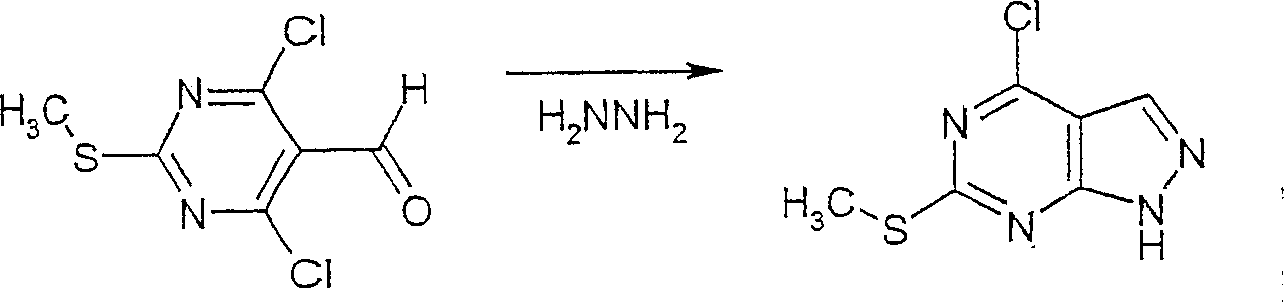
将4,6-二氯-2-甲硫基-嘧啶-5-甲醛(7.54g,0.0338mol)加入80mL二噁烷并在RT下搅拌10分钟。加入二异丙基乙基胺(6.03mL,0.0340mol),在搅拌下在冰浴中冷却混合物10分钟。在3分钟内滴加无水肼(1.08mL,0.0338mmol),搅拌持续另外5分钟。去除冰浴,在搅拌下将反应混合物加热至回流2小时。然后将反应混合物在RT下搅拌16小时。减压浓缩反应混合物,将残余物加入20mL 2N HCl和100mL EtOAc。搅拌获得的混悬液,过滤,用水接着用EtOAc洗涤固体。收集滤液的有机相,用150mLEtOAc萃取水相三次。干燥合并的有机相(MgSO4),过滤,减压蒸发滤液。用二乙基醚/己烷(1∶1)洗涤获得的固体,将固体干燥以提供3.13g粗制4-氯-6-甲硫基-1H-吡唑并[3,4-d]嘧啶。质谱M+H=201。4,6-Dichloro-2-methylthio-pyrimidine-5-carbaldehyde (7.54 g, 0.0338 mol) was added to 80 mL of dioxane and stirred at RT for 10 minutes. Diisopropylethylamine (6.03 mL, 0.0340 mol) was added and the mixture was cooled in an ice bath for 10 minutes with stirring. Anhydrous hydrazine (1.08 mL, 0.0338 mmol) was added dropwise over 3 minutes and stirring was continued for another 5 minutes. The ice bath was removed and the reaction mixture was heated to reflux with stirring for 2 hours. The reaction mixture was then stirred at RT for 16 hours. The reaction mixture was concentrated under reduced pressure, and the residue was added to 20 mL 2N HCl and 100 mL EtOAc. The resulting suspension was stirred, filtered and the solid was washed with water followed by EtOAc. The organic phase of the filtrate was collected and the aqueous phase was extracted three times with 150 mL of EtOAc. The combined organic phases were dried ( MgSO4 ), filtered and the filtrate evaporated under reduced pressure. The solid obtained was washed with diethyl ether/hexane (1:1), and the solid was dried to afford 3.13 g of crude 4-chloro-6-methylthio-1H-pyrazolo[3,4-d]pyrimidine . Mass spectrum M+H=201.
步骤3.制备4-氯-6-甲硫基-1-(2-三甲基甲硅烷基-乙氧基甲基)-1H-吡唑并[3,4-d]嘧啶Step 3. Preparation of 4-chloro-6-methylthio-1-(2-trimethylsilyl-ethoxymethyl)-1H-pyrazolo[3,4-d]pyrimidine
将4-氯-6-甲硫基-1H-吡唑并[3,4-d]嘧啶(497mg,2.477mmol)溶解在5mL无水DMF中,将反应混合物冷却至0℃。加入氢化钠(109mg 60%混悬液,在矿物油中),搅拌反应混合物5分钟。然后加入(2-氯甲氧基-乙基)-三甲基-硅烷(0.52mL,2.922mmol),搅拌反应混合物10分钟。通过加到水中淬灭反应混合物,在水和乙酸乙酯之间分配。分离有机层,通过MgSO4干燥,过滤,减压蒸发。使用己烷中的5% EtOAc,通过快速色谱法纯化残余物,获得391mg 4-氯-6-甲硫基-1-(2-三甲基甲硅烷基-乙氧基甲基)-1H-吡唑并[3,4-d]嘧啶。4-Chloro-6-methylthio-1H-pyrazolo[3,4-d]pyrimidine (497 mg, 2.477 mmol) was dissolved in 5 mL of anhydrous DMF, and the reaction mixture was cooled to 0°C. Sodium hydride (109 mg of a 60% suspension in mineral oil) was added and the reaction mixture was stirred for 5 minutes. Then (2-chloromethoxy-ethyl)-trimethyl-silane (0.52 mL, 2.922 mmol) was added and the reaction mixture was stirred for 10 minutes. The reaction mixture was quenched by adding to water, partitioned between water and ethyl acetate. The organic layer was separated, dried over MgSO4 , filtered and evaporated under reduced pressure. The residue was purified by flash chromatography using 5% EtOAc in hexanes to afford 391 mg of 4-chloro-6-methylthio-1-(2-trimethylsilyl-ethoxymethyl)-1H- Pyrazolo[3,4-d]pyrimidine.
步骤4.制备(R)-1-[6-甲硫基-1-(2-三甲基甲硅烷基-乙氧基甲基)-1H-吡唑并[3,4-d]嘧啶-4-基氨基]-丙-2-醇Step 4. Preparation of (R)-1-[6-methylthio-1-(2-trimethylsilyl-ethoxymethyl)-1H-pyrazolo[3,4-d]pyrimidine- 4-ylamino]-propan-2-ol
将4-氯-6-甲硫基-1-(2-三甲基甲硅烷基-乙氧基甲基)-1H-吡唑并[3,4-d]嘧啶(391mg,1.182mmol)溶解在5mL无水THF中。加入三乙基胺(239mg,2.363mmol),搅拌反应混合物4小时。然后加入(S)-1-氨基-丙-2-醇(93mg,1.241mmol),搅拌反应混合物64小时。通过加入水中淬灭反应混合物,在水和乙酸乙酯之间分配。分离有机层,通过MgSO4干燥,过滤,减压蒸发,获得(R)-1-[6-甲硫基-1-(2-三甲基甲硅烷基-乙氧基甲基)-1H-吡唑并[3,4-d]嘧啶-4-基氨基]-丙-2-醇(469mg)。质谱M+H=370。4-Chloro-6-methylthio-1-(2-trimethylsilyl-ethoxymethyl)-1H-pyrazolo[3,4-d]pyrimidine (391 mg, 1.182 mmol) was dissolved in 5 mL dry THF. Triethylamine (239 mg, 2.363 mmol) was added and the reaction mixture was stirred for 4 hours. Then (S)-1-amino-propan-2-ol (93 mg, 1.241 mmol) was added and the reaction mixture was stirred for 64 hours. The reaction mixture was quenched by adding water, partitioned between water and ethyl acetate. The organic layer was separated, dried over MgSO , filtered, and evaporated under reduced pressure to obtain (R)-1-[6-methylthio-1-(2-trimethylsilyl-ethoxymethyl)-1H- Pyrazolo[3,4-d]pyrimidin-4-ylamino]-propan-2-ol (469 mg). Mass spectrum M+H=370.
步骤5.制备(R)-1-[6-甲磺酰基-1-(2-三甲基甲硅烷基-乙氧基甲基)-1H-吡唑并[3,4-d]嘧啶-4-基氨基]-丙-2-醇Step 5. Preparation of (R)-1-[6-methylsulfonyl-1-(2-trimethylsilyl-ethoxymethyl)-1H-pyrazolo[3,4-d]pyrimidine- 4-ylamino]-propan-2-ol
将1-[6-甲硫基-1-(2-三甲基甲硅烷基-乙氧基甲基)-1H-吡唑并[3,4-d]嘧啶-4-基氨基]-丙-2-醇(456mg,1.239mmol)溶解在6mL THF和2mLMeOH的混合物中。加入mCPBA(447mg 77% mCPBA,2.592mmol),搅拌反应混合物2小时。通过加入水中淬灭反应混合物,在水和乙酸乙酯之间分配。分离有机层,通过MgSO4干燥,过滤,和减压蒸发以获得529mg(R)-1-[6-甲磺酰基-1-(2-三甲基甲硅烷基-乙氧基甲基)-1H-吡唑并[3,4-d]嘧啶-4-基氨基]-丙-2-醇。质谱M+H=402。1-[6-methylthio-1-(2-trimethylsilyl-ethoxymethyl)-1H-pyrazolo[3,4-d]pyrimidin-4-ylamino]-propane -2-ol (456 mg, 1.239 mmol) was dissolved in a mixture of 6 mL THF and 2 mL MeOH. mCPBA (447 mg 77% mCPBA, 2.592 mmol) was added and the reaction mixture was stirred for 2 hours. The reaction mixture was quenched by adding water, partitioned between water and ethyl acetate. The organic layer was separated, dried over MgSO 4 , filtered, and evaporated under reduced pressure to obtain 529 mg of (R)-1-[6-methylsulfonyl-1-(2-trimethylsilyl-ethoxymethyl)- 1H-Pyrazolo[3,4-d]pyrimidin-4-ylamino]-propan-2-ol. Mass spectrum M+H=402.
在表1中显示按照上述实施例制备的另外的化合物。In Table 1 additional compounds prepared according to the above examples are shown.
步骤6.制备(R)-1-[6-(2,4-二氟-苯氧基)-1-(2-三甲基甲硅烷基-乙氧基甲基)-1H-吡唑并[3,4-d]嘧啶-4-基氨基]-丙-2-醇Step 6. Preparation of (R)-1-[6-(2,4-difluoro-phenoxy)-1-(2-trimethylsilyl-ethoxymethyl)-1H-pyrazolo [3,4-d]pyrimidin-4-ylamino]-propan-2-ol

将2,4-二氟苯酚(510mg,3.922mmol)溶解在5mL无水DMF中,加入氢化钠(152mg 60%悬浮液,在矿物油中,3.791mmol)。搅拌反应混合物25分钟,然后加入(R)-1-[6-甲磺酰基-1-(2-三甲基甲硅烷基-乙氧基甲基)-1H-吡唑并[3,4-d]嘧啶-4-基氨基]-丙-2-醇(525mg,1.307mmol)。在搅拌下加热反应混合物至100℃ 4小时,然后在RT下搅拌16小时。通过加入水中淬灭反应混合物,在水和乙酸乙酯之间分配。分离有机层,通过MgSO4干燥,过滤,和减压蒸发。通过快速色谱法(8% MeOH,在二氯甲烷中)纯化残余物,获得258mg(R)-1-[6-(2,4-二氟-苯氧基)-1-(2-三甲基甲硅烷基-乙氧基甲基)-1H-吡唑并[3,4-d]嘧啶-4-基氨基]-丙-2-醇。质谱M+H=452。2,4-Difluorophenol (510 mg, 3.922 mmol) was dissolved in 5 mL of anhydrous DMF and sodium hydride (152 mg of a 60% suspension in mineral oil, 3.791 mmol) was added. The reaction mixture was stirred for 25 minutes, then (R)-1-[6-methylsulfonyl-1-(2-trimethylsilyl-ethoxymethyl)-1H-pyrazolo[3,4- d] Pyrimidin-4-ylamino]-propan-2-ol (525 mg, 1.307 mmol). The reaction mixture was heated to 100 °C with stirring for 4 hours, then stirred at RT for 16 hours. The reaction mixture was quenched by adding water, partitioned between water and ethyl acetate. The organic layer was separated, dried over MgSO4 , filtered, and evaporated under reduced pressure. Purification of the residue by flash chromatography (8% MeOH in dichloromethane) afforded 258 mg of (R)-1-[6-(2,4-difluoro-phenoxy)-1-(2-trimethyl ylsilyl-ethoxymethyl)-1H-pyrazolo[3,4-d]pyrimidin-4-ylamino]-propan-2-ol. Mass spectrum M+H=452.
步骤7.制备(R)-1-[6-(2,4-二氟-苯氧基)-1H-吡唑并[3,4-d]嘧啶-4-基氨基]-丙-2-醇Step 7. Preparation of (R)-1-[6-(2,4-difluoro-phenoxy)-1H-pyrazolo[3,4-d]pyrimidin-4-ylamino]-propan-2- alcohol

将(R)-1-[6-(2,4-二氟-苯氧基)-1-(2-三甲基甲硅烷基-乙氧基甲基)-1H-吡唑并[3,4-d]嘧啶-4-基氨基]-丙-2-醇(258mg)溶解在8mL MeOH中,加入0.6mL 6M HCl。将反应混合物加热至80℃ 3.5小时,然后冷却。通过加入水中淬灭反应混合物,在水和乙酸乙酯之间分配。分离有机层,通过MgSO4干燥,过滤,和减压蒸发。通过快速色谱法(10% MeOH,在二氯甲烷中)纯化残余物,获得116mg(R)-1-[6-(2,4-二氟-苯氧基)-1H-吡唑并[3,4-d]嘧啶-4-基氨基]-丙-2-醇。质谱M+H=322。(R)-1-[6-(2,4-difluoro-phenoxy)-1-(2-trimethylsilyl-ethoxymethyl)-1H-pyrazolo[3, 4-d]pyrimidin-4-ylamino]-propan-2-ol (258 mg) was dissolved in 8 mL MeOH and 0.6 mL 6M HCl was added. The reaction mixture was heated to 80 °C for 3.5 hours and then cooled. The reaction mixture was quenched by adding water, partitioned between water and ethyl acetate. The organic layer was separated, dried over MgSO4 , filtered, and evaporated under reduced pressure. Purification of the residue by flash chromatography (10% MeOH in dichloromethane) afforded 116 mg of (R)-1-[6-(2,4-difluoro-phenoxy)-1H-pyrazolo[3 , 4-d]pyrimidin-4-ylamino]-propan-2-ol. Mass spectrum M+H=322.
步骤8.制备(R)-1-[6-(2,4-二氟-苯氧基)-3-碘-1H-吡唑并[3,4-d]嘧啶-4-基氨基]-丙-2-醇Step 8. Preparation of (R)-1-[6-(2,4-difluoro-phenoxy)-3-iodo-1H-pyrazolo[3,4-d]pyrimidin-4-ylamino]- propan-2-ol
将N-碘代琥珀酰亚胺(35mg,0.157mmol)溶解在3mL DMF中,加入(R)-1-[6-(2,4-二氟-苯氧基)-1H-吡唑并[3,4-d]嘧啶-4-基氨基]-丙-2-醇(42mg,0.131mmol)。将反应混合物加热至80℃ 2小时,之后加入另外35mgN-碘代琥珀酰亚胺。在80℃加热另外2小时后,加入另外35mg N-碘代琥珀酰亚胺。将反应混合物在80℃加热另外5小时,然后冷却至RT。通过加入水中淬灭反应混合物,在水和乙酸乙酯之间分配。分离有机层,通过MgSO4干燥,过滤,和减压蒸发以获得64mg 1-[6-(2,4-二氟-苯氧基)-3-碘-1H-吡唑并[3,4-d]嘧啶-4-基氨基]-丙-2-醇。质谱M+H=448。Dissolve N-iodosuccinimide (35 mg, 0.157 mmol) in 3 mL DMF, add (R)-1-[6-(2,4-difluoro-phenoxy)-1H-pyrazolo[ 3,4-d]pyrimidin-4-ylamino]-propan-2-ol (42 mg, 0.131 mmol). The reaction mixture was heated to 80°C for 2 hours, after which an additional 35 mg of N-iodosuccinimide was added. After heating at 80° C. for a further 2 hours, another 35 mg of N-iodosuccinimide was added. The reaction mixture was heated at 80 °C for an additional 5 h, then cooled to RT. The reaction mixture was quenched by adding water, partitioned between water and ethyl acetate. The organic layer was separated, dried over MgSO, filtered, and evaporated under reduced pressure to obtain 64 mg of 1-[6-(2,4-difluoro-phenoxy)-3-iodo-1H-pyrazolo[3,4- d] pyrimidin-4-ylamino]-propan-2-ol. Mass spectrum M+H=448.
步骤9.制备(R)-1-[6-(2,4-二氟-苯氧基)-3-(2-乙氧基-5-氟-苯基)-1H-吡唑并[3,4-d]嘧啶-4-基氨基]-丙-2-醇Step 9. Preparation of (R)-1-[6-(2,4-difluoro-phenoxy)-3-(2-ethoxy-5-fluoro-phenyl)-1H-pyrazolo[3 ,4-d]pyrimidin-4-ylamino]-propan-2-ol

将1-[6-(2,4-二氟-苯氧基)-3-碘-1H-吡唑并[3,4-d]嘧啶-4-基氨基]-丙-2-醇(200mg,0.447mmol),5-氟-2-乙氧基苯基硼酸(246mg),K3PO4(285mg),和四(三苯基膦)钯(0)CH2Cl2(73mg)加入微波小管中的2mL二噁烷。将该小管密封,加热反应混合物至180℃ 10分钟。反应混合物在水和乙酸乙酯之间分配,分离有机层,通过MgSO4干燥,过滤,和减压蒸发。使用二氯甲烷中的10% MeOH,将残余物通过硅胶过滤,然后使用二氯甲烷中的10% MeOH,通过制备级TLC纯化,以获得62.9mg(R)-1-[6-(2,4-二氟-苯氧基)-3-(2-乙氧基-5-氟-苯基)-1H-吡唑并[3,4-d]嘧啶-4-基氨基]-丙-2-醇。质谱M+H=460。1-[6-(2,4-difluoro-phenoxy)-3-iodo-1H-pyrazolo[3,4-d]pyrimidin-4-ylamino]-propan-2-ol (200mg , 0.447mmol), 5-fluoro-2-ethoxyphenylboronic acid (246mg), K 3 PO 4 (285mg), and tetrakis(triphenylphosphine)palladium(0)CH 2 Cl 2 (73mg) were added to the microwave 2 mL of dioxane in a vial. The vial was sealed and the reaction mixture was heated to 180°C for 10 minutes. The reaction mixture was partitioned between water and ethyl acetate, the organic layer was separated, dried over MgSO4 , filtered, and evaporated under reduced pressure. The residue was filtered through silica gel using 10% MeOH in dichloromethane, then purified by preparative TLC using 10% MeOH in dichloromethane to afford 62.9 mg of (R)-1-[6-(2, 4-Difluoro-phenoxy)-3-(2-ethoxy-5-fluoro-phenyl)-1H-pyrazolo[3,4-d]pyrimidin-4-ylamino]-propan-2 -alcohol. Mass spectrum M+H=460.
在表1中显示按照上述实施例制备的另外的化合物。In Table 1 additional compounds prepared according to the above examples are shown.
实施例5:合成(S)-3-[3-(2-氯-苯基)-6-(2,4-二氟-苯氧基)-1H-吡唑并[3,4-d]嘧啶-4-基氧基]-丙-1,2-二醇Example 5: Synthesis of (S)-3-[3-(2-chloro-phenyl)-6-(2,4-difluoro-phenoxy)-1H-pyrazolo[3,4-d] Pyrimidin-4-yloxy]-propan-1,2-diol
步骤1.制备3-(2-氯-苯基)-4-(2,2-二甲基-[1,3]二氧戊环-4-基甲氧基)-6-甲硫基-1H-吡唑并[3,4-d]嘧啶Step 1. Preparation of 3-(2-chloro-phenyl)-4-(2,2-dimethyl-[1,3]dioxolan-4-ylmethoxy)-6-methylthio- 1H-pyrazolo[3,4-d]pyrimidine

0℃下向在10mL二噁烷中的(R)-2,2-二甲基-1,3-二氧戊环-4-乙醇(2.12g)加入氢化钠(0.656g)。搅拌获得的混合物10分钟,然后加入4-氯-3-(2-氯-苯基)-6-甲硫基-1H-吡唑并[3,4-d]嘧啶(1.0g,3.213mmol)。加热反应混合物至回流1小时,然后冷却至RT。加入水(150mL)和乙酸乙酯(300mL),分离各层。用乙酸乙酯洗涤水层四次,用盐水洗涤合并的有机层,通过MgSO4干燥,过滤,减压浓缩。通过快速色谱法(20%-30% EtOAc,在己烷中)纯化残余物,获得1.03g 3-(2-氯-苯基)-4-(2,2-二甲基-[1,3]二氧戊环-4-基甲氧基)-6-甲硫基-1H-吡唑并[3,4-d]嘧啶。质谱M+H=407.Mp.=119.5-122.3℃.To (R)-2,2-dimethyl-1,3-dioxolane-4-ethanol (2.12 g) in 10 mL of dioxane was added sodium hydride (0.656 g) at 0°C. The resulting mixture was stirred for 10 minutes, then 4-chloro-3-(2-chloro-phenyl)-6-methylthio-1H-pyrazolo[3,4-d]pyrimidine (1.0 g, 3.213 mmol) was added . The reaction mixture was heated to reflux for 1 h, then cooled to RT. Water (150 mL) and ethyl acetate (300 mL) were added and the layers were separated. The aqueous layer was washed four times with ethyl acetate, the combined organic layers were washed with brine, dried over MgSO4 , filtered and concentrated under reduced pressure. Purification of the residue by flash chromatography (20%-30% EtOAc in hexanes) afforded 1.03 g of 3-(2-chloro-phenyl)-4-(2,2-dimethyl-[1,3 ]dioxolan-4-ylmethoxy)-6-methylthio-1H-pyrazolo[3,4-d]pyrimidine. Mass spectrum M+H=407.Mp.=119.5-122.3°C.
步骤2.制备(S)-3-(2-氯-苯基)-4-(2,2-二甲基[1,3]二氧戊环-4-基甲氧基)-6-甲基磺酰基-1H-吡唑并[3,4-d]嘧啶Step 2. Preparation of (S)-3-(2-chloro-phenyl)-4-(2,2-dimethyl[1,3]dioxolan-4-ylmethoxy)-6-methanol Sulfonyl-1H-pyrazolo[3,4-d]pyrimidine

使用实施例1的步骤5的方法,用mCPBA处理3-(2-氯-苯基)-4-(2,2-二甲基-[1,3]二氧戊环-4-基甲氧基)-6-甲硫基-1H-吡唑并[3,4-d]嘧啶(1.2g,2.95mmol),提供1.342g(S)-3-(2-氯-苯基)-4-(2,2-二甲基-[1,3]二氧戊环-4-基甲氧基)-6-甲基磺酰基-1H-吡唑并[3,4-d]嘧啶。质谱M+H=440。Mp.=161.0-162.3℃。Using the method of step 5 of Example 1, 3-(2-chloro-phenyl)-4-(2,2-dimethyl-[1,3]dioxolan-4-ylmethoxyl was treated with mCPBA yl)-6-methylthio-1H-pyrazolo[3,4-d]pyrimidine (1.2 g, 2.95 mmol), affording 1.342 g of (S)-3-(2-chloro-phenyl)-4- (2,2-Dimethyl-[1,3]dioxolan-4-ylmethoxy)-6-methylsulfonyl-1H-pyrazolo[3,4-d]pyrimidine. Mass spectrum M+H=440. Mp. = 161.0-162.3°C.
步骤3.制备(S)-3-(2-氯-苯基)-6-(2,4-二氟-苯氧基)-4-(2,2-二甲基-[1,3]二氧戊环-4-基甲氧基)-1H-吡唑并[3,4-d]嘧啶Step 3. Preparation of (S)-3-(2-chloro-phenyl)-6-(2,4-difluoro-phenoxy)-4-(2,2-dimethyl-[1,3] Dioxolan-4-ylmethoxy)-1H-pyrazolo[3,4-d]pyrimidine
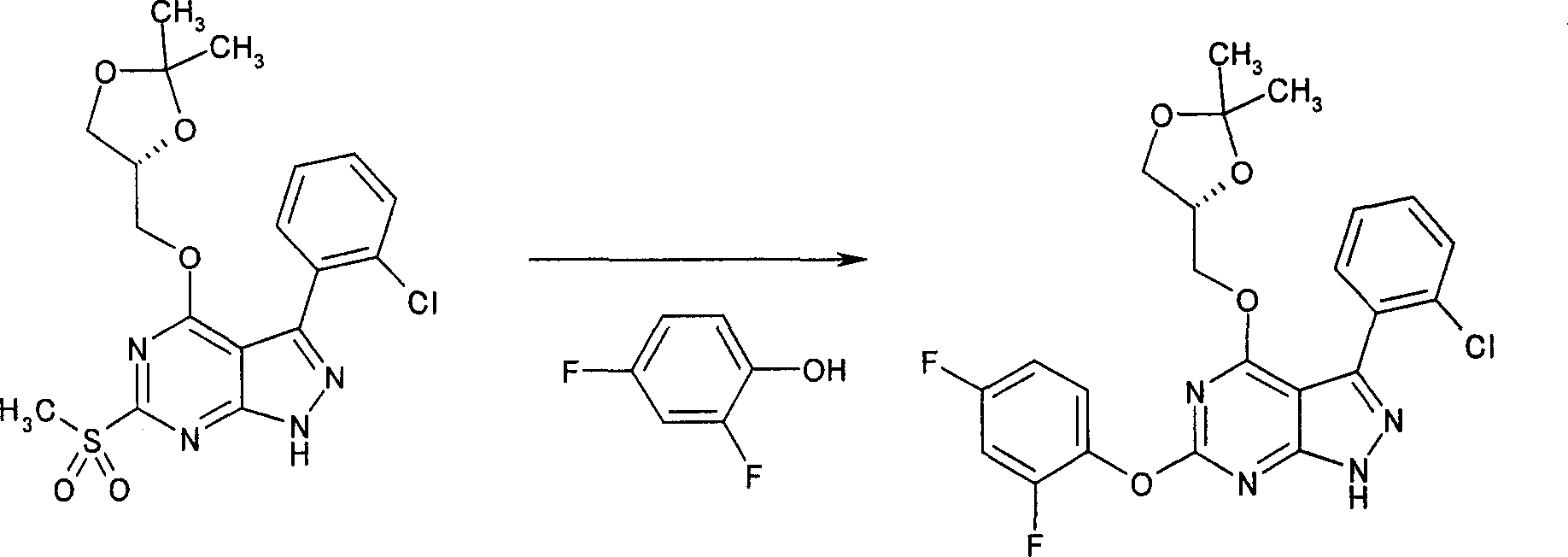
将粉末KOH(1.0g)置于4mL 2,4-二氟苯酚中,将获得的混合物在120℃加热15分钟。加入(S)-3-(2-氯-苯基)-4-(2,2-二甲基-[1,3]二氧戊环-4-基甲氧基)-6-甲基磺酰基-1H-吡唑并[3,4-d]嘧啶(1.34g,0.305mmol),120℃搅拌反应混合物1小时。冷却反应混合物至RT,在水(100mL)和EtOAc(300mL)之间分配,分离各层。用2N NaOH水溶液洗涤有机层三次,用盐水洗涤一次,通过MgSO4干燥,过滤,并减压浓缩。通过制备级TLC(50% MeOH,在二氯甲烷中)纯化残余物,获得1.395mg(S)-3-(2-氯-苯基)-6-(2,4-二氟-苯氧基)-4-(2,2-二甲基-[1,3]二氧戊环-4-基甲氧基)-1H-吡唑并[3,4-d]嘧啶。质谱M+H=489.Mp.=70.1-75.9℃。Powdered KOH (1.0 g) was placed in 4 mL of 2,4-difluorophenol, and the obtained mixture was heated at 120° C. for 15 minutes. Add (S)-3-(2-chloro-phenyl)-4-(2,2-dimethyl-[1,3]dioxolan-4-ylmethoxy)-6-methylsulfonium Acyl-1H-pyrazolo[3,4-d]pyrimidine (1.34g, 0.305mmol), the reaction mixture was stirred at 120°C for 1 hour. The reaction mixture was cooled to RT, partitioned between water (100 mL) and EtOAc (300 mL), and the layers were separated. The organic layer was washed three times with 2N aqueous NaOH, once with brine, dried over MgSO4 , filtered, and concentrated under reduced pressure. Purification of the residue by preparative TLC (50% MeOH in dichloromethane) afforded 1.395 mg of (S)-3-(2-chloro-phenyl)-6-(2,4-difluoro-phenoxy )-4-(2,2-Dimethyl-[1,3]dioxolan-4-ylmethoxy)-1H-pyrazolo[3,4-d]pyrimidine. Mass spectrum M+H = 489. Mp. = 70.1-75.9°C.
步骤4.制备(S)-3-[3-(2-氯-苯基)-6-(2,4-二氟-苯氧基)-1H-吡唑并[3,4-d]嘧啶-4-基氧基]-丙-1,2-二醇Step 4. Preparation of (S)-3-[3-(2-chloro-phenyl)-6-(2,4-difluoro-phenoxy)-1H-pyrazolo[3,4-d]pyrimidine -4-yloxy]-propan-1,2-diol

将(S)-3-(2-氯-苯基)-6-(2,4-二氟-苯氧基)-4-(2,2-二甲基-[1,3]二氧戊环-4-基甲氧基)-1H-吡唑并[3,4-d]嘧啶(1.395g)置于30mL二噁烷中,加入25mL 4N HCl。RT下搅拌反应混合物25分钟,然后将反应混合物在水(100mL)和EtOAc(300mL)之间分配。用盐水洗涤有机相,通过MgSO4干燥,过滤,并减压浓缩。用二氯甲烷中的30% EtOAc,通过硅胶洗脱残余物,获得886.4mg(S)-3-[3-(2-氯-苯基)-6-(2,4-二氟-苯氧基)-1H-吡唑并[3,4-d]嘧啶-4-基氧基]-丙-1,2-二醇。质谱M+H=449。Mp.=179.2-181.3℃。(S)-3-(2-chloro-phenyl)-6-(2,4-difluoro-phenoxy)-4-(2,2-dimethyl-[1,3]dioxolane Cyclo-4-ylmethoxy)-1H-pyrazolo[3,4-d]pyrimidine (1.395 g) was placed in 30 mL of dioxane, and 25 mL of 4N HCl was added. The reaction mixture was stirred at RT for 25 minutes, then the reaction mixture was partitioned between water (100 mL) and EtOAc (300 mL). The organic phase was washed with brine, dried over MgSO4 , filtered, and concentrated under reduced pressure. The residue was eluted through silica gel with 30% EtOAc in dichloromethane to afford 886.4 mg of (S)-3-[3-(2-chloro-phenyl)-6-(2,4-difluoro-phenoxy yl)-1H-pyrazolo[3,4-d]pyrimidin-4-yloxy]-propan-1,2-diol. Mass spectrum M+H=449. Mp. = 179.2-181.3°C.
在表1中显示按照上述实施例制备的另外的化合物。In Table 1 additional compounds prepared according to the above examples are shown.
实施例6:合成C-[3-(2-氯-苯基)-6-(2,4-二氟-苯氧基)-1H-吡唑并[3,4-d]嘧啶-4-基]-N,N-二甲基-甲磺酰胺Example 6: Synthesis of C-[3-(2-chloro-phenyl)-6-(2,4-difluoro-phenoxy)-1H-pyrazolo[3,4-d]pyrimidine-4- base]-N,N-dimethyl-methanesulfonamide
步骤1.制备4-氯-3-(2-氯-苯基)-6-甲硫基-1-(2-三甲基甲硅烷基-乙氧基甲基)-1H-吡唑并[3,4-d]嘧啶Step 1. Preparation of 4-chloro-3-(2-chloro-phenyl)-6-methylthio-1-(2-trimethylsilyl-ethoxymethyl)-1H-pyrazolo[ 3,4-d]pyrimidine

将4-氯-3-(2-氯-苯基)-6-甲硫基-1H-吡唑并[3,4-d]嘧啶(10.0g,0.032mol)加入100mL无水DMF,将获得的溶液冷却至0℃。滴加(2-氯甲氧基-乙基)-三甲基-硅烷(6.8mL,0.038mol),搅拌反应混合物5分钟。然后加入氢化钠(1.40g,0.0333mol),0℃下搅拌反应混合物30分钟。反应混合物在水和乙酸乙酯之间分配。分离各层,用乙酸乙酯洗涤水层两次。用盐水洗涤合并的有机层,用水洗涤,通过MgSO4干燥,过滤,和减压浓缩。通过快速色谱法(0%-10%己烷,在EtOAc中)纯化残余物,获得8.55g 4-氯-3-(2-氯-苯基)-6-甲硫基-1-(2-三甲基甲硅烷基-乙氧基甲基)-1H-吡唑并[3,4-d]嘧啶。4-Chloro-3-(2-chloro-phenyl)-6-methylthio-1H-pyrazolo[3,4-d]pyrimidine (10.0 g, 0.032 mol) was added to 100 mL of anhydrous DMF to obtain The solution was cooled to 0 °C. (2-Chloromethoxy-ethyl)-trimethyl-silane (6.8 mL, 0.038 mol) was added dropwise and the reaction mixture was stirred for 5 minutes. Sodium hydride (1.40 g, 0.0333 mol) was then added and the reaction mixture was stirred at 0°C for 30 minutes. The reaction mixture was partitioned between water and ethyl acetate. The layers were separated and the aqueous layer was washed twice with ethyl acetate. The combined organic layers were washed with brine, washed with water, dried over MgSO4 , filtered, and concentrated under reduced pressure. Purification of the residue by flash chromatography (0%-10% hexanes in EtOAc) afforded 8.55 g of 4-chloro-3-(2-chloro-phenyl)-6-methylthio-1-(2- Trimethylsilyl-ethoxymethyl)-1H-pyrazolo[3,4-d]pyrimidine.
步骤2.制备C-[3-(2-氯-苯基)-6-甲硫基-1-(2-三甲基甲硅烷基-乙氧基甲基)-1H-吡唑并[3,4-d]嘧啶-4-基]-N,N-二甲基-甲磺酰胺Step 2. Preparation of C-[3-(2-chloro-phenyl)-6-methylthio-1-(2-trimethylsilyl-ethoxymethyl)-1H-pyrazolo[3 ,4-d]pyrimidin-4-yl]-N,N-dimethyl-methanesulfonamide

5℃下向N,N-二甲基甲磺酰胺(419mg,3.40mmol)在5mL无水THF中的溶液滴加n-BuLi(2.2mL 1.6M溶液,在己烷中,3.50mmol)。向该搅拌的溶液中滴加4-氯-3-(2-氯-苯基)-6-甲硫基-1-(2-三甲基甲硅烷基-乙氧基甲基)-1H-吡唑并[3,4-d]嘧啶(0.500g,1.13mmol)在1mL无水THF中的溶液。搅拌该反应混合物2小时,该时间期间使得升温至RT。通过加入10mL水和1mL 1.2M HCl淬灭反应,用20mL二氯甲烷萃取获得的水溶液两次。通过MgSO4干燥合并的有机层,过滤,和减压浓缩。通过快速色谱法(0%-30% EtOAc,在己烷中)纯化残余物,获得421mg C-[3-(2-氯-苯基)-6-甲硫基-1-(2-三甲基甲硅烷基-乙氧基甲基)-1H-吡唑并[3,4-d]嘧啶-4-基]-N,N-二甲基-甲磺酰胺。To a solution of N,N-dimethylmethanesulfonamide (419 mg, 3.40 mmol) in 5 mL of anhydrous THF was added n-BuLi (2.2 mL of a 1.6M solution in hexane, 3.50 mmol) dropwise at 5°C. To the stirred solution was added dropwise 4-chloro-3-(2-chloro-phenyl)-6-methylthio-1-(2-trimethylsilyl-ethoxymethyl)-1H- A solution of pyrazolo[3,4-d]pyrimidine (0.500 g, 1.13 mmol) in 1 mL of anhydrous THF. The reaction mixture was stirred for 2 hours, during which time it was allowed to warm to RT. The reaction was quenched by adding 10 mL of water and 1 mL of 1.2M HCl, and the resulting aqueous solution was extracted twice with 20 mL of dichloromethane. The combined organic layers were dried over MgSO 4 , filtered, and concentrated under reduced pressure. Purification of the residue by flash chromatography (0%-30% EtOAc in hexanes) afforded 421 mg of C-[3-(2-chloro-phenyl)-6-methylthio-1-(2-trimethyl (methylsilyl-ethoxymethyl)-1H-pyrazolo[3,4-d]pyrimidin-4-yl]-N,N-dimethyl-methanesulfonamide.
步骤3.制备C-[3-(2-氯-苯基)-6-甲磺酰基-1-(2-三甲基甲硅烷基-乙氧基甲基)-1H-吡唑并[3,4-d]嘧啶-4-基]-N,N-二甲基-甲磺酰胺Step 3. Preparation of C-[3-(2-chloro-phenyl)-6-methanesulfonyl-1-(2-trimethylsilyl-ethoxymethyl)-1H-pyrazolo[3 ,4-d]pyrimidin-4-yl]-N,N-dimethyl-methanesulfonamide
使用实施例1步骤5的方法,用mCPBA处理C-[3-(2-氯-苯基)-6-甲硫基-1-(2-三甲基甲硅烷基-乙氧基甲基)-1H-吡唑并[3,4-d]嘧啶-4-基]-N,N-二甲基-甲磺酰胺(421mg,0.997mmol),提供398mg C-[3-(2-氯-苯基)-6-甲基磺酰基-1-(2-三甲基甲硅烷基-乙氧基甲基)-1H-吡唑并[3,4-d]嘧啶-4-基]-N,N-二甲基-甲磺酰胺。质谱M+H=560。Using the method of step 5 of Example 1, C-[3-(2-chloro-phenyl)-6-methylthio-1-(2-trimethylsilyl-ethoxymethyl) was treated with mCPBA -1H-pyrazolo[3,4-d]pyrimidin-4-yl]-N,N-dimethyl-methanesulfonamide (421 mg, 0.997 mmol), providing 398 mg of C-[3-(2-chloro- Phenyl)-6-methylsulfonyl-1-(2-trimethylsilyl-ethoxymethyl)-1H-pyrazolo[3,4-d]pyrimidin-4-yl]-N , N-Dimethyl-methanesulfonamide. Mass spectrum M+H=560.
步骤4.制备C-[3-(2-氯-苯基)-6-(2,4-二氟-苯氧基)-1-(2-三甲基甲硅烷基-乙氧基甲基)-1H-吡唑并[3,4-d]嘧啶-4-基]-N,N-二甲基-甲磺酰胺Step 4. Preparation of C-[3-(2-chloro-phenyl)-6-(2,4-difluoro-phenoxy)-1-(2-trimethylsilyl-ethoxymethyl )-1H-pyrazolo[3,4-d]pyrimidin-4-yl]-N,N-dimethyl-methanesulfonamide
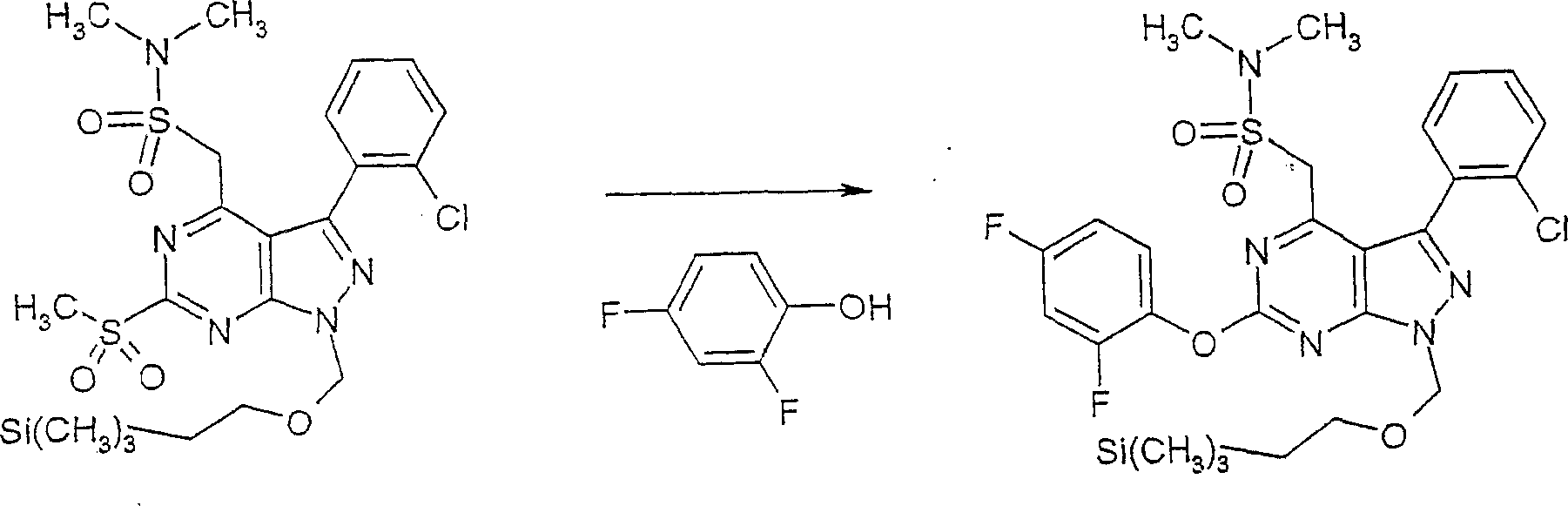
在KOH存在下,使用实施例4步骤6的方法,用2,4-二氟苯酚处理C-[3-(2-氯-苯基)-6-甲基磺酰基-1-(2-三甲基甲硅烷基-乙氧基甲基)-1H-吡唑并[3,4-d]嘧啶-4-基]-N,N-二甲基-甲磺酰胺(398mg),提供287mgC-[3-(2-氯-苯基)-6-(2,4-二氟-苯氧基)-1-(2-三甲基甲硅烷基-乙氧基甲基)-1H-吡唑并[3,4-d]嘧啶-4-基]-N,N-二甲基-甲磺酰胺。质谱M+H=610。C-[3-(2-chloro-phenyl)-6-methylsulfonyl-1-(2-tri Methylsilyl-ethoxymethyl)-1H-pyrazolo[3,4-d]pyrimidin-4-yl]-N,N-dimethyl-methanesulfonamide (398 mg), providing 287 mg of C- [3-(2-Chloro-phenyl)-6-(2,4-difluoro-phenoxy)-1-(2-trimethylsilyl-ethoxymethyl)-1H-pyrazole And[3,4-d]pyrimidin-4-yl]-N,N-dimethyl-methanesulfonamide. Mass spectrum M+H=610.
步骤5.制备C-[3-(2-氯-苯基)-6-(2,4-二氟-苯氧基)-1H-吡唑并[3,4-d]嘧啶-4-基]-N,N-二甲基-甲磺酰胺Step 5. Preparation of C-[3-(2-chloro-phenyl)-6-(2,4-difluoro-phenoxy)-1H-pyrazolo[3,4-d]pyrimidin-4-yl ]-N,N-Dimethyl-methanesulfonamide
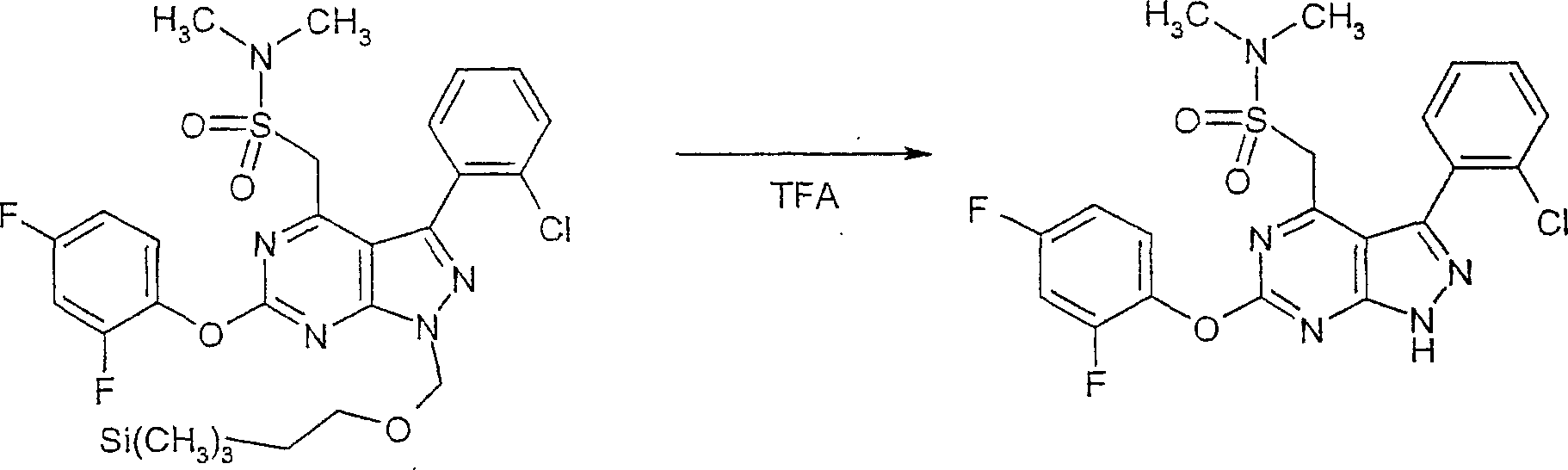
将C-[3-(2-氯-苯基)-6-(2,4-二氟-苯氧基)-1-(2-三甲基甲硅烷基-乙氧基甲基)-1H-吡唑并[3,4-d]嘧啶-4-基]-N,N-二甲基-甲磺酰胺(273mg,0.447mmol)溶解在5mL氯仿中,加入2.5mL三氟乙酸。RT下搅拌反应混合物22小时,然后减压浓缩至干燥。将残余物溶解在7mL MeOH中,加入硼氢化钠(109mg,4.47mmol)。搅拌反应混合物15分钟,然后减压浓缩。在100mL EtOAc和100mL盐水之间分配残余物,分离有机层,干燥(MgSO4),过滤并减压浓缩。通过快速色谱法(0%-40% EtOAc,在己烷中)纯化残余物,获得167mg C-[3-(2-氯-苯基)-6-(2,4-二氟-苯氧基)-1H-吡唑并[3,4-d]嘧啶-4-基]-N,N-二甲基-甲磺酰胺。质谱M+H=481。C-[3-(2-chloro-phenyl)-6-(2,4-difluoro-phenoxy)-1-(2-trimethylsilyl-ethoxymethyl)-1H -Pyrazolo[3,4-d]pyrimidin-4-yl]-N,N-dimethyl-methanesulfonamide (273 mg, 0.447 mmol) was dissolved in 5 mL of chloroform, and 2.5 mL of trifluoroacetic acid was added. The reaction mixture was stirred at RT for 22 hours, then concentrated to dryness under reduced pressure. The residue was dissolved in 7 mL MeOH and sodium borohydride (109 mg, 4.47 mmol) was added. The reaction mixture was stirred for 15 minutes, then concentrated under reduced pressure. The residue was partitioned between 100 mL EtOAc and 100 mL brine, the organic layer was separated, dried ( MgSO4 ), filtered and concentrated under reduced pressure. Purification of the residue by flash chromatography (0%-40% EtOAc in hexanes) afforded 167 mg of C-[3-(2-chloro-phenyl)-6-(2,4-difluoro-phenoxy )-1H-pyrazolo[3,4-d]pyrimidin-4-yl]-N,N-dimethyl-methanesulfonamide. Mass spectrum M+H=481.
在表1中显示按照上述实施例制备的另外的化合物。In Table 1 additional compounds prepared according to the above examples are shown.
实施例7:Embodiment 7:
步骤1.制备环戊基-(4,6-二氯-2-甲硫基-嘧啶-5-基)-甲醇Step 1. Preparation of cyclopentyl-(4,6-dichloro-2-methylthio-pyrimidin-5-yl)-methanol

将4,6-二氯-2-甲硫基-嘧啶(8.0g,41.01mmol)溶解在500mL无水THF中并冷却至-78℃。滴加二异丙基胺基锂(36.9mL,2.0M己烷溶液),-78℃搅拌反应混合物20分钟。加入环戊-甲醛(8.05g,82.02mmol),-78℃搅拌反应混合物45分钟。通过加入饱和氯化铵水溶液淬灭反应。用乙酸乙酯萃取水性混合物,用水洗涤合并的有机层,用盐水洗涤,干燥(MgSO4),过滤,和减压蒸发。通过快速色谱法(5%-40% EtOAc,在己烷中)纯化残余物,获得9.76g环戊基-(4,6-二氯-2-甲硫基-嘧啶-5-基)-甲醇。质谱M+H=294。4,6-Dichloro-2-methylthio-pyrimidine (8.0 g, 41.01 mmol) was dissolved in 500 mL dry THF and cooled to -78°C. Lithium diisopropylamide (36.9 mL, 2.0 M in hexane) was added dropwise, and the reaction mixture was stirred at -78°C for 20 minutes. Cyclopenta-carbaldehyde (8.05 g, 82.02 mmol) was added and the reaction mixture was stirred at -78°C for 45 minutes. The reaction was quenched by adding saturated aqueous ammonium chloride. The aqueous mixture was extracted with ethyl acetate, the combined organic layers were washed with water, brine, dried ( MgSO4 ), filtered, and evaporated under reduced pressure. Purification of the residue by flash chromatography (5%-40% EtOAc in hexanes) afforded 9.76 g of cyclopentyl-(4,6-dichloro-2-methylthio-pyrimidin-5-yl)-methanol . Mass spectrum M+H=294.
步骤2.制备环戊基-(4,6-二氯-2-甲硫基-嘧啶-5-基)-甲酮Step 2. Preparation of cyclopentyl-(4,6-dichloro-2-methylthio-pyrimidin-5-yl)-methanone

将环戊基-(4,6-二氯-2-甲硫基-嘧啶-5-基)-甲醇(8.1g,27.62mmol)溶解在100mL无水丙酮中并在氮气下在0℃搅拌。在3分钟内分几份加入CrO3(11.05g,110.497mmol)。搅拌反应混合物20分钟。通过加入15mL异丙醇淬灭反应,接着用饱和碳酸氢钠水溶液碱化。将获得的溶液通过硅藻土过滤,用丙酮洗涤硅藻土。获得的溶液通过Na2SO4干燥,过滤,和减压浓缩,以获得3.1g环戊基-(4,6-二氯-2-甲硫基-嘧啶-5-基)-甲酮。质谱M+H=292。Cyclopentyl-(4,6-dichloro-2-methylthio-pyrimidin-5-yl)-methanol (8.1 g, 27.62 mmol) was dissolved in 100 mL of dry acetone and stirred at 0 °C under nitrogen. CrO3 (11.05 g, 110.497 mmol) was added in portions over 3 minutes. The reaction mixture was stirred for 20 minutes. The reaction was quenched by adding 15 mL of isopropanol, followed by basification with saturated aqueous sodium bicarbonate. The obtained solution was filtered through celite, and the celite was washed with acetone. The obtained solution was dried over Na2SO4 , filtered, and concentrated under reduced pressure to obtain 3.1 g of cyclopentyl-(4,6 - dichloro-2-methylthio-pyrimidin-5-yl)-methanone. Mass spectrum M+H=292.
步骤3.制备4-氯-3-环戊基-6-甲硫基-1H-吡唑并[3,4-d]嘧啶Step 3. Preparation of 4-chloro-3-cyclopentyl-6-methylthio-1H-pyrazolo[3,4-d]pyrimidine

将环戊基-(4,6-二氯-2-甲硫基-嘧啶-5-基)-甲酮(2.0g,6.868mmol)溶解在25mL无水THF中并在氮气下0℃搅拌。滴加N,N-二异丙基乙基胺(2.392mL,13.763mmol),搅拌反应混合物5分钟。滴加肼(0.205mL,6.525mmol),搅拌反应16小时,在该期间使得反应混合物升温至RT。在水和乙酸乙酯之间分配反应混合物,分离有机相,用水洗涤,用盐水洗涤,干燥(MgSO4),过滤并减压蒸发以获得2.09g 4-氯-3-环戊基-6-甲硫基-1H-吡唑并[3,4-d]嘧啶。质谱M+H=270。Cyclopentyl-(4,6-dichloro-2-methylthio-pyrimidin-5-yl)-methanone (2.0 g, 6.868 mmol) was dissolved in 25 mL of anhydrous THF and stirred at 0 °C under nitrogen. N,N-Diisopropylethylamine (2.392 mL, 13.763 mmol) was added dropwise and the reaction mixture was stirred for 5 minutes. Hydrazine (0.205 mL, 6.525 mmol) was added dropwise and the reaction was stirred for 16 hours, during which time the reaction mixture was allowed to warm to RT. The reaction mixture was partitioned between water and ethyl acetate, the organic phase was separated, washed with water, washed with brine, dried (MgSO 4 ), filtered and evaporated under reduced pressure to obtain 2.09 g of 4-chloro-3-cyclopentyl-6- Methylthio-1H-pyrazolo[3,4-d]pyrimidine. Mass spectrum M+H=270.
步骤3.制备(R)-1-(3-环戊基-6-甲硫基-1H-吡唑并[3,4-d]嘧啶-4-基氨基)-丙-2-醇Step 3. Preparation of (R)-1-(3-cyclopentyl-6-methylthio-1H-pyrazolo[3,4-d]pyrimidin-4-ylamino)-propan-2-ol
将4-氯-3-环戊基-6-甲硫基-1H-吡唑并[3,4-d]嘧啶(500mg,1.860mmol)溶解在25mL无水THF中,并加入(S)-1-氨基-丙-2-醇(1.758mL,22.32mmol)。将反应混合物加热至回流3小时,然后冷却至RT。反应混合物在水和乙酸乙酯之间分配,分离有机相,用水洗涤,用盐水洗涤,干燥(MgSO4),过滤和减压蒸发以获得0.56g(R)-1-(3-环戊基-6-甲硫基-1H-吡唑并[3,4-d]嘧啶-4-基氨基)-丙-2-醇。质谱M+H=309。4-Chloro-3-cyclopentyl-6-methylthio-1H-pyrazolo[3,4-d]pyrimidine (500 mg, 1.860 mmol) was dissolved in 25 mL of dry THF, and (S)- 1-Amino-propan-2-ol (1.758 mL, 22.32 mmol). The reaction mixture was heated to reflux for 3 hours, then cooled to RT. The reaction mixture was partitioned between water and ethyl acetate, the organic phase was separated, washed with water, washed with brine, dried (MgSO 4 ), filtered and evaporated under reduced pressure to obtain 0.56 g of (R)-1-(3-cyclopentyl -6-Methylthio-1H-pyrazolo[3,4-d]pyrimidin-4-ylamino)-propan-2-ol. Mass spectrum M+H=309.
步骤4.制备(R)-1-(3-环戊基-6-甲基磺酰基-1H-吡唑并[3,4-d]嘧啶-4-基氨基)-丙-2-醇.Step 4. Preparation of (R)-1-(3-cyclopentyl-6-methylsulfonyl-1H-pyrazolo[3,4-d]pyrimidin-4-ylamino)-propan-2-ol.
使用实施例1的步骤5的方法,用mCPBA处理(R)-1-(3-环戊基-6-甲硫基-1H-吡唑并[3,4-d]嘧啶-4-基氨基)-丙-2-醇,以提供0.60g(R)-1-(3-环戊基-6-甲基磺酰基-1H-吡唑并[3,4-d]嘧啶-4-基氨基)-丙-2-醇。质谱M+H=340。Using the method of step 5 of Example 1, (R)-1-(3-cyclopentyl-6-methylthio-1H-pyrazolo[3,4-d]pyrimidin-4-ylamino was treated with mCPBA )-propan-2-ol to provide 0.60 g of (R)-1-(3-cyclopentyl-6-methylsulfonyl-1H-pyrazolo[3,4-d]pyrimidin-4-ylamino )-propan-2-ol. Mass spectrum M+H=340.
步骤5.制备(R)-1-[3-环戊基-6-(2,4-二氟-苯氧基)-1H-吡唑并[3,4-d]嘧啶-4-基氨基]-丙-2-醇Step 5. Preparation of (R)-1-[3-cyclopentyl-6-(2,4-difluoro-phenoxy)-1H-pyrazolo[3,4-d]pyrimidin-4-ylamino ]-propan-2-ol
在KOH的存在下,使用实施例4步骤6的方法,用2,4-二氟苯酚处理(R)-1-(3-环戊基-6-甲基磺酰基-1H-吡唑并[3,4-d]嘧啶-4-基氨基)-丙-2-醇,获得0.56mg(R)-1-[3-环戊基-6-(2,4-二氟-苯氧基)-1H-吡唑并[3,4-d]嘧啶-4-基氨基]-丙-2-醇。质谱M+H=390。(R)-1-(3-cyclopentyl-6-methylsulfonyl-1H-pyrazolo[ 3,4-d]pyrimidin-4-ylamino)-propan-2-ol to obtain 0.56 mg of (R)-1-[3-cyclopentyl-6-(2,4-difluoro-phenoxy) -1H-pyrazolo[3,4-d]pyrimidin-4-ylamino]-propan-2-ol. Mass spectrum M+H=390.
实施例8:合成(R)-1-[3-(2-氯-苯基)-6-(2,4-二氟-苯氧基)-1H-吡唑并[3,4-b]吡嗪-5-基氨基]-丙-2-醇Example 8: Synthesis of (R)-1-[3-(2-chloro-phenyl)-6-(2,4-difluoro-phenoxy)-1H-pyrazolo[3,4-b] Pyrazin-5-ylamino]-propan-2-ol
步骤1.制备(2-氯苯基)-(3,5-二氯吡嗪-2-基)-甲醇.Step 1. Preparation of (2-chlorophenyl)-(3,5-dichloropyrazin-2-yl)-methanol.
在氩气下向正丁基锂(2.5M在己烷中,Aldrich,26.5mmol)在无水THF(200mL)中的-20℃溶液加入2,2,6,6-四甲基哌啶(Aldrich,11.5mL,66.5mmol,1.22eq)。在0.5小时时期内将获得的溶液升温至0℃。然后将溶液冷却至-78℃,通过注射器缓慢加入2,6-二氯吡嗪(Aldrich,8.24g,55.3mmol,1.0eq)在THF中的溶液。在加入完成后,获得的混合物在-78℃下搅拌另外1小时,之后通过注射器逐滴加入2-氯苯甲醛(Aldrich,9.3mL,83mmole,1.5eq)。搅拌反应混合物另外1小时,用盐酸(18mL,220mmol,4eq)/乙醇(75mL)/THF(90mL)混合物淬灭,然后升温至RT。用饱和碳酸氢钠水溶液稀释反应混合物,用乙醚萃取。分离有机层和用盐水洗涤,通过硫酸钠干燥,过滤,浓缩,获得粗制油,其通过使用DCM/己烷(1∶1)作为洗脱剂色谱纯化,获得(2-氯苯基)-(3,5-二氯吡嗪-2-基)甲醇(12.8g,44mmol,80%产率)。质谱M+1=290。To a solution of n-butyllithium (2.5 M in hexane, Aldrich, 26.5 mmol) in anhydrous THF (200 mL) at -20 °C under argon was added 2,2,6,6-tetramethylpiperidine ( Aldrich, 11.5 mL, 66.5 mmol, 1.22 eq). The resulting solution was warmed to 0°C over a period of 0.5 hours. The solution was then cooled to -78 °C and a solution of 2,6-dichloropyrazine (Aldrich, 8.24 g, 55.3 mmol, 1.0 eq) in THF was added slowly via syringe. After the addition was complete, the resulting mixture was stirred at -78°C for another 1 hour before 2-chlorobenzaldehyde (Aldrich, 9.3 mL, 83 mmole, 1.5 eq) was added dropwise via syringe. The reaction mixture was stirred for another 1 h, quenched with a mixture of hydrochloric acid (18 mL, 220 mmol, 4 eq)/ethanol (75 mL)/THF (90 mL) and then warmed to RT. The reaction mixture was diluted with saturated aqueous sodium bicarbonate and extracted with ether. The organic layer was separated and washed with brine, dried over sodium sulfate, filtered and concentrated to obtain a crude oil which was purified by chromatography using DCM/hexane (1:1) as eluent to obtain (2-chlorophenyl)- (3,5-Dichloropyrazin-2-yl)methanol (12.8 g, 44 mmol, 80% yield). Mass spectrum M+1=290.
步骤2.制备(2-氯苯基)-(3,5-二氯吡嗪-2-基)甲酮.Step 2. Preparation of (2-chlorophenyl)-(3,5-dichloropyrazin-2-yl)methanone.
向(2-氯苯基)-(3,5-二氯吡嗪-2-基)甲醇(7.1g,24.5mmol)的DCM溶液逐份加入固体氧化锰(IV)(25g,245mmol)并将获得的混合物在RT下搅拌过夜。过滤反应混合物,浓缩滤液,获得(2-氯苯基)-(3,5-二氯吡嗪-2-基)甲酮(6.02g,21mmol,85%产率)。质谱,M+1=288。To a solution of (2-chlorophenyl)-(3,5-dichloropyrazin-2-yl)methanol (7.1 g, 24.5 mmol) in DCM was added solid manganese(IV) oxide (25 g, 245 mmol) portionwise and The resulting mixture was stirred overnight at RT. The reaction mixture was filtered and the filtrate was concentrated to obtain (2-chlorophenyl)-(3,5-dichloropyrazin-2-yl)methanone (6.02 g, 21 mmol, 85% yield). Mass spectrum, M+1=288.
步骤3.制备[3-氯-5-(2,4-二氟苯氧基)吡嗪-2-基]-(2-氯苯基)-甲酮.Step 3. Preparation of [3-chloro-5-(2,4-difluorophenoxy)pyrazin-2-yl]-(2-chlorophenyl)-methanone.

在氮气下向(2-氯苯基)-(3,5-二氯吡嗪-2-基)甲酮(2.1g,7.3mmol,1.0eq)的DMF(25mL)溶液加入2,4-二氟苯酚(0.7mL,7.3mmol,1.0eq)和碳酸钾(1.21g,8.76mmol,1.2eq)。RT下搅拌获得的混合物过夜,然后浓缩。将残余物溶解在DCM中并用水和盐水洗涤。通过硫酸钠干燥有机层,过滤并浓缩以获得粗制油,其通过使用DCM/己烷(1∶1)作为洗脱剂色谱纯化,获得[3-氯-5-(2,4-二氟苯氧基l)吡嗪-2-基]-(2-氯苯基)甲酮(2.46g,6.45mmol,88%产率)。质谱M+1=382。To a solution of (2-chlorophenyl)-(3,5-dichloropyrazin-2-yl)methanone (2.1 g, 7.3 mmol, 1.0 eq) in DMF (25 mL) under nitrogen was added 2,4-bis Fluorophenol (0.7 mL, 7.3 mmol, 1.0 eq) and potassium carbonate (1.21 g, 8.76 mmol, 1.2 eq). The resulting mixture was stirred overnight at RT, then concentrated. The residue was dissolved in DCM and washed with water and brine. The organic layer was dried over sodium sulfate, filtered and concentrated to obtain a crude oil, which was purified by chromatography using DCM/hexane (1:1) as eluent to obtain [3-chloro-5-(2,4-difluoro Phenoxyl) pyrazin-2-yl]-(2-chlorophenyl)methanone (2.46 g, 6.45 mmol, 88% yield). Mass spectrum M+1=382.
步骤4.制备3-(2-氯苯基)-6-(2,4-二氟苯氧基)-1H-吡唑并[3,4-b]吡嗪.Step 4. Preparation of 3-(2-chlorophenyl)-6-(2,4-difluorophenoxy)-1H-pyrazolo[3,4-b]pyrazine.
向[3-氯-5-(2,4-二氟苯氧基)吡嗪-2-基]-(2-氯苯基)甲酮(0.73g,1.9mmol,1.0eq)在乙醇中的溶液加入肼水合物(0.19mL,3.8mmol,2.0eq)。将获得的混合物在氮气下回流0.5小时。冷却反应混合物,过滤,获得3-(2-氯苯基)-6-(2,4-二氟苯氧基)-1H-吡唑并[3,4-b]吡嗪(0.285g,0.8mmol,42%产率),为固体。MP=240.5-241.5℃。质谱M+1=359。To [3-chloro-5-(2,4-difluorophenoxy)pyrazin-2-yl]-(2-chlorophenyl)methanone (0.73g, 1.9mmol, 1.0eq) in ethanol To the solution was added hydrazine hydrate (0.19 mL, 3.8 mmol, 2.0 eq). The obtained mixture was refluxed under nitrogen for 0.5 hours. The reaction mixture was cooled and filtered to obtain 3-(2-chlorophenyl)-6-(2,4-difluorophenoxy)-1H-pyrazolo[3,4-b]pyrazine (0.285 g, 0.8 mmol, 42% yield), as a solid. MP = 240.5-241.5°C. Mass spectrum M+1=359.
步骤5.制备5-氯-3-(2-氯-苯基)-6-(2,4-二氟-苯氧基)-1H-吡唑并[3,4-b]吡嗪Step 5. Preparation of 5-chloro-3-(2-chloro-phenyl)-6-(2,4-difluoro-phenoxy)-1H-pyrazolo[3,4-b]pyrazine
将3-(2-氯苯基)-6-(2,4-二氟苯氧基)-1H-吡唑并[3,4-b]吡嗪(2.70g,7.5mmol)在500mL四氯化碳中的悬浮液在RT下在搅拌下用氯气鼓泡16小时。将反应混合物减压浓缩,通过色谱法(二氯甲烷/己烷2∶3至1∶0)纯化残余物,获得1.21g 5-氯-3-(2-氯-苯基)-6-(2,4-二氟-苯氧基)-1H-吡唑并[3,4-b]吡嗪。质谱M+1=394。3-(2-chlorophenyl)-6-(2,4-difluorophenoxy)-1H-pyrazolo[3,4-b]pyrazine (2.70g, 7.5mmol) in 500mL tetrachloro The suspension in carbon dioxide was bubbled with chlorine gas for 16 h at RT with stirring. The reaction mixture was concentrated under reduced pressure and the residue was purified by chromatography (dichloromethane/hexane 2:3 to 1:0) to obtain 1.21 g of 5-chloro-3-(2-chloro-phenyl)-6-( 2,4-Difluoro-phenoxy)-1H-pyrazolo[3,4-b]pyrazine. Mass spectrum M+1=394.
步骤6.制备(R)-1-[3-(2-氯-苯基)-6-(2,4-二氟-苯氧基)-1H-吡唑并[3,4-b]吡嗪-5-基氨基]-丙-2-醇Step 6. Preparation of (R)-1-[3-(2-chloro-phenyl)-6-(2,4-difluoro-phenoxy)-1H-pyrazolo[3,4-b]pyridine Azin-5-ylamino]-propan-2-ol

在RT、氮气下,向5-氯-3-(2-氯-苯基)-6-(2,4-二氟-苯氧基)-1H-吡唑并[3,4-b]吡嗪(0.66g,1.7mmol)的搅拌乙醇(100mL)悬浮液加入(S)-1-氨基-2-丙醇(0.63g,8.4mmol)。加热反应混合物至回流并在回流下搅拌16小时。冷却反应混合物并减压浓缩。色谱分离(2% MeOH,在己烷中)残余物以产生82mg(R)-1-[3-(2-氯-苯基)-6-(2,4-二氟-苯氧基)-1H-吡唑并[3,4-b]吡嗪-5-基氨基]-丙-2-醇。质谱,M+1=433。To 5-chloro-3-(2-chloro-phenyl)-6-(2,4-difluoro-phenoxy)-1H-pyrazolo[3,4-b]pyridine at RT under nitrogen To a stirred suspension of oxazine (0.66 g, 1.7 mmol) in ethanol (100 mL) was added (S)-1-amino-2-propanol (0.63 g, 8.4 mmol). The reaction mixture was heated to reflux and stirred at reflux for 16 hours. The reaction mixture was cooled and concentrated under reduced pressure. Chromatography (2% MeOH in hexanes) of the residue gave 82 mg of (R)-1-[3-(2-chloro-phenyl)-6-(2,4-difluoro-phenoxy)- 1H-Pyrazolo[3,4-b]pyrazin-5-ylamino]-propan-2-ol. Mass spectrum, M+1=433.
实施例9:合成(S)-1-[3-(2-氯-苯基)-6-(2,4-二氟-苯氧基)-1H-吡唑并[4,3-c]吡啶-4-基氨基]-丙-2-醇Example 9: Synthesis of (S)-1-[3-(2-chloro-phenyl)-6-(2,4-difluoro-phenoxy)-1H-pyrazolo[4,3-c] Pyridin-4-ylamino]-propan-2-ol
步骤1.制备(2-氯-苯基)-(2,4,6-三氟-吡啶-3-基)-甲醇Step 1. Preparation of (2-chloro-phenyl)-(2,4,6-trifluoro-pyridin-3-yl)-methanol
将2,4,6-三氟吡啶(7.5g,56.36mmol)置于9mL无水THF中,在氩气下在搅拌同时将反应混合物冷却至-78℃。将二异丙基胺锂(42.3mL 2M溶液,在THF中)逐份加入,将溶液搅拌10分钟。通过注射器逐份加入2-氯苯甲醛(9.5mL,1.5equiv),搅拌反应混合物15分钟。通过加入饱和氯化铵和水淬灭反应,用EtOAc萃取水性混合物一次。用饱和盐水和水洗涤合并的有机层,通过MgSO4干燥,过滤并蒸发。通过快速柱色谱法,使用5%-10% EtOAc/己烷纯化残余物,获得8.02g(2-氯-苯基)-(2,4,6-三氟-吡啶-3-基)-甲醇。质谱,M+1=275。2,4,6-Trifluoropyridine (7.5 g, 56.36 mmol) was placed in 9 mL of anhydrous THF, and the reaction mixture was cooled to -78°C while stirring under argon. Lithium diisopropylamide (42.3 mL of a 2M solution in THF) was added in portions and the solution was stirred for 10 minutes. 2-Chlorobenzaldehyde (9.5 mL, 1.5 equiv) was added portionwise via syringe and the reaction mixture was stirred for 15 minutes. The reaction was quenched by adding saturated ammonium chloride and water, and the aqueous mixture was extracted once with EtOAc. The combined organic layers were washed with saturated brine and water, dried over MgSO4 , filtered and evaporated. Purification of the residue by flash column chromatography using 5%-10% EtOAc/hexanes afforded 8.02 g of (2-chloro-phenyl)-(2,4,6-trifluoro-pyridin-3-yl)-methanol . Mass spectrum, M+1=275.
步骤2.制备(2-氯-苯基)-(2,4,6-三氟-吡啶-3-基)-甲酮Step 2. Preparation of (2-chloro-phenyl)-(2,4,6-trifluoro-pyridin-3-yl)-methanone

将(2-氯-苯基)-(2,4,6-三氟-吡啶-3-基)-甲醇(8.02g,29.3mmol)置于80mL无水甲苯中,加入二氧化锰26g)。反应混合物回流2.5小时,之后加入2.5g另外的MnO2。反应混合物回流另外1小时并加入另外2.5gMgO2。反应混合物回流3小时,然后热过滤通过硅藻土。用热EtOAc(分几份)洗涤硅藻土塞,合并有机溶剂。减压蒸发溶剂,将残余物进行快速色谱法(5%-10% EtOAc,在己烷中),获得2.55g(2-氯-苯基)-(2,4,6-三氟-吡啶-3-基)-甲酮。质谱M-H=270。(2-Chloro-phenyl)-(2,4,6-trifluoro-pyridin-3-yl)-methanol (8.02 g, 29.3 mmol) was placed in 80 mL of anhydrous toluene, and manganese dioxide (26 g) was added. The reaction mixture was refluxed for 2.5 hours, after which 2.5 g of additional MnO2 were added. The reaction mixture was refluxed for an additional 1 hour and an additional 2.5 g of MgO2 was added. The reaction mixture was refluxed for 3 hours, then filtered hot through celite. The celite plug was washed with hot EtOAc (in several portions), and the organic solvents were combined. The solvent was evaporated under reduced pressure and the residue was subjected to flash chromatography (5%-10% EtOAc in hexanes) to obtain 2.55 g of (2-chloro-phenyl)-(2,4,6-trifluoro-pyridine- 3-yl)-methanone. Mass spectrum MH=270.
步骤3.制备(S)-(2-氯-苯基)-[4,6-二氟-2-(2-羟基-丙基氨基)-吡啶-3-基]-甲酮(S)-(2-氯-苯基)-[2,6-二氟-4-(2-羟基-丙基氨基)-吡啶-3-基]-甲酮.Step 3. Preparation of (S)-(2-chloro-phenyl)-[4,6-difluoro-2-(2-hydroxy-propylamino)-pyridin-3-yl]-methanone(S)- (2-Chloro-phenyl)-[2,6-difluoro-4-(2-hydroxy-propylamino)-pyridin-3-yl]-methanone.

将(S)-(2-氯-苯基)-(2,4,6-三氟-吡啶-3-基)-甲酮(2.0g,7.36mmol)置于30mL无水THF中并在氩气下在搅拌同时冷却至-78℃。加入N,N-二异丙基乙基胺(1.4mL)和(S)-1-氨基-2-丙醇(0.64mL),使得反应混合物在搅拌下缓慢升温至-10℃。在-10℃下搅拌反应混合物16小时,然后通过加入饱和氯化铵和水淬灭。用EtOAc萃取水性混合物,用饱和盐水和水洗涤合并的有机层,通过MgSO4干燥,过滤并蒸发。使用5%-30% EtOAc/己烷,通过快速柱色谱法纯化残余物,获得第一级分652mg(S)-(2-氯-苯基)-[4,6-二氟-2-(2-羟基-丙基氨基)-吡啶-3-基]-甲酮和第二级分1.338g(2-氯-苯基)-[2,6-二氟-4-(2-羟基-丙基氨基)-吡啶-3-基]-甲酮。每种异构体质谱M+H=327。将H1 NMR用于证实单个异构体的纯度。(S)-(2-Chloro-phenyl)-(2,4,6-trifluoro-pyridin-3-yl)-methanone (2.0 g, 7.36 mmol) was placed in 30 mL dry THF and heated under argon Cool to -78°C under air while stirring. N,N-Diisopropylethylamine (1.4 mL) and (S)-1-amino-2-propanol (0.64 mL) were added and the reaction mixture was slowly warmed to -10°C with stirring. The reaction mixture was stirred at -10°C for 16 hours, then quenched by the addition of saturated ammonium chloride and water. The aqueous mixture was extracted with EtOAc, the combined organic layers were washed with saturated brine and water, dried over MgSO4 , filtered and evaporated. Purification of the residue by flash column chromatography using 5%-30% EtOAc/hexanes afforded the first fraction 652 mg of (S)-(2-chloro-phenyl)-[4,6-difluoro-2-( 2-hydroxy-propylamino)-pyridin-3-yl]-methanone and the second fraction 1.338 g (2-chloro-phenyl)-[2,6-difluoro-4-(2-hydroxy-propane Amino)-pyridin-3-yl]-methanone. Mass spectrum M+H=327 for each isomer. Hi NMR was used to confirm the purity of the individual isomers.
步骤4.制备(S)-(2-氯-苯基)-[6-(2,4-二氟-苯氧基)-4-氟-2-(2-羟基-丙基氨基)-吡啶-3-基]-甲酮Step 4. Preparation of (S)-(2-chloro-phenyl)-[6-(2,4-difluoro-phenoxy)-4-fluoro-2-(2-hydroxy-propylamino)-pyridine -3-yl]-methanone
将(S)-2,4-二氟苯酚(0.77mL)放置在烧瓶中并在搅拌下冷却至0℃,加入叔丁醇钾(8.1mL 1M THF溶液)。在0℃下搅拌反应混合物5分钟,然后使得升温至RT。向搅拌溶液中加入(2-氯-苯基)-[4,6-二氟-2-(2-羟基-丙基氨基)-吡啶-3-基]-甲酮(650mg,1.79mmol)在5mL无水THF中的溶液,在加入后搅拌持续5分钟。通过加入饱和氯化铵和水淬灭反应,用EtOAc萃取水性混合物。用饱和盐水和水洗涤合并的有机层,通过MgSO4干燥,过滤并蒸发。通过制备级TLC(30% EtOAc,在己烷中)纯化残余物,获得795mg(S)-(2-氯-苯基)-[6-(2,4-二氟-苯氧基)-4-氟-2-(2-羟基-丙基氨基)-吡啶-3-基]-甲酮。质谱M+H=437。(S)-2,4-Difluorophenol (0.77 mL) was placed in a flask and cooled to 0° C. with stirring, and potassium tert-butoxide (8.1 mL of 1M THF solution) was added. The reaction mixture was stirred at 0 °C for 5 min, then allowed to warm to RT. To the stirred solution was added (2-chloro-phenyl)-[4,6-difluoro-2-(2-hydroxy-propylamino)-pyridin-3-yl]-methanone (650 mg, 1.79 mmol) at A solution in 5 mL of anhydrous THF was stirred for 5 min after the addition. The reaction was quenched by adding saturated ammonium chloride and water, and the aqueous mixture was extracted with EtOAc. The combined organic layers were washed with saturated brine and water, dried over MgSO4 , filtered and evaporated. The residue was purified by preparative TLC (30% EtOAc in hexanes) to afford 795 mg of (S)-(2-chloro-phenyl)-[6-(2,4-difluoro-phenoxy)-4 -Fluoro-2-(2-hydroxy-propylamino)-pyridin-3-yl]-methanone. Mass spectrum M+H=437.
步骤5.制备(S)-1-[3-(2-氯-苯基)-6-(2,4-二氟-苯氧基)-1H-吡唑并[4,3-c]吡啶-4-基氨基]-丙-2-醇Step 5. Preparation of (S)-1-[3-(2-chloro-phenyl)-6-(2,4-difluoro-phenoxy)-1H-pyrazolo[4,3-c]pyridine -4-ylamino]-propan-2-ol
将1-[3-(2-氯-苯基)-6-(2,4-二氟-苯氧基)-1H-吡唑并[4,3-c]吡啶-4-基氨基]-丙-2-醇(690mg,1.6mmol)置于15mL二噁烷和2mL EtOH的混合物中。加入N,N-二异丙基乙基胺(0.3mL)和无水肼(0.15mL),在搅拌下将反应混合物缓慢加热至90℃。在90℃下搅拌反应混合物6小时,然后冷却至RT并通过加入水淬灭,用乙酸乙酯分配,接着用另外的乙酸乙酯反萃取水相。用饱和盐水和水洗涤合并的有机相,通过MgSO4干燥,过滤并减压浓缩。通过制备级TLC(3.5% MeOH,在二氯甲烷中)纯化残余物,然后从二氯甲烷/己烷中重结晶,获得246mg(S)-1-[3-(2-氯-苯基)-6-(2,4-二氟-苯氧基)-1H-吡唑并[4,3-c]吡啶-4-基氨基]-丙-2-醇。质谱,M+1=432.Mp=171.2-172℃.1-[3-(2-chloro-phenyl)-6-(2,4-difluoro-phenoxy)-1H-pyrazolo[4,3-c]pyridin-4-ylamino]- Propan-2-ol (690 mg, 1.6 mmol) was placed in a mixture of 15 mL of dioxane and 2 mL of EtOH. N,N-diisopropylethylamine (0.3 mL) and anhydrous hydrazine (0.15 mL) were added, and the reaction mixture was slowly heated to 90° C. with stirring. The reaction mixture was stirred at 90°C for 6 hours, then cooled to RT and quenched by addition of water, partitioned with ethyl acetate, followed by back extraction of the aqueous phase with additional ethyl acetate. The combined organic phases were washed with saturated brine and water, dried over MgSO 4 , filtered and concentrated under reduced pressure. Purification of the residue by preparative TLC (3.5% MeOH in dichloromethane) followed by recrystallization from dichloromethane/hexanes afforded 246 mg of (S)-1-[3-(2-chloro-phenyl) -6-(2,4-Difluoro-phenoxy)-1H-pyrazolo[4,3-c]pyridin-4-ylamino]-propan-2-ol. Mass spectrum, M+1=432.Mp=171.2-172°C.
实施例10:合成(S)-1-[3-(2-氯-苯基)-6-(2,4-二氟-苯氧基)-1H-吡唑并[3,4-b]吡啶-4-基氨基]-丙-2-醇。Example 10: Synthesis of (S)-1-[3-(2-chloro-phenyl)-6-(2,4-difluoro-phenoxy)-1H-pyrazolo[3,4-b] Pyridin-4-ylamino]-propan-2-ol.
步骤1.制备(S)-(2-氯-苯基)-[6-(2,4-二氟-苯氧基)-2-氟-4-(2-羟基-丙基氨基)-吡啶-3-基]-甲酮Step 1. Preparation of (S)-(2-chloro-phenyl)-[6-(2,4-difluoro-phenoxy)-2-fluoro-4-(2-hydroxy-propylamino)-pyridine -3-yl]-methanone
将(S)-2,4-二氟苯酚(0.45mL)放置在烧瓶中并在搅拌下通过冰浴冷却至0℃,加入叔丁醇钾(3.1mL 1M THF溶液)。在0℃下搅拌反应混合物5分钟。滴加(2-氯-苯基)-[2,6-二氟-4-(2-羟基-丙基氨基)-吡啶-3-基]-甲酮(610mg,1.87mmol)在8mL THF中的溶液。在加入后去除冰浴,使得反应混合物搅拌2小时,期间将反应混合物升温至RT。然后通过加入饱和氯化铵和水淬灭反应,用EtOAc萃取水性混合物。用饱和盐水和水洗涤合并的有机层,通过MgSO4干燥,过滤并蒸发。通过制备级TLC(30% EtOAc,在己烷中)纯化残余物,获得864mg(S)-(2-氯-苯基)-[6-(2,4-二氟-苯氧基)-2-氟-4-(2-羟基-丙基氨基)-吡啶-3-基]-甲酮与异构体(2-氯-苯基)-[2-(2,4-二氟-苯氧基)-6-氟-4-(2-羟基-丙基氨基)-吡啶-3-基]-甲酮(作为次产物)的混合物。将该粗产物混合物在不分离下直接用于下一步骤。(S)-2,4-Difluorophenol (0.45 mL) was placed in a flask and cooled to 0° C. by ice bath with stirring, and potassium tert-butoxide (3.1 mL of 1M THF solution) was added. The reaction mixture was stirred at 0 °C for 5 minutes. (2-Chloro-phenyl)-[2,6-difluoro-4-(2-hydroxy-propylamino)-pyridin-3-yl]-methanone (610 mg, 1.87 mmol) was added dropwise in 8 mL THF The solution. The ice bath was removed after the addition and the reaction mixture was allowed to stir for 2 hours during which time the reaction mixture was warmed to RT. The reaction was then quenched by adding saturated ammonium chloride and water, and the aqueous mixture was extracted with EtOAc. The combined organic layers were washed with saturated brine and water, dried over MgSO4 , filtered and evaporated. The residue was purified by preparative TLC (30% EtOAc in hexanes) to afford 864 mg of (S)-(2-chloro-phenyl)-[6-(2,4-difluoro-phenoxy)-2 -Fluoro-4-(2-hydroxy-propylamino)-pyridin-3-yl]-methanone and the isomer (2-chloro-phenyl)-[2-(2,4-difluoro-phenoxy yl)-6-fluoro-4-(2-hydroxy-propylamino)-pyridin-3-yl]-methanone (as secondary products). The crude product mixture was used directly in the next step without isolation.
步骤1.制备(S)-1-[3-(2-氯-苯基)-6-(2,4-二氟-苯氧基)-1H-吡唑并[3,4-b]吡啶-4-基氨基]-丙-2-醇Step 1. Preparation of (S)-1-[3-(2-chloro-phenyl)-6-(2,4-difluoro-phenoxy)-1H-pyrazolo[3,4-b]pyridine -4-ylamino]-propan-2-ol

使用实施例9的步骤5的方法,用肼处理粗制(S)-(2-氯-苯基)-[6-(2,4-二氟-苯氧基)-2-氟-4-(2-羟基-丙基氨基)-吡啶-3-基]-甲酮(837mg,1.92mmol),获得148mg(S)-1-[3-(2-氯-苯基)-6-(2,4-二氟-苯氧基)-1H-吡唑并[3,4-b]吡啶-4-基氨基]-丙-2-醇。质谱,M+1=432.Mp=237.9-238.5℃。Using the method of step 5 of Example 9, the crude (S)-(2-chloro-phenyl)-[6-(2,4-difluoro-phenoxy)-2-fluoro-4- (2-Hydroxy-propylamino)-pyridin-3-yl]-methanone (837 mg, 1.92 mmol), yielding 148 mg of (S)-1-[3-(2-chloro-phenyl)-6-(2 ,4-Difluoro-phenoxy)-1H-pyrazolo[3,4-b]pyridin-4-ylamino]-propan-2-ol. Mass spectrum, M+1 = 432. Mp = 237.9-238.5°C.
实施例11:p38(MAP)激酶体外分析Example 11: In vitro analysis of p38(MAP) kinase
使用对Ahn等,J.Biol.Chem.266:4220-4227(1991)中描述的方法进行微小改进的方法,通过测定p-38激酶将γ-33P-ATP中的γ-磷酸转移给髓鞘碱性蛋白(MBP)而测定本发明的化合物在体外抑制p-38MAP激酶的活性。Transfer of γ-phosphate from γ- 33 P-ATP to myeloid by assay of p-38 kinase using a minor modification of the method described in Ahn et al., J. Biol. Chem. 266:4220-4227 (1991) The activity of the compounds of the present invention in inhibiting p-38MAP kinase in vitro was determined by using sheath basic protein (MBP).
重组p38MAP激酶的磷酸化形式用SEK-1和MEKK在大肠杆菌中共表达(参见,Khokhlatchev等,J.Biol.Chem.272:11057-11062(1997)),然后用镍柱通过亲和色谱法纯化。The phosphorylated form of recombinant p38MAP kinase was co-expressed with SEK-1 and MEKK in E. coli (see, Khokhlatchev et al., J. Biol. Chem. 272:11057-11062 (1997)), and then purified by affinity chromatography using a nickel column .
磷酸化的p38MAP激酶在激酶缓冲液(20mM 3-(N-吗啉代)丙磺酸,pH 7.2,25mM β-磷酸甘油,5mM乙二醇-双(β-氨基乙醚)-N,N,N′,N′-四乙酸,1mM钒酸钠,1mM二硫苏糖醇,40mM氯化镁)中稀释。加入溶解于DMSO中的试验化合物或仅DMSO(对照),样品在30℃保温10分钟。通过加入含有MBP和γ-33P-ATP的底物混合物引发激酶反应。在30℃下继续温育20分钟后,加入0.75%磷酸终止该反应。利用磷酸纤维素膜(Millipore,Bedford,MA)从残余γ-33P-ATP中分离出磷酸化MBP,并且利用闪烁计数器定量测定(Packard,Meriden,CT)。Phosphorylated p38MAP kinase in kinase buffer (20mM 3-(N-morpholino)propanesulfonic acid, pH 7.2, 25mM β-glycerol phosphate, 5mM ethylene glycol-bis(β-aminoethyl ether)-N,N, N', N'-tetraacetic acid, 1mM sodium vanadate, 1mM dithiothreitol, 40mM magnesium chloride). Test compounds dissolved in DMSO or DMSO alone (control) were added and samples were incubated at 30°C for 10 minutes. Kinase reactions are initiated by the addition of a substrate mix containing MBP and γ- 33P -ATP. After an additional 20 minutes of incubation at 30°C, the reaction was terminated by the addition of 0.75% phosphoric acid. Phosphorylated MBP was separated from residual [gamma] -33P -ATP using a phosphocellulose membrane (Millipore, Bedford, MA) and quantified using a scintillation counter (Packard, Meriden, CT).
使用上述方法,发现本发明的化合物是p38MAP激酶的抑制剂。例如,3-[3-(2-氯-苯基)-6-(2,4-二氟-苯氧基)-1H-吡唑并[3,4-d]嘧啶-4-基氨基]-丙-1,2-二醇显示p38IC50(μM)为0.004。Using the methods described above, the compounds of the present invention were found to be inhibitors of p38MAP kinase. For example, 3-[3-(2-chloro-phenyl)-6-(2,4-difluoro-phenoxy)-1H-pyrazolo[3,4-d]pyrimidin-4-ylamino] -Propan-1,2-diol showed a p38 IC 50 (μM) of 0.004.
实施例12:制剂Example 12: Formulation
配制在下列表中显示的用于各种途径递送的药物制剂。用在表中的“活性成分”或“活性化合物”是指一种或多种式I的化合物。The drug formulations shown in the table below were formulated for the various routes of delivery. "Active ingredient" or "active compound" as used in the Tables refers to one or more compounds of formula I.
用于口服给药的组合物Compositions for oral administration
成分 %wt./wt.Ingredients %wt./wt.
活性成分 20.0%Active ingredient 20.0%
乳糖 79.5%Lactose 79.5%
硬脂酸镁 0.5%Magnesium Stearate 0.5%
将各成分混合并分散到胶囊中,每个胶囊含有约100mg;一个胶囊约为总日剂量。The ingredients are mixed and dispersed into capsules, each containing approximately 100 mg; one capsule is approximately the total daily dose.
用于口服给药的组合物Compositions for oral administration
成分 %wt./wt.Ingredients %wt./wt.
活性成分 20.0%Active ingredient 20.0%
硬脂酸镁 0.5%Magnesium Stearate 0.5%
交联羧甲基纤维素钠 2.0%Croscarmellose Sodium 2.0%
乳糖 76.5%Lactose 76.5%
PVP(聚乙烯吡咯烷) 1.0%PVP (polyvinylpyrrolidine) 1.0%
使用溶剂如甲醇,合并各成分并制粒。然后干燥制剂并用适当的压片机成型为片剂(含有约20mg活性化合物)。Using a solvent such as methanol, the ingredients are combined and granulated. The preparation is then dried and formed into tablets (containing about 20 mg of active compound) using a suitable tablet machine.
用于口服给药的组合物Compositions for oral administration
成分 量Ingredients Quantity
活性化合物 1.0gActive compound 1.0g
延胡索酸 0.5gFumaric acid 0.5g
氯化钠 2.0gSodium chloride 2.0g
对羟基苯甲酸甲酯 0.15gMethylparaben 0.15g
对羟基苯甲酸丙酯 0.05gPropylparaben 0.05g
颗粒糖 25.5gGranulated sugar 25.5g
山梨糖醇(70%溶液) 12.85gSorbitol (70% solution) 12.85g
Veegum K(Vanderbilt Co.) 1.0gVeegum K(Vanderbilt Co.) 1.0g
调味剂 0.035mlFlavoring agent 0.035ml
着色剂 0.5mgColoring agent 0.5mg
蒸馏水 适量至100mlDistilled water Appropriate amount to 100ml
将各成分混合以形成用于口服给药的混悬剂。The ingredients are mixed to form a suspension for oral administration.
肠胃外制剂parenteral preparations
成分 %wt./wt.Ingredients %wt./wt.
活性成分 0.25gActive ingredient 0.25g
氯化钠 适量以使等渗Sodium Chloride Appropriate amount to make isotonic
注射用水 100mlWater for injection 100ml
将活性成分溶解在一部分注射用水中。然后在搅拌下加入足量的氯化钠以使溶液等渗。用剩余的注射用水将溶液补充重量,过滤通过0.2微米膜滤器,在无菌条件下包装。Dissolve the active ingredient in a portion of water for injection. Sufficient sodium chloride is then added with stirring to make the solution isotonic. The solution was made up to weight with the remaining water for injection, filtered through a 0.2 micron membrane filter, and packaged under sterile conditions.
栓剂制剂suppository preparation
成分 %wt./wt.Ingredients %wt./wt.
活性成分 1.0%Active ingredient 1.0%
聚乙二醇1000 74.5%Macrogol 1000 74.5%
聚乙二醇4000 24.5%Macrogol 4000 24.5%
将各成分熔融在一起并在蒸汽浴上混合,倒入含有2.5g总重的模具。The ingredients were melted together and mixed on a steam bath and poured into molds containing a total weight of 2.5g.
局部制剂topical preparations
成分 克Ingredients Grams
活性化合物 0.2-2active compound 0.2-2
司盘60 2Span 60 2
吐温60 2Tween 60 2
矿物油 5mineral oil 5
凡士林 10Vaseline 10
羟苯甲酯 0.15Methylparaben 0.15
羟苯丙酯 0.05Propylparaben 0.05
BHA(丁基化羟基苯甲醚) 0.01BHA (Butylated Hydroxyanisole) 0.01
水 适量至100Water Appropriate amount to 100
所有成分,除了水以外,被合并并在搅拌下加热至约60℃。然后在剧烈搅拌下加入约60℃的足量水以乳化各成分,然后加入适量水至约100g。All ingredients, except water, were combined and heated to about 60°C with stirring. Sufficient water at about 60°C is then added with vigorous stirring to emulsify the ingredients, then water is added qs to about 100 g.
鼻腔喷雾剂制剂Nasal Spray Formulations
将含有约0.025-0.5%活性化合物的几种水性悬浮液制备成鼻腔喷雾剂制剂。制剂任选地含有非活性成分,如例如,微晶纤维素,羧甲基纤维素钠,葡萄糖等。可以加入盐酸以调节pH。鼻腔喷雾剂制剂可以通过鼻腔喷雾剂计量泵递送,典型地每次驱动约50-100微升制剂。典型的剂量给药方案是每4-12小时2-4次喷雾。Several aqueous suspensions containing about 0.025-0.5% active compound are prepared as nasal spray formulations. The formulations optionally contain inactive ingredients such as, for example, microcrystalline cellulose, sodium carboxymethylcellulose, dextrose and the like. Hydrochloric acid can be added to adjust the pH. Nasal spray formulations can be delivered by nasal spray metered pumps, typically about 50-100 microliters of formulation per actuation. A typical dosing regimen is 2-4 sprays every 4-12 hours.
尽管已经参照本发明的具体实施方案描述了本发明,然而本领域技术人员应当理解,可以在不背离本发明的真正精神和范围的情况下进行各种改变并且等价物可以替换。另外,对于本发明的目的精神和范围,可以进行许多改变以适应特定情形,材料,物质组成,工艺,一个或多个工艺步骤。所有这些改变意欲落入后附权利要求的范围内。While the invention has been described with reference to specific embodiments thereof, it will be understood by those skilled in the art that various changes may be made and equivalents may be substituted without departing from the true spirit and scope of the invention. In addition, many changes may be made to adapt a particular situation, material, composition of matter, process, process step or steps to the intended spirit and scope of the invention. All such modifications are intended to come within the scope of the appended claims.
Claims (16)
Applications Claiming Priority (2)
| Application Number | Priority Date | Filing Date | Title |
|---|---|---|---|
| US54858304P | 2004-02-27 | 2004-02-27 | |
| US60/548,583 | 2004-02-27 |
Publications (1)
| Publication Number | Publication Date |
|---|---|
| CN1926139A true CN1926139A (en) | 2007-03-07 |
Family
ID=34919377
Family Applications (1)
| Application Number | Title | Priority Date | Filing Date |
|---|---|---|---|
| CNA2005800063442A Pending CN1926139A (en) | 2004-02-27 | 2005-02-24 | Fused pyrazole derivatives |
Country Status (16)
| Country | Link |
|---|---|
| US (1) | US7435731B2 (en) |
| EP (1) | EP1737865A1 (en) |
| JP (1) | JP2007523938A (en) |
| KR (1) | KR100843526B1 (en) |
| CN (1) | CN1926139A (en) |
| AR (1) | AR048302A1 (en) |
| AU (1) | AU2005219525B2 (en) |
| BR (1) | BRPI0508036A (en) |
| CA (1) | CA2557575A1 (en) |
| CO (1) | CO5721008A2 (en) |
| IL (1) | IL177569A (en) |
| NO (1) | NO20064015L (en) |
| RU (1) | RU2006134020A (en) |
| TW (1) | TW200602058A (en) |
| WO (1) | WO2005085249A1 (en) |
| ZA (1) | ZA200606921B (en) |
Cited By (3)
| Publication number | Priority date | Publication date | Assignee | Title |
|---|---|---|---|---|
| CN101965336A (en) * | 2008-01-04 | 2011-02-02 | 英特利凯恩股份有限公司 | Certain chemical entities, compositions and methods |
| CN105622613A (en) * | 2014-11-14 | 2016-06-01 | 奥浦顿(上海)医药科技有限公司 | Method for synthesizing ibrutinib |
| CN119101056A (en) * | 2024-09-04 | 2024-12-10 | 浙江大学医学院附属邵逸夫医院 | Anti-tumor small molecule compounds targeting ST3GAL1 and their applications |
Families Citing this family (106)
| Publication number | Priority date | Publication date | Assignee | Title |
|---|---|---|---|---|
| CA2553724A1 (en) * | 2004-02-03 | 2005-08-18 | Abbott Laboratories | Aminobenzoxazoles as therapeutic agents |
| EP1720878A1 (en) * | 2004-02-27 | 2006-11-15 | F.Hoffmann-La Roche Ag | Heteroaryl-fused pyrazolo derivatives |
| EP1750727A2 (en) * | 2004-04-23 | 2007-02-14 | Exelixis, Inc. | Kinase modulators and methods of use |
| CN1993363A (en) * | 2004-08-03 | 2007-07-04 | 默克公司 | 1,3-disubstituted heteroaryl NMDA/NR2B antagonists |
| JP2008520744A (en) | 2004-11-19 | 2008-06-19 | ザ・レジェンツ・オブ・ザ・ユニバーシティ・オブ・カリフォルニア | Anti-inflammatory pyrazolopyrimidine |
| EP1814883A1 (en) | 2004-11-22 | 2007-08-08 | Vertex Pharmaceuticals Incorporated | Bicyclic inhibitors or rho kinase |
| GB0427604D0 (en) * | 2004-12-16 | 2005-01-19 | Novartis Ag | Organic compounds |
| JP5274842B2 (en) | 2004-12-28 | 2013-08-28 | エグゼリクシス, インコーポレイテッド | [1H-piperazo [3,4-d] pyrimidin-4-yl] -piperazine as a serine-threonine kinase modulator (p70S6K, Akt-1 and Akt-2) for the treatment of immune, inflammatory and proliferative disorders Or [1H-piperazo [3,4-d] pyrimidin-4-yl] -piperazine compounds |
| AR057455A1 (en) * | 2005-07-22 | 2007-12-05 | Merck & Co Inc | INHIBITORS OF HIV REVERSE TRANSCRIPTASE AND PHARMACEUTICAL COMPOSITION |
| WO2007023111A2 (en) * | 2005-08-25 | 2007-03-01 | F. Hoffmann-La Roche Ag | P38 map kinase inhibitors and methods for using the same |
| EP1919470A1 (en) * | 2005-08-25 | 2008-05-14 | F.Hoffmann-La Roche Ag | FUSED PYRAZOLE AS p38 MAP KINASE INHIBITORS |
| BRPI0615272A2 (en) * | 2005-08-25 | 2009-08-04 | Hoffmann La Roche | p38 map kinase inhibitors and methods for their use |
| AU2006283944A1 (en) * | 2005-08-25 | 2007-03-01 | F. Hoffmann-La Roche Ag | P38 MAP kinase inhibitors and methods for using the same |
| US8017781B2 (en) | 2005-11-15 | 2011-09-13 | Vertex Pharmaceuticals Incorporated | Azaindazoles useful as inhibitors of kinases |
| EP2001880A2 (en) * | 2006-03-07 | 2008-12-17 | Array Biopharma, Inc. | Heterobicyclic pyrazole compounds and methods of use |
| CA2909277A1 (en) | 2006-04-04 | 2007-10-11 | Kevan M. Shokat | Kinase antagonists |
| CN101478989A (en) | 2006-06-28 | 2009-07-08 | Aska制药株式会社 | Treatment agent for inflammatory bowel disease |
| TW200831085A (en) * | 2006-12-13 | 2008-08-01 | Merck & Co Inc | Non-nucleoside reverse transcriptase inhibitors |
| JP2010513370A (en) | 2006-12-19 | 2010-04-30 | エフ.ホフマン−ラ ロシュ アーゲー | Pyrazolo [3,4-d] pyrimidine p38 MAP kinase inhibitor |
| US20100298557A1 (en) | 2006-12-28 | 2010-11-25 | Taisho Pharmaceutical Co., Ltd | Pyrazolopyrimidine compound |
| WO2008099615A1 (en) | 2007-02-16 | 2008-08-21 | Aska Pharmaceutical Co., Ltd. | Pharmaceutical composition containing fine particle oil-based suspension |
| WO2008104473A2 (en) * | 2007-02-28 | 2008-09-04 | F. Hoffmann-La Roche Ag | Pyrazolopyriidine derivatives and their use as kinase inhibitors |
| CA2685597C (en) | 2007-05-07 | 2012-10-02 | Amgen Inc. | Pyrazolo-pyridinone and pyrazolo-pyrazinone compounds as p38 modulators, process for their preparation, and their pharmaceutical use |
| GB2467670B (en) | 2007-10-04 | 2012-08-01 | Intellikine Inc | Chemical entities and therapeutic uses thereof |
| US8193182B2 (en) | 2008-01-04 | 2012-06-05 | Intellikine, Inc. | Substituted isoquinolin-1(2H)-ones, and methods of use thereof |
| WO2009114870A2 (en) | 2008-03-14 | 2009-09-17 | Intellikine, Inc. | Kinase inhibitors and methods of use |
| US8993580B2 (en) | 2008-03-14 | 2015-03-31 | Intellikine Llc | Benzothiazole kinase inhibitors and methods of use |
| US8367671B2 (en) * | 2008-03-21 | 2013-02-05 | Amgen Inc. | Pyrazolo[3.4-B]pyrazine compounds as p38 modulators and methods of use as anti-inflamatory agents |
| WO2010006086A2 (en) | 2008-07-08 | 2010-01-14 | Intellikine, Inc. | Kinase inhibitors and methods of use |
| US20110224223A1 (en) | 2008-07-08 | 2011-09-15 | The Regents Of The University Of California, A California Corporation | MTOR Modulators and Uses Thereof |
| US8220787B2 (en) * | 2008-09-19 | 2012-07-17 | Panasonic Corporation | Part mounting device |
| CA2738429C (en) | 2008-09-26 | 2016-10-25 | Intellikine, Inc. | Heterocyclic kinase inhibitors |
| DK2358720T3 (en) | 2008-10-16 | 2016-06-06 | Univ California | Heteroarylkinaseinhibitorer fused-ring |
| US8476431B2 (en) | 2008-11-03 | 2013-07-02 | Itellikine LLC | Benzoxazole kinase inhibitors and methods of use |
| TW201100427A (en) * | 2009-03-31 | 2011-01-01 | Arqule Inc | Substituted heterocyclic compounds |
| JP5789252B2 (en) | 2009-05-07 | 2015-10-07 | インテリカイン, エルエルシー | Heterocyclic compounds and uses thereof |
| PE20121148A1 (en) | 2009-08-17 | 2012-09-07 | Intellikine Llc | HETEROCYCLIC COMPOUNDS AND USES OF THEM |
| WO2011047384A2 (en) | 2009-10-16 | 2011-04-21 | The Regents Of The University Of California | Methods of inhibiting ire1 |
| US8293738B2 (en) | 2010-05-12 | 2012-10-23 | Abbott Laboratories | Indazole inhibitors of kinase |
| AU2011255218B2 (en) | 2010-05-21 | 2015-03-12 | Infinity Pharmaceuticals, Inc. | Chemical compounds, compositions and methods for kinase modulation |
| AU2011326427B2 (en) | 2010-11-10 | 2016-01-07 | Infinity Pharmaceuticals Inc. | Heterocyclic compounds and uses thereof |
| US8754114B2 (en) | 2010-12-22 | 2014-06-17 | Incyte Corporation | Substituted imidazopyridazines and benzimidazoles as inhibitors of FGFR3 |
| AR084824A1 (en) | 2011-01-10 | 2013-06-26 | Intellikine Inc | PROCESSES TO PREPARE ISOQUINOLINONES AND SOLID FORMS OF ISOQUINOLINONAS |
| US8362023B2 (en) | 2011-01-19 | 2013-01-29 | Hoffmann-La Roche Inc. | Pyrazolo pyrimidines |
| TWI592411B (en) | 2011-02-23 | 2017-07-21 | 英特爾立秦有限責任公司 | Combination of kinase inhibitors and uses thereof |
| WO2013012918A1 (en) | 2011-07-19 | 2013-01-24 | Infinity Pharmaceuticals Inc. | Heterocyclic compounds and uses thereof |
| HK1198443A1 (en) | 2011-07-19 | 2015-04-24 | 无限药品股份有限公司 | Heterocyclic compounds and uses thereof |
| WO2013032591A1 (en) | 2011-08-29 | 2013-03-07 | Infinity Pharmaceuticals Inc. | Heterocyclic compounds and uses thereof |
| WO2013077921A2 (en) | 2011-09-02 | 2013-05-30 | The Regents Of The University Of California | Substituted pyrazolo[3,4-d]pyrimidines and uses thereof |
| CN104302640A (en) | 2012-03-16 | 2015-01-21 | 埃克希金医药品有限公司 | 3,5-diaminopyrazole kinase inhibitors |
| KR101379808B1 (en) | 2012-04-03 | 2014-04-24 | 울산대학교 산학협력단 | Pyrazolopyrimidine derivatives for inhibiting nitric oxide |
| US8940742B2 (en) | 2012-04-10 | 2015-01-27 | Infinity Pharmaceuticals, Inc. | Heterocyclic compounds and uses thereof |
| CN107652289B (en) | 2012-06-13 | 2020-07-21 | 因塞特控股公司 | Substituted tricyclic compounds as FGFR inhibitors |
| US8828998B2 (en) | 2012-06-25 | 2014-09-09 | Infinity Pharmaceuticals, Inc. | Treatment of lupus, fibrotic conditions, and inflammatory myopathies and other disorders using PI3 kinase inhibitors |
| US9388185B2 (en) | 2012-08-10 | 2016-07-12 | Incyte Holdings Corporation | Substituted pyrrolo[2,3-b]pyrazines as FGFR inhibitors |
| RU2015115631A (en) | 2012-09-26 | 2016-11-20 | Дзе Риджентс Оф Дзе Юниверсити Оф Калифорния | MODULATION IRE1 |
| RU2702908C2 (en) | 2012-11-01 | 2019-10-14 | Инфинити Фармасьютикалз, Инк. | Treating malignant tumours using modulators of pi3-kinase isoforms |
| US9266892B2 (en) | 2012-12-19 | 2016-02-23 | Incyte Holdings Corporation | Fused pyrazoles as FGFR inhibitors |
| US9481667B2 (en) | 2013-03-15 | 2016-11-01 | Infinity Pharmaceuticals, Inc. | Salts and solid forms of isoquinolinones and composition comprising and methods of using the same |
| US9724354B2 (en) | 2013-03-22 | 2017-08-08 | Millennium Pharmaceuticals, Inc. | Combination of catalytic mTORC1/2 inhibitors and selective inhibitors of Aurora A kinase |
| KR102269032B1 (en) | 2013-04-19 | 2021-06-24 | 인사이트 홀딩스 코포레이션 | Bicyclic heterocycles as fgfr inhibitors |
| NZ631142A (en) | 2013-09-18 | 2016-03-31 | Axikin Pharmaceuticals Inc | Pharmaceutically acceptable salts of 3,5-diaminopyrazole kinase inhibitors |
| EA201690713A1 (en) | 2013-10-04 | 2016-08-31 | Инфинити Фармасьютикалз, Инк. | HETEROCYCLIC COMPOUNDS AND THEIR APPLICATIONS |
| WO2015051241A1 (en) | 2013-10-04 | 2015-04-09 | Infinity Pharmaceuticals, Inc. | Heterocyclic compounds and uses thereof |
| SG11201607705XA (en) | 2014-03-19 | 2016-10-28 | Infinity Pharmaceuticals Inc | Heterocyclic compounds for use in the treatment of pi3k-gamma mediated disorders |
| US20150320755A1 (en) | 2014-04-16 | 2015-11-12 | Infinity Pharmaceuticals, Inc. | Combination therapies |
| US9708348B2 (en) | 2014-10-03 | 2017-07-18 | Infinity Pharmaceuticals, Inc. | Trisubstituted bicyclic heterocyclic compounds with kinase activities and uses thereof |
| US10851105B2 (en) | 2014-10-22 | 2020-12-01 | Incyte Corporation | Bicyclic heterocycles as FGFR4 inhibitors |
| HUE049801T2 (en) | 2014-12-23 | 2020-10-28 | Sma Therapeutics Inc | 3,5-diaminopyrazole kinase inhibitors |
| MA41551A (en) | 2015-02-20 | 2017-12-26 | Incyte Corp | BICYCLIC HETEROCYCLES USED AS FGFR4 INHIBITORS |
| PE20171514A1 (en) | 2015-02-20 | 2017-10-20 | Incyte Corp | BICYCLE HETEROCYCLES AS FGFR INHIBITORS |
| WO2016134294A1 (en) | 2015-02-20 | 2016-08-25 | Incyte Corporation | Bicyclic heterocycles as fgfr4 inhibitors |
| CN114230571B (en) | 2015-09-14 | 2025-07-08 | 无限药品股份有限公司 | Solid forms of isoquinolinones, methods of making, compositions comprising, and methods of using the same |
| WO2017161116A1 (en) | 2016-03-17 | 2017-09-21 | Infinity Pharmaceuticals, Inc. | Isotopologues of isoquinolinone and quinazolinone compounds and uses thereof as pi3k kinase inhibitors |
| US10919914B2 (en) | 2016-06-08 | 2021-02-16 | Infinity Pharmaceuticals, Inc. | Heterocyclic compounds and uses thereof |
| CN109640999A (en) | 2016-06-24 | 2019-04-16 | 无限药品股份有限公司 | Combination treatment |
| US20180072741A1 (en) | 2016-09-09 | 2018-03-15 | Incyte Corporation | Pyrazolopyrimidine compounds and uses thereof |
| ES2927104T3 (en) | 2016-09-09 | 2022-11-02 | Incyte Corp | Pyrazolopyridine derivatives as modulators of HPK1 and uses thereof for the treatment of cancer |
| US10280164B2 (en) | 2016-09-09 | 2019-05-07 | Incyte Corporation | Pyrazolopyridone compounds and uses thereof |
| US20180072718A1 (en) | 2016-09-09 | 2018-03-15 | Incyte Corporation | Pyrazolopyridine compounds and uses thereof |
| WO2018152220A1 (en) | 2017-02-15 | 2018-08-23 | Incyte Corporation | Pyrazolopyridine compounds and uses thereof |
| AR111960A1 (en) | 2017-05-26 | 2019-09-04 | Incyte Corp | CRYSTALLINE FORMS OF A FGFR INHIBITOR AND PROCESSES FOR ITS PREPARATION |
| US10722495B2 (en) | 2017-09-08 | 2020-07-28 | Incyte Corporation | Cyanoindazole compounds and uses thereof |
| WO2019164847A1 (en) | 2018-02-20 | 2019-08-29 | Incyte Corporation | Indazole compounds and uses thereof |
| LT3755703T (en) | 2018-02-20 | 2022-10-10 | Incyte Corporation | N-(PHENYL)-2-(PHENYL)PYRIMIDINE-4-CARBOXAMIDE DERIVATIVES AND RELATED COMPOUNDS AS HPK1 INHIBITORS FOR THE TREATMENT OF CANCER |
| US10745388B2 (en) | 2018-02-20 | 2020-08-18 | Incyte Corporation | Indazole compounds and uses thereof |
| US11299473B2 (en) | 2018-04-13 | 2022-04-12 | Incyte Corporation | Benzimidazole and indole compounds and uses thereof |
| SG11202010636VA (en) | 2018-05-04 | 2020-11-27 | Incyte Corp | Solid forms of an fgfr inhibitor and processes for preparing the same |
| BR112020022373A2 (en) | 2018-05-04 | 2021-02-02 | Incyte Corporation | salts of a fgfr inhibitor |
| US12324807B2 (en) | 2018-06-01 | 2025-06-10 | Cornell University | Combination therapy for PI3K-associated disease or disorder |
| US10899755B2 (en) | 2018-08-08 | 2021-01-26 | Incyte Corporation | Benzothiazole compounds and uses thereof |
| US11111247B2 (en) | 2018-09-25 | 2021-09-07 | Incyte Corporation | Pyrazolopyrimidine compounds and uses thereof |
| KR102857917B1 (en) * | 2019-01-30 | 2025-09-10 | 펠리카메드 바이오테크놀로지 컴퍼니 리미티드 | JAK inhibitor and method for preparing the same |
| WO2020185532A1 (en) | 2019-03-08 | 2020-09-17 | Incyte Corporation | Methods of treating cancer with an fgfr inhibitor |
| WO2021007269A1 (en) | 2019-07-09 | 2021-01-14 | Incyte Corporation | Bicyclic heterocycles as fgfr inhibitors |
| AU2020326703A1 (en) | 2019-08-06 | 2022-02-17 | Incyte Corporation | Solid forms of an HPK1 inhibitor |
| WO2021067374A1 (en) | 2019-10-01 | 2021-04-08 | Incyte Corporation | Bicyclic heterocycles as fgfr inhibitors |
| WO2021076602A1 (en) | 2019-10-14 | 2021-04-22 | Incyte Corporation | Bicyclic heterocycles as fgfr inhibitors |
| WO2021076728A1 (en) | 2019-10-16 | 2021-04-22 | Incyte Corporation | Bicyclic heterocycles as fgfr inhibitors |
| US20240150356A1 (en) * | 2019-10-22 | 2024-05-09 | Alphala Co., Ltd. | Pyrimidine amide compounds and use thereof |
| CN115151539A (en) | 2019-12-04 | 2022-10-04 | 因赛特公司 | Derivatives of FGFR Inhibitors |
| JP7720840B2 (en) | 2019-12-04 | 2025-08-08 | インサイト・コーポレイション | Tricyclic heterocycles as FGFR inhibitors |
| WO2021146424A1 (en) | 2020-01-15 | 2021-07-22 | Incyte Corporation | Bicyclic heterocycles as fgfr inhibitors |
| US12065494B2 (en) | 2021-04-12 | 2024-08-20 | Incyte Corporation | Combination therapy comprising an FGFR inhibitor and a Nectin-4 targeting agent |
| CA3220155A1 (en) | 2021-06-09 | 2022-12-15 | Incyte Corporation | Tricyclic heterocycles as fgfr inhibitors |
| AR126102A1 (en) | 2021-06-09 | 2023-09-13 | Incyte Corp | TRICYCLIC HETEROCYCLES AS FGFR INHIBITORS |
Family Cites Families (28)
| Publication number | Priority date | Publication date | Assignee | Title |
|---|---|---|---|---|
| US3821382A (en) * | 1969-10-28 | 1974-06-28 | Ciba Geigy Corp | 5-nitrofuryl derivatives as antibacterial agents |
| BE758050A (en) * | 1969-10-28 | 1971-04-27 | Geigy Ag J R | 5-NITRO-FURYLIC DERIVATIVES AND MEDICINAL PRODUCTS CONTAINING SUCH COMPOUNDS |
| ES384929A1 (en) * | 1969-10-28 | 1973-03-16 | Geigy Ag J R | Procedure for the preparation of derivatives of 5-nitrofurilicos. (Machine-translation by Google Translate, not legally binding) |
| US4020072A (en) * | 1976-05-04 | 1977-04-26 | E. R. Squibb & Sons, Inc. | 5-Aminomethyl-1H-pyrazolo[3,4-b]pyridines |
| US4260505A (en) * | 1978-10-25 | 1981-04-07 | Olin Corporation | Tris-(polyalkoxyalkylated) isocyanurate compounds and their use as functional fluids |
| IT1154024B (en) * | 1982-09-22 | 1987-01-21 | Lepetit Spa | PRIDINICAL DERIVATIVES AND PROCEDURE FOR THEIR PRODUCTION |
| ATE236154T1 (en) | 1995-07-31 | 2003-04-15 | Shionogi & Co | PYRROLYDINE DERIVATIVES WITH A PHOSPHOLIPASE A2 INHIBITING EFFECT |
| BR9712005A (en) | 1996-09-04 | 1999-08-24 | Pfizer | Indazole derivatives and their uses as phosphodiesterase (pde) type IV inhibitors and production of tumor necrosis factor (tnf) |
| EA200000488A1 (en) | 1997-11-04 | 2000-10-30 | Пфайзер Продактс Инк. | REPLACEMENT OF KATEHIN ON INDOZOL BIOISOSTER IN THERAPEUTICALLY ACTIVE COMPOUNDS |
| WO2000027627A1 (en) | 1998-11-12 | 2000-05-18 | Eli Lilly And Company | Aryloxime linkers in the solid-phase synthesis of 3-aminobenzisoxazoles |
| JP4876239B2 (en) * | 1999-01-11 | 2012-02-15 | プリンストン ユニバーシティー | High affinity inhibitors for target confirmation and use thereof |
| CN1390219A (en) * | 1999-09-17 | 2003-01-08 | 艾博特股份有限两合公司 | Pyrazolopyrimidines as therapeutic agents |
| ES2248242T3 (en) | 2000-04-21 | 2006-03-16 | Pfizer Products Inc. | LEGANDOS OF THYROID RECEPTORS. |
| WO2001098301A1 (en) | 2000-06-20 | 2001-12-27 | Japan Tobacco Inc. | Pyrazolopyridine compounds and use thereof as drugs |
| DE10046029A1 (en) | 2000-09-18 | 2002-03-28 | Bayer Ag | indazoles |
| CN1281605C (en) | 2000-12-22 | 2006-10-25 | 惠氏公司 | Heterocyclylindazole and -azaindazole compounds as 5-hydroxytryptamine-6 ligands |
| TW593278B (en) | 2001-01-23 | 2004-06-21 | Wyeth Corp | 1-aryl-or 1-alkylsulfonylbenzazole derivatives as 5-hydroxytryptamine-6 ligands |
| EP1463742A4 (en) | 2001-06-21 | 2006-05-10 | Ariad Pharma Inc | Novel pyrazolo-and pyrrolo-pyrimidines and uses thereof |
| US20040235867A1 (en) | 2001-07-24 | 2004-11-25 | Bilodeau Mark T. | Tyrosine kinase inhibitors |
| DE60228103D1 (en) * | 2001-10-02 | 2008-09-18 | Smithkline Beecham Corp | CHEMICAL COMPOUNDS |
| JP2005519915A (en) | 2002-01-18 | 2005-07-07 | セレテック・リミテッド・ライアビリティ・カンパニー | Method for treating symptoms associated with Edg receptors |
| TW200302722A (en) | 2002-02-13 | 2003-08-16 | Astrazeneca Ab | Therapeutic agents |
| MXPA04008592A (en) * | 2002-03-07 | 2004-12-06 | Hoffmann La Roche | Bicyclic pyridine and pyrimidine p38 kinase inhibitors. |
| TW200400034A (en) * | 2002-05-20 | 2004-01-01 | Bristol Myers Squibb Co | Pyrazolo-pyrimidine aniline compounds useful as kinase inhibitors |
| CA2492112A1 (en) | 2002-08-06 | 2004-02-19 | F. Hoffmann-La Roche Ag | 6-alkoxy-pyrido-pyrimidines as p-38 map kinase inhibitors |
| US7135575B2 (en) * | 2003-03-03 | 2006-11-14 | Array Biopharma, Inc. | P38 inhibitors and methods of use thereof |
| EP1720878A1 (en) * | 2004-02-27 | 2006-11-15 | F.Hoffmann-La Roche Ag | Heteroaryl-fused pyrazolo derivatives |
| US7405220B2 (en) * | 2004-06-09 | 2008-07-29 | Hoffmann-La Roche Inc. | Pyrazolopyrimidines |
-
2005
- 2005-02-24 CN CNA2005800063442A patent/CN1926139A/en active Pending
- 2005-02-24 KR KR1020067017111A patent/KR100843526B1/en not_active Expired - Fee Related
- 2005-02-24 JP JP2007500149A patent/JP2007523938A/en active Pending
- 2005-02-24 BR BRPI0508036-3A patent/BRPI0508036A/en not_active IP Right Cessation
- 2005-02-24 RU RU2006134020/04A patent/RU2006134020A/en not_active Application Discontinuation
- 2005-02-24 WO PCT/EP2005/001936 patent/WO2005085249A1/en not_active Ceased
- 2005-02-24 EP EP05707608A patent/EP1737865A1/en not_active Withdrawn
- 2005-02-24 AU AU2005219525A patent/AU2005219525B2/en not_active Expired - Fee Related
- 2005-02-24 CA CA002557575A patent/CA2557575A1/en not_active Abandoned
- 2005-02-25 US US11/067,336 patent/US7435731B2/en not_active Expired - Fee Related
- 2005-02-25 TW TW094105812A patent/TW200602058A/en unknown
- 2005-02-25 AR ARP050100697A patent/AR048302A1/en not_active Application Discontinuation
-
2006
- 2006-08-17 IL IL177569A patent/IL177569A/en not_active IP Right Cessation
- 2006-08-18 ZA ZA200606921A patent/ZA200606921B/en unknown
- 2006-08-30 CO CO06086249A patent/CO5721008A2/en not_active Application Discontinuation
- 2006-09-06 NO NO20064015A patent/NO20064015L/en not_active Application Discontinuation
Cited By (6)
| Publication number | Priority date | Publication date | Assignee | Title |
|---|---|---|---|---|
| CN101965336A (en) * | 2008-01-04 | 2011-02-02 | 英特利凯恩股份有限公司 | Certain chemical entities, compositions and methods |
| CN104926815A (en) * | 2008-01-04 | 2015-09-23 | 英特利凯恩有限责任公司 | Certain Chemical Entities, Compositions And Methods |
| CN104926815B (en) * | 2008-01-04 | 2017-11-03 | 英特利凯恩有限责任公司 | Some chemical entities, composition and method |
| CN105622613A (en) * | 2014-11-14 | 2016-06-01 | 奥浦顿(上海)医药科技有限公司 | Method for synthesizing ibrutinib |
| CN105622613B (en) * | 2014-11-14 | 2019-03-12 | 安礼特(上海)医药科技有限公司 | A kind of method of synthesizing ibrutinib |
| CN119101056A (en) * | 2024-09-04 | 2024-12-10 | 浙江大学医学院附属邵逸夫医院 | Anti-tumor small molecule compounds targeting ST3GAL1 and their applications |
Also Published As
| Publication number | Publication date |
|---|---|
| AU2005219525A1 (en) | 2005-09-15 |
| AU2005219525B2 (en) | 2011-08-18 |
| US20050197340A1 (en) | 2005-09-08 |
| TW200602058A (en) | 2006-01-16 |
| ZA200606921B (en) | 2008-08-27 |
| JP2007523938A (en) | 2007-08-23 |
| KR100843526B1 (en) | 2008-07-03 |
| AR048302A1 (en) | 2006-04-19 |
| RU2006134020A (en) | 2008-04-10 |
| CA2557575A1 (en) | 2005-09-15 |
| BRPI0508036A (en) | 2007-07-17 |
| NO20064015L (en) | 2006-11-23 |
| EP1737865A1 (en) | 2007-01-03 |
| IL177569A (en) | 2012-08-30 |
| US7435731B2 (en) | 2008-10-14 |
| WO2005085249A1 (en) | 2005-09-15 |
| CO5721008A2 (en) | 2007-01-31 |
| KR20060114019A (en) | 2006-11-03 |
| IL177569A0 (en) | 2006-12-10 |
Similar Documents
| Publication | Publication Date | Title |
|---|---|---|
| CN1926139A (en) | Fused pyrazole derivatives | |
| CN1934111A (en) | Heteroaryl-fused pyrazolo derivatives | |
| CN1269820C (en) | New pyrrole derivatives as drugs | |
| CN1439009A (en) | Imidazo pyrimidine derivatives and triazolopyrimidine derivatives | |
| CN1171889C (en) | Heteroalkylamino-substituted bicyclic nitrogen heterocycles as inhibitors of P38 protein kinase | |
| CN1275964C (en) | 7-oxo pyridopyrimidines as inhibitors of a cellular proliferation | |
| KR101011958B1 (en) | p38 fused pyrazoles as MAP kinase inhibitors | |
| CN1639168A (en) | Bicyclic pyridine and pyrimidine P38 kinase inhibitors | |
| CN1585771A (en) | Polycyclic guanine derivative phosphodiesterase V inhibitors | |
| CN1805958A (en) | Fused N-heterocyclic compounds and their use as CRF receptor antagonists | |
| CA2620105A1 (en) | P38 map kinase inhibitors and methods for using the same | |
| CN1294133C (en) | Imidazo-pyrimidine derivatives as ligands for GABA receptors | |
| CN1291094A (en) | Bicyclic pyrrole derivatives as MCP-1 inhibitor | |
| CN1761672A (en) | Thienopyrimidinedione and its use in modulating autoimmune diseases | |
| CN1272111A (en) | Tricyclic vasopressin agonists | |
| CN1761670A (en) | Novel compounds | |
| EP4499628A1 (en) | 2,4-dioxotetrahydropyrimidinyl derivatives as degrons in protacs | |
| CN1045783A (en) | Diaza class anti-allergy medicament | |
| CN1922150A (en) | Indazole derivatives and pharmaceutical compositions containing them | |
| CN1701069A (en) | 3,4-disubstituted pyrroles and their for use in treating inflammatory diseases | |
| CA2620106A1 (en) | P38 map kinase inhibitors and methods for using the same | |
| CN1104432C (en) | Pyrrolotriazine and pyrimidine compounds | |
| CN1516589A (en) | N-biphenylcarbonyl-anjd N-phenylpyridylcarbonyl substituted bi-and tricyclic azepines and diazepines as vasopressing agonists | |
| CN1675198A (en) | Novel piperazinyl-pyrazinone derivatives for the treatment of 5-HT2a receptor-related disorders | |
| HK1101512A (en) | Fused derivatives of pyrazole |
Legal Events
| Date | Code | Title | Description |
|---|---|---|---|
| C06 | Publication | ||
| PB01 | Publication | ||
| C10 | Entry into substantive examination | ||
| SE01 | Entry into force of request for substantive examination | ||
| REG | Reference to a national code |
Ref country code: HK Ref legal event code: DE Ref document number: 1101512 Country of ref document: HK |
|
| AD01 | Patent right deemed abandoned |
Effective date of abandoning: 20070307 |
|
| C20 | Patent right or utility model deemed to be abandoned or is abandoned | ||
| REG | Reference to a national code |
Ref country code: HK Ref legal event code: WD Ref document number: 1101512 Country of ref document: HK |