CN1829794B - Oligonucleotide analog and method for treating flavivirus infections - Google Patents
Oligonucleotide analog and method for treating flavivirus infections Download PDFInfo
- Publication number
- CN1829794B CN1829794B CN200480021747XA CN200480021747A CN1829794B CN 1829794 B CN1829794 B CN 1829794B CN 200480021747X A CN200480021747X A CN 200480021747XA CN 200480021747 A CN200480021747 A CN 200480021747A CN 1829794 B CN1829794 B CN 1829794B
- Authority
- CN
- China
- Prior art keywords
- sequence
- virus
- seq
- genome
- analogue
- Prior art date
- Legal status (The legal status is an assumption and is not a legal conclusion. Google has not performed a legal analysis and makes no representation as to the accuracy of the status listed.)
- Expired - Fee Related
Links
Images




Classifications
-
- C—CHEMISTRY; METALLURGY
- C07—ORGANIC CHEMISTRY
- C07K—PEPTIDES
- C07K14/00—Peptides having more than 20 amino acids; Gastrins; Somatostatins; Melanotropins; Derivatives thereof
- C07K14/005—Peptides having more than 20 amino acids; Gastrins; Somatostatins; Melanotropins; Derivatives thereof from viruses
- C07K14/08—RNA viruses
- C07K14/18—Togaviridae; Flaviviridae
-
- C—CHEMISTRY; METALLURGY
- C12—BIOCHEMISTRY; BEER; SPIRITS; WINE; VINEGAR; MICROBIOLOGY; ENZYMOLOGY; MUTATION OR GENETIC ENGINEERING
- C12N—MICROORGANISMS OR ENZYMES; COMPOSITIONS THEREOF; PROPAGATING, PRESERVING, OR MAINTAINING MICROORGANISMS; MUTATION OR GENETIC ENGINEERING; CULTURE MEDIA
- C12N15/00—Mutation or genetic engineering; DNA or RNA concerning genetic engineering, vectors, e.g. plasmids, or their isolation, preparation or purification; Use of hosts therefor
- C12N15/09—Recombinant DNA-technology
- C12N15/11—DNA or RNA fragments; Modified forms thereof; Non-coding nucleic acids having a biological activity
- C12N15/113—Non-coding nucleic acids modulating the expression of genes, e.g. antisense oligonucleotides; Antisense DNA or RNA; Triplex- forming oligonucleotides; Catalytic nucleic acids, e.g. ribozymes; Nucleic acids used in co-suppression or gene silencing
- C12N15/1131—Non-coding nucleic acids modulating the expression of genes, e.g. antisense oligonucleotides; Antisense DNA or RNA; Triplex- forming oligonucleotides; Catalytic nucleic acids, e.g. ribozymes; Nucleic acids used in co-suppression or gene silencing against viruses
-
- A—HUMAN NECESSITIES
- A61—MEDICAL OR VETERINARY SCIENCE; HYGIENE
- A61P—SPECIFIC THERAPEUTIC ACTIVITY OF CHEMICAL COMPOUNDS OR MEDICINAL PREPARATIONS
- A61P31/00—Antiinfectives, i.e. antibiotics, antiseptics, chemotherapeutics
- A61P31/12—Antivirals
-
- A—HUMAN NECESSITIES
- A61—MEDICAL OR VETERINARY SCIENCE; HYGIENE
- A61P—SPECIFIC THERAPEUTIC ACTIVITY OF CHEMICAL COMPOUNDS OR MEDICINAL PREPARATIONS
- A61P31/00—Antiinfectives, i.e. antibiotics, antiseptics, chemotherapeutics
- A61P31/12—Antivirals
- A61P31/14—Antivirals for RNA viruses
-
- A—HUMAN NECESSITIES
- A61—MEDICAL OR VETERINARY SCIENCE; HYGIENE
- A61P—SPECIFIC THERAPEUTIC ACTIVITY OF CHEMICAL COMPOUNDS OR MEDICINAL PREPARATIONS
- A61P43/00—Drugs for specific purposes, not provided for in groups A61P1/00-A61P41/00
-
- C—CHEMISTRY; METALLURGY
- C12—BIOCHEMISTRY; BEER; SPIRITS; WINE; VINEGAR; MICROBIOLOGY; ENZYMOLOGY; MUTATION OR GENETIC ENGINEERING
- C12N—MICROORGANISMS OR ENZYMES; COMPOSITIONS THEREOF; PROPAGATING, PRESERVING, OR MAINTAINING MICROORGANISMS; MUTATION OR GENETIC ENGINEERING; CULTURE MEDIA
- C12N15/00—Mutation or genetic engineering; DNA or RNA concerning genetic engineering, vectors, e.g. plasmids, or their isolation, preparation or purification; Use of hosts therefor
- C12N15/09—Recombinant DNA-technology
- C12N15/11—DNA or RNA fragments; Modified forms thereof; Non-coding nucleic acids having a biological activity
-
- C—CHEMISTRY; METALLURGY
- C12—BIOCHEMISTRY; BEER; SPIRITS; WINE; VINEGAR; MICROBIOLOGY; ENZYMOLOGY; MUTATION OR GENETIC ENGINEERING
- C12N—MICROORGANISMS OR ENZYMES; COMPOSITIONS THEREOF; PROPAGATING, PRESERVING, OR MAINTAINING MICROORGANISMS; MUTATION OR GENETIC ENGINEERING; CULTURE MEDIA
- C12N2310/00—Structure or type of the nucleic acid
- C12N2310/10—Type of nucleic acid
- C12N2310/11—Antisense
-
- C—CHEMISTRY; METALLURGY
- C12—BIOCHEMISTRY; BEER; SPIRITS; WINE; VINEGAR; MICROBIOLOGY; ENZYMOLOGY; MUTATION OR GENETIC ENGINEERING
- C12N—MICROORGANISMS OR ENZYMES; COMPOSITIONS THEREOF; PROPAGATING, PRESERVING, OR MAINTAINING MICROORGANISMS; MUTATION OR GENETIC ENGINEERING; CULTURE MEDIA
- C12N2310/00—Structure or type of the nucleic acid
- C12N2310/30—Chemical structure
- C12N2310/31—Chemical structure of the backbone
- C12N2310/314—Phosphoramidates
-
- C—CHEMISTRY; METALLURGY
- C12—BIOCHEMISTRY; BEER; SPIRITS; WINE; VINEGAR; MICROBIOLOGY; ENZYMOLOGY; MUTATION OR GENETIC ENGINEERING
- C12N—MICROORGANISMS OR ENZYMES; COMPOSITIONS THEREOF; PROPAGATING, PRESERVING, OR MAINTAINING MICROORGANISMS; MUTATION OR GENETIC ENGINEERING; CULTURE MEDIA
- C12N2310/00—Structure or type of the nucleic acid
- C12N2310/30—Chemical structure
- C12N2310/31—Chemical structure of the backbone
- C12N2310/314—Phosphoramidates
- C12N2310/3145—Phosphoramidates with the nitrogen in 3' or 5'-position
-
- C—CHEMISTRY; METALLURGY
- C12—BIOCHEMISTRY; BEER; SPIRITS; WINE; VINEGAR; MICROBIOLOGY; ENZYMOLOGY; MUTATION OR GENETIC ENGINEERING
- C12N—MICROORGANISMS OR ENZYMES; COMPOSITIONS THEREOF; PROPAGATING, PRESERVING, OR MAINTAINING MICROORGANISMS; MUTATION OR GENETIC ENGINEERING; CULTURE MEDIA
- C12N2310/00—Structure or type of the nucleic acid
- C12N2310/30—Chemical structure
- C12N2310/32—Chemical structure of the sugar
- C12N2310/323—Chemical structure of the sugar modified ring structure
- C12N2310/3233—Morpholino-type ring
-
- Y—GENERAL TAGGING OF NEW TECHNOLOGICAL DEVELOPMENTS; GENERAL TAGGING OF CROSS-SECTIONAL TECHNOLOGIES SPANNING OVER SEVERAL SECTIONS OF THE IPC; TECHNICAL SUBJECTS COVERED BY FORMER USPC CROSS-REFERENCE ART COLLECTIONS [XRACs] AND DIGESTS
- Y02—TECHNOLOGIES OR APPLICATIONS FOR MITIGATION OR ADAPTATION AGAINST CLIMATE CHANGE
- Y02A—TECHNOLOGIES FOR ADAPTATION TO CLIMATE CHANGE
- Y02A50/00—TECHNOLOGIES FOR ADAPTATION TO CLIMATE CHANGE in human health protection, e.g. against extreme weather
- Y02A50/30—Against vector-borne diseases, e.g. mosquito-borne, fly-borne, tick-borne or waterborne diseases whose impact is exacerbated by climate change
Landscapes
- Life Sciences & Earth Sciences (AREA)
- Health & Medical Sciences (AREA)
- Genetics & Genomics (AREA)
- Engineering & Computer Science (AREA)
- Chemical & Material Sciences (AREA)
- Organic Chemistry (AREA)
- Biomedical Technology (AREA)
- Molecular Biology (AREA)
- Virology (AREA)
- Bioinformatics & Cheminformatics (AREA)
- General Health & Medical Sciences (AREA)
- Wood Science & Technology (AREA)
- Zoology (AREA)
- General Engineering & Computer Science (AREA)
- Biotechnology (AREA)
- Biophysics (AREA)
- Biochemistry (AREA)
- Medicinal Chemistry (AREA)
- Microbiology (AREA)
- Plant Pathology (AREA)
- Physics & Mathematics (AREA)
- General Chemical & Material Sciences (AREA)
- Public Health (AREA)
- Animal Behavior & Ethology (AREA)
- Nuclear Medicine, Radiotherapy & Molecular Imaging (AREA)
- Chemical Kinetics & Catalysis (AREA)
- Veterinary Medicine (AREA)
- Pharmacology & Pharmacy (AREA)
- Oncology (AREA)
- Communicable Diseases (AREA)
- Gastroenterology & Hepatology (AREA)
- Proteomics, Peptides & Aminoacids (AREA)
- Pharmaceuticals Containing Other Organic And Inorganic Compounds (AREA)
- Medicines That Contain Protein Lipid Enzymes And Other Medicines (AREA)
- Measuring Or Testing Involving Enzymes Or Micro-Organisms (AREA)
- Medicinal Preparation (AREA)
- Acyclic And Carbocyclic Compounds In Medicinal Compositions (AREA)
Abstract
Description
发明领域field of invention
本发明涉及用于治疗动物中黄病毒感染的寡核苷酸类似物,使用该类似物的抗病毒方法,以及监控类似物与病毒基因组靶位点结合的方法。The present invention relates to oligonucleotide analogs for use in the treatment of flavivirus infections in animals, antiviral methods using the analogs, and methods of monitoring the binding of the analogs to viral genome target sites.
参考文献references
以下参考文献涉及背景和本发明中使用的方法和实验方案。The following references relate to the background and methods and protocols used in the present invention.
Agrawal,S.,S.H.Mayrand等,(1990).″Site-specific excision fromRNA by RNase H and mixed-phosphate-backbone oligodeoxy nucleo-tides.″(通过RNA酶H从RNA切除特异性位点和混合磷酸酯主链寡脱氧核苷酸)Proc Natl Acad Sci USA 87(4):1401-5。Agrawal, S., SH Mayrand et al., (1990). "Site-specific excision from RNA by RNase H and mixed-phosphate-backbone oligodeoxy nucleo-tides." Strand oligodeoxynucleotides) Proc Natl Acad Sci USA 87(4):1401-5.
Blommers,M.J.,U.Pieles等,(1994).″An approach to the structuredetermination of nucleic acid analogues hybridized to RNA.NMR studiesof a duplex between 2′-OMe RNA and an oligonucleotide containing asingle amide backbone modification.″(与RNA杂交的核酸类似物的结构测定方法。2′-OMe RNA和含有单个酰胺主链修饰寡核苷酸之间的双链的NMR研究)Nucleic Acids Res 22(20):4187-94。Blommers, MJ, U.Pieles, etc., (1994). "An approach to the structure determination of nucleic acid analogues hybridized to RNA. NMR studies of a duplex between 2′-OMe RNA and an oligonucleotide containing asingle amide backbone modification." (with RNA Methods for structure determination of hybridized nucleic acid analogs. NMR studies of the duplex between 2'-OMe RNA and modified oligonucleotides containing a single amide backbone) Nucleic Acids Res 22(20):4187-94.
Bonham,M.A.,S.Brown等,(1995).″An assessment of the antisenseproperties of RNase H-competent and steric-blocking oligomers.″(耐RNA酶H的反义特性和空间阻断寡聚物的评价)Nucleic Acids Res 23(7):1197-203。Bonham, MA, S.Brown et al., (1995). "An assessment of the antisenseproperties of RNase H-competent and steric-blocking oligomers." Nucleic Acids Res 23(7): 1197-203.
Boudvillain,M.,M.Guerin等,(1997).″Transplatin-modifiedoligo(2′-O-methyl ribonucleotide)s:anew tool for selective modulation ofgene expression.″(反铂修饰的寡(2′-O-甲基核糖核苷酸):选择性调节基因表达的新工具)Biochemistry 36(10):2925-31。Boudvillain, M., M.Guerin et al., (1997). "Transplatin-modified oligo(2'-O-methyl ribonucleotide)s: a new tool for selective modulation of gene expression." (transplatin-modified oligo(2'-O- Methylribonucleotides): A New Tool for Selective Modulation of Gene Expression) Biochemistry 36(10):2925-31.
Brinton,M.A.(2002).″The molecular biology of West Nile Virus:anew invader ofthe western hemisphere.″(西尼罗病毒的分子生物学:西半球新的入侵者)Annu RevMicrobiol 56:371-402。Brinton, MA (2002). "The molecular biology of West Nile Virus: a new invader of the western hemisphere." Annu Rev Microbiol 56:371-402.
Corver,J.,E.Lenches等,(2003).″Fine mapping of a cis- actingsequence element in yellow fever virus RNA that is required for RNAreplication and cyclizatioCorver, J., E. Lenches et al., (2003). "Fine mapping of a cis- acting sequence element in yellow fever virus RNA that is required for RNA replication and cyclizatio
Dagle,J.M.,J.L.Littig等,(2000).″ Targeted elimination of zygoticmessages in Xenopus laevis embryos by modified oligonucleotidespossesDagle, J.M., J.L.Littig et al., (2000). "Targeted elimination of zygotic messages in Xenopus laevis embryos by modified oligonucleotides posses
Ding,D.,S.M.Grayaznov等,(1996)″An oligodeoxyribonucleotideN3′-->P5′phosphoramidate duplex forms an A-type helix in solution.″(寡脱氧核糖核苷酸N3′-->P5′氨基磷酸酯双链在溶液中形成A-型螺旋)Nucleic Acids Res 24(2):354-60。Ding, D., SMGrayaznov et al., (1996) "An oligodeoxyribonucleotideN3'-->P5'phosphoramidate duplex forms an A-type helix in solution." (oligodeoxyribonucleotide N3'-->P5' phosphoramidate double chains form A-form helices in solution) Nucleic Acids Res 24(2):354-60.
Enserink,M.(2002).″INFECTIOUS DISEASE:West Nile′sSurprisingly Swift Continental Sweep.″(传染病:西尼罗河令人惊讶地快速大陆席卷)Science 297(5589):1988-1989。Enserink, M. (2002). "INFECTIOUS DISEASE: West Nile's Surprisingly Swift Continental Sweep." Science 297(5589): 1988-1989.
Felgner,P.L.,T.R.Gadek等,(1987).″Lipofection:a highly efficient,lipid-mediated DNA-transfection procedure.″(脂质转染:高效、脂质介导的DNA转染方法)Proc NatlAcad Sci USA 84(21):7413-7。Felgner, PL, TRGadek et al., (1987). "Lipofection: a highly efficient, lipid-mediated DNA-transfection procedure." (lipofection: efficient, lipid-mediated DNA transfection method) Proc NatlAcad Sci USA 84 (21): 7413-7.
Gait,M.J.,A.S.Jones等,(1974).″Synthetic-analogues ofpolynucleotidesXII.Synthesis of thymidine derivatives containing anoxyacetamido-or an oxyformamido-linkage instead of a phosphodiestergroup.″(多核苷酸的合成类似物XII。含有替代磷酸二酯基团的氧乙酰胺基-或氧甲酰胺基-连接物的胸苷衍生物的合成)J Chem Soc[Perkin1]0(14):1684-6。Gait, MJ, AS Jones et al., (1974). "Synthetic-analogues ofpolynucleotidesXII.Synthesis of thymidine derivatives containing anoxyacetamido-or an oxyformamido-linkage instead of a phosphodiestergroup." Synthesis of Thymidine Derivatives of Oxyacetamido- or Oxocarboxamido-Linkers) J Chem Soc [Perkin1] 0(14): 1684-6.
Gee,J.E.,I.Robbins等,(1998).″Assessment of high-affinityhybridization,RNase H cleavage,and covalent linkage in translation arrestby antisense oligonucleotides.″(翻译中通过反义寡核苷酸停止的高亲和性杂交、RNA酶H裂解和共价连接的评定)Antisense Nucleic Acid Drug Dev 8(2):103-11。Gee, JE, I.Robbins et al., (1998). "Assessment of high-affinityhybridization, RNase H cleavage, and covalent linkage in translation arrestby antisense oligonucleotides." (high affinity stopped by antisense oligonucleotides in translation Assessment of hybridization, RNase H cleavage, and covalent attachment) Antisense Nucleic Acid Drug Dev 8(2):103-11.
Gritsun,T.S.,V.A.Lashkevich等,(2003).″Tick-borne encephalitis.″(蝉传脑炎)Antiviral Res 57(1-2):129-46。Gritsun, TS, VALashkevich et al. (2003). "Tick-borne encephalitis." Antiviral Res 57(1-2):129-46.
Hahn,C.S.,Y.S.Hahn等,(1987).″Conserved elements in the 3′untranslated region of flavivirus RNAs and potential cyclizationsequences.″(黄病毒RNA3’未反义片段中的保守序列和潜在的环化序列)J Mol Biol 198(1):33-41。Hahn, CS, YSHahn et al., (1987). "Conserved elements in the 3'untranslated region of flavivirus RNAs and potential cycling sequences. " Biol 198(1):33-41.
Hayes,E.B.和D.J.Gubler(1992).″Dengue and dengue hemorrhagicfever.″(登革热和登革热出血热)Pediatr Infect Dis J 11(4):311-7。Hayes, EB and DJ Gubler (1992). "Dengue and dengue hemorrhagic fever." Pediatr Infect Dis J 11(4):311-7.
Khromykh,A.A.,H.Meka等,(2001).″Essential role of cyclizationsequences in flavivirus RNA replication.″(环化序列在黄病毒RNA复制中的实质性作用)J Virol 75(14):6719-28。Khromykh, AA, H. Meka et al., (2001). "Essential role of cycling sequences in flavivirus RNA replication." J Virol 75(14):6719-28.
Lesnikowski,Z.J.,M.Jaworska,(1990).″Octa(thymidinemethanephosphonates)of partially defined stereochemistry:synthesis andeffect of chirality at phosphorus on binding to pentadecadeoxyriboadenylicacid.″部分定义立体化学的八(胸苷甲基膦酸酯):磷结合十五脱氧核糖核酸的手性合成和效果)Nucleic Acids Res 18(8):2109-15。Lesnikowski, ZJ, M. Jaworska, (1990). "Octa(thymidinemethanephosphonates) of partially defined stereochemistry: synthesis and effect of chirality at phosphorus on binding to pentadecadeoxyriboadenylic acid." Chiral synthesis and effects of phosphorus-binding pentadeoxyribonucleic acid) Nucleic Acids Res 18(8):2109-15.
Leyssen,P.,E.De Clercq等,(2000).″Perspectives for the treatment ofinfections with Flaviviridae.″(治疗黄病毒科感染的远景)Clin Microbiol Rev 13(1):67-82,table ofcontents(目录)。Leyssen, P., E.De Clercq et al., (2000). "Perspectives for the treatment of infections with Flaviviridae." ( Clin Microbiol Rev 13 (1): 67-82, table ofcontents ).
Li,W.,Y.Li等,(2002).″Cell proteins TIA-1and TIAR interact withthe 3′stem-loop of the West Nile virus complementary minus-strand RNAand facilitate virus replication.″(与西尼罗病毒互补负链RNA相互作用并帮助病毒复制的细胞蛋白TIA-1和TIAR)J Virol 76(23):11989-2000。Li, W., Y.Li et al., (2002). "Cell proteins TIA-1and TIAR interact with the 3′stem-loop of the West Nile virus complementary minus-strand RNA and facilitate virus replication." (Complementary with West Nile virus The cellular proteins TIA-1 and TIAR that interact with negative-strand RNA and aid viral replication) J Virol 76(23): 11989-2000.
Mertes,M.P.和E.A.Coats(1969).″Synthesis of carbonate analogs ofdinucleosides.3′-Thymidinyl 5′-thymidinyl carbonate,3′-thymidinyl5′-(5-fluoro-2′-deoxyuridinyl)carbonate,and 3′-(5-fluoro-2′-deoxyuridinyl)5′-thymidinyl carbonate.″(二核苷的碳酸酯类似物的合成。3’-胸苷5’胸苷碳酸酯,3’-胸苷5’-(5-氟-2’-脱氧尿苷)碳酸酯,和3’-(5’-氟-2’脱氧尿苷)5’-胸苷碳酸酯)J Med Chem 12(1):154-7。Mertes, MP and EA Coats (1969). "Synthesis of carbonate analogs of dinucleotides. 3'-Thymidinyl 5'-thymidinyl carbonate, 3'-thymidinyl5'-(5-fluoro-2'-deoxyuridinyl)carbonate, and 3'-(5 -fluoro-2′-deoxyuridinyl)5′-thymidinyl carbonate.”(Synthesis of carbonate analogs of dinucleosides. 3′-
Mongkolsapaya,J.,W.Dejnirattisai等,(2003).″Original antigenic sinand apoptosis in the pathogenesis of dengue hemorrhagic fever.″(登革热出血热中原始抗原的罪过和凋亡)Nat Med 9(7):921-927。Mongkolsapaya, J., W.Dejnirattisai et al., (2003). "Original antigenic sinand apoptosis in the pathogenesis of dengue hemorrhagic fever." (The guilt and apoptosis of the original antigen in dengue hemorrhagic fever) Nat Med 9(7): 921- 927.
Morrey,J.D.,D.F.Smee等,(2002).″Identification of active antiviralcompounds against a New York isolate of WestNile virus.″(对抗西尼罗病毒纽约分离物的活性抗病毒化合物的鉴定)Antiviral Res 55(1):107-16。Morrey, JD, DFSmee et al., (2002). "Identification of active antiviral compounds against a New York isolate of West Nile virus." ( Antiviral Res 55(1): 107-16.
Mouton,H.M.,M.H.Nelson等,(2004).″Cellular uptake of antisensemorpholinooligomers conjugated to arginine-rich peptides.″(与富含精氨酸肽缀合的反义吗啉代寡聚物的细胞吸收)Bioconjug Chem 15(2):290-9。Mouton, HM, MHNelson et al., (2004). "Cellular uptake of antisensemorpholinooligomers conjugated to arginine-rich peptides." Bioconjug Chem 15 (2): 290-9.
Proutski,V.,E.A.Gould等,(1997).″Secondary structure of the 3′untranslated region of flaviviruses:similarities and differences.″(黄病毒3’未反义片段的二级结构:相似性和差异)Nucleic Acids Res 25(6):1194-202。Proutski, V., EA Gould et al., (1997). "Secondary structure of the 3'untranslated region of flaviviruses: similarities and differences." (Secondary structure of the 3'untranslated region of flaviviruses: similarities and differences) Nucleic Acids Res 25(6): 1194-202.
Scherret,J.H.,M.Poidinger等,(2001).″The relationships betweenWest Nile and Kunjin viruses.″(西尼罗病毒和库宁病毒之间的相互关系)Emerg Infect Dis 7(4):697-705。Scherret, JH, M. Poidinger et al., (2001). "The relationships between West Nile and Kunjin viruses." Emerg Infect Dis 7(4):697-705.
Ternovoi,V.A.,G.P.Kurzhukov等,(2003).″Tick-borne encephalitiswith hemorrhagic syndrome,novosibirsk region,Russia,1999.″(伴随出血症状的蝉传脑炎,新西伯利亚地区,俄罗斯,1999)Emera InfectDis 9(6):743-6。Ternovoi, VA, GP Kurzhukov et al., ( 2003 ). "Tick-borne encephalitis with hemorrhagic syndrome, novosibirsk region, Russia, 1999." (Cicada-borne encephalitis with hemorrhagic symptoms, Novosibirsk region, Russia, 1999) ):743-6.
Toulme,J.J.,R.L.Tinevez等,(1996).″Targeting RNA structures byantisense oligonucleotides.″(通过反义寡核苷酸瞄准RNA结构)Biochimie 78(7):663-73。Toulme, JJ, RLTinevez et al., (1996). "Targeting RNA structures by antisense oligonucleotides." Biochimie 78(7):663-73.
You,S.,B.Falgout等,(2001).″In vitro RNA synthesis from exogenousdengue viral RNA templates requires long range interactions between 5′-and 3′-terminal regions that influence RNA structure.″(从外源登革热病毒RNA模板的体外RNA合成需要影响RNA结构的5’-和3’-端片段之间远程的相互作用)J Biol Chem 276(19):15581-91。You, S., B.Falgout et al., (2001). "In vitro RNA synthesis from exogenous dengue viral RNA templates requires long range interactions between 5′-and 3′-terminal regions that influence RNA structure." (from exogenous dengue virus In vitro RNA synthesis of RNA templates requires long-range interactions between 5'- and 3'-terminal fragments affecting the RNA structure) J Biol Chem 276(19):15581-91.
Zeng,L.,B.Falgout等,(1998).″Identification of specific nucleotidesequences within the conserved 3′-SL in the dengue type 2virus genomerequired for replication.″(登革热2型病毒基因组中保守3’-SL内复制需要的特异性核苷酸的鉴定)J Virol72(9):7510-22。Zeng, L., B.Falgout et al., (1998). "Identification of specific nucleotide sequences within the conserved 3'-SL in the
发明背景Background of the invention
黄病毒科(Flaviviridae)是一组基因组大小为9-15kb的单、正向链的RNA病毒。它们是约40-50nm的包膜病毒。黄病毒科中是包括原型黄热病毒(YFV)、四种血清型登革热病毒(DEN-1、DEN-2、DEN-3和DEN-4)、日本脑炎病毒(JEV)、河谷脑炎病毒(MVEV)、库宁病毒(KUN)、圣路易脑炎病毒(SLEV)、西尼罗病毒(WNV)、蝉传脑炎病毒(TBEV)和约70种其它导致疾病病毒的黄病毒属。The Flaviviridae family is a group of single, forward-sense RNA viruses with a genome size of 9-15 kb. They are enveloped viruses of approximately 40-50 nm. Flaviviridae includes the prototype yellow fever virus (YFV), four serotypes of dengue virus (DEN-1, DEN-2, DEN-3 and DEN-4), Japanese encephalitis virus (JEV), valley encephalitis virus (MVEV), Kunin virus (KUN), St. Louis encephalitis virus (SLEV), West Nile virus (WNV), cicada-borne encephalitis virus (TBEV) and about 70 other disease-causing viruses of the flavivirus genus.
大多数黄病毒感染用支持性方法来治疗如抗发热来抑制发烧,流体、抗生素用于二次细菌感染,按照需要的呼吸支持等。使用病毒唑具有对抗多种RNA病毒的显著抗病毒化疗活性并已经证明在流行性感冒病毒、呼吸合胞体病毒、拉萨热病毒和汉坦病毒感染的治疗中是有效的。病毒唑结合各种干扰素药物用于治疗丙肝病毒感染。然而,病毒唑对抗黄病毒如登革热和黄热的体外和体内活性是非常弱的(Leyssen,De Clercq等,2000)。Most flavivirus infections are managed with supportive measures such as antipyretics to suppress fever, fluids, antibiotics for secondary bacterial infections, and respiratory support as needed. Ribavirin has significant antiviral chemotherapeutic activity against a variety of RNA viruses and has proven effective in the treatment of influenza virus, respiratory syncytial virus, Lassa fever virus, and hantavirus infections. Ribavirin is used in combination with various interferon drugs for the treatment of HCV infection. However, the in vitro and in vivo activity of ribavirin against flaviviruses such as dengue and yellow fever is very weak (Leyssen, De Clercq et al., 2000).
尽管四十年的研究工作,仍然没有获得对抗大多数黄病毒如登革热的安全而有效的疫苗。尽管存在有效对抗黄热病毒和日本脑炎病毒的疫苗,这些病毒仍然导致全世界范围内的重要疾病。病毒的流行病学使发展有效登革热疫苗的工作复杂化。尽管对任何给定登革热血清型进行免疫诱导了对该特定血清型的长期免疫性,但是不同血清型的第二次感染可以诱导登革出血热和登革热休克综合征(DHF/DSS),这是严重形式的登革热感染,相关的死亡率超过20%(Mongkolsapaya,Dejnirattisai等,2003)。Despite forty years of research efforts, safe and effective vaccines against most flaviviruses such as dengue are still not available. Although effective vaccines exist against yellow fever virus and Japanese encephalitis virus, these viruses still cause significant disease worldwide. The epidemiology of the virus complicates efforts to develop an effective dengue vaccine. Although immunization against any given dengue serotype induces long-lasting immunity to that specific serotype, a second infection with a different serotype can induce dengue hemorrhagic fever and dengue shock syndrome (DHF/DSS), which are In severe forms of dengue infection, the associated mortality exceeds 20% (Mongkolsapaya, Dejnirattisai et al., 2003).
考虑到黄病毒感染相关疾病的严重程度及其在动物尤其是在人类中的渗透力,需要治疗感染了黄病毒宿主的治疗化合物和方法。Given the severity of disease associated with flavivirus infection and its penetration in animals, especially humans, there is a need for therapeutic compounds and methods of treating flavivirus-infected hosts.
发明概述Summary of the invention
一方面,本发明包括抑制黄病毒在动物细胞包括哺乳动物和鸟细胞中复制的方法。在该方法实施中,将细胞暴露于寡核苷酸类似物,该寡核苷酸类似物是(i)具有核酸酶抗性的主链,(ii)能够被细胞吸收,(iii)含有8-40个核苷酸碱基,和(iv)具有至少8个碱基的序列,该序列与病毒正向链RNA基因组区域互补,该区域包括被鉴定为SEQID NO:1-4序列之一的至少一部分,SEQ ID NO:1-4中的每个序列表示两个粗类黄病毒之一中的病毒基因组5’或3’环化序列。优选实施方案中,寡核苷酸类似物具有与病毒基因组正向链中3’环化序列SEQ IDNO:3或4的至少部分互补的序列。暴露于化合物有效地在细胞中形成由病毒ssRNA和寡核苷酸构成的异源双链结构,该异源双链结构通过至少45℃的解离Tm来表征,并在病毒5’和3’环化序列之间具有断裂的碱基对,如通过细胞中病毒复制的抑制来证明。In one aspect, the invention includes methods of inhibiting the replication of flaviviruses in animal cells, including mammalian and avian cells. In practicing the method, cells are exposed to an oligonucleotide analog that (i) has a nuclease-resistant backbone, (ii) is capable of being taken up by the cell, and (iii) contains 8 -40 nucleotide bases, and (iv) have a sequence of at least 8 bases that is complementary to a region of the viral forward strand RNA genome that includes one of the sequences identified as SEQ ID NO: 1-4 At least in part, each of SEQ ID NO: 1-4 represents a viral genome 5' or 3' circularized sequence in one of the two crude flaviviruses. In a preferred embodiment, the oligonucleotide analog has a sequence that is at least partially complementary to the 3' circularization sequence SEQ ID NO: 3 or 4 in the forward strand of the viral genome. Exposure to the compound effectively forms in cells a heteroduplex structure composed of viral ssRNA and oligonucleotides, characterized by a dissociation Tm of at least 45°C, and at the 5' and 3' of the virus There are broken base pairs between circularized sequences, as evidenced by inhibition of viral replication in cells.
一实施方案中,类似物与SEQ ID NO:1-4序列之一的全部或部分互补。另一实施方案中,类似物含有能够与病毒序列形成异源双链结构的序列,该序列包括基因组5’环化序列的一部分和基因组3’环化序列的互补部分。In one embodiment, the analog is complementary to all or part of one of the sequences of SEQ ID NO: 1-4. In another embodiment, the analog contains a sequence capable of forming a heteroduplex structure with a viral sequence, which sequence includes a portion of the genomic 5' circularization sequence and a complementary portion of the genomic 3' circularization sequence.
为了用于抑制圣路易脑炎病毒、河谷脑炎病毒、西尼罗病毒、库宁病毒、日本脑炎病毒、黄热病毒、登革热病毒-1、2、3和4型,或西尼罗病毒中任一种的复制,细胞暴露于其的寡核苷酸类似物具有至少8个碱基与包括SEQ ID NO:1或3优选SEQ ID NO:3的至少部分的病毒正向链RNA基因组互补的序列。另一实施方案中,寡核苷酸类似物含有能够与包括被鉴定为SEQ ID NO:1的基因组5’环化序列的一部分和被鉴定为SEQ ID NO:3的基因组3’环化序列的互补部分的序列形成异源双链结构的序列。For use against St. Louis encephalitis virus, Valley encephalitis virus, West Nile virus, Kunin virus, Japanese encephalitis virus, yellow fever virus, dengue virus-
为了用于抑制蝉传脑炎病毒、Powassen病毒、羊跳跃病病毒、森林出血热病毒和Alkhurma病毒中任一种的复制,细胞暴露于其的寡核苷酸类似物具有至少8个碱基与包括SEQ ID NO:2或4优选SEQ IDNO:4的至少部分的病毒正向链RNA基因组互补的序列。另一实施方案中,寡核苷酸类似物含有能够与包括被鉴定为SEQ ID NO:2的基因组5’环化序列的一部分和被鉴定为SEQ ID NO:4的基因组3’环化序列的互补部分的序列形成异源双链结构的序列。For use in inhibiting the replication of any of Cicada-Borne Encephalitis Virus, Powassen Virus, Sheep Leaping Disease Virus, Forest Hemorrhagic Fever Virus, and Alkhurma Virus, the oligonucleotide analogue to which the cell is exposed has at least 8 bases A sequence complementary to at least part of the viral forward strand RNA genome comprising SEQ ID NO: 2 or 4, preferably SEQ ID NO: 4. In another embodiment, the oligonucleotide analogue comprises an oligonucleotide capable of binding to a portion of the genomic 5' cyclization sequence identified as SEQ ID NO: 2 and the genomic 3' cyclization sequence identified as SEQ ID NO: 4. The sequences of the complementary parts form the sequences of the heteroduplex structure.
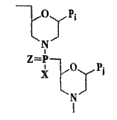
优选的寡核苷酸类似物具有不带电的或基本上不带电的主链,如图2A-2G中所示的结构之一,且优选由通过基本上不带电的、含磷的主链连接的8-25吗啉代亚基构成,如图3A-3D所示的结构。一个优选的类似物具有图3B所示的结构,其中X是NR2,其中R是H或CH3,以及Y和Z各自是O。Preferred oligonucleotide analogs have an uncharged or substantially uncharged backbone, such as one of the structures shown in Figures 2A-2G, and are preferably linked by an essentially uncharged, phosphorous-containing backbone. The 8-25 morpholino subunit constitutes the structure shown in Figure 3A-3D. A preferred analog has the structure shown in Figure 3B, where X is NR2 , where R is H or CH3 , and Y and Z are each O.
为了治疗动物患者包括人患者中的黄病毒感染,通过非肠道或口服给药于感染的患者将感染的细胞暴露于寡核苷酸类似物。该方法可以进一步包括监控体液来监控由寡核苷酸类似物与病毒基因组互补部分构成的异源双链的出现。To treat flavivirus infections in animal patients, including human patients, infected cells are exposed to oligonucleotide analogs by parenteral or oral administration to infected patients. The method may further comprise monitoring the bodily fluid for the presence of a heteroduplex consisting of the oligonucleotide analog and the complementary portion of the viral genome.
另一方面,本发明包括用于抑制动物细胞中黄病毒复制的寡核苷酸类似物。该类似物通过以下来表征:(i)核酸酶抗性主链,(ii)能够被动物细胞吸收,(iii)含有8-40个核苷酸碱基,(iv)具有至少8个碱基与黄病毒正向链RNA基因组区域互补的序列,该基因组区域包括被鉴定为SEQ ID NO:1-4的病毒基因组序列之一的至少一部分,每个序列表示两大类黄病毒之一中的病毒基因组5’和3’环化序列,和(v)能够与黄病毒ssRNA基因组形成异源双链结构,该异源双链结构通过至少45℃的解离Tm来表征,并在病毒5’和3’环化序列之间具有断裂的碱基对,如通过细胞中病毒复制的抑制来证明。类似物具有各种实施方案,对于类似物在抗病毒治疗中的用途包括上述的那些。In another aspect, the invention includes oligonucleotide analogs useful for inhibiting replication of flaviviruses in animal cells. The analog is characterized by (i) a nuclease resistant backbone, (ii) capable of being taken up by animal cells, (iii) contains 8-40 nucleotide bases, (iv) has at least 8 bases A sequence complementary to a region of the flavivirus forward-strand RNA genome comprising at least a portion of one of the viral genomic sequences identified as SEQ ID NO: 1-4, each sequence representing a member of one of the two major classes of flaviviruses 5' and 3' circularization sequences of the viral genome, and (v) capable of forming a heteroduplex structure with the flavivirus ssRNA genome characterized by a dissociation Tm of at least 45°C and at the 5' of the virus and 3' cyclized sequence, as evidenced by inhibition of viral replication in cells. Analogs have various embodiments, including those described above for the use of analogs in antiviral therapy.
当结合附图一起阅读以下本发明的详述时,本发明的这些和其它目的和特征将变得更全面清楚。These and other objects and features of the present invention will become more fully apparent when the following detailed description of the invention is read in conjunction with the accompanying drawings.
附图简述Brief description of the drawings
图1显示了黄病毒基因组的5’-端,3’-端部分,具有所示的二级结构,通过图上部的框符来表示5’和3’环化序列;和Figure 1 shows the 5'-terminal, 3'-terminal part of the flavivirus genome, with the secondary structure indicated, with the 5' and 3' cyclization sequences indicated by boxes in the upper part of the figure; and
图2A-2G显示了各种具有不带电主链的寡核苷酸类似物的主链结构;Figures 2A-2G show the backbone structures of various oligonucleotide analogs with uncharged backbones;
图3A-3D显示了实例吗啉代寡核苷酸的重复亚基部分,特指3A-3D。Figures 3A-3D show repeating subunit portions of example morpholino oligonucleotides, specifically 3A-3D.
图4A和4B是TBEV和WNV对提高TBEV反义(图4A)和干扰序列反义(图4B)浓度的响应图;和Figures 4A and 4B are graphs of the response of TBEV and WNV to increasing concentrations of TBEV antisense (Figure 4A) and interfering sequence antisense (Figure 4B); and
图5A-5D是四种登革热病毒血清型对DEN反义(SEQ ID NO:27)的响应图。Figures 5A-5D are response graphs of four dengue virus serotypes to DEN antisense (SEQ ID NO: 27).
发明详述Detailed description of the invention
I.定义I. Definition
除非另外指出,在此所用的以下术语具有以下的意思:Unless otherwise indicated, the following terms used herein have the following meanings:
术语“寡核苷酸类似物”指的是具有以下特征的寡核苷酸:(i)修饰的主链结构,例如,主链不同于天然寡-和多核苷酸中发现的标准磷酸二酯键,和(ii)任意地,修饰的糖部分,例如吗啉代部分,而不是核糖或脱氧核糖部分。类似物支持能够通过Waston-Crick碱基将氢键结合至标准多核苷酸碱基的碱基,其中类似物主链存在碱基,允许在寡核苷酸类似物分子和标准多核苷酸(例如,单链RNA或单链DNA)中的碱基之间以序列特异性方式的氢键结合。优选的类似物是具有基本上不带电的、含磷主链的那些。The term "oligonucleotide analogue" refers to an oligonucleotide having (i) a modified backbone structure, e.g., a backbone different from the standard phosphodiesters found in natural oligo- and polynucleotides bond, and (ii) optionally, a modified sugar moiety, such as a morpholino moiety, rather than a ribose or deoxyribose moiety. The analogs support bases capable of hydrogen bonding to standard polynucleotide bases via Watson-Crick bases, where the bases are present in the analog backbone, allowing the creation of analogue molecules between oligonucleotide analog molecules and standard polynucleotides (e.g. , single-stranded RNA or single-stranded DNA) hydrogen bonding between bases in a sequence-specific manner. Preferred analogs are those having an essentially uncharged, phosphorus-containing backbone.
寡核苷酸类似物中基本上不带电的、含磷的主链是一类,其中大部分亚基连接物,例如60-100%,在生理pH下是不带电的,并含有单个磷原子。类似物含有8至40个亚基,通常约8-25个亚基,优选约12至25个亚基。类似物可以具有与靶序列的确切互补的序列或接近的互补性,如下所限定的。Essentially uncharged, phosphorus-containing backbones in oligonucleotide analogs are a class in which the majority of subunit linkages, e.g., 60-100%, are uncharged at physiological pH and contain a single phosphorus atom . Analogs contain 8 to 40 subunits, usually about 8-25 subunits, preferably about 12 to 25 subunits. An analog may have an exact complementary sequence or near complementarity to the target sequence, as defined below.
寡核苷酸类似物的“亚基”指的是类似物的一个核苷酸(或核苷酸类似物)单体。术语可以指带有或不带连接的亚基间连接物的核苷酸单体,尽管,当指“带电的亚基”时,电荷通常位于亚基间连接物中(例如,磷酸酯或硫代磷酸酯连接物)。A "subunit" of an oligonucleotide analog refers to a nucleotide (or nucleotide analog) monomer of the analog. The term may refer to a nucleomonomer with or without an attached intersubunit linker, although, when referring to a "charged subunit", the charges are usually located in the intersubunit linker (e.g., phosphate or sulfur phosphoester linker).
“吗啉代寡核苷酸类似物”是由图3A-3D所示形式的吗啉代亚基结构构成的寡核苷酸类似物,其中(i)结构通过含磷的连接物连接在一起,一至三个原子长,将一个亚基的吗啉代氮连接到邻接亚基的5’环外的碳,和(ii)Pi和Pj是通过碱基特异性氢键有效结合至多核苷酸中碱基的嘌呤或嘧啶碱基对部分。嘌呤或嘧啶碱基对部分通常是腺嘌呤、胞嘧啶、鸟嘌呤、尿嘧啶或胸腺嘧啶。吗啉代寡聚物的合成、结构和结合特征详述于U.S.专利No.5,698,685,5,217,866,5,142,047,5,034,506,5,166,315,5,521,063和5,506,337中,所有在此引入作为参考。"Morpholino oligonucleotide analogs" are oligonucleotide analogs composed of morpholino subunit structures of the form shown in Figures 3A-3D, wherein the (i) structures are linked together by phosphorous linkers , one to three atoms long, linking the morpholino nitrogen of one subunit to the 5' exocyclic carbon of the adjacent subunit, and (ii) P i and P j are efficiently bound to the polynuclear by base-specific hydrogen bonds The purine or pyrimidine base pair portion of a base in a nucleotide. The purine or pyrimidine base pair moiety is typically adenine, cytosine, guanine, uracil or thymine. The synthesis, structure and binding characteristics of morpholino oligomers are described in detail in US Patent Nos. 5,698,685, 5,217,866, 5,142,047, 5,034,506, 5,166,315, 5,521,063 and 5,506,337, all of which are incorporated herein by reference.
图3B所示的亚基和连接物用于六原子重复单体主链,如图3B中所示的(其中六个原子包括:吗啉代氮、连接的磷原子、将磷原子连接5’环外碳的原子(通常为氧)、5’环外碳,以及下一个吗啉代环的两个碳原子)。这些结构中,将5’环外吗啉代碳原子连接至磷基团的原子Y1可以是硫、氮、碳,或优选氧。从磷悬挂的X部分是不干扰碱基特异性氢键结合的任何合适基团。优选的X基团包括氟、烷基、烷氧基、硫烷氧基和烷基氨基,包括环胺,所有这些都可以是不同取代的,只要碱基特异性氢键没有断裂。烷基、烷氧基和硫烷氧基优选包括1-6个碳原子。烷基氨基优选指的是低级烷基(C1至C6)取代,环胺优选5-至7-元氮杂环,任意地含有1-2个另外的选自氧、氮和硫的杂原子。Z是硫或氧,并优选为氧。The subunits and linkers shown in Figure 3B are used to repeat the monomer backbone with six atoms, as shown in Figure 3B (where the six atoms include: morpholino nitrogen, attached phosphorus atom, attached phosphorus atom 5' atoms of the exocyclic carbon (usually oxygen), the 5' exocyclic carbon, and the two carbon atoms of the next morpholino ring). In these structures, the atom Y1 connecting the 5' exocyclic morpholino carbon atom to the phosphorus group can be sulfur, nitrogen, carbon, or preferably oxygen. The X moiety pendant from the phosphorus is any suitable group that does not interfere with base specific hydrogen bonding. Preferred X groups include fluoro, alkyl, alkoxy, thioalkoxy and alkylamino, including cyclic amines, all of which may be variously substituted as long as the base-specific hydrogen bonds are not broken. Alkyl, alkoxy and thioalkoxy preferably comprise 1 to 6 carbon atoms. Alkylamino preferably refers to lower alkyl (C1 to C6) substitution, and cyclic amine is preferably a 5- to 7-membered azacyclic ring, optionally containing 1-2 additional heteroatoms selected from oxygen, nitrogen and sulfur. Z is sulfur or oxygen, and is preferably oxygen.
优选吗啉代寡聚物是二氨基磷酸酯连接的吗啉代寡聚物,在此称为PMO。这样的寡聚物由图3B中所示的吗啉代亚基结构构成,其中X=NH2、NHR或NR2(其中R是低级烷基,优选甲基),Y=O,以及Z=O,且Pi和Pj是通过碱基特异性氢键有效结合多核苷酸中碱基的嘌呤或嘧啶碱基对部分。还优选具有交替二氨基磷酸酯连接物的结构,其中图3B中,X=低级烷氧基,如甲氧基或乙氧基,Y=NH或NR,其中R是低级烷基,以及Z=O。Preferred morpholino oligomers are phosphorodiamidate linked morpholino oligomers, referred to herein as PMOs. Such oligomers consist of the morpholino subunit structure shown in Figure 3B, where X = NH2 , NHR or NR2 (where R is lower alkyl, preferably methyl), Y = O, and Z = O, and P i and P j are purine or pyrimidine base pair moieties that effectively bind bases in the polynucleotide via base-specific hydrogen bonds. Also preferred are structures with alternating phosphorodiamidate linkages, wherein in Figure 3B, X = lower alkoxy, such as methoxy or ethoxy, Y = NH or NR, where R is lower alkyl, and Z = O.
术语“取代的”,尤其对于烷基、烷氧基、硫烷氧基或烷基氨基基团,指的是用含有杂原子的取代基替代碳上的氢原子,如卤素、羟基、烷氧基、硫醇、烷基硫、氨基、烷基氨基、亚氨基、氧(酮)、氮、氰基或各种酸或酯如羧基的、磺基的或磷酸的。还可以指用烷基、羰基或其它含碳基团替代杂原子(如胺氢)上的氢原子。The term "substituted", especially for an alkyl, alkoxy, thioalkoxy or alkylamino group, refers to the replacement of a hydrogen atom on carbon with a substituent containing a heteroatom, such as halogen, hydroxy, alkoxy group, thiol, alkylthio, amino, alkylamino, imino, oxygen (ketone), nitrogen, cyano or various acids or esters such as carboxy, sulfo or phosphoric. It can also refer to the replacement of a hydrogen atom on a heteroatom (such as an amine hydrogen) with an alkyl group, carbonyl group or other carbon-containing group.
如在此所用的术语“靶”,对于病毒基因组RNA,指的是病毒基因组RNA,可以包括是病毒复制链的正向链RNA,或在产生正向链RNA多个新拷贝中形成的负向链或反义链。As used herein, the term "target" refers to viral genomic RNA, which may include the positive-sense RNA that is the viral replication strand, or the negative-sense RNA that is formed in the production of multiple new copies of the forward-sense RNA. strand or antisense strand.
术语“靶序列”指的是寡核苷酸类似物对准的靶RNA的一部分,即寡核苷酸类似物将与其杂交的序列。靶序列包括鉴定为SEQ IDNO:1-4序列之一的至少一部分,这些序列表示两大类黄病毒之一的基因组5’或3’环化序列,如下将进一步讨论。如将看到的,靶序列可以是病毒基因组的邻接区域,或可以由基因组5’和3’环化序列两者的互补片段构成。The term "target sequence" refers to the portion of the target RNA to which the oligonucleotide analog is aligned, ie the sequence to which the oligonucleotide analog will hybridize. Target sequences include at least a portion of one of the sequences identified as SEQ ID NO: 1-4, which represent the genomic 5' or 3' circularization sequence of one of the two major classes of flaviviruses, as discussed further below. As will be seen, the target sequence may be a contiguous region of the viral genome, or may consist of complementary segments of both the 5' and 3' circularized sequences of the genome.
术语“靶向序列”是与RNA基因组中的靶序列互补或基本上互补的寡核苷酸类似物中的序列。类似物的全部序列或只有一部分可以与靶序列或全部类似物序列的一部分互补。例如,具有20个碱基的类似物中,只有8-12个是靶向序列。通常,靶向序列由类似物中邻接的碱基形成,但或者可以由非邻接的序列形成,例如,来自类似物的反向端,当放于一起时构成跨越靶序列的序列。如将看到的,选择靶和靶向序列使得类似物和病毒基因组的结合起作用来破坏或防止通过基因组中5’-和3’-环化序列来形成的RNA二级结构的形成。The term "targeting sequence" is a sequence in an oligonucleotide analog that is complementary or substantially complementary to a target sequence in the RNA genome. All or only a portion of the analog may be complementary to a target sequence or a portion of the entire analog sequence. For example, of an analog with 20 bases, only 8-12 are targeting sequences. Typically, the targeting sequence is formed from contiguous bases in the analog, but may alternatively be formed from non-contiguous sequences, eg, from the reverse end of the analog, which when taken together constitute a sequence spanning the target sequence. As will be seen, the target and targeting sequence are selected such that the binding of the analog to the viral genome acts to disrupt or prevent the formation of RNA secondary structure formed by 5'- and 3'-cycling sequences in the genome.
靶和靶向序列描述为当在反平行的构象中发生杂交时是相互“互补的”。双链多核苷酸可以与另一多核苷酸“互补”。靶向可以具有与靶序列的“接近的”或“基本上的”互补性,且对于本发明的目的仍然起作用。优选,本发明中所用的寡核苷酸类似物与10个核苷酸靶序列至多具有一个错配,优选20个至多一个错配。或者,所用的反义寡聚物与在此所指的实例靶向序列具有至少90%的序列同源性,优选至少95%的序列同源性。Target and targeting sequences are described as being "complementary" to each other when hybridized in an antiparallel conformation. A double-stranded polynucleotide can be "complementary" to another polynucleotide. Targeting can have "near" or "substantial" complementarity to the target sequence and still be functional for the purposes of the present invention. Preferably, the oligonucleotide analogs used in the present invention have at most one mismatch with 10 nucleotides of the target sequence, preferably at most 20 with one mismatch. Alternatively, the antisense oligomers used have at least 90% sequence identity, preferably at least 95% sequence identity, to the example targeting sequences referred to herein.
如果寡聚物在生理条件下与靶杂交,与靶多核苷酸“特异性杂交”的寡核苷酸类似物具有基本上高于45℃的Tm,优选至少50℃,通常60-80℃或更高。这样杂交优选对应于严谨杂交条件。在给定的离子强度和pH,Tm是50%靶序列与互补多核苷酸杂交的温度。再次,这样的杂交可以使用与靶序列“接近”或“基本上”互补的以及具有精确互补性的反义寡聚物来进行。An oligonucleotide analog that "specifically hybridizes" to a target polynucleotide has a Tm substantially above 45°C, preferably at least 50°C, typically 60-80°C, if the oligomer hybridizes to the target under physiological conditions or higher. Such hybridization preferably corresponds to stringent hybridization conditions. At a given ionic strength and pH, the Tm is the temperature at which 50% of the target sequence hybridizes to a complementary polynucleotide. Again, such hybridization can be performed using antisense oligomers that are "nearly" or "substantially" complementary to the target sequence, as well as have exact complementarity.
“核酸酶抗性”寡聚分子(寡聚物)指的是其主链以非杂交的或杂交的形式对核酸酶裂解基本上是抗性的分子;通过体内普通的胞外和胞内核酸酶;即,在体内寡聚物暴露于其的核酸酶正常条件下,寡聚物显示少的或没有核酸酶裂解。"Nuclease-resistant" oligomeric molecules (oligomers) refer to molecules whose backbone, in either unhybridized or hybridized form, is substantially resistant to nuclease cleavage; Enzyme; that is, the oligomer exhibits little or no nuclease cleavage under normal conditions of nucleases to which the oligomer is exposed in vivo.
“异源双链”指的是寡核苷酸类似物和靶RNA互补部分之间的双链体。“核酸酶抗性异源双链”指的是通过反义寡聚物与其互补靶结合形成的异源双链,使得异源双链对体内的胞内和胞外核酸酶降解基本上是抗性的,如RNA酶H,其能够切割双链RNA/RNA或RNA/DNA复合物。"Heteroduplex" refers to a duplex between an oligonucleotide analog and a complementary portion of a target RNA. "Nuclease-resistant heteroduplex" refers to a heteroduplex formed by binding of an antisense oligomer to its complementary target such that the heteroduplex is substantially resistant to degradation by intracellular and extracellular nucleases in vivo. specific, such as RNase H, which cleaves double-stranded RNA/RNA or RNA/DNA complexes.
“涉及靶RNA的碱基特异性胞内结合”指的是寡核苷酸类似物与细胞内靶RNA序列的特异性结合。这样结合的碱基特异性是序列特异性的。例如,单链多核苷酸可以特异性结合序列中互补的单链多核苷酸。"Base-specific intracellular binding involving a target RNA" refers to the specific binding of an oligonucleotide analog to a target RNA sequence within a cell. The base specificity of such binding is sequence specific. For example, a single-stranded polynucleotide can specifically bind to a complementary single-stranded polynucleotide in the sequence.
瞄准感染ssRNA病毒的反义寡聚物的“有效量”,是有效降低感染病毒的复制速率,和/或病毒载量,和/或与病毒感染相关症状的量。An "effective amount" of an antisense oligomer targeting an infectious ssRNA virus is an amount effective to reduce the replication rate of the infected virus, and/or the viral load, and/or the symptoms associated with viral infection.
如在此所用的,术语“体液”包括从患者获得的各种样品类型,包括尿液、唾液、血浆、血液、脊髓液或其它生物来源的样品,如皮肤细胞或皮肤碎片,并可以指悬浮于其中的细胞或细胞碎片,或液体介质及其溶质。As used herein, the term "body fluid" includes various sample types obtained from a patient, including urine, saliva, plasma, blood, spinal fluid, or other samples of biological origin, such as skin cells or skin fragments, and may refer to suspended Cells or cell fragments contained therein, or liquid medium and its solutes.
在测试测量和对照测量之间形成比较时使用术语“相对量”。反应中形成复合物的试剂的相对量是与和对照样本反应的量相比较的和测试样本反应的量。可以在相同测试中分开运行对照样本,或可以是相同样品的一部分(例如,组织切片中围绕恶性部分的正常组织)。The term "relative amount" is used when making a comparison between a test measurement and a control measurement. The relative amount of complex-forming reagent in the reaction is the amount reacted with the test sample compared to the amount reacted with the control sample. The control sample can be run separately in the same test, or can be part of the same sample (eg, normal tissue surrounding a malignant portion in a tissue section).
个体或细胞的“治疗”是发明提供的任何类型的作为改变个体或细胞天然过程的方式。治疗包括但不限于例如给药药物组合物,可以预防性地进行,或疾病开始或接触病原后进行。相关的术语“提高的治疗结果”对于诊断为感染特定病毒的患者,指的是减缓或减少病毒的生长或病毒载量,或与该特定病毒感染相关的可检测症状。"Treatment" of an individual or cell is any type provided by the invention as a means of altering the natural processes of the individual or cell. Treatment includes, but is not limited to, for example, administration of pharmaceutical compositions, which can be performed prophylactically, or following the onset of a disease or exposure to a pathogen. The related term "improved therapeutic outcome" refers to a slowing or reduction of viral growth or viral load, or detectable symptoms associated with a particular viral infection, in a patient diagnosed with a particular viral infection.
当药剂通过被动扩散以外的机理穿过细胞膜进入细胞时,药剂是“通过哺乳动物主动吸收的”。药剂可以得到运输,例如,通过“主动运输”,指的是药剂通过例如ATP-依赖性运输机理穿过哺乳动物细胞膜的运输,或通过“易化运输”指的是反义药剂通过需要药剂和运输蛋白结合的运输机理穿过细胞膜的运输,运输蛋白然后帮助结合的药剂穿过膜。对于主动运输和易化运输两者,寡核苷酸类似物优选具有基本上不带电的主链,如下所限定的。或者,反义化合物可以配制成复合形式,如具有与阴离子脂质或脂质体复合的阳离子主链的药剂,其可以通过胞吞机理吸收入细胞中。例如类似物在其5’或3’端可以和富含精氨酸的肽例如HIV TAT蛋白质或多精氨酸缀合,来帮助运输进靶宿主细胞中。An agent is "actively absorbed by a mammal" when it enters a cell across a cell membrane by a mechanism other than passive diffusion. The agent can be transported, for example, by "active transport", which refers to the transport of the agent across the mammalian cell membrane by, for example, ATP-dependent transport mechanisms, or by "facilitated transport", which refers to the passage of the antisense agent by requiring the agent and The transport mechanism associated with transport proteins transports across the cell membrane, transport proteins then assist the bound agent to pass through the membrane. For both active and facilitated transport, the oligonucleotide analogue preferably has a substantially uncharged backbone, as defined below. Alternatively, antisense compounds can be formulated in complexed form, such as agents having a cationic backbone complexed with anionic lipids or liposomes, which can be taken up into cells by endocytic mechanisms. For example the analog can be conjugated at its 5' or 3' end to an arginine-rich peptide such as the HIV TAT protein or polyarginine to facilitate transport into the target host cell.
II.靶黄病毒II. Target flaviviruses
本发明是基于通过将感染黄病毒的细胞暴露于寡聚类似物可以获得黄病毒复制的有效抑制的发现,该寡聚类似物(i)瞄准黄病毒RNA的3’-CS(或5’-CS)区域,和(ii)具有物理和药物动力学特征,其使得在类似物和宿主细胞内的病毒RNA之间可以有效地相互作用。一方面,类似物可以用于治疗病毒感染的哺乳动物患者。The present invention is based on the discovery that effective inhibition of flavivirus replication can be obtained by exposing flavivirus-infected cells to oligomeric analogs that (i) target the 3'-CS (or 5'-CS) of flavivirus RNA. CS) region, and (ii) have physical and pharmacokinetic characteristics that allow efficient interaction between the analog and the viral RNA in the host cell. In one aspect, the analogs can be used to treat virally infected mammalian patients.
本发明瞄准包括以下所述病毒的黄病毒科的黄病毒属的成员。黄病毒基因、以及其中的成员的各种物理、形态学和生物学特征,可以发现于,例如,Textbook of Human Virology,R.Belshe编辑,第2版,Mosby,1991,以及一个或多个上述参考文献中。以下概述每种黄病毒成员的一些关键的生物学、病理和流行病学特征。The present invention is aimed at members of the Flavivirus genus of the Flaviviridae family including the viruses described below. Flavivirus genes, and various physical, morphological and biological characteristics of members thereof, can be found, for example, in Textbook of Human Virology, edited by R. Belshe, 2nd edition, Mosby, 1991, and one or more of the above in the references. Some key biological, pathological and epidemiological features of each flavivirus member are outlined below.
黄病毒复制Flavivirus replication
黄病毒是小的、包膜的病毒,含有单的、正向链基因组RNA,约10,500核苷酸长,含有短的5’和3’非翻译区域(NTR),单个长的开放阅读框,5’帽子,和非多腺苷酸化的3’末端。已经报道了多数黄病毒基因组的完整核苷酸序列,包括所有四种登革热血清型,黄热病毒,日本脑炎病毒,西尼罗病毒和蝉传脑炎病毒。所有黄病毒蛋白质通过由宿主以及病毒编码的蛋白酶介导的精确加工过程,来源自单长多蛋白质。单个开放阅读框编码的十个基因产物被翻译成多蛋白质,这些多蛋白质依次由以下组成:壳体(C)、前膜(prM,其就在病毒粒子从细胞释放之前被加工成膜(M))、包膜(E)和七个非结构(NS)蛋白:NS1、NS2a、NS2b、NS3、NS4a、NS4b和NS5(Leyssen,De Clercq等,2000;Brinton 2002)。Flaviviruses are small, enveloped viruses containing a single, forward-sense genomic RNA, approximately 10,500 nucleotides long, containing short 5' and 3' untranslated regions (NTRs), a single long open reading frame, 5' cap, and non-polyadenylated 3' end. Complete nucleotide sequences have been reported for most flavivirus genomes, including all four dengue serotypes, yellow fever virus, Japanese encephalitis virus, West Nile virus, and cicada-borne encephalitis virus. All flavivirus proteins are derived from single-length polyproteins through precise processing mediated by host- and virus-encoded proteases. Ten gene products encoded by a single open reading frame are translated into polyproteins, which in turn consist of the capsid (C), the premembrane (prM, which is processed into a membrane (M )), envelope (E), and seven nonstructural (NS) proteins: NS1, NS2a, NS2b, NS3, NS4a, NS4b, and NS5 (Leyssen, De Clercq et al., 2000; Brinton 2002).
所有蚊子传播的黄病毒共有保守的RNA序列和结构(Proutski,Gould等,1997;Zeng,Falgout等,1998;Li,Li等,2002)。黄病毒3’-NTR和5’NTR的序列比较和RNA二级结构预测已经揭示了数个短的、完全保守的序列并表明3’-端区域(约90个碱基)可以折叠成保守的茎环结构(Hahn,Hahn等,1987)。保守的茎环结构已经显示在许多正向链RNA病毒中对病毒复制是重要的。黄病毒中黄病毒3’茎环结构初级序列不是完全保守的,但二级结构是完全保守的。短的保守序列(3’-CS,SEQ ID NO:3)已经被鉴定为位于保守茎环结构的上游(即,5’方向中)。已经提出3’-CS和基因组5’端保守序列(5’-CS,SEQID NO:1)之间的互补性导致大范围分子内RNA相互作用和基因组RNA的环化(Hahn,Hahn等,1987;You,Falgout等,2001;Corver,Lenches等,2003)。最近的实验表明这些序列间的碱基对对于库宁病毒复制子的RNA复制是必需的(Khromykh,Meka等,2001)。计算机产生的预测的登革热病毒5’-CS和3’-CS之间的二级结构显示于图1中(Khromykh,Meka等,2001),5’-CS和3’-CS显示于图上部的框符中,并在此分别以SEQ ID NO:1和3来识别。还已经在蝉传脑炎病毒基因组的5’和3’端区域鉴定了短的互补序列(分别为SEQ ID NO:2和4),并提出与潜在环化序列相似的功能(Khromykh,Meka等,2001)。All mosquito-borne flaviviruses share a conserved RNA sequence and structure (Proutski, Gould et al., 1997; Zeng, Falgout et al., 1998; Li, Li et al., 2002). Sequence comparison and RNA secondary structure prediction of flavivirus 3'-NTR and 5'NTR have revealed several short, fully conserved sequences and indicated that the 3'-terminal region (approximately 90 bases) can fold into a conserved Stem-loop structure (Hahn, Hahn et al., 1987). The conserved stem-loop structure has been shown to be important for viral replication in many forward-sense RNA viruses. The primary sequence of the flavivirus 3'stem-loop structure among flaviviruses is not completely conserved, but the secondary structure is completely conserved. A short conserved sequence (3'-CS, SEQ ID NO:3) has been identified upstream (i.e., in the 5' direction) of the conserved stem-loop structure. It has been proposed that complementarity between the 3'-CS and the conserved sequence at the 5' end of the genome (5'-CS, SEQ ID NO: 1) leads to large-scale intramolecular RNA interactions and circularization of genomic RNA (Hahn, Hahn et al., 1987 ; You, Falgout et al., 2001; Corver, Lenches et al., 2003). Recent experiments have shown that base pairs between these sequences are essential for the RNA replication of the Kunin virus replicon (Khromykh, Meka et al., 2001). The computer generated predicted secondary structure between the 5'-CS and 3'-CS of dengue virus is shown in Figure 1 (Khromykh, Meka et al., 2001), and the 5'-CS and 3'-CS are shown in the upper part of the figure box and are identified herein as SEQ ID NO: 1 and 3, respectively. Short complementary sequences have also been identified in the 5' and 3' regions of the cicada-borne encephalitis virus genome (SEQ ID NO: 2 and 4, respectively), and have been proposed to function similarly to potential circularizing sequences (Khromykh, Meka et al. , 2001).
登革热病毒dengue virus
尽管在不同的病毒中黄病毒传播和感染的病理学是非常可变的,登革热病毒作为该属的说明性实例。登革热病毒是节肢动物传播的病毒(虫媒病毒)并通过伊蚊属(Aedes)的蚊子传播给人,主要是A.aegypti和A.albopictus。病毒导致呈现高烧、头疼、肌肉和关节酸痛以及皮疹的疾病。一些情况中,通常在儿童中,看到更严重形式的感染,伴随登革热出血热/登革热休克综合征(DHF/DSS),以严重出血、血管通透性或两者导致休克为特征。已经感染给定登革热血清型并随后感染不同血清型的个体对于DHF/DSS的风险显著更高。没有诊断和迅速的医疗干涉,DHF/DSS的突然发作和快速进展是致命的。Although the pathology of flavivirus transmission and infection is very variable among different viruses, dengue virus serves as an illustrative example of this genus. Dengue virus is an arthropod-borne virus (arbovirus) and transmitted to humans by mosquitoes of the genus Aedes, mainly A. aegypti and A. albopictus. The virus causes an illness that manifests as high fever, headache, muscle and joint aches, and rash. In some cases, usually in children, a more severe form of infection is seen with dengue hemorrhagic fever/dengue shock syndrome (DHF/DSS), characterized by severe bleeding, vascular permeability, or both leading to shock. Individuals who have been infected with a given dengue serotype and subsequently infected with a different serotype are at significantly higher risk for DHF/DSS. Without diagnosis and prompt medical intervention, the sudden onset and rapid progression of DHF/DSS can be fatal.
通过四种登革热病毒中的一种或多种引起的地方性登革热在许多热带和亚热带地区是主要的公众健康问题。有时涉及百万个体的突发登革热流行病持续发生。就全球发病率和死亡率而言,登革热病毒是节肢动物传导病毒中最显著的组,估计每年有一亿例登革热发生,包括500,000例DHF/DSS。随着全球人口的增长,尤其遍布热带的人群城市化,以及持续蚊子控制方法的缺乏,登革热的蚊子载体已经将它们的分布扩充至遍布热带、亚热带和一些温带地区,将登革热感染的风险带至超过全世界人口的一半。现代飞机旅行和人移民已经帮助了登革热血清型的全球分布,使得目前登革热的多个血清型在许多地区是地方病。伴随这,在过去15年中登革热流行病的频率和DHF/DSS的发病率提高。例如,东南亚,DHF/DSS是儿童住院和死亡的主要原因(Hayes和Gubler,1992)。Endemic dengue, caused by one or more of the four dengue viruses, is a major public health problem in many tropical and subtropical regions. Sudden dengue epidemics, sometimes involving millions of individuals, continue to occur. Dengue viruses are the most prominent group of arthropod-transmitting viruses in terms of global morbidity and mortality, with an estimated 100 million cases of dengue occurring each year, including 500,000 cases of DHF/DSS. With global population growth, urbanization especially throughout the tropics, and lack of sustained mosquito control methods, the mosquito vectors of dengue have expanded their distribution throughout the tropics, subtropics, and some temperate regions, bringing the risk of dengue infection to more than half of the world's population. Modern air travel and human migration have aided in the global distribution of dengue serotypes such that multiple dengue serotypes are now endemic in many regions. Concomitant with this, the frequency of dengue epidemics and the incidence of DHF/DSS have increased over the past 15 years. For example, in Southeast Asia, DHF/DSS is the leading cause of hospitalization and death in children (Hayes and Gubler, 1992).
如下所述的,黄病毒属的许多其它成员也是严重疾病如黄热、日本脑炎、圣路易脑炎、澳大利亚脑炎和蝉传脑炎的病原。As described below, many other members of the Flavivirus genus are also causative agents of severe diseases such as yellow fever, Japanese encephalitis, St. Louis encephalitis, Australian encephalitis, and cicada-borne encephalitis.
黄热病毒yellow fever virus
尽管黄热病毒的有效疫苗已经获得了很多年,该病毒继续是出血热的主要原因,死亡率高达50%。在世界范围内,每年存在200,000估算的黄热病例(30,000死亡)。在无黄热的国家中还发生少量的输入病例(WHO,Fact Sheet 100,2001)。Although an effective vaccine against yellow fever virus has been available for many years, the virus continues to be the leading cause of hemorrhagic fever with a mortality rate of up to 50%. Worldwide, there are an estimated 200,000 cases of yellow fever (30,000 deaths) per year. Small numbers of imported cases also occur in countries free of yellow fever (WHO,
日本脑炎病毒Japanese encephalitis virus
该虫媒病毒是世界范围内病毒性脑炎的主要原因。在亚洲每年约发生50,000病例并导致高死亡率(30%)或存活患者的永久性神经逻辑后遗症(30%)。JEV导致的流行性发作在亚洲热带和亚热带的人口密集地区继续形成严重的公众健康问题。通过Culex属的蚊子种传播,疾病临床表现为脑炎,通常是严重的和幼童和老年人中的高死亡率。JEV还感染家畜如猪和马。最近二十年中,在日本、韩国和台湾使用灭活JEV疫苗免疫已经使疾病处于控制下。然而,由于制造疫苗的高成本,在最需要的那些国家不容易获得(CDC,Japanese Encephalitis FactSheet,2001)。This arbovirus is a major cause of viral encephalitis worldwide. Approximately 50,000 cases occur annually in Asia and result in high mortality (30%) or permanent neurologic sequelae (30%) in surviving patients. Epidemic episodes caused by JEV continue to pose serious public health problems in populated areas of tropical and subtropical Asia. Transmitted by mosquito species of the Culex genus, the disease manifests clinically as encephalitis, usually severe and with high mortality in young children and the elderly. JEV also infects domestic animals such as pigs and horses. In the last two decades, immunization with inactivated JEV vaccines has brought the disease under control in Japan, Korea, and Taiwan. However, due to the high cost of manufacturing vaccines, they are not readily available in those countries where they are most needed (CDC, Japanese Encephalitis FactSheet, 2001).
河谷脑炎病毒和库宁病毒valley encephalitis virus and kunin virus
这些病毒是“澳大利亚脑炎”的病原体,澳大利亚脑炎是通过无菌性脑膜炎和/或脑炎来表征的临床综合征。两者都是虫媒病毒,通过Culex蚊子传播,且在北澳大利亚是地方病。河谷脑炎综合征几乎总是包括发热的突然发作;厌食和头痛。几天后体验到脑机能障碍,接着是昏迷和死亡。很少能从脑炎综合征中恢复而没有发生一些残留的精神或机能残疾。库宁病毒,与西尼罗非常相关的病毒(Scherret,Poidinger等,2001),导致与河谷脑炎病毒临床上相似的疾病,但通常严重性较低,报道的人感染频率较少。These viruses are the causative agents of "Australian encephalitis", a clinical syndrome characterized by aseptic meningitis and/or encephalitis. Both are arboviruses, transmitted by Culex mosquitoes, and are endemic in Northern Australia. Valley encephalitis syndrome almost always includes sudden onset of fever; anorexia and headache. Cerebral dysfunction was experienced a few days later, followed by coma and death. It is rare to recover from encephalitic syndrome without developing some residual mental or functional disability. Kunin virus, a virus very related to West Nile (Scherret, Poidinger et al., 2001), causes disease clinically similar to valley encephalitis virus, but is usually less severe and has been reported less frequently in humans.
西尼罗病毒west nile virus
近些年出现的西尼罗病毒(WNV),另一种节肢动物传播的黄病毒,不仅对人而且对其它动物物种如马和鸟是致命健康的威胁。1999年,纽约是北美第一个报道西尼罗病毒感染病例的地方。之前仅在非洲、中东和东欧发现人的西尼罗病毒感染。通过蚊子将病毒传播给人和几个动物物种,蚊子从感染的鸟上获得病毒。西尼罗病毒对公众健康仍然是持续的威胁。流行病学和病毒学研究表明活的病毒继续存在于蚊子和鸟群中。在纽约、新泽西和康涅狄格和许多其它东部的州中执行蚊子控制方法,仍然诊断到新的西尼罗病毒病例。目前,已经几乎在美国每个州中发现了西尼罗病毒(Enserink,2002)。The recent emergence of West Nile virus (WNV), another arthropod-borne flavivirus, is a fatal health threat not only to humans but also to other animal species such as horses and birds. In 1999, New York was the first place in North America to report a case of West Nile virus infection. West Nile virus infection in humans has previously been found only in Africa, the Middle East, and Eastern Europe. The virus is transmitted to humans and several animal species by mosquitoes, which acquire the virus from infected birds. West Nile virus remains a persistent threat to public health. Epidemiological and virological studies have shown that live virus persists in mosquito and bird populations. Mosquito control methods are being implemented in New York, New Jersey and Connecticut and many other eastern states, and new cases of West Nile virus are still being diagnosed. Currently, West Nile virus has been found in almost every state in the United States (Enserink, 2002).
西尼罗病毒感染的人中,每150至300个中约1个将变成患病的,伴有发烧、肌痛和可能的皮疹。有症状的那些患者中,约10-15%将具有脑膜炎(头痛、颈强直)或脑炎(精神状态的改变、外周神经异常、肌肉虚弱)的表现。几乎全部死亡发生在年龄超过50岁的人群中。中枢神经系统感染患者中的死亡率为5%至11%。死亡是由于需要供氧支持的中枢神经系统延长的机能障碍并导致继发性并发症。延长的神经症状发生在西尼罗病毒导致的脑炎存活者中。About 1 in every 150 to 300 people infected with West Nile virus will become ill, with fever, myalgia, and possibly a rash. Of those who are symptomatic, approximately 10-15% will have manifestations of meningitis (headache, neck stiffness) or encephalitis (altered mental status, peripheral nerve abnormalities, muscle weakness). Almost all deaths occurred in people over the age of 50. Mortality among patients with CNS infection ranges from 5% to 11%. Death was due to prolonged central nervous system dysfunction requiring oxygen support with secondary complications. Prolonged neurological symptoms occur in survivors of encephalitis caused by West Nile virus.
圣路易脑炎病毒St.Louis encephalitis virus
尽管最近没有圣路易脑炎病毒的流行,其仍然是美国西部的地方病,且是严重疾病包括无菌性脑膜炎和/或脑炎的诱因。另一种虫媒病毒,SLEV是U.S.最近爆发的1975年和1990年发生的最大发作的不可预测和间歇流行病的原因。Although there have been no recent epidemics of St. Louis encephalitis virus, it remains endemic in the western United States and is a cause of severe disease, including aseptic meningitis and/or encephalitis. Another arbovirus, SLEV, was responsible for the most recent U.S. outbreaks of unpredictable and intermittent epidemics with the largest outbreaks occurring in 1975 and 1990.
蝉传脑炎cicada-borne encephalitis
蝉传脑炎(TBE)是发生在欧洲和亚洲大部分的最危险的人感染之一。病原是蝉传脑炎病毒(TBEV)。相信每年在俄罗斯TBEV导致至少11,000人病例的脑炎,包括89-166例死亡,以及欧洲的其它部分每年约3000例(Ternovoi,Kurzhukov等,2003)。TBE病毒通常是剧毒的,伴随轻度或无症状至严重脑炎的症状,死亡率达40%。相同组中的相关病毒,羊跳跃病病毒(LIV)和Powassan病毒(POW),也导致人脑炎,但很少达到流行病的规模。相同组中的两种另外病毒,森林出血热病毒(KFD)和Alkhurma病毒(ALK),和TBE复合病毒非常相关,并易于导致脑炎以外的致命出血热(Gritsun,Lashkevich等,2003)。Cicada-borne encephalitis (TBE) is one of the most dangerous human infections occurring in most of Europe and Asia. The causative agent is cicada-borne encephalitis virus (TBEV). TBEV is believed to cause at least 11,000 human cases of encephalitis including 89-166 deaths per year in Russia, and about 3000 per year in other parts of Europe (Ternovoi, Kurzhukov et al., 2003). TBE virus is usually highly virulent, with mild or asymptomatic to severe encephalitic symptoms and a mortality rate of 40%. Related viruses in the same group, sheep jumping disease virus (LIV) and Powassan virus (POW), also cause encephalitis in humans, but rarely on epidemic scale. Two additional viruses in the same group, forest hemorrhagic fever virus (KFD) and Alkhurma virus (ALK), are very related to TBE complex viruses and are prone to cause fatal hemorrhagic fevers other than encephalitis (Gritsun, Lashkevich et al., 2003).
III.病毒靶区域和靶向序列III. Viral Target Regions and Targeting Sequences
优选的靶序列是邻接的那些并包括正向链黄病毒RNA5’-CS或3’-CS序列的至少一部分,例如,2-8个碱基。如上所述的,为了启动RNA复制,这些保守的环化序列(CS)通过紧密结合病毒RNA的3’和5’片段近端在病毒复制中起重要作用(Hahn,Hahn等,1987;Khromykh,Meka等,2001)。从公知来源如NCBI基因库数据库可以获得各种黄病毒基因组序列。或者,本领域技术人员可以在公开的文献中发现许多患者病毒的序列,例如,寻找公开指定病毒序列信息的参考文献。一旦获得完整或部分病毒序列,即可鉴定病毒的5’和3’序列。Preferred target sequences are those that are contiguous and include at least a portion, e.g., 2-8 bases, of the 5'-CS or 3'-CS sequence of the forward-strand flaviviral RNA. As mentioned above, in order to initiate RNA replication, these conserved circularization sequences (CS) play an important role in viral replication by tightly binding proximal to the 3' and 5' segments of viral RNA (Hahn, Hahn et al., 1987; Khromykh, Meka et al., 2001). Various flavivirus genome sequences are available from well known sources such as the NCBI GenBank database. Alternatively, one skilled in the art can find the sequences of many of the patient's viruses in the published literature, for example, by looking for references that disclose sequence information for a given virus. Once the complete or partial viral sequence is obtained, the 5' and 3' sequences of the virus can be identified.
相应病毒基因组列中含有5’-CS和3’-CS末端的实例病毒核酸序列的基因库参考列于以下的表1中。将认识到这些序列仅仅是黄病毒属中其它序列的说明,因为可以从文献或专利来源的可获得基因序列数据库中获得的。以下的序列,如SEQ ID NO:5-15识别的,也列于说明书结尾的表3中。保守的5’-CS和3’-CS以粗体显示于表1中并作为SEQ ID NO:1-4列于表1中。Genebank references for example viral nucleic acid sequences containing the 5'-CS and 3'-CS ends in the corresponding viral genome columns are listed in Table 1 below. It will be appreciated that these sequences are illustrative only of other sequences in the Flavivirus genus as may be obtained from available gene sequence databases from literature or patent sources. The following sequences, as identified by SEQ ID NO: 5-15, are also listed in Table 3 at the end of the specification. The conserved 5'-CS and 3'-CS are shown in bold and listed in Table 1 as SEQ ID NO: 1-4.
另一组实例靶序列是SEQ ID NO:5-15的补体;即具有识别序列5-15之一的互补反平行序列。例如,SEQ ID NO:5(5’-GUCAAUAUGCUAAAACGCGG-3’)的补体是5’-CCGCGUUUUAGCAUAUUGAC-3。Another set of example target sequences is the complement of SEQ ID NO: 5-15; that is, the complementary antiparallel sequence with one of the recognition sequences 5-15. For example, the complement of SEQ ID NO: 5 (5'-GUCAAUAUGCUAAAACGCGG-3') is 5'-CCGCGUUUUAGCAUAUUGAC-3.
表1.实例5’-CS和3’-CS靶序列Table 1. Example 5'-CS and 3'-CS target sequences
靶序列和靶向序列之间互补性的程度足以形成稳定的双链体。反义寡聚物和靶RNA序列的互补型区域可以短为8-11个碱基,但是优选12-15个碱基或更多,例如12-20个碱基,或12-25个碱基。约15个碱基的反义寡聚物通常足够长来具有病毒基因组中的独特互补序列。此外,需要最小长度的互补碱基来获得必不可少的结合Tm,如下所述的。The degree of complementarity between the target sequence and the targeting sequence is sufficient to form a stable duplex. The complementary region of the antisense oligomer and target RNA sequence can be as short as 8-11 bases, but preferably 12-15 bases or more, such as 12-20 bases, or 12-25 bases . Antisense oligomers of about 15 bases are usually long enough to have complementary sequences unique in the viral genome. Furthermore, a minimum length of complementary bases is required to obtain the requisite binding Tm , as described below.
长40个碱基的寡聚物是合适的,其中至少最小数量的碱基,例如,8-11个,优选12-15个碱基,是与靶序列互补的。然而,通常,寡聚物长度低于约30,优选低于25,更优选20或更少碱基时,细胞中的易化吸收或主动吸收是最佳的。对于PMO寡聚物,以下进一步描述,结合稳定性和吸收的最佳平衡通常发生在13-23个碱基的长度。Oligomers of 40 bases in length are suitable, wherein at least a minimum number of bases, eg, 8-11, preferably 12-15 bases, are complementary to the target sequence. In general, however, facilitated or active uptake in cells is optimal with oligomer lengths below about 30, preferably below 25, more preferably 20 or fewer bases. For PMO oligomers, described further below, the optimal balance of binding stability and uptake typically occurs at a length of 13-23 bases.
寡聚物可以是与病毒核酸靶序列100%互补的,或可以包括错配,例如,来适应变体,只要寡聚物和病毒核酸靶序列之间形成的异源双链足够稳定来抵抗细胞核酸酶的作用和体内发生的其它方式的降解。以下讨论对核酸酶裂解较少敏感的寡聚物主链。如果存在,错配朝向杂交双链末端的动摇比中间低。根据充分理解的双链稳定性原理,允许的错配数量将取决于寡聚物的长度、双链中G∶C碱基对的百分比以及双链中错配的位置。尽管这样的反义寡聚物不是必需与病毒核酸靶序列100%互补,其有效地与靶序列稳定而特异性地结合,使得核酸靶的生物活性例如病毒RNA的环化得到调节。The oligomer may be 100% complementary to the viral nucleic acid target sequence, or may include mismatches, e.g., to accommodate variants, as long as the heteroduplex formed between the oligomer and the viral nucleic acid target sequence is sufficiently stable against cellular The action of nucleases and other means of degradation that occur in vivo. Oligomer backbones that are less susceptible to nuclease cleavage are discussed below. If present, mismatches are less swayed towards the end of the hybridized duplex than in the middle. According to well understood principles of duplex stability, the number of mismatches allowed will depend on the length of the oligomer, the percentage of G:C base pairs in the duplex, and the location of the mismatch in the duplex. Although such antisense oligomers are not necessarily 100% complementary to the viral nucleic acid target sequence, they effectively bind to the target sequence stably and specifically so that the biological activity of the nucleic acid target, such as circularization of the viral RNA, is modulated.
寡聚物和靶序列之间形成的双链体的稳定性是结合Tm和双链对细胞酶裂解敏感性的函数。可以通过常规方法测量对于互补-序列RNA的反义化合物的Tm,如Hames等,Nucleic Acid Hybridization,IRL Press,1985,pp.107-108中所述的那些。每个反义寡聚物具有对于互补-序列RNA的高于体温优选高于45℃的结合Tm。优选60-80℃或更高的Tm。根据公知原理,可以通过提高双链中C∶G配对碱基的比例和/或通过提高异源双链的长度(碱基对)来提高对于基于互补RNA杂交的寡聚化合物的Tm。同时,为了优化细胞吸收的目的,可以有利地限制寡聚物的大小。出于该原因,通常优选在15个或更少碱基的长度显示高Tm(50℃或更高)的化合物,胜于对于高Tm值需要20+碱基的那些。The stability of the duplex formed between the oligomer and the target sequence is a function of the binding Tm and the susceptibility of the duplex to cellular enzymatic cleavage. The Tm of antisense compounds to complementary-sequence RNAs can be measured by conventional methods, such as those described in Hames et al., Nucleic Acid Hybridization, IRL Press, 1985, pp. 107-108. Each antisense oligomer has a binding Tm for complementary-sequence RNA above body temperature, preferably above 45°C. A Tm of 60-80°C or higher is preferred. According to well-known principles, Tm for oligomeric compounds based on complementary RNA hybridization can be increased by increasing the ratio of C:G paired bases in the duplex and/or by increasing the length (base pairs) of the heteroduplex. At the same time, it may be advantageous to limit the size of the oligomers for the purpose of optimizing cellular uptake. For this reason, compounds exhibiting a high Tm (50°C or higher) at a length of 15 or fewer bases are generally preferred over those requiring 20+ bases for a high Tm value.
以下的表2列出了对准黄病毒属所选病毒的5’-CS和3’-CS的实例靶向序列。通过SEQ ID NO:16-27识别的这些序列,与上述SEQ IDNO:5-15的序列是互补和反平行的,(SEQ ID NO:19与SEQ ID NO:8互补,与SEQ ID NO:9互补带有一个错配,SEQ ID NO:27瞄准登革热2型病毒3’-环化序列)。如上所述,寡核苷酸类似物中的实际靶序列可以只与表1中相应靶序列的部分互补,包括SEQ ID NO:1或其互补的SEQ ID NO:3,或SEQ ID NO:2或其互补的SEQ ID NO:4中的部分序列。Table 2 below lists example targeting sequences for the 5'-CS and 3'-CS of selected viruses of the Flavivirus genus. These sequences identified by SEQ ID NO: 16-27 are complementary and antiparallel to the sequence of SEQ ID NO: 5-15 above, (SEQ ID NO: 19 is complementary to SEQ ID NO: 8, complementary to SEQ ID NO: 9 Complementary with a mismatch, SEQ ID NO: 27 targets the
一般地说,本发明包括,如实例靶向序列,至少8个碱基与病毒正向链RNA基因组区域互补的序列,该RNA基因组区域包括基因组5’或3’环化序列SEQ ID NO:1或其互补的SEQ ID NO:3的至少一部分,用该5’-CS识别黄病毒组,或该RNA基因组包括SEQ ID NO:2其互补的SEQ ID NO:4的至少一部分,用该5’-CS识别黄病毒组。优选实施方案中,靶向序列与用于一组黄病毒的SEQ ID NO:3识别的基因组3’环化序列和用于另一组黄病毒的SEQ ID NO:4的至少一部分互补。靶向序列在CS序列中含有足够数量的碱基来破坏病毒5’和3’环化序列之间的碱基对,即破坏如图1中所示环化框符中的配对碱基茎二级结构。破坏该结构需要的靶向序列的数目优选至少2-4个碱基与两个互补环化序列之一互补,加上与邻接靶序列碱基互补的碱基。In general, the present invention includes, as an example targeting sequence, a sequence of at least 8 bases complementary to the genomic region of the viral forward strand RNA including the genomic 5' or 3' cyclization sequence SEQ ID NO: 1 Or at least a part of its complementary SEQ ID NO: 3, with the 5'-CS identifying the flavivirus group, or the RNA genome comprising SEQ ID NO: 2, at least a part of its complementary SEQ ID NO: 4, with the 5' -CS identifies flavivirus groups. In a preferred embodiment, the targeting sequence is complementary to at least a portion of the genomic 3' cyclization sequence recognized by SEQ ID NO: 3 for one set of flaviviruses and SEQ ID NO: 4 for another set of flaviviruses. The targeting sequence contains a sufficient number of bases in the CS sequence to disrupt the base pairs between the viral 5' and 3' cyclization sequences, i.e. disrupt paired base stems in the cyclization box as shown in Figure 1 level structure. The number of targeting sequences required to disrupt this structure is preferably at least 2-4 bases complementary to one of the two complementary cyclization sequences, plus the bases complementary to the adjacent target sequence bases.
一实施方案中,靶向序列包括与所选病毒全部的5’或3’环化序列即SEQ ID NO:1-4中的任一互补的碱基。In one embodiment, the targeting sequence includes bases complementary to any of the 5' or 3' circularization sequences of the selected virus, ie, any one of SEQ ID NO: 1-4.
另一实施方案中,靶向序列与对应的两个环化序列的互补区域互补。例如,图1序列盒上部显示的含有两个环化序列互补4-碱基部分的8-碱基靶序列具有不连续的序列5’CAUA...UAUG3’。有效结合并破坏该序列的靶向序列将具有序列5’CATA...TATG3’,其中“...”可以是直接的5’-3’亚基连接,或间隔物,如PEG衔接物,用来调整靶序列中的不连续性。In another embodiment, the targeting sequence is complementary to the complementary regions of the corresponding two cyclization sequences. For example, the 8-base target sequence shown in the upper part of the sequence box in Figure 1 that contains two complementary 4-base portions of the cyclization sequence has the discontinuous sequence 5'CAUA...UAUG3'. A targeting sequence that effectively binds and disrupts this sequence will have the sequence 5'CATA...TATG3', where "..." can be a direct 5'-3' subunit linkage, or a spacer, such as a PEG linker, Used to adjust for discontinuities in the target sequence.
后一实施方案表示反义寡核苷酸类似物的特定情况,根据本发明的另一方面,对准在RNA中形成“茎”二级结构序列的互补部分,并为了破坏茎结构的目的包括如靶向碱基,与茎结构中两条链互补的碱基。The latter embodiment represents the specific case of antisense oligonucleotide analogs, according to another aspect of the invention, aligned to the complementary portion of the sequence that forms the "stem" secondary structure in the RNA, and includes for the purpose of disrupting the stem structure Such as the target base, the base that is complementary to the two strands in the stem structure.
表2对抗黄病毒5’-CS和3’-CS的实例靶向序列Table 2 Example Targeting Sequences Against Flavivirus 5'-CS and 3'-CS
注意到表1中的靶序列表示为含有尿嘧啶(U)碱基特征的RNA,表2中的靶向序列为含有胸腺嘧啶碱基特征的DNA。将理解靶向序列碱基可以是通常的DNA碱基或其类似物,例如,尿嘧啶,能够与靶序列RNA碱基Watson-Crick碱基配对。Note that the target sequence in Table 1 is expressed as RNA containing the uracil (U) base feature, and the target sequence in Table 2 is DNA containing the thymine base feature. It will be appreciated that the target sequence base may be a common DNA base or an analog thereof, eg, uracil, capable of Watson-Crick base pairing with the target sequence RNA base.
IV.反义寡聚物IV. Antisense Oligomers
A.性质 A. Nature
如上所述,反义寡聚物具有对准病毒基因组靶部分的碱基序列,靶部分优选5’-CS或3’-CS。此外,例如当给药于感染动物患者中感染的宿主细胞时,寡聚物能够有效瞄准感染病毒。当寡聚化合物(a)具有通过哺乳动物细胞主动吸收的能力,和(b)一旦吸收,与靶ssRNA形成具有高于约50℃Tm的双链体时,就满足了该需要。As described above, the antisense oligomer has a base sequence aligned to a target portion of the viral genome, preferably 5'-CS or 3'-CS. In addition, the oligomers are effective in targeting the infecting virus when administered to infected host cells in infected animal patients, for example. This need is met when the oligomeric compound (a) has the ability to be actively taken up by mammalian cells, and (b) once taken up, forms a duplex with the target ssRNA with a Tm above about 50°C.
如以下将讨论的,通过细胞吸收的能力需要寡聚物主链是基本上不带电的,且优选,寡聚物结构作为穿过细胞膜的主动运输或易化运输的底物来识别。寡聚物和靶RNA形成稳定双链体的能力还将依赖于寡聚物主链,以及上述的因素,反义寡聚物对于靶的长度和互补性程度,G∶C对A∶T碱基对的比例,以及任何错配碱基的位置。反义寡聚物抵抗细胞核酸酶的能力提高了存活和药剂至细胞质的最终传送。As will be discussed below, the ability to be taken up by cells requires that the oligomer backbone be substantially uncharged, and preferably, the oligomer structure is recognized as a substrate for active or facilitated transport across the cell membrane. The ability of the oligomer and the target RNA to form a stable duplex will also depend on the oligomer backbone, as well as the factors mentioned above, the length and degree of complementarity of the antisense oligomer to the target, G:C versus A:T bases The ratio of base pairs, and the position of any mismatched bases. The ability of antisense oligomers to resist cellular nucleases improves survival and eventual delivery of the agent to the cytoplasm.
以下公开了测试任何所给的,基本上不带电的主链满足这些需要的能力的方法。A method for testing the ability of any given, substantially uncharged backbone to meet these requirements is disclosed below.
A1.通过细胞的主动吸收或易化吸收 A1. Active absorption or facilitated absorption by cells
如果以游离(非复合的)形式给药,反义化合物通过易化运输或主动运输穿过宿主细胞膜由宿主细胞吸收,或如果以复合形式给药通过胞吞机制来吸收。Antisense compounds are taken up by the host cell by facilitated or active transport across the host cell membrane if administered in free (non-complexed) form, or by the endocytic mechanism if administered in complexed form.
在其中以游离形式给药的情况中,反义化合物应当是基本上不带电的,意味着其大部分亚基间的连接物在生理pH是不带电的。在本发明的支持中进行的实验表明少量的净电荷,例如,对于15-至20-个碱基的寡聚物1-2个净电荷,实际上可以提高细胞吸收特定的具有基本上不带电主链的寡聚物。寡聚物自身可以携带电荷,例如,在主链连接物中,或可以是末端带电的基团附加部分。优选,带电连接物的数目不高于每四个不带电连接物一个带电连接物。更优选,数量不多于每十个不带电连接物一个带电连接物,或不多于每二十个不带电连接物一个带电连接物。一实施方案中,寡聚物完全不带电。In cases where it is administered in free form, the antisense compound should be substantially uncharged, meaning that most of its intersubunit linkages are uncharged at physiological pH. Experiments carried out in support of the present invention have shown that small net charges, e.g., 1-2 net charges for 15- to 20-base oligomers, can actually enhance cellular uptake of specific main chain oligomers. The oligomers may themselves carry charges, for example, in backbone linkers, or may be terminally charged group additions. Preferably, the number of charged linkers is no more than one charged linker for every four uncharged linkers. More preferably, the number is no more than one charged link for every ten uncharged links, or no more than one charged link for every twenty uncharged links. In one embodiment, the oligomer is completely uncharged.
寡聚物还可以含有同时具有负电荷和正电荷的主链连接物,只要相反的电荷以约相等的数目存在。优选,寡聚物不包括任一种电荷多于3-5连续亚基的溢出。例如,寡聚物可以具有给定数量的阴离子连接物,例如,硫代磷酸酯或N3’→P5’氨基磷酸酯连接物,和相当数量的阳离子连接物,如N,N-二乙二胺氨基磷酸酯(Dagle,Littig等,2000)。净电荷优选是中性的或至多每个寡聚物1-2个净电荷。Oligomers may also contain backbone linkers with both negative and positive charges, as long as the opposite charges are present in approximately equal numbers. Preferably, the oligomer does not include overflow of more than 3-5 consecutive subunits of either charge. For example, an oligomer may have a given number of anionic linkers, e.g., phosphorothioate or N3'→P5' phosphoramidate linkers, and a comparable number of cationic linkers, such as N,N-diethylenediamine Phosphoramidates (Dagle, Littig et al., 2000). The net charge is preferably neutral or at most 1-2 net charges per oligomer.
除了基本上或完全不带电,反义试剂优选是能够将寡聚物易化运输或主动运输穿过细胞膜的膜运输系统的底物(即,膜蛋白)。可以通过寡聚物相互作用或细胞吸收的多个测试之一来测定该特征,如下。In addition to being substantially or completely uncharged, antisense agents are preferably substrates of membrane transport systems (ie, membrane proteins) capable of facilitated or active transport of oligomers across cell membranes. This feature can be determined by one of several assays for oligomer interaction or cellular uptake, as follows.
第一个测试测定细胞表面受体的结合,通过测定细胞表面上寡聚化合物置换选定电荷的寡聚物或被选定电荷的寡聚物置换的能力,例如硫代磷酸酯寡聚物。用给定数量的测试寡聚物孵育细胞,测试寡聚物通常是荧光标记的,最终寡聚物浓度约10-300nM。此后简短地,例如10-30分钟(测试寡聚物显著内在化可以发生之前),以递增增加的浓度加入置换化合物。如果测试化合物能够结合细胞表面受体,观察到置换化合物置换了测试化合物。如果置换化合物在10×测试化合物浓度或更低浓度显示产生了50%置换,认为测试化合物作为置换化合物在细胞运输系统的相同识别位点结合。The first assay measures cell surface receptor binding by measuring the ability of an oligomeric compound on the cell surface to displace or be displaced by a charged oligomer, such as a phosphorothioate oligomer, on the cell surface. Cells are incubated with a given amount of test oligo, which is usually fluorescently labeled, to a final oligomer concentration of approximately 10-300 nM. Briefly thereafter, eg 10-30 minutes (before significant internalization of test oligomers can occur), displacement compounds are added in increasing concentrations. If the test compound is able to bind the cell surface receptor, the displacement compound is observed to displace the test compound. If a displacing compound exhibited a 50% displacement at 10X test compound concentration or less, the test compound was considered to bind at the same recognition site of the cellular transport system as the displacing compound.
第二个测试测量细胞运输,通过测定测试化合物将标记的指示剂例如荧光指示剂运输进入细胞的能力。在以约10-300nM的终浓度加入的标记测试化合物存在下孵育细胞。孵育30-120分钟后,例如通过显微镜法检测细胞的胞内标记。显著胞内标记的存在证明测试化合物是通过易化运输或主动运输来运输的。The second test measures cellular trafficking by determining the ability of a test compound to transport a labeled indicator, such as a fluorescent indicator, into the cell. Cells were incubated in the presence of labeled test compound added at a final concentration of approximately 10-300 nM. After 30-120 minutes of incubation, the cells are detected for intracellular labeling, eg, by microscopy. The presence of significant intracellular labeling demonstrates that the test compound is transported by facilitated or active transport.
还可以以复合物的形式给药反义化合物,其中复合剂通常是聚合物,例如,阳离子脂质,多肽,或非生物阳离子聚合物,具有与反义化合物上任何净电荷相反的电荷。形成复合物包括阴离子寡核苷酸和阳离子脂质或其它聚合物成分之间的双层复合物的方法是公知的。例如,脂质体组合物Lipofectin
还可以以连接反义寡聚物5’或3’端的富含精氨酸肽的缀合物形式给药反义化合物。肽通常是8-16个氨基酸并由精氨酸和包括苯丙氨酸和半胱氨酸的其它氨基酸的混合物构成。细胞暴露于肽缀合寡聚物导致提高的胞内吸收和至RNA靶的传送(Moulton,Nelson等,2004)。Antisense compounds can also be administered as conjugates of arginine-rich peptides linked to the 5' or 3' ends of the antisense oligomers. Peptides are usually 8-16 amino acids and are composed of arginine and a mixture of other amino acids including phenylalanine and cysteine. Exposure of cells to peptide-conjugated oligomers results in enhanced intracellular uptake and delivery to RNA targets (Moulton, Nelson et al., 2004).
或者,并根据本发明的另一方面,可以通过简单体内测试来证实具有任何给定主链的寡聚物的必不可少的特征,其中将标记的化合物给药于动物,给药寡聚物数小时后从动物采取体液样品,测定带有靶RNA的异源双链的存在。该方法详述于以下的D小节。Alternatively, and according to another aspect of the invention, the requisite characteristics of an oligomer with any given backbone can be confirmed by simple in vivo testing, wherein the labeled compound is administered to an animal, the oligomer is administered A sample of body fluid is taken from the animal several hours later and assayed for the presence of the heteroduplex with the target RNA. This method is detailed in subsection D below.
A2.对RNA酶H的实质性抗性 A2. Substantial resistance to RNase H
已经提出两个总的机理来解释通过反义寡核苷酸对表达的抑制(Agrawal,Mayrand等,1990;Bonham,Brown等,1995;Boudvillain,Guein等,1997)。第一个中,寡核苷酸和病毒RNA之间形成的异源双链作为RNA酶H的底物,导致病毒RNA的断裂。属于或提出属于该类别的寡核苷酸包括硫代磷酸酯、磷酸三酯和磷酸二酯(未修饰的“天然”寡核苷酸)。这样的化合物使寡聚物:RNA双链体结构中的病毒RNA暴露于RNA酶H的水解,并因此失去功能。Two general mechanisms have been proposed to explain the inhibition of expression by antisense oligonucleotides (Agrawal, Mayrand et al., 1990; Bonham, Brown et al., 1995; Boudvillain, Guein et al., 1997). In the first, the heteroduplex formed between the oligonucleotide and the viral RNA serves as a substrate for RNase H, resulting in fragmentation of the viral RNA. Oligonucleotides falling or suggested falling into this class include phosphorothioates, phosphotriesters and phosphodiesters (unmodified "natural" oligonucleotides). Such compounds expose the viral RNA in the oligomer:RNA duplex structure to hydrolysis by RNase H, and thus lose function.
第二类寡核苷酸类似物,称为“空间阻断剂”或“RNA酶H失活”或“RNA酶H抗性”,没有观察到其作为RNA酶H的底物,相信其通过空间阻断靶RNA核细胞质的运输、间接、翻译或复制来起作用。这类包括甲基膦酸酯(Toulme,Tinevez等,1996)、吗啉代寡核苷酸、肽核酸(PNA’s),特定2’-O-烯丙基或2’-O-烷基修饰的寡核苷酸(Bonham,Brown等,1995),以及N3’→P5’氨基磷酸酯(Ding,Grayaznov等,1996;Gee,Robbins等,1998)。A second class of oligonucleotide analogs, termed "steric blockers" or "RNase H inactivating" or "RNase H resistant", have not been observed as substrates for RNase H, and are believed to pass through It acts by sterically blocking target RNA nuclear cytoplasmic transport, indirection, translation or replication. This class includes methylphosphonates (Toulme, Tinevez et al., 1996), morpholino oligonucleotides, peptide nucleic acids (PNA's), specific 2'-O-allyl or 2'-O-alkyl modified Oligonucleotides (Bonham, Brown et al., 1995), and N3'→P5' phosphoramidates (Ding, Grayaznov et al., 1996; Gee, Robbins et al., 1998).
可以测定测试寡聚物的RNA酶H抗性,通过与测试化合物形成RNA:寡聚物双链体,然后在标准测定条件下用RNA酶H孵育双链体,如Stein等中所述的。暴露于RNA酶H后,通过凝胶电泳或质谱监控完整双链体的存在或不存在。RNase H resistance of a test oligo can be determined by forming an RNA:oligo duplex with a test compound and then incubating the duplex with RNase H under standard assay conditions as described in Stein et al. After exposure to RNase H, the presence or absence of intact duplexes is monitored by gel electrophoresis or mass spectrometry.
A3.体内吸收 A3. Absorption in the body
根据本发明的另一方面,提供了简单、快速的测试来证实给定的反义寡聚物类型提供了上述需要的特征,即,高Tm,通过宿主细胞主动吸收的能力以及对RNA酶H实质性的抗性。该方法是基于发现:当给药于哺乳动物患者时适当设计的反义化合物将与病毒RNA靶的互补部分形成稳定的异源双链,且异源双链随后出现在尿中(或其它体液中)。在共有的U.S.专利申请系列No.09/736,920中也给出了该方法的详细内容,发明名称为“检测靶RNA的非入侵方法”(非入侵方法),其所公开的在此引入作为参考。According to another aspect of the present invention, a simple, rapid test is provided to demonstrate that a given antisense oligomer type provides the desired characteristics described above, namely, high Tm , ability to be actively taken up by host cells, and resistance to RNases. H Substantial resistance. This approach is based on the discovery that properly designed antisense compounds will form stable heteroduplexes with the complementary portion of the viral RNA target when administered to a mammalian patient, and that the heteroduplexes subsequently appear in urine (or other bodily fluids). middle). Details of this method are also given in co-owned US Patent Application Serial No. 09/736,920, entitled "Non-Invasive Method for Detecting Target RNA" (Non-Invasive Method), the disclosure of which is incorporated herein by reference .
简短地,将含有待评价主链的、具有瞄准已知RNA的碱基序列的测试寡聚物注射入动物中,例如哺乳动物患者。反义寡聚物可以对准任何胞内RNA,包括宿主RNA和感染病毒的RNA。给药几个小时后(通常8-72小时),测定尿中反义-RNA异源双链的存在。如果检测到异源双链,该主链适用于本发明的反义寡聚物中。Briefly, a test oligomer containing a backbone to be evaluated with a base sequence targeting a known RNA is injected into an animal, such as a mammalian patient. Antisense oligomers can target any intracellular RNA, including host RNA and RNA of infectious viruses. Several hours after dosing (usually 8-72 hours), urine is assayed for the presence of antisense-RNA heteroduplexes. If a heteroduplex is detected, this backbone is suitable for use in the antisense oligomers of the invention.
如果适于哺乳动物患者,例如可以通过荧光或放射性标记物标记测试化合物来帮助随后的分析。测试可以在任何合适的固相或流体形式中。通常,固相测试包括首先将异源双链分析物结合固相支持物,例如,颗粒或聚合物或测试条带基质,并检测异源双链结合的存在/含量。流体相测试中,通常将分析物样品预处理来除去干扰样品成分。如果寡聚物是标记的,通过检测标记标记物来证实异源双链的存在。对于非标记的化合物,如果在固相形式中通过免疫测定来检测异源双链,或如果在溶液或悬浮液形式中通过质谱分析或其它已知方法来检测。If appropriate to a mammalian patient, the test compound can be labeled, for example, with a fluorescent or radiolabel to facilitate subsequent analysis. Tests can be in any suitable solid or fluid form. Typically, solid phase assays involve first binding the heteroduplex analyte to a solid support, eg, a particle or polymer or a test strip matrix, and detecting the presence/amount of heteroduplex incorporation. In fluid phase testing, analyte samples are often pretreated to remove interfering sample components. If the oligo is labeled, the presence of the heteroduplex is confirmed by detection of the labeled label. For unlabeled compounds, the heteroduplex is detected by immunoassay if in solid phase format, or by mass spectrometry or other known methods if in solution or suspension.
当反义寡聚物与病毒基因组的病毒特异性区域(如包括黄病毒5’-CS和3’-CS的区域)互补时,该方法可被用于检测给定ssRNA病毒的存在。该方法还可被用于监控治疗方法过程中病毒量的减少。This method can be used to detect the presence of a given ssRNA virus when the antisense oligomer is complementary to a virus-specific region of the viral genome, such as the region comprising the 5'-CS and 3'-CS of a flavivirus. The method can also be used to monitor reductions in viral load during therapeutic methods.
B.实例寡聚物主链 B. Example Oligomer Backbone
可以用于寡核苷酸类似物中的非离子连接物的实例显示于图2A-2G中。这些图中,B表示通过碱基特异性氢键有效结合多核苷酸中碱基的嘌呤或嘧啶碱基对部分,优选选自腺嘌呤、胞嘧啶、鸟嘌呤和尿嘧啶。合适的主链结构包括碳酸酯(2A,R=O)和氨基甲酸酯(2A,R=NH2)连接物(Mertes和Coats,1969;Gait,Jones等,1974);烷基膦酸酯和磷酸三酯连接物(2B,R=烷基或-O-烷基)(Lesnikowski,Jaworska等,1990);酰胺连接物(2C)(Blommers,Pieles等,1994);砜和磺胺连接物(2D,R1,R2=CH2)(Roughten,1995;McElroy,1994);和硫甲乙酰基连接物(2E)(Matteucci,1990;Cross,1997)。后者报道了对于硫代磷酸酯反义化合物具有提高的双链体和三链体稳定性(Cross,1997)。还报道了结构2F的3’-亚甲基-N-甲基羟氨基化合物(Mohan,1995)。Examples of non-ionic linkers that can be used in oligonucleotide analogs are shown in Figures 2A-2G. In these figures, B represents a purine or pyrimidine base pair moiety, preferably selected from the group consisting of adenine, cytosine, guanine and uracil, which effectively binds bases in the polynucleotide via base-specific hydrogen bonds. Suitable backbone structures include carbonate (2A, R=O) and carbamate (2A, R= NH2 ) linkers (Mertes and Coats, 1969; Gait, Jones et al., 1974); alkylphosphonate and phosphotriester linkers (2B, R = alkyl or -O-alkyl) (Lesnikowski, Jaworska et al., 1990); amide linkers (2C) (Blommers, Pieles et al., 1994); sulfone and sulfonamide linkers ( 2D, R 1 , R 2 =CH 2 ) (Roughten, 1995; McElroy, 1994); and the thiomethylacetyl linker (2E) (Matteucci, 1990; Cross, 1997). The latter reported increased duplex and triplex stability for phosphorothioate antisense compounds (Cross, 1997). A 3'-methylene-N-methylhydroxylamino compound of structure 2F was also reported (Mohan, 1995).
肽核酸(PNA)(图2G)是DNA类似物,其中主链在结构上与脱氧核糖主链同态,由N-(2-氨乙基)甘氨酸单体构成,嘧啶或嘌呤碱基连接其上。PNA含有遵照Watson-Crick碱基对规则与互补寡核苷酸杂交的天然嘧啶和嘌呤碱基,在碱基对识别方面,模拟DNA(Egholm等,1993)。PNA的主链通过肽键形成,而不是磷酸二酯键,使其很适于反义应用。主链是不带电的,形成PNA/DNA或PNA/RNA双链,其呈现高于正常的热稳定性。PNA不被核酸酶和蛋白质酶识别。Peptide nucleic acids (PNAs) (Figure 2G) are DNA analogs in which the backbone is structurally homomorphic to the deoxyribose backbone and consists of N-(2-aminoethyl)glycine monomers to which pyrimidine or purine bases link. superior. PNAs contain natural pyrimidine and purine bases that hybridize to complementary oligonucleotides following the Watson-Crick base pair rules, mimicking DNA in terms of base pair recognition (Egholm et al., 1993). The backbone of PNA is formed by peptide bonds rather than phosphodiester bonds, making it well suited for antisense applications. The backbone is uncharged, forming a PNA/DNA or PNA/RNA duplex, which exhibits higher than normal thermal stability. PNA is not recognized by nucleases and proteases.
优选的寡聚物结构使用带有碱基对部分的基于吗啉代的亚基,通过不带电的连接物来连接,如上所述。特别优选的是基本上不带电的二氨基磷酸酯连接的吗啉代寡聚物,如图3A-3D所示的。吗啉代寡核苷酸,包括反义寡聚物,详述于,例如,共有的U.S.专利No.5,698,685,5,217,866,5,142,047,5,034,506,5,166,315,5,185,444,5,521,063和5,506,337中,所有的在此特意引入作为参考。Preferred oligomer structures use morpholino-based subunits with base pair moieties linked by uncharged linkers, as described above. Particularly preferred are substantially uncharged phosphorodiamidate-linked morpholino oligomers, as shown in Figures 3A-3D. Morpholino oligonucleotides, including antisense oligos, are described in detail, for example, in commonly-owned U.S. Patent Nos. 5,698,685, 5,217,866, 5,142,047, 5,034,506, 5,166,315, 5,185,444, 5,521,063, and 5,506,337, all of which are expressly incorporated herein Reference.
基于吗啉代亚基的重要特征包括:在寡聚形式中通过稳定的、不带电的主链连接物来连接的能力;支持核苷酸碱基的能力(例如,腺嘌呤、胞嘧啶、鸟嘌呤和尿嘧啶)使得形成的聚合物可以与互补碱基靶核酸杂交,包括靶RNA,具有高Tm,甚至10-14个碱基短的寡聚物;寡聚物主动运输进入哺乳动物细胞内的能力;以及寡聚物:RNA异源双链抵抗RNA酶降解的能力。Important features of morpholino-based subunits include: the ability to be linked by a stable, uncharged backbone linker in oligomeric form; the ability to support nucleotide bases (e.g., adenine, cytosine, guanine Purine and uracil) allow the formation of polymers that hybridize to complementary base target nucleic acids, including target RNA, with high T m , even oligomers as short as 10-14 bases; active transport of oligomers into mammalian cells capacity within; and oligomers: the ability of RNA heteroduplexes to resist degradation by RNases.
本发明反义寡核苷酸的实例主链结构包括图3A-3D中所示的β-吗啉代亚基型,每个通过不带电的、含磷的亚基连接物来连接。图3A显示了形成五个原子重复单体主链的含磷连接物,其中吗啉环通过1-原子磷酰胺连接物来连接。图3B显示了产生6-原子重复单体主链的连接物。该结构中,连接5’吗啉代碳和磷基团的原子Y可以是硫、氮、碳或优选氧。磷悬挂的X部分可以是氟、烷基或取代的烷基、烷氧基或取代的烷氧基、硫烷氧基或取代的硫烷氧基,或未取代的、单取代的或双取代的氮,包括环状结构,如吗啉或哌啶。烷基、烷氧基和硫烷氧基优选包括1-6个碳原子。Z部分是硫或氧,且优选为氧。Example backbone structures for antisense oligonucleotides of the invention include the β-morpholino subunit types shown in Figures 3A-3D, each linked by an uncharged, phosphorous-containing subunit linker. Figure 3A shows the phosphorus-containing linkers forming the backbone of a five-atom repeating monomer in which the morpholine rings are linked by a 1-atom phosphoramide linker. Figure 3B shows a linker that produces a 6-atom repeat monomer backbone. In this structure, the atom Y linking the 5' morpholino carbon and the phosphorus group can be sulfur, nitrogen, carbon or preferably oxygen. The phosphorus pendant X moiety can be fluoro, alkyl or substituted alkyl, alkoxy or substituted alkoxy, thioalkoxy or substituted thioalkoxy, or unsubstituted, monosubstituted or disubstituted nitrogen, including ring structures such as morpholine or piperidine. Alkyl, alkoxy and thioalkoxy preferably comprise 1 to 6 carbon atoms. The Z moiety is sulfur or oxygen, and is preferably oxygen.
图3C和3D中所显示的连接物是设计为7-原子单体长的主链。结构3C中,X部分与结构3B中的一样,Y部分是亚甲基、硫或优选氧。结构3D中,X和Y部分与结构3B中的一样。特别优选吗啉代寡核苷酸包括由图3B中所示的吗啉代亚基结构构成的那些,其中X=NH2或N(CH3)2,Y=O,以及Z=O。The linkers shown in Figures 3C and 3D are designed as 7-atom monomer long backbones. In Structure 3C, the X moiety is the same as in Structure 3B and the Y moiety is methylene, sulfur or preferably oxygen. In structure 3D, the X and Y parts are the same as in structure 3B. Particularly preferred morpholino oligonucleotides include those composed of the morpholino subunit structure shown in Figure 3B, where X= NH2 or N( CH3 ) 2 , Y=O, and Z=O.
如上所述,基本上不带电的寡聚物可以有利地包括有限数量的带电连接物,例如,每5个不带电连接物约1个带电连接物,更优选每10个不带电连接物约1个带电连接物。因此,少量带电的连接物,例如,带电的氨基磷酸酯和硫代磷酸酯,也可以并入寡聚物中。As noted above, substantially uncharged oligomers may advantageously comprise a limited number of charged linkers, for example, about 1 charged linker for every 5 uncharged linkers, more preferably about 1 charged linker for every 10 uncharged linkers. a live connection. Thus, small amounts of charged linkers, eg, charged phosphoramidates and phosphorothioates, can also be incorporated into oligomers.
可以通过逐步固相合成来制备反义化合物,使用详述于以上所引参考文献中的方法。一些情况中,理想的是将另外的化学部分加入反义化合物中,例如来提高药物动力学或来帮助捕获或检测化合物。根据标准合成方法,通常将这样的部分共价连接寡聚物的末端。例如,聚乙二醇部分或其他亲水聚合物的加入,例如具有10-100单体亚基的聚合物,对提高稳定性是有用的。一个或多个带电基团,例如,阴离子带电基团如有机酸,可以提高细胞吸收。为了检测的目的,可以连接指示剂部分,如荧光素或放射性标记的基团。或者,连接寡聚物的指示剂标记可以是配体,如抗原或生物素,能够结合标记的抗体或抗生物素蛋白链菌素。在连接或修饰反义寡聚物部分的选择中,当然通常希望选择化合物组是生物可相容的和患者耐受的,而没有不良的副作用。Antisense compounds can be prepared by stepwise solid phase synthesis, using the methods detailed in the references cited above. In some cases, it may be desirable to add additional chemical moieties to antisense compounds, eg, to improve pharmacokinetics or to aid in capture or detection of the compound. Such moieties are typically covalently attached to the termini of the oligomer according to standard synthetic methods. For example, the addition of polyethylene glycol moieties or other hydrophilic polymers, eg, polymers having 10-100 monomeric subunits, are useful to enhance stability. One or more charged groups, eg, anionically charged groups such as organic acids, can enhance cellular uptake. For detection purposes, indicator moieties, such as fluorescein or radiolabeled groups, can be attached. Alternatively, the oligomer-linked indicator label can be a ligand, such as an antigen or biotin, capable of binding the labeled antibody or streptavidin. In choosing to link or modify antisense oligomer moieties, it is of course generally desirable to select groups of compounds that are biocompatible and tolerated by patients without adverse side effects.
V.病毒复制的抑制 V. Inhibition of viral replication
以上详述的反义化合物在抑制动物细胞中黄病毒的复制中是有用的,包括如人细胞的哺乳动物细胞和鸟细胞。一实施方案中,这样的抑制在治疗这些病毒对宿主动物的感染中是有效的。因此,一实施方案中,该方法包括将病毒感染的细胞接触有效抑制特定病毒复制的反义试剂。该实施方案中,将合适药物载体中的反义试剂给药于给定病毒感染的哺乳动物患者,例如,人和家畜动物。考虑到反义寡核苷酸阻止了宿主中RNA的生长。RNA病毒在数量上得到降低或消除,而对宿主的正常生长或发育具有较小的或没有有害影响。The antisense compounds detailed above are useful in inhibiting the replication of flaviviruses in animal cells, including mammalian cells such as human cells and avian cells. In one embodiment, such inhibition is effective in treating infection of host animals by these viruses. Thus, in one embodiment, the method comprises contacting a virus-infected cell with an antisense agent effective to inhibit replication of a particular virus. In this embodiment, an antisense agent in a suitable pharmaceutical carrier is administered to a mammalian patient, eg, humans and livestock animals, infected by a given virus. Consider that antisense oligonucleotides prevent the growth of RNA in the host. The RNA virus is reduced or eliminated in number with little or no deleterious effect on the normal growth or development of the host.
A.感染剂的鉴定 A. Identification of Infectious Agents
可以通过本领域已知的方法例如血清学或培养方法,或通过使用本发明反义寡聚物的方法,来确定导致感染的特定病毒。The particular virus responsible for the infection can be determined by methods known in the art, such as serological or culture methods, or by methods using the antisense oligomers of the invention.
血清学鉴定使用病毒样品或从生物样本分离的培养物,例如,患者的粪便、尿液、脑脊髓流体、血液等。通常通过本领域技术人员常用的方法,例如ELISA或蛋白质印迹,来进行检测病毒的免疫测定。此外,特定病毒株或物种特异性的单克隆抗体通常是可购得的。Serological identification uses viral samples or cultures isolated from biological samples, eg, patient stool, urine, cerebrospinal fluid, blood, etc. Immunoassays to detect viruses are generally performed by methods commonly used by those skilled in the art, such as ELISA or Western blot. In addition, monoclonal antibodies specific for particular virus strains or species are often commercially available.
培养方法可以用于分离和鉴定特定类型的病毒,通过使用技术,包括但不限于,比较各种培养条件下的特征如生长速率和形态。Culture methods can be used to isolate and characterize particular types of viruses by using techniques including, but not limited to, comparing characteristics such as growth rate and morphology under various culture conditions.
鉴定感染患者中病毒感染剂的另一方法使用一种或多种瞄准黄病毒种谱型的反义寡聚物。可以使用瞄准任何特征性病毒RNA的序列。理想的靶序列优选(i)为主要的病毒科/属共有的,和(ii)在感染宿主例如人中没有发现。大多数感染病毒的特征性核酸序列在公众数据库中可获得,可以作为特异性寡聚物设计的基础。Another approach to identifying viral infectious agents in infected patients uses one or more antisense oligomers targeted to the flavivirus species profile. Sequences targeting any characteristic viral RNA can be used. Desirable target sequences are preferably (i) shared by the major viral families/genera, and (ii) not found in infected hosts, eg humans. Nucleic acid sequences characteristic of most infectious viruses are available in public databases and can serve as the basis for specific oligomer design.
对于每种寡聚物,进行以下的步骤:(a)将寡聚物给药于患者;(b)在所述给药后的选定时间,从患者获得体液样品;和(c)测定样品中包括反义寡聚物和病毒基因组互补部分的核酸酶抗性异源双链的存在。对至少一种这样的寡聚物进行步骤(a)-(c),或根据鉴定病毒和病毒科所需要的进行。可以给药寡聚物并相继测定,或更方便地同时测定。基于包括反义寡聚物和给定已知病毒或病毒科的病毒基因组互补部分的异源双链的存在(或不存在)来鉴定病毒。For each oligomer, the following steps were performed: (a) administering the oligomer to a patient; (b) obtaining a sample of body fluid from the patient at a selected time after said administration; and (c) assaying the sample The presence of a nuclease-resistant heteroduplex that includes the antisense oligomer and the complementary portion of the viral genome. Steps (a)-(c) are performed on at least one such oligomer, or as required to identify viruses and viral families. The oligomers can be administered and assayed sequentially, or more conveniently, simultaneously. Viruses are identified based on the presence (or absence) of a heteroduplex comprising an antisense oligomer and the complementary portion of the viral genome of a given known virus or family of viruses.
优选,首先使用瞄准主要科的第一组寡聚物,接着通过与主要科/属中的特定属和/或种和/或菌株互补的选定寡聚物因此得到鉴定,这第二组寡聚物包括对准主要科/属中特定属和/或种和/或菌株的靶向序列。通常提供了数个不同的第二种寡聚物集合,即,用于第一阶段中测试的主要病毒科/属的集合。选择的序列是(i)对待测定的单个属/种/菌株是特异性的和(ii)在人中没有发现。Preferably, first using a first set of oligos targeting a major family, then by selecting oligomers complementary to a particular genus and/or species and/or strain within a major family/genus so identified, this second set of oligos The polymers include targeting sequences to specific genus and/or species and/or strains within major families/genus. Usually several different sets of second oligomers are provided, ie sets of major virus families/genera for testing in the first phase. Sequences were chosen that were (i) specific to the single genus/species/strain to be assayed and (ii) not found in humans.
B.反义寡聚物的给药 B. Administration of Antisense Oligomers
反义寡聚物至靶核酸的有效传送是治疗的一个重要方面。根据本发明,反义寡聚物传送的途径包括,但不限于,各种全身途径,包括口服和非肠道途径,例如,静脉内、皮下、腹膜内和肌内,以及吸入、经皮的和局部传送。可以由本领域技术人员来决定合适的途径,因为认识到治疗中患者的条件。例如,在治疗皮肤病毒感染中传送反义寡聚物的合适途径是局部传送,而治疗病毒呼吸感染的反义寡聚物传送是吸入。还可以将寡聚物直接传送至病毒感染的部位或至血流。Efficient delivery of antisense oligomers to target nucleic acids is an important aspect of therapy. According to the present invention, routes of antisense oligomer delivery include, but are not limited to, various systemic routes, including oral and parenteral routes, for example, intravenous, subcutaneous, intraperitoneal and intramuscular, as well as inhalation, transdermal and local transmission. Appropriate routes can be determined by those skilled in the art, recognizing the condition of the patient under treatment. For example, a suitable route of delivery of antisense oligomers in the treatment of viral respiratory infections of the skin is topical delivery, while delivery of antisense oligomers in the treatment of viral respiratory infections is inhalation. Oligomers can also be delivered directly to the site of viral infection or to the bloodstream.
可以在生理上可接受的任何方便载体中给药反义寡聚物。这样的组合物可以包括本领域技术人员使用的多种标准药物学上可接受载体中的任一种。实例包括但不限于盐水、磷酸盐缓冲的盐水(PBS)、水、含水乙醇、乳浊液,如油/水乳浊液或甘油三酸脂乳浊液、片剂和胶囊。合适生理学上可接受载体的选择将根据所选的给药方式而改变。Antisense oligomers can be administered in any convenient carrier that is physiologically acceptable. Such compositions may include any of a variety of standard pharmaceutically acceptable carriers used by those skilled in the art. Examples include, but are not limited to, saline, phosphate buffered saline (PBS), water, aqueous ethanol, emulsions such as oil/water emulsions or triglyceride emulsions, tablets and capsules. The selection of a suitable physiologically acceptable carrier will vary depending on the mode of administration chosen.
一些情况中,可以使用脂质体来帮助反义寡核苷酸进入细胞的吸收。(参见,例如,Willams,S.A.,Leukemia 10(12):1980-1989,1996;Lappalainen等,Antiviral Res.23:199,1994;Uhlmann等,ANTISENSEOLIGONUCLEOTIDES:A NEW THERAPEUTIC PRINCIPLE,ChemicalReviews,Volume 90,No.4,p.544-584,1990;Gregoriadis,G.,第14章,Liposomes,Drug Carriers in Biology and Medicine,pp.287-341,AcademicPress,1979)。还可以将水凝胶用作载体用于反义寡聚物给药,例如,如WO93/01286中所述的。还可以在微球体和微粒中给药寡核苷酸。(参见,例如,Wu,G.Y.和Wu.C.H.,J.Biol.Chem.262:4429-4432,1987)。或者,使用充满气体的微泡与反义寡聚物复合来提高至靶组织的传送,如US专利No.6,245,747中所述的。In some cases, liposomes can be used to aid in the uptake of antisense oligonucleotides into cells. (See, e.g., Williams, S.A., Leukemia 10(12):1980-1989, 1996; Lappalainen et al., Antiviral Res. 23:199, 1994; Uhlmann et al., ANTISENSEOLIGONUCLEOTIDES: A NEW THERAPEUTIC PRINCIPLE, Chemical Reviews, Volume 90, No. 4, p.544-584, 1990; Gregoriadis, G., Chapter 14, Liposomes, Drug Carriers in Biology and Medicine, pp.287-341, Academic Press, 1979). Hydrogels can also be used as carriers for antisense oligomer delivery, eg as described in WO93/01286. Oligonucleotides can also be administered in microspheres and microparticles. (See, eg, Wu, G.Y. and Wu. C.H., J. Biol. Chem. 262:4429-4432, 1987). Alternatively, antisense oligomers are complexed using gas-filled microbubbles to enhance delivery to target tissues, as described in US Patent No. 6,245,747.
还可以使用持续释放的组合物。这些可以包括成形物质形式的半透性聚合基质如膜或微胶囊。Sustained release compositions may also be used. These may include semipermeable polymeric matrices in the form of shaped substances such as membranes or microcapsules.
该方法的一方面中,患者是人患者,例如,诊断为具有局部或全身病毒感染的患者。患者的情况还可以口服预防性给药本发明的反义寡聚物,例如,在患者是以下的情况中:(1)免疫缺失;(2)烧伤的情况中;(3)具有留置导管;或(4)将要进行手术或最近已经进行手术。一优选实施方案中,寡聚物是二氨基磷酸酯吗啉代寡聚物,包含于药物学上可接受的载体中,并口服传送。另一优选实施方案中,寡聚物是二氨基磷酸酯吗啉代寡聚物,包含于药物学上可接受的载体中,并静脉内传送(IV)。In one aspect of the method, the patient is a human patient, eg, a patient diagnosed with a localized or systemic viral infection. Patient conditions Antisense oligomers of the invention may also be administered orally prophylactically, for example, in conditions where the patient is: (1) immunocompromised; (2) in the case of burns; (3) has an indwelling catheter; or (4) are about to have surgery or have had surgery recently. In a preferred embodiment, the oligomer is a phosphorodiamidate morpholino oligomer, contained in a pharmaceutically acceptable carrier, and delivered orally. In another preferred embodiment, the oligomer is a phosphorodiamidate morpholino oligomer contained in a pharmaceutically acceptable carrier and delivered intravenously (IV).
本发明的另一应用中,患者是家畜动物,例如,鸡、火鸡、猪、牛或山羊等,且治疗是预防性的或治疗性的。另一应用中,待治疗的感染动物可以是一种或多种黄病毒感染的动物园动物或野生动物,例如,海豹、海豚或鹰。本发明还包括含有补充低剂量上述类型抗病毒反义化合物的食品谷物的家畜和家禽食品组合物。还考虑的是,用补充低剂量抗病毒的食品谷物喂养家畜和家禽的方法中,改善是将食品谷物补充如上所述的低剂量抗病毒寡核苷酸组合物。In another application of the invention, the patient is a livestock animal, eg, chicken, turkey, pig, cow or goat, etc., and the treatment is prophylactic or therapeutic. In another application, the infected animal to be treated may be a zoo or wild animal infected with one or more flaviviruses, for example, a seal, dolphin or eagle. The invention also includes livestock and poultry food compositions comprising food grains supplemented with low doses of antiviral antisense compounds of the type described above. It is also contemplated that in methods of feeding livestock and poultry with food grains supplemented with low doses of antivirals, the improvement is supplementing the food grains with low doses of antiviral oligonucleotide compositions as described above.
通常以有效导致反义寡聚物血浓度峰值至少为200-400nM的量和方式来给药反义化合物。通常,给药一种或多种剂量的反义寡聚物,通常以定时的间隔,约一至两周。优选的口服剂量是约1-25mg寡聚物每70kg。一些情况中,需要高于25mg寡聚物/患者的剂量。对于IV给药,优选的剂量是约0.5mg至10mg寡聚物每70kg。还可以以定时间隔例如每日给药反义寡聚物短的时间段,如两周或更短。然而,一些情况中,间歇地给药寡聚物较长的时间段。接着给药后或同时,给药抗生素或其他治疗剂的治疗。基于免疫测定,其他生化测试和治疗中患者生理检测的结果,如所述的可以调节治疗方案(剂量、频率、途径,等)。Antisense compounds are generally administered in an amount and in a manner effective to result in a peak antisense oligomer blood concentration of at least 200-400 nM. Typically, one or more doses of antisense oligomers are administered, usually at timed intervals, about one to two weeks. A preferred oral dose is about 1-25 mg oligomer per 70 kg. In some cases, doses higher than 25 mg oligomer/patient are required. For IV administration, the preferred dose is about 0.5 mg to 10 mg oligomer per 70 kg. Antisense oligomers may also be administered at timed intervals, eg, daily, for short periods of time, such as two weeks or less. In some cases, however, oligomers are administered intermittently for longer periods of time. Following or concurrently with administration, treatment with an antibiotic or other therapeutic agent is administered. The treatment regimen (dose, frequency, route, etc.) may be adjusted as indicated based on the results of immunoassays, other biochemical tests, and physiological monitoring of the patient during treatment.
C.治疗的监控 C. Monitoring of Therapy
使用本发明反义寡核苷酸的有效体内治疗方案可以根据持续时间、剂量、频率和给药途径,以及治疗中患者的情况(即,预防性给药对响应局部或全身感染的给药)而改变。因此,为了获得最佳治疗结果,这样的体内治疗通常需要通过适于治疗中特定类型病毒感染的测试来监控,并相应地调节剂量或治疗方案。例如,通过感染的一般指示剂,如全血细胞计数(CBC)、核酸检测方法、免疫诊断测试、病毒培养或异源双链的检测,来监控治疗。An effective in vivo treatment regimen using the antisense oligonucleotides of the invention may depend on the duration, dosage, frequency, and route of administration, as well as the condition of the patient under treatment (i.e., prophylactic versus administration in response to local or systemic infection). And change. Thus, for optimal therapeutic results, such in vivo treatments generally require monitoring by tests appropriate to the particular type of viral infection being treated, and adjusting dosage or treatment regimens accordingly. For example, treatment is monitored by general indicators of infection, such as complete blood count (CBC), nucleic acid detection methods, immunodiagnostic tests, viral culture, or detection of heteroduplexes.
可以在给药反义寡聚物之前、之中和之后从患者采取的生物样品(组织、血液、尿等)测定给药的本发明反义寡聚物体内抑制或消除一种或多种RNA病毒生长的效用。这样的样品测定包括(1)监控与靶和非靶序列形成的异源双链的存在或不存在,使用本领域技术人员已知的方法,例如,电泳凝胶迁移率测定;(2)监控病毒蛋白产生的量,通过标准技术来测定如ELISA或蛋白质印迹来测定,或(3)测量对病毒滴定度的影响,例如,通过Spearman-Karber的方法。(参见,例如,Pari,G.S.等,Antimicrob.Agents and Chemotherapy39(5):1157-1161,1995;Anderson.K.P.等,Antimicrob.Agents andChemotherapy 40(9):2004-2011,1996,Cottral,G.E.(编辑):Manual ofStandard Methods for Veterinary Microbiology,pp.60-93,1978)。Inhibition or elimination of one or more RNAs in vivo by an administered antisense oligomer of the invention can be determined from a biological sample (tissue, blood, urine, etc.) taken from a patient before, during, and after administration of the antisense oligomer. Effect of viral growth. Such sample assays include (1) monitoring the presence or absence of heteroduplex formation with target and non-target sequences, using methods known to those skilled in the art, e.g., electrophoretic gel mobility assays; (2) monitoring The amount of viral protein produced is determined by standard techniques such as ELISA or Western blot, or (3) measuring the effect on viral titer, eg, by the method of Spearman-Karber. (See, for example, Pari, G.S. et al., Antimicrob.Agents and Chemotherapy 39(5):1157-1161, 1995; Anderson.K.P. et al., Antimicrob.Agents and Chemotherapy 40(9):2004-2011, 1996, Cottral, G.E. (ed. ): Manual of Standard Methods for Veterinary Microbiology, pp.60-93, 1978).
监控反义寡聚物治疗效用的优选方法是检测反义-RNA异源双链。在反义寡聚物给药后的选定时间,收集体液用于检测样品中异源双链物质的存在和/或监控样品中异源双链物质的含量。通常,给药后3-24小时,收集体液样品,优选给药后6-24小时。如上所述,体液样品可以是尿液、唾液、血浆、血液、脊椎流体或其他生物来源的液体样品,以及包括悬浮于其中的细胞或细胞碎片,或液体介质及其溶质。收集的样品量通常为0.1至10ml,优选约少于1m。A preferred method of monitoring the therapeutic efficacy of antisense oligomers is the detection of antisense-RNA heteroduplexes. At selected times after administration of the antisense oligomer, bodily fluids are collected for detection of the presence of heteroduplex species in the sample and/or for monitoring the amount of heteroduplex species in the sample. Typically, a body fluid sample is collected 3-24 hours after administration, preferably 6-24 hours after administration. As noted above, the bodily fluid sample may be urine, saliva, plasma, blood, spinal fluid, or other liquid sample of biological origin and include cells or cell fragments suspended therein, or the liquid medium and its solutes. The sample volume collected is usually 0.1 to 10 ml, preferably less than about 1 m.
可以处理样品来除去不需要的成分和/或处理样品中的异源双链物质来除去不需要的ssRNA悬挂部分,例如用RNA酶处理。当然,特别重要的是在异源双链检测依赖大小分离时除去悬挂,例如,质谱分析的电泳。The sample can be treated to remove unwanted components and/or heteroduplex material in the sample can be treated to remove unwanted ssRNA overhangs, eg, with RNase. Of course, it is especially important to remove overhangs when heteroduplex detection relies on size separation, eg, electrophoresis for mass spectrometry.
可获得用于从样品除去不需要成分的多种方法。例如,由于异源双链具有净负电荷,可以使用电泳或离子交换技术从中性或正电荷原料中分离出异源双链。还可以将样品接触具有表面结合抗体或能够特异性结合异源双链的其它试剂的固体支持物。洗涤支持物来除去未结合原料后,异源双链可以以基本上纯化形式释放来用于进一步分析,例如,通过电泳、质谱或免疫测定。Various methods are available for removing unwanted components from a sample. For example, since heteroduplexes have a net negative charge, electrophoresis or ion exchange techniques can be used to separate heteroduplexes from neutrally or positively charged starting materials. The sample can also be contacted with a solid support having surface-bound antibodies or other reagents capable of specifically binding the heteroduplex. After washing the support to remove unbound material, the heteroduplex can be released in substantially purified form for further analysis, eg, by electrophoresis, mass spectrometry, or immunoassay.
以下实施例说明了本发明,但是不是以任何方式来限制本发明。The following examples illustrate the invention but do not limit it in any way.
实施例1:西尼罗病毒体外的反义抑制Example 1: Antisense inhibition of West Nile virus in vitro
评价了两个PMO寡聚物在培养的Vero细胞中对抗西尼罗病毒的活性。一个20个碱基(mer)的PMO寡聚物瞄准西尼罗病毒的3’-CS片段(WNV3’CS,SEQ ID NO.26),另一个20个碱基的PMO化合物是“无义”序列(5’-AGTCTCGACTTGCTACCTCA-3’),与人、猴子或WNV基因组序列(NC-1)中的任一没有显著同源性。两个PMO寡聚物在5’端与肽缀合(R9F2C-5-PMO)来提高体外的细胞吸收。进行两个分开的实验,“两点”和“八点剂量反应”,将每种PMO寡聚物与病毒接种物一起加入悬浮于补充2%胎牛血清的标准哺乳动物组织培养基中的细胞中。24小时后,在显微镜下以及用微平板读数器使用如所述的(Morrey,Smee等,2002)‘中性红染料测定’来计数细胞,评价细胞的细胞病理效应。对本领域技术人员而言,导致病毒滴定度50%降低(EC50)的有效浓度超过20微摩尔浓度(micromolar)的认为是低抗病毒活性,而EC50为20微摩尔浓度下的表明实质性的抗病毒活性。以下的表总结了这些结果。The activity of two PMO oligomers against West Nile virus in cultured Vero cells was evaluated. One 20-mer PMO oligomer targets the 3'-CS segment of West Nile virus (WNV3'CS, SEQ ID NO.26), and the other 20-mer PMO compound is "nonsense" sequence (5'-AGTCTCGACTTGCTACCTCA-3'), with no significant homology to any of the human, monkey or WNV genome sequences (NC-1). Two PMO oligomers were conjugated to a peptide at the 5' end ( R9F2C -5-PMO) to enhance cellular uptake in vitro. In two separate experiments, "two-point" and "eight-point dose-response", each PMO oligomer was added together with the virus inoculum to cells suspended in standard mammalian tissue culture medium supplemented with 2% fetal bovine serum middle. After 24 hours, cells were assessed for cytopathic effects by counting cells under a microscope and using the 'neutral red dye assay' as described (Morrey, Smee et al., 2002) with a microplate reader. For those skilled in the art, an effective concentration exceeding 20 micromolar that results in a 50% reduction in viral titer (EC50) is considered low antiviral activity, whereas an EC50 at a concentration of 20 micromolar indicates substantial antiviral activity. Viral activity. The following table summarizes these results.
两点剂量反应: Two point dose response :
八点剂量反应: Eight-point dose-response :
实施例2:蝉传脑炎的反义抑制Example 2: Antisense inhibition of cicada-borne encephalitis
该实施例描述了设计来测试本发明反义PMO化合物抗病毒活性的研究,对抗两种黄病毒:蝉传脑炎病毒(TBE)和西尼罗病毒(WN)。评价了两个PMO寡聚物的抗病毒活性:TBE3’CS,SEQ ID NO:25和;干扰对照序列DS-scr(5’-AGTCTCGACTTGCTACCTCA-3’)。两个PMO寡聚物在5’端缀合富含精氨酸的肽(R9F2C-5’-PMO)来提高细胞吸收,如所述的(US专利申请60/466,703和Moulton,Nelson等,2004)。WN病毒感染提供了阴性对照感染,因为WN和TBE 3’CS靶向PMO之间没有同源性。该对照表明了每种PMO的非特异性病毒抑制水平。制备PMO化合物来提供2mM储液,然后相对于组织培养细胞上病毒的标准剂量将其滴定。用1的感染复数(moi)感染细胞并测定感染后18小时的上清液培养基样品中的病毒产量。This example describes a study designed to test the antiviral activity of the antisense PMO compounds of the invention against two flaviviruses: Ticada-borne encephalitis virus (TBE) and West Nile virus (WN). The antiviral activity of two PMO oligomers was evaluated: TBE3'CS, SEQ ID NO: 25 and; interference control sequence DS-scr (5'-AGTCTCGACTTGCTACCTCA-3'). Two PMO oligomers were conjugated at the 5' end to an arginine-rich peptide (R 9 F 2 C-5'-PMO) to enhance cellular uptake as described (US patent application 60/466,703 and Moulton, Nelson et al., 2004). WN virus infection provided a negative control infection because there is no homology between WN and TBE 3'CS targeting PMO. This control indicates the level of non-specific viral inhibition of each PMO. PMO compounds were prepared to provide 2 mM stocks, which were then titrated against standard doses of virus on tissue culture cells. Cells were infected with a multiplicity of infection (moi) of 1 and virus yield was determined in supernatant media samples 18 hours post infection.
该实施例中所用的两个病毒株:The two virus strains used in this example:
1)TC 401西尼罗99-34940-31A(纽约株)传代21) TC 401 West Nile 99-34940-31A (New York strain)
2)TC 339蝉传脑炎病毒(Hypr株)传代492) TC 339 cicada-borne encephalitis virus (Hypr strain) passage 49
传代130SW13细胞(生长于加了5%FBS的RPMI 1640培养基中的高加索人肾上腺皮质腺棘皮癌细胞系ECAAC 87031801)的四个T175组织培养烧瓶(NUNC),用胰蛋白酶-EDTA(1×)洗涤两次并在37℃孵育2-3分钟。将细胞重悬浮于每个烧瓶中的11.5ml生长培养基中并合并。在合并的细胞悬浮液上进行细胞计数,结果是1.74×10⁶细胞/ml,99%有生活力。6ml细胞悬浮液用于接种四个T175烧瓶,并将40ml悬浮液稀释至270ml。将这在15个六孔板上分配成每孔3ml的等份。将平板孵育过夜来形成汇合的细胞单层。Four T175 tissue culture flasks (NUNC) of passage 130SW13 cells (Caucasian human adrenocortical acanthoma cell line ECAAC 87031801 grown in RPMI 1640 medium supplemented with 5% FBS) were treated with trypsin-EDTA (1×) Wash twice and incubate at 37 °C for 2-3 min. Cells were resuspended in 11.5 ml of growth medium per flask and pooled. Cell counts were performed on the pooled cell suspension and the result was 1.74 x 10⁶ cells/ml, 99% viable. 6ml of cell suspension was used to inoculate four T175 flasks and 40ml of suspension was diluted to 270ml. This was distributed in 15 six-well plates in aliquots of 3ml per well. Plates were incubated overnight to form confluent cell monolayers.
将每种PMO化合物稀释于4ml无血清RPMI 1640培养基中至25、20、15、10和5μM。从两个六-孔板中除去培养基。对于两种PMO化合物,将2ml适当的化合物稀释液分配于平板的所有孔中并在分开的平板上重复。将平板在37℃孵育5小时。从-70℃冰箱中取出两种病毒并快速解冻。将每种病毒稀释至2×10⁶pfu/ml来产生42ml无血清培养基。从培养箱中取出六-孔平板并从所有孔中吸出预处理的培养基。将1ml培养基加入对照平板(无化合物)的每个孔中。每套平板接受1ml/孔的稀释至2×106pfu/ml的TBE或WN。将平板在室温孵育1小时,然后除去培养基,并用2ml RPMI 1640加1%FBS加相同浓度测试化合物来替代,用于预处理细胞。将平板在37℃孵育18小时。Each PMO compound was diluted in 4 ml serum-free RPMI 1640 medium to 25, 20, 15, 10 and 5 [mu]M. Media was removed from two six-well plates. For both PMO compounds, 2ml of the appropriate compound dilution was dispensed in all wells of the plate and replicated on separate plates. Plates were incubated at 37°C for 5 hours. Both viruses were removed from the -70°C freezer and quickly thawed. Each virus was diluted to 2 x 10⁶ pfu/ml to generate 42 ml serum-free medium. The six-well plate was removed from the incubator and the pretreated medium was aspirated from all wells. 1 ml of medium was added to each well of a control plate (no compound). Each set of plates received 1 ml/well of TBE or WN diluted to 2 x 10⁶ pfu/ml. Plates were incubated for 1 hour at room temperature, then the medium was removed and replaced with 2 ml RPMI 1640 plus 1% FBS plus the same concentration of test compound for pre-treatment of the cells. Plates were incubated at 37°C for 18 hours.
为了制备用于测定病毒滴定度的24孔平板,将传代131SW 13细胞的八个T175组织培养烧瓶(NUNC)用胰蛋白酶-EDTA(1×)洗涤两次并在37℃孵育2-3分钟。将细胞重悬浮于每个烧瓶中的11.5ml生长培养基中并合并。在合并的细胞悬浮液上进行细胞计数,结果是1.7×10⁶细胞/ml,99%生活力。将80ml细胞悬浮液稀释至680ml。将这些细胞在八个24孔平板中分配成1ml每孔等分。将平板孵育过夜来形成连生的单层。To prepare 24-well plates for determination of viral titers, eight T175 tissue culture flasks (NUNC) of passaged 131SW 13 cells were washed twice with trypsin-EDTA (1×) and incubated at 37° C. for 2-3 minutes. Cells were resuspended in 11.5 ml of growth medium per flask and pooled. Cell counts were performed on the pooled cell suspension and the result was 1.7 x 10⁶ cells/ml, 99% viability. Dilute 80ml of cell suspension to 680ml. These cells were distributed in 1 ml aliquots per well in eight 24-well plates. Plates were incubated overnight to form contiguous monolayers.
感染后18小时,从每个单个孔中收集PMO-处理的、病毒感染的六-孔平板的上清液培养基。将每个收集物的30μl放入含有270μl无血清培养基的96孔平板的每个孔中。将剩余的样品放入冷管中并存储于-70℃。从24孔平板中取出培养基并将250μl滴定稀释液从96孔平板中转移至24孔平板中,每个在37℃孵育一小时。将1ml琼脂糖覆盖培养基加入每个孔中并使琼脂糖在室温下凝固后,将平板在37℃孵育5天。5天后,将平板从培养箱中取出,将1ml的10%甲醛盐水加入每个孔中并将平板在室温放置3小时。在流动水下洗涤平板来除去琼脂糖培养基并倒转来排出水分,同时保持洗涤平板。然后每个孔接受1ml的0.1%萘黑染色并在除去染色之前将平板放置30分钟,将平板在流动水下洗涤。然后将其放置(倒置)干燥3小时。计数病毒斑来测定滴定度。Eighteen hours after infection, supernatant media from PMO-treated, virus-infected six-well plates were collected from each individual well. Place 30 μl of each harvest into each well of a 96-well plate containing 270 μl of serum-free medium. The remaining samples were placed in cold tubes and stored at -70 °C. Remove the medium from the 24-well plate and transfer 250 μl of titration dilutions from the 96-well plate to the 24-well plate and incubate each at 37° C. for one hour. After adding 1 ml of agarose overlay medium to each well and allowing the agarose to solidify at room temperature, the plates were incubated at 37°C for 5 days. After 5 days, the plates were removed from the incubator, 1 ml of 10% formalin saline was added to each well and the plates were left at room temperature for 3 hours. Wash the plate under running water to remove the agarose medium and invert to drain the water while keeping the plate washed. Each well then received 1 ml of 0.1% naphthalene black stain and the plates were left for 30 minutes before the stain was removed and the plates washed under running water. It was then left (inverted) to dry for 3 hours. Titers were determined by counting plaques.
图4A和4B显示了以未处理对照%的PMO处理感染获得的病毒滴定度,使用TBVE或WNV感染的病毒感染细胞并用TBE反义化合物(图4A,其中化合物具有SEQ ID NO:25)或对照化合物(图4B,干扰序列)来处理。从图24A和24B病毒滴定度的比较可以看到,细胞中的病毒滴定度随着化合物提高的浓度而降低,认为是由于反义和对照化合物两者中存在的连接的富含精氨酸肽的细胞毒性效果。在15μM或更高的化合物浓度,在TBE病毒抑制中看到序列特异性增加,同时相对于WNV(图24A)和相对于干扰序列对照(比较图24A和24B)。Figures 4A and 4B show the virus titers obtained with PMO-treated infection as % of untreated control, using TBVE or WNV-infected virus to infect cells and with TBE antisense compound (Figure 4A, wherein the compound has SEQ ID NO: 25) or control compounds (Fig. 4B, interfering sequences) for treatment. As can be seen from the comparison of viral titers in Figures 24A and 24B, viral titers in cells decreased with increasing concentrations of compound, believed to be due to the presence of linked arginine-rich peptides in both the antisense and control compounds cytotoxic effect. At compound concentrations of 15 [mu]M or higher, a sequence-specific increase in TBE virus inhibition was seen both relative to WNV (Figure 24A) and relative to interfering sequence controls (compare Figures 24A and 24B).
实施例3:用反义PMO抑制登革热病毒1-4血清型Example 3: Inhibition of dengue virus 1-4 serotypes with antisense PMO
在过去20年登革热/登革热出血热(DF/DHF)成为主要的全球健康问题。登革热病毒(DEN)的地区分布,其的蚊子载体和疾病负担导致其继续增加。世界卫生组织估算每年有50-100百万例的新感染。目前DF/DHF在南亚儿童中是住院和死亡的主要原因,以及发病率在美国急剧上升。目前没有疫苗或有效的治疗。成功疫苗或治疗的一个要求是有效对抗DEN的所有的4种人血清型。该研究的目的是评价瞄准3’CS的PMO在培养的Vero细胞中抑制四种血清型DEN复制中的效用和特异性。设计了5种PMO化合物来瞄准正向链DEN2RNA中的序列,已经认识到该序列在病毒转录和/或翻译中是重要的(4,5)。为了帮助进入Vero E6细胞中,该研究中的PMO与富含精氨酸的肽缀合。Dengue/dengue hemorrhagic fever (DF/DHF) has become a major global health problem over the past 20 years. The regional distribution of dengue virus (DEN), its mosquito vector and disease burden contribute to its continued increase. The World Health Organization estimates that there are 50-100 million new infections each year. DF/DHF is currently the leading cause of hospitalization and death among South Asian children, and the incidence is rising dramatically in the United States. There is currently no vaccine or effective treatment. One requirement for a successful vaccine or treatment is to be effective against all 4 human serotypes of DEN. The aim of this study was to evaluate the utility and specificity of PMOs targeting the 3'CS in inhibiting the replication of four serotypes of DEN in cultured Vero cells. Five PMO compounds were designed to target sequences in the forward strand DEN2 RNA that are recognized to be important in viral transcription and/or translation (4, 5). To aid entry into Vero E6 cells, the PMO in this study was conjugated to an arginine-rich peptide.
设计与登革热2病毒(DEN2)的3’-CS片段杂交的PMO,评价了它们在哺乳动物培养物中抑制登革热病毒复制的能力。PMO和短的富含精氨酸的肽缀合(R9F2C-5’-PMO)来帮助它们进入培养物中的细胞。用PMO试剂孵育Vero E6细胞,接种DEN血清型1-4,并在5-8天后通过斑测定测定病毒滴定度。瞄准3’环化序列的化合物(3’CS PMO),与对照相比较,在4-6天的时间段内以剂量依赖性和序列特异性的方式,将DEN2的滴定度降低了超过3个数量级的大小,如图5所示。每种3’CS PMO的10μM溶液将所有四种登革热血清型的滴定度降低了超过两个数量级的大小,一些情况中低于可检测的极限,如图5B-5D中所示。有效的抗DEN化合物没有改变西尼罗病毒(WNV)在Vero E6细胞中的生长滴定度。这些数据表明3’CS PMO化合物是可能的DEN1-4治疗剂。PMOs were designed to hybridize to the 3'-CS fragment of
从以上所述的,可以认识到是怎样满足本发明的各个目的和特征的。因为靶序列是几种黄病毒交叉保守的,单个寡核苷酸类似物可以用于治疗几种病毒中的每一种。例如,对准SEQID NO:1或其互补的SEQ ID NO:3的单个类似物可以用于抑制圣路易脑炎病毒、河谷脑炎病毒、西尼罗病毒、库宁病毒、日本脑炎病毒、黄热病毒、登革热病毒-1、2、3和4型以及西尼罗病毒的复制,对准SEQ ID NO:2或其互补的SEQ ID NO:4的单个类似物可以用于治疗蝉传脑炎病毒、Powassen病毒、羊跳跃病病毒、森林出血热病毒和Alkhurma病毒。From the foregoing, it can be seen how the various objects and features of the invention are fulfilled. Because the target sequence is conserved across several flaviviruses, a single oligonucleotide analog can be used to treat each of several viruses. For example, a single analog of SEQ ID NO: 1 or its complementary SEQ ID NO: 3 can be used to inhibit St. Louis encephalitis virus, Valley encephalitis virus, West Nile virus, Kuning virus, Japanese encephalitis virus, Replication of yellow fever virus, dengue virus-
其中将靶序列限制于一个或互补的环化序列,类似物可以有效破坏基因组正义链和第一次复制反义链两者中的环化茎二级结构,因此用于在正向和反向链两者的复制水平上抑制病毒复制。Where the target sequence is restricted to one or a complementary circularizing sequence, the analogue can effectively disrupt the secondary structure of the circularizing stem in both the sense strand of the genome and the antisense strand of the first copy, and is thus used in forward and reverse Inhibits viral replication at the replication level of both chains.
类似物在体内是稳定的并由于一些类似物结构,例如,PMO,可以口服给药。此外,类似物和病毒靶之间形成的异源双链可以用于证实黄病毒感染的存在或不存在,和/或证实宿主细胞对治疗剂的吸收。Analogs are stable in vivo and due to some analog structures, eg, PMO, can be administered orally. In addition, heteroduplex formation between the analog and the viral target can be used to demonstrate the presence or absence of flavivirus infection, and/or to demonstrate uptake of the therapeutic agent by the host cell.
表3.序列表Table 3. Sequence Listing


Claims (18)

Applications Claiming Priority (5)
| Application Number | Priority Date | Filing Date | Title |
|---|---|---|---|
| US49304303P | 2003-08-05 | 2003-08-05 | |
| US60/493,043 | 2003-08-05 | ||
| US51200303P | 2003-10-16 | 2003-10-16 | |
| US60/512,003 | 2003-10-16 | ||
| PCT/US2004/025335 WO2005030800A2 (en) | 2003-08-05 | 2004-08-05 | Oligonucleotide analog and method for treating flavivirus infections |
Publications (2)
| Publication Number | Publication Date |
|---|---|
| CN1829794A CN1829794A (en) | 2006-09-06 |
| CN1829794B true CN1829794B (en) | 2011-06-08 |
Family
ID=34396142
Family Applications (1)
| Application Number | Title | Priority Date | Filing Date |
|---|---|---|---|
| CN200480021747XA Expired - Fee Related CN1829794B (en) | 2003-08-05 | 2004-08-05 | Oligonucleotide analog and method for treating flavivirus infections |
Country Status (10)
| Country | Link |
|---|---|
| US (3) | US7807801B2 (en) |
| EP (1) | EP1654363B1 (en) |
| JP (4) | JP2007527227A (en) |
| KR (2) | KR100943473B1 (en) |
| CN (1) | CN1829794B (en) |
| AT (1) | ATE491791T1 (en) |
| AU (1) | AU2004276226B2 (en) |
| CA (1) | CA2533218C (en) |
| DE (1) | DE602004030583D1 (en) |
| WO (1) | WO2005030800A2 (en) |
Families Citing this family (42)
| Publication number | Priority date | Publication date | Assignee | Title |
|---|---|---|---|---|
| WO2004076664A2 (en) * | 2003-02-21 | 2004-09-10 | University Of South Florida | Vectors for regulating gene expression |
| CN1829794B (en) | 2003-08-05 | 2011-06-08 | Avi生物制药公司 | Oligonucleotide analog and method for treating flavivirus infections |
| US20070238676A1 (en) * | 2003-12-04 | 2007-10-11 | Mohapatra Shyam S | Polynucleotides for Reducing Respiratory Syncytial Virus Gene Expression |
| SI1766010T1 (en) | 2004-06-28 | 2011-06-30 | Univ Western Australia | Antisense oligonucleotides for inducing exon skipping and methods of use thereof |
| DK1766012T3 (en) | 2004-07-02 | 2011-09-19 | Avi Biopharma Inc | Antisense antibacterial method and compound |
| US8129352B2 (en) | 2004-09-16 | 2012-03-06 | Avi Biopharma, Inc. | Antisense antiviral compound and method for treating ssRNA viral infection |
| US8357664B2 (en) | 2004-10-26 | 2013-01-22 | Avi Biopharma, Inc. | Antisense antiviral compound and method for treating influenza viral infection |
| US7524829B2 (en) | 2004-11-01 | 2009-04-28 | Avi Biopharma, Inc. | Antisense antiviral compounds and methods for treating a filovirus infection |
| US8067571B2 (en) | 2005-07-13 | 2011-11-29 | Avi Biopharma, Inc. | Antibacterial antisense oligonucleotide and method |
| EP1937278B1 (en) | 2005-09-08 | 2012-07-25 | AVI BioPharma, Inc. | Antisense antiviral compound and method for treating picornavirus infection |
| US8524676B2 (en) | 2005-09-08 | 2013-09-03 | Sarepta Therapeutics, Inc. | Method for treating enterovirus or rhinovirus infection using antisense antiviral compounds |
| US8785407B2 (en) | 2006-05-10 | 2014-07-22 | Sarepta Therapeutics, Inc. | Antisense antiviral agent and method for treating ssRNA viral infection |
| EP2735568B8 (en) | 2006-05-10 | 2017-09-27 | Sarepta Therapeutics, Inc. | Oligonucleotide analogs having cationic intersubunit linkages |
| EP2046954A2 (en) | 2006-07-31 | 2009-04-15 | Curevac GmbH | NUCLEIC ACID OF FORMULA (I): GIXmGn, OR (II): CIXmCn, IN PARTICULAR AS AN IMMUNE-STIMULATING AGENT/ADJUVANT |
| WO2009030254A1 (en) | 2007-09-04 | 2009-03-12 | Curevac Gmbh | Complexes of rna and cationic peptides for transfection and for immunostimulation |
| KR101483715B1 (en) | 2008-01-31 | 2015-01-19 | 큐어백 게엠바하 | NUCLEIC ACIDS COMPRISING FORMULA (NuGlXmGnNv)a AND DERIVATIVES THEREOF AS AN IMMUNOSTIMULATING AGENTS/ADJUVANTS |
| WO2010037408A1 (en) | 2008-09-30 | 2010-04-08 | Curevac Gmbh | Composition comprising a complexed (m)rna and a naked mrna for providing or enhancing an immunostimulatory response in a mammal and uses thereof |
| US8592570B2 (en) * | 2008-10-06 | 2013-11-26 | Alnylam Pharmaceuticals, Inc. | Compositions and methods for inhibiting expression of an RNA from West Nile virus |
| CA3066050A1 (en) | 2008-10-24 | 2010-04-29 | Sarepta Therapeutics, Inc. | Multiple exon skipping compositions for dmd |
| CA2770888C (en) | 2009-08-31 | 2020-04-14 | Gen-Probe Incorporated | Dengue virus assay |
| US20110053829A1 (en) | 2009-09-03 | 2011-03-03 | Curevac Gmbh | Disulfide-linked polyethyleneglycol/peptide conjugates for the transfection of nucleic acids |
| WO2011057350A1 (en) | 2009-11-12 | 2011-05-19 | The University Of Western Australia | Antisense molecules and methods for treating pathologies |
| TWI495473B (en) | 2009-11-13 | 2015-08-11 | Sarepta Therapeutics Inc | Antisense antiviral compound and method for treating influenza viral infection |
| TWI620756B (en) | 2010-05-28 | 2018-04-11 | 薩羅塔治療公司 | Oligonucleotide analogues having modified intersubunit linkages and/or terminal groups |
| KR20130031909A (en) * | 2010-07-29 | 2013-03-29 | 빅텍 프라이빗 리미티드 | Probes and primers for detection of dengue |
| ES2558106T3 (en) | 2010-07-30 | 2016-02-02 | Curevac Ag | Formation of nucleic acid complexes with disulfide-cross-linked cationic components for transfection and immunostimulation |
| US8198429B2 (en) | 2010-08-09 | 2012-06-12 | Avi Biopharma, Inc. | Antisense antiviral compounds and methods for treating a filovirus infection |
| US10017763B2 (en) | 2010-09-03 | 2018-07-10 | Sarepta Therapeutics, Inc. | dsRNA molecules comprising oligonucleotide analogs having modified intersubunit linkages and/or terminal groups |
| KR102229650B1 (en) | 2011-05-05 | 2021-03-19 | 사렙타 쎄러퓨틱스, 인코퍼레이티드 | Peptide Oligonucleotide conjugates |
| EA202090338A1 (en) | 2011-11-18 | 2021-04-30 | Сарепта Терапьютикс, Инк. | Functionally Modified Oligonucleotides and Their Subunits |
| WO2013113326A1 (en) | 2012-01-31 | 2013-08-08 | Curevac Gmbh | Pharmaceutical composition comprising a polymeric carrier cargo complex and at least one protein or peptide antigen |
| MX366485B (en) | 2013-03-14 | 2019-07-10 | Sarepta Therapeutics Inc | COMPOSITIONS FOR EXON JUMPING FOR THE TREATMENT OF MUSCULAR DYSTROPHY. |
| US20140329762A1 (en) | 2013-03-15 | 2014-11-06 | Sarepta Therapeutics, Inc. | Compositions for treating muscular dystrophy |
| US9695421B2 (en) | 2013-07-05 | 2017-07-04 | Bioneer Corporation | Dengue virus-specific siRNA, double helix oligo-RNA structure comprising siRNA, and composition for suppressing proliferation of dengue virus comprising RNA structure |
| SG11201510746WA (en) | 2013-08-21 | 2016-03-30 | Curevac Ag | Respiratory syncytial virus (rsv) vaccine |
| US10369216B2 (en) | 2014-04-01 | 2019-08-06 | Curevac Ag | Polymeric carrier cargo complex for use as an immunostimulating agent or as an adjuvant |
| WO2016196897A1 (en) | 2015-06-04 | 2016-12-08 | Sarepta Therapeutics, Inc. | Methods and compounds for treatment of lymphocyte-related diseases and conditions |
| KR101805980B1 (en) | 2015-07-27 | 2017-12-07 | 안재용 | Apparatus for removing impurities from plastic resin |
| WO2018057430A1 (en) * | 2016-09-20 | 2018-03-29 | The Regents Of The University Of Colorado, A Body Corporate | Synthesis of backbone modified morpholino oligonucleotides and chimeras using phosphoramidite chemistry |
| EP3555293A4 (en) | 2016-12-15 | 2020-08-12 | Meharry Medical College | VIRUCIDES |
| WO2019118458A1 (en) * | 2017-12-11 | 2019-06-20 | Respirogen, Inc. | Devices and methods for delivery of oxygen to a wound |
| US20240226338A9 (en) * | 2021-02-26 | 2024-07-11 | Duke University | Compositions For and Methods of Improving Gene Therapy |
Citations (1)
| Publication number | Priority date | Publication date | Assignee | Title |
|---|---|---|---|---|
| WO2002068637A2 (en) * | 2000-10-20 | 2002-09-06 | Ribozyme Pharmaceuticals, Inc. | Nucleic acid-based treatment of diseases or conditions related to west nile virus infection |
Family Cites Families (8)
| Publication number | Priority date | Publication date | Assignee | Title |
|---|---|---|---|---|
| BR9106747A (en) | 1990-08-14 | 1993-07-20 | Isis Pharmaceuticals Inc | OLIGONUCLEOTIDEO OR OLIGONUCLEOTIDE ANALOG AND PROCESS FOR TREATING AN ANIMAL SUSPECTED TO BE INFECTED BY INFLUENZA VIRUS |
| EP0856579A1 (en) * | 1997-01-31 | 1998-08-05 | BIOGNOSTIK GESELLSCHAFT FÜR BIOMOLEKULARE DIAGNOSTIK mbH | An antisense oligonucleotide preparation method |
| US20030044979A1 (en) * | 2001-04-05 | 2003-03-06 | Isis Pharmaceuticals Inc. | Antisense modulation of phospholipid scramblase I expression |
| US20030087851A1 (en) * | 1999-01-20 | 2003-05-08 | Biozak, Inc. | Pharmaceutical composition for treating or preventing influenza, and novel oligonucleotide |
| AU768904B2 (en) * | 1999-06-21 | 2004-01-08 | Murdoch Childrens Research Institute, The | A method for the prophylaxis and/or treatment of medical disorders |
| US6936467B2 (en) * | 2000-03-27 | 2005-08-30 | University Of Delaware | Targeted chromosomal genomic alterations with modified single stranded oligonucleotides |
| EP1507791B1 (en) | 2001-10-16 | 2013-12-18 | Sarepta Therapeutics, Inc. | Antisense antiviral agent and method for treating ssrna viral infection |
| CN1829794B (en) | 2003-08-05 | 2011-06-08 | Avi生物制药公司 | Oligonucleotide analog and method for treating flavivirus infections |
-
2004
- 2004-08-05 CN CN200480021747XA patent/CN1829794B/en not_active Expired - Fee Related
- 2004-08-05 WO PCT/US2004/025335 patent/WO2005030800A2/en not_active Ceased
- 2004-08-05 KR KR1020067002321A patent/KR100943473B1/en not_active Expired - Fee Related
- 2004-08-05 CA CA2533218A patent/CA2533218C/en not_active Expired - Fee Related
- 2004-08-05 EP EP04809538A patent/EP1654363B1/en not_active Expired - Lifetime
- 2004-08-05 AT AT04809538T patent/ATE491791T1/en not_active IP Right Cessation
- 2004-08-05 KR KR1020097024678A patent/KR101032853B1/en not_active Expired - Fee Related
- 2004-08-05 US US10/913,996 patent/US7807801B2/en not_active Expired - Fee Related
- 2004-08-05 AU AU2004276226A patent/AU2004276226B2/en not_active Ceased
- 2004-08-05 JP JP2006522728A patent/JP2007527227A/en not_active Withdrawn
- 2004-08-05 DE DE602004030583T patent/DE602004030583D1/en not_active Expired - Lifetime
-
2009
- 2009-10-02 JP JP2009231039A patent/JP2010042015A/en active Pending
-
2010
- 2010-08-02 US US12/848,873 patent/US8618270B2/en not_active Expired - Fee Related
-
2013
- 2013-06-14 JP JP2013125694A patent/JP2013212110A/en not_active Withdrawn
- 2013-12-11 US US14/103,603 patent/US9347063B2/en not_active Expired - Fee Related
-
2015
- 2015-09-17 JP JP2015183633A patent/JP2016041065A/en active Pending
Patent Citations (1)
| Publication number | Priority date | Publication date | Assignee | Title |
|---|---|---|---|---|
| WO2002068637A2 (en) * | 2000-10-20 | 2002-09-06 | Ribozyme Pharmaceuticals, Inc. | Nucleic acid-based treatment of diseases or conditions related to west nile virus infection |
Also Published As
| Publication number | Publication date |
|---|---|
| EP1654363A2 (en) | 2006-05-10 |
| WO2005030800A2 (en) | 2005-04-07 |
| US20150038462A1 (en) | 2015-02-05 |
| JP2016041065A (en) | 2016-03-31 |
| CA2533218C (en) | 2014-11-18 |
| CN1829794A (en) | 2006-09-06 |
| JP2013212110A (en) | 2013-10-17 |
| AU2004276226A1 (en) | 2005-04-07 |
| DE602004030583D1 (en) | 2011-01-27 |
| US20050096291A1 (en) | 2005-05-05 |
| ATE491791T1 (en) | 2011-01-15 |
| JP2007527227A (en) | 2007-09-27 |
| US7807801B2 (en) | 2010-10-05 |
| AU2004276226B2 (en) | 2009-07-30 |
| US20100292189A1 (en) | 2010-11-18 |
| KR20060056978A (en) | 2006-05-25 |
| CA2533218A1 (en) | 2005-04-07 |
| WO2005030800A3 (en) | 2005-06-16 |
| US9347063B2 (en) | 2016-05-24 |
| US8618270B2 (en) | 2013-12-31 |
| KR20100003302A (en) | 2010-01-07 |
| JP2010042015A (en) | 2010-02-25 |
| KR100943473B1 (en) | 2010-02-19 |
| EP1654363B1 (en) | 2010-12-15 |
| KR101032853B1 (en) | 2011-05-06 |
Similar Documents
| Publication | Publication Date | Title |
|---|---|---|
| CN1829794B (en) | Oligonucleotide analog and method for treating flavivirus infections | |
| JP5425396B2 (en) | Antisense antiviral compounds and methods of treating ssRNA viral infections | |
| EP1814898A2 (en) | Antisense antiviral compound and method for treating influenza viral infection | |
| WO2005007805A2 (en) | ANTISENSE ANTIVIRAL AGENT AND METHOD FOR TREATING ssRNA VIRAL INFECTION | |
| AU2004263124B2 (en) | Sense antiviral compound and method for treating ssRNA viral infection | |
| HK1100961B (en) | Antisense antiviral compound and method for treating ssrna viral infection |
Legal Events
| Date | Code | Title | Description |
|---|---|---|---|
| C06 | Publication | ||
| PB01 | Publication | ||
| C10 | Entry into substantive examination | ||
| SE01 | Entry into force of request for substantive examination | ||
| CI02 | Correction of invention patent application |
Correction item: Priority Correct: 2003.10.16 US 60/512,003 False: Lack of priority second Number: 36 Page: The title page Volume: 22 |
|
| COR | Change of bibliographic data |
Free format text: CORRECT: PRIORITY; FROM: MISSING THE SECOND ARTICLE OF PRIORITY TO: 2003.10.16 US 60/512,003 |
|
| C14 | Grant of patent or utility model | ||
| GR01 | Patent grant | ||
| CF01 | Termination of patent right due to non-payment of annual fee | ||
| CF01 | Termination of patent right due to non-payment of annual fee |
Granted publication date: 20110608 Termination date: 20160805 |