CN1824662B - Substituted pyridine herbicides - Google Patents
Substituted pyridine herbicides Download PDFInfo
- Publication number
- CN1824662B CN1824662B CN200510119289XA CN200510119289A CN1824662B CN 1824662 B CN1824662 B CN 1824662B CN 200510119289X A CN200510119289X A CN 200510119289XA CN 200510119289 A CN200510119289 A CN 200510119289A CN 1824662 B CN1824662 B CN 1824662B
- Authority
- CN
- China
- Prior art keywords
- formula
- radical
- compound
- alkoxy
- alkyl
- Prior art date
- Legal status (The legal status is an assumption and is not a legal conclusion. Google has not performed a legal analysis and makes no representation as to the accuracy of the status listed.)
- Expired - Lifetime
Links
Classifications
-
- C—CHEMISTRY; METALLURGY
- C07—ORGANIC CHEMISTRY
- C07D—HETEROCYCLIC COMPOUNDS
- C07D401/00—Heterocyclic compounds containing two or more hetero rings, having nitrogen atoms as the only ring hetero atoms, at least one ring being a six-membered ring with only one nitrogen atom
- C07D401/02—Heterocyclic compounds containing two or more hetero rings, having nitrogen atoms as the only ring hetero atoms, at least one ring being a six-membered ring with only one nitrogen atom containing two hetero rings
- C07D401/06—Heterocyclic compounds containing two or more hetero rings, having nitrogen atoms as the only ring hetero atoms, at least one ring being a six-membered ring with only one nitrogen atom containing two hetero rings linked by a carbon chain containing only aliphatic carbon atoms
-
- A—HUMAN NECESSITIES
- A01—AGRICULTURE; FORESTRY; ANIMAL HUSBANDRY; HUNTING; TRAPPING; FISHING
- A01N—PRESERVATION OF BODIES OF HUMANS OR ANIMALS OR PLANTS OR PARTS THEREOF; BIOCIDES, e.g. AS DISINFECTANTS, AS PESTICIDES OR AS HERBICIDES; PEST REPELLANTS OR ATTRACTANTS; PLANT GROWTH REGULATORS
- A01N43/00—Biocides, pest repellants or attractants, or plant growth regulators containing heterocyclic compounds
- A01N43/34—Biocides, pest repellants or attractants, or plant growth regulators containing heterocyclic compounds having rings with one nitrogen atom as the only ring hetero atom
- A01N43/40—Biocides, pest repellants or attractants, or plant growth regulators containing heterocyclic compounds having rings with one nitrogen atom as the only ring hetero atom six-membered rings
-
- A—HUMAN NECESSITIES
- A01—AGRICULTURE; FORESTRY; ANIMAL HUSBANDRY; HUNTING; TRAPPING; FISHING
- A01N—PRESERVATION OF BODIES OF HUMANS OR ANIMALS OR PLANTS OR PARTS THEREOF; BIOCIDES, e.g. AS DISINFECTANTS, AS PESTICIDES OR AS HERBICIDES; PEST REPELLANTS OR ATTRACTANTS; PLANT GROWTH REGULATORS
- A01N43/00—Biocides, pest repellants or attractants, or plant growth regulators containing heterocyclic compounds
- A01N43/48—Biocides, pest repellants or attractants, or plant growth regulators containing heterocyclic compounds having rings with two nitrogen atoms as the only ring hetero atoms
- A01N43/56—1,2-Diazoles; Hydrogenated 1,2-diazoles
-
- C—CHEMISTRY; METALLURGY
- C07—ORGANIC CHEMISTRY
- C07D—HETEROCYCLIC COMPOUNDS
- C07D213/00—Heterocyclic compounds containing six-membered rings, not condensed with other rings, with one nitrogen atom as the only ring hetero atom and three or more double bonds between ring members or between ring members and non-ring members
- C07D213/02—Heterocyclic compounds containing six-membered rings, not condensed with other rings, with one nitrogen atom as the only ring hetero atom and three or more double bonds between ring members or between ring members and non-ring members having three double bonds between ring members or between ring members and non-ring members
- C07D213/04—Heterocyclic compounds containing six-membered rings, not condensed with other rings, with one nitrogen atom as the only ring hetero atom and three or more double bonds between ring members or between ring members and non-ring members having three double bonds between ring members or between ring members and non-ring members having no bond between the ring nitrogen atom and a non-ring member or having only hydrogen or carbon atoms directly attached to the ring nitrogen atom
- C07D213/24—Heterocyclic compounds containing six-membered rings, not condensed with other rings, with one nitrogen atom as the only ring hetero atom and three or more double bonds between ring members or between ring members and non-ring members having three double bonds between ring members or between ring members and non-ring members having no bond between the ring nitrogen atom and a non-ring member or having only hydrogen or carbon atoms directly attached to the ring nitrogen atom with substituted hydrocarbon radicals attached to ring carbon atoms
- C07D213/44—Radicals substituted by doubly-bound oxygen, sulfur, or nitrogen atoms, or by two such atoms singly-bound to the same carbon atom
- C07D213/46—Oxygen atoms
- C07D213/50—Ketonic radicals
-
- C—CHEMISTRY; METALLURGY
- C07—ORGANIC CHEMISTRY
- C07D—HETEROCYCLIC COMPOUNDS
- C07D405/00—Heterocyclic compounds containing both one or more hetero rings having oxygen atoms as the only ring hetero atoms, and one or more rings having nitrogen as the only ring hetero atom
- C07D405/02—Heterocyclic compounds containing both one or more hetero rings having oxygen atoms as the only ring hetero atoms, and one or more rings having nitrogen as the only ring hetero atom containing two hetero rings
- C07D405/06—Heterocyclic compounds containing both one or more hetero rings having oxygen atoms as the only ring hetero atoms, and one or more rings having nitrogen as the only ring hetero atom containing two hetero rings linked by a carbon chain containing only aliphatic carbon atoms
-
- C—CHEMISTRY; METALLURGY
- C07—ORGANIC CHEMISTRY
- C07D—HETEROCYCLIC COMPOUNDS
- C07D409/00—Heterocyclic compounds containing two or more hetero rings, at least one ring having sulfur atoms as the only ring hetero atoms
- C07D409/02—Heterocyclic compounds containing two or more hetero rings, at least one ring having sulfur atoms as the only ring hetero atoms containing two hetero rings
- C07D409/06—Heterocyclic compounds containing two or more hetero rings, at least one ring having sulfur atoms as the only ring hetero atoms containing two hetero rings linked by a carbon chain containing only aliphatic carbon atoms
-
- C—CHEMISTRY; METALLURGY
- C07—ORGANIC CHEMISTRY
- C07D—HETEROCYCLIC COMPOUNDS
- C07D413/00—Heterocyclic compounds containing two or more hetero rings, at least one ring having nitrogen and oxygen atoms as the only ring hetero atoms
- C07D413/02—Heterocyclic compounds containing two or more hetero rings, at least one ring having nitrogen and oxygen atoms as the only ring hetero atoms containing two hetero rings
- C07D413/06—Heterocyclic compounds containing two or more hetero rings, at least one ring having nitrogen and oxygen atoms as the only ring hetero atoms containing two hetero rings linked by a carbon chain containing only aliphatic carbon atoms
-
- C—CHEMISTRY; METALLURGY
- C07—ORGANIC CHEMISTRY
- C07D—HETEROCYCLIC COMPOUNDS
- C07D417/00—Heterocyclic compounds containing two or more hetero rings, at least one ring having nitrogen and sulfur atoms as the only ring hetero atoms, not provided for by group C07D415/00
- C07D417/02—Heterocyclic compounds containing two or more hetero rings, at least one ring having nitrogen and sulfur atoms as the only ring hetero atoms, not provided for by group C07D415/00 containing two hetero rings
- C07D417/06—Heterocyclic compounds containing two or more hetero rings, at least one ring having nitrogen and sulfur atoms as the only ring hetero atoms, not provided for by group C07D415/00 containing two hetero rings linked by a carbon chain containing only aliphatic carbon atoms
Landscapes
- Chemical & Material Sciences (AREA)
- Organic Chemistry (AREA)
- Life Sciences & Earth Sciences (AREA)
- Dentistry (AREA)
- Wood Science & Technology (AREA)
- Plant Pathology (AREA)
- Health & Medical Sciences (AREA)
- Engineering & Computer Science (AREA)
- Agronomy & Crop Science (AREA)
- General Health & Medical Sciences (AREA)
- Pest Control & Pesticides (AREA)
- Zoology (AREA)
- Environmental Sciences (AREA)
- Agricultural Chemicals And Associated Chemicals (AREA)
- Plural Heterocyclic Compounds (AREA)
- Pyridine Compounds (AREA)
- Low-Molecular Organic Synthesis Reactions Using Catalysts (AREA)
- Organic Low-Molecular-Weight Compounds And Preparation Thereof (AREA)
Abstract
Compounds of the formula I, in which the substituents are as defined in claim 1, are suitable for use as herbicides.
Description
The application is a divisional application of Chinese patent application No.01810890.3, with application date of 2001, month 06, 07, and priority date of 2000, month 06, 09.
The present invention relates to novel herbicidally active pyridinones, to processes for their preparation, to compositions comprising these compounds and to their use in controlling weeds, particularly in crops of useful plants, or in inhibiting plant growth.
Pyridinones having herbicidal action are described, for example, in WO00/15615 and WO 00/39094.
We have now found novel pyridinones which have herbicidal and growth-inhibiting properties.
The present invention therefore provides compounds of formula I

Wherein
p is 0 or 1;
R1is C1-C6Alkylene radical, C3-C6Alkenylene or C3-C6Alkynylene chain, which may be substituted by halogen or R5Mono-or polysubstituted, wherein the unsaturated bonds of the chain are not directly connected to the substituents X1Connecting; with the proviso that when R2Is unsubstituted phenyl and X1When is-O (CO) -, R1Is not a methylene group;
X1is oxygen, -O (CO) -, - (CO) O-, -O (CO) O-, -N (R)6)-O-、-O-NR51-, thio, sulfinyl, sulfonyl, -SO2NR7-、-NR52SO2-or-NR8-;
R2Is C1-C8Alkyl radical, C3-C6Alkenyl or C3-C6Alkynyl, which is mono-or polysubstituted with: halogen, hydroxy, amino, formyl, nitro, cyano, mercapto, carbamoyl, C1-C6Alkoxy radical, C1-C6Alkoxycarbonyl, C2-C6Alkenyl radical, C2-C6Haloalkenyl, C2-C6Alkynyl, C2-C6Halogenated alkynyl, C3-C6Cycloalkyl, C substituted by halogen3-C6Cycloalkyl radical, C3-C6Alkenyloxy radical, C3-C6Alkynyloxy, C1-C6Haloalkoxy, C3-C6Haloalkenyloxy, cyano-C1-C6Alkoxy radical, C1-C6alkoxy-C1-C6Alkoxy radical, C1-C6alkoxy-C1-C6alkoxy-C1-C6Alkoxy radical, C1-C6alkylthio-C1-C6Alkoxy radical, C1-C6alkylsulfinyl-C1-C6Alkoxy radical, C1-C6alkylsulfonyl-C1-C6Alkoxy radical, C1-C6alkoxycarbonyl-C1-C6Alkoxy radical, C1-C6Alkoxycarbonyl, C1-C6Alkylcarbonyl group, C1-C6Alkylthio radical, C1-C6Alkylsulfinyl radical, C1-C6Alkylsulfonyl radical, C1-C6Haloalkylthio, C1-C6Haloalkylsulfinyl radical, C1-C6Haloalkylsulfonyl, which may be substituted by C1-C6Alkyl-substituted oxirane radicals, which may themselves be substituted by C1-C6Alkyl-substituted (3-oxetanyl) oxy, benzylthio, benzylsulfinyl, benzylsulfonyl, C1-C6Alkylamino radical, di (C)1-C6Alkyl) amino, R9S(O)2O、R10N(R11)SO2-, thiocyanato, phenyl, phenoxy, phenylthio, phenylsulfinyl or phenylsulfonyl;
in which the phenyl-or benzyl-containing radicals may themselves be substituted by one or more C1-C6Alkyl radical, C1-C6Haloalkyl, C1-C6Alkoxy radical, C1-C6Haloalkoxy, halogen, cyano, hydroxy or nitro substituted; or
R2Is phenyl, which may be substituted by C1-C6Alkyl radical, C1-C6Haloalkyl, C1-C6Alkoxy radical, C1-C6Haloalkoxy, halogen, cyano, hydroxy or nitro is mono-or polysubstituted; or
R2Is C3-C6Cycloalkyl radical, C1-C6Alkoxy-or C1-C6Alkyl-substituted C3-C6Cycloalkyl, 3-oxetanyl or C1-C6Alkyl-substituted 3-oxetanyl;
or if Q is Q2Or Q3Or is wherein R14And R22Is C2-C3Q of alkylene chain1Then R2Also a5 to 10 membered monocyclic or fused bicyclic ring system, which may be aromatic, saturated or partially saturated, and may contain 1 to 4 heteroatoms selected from nitrogen, oxygen and sulfur, wherein the ring system is either directly or via C1-C4Alkylene radical, C2-C4alkenyl-C1-C4Alkylene radical, C2-C4alkynyl-C1-C4Alkylene, -N (R)12)-C1-C4Alkylene, -SO-C1-C4Alkylene or-SO2-C1-C4Alkylene and substituent X1(ii) a linkage in which each ring system may not contain more than two oxygen atoms and more than two sulfur atoms, the ring system itself may be mono-, di-and trisubstituted by: c1-C6Alkyl radical, C1-C6Haloalkyl, C2-C6Alkenyl radical, C2-C6Haloalkenyl, C2-C6Alkynyl, C2-C6Halogenated alkynyl, C1-C6Alkoxy, hydroxy, C1-C6Haloalkoxy, C3-C6Alkenyloxy radical, C3-C6Alkynyloxy, mercapto, C1-C6Alkylthio radical, C1-C6Haloalkylthio, C3-C6Alkenylthio radical, C3-C6Haloalkenylthio group, C3-C6Alkynylthio, C2-C5Alkoxyalkylthio radical, C3-C5Acetylalkylthio, C3-C6Alkoxycarbonyl alkylthio radical, C2-C4Cyanoalkylthio, C1-C6Alkyl sulfinylBase, C1-C6Haloalkylsulfinyl radical, C1-C6Alkylsulfonyl radical, C1-C6Haloalkylsulfonyl, aminosulfonyl, C1-C2Alkylaminosulfonyl, di (C)1-C2Alkyl) aminosulfonyl, di (C)1-C4Alkyl) amino, halogen, cyano, nitro, phenyl and benzylthio, where phenyl and benzylthio may themselves be bound by C on the phenyl ring1-C3Alkyl radical, C1-C3Haloalkyl, C1-C3Alkoxy radical, C1-C3Haloalkoxy, halogen, cyano, or nitro substitution, wherein a substituent on the heterocyclic nitrogen is other than halogen; or
Under the following conditions R2Is hydrogen or unsubstituted C1-C8Alkyl groups:
a)R1by the group R5Is substituted, or
b) Q is a group Q2Or is or
c) Q is a group Q3Wherein X is1is-O (CO) -, - (CO) O-, -N (R)6)-O-、-O-NR51-、-SO2NR7-、-NR52SO2-or-NR8-, or
d) Q is a group Q1Wherein X is1is-N (R)6)-O-、-O-NR51-、-SO2NR7-、-NR52SO2-or-NR8-, or
e) Q is a group Q1Wherein Q is1R in (1)14And R22Is C2-C3Alkylene chain X1is-O (CO) -or- (CO) O-;
R3is C1-C3A haloalkyl group;
R4is hydrogen, halogen, C1-C3Alkyl radical, C1-C3Haloalkyl, C1-C3Alkoxy radical, C1-C3alkoxy-C1-C3Alkyl or C1-C3alkoxy-C1-C3An alkoxy group;
R5is hydroxy, C1-C6Alkoxy radical, C3-C6Cycloalkoxy, C1-C6alkoxy-C1-C6Alkoxy radical, C1-C6alkoxy-C1-C6alkoxy-C1-C6Alkoxy or C1-C2An alkylsulfonyloxy group;
R6、R7、R8、R9、R10、R11、R12、R51and R52Independently of one another are hydrogen, C1-C6Alkyl radical, C1-C6Haloalkyl, C1-C6Alkoxycarbonyl, C1-C6Alkylcarbonyl group, C1-C6alkoxy-C1-C6Alkyl radical, C1-C6Alkoxy, benzyl or phenyl substituted C1-C6alkoxy-C1-C6Alkyl, where phenyl and benzyl may themselves be substituted by C1-C6Alkyl radical, C1-C6Haloalkyl, C1-C6Alkoxy radical, C1-C6Haloalkoxy, halogen, cyano, hydroxy or nitro is mono-or polysubstituted; wherein R is6And R9Not being hydrogen and hydrogen, C, respectively, at the same time1-C6Alkoxycarbonyl or C1-C6An alkylcarbonyl group;
q is Q1
Wherein
A1Is C (R)14R15)、NR16Or oxygen;
A2is C (R)17R18)、C(O)、-C=N-O-R19Oxygen, sulfur, sulfinyl, sulfonyl, -NR20Or an ethylene group; with the proviso that if A2Is oxygen, C (O), sulfur, sulfinyl, -C ═ N-O-R19、-NR20Or C (R)17R18) Wherein R is17And R18Independently of one another is C1-C4Alkoxy radical, C1-C4Alkylthio radical, C1-C4Alkylsulfinyl radical, C1-C4Alkylsulfonyl radicals, then A1Different from oxygen; if A is2Is thio, sulfinyl or C (R)17R18) Wherein R is17And R18Independently of one another is C1-C4Alkoxy radical, C1-C4Alkylthio radical, C1-C4Alkylsulfinyl radical, C1-C4Alkylsulfonyl radicals, then A1Is different from NR16;
R14And R22Independently of one another are hydrogen, C1-C4Alkyl radical, C1-C4Haloalkyl, C3-C4Alkenyl radical, C3-C4Alkynyl, C1-C4Alkylthio radical, C1-C4Alkylsulfinyl radical, C1-C4Alkylsulfonyl radical, C1-C4Alkylsulfonyloxy, C1-C4Alkoxy radical, C1-C4Alkoxycarbonyl or C1-C4An alkylcarbonyl group;
R15and R21Independently of one another are hydrogen, C1-C4Alkyl radical, C1-C4Haloalkyl, C3-C4Alkenyl or C3-C4An alkynyl group;
R17is hydrogen, C1-C4Alkyl radical, C1-C4Haloalkyl, C1-C4Alkoxy radical, C1-C4Alkylthio radical, C1-C4Alkyl radicalSulfinyl or C1-C4An alkylsulfonyl group;
R18is hydrogen, C1-C4Alkyl radical, C1-C4Haloalkyl, C3-C4Alkenyl radical, C3-C4Alkynyl, C1-C4Alkoxy radical, C1-C4Alkylthio radical, C1-C4Alkylsulfinyl radical, C1-C4Alkylsulfonyl or C1-C4dialkoxyalkyl-C1-C4An alkyl group;
R20is C1-C4Alkyl radical, C3-C6Cycloalkyl radical, C3-C4Alkenyl radical, C3-C4Alkynyl, C1-C4Alkylcarbonyl group, C1-C4Alkylcarbonyloxy, di (C)1-C4Alkyl) aminocarbonyl or benzyl, in which the phenyl radical may be substituted by C1-C6Alkyl radical, C1-C6Haloalkyl, C1-C6Alkoxy radical, C1-C6Haloalkoxy, halogen, cyano, hydroxy or nitro is mono-or polysubstituted;
R19and R16Independently of one another are hydrogen, C1-C4Alkyl radical, C3-C6Cycloalkyl radical, C3-C4Alkenyl radical, C3-C4Alkynyl, benzyl or phenyl, where phenyl and benzyl may themselves be substituted by C1-C6Alkyl radical, C1-C6Haloalkyl, C1-C6Alkoxy radical, C1-C6Haloalkoxy, halogen, cyano, hydroxy or nitro is mono-or polysubstituted;
or R14And R22Together form C2-C3An alkylene chain;
or R14And R15Together and/or R17And R18Together and/or R21And R22Together form C2-C4An alkylene chain which may be interrupted by oxygen and/or carbonyl groups and/or sulfur, with the proviso that the oxygen and sulfur atoms are separated by at least one methylene group;
or R14And R18Together form C2-C4An alkylene chain;
or R22And R18Together form C2-C4An alkylene chain;
or R18And R22Or R14Together form a direct bond;
or R16And R18Together form C2-C4An alkylene chain;
R13is hydroxy, O-M+(wherein M is+Is an alkali metal cation or an ammonium cation), halogen, C1-C12Alkylsulfonyloxy, amino, C1-C4Alkylthio radical, C1-C12Alkylsulfinyl radical, C1-C12Alkylsulfonyl radical, C1-C12Haloalkylthio, C1-C12Haloalkylsulfinyl radical, C1-C12Haloalkylsulfonyl group, C1-C6alkoxy-C1-C6Alkylthio radical, C1-C6alkoxy-C1-C6Alkylsulfinyl radical, C1-C6alkoxy-C1-C6Alkylsulfonyl radical, C3-C12Alkenylthio radical, C3-C12Alkenylsulfinyl, C3-C12Alkenylsulfonyl radical, C3-C12Alkynylthio, C3-C12Alkynylsulfinyl group, C3-C12Alkynylsulfonyl radical, C1-C4alkoxycarbonyl-C1-C4Alkylthio radical, C1-C4alkoxycarbonyl-C1-C4Alkylsulfinyl radical, C1-C4alkoxycarbonyl-C1-C4Alkylsulfonyl group, (C)1-C4Alkoxy group)2P(O)O、C1-C4Alkyl radical- (C)1-C4Alkoxy group) P (O) O, H (C)1-C4Alkoxy) P (O) O, R23R24N、R25R26NNH、R27R28NC(O)O-、R29R30NC(O)NH-、C1-C18Alkylcarbonyloxy, C2-C18Alkenylcarbonyloxy, C2-C18Alkynyl carbonyloxy, C3-C6Cycloalkyl carbonyloxy, C1-C12Alkoxycarbonyloxy, C1-C12Alkylthio carbonyloxy, C1-C12Alkylthiocarbamoyl, in which alkyl, alkenyl and alkynyl may be substituted by halogen, C1-C6Alkoxy radical, C1-C6Alkylthio, C1-C6Alkylsulfinyl radical, C1-C6Alkylsulfonyl or cyano substitution;
or R13Is phenoxy, phenylthio, phenylsulfinyl, phenylsulfonyl, phenylsulfonylamino, phenylsulfonyloxy or benzoyloxy, where the phenyl radical may itself be substituted by one or more halogen, nitro, cyano, C1-C4Alkyl radical, C1-C4Haloalkyl, C1-C4Alkoxy or C1-C4Haloalkoxy substitution;
or R13Is a group Het1Thio, Het2-sulfinyl, Het3-sulfonyl, Het4- (CO) O or Het5-N(R33) (ii) a Wherein Het1、Het2、Het3、Het4And Het5Independently of one another, is a 5-to 10-membered monocyclic or fused bicyclic ring system, which may be aromatic or partially saturated, and may contain 1 to 4 heteroatoms from the group of nitrogen, oxygen and sulfur, where each ring system may not contain more than two oxygen atoms and more than two sulfur atoms, where the ring system itself may be substituted by C1-C6Alkyl radical, C1-C6Haloalkyl, C1-C6Alkoxy radical, C1-C6Haloalkoxy, C1-C6Alkylthio radical, C1-C6Alkylsulfinyl radical, C1-C6Alkylsulfonyl, di (C)1-C4Alkyl) aminosulfonyl, di (C)1-C4Alkyl) amino, halogen, cyano, nitro or phenyl substitution, wherein the substituent on the heterocyclic nitrogen is other than halogen;
R23、R24、R25、R26、R27、R28、R29、R30and R33Independently of one another, hydrogen or C1-C6An alkyl group;
or R23And R24Together or R25And R26Together or R27And R28Together or R29And R30Together are pyrrolidinyl, piperidino, morpholino, thiomorpholino, which may be mono-or polysubstituted with methyl;
or Q is Q2

Wherein
R34Is hydrogen, C1-C4Alkyl radical, C1-C4Haloalkyl, C3-C6Cycloalkyl radical, C2-C4Alkenyl radical, C2-C4Alkynyl or benzyl, wherein the phenyl radical may be substituted by C1-C6Alkyl radical, C1-C6Haloalkyl, C1-C6Alkoxy radical, C1-C6Haloalkoxy, halogen, cyano, hydroxy or nitro is mono-or polysubstituted; r35Is hydrogen, C1-C4Alkyl radical, C1-C4Haloalkyl, C3-C6Cycloalkyl radical, C3-C4Alkenyl radical, C3-C4Alkynyl or benzyl, wherein the phenyl radical may be substituted by C1-C6Alkyl, aryl, heteroaryl, and heteroaryl,C1-C6Haloalkyl, C1-C6Alkoxy radical, C1-C6Haloalkoxy, halogen, cyano, hydroxy or nitro is mono-or polysubstituted;
R36is hydroxy, O-M+(wherein M is+Is an alkali metal cation or an ammonium cation), halogen, C1-C12Alkylsulfonyloxy, amino, C1-C4Alkylthio radical, C1-C12Alkylsulfinyl radical, C1-C12Alkylsulfonyl radical, C1-C12Haloalkylthio, C1-C12Haloalkylsulfinyl radical, C1-C12Haloalkylsulfonyl group, C1-C6alkoxy-C1-C6Alkylthio radical, C1-C6alkoxy-C1-C6Alkylsulfinyl radical, C1-C6alkoxy-C1-C6Alkylsulfonyl radical, C3-C12Alkenylthio radical, C3-C12Alkenylsulfinyl, C3-C12Alkenylsulfonyl radical, C3-C12Alkynylthio, C3-C12Alkynylsulfinyl group, C3-C12Alkynylsulfonyl radical, C1-C4alkoxycarbonyl-C1-C4Alkylthio radical, C1-C4alkoxycarbonyl-C1-C4Alkylsulfinyl radical, C1-C4alkoxycarbonyl-C1-C4Alkylsulfonyl group, (C)1-C4Alkoxy group)2P(O)O、C1-C4Alkyl radical- (C)1-C4Alkoxy group) P (O) O, H (C)1-C4Alkoxy) P (O) O, R37R38N、R39R40NNH、R41R42NC(O)O-、R43R44NC(O)NH-、C1-C18Alkylcarbonyloxy, C2-C18Alkenylcarbonyloxy, C2-C18Alkynyl carbonyloxy, C3-C6Cycloalkyl carbonyloxy, C1-C12Alkoxycarbonyloxy, C1-C12Alkylthio carbonyloxy or C1-C12Alkylthiocarbamoyl, in which alkyl, alkenyl and alkynyl may be substituted by halogen, C1-C6Alkoxy radical, C1-C6Alkylthio radical, C1-C6Alkylsulfinyl radical, C1-C6Alkylsulfonyl or cyano substitution;
or R36Is phenoxy, phenylthio, phenylsulfinyl, phenylsulfonyl, phenylsulfonylamino, phenylsulfonyloxy or benzoyloxy, where the phenyl radical may itself be substituted by halogen, nitro, cyano, C1-C4Alkyl radical, C1-C4Haloalkyl, C1-C4Alkoxy or C1-C4Haloalkoxy mono-or polysubstituted; or R36Is a group Het7Thio, Het8-sulfinyl, Het9-sulfonyl, Het10- (CO) O or Het11-N(R47) (ii) a Wherein Het7、Het8、Het9、Het10And Het11Independently of one another, is a 5-to 10-membered monocyclic or fused bicyclic ring system, which may be aromatic or partially saturated, and may contain 1 to 4 heteroatoms from the group of nitrogen, oxygen and sulfur, where each ring system may not contain more than two oxygen atoms and more than two sulfur atoms, where the ring system itself may be substituted by C1-C6Alkyl radical, C1-C6Haloalkyl, C1-C6Alkoxy radical, C1-C6Haloalkoxy, C1-C6Alkylthio radical, C1-C6Alkylsulfinyl radical, C1-C6Alkylsulfonyl, di (C)1-C4Alkyl) aminosulfonyl, di (C)1-C4Alkyl) amino, halogen, cyano, nitro or phenyl substitution, wherein the substituent on the heterocyclic nitrogen is other than halogen;
R37、R38、R39、R40、R41、R42、R43、R44and R47Independently of one another, hydrogen or C1-C6An alkyl group; or R37And R38Together or R39And R40Together or R41And R42Together or R43And R44Together are pyrrolidinyl, piperidino, morpholino, thiomorpholino, which may be mono-or polysubstituted with methyl;
or Q is Q3

Wherein
R49Is C1-C4Alkyl radical, C1-C4Haloalkyl, C3-C6Cycloalkyl or halogen substituted C3-C6A cycloalkyl group;
R50is C1-C3Alkylene which may be substituted by halogen, hydroxy, C1-C6Alkoxy radical, C2-C6Alkenyl radical, C2-C6Alkynyl, C3-C6Cycloalkyl radical, C1-C6alkoxy-C1-C6Alkoxy radical, C1-C6alkoxy-C1-C6alkoxy-C1-C6Alkoxy, (3-oxetanyl) oxy, C1-C6Alkyl-substituted (3-oxetanyl) oxy, or benzylthio, benzylsulfinyl, benzylsulfonyl, phenyl, phenoxy, phenylthio, phenylsulfinyl or phenylsulfonyl, where the phenyl-and benzyl-containing radicals may themselves be substituted by one or more C1-C6Alkyl radical, C1-C6Haloalkyl, C1-C6Alkoxy radical, C1-C6Haloalkoxy, halogen, cyano, hydroxy or nitro substituted;
or R50Is phenyl, wherein the phenyl-containing radical may itself be substituted by one or more C1-C6Alkyl radical, C1-C6Haloalkyl, C1-C6Alkoxy radical, C1-C6Haloalkoxy, halogen, cyano, hydroxy or nitro substituted;
or R50Is C3-C6Cycloalkyl radical, C1-C6Alkoxy or C1-C6Alkyl substituted C3-C6Cycloalkyl, 3-oxetanyl or C1-C6Alkyl-substituted 3-oxetanyl; and n is 0, 1 or 2;
and the agronomically acceptable salts/N-oxides/isomers/enantiomers of these compounds, with the exception of the following compounds: 3-hydroxy-2- (2-methoxymethoxymethyl-6-chlorodifluoromethyl-pyridine-3-carbonyl) -4, 4-dimethylcyclohex-2-en-1-one, 3-hydroxy-2- (2-methoxymethoxymethyl-6-difluoromethyl-pyridine-3-carbonyl) -4, 4-dimethylcyclohex-2-en-1-one, 3-hydroxy-2- (2-methoxymethoxymethyl-6-pentafluoroethyl-pyridine-3-carbonyl) -4, 4-dimethylcyclohex-2-en-1-one, 3-hydroxy-2- (2-methoxymethoxymethyl-6-trifluoromethyl- 1-oxy-pyridine-3-carbonyl) -4, 4-dimethylcyclohex-2-en-1-one.
The alkyl groups appearing in the definition of substituents may be straight-chain or branched, such as methyl, ethyl, n-propyl, isopropyl, n-butyl, sec-butyl, isobutyl, tert-butyl, pentyl, hexyl, heptyl, nonyl, octyl, decyl, undecyl and dodecyl and their branched isomers. Alkoxy, alkenyl and alkynyl groups are derived from the alkyl groups. Alkenyl and alkynyl groups may be mono-or polyunsaturated.
Halogen is generally fluorine, chlorine, bromine or iodine, preferably fluorine and chlorine. This also applies correspondingly to halogen in combination with other meanings, for example haloalkyl or halophenyl.
The haloalkyl group preferably has a chain length of 1 to 6 carbon atoms. Haloalkyl groups are, for example, fluoromethyl, difluoromethyl, trifluoromethyl, chloromethyl, dichloromethyl, trichloromethyl, 2, 2, 2-trifluoroethyl, 2-fluoroethyl, 2-chloroethyl, pentafluoroethyl, 1-difluoro-2, 2, 2-trichloroethyl, 2, 2, 3, 3-tetrafluoroethyl and 2, 2, 2-trichloroethyl; preferred are trichloromethyl, difluorochloromethyl, difluoromethyl, trifluoromethyl and dichlorofluoromethyl.
Suitable haloalkenyl groups are alkenyl groups which are mono-or polysubstituted by halogen, fluorine, chlorine, bromine and iodine, in particular fluorine and chlorine, for example 2, 2-difluoro-1-methylethenyl, 3-fluoropropenyl, 3-chloropropenyl, 3-bromopropenyl, 2, 3, 3-trifluoropropenyl, 2, 3, 3-trichloropropenyl and 4, 4, 4-trifluorobut-2-en-1-yl. At C mono-, di-or trisubstituted by halogen3-C20Among the alkenyl groups, those having a chain length of 3 to 5 carbon atoms are preferred.
Suitable haloalkynyl radicals are alkynyl radicals which are mono-or polysubstituted by halogen, the halogens being bromine, iodine, in particular fluorine and chlorine, for example 3-fluoropropynyl, 3-chloropropynyl, 3-bromopropynyl, 3, 3, 3-trifluoropropynyl and 4, 4, 4-trifluorobut-2-yn-1-yl. Among the alkynyl groups which are mono-or polysubstituted by halogen, preference is given to those having a chain length of from 3 to 5 carbon atoms.
In the context of the present invention, the alkali metal cation M+(e.g. in R)13In the definition of) is preferably a sodium cation or a potassium cation.
The alkoxy group preferably has a chain length of 1 to 6 carbon atoms. Alkoxy radicals are, for example, methoxy, ethoxy, propoxy, isopropoxy, n-butoxy, isobutoxy, sec-butoxy and tert-butoxy and the isomeric pentoxy and hexoxy radicals; methoxy and ethoxy are preferred.
The alkylcarbonyl group is preferably acetyl or propionyl.
Alkoxycarbonyl, for example methoxycarbonyl, ethoxycarbonyl, propoxycarbonyl, isopropoxycarbonyl, n-butoxycarbonyl, isobutoxycarbonyl, sec-butoxycarbonyl or tert-butoxycarbonyl; preferably methoxycarbonyl or ethoxycarbonyl.
The haloalkoxy group preferably has a chain length of 1 to 8 carbon atoms. Haloalkoxy is, for example, fluoromethoxy, difluoromethoxy, trifluoromethoxy, 2, 2, 2-trifluoroethoxy, 1, 2, 2-tetrafluoroethoxy, 2-fluoroethoxy, 2-chloroethoxy, 2, 2-difluoroethoxy and 2, 2, 2-trichloroethoxy; difluoromethoxy, 2-chloroethoxy and trifluoromethoxy are preferred.
Alkylthio groups preferably have a chain length of 1 to 8 carbon atoms. Alkylthio is, for example, methylthio, ethylthio, propylthio, isopropylthio, n-butylthio, isobutylthio, sec-butylthio or tert-butylthio, preferably methylthio and ethylthio.
Alkylsulfinyl is, for example, methanesulfinyl, ethanesulfinyl, propanesulfinyl, isopropylsulfinyl, n-butylsulfinyl, isobutylsulfinyl, sec-butylsulfinyl, tert-butylsulfinyl; preference is given to methylsulfinyl and ethylsulfinyl.
Alkylsulfonyl is, for example, methylsulfonyl, ethylsulfonyl, propylsulfonyl, isopropylsulfonyl, n-butylsulfonyl, isobutylsulfonyl, sec-butylsulfonyl or tert-butylsulfonyl; preferably a methanesulfonyl group or an ethanesulfonyl group.
The alkoxyalkoxy group preferably has a chain length of 1 to 8 carbon atoms. Examples of alkoxyalkoxy are methoxymethoxy, methoxyethoxy, methoxypropoxy, ethoxymethoxy, ethoxyethoxy, propoxymethoxy or butoxybutoxy.
Alkylamino is, for example, methylamino, ethylamino, n-propylamino, isopropylamino or the isomeric butylamine. Dialkylamino is, for example, dimethylamino, methylethylamino, diethylamino, n-propylmethylamino, dibutylamino and diisopropylamino. Preferred alkylamino groups have a chain length of 1 to 4 carbon atoms.
The alkoxyalkyl group preferably has a chain length of 1 to 6 carbon atoms. Alkoxyalkyl is, for example, methoxymethyl, methoxyethyl, ethoxymethyl, ethoxyethyl, n-propoxymethyl, n-propoxyethyl, isopropoxymethyl or isopropoxyethyl.
The alkylthioalkyl preferably has a chain length of 1 to 8 carbon atoms. Alkylthioalkyl is, for example, methylthiomethyl, methylthioethyl, ethylthiomethyl, n-propylthiomethyl, n-propylthioethyl, isopropylthiomethyl, isopropylthioethyl, butylthiomethyl, butylthioethyl or butylthiobutyl.
Cycloalkyl groups preferably have 3 to 8 ring carbon atoms, such as cyclopropyl, cyclobutyl, cyclopentyl, cyclohexyl, cycloheptyl and cyclooctyl.
Phenyl groups and phenyl groups as part of substituents, such as phenoxy, benzyl, benzyloxy, benzoyl, phenylthio, phenylalkyl, phenoxyalkyl, may be substituted. In this case, the substituents may be located in ortho, meta and/or para positions. Preferred substituent positions are ortho and para to the ring attachment point.
The compounds of the formula I may exist in different tautomeric forms, for example if R13Is hydroxy, then there are preferred formulae I' and I "


The invention also covers the salts which can be formed from the compounds of the formula I, preferably with amines, alkali metal and alkaline earth metal bases or quaternary ammonium bases. Suitable salt formers are described, for example, in WO 98/41089.
The invention also encompasses salts which may be formed from the compounds of formula I with amines, alkali and alkaline earth metal bases or quaternary ammonium bases. Among the alkali metal and alkaline earth metal hydroxides, the hydroxides of lithium, sodium, potassium, magnesium or calcium, in particular those of sodium or potassium, are the salt-forming agents worth emphasizing.
Examples of amines suitable for the formation of ammonium salts are ammonia and primary, secondary and tertiary C1-C18Alkylamine, C1-C4Hydroxyalkylamine and C2-C4Alkoxyalkyl amines, for example methylamine, ethylamine, N-propylamine, isopropylamine, the four isomeric butylamine, N-pentylamine, isopentylamine, hexylamine, heptylamine, octylamine, nonylamine, decylamine, pentadecylamine, hexadecylamine, heptadecylamine, octadecylamine, methylethylamine, methylisopropylamine, methylhexylamine, methylnonylamine, methylpentadecylamine, methyloctadecylamine, ethylbutylamine, ethylheptylamine, ethyloctylamine, hexylheptylamine, hexyloctylamine, dimethylamine, diethylamine, di-N-propylamine, diisopropylamine, di-N-butylamine, di-N-pentylamine, diisopentylamine, dihexylamine, diheptylamine, dioctylamine, ethanolamine, N-propanolamine, isopropanolamine, N-diethanolamine, N-ethylpropanolamine, N-butylethanolamine, allylamine, N-butenyl-2-amine, N-pentenyl-2-amine, 2, 3-dimethylbutyl-2-amine, butenyl-2-amine, isopentenyl-2-amine, and the like, Dibutenyl-2-amine, n-hexenyl-2-amine, propylenediamine, trimethylamine, triethylamine, tri-n-propylamine, triisopropylamine, tri-n-butylamine, triisobutylamine, tri-sec-butylamine, tri-n-pentylamine, methoxyethylamine and ethoxyethylamine; heterocyclic amines, e.g. pyridine, quinoline, isoquinoline, morpholine, piperidine, pyrrolidine, indoline, quinuclidine and azepine(ii) a Primary arylamines such as aniline, methoxyaniline, ethoxyaniline, o, m, p-toluidine, phenylenediamine, benzidine, naphthylamine, and o, m, p-chloroaniline; in particular triethylamine, isopropylamine and diisopropylamine.
Preferred quaternary ammonium bases suitable for salt formation correspond, for example, to the formula [ N (R)aRbRcRd)]OH, wherein Ra、Rb、RcAnd RdIndependently of one another is C1-C4An alkyl group. Other suitable tetraalkylammonium bases having other anions can be obtained, for example, by anion exchange reactions.
Compounds of formula I wherein p is O are preferred.
Preferred compounds of the formula I are those in which R1is-CH2-、-CH2CH2-、-CF2、-CH=CHCH2-、-CH(CH3) -or-C ≡ CCH2-, particularly preferably-CH2-, in which the free valency on the left is in each case attached to the pyridine ring.
Further preferred are compounds of formula I wherein X1Is oxygen, sulfonyl or a radical-NR52SO2-, in particular oxygen.
Particular preference is given to compounds of the formula I in which R2is-CH2OCH3、-CH2OCH2CH3、-CH2CH2OCH3、-CH2CH2SO2CH3or-CH2CH2OCH2CH2OCH3Is preferably-CH2CH2OCH3Highlighting compounds wherein X1Is oxygen, R1is-CH2-. Within this group, preference is given to compounds in which Q is Q1,R13Is a hydroxyl group.
Further emphasis is given to compounds of the formula I in which R2Is that


If at these preferred R2In the meaning, no free valency is indicated, e.g. in In the case of (b), then the point of attachment is the carbon atom represented by "CH".
In a further preferred compound of the formula I, R3Is CF3、CF2CF3、CF2Cl、CF2H or CCl3Particularly preferred is CF3Wherein R is4Hydrogen or methyl is preferred, and hydrogen is particularly preferred.
R6、R7、R8、R9、R10、R11、R12、R51And R52Independently of one another, especially hydrogen, C1-C4Alkyl radical, C1-C6alkoxy-C1-C6Alkyl or by C1-C6Alkoxy-substituted C1-C6alkoxy-C1-C6Alkyl, wherein in preferred compounds of formula I, additionally Q is Q2,R1Is methylene.
Very preferably, Q is Q1,R13Is hydroxy or halogen, especially hydroxy. Within this group, compounds are emphasized in which
a)A1Is C (R)14R15) Or NR16,A2Is C (R)17R18) C (O) or oxygen; or
b)A1Is C (R)14R15),A2Is C (R)17R18),R14And R22Together form C2-C3Alkylene chains, preferably ethylene chains, in which R is15、R17、R18And R21Hydrogen is particularly preferred; or
c)A2Is C (O) or C (R)17R18),A1Is C (R)14R15),R14、R15、R17And R18Independently of one another, hydrogen, methyl, ethyl, methoxycarbonyl or ethoxycarbonyl; or
d)R14And R15Or R21And R22Together form C2Alkylene chain (cyclopropyl ring), A2Is CH2,R21And R22Or R14And R15Independently of one another are hydrogen, C1-C4Alkyl, methoxycarbonyl or ethoxycarbonyl; or
e)A2Is C (R)17R18),A1Is C (R)14R15),R18And R14Together form C2-C3An alkylene chain.
In a further highlighted group of compounds of formula I, Q is Q3,R49Is cyclopropyl, R50-S(O)nIs methylthio, ethylthio, methylsulfinyl, ethylsulfinyl, methylsulfonyl or ethylsulfonyl.
The compounds of the formula I can be prepared by processes known per se, for example those described in WO 97/46530 or WO00/15615 or WO 00/39094, for example in the case of the compounds of the formula I,
wherein R is1、R2、R3、R4And X1Is as defined under formula I, Q is a group
For example,
a) reacting a compound of formula Ia in an inert organic solvent in the presence of a base
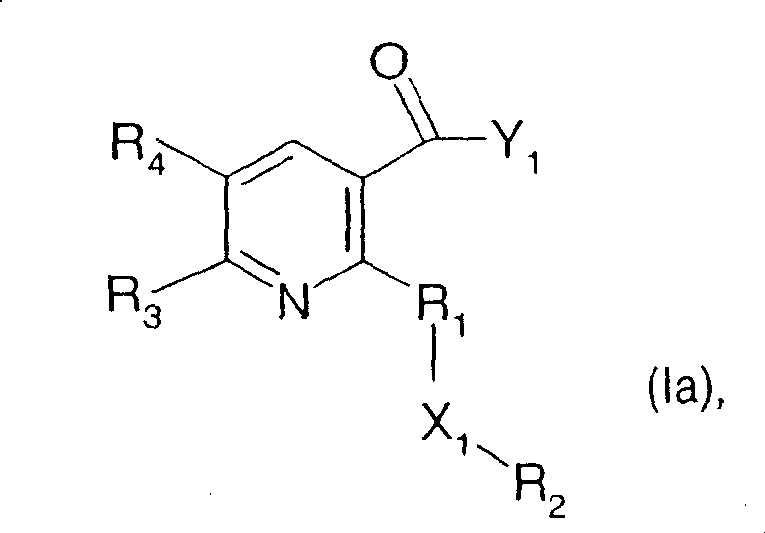
Wherein R is1、R2、R3、R4And X1Is as defined under formula I, Y1Is a leaving group, such as halogen or cyano,
with a compound of the formula II,

wherein R is22、R21、A2And A1Is as defined under formula I,
to give compounds of the formulae IIIa and IIIb

They are then isomerized, for example in the presence of a base and a catalytic amount of Dimethylaminopyridine (DMAP) or a cyanide source, for example acetone cyanohydrin; or
b) Reacting a compound of formula Ib in an inert organic solvent in the presence of a base and a coupling agent
Wherein R is1、R2、R3、R4And X1Is as defined under formula I,
with a compound of the formula II,

wherein R is22、R21、A1And A2Is as defined under formula I,
to give a compound of the formula IIIa or IIIb
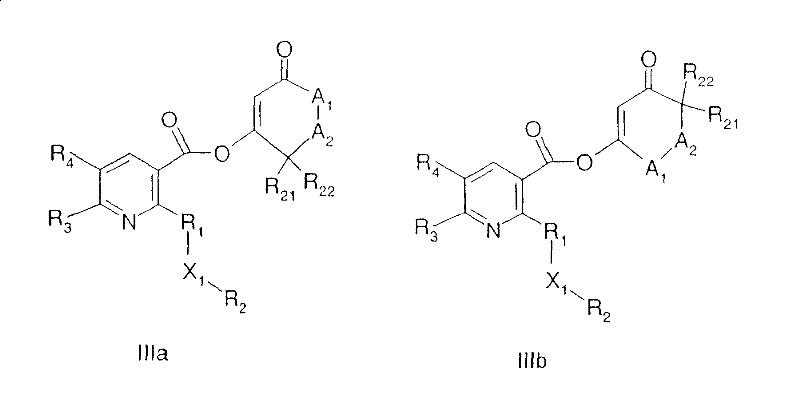
They are then isomerized, for example as described under route a).
The preparation of compounds of the formula I, in which Q is a radical, is carried out in analogy to known methods (for example WO 97/46530)
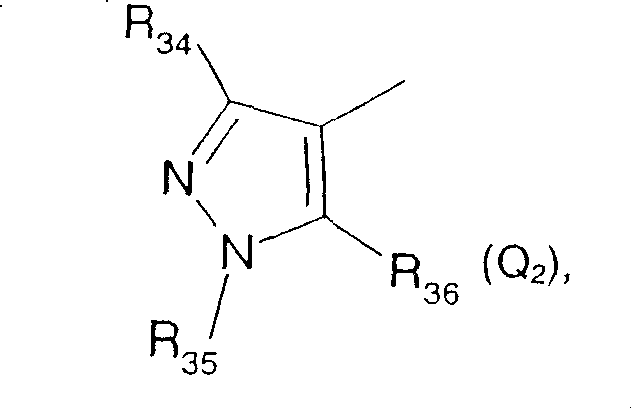
Wherein,
a) reacting a compound of formula Ia in an inert organic solvent in the presence of a base
Wherein R is1、R2、R3、R4And X1Is as defined under formula I, Y1Is a leaving group, such as halogen or cyano,
with a compound of the formula IIa,
wherein R is34And R35The definition is the same as that of the above,
to give the compound of the formula IIIc
Wherein R is1、R2、R3、R4、R34、R35And X1Is as defined under formula I,
this compound is then isomerized, for example in the presence of a base and a catalytic amount of a cyanide source; or
b) Reacting a compound of formula Ib in an inert organic solvent in the presence of a base and a coupling agent
Wherein R is1、R2、R3、R4And X1Is as defined under formula I,
with a compound of the formula IIa,

wherein R is34And R35The definition is the same as that of the above,
to give the compound of the formula IIIc

This compound is then isomerized as described under pathway a).
The preparation of the compounds of the formula I, in which Q is a radical, is carried out analogously to known processes, for example as described in WO00/15615, WO 00/39094 or WO 97/43270
Wherein n is 0, R50And R49The definition is the same as that of the above,
wherein
a) In the presence of a base, carbon disulphide and an alkylating agent of formula V,
R50-Y2 (V)
wherein R is50Is as defined under formula I, Y2Is a leaving group, e.g. halogen or sulfonate, to a compound of formula IV

Wherein X1、R1、R2、R3、R4And R49The definition is the same as that of the above,
into compounds of the formula VI
Wherein R is1、R2、R3、R4、R50、X1And R49The definition is the same as that of the above,
this compound is then cyclized with hydroxylamine hydrochloride, if appropriate in a solvent, in the presence of a base, for example sodium acetate, to give the isomeric compounds of the formulae Ic and Id
And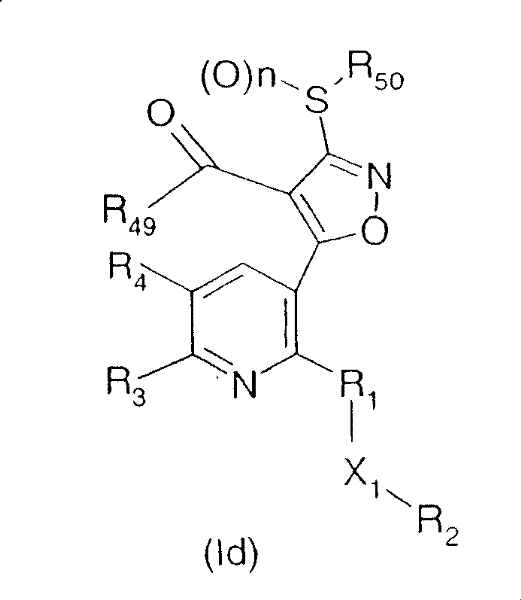
these compounds are then oxidized with an oxidizing agent, for example peracids such as m-chloroperbenzoic acid (m-CPBA) or peracetic acid, to give the corresponding sulfoxides (n ═ 1) and sulfones (n ═ 2) of the formulae Ie and If, respectively. Using a suitable mobile phase, isomers of formulae Ic and Id (where n ═ 0) or isomers of formulae Ie and If (where n ═ 1 or 2) can be isolated and purified by column chromatography.
Intermediates of formulae Ia, Ib, IV and VI are novel and are particularly useful in the preparation of compounds of formula I. They therefore also form part of the subject matter of the present invention. The novel intermediates of formulae Ia, Ib, IV and VI together correspond to formula XX

Wherein
Q is hydroxy, halogen, cyano or C1-C6Alkoxy, or a group of the formula
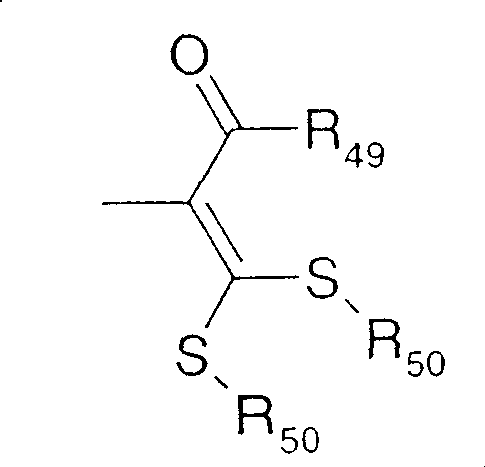
or-CH2(CO)R49(ii) a And
R1、R3、R4、R49、R50、X1and p is as defined under formula I, R2Is C1-C8Alkyl radical, C3-C6Alkenyl or C3-C6Alkynyl, which is mono-or polysubstituted with: halogen, hydroxy, amino, formyl, nitro, cyano, mercapto, carbamoyl, C1-C6Alkoxy radical, C1-C6Alkoxycarbonyl, C2-C6Alkenyl radical, C2-C6Haloalkenyl, C2-C6Alkynyl, C2-C6Halogenated alkynyl, C3-C6Cycloalkyl, C substituted by halogen3-C6Cycloalkyl radical, C3-C6Alkenyloxy radical, C3-C6Alkynyloxy, C1-C6Haloalkoxy, C3-C6Haloalkenyloxy, cyano-C1-C6Alkoxy radical, C1-C6alkoxy-C1-C6Alkoxy radical, C1-C6alkoxy-C1-C6alkoxy-C1-C6Alkoxy radical, C1-C6alkylthio-C1-C6Alkoxy radical, C1-C6alkylsulfinyl-C1-C6Alkoxy radical, C1-C6alkylsulfonyl-C1-C6Alkoxy radical, C1-C6alkoxycarbonyl-C1-C6Alkoxy radical, C1-C6Alkoxycarbonyl, C1-C6Alkylcarbonyl group, C1-C6Alkylthio radical, C1-C6Alkylsulfinyl radical, C1-C6Alkylsulfonyl radical, C1-C6Haloalkylthio, C1-C6Haloalkylsulfinyl radical, C1-C6Haloalkylsulfonyl, which may be substituted by C1-C6Alkyl-substituted oxirane radicals, which may themselves be substituted by C1-C6Alkyl-substituted (3-oxetanyl) oxy, benzylthio, benzylsulfinyl, benzylsulfonyl, C1-C6Alkylamino radical, di (C)1-C6Alkyl) amino, R9S(O)2O、R10N(R11)SO2-, thiocyanato, phenyl, phenoxy, phenylthio, phenylsulfinyl or phenylsulfonyl;
in which the phenyl-or benzyl-containing radicals may themselves be substituted by one or more C1-C6Alkyl radical, C1-C6Haloalkyl, C1-C6Alkoxy radical, C1-C6Haloalkoxy, halogen, cyano, hydroxy or nitro substituted; or
R2Is phenyl, which may be substituted by C1-C6Alkyl radical, C1-C6Haloalkyl, C1-C6Alkoxy radical, C1-C6Haloalkoxy, halogen, cyano, hydroxy or nitro is mono-or polysubstituted; or
R2Is C3-C6Cycloalkyl radical, C1-C6Alkoxy-or C1-C6Alkyl-substituted C3-C6Cycloalkyl, 3-oxetanyl or C1-C6Alkyl-substituted 3-oxetanyl;
or if X1is-N (R)6)-O-、-O-NR51-、-SO2NR7-or-NR52SO2-, and R6、R7、R51And R52Is as defined under formula I, then R2May additionally be hydrogen, unsubstituted C1-C6Alkyl or a 5-to 10-membered monocyclic or fused bicyclic ring system, which may be aromatic, saturated or partially saturated, and may contain 1 to 4 heteroatoms selected from nitrogen, oxygen and sulfur, wherein the ring system is direct or via C1-C4Alkylene radical, C2-C4alkenyl-C1-C4Alkylene radical, C2-C4alkynyl-C1-C4Alkylene, -N (R)12)-C1-C4Alkylene, -SO-C1-C4Alkylene or-SO2-C1-C4Alkylene and substituent X1(ii) a linkage wherein each ring system may not contain more than two oxygen atoms and more than two sulfur atoms, wherein the ring system itself may be mono-, di-and tri-substituted with: c1-C6Alkyl radical, C1-C6Haloalkyl, C2-C6Alkenyl radical, C2-C6Haloalkenyl, C2-C6Alkynyl, C2-C6Halogenated alkynyl, C1-C6Alkoxy, hydroxy, C1-C6Haloalkoxy, C3-C6Alkenyloxy radical, C3-C6Alkynyloxy, mercapto, C1-C6Alkylthio radical, C1-C6Haloalkylthio, C3-C6Alkenylthio radical, C3-C6Haloalkenylthio group, C3-C6Alkynylthio, C2-C5Alkoxyalkylthio radical, C3-C5Acetylalkylthio, C3-C6Alkoxycarbonyl alkylthio radical, C2-C4Cyanoalkylthio, C1-C6Alkylsulfinyl radical, C1-C6Haloalkylsulfinyl radical, C1-C6Alkylsulfonyl radical, C1-C6Haloalkylsulfonyl, aminosulfonyl, C1-C2Alkylaminosulfonyl, di (C)1-C2Alkyl) aminosulfonyl, di (C)1-C4Alkyl) amino, halogen, cyano, nitro, phenyl and benzylthio, where phenyl and benzylthio may themselves be bound by C on the phenyl ring1-C3Alkyl radical, C1-C3Haloalkyl, C1-C3Alkoxy radical, C1-C3Haloalkoxy, halogen, cyano or nitro, wherein the substituents on the heterocyclic nitrogen are other than halogen.
The following reaction schemes 1 and 2 illustrate the preparation of the compounds of formula I in more detail.
Reaction scheme 1
Route a):

reaction scheme 1 is preferably used to prepare a compound having a group Q1Wherein R is13Compounds of the formula I which are hydroxy and have a group Q2Wherein R is36A compound of formula I which is hydroxy.
Reaction scheme 2
Compounds of formula I wherein p is 1, i.e. the corresponding IN-oxides, can be prepared by reacting a compound of formula I wherein p is O with a suitable oxidizing agent, e.g. H, IN the presence of an anhydride, e.g. trifluoroacetic anhydride2O2A urea adduct. Such oxidations are known in the literature, for example j.med.chem. (journal of medicinal chemistry), 32(12), 2561-73, 1989 or WO 00/15615.
According to scheme 1, route a), a carboxylic acid derivative of formula Ia, wherein Y is1Is a leaving group, e.g. halogen, e.g. iodine, bromine, especially chlorine, N-oxophthalimide or N, O-dimethylhydroxyamino, or part of an activated ester, e.g.(derived from Dicyclohexylcarbodiimide (DCC) and the corresponding carboxylic acid) or (generated from N-ethyl-N' - (3-dimethylaminopropyl) carbodiimide (EDC) and the corresponding carboxylic acid) for the preparation of compounds of formula I, wherein Q represents a group Q1And Q2,R13And R36Is a hydroxyl group. The starting material is reacted with a diketone derivative of the formula II or a pyrazole of the formula IIa in an inert organic solvent, for example a halogenated hydrocarbon such as dichloromethane, a nitrile such as acetonitrile, or an aromatic hydrocarbon such as toluene, in the presence of a base such as an alkylamine such as triethylamine, an aromatic amine such as pyridine or 4-Dimethylaminopyridine (DMAP) to give an enol ether of the formula IIIa, IIIb or IIIc. The esterification can be carried out at a temperature of from 0 ℃ to 110 ℃.
Conversion of ester derivatives of formulae IIIa, IIIb and IIIc to derivatives of formula I (wherein R13And R36Is cA hydroxyl group) can be carried out, for example, analogously to what is described in EP-A-0353187, EP-A-0316491 or WO 97/46530, in the presence of cA base, for example an alkylamine, for example triethylamine, in the presence of cA carbonate, for example potassium carbonate, and in the presence of catalytic amounts of DMAP or of cA cyanide source, for example acetone cyanohydrin or potassium cyanide. In particular, it is possible to provide a device,if cyanide compounds of the formula Ia (Y) are used1Cyano) or in the presence of catalytic amounts of acetone cyanohydrin or potassium cyanide, then the two reaction steps can be carried out in situ without isolation of intermediate III.
Following reaction scheme 1, route b), the desired derivative of formula I (wherein R13And R36Is a hydroxyl group) can be obtained, for example, analogously to what is described in E.Haslem, Tetrahedron (Tetrahedron), 2409-2433, 36, 1980 by esterifying a carboxylic acid of the formula Ib with a diketone derivative of the formula II or a pyrazole of the formula IIa in an inert solvent, for example a halogenated hydrocarbon, for example dichloromethane, a nitrile, for example acetonitrile, or an aromatic hydrocarbon, for example toluene, in the presence of a base, for example an alkylamine, for example triethylamine, and in the presence of a coupling agent, for example 2-chloro-1-methylpyridinium iodide. Depending on the solvent used, the esterification is carried out at a temperature of from 0 ℃ to 110 ℃ as described under route a), initially giving the isomeric esters of formula IIIa, IIIb or IIIc, which can be isomerized as described under route a), for example in the presence of a base and a catalytic amount of DMAP or a cyanide source, for example acetone cyanohydrin, to give the desired derivative of formula I (wherein R is13And R36Is a hydroxyl group). In scheme 1 (pathway a), activated carboxylic acid derivatives of formula Ia (where Y is1Is a leaving group, such as halogen, e.g. bromine, iodine, or especially chlorine), can be prepared by known standard methods, such as those described in c.ferri, "Reaktionen der organischen Synthesis" (organic Synthesis reactions), georgThieme Verlag, Stuttgart, 1978, 460, and the like. Such reactions are generally known and described in the literature, with respect to the leaving group Y1May be different.
Wherein Q represents a group Q3The preparation of compounds of the formula I can be carried out according to reaction scheme 2, for example analogously to Synthesis 1991, 301, supra, 1988, 793 or Tetrahedron 32, 3055, 1976, in the presence of a base, for example a carbonate, for example potassium carbonate, in the presence of a metal hydride, for example sodium hydride or aluminum potassium fluoride, and in the presence of an alkylating agent of the formula V, where Y is2Is a leaving group, e.g. halogen, e.g. iodine, bromine, especially chlorine, CH3SO2O-orReacting the beta-diketone derivative of formula IV with carbon disulphide. The reaction is conveniently carried out in a solvent, for example an amide, such as N, N-Dimethylformamide (DMF), a sulfoxide, such as dimethyl sulfoxide (DMSO), or a nitrile, such as acetonitrile. The ketene dithioacetal of the formula VI formed is cyclized with the aid of hydroxylamine hydrochloride in the presence of a base, for example sodium acetate, in a solvent, for example an alcohol, for example ethanol, or an ether, for example tetrahydrofuran, to give the isomeric compounds of the formulae Ic and Id, where n is 0. The cyclization reaction is carried out at a temperature of 0 ℃ to 100 ℃. If appropriate, compounds of formulae Ic and Id in which n is 0 can be oxidized by known standard methods, for example as described in H.O.House, "Modern synthetic reactions", W.A.Benjamin, Inc., Menlo Park, California, 1972, p334-335 and 353-354, to give the corresponding sulfones and sulfoxides of formulae Ie and If (n ═ 1 or 2).
The compounds of formula IV in scheme 2 can be obtained by standard methods, e.g. from the corresponding compounds of formula Ia

Wherein R is1、R2、R3、R4And X1As defined above, Y1Is a leaving group, for example halogen, for example obtained by claisen condensation, or from a compound of formula Ia by reaction with a ketocarboxylate of formula VII,
wherein R is49Is as defined under formula I, M + is an alkali metal ion (see, for example, WO 96/26192).
Wherein R is1In particular C1-C2The alkyl compounds of the formula I can, for example, also be prepared by heating the N-oxide of IX under known reaction conditions in the presence of an anhydride (see, for example, Konno, K.; Hashimoto, K.; Shirahama, H.; Matsumoto, T.; Heterocycles 1986, 24, 2169 or WO 00/15615) and hydrolyzing the product (Ig) obtained in a protic solvent, for example water or a water/methanol mixture, if appropriate in the presence of a base, for example lithium hydroxide or sodium hydroxide, and then in the presence of a base, for example sodium hydroxide or potassium hydroxide, if appropriate in a phase-transfer catalyst or a crown ether, and in the alkylating agent R2-Y3In the presence of (b), wherein R2Is as defined under formula I, Y3Is a leaving group, e.g. halogen or mesylate, in an aprotic inert solvent, e.g. tetrahydrofuran or dimethylformamide, to convert the resulting alcohol X to the corresponding derivative of formula Ih (wherein X is1Is oxygen). Wherein R is2Is C1-C6Compounds of the formula I which are alkoxymethyl or 2-tetrahydropyranyl or 2-tetrahydrofuranyl may be prepared, for example, by reacting an alcohol of the formula X with an alcohol of the formula VE in the presence of an acidic catalyst, for example p-toluenesulfonic acid, in an inert solvent, for example dichloromethane1Treatment with vinyl ether, wherein R03、R04And R05Is C1-C6Alkyl, or R03And R05Together form C2-C3An alkylene chain. Such reactions are generally known from the literature (see, for example, Synthesis, p.169, 1973). Two reaction lines are demonstrated using the following examples.
Reaction scheme 3

Wherein R is1In particular C1-C2Alkyl or C1-C2Haloalkyl compounds of the formula I can, for example, also be prepared under known halogenation conditions, for example using N-bromosuccinimide or N-chloroSuccinimides in which R is oxidised in the presence of light and a free radical initiator, e.g. benzoyl peroxide13Especially chlorine, C1-C4Compounds of the formula XI which are alkoxycarbonyloxy or benzoylcarbonyloxy (prepared analogously to WO00/15615 or WO 00/39094) to give 1-bromo or 1-chloro, 1-dibromo or 1, 1-dichloro compounds, which are then functionalized again to the corresponding derivatives of the formula I, for example by reaction with a nucleophile R in the presence of a base such as sodium hydride, potassium hydroxide or potassium carbonate2Reaction of-Z, wherein Z is, for example, -SH, -OH, -C (O) OH, -O-N (R)51)H、-N(R6)-OH、-SO2N(R52) H or-N (R)8)H,R2、R52、R8、R6And R51Is as defined under formula I, followed by an aqueous post-treatment. These reaction lines are also demonstrated using the following examples.
Reaction scheme 4

Wherein Q represents Q1Or Q2And wherein R13Or R36Compounds of the formula I which are different from hydroxyl or halogen can be prepared by conversion processes which are generally known from the literature, for example from the compounds in which R is present in the presence of suitable bases13Or R36Starting from compounds of formula I which are hydroxy, they are acylated or carbamylated with the appropriate acid chloride, or they may be prepared by reaction of a compound of formula I wherein R is13And R36Nucleophilic substitution reactions on the chloride of formula I, which is chlorine, can likewise be obtained in a known manner by reaction with chlorinating agents, such as phosgene, thionyl chloride or oxalyl chloride. Starting materials used are, for example, appropriately substituted amines or direct hydroxylamines, or alkylsulfonamides, mercaptans, thiophenols, phenols, heterocyclic amines or heterocyclic mercaptans, in the presence of bases, for example 5-ethyl-2-methylpyridine, diisopropylethylamine, triethylamine, sodium hydrogencarbonate, sodium acetate or potassium carbonate。
Where R can be oxidized analogously to known standard methods13And R36Compounds of formula I containing a sulphur group, for example using a peracid such as m-chloroperbenzoic acid (m-CPBA) or peracetic acid, give the corresponding sulfones and sulfoxides of formula I. The degree of oxidation (SO-or SO) on the sulfur atom can be controlled by the amount of oxidizing agent2-)。
Obtained wherein R13And R36The derivatives of the formula I which are different from the hydroxyl radical can likewise exist in different isomeric forms and can, if appropriate, be isolated in pure form. Thus, the present invention also encompasses all such stereoisomeric forms. Examples of such isomeric forms are of formulae I ', I ' and I ', wherein Q represents a group Q1。

Compounds of the formulae II and IIcA are known and can be prepared analogously, as described, for example, in WO 92/07837, JP10265441, DE-A-3818958, EP-A-0338992, DE-A-3902818, EP-A-0278742, WO 98/29412, JP 02059566, US-A-5,089,046, GB-A-2205316, WO 00/27821 or EP-A-0384736.
The desired intermediate of formula Ib (or Ik, Il or Im) is synthesized analogously to known methods, for example as described in WO00/15615, WO 00/39094 or WO 97/46530, or they can be prepared, for example, according to generally known transformation methods, such as Stille (see, for example, Angew. chem. (applied chemistry) 1986, 98(6), 504-19), Heck (see, for example, Angew. chem. (applied chemistry) 1994, 106(23/24), 2473-506), Sonogashira (see, for example, "Comprehensive Organometallic Synthesis", Pergamon Verlag, Oxford, Vol 3, 1991, page 521, etc.) or Wittig (e.g., C.Ferri "Reaktion der organic Synthesis", Georg Thieme Verlag, Stuttgart, 1978, page 354, etc.), from halogen derivatives of the formula XIV (prepared as described in WO00/15615 or WO 00/39094) or halogen derivatives (prepared analogously to EP 5292) (preparation of XVIII):
reaction scheme 5
Wherein R is1、R2、R3、R4And X1Intermediates of formula Ib as defined under formula I can also be prepared according to the method of reaction scheme 6:
reaction scheme 6
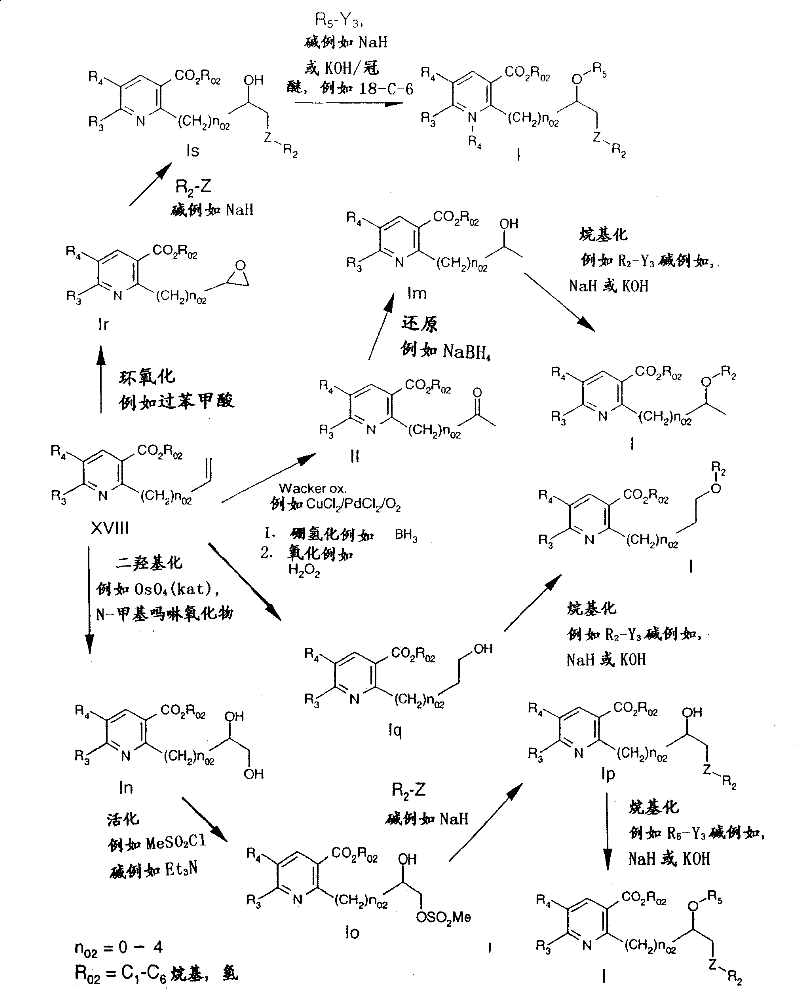
Starting from vinyl or allyl compounds of the formula XVIII (prepared as described In WO00/15615 or WO 00/39094) using generally known oxidation methods, such as dihydroxylation, Wacker oxidation, epoxidation, hydroboration and subsequent oxidation, intermediates of the formulae II, In, Iq and Ir are obtained, which are converted by methods known to the person skilled In the art (e.g. activation of alcohols to sulfonates, alkylation, for example using an alkylating agent R)2-Y3Or R5-Y3Wherein R is2And R5Is as defined under formula I, Y3Is a leaving group, e.g. halogen), in the presence of a base, or by nucleophilic reactions, e.g. with nucleophiles Z-R2Reaction of in which Z and R2These intermediates may be converted to compounds of formula I, as defined above.
Wherein R is1Is C1-C2Alkyl and R2、R3、R4And X1The intermediate of formula Ib, which is defined as under formula I, can also be prepared by reacting it in the presence of a base, such as sodium hydride or an alkaline earth metal oxide or carbonate, in an inert solvent, such as dimethylformamide or THF, at a temperature between-5 and 160 deg.CR3And R4Is as defined under formula I and Y4A compound of formula XIVa which is halogen with a nucleophile R2-Z reaction, wherein Z is-SH, -OH, -C (O) OH, -O-N (R)51)H、-N(R6)-OH、-SO2N(R52) H or-N (R)8)H,R2、R52、R8、R6And R51As defined under formula I, or for the preparation of the corresponding sulfinyl or sulfonyl derivatives of formula Iu, with an oxidizing agent, such as m-chloroperbenzoic acid or sodium periodate or sodium perborate, in an inert solvent, such as dichloromethane, the temperature being controlled according to the degree of oxidation, as known to the skilled person (for example-30 ℃ to +50 ℃ for n ═ 1, and-20 ℃ to +100 ℃ for n ═ 2, respectively), to give compounds of formula Iv. In the following reaction scheme 7, Z ═ OH, SH, SO2N(R52) H and N (R)8) This is explained in more detail in the case of H:
reaction scheme 7

Wherein Q represents a group OR02(R02=C1-C6Alkyl) intermediates of formula I can be converted to products of formula Ib by hydrolysis, for example using a base, e.g. LiOH, in a protic solvent, e.g. H2O or H2An O/methanol mixture.
With respect to the preparation of all others according to R1、R2、R3、R4And X1There are a number of suitable known standard methods for functionalizing compounds of formula I, such as alkylation, halogenation, acylation, amidation, oximation, oxidation and reduction, and the choice of a suitable preparation depends on the nature (reactivity) of the substituents in the intermediates.
The reaction to give the compounds of the formula I is advantageously carried out in an aprotic organic solvent. Such solvents are hydrocarbons, for example benzene, toluene, xylene or cyclohexane, chlorinated hydrocarbons, for example dichloromethane, trichloro
Methane, tetrachloromethane or chlorobenzene, ethers, such as diethyl ether, ethylene glycol dimethyl ether, diethylene glycol dimethyl ether, tetrahydrofuran or dioxane, nitriles, such as acetonitrile or propionitrile, amides, such as N, N-dimethylformamide, diethylformamide or N-methylpyrrolidone. The reaction temperature is advantageously between-20 ℃ and +120 ℃. In general, the reaction is slightly exothermic and can generally be carried out at room temperature. To shorten the reaction time, or to start the reaction, the mixture may simply be heated to the boiling point of the reaction mixture. The reaction time can also be shortened by adding a few drops of base as a reaction catalyst. Suitable bases are, in particular, tertiary amines, such as trimethylamine, triethylamine, quinuclidine, 1, 4-diazabicyclo [2.2.2] octane, 1, 5-diazabicyclo [4.3.0] non-5-ene or 1, 5-diazabicyclo [5.4.0] undec-7-ene. However, it is also possible to use inorganic bases, such as hydrides, for example sodium hydride or calcium hydride, hydroxides, for example sodium hydroxide or potassium hydroxide, carbonates, for example sodium carbonate and potassium carbonate, or bicarbonates, for example potassium bicarbonate and sodium bicarbonate. These bases may be used alone or together with catalytic amounts of phase transfer catalysts, for example crown ethers, especially 18-crown-6, or tetraalkylammonium salts.
The compounds of the formula I can be isolated in a conventional manner by concentration and/or evaporation of the solvent, and purified by recrystallization or trituration of the solid residue in solvents in which they are not readily soluble, such as ethers, aromatic hydrocarbons or chlorinated hydrocarbons.
All methods of application customary in agriculture, such as pre-emergence application, post-emergence application and seed treatment, as well as various methods and techniques, such as controlled release of active ingredients, are suitable for the application of the compounds of the formula I according to the invention or of the compositions comprising them. For this purpose, a solution of the active ingredient is applied to granules of mineral carrier or polymeric particles (urea/formaldehyde) and dried. If appropriate, further coating agents (coated particles) can be applied so that the active ingredient is released in a controlled manner for a specific time.
The compounds of the formula I can be employed as herbicides by themselves, i.e. in synthetically prepared form. However, they are preferably processed in customary manner with the auxiliaries customary in the formulation art, for example to give emulsifiable concentrates, directly sprayable or dilutable solutions, dilute emulsions, wettable powders, soluble powders, dusts, granules or microcapsules. Such formulations are described, for example, on page WO 97/344859-13. The method of application, e.g. spraying, atomizing, dusting, wetting, spreading or pouring, and the type of composition are chosen to suit the intended purpose and the prevailing circumstances.
Formulations, i.e. compositions, preparations or products comprising the active ingredient of formula I or at least one active ingredient of formula I and usually one or more solid or liquid formulation auxiliaries, are prepared in a known manner, for example by thoroughly mixing and/or grinding the active ingredient with the formulation auxiliaries, for example solvents or solid carriers. Furthermore, a surface-active compound (surfactant) may be additionally used in preparing the formulation. Examples of solvents and solid carriers are described, for example, on page 6 of WO 97/34485.
Suitable surface-active compounds are nonionic, cationic and/or anionic surfactants and surfactant mixtures, which, depending on the nature of the active ingredient of the formula I to be formulated, have good emulsifying, dispersing and wetting properties. Examples of suitable anionic, nonionic and cationic surfactants are described, for example, in WO97/34485 p.7-8. Particularly described in "McCutcheon's Detergents and Emulsifiers Annual" (McCutcheon Detergents and Emulsifiers) MC Publishing Corp., Ridgewood New Jersey, 1981; stache, H., "Tensid-Taschenbuch" (surfactant guide), CarlHanser Verlag, Munich/Vienna, 1981; surfactants commonly used in the formulation field in "encyclopedia of Surfactants", Vol I-III, chemical publishing Co., New York, 1980-81 are furthermore also suitable for preparing the herbicidal compositions according to the invention.
Typically, the herbicidal formulation comprises from 0.1 to 99% by weight, especially from 0.1 to 95% by weight, of the herbicide, from 1 to 99.9% by weight, especially from 5 to 99.8% by weight, of the solid or liquid formulation adjuvant and from 0 to 25% by weight, especially from 0.1 to 25% by weight, of the surfactant. Although concentrated compositions are more preferred commercial products, dilute compositions are often used by the end consumer. The composition may also contain further additives such as stabilizers, for example epoxidized or non-epoxidized vegetable oils (epoxidized coconut oil, rapeseed oil or soybean oil), defoamers, for example silicone oils, preservatives, viscosity regulators, binders, tackifiers and fertilizers or other active ingredients.
In general, the active ingredients of the formula I are applied to the plants or their environment in an amount of from 0.001 to 4kg/ha, in particular from 0.005 to 2 kg/ha. The dosage required to achieve the desired effect can be determined experimentally. This depends on the type of action, the developmental stage of the crop and weed and the application (location, time, method), which vary widely due to these factors.
The compounds of formula I are distinguished by herbicidal and growth-inhibiting properties, which make them useful in crops of useful plants, in particular cereals, cotton, soybeans, sugar beet, sugar cane, cultivated crops, oilseed rape, maize and rice, and also for the non-selective control of weeds. Crops are also understood to include those which have been rendered herbicide tolerant by means of conventional planting or genetic engineering methods. The weeds to be controlled can be monocotyledonous and dicotyledonous weeds, for example Stellaria, Arabidopsis, agrostis, digitaria, Avena, Setaria, Brassica, Crataegus, Solanum, Echinochloa, Scirpus, Potentilla, Sagittaria, Bromus, Alopecurus, sorghum saccharum Sorghumhalepense (Sorghumuhalepen), Cyperus, Abutilon, Sida, Xanthium, Amaranthus, Chenopodium, Ipomoea, Chrysanthemum, Galium, Viola and Veronica.
The following examples illustrate the invention in more detail, but do not limit it.
Preparation example
Example H1: 2-Bromomethyl-6-trifluoromethylnicotinic acid ethyl ester
434.4g (1.866mol) of ethyl 2-methyl-6-trifluoromethylnicotinate (prepared analogously to Heterocycles 129, 46, 1997) were heated with 398.5g (2.239mol) of N-bromosuccinimide in 3500ml of carbon tetrachloride at 75 ℃ in the presence of 30.6g (0.1866mol) of α, α -azoisobutyronitrile and irradiated with 150 watt lamps. After 3 hours, the reaction was terminated, the mixture was cooled to 15 ℃ and the precipitated succinimide was removed by filtration. After evaporation of the solvent, the residue was distilled under reduced pressure. Ethyl 2-bromomethyl-6-trifluoromethylnicotinate is obtained as an oily product (260.2g, 44.7% of theory, b.p.74 ℃/0.04 mmHg).
Example H2: 2- (2-methoxyethoxymethyl) -6-trifluoromethylnicotinic acid
177.2g of 2-bromomethyl-6-trifluoromethylnicotinic acid ethyl ester were dissolved in 3000ml of toluene at room temperature and reacted with 398ml (1.704mol) of 21% sodium ethoxide in ethanol. After 8 hours at room temperature, 1500ml of ethanol and 100ml of 30% aqueous sodium hydroxide solution were added with vigorous stirring, and the reaction mixture was stirred at this temperature for a further 4 hours. The reaction mixture was poured into water, extracted with ethyl acetate and the aqueous phase was acidified to pH 1. Extraction with ethyl acetate, drying over sodium sulfate, evaporation under reduced pressure and trituration with hexane gave pure 2- (2-methoxyethoxymethyl) -6-trifluoromethylnicotinic acid as white crystals, m.p. 62-63 ℃.
Example H3: 4-hydroxy-3- [2- (2-methoxyethoxymethyl) -6-trifluoromethylpyridine
-3-carbonyl]-bicyclo [3.2.1]Oct-3-en-2-ones
24.9g (0.1mol) of 2- (2-methoxyethoxymethyl) -6-trifluoromethylnicotinic acid are dissolved in 200ml of dichloromethane and 20ml of oxalyl chloride, and then 0.1ml of dimethylformamide is added dropwise. After the evolution of strong gas had ceased triethylamine (27.9ml, 0.2mol), dimethylaminopyridine (1.22g, 0.01mol) and 15.2g (0.11mol) bicyclo [3.2.1] octane-2, 4-dione were added at a temperature of 0 to 5 ℃. After 3 hours at 22 ℃ the reaction mixture was extracted with 2N hydrochloric acid. The dichloromethane phase is separated off, washed with water and then extracted with 10% aqueous sodium hydrogencarbonate, dried over sodium sulfate and concentrated. 36.9g (100% of theory) of 4-oxobicyclo [3.2.1] oct-2-en-2-yl 2- (2-methoxyethoxymethyl) -6-trifluoromethylnicotinate are obtained as an oil which is used further without purification.
36.9g (0.1mol) 4-oxobicyclo [3.2.1] oct-2-en-2-yl 2- (2-methoxyethoxymethyl) -6-trifluoromethylnicotinate and 27.9ml (0.2 mol) triethylamine were dissolved in 400ml acetonitrile. At a temperature of 22 ℃ 0.92ml (0.01mol) of acetone cyanohydrin are added. After 18 hours at 22 ℃ the reaction mixture was poured into a water/2N hydrochloric acid mixture and extracted with ethyl acetate. The ethyl acetate phase is washed with water and then with concentrated sodium chloride solution, dried over sodium sulfate, concentrated and the residue triturated with hexane. Filtration gave 27.9g (75.6% of theory) of 4-hydroxy-3- [2- (2-methoxyethoxymethyl) -6-trifluoromethylpyridine-3-carbonyl ] -bicyclo [3.2.1] oct-3-en-2-one as white crystals (m.p.55 ℃ -56 ℃).
Example H4: 3- (2-hydroxy-4-oxobicyclo [ 3.2.1)]Oct-2-ene-3-carbonyl) -6-
Trifluoromethylpyridin-2-ylmethyl acetate
5.0g (1mmol) of 4-hydroxy-3- (2-methyl-1-oxy-6-trifluoromethylpyridine-3-carbonyl) bicyclo [3.2.1]Oct-3-en-2-one (prepared as described in WO 00/15615) was dissolved in 100ml of toluene and heated in the presence of 6.9ml (0.073mol) of acetic anhydride at reflux temperature for 10 hours. The mixture was then partitioned between water and ethyl acetate, the organic phase was dried over sodium sulfate and concentrated under reduced pressure. The residue remaining was purified by silica gel chromatography. Elution with a mixture of toluene, ethanol, dioxane, triethylamine and water (100: 40: 20: 5 parts by volume) gave a viscous oil which was dissolved in ethyl acetate and washed with 10% hydrochloric acid and water in that order. Organic solution is treated with Na2SO4Drying and concentration gave 2.14g (38%) of pure 3- (2-hydroxy-4-oxobicyclo [3.2.1]]Oct-2-ene-3-carbonyl) -6-trifluoromethylpyridin-2-ylmethylAcetate, an oil.
1H-NMR(250MHz,CDCl3):17.06(s),1H;7.67(s),2H;5.27(d,J=12.5Hz),1H;5.20(d,J=12.5Hz),1H;3.18,(t,J=5.0Hz),1H;2.92,(t,J=5.0Hz),1H;2.29-1.98(m),4H;2.00,(s),3H;1.81-1.73ppm(m),2H.
Example H5: 4-hydroxy-3- (2-oxiranylmethoxymethyl-6-trifluoromethylpyridine
-3-carbonyl) bicyclo [3.2.1]Oct-3-en-2-ones
5g (0.013mol) of 3- (2-hydroxy-4-oxobicyclo [3.2.1] oct-2-ene-3-carbonyl) -6-trifluoromethylpyridin-2-ylmethyl acetate are dissolved in 60ml of methanol/water (3: 1 mixture) and 1.4g (0.046mol) of lithium hydroxide hydrate are added in portions at a temperature of 22 ℃. After 3 hours at 22 ℃ the reaction mixture was poured into ethyl acetate and 10% hydrochloric acid and the organic phase was washed three times with water, dried over sodium sulfate and concentrated. 4.1g 4-hydroxy-3- (2-hydroxymethyl-6-trifluoromethylpyridine-3-carbonyl) bicyclo [3.2.1] oct-3-en-2-one was obtained as an oil which was reacted further without purification.
1.5g 4-hydroxy-3- (2-hydroxymethyl-6-trifluoromethylpyridine-3-carbonyl) bicyclo [3.2.1] oct-3-en-2-one were dissolved in 15ml dimethylformamide and treated portionwise with 0.4g sodium hydride (80% oil suspension, 0.013mol) at room temperature. After 15 minutes at a temperature of 22 ℃, 3ml (0.036mol) of epibromohydrin are added dropwise and the reaction mixture is stirred at this temperature for a further 18 hours. Then ethyl acetate was added and the mixture was acidified to pH3 with 10% hydrochloric acid and extracted with ethyl acetate. The organic phase is dried over sodium sulfate and the crude product is purified by chromatography (mobile phase: toluene/ethanol/dioxane/triethylamine/water 100: 40: 20: 5 parts by volume). The title compound (triethylamine salt) was obtained as a pale yellow resin, released in analogy to example H4. Trituration with hexane afforded 600mg of pure 4-hydroxy-3- (2-oxiranylmethoxymethyl-6-trifluoromethylpyridine-3-carbonyl) bicyclo [3.2.1] oct-3-en-2-one, m.p. 54-56 ℃.
Example H6: (5-hydroxy-1, 3-dimethyl-1H-pyrazol-4-yl) - [2- (2-methoxy-l-methyl-)
Ethoxymethyl) -6-trifluoromethylpyridin-3-yl]Ketone
1.0g (0.004mol) of 2- (2-methoxyethoxymethyl) -6-trifluoromethylnicotinic acid was dissolved in 10ml of oxalyl chloride. 3 drops of dimethylformamide were added and the mixture was stirred at room temperature for 1 hour. The mixture was then concentrated using a rotary evaporator and the residue (2- (2-methoxyethoxymethyl) -6-trifluoromethylnicotinoyl chloride) was dissolved in 10ml of dichloromethane. At a temperature of 0 ℃ 0.84ml (0.006mol) triethylamine and 0.45g (0.004mol)2, 5-dimethyl-2, 4-dihydropyrazol-3-one are added. After 2 hours at 22 ℃ the solvent was removed using a vacuum rotary evaporator and the remaining residue was dissolved in 10ml of acetonitrile and mixed with 0.1ml of acetone cyanohydrin and 1.13ml (0.008mol) of triethylamine for the rearrangement of the intermediate (2, 5-dimethyl-2H-pyrazol-3-yl 2- (2-methoxyethoxymethyl) -6-trifluoromethylnicotinate). The reaction solution was stirred at room temperature for 4 hours, and then concentrated. The remaining slurry was purified by silica gel chromatography. Elution with a mixture of toluene, ethanol, dioxane, triethylamine and water (100: 40: 20: 5 parts by volume) gave a viscous oil which was dissolved in ethyl acetate and washed with 10% hydrochloric acid and water in that order. Organic solution is treated with Na2SO4Drying and concentration gave 0.93g of (5-hydroxy-1, 3-dimethyl-1H-pyrazol-4-yl) - [2- (2-methoxyethoxymethyl) -6-trifluoromethylpyridin-3-yl]Methanone, as a viscous oil.
1H NMR(300MHz,CDCl3,δin ppm):7.81,(d,J=6Hz),1H;7.74,(d,J=6Hz),1H;4.84,(s),2H;2H:3.71,(s),3H;3.59,(t,J=6Hz)2H;3.38,(dd,J4.0,3.0Hz),1H;3.26,(s),3H;1.82ppm,(s),1H.
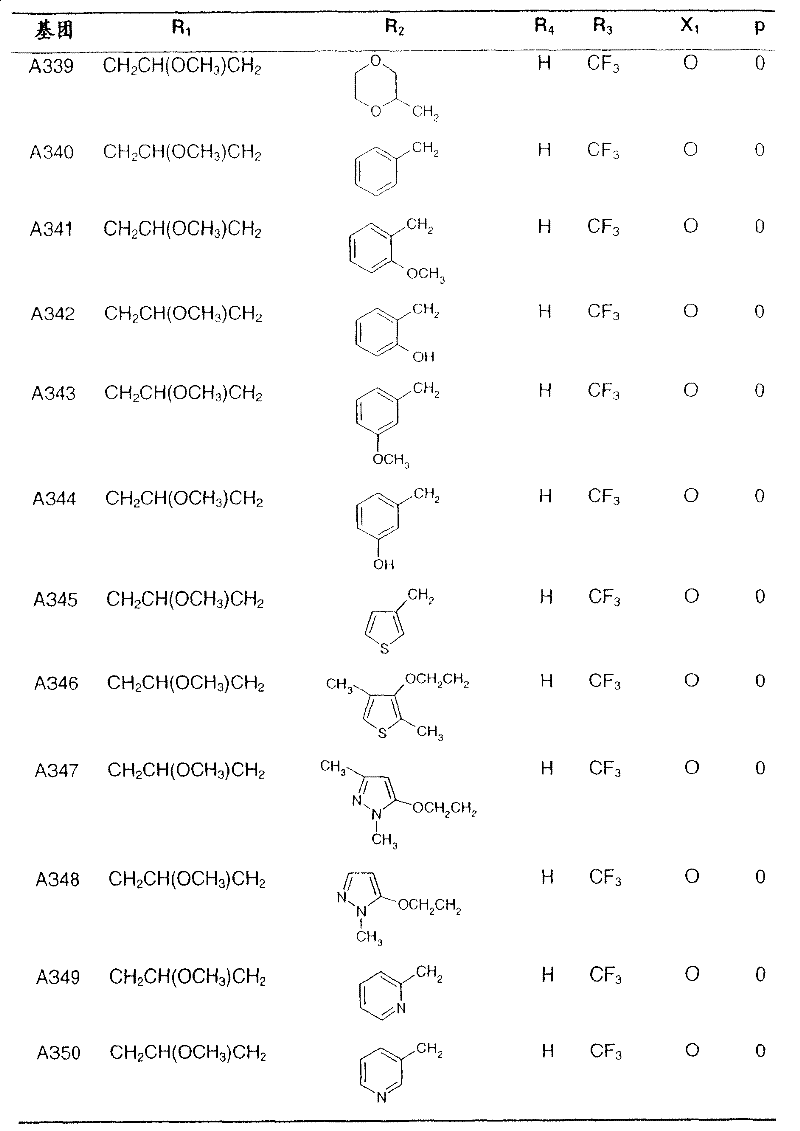
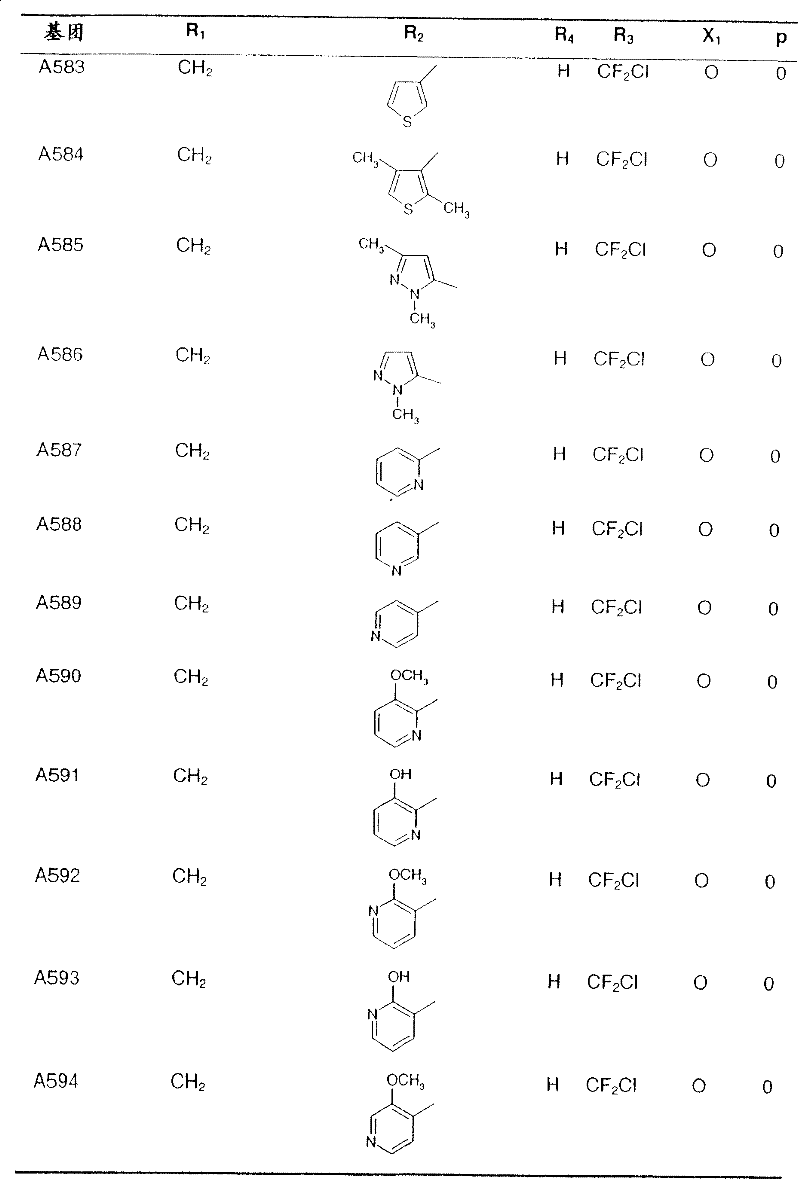
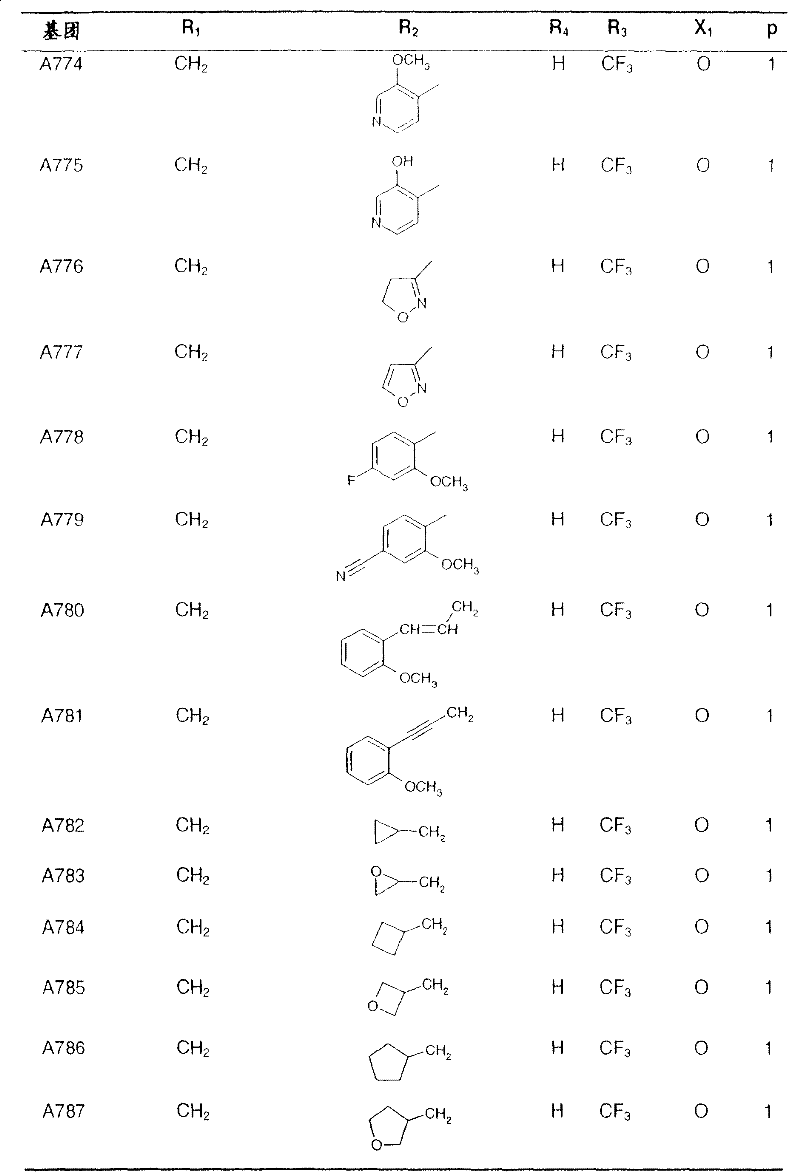
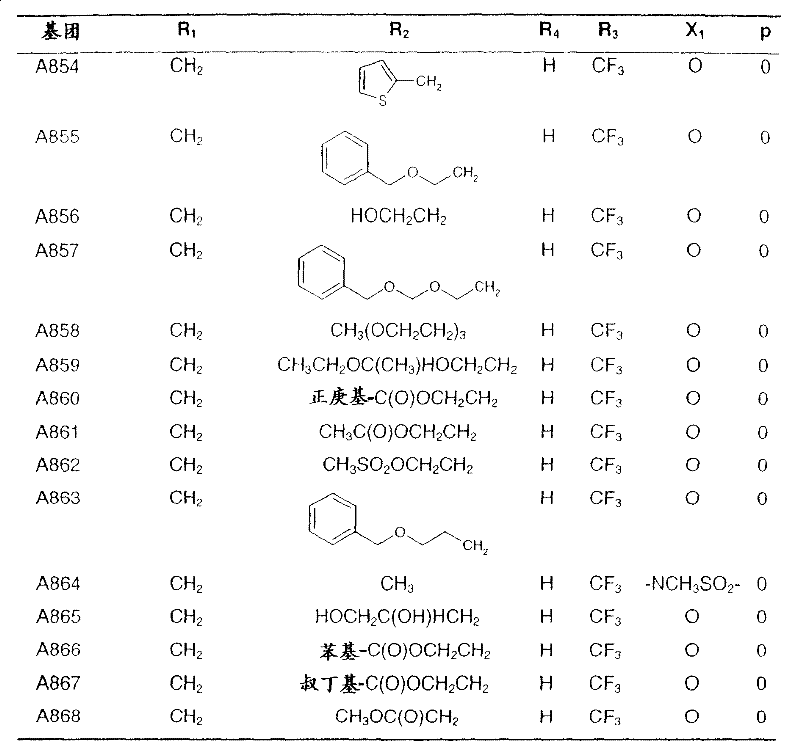
Preferred compounds of formula I and their intermediates are listed in the table below.
In the following table, the radical R1The left-hand valency of (a) is attached to the pyridine ring.If at substituent R2Not showing free valency, e.g. in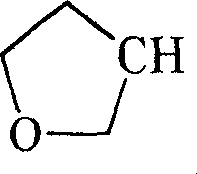 In the case of (3), the point of attachment is at the "CH" carbon atom.
In the following table, the compounds of formula I are represented as follows:
A-Q
wherein formula A

Represents the following groups:


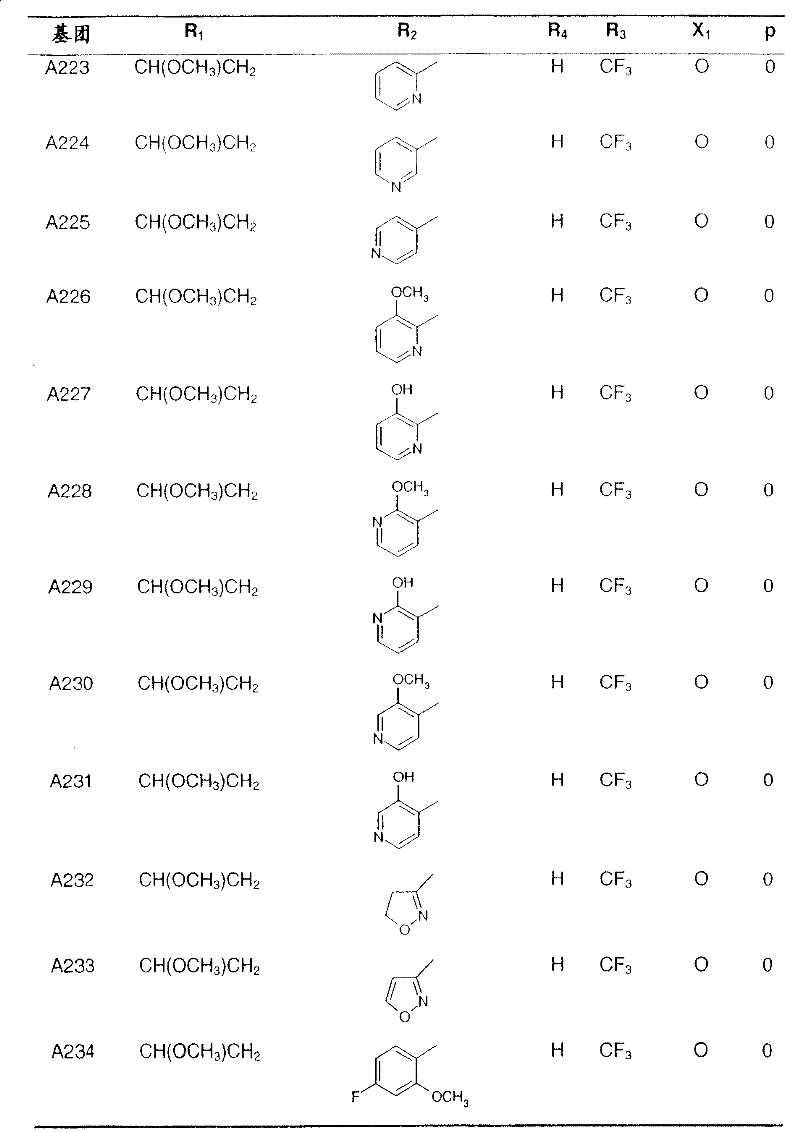







in the table below, in the case of rings, for the substituent A1And A2The ring point of attachment of (A) being at the carbon atom marked "C", e.g. In the case of an open chain structure, "(CH)3)2C' for example represents
In the formula A-Q, Q represents Q1
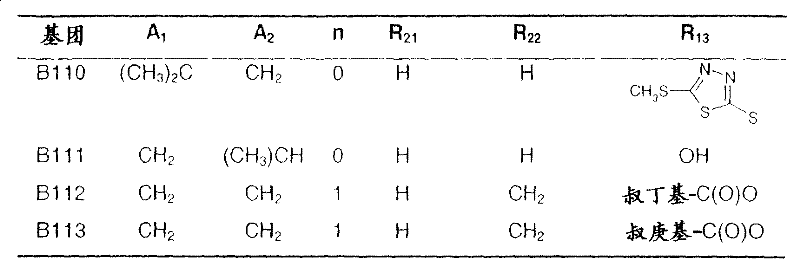
Q1Represents the following group B:

or Q in the formula A-Q represents Q2
Q2Represents the following group C:

or Q in the formula A-Q represents Q3

Q3Represents the following group D (R)49The point of attachment to the heterocycle is a "CH" group):


table 1: intermediates for the preparation of compounds of formula I represented by the formula
A-Q
Wherein Q represents a hydroxyl group:


table 2: a compound of formula I represented by
A-Q
Wherein Q represents Q1,Q1Represents a group B52:

table 3: a compound of formula I represented by
A-Q
Wherein Q represents Q1,Q1Represents a group B39:


table 4: a compound of formula I represented by
A-Q
Wherein Q represents Q1,Q1Represents a group B3:
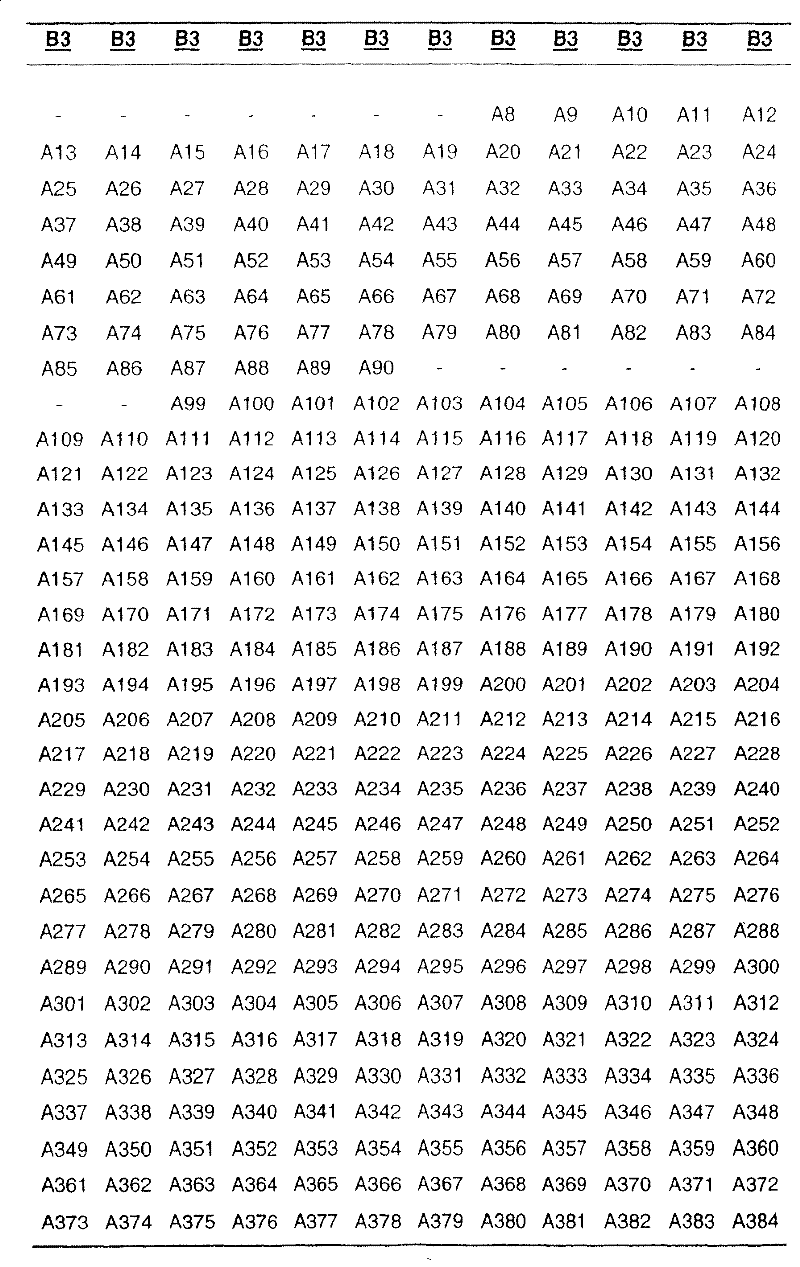

table 5: a compound of formula I represented by
A-Q
Wherein Q represents Q2,Q2Represents a group C5:

table 6: a compound of formula I represented by
A-Q
Wherein Q represents Q2,Q2Represents a group C2:


table 7: a compound of formula I represented by
A-Q
Wherein Q represents Q2,Q2Represents a group D1, D2 or D3:


table 8: a compound of formula ID:
wherein R is1、R2、R3、R4、X1And p has the same meaning as given for the group a, n is 0, 1 or 2:


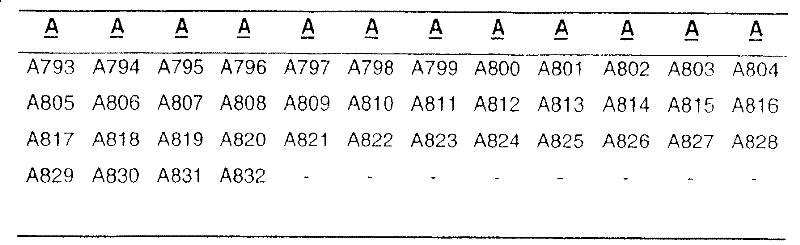
table 9: a compound of formula I represented by
A-Q
Wherein A represents A10:

table 10: a compound of formula I represented by
A-Q
Wherein A represents A10:
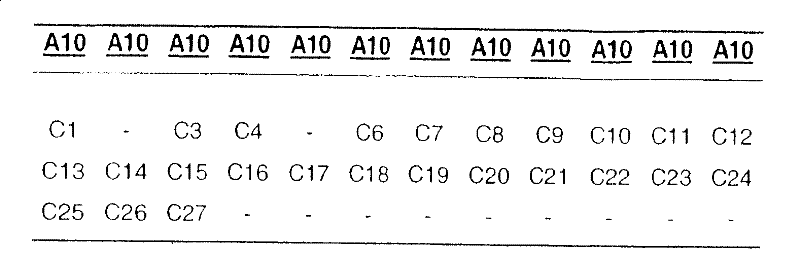
table 11: a compound of formula I represented by
A-Q
Wherein A represents A10:

table 12: a compound of formula I represented by
A-Q
Wherein A represents A556:

table 13: a compound of formula I represented by
A-Q
Wherein A represents A556:

table 14: a compound of formula I represented by
A-Q
Wherein A represents A556:

table 15: a compound of formula I represented by
A-Q
Wherein A represents A646:

table 16: a compound of formula I represented by
A-Q
Wherein A represents A646:
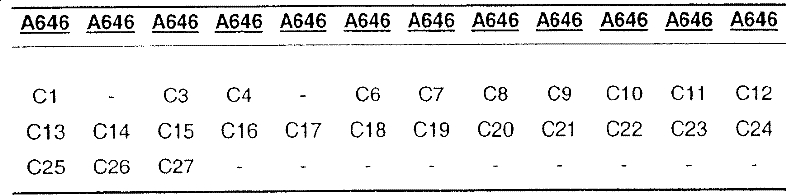
table 17: a compound of formula I represented by
A-Q
Wherein A represents A646:

table 18: the physical data for the compounds of formula I shown in the table above (melting points given in degrees Celsius: C.):


Table 19: the physical data (melting points given in degrees Celsius) for the compounds of formula I shown in the table above:
in the formula, the terminal valency denotes methyl (excluding alkynyl and alkenyl) or hydrogen (in the case of alkynyl or alkenyl), for exampleCan also be drawn as  Can also be drawn as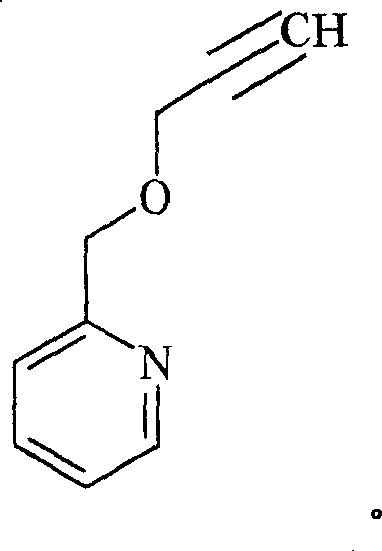


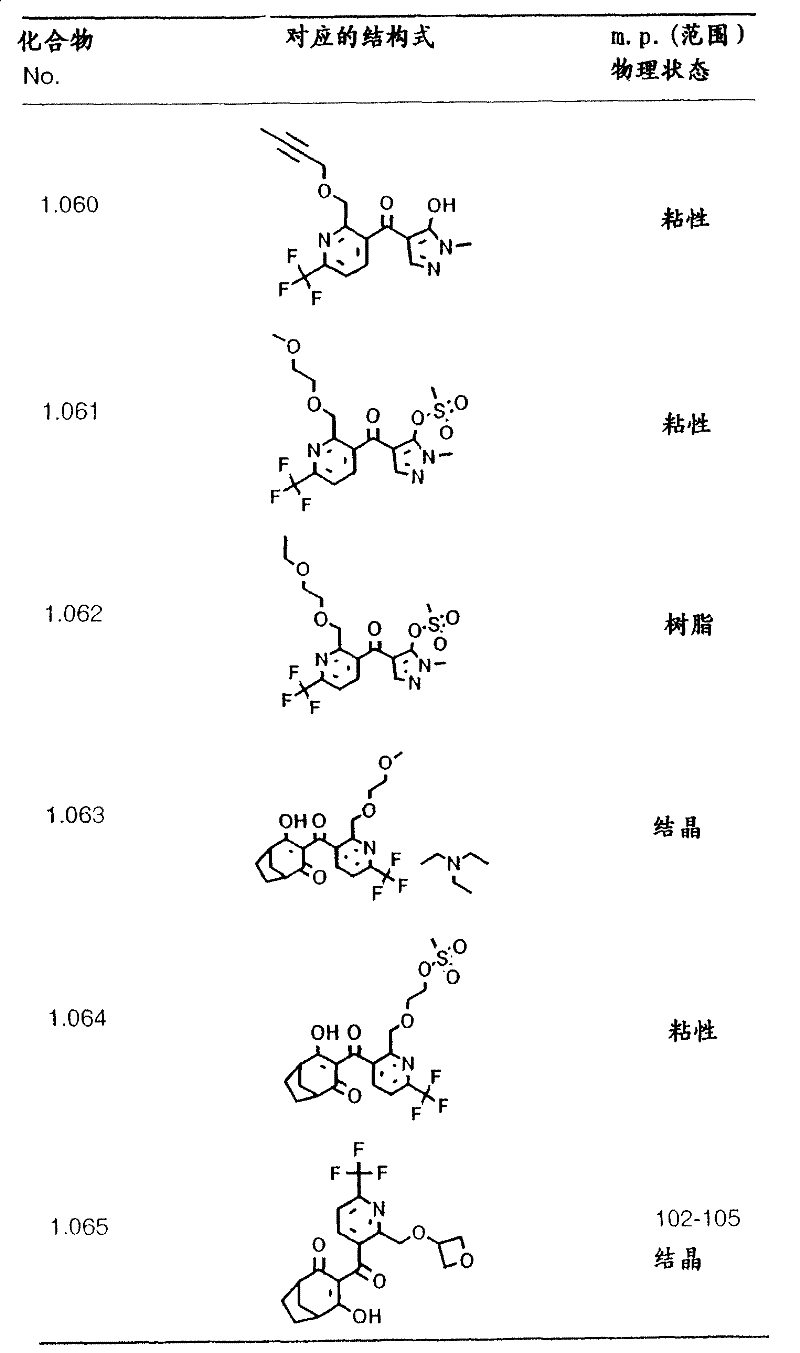


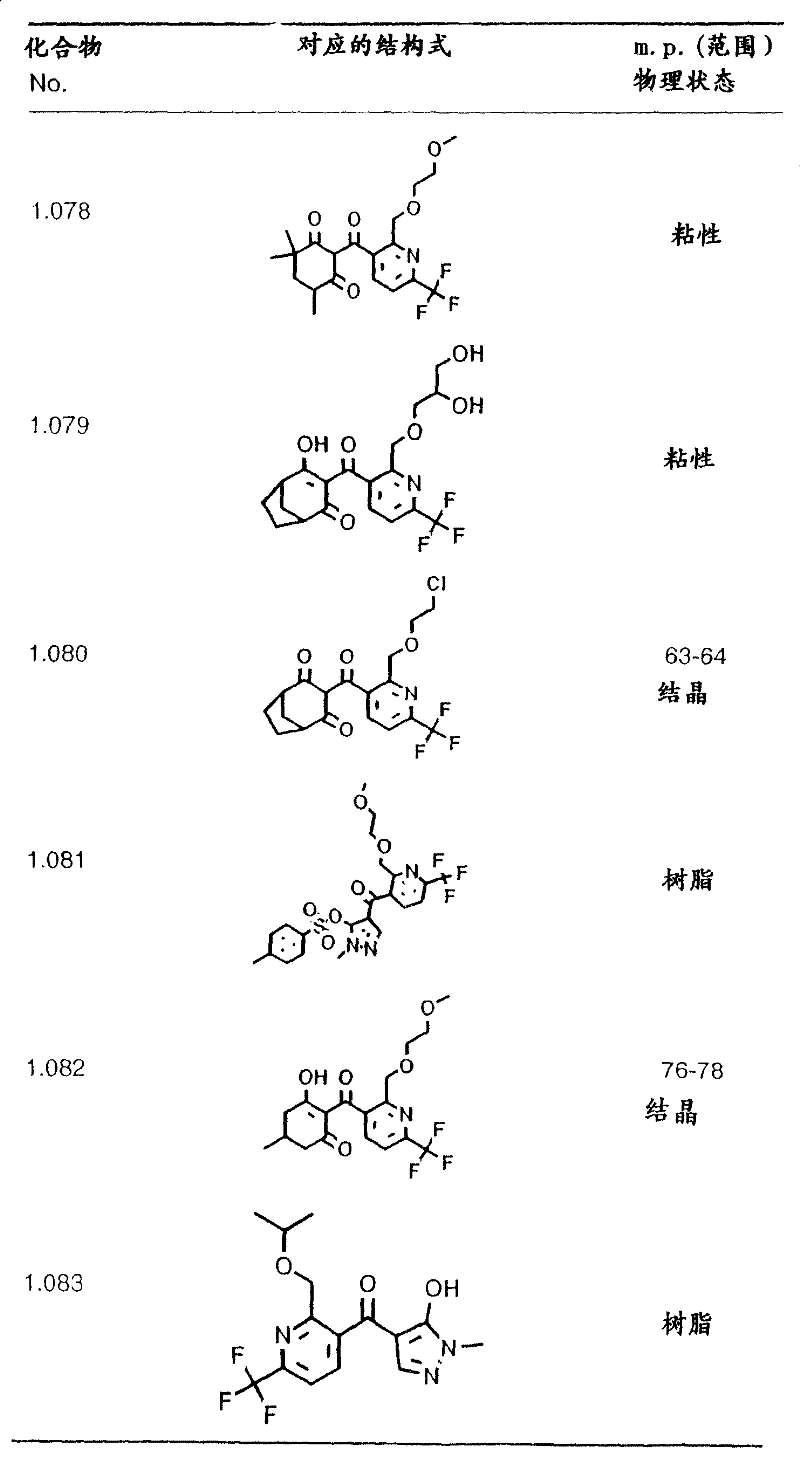

Biological examples
Example B1: pre-emergence herbicidal action (pre-emergence action)
Monocot and dicot test plants were grown in standard flowerpot soil. Immediately after planting, an aqueous suspension of the test substance (prepared according to WO97/34485 from a wettable powder (example F3, b)) or an emulsion (prepared according to WO97/34485 from an emulsifiable concentrate (example F1, c)) is sprayed at an optimum dose (5001 water/ha). The test plants are then grown under optimal conditions in the greenhouse.
After 4 weeks of testing, the test was evaluated using a 9-point rating scale (1: complete lesion, 9: no effect). Grades 1 to 4 (in particular grades 1 to 3) indicate good to very good herbicidal action.
Table B1: pre-emergent effect ("NT" means "not tested"):

the same results are obtained when the compounds of formula I are formulated according to the other examples of WO 97/34485.
Example B2: post-emergence herbicidal action
Monocot and dicot test plants were grown in standard flowerpot soil. At the 2 to 3 leaf stage of the test plants, an aqueous suspension (prepared according to WO97/34485 from a wettable powder (example F3, b)) or an emulsion (prepared according to WO97/34485 from an emulsifiable concentrate (example F1, c)) of the test substance is sprayed at the optimum dose (5001 water/ha). The test plants are then grown under optimal conditions in the greenhouse.
After 2 to 3 weeks of the test, the test was evaluated using a 9-point rating scale (1: complete lesion, 9: no effect). Grades 1 to 4 (in particular grades 1 to 3) indicate good to very good herbicidal action.
Table B2: post-emergence action:


the same results are obtained when the compounds of formula I are formulated according to the other examples of WO 97/34485.
Claims (5)


Applications Claiming Priority (2)
| Application Number | Priority Date | Filing Date | Title |
|---|---|---|---|
| CH1151/00 | 2000-06-09 | ||
| CH11512000 | 2000-06-09 |
Related Parent Applications (1)
| Application Number | Title | Priority Date | Filing Date |
|---|---|---|---|
| CNB018108903A Division CN1231476C (en) | 2000-06-09 | 2001-06-07 | Substituted pyridine herbicides |
Related Child Applications (1)
| Application Number | Title | Priority Date | Filing Date |
|---|---|---|---|
| CNA2006100998916A Division CN1951918A (en) | 2000-06-09 | 2001-06-07 | Substituted pyridine herbicides |
Publications (2)
| Publication Number | Publication Date |
|---|---|
| CN1824662A CN1824662A (en) | 2006-08-30 |
| CN1824662B true CN1824662B (en) | 2010-08-04 |
Family
ID=4560183
Family Applications (3)
| Application Number | Title | Priority Date | Filing Date |
|---|---|---|---|
| CNA2006100998916A Pending CN1951918A (en) | 2000-06-09 | 2001-06-07 | Substituted pyridine herbicides |
| CN200510119289XA Expired - Lifetime CN1824662B (en) | 2000-06-09 | 2001-06-07 | Substituted pyridine herbicides |
| CNB018108903A Expired - Lifetime CN1231476C (en) | 2000-06-09 | 2001-06-07 | Substituted pyridine herbicides |
Family Applications Before (1)
| Application Number | Title | Priority Date | Filing Date |
|---|---|---|---|
| CNA2006100998916A Pending CN1951918A (en) | 2000-06-09 | 2001-06-07 | Substituted pyridine herbicides |
Family Applications After (1)
| Application Number | Title | Priority Date | Filing Date |
|---|---|---|---|
| CNB018108903A Expired - Lifetime CN1231476C (en) | 2000-06-09 | 2001-06-07 | Substituted pyridine herbicides |
Country Status (27)
| Country | Link |
|---|---|
| US (3) | US6838564B2 (en) |
| EP (2) | EP1286985B1 (en) |
| JP (1) | JP4965050B2 (en) |
| CN (3) | CN1951918A (en) |
| AR (1) | AR031243A1 (en) |
| AT (1) | ATE330953T1 (en) |
| AU (2) | AU2001262344B2 (en) |
| BR (1) | BR0111981B1 (en) |
| CA (1) | CA2410345C (en) |
| CZ (1) | CZ303727B6 (en) |
| DE (1) | DE60120964T2 (en) |
| DK (1) | DK1286985T3 (en) |
| ES (1) | ES2266199T3 (en) |
| GT (1) | GT200100103A (en) |
| HK (1) | HK1054376B (en) |
| HR (2) | HRP20020969B1 (en) |
| HU (1) | HU228428B1 (en) |
| IN (1) | IN2002CH02005A (en) |
| MX (1) | MX244506B (en) |
| PL (1) | PL216038B1 (en) |
| PT (1) | PT1286985E (en) |
| RO (3) | RO122034B1 (en) |
| RU (1) | RU2326866C2 (en) |
| SK (1) | SK287483B6 (en) |
| UA (1) | UA74191C2 (en) |
| WO (1) | WO2001094339A1 (en) |
| ZA (1) | ZA200209878B (en) |
Families Citing this family (122)
| Publication number | Priority date | Publication date | Assignee | Title |
|---|---|---|---|---|
| GT200100103A (en) * | 2000-06-09 | 2002-02-21 | NEW HERBICIDES | |
| AR035087A1 (en) * | 2001-08-09 | 2004-04-14 | Syngenta Participations Ag | PIRIDIL-ALQUINOS AND PIRIDIL-N-OXIDO-ACTIVE HERBICIDE ALKINES, PROCEDURE FOR PREPARATION, HERBICIDE COMPOSITION AND TO INHIBIT THE GROWTH OF PLANTS, METHOD FOR CONTROLLING GROWTH OF INDESEABLE PLANTS, AND METHOD OF CREAM INHIBITION |
| GT200200249A (en) * | 2001-12-03 | 2003-07-11 | HERBICIDE COMPOSITION | |
| WO2003047342A1 (en) * | 2001-12-03 | 2003-06-12 | Syngenta Participations Ag | Herbicidal composition |
| AU2002365631A1 (en) * | 2001-12-03 | 2003-06-17 | Syngenta Participations Ag | Herbicidal composition |
| AU2003203479B2 (en) | 2002-04-09 | 2005-10-06 | Syngenta Participations Ag | Process for the preparation of bicyclic diketone salts |
| AU2003203482B2 (en) | 2002-04-09 | 2005-06-02 | Syngenta Participations Ag | Process for the preparation of cyclic diketones |
| DE10219036A1 (en) * | 2002-04-29 | 2003-11-06 | Bayer Cropscience Ag | Substituted pyridyl ketones |
| WO2003106448A2 (en) * | 2002-06-14 | 2003-12-24 | Syngenta Participations Ag | Novel herbicides |
| AU2003213473A1 (en) * | 2002-08-07 | 2004-02-26 | Syngenta Participations Ag | Herbicidal composition |
| WO2004033431A2 (en) * | 2002-10-04 | 2004-04-22 | Arena Pharmaceuticals, Inc. | Hydroxypyrazoles for use against metabolic-related disorders |
| GT200300290A (en) | 2002-12-30 | 2004-10-13 | NEW HERBICIDES | |
| EP1601653B1 (en) | 2003-03-07 | 2009-02-04 | Syngenta Participations AG | Process for the production of substituted nicotinic acid esters |
| WO2005013696A1 (en) * | 2003-07-29 | 2005-02-17 | Syngenta Participation Ag | Method of controlling weeds in transgenic crops |
| WO2005058831A1 (en) * | 2003-12-12 | 2005-06-30 | Syngenta Participations Ag | Novel herbicides |
| WO2005085205A1 (en) * | 2004-03-05 | 2005-09-15 | Nissan Chemical Industries, Ltd. | Substituted pyrazole compound and herbicide |
| BRPI0510502B1 (en) | 2004-04-30 | 2015-07-21 | Syngenta Participations Ag | Process for the production of cyclic diketones, as well as their intermediates |
| RU2384562C2 (en) * | 2004-04-30 | 2010-03-20 | Зингента Партисипейшнс Аг | Method of producing cyclic diketones |
| GB0413605D0 (en) * | 2004-06-17 | 2004-07-21 | Addex Pharmaceuticals Sa | Novel compounds |
| US20090137558A1 (en) * | 2004-12-03 | 2009-05-28 | Peakdale Molecular Limited | Pyridine based compounds useful as intermediates for pharmaceutical or agricultural end-products |
| GB0428137D0 (en) * | 2004-12-22 | 2005-01-26 | Syngenta Participations Ag | Novel herbicides |
| WO2007071730A2 (en) | 2005-12-23 | 2007-06-28 | Basf Se | A method for controlling aquatic weeds |
| NZ568656A (en) | 2005-12-23 | 2011-03-31 | Basf Se | A method for controlling aquatic weeds of the genus hydrilla with topramezone ([3-(4,5-dihydro-isoxazol-3-yl)-4-methylsulfonyl-2-methylphenyl](5-hydroxy-1-methyl-1H-pyrazol-4-yl)methanone) |
| EP1982978B1 (en) * | 2006-02-02 | 2014-08-27 | Kumiai Chemical Industry Co., Ltd. | Pyridone derivative and herbicide |
| WO2008071714A1 (en) | 2006-12-15 | 2008-06-19 | Rohm And Haas Company | Mixtures comprising 1-methylcyclopropene |
| CN102726408B (en) | 2007-04-25 | 2014-08-20 | 先正达参股股份有限公司 | Fungicidal compositions |
| GB0710223D0 (en) * | 2007-05-29 | 2007-07-11 | Syngenta Ltd | Novel Herbicides |
| JP5390801B2 (en) | 2007-07-13 | 2014-01-15 | 石原産業株式会社 | Herbicidal composition |
| EP2092825A1 (en) | 2008-02-21 | 2009-08-26 | Bayer CropScience Aktiengesellschaft | Herbicidal combinations comprising a herbicide of the class of the diamino-s-triazines |
| GB0810554D0 (en) * | 2008-06-09 | 2008-07-16 | Syngenta Ltd | Herbicde composition |
| EP2147600A1 (en) | 2008-07-21 | 2010-01-27 | Bayer CropScience AG | Method for weed control in lawn |
| EP2255637A1 (en) | 2009-05-02 | 2010-12-01 | Bayer CropScience AG | Method for weed control in lawn or turf |
| WO2010132999A1 (en) | 2009-05-21 | 2010-11-25 | Chlorion Pharma, Inc. | Methyl sulfanyl pyrmidmes useful as antiinflammatories, analgesics, and antiepileptics |
| US8658644B2 (en) | 2010-02-04 | 2014-02-25 | Syngenta Crop Protection, Llc | Pyridazine derivatives, processes for their preparation and their use as fungicides |
| JP2011157334A (en) | 2010-02-04 | 2011-08-18 | Sumitomo Chemical Co Ltd | Method for controlling weed |
| BR112012021135A2 (en) | 2010-02-24 | 2016-06-21 | Syngenta Participations Ag | microbicides |
| EP2575421B1 (en) | 2010-05-27 | 2014-09-24 | Syngenta Participations AG | Automated system for analyzing phytotoxicity |
| EP2588456A1 (en) | 2010-07-02 | 2013-05-08 | Syngenta Participations AG | Novel microbiocidal dioxime ether derivatives |
| EP2598487A1 (en) | 2010-07-29 | 2013-06-05 | Syngenta Participations AG | Novel microbiocidal dioxime ether derivatives |
| AR083112A1 (en) | 2010-10-01 | 2013-01-30 | Syngenta Participations Ag | METHOD FOR CONTROLLING PHYTOPATHOGEN DISEASES AND COMPOSITIONS USEFUL FUNGICIDES FOR SUCH CONTROL |
| WO2012066122A1 (en) | 2010-11-18 | 2012-05-24 | Syngenta Participations Ag | 2 - (pyridin- 2 -yl) -quinazoline derivatives and their use as microbicides |
| WO2012069652A2 (en) | 2010-11-26 | 2012-05-31 | Syngenta Participations Ag | Fungicide mixtures |
| WO2012110517A1 (en) | 2011-02-15 | 2012-08-23 | Bayer Cropscience Ag | Synergistic combinations containing a dithiino-tetracarboxamide fungicide and a herbicide, safener or plant growth regulator |
| PH12013501621A1 (en) | 2011-02-28 | 2019-09-02 | Basf Se | Composition comprising a pesticide, a surfactant and an alkoxylate of 2-propylheptylamine |
| CN103459386B (en) | 2011-03-15 | 2016-06-22 | 拜耳知识产权有限责任公司 | N-(1,2,5-oxadiazol-3-yl)pyridinecarboxamides and their use as herbicides |
| EP2545774A1 (en) | 2011-07-12 | 2013-01-16 | Cheminova A/S | Aqueous HPPD inhibitor suspension concentrate compositions comprising smectite clay |
| WO2013011010A1 (en) | 2011-07-19 | 2013-01-24 | Syngenta Participations Ag | Fungizide mixtures |
| DE102011080016A1 (en) | 2011-07-28 | 2012-10-25 | Bayer Cropscience Ag | Use of seed treatment active substance comprising strobilurin fungicides, e.g. as safeners for avoiding or reducing phytotoxic effects of herbicides on useful plants, preferably crop plants, and in crop plants protective agents |
| DE102011079991A1 (en) | 2011-07-28 | 2012-09-13 | Bayer Crop Science Ag | Use of seed treating-agent comprising nicotinoid insecticide as a safener for avoiding or reducing phytotoxic effects of herbicide on useful plants, preferably crop plants |
| DE102011080007A1 (en) | 2011-07-28 | 2012-09-13 | Bayer Cropscience Ag | Use of seed treatment agents comprising conazole or triazole fungicides e.g. as safeners for avoiding or reducing phytotoxic effects of herbicides e.g. carbamate, thiocarbamate and haloacetanilide, on crops, preferably cultural crops |
| DE102011080010A1 (en) | 2011-07-28 | 2012-10-25 | Bayer Cropscience Ag | Use of seed treatment agents comprising anilide and thiazole fungicides, e.g. as safeners for avoiding or reducing phytotoxic effects of herbicides e.g. carbamate, thiocarbamate and haloacetanilide, on crops, preferably cultural crops |
| DE102011080020A1 (en) | 2011-07-28 | 2012-09-13 | Bayer Cropscience Ag | Use of seed treatment agents, comprising dicarboximide fungicides as safeners, for preventing or reducing phytotoxic effects of herbicides on useful plants, preferably cultivated plants |
| DE102011079997A1 (en) | 2011-07-28 | 2012-09-13 | Bayer Corpscience Ag | Use of seed treatment agents comprising pyrazole insecticides e.g. as safeners for avoiding or reducing phytotoxic effects of herbicides e.g. carbamate, thiocarbamate and haloacetanilide, on crops, preferably cultural crops |
| DE102011080004A1 (en) | 2011-07-28 | 2012-09-13 | Bayer Cropscience Ag | Use of seed treatment agents, comprising carbamate fungicides as safeners, for preventing or reducing phytotoxic effects of herbicides on useful plants, preferably cultivated plants |
| DE102011080001A1 (en) | 2011-07-28 | 2012-10-25 | Bayer Cropscience Ag | Use of seed treatment active substance comprising carbamate insecticides, e.g. as safeners for avoiding or reducing phytotoxic effects of herbicides on useful plants, preferably crop plants, and in crop plants protective agents |
| CN103717076B (en) | 2011-08-10 | 2016-04-13 | 拜耳知识产权股份有限公司 | Active compound combinations containing specific tetramic acid derivatives |
| UY34279A (en) | 2011-08-23 | 2013-04-05 | Syngenta Participations Ag | HETEROCYCLIC COMPOUNDS ACTIVE AS MICROBIOCIDES, INTERMEDIARIES, COMPOSITIONS AND USES |
| EP2863743B1 (en) | 2012-06-21 | 2018-04-11 | Basf Se | Adjuvant comprising a 2-propylheptylamine alkoxylate, sugar-based surfactant, and drift-control agent and humectant |
| EP2908639A1 (en) | 2012-10-19 | 2015-08-26 | Bayer Cropscience AG | Active compound combinations comprising carboxamide derivatives |
| WO2016001119A1 (en) | 2014-07-01 | 2016-01-07 | Bayer Cropscience Aktiengesellschaft | Insecticide and fungicide active ingredient combinations |
| WO2019007887A1 (en) | 2017-07-06 | 2019-01-10 | Bayer Aktiengesellschaft | INSECTICIDES AND FUNGICIDES ACTIVE COMPOUNDS |
| WO2019007888A1 (en) | 2017-07-06 | 2019-01-10 | Bayer Aktiengesellschaft | INSECTICIDES ACTIVE COMPOUNDS |
| US11672203B2 (en) | 2018-10-26 | 2023-06-13 | Deere & Company | Predictive map generation and control |
| US11957072B2 (en) | 2020-02-06 | 2024-04-16 | Deere & Company | Pre-emergence weed detection and mitigation system |
| US11589509B2 (en) | 2018-10-26 | 2023-02-28 | Deere & Company | Predictive machine characteristic map generation and control system |
| US11178818B2 (en) | 2018-10-26 | 2021-11-23 | Deere & Company | Harvesting machine control system with fill level processing based on yield data |
| US11641800B2 (en) | 2020-02-06 | 2023-05-09 | Deere & Company | Agricultural harvesting machine with pre-emergence weed detection and mitigation system |
| US12069978B2 (en) | 2018-10-26 | 2024-08-27 | Deere & Company | Predictive environmental characteristic map generation and control system |
| US11240961B2 (en) | 2018-10-26 | 2022-02-08 | Deere & Company | Controlling a harvesting machine based on a geo-spatial representation indicating where the harvesting machine is likely to reach capacity |
| US11653588B2 (en) | 2018-10-26 | 2023-05-23 | Deere & Company | Yield map generation and control system |
| US11467605B2 (en) | 2019-04-10 | 2022-10-11 | Deere & Company | Zonal machine control |
| US11079725B2 (en) | 2019-04-10 | 2021-08-03 | Deere & Company | Machine control using real-time model |
| US11234366B2 (en) | 2019-04-10 | 2022-02-01 | Deere & Company | Image selection for machine control |
| US11778945B2 (en) | 2019-04-10 | 2023-10-10 | Deere & Company | Machine control using real-time model |
| MX2022004231A (en) * | 2019-10-08 | 2022-06-08 | Shenyang Sinochem Agrochemicals R & D Co Ltd | Alkene-containing carboxylate compound and use thereof. |
| US12329148B2 (en) | 2020-02-06 | 2025-06-17 | Deere & Company | Predictive weed map and material application machine control |
| US12225846B2 (en) | 2020-02-06 | 2025-02-18 | Deere & Company | Machine control using a predictive map |
| US12035648B2 (en) | 2020-02-06 | 2024-07-16 | Deere & Company | Predictive weed map generation and control system |
| US11477940B2 (en) | 2020-03-26 | 2022-10-25 | Deere & Company | Mobile work machine control based on zone parameter modification |
| US11874669B2 (en) | 2020-10-09 | 2024-01-16 | Deere & Company | Map generation and control system |
| US11889788B2 (en) | 2020-10-09 | 2024-02-06 | Deere & Company | Predictive biomass map generation and control |
| US11650587B2 (en) | 2020-10-09 | 2023-05-16 | Deere & Company | Predictive power map generation and control system |
| US11825768B2 (en) | 2020-10-09 | 2023-11-28 | Deere & Company | Machine control using a predictive map |
| US12386354B2 (en) | 2020-10-09 | 2025-08-12 | Deere & Company | Predictive power map generation and control system |
| US11474523B2 (en) | 2020-10-09 | 2022-10-18 | Deere & Company | Machine control using a predictive speed map |
| US11983009B2 (en) | 2020-10-09 | 2024-05-14 | Deere & Company | Map generation and control system |
| US11844311B2 (en) | 2020-10-09 | 2023-12-19 | Deere & Company | Machine control using a predictive map |
| US11895948B2 (en) | 2020-10-09 | 2024-02-13 | Deere & Company | Predictive map generation and control based on soil properties |
| US11845449B2 (en) | 2020-10-09 | 2023-12-19 | Deere & Company | Map generation and control system |
| US11946747B2 (en) | 2020-10-09 | 2024-04-02 | Deere & Company | Crop constituent map generation and control system |
| US12178158B2 (en) | 2020-10-09 | 2024-12-31 | Deere & Company | Predictive map generation and control system for an agricultural work machine |
| US11635765B2 (en) | 2020-10-09 | 2023-04-25 | Deere & Company | Crop state map generation and control system |
| US12419220B2 (en) | 2020-10-09 | 2025-09-23 | Deere & Company | Predictive map generation and control system |
| US11849672B2 (en) | 2020-10-09 | 2023-12-26 | Deere & Company | Machine control using a predictive map |
| US11927459B2 (en) | 2020-10-09 | 2024-03-12 | Deere & Company | Machine control using a predictive map |
| US11864483B2 (en) | 2020-10-09 | 2024-01-09 | Deere & Company | Predictive map generation and control system |
| US11675354B2 (en) | 2020-10-09 | 2023-06-13 | Deere & Company | Machine control using a predictive map |
| US11727680B2 (en) | 2020-10-09 | 2023-08-15 | Deere & Company | Predictive map generation based on seeding characteristics and control |
| US12422847B2 (en) | 2020-10-09 | 2025-09-23 | Deere & Company | Predictive agricultural model and map generation |
| US11849671B2 (en) | 2020-10-09 | 2023-12-26 | Deere & Company | Crop state map generation and control system |
| US12013245B2 (en) | 2020-10-09 | 2024-06-18 | Deere & Company | Predictive map generation and control system |
| US11871697B2 (en) | 2020-10-09 | 2024-01-16 | Deere & Company | Crop moisture map generation and control system |
| US11592822B2 (en) | 2020-10-09 | 2023-02-28 | Deere & Company | Machine control using a predictive map |
| US12069986B2 (en) | 2020-10-09 | 2024-08-27 | Deere & Company | Map generation and control system |
| US11711995B2 (en) | 2020-10-09 | 2023-08-01 | Deere & Company | Machine control using a predictive map |
| US12250905B2 (en) | 2020-10-09 | 2025-03-18 | Deere & Company | Machine control using a predictive map |
| US11889787B2 (en) | 2020-10-09 | 2024-02-06 | Deere & Company | Predictive speed map generation and control system |
| US12127500B2 (en) | 2021-01-27 | 2024-10-29 | Deere & Company | Machine control using a map with regime zones |
| US12229886B2 (en) | 2021-10-01 | 2025-02-18 | Deere & Company | Historical crop state model, predictive crop state map generation and control system |
| US12310286B2 (en) | 2021-12-14 | 2025-05-27 | Deere & Company | Crop constituent sensing |
| US12302791B2 (en) | 2021-12-20 | 2025-05-20 | Deere & Company | Crop constituents, predictive mapping, and agricultural harvester control |
| US12245549B2 (en) | 2022-01-11 | 2025-03-11 | Deere & Company | Predictive response map generation and control system |
| US12520759B2 (en) | 2022-01-26 | 2026-01-13 | Deere & Company | Systems and methods for predicting material dynamics |
| US12082531B2 (en) | 2022-01-26 | 2024-09-10 | Deere & Company | Systems and methods for predicting material dynamics |
| US12295288B2 (en) | 2022-04-05 | 2025-05-13 | Deere &Company | Predictive machine setting map generation and control system |
| US12058951B2 (en) | 2022-04-08 | 2024-08-13 | Deere & Company | Predictive nutrient map and control |
| US12298767B2 (en) | 2022-04-08 | 2025-05-13 | Deere & Company | Predictive material consumption map and control |
| US12284934B2 (en) | 2022-04-08 | 2025-04-29 | Deere & Company | Systems and methods for predictive tractive characteristics and control |
| US12358493B2 (en) | 2022-04-08 | 2025-07-15 | Deere & Company | Systems and methods for predictive power requirements and control |
| CN114716320B (en) * | 2022-06-08 | 2022-09-27 | 山东潍坊润丰化工股份有限公司 | A kind of compound and its preparation method, and its application in the preparation of fluoxafen intermediate |
| JP2026502851A (en) | 2022-12-20 | 2026-01-27 | シンジェンタ クロップ プロテクション アクチェンゲゼルシャフト | herbicidal composition |
| AR133212A1 (en) | 2023-07-11 | 2025-09-10 | Syngenta Crop Protection Ag | CHEMICAL PROCESS |
Citations (3)
| Publication number | Priority date | Publication date | Assignee | Title |
|---|---|---|---|---|
| US5260262A (en) * | 1991-12-06 | 1993-11-09 | Monsanto Company | Substituted pyridine compounds having herbicidal activity |
| JPH0625177A (en) * | 1992-07-09 | 1994-02-01 | Nissan Chem Ind Ltd | Pyrazole derivative and herbicide |
| JPH09169736A (en) * | 1995-12-21 | 1997-06-30 | Nissan Chem Ind Ltd | Pyrazole derivative and pest controlling agent |
Family Cites Families (23)
| Publication number | Priority date | Publication date | Assignee | Title |
|---|---|---|---|---|
| IL85347A0 (en) | 1987-02-11 | 1988-07-31 | May & Baker Ltd | Cyclic diones |
| GB2205316B (en) | 1987-06-05 | 1991-09-11 | Sandoz Ltd | Herbicidal benzoyl pyran compounds |
| EP0316491A1 (en) | 1987-11-19 | 1989-05-24 | Stauffer Agricultural Chemicals Company, Inc. | Herbicidal 2-pyridyl and 2-pyrimidine carbonyl 1,3-cyclohexanediones |
| HUT50312A (en) | 1988-02-01 | 1990-01-29 | Sandoz Ag | Herbicide composition containing new dion-compounds and process for producing these compounds |
| US5089046A (en) | 1988-04-04 | 1992-02-18 | Sandoz Ltd. | Aryl and heteroaryl diones |
| HU206242B (en) | 1988-04-18 | 1992-10-28 | Sandoz Ag | Herbicidal compositions comprising substituted benzoyl bicyclodione derivatives as active ingredient |
| IL91083A (en) | 1988-07-25 | 1993-04-04 | Ciba Geigy | Cyclohexanedione derivatives, their preparation and their use as herbicides |
| JPH0259566A (en) | 1988-08-26 | 1990-02-28 | Nippon Soda Co Ltd | Production of 4-hydroxy-2h-pyran-2-one |
| IT1230768B (en) | 1989-02-21 | 1991-10-29 | Agrimont Spa | DERIVATIVES OF 3,4 DEIDRO PIPERIDIN 5 ONE FOR HERBICIDE ACTIVITIES. |
| HUT61534A (en) | 1990-10-25 | 1993-01-28 | Sandoz Ag | 3,5-dioxo-3,4,5,6-tetrahydro-1,2-oxazine derivatives, herbicidal, acaricidal and plant growth regulating composition comprising such compounds as active ingredient, process for applying the composition and for producing the active ingredients, as well as 2-nitro-4-(trifluoromethoxy)-benzoic acid intermediate |
| US5235060A (en) | 1991-07-11 | 1993-08-10 | E. I. Du Pont De Nemours And Company | Certain three component ionic substituted pyridine compounds as intermediates for preparation as herbicides |
| EP0752424B1 (en) * | 1994-03-22 | 1999-06-16 | Kumiai Chemical Industry Co., Ltd. | Nicotinic acid derivative and herbicide |
| PL186631B1 (en) | 1996-03-15 | 2004-02-27 | Syngenta Participations Ag | Synergic herbicidal compositions and method of fighting against weeds |
| US6297198B1 (en) * | 1996-05-14 | 2001-10-02 | Syngenta Participations Ag | Isoxazole derivatives and their use as herbicides |
| EP0922032A1 (en) | 1996-06-06 | 1999-06-16 | E.I. Du Pont De Nemours And Company | Herbicidal pyridinyl and pyrazolylphenyl ketones |
| WO1998029412A1 (en) | 1996-12-27 | 1998-07-09 | Nippon Soda Co., Ltd. | Substituted piperidinedione derivatives and herbicides |
| AU7427298A (en) | 1997-03-14 | 1998-10-12 | Novartis Ag | Novel herbicides |
| JP3929545B2 (en) | 1997-03-25 | 2007-06-13 | 株式会社エス・ディー・エス バイオテック | Method for producing 3-acetyl-cyclopentanecarboxylic acid ester |
| CA2341291C (en) * | 1998-09-15 | 2009-11-03 | Syngenta Participations Ag | Pyridine ketones useful as herbicides |
| DE59915198D1 (en) | 1998-11-05 | 2010-10-07 | Basf Se | PROCESS FOR PREPARING 1-SUBSTITUTED 5-HYDROXYPYRAZOLENE |
| AR023071A1 (en) * | 1998-12-23 | 2002-09-04 | Syngenta Participations Ag | PIRIDINCETONE COMPOUNDS, INTERMEDIATE COMPOUNDS, HERBICITY AND INHIBITOR COMPOSITION OF PLANTAGE GROWTH, METHOD FOR CONTROLLING INDESATED VEGETATION, METHOD FOR INHIBITING GROWTH OF PLANTS, AND USE OF COMPOSITION TO GROW GROWTH. |
| DK1250047T3 (en) * | 2000-01-25 | 2005-05-30 | Syngenta Participations Ag | Herbicide agent |
| GT200100103A (en) | 2000-06-09 | 2002-02-21 | NEW HERBICIDES |
-
2001
- 2001-06-04 GT GT200100103A patent/GT200100103A/en unknown
- 2001-06-07 US US10/297,685 patent/US6838564B2/en not_active Expired - Lifetime
- 2001-06-07 PL PL358807A patent/PL216038B1/en unknown
- 2001-06-07 AU AU2001262344A patent/AU2001262344B2/en not_active Expired
- 2001-06-07 CA CA2410345A patent/CA2410345C/en not_active Expired - Lifetime
- 2001-06-07 JP JP2002501888A patent/JP4965050B2/en not_active Expired - Lifetime
- 2001-06-07 MX MXPA02011977 patent/MX244506B/en active IP Right Grant
- 2001-06-07 PT PT01936439T patent/PT1286985E/en unknown
- 2001-06-07 DE DE60120964T patent/DE60120964T2/en not_active Expired - Lifetime
- 2001-06-07 HK HK03105194.0A patent/HK1054376B/en not_active IP Right Cessation
- 2001-06-07 ES ES01936439T patent/ES2266199T3/en not_active Expired - Lifetime
- 2001-06-07 EP EP01936439A patent/EP1286985B1/en not_active Expired - Lifetime
- 2001-06-07 EP EP05011024A patent/EP1574510B1/en not_active Expired - Lifetime
- 2001-06-07 HU HU0301243A patent/HU228428B1/en unknown
- 2001-06-07 CZ CZ20023979A patent/CZ303727B6/en not_active IP Right Cessation
- 2001-06-07 HR HR20020969A patent/HRP20020969B1/en not_active IP Right Cessation
- 2001-06-07 SK SK1723-2002A patent/SK287483B6/en not_active IP Right Cessation
- 2001-06-07 RO ROA200201526A patent/RO122034B1/en unknown
- 2001-06-07 CN CNA2006100998916A patent/CN1951918A/en active Pending
- 2001-06-07 AU AU6234401A patent/AU6234401A/en active Pending
- 2001-06-07 DK DK01936439T patent/DK1286985T3/en active
- 2001-06-07 RO ROA200600864A patent/RO122911B1/en unknown
- 2001-06-07 RU RU2002135642/04A patent/RU2326866C2/en active IP Right Revival
- 2001-06-07 WO PCT/EP2001/006430 patent/WO2001094339A1/en not_active Ceased
- 2001-06-07 RO ROA200600863A patent/RO122965B9/en unknown
- 2001-06-07 AR ARP010102734A patent/AR031243A1/en active IP Right Grant
- 2001-06-07 AT AT01936439T patent/ATE330953T1/en active
- 2001-06-07 HR HR20080664A patent/HRP20080664A2/en not_active Application Discontinuation
- 2001-06-07 BR BRPI0111981-8A patent/BR0111981B1/en not_active IP Right Cessation
- 2001-06-07 CN CN200510119289XA patent/CN1824662B/en not_active Expired - Lifetime
- 2001-06-07 CN CNB018108903A patent/CN1231476C/en not_active Expired - Lifetime
- 2001-07-06 UA UA2003010242A patent/UA74191C2/en unknown
-
2002
- 2002-12-04 IN IN2005CH2002 patent/IN2002CH02005A/en unknown
- 2002-12-05 ZA ZA200209878A patent/ZA200209878B/en unknown
-
2004
- 2004-07-16 US US10/893,792 patent/US7378375B1/en not_active Expired - Lifetime
-
2008
- 2008-05-23 US US12/126,238 patent/US7691785B2/en not_active Expired - Fee Related
Patent Citations (3)
| Publication number | Priority date | Publication date | Assignee | Title |
|---|---|---|---|---|
| US5260262A (en) * | 1991-12-06 | 1993-11-09 | Monsanto Company | Substituted pyridine compounds having herbicidal activity |
| JPH0625177A (en) * | 1992-07-09 | 1994-02-01 | Nissan Chem Ind Ltd | Pyrazole derivative and herbicide |
| JPH09169736A (en) * | 1995-12-21 | 1997-06-30 | Nissan Chem Ind Ltd | Pyrazole derivative and pest controlling agent |
Also Published As
Similar Documents
| Publication | Publication Date | Title |
|---|---|---|
| CN1824662B (en) | Substituted pyridine herbicides | |
| EP1114030B1 (en) | Pyridine ketones useful as herbicides | |
| CN100386313C (en) | new herbicide | |
| RU2260949C2 (en) | Selective herbicidal compositions and methods for controlling of undesired plants in tame cultures | |
| JP2002533443A (en) | Substituted pyridine herbicides | |
| US20040242456A1 (en) | Herbicidal n-alkysulfonamino derivatives | |
| US20040192910A1 (en) | Sulfonylamino derivatives useful as herbicides | |
| WO2004002981A2 (en) | Herbicidal thienylalkynes | |
| EP1507768A1 (en) | Aryl-alkyne compounds as herbicides | |
| WO2003050087A2 (en) | Novel herbicides | |
| WO2004035563A1 (en) | 3-heterocyclylpyridine derivatives useful as herbicides | |
| AU2003276976B2 (en) | Nicotinoyl derivatives as herbicidal compounds | |
| WO2001066522A1 (en) | Acylated phenyl or pyridine herbicides | |
| AU732154B2 (en) | Benzothiophene derivates as herbicides | |
| HK1094197B (en) | Substituted pyridine herbicides | |
| HK1104548A (en) | Substituted pyridine herbicides | |
| ZA200205748B (en) | Herbicidal composition. |
Legal Events
| Date | Code | Title | Description |
|---|---|---|---|
| C06 | Publication | ||
| PB01 | Publication | ||
| C10 | Entry into substantive examination | ||
| SE01 | Entry into force of request for substantive examination | ||
| REG | Reference to a national code |
Ref country code: HK Ref legal event code: DE Ref document number: 1094197 Country of ref document: HK |
|
| C14 | Grant of patent or utility model | ||
| GR01 | Patent grant | ||
| REG | Reference to a national code |
Ref country code: HK Ref legal event code: GR Ref document number: 1094197 Country of ref document: HK |
|
| CX01 | Expiry of patent term |
Granted publication date: 20100804 |
|
| CX01 | Expiry of patent term |