CN1787823A - 3-amino-4-phenylbutanoic acid derivatives as dipeptidyl peptidase inhibitors for the treatment or prevention of diabetes - Google Patents
3-amino-4-phenylbutanoic acid derivatives as dipeptidyl peptidase inhibitors for the treatment or prevention of diabetes Download PDFInfo
- Publication number
- CN1787823A CN1787823A CNA2004800130071A CN200480013007A CN1787823A CN 1787823 A CN1787823 A CN 1787823A CN A2004800130071 A CNA2004800130071 A CN A2004800130071A CN 200480013007 A CN200480013007 A CN 200480013007A CN 1787823 A CN1787823 A CN 1787823A
- Authority
- CN
- China
- Prior art keywords
- alkyl
- unsubstituted
- substituted
- compound
- alkoxy
- Prior art date
- Legal status (The legal status is an assumption and is not a legal conclusion. Google has not performed a legal analysis and makes no representation as to the accuracy of the status listed.)
- Pending
Links
Classifications
-
- C—CHEMISTRY; METALLURGY
- C07—ORGANIC CHEMISTRY
- C07D—HETEROCYCLIC COMPOUNDS
- C07D487/00—Heterocyclic compounds containing nitrogen atoms as the only ring hetero atoms in the condensed system, not provided for by groups C07D451/00 - C07D477/00
- C07D487/02—Heterocyclic compounds containing nitrogen atoms as the only ring hetero atoms in the condensed system, not provided for by groups C07D451/00 - C07D477/00 in which the condensed system contains two hetero rings
- C07D487/04—Ortho-condensed systems
-
- A—HUMAN NECESSITIES
- A61—MEDICAL OR VETERINARY SCIENCE; HYGIENE
- A61P—SPECIFIC THERAPEUTIC ACTIVITY OF CHEMICAL COMPOUNDS OR MEDICINAL PREPARATIONS
- A61P1/00—Drugs for disorders of the alimentary tract or the digestive system
- A61P1/04—Drugs for disorders of the alimentary tract or the digestive system for ulcers, gastritis or reflux esophagitis, e.g. antacids, inhibitors of acid secretion, mucosal protectants
-
- A—HUMAN NECESSITIES
- A61—MEDICAL OR VETERINARY SCIENCE; HYGIENE
- A61P—SPECIFIC THERAPEUTIC ACTIVITY OF CHEMICAL COMPOUNDS OR MEDICINAL PREPARATIONS
- A61P1/00—Drugs for disorders of the alimentary tract or the digestive system
- A61P1/18—Drugs for disorders of the alimentary tract or the digestive system for pancreatic disorders, e.g. pancreatic enzymes
-
- A—HUMAN NECESSITIES
- A61—MEDICAL OR VETERINARY SCIENCE; HYGIENE
- A61P—SPECIFIC THERAPEUTIC ACTIVITY OF CHEMICAL COMPOUNDS OR MEDICINAL PREPARATIONS
- A61P29/00—Non-central analgesic, antipyretic or antiinflammatory agents, e.g. antirheumatic agents; Non-steroidal antiinflammatory drugs [NSAID]
-
- A—HUMAN NECESSITIES
- A61—MEDICAL OR VETERINARY SCIENCE; HYGIENE
- A61P—SPECIFIC THERAPEUTIC ACTIVITY OF CHEMICAL COMPOUNDS OR MEDICINAL PREPARATIONS
- A61P3/00—Drugs for disorders of the metabolism
-
- A—HUMAN NECESSITIES
- A61—MEDICAL OR VETERINARY SCIENCE; HYGIENE
- A61P—SPECIFIC THERAPEUTIC ACTIVITY OF CHEMICAL COMPOUNDS OR MEDICINAL PREPARATIONS
- A61P3/00—Drugs for disorders of the metabolism
- A61P3/04—Anorexiants; Antiobesity agents
-
- A—HUMAN NECESSITIES
- A61—MEDICAL OR VETERINARY SCIENCE; HYGIENE
- A61P—SPECIFIC THERAPEUTIC ACTIVITY OF CHEMICAL COMPOUNDS OR MEDICINAL PREPARATIONS
- A61P3/00—Drugs for disorders of the metabolism
- A61P3/06—Antihyperlipidemics
-
- A—HUMAN NECESSITIES
- A61—MEDICAL OR VETERINARY SCIENCE; HYGIENE
- A61P—SPECIFIC THERAPEUTIC ACTIVITY OF CHEMICAL COMPOUNDS OR MEDICINAL PREPARATIONS
- A61P3/00—Drugs for disorders of the metabolism
- A61P3/08—Drugs for disorders of the metabolism for glucose homeostasis
- A61P3/10—Drugs for disorders of the metabolism for glucose homeostasis for hyperglycaemia, e.g. antidiabetics
-
- A—HUMAN NECESSITIES
- A61—MEDICAL OR VETERINARY SCIENCE; HYGIENE
- A61P—SPECIFIC THERAPEUTIC ACTIVITY OF CHEMICAL COMPOUNDS OR MEDICINAL PREPARATIONS
- A61P5/00—Drugs for disorders of the endocrine system
- A61P5/24—Drugs for disorders of the endocrine system of the sex hormones
- A61P5/28—Antiandrogens
-
- A—HUMAN NECESSITIES
- A61—MEDICAL OR VETERINARY SCIENCE; HYGIENE
- A61P—SPECIFIC THERAPEUTIC ACTIVITY OF CHEMICAL COMPOUNDS OR MEDICINAL PREPARATIONS
- A61P9/00—Drugs for disorders of the cardiovascular system
- A61P9/10—Drugs for disorders of the cardiovascular system for treating ischaemic or atherosclerotic diseases, e.g. antianginal drugs, coronary vasodilators, drugs for myocardial infarction, retinopathy, cerebrovascula insufficiency, renal arteriosclerosis
Landscapes
- Health & Medical Sciences (AREA)
- Chemical & Material Sciences (AREA)
- Organic Chemistry (AREA)
- Animal Behavior & Ethology (AREA)
- Public Health (AREA)
- Bioinformatics & Cheminformatics (AREA)
- Veterinary Medicine (AREA)
- Engineering & Computer Science (AREA)
- Life Sciences & Earth Sciences (AREA)
- Chemical Kinetics & Catalysis (AREA)
- General Chemical & Material Sciences (AREA)
- Medicinal Chemistry (AREA)
- Nuclear Medicine, Radiotherapy & Molecular Imaging (AREA)
- General Health & Medical Sciences (AREA)
- Pharmacology & Pharmacy (AREA)
- Diabetes (AREA)
- Obesity (AREA)
- Hematology (AREA)
- Endocrinology (AREA)
- Cardiology (AREA)
- Urology & Nephrology (AREA)
- Vascular Medicine (AREA)
- Emergency Medicine (AREA)
- Heart & Thoracic Surgery (AREA)
- Pain & Pain Management (AREA)
- Rheumatology (AREA)
- Child & Adolescent Psychology (AREA)
- Pharmaceuticals Containing Other Organic And Inorganic Compounds (AREA)
- Acyclic And Carbocyclic Compounds In Medicinal Compositions (AREA)
- Medicines That Contain Protein Lipid Enzymes And Other Medicines (AREA)
- Organic Low-Molecular-Weight Compounds And Preparation Thereof (AREA)
- Nitrogen Condensed Heterocyclic Rings (AREA)
Abstract
Description
发明背景Background of the invention
糖尿病指一种由多种致病因素引起的疾病过程,其特征在于,在禁食状态或口服葡萄糖耐受测试期间服用葡萄糖后,血浆葡萄糖水平升高或高血糖症。持续或失控性的高血糖与病情的过早形成和死亡率增高相关。经常性的非正常葡萄糖体内平衡直接或间接与脂、脂蛋白和载脂蛋白代谢性和其它代谢和血流动力性疾病有关。因此乙型糖尿病患者大血管和微血管并发症的风险性特别高,并发症包括冠心病、中风、未梢血管病、高血压、肾病、神经病和视网膜病。因此,在糖尿病的临床处理和治疗上,葡萄糖体内平衡、脂代谢和高血压的治疗性控制是极为重要的。Diabetes mellitus is a multifactorial disease process characterized by elevated plasma glucose levels or hyperglycemia following glucose administration in the fasted state or during oral glucose tolerance tests. Persistent or uncontrolled hyperglycemia is associated with premature disease development and increased mortality. Recurrent abnormal glucose homeostasis is directly or indirectly related to lipid, lipoprotein and apolipoprotein metabolism and other metabolic and hemodynamic disorders. Patients with type 2 diabetes are therefore at particularly high risk for macrovascular and microvascular complications, including coronary heart disease, stroke, peripheral vascular disease, hypertension, nephropathy, neuropathy, and retinopathy. Therefore, therapeutic control of glucose homeostasis, lipid metabolism, and hypertension is extremely important in the clinical management and treatment of diabetes.
糖尿病有两种常见形式。在1型糖尿病或胰岛素依赖型糖尿病(IDDM)中,患者很少或完全不产生胰岛素—一种调节葡萄糖利用的激素。在2型糖尿病或非胰岛素依赖型糖尿病(NIDDM)中,与非糖尿病患者相比,患者的血浆胰岛素水平往往相同甚至更高;然而,这些患者对主要的胰岛素敏感组织,指肌肉、肝和脂肪组织中的胰岛素对葡萄糖和脂代谢的刺激作用已产生抗性,且升高的血浆胰岛素水平不足以克服显著的胰岛素抗性。There are two common forms of diabetes. In type 1 diabetes, or insulin-dependent diabetes mellitus (IDDM), patients produce little or no insulin, the hormone that regulates glucose utilization. In type 2 diabetes, or non-insulin-dependent diabetes mellitus (NIDDM), patients tend to have the same or even higher plasma insulin levels compared to non-diabetic patients; however, these patients are sensitive to the major insulin-sensitive tissues, namely muscle, liver, and fat Tissue insulin has become resistant to stimulation of glucose and lipid metabolism, and elevated plasma insulin levels are insufficient to overcome marked insulin resistance.
胰岛素抗性不完全起因于胰岛素受体量的减少,而起因于尚未知晓的后胰岛素受体结合的不足。对胰岛素响应的抗性导致肌肉内对葡萄糖摄取、氧化和贮存的胰岛素活性的不足,以及对脂肪组织中脂类分解和肝中葡萄糖生成和分泌的不适当的胰岛素抑制。Insulin resistance results not entirely from a decrease in the amount of insulin receptors, but from an as-yet-unknown deficiency in post-insulin receptor binding. Resistance to insulin response results in insufficient insulin activity in muscle for glucose uptake, oxidation and storage, and inappropriate insulin suppression of lipolysis in adipose tissue and glucose production and secretion in liver.
多年来基本未变的2型糖尿病的有效治疗方法已经承认到其的局限。尽管体育锻炼和膳食热量摄取的减少会大大改善糖尿病的症状,但由于完全束缚的固定不变的生活方式和过量的食物,尤其是含大量饱和脂肪的食物消耗,照此治疗是极为不利的。通过给与刺激胰的β-细胞分泌更多胰岛素的磺酰脲类(例如甲苯磺丁脲和格列吡嗪)或美格列奈,和/或在磺酰脲类或美格列奈无效时,通过注射胰岛素来增加血浆的胰岛素水平,可导致胰岛素浓度高到足以刺激高胰岛素抗性组织。然而,危险的低水平的血浆葡萄糖可由给予胰岛素或胰岛素的促分泌素(磺酰脲类或美格列奈)引起,且会出现由于更高的血浆胰岛素水平引起的高水平的胰岛素抗性。双胍类能提高胰岛素敏感性,从而使高血糖症有所缓和。但是,两种双胍,苯乙双胍和二甲双胍,都可诱发乳酸中毒和恶心/腹泻。二甲双胍比苯乙双胍副作用少,故常作为治疗2型糖尿病的处方药。Effective treatments for type 2 diabetes, which have remained largely unchanged for many years, have recognized their limitations. Although physical exercise and reduction of dietary caloric intake can greatly improve the symptoms of diabetes, such treatment is extremely unfavorable due to the complete restraint of a fixed lifestyle and excessive food consumption, especially food containing a large amount of saturated fat. Stimulate pancreatic β-cells to secrete more insulin by administration of sulfonylureas (eg, tolbutamide and glipizide) or meglitinide, and/or ineffective on sulfonylureas or meglitinide , increasing plasma insulin levels by injecting insulin can result in insulin concentrations high enough to stimulate highly insulin-resistant tissues. However, dangerously low levels of plasma glucose can be induced by administration of insulin or insulin secretagogues (sulfonylureas or meglitinide), and high levels of insulin resistance can occur due to higher plasma insulin levels. Biguanides can improve insulin sensitivity and thus alleviate hyperglycemia. However, both biguanides, phenformin and metformin, can induce lactic acidosis and nausea/diarrhea. Metformin has fewer side effects than phenformin and is often prescribed for type 2 diabetes.
格列酮类药物(Glitazones)(即5-苄基噻唑烷-2,4-二酮类)是最近公开的一类有效改善2型糖尿病多种症状的化合物。在几种2型糖尿病的动物模型中,这些药物基本提高了肌肉、肝和脂肪组织内的胰岛素敏感性,从而导致部分或完全的高血浆葡萄糖水平修复而不出现高血糖症。目前市售的格列酮类药物是过氧物酶体增殖剂活化受体(PPAR)(主要是PPAR-γ亚型)的激动剂。一般认为,PPAR-γ激动作用是用格列酮类药物观察到的胰岛素灵敏化提高的原因。正在测试的用于治疗II型糖尿病的较新的PPAR激动剂是α、γ或δ亚型激动剂,或这些II型的混合物,在许多情况下,与所述格列酮类药物有化学上的区别(即,它们不是噻唑烷二酮)。某些格列酮类药物(例如曲格列酮)已出现严重的副作用(例如肝中毒)。Glitazones (ie, 5-benzylthiazolidine-2,4-diones) are a recently disclosed class of compounds that are effective in improving various symptoms of type 2 diabetes. In several animal models of type 2 diabetes, these drugs substantially increased insulin sensitivity in muscle, liver, and adipose tissue, resulting in partial or complete restoration of high plasma glucose levels without hyperglycemia. Currently marketed glitazones are agonists of peroxisome proliferator-activated receptors (PPARs), mainly of the PPAR-γ subtype. PPAR-gamma agonism is generally believed to be responsible for the increased insulin sensitization observed with glitazones. The newer PPAR agonists being tested for the treatment of type II diabetes are alpha, gamma, or delta subtype agonists, or mixtures of these type IIs, which in many cases are chemically related to the glitazones. (i.e., they are not thiazolidinediones). Serious side effects (eg, liver toxicity) have been reported with certain glitazones (eg, troglitazone).
治疗所述疾病的其它方法尚在研究中。最近已引进或还在研制的新的生物化学方法包括用α葡萄糖苷酶抑制剂(例如阿卡波糖)和蛋白酪氨酸磷脂酸酶-1B(PTP-1B)抑制剂治疗。Other methods of treating the disease are under investigation. New biochemical approaches that have recently been introduced or are under development include treatment with alpha-glucosidase inhibitors (eg, acarbose) and protein tyrosine phosphatidicase-1B (PTP-1B) inhibitors.
作为可用于糖尿病,尤其是2型糖尿病治疗的药物的二肽基肽酶-IV(“DP-IV”或“DPP-IV”)酶的抑制剂的化合物也在研究中。例如参见WO97/40832、WO98/19998、美国专利第5,939,560,Bioorg.Med.Chem.Lett.,6(10),1163-1166(1996);和Bioorg.Med.Chem.Lett.,6(22),2745-2748(1996)。DP-IV抑制剂在治疗2型糖尿病中的用途是基于体内DP-IV易于灭活胰高血糖素样肽-1(GLP-1)和胃抑制肽(GIP)的事实。GLP-1和GIP是肠降血糖素,产生于消化食物时。该肠降血糖素刺激了胰岛素的产生。DP-IV的抑制作用导致肠降血糖素灭活下降,这同样也导致通过胰脏刺激胰岛素产生中所述肠降血糖素的作用的提高。因此DP-IV抑制作用能引起血清胰岛素水平的提高。由于所述肠降血糖素仅当消化食物时,才由身体产生,因此不期望在不适当的时间(例如两餐之间)DP-IV抑制作用增加胰岛素的水平,从而导致血糖过低(低血糖症)。因此,期望DP-IV的抑制作用能增加胰岛素而不增加低血糖症的风险,低血糖症是与胰岛素促分泌素的使用有关的危险性副作用。Compounds are also being investigated as inhibitors of the dipeptidyl peptidase-IV ("DP-IV" or "DPP-IV") enzyme as drugs useful in the treatment of diabetes, especially type 2 diabetes. See eg WO97/40832, WO98/19998, US Patent No. 5,939,560, Bioorg. Med. Chem. Lett., 6(10), 1163-1166 (1996); and Bioorg. Med. Chem. Lett., 6(22) , 2745-2748 (1996). The use of DP-IV inhibitors in the treatment of type 2 diabetes is based on the fact that DP-IV readily inactivates glucagon-like peptide-1 (GLP-1 ) and gastric inhibitory peptide (GIP) in vivo. GLP-1 and GIP are incretins that are produced when food is digested. The incretins stimulate insulin production. Inhibition of DP-IV leads to decreased inactivation of incretins, which likewise leads to increased action of said incretins in stimulating insulin production by the pancreas. Thus DP-IV inhibition can cause an increase in serum insulin levels. Since the incretins are only produced by the body when food is digested, it is undesirable for DP-IV inhibition to increase insulin levels at inappropriate times (such as between meals), leading to hypoglycemia (hypoglycemia). blood sugar). Therefore, inhibition of DP-IV is expected to increase insulin without increasing the risk of hypoglycemia, a dangerous side effect associated with the use of insulin secretagogues.
DP-IV抑制剂也具有本文讨论的其它治疗用途。目前尚未广泛研究DP-IV抑制剂,尤其是除糖尿病外的用途。为治疗糖尿病和潜在的其它疾病和病症,需要新的化合物以发现改良的DP-IV抑制剂。DP-IV抑制剂治疗2型糖尿病的治疗潜力由D.J.Drucker在Exp.Opin.Invest.Drugs,Vol.12,No.1,pp.87-100(2003)中讨论。DP-IV inhibitors also have other therapeutic uses discussed herein. DP-IV inhibitors have not been studied extensively, especially for uses other than diabetes. New compounds are needed to discover improved DP-IV inhibitors for the treatment of diabetes and potentially other diseases and conditions. The therapeutic potential of DP-IV inhibitors in the treatment of type 2 diabetes is discussed by D. J. Drucker in Exp. Opin. Invest. Drugs, Vol. 12, No. 1, pp. 87-100 (2003).
发明概述Summary of the invention
本发明涉及作为二肽基肽酶-IV酶抑制剂(“DP-IV抑制剂”)的3-氨基-4-苯基丁酸衍生物,其可用于治疗或预防涉及二肽基肽酶-IV酶的疾病例如糖尿病,尤其是2型糖尿病。本发明还涉及包含这些化合物的药物组合物以及这些化合物和组合物在治疗或预防涉及二肽基肽酶-IV酶的疾病中的用途。The present invention relates to 3-amino-4-phenylbutyric acid derivatives as dipeptidyl peptidase-IV enzyme inhibitors ("DP-IV inhibitors") useful in the treatment or prevention of Diseases of IV enzymes such as diabetes, especially type 2 diabetes. The invention also relates to pharmaceutical compositions comprising these compounds and the use of these compounds and compositions in the treatment or prevention of diseases involving dipeptidyl peptidase-IV enzymes.
发明详述Detailed description of the invention
本发明涉及可用于二肽基肽酶-IV酶抑制剂的3-氨基-4-苯基丁酸衍生物。本发明化合物由结构式I代表:The present invention relates to 3-amino-4-phenylbutyric acid derivatives useful as dipeptidyl peptidase-IV enzyme inhibitors. Compounds of the present invention are represented by structural formula I:

其中in
每个n独立地为0、1或2;each n is independently 0, 1 or 2;
m是1或2;m is 1 or 2;
p是1或2;条件是m+p是3;p is 1 or 2; the condition is that m+p is 3;
X是N或CR2;X is N or CR 2 ;
Ar是苯基,所述苯基被1-5个R3取代基取代;Ar is phenyl, said phenyl is substituted by 1-5 R substituents;
R1和R2分别独立地选自R 1 and R 2 are independently selected from
氢,hydrogen,
卤素,halogen,
羟基,hydroxyl,
氰基,cyano,
C1-10烷基,其中所述烷基是未取代的或者被1-5个独立地选自卤素或羟基的取代基取代,C 1-10 alkyl, wherein said alkyl is unsubstituted or substituted by 1-5 substituents independently selected from halogen or hydroxyl,
C1-10烷氧基,其中所述烷氧基是未取代的或者被1-5个独立地选自卤素或羟基的取代基取代,C 1-10 alkoxy, wherein the alkoxy is unsubstituted or substituted by 1-5 substituents independently selected from halogen or hydroxyl,
C1-10烷硫基、其中所述烷硫基是未取代的或者被1-5个独立地选自卤素或羟基的取代基取代,C 1-10 alkylthio, wherein said alkylthio is unsubstituted or substituted by 1-5 substituents independently selected from halogen or hydroxyl,
C2-10链烯基,其中所述链烯基是未取代的或者被1-5个独立地选自卤素或羟基的取代基取代,C 2-10 alkenyl, wherein said alkenyl is unsubstituted or substituted by 1-5 substituents independently selected from halogen or hydroxyl,
(CH2)nCOOH,(CH 2 ) n COOH,
(CH2)nCOOC1-6烷基,(CH 2 ) n COOC 1-6 alkyl,
(CH2)nCONR4R5,其中R4和R5独立地选自氢、四唑基、噻唑基、(CH2)n-苯基、(CH2)n-C3-6环烷基和C1-6烷基,其中所述烷基是未取代的或者被1-5个卤素取代,并且其中所述苯基和环烷基是未取代的或者被1-5个独立地选自下列的取代基取代:卤素、羟基、C1-6烷基和C1-6烷氧基,所述烷基和烷氧基是未取代的或者被1-5个卤素取代;或者R4和R5与它们所连接的氮原子一起形成选自下列的杂环:氮杂环丁烷、吡咯烷、哌啶、哌嗪和吗啉,其中所述杂环是未取代的或者被1-5个独立地选自下列的取代基取代:卤素、羟基、C1-6烷基和C1-6烷氧基,所述烷基和烷氧基是未取代的或者被1-5个卤素取代;(CH 2 ) n CONR 4 R 5 , wherein R 4 and R 5 are independently selected from hydrogen, tetrazolyl, thiazolyl, (CH 2 ) n -phenyl, (CH 2 ) n -C 3-6 cycloalkane and C 1-6 alkyl, wherein the alkyl is unsubstituted or substituted by 1-5 halogens, and wherein the phenyl and cycloalkyl are unsubstituted or substituted by 1-5 independently selected Substituents selected from the following substituents: halogen, hydroxy, C 1-6 alkyl and C 1-6 alkoxy, said alkyl and alkoxy are unsubstituted or substituted by 1-5 halogens; or R 4 and R together with the nitrogen atom to which they are attached form a heterocycle selected from the group consisting of azetidine, pyrrolidine, piperidine, piperazine and morpholine, wherein the heterocycle is unsubstituted or replaced by 1- 5 substituents independently selected from the following substituents: halogen, hydroxy, C 1-6 alkyl and C 1-6 alkoxy, said alkyl and alkoxy are unsubstituted or substituted by 1-5 halogen replace;
(CH2)n-NR4R5,(CH 2 ) n -NR 4 R 5 ,
(CH2)n-OCONR4R5,(CH 2 ) n -OCONR 4 R 5 ,
(CH2)n-SO2NR4R5,(CH 2 ) n -SO 2 NR 4 R 5 ,
(CH2)n-SO2R6,(CH 2 ) n -SO 2 R 6 ,
(CH2)n-NR7SO2R6,(CH 2 ) n -NR 7 SO 2 R 6 ,
(CH2)n-NR7CONR4R5,(CH 2 ) n -NR 7 CONR 4 R 5 ,
(CH2)n-NR7COR7,(CH 2 ) n -NR 7 COR 7 ,
(CH2)n-NR7CO2R6,(CH 2 ) n -NR 7 CO 2 R 6 ,
(CH2)n-COR6,(CH 2 ) n -COR 6 ,
(CH2)n-C3-6环烷基,其中所述环烷基是未取代的或者被1-3个独立地选自下列的取代基取代:卤素、羟基、C1-6烷基和C1-6烷氧基,所述烷基和烷氧基是未取代的或者被1-5个卤素取代;(CH 2 ) n -C 3-6 cycloalkyl, wherein the cycloalkyl is unsubstituted or substituted by 1-3 substituents independently selected from the following: halogen, hydroxyl, C 1-6 alkyl and C 1-6 alkoxy, the alkyl and alkoxy are unsubstituted or substituted by 1-5 halogens;
(CH2)n-芳基,其中所述芳基是未取代的或者被1-5个独立地选自下列的取代基取代:卤素、氰基、羟基、NR7SO2R6、SO2R6、CO2H、C1-6烷氧基羰基、C1-6烷基和C1-6烷氧基,所述烷基和烷氧基是未取代的或者被1-5个卤素取代;(CH 2 ) n -aryl, wherein the aryl is unsubstituted or substituted with 1-5 substituents independently selected from the group consisting of halogen, cyano, hydroxyl, NR 7 SO 2 R 6 , SO 2 R 6 , CO 2 H, C 1-6 alkoxycarbonyl, C 1-6 alkyl and C 1-6 alkoxy, the alkyl and alkoxy are unsubstituted or replaced by 1-5 halogen replace;
(CH2)n-杂芳基,其中所述杂芳基是未取代的或者被1-3个独立地选自下列的取代基取代:卤素、羟基、C1-6烷基和C1-6烷氧基,所述烷基和烷氧基是未取代的或者被1-5个卤素取代,和(CH 2 ) n -heteroaryl, wherein the heteroaryl is unsubstituted or substituted with 1-3 substituents independently selected from the group consisting of halogen, hydroxyl, C 1-6 alkyl and C 1- 6 alkoxy groups, the alkyl and alkoxy groups are unsubstituted or substituted with 1-5 halogens, and
(CH2)n-杂环基,其中所述杂环基是未取代的或者被1-3个独立地选自下列的取代基取代:氧代基、羟基、卤素、C1-6烷基和C1-6烷氧基,所述烷基和烷氧基是未取代的或者被1-5个卤素取代,(CH 2 ) n -heterocyclyl, wherein the heterocyclyl is unsubstituted or substituted by 1-3 substituents independently selected from the group consisting of oxo, hydroxyl, halogen, C 1-6 alkyl and C 1-6 alkoxy, said alkyl and alkoxy are unsubstituted or substituted by 1-5 halogen,
其中R1和R2中的任何亚甲基(CH2)碳原子是未取代的或者被1-2个独立地选自下列的基团取代:卤素、羟基和C1-4烷基,所述烷基是未取代的或者被1-5个卤素取代;wherein any methylene (CH 2 ) carbon atoms in R 1 and R 2 are unsubstituted or substituted by 1-2 groups independently selected from the following groups: halogen, hydroxyl and C 1-4 alkyl, so The alkyl group is unsubstituted or substituted by 1-5 halogens;
每个R3独立地选自Each R3 is independently selected from
氢,hydrogen,
卤素,halogen,
氰基,cyano,
羟基,hydroxyl,
C1-6烷基,所述烷基是未取代的或者被1-5个卤素取代,和C 1-6 alkyl, said alkyl is unsubstituted or substituted by 1-5 halogen, and
C1-6烷氧基,所述烷氧基是未取代的或者被1-5个卤素取代;C 1-6 alkoxy, the alkoxy is unsubstituted or substituted by 1-5 halogens;
R6独立地选自四唑基、噻唑基、(CH2)n-苯基、(CH2)n-C3-6环烷基和C1-6烷基,其中所述烷基是未取代的或者被1-5个卤素取代,并且其中所述苯基和环烷基是未取代的或者被1-5个独立地选自下列的取代基取代:卤素、羟基、C1-6烷基和C1-6烷氧基,所述烷基和烷氧基是未取代的或者被1-5个卤素取代;并且其中R6中的任何亚甲基(CH2)碳原子是未取代的或者被1-2个独立地选自下列的基团取代:卤素、羟基、C1-4烷基和C1-4烷氧基,所述烷基和烷氧基是未取代的或者被1-5个卤素取代;R 6 is independently selected from tetrazolyl, thiazolyl, (CH 2 ) n -phenyl, (CH 2 ) n -C 3-6 cycloalkyl and C 1-6 alkyl, wherein the alkyl is not Substituted or substituted by 1-5 halogen, and wherein said phenyl and cycloalkyl are unsubstituted or substituted by 1-5 substituents independently selected from the following: halogen, hydroxyl, C 1-6 alkane and C 1-6 alkoxy groups, said alkyl and alkoxy groups are unsubstituted or substituted by 1-5 halogens; and wherein any methylene (CH 2 ) carbon atom in R 6 is unsubstituted or substituted by 1-2 groups independently selected from the following groups: halogen, hydroxyl, C 1-4 alkyl and C 1-4 alkoxy, said alkyl and alkoxy are unsubstituted or substituted by 1-5 halogen substitutions;
每个R7是氢或R6;each R 7 is hydrogen or R 6 ;
每个R8、R9和R10独立地选自Each R 8 , R 9 and R 10 is independently selected from
氢,hydrogen,
氰基,cyano,
羧基,carboxyl,
C1-6烷氧基羰基,C 1-6 alkoxycarbonyl,
C1-10烷基,其中所述烷基是未取代的或者被1-5个独立地选自下列的取代基取代:卤素、羟基、C1-6烷氧基、羧基、C1-6烷氧基羰基和苯基-C1-3烷氧基,其中所述烷氧基是未取代的或者被1-5个卤素取代,C 1-10 alkyl, wherein the alkyl is unsubstituted or substituted by 1-5 substituents independently selected from the following: halogen, hydroxyl, C 1-6 alkoxy, carboxyl, C 1-6 Alkoxycarbonyl and phenyl-C 1-3 alkoxy, wherein said alkoxy is unsubstituted or substituted by 1-5 halogen,
(CH2)n-芳基,其中所述芳基是未取代的或者被1-5个独立地选自下列的取代基取代:卤素、羟基、C1-6烷基和C1-6烷氧基,所述烷基和烷氧基是未取代的或者被1-5个卤素取代,(CH 2 ) n -aryl, wherein the aryl is unsubstituted or substituted with 1-5 substituents independently selected from the group consisting of halogen, hydroxyl, C 1-6 alkyl and C 1-6 alkane Oxy, said alkyl and alkoxy are unsubstituted or substituted with 1-5 halogens,
(CH2)n-杂芳基,其中所述杂芳基是未取代的或者被1-3个独立地选自下列的取代基取代:羟基、卤素、C1-6烷基和C1-6烷氧基,所述烷基和烷氧基是未取代的或者被1-5个卤素取代,(CH 2 ) n -heteroaryl, wherein the heteroaryl is unsubstituted or substituted with 1-3 substituents independently selected from the group consisting of hydroxyl, halogen, C 1-6 alkyl and C 1- 6 alkoxy, said alkyl and alkoxy are unsubstituted or substituted by 1-5 halogen,
(CH2)n-杂环基,其中所述杂环基是未取代的或者被1-3个独立地选自下列的取代基取代:氧代基、羟基、卤素、C1-6烷基和C1-6烷氧基,所述烷基和烷氧基是未取代的或者被1-5个卤素取代,(CH 2 ) n -heterocyclyl, wherein the heterocyclyl is unsubstituted or substituted by 1-3 substituents independently selected from the group consisting of oxo, hydroxyl, halogen, C 1-6 alkyl and C 1-6 alkoxy, said alkyl and alkoxy are unsubstituted or substituted by 1-5 halogen,
(CH2)n-C3-6环烷基,其中所述环烷基是未取代的或者被1-3个独立地选自下列的取代基取代:卤素、羟基、C1-6烷基和C1-6烷氧基,所述烷基和烷氧基是未取代的或者被1-5个卤素取代,和(CH 2 ) n -C 3-6 cycloalkyl, wherein the cycloalkyl is unsubstituted or substituted by 1-3 substituents independently selected from the following: halogen, hydroxyl, C 1-6 alkyl and C 1-6 alkoxy, said alkyl and alkoxy are unsubstituted or substituted with 1-5 halogens, and
(CH2)nCONR4R5,其中R4和R5独立地选自氢、四唑基、噻唑基、(CH2)n-苯基、(CH2)n-C3-6环烷基和C1-6烷基,其中所述烷基是未取代的或者被1-5个卤素取代,并且其中所述苯基和环烷基是未取代的或者被1-5个独立地选自下列的取代基取代:卤素、羟基、C1-6烷基和C1-6烷氧基,所述烷基和烷氧基是未取代的或者被1-5个卤素取代;或者R4和R5与它们所连接的氮原子一起形成选自下列的杂环:氮杂环丁烷、吡咯烷、哌啶、哌嗪和吗啉,其中所述杂环是未取代的或者被1-5个独立地选自下列的取代基取代:卤素、羟基、C1-6烷基和C1-6烷氧基,所述烷基和烷氧基是未取代的或者被1-5个卤素取代;(CH 2 ) n CONR 4 R 5 , wherein R 4 and R 5 are independently selected from hydrogen, tetrazolyl, thiazolyl, (CH 2 ) n -phenyl, (CH 2 ) n -C 3-6 cycloalkane and C 1-6 alkyl, wherein the alkyl is unsubstituted or substituted by 1-5 halogens, and wherein the phenyl and cycloalkyl are unsubstituted or substituted by 1-5 independently selected Substituents selected from the following substituents: halogen, hydroxy, C 1-6 alkyl and C 1-6 alkoxy, said alkyl and alkoxy are unsubstituted or substituted by 1-5 halogens; or R 4 and R together with the nitrogen atom to which they are attached form a heterocycle selected from the group consisting of azetidine, pyrrolidine, piperidine, piperazine and morpholine, wherein the heterocycle is unsubstituted or replaced by 1- 5 substituents independently selected from the following substituents: halogen, hydroxy, C 1-6 alkyl and C 1-6 alkoxy, said alkyl and alkoxy are unsubstituted or substituted by 1-5 halogen replace;
其中R8、R9或R10中的任何亚甲基(CH2)碳原子是未取代的或者被1-2个独立地选自下列的基团取代:卤素、羟基和C1-4烷基,所述烷基是未取代的或者被1-5个卤素取代。wherein any methylene (CH 2 ) carbon atom in R 8 , R 9 or R 10 is unsubstituted or substituted by 1-2 groups independently selected from the following groups: halogen, hydroxyl and C 1-4 alkane The alkyl group is unsubstituted or substituted with 1-5 halogens.
在本发明化合物的一个实施方案中,用*标记的碳原子具有R构型,并且如式Ia所示:In one embodiment of the compounds of the invention, the carbon atom marked with * has the R configuration and is as shown in formula Ia:
其中Ar、X、R1、R8、R9、R10、m和p如本文所定义。wherein Ar, X, R 1 , R 8 , R 9 , R 10 , m and p are as defined herein.
在本发明化合物的第二个实施方案中,p是1,且m是2,并且如式Ib所示:In a second embodiment of the compounds of the invention, p is 1, and m is 2, and is shown in formula Ib:
其中Ar、X、R1、R8、R9和R10如本文所定义。wherein Ar, X, R 1 , R 8 , R 9 and R 10 are as defined herein.
在所述第二个实施方案的一个类别中,用*标记的碳原子具有R构型,并且如式Ic所示:In one class of said second embodiment, the carbon atom marked with * has the R configuration and is as shown in Formula Ic:
其中Ar、X、R1、R8、R9和R10如本文所定义。wherein Ar, X, R 1 , R 8 , R 9 and R 10 are as defined herein.
在所述第二个实施方案的另一个类别中,X是N,并且如式Id所示:In another class of said second embodiment, X is N and is represented by the formula Id:

其中Ar、R1、R8、R9和R10如本文所定义。wherein Ar, R 1 , R 8 , R 9 and R 10 are as defined herein.
在所述第二个实施方案的第三个类别中,X是CR2,并且如式Ie所示:In a third class of said second embodiment, X is CR 2 and is shown in formula Ie:

其中Ar、R1、R2、R8、R9和R10如本文所定义。wherein Ar, R 1 , R 2 , R 8 , R 9 and R 10 are as defined herein.
在本发明化合物的第三个实施方案中,p是2,且m是1,并且如式If所示:In a third embodiment of the compounds of the present invention, p is 2, and m is 1, and is as shown in formula If:
其中Ar、X、R1、R8、R9和R10如本文所定义。wherein Ar, X, R 1 , R 8 , R 9 and R 10 are as defined herein.
在所述第三个实施方案的一个类别中,用*标记的碳原子具有R构型,并且如式Ig所示:In a class of said third embodiment, the carbon atom marked with * has the R configuration and is shown in formula Ig:
其中Ar、X、R1、R8、R9和R10如本文所定义。wherein Ar, X, R 1 , R 8 , R 9 and R 10 are as defined herein.
在所述本发明化合物的第三个实施方案的另一个类别中,X是N,并且如式Ih所示:In another class of said third embodiment of the compounds of the invention, X is N and is as shown in formula Ih:
其中Ar、R1、R8、R9和R10如本文所定义。wherein Ar, R 1 , R 8 , R 9 and R 10 are as defined herein.
在所述本发明化合物的第三个实施方案的第三个类别中,X是CR2,并且如式Ii所示:In a third class of said third embodiment of the compounds of the invention, X is CR 2 and is as shown in formula Ii:
其中Ar、R1、R2、R8、R9和R10如本文所定义。wherein Ar, R 1 , R 2 , R 8 , R 9 and R 10 are as defined herein.
在本发明化合物的第四个实施方案中,R3选自氢、氟、氯、溴、三氟甲基和甲基。在该实施方案的一个类别中,R3选自氢、氟和氯。在该类别的一个亚类中,R3是氢或氟。In a fourth embodiment of the compounds of this invention, R3 is selected from hydrogen, fluoro, chloro, bromo, trifluoromethyl and methyl. In a class of this embodiment, R3 is selected from hydrogen, fluorine and chlorine. In a subclass of this class, R3 is hydrogen or fluoro.
在本发明化合物的第五个实施方案中,R1选自:In a fifth embodiment of the compounds of the invention, R is selected from:
氢,hydrogen,
卤素,halogen,
C1-6烷基,其中所述烷基是未取代的或者被1-5个独立地选自卤素或羟基的取代基取代,C 1-6 alkyl, wherein said alkyl is unsubstituted or substituted by 1-5 substituents independently selected from halogen or hydroxyl,
(CH2)n-芳基,其中所述芳基是未取代的或者被1-5个独立地选自下列的取代基取代:卤素、CN、羟基、NR7SO2R6、SO2R6、CO2H、C1-6烷氧基羰基、C1-6烷基和C1-6烷氧基,所述烷基和烷氧基是未取代的或者被1-5个卤素取代;(CH 2 ) n -aryl, wherein the aryl is unsubstituted or substituted with 1-5 substituents independently selected from the group consisting of halogen, CN, hydroxyl, NR 7 SO 2 R 6 , SO 2 R 6. CO 2 H, C 1-6 alkoxycarbonyl, C 1-6 alkyl and C 1-6 alkoxy, said alkyl and alkoxy are unsubstituted or substituted by 1-5 halogens ;
(CH2)n-杂芳基,其中所述杂芳基是未取代的或者被1-3个独立地选自下列的取代基取代:羟基、卤素、C1-6烷基和C1-6烷氧基,所述烷基和烷氧基是未取代的或者被1-5个卤素取代,并且(CH 2 ) n -heteroaryl, wherein the heteroaryl is unsubstituted or substituted with 1-3 substituents independently selected from the group consisting of hydroxyl, halogen, C 1-6 alkyl and C 1- 6 alkoxy, said alkyl and alkoxy are unsubstituted or substituted with 1-5 halogens, and
其中R1中的任何亚甲基(CH2)碳原子是未取代的或者被1-2个独立地选自下列的基团取代:卤素、羟基和C1-4烷基,所述烷基是未取代的或者被1-5个卤素取代。wherein any methylene (CH 2 ) carbon atom in R 1 is unsubstituted or substituted by 1-2 groups independently selected from the group consisting of halogen, hydroxyl and C 1-4 alkyl, said alkyl is unsubstituted or substituted with 1-5 halogens.
在本发明化合物的该实施方案的一个类别中,R1选自In one class of this embodiment of the compounds of the invention, R is selected from
氢,hydrogen,
甲基,methyl,
三氟甲基,Trifluoromethyl,
苯基,phenyl,
4-氟苯基,4-fluorophenyl,
4-(三氟甲基)苯基,4-(trifluoromethyl)phenyl,
4-(三氟甲氧基)苯基,和4-(trifluoromethoxy)phenyl, and
5-甲基-1,3,4-噁二唑-2-基。5-methyl-1,3,4-oxadiazol-2-yl.
在本发明化合物的第六个实施方案中,R2选自In a sixth embodiment of the compounds of this invention, R is selected from
氢,hydrogen,
卤素,和halogen, and
C1-6烷基,其中所述烷基是未取代的或者被1-5个独立地选自卤素或羟基的取代基取代。C 1-6 alkyl, wherein the alkyl is unsubstituted or substituted with 1-5 substituents independently selected from halogen or hydroxy.
在本发明化合物的该实施方案的一个类别中,R2选自In one class of this embodiment of the compounds of the invention, R is selected from
氢,和hydrogen, and
三氟甲基。Trifluoromethyl.
在本发明化合物的第七个实施方案中,R8、R9和R10独立地选自:In a seventh embodiment of the compounds of the invention, R 8 , R 9 and R 10 are independently selected from:
氢,和hydrogen, and
C1-6烷基,其中所述烷基是未取代的或者被1-5个独立地选自下列的取代基取代:卤素、羟基、C1-6烷氧基和苯基-C1-3烷氧基,其中所述烷氧基是未取代的或者被1-5个卤素取代。C 1-6 alkyl, wherein the alkyl is unsubstituted or substituted by 1-5 substituents independently selected from the group consisting of halogen, hydroxyl, C 1-6 alkoxy and phenyl-C 1- 3 alkoxy, wherein the alkoxy is unsubstituted or substituted with 1-5 halogens.
在本发明化合物的该实施方案的一个类别中,R8、R9和R10分别独立地选自氢和甲基。In one class of this embodiment of the compounds of the invention, R8 , R9 and R10 are each independently selected from hydrogen and methyl.
在该类别的一个亚类中,R9和R10是氢。In a subclass of this class, R9 and R10 are hydrogen.
可用作二肽基肽酶-IV酶抑制剂的本发明化合物的示例性但非限制性实例如下:Illustrative, but non-limiting examples of compounds of the invention useful as dipeptidyl peptidase-IV enzyme inhibitors are as follows:
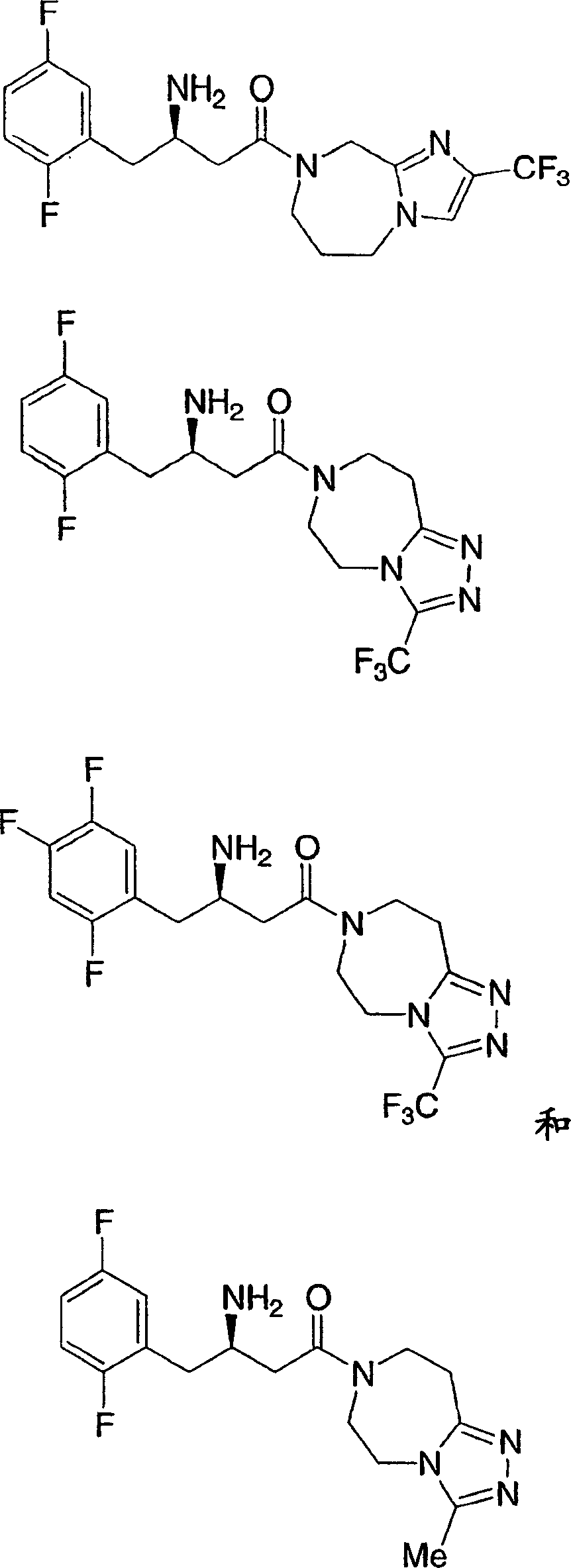
或其可药用盐。or a pharmaceutically acceptable salt thereof.
在本文中使用时,下列定义是适用的。As used herein, the following definitions apply.
除非另有说明,“烷基”以及具有前缀“烷”的其它基团例如烷氧基和烷酰基是指碳链,所述碳链可以是直链或支链的及其组合。烷基的实例包括甲基、乙基、丙基、异丙基、丁基、仲丁基、叔丁基、戊基、己基、庚基、辛基、壬基等。当指定数目的碳原子容许时,例如C3-10,术语烷基还包括环烷基,以及直链或支链烷基链与环烷基结构的组合。当没有指定碳原子的数目时,是指C1-6。Unless otherwise indicated, "alkyl" and other groups having the prefix "alk" such as alkoxy and alkanoyl refer to carbon chains, which may be straight or branched and combinations thereof. Examples of alkyl groups include methyl, ethyl, propyl, isopropyl, butyl, sec-butyl, tert-butyl, pentyl, hexyl, heptyl, octyl, nonyl, and the like. The term alkyl also includes cycloalkyl, and combinations of straight or branched alkyl chains and cycloalkyl structures when the specified number of carbon atoms permits, eg, C3-10 . When the number of carbon atoms is not specified, it means C 1-6 .
“环烷基”是烷基的子集,并且是指具有指定数目碳原子的饱和碳环。环烷基的实例包括环丙基、环丁基、环戊基、环己基、环庚基、环辛基等。除非另有说明,环烷基通常是单环的。除非另有说明,环烷基是饱和的。"Cycloalkyl" is a subset of alkyl and refers to a saturated carbocyclic ring having the indicated number of carbon atoms. Examples of cycloalkyl groups include cyclopropyl, cyclobutyl, cyclopentyl, cyclohexyl, cycloheptyl, cyclooctyl, and the like. Cycloalkyl groups are typically monocyclic unless otherwise specified. Cycloalkyl groups are saturated unless otherwise stated.
术语“烷氧基”是指具有指定数目碳原子(例如C1-10烷氧基)或在该范围内任何数目碳原子[即甲氧基(MeO-)、乙氧基、异丙氧基等]的直链或支链烷氧化物。The term "alkoxy" means a group having the indicated number of carbon atoms (e.g. C1-10 alkoxy) or any number of carbon atoms within the range [i.e. methoxy (MeO-), ethoxy, isopropoxy etc.] straight-chain or branched-chain alkoxides.
术语“烷硫基”是指具有指定数目碳原子(例如C1-10烷硫基)或在该范围内任何数目碳原子[即甲硫基(MeS-)、乙硫基、异丙硫基等]的直链或支链烷基硫化物。The term "alkylthio" means a group having the indicated number of carbon atoms (e.g. C1-10 alkylthio) or any number of carbon atoms within the range [i.e. methylthio (MeS-), ethylthio, isopropylthio etc.] straight-chain or branched-chain alkyl sulfides.
术语“烷基氨基”是指具有指定数目碳原子(例如C1-6烷基氨基)或在该范围内任何数目碳原子[即甲基氨基、乙基氨基、异丙基氨基、叔丁基氨基等]的直链或支链烷基胺。The term "alkylamino" means a group having the indicated number of carbon atoms (e.g. C1-6 alkylamino) or any number of carbon atoms within the range [i.e. methylamino, ethylamino, isopropylamino, tert-butyl Amino, etc.] straight-chain or branched-chain alkylamines.
术语“烷基磺酰基”是指具有指定数目碳原子(例如C1-6烷基磺酰基)或在该范围内任何数目碳原子[即甲基磺酰基(MeSO2-)、乙基磺酰基、异丙基磺酰基等]的直链或支链烷基砜。The term "alkylsulfonyl" means a group having the indicated number of carbon atoms (e.g. C 1-6 alkylsulfonyl) or any number of carbon atoms within the range [i.e. methylsulfonyl (MeSO 2 -), ethylsulfonyl , Isopropylsulfonyl, etc.] linear or branched alkyl sulfones.
术语“烷氧基羰基”是指具有指定数目碳原子(例如C1-10烷氧基羰基)或在该范围内任何数目碳原子[即甲氧基羰基(MeOCO-)、乙氧基羰基或丁氧基羰基]的直链或支链羧酸酯衍生物。The term "alkoxycarbonyl" means a group having the indicated number of carbon atoms (e.g. C1-10 alkoxycarbonyl) or any number of carbon atoms within the range [i.e. methoxycarbonyl (MeOCO-), ethoxycarbonyl or Butoxycarbonyl] linear or branched carboxylate derivatives.
“芳基”是指包含碳环原子的单环或多环芳族环系。优选的芳基是单环或二环6-10元芳族环系。苯基和萘基是优选的芳基。最优选的芳基是苯基。"Aryl" means a monocyclic or polycyclic aromatic ring system comprising carbon ring atoms. Preferred aryl groups are monocyclic or bicyclic 6-10 membered aromatic ring systems. Phenyl and naphthyl are preferred aryl groups. The most preferred aryl is phenyl.
“杂环”和“杂环基”是指包含至少一个选自O、S和N的杂原子的饱和或不饱和非芳族环或环系,所述杂原子包括硫的氧化形式,即SO和SO2。杂环的实例包括四氢呋喃(THF)、二氢呋喃、1,4-二氧杂环己烷、吗啉、1,4-二硫杂环己烷、哌嗪、哌啶、1,3-二氧杂环戊烷、咪唑烷、咪唑啉、吡咯啉、吡咯烷、四氢吡喃、二氢吡喃、氧硫杂环戊烷、二硫杂环戊烷、1,3-二氧杂环己烷、1,3-二硫杂环己烷、氧硫杂环己烷、硫代吗啉等。"Heterocycle" and "heterocyclyl" mean a saturated or unsaturated non-aromatic ring or ring system containing at least one heteroatom selected from O, S, and N, including the oxidized form of sulfur, i.e., SO and SO 2 . Examples of heterocyclic rings include tetrahydrofuran (THF), dihydrofuran, 1,4-dioxane, morpholine, 1,4-dithiane, piperazine, piperidine, 1,3-di Oxolane, imidazolidine, imidazoline, pyrroline, pyrrolidine, tetrahydropyran, dihydropyran, oxathiolane, dithiolane, 1,3-dioxane Hexane, 1,3-dithiane, oxathiane, thiomorpholine, etc.
“杂芳基”是指含有至少一个选自O、S和N的环杂原子的芳族或部分芳族杂环。杂芳基还包括与其它种类环例如芳基、环烷基以及非芳族杂环稠合的杂芳基。杂芳基的实例包括吡咯基、异噁唑基、异噻唑基、吡唑基、吡啶基、2-氧代-(1H)-吡啶基(2-羟基-吡啶基)、噁唑基、1,2,4-噁二唑基、1,3,4-噁二唑基、噻二唑基、噻唑基、咪唑基、三唑基、四唑基、呋喃基、三嗪基、噻吩基、嘧啶基、吡嗪基、苯并异噁唑基、苯并噁唑基、苯并噻唑基、苯并噻二唑基、二氢苯并呋喃基、吲哚啉基、哒嗪基、吲唑基、异吲哚基、二氢苯并噻吩基、吲嗪基、噌啉基、酞嗪基、喹唑啉基、萘啶基、咔唑基、苯并二氧杂环戊烯基、喹喔啉基、嘌呤基、呋咱基、异苯并呋喃基、苯并咪唑基、苯并呋喃基、苯并噻吩基、喹啉基、吲哚基、异喹啉基、二苯并呋喃基、咪唑并[1,2-a]吡啶基、[1,2,4]-三唑并[4,3-a]吡啶基、吡唑并[1,5-a]吡啶基、[1,2,4]-三唑并[1,5-a]吡啶基、2-氧代-1,3-苯并噁唑基、4-氧代-3H-喹唑啉基、3-氧代-[1,2,4]-三唑并[4,3-a]-2H-吡啶基、5-氧代-[1,2,4]-4H-噁二唑基、2-氧代-[1,3,4]-3H-噁二唑基、2-氧代-1,3-二氢-2H-咪唑基、3-氧代-2,4-二氢-3H-1,2,4-三唑基等。对于杂环基和杂芳基,包括形成1-3个环的含有3-15的原子的环和环系。"Heteroaryl" means an aromatic or partially aromatic heterocyclic ring containing at least one ring heteroatom selected from O, S, and N. Heteroaryl also includes heteroaryl fused to other types of rings such as aryl, cycloalkyl, and non-aromatic heterocycles. Examples of heteroaryl groups include pyrrolyl, isoxazolyl, isothiazolyl, pyrazolyl, pyridyl, 2-oxo-(1H)-pyridyl (2-hydroxy-pyridyl), oxazolyl, 1 , 2,4-oxadiazolyl, 1,3,4-oxadiazolyl, thiadiazolyl, thiazolyl, imidazolyl, triazolyl, tetrazolyl, furyl, triazinyl, thienyl, Pyrimidinyl, pyrazinyl, benzisoxazolyl, benzoxazolyl, benzothiazolyl, benzothiadiazolyl, dihydrobenzofuranyl, indolinyl, pyridazinyl, indazole Base, isoindolyl, dihydrobenzothienyl, indolyl, cinnolinyl, phthalazinyl, quinazolinyl, naphthyridinyl, carbazolyl, benzodioxolyl, quinolyl Oxalinyl, Purinyl, Furazanyl, Isobenzofuryl, Benzimidazolyl, Benzofuryl, Benzothienyl, Quinolinyl, Indolyl, Isoquinolyl, Dibenzofuryl , imidazo[1,2-a]pyridyl, [1,2,4]-triazolo[4,3-a]pyridyl, pyrazolo[1,5-a]pyridyl, [1, 2,4]-triazolo[1,5-a]pyridyl, 2-oxo-1,3-benzoxazolyl, 4-oxo-3H-quinazolinyl, 3-oxo- [1,2,4]-triazolo[4,3-a]-2H-pyridyl, 5-oxo-[1,2,4]-4H-oxadiazolyl, 2-oxo-[ 1,3,4]-3H-oxadiazolyl, 2-oxo-1,3-dihydro-2H-imidazolyl, 3-oxo-2,4-dihydro-3H-1,2,4 - Triazolyl etc. For heterocyclyl and heteroaryl, rings and ring systems containing 3-15 atoms forming 1-3 rings are included.
“卤素”是指氟、氯、溴和碘。氯和氟通常是优选的。当卤素是烷基或烷氧基上的取代基时,氟是最优选的(例如CF3O和CF3CH2O)。"Halogen" refers to fluorine, chlorine, bromine and iodine. Chlorine and fluorine are generally preferred. When halogen is a substituent on an alkyl or alkoxy group, fluorine is most preferred (eg CF3O and CF3CH2O ).
本发明的化合物可含有一或多个不对称中心,因而可作为外消旋体和外消旋混合物、单一对映异构体、非对映异构体混合物和单一非对映异构体出现。在式Ia中用*标记的碳原子上,本发明化合物具有一个不对称中心。根据分子中各取代基的性质,可出现其它不对称中心。这类不对称中心各自会独立地产生两个光学异构体,本发明范围包括所有可能的光学异构体和非对映体混合物和纯的或部分纯的化合物。本发明包括这些化合物的所有这类异构形式。The compounds of the present invention may contain one or more asymmetric centers and thus occur as racemates and racemic mixtures, single enantiomers, diastereomeric mixtures and single diastereomers . The compounds according to the invention have an asymmetric center at the carbon atom marked with * in formula Ia. Depending on the nature of the individual substituents in the molecule, other centers of asymmetry may arise. Each of these asymmetric centers will independently give rise to two optical isomers, and the scope of the invention includes all possible optical isomers and diastereomeric mixtures and pure or partially pure compounds. The present invention includes all such isomeric forms of these compounds.
本文所述的部分化合物含有烯属双键,除非另外说明,本发明包括E和E几何异构体。Some of the compounds described herein contain olefinic double bonds, and unless otherwise stated, the invention includes E and E geometric isomers.
本文所述的部分化合物可以以互变异构体形式存在,其通过一个或多个双键位移而具有不同的氢的连结点。例如,酮和它的烯醇形式是酮-烯醇互变异构体。各互变异构体及其混合物都包括在本发明的化合物范围内。Some of the compounds described herein may exist as tautomers having different points of attachment of hydrogen through displacement of one or more double bonds. For example, a ketone and its enol form are keto-enol tautomers. Each tautomer and mixtures thereof are included within the scope of the compounds of the present invention.
式I表示未优选立体化学的那类化合物的结构。式Ia表示连接β氨基酸的氨基的碳原子上的优选立体化学,从中制备这些化合物。Formula I represents the structure of that class of compounds for which stereochemistry is not preferred. Formula Ia represents the preferred stereochemistry at the carbon atom attached to the amino group of the beta amino acid from which these compounds are prepared.
通过对本文公开方法的适当改进,如本领域所知的方法,可进行这些非对映异构体的独立合成或其色谱分离。可通过晶状产物或晶状中间体(如必要,用含有已知绝对构型的不对称中心的试剂衍生)的X-射线晶体学,确定他们的绝对立体化学。The independent syntheses of these diastereoisomers or their chromatographic separations can be carried out by appropriate modification of the methods disclosed herein, as known in the art. Their absolute stereochemistry may be determined by X-ray crystallography of crystalline products or crystalline intermediates (derivatized, if necessary, with reagents containing asymmetric centers of known absolute configuration).
如需要,可分离所述化合物的外消旋混合物,以分离所述的单一对映异构体。可通过本领域熟知的方法进行拆分,例如使化合物的外消旋混合物偶合至对映体纯的化合物上,以形成非对映异构体混合物,然后通过标准方法例如分级结晶法或色谱法分离各非对映异构体。采用对映体纯的酸或碱的偶合反应常常形成盐。然后通过将所加入的手性残基裂解,可使所述非对映异构体衍生物转化为纯的对映异构体。也可直接通过利用手性固定相的色谱法(该方法为本领域所熟知)分离所述化合物的外消旋混合物。If desired, racemic mixtures of the compounds may be separated so that the individual enantiomers are isolated. Resolution may be accomplished by methods well known in the art, such as coupling a racemic mixture of a compound to an enantiomerically pure compound to form a diastereomeric mixture, followed by standard methods such as fractional crystallization or chromatography. The individual diastereoisomers were separated. Coupling reactions employing enantiomerically pure acids or bases often form salts. Said diastereomeric derivatives can then be converted to the pure enantiomers by cleavage of the added chiral residue. Racemic mixtures of the compounds can also be separated directly by chromatography using chiral stationary phases, methods well known in the art.
另外,通过本领域熟知的方法,通过采用已知构型的光学纯原料或试剂的立体选择性合成,可以得到化合物的任何对映异构体。Alternatively, any enantiomer of a compound may be obtained by stereoselective synthesis employing optically pure starting materials or reagents of known configuration by methods well known in the art.
应理解,本文所用的有关式I化合物也包括其可药用盐,以及用作游离化合物或其可药用盐的前体或者在其它合成操作中使用的非可药用的盐。It should be understood that references herein to compounds of formula I also include pharmaceutically acceptable salts thereof, as well as non-pharmaceutically acceptable salts used as precursors of the free compounds or their pharmaceutically acceptable salts or in other synthetic procedures.
本发明化合物可以以可药用盐的形式给药。术语“可药用盐”指由可药用、非毒性碱或酸,包括无机或有机碱和无机或有机酸制备的盐。包括在术语“可药用盐”范围内的碱性化合物的盐是指本发明化合物的无毒盐,一般是通过将游离碱与合适的有机酸或无机酸反应而制得的。本发明碱性化合物的代表性盐包括但不限于下列盐:乙酸盐、苯磺酸盐、苯甲酸盐、碳酸氢盐、硫酸氢盐、酒石酸氢盐、硼酸盐、溴化物、樟脑磺酸盐、碳酸盐、氯化物、克拉维酸盐、柠檬酸盐、二盐酸盐、乙二胺四乙酸盐、乙二磺酸盐、依托酸盐、乙磺酸盐、富马酸盐、葡庚糖酸盐、葡糖酸盐、谷氨酸盐、乙醇酸对氨基苯胂酸盐(glycollylarsanilate)、己基间苯二酚盐、哈胺(hydrab胺)、氢溴酸盐、盐酸盐、羟基萘甲酸盐、碘化物、异硫羰酸盐(isothionate)、乳酸盐、乳糖酸盐、月桂酸盐、苹果酸盐、马来酸盐、甲磺酸盐、甲基溴化物、甲基硝酸盐、甲基硫酸盐、粘酸盐、萘磺酸盐、硝酸盐、N-甲基葡糖胺铵盐、油酸盐、草酸盐、扑酸盐(双羟萘酸盐)、棕榈酸盐、泛酸盐、磷酸盐/二磷酸盐、聚半乳糖醛酸盐、水杨酸盐、硬脂酸盐、硫酸盐、碱式乙酸盐、琥珀酸盐、鞣酸盐、酒石酸盐、茶氯酸盐、甲苯磺酸盐、triethiodide和戊酸盐。此外,当本发明化合物携带酸性部分时,其合适的可药用盐包括但不限于衍生自无机碱的盐,包括铝盐、铵盐、钙盐、铜盐、铁盐、亚铁盐、锂盐、镁盐、锰盐、二价锰盐、钾盐、钠盐、锌盐等。特别优选的是铵盐、钙盐、镁盐、钾盐和钠盐。衍生自可药用有机无毒性碱的盐包括伯、仲和叔胺的盐,被取代胺包括天然存在的取代胺、环胺和碱离子交换树脂,例如精氨酸、甜菜碱、咖啡因、胆碱、N,N’-二苄基乙二胺、二乙胺、2-二乙氨基乙醇、2-二甲氨基乙醇、乙醇胺、乙二胺、N-乙基-吗啉、N-乙基哌啶、葡糖胺、氨基葡糖、组氨酸、海巴明、异丙基胺、赖氨酸、甲基葡糖胺、吗啉、哌嗪、哌啶、聚胺树脂、普鲁卡因、嘌呤、可可碱、三乙胺、三甲胺、三丙胺、氨丁三醇等的盐。The compounds of the present invention may be administered in the form of pharmaceutically acceptable salts. The term "pharmaceutically acceptable salt" refers to salts prepared from pharmaceutically acceptable, non-toxic bases or acids, including inorganic or organic bases and inorganic or organic acids. Salts of basic compounds encompassed within the term "pharmaceutically acceptable salt" refer to non-toxic salts of the compounds of this invention, generally prepared by reacting the free base with a suitable organic or inorganic acid. Representative salts of basic compounds of the invention include, but are not limited to, the following salts: acetate, benzenesulfonate, benzoate, bicarbonate, bisulfate, bitartrate, borate, bromide, camphor Sulfonate, Carbonate, Chloride, Clavulanate, Citrate, Dihydrochloride, EDTA, Edisulphonate, Etomate, Esulphonate, Fumarate salt, glucoheptonate, gluconate, glutamate, glycollylarsanilate, hexylresorcinol, hydrab amine, hydrobromide, Hydrochloride, hydroxynaphthoate, iodide, isothionate, lactate, lactobionate, laurate, malate, maleate, methanesulfonate, methyl Bromide, methyl nitrate, methyl sulfate, mucate, naphthalene sulfonate, nitrate, N-methylglucamine ammonium salt, oleate, oxalate, pamoate salt), palmitate, pantothenate, phosphate/diphosphate, polygalacturonate, salicylate, stearate, sulfate, basic acetate, succinate, tannin salt, tartrate, theanate, tosylate, triethiodide and valerate. Additionally, when a compound of the present invention bears an acidic moiety, suitable pharmaceutically acceptable salts thereof include, but are not limited to, salts derived from inorganic bases, including aluminum, ammonium, calcium, copper, ferric, ferrous, lithium Salt, magnesium salt, manganese salt, divalent manganese salt, potassium salt, sodium salt, zinc salt, etc. Particularly preferred are ammonium, calcium, magnesium, potassium and sodium salts. Salts derived from pharmaceutically acceptable organic non-toxic bases include salts of primary, secondary and tertiary amines, substituted amines including naturally occurring substituted amines, cyclic amines and base ion exchange resins such as arginine, betaine, caffeine, Choline, N,N'-dibenzylethylenediamine, diethylamine, 2-diethylaminoethanol, 2-dimethylaminoethanol, ethanolamine, ethylenediamine, N-ethyl-morpholine, N-ethyl Base piperidine, glucosamine, glucosamine, histidine, hebamine, isopropylamine, lysine, methyl glucosamine, morpholine, piperazine, piperidine, polyamine resin, prole Salts of caine, purine, theobromine, triethylamine, trimethylamine, tripropylamine, tromethamine, etc.
而且,当本发明化合物中存在羧酸(-COOH)或醇基团时,可以使用羧酸衍生物的可药用酯,例如醇的甲基、乙基或新戊酰氧基甲基或酰基衍生物,例如乙酸酯或马来酸酯。包括本领域已知用于调节溶解或水解特征,从而用作缓释或前药制剂的酯和酰基。Furthermore, when a carboxylic acid (-COOH) or alcohol group is present in the compounds of the present invention, pharmaceutically acceptable esters of carboxylic acid derivatives, such as methyl, ethyl or pivaloyloxymethyl or acyl groups of alcohols, can be used Derivatives such as acetate or maleate. Included are esters and acyl groups known in the art to modify solubility or hydrolysis characteristics for use as sustained release or prodrug formulations.
本发明还包括式I化合物的溶剂化物,和特别是水合物。The present invention also includes solvates, and especially hydrates, of the compounds of formula I.
使用在实施例和本文中公开的化合物来举例说明本发明。The invention is illustrated using the compounds disclosed in the Examples and herein.
本发明化合物用于抑制需要这些抑制作用的患者例如哺乳动物的二肽基肽酶-IV酶的方法,该方法包括施用有效量的所述化合物。本发明涉及本文所公开的化合物作为二肽基肽酶-IV酶活性抑制剂的用途。Compounds of the invention are useful in a method of inhibiting dipeptidyl peptidase-IV enzyme in a patient in need of such inhibition, eg a mammal, the method comprising administering an effective amount of said compound. The present invention relates to the use of the compounds disclosed herein as inhibitors of dipeptidyl peptidase-IV enzyme activity.
除灵长目动物例如人类外,本发明的方法还可用于治疗多种其它哺乳动物。例如,可以治疗的哺乳动物包括但不限于牛、绵羊、山羊、马、狗、猫、豚鼠、猪、大鼠或其它牛、绵羊、马、犬、猫科、啮齿目动物或鼠科类动物。而且,所述方法也可用于其它类动物,例如禽类(例如,小鸡)。In addition to primates such as humans, the methods of the invention can be used to treat a variety of other mammals. For example, mammals that may be treated include, but are not limited to, cattle, sheep, goats, horses, dogs, cats, guinea pigs, pigs, rats, or other bovine, ovine, equine, canine, feline, rodent, or murine species . Furthermore, the methods are also applicable to other types of animals, such as avians (eg, chickens).
本发明还涉及用于抑制人和动物的二肽基肽酶-IV酶活性的药物的制备方法,该方法包括将本发明的化合物与药用载体或稀释剂合并。The present invention also relates to a method for the preparation of a medicament for inhibiting human and animal dipeptidyl peptidase-IV enzyme activity, the method comprising combining the compound of the present invention with a pharmaceutically acceptable carrier or diluent.
本发明方法的治疗对象通常为需要抑制二肽基肽酶-IV酶活性的哺乳动物,优选人类,男性或女性。术语“治疗有效量”指由研究者、兽医、主治医生或其它临床医师所寻求的将引起组织、系统、动物或人体的生物学或医学反应的所用化合物的量。The subject of treatment of the method of the present invention is usually a mammal, preferably a human being, male or female, in need of inhibition of dipeptidyl peptidase-IV enzyme activity. The term "therapeutically effective amount" refers to the amount of a compound employed that will elicit a biological or medical response in a tissue, system, animal or human as sought by the researcher, veterinarian, attending physician or other clinician.
本文所用的术语“组合物”包括含特定量的特定成分的产物和任何由特定量的特定成分的组合的直接或间接得到的产物。涉及药物组合物的这类术语包括含有所述活性成分和充当载体的惰性成分的产物,和任何由任何两种或多种成分的组合、络合或聚集,或由一种或多种成分的离解,或由一种或多种成分的其它类型的反应或相互作用的直接或间接得到的产物。因此,本发明的药物组合物包括使本发明化合物和药学上可接受的载体混合而制备的任何组合物。“药学上可接受的”是指载体、稀释剂或赋形剂必须与制剂的其它成分相容而不能有害于其接收者。As used herein, the term "composition" includes products containing the specified ingredients in the specified amounts and any product resulting directly or indirectly from the combination of the specified ingredients in the specified amounts. Such terms referring to pharmaceutical compositions include products comprising the active ingredient and an inert ingredient serving as a carrier, and any combination, complexation or aggregation of any two or more ingredients, or any combination, complexation or aggregation of any two or more ingredients, or a combination of one or more ingredients. Dissociation, or the product resulting directly or indirectly from other types of reactions or interactions of one or more components. Accordingly, the pharmaceutical compositions of the present invention include any composition prepared by admixing a compound of the present invention and a pharmaceutically acceptable carrier. "Pharmaceutically acceptable" means that the carrier, diluent or excipient must be compatible with the other ingredients of the formulation and not be deleterious to the recipient thereof.
术语“化合物的给药”和/或“施用化合物”应被理解为向需要治疗的个体提供本发明的化合物或本发明的化合物的前药。The terms "administration of a compound" and/or "administering a compound" are to be understood as providing a compound of the invention or a prodrug of a compound of the invention to an individual in need of treatment.
通过本领域已知的方法可证明本发明的化合物作为二肽基肽酶-IV酶活性抑制剂的用途。如下确定抑制常数。采用通过DP-IV裂解底物Gly-Pro-AMC而释放荧光AMC离去基团的荧光分析法进行。描述该反应的动力学参数为:Km=50μM;kcat=75s-1;kcat/Km=1.5×106M-1s-1。在100μl总反应体积中,典型反应含约50pM酶、50μM Gly-Pro-AMC和缓冲溶液(100mM HEPES,pH7.5,0.1mg/ml BSA)。采用360nm激发波长和460nm发射波长,在96孔板荧光仪中连续监测AMC的释放。在此条件下,25℃下,30分钟内产生约0.8μM AMC。用于这类研究的酶是在杆状病毒表达系统(Bac-To-Bac,Gibco BRL)中产生的可溶性(跨膜域和细胞质扩散除外)人体蛋白。发现Gly-Pro-AMC和GLP-1的水解动力学常数与天然酶的文献值相符。为测量化合物的解离常数,向含有酶和底物(DMSO最终浓度为1%)的反应物中加入抑制剂的DMSO溶液。采用上述标准反应条件,于室温下进行所有实验。为确定解离常数(Ki),通过非线性回归将反应速率拟合至竞争抑制作用的Michaelis-Menton方程中。重现所述解离常数的误差一般低于两倍。The use of the compounds of the invention as inhibitors of dipeptidyl peptidase-IV enzyme activity can be demonstrated by methods known in the art. Inhibition constants were determined as follows. Fluorescence analysis was performed by cleavage of the substrate Gly-Pro-AMC by DP-IV to release the fluorescent AMC leaving group. The kinetic parameters describing the reaction are: K m =50 μM; k cat =75 s -1 ; k cat /K m =1.5×10 6 M -1 s -1 . A typical reaction contained approximately 50 pM enzyme, 50 μM Gly-Pro-AMC and buffer solution (100 mM HEPES, pH 7.5, 0.1 mg/ml BSA) in a total reaction volume of 100 μl. The release of AMC was continuously monitored in a 96-well plate fluorometer using an excitation wavelength of 360nm and an emission wavelength of 460nm. Under these conditions, about 0.8 μM AMC was produced within 30 minutes at 25°C. The enzymes used for such studies were soluble (except transmembrane domain and cytoplasmic diffusion) human proteins produced in a baculovirus expression system (Bac-To-Bac, Gibco BRL). The hydrolysis kinetic constants of Gly-Pro-AMC and GLP-1 were found to be in agreement with literature values for native enzymes. To measure dissociation constants of compounds, inhibitors in DMSO were added to reactions containing enzyme and substrate (1% final DMSO concentration). All experiments were performed at room temperature using the standard reaction conditions described above. To determine dissociation constants (Ki), reaction rates were fitted by nonlinear regression to the Michaelis-Menton equation for competitive inhibition. Errors in reproducing the dissociation constants were generally less than a factor of two.
尤其是,下列实施例的化合物在上述试验中具有抑制二肽基肽酶-IV酶的活性,一般其IG50小于1μM。这一结果表明了所述化合物用作二肽基肽酶-IV酶活性抑制剂的固有的活性。In particular, the compounds of the following examples have dipeptidyl peptidase-IV enzyme inhibitory activity in the above assay, generally with IG50 of less than 1 µM. This result demonstrates the inherent activity of the compounds as inhibitors of dipeptidyl peptidase-IV enzyme activity.
二肽基肽酶-IV酶(DP-IV)是一种涉及多种生物学功能的细胞表面蛋白。它具有广泛的组织分布(肠、肾、肝、胰脏、胎盘、胸腺、脾、上皮细胞、血管内皮、淋巴和髓细胞、血清)和清晰的组织以及细胞类型表达水平。DP-IV被确定为T型细胞激活标志物CD26,它能在体外裂解大量免疫调节的、内分泌的和神经病学的肽。这表明这种肽酶在人体或其它动物的各种疾病过程中的潜在作用。Dipeptidyl peptidase-IV enzyme (DP-IV) is a cell surface protein involved in various biological functions. It has a broad tissue distribution (gut, kidney, liver, pancreas, placenta, thymus, spleen, epithelial cells, vascular endothelium, lymphoid and myeloid cells, serum) and clear tissue and cell type expression levels. DP-IV was identified as the T-cell activation marker CD26, which cleaves a large number of immunomodulatory, endocrine and neurological peptides in vitro. This suggests a potential role for this peptidase in various disease processes in humans or other animals.
因此,所述化合物可用于下列疾病、病症和症状的预防和治疗的方法中。Accordingly, the compounds are useful in methods of prevention and treatment of the following diseases, disorders and symptoms.
II糖尿病和相关疾病:现完全确认肠降血糖GLP-1和GIP可被DP-IV在体外快速灭活。对DP-IV(-/-)-有缺陷的小鼠的研究和初期临床试验表明:DP-IV抑制作用能增加GLP-1和GIP的稳定态浓度,从而提高了葡糖耐受性。与GLP-1和GIP类似,其它涉及到葡糖调节的胰高血糖素系列肽也可被DP-IV(例如PACAP)灭活。这些肽被DP-IV灭活也可在葡萄糖体内平衡方面发挥作用。因此,本发明的DP-IV抑制剂可用于治疗II型糖尿病和治疗和预防伴随着II型糖尿病的大量病症,包括代谢综合征X、反应性低血糖和糖尿性异常脂血症。下文讨论的肥胖症是经常发现伴随着II型糖尿病的另一种症状,它对本发明的化合物的治疗有反应。 II Diabetes and related diseases : It is now fully confirmed that incretin GLP-1 and GIP can be rapidly inactivated by DP-IV in vitro. Studies in DP-IV (-/-) -deficient mice and initial clinical trials suggest that DP-IV inhibition increases steady-state concentrations of GLP-1 and GIP, thereby improving glucose tolerance. Similar to GLP-1 and GIP, other glucagon series peptides involved in glucose regulation can also be inactivated by DP-IV (eg PACAP). Inactivation of these peptides by DP-IV may also play a role in glucose homeostasis. Accordingly, the DP-IV inhibitors of the present invention are useful in the treatment of type II diabetes and in the treatment and prevention of a number of conditions associated with type II diabetes, including metabolic syndrome X, reactive hypoglycemia, and diabetic dyslipidemia. Obesity, discussed below, is another condition often found with type 2 diabetes that responds to treatment with the compounds of the present invention.
下列疾病、病症和症状与2型糖尿病有关,因此可通过采用本发明化合物的治疗方法来治疗、控制或在某些情况下预防:(1)高血糖症,(2)低葡萄糖耐受性,(3)抗胰岛素性,(4)肥胖症,(5)质脂病症,(6)异常脂血症,(7)高脂血症,(8)高甘油三酯血症,(9)高胆固醇血症,(10)低HDL水平,(11)高LDL水平,(12)动脉粥样硬化及其后遗症,(13)血管再狭窄,(14)肠易激惹综合征,(15)肠炎,包括克罗恩病和溃疡性结肠炎,(16)其它炎症,(17)胰腺炎,(18)腹部肥胖症,(19)神经变性病,(20)视网膜病,(21)肾病,(22)神经病,(23)X综合征,(24)卵巢的雄激素过多症(多囊性卵巢综合征)及其它具抗胰岛素性的疾病。The following diseases, conditions and symptoms are associated with type 2 diabetes and therefore can be treated, managed or in some cases prevented by methods of treatment employing the compounds of the invention: (1) hyperglycemia, (2) hypoglucose tolerance, (3) insulin resistance, (4) obesity, (5) lipid disorder, (6) dyslipidemia, (7) hyperlipidemia, (8) hypertriglyceridemia, (9) high Cholesterolemia, (10) low HDL level, (11) high LDL level, (12) atherosclerosis and its sequelae, (13) vascular restenosis, (14) irritable bowel syndrome, (15) enteritis , including Crohn's disease and ulcerative colitis, (16) other inflammatory diseases, (17) pancreatitis, (18) abdominal obesity, (19) neurodegenerative diseases, (20) retinopathy, (21) nephropathy, ( 22) Neuropathy, (23) Syndrome X, (24) Ovarian hyperandrogenism (polycystic ovary syndrome) and other insulin-resistant diseases.
肥胖症:DP-IV抑制剂可用于治疗肥胖症。这是基于观察到的GLP-1和GLP-2对食物摄入和对胃的排空的抑制作用。对人体的GLP-1的外源性给予能明显降低食物摄取和减慢胃的排空( Am.J.Physiol.277,R910-R916(1999))。对大鼠和小鼠的GLP-1的ICV给药对食物摄入也产生明显的效果( Nature Medicine 2,1254-1258(1996))。在GLP-1R(-/-)小鼠中并没有观察到这种进食抑制,这表明这些作用是通过脑GLP-1受体诱发的。与GLP-1类似,GLP-2也受DP-IV调节。类似于用GLP-1观察到的效果,GLP-2的ICV给药也抑制食物的摄入( Nature Medicine 6,802-807(2000))。此外,用DP-IV缺乏的小鼠进行的试验表明,这些动物抗饮食诱导的肥胖和相关病变(例如高胰岛素血症)。 Obesity : DP-IV inhibitors are useful in the treatment of obesity. This is based on the observed inhibitory effects of GLP-1 and GLP-2 on food intake and emptying of the stomach. Exogenous administration of GLP-1 to humans can significantly reduce food intake and slow gastric emptying ( Am. J. Physiol . 277, R910-R916 (1999)). ICV administration of GLP-1 to rats and mice also produced significant effects on food intake ( Nature Medicine 2, 1254-1258 (1996)). Such feeding inhibition was not observed in GLP-1R(-/-) mice, suggesting that these effects are induced through brain GLP-1 receptors. Similar to GLP-1, GLP-2 is also regulated by DP-IV. Similar to the effect observed with GLP-1, ICV administration of GLP-2 also inhibited food intake ( Nature Medicine 6, 802-807 (2000)). Furthermore, experiments with DP-IV-deficient mice have shown that these animals are resistant to diet-induced obesity and associated pathologies (eg, hyperinsulinemia).
生长激素缺乏症:基于生长激素释放因子(GRE)—一种刺激生长激素从垂体前叶释放的肽,在体内被所述的DP-IV酶裂解(WO 00/56297)的假说,DP-IV抑制作用可用于生长激素缺乏症的治疗。下列资料提供了GRF是内源性底物的证据:(1)GRE在体外被有效裂解生成失活产物GRF[3-44]( BBA 1122,147-153(1992));(2)GRF在血浆中快速降解成GRF[3-44];其可被DP-IV抑制剂diprotin A抑制;和(3)在人体GRE转基因猪的血浆中发现GRF[3-44]( J.Clin.Invest.83,1533-1540(1989))。因此,DP-IV抑制剂可用于生长素的促分泌剂所被认定的相同适应症谱。 Growth hormone deficiency : based on the hypothesis that growth hormone releasing factor (GRE), a peptide that stimulates growth hormone release from the anterior pituitary gland, is cleaved in vivo by the enzyme DP-IV as described (WO 00/56297), DP-IV Inhibition can be used in the treatment of growth hormone deficiency. The following data provide evidence that GRF is an endogenous substrate: (1) GRE is efficiently cleaved in vitro to generate inactive product GRF [3-44] ( BBA 1122, 147-153 (1992)); (2) GRF is in rapidly degraded to GRF in plasma [3-44]; it was inhibited by the DP-IV inhibitor diprotin A; and (3) GRF was found in the plasma of human GRE transgenic pigs [3-44] ( J.Clin.Invest . 83, 1533-1540 (1989)). Thus, DP-IV inhibitors can be used for the same spectrum of indications that ghrelin secretagogues have been identified for.
肠损伤:研究表明胰高血糖素类肽-2(GLP-2),一种可能内源性的DP-IV的底物,可对肠上皮呈现出营养性作用( Regulatory Peptides90,27-32(2000)),此结论说明采用DP-IV抑制剂治疗肠损伤的可能性。GLP-2的给予引起啮齿动物小肠质量的增加,并减轻了结肠炎和小肠炎的啮齿动物模型中的肠损伤。 Intestinal injury : Studies have shown that glucagon-like peptide-2 (GLP-2), a possible endogenous substrate of DP-IV, exhibits trophic effects on the intestinal epithelium ( Regulatory Peptides 90, 27-32 (2000)), this conclusion suggests the possibility of using DP-IV inhibitors to treat intestinal injury. Administration of GLP-2 causes an increase in small intestinal mass in rodents and attenuates intestinal damage in rodent models of colitis and enteritis.
免疫抑制作用:基于有关T细胞激活和趋化因子合成中的DP-IV酶的研究和体内病症模型中DP-IV抑制剂的效果,DP-IV抑制作用可用于调节免疫反应。己表明DP-IV被确定为CD26,一种活化免疫细胞的细胞表面标记物。通过免疫细胞的分化和活化状态调节CD26的表达。一般认为在T细胞活化的体外模型中,CD26起共同刺激分子的作用。大量趋化因子在其倒数第二的位置上都含有脯氨酸,估计可能是保护其免于被非特异性氨基肽酶降解。己表明许多这些趋化因子被DP-IV体外处理。在几种情况下(RANTES、LD78-β、MDC、eotaxin、SDF-1α),裂解导致趋药性和信号测定方面的活性的变化。在某些情况下,受体的选择性也可被改变(RANTES)。在体外细胞培养系统内己证实有大量趋化因子的多个N末端去尾形式,包括预期到的DP-IV水解产物。 Immunosuppression : Based on studies of the DP-IV enzyme in T cell activation and chemokine synthesis and the effects of DP-IV inhibitors in in vivo disease models, DP-IV inhibition may be used to modulate immune responses. It has been shown that DP-IV was identified as CD26, a cell surface marker of activated immune cells. CD26 expression is regulated by the differentiation and activation status of immune cells. It is generally accepted that CD26 functions as a co-stimulatory molecule in in vitro models of T cell activation. A large number of chemokines contain a proline at the penultimate position, presumably to protect it from degradation by nonspecific aminopeptidases. Many of these chemokines have been shown to be processed by DP-IV in vitro. In several cases (RANTES, LD78-β, MDC, eotaxin, SDF-1α), cleavage leads to changes in activity in chemotaxis and signaling assays. In some cases, receptor selectivity can also be altered (RANTES). Multiple N-terminal tailed forms of a number of chemokines have been demonstrated in in vitro cell culture systems, including the expected DP-IV hydrolyzate.
己表明DP-IV抑制剂是移植和关节炎的动物模型中的有效的免疫抑制剂。普罗地平(Pro-Pro-二苯基-磷酸盐),一种DP-IV的单向抑制剂,被证明能将大鼠心脏同种异体移植后7-14日的成活率增倍( Transplantation 63,1495-1500(1997))。已在大鼠的胶原和烷基二胺诱发的关节炎中测试了DP-IV抑制剂,结果表明在所述模型中后爪的抖动非常显著地减弱( Int.J.Immunopharmacology 19,15-24(1997), Immunopharmacology 40,21-26(1998))。在许多自身免疫疾病,包括类风湿性关节炎、多发性硬化、毒性弥漫性甲状腺肿和甲状腺炎中,DP-IV被上调( Immunology Today 20,367-375(1999))。DP-IV inhibitors have been shown to be potent immunosuppressants in animal models of transplantation and arthritis. Prodipine (Pro-Pro-diphenyl-phosphate), a one-way inhibitor of DP-IV, was shown to double the survival rate 7-14 days after cardiac allografting in rats ( Transplantation 63 , 1495-1500 (1997)). DP-IV inhibitors have been tested in collagen and alkyldiamine-induced arthritis in rats, and the results showed that hind paw shaking was very significantly attenuated in said model ( Int. J. Immunopharmacology 19, 15-24 (1997), Immunopharmacology 40, 21-26(1998)). DP-IV is upregulated in many autoimmune diseases, including rheumatoid arthritis, multiple sclerosis, toxic diffuse goiter, and thyroiditis ( Immunology Today 20, 367-375 (1999)).
HIV感染:DP-IV抑制作用可用于HIV感染或AIDS的治疗或预防,因为许多抑制HIV细胞进入的趋化因子是DP-IV的潜在底物( Immunology Today 20,367-375(1999))。对于SDF-1α,裂解能降低抗病毒活性( PNAS 95,6331-6(1998))。因此,期望通过抑制DP-IV稳定SDF-1α而减少HIV感染。 HIV infection : DP-IV inhibition can be used in the treatment or prevention of HIV infection or AIDS because many chemokines that inhibit HIV cell entry are potential substrates of DP-IV ( Immunology Today 20, 367-375 (1999)). For SDF-1α, cleavage can reduce antiviral activity ( PNAS 95, 6331-6 (1998)). Therefore, it is expected to reduce HIV infection by stabilizing SDF-la by inhibiting DP-IV.
血细胞生成:因为DP-IV可能涉及血细胞生成,所以DP-IV抑制作用可用于治疗或预防血细胞生成。在环磷酰胺诱发的中性白细胞减少的小鼠模型中,一种DP-IV抑制剂(Val-Boro-Pro)能刺激血细胞生成(WO99/56753)。 Hematopoiesis : Because DP-IV may be involved in hematopoiesis, inhibition of DP-IV can be used to treat or prevent hematopoiesis. A DP-IV inhibitor (Val-Boro-Pro) stimulates hematopoiesis in a mouse model of cyclophosphamide-induced neutropenia (WO99/56753).
神经元疾病:因为许多与各种神经元过程相关的肽被DP-IV体外裂解,所以DP-IV抑制作用可用于治疗或预防各种神经元病或精神病。因而,DP-IV抑制剂在治疗神经元疾病方面可能具有治疗作用。Endomorphin-2、β-casomorphin和P物质己被证明都是DP-IV的体外底物。所有情况下,体外裂解都是高效的,Kcat/Km约为106M-1s-1或更大。在大鼠的痛觉缺失电击跳跃测试模型中,DP-IV抑制剂表现出显著的作用,该作用与外源性endomorphin-2的出现无关(Brain Research815,278-286(1999))。 Neuronal Diseases : Because many peptides associated with various neuronal processes are cleaved by DP-IV in vitro, DP-IV inhibition may be useful in the treatment or prevention of various neuronal or psychiatric disorders. Thus, DP-IV inhibitors may have therapeutic utility in the treatment of neuronal diseases. Endomorphin-2, β-casomorphin and substance P have been shown to be in vitro substrates of DP-IV. In all cases, in vitro lysis was highly efficient with K cat /K m of about 10 6 M -1 s -1 or greater. In an analgesic electric shock jump test model in rats, DP-IV inhibitors exhibited significant effects independent of the presence of exogenous endomorphin-2 (Brain Research 815, 278-286 (1999)).
DP-IV抑制剂的神经保护和神经变性作用还通过以下方面得到了证实:所述抑制剂能够保护运动神经元不发生兴奋毒性细胞死亡,当与MPTP同时给药时保护多巴胺能神经元的纹状体神经分布,以及当在MPTP治疗之后以治疗方式给予时促进纹状体神经分布密度恢复[参见Yong-Q.Wu,等人,“二肽基二肽酶-IV抑制剂的在体外和体内的神经保护作用” Int.Conf.On Dipeptidylamino peptidases:Basic Science and Clinical Applications,September 26-29,2002(Berlin,Germany)]。The neuroprotective and neurodegenerative effects of DP-IV inhibitors were also demonstrated by the ability of the inhibitors to protect motor neurons from excitotoxic cell death, and to protect the striae of dopaminergic neurons when co-administered with MPTP. Innervation of striatum, and promotion of restoration of striatal innervation density when given therapeutically following MPTP treatment [see Yong-Q. Wu, et al., "In vitro and Neuroprotection in vivo" Int. Conf. On Dipeptidylamino peptidases: Basic Science and Clinical Applications , September 26-29, 2002 (Berlin, Germany)].
肿瘤侵入和转移:因为在正常细胞向恶性表型的转化过程中,已经观察到几种外肽酶(包括DP-IV)的表达的增加或减少,所以DP-IV抑制作用可用于治疗或预防肿瘤侵入和转移( J.Exp.Med.190,301-305(1999))。这些蛋白的上调或下调表明为组织和细胞类型的特异性。例如,已经在T细胞淋巴瘤、T细胞急性原始淋巴细胞的白血病、细胞衍生的甲状腺癌、基底细胞癌和乳腺癌上已观察到增加的CD26/DP-IV表达。因此,DP-IV抑制剂可用于这类癌症的治疗。 Tumor invasion and metastasis : Because an increase or decrease in the expression of several exopeptidases, including DP-IV, has been observed during the transformation of normal cells to a malignant phenotype, DP-IV inhibition can be used therapeutically or prophylactically Tumor invasion and metastasis ( J. Exp. Med. 190, 301-305 (1999 )). Upregulation or downregulation of these proteins has been shown to be tissue and cell type specific. For example, increased CD26/DP-IV expression has been observed in T-cell lymphomas, T-cell acute lymphoblastic leukemias, cell-derived thyroid carcinomas, basal cell carcinomas, and breast cancers. Therefore, DP-IV inhibitors can be used in the treatment of such cancers.
良性前列腺肥大:因为在BPH患者的前列腺组织中观察到增加的DP-IV活性,所以DP-IV抑制作用可用于良性前列腺肥大的治疗( Eur.J. Clin.Chem.Clin.Biochem 30,333-338(1992))。 Benign prostatic hypertrophy : Since increased DP-IV activity is observed in prostate tissue from BPH patients, DP-IV inhibition may be useful in the treatment of benign prostatic hypertrophy ( Eur.J. Clin.Chem.Clin.Biochem 30, 333- 338 (1992)).
精液能动性/男性避孕:因为在精液中,前列腺衍生的、对精液能动性起重要作用的细胞器prostatosomes具有非常高水平的DP-IV活性,所以DP-IV抑制作用可用于改变精液能动性和用于男性避孕( Eur.J. Clin.Chem.Clin.Biochem 30,333-338(1992))。 Semen motility/male contraception : Because in semen, the prostatosomes, prostate-derived organelles important for semen motility, have very high levels of DP-IV activity, DP-IV inhibition can be used to alter semen motility and for male contraception ( Eur. J. Clin. Chem. Clin. Biochem 30, 333-338 (1992)).
龈炎:因为在龈缝流体和某些与牙周病严重性相关的研究中发现DP-IV活性,所以DP-IV抑制作用可用于龈炎的治疗。 Gingivitis : DP-IV inhibition may be useful in the treatment of gingivitis because of DP-IV activity found in crevicular fluid and in some studies related to periodontal disease severity.
骨质疏松症:因为GIP受体存在于成骨细胞中,所以DP-IV抑制作用可用于骨质疏松症的治疗或预防( Arch.Oral Biol.,37:167-173(1992))。 Osteoporosis : Since GIP receptors are present in osteoblasts, DP-IV inhibition can be used in the treatment or prevention of osteoporosis ( Arch. Oral Biol. , 37: 167-173 (1992)).
本发明化合物可用于治疗或预防一种或多种下列病症或疾病:(1)高血糖症,(2)低葡萄糖耐受性,(3)抗胰岛素性,(4)肥胖症,(5)质脂病症,(6)异常脂血症,(7)高脂血症,(8)高甘油三酯血症,(9)高胆固醇血症,(10)低HDL水平,(11)高LDL水平,(12)动脉粥样硬化及其后遗症,(13)血管再狭窄,(14)肠易激惹综合征,(15)肠炎,包括克罗恩病和溃疡性结肠炎,(16)其它炎症(17)胰腺炎,(18)腹部肥胖症,(19)神经变性病,(20)视网膜病,(21)肾病,(22)神经病,(23)X综合征,(24)卵巢雄激素过多症(多囊性卵巢综合征),(25)II型糖尿病,(26)生长激素缺乏症,(27)中性白细胞减少,(28)神经元疾病,(29)肿瘤转移,(30)良性前列腺肥大、(32)牙龈炎、(33)高血压、(34)骨质疏松症,及其它可通过抑制DP-IV治疗或预防的疾病。The compounds of the present invention are useful in the treatment or prevention of one or more of the following conditions or diseases: (1) hyperglycemia, (2) hypoglucose tolerance, (3) insulin resistance, (4) obesity, (5) Lipid Disorders, (6) Dyslipidemia, (7) Hyperlipidemia, (8) Hypertriglyceridemia, (9) Hypercholesterolemia, (10) Low HDL Level, (11) High LDL level, (12) atherosclerosis and its sequelae, (13) vascular restenosis, (14) irritable bowel syndrome, (15) enteritis, including Crohn's disease and ulcerative colitis, (16) other Inflammation (17) Pancreatitis, (18) Abdominal obesity, (19) Neurodegenerative disease, (20) Retinopathy, (21) Nephropathy, (22) Neuropathy, (23) Syndrome X, (24) Ovarian androgen Polycystic ovary syndrome (polycystic ovary syndrome), (25) type II diabetes, (26) growth hormone deficiency, (27) neutropenia, (28) neuronal disease, (29) tumor metastasis, (30 ) benign prostatic hypertrophy, (32) gingivitis, (33) hypertension, (34) osteoporosis, and other diseases that can be treated or prevented by inhibiting DP-IV.
本发明化合物还可与其它药物联合,用于上述疾病、紊乱和症状的预防或治疗的方法中。The compounds of the present invention may also be used in combination with other drugs in methods of prevention or treatment of the above-mentioned diseases, disorders and symptoms.
本发明的化合物可与一种或多种其它药物联合,用于式I化合物或所述其它药物可发挥作用的疾病或症状的治疗、预防、抑制或缓解,其中所述药物联合比单一药物更安全或更有效。可将这些其它药物与式I化合物同时或相继通过一种途径并以其常用量给药。当式I化合物与一种或多种其它药物同时给药时,优选为含所述其它药物和式I化合物的单位剂量形式的药物组合物。然而,所述的联合治疗也可包括其中将式I化合物和一种或多种其它药物在不同的交错疗程中给药的疗法。还计划在与一种或多种其它活性成分联合用药时,可使用比各自单独用药时的更低剂量的本发明的化合物和所述其它活性成分。因此,本发明的药物组合物包括除含式I化合物外还含一种或多种其它活性成分的组合物。The compounds of the present invention can be combined with one or more other drugs for the treatment, prevention, suppression or alleviation of diseases or symptoms in which the compound of formula I or the other drugs can play a role, wherein the drug combination is more effective than a single drug. safer or more effective. These other drugs may be administered simultaneously or sequentially with the compound of formula I by one route and in their usual amounts. When the compound of formula I is administered simultaneously with one or more other drugs, it is preferably a pharmaceutical composition in unit dosage form containing said other drugs and the compound of formula I. However, said combination therapy may also include therapies in which the compound of formula I and one or more other drugs are administered in different staggered courses. It is also contemplated that when administered in combination with one or more other active ingredients, lower doses of the compounds of the invention and said other active ingredients may be used than when each is administered alone. Accordingly, the pharmaceutical compositions of the present invention include compositions comprising, in addition to a compound of formula I, one or more other active ingredients.
可与式I化合物联合用药及或分别给药或在同一药物组合物中给药的其它活性成分的实例包括但不限于:Examples of other active ingredients that can be administered in combination with the compound of formula I and or administered separately or in the same pharmaceutical composition include, but are not limited to:
(a)其它二肽基肽酶IV(DP-IV)抑制剂;(a) other dipeptidyl peptidase IV (DP-IV) inhibitors;
(b)胰岛素敏化物包括(i)PPARγ激动剂例如格列酮类药物(例如曲格列酮、吡格列酮、恩格列酮、MCC-555、罗西格列酮等)和其它PPAR配体,包括PPARα/γ双效激动剂,例如KRP-297,和PPARα激动剂例如非诺贝酸衍生物(吉非贝齐、氯贝丁酯、非诺贝特和苯扎贝特),(ii)双胍类,例如二甲双胍和苯乙双胍,和(iii)蛋白酪氨酸磷酸酯酶-lB(PTP-1B)抑制剂;(b) Insulin sensitizers include (i) PPARγ agonists such as glitazones (such as troglitazone, pioglitazone, emglitazone, MCC-555, rosiglitazone, etc.) and other PPAR ligands, Including PPARα/γ dual agonists such as KRP-297, and PPARα agonists such as fenofibric acid derivatives (gemfibrozil, clofibrate, fenofibrate and bezafibrate), (ii) Biguanides, such as metformin and phenformin, and (iii) protein tyrosine phosphatase-1B (PTP-1B) inhibitors;
(c)胰岛素或胰岛素模拟物;(c) insulin or insulin mimetics;
(d)磺酰脲类和其它胰岛素促分泌剂,例如甲苯磺丁脲和格列吡嗪、美格列奈和相关药物;(d) Sulfonylureas and other insulin secretagogues, such as tolbutamide and glipizide, meglitinide and related drugs;
(e)α-葡萄糖苷酶抑制剂(例如阿卡波糖和米格列醇);(e) alpha-glucosidase inhibitors (such as acarbose and miglitol);
(f)胰高血糖素受体拮抗剂,例如公开于WO 98/04528、WO99/01423、WO 00/39088和WO 00/69810的化合物;(f) glucagon receptor antagonists, such as the compounds disclosed in WO 98/04528, WO 99/01423, WO 00/39088 and WO 00/69810;
(g)GLP-1、GLP-1模拟物和GLP-1受体激动剂例如WO 00/42026和WO 00/59887公开的化合物;(g) GLP-1, GLP-1 mimetics and GLP-1 receptor agonists such as compounds disclosed in WO 00/42026 and WO 00/59887;
(h)GIP和GIP模拟物(例如WO 00/58360公开的化合物)和GIP受体激动剂;(h) GIP and GIP mimetics (such as the compounds disclosed in WO 00/58360) and GIP receptor agonists;
(i)PACAP、PACAP模拟物和PACAP受体激动剂例如WO 01/23420公开的化合物;(i) PACAP, PACAP mimetics and PACAP receptor agonists such as compounds disclosed in WO 01/23420;
(j)胆固醇降低剂,例如(i)HMG-CoA还原酶抑制剂(洛伐他汀、辛伐他汀、普伐他汀、氟伐他汀、阿托伐他汀、rivastatin、伊伐他汀、罗苏伐他汀和其它他汀类药物),(ii)螯合剂(考来烯胺、考来替泊和交联右旋糖酐的二烷基氨基烷基衍生物),(iii)烟醇、烟酸或其盐,(iv)PPARα激动剂,例如非诺贝酸衍生物(吉非贝齐、氯贝丁酯、非诺贝特和苯扎贝特),(V)PPARα/γ双效激动剂,例如KRP-297,(vi)胆固醇吸收抑制剂,例如β-谷甾醇和依泽替米贝,(vii)乙酰基CoA:胆固醇酰基转移酶抑制剂,例如阿伐麦布,和(viii)抗氧化剂,例如普罗布考;(j) Cholesterol lowering agents such as (i) HMG-CoA reductase inhibitors (lovastatin, simvastatin, pravastatin, fluvastatin, atorvastatin, rivastatin, itastatin, rosuvastatin and other statins), (ii) chelating agents (cholestyramine, colestipol, and dialkylaminoalkyl derivatives of cross-linked dextran), (iii) nicotinic alcohol, niacin or their salts, ( iv) PPARα agonists such as fenofibric acid derivatives (gemfibrozil, clofibrate, fenofibrate and bezafibrate), (v) PPARα/γ dual agonists such as KRP-297 , (vi) cholesterol absorption inhibitors such as β-sitosterol and ezetimibe, (vii) acetyl CoA:cholesterol acyltransferase inhibitors such as avasimibe, and (viii) antioxidants such as Prop Bukaw;
(k)PPARδ激动剂,例如公开于WO97/28149的化合物;(k) PPARδ agonists, such as the compounds disclosed in WO97/28149;
(l)抗肥胖症化合物,例如芬氟拉明、右芬氟拉明、芬特明、西布曲明、奥利司他、神经肽Y5抑制剂、大麻素-1(CB-1)受体拮抗剂/反向激动剂、黑皮质素-4受体激动剂和β3肾上腺素能受体激动剂;(l) Anti-obesity compounds such as fenfluramine, dexfenfluramine, phentermine, sibutramine, orlistat, neuropeptide Y5 inhibitors, cannabinoid-1 (CB-1) receptors antagonists/inverse agonists, melanocortin-4 receptor agonists, and β3 adrenergic receptor agonists;
(m)回肠胆汁酸转运蛋白抑制剂;(m) an ileal bile acid transporter inhibitor;
(n)用于炎症的药剂,例如阿斯匹林、非类固醇抗炎剂、糖皮质类固醇、柳氮磺吡啶和环氧酶2选择抑制剂;和(n) Agents for inflammation, such as aspirin, nonsteroidal anti-inflammatory agents, glucocorticoids, sulfasalazine, and cyclooxygenase 2 selective inhibitors; and
(o)抗高血压剂例如ACE抑制剂(依那普利、赖诺普利、卡托普利、喹那普利、tandolapril)、A-II受体阻断剂(氯沙坦、坎地沙坦、厄贝沙坦、缬沙坦、替米沙坦、依普罗沙坦)、β-阻断剂和钙通道阻断剂。(o) Antihypertensive agents such as ACE inhibitors (enalapril, lisinopril, captopril, quinapril, tandolapril), A-II receptor blockers (losartan, candelapril) sartan, irbesartan, valsartan, telmisartan, eprosartan), beta-blockers and calcium channel blockers.
上述联合包括本发明的化合物不仅与一种其它活性化合物而且与两种或多种其它活性化合物的联合。非限定性实例包括具有式I的化合物与两种或多种选自双胍、磺酰脲类、HMG-CoA还原酶抑制剂、PPAR激动剂、PTP-1B抑制剂、其它DP-IV抑制剂和抗肥胖症化合物的活性化合物的联合。The aforementioned combinations include combinations of the compounds of the present invention not only with one other active compound but also with two or more other active compounds. Non-limiting examples include compounds of formula I in combination with two or more compounds selected from biguanides, sulfonylureas, HMG-CoA reductase inhibitors, PPAR agonists, PTP-1B inhibitors, other DP-IV inhibitors and Combinations of active compounds of anti-obesity compounds.
同样地,本发明的化合物可与用于治疗/预防/抑制或缓解本发明的化合物可起作用的疾病或症状的其它药物联合用药。可将这些其它药物通过某种途径并以常用量与本发明的化合物同时或相继给药。当本发明的化合物与一种或多种其它药物同时使用时,优选除本发明化合物之外还含有这类其它药物的药物组合物。因此,本发明的药物组合物包括除本发明化合物之外还含一种或多种其它活性成分的那些。Likewise, the compounds of the present invention may be administered in combination with other drugs useful in the treatment/prevention/suppression or alleviation of diseases or conditions in which the compounds of the present invention act. These other drugs may be administered simultaneously or sequentially with the compound of the present invention by a certain route and in usual amounts. When the compound of the present invention is used concomitantly with one or more other drugs, pharmaceutical compositions containing such other drugs in addition to the compound of the present invention are preferred. Accordingly, pharmaceutical compositions of the present invention include those that contain, in addition to a compound of the present invention, one or more other active ingredients.
本发明化合物与第二种活性成分的重量比可以变化,其取决于各种成分的有效剂量。一般说来,将采用各自的有效剂量。因此,例如,当本发明的化合物与其它药物联合用药时,本发明化合物与其它药物的重量比一般在约1000∶1到约1∶1000之间,优选约200∶1到约1∶200之间。本发明化合物和其它活性成分的联合用药一般也会在上述范围内,但在每一情况下,应使用各活性成分的有效剂量。The weight ratio of the compound of the present invention to the second active ingredient may vary depending on the effective dosage of each ingredient. In general, an effective dose of each will be employed. Therefore, for example, when the compound of the present invention is used in combination with other drugs, the weight ratio of the compound of the present invention to other drugs is generally between about 1000:1 and about 1:1000, preferably between about 200:1 and about 1:200. between. Combinations of the compounds of the invention and other active ingredients will generally also be within the above ranges, but in each case an effective dose of each active ingredient should be used.
在所述联合用药中,可将本发明化合物和其它活性成分分别或同时给药。另外,可将一种成分先于、同时于或相继于其它试剂的给药时给药。In the combination, the compound of the present invention and other active ingredients may be administered separately or simultaneously. Additionally, one component may be administered prior to, simultaneously with, or sequentially with the administration of the other agent.
本发明化合物可经口服、肠胃外(例如肌内、腹腔内、静脉内、ICV、脑池内注射或输液、皮下注射或植入)、通过吸入喷雾、鼻腔、阴道、直肠、舌下或局部给药途径给药,也可单独或一起制成含适于各种给药途径的、常用无毒的、药学上可接受的载体、辅剂和介质的合适剂型的制剂。除治疗温血动物例如小鼠、大鼠、马、黄牛、绵羊、狗、猫、猴等外,本发明化合物也可用效地用于人体。The compounds of this invention may be administered orally, parenterally (e.g., intramuscularly, intraperitoneally, intravenously, ICV, intracisternal injection or infusion, subcutaneous injection or implant), by inhalation spray, nasally, vaginally, rectally, sublingually or topically Drug route administration, also can be made into the preparation of suitable dosage form containing the commonly used non-toxic, pharmaceutically acceptable carrier, adjuvant and medium suitable for each route of administration separately or together. In addition to treating warm-blooded animals such as mice, rats, horses, cattle, sheep, dogs, cats, monkeys, etc., the compounds of the present invention are also usefully used in humans.
用于本发明化合物给药的药物组合物一般为单位剂型形式,并可通过制药领域内熟知的任何方法制备。所有方法都包括使所述活性成分与由一种或多种辅助成分组成的载体混合的步骤。一般说来,通过将所述活性成分与液体载体或细分散的固体载体或两者均匀和紧密地混合,然后如果需要,将所述产物制成所需要的剂型形状,而制备所述药物组合物。在所述药物组合物中,所述活性目标化合物的量足以对疾病的病程和症状起到所要求的效果。本文所用的术语“组合物”包括含有特定量的特定成分的产物以及任何直接或间接得自于特定量的特定成分的组合的产物。Pharmaceutical compositions for the administration of the compounds of this invention are generally presented in unit dosage form and may be prepared by any of the methods well known in the art of pharmacy. All methods include the step of bringing into association the active ingredient with the carrier which constitutes one or more accessory ingredients. In general, the pharmaceutical compositions are prepared by uniformly and intimately bringing into association the active ingredient with liquid carriers or finely divided solid carriers or both, and then, if necessary, shaping the product into the desired dosage form. things. In the pharmaceutical composition, the active compound of interest is present in an amount sufficient to exert the desired effect on the course and symptoms of the disease. As used herein, the term "composition" includes products containing the specified ingredients in the specified amounts as well as any product that results, directly or indirectly, from a combination of the specified ingredients in the specified amounts.
含有所述活性成分的药物组合物可以是适于口服的形式,例如,片剂、药片、锭剂、水性或油性悬浮液、可分散性粉末剂或颗粒剂、乳剂、硬或软胶囊或糖浆剂或酏剂。可根据药物组合物制备领域任何已知的方法制备用于口服的组合物,这类组合物可含有选自甜味剂、矫味剂、着色剂和防腐剂的一种或多种试剂,以提供药学上优良和可口的制剂。片剂含有所述的活性成分,并与适用于片剂制备的、无毒的、药学上可接受的赋形剂相混合。这些赋形剂可为例如惰性稀释剂,例如碳酸钙、碳酸钠、乳糖、磷酸钙或磷酸钠;成粒剂和崩解剂,例如玉米淀粉或藻酸;粘合剂,例如淀粉、明胶或阿拉伯胶,和润滑剂,例如硬脂酸镁、硬脂酸或滑石粉。所述片剂可不包衣或可通过已知技术包衣,以延缓在胃肠道中的崩解和吸收,从而提供较长期的持续作用。例如,可以使用延时原料,例如硬脂酸甘油酯或二硬脂酸甘油酯。还可通过美国专利4,256,108、4,166,452和4,265,874中描述的技术包衣以形成缓释的渗透泵片剂。The pharmaceutical composition containing the active ingredient may be in a form suitable for oral administration, for example, tablets, troches, lozenges, aqueous or oily suspensions, dispersible powders or granules, emulsions, hard or soft capsules or syrups potion or elixir. Compositions for oral administration can be prepared according to any known method in the field of preparation of pharmaceutical compositions, and such compositions may contain one or more agents selected from sweeteners, flavoring agents, coloring agents and preservatives, to Pharmaceutically excellent and palatable formulations are provided. Tablets contain the active ingredient in admixture with non-toxic, pharmaceutically acceptable excipients which are suitable for tablet manufacture. These excipients may be, for example, inert diluents such as calcium carbonate, sodium carbonate, lactose, calcium or sodium phosphate; granulating and disintegrating agents such as cornstarch or alginic acid; binders such as starch, gelatin or gum arabic, and lubricants such as magnesium stearate, stearic acid, or talc. The tablets may be uncoated or may be coated by known techniques to delay disintegration and absorption in the gastrointestinal tract, thereby providing longer-term sustained action. For example, a time delay material such as glyceryl stearate or glyceryl distearate may be employed. Osmotic pump tablets for sustained release may also be coated by the techniques described in US Patents 4,256,108, 4,166,452 and 4,265,874.
口服制剂也可为硬明胶胶囊,其中将所述活性成分与惰性固体稀释剂例如碳酸钙、磷酸钙或高岭土相混合,或为软明胶胶囊,其中将所述活性成分与水或油性介质例如花生油、液体石蜡或橄榄油相混合。Oral formulations may also be hard gelatin capsules in which the active ingredient is mixed with an inert solid diluent such as calcium carbonate, calcium phosphate or kaolin, or soft gelatin capsules in which the active ingredient is mixed with water or an oily medium such as peanut oil. , liquid paraffin or olive oil.
水溶性悬液含有与适于制备水溶性悬浮液的赋剂剂相混合的所述活性药物。这些赋形剂为悬浮剂,例如羧甲基纤维素钠、甲基纤维素、羟基-丙甲基纤维素、藻酸钠、聚乙烯基吡咯烷酮、黄芪胶和阿拉伯胶;分散剂或湿润剂可为天然磷酯,例如卵磷酯或环氧烷与脂肪酸的缩合产物,例如聚氧乙烯硬脂酸酯,或环氧乙烷与长链脂肪醇例如十七乙烯氧基鲸蜡醇的缩合产物,或环氧乙烷与衍生自脂肪酸和己糖醇的部分酯的缩合产物,例如聚氧乙烯山梨糖醇单油酸酯,或环氧乙烷与衍生自脂肪酸和己糖醇酸酐的部分酯的缩合产物,例如聚乙烯山梨糖醇酐单油酸酯。所述水溶性悬浮液也可含一种或多种防腐剂,例如,乙基或正丙基的对羟基苯甲酸酯,一种或多种着色剂,一种或多种矫味剂和一种或多种甜味剂,例如蔗糖或糖精。Aqueous suspensions contain the active drug in admixture with excipients suitable for the manufacture of aqueous suspensions. These excipients are suspending agents such as sodium carboxymethylcellulose, methylcellulose, hydroxy-propylmethylcellulose, sodium alginate, polyvinylpyrrolidone, tragacanth and acacia; dispersing or wetting agents can be are natural phosphoesters, such as lecithin, or condensation products of alkylene oxides with fatty acids, such as polyoxyethylene stearate, or condensation products of ethylene oxide with long-chain fatty alcohols, such as heptadecenyloxycetyl alcohol , or the condensation products of ethylene oxide with partial esters derived from fatty acids and hexitols, such as polyoxyethylene sorbitan monooleate, or the condensation of ethylene oxide with partial esters derived from fatty acids and hexitol anhydrides Products such as polyethylene sorbitan monooleate. The aqueous suspension may also contain one or more preservatives, for example, ethyl or n-propyl paraben, one or more coloring agents, one or more flavoring agents and One or more sweetening agents, such as sucrose or saccharin.
可通过使所述活性成分悬浮于植物油例如花生油、橄榄油、芝麻油或椰子油或矿物油例如液体石蜡中配制油性悬浮液。所述油性悬浮液可含有增稠剂,例如蜂蜡、硬石蜡或鲸蜡醇。可加入如上所述甜味剂和矫味剂以提供可口的口服制剂。这些组合物可通过加入抗氧化剂例如抗坏血酸保护。Oily suspensions may be formulated by suspending the active ingredient in a vegetable oil, such as arachis oil, olive oil, sesame oil or coconut oil, or in a mineral oil such as liquid paraffin. The oily suspensions may contain a thickening agent, for example beeswax, hard paraffin or cetyl alcohol. Sweetening and flavoring agents as mentioned above may be added to provide a palatable oral preparation. These compositions can be protected by the addition of antioxidants such as ascorbic acid.
适用于经加水制备水溶性悬浮液的可分散性粉末剂和颗粒剂包含所述活性成分,并与分散剂或湿润剂、悬浮剂和一种或多种防腐剂相混合。适用的分散剂或湿润剂和悬浮剂可通过上述提及的那些来举例说明。也可出现其它赋形剂,例如甜味剂,矫味剂和着色剂。Dispersible powders and granules suitable for preparation of an aqueous suspension by the addition of water contain the active ingredient in admixture with a dispersing or wetting agent, suspending agent and one or more preservatives. Suitable dispersing or wetting agents and suspending agents are exemplified by those mentioned above. Other excipients, for example sweetening, flavoring and coloring agents, may also be present.
本发明的药物组合物也可为水包油乳化剂形式。所述油相可为植物油例如橄榄油或花生油或矿物油例如液体石蜡或这些油的混合物。适用的乳化剂可为天然胶例如阿拉伯胶或黄芪胶,、天然磷脂例如大豆、卵磷酯,和衍生自脂肪酸和己糖醇酸酐的酯或部分酯,例如山梨糖醇酐单油酯和所述部分酯与环氧乙烷的缩合产物例如聚乙烯山梨糖醇酐单油酸酯。所述乳剂也可含有甜味剂和矫味剂。The pharmaceutical compositions of the invention may also be in the form of oil-in-water emulsions. The oily phase may be a vegetable oil such as olive oil or arachis oil or a mineral oil such as liquid paraffin or a mixture of these oils. Suitable emulsifiers may be natural gums such as acacia or tragacanth, natural phospholipids such as soybean, lecithin, and esters or partial esters derived from fatty acids and hexitol anhydrides, such as sorbitan monooleate and the Condensation products of partial esters with ethylene oxide such as polyethylene sorbitan monooleate. The emulsions may also contain sweetening and flavoring agents.
糖浆剂和酏剂可用甜味剂,例如甘油、丙二醇、山梨糖醇或蔗糖配制。这些制剂也可含有缓和剂、防腐剂和矫味剂以及着色剂。Syrups and elixirs may be formulated with sweetening agents, such as glycerol, propylene glycol, sorbitol or sucrose. These formulations may also contain a demulcent, a preservative and flavoring and coloring agents.
所述药物组合物可为灭菌注射用水溶性或油溶性悬浮液形式。根据已知的工艺,采用上述那些适用的分散剂或湿润剂和悬浮剂,可配制这种悬浮液。所述灭菌注射制剂也可为在无毒、胃肠道外可接受的稀释剂或溶剂中的灭菌注射溶液剂或悬浮剂,例如1,3-丁二醇中的溶液。可使用的可接受的介质和溶剂中,有水、林格氏溶液和等渗氯化钠溶液。另外,灭菌、精馏油也常用作溶剂或悬浮介质。包括合成单-或二脂酰甘油酯在内的任何温和的、精馏油都可用于此目的。另外,脂肪酸例如油酸可用于注射剂的制备中。The pharmaceutical composition can be in the form of sterile injectable water-soluble or oil-soluble suspension. This suspension may be formulated according to the known art using those suitable dispersing or wetting agents and suspending agents which have been mentioned above. The sterile injectable preparation may also be a sterile injectable solution or suspension in a non-toxic parenterally acceptable diluent or solvent, for example a solution in 1,3-butanediol. Among the acceptable vehicles and solvents that may be employed are water, Ringer's solution and isotonic sodium chloride solution. In addition, sterile, rectified oils are conventionally employed as a solvent or suspending medium. Any bland, rectified oil including synthetic mono- or diglycerides may be employed for this purpose. In addition, fatty acids such as oleic acid find use in the preparation of injectables.
本发明化合物也可以以栓剂形式进行药物的直肠给药。通过将所述药物与适当的非刺激性赋形剂混合制备这些组合物,该赋形剂在常温下为固体,而在直肠温度下为液体,因而会在直肠中溶解以释放出所述药物。这类原料有可可脂和聚乙二醇。The compounds of the present invention may also be administered rectally in the form of suppositories. These compositions are prepared by mixing the drug with a suitable non-irritating excipient which is solid at ordinary temperatures but liquid at rectal temperature and will therefore dissolve in the rectum to release the drug . Examples of such materials are cocoa butter and polyethylene glycols.
对局部用药,可用含有本发明化合物的霜剂、软膏剂、凝胶剂、溶液剂或悬浮剂等。(为此,局部用药还应包括口腔洗涤剂和漱口剂。)For topical administration, creams, ointments, gels, solutions or suspensions, etc., containing the compounds of this invention may be used. (To this end, topicals should also include mouthwashes and mouthwashes.)
本发明的药物组合物和方法还包括其它有治疗活性的上述化合物,它们一般用于上述病理学症状的治疗中。The pharmaceutical compositions and methods of the present invention also include other therapeutically active compounds described above, which are generally used in the treatment of the pathological conditions described above.
在治疗或预防需要抑制二肽基肽酶-IV酶活性的症状中,适用的剂量每天每公斤患者体重水平通常为约0.01-500mg之间,可以单剂量或多剂量给药。所述剂量水平优选在每日约0.1-约250mg/kg;更优选在每日约0.5-100mg/kg。适用的剂量水平可为每日约0.01-250mg/kg、每日约0.05-100mg/kg,或每日约0.1-50mg/kg。在此范围内,所述剂量可为每日0.05-0.5、0.5-5或5-50mg/kg。对口服给药,优选提供片剂形式的组合物,其含1.0-1000毫克所述活性成分,根据要治疗的患者的症状调整剂量,具体为1.0、5.0、10.0、15.0、20.0、25.0、50.0、75.0、100.0、150.0、200.0、250.0、300.0、400.0、500.0、600.0、750.0、800.0、900.0和1000.0毫克的所述活性成分。可按每日1-4次的安排,优选每日一到两次给予所述化合物。In the treatment or prevention of conditions requiring inhibition of dipeptidyl peptidase-IV enzyme activity, the applicable dose is generally between about 0.01-500 mg per kilogram of patient body weight per day, and can be administered in single or multiple doses. Such dosage levels are preferably in the range of about 0.1 to about 250 mg/kg per day; more preferably in the range of about 0.5 to 100 mg/kg per day. Useful dosage levels may be about 0.01-250 mg/kg per day, about 0.05-100 mg/kg per day, or about 0.1-50 mg/kg per day. Within this range the dosage may be 0.05-0.5, 0.5-5 or 5-50 mg/kg daily. For oral administration, it is preferred to provide the composition in tablet form, which contains 1.0-1000 mg of the active ingredient, the dosage is adjusted according to the symptoms of the patient to be treated, specifically 1.0, 5.0, 10.0, 15.0, 20.0, 25.0, 50.0 , 75.0, 100.0, 150.0, 200.0, 250.0, 300.0, 400.0, 500.0, 600.0, 750.0, 800.0, 900.0 and 1000.0 mg of said active ingredient. The compounds may be administered on a schedule of 1-4 times a day, preferably once or twice a day.
当治疗或预防糖尿病和/或高血糖或高甘油三酯血症或本发明化合物可治疗的其它疾病时,当本发明化合物以约0.1毫克-约100毫克每公斤动物体重的日剂量给药,优选单剂量给药或一日二至六次的分剂量给药,或以缓释形式给药时,可得到基本满意的结果。对最大的哺乳动物,总日剂量约为1.0毫克到约1000毫克的范围,优选约1毫克到约50毫克范围。对70kg的成年人,总日剂量一般约为7毫克到350毫克。可调整该剂量方案以产生最佳治疗反应。When treating or preventing diabetes and/or hyperglycemia or hypertriglyceridemia or other diseases treatable by the compound of the present invention, when the compound of the present invention is administered at a daily dose of about 0.1 mg to about 100 mg per kg of animal body weight, Basically satisfactory results can be obtained when administered in a single dose or in divided doses two to six times a day, or in sustained release form. For the largest mammal, the total daily dosage will range from about 1.0 mg to about 1000 mg, preferably in the range of about 1 mg to about 50 mg. For a 70 kg adult, the total daily dose is generally about 7 mg to 350 mg. The dosage regimen may be adjusted to produce the optimum therapeutic response.
然而,应理解任何特定患者的具体剂量水平和给药次数可以变化,这取决于多种因素,包括所用的具体化合物的活性、该化合物的代谢稳定性和该化合物的作用持续时间、宿主年龄、体重、总体健康情况、性别、膳食、给药的方式和时间、排泄速度、联合用药情况、具体症状的严重性和宿主经历的治疗等。It is understood, however, that the specific dosage level and frequency of administration for any particular patient may vary, depending on a variety of factors, including the activity of the particular compound used, the metabolic stability of the compound and the duration of action of the compound, the age of the host, Body weight, general health, sex, diet, method and timing of administration, rate of excretion, concomitant drug use, severity of specific symptoms, and treatment experienced by the host, etc.
下列反应方案和实施例说明本发明化合物的几种制备方法。起始原料可根据本领域已知或本文所述的方法制备。The following reaction schemes and examples illustrate several methods for the preparation of the compounds of this invention. Starting materials can be prepared according to methods known in the art or described herein.
本发明化合物可由β-氨基酸中间体例如式II中间体以及取代的稠合的四氢二氮杂中间体例如式III中间体,使用标准肽偶联方法然后脱保护来制得。以下反应方案中描述了这些中间体的制备。Compounds of the invention can be prepared from β-amino acid intermediates such as the intermediate of formula II and substituted fused tetrahydrodiazepine intermediates such as the intermediate of formula III using standard peptide coupling methods followed by deprotection. The preparation of these intermediates is described in the following reaction schemes.

其中Ar、X、R1、R8、R9、R10、m和p如上所定义,且P是合适的保护基例如叔丁氧基羰基(BOC)、苄氧基羰基(Cbz)和9-芴基甲氧基羰基(Fmoc)。wherein Ar, X, R 1 , R 8 , R 9 , R 10 , m and p are as defined above, and P is a suitable protecting group such as tert-butoxycarbonyl (BOC), benzyloxycarbonyl (Cbz) and 9 - Fluorenylmethoxycarbonyl (Fmoc).
反应方案1Reaction scheme 1
式II化合物可商购获得,是文献中已知的,或者可通过多种本领域技术人员熟悉的方法方便地制得。反应方案1显示了一种常用途径。将保护的α-氨基酸 1(其可商购获得,或者通过使用例如二碳酸二叔丁基(对于P=BOC)、苄氧基羰基氯(对于P=Cbz)或N-(9-芴基甲氧基-羰基氧基)琥珀酰亚胺(对于P=Fmoc)保护来制得)用氯甲酸氯丁酯和碱例如三乙胺或二异丙基乙胺处理,然后用重氮甲烷处理。之后将所得重氮酮用苯甲酸银在溶剂例如甲醇或含水二氧杂环己烷中处理,并且可以按照Sewald等人,Synthesis,837(1997)描述的方法进行超声处理以提供β-氨基酸II。本领域技术人员可以理解,为了制备对映体纯的β-氨基酸II,可以使用对映体纯的α-氨基酸 1。制备保护的β-氨基酸中间体II的另一种方法可参见以下总述:E.Juaristi,对映体选择性地合成β-氨基酸,Ed.,Wiley-VCH,New York:1997;Juaristi等人,Aldrichimica Acta,27:3(1994);和Cole等人,Tetrahedron,32:9517(1994)。Compounds of formula II are commercially available, known in the literature, or can be readily prepared by a variety of methods familiar to those skilled in the art. Reaction Scheme 1 shows a common route. The protected α-amino acid 1 (which is commercially available, or by using, for example, di-tert-butyl dicarbonate (for P=BOC), benzyloxycarbonyl chloride (for P=Cbz) or N-(9-fluorenyl Methoxy-carbonyloxy)succinimide (prepared by protecting P=Fmoc) with chlorobutyl chloroformate and a base such as triethylamine or diisopropylethylamine followed by diazomethane . The resulting diazoketone is then treated with silver benzoate in a solvent such as methanol or aqueous dioxane and can be sonicated as described by Sewald et al., Synthesis, 837 (1997) to provide the β-amino acid II . Those skilled in the art will understand that for the preparation of enantiomerically pure β-amino acid II, enantiomerically pure α-amino acid 1 can be used. Another method for preparing protected β-amino acid intermediates II can be found in the following overview: E. Juaristi, Enantioselective Synthesis of β-Amino Acids , Ed., Wiley-VCH, New York: 1997; Juaristi et al. , Aldrichimica Acta, 27:3 (1994); and Cole et al., Tetrahedron, 32:9517 (1994).
反应方案2Reaction scheme 2
其中X是N的式IIIa化合物可以如反应方案 2所示制得。将适当取代的化合物 2用三甲基氧鎓四氟硼酸盐处理以形成相应的甲氧基亚胺 3。在溶剂例如二氯甲烷中用肼处理以生成中间体 4。用酸酐或酰氯酰化,然后加热,例如在甲氧基乙醇中加热,生成环合衍生物 5。对于Boc,在酸性条件下,方便地使用在二氧杂环己烷中的氯化氢来进行脱保护,获得所需中间体IIIa。Compounds of formula IIIa wherein X is N can be prepared as shown in Reaction Scheme 2 . Appropriately substituted compounds 2 are treated with trimethyloxonium tetrafluoroborate to form the corresponding methoxyimines 3 . Treatment with hydrazine in a solvent such as dichloromethane gives intermediate 4 . Acylation with acid anhydride or acid chloride followed by heating, for example in methoxyethanol, leads to the ring-closed derivative 5 . For Boc, deprotection is conveniently carried out using hydrogen chloride in dioxane under acidic conditions to give the desired intermediate IIIa.
反应方案3Reaction Scheme 3

其中X是CR2的中间体IIIb可如反应方案3所示制得。将如反应方案2所述制得的甲氧基亚胺 3在溶剂例如乙醇中于高温下用氯化铵处理,生成脒 6。通过在二氧杂环己烷中加热来与适当取代的溴酮 7缩合,生成中间体 8,然后通过在异丙醇中加热来脱水,除去Boc保护基之后,获得了所需的中间体IIIb。Intermediate IIIb where X is CR 2 can be prepared as shown in Reaction Scheme 3. Methoxyimine 3 prepared as described in Reaction Scheme 2 is treated with ammonium chloride in a solvent such as ethanol at elevated temperature to give amidine 6 . Condensation with an appropriately substituted bromoketone 7 by heating in dioxane affords intermediate 8 , followed by dehydration by heating in isopropanol, after removal of the Boc protecting group, affords the desired intermediate IIIb .
反应方案4Reaction Scheme 4

制备中间体IIIa的另一种方法如反应方案4所示。使用五硫化磷或其它硫化试剂例如Lawesson′s试剂将N-苄基保护的杂环 9转化成硫代内酰胺 10。用肼处理以生成腙 11。如上面反应方案2所示将腙环合以生成三唑并化合物 12。在催化氢化条件下脱保护,获得中间体IIIa。Another method for the preparation of intermediate IIIa is shown in Reaction Scheme 4. The N-benzyl protected heterocycle 9 is converted to the thiolactam 10 using phosphorus pentasulfide or other sulfurizing reagents such as Lawesson's reagent. Treatment with hydrazine yields the hydrazone 11 . The hydrazone is cyclized as shown in Reaction Scheme 2 above to generate the triazolo compound 12 . Deprotection under catalytic hydrogenation conditions affords intermediate IIIa.
原料 9可商购获得,是文献中已知的,或者可通过多种本领域技术人员已知的常用方法方便地制得。其可以通过操作保护基而由中间体 2容易地制得,例如,用酸处理 2以除去Boc基团,然后使用苄基溴烷基化,以构建N-苄基。Starting materials 9 are commercially available, are known in the literature, or can be readily prepared by a variety of common methods known to those skilled in the art. It can be readily prepared from intermediate 2 by manipulation of protecting groups, eg, treatment of 2 with acid to remove the Boc group, followed by alkylation with benzyl bromide to construct the N-benzyl group.
反应方案5Reaction scheme 5

原料2可商购获得,是文献中已知的,或者可通过多种本领域技术人员已知的常用方法方便地制得。制备其中与酰胺相邻的R9是氢,p是1,且m是2的化合物 2a的一种适宜方法如反应方案5所示。将通常以其盐酸盐形式使用的氨基酯 13与丙烯腈 14缩合,并且将形成的产物的氨基保护,例如作为其叔丁氧基羰基(Boc)衍生物保护起来,获得 15,将 15还原以获得伯胺 16。可将酯 16水解成酸 17,并且通过使用偶联剂例如EDC进行环合,获得中间体 2a。Starting materials 2 are commercially available, known in the literature, or can be conveniently prepared by a variety of common methods known to those skilled in the art. A suitable method for the preparation of compounds 2a wherein R9 adjacent to the amide is hydrogen, p is 1, and m is 2 is shown in Reaction Scheme 5. Condensation of the amino ester 13 , usually used in the form of its hydrochloride salt, with acrylonitrile 14 and protection of the amino group of the resulting product, for example as its tert - butoxycarbonyl (Boc) derivative, affords 15 , which is reduced to to obtain the primary amine 16 . Esters 16 can be hydrolyzed to acids 17 and cyclized by using coupling agents such as EDC to afford intermediates 2a .
反应方案6Reaction Scheme 6
或者,如反应方案6所示,适宜地在二氯甲烷中,使用三甲基铝,将得自反应方案5的 16环合,生成N-保护的六氢二氮杂酮 2a。Alternatively, as shown in Reaction Scheme 6, cyclization of 16 from Reaction Scheme 5, conveniently using trimethylaluminum in dichloromethane, yields the N-protected hexahydrodiazepinone 2a .
反应方案7Reaction scheme 7
其中R10是氢的原料 2b可如反应方案7所示制得。将氨基酯 18和N-Boc氨基醛 19在还原胺化条件下缩合,获得胺 20。将新形成仲胺保护,例如通过用苄氧羰基氯处理将其作为它的Z衍生物保护起来,获得胺 21。使用三甲基铝进行环合,然后进行保护基操作,获得所需中间体 2b。Starting material 2b, wherein R 10 is hydrogen, can be prepared as shown in Reaction Scheme 7. Condensation of aminoester 18 and N-Boc aminoaldehyde 19 under reductive amination conditions affords amine 20 . Protection of the newly formed secondary amine, eg, as its Z derivative, by treatment with benzyloxycarbonyl chloride affords amine 21 . Cyclization using trimethylaluminum followed by protecting group manipulation affords the desired intermediate 2b .
反应方案8Reaction Scheme 8

如反应方案8所示,将中间体II和III在标准肽偶联条件下偶联,例如使用1-乙基-3-(3-二甲基氨基丙基)碳二亚胺和1-羟基苯并三唑(EDC/HOBT)或O-(7-氮杂苯并三唑-1-基)-N,N,N′,N′-四甲基脲鎓六氟磷酸盐和1-羟基-7-氮杂苯并三唑(HATU/HOAT),在溶剂例如N,N-二甲基甲酰胺(DMF)或二氯甲烷中于室温进行3-48小时,获得中间体22。在某些情况下,中间体可以是盐例如盐酸盐或三氟乙酸盐,在这些情况下,可适宜地向偶联反应中加入碱,通常是N,N-二异丙基乙基胺。然后,对于Boc,用例如三氟乙酸或氯化氢甲醇溶液除去保护基,生成所需的胺。如果需要的话,通过重结晶、研制、制备薄层色谱、快速硅胶色谱法例如采用Biotage装置的快速硅胶色谱法或HPLC纯化产物。通过HPLC纯化的产物可作为相应的盐分离出来。中间体的纯化以相同方式进行。As shown in Reaction Scheme 8, intermediates II and III are coupled under standard peptide coupling conditions, for example using 1-ethyl-3-(3-dimethylaminopropyl)carbodiimide and 1-hydroxy Benzotriazole (EDC/HOBT) or O-(7-azabenzotriazol-1-yl)-N,N,N′,N′-tetramethyluronium hexafluorophosphate and 1-hydroxy - 7-Azabenzotriazole (HATU/HOAT) in a solvent such as N,N-dimethylformamide (DMF) or dichloromethane at room temperature for 3-48 hours to obtain intermediate 22. In some cases, the intermediate may be a salt such as hydrochloride or trifluoroacetate, in these cases it may be convenient to add a base to the coupling reaction, usually N,N-diisopropylethyl amine. For Boc, the protecting group is then removed using, for example, trifluoroacetic acid or methanolic hydrogen chloride to yield the desired amine. The product is purified, if desired, by recrystallization, trituration, preparative thin layer chromatography, flash silica gel chromatography, eg, using a Biotage(R) apparatus, or HPLC. Products purified by HPLC can be isolated as corresponding salts. Purification of intermediates was performed in the same manner.
在某些情况下,可对在上述反应方案中描绘的式I产物或合成中间体进一步修饰,例如通过处理在Ar、X、R1、R8、R9或R10上的取代基来进行修饰。这些处理可包括但不限于本领域技术人员普遍知道的还原、氧化、烷基化、酰基化和水解反应。In some cases, the products of formula I depicted in the above reaction schemes or synthetic intermediates may be further modified, for example by manipulating substituents on Ar, X, R1 , R8 , R9 or R10 grooming. These treatments may include, but are not limited to, reduction, oxidation, alkylation, acylation and hydrolysis reactions generally known to those skilled in the art.
在某些情况下,可改变前述反应方案的顺序,以促进所述反应进行或避免不需要的反应产物。为更完全地理解本发明,提供下列实施例。这些实施例只用做说明,而不应构成对本发明的任何限制。In some cases, the order of the preceding reaction schemes can be altered to facilitate the reactions or to avoid undesired reaction products. In order that the present invention may be more fully understood, the following examples are provided. These examples are for illustration only, and should not constitute any limitation to the present invention.
中间体1Intermediate 1
(3R)-3-[(叔丁氧基羰基)氨基]-4-(2,5-二氟苯基)丁酸(3R)-3-[(tert-butoxycarbonyl)amino]-4-(2,5-difluorophenyl)butanoic acid
步骤A:(R,S)-N-(叔丁氧基羰基)-2,5-二氟苯基丙氨酸Step A: (R,S)-N-(tert-butoxycarbonyl)-2,5-difluorophenylalanine
向0.5g(2.49mmol)2,5-二氟-DL-苯基丙氨酸在5mL叔丁醇内的溶液中依次加入1.5mL 2N氢氧化钠水溶液和543mg二碳酸二叔丁酯。将该反应在室温搅拌16小时,用乙酸乙酯稀释。将有机层依次用1N盐酸和盐水洗涤,用硫酸镁干燥并真空浓缩。通过快速色谱纯化粗产物(硅胶,97∶2∶1二氯甲烷∶甲醇∶乙酸),获得了本标题化合物。MS 302(M+1)。To a solution of 0.5 g (2.49 mmol) of 2,5-difluoro-DL-phenylalanine in 5 mL of tert-butanol was added sequentially 1.5 mL of 2N aqueous sodium hydroxide and 543 mg of di-tert-butyl dicarbonate. The reaction was stirred at room temperature for 16 hours and diluted with ethyl acetate. The organic layer was washed successively with 1N hydrochloric acid and brine, dried over magnesium sulfate and concentrated in vacuo. The crude product was purified by flash chromatography (silica gel, 97:2:1 dichloromethane:methanol:acetic acid) to afford the title compound. MS 302(M+1).
步骤B:(R,S)-3-[(叔丁氧基羰基)氨基]-1-重氮基-4-(2,5-二氟-苯基)丁-2-酮Step B: (R,S)-3-[(tert-butoxycarbonyl)amino]-1-diazo-4-(2,5-difluoro-phenyl)butan-2-one
在0℃,向2.23g(7.4mmol)(R,S)-N-(叔丁氧基羰基)-2,5-二氟苯基丙氨酸在100mL乙醚内的溶液中依次加入1.37mL(8.1mmol)三乙胺和0.931mL(7.5mmol)氯甲酸异丁酯,将该反应在该温度下搅拌15分钟。然后加入重氮甲烷的冷的乙醚溶液直至持续出现黄色,继续搅拌16小时。通过滴加乙酸来处理过量的重氮甲烷,将该反应用乙酸乙酯稀释,依次用5%盐酸、饱和碳酸氢钠水溶液和盐水洗涤,用硫酸镁干燥并真空浓缩。通过快速色谱法纯化(硅胶,4∶1己烷∶乙酸乙酯),获得了重氮基酮。At 0°C, 1.37 mL ( 8.1 mmol) triethylamine and 0.931 mL (7.5 mmol) isobutyl chloroformate, the reaction was stirred at this temperature for 15 minutes. A cold ethereal solution of diazomethane was then added until yellow color persisted and stirring was continued for 16 hours. Excess diazomethane was treated dropwise with acetic acid and the reaction was diluted with ethyl acetate, washed sequentially with 5% hydrochloric acid, saturated aqueous sodium bicarbonate and brine, dried over magnesium sulfate and concentrated in vacuo. Purification by flash chromatography (silica gel, 4:1 hexane:ethyl acetate) afforded the diazoketone.
1H NMR(500MHz,CDCl3)δ7.03-6.95(m,1H),6.95-6.88(m,2H),5.43(bs,1H),5.18(bs,1H),4.45(bs,1H),3.19-3.12(m,1H),2.97-2.80(m,1H),1.38(s,9H). 1 H NMR (500MHz, CDCl 3 ) δ7.03-6.95 (m, 1H), 6.95-6.88 (m, 2H), 5.43 (bs, 1H), 5.18 (bs, 1H), 4.45 (bs, 1H), 3.19-3.12(m, 1H), 2.97-2.80(m, 1H), 1.38(s, 9H).
步骤C:(3R)-3-[(叔丁氧基羰基)氨基]-4-(2,5-二氟苯基)丁酸Step C: (3R)-3-[(tert-butoxycarbonyl)amino]-4-(2,5-difluorophenyl)butanoic acid
在-30℃,向2.14g(6.58mmol)(R,S)-3-[(叔丁氧基羰基)-氨基]-1-重氮基4-(2,5-二氟苯基)丁-2-酮溶解在100mL甲醇内溶液中依次加入3.3mL(19mmol)N,N-二异丙基乙基胺和302mg(1.32mmol)苯甲酸银。将该反应搅拌90分钟,然后用乙酸乙酯稀释,依次用2N盐酸、饱和碳酸氢钠水溶液和盐水洗涤。将有机相用硫酸镁干燥,真空浓缩,通过制备手性HPLC分离对映体(Chiralpak AD柱,5%乙醇在己烷中的混合物),获得了550mg所需的(R)-对映体,其是首先洗脱下来的。将该产物溶解在50mL四氢呋喃∶甲醇∶1N氢氧化锂水溶液(3∶1∶1)的混合物中,在50℃搅拌4小时。将该反应冷却,用5%稀盐酸酸化,用乙酸乙酯萃取。将合并的有机相用盐水洗涤,用硫酸镁干燥并真空浓缩,获得了本标题化合物,为白色泡沫状固体。At -30°C, to 2.14g (6.58mmol) (R,S)-3-[(tert-butoxycarbonyl)-amino]-1-diazo 4-(2,5-difluorophenyl)butane -2-Kone was dissolved in 100mL of methanol, and 3.3mL (19mmol) of N,N-diisopropylethylamine and 302mg (1.32mmol) of silver benzoate were added successively. The reaction was stirred for 90 minutes, then diluted with ethyl acetate and washed sequentially with 2N hydrochloric acid, saturated aqueous sodium bicarbonate and brine. The organic phase was dried over magnesium sulphate, concentrated in vacuo, and the enantiomers were separated by preparative chiral HPLC (Chiralpak AD column, 5% ethanol in hexane) to obtain 550 mg of the desired (R)-enantiomer, It is the first to elute. This product was dissolved in 50 mL of a mixture of tetrahydrofuran:methanol:1N lithium hydroxide aqueous solution (3:1:1), and stirred at 50° C. for 4 hours. The reaction was cooled, acidified with 5% dilute hydrochloric acid, and extracted with ethyl acetate. The combined organic phases were washed with brine, dried over magnesium sulfate and concentrated in vacuo to afford the title compound as a white foamy solid.
1H NMR(500MHz,CDCl3)δ7.21(m,1H),6.98(m,2H),6.10(bs,1H),5.05(m,1H),4.21(m,1H),2.98(m,2H),2.60(m,2H),1.38(s,9H). 1 H NMR (500MHz, CDCl 3 ) δ7.21(m, 1H), 6.98(m, 2H), 6.10(bs, 1H), 5.05(m, 1H), 4.21(m, 1H), 2.98(m, 2H), 2.60(m, 2H), 1.38(s, 9H).
中间体2Intermediate 2

(3R)-3-[(叔丁氧基羰基)氨基]-4-[2-氟-4-(三氟甲基)苯基]-丁酸(3R)-3-[(tert-butoxycarbonyl)amino]-4-[2-fluoro-4-(trifluoromethyl)phenyl]-butanoic acid
步骤A:(2R,5S)-2,5-二氢-3,6-二甲氧基-2-(2′-氟-4′-(三氟甲基)苄基)-5-异丙基吡嗪Step A: (2R,5S)-2,5-Dihydro-3,6-dimethoxy-2-(2'-fluoro-4'-(trifluoromethyl)benzyl)-5-isopropyl pyrazine
在-70℃,向3.32g(18mmol)商购获得的(2S)-2,5-二氢-3,6-二甲氧基-2-异丙基吡嗪在100mL四氢呋喃内的溶液中加入12mL(19mmol)1.6M丁基锂的己烷溶液。在室温搅拌20分钟后,加入在20mL四氢呋喃中的5g(19.5mmol)2-氟-4-三氟甲基苄基溴,继续搅拌3小时,然后将该反应温热至室温。用水中止该反应,真空浓缩,用乙酸乙酯萃取。将合并的有机相用盐水洗涤,干燥并且真空浓缩。通过快速色谱法纯化(硅胶,0-5%乙酸乙酯在己烷中的混合物),获得了本标题化合物。To a solution of 3.32 g (18 mmol) of commercially available (2S)-2,5-dihydro-3,6-dimethoxy-2-isopropylpyrazine in 100 mL of tetrahydrofuran at -70 °C was added 12 mL (19 mmol) of 1.6 M butyllithium in hexane. After stirring at room temperature for 20 minutes, 5 g (19.5 mmol) of 2-fluoro-4-trifluoromethylbenzyl bromide in 20 mL of tetrahydrofuran was added and stirring was continued for 3 hours before the reaction was allowed to warm to room temperature. The reaction was quenched with water, concentrated in vacuo and extracted with ethyl acetate. The combined organic phases were washed with brine, dried and concentrated in vacuo. Purification by flash chromatography (silica gel, 0-5% ethyl acetate in hexanes) afforded the title compound.
1H NMR(500MHz,CDCl3)δ7.33-7.25(m,3H),4.35-4.31(m,1H),3.75(s,3H),3.65(s,3H),3.60(t,1H,J=3.4Hz),3.33(dd,1H,J=4.6,13.5Hz),3.03(dd,1H,J=7,13.5Hz),2.25-2.15(m,1H),1.0(d,3H,J=7Hz),0.66(d,3H,J=7Hz). 1 H NMR (500MHz, CDCl 3 ) δ7.33-7.25(m, 3H), 4.35-4.31(m, 1H), 3.75(s, 3H), 3.65(s, 3H), 3.60(t, 1H, J =3.4Hz), 3.33(dd, 1H, J=4.6, 13.5Hz), 3.03(dd, 1H, J=7, 13.5Hz), 2.25-2.15(m, 1H), 1.0(d, 3H, J= 7Hz), 0.66(d, 3H, J=7Hz).
步骤B:(R)-N-(叔丁氧基羰基)-2-氟-4-三氟甲基-苯基丙氨酸甲酯Step B: (R)-N-(tert-butoxycarbonyl)-2-fluoro-4-trifluoromethyl-phenylalanine methyl ester
向5.5g(15mmol)(2R,5S)-2,5-二氢-3,6-二甲氧基-2-(2′-氟-4′-(三氟甲基)苄基)-5-异丙基吡嗪内50mL乙腈∶二氯甲烷(10∶1)的混合物内的溶液中加入80mL 1N三氟乙酸水溶液。将该反应搅拌6小时,将有机溶剂真空浓缩。加入碳酸钠直至该溶液呈碱性(>pH8),然后将该反应用100mL四氢呋喃稀释,加入10g(46mmol)二碳酸二叔丁酯。将所得浆液搅拌16小时,真空浓缩,用乙酸乙酯萃取。将合并的有机相用盐水洗涤,干燥并且真空浓缩。通过快速色谱法纯化(硅胶,20%乙酸乙酯在己烷中的混合物),获得了本标题化合物。To 5.5g (15mmol) (2R,5S)-2,5-dihydro-3,6-dimethoxy-2-(2'-fluoro-4'-(trifluoromethyl)benzyl)-5 - Add 80 mL of 1N aqueous trifluoroacetic acid to a solution of isopropylpyrazine in a mixture of 50 mL of acetonitrile:dichloromethane (10:1). The reaction was stirred for 6 hours and the organic solvent was concentrated in vacuo. Sodium carbonate was added until the solution was basic (>pH8), then the reaction was diluted with 100 mL of tetrahydrofuran and 10 g (46 mmol) of di-tert-butyl dicarbonate was added. The resulting slurry was stirred for 16 hours, concentrated in vacuo, and extracted with ethyl acetate. The combined organic phases were washed with brine, dried and concentrated in vacuo. Purification by flash chromatography (silica gel, 20% ethyl acetate in hexanes) afforded the title compound.
1H NMR(500MHz,CDCl3)δ7.38-7.28(m,3H),5.10(bd,1H),4.65-3.98(m,1H),3.76(s,3H),3.32-3.25(m,1H),3.13-3.05(m,1H),1.40(s,9H). 1 H NMR (500MHz, CDCl 3 ) δ7.38-7.28(m, 3H), 5.10(bd, 1H), 4.65-3.98(m, 1H), 3.76(s, 3H), 3.32-3.25(m, 1H ), 3.13-3.05(m, 1H), 1.40(s, 9H).
步骤C:(R)-N-(叔丁氧基羰基)-2-氟-4-三氟甲基)苯基-丙氨酸Step C: (R)-N-(tert-butoxycarbonyl)-2-fluoro-4-trifluoromethyl)phenyl-alanine
将5.1g(14mmol)(R,S)-N-(叔丁氧基羰基)-2-氟-4-三氟甲基)苯基丙氨酸甲酯在350mL四氢呋喃∶甲醇∶1N氢氧化锂(3∶1∶1)中的溶液于50℃搅拌4小时。将该反应冷却,用5%盐酸酸化,用乙酸乙酯萃取。将合并的有机相用盐水洗涤,用硫酸镁干燥并真空浓缩,获得了本标题化合物。Dissolve 5.1 g (14 mmol) (R, S)-N-(tert-butoxycarbonyl)-2-fluoro-4-trifluoromethyl)phenylalanine methyl ester in 350 mL tetrahydrofuran:methanol:1N lithium hydroxide The solution in (3:1:1) was stirred at 50°C for 4 hours. The reaction was cooled, acidified with 5% hydrochloric acid and extracted with ethyl acetate. The combined organic phases were washed with brine, dried over magnesium sulfate and concentrated in vacuo to afford the title compound.
1HNMR(500MHz,CD3OD)δ7.45-7.38(m,3H),4.44-4.40(m,1H),3.38-3.33(m,1H),2.98(dd,1H,J=9.6,13.5Hz),1.44(s,9H). 1 HNMR (500MHz, CD 3 OD) δ7.45-7.38(m, 3H), 4.44-4.40(m, 1H), 3.38-3.33(m, 1H), 2.98(dd, 1H, J=9.6, 13.5Hz ), 1.44(s, 9H).
步骤D:(3R)-3-[(叔丁氧基羰基)氨基]-4-[2-氟-4-(三氟甲基)-苯基]丁酸Step D: (3R)-3-[(tert-butoxycarbonyl)amino]-4-[2-fluoro-4-(trifluoromethyl)-phenyl]butanoic acid
在0℃,向3.4g(9.7mmol)步骤C产物在60mL四氢呋喃内的溶液中依次加入2.3mL(13mmol)N,N-二异丙基乙基胺和1.7mL(13mmol)氯甲酸异丁酯,将该反应在该温度下搅拌30分钟。然后加入重氮甲烷的冷的乙醚溶液直至持续出现黄色,继续搅拌16小时。通过滴加乙酸来处理过量的重氮甲烷,将该反应用乙酸乙酯稀释,依次用5%盐酸、饱和碳酸氢钠水溶液和盐水洗涤,用硫酸镁干燥并真空浓缩。通过快速色谱法纯化(硅胶,9∶1己烷/乙酸乙酯),获得了0.5g重氮基酮。在0℃向0.5g(1.33mmol)重氮基酮溶解在100mL甲醇内的溶液中依次加入0.7mL(4mmol)N,N-二异丙基乙基胺和32mg(0.13mmol)苯甲酸银。将该反应搅拌2小时,然后用乙酸乙酯稀释,依次用2N盐酸、饱和碳酸氢钠水溶液和盐水洗涤。将有机相用硫酸镁干燥,真空浓缩,溶解在50mL四氢呋喃∶甲醇∶1N氢氧化锂水溶液(3∶1∶1)的混合物中,在50℃搅拌3小时。将该反应冷却,用5%盐酸酸化,用乙酸乙酯萃取。将合并的有机相用盐水洗涤,用硫酸镁干燥并真空浓缩,获得了本标题化合物,为白色泡沫状固体。To a solution of 3.4 g (9.7 mmol) of the product of Step C in 60 mL of tetrahydrofuran at 0°C, 2.3 mL (13 mmol) of N,N-diisopropylethylamine and 1.7 mL (13 mmol) of isobutyl chloroformate were added sequentially , and the reaction was stirred at this temperature for 30 minutes. A cold ethereal solution of diazomethane was then added until yellow color persisted and stirring was continued for 16 hours. Excess diazomethane was treated dropwise with acetic acid and the reaction was diluted with ethyl acetate, washed sequentially with 5% hydrochloric acid, saturated aqueous sodium bicarbonate and brine, dried over magnesium sulfate and concentrated in vacuo. Purification by flash chromatography (silica gel, 9:1 hexane/ethyl acetate) afforded 0.5 g of the diazoketone. To a solution of 0.5 g (1.33 mmol) of diazoketone dissolved in 100 mL of methanol was added sequentially at 0° C. 0.7 mL (4 mmol) of N,N-diisopropylethylamine and 32 mg (0.13 mmol) of silver benzoate. The reaction was stirred for 2 hours, then diluted with ethyl acetate and washed sequentially with 2N hydrochloric acid, saturated aqueous sodium bicarbonate and brine. The organic phase was dried over magnesium sulfate, concentrated in vacuo, dissolved in 50 mL of a mixture of tetrahydrofuran:methanol:1N aqueous lithium hydroxide (3:1:1), and stirred at 50° C. for 3 hours. The reaction was cooled, acidified with 5% hydrochloric acid and extracted with ethyl acetate. The combined organic phases were washed with brine, dried over magnesium sulfate and concentrated in vacuo to afford the title compound as a white foamy solid.
1H NMR(500MHz,CD3OD)δ7.47-7.33(m,3H),4.88(bs,1H),4.26-3.98(m,1H),3.06-3.01(m,1H),2.83-2.77(m,1H),2.58-2.50(m,2H),1.29(s,9H). 1 H NMR (500MHz, CD 3 OD) δ7.47-7.33 (m, 3H), 4.88 (bs, 1H), 4.26-3.98 (m, 1H), 3.06-3.01 (m, 1H), 2.83-2.77 ( m, 1H), 2.58-2.50 (m, 2H), 1.29 (s, 9H).
中间体3Intermediate 3

(3R)-3-[(叔丁氧基羰基)氨基]-4-(2,4,5-三氟苯基)丁酸(3R)-3-[(tert-butoxycarbonyl)amino]-4-(2,4,5-trifluorophenyl)butanoic acid
步骤A:(2S,5R)-2,5-二氢-3,6-二甲氧基-2-异丙基-5-(2′,4′,5′-三氟苄基)-吡嗪Step A: (2S,5R)-2,5-Dihydro-3,6-dimethoxy-2-isopropyl-5-(2',4',5'-trifluorobenzyl)-pyridine Zinc
本标题化合物(3.81g)是使用上述中间体2,步骤A中描述的方法,由3.42g(18.5mmol)(2S)-2,5-二氢-3,6-二甲氧基-2-异丙基吡嗪和5g(22.3mmol)2,4,5-三氟苄基溴制得的。The title compound (3.81 g) was prepared from 3.42 g (18.5 mmol) of (2S)-2,5-dihydro-3,6-dimethoxy-2- Isopropylpyrazine and 5g (22.3mmol) 2,4,5-trifluorobenzyl bromide in the system.
1H NMR(500MHz,CDCl3):δ7.01(m,1H),6.85(m,1H),4.22(m,1H),3.78(m,3H),3.64(m,3H),3.61(m,1H),3.20(m,1H),2.98(m,1H),2.20(m,1H),0.99(d,3H,J=8Hz),0.62(d,3H,J=8Hz). 1 H NMR (500MHz, CDCl 3 ): δ7.01(m, 1H), 6.85(m, 1H), 4.22(m, 1H), 3.78(m, 3H), 3.64(m, 3H), 3.61(m , 1H), 3.20(m, 1H), 2.98(m, 1H), 2.20(m, 1H), 0.99(d, 3H, J=8Hz), 0.62(d, 3H, J=8Hz).
步骤B:(R)-N-(叔丁氧基羰基)-2,4,5-三氟苯基丙氨酸甲酯Step B: (R)-N-(tert-butoxycarbonyl)-2,4,5-trifluorophenylalanine methyl ester
向3.81g(11.6mmol)(2S,5R)-2,5-二氢-3,6-二甲氧基-2-异丙基-5-(2′,4′,5′三氟苄基)吡嗪在20mL乙腈内的溶液中加入20mL2N盐酸。将该反应搅拌72小时,并且真空浓缩。将残余物溶解在30mL二氯甲烷中,加入10mL(72mmol)三乙胺和9.68g(44.8mmol)二碳酸二叔丁酯。将该反应搅拌16小时,用乙酸乙酯稀释,依次用1N盐酸和盐水洗涤。将有机相用硫酸钠干燥,真空浓缩通过快速色谱法纯化(硅胶,9∶1己烷∶乙酸乙酯),获得了本标题化合物。To 3.81g (11.6mmol) (2S, 5R)-2,5-dihydro-3,6-dimethoxy-2-isopropyl-5-(2',4',5'trifluorobenzyl 20 mL of 2N hydrochloric acid was added to a solution of pyrazine in 20 mL of acetonitrile. The reaction was stirred for 72 hours and concentrated in vacuo. The residue was dissolved in 30 mL of dichloromethane, and 10 mL (72 mmol) of triethylamine and 9.68 g (44.8 mmol) of di-tert-butyl dicarbonate were added. The reaction was stirred for 16 hours, diluted with ethyl acetate and washed sequentially with 1N hydrochloric acid and brine. The organic phase was dried over sodium sulfate, concentrated in vacuo and purified by flash chromatography (silica gel, 9:1 hexane:ethyl acetate) to afford the title compound.
1H NMR(500MHz,CDCl3)δ6.99(m,1H),6.94(m,1H),5.08(m,1H),4.58(m,1H),3.78(m,3H),3.19(m,1H),3.01(m,1H),1.41(s,9H). 1 H NMR (500MHz, CDCl 3 ) δ6.99(m, 1H), 6.94(m, 1H), 5.08(m, 1H), 4.58(m, 1H), 3.78(m, 3H), 3.19(m, 1H), 3.01(m, 1H), 1.41(s, 9H).
步骤C:(R)-N-(叔丁氧基羰基)-2,4,5-三氟苯基丙氨酸Step C: (R)-N-(tert-butoxycarbonyl)-2,4,5-trifluorophenylalanine
本标题化合物(2.01g)是使用上述中间体2,步骤C中描述的方法,由2.41g(7.5mol)(R)-N-(叔丁氧基羰基)-2,4,5-三氟苯基丙氨酸甲酯制得的。LC-MS 220.9(M+1-BOC)。The title compound (2.01 g) was prepared from 2.41 g (7.5 mol) of (R)-N-(tert-butoxycarbonyl)-2,4,5-trifluoro Made from phenylalanine methyl ester. LC-MS 220.9 (M+1-BOC).
步骤D:(3R)-3-[(叔丁氧基羰基)氨基]-4-(2,4,5-三氟苯基)丁酸Step D: (3R)-3-[(tert-butoxycarbonyl)amino]-4-(2,4,5-trifluorophenyl)butanoic acid
在-20℃,向0.37g(1.16mmol)(R)-N-(1,1-二甲基乙氧基-羰基)-2,4,5-三氟苯基丙氨酸在10mL乙醚内的溶液中依次加入0.193mL(1.3mmol)三乙胺和0.18mL(1.3mmol)氯甲酸异丁酯,将该反应在该温度下搅拌15分钟。然后加入重氮甲烷的冷的乙醚溶液直至持续出现黄色,继续搅拌1小时。通过滴加乙酸来处理过量的重氮甲烷,将该反应用乙酸乙酯稀释,依次用饱和碳酸氢钠水溶液和盐水洗涤,用硫酸镁干燥并真空浓缩。通过快速色谱法纯化(硅胶,3∶1己烷∶乙酸乙酯),获得了0.36g重氮基酮。向0.35g(1.15mmol)重氮基酮溶解在12mL 1,4-二氧杂环己烷∶水(5∶1)内的溶液中加入26mg(0.113mmol)苯甲酸银。将所得溶液超声处理2小时,然后用乙酸乙酯稀释,依次用1N盐酸和盐水洗涤,用硫酸镁干燥并真空浓缩。通过快速色谱法纯化(硅胶,97∶2∶1二氯甲烷∶甲醇∶乙酸),获得了本标题化合物。At -20°C, add 0.37g (1.16mmol) (R)-N-(1,1-dimethylethoxy-carbonyl)-2,4,5-trifluorophenylalanine in 10mL ether 0.193 mL (1.3 mmol) of triethylamine and 0.18 mL (1.3 mmol) of isobutyl chloroformate were added successively to a solution of , and the reaction was stirred at this temperature for 15 minutes. A cold ethereal solution of diazomethane was then added until yellow color persisted and stirring was continued for 1 hour. Excess diazomethane was treated dropwise with acetic acid and the reaction was diluted with ethyl acetate, washed sequentially with saturated aqueous sodium bicarbonate and brine, dried over magnesium sulfate and concentrated in vacuo. Purification by flash chromatography (silica gel, 3:1 hexane:ethyl acetate) afforded 0.36 g of the diazoketone. To a solution of 0.35 g (1.15 mmol) of diazoketone dissolved in 12 mL of 1,4-dioxane:water (5:1) was added 26 mg (0.113 mmol) of silver benzoate. The resulting solution was sonicated for 2 hours, then diluted with ethyl acetate, washed sequentially with 1N hydrochloric acid and brine, dried over magnesium sulfate and concentrated in vacuo. Purification by flash chromatography (silica gel, 97:2:1 dichloromethane:methanol:acetic acid) afforded the title compound.
1H NMR(500MHz,CDCl3)δ7.06(m,1H),6.95(m,1H),5.06(bs,1H),4.18(m,1H),2.98(m,2H),2.61(m,2H),1.39(s,9H). 1 H NMR (500MHz, CDCl 3 ) δ7.06(m, 1H), 6.95(m, 1H), 5.06(bs, 1H), 4.18(m, 1H), 2.98(m, 2H), 2.61(m, 2H), 1.39(s, 9H).
中间体4Intermediate 4
(3R)-4-(2-溴-4,5-二氟苯基)-3-[(叔丁氧基羰基)氨基]-丁酸(3R)-4-(2-Bromo-4,5-difluorophenyl)-3-[(tert-butoxycarbonyl)amino]-butanoic acid
向2.4g(10mmol)2-溴-4,5-二氟苯甲酸[按照Braish等人,Syn.Comm.,3067-3074(1992)的方法制得的]在75mL四氢呋喃内的溶液中加入2.43g(15mmol)1,1′-羰基二咪唑。将该溶液加热回流3.5小时,冷却至室温,加入在15mL水中的0.38g(10mmol)硼氢化钠。将该反应搅拌10分钟,在乙酸乙酯与10%碳酸氢钠水溶液之间分配。将有机层用温水、盐水洗涤两次,用硫酸镁干燥,并真空浓缩。通过快速色谱法纯化(硅胶,4∶1己烷∶乙酸乙酯),获得了1.9g 2-溴-4,5-二氟苯甲醇。在0℃,向1.9g(8.4mmol)2-溴-4,5-二氟苯甲醇在30mL二氯甲烷内的溶液中加入3.4g(10mmol)四溴化碳和2.7g(10mmol)三苯基膦。将该反应在该温度下搅拌2小时,真空除去溶剂,将残余物与100mL乙醚一起搅拌。将该溶液过滤,真空浓缩,通过快速色谱法纯化(硅胶,20∶1己烷∶乙酸乙酯),获得了2.9g 2-溴-4,5-二氟苄基溴,其中含有四溴化碳,不用进一步纯化直接使用。按照上述制备中间体2-4的方法,将苄基溴衍生物转化成本标题化合物。LC-MS 394和396(M+1)。To a solution of 2.4 g (10 mmol) of 2-bromo-4,5-difluorobenzoic acid [prepared according to Braish et al., Syn. Comm., 3067-3074 (1992)] in 75 mL of tetrahydrofuran was added 2.43 g (15 mmol) 1,1'-carbonyldiimidazole. The solution was heated to reflux for 3.5 hours, cooled to room temperature, and 0.38 g (10 mmol) of sodium borohydride in 15 mL of water was added. The reaction was stirred for 10 minutes, partitioned between ethyl acetate and 10% aqueous sodium bicarbonate. The organic layer was washed twice with warm water, brine, dried over magnesium sulfate, and concentrated in vacuo. Purification by flash chromatography (silica gel, 4:1 hexane:ethyl acetate) afforded 1.9 g of 2-bromo-4,5-difluorobenzyl alcohol. Add 3.4 g (10 mmol) of carbon tetrabromide and 2.7 g (10 mmol) of triphenyl to a solution of 1.9 g (8.4 mmol) of 2-bromo-4,5-difluorobenzyl alcohol in 30 mL of dichloromethane at 0° C. base phosphine. The reaction was stirred at this temperature for 2 hours, the solvent was removed in vacuo and the residue was stirred with 100 mL of ether. The solution was filtered, concentrated in vacuo, and purified by flash chromatography (silica gel, 20:1 hexane:ethyl acetate) to afford 2.9 g of 2-bromo-4,5-difluorobenzyl bromide containing tetrabromide Carbon was used without further purification. The benzyl bromide derivative was converted to the title compound following the procedure described above for the preparation of Intermediate 2-4. LC-MS 394 and 396 (M+1).
基本上按照制备中间体1-4的方法,制得了在表1中列出的中间体。The intermediates listed in Table 1 were prepared essentially according to the procedure for the preparation of Intermediates 1-4.
表1 Table 1

实施例1Example 1

8-[(3R)-3-氨基-4-(2,4,5-三氟苯基)丁酰基]-9-甲基-3-(三氟甲基)-6,7,8,9-四氢-5H-[1,2,4]三唑并[4,3-a][1,4]二氮杂,盐酸盐8-[(3R)-3-amino-4-(2,4,5-trifluorophenyl)butyryl]-9-methyl-3-(trifluoromethyl)-6,7,8,9 -Tetrahydro-5H-[1,2,4]triazolo[4,3-a][1,4]diazepine, hydrochloride
步骤A:N-(叔丁氧基羰基)-N-(2-氰基乙基)-D-丙氨酸甲酯Step A: N-(tert-butoxycarbonyl)-N-(2-cyanoethyl)-D-alanine methyl ester
在0℃,向D-丙氨酸甲酯盐酸盐(2.0g)和5N氢氧化钠水溶液(2.9mL)在水(15mL)内的搅拌着的悬浮液中加入丙烯腈(1.1mL)。将所得混合物在70℃搅拌3.5小时,并冷却至室温。加入二碳酸二叔丁酯(30mL),将该反应混合物搅拌2天。将该反应混合物用饱和碳酸氢钠水溶液稀释,用乙酸乙酯萃取。分离出有机层,用盐水洗涤,用无水硫酸钠干燥并浓缩。通过快速柱色谱法纯化残余物(硅胶,用乙酸乙酯/己烷2∶3洗脱),获得了N-(叔丁氧基羰基)-N-(2-氰基乙基)-D-丙氨酸甲酯.MS 256.9(M+1)To a stirred suspension of D-alanine methyl ester hydrochloride (2.0 g) and 5N aqueous sodium hydroxide solution (2.9 mL) in water (15 mL) was added acrylonitrile (1.1 mL) at 0°C. The resulting mixture was stirred at 70°C for 3.5 hours and cooled to room temperature. Di-tert-butyl dicarbonate (30 mL) was added and the reaction mixture was stirred for 2 days. The reaction mixture was diluted with saturated aqueous sodium bicarbonate and extracted with ethyl acetate. The organic layer was separated, washed with brine, dried over anhydrous sodium sulfate and concentrated. Purification of the residue by flash column chromatography (silica gel, eluting with ethyl acetate/hexane 2:3) gave N-(tert-butoxycarbonyl)-N-(2-cyanoethyl)-D- Methyl alanine.MS 256.9(M+1)
步骤B:N-(3-氨基丙基)-N-(叔丁氧基羰基)-D-丙氨酸甲酯Step B: N-(3-aminopropyl)-N-(tert-butoxycarbonyl)-D-alanine methyl ester
向N-(叔丁氧基羰基)-N-(2-氰基乙基)-D-丙氨酸甲酯(1.5g)在乙醇(80mL)和氯仿(1.4mL)内的溶液中加入氧化铂(350mg),将该反应混合物在氢气氛下搅拌16小时。将该混合物经由硅藻土过滤,用甲醇和二氯甲烷洗涤硅藻土。将滤液浓缩,获得了N-(3-氨基丙基)-N-(叔丁氧基羰基)-D-丙氨酸甲酯,为油状残余物。MS 261.0(M+1)To a solution of N-(tert-butoxycarbonyl)-N-(2-cyanoethyl)-D-alanine methyl ester (1.5 g) in ethanol (80 mL) and chloroform (1.4 mL) was added oxygen Platinum (350 mg) and the reaction mixture was stirred under an atmosphere of hydrogen for 16 hours. The mixture was filtered through celite, which was washed with methanol and dichloromethane. The filtrate was concentrated to afford N-(3-aminopropyl)-N-(tert-butoxycarbonyl)-D-alanine methyl ester as an oily residue. MS 261.0(M+1)
步骤C:(2R)-六氢-2-甲基-3-氧代-1H-1,4-二氮杂-1-甲酸叔丁酯Step C: (2R)-Hexahydro-2-methyl-3-oxo-1H-1,4-diazepine-1-carboxylic acid tert-butyl ester
向2M三甲基铝在二氯甲烷中的溶液(30mL)中缓慢地加入N-(3-氨基丙基)-N-(叔丁氧基羰基)-D-丙氨酸甲酯(11.5g)在二氯甲烷中的溶液。将该反应混合物在室温搅拌4天,然后倒入含有30g硅藻土的烧瓶中。将该混合物搅拌,通过缓慢地加入约10mL饱和氯化钠水溶液来中止反应。加入硫酸钠(20g)和甲醇(50mL)。将该混合物搅拌1小时,然后过滤。将固体用5%甲醇/二氯甲烷洗涤。将滤液浓缩。将残余物通过快速色谱法纯化(硅胶,依次用4、6、7和12%10∶1甲醇/浓的氢氧化铵水溶液在二氯甲烷中的混合物洗脱),获得了本标题化合物,其中含有低于3%的(3S)-异构体。MS 228.9(M+1)。To a 2M solution of trimethylaluminum in dichloromethane (30 mL) was slowly added N-(3-aminopropyl)-N-(tert-butoxycarbonyl)-D-alanine methyl ester (11.5 g ) solution in dichloromethane. The reaction mixture was stirred at room temperature for 4 days, then poured into a flask containing 30 g of celite. The mixture was stirred and quenched by slowly adding about 10 mL of saturated aqueous sodium chloride. Sodium sulfate (20 g) and methanol (50 mL) were added. The mixture was stirred for 1 hour, then filtered. The solid was washed with 5% methanol/dichloromethane. The filtrate was concentrated. Purification of the residue by flash chromatography (silica gel, eluting sequentially with 4, 6, 7 and 12% 10:1 methanol/conc. aqueous ammonium hydroxide in dichloromethane) afforded the title compound, wherein Contains less than 3% (3S)-isomer. MS 228.9 (M+1).
步骤D:(3R)-六氢-3-甲基-2H-1,4-二氮杂-2-酮盐酸盐Step D: (3R)-Hexahydro-3-methyl-2H-1,4-diazepin-2-one hydrochloride
将在上一步骤中获得的(2R)-六氢-2-甲基-3-氧代-1H-1,4-二氮杂-1-甲酸叔丁酯溶解在4M氯化氢的二氧杂环己烷溶液中,2.5小时后进行蒸发,获得了所需化合物的盐酸。MS 129.0(M+1)Dissolve (2R)-hexahydro-2-methyl-3-oxo-1H-1,4-diazepine-1-carboxylic acid tert-butyl ester obtained in the previous step in 4M hydrogen chloride dioxane Cyclohexane solution was evaporated after 2.5 hours to obtain hydrochloric acid of the desired compound. MS 129.0(M+1)
步骤E:3-甲氧基-2-甲基-2,5,6,7-四氢-1H-1,4-二氮杂-1-甲酸叔丁酯Step E: tert-butyl 3-methoxy-2-methyl-2,5,6,7-tetrahydro-1H-1,4-diazepine-1-carboxylate
向得自步骤D的内酰胺(275mg,1.20mmol)在二氯甲烷(6mL)内的搅拌着的溶液中加入三甲基氧鎓四氟硼酸盐(207mg,1.40mmol),将该反应混合物在室温搅拌过夜。将该反应混合物用饱和碳酸氢钠水溶液处理,用乙酸乙酯萃取两次。将有机层用盐水洗涤,用硫酸钠干燥并浓缩,获得了本标题化合物,其不用纯化直接用于下一步骤。MS 242.9(M+1)To a stirred solution of the lactam from Step D (275 mg, 1.20 mmol) in dichloromethane (6 mL) was added trimethyloxonium tetrafluoroborate (207 mg, 1.40 mmol), and the reaction mixture Stir overnight at room temperature. The reaction mixture was treated with saturated aqueous sodium bicarbonate and extracted twice with ethyl acetate. The organic layer was washed with brine, dried over sodium sulfate and concentrated to afford the title compound which was used in the next step without purification. MS 242.9(M+1)
步骤F:9-甲基-3-(三氟甲基)-6,7-二氢-5H-[1,2,4]三唑并[4,3-a][1,4]二氮杂-8(9H)-甲酸叔丁酯Step F: 9-Methyl-3-(trifluoromethyl)-6,7-dihydro-5H-[1,2,4]triazolo[4,3-a][1,4]diaze Za-8(9H)-tert-butyl formate
向肼(0.090mL,3.0mmol)在二氯甲烷(3mL)内的溶液中加入得自步骤E的化合物(297mg,1.23mmol),将所得混合物在室温搅拌3小时。将该反应混合物减压浓缩,用甲苯汽提两次以除去过量肼。将残余物真空干燥过夜,然后溶解在二氯甲烷(10mL)中,用三乙胺(0.42mL,3.0mmol)和三氟乙酸酐处理。将所得混合物在35℃加热2小时。除去溶剂,将残余物与搅拌蒸发至干两次。将所得油状残余物溶解在n-BuOH中,在120℃加热过夜。除去溶剂后,将残余物通过快速色谱法纯化(硅胶,用3%的10%氢氧化铵甲醇溶液在二氯甲烷中的混合物洗脱),获得了所需化合物MS 321.0(M+1)To a solution of hydrazine (0.090 mL, 3.0 mmol) in dichloromethane (3 mL) was added the compound from Step E (297 mg, 1.23 mmol) and the resulting mixture was stirred at room temperature for 3 hours. The reaction mixture was concentrated under reduced pressure and stripped twice with toluene to remove excess hydrazine. The residue was dried under vacuum overnight, then dissolved in dichloromethane (10 mL), treated with triethylamine (0.42 mL, 3.0 mmol) and trifluoroacetic anhydride. The resulting mixture was heated at 35°C for 2 hours. The solvent was removed and the residue was evaporated to dryness twice with stirring. The resulting oily residue was dissolved in n-BuOH and heated at 120 °C overnight. After removal of the solvent, the residue was purified by flash chromatography (silica gel, eluting with 3% 10% methanolic ammonium hydroxide in dichloromethane) to afford the desired compound MS 321.0 (M+1)
步骤G:9-甲基-3-(三氟甲基)-6,7,8,9-四氢-5H-[1,2,4]三唑并[4,3-a][1,4]二氮杂盐酸盐Step G: 9-methyl-3-(trifluoromethyl)-6,7,8,9-tetrahydro-5H-[1,2,4]triazolo[4,3-a][1, 4] diazepine hydrochloride
将得自步骤F的化合物(220mg,0.68mmol)用4N氯化氢在二氧杂环己烷中的溶液于室温处理2小时。浓缩,获得了本标题化合物。MS 220.9(M+l)The compound from Step F (220 mg, 0.68 mmol) was treated with 4N hydrogen chloride in dioxane at room temperature for 2 hours. Concentration afforded the title compound. MS 220.9(M+l)
步骤H:8-[(3R)-3-氨基-4-(2,4,5-三氟苯基)丁酰基]-9(R或S)-甲基-3-(三氟甲基)-6,7,8,9-四氢-5H-[1,2,4]三唑并[4,3-a][1,4]二氮杂,盐酸盐和8-[(3R)-3-氨基-4-(2,4,5-三氟苯基)丁酰基]-9(S或R)-甲基-3-(三氟甲基)-6,7,8,9-四氢-5H-[1,2,4]三唑并[4,3-a][1,4]二氮杂,盐酸盐Step H: 8-[(3R)-3-Amino-4-(2,4,5-trifluorophenyl)butyryl]-9(R or S)-methyl-3-(trifluoromethyl) -6,7,8,9-tetrahydro-5H-[1,2,4]triazolo[4,3-a][1,4]diazepine, hydrochloride and 8-[(3R )-3-amino-4-(2,4,5-trifluorophenyl) butyryl]-9(S or R)-methyl-3-(trifluoromethyl)-6,7,8,9 -Tetrahydro-5H-[1,2,4]triazolo[4,3-a][1,4]diazepine, hydrochloride
在室温于氮气氛下,向(3R)-3-[(叔丁氧基羰基)氨基]-4-(2,4,5-三氟苯基)丁酸(119mg,0.358mmol)、EDC(82mg,0.430mmol)和HOBT(58mg,0.430mmol)在DMF(3mL)内的搅拌着的溶液中加入得自步骤G的9-甲基-3-(三氟甲基)-6,7,8,9-四氢-5H-[1,2,4]三唑并[4,3-a][1,4]二氮杂盐酸盐(90mg,0.351mmol)和三乙胺在DMF(3mL)中的混合物。将所得混合物在室温搅拌4天。然后将该反应混合物用饱和碳酸氢钠水溶液稀释,用乙酸乙酯萃取。将有机层用盐水洗涤,用硫酸钠干燥,并浓缩。将残余物通过制备薄层色谱纯化(5%的10%氢氧化铵甲醇溶液在二氯甲烷中的混合物),获得了本标题化合物的N-BOC前体,是非对映体混合物。进行手性HPLC分离(ChiralCelOD柱,6%乙醇/己烷),获得了单独的非对映体,将其分别用4N氯化氢的二氧杂环己烷溶液于室温处理2小时。浓缩,获得了本标题化合物的单独非对映体。较快洗脱下来的非对映体:MS 436.0(M+1);较慢洗脱下来的非对映体:MS 436.0(M+1)。To (3R)-3-[(tert-butoxycarbonyl)amino]-4-(2,4,5-trifluorophenyl)butanoic acid (119 mg, 0.358 mmol), EDC ( 82 mg, 0.430 mmol) and HOBT (58 mg, 0.430 mmol) in DMF (3 mL) were added with 9-methyl-3-(trifluoromethyl)-6,7,8 , 9-tetrahydro-5H-[1,2,4]triazolo[4,3-a][1,4]diazepine hydrochloride (90mg, 0.351mmol) and triethylamine in DMF ( 3mL). The resulting mixture was stirred at room temperature for 4 days. The reaction mixture was then diluted with saturated aqueous sodium bicarbonate and extracted with ethyl acetate. The organic layer was washed with brine, dried over sodium sulfate, and concentrated. The residue was purified by preparative thin layer chromatography (5% mixture of 10% methanolic ammonium hydroxide in dichloromethane) to afford the N-BOC precursor of the title compound as a mixture of diastereomers. Chiral HPLC separation (ChiralCelOD column, 6% ethanol/hexanes) afforded the individual diastereomers, which were each treated with 4N hydrogen chloride in dioxane at room temperature for 2 hours. Concentration afforded the individual diastereomers of the title compound. Faster eluting diastereomer: MS 436.0 (M+1); slower eluting diastereomer: MS 436.0 (M+1).
实施例2Example 2
8-[(3R)-3-氨基-4-(2,5-二氟苯基)丁酰基]-9(R或S)-甲基-3-(三氟甲基)-6,7,8,9-四氢-5H-[1,2,4]三唑并[4,3-a][1,4]二氮杂,盐酸盐和8-[(3R)-3-氨基-4-(2,5-二氟苯基)丁酰基]-9(S或R)-甲基-3-(三氟甲基)-6,7,8,9-四氢-5H-[1,2,4]三唑并[4,3-a][1,4]二氮杂,盐酸盐8-[(3R)-3-amino-4-(2,5-difluorophenyl)butyryl]-9(R or S)-methyl-3-(trifluoromethyl)-6,7, 8,9-tetrahydro-5H-[1,2,4]triazolo[4,3-a][1,4]diazepine, hydrochloride and 8-[(3R)-3-amino -4-(2,5-difluorophenyl)butanoyl]-9(S or R)-methyl-3-(trifluoromethyl)-6,7,8,9-tetrahydro-5H-[ 1,2,4]triazolo[4,3-a][1,4]diazepine, hydrochloride
本标题化合物是基本上按照实施例1中描述的步骤顺序,与(3R)-3-[(叔丁氧基羰基)氨基]-4-(2,5-二氟苯基)丁酸偶联而制得的。较快洗脱下来的非对映体:MS 418.0(M+1),较慢洗脱下来的非对映体:MS 418.0(M+1)。The title compound was coupled with (3R)-3-[(tert-butoxycarbonyl)amino]-4-(2,5-difluorophenyl)butanoic acid essentially according to the sequence of steps described in Example 1 And made. Faster eluting diastereomer: MS 418.0 (M+1), slower eluting diastereomer: MS 418.0 (M+1).
实施例3Example 3
8-[(3R)-3-氨基-4-(2,5-二氟苯基)丁酰基]-3-(三氟甲基)-6,7,8,9-四氢-5H-[1,2,4]三唑并[4,3-a][1,4]二氮杂,盐酸盐8-[(3R)-3-amino-4-(2,5-difluorophenyl)butanoyl]-3-(trifluoromethyl)-6,7,8,9-tetrahydro-5H-[ 1,2,4]triazolo[4,3-a][1,4]diazepine, hydrochloride
步骤A:N-(3-氨基丙基)-N-(叔丁氧基羰基)甘氨酸甲酯Step A: N-(3-aminopropyl)-N-(tert-butoxycarbonyl)glycine methyl ester
本标题化合物是按照实施例1步骤A-B中描述的方法,由甘氨酸甲酯制得的。MS 247.0(M+1)。The title compound was prepared from glycine methyl ester as described in Example 1, Steps A-B. MS 247.0(M+1).
步骤B:六氢-3-氧代-1H-1,4-二氮杂-1-甲酸叔丁酯Step B: tert-butyl hexahydro-3-oxo-1H-1,4-diazepine-1-carboxylate
向N-(3-氨基丙基)-N-(叔丁氧基羰基)甘氨酸甲酯(10.2g)在四氢呋喃(THF)/甲醇(2/1,300mL)内的溶液中加入1M氢氧化锂水溶液(60mL)。将所得混合物在室温搅拌过夜。再加入20mL 1M氢氧化锂水溶液,将该混合物搅拌6小时。减压除去溶剂,将残余物溶解在50mL甲醇和200mL甲苯中,并且真空浓缩。向在二氯甲烷(300mL)内的残余物中加入1-乙基-3-(3-二甲基氨基丙基)碳二亚胺(EDC,9.6g)和1-羟基苯并三唑(HOBT,6.8g)。将该混合物在室温搅拌3天,然后用饱和氯化铵水溶液处理,用三份乙酸乙酯萃取。将合并的有机相用盐水洗涤,用硫酸钠干燥并浓缩。将残余物通过色谱法纯化(硅胶,用4-5%[10∶1甲醇/氢氧化铵水溶液]在二氯甲烷中的混合物洗脱),获得了本标题化合物。MS 215.0(M+1)。To a solution of N-(3-aminopropyl)-N-(tert-butoxycarbonyl)glycine methyl ester (10.2 g) in tetrahydrofuran (THF)/methanol (2/1, 300 mL) was added 1M lithium hydroxide aqueous solution (60 mL). The resulting mixture was stirred overnight at room temperature. Another 20 mL of 1M aqueous lithium hydroxide was added, and the mixture was stirred for 6 hours. The solvent was removed under reduced pressure, the residue was dissolved in 50 mL methanol and 200 mL toluene, and concentrated in vacuo. To the residue in dichloromethane (300 mL) were added 1-ethyl-3-(3-dimethylaminopropyl)carbodiimide (EDC, 9.6 g) and 1-hydroxybenzotriazole ( HOBT, 6.8 g). The mixture was stirred at room temperature for 3 days, then treated with saturated aqueous ammonium chloride and extracted with three portions of ethyl acetate. The combined organic phases were washed with brine, dried over sodium sulfate and concentrated. The residue was purified by chromatography (silica gel, eluting with 4-5% [10:1 methanol/aqueous ammonium hydroxide] in dichloromethane) to afford the title compound. MS 215.0(M+1).
步骤C:六氢-2H-1,4-二氮杂-2-酮盐酸盐Step C: Hexahydro-2H-1,4-diazepin-2-one hydrochloride
将得自步骤B的化合物用4N氯化氢的二氧杂环己烷溶液于室温处理2.5小时。浓缩,获得了本标题化合物。The compound from Step B was treated with 4N hydrogen chloride in dioxane at room temperature for 2.5 hours. Concentration afforded the title compound.
步骤D:3-(三氟甲基)-6,7,8,9-四氢-5H-[1,2,4]三唑并[4,3-a][1,4]二氮杂盐酸盐Step D: 3-(Trifluoromethyl)-6,7,8,9-tetrahydro-5H-[1,2,4]triazolo[4,3-a][1,4]diazepine Hydrochloride
本标题化合物是基本上按照实施例1,步骤E-G中描述的方法由得自步骤C的内酰胺制得的。MS 207.1(M+1)The title compound was prepared from the lactam from Step C essentially as described in Example 1, Steps E-G. MS 207.1(M+1)
步骤E:(2R)-1-(2,5-二氟苯基)-4-[9-甲基-3-(三氟甲基)-6,7-二氢-5H-[1,2,4]三唑并[4,3-a][1,4]二氮杂-8(9H)-基]-4-氧代丁-2-胺盐酸盐Step E: (2R)-1-(2,5-Difluorophenyl)-4-[9-methyl-3-(trifluoromethyl)-6,7-dihydro-5H-[1,2 , 4] Triazolo[4,3-a][1,4]diazepine-8(9H)-yl]-4-oxobutan-2-amine hydrochloride
在室温于氮气氛下,向(3R)-3-[(叔丁氧基羰基)氨基]-4-(2,5-二氟苯基)丁酸(45mg,0.143mmol)、EDC(29mg,0.152mmol)和HOBT(21mg,0.152mmol)在二氯甲烷(2.5mL)内的搅拌着的溶液中加入得自步骤D的3-(三氟甲基)-6,7,8,9-四氢-5H-[1,2,4]三唑并[4,3-a][1,4]二氮杂盐酸盐(70mg,0.34mmol)。将所得混合物在室温搅拌过夜并浓缩。将残余物通过制备薄层色谱纯化(6%的10%氢氧化铵甲醇溶液在二氯甲烷中的混合物),获得了N-BOC前体,将其溶解在2N氯化氢的甲醇溶液中。在室温搅拌6小时,浓缩,获得了本标题化合物。MS 404(M+1)。To (3R)-3-[(tert-butoxycarbonyl)amino]-4-(2,5-difluorophenyl)butanoic acid (45 mg, 0.143 mmol), EDC (29 mg, 0.152 mmol) and HOBT (21 mg, 0.152 mmol) in dichloromethane (2.5 mL) was added 3-(trifluoromethyl)-6,7,8,9-tetra Hydrogen-5H-[1,2,4]triazolo[4,3-a][1,4]diazepine hydrochloride (70 mg, 0.34 mmol). The resulting mixture was stirred overnight at room temperature and concentrated. Purification of the residue by preparative thin layer chromatography (6% mixture of 10% methanolic ammonium hydroxide in dichloromethane) afforded the N-BOC precursor, which was dissolved in 2N hydrogen chloride in methanol. Stir at room temperature for 6 hours and concentrate to give the title compound. MS 404(M+1).
实施例4Example 4
8-[(3R)-3-氨基-4-(2,5-二氟苯基)丁酰基]-3-甲基-6,7,8,9-四氢-5H-[1,2,4]三唑并[4,3-a][1,4]二氮杂,盐酸盐8-[(3R)-3-amino-4-(2,5-difluorophenyl)butyryl]-3-methyl-6,7,8,9-tetrahydro-5H-[1,2, 4] Triazolo[4,3-a][1,4]diazepine, hydrochloride
本标题化合物是基本上按照实施例3中描述的方法制得的。MS350.1(M+1)。The title compound was prepared essentially as described in Example 3. MS350.1(M+1).
实施例5Example 5
8-[(3R)-3-氨基-4-(2,5-二氟苯基)丁酰基]-3-(4-氟苯基)-6,7,8,9-四氢-5H-[1,2,4]三唑并[4,3-a][1,4]二氮杂,盐酸盐8-[(3R)-3-amino-4-(2,5-difluorophenyl)butyryl]-3-(4-fluorophenyl)-6,7,8,9-tetrahydro-5H- [1,2,4]triazolo[4,3-a][1,4]diazepine, hydrochloride
本标题化合物是基本上按照实施例3中描述的方法制得的。MS430.2(M+1)。The title compound was prepared essentially as described in Example 3. MS430.2(M+1).
实施例6Example 6
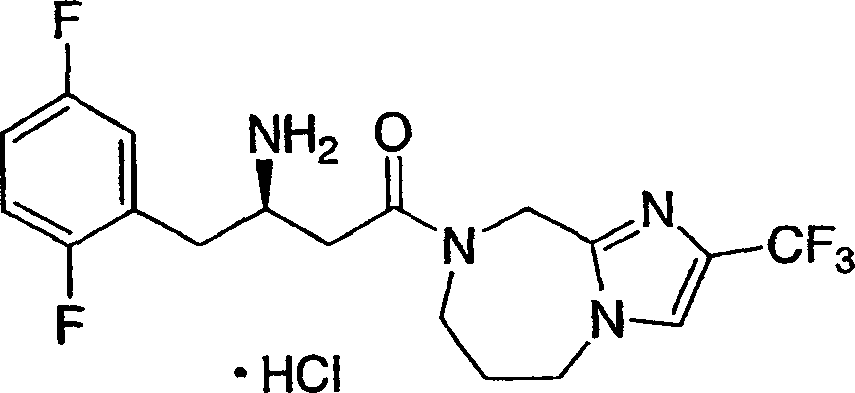
8-[(3R)-3-氨基-4-(2,5-二氟苯基)丁酰基]-3-(三氟甲基)-6,7,8,9-四氢-5H-咪唑并[1,2-a][1,4]二氮杂,盐酸盐8-[(3R)-3-Amino-4-(2,5-difluorophenyl)butyryl]-3-(trifluoromethyl)-6,7,8,9-tetrahydro-5H-imidazole And[1,2-a][1,4]diazepine, hydrochloride
步骤A:3-甲氧基-2,5,6,7-四氢-1H-1,4-二氮杂-1-甲酸叔丁酯Step A: tert-butyl 3-methoxy-2,5,6,7-tetrahydro-1H-1,4-diazepine-1-carboxylate
向得自实施例3,步骤B的内酰胺(2.0g,9.34mmol)在二氯甲烷(10mL)内的搅拌着的溶液中加入三甲基氧鎓四氟硼酸盐(1.51g,10.2mmol)。将所得混合物在室温搅拌过夜。将该反应混合物用饱和碳酸氢钠溶液处理,用2份乙酸乙酯萃取。将有机层用盐水洗涤,用硫酸钠干燥,并浓缩,获得了油状产物,其不用纯化直接使用。To a stirred solution of the lactam from Example 3, Step B (2.0 g, 9.34 mmol) in dichloromethane (10 mL) was added trimethyloxonium tetrafluoroborate (1.51 g, 10.2 mmol ). The resulting mixture was stirred overnight at room temperature. The reaction mixture was treated with saturated sodium bicarbonate solution and extracted with 2 portions of ethyl acetate. The organic layer was washed with brine, dried over sodium sulfate, and concentrated to give an oily product which was used without purification.
步骤B:3-亚氨基-1,4-二氮杂环庚烷-1-甲酸叔丁酯盐酸盐Step B: tert-butyl 3-imino-1,4-diazepane-1-carboxylate hydrochloride
向得自步骤A的亚氨基甲基醚(1.75g,7.66mmol)在乙醇内的搅拌着的溶液中加入氯化铵(0.4g,7.68mmol)。将所得混合物回流4小时。浓缩,获得了本标题化合物。To a stirred solution of the iminomethyl ether from Step A (1.75 g, 7.66 mmol) in ethanol was added ammonium chloride (0.4 g, 7.68 mmol). The resulting mixture was refluxed for 4 hours. Concentration afforded the title compound.
步骤C:2-(三氟甲基)-6,7,8,9-四氢-5H-咪唑并[1,2-a][1,4]二氮杂Step C: 2-(Trifluoromethyl)-6,7,8,9-tetrahydro-5H-imidazo[1,2-a][1,4]diazepine
向得自步骤B的化合物(0.42g,1.68mmol)和三乙胺(0.64mL,4.6mmol)在二氧杂环己烷内的搅拌着的混合物内加入1-溴-3,3,3-三氟丙酮。将所得混合物在50℃加热过夜。除去溶剂后,将残余物溶解在异丙醇中,回流过夜。进行水后处理后,将残余物通过快速色谱法纯化(硅胶,4%的10%氢氧化铵甲醇溶液在二氯甲烷中的混合物)。将该中间体溶解在酸性(三滴浓盐酸)甲氧基乙醇(8mL)中,在120℃加热过夜。除去溶剂后,将残余物用4N氯化氢的二氧杂环己烷溶液处理3小时。通过快速色谱法纯化(硅胶,用6%的10%氢氧化铵甲醇溶液在二氯甲烷中的混合物洗脱),获得了本标题化合物。To a stirred mixture of the compound from Step B (0.42 g, 1.68 mmol) and triethylamine (0.64 mL, 4.6 mmol) in dioxane was added 1-bromo-3,3,3- Trifluoroacetone. The resulting mixture was heated at 50 °C overnight. After removal of the solvent, the residue was dissolved in isopropanol and refluxed overnight. After aqueous work-up, the residue was purified by flash chromatography (silica gel, 4% mixture of 10% methanolic ammonium hydroxide in dichloromethane). This intermediate was dissolved in acidic (three drops of concentrated hydrochloric acid) methoxyethanol (8 mL) and heated at 120° C. overnight. After removal of the solvent, the residue was treated with 4N hydrogen chloride in dioxane for 3 hours. Purification by flash chromatography (silica gel, eluting with 6% methanolic 10% ammonium hydroxide in dichloromethane) afforded the title compound.
步骤D:8-[(3R)-3-氨基-4-(2,5-二氟苯基)丁酰基]-3-(三氟甲基)-6,7,8,9-四氢-5H-咪唑并[1,2-a][1,4]二氮杂,盐酸盐Step D: 8-[(3R)-3-Amino-4-(2,5-difluorophenyl)butyryl]-3-(trifluoromethyl)-6,7,8,9-tetrahydro- 5H-imidazo[1,2-a][1,4]diazepine, hydrochloride
本标题化合物是基本上按照实施例3,步骤E中描述的方法,由(3R)-3-[(叔丁氧基羰基)氨基]-4-(2,5-二氟苯基)丁酸和得自步骤C的2-(三氟甲基)-6,7,8,9-四氢-5H-咪唑并[1,2-a][1,4]二氮杂制得的。MS 206.0(M+1)The title compound was prepared from (3R)-3-[(tert-butoxycarbonyl)amino]-4-(2,5-difluorophenyl)butanoic acid essentially according to the method described in Example 3, Step E and 2-(trifluoromethyl)-6,7,8,9-tetrahydro-5H-imidazo[1,2-a][1,4]diazepine from Step C. MS 206.0(M+1)
实施例7Example 7

7-[(3R)-3-氨基-4-(2,5-二氟苯基)丁酰基]-3-(三氟甲基)-6,7,8,9-四氢-5H-[1,2,4]三唑并[4,3-d][1,4]二氮杂,三氟乙酸盐7-[(3R)-3-amino-4-(2,5-difluorophenyl)butanoyl]-3-(trifluoromethyl)-6,7,8,9-tetrahydro-5H-[ 1,2,4]triazolo[4,3-d][1,4]diazepine, trifluoroacetate
步骤A:1-苄基-1,4-二氮杂环庚烷-5-硫酮Step A: 1-Benzyl-1,4-diazepane-5-thione
向1-苄基-1,4-二氮杂环庚烷-5-酮(2.00g,9.80mmo1)在无水二氧杂环己烷(40mL)内的溶液中加入碳酸氢钠(8.81g,105mmol)和五硫化磷(2.92g,13.1mmol)。将该混合物在75℃加热6小时。减压除去二氧杂环己烷,将残余物用水(80mL)处理。把所得混合物在50℃搅拌1小时,然后在25℃搅拌2小时。向该混合物中加入氯化钠(30.0g),用二氯甲烷萃取水相。将有机相浓缩,获得了所需化合物,其不用进一步纯化直接使用。Sodium bicarbonate (8.81 g , 105mmol) and phosphorus pentasulfide (2.92g, 13.1mmol). The mixture was heated at 75°C for 6 hours. Dioxane was removed under reduced pressure and the residue was treated with water (80 mL). The resulting mixture was stirred at 50°C for 1 hour and then at 25°C for 2 hours. Sodium chloride (30.0 g) was added to the mixture, and the aqueous phase was extracted with dichloromethane. Concentration of the organic phase afforded the desired compound which was used without further purification.
步骤B:(5Z)-1-苄基-1,4-二氮杂环庚烷-5-酮腙Step B: (5Z)-1-Benzyl-1,4-diazepan-5-one hydrazone
向得自步骤A的化合物(1.00g,4.54mmol)在2-丙醇(8.0mL)和THE(20mL)内的溶液中加入肼(0.68g,21.7mmol)。将该混合物在室温搅拌过夜。将粗产物浓缩,通过制备TLC纯化残余物(硅胶,1∶910%氢氧化铵在甲醇中的溶液∶二氯甲烷),获得了所需化合物。To a solution of the compound from Step A (1.00 g, 4.54 mmol) in 2-propanol (8.0 mL) and THE (20 mL) was added hydrazine (0.68 g, 21.7 mmol). The mixture was stirred overnight at room temperature. The crude product was concentrated and the residue was purified by preparative TLC (silica gel, 1:9 10% ammonium hydroxide in methanol:dichloromethane) to afford the desired compound.
步骤C:7-苄基-3-(三氟甲基)-6,7,8,9-四氢-5H-[1,2,4]三唑并[4,3-d][1,4]二氮杂Step C: 7-Benzyl-3-(trifluoromethyl)-6,7,8,9-tetrahydro-5H-[1,2,4]triazolo[4,3-d][1, 4] diazepines
向得自步骤B的化合物(0.26mg,1.20mmol)在无水二氯甲烷(10mL)内的溶液中加入三氟乙酸酐(0.47mL,3.31mmol)和三氟乙酸(1.82mL,23.6mmol)。将该混合物在40℃加热1小时。减压除去溶剂。将残余物在甲苯中加热,使用迪安斯榻克分水器共沸除去水。回流24小时后,减压除去甲苯,通过制备TLC纯化粗产物(硅胶,用8∶9210%氢氧化铵在甲醇的溶液/二氯甲烷洗脱),获得了所需化合物。MS297.1(M+1)。To a solution of the compound from Step B (0.26 mg, 1.20 mmol) in anhydrous dichloromethane (10 mL) was added trifluoroacetic anhydride (0.47 mL, 3.31 mmol) and trifluoroacetic acid (1.82 mL, 23.6 mmol) . The mixture was heated at 40 °C for 1 hour. The solvent was removed under reduced pressure. The residue was heated in toluene and the water removed azeotropically using a Dean Stark trap. After refluxing for 24 hours, the toluene was removed under reduced pressure and the crude product was purified by preparative TLC (silica gel, eluting with 8:92 10% ammonium hydroxide in methanol/dichloromethane) to afford the desired compound. MS297.1 (M+1).
步骤D:3-(三氟甲基)-6,7,8,9-四氢-5H-[1,2,4]三唑并[4,3-d][1,4]二氮杂Step D: 3-(Trifluoromethyl)-6,7,8,9-tetrahydro-5H-[1,2,4]triazolo[4,3-d][1,4]diazepine
将得自步骤C的化合物(0.07mg,0.24mmol)在乙醇(4.0mL)和冰醋酸(2.0mL)中于氢气氛下在10%披钯碳(20mg)存在下搅拌。通过经由硅藻土过滤来除去催化剂。将滤液浓缩,获得了所需化合物。MS 207.0(M+1)。The compound from Step C (0.07 mg, 0.24 mmol) was stirred in ethanol (4.0 mL) and glacial acetic acid (2.0 mL) in the presence of 10% palladium on carbon (20 mg) under an atmosphere of hydrogen. The catalyst was removed by filtration through celite. The filtrate was concentrated to obtain the desired compound. MS 207.0(M+1).
或者,可如下所述除去苄基:将在二氯甲烷(3.0mL)中的得自步骤C的化合物(0.35mmol)用氯甲酸1-氯乙酯(0.53mmol)处理,在密封的管中于45℃加热过夜。将所得溶液冷却至室温,浓缩,溶解在甲醇(5.0mL)中,于45℃加热3小时。将该溶液蒸发,真空干燥,获得了所需化合物的盐酸盐。Alternatively, the benzyl group can be removed as follows: The compound from Step C (0.35 mmol) in dichloromethane (3.0 mL) is treated with 1-chloroethyl chloroformate (0.53 mmol) in a sealed tube Heat at 45°C overnight. The resulting solution was cooled to room temperature, concentrated, dissolved in methanol (5.0 mL), and heated at 45°C for 3 hours. The solution was evaporated and dried in vacuo to afford the hydrochloride salt of the desired compound.
步骤F:7-[(3R)-3-氨基-4-(2,5-二氟苯基)丁酰基]-3-(三氟甲基)-6,7,8,9-四氢-5H-[1,2,4]三唑并[4,3-d][1,4]二氮杂,三氟乙酸盐Step F: 7-[(3R)-3-Amino-4-(2,5-difluorophenyl)butyryl]-3-(trifluoromethyl)-6,7,8,9-tetrahydro- 5H-[1,2,4]triazolo[4,3-d][1,4]diazepine, trifluoroacetate
向(3R)-3-[(叔丁氧基羰基)氨基]-4-(2,5-二氟苯基)丁酸(0.08g,0.24mmol)和EDC(0.06g,0.29mmol)在无水二氯甲烷(3.0mL)内的溶液中加入得自步骤E的化合物(0.06g,0.245mmol)和三乙胺(0.08mL,0.54mmol)。将所得溶液在室温搅拌过夜,并浓缩。通过制备TLC纯化(硅胶,7∶93 10%氢氧化铵在甲醇中的溶液∶二氯甲烷),获得了NBoc中间体,将其用1∶1三氟乙酸∶二氯甲烷处理,获得了本标题化合物。MS 404.2(M+1)。To (3R)-3-[(tert-butoxycarbonyl)amino]-4-(2,5-difluorophenyl)butanoic acid (0.08g, 0.24mmol) and EDC (0.06g, 0.29mmol) in the absence of To a solution in water dichloromethane (3.0 mL) was added the compound from Step E (0.06 g, 0.245 mmol) and triethylamine (0.08 mL, 0.54 mmol). The resulting solution was stirred overnight at room temperature and concentrated. Purification by preparative TLC (silica gel, 7:93 10% ammonium hydroxide in methanol:dichloromethane) afforded the NBoc intermediate, which was treated with 1:1 trifluoroacetic acid:dichloromethane to give the present title compound. MS 404.2(M+1).
实施例8Example 8
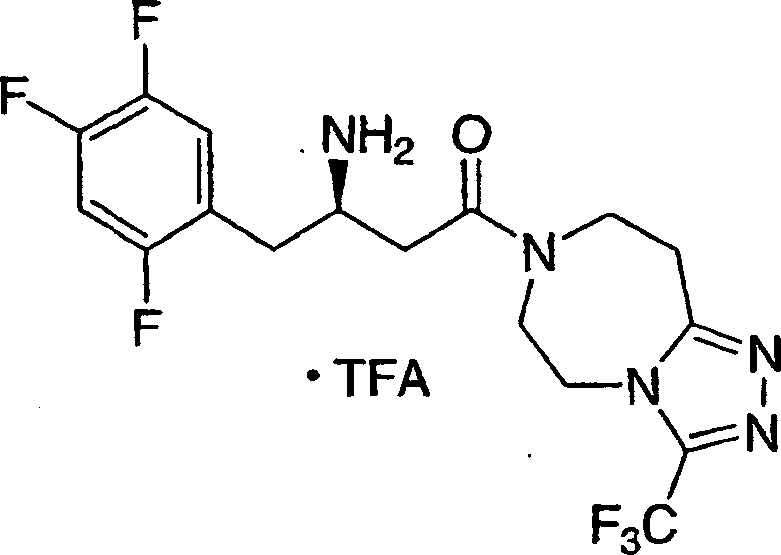
7-[(3R)-3-氨基-4-(2,4,5-三氟苯基)丁酰基]-3-(三氟甲基)-6,7,8,9-四氢-5H-[1,2,4]三唑并[4,3-d][1,4]二氮杂,三氟乙酸盐7-[(3R)-3-amino-4-(2,4,5-trifluorophenyl)butyryl]-3-(trifluoromethyl)-6,7,8,9-tetrahydro-5H -[1,2,4]triazolo[4,3-d][1,4]diazepine, trifluoroacetate
本标题化合物是基本上按照实施例7中描述的步骤顺序,与(3R)-3-[(叔丁氧基羰基)氨基]-4-(2,4,5-三氟苯基)丁酸偶联而制得的。MS 422.0(M+1)。The title compound was obtained by reacting with (3R)-3-[(tert-butoxycarbonyl)amino]-4-(2,4,5-trifluorophenyl)butanoic acid essentially according to the sequence of steps described in Example 7. produced by coupling. MS 422.0(M+1).
实施例9Example 9

7-[(3R)-3-氨基-4-(2,5-二氟苯基)丁酰基]-3-甲基-6,7,8,9-四氢-5H-[1,2,4]三唑并[4,3-d][1,4]二氮杂,三氟乙酸盐7-[(3R)-3-amino-4-(2,5-difluorophenyl)butyryl]-3-methyl-6,7,8,9-tetrahydro-5H-[1,2, 4] Triazolo[4,3-d][1,4]diazepine, trifluoroacetate
本标题化合物是基本上按照实施例7中描述的步骤顺序制得的。MS350.2(M+1)。The title compound was prepared essentially by following the sequence of steps described in Example 7. MS350.2(M+1).
实施例10Example 10
7-[(3R)-3-氨基-4-(2,5-二氟苯基)丁酰基]-3-[4-(三氟甲基)苯基]-6,7,8,9-四氢-5H-[1,2,4]三唑并[4,3-d][1,4]二氮杂,三氟乙酸盐7-[(3R)-3-amino-4-(2,5-difluorophenyl)butyryl]-3-[4-(trifluoromethyl)phenyl]-6,7,8,9- Tetrahydro-5H-[1,2,4]triazolo[4,3-d][1,4]diazepine, trifluoroacetate
本标题化合物是基本上按照实施例7中描述的步骤顺序制得的。MS480.2(M+1)。The title compound was prepared essentially by following the sequence of steps described in Example 7. MS480.2(M+1).
实施例11Example 11
7-[(3R)-3-氨基-4-(2,5-二氟苯基)丁酰基]-3-[4-(三氟甲氧基)苯基]-6,7,8,9-四氢-5H-[1,2,4]三唑并[4,3-d][1,4]二氮杂,三氟乙酸盐7-[(3R)-3-amino-4-(2,5-difluorophenyl)butyryl]-3-[4-(trifluoromethoxy)phenyl]-6,7,8,9 -Tetrahydro-5H-[1,2,4]triazolo[4,3-d][1,4]diazepine, trifluoroacetate
本标题化合物是基本上按照实施例7中描述的步骤顺序制得的。MS496.2(M+1)。The title compound was prepared essentially by following the sequence of steps described in Example 7. MS496.2 (M+1).
实施例12Example 12

7-[(3R)-3-氨基-4-(2,5-二氟苯基)丁酰基]-3-(5-甲基-1,3,4-噁二唑-2-基)-6,7,8,9-四氢-5H-[1,2,4]三唑并[4,3-d][1,4]二氮杂,三氟乙酸盐7-[(3R)-3-amino-4-(2,5-difluorophenyl)butyryl]-3-(5-methyl-1,3,4-oxadiazol-2-yl)- 6,7,8,9-Tetrahydro-5H-[1,2,4]triazolo[4,3-d][1,4]diazepine, trifluoroacetate
本标题化合物是基本上按照实施例7中描述的步骤顺序制得的。MS418.3(M+1)。The title compound was prepared essentially by following the sequence of steps described in Example 7. MS418.3(M+1).
药物制剂实施例Examples of pharmaceutical preparations
作为口服药物组合物的一个具体实施方案,100mg规格的片剂由100mg任何本发明化合物、268mg微晶纤维素、20mg交联羧甲基纤维素钠和4mg硬脂酸镁组成。首先将活性组分、微晶纤维素和交联羧甲基纤维素混合。然后将该混合物用硬脂酸镁润滑,并压制成片。As a specific embodiment of the oral pharmaceutical composition, a 100 mg tablet is composed of 100 mg of any compound of the present invention, 268 mg of microcrystalline cellulose, 20 mg of croscarmellose sodium and 4 mg of magnesium stearate. The active ingredient, microcrystalline cellulose and croscarmellose are first mixed. The mixture is then lubricated with magnesium stearate and compressed into tablets.
尽管己通过本发明的某些具体实施方案描述和说明了本发明,但本领域的技术人员理解,在不背离本发明的精神和范围下,可对本发明的方法和方案进行各种修改、变化、修饰、替换、减少或增加。例如,可将不是本文前面提出的具体剂量的有效剂量看作是用上述本发明化合物治疗的哺乳动物的任何所述症状的反应的变量结果。根据并依据所选的具体活性化合物或是否含有药物载体以及所用的制剂形式和用药方式,可观察到具体药理学反应会变化,而且这些结果中所预期的变化或差别与本发明的目的和实现一致。因此,计划通过后面的权利要求书来定义本发明,并对本权利要求书作合理的广义理解。Although the present invention has been described and illustrated by some specific embodiments of the present invention, those skilled in the art understand that without departing from the spirit and scope of the present invention, various modifications and changes can be made to the methods and solutions of the present invention , modify, replace, reduce or increase. For example, effective dosages other than the specific dosages set forth hereinbefore can be considered as a variable result of the response to any of the described symptoms in mammals treated with the compounds of the invention described above. Depending on and according to the selected specific active compound or whether it contains a pharmaceutical carrier and the used preparation form and administration mode, the specific pharmacological response can be observed to change, and the expected changes or differences in these results are consistent with the purpose and realization of the present invention. unanimous. Accordingly, it is intended that the invention be defined by the following claims, which should be read in the broadest sense possible.
Claims (30)


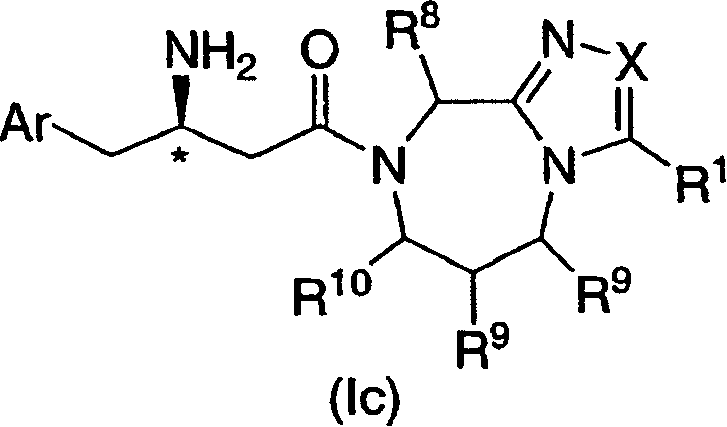
Applications Claiming Priority (2)
| Application Number | Priority Date | Filing Date | Title |
|---|---|---|---|
| US47056403P | 2003-05-14 | 2003-05-14 | |
| US60/470,564 | 2003-05-14 |
Publications (1)
| Publication Number | Publication Date |
|---|---|
| CN1787823A true CN1787823A (en) | 2006-06-14 |
Family
ID=33476720
Family Applications (1)
| Application Number | Title | Priority Date | Filing Date |
|---|---|---|---|
| CNA2004800130071A Pending CN1787823A (en) | 2003-05-14 | 2004-05-10 | 3-amino-4-phenylbutanoic acid derivatives as dipeptidyl peptidase inhibitors for the treatment or prevention of diabetes |
Country Status (9)
| Country | Link |
|---|---|
| US (1) | US7560455B2 (en) |
| EP (1) | EP1624874B1 (en) |
| JP (1) | JP2006528693A (en) |
| CN (1) | CN1787823A (en) |
| AT (1) | ATE447574T1 (en) |
| AU (1) | AU2004240563A1 (en) |
| CA (1) | CA2524531A1 (en) |
| DE (1) | DE602004023932D1 (en) |
| WO (1) | WO2004103276A2 (en) |
Cited By (3)
| Publication number | Priority date | Publication date | Assignee | Title |
|---|---|---|---|---|
| CN101899047A (en) * | 2009-05-26 | 2010-12-01 | 北京翔宇恒天医药技术有限公司 | Beta-amino tetrahydropyrazine, tetrahydropyrimidine and tetrahydropyridine used as dipeptidy peptidase inhibitors for curing or preventing diabetes |
| CN112608315A (en) * | 2020-12-14 | 2021-04-06 | 承德医学院 | Triazolodiazepine compound and preparation method and medical application thereof |
| CN114222802A (en) * | 2019-05-20 | 2022-03-22 | 尼尔瓦纳科学股份有限公司 | Narrow emission dyes, compositions comprising the same, and methods of making and using the same |
Families Citing this family (55)
| Publication number | Priority date | Publication date | Assignee | Title |
|---|---|---|---|---|
| ATE374181T1 (en) | 2001-06-27 | 2007-10-15 | Smithkline Beecham Corp | FLUORPYRROLIDINES AS DIPEPTIDYLPEPTIDASE INHIBITORS |
| US20040242566A1 (en) | 2003-03-25 | 2004-12-02 | Syrrx, Inc. | Dipeptidyl peptidase inhibitors |
| EP1625122A1 (en) | 2003-05-14 | 2006-02-15 | Takeda San Diego, Inc. | Dipeptidyl peptidase inhibitors |
| CA2535619A1 (en) | 2003-08-13 | 2005-02-24 | Takeda Pharmaceutical Company Limited | 4-pyrimidone derivatives and their use as peptidyl peptidase inhibitors |
| DOP2006000008A (en) | 2005-01-10 | 2006-08-31 | Arena Pharm Inc | COMBINED THERAPY FOR THE TREATMENT OF DIABETES AND RELATED AFFECTIONS AND FOR THE TREATMENT OF AFFECTIONS THAT IMPROVE THROUGH AN INCREASE IN THE BLOOD CONCENTRATION OF GLP-1 |
| ATE432259T1 (en) * | 2005-07-20 | 2009-06-15 | Lilly Co Eli | PYRIDINE DERIVATIVES AS DIPEPTEDYL PEPTIDASE INHIBITORS |
| US7709468B2 (en) | 2005-09-02 | 2010-05-04 | Abbott Laboratories | Imidazo based heterocycles |
| ME02005B (en) | 2005-09-14 | 2012-08-31 | Takeda Pharmaceuticals Co | Dipeptidyl peptidase inhibitors for treating diabetes |
| CN101360723A (en) | 2005-09-16 | 2009-02-04 | 武田药品工业株式会社 | Process for preparing pyrimidinedione derivatives |
| GB0526291D0 (en) | 2005-12-23 | 2006-02-01 | Prosidion Ltd | Therapeutic method |
| WO2007112347A1 (en) | 2006-03-28 | 2007-10-04 | Takeda Pharmaceutical Company Limited | Dipeptidyl peptidase inhibitors |
| US7833730B2 (en) | 2006-04-11 | 2010-11-16 | Arena Pharmaceuticals, Inc. | Methods of using GPR119 to identify compounds useful for increasing bone mass in an individual |
| PE20071221A1 (en) | 2006-04-11 | 2007-12-14 | Arena Pharm Inc | GPR119 RECEPTOR AGONISTS IN METHODS TO INCREASE BONE MASS AND TO TREAT OSTEOPOROSIS AND OTHER CONDITIONS CHARACTERIZED BY LOW BONE MASS, AND COMBINED THERAPY RELATED TO THESE AGONISTS |
| KR20090004950A (en) | 2006-04-12 | 2009-01-12 | 프로비오드룩 아게 | Enzyme inhibitor |
| US8324383B2 (en) | 2006-09-13 | 2012-12-04 | Takeda Pharmaceutical Company Limited | Methods of making polymorphs of benzoate salt of 2-[[6-[(3R)-3-amino-1-piperidinyl]-3,4-dihydro-3-methyl-2,4-dioxo-1(2H)-pyrimidinyl]methyl]-benzonitrile |
| WO2008055945A1 (en) | 2006-11-09 | 2008-05-15 | Probiodrug Ag | 3-hydr0xy-1,5-dihydr0-pyrr0l-2-one derivatives as inhibitors of glutaminyl cyclase for the treatment of ulcer, cancer and other diseases |
| TW200838536A (en) | 2006-11-29 | 2008-10-01 | Takeda Pharmaceutical | Polymorphs of succinate salt of 2-[6-(3-amino-piperidin-1-yl)-3-methyl-2,4-dioxo-3,4-dihydro-2H-pyrimidin-1-ylmethy]-4-fluor-benzonitrile and methods of use therefor |
| ATE554085T1 (en) | 2006-11-30 | 2012-05-15 | Probiodrug Ag | NEW INHIBITORS OF GLUTAMINYL CYCLASE |
| US8093236B2 (en) | 2007-03-13 | 2012-01-10 | Takeda Pharmaceuticals Company Limited | Weekly administration of dipeptidyl peptidase inhibitors |
| JP5667440B2 (en) | 2007-04-18 | 2015-02-12 | プロビオドルグ エージー | Thiourea derivatives as glutaminyl cyclase inhibitors |
| EP2229395A1 (en) * | 2008-01-17 | 2010-09-22 | Grünenthal GmbH | Substituted sulfonamide derivatives |
| EP2250157B1 (en) | 2008-01-24 | 2014-11-05 | Panacea Biotec Limited | Novel heterocyclic compounds |
| EP2146210A1 (en) | 2008-04-07 | 2010-01-20 | Arena Pharmaceuticals, Inc. | Methods of using A G protein-coupled receptor to identify peptide YY (PYY) secretagogues and compounds useful in the treatment of conditions modulated by PYY |
| US8835602B2 (en) * | 2009-03-06 | 2014-09-16 | Indian Institute Of Science | Templates for nucleation and propagation of peptide secondary structure |
| UY32776A (en) | 2009-07-09 | 2011-02-28 | Irm Llc | IMIDAZOPIRAZINE COMPOUNDS REPLACED FOR THE TREATMENT OF PARASITARY DISEASES, PHARMACEUTICAL COMPOSITIONS CONTAINING THEM AND APPLICATION. |
| AR077642A1 (en) | 2009-07-09 | 2011-09-14 | Arena Pharm Inc | METABOLISM MODULATORS AND THE TREATMENT OF DISORDERS RELATED TO THE SAME |
| CN102695546B (en) | 2009-09-11 | 2014-09-10 | 前体生物药物股份公司 | Heterocylcic derivatives as inhibitors of glutaminyl cyclase |
| US9181233B2 (en) | 2010-03-03 | 2015-11-10 | Probiodrug Ag | Inhibitors of glutaminyl cyclase |
| US8269019B2 (en) | 2010-03-10 | 2012-09-18 | Probiodrug Ag | Inhibitors |
| JP2013523819A (en) | 2010-04-06 | 2013-06-17 | アリーナ ファーマシューティカルズ, インコーポレイテッド | GPR119 receptor modulators and treatment of disorders related thereto |
| JP5945532B2 (en) | 2010-04-21 | 2016-07-05 | プロビオドルグ エージー | Benzimidazole derivatives as inhibitors of glutaminyl cyclase |
| WO2011146358A1 (en) | 2010-05-21 | 2011-11-24 | Merck Sharp & Dohme Corp. | Substituted seven-membered heterocyclic compounds as dipeptidyl peptidase-iv inhibitors for the treatment of diabetes |
| CN102260265B (en) * | 2010-05-24 | 2015-09-02 | 上海阳帆医药科技有限公司 | Hexahydropyrrolo [3,4-b] pyrrole derivative, Its Preparation Method And Use |
| EP2619198A1 (en) | 2010-09-22 | 2013-07-31 | Arena Pharmaceuticals, Inc. | Modulators of the gpr119 receptor and the treatment of disorders related thereto |
| EP2648517B1 (en) | 2010-12-06 | 2015-08-05 | Merck Sharp & Dohme Corp. | Tricyclic heterocycles useful as dipeptidyl peptidase-iv inhibitors |
| US8530670B2 (en) | 2011-03-16 | 2013-09-10 | Probiodrug Ag | Inhibitors |
| US20140018371A1 (en) | 2011-04-01 | 2014-01-16 | Arena Pharmaceuticals, Inc. | Modulators Of The GPR119 Receptor And The Treatment Of Disorders Related Thereto |
| US20140066369A1 (en) | 2011-04-19 | 2014-03-06 | Arena Pharmaceuticals, Inc. | Modulators Of The GPR119 Receptor And The Treatment Of Disorders Related Thereto |
| WO2012145603A1 (en) | 2011-04-22 | 2012-10-26 | Arena Pharmaceuticals, Inc. | Modulators of the gpr119 receptor and the treatment of disorders related thereto |
| US20140051714A1 (en) | 2011-04-22 | 2014-02-20 | Arena Pharmaceuticals, Inc. | Modulators Of The GPR119 Receptor And The Treatment Of Disorders Related Thereto |
| WO2012170702A1 (en) | 2011-06-08 | 2012-12-13 | Arena Pharmaceuticals, Inc. | Modulators of the gpr119 receptor and the treatment of disorders related thereto |
| JP5873554B2 (en) | 2011-06-29 | 2016-03-01 | メルク・シャープ・アンド・ドーム・コーポレーションMerck Sharp & Dohme Corp. | Process for the preparation of chiral dipeptidyl peptidase-IV inhibitors |
| US9051329B2 (en) | 2011-07-05 | 2015-06-09 | Merck Sharp & Dohme Corp. | Tricyclic heterocycles useful as dipeptidyl peptidase-IV inhibitors |
| WO2013055910A1 (en) | 2011-10-12 | 2013-04-18 | Arena Pharmaceuticals, Inc. | Modulators of the gpr119 receptor and the treatment of disorders related thereto |
| US9073930B2 (en) | 2012-02-17 | 2015-07-07 | Merck Sharp & Dohme | Dipeptidyl peptidase-IV inhibitors for the treatment or prevention of diabetes |
| WO2014018350A1 (en) | 2012-07-23 | 2014-01-30 | Merck Sharp & Dohme Corp. | Treating diabetes with dipeptidyl peptidase-iv inhibitors |
| US9156848B2 (en) | 2012-07-23 | 2015-10-13 | Merck Sharp & Dohme Corp. | Treating diabetes with dipeptidyl peptidase-IV inhibitors |
| WO2014074668A1 (en) | 2012-11-08 | 2014-05-15 | Arena Pharmaceuticals, Inc. | Modulators of gpr119 and the treatment of disorders related thereto |
| US9862725B2 (en) | 2014-07-21 | 2018-01-09 | Merck Sharp & Dohme Corp. | Process for preparing chiral dipeptidyl peptidase-IV inhibitors |
| GB201415598D0 (en) | 2014-09-03 | 2014-10-15 | Univ Birmingham | Elavated Itercranial Pressure Treatment |
| EP3267994A4 (en) | 2015-03-09 | 2018-10-31 | Intekrin Therapeutics, Inc. | Methods for the treatment of nonalcoholic fatty liver disease and/or lipodystrophy |
| CN105017260B (en) * | 2015-07-30 | 2017-04-19 | 新发药业有限公司 | Preparation method of sitagliptin intermediate triazolopyrazine derivative |
| SG11201909046XA (en) | 2017-04-03 | 2019-10-30 | Coherus Biosciences Inc | PPARγ AGONIST FOR TREATMENT OF PROGRESSIVE SUPRANUCLEAR PALSY |
| KR20190139291A (en) | 2017-04-24 | 2019-12-17 | 노파르티스 아게 | 2-amino-l- (2- (4-fluorophenyl) -3- (4-fluorophenylamino) -8,8-dimethyl-5,6-dihydroimidazo [1,2-a] pyrazine Therapeutic regimen of -7 (8h) -yl) ethanone and combinations thereof |
| PL3461819T3 (en) | 2017-09-29 | 2020-11-30 | Probiodrug Ag | Inhibitors of glutaminyl cyclase |
Family Cites Families (34)
| Publication number | Priority date | Publication date | Assignee | Title |
|---|---|---|---|---|
| SE8107537L (en) | 1980-12-22 | 1982-06-23 | Delalande Sa | NEW DERIVATIVES OF HETEROCYCLIC AMINOALCOYLES, THEIR PREPARATIONS AND THEIR THERAPEUTIC APPLICATIONS |
| IL111785A0 (en) | 1993-12-03 | 1995-01-24 | Ferring Bv | Dp-iv inhibitors and pharmaceutical compositions containing them |
| DE122010000020I1 (en) | 1996-04-25 | 2010-07-08 | Prosidion Ltd | Method for lowering the blood glucose level in mammals |
| TW492957B (en) | 1996-11-07 | 2002-07-01 | Novartis Ag | N-substituted 2-cyanopyrrolidnes |
| US6011155A (en) | 1996-11-07 | 2000-01-04 | Novartis Ag | N-(substituted glycyl)-2-cyanopyrrolidines, pharmaceutical compositions containing them and their use in inhibiting dipeptidyl peptidase-IV |
| CO5150173A1 (en) | 1998-12-10 | 2002-04-29 | Novartis Ag | COMPOUNDS N- (REPLACED GLYCLE) -2-DIPEPTIDYL-IV PEPTIDASE INHIBITING CYANOPIRROLIDINS (DPP-IV) WHICH ARE EFFECTIVE IN THE TREATMENT OF CONDITIONS MEDIATED BY DPP-IV INHIBITION |
| CA2390231A1 (en) | 1999-11-12 | 2001-05-17 | Paul Jackson | Dipeptidyl peptidase iv inhibitors and methods of making and using dipeptidyl peptidase iv inhibitors |
| TWI289566B (en) | 1999-12-07 | 2007-11-11 | N.V.Organon | Antithrombotic compound |
| US6432969B1 (en) | 2000-06-13 | 2002-08-13 | Novartis Ag | N-(substituted glycyl)-2 cyanopyrrolidines, pharmaceutical compositions containing them and their use in inhibiting dipeptidyl peptidase-IV |
| TW583185B (en) | 2000-06-13 | 2004-04-11 | Novartis Ag | N-(substituted glycyl)-2-cyanopyrrolidines and pharmaceutical composition for inhibiting dipeptidyl peptidase-IV (DPP-IV) or for the prevention or treatment of diseases or conditions associated with elevated levels of DPP-IV comprising the same |
| JP2004502690A (en) | 2000-07-04 | 2004-01-29 | ノボ ノルディスク アクティーゼルスカブ | Heterocyclic compounds that are inhibitors of the enzyme DPP-IV |
| PT1308439E (en) * | 2000-08-10 | 2008-12-12 | Mitsubishi Tanabe Pharma Corp | Proline derivatives and use thereof as drugs |
| JP2004525929A (en) | 2001-03-27 | 2004-08-26 | メルク エンド カムパニー インコーポレーテッド | Dipeptidyl peptidase inhibitors for the treatment or prevention of diabetes |
| WO2003000181A2 (en) * | 2001-06-20 | 2003-01-03 | Merck & Co., Inc. | Dipeptidyl peptidase inhibitors for the treatment of diabetes |
| WO2003000180A2 (en) | 2001-06-20 | 2003-01-03 | Merck & Co., Inc. | Dipeptidyl peptidase inhibitors for the treatment of diabetes |
| DE60223920T2 (en) | 2001-06-27 | 2008-11-13 | Smithkline Beecham Corp. | PYRROLIDINES AS DIPEPTIDYL-PEPTIDASE INHIBITORS |
| UA74912C2 (en) * | 2001-07-06 | 2006-02-15 | Merck & Co Inc | Beta-aminotetrahydroimidazo-(1,2-a)-pyrazines and tetratriazolo-(4,3-a)-pyrazines as inhibitors of dipeptylpeptidase for the treatment or prevention of diabetes |
| JP2005526811A (en) | 2002-03-25 | 2005-09-08 | メルク エンド カムパニー インコーポレーテッド | Β-amino heterocyclic dipeptidyl peptidase inhibitor for the treatment or prevention of diabetes |
| ATE451369T1 (en) | 2002-07-15 | 2009-12-15 | Merck & Co Inc | PIPERIDINOPYRIMIDEINDIPEPTIDYLPEPTIDASE INHIBITOR N FOR THE TREATMENT OF DIABETES |
| AU2003275404A1 (en) | 2002-10-07 | 2004-05-04 | Merck & Co., Inc. | Antidiabetic beta-amino heterocyclic dipeptidyl peptidase inhibitors |
| BR0315796A (en) | 2002-11-07 | 2005-09-13 | Merck & Co Inc | Compound, Pharmaceutical Composition, and, Methods for Treating Diabetes, Treating Hyperglycemia, and Treating Obesity in a Mammal |
| CA2508487A1 (en) | 2002-12-04 | 2004-06-17 | Merck & Co., Inc. | Phenylalanine derivatives as dipeptidyl peptidase inhibitors for the treatment or prevention of diabetes |
| AU2003297219A1 (en) | 2002-12-20 | 2004-07-22 | Merck & Co., Inc. | 3-amino-4-phenylbutanoic acid derivatives as dipeptidyl peptidase inhibitors for the treatment or prevention of diabetes |
| JP4564952B2 (en) | 2003-01-17 | 2010-10-20 | メルク・シャープ・エンド・ドーム・コーポレイション | 3-Amino-4-phenylbutanoic acid derivatives as dipeptidyl peptidase inhibitors for the treatment and prevention of diabetes |
| EP1592689A4 (en) | 2003-01-31 | 2008-12-24 | Merck & Co Inc | 3-AMINO-4-PHENYLBUTANOIC ACID DERIVATIVES AS INHIBITORS OF DIPEPTIDYL PEPTIDASE FOR THE TREATMENT OR PREVENTION OF DIABETES |
| AU2004247068A1 (en) | 2003-06-06 | 2004-12-23 | Merck & Co., Inc. | Fused indoles as dipeptidyl peptidase inhibitors for the treatment or prevention of diabetes |
| JP4579239B2 (en) | 2003-06-17 | 2010-11-10 | メルク・シャープ・エンド・ドーム・コーポレイション | Cyclohexylglycine derivatives as dipeptidyl peptidase inhibitors for the treatment or prevention of diabetes |
| US7259160B2 (en) | 2003-07-31 | 2007-08-21 | Merck & Co., Inc. | Hexahydrodiazepinones as dipeptidyl peptidase-IV inhibitors for the treatment or prevention of diabetes |
| CA2541212A1 (en) | 2003-11-04 | 2005-05-19 | Wallace T. Ashton | Fused phenylalanine derivatives as dipeptidyl peptidase-iv inhibitors for the treatment or prevention of diabetes |
| EP1541143A1 (en) | 2003-12-09 | 2005-06-15 | Graffinity Pharmaceuticals Aktiengesellschaft | Dpp-iv inhibitors |
| EP1541148A1 (en) | 2003-12-09 | 2005-06-15 | Graffinity Pharmaceuticals Aktiengesellschaft | Dpp-iv inhibitors |
| CN1950349A (en) | 2004-05-04 | 2007-04-18 | 默克公司 | 1,2,4-oxadiazole derivatives as dipeptidyl peptidase-IV inhibitors for treating or preventing diabetes |
| CN1960990A (en) | 2004-05-18 | 2007-05-09 | 默克公司 | Cyclohexylalanine derivatives as dipeptidyl peptidase-IV inhibitors for the treatment or prevention of diabetes |
| GB0413389D0 (en) | 2004-06-16 | 2004-07-21 | Astrazeneca Ab | Chemical compounds |
-
2004
- 2004-05-10 DE DE602004023932T patent/DE602004023932D1/en not_active Expired - Lifetime
- 2004-05-10 JP JP2006532933A patent/JP2006528693A/en active Pending
- 2004-05-10 CA CA002524531A patent/CA2524531A1/en not_active Abandoned
- 2004-05-10 EP EP04751840A patent/EP1624874B1/en not_active Expired - Lifetime
- 2004-05-10 AU AU2004240563A patent/AU2004240563A1/en not_active Abandoned
- 2004-05-10 WO PCT/US2004/014642 patent/WO2004103276A2/en not_active Ceased
- 2004-05-10 CN CNA2004800130071A patent/CN1787823A/en active Pending
- 2004-05-10 US US10/556,805 patent/US7560455B2/en not_active Expired - Lifetime
- 2004-05-10 AT AT04751840T patent/ATE447574T1/en not_active IP Right Cessation
Cited By (5)
| Publication number | Priority date | Publication date | Assignee | Title |
|---|---|---|---|---|
| CN101899047A (en) * | 2009-05-26 | 2010-12-01 | 北京翔宇恒天医药技术有限公司 | Beta-amino tetrahydropyrazine, tetrahydropyrimidine and tetrahydropyridine used as dipeptidy peptidase inhibitors for curing or preventing diabetes |
| CN101899047B (en) * | 2009-05-26 | 2016-01-20 | 盛世泰科生物医药技术(苏州)有限公司 | Be used for the treatment of as depeptidyl peptidase inhibitors or the beta-amino tetrahydrochysene pyrazine of prevent diabetes, tetrahydropyrimidine and tetrahydropyridine |
| CN114222802A (en) * | 2019-05-20 | 2022-03-22 | 尼尔瓦纳科学股份有限公司 | Narrow emission dyes, compositions comprising the same, and methods of making and using the same |
| CN112608315A (en) * | 2020-12-14 | 2021-04-06 | 承德医学院 | Triazolodiazepine compound and preparation method and medical application thereof |
| CN112608315B (en) * | 2020-12-14 | 2021-11-30 | 承德医学院 | Triazolodiazepine compound and preparation method and medical application thereof |
Also Published As
| Publication number | Publication date |
|---|---|
| WO2004103276A3 (en) | 2005-08-11 |
| DE602004023932D1 (en) | 2009-12-17 |
| US20060258646A1 (en) | 2006-11-16 |
| CA2524531A1 (en) | 2004-12-02 |
| ATE447574T1 (en) | 2009-11-15 |
| EP1624874A4 (en) | 2006-11-22 |
| JP2006528693A (en) | 2006-12-21 |
| WO2004103276A2 (en) | 2004-12-02 |
| EP1624874B1 (en) | 2009-11-04 |
| AU2004240563A1 (en) | 2004-12-02 |
| EP1624874A2 (en) | 2006-02-15 |
| US7560455B2 (en) | 2009-07-14 |
Similar Documents
| Publication | Publication Date | Title |
|---|---|---|
| CN1787823A (en) | 3-amino-4-phenylbutanoic acid derivatives as dipeptidyl peptidase inhibitors for the treatment or prevention of diabetes | |
| CN1290848C (en) | β-Aminotetrahydroimidazolo(1,2-A)pyrazines and tetrahydrotriazolo(4,3-A)pyrazines as dipeptidyl peptidase inhibitors for the treatment or prevention of diabetes | |
| CN1705647A (en) | Beta-amino heterocyclic dipeptidyl peptidase inhibitors for the treatment or prevention of diabetes | |
| CN1882551A (en) | Hexahydrodiazepinones as dipeptidyl peptidase-IV inhibitors for the treatment or prevention of diabetes | |
| CN1870990A (en) | Fused phenylalanine derivatives as dipeptidyl peptidase-iv inhibitors for the treatment or prevention of diabetes | |
| CN1809544A (en) | Cyclohexylglycine derivatives as dipeptidyl peptidase inhibitors for the treatment or prevention of diabetes | |
| CN101031300A (en) | Aminopiperidines as dipeptidyl peptidase-iv inhibitors for the treatment or prevention of diabetes | |
| JP4530852B2 (en) | Piperidinopyrimidine dipeptidyl peptidase inhibitors for the treatment of diabetes | |
| CN1950349A (en) | 1,2,4-oxadiazole derivatives as dipeptidyl peptidase-IV inhibitors for treating or preventing diabetes | |
| CN1798556A (en) | Fused indoles as dipeptidyl peptidase inhibitors for the treatment or prevention of diabetes | |
| CN101065357A (en) | Fused aminopiperidines as dipeptidyl peptidase-iv inhibitors for the treatment or prevention of diabetes | |
| CN1290847C (en) | Aza-arylpiperazines | |
| CN1960990A (en) | Cyclohexylalanine derivatives as dipeptidyl peptidase-IV inhibitors for the treatment or prevention of diabetes | |
| CN1671696A (en) | kinase inhibitor | |
| JP2005526811A (en) | Β-amino heterocyclic dipeptidyl peptidase inhibitor for the treatment or prevention of diabetes | |
| CN1361779A (en) | New compounds | |
| CN1468216A (en) | Nitrogenous five-membered ring compound | |
| CN1918119A (en) | Bicyclic ester derivatives | |
| CN1863770A (en) | Cyclic amine BASE-1 inhibitors having a heterocyclic substituent | |
| CN1224720A (en) | Tetracylic derivatives, process of preparation and use | |
| CN1902172A (en) | N-acylated-3- (benzoyl) - pyrrolidines as 11-beta-hsd1 inhibitors useful for the treatment of metabolic disorders | |
| CN1093085A (en) | Amine derivatives | |
| CN1993363A (en) | 1,3-disubstituted heteroaryl NMDA/NR2B antagonists | |
| CN1503797A (en) | Pyridopyrimidine or naphthyridine derivatives | |
| CN101068595A (en) | CGRP receptor antagonists |
Legal Events
| Date | Code | Title | Description |
|---|---|---|---|
| C06 | Publication | ||
| PB01 | Publication | ||
| C10 | Entry into substantive examination | ||
| SE01 | Entry into force of request for substantive examination | ||
| C02 | Deemed withdrawal of patent application after publication (patent law 2001) | ||
| WD01 | Invention patent application deemed withdrawn after publication |