JP2005526811A - Β-amino heterocyclic dipeptidyl peptidase inhibitor for the treatment or prevention of diabetes - Google Patents
Β-amino heterocyclic dipeptidyl peptidase inhibitor for the treatment or prevention of diabetes Download PDFInfo
- Publication number
- JP2005526811A JP2005526811A JP2003580285A JP2003580285A JP2005526811A JP 2005526811 A JP2005526811 A JP 2005526811A JP 2003580285 A JP2003580285 A JP 2003580285A JP 2003580285 A JP2003580285 A JP 2003580285A JP 2005526811 A JP2005526811 A JP 2005526811A
- Authority
- JP
- Japan
- Prior art keywords
- alkyl
- compound
- branched
- phenyl
- group
- Prior art date
- Legal status (The legal status is an assumption and is not a legal conclusion. Google has not performed a legal analysis and makes no representation as to the accuracy of the status listed.)
- Pending
Links
- 0 *C(c1nc(C(F)(F)F)c[n]1CC1)N1C(C[C@@](Cc(cc(c(F)c1)F)c1F)N)=O Chemical compound *C(c1nc(C(F)(F)F)c[n]1CC1)N1C(C[C@@](Cc(cc(c(F)c1)F)c1F)N)=O 0.000 description 2
- WQEFMMCSAXKCIO-SECBINFHSA-N CC(C)(C)OC(N[C@@H](CC(O)=O)Cc(c(Br)c1)cc(F)c1F)=O Chemical compound CC(C)(C)OC(N[C@@H](CC(O)=O)Cc(c(Br)c1)cc(F)c1F)=O WQEFMMCSAXKCIO-SECBINFHSA-N 0.000 description 1
- PJGZDJACYKWIHB-FIWHBWSRSA-N Cc1cnc(C2)[n]1CC(Cc1ccccc1)N2C(C[C@@H](Cc(cc1F)ccc1F)N)=O Chemical compound Cc1cnc(C2)[n]1CC(Cc1ccccc1)N2C(C[C@@H](Cc(cc1F)ccc1F)N)=O PJGZDJACYKWIHB-FIWHBWSRSA-N 0.000 description 1
Classifications
-
- C—CHEMISTRY; METALLURGY
- C07—ORGANIC CHEMISTRY
- C07D—HETEROCYCLIC COMPOUNDS
- C07D487/00—Heterocyclic compounds containing nitrogen atoms as the only ring hetero atoms in the condensed system, not provided for by groups C07D451/00 - C07D477/00
- C07D487/02—Heterocyclic compounds containing nitrogen atoms as the only ring hetero atoms in the condensed system, not provided for by groups C07D451/00 - C07D477/00 in which the condensed system contains two hetero rings
- C07D487/04—Ortho-condensed systems
-
- A—HUMAN NECESSITIES
- A61—MEDICAL OR VETERINARY SCIENCE; HYGIENE
- A61P—SPECIFIC THERAPEUTIC ACTIVITY OF CHEMICAL COMPOUNDS OR MEDICINAL PREPARATIONS
- A61P1/00—Drugs for disorders of the alimentary tract or the digestive system
-
- A—HUMAN NECESSITIES
- A61—MEDICAL OR VETERINARY SCIENCE; HYGIENE
- A61P—SPECIFIC THERAPEUTIC ACTIVITY OF CHEMICAL COMPOUNDS OR MEDICINAL PREPARATIONS
- A61P1/00—Drugs for disorders of the alimentary tract or the digestive system
- A61P1/12—Antidiarrhoeals
-
- A—HUMAN NECESSITIES
- A61—MEDICAL OR VETERINARY SCIENCE; HYGIENE
- A61P—SPECIFIC THERAPEUTIC ACTIVITY OF CHEMICAL COMPOUNDS OR MEDICINAL PREPARATIONS
- A61P1/00—Drugs for disorders of the alimentary tract or the digestive system
- A61P1/18—Drugs for disorders of the alimentary tract or the digestive system for pancreatic disorders, e.g. pancreatic enzymes
-
- A—HUMAN NECESSITIES
- A61—MEDICAL OR VETERINARY SCIENCE; HYGIENE
- A61P—SPECIFIC THERAPEUTIC ACTIVITY OF CHEMICAL COMPOUNDS OR MEDICINAL PREPARATIONS
- A61P13/00—Drugs for disorders of the urinary system
- A61P13/12—Drugs for disorders of the urinary system of the kidneys
-
- A—HUMAN NECESSITIES
- A61—MEDICAL OR VETERINARY SCIENCE; HYGIENE
- A61P—SPECIFIC THERAPEUTIC ACTIVITY OF CHEMICAL COMPOUNDS OR MEDICINAL PREPARATIONS
- A61P25/00—Drugs for disorders of the nervous system
-
- A—HUMAN NECESSITIES
- A61—MEDICAL OR VETERINARY SCIENCE; HYGIENE
- A61P—SPECIFIC THERAPEUTIC ACTIVITY OF CHEMICAL COMPOUNDS OR MEDICINAL PREPARATIONS
- A61P25/00—Drugs for disorders of the nervous system
- A61P25/28—Drugs for disorders of the nervous system for treating neurodegenerative disorders of the central nervous system, e.g. nootropic agents, cognition enhancers, drugs for treating Alzheimer's disease or other forms of dementia
-
- A—HUMAN NECESSITIES
- A61—MEDICAL OR VETERINARY SCIENCE; HYGIENE
- A61P—SPECIFIC THERAPEUTIC ACTIVITY OF CHEMICAL COMPOUNDS OR MEDICINAL PREPARATIONS
- A61P27/00—Drugs for disorders of the senses
- A61P27/02—Ophthalmic agents
-
- A—HUMAN NECESSITIES
- A61—MEDICAL OR VETERINARY SCIENCE; HYGIENE
- A61P—SPECIFIC THERAPEUTIC ACTIVITY OF CHEMICAL COMPOUNDS OR MEDICINAL PREPARATIONS
- A61P29/00—Non-central analgesic, antipyretic or antiinflammatory agents, e.g. antirheumatic agents; Non-steroidal antiinflammatory drugs [NSAID]
-
- A—HUMAN NECESSITIES
- A61—MEDICAL OR VETERINARY SCIENCE; HYGIENE
- A61P—SPECIFIC THERAPEUTIC ACTIVITY OF CHEMICAL COMPOUNDS OR MEDICINAL PREPARATIONS
- A61P3/00—Drugs for disorders of the metabolism
- A61P3/04—Anorexiants; Antiobesity agents
-
- A—HUMAN NECESSITIES
- A61—MEDICAL OR VETERINARY SCIENCE; HYGIENE
- A61P—SPECIFIC THERAPEUTIC ACTIVITY OF CHEMICAL COMPOUNDS OR MEDICINAL PREPARATIONS
- A61P3/00—Drugs for disorders of the metabolism
- A61P3/06—Antihyperlipidemics
-
- A—HUMAN NECESSITIES
- A61—MEDICAL OR VETERINARY SCIENCE; HYGIENE
- A61P—SPECIFIC THERAPEUTIC ACTIVITY OF CHEMICAL COMPOUNDS OR MEDICINAL PREPARATIONS
- A61P3/00—Drugs for disorders of the metabolism
- A61P3/08—Drugs for disorders of the metabolism for glucose homeostasis
- A61P3/10—Drugs for disorders of the metabolism for glucose homeostasis for hyperglycaemia, e.g. antidiabetics
-
- A—HUMAN NECESSITIES
- A61—MEDICAL OR VETERINARY SCIENCE; HYGIENE
- A61P—SPECIFIC THERAPEUTIC ACTIVITY OF CHEMICAL COMPOUNDS OR MEDICINAL PREPARATIONS
- A61P43/00—Drugs for specific purposes, not provided for in groups A61P1/00-A61P41/00
-
- A—HUMAN NECESSITIES
- A61—MEDICAL OR VETERINARY SCIENCE; HYGIENE
- A61P—SPECIFIC THERAPEUTIC ACTIVITY OF CHEMICAL COMPOUNDS OR MEDICINAL PREPARATIONS
- A61P5/00—Drugs for disorders of the endocrine system
- A61P5/24—Drugs for disorders of the endocrine system of the sex hormones
- A61P5/28—Antiandrogens
-
- A—HUMAN NECESSITIES
- A61—MEDICAL OR VETERINARY SCIENCE; HYGIENE
- A61P—SPECIFIC THERAPEUTIC ACTIVITY OF CHEMICAL COMPOUNDS OR MEDICINAL PREPARATIONS
- A61P5/00—Drugs for disorders of the endocrine system
- A61P5/48—Drugs for disorders of the endocrine system of the pancreatic hormones
- A61P5/50—Drugs for disorders of the endocrine system of the pancreatic hormones for increasing or potentiating the activity of insulin
-
- A—HUMAN NECESSITIES
- A61—MEDICAL OR VETERINARY SCIENCE; HYGIENE
- A61P—SPECIFIC THERAPEUTIC ACTIVITY OF CHEMICAL COMPOUNDS OR MEDICINAL PREPARATIONS
- A61P9/00—Drugs for disorders of the cardiovascular system
- A61P9/08—Vasodilators for multiple indications
-
- A—HUMAN NECESSITIES
- A61—MEDICAL OR VETERINARY SCIENCE; HYGIENE
- A61P—SPECIFIC THERAPEUTIC ACTIVITY OF CHEMICAL COMPOUNDS OR MEDICINAL PREPARATIONS
- A61P9/00—Drugs for disorders of the cardiovascular system
- A61P9/10—Drugs for disorders of the cardiovascular system for treating ischaemic or atherosclerotic diseases, e.g. antianginal drugs, coronary vasodilators, drugs for myocardial infarction, retinopathy, cerebrovascula insufficiency, renal arteriosclerosis
-
- A—HUMAN NECESSITIES
- A61—MEDICAL OR VETERINARY SCIENCE; HYGIENE
- A61P—SPECIFIC THERAPEUTIC ACTIVITY OF CHEMICAL COMPOUNDS OR MEDICINAL PREPARATIONS
- A61P9/00—Drugs for disorders of the cardiovascular system
- A61P9/12—Antihypertensives
Landscapes
- Health & Medical Sciences (AREA)
- Chemical & Material Sciences (AREA)
- Organic Chemistry (AREA)
- Engineering & Computer Science (AREA)
- Bioinformatics & Cheminformatics (AREA)
- General Chemical & Material Sciences (AREA)
- Veterinary Medicine (AREA)
- Chemical Kinetics & Catalysis (AREA)
- Public Health (AREA)
- Medicinal Chemistry (AREA)
- Nuclear Medicine, Radiotherapy & Molecular Imaging (AREA)
- Pharmacology & Pharmacy (AREA)
- Life Sciences & Earth Sciences (AREA)
- Animal Behavior & Ethology (AREA)
- General Health & Medical Sciences (AREA)
- Diabetes (AREA)
- Neurosurgery (AREA)
- Hematology (AREA)
- Obesity (AREA)
- Neurology (AREA)
- Cardiology (AREA)
- Heart & Thoracic Surgery (AREA)
- Endocrinology (AREA)
- Biomedical Technology (AREA)
- Urology & Nephrology (AREA)
- Pain & Pain Management (AREA)
- Vascular Medicine (AREA)
- Hospice & Palliative Care (AREA)
- Psychiatry (AREA)
- Ophthalmology & Optometry (AREA)
- Emergency Medicine (AREA)
- Rheumatology (AREA)
- Child & Adolescent Psychology (AREA)
- Pharmaceuticals Containing Other Organic And Inorganic Compounds (AREA)
- Acyclic And Carbocyclic Compounds In Medicinal Compositions (AREA)
- Medicines That Contain Protein Lipid Enzymes And Other Medicines (AREA)
- Nitrogen Condensed Heterocyclic Rings (AREA)
Abstract
本発明は、ジペプチジルジペプチダーゼ−IV酵素(「DP−IV」)の阻害剤であるとともに、糖尿病、特に2型糖尿病などのジペプチジルジペプチダーゼ−IV酵素が関与する疾病の治療または予防に有用である化合物に関する。本発明は、これらの化合物を含む医薬組成物、およびジペプチジルジペプチダーゼ−IV酵素が関与するそうした疾病の予防または治療におけるこれらの化合物および組成物の使用にも関する。The present invention is an inhibitor of dipeptidyl dipeptidase-IV enzyme (“DP-IV”) and useful for the treatment or prevention of diseases involving dipeptidyl dipeptidase-IV enzyme such as diabetes, particularly type 2 diabetes. To a compound that is The invention also relates to pharmaceutical compositions comprising these compounds and the use of these compounds and compositions in the prevention or treatment of such diseases involving the dipeptidyl dipeptidase-IV enzyme.
Description
糖尿病は、多数の原因因子に由来する病的状態を指し、空腹状態における、またはブドウ糖負荷試験中のグルコース投与後における血漿中グルコースレベル上昇または高血糖によって特徴付けられる。継続的なまたは制御されていない高血糖には、罹患率および死亡率の上昇ならびに罹患率および死亡率の早期化が付随する。多くの場合、グルコース恒常性異常は、直接的にも、間接的にも、脂質、リポ蛋白およびアポリポ蛋白代謝の変化ならびに他の代謝性および血行力学的疾患に関係している。従って、糖尿病患者は、冠状動脈性心疾患、卒中、抹消血管疾患、高血圧、腎症、神経障害および網膜症を含む大血管および微小血管合併症の危険が特に高まった状態にある。それ故、グルコース恒常性、脂質代謝および高血圧の治療的制御は、糖尿病の臨床管理および治療において極めて重要である。 Diabetes refers to a pathological condition derived from a number of causative factors and is characterized by elevated plasma glucose levels or hyperglycemia in the fasting state or after glucose administration during a glucose tolerance test. Continuous or uncontrolled hyperglycemia is accompanied by increased morbidity and mortality and earlier morbidity and mortality. In many cases, glucose homeostasis is directly or indirectly associated with alterations in lipid, lipoprotein and apolipoprotein metabolism and other metabolic and hemodynamic diseases. Thus, diabetics are at an especially increased risk of macrovascular and microvascular complications including coronary heart disease, stroke, peripheral vascular disease, hypertension, nephropathy, neuropathy and retinopathy. Therefore, therapeutic control of glucose homeostasis, lipid metabolism and hypertension is critical in clinical management and treatment of diabetes.
糖尿病には二つの一般に認知された形がある。1型糖尿病、すなわちインスリン依存性糖尿病(IDDM)では、患者は、グルコースの利用を調節するホルモンであるインスリンを殆どまたは全く生産しない。2型糖尿病、すなわちインスリン非依存性糖尿病(NIDDM)では、患者は、多くの場合、糖尿病でない者と比較して同じまたはそれより上昇した血漿中インスリンレベルを有するが、これらの患者は、主インスリン感受性組織(筋肉、肝臓および脂肪組織である)においてグルコースおよび脂質の代謝に対するインスリン刺激作用への抵抗性を発現しており、血漿中インスリンレベルは、上昇しているが、その著しいインスリン抵抗性を克服するためには十分でない。 There are two commonly recognized forms of diabetes. In type 1 diabetes, or insulin-dependent diabetes (IDDM), patients produce little or no insulin, a hormone that regulates glucose utilization. In type 2 diabetes, or non-insulin dependent diabetes mellitus (NIDDM), patients often have the same or higher plasma insulin levels compared to non-diabetes, but these patients Resistant to insulin-stimulating effects on glucose and lipid metabolism in sensitive tissues (which are muscle, liver and adipose tissue), and plasma insulin levels are elevated, but their marked insulin resistance Not enough to overcome.
インスリン抵抗性は、インスリン受容体の減少数にではなく、まだ理解されていないインスリン受容体結合後欠損に主として起因する。このインスリン応答抵抗性は、結果として、筋肉ではグルコース吸収、酸化および貯蔵に対するインスリンの活性化不足をもたらし、脂肪組織では脂肪分解および肝臓ではグルコース生産および分泌に対する顕著なインスリン抑制をもたらす。 Insulin resistance is primarily due to a post-insulin receptor binding deficiency that is not yet understood, rather than to a decreased number of insulin receptors. This insulin response resistance results in a lack of activation of insulin for glucose absorption, oxidation and storage in muscle, and significant insulin suppression for lipolysis in adipose tissue and glucose production and secretion in the liver.
インスリン抵抗性は、第一にインスリン受容体の減少によるものではなく、いまだ解明されていない後期インスリン受容体の結合欠損によるものである。このようなインスリン反応性に対する抵抗性は、グルコース摂取の際における不完全なインスリンの活性化、筋肉における酸化及び貯蔵、並びに不適切な脂肪細胞における脂肪分解、グルコース生産および肝における分泌の際のインスリンの抑制という結果を招く。 Insulin resistance is not primarily due to insulin receptor depletion, but to late insulin receptor binding defects that have not yet been elucidated. Such resistance to insulin responsiveness is due to incomplete insulin activation upon glucose ingestion, oxidation and storage in muscle, and inappropriate lipolysis in fat cells, glucose production and secretion in the liver. Result in suppression.
2型糖尿病のために利用できる治療は、実質的に長年の間変化しておらず、限界が認められる。身体の運動および食事カロリー摂取量の減少は、糖尿病状態を劇的に改善するであろうが、座っていることが多い生活様式および特に飽和脂肪の量が多い食物の摂食量過多が十分に定着しているため、この治療のコンプライアンスは、非常に劣る。膵臓β細胞を刺激して、より多くのインスリンを分泌させるスルホニル尿素(例えば、トルブタミドおよびグリピジド)またはメグリチニドの投与によるインスリンの血漿中レベルの上昇、および/またはそのスルホニル尿素またはメグリチニドが効かなくなってきた時のインスリンの注射によるインスリンの血漿中レベルの上昇は、結果として、高インスリン抵抗性組織を刺激するほど高いインスリン濃度を生じる。しかし、危険なほど低い血漿中グルコースレベルが、インスリンまたはインスリン分泌促進薬(スルホニル尿素またはメグリチニド)の投与の結果として生じ、そのいっそう高い血漿中インスリンレベルに起因してインスリン抵抗性レベルの上昇が起こり得る。ビグアニドは、インスリン感受性を増大させ、その結果、高血糖を多少修正する。しかし、フェンホルミンおよびメトホルミンという二つのビグアニドは、乳酸性アシドーシスおよび悪心/下痢を誘発し得る。メトホルミンは、フェンホルミンより副作用が少なく、2型糖尿病の治療のためによく処方される。 The treatments available for type 2 diabetes have not changed substantially over the years and limitations are observed. Physical exercise and reduced dietary caloric intake will dramatically improve the diabetic state, but well-established lifestyles that are often sitting and overdose of foods that are particularly high in saturated fat Because of this, compliance with this treatment is very poor. Administration of sulfonylureas (eg tolbutamide and glipizide) or meglitinide that stimulates pancreatic beta cells to secrete more insulin increases plasma levels of insulin and / or the sulfonylurea or meglitinide has become ineffective An increase in the plasma level of insulin due to the injection of insulin at times results in an insulin concentration that is high enough to stimulate highly insulin resistant tissue. However, dangerously low plasma glucose levels occur as a result of administration of insulin or insulin secretagogues (sulfonylureas or meglitinides), and higher plasma insulin levels result in elevated insulin resistance levels obtain. Biguanides increase insulin sensitivity and, as a result, somewhat correct hyperglycemia. However, two biguanides, phenformin and metformin, can induce lactic acidosis and nausea / diarrhea. Metformin has fewer side effects than phenformin and is often prescribed for the treatment of type 2 diabetes.
グリタゾン(すなわち、5−ベンジルチアゾリジン−2,4−ジオン)は、2型糖尿病の多くの症状を改善する可能性を有する最近記述された種類の化合物である。これらの薬剤は、2型糖尿病の幾つかの動物モデルにおいて筋肉、肝臓および脂肪組織のインスリン感受性を実質的に増大させ、その結果として、低血糖を発生させずに、上昇した血漿中グルコースレベルを一部または完全に修正する。現在市販されているグリタゾンは、ペルオキシソーム増殖剤活性化受容体(PPAR)、主にそのPPAR−ガンマサブタイプの作動薬である。PPAR−ガンマの作動がグリタゾンで観察されるインスリン感作改善の要因であると、一般に考えられている。2型糖尿病の治療について試験中のより新しいPPAR作動薬は、そのアルファ、ガンマもしくはデルタサブタイプの作動薬またはこれらの組み合わせであり、多くの場合、グリタゾンとは化学的に異なる(すなわち、それらは、チアゾリジンジオンではない)。トログリタゾンなどの一部のグリタゾンで深刻な副作用(例えば、肝毒性)が発生している。 Glitazone (ie, 5-benzylthiazolidine-2,4-dione) is a recently described class of compounds that has the potential to ameliorate many symptoms of type 2 diabetes. These agents substantially increase muscle, liver and adipose tissue insulin sensitivity in some animal models of type 2 diabetes, resulting in elevated plasma glucose levels without generating hypoglycemia. Partially or completely correct. Currently marketed glitazones are peroxisome proliferator activated receptors (PPARs), primarily agonists of their PPAR-gamma subtype. It is generally believed that PPAR-gamma activation is a factor in improving insulin sensitization observed with glitazones. Newer PPAR agonists that are being tested for the treatment of type 2 diabetes are their alpha, gamma or delta subtype agonists, or combinations thereof, and in many cases are chemically different from glitazones (ie, they are , Not thiazolidinedione). Some glitazones, such as troglitazone, have serious side effects (eg, hepatotoxicity).
糖尿病のさらなる治療法は、まだ調査中である。最近導入された、またはまだ開発中である新しい生化学的アプローチには、アルファ−グルコシダーゼ阻害剤(例えば、アカルボース)およびプロテインチロシンホスファターゼ−1B(PTP−1B)阻害剤での治療が挙げられる。 Further treatments for diabetes are still under investigation. New biochemical approaches that have been recently introduced or are still in development include treatment with alpha-glucosidase inhibitors (eg, acarbose) and protein tyrosine phosphatase-1B (PTP-1B) inhibitors.
ジペプチジルペプチダーゼ−IV(「DP−IV」または「DPP−IV」)酵素の阻害剤である化合物も、糖尿病、特に2型糖尿病の治療に有用であり得る薬物として調査中である(例えば、国際公開公報第97/40832号、同第98/19998号、米国特許第5,939,560号、Bioorg.Med.Chem.Lett.,6(10),1163−1166(1996);およびBioorg.Med.Chem.Lett.,6(22),2745−2748(1996)参照)。2型糖尿病の治療におけるDP−IV阻害剤の有用性は、DP−IVが、インビボで、グルカゴン様ペプチド−1(GLP−1)および胃抑制ペプチド(GIP)を容易に不活性化するという事実に基づく。GLP−1およびGIPは、インクレチンであり、食物を摂取した時生産される。インクレチンは、インスリンの生産を刺激する。DP−IVの阻害は、インクレチンの不活性化減少を導き、これは、そしてまた、結果として、膵臓によるインスリン生産の刺激におけるインクレチンの有効性を増大させる。従って、DP−IVの阻害は、結果的に血清インシュリンレベルを増大させる。有利なことに、インクレチンは、食物を摂取した時にしか身体によって生産されないので、DP−IVの阻害は、過度に低い血糖(低血糖)を導き得る食間などの不適切な時にはインスリンレベルを上昇させないと予想される。従って、DP−IVの阻害は、インスリン分泌促進薬の使用に随伴する危険な副作用である低血糖の危険度を高めることなく、インスリンを増加させると予想される。 Compounds that are inhibitors of the dipeptidyl peptidase-IV (“DP-IV” or “DPP-IV”) enzyme are also under investigation as drugs that may be useful in the treatment of diabetes, particularly type 2 diabetes (eg, international Publications 97/40832, 98/19998, US Pat. No. 5,939,560, Bioorg. Med. Chem. Lett., 6 (10), 1163-1166 (1996); and Bioorg. Chem. Lett., 6 (22), 2745-2748 (1996)). The utility of DP-IV inhibitors in the treatment of type 2 diabetes is due to the fact that DP-IV readily inactivates glucagon-like peptide-1 (GLP-1) and gastric inhibitory peptide (GIP) in vivo. based on. GLP-1 and GIP are incretins and are produced when food is ingested. Incretin stimulates insulin production. Inhibition of DP-IV leads to a decrease in incretin inactivation, which in turn increases the effectiveness of incretin in stimulating insulin production by the pancreas. Thus, inhibition of DP-IV results in increased serum insulin levels. Advantageously, since incretin is produced by the body only when food is consumed, inhibition of DP-IV increases insulin levels at inappropriate times, such as between meals, which can lead to excessively low blood sugar (hypoglycemia) It is not expected. Thus, inhibition of DP-IV is expected to increase insulin without increasing the risk of hypoglycemia, a dangerous side effect associated with the use of insulin secretagogues.
DP−IV阻害剤は、本明細書で論じられているような他の治療的有用性も有する。DP−IV阻害剤は、今日まで広範にわたって研究されておらず、特に、糖尿病以外の有用性については研究されていない。糖尿病および潜在的には他の疾病および状態のための改善されたDP−IV阻害剤を発見し得るために、新たな化合物が必要である。 DP-IV inhibitors also have other therapeutic utilities as discussed herein. DP-IV inhibitors have not been extensively studied to date and in particular have not been studied for utility other than diabetes. New compounds are needed to be able to find improved DP-IV inhibitors for diabetes and potentially other diseases and conditions.
本発明は、ジペプチジルペプチダーゼ−IV酵素の阻害剤(「DP−IV阻害剤」)であるとともに、糖尿病、特に2型糖尿病などのジペプチジルペプチダーゼ−IV酵素が関与する疾病の治療または予防に有用である化合物に関する。本発明は、これらの化合物を含む医薬組成物、ならびにジペプチジルペプチダーゼ−IV酵素が関与するそうした疾病の治療または予防におけるこれら化合物および組成物の使用にも関する。 The present invention is an inhibitor of a dipeptidyl peptidase-IV enzyme (“DP-IV inhibitor”) and useful for the treatment or prevention of diseases involving dipeptidyl peptidase-IV enzyme such as diabetes, particularly type 2 diabetes. To a compound that is The invention also relates to pharmaceutical compositions comprising these compounds and the use of these compounds and compositions in the treatment or prevention of such diseases involving the dipeptidyl peptidase-IV enzyme.
(発明の詳細な説明)
本発明は、下記式I:
(Detailed description of the invention)
The present invention relates to the following formula I:
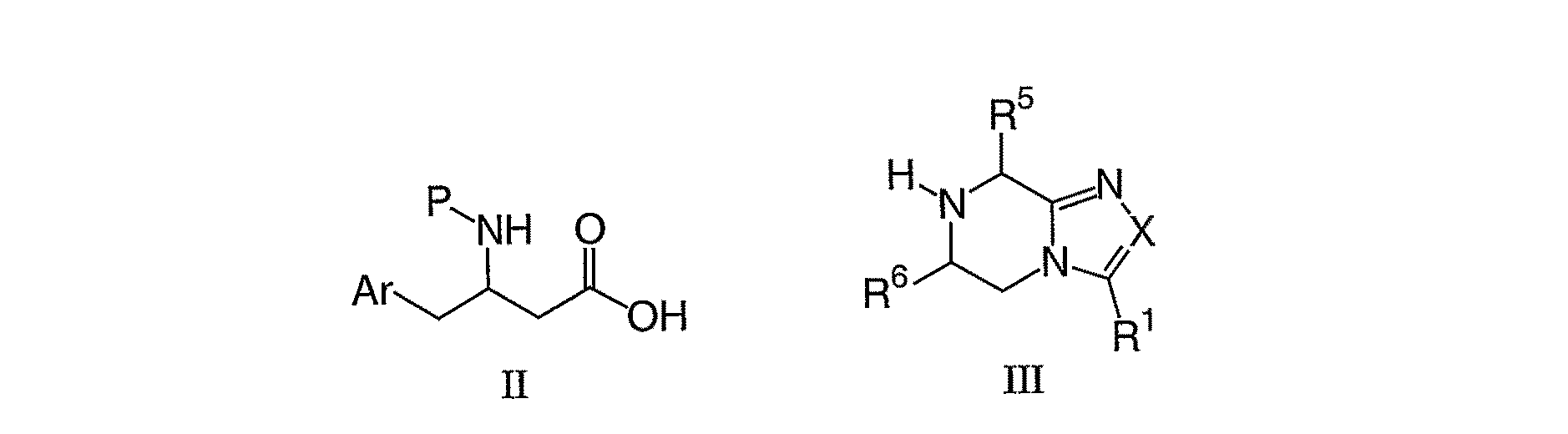
Arは、非置換であるか、1個から5個のR3で置換されているフェニルであり、この場合、R3は、
(1)ハロゲン、
(2)直鎖であるか、分枝鎖であり、非置換であるか、1個から5個のハロゲンで置換されているC1〜6アルキル、
(3)直鎖であるか、分枝鎖であり、非置換であるか、1個から5個のハロゲンで置換されているC1〜6アルコキシ、
(4)CN、および
(5)ヒドロキシ
から成る群より独立して選択され;
Xは、
(1)N、および
(2)CR2
から成る群より選択され;
R1およびR2は、各々、
(1)水素、
(2)CN、
(3)直鎖であるか、分枝鎖であり、非置換であるか、1個から5個のハロゲンまたはフェニルで置換されているC1〜10アルキル(前記フェニルは、非置換であるか、ハロゲン、CN、OH、R4、OR4、NHSO2R4、SO2R4、CO2HおよびCO2C1〜6アルキルから独立して選択される1個から5個の置換基で置換されており、この場合、CO2C1〜6アルキルは、直鎖であるか、分枝鎖である)、
(4)非置換であるか、ハロゲン、CN、OH、R4、OR4、NHSO2R4、SO2R4、CO2HおよびCO2C1〜6アルキル(この場合、CO2C1〜6アルキルは、直鎖であるか、分枝鎖である)から独立して選択される1個から5個の置換基で置換されているフェニル、
(5)非置換であるか、オキソ、OH、ハロゲン、C1〜6アルキルおよびC1〜6アルコキシ(この場合、C1〜6アルキルおよびC1〜6アルコキシは、直鎖であるか、分枝鎖であり、1個から5個のハロゲンで場合によっては置換されている)から独立して選択される1個から3個の置換基で置換されており、N、SおよびOから独立して選択される1個から4個のへテロ原子を含む、飽和されていてもよいし、不飽和であってもよい5または6員複素環
から成る群より独立して選択され;
R4は、直鎖であるか、分枝鎖であり、非置換であるか、ハロゲン、CO2HおよびCO2C1〜6アルキル(この場合、CO2C1〜6アルキルは、直鎖であるか、分枝鎖である)から独立して選択される1個から5個の基で置換されているC1〜6アルキルであり;
R5およびR6は、各々、
(1)水素、
(2)直鎖であるか、分枝鎖であり、非置換であるか、
(a)ハロゲン、
(b)ヒドロキシ、
(c)ハロゲン、OH、C1〜6アルキルおよびC1〜6アルコキシ(この場合、C1〜6アルキルおよびC1〜6アルコキシは、直鎖であるか、分枝鎖であり、1個から5個のハロゲンで場合によっては置換されている)から独立して選択される1個から5個の置換基で場合によっては置換されているフェニル、
(d)ハロゲン、OH、C1〜6アルキルおよびC1〜6アルコキシ(この場合、C1〜6アルキルおよびC1〜6アルコキシは、直鎖であるか、分枝鎖であり、1個から5個のハロゲンで場合によっては置換されている)から独立して選択される1個から5個の置換基で場合によっては置換されているナフチル、
(e)CO2H、
(f)CO2C1〜6アルキル、
(g)CONR7R8
(この式中、
R7およびR8は、水素、テトラゾリル、フェニル、C3〜6シクロアルキルおよびC1〜6アルキルから成る群より独立して選択され、この場合、C1〜6アルキルは、直鎖であるか、分枝鎖であり、0個から5個のハロゲンおよび0個から1個のフェニルから独立して選択される1個から6個の置換基で場合によっては置換されており、ここで、R7またはR8であるフェニル、C3〜6シクロアルキルまたはC1〜6アルキル上の任意のフェニル置換基は、ハロゲン、OH、C1〜6アルキルおよびC1〜6アルコキシ(前記C1〜6アルキルおよびC1〜6アルコキシは、直鎖であるか、分枝鎖であり、1個から5個のハロゲンで場合によっては置換されている)から独立して選択される1個から5個の置換基で場合によっては置換されており、または
R7およびR8は、場合によっては結合して、ピロリジン、ピペリジンまたはモルホリンから選択される環を形成している)
から選択される一つ以上の置換基で置換されているC1〜10アルキル、
(3)CN、
(4)非置換であるか、C1〜6アルキル、C1〜6アルコキシ、ヒドロキシおよびハロゲン(この場合、C1〜6アルキルおよびC1〜6アルコキシは、直鎖であるか、分枝鎖であり、1個から5個のハロゲンで場合によっては置換されている)から独立して選択される1個から5個の置換基で置換されているフェニル、
(5)非置換であるか、C1〜6アルキル、C1〜6アルコキシ、ヒドロキシおよびハロゲン(この場合、C1〜6アルキルおよびC1〜6アルコキシは、直鎖であるか、分枝鎖であり、1個から5個のハロゲンで場合によっては置換されている)から独立して選択される1個から5個の置換基で置換されているナフチル、
(6)CO2H、
(7)CO2C1〜6アルキル、
(8)CONR7R8、および
(9)ハロゲン、OH、C1〜6アルキルおよびC1〜6−アルコキシ(この場合、、C1〜6アルキルおよびC1〜6アルコキシは、直鎖であるか、分枝鎖であり、1個から5個のハロゲンで場合によっては置換されている)から独立して選択される1個から5個の置換基で場合によっては置換されているC3〜6シクロアルキル
から成る群より独立して選択されるが;但し、
R5とR6のうちの一方は、水素以外であることを条件とする)
の化合物またはそれらの医薬適合性の塩もしくは個々のジアステレオマーに関する。
Ar is phenyl which is unsubstituted or substituted with 1 to 5 R 3 , where R 3 is
(1) halogen,
(2) C 1-6 alkyl that is linear, branched, unsubstituted, or substituted with 1 to 5 halogens,
(3) C 1-6 alkoxy that is linear, branched, unsubstituted, or substituted with 1 to 5 halogens,
(4) CN, and (5) independently selected from the group consisting of hydroxy;
X is
(1) N, and (2) CR 2
Selected from the group consisting of;
R 1 and R 2 are each
(1) hydrogen,
(2) CN,
(3) C 1-10 alkyl that is linear, branched, unsubstituted, or substituted with 1 to 5 halogens or phenyl (whether the phenyl is unsubstituted) 1 to 5 substituents independently selected from halogen, CN, OH, R 4 , OR 4 , NHSO 2 R 4 , SO 2 R 4 , CO 2 H and CO 2 C 1-6 alkyl Substituted, in which case CO 2 C 1-6 alkyl is straight-chain or branched)
(4) unsubstituted or halogen, CN, OH, R 4 , OR 4 , NHSO 2 R 4 , SO 2 R 4 , CO 2 H and CO 2 C 1-6 alkyl (in this case CO 2 C 1 6 phenylalkyl, which is substituted with from one independently selected from linear and either a branched chain) in 5 substituents,
(5) unsubstituted or oxo, OH, halogen, C 1-6 alkyl and C 1-6 alkoxy (in which case C 1-6 alkyl and C 1-6 alkoxy are linear or Branched, optionally substituted with 1 to 5 halogens) and independently substituted with 1 to 3 substituents independently selected from N, S and O Independently selected from the group consisting of 5- or 6-membered heterocycles, which may be saturated or unsaturated, containing 1 to 4 heteroatoms selected by
R 4 is linear or branched, unsubstituted or halogen, CO 2 H and CO 2 C 1-6 alkyl (in this case, CO 2 C 1-6 alkyl is linear Or is a branched chain) C 1-6 alkyl substituted with 1 to 5 groups independently selected from;
R 5 and R 6 are each
(1) hydrogen,
(2) linear or branched and unsubstituted,
(A) halogen,
(B) hydroxy,
(C) halogen, OH, C 1-6 alkyl and C 1-6 alkoxy (in this case, C 1-6 alkyl and C 1-6 alkoxy are linear or branched and Phenyl optionally substituted with 1 to 5 substituents independently selected from 5 optionally substituted with 5 halogens,
(D) Halogen, OH, C 1-6 alkyl and C 1-6 alkoxy (in this case, C 1-6 alkyl and C 1-6 alkoxy are linear or branched and Naphthyl optionally substituted with 1 to 5 substituents independently selected from 5 optionally substituted with 5 halogens,
(E) CO 2 H,
(F) CO 2 C 1~6 alkyl,
(G) CONR 7 R 8
(In this formula,
R 7 and R 8 are independently selected from the group consisting of hydrogen, tetrazolyl, phenyl, C 3-6 cycloalkyl and C 1-6 alkyl, in which case C 1-6 alkyl is linear , Branched and optionally substituted with 1 to 6 substituents independently selected from 0 to 5 halogens and 0 to 1 phenyl, wherein R Any phenyl substituent on 7 or R 8 phenyl, C 3-6 cycloalkyl or C 1-6 alkyl is halogen, OH, C 1-6 alkyl and C 1-6 alkoxy (the above C 1-6 Alkyl and C 1-6 alkoxy are straight-chain or branched and optionally substituted with 1 to 5 halogens). Optionally with substituents Or R 7 and R 8 are optionally joined to form a ring selected from pyrrolidine, piperidine or morpholine)
C 1-10 alkyl substituted with one or more substituents selected from
(3) CN,
(4) Unsubstituted or C 1-6 alkyl, C 1-6 alkoxy, hydroxy and halogen (in this case C 1-6 alkyl and C 1-6 alkoxy are linear or branched) Phenyl optionally substituted with 1 to 5 substituents independently selected from 1 to 5 halogens, optionally substituted with 1 to 5 halogens,
(5) unsubstituted or C 1-6 alkyl, C 1-6 alkoxy, hydroxy and halogen (in this case C 1-6 alkyl and C 1-6 alkoxy are linear or branched) Naphthyl substituted with 1 to 5 substituents independently selected from: optionally substituted with 1 to 5 halogens,
(6) CO 2 H,
(7) CO 2 C 1~6 alkyl,
(8) CONR 7 R 8 , and (9) Halogen, OH, C 1-6 alkyl and C 1-6 -alkoxy (wherein C 1-6 alkyl and C 1-6 alkoxy are linear or a branched, C. 3 to which is optionally substituted with one independently selected from) substituted with 5 substituents with one to five halogens Independently selected from the group consisting of 6 cycloalkyl;
One of R 5 and R 6 is other than hydrogen)
Or a pharmaceutically acceptable salt or individual diastereomer thereof.
本発明の一つの実施態様は、下記式Ia: One embodiment of the present invention is a compound of formula Ia:
の化合物またはそれらの医薬適合性の塩もしくは個々のジアステレオマーを含む。
Or a pharmaceutically acceptable salt or individual diastereomer thereof.
本発明のもう一つの実施態様は、下記式Ib: Another embodiment of the present invention is a compound of formula Ib:
の化合物またはそれらの医薬適合性の塩もしくは個々のジアステレオマーを含む。
Or a pharmaceutically acceptable salt or individual diastereomer thereof.
本発明のもう一つの実施態様は、下記式Ic: Another embodiment of the present invention is a compound of formula Ic:
の化合物またはそれらの医薬適合性の塩もしくは個々のジアステレオマーを含む。
Or a pharmaceutically acceptable salt or individual diastereomer thereof.
本発明のもう一つの実施態様は、下記式Id: Another embodiment of the present invention is a compound of formula Id:
の化合物またはそれらの医薬適合性の塩もしくは個々のジアステレオマーを含む。
Or a pharmaceutically acceptable salt or individual diastereomer thereof.
本発明のもう一つの実施態様は、下記式Ie: Another embodiment of the present invention is a compound of formula Ie:
の化合物またはそれらの医薬適合性の塩もしくは個々のジアステレオマーを含む。
Or a pharmaceutically acceptable salt or individual diastereomer thereof.
本発明のもう一つの実施態様は、下記式If: Another embodiment of the present invention is a compound of formula If:
の化合物またはそれらの医薬適合性の塩もしくは個々のジアステレオマーを含む。
Or a pharmaceutically acceptable salt or individual diastereomer thereof.
本発明において、Arは、
(1)フルオロ、
(2)クロロ、および
(3)CF3
から成る群より独立して選択される1個から5個の置換基で置換されているか、非置換のフェニルであることが、好ましい。
In the present invention, Ar is
(1) fluoro,
(2) Chloro, and (3) CF 3
It is preferably substituted with 1 to 5 substituents independently selected from the group consisting of or unsubstituted phenyl.
本発明において、Arは、
(1)フェニル、
(2)2−フルオロフェニル、
(3)3,4−ジフルオロフェニル、
(4)2,5−ジフルオロフェニル、
(5)2,4,5−トリフルオロフェニル、および
(6)2−フルオロ−4−(トリフルオロメチル)フェニル
から成る群より選択されることが、さらに好ましい。
In the present invention, Ar is
(1) phenyl,
(2) 2-fluorophenyl,
(3) 3,4-difluorophenyl,
(4) 2,5-difluorophenyl,
More preferably, it is selected from the group consisting of (5) 2,4,5-trifluorophenyl, and (6) 2-fluoro-4- (trifluoromethyl) phenyl.
本発明において、R1は、
(1)水素、および
(2)直鎖であるか、分枝鎖であり、非置換であるか、フェニルまたは1個から5個のフッ素で置換されているC1〜6アルキル
から成る群より選択されることが、好ましい。
In the present invention, R 1 is
(1) hydrogen, and (2) from the group consisting of C 1-6 alkyl that is linear, branched, unsubstituted, substituted with phenyl or 1 to 5 fluorines It is preferred that it be selected.
本発明において、R1は、
(1)水素、
(2)メチル、
(3)エチル、
(4)CF3、
(5)CH2CF3、
(6)CF2CF3、および
(7)ベンジル
から成る群より選択されることが、さらに好ましい。
In the present invention, R 1 is
(1) hydrogen,
(2) methyl,
(3) ethyl,
(4) CF 3 ,
(5) CH 2 CF 3 ,
More preferably, it is selected from the group consisting of (6) CF 2 CF 3 , and (7) benzyl.
本発明において、R1は、
(1)水素、
(2)メチル、
(3)エチル、
(4)CF3、および
(5)CH2CF3、
から成る群より選択されることが、さらに好ましい。
In the present invention, R 1 is
(1) hydrogen,
(2) methyl,
(3) ethyl,
(4) CF 3 , and (5) CH 2 CF 3 ,
More preferably, it is selected from the group consisting of:
本発明において、R1は水素またはCF3であることが、さらにいっそう好ましい。 In the present invention, it is even more preferred that R 1 is hydrogen or CF 3 .
本発明において、R2は、
(1)水素、
(2)直鎖であるか、分枝鎖であり、非置換であるか、1個から5個のフッ素で置換されているC1〜6アルキル、および
(3)非置換であるか、フルオロ、OCH3およびOCF3から独立して選択される1個から3個の置換基置換されているフェニル
から選択されることが、好ましい。
In the present invention, R 2 is
(1) hydrogen,
(2) linear or branched, unsubstituted or C 1-6 alkyl substituted with 1 to 5 fluorines, and (3) unsubstituted or fluoro Preferably, it is selected from 1 to 3 substituents substituted phenyl independently selected from OCH 3 and OCF 3 .
本発明において、R2は、
(1)水素、
(2)メチル、
(3)エチル、
(4)CF3、
(5)CH2CF3、
(6)CF2CF3、
(7)フェニル、
(8)(4−メトキシ)フェニル、
(9)(4−トリフルオロメトキシ)フェニル、
(10)4−フルオロフェニル、および
(11)3,4−ジフルオロフェニル
から成る群より選択されることが、さらに好ましい。
In the present invention, R 2 is
(1) hydrogen,
(2) methyl,
(3) ethyl,
(4) CF 3 ,
(5) CH 2 CF 3 ,
(6) CF 2 CF 3 ,
(7) phenyl,
(8) (4-methoxy) phenyl,
(9) (4-trifluoromethoxy) phenyl,
More preferably, it is selected from the group consisting of (10) 4-fluorophenyl, and (11) 3,4-difluorophenyl.
本発明において、R2は、CF3またはCF2CF3であることが、さらにいっそう好ましい。 In the present invention, it is still more preferable that R 2 is CF 3 or CF 2 CF 3 .
本発明において、R5およびR6は、
R5とR6のうちの一方が、水素以外であることを条件として、
(1)水素、
(2)直鎖であるか、分枝鎖であり、非置換であるか、
(a)ハロゲン、
(b)ヒドロキシ、
(c)ハロゲン、OH、C1〜6アルキルおよびC1〜6アルコキシ(この場合、C1〜6アルキルおよびC1〜6アルコキシは、直鎖であるか、分枝鎖であり、1個から5個のハロゲンで場合によっては置換されている)から独立して選択される1個から5個の置換基で場合によっては置換されているフェニル、
(d)CO2H、
(e)CO2C1〜6アルキル、
(f)CONR7R8
(この式中、
R7およびR8は、水素、テトラゾリル、フェニル、C3〜6シクロアルキルおよびC1〜6アルキルから成る群より独立して選択され、この場合、C1〜6アルキルは、直鎖であるか、分枝鎖であり、0個から5個のハロゲンおよび0個から1個のフェニルから独立して選択される1個から6個の置換基で場合によっては置換されており、ここで、R7またはR8であるフェニル、C3〜6シクロアルキルまたはC1〜6アルキル上の任意のフェニル置換基は、ハロゲン、OH、C1〜6アルキルおよびC1〜6アルコキシ(前記C1〜6アルキルおよびC1〜6アルコキシは、直鎖であるか、分枝鎖であり、1個から5個のハロゲンで場合によっては置換されている)から独立して選択される1個から5個の置換基で場合によっては置換されており、または
R7およびR8は、場合によっては結合して、ピロリジン、ピペリジンまたはモルホリンから選択される環を形成している)
から選択される一つ以上の置換基で置換されているC1〜10アルキル、
(3)CN、
(4)非置換であるか、C1〜6アルキル、C1〜6アルコキシ、ヒドロキシおよびハロゲン(この場合、C1〜6アルキルおよびC1〜6アルコキシは、直鎖であるか、分枝鎖であり、1個から5個のハロゲンで場合によっては置換されている)から独立して選択される1個から5個の置換基で置換されているフェニル、
(5)CO2H、
(6)CO2C1〜6アルキル、
(7)CONR7R8、および
(8)ハロゲン、OH、C1〜6アルキルおよびC1〜6−アルコキシ(この場合、、C1〜6アルキルおよびC1〜6アルコキシは、直鎖であるか、分枝鎖であり、1個から5個のハロゲンで場合によっては置換されている)から独立して選択される1個から5個の置換基で場合によっては置換されているC3〜6シクロアルキル
から成る群より独立して選択されることが、好ましい。
In the present invention, R 5 and R 6 are
Provided that one of R 5 and R 6 is other than hydrogen,
(1) hydrogen,
(2) linear or branched and unsubstituted,
(A) halogen,
(B) hydroxy,
(C) halogen, OH, C 1-6 alkyl and C 1-6 alkoxy (in this case, C 1-6 alkyl and C 1-6 alkoxy are linear or branched and Phenyl optionally substituted with 1 to 5 substituents independently selected from 5 optionally substituted with 5 halogens,
(D) CO 2 H,
(E) CO 2 C 1~6 alkyl,
(F) CONR 7 R 8
(In this formula,
R 7 and R 8 are independently selected from the group consisting of hydrogen, tetrazolyl, phenyl, C 3-6 cycloalkyl and C 1-6 alkyl, in which case C 1-6 alkyl is linear , Branched and optionally substituted with 1 to 6 substituents independently selected from 0 to 5 halogens and 0 to 1 phenyl, wherein R Any phenyl substituent on 7 or R 8 phenyl, C 3-6 cycloalkyl or C 1-6 alkyl is halogen, OH, C 1-6 alkyl and C 1-6 alkoxy (the above C 1-6 Alkyl and C 1-6 alkoxy are straight-chain or branched and optionally substituted with 1 to 5 halogens). Optionally with substituents Or R 7 and R 8 are optionally joined to form a ring selected from pyrrolidine, piperidine or morpholine)
C 1-10 alkyl substituted with one or more substituents selected from
(3) CN,
(4) Unsubstituted or C 1-6 alkyl, C 1-6 alkoxy, hydroxy and halogen (in this case C 1-6 alkyl and C 1-6 alkoxy are linear or branched) Phenyl optionally substituted with 1 to 5 substituents independently selected from 1 to 5 halogens, optionally substituted with 1 to 5 halogens,
(5) CO 2 H,
(6) CO 2 C 1~6 alkyl,
(7) CONR 7 R 8 , and (8) Halogen, OH, C 1-6 alkyl and C 1-6 -alkoxy (in this case, C 1-6 alkyl and C 1-6 alkoxy are linear or a branched, C. 3 to which is optionally substituted with one independently selected from) substituted with 5 substituents with one to five halogens It is preferably selected independently from the group consisting of 6 cycloalkyl.
本発明において、R5およびR6は、
R5とR6のうちの一方が水素でないことを条件として、
(1)水素、
(2)直鎖であるか、分枝鎖であり、非置換であるか、
(a)ハロゲン、
(b)ハロゲン、OH、C1〜6アルキルおよびC1〜6アルコキシ(この場合、C1〜6アルキルおよびC1〜6アルコキシは、直鎖であるか、分枝鎖であり、1個から5個のハロゲンで場合によっては置換されている)から独立して選択される1個から5個の置換基で場合によっては置換されているフェニル
から選択される一つ以上の置換基で置換されているC1〜10アルキル、
(3)非置換であるか、C1〜6アルキル、OC1〜6アルキルおよびハロゲン(この場合、C1〜6アルキルおよびOC1〜6アルキルは、直鎖であるか、分枝鎖であり、1個から5個のハロゲンで場合によっては置換されている)から独立して選択される1個から3個の置換基で置換されているフェニル、ならびに
(4)CO2C1〜6アルキル、
から成る群より独立して選択されることが、さらに好ましい。
In the present invention, R 5 and R 6 are
Provided that one of R 5 and R 6 is not hydrogen,
(1) hydrogen,
(2) linear or branched and unsubstituted,
(A) halogen,
(B) Halogen, OH, C 1-6 alkyl and C 1-6 alkoxy (in this case, C 1-6 alkyl and C 1-6 alkoxy are linear or branched and Optionally substituted with one or more substituents selected from phenyl optionally substituted with 1 to 5 substituents independently selected from 5 halogen optionally substituted). C 1-10 alkyl,
(3) unsubstituted or C 1-6 alkyl, OC 1-6 alkyl and halogen (in this case, C 1-6 alkyl and OC 1-6 alkyl are linear or branched) Phenyl optionally substituted with 1 to 3 substituents independently selected from 1 to 5 halogens) and (4) CO 2 C 1-6 alkyl ,
More preferably, it is independently selected from the group consisting of
本発明において、R5およびR6は、
R5とR6のうちの一方が水素でないことを条件として、
(1)水素、
(2)CH3、
(3)CH2CH3、
(4)CH(CH3)2、
(5)COOCH3、
(6)CH2−フェニル、
(7)3−フルオロフェニル、および
(8)2−(トリフルオロメチル)フェニル
から成る群より独立して選択されることが、さらに好ましい。
In the present invention, R 5 and R 6 are
Provided that one of R 5 and R 6 is not hydrogen,
(1) hydrogen,
(2) CH 3 ,
(3) CH 2 CH 3 ,
(4) CH (CH 3 ) 2 ,
(5) COOCH 3 ,
(6) CH 2 - phenyl,
More preferably, it is independently selected from the group consisting of (7) 3-fluorophenyl, and (8) 2- (trifluoromethyl) phenyl.
本発明において、R5およびR6は、R5とR6のうちの一方が水素でないことを条件として、水素またはCH3から独立して選択されることが、さらにいっそう好ましい。 In the present invention, R 5 and R 6, on the condition that one of R 5 and R 6 are not hydrogen, be independently selected from hydrogen or CH 3, even more preferred.
本発明の化合物は、一つ以上の不斉中心を含有することがあり、故に、ラセミ体およびラセミ混合物、単一のエナンチオマー、ジアステレオマー混合物および個々のジアステレオマーとして発生することがあり得る。本発明の化合物は、β炭素原子に一つの不斉中心を有する。その分子上の様々な置換基の性質に依存して、さらなる不斉中心が存在することがある。そうした各々の不斉中心は、二つの光学異性体を独立して生じる。混合物での、および純粋な化合物または軽度純化化合物としての可能な光学異性体およびジアステレオマーのすべてが、本発明の範囲に包含されると考える。本発明は、これらの化合物のそうしたすべての異性体形を包含するものとする。 The compounds of the present invention may contain one or more asymmetric centers and therefore may occur as racemates and racemic mixtures, single enantiomers, diastereomeric mixtures and individual diastereomers. . The compounds of the present invention have one asymmetric center at the β carbon atom. Depending on the nature of the various substituents on the molecule, additional asymmetric centers may exist. Each such asymmetric center independently yields two optical isomers. All possible optical isomers and diastereomers in mixtures and as pure or lightly purified compounds are considered within the scope of the present invention. The present invention is meant to encompass all such isomeric forms of these compounds.
本明細書に記載の化合物の一部は、オレフィン性二重結合を有し、特に別様に指定されていない限り、EとZ両方の幾何異性体を含むものとする。 Some of the compounds described herein have olefinic double bonds, and unless specified otherwise, are meant to include both E and Z geometric isomers.
本明細書に記載の化合物の一部は、一つ以上の二重結合のシフトを伴う水素の異なる結合点を有する互変異性体として存在することがある。例えば、ケトンおよびそのエノール形は、ケト−エノール互変異性体である。個々の互変異性体ならびにそれらの混合物は、本発明の化合物に包含される。 Some of the compounds described herein may exist as tautomers having different points of attachment of hydrogen with one or more double bond shifts. For example, ketones and their enol forms are keto-enol tautomers. The individual tautomers as well as mixtures thereof are encompassed with compounds of the present invention.
式Iは、その種類の化合物の構造を好ましい立体化学を伴わずに示している。式Iaは、これらの化合物が調製されるβアミノ酸のアミン基に結合している炭素における好ましい立体化学を示している。 Formula I shows the structure of that type of compound without the preferred stereochemistry. Formula Ia shows the preferred stereochemistry at the carbon attached to the amine group of the β amino acid from which these compounds are prepared.
これらのジアステレオマーの独立した合成またはそれらのクロマトグラフ分離は、本明細書に開示されている方法論の適切な変形により、当該技術分野において知られているとおり達成することができる。それらの絶対立体化学は、必要な場合には絶対配置がわかっている不斉中心を有する試薬を用いて誘導される、結晶性生成物または結晶性中間体のX線結晶学によって決定することができる。 Independent synthesis of these diastereomers or their chromatographic separation can be accomplished as is known in the art by appropriate modification of the methodology disclosed herein. Their absolute stereochemistry can be determined by X-ray crystallography of crystalline products or crystalline intermediates, which are derived using reagents with asymmetric centers of known absolute configuration, if necessary. it can.
所望される場合には、本化合物のラセミ混合物を分離して、個々のエナンチオマーを単離することができる。この分離は、化合物のラセミ混合物をエナンチオマー的に純粋な化合物にカップリングさせてジアステレオマー混合物を生成し、その後、分別結晶またはクロマトグラフィーなどの標準的な方法により個々のジアステレオマーに分離するような、当該技術分野においてよく知られている方法によって行うことができる。多くの場合、このカップリング反応は、エナンチオマー的に純粋な酸または塩基を使用する塩の生成である。その後、それらのジアステレオマー誘導体は、付加したキラル残基の切断により、純粋なエナンチオマーに転化させることができる。本化合物のラセミ混合物は、キラル固定相を利用するクロマトグラフ法(これらの方法は、当該技術分野においてよく知られている)により、直接分離することもできる。 If desired, racemic mixtures of the compounds can be separated and the individual enantiomers isolated. This separation involves coupling a racemic mixture of compounds to an enantiomerically pure compound to form a diastereomeric mixture which is then separated into individual diastereomers by standard methods such as fractional crystallization or chromatography. The method can be performed by a method well known in the art. In many cases, the coupling reaction is the formation of a salt using an enantiomerically pure acid or base. These diastereomeric derivatives can then be converted to the pure enantiomers by cleavage of the added chiral residue. Racemic mixtures of the present compounds can also be separated directly by chromatographic methods utilizing chiral stationary phases (these methods are well known in the art).
あるいは、当該技術分野においてよく知られている方法による、立体配置がわかっている光学的に純粋な出発原料または試薬を利用する立体選択的合成によって、一つの化合物のいずれかのエナンチオマーを得ることができる。 Alternatively, one may obtain any enantiomer of a compound by stereoselective synthesis utilizing optically pure starting materials or reagents of known configuration by methods well known in the art. it can.
用語「医薬適合性の塩」は、無機または有機塩基および無機または有機酸を含む医薬適合性で非毒性の塩基または酸から調製された塩を指す。無機塩基から誘導される塩には、アルミニウム塩、アンモニウム塩、カルシウム塩、銅塩、第二鉄塩、第一鉄塩、リチウム塩、マグネシウム塩、マンガン塩、第一マンガン塩、カリウム塩、ナトリウム塩、亜鉛塩およびこれらに類するものが挙げられる。アンモニウム塩、カルシウム塩、マグネシウム塩、カリウム塩およびナトリウム塩が、特に好ましい。固体形態の塩は、一つ以上の結晶構造で存在することがあり、水和物の形態であることもある。医薬適合性で非毒性の有機塩基から誘導される塩には、第一、第二および第三アミンの塩、置換アミン(天然置換アミンを含む)の塩、環状アミンの塩、ならびにアルギニン、ベタイン、カフェイン、コリン、N,N’−ジベンジルエチレンジアミン、ジエチルアミン、2−ジエチルアミノエタノール、2−ジメチルアミノエタノール、エタノールアミン、エチレンジアミン、N−エチル−モルホリン、N−エチルピペリジン、グルカミン、グルコサミン、ヒスチジン、ヒドラバミン、イソプロピルアミン、リシン、メチルグルカミン、モルホリン、ピペラジン、ピペリジン、ポリアミン樹脂、プロカイン、プリン、テオブロミン、トリエチルアミン、トリメチルアミン、トリプロピルアミン、トロメタミンおよびこれらに類するものなどの塩基性イオン交換樹脂が挙げられる。 The term “pharmaceutically acceptable salt” refers to salts prepared from pharmaceutically acceptable non-toxic bases or acids including inorganic or organic bases and inorganic or organic acids. Salts derived from inorganic bases include aluminum, ammonium, calcium, copper, ferric, ferrous, lithium, magnesium, manganese, manganous, potassium, sodium Salts, zinc salts and the like. Particularly preferred are the ammonium, calcium, magnesium, potassium and sodium salts. The solid form of the salt may exist in more than one crystal structure and may be in the form of a hydrate. Salts derived from pharmaceutically acceptable non-toxic organic bases include salts of primary, secondary and tertiary amines, salts of substituted amines (including naturally substituted amines), salts of cyclic amines, and arginine, betaine , Caffeine, choline, N, N′-dibenzylethylenediamine, diethylamine, 2-diethylaminoethanol, 2-dimethylaminoethanol, ethanolamine, ethylenediamine, N-ethyl-morpholine, N-ethylpiperidine, glucamine, glucosamine, histidine, Such as hydrabamine, isopropylamine, lysine, methylglucamine, morpholine, piperazine, piperidine, polyamine resin, procaine, purine, theobromine, triethylamine, trimethylamine, tripropylamine, tromethamine and the like It includes groups with an ion exchange resin.
本発明の化合物が、塩基性である時、塩は、医薬適合性で非毒性の酸(無機酸および有機酸を含む)から調製することができる。そうした酸には、酢酸、ベンゼンスルホン酸、安息香酸、樟脳スルホン酸、クエン酸、エタンスルホン酸、フマル酸、グルコン酸、グルタミン酸、臭化水素酸、塩酸、イセチオン酸、乳酸、マレイン酸、リンゴ酸、マンデル酸、メタンスルホン酸、粘液酸、硝酸、パモ酸、パントテン酸、リン酸、コハク酸、硫酸、酒石酸、p−トルエンスルホン酸およびこれらに類するものが挙げられる。クエン酸、臭化水素酸、塩酸、マレイン酸、リン酸、硫酸、フマル酸および酒石酸が、特に好ましい。 When the compound of the present invention is basic, salts can be prepared from pharmaceutically compatible, non-toxic acids, including inorganic and organic acids. These acids include acetic acid, benzenesulfonic acid, benzoic acid, camphor sulfonic acid, citric acid, ethanesulfonic acid, fumaric acid, gluconic acid, glutamic acid, hydrobromic acid, hydrochloric acid, isethionic acid, lactic acid, maleic acid, malic acid , Mandelic acid, methanesulfonic acid, mucous acid, nitric acid, pamoic acid, pantothenic acid, phosphoric acid, succinic acid, sulfuric acid, tartaric acid, p-toluenesulfonic acid and the like. Citric acid, hydrobromic acid, hydrochloric acid, maleic acid, phosphoric acid, sulfuric acid, fumaric acid and tartaric acid are particularly preferred.
本明細書中で用いられる場合、式Iの化合物への言及が、医薬適合性の塩も包含することは、ご理解いただけよう。 It will be appreciated that, as used herein, references to compounds of formula I also include pharmaceutically acceptable salts.
当業者にはご理解いただけるように、本明細書中で用いられる場合、ハロまたはハロゲンは、フルオロ、クロロ、ブロモおよびヨードを包含するためのものである。同様に、C1〜6アルキルの場合のようなC1〜6は、直鎖または分枝鎖配置で炭素原子を1、2、3、4、5または6個有するような基を特定するものと定義され、そうしたC1〜6アルキルには、具体的にはメチル、エチル、n−プロピル、イソプピル、n−ブチル、イソブチル、t−ブチル、ペンチルおよびヘキシルが挙げられる。同様に、C0アルキルの場合のようなC0は、直接共有結合の存在を特定するものと定義される。置換基で独立して置換されていると指定されている基は、複数のそうした置換基で独立して置換されていることがある。本明細書中で用いられる場合、用語「複素環」は、次に挙げるものの中にある5または6員環構造を包含するためのものである:ベンズイミダゾリル、ベンゾジオキサニル、ベンゾフラニル、ベンゾピラゾリル、ベンゾチアジアゾリル、ベンゾトリアゾリル、ベンゾチオフェニル、ベンゾオキサジアゾリル、ベンゾオキサゾリル、カルバゾリル、カルボリニル、クロマニル、シンノリニル、フラニル、イミダゾリル、インドリニル、インドリル、インドラジニル、インダゾリル、イソベンゾフラニル、イソインドリル、イソキノリル、イソチアゾリル、イソオキサゾリル、ナフチリジニル、オキサジアゾリル、オキサゾリル、ピラジニル、ピラゾリル、ピリドピリジニル、ピリダジニル、ピリジル、ピリミジル、ピロリル、キナゾリニル、キノリニル、キノキサリニル、テトラゾリル、チアジアゾリル、チアゾリジニル、チアゾリル、チエニル、トリアゾリル、アゼチジニル、1,4−ジオキサニル、ヘキサヒドロアゼピニル、ピペラジニル、ピペリジニル、ピロリジニル、モルホリニル、チオモルホリニル、ジヒドロベンズイミダゾリル、ジヒドロベンゾフラニル、ジヒドロベンゾチオフェニル、ジヒドロベンゾオキサゾリル、ジヒドロフラニル、ジヒドロイミダゾリル、ジヒドロインドリル、ジヒドロイソオキサゾリル、ジヒドロイソチアゾリル、ジヒドロオキサジアゾリル、ジヒドロオキサゾリル、ジヒドロピラジニル、ジヒドロピラゾリル、ジヒドロピリジニル、ジヒドロピリミジニル、ジヒドロピロリル、ジヒドロキノリニル、ジヒドロテトラゾリル、ジヒドロチアジアゾリル、ジヒドロチアゾリル、ジヒドロチエニル、ジヒドロトリアゾリル、ジヒドロアゼチジニル、メチレンジオキシベンゾイル、テトラヒドロフラニル、テトラヒドロイミダゾリル、テトラヒドロイソキノリニルおよびテトラヒドロチエニル。 As will be appreciated by those skilled in the art, halo or halogen as used herein is meant to include fluoro, chloro, bromo and iodo. Similarly, C 1 to 6 as in the case of C 1 to 6 alkyl, which specifies a group as having 1,2, 3,4, 5 or 6 carbon atoms in straight or branched configuration And such C 1-6 alkyl specifically includes methyl, ethyl, n-propyl, isopyl, n-butyl, isobutyl, t-butyl, pentyl and hexyl. Likewise, C 0, as in the case of C 0 alkyl is defined to identify the presence of a direct covalent bond. Groups that are designated as being independently substituted with substituents may be independently substituted with multiple numbers of such substituents. As used herein, the term “heterocycle” is intended to encompass 5- or 6-membered ring structures among the following: benzimidazolyl, benzodioxanyl, benzofuranyl, benzopyrazolyl , Benzothiadiazolyl, benzotriazolyl, benzothiophenyl, benzooxadiazolyl, benzoxazolyl, carbazolyl, carbolinyl, chromanyl, cinnolinyl, furanyl, imidazolyl, indolinyl, indolyl, indrazinyl, indazolyl, isobenzofuranyl, Isoindolyl, isoquinolyl, isothiazolyl, isoxazolyl, naphthyridinyl, oxadiazolyl, oxazolyl, pyrazinyl, pyrazolyl, pyridopyridinyl, pyridazinyl, pyridyl, pyrimidyl, pyrrolyl, quinazolinyl, ki Linyl, quinoxalinyl, tetrazolyl, thiadiazolyl, thiazolidinyl, thiazolyl, thienyl, triazolyl, azetidinyl, 1,4-dioxanyl, hexahydroazepinyl, piperazinyl, piperidinyl, pyrrolidinyl, morpholinyl, thiomorpholinyl, dihydrobenzimidazolyl, dihydrobenzofuranyl, dihydrobenzofuranyl Benzothiophenyl, dihydrobenzoxazolyl, dihydrofuranyl, dihydroimidazolyl, dihydroindolyl, dihydroisoxazolyl, dihydroisothiazolyl, dihydrooxadiazolyl, dihydrooxazolyl, dihydropyrazinyl, dihydropyrazolyl, Dihydropyridinyl, dihydropyrimidinyl, dihydropyrrolyl, dihydroquinolinyl, dihydrotetrazolyl, dihydrothiadia Lil, dihydrothiazolyl, dihydrothienyl, dihydro triazolyl, dihydro azetidinyloxyimino, methylenedioxy benzoyl, tetrahydrofuranyl, tetrahydro-imidazolylmethyl, tetrahydroisoquinolinyl and tetrahydrothienyl.
実施例および本明細書開示されている化合物の使用は、本発明のよい例となる。 The use of the compounds disclosed in the Examples and herein is a good example of the present invention.
本発明の範囲内の具体的な化合物には、後続の実施例に開示されている化合物およびそれらの医薬適合性の塩およびそれらの個々のジアステレオマーから成る群より選択される化合物が挙げられる。 Specific compounds within the scope of the present invention include compounds selected from the group consisting of the compounds disclosed in the following examples and their pharmaceutically acceptable salts and their individual diastereomers. .
主題化合物は、有効量のその化合物を投与することを含む、そうした阻害が必要な哺乳動物などの患者においてジペプチジルペプチダーゼ−IV酵素を阻害する方法に有用である。本発明は、ジペプチジルペプチダーゼ−IV酵素活性の阻害剤としての本明細書に開示されている化合物の使用に関する。 The subject compounds are useful in methods of inhibiting a dipeptidyl peptidase-IV enzyme in a patient, such as a mammal in need of such inhibition, comprising administering an effective amount of the compound. The present invention relates to the use of the compounds disclosed herein as inhibitors of dipeptidyl peptidase-IV enzyme activity.
ヒトなどの霊長類に加えて、様々な他の哺乳動物を本発明の方法に従って治療することができる。例えば、ウシ、ヒツジ、ヤギ、ウマ、イヌ、ネコ、モルモット、ラットまたは他のウシ属の動物、ヒツジ類、ウマ科の動物、イヌ科の動物、ネコ科の動物、齧歯動物もしくはネズミ科の動物を含む(しかし、それらに限定されない)哺乳動物を治療することができる。しかし、本方法は、鳥類(例えば、ニワトリ)などの他の種においても実施することができる。 In addition to primates, such as humans, a variety of other mammals can be treated according to the method of the present invention. For example, cattle, sheep, goats, horses, dogs, cats, guinea pigs, rats or other bovine animals, sheep, equine animals, canine animals, feline animals, rodents or murines Mammals, including but not limited to animals, can be treated. However, the method can be practiced in other species such as birds (eg, chickens).
さらに、本発明は、本発明の化合物を製薬用の担体または希釈剤と併せて含む、ヒトおよび動物におけるジペプチジルペプチダーゼ−IV酵素活性阻害用薬物を製造するための方法に関する。 Furthermore, the present invention relates to a method for producing a drug for inhibiting dipeptidyl peptidase-IV enzyme activity in humans and animals comprising a compound of the present invention in combination with a pharmaceutical carrier or diluent.
本方法で治療される被験者は、ジペプチジルペプチダーゼ−IV酵素活性の阻害が望まれる一般には哺乳動物、特に人間、男性または女性である。用語「治療有効量」は、研究者、獣医、医師または他の臨床家が探求する、組織、系、動物またはヒトの生物学的または医学的応答を惹起するであろう主題化合物の量を意味する。本明細書中で用いられる場合、用語「治療」は、上述の状態の治療と予防または予防的治療の両方を指す。 The subject to be treated with this method is generally a mammal, particularly a human, male or female, where inhibition of dipeptidyl peptidase-IV enzyme activity is desired. The term “therapeutically effective amount” means the amount of a subject compound that will elicit the biological or medical response of a tissue, system, animal or human that is sought by a researcher, veterinarian, physician or other clinician. To do. As used herein, the term “treatment” refers to both treatment and prophylactic or prophylactic treatment of the aforementioned conditions.
本明細書中で用いられる場合、用語「組成物」は、指定された量で指定された成分を含む製品、ならびに指定された量での指定された成分の組み合わせから直接または間接的に得られるあらゆる製品を包含するためのものである。医薬組成物に関するこうした用語は、活性成分(複数を含む)および不活性成分(担体を構成するもの。複数を含む)を含む製品、ならびに二つ以上のあらゆる成分の組み合わせ、複合または凝集から、または一つ以上の成分の解離から、または一つ以上の成分の他のタイプの反応もしくは相互作用から直接または間接的に得られるあらゆる製品を包含するためのものである。従って、本発明の医薬組成物は、本発明の化合物と医薬適合性の担体の混合により製造されるあらゆる組成物を包含する。「医薬適合性の」とは、調合物の中の他の成分と適合性でなければならず、且つ、その受容者に対して有害でない担体、希釈剤または賦形剤を意味する。 As used herein, the term “composition” is obtained directly or indirectly from a product comprising a specified component in a specified amount, as well as a combination of specified components in a specified amount. It is meant to encompass all products. These terms for pharmaceutical compositions include products comprising active ingredient (s) and inactive ingredients (comprising a carrier, which comprise a plurality), as well as any combination, combination or aggregation of any two or more ingredients, or It is intended to encompass any product obtained directly or indirectly from the dissociation of one or more components, or from other types of reactions or interactions of one or more components. Accordingly, the pharmaceutical compositions of the present invention encompass any composition made by admixing a compound of the present invention and a pharmaceutically acceptable carrier. “Pharmaceutically compatible” means a carrier, diluent or excipient that must be compatible with the other ingredients in the formulation and not deleterious to the recipient thereof.
化合物「の投与」および/または「を投与する」という用語は、本発明の化合物または本発明の化合物のプロドラッグを治療の必要がある個体に供給するという意味であるとご理解いただきたい。 It should be understood that the term “administering” and / or “administering” a compound means that a compound of the invention or a prodrug of a compound of the invention is provided to an individual in need of treatment.
ジペプチジルペプチダーゼ−IV酵素活性の阻害剤としての本発明の化合物の有用性は、当該技術分野において知られている方法論によって実証することができる。阻害定数は、次のように決定する。DP−IVによって分解されて蛍光性AMC遊離基を放出する基質Gly−Pro−AMCを用いる連続蛍光分析法を利用する。この反応を説明する動力学的パラメータは、次のとおりである:Km=50μM;Kcat=75s−1;Kcat/Km=1.5x106M−1s−1。典型的な反応は、全反応量100μL中に約50pMの酵素、50μLのGly−Pro−AMC、およびバッファ(100mMのHEPES(pH7.5)、0.1mg/mLのBSA)を含有する。360nmの励起波長および460nmの放出波長を使用する96ウエルプレート蛍光光度計で、AMCの遊離を継続的にモニターする。これらの条件下で、約0.8μMのAMCが25℃で30分に生成される。これらの研究に使用した酵素は、バキュロウイルス発現系(Bac−To−Bac、Gibco BRL)において生産された可溶性(膜内外ドメインおよび細胞質の伸長を含まない)ヒト蛋白質であった。Gly−Pro−AMCおよびGLP−1の加水分解についての動力学的定数は、天然酵素についての文献値に合致することがわかった。化合物についての解離定数を測定するために、酵素および基質を含有する反応物に、阻害剤のDMSO溶液を添加した(最終DMSO濃度は、1%である)。すべての実験は、上に記載した標準反応条件を使用し、室温で行った。解離定数(Ki)を決定するために、反応速度を、競合的阻害についてのミカエリス−メンテンの式への非線形回帰に当てはめた。解離定数の再現における誤差は、典型的には二倍未満である。 The usefulness of the compounds of the present invention as inhibitors of dipeptidyl peptidase-IV enzyme activity can be demonstrated by methodologies known in the art. The inhibition constant is determined as follows. Continuous fluorescence analysis is utilized using the substrate Gly-Pro-AMC which is degraded by DP-IV to release fluorescent AMC free radicals. The kinetic parameters describing this reaction are as follows: K m = 50 μM; K cat = 75 s −1 ; K cat / K m = 1.5 × 10 6 M −1 s −1 . A typical reaction contains about 50 pM enzyme, 50 μL Gly-Pro-AMC, and buffer (100 mM HEPES pH 7.5, 0.1 mg / mL BSA) in a total reaction volume of 100 μL. AMC release is continuously monitored in a 96 well plate fluorometer using an excitation wavelength of 360 nm and an emission wavelength of 460 nm. Under these conditions, about 0.8 μM AMC is produced in 30 minutes at 25 ° C. The enzyme used in these studies was a soluble (not including transmembrane domain and cytoplasmic extension) human protein produced in a baculovirus expression system (Bac-To-Bac, Gibco BRL). The kinetic constants for hydrolysis of Gly-Pro-AMC and GLP-1 were found to be consistent with literature values for natural enzymes. To determine the dissociation constant for the compound, an inhibitor solution in DMSO was added to the reaction containing enzyme and substrate (final DMSO concentration is 1%). All experiments were performed at room temperature using the standard reaction conditions described above. To determine the dissociation constant (K i ), the reaction rate was fitted to a non-linear regression to the Michaelis-Menten equation for competitive inhibition. The error in reproducing the dissociation constant is typically less than twice.
特に、後続の実施例の化合物は、上述のアッセイにおいて、IC50が一般に約1μM未満というジペプチジルペプチダーゼ−IV酵素阻害活性を有した。こうした結果は、ジペプチジルペプチダーゼ−IV酵素の阻害剤としての使用における本化合物固有の活性を示している。 In particular, the compounds of the subsequent examples had dipeptidyl peptidase-IV enzyme inhibitory activity with an IC 50 of generally less than about 1 μM in the above-described assays. These results demonstrate the intrinsic activity of the compounds in use as inhibitors of the dipeptidyl peptidase-IV enzyme.
ジペプチジルペプチダーゼ−IV酵素(DP−IV)は、広範な生物学的機能に関係してきた細胞表面蛋白質である。広い組織分布(腸、腎臓、肝臓、膵臓、胎盤、胸腺、脾臓、上皮細胞、血管内皮、リンパ系および骨髄性細胞、血清)ならびに独特な組織および細胞タイプ発現レベルを有する。DP−IVは、T細胞活性化マーカーCD26と同じであり、多数の免疫調節ペプチド、内分泌ペプチドおよび神経性ペプチドをインビトロで分解することができる。これは、ヒトまたは他の種の様々な疾病過程におけるこのペプチダーゼの潜在的な役割を示唆している。 Dipeptidyl peptidase-IV enzyme (DP-IV) is a cell surface protein that has been implicated in a wide range of biological functions. Has a wide tissue distribution (intestine, kidney, liver, pancreas, placenta, thymus, spleen, epithelial cells, vascular endothelium, lymphoid and myeloid cells, serum) and unique tissue and cell type expression levels. DP-IV is the same as the T cell activation marker CD26 and is capable of degrading a number of immunoregulatory, endocrine and neurogenic peptides in vitro. This suggests a potential role for this peptidase in various disease processes in humans or other species.
本発明の化合物は、次の状態または疾病のうちの一つ以上の治療、予防、改善または危険度低下に有用である:(1)高血糖症、(2)低グルコース耐性、(3)インスリン抵抗性、(4)肥満、(5)脂質異常、(6)脂質代謝異常、(7)高脂血症、(8)高トリグリセリド血症、(9)高コレステロール血症、(10)低HDLレベル、(11)高LDLレベル、(12)アテローム性動脈硬化症およびその後遺症、(13)脈管再狭窄、(14)過敏性腸症候群、(15)クローン病および潰瘍性大腸炎を含む炎症性腸疾患、(16)他の炎症性状態、(17)膵炎、(18)腹部肥満症、(19)神経変性疾患、(20)網膜症、(21)腎症、(22)神経障害、(23)X症候群、(24)卵巣アンドロゲン過多症(多嚢胞卵巣症候群)、(25)2型糖尿病、(26)成長ホルミン欠損症、(27)好中球減少症、(28)神経細胞障害、(29)腫瘍転移、(30)良性前立腺肥大症、(32)歯肉炎、(33)高血圧、(34)骨粗鬆症、およびDP−IVの阻害によって治療または予防することができる他の状態。 The compounds of the present invention are useful for the treatment, prevention, amelioration or reduced risk of one or more of the following conditions or diseases: (1) hyperglycemia, (2) low glucose tolerance, (3) insulin Resistance, (4) obesity, (5) dyslipidemia, (6) dyslipidemia, (7) hyperlipidemia, (8) hypertriglyceridemia, (9) hypercholesterolemia, (10) low HDL Levels, (11) high LDL levels, (12) atherosclerosis and its sequelae, (13) vascular restenosis, (14) irritable bowel syndrome, (15) inflammation including Crohn's disease and ulcerative colitis Sexual bowel disease, (16) other inflammatory conditions, (17) pancreatitis, (18) abdominal obesity, (19) neurodegenerative diseases, (20) retinopathy, (21) nephropathy, (22) neuropathy, (23) Syndrome X, (24) Ovarian androgenism (polycystic egg) Syndrome), (25) type 2 diabetes, (26) growth formin deficiency, (27) neutropenia, (28) neuronal damage, (29) tumor metastasis, (30) benign prostatic hypertrophy, (32 ) Gingivitis, (33) Hypertension, (34) Osteoporosis, and other conditions that can be treated or prevented by inhibition of DP-IV.
主題化合物は、さらに本明細書に示されている疾病、疾患および状態の予防、治療、制御、改善または危険度低下のための方法に有用である。 The subject compounds are further useful in methods for the prevention, treatment, control, amelioration or reduced risk of the diseases, disorders and conditions set forth herein.
2型糖尿病および関連疾患:インクレチンGLP−1およびGIPは、DP−IVによりインビボで容易に不活性化される。DP−IV(−/−)−欠失マウスでの研究および予備臨床試験は、DP−IVの阻害がGLP−1およびGIPの定常状態濃度を増加させ、その結果としてグルコース耐性が改善されることを示している。GLP−1およびGIPへの類推から、グルコースの調節に関与する他のグルカゴンファミリーのペプチド(例えば、PACAP)もDP−IVによって不活性化される可能性が高い。DP−IVによるこれらのペプチドの不活性化も、グルコースの恒常性において一定の役割を果たし得る。従って、本発明のDP−IV阻害剤は、2型糖尿病の治療、予防、改善、制御または危険度低下および2型糖尿病にしばしば随伴する非常の多数の状態(X症候群、反応性低血糖および糖尿病性脂質代謝異常を含む)の治療、予防、改善、制御または危険度低下に有用である。下で論じる肥満は、2型糖尿病とともにしばしば見出されるもう一つの状態であり、これは本発明の化合物での治療に反応し得る。 Type 2 diabetes and related diseases: Incretins GLP-1 and GIP are readily inactivated by DP-IV in vivo. Studies and preliminary clinical studies in DP-IV (− / −) -deficient mice show that inhibition of DP-IV increases steady state concentrations of GLP-1 and GIP, resulting in improved glucose tolerance Is shown. By analogy to GLP-1 and GIP, other glucagon family peptides (eg, PACAP) involved in glucose regulation are likely to be inactivated by DP-IV. Inactivation of these peptides by DP-IV may also play a role in glucose homeostasis. Thus, the DP-IV inhibitors of the present invention treat, prevent, ameliorate, control or reduce risk of type 2 diabetes and a large number of conditions often associated with type 2 diabetes (syndrome X, reactive hypoglycemia and diabetes Useful in the treatment, prevention, amelioration, control, or reduction of risk). Obesity, discussed below, is another condition often found with type 2 diabetes, which can respond to treatment with the compounds of the present invention.
以下の疾病、疾患および状態は、2型糖尿病に関連するものであり、従って、本発明の化合物の投与によって治療、制御、改善または予防することができる:(1)高血糖症、(2)低グルコース耐性、(3)インスリン抵抗性、(4)肥満、(5)脂質異常、(6)脂質代謝異常、(7)高脂血症、(8)高トリグリセリド血症、(9)高コレステロール血症、(10)低HDLレベル、(11)高LDLレベル、(12)アテローム性動脈硬化症およびその後遺症、(13)脈管再狭窄、(14)過敏性腸症候群、(15)クローン病および潰瘍性大腸炎を含む炎症性腸疾患、(16)他の炎症性状態、(17)膵炎、(18)腹部肥満症、(19)神経変性疾患、(20)網膜症、(21)腎症、(22)神経障害、(23)X症候群、(24)卵巣アンドロゲン過多症(多嚢胞卵巣症候群)、およびインスリン抵抗性が構成要素である他の疾患。 The following diseases, disorders and conditions are associated with type 2 diabetes and can therefore be treated, controlled, ameliorated or prevented by administration of the compounds of the invention: (1) hyperglycemia, (2) Low glucose tolerance, (3) insulin resistance, (4) obesity, (5) dyslipidemia, (6) dyslipidemia, (7) hyperlipidemia, (8) hypertriglyceridemia, (9) high cholesterol (10) low HDL level, (11) high LDL level, (12) atherosclerosis and its sequelae, (13) vascular restenosis, (14) irritable bowel syndrome, (15) Crohn's disease And inflammatory bowel diseases including ulcerative colitis, (16) other inflammatory conditions, (17) pancreatitis, (18) abdominal obesity, (19) neurodegenerative diseases, (20) retinopathy, (21) kidney Symptom, (22) neuropathy, (23) X syndrome (24) ovarian hyperandrogenism (polycystic ovarian syndrome), and other diseases where insulin resistance is a component.
肥満:DP−IV阻害剤は、肥満の治療に有用であり得る。これは、摂食量ならびにGLP−1およびGLP−2の胃排出に対して観察される抑制効果に基づく。ヒトにおけるGLP−1の外因性投与は、摂食量を有意に低下させ、胃排出を遅速させる(Am.J.Physiol.277,R910−R916(1999))。ラットおよびマウスにおけるGLP−1のICV投与も摂食量に対して非常に大きな効果を有する(Nature Medicine 2,1254−1258(1996))。この摂食抑制は、GLP−1R(−/−)マウスでは観察されず、それは、これらの効果が、脳GLP−1受容体によって媒介されることを示している。GLP−1への類推から、GLP−2もDP−IVによって調節される可能性が高い。GLP−2のICV投与も、GLP−1で観察された効果と同様に、摂食量を抑制する(Nature Medicine 6,802−807(2000))。加えて、DP−IV欠失マウスでの研究は、これらの動物が、食事誘導性肥満および随伴病状(例えば、高インスリン血症)に対して耐性であることを示唆している。 Obesity: DP-IV inhibitors may be useful for the treatment of obesity. This is based on the inhibitory effect observed on food intake and gastric emptying of GLP-1 and GLP-2. Exogenous administration of GLP-1 in humans significantly reduces food intake and slows gastric emptying (Am. J. Physiol. 277, R910-R916 (1999)). ICV administration of GLP-1 in rats and mice also has a very large effect on food intake (Nature Medicine 2, 1254-1258 (1996)). This feeding suppression is not observed in GLP-1R (− / −) mice, which indicates that these effects are mediated by brain GLP-1 receptors. By analogy to GLP-1, GLP-2 is also likely to be regulated by DP-IV. ICV administration of GLP-2 also suppresses food intake, similar to the effects observed with GLP-1 (Nature Medicine 6, 802-807 (2000)). In addition, studies with DP-IV deficient mice suggest that these animals are resistant to diet-induced obesity and associated pathologies (eg, hyperinsulinemia).
成長ホルモン欠損症:成長ホルモン放出因子(GRF、下垂体前葉からの成長ホルモンの放出を刺激するペプチド)が、DP−IV酵素によりインビトロで分解されるという仮説(国際公開公報第00/56297号)に基づき、DP−IVの抑制は、成長ホルモン欠損症の治療に有用であり得る。次のデータは、GRFが内因性基質であるという証拠を提供するものである:(1)GRFは、インビトロで効率的に分解されて、不活性生成物GRF[3−44]を生じる(BBA 1122,147−153(1992));(2)GRFは、血漿中で急速にGRF[3−44]に分解する;これは、DP−IV阻害剤ジプロチンAによって防止される;および(3)GRF[3−44]は、ヒトGRFトランスジェニックブタの血漿中で見出される(J.Clin.Invest.83,1533−1540(1989))。それ故、DP−IV阻害剤は、成長ホルモン分泌促進剤について考えられているのと同じ範囲の適用に有用であり得る。 Growth hormone deficiency: The hypothesis that growth hormone releasing factor (GRF, a peptide that stimulates the release of growth hormone from the anterior pituitary gland) is degraded in vitro by the DP-IV enzyme (WO 00/56297) Based on the above, inhibition of DP-IV may be useful for the treatment of growth hormone deficiency. The following data provides evidence that GRF is an endogenous substrate: (1) GRF is efficiently degraded in vitro to yield the inactive product GRF [3-44] (BBA 1122, 147-153 (1992)); (2) GRF rapidly degrades to GRF [3-44] in plasma; this is prevented by the DP-IV inhibitor diprotin A; and (3) GRF [3-44] is found in the plasma of human GRF transgenic pigs (J. Clin. Invest. 83, 1533-1540 (1989)). Therefore, DP-IV inhibitors may be useful for the same range of applications that are contemplated for growth hormone secretagogues.
腸障害:腸障害の治療に対するDP−IV阻害剤の使用の可能性は、DP−IVのための有望な内因性基質であるグルカゴン様ペプチド−2(GLP−2)、が腸上皮に対する栄養効果を抑制し得ることを示す研究の結果(Regulatory Peptides 90,27−32(2000))によって示唆される。GLP−2の投与は、結果として、齧歯動物の小腸量を増加させ、大腸炎および腸炎の齧歯動物モデルにおける腸障害を緩和する。 Intestinal disorders: The possibility of using DP-IV inhibitors for the treatment of intestinal disorders is that the probable endogenous substrate for DP-IV, glucagon-like peptide-2 (GLP-2), has trophic effects on the intestinal epithelium. This is suggested by the results of studies showing that it can be suppressed (Regulatory Peptides 90, 27-32 (2000)). Administration of GLP-2 results in increased rodent small intestinal mass and alleviates bowel damage in rodent models of colitis and enteritis.
免疫抑制:DP−IVの抑制は、T細胞の活性化およびケモカインのプロセッシングにDP−IV酵素を密接に結びつける研究に基づいた免疫応答のモジュレーションおよび疾病のインビボモデルでのDP−IV阻害剤の効能に有用であり得る。DP−IVが、CD26(活性化した免疫細胞用の細胞表面マーカー)と同じであることは証明されている。CD26の発現は、免疫細胞の分化および活性化状態によって調節される。CD26が、T細胞活性化のインビトロモデルにおいて共同刺激分子として機能することは、一般に認められている。多数のケモカインは、おそらく非特異的アミノペプチダーゼによる分解からそれらを保護するために、末端から二番目の位置にプロリンを有する。これらの多くが、DP−IVによりインビトロでプロセッシングされることは証明されている。幾つかの場合(RANTES、LD78−ベータ、MDC、エオタキシン、SDF−1アルファ)、分解は、結果として、走化性アッセイおよびシグナリングアッセイにおける活性を変化させる。受容体の選択性も、場合によっては(RANTES)修飾されるようである。予測されるDP−IV加水分解産物を含む、多数のN末端トランケーテッド形の多数のケモカインが、インビトロ細胞培養系で確認されている。 Immunosuppression: Inhibition of DP-IV is a modulation of immune response based on studies that closely link DP-IV enzymes to T cell activation and chemokine processing and efficacy of DP-IV inhibitors in in vivo models of disease Can be useful to. DP-IV has proven to be the same as CD26 (a cell surface marker for activated immune cells). CD26 expression is regulated by immune cell differentiation and activation status. It is generally accepted that CD26 functions as a costimulatory molecule in an in vitro model of T cell activation. Many chemokines have a proline in the second position from the end, presumably to protect them from degradation by nonspecific aminopeptidases. Many of these have been demonstrated to be processed in vitro by DP-IV. In some cases (RANTES, LD78-beta, MDC, eotaxin, SDF-1 alpha) degradation results in altered activity in chemotaxis and signaling assays. Receptor selectivity also appears to be modified (RANTES) in some cases. A number of N-terminal truncated chemokines have been identified in in vitro cell culture systems, including the predicted DP-IV hydrolysates.
DP−IV阻害剤が、移植および関節炎の動物モデルにおいて効能がある免疫抑制剤であることは証明されている。プロジピン(Pro−Pro−ジフェニル、−ホスホネート、DP−IVの不可逆阻害剤)は、ラットにおける心同種移植片生着を7日から14日に倍化にすることが証明された(Transplantation 63,1495−1500(1997))。DP−IV阻害剤が、ラットにおけるコラーゲンおよびアルキルジアミン誘発性関節炎で試験され、このモデルにおける後ろ足の腫脹の統計学的に優位な緩和が証明された(Int.J.Immunopharmacology 19,15−24(1997)、Immunopharmacology 40,21−26(1998))。DP−IVは、関節リウマチ、多発性硬化症、グレーブス病および橋本甲状腺炎を含む多数の自己免疫疾患においてアップレギュレートされる(Immunology Today 20,367−375(1999))。 DP-IV inhibitors have proven to be effective immunosuppressants in animal models of transplantation and arthritis. Prodipine (Pro-Pro-diphenyl, -phosphonate, an irreversible inhibitor of DP-IV) has been demonstrated to double cardiac allograft survival in rats from 7 to 14 days (Transplantation 63, 1495). -1500 (1997)). DP-IV inhibitors were tested in collagen and alkyldiamine-induced arthritis in rats and demonstrated statistically significant relief of hind limb swelling in this model (Int. J. Immunopharmacology 19, 15-24 ( 1997), Immunopharmacology 40, 21-26 (1998)). DP-IV is upregulated in a number of autoimmune diseases including rheumatoid arthritis, multiple sclerosis, Graves' disease and Hashimoto's thyroiditis (Immunology Today 20, 367-375 (1999)).
HIV感染:HIV細胞の侵入を阻害する多数のケモカインが、DP−IVのための基質である可能性があるため(Imunology Today 20,367−375(1999))、DP−IVの阻害は、HIV感染またはAIDSの治療または予防に有用であり得る。SDF−1アルファの場合、開裂は、抗ウイルス活性を低下させる(PNAS95,6331−6(1998))。故に、DP−IVの阻害によるSDF−1アルファの安定化は、HIVの感染力を低下させると予想されよう。 HIV infection: Since numerous chemokines that inhibit HIV cell invasion may be substrates for DP-IV (Immunology Today 20, 367-375 (1999)), inhibition of DP-IV is dependent on HIV. It may be useful for the treatment or prevention of infection or AIDS. In the case of SDF-1 alpha, cleavage reduces antiviral activity (PNAS 95, 6331-6 (1998)). Therefore, stabilization of SDF-1 alpha by inhibition of DP-IV would be expected to reduce HIV infectivity.
造血:DP−IVが造血に関与し得るため、DP−IVの阻害は、造血の治療または予防に有用であり得る。DP−IV阻害剤であるVal−Boro−Proは、シクロホスファミド誘発性好中球減少症のマウスモデルにおいて造血を刺激した(国際公開公報第99/56753号)。 Hematopoiesis: Since DP-IV can be involved in hematopoiesis, inhibition of DP-IV can be useful in the treatment or prevention of hematopoiesis. The DP-IV inhibitor Val-Boro-Pro stimulated hematopoiesis in a mouse model of cyclophosphamide-induced neutropenia (WO 99/56753).
神経細胞障害:様々な神経細胞性プロセスに関係している多数のペプチドがDP−IVによりインビトロで分解されるため、DP−IVの阻害は、様々な神経細胞障害または精神障害の治療または予防に有用であり得る。故に、DP−IV阻害剤は、神経細胞障害の治療に治療的利点を有し得る。エンドモルフィン−2、β−カソモルフィンおよびサブスタンスPは、すべて、インビトロでDP−IVのための基質であることが証明されている。すべての場合、インビトロでの分解は、Kcat/Kmが、〜10R6M−1s−1またはそれより大きく、非常に効率的である。ラットの無痛覚の電気ショックジャンプ試験モデルにおいて、DP−IV阻害剤は、外因性エンドモルフィン−2の存在に非依存性である有意な効果を示した(Brain Research 815,278−286(1999))。 Neuronal cell injury: Since numerous peptides involved in various neuronal processes are degraded in vitro by DP-IV, inhibition of DP-IV is useful for the treatment or prevention of various neuronal or psychiatric disorders Can be useful. Thus, DP-IV inhibitors can have therapeutic benefits in the treatment of neuronal cell disorders. Endomorphin-2, β-casomorphin and substance P have all proven to be substrates for DP-IV in vitro. In all cases, in vitro degradation is very efficient with a K cat / K m of 10R 6 M −1 s −1 or greater. In a rat analgesia electric shock jump test model, DP-IV inhibitors showed a significant effect that was independent of the presence of exogenous endomorphin-2 (Brain Research 815, 278-286 (1999)). ).
腫瘍の浸潤および転移:DP−IVを含む幾つかのエクトペプチターゼ(ectopeptidase)の発現の増加または減少が、悪性表現型への正常細胞の形質転換中に観察されているため(J.Exp.Med.190,301−305(1999))、DP−IVの阻害は、腫瘍の浸潤および転移の治療または予防に有用であり得る。これらの蛋白質のアップまたはダウンレギュレーションは、組織および細胞タイプ特異的であるようである。例えば、CD26/DP−IV発現増加が、T細胞リンパ腫、T細胞急性リンパ芽球性白血病、細胞由来甲状腺癌、基底細胞癌および乳癌に関して観察されている。故に、DP−IV阻害剤は、そうした癌腫の治療に有用であり得る。 Tumor invasion and metastasis: Increased or decreased expression of several ecepteptidases, including DP-IV, has been observed during transformation of normal cells to a malignant phenotype (J. Exp. Med. 190, 301-305 (1999)), inhibition of DP-IV may be useful for the treatment or prevention of tumor invasion and metastasis. Up- or down-regulation of these proteins appears to be tissue and cell type specific. For example, increased CD26 / DP-IV expression has been observed for T cell lymphoma, T cell acute lymphoblastic leukemia, cell-derived thyroid cancer, basal cell carcinoma and breast cancer. Thus, DP-IV inhibitors may be useful for the treatment of such carcinomas.
良性前立腺肥大症(BPH):DP−IV活性増大が、BPH患者の前立腺組織において示されたため(Eur.J.Clin.Chem.Clin.Biochem 30,333−338(1992))、DP−IVの阻害は、良性前立腺肥大症の治療に有用であり得る。 Benign prostatic hypertrophy (BPH): Because DP-IV activity increased was shown in prostate tissue of BPH patients (Eur. J. Clin. Chem. Clin. Biochem 30, 333-338 (1992)). Inhibition may be useful in the treatment of benign prostatic hypertrophy.
精子運動/雄性避妊:精液において前立腺ソーム(精子運動のために重要な前立腺由来細胞器官)が非常に高レベルのDP−IV活性を有するため(Eur.J.Clin.Chem.Clin.Biochem 30,333−338(1992))、DP−IVの阻害は、精子運動の変性および雄性避妊に有用であり得る。 Sperm motility / male contraception: Prostatesomes (prostate-derived organelles important for sperm motility) have very high levels of DP-IV activity in semen (Eur. J. Clin. Chem. Clin. Biochem 30, 333-338 (1992)), inhibition of DP-IV may be useful for degeneration of sperm motility and male contraception.
歯肉炎:DP−IV活性は、歯肉溝液において見出され、また、歯周病の重症度に相関させた幾つかの研究においても見出されているため(Arch.Oral Biol.37,167−173(1992))、DP−IVの阻害は、歯肉炎の治療に有用であり得る。 Gingivitis: DP-IV activity is found in gingival crevicular fluid and in several studies correlated with the severity of periodontal disease (Arch. Oral Biol. 37, 167). -173 (1992)), inhibition of DP-IV may be useful in the treatment of gingivitis.
骨粗鬆症:GIP受容体が骨芽細胞中に存在するため、DP−IVの阻害は骨粗鬆症の治療に有用であり得る。 Osteoporosis: Since GIP receptors are present in osteoblasts, inhibition of DP-IV may be useful in the treatment of osteoporosis.
主題化合物は、さらに他の薬剤との併用で、上述の疾病、疾患および状態の予防、治療、制御、改善または危険度低下のための方法において有用である。 The subject compounds are useful in methods for the prevention, treatment, control, amelioration or reduced risk of the diseases, disorders and conditions described above, in combination with other drugs.
本発明の化合物は、式Iまたは他の薬物が有用である疾病または状態を治療、予防、制御、改善またはそれらの危険度を低下させる際、それらの薬物との併用がいずれかの薬物単独の場合より安全または有効である場合、一つ以上の他の薬物と併用することができる。そうした他の薬物(複数を含む)は、それらに一般に使用されている経路および量で、式Iの化合物と同時にまたは逐次的に投与することができる。式Iの化合物を一つ以上の他の薬物と同時に使用する時には、そうした他の薬物と式Iの化合物を含有する単位剤形での医薬組成物が好ましい。しかし、この併用療法は、式Iの化合物と一つ以上の他の薬物とを並行する別のスケジュールで投与することも包含し得る。一つ以上の他の活性成分と併用する時、本発明の化合物と他の活性成分は、各々を単独で使用する時より低い用量で使用することができることも考えられる。従って、本発明の医薬組成物は、式Iの化合物に加えて一つ以上の他の活性成分を含有するものを包含する。 The compounds of the present invention may be used in combination with either drug alone in treating, preventing, controlling, ameliorating or reducing their risk of diseases or conditions for which Formula I or other drugs are useful. It can be used in combination with one or more other drugs if safer or more effective than usual. Such other drug (s) can be administered concomitantly or sequentially with the compounds of formula I by the routes and amounts commonly used therein. When a compound of formula I is used contemporaneously with one or more other drugs, a pharmaceutical composition in unit dosage form containing such other drugs and the compound of formula I is preferred. However, this combination therapy may also involve administering the compound of formula I and one or more other drugs on separate schedules in parallel. It is also contemplated that when used in combination with one or more other active ingredients, the compounds of the present invention and the other active ingredients can be used at lower doses than when each is used alone. Accordingly, the pharmaceutical compositions of the present invention include those that contain one or more other active ingredients, in addition to a compound of Formula I.
式Iの化合物と併用で投与することができ、別途または同じ医薬組成物で投与することができる他の活性成分の例には、以下のものが挙げられるが、これらに限定されない:
(a)他のジペプチジルペプチダーゼIV(DP−IV)阻害剤;
(b)(i)グリタゾン類(例えば、トログリタゾン、ピログリタゾン、エングリタゾン、MCC−555、ロシグリタゾンおよびこれらに類するもの)などのPPARγ作動薬、ならびにKRP−297などのPPARα/γ二重作動薬およびフェノフィブリン酸誘導体(ゲムフィブロジル、クロフィブレート、フェノフィブレートおよびベンザフィブレート)などのPPARα作動薬を含む他のPPARリガンド、およびPPARγ部分作動薬、(ii)メトホルミンおよびフェのホルミンなどのビグアニド、ならびに(iii)プロテインチロシンホスファターゼ−1B(PTP−1B)阻害剤を含む、作動薬、拮抗薬、選択的活性化剤または不完全作動薬としての活性を有するPPAR受容体(アルファおよび/またはガンマおよび/またはベータ−デルタ)のリガンドを含むインスリン感作物質;
(c)インスリンまたはインスリン模倣体;
(d)トルブタミド、グリピジド、メグリチニドおよび関連物質などのスルホニル尿素または他のインスリン分泌促進薬;
(e)α−グルコシダーゼ阻害剤(アカルボースなど);
(f)国際公開公報第98/04258号、同第99/01423号、同第00/39088号および同第00/69810号に開示されているものなどのグルカゴン受容体拮抗薬;
(g)GLP−1、GLP−1模倣体、GLP−1受容体作動薬、ならびに国際公開公報第00/42026号および同第00/59887号に開示されているものなどのエキセンジン(exendine);
(h)国際公開公報第00/58360号に開示されているものなどのGIPおよびGIP模倣体、ならびにGIP受容体作動薬;
(i)PACAP、PACAP模倣体、および国際公開公報第01/23420号に開示されているものなどのPACAP受容体作動薬;
(j)(i)HMG−CoAレダクターゼ阻害剤(ロバスタチン、シムバスタチン、プラバスタチン、フルバスタチン、アトルバスタチン、リバスタチン、イタバスタチン、ロスバスタチン、および他のスタチン)、(ii)封鎖剤(コレスチラミン、コレスチポール、および架橋デキストランのジアルキルアミノアルキル誘導体)、(iii)ニコチニルアルコール、ニコチン酸またはその塩、(iv)フェノフィブリン酸誘導体(ゲムフィブロジル、クロフィブレート、フェノフィブレートおよびベンザフィブレート)などのPPARα作動薬、(v)KRP−297などのPPARα/γ二重作動薬、(vi)ベータ−シトステロールおよびエゼチミベなどのコレステロール吸収抑制剤、(vii)アバシミベなどのアシルCoA:コレステロールアシルトランスフェラーゼ阻害剤、および(viii)プロブコールなどの酸化防止剤といったコレステロール低下剤;
(k)国際公開公報第97/28149号に開示されているものなどのPPARδ作動薬;
(l)フェンフルラミン、デキセフェンフルラミン、フェンテルミン、シブトラミン、オルリスタット、ニューロペプチドY5拮抗薬、メラノコルチン4受容体作動薬、カンナビノイドCB−1受容体拮抗薬(リモナバントなど)およびβ3アドレナリン受容体作動薬などの抗肥満化合物;
(m)回腸胆汁酸輸送体阻害剤;
(n)アンギオテンシン変換酵素阻害剤、アンギオテンシンII受容体拮抗薬またはレニン阻害剤(カプトプリル、シラザプリル、エナラプリル、ホシノプリル、リシノプリル、キナプリル、ラマプリル、ゼフェノプリル、カンデサルタン、シレキセチル、エプロサルタン、イルベサルタン、ロサルタン、タソサルタン、テルミサルタンおよびバルサルタンなど)のようなアンギオテンシンまたはレニン系に対して作用するものを含む抗高血圧薬;ならびに
(o)アスピリン、非ステロイド系抗炎症薬、グルココルチコイド、アズルフィジンおよびジクロオキシゲナーゼ−2選択的阻害剤などの炎症性状態において使用することを目的とした薬剤。
Examples of other active ingredients that can be administered in combination with a compound of formula I and that can be administered separately or in the same pharmaceutical composition include, but are not limited to:
(A) other dipeptidyl peptidase IV (DP-IV) inhibitors;
(B) (i) PPARγ agonists such as glitazones (eg, troglitazone, pyroglitazone, englitazone, MCC-555, rosiglitazone and the like), and PPARα / γ dual agonists such as KRP-297 And other PPARα agonists including PPARα agonists such as fenofibric acid derivatives (gemfibrozil, clofibrate, fenofibrate and benzafibrate), and PPARγ partial agonists, (ii) biguanides such as metformin and feformin And (iii) PPAR receptors having activity as agonists, antagonists, selective activators or incomplete agonists, including protein tyrosine phosphatase-1B (PTP-1B) inhibitors (alpha and / or gamma and / Ma Or beta-delta) insulin sensitizers;
(C) insulin or insulin mimetics;
(D) sulfonylureas or other insulin secretagogues such as tolbutamide, glipizide, meglitinide and related substances;
(E) α-glucosidase inhibitors (such as acarbose);
(F) glucagon receptor antagonists such as those disclosed in WO 98/04258, 99/01423, 00/39088 and 00/69810;
(G) GLP-1, GLP-1 mimetics, GLP-1 receptor agonists, and exendins such as those disclosed in WO 00/42026 and 00/59887;
(H) GIP and GIP mimetics, such as those disclosed in WO 00/58360, and GIP receptor agonists;
(I) PACAP receptor agonists such as PACAP, PACAP mimics, and those disclosed in WO 01/23420;
(J) (i) HMG-CoA reductase inhibitors (lovastatin, simvastatin, pravastatin, fluvastatin, atorvastatin, rivastatin, itavastatin, rosuvastatin, and other statins), (ii) sequestering agents (cholestyramine, colestipol, and crosslinking) Dialkylaminoalkyl derivatives of dextran), (iii) nicotinyl alcohol, nicotinic acid or salts thereof, (iv) PPARα agonists such as fenofibric acid derivatives (gemfibrozil, clofibrate, fenofibrate and benzafibrate), ( v) PPARα / γ dual agonists such as KRP-297, (vi) cholesterol absorption inhibitors such as beta-sitosterol and ezetimibe, (vii) acyl CoA such as abashimibe: Te roll acyltransferase inhibitors, and (viii) cholesterol lowering agents such as antioxidants, such as probucol;
(K) PPARδ agonists such as those disclosed in WO 97/28149;
(L) Fenfluramine, dexfenfluramine, phentermine, sibutramine, orlistat, neuropeptide Y5 antagonist, melanocortin 4 receptor agonist, cannabinoid CB-1 receptor antagonist (such as rimonabant) and β 3 adrenergic receptor Anti-obesity compounds such as body agonists;
(M) an ileal bile acid transporter inhibitor;
(N) angiotensin converting enzyme inhibitor, angiotensin II receptor antagonist or renin inhibitor (captopril, cilazapril, enalapril, fosinopril, lisinopril, quinapril, ramapril, zefenopril, candesartan, cilexetil, eprosartan, irbesartan, losartantan, losartantan, losartantan, losartantan, losartantan And anti-hypertensive drugs, including those acting on the angiotensin or renin system such as (and valsartan); and (o) aspirin, non-steroidal anti-inflammatory drugs, glucocorticoids, azulphidin and diclooxygenase-2 selective inhibitors, etc. A drug intended for use in inflammatory conditions.
上記併用は、一つのみならず、二つ以上の他の活性化合物と本発明の化合物の併用を包含する。非限定的な例には、ビグアニド、スルホニル尿素、HMG−CoAレダクターゼ阻害剤、PPAR作動薬、PTP−1B阻害剤、他のDP−IV阻害剤、および抗肥満化合物から選択される二つ以上の活性化合物と式Iを有する化合物との併用が挙げられる。 The above combinations include not only one but also combinations of two or more other active compounds with the compounds of the present invention. Non-limiting examples include two or more selected from biguanides, sulfonylureas, HMG-CoA reductase inhibitors, PPAR agonists, PTP-1B inhibitors, other DP-IV inhibitors, and anti-obesity compounds. A combination of an active compound and a compound having the formula I is mentioned.
同様に、本発明の化合物は、本発明の化合物が有用である疾病または状態の予防、治療、制御、改善または危険度低下に使用される他の薬物と併用することができる。そうした他の薬物は、それらに一般に使用されている経路および量で、式Iの化合物と同時にまたは逐次的に投与することができる。本発明の化合物を一つ以上の他の薬物と同時に使用する時には、本発明の化合物に加えてそうした他の薬物を含有する医薬組成物が好ましい。従って、本発明の医薬組成物は、本発明の化合物に加えて一つ以上の他の活性成分も含有するものを包含する。 Similarly, the compounds of the invention can be used in combination with other drugs used to prevent, treat, control, ameliorate or reduce the risk of diseases or conditions for which compounds of the invention are useful. Such other drugs can be administered concurrently or sequentially with the compounds of formula I by the routes and amounts generally used therein. When a compound of the present invention is used contemporaneously with one or more other drugs, a pharmaceutical composition containing such other drugs in addition to the compound of the present invention is preferred. Accordingly, the pharmaceutical compositions of the present invention include those that also contain one or more other active ingredients, in addition to a compound of the present invention.
本発明の化合物の第二の活性成分に対する重量比は変化させることができ、それは、各成分の有効量に依存する。一般に、各々の有効量が使用される。従って、例えば本発明の化合物を別の薬剤と併用する際、本発明の化合物の他の薬剤に対する重量比は、一般には約1000:1から約1:1000、好ましくは約200:1から約1:200の範囲である。本発明の化合物と他の活性成分との併用も上述の範囲内であろうが、各場合、各活性成分の有効量を使用すべきである。 The weight ratio of the compound of the present invention to the second active ingredient can be varied and will depend upon the effective dose of each ingredient. In general, each effective amount is used. Thus, for example, when a compound of the present invention is used in combination with another drug, the weight ratio of the compound of the present invention to the other drug is generally about 1000: 1 to about 1: 1000, preferably about 200: 1 to about 1 : 200 range. Combinations of a compound of the present invention and other active ingredients will also be within the aforementioned range, but in each case, an effective amount of each active ingredient should be used.
そうした併用において、本発明の化合物と他の活性薬剤は、別々に投与してもよいし、共に投与してもよい。加えて、一つの要素の投与は、他の薬剤(複数を含む)の投与前であってもよいし、投与と同時であってもよいし、投与後であってもよい。 In such combinations, the compound of the present invention and the other active agent may be administered separately or together. In addition, administration of one element may be before administration of other drug (s), may be simultaneous with administration, or after administration.
本発明の化合物は、経口投与経路、非経口投与経路(例えば、筋肉内、腹腔内、静脈内、ICV、槽内注射もしくは注入、皮下注射、または移植)、吸入噴霧投与経路、経鼻投与経路、経膣投与経路、直腸内投与経路、舌下投与経路または局所投与経路により投与することができ、単独でまたは一緒に、各々の投与形路に適する通常の非毒性で医薬適合性の担体、アジュバントおよびビヒクルを含有する適切な剤形単位調合物に調合することができる。マウス、ラット、ウマ、ウシ、ヒツジ、イヌ、ネコ、サルその他などの温血動物の治療に加えて、本発明の化合物は、ヒトにおける使用に有効である。 The compounds of the present invention can be administered via oral, parenteral (eg, intramuscular, intraperitoneal, intravenous, ICV, intracisternal injection or infusion, subcutaneous injection, or implantation), inhalation spray routes, nasal routes. Conventional, non-toxic, pharmaceutically acceptable carriers suitable for each route of administration, which can be administered by vaginal route of administration, rectal route of administration, sublingual route of administration or topical route of administration, alone or together, Appropriate dosage unit formulations containing adjuvants and vehicles can be formulated. In addition to the treatment of warm-blooded animals such as mice, rats, horses, cows, sheep, dogs, cats, monkeys, etc., the compounds of the present invention are effective for use in humans.
本発明の化合物を投与するための医薬組成物は、投薬単位形で従来と同じように提供することができ、薬学技術分野においてよく知られているあらゆる方法により調製することができる。すべての方法は、一つ以上の補助成分を構成する担体と活性成分を会合させる段階を含む。一般に、本医薬組成物は、活性成分を液体担体もしくは微粉固体担体またはそれら両方と均一に、かつ密接に会合させ、その後、必要な場合にはその生成物を成形して所望の調合物にすることにより調製される。本医薬組成物には、疾病の経過または状態に応じて望ましい効果を生じるために充分な量の活性目的化合物が含まれている。本明細書中で用いられる場合、「組成物」は、指定された成分を指定された量で含む製品、ならびに指定された成分を指定された量で組み合わせることにより直接または間接的に得られるあらゆる製品を包含するためのものである。 The pharmaceutical compositions for administering the compounds of the invention can be provided in conventional dosage unit forms and can be prepared by any method well known in the pharmaceutical art. All methods include the step of bringing the active ingredient into association with the carrier which constitutes one or more accessory ingredients. In general, the pharmaceutical compositions will allow the active ingredient to be uniformly and intimately associated with a liquid carrier or a finely divided solid carrier or both, and then, if necessary, shaping the product into the desired formulation. It is prepared by. The pharmaceutical composition contains a sufficient amount of the active object compound to produce the desired effect depending on the course or condition of the disease. As used herein, a “composition” is any product obtained directly or indirectly by combining a specified ingredient in a specified amount as well as a product containing the specified ingredient in the specified amount. It is intended to include products.
本活性成分を含有する本医薬組成物は、例えば、錠剤、トローチ、ロゼンジ、水性もしくは油性懸濁液、分散性粉末もしくは顆粒、乳剤、硬質または軟質カプセル、シロップまたはエリキシルのような、経口使用に適する形態であり得る。経口使用を目的とした組成物は、医薬組成物の製造に関する技術分野に知られているあらゆる方法に従って調製することができ、そうした組成物は、薬剤として洗練されている、味のよい製剤を提供するために、甘味剤、着香剤、着色剤および保存薬から成る群より選択される薬剤を一つ以上含有することができる。錠剤は、錠剤の製造に適する非毒性で医薬適合性の賦形剤との混合物で活性成分を含有する。これらの賦形剤は、不活性希釈剤;例えば、炭酸カルシウム、炭酸ナトリウム、ラクトース、リン酸カルシウムまたはリン酸ナトリウム;造粒剤および崩壊剤、例えば、コーンスターチまたはアルギン酸;結合剤、例えば、デンプン、ゼラチンまたはアラビアゴム;および滑沢剤、例えば、ステアリン酸マグネシウム、ステアリン酸またはタルクであり得る。これらの錠剤は、コーチングされていなくてもよいし、胃腸管の中での崩壊および吸収を遅らせ、その結果、長期にわたる持続作用を提供するために、公知の手法によりコーチングされていてもよい。例えば、モノステアリン酸グリセリルまたはジステアリン酸グリセリルなどの時間遅延材料を利用することができる。それらを米国特許第4,256,108号、同第4,166,452号および同第4,265,874号に記載されている技術によりコーチングして、制御放出用の浸透圧性治療錠を作ることもできる。 The pharmaceutical composition containing the active ingredient is suitable for oral use such as tablets, troches, lozenges, aqueous or oily suspensions, dispersible powders or granules, emulsions, hard or soft capsules, syrups or elixirs. It can be in a suitable form. Compositions intended for oral use can be prepared according to any method known in the art for the manufacture of pharmaceutical compositions, such compositions providing savory formulations that are refined as drugs. In order to do so, it can contain one or more agents selected from the group consisting of sweeteners, flavoring agents, coloring agents and preservatives. Tablets contain the active ingredient in admixture with non-toxic pharmaceutically acceptable excipients which are suitable for the manufacture of tablets. These excipients are inert diluents; such as calcium carbonate, sodium carbonate, lactose, calcium phosphate or sodium phosphate; granulating and disintegrating agents such as corn starch or alginic acid; binders such as starch, gelatin or Gum arabic; and lubricants such as magnesium stearate, stearic acid or talc. These tablets may be uncoated or they may be coated by known techniques in order to delay disintegration and absorption in the gastrointestinal tract and thereby provide a sustained action over a longer period. For example, a time delay material such as glyceryl monostearate or glyceryl distearate may be employed. They are coated by the techniques described in US Pat. Nos. 4,256,108, 4,166,452, and 4,265,874 to make osmotic therapeutic tablets for controlled release. You can also.
経口使用のための調合物は、活性成分を不活性固体希釈剤、例えば、炭酸カルシウム、リン酸カルシウムもしくはカオリンと混合する硬質ゼラチンカプセル、あるいは活性成分を水または油性媒体、例えば、ラッカセイ油、液体パラフィンもしくはオリーブ油と混合する軟質ゼラチンカプセルとして提供することもできる。 Formulations for oral use include hard gelatin capsules in which the active ingredient is mixed with an inert solid diluent such as calcium carbonate, calcium phosphate or kaolin, or the active ingredient in water or an oily medium such as peanut oil, liquid paraffin or It can also be provided as a soft gelatin capsule mixed with olive oil.
水性懸濁液は、水性懸濁液の製造に適する賦形剤との混合物で活性材料を含有する。そうした賦形剤は、懸濁化剤、例えば、ナトリウムカルボキシメチルセルロース、メチルセルロース、ヒドロキシ−プロピルメチルセルロース、アルギン酸ナトリウム、ポリビニル−ピロリドン、トラガカントゴムおよびアラビアゴムであり、分散または湿潤剤は、天然ホスファチド、例えば、レシチンであるか、アルキレンオキシドと脂肪酸の縮合生成物、例えば、ステアリン酸ポリオキシエチレンであるか、エチレンオキシドと長鎖脂肪族アルコールとの縮合生成物、例えば、ヘプタデカエチレンオキシセタノールであるか、エチレンオキシドと脂肪酸およびヘキシトールから誘導される部分エステルとの縮合生成物(モノオレイン酸ポリオキシエチレンソルビトールなど)であるか、エチレンオキシドと脂肪酸および無水ヘキシトールから誘導される部分エステルとの縮合生成物、例えば、モノオレイン酸ポリエチレンソルビタンであり得る。水性懸濁液は、一つ以上の保存薬、例えば、p−ヒドロキシ安息香酸エチルまたはn−プロピル、一つ以上の着色剤、一つ以上の着香剤、およびスクロースまたはサッカリンなどの一つ以上の甘味剤を含有することもできる。 Aqueous suspensions contain the active materials in admixture with excipients suitable for the manufacture of aqueous suspensions. Such excipients are suspending agents such as sodium carboxymethylcellulose, methylcellulose, hydroxy-propylmethylcellulose, sodium alginate, polyvinyl-pyrrolidone, gum tragacanth and gum arabic, and dispersing or wetting agents are natural phosphatides such as lecithin Or a condensation product of an alkylene oxide and a fatty acid, such as polyoxyethylene stearate, a condensation product of ethylene oxide and a long-chain aliphatic alcohol, such as heptadecaethyleneoxycetanol, or ethylene oxide. Condensation products with fatty acid and partial esters derived from hexitol (such as polyoxyethylene sorbitol monooleate) or ethylene oxide with fatty acid and anhydrous hexitol Condensation products of ethylene oxide with partial esters al induced, for example polyethylene sorbitan monooleate. Aqueous suspensions contain one or more preservatives, such as ethyl p-hydroxybenzoate or n-propyl, one or more colorants, one or more flavoring agents, and one or more such as sucrose or saccharin. Other sweeteners may also be included.
油性懸濁液は、植物油、例えば、ラッカセイ油、オリーブ油、ゴマ油もしくはヤシ油に、または液体パラフィンなどの鉱物油に活性成分を懸濁させることにより調製することができる。油性懸濁液は、増粘剤、例えば、蜜蝋、硬質パラフィンまたはセチルアルコールを含有することができる。上に記載したものなどの甘味剤、および着香剤を添加して、味のよい経口製剤を生じることができる。これらの組成物は、アルコルビン酸などの酸化防止剤を添加することにより保存することができる。 Oily suspensions may be prepared by suspending the active ingredient in a vegetable oil, for example arachis oil, olive oil, sesame oil or coconut oil, or in a mineral oil such as liquid paraffin. Oily suspensions may contain a thickening agent, for example beeswax, hard paraffin or cetyl alcohol. Sweetening agents such as those described above, and flavoring agents can be added to provide a palatable oral preparation. These compositions can be preserved by the addition of an antioxidant such as alcorbic acid.
水の添加による水性懸濁液の調製に適する分散性粉末および顆粒は、分散または湿潤剤、懸濁化剤および一つ以上の保存薬との混合物で活性成分を提供する。適する分散または湿潤剤および懸濁化剤の例は、すでに上で述べたものである。追加の賦形剤、例えば、甘味剤、着香剤および着色剤が存在してもよい。 Dispersible powders and granules suitable for preparation of an aqueous suspension by the addition of water provide the active ingredient in admixture with a dispersing or wetting agent, suspending agent and one or more preservatives. Examples of suitable dispersing or wetting agents and suspending agents are those already mentioned above. Additional excipients, for example sweetening, flavoring and coloring agents, may be present.
本発明の医薬組成物は、水中油乳剤の形態であることもできる。油性相は、植物油、例えばオリーブ油またはラッカセイ油であってもよいし、鉱物油、例えば液体パラフィンであってもよいし、またはこれらの混合物であってもよい。適する乳化剤は、天然ゴム、例えば、アラビアゴムまたはトラガカントゴム、天然ホスファチド、例えば、大豆、レシチン、および脂肪酸と無水ヘキシトールから誘導されるエステルまたは部分エステル、例えば、モノオレイン酸ソルビタン、および前記部分エステルとエチレンオキシドの縮合生成物、例えば、モノオレイン酸ポリオキシエチレンソルビタンであり得る。前記乳剤は、甘味剤および着香剤も含有し得る。 The pharmaceutical composition of the present invention may be in the form of an oil-in-water emulsion. The oily phase may be a vegetable oil, for example olive oil or arachis oil, a mineral oil, for example liquid paraffin, or a mixture of these. Suitable emulsifiers include natural gums such as gum arabic or tragacanth, natural phosphatides such as soy, lecithin, and esters or partial esters derived from fatty acids and anhydrous hexitol, such as sorbitan monooleate, and said partial esters and ethylene oxide. The condensation product of, for example, polyoxyethylene sorbitan monooleate. The emulsion may also contain sweetening and flavoring agents.
シロップおよびエリキシルは、甘味剤、例えば、グリセロール、ポリプロピレングリコール、ソルビトールまたはスクロースを用いて調合することができる。そうした調合物は、粘滑剤、保存薬、着香剤および着色剤も含有し得る。 Syrups and elixirs can be formulated with sweetening agents, for example glycerol, polypropylene glycol, sorbitol or sucrose. Such formulations may also contain a demulcent, a preservative, flavoring and coloring agents.
本医薬組成物は、無菌注射用水性または油性懸濁液の形態であることもできる。この懸濁液は、上で述べた適する分散または湿潤剤および懸濁化剤を使用し、公知の技術に従って調合することができる。無菌注射用製剤は、例えば、1,3−ブタンジオール中の溶液のような、非毒性で非経口的に許容可能な希釈剤または溶媒中の無菌注射用溶液または懸濁液であり得る。利用することができる許容可能なビヒクルおよび溶媒には、水、リンガー溶液および等張食塩液などがある。加えて、溶媒または懸濁化媒体として、無菌固定油が従来と同じように利用される。この目的のために、合成モノまたはジグリセリドを含むあらゆる無菌固定油を利用することができる。加えて、オレイン酸などの脂肪酸が、注射用の製剤に使用される。 The pharmaceutical compositions may be in the form of a sterile injectable aqueous or oleagenous suspension. This suspension may be formulated according to the known art using those suitable dispersing or wetting agents and suspending agents which have been mentioned above. The sterile injectable preparation may be a sterile injectable solution or suspension in a non-toxic parenterally acceptable diluent or solvent, for example, as a solution in 1,3-butanediol. Among the acceptable vehicles and solvents that can be employed are water, Ringer's solution, and isotonic sodium chloride solution. In addition, sterile fixed oils are conventionally employed as a solvent or suspending medium. For this purpose any bland fixed oil can be employed including synthetic mono- or diglycerides. In addition, fatty acids such as oleic acid are used in the preparations for injection.
本発明の化合物は、薬物を直腸内投与するための坐剤の形態で投与することもできる。これらの組成物は、常温では固体であるが、直腸温度では液体であり、そのため直腸内で溶融して薬物を放出する適切な無刺激性賦形剤と薬物を混合物することにより調製することができる。そうした材料は、カカオ脂およびポリエチレングリコールである。 The compounds of the present invention can also be administered in the form of suppositories for rectal administration of the drug. These compositions are solid at ambient temperature but liquid at rectal temperature and may therefore be prepared by mixing the drug with a suitable nonirritating excipient that melts in the rectum to release the drug. it can. Such materials are cocoa butter and polyethylene glycols.
局所使用のためには、本発明の化合物を含有するクリーム、軟膏、ゼリー、溶液または懸濁液などが利用される(この適用のために、局所適用は、口内洗浄およびうがいを包含するものとする)。 For topical use, creams, ointments, jellies, solutions or suspensions, etc., containing the compounds of the present invention are utilized (for this application, topical application includes mouthwash and gargle). To do).
本発明の医薬組成物および方法は、上述の病的状態の治療に通常適用される本明細書中で示されているような他の治療活性化合物をさらに含むことができる。 The pharmaceutical compositions and methods of the present invention can further comprise other therapeutically active compounds as indicated herein that are usually applied in the treatment of the above mentioned pathological conditions.
ジペプチジルペプチダーゼ−IV酵素を必要とする状態の治療、予防、制御、改善または危険度低下において、適切な投薬レベルは、一般に、1日に患者の体重1kgあたり約0.01から500mgである。これを一回分または複数回分として投与することができる。好ましくは、前記投薬レベルは、約0.1から約250mg/kg/日、さらに好ましくは、約0.5から約100mg/kg/日である。適する投薬レベルは、約0.01から250mg/kg/日、約0.05から100mg/kg/日、または約0.1から50mg/kg/日であり得る。この範囲内で、投薬量は、0.05から0.5、0.5から5または5から50mg/kg/日であり得る。経口投与のために、好ましくは、本組成物は、1.0から1000ミリグラムの活性成分、詳細には、治療を受ける患者の症状に投薬量を合わせるために、好ましくは、1.0、5.0、10.0、15.0、20.0、25.0、50.0、75.0、100.0、150.0、200.0、250.0、300.0、400.0、500.0、600.0、750.0、800.0、900.0および1000.0ミリグラムの活性成分を含有する錠剤の形態で提供される。本化合物は、1日に1から4回、好ましくは一日に一回または二回の方式で投与することができる。 In treating, preventing, controlling, ameliorating or reducing the risk of conditions requiring dipeptidyl peptidase-IV enzyme, a suitable dosage level is generally about 0.01 to 500 mg per kg patient body weight per day. This can be administered as a single dose or as multiple doses. Preferably, the dosage level is about 0.1 to about 250 mg / kg / day, more preferably about 0.5 to about 100 mg / kg / day. A suitable dosage level may be about 0.01 to 250 mg / kg / day, about 0.05 to 100 mg / kg / day, or about 0.1 to 50 mg / kg / day. Within this range, the dosage may be 0.05 to 0.5, 0.5 to 5 or 5 to 50 mg / kg / day. For oral administration, preferably the composition comprises 1.0 to 1000 milligrams of active ingredient, in particular 1.0, 5 to adjust the dosage to the condition of the patient being treated. 0.0, 10.0, 15.0, 20.0, 25.0, 50.0, 75.0, 100.0, 150.0, 200.0, 250.0, 300.0, 400.0 , 500.0, 600.0, 750.0, 800.0, 900.0 and 1000.0 milligrams of the active ingredient. The compound can be administered 1 to 4 times a day, preferably once or twice a day.
糖尿病および/または高血糖もしくは高トリグリセリド血症または本発明の化合物を必要とする他の疾病を治療、予防、制御、改善する、またはそれらの危険度を低下させる際、動物の体重1kgあたり約0.1ミリグラムから約100ミリグラムの日用量で本発明の化合物を投与する(好ましくは、1回の日用量として、または一日に二回から六回の分割量で、または持続放出形態で与えられる)と、一般には満足な結果が得られる。最も大きな哺乳動物についての全日用量は、約1.0ミリグラムから約1000ミリグラム、好ましくは約1ミリグラムから約50ミリグラムである。70kgの成人の場合、全日用量は、一般には約7ミリグラムから約350ミリグラムである。この薬剤投与計画を調製して、最適な治療応答をもたらすことができる。 When treating, preventing, controlling, ameliorating or reducing the risk of diabetes and / or hyperglycemia or hypertriglyceridemia or other diseases requiring a compound of the invention, about 0 per kg body weight of the animal Administering a compound of the invention in a daily dose of 1 milligram to about 100 milligrams (preferably given as a single daily dose or in divided doses from 2 to 6 times per day or in sustained release form ) And generally satisfactory results are obtained. The total daily dose for the largest mammal is from about 1.0 milligrams to about 1000 milligrams, preferably from about 1 milligram to about 50 milligrams. For a 70 kg adult, the total daily dose is generally from about 7 milligrams to about 350 milligrams. This drug regimen can be prepared to provide the optimal therapeutic response.
しかし、特定の患者についての具体的な投薬レベルおよび投薬頻度は、変化させることができ、それは、使用される具体的な化合物の活性、その化合物の代謝安定性および作用期間、年齢、体重、全身の健康状態、性別、食事、投与の方式および回数、排泄率、薬の組み合わせ、その特定の状態の重症度、ならびにその宿主が受けている治療法を含む様々な因子に依存するだろうことは、ご理解いただけよう。 However, the specific dosage level and frequency of administration for a particular patient can be varied, which is the activity of the specific compound used, the metabolic stability and duration of action of that compound, age, weight, systemic Will depend on a variety of factors, including the health status, sex, diet, mode and frequency of administration, excretion rate, combination of drugs, severity of that particular condition, and the treatment the host is receiving Please understand.
本発明の化合物を調製するための幾つかの方法を後続の図式および実施例で説明する。出発原料は、当該技術分野において知られているか、本明細書中で説明されている手順に従って製造される。 Several methods for preparing the compounds of this invention are illustrated in the following schemes and examples. Starting materials are known in the art or are prepared according to procedures described herein.
本発明の化合物は、標準的なペプチドカップリング条件を使用し、その後の脱保護することにより、式IIのものなどのβアミノ酸中間体および式IIIのものなどの置換複素環中間体から調製することができる。これらの中間体の調製は、以下の図式で説明する。 The compounds of the present invention are prepared from β-amino acid intermediates such as those of formula II and substituted heterocyclic intermediates such as those of formula III by using standard peptide coupling conditions followed by deprotection. be able to. The preparation of these intermediates is illustrated in the following scheme.
場合によっては、上の図式に記載されている中間体は、保護基を除去する前に、例えば、X、R1、R5またはR6に関する置換基を操作することにより、さらに変性することができる。これらの操作には、当業者に一般に知られている還元、酸化、アルキル化、アシル化および加水分解反応が挙げられるが、それらに限定されない。 In some cases, the intermediates described in the above schemes can be further modified prior to removal of the protecting group, eg, by manipulating substituents for X, R 1 , R 5 or R 6. it can. These operations include, but are not limited to, reduction, oxidation, alkylation, acylation and hydrolysis reactions commonly known to those skilled in the art.
場合によっては、上記反応図式の実行順序を変えて、反応を促進すること、または望ましくない反応性生物を回避することができる。後続の実施例は、本発明をさらに充分に理解できるように提供するものである。これらの実施例は、単に実例となるものであり、いかなる点においても本発明を制限するものとは見なさないでいただきたい。 In some cases, the order of execution of the above reaction schemes can be changed to facilitate the reaction or to avoid unwanted reactive organisms. The following examples are provided so that the invention might be more fully understood. These examples are illustrative only and should not be construed as limiting the invention in any way.
中間体1
段階A.(R,S)−N−(1,1−ジメチルエトキシカルボニル)−2,5−ジフルオロフェニルアラニン
5mLのt−ブタノール中の0.5g(2.49mmol)の2,5−ジフルオロ−DL−フェニルアラニンの溶液に、1.5mLの2N水酸化ナトリウム水溶液および543mgのジ−t−ブチルジカーボネートを順次添加した。その反応物を周囲温度で16時間攪拌し、酢酸エチルで希釈した。有機相を、1N塩酸およびブラインで順次洗浄し、硫酸マグネシウムで乾燥させて、真空下で濃縮した。その粗製材料をフラッシュクロマトグラフィー(シリカゲル、97:2:1 ジクロロメタン:メタノール:酢酸)によって精製して、671mgの表題化合物を生じた。MS 302(M+1)。
Intermediate 1
段階B.(R,S)−3−[(1,1−ジメチルエトキシカルボニル)アミノ]−1−ジアゾ−4−(2,5−ジフルオロフェニル)ブタン−2−オン
0℃で100mLのジエチルエーテル中の2.23g(7.4mmol)の(R,S)−N−(1,1−ジメチルエトキシカルボニル)−2,5−ジフルオロフェニルアラニンの溶液に、1.37mL(8.1mmol)のトリエチルアミンおよび0.931mL(7.5mmol)のクロロギ酸イソブチルを順次添加し、その反応物をこの温度で15分間攪拌した。その後、ジアゾメタンの冷却エーテル溶液を、黄色が持続するまで添加し、攪拌をさらに16時間継続した。酢酸を一滴ずつ添加することによって過剰ジアゾメタンの反応を停止させ、その反応物を酢酸エチルで希釈して、5%の塩酸、重炭酸ナトリウム飽和水溶液およびブラインで順次洗浄し、硫酸マグネシウムで乾燥させて、真空下で濃縮した。フラッシュクロマトグラフィー(シリカゲル、4:1 ヘキサン:酢酸エチル)による精製によって、1.5gのジアゾケトンを生じた。1H NMR(500MHz,CDCl3)δ7.03−6,95(m,1H),6.95−6.88(m,2H),5.43(bs,1H),5.18(bs,1H),445(bs,1H),3.19−3.12(m,1H),2.97−2.80(m,1H),1.38(s,9H)。
Stage B. (R, S) -3-[(1,1-Dimethylethoxycarbonyl) amino] -1-diazo-4- (2,5-difluorophenyl) butan-2-one 2 in 100 mL diethyl ether at 0 ° C. To a solution of .23 g (7.4 mmol) of (R, S) -N- (1,1-dimethylethoxycarbonyl) -2,5-difluorophenylalanine, 1.37 mL (8.1 mmol) of triethylamine and 0.931 mL (7.5 mmol) of isobutyl chloroformate was added sequentially and the reaction was stirred at this temperature for 15 minutes. Thereafter, a cooled ether solution of diazomethane was added until the yellow color persisted and stirring was continued for an additional 16 hours. The excess diazomethane was quenched by the dropwise addition of acetic acid, and the reaction was diluted with ethyl acetate, washed sequentially with 5% hydrochloric acid, saturated aqueous sodium bicarbonate and brine, and dried over magnesium sulfate. Concentrated in vacuo. Purification by flash chromatography (silica gel, 4: 1 hexane: ethyl acetate) yielded 1.5 g of diazoketone. 1 H NMR (500 MHz, CDCl 3 ) δ 7.03-6, 95 (m, 1H), 6.95-6.88 (m, 2H), 5.43 (bs, 1H), 5.18 (bs, 1H), 445 (bs, 1H), 3.19-3.12 (m, 1H), 2.97-2.80 (m, 1H), 1.38 (s, 9H).
段階C.(3R)−3−[(1,1−ジメチルエトキシカルボニル)アミノ]−4−(2,5−ジフルオロフェニル)酪酸
−30℃で100mLのメタノールに溶解した2.14g(6.58mmol)の(R,S)−3−[(1,1−ジメチルエトキシカルボニル)アミノ]−1−ジアゾ−4−(2,5−ジフルオロフェニル)ブタン−2−オンの溶液に、3.3mL(19mmol)のジイソプロピルエチルアミンおよび302mg(1.32mmol)の安息香酸銀を順次添加した。その反応物を90分間攪拌した後、酢酸エチルで希釈し、2N塩酸、重炭酸ナトリウム飽和水溶液およびブラインで順次洗浄した。有機相を硫酸マグネシウムで乾燥させて、真空下で濃縮し、そのエナンチオマーを分取キラルHPLC(Chiralpak ADカラム、ヘキサン中5%のエタノール)によって分離して、最初に溶出した所望の(R)−エナンチオマー550mgを得た。この材料をテトラヒドロフラン:メタノール:水酸化リチウム1N水溶液(3:1:1)の混合物50mLに溶解し、50℃で4時間攪拌した。その反応物を冷却し、5%希塩酸で酸性化して、酢酸エチルで溶出した。併せた有機相をブラインで洗浄して、硫酸マグネシウムで乾燥させ、真空下で濃縮して、360mgの表題化合物を白色の泡沫状固体として得た。1H NMR(500MHz,CDCl3)δ7.21(m,1H),6.98(m,2H),6.10(bs,1H),5.05(m,1H),4.21(m,1H),2.98(m,2H),2.60(m,2H),1.38(s,9H)。
Stage C. (3R) -3-[(1,1-dimethylethoxycarbonyl) amino] -4- (2,5-difluorophenyl) butyric acid 2.14 g (6.58 mmol) of (dissolved in 100 mL of methanol at -30 ° C. To a solution of R, S) -3-[(1,1-dimethylethoxycarbonyl) amino] -1-diazo-4- (2,5-difluorophenyl) butan-2-one, 3.3 mL (19 mmol) was added. Diisopropylethylamine and 302 mg (1.32 mmol) of silver benzoate were added sequentially. The reaction was stirred for 90 minutes then diluted with ethyl acetate and washed sequentially with 2N hydrochloric acid, saturated aqueous sodium bicarbonate, and brine. The organic phase is dried over magnesium sulfate and concentrated under vacuum, and the enantiomers are separated by preparative chiral HPLC (Chiralpak AD column, 5% ethanol in hexane) to elute the desired (R)- 550 mg of enantiomer was obtained. This material was dissolved in 50 mL of a mixture of tetrahydrofuran: methanol: lithium hydroxide 1N aqueous solution (3: 1: 1) and stirred at 50 ° C. for 4 hours. The reaction was cooled, acidified with 5% dilute hydrochloric acid and eluted with ethyl acetate. The combined organic phases were washed with brine, dried over magnesium sulfate and concentrated in vacuo to give 360 mg of the title compound as a white foamy solid. 1 H NMR (500 MHz, CDCl 3 ) δ 7.21 (m, 1H), 6.98 (m, 2H), 6.10 (bs, 1H), 5.05 (m, 1H), 4.21 (m , 1H), 2.98 (m, 2H), 2.60 (m, 2H), 1.38 (s, 9H).
中間体2 Intermediate 2
段階A.(2R,5S)−2,5−ジヒドロ−3,6−ジメトキシ−2−(2’−フルオロ−4’−(トリフルオロメチル)ベンジル)−5−イソプロピルピラジン
−70℃で100mLのテトラヒドロフラン中の3.32g(18mmol)の市販の(2S)−2,5−ジヒドロ−3,6−ジメトキシ−2−イソプロピルピラジンの溶液に、ヘキサン中のブチルリチウムの1.6M溶液12mL(19mmol)を添加した。この温度で20分間攪拌した後、20mLのテトラヒドロフラン中、5g(19.5mmol)の臭化2−フルオロ−4−トリフルオロメチルベンジルを添加し、攪拌を3時間継続した後、反応物を周囲温度に温めた。その反応を水で停止させ、真空下で濃縮して、酢酸エチルで抽出した。併せた有機相をブラインで洗浄し、乾燥させて、真空下で濃縮した。フラッシュクロマトグラフィー(シリカゲル、ヘキサン中0〜5%の酢酸エチル)による精製によって、5.5gの表題化合物を生じた。1H NMR(500MHz,CDCl3)δ7.33−7.25(m,3H),4.35−4.31(m,1H),3.75(s,3H),3.65(s,3H),3.60(t,1H,J=3.4Hz),3.33(dd,1H,J=4.6,13.5Hz),3.03(dd,1H,J=7,13.5Hz),2.25−2.15(m,1H),1.0(d,3H,J=7Hz),0.66(d,3H,J=7Hz)。
段階B.(R)−N−(1,1−ジメチルエトキシカルボニル)−2−フルオロ−4−(トリフルオロメチル)フェニルアラニンメチルエステル
アセトニトリル:ジクロロメタン(10:1)の混合物50mL中の5.5g(15mmol)の(2R,5S)−2,5−ジヒドロ−3,6−ジメトキシ−2−(2’−フルオロ−4’−(トリフルオロメチル)ベンジル)−5−イソプロピルピラジンの溶液に、80mLのトリフルオロ酢酸1N溶液を添加した。その反応物を6時間攪拌し、有機溶媒を真空下で除去した。その溶液が塩基性(>pH8)になるまで炭酸ナトリウムを添加し、その後、その反応物を100mLのテトラヒドロフランで希釈して、10g(46mmol)のジ−t−ブチルジカーボネートを添加した。得られたスラリーを16時間攪拌し、真空下で濃縮して、酢酸エチルで抽出した。併せた有機相をブラインで洗浄し、乾燥させて、真空下で濃縮した。フラッシュクロマトグラフィー(シリカゲル、ヘキサン中20%の酢酸エチル)による精製によって、5.1gの表題化合物を生じた。1H NMR(500MHz,CDCl3)δ7.38−7.28(m,3H),5,10(bd,lH),4.65−3.98(m,1H),3.76(s,3H),3.32−3.25(m,1H),3.13−3.05(m,1H),1.40(s,9H)。
Stage B. (R) -N- (1,1-dimethylethoxycarbonyl) -2-fluoro-4- (trifluoromethyl) phenylalanine methyl ester 5.5 g (15 mmol) in 50 mL of a mixture of acetonitrile: dichloromethane (10: 1). To a solution of (2R, 5S) -2,5-dihydro-3,6-dimethoxy-2- (2′-fluoro-4 ′-(trifluoromethyl) benzyl) -5-isopropylpyrazine, 80 mL of trifluoroacetic acid. 1N solution was added. The reaction was stirred for 6 hours and the organic solvent was removed in vacuo. Sodium carbonate was added until the solution was basic (> pH 8), after which the reaction was diluted with 100 mL of tetrahydrofuran and 10 g (46 mmol) of di-t-butyl dicarbonate was added. The resulting slurry was stirred for 16 hours, concentrated in vacuo and extracted with ethyl acetate. The combined organic phases were washed with brine, dried and concentrated under vacuum. Purification by flash chromatography (silica gel, 20% ethyl acetate in hexane) yielded 5.1 g of the title compound. 1 H NMR (500 MHz, CDCl 3 ) δ 7.38-7.28 (m, 3H), 5, 10 (bd, 1H), 4.65-3.98 (m, 1H), 3.76 (s, 3H), 3.32-3.25 (m, 1H), 3.13-3.05 (m, 1H), 1.40 (s, 9H).
段階C.(R)−N−(1,1−ジメチルエトキシカルボニル)−2−フルオロ−4−(トリフルオロメチル)フェニルアラニン
テトラヒドロフラン:メタノール:1N水酸化リチウム(3:1:1)の混合物350mL中の5.1g(14mmol)の(R,S)−N−(1,1−ジメチルエトキシカルボニル)−2−フルオロ−4−(トリフルオロメチル)フェニルアラニンメチルエステルの溶液を50℃で4時間攪拌した。その反応物を冷却し、5%希塩酸で酸性化して、酢酸エチルで抽出した。併せた有機相をブラインで洗浄して、硫酸マグネシウムで乾燥させ、真空下で濃縮して、4.8gの表題化合物を得た。1H NMR(500MHz,CD3OD)δ7.45−7.38(m,3H),4.44−4.40(m,1H),3.38−3.33(m,1H),2.98(dd,1H,J=9.6,13.5Hz),1.44(s,9H)。
Stage C. (R) -N- (1,1-dimethylethoxycarbonyl) -2-fluoro-4- (trifluoromethyl) phenylalanine 5. In 350 mL of a mixture of tetrahydrofuran: methanol: 1N lithium hydroxide (3: 1: 1). A solution of 1 g (14 mmol) of (R, S) -N- (1,1-dimethylethoxycarbonyl) -2-fluoro-4- (trifluoromethyl) phenylalanine methyl ester was stirred at 50 ° C. for 4 hours. The reaction was cooled, acidified with 5% dilute hydrochloric acid and extracted with ethyl acetate. The combined organic phases were washed with brine, dried over magnesium sulfate and concentrated under vacuum to give 4.8 g of the title compound. 1 H NMR (500 MHz, CD 3 OD) δ 7.45-7.38 (m, 3H), 4.44-4.40 (m, 1H), 3.38-3.33 (m, 1H), 2 .98 (dd, 1H, J = 9.6, 13.5 Hz), 1.44 (s, 9H).
段階D.(3R)−3−[(1,1−ジメチルエトキシカルボニル)アミノ]−4−[2−フルオロ−4−(トリフルオロメチル)フェニル]−酪酸
0℃で60mLのテトラヒドロフラン中の3.4g(9.7mmol)の段階Cからの生成物の溶液に、2.3mL(13mmol)のN,N−ジイソプロピルエチルアミンおよび1.7mL(13mmol)のクロロギ酸イソブチルを順次添加し、その反応物をこの温度で30分間攪拌した。その後、黄色が持続するまでジアゾメタンの冷却エーテル溶液を添加し、攪拌をさらに16時間継続した。酢酸を一滴ずつ添加することにより過剰のジクロロメタンを反応停止させ、その反応物を酢酸エチルで希釈して、5%塩酸、重炭酸ナトリウム飽和水溶液およびブラインで順次洗浄し、硫酸マグネシウムで一晩乾燥させて、真空下で濃縮した。フラッシュクロマトグラフィー(シリカゲル、9:1 ヘキサン:酢酸エチル)による精製によって、0.5gのジアゾケトンを生じた。0℃で100mLのメタノールに溶解したそのジアゾケトン0.5g(1.33mmol)の溶液に、0.7mL(4mmol)のN,N−ジイソプロピルエチルアミンおよび32mg(0.13mmol)の安息香酸銀を順次添加した。その反応物を2時間攪拌した後、酢酸エチルで希釈し、2N塩酸、重炭酸ナトリウム飽和水溶液およびブラインで順次洗浄した。有機相を硫酸マグネシウムで乾燥させ、真空下で濃縮して、テトラヒドロフラン:メタノール:水酸化リチウム1N水溶液(3:1:1)の混合物50mLに溶解し、50℃で3時間攪拌した。その反応物を冷却し、5%希塩酸で酸性化して、酢酸エチルで抽出した。併せた有機相をブラインで洗浄して、硫酸マグネシウムで乾燥させ、真空下で濃縮して、410mgの表題化合物を白色の泡沫状固体として得た。1H NMR(500MHz,CD3OD)δ7.47−7.33(m,3H),4.88(bs,1H),4.26−3.98(m,1H),3.06−3.01(m,1H),2.83−2.77(m,1H),2.58−2.50(m,2H),1.29(s,9H)。
Stage D. (3R) -3-[(1,1-dimethylethoxycarbonyl) amino] -4- [2-fluoro-4- (trifluoromethyl) phenyl] -butyric acid 3.4 g (9 0.7 mmol) of the product from Step C was added sequentially with 2.3 mL (13 mmol) of N, N-diisopropylethylamine and 1.7 mL (13 mmol) of isobutyl chloroformate and the reaction was at this temperature. Stir for 30 minutes. Thereafter, a cooled ether solution of diazomethane was added until the yellow color persisted and stirring was continued for an additional 16 hours. Excess dichloromethane was quenched by the dropwise addition of acetic acid, and the reaction was diluted with ethyl acetate, washed sequentially with 5% hydrochloric acid, saturated aqueous sodium bicarbonate and brine, and dried over magnesium sulfate overnight. And concentrated under vacuum. Purification by flash chromatography (silica gel, 9: 1 hexane: ethyl acetate) yielded 0.5 g of diazoketone. To a solution of 0.5 g (1.33 mmol) of the diazoketone dissolved in 100 mL of methanol at 0 ° C., 0.7 mL (4 mmol) of N, N-diisopropylethylamine and 32 mg (0.13 mmol) of silver benzoate were sequentially added. did. The reaction was stirred for 2 hours then diluted with ethyl acetate and washed sequentially with 2N hydrochloric acid, saturated aqueous sodium bicarbonate, and brine. The organic phase was dried over magnesium sulfate, concentrated in vacuo, dissolved in 50 mL of a mixture of tetrahydrofuran: methanol: lithium hydroxide 1N aqueous solution (3: 1: 1) and stirred at 50 ° C. for 3 hours. The reaction was cooled, acidified with 5% dilute hydrochloric acid and extracted with ethyl acetate. The combined organic phases were washed with brine, dried over magnesium sulfate and concentrated in vacuo to give 410 mg of the title compound as a white foamy solid. 1 H NMR (500 MHz, CD 3 OD) δ 7.47-7.33 (m, 3H), 4.88 (bs, 1H), 4.26-3.98 (m, 1H), 3.06-3 .01 (m, 1H), 2.83-2.77 (m, 1H), 2.58-2.50 (m, 2H), 1.29 (s, 9H).
中間体3 Intermediate 3
段階A.(2S,5R)−2,5−ジヒドロ−3,6−ジメトキシ−2−イソプロピル−5−(2’,4’,5’−トリフルオロベンジル)ピラジン
中間体2の段階Aについて記載した手順を使用して、3.42g(18.5mmol)の(2S)−2,5−ジヒドロ−3,6−ジメトキシ−2−イソプロピルピラジンおよび5g(22.3mmol)の臭化2,4,5−トリフルオロベンジルから表題化合物(3.81g)を調製した。1H NMR(500MHz,CDCl2)δ7.01(m,1H),6.85(m,1H),4.22(m,1H),3.78(m,3H),3.64(m,3H),3.61(m,1H),3.20(m,1H),2.98(m,1H),2.20(m,1H),0.99(d,3H,J=8Hz),0.62(d,3H,J=8Hz)。
段階B.(R)−N−(1,1−ジメチルエトキシカルボニル)−2,4,5−トリフルオロフェニルアラニンメチルエステル
20mLのアセトニトリル中の3.81g(11.6mmol)の(2S,5R)−2,5−ジヒドロ−3,6−ジメトキシ−2−イソプロピル−5−(2’,4’,5’−トリフルオロベンジル)ピラジンの溶液に20mLの2N塩酸を添加した。その反応物を72時間攪拌し、真空下で濃縮した。残留物を30mLのジクロロメタンに溶解し、10mL(72mmol)のトリエチルアミンおよび9.68g(44.8mmol)のジ−t−ブチルジカーボネートを添加した。その反応物を16時間攪拌し、酢酸エチルで希釈して、1N塩酸およびブラインで順次洗浄した。有機相を硫酸ナトリウムで乾燥させて、真空下で濃縮し、フラッシュクロマトグラフィー(シリカゲル、9:1 ヘキサン:酢酸エチル)により精製して、2.41gの表題化合物を生じた。1H NMR(500MHz,CDCl3)δ6.99(m,1H),6.94(m,1H),5.08(m,1H),4.58(m,1H),3.78(m,3H),3.19(m,1H),3.01(m,1H),1.41(s,9H)。
Stage B. (R) -N- (1,1-dimethylethoxycarbonyl) -2,4,5-trifluorophenylalanine methyl ester 3.81 g (11.6 mmol) of (2S, 5R) -2,5 in 20 mL of acetonitrile To a solution of -dihydro-3,6-dimethoxy-2-isopropyl-5- (2 ', 4', 5'-trifluorobenzyl) pyrazine was added 20 mL of 2N hydrochloric acid. The reaction was stirred for 72 hours and concentrated under vacuum. The residue was dissolved in 30 mL dichloromethane and 10 mL (72 mmol) triethylamine and 9.68 g (44.8 mmol) di-t-butyl dicarbonate were added. The reaction was stirred for 16 hours, diluted with ethyl acetate and washed sequentially with 1N hydrochloric acid and brine. The organic phase was dried over sodium sulfate, concentrated in vacuo and purified by flash chromatography (silica gel, 9: 1 hexane: ethyl acetate) to yield 2.41 g of the title compound. 1 H NMR (500 MHz, CDCl 3 ) δ 6.99 (m, 1H), 6.94 (m, 1H), 5.08 (m, 1H), 4.58 (m, 1H), 3.78 (m , 3H), 3.19 (m, 1H), 3.01 (m, 1H), 1.41 (s, 9H).
段階C.(R)−N−(1,1−ジメチルエトキシカルボニル)−2,4,5−トリフルオロフェニルアラニン
中間体2の段階Cについて記載した手順を使用して、2.41g(7.5mmol)の(R)−N−(1,1−ジメチルエトキシカルボニル)−2,4,5−トリフルオロフェニルアラニンメチルエステルから表題化合物(2.01g)を調製した。MS(M+1 − BOC)220.9。
Stage C. (R) -N- (1,1-dimethylethoxycarbonyl) -2,4,5-trifluorophenylalanine Using the procedure described for Intermediate C, step C, 2.41 g (7.5 mmol) of ( The title compound (2.01 g) was prepared from R) -N- (1,1-dimethylethoxycarbonyl) -2,4,5-trifluorophenylalanine methyl ester. MS (M + 1-BOC) 220.9.
段階D.(3R)−3−[(1,1−ジメチルエトキシカルボニル)アミノ]−4−(2,4,5−トリフルオロフェニル)酪酸
−20℃で10mLのジエチルエーテル中の0.37g(1.16mmol)の(R)−N−(1,1−ジメチルエトキシカルボニル)−2,4,5−トリフルオロフェニルアラニンの溶液に、0.193mL(1.3mmol)のトリエチルアミンおよび0.18mL(1.3mmol)のクロロギ酸イソブチルを順次添加し、その反応物をこの温度で15分間攪拌した。その後、ジアゾメタンの冷却エーテル溶液を黄色が持続されるまで添加し、攪拌をさらに1時間継続した。酢酸エチルを一滴ずつ添加することにより過剰のジアゾメタンを反応停止させ、その反応物を酢酸エチルで希釈し、重炭酸ナトリウム飽和水溶液およびブラインで順次洗浄して、硫酸マグネシウムで乾燥させ、真空下で濃縮した。フラッシュクロマトグラフィー(シリカゲル、3:1 ヘキサン:酢酸エチル)による精製によって、0.36gのジアゾケトンを生じた。12mLの1,4−ジオキサン:水(5:1)に溶解した0.35g(1.15mmol)のジアゾケトンの溶液に、26mg(0.113mmol)の安息香酸銀を添加した。得られた溶液を2時間超音波処理した後、酢酸エチルで希釈し、1N塩酸およびブラインで順次洗浄して、硫酸マグネシウムで乾燥させ、真空下で濃縮した。フラッシュクロマトグラフィー(シリカゲル、97:2:1 ジクロロメタン:メタノール:酢酸)による精製によって、401mgの表題化合物を生じた。1H NMR(500MHz,CDCl3)δ7.06(m,1H),6.95(m,1H),5.06(bs,1H),4.18(m,1H),2.98(m,2H),2.61(m,2H),1.39(s,9H)。
Stage D. (3R) -3-[(1,1-dimethylethoxycarbonyl) amino] -4- (2,4,5-trifluorophenyl) butyric acid 0.37 g (1.16 mmol) in 10 mL diethyl ether at -20 ° C ) In a solution of (R) -N- (1,1-dimethylethoxycarbonyl) -2,4,5-trifluorophenylalanine, 0.193 mL (1.3 mmol) triethylamine and 0.18 mL (1.3 mmol) Of isobutyl chloroformate was added sequentially and the reaction was stirred at this temperature for 15 min. Thereafter, a cooled ether solution of diazomethane was added until the yellow color persisted and stirring was continued for an additional hour. Excess diazomethane was quenched by the dropwise addition of ethyl acetate and the reaction was diluted with ethyl acetate, washed sequentially with saturated aqueous sodium bicarbonate and brine, dried over magnesium sulfate and concentrated in vacuo. did. Purification by flash chromatography (silica gel, 3: 1 hexane: ethyl acetate) yielded 0.36 g of diazoketone. To a solution of 0.35 g (1.15 mmol) diazoketone dissolved in 12 mL 1,4-dioxane: water (5: 1) was added 26 mg (0.113 mmol) silver benzoate. The resulting solution was sonicated for 2 hours, then diluted with ethyl acetate, washed sequentially with 1N hydrochloric acid and brine, dried over magnesium sulfate, and concentrated in vacuo. Purification by flash chromatography (silica gel, 97: 2: 1 dichloromethane: methanol: acetic acid) yielded 401 mg of the title compound. 1 H NMR (500 MHz, CDCl 3 ) δ 7.06 (m, 1H), 6.95 (m, 1H), 5.06 (bs, 1H), 4.18 (m, 1H), 2.98 (m , 2H), 2.61 (m, 2H), 1.39 (s, 9H).
中間体4 Intermediate 4
75mLのテトラヒドロフラン中の2.4g(10mmol)の2−ブロモ−4,5−ジフルオロ安息香酸[Braishら,Syn.Comm.,3067−3074(1992)の手順に従って調製したもの]の溶液に、2.43g(15mmol)の1,1’−カルボニルジイミダゾールを添加した。その溶液を3.5時間還流させながら加熱し、周囲温度に冷却して、15mLの水中の0.38g(10mmol)の水素化ホウ素ナトリウムを添加した。その反応物を10分間攪拌し、酢酸エチルと10%重炭酸ナトリウム水溶液とで分配した。有機層を温水、ブラインで二回洗浄し、硫酸マグネシウムで乾燥させて、真空下で濃縮した。フラッシュクロマトグラフィー(シリカゲル、4:1 ヘキサン:酢酸エチル)による精製によって、1.9gの2−ブロモ−4,5−ジフルオロベンジルアルコールを生じた。0℃で30mLのジクロロメタン中の1.9g(8.4mmol)の2−ブロモ−4,5−ジフルオロベンジルアルコールの溶液に、3.4g(10mmol)の四臭化炭素および2.7g(10mmol)のトリフェニルホスフィンを添加した。その反応物を2時間この温度で攪拌し、真空下で溶媒を除去して、残留物を100mLのジエチルエーテルとともに攪拌した。その溶液を濾過して、真空下で濃縮し、フラッシュクロマトグラフィー(シリカゲル、20:1 ヘキサン:酢酸エチル)によって精製して、四臭化炭素で汚染された2.9gの臭化2−ブロモ−4,5−ジフルオロベンジルを生じ、それをさらに精製せずに使用した。中間体1から3の調製のために略述した手順を使用して、その臭化ベンジル誘導体を表題化合物に転化させた。
LC/MS 394および396(M+1)。 LC / MS 394 and 396 (M + 1).
中間体1から4の調製のために略述した手順に本質的に従って、表1中の中間体を調製した。 The intermediates in Table 1 were prepared essentially following the procedure outlined for the preparation of Intermediates 1 to 4.
段階A.1−アゾ−3−フェニル−2−プロパノール
150mLのDMF中の24.22g(372.5mmol)のアジ化ナトリウムと19.93g(372.5mmol)の塩化アンモニウムの混合物に10.0g(74.5mmol)の2−ベンジルオキシランを添加した。その反応混合物を100℃で18時間攪拌し、その後、水と酢酸エチルとで分配した。水性相を二回分の酢酸エチルで抽出した。併せた有機相をブラインで洗浄して、硫酸マグネシウムで乾燥させ、濃縮して、13.4gの粘稠油を得た。フラッシュクロマトグラフィー(シリカゲル、4:1 ヘキサン/酢酸エチルおよび1:1 ヘキサン:酢酸エチルで順次溶出する)による精製によって、10.5gの表題化合物を得た。TLC(4:1 ヘキサン/酢酸エチル中、Rf=0.41);1H NMR(500MHz,CDCl3)δ7.37(t,2H,J=7.6Hz),7.30(t,1H,J=6.4Hz),7.25(t,2H,J=7.3Hz),4.01−4.06(m,1H),3.31−3.43(m,2H),2.81−2.88(m,2H),2.12(s,1H)。
段階B.N−(1−アジド−3−フェニルプロプ−2−イル)−N−(フェニルメチル)−2−アミノ酢酸エチル
0℃で50mLのジクロロメタン中の8.285g(46.78mmol)の段階Aからのアジドアルコールおよび10.9mL(10.026g、93.56mmol)の2.6−ルチジンの溶液に、7.87mL(13.2g、46.78mmol)の無水トリフルオロメタンスルホン酸を添加した。その反応混合物を0℃で15分間攪拌し、その後、18.08g(93.56mmol)のN−(フェニルメチル)−2−アミノ酢酸エチルを添加した。得られた混合物を0℃で20分間、そして周囲温度で90分間攪拌した。その混合物をジクロロメタンと重炭酸ナトリウム飽和水溶液とで分配した。水性相を三回分のジクロロメタンで抽出した。併せた有機相をブラインで洗浄し、硫酸マグネシウムで乾燥させて、濃縮した。フラッシュクロマトグラフィー(シリカゲル、9:1 ヘキサン/酢酸エチル)による精製によって、4.596gの表題化合物を黄色の粘稠油として得た。MS 353(M+1)。
Stage B. N- (1-azido-3-phenylprop-2-yl) -N- (phenylmethyl) -2-aminoacetate 8.285 g (46.78 mmol) of Step A from 50 mL of dichloromethane at 0 ° C. To a solution of azide alcohol and 10.9 mL (10.026 g, 93.56 mmol) of 2.6-lutidine, 7.87 mL (13.2 g, 46.78 mmol) of trifluoromethanesulfonic anhydride was added. The reaction mixture was stirred at 0 ° C. for 15 minutes, after which 18.08 g (93.56 mmol) of N- (phenylmethyl) -2-aminoethyl acetate was added. The resulting mixture was stirred at 0 ° C. for 20 minutes and at ambient temperature for 90 minutes. The mixture was partitioned between dichloromethane and saturated aqueous sodium bicarbonate. The aqueous phase was extracted with three portions of dichloromethane. The combined organic phases were washed with brine, dried over magnesium sulfate and concentrated. Purification by flash chromatography (silica gel, 9: 1 hexane / ethyl acetate) gave 4.596 g of the title compound as a yellow viscous oil. MS 353 (M + 1).
段階C.5−エトキシ−1,2−ビス(フェニルメチル)−1,2,3,6−テトラヒドロピラジン
20mLのトルエン中の2.50g(7.10mmol)の段階Bからのエチルエステルと1.863g(7.10mmol)のトリフェニルホスフィンの混合物を100℃で18時間加熱した。その反応混合物を周囲温度に冷却し、酢酸エチルと水とで分配した。水性相を三回分の酢酸エチルで抽出した。併せた有機相をブラインで洗浄し、硫酸マグネシウムで乾燥させて、濃縮した。フラッシュクロマトグラフィー(シリカゲル、9:1、4:1、そして1:1のヘキサン/酢酸エチルで順次溶出)による精製によって、198mgの表題化合物を得た。MS 309(M+1)。
Stage C. 5-Ethoxy-1,2-bis (phenylmethyl) -1,2,3,6-tetrahydropyrazine 2.50 g (7.10 mmol) of ethyl ester from Step B and 1.863 g (7 .10 mmol) of triphenylphosphine was heated at 100 ° C. for 18 hours. The reaction mixture was cooled to ambient temperature and partitioned between ethyl acetate and water. The aqueous phase was extracted with three portions of ethyl acetate. The combined organic phases were washed with brine, dried over magnesium sulfate and concentrated. Purification by flash chromatography (silica gel, eluting sequentially with 9: 1, 4: 1, and 1: 1 hexane / ethyl acetate) gave 198 mg of the title compound. MS 309 (M + 1).
段階D.3−メチル−6,7−ビス(フェニルメチル)−5,6,7,8−テトラヒドロイミダゾ[1,2−a]ピラジン
2mLのトルエン中の195mg(0.633mmol)の段階Cからの化合物と0.13mL(104.6mg、1.90mmol)の3−アミノ−1−プロピンの混合物を100℃で18時間加熱し、その後、濃縮した。フラッシュクロマトグラフィー(シリカゲル、1:1 ヘキサン/酢酸エチル、100%酢酸エチル、10%メタノール/ジクロロメタンで順次溶出)による精製によって、116mgの表題化合物を褐色の粘稠油として得た。MS 318(M+1)。
Stage D. 3-methyl-6,7-bis (phenylmethyl) -5,6,7,8-tetrahydroimidazo [1,2-a] pyrazine 195 mg (0.633 mmol) of the compound from Step C in 2 mL of toluene and A mixture of 0.13 mL (104.6 mg, 1.90 mmol) of 3-amino-1-propyne was heated at 100 ° C. for 18 hours and then concentrated. Purification by flash chromatography (silica gel, eluting sequentially with 1: 1 hexane / ethyl acetate, 100% ethyl acetate, 10% methanol / dichloromethane) gave 116 mg of the title compound as a brown viscous oil. MS 318 (M + l).
段階E.3−メチル−6−(フェニルメチル)−5,6,7,8−テトラヒドロイミダゾ[1,2−a]ピラジン
10mLのエタノール中の410mg(1.293mmol)の段階Dからのテトラヒドロイミダゾピラジンの溶液に、410mgのギ酸アンモニウムおよび200mgの10%パラジウム/炭素を添加した。その反応混合物を還流温度、水素雰囲気下で4時間加熱した。その後、その混合物をCeliteに通して濾過し、濃縮した。フラッシュクロマトグラフィー(シリカゲル、10%メタノール/ジクロロメタン)による精製によって、212mgの表題化合物をガラスとして得た。MS 228(M+1)。
Stage E. 3-Methyl-6- (phenylmethyl) -5,6,7,8-tetrahydroimidazo [1,2-a] pyrazine 410 mg (1.293 mmol) of tetrahydroimidazopyrazine from Step D in 10 mL of ethanol To this was added 410 mg ammonium formate and 200 mg 10% palladium / carbon. The reaction mixture was heated at reflux temperature under a hydrogen atmosphere for 4 hours. The mixture was then filtered through Celite and concentrated. Purification by flash chromatography (silica gel, 10% methanol / dichloromethane) gave 212 mg of the title compound as a glass. MS 228 (M + 1).
段階F.7−[(3R)−3−[(1,1−ジメチルエトキシカルボニル)アミノ]−4−(3,4−ジフルオロフェニル)ブタノイル]−3−メチル−6−(フェニルメチル)−5,6,7,8−テトラヒドロイミダゾ[1,2−a]ピラジン
2mLのTHF中の93.3mg(0.30mmol)の段階Eからの3−メチル−6−(フェニルメチル)−5,6,7,8−テトラヒドロイミダゾ[1,2−a]ピラジン、85mg(0.27mmol)の(3R)−3−[(1,1−ジメチルエトキシカルボニル)アミノ]−4−(3,4−ジフルオロフェニル)酪酸および0.0454mL(32.8mg、0.32mmol)のジイソプロピルエチルアミンの溶液に、132.7(0.30mmol)のヘキサフルオロリン酸ベンゾトリアゾール−1−イルオキシ−トリス(ジメチルアミノ)−ホスホニウム(BOP)を添加した。その反応物を周囲温度で18時間攪拌し、その後、濃縮して、酢酸エチルと水とで分配した。水性相を三回分の酢酸エチルで抽出した。併せた有機相をブラインで洗浄し、硫酸マグネシウムで乾燥させて、濃縮した。分取TLC(シリカゲル、10%メタノール/ジクロロメタン)による精製によって、130mgの表題化合物を薄黄色の粉末として得、それをHPLC(Gilson;YMC−Pack Pro C18カラム、100x20mm I.D.;10%アセトニトリル、90%水および0.1%トリフルオロ酢酸から90%アセトニトリル、10%水および0.1%トリフルオロ酢酸の溶媒傾斜)によりさらに精製して、101mgの表題化合物を固体として得た。MS 525(M+1)。
Stage F. 7-[(3R) -3-[(1,1-dimethylethoxycarbonyl) amino] -4- (3,4-difluorophenyl) butanoyl] -3-methyl-6- (phenylmethyl) -5,6 7,8-tetrahydroimidazo [1,2-a] pyrazine 93.3 mg (0.30 mmol) of 3-methyl-6- (phenylmethyl) -5,6,7,8 from step E in 2 mL of THF. -Tetrahydroimidazo [1,2-a] pyrazine, 85 mg (0.27 mmol) of (3R) -3-[(1,1-dimethylethoxycarbonyl) amino] -4- (3,4-difluorophenyl) butyric acid and To a solution of 0.0454 mL (32.8 mg, 0.32 mmol) diisopropylethylamine, 132.7 (0.30 mmol) benzotriazol hexafluorophosphate. Ru-1-yloxy-tris (dimethylamino) -phosphonium (BOP) was added. The reaction was stirred at ambient temperature for 18 hours, then concentrated and partitioned between ethyl acetate and water. The aqueous phase was extracted with three portions of ethyl acetate. The combined organic phases were washed with brine, dried over magnesium sulfate and concentrated. Purification by preparative TLC (silica gel, 10% methanol / dichloromethane) afforded 130 mg of the title compound as a light yellow powder that was HPLC (Gilson; YMC-Pack Pro C18 column, 100 × 20 mm ID; 10% acetonitrile). Further purification by 90% water and 0.1% trifluoroacetic acid to 90% acetonitrile, 10% water and 0.1% trifluoroacetic acid solvent gradient) afforded 101 mg of the title compound as a solid. MS 525 (M + 1).
段階G.二塩酸7−[(3R)−3−アミノ−4−(3,4−ジフルオロフェニル)ブタノイル]−3−メチル−6−(フェニルメチル)−5,6,7,8−テトラヒドロイミダゾ[1,2−a]ピラジン
ジオキサン中4Nの塩酸2mL中の30mgの段階Fからの7−[(3R)−3−[(1,1−ジメチルエトキシカルボニル)アミノ]−4−(3,4−ジフルオロフェニル)ブタノイル]−3−メチル−6−(フェニルメチル)−5,6,7,8−テトラヒドロイミダゾ[1,2−a]ピラジンの溶液を周囲温度で2時間攪拌した。濃縮することにより18mgの表題化合物を得た。MS 425(M+1)。
Stage G. Dihydrochloric acid 7-[(3R) -3-amino-4- (3,4-difluorophenyl) butanoyl] -3-methyl-6- (phenylmethyl) -5,6,7,8-tetrahydroimidazo [1, 2-a] pyrazine 7-[(3R) -3-[(1,1-dimethylethoxycarbonyl) amino] -4- (3,4-difluorophenyl) from Step F in 2 mL of 4N hydrochloric acid in dioxane. ) Butanoyl] -3-methyl-6- (phenylmethyl) -5,6,7,8-tetrahydroimidazo [1,2-a] pyrazine was stirred at ambient temperature for 2 hours. Concentration gave 18 mg of the title compound. MS 425 (M + l).
段階A.3−メチル−N,6−ビス(フェニルメチル)−5,6,7,8−テトラヒドロ−1,2,4−トリアゾロ[4,3−a]ピラジン
15mLのエタノール中の628mg(2.039mmol)の実施例1の段階Cからの5−エトキシ−1,2−ビス(フェニルメチル)−1,2,3,6−テトラヒドロピラジンの溶液に、181.3mg(2.447mmol)の酢酸ヒドラジドを添加した。その混合物を60℃で14時間攪拌し、その後、濃縮した。得られた褐色の粘稠油をトルエンに溶解し、5時間還流させながら加熱した。その混合物を濃縮した。フラッシュクロマトグラフィー(シリカゲル、その後酢酸エチル、10%メタノール/ジクロロメタンで順次溶出)による精製によって、486mgの表題化合物を得た。MS 319(M+1)。
段階B.3−メチル−6−(フェニルメチル)−5,6,7,8−テトラヒドロ−1,2,4−トリアゾロ[4,3−a]ピラジン
10mLのエタノール中の440mg(1.384mmol)の段階Aからの3−メチル−N,6−ビス(フェニルメチル)−5,6,7,8−テトラヒドロ−1,2,4−トリアゾロ[4,3−a]ピラジンの溶液に、440mgの10%パラジウム/炭素を添加した。その反応混合物を水素雰囲気下、80℃で4時間加熱した。その後、その混合物をCeliteに通して濾過し、濃縮した。フラッシュクロマトグラフィー(シリカゲル、その後10%メタノール/ジクロロメタン、80:15:1 クロロホルム/メタノール/水酸化アンモニウムで順次溶出)による精製によって、105mgの表題化合物を白色の固体として得た。MS 229(M+1)。
Stage B. 3-methyl-6- (phenylmethyl) -5,6,7,8-tetrahydro-1,2,4-triazolo [4,3-a] pyrazine 440 mg (1.384 mmol) Stage A in 10 mL ethanol To a solution of 3-methyl-N, 6-bis (phenylmethyl) -5,6,7,8-tetrahydro-1,2,4-triazolo [4,3-a] pyrazine from 440 mg of 10% palladium / Carbon was added. The reaction mixture was heated at 80 ° C. for 4 hours under hydrogen atmosphere. The mixture was then filtered through Celite and concentrated. Purification by flash chromatography (silica gel, followed by elution with 10% methanol / dichloromethane, 80: 15: 1 chloroform / methanol / ammonium hydroxide sequentially) gave 105 mg of the title compound as a white solid. MS 229 (M + 1).
段階C.7−[(3R)−3−[(1,1−ジメチルエトキシカルボニル)アミノ]−4−(3,4−ジフルオロフェニル)ブタノイル]−3−メチル−6−(フェニルメチル)−5,6,7,8−テトラヒドロ−1,2,4−トリアゾロ[4,3−a]ピラジン
3mLのジクロロメタン中の12mg(0.053mmol)の段階Bからの3−メチル−6−(フェニルメチル)−5,6,7,8−テトラヒドロ−1,2,4−トリアゾロ[4,3−a]ピラジン、16.6mg(0.053mmol)の(3R)−3−[(1,1−ジメチルエトキシカルボニル)アミノ]−4−(3,4−ジフルオロフェニル)酪酸および8.6mg(0.0636mmol)のHOBTの溶液に、15.3mg(0.080mmol)のEDCおよび0.0186mL(13.4mg、0.183mmol)のジイソプロピルアミンを添加した。その反応物を周囲温度で18時間攪拌し、その後、濃縮して、ジクロロメタンと重炭酸ナトリウム飽和水溶液とで分配した。水性相を三回分のジクロロメタンで抽出した。併せた有機相をブラインで洗浄し、硫酸マグネシウムで乾燥させて、濃縮した。分取TLC(シリカゲル、10%メタノール/ジクロロメタン)による精製によって、10.1mgの表題化合物を粘稠油として得た。MS 470(M+1−tBu)。
Stage C. 7-[(3R) -3-[(1,1-dimethylethoxycarbonyl) amino] -4- (3,4-difluorophenyl) butanoyl] -3-methyl-6- (phenylmethyl) -5,6 7,8-Tetrahydro-1,2,4-triazolo [4,3-a] pyrazine 3-Methyl-6- (phenylmethyl) -5 from 12 mg (0.053 mmol) Step B in 3 mL dichloromethane. 6,7,8-tetrahydro-1,2,4-triazolo [4,3-a] pyrazine, 16.6 mg (0.053 mmol) of (3R) -3-[(1,1-dimethylethoxycarbonyl) amino ] To a solution of -4- (3,4-difluorophenyl) butyric acid and 8.6 mg (0.0636 mmol) HOBT, 15.3 mg (0.080 mmol) EDC and 0.018 6 mL (13.4 mg, 0.183 mmol) of diisopropylamine was added. The reaction was stirred at ambient temperature for 18 hours, then concentrated and partitioned between dichloromethane and saturated aqueous sodium bicarbonate. The aqueous phase was extracted with three portions of dichloromethane. The combined organic phases were washed with brine, dried over magnesium sulfate and concentrated. Purification by preparative TLC (silica gel, 10% methanol / dichloromethane) gave 10.1 mg of the title compound as a viscous oil. MS 470 (M + 1-tBu).
段階D.塩酸7−[(3R)−3−アミノ−4−(3,4−ジフルオロフェニル)ブタノイル]−3−メチル−6−(フェニルメチル)−5,6,7,8−テトラヒドロ−1,2,4−トリアゾロ[4,3−a]ピラジン
ジオキサン中4Nの塩酸2mL中の9.0mgの段階Cからの7−[(3R)−3−[(1,1−ジメチルエトキシカルボニル)アミノ]−4−(3,4−ジフルオロフェニル)ブタノイル]−3−メチル−6−(フェニルメチル)−5,6,7,8−テトラヒドロ−1,2,4−トリアゾロ[4,3−a]ピラジンの溶液を周囲温度で1時間攪拌した。濃縮することによって、9.2mgの表題化合物を得た。MS 426(M+1)。
Stage D. Hydrochloric acid 7-[(3R) -3-amino-4- (3,4-difluorophenyl) butanoyl] -3-methyl-6- (phenylmethyl) -5,6,7,8-tetrahydro-1,2, 4-Triazolo [4,3-a] pyrazine 9.0 mg 7-[(3R) -3-[(1,1-dimethylethoxycarbonyl) amino] -4 from Step C in 2 mL of 4N hydrochloric acid in dioxane. -(3,4-Difluorophenyl) butanoyl] -3-methyl-6- (phenylmethyl) -5,6,7,8-tetrahydro-1,2,4-triazolo [4,3-a] pyrazine solution Was stirred at ambient temperature for 1 hour. Concentration gave 9.2 mg of the title compound. MS 426 (M + l).
段階A.2−ヒドラジノ−3−メチルピラジン
周囲温度で15mLのヒドラジン水和物に5g(42.9mmol)の2−クロロ−3−メチルピラジンを一滴ずつ添加した。得られた混合物を120℃で45分間加熱し、その後、冷蔵庫で48時間冷却した。黄色の沈殿を真空濾過によって回収し、真空下で乾燥させて、1.6g(30%)の表題化合物を得、それをさらに精製せずに使用した。1H NMR(400MHz,CD3OD)δ7.94(d,1H,J=3.0Hz),7.63(d,1H,J=3.0Hz),2.32(s,3H)。
段階B.N’−(3−メチルピラジン−2−イル)−2,2,2−トリフルオロアセトヒドラジド
激しく攪拌しながら、0℃で1.6g(12.9mmol)の段階Aからの生成物に、0℃に冷却しておいた16mLの無水トリフルオロ酢酸をゆっくりと添加した。得られた混合物を周囲温度で1時間攪拌して、真空下で濃縮し、アンモニアのメタノール溶液で処理することにより塩基性にした。残留物をカラムクロマトグラフィー(シリカゲル、5%メタノール/0.5%水酸化アンモニウム/ジクロロメタン)によって精製して、2.83(100%)の表題化合物を得た。MS 221(M+1)。
Stage B. N ′-(3-methylpyrazin-2-yl) -2,2,2-trifluoroacetohydrazide With vigorous stirring, 1.6 g (12.9 mmol) of the product from Step A was added to 0 16 mL of trifluoroacetic anhydride that had been cooled to 0 ° C. was slowly added. The resulting mixture was stirred at ambient temperature for 1 hour, concentrated under vacuum and made basic by treatment with ammonia in methanol. The residue was purified by column chromatography (silica gel, 5% methanol / 0.5% ammonium hydroxide / dichloromethane) to give 2.83 (100%) of the title compound. MS 221 (M + 1).
段階C.8−メチル−3−(トリフルオロメチル)−1,2,4−トリアゾロ[4,3−a]ピラジン
2.8g(12.9mmol)の段階Bからの生成物に、約10mLのポリリン酸を添加し、得られた混合物を140℃で16時間加熱した。その暗色の混合物を氷に注入し、29%水酸化アンモニウムでpH9に塩基性化し、酢酸エチルに抽出した。有機層をブラインで洗浄し、硫酸マグネシウムで乾燥させて、真空下で濃縮し、残留物をカラムクロマトグラフィー(シリカゲル、30%酢酸エチル/ヘキサン)によって精製して、815mg(31%)の表題化合物を得た。MS 203(M+1)。
Stage C. 8-Methyl-3- (trifluoromethyl) -1,2,4-triazolo [4,3-a] pyrazine 2.8 g (12.9 mmol) of product from Step B was charged with about 10 mL of polyphosphoric acid. And the resulting mixture was heated at 140 ° C. for 16 hours. The dark mixture was poured onto ice, basified to pH 9 with 29% ammonium hydroxide and extracted into ethyl acetate. The organic layer is washed with brine, dried over magnesium sulfate, concentrated in vacuo, and the residue is purified by column chromatography (silica gel, 30% ethyl acetate / hexanes) to yield 815 mg (31%) of the title compound. Got. MS 203 (M + 1).
段階D.8−メチル−3−(トリフルオロメチル)−5,6,7,8−テトラヒドロ−1,2,4−トリアゾロ[4,3−a]ピラジン
10mLのエタノール中の400mg(1.98mmol)の段階Cからの生成物の溶液に231mgの10%パラジウム/活性炭を添加し、その混合物を1気圧の水素のもと、周囲温度で16時間攪拌した。その溶液をCeliteに通して濾過し、濾液を真空下で濃縮して、390mg(96%)の表題化合物を得、それをさらに精製せずに使用した。MS 207(M+1)。
Stage D. 8-methyl-3- (trifluoromethyl) -5,6,7,8-tetrahydro-1,2,4-triazolo [4,3-a] pyrazine 400 mg (1.98 mmol) step in 10 mL ethanol To the solution of product from C was added 231 mg of 10% palladium / activated carbon and the mixture was stirred at ambient temperature for 16 hours under 1 atmosphere of hydrogen. The solution was filtered through Celite and the filtrate was concentrated in vacuo to give 390 mg (96%) of the title compound, which was used without further purification. MS 207 (M + 1).
段階E.7−[(3R)−3−アミノ−4−(2,4,5−トリフルオロフェニル)ブタノイル]−8−メチル−3−(トリフルオロメチル)−5,6,7,8−テトラヒドロ−1,2,4−トリアゾロ[4,3−a]ピラジン・トリフルオロ酢酸塩
5mLのジメチルホルムアミド中の200mg(0.97mmol)の段階Dからの生成物の溶液に、280mg(0.84mmol)の(3R)−3−[(1,1−ジメチルエトキシカルボニル)アミノ]−4−(2,4,5−トリフルオロフェニル)酪酸、198mg(1.45mmol)の1−ヒドロキシ−7−アザベンゾトリアゾール(HOAT)、0.422mL(2.4mmol)のN,N−ジイソプロピルエチルアミン、および443mg(1.2mmol)のヘキサフルオロリン酸O−(7−アザベンゾトリアゾール−1−イル)−1,1,3,3−テトラメチルウロニウム(HATU)を添加した。周囲温度で16時間攪拌した後、その混合物を酢酸エチルで希釈し、有機層を一回分の重炭酸ナトリウム飽和水溶液、三回分の水および一回分のブラインで順次洗浄した。有機層を硫酸マグネシウムで乾燥させ、濃縮し、残留物を分取TLC(シリカゲル、75%酢酸エチル/ヘキサン)によって精製して、N−BOC保護表題化合物をジアステレオマーの混合物として得た。キラルHPLC分離(ChiralCel OJまたはChiralCel ODカラム、10%エタノール/へキサン)によって、個々のジアステレオマーを生じ、それら各々を、周囲温度で、トリフルオロ酢酸とジクロロメタンの1:1混合物で処理した。ジクロロメタンおよびメタノールとの共沸蒸留による過剰なトリフルオロ酢酸の除去によって、表題化合物の各ジアステレオマー24.3mgを生じた。溶出が速い方のジアステレオマー:MS 422(M+1);溶出か遅い方のジアステレオマー:MS 422(M+1)。
Stage E. 7-[(3R) -3-Amino-4- (2,4,5-trifluorophenyl) butanoyl] -8-methyl-3- (trifluoromethyl) -5,6,7,8-tetrahydro-1 , 2,4-Triazolo [4,3-a] pyrazine trifluoroacetate To a solution of 200 mg (0.97 mmol) of the product from Step D in 5 mL of dimethylformamide, 280 mg (0.84 mmol) of ( 3R) -3-[(1,1-dimethylethoxycarbonyl) amino] -4- (2,4,5-trifluorophenyl) butyric acid, 198 mg (1.45 mmol) of 1-hydroxy-7-azabenzotriazole ( HOAT), 0.422 mL (2.4 mmol) N, N-diisopropylethylamine, and 443 mg (1.2 mmol) hexafluorophosphoric acid O. -(7-Azabenzotriazol-1-yl) -1,1,3,3-tetramethyluronium (HATU) was added. After stirring at ambient temperature for 16 hours, the mixture was diluted with ethyl acetate and the organic layer was washed sequentially with a portion of saturated aqueous sodium bicarbonate, three portions of water and a portion of brine. The organic layer was dried over magnesium sulfate and concentrated, and the residue was purified by preparative TLC (silica gel, 75% ethyl acetate / hexane) to give the N-BOC protected title compound as a mixture of diastereomers. Chiral HPLC separation (ChiralCel OJ or ChiralCel OD column, 10% ethanol / hexane) gave the individual diastereomers, each of which was treated with a 1: 1 mixture of trifluoroacetic acid and dichloromethane at ambient temperature. Removal of excess trifluoroacetic acid by azeotropic distillation with dichloromethane and methanol yielded 24.3 mg of each diastereomer of the title compound. The faster diastereomer: MS 422 (M + 1); the slower diastereomer: MS 422 (M + 1).
段階A.臭化水素酸8−クロロ−2−(トリフルオロメチル)−2,3−ジヒドロイミダゾ[1,2−a]ピリジン−2−オール
55mLのジオキサン中の5.58g(43.1mmol)の2−アミノ−3−クロロピラジンの懸濁液に、6.7mL(64.5mmol)の3−ブロモ−1,1,1−トリフルオロアセトンをゆっくりと添加した。その反応混合物を50℃で一晩加熱した。生じた沈殿を濾過によって回収し、ジエチルエーテルで洗浄して、真空乾燥後、12.62gの灰色がかった固体を生じ、それをさらに精製せずに使用した。
段階B.8−クロロ−2−(トリフルオロメチル)イミダゾ[1,2−a]ピラジン
段階Aからの臭化水素酸塩の9.62g分を5Nの水酸化ナトリウム水溶液で処理することにより遊離塩基にした。酢酸エチルに抽出し、硫酸マグネシウムで乾燥させて、濃縮することにより、6.2g(25.9mmol)のアルコールを得、それを250mLのイソプロパノール中で加熱して還流させた。4時間後、TLC分析により判定したところ、反応は、完了していた。その混合物を真空下で濃縮し、残留物を酢酸エチルに懸濁させて、重炭酸ナトリウム飽和水溶液で洗浄し、硫酸マグネシウムで乾燥させて、濃縮した。Biotageクロマトグラフィー(シリカゲル、20%酢酸エチル/ヘキサン)による精製によって、3.96gの表題化合物を得た。MS 222(M+1)。
Stage B. 8-Chloro-2- (trifluoromethyl) imidazo [1,2-a] pyrazine A 9.62 g portion of the hydrobromide salt from Step A was made free base by treatment with 5N aqueous sodium hydroxide. . Extraction into ethyl acetate, drying over magnesium sulfate and concentration yielded 6.2 g (25.9 mmol) of alcohol, which was heated to reflux in 250 mL of isopropanol. After 4 hours, the reaction was complete as judged by TLC analysis. The mixture was concentrated in vacuo and the residue was suspended in ethyl acetate, washed with saturated aqueous sodium bicarbonate, dried over magnesium sulfate and concentrated. Purification by Biotage chromatography (silica gel, 20% ethyl acetate / hexane) gave 3.96 g of the title compound. MS 222 (M + 1).
段階C.8−メチル−2−(トリフルオロメチル)イミダゾ[1,2−a]ピラジン
この反応は、J.Org.Chem.1987,52,3847に記載されている手順に従って行った。30mLの無水THF中の3.88g(27.05mmol)の臭化銅(I)の懸濁液を−78℃に冷却した。臭化メチルマグネシウム(18mL、54mmol、ジエチルエーテル中3.0M)の溶液を添加し、その混合物を−78℃で30分間攪拌した。これに30mLの無水THF中の1.5g(6.77mmol)の段階Bからのイミダゾピラジンの溶液を一滴ずつ添加し、その混合物を−78℃で2時間攪拌した。その反応混合物を1時間にわたって放置して−70℃に温め、その後、周囲温度で3時間攪拌した。29%水酸化アンモニウム溶液の添加により反応を停止させ、酢酸エチルで抽出した。有機相を水酸化アンモニウム水溶液およびブラインで順次洗浄し、硫酸マグネシウムで乾燥させて、濃縮した。Biotageクロマトグラフィー(シリカゲル、25%酢酸エチル/ヘキサン)による精製によって、690mgの表題化合物を得た。MS 202(M+1)。
Stage C. 8-Methyl-2- (trifluoromethyl) imidazo [1,2-a] pyrazine This reaction is described in J. Am. Org. Chem. The procedure described in 1987, 52, 3847 was performed. A suspension of 3.88 g (27.05 mmol) of copper (I) bromide in 30 mL of anhydrous THF was cooled to -78 ° C. A solution of methylmagnesium bromide (18 mL, 54 mmol, 3.0 M in diethyl ether) was added and the mixture was stirred at −78 ° C. for 30 minutes. To this was added dropwise a solution of 1.5 g (6.77 mmol) of imidazopyrazine from Step B in 30 mL of anhydrous THF and the mixture was stirred at −78 ° C. for 2 hours. The reaction mixture was allowed to warm to −70 ° C. over 1 hour and then stirred at ambient temperature for 3 hours. The reaction was quenched by the addition of 29% ammonium hydroxide solution and extracted with ethyl acetate. The organic phase was washed sequentially with aqueous ammonium hydroxide and brine, dried over magnesium sulfate and concentrated. Purification by Biotage chromatography (silica gel, 25% ethyl acetate / hexane) gave 690 mg of the title compound. MS 202 (M + 1).
段階D.8−メチル−2−(トリフルオロメチル)−5,6,7,8−テトラヒドロイミダゾ[1,2−a]ピラジン
約20mLのエタノール中の段階Cからのイミダゾピラジン(690mg、3.43mmol)を、水素雰囲気下で16時間、400mgの10%パラジウム/炭素とともに攪拌した。その混合物をCeliteに通して濾過し、濃縮して、670mgの表題化合物を得、それをさらに精製せずに使用した。
Stage D. 8-Methyl-2- (trifluoromethyl) -5,6,7,8-tetrahydroimidazo [1,2-a] pyrazine Imidazopyrazine (690 mg, 3.43 mmol) from Step C in about 20 mL of ethanol. And stirred with 400 mg of 10% palladium / carbon for 16 hours under hydrogen atmosphere. The mixture was filtered through Celite and concentrated to give 670 mg of the title compound, which was used without further purification.
段階E.二塩酸7−[(3R)−3−アミノ−4−(2,4,5−トリフルオロフェニル)ブタノイル]−8−メチル−2−(トリフルオロメチル)−5,6,7,8−テトラヒドロイミダゾ[1,2−a]ピラジン
10mLのDMF中の670mg(3.3mmol)の段階Dからのテトラヒドロイミダゾロ[1,2−a]ピラジン、1.3g(3.9mmol)の(3R)−3−[(1,1−ジメチルエトキシカルボニル)アミノ]−4−(2,3,5−トリフルオロフェニル)酪酸、1.51g(3.97mmol)のHATU、674mmol(4.95mmol)のHOATおよび1.44mL(8.3mmol)のジイソプロピルエチルアミンの混合物を周囲温度で16時間攪拌した。その反応混合物を酢酸エチルで希釈し、重炭酸ナトリウム飽和水溶液、四回分の水、およびブラインで順次洗浄し、硫酸マグネシウムで乾燥させて、濃縮した。Biotageクロマトグラフィー(シリカゲル、30%酢酸エチル/ヘキサン)による精製によって、1.62gのBoc保護誘導体を二つのジアステレオマーとして得、それをChiralCel OJカラム(10%酢酸エチル/ヘキサン)でのクロマトグラフィーによって分離して、溶出が速い方のジアステレオマー640mgと溶出が遅い方のジアステレオマー700mgを得た。各ジアステレオマーを、周囲温度で1.5時間、塩化水素のメタノール溶液で処理することによって脱保護して、表題化合物の二つのジアステレオマーを得た。MS 421(M+1)。
Stage E. 7-[(3R) -3-Amino-4- (2,4,5-trifluorophenyl) butanoyl] -8-methyl-2- (trifluoromethyl) -5,6,7,8-tetrahydrodihydrochloride Imidazo [1,2-a] pyrazine 670 mg (3.3 mmol) of tetrahydroimidazolo [1,2-a] pyrazine from Step D, 1.3 g (3.9 mmol) of (3R)-in 10 mL of DMF. 3-[(1,1-dimethylethoxycarbonyl) amino] -4- (2,3,5-trifluorophenyl) butyric acid, 1.51 g (3.97 mmol) HATU, 674 mmol (4.95 mmol) HOAT and A mixture of 1.44 mL (8.3 mmol) of diisopropylethylamine was stirred at ambient temperature for 16 hours. The reaction mixture was diluted with ethyl acetate, washed sequentially with saturated aqueous sodium bicarbonate, four portions of water, and brine, dried over magnesium sulfate, and concentrated. Purification by Biotage chromatography (silica gel, 30% ethyl acetate / hexane) yielded 1.62 g of Boc protected derivative as two diastereomers, which were chromatographed on a ChiralCel OJ column (10% ethyl acetate / hexane). To obtain 640 mg of diastereomer having a faster elution and 700 mg of diastereomer having a slower elution. Each diastereomer was deprotected by treatment with hydrogen chloride in methanol for 1.5 hours at ambient temperature to give the two diastereomers of the title compound. MS 421 (M + 1).
段階A.8−(4−フルオロフェニル)−2−(トリフルオロメチル)イミダゾ[1,2−a]ピラジン
150mg(0.68mmol)の8−クロロ−2−(トリフルオロメチル)イミダゾ[1,2−a]ピラジン(実施例4、段階B)および190mg(1.36mmol)の4−フルオロフェニルボロン酸、0.931mLの炭酸ナトリウム2M水溶液および0.233mLのエタノールの混合物を、窒素雰囲気下、80℃で16時間加熱した。その混合物を酢酸エチルで希釈し、重炭酸ナトリウム飽和水溶液およびブラインで順次洗浄して、硫酸マグネシウムで乾燥させ、濃縮した。分取TLC(シリカゲル、30%酢酸エチル/ヘキサン)による精製によって、134mgの表題化合物を生じた。MS 282(M+1)。
段階B.8−(4−フルオロフェニル)−2−(トリフルオロメチル)−5,6,7,8−テトラヒドロイミダゾ[1,2−a]ピラジン
8mLのエタノール中の段階Aからのイミダゾピラジン(134mg、0.48mmol)を、水素雰囲気下で16時間、53mgの10%パラジウム/炭素とともに攪拌した。その混合物をCeliteに通して濾過し、真空下で濃縮した。分取TLC(シリカゲル、5%メタノール/ジクロロメタン)による精製によって、106mgの表題化合物を白色の固体として生じた。MS 286(M+1)。
Stage B. 8- (4-Fluorophenyl) -2- (trifluoromethyl) -5,6,7,8-tetrahydroimidazo [1,2-a] pyrazine The imidazopyrazine (134 mg, 0) from step A in 8 mL of ethanol. .48 mmol) was stirred with 53 mg of 10% palladium / carbon for 16 hours under a hydrogen atmosphere. The mixture was filtered through Celite and concentrated under vacuum. Purification by preparative TLC (silica gel, 5% methanol / dichloromethane) yielded 106 mg of the title compound as a white solid. MS 286 (M + 1).
段階C.7−[(3R)−3−アミノ−4−(2,4,5−トリフルオロフェニル)ブタノイル]−8−(4−フルオロフェニル)−2−(トリフルオロメチル)−5,6,7,8−テトラヒドロイミダゾ[1,2−a]ピラジン・トリフルオロ酢酸塩
段階Bからのテトラヒドロイミダゾピラジン(30mg、0.11mmol)を、実施例4の段階Eで略述した手順に従って、(3R)−3−[(1,1−ジメチルエトキシカルボニル)アミノ]−4−(3,4−ジフルオロフェニル)酪酸とカップリングさせた。分取TLC(シリカゲル、50%酢酸エチル/ヘキサン)による精製によって、65mgのBoc保護中間体をジアステレオマーの混合物として得、それを、ChiralPak ADカラム(14%エタノール/へキサン)を使用するクロマトグラフィーによって分離した。各々を、1:1 トリフルオロ酢酸/ジクロロメタンでの処理により分離して、溶出が速い方のジアステレオマーからの表題化合物19.8mgと溶出が遅い方のジアステレオマーからの表題化合物19.7mgを得た。MS 483(M+1)。
Stage C. 7-[(3R) -3-Amino-4- (2,4,5-trifluorophenyl) butanoyl] -8- (4-fluorophenyl) -2- (trifluoromethyl) -5,6,7, 8-Tetrahydroimidazo [1,2-a] pyrazine trifluoroacetate salt The tetrahydroimidazopyrazine (30 mg, 0.11 mmol) from Step B was prepared according to the procedure outlined in Step E of Example 4 (3R)- Coupled with 3-[(1,1-dimethylethoxycarbonyl) amino] -4- (3,4-difluorophenyl) butyric acid. Purification by preparative TLC (silica gel, 50% ethyl acetate / hexane) gave 65 mg of Boc protected intermediate as a mixture of diastereomers, which was chromatographed using a ChiralPak AD column (14% ethanol / hexane). Separated by graphy. Each was separated by treatment with 1: 1 trifluoroacetic acid / dichloromethane to yield 19.8 mg of the title compound from the faster diastereomer and 19.7 mg of the title compound from the slower diastereomer. Got. MS 483 (M + 1).
実施例4の段階A、B,DおよびEで略述した手順に本質的に従って、3−アミノピラジン−2−カルボン酸メチルをジアステレオマーの混合物としての表題化合物に転化させた。MS 465(M+1)。
段階A.2−ヒドロキシ−5−メチルピラジン
−40℃で100mLのメタノールおよび100mLの水中の10.1g(80.9mmol)の塩酸L−アラニンアミドの溶液に、9.28mLのグリオキサール水溶液(40重量%)を一滴ずつ添加した。その混合物を−40℃で5分間攪拌し、その後、10mLの50%水酸化ナトリウム水溶液を添加した。得られた混合物を放置して、18時間室温で攪拌した。その溶液を0℃に冷却し、12mLの濃塩酸を添加し、その後、さらに15gの重炭酸ナトリウムを添加した。その混合物を室温で5分間攪拌し、その後、15gの重炭酸ナトリウムを添加した。20分間攪拌した後、混合物を濾過した。濾液を濃縮して、黄色の固体を得た。この固体に500mLの80:15:1 ジクロロメタン/メタノール/水酸化アンモニウムを添加し、その混合物を激しく攪拌した。黄色の固体を濾過によって除去し、濾液を濃縮して、表題化合物を得た。MS 110.9(M+1)。
段階B.2−クロロ−5−メチルピラジン
250mL丸底フラスコに、8.61gの段階Aからの2−ヒドロキシ−5−メチルピラジンおよび50mLのオキシ塩化リンを充填した。0.2mLの硫酸を添加した後、その混合物を1時間還流させながら加熱した。さらに2.5mLの硫酸を添加して、得られた溶液を14時間還流させながら加熱し、その後、真空下で濃縮した。残留物を酢酸エチルと重炭酸ナトリウム水溶液とで分配した。水性相を三回分の酢酸エチルで抽出した。併せた有機相をブラインで洗浄し、硫酸マグネシウムで乾燥させて、濃縮した。フラッシュクロマトグラフィー(シリカゲル、4:1、その後、1:1のヘキサン/酢酸エチル)による精製によって、表題化合物を黄色の油として生じた。MS 128.9(M+1)。
Stage B. 2-Chloro-5-methylpyrazine A 250 mL round bottom flask was charged with 8.61 g of 2-hydroxy-5-methylpyrazine from Step A and 50 mL of phosphorus oxychloride. After adding 0.2 mL of sulfuric acid, the mixture was heated at reflux for 1 hour. An additional 2.5 mL of sulfuric acid was added and the resulting solution was heated at reflux for 14 hours and then concentrated under vacuum. The residue was partitioned between ethyl acetate and aqueous sodium bicarbonate. The aqueous phase was extracted with three portions of ethyl acetate. The combined organic phases were washed with brine, dried over magnesium sulfate and concentrated. Purification by flash chromatography (silica gel, 4: 1 then 1: 1 hexane / ethyl acetate) gave the title compound as a yellow oil. MS 128.9 (M + l).
段階C.2−ヒドラジノ−5−メチルピラジン
表題化合物は、実施例3の段階Aで略述した手順に本質的に従って、3.99gの2−クロロ−5−メチルピラジンから調製した。124.9(M+1)。
Stage C. 2-Hydrazino-5-methylpyrazine The title compound was prepared from 3.99 g of 2-chloro-5-methylpyrazine essentially following the procedure outlined in Example 3, Step A. 124.9 (M + 1).
段階D.N’−(5−メチルピラジン−2−イル)−2,2,2−トリフルオロアセトヒドラジド
表題化合物は、反応混合物を真空下で濃縮し、その生成物をさらに精製せずに段階Eで使用したことを除き、実施例3の段階Bで略述した手順に本質的に従って、2.94gの2−ヒドラジノ−5−メチルピラジンから調製した。MS 221(M+1)。
Stage D. N ′-(5-Methylpyrazin-2-yl) -2,2,2-trifluoroacetohydrazide The title compound is concentrated in vacuo and the product is used in Step E without further purification. Prepared from 2.94 g of 2-hydrazino-5-methylpyrazine essentially according to the procedure outlined in Example 3, Step B. MS 221 (M + 1).
段階E.6−メチル−3−(トリフルオロメチル)−1,2,4−トリアゾロ[4,3−a]ピラジン
段階Dからの生成物に30mLのスーパー燐酸を添加し、得られた混合物を120℃で4時間加熱した。その混合物を室温に冷却し、氷に注入して、29%水酸化アンモニウムで塩基性化して、三回分の酢酸エチルで抽出した。併せた有機相をブラインで洗浄し、硫酸マグネシウムで乾燥させて、真空下で濃縮した。残留物をカラムクロマトグラフィー(シリカゲル、50%酢酸エチル/ヘキサン)によって精製して、表題化合物を得た。MS 202.9(M+1)。
Stage E. 6-Methyl-3- (trifluoromethyl) -1,2,4-triazolo [4,3-a] pyrazine To the product from Step D is added 30 mL of superphosphoric acid and the resulting mixture is stirred at 120 ° C. Heated for 4 hours. The mixture was cooled to room temperature, poured into ice, basified with 29% ammonium hydroxide and extracted with three portions of ethyl acetate. The combined organic phases were washed with brine, dried over magnesium sulfate and concentrated under vacuum. The residue was purified by column chromatography (silica gel, 50% ethyl acetate / hexane) to give the title compound. MS 202.9 (M + l).
段階F.6−メチル−3−(トリフルオロメチル)−5,6,7,8−テトラヒドロ−1,2,4−トリアゾロ[4,3−a]ピラジン
表題化合物は、実施例3の段階Dで略述した手順に本質的に従って、2.65gの段階Eからの生成物から調製した。フラッシュクロマトグラフィー(シリカゲル、10%メタノール/ジクロロメタン)による精製によって、表題化合物を固体として得た。MS 207(M+1)。
Stage F. 6-Methyl-3- (trifluoromethyl) -5,6,7,8-tetrahydro-1,2,4-triazolo [4,3-a] pyrazine The title compound is outlined in Step 3 of Example 3. Prepared from 2.65 g of product from Step E essentially according to the procedure performed. Purification by flash chromatography (silica gel, 10% methanol / dichloromethane) gave the title compound as a solid. MS 207 (M + 1).
段階G.塩酸7−[(3R)−3−アミノ−4−(2,4,5−トリフルオロフェニル)ブタノイル]−6−メチル−3−(トリフルオロメチル)−5,6,7,8−テトラヒドロ−1,2,4−トリアゾロ[4,3−a]ピラジン
表題化合物は、実施例3の段階Dで略述した手順に本質的に従って、509mgの段階Fからの生成物から調製した。その反応混合物は、処理する前に3日間攪拌した。フラッシュクロマトグラフィー(シリカゲル、50%酢酸エチル/ヘキサン)によって、このカップリング生成物をC−6ジアステレオマーの混合物として得た。Chiral HPLC分離(ChiralCel ODカラム、15%エタノール/へキサン)によって、個々のジアステレオマーを生じ、その各々を、周囲温度で1時間、メタノールと環化水素の飽和メタノール溶液の1:1混合物で処理した。濃縮することによって、表題化合物の各々のジアステレオマーを生じた。溶出が速い方のジアステレオマー:MS 422(M+1);溶出が遅い方のジアステレオマー:MS 422(M+1)。
Stage G. Hydrochloric acid 7-[(3R) -3-amino-4- (2,4,5-trifluorophenyl) butanoyl] -6-methyl-3- (trifluoromethyl) -5,6,7,8-tetrahydro- 1,2,4-Triazolo [4,3-a] pyrazine The title compound was prepared from 509 mg of the product from Step F essentially following the procedure outlined in Example 3, Step D. The reaction mixture was stirred for 3 days before processing. Flash chromatography (silica gel, 50% ethyl acetate / hexanes) gave the coupled product as a mixture of C-6 diastereomers. Chiral HPLC separation (ChiralCel OD column, 15% ethanol / hexane) yields the individual diastereomers, each of which is a 1: 1 mixture of methanol and cyclized hydrogen in saturated methanol for 1 hour at ambient temperature. Processed. Concentration gave each diastereomer of the title compound. The faster diastereomer: MS 422 (M + 1); the slower diastereomer: MS 422 (M + 1).
段階A.7−(1,1−ジメチルエトキシカルボニル)−6−メチル−3−(トリフルオロメチル)−5,6,7,8−テトラヒドロ−1,2,4−トリアゾロ[4,3−a]ピラジン
40mLのジクロロメタン中の1.74g(8.45mmol)の実施例7の段階Fからの6−メチル−3−(トリフルオロメチル)−5,6,7,8−テトラヒドロ−1,2,4−トリアゾロ[4,3−a]ピラジンの溶液に、2.03g(9.29mmol)のジ−t−ブチルジカーボネートを添加した。その反応混合物を室温で18時間攪拌した。濃縮により表題化合物を得た。MS 307(M+1)。
段階B.7−(1,1−ジメチルエトキシカルボニル)−6,8−ジメチル−3−(トリフルオロメチル)−5,6,7,8−テトラヒドロ−1,2,4−トリアゾロ[4,3−a]ピラジン
−78℃で25mLのトルエン中の2.17g(7.11mmol)の段階Aからの生成物の溶液に、1.13mL(7.47mmol)のテトラメチルエチレンジアミンおよび3.0mL(7.47mmol)のヘキサン中2.5M n−ブチルリチウム溶液を添加した。その反応混合物を10分間攪拌し、その後、0.465mL(7.47mmol)のヨードメタンを−78℃で一滴ずつ添加した。その反応混合物を10分間攪拌し、その後、放置して徐々に室温に温めた。塩化アンモニウム水溶液の添加により反応を停止させ、三回分の酢酸エチルで抽出した。併せた有機相をブラインで洗浄し、硫酸マグネシウムで乾燥させて、濃縮した。フラッシュクロマトグラフィー(シリカゲル、0から10%メタノール/ジクロロメタンの傾斜溶出)による精製によって、表題化合物をジアステレオマーの混合物として得た。MS 321(M+1)、265(M+1−BOC)。
Stage B. 7- (1,1-Dimethylethoxycarbonyl) -6,8-dimethyl-3- (trifluoromethyl) -5,6,7,8-tetrahydro-1,2,4-triazolo [4,3-a] Pyrazine To a solution of 2.17 g (7.11 mmol) of the product from Step A in 25 mL of toluene at −78 ° C. was added 1.13 mL (7.47 mmol) tetramethylethylenediamine and 3.0 mL (7.47 mmol). Of 2.5M n-butyllithium solution in hexane was added. The reaction mixture was stirred for 10 minutes, after which 0.465 mL (7.47 mmol) iodomethane was added dropwise at −78 ° C. The reaction mixture was stirred for 10 minutes and then allowed to warm slowly to room temperature. The reaction was stopped by the addition of aqueous ammonium chloride and extracted with three portions of ethyl acetate. The combined organic phases were washed with brine, dried over magnesium sulfate and concentrated. Purification by flash chromatography (silica gel, gradient elution from 0 to 10% methanol / dichloromethane) gave the title compound as a mixture of diastereomers. MS 321 (M + 1), 265 (M + 1-BOC).
段階D.塩酸6,8−ジメチル−3−(トリフルオロメチル)−5,6,7,8−テトラヒドロ−1,2,4−トリアゾロ[4,3−a]ピラジン
段階Bからの生成物を塩化水素の飽和メタノール溶液に溶解した。その溶液を室温で1時間攪拌した。濃縮によって表題化合物を得た。MS 207(M+1)。
Stage D. 6,8-Dimethyl-3- (trifluoromethyl) -5,6,7,8-tetrahydro-1,2,4-triazolo [4,3-a] pyrazine hydrochloride Hydrochloride Dissolved in saturated methanol solution. The solution was stirred at room temperature for 1 hour. Concentration gave the title compound. MS 207 (M + 1).
段階D.塩酸7−[(3R)−3−アミノ−4−(2,4,5−トリフルオロフェニル)ブタノイル]−6,8−ジメチル−3−(トリフルオロメチル)−5,6,7,8−テトラヒドロ−1,2,4−トリアゾロ[4,3−a]ピラジン
表題化合物は、段階Cからの生成物を(3R)−3−[(1,1−ジメチルエトキシカルボニル)アミノ]−4−(2,4,5−トリフルオロフェニル)酪酸(中間体3)とカップリングさせることにより調製した。そのカップリング生成物を塩化水素のメタノール溶液で処理することにより、表題化合物を生じた。
Stage D. Hydrochloric acid 7-[(3R) -3-amino-4- (2,4,5-trifluorophenyl) butanoyl] -6,8-dimethyl-3- (trifluoromethyl) -5,6,7,8- Tetrahydro-1,2,4-triazolo [4,3-a] pyrazine The title compound converts the product from Step C to (3R) -3-[(1,1-dimethylethoxycarbonyl) amino] -4- ( Prepared by coupling with 2,4,5-trifluorophenyl) butyric acid (Intermediate 3). The coupling product was treated with hydrogen chloride in methanol to yield the title compound.
表題化合物は、実施例7の段階Fからの6−メチル−3−(トリフルオロメチル)−5,6,7,8−テトラヒドロ−1,2,4−トリアゾロ[4,3−a]ピラジンを(3R)−3−[(1,1−ジメチルエトキシカルボニル)アミノ]−4−(2,5−ジフルオロフェニル)酪酸(中間体1)とカップリングさせるにより調製した。そのカップリング生成物を塩化水素を溶かしたメタノール溶液で処理することにより、表題化合物を得た。
表題化合物は、実施例8の段階Cからの塩酸6,8−ジメチル−3−(トリフルオロメチル)−5,6,7,8−テトラヒドロ−1,2,4−トリアゾロ[4,3−a]ピラジンを(3R)−3−[(1,1−ジメチルエトキシカルボニル)アミノ]−4−(2,5−ジフルオロフェニル)酪酸(中間体1)とカップリングさせるにより調製した。そのカップリング生成物を塩化水素を溶かしたメタノール溶液で処理することにより、表題化合物を生じた。
実施例1から10のために略述した手順に本質的に従って、表2に記載の化合物を調製した。 Essentially following the procedure outlined for Examples 1 to 10, the compounds listed in Table 2 were prepared.
医薬調合物の例
経口医薬組成物の具体的な実施態様として、力価100mgの錠剤は、本発明のいずれかの化合物100mg、微結晶性セルロース268mg、クロスカルメロースナトリウム20mgおよびステアリン酸マグネシウム4mgから構成する。前記活性化合物、微結晶性セルロースおよびクロスカルメロースをまず配合する。その後、その混合物をステアリン酸マグネシウムにより潤滑にし、打錠する。
Examples of Pharmaceutical Formulations As a specific embodiment of an oral pharmaceutical composition, a tablet with a titer of 100 mg is made from 100 mg of any compound of the invention, 268 mg of microcrystalline cellulose, 20 mg of croscarmellose sodium and 4 mg of magnesium stearate. Constitute. The active compound, microcrystalline cellulose and croscarmellose are first blended. The mixture is then lubricated with magnesium stearate and compressed into tablets.
ある特定の実施態様を参照しながら本発明の記載し、説明してきたが、本発明の精神および範囲を逸脱することなく手順およびプロトコルに様々な適合、変更、修正、置換、削除または追加を施すことができることは、当業者にはご理解いただけよう。例えば、上に示した本発明の化合物でそのいずれかの適応症についての治療を受けている哺乳動物の応答の変化の結果として、本明細書において上記のような特定の投薬量以外の有効な投薬量を適用できる場合もある。観察される具体的な薬理学的応答は、選択される特定の活性化合物、製薬用担体が存在するか否か、ならびに調合薬のタイプおよび利用される投与方式に従って、および依存して変化し得、そうした予想される結果の変化または差異は、本発明の目的および実施に従って考えられることである。従って、本発明は、後続の特許請求の範囲によって定義され、そうした特許請求の範囲は、妥当である限り広く解釈されるものと考える。 Although the invention has been described and described with reference to certain specific embodiments, various adaptations, changes, modifications, substitutions, deletions or additions to the procedures and protocols can be made without departing from the spirit and scope of the invention. Those skilled in the art will understand that this is possible. For example, as a result of a change in the response of a mammal undergoing treatment for any of its indications with a compound of the invention as indicated above, an effective dose other than the specific dosage as described herein above In some cases, dosage may be applicable. The specific pharmacological response observed may vary depending on and depending on the particular active compound selected, the presence or absence of a pharmaceutical carrier, and the type of drug formulation and mode of administration utilized. Such changes or differences in expected results are to be considered in accordance with the purpose and practice of the present invention. Accordingly, the invention is defined by the following claims, which are intended to be construed as broadly as is reasonable.
Claims (41)
Arは、非置換であるか、1個から5個のR3で置換されているフェニルであり、この場合、R3は、
(1)ハロゲン、
(2)直鎖であるか、分枝鎖であり、非置換であるか、1個から5個のハロゲンで置換されているC1〜6アルキル、
(3)直鎖であるか、分枝鎖であり、非置換であるか、1個から5個のハロゲンで置換されているC1〜6アルコキシ、
(4)CN、および
(5)ヒドロキシ
から成る群より独立して選択され;
Xは、
(1)N、および
(2)CR2
から成る群より選択され;
R1およびR2は、各々、
(1)水素、
(2)CN、
(3)直鎖であるか、分枝鎖であり、非置換であるか、1個から5個のハロゲンまたはフェニルで置換されているC1〜10アルキル(前記フェニルは、非置換であるか、ハロゲン、CN、OH、R4、OR4、NHSO2R4、SO2R4、CO2HおよびCO2C1〜6アルキルから独立して選択される1個から5個の置換基で置換されており、この場合、CO2C1〜6アルキルは、直鎖であるか、分枝鎖である)、
(4)非置換であるか、ハロゲン、CN、OH、R4、OR4、NHSO2R4、SO2R4、CO2HおよびCO2C1〜6アルキル(この場合、CO2C1〜6アルキルは、直鎖であるか、分枝鎖である)から独立して選択される1個から5個の置換基で置換されているフェニル、
(5)非置換であるか、オキソ、OH、ハロゲン、C1〜6アルキルおよびC1〜6アルコキシ(この場合、C1〜6アルキルおよびC1〜6アルコキシは、直鎖であるか、分枝鎖であり、1個から5個のハロゲンで場合によっては置換されている)から独立して選択される1個から3個の置換基で置換されており、N、SおよびOから独立して選択される1個から4個のへテロ原子を含む、飽和されていてもよいし、不飽和であってもよい5または6員複素環
から成る群より独立して選択され;
R4は、直鎖であるか、分枝鎖であり、非置換であるか、ハロゲン、CO2HおよびCO2C1〜6アルキル(この場合、CO2C1〜6アルキルは、直鎖であるか、分枝鎖である)から独立して選択される1個から5個の基で置換されているC1〜6アルキルであり;
R5およびR6は、各々、
(1)水素、
(2)直鎖であるか、分枝鎖であり、非置換であるか、
(a)ハロゲン、
(b)ヒドロキシ、
(c)ハロゲン、OH、C1〜6アルキルおよびC1〜6アルコキシ(この場合、C1〜6アルキルおよびC1〜6アルコキシは、直鎖であるか、分枝鎖であり、1個から5個のハロゲンで場合によっては置換されている)から独立して選択される1個から5個の置換基で場合によっては置換されているフェニル、
(d)ハロゲン、OH、C1〜6アルキルおよびC1〜6アルコキシ(この場合、C1〜6アルキルおよびC1〜6アルコキシは、直鎖であるか、分枝鎖であり、1個から5個のハロゲンで場合によっては置換されている)から独立して選択される1個から5個の置換基で場合によっては置換されているナフチル、
(e)CO2H、
(f)CO2C1〜6アルキル、
(g)CONR7R8
(この式中、
R7およびR8は、水素、テトラゾリル、フェニル、C3〜6シクロアルキルおよびC1〜6アルキルから成る群より独立して選択され、この場合、C1〜6アルキルは、直鎖であるか、分枝鎖であり、0個から5個のハロゲンおよび0個から1個のフェニルから独立して選択される1個から6個の置換基で場合によっては置換されており、ここで、R7またはR8であるフェニル、C3〜6シクロアルキルまたはC1〜6アルキル上の任意のフェニル置換基は、ハロゲン、OH、C1〜6アルキルおよびC1〜6アルコキシ(前記C1〜6アルキルおよびC1〜6アルコキシは、直鎖であるか、分枝鎖であり、1個から5個のハロゲンで場合によっては置換されている)から独立して選択される1個から5個の置換基で場合によっては置換されており、または
R7およびR8は、場合によっては結合して、ピロリジン、ピペリジンまたはモルホリンから選択される環を形成している)
から選択される一つ以上の置換基で置換されているC1〜10アルキル、
(3)CN、
(4)非置換であるか、C1〜6アルキル、C1〜6アルコキシ、ヒドロキシおよびハロゲン(この場合、C1〜6アルキルおよびC1〜6アルコキシは、直鎖であるか、分枝鎖であり、1個から5個のハロゲンで場合によっては置換されている)から独立して選択される1個から5個の置換基で置換されているフェニル、
(5)非置換であるか、C1〜6アルキル、C1〜6アルコキシ、ヒドロキシおよびハロゲン(この場合、C1〜6アルキルおよびC1〜6アルコキシは、直鎖であるか、分枝鎖であり、1個から5個のハロゲンで場合によっては置換されている)から独立して選択される1個から5個の置換基で置換されているナフチル、
(6)CO2H、
(7)CO2C1〜6アルキル、
(8)CONR7R8、および
(9)ハロゲン、OH、C1〜6アルキルおよびC1〜6−アルコキシ(この場合、、C1〜6アルキルおよびC1〜6アルコキシは、直鎖であるか、分枝鎖であり、1個から5個のハロゲンで場合によっては置換されている)から独立して選択される1個から5個の置換基で場合によっては置換されているC3〜6シクロアルキル
から成る群より独立して選択されるが;但し、
R5とR6のうちの一方は、水素以外であることを条件とする)
の化合物またはその医薬適合性の塩。 Formula I below:
Ar is phenyl which is unsubstituted or substituted with 1 to 5 R 3 , where R 3 is
(1) halogen,
(2) C 1-6 alkyl that is linear, branched, unsubstituted, or substituted with 1 to 5 halogens,
(3) C 1-6 alkoxy that is linear, branched, unsubstituted, or substituted with 1 to 5 halogens,
(4) CN, and (5) independently selected from the group consisting of hydroxy;
X is
(1) N, and (2) CR 2
Selected from the group consisting of;
R 1 and R 2 are each
(1) hydrogen,
(2) CN,
(3) C 1-10 alkyl that is linear, branched, unsubstituted, or substituted with 1 to 5 halogens or phenyl (whether the phenyl is unsubstituted) 1 to 5 substituents independently selected from halogen, CN, OH, R 4 , OR 4 , NHSO 2 R 4 , SO 2 R 4 , CO 2 H and CO 2 C 1-6 alkyl Substituted, in which case CO 2 C 1-6 alkyl is straight-chain or branched)
(4) unsubstituted or halogen, CN, OH, R 4 , OR 4 , NHSO 2 R 4 , SO 2 R 4 , CO 2 H and CO 2 C 1-6 alkyl (in this case CO 2 C 1 6 phenylalkyl, which is substituted with from one independently selected from linear and either a branched chain) in 5 substituents,
(5) unsubstituted or oxo, OH, halogen, C 1-6 alkyl and C 1-6 alkoxy (in which case C 1-6 alkyl and C 1-6 alkoxy are linear or Branched, optionally substituted with 1 to 5 halogens) and independently substituted with 1 to 3 substituents independently selected from N, S and O Independently selected from the group consisting of 5- or 6-membered heterocycles, which may be saturated or unsaturated, containing 1 to 4 heteroatoms selected by
R 4 is linear or branched, unsubstituted or halogen, CO 2 H and CO 2 C 1-6 alkyl (in this case, CO 2 C 1-6 alkyl is linear Or is a branched chain) C 1-6 alkyl substituted with 1 to 5 groups independently selected from;
R 5 and R 6 are each
(1) hydrogen,
(2) linear or branched and unsubstituted,
(A) halogen,
(B) hydroxy,
(C) halogen, OH, C 1-6 alkyl and C 1-6 alkoxy (in this case, C 1-6 alkyl and C 1-6 alkoxy are linear or branched and Phenyl optionally substituted with 1 to 5 substituents independently selected from 5 optionally substituted with 5 halogens,
(D) Halogen, OH, C 1-6 alkyl and C 1-6 alkoxy (in this case, C 1-6 alkyl and C 1-6 alkoxy are linear or branched and Naphthyl optionally substituted with 1 to 5 substituents independently selected from 5 optionally substituted with 5 halogens,
(E) CO 2 H,
(F) CO 2 C 1~6 alkyl,
(G) CONR 7 R 8
(In this formula,
R 7 and R 8 are independently selected from the group consisting of hydrogen, tetrazolyl, phenyl, C 3-6 cycloalkyl and C 1-6 alkyl, in which case C 1-6 alkyl is linear , Branched and optionally substituted with 1 to 6 substituents independently selected from 0 to 5 halogens and 0 to 1 phenyl, wherein R Any phenyl substituent on 7 or R 8 phenyl, C 3-6 cycloalkyl or C 1-6 alkyl is halogen, OH, C 1-6 alkyl and C 1-6 alkoxy (the above C 1-6 Alkyl and C 1-6 alkoxy are straight-chain or branched and optionally substituted with 1 to 5 halogens). Optionally with substituents Or R 7 and R 8 are optionally joined to form a ring selected from pyrrolidine, piperidine or morpholine)
C 1-10 alkyl substituted with one or more substituents selected from
(3) CN,
(4) Unsubstituted or C 1-6 alkyl, C 1-6 alkoxy, hydroxy and halogen (in this case C 1-6 alkyl and C 1-6 alkoxy are linear or branched) Phenyl optionally substituted with 1 to 5 substituents independently selected from 1 to 5 halogens, optionally substituted with 1 to 5 halogens,
(5) unsubstituted or C 1-6 alkyl, C 1-6 alkoxy, hydroxy and halogen (in this case C 1-6 alkyl and C 1-6 alkoxy are linear or branched) Naphthyl substituted with 1 to 5 substituents independently selected from: optionally substituted with 1 to 5 halogens,
(6) CO 2 H,
(7) CO 2 C 1~6 alkyl,
(8) CONR 7 R 8 , and (9) Halogen, OH, C 1-6 alkyl and C 1-6 -alkoxy (wherein C 1-6 alkyl and C 1-6 alkoxy are linear or a branched, C. 3 to which is optionally substituted with one independently selected from) substituted with 5 substituents with one to five halogens Independently selected from the group consisting of 6 cycloalkyl;
One of R 5 and R 6 is other than hydrogen)
Or a pharmaceutically acceptable salt thereof.
(1)フルオロ、
(2)クロロ、および
(3)CF3
から成る群より独立して選択される1個から5個の置換基で置換されているか、非置換のフェニルである、請求項1に記載の化合物。 Ar is
(1) fluoro,
(2) Chloro, and (3) CF 3
2. The compound of claim 1, wherein the compound is substituted with 1 to 5 substituents independently selected from the group consisting of or unsubstituted phenyl.
(1)フェニル、
(2)2−フルオロフェニル、
(3)3,4−ジフルオロフェニル、
(4)2,5−ジフルオロフェニル、
(5)2,4,5−トリフルオロフェニル、および
(6)2−フルオロ−4−(トリフルオロメチル)フェニル
から成る群より選択される、請求項8に記載の化合物。 Ar is
(1) phenyl,
(2) 2-fluorophenyl,
(3) 3,4-difluorophenyl,
(4) 2,5-difluorophenyl,
9. The compound of claim 8, selected from the group consisting of (5) 2,4,5-trifluorophenyl, and (6) 2-fluoro-4- (trifluoromethyl) phenyl.
(1)水素、および
(2)直鎖であるか、分枝鎖であり、非置換であるか、フェニルまたは1個から5個のフッ素で置換されているC1〜6アルキル
から成る群より選択される、請求項1に記載の化合物。 R 1 is
(1) hydrogen, and (2) from the group consisting of C 1-6 alkyl that is linear, branched, unsubstituted, substituted with phenyl or 1 to 5 fluorines 2. A compound according to claim 1 which is selected.
(1)水素、
(2)メチル、
(3)エチル、
(4)CF3、
(5)CH2CF3、
(6)CF2CF3、および
(7)ベンジル
から成る群より選択される、請求項10に記載の化合物。 R 1 is
(1) hydrogen,
(2) methyl,
(3) ethyl,
(4) CF 3 ,
(5) CH 2 CF 3 ,
(6) CF 2 CF 3, and (7) is selected from the group consisting of benzyl, A compound according to claim 10.
(1)水素、
(2)メチル、
(3)エチル、
(4)CF3、および
(5)CH2CF3、
から成る群より選択される、請求項11に記載の化合物。 R 1 is
(1) hydrogen,
(2) methyl,
(3) ethyl,
(4) CF 3 , and (5) CH 2 CF 3 ,
12. A compound according to claim 11 selected from the group consisting of:
(1)水素、
(2)直鎖であるか、分枝鎖であり、非置換であるか、1個から5個のフッ素で置換されているC1〜6アルキル、および
(3)非置換であるか、フルオロ、OCH3およびOCF3から独立して選択される1個から3個の置換基で置換されているフェニル
から選択される、請求項1に記載の化合物。 R 2 is
(1) hydrogen,
(2) linear or branched, unsubstituted or C 1-6 alkyl substituted with 1 to 5 fluorines, and (3) unsubstituted or fluoro It is selected from phenyl substituted from 1 substituents independently selected from OCH 3 and OCF 3 3 substituents, the compounds of claim 1.
(1)水素、
(2)メチル、
(3)エチル、
(4)CF3、
(5)CH2CF3、
(6)CF2CF3、
(7)フェニル、
(8)(4−メトキシ)フェニル、
(9)(4−トリフルオロメトキシ)フェニル、
(10)4−フルオロフェニル、および
(11)3,4−ジフルオロフェニル
から成る群より選択される、請求項14に記載の化合物。 R 2 is
(1) hydrogen,
(2) methyl,
(3) ethyl,
(4) CF 3 ,
(5) CH 2 CF 3 ,
(6) CF 2 CF 3 ,
(7) phenyl,
(8) (4-methoxy) phenyl,
(9) (4-trifluoromethoxy) phenyl,
15. The compound of claim 14, selected from the group consisting of (10) 4-fluorophenyl, and (11) 3,4-difluorophenyl.
R5とR6のうちの一方が水素でないことを条件として、
(1)水素、
(2)直鎖であるか、分枝鎖であり、非置換であるか、
(a)ハロゲン、
(b)ハロゲン、OH、C1〜6アルキルおよびC1〜6アルコキシ(この場合、C1〜6アルキルおよびC1〜6アルコキシは、直鎖であるか、分枝鎖であり、1個から5個のハロゲンで場合によっては置換されている)から独立して選択される1個から5個の置換基で場合によっては置換されているフェニル
から選択される一つ以上の置換基で置換されているC1〜10アルキル、
(3)非置換であるか、C1〜6アルキル、OC1〜6アルキルおよびハロゲン(この場合、C1〜6アルキルおよびOC1〜6アルキルは、直鎖であるか、分枝鎖であり、1個から5個のハロゲンで場合によっては置換されている)から独立して選択される1個から3個の置換基で置換されているフェニル、ならびに
(4)CO2C1〜6アルキル、
から成る群より独立して選択される、請求項1に記載の化合物。 R 5 and R 6 are
Provided that one of R 5 and R 6 is not hydrogen,
(1) hydrogen,
(2) linear or branched and unsubstituted,
(A) halogen,
(B) Halogen, OH, C 1-6 alkyl and C 1-6 alkoxy (in this case, C 1-6 alkyl and C 1-6 alkoxy are linear or branched and Optionally substituted with one or more substituents selected from phenyl optionally substituted with 1 to 5 substituents independently selected from 5 halogen optionally substituted). C 1-10 alkyl,
(3) unsubstituted or C 1-6 alkyl, OC 1-6 alkyl and halogen (in this case, C 1-6 alkyl and OC 1-6 alkyl are linear or branched) Phenyl optionally substituted with 1 to 3 substituents independently selected from 1 to 5 halogens) and (4) CO 2 C 1-6 alkyl ,
The compound of claim 1, independently selected from the group consisting of:
R5とR6のうちの一方が水素でないことを条件として、
(1)水素、
(2)CH3、
(3)CH2CH3、
(4)CH(CH3)2、
(5)COOCH3、
(6)CH2−フェニル、
(7)3−フルオロフェニル、および
(8)2−(トリフルオロメチル)フェニル
から成る群より独立して選択される、請求項17に記載の化合物。 R 5 and R 6 are
Provided that one of R 5 and R 6 is not hydrogen,
(1) hydrogen,
(2) CH 3 ,
(3) CH 2 CH 3 ,
(4) CH (CH 3 ) 2 ,
(5) COOCH 3 ,
(6) CH 2 - phenyl,
18. The compound of claim 17, independently selected from the group consisting of (7) 3-fluorophenyl, and (8) 2- (trifluoromethyl) phenyl.
(a)他のジペプチジルペプチダーゼIV(DP−IV)阻害剤;
(b)(i)PPARγ作動薬、他のPPARリガンド、PPARα/γ二重作動薬、およびPPARα作動薬、(ii)ビグアニド、および(iii)プロテインチロシンホスファターゼ−1B(PTP−1B)阻害剤から成る群より選択されるインスリン感作物質;
(c)インスリンまたはインスリン模倣体;
(d)スルホニル尿素または他のインスリン分泌促進薬;
(e)α−グルコシダーゼ阻害剤;
(f)グルカゴン受容体作動薬;
(g)GLP−1、GLP−1模倣体、およびGLP−1受容体作動薬;
(h)GIP、GIP模倣体、およびGIP受容体作動薬;
(i)PACAP、PACAP模倣体、およびPACAP受容体作動薬;
(j)(i)HMG−CoAレダクターゼ阻害剤、(ii)封鎖剤、(iii)ニコチニルアルコール、ニコチン酸またはその塩、(iv)PPARα作動薬、(v)PPARα/γ二重作動薬、(vi)コレステロール吸収抑制剤、(vii)アシルCoA:コレステロールアシルトランスフェラーゼ阻害剤、および(viii)酸化防止剤から成る群より選択されるコレステロール低下剤;
(k)PPARδ作動薬;
(l)抗肥満化合物;
(m)回腸胆汁酸輸送体阻害剤;
(n)抗高血圧薬;ならびに
(o)抗炎症薬
から成る群より選択される一つ以上の他の化合物とを患者に投与することを含む、その治療が必要な哺乳動物の患者における(1)高血糖症、(2)低グルコース耐性、(3)インスリン抵抗性、(4)肥満、(5)脂質異常、(6)脂質代謝異常、(7)高脂血症、(8)高トリグリセリド血症、(9)高コレステロール血症、(10)低HDLレベル、(11)高LDLレベル、(12)アテローム性動脈硬化症およびその後遺症、(13)脈管再狭窄、(14)過敏性腸症候群、(15)クローン病および潰瘍性大腸炎を含む炎症性腸疾患、(16)他の炎症性状態、(17)膵炎、(18)腹部肥満症、(19)神経変性疾患、(20)網膜症、(21)腎症、(22)神経障害、(23)X症候群、(24)卵巣アンドロゲン過多症(多嚢胞卵巣症候群)、(25)2型糖尿病、(26)成長ホルミン欠損症、(27)好中球減少症、(28)神経細胞障害、(29)腫瘍転移、(30)良性前立腺肥大症、(32)歯肉炎、(33)高血圧、(34)骨粗鬆症、およびDP−IVの阻害によって影響を受け得る他の状態から成る群より選択される一つ以上の状態の治療、制御、改善または危険度低下のための方法。 A therapeutically effective amount of the first compound of claim 1 or a pharmaceutically acceptable salt thereof;
(A) other dipeptidyl peptidase IV (DP-IV) inhibitors;
(B) from (i) PPARγ agonists, other PPAR ligands, PPARα / γ dual agonists, and PPARα agonists, (ii) biguanides, and (iii) protein tyrosine phosphatase-1B (PTP-1B) inhibitors An insulin sensitizer selected from the group consisting of:
(C) insulin or insulin mimetics;
(D) sulfonylureas or other insulin secretagogues;
(E) an α-glucosidase inhibitor;
(F) a glucagon receptor agonist;
(G) GLP-1, a GLP-1 mimetic, and a GLP-1 receptor agonist;
(H) GIP, GIP mimetics, and GIP receptor agonists;
(I) PACAP, PACAP mimic, and PACAP receptor agonist;
(J) (i) a HMG-CoA reductase inhibitor, (ii) a sequestering agent, (iii) nicotinyl alcohol, nicotinic acid or a salt thereof, (iv) a PPARα agonist, (v) a PPARα / γ dual agonist, (Vi) a cholesterol absorption inhibitor, (vii) an acyl CoA: cholesterol acyltransferase inhibitor, and (viii) a cholesterol-lowering agent selected from the group consisting of antioxidants;
(K) a PPARδ agonist;
(L) an anti-obesity compound;
(M) an ileal bile acid transporter inhibitor;
(1) in a mammalian patient in need of treatment comprising administering to the patient one or more other compounds selected from the group consisting of (n) an antihypertensive agent; and (o) an anti-inflammatory agent. ) Hyperglycemia, (2) low glucose tolerance, (3) insulin resistance, (4) obesity, (5) dyslipidemia, (6) dyslipidemia, (7) hyperlipidemia, (8) high triglycerides (9) hypercholesterolemia, (10) low HDL levels, (11) high LDL levels, (12) atherosclerosis and its sequelae, (13) vascular restenosis, (14) hypersensitivity Bowel syndrome, (15) inflammatory bowel diseases including Crohn's disease and ulcerative colitis, (16) other inflammatory conditions, (17) pancreatitis, (18) abdominal obesity, (19) neurodegenerative diseases, (20 ) Retinopathy, (21) nephropathy, (22) neuropathy, (23 ) X syndrome, (24) ovarian androgen hyperplasia (polycystic ovary syndrome), (25) type 2 diabetes, (26) growth formin deficiency, (27) neutropenia, (28) neuronal cell damage, ( Selected from the group consisting of 29) tumor metastasis, (30) benign prostatic hypertrophy, (32) gingivitis, (33) hypertension, (34) osteoporosis, and other conditions that may be affected by inhibition of DP-IV A method for the treatment, control, improvement or reduction of risk of one or more conditions.
(b)PPARγ作動薬、PPARα/γ二重作動薬、PPARα作動薬、ビグアニド、およびプロテインチロシンホスファターゼ−1B阻害剤から成る群より選択されるインスリン感作物質;
(c)インスリンまたはインスリン模倣体;
(d)スルホニル尿素または他のインスリン分泌促進薬;
(e)α−グルコシダーゼ阻害剤;
(f)グルカゴン受容体拮抗薬;
(g)GLP−1、GLP−1模倣体、またはGLP−1受容体作動薬;
(h)GIP、GIP模倣体、またはGIP受容体作動薬;
(i)PACAP、PACAP模倣体、またはPACAP受容体作動薬;
(j)(i)HMG−CoAレダクターゼ阻害剤、(ii)封鎖剤、(iii)ニコチニルアルコール、ニコチン酸またはその塩、(iv)PPARα作動薬、(v)PPARα/γ二重作動薬、(vi)コレステロール吸収抑制剤、(vii)アシルCoA:コレステロールアシルトランスフェラーゼ阻害剤、および(viii)酸化防止剤などのコレステロール低下剤;
(k)PPARδ作動薬;
(l)抗肥満化合物;
(m)回腸胆汁酸輸送体阻害剤;
(n)抗炎症薬;ならびに
(o)抗高血圧薬
から成る群より選択される一つ以上の追加の活性成分をさらに含む、請求項21に記載の医薬組成物。 (A) a second dipeptidyl peptidase IV (DP-IV) inhibitor;
(B) an insulin sensitizer selected from the group consisting of PPARγ agonists, PPARα / γ dual agonists, PPARα agonists, biguanides, and protein tyrosine phosphatase-1B inhibitors;
(C) insulin or insulin mimetics;
(D) sulfonylureas or other insulin secretagogues;
(E) an α-glucosidase inhibitor;
(F) a glucagon receptor antagonist;
(G) GLP-1, GLP-1 mimic, or GLP-1 receptor agonist;
(H) a GIP, GIP mimetic, or GIP receptor agonist;
(I) a PACAP, PACAP mimetic, or PACAP receptor agonist;
(J) (i) a HMG-CoA reductase inhibitor, (ii) a sequestering agent, (iii) nicotinyl alcohol, nicotinic acid or a salt thereof, (iv) a PPARα agonist, (v) a PPARα / γ dual agonist, (Vi) cholesterol absorption inhibitors, (vii) acyl CoA: cholesterol acyltransferase inhibitors, and (viii) cholesterol-lowering agents such as antioxidants;
(K) a PPARδ agonist;
(L) an anti-obesity compound;
(M) an ileal bile acid transporter inhibitor;
22. The pharmaceutical composition of claim 21, further comprising (n) an anti-inflammatory agent; and (o) one or more additional active ingredients selected from the group consisting of an anti-hypertensive agent.
Applications Claiming Priority (2)
| Application Number | Priority Date | Filing Date | Title |
|---|---|---|---|
| US36741002P | 2002-03-25 | 2002-03-25 | |
| PCT/US2003/008723 WO2003082817A2 (en) | 2002-03-25 | 2003-03-21 | Beta-amino heterocyclic dipeptidyl peptidase inhibitors for the treatment or prevention of diabetes |
Publications (1)
| Publication Number | Publication Date |
|---|---|
| JP2005526811A true JP2005526811A (en) | 2005-09-08 |
Family
ID=28675355
Family Applications (1)
| Application Number | Title | Priority Date | Filing Date |
|---|---|---|---|
| JP2003580285A Pending JP2005526811A (en) | 2002-03-25 | 2003-03-21 | Β-amino heterocyclic dipeptidyl peptidase inhibitor for the treatment or prevention of diabetes |
Country Status (8)
| Country | Link |
|---|---|
| US (1) | US7307164B2 (en) |
| EP (1) | EP1490335B1 (en) |
| JP (1) | JP2005526811A (en) |
| AT (1) | ATE373660T1 (en) |
| AU (1) | AU2003225916A1 (en) |
| CA (1) | CA2478389A1 (en) |
| DE (1) | DE60316416T2 (en) |
| WO (1) | WO2003082817A2 (en) |
Cited By (1)
| Publication number | Priority date | Publication date | Assignee | Title |
|---|---|---|---|---|
| JP2017019803A (en) * | 2011-10-03 | 2017-01-26 | オゲダ エス.エー. | Novel chiral n-acyl-5,6,7,(8-substituted)-tetrahydro-[1,2,4]triazolo[4,3-a]pyrazines as selective nk-3 receptor antagonists, pharmaceutical composition thereof, methods for use in nk-3 receptor mediated disorders, and chiral synthesis |
Families Citing this family (108)
| Publication number | Priority date | Publication date | Assignee | Title |
|---|---|---|---|---|
| WO2003000180A2 (en) | 2001-06-20 | 2003-01-03 | Merck & Co., Inc. | Dipeptidyl peptidase inhibitors for the treatment of diabetes |
| WO2003000181A2 (en) | 2001-06-20 | 2003-01-03 | Merck & Co., Inc. | Dipeptidyl peptidase inhibitors for the treatment of diabetes |
| UA74912C2 (en) * | 2001-07-06 | 2006-02-15 | Merck & Co Inc | Beta-aminotetrahydroimidazo-(1,2-a)-pyrazines and tetratriazolo-(4,3-a)-pyrazines as inhibitors of dipeptylpeptidase for the treatment or prevention of diabetes |
| ATE451369T1 (en) | 2002-07-15 | 2009-12-15 | Merck & Co Inc | PIPERIDINOPYRIMIDEINDIPEPTIDYLPEPTIDASE INHIBITOR N FOR THE TREATMENT OF DIABETES |
| AU2003275404A1 (en) | 2002-10-07 | 2004-05-04 | Merck & Co., Inc. | Antidiabetic beta-amino heterocyclic dipeptidyl peptidase inhibitors |
| AU2003298596B2 (en) | 2002-10-18 | 2008-12-18 | Merck Sharp & Dohme Corp. | Beta-amino heterocyclic dipeptidyl peptidase inhibitors for the treatment or prevention of diabetes |
| BR0315796A (en) | 2002-11-07 | 2005-09-13 | Merck & Co Inc | Compound, Pharmaceutical Composition, and, Methods for Treating Diabetes, Treating Hyperglycemia, and Treating Obesity in a Mammal |
| AU2003297219A1 (en) * | 2002-12-20 | 2004-07-22 | Merck & Co., Inc. | 3-amino-4-phenylbutanoic acid derivatives as dipeptidyl peptidase inhibitors for the treatment or prevention of diabetes |
| JP4564952B2 (en) | 2003-01-17 | 2010-10-20 | メルク・シャープ・エンド・ドーム・コーポレイション | 3-Amino-4-phenylbutanoic acid derivatives as dipeptidyl peptidase inhibitors for the treatment and prevention of diabetes |
| EP1592689A4 (en) | 2003-01-31 | 2008-12-24 | Merck & Co Inc | 3-AMINO-4-PHENYLBUTANOIC ACID DERIVATIVES AS INHIBITORS OF DIPEPTIDYL PEPTIDASE FOR THE TREATMENT OR PREVENTION OF DIABETES |
| US20040242566A1 (en) | 2003-03-25 | 2004-12-02 | Syrrx, Inc. | Dipeptidyl peptidase inhibitors |
| US7371871B2 (en) | 2003-05-05 | 2008-05-13 | Probiodrug Ag | Inhibitors of glutaminyl cyclase |
| DE602004023932D1 (en) * | 2003-05-14 | 2009-12-17 | Merck & Co Inc | 3-AMINO-4-PHENYLBUTANEAN DERIVATIVES AS DIPEPTIDYLPEPTIDASE INHIBITORS FOR THE TREATMENT OR PREVENTION OF DIABETES |
| EP1625122A1 (en) | 2003-05-14 | 2006-02-15 | Takeda San Diego, Inc. | Dipeptidyl peptidase inhibitors |
| AU2004247068A1 (en) | 2003-06-06 | 2004-12-23 | Merck & Co., Inc. | Fused indoles as dipeptidyl peptidase inhibitors for the treatment or prevention of diabetes |
| JP4579239B2 (en) | 2003-06-17 | 2010-11-10 | メルク・シャープ・エンド・ドーム・コーポレイション | Cyclohexylglycine derivatives as dipeptidyl peptidase inhibitors for the treatment or prevention of diabetes |
| US7259160B2 (en) | 2003-07-31 | 2007-08-21 | Merck & Co., Inc. | Hexahydrodiazepinones as dipeptidyl peptidase-IV inhibitors for the treatment or prevention of diabetes |
| CA2535619A1 (en) | 2003-08-13 | 2005-02-24 | Takeda Pharmaceutical Company Limited | 4-pyrimidone derivatives and their use as peptidyl peptidase inhibitors |
| WO2005042003A1 (en) * | 2003-10-24 | 2005-05-12 | Merck & Co., Inc. | Enhancement of growth hormone levels with a dipeptidyl peptidase iv inhibitor and a growth hormone secretagogue |
| US20070149451A1 (en) * | 2003-11-17 | 2007-06-28 | Holmes David G | Combination of a dpp IV inhibitor and an antiobesity or appetite regulating agent |
| EP1541148A1 (en) * | 2003-12-09 | 2005-06-15 | Graffinity Pharmaceuticals Aktiengesellschaft | Dpp-iv inhibitors |
| DK1697371T3 (en) * | 2003-12-19 | 2007-09-17 | Bristol Myers Squibb Co | Azabicyclic heterocyclic compounds as cannabinoid receptor modulators |
| TW200528455A (en) * | 2003-12-19 | 2005-09-01 | Bristol Myers Squibb Co | Azabicyclic heterocycles as cannabinoid receptor modulators |
| CN1950349A (en) | 2004-05-04 | 2007-04-18 | 默克公司 | 1,2,4-oxadiazole derivatives as dipeptidyl peptidase-IV inhibitors for treating or preventing diabetes |
| CN1960990A (en) | 2004-05-18 | 2007-05-09 | 默克公司 | Cyclohexylalanine derivatives as dipeptidyl peptidase-IV inhibitors for the treatment or prevention of diabetes |
| ATE473742T1 (en) | 2004-08-23 | 2010-07-15 | Merck Sharp & Dohme | CONDENSED TRIAZOLE DERIVATIVES AS DIPEPTIDYLPEPTIDASE IV INHIBITORS FOR TREATMENT OR PREVENTION OF DIABETES |
| AU2005292134B2 (en) | 2004-10-01 | 2010-12-23 | Merck Sharp & Dohme Corp. | Aminopiperidines as dipeptidyl peptidase-IV inhibitors for the treatment or prevention of diabetes |
| AU2005309606B2 (en) * | 2004-11-29 | 2011-01-06 | Merck Sharp & Dohme Corp. | Fused aminopiperidines as dipeptidyl peptidase-IV inhibitors for the treatment or prevention of diabetes |
| DOP2006000008A (en) | 2005-01-10 | 2006-08-31 | Arena Pharm Inc | COMBINED THERAPY FOR THE TREATMENT OF DIABETES AND RELATED AFFECTIONS AND FOR THE TREATMENT OF AFFECTIONS THAT IMPROVE THROUGH AN INCREASE IN THE BLOOD CONCENTRATION OF GLP-1 |
| TWI357902B (en) * | 2005-04-01 | 2012-02-11 | Lg Life Science Ltd | Dipeptidyl peptidase-iv inhibiting compounds, meth |
| AU2006242219A1 (en) * | 2005-05-02 | 2006-11-09 | Merck & Co., Inc. | Combination of dipeptidyl peptidase-IV inhibitor and a cannabinoid CB1 receptor antagonist for the treatment of diabetes and obesity |
| US20070016636A1 (en) * | 2005-07-14 | 2007-01-18 | Yahoo! Inc. | Methods and systems for data transfer and notification mechanisms |
| ES2426345T3 (en) | 2005-07-20 | 2013-10-22 | Eli Lilly And Company | Compound bound in 1-amino position |
| ES2391470T3 (en) | 2005-07-20 | 2012-11-27 | Eli Lilly And Company | Phenyl compounds |
| ATE432259T1 (en) | 2005-07-20 | 2009-06-15 | Lilly Co Eli | PYRIDINE DERIVATIVES AS DIPEPTEDYL PEPTIDASE INHIBITORS |
| KR20080030652A (en) * | 2005-08-11 | 2008-04-04 | 에프. 호프만-라 로슈 아게 | Pharmaceutical Compositions Including PDP-IV Agents |
| US8017624B2 (en) * | 2005-08-26 | 2011-09-13 | Merck Sharp & Dohme Corp. | Fused aminopiperidines as dipeptidyi peptidase-IV inhibitors for the treatment or prevention of diabetes |
| US7709468B2 (en) | 2005-09-02 | 2010-05-04 | Abbott Laboratories | Imidazo based heterocycles |
| ME02005B (en) | 2005-09-14 | 2012-08-31 | Takeda Pharmaceuticals Co | Dipeptidyl peptidase inhibitors for treating diabetes |
| CN101360723A (en) | 2005-09-16 | 2009-02-04 | 武田药品工业株式会社 | Process for preparing pyrimidinedione derivatives |
| US7943615B2 (en) * | 2005-12-14 | 2011-05-17 | Merck Sharp & Dohme Corp. | Fused aminopiperidines as dipeptidyl peptidase-4 inhibitors for the treatment or prevention of diabetes |
| US20090156465A1 (en) | 2005-12-30 | 2009-06-18 | Sattigeri Jitendra A | Derivatives of beta-amino acid as dipeptidyl peptidase-iv inhibitors |
| WO2007112347A1 (en) | 2006-03-28 | 2007-10-04 | Takeda Pharmaceutical Company Limited | Dipeptidyl peptidase inhibitors |
| US7833730B2 (en) | 2006-04-11 | 2010-11-16 | Arena Pharmaceuticals, Inc. | Methods of using GPR119 to identify compounds useful for increasing bone mass in an individual |
| PE20071221A1 (en) | 2006-04-11 | 2007-12-14 | Arena Pharm Inc | GPR119 RECEPTOR AGONISTS IN METHODS TO INCREASE BONE MASS AND TO TREAT OSTEOPOROSIS AND OTHER CONDITIONS CHARACTERIZED BY LOW BONE MASS, AND COMBINED THERAPY RELATED TO THESE AGONISTS |
| US8324383B2 (en) | 2006-09-13 | 2012-12-04 | Takeda Pharmaceutical Company Limited | Methods of making polymorphs of benzoate salt of 2-[[6-[(3R)-3-amino-1-piperidinyl]-3,4-dihydro-3-methyl-2,4-dioxo-1(2H)-pyrimidinyl]methyl]-benzonitrile |
| WO2008055945A1 (en) | 2006-11-09 | 2008-05-15 | Probiodrug Ag | 3-hydr0xy-1,5-dihydr0-pyrr0l-2-one derivatives as inhibitors of glutaminyl cyclase for the treatment of ulcer, cancer and other diseases |
| TW200838536A (en) | 2006-11-29 | 2008-10-01 | Takeda Pharmaceutical | Polymorphs of succinate salt of 2-[6-(3-amino-piperidin-1-yl)-3-methyl-2,4-dioxo-3,4-dihydro-2H-pyrimidin-1-ylmethy]-4-fluor-benzonitrile and methods of use therefor |
| ATE554085T1 (en) | 2006-11-30 | 2012-05-15 | Probiodrug Ag | NEW INHIBITORS OF GLUTAMINYL CYCLASE |
| US8093236B2 (en) | 2007-03-13 | 2012-01-10 | Takeda Pharmaceuticals Company Limited | Weekly administration of dipeptidyl peptidase inhibitors |
| US8546394B2 (en) * | 2007-04-17 | 2013-10-01 | Bristol-Myers Squibb Company | Substituted [1,2,4]triazolo[4,3-A]pyrazine 11-beta-hydroxysteroid dehydrogenase inhibitors |
| JP5667440B2 (en) | 2007-04-18 | 2015-02-12 | プロビオドルグ エージー | Thiourea derivatives as glutaminyl cyclase inhibitors |
| WO2008137105A1 (en) | 2007-05-07 | 2008-11-13 | Merck & Co., Inc. | Method of treatment using fused aromatic compounds having anti-diabetic activity |
| EA201070635A1 (en) | 2007-12-21 | 2010-12-30 | Эл Джи Лайф Сайенсиз, Лтд. | COMPOUNDS INHIBITING DIPEPTIDYLPEPTIDASE-IV, METHODS OF THEIR PRODUCTION AND PHARMACEUTICAL COMPOSITIONS CONTAINING THEM AS AN ACTIVE AGENT |
| CN101468988A (en) | 2007-12-26 | 2009-07-01 | 上海恒瑞医药有限公司 | Piperazine derivative, preparation thereof and use thereof in medicine |
| EP2146210A1 (en) | 2008-04-07 | 2010-01-20 | Arena Pharmaceuticals, Inc. | Methods of using A G protein-coupled receptor to identify peptide YY (PYY) secretagogues and compounds useful in the treatment of conditions modulated by PYY |
| AU2009314200B2 (en) | 2008-11-17 | 2011-11-17 | Merck Sharp & Dohme Corp. | Substituted bicyclic amines for the treatment of diabetes |
| ES2653563T3 (en) | 2009-01-09 | 2018-02-07 | Orchid Pharma Limited | Dipeptidyl peptidases IV inhibitors |
| AU2010232086B2 (en) | 2009-03-30 | 2013-02-28 | Dong-A Pharmaceutical. Co., Ltd | Improved method for manufacturing dipeptidyl peptidase-IV inhibitor and intermediate |
| MX2011010204A (en) | 2009-03-30 | 2011-10-17 | Dong A Pharm Co Ltd | Improved method for preparing dipeptidyl peptidase-iv inhibitor and intermediate. |
| CN101899048B (en) | 2009-05-27 | 2013-04-17 | 上海恒瑞医药有限公司 | Salt of (R)-7-[3-amino-4-(2,4,5-trifluoro-phenyl)-butyryl]-3-trifluoromethyl-5,6,7,8-tetrahydro-imidazo[1,5-a]pyrazine-1- carboxylic acid methyl ester |
| AR077642A1 (en) | 2009-07-09 | 2011-09-14 | Arena Pharm Inc | METABOLISM MODULATORS AND THE TREATMENT OF DISORDERS RELATED TO THE SAME |
| UY32776A (en) | 2009-07-09 | 2011-02-28 | Irm Llc | IMIDAZOPIRAZINE COMPOUNDS REPLACED FOR THE TREATMENT OF PARASITARY DISEASES, PHARMACEUTICAL COMPOSITIONS CONTAINING THEM AND APPLICATION. |
| WO2011011508A1 (en) | 2009-07-23 | 2011-01-27 | Schering Corporation | Benzo-fused oxazepine compounds as stearoyl-coenzyme a delta-9 desaturase inhibitors |
| WO2011011506A1 (en) | 2009-07-23 | 2011-01-27 | Schering Corporation | Spirocyclic oxazepine compounds as stearoyl-coenzyme a delta-9 desaturase inhibitors |
| CN102695546B (en) | 2009-09-11 | 2014-09-10 | 前体生物药物股份公司 | Heterocylcic derivatives as inhibitors of glutaminyl cyclase |
| CN102030683B (en) * | 2009-09-27 | 2013-07-31 | 浙江九洲药业股份有限公司 | Sitagliptin intermediate and preparation method and application thereof |
| WO2011092671A1 (en) * | 2010-01-29 | 2011-08-04 | Ranbaxy Laboratories Limited | Proline derivatives for use in the treatment of diabetes |
| US9181233B2 (en) | 2010-03-03 | 2015-11-10 | Probiodrug Ag | Inhibitors of glutaminyl cyclase |
| US8269019B2 (en) | 2010-03-10 | 2012-09-18 | Probiodrug Ag | Inhibitors |
| KR20120139764A (en) | 2010-03-31 | 2012-12-27 | 테바 파마슈티컬 인더스트리즈 리미티드 | Solid form of cytagliptin salts |
| US10065960B2 (en) | 2010-04-02 | 2018-09-04 | Ogeda Sa | NK-3 receptor selective antagonist compounds, pharmaceutical composition and methods for use in NK-3 receptors mediated disorders |
| MX342161B (en) | 2010-04-02 | 2016-09-19 | Euroscreen Sa | Novel nk-3 receptor selective antagonist compounds, pharmaceutical composition and methods for use in nk-3 receptors mediated disorders. |
| JP2013523819A (en) | 2010-04-06 | 2013-06-17 | アリーナ ファーマシューティカルズ, インコーポレイテッド | GPR119 receptor modulators and treatment of disorders related thereto |
| JP5945532B2 (en) | 2010-04-21 | 2016-07-05 | プロビオドルグ エージー | Benzimidazole derivatives as inhibitors of glutaminyl cyclase |
| WO2011146358A1 (en) | 2010-05-21 | 2011-11-24 | Merck Sharp & Dohme Corp. | Substituted seven-membered heterocyclic compounds as dipeptidyl peptidase-iv inhibitors for the treatment of diabetes |
| EP2619198A1 (en) | 2010-09-22 | 2013-07-31 | Arena Pharmaceuticals, Inc. | Modulators of the gpr119 receptor and the treatment of disorders related thereto |
| EP2648517B1 (en) | 2010-12-06 | 2015-08-05 | Merck Sharp & Dohme Corp. | Tricyclic heterocycles useful as dipeptidyl peptidase-iv inhibitors |
| US8530670B2 (en) | 2011-03-16 | 2013-09-10 | Probiodrug Ag | Inhibitors |
| US20140018371A1 (en) | 2011-04-01 | 2014-01-16 | Arena Pharmaceuticals, Inc. | Modulators Of The GPR119 Receptor And The Treatment Of Disorders Related Thereto |
| US20140066369A1 (en) | 2011-04-19 | 2014-03-06 | Arena Pharmaceuticals, Inc. | Modulators Of The GPR119 Receptor And The Treatment Of Disorders Related Thereto |
| US20140051714A1 (en) | 2011-04-22 | 2014-02-20 | Arena Pharmaceuticals, Inc. | Modulators Of The GPR119 Receptor And The Treatment Of Disorders Related Thereto |
| WO2012145603A1 (en) | 2011-04-22 | 2012-10-26 | Arena Pharmaceuticals, Inc. | Modulators of the gpr119 receptor and the treatment of disorders related thereto |
| US8524936B2 (en) | 2011-05-18 | 2013-09-03 | Milan Soukup | Manufacturing process for sitagliptin from L-aspartic acid |
| WO2012170702A1 (en) | 2011-06-08 | 2012-12-13 | Arena Pharmaceuticals, Inc. | Modulators of the gpr119 receptor and the treatment of disorders related thereto |
| JP5873554B2 (en) | 2011-06-29 | 2016-03-01 | メルク・シャープ・アンド・ドーム・コーポレーションMerck Sharp & Dohme Corp. | Process for the preparation of chiral dipeptidyl peptidase-IV inhibitors |
| US9051329B2 (en) | 2011-07-05 | 2015-06-09 | Merck Sharp & Dohme Corp. | Tricyclic heterocycles useful as dipeptidyl peptidase-IV inhibitors |
| EP2736909B1 (en) | 2011-07-27 | 2017-03-29 | Farma GRS, d.o.o. | Process for the preparation of sitagliptin and its pharmaceutically acceptable salts |
| WO2013055910A1 (en) | 2011-10-12 | 2013-04-18 | Arena Pharmaceuticals, Inc. | Modulators of the gpr119 receptor and the treatment of disorders related thereto |
| US9073930B2 (en) | 2012-02-17 | 2015-07-07 | Merck Sharp & Dohme | Dipeptidyl peptidase-IV inhibitors for the treatment or prevention of diabetes |
| WO2014018350A1 (en) | 2012-07-23 | 2014-01-30 | Merck Sharp & Dohme Corp. | Treating diabetes with dipeptidyl peptidase-iv inhibitors |
| US9156848B2 (en) | 2012-07-23 | 2015-10-13 | Merck Sharp & Dohme Corp. | Treating diabetes with dipeptidyl peptidase-IV inhibitors |
| TWI500613B (en) | 2012-10-17 | 2015-09-21 | Cadila Healthcare Ltd | Novel heterocyclic compounds |
| WO2014074668A1 (en) | 2012-11-08 | 2014-05-15 | Arena Pharmaceuticals, Inc. | Modulators of gpr119 and the treatment of disorders related thereto |
| WO2014127745A1 (en) * | 2013-02-22 | 2014-08-28 | 成都先导药物开发有限公司 | Dpp-iv-inhibiting compounds and intermediates thereof |
| AU2014242908B2 (en) | 2013-03-29 | 2018-07-19 | Ogeda Sa | Novel N-acyl-(3-substituted)-(8-methyl)-5,6-dihydro-[1,2,4]triazolo[4,3-a]pyrazines as selective NK-3 receptor antagonists, pharmaceutical composition, methods for use in NK-3 receptor-mediated disorders |
| US9969738B2 (en) | 2013-03-29 | 2018-05-15 | Ogeda Sa | N-acyl-(3-substituted)-5,6,7,8-tetrahydro-[1,2,4]triazolo[4,3-a]pyrazines as selective NK-3 receptor antagonists, pharmaceutical composition, methods for use in NK-3 receptor-mediated disorders |
| US10183948B2 (en) | 2013-03-29 | 2019-01-22 | Ogeda Sa | N-acyl-(3-substituted)-(8-substituted)-5,6-dihydro-[1,2,4]triazolo[4,3-a]pyrazines as selective NK-3 receptor antagonists |
| BR112015024907B1 (en) | 2013-03-29 | 2023-05-09 | Ogeda S.A. | N-ACYL-(3- SUBSTITUTED)-(8- SUBSTITUTED)-5,6-DIHYDRO-[1,2,4]TRIAZOL[4,3-A] PYRAZINES AS ANTAGONISTS FOR SELECTIVE NK3 RECEPTORS, PHARMACEUTICAL COMPOSITION, METHODS FOR USE IN NK-3 RECEPTOR MEDIATED DISORDERS |
| US9862725B2 (en) | 2014-07-21 | 2018-01-09 | Merck Sharp & Dohme Corp. | Process for preparing chiral dipeptidyl peptidase-IV inhibitors |
| GB201415598D0 (en) | 2014-09-03 | 2014-10-15 | Univ Birmingham | Elavated Itercranial Pressure Treatment |
| EP3197876B1 (en) | 2014-09-25 | 2018-11-28 | Ogeda Sa | Novel chiral synthesis of n-acyl-(3-substituted)-(8-substituted)-5,6-dihydro-[1,2,4]triazolo[4,3-a]pyrazines |
| EP3267994A4 (en) | 2015-03-09 | 2018-10-31 | Intekrin Therapeutics, Inc. | Methods for the treatment of nonalcoholic fatty liver disease and/or lipodystrophy |
| CN106478527A (en) * | 2016-08-31 | 2017-03-08 | 安徽省鸿鑫生物科技有限公司 | A kind of preparation method of 2 hydroxyl 5 methylpyrazine |
| SG11201909046XA (en) | 2017-04-03 | 2019-10-30 | Coherus Biosciences Inc | PPARγ AGONIST FOR TREATMENT OF PROGRESSIVE SUPRANUCLEAR PALSY |
| KR20190139291A (en) | 2017-04-24 | 2019-12-17 | 노파르티스 아게 | 2-amino-l- (2- (4-fluorophenyl) -3- (4-fluorophenylamino) -8,8-dimethyl-5,6-dihydroimidazo [1,2-a] pyrazine Therapeutic regimen of -7 (8h) -yl) ethanone and combinations thereof |
| PL3461819T3 (en) | 2017-09-29 | 2020-11-30 | Probiodrug Ag | Inhibitors of glutaminyl cyclase |
| CN112358484B (en) * | 2020-11-10 | 2022-04-19 | 江苏八巨药业有限公司 | Preparation method of sitagliptin intermediate |
Family Cites Families (10)
| Publication number | Priority date | Publication date | Assignee | Title |
|---|---|---|---|---|
| IE912874A1 (en) * | 1990-08-15 | 1992-02-26 | British Bio Technology | Compounds |
| IL111785A0 (en) * | 1993-12-03 | 1995-01-24 | Ferring Bv | Dp-iv inhibitors and pharmaceutical compositions containing them |
| US6673927B2 (en) * | 1996-02-16 | 2004-01-06 | Societe De Conseils De Recherches Et D'applications Scientifiques, S.A.S. | Farnesyl transferase inhibitors |
| DE122010000020I1 (en) * | 1996-04-25 | 2010-07-08 | Prosidion Ltd | Method for lowering the blood glucose level in mammals |
| CO5150173A1 (en) * | 1998-12-10 | 2002-04-29 | Novartis Ag | COMPOUNDS N- (REPLACED GLYCLE) -2-DIPEPTIDYL-IV PEPTIDASE INHIBITING CYANOPIRROLIDINS (DPP-IV) WHICH ARE EFFECTIVE IN THE TREATMENT OF CONDITIONS MEDIATED BY DPP-IV INHIBITION |
| JP2004525929A (en) | 2001-03-27 | 2004-08-26 | メルク エンド カムパニー インコーポレーテッド | Dipeptidyl peptidase inhibitors for the treatment or prevention of diabetes |
| WO2003000181A2 (en) | 2001-06-20 | 2003-01-03 | Merck & Co., Inc. | Dipeptidyl peptidase inhibitors for the treatment of diabetes |
| WO2003000180A2 (en) | 2001-06-20 | 2003-01-03 | Merck & Co., Inc. | Dipeptidyl peptidase inhibitors for the treatment of diabetes |
| UA74912C2 (en) * | 2001-07-06 | 2006-02-15 | Merck & Co Inc | Beta-aminotetrahydroimidazo-(1,2-a)-pyrazines and tetratriazolo-(4,3-a)-pyrazines as inhibitors of dipeptylpeptidase for the treatment or prevention of diabetes |
| AU2003297219A1 (en) * | 2002-12-20 | 2004-07-22 | Merck & Co., Inc. | 3-amino-4-phenylbutanoic acid derivatives as dipeptidyl peptidase inhibitors for the treatment or prevention of diabetes |
-
2003
- 2003-03-21 JP JP2003580285A patent/JP2005526811A/en active Pending
- 2003-03-21 AT AT03745557T patent/ATE373660T1/en not_active IP Right Cessation
- 2003-03-21 CA CA002478389A patent/CA2478389A1/en not_active Abandoned
- 2003-03-21 DE DE60316416T patent/DE60316416T2/en not_active Expired - Lifetime
- 2003-03-21 AU AU2003225916A patent/AU2003225916A1/en not_active Abandoned
- 2003-03-21 WO PCT/US2003/008723 patent/WO2003082817A2/en not_active Ceased
- 2003-03-21 US US10/508,898 patent/US7307164B2/en not_active Expired - Fee Related
- 2003-03-21 EP EP03745557A patent/EP1490335B1/en not_active Expired - Lifetime
Cited By (1)
| Publication number | Priority date | Publication date | Assignee | Title |
|---|---|---|---|---|
| JP2017019803A (en) * | 2011-10-03 | 2017-01-26 | オゲダ エス.エー. | Novel chiral n-acyl-5,6,7,(8-substituted)-tetrahydro-[1,2,4]triazolo[4,3-a]pyrazines as selective nk-3 receptor antagonists, pharmaceutical composition thereof, methods for use in nk-3 receptor mediated disorders, and chiral synthesis |
Also Published As
| Publication number | Publication date |
|---|---|
| EP1490335A2 (en) | 2004-12-29 |
| DE60316416D1 (en) | 2007-10-31 |
| AU2003225916A1 (en) | 2003-10-13 |
| ATE373660T1 (en) | 2007-10-15 |
| EP1490335A4 (en) | 2006-02-08 |
| US7307164B2 (en) | 2007-12-11 |
| EP1490335B1 (en) | 2007-09-19 |
| WO2003082817A3 (en) | 2003-12-18 |
| DE60316416T2 (en) | 2008-06-26 |
| US20050107390A1 (en) | 2005-05-19 |
| WO2003082817A2 (en) | 2003-10-09 |
| CA2478389A1 (en) | 2003-10-09 |
Similar Documents
| Publication | Publication Date | Title |
|---|---|---|
| US7307164B2 (en) | β-amino heterocyclic dipeptidyl peptidase inhibitors for the treatment or prevention of diabetes | |
| JP4530852B2 (en) | Piperidinopyrimidine dipeptidyl peptidase inhibitors for the treatment of diabetes | |
| CA2450740C (en) | Beta-amino tetrahydroimidazo (1, 2-a) pyrazines and tetrahydrotrioazolo (4, 3-a) pyrazines as dipeptidyl peptidase inhibitors for the treatment or prevention of diabetes | |
| EP1624874B1 (en) | 3-amino-4-phenylbutanoic acid derivatives as dipeptidyl peptidase inhibitors for the treatment or prevention of diabetes | |
| AU2002320303A1 (en) | Beta-amino tetrahydroimidazo (1, 2-A) pyrazines and tetrahydrotrioazolo (4, 3-A) pyrazines as dipeptidyl peptidase inhibitors for the treatment or prevention of diabetes | |
| CN102206217A (en) | Heterocyclic compounds for treating or preventing diabetes mellitus as dipeptidyl peptidase inhibitor | |
| CN101899047B (en) | Be used for the treatment of as depeptidyl peptidase inhibitors or the beta-amino tetrahydrochysene pyrazine of prevent diabetes, tetrahydropyrimidine and tetrahydropyridine | |
| HK1148939A (en) | Beta-amino tetrahydroimidazo(1,2-a)pyrazines and tetrahydrotriazolo(4,3-a)pyrazines for use in the treatment of diabetes type ii | |
| HK1143135A (en) | Beta-amino tetrahydroimidazo(1,2-a)pyrazines and tetrahydrotriazolo(4,3-a)pyrazines for use in the treatment of diabetes type ii |
Legal Events
| Date | Code | Title | Description |
|---|---|---|---|
| A131 | Notification of reasons for refusal |
Free format text: JAPANESE INTERMEDIATE CODE: A131 Effective date: 20080916 |
|
| A977 | Report on retrieval |
Free format text: JAPANESE INTERMEDIATE CODE: A971007 Effective date: 20080917 |
|
| A02 | Decision of refusal |
Free format text: JAPANESE INTERMEDIATE CODE: A02 Effective date: 20090303 |