CN1266197C - Method for applying polymeric lens coating - Google Patents
Method for applying polymeric lens coating Download PDFInfo
- Publication number
- CN1266197C CN1266197C CNB01815946XA CN01815946A CN1266197C CN 1266197 C CN1266197 C CN 1266197C CN B01815946X A CNB01815946X A CN B01815946XA CN 01815946 A CN01815946 A CN 01815946A CN 1266197 C CN1266197 C CN 1266197C
- Authority
- CN
- China
- Prior art keywords
- hydrophilic
- polymer
- reactive
- monomer
- lens
- Prior art date
- Legal status (The legal status is an assumption and is not a legal conclusion. Google has not performed a legal analysis and makes no representation as to the accuracy of the status listed.)
- Expired - Fee Related
Links
Images


Classifications
-
- B—PERFORMING OPERATIONS; TRANSPORTING
- B82—NANOTECHNOLOGY
- B82Y—SPECIFIC USES OR APPLICATIONS OF NANOSTRUCTURES; MEASUREMENT OR ANALYSIS OF NANOSTRUCTURES; MANUFACTURE OR TREATMENT OF NANOSTRUCTURES
- B82Y15/00—Nanotechnology for interacting, sensing or actuating, e.g. quantum dots as markers in protein assays or molecular motors
-
- A—HUMAN NECESSITIES
- A61—MEDICAL OR VETERINARY SCIENCE; HYGIENE
- A61L—METHODS OR APPARATUS FOR STERILISING MATERIALS OR OBJECTS IN GENERAL; DISINFECTION, STERILISATION OR DEODORISATION OF AIR; CHEMICAL ASPECTS OF BANDAGES, DRESSINGS, ABSORBENT PADS OR SURGICAL ARTICLES; MATERIALS FOR BANDAGES, DRESSINGS, ABSORBENT PADS OR SURGICAL ARTICLES
- A61L27/00—Materials for grafts or prostheses or for coating grafts or prostheses
- A61L27/28—Materials for coating prostheses
- A61L27/34—Macromolecular materials
-
- C—CHEMISTRY; METALLURGY
- C08—ORGANIC MACROMOLECULAR COMPOUNDS; THEIR PREPARATION OR CHEMICAL WORKING-UP; COMPOSITIONS BASED THEREON
- C08J—WORKING-UP; GENERAL PROCESSES OF COMPOUNDING; AFTER-TREATMENT NOT COVERED BY SUBCLASSES C08B, C08C, C08F, C08G or C08H
- C08J7/00—Chemical treatment or coating of shaped articles made of macromolecular substances
- C08J7/04—Coating
- C08J7/0427—Coating with only one layer of a composition containing a polymer binder
-
- C—CHEMISTRY; METALLURGY
- C08—ORGANIC MACROMOLECULAR COMPOUNDS; THEIR PREPARATION OR CHEMICAL WORKING-UP; COMPOSITIONS BASED THEREON
- C08J—WORKING-UP; GENERAL PROCESSES OF COMPOUNDING; AFTER-TREATMENT NOT COVERED BY SUBCLASSES C08B, C08C, C08F, C08G or C08H
- C08J7/00—Chemical treatment or coating of shaped articles made of macromolecular substances
- C08J7/04—Coating
- C08J7/056—Forming hydrophilic coatings
-
- G—PHYSICS
- G02—OPTICS
- G02B—OPTICAL ELEMENTS, SYSTEMS OR APPARATUS
- G02B1/00—Optical elements characterised by the material of which they are made; Optical coatings for optical elements
- G02B1/04—Optical elements characterised by the material of which they are made; Optical coatings for optical elements made of organic materials, e.g. plastics
- G02B1/041—Lenses
- G02B1/043—Contact lenses
Landscapes
- Chemical & Material Sciences (AREA)
- Health & Medical Sciences (AREA)
- Medicinal Chemistry (AREA)
- Life Sciences & Earth Sciences (AREA)
- General Health & Medical Sciences (AREA)
- Chemical Kinetics & Catalysis (AREA)
- Polymers & Plastics (AREA)
- Organic Chemistry (AREA)
- Physics & Mathematics (AREA)
- Nanotechnology (AREA)
- Engineering & Computer Science (AREA)
- Animal Behavior & Ethology (AREA)
- Epidemiology (AREA)
- Transplantation (AREA)
- Oral & Maxillofacial Surgery (AREA)
- Dermatology (AREA)
- Public Health (AREA)
- Veterinary Medicine (AREA)
- Crystallography & Structural Chemistry (AREA)
- Optics & Photonics (AREA)
- Molecular Biology (AREA)
- General Physics & Mathematics (AREA)
- Materials For Medical Uses (AREA)
- Eyeglasses (AREA)
- Coating Of Shaped Articles Made Of Macromolecular Substances (AREA)
- Surface Treatment Of Optical Elements (AREA)
- Heterocyclic Carbon Compounds Containing A Hetero Ring Having Nitrogen And Oxygen As The Only Ring Hetero Atoms (AREA)
- Treatments Of Macromolecular Shaped Articles (AREA)
Abstract
Description
相关申请的交叉引用Cross References to Related Applications
本申请与1999年5月20日提出的共同转让的US申请No.09/315,620和2000年4月3日提出的申请No.09/541,588的主题相关。This application is related to the subject matter of commonly assigned US Application Nos. 09/315,620, filed May 20, 1999 and 09/541,588, filed April 3, 2000.
发明领域Field of Invention
本发明涉及医学器材如接触透镜和医学植入物的表面处理。尤其本发明涉及可再生性地改性医学器材的表面以增加其生物相容性或亲水性的方法,包括通过在接触透镜材料中的反应性官能团和在亲水聚合物上的互补反应性官能团之间的反应来用该亲水聚合物涂布该器材。本发明还涉及具有这种表面涂层的接触透镜或其它医学器材。This invention relates to the surface treatment of medical devices such as contact lenses and medical implants. In particular, the present invention relates to methods of reproducibly modifying the surface of a medical device to increase its biocompatibility or hydrophilicity, including through reactive functional groups in the contact lens material and complementary reactivity on the hydrophilic polymer. The reaction between the functional groups is used to coat the device with the hydrophilic polymer. The invention also relates to contact lenses or other medical devices having such surface coatings.
背景技术 Background technique
对由含硅氧烷的材料制备的接触透镜已经调查研究许多年了。这些材料一般能够细分为两大类:水凝胶和非水凝胶。非水凝胶不吸收大量的水,而水凝胶能够吸收和保留平衡状态的水。水凝胶一般具有大于约5wt%和更通常在约10到约80wt%的水含量。不管它们的水含量为多少,非水凝胶和水凝胶硅氧烷接触透镜都倾向于具有相对疏水、不可润湿的表面。Contact lenses made from silicone-containing materials have been investigated for many years. These materials can generally be subdivided into two broad categories: hydrogels and non-hydrogels. Non-hydrogels do not absorb large amounts of water, while hydrogels are able to absorb and retain water in equilibrium. Hydrogels generally have a water content of greater than about 5% by weight and more typically from about 10 to about 80% by weight. Regardless of their water content, both non-hydrogel and hydrogel silicone contact lenses tend to have relatively hydrophobic, non-wettable surfaces.
表面结构和组成决定了固体材料的物理性能和最终用途中的许多。如润湿、摩擦及粘合力或润滑性等特性很大程度受表面特性的影响。表面特性的改变在生物技术应用中具有特殊的重要性,其中生物相容性尤其关键。因此,本领域中的技术人员早已认识到使接触透镜和其它医学器材的表面变得亲水或更亲水的需求。增加接触透镜表面的亲水性改进了眼中泪液润湿接触透镜的能力。这进而改进了接触透镜的戴用舒适感。在连续戴用式透镜的情况下,表面是特别重要的。连续戴用式透镜的表面必须不仅设计得戴用舒适,而且应避免不良反应如角膜水肿,炎症或淋巴细胞浸润。因此,人们寻求对为连续(过夜)戴用而设计的接触透镜的改性方法,尤其是高DK(高氧透过性)透镜的表面的改进方法。Surface structure and composition determine many of the physical properties and end uses of solid materials. Properties such as wetting, friction and adhesion or lubricity are strongly influenced by the surface properties. Modification of surface properties is of particular importance in biotechnological applications, where biocompatibility is especially critical. Accordingly, those skilled in the art have long recognized the need to render the surfaces of contact lenses and other medical devices hydrophilic or more hydrophilic. Increasing the hydrophilicity of the contact lens surface improves the ability of tear fluid in the eye to wet the contact lens. This in turn improves the wearing comfort of the contact lens. Surfaces are particularly important in the case of continuous wear lenses. The surface of continuous wear lenses must be designed not only to be comfortable to wear, but also to avoid adverse effects such as corneal edema, inflammation or lymphocyte infiltration. Therefore, methods are sought for the modification of contact lenses designed for continuous (overnight) wear, especially the surface of high DK (high oxygen permeability) lenses.
许多专利公开了将亲水或生物相容性聚合物链连接于接触透镜的表面,以便提高透镜的生物相容性。例如,U.S.专利No.5,652,014教导了基材的胺化,随后与其它聚合物,如PEO星形分子或硫酸化多糖反应。用这种方法的一个问题是聚合物链密度由于难以将聚合物连接于硅氧烷基材上而被限制。A number of patents disclose the attachment of hydrophilic or biocompatible polymer chains to the surface of contact lenses in order to increase the biocompatibility of the lenses. For example, U.S. Patent No. 5,652,014 teaches amination of substrates followed by reaction with other polymers such as PEO star molecules or sulfated polysaccharides. One problem with this approach is that the polymer chain density is limited due to the difficulty of attaching the polymer to the silicone substrate.
U.S.专利5,344,701公开了用等离子体将噁唑啉酮或吖内酯单体连接于基材上。该发明在用于合成或位点专一分离(包括生物分子、诊断载体和酶膜反应器的亲和分离)的表面介导或催化反应的领域中具有可用性。噁唑啉酮基团显然透过噁唑啉酮单体的烯属不饱和键与由等离子体而在基材表面上形成的基团反应来连接于多孔基材上。另外,基材能够用单体涂布,再用等离子体反应,形成交联涂层。已连接于表面的噁唑啉酮基团然后能够用于连接生物活性材料,例如蛋白,因为噁唑啉酮通过胺类、硫醇类和醇类连接。U.S.专利No.5,364,918(Valint等人)和U.S.专利No.5,352,714(Lai等人)公开了噁唑啉酮单体作为接触透镜的内润湿剂的用途,该试剂可以迁移到接触透镜的表面上。U.S. Patent 5,344,701 discloses the use of plasma to attach oxazolone or azlactone monomers to substrates. The invention has utility in the field of surface-mediated or catalyzed reactions for synthesis or site-specific separations, including affinity separations of biomolecules, diagnostic carriers and enzyme membrane reactors. The oxazolinone groups are apparently attached to the porous substrate through the reaction of the ethylenically unsaturated bond of the oxazolone monomer with the groups formed on the surface of the substrate by the plasma. Alternatively, the substrate can be coated with a monomer and then reacted with a plasma to form a cross-linked coating. The oxazolinone groups that have been attached to the surface can then be used to attach bioactive materials, such as proteins, since oxazolinones are attached via amines, thiols and alcohols. U.S. Patent No. 5,364,918 (Valint et al.) and U.S. Patent No. 5,352,714 (Lai et al.) disclose the use of oxazolone monomers as internal wetting agents for contact lenses that migrate to the surface of the contact lens .
US专利No.5,804,318(Pinchuk等人)公开了用于减低医学器材上的表面的摩擦系数的润滑涂层,包括含有携带侧挂叔胺官能团的一些单体的亲水共聚物。该水凝胶涂层可共价键接于医学器材上的环氧官能化表面。US Patent No. 5,804,318 (Pinchuk et al.) discloses lubricious coatings for reducing the coefficient of friction of surfaces on medical devices comprising hydrophilic copolymers containing monomers bearing pendant tertiary amine functional groups. The hydrogel coating can be covalently bonded to an epoxy-functionalized surface on a medical device.
US专利No.4,734,475(Goldenberg等人)公开了由聚合物制备的接触透镜的用途,该聚合物在骨架上包括环氧乙烷(环氧基)取代的单体单元,使得透镜的外表面含有亲水诱导量的环氧乙烷单体单元与水溶性反应性有机胺、醇、硫醇、脲、硫脲、亚硫酸根、亚硫酸氢根或硫代硫酸根的反应产物。US Patent No. 4,734,475 (Goldenberg et al.) discloses the use of contact lenses prepared from polymers comprising ethylene oxide (epoxy) substituted monomer units in the backbone such that the outer surface of the lens contains The reaction product of a hydrophilic-inducing amount of ethylene oxide monomer units with a water-soluble reactive organic amine, alcohol, thiol, urea, thiourea, sulfite, bisulfite or thiosulfate.
鉴于上面所述,希望发现能提高器材生物相容性的用于硅氧烷医学器材表面的光学透明亲水涂层。还希望形成在长时间内具有高度舒适感,同时具有眼泪可润湿性和对氧的高度透过性的硅氧烷水凝胶接触透镜的涂层。如果这种生物相容性透镜能够连续戴用过夜,优选达1周或1周以上,且对角膜没有不良影响,那么将是理想的。此外,希望提供能够易于再生以将其性能恢复到全新状态的具有这些性能的涂层。In view of the foregoing, it would be desirable to find optically clear hydrophilic coatings for silicone medical device surfaces that enhance the biocompatibility of the device. It would also be desirable to form coatings for silicone hydrogel contact lenses that are highly comfortable over extended periods of time while being tear wettable and highly permeable to oxygen. It would be desirable if such a biocompatible lens could be worn continuously overnight, preferably for a week or more, without adverse effects on the cornea. Furthermore, it would be desirable to provide coatings with these properties that can be easily regenerated to restore their properties to a pristine state.
附图简述Brief description of attached drawings
图1示出了在后面实施例15中所述的对比接触透镜的原子力显微镜检查(Atomic Force Microscopy)(AFM)地形图象(50μm2),用于与根据本发明的接触透镜对比;在图1的左侧示出了透镜的前侧图象,在右侧示出了后侧的图象。Figure 1 shows an Atomic Force Microscopy (AFM) topographic image (50 μm 2 ) of a comparative contact lens described in Example 15 below, for comparison with a contact lens according to the invention; The image of the front side of the lens is shown on the left side of 1, and the image of the back side is shown on the right side.
图2示出了在实施例14中所述的根据本发明的一个实施方案涂布的接触透镜的原子力显微镜检查(AFM)地形图象(50μm2),该透镜是用如在实施例10中所述的聚合物(二甲基丙烯酰氨与甲基丙烯酸缩水甘油酯的共聚物)涂布的硅氧烷硬质可透气透镜。Figure 2 shows an atomic force microscopy (AFM) topographic image (50 μm 2 ) of a contact lens coated according to an embodiment of the invention described in Example 14, which was used as in Example 10 The silicone rigid gas permeable lens coated with the polymer (copolymer of dimethylacrylamide and glycidyl methacrylate).
图3示出了在实施例15中所述的根据本发明的一个实施方案涂布的接触透镜的原子力显微镜检查(AFM)地形图象(50μm2),该透镜是用在实施例10和实施例12中所述的亲水共聚物的混合物涂布的硅氧烷硬质可透气透镜。Figure 3 shows an atomic force microscopy (AFM) topographic image (50 μm 2 ) of a contact lens coated according to an embodiment of the invention described in Example 15, which was used in Example 10 and A silicone rigid gas permeable lens coated with the mixture of hydrophilic copolymers described in Example 12.
图4示出了在实施例16中所述的对比接触透镜的原子力显微镜检查(AFM)地形图象(50μm2),用于与根据本发明的另一个实施方案的其它透镜对比,该透镜是用如在实施例11中所述的聚合物涂布的硅氧烷水凝胶透镜。Figure 4 shows the atomic force microscopy (AFM) topography image (50 μm 2 ) of the comparative contact lens described in Example 16, for comparison with other lenses according to another embodiment of the present invention, the lens is Silicone hydrogel lenses coated with polymers as described in Example 11.
图5显示了在实施例16中所述的根据本发明的一个实施方案涂布的接触透镜的原子力显微镜检查(AFM)地形图象(50μm2),该透镜是用如在实施例11中所述的聚合物,即二甲基丙烯酰胺、甲基丙烯酸缩水甘油基酯和甲基丙烯酸八氟戊基酯的共聚物涂布的硅氧烷水凝胶透镜。Figure 5 shows an atomic force microscopy (AFM) topographic image (50 μm 2 ) of a contact lens coated according to an embodiment of the present invention described in Example 16, which was prepared using a lens as described in Example 11. A silicone hydrogel lens coated with the polymer described above, namely a copolymer of dimethylacrylamide, glycidyl methacrylate, and octafluoropentyl methacrylate.
图6示出了在实施例16中所述的根据本发明的一个实施方案涂布的接触透镜的原子力显微镜检查(AFM)地形图象(50μm2),该透镜是用如在实施例11中所述的聚合物,即二甲基丙烯酰胺、甲基丙烯酸缩水甘油基酯和甲基丙烯酸八氟戊基酯的共聚物涂布的硅氧烷水凝胶透镜,该共聚物在比用于涂布图5的透镜的浓度更高的浓度下进行涂布。Figure 6 shows an atomic force microscopy (AFM) topographic image (50 μm 2 ) of a contact lens coated according to an embodiment of the present invention described in Example 16, which was used as in Example 11 The polymer, namely the silicone hydrogel lens coated with the copolymer of dimethylacrylamide, glycidyl methacrylate and octafluoropentyl methacrylate, the copolymer is used in The concentration of the lens coated in Figure 5 was coated at a higher concentration.
图7是在表面处理之前的实施例18的RGP接触透镜材料钮扣状物的原子力显微镜检查(AFM)地形图象(50μm2)。FIG. 7 is an atomic force microscopy (AFM) topographic image (50 μm 2 ) of the RGP contact lens material button of Example 18 prior to surface treatment.
图8是在实施例18中第一次亲水聚合物涂布步骤之后的RGP钮扣状物表面的原子力显微镜检查(AFM)地形图象(50μm2)。FIG. 8 is an atomic force microscopy (AFM) topographic image (50 μm 2 ) of the RGP button surface after the first hydrophilic polymer coating step in Example 18. FIG.
图9是在磨去实施例18中的聚合物涂层之后的RGP钮扣状物表面的原子力显微镜检查(AFM)地形图象(50μm2)。FIG. 9 is an atomic force microscopy (AFM) topographic image (50 μm 2 ) of the RGP button surface after abrading away the polymer coating in Example 18. FIG.
图10是在实施例18中重新施涂亲水聚合物表面之后的RGP钮扣状物表面的原子力显微镜检查(AFM)地形图象(50μm2)。FIG. 10 is an atomic force microscopy (AFM) topographic image (50 μm 2 ) of the RGP button surface after recoating the hydrophilic polymer surface in Example 18. FIG.
发明概述Invention Summary
本发明涉及硅氧烷接触透镜和其它硅氧烷医学器材的表面处理,包括改性接触透镜的表面以增加其亲水性或润湿性的方法。表面处理包括通过使在透镜基材中的反应性官能团与沿亲水反应性聚合物分布的单体单元中的互补反应性官能团的反应,在低于55℃的反应温度下将亲水聚合物链连接于接触透镜基材的表面。随后,亲水聚合物链能够从接触透镜基材中除去,然后再施涂,以获得基本全新的表面质量。这里使用的术语“全新表面质量”是指在外观和材料性能上与初始表面涂层类似的再施涂表面。在优选的实施方案中,反应温度是15到约45℃,更优选约20到约40℃,最优选约环境温度。This invention relates to the surface treatment of silicone contact lenses and other silicone medical devices, including methods of modifying the surface of contact lenses to increase their hydrophilicity or wettability. The surface treatment involves dissolving the hydrophilic polymer at a reaction temperature below 55° C. by reacting reactive functional groups in the lens substrate with complementary reactive functional groups in monomer units distributed along the hydrophilic reactive polymer. The chains are attached to the surface of the contact lens substrate. Subsequently, the hydrophilic polymer chains can be removed from the contact lens substrate and then reapplied to obtain a substantially new surface quality. As used herein, the term "new surface quality" refers to a reapplied surface that is similar in appearance and material properties to the original surface coating. In a preferred embodiment, the reaction temperature is from 15 to about 45°C, more preferably from about 20 to about 40°C, most preferably about ambient temperature.
本发明还涉及医学器材,它的实例包括接触透镜,眼内透镜,导管,植入物等,它们具有用上述方法制得的表面。The present invention also relates to medical devices, examples of which include contact lenses, intraocular lenses, catheters, implants, etc., which have surfaces produced by the method described above.
能够根据本发明制造的医学器材的实例包括牙科器械,包括牙架和护口,助听器,服装或矫形外科用纱线或其它医学/外科植入物和器具如泪小管栓子,移植片固定模和支架。Examples of medical devices that can be manufactured in accordance with the present invention include dental instruments, including braces and mouthguards, hearing aids, garments or orthopedic yarns or other medical/surgical implants and devices such as punctal plugs, stents and stand.
发明详述 Invention Details
如上所述,本发明涉及医学器材,包括接触透镜,眼内透镜和血管植入物的表面处理,以改进它们的生物相容性。本发明对于接触透镜,如水凝胶、硅氧烷水凝胶和硬质可透气透镜材料的应用是特别有利的。本发明对于硅氧烷硬质可透气透镜是特别有利的。硬质可透气(“RGP”)材料和水凝胶是公知的两类材料。所谓硅氧烷是指所处理的材料是包括至少5wt%硅氧烷(-OSi-键),优选10-100wt%硅氧烷,更优选30-90wt%硅氧烷的有机聚合物。As noted above, the present invention relates to the surface treatment of medical devices, including contact lenses, intraocular lenses and vascular implants, to improve their biocompatibility. The invention is particularly advantageous for use with contact lenses, such as hydrogels, silicone hydrogels, and rigid gas permeable lens materials. The invention is particularly advantageous for silicone rigid gas permeable lenses. Rigid gas permeable ("RGP") materials and hydrogels are two well known classes of materials. By siloxane is meant that the material to be treated is an organic polymer comprising at least 5 wt% siloxane (-OSi- linkages), preferably 10-100 wt% siloxane, more preferably 30-90 wt% siloxane.
RGP材料一般包括含有5wt%以下水的疏水交联聚合物体系。根据本发明使用的RGP材料包括在US专利No.4,826,936(Ellis);4,463,149(Ellis);4,604,479(Eliss);4,686,267(Ellis等人);4,826,936(Ellis);4,996,275(Ellis等人);5,032,658(Baron等人);5,070,215(Bambury等人);5,177,165(Valint等人);5,177,168(Baron等人);5,219,965(Valint等人);5,336,797(McGee和Valint);5,358,995(Lai等人);5,364,918(Valint等人);5,610,252(Bambury等人);5,708,094(Lai等人);和5,981,669(Valint等人)中教导的那些材料。US专利5,346,976(Ellis等人)教导了制备RGP材料的优选方法。RGP materials generally comprise hydrophobic cross-linked polymer systems containing less than 5 wt% water. RGP materials used in accordance with the present invention are included in US Patent Nos. 4,826,936 (Ellis); 4,463,149 (Ellis); 4,604,479 (Eliss); 4,686,267 (Ellis et al); 5,070,215 (Bambury et al); 5,177,165 (Valint et al); 5,177,168 (Baron et al); 5,219,965 (Valint et al); 5,336,797 (McGee and Valint); 5,610,252 (Bambury et al); 5,708,094 (Lai et al); and 5,981,669 (Valint et al). US Patent 5,346,976 (Ellis et al.) teaches a preferred method of preparing RGP materials.
水凝胶包括含有平衡状态的水的水合交联聚合体系。硅氧烷水凝胶一般具有高于约5wt%和更通常在约10到约80wt%的水含量。这些材料通常通过使含有至少一种含硅氧烷的单体和至少一种亲水单体的混合物聚合来制备。含硅氧烷的单体或亲水单体可以起交联剂的作用(交联剂被定义为具有多个可聚合官能团的单体)或可以使用单独的交联剂。适宜的用于形成硅氧烷水凝胶的含硅氧烷的单体单元在本领域中是公知的,并且在U.S.专利Nos.4,136,250;4,153,641;4,740,533;5,034,461;5,070,215;5,260,000;5,310,779;和5,358,995中提供了许多实例。Hydrogels comprise hydrated cross-linked polymeric systems containing water in equilibrium. Silicone hydrogels generally have a water content greater than about 5% by weight and more typically from about 10 to about 80% by weight. These materials are generally prepared by polymerizing a mixture comprising at least one siloxane-containing monomer and at least one hydrophilic monomer. The silicone-containing monomer or the hydrophilic monomer can function as a crosslinker (a crosslinker is defined as a monomer having multiple polymerizable functional groups) or a separate crosslinker can be used. Suitable silicone-containing monomer units for forming silicone hydrogels are well known in the art and are described in U.S. Patent Nos. 4,136,250; 4,153,641; 4,740,533; 5,034,461; 5,070,215; Many examples are provided in .
适宜的含硅氧烷的单体单元的实例包括庞大聚硅氧烷基烷基(甲基)丙烯酸类单体。庞大聚硅氧烷基烷基(甲基)丙烯酸类单体的实例用下式I表示:Examples of suitable silicone-containing monomer units include bulky polysiloxane alkyl (meth)acrylic monomers. Examples of bulky polysiloxane alkyl (meth)acrylic monomers are represented by Formula I below:
其中:in:
X表示-O-或-NR-;X means -O- or -NR-;
各R18独立表示氢或甲基;each R independently represents hydrogen or methyl;
各R19独立表示低级烷基,苯基或用下式表示的基团:Each R independently represents lower alkyl, phenyl or a group represented by the following formula:
其中各R19’独立表示低级烷基或苯基;和wherein each R 19 ' independently represents lower alkyl or phenyl; and
h是1-10。h is 1-10.
一些优选的庞大单体是甲基丙烯酰氧基丙基三(三甲基甲硅烷氧基)硅烷或甲基丙烯酸三(三甲基甲硅烷氧基)甲硅烷基丙基酯(有时称之为TRIS)和氨基甲酸三(三甲基甲硅烷氧基)甲硅烷基丙基乙烯酯(有时称之为TRIS-VC)。Some preferred bulky monomers are methacryloxypropyl tris(trimethylsiloxy)silane or tris(trimethylsiloxy)silylpropyl methacrylate (sometimes called TRIS) and tris(trimethylsiloxy)silylpropyl vinyl carbamate (sometimes referred to as TRIS-VC).
这些大单体可以与硅氧烷大分子单体共聚,该大分子单体是在分子的两个或多个端部用不饱和基团封端的聚(有机基硅氧烷)。例如U.S.专利No.4,153,641(Deichert等人)公开了各种不饱和基团,包括丙烯酰氧基或甲基丙烯酰氧基。These macromonomers can be copolymerized with silicone macromers, which are poly(organosiloxanes) terminated with unsaturated groups at two or more ends of the molecule. For example, U.S. Patent No. 4,153,641 (Deichert et al.) discloses various unsaturated groups including acryloxy or methacryloxy groups.
另一类代表性含硅氧烷的单体包括含硅氧烷的碳酸乙烯酯或氨基甲酸乙烯酯单体如:1,3-双[4-(乙烯氧基羰基氧基)丁-1-基]四甲基-二硅氧烷;碳酸3-(三甲基甲硅烷基)丙基乙烯酯;3-(乙烯氧基羰基硫基)丙基-[三(三甲基甲硅烷氧基)硅烷];氨基甲酸3-[三(三甲基甲硅烷氧基)甲硅烷基]丙基乙烯酯;氨基甲酸3-[三(三甲基甲硅烷氧基)甲硅烷基]丙基烯丙酯;碳酸3-[三(三甲基甲硅烷氧基)甲硅烷基]丙基乙烯酯;碳酸叔丁基二甲基甲硅烷氧基乙基乙烯酯;碳酸三甲基甲硅烷基乙基乙烯酯;和碳酸三甲基甲硅烷基甲基乙烯酯。Another representative class of silicone-containing monomers includes silicone-containing vinyl carbonate or vinyl carbamate monomers such as: 1,3-bis[4-(vinyloxycarbonyloxy)butan-1- base]tetramethyl-disiloxane; 3-(trimethylsilyl)propyl vinyl carbonate; 3-(vinyloxycarbonylthio)propyl-[tris(trimethylsilyloxy) )silane]; 3-[tris(trimethylsiloxy)silyl]propyl vinyl carbamate; 3-[tris(trimethylsiloxy)silyl]propyl vinyl carbamate Propyl ester; 3-[tris(trimethylsiloxy)silyl]propyl vinyl carbonate; tert-butyldimethylsiloxyethyl vinyl carbonate; trimethylsilyl ethyl carbonate vinyl vinyl ester; and trimethylsilylmethyl vinyl carbonate.
另一类含硅的单体包括聚氨酯-聚硅氧烷大分子单体(有时也称之为预聚物),可以具有硬-软-硬嵌段,如传统脲烷弹性体。硅氧烷-脲烷的实例公开在各种出版物中,包括Lai,Yu-Chin,“The Role of BulkyPolysiloxanylalkyl Methacryates in Polyurethane-PolysiloxaneHydrogels,”Journal of Applied Polymer Science,Vol.60,1193-1199(1996)。PCT公开申请No.WO 96/31792和US专利No.5,451,617和5,451,651公开了这些单体的实例,该公开物在这里全面引入供参考。硅氧烷脲烷单体的其它实例用式II和III表示:Another class of silicon-containing monomers includes polyurethane-polysiloxane macromers (sometimes called prepolymers), which can have hard-soft-hard blocks, such as traditional urethane elastomers. Examples of siloxane-urethanes are disclosed in various publications, including Lai, Yu-Chin, "The Role of BulkyPolysiloxanylalkyl Methacryates in Polyurethane-Polysiloxane Hydrogels," Journal of Applied Polymer Science, Vol.60, 1193-1199 (1996 ). Examples of these monomers are disclosed in PCT Published Application No. WO 96/31792 and US Patent Nos. 5,451,617 and 5,451,651, the disclosures of which are fully incorporated herein by reference. Other examples of silicone urethane monomers are represented by formulas II and III:
(II)E(*D*A*D*G)a*D*A*D*E’;或(II)E( * D * A * D * G)a * D * A * D * E'; or
(III)E(*D*G*D*A)a*D*G*D*E’;(III)E( * D * G * D * A)a * D * G * D * E';
其中:in:
D表示具有6-30个碳原子的烷基双基,烷基环烷基双基,环烷基双基,芳基双基或烷基芳基双基;D represents an alkyl diradical with 6-30 carbon atoms, an alkylcycloalkyl diradical, a cycloalkyl diradical, an aryl diradical or an alkylaryl diradical;
G表示具有1-40个碳原子和可以在主链中含有醚、硫基或胺键的烷基双基,环烷基双基,烷基环烷基双基,芳基双基或烷基芳基双基;G represents an alkyl diradical, a cycloalkyl diradical, an alkylcycloalkyl diradical, an aryl diradical or an alkyl group having 1-40 carbon atoms and may contain an ether, thiol or amine bond in the main chain Aryl diradical;
*表示脲烷或脲基键;*Indicates urethane or ureido bond;
a是至少1;a is at least 1;
A表示式IV的二价聚合物基团:A represents a divalent polymeric group of formula IV:
其中:in:
各Rs独立表示具有1-10个碳原子的烷基或氟取代的烷基,它可以在碳原子之间含有醚键;Each Rs independently represents an alkyl group or a fluorine-substituted alkyl group having 1-10 carbon atoms, which may contain an ether bond between carbon atoms;
m’是至少1;和m' is at least 1; and
p是提供400-10,000的结构部分分子量的数值;p is a numerical value providing the molecular weight of the moiety from 400-10,000;
E和E’各自独立为由式VI表示的可聚合的不饱和有机基团:E and E' are each independently a polymerizable unsaturated organic group represented by formula VI:

其中:in:
R23是氢或甲基;R 23 is hydrogen or methyl;
R24是氢,具有1-6个碳原子的烷基,或-CO-Y-R26基团,其中Y是-O-,-S-或-NH-;R 24 is hydrogen, an alkyl group having 1-6 carbon atoms, or a -CO-YR 26 group, wherein Y is -O-, -S- or -NH-;
R25是具有1-10个碳原子的二价亚烷基;R 25 is a divalent alkylene group having 1-10 carbon atoms;
R26是具有1-12碳原子的烷基;R 26 is an alkyl group with 1-12 carbon atoms;
X表示-CO-或-OCO-;X means -CO- or -OCO-;
Z表示-O-或-NH-;Z represents -O- or -NH-;
Ar表示具有6-30个碳原子的芳族基团;Ar represents an aromatic group with 6-30 carbon atoms;
w是0-6;x是0或1;y是0或1;和z是0或1。w is 0-6; x is 0 or 1; y is 0 or 1; and z is 0 or 1.
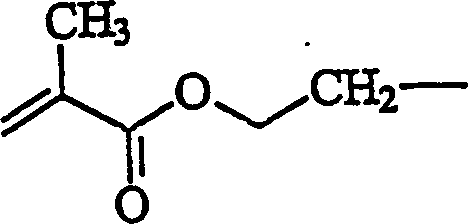
优选的含硅氧烷的脲烷单体用式(VII)表示:A preferred silicone-containing urethane monomer is represented by formula (VII):
其中m是至少1并优选是3或4,a是至少1并优选是1,p是提供400-10,000的结构部分分子量的数值并优选是至少30,R27是在除去异氰酸酯基之后的二异氰酸酯的双基,如异佛尔酮二异氰酸酯的双基,和各E″是由下式表示的基团:wherein m is at least 1 and preferably 3 or 4, a is at least 1 and preferably 1, p is a value providing a moiety molecular weight of 400-10,000 and is preferably at least 30, R is a diisocyanate after removal of isocyanate groups The diradical, such as the diradical of isophorone diisocyanate, and each E" is a group represented by the formula:
另一类的代表性含硅氧烷的单体包括氟化单体。如在U.S.专利Nos.4,954,587,5,079,319和5,010,141中所述,这些单体用于形成氟硅氧烷水凝胶,以减少沉积物在由此制备的接触透镜上的积累。如在U.S.专利Nos.5,387,662和5,321,108中所述,发现具有某些氟化侧基,即-(CF2)-H的含硅氧烷单体的使用改进了亲水和含硅氧烷的单体单元之间的相容性。Another class of representative silicone-containing monomers includes fluorinated monomers. As described in US Patent Nos. 4,954,587, 5,079,319 and 5,010,141, these monomers are used to form fluorosilicone hydrogels to reduce the accumulation of deposits on contact lenses thus prepared. As described in US Patent Nos. 5,387,662 and 5,321,108, it was found that the use of siloxane-containing monomers with certain fluorinated side groups, namely -(CF 2 )-H, improved hydrophilic and siloxane-containing monomers. Compatibility between body units.
在本发明的一个优选的实施方案中,硅氧烷水凝胶材料包括(在本体中,即在所要共聚的单体混合物中)5-50wt%,优选10-25wt%的一种或多种硅氧烷大分子单体,5-75wt%,优选30-60wt%的一种或多种聚硅氧烷基烷基(甲基)丙烯酸类单体,和10-50wt%,优选20-40wt%的亲水单体。亲水单体的实例包括、但不限于烯属不饱和含内酰胺的单体如N-乙烯基吡咯烷酮,甲基丙烯酸和丙烯酸;丙烯酸取代的醇类,如甲基丙烯酸2-羟乙基酯和丙烯酸2-羟乙酯,及丙烯酰胺,如甲基丙烯酰胺和N,N-二甲基丙烯酰胺,如在U.S.专利Nos.5,070,215中公开的碳酸乙烯酯或氨基甲酸乙烯酯单体,以及如在U.S.专利No.4,910,277中公开的噁唑啉酮单体。其它亲水单体如N,N-二甲基丙烯酰胺(DMA),甲基丙烯酸2-羟乙酯(HEMA),甲基丙烯酸甘油酯,2-羟乙基甲基丙烯酰胺,聚乙二醇,单甲基丙烯酸酯,甲基丙烯酸和丙烯酸也可用于本发明。其它适合的亲水单体对本领域的技术人员来说是显而易见的。In a preferred embodiment of the present invention, the silicone hydrogel material comprises (in bulk, ie in the monomer mixture to be copolymerized) 5-50 wt%, preferably 10-25 wt% of one or more Silicone macromer, 5-75 wt%, preferably 30-60 wt%, of one or more polysiloxane alkyl (meth)acrylic monomers, and 10-50 wt%, preferably 20-40 wt% % of hydrophilic monomers. Examples of hydrophilic monomers include, but are not limited to, ethylenically unsaturated lactam-containing monomers such as N-vinylpyrrolidone, methacrylic acid and acrylic acid; acrylic substituted alcohols such as 2-hydroxyethyl methacrylate and 2-hydroxyethyl acrylate, and acrylamides, such as methacrylamide and N,N-dimethylacrylamide, such as vinyl carbonate or vinyl carbamate monomers disclosed in U.S. Patent Nos. 5,070,215, and Oxazolinone monomers such as disclosed in U.S. Patent No. 4,910,277. Other hydrophilic monomers such as N, N-dimethylacrylamide (DMA), 2-hydroxyethyl methacrylate (HEMA), glyceryl methacrylate, 2-hydroxyethyl methacrylamide, polyethylene glycol Alcohols, monomethacrylates, methacrylic acid and acrylic acid are also useful in the present invention. Other suitable hydrophilic monomers will be apparent to those skilled in the art.
以上硅氧烷材料仅是示例的,在各种出版物中已公开了作为能够从根据本发明涂布的方法中受益的基材使用的其它材料,它们被不断地开发用于接触透镜和其它医学器材。The above silicone materials are exemplary only, and other materials have been disclosed in various publications as substrates that can benefit from the method of coating according to the present invention, and they are continuously developed for use in contact lenses and other materials. medical equipment.
如上所述,本发明涉及医学器材如接触透镜的表面通过亲水聚合物链对该表面的可去除连接而改性的方法。术语“可去除连接”是指在基材和亲水聚合物链之间产生了化学键,它能够断裂,而不会对基材构成明显机械损伤。As stated above, the present invention relates to methods of modifying the surface of a medical device, such as a contact lens, by the releasable attachment of hydrophilic polymer chains to the surface. The term "removable linkage" means that a chemical bond is created between the substrate and the hydrophilic polymer chain, which can be broken without significant mechanical damage to the substrate.
本发明的亲水聚合物链能够以化学或机械方式(例如通过磨蚀)从基材上除去。适合的机械方法包括高剪切流体处理如高速流体喷射,以及让该表面与流化磨蚀固体接触。亲水聚合表面涂层还可以通过研磨或抛光而以机械方式去除。The hydrophilic polymer chains of the present invention can be removed from the substrate chemically or mechanically, for example by abrasion. Suitable mechanical methods include high shear fluid handling, such as high velocity fluid jetting, and contacting the surface with fluidized abrasive solids. Hydrophilic polymeric surface coatings can also be removed mechanically by grinding or polishing.
从接触透镜除去本发明的聚合物表面涂层的优选机械方法是用含有磨蚀剂如硅石或氧化铝及阴离子表面活性剂(如烷基醚磺酸盐),非离子表面活性剂(如乙氧基化烷基酚)和阳离子表面活性剂(如季铵盐)中的一种或多种的商购磨蚀清洁剂来摩擦接触透镜。尤其优选的磨蚀清洁剂包括购自Bausch&Lomb,Rochester,NY,14604的Boston和Boston Advanced牌磨蚀清洁剂。The preferred mechanical method of removing the polymeric surface coatings of the present invention from contact lenses is with abrasives containing abrasives such as silica or alumina and anionic surfactants (such as alkyl ether sulfonates), nonionic surfactants (such as ethoxylates) Abrasive contact lenses are rubbed with commercially available abrasive cleaners of one or more of alkylated alkylphenols) and cationic surfactants such as quaternary ammonium salts. Especially preferred abrasive cleaners include Boston(R) and Boston Advanced(R) brand abrasive cleaners available from Bausch & Lomb, Rochester, NY, 14604.
除去亲水聚合物表面涂层的适合化学方法包括氧化,例如氧化等离子体、臭氧处理或电晕放电。其它化学方法包括化学水解,水解裂解或酶促脱除。Suitable chemical methods for removing the hydrophilic polymer surface coating include oxidation such as oxidizing plasma, ozone treatment or corona discharge. Other chemical methods include chemical hydrolysis, hydrolytic cleavage or enzymatic removal.
亲水聚合物链(包括低聚物)通过将其上的与在医学器材表面上的反应性基团互补的开环或异氰酸酯反应性官能团暴露于缩水表面上而连接于该表面。另外,亲水聚合物链可以通过使该表面接触带有与硅氧烷材料中的吖内酯反应性基团互补的羟基或(伯或仲)胺基或带有与在硅氧烷材料中的环氧基反应性基团互补的羧酸基团的亲水反应性聚合物(包括低聚物)而连接于该表面。换句话说,利用医学器材表面处的化学官能团以便将亲水聚合物共价连接于目标或基材。Hydrophilic polymer chains (including oligomers) are attached to the surface of the medical device by exposing ring-opening or isocyanate-reactive functional groups thereon that are complementary to reactive groups on the surface of the medical device on the surface. Alternatively, hydrophilic polymer chains can be modified by contacting the surface with hydroxyl or (primary or secondary) amine groups complementary to the azlactone-reactive groups in the silicone material or with Hydrophilic reactive polymers (including oligomers) of epoxy reactive groups complementary to the carboxylic acid groups are attached to the surface. In other words, chemical functional groups at the surface of the medical device are utilized in order to covalently attach the hydrophilic polymer to the target or substrate.
亲水反应性聚合物可以是包括任选含有异氰酸酯或开环反应性官能团的反应性单体单元的均聚物或共聚物。虽然这些反应性单体单元还可以是亲水的,但亲水反应性聚合物还可以是与一种或多种不同非反应性亲水单体单元共聚的反应性单体单元的共聚物。少量的疏水单体单元可以任选存在于亲水聚合物中。开环单体包括吖内酯官能化、环氧基官能化和酸酐官能化单体。The hydrophilic reactive polymer may be a homopolymer or a copolymer comprising reactive monomer units optionally containing isocyanate or ring-opening reactive functional groups. While these reactive monomeric units may also be hydrophilic, the hydrophilic reactive polymer may also be a copolymer of reactive monomeric units copolymerized with one or more different non-reactive hydrophilic monomeric units. Small amounts of hydrophobic monomeric units may optionally be present in the hydrophilic polymer. Ring opening monomers include azlactone functional, epoxy functional and anhydride functional monomers.
可以使用亲水反应性聚合物的混合物。例如,连接于基材的亲水聚合物链可以是包括(a)具有与基材表面上的反应性官能团互补的沿亲水聚合物分布的单体单元中的反应性官能团的第一亲水反应性聚合物和另外(b)具有与第一亲水反应性聚合物反应的补充反应性官能团的第二亲水反应性聚合物的聚合物混合物的反应的结果。已发现包括环氧基官能化聚合物与酸官能化聚合物的混合物提供了相对厚的涂层(同时或先后施涂于所要涂布的基材上)。利用反应性聚合物的混合物提供了进一步调节基材的表面化学性质的方法。Mixtures of hydrophilic reactive polymers may be used. For example, the hydrophilic polymer chain attached to the substrate may be a first hydrophilic polymer having (a) a reactive functional group in monomer units distributed along the hydrophilic polymer that is complementary to a reactive functional group on the surface of the substrate. The result of the reaction of the polymer mixture of the reactive polymer and additionally (b) a second hydrophilic reactive polymer having complementary reactive functional groups reactive with the first hydrophilic reactive polymer. It has been found that mixtures comprising epoxy-functional polymers and acid-functional polymers provide relatively thick coatings (applied simultaneously or sequentially to the substrate to be coated). Utilizing a mixture of reactive polymers provides a means to further tune the surface chemistry of the substrate.
优选,亲水反应性聚合物包括1-100mol%,更优选5-50mol%,最优选10-40mol%的反应性单体单元。聚合物可以包括0-99mol%,优选50-95mol%,更优选60-90mol%的非反应性亲水单体单元(一旦反应,反应性单体还可以是亲水的,但与称之为非反应性亲水单体的单体在定义上互不相同)。亲水反应性聚合物的重均分子量适宜为大约200到1,000,000,优选约1,000到500,000,最优选大约5,000到100,000。Preferably, the hydrophilic reactive polymer comprises 1-100 mol%, more preferably 5-50 mol%, most preferably 10-40 mol% reactive monomeric units. The polymer may comprise 0-99 mol%, preferably 50-95 mol%, more preferably 60-90 mol% of non-reactive hydrophilic monomer units (once reacted, the reactive monomer may also be The monomers of non-reactive hydrophilic monomers differ from each other by definition). The weight average molecular weight of the hydrophilic reactive polymer is suitably about 200 to 1,000,000, preferably about 1,000 to 500,000, most preferably about 5,000 to 100,000.
亲水单体可以是非质子类型如丙烯酰胺(N,N-二甲基丙烯酰胺,DMA),内酰胺如N-乙烯基吡咯烷酮,和聚(氧化烯)如甲氧基聚氧化乙烯甲基丙烯酸酯,或者可以是质子类型如甲基丙烯酸或(甲基)丙烯酸羟烷基酯如(甲基)丙烯酸羟乙酯。亲水单体还可以包括阴离子表面活性剂如丙烯酰胺基-2-甲基丙基磺酸钠(AMPS)和两性离子如N,N-二甲基-N-甲基丙烯酰氧基乙基-N-(3-磺基丙基)-铵甜菜碱(SPE)和N,N-二甲基-N-甲基丙烯酰胺基丙基-N-(3-磺基丙基)-铵甜菜碱(SPP)。Hydrophilic monomers can be of the aprotic type such as acrylamide (N,N-dimethylacrylamide, DMA), lactams such as N-vinylpyrrolidone, and poly(alkylene oxides) such as methoxypolyethylene oxide methacrylic acid esters, or may be of the protic type such as methacrylic acid or hydroxyalkyl (meth)acrylates such as hydroxyethyl (meth)acrylate. Hydrophilic monomers may also include anionic surfactants such as sodium acrylamido-2-methylpropylsulfonate (AMPS) and zwitterions such as N,N-dimethyl-N-methacryloyloxyethyl -N-(3-sulfopropyl)-ammonium betaine (SPE) and N,N-dimethyl-N-methacrylamidopropyl-N-(3-sulfopropyl)-ammonium betaine base (SPP).
疏水单体单元任选可以至多35mol%,优选0-20mol%,最优选0-10mol%的量使用。疏水单体的实例是甲基丙烯酸烷基酯,氟化甲基丙烯酸烷基酯,长链丙烯酰胺如辛基丙烯酰胺等。Hydrophobic monomeric units may optionally be used in amounts up to 35 mol%, preferably 0-20 mol%, most preferably 0-10 mol%. Examples of hydrophobic monomers are alkyl methacrylates, fluorinated alkyl methacrylates, long chain acrylamides such as octylacrylamide, and the like.
如上所述,亲水反应性聚合物可以包括由吖内酯官能化、环氧基官能化和酸酐官能化单体衍生的反应性单体单元。例如,用于涂布透镜的环氧基官能化亲水反应性聚合物能够是含有甲基丙烯酸缩水甘油酯(GMA)单体单元的共聚物,它例如与包括羧酸基团的透镜基材反应。酸酐官能化亲水反应性聚合物的优选实例包括由诸如马来酸酐和衣康酸酐之类的单体衍生的单体单元。As noted above, the hydrophilic reactive polymer may include reactive monomer units derived from azlactone-functional, epoxy-functional, and anhydride-functional monomers. For example, the epoxy-functionalized hydrophilic reactive polymer used to coat the lens can be a copolymer containing glycidyl methacrylate (GMA) monomer units, for example, with a lens substrate comprising carboxylic acid groups. reaction. Preferred examples of anhydride functionalized hydrophilic reactive polymers include monomer units derived from monomers such as maleic anhydride and itaconic anhydride.
一般,亲水反应性聚合物中的环氧基官能化反应性基团或酸酐官能化反应性基团与基材,例如由包括甲基丙烯酸(MAA)、甲基丙烯酸羟烷基酯如甲基丙烯酸羟乙酯(HEMA)或甲基丙烯酸氨基烷基酯如甲基丙烯酸氨基丙基酯(全部是常用和商购单体)的聚合物制备的基材中的羧酸(-COOH)、醇(-OH)、伯胺(-NH2)基团或硫醇基团(-SH)反应。如由熟练化学工作者所了解的那样,在醇的情况下,催化剂如4-二甲氨基吡啶可以用于加速在室温下的反应。酸性基团还可以通过使用水解成酸的吖内酯单体单元而在基材中产生。这些酸基能够与亲水反应性聚合物中的环氧基或酸酐基反应。对于这些基材的例子,例如参阅US专利No.5,364,918(Valint等人);该专利在这里全面引用供参考。Generally, epoxy-functional reactive groups or anhydride-functional reactive groups in hydrophilic reactive polymers are bonded to substrates, such as those made of methacrylic acid (MAA), hydroxyalkyl methacrylates such as methyl Carboxylic acid (-COOH), Alcohol (-OH), primary amine (-NH 2 ) groups or thiol (-SH) groups react. As is known by skilled chemists, in the case of alcohols, catalysts such as 4-dimethylaminopyridine can be used to accelerate the reaction at room temperature. Acidic groups can also be generated in the substrate by using azlactone monomer units that hydrolyze to acid. These acid groups are capable of reacting with epoxy or anhydride groups in the hydrophilic reactive polymer. For examples of such substrates, see, eg, US Patent No. 5,364,918 (Valint et al.); which patent is incorporated herein by reference in its entirety.
一般,亲水反应性聚合物中的吖内酯或异氰酸酯官能团可以类似地与在聚合物基材中的胺或醇反应,反应涉及醇,优选在催化剂的存在下。另外,亲水反应性聚合物中的羧酸、胺和水解吖内酯可以与基材中的环氧基,例如在US专利No.4,734,475(Goldenberg等人)中所述的单体单元反应;该专利在这里全面引用供参考。In general, azlactone or isocyanate functional groups in the hydrophilically reactive polymer can react similarly with amines or alcohols in the polymer substrate, the reaction involving the alcohol, preferably in the presence of a catalyst. Additionally, carboxylic acids, amines, and hydrolyzed azlactones in the hydrophilic reactive polymer can react with epoxy groups in the substrate, such as the monomer units described in US Patent No. 4,734,475 (Goldenberg et al.); This patent is incorporated herein by reference in its entirety.
在本发明的优选实施方案中,使含有由至少一种开环单体、含异氰酸酯的单体、含胺的单体、含羟基的单体或含羧酸的单体衍生的重复单元的预先形成(不可聚合)的亲水聚合物与医学器材如接触透镜基材表面上的反应性基团反应。一般,亲水反应性聚合物在沿聚合物链的一个或多个位置连接于基材上。在连接后,在环氧基、异氰酸酯或开环单体单元的情况下,亲水反应性聚合物中的任何未反应的反应性官能团可以水解成非反应性结构部分。In a preferred embodiment of the present invention, the prior The formed (non-polymerizable) hydrophilic polymer reacts with reactive groups on the surface of a medical device such as a contact lens substrate. Typically, the hydrophilic reactive polymer is attached to the substrate at one or more locations along the polymer chain. After attachment, any unreacted reactive functional groups in the hydrophilic reactive polymer can be hydrolyzed to non-reactive moieties in the case of epoxy groups, isocyanate or ring-opening monomer units.
用于构成亲水反应性聚合物的适合亲水非反应性单体通常包括水溶性普通乙烯基单体如2-羟乙基-、2-和3-羟丙基-、2,3-二羟丙基-、聚乙氧基乙基-和聚乙氧基丙基-丙烯酸酯、甲基丙烯酸酯、丙烯酰胺和甲基丙烯酰胺;丙烯酰胺,甲基丙烯酰胺,N-甲基丙烯酰胺,N-甲基甲基丙烯酰胺,N,N-二甲基丙烯酰胺,N,N-二甲基甲基丙烯酰胺,丙烯酸和甲基丙烯酸N,N-二甲基-和N,N-二乙基氨基乙酯以及相应的丙烯酰胺和甲基丙烯酰胺;2-和4-乙烯基吡啶;4-和2-甲基-5-乙烯基吡啶;N-甲基-4-乙烯基哌啶;2-甲基-1-乙烯基咪唑;N,N-二甲基烯丙基胺;二甲基氨基乙基乙烯基醚和N-乙烯基吡咯烷酮。Suitable hydrophilic non-reactive monomers for the formation of hydrophilic reactive polymers generally include water-soluble common vinyl monomers such as 2-hydroxyethyl-, 2- and 3-hydroxypropyl-, 2,3-di Hydroxypropyl-, polyethoxyethyl- and polyethoxypropyl-acrylates, methacrylates, acrylamides and methacrylamides; acrylamides, methacrylamides, N-methacrylamides , N-methylmethacrylamide, N,N-dimethylacrylamide, N,N-dimethylmethacrylamide, acrylic acid and methacrylic acid N,N-dimethyl- and N,N- Diethylaminoethyl ester and corresponding acrylamide and methacrylamide; 2- and 4-vinylpyridine; 4- and 2-methyl-5-vinylpyridine; N-methyl-4-vinylpiperidine pyridine; 2-methyl-1-vinylimidazole; N,N-dimethylallylamine; dimethylaminoethyl vinyl ether and N-vinylpyrrolidone.
包括在有用的非反应性单体内的一般是水溶性普通乙烯基单体如以下通式的丙烯酸酯和甲基丙烯酸酯:Included among the useful non-reactive monomers are generally water-soluble common vinyl monomers such as acrylates and methacrylates of the general formula:
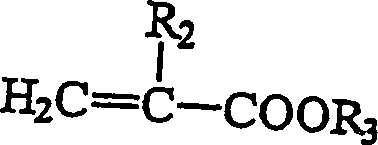
其中R2是氢或甲基和R3是氢或被一个或多个水溶性基团如羧基、羟基、氨基、低级烷基氨基、低级二烷基氨基、具有2到约100个重复单元的聚氧化乙烯取代,或被一个或多个硫酸根、磷酸根、磺酸根、膦酸根、羧酰胺基、磺酰胺基或膦酰胺基或它们的混合物取代的至多10个碳原子的脂族烃基;wherein R2 is hydrogen or methyl and R3 is hydrogen or is replaced by one or more water-soluble groups such as carboxyl, hydroxyl, amino, lower alkylamino, lower dialkylamino, with 2 to about 100 repeating units Aliphatic hydrocarbon groups of up to 10 carbon atoms substituted by polyethylene oxide, or by one or more sulfate, phosphate, sulfonate, phosphonate, carboxamide, sulfonamide or phosphonamide groups or mixtures thereof;
优选R3是低聚物或聚合物如聚乙二醇,聚丙二醇,聚(乙二醇-丙二醇),聚(甲基丙烯酸羟乙酯),聚(二甲基丙烯酰胺),聚(丙烯酸),聚(甲基丙烯酸),聚砜,聚(乙烯醇),聚丙烯酰胺,聚(丙烯酰胺-丙烯酸)聚(苯乙烯磺酸)钠盐,聚(环氧乙烷),聚(环氧乙烷-环氧丙烷),聚(乙醇酸),聚(乳酸),聚(乙烯基吡咯烷酮),纤维素制品,多糖,它们的混合物,以及它们的共聚物;Preferably R is an oligomer or polymer such as polyethylene glycol, polypropylene glycol, poly(ethylene glycol-propylene glycol), poly(hydroxyethyl methacrylate), poly(dimethylacrylamide), poly(acrylic acid ), poly(methacrylic acid), polysulfone, poly(vinyl alcohol), polyacrylamide, poly(acrylamide-acrylic acid) poly(styrenesulfonic acid) sodium salt, poly(ethylene oxide), poly(cyclo Ethylene oxide-propylene oxide), poly(glycolic acid), poly(lactic acid), poly(vinylpyrrolidone), cellulose products, polysaccharides, mixtures thereof, and copolymers thereof;
下式的丙烯酰胺和甲基丙烯酰胺:Acrylamides and methacrylamides of the formula:
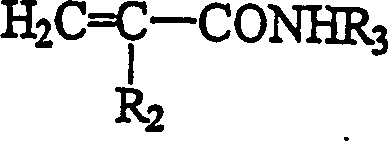
其中R2和R3如以上所定义;Wherein R 2 and R 3 are as defined above;
下式的丙烯酰胺和甲基丙烯酰胺:Acrylamides and methacrylamides of the formula:

其中R4是1-3个碳原子的低级烷基和R2如以上所定义;Wherein R 4 is a lower alkyl group of 1-3 carbon atoms and R 2 is as defined above;
下式的衣康酸酯:Itaconate esters of the formula:
其中R3如以上所定义;wherein R 3 is as defined above;
下式的马来酸酯和富马酸酯:Maleates and fumarates of the formula:
R3OOCH=CHCOOR3 R 3 OOCH=CHCOOR 3
其中R3如以上所定义;wherein R 3 is as defined above;
下式的乙烯基醚:Vinyl ethers of the formula:
H2C=CH-O-R3 H 2 C=CH-OR 3
其中R3如以上所定义;wherein R 3 is as defined above;
下式的脂族乙烯基化合物:Aliphatic vinyl compounds of the formula:
R2CH=CHR3 R 2 CH=CHR 3
其中R2如以上所定义和R3如以上所定义,前提是R3不是氢;和乙烯基取代的杂环,如乙烯基吡啶,哌啶和咪唑和N-乙烯基内酰胺,如N-乙烯基-2-吡咯烷酮。wherein R2 is as defined above and R3 is as defined above, provided that R3 is not hydrogen; and vinyl substituted heterocycles such as vinylpyridine, piperidine and imidazole and N-vinyllactams such as N- Vinyl-2-pyrrolidone.
包括在有用的水溶性单体中的是丙烯酸和甲基丙烯酸;衣康酸,巴豆酸,富马酸和马来酸以及它们的低级羟烷基单和二酯,如富马酸和马来酸2-羟乙酯,丙烯酸和甲基丙烯酸钠;2-甲基丙烯酰氧基乙基磺酸和烯丙基磺酸。Included among the useful water-soluble monomers are acrylic acid and methacrylic acid; itaconic acid, crotonic acid, fumaric acid and maleic acid and their lower hydroxyalkyl mono- and diesters such as fumaric acid and maleic acid 2-Hydroxyethyl acrylate, sodium acrylic acid and methacrylate; 2-methacryloyloxyethylsulfonic acid and allylsulfonic acid.
在亲水反应性聚合物中引入一些疏水单体可以提供在溶液中形成微分散聚合物附聚物的优点,这可以通过在聚合物溶液中的浊度来证明。这些附聚物还能够在涂布医学器材的原子力显微镜检查图象中发现。The introduction of some hydrophobic monomers in the hydrophilic reactive polymer can provide the advantage of forming finely dispersed polymer agglomerates in solution, as evidenced by the turbidity in the polymer solution. These agglomerates can also be found in atomic force microscopy images of coated medical devices.
适合的疏水可共聚单体包括水不溶性普通乙烯基单体如以下通式的丙烯酸酯和甲基丙烯酸酯:Suitable hydrophobic copolymerizable monomers include water insoluble common vinyl monomers such as acrylates and methacrylates of the general formula:
其中R2如以上所定义,R5是具有至多20个碳原子的直链或支化脂族、环脂族或芳族基团,该基团是未取代的,或被至多12个碳原子的一个或多个烷氧基、烷酰氧基或烷基取代,或被卤素,尤其氯或优选氟,2-约100个单元的C2-C5聚亚烷基氧基取代,或低聚物,如聚乙烯,聚(甲基丙烯酸甲酯),聚(甲基丙烯酸乙酯),或聚(甲基丙烯酸缩水甘油酯),它们的混合物,以及它们的共聚物;wherein R is as defined above, R is a straight chain or branched aliphatic, cycloaliphatic or aromatic group having up to 20 carbon atoms, which group is unsubstituted, or replaced by up to 12 carbon atoms One or more alkoxy, alkanoyloxy or alkyl substituted by halogen, especially chlorine or preferably fluorine, C2-C5 polyalkyleneoxy of 2 to about 100 units, or an oligomer , such as polyethylene, poly(methyl methacrylate), poly(ethyl methacrylate), or poly(glycidyl methacrylate), mixtures thereof, and copolymers thereof;
以下通式的丙烯酰胺和甲基丙烯酰胺:Acrylamides and methacrylamides of the general formula:
其中R2和R5如以上所定义;Wherein R 2 and R 5 are as defined above;
下式的乙烯基醚:Vinyl ethers of the formula:
H2C=CH-O-R5 H 2 C=CH-OR 5
其中R5如以上所定义;wherein R is as defined above;
下式的乙烯基酯:Vinyl esters of the formula:
H2C=CH-OCO-R5 H 2 C=CH-OCO-R 5
其中R5如以上所定义;wherein R is as defined above;
下式的衣康酸酯:Itaconate esters of the formula:

其中R5如以上所定义;wherein R is as defined above;
下式的马来酸酯和富马酸酯:Maleates and fumarates of the formula:
R5OOC-HC=CH-OOOR5 R 5 OOC-HC=CH-OOOR 5
其中R5如以上所定义;和wherein R is as defined above; and
下式的乙烯基取代的烃类:Vinyl-substituted hydrocarbons of the formula:
R2CH=CHR5 R 2 CH=CHR 5
其中R2和R5如以上所定义。wherein R2 and R5 are as defined above.
有用或适合的疏水单体包括例如:丙烯酸和甲基丙烯酸甲基,乙基,丙基,异丙基,丁基,乙氧基乙基,甲氧基乙基,乙氧基丙基,苯基,苄基,环己基,六氟异丙基,或正辛基酯以及相应的丙烯酰胺和甲基丙烯酰胺;富马酸二甲酯,衣康酸二甲酯,马来酸二甲酯,富马酸二乙酯,甲基乙烯基醚,乙氧基乙基乙烯基醚,乙酸乙烯酯,丙酸乙烯酯,苯甲酸乙烯酯,丙烯腈,苯乙烯,α-甲基苯乙烯,1-己烯,乙烯基氯,乙烯基甲基酮,硬脂酸乙烯酯,2-己烯和甲基丙烯酸2-乙基己酯。Useful or suitable hydrophobic monomers include for example: acrylic and methacrylic acid methyl, ethyl, propyl, isopropyl, butyl, ethoxyethyl, methoxyethyl, ethoxypropyl, benzene Benzyl, benzyl, cyclohexyl, hexafluoroisopropyl, or n-octyl esters and the corresponding acrylamide and methacrylamide; dimethyl fumarate, dimethyl itaconate, dimethyl maleate , diethyl fumarate, methyl vinyl ether, ethoxyethyl vinyl ether, vinyl acetate, vinyl propionate, vinyl benzoate, acrylonitrile, styrene, alpha-methylstyrene, 1-Hexene, Vinyl Chloride, Vinyl Methyl Ketone, Vinyl Stearate, 2-Hexene, and 2-Ethylhexyl Methacrylate.
亲水反应性聚合物以本身已知的方式通过本领域技术人员惯用的聚合反应由相应单体(术语单体这里还包括大分子单体)合成。一般,亲水反应性聚合物或链通过以下方法形成:(1)将单体一起混合;(2)添加聚合引发剂;(3)让单体/引发剂混合物接触紫外线源或光化辐射和/或高温及固化所述混合物。典型聚合引发剂包括诸如过氧化乙酰、过氧化月桂酰、过氧化癸酰、过氧化coprylyl、过氧化苯甲酰、过新戊酸叔丁酯、过碳酸钠、过辛酸叔丁酯和偶氮双异丁腈(AIBN)之类的自由基产生聚合引发剂。还能够使用诸如二乙氧基苯乙酮之类的紫外线自由基引发剂。固化方法当然将取决于所用引发剂和共聚单体混合物的物理特性如粘度。在任何情况下,引发剂的用量水平将在单体混合物的0.001-2wt%的范围内变化。通常,上述单体的混合物通过添加自由基形成剂来加温。The hydrophilically reactive polymers are synthesized in a manner known per se from corresponding monomers (the term monomer here also includes macromonomers) by polymerization reactions customary to those skilled in the art. Generally, hydrophilic reactive polymers or chains are formed by: (1) mixing the monomers together; (2) adding a polymerization initiator; (3) exposing the monomer/initiator mixture to a source of ultraviolet light or actinic radiation and /or high temperature and curing of the mixture. Typical polymerization initiators include, for example, acetyl peroxide, lauroyl peroxide, decanoyl peroxide, coprylyl peroxide, benzoyl peroxide, t-butyl perpivalate, sodium percarbonate, t-butyl peroctoate, and azo Free radical generating polymerization initiators such as bisisobutyronitrile (AIBN). Ultraviolet radical initiators such as diethoxyacetophenone can also be used. The curing method will of course depend on the initiator used and the physical properties of the comonomer mixture such as viscosity. In any event, the level of initiator used will vary from 0.001 to 2% by weight of the monomer mixture. Typically, the mixture of the above monomers is warmed by adding a free radical former.
形成亲水反应性聚合物的聚合能够在有或无溶剂存在的情况下进行。适合溶剂原则上是溶解所用单体的所有溶剂,例如水;醇类如低级链烷醇,例如乙醇和甲醇;羧酰胺如二甲基甲酰胺,偶极非质子溶剂如二甲亚砜或甲基乙基酮;酮类如丙酮或环己酮;烃类如甲苯;醚类如THF,二甲氧基乙烷或二噁烷;卤化烃类如二氯乙烷,以及适合溶剂的混合物,例如水和醇的混合物,例如水/乙醇或水/甲醇混合物。Polymerization to form the hydrophilic reactive polymer can be carried out with or without the presence of a solvent. Suitable solvents are in principle all solvents in which the monomers used are dissolved, for example water; alcohols such as lower alkanols, e.g. ethanol and methanol; carboxamides such as dimethylformamide, dipolar aprotic solvents such as dimethylsulfoxide or formaldehyde ethyl ethyl ketone; ketones such as acetone or cyclohexanone; hydrocarbons such as toluene; ethers such as THF, dimethoxyethane or dioxane; halogenated hydrocarbons such as dichloroethane, and mixtures of suitable solvents, For example mixtures of water and alcohols, such as water/ethanol or water/methanol mixtures.
在根据本发明的方法中,通过将基材浸渍于含有聚合物的溶液中可以使接触透镜或其它医学器材与亲水反应性聚合物接触。例如,可以将接触透镜在亲水反应性聚合物或共聚物在适宜介质中,例如非质子溶剂如乙腈中的溶液中放置或浸渍适当时间。In the method according to the invention, a contact lens or other medical device may be brought into contact with a hydrophilic reactive polymer by dipping the substrate in a solution containing the polymer. For example, a contact lens may be placed or immersed for a suitable period of time in a solution of the hydrophilic reactive polymer or copolymer in a suitable medium, for example an aprotic solvent such as acetonitrile.
反应温度必须至少足以保持反应剂在液体溶液中,并且适宜低于55℃。反应温度优选是约15到约45℃,更优选约20到约40℃,和最优选是大约环境温度。The reaction temperature must be at least sufficient to maintain the reactants in liquid solution, and suitably below 55°C. The reaction temperature is preferably about 15 to about 45°C, more preferably about 20 to about 40°C, and most preferably about ambient temperature.
如上所述,本发明的一个实施方案涉及将反应性亲水聚合物连接于医学器材,该聚合物包括含异氰酸酯的单体单元或开环单体单元。在本发明的一个实施方案中,开环反应性单体具有用下式表示的吖内酯基团:As noted above, one embodiment of the present invention relates to the attachment of a reactive hydrophilic polymer comprising isocyanate-containing monomeric units or ring-opening monomeric units to a medical device. In one embodiment of the invention, the ring-opening reactive monomer has an azlactone group represented by the formula:

其中R3和R4独立地是具有1-14个碳原子的烷基,具有3-14个碳原子的环烷基,具有5-12个环原子的芳基,具有6-26个碳原子和选自S、N和O中的0-3个非过化杂原子的芳烃基,或者R3和R4与它们所连接的碳一起能够形成含有4-12个环原子的碳环,以及n是整数0或1。这些单体单元公开在U.S.专利No.5,177,165(Valint等人)中。Wherein R and R are independently alkyl having 1-14 carbon atoms, cycloalkyl having 3-14 carbon atoms, aryl having 5-12 ring atoms, having 6-26 carbon atoms and an aromatic hydrocarbon group selected from 0-3 non-override heteroatoms selected from S, N, and O, or R3 and R4 , together with the carbon to which they are attached, are capable of forming a carbocyclic ring containing 4-12 ring atoms, and n is an
这些反应性官能团的环结构易于与在所处理基材的表面上的互补反应性官能团进行亲核开环反应。例如吖内酯官能团能够与如上所述的基材中的伯胺、羟基或硫醇反应,在沿聚合物分布的一个或多个位置上形成基材和亲水反应性聚合物之间的共价键。多个连接能够在基材上形成系列聚合物环,其中各环包括在两个端部连接于基材的亲水链。The ring structures of these reactive functional groups are susceptible to nucleophilic ring-opening reactions with complementary reactive functional groups on the surface of the treated substrate. For example, an azlactone functional group can react with primary amines, hydroxyl groups, or thiols in the substrate as described above, forming a copolymer between the substrate and the hydrophilic reactive polymer at one or more positions distributed along the polymer. price key. Multiple linkages enable the formation of a series of polymeric rings on the substrate, where each ring includes a hydrophilic chain attached at both ends to the substrate.
用于制备亲水反应性聚合物的吖内酯官能化单体可以是包括上式的吖内酯官能团和与吖内酯连接的不饱和烃上的乙烯基的任意单体,预聚物,或低聚物。优选,在亲水聚合物中由2-烯基吖内酯单体提供吖内酯官能团。2-烯基吖内酯单体是已知的化合物,它们的合成例如描述在U.S.专利Nos.4,304,705;5,081,197;和5,091,489(全部属于Heilmann等人)中;这些专利在这里作为参照引用。适合的2-烯基吖内酯包括:The azlactone-functional monomer used to prepare the hydrophilic reactive polymer can be any monomer, prepolymer, comprising an azlactone functional group of the above formula and a vinyl group on an unsaturated hydrocarbon attached to the azlactone, or oligomers. Preferably, the azlactone functionality is provided in the hydrophilic polymer by a 2-alkenyl azlactone monomer. 2-alkenyl azlactone monomers are known compounds and their synthesis is described, for example, in U.S. Patent Nos. 4,304,705; 5,081,197; and 5,091,489 (all to Heilmann et al.); these patents are incorporated herein by reference. Suitable 2-alkenyl azlactones include:
2-乙烯基-1,3-噁唑啉-5-酮,2-vinyl-1,3-oxazolin-5-one,
2-乙烯基-4-甲基-1,3-噁唑啉-5-酮,2-vinyl-4-methyl-1,3-oxazolin-5-one,
2-异丙烯基-1,3-噁唑啉-5-酮,2-isopropenyl-1,3-oxazolin-5-one,
2-异丙烯基-4-甲基-1,3-噁唑啉-5-酮,2-isopropenyl-4-methyl-1,3-oxazolin-5-one,
2-乙烯基-4,4-二甲基-1,3-噁唑啉-5-酮,2-vinyl-4,4-dimethyl-1,3-oxazolin-5-one,
2-异丙烯基-4,4-二甲基-1,3-噁唑啉-5-酮,2-isopropenyl-4,4-dimethyl-1,3-oxazolin-5-one,
2-乙烯基-4-甲基-乙基-1,3-噁唑啉-5-酮,2-vinyl-4-methyl-ethyl-1,3-oxazolin-5-one,
2-异丙烯基-4-甲基-丁基-1,3-噁唑啉-5-酮,2-isopropenyl-4-methyl-butyl-1,3-oxazolin-5-one,
2-乙烯基-4,4-二丁基-1,3-噁唑啉-5-酮,2-vinyl-4,4-dibutyl-1,3-oxazolin-5-one,
2-异丙烯基-4-甲基-4-十二烷基-1,3-噁唑啉-5-酮,2-isopropenyl-4-methyl-4-dodecyl-1,3-oxazolin-5-one,
2-异丙烯基-4,4-二苯基-1,3-噁唑啉-5-酮,2-isopropenyl-4,4-diphenyl-1,3-oxazolin-5-one,
2-异丙烯基-4,4-五亚甲基-1,3-噁唑啉-5-酮,2-isopropenyl-4,4-pentamethylene-1,3-oxazolin-5-one,
2-异丙烯基-4,4-四亚甲基-1,3-噁唑啉-5-酮,2-isopropenyl-4,4-tetramethylene-1,3-oxazolin-5-one,
2-乙烯基-4,4-二乙基-1,3-噁唑啉-5-酮,2-vinyl-4,4-diethyl-1,3-oxazolin-5-one,
2-乙烯基-4-甲基-4-壬基-1,3-噁唑啉-5-酮,2-vinyl-4-methyl-4-nonyl-1,3-oxazolin-5-one,
2-异丙烯基-甲基-4-苯基-1,3-噁唑啉-5-酮,2-isopropenyl-methyl-4-phenyl-1,3-oxazolin-5-one,
2-异丙烯基-4-甲基-4-苄基-1,3-噁唑啉-5-酮,和2-isopropenyl-4-methyl-4-benzyl-1,3-oxazolin-5-one, and
2-乙烯基-4,4-五亚甲基-1,3-噁唑啉-5-酮,2-vinyl-4,4-pentamethylene-1,3-oxazolin-5-one,
更优选,吖内酯单体是用下面通式表示的化合物:More preferably, the azlactone monomer is a compound represented by the following general formula:

其中R1和R2独立表示氢原子或具有1-6个碳原子的低级烷基,以及R3和R4独立表示具有1-6个碳原子的烷基或具有5或6个碳原子的环烷基。特定实例包括2-异丙烯基-4,4-二甲基-2-噁唑啉-5-酮(IPDMO),2-乙烯基-4,4-二甲基-2-噁唑啉-5-酮(VDMO),螺-4’-(2’-异丙烯基-2’-噁唑啉-5-酮)环己烷(IPCO),环己烷-螺-4’-(2’-乙烯基-2’-噁唑-5’-酮(VCO),和2-(1-丙烯基)-4,4-二甲基-噁唑-5-酮(PDMO)等。Wherein R 1 and R 2 independently represent a hydrogen atom or a lower alkyl group having 1-6 carbon atoms, and R 3 and R 4 independently represent an alkyl group having 1-6 carbon atoms or a group having 5 or 6 carbon atoms Cycloalkyl. Specific examples include 2-isopropenyl-4,4-dimethyl-2-oxazoline-5-one (IPDMO), 2-vinyl-4,4-dimethyl-2-oxazoline-5 -one (VDMO), spiro-4'-(2'-isopropenyl-2'-oxazolin-5-one)cyclohexane (IPCO), cyclohexane-spiro-4'-(2'- Vinyl-2'-oxazol-5'-one (VCO), and 2-(1-propenyl)-4,4-dimethyl-oxazol-5-one (PDMO), etc.
这些化合物可以用通用反应顺序来制备:These compounds can be prepared using the general reaction sequence:

第一步是氨基酸的Shotten-Bauman酰化。可聚合的官能团通过使用丙烯酰氯或甲基丙烯酰氯来引入。第二步包括用氯甲酸酯的环封闭,获得所需的噁唑啉酮。分离产物,再通过有机化学的常用工序来纯化。The first step is the Shotten-Bauman acylation of amino acids. A polymerizable functional group is introduced by using acryloyl chloride or methacryloyl chloride. The second step involves ring closure with chloroformate to obtain the desired oxazolinone. The product is isolated and purified by usual procedures of organic chemistry.
如上所述,这些化合物能够与亲水和/或疏水共聚单体共聚合,以形成亲水反应性聚合物。在连接到所需的基材上之后,任何未反应的噁唑啉酮基团然后可以水解,以便将噁唑啉酮组分转化为氨基酸。一般,水解步骤按照以下普通反应进行:As noted above, these compounds can be copolymerized with hydrophilic and/or hydrophobic comonomers to form hydrophilic reactive polymers. After attachment to the desired substrate, any unreacted oxazolinone groups can then be hydrolyzed to convert the oxazolinone component to an amino acid. Generally, the hydrolysis step is carried out according to the following general reaction:

在R1和R2基团之间的碳-碳双键被表明是未反应的,但当共聚为聚合物时,反应能够发生。The carbon-carbon double bond between the R1 and R2 groups was shown to be unreacted, but when copolymerized as a polymer, the reaction was able to occur.
用于与吖内酯官能结构部分共聚以形成用于涂布医学器材的亲水反应性聚合物的共聚单体的非限制实例包括上述那些,优选二甲基丙烯酰胺,N-乙烯基吡咯烷酮。共聚单体的其它实例公开在欧洲专利出版物0 392 735中;它的公开内容被引用供参考。优选,二甲基丙烯酰胺作为共聚单体使用,以便赋予共聚物以亲水性。Non-limiting examples of comonomers for copolymerization with azlactone functional moieties to form hydrophilic reactive polymers for coating medical devices include those described above, preferably dimethylacrylamide, N-vinylpyrrolidone. Further examples of comonomers are disclosed in
这些吖内酯官能化单体能够与其它单体以各种重量百分率的组合共聚。使用反应竞聚率与吖内酯单体的反应竞聚率类似的单体将导致无规共聚物。用于共聚的反应竞聚率的测定公开在Odian,Principlesof Polymerization,2nd Ed.,John Wiley&Sons,425-430页(1981)中,它的公开内容在这里作为参照引用。另外,反应性高于吖内酯的共聚单体的使用将往往导致在链的端部附近具有较高浓度吖内酯官能团的嵌段共聚物链。These azlactone functional monomers can be copolymerized with other monomers in various weight percent combinations. The use of monomers having a reactivity ratio similar to that of the azlactone monomer will result in random copolymers. The determination of reactivity ratios for copolymerization is disclosed in Odian, Principles of Polymerization, 2nd Ed., John Wiley & Sons, pages 425-430 (1981), the disclosure of which is incorporated herein by reference. Additionally, the use of comonomers that are more reactive than azlactone will tend to result in block copolymer chains having a higher concentration of azlactone functional groups near the ends of the chain.
虽然不优选作为单体,但具有至少一个自由基可聚合位置的吖内酯官能化预聚物或低聚物也能够用于在根据本发明的亲水反应性聚合物中提供吖内酯官能团。吖内酯官能化低聚物例如通过吖内酯单体与任选的如在U.S.专利Nos.4,378,411和4,695,608(这里引用供参考)中所述的共聚单体的自由基聚合来制备。吖内酯官能化低聚物和预聚物的非限制实例公开在U.S.专利Nos.4,485,236和5,081,197和欧洲专利申请0 392 735中;所有专利在这里引用作参照。Although not preferred as monomers, azlactone functionalized prepolymers or oligomers having at least one free radically polymerizable site can also be used to provide azlactone functional groups in the hydrophilic reactive polymers according to the invention . Azlactone-functional oligomers are prepared, for example, by free radical polymerization of azlactone monomers with optional comonomers as described in U.S. Patent Nos. 4,378,411 and 4,695,608 (hereby incorporated by reference). Non-limiting examples of azlactone functionalized oligomers and prepolymers are disclosed in U.S. Patent Nos. 4,485,236 and 5,081,197 and
在本发明的另一个实施方案中,在亲水反应性聚合物中的开环反应性基团是环氧官能团。优选的环氧基官能化单体是含环氧乙烷的单体如甲基丙烯酸缩水甘油酯,烯丙基缩水甘油基醚,4-乙烯基-1-环己烯-1,2-环氧化物等,但是可以使用其它含环氧基的单体。In another embodiment of the present invention, the ring-opening reactive groups in the hydrophilic reactive polymer are epoxy functional groups. Preferred epoxy-functional monomers are oxirane-containing monomers such as glycidyl methacrylate, allyl glycidyl ether, 4-vinyl-1-cyclohexene-1,2-cyclo oxides, etc., but other epoxy group-containing monomers may be used.
亲水反应性聚合物连接于由普通生产方法制备的医学器具上。例如,用于本发明应用的接触透镜能够使用各种普通技术来生产,以获得具有所需前和后透镜表面的成型制品。在U.S.专利Nos.3,408,429和3,660,545中公开了旋转铸塑法;优选的静态铸塑法公开在U.S.专利Nos.4,113,224和4,197,266中。单体混合物的固化之后通常进行机械加工操作,以便提供具有所需最终构型的接触透镜。作为例子,U.S.专利No.4,555,732公开了其中过量单体混合物通过在模具中旋转铸塑来固化为成型制品的方法。固化旋转铸塑制品的后表面随后进行旋切,提供具有所需厚度和后透镜表面的接触透镜。在透明表面的旋切之后可以进行其它机械加工操作,例如整边操作。Hydrophilic reactive polymers are attached to medical devices prepared by common production methods. For example, contact lenses for use in the present invention can be produced using a variety of common techniques to obtain shaped articles having the desired anterior and posterior lens surfaces. Rotational casting is disclosed in U.S. Patent Nos. 3,408,429 and 3,660,545; preferred static casting methods are disclosed in U.S. Patent Nos. 4,113,224 and 4,197,266. Curing of the monomer mixture is typically followed by machining operations in order to provide a contact lens with the desired final configuration. As an example, U.S. Patent No. 4,555,732 discloses a process in which excess monomer mixture is cured into a shaped article by rotomolding in a mold. The posterior surface of the cured rotomolded article is subsequently peeled to provide a contact lens with the desired thickness and posterior lens surface. Other machining operations, such as trimming operations, can be performed after the peeling of the transparent surface.
在生产出具有所需最终形状的透镜之后,希望在整边操作之前从透镜中除去残留溶剂。这通常是因为有机稀释剂包括在初始单体混合物中,以便使由单体混合物的聚合产生的聚合产物的相分离最小化和降低反应聚合混合物的玻璃化转变温度,这将使固化方法更有效和最终导致更均匀的聚合产物。初始单体混合物和聚合产物的足够均匀性对于硅氧烷水凝胶特别重要,主要是由于引入了往往从亲水共聚单体中分离出来的含硅氧烷的单体。适合的有机稀释剂例如包括2-羟基,2-甲基癸烷,单羟基醇,其中包括脂族一元醇如正己醇和正壬醇的C6-C10直链或支化醇是特别优选的。US专利6,020,445(Vanderlaan等人)公开了适合的醇,以及在这里引入供参考。其它有用的溶剂包括二醇如乙二醇;多元醇如甘油;醚类如二甘醇单乙基醚;酮类如甲基乙基酮;酯类如庚酸甲酯;和烃类如甲苯。优选的是,有机稀释剂具有足够的挥发性,以便有利于它通过在环境压力或接近环境压力下的蒸发从固化制品中脱除。一般,稀释剂占单体混合物的5-60wt%,其中10-50wt%是特别优选的。After producing a lens with the desired final shape, it is desirable to remove residual solvent from the lens prior to the edging operation. This is usually because an organic diluent is included in the initial monomer mixture in order to minimize phase separation of the polymerization product resulting from the polymerization of the monomer mixture and to lower the glass transition temperature of the reactive polymerization mixture, which will make the curing process more efficient and ultimately lead to a more uniform polymer product. Sufficient homogeneity of the initial monomer mixture and polymerization product is particularly important for silicone hydrogels, primarily due to the incorporation of silicone-containing monomers that tend to separate from the hydrophilic comonomers. Suitable organic diluents include, for example, 2-hydroxyl, 2-methyldecane, monohydric alcohols, with C6 - C10 linear or branched alcohols including aliphatic monohydric alcohols such as n-hexanol and n-nonanol being particularly preferred . Suitable alcohols are disclosed in US Patent 6,020,445 (Vanderlaan et al.), and are incorporated herein by reference. Other useful solvents include glycols such as ethylene glycol; polyols such as glycerol; ethers such as diethylene glycol monoethyl ether; ketones such as methyl ethyl ketone; esters such as methyl heptanoate; . Preferably, the organic diluent is sufficiently volatile to facilitate its removal from the cured article by evaporation at or near ambient pressure. Typically, the diluent comprises 5-60% by weight of the monomer mixture, with 10-50% by weight being particularly preferred.
固化透镜然后进行溶剂去除,这能够通过在环境压力或接近环境压力或在真空下的蒸发来完成。能够使用升温来缩短蒸发稀释剂所需的时间。溶剂去除步骤的时间、温度和压力条件将根据诸如稀释剂的挥发性和特定单体组分之类的因素来变化,这能够容易地由本领域的技术人员来决定。根据优选的实施方案,在去除步骤中使用的温度优选是至少50℃,例如60-80℃。使用在惰性气体或真空下的在线性烘箱中的系列加热循环来优化溶剂去除的效率。在稀释剂去除步骤之后的固化制品应该含有不高于20wt%,优选不高于5wt%或更低的稀释剂。The lens is cured followed by solvent removal, which can be accomplished by evaporation at or near ambient pressure or under vacuum. Increased temperature can be used to shorten the time required to evaporate the diluent. The time, temperature and pressure conditions of the solvent removal step will vary according to factors such as the volatility of the diluent and the specific monomer components, and can be readily determined by one skilled in the art. According to a preferred embodiment, the temperature used in the removal step is preferably at least 50°C, such as 60-80°C. The efficiency of solvent removal is optimized using a series of heating cycles in a linear oven under inert gas or vacuum. The cured article after the diluent removal step should contain no more than 20 wt%, preferably no more than 5 wt% or less of diluent.
在去除有机稀释剂之后,透镜接着进行脱模和任选的机械加工操作。机械加工步骤例如包括磨光或抛光透镜边缘和/或表面。一般,这些机械加工方法可以在制品从模具部件中脱模之前或之后进行。优选,通过使用真空镊子从模具中提起透镜,使透镜从模具中干燥脱模,此后利用机械镊子将透镜转移到第二组真空镊子中,并贴着用于整平表面或边缘的旋转面放置。透镜然后可以翻转,以便机械加工透镜的其它侧面。After removal of the organic diluent, the lens is then subjected to demolding and optional machining operations. Machining steps include, for example, grinding or polishing the lens edges and/or surfaces. Generally, these machining methods can be performed before or after the article is released from the mold part. Preferably, the lens is dry released from the mold by lifting the lens from the mold using vacuum tweezers, after which the lens is transferred to a second set of vacuum tweezers using mechanical tweezers and placed against the surface of revolution for leveling the surface or edge. The lens can then be turned over so that the other sides of the lens can be machined.
在脱模/机械加工操作之后,透镜根据本发明如上所述进行表面处理,包括连接亲水反应性聚合物链。After the demolding/machining operation, the lens is surface treated according to the invention as described above, including attachment of hydrophilic reactive polymer chains.
在表面处理步骤之后,透镜可以进行萃取,以便除去透镜中的残留物。一般,在接触透镜的生产中,一些单体混合物不完全聚合。由聚合方法获得的不完全聚合的材料会影响光学澄清度或会对眼睛有害。残留物质包括没有通过前面的溶剂去除操作除去的溶剂,来自单体混合物的未反应的单体,由聚合方法得到的作为副产物存在的低聚物,乃至从用于形成透镜的模具中迁移出来的添加剂。After the surface treatment step, the lens may be subjected to extraction in order to remove residues from the lens. Typically, in the manufacture of contact lenses, some of the monomer mixture is not fully polymerized. Incompletely polymerized material obtained by polymerization methods can affect optical clarity or be harmful to the eyes. Residual materials include solvent not removed by previous solvent removal operations, unreacted monomer from the monomer mixture, oligomers present as by-products from the polymerization process, and even migration from the mold used to form the lens additives.
从聚合接触透镜材料中萃取这些残留物质的普通方法包括用醇溶液提取几小时(用于萃取疏水残留物质),随后用水萃取(用于萃取亲水残留物质)。因此,一些醇萃取溶液保留在聚合接触透镜材料的聚合网络中,并且应该在透镜安全和舒适地在眼睛上戴用之前从透镜材料中萃取出来。醇从透镜中的萃取能够通过使用热水达几小时来获得。萃取应该尽可能完全,因为来自透镜的残留物质的不完全萃取可以不利地缩短透镜的使用寿命。还有,这些残留物通过干扰光学澄清度或透镜表面的所需均匀亲水性而可以影响透镜性能和舒适感。重要的是,选择的萃取溶液不要不利影响透镜的光学澄清度。光学澄清度主观地理解为当目测透镜时所发现的澄清度水平。Common methods of extracting these residues from polymeric contact lens materials include extraction with alcoholic solutions for several hours (for hydrophobic residues) followed by water extraction (for hydrophilic residues). Therefore, some alcohol extraction solution remains in the polymeric network of the polymeric contact lens material and should be extracted from the lens material before the lens can be safely and comfortably worn on the eye. Extraction of alcohol from lenses can be achieved by using hot water for several hours. Extraction should be as complete as possible, since incomplete extraction of residual material from the lens can detrimentally shorten the useful life of the lens. Also, these residues can affect lens performance and comfort by interfering with optical clarity or the desired uniform hydrophilicity of the lens surface. It is important that the chosen extraction solution does not adversely affect the optical clarity of the lens. Optical clarity is subjectively understood as the level of clarity found when a lens is visually inspected.
在萃取之后,透镜进行水合,其中透镜充分用水、缓冲盐水或类似物水合。当透镜最终完全水合(其中透镜一般可以膨胀10到约20%或更高)时,涂层保持完整且结合于透镜,提供了被发现具有耐层离性的耐久亲水涂层。After extraction, the lens is hydrated, wherein the lens is fully hydrated with water, buffered saline, or the like. When the lens is finally fully hydrated (where the lens can typically swell by 10 to about 20% or more), the coating remains intact and bonded to the lens, providing a durable hydrophilic coating that has been found to be delamination resistant.
在水合之后,透镜可以进行美观检查,其中受过训练的检查者检查接触透镜的澄清度和缺陷如孔、颗粒、气泡、裂纹、裂缝的有无。检查优选在10X放大下进行。在透镜通过美观检查的步骤之后,透镜准备在小瓶、塑料泡沫包装物或其它容器中包装,以便使透镜保持在无菌条件下供消费者使用。最后,包装透镜进行灭菌,该灭菌可以在普通高压釜中,优选在空气加压灭菌循环(有时称之为空气-蒸汽混合物循环)下完成,这对技术人员来说是清楚的。优选,高压灭菌是在100℃到200℃下进行10-120分钟的时间。在灭菌之后,可以在储存之前检查灭菌透镜的透镜尺寸。After hydration, the lenses can be subjected to an aesthetic inspection where a trained examiner checks the contact lenses for clarity and the presence or absence of defects such as pores, particles, air bubbles, cracks, fissures. Inspection is preferably performed at 10X magnification. After the lens passes the cosmetic inspection step, the lens is ready to be packaged in a vial, bubble wrap or other container to keep the lens sterile for use by the consumer. Finally, the lenses are packaged for sterilization, which can be accomplished in a conventional autoclave, preferably under an air pressure sterilization cycle (sometimes referred to as an air-steam mixture cycle), as will be clear to the skilled person. Preferably, autoclaving is performed at 100°C to 200°C for a period of 10-120 minutes. After sterilization, the lens size of the sterilized lens can be checked before storage.
用于本发明的硬质可透气(“RGP”)材料的实例包括由含硅氧烷的单体制备的材料,如在US专利Nos.4,152,508;4,330,383;4,686,267;4,826,889;4,826,889;4,826,936;4,861,850;4,996,275;和5,346,976中教导的那些。这些专利的教导特地在这里引用供参考。RGP材料在它们用作根据本发明的基材之前一般不需要溶剂去除或萃取步骤。Examples of rigid gas permeable ("RGP") materials useful in the present invention include materials prepared from silicone-containing monomers, as described in US Patent Nos. 4,152,508; 4,330,383; 4,686,267; 4,826,889; 4,996,275; and those taught in 5,346,976. The teachings of these patents are expressly incorporated herein by reference. RGP materials generally do not require solvent removal or extraction steps prior to their use as substrates according to the invention.
本发明的目的和优点进一步通过以下实施例来说明,但在这些实施例中引用的特定材料和量以及其它条件和细节不应该被认为不适当地限制本发明。Objects and advantages of this invention are further illustrated by the following examples, but the particular materials and amounts recited in these examples, as well as other conditions and details, should not be construed to unduly limit this invention.
实施例1Example 1
本实施例公开了在以下实施例中用作涂布基材的代表性硅氧烷水凝胶透镜材料。以下表1提供了该材料的配方。This example discloses representative silicone hydrogel lens materials used as coating substrates in the following examples. Table 1 below provides the formulation of this material.
表1
下面描述以上的材料:The above materials are described below:
TRIS-VC 氨基甲酸三(三甲基甲硅烷氧基)甲硅烷基丙基乙烯酯TRIS-VC Tris(trimethylsiloxy)silylpropyl vinyl carbamate
NVP N-乙烯基吡咯烷酮NVP N-Vinylpyrrolidone
V2D25 如前面在U.S.专利No.5,534,604中所述的含硅氧烷的V 2 D 25 as previously described in US Patent No. 5,534,604 containing silicone
碳酸乙烯酯 Ethylene Carbonate
VINAL N-乙烯基氧基羰基丙氨酸VINAL N-Vinyloxycarbonylalanine
Darocur Darocur-1173,UV引发剂Darocur Darocur-1173, UV initiator
上色剂 1,4-双[4-(2-甲基丙烯酰氧基乙基)苯基氨基]蒽醌Colorant 1,4-bis[4-(2-methacryloyloxyethyl)phenylamino]anthraquinone
实施例2Example 2
本实施例举例说明了在根据本发明的接触透镜的表面改性之前的制备接触透镜的方法。由以上实施例1的配方制备的硅氧烷水凝胶透镜由聚丙烯模具进行铸塑。在惰性氮气氛围下,将45μl配制料注入到清洁聚丙烯凹面半模,再用互补聚丙烯凸面半模覆盖。半模在70psi的压力下压缩,混合物在UV光(6-11mW/cm2,用SpectronicUV计测量)的存在下固化约15分钟。模具接触UV光大约另外5分钟。移走上半模,透镜再在强迫空气烘箱中在60℃下保持3小时,以脱除正壬醇。随后,透镜边缘用60g的力在2300rpm下球磨10秒。This example illustrates a method of preparing a contact lens prior to surface modification of the contact lens according to the invention. Silicone hydrogel lenses prepared from the formulation of Example 1 above were cast from polypropylene molds. Under an inert nitrogen atmosphere, 45 μl of the formulation was injected into a clean polypropylene concave mold half and covered with a complementary polypropylene convex mold half. The mold halves were compressed at a pressure of 70 psi and the mixture was cured for about 15 minutes in the presence of UV light (6-11 mW/cm 2 , measured with a Spectronic UV meter). The mold was exposed to UV light for approximately another 5 minutes. The upper mold half was removed, and the lens was held in a forced air oven at 60°C for 3 hours to remove n-nonanol. Subsequently, the edge of the lens was ball milled at 2300 rpm for 10 seconds with a force of 60 g.
实施例3Example 3
本实施例举例说明了使用表2中的成分的具有80/20wt%的单体(DMA/VDMO)比例的亲水反应性共聚物的合成。This example illustrates the synthesis of a hydrophilic reactive copolymer with a monomer (DMA/VDMO) ratio of 80/20 wt% using the ingredients in Table 2.
表2
将除了VAZO-64以外的所有成分投入装有磁力搅拌器、冷凝器、氩气管和热控制器的500ml圆底烧瓶中。以上物质用氩气脱气30分钟。在加入VAZO-64之后,将溶液加热到60℃,再保持50小时。在通过FTIR(傅立叶变换红外光谱法)监控发现反应完成后,将溶液缓慢加入到2500ml的二乙醚中,以沉淀出聚合物。将混合物搅拌10分钟,沉降10分钟,再过滤。沉淀物在真空下在30-35℃下干燥一整夜,再测定分子量,结果为Mn=19448,Mw=43548和Pd=2.25,全部以聚苯乙烯标准为基础。(Pd是指多分散度)All ingredients except VAZO-64 were put into a 500ml round bottom flask equipped with a magnetic stirrer, condenser, argon tube and thermal controller. The above material was degassed with argon for 30 minutes. After addition of VAZO-64, the solution was heated to 60°C for an additional 50 hours. After the reaction was found to be complete by monitoring by FTIR (Fourier Transform Infrared Spectroscopy), the solution was slowly added to 2500 ml of diethyl ether to precipitate a polymer. The mixture was stirred for 10 minutes, settled for 10 minutes, and filtered. The precipitate was dried under vacuum at 30-35°C overnight and the molecular weight was determined to give Mn = 19448, Mw = 43548 and Pd = 2.25, all based on polystyrene standards. (Pd means polydispersity)
实施例4Example 4
本实施例举例说明了用于制备在根据本发明的反应性亲水聚合物中最终使用的大分子单体N,N-二甲基丙烯酰胺的预聚物的合成。该预聚物根据以下反应路线制备。This example illustrates the synthesis of a prepolymer for the preparation of the macromonomer N,N-dimethylacrylamide ultimately used in the reactive hydrophilic polymer according to the invention. The prepolymer was prepared according to the following reaction scheme.
在装有磁力搅拌器、冷凝器、热控制器和氮气进口的2L圆底烧瓶中混合试剂DMA(200g,2.0mol),巯基乙醇(3.2g,0.041mol),AIBN(Vazo-64,3.3g量,0.02mol)和四氢呋喃(1,000ml)。将氮气鼓入溶液中达1个半小时。温度上升到60℃,并在惰性氮气层下保持72小时。聚合物用20L乙醚从反应混合物中沉淀出来(分离出171.4g聚合物)。样品进行SEC(尺寸排阻色谱法)分析,测得Mn=3711,Mw=7493和Pd=2.02。The reagents DMA (200 g, 2.0 mol), mercaptoethanol (3.2 g, 0.041 mol), AIBN (Vazo-64, 3.3 g amount, 0.02mol) and tetrahydrofuran (1,000ml). Nitrogen was bubbled through the solution for 1.5 hours. The temperature was raised to 60°C and maintained under an inert nitrogen blanket for 72 hours. The polymer was precipitated from the reaction mixture with 20 L of ether (171.4 g of polymer isolated). The sample was analyzed by SEC (Size Exclusion Chromatography) and found to have Mn=3711, Mw=7493 and Pd=2.02.
实施例5Example 5
本实施例举例说明了使用实施例4的预聚物的DMA的大分子单体的合成,该大分子单体用于制备后面实施例6和8的亲水反应性聚合物;该大分子单体根据以下反应路线来制备:This example illustrates the synthesis of a DMA-based macromer using the prepolymer of Example 4, which was used to prepare the hydrophilic reactive polymers of Examples 6 and 8 that follow; The body is prepared according to the following reaction scheme:
将来自实施例4的预聚物(150g,0.03mol),甲基丙烯酸异氰基乙基酯(IEM,5.6g,0.036mmol),二月桂酸二丁基锡(0.23g,3.6×10mol-5),四氢呋喃(THF,1000ml)和2,6-二叔丁基-4-甲基苯酚(BHT,0.002g,9×10-6mol)在氮气层下合并。将混合物加热到35℃,同时充分搅拌几小时。停止加热,再将混合物在氮气下搅拌一整夜。添加几ml甲醇,以便与任何剩余的IEM反应。然后在大量(16L)乙醚中沉淀之后收集大分子单体。固体在室内真空下干燥(产量115g)。聚合物的用聚苯乙烯标准的尺寸排阻色谱法获得了以下结果:Mn=2249,Mw=2994,和Pd=1.33。The prepolymer from Example 4 (150 g, 0.03 mol), isocyanoethyl methacrylate (IEM, 5.6 g, 0.036 mmol), dibutyltin dilaurate (0.23 g, 3.6×10 mol −5 ) , tetrahydrofuran (THF, 1000ml) and 2,6-di-tert-butyl-4-methylphenol (BHT, 0.002g, 9×10 -6 mol) were combined under a nitrogen blanket. The mixture was heated to 35°C while stirring well for several hours. The heating was turned off and the mixture was stirred overnight under nitrogen. Add a few ml of methanol to react with any remaining IEM. The macromonomer was then collected after precipitation in bulk (16 L) of diethyl ether. The solid was dried under house vacuum (yield 115 g). Size exclusion chromatography of the polymer with polystyrene standards gave the following results: Mn = 2249, Mw = 2994, and Pd = 1.33.
实施例6Example 6
本实施例举例说明了可用于形成根据本发明的涂层的DMA/DMA-mac/VDMO聚合物的制备方法。将16g(0.1614mol)量的二甲基丙烯酰胺(DMA),2g(0.0144mol)量的乙烯基-4,4-二甲基-2-噁唑啉-5-酮(VDMO),2g(0.0004mol)量的如实施例5制备的二甲基丙烯酰胺大分子单体(DMA-mac),和200ml甲苯投入装有磁力搅拌器、冷凝器、氩气管和温度控制器的500ml圆底烧瓶中。溶液用氩气脱气30分钟。然后,添加0.029g(0.1mol%)的VAZO-64,将反应加热到60℃,并保持50小时。在反应结束后(通过FTIR监控),将该溶液缓慢加入到2500ml乙醚中,以沉淀出聚合物。在添加结束后,将混合物搅拌10分钟,沉降10分钟,再过滤。沉淀物在室内真空下在30-35℃下干燥一整夜。干燥的聚合物取样用于通过凝胶渗透色谱法分析,装瓶和在保干器中储存。This example illustrates the preparation of DMA/DMA-mac/VDMO polymers that can be used to form coatings according to the invention. The dimethylacrylamide (DMA) of 16g (0.1614mol) quantity, the vinyl-4 of 2g (0.0144mol) quantity, 4-dimethyl-2-oxazolin-5-ketone (VDMO), 2g ( 0.0004mol) amount of dimethylacrylamide macromer (DMA-mac) prepared as embodiment 5, and 200ml toluene drop into the 500ml round bottom flask that magnetic stirrer, condenser, argon tube and temperature controller are equipped middle. The solution was degassed with argon for 30 minutes. Then, 0.029 g (0.1 mol%) of VAZO-64 was added, and the reaction was heated to 60°C and held for 50 hours. After the reaction was complete (monitored by FTIR), the solution was slowly added to 2500 ml of diethyl ether to precipitate out the polymer. After the addition was complete, the mixture was stirred for 10 minutes, settled for 10 minutes, and filtered. The precipitate was dried overnight at 30-35°C under house vacuum. Dried polymer samples were sampled for analysis by gel permeation chromatography, bottled and stored in desiccators.
实施例7Example 7
本实施例举例说明了可用于涂布根据本发明的硅氧烷基材的DMA/PEOMA/VDMO聚合物的制备方法。将12g(0.1211mol)量的二甲基丙烯酰胺,4g(0.0288mol)量的乙烯基-4,4-二甲基-2-噁唑啉-5-酮,4g(0.0036mol)PEO甲基丙烯酸酯(PEOMA)(该单体具有1000的MW),和200ml甲苯投入装有磁力搅拌器、冷凝器、氩气管和温度控制器的500ml圆底烧瓶中。溶液用氩气脱气30分钟。然后,添加0.025g(0.1mol%)的VAZO-64,将反应加热到60℃,并保持50小时。在反应结束后(通过FTIR监控),将该溶液缓慢加入到2500ml乙醚中,以沉淀出聚合物。在添加结束后,将混合物搅拌10分钟,沉降10分钟,再过滤。沉淀物在室内真空下在30-35℃下干燥一整夜。干燥的聚合物取样用于通过凝胶渗透色谱法分析,装瓶和在保干器中储存。This example illustrates the preparation of DMA/PEOMA/VDMO polymers useful for coating silicone substrates according to the invention. 12g (0.1211mol) of dimethylacrylamide, 4g (0.0288mol) of vinyl-4,4-dimethyl-2-oxazolin-5-one, 4g (0.0036mol) of PEO methyl Acrylate (PEOMA) (this monomer has a MW of 1000), and 200 ml of toluene were placed in a 500 ml round bottom flask equipped with a magnetic stirrer, condenser, argon tube and temperature controller. The solution was degassed with argon for 30 minutes. Then, 0.025 g (0.1 mol %) of VAZO-64 was added and the reaction was heated to 60°C and held for 50 hours. After the reaction was complete (monitored by FTIR), the solution was slowly added to 2500 ml of diethyl ether to precipitate out the polymer. After the addition was complete, the mixture was stirred for 10 minutes, settled for 10 minutes, and filtered. The precipitate was dried overnight at 30-35°C under house vacuum. Dried polymer samples were sampled for analysis by gel permeation chromatography, bottled and stored in desiccators.
实施例8Example 8
本实施例举例说明了具有刷状或支化结构的DMA链侧挂于聚合物的骨架的亲水反应性聚合物的合成。该聚合物由DMA大分子单体、甲基丙烯酸缩水甘油酯和DMA单体的混合物组成,并如下制备。向反应烧瓶添加蒸馏N,N-二甲基丙烯酰胺(DMA,32g,0.32mol),4g(0.0008mol)量的由实施例5获得的DMA大分子单体,蒸馏甲基丙烯酸缩水甘油酯(GM,4.1g,0.029mol),Vazo-64(AIBN,0.06g,0.00037mol)和甲苯(500ml)。反应容器装配磁力搅拌器,冷凝器,热控制器和氮气进口。将氮气鼓入溶液中达15分钟,以除去任何溶解的氧。然后在惰性氮气层下将反应烧瓶加热到60℃,并保持20小时。然后在充分的机械搅拌下,将反应混合物缓慢加入到4L乙醚中。反应性聚合物沉淀,再通过真空过滤收集。将固体在真空烘箱中在30℃下放置一整夜,以除去醚,剩下了33.2g的反应性聚合物(收率83%)。将反应性聚合物放置在保干器中储存,直到使用。This example illustrates the synthesis of a hydrophilic reactive polymer having a brush-like or branched structure with DMA chains pendant from the backbone of the polymer. The polymer consisted of a mixture of DMA macromonomer, glycidyl methacrylate and DMA monomer and was prepared as follows. Add distillation N to reaction flask, N-dimethylacrylamide (DMA, 32g, 0.32mol), the DMA macromer obtained by embodiment 5 of 4g (0.0008mol) amount, distillation glycidyl methacrylate ( GM, 4.1 g, 0.029 mol), Vazo-64 (AIBN, 0.06 g, 0.00037 mol) and toluene (500 ml). The reaction vessel was equipped with a magnetic stirrer, condenser, thermal controller and nitrogen inlet. Nitrogen gas was bubbled through the solution for 15 minutes to remove any dissolved oxygen. The reaction flask was then heated to 60°C under an inert nitrogen blanket and held for 20 hours. The reaction mixture was then slowly added to 4 L of diethyl ether with sufficient mechanical stirring. The reactive polymer precipitated and was collected by vacuum filtration. The ether was removed by placing the solid in a vacuum oven overnight at 30°C, leaving 33.2 g of reactive polymer (83% yield). Store reactive polymers in a desiccator until use.
实施例9Example 9
本实施例举例说明了用于涂布根据本发明的硅氧烷基材的乙烯基吡咯烷酮/4-乙烯基环己基-1,2-环氧化物聚合物(NVP-co-VCH)的合成。该聚合物根据以下反应路线来制备:This example illustrates the synthesis of vinylpyrrolidone/4-vinylcyclohexyl-1,2-epoxide polymer (NVP-co-VCH) for coating silicone substrates according to the invention. The polymer is prepared according to the following reaction scheme:

向1L反应烧瓶添加蒸馏N-乙烯基吡咯烷酮(NVP,53.79g,0.48mol),4-乙烯基环己基-1,2-环氧化物(VCHE,10.43g,0.084mol),Vazo-64(AIBN,0.05g,0.0003mol)和THF(600ml)。反应容器装配磁力搅拌器,冷凝器,热控制器和氮气进口。将氮气鼓入溶液中达15分钟,以除去任何溶解的氧。然后在惰性氮气层下将反应烧瓶加热到60℃,并保持20小时。然后在充分的机械搅拌下,将反应混合物缓慢加入到6L乙醚中。共聚物沉淀出来,再通过真空过滤收集。将固体在真空烘箱中在30℃下放置一整夜,以除去醚,剩下了21g的反应性聚合物(收率32%)。将亲水反应性聚合物放置在保干器中储存,直到使用。To a 1 L reaction flask was added distilled N-vinylpyrrolidone (NVP, 53.79 g, 0.48 mol), 4-vinylcyclohexyl-1,2-epoxide (VCHE, 10.43 g, 0.084 mol), Vazo-64 (AIBN , 0.05g, 0.0003mol) and THF (600ml). The reaction vessel was equipped with a magnetic stirrer, condenser, thermal controller and nitrogen inlet. Nitrogen gas was bubbled through the solution for 15 minutes to remove any dissolved oxygen. The reaction flask was then heated to 60°C under an inert nitrogen blanket and held for 20 hours. The reaction mixture was then slowly added to 6 L of diethyl ether with sufficient mechanical stirring. The copolymer precipitated out and was collected by vacuum filtration. The solid was placed in a vacuum oven overnight at 30° C. to remove the ether, leaving 21 g of reactive polymer (32% yield). Store the hydrophilic reactive polymer in a desiccator until use.
实施例10Example 10
本实施例举例说明了根据以下反应路线的DMA/GMA的亲水反应性(线性)共聚物(该共聚物在后面实施例13、14和15中使用)的合成:This example illustrates the synthesis of a hydrophilic reactive (linear) copolymer of DMA/GMA (which is used in Examples 13, 14 and 15 below) according to the following reaction scheme:
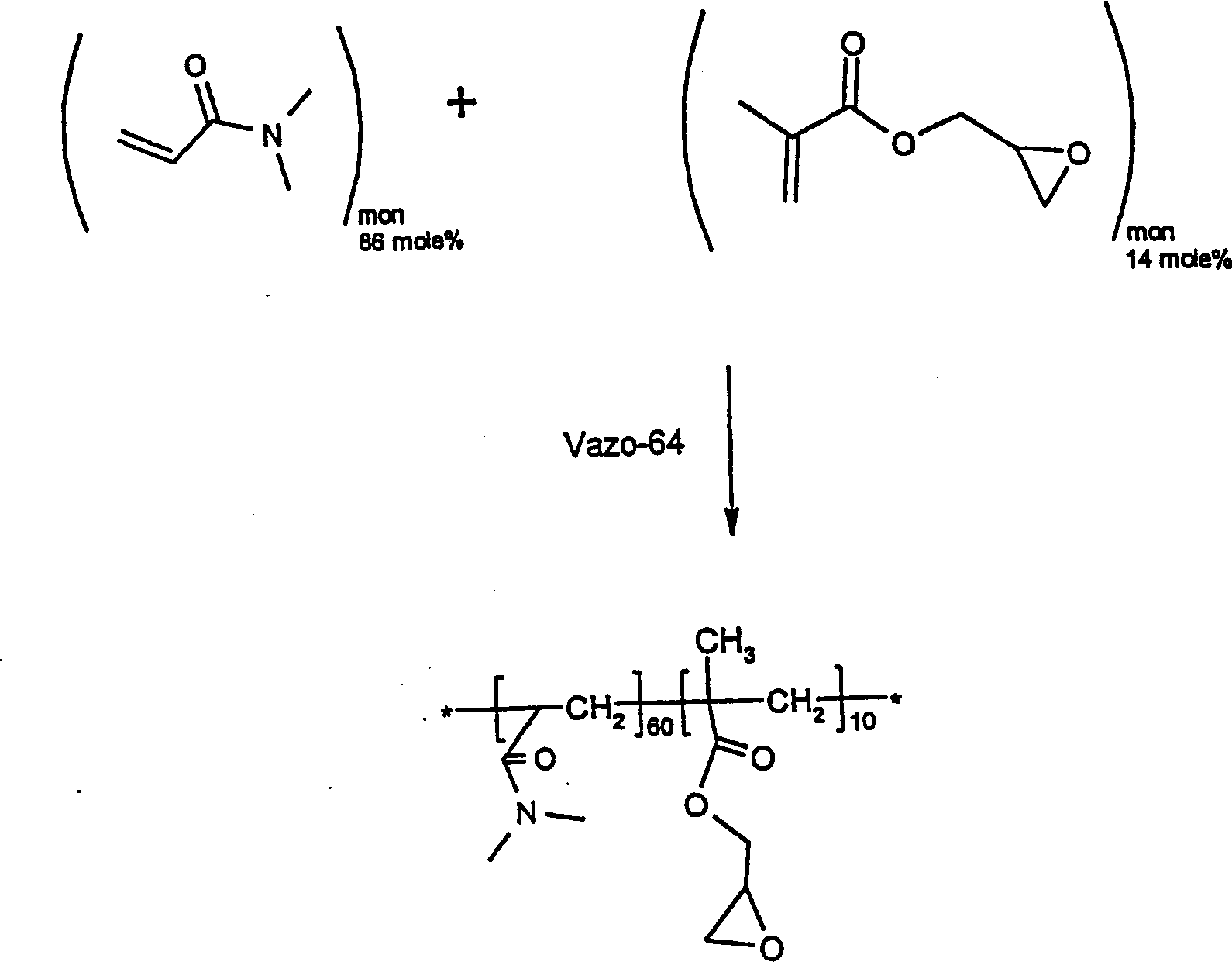
向1L反应烧瓶添加蒸馏N,N-二甲基丙烯酰胺(DMA,48g,0.48mol),蒸馏甲基丙烯酸缩水甘油酯(GM,12g,0.08mol),Vazo-64(AIBN,0.096g,0.0006mol)和甲苯(600ml)。反应容器装配磁力搅拌器,冷凝器,热控制器和氮气进口。将氮气鼓入溶液中达15分钟,以除去任何溶解的氧。然后在惰性氮气层下将反应烧瓶加热到60℃,并保持20小时。然后在充分的机械搅拌下,将反应混合物缓慢加入到6L乙醚中。反应性聚合物沉淀,再通过真空过滤收集。将固体在真空烘箱中在30℃下放置一整夜,以除去醚,剩下了50.1g的反应性聚合物(收率83%)。将反应性聚合物放置在保干器中储存,直到使用。To a 1 L reaction flask was added distilled N,N-dimethylacrylamide (DMA, 48 g, 0.48 mol), distilled glycidyl methacrylate (GM, 12 g, 0.08 mol), Vazo-64 (AIBN, 0.096 g, 0.0006 mol) and toluene (600ml). The reaction vessel was equipped with a magnetic stirrer, condenser, thermal controller and nitrogen inlet. Nitrogen gas was bubbled through the solution for 15 minutes to remove any dissolved oxygen. The reaction flask was then heated to 60°C under an inert nitrogen blanket and held for 20 hours. The reaction mixture was then slowly added to 6 L of diethyl ether with sufficient mechanical stirring. The reactive polymer precipitated and was collected by vacuum filtration. The solid was placed in a vacuum oven at 30° C. overnight to remove the ether, leaving 50.1 g of reactive polymer (83% yield). Store reactive polymers in a desiccator until use.
实施例11Example 11
本实施例举例说明了根据以下反应路线的DMA/OFPMA/GMA的水溶性反应性聚合物的合成:This example illustrates the synthesis of a water-soluble reactive polymer of DMA/OFPMA/GMA according to the following reaction scheme:

向500ml反应烧瓶添加蒸馏N,N-二甲基丙烯酰胺(DMA,16g,0.16mol),甲基丙烯酸1H,1H,5H-八氟戊基酯(OFPMA,1g,0.003mol,按来样使用),蒸馏甲基丙烯酸缩水甘油酯(GM,4.0g,0.028mol),Vazo-64(AIBN,0.03g,0.00018mol)和甲苯(300ml)。反应容器装配磁力搅拌器,冷凝器,热控制器和氮气进口。将氮气鼓入溶液中达15分钟,以除去任何溶解的氧。然后在惰性氮气层下将反应烧瓶加热到60℃,并保持20小时。然后在充分的机械搅拌下,将反应混合物缓慢加入到3L乙醚中。反应性聚合物沉淀,再通过真空过滤收集。将固体在真空烘箱中在30℃下放置一整夜,以除去醚,剩下了19.3g的反应性聚合物(收率92%)。将反应性聚合物放置在保干器中储存,直到使用。Add distilled N, N-dimethylacrylamide (DMA, 16g, 0.16mol) to a 500ml reaction flask, 1H, 1H, 5H-octafluoropentyl methacrylate (OFPMA, 1g, 0.003mol, use as received ), glycidyl methacrylate (GM, 4.0 g, 0.028 mol), Vazo-64 (AIBN, 0.03 g, 0.00018 mol) and toluene (300 ml) were distilled. The reaction vessel was equipped with a magnetic stirrer, condenser, thermal controller and nitrogen inlet. Nitrogen gas was bubbled through the solution for 15 minutes to remove any dissolved oxygen. The reaction flask was then heated to 60°C under an inert nitrogen blanket and held for 20 hours. The reaction mixture was then slowly added to 3L of diethyl ether with sufficient mechanical stirring. The reactive polymer precipitated and was collected by vacuum filtration. The ether was removed by placing the solid in a vacuum oven overnight at 30°C, leaving 19.3 g of reactive polymer (92% yield). Store reactive polymers in a desiccator until use.
实施例12Example 12
本实施例举例说明了根据以下反应路线的DMA/MAA的亲水反应性聚合物的合成:This example illustrates the synthesis of a hydrophilic reactive polymer of DMA/MAA according to the following reaction scheme:
向500ml反应烧瓶中添加蒸馏N,N-二甲基丙烯酰胺(DMA,16g,0.16mol),甲基丙烯酸(MAA,4g,0.05mol),Vazo-64(AIBN,0.033g,0.0002mol)和无水2-丙醇(300ml)。反应容器装配磁力搅拌器,冷凝器,热控制器和氮气进口。将氮气鼓入溶液中达15分钟,以除去任何溶解的氧。然后在惰性氮气层下将反应烧瓶加热到60℃,并保持72小时。然后在充分的机械搅拌下,将反应混合物缓慢加入到3L乙醚中。反应性聚合物沉淀,再通过真空过滤收集。将固体在真空烘箱中在30℃下放置一整夜,以除去醚,剩下了9.5g的反应性聚合物(收率48%)。将反应性聚合物放置在保干器中储存,直到使用。To a 500ml reaction flask was added distilled N,N-dimethylacrylamide (DMA, 16g, 0.16mol), methacrylic acid (MAA, 4g, 0.05mol), Vazo-64 (AIBN, 0.033g, 0.0002mol) and Anhydrous 2-propanol (300ml). The reaction vessel was equipped with a magnetic stirrer, condenser, thermal controller and nitrogen inlet. Nitrogen gas was bubbled through the solution for 15 minutes to remove any dissolved oxygen. The reaction flask was then heated to 60°C under an inert nitrogen blanket and held for 72 hours. The reaction mixture was then slowly added to 3L of diethyl ether with sufficient mechanical stirring. The reactive polymer precipitated and was collected by vacuum filtration. The ether was removed by placing the solid in a vacuum oven overnight at 30°C, leaving 9.5 g of reactive polymer (48% yield). Store reactive polymers in a desiccator until use.
实施例13Example 13
本实施例举例说明了由实施例1的材料制备的Balafilcon A接触透镜的表面处理(PureVision透镜,从Bausch&Lomb,Inc.,Rochester,NY商购),该表面处理使用由以上实施例10制备的亲水反应性聚合物,根据以下反应路线进行:This example illustrates the surface treatment of a Balafilcon A contact lens (PureVision® lens, commercially available from Bausch & Lomb, Inc., Rochester, NY) prepared from the material of Example 1 using the Hydrophilic reactive polymers, proceed according to the following reaction scheme:
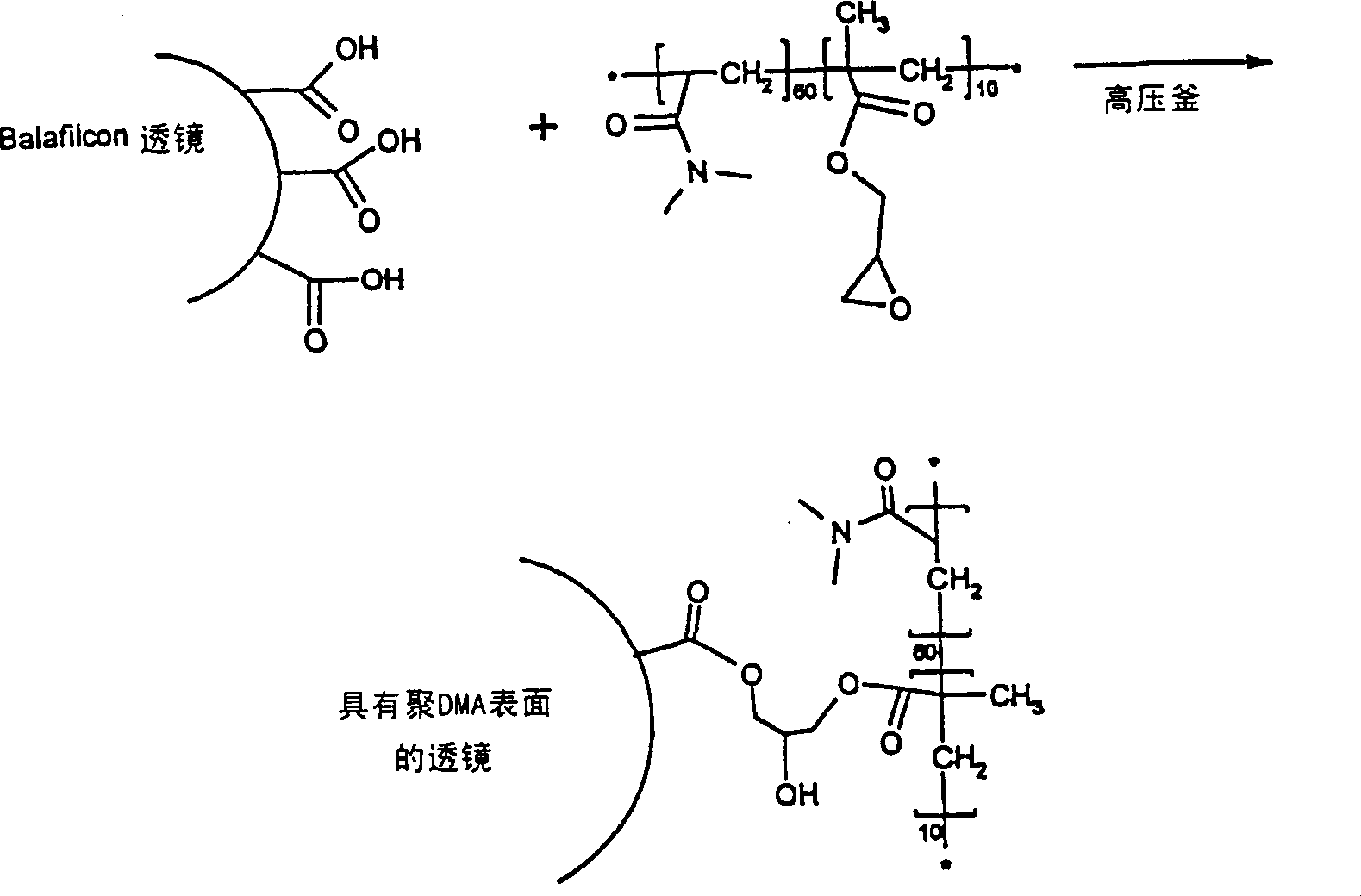
制备实施例10的反应性聚合物的溶液(10.0g/1000ml水)。透镜用三种不同的2-丙醇在4小时的期间内萃取,然后在1小时的间隔下用三种不同的水萃取。然后将透镜(36件样品)放入反应性聚合物的溶液中。加入1滴甲基二乙醇胺以催化反应。透镜进行一次30分钟的高压釜循环。A solution (10.0 g/1000 ml water) of the reactive polymer of Example 10 was prepared. Lenses were extracted with three different 2-propanols over a period of 4 hours, followed by three different waters at 1 hour intervals. The lenses (36 samples) were then placed in the solution of the reactive polymer. Add 1 drop of methyldiethanolamine to catalyze the reaction. The lenses were subjected to one 30 minute autoclave cycle.
实施例14Example 14
该实施例举例说明了如以下所示的根据本发明的RGP透镜表面的表面处理。该材料是从Bausch&Lomb,Inc.购得的BostonXO(hexafocon A)透镜。This example illustrates the surface treatment of the RGP lens surface according to the present invention as shown below. The material is a Boston(R) XO (hexafocon A) lens available from Bausch & Lomb, Inc.

工序:在本实施例14中使用的反应性聚合物是二甲基丙烯酰胺/甲基丙烯酸缩水甘油酯[DMA-co-GMA,其中x=68mol%和y=32mol%]和基材是Boston XO硬质透气材料。在以上图I中给出了反应程序。如下制备两种聚合物溶液;溶液A通过将3g反应性聚合物和1.3g的甲基二乙醇胺与65ml的净化水合并来制备。溶液B通过将1.6g反应性聚合物和1.3g甲基二乙醇胺与65ml净化水合并来制备。RGP透镜首先用Boston Advance清洗,然后放入5ml聚合物溶液中。一半样品静置过夜,另一半在55℃的烘箱中放置1小时。所有处理样品用HPLC级水冲洗2次,再干燥。Procedure: The reactive polymer used in this Example 14 was Dimethacrylamide/Glycidyl Methacrylate [DMA-co-GMA, where x=68mol% and y=32mol%] and the substrate was Boston XO® rigid breathable material. The reaction procedure is given in Figure I above. Two polymer solutions were prepared as follows; solution A was prepared by combining 3 g of reactive polymer and 1.3 g of methyldiethanolamine with 65 ml of purified water. Solution B was prepared by combining 1.6 g of reactive polymer and 1.3 g of methyldiethanolamine with 65 ml of purified water. RGP lenses were first cleaned with Boston Advance(R) and then placed in 5 ml of polymer solution. Half of the samples were left overnight and the other half were placed in an oven at 55°C for 1 hour. All processed samples were rinsed twice with HPLC grade water and dried.
Physical Electronics[PHI]Model 5600 XPS用于表面表征。该仪器利用在300瓦、15kV和20毫安下操作的单色A1阳极。仪器的基础压力是2.0×10⁻¹⁰托,在操作过程中的压力是5.0×10⁻⁸托。该仪器利用半球形分析仪。该仪器具有PHI 8503A版4.0A软件的Apollo工作站。在45°的取样角度下的该仪器的取样深度的实际测量结果是74。A Physical Electronics [PHI] Model 5600 XPS was used for surface characterization. The instrument utilizes a monochromatic Al anode operating at 300 watts, 15 kV, and 20 mA. The base pressure of the instrument is 2.0×10 -10 Torr, and the pressure during operation is 5.0×10 -8 Torr. The instrument utilizes a hemispherical analyzer. The instrument has an Apollo workstation with PHI 8503A version 4.0A software. The actual measurement of the sampling depth of the instrument at a sampling angle of 45° was 74 Å.
各样品利用低精度测量光谱(0-1100eV)来分析,以确定存在于样品表面上的元素(10-100)。由在低精度测量扫描仪中检测的元素获得的高精度光谱测定表面元素组成。那些元素包括氧、氮、碳、硅和氟。元素组成的量化通过对用仪器传输功能敏化之后的区域的光电子峰面积和所研究的轨道的原子截面的积分来完成。在以下表3中给出了涂层透镜和对照物的XPS数据。这些数据表明透镜用含氮聚合物涂布。氮水平从0.1(=0)增加到>5.5%,而氟和硅水平下降。氟比例计算如下:[F]对照-[F]试验÷[F]对照。该值表示被涂层聚合物覆盖的氟量,其中1=100%覆盖。硅比例以相同的方式计算[Si]对照-[Si]试验÷[Si]对照。因此这些数据进一步表明,基材几乎完全被涂层聚合物覆盖。Each sample was analyzed using low precision measurement spectroscopy (0-1100 eV) to determine the elements present on the sample surface (10-100 Å). High-precision spectroscopic determination of surface elemental composition obtained from elements detected in low-precision measurement scanners. Those elements include oxygen, nitrogen, carbon, silicon and fluorine. Quantification of the elemental composition was done by integrating the photoelectron peak area of the region after sensitization with the instrumental transport function and the atomic cross section of the investigated orbital. The XPS data for the coated lenses and controls are given in Table 3 below. These data indicate that the lenses are coated with nitrogen-containing polymers. Nitrogen levels increased from 0.1 (=0) to >5.5%, while fluorine and silicon levels decreased. The fluorine ratio was calculated as follows: [F] Control - [F] Test ÷ [F] Control . This value represents the amount of fluorine covered by the coating polymer, where 1 = 100% coverage. The silicon ratio is calculated in the same way as [Si] control - [Si] test ÷ [Si] control . These data thus further indicate that the substrate is almost completely covered by the coating polymer.
表3 table 3
实施例IV的涂层RGP透镜的XPS数据
实施例15Example 15
本实施例举例说明了根据以下反应顺序的BostonXO接触透镜材料(购自Bausch&Lomb,Inc.)的另一表面处理:This example illustrates an alternative surface treatment of Boston® XO contact lens material (available from Bausch & Lomb, Inc.) according to the following reaction sequence:
表4 Table 4
实施例15的Boston XO透镜的室温涂层的XPS数据
实施例16Example 16
用于本实验的基材是Boston XO透镜。在以上实施例15中给出了反应路线。制备反应性聚合物的两种溶液。第一种是DMA86mol%-co-GMAl4mol%(3g/60ml的水)的溶液。第二种溶液通过将DMA76mol%-co-MAA24mol%(3g/60ml水)和甲基二乙醇胺(2.5g/60ml水)混合来制备。将两种溶液通入Millipore 5微米型LS膜滤器,然后合并,获得了5wt%聚合物的混合溶液。Boston XO透镜然后放入5ml反应性聚合物混合物中,再静置4、8和16小时。透镜然后用净化水冲洗2次,再进行XPS和TOF-SIMS分析。The substrates used in this experiment were Boston XO(R) lenses. The reaction scheme is given in Example 15 above. Two solutions of the reactive polymer were prepared. The first is a solution of DMA 86mol% -co-GMAl4mol % (3g/60ml of water). A second solution was prepared by mixing DMA 76mol% -co-MAA 24mol% (3g/60ml water) and methyldiethanolamine (2.5g/60ml water). The two solutions were passed through a Millipore 5 micron type LS membrane filter, and then combined to obtain a mixed solution of 5 wt% polymer. Boston XO(R) lenses were then placed in 5 ml of the reactive polymer mixture and allowed to stand for an additional 4, 8 and 16 hours. The lenses were then rinsed twice with purified water before XPS and TOF-SIMS analysis.

以下给出了XPS数据。显然,透镜被含氮聚合物涂层覆盖,即使在用净化水摩擦样品之后。氟比例如下计算:[F]对照-[F]试验÷[F]对照。该值表示被涂层聚合物覆盖的氟量,其中1=100%覆盖。The XPS data are given below. Apparently, the lens was covered by the nitrogen-containing polymer coating, even after rubbing the sample with purified water. The fluorine ratio was calculated as follows: [F] Control - [F] Test ÷ [F] Control . This value represents the amount of fluorine covered by the coating polymer, where 1 = 100% coverage.
表5 table 5
实施例VI的Boston XO透镜的的室温涂层的XPS数据
实施例18Example 18
工序:Process:
制备反应性聚合物N,N-二甲基丙烯酰胺/甲基丙烯酸缩水甘油酯(0.4g/20ml HPLC水)和8滴三乙醇胺的溶液。抛光的钮扣状物用非接触原子力显微镜法成象,然后通过用HPLC级水擦拭来清洗。然后将基材放入密封透镜外壳中的4-5ml反应性聚合物溶液中,再加热到55℃,并保持1小时。处理聚合物钮扣状物然后用HPLC水冲洗两次,再干燥。放置在未处理透镜上的一滴水成珠,并从表面上滚落,而放置在处理透镜上的一滴水完全展开,润湿了透镜表面。A solution of the reactive polymer N,N-dimethylacrylamide/glycidyl methacrylate (0.4 g/20 ml HPLC water) and 8 drops of triethanolamine was prepared. Polished buttons were imaged by non-contact atomic force microscopy and then cleaned by wiping with HPLC grade water. The substrate was then placed in 4-5 ml of the reactive polymer solution in a sealed lens housing and heated to 55°C for 1 hour. The polymer buttons were treated and then rinsed twice with HPLC water and dried. A drop of water placed on an untreated lens beaded and rolled off the surface, while a drop of water placed on a treated lens spread out completely, wetting the lens surface.
钮扣状物然后用3-4滴BostonAdvance牌接触透镜清洗剂,即含有硅胶作为磨蚀清洗剂的无菌表面活性剂溶液清洗,随后用HPLC级水冲洗(2次)。聚合物钮扣状物干燥,再次记录AFM图象。该图象似乎与在施涂任何涂层之前拍摄的那些相同。The buttons were then washed with 3-4 drops of Boston(R) Advance brand contact lens cleaner, a sterile surfactant solution containing silica gel as the abrasive cleaner, followed by rinsing (2x) with HPLC grade water. The polymer buttons were dried and AFM images were recorded again. The images appeared to be identical to those taken before any coating was applied.
重复上述涂布工序,再记录AFM图象。该材料再次用聚合物涂布。The above coating process was repeated, and then an AFM image was recorded. The material is again coated with a polymer.
用三种新鲜RGP接触透镜材料钮扣状物重复本实施例18的工序。重复实验的表面分析是x-射线光电子光谱法(XPS)。在下表中给出了XPS数据。从以下给出的数据明显可以发现,在施涂、去除和再次施涂聚合物涂层的基材中的氮(N,来自涂层聚合物)增加,而硅(Si)和氟(F)相应下降。The procedure of Example 18 was repeated with three fresh buttons of RGP contact lens material. Surface analysis for replicate experiments was x-ray photoelectron spectroscopy (XPS). The XPS data are given in the table below. From the data presented below it is evident that nitrogen (N, from the coating polymer) increases in substrates where polymer coatings are applied, removed and reapplied, while silicon (Si) and fluorine (F) Corresponding decline.
表6Table 6
实施例18的XPS结果
图7是实施例18的RGP接触透镜材料钮扣状物在表面处理之前的原子力显微镜检查(AFM)地形图象(50μm2)。7 is an atomic force microscopy (AFM) topographic image (50 μm 2 ) of the RGP contact lens material button of Example 18 prior to surface treatment.
图8是在实施例18中第一次亲水聚合物涂布步骤之后的RGP钮扣状物的表面的原子力显微镜检查(AFM)地形图象(50μm2)。FIG. 8 is an atomic force microscopy (AFM) topographic image (50 μm 2 ) of the surface of the RGP button after the first hydrophilic polymer coating step in Example 18. FIG.
图9是在实施例18中磨去聚合物涂层之后的RGP钮扣状物的表面的原子力显微镜检查(AFM)地形图象(50μm2)。FIG. 9 is an atomic force microscopy (AFM) topographic image (50 μm 2 ) of the surface of an RGP button after abrasion of the polymer coating in Example 18. FIG.
图10是在实施例18中重新施涂亲水聚合物表面之后的RGP钮扣状物的表面的原子力显微镜检查(AFM)地形图象(50μm2)。FIG. 10 is an atomic force microscopy (AFM) topographic image (50 μm 2 ) of the surface of the RGP button after recoating the hydrophilic polymer surface in Example 18. FIG.
实施例19Example 19
本实施例举例说明了用于合成反应性聚合物的单体12-甲基丙烯酰氧基十二烷酸的合成。参考信息能够在Regen的标题为“SyntheticPhosphatidyl Cholines Useful in Forming Liposomes”的U.S.专利4,485,045中发现。This example illustrates the synthesis of the monomer 12-methacryloxydodecanoic acid for the synthesis of reactive polymers. References can be found in Regen's U.S. Patent 4,485,045 entitled "Synthetic Phosphatidyl Cholines Useful in Forming Liposomes."

向2L反应烧瓶添加12-羟基十二烷酸(99.5g,0.46mol),无水吡啶(56ml)和无水四氢呋喃(1,000ml)。混合物在冰浴中冷却到0℃。在充分搅拌下,将蒸馏甲基丙烯酰氯(48g,0.046mol)在无水四氢呋喃(200ml)中的溶液缓慢加入到冷反应混合物中。在添加之后,使反应混合物达到室温,再搅拌一整夜。通过闪蒸除去溶剂,再将残留物溶解在1L乙醚中。醚溶液用净化水洗涤,用硫酸镁干燥和再次闪蒸,留下了98.5g的粗产物。粗产物通过硅胶色谱法使用乙酸乙酯和庚烷的1∶2混合物进一步纯化,获得了63%收率。To a 2L reaction flask was added 12-hydroxydodecanoic acid (99.5 g, 0.46 mol), anhydrous pyridine (56 ml) and anhydrous tetrahydrofuran (1,000 ml). The mixture was cooled to 0°C in an ice bath. A solution of distilled methacryloyl chloride (48 g, 0.046 mol) in anhydrous tetrahydrofuran (200 ml) was slowly added to the cold reaction mixture with good stirring. After the addition, the reaction mixture was allowed to reach room temperature and stirred overnight. The solvent was removed by flash evaporation and the residue was dissolved in 1 L of ether. The ether solution was washed with purified water, dried over magnesium sulfate and flashed again to leave 98.5 g of crude product. The crude product was further purified by silica gel chromatography using a 1 :2 mixture of ethyl acetate and heptane, resulting in 63% yield.
实施例20Example 20
实施例20举例说明了N,N-二甲基丙烯酰胺/12-甲基丙烯酰氧基十二烷酸的亲水反应性聚合物合成。Example 20 illustrates the hydrophilic reactive polymer synthesis of N,N-dimethylacrylamide/12-methacryloxydodecanoic acid.
实施例21Example 21
本实施例举例说明了N,N-二甲基丙烯酰胺/甲基丙烯酸八氟戊酯/12-甲基丙烯酰氧基十二烷酸的亲水反应性聚合物的合成。This example illustrates the synthesis of a hydrophilic reactive polymer of N,N-dimethylacrylamide/octafluoropentyl methacrylate/12-methacryloxydodecanoic acid.
向500ml反应烧瓶添加蒸馏N,N-二甲基丙烯酰胺(DMA,15g,0.151mol),甲基丙烯酸1H,1H,5H-八氟戊基酯(OFPMA,0.5g,0.0016mol,按来样使用),12-甲基丙烯酰氧基十二烷酸(LMAA,4.5g,0.0158mol),Vazo-64(AIBN,0.032g,0.0002mol)和无水四氢呋喃(200ml)。反应容器装配磁力搅拌器,冷凝器,热控制器和氮气进口。将氮气鼓入溶液中达15分钟,以除去任何溶解的氧。然后在惰性氮气层下将反应烧瓶加热到60℃,并保持72小时。然后在充分的机械搅拌下,将反应混合物缓慢加入到2.5L庚烷中。反应性聚合物沉淀,再通过真空过滤收集。将固体在真空烘箱中在30℃下放置一整夜,以除去醚,剩下了18.7g的反应性聚合物(收率94%)。将反应性聚合物放置在保干器中储存,直到使用。Add distilled N,N-dimethylacrylamide (DMA, 15g, 0.151mol) to a 500ml reaction flask, 1H, 1H, 5H-octafluoropentyl methacrylate (OFPMA, 0.5g, 0.0016mol, as received ), 12-methacryloxydodecanoic acid (LMAA, 4.5 g, 0.0158 mol), Vazo-64 (AIBN, 0.032 g, 0.0002 mol) and anhydrous tetrahydrofuran (200 ml) were used. The reaction vessel was equipped with a magnetic stirrer, condenser, thermal controller and nitrogen inlet. Nitrogen gas was bubbled through the solution for 15 minutes to remove any dissolved oxygen. The reaction flask was then heated to 60°C under an inert nitrogen blanket and held for 72 hours. The reaction mixture was then slowly added to 2.5 L of heptane with sufficient mechanical stirring. The reactive polymer precipitated and was collected by vacuum filtration. The solid was placed in a vacuum oven overnight at 30°C to remove the ether, leaving 18.7 g of reactive polymer (94% yield). Store reactive polymers in a desiccator until use.
实施例22Example 22
实施例22举例说明N,N-二甲基丙烯酰胺/甲基丙烯酸月桂酯/甲基丙烯酸缩水甘油酯的亲水反应性聚合物的合成。Example 22 illustrates the synthesis of a hydrophilic reactive polymer of N,N-dimethylacrylamide/lauryl methacrylate/glycidyl methacrylate.
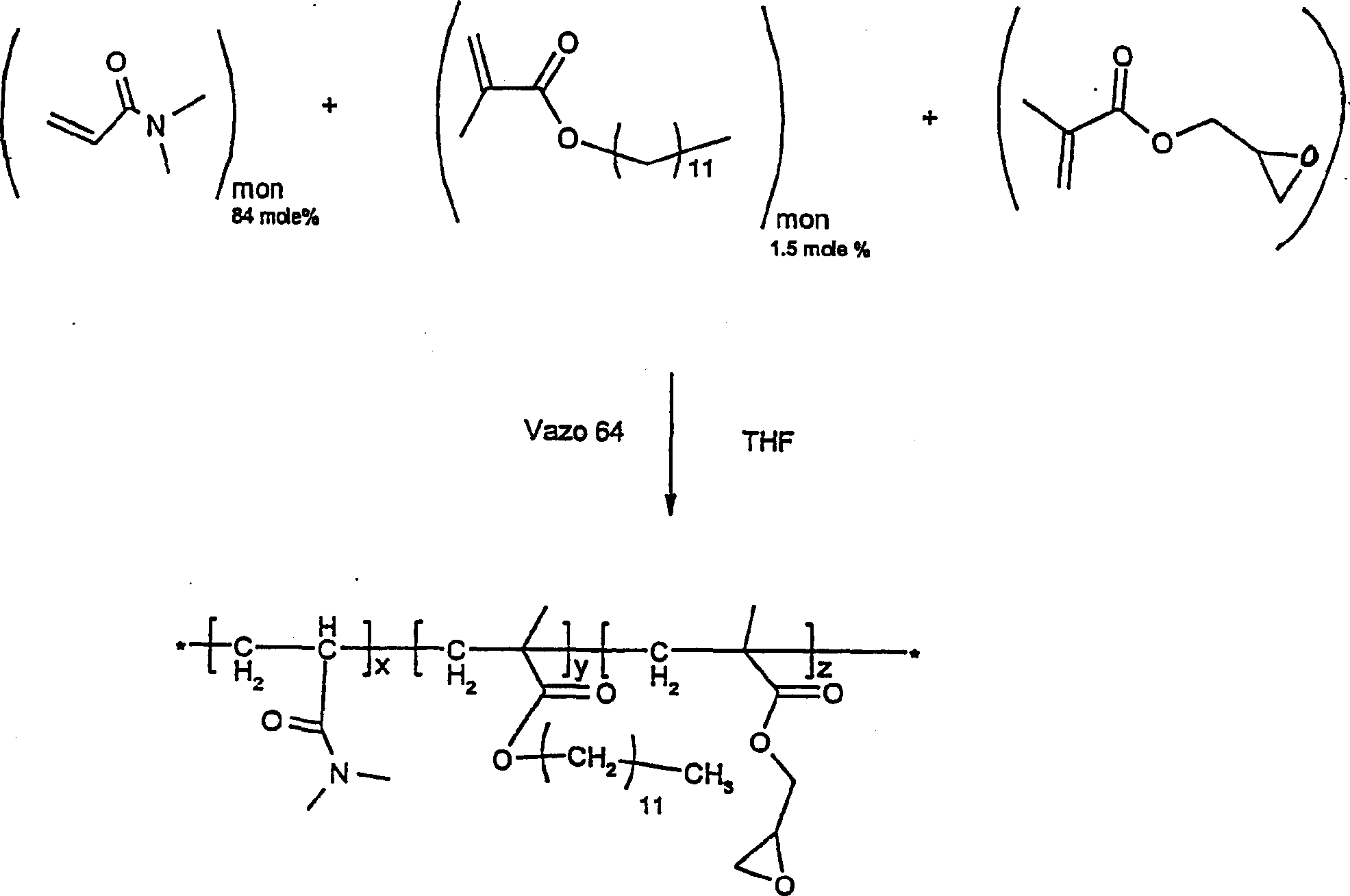
向1000ml反应烧瓶中添加蒸馏N,N-二甲基丙烯酰胺(DMA,32g,0.32mol),甲基丙烯酸月桂酯(LMA,1.5g,0.006mol,按来样使用),蒸馏甲基丙烯酸缩水甘油酯(GM,8g,0.056mol),Vazo-64(AIBN,0.06g,0.00036mol)和四氢呋喃(600ml)。反应容器装配磁力搅拌器,冷凝器,热控制器和氮气进口。将氮气鼓入溶液中达15分钟,以除去任何溶解的氧。然后在惰性氮气层下将反应烧瓶加热到60℃,并保持20小时。然后在充分的机械搅拌下,将反应混合物缓慢加入到3L乙醚中。反应性聚合物沉淀,再通过真空过滤收集。将固体在真空烘箱中在30℃下放置一整夜,以除去醚,剩下了29.2g的反应性聚合物(收率70%)。将反应性聚合物放置在保干器中储存,直到使用。Add distilled N,N-dimethylacrylamide (DMA, 32g, 0.32mol), lauryl methacrylate (LMA, 1.5g, 0.006mol, use as received) to a 1000ml reaction flask, distilled methacrylic acid shrink Glycerides (GM, 8 g, 0.056 mol), Vazo-64 (AIBN, 0.06 g, 0.00036 mol) and tetrahydrofuran (600 ml). The reaction vessel was equipped with a magnetic stirrer, condenser, thermal controller and nitrogen inlet. Nitrogen gas was bubbled through the solution for 15 minutes to remove any dissolved oxygen. The reaction flask was then heated to 60°C under an inert nitrogen blanket and held for 20 hours. The reaction mixture was then slowly added to 3L of diethyl ether with sufficient mechanical stirring. The reactive polymer precipitated and was collected by vacuum filtration. The ether was removed by placing the solid in a vacuum oven overnight at 30°C, leaving 29.2 g of reactive polymer (70% yield). Store reactive polymers in a desiccator until use.
鉴于这里的教导,本发明的许多其它修改和变化是可行的。因此应该理解的是,在权利要求书的范围内,本发明能够以与这里具体描述的不同的方式实施。Many other modifications and variations of the present invention are possible in light of the teachings herein. It is therefore to be understood that within the scope of the claims, the invention may be practiced otherwise than as specifically described herein.
Claims (19)

Applications Claiming Priority (3)
| Application Number | Priority Date | Filing Date | Title |
|---|---|---|---|
| US66535500A | 2000-09-19 | 2000-09-19 | |
| US09/665,355 | 2000-09-19 | ||
| PCT/US2001/023028 WO2002024793A1 (en) | 2000-09-19 | 2001-07-20 | Method for applying polymeric lens coating |
Publications (2)
| Publication Number | Publication Date |
|---|---|
| CN1461325A CN1461325A (en) | 2003-12-10 |
| CN1266197C true CN1266197C (en) | 2006-07-26 |
Family
ID=24669789
Family Applications (1)
| Application Number | Title | Priority Date | Filing Date |
|---|---|---|---|
| CNB01815946XA Expired - Fee Related CN1266197C (en) | 2000-09-19 | 2001-07-20 | Method for applying polymeric lens coating |
Country Status (11)
| Country | Link |
|---|---|
| US (1) | US6638563B2 (en) |
| EP (1) | EP1319037A1 (en) |
| JP (1) | JP2004512866A (en) |
| KR (1) | KR100766642B1 (en) |
| CN (1) | CN1266197C (en) |
| AU (1) | AU2001282933A1 (en) |
| BR (1) | BR0114212A (en) |
| CA (1) | CA2420861C (en) |
| MX (1) | MXPA03002322A (en) |
| TW (1) | TW552286B (en) |
| WO (1) | WO2002024793A1 (en) |
Families Citing this family (91)
| Publication number | Priority date | Publication date | Assignee | Title |
|---|---|---|---|---|
| US20030165015A1 (en) * | 2001-12-05 | 2003-09-04 | Ocular Sciences, Inc. | Coated contact lenses and methods for making same |
| AU2007247775B8 (en) * | 2001-12-14 | 2012-09-20 | Carl Zeiss Vision Australia Holdings Ltd | Methods for forming coated high index optical elements |
| US7270678B2 (en) * | 2002-06-28 | 2007-09-18 | Bausch & Lomb Incorporated | Surface modification of functional group-containing medical devices with catalyst-containing reactive polymer system |
| US7083646B2 (en) * | 2002-06-28 | 2006-08-01 | Bausch & Lomb Incorporated | Surface modification of functional group-containing intraocular lenses |
| US6958169B2 (en) * | 2002-12-17 | 2005-10-25 | Bausch & Lomb Incorporated | Surface treatment of medical device |
| US20050065438A1 (en) * | 2003-09-08 | 2005-03-24 | Miller Landon C.G. | System and method of capturing and managing information during a medical diagnostic imaging procedure |
| US7722808B2 (en) | 2003-09-12 | 2010-05-25 | Novartis Ag | Method and kits for sterilizing and storing soft contact lenses |
| US20060068224A1 (en) * | 2004-09-30 | 2006-03-30 | George Grobe | Coated biomedical device and associated method |
| US9297928B2 (en) | 2004-11-22 | 2016-03-29 | Johnson & Johnson Vision Care, Inc. | Ophthalmic compositions comprising polyether substituted polymers |
| EP1864181B1 (en) * | 2005-03-01 | 2016-08-03 | Carl Zeiss Vision Australia Holdings Ltd. | Coatings for ophthalmic lens elements |
| AU2012200550B2 (en) * | 2005-03-01 | 2013-09-19 | Carl Zeiss Vision Australia Holdings Limited | Coatings for ophthalmic lens elements |
| US20060260956A1 (en) * | 2005-05-23 | 2006-11-23 | Bausch & Lomb Incorporated | Methods for preventing or reducing interaction between packaging materials and polymeric articles contained therein |
| US7163446B1 (en) | 2005-06-20 | 2007-01-16 | John Ray Cole | Vehicle headlight restoration |
| WO2007106238A1 (en) | 2006-03-02 | 2007-09-20 | Exxonmobil Chemical Patents Inc. | Process for producing propylene copolymers |
| US20070264509A1 (en) * | 2006-05-11 | 2007-11-15 | Yu-Chin Lai | Copolymer and Medical Device with the Copolymer |
| US7625598B2 (en) * | 2006-12-15 | 2009-12-01 | Bausch & Lomb Incorporated | Silicone contact lenses with wrinkled surface |
| US20080143955A1 (en) * | 2006-12-15 | 2008-06-19 | Bausch & Lomb Incorporated | Silicone Contact Lenses with Silicate Coating |
| US8147897B2 (en) * | 2007-02-09 | 2012-04-03 | Novartis Ag | Cross-linkable polyionic coatings for medical devices |
| US20080206481A1 (en) * | 2007-02-26 | 2008-08-28 | Bausch & Lomb Incorporated | Silicone contact lenses with wrinkled surface |
| JP5840823B2 (en) * | 2007-03-30 | 2016-01-06 | 株式会社朝日ラバー | Lens and lighting apparatus having the same |
| US20080259617A1 (en) * | 2007-04-19 | 2008-10-23 | Wayne M. Torcivia | Transportation system and method or methods for the restoration,re-manufacturing and re-conditioning or any combination thereof,of a vehicle headlight fixture or headlight fixture lens or any combination thereof |
| KR100883415B1 (en) * | 2007-07-04 | 2009-02-11 | 조광페인트주식회사 | Antifogging paint composition and thermosetting acrylic polymer used therefor |
| EP2220134A2 (en) * | 2007-12-14 | 2010-08-25 | Bausch & Lomb Incorporated | Biomedical devices |
| WO2009079223A1 (en) | 2007-12-14 | 2009-06-25 | Bausch & Lomb Incorporated | Surface modified biomedical devices |
| US8226603B2 (en) | 2008-09-25 | 2012-07-24 | Abbott Cardiovascular Systems Inc. | Expandable member having a covering formed of a fibrous matrix for intraluminal drug delivery |
| US8049061B2 (en) | 2008-09-25 | 2011-11-01 | Abbott Cardiovascular Systems, Inc. | Expandable member formed of a fibrous matrix having hydrogel polymer for intraluminal drug delivery |
| US8076529B2 (en) | 2008-09-26 | 2011-12-13 | Abbott Cardiovascular Systems, Inc. | Expandable member formed of a fibrous matrix for intraluminal drug delivery |
| US8163358B2 (en) * | 2009-02-18 | 2012-04-24 | Synergeyes, Inc. | Surface modification of contact lenses |
| WO2011119536A1 (en) | 2010-03-22 | 2011-09-29 | Abbott Cardiovascular Systems Inc. | Stent delivery system having a fibrous matrix covering with improved stent retention |
| TWI875491B (en) | 2010-07-30 | 2025-03-01 | 瑞士商愛爾康公司 | Hydrated contact lens |
| SG194955A1 (en) * | 2011-06-09 | 2013-12-30 | Novartis Ag | Silicone hydrogel lenses with nano-textured surfaces |
| CA2851668C (en) | 2011-10-12 | 2016-08-16 | Novartis Ag | Method for making uv-absorbing ophthalmic lenses by coating |
| US8798332B2 (en) | 2012-05-15 | 2014-08-05 | Google Inc. | Contact lenses |
| US9523865B2 (en) | 2012-07-26 | 2016-12-20 | Verily Life Sciences Llc | Contact lenses with hybrid power sources |
| US9158133B1 (en) | 2012-07-26 | 2015-10-13 | Google Inc. | Contact lens employing optical signals for power and/or communication |
| US9298020B1 (en) | 2012-07-26 | 2016-03-29 | Verily Life Sciences Llc | Input system |
| US8857981B2 (en) | 2012-07-26 | 2014-10-14 | Google Inc. | Facilitation of contact lenses with capacitive sensors |
| US8919953B1 (en) | 2012-08-02 | 2014-12-30 | Google Inc. | Actuatable contact lenses |
| US9696564B1 (en) | 2012-08-21 | 2017-07-04 | Verily Life Sciences Llc | Contact lens with metal portion and polymer layer having indentations |
| US9111473B1 (en) | 2012-08-24 | 2015-08-18 | Google Inc. | Input system |
| US9395468B2 (en) | 2012-08-27 | 2016-07-19 | Ocular Dynamics, Llc | Contact lens with a hydrophilic layer |
| US8820934B1 (en) | 2012-09-05 | 2014-09-02 | Google Inc. | Passive surface acoustic wave communication |
| US20140192315A1 (en) | 2012-09-07 | 2014-07-10 | Google Inc. | In-situ tear sample collection and testing using a contact lens |
| US9398868B1 (en) | 2012-09-11 | 2016-07-26 | Verily Life Sciences Llc | Cancellation of a baseline current signal via current subtraction within a linear relaxation oscillator-based current-to-frequency converter circuit |
| US10010270B2 (en) | 2012-09-17 | 2018-07-03 | Verily Life Sciences Llc | Sensing system |
| US9326710B1 (en) | 2012-09-20 | 2016-05-03 | Verily Life Sciences Llc | Contact lenses having sensors with adjustable sensitivity |
| US8960898B1 (en) | 2012-09-24 | 2015-02-24 | Google Inc. | Contact lens that restricts incoming light to the eye |
| US8870370B1 (en) | 2012-09-24 | 2014-10-28 | Google Inc. | Contact lens that facilitates antenna communication via sensor impedance modulation |
| US8989834B2 (en) | 2012-09-25 | 2015-03-24 | Google Inc. | Wearable device |
| US8979271B2 (en) | 2012-09-25 | 2015-03-17 | Google Inc. | Facilitation of temperature compensation for contact lens sensors and temperature sensing |
| US20140088372A1 (en) | 2012-09-25 | 2014-03-27 | Google Inc. | Information processing method |
| US9884180B1 (en) | 2012-09-26 | 2018-02-06 | Verily Life Sciences Llc | Power transducer for a retinal implant using a contact lens |
| US8821811B2 (en) | 2012-09-26 | 2014-09-02 | Google Inc. | In-vitro contact lens testing |
| US8985763B1 (en) | 2012-09-26 | 2015-03-24 | Google Inc. | Contact lens having an uneven embedded substrate and method of manufacture |
| US8960899B2 (en) | 2012-09-26 | 2015-02-24 | Google Inc. | Assembling thin silicon chips on a contact lens |
| US9063351B1 (en) | 2012-09-28 | 2015-06-23 | Google Inc. | Input detection system |
| US8965478B2 (en) | 2012-10-12 | 2015-02-24 | Google Inc. | Microelectrodes in an ophthalmic electrochemical sensor |
| US9176332B1 (en) | 2012-10-24 | 2015-11-03 | Google Inc. | Contact lens and method of manufacture to improve sensor sensitivity |
| US9757056B1 (en) | 2012-10-26 | 2017-09-12 | Verily Life Sciences Llc | Over-molding of sensor apparatus in eye-mountable device |
| CN104871036B (en) | 2012-12-17 | 2019-12-10 | 诺华股份有限公司 | Method for making improved UV-absorbing ophthalmic lenses |
| US9498035B2 (en) | 2012-12-21 | 2016-11-22 | Coopervision International Holding Company, Lp | Silicone hydrogel contact lenses for sustained release of beneficial polymers |
| US8874182B2 (en) | 2013-01-15 | 2014-10-28 | Google Inc. | Encapsulated electronics |
| US9289954B2 (en) | 2013-01-17 | 2016-03-22 | Verily Life Sciences Llc | Method of ring-shaped structure placement in an eye-mountable device |
| US9636016B1 (en) | 2013-01-25 | 2017-05-02 | Verily Life Sciences Llc | Eye-mountable devices and methods for accurately placing a flexible ring containing electronics in eye-mountable devices |
| US20140209481A1 (en) | 2013-01-25 | 2014-07-31 | Google Inc. | Standby Biasing Of Electrochemical Sensor To Reduce Sensor Stabilization Time During Measurement |
| US9161712B2 (en) | 2013-03-26 | 2015-10-20 | Google Inc. | Systems and methods for encapsulating electronics in a mountable device |
| US9113829B2 (en) | 2013-03-27 | 2015-08-25 | Google Inc. | Systems and methods for encapsulating electronics in a mountable device |
| US20140371560A1 (en) | 2013-06-14 | 2014-12-18 | Google Inc. | Body-Mountable Devices and Methods for Embedding a Structure in a Body-Mountable Device |
| US9084561B2 (en) | 2013-06-17 | 2015-07-21 | Google Inc. | Symmetrically arranged sensor electrodes in an ophthalmic electrochemical sensor |
| US9948895B1 (en) | 2013-06-18 | 2018-04-17 | Verily Life Sciences Llc | Fully integrated pinhole camera for eye-mountable imaging system |
| US9685689B1 (en) | 2013-06-27 | 2017-06-20 | Verily Life Sciences Llc | Fabrication methods for bio-compatible devices |
| US9307901B1 (en) | 2013-06-28 | 2016-04-12 | Verily Life Sciences Llc | Methods for leaving a channel in a polymer layer using a cross-linked polymer plug |
| US9814387B2 (en) | 2013-06-28 | 2017-11-14 | Verily Life Sciences, LLC | Device identification |
| US9028772B2 (en) | 2013-06-28 | 2015-05-12 | Google Inc. | Methods for forming a channel through a polymer layer using one or more photoresist layers |
| US9492118B1 (en) | 2013-06-28 | 2016-11-15 | Life Sciences Llc | Pre-treatment process for electrochemical amperometric sensor |
| TWI654440B (en) | 2013-11-15 | 2019-03-21 | 美商實體科學公司 | Contact lens with hydrophilic layer |
| MY180543A (en) | 2013-12-17 | 2020-12-01 | Novartis Ag | A silicone hydrogel lens with a crosslinked hydrophilic coating |
| US9654674B1 (en) | 2013-12-20 | 2017-05-16 | Verily Life Sciences Llc | Image sensor with a plurality of light channels |
| US9572522B2 (en) | 2013-12-20 | 2017-02-21 | Verily Life Sciences Llc | Tear fluid conductivity sensor |
| US9366570B1 (en) | 2014-03-10 | 2016-06-14 | Verily Life Sciences Llc | Photodiode operable in photoconductive mode and photovoltaic mode |
| US9184698B1 (en) | 2014-03-11 | 2015-11-10 | Google Inc. | Reference frequency from ambient light signal |
| US9789655B1 (en) | 2014-03-14 | 2017-10-17 | Verily Life Sciences Llc | Methods for mold release of body-mountable devices including microelectronics |
| FR3023381B1 (en) * | 2014-07-03 | 2016-08-12 | Essilor Int | OPHTHALMIC LENS HAVING ANTIFOULING PROPERTIES DIFFERENTIATED ON ITS TWO FACES AND METHODS OF MANUFACTURE |
| CN106715101B (en) | 2014-08-26 | 2019-11-05 | 诺华股份有限公司 | Method for applying a stable coating on a silicone hydrogel contact lens |
| CN107206119B (en) | 2014-12-09 | 2021-01-29 | 实体科学公司 | Medical device coating with biocompatible layer |
| CN108369291B (en) | 2015-12-15 | 2021-07-20 | 爱尔康公司 | Method for applying a stable coating to a silicone hydrogel contact lens |
| JP6939548B2 (en) * | 2016-03-31 | 2021-09-22 | 東レ株式会社 | Copolymers, wetting agents, medical devices and methods for their manufacture |
| HUE057348T2 (en) | 2017-12-13 | 2022-05-28 | Alcon Inc | Method for producing mps-compatible water gradient contact lenses |
| JP7541543B2 (en) * | 2021-04-16 | 2024-08-28 | ペガヴィジョン コーポレーション | Contact lenses and their manufacturing method |
| CN117816510B (en) * | 2022-09-27 | 2025-09-30 | 蔚来汽车科技(安徽)有限公司 | Repair method and treatment device for hydrophilic film layer of shooting device |
| CN115975479B (en) * | 2023-01-06 | 2023-06-27 | 东北石油大学 | A kind of method that utilizes phase separation method to prepare durable underwater superoleophobic coating |
Family Cites Families (60)
| Publication number | Priority date | Publication date | Assignee | Title |
|---|---|---|---|---|
| NL137711C (en) | 1961-12-27 | |||
| NL128305C (en) | 1963-09-11 | |||
| US4197266A (en) | 1974-05-06 | 1980-04-08 | Bausch & Lomb Incorporated | Method for forming optical lenses |
| US4113224A (en) | 1975-04-08 | 1978-09-12 | Bausch & Lomb Incorporated | Apparatus for forming optical lenses |
| US4136250A (en) | 1977-07-20 | 1979-01-23 | Ciba-Geigy Corporation | Polysiloxane hydrogels |
| US4153641A (en) | 1977-07-25 | 1979-05-08 | Bausch & Lomb Incorporated | Polysiloxane composition and contact lens |
| US4152508A (en) | 1978-02-15 | 1979-05-01 | Polymer Technology Corporation | Silicone-containing hard contact lens material |
| US4330383A (en) | 1978-07-18 | 1982-05-18 | Polymer Technology Corporation | Dimensionally stable oxygen permeable hard contact lens material and method of manufacture |
| US4826889A (en) | 1978-07-18 | 1989-05-02 | Polymer Technology, Corp. | Dimensionally stable oxygen permeable hard contact lens material and method of manufacture |
| US4378411A (en) | 1980-01-02 | 1983-03-29 | Minnesota Mining And Manufacturing Company | Radiation-curable polymers |
| US4304705A (en) | 1980-01-02 | 1981-12-08 | Minnesota Mining And Manufacturing Company | Radiation-curable polymers containing pendant unsaturated peptide groups derived from azlactone polymers |
| US4826936A (en) | 1981-12-04 | 1989-05-02 | Polymer Technology Corp. | Silicone-containing contact lens material and contact lenses made thereof |
| US4604479A (en) | 1981-12-04 | 1986-08-05 | Polymer Technology Corporation | Silicone-containing contact lens material and contact lenses made thereof |
| US4463149A (en) | 1982-03-29 | 1984-07-31 | Polymer Technology Corporation | Silicone-containing contact lens material and contact lenses made thereof |
| US4485236A (en) | 1982-09-27 | 1984-11-27 | Minnesota Mining And Manufacturing Company | Azlactone-functional compounds |
| US4555732A (en) | 1984-03-22 | 1985-11-26 | Xerox Corporation | Image sensor correction system |
| US4695608A (en) | 1984-03-29 | 1987-09-22 | Minnesota Mining And Manufacturing Company | Continuous process for making polymers having pendant azlactone or macromolecular moieties |
| JPS60259269A (en) * | 1984-06-04 | 1985-12-21 | テルモ株式会社 | Medical device and its production |
| US4996275A (en) | 1985-10-11 | 1991-02-26 | Polymer Technology Corporation | Fluorine containing polymeric compositions useful in contact lenses |
| US4686267A (en) | 1985-10-11 | 1987-08-11 | Polymer Technology Corporation | Fluorine containing polymeric compositions useful in contact lenses |
| US4861850A (en) | 1986-02-06 | 1989-08-29 | Progressive Chemical Research, Ltd. | Ophthalamic device from fluoro-silicon polymers |
| US4740533A (en) | 1987-07-28 | 1988-04-26 | Ciba-Geigy Corporation | Wettable, flexible, oxygen permeable, substantially non-swellable contact lens containing block copolymer polysiloxane-polyoxyalkylene backbone units, and use thereof |
| US4734475A (en) | 1986-12-15 | 1988-03-29 | Ciba-Geigy Corporation | Wettable surface modified contact lens fabricated from an oxirane containing hydrophobic polymer |
| US5292840A (en) | 1987-03-13 | 1994-03-08 | Minnesota Mining And Manufacturing Company | Polymeric supports |
| US4810764A (en) * | 1988-02-09 | 1989-03-07 | Bausch & Lomb Incorporated | Polymeric materials with high oxygen permeability and low protein substantivity |
| US4910277A (en) | 1988-02-09 | 1990-03-20 | Bambury Ronald E | Hydrophilic oxygen permeable polymers |
| US4954587A (en) | 1988-07-05 | 1990-09-04 | Ciba-Geigy Corporation | Dimethylacrylamide-copolymer hydrogels with high oxygen permeability |
| US5070215A (en) | 1989-05-02 | 1991-12-03 | Bausch & Lomb Incorporated | Novel vinyl carbonate and vinyl carbamate contact lens material monomers |
| US5034461A (en) | 1989-06-07 | 1991-07-23 | Bausch & Lomb Incorporated | Novel prepolymers useful in biomedical devices |
| US5032658A (en) | 1989-10-17 | 1991-07-16 | Polymer Technology Corporation | Polymeric compositions useful in oxygen permeable contact lenses |
| US5177168A (en) | 1989-10-17 | 1993-01-05 | Polymer Technology Corp. | Polymeric compositions useful in oxygen permeable contact lenses |
| US5079319A (en) | 1989-10-25 | 1992-01-07 | Ciba-Geigy Corporation | Reactive silicone and/or fluorine containing hydrophilic prepolymers and polymers thereof |
| US5010141A (en) | 1989-10-25 | 1991-04-23 | Ciba-Geigy Corporation | Reactive silicone and/or fluorine containing hydrophilic prepolymers and polymers thereof |
| US5206298A (en) * | 1989-12-19 | 1993-04-27 | Tomei Sangyo Kabushiki Kaisha | Graft copolymer, solution containing the graft copolymer for treating contact lens, and method of treating contact lens with the solution and making hydrophilic lens surface |
| US5091489A (en) | 1990-10-23 | 1992-02-25 | Minnesota Mining And Manufacturing Company | Oligo (2-alkenyl azlactones) |
| US5081197A (en) | 1990-10-23 | 1992-01-14 | Minnesota Mining And Manufacturing Company | Oligo(2-alkenyl azlactones) |
| US5219965A (en) | 1990-11-27 | 1993-06-15 | Bausch & Lomb Incorporated | Surface modification of polymer objects |
| US5177165A (en) | 1990-11-27 | 1993-01-05 | Bausch & Lomb Incorporated | Surface-active macromonomers |
| GB9113875D0 (en) * | 1991-06-27 | 1991-08-14 | Biointeractions Ltd | Polymer coatings |
| WO1993005085A1 (en) | 1991-09-12 | 1993-03-18 | Bausch & Lomb Incorporated | Wettable silicone hydrogel compositions and methods |
| US5310779A (en) | 1991-11-05 | 1994-05-10 | Bausch & Lomb Incorporated | UV curable crosslinking agents useful in copolymerization |
| US5358995A (en) | 1992-05-15 | 1994-10-25 | Bausch & Lomb Incorporated | Surface wettable silicone hydrogels |
| US5260000A (en) | 1992-08-03 | 1993-11-09 | Bausch & Lomb Incorporated | Process for making silicone containing hydrogel lenses |
| US5336797A (en) | 1992-12-30 | 1994-08-09 | Bausch & Lomb Incorporated | Siloxane macromonomers |
| US5321108A (en) | 1993-02-12 | 1994-06-14 | Bausch & Lomb Incorporated | Fluorosilicone hydrogels |
| US5346976A (en) | 1993-03-29 | 1994-09-13 | Polymer Technology Corporation | Itaconate copolymeric compositions for contact lenses |
| US5451651A (en) | 1993-12-17 | 1995-09-19 | Bausch & Lomb Incorporated | Urea and urethane monomers for contact lens materials |
| US5760100B1 (en) | 1994-09-06 | 2000-11-14 | Ciba Vision Corp | Extended wear ophthalmic lens |
| JP3647093B2 (en) * | 1994-11-17 | 2005-05-11 | 株式会社メニコン | Hydrophilized oxygen permeable contact lens and method for producing the same |
| US5804318A (en) * | 1995-10-26 | 1998-09-08 | Corvita Corporation | Lubricious hydrogel surface modification |
| JPH09263795A (en) * | 1996-03-29 | 1997-10-07 | Tomey Technol Corp | Cleaning solution for contact lens and method for cleaning contact lens therewith |
| US5708094A (en) | 1996-12-17 | 1998-01-13 | Bausch & Lomb Incorporated | Polybutadiene-based compositions for contact lenses |
| AR009439A1 (en) * | 1996-12-23 | 2000-04-12 | Novartis Ag | AN ARTICLE THAT INCLUDES A SUBSTRATE WITH A PRIMARY POLYMERIC COATING THAT CARRIES REACTIVE GROUPS PREDOMINANTLY ON ITS SURFACE, A METHOD FOR PREPARING SUCH AN ARTICLE, AN ARTICLE THAT HAS A HYBRID-TYPE COATING AND A CONTACT LENS |
| US6020445A (en) | 1997-10-09 | 2000-02-01 | Johnson & Johnson Vision Products, Inc. | Silicone hydrogel polymers |
| US5981669A (en) | 1997-12-29 | 1999-11-09 | Bausch & Lomb Incorporated | Silicone-containing prepolymers and low water materials |
| DE69902654T2 (en) * | 1998-05-05 | 2003-04-10 | Bausch & Lomb Inc., Rochester | SURFACE TREATMENT OF SILICONE HYDROGEL CONTACT LENSES BY MEANS OF A PLASMA |
| US6099852A (en) * | 1998-09-23 | 2000-08-08 | Johnson & Johnson Vision Products, Inc. | Wettable silicone-based lenses |
| US6630243B2 (en) * | 1999-05-20 | 2003-10-07 | Bausch & Lomb Incorporated | Surface treatment of silicone hydrogel contact lenses comprising hydrophilic polymer chains attached to an intermediate carbon coating |
| US6440571B1 (en) * | 1999-05-20 | 2002-08-27 | Bausch & Lomb Incorporated | Surface treatment of silicone medical devices with reactive hydrophilic polymers |
| US6599559B1 (en) * | 2000-04-03 | 2003-07-29 | Bausch & Lomb Incorporated | Renewable surface treatment of silicone medical devices with reactive hydrophilic polymers |
-
2001
- 2001-07-20 CN CNB01815946XA patent/CN1266197C/en not_active Expired - Fee Related
- 2001-07-20 MX MXPA03002322A patent/MXPA03002322A/en active IP Right Grant
- 2001-07-20 BR BR0114212-7A patent/BR0114212A/en not_active IP Right Cessation
- 2001-07-20 AU AU2001282933A patent/AU2001282933A1/en not_active Abandoned
- 2001-07-20 EP EP01961687A patent/EP1319037A1/en not_active Withdrawn
- 2001-07-20 JP JP2002529197A patent/JP2004512866A/en active Pending
- 2001-07-20 WO PCT/US2001/023028 patent/WO2002024793A1/en not_active Ceased
- 2001-07-20 KR KR1020037003878A patent/KR100766642B1/en not_active Expired - Fee Related
- 2001-07-20 CA CA002420861A patent/CA2420861C/en not_active Expired - Fee Related
- 2001-08-02 TW TW090118905A patent/TW552286B/en not_active IP Right Cessation
-
2002
- 2002-04-22 US US10/128,172 patent/US6638563B2/en not_active Expired - Fee Related
Also Published As
| Publication number | Publication date |
|---|---|
| TW552286B (en) | 2003-09-11 |
| CN1461325A (en) | 2003-12-10 |
| MXPA03002322A (en) | 2003-06-24 |
| EP1319037A1 (en) | 2003-06-18 |
| KR20030036797A (en) | 2003-05-09 |
| CA2420861A1 (en) | 2002-03-28 |
| US20030068433A1 (en) | 2003-04-10 |
| US6638563B2 (en) | 2003-10-28 |
| KR100766642B1 (en) | 2007-10-15 |
| BR0114212A (en) | 2003-12-23 |
| CA2420861C (en) | 2007-04-24 |
| AU2001282933A1 (en) | 2002-04-02 |
| JP2004512866A (en) | 2004-04-30 |
| WO2002024793A1 (en) | 2002-03-28 |
Similar Documents
| Publication | Publication Date | Title |
|---|---|---|
| CN1266197C (en) | Method for applying polymeric lens coating | |
| CN1156713C (en) | Surface treatment of medical devices iwth reactive hydrophilic polymers | |
| CN1181121C (en) | Surface treatment of silicone hydrogel contact lenses comprising hydrophilic polymer chains attached to an intermediate carbon overlay | |
| CN1189506C (en) | Surface Treatment of Silicone Medical Devices | |
| CN1289157C (en) | Biomedical devices containing internal wetting agents | |
| CN1310986C (en) | Soft contact lenses | |
| CN1048021C (en) | Process for preparing surface-active macromonomers | |
| CN1135403C (en) | Polysiloxane-comprising perfluoroalkyl ethers, and preparation and use thereof | |
| CN1726055A (en) | Surface treatment of medical device | |
| CN1409829A (en) | Soft contact lens capable of being worn for long period | |
| CN1684723A (en) | Biomedical Devices Containing Internal Wetting Agents | |
| CN1656133A (en) | polymers with charged units | |
| CN1780883A (en) | Diluents for forming clear,wettable silicone hydrogel articles | |
| CN1186550A (en) | Polysiloxane polyhydric alcohol large molecule monomer, its manufacture and use | |
| CN101065686A (en) | Wettable hydrogels containing reactive hydrophilic polymeric internal wetting agents | |
| CN1582303A (en) | Method for polymerizing lenses | |
| HK1082926A (en) | Intraocular lenses with modified surface | |
| HK1052942B (en) | Surface treatment of silicone medical devices |
Legal Events
| Date | Code | Title | Description |
|---|---|---|---|
| C06 | Publication | ||
| PB01 | Publication | ||
| C10 | Entry into substantive examination | ||
| SE01 | Entry into force of request for substantive examination | ||
| C14 | Grant of patent or utility model | ||
| GR01 | Patent grant | ||
| C17 | Cessation of patent right | ||
| CF01 | Termination of patent right due to non-payment of annual fee |
Granted publication date: 20060726 Termination date: 20090820 |