CN116348581A - Cleaning compositions containing alginate lyase - Google Patents
Cleaning compositions containing alginate lyase Download PDFInfo
- Publication number
- CN116348581A CN116348581A CN202180070766.5A CN202180070766A CN116348581A CN 116348581 A CN116348581 A CN 116348581A CN 202180070766 A CN202180070766 A CN 202180070766A CN 116348581 A CN116348581 A CN 116348581A
- Authority
- CN
- China
- Prior art keywords
- seq
- ser
- gly
- thr
- val
- Prior art date
- Legal status (The legal status is an assumption and is not a legal conclusion. Google has not performed a legal analysis and makes no representation as to the accuracy of the status listed.)
- Pending
Links
Classifications
-
- C—CHEMISTRY; METALLURGY
- C12—BIOCHEMISTRY; BEER; SPIRITS; WINE; VINEGAR; MICROBIOLOGY; ENZYMOLOGY; MUTATION OR GENETIC ENGINEERING
- C12Y—ENZYMES
- C12Y402/00—Carbon-oxygen lyases (4.2)
- C12Y402/02—Carbon-oxygen lyases (4.2) acting on polysaccharides (4.2.2)
- C12Y402/02003—Poly(beta-D-mannuronate) lyase (4.2.2.3)
-
- C—CHEMISTRY; METALLURGY
- C11—ANIMAL OR VEGETABLE OILS, FATS, FATTY SUBSTANCES OR WAXES; FATTY ACIDS THEREFROM; DETERGENTS; CANDLES
- C11D—DETERGENT COMPOSITIONS; USE OF SINGLE SUBSTANCES AS DETERGENTS; SOAP OR SOAP-MAKING; RESIN SOAPS; RECOVERY OF GLYCEROL
- C11D1/00—Detergent compositions based essentially on surface-active compounds; Use of these compounds as a detergent
- C11D1/02—Anionic compounds
-
- C—CHEMISTRY; METALLURGY
- C11—ANIMAL OR VEGETABLE OILS, FATS, FATTY SUBSTANCES OR WAXES; FATTY ACIDS THEREFROM; DETERGENTS; CANDLES
- C11D—DETERGENT COMPOSITIONS; USE OF SINGLE SUBSTANCES AS DETERGENTS; SOAP OR SOAP-MAKING; RESIN SOAPS; RECOVERY OF GLYCEROL
- C11D1/00—Detergent compositions based essentially on surface-active compounds; Use of these compounds as a detergent
- C11D1/02—Anionic compounds
- C11D1/12—Sulfonic acids or sulfuric acid esters; Salts thereof
- C11D1/22—Sulfonic acids or sulfuric acid esters; Salts thereof derived from aromatic compounds
-
- C—CHEMISTRY; METALLURGY
- C11—ANIMAL OR VEGETABLE OILS, FATS, FATTY SUBSTANCES OR WAXES; FATTY ACIDS THEREFROM; DETERGENTS; CANDLES
- C11D—DETERGENT COMPOSITIONS; USE OF SINGLE SUBSTANCES AS DETERGENTS; SOAP OR SOAP-MAKING; RESIN SOAPS; RECOVERY OF GLYCEROL
- C11D1/00—Detergent compositions based essentially on surface-active compounds; Use of these compounds as a detergent
- C11D1/66—Non-ionic compounds
- C11D1/83—Mixtures of non-ionic with anionic compounds
-
- C—CHEMISTRY; METALLURGY
- C11—ANIMAL OR VEGETABLE OILS, FATS, FATTY SUBSTANCES OR WAXES; FATTY ACIDS THEREFROM; DETERGENTS; CANDLES
- C11D—DETERGENT COMPOSITIONS; USE OF SINGLE SUBSTANCES AS DETERGENTS; SOAP OR SOAP-MAKING; RESIN SOAPS; RECOVERY OF GLYCEROL
- C11D1/00—Detergent compositions based essentially on surface-active compounds; Use of these compounds as a detergent
- C11D1/86—Mixtures of anionic, cationic, and non-ionic compounds
-
- C—CHEMISTRY; METALLURGY
- C11—ANIMAL OR VEGETABLE OILS, FATS, FATTY SUBSTANCES OR WAXES; FATTY ACIDS THEREFROM; DETERGENTS; CANDLES
- C11D—DETERGENT COMPOSITIONS; USE OF SINGLE SUBSTANCES AS DETERGENTS; SOAP OR SOAP-MAKING; RESIN SOAPS; RECOVERY OF GLYCEROL
- C11D3/00—Other compounding ingredients of detergent compositions covered in group C11D1/00
- C11D3/0005—Other compounding ingredients characterised by their effect
- C11D3/0068—Deodorant compositions
-
- C—CHEMISTRY; METALLURGY
- C11—ANIMAL OR VEGETABLE OILS, FATS, FATTY SUBSTANCES OR WAXES; FATTY ACIDS THEREFROM; DETERGENTS; CANDLES
- C11D—DETERGENT COMPOSITIONS; USE OF SINGLE SUBSTANCES AS DETERGENTS; SOAP OR SOAP-MAKING; RESIN SOAPS; RECOVERY OF GLYCEROL
- C11D3/00—Other compounding ingredients of detergent compositions covered in group C11D1/00
- C11D3/16—Organic compounds
- C11D3/34—Organic compounds containing sulfur
- C11D3/3409—Alkyl -, alkenyl -, cycloalkyl - or terpene sulfates or sulfonates
-
- C—CHEMISTRY; METALLURGY
- C11—ANIMAL OR VEGETABLE OILS, FATS, FATTY SUBSTANCES OR WAXES; FATTY ACIDS THEREFROM; DETERGENTS; CANDLES
- C11D—DETERGENT COMPOSITIONS; USE OF SINGLE SUBSTANCES AS DETERGENTS; SOAP OR SOAP-MAKING; RESIN SOAPS; RECOVERY OF GLYCEROL
- C11D3/00—Other compounding ingredients of detergent compositions covered in group C11D1/00
- C11D3/16—Organic compounds
- C11D3/38—Products with no well-defined composition, e.g. natural products
- C11D3/386—Preparations containing enzymes, e.g. protease or amylase
- C11D3/38609—Protease or amylase in solid compositions only
-
- C—CHEMISTRY; METALLURGY
- C11—ANIMAL OR VEGETABLE OILS, FATS, FATTY SUBSTANCES OR WAXES; FATTY ACIDS THEREFROM; DETERGENTS; CANDLES
- C11D—DETERGENT COMPOSITIONS; USE OF SINGLE SUBSTANCES AS DETERGENTS; SOAP OR SOAP-MAKING; RESIN SOAPS; RECOVERY OF GLYCEROL
- C11D3/00—Other compounding ingredients of detergent compositions covered in group C11D1/00
- C11D3/16—Organic compounds
- C11D3/38—Products with no well-defined composition, e.g. natural products
- C11D3/386—Preparations containing enzymes, e.g. protease or amylase
- C11D3/38627—Preparations containing enzymes, e.g. protease or amylase containing lipase
-
- C—CHEMISTRY; METALLURGY
- C11—ANIMAL OR VEGETABLE OILS, FATS, FATTY SUBSTANCES OR WAXES; FATTY ACIDS THEREFROM; DETERGENTS; CANDLES
- C11D—DETERGENT COMPOSITIONS; USE OF SINGLE SUBSTANCES AS DETERGENTS; SOAP OR SOAP-MAKING; RESIN SOAPS; RECOVERY OF GLYCEROL
- C11D3/00—Other compounding ingredients of detergent compositions covered in group C11D1/00
- C11D3/16—Organic compounds
- C11D3/38—Products with no well-defined composition, e.g. natural products
- C11D3/386—Preparations containing enzymes, e.g. protease or amylase
- C11D3/38636—Preparations containing enzymes, e.g. protease or amylase containing enzymes other than protease, amylase, lipase, cellulase, oxidase or reductase
-
- C—CHEMISTRY; METALLURGY
- C12—BIOCHEMISTRY; BEER; SPIRITS; WINE; VINEGAR; MICROBIOLOGY; ENZYMOLOGY; MUTATION OR GENETIC ENGINEERING
- C12N—MICROORGANISMS OR ENZYMES; COMPOSITIONS THEREOF; PROPAGATING, PRESERVING, OR MAINTAINING MICROORGANISMS; MUTATION OR GENETIC ENGINEERING; CULTURE MEDIA
- C12N9/00—Enzymes; Proenzymes; Compositions thereof; Processes for preparing, activating, inhibiting, separating or purifying enzymes
- C12N9/14—Hydrolases (3)
- C12N9/16—Hydrolases (3) acting on ester bonds (3.1)
- C12N9/22—Ribonucleases [RNase]; Deoxyribonucleases [DNase]
-
- C—CHEMISTRY; METALLURGY
- C12—BIOCHEMISTRY; BEER; SPIRITS; WINE; VINEGAR; MICROBIOLOGY; ENZYMOLOGY; MUTATION OR GENETIC ENGINEERING
- C12N—MICROORGANISMS OR ENZYMES; COMPOSITIONS THEREOF; PROPAGATING, PRESERVING, OR MAINTAINING MICROORGANISMS; MUTATION OR GENETIC ENGINEERING; CULTURE MEDIA
- C12N9/00—Enzymes; Proenzymes; Compositions thereof; Processes for preparing, activating, inhibiting, separating or purifying enzymes
- C12N9/14—Hydrolases (3)
- C12N9/24—Hydrolases (3) acting on glycosyl compounds (3.2)
- C12N9/2402—Hydrolases (3) acting on glycosyl compounds (3.2) hydrolysing O- and S- glycosyl compounds (3.2.1)
-
- C—CHEMISTRY; METALLURGY
- C12—BIOCHEMISTRY; BEER; SPIRITS; WINE; VINEGAR; MICROBIOLOGY; ENZYMOLOGY; MUTATION OR GENETIC ENGINEERING
- C12N—MICROORGANISMS OR ENZYMES; COMPOSITIONS THEREOF; PROPAGATING, PRESERVING, OR MAINTAINING MICROORGANISMS; MUTATION OR GENETIC ENGINEERING; CULTURE MEDIA
- C12N9/00—Enzymes; Proenzymes; Compositions thereof; Processes for preparing, activating, inhibiting, separating or purifying enzymes
- C12N9/14—Hydrolases (3)
- C12N9/24—Hydrolases (3) acting on glycosyl compounds (3.2)
- C12N9/2402—Hydrolases (3) acting on glycosyl compounds (3.2) hydrolysing O- and S- glycosyl compounds (3.2.1)
- C12N9/2405—Glucanases
- C12N9/2408—Glucanases acting on alpha -1,4-glucosidic bonds
- C12N9/2411—Amylases
-
- C—CHEMISTRY; METALLURGY
- C12—BIOCHEMISTRY; BEER; SPIRITS; WINE; VINEGAR; MICROBIOLOGY; ENZYMOLOGY; MUTATION OR GENETIC ENGINEERING
- C12N—MICROORGANISMS OR ENZYMES; COMPOSITIONS THEREOF; PROPAGATING, PRESERVING, OR MAINTAINING MICROORGANISMS; MUTATION OR GENETIC ENGINEERING; CULTURE MEDIA
- C12N9/00—Enzymes; Proenzymes; Compositions thereof; Processes for preparing, activating, inhibiting, separating or purifying enzymes
- C12N9/14—Hydrolases (3)
- C12N9/24—Hydrolases (3) acting on glycosyl compounds (3.2)
- C12N9/2402—Hydrolases (3) acting on glycosyl compounds (3.2) hydrolysing O- and S- glycosyl compounds (3.2.1)
- C12N9/2477—Hemicellulases not provided in a preceding group
- C12N9/2488—Mannanases
- C12N9/2494—Mannan endo-1,4-beta-mannosidase (3.2.1.78), i.e. endo-beta-mannanase
-
- C—CHEMISTRY; METALLURGY
- C12—BIOCHEMISTRY; BEER; SPIRITS; WINE; VINEGAR; MICROBIOLOGY; ENZYMOLOGY; MUTATION OR GENETIC ENGINEERING
- C12N—MICROORGANISMS OR ENZYMES; COMPOSITIONS THEREOF; PROPAGATING, PRESERVING, OR MAINTAINING MICROORGANISMS; MUTATION OR GENETIC ENGINEERING; CULTURE MEDIA
- C12N9/00—Enzymes; Proenzymes; Compositions thereof; Processes for preparing, activating, inhibiting, separating or purifying enzymes
- C12N9/88—Lyases (4.)
-
- C—CHEMISTRY; METALLURGY
- C12—BIOCHEMISTRY; BEER; SPIRITS; WINE; VINEGAR; MICROBIOLOGY; ENZYMOLOGY; MUTATION OR GENETIC ENGINEERING
- C12Y—ENZYMES
- C12Y402/00—Carbon-oxygen lyases (4.2)
- C12Y402/02—Carbon-oxygen lyases (4.2) acting on polysaccharides (4.2.2)
- C12Y402/02011—Poly(alpha-L-guluronate) lyase (4.2.2.11), i.e. alginase II
-
- C—CHEMISTRY; METALLURGY
- C11—ANIMAL OR VEGETABLE OILS, FATS, FATTY SUBSTANCES OR WAXES; FATTY ACIDS THEREFROM; DETERGENTS; CANDLES
- C11D—DETERGENT COMPOSITIONS; USE OF SINGLE SUBSTANCES AS DETERGENTS; SOAP OR SOAP-MAKING; RESIN SOAPS; RECOVERY OF GLYCEROL
- C11D1/00—Detergent compositions based essentially on surface-active compounds; Use of these compounds as a detergent
- C11D1/02—Anionic compounds
- C11D1/12—Sulfonic acids or sulfuric acid esters; Salts thereof
- C11D1/14—Sulfonic acids or sulfuric acid esters; Salts thereof derived from aliphatic hydrocarbons or mono-alcohols
- C11D1/146—Sulfuric acid esters
-
- C—CHEMISTRY; METALLURGY
- C11—ANIMAL OR VEGETABLE OILS, FATS, FATTY SUBSTANCES OR WAXES; FATTY ACIDS THEREFROM; DETERGENTS; CANDLES
- C11D—DETERGENT COMPOSITIONS; USE OF SINGLE SUBSTANCES AS DETERGENTS; SOAP OR SOAP-MAKING; RESIN SOAPS; RECOVERY OF GLYCEROL
- C11D1/00—Detergent compositions based essentially on surface-active compounds; Use of these compounds as a detergent
- C11D1/02—Anionic compounds
- C11D1/12—Sulfonic acids or sulfuric acid esters; Salts thereof
- C11D1/29—Sulfates of polyoxyalkylene ethers
-
- C—CHEMISTRY; METALLURGY
- C11—ANIMAL OR VEGETABLE OILS, FATS, FATTY SUBSTANCES OR WAXES; FATTY ACIDS THEREFROM; DETERGENTS; CANDLES
- C11D—DETERGENT COMPOSITIONS; USE OF SINGLE SUBSTANCES AS DETERGENTS; SOAP OR SOAP-MAKING; RESIN SOAPS; RECOVERY OF GLYCEROL
- C11D1/00—Detergent compositions based essentially on surface-active compounds; Use of these compounds as a detergent
- C11D1/38—Cationic compounds
- C11D1/62—Quaternary ammonium compounds
-
- C—CHEMISTRY; METALLURGY
- C11—ANIMAL OR VEGETABLE OILS, FATS, FATTY SUBSTANCES OR WAXES; FATTY ACIDS THEREFROM; DETERGENTS; CANDLES
- C11D—DETERGENT COMPOSITIONS; USE OF SINGLE SUBSTANCES AS DETERGENTS; SOAP OR SOAP-MAKING; RESIN SOAPS; RECOVERY OF GLYCEROL
- C11D1/00—Detergent compositions based essentially on surface-active compounds; Use of these compounds as a detergent
- C11D1/66—Non-ionic compounds
- C11D1/72—Ethers of polyoxyalkylene glycols
-
- C—CHEMISTRY; METALLURGY
- C11—ANIMAL OR VEGETABLE OILS, FATS, FATTY SUBSTANCES OR WAXES; FATTY ACIDS THEREFROM; DETERGENTS; CANDLES
- C11D—DETERGENT COMPOSITIONS; USE OF SINGLE SUBSTANCES AS DETERGENTS; SOAP OR SOAP-MAKING; RESIN SOAPS; RECOVERY OF GLYCEROL
- C11D1/00—Detergent compositions based essentially on surface-active compounds; Use of these compounds as a detergent
- C11D1/66—Non-ionic compounds
- C11D1/75—Amino oxides
-
- C—CHEMISTRY; METALLURGY
- C11—ANIMAL OR VEGETABLE OILS, FATS, FATTY SUBSTANCES OR WAXES; FATTY ACIDS THEREFROM; DETERGENTS; CANDLES
- C11D—DETERGENT COMPOSITIONS; USE OF SINGLE SUBSTANCES AS DETERGENTS; SOAP OR SOAP-MAKING; RESIN SOAPS; RECOVERY OF GLYCEROL
- C11D2111/00—Cleaning compositions characterised by the objects to be cleaned; Cleaning compositions characterised by non-standard cleaning or washing processes
- C11D2111/10—Objects to be cleaned
- C11D2111/12—Soft surfaces, e.g. textile
-
- C—CHEMISTRY; METALLURGY
- C12—BIOCHEMISTRY; BEER; SPIRITS; WINE; VINEGAR; MICROBIOLOGY; ENZYMOLOGY; MUTATION OR GENETIC ENGINEERING
- C12Y—ENZYMES
- C12Y302/00—Hydrolases acting on glycosyl compounds, i.e. glycosylases (3.2)
- C12Y302/01—Glycosidases, i.e. enzymes hydrolysing O- and S-glycosyl compounds (3.2.1)
- C12Y302/01052—Beta-N-acetylhexosaminidase (3.2.1.52)
Landscapes
- Chemical & Material Sciences (AREA)
- Life Sciences & Earth Sciences (AREA)
- Organic Chemistry (AREA)
- Engineering & Computer Science (AREA)
- Wood Science & Technology (AREA)
- Health & Medical Sciences (AREA)
- Genetics & Genomics (AREA)
- Zoology (AREA)
- Bioinformatics & Cheminformatics (AREA)
- Chemical Kinetics & Catalysis (AREA)
- Oil, Petroleum & Natural Gas (AREA)
- General Engineering & Computer Science (AREA)
- General Health & Medical Sciences (AREA)
- Biochemistry (AREA)
- Molecular Biology (AREA)
- Medicinal Chemistry (AREA)
- Biomedical Technology (AREA)
- Biotechnology (AREA)
- Microbiology (AREA)
- Detergent Compositions (AREA)
- Enzymes And Modification Thereof (AREA)
Abstract
本发明提供了洗涤剂组合物,其包含藻酸盐裂解酶和清洁助剂。本发明还提供了通过以下方式来处理表面的方法:使表面与其中具有洗涤剂组合物的水性洗涤液体接触。所述组合物和方法尤其用于改善织物的白度,用于改善织物中的污垢去除效果,用于从织物中去除恶臭,用于抗皱有益效果、抗再沉积有益效果,和/或用于改善表面的干燥效果。The present invention provides a detergent composition comprising an alginate lyase and a cleaning aid. The present invention also provides a method of treating a surface by contacting the surface with an aqueous washing liquid having a detergent composition therein. The compositions and methods are especially useful for improving the whiteness of fabrics, for improving soil removal in fabrics, for removing malodor from fabrics, for anti-wrinkle benefits, anti-redeposition benefits, and/or for Improves the drying effect of the surface.
Description
Reference to sequence Listing
The present application encompasses sequence listings in computer-readable form. The computer readable form is incorporated herein by reference.
Technical Field
The present invention relates to laundry detergent compositions and cleaning methods comprising certain alginate lyase enzymes. One particular problem may be the accumulation of dirt over time. This is problematic for both colored and white fabrics, but may be particularly pronounced on white or light colored fabrics, such as around collars and cuffs where incomplete cleaning occurs. This can also be problematic because it can lead to malodors. The compositions and methods of the present invention are suitable for use in hand wash and automatic laundry compositions. The invention also relates to a method of washing and a method of preparing a laundry detergent composition.
Background
In cleaning applications, reduction in whiteness over time and soil or stain removal are persistent problems. There are many cleaning techniques aimed at alleviating such problems, however, providing improved efficacy (especially in an environmentally friendly manner) has been a challenge. In automatic washing machines, these problems are compounded by the increasing use of low wash temperatures (e.g., cold water) and shorter wash cycles, which reduces the stain/soil removal efficacy of the detergent composition and exacerbates the problem of redeposition of soil onto the surface during the wash process and loss of whiteness over multiple washes.
It is therefore an object of the present invention to provide a detergent composition which can be used in a washing process even at low temperatures and short washing times, which will counteract whiteness reduction and/or remove complex soils, e.g. enable removal of dirty soils, deep cleaning, removal of yellowing, especially cleaning collars and cuffs and/or improve whiteness/counteract whiteness loss, and which can be used even at low temperatures and short washing times. The present invention relates in particular to laundry detergent compositions.
Disclosure of Invention
The present invention provides a detergent composition comprising from 0.00005% to 5% by weight of an alginate lyase (active enzyme protein) and a cleaning adjunct, wherein the alginate lyase comprises an alginate lyase selected from the group consisting of at least 60%, or at least 70%, or at least 75%, or at least 80%, or at least 85%, or at least 90%, or at least 95%, or at least 96%, or at least 97%, or at least 98%, or at least 99%, or 100% sequence identity with SEQ ID No. 1; an alginate lyase having at least 60%, or at least 70%, or at least 75%, or at least 80%, or at least 85%, or at least 90%, or at least 95%, or at least 96%, or at least 97%, or at least 98%, or at least 99%, or 100% sequence identity to SEQ ID No. 2; an alginate lyase having at least 60%, or at least 70%, or at least 75%, or at least 80%, or at least 85%, or at least 90%, or at least 95%, or at least 96%, or at least 97%, or at least 98%, or at least 99%, or 100% sequence identity to SEQ ID No. 3; an alginate lyase having at least 60%, or at least 70%, or at least 75%, or at least 80%, or at least 85%, or at least 90%, or at least 95%, or at least 96%, or at least 97%, or at least 98%, or at least 99%, or 100% sequence identity to SEQ ID No. 4; an alginate lyase having at least 60%, or at least 70%, or at least 75%, or at least 80%, or at least 85%, or at least 90%, or at least 95%, or at least 96%, or at least 97%, or at least 98%, or at least 99%, or 100% sequence identity to SEQ ID No. 5; an alginate lyase having at least 60%, or at least 70%, or at least 75%, or at least 80%, or at least 85%, or at least 90%, or at least 95%, or at least 96%, or at least 97%, or at least 98%, or at least 99%, or 100% sequence identity to SEQ ID No. 6; an alginate lyase having at least 60%, or at least 70%, or at least 75%, or at least 80%, or at least 85%, or at least 90%, or at least 95%, or at least 96%, or at least 97%, or at least 98%, or at least 99%, or 100% sequence identity to SEQ ID No. 7; an alginate lyase having at least 60%, or at least 70%, or at least 75%, or at least 80%, or at least 85%, or at least 90%, or at least 95%, or at least 96%, or at least 97%, or at least 98%, or at least 99%, or 100% sequence identity with SEQ ID No. 7, or a mixture thereof.
Preferably, the cleaning adjunct comprises a surfactant, most preferably an anionic surfactant. Preferably, the alginate lyase comprises alginate lyase from polysaccharide lyase family 7.
The invention also provides a method of treating a surface comprising contacting the surface with an aqueous wash liquor comprising an alginate lyase; and a cleaning adjunct, wherein the alginate lyase is selected from alginate lyase having at least 60%, or at least 70%, or at least 75%, or at least 80%, or at least 85%, or at least 90%, or at least 95%, or at least 96%, or at least 97%, or at least 98%, or at least 99%, or 100% sequence identity with SEQ ID No. 1; an alginate lyase having at least 60%, or at least 70%, or at least 75%, or at least 80%, or at least 85%, or at least 90%, or at least 95%, or at least 96%, or at least 97%, or at least 98%, or at least 99%, or 100% sequence identity to SEQ ID No. 2; an alginate lyase having at least 60%, or at least 70%, or at least 75%, or at least 80%, or at least 85%, or at least 90%, or at least 95%, or at least 96%, or at least 97%, or at least 98%, or at least 99%, or 100% sequence identity to SEQ ID No. 3; an alginate lyase having at least 60%, or at least 70%, or at least 75%, or at least 80%, or at least 85%, or at least 90%, or at least 95%, or at least 96%, or at least 97%, or at least 98%, or at least 99%, or 100% sequence identity to SEQ ID No. 4; an alginate lyase having at least 60%, or at least 70%, or at least 75%, or at least 80%, or at least 85%, or at least 90%, or at least 95%, or at least 96%, or at least 97%, or at least 98%, or at least 99%, or 100% sequence identity to SEQ ID No. 5; an alginate lyase having at least 60%, or at least 70%, or at least 75%, or at least 80%, or at least 85%, or at least 90%, or at least 95%, or at least 96%, or at least 97%, or at least 98%, or at least 99%, or 100% sequence identity to SEQ ID No. 6; an alginate lyase having at least 60%, or at least 70%, or at least 75%, or at least 80%, or at least 85%, or at least 90%, or at least 95%, or at least 96%, or at least 97%, or at least 98%, or at least 99%, or 100% sequence identity to SEQ ID No. 7; an alginate lyase having at least 60%, or at least 70%, or at least 75%, or at least 80%, or at least 85%, or at least 90%, or at least 95%, or at least 96%, or at least 97%, or at least 98%, or at least 99%, or 100% sequence identity with SEQ ID No. 7, or a mixture thereof.
Preferably, the aqueous wash liquid comprises a surfactant, preferably an anionic surfactant. Preferably, the surfactant is present in an amount of 0.05g/l to 5g/l, preferably 0.01g/l to 3 g/l.
Preferably, the surface is contacted with the aqueous wash liquid at a temperature of 60 ℃ or less, or more preferably 40 ℃ or less or 35 ℃ or less, most preferably 30 ℃ or less or even 25 ℃ or less; and (iii) rinsing the surface. The compositions and methods herein are particularly useful for treating garments, such as synthetic or natural fabrics, including cotton, wool, silk, polyester, nylon, elastane, or hybrid fabrics, such as polyester cotton.
PA230719C
The invention also relates to the use of a composition or method as described above for: improving the whiteness of the fabric or counteracting the whiteness loss; improving the soil release of the fabric; removing dirty dirt; deep cleaning; removing or reducing yellowing; cleaning the collar and/or cuffs; reducing or eliminating malodor of the fabric; anti-wrinkle benefits on fabrics; improving the drying of the fabric; anti-redeposition benefits.
Detailed Description
Definition of the definition
Parent or parent alginate lyase: the term "parent" or "parent alginate lyase" refers to an alginate lyase that is altered to produce an enzyme variant. The parent may be a naturally occurring (wild-type) polypeptide or variant thereof. For example, the parent may be any of SEQ ID NOs 1, 2, 3, 4, 5, 6 or 7 set forth herein.
Sequence identity: the relatedness between two amino acid sequences or between two nucleotide sequences is described by the parameter "sequence identity". For the purposes of the present invention, the degree of sequence identity between two amino acid sequences is determined using the Needleman-Wunsch algorithm (Needleman and Wunsch,1970, J.mol. Biol. 48:443-453) as implemented in the Needle program of the EMBOSS package (EMBOSS: the European Molecular Biology Open Software Suite, rice et al, 2000,Trends Genet.16:276-277), preferably version 3.0.0 or more. The optional parameters used are a gap opening penalty of 10, a gap extension penalty of 0.5 and an EBLOSUM62 (BLOSUM 62 of the EMBOSS version) substitution matrix. The Needle output labeled "longest identity" (obtained using the-nobrief option) was used as percent identity and calculated as follows:
(identical residue. Times.100)/(sequence length-total number of space bits in sequence)
Alternatively, the parameters used may be a gap opening penalty of 10, a gap extension penalty of 0.5, and an EDNAFULL (NCBI NUC4.4 version of EMBOSS) substitution matrix. The Needle output labeled "longest identity" (obtained using the-nobrief option) was used as percent identity and calculated as follows:
(identical deoxyribonucleotide. Times.100)/(sequence Length-total number of space in sequence)
Variants: the term "variant" refers to a polypeptide having alginate lyase activity that comprises alterations/mutations (i.e., substitutions, insertions, and/or deletions) at one or more (e.g., several) positions relative to a parent alginate lyase. Substitution refers to the replacement of an amino acid occupying a position with another, different amino acid; deletions refer to the removal of an amino acid occupying a position; and insertion refers to the addition of 1-3 amino acids adjacent to and immediately after an amino acid occupying a certain position.
Wild-type enzyme: the term "wild-type" alginate lyase refers to alginate lyase expressed by naturally occurring microorganisms, such as bacteria, algae, yeast or filamentous fungi present in nature.
Alginate lyase
Alginate lyases include those selected from the group consisting of: an alginate lyase having at least 60%, or at least 70%, or at least 75%, or at least 80%, or at least 85%, or at least 90%, or at least 95%, or at least 96%, or at least 97%, or at least 98%, or at least 99%, or 100% sequence identity to SEQ ID No. 1; an alginate lyase having at least 60%, or at least 70%, or at least 75%, or at least 80%, or at least 85%, or at least 90%, or at least 95%, or at least 96%, or at least 97%, or at least 98%, or at least 99%, or 100% sequence identity to SEQ ID No. 2; an alginate lyase having at least 60%, or at least 70%, or at least 75%, or at least 80%, or at least 85%, or at least 90%, or at least 95%, or at least 96%, or at least 97%, or at least 98%, or at least 99%, or 100% sequence identity to SEQ ID No. 3; an alginate lyase having at least 60%, or at least 70%, or at least 75%, or at least 80%, or at least 85%, or at least 90%, or at least 95%, or at least 96%, or at least 97%, or at least 98%, or at least 99%, or 100% sequence identity to SEQ ID No. 4; an alginate lyase having at least 60%, or at least 70%, or at least 75%, or at least 80%, or at least 85%, or at least 90%, or at least 95%, or at least 96%, or at least 97%, or at least 98%, or at least 99%, or 100% sequence identity to SEQ ID No. 5; an alginate lyase having at least 60%, or at least 70%, or at least 75%, or at least 80%, or at least 85%, or at least 90%, or at least 95%, or at least 96%, or at least 97%, or at least 98%, or at least 99%, or 100% sequence identity to SEQ ID No. 6; an alginate lyase having at least 60%, or at least 70%, or at least 75%, or at least 80%, or at least 85%, or at least 90%, or at least 95%, or at least 96%, or at least 97%, or at least 98%, or at least 99%, or 100% sequence identity to SEQ ID No. 7; an alginate lyase having at least 60%, or at least 70%, or at least 75%, or at least 80%, or at least 85%, or at least 90%, or at least 95%, or at least 96%, or at least 97%, or at least 98%, or at least 99%, or 100% sequence identity with SEQ ID No. 7, or a mixture thereof.
The alginate lyase is preferably of microbial origin, preferably bacterial or algal (e.g. from brown seaweed (brown seaweed), such as ascophyta, phyllophyta, ascophyta), most preferably bacterial. The alginate lyase may be derived from Aeromonas, azobacter, bacillus, flavobacterium, klebsiella, pseudomonas, sphingomonas, vibrio, flavobacterium alhagi Zhuo Beier, most preferably Dihuang bacillus.
Preferably, the alginate lyase comprises an alginate lyase selected from the group consisting of: an alginate lyase having at least 60% or at least 70% or at least 75% or at least 80% sequence identity to SEQ ID No. 1, and/or an alginate lyase having at least 60% or at least 70% or at least 75% or at least 80% sequence identity to SEQ ID No. 5, or a mixture thereof. Preferably, the alginate lyase comprises an alginate lyase selected from the group consisting of: an alginate lyase having at least 60% or at least 70% or at least 75% or at least 80% sequence identity to SEQ ID No. 6, and/or an alginate lyase having at least 60% or at least 70% or at least 75% or at least 80% sequence identity to SEQ ID No. 7, or a mixture thereof. Thus, preferred alginate lyases include those corresponding to the wild type or preferably variants of any one of SEQ ID NOs 1, 2, 3, 4, 5, 6 or 7 as set out herein.
When the alginate lyase is a variant of a parent amino acid sequence, the parent alginate lyase having alginate lyase activity preferably has at least 50%, or at least 60%, or at least 70%, or at least 80%, such as at least 85%, at least 90%, e.g., at least 92%, at least 93%, at least 94%, at least 95%, at least 96%, at least 97%, at least 98%, at least 99%, or 100% sequence identity to the polypeptide of one or more of SEQ ID NOs 1, 2, 3, 4, 5, 6, or 7. Preferably, the variant amino acid sequence differs from the parent alginate lyase by NO more than fifteen, or NO more than ten amino acids, or from the polypeptide of one or more of SEQ ID NOs 1, 2, 3, 4, 5, 6 or 7 by NO more than five, or four or three or two or one amino acids.
When the alginate lyase is a variant of the parent amino acid sequence, the parent may be derived from a microorganism of any genus. For the purposes of the present invention, the term "obtained from" in connection with a given source will refer to the parent encoded by the polynucleotide being produced by the source or by the cell into which the polynucleotide from the source has been inserted. In one aspect, the parent is secreted extracellularly. Variants may be prepared using any mutagenesis procedure known in the art, e.g., site-directed mutagenesis, synthetic gene construction, semisynthetic gene construction, random mutagenesis, shuffling, etc.
And an anionic surfactant, preferably the alginate lyase has an activity (polyM activity) towards poly (β -D-mannuronic acid) and an activity (polyG activity) towards poly (α -L-guluronic acid). The alginate lyase may comprise a single alginate lyase to provide polyM activity and polyG activity, or may comprise two or more alginate lyases, a combination of which provides polyM activity and polyG activity. Preferably, the alginate lyase comprises an enzyme having both polyM activity and polyG activity. Preferably, the polyM activity as defined in the test section herein is at least 0.1 absorption units, preferably at least 0.15 absorption units, and most preferably at least 2 absorption units. Preferably, the polyG activity as defined herein is at least 0.3 absorption units, preferably at least 0.4 absorption units, or at least 0.5 or even at least 0.6 absorption units. PolyM activity and polyG activity can be measured according to the tests listed below.
Alginate lyase enzymes may be incorporated in the cleaning compositions and methods of the invention in the form of substantially pure enzymes. Alternatively, especially when the enzyme is a variant of a wild-type enzyme, the variant does not recover, but rather the host cell expressing the enzyme is used as a source of alginate lyase.
The alginate lyase may be in the form of a liquid or a dry composition. For example, the composition may be in the form of particles or microparticles. Alginate lyase may be stabilized by encapsulation according to methods known in the art.
The alginate lyase is preferably present in the composition in an amount of 0.00005 wt.% to 5 wt.% active enzyme protein, preferably 0.0001 wt.% to 2 wt.% active protein or 0.0005 wt.% or 0.001 wt.% to 1 wt.% active protein, or to 0.5 wt.% or to 0.1 wt.% or to 0.05 wt.% active enzyme protein.
Surface active agent
The inventors have found that the enzyme provides good soil breakdown, however the removal of substrates and the breakdown products of soil comprising these substrates is improved by the presence of the surfactant. Thus, the detergent composition preferably comprises from 1 wt% to 80 wt% of surfactant. Preferably, the weight ratio of surfactant to active alginate lyase protein is at least 500:1, preferably at least 1000:1, or at least 1500:1, or at least 2000:1, preferably not more than 500000:1, preferably not more than 400000:1, or not more than 200000:1, or at most 150000:1 or 100000:1, or 50000:1 or 10000:1.
Surfactants may include anionic, nonionic (including semi-polar) and/or cationic and/or zwitterionic and/or amphoteric and/or semi-polar nonionic surfactants and/or mixtures thereof.
Preferably, the surfactant comprises an anionic surfactant. Preferred anionic surfactants are sulfonate and sulfate surfactants, preferably alkylbenzenesulfonates and/or (optionally alkoxylated) alkyl sulfates. Particularly preferred anionic surfactants include Linear Alkylbenzene Sulfonates (LAS). Preferred alkyl sulfates include alkyl ether sulfates, particularly C-9-15 alcohol ether sulfates (particularly those having an average degree of ethoxylation of from 0.5 to 7, preferably from 1 to 5), C8-C16 ester sulfates and C10-C14 ester sulfates (e.g., monododecyl ester sulfate). In preferred compositions, the anionic surfactant comprises an alkylbenzene sulfonate and optionally in addition thereto an ethoxylated alkyl sulfate, preferably having a degree of ethoxylation of from 0 to 7, more preferably from 0.5 to 3. Isomers of LAS, branched alkylbenzene sulfonates (BABS), phenylalkanesulfonates, alpha-olefin sulfonates (AOS), polyolefin sulfonates, mono-olefin sulfonates, alkane-2, 3-diylbis (sulfates), hydroxyalkylsulfonates and disulfonates, alkyl Sulfates (AS), such AS Sodium Dodecyl Sulfate (SDS), fatty Alcohol Sulfates (FAS), primary Alcohol Sulfates (PAS), alcohol ether sulfates (AES or AEOS or FES, also known AS alcohol ethoxy sulfate or fatty alcohol ether sulfate), secondary Alkyl Sulfonates (SAS), paraffin Sulfonates (PS), ester sulfonates, sulfonated fatty acid glycerides, alpha-sulfofatty acid methyl esters (alpha-SFMe or SES) (including Methyl Ester Sulfonates (MES)), alkyl succinic acid or alkenyl succinic acid, dodecyl/tetradecyl succinic acid (DTSA), fatty acid derivatives of amino acids, diesters and monoesters of sulfosuccinic acid or salts of fatty acids (soaps), and combinations thereof are also suitable anionic surfactants.
The anionic surfactant is preferably added to the detergent composition in the form of a salt. Preferred cations are alkali metal ions such as sodium and potassium. However, the salt form of the anionic surfactant may be formed in situ by neutralising the acid form of the surfactant using a base such as sodium hydroxide or an amine such as monoethanolamine, diethanolamine or triethanolamine. The composition preferably comprises from 1% to 60%, or from 1% to 50%, or from 2% or from 5% to 40% by weight of the composition of anionic surfactant. Preferably, the composition comprises a surfactant system comprising a mixture of anionic surfactants and in addition thereto one or more additional surfactants, which may be nonionic (including semi-polar) and/or cationic and/or zwitterionic and/or amphoteric and/or semi-polar nonionic surfactants and/or mixtures thereof. Preferably, the cleaning composition of the present invention comprises: 0.00005 to 5 wt% (active enzyme protein) of alginate lyase as defined above; and a surfactant, wherein the surfactant comprises an anionic surfactant and a nonionic surfactant, preferably having a weight ratio of the anionic surfactant to the nonionic surfactant of 30:1 to 1:2, preferably 20:1 to 2:3 or to 1:1.
Suitable nonionic surfactants include Alcohol Ethoxylates (AE), alcohol propoxylates, propoxylated Fatty Alcohols (PFA), alkoxylated fatty acid alkyl esters such as ethoxylated and/or propoxylated fatty acid alkyl esters, alkylphenol ethoxylates (APE), nonylphenol ethoxylates (NPE), alkylpolyglycosides (APG), alkoxylated amines, fatty Acid Monoethanolamides (FAM), fatty Acid Diethanolamides (FADA), ethoxylated Fatty Acid Monoethanolamides (EFAM), propoxylated Fatty Acid Monoethanolamides (PFAM), polyhydroxy alkyl fatty acid amides, or N-acyl N-alkyl derivatives of glucosamine (glucamide, GA or fatty acid glucamide, FAGA), and products commercially available under the trade names SPAN and TWEEN, and combinations thereof. Particularly preferred are alcohol ethoxylates, which preferably have a C9-18 or preferably C12-15 alkyl chain, and preferably have an average degree of ethoxylation of from 3 to 9, more preferably from 3 to 7. Commercially available nonionic surfactant cleaning includes Plurafac from BASF TM 、lutensol TM And pluronic acid TM Dehypon from Cognis TM Series, and are obtained from Clariant Cognis and genapol TM A series.
The detergent composition preferably comprises from 0.5 wt% to about 40 wt% nonionic surfactant, preferably from 1 wt% to 30 wt% nonionic surfactant of the composition.
Cleaning composition
The detergent compositions of the present invention are particularly useful as laundry detergents. The composition may be in the form of a composition for use in the main wash step or a cleaning composition for consumer or institutional use as a pretreatment or addition rinse.
The composition comprises a cleaning adjunct. Typically, the cleaning adjunct will be present in the composition in an amount of from 1% to 98.9% by weight, more typically from 5% to 90% by weight of the cleaning adjunct. Suitable cleaning aids include: additional surfactants, builders, bleaching ingredients, colorants, chelating agents, dye transfer agents, deposition aids, dispersants, additional enzymes, and enzyme stabilizers, catalytic materials, optional brighteners, photoactivators, fluorescers, fabric hueing agents (shading dyes), fabric conditioning agents, preformed peracids, polymeric dispersants, clay soil removal/anti-redeposition agents, filler salts, hydrotropes, brighteners, suds suppressors, structure elasticizing agents, fabric softeners, preservatives, antioxidants, anti-shrinkage agents, bactericides, fungicides, anti-color changing agents, anti-corrosion agents, alkalinity sources, solubilizing agents, carriers, processing aids, pigments, dyes, perfumes and pH control agents, encapsulates, polymers, and mixtures thereof. For example, these may include: bleaching ingredients such as bleach activators; bleaching boosters such as imine bleaching boosters; a bleach catalyst; hydrogen peroxide; hydrogen peroxide sources such as percarbonate and/or perborate, in particular percarbonate coated with materials such as carbonate and/or sulfate, silicate, borosilicate and any mixtures thereof; preformed peracids, including encapsulated forms of preformed peracids; a transition metal catalyst; suds suppressors or suds suppressors systems, such as silicone-based suds suppressors and/or fatty acid-based suds suppressors; fabric softeners such as clay, silicone and/or quaternary ammonium compounds; flocculants such as polyethylene oxide; dye transfer inhibitors such as polyvinylpyrrolidone, poly-4-vinylpyridine N-oxide and/or copolymers of vinylpyrrolidone and vinylimidazole; fabric integrity components such as oligomers formed by condensation of imidazole and epichlorohydrin; soil dispersants and soil anti-redeposition aids such as alkoxylated polyamines and ethoxylated ethyleneimine polymers; anti-redeposition components such as polyesters; carboxylate polymers such as maleic acid polymers or copolymers of maleic acid and acrylic acid; perfumes such as perfume microcapsules, starch encapsulated accords, perfume sprays; a soap ring; aesthetic particles; an aesthetic dye; fillers such as sodium sulfate and/or citrus fiber, but the composition may preferably be substantially free of fillers; silicates such as sodium silicate (including 1.6R and 2.0R sodium silicate) or sodium metasilicate; copolyesters of dicarboxylic acids and diols; cellulosic polymers such as methyl cellulose, carboxymethyl cellulose, hydroxyethoxy cellulose, or other alkyl or alkyl alkoxy cellulose; solvents such as 1, 2-propanediol, monoethanolamine; diethylene glycol, ethanol, and any mixtures thereof; hydrotropes such as sodium cumene sulfonate, sodium xylene sulfonate, sodium toluene sulfonate, and any mixtures; organic acids and salts thereof, such as citric acid/citrate; and any combination thereof. The composition may be such that the cleaning adjunct comprises one or more selected from the group consisting of: (i) perfume microcapsules; (ii) a fabric hueing agent; (iii) a protease; (iv) an amphiphilic cleaning polymer; (v) a lipase, or (vi) a mixture thereof.
The detergent composition preferably comprises one or more additional enzymes. Thus, preferred compositions comprise: (a) Alginate lyase, and (b) one or more additional enzymes selected from the group consisting of aminopeptidases, amylases, carbohydrases, carboxypeptidases, catalases, cellulases, chitinases, cutinases, cyclodextrin glycosyltransferases, deoxyribonucleases, esterases, alpha-galactosidases, beta-galactosidases, glucoamylases, alpha-glucosidase, beta-glucosidase, haloperoxidases, invertases, laccases, lipases, mannanases, mannosidases, oxidases, pectinases, peptide glutaminase, peroxidases, phytases, polyphenol oxidases, proteolytic enzymes, ribonucleases, transglutaminases, xylanases, xanthan lyase, xanthan gum enzymes, endo-beta-1, 3-glucanases, and mixtures thereof. Preferably, the cleaning composition comprises an additional enzyme selected from the group consisting of amylases, nucleases such as dnase and rnase and mixtures thereof, hexosaminidase, mannanase, xanthan lyase, xanthanase, amylase and mixtures thereof.
Preferably, the composition comprises an additional enzyme selected from the group consisting of xanthan lyase, xanthan enzyme, mannanase, and mixtures thereof. Particularly preferred are mannanases.
The additional enzyme may be produced, for example, by a microorganism belonging to the genus Aspergillus (Aspergillus), such as Aspergillus aculeatus (Aspergillus aculeatus), aspergillus awamori (Aspergillus awamori), aspergillus foetidus (Aspergillus foetidus), aspergillus fumigatus (Aspergillus fumigatus), aspergillus japonicus (Aspergillus japonicus), aspergillus nidulans (Aspergillus nidulans), aspergillus niger (Aspergillus niger) or Aspergillus oryzae (Aspergillus oryzae); produced by a microorganism belonging to the genus Fusarium (Fusarium), such as Fusarium culmorum (Fusarium bactridioides), fusarium graminearum (Fusarium cerealis), fusarium crookwellense, fusarium culmorum (Fusarium culmorum), fusarium graminearum (Fusarium graminearum), fusarium graminearum (Fusarium graminum), fusarium heterosporum, fusarium negundo, fusarium oxysporum (Fusarium oxysporum), fusarium polycephalum (Fusarium reticulatum), fusarium roseum (Fusarium roseum), fusarium sambucinum (Fusarium sambucinum), fusarium skin color (Fusarium sarcochroum), fusarium sulfur (Fusarium sulphureum), fusarium toruloseum, fusarium silk (Fusarium trichothecioides), or Fusarium (Fusarium venenatum); produced by a microorganism belonging to the genus Humicola (Humicola), such as Humicola insolens (Humicola insolens) or Humicola lanuginosa; or by a microorganism belonging to the genus Trichoderma (Trichoderma), such as Trichoderma harzianum (Trichoderma harzianum), trichoderma koningii (Trichoderma koningii), trichoderma longibrachiatum (Trichoderma longibrachiatum), trichoderma reesei (Trichoderma reesei) or Trichoderma viride (Trichoderma viride).
Preferably, the composition comprises a protease or a mixture of more than one protease, a lipase or a mixture of more than one lipase, a peroxidase or a mixture of more than one peroxidase, one or more amylolytic enzymes, such as alpha-amylase, glucoamylase, maltogenic amylase and/or cellulase or a mixture thereof.
Generally, the nature of the enzyme selected will generally be compatible with the detergent selected (i.e., pH optimum, compatibility with other enzymes or non-enzymatic ingredients, etc.), and the enzyme should be present in an effective amount. Preferably, the product of the invention comprises at least 0.01mg, preferably from about 0.05mg to about 10mg, more preferably from about 0.1mg to about 6mg, especially from about 0.2mg to about 5mg of the additional active enzyme per g of composition.
Protease: the compositions of the invention preferably comprise a protease. A mixture of two or more proteases may help to enhance cleaning over a wider range of temperatures, cycle durations, and/or substrates. Suitable proteases include metalloproteases and serine proteases, including neutral or alkaline microbial serine proteases, such as subtilisin (EC 3.4.21.62). Suitable proteases include those of animal, vegetable or microbial origin. In one aspect, such suitable proteases may be of microbial origin. Suitable proteases include chemically or genetically modified mutants of the aforementioned suitable proteases. In one aspect, a suitable protease may be a serine protease, such as an alkaline microbial protease or/and a trypsin protease. Examples of suitable neutral or alkaline proteases include:
Subtilisins (EC 3.4.21.62), in particular those from Bacillus (Bacillus) (such as Bacillus, bacillus lentus (B.lentus), bacillus alcalophilus (B.Alkalophus), bacillus subtilis (B.subtilis), bacillus amyloliquefaciens (B.amyloliquefaciens), bacillus pumilus (B.pumilus), bacillus gibsonii (B.gibsonii) and Bacillus autumn (B.ibaii)) described in WO2004067737, WO2015091989, WO2015091990, WO2015024739, WO2015143360, US 6,312,936B1, US 5,679,630, US 4,760,025, DE102006022216A1, DE102006022224A1, WO2015089447, WO2015089441, WO2016066756, WO2016066757, WO2016069557, WO2016069563, WO2016069569 and WO 2016174234. Specifically the mutation S9R, A15T, V A, A188P, V199I, Q239R, N255D (savinase numbering system).
Trypsin-type or chymotrypsin-type proteases, such as trypsin (e.g. of porcine or bovine origin), include the Fusarium protease described in WO 89/06270 and chymotrypsin from Cellulomonas (Cellumomonas) described in WO 05/052161 and WO 05/052146.
Metalloproteinases, in particular those described in WO07/044993A2 which are derived from Bacillus amyloliquefaciens (Bacillus amyloliquefaciens), WO2014194032, WO2014194054 and WO2014194117 which are derived from Bacillus, brevibacillus brevis (Brevibacillus), thermoactinomyces, geobacillus, paenibacillus, lysinibacillus or Streptomyces sp., and those described in WO2015193488 which are derived from Streptomyces Kribella alluminosa and Lysobacter sp., and described in WO 2016075078.
Proteases having at least 90% identity to the subtilases from Bacillus TY145, NCIMB 40339 described in WO92/17577 (Novozymes A/S), including variants of the Bacillus TY145 subtilases described in WO2015024739 and WO 2016066757.
Particularly preferred proteases for use in the cleaning compositions of the invention are polypeptides having at least 90%, preferably at least 95%, more preferably at least 98%, even more preferably at least 99%, especially 100% identity to a wild-type enzyme from bacillus lentus, the polypeptides comprising mutations at one or more, preferably two or more, more preferably three or more of the following positions using the BPN' numbering system and amino acid abbreviations as shown in WO00/37627 (which is incorporated herein by reference): S9R, A T, V68A, N3834 87S, S99D, S SD, S99A, S101G, S M, S103A, V N/I, G118 6553 74175 128 129Q, S130A, Y167A, R170S, A194I, Q L/D/E, Y209W, M S, Q245R and/or M222S.
Most preferably, the protease is selected from the group comprising the following mutations (BPN' numbering system) relative to the PB92 wild type (SEQ ID NO:2 in WO 08/010925) or subtilisin 309 wild type (according to the sequence of the PB92 backbone, except for comprising the natural variation N87S).
(i)G118V+S128L+P129Q+S130A
(ii)S101M+G118V+S128L+P129Q+S130A
(iii)N76D+N87R+G118R+S128L+P129Q+S130A+S188D+N248R
(iv)N76D+N87R+G118R+S128L+P129Q+S130A+S188D+V244R
(v)N76D+N87R+G118R+S128L+P129Q+S130A
(vi)V68A+N87S+S101G+V104N
(vii)S99AD
(viii)S9R+A15T+V68A+N218D+Q245R
Suitable commercially available proteases include those under the trade name
 Liquanase
 Savinase
 Blaze
Blaze And->
And-> Those sold by Novozymes A/S (Denmark); under the trade name
 Purafect
 Purafect
 And Purafect
 Those sold by Dupont; under the trade name->
 And->
And-> Those sold by Solvay Enzymes; and those obtainable from Henkel/Kemira, namely BLAP (sequence shown in fig. 29 of US 5,352,604, having the following mutations s99d+s101r+s101a+v104 i+g159S, hereinafter referred to as BLAP), BLAP R (BLAP with s3t+v4i+v199m+v205 i+l217D), BLAP X (BLAP with s3t+v4i+v205I) and BLAP F49 (BLAP with s3t+v4i+a194p+v199m+v205 i+l217D); and KAP from Kao (alcaligenes bacillus subtilis subtilisin with mutations a230v+s256 g+s259N).
Particularly preferred for use herein are commercial proteases selected from the group consisting of:
 Blaze
Blaze BLAP and BLAP variants.
Preferred levels of protease in the products of the invention include from about 0.05mg to about 10mg, more preferably from about 0.5mg to about 7mg and especially from about 1mg to about 6mg of active protease per g of composition.
Lipase: the composition preferably comprises a lipase. The presence of oil and/or grease can further increase the resiliency of stains containing mannans and other polysaccharides. Thus, the presence of lipase in the enzyme package may further improve the removal of such stains. Suitable lipases include those of bacterial or fungal or synthetic origin. Chemically modified or protein engineered mutants are included. Examples of useful lipases include lipases from the genus Humicola (synonymous thermophiles), such as from the genus Humicola (Thermomyces) or from the genus Humicola (Thermomyces lanuginosus), the genus Pseudomonas (Pseudomonas lipase), such as from the genus Pseudomonas (P.alcaligenes) or Pseudomonas alcaligenes, the genus Pseudomonas (P.cepacia), the genus Pseudomonas (P.stutzeri), the genus Pseudomonas (P.fluoroscens), the genus Pseudomonas (Pseudomonas sp.) strain SD 705, the genus Pseudomonas lipase (P.wisconsis), such as from Bacillus subtilis (Dartois et al (1993) Biochemica et Biophysica Acta (, biochem. Physics, vol. 253, bacillus sp.) or Bacillus sp.360).
The lipase may be a "first cycle lipase", such as those described in us patent 6,939,702B1 and us patent 2009/0217464. In one aspect, the lipase is a first wash lipase, preferably a variant of a wild-type lipase from thermomyces lanuginosus comprising T231R and N233R mutations. The wild type sequence is 269 amino acids (amino acids 23-291) of Swissprot accession No. Swiss-Prot O59952 (from Thermomyces lanuginosus (Humicola lanuginosa (Humicola lanuginosa))). Preferred lipases include those under the trade name And
And those sold.
Other suitable lipases include: liprl 139, for example as described in WO 2013/171241; tfuLip2, for example as described in WO2011/084412 and WO 2013/033318; pseudomonas stutzeri lipase, for example as described in WO 2018228880; microbulbiferthotolerans lipase, for example as described in WO 2018228881; sulfobacillus acidocaldarius lipase, for example as described in EP 3299457; LIP062 lipase, for example as described in WO 2018209026; pinLip lipase, for example as described in WO2017036901, and abidia sp.
Suitable lipases are variants of SEQ ID NO. 5 comprising:
(a) Substituted T231R
And is also provided with
(b) Substituted N233R or N233C
And is also provided with
(c) At least three additional substitutions selected from the group consisting of E1C, D27R, N33Q, G38A, F51V, G91Q, D96E, K98L, K I, D111A, G5498I, D163K, H198S, E210Q, Y F, D254S, I255A and P256T;
wherein the position corresponds to the position of SEQ ID NO. 5, and wherein the lipase variant has at least 90% but less than 100% sequence identity with a polypeptide having the amino acid sequence of SEQ ID NO. 5, and wherein the variant has lipase activity.
A preferred lipase is a variant of SEQ ID NO. 5 comprising the following substitutions: T231R, N233R, D3527R, G A, D E, D111A, G163K, D254S and P256T.
A preferred lipase is a variant of SEQ ID NO. 5 comprising the following substitutions: T231R, N233R, N Q, G91Q, E210Q, I255A.
Suitable lipases are commercially available from Novozymes, for example as Lipex Evitity 100L, lipex Evitity 200L (two liquid raw materials) and Lipex Evitity 105T (granules). These lipases have a different structure compared to the products Lipex 100L, lipex T and Lipex Evitity 100T outside the scope of the present invention.
Cellulase: suitable cellulases include those of bacterial or fungal origin. Chemically modified or protein engineered mutants are included. Suitable cellulases include cellulases from the genera Bacillus, pseudomonas, humicola, fusarium, rhizopus (Thielavia), acremonium (Acremonium), for example, fungal cellulases made from Humicola insolens, myceliophthora thermophila (Myceliophthora thermophila) and Fusarium oxysporum as disclosed in U.S. Pat. No. 4,435,307, U.S. Pat. No. 5,648,263, U.S. Pat. No. 5,691,178, U.S. Pat. No. 5,776,757 and U.S. Pat. No. 5,691,178.
In one aspect, preferred enzymes include microbial derived endoglucanases that exhibit endo-beta-1, 4-glucanase activity (e.c. 3.2.1.4), preferably selected from the group consisting of:
(a) An endogenous bacterial polypeptide of a member of the genus bacillus having a sequence with at least 90%, 94%, 97% and even 99% identity to the amino acid sequence SEQ ID No. 2 in US 7,141,403B2, a preferred substitution comprises one or more of positions 292, 274, 266, 265, 255, 246, 237, 224 and 221 corresponding to the mature polypeptide of SEQ ID No. 2, and the variant has cellulase activity;
(b) A glycosyl hydrolase having enzymatic activity on xyloglucan and amorphous cellulose substrate, wherein the glycosyl hydrolase is selected from GH family 5, 7, 12, 16, 44 or 74;
(c) Glycosyl hydrolase having a sequence with at least 90%, 94%, 97% and even 99% identity to the amino acid sequence of SEQ ID No. 3 of WO 09/148983;
(d) A variant which exhibits at least 70% identity with SEQ ID No. 5 in WO 2017106676. Preferred substitutions comprise positions corresponding to one or more of the following positions: 4. 20, 23, 29, 32, 36, 44, 51, 77, 80, 87, 90, 97, 98, 99, 102, 112, 116, 135, 136, 142, 153, 154, 157, 161, 163, 192, 194, 204, 208, 210, 212, 216, 217, 221, 222, 225, 227, and 232;
(e) And mixtures thereof.
Suitable endoglucanases are under the trade name And->
And-> (Novozymes A/S, bagsvaerd, denmark). Examples include->
 5000L、
 Classic 400L、
 Classic 700T、
 4500T、
 1.5T、
1.5T、 2.0L。
2.0L。
Other commercially available cellulases include Premium(Novozymes A/S)、
 Puradax
 1000、
1000、 2000(Genencor International Inc.)、KAC-
 (Kao Corporation)、
 FCL、
FCL、 DCL、
DCL、 DCC、
DCC、 NCD,
NCD, FCC、
FCC、 FLX1(AB Enzymes)。
Suitable glucanases include endo-beta-1, 3-glucanases, preferably from the class E.C.3.2.1.39, preferably from a Paenibacillus, flavobacterium galactovorans Zhuo Beier, thermotoga or Trichoderma microorganism, preferably Paenibacillus or Flavobacterium galactovorans Zhuo Beier, most preferably Paenibacillus.
Amylase: preferably, the composition of the invention comprises an amylase. Suitable alpha-amylases include those of bacterial or fungal origin. Chemically or genetically modified mutants (variants) are included. Preferred alkaline alpha-amylases are derived from strains of Bacillus such as Bacillus licheniformis (Bacillus licheniformis), bacillus amyloliquefaciens, bacillus stearothermophilus, bacillus subtilis or other Bacillus species (Bacillus sp.) such as Bacillus NCBI 12289, NCBI 12512, NCBI 12513, DSM 9375 (USP 7,153,818), DSM 12368, DSMZ 12649, KSM AP1378 (WO 97/00324), KSM K36 or KSM K38 (EP 1,022,334). Preferred amylases include:
(a) Variants described in USP 5,856,164 and WO99/23211, WO 96/23873, WO00/60060, WO06/002643 and WO2017/192657, in particular variants having one or more substitutions at the following positions relative to the AA560 enzyme as set forth in SEQ ID NO.12 in WO 06/002643:
26. 30, 33, 82, 37, 106, 118, 128, 133, 149, 150, 160, 178, 182, 186, 193, 202, 214, 231, 246, 256, 257, 258, 269, 270, 272, 283, 295, 296, 298, 299, 303, 304, 305, 311, 314, 315, 318, 319, 339, 345, 361, 378, 383, 419, 421, 437, 441, 444, 445, 446, 447, 450, 461, 471, 482, 484, these variants preferably also comprise D183 x and G184 x deletions.
(b) Variants exhibiting at least 85%, preferably 90% identity with SEQ ID No.4 in WO06/002643, wild type enzymes from bacillus SP722, in particular variants having deletions at positions 183 and 184, and variants described in WO00/60060, WO2011/100410 and WO2013/003659, in particular those having one or more substitutions relative to SEQ ID No.4 of WO06/002643 at the following positions, said documents being incorporated herein by reference:
51. 52, 54, 109, 304, 140, 189, 134, 195, 206, 243, 260, 262, 284, 347, 439, 469, 476 and 477.
(c) Variants exhibiting at least 90% identity with the wild-type enzyme from bacillus 707 (seq id No. 7 in US 6,093,562), in particular those comprising one or more of the following mutations: m202, M208, S255, R172, and/or M261. Preferably, the amylase comprises one or more of M202L, M202V, M202S, M202T, M202I, M202Q, M202W, S255N and/or R172Q. Particularly preferred are those comprising the M202L or M202T mutation. Additional related mutations/deletions based on the SP707 backbone include W48, a51, V103, V104, a113, R118, N125, V131, T132, E134, T136, E138, R142, S154, V165, R182, G182, H183, E190, D192, T193, I206, M208, D209, E212, V213, V214, N214, L217, R218, N219, V222, T225, T227, G229, I235, K242, Y243, S244, F245, T246, I250, S255, a256, H286, V291, T316, V317, V318, N417, T418, a419, H420, P421, I428, M429, F440, R443, N444, K445, Q448, S451, a465, N470, S472.
(d) Variants described in WO 09/1491130, preferably those which exhibit at least 90% identity with SEQ ID NO. 1 or SEQ ID NO. 2 (wild-type enzyme from Bacillus stearothermophilus (Geobacillus Stearophermophilus) or truncated versions thereof) in WO 09/1491130.
(e) The variants described in WO10/115021, in particular those which exhibit at least 75%, or at least 85%, or at least 90%, or at least 95% identity to SEQ ID NO. 2 (alpha-amylase from Bacillus TS-23) in WO 10/115021.
(f) Variants exhibiting at least 89% identity to SEQ ID NO. 1 of WO2016091688, in particular those comprising a deletion at position H183+G184 and also comprising one or more mutations at positions 405, 421, 422 and/or 428.
(g) Variants described in WO2014099523, in particular those which exhibit at least 60% amino acid sequence identity with the "PcuAmyl alpha-amylase" (SEQ ID NO:3 in WO 2014099523) from Paenibacillus chymosin (Paenibacillus curdlanolyticus) YK 9.
(h) Variants described in WO2014099523, in particular those which exhibit at least 60% amino acid sequence identity with the "CspAmy2 amylase" (SEQ ID NOS: 1 and 6 in WO 2014164777) from the genus Cytophaga sp. In particular those comprising one or more of the following deletions and/or mutations based on SEQ ID NO:1 in WO 2014164777: r178, G179, T38N, N88H, N126Y, T I, N134M, F153W, L R, T180D, E P, I203Y, G476K, G477E, Y303D.
(i) Variants exhibiting at least 85% identity with AmyE from bacillus subtilis (SEQ ID NO:1 in WO 2009149271).
(j) Variants exhibiting at least 90% identity with the wild-type amylase from bacillus KSM-K38 (accession No. AB 051102).
(k) Variants described in WO2016180748, in particular those which exhibit at least 80% identity with the mature amino acid sequence of AAI10 from Bacillus in SEQ ID NO. 7 of WO 2016180748; those exhibiting at least 80% identity with the mature amino acid sequence of the alicyclic acid bacillus (Alicyclobacillus sp) amylase of SEQ ID No. 8 of WO2016180748, and those exhibiting at least 80% identity with the mature amino acid sequence of SEQ ID No. 13 of WO2016180748, in particular those comprising one or more of the following mutations: h.54S, V56T, K R, G109A, F113Q, R Q, W167F, Q172G, A174 8234 184T, N195F, V L, K391A, P473R, G476K.
(l) Variants described in WO2018060216, in particular those which exhibit at least 70% identity with the mature amino acid sequence of SEQ ID NO. 4 of WO2018060216 (a Bacillus amyloliquefaciens and Bacillus licheniformis fusion molecule). In particular those comprising one or more substitutions at positions H1, N54, V56, K72, G109, F113, R116, T134, W140, W159, W167, Q169, Q172, L173, a174, R181, G182, D183, G184, W189, E194, N195, V206, G255, N260, F262, a265, W284, F289, S304, G305, W347, K391, Q395, W439, W469, R444, F473, G476 and G477.
Preferred amylases are engineered enzymes in which one or more of the readily bleach-oxidizable amino acids have been replaced with a less readily oxidizable amino acid. In particular, it is preferred that the methionine residue is substituted by any other amino acid. In particular, it is preferred that methionine, which is most susceptible to oxidation, is substituted. Preferably, the methionine at the position equivalent to 202 in SEQ ID NO. 11 is substituted. Preferably, the methionine at this position is substituted by threonine or leucine, preferably leucine.
Suitable commercially available alpha-amylases include
 TERMAMYL

 STAINZYME
 ACHIEVE
 PRIME、
 And->
And-> (Novozymes A/S,Bagsvaerd,Denmark)、
 AT 9000 Biozym Biotech Trading GmbH Wehlistrasse 27b A-1200 Wien Austria、
 OPTISIZE HT
 PREFERENZ
 Series (including prefrenz->
 And prefrenz
 )、PURASTAR
 (DuPont., palo Alto, california) and +.>
 (Kao,14-10Nihonbashi Kayabacho,1-chome,Chuo-ku Tokyo 103-8210,Japan)。
Preferably, the composition comprises at least 0.01mg, preferably from about 0.05mg to about 10mg, more preferably from about 0.1mg to about 6mg, especially from about 0.2mg to about 5mg of active amylase per g of composition.
Peroxidase/oxidase: suitable peroxidases/oxidases include those of plant, bacterial or fungal origin. Chemically modified or protein engineered mutants are included. Examples of useful peroxidases include peroxidases from Coprinus (Coprinus), for example from Coprinus cinereus (C.cinereus), and variants thereof, such as those described in WO 93/24618, WO 95/10602 and WO 98/15257.
Commercially available peroxidases include (Novozymes A/S)。
Pectate lyase: suitable pectate lyase enzymes include those under the trade name
 X-
X- (all from Novozymes A/S, bagsvaerd, denmark),>
 f1000 (DuPont Industrial Biosciences) those sold.
Mannanase. The composition preferably comprises one or more mannanases. As used herein, the term "mannanase" or "galactomannanase" means the following mannanases: which according to what is known in the art is defined as endo-mannosidase-1, 4-beta,and has the alias beta-mannase and endo-1, 4-mannase and catalyzes the hydrolysis of 1, 4-beta-D-mannoside linkages in mannans, galactomannans, glucomannans and galactoglucomannans. Mannanases are classified under enzyme nomenclature as EC 3.2.1.78 and belong to glycosyl hydrolases families 5, 26 and 113. Many suitable mannanases belong to glycosyl hydrolase family 5. Commercially available mannanases include all those under the trade name (Novozymes A/S) such as +.>
 200L and Mannaway Evity 4.0T. Other commercially available mannanases include +.>
 M1000、
 375. Preferenz M100 and +.>
 (both from DuPont Industrial Biosciences) and Biotouch M7 (AB Enzymes). Other suitable mannanases belong to glycosyl hydrolase family 26, including those described in WO2018191135, WO2015040159, WO2017021515, WO2017021516, WO2017021517 and WO 2019081515. Suitable mixtures of mannanases include the combination of glycosyl hydrolase family 5 and glycosyl hydrolase family 26 mannanases described in WO 2019081515.
Xanthan gum degrading enzyme: the composition may comprise one or more xanthan degrading enzymes. Suitable enzymes for degrading xanthan-based stains include xanthan endoglucanase, optionally in combination with xanthan lyase. As used herein, the term "xanthan endoglucanase" refers to an enzyme exhibiting endo- β -1, 4-glucanase activity, which enzyme is capable of catalyzing the hydrolysis of the 1, 4-linked β -D-glucose polymer backbone of xanthan, optionally in combination with a suitable xanthan lyase. Suitable xanthan endoglucanases are described in WO2013167581, WO2015181299, WO2015181292, WO2017046232, WO2017046260, WO201837062, WO201837065, WO2019038059 and WO 2019162000. As used herein, the term "xanthan lyase" refers to an enzyme that cleaves the β -D-mannosyl- β -D-1, 4-glucuronic acid bond of xanthan gum. Such enzymes belong to e.c.4.2.2.12. Suitable xanthan gum cleaving enzymes are described in WO2015001017, WO2018037061, WO201837064, WO2019038060, WO2019162000 and WO 2019038057.
Nuclease (nuclease): preferably, the composition comprises a nuclease, such as an rnase or dnase or a mixture thereof. Nucleases are enzymes capable of cleaving phosphodiester bonds between nucleotide subunits of nucleic acids. The nuclease herein is preferably a deoxyribonuclease or ribonuclease or a functional fragment thereof. By functional fragment or moiety is meant the portion of the nuclease that catalyzes cleavage of phosphodiester bonds in the DNA backbone, and is thus the region of the nuclease protein that retains catalytic activity. Thus, it includes truncated but functional forms in which the function of the enzyme and/or variant and/or derivative and/or homologue is maintained.
Preferably, the nuclease is a deoxyribonuclease, preferably selected from any one of the following classes: e.c.3.1.21.X, where x=1, 2, 3, 4, 5, 6, 7, 8 or 9, e.c.3.1.22.Y, where y=1, 2, 4 or 5, e.c.3.1.30.Z, where z=1 or 2, e.c.3.1.31.1 and mixtures thereof.
Dnase: suitable dnases include wild-type and variants of dnases defined by SEQ ID NOs 1, 2, 3, 4, 5, 6, 7, 8 and 9 in WO2017162836 (Novozymes) and 1, 2, 3, 4, 5, 6, 7, 8, 9, 10, 11, 12, 13, 14, 15, 16, 17, 18, 19, 20, 21, 22, 23, 24, 25, 28, 29, 30, 31, 32, 33, 34, 35, 36, 37, 3839, 40, 41, 42, 43, 44, 45, 46, 47, 48, 49 50, 51, 52, 53 and 54 in WO2018108865, as well as variants of bacillus cibi dnases including those described in WO2018011277 (Novozymes) are incorporated herein by reference. Preferred dnases are as described in co-pending european patent application EP 18202967.
Rnase: suitable RNases include wild-type and variants of the DNases defined by SEQ ID NOs 3, 6, 9, 12, 15, 57, 58, 59, 60, 61, 62, 63, 64, 65, 66, 67, 72 and 73 in WO2018178061 (Novozymes) and SEQ ID NOs 86, 87, 88, 89, 90, 91, 92, 93, 94, 95, 96, 97, 98, 99, 100, 101, 102, 103 and 104 in WO2020074499 (Novozymes), which are incorporated herein by reference.
Hexosaminidase: the composition may comprise one or more hexosaminidases. The term aminohexosidase includes "disperson" and the abbreviation "Dsp", which refers to a polypeptide having an aminohexosidase activity, EC 3.2.1. -the enzyme catalyzes the hydrolysis of the β -1, 6-glycosidic bond of an N-acetyl-glucosamine polymer present in a microbial source stain. The term aminohexosaminidase includes polypeptides having N-acetylglucosaminidase activity and beta-N-acetylglucosaminidase activity. The hexosaminidase activity may be determined according to assay II described in WO 2018184873. Suitable aminohexosidases include those disclosed in WO2017186936, WO2017186937, WO2017186943, WO2017207770, WO2018184873, WO2019086520, WO2019086528, WO2019086530, WO2019086532, WO2019086521, WO2019086526, WO2020002604, WO2020002608, WO2020007863, WO2020007875, WO2020008024, WO2020070063, WO2020070249, WO2020088957, WO2020088958 and WO 2020207944. Variants of the geobacillus acidophilus aminohexosidase defined by SEQ ID No. 1 of WO2020207944 may be preferred, in particular variants with improved thermostability as disclosed in this publication.
Galactanase: preferably, the composition comprises a galactanase, i.e., an extracellular polymer-degrading enzyme comprising an endo-beta-1, 6-galactanase. The term "endo- β -1, 6-galactanase" or "polypeptide having endo- β -1, 6-galactanase activity" refers to endo- β -1, 6-galactanase activity (EC 3.2.1.164) from the glycoside hydrolase family 30 that catalyzes the hydrolytic cleavage of 1, 6-3-D-galactooligosaccharides having a Degree of Polymerization (DP) above 3, as well as to acid derivatives thereof having a 4-O-methylglucuronic acid or glucuronate group at the non-reducing end. For the purposes of this disclosure, endo- β -1, 6-galactosidase activity was determined according to the procedure described in assay I in WO 2015185689. Suitable examples from EC 3.2.1.164 are described in WO 2015185689, such as mature polypeptide SEQ ID NO. 2.
Additional enzymes may be included in the detergent composition by adding a separate enzyme additive comprising the additional enzyme or a combined enzyme additive comprising two or several or all of the additional enzymes. Such enzyme additives may be in the form of granules, liquids or slurries, preferably additionally comprising an enzyme stabilizer.
Preferably, the or each additional enzyme will be present in the composition in an amount of at least 0.0001% to about 0.1% by weight of pure active enzyme protein, such as from about 0.0001% to about 0.01%, from about 0.001% to about 0.01%, or from about 0.001% to about 0.01%, based on the weight of the composition.
Fabric hueing agents. The composition may comprise a fabric hueing agent (sometimes referred to as an opacifier, bluing agent or whitening agent/dye). Toners generally provide a blue or violet hue to fabrics. Toners can be used alone or in combination to create a particular hueing tone and/or to hueing different fabric types. This may be provided, for example, by mixing red and cyan dyes to produce a blue or violet hue. The toner may be selected from any known chemical class of dyes including, but not limited to, acridines, anthraquinones (including polycyclic quinones), azines, azo (e.g., monoazo, disazo, trisazo, tetrazo, polyazo), including pre-metallized azo, benzodifuran and benzodifuranone, carotenoids, coumarin, cyanines, diazahemicyanines, diphenylmethane, formazan, hemicyanines, indigoids, methane, naphthalimides, naphthoquinones, nitro and nitroso groups, oxazines, phthalocyanines, pyrazoles, stilbenes, styryl, triarylmethane, triphenylmethane, xanthenes, and mixtures thereof. Azo dyes, in particular mono-or disazo dyes, triarylmethane dyes and anthraquinone dyes are preferred.
Suitable fabric hueing agents include dyes, dye-clay conjugates, and organic and inorganic pigments. Suitable dyes include small molecule dyes and polymeric dyes. Suitable small molecule dyes include small molecule dyes selected from the group consisting of: direct dyes, basic dyes, reactive dyes or dyes that hydrolyze reactive dyes, solvent dyes or disperse dyes falling into the color index (c.i.) classification. Examples of suitable small molecule dyes include, for example, small molecule dyes numbered from the following color index (Society of Dyers and Colourists, bradford, UK): direct violet dyes such as 9, 35, 48, 51, 66 and 99, direct blue dyes such as 1, 71, 80 and 279, acid red dyes such as 17, 73, 52, 88 and 150, acid violet dyes such as 15, 17, 24, 43, 49, 50 and 51, acid blue dyes such as 15, 17, 25, 29, 40, 45, 75, 80, 83, 90 and 113, acid black dyes such as 1, basic violet dyes such as 1, 3, 4, 10 and 35, basic blue dyes such as 3, 16, 22, 47, 66, 75 and 159, disperse or solvent dyes such as described in EP1794275 or EP1794276, or dyes as disclosed in US 7,208,459 B2, and mixtures thereof.
Preferred polymeric dyes include polymeric dyes selected from the group consisting of: polymers containing covalently bound (sometimes referred to as conjugated) chromogens (dye-polymer conjugates), such as polymers having chromogens copolymerized into the polymer backbone, and mixtures thereof. Polymeric dyes include those described in WO2011/98355, WO2011/47987, US2012/090102, WO2010/145887, WO2006/055787 and WO 2010/142503.
Preferred polymeric dyes include alkoxylated, preferably ethoxylated azo, anthraquinone or triarylmethane dyes. Particularly preferred are ethoxythiophene nitrogen-containing dyes, for example polymeric dyes selected from the group consisting of: under the trade name A fabric direct colorant sold by (Milliken, spartanburg, south Carolina, USA), a dye-polymer conjugate formed from at least one reactive dye, and a polymer selected from the group consisting of polymers comprising: hydroxyl moieties, primary amine moieties, secondary amine moieties, thiol moieties, and mixtures thereof. Suitable polymeric dyes includeA polymeric dye selected from the group consisting of:
 Ultraviolet CT, carboxymethyl CELLULOSE (CMC) covalently bound to reactive blue, reactive violet or reactive red dye, such as CMC conjugated to c.i. reactive blue 19, sold under the product name AZO-CM-CELLULOSE by Megazyme, wicklow, ireland under the product code S-ACMC, alkoxylated triphenyl-methane polymeric colorants, alkoxylated thiophene polymeric colorants, and mixtures thereof.
Preferred hueing dyes include the alkoxylated thiophene azo brighteners present in US2008/0177090, which may optionally be anionic, such as those selected from examples 1 to 42 in table 5 of WO 2011/011799. Other preferred dyes are disclosed in US 8138222.
Suitable pigments include pigments selected from the group consisting of: ultramarine blue (c.i. pigment blue 29), ultramarine violet (c.i. pigment violet 15), and mixtures thereof. Pigments and/or dyes may also be added to add color for aesthetic reasons. Organic blue, violet and/or green pigments are preferred.
A builder: the detergent composition may further comprise a builder, such as a carbonate, bicarbonate or silicate based builder, which may be a zeolite, such as zeolite a, zeolite MAP (high alumina type P). The zeolite useful in laundry washing preferably has formula Na 12 (AlO 2 ) 12 (SiO 2 ) 12 ·27H 2 O and zeolite A typically has a particle size of between 1 μm and 10 μm and zeolite MAP typically has a particle size of between 0.7 μm and 2 μm. Other builders are sodium metasilicate (Na) 2 SiO 3 ·nH 2 O or Na 2 Si 2 O 5 ·n H 2 O) a strong base, and preferably for dish washing. In preferred embodiments, the amount of detergent builder may be greater than 5%, greater than 10%, greater than 20%, greater than 30%, greater than 40% or greater than 50%, and may be less than 80%, 65%. In dishwashing detergents, the builder content is generally from 40% to 65%, especially from 50% to 65% or even from 75% to 90%.
And (2) an encapsulation: the composition may comprise an encapsulated benefit agent comprising a core and a shell having an inner surface and an outer surface, the shell encapsulating the core. The core may comprise a material selected from the group consisting of: a perfume; a whitening agent; a dye; insect repellent; an organosilicon; a wax; a flavoring agent; a vitamin; a fabric softener; skin care agents, in one aspect, paraffin; an enzyme; an antimicrobial agent; a bleaching agent; a sensate; and mixtures thereof. The shell may comprise a material selected from the group consisting of: polyethylene; a polyamide; a polystyrene; a polyisoprene; a polycarbonate; a polyester; a polyacrylate; aminoplasts, in one aspect the aminoplast may comprise polyureas, polyurethanes, and/or polyureaurethanes, in one aspect the polyureas may comprise polyoxymethylene urea and/or melamine formaldehyde resins; a polyolefin; polysaccharides, which in one aspect may include alginate and/or chitosan; gelatin; shellac; an epoxy resin; a vinyl polymer; a water-insoluble inorganic substance; a siloxane; and mixtures thereof. Preferred encapsulates comprise a core comprising perfume. Such encapsulates are perfume microcapsules.
Enzyme stabilizer: the composition may comprise an enzyme stabilizer. Suitable enzyme stabilizers may be selected from: (a) An inorganic salt selected from the group consisting of calcium salts, magnesium salts, and mixtures thereof; (b) A carbohydrate selected from the group consisting of oligosaccharides, polysaccharides, mixtures thereof and sugars or sugar alcohols; (c) A quality effective reversible protease inhibitor selected from the group consisting of: phenylboronic acids and derivatives thereof, for example aromatic borates, or phenylboronic acid derivatives such as 4-formylphenylboronic acid, or peptide aldehydes such as dipeptides, tripeptides or tetrapeptides aldehydes or aldehyde analogues (one of the forms B1-B0-R, wherein R is H, CH, CX3, CHX2 or CH2X (x=halogen), B0 is a single amino acid residue (preferably with optionally substituted aliphatic or aromatic side chains), and B1 consists of one or more amino acid residues (preferably one, two or three), optionally comprising an N-terminal protecting group, or as described in WO09118375, WO 98/13459); and (d) a reversible protease inhibitor, such as a boron-containing compound; (e) polyols such as propylene glycol or glycerol 1-2 propylene glycol; (f) calcium formate and/or sodium formate; (g) Protein type protease inhibitors such as RASI, BASI, WASI (dual function alpha-amylase/subtilisin inhibitors of rice, barley and wheat) or CI2 or SSI, and (h) any combination thereof.
The structural agent comprises the following components: in one aspect, the composition may comprise a structuring agent selected from the group consisting of: diglycerides and triglycerides, ethylene glycol distearate, microcrystalline cellulose, cellulose-based materials, microfibrillated cellulose, biopolymers, xanthan gum, gellan gum, and mixtures thereof.
And (2) polymer: the composition preferably comprises one or more polymers. Preferred examples are carboxymethyl cellulose, poly (vinyl pyrrolidone), poly (ethylene glycol), poly (vinyl alcohol), poly (vinyl pyridine-N-oxide), poly (vinyl imidazole), polycarboxylic acid esters such as polyacrylates, maleic/acrylic acid copolymers and lauryl methacrylate/acrylic acid copolymers and amphiphilic polymers and mixtures thereof.
Amphiphilic cleaning polymer: preferably, the amphiphilic cleaning polymer is a compound having the general structure: bis ((C) 2 H 5 O)(C 2 H 4 O)n)(CH 3 )-N + -C x H 2x -N + -(CH 3 ) -bis ((C) 2 H 5 O)(C 2 H 4 O) n), wherein n=20 to 30, and x=3 to 8, or sulfated or sulfonated variants thereof.
Amphiphilic alkoxylated grease cleaning polymers of the present invention refer to any alkoxylated polymer having balanced hydrophilic and hydrophobic properties such that they are capable of removing grease particles from fabrics and surfaces. Particular embodiments of the amphiphilic alkoxylated grease cleaning polymers of the present invention comprise a core structure and a plurality of alkoxylate groups attached to the core structure. These may include alkoxylated polyalkyleneimines, preferably having an internal polyethylene oxide block and an external polypropylene oxide block.
The core structure may comprise a polyalkyleneimine structure comprising, in condensed form, repeating units of formulae (I), (II), (III) and (IV):
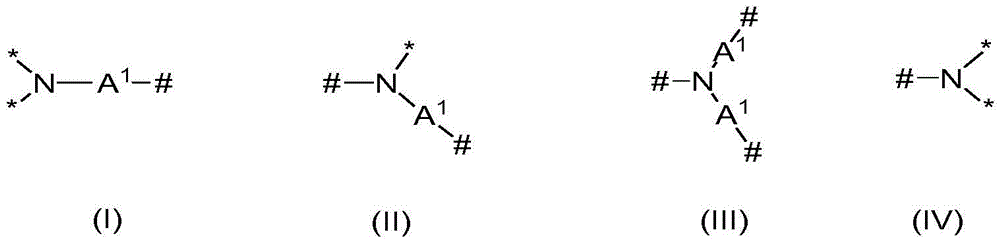
wherein in each case# represents the nitrogen atoms and the groups A of two adjacent repeating units of the formula (I), (II), (III) or (IV) 1 One half of the bonds between the free binding sites; in each case, represents one half of the bonds to one of the alkoxylate groups; and A is 1 Independently selected from straight or branched chain C 2 -C 6 -an alkylene group; wherein the polyalkyleneimine structure consists of 1 repeating unit of formula (I), x repeating units of formula (II), y repeating units of formula (III) and y+1 repeating units of formula (IV), wherein in each case x and y have a value in the range from 0 to about 150; wherein the average weight average molecular weight Mw of the polyalkyleneimine core structure is a value in the range of from about 60g/mol to about 10,000 g/mol.
The core structure may alternatively comprise a polyalkanolamine structure of the condensation product of at least one compound selected from the group consisting of N- (hydroxyalkyl) amines of formulae (I.a) and/or (I.b),
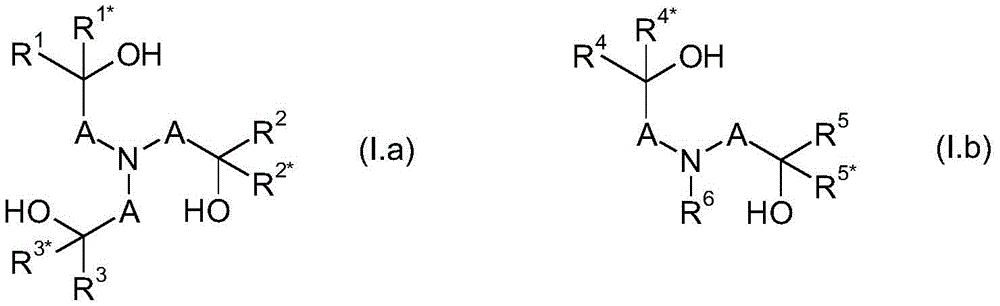
wherein A is independently selected from C 1 -C 6 -an alkylene group; r is R 1 、R 1 *、R 2 、R 2 *、R 3 、R 3 *、R 4 、R 4 *、R 5 And R is 5 * Independently selected from hydrogen, alkyl, cycloalkyl or aryl, wherein the last three mentioned groups may optionally be substituted; and R is 6 Selected from hydrogen, alkyl, cycloalkyl or aryl, wherein the last three mentioned groups may optionally be substituted.
The plurality of alkyleneoxy groups attached to the core structure are independently selected from alkyleneoxy units of formula (V)
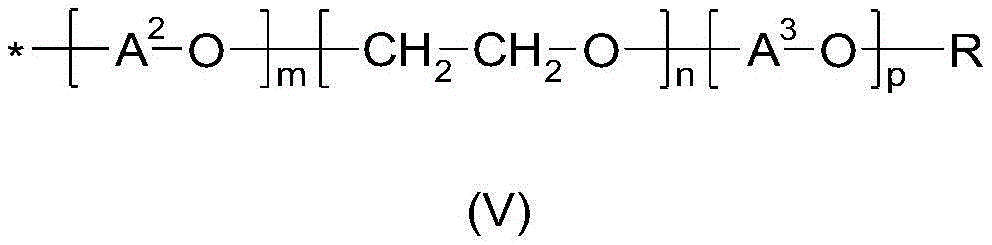
Wherein in each case represents one half of the bonds to the nitrogen atom of the repeating unit of formula (I), (II) or (IV); in each case, A 2 Independently selected from 1, 2-propylene, 1, 2-butylene and 1, 2-isobutylene; a is that 3 Is 1, 2-propylene; in each instance, R is independently selected from hydrogen and C 1 -C 4 -an alkyl group; m has an average value in the range of 0 to about 2; n has an average value in the range of about 20 to about 50; and p has an average value in the range of about 10 to about 50.
Carboxylic ester polymer: the composition also preferably comprises one or more carboxylate polymers, such as a maleate/acrylate random copolymer or polyacrylate homopolymer. In one aspect, the carboxylate polymer is a polyacrylate homopolymer having a molecular weight of 4,000da to 9,000da, or 6,000da to 9,000 da.
Soil release polymer: the composition also preferably comprises one or more soil release polymers having a structure defined by one of the following structures (I), (II) or (III):
(I)-[(OCHR 1 -CHR 2 ) a -O-OC-Ar-CO-] d
(II)-[(OCHR 3 -CHR 4 ) b -O-OC-sAr-CO-] e
(III)-[(OCHR 5 -CHR 6 ) c -OR 7 ] f
Wherein:
a. b and c are 1 to 200;
d. e and f are 1 to 50;
ar is 1, 4-substituted phenylene;
sAr is at position 5 by SO 3 Me-substituted 1, 3-substituted phenylene;
me is Li, K, mg/2, ca/2, al/3, ammonium, monoalkylammonium, dialkylammonium, trialkylammonium or tetraalkylammonium, where alkyl is C 1 -C 18 Alkyl or C 2 -C 10 Hydroxyalkyl or mixtures thereof;
R 1 、R 2 、R 3 、R 4 、R 5 and R is 6 Independently selected from H or C 1 -C 18 N-alkyl or C 1 -C 18 An isoalkyl group; and is also provided with
R 7 C being linear or branched 1 -C 18 Alkyl, or C, linear or branched 2 -C 30 Alkenyl, or cycloalkyl group having 5 to 9 carbon atoms, or C 8 -C 30 Aryl groups, or C 6 -C 30 An arylalkyl group.
Suitable soil release polymers are polyester soil release polymers such as Repel-o-tex polymers, including Repel-o-tex SF, SF-2, and SRP6 supplied by Rhodia. Other suitable soil release polymers include Texcare polymers, including Texcare SRA100, SRA300, SRN100, SRN170, SRN240, SRN300, and SRN325, supplied by Clariant, corp. Other suitable soil release polymers are Marloquest polymers, such as Marloquest SL supplied by Sasol.
Cellulose polymer: the composition also preferably comprises one or more cellulosic polymers, including those selected from the group consisting of: alkyl cellulose, alkyl alkoxy alkyl cellulose, carboxy alkyl cellulose, alkyl carboxy alkyl cellulose. In one aspect, the cellulosic polymer is selected from the group consisting of carboxymethyl cellulose, methyl hydroxyethyl cellulose, methyl carboxymethyl cellulose, and mixtures thereof. In one aspect, the carboxymethyl cellulose has a carboxymethyl substitution degree of 0.5 to 0.9 and a molecular weight of 100,000da to 300,000 da.
Bleaching system: the composition may contain a bleaching system, for example comprising H 2 O 2 A source (such as perborate or percarbonate) which may be mixed with a peracid-forming bleach activator such as tetraacetylethylenediamine or nonanoyloxybenzene sulphonate. Alternatively, the bleaching system may comprise a peroxyacid (e.g., an amide, imide, or sulfone peroxyacid). Generally, when a bleach is used, the compositions of the present invention may comprise from about 0.1% to about 30% or even from about 0.1% to about 25% bleach by weight of the subject cleaning composition.
Chelating agent: the composition preferably comprises a chelating agent, preferably in an amount of from 0.005% to about 15% or even from about 3.0% to about 10% by weight of the composition. Suitable chelating agents include copper, iron and/or manganese chelating agents, and mixtures thereof. Preferred chelating agents (complexing agents) include: DTPA (diethylenetriamine pentaacetic acid), HEDP (hydroxyethanediphosphonate), DTPMP (cyclobutanetriamine penta (methylenephosphonic acid)), 1, 2-dihydroxybenzene-3, 5-disulfonic acid disodium salt hydrate, ethylenediamine, cyclobutanetriamine, ethylenediamine disuccinic acid (EDDS), N-hydroxyethanediamine triacetic acid (HEDTA), triethylenetetramine hexaacetic acid (TTHA), N-hydroxyethiminodiacetic acid (HEIDA), dihydroxyethylglycine (DHEG), ethylenediamine tetrapropionic acid (EDTP), methylglycine-diacetic acid (MGDA), glutamic acid-N, N-diacetic acid (GLDA), iminodisuccinic acid (IDS), carboxymethyl inulin; and their salt derivatives and mixtures thereof. Preferred chelating agents are selected from the group consisting of methylglycine diacetic acid (MGDA) and salts and derivatives thereof, tetrasodium glutamate diacetic acid (GLDA) and salts and derivatives thereof, tetrasodium Iminodisuccinate (IDS) and salts and derivatives thereof, carboxymethyl inulin and salts and derivatives thereof, and mixtures thereof. Particular preference is given to MGDA and salts thereof, in particular trisodium salt comprising MGDA.
The composition may also contain other conventional detergent ingredients (such as fabric conditioning agents) including clays, suds boosters, suds suppressors, anti-corrosion agents, soil-suspending agents, anti-soil redeposition agents, dyes, bactericides, optical brighteners, hydrotropes, color-changing inhibitors, organic solvents (such as ethanol), or perfumes.
Application method
The present invention also provides a method for treating a surface, the method comprising contacting the surface with an aqueous wash liquor comprising an alginate lyase enzyme as described above, preferably in an amount of 0.01ppm to 10ppm, preferably 0.1ppm to 1ppm, in a contacting step; and a cleaning adjunct, the cleaning adjunct optionally comprising a surfactant, the amount of surfactant preferably being from 0.05g/l to 50g/l, more preferably from 0.2g/l to 5g/l or from 0.5g/l to 3g/l, wherein the alginate lyase comprises an alginate lyase having at least 60% sequence identity to any one of SEQ ID NO. 1, SEQ ID NO. 2, SEQ ID NO. 3, SEQ ID NO. 4 or SEQ ID NO. 5.
The aqueous wash liquor may be formed by adding the composition as described above to water, for example during a washing machine wash process or a hand wash process. Alternatively, the aqueous wash liquor may be formed by adding alginate lyase and a cleaning adjunct as separate components to water to form a wash liquor. The surface may then optionally be washed and/or rinsed and/or dried.
The alginate lyase and any additional enzyme may be present in the wash liquor in an amount corresponding to 0.001 to 100mg of active enzyme protein per liter of wash liquor, preferably 0.005 to 5mg of active enzyme protein per liter of wash liquor, more preferably 0.01 to 1mg of active enzyme protein per liter of wash liquor, and in particular 0.1 to 1mg of active enzyme protein per liter of wash liquor.
During the contacting step, or in a subsequent step, mechanical agitation may be preferably used to facilitate cleaning and removal of the surface of the decomposed soil byproducts. The wash liquor preferably has a pH of about 7 or 8 to about 10.5. The composition may be generally employed at a concentration of about 500ppm to about 15,000ppm in solution to form a wash liquor. The wash liquor preferably has a temperature of from about 5 ℃ to about 40 ℃, or preferably from 10 ℃ to 35 ℃ or 30 ℃. The ratio of water to fabric is typically from about 1:1 to about 30:1. Preferably, the surface comprises a fabric and the method is a laundry treatment method.
Testing
Enzymatic Activity against beta-D-mannuronic acid Block (polyM Activity) and alpha-L-guluronic acid Block (polyG Activity)
Alginate lyase activity was measured using mannuronic acid block oligosaccharides DP20-DP35 (product code: ALG 601) and guluronic acid oligosaccharides DP2-DP45 (product code: ALG 610) from Elitimyl, france as substrates. Mannuronic acid block oligosaccharides DP20-DP35 were used for the measurement of polyM activity, whereas guluronic acid oligosaccharides DP2-DP45 were used for the measurement of polyG activity.
A 2.5% solution of each substrate was suspended in Tris buffer pH 8.3 and incubated with 3ppm of each alginate lyase of interest in 96-well plates for 60 minutes at 25 ℃.
When the enzyme is contacted with each of the substrates, the activity on each of the substrates is given relative to a zero enzyme sample as delta absorbance at 235nm in the spectrophotometer. These values were then used to evaluate the activity of the corresponding enzymes on the β -D-mannuronic acid block (polyM) and/or the α -L-guluronic acid block (polyG). Enzymes having activity (polyM activity) towards poly (β -D-mannuronic acid) preferably provide a delta absorption of at least 0.1 absorption unit, more preferably at least 0.15 absorption unit, and more preferably at least 0.2 absorption unit relative to zero enzyme. Enzymes having activity (polyG activity) towards poly (alpha-L-guluronic acid) preferably provide a delta absorption of at least 0.3 absorption units, preferably at least 0.4 or even 0.5 or 0.6 absorption units relative to zero enzyme.
Examples
Example 1: washing performance of liquid detergent compositions comprising different alginate lyase enzymes
The cleaning performance of alginate lyases on the decontamination of soiled collars and cuffs on textiles was determined in the case of laundry detergents as follows:
Decontamination tests were performed using Talboys Professional Incubating Microplate Shaker supplied by Cole-Parmer Instrument Co Ltd, uk. Dirty collar and cuff stains were cut into 2cm x 2cm pieces and added to each container of a 6-well plate (Leicester, uk VWR International Ltd).
In each container, 6mL of a solution containing 1.5g/L Ariel unit dose of liquid (no enzyme) was added. Stains were added and incubated with and without 2ppm wash concentration of alginate lyase defining SEQ ID and unit dose liquid solution at 35 ℃ for 45 minutes with stirring at 600rpm.
After the wash cycle, the wash water was drained and the fabric was rinsed in cold tap water (19 grains per american gallon) at a stirring speed of 300rpm, and then the washed stain samples were laid flat on shelves to dry at ambient conditions.
This procedure was repeated three more times, giving a total of four washed stains per treatment, namely four external replicates each containing one stain.
Pre-wash and post-wash analysis of stains was done using image analysis (Illuminant D65/10) to calculate the difference in stain removal effect between the test and reference formulations.
The decontamination index (SRI) was calculated using the following formula, where ΔE AB For the color difference, ΔE, between the non-soiled area and the soiled area of the fabric before washing AD Is the color difference between the non-soiled area of the fabric before washing and the soiled area after washing.
SRI=100*(ΔE AB -ΔE AD )/ΔE AB ,
The average test results are shown in the table below. They showed that the alginate lyase added with SEQ ID NO. 6 resulted in a greater improvement of the detergency for the soiled collar and cuff at 41.8SRI units. This improvement was statistically significant, i.e., there was a confidence level of greater than 99.9% for the zero enzyme control, based on student's T-test (p < 0.001).

* Equivalent volume comprising buffer introduced by SEQ ID 6
Example 2: washing performance of liquid detergent compositions comprising alginate lyase as defined
The wash performance of alginate lyase to remove chocolate-containing stains from cotton was measured in the context of liquid laundry detergents as follows:
stains with a diameter of about 3cm were prepared on 5cm x 5cm samples of knitted cotton supplied by british Warwick Equest Ltd, condett by sucking 0.5g of chocolate mousse or ice cream in the centre of each sample. The stained specimens were hung up for 24 hours prior to use and the images were analyzed prior to testing (later).
Soil release testing was performed using a terglometer detergent tester provided by Copley Scientific Ltd (Nottingham, U.K). Four tanks were filled with 1000mL of hard water (18 grains gallons per U.S.) heated to 40 ℃ and 2.75mL of Ariel liquid (available from Asda Stores Ltd, product code: 6016650, month 2, 2019) was added to each tank. Four stains were added to each tank, along with a 5cm x 5cm clean white knitted cotton ballast (Warwick Equest Ltd) sample and 8 5cm x 5cm WfK SBL 2004 soil flake samples per tank, to achieve a total fabric load of 60 g.
5mg of active alginate lyase comprising SEQ ID No. 6 and SEQ ID No. 7 was added to one of the two pots to give a wash concentration of 5ppm of active alginate lyase. During the test, the temperature was maintained at 35 ℃. After 40 minutes, the wash water was drained and the fabric was rinsed twice in 1000mL of cold tap water (18 grains per american gallon) for 5 minutes each, and then the washed stain samples were laid flat on shelves to dry at ambient conditions.
This process was repeated four more times, alternating between two tanks. This resulted in a total of 16 washed stains per treatment, i.e. 4 external replicates, each of the 4 external replicates containing 4 stains.
The average test results are shown in the table below. They showed that the addition of the combination of SEQ ID NO:6 and SEQ ID NO:7 resulted in greater stain removal improvement of 8.78SRI units for chocolate ice cream stains and 8.54SRI units for mousse mixture stains. These improvements were statistically significant, i.e., there was a confidence level of greater than 99% for the zero enzyme control according to student's T-test (p < 0.01).
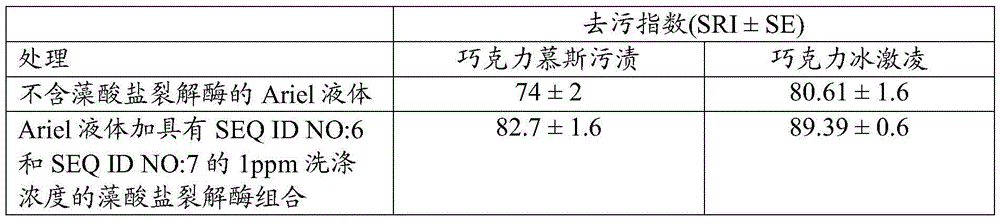
Example 3: washing performance of liquid detergents containing different alginate lyase enzymes
The wash performance of different sequences of alginate lyase enzymes to remove alginate containing stains from cotton was measured in the context of liquid laundry detergents as follows:
circular stains with a diameter of about 3cm were prepared on 5cm x 5cm samples of knitted cotton supplied by UK Warwick Equest Ltd, condett by sucking 1mL of a solution of 3% low viscosity sodium alginate (Carbosynth Ltd, compton, UK batch nr Y8317361901) and 0.6% carbon black (Alfa Aesar, lancshire, UK, batch nr N21E 016) in the centre of each sample. The stained specimens were hung up for 24 hours prior to use and the images were analyzed prior to testing (later).
Decontamination tests were performed using Talboys Professional Incubating Microplate Shaker supplied by Cole-Parmer Instrument Co Ltd, uk. Round stains of carbon black/sodium alginate were added to each container in a 6-well plate (british VWR International Ltd, leicester). A stock solution of alginate lyase was prepared by adding 50ppm of the active enzyme of alginate lyase (6 gallons/gallon) to tap water. In each vessel 8mL of a solution containing 5ppm of active alginate lyase and 10g/L Ariel liquid (product code: 6016650, available from Asda Stores Ltd, UK, 2 months in 2019) and the stain were incubated with alginate lyase and Ariel liquid solution at 40℃for 1 hour with a stirring speed of 600rpm. Blanks were obtained by adding only Ariel liquid and tap water (6 gallons/gallon) to 6 of the containers, obtaining an Ariel concentration equal to 10 g/L. Six replicates were collected for each alginate lyase. At the end of the incubation time, the wash water was drained and the washed stain was rinsed once with 8mL of cold tap water (6 gallons/gallon) at 20 ℃ for 10 minutes, then the washed stain sample was laid flat on a shelf to dry at ambient conditions.
This procedure was repeated once more, resulting in a total of 12 washed stains per treatment, namely 2 external replicates each containing 6 stains.
Pre-analysis and post-analysis of stains was done using image analysis (Illuminant D65/10) to calculate differences in stain removal effect between the test formulation and the reference formulation.
The decontamination index (SRI) was calculated using the following formula, where ΔE AB For the color difference, ΔE, between the non-soiled area and the soiled area of the fabric before washing AD For non-soiled areas of pre-laundered fabrics and post-laundering stainsColor difference between the regions.
SRI=100*(ΔE AB -ΔE AD )/ΔE AB ,
The average test results are shown in the table below. They demonstrate that the present invention results in greater detergency improvement for sodium alginate containing stains of 30.0SRI units. This improvement was statistically significant for the zero alginate lyase control, i.e., there was a confidence level of greater than 99.9% according to student's T-test (p < 0.001). The addition of alginate lyase having less than 25% sequence identity to SEQ ID NO. 1, SEQ ID NO. 2, SEQ ID NO. 3, SEQ ID NO. 4 and SEQ ID NO. 5 resulted in decontamination of 2.8SRI units. This change was not statistically significant for the zero alginate lyase control, i.e., there was a confidence level of less than 90% according to student's T-test (p > 0.1).
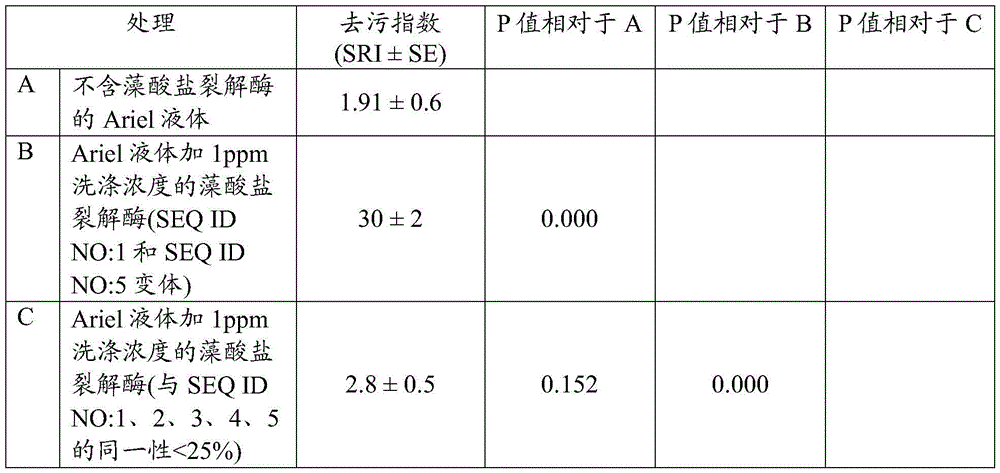
Examples of detergents
Examples 1 to 6: granular laundry detergent composition designed for use in hand washing or top loading washing machines。
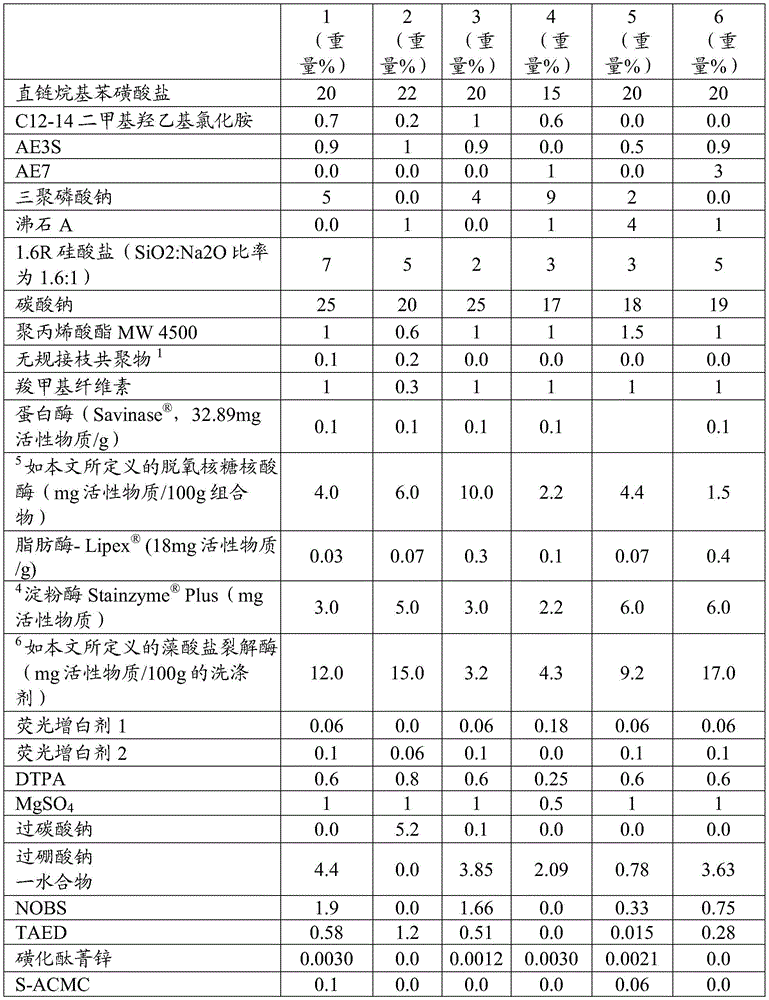

Examples 7 to 13: granular laundry detergent combination designed for front loading automatic washing machineAnd (3) an object.
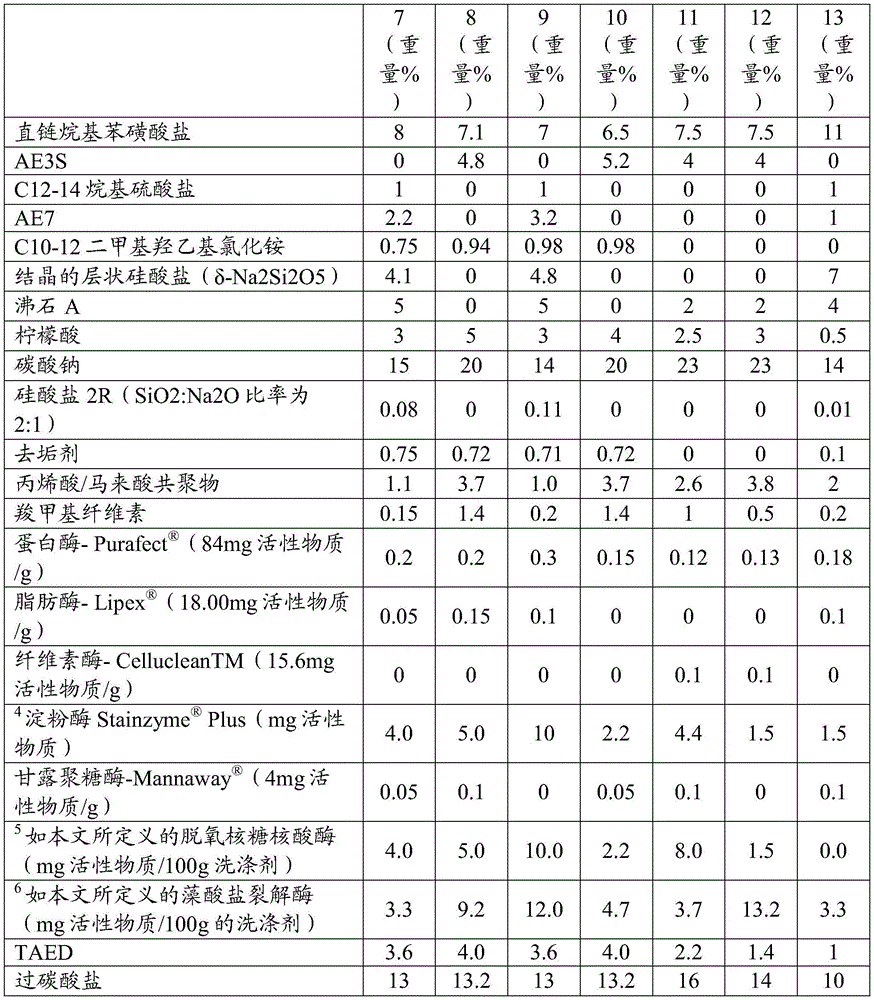

* Deoxyribonuclease is shown as milligrams of active enzyme per 100g of detergent.
Examples 14 to 21: heavy duty liquid laundry detergent compositions
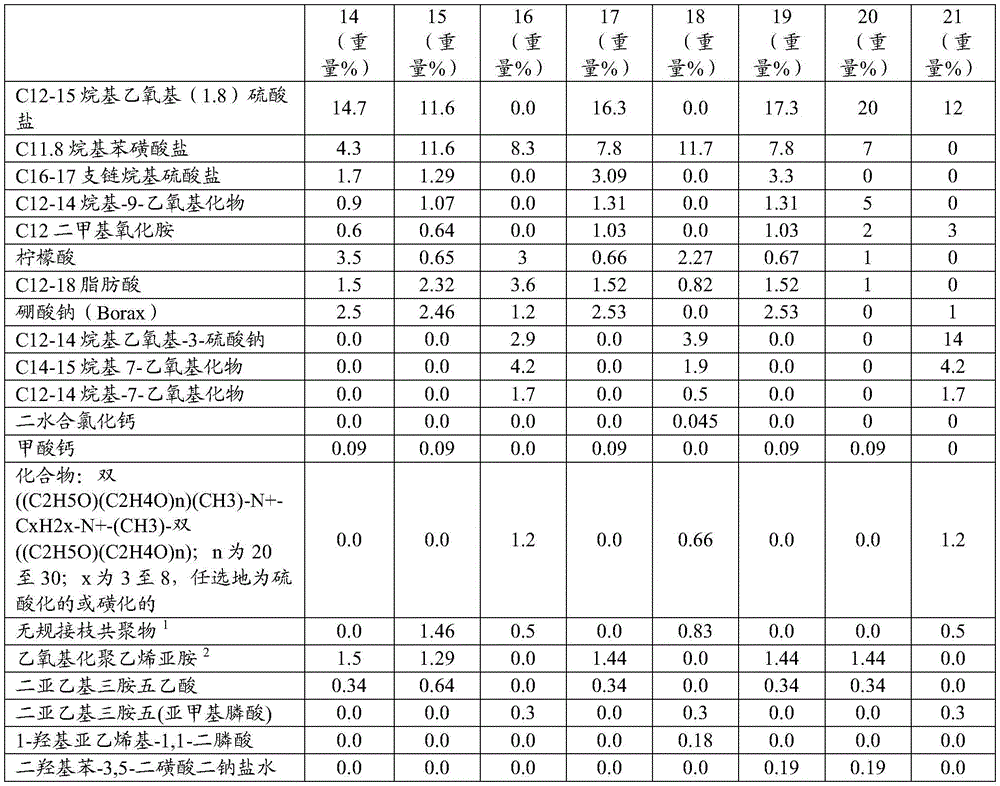
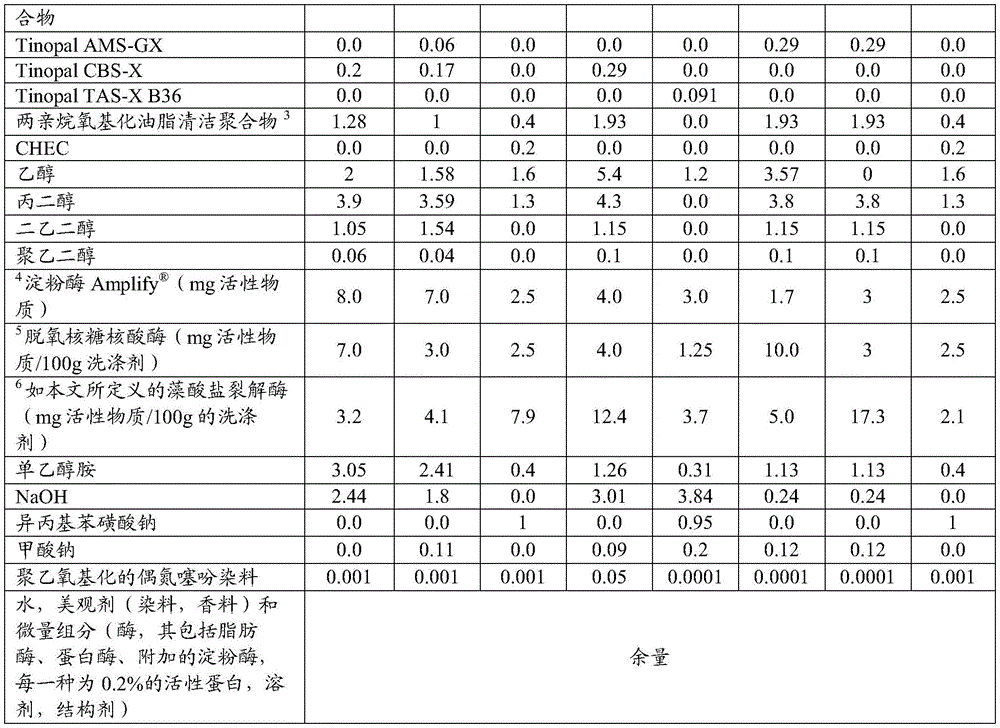
Examples 22 to 28: a unit dose laundry detergent composition. Such unit dose formulations may include one or more Compartment with a cover。

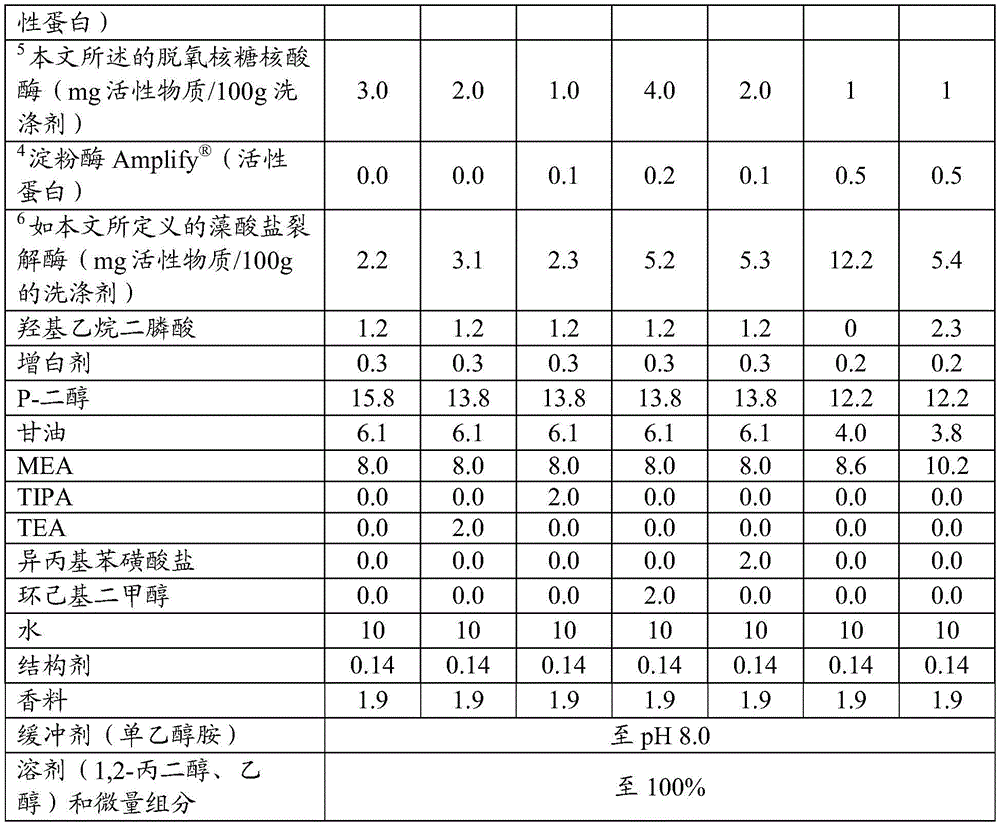
Example 29: multi-compartment unit dose compositions
The multi-compartment unit dose laundry detergent formulations of the present invention are provided hereinafter. In these embodiments, the unit dose has three compartments, but similar compositions can be made in two, four or five compartments. The film used to encapsulate the compartment is polyvinyl alcohol.
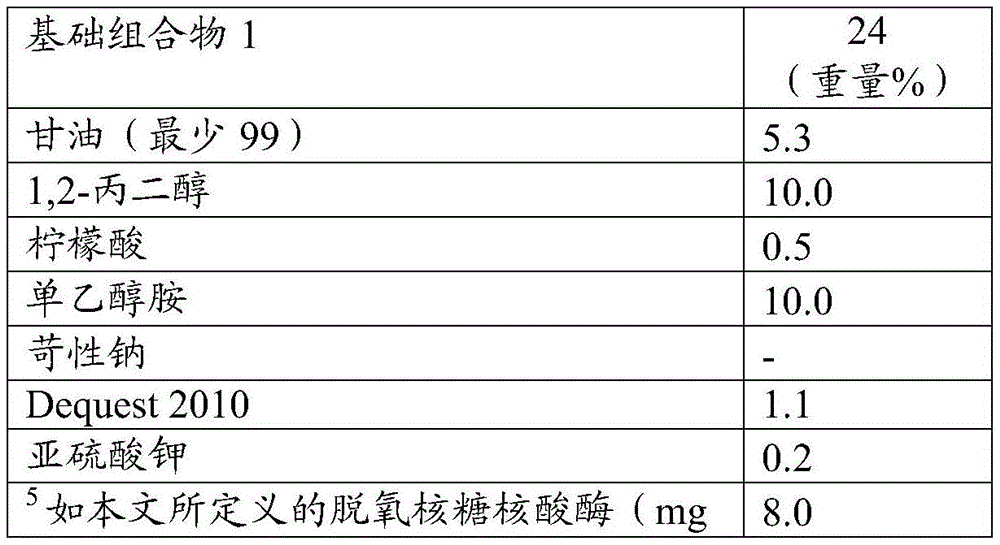
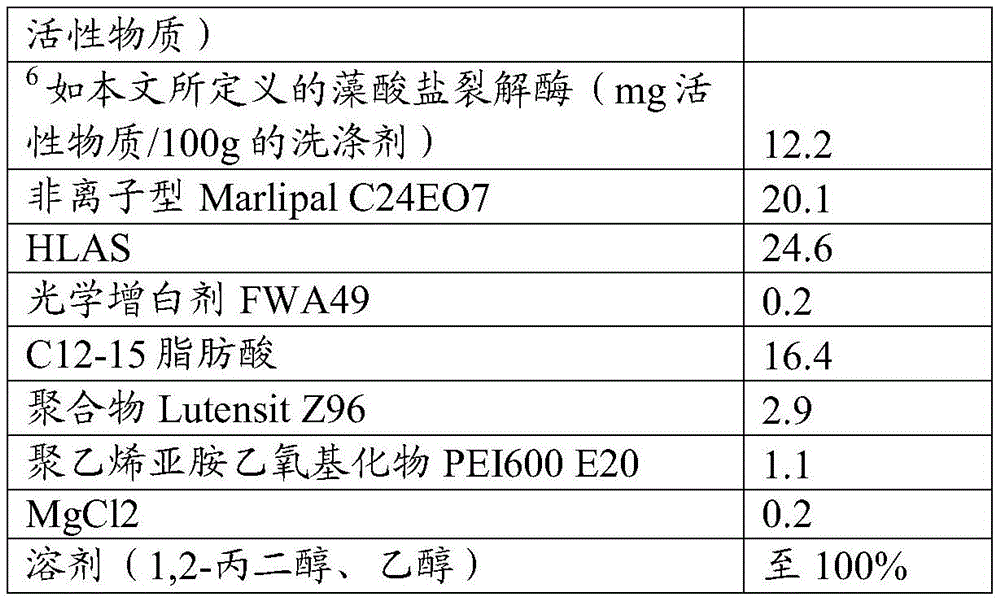
Multi-compartment formulation

Examples 30 to 33: fabric softener compositions of the invention
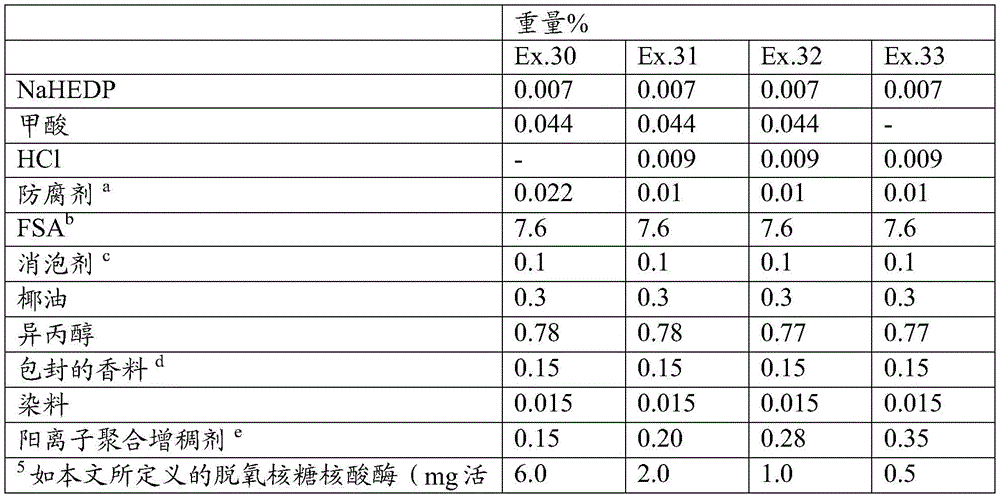
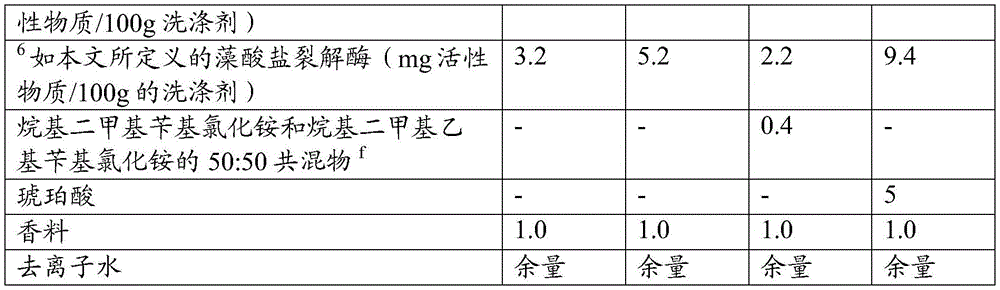
Raw materials and description for composition examples 1 to 33
Linear alkylbenzene sulfonates having an average aliphatic carbon chain length of from C11 to C18,
c12-18 dimethylhydroxyethyl amine chloride
AE3S is a C12-15 alkyl ethoxy (3) sulfate
AE7 is a C12-15 alcohol ethoxylate having an average degree of ethoxylation of 7
AE9 is a C12-16 alcohol ethoxylate having an average degree of ethoxylation of 9
HSAS is an intermediate branched primary alkyl sulfate having a carbon chain length of about 16-17 as disclosed in U.S. Pat. No. 6,020,303 and U.S. Pat. No. 6,060,443
Polyacrylate MW 4500 is carboxymethyl cellulose supplied by BASF supplied by CP Kelco (Arnhem, netherlands) V
V
CHEC is a cationically modified hydroxyethylcellulose polymer.
Phosphonate chelating agents are, for example, diethylene Tetraamine Pentaacetic Acid (DTPA) hydroxyethane diphosphate (HEDP)

Fluorescent whitening agent 1 is AMS, fluorescent whitening agent 2 is +.>
 CBS-X, direct Violet 9 is
 Violet BN-Z NOBS is sodium nonanoyloxybenzene sulfonate +.>
TAED is tetraacetyl ethylenediamine
S-ACMC is carboxymethyl CELLULOSE conjugated with the product name AZO-CM-CELLULOSE of C.I. reactive blue 19
The detergent is Repel-o- PF
PF
The molecular weight of the acrylic acid/maleic acid copolymer was 70,000 and the ratio of acrylate to maleate was 70:30
EDDS is the sodium salt of ethylenediamine-N, N' -disuccinic acid, the (S, S) isomer suds suppressor agglomerates are HSAS provided by Dow Corning, midland, michigan, USA are mid-branched alkyl sulfates
The polyethoxylated azo thiophene dye is ultraviolet DD TM Polymeric hueing dyes provided by Milliken, spatanburg, south Carolina, USA
1 The random graft copolymer is a polyvinyl acetate grafted polyethylene oxide copolymer having a polyethylene oxide backbone and a plurality of polyvinyl acetate side chains. The molecular weight of the polyethylene oxide backbone is about 6000 and the weight ratio of polyethylene oxide to polyvinyl acetate is about 40 to 60 and has no more than 1 grafting point per 50 ethylene oxide units.
2 Polyethyleneimine (mw=600), with 20 ethoxylated groups per-NH.
3 The amphiphilic alkoxylated polymer was polyethylenimine (molecular weight=600), prepared from a polymer derived to contain 24 ethoxylate groups per-NH and 16 propoxylate groups per-NH.
4 Amylase is expressed in milligrams of active enzyme per 100g of detergent.
5 In all of these examples the deoxyribonuclease is expressed in milligrams of active enzyme per 100g of detergent. The deoxyribonuclease may contain a trace amount of superoxide dismutase impurities.
6 Alginate lyase as defined (expressed in milligrams of active enzyme per 100g of detergent in all these examples)
a Proxel GXL, a 20% aqueous solution of dipropylene glycol to 1, 2-benzisothiazolin-3-one, supplied by Lonza.
B N, N-bis (hydroxyethyl) -N, N-dimethylammonium chloride fatty acid esters. The iodine value of the parent fatty acid of the material is between 18 and 22. The Evonik derived material comprises impurities in the form of free fatty acids, N-bis (hydroxyethyl) -N, N-dimethyl ammonium chloride lipidImpurities in the monoester form of fatty acid esters, and impurities in the fatty acid ester form of N, N-bis (hydroxyethyl) -N-methylamine.

d Expressed as 100% encapsulated perfume oils as described in US 8,765,659
f N, N-dimethyloctanoamide and N, N-dimethyldecanoamide in a weight ratio of about 55:45 under the trade name M-8-10 is from Stepan Inc
The dimensions and values disclosed herein are not to be understood as being strictly limited to the exact numerical values recited. Rather, unless otherwise indicated, each such dimension is intended to mean both the recited value and a functionally equivalent range surrounding that value. For example, a dimension disclosed as "40mm" is intended to mean "about 40mm".
Sequence listing
<110> Baojie Company (The Procter & Gamble Company)
<120> cleaning compositions containing alginate lyase
<130> CM05274M
<160> 7
<170> patent in version 3.5
<210> 1
<211> 288
<212> PRT
<213> Flavobacterium (Flavobacterium sp.)
<400> 1
Met Ser Ile Gln Phe Ser Lys Ile Leu Leu Leu Thr Val Leu Ala Thr
1 5 10 15
Ala Thr Ile Ser Asn Ala Gln Asp Lys Lys Ser Lys Ser Lys Thr Ala
20 25 30
Lys Ile Asp Trp Ser His Trp Thr Val Thr Val Pro Glu Glu Asn Pro
35 40 45
Asp Lys Pro Gly Lys Pro Tyr Ser Leu Gly Tyr Pro Glu Ile Leu Asn
50 55 60
Tyr Ala Glu Asp Lys Ile Ala Ser Lys Tyr Met Tyr Asp Asp Pro Lys
65 70 75 80
Asp Lys Ser Val Val Phe Tyr Ala Phe Pro Ser Gly Val Thr Thr Ala
85 90 95
Asn Thr His Tyr Ser Arg Ser Glu Leu Arg Glu Thr Met Glu Thr Gly
100 105 110
Ser Asn Lys Val Asn Trp Thr Phe Ala Lys Gly Gly Lys Met Arg Gly
115 120 125
Thr Tyr Ala Ile Asp Asp Ile Ser Lys Glu Pro Asp Gly Lys Tyr Ser
130 135 140
Arg Val Ile Ile Ala Gln Ile His Gly Val Leu Thr Asp Glu Gln Arg
145 150 155 160
Asp Leu Ile Gly Gln Lys Asp Asn Asn Ala Pro Pro Ile Leu Lys Val
165 170 175
Tyr Trp Asp Lys Gly Lys Ile Arg Val Lys Thr Lys Val Leu Lys Asp
180 185 190
Leu Asn Ala Pro Tyr Lys Glu Met Leu Leu Glu His Ala Trp Gly Asp
195 200 205
Asp Glu Gly Arg Asn Phe Lys Glu Lys Ile Asp Leu Asn Thr Arg Phe
210 215 220
Thr Leu Glu Val Lys Val Ser Asp Gly Arg Met Glu Val Ile Leu Asn
225 230 235 240
Asp Thr Glu Ser Leu Val Tyr Asp Asp Ile His Met Lys Lys Trp Gly
245 250 255
Ile Phe Glu Asn Tyr Phe Lys Ala Gly Asn Tyr Phe Gln Ser Lys Thr
260 265 270
Pro Gly Thr Phe Ala Lys Val Lys Ile Tyr Ser Leu Gln Val Thr His
275 280 285
<210> 2
<211> 446
<212> PRT
<213> galactan Zhuo Beier Flavobacterium (Zobellia galactanivorans)
<400> 2
Met Lys Lys Asn Val Phe Thr Thr Leu Arg Thr Val Val Asn Gly Asp
1 5 10 15
Ile Met Trp Lys Leu Ile Pro Val Phe Phe Leu Ala Leu Cys Leu Gly
20 25 30
Ser Cys Ser Glu Glu Pro Val Asp Pro Glu Glu Glu Ala Val Leu Thr
35 40 45
Lys Leu Ser Ala Asn Ser Thr Ala Ile Gly Ile Ser Ser Val Ser Ala
50 55 60
Ser Thr Ser Gln Ser Pro Asn Val Ala Ser Asn Thr Leu Asp Gly Ser
65 70 75 80
Thr Ser Thr Arg Trp Ser Gly Tyr Gly Asp Gly Ala Ser Ile Thr Tyr
85 90 95
Asp Leu Gly Ser Ser Ala Asn Ile Asp Tyr Val Lys Ile Ala Phe Tyr
100 105 110
Lys Gly Asp Ser Arg Lys Thr Lys Tyr Glu Val Trp Val Gly Asn Ser
115 120 125
Thr Ser Ser Leu Thr Lys Ile Lys Ser Lys Thr Ser Ser Gly Ser Thr
130 135 140
Ser Asp Tyr Glu Thr Ile Asp Leu Pro Asn Ser Thr Ala Arg Tyr Ile
145 150 155 160
Arg Ile Val Gly Lys Gly Tyr Val Leu Asn Ser Gly Gly Ser Thr Val
165 170 175
Leu Trp Asn Ser Ile Thr Lys Phe Gln Ala Trp Gly Ser Gly Gly Ser
180 185 190
Ser Thr Leu Pro Ile Ser Gly Asn Ser Pro Ala Ser Val Leu Gly Ile
195 200 205
Thr Ala Asn Thr Trp Lys Ile Asn Ser Phe Ile Gly Ser Pro Gly Ser
210 215 220
Ser Ala Thr Tyr Tyr Asp Asp Ile Thr Asp Ala Ser Gly Ile Ser Tyr
225 230 235 240
Asn Thr Tyr Ser Asp Asp Asn Tyr Phe Tyr Thr Asp Gly Glu Trp Val
245 250 255
Tyr Phe Lys Cys Tyr Arg Gly Leu Gly Gly Ser Ala Asn Ser Gln Asn
260 265 270
Pro Arg Val Glu Leu Arg Glu Met Asp Asn Gly Asn Leu Ala Ser Trp
275 280 285
Thr Gly Asp Ser Gly Thr His Thr Met Glu Trp Thr Val Gln Val Asn
290 295 300
Gln Leu Pro Gln Asp Thr Asp Gly Asp Gly Gly Val Leu Cys Phe Gly
305 310 315 320
Gln Ile His Gly Pro Ser Lys Asn Ser Asp Gly Val Glu Val Asp Asp
325 330 335
Val Val Arg Val Gln Phe Ile Gly Glu Glu Asn Gln Ser Ser Gly Ser
340 345 350
Val Lys Leu Lys Ile Ser Gly Tyr Val Thr Glu Glu Gln Gly Gly Ser
355 360 365
Gln Thr Phe Ser Gly Tyr Ser Leu Asp Thr Thr Tyr Asn Cys Lys Leu
370 375 380
Val Tyr Ser Gly Gly Tyr Val Glu Leu Phe Met Asn Gly Ser Ser Val
385 390 395 400
Phe Arg Lys Lys Met Glu Val Asp Asp Leu Ser Glu Asn Tyr Phe Lys
405 410 415
Val Gly Asn Tyr Leu Gln Ser Val Lys Gly Ala Ser Tyr Thr Gly Ser
420 425 430
Tyr Gly Leu Val Arg Ile Lys Asn Leu Ser Val Thr His Asn
435 440 445
<210> 3
<211> 611
<212> PRT
<213> degradation products of sugar-phages
<400> 3
Met Thr Phe Ile Lys Ile Met Gly Ala Gly Ala Leu Ile Ala Ser Ala
1 5 10 15
Ser Leu Ala Asn Ala Ala Thr Phe Val Leu Glu Lys Val Asn Thr Gly
20 25 30
Phe Ser Val Asp Gly Gly Asn Gly Ala Val Glu Ala Arg Gln Val Tyr
35 40 45
Leu Trp Glu Thr Asn Thr Asn Asn Val Asn Gln Asn Trp Val Gln Ile
50 55 60
Ser His Gly Gly Gly Tyr Tyr Ser Tyr Lys Lys Gln Asn Thr Asn Leu
65 70 75 80
Cys Leu Asp Gly Gly Ser Gly Gly Ala Arg Leu Gln Pro Val Thr Leu
85 90 95
Glu Val Cys Asp Ser Ser Asn Tyr Asp Gln His Trp Asn Lys Val Lys
100 105 110
Val Tyr Thr Gly Thr Glu Ile Tyr Arg Met Glu Lys Arg Asn Ala Pro
115 120 125
Gly Phe Ser Ile Asp Gly Asn Gly Gly Ala Ala Ala Arg Gln Ala Ile
130 135 140
Tyr Leu Trp Asn Ser Asn Ser Asn Asn Val Asn Gln Gln Trp Glu Phe
145 150 155 160
Ile Arg Thr Asp Glu Asp Thr Gly Asp Gly Lys Leu Ala Ile Ala Thr
165 170 175
Ala Phe Asp Asp Gly Ser Ser His Ser Ser Tyr Pro Ala Ser Lys Ala
180 185 190
Ile Asp Gly Asn Thr Ala Trp Ala Ser Arg Trp Ala Ala Ser Gly Ser
195 200 205
Pro Val Asn Leu Thr Ile Gln Leu Glu Gln Thr Ser Arg Val Thr Glu
210 215 220
Val Gly Ile Ala Trp Gly Gln Gly Gly Ser Arg Ala Tyr Thr Phe Glu
225 230 235 240
Ile Tyr Ala Arg Pro Gly Thr Ser Gly Ser Trp Thr Lys Val Phe Asp
245 250 255
Asp Val Ser Ser Gly Ser Thr Ala Gly Ile Glu Val Phe Asp Ile Thr
260 265 270
Asp Ile Asp Ala Gln Gln Ile Arg Val Lys Thr Phe Glu Asn Thr Ala
275 280 285
Gly Thr Thr Trp Thr Asn Ile Thr Glu Val Glu Ile Tyr Gly Ala Asp
290 295 300
Gly Gly Ser Ser Ser Ser Ser Ser Ser Ser Ser Ser Thr Ser Ser Thr
305 310 315 320
Ser Ser Thr Ser Ser Thr Ser Ser Ser Ser Gly Gly Phe Asn Leu Asn
325 330 335
Pro Asn Ala Pro Pro Ser Ser Asn Phe Asn Leu Ser Gln Trp Tyr Leu
340 345 350
Ser Val Pro Thr Asp Thr Asp Gly Ser Gly Thr Ala Asp Ser Ile Lys
355 360 365
Glu Gly Glu Leu Asn Ser Gly Tyr Glu Asn Asn Ser Tyr Phe Tyr Thr
370 375 380
Gly Ser Asp Gly Gly Met Val Phe Lys Cys Pro Ile Ser Gly Tyr Lys
385 390 395 400
Thr Ser Thr Gly Thr Ser Tyr Thr Arg Thr Glu Leu Arg Glu Met Leu
405 410 415
Arg Ala Gly Asn Thr Ser Ile Ala Thr Ser Gly Val Asn Lys Asn Asn
420 425 430
Trp Val Phe Gly Ser Ala Pro Ser Ser Ala Gln Ala Ala Ala Gly Gly
435 440 445
Val Asp Gly Asn Met Lys Ala Thr Leu Ala Val Asn Tyr Val Thr Thr
450 455 460
Thr Gly Asp Ser Ser Gln Val Gly Arg Val Ile Ile Gly Gln Ile His
465 470 475 480
Ala Glu Lys Asn Glu Pro Ile Arg Leu Tyr Tyr Arg Lys Leu Pro Gly
485 490 495
Asn Ser Lys Gly Gly Ile Tyr Tyr Ala His Glu Asp Ala Asp Gly Gly
500 505 510
Glu Val Trp Val Asp Met Ile Gly Ser Arg Ser Ser Ser Ala Ser Asn
515 520 525
Pro Ser Asp Gly Ile Ala Leu Asn Glu Val Phe Ser Tyr Glu Ile Asp
530 535 540
Val Thr Asn Asn Met Leu Thr Val Lys Ile Tyr Arg Asp Gly Lys Ser
545 550 555 560
Thr Val Thr Ser Gln Tyr Asn Met Val Asn Ser Gly Tyr Asp Asp Ser
565 570 575
Asp Asp Trp Met Tyr Phe Lys Ala Gly Val Tyr Asn Gln Asn Asn Thr
580 585 590
Gly Asn Gly Ser Asp Tyr Val Gln Ala Thr Phe Tyr Ser Leu Thr His
595 600 605
Thr His Asp
610
<210> 4
<211> 307
<212> PRT
<213> Klebsiella pneumoniae (Klebsiella pneumoniae)
<400> 4
Met Leu Lys Ser Gly Val Met Val Ala Ser Leu Cys Leu Phe Ser Val
1 5 10 15
Pro Ser Arg Ala Ala Val Pro Ala Pro Gly Asp Lys Phe Glu Leu Ser
20 25 30
Gly Trp Ser Leu Ser Val Pro Val Asp Ser Asp Asn Asp Gly Lys Ala
35 40 45
Asp Gln Ile Lys Glu Lys Thr Leu Ala Ala Gly Tyr Arg Asn Ser Asp
50 55 60
Phe Phe Thr Leu Ser Asp Ala Gly Gly Met Val Phe Lys Ala Pro Ile
65 70 75 80
Ser Gly Ala Lys Thr Ser Lys Asn Thr Thr Tyr Thr Arg Ser Glu Leu
85 90 95
Arg Glu Met Leu Arg Lys Gly Asp Thr Ser Ile Ala Thr Gln Gly Val
100 105 110
Ser Arg Asn Asn Trp Val Leu Ser Ser Ala Pro Leu Ser Glu Gln Lys
115 120 125
Lys Ala Gly Gly Val Asp Gly Thr Leu Glu Ala Thr Leu Ser Val Asp
130 135 140
His Val Thr Thr Thr Gly Val Asn Trp Gln Val Gly Arg Val Ile Ile
145 150 155 160
Gly Gln Ile His Ala Asn Asn Asp Glu Pro Ile Arg Leu Tyr Tyr Arg
165 170 175
Lys Leu Pro His His Gln Lys Gly Ser Val Tyr Phe Ala His Glu Pro
180 185 190
Arg Lys Gly Phe Gly Asp Glu Gln Trp Tyr Glu Met Ile Gly Thr Leu
195 200 205
Gln Pro Ser His Gly Asn Gln Thr Ala Ala Pro Thr Glu Pro Glu Ala
210 215 220
Gly Ile Ala Leu Gly Glu Thr Phe Ser Tyr Arg Ile Asp Ala Thr Gly
225 230 235 240
Asn Lys Leu Thr Val Thr Leu Met Arg Glu Gly Arg Pro Asp Val Val
245 250 255
Lys Thr Val Asp Met Ser Lys Ser Gly Tyr Ser Glu Ala Gly Gln Tyr
260 265 270
Leu Tyr Phe Lys Ala Gly Val Tyr Asn Gln Asn Lys Thr Gly Lys Pro
275 280 285
Asp Asp Tyr Val Gln Ala Thr Phe Tyr Arg Leu Lys Ala Thr His Gly
290 295 300
Ala Gln Arg
305
<210> 5
<211> 248
<212> PRT
<213> galactan Zhuo Beier Flavobacterium (Zobellia galactanivorans)
<400> 5
Gly Asn Ser Pro Ala Ser Val Leu Gly Ile Thr Ala Asn Thr Trp Lys
1 5 10 15
Ile Asn Ser Phe Ile Gly Ser Pro Gly Ser Ser Ala Thr Tyr Tyr Asp
20 25 30
Asp Ile Thr Asp Ala Ser Gly Ile Ser Tyr Asn Thr Tyr Ser Asp Asp
35 40 45
Asn Tyr Phe Tyr Thr Asp Gly Glu Trp Val Tyr Phe Lys Cys Tyr Arg
50 55 60
Gly Leu Gly Gly Ser Ala Asn Ser Gln Asn Pro Arg Val Glu Leu Arg
65 70 75 80
Glu Met Asp Asn Gly Asn Leu Ala Ser Trp Thr Gly Asp Ser Gly Thr
85 90 95
His Thr Met Glu Trp Thr Val Gln Val Asn Gln Leu Pro Gln Asp Thr
100 105 110
Asp Gly Asp Gly Gly Val Leu Cys Phe Gly Gln Ile His Gly Pro Ser
115 120 125
Lys Asn Ser Asp Gly Val Glu Val Asp Asp Val Val Arg Val Gln Phe
130 135 140
Ile Gly Glu Glu Asn Gln Ser Ser Gly Ser Val Lys Leu Lys Ile Ser
145 150 155 160
Gly Tyr Val Thr Glu Glu Gln Gly Gly Ser Gln Thr Phe Ser Gly Tyr
165 170 175
Ser Leu Asp Thr Thr Tyr Asn Cys Lys Leu Val Tyr Ser Gly Gly Tyr
180 185 190
Val Glu Leu Phe Met Asn Gly Ser Ser Val Phe Arg Lys Lys Met Glu
195 200 205
Val Asp Asp Leu Ser Glu Asn Tyr Phe Lys Val Gly Asn Tyr Leu Gln
210 215 220
Ser Val Lys Gly Ala Ser Tyr Thr Gly Ser Tyr Gly Leu Val Arg Ile
225 230 235 240
Lys Asn Leu Ser Val Thr His Asn
245
<210> 6
<211> 260
<212> PRT
<213> Flavobacterium (Flavobacterium sp.)
<400> 6
Arg Asn Gly Ala Asn Ile Asp Leu Ser His Trp Thr Leu Thr Thr Pro
1 5 10 15
Ala Glu Asp Pro Lys Lys Pro Gly Lys Thr Phe Asp Leu Asn Tyr Pro
20 25 30
Glu Ile Phe Asp Phe Ala Ser Asn Asp Ile Ala Lys Lys Tyr Met Tyr
35 40 45
Glu Asp Pro Lys Asp Lys Ser Ile Val Phe Tyr Ala Tyr Pro Ser Gly
50 55 60
Thr Ser Thr Ala Asn Ser His Phe Ser Arg Ser Glu Leu Arg Glu Thr
65 70 75 80
Met Glu Ile Gly Ser Lys Asn Val Asn Trp Thr Phe Ala Gln Gly Gly
85 90 95
Tyr Phe Lys Gly Thr Tyr Ala Ile Glu Asp Val Ser Lys Glu Ala Asp
100 105 110
Gly Lys Tyr Ser Arg Val Ile Ile Ala Gln Ile His Gly Ile Leu Thr
115 120 125
Asp Ser Gln Gln Ala Leu Ile Gly Gln Lys Asp Lys Asn Ala Ala Pro
130 135 140
Ile Leu Lys Ile Phe Trp Asp Gln Gly Lys Ile Arg Val Lys Thr Lys
145 150 155 160
Val Leu Lys Asn Gln Asn Ala Ser Leu Lys Glu Met Leu Pro Ala Asp
165 170 175
Ala Trp Thr Asp Asp Lys Gly Arg Asp Phe Lys Glu Lys Ile Asp Phe
180 185 190
Asn Thr Lys Phe Thr Leu Glu Ile Lys Val Ser Asp Gly Arg Leu Glu
195 200 205
Val Ile Met Asn Gly Thr Glu Ser Phe Val Tyr Glu Asp Ile Asn Ile
210 215 220
Lys Lys Trp Gly Val Phe Glu Asn Tyr Phe Lys Ala Gly Asn Tyr Phe
225 230 235 240
Gln Ser Thr Asn Pro Asn Thr Phe Ala Lys Val Lys Ile Tyr Asp Leu
245 250 255
Gln Val Ser His
260
<210> 7
<211> 391
<212> PRT
<213> Flavobacterium (Flavobacterium sp.)
<400> 7
Lys Leu Val Thr Thr Lys Leu Thr Pro Ala Ser Val Ser Asp Asn Gly
1 5 10 15
Asn Asp Gly Asn Val Ala Ala Asn Thr Leu Asp Gly Asn Leu Ser Thr
20 25 30
Arg Trp Ser Ser Asp Gly Ser Thr Gly Lys Tyr Ile Thr Tyr Asp Leu
35 40 45
Gly Ser Ser Lys Ser Ile Ser Ser Leu Lys Ile Ala Trp His Gln Gly
50 55 60
Asp Gln Arg Lys Ser Tyr Phe Gln Ile Arg Val Gly Asp Ser Thr Gly
65 70 75 80
Ser Leu Thr Thr Val Tyr Asp Ala Lys Thr Thr Gly Ser Ser Gly Thr
85 90 95
Thr Thr Ala Leu Glu Thr Tyr Thr Leu Ser Ser Pro Val Thr Ala Arg
100 105 110
Tyr Val Arg Ile Ser Cys Phe Gly Asn Ser Leu Thr Thr Trp Asn Ser
115 120 125
Ile Ala Glu Thr Glu Ile Tyr Ser Thr Val Asp Asp Gly Leu Pro Asp
130 135 140
Thr Tyr Pro Thr Ser Val Ile Gly Ile Thr Ala Asn Thr Trp Lys Ile
145 150 155 160
Asn Ser Phe Thr Gly Thr Pro Gly Ser Ser Ala Val Tyr Tyr Asp Asp
165 170 175
Ile Thr Thr Ala Ser Gly Val Ser Tyr Asn Thr Tyr Asn Asp Pro Asn
180 185 190
Tyr Phe Tyr Thr Asp Gly Thr Trp Thr Tyr Phe Lys Cys Tyr Arg Gly
195 200 205
Leu Gly Thr Ser Ser Asn Ser Ser Asn Pro Arg Val Glu Leu Arg Glu
210 215 220
Leu Asn Asn Gly Ser Ser Ala Ser Trp Asp Gly Ser Val Gly Thr His
225 230 235 240
Thr Met Thr Trp Thr Val Lys Val Asp Lys Leu Pro Lys Gly Glu Asn
245 250 255
Gly Thr Thr Gly Val Leu Cys Phe Gly Gln Ile His Gly Pro Ser Thr
260 265 270
Asn Ser Ser Gly Val Ala Val Asp Asp Ile Ile Arg Val Gln Phe Asp
275 280 285
Gly Ala Ala Asn Gln Ser Thr Gly Thr Val Lys Leu Lys Ile Ser Gly
290 295 300
Tyr Ile Thr Glu Lys Val Leu Gly Gly Ser Lys Ser Phe Thr Gly Tyr
305 310 315 320
Ser Leu Gly Thr Ser Tyr Thr Phe Thr Ile Lys Tyr Thr Gly Gly Lys
325 330 335
Val Tyr Leu Tyr Asn Gly Ser Thr Leu Val Phe Ser Gln Gln Met Asp
340 345 350
Thr Ser Thr Glu Gly Asn Tyr Phe Lys Ala Gly Asn Tyr Leu Gln Ser
355 360 365
Val Lys Asn Val Ser Tyr Asp Gly Ser Tyr Gly Leu Val Gly Ile Ser
370 375 380
Ser Leu Thr Val Ser His Gln
385 390
Claims (15)
Applications Claiming Priority (7)
| Application Number | Priority Date | Filing Date | Title |
|---|---|---|---|
| EP20204791 | 2020-10-29 | ||
| EP20204795.7 | 2020-10-29 | ||
| EP20204791.6 | 2020-10-29 | ||
| EP20204794 | 2020-10-29 | ||
| EP20204794.0 | 2020-10-29 | ||
| EP20204795 | 2020-10-29 | ||
| PCT/US2021/072100 WO2022094590A1 (en) | 2020-10-29 | 2021-10-29 | Cleaning compositions containing alginate lyase enzymes |
Publications (1)
| Publication Number | Publication Date |
|---|---|
| CN116348581A true CN116348581A (en) | 2023-06-27 |
Family
ID=78617544
Family Applications (5)
| Application Number | Title | Priority Date | Filing Date |
|---|---|---|---|
| CN202180069065.XA Pending CN116323936A (en) | 2020-10-29 | 2021-10-29 | Cleaning composition comprising alginate lyase |
| CN202180070771.6A Pending CN116391035A (en) | 2020-10-29 | 2021-10-29 | Cleaning composition comprising alginate lyase |
| CN202180070766.5A Pending CN116348581A (en) | 2020-10-29 | 2021-10-29 | Cleaning compositions containing alginate lyase |
| CN202180069067.9A Active CN116348580B (en) | 2020-10-29 | 2021-10-29 | Cleaning compositions containing alginate |
| CN202180070772.0A Pending CN116391036A (en) | 2020-10-29 | 2021-10-29 | Cleaning compositions containing alginate lyase |
Family Applications Before (2)
| Application Number | Title | Priority Date | Filing Date |
|---|---|---|---|
| CN202180069065.XA Pending CN116323936A (en) | 2020-10-29 | 2021-10-29 | Cleaning composition comprising alginate lyase |
| CN202180070771.6A Pending CN116391035A (en) | 2020-10-29 | 2021-10-29 | Cleaning composition comprising alginate lyase |
Family Applications After (2)
| Application Number | Title | Priority Date | Filing Date |
|---|---|---|---|
| CN202180069067.9A Active CN116348580B (en) | 2020-10-29 | 2021-10-29 | Cleaning compositions containing alginate |
| CN202180070772.0A Pending CN116391036A (en) | 2020-10-29 | 2021-10-29 | Cleaning compositions containing alginate lyase |
Country Status (7)
| Country | Link |
|---|---|
| US (5) | US20230340378A1 (en) |
| EP (5) | EP4237530A1 (en) |
| JP (5) | JP2023547171A (en) |
| CN (5) | CN116323936A (en) |
| CA (5) | CA3196363A1 (en) |
| MX (3) | MX2023004259A (en) |
| WO (5) | WO2022094164A1 (en) |
Families Citing this family (8)
| Publication number | Priority date | Publication date | Assignee | Title |
|---|---|---|---|---|
| EP4273210A1 (en) * | 2022-05-04 | 2023-11-08 | The Procter & Gamble Company | Detergent compositions containing enzymes |
| EP4273209A1 (en) * | 2022-05-04 | 2023-11-08 | The Procter & Gamble Company | Machine-cleaning compositions containing enzymes |
| DE102023200106A1 (en) * | 2023-01-10 | 2024-07-11 | Henkel Ag & Co. Kgaa | ENZYME-CONTAINING WASHING AND CLEANING AGENTS |
| EP4481027A1 (en) | 2023-06-19 | 2024-12-25 | The Procter & Gamble Company | Cleaning compositions containing enzymes |
| EP4481026A1 (en) * | 2023-06-21 | 2024-12-25 | The Procter & Gamble Company | Detergent compositions containing enzymes |
| EP4488351A1 (en) | 2023-07-03 | 2025-01-08 | The Procter & Gamble Company | Compositions containing a porphyrin binding protein |
| DE102023213044A1 (en) * | 2023-12-20 | 2025-06-26 | Henkel Ag & Co. Kgaa | Increased washing performance |
| CN121022811A (en) * | 2025-10-28 | 2025-11-28 | 哈尔滨工业大学(威海) | A highly active and heat-stable alginate lyase FsAly7Z, which mainly produces fucoidan, its engineered strain, and its applications. |
Citations (7)
| Publication number | Priority date | Publication date | Assignee | Title |
|---|---|---|---|---|
| WO1999009127A1 (en) * | 1997-08-14 | 1999-02-25 | The Procter & Gamble Company | Laundry detergent compositions comprising a saccharide gum degrading enzyme |
| US20060128946A1 (en) * | 2004-06-01 | 2006-06-15 | Weiner Ronald M | Alginases, systems containing alginases and methods of cloning, purifying and/or utilizing alginases |
| CN102994407A (en) * | 2011-12-16 | 2013-03-27 | 中国科学院大连化学物理研究所 | Flavobacterium strain and incision alginate lyase coding gene, preparation and application |
| WO2014059313A1 (en) * | 2012-10-12 | 2014-04-17 | Lehigh University | Thermally stable enzymes, compositions thereof and methods of using same |
| CN104189908A (en) * | 2007-11-27 | 2014-12-10 | 阿尔吉法玛公司 | Product comprising alginate oligomer, product comprising abiotic surface and composition for disinfection and cleaning |
| CN109957536A (en) * | 2017-12-14 | 2019-07-02 | 青岛蔚蓝生物集团有限公司 | A kind of bacillus subtilis and its application in alginate lyase production |
| CN110144341A (en) * | 2018-02-12 | 2019-08-20 | 青岛蔚蓝生物集团有限公司 | Alginate lyase mutant |
Family Cites Families (146)
| Publication number | Priority date | Publication date | Assignee | Title |
|---|---|---|---|---|
| DK187280A (en) | 1980-04-30 | 1981-10-31 | Novo Industri As | RUIT REDUCING AGENT FOR A COMPLETE LAUNDRY |
| US4760025A (en) | 1984-05-29 | 1988-07-26 | Genencor, Inc. | Modified enzymes and methods for making same |
| JPS6339589A (en) * | 1986-08-06 | 1988-02-20 | Nagase Seikagaku Kogyo Kk | Hydrolysis of alginic acid or salts thereof |
| WO1989006270A1 (en) | 1988-01-07 | 1989-07-13 | Novo-Nordisk A/S | Enzymatic detergent |
| EP0406314B1 (en) | 1988-03-24 | 1993-12-01 | Novo Nordisk A/S | A cellulase preparation |
| US5776757A (en) | 1988-03-24 | 1998-07-07 | Novo Nordisk A/S | Fungal cellulase composition containing alkaline CMC-endoglucanase and essentially no cellobiohydrolase and method of making thereof |
| DE69033388T2 (en) | 1989-08-25 | 2000-05-11 | Henkel Research Corp., Santa Rosa | ALKALINE PROTEOLYTIC ENZYME AND METHOD FOR PRODUCING THE SAME |
| DK58491D0 (en) | 1991-04-03 | 1991-04-03 | Novo Nordisk As | HIS UNKNOWN PROTEAS |
| DK72992D0 (en) | 1992-06-01 | 1992-06-01 | Novo Nordisk As | ENZYME |
| US5817495A (en) | 1993-10-13 | 1998-10-06 | Novo Nordisk A/S | H2 O2 -stable peroxidase variants |
| CA2173105C (en) | 1993-10-14 | 2003-05-27 | Andre Baeck | Protease-containing cleaning compositions |
| DE69534464T2 (en) | 1994-03-29 | 2006-09-28 | Novozymes A/S | ALKALIC AMYLASE FROM BACELLUS |
| US6093562A (en) | 1996-02-05 | 2000-07-25 | Novo Nordisk A/S | Amylase variants |
| AR000862A1 (en) | 1995-02-03 | 1997-08-06 | Novozymes As | VARIANTS OF A MOTHER-AMYLASE, A METHOD TO PRODUCE THE SAME, A DNA STRUCTURE AND A VECTOR OF EXPRESSION, A CELL TRANSFORMED BY SUCH A DNA STRUCTURE AND VECTOR, A DETERGENT ADDITIVE, DETERGENT COMPOSITION, A COMPOSITION FOR AND A COMPOSITION FOR THE ELIMINATION OF |
| JP3025627B2 (en) | 1995-06-14 | 2000-03-27 | 花王株式会社 | Liquefied alkaline α-amylase gene |
| EG21623A (en) | 1996-04-16 | 2001-12-31 | Procter & Gamble | Mid-chain branced surfactants |
| PH11997056158B1 (en) | 1996-04-16 | 2001-10-15 | Procter & Gamble | Mid-chain branched primary alkyl sulphates as surfactants |
| EP0929639B1 (en) | 1996-09-24 | 2002-11-13 | The Procter & Gamble Company | Liquid detergents containing proteolytic enzyme, peptide aldehyde and calcium ions |
| WO1998015257A1 (en) | 1996-10-08 | 1998-04-16 | Novo Nordisk A/S | Diaminobenzoic acid derivatives as dye precursors |
| US6486112B1 (en) * | 1997-08-14 | 2002-11-26 | The Procter & Gamble Company | Laundry detergent compositions comprising a saccharide gum degrading enzyme |
| MA25044A1 (en) | 1997-10-23 | 2000-10-01 | Procter & Gamble | WASHING COMPOSITIONS CONTAINING MULTISUBSTITUTED PROTEASE VARIANTS. |
| JP4426094B2 (en) | 1997-10-30 | 2010-03-03 | ノボザイムス アクティーゼルスカブ | α-amylase mutant |
| AU7275498A (en) * | 1998-05-01 | 1999-11-23 | Procter & Gamble Company, The | Laundry detergent and/or fabric care compositions comprising a modified enzyme |
| CN1354795A (en) * | 1998-11-10 | 2002-06-19 | 诺沃奇梅兹生物技术有限公司 | Polypeptides having lactonohydrolase activity and nucleic acids encoding same |
| EP1141262B2 (en) | 1998-12-18 | 2012-09-26 | Novozymes A/S | Subtilase enzymes of the i-s2 sub-group having an additional amino acid residue in an active site loop region |
| US6403355B1 (en) | 1998-12-21 | 2002-06-11 | Kao Corporation | Amylases |
| ES2532606T3 (en) | 1999-03-31 | 2015-03-30 | Novozymes A/S | Polypeptides with alkaline alpha-amylase activity and nucleic acids encoding them |
| KR20010108379A (en) | 1999-03-31 | 2001-12-07 | 피아 스타르 | Lipase variant |
| PL366249A1 (en) | 2000-07-28 | 2005-01-24 | Henkel Kommanditgesellschaft Auf Aktien | Novel amylolytic enzyme extracted from bacillus sp. a 7-7 (dsm 12368) and washing and cleaning agents containing this novel amylolytic enzyme |
| US7041488B2 (en) | 2001-06-06 | 2006-05-09 | Novozymes A/S | Endo-beta-1,4-glucanase from bacillus |
| WO2004067737A2 (en) | 2003-01-30 | 2004-08-12 | Novozymes A/S | Subtilases |
| AU2004293826B2 (en) | 2003-11-19 | 2009-09-17 | Danisco Us Inc. | Serine proteases, nucleic acids encoding serine enzymes and vectors and host cells incorporating same |
| US7208459B2 (en) | 2004-06-29 | 2007-04-24 | The Procter & Gamble Company | Laundry detergent compositions with efficient hueing dye |
| CA2854912A1 (en) | 2004-07-05 | 2006-01-12 | Novozymes A/S | Alpha-amylase variants with altered properties |
| US8268016B2 (en) | 2004-09-23 | 2012-09-18 | The Sun Products Corporation | Laundry treatment compositions |
| PL1794275T3 (en) | 2004-09-23 | 2009-12-31 | Unilever Nv | Laundry treatment compositions |
| US7686892B2 (en) | 2004-11-19 | 2010-03-30 | The Procter & Gamble Company | Whiteness perception compositions |
| JP5031200B2 (en) * | 2005-06-10 | 2012-09-19 | 花王株式会社 | Washing pretreatment composition |
| CN105200027B (en) | 2005-10-12 | 2019-05-31 | 金克克国际有限公司 | The purposes and preparation of the metalloprotease of stable storing |
| DE102006022224A1 (en) | 2006-05-11 | 2007-11-15 | Henkel Kgaa | Subtilisin from Bacillus pumilus and detergents and cleaners containing this new subtilisin |
| DE102006022216A1 (en) | 2006-05-11 | 2007-11-15 | Henkel Kgaa | New alkaline protease from Bacillus gibsonii and detergents and cleaners containing this novel alkaline protease |
| EP2059591B1 (en) | 2006-07-18 | 2012-09-05 | Danisco US Inc. | Dishwashing composition that contains a protease variant |
| US7642282B2 (en) | 2007-01-19 | 2010-01-05 | Milliken & Company | Whitening agents for cellulosic substrates |
| MX2010009457A (en) | 2008-02-29 | 2010-09-24 | Procter & Gamble | Detergent composition comprising lipase. |
| EP3725797A1 (en) | 2008-03-26 | 2020-10-21 | Novozymes A/S | Stabilized liquid enzyme compositions |
| US9040278B2 (en) | 2008-06-06 | 2015-05-26 | Danisco Us Inc. | Production of glucose from starch using alpha-amylases from Bacillus subtilis |
| BRPI0913402B1 (en) | 2008-06-06 | 2019-07-02 | Danisco Us Inc. | ALPHA AMYLASES (AMYS) VARIANTS OF GEOBACILLUS STEAROTHERMOPHILUS WITH IMPROVED PROPERTIES |
| EP2300588B1 (en) | 2008-06-06 | 2019-02-06 | The Procter and Gamble Company | Detergent composition comprising a variant of a family 44 xyloglucanase |
| MX2011010040A (en) | 2009-04-01 | 2011-11-18 | Danisco Us Inc | Cleaning system comprising an alpha-amylase and a protease. |
| BRPI1012179B1 (en) | 2009-06-12 | 2019-05-07 | Unilever N.V. | Detergent composition and household method of tissue treatment |
| ES2436446T3 (en) | 2009-06-15 | 2014-01-02 | Unilever Nv | Detergent composition comprising anionic dye polymer |
| PL2491105T3 (en) | 2009-10-23 | 2015-04-30 | Unilever Nv | Dye polymers |
| BR112012017060A2 (en) | 2009-12-21 | 2016-11-29 | Danisco Us Inc | "Thermobifide lipase-containing detergent compositions, method for hydrolyzing a lipid present in a dirt or stain on a surface and method for performing a transesterification reaction |
| CN102741357B (en) | 2010-02-09 | 2014-05-28 | 荷兰联合利华有限公司 | Dye polymers |
| EP2357220A1 (en) | 2010-02-10 | 2011-08-17 | The Procter & Gamble Company | Cleaning composition comprising amylase variants with high stability in the presence of a chelating agent |
| EP2674477B1 (en) | 2010-04-01 | 2018-09-12 | The Procter and Gamble Company | Cationic polymer stabilized microcapsule composition |
| CN103210073B (en) | 2010-11-12 | 2016-06-08 | 宝洁公司 | Thiophene azo dyes and laundry care compositions containing them |
| JP6025018B2 (en) | 2011-03-24 | 2016-11-16 | 国立大学法人北海道大学 | Novel alginic acid-utilizing bacterium, bacterial extract containing an enzyme that degrades alginic acid produced by the bacterium, and method for producing oligosaccharide, unsaturated monosaccharide, or α-keto acid using them |
| KR101266989B1 (en) * | 2011-04-13 | 2013-05-22 | 고려대학교 산학협력단 | A novel endo-alginate lyase and method of the depolymerization of alginate using the same |
| EP2540824A1 (en) | 2011-06-30 | 2013-01-02 | The Procter & Gamble Company | Cleaning compositions comprising amylase variants reference to a sequence listing |
| US20140187468A1 (en) | 2011-08-31 | 2014-07-03 | Danisco Us Inc. | Compositions and Methods Comprising a Lipolytic Enzyme Variant |
| ES2643216T3 (en) | 2012-05-07 | 2017-11-21 | Novozymes A/S | Polypeptides with degradation activity of xanthan and polynucleotides encoding it |
| MX2014013727A (en) | 2012-05-16 | 2015-02-10 | Novozymes As | Compositions comprising lipase and methods of use thereof. |
| EP2935575B1 (en) | 2012-12-21 | 2018-04-18 | Danisco US Inc. | Alpha-amylase variants |
| ES2676895T5 (en) | 2013-03-11 | 2022-04-27 | Danisco Us Inc | Combinatorial variants of alpha-amylase |
| EP3004314B1 (en) | 2013-05-29 | 2018-06-20 | Danisco US Inc. | Novel metalloproteases |
| WO2014194054A1 (en) | 2013-05-29 | 2014-12-04 | Danisco Us Inc. | Novel metalloproteases |
| JP6367930B2 (en) | 2013-05-29 | 2018-08-01 | ダニスコ・ユーエス・インク | Novel metalloprotease |
| CN105358670A (en) | 2013-07-04 | 2016-02-24 | 诺维信公司 | Polypeptides with xanthan lyase activity having anti-redeposition effect and polynucleotides encoding same |
| EP3339436B1 (en) | 2013-07-29 | 2021-03-31 | Henkel AG & Co. KGaA | Detergent composition comprising protease variants |
| US10041055B2 (en) | 2013-09-19 | 2018-08-07 | Novozymes A/S | Polypeptides having mannanase activity and polynucleotides encoding same |
| DK3080263T3 (en) | 2013-12-13 | 2019-10-07 | Danisco Us Inc | SERIN PROTEASES OF BACILLUS GIBSONII-CLADE |
| TR201906371T4 (en) | 2013-12-13 | 2019-05-21 | Danisco Inc | Serine proteases of Bacillus species. |
| WO2015091990A1 (en) | 2013-12-20 | 2015-06-25 | Novozymes A/S | Polypeptides having protease activity and polynucleotides encoding same |
| EP3453757B1 (en) | 2013-12-20 | 2020-06-17 | Novozymes A/S | Polypeptides having protease activity and polynucleotides encoding same |
| DK3119884T3 (en) | 2014-03-21 | 2019-10-14 | Danisco Us Inc | SERIN PROTEAS OF BACILLUS SPECIES |
| EP3149166A1 (en) | 2014-05-28 | 2017-04-05 | Novozymes A/S | Polypeptides having endoglucanase activity |
| EP3149164A1 (en) | 2014-05-28 | 2017-04-05 | Novozymes A/S | Polypeptides having endoglucanase activity |
| US10647947B2 (en) | 2014-06-04 | 2020-05-12 | Novozymes A/S | Detergent composition |
| WO2015184526A1 (en) * | 2014-06-06 | 2015-12-10 | The Hospital For Sick Children | Soluble bacterial and fungal proteins and methods and uses thereof in inhibiting and dispersing biofilm |
| WO2015193488A1 (en) | 2014-06-20 | 2015-12-23 | Novozymes A/S | Metalloprotease from kribbella aluminosa and detergent compositions comprising the metalloprotease |
| EP3957729A1 (en) | 2014-10-27 | 2022-02-23 | Danisco US Inc. | Serine proteases |
| WO2016069563A1 (en) | 2014-10-27 | 2016-05-06 | Danisco Us Inc. | Serine proteases |
| WO2016069557A1 (en) | 2014-10-27 | 2016-05-06 | Danisco Us Inc. | Serine proteases of bacillus species |
| WO2016066757A2 (en) | 2014-10-30 | 2016-05-06 | Novozymes A/S | Protease variants and polynucleotides encoding same |
| CN106795507A (en) | 2014-10-30 | 2017-05-31 | 诺维信公司 | Ease variants and the polynucleotides encoded to it |
| US10538722B2 (en) | 2014-11-10 | 2020-01-21 | Novozymes A/S | Metalloproteases and uses thereof |
| DE102014225472A1 (en) | 2014-12-10 | 2016-06-16 | Henkel Ag & Co. Kgaa | Hand dishwashing detergent with improved action against starch |
| US10577569B2 (en) | 2015-04-29 | 2020-03-03 | Novozymes A/S | Polypeptides suitable for detergent |
| CN107820515A (en) | 2015-04-29 | 2018-03-20 | 宝洁公司 | Detergent composition |
| CN107548415A (en) * | 2015-04-29 | 2018-01-05 | 宝洁公司 | Ways to Wash Fabrics |
| EP3294881B1 (en) | 2015-05-08 | 2022-12-28 | Novozymes A/S | Alpha-amylase variants and polynucleotides encoding same |
| US10954477B2 (en) | 2015-07-06 | 2021-03-23 | Novozymes A/S | Methods of reducing odor |
| US20200040320A1 (en) | 2015-08-05 | 2020-02-06 | Novozymes A/S | Polypeptides having mannanase activity and polynucleotides encoding same |
| EP3332003A1 (en) | 2015-08-05 | 2018-06-13 | Novozymes A/S | Polypeptides having mannanase activity and polynucleotides encoding same |
| EP3332001A1 (en) | 2015-08-05 | 2018-06-13 | Novozymes A/S | Polypeptides having mannanase activity and polynucleotides encoding same |
| AR105803A1 (en) | 2015-08-28 | 2017-11-08 | Unilever Nv | IMPROVED WASH COMPOSITIONS |
| CN108026487B (en) | 2015-09-17 | 2021-04-30 | 汉高股份有限及两合公司 | Detergent compositions comprising polypeptides having xanthan degrading activity |
| CA2991114A1 (en) | 2015-09-17 | 2017-03-23 | Novozymes A/S | Polypeptides having xanthan degrading activity and polynucleotides encoding same |
| US20180362946A1 (en) | 2015-12-18 | 2018-12-20 | Danisco Us Inc. | Polypeptides with endoglucanase activity and uses thereof |
| EP3433347B1 (en) | 2016-03-23 | 2020-05-06 | Novozymes A/S | Use of polypeptide having dnase activity for treating fabrics |
| EP3448979A1 (en) | 2016-04-29 | 2019-03-06 | Novozymes A/S | Detergent compositions and uses thereof |
| EP3448977A1 (en) | 2016-04-29 | 2019-03-06 | Novozymes A/S | Detergent compositions and uses thereof |
| EP3448978B1 (en) | 2016-04-29 | 2020-03-11 | Novozymes A/S | Detergent compositions and uses thereof |
| EP3241890B1 (en) | 2016-05-03 | 2019-06-26 | The Procter and Gamble Company | Automatic dishwashing detergent composition |
| CN109462994A (en) | 2016-06-03 | 2019-03-12 | 诺维信公司 | Cleaning compositions comprising enzyme |
| WO2018011276A1 (en) | 2016-07-13 | 2018-01-18 | The Procter & Gamble Company | Bacillus cibi dnase variants and uses thereof |
| WO2018037065A1 (en) | 2016-08-24 | 2018-03-01 | Henkel Ag & Co. Kgaa | Detergent composition comprising gh9 endoglucanase variants i |
| US11512300B2 (en) | 2016-08-24 | 2022-11-29 | Novozymes A/S | Xanthan lyase variants and polynucleotides encoding same |
| US11072765B2 (en) | 2016-08-24 | 2021-07-27 | Novozymes A/S | GH9 endoglucanase variants and polynucleotides encoding same |
| KR102483218B1 (en) | 2016-08-24 | 2023-01-02 | 헨켈 아게 운트 코. 카게아아 | Detergent composition comprising xanthan lyase variant I |
| DE102016218443A1 (en) | 2016-09-26 | 2018-03-29 | Henkel Ag & Co. Kgaa | New lipase |
| US20200140786A1 (en) | 2016-09-29 | 2020-05-07 | Novozymes A/S | Use of enzyme for washing, method for washing and warewashing composition |
| DK3330349T3 (en) * | 2016-12-02 | 2024-07-15 | Procter & Gamble | CLEANING COMPOSITIONS INCLUDING ENZYMES |
| US20190292493A1 (en) | 2016-12-12 | 2019-09-26 | Novozymes A/S | Use of polypeptides |
| WO2018178061A1 (en) | 2017-03-31 | 2018-10-04 | Novozymes A/S | Polypeptides having rnase activity |
| US11499121B2 (en) | 2017-04-06 | 2022-11-15 | Novozymes A/S | Detergent compositions and uses thereof |
| US10723976B2 (en) | 2017-04-12 | 2020-07-28 | The Procter & Gamble Company | Fabric softening compositions comprising an esterquat and bacterial nuclease enzyme |
| EP3621443A4 (en) | 2017-05-12 | 2021-03-17 | Basf Se | Lipase enzymes |
| DE102017209870A1 (en) | 2017-06-12 | 2018-12-13 | Henkel Ag & Co. Kgaa | Pseudomonas stutzeri lipase and its use |
| DE102017209869A1 (en) | 2017-06-12 | 2018-12-13 | Henkel Ag & Co. Kgaa | Microbulbifer thermotolerans lipase and its use |
| WO2019038059A1 (en) | 2017-08-24 | 2019-02-28 | Henkel Ag & Co. Kgaa | Detergent compositions comprising gh9 endoglucanase variants ii |
| US11359188B2 (en) | 2017-08-24 | 2022-06-14 | Novozymes A/S | Xanthan lyase variants and polynucleotides encoding same |
| US20210130744A1 (en) | 2017-08-24 | 2021-05-06 | Henkel Ag & Co. Kgaa | Detergent composition comprising xanthan lyase variants ii |
| US11866748B2 (en) | 2017-10-24 | 2024-01-09 | Novozymes A/S | Compositions comprising polypeptides having mannanase activity |
| ES2908667T3 (en) | 2017-10-27 | 2022-05-03 | Procter & Gamble | Detergent compositions comprising polypeptide variants |
| BR112020008711A2 (en) | 2017-11-01 | 2020-11-10 | Novozymes A/S | polypeptides and compositions comprising such polypeptides |
| DE102017125559A1 (en) | 2017-11-01 | 2019-05-02 | Henkel Ag & Co. Kgaa | CLEANSING COMPOSITIONS CONTAINING DISPERSINE II |
| DE102017125558A1 (en) | 2017-11-01 | 2019-05-02 | Henkel Ag & Co. Kgaa | CLEANING COMPOSITIONS CONTAINING DISPERSINE I |
| DE102017125560A1 (en) | 2017-11-01 | 2019-05-02 | Henkel Ag & Co. Kgaa | CLEANSING COMPOSITIONS CONTAINING DISPERSINE III |
| EP4379029A1 (en) | 2017-11-01 | 2024-06-05 | Novozymes A/S | Polypeptides and compositions comprising such polypeptides |
| WO2019086532A1 (en) | 2017-11-01 | 2019-05-09 | Novozymes A/S | Methods for cleaning medical devices |
| EP3755793A1 (en) | 2018-02-23 | 2020-12-30 | Henkel AG & Co. KGaA | Detergent composition comprising xanthan lyase and endoglucanase variants |
| US12270012B2 (en) | 2018-06-28 | 2025-04-08 | Novozymes A/S | Detergent compositions and uses thereof |
| US20210071116A1 (en) | 2018-06-29 | 2021-03-11 | Novozymes A/S | Detergent Compositions and Uses Thereof |
| WO2020007863A1 (en) | 2018-07-02 | 2020-01-09 | Novozymes A/S | Cleaning compositions and uses thereof |
| ES3027666T3 (en) | 2018-07-03 | 2025-06-16 | Henkel Ag & Co Kgaa | Cleaning compositions and uses thereof |
| WO2020008024A1 (en) | 2018-07-06 | 2020-01-09 | Novozymes A/S | Cleaning compositions and uses thereof |
| WO2020070063A2 (en) | 2018-10-01 | 2020-04-09 | Novozymes A/S | Detergent compositions and uses thereof |
| WO2020070249A1 (en) | 2018-10-03 | 2020-04-09 | Novozymes A/S | Cleaning compositions |
| WO2020074499A1 (en) | 2018-10-09 | 2020-04-16 | Novozymes A/S | Cleaning compositions and uses thereof |
| EP3647398B1 (en) | 2018-10-31 | 2024-05-15 | Henkel AG & Co. KGaA | Cleaning compositions containing dispersins v |
| EP3647397A1 (en) | 2018-10-31 | 2020-05-06 | Henkel AG & Co. KGaA | Cleaning compositions containing dispersins iv |
| CN113785039B (en) * | 2019-04-03 | 2024-06-18 | 诺维信公司 | Polypeptides having beta-glucanase activity, polynucleotides encoding the same, and their use in cleaning and detergent compositions |
| EP3953462A1 (en) | 2019-04-10 | 2022-02-16 | Novozymes A/S | Polypeptide variants |
| CN110643622A (en) * | 2019-10-16 | 2020-01-03 | 五洲丰农业科技有限公司 | Alginate lyase gene and application thereof |
-
2021
- 2021-10-29 EP EP21810876.9A patent/EP4237530A1/en active Pending
- 2021-10-29 CA CA3196363A patent/CA3196363A1/en active Pending
- 2021-10-29 CA CA3196361A patent/CA3196361A1/en active Pending
- 2021-10-29 MX MX2023004259A patent/MX2023004259A/en unknown
- 2021-10-29 WO PCT/US2021/057168 patent/WO2022094164A1/en not_active Ceased
- 2021-10-29 CN CN202180069065.XA patent/CN116323936A/en active Pending
- 2021-10-29 JP JP2023525053A patent/JP2023547171A/en active Pending
- 2021-10-29 CA CA3196371A patent/CA3196371A1/en active Pending
- 2021-10-29 CA CA3196497A patent/CA3196497A1/en active Pending
- 2021-10-29 WO PCT/US2021/072100 patent/WO2022094590A1/en not_active Ceased
- 2021-10-29 JP JP2023519495A patent/JP7568839B2/en active Active
- 2021-10-29 WO PCT/US2021/072097 patent/WO2022094588A1/en not_active Ceased
- 2021-10-29 EP EP21806927.6A patent/EP4237526A1/en active Pending
- 2021-10-29 EP EP21810875.1A patent/EP4237529A1/en active Pending
- 2021-10-29 JP JP2023519999A patent/JP7568842B2/en active Active
- 2021-10-29 MX MX2023004262A patent/MX2023004262A/en unknown
- 2021-10-29 CA CA3196356A patent/CA3196356A1/en active Pending
- 2021-10-29 WO PCT/US2021/057167 patent/WO2022094163A1/en not_active Ceased
- 2021-10-29 MX MX2023004260A patent/MX2023004260A/en unknown
- 2021-10-29 JP JP2023524379A patent/JP7794818B2/en active Active
- 2021-10-29 JP JP2023523147A patent/JP2023547600A/en active Pending
- 2021-10-29 CN CN202180070771.6A patent/CN116391035A/en active Pending
- 2021-10-29 WO PCT/US2021/072098 patent/WO2022094589A1/en not_active Ceased
- 2021-10-29 CN CN202180070766.5A patent/CN116348581A/en active Pending
- 2021-10-29 EP EP21810848.8A patent/EP4237527A1/en active Pending
- 2021-10-29 CN CN202180069067.9A patent/CN116348580B/en active Active
- 2021-10-29 EP EP21810849.6A patent/EP4237528A1/en active Pending
- 2021-10-29 CN CN202180070772.0A patent/CN116391036A/en active Pending
-
2023
- 2023-04-07 US US18/297,366 patent/US20230340378A1/en active Pending
- 2023-04-07 US US18/297,302 patent/US20230279315A1/en active Pending
- 2023-04-17 US US18/301,487 patent/US20230313075A1/en active Pending
- 2023-04-17 US US18/301,513 patent/US20230250367A1/en active Pending
- 2023-04-17 US US18/301,463 patent/US20230279316A1/en active Pending
Patent Citations (7)
| Publication number | Priority date | Publication date | Assignee | Title |
|---|---|---|---|---|
| WO1999009127A1 (en) * | 1997-08-14 | 1999-02-25 | The Procter & Gamble Company | Laundry detergent compositions comprising a saccharide gum degrading enzyme |
| US20060128946A1 (en) * | 2004-06-01 | 2006-06-15 | Weiner Ronald M | Alginases, systems containing alginases and methods of cloning, purifying and/or utilizing alginases |
| CN104189908A (en) * | 2007-11-27 | 2014-12-10 | 阿尔吉法玛公司 | Product comprising alginate oligomer, product comprising abiotic surface and composition for disinfection and cleaning |
| CN102994407A (en) * | 2011-12-16 | 2013-03-27 | 中国科学院大连化学物理研究所 | Flavobacterium strain and incision alginate lyase coding gene, preparation and application |
| WO2014059313A1 (en) * | 2012-10-12 | 2014-04-17 | Lehigh University | Thermally stable enzymes, compositions thereof and methods of using same |
| CN109957536A (en) * | 2017-12-14 | 2019-07-02 | 青岛蔚蓝生物集团有限公司 | A kind of bacillus subtilis and its application in alginate lyase production |
| CN110144341A (en) * | 2018-02-12 | 2019-08-20 | 青岛蔚蓝生物集团有限公司 | Alginate lyase mutant |
Also Published As
Similar Documents
| Publication | Publication Date | Title |
|---|---|---|
| CN113439116B (en) | Cleaning compositions containing enzymes | |
| CN116348580B (en) | Cleaning compositions containing alginate | |
| CN113508174A (en) | method for treating cotton | |
| CN113597469A (en) | Cleaning compositions comprising enzymes | |
| US20250059472A1 (en) | Detergent compositions containing enzymes | |
| CN118265771A (en) | Machine cleaning compositions containing enzymes | |
| WO2024263486A2 (en) | Cleaning compositions containing enzymes |
Legal Events
| Date | Code | Title | Description |
|---|---|---|---|
| PB01 | Publication | ||
| PB01 | Publication | ||
| SE01 | Entry into force of request for substantive examination | ||
| SE01 | Entry into force of request for substantive examination |