CN116129464A - Human body upper limb posture estimation method based on progressive unscented Kalman filter network - Google Patents
Human body upper limb posture estimation method based on progressive unscented Kalman filter network Download PDFInfo
- Publication number
- CN116129464A CN116129464A CN202211500262.5A CN202211500262A CN116129464A CN 116129464 A CN116129464 A CN 116129464A CN 202211500262 A CN202211500262 A CN 202211500262A CN 116129464 A CN116129464 A CN 116129464A
- Authority
- CN
- China
- Prior art keywords
- upper limb
- measurement
- progressive
- kalman filter
- noise
- Prior art date
- Legal status (The legal status is an assumption and is not a legal conclusion. Google has not performed a legal analysis and makes no representation as to the accuracy of the status listed.)
- Granted
Links
Images


Classifications
-
- G—PHYSICS
- G06—COMPUTING OR CALCULATING; COUNTING
- G06V—IMAGE OR VIDEO RECOGNITION OR UNDERSTANDING
- G06V40/00—Recognition of biometric, human-related or animal-related patterns in image or video data
- G06V40/10—Human or animal bodies, e.g. vehicle occupants or pedestrians; Body parts, e.g. hands
- G06V40/103—Static body considered as a whole, e.g. static pedestrian or occupant recognition
-
- G—PHYSICS
- G06—COMPUTING OR CALCULATING; COUNTING
- G06V—IMAGE OR VIDEO RECOGNITION OR UNDERSTANDING
- G06V10/00—Arrangements for image or video recognition or understanding
- G06V10/70—Arrangements for image or video recognition or understanding using pattern recognition or machine learning
- G06V10/77—Processing image or video features in feature spaces; using data integration or data reduction, e.g. principal component analysis [PCA] or independent component analysis [ICA] or self-organising maps [SOM]; Blind source separation
- G06V10/774—Generating sets of training patterns; Bootstrap methods, e.g. bagging or boosting
Landscapes
- Engineering & Computer Science (AREA)
- Theoretical Computer Science (AREA)
- Multimedia (AREA)
- General Physics & Mathematics (AREA)
- Physics & Mathematics (AREA)
- Computing Systems (AREA)
- Evolutionary Computation (AREA)
- General Health & Medical Sciences (AREA)
- Medical Informatics (AREA)
- Software Systems (AREA)
- Databases & Information Systems (AREA)
- Health & Medical Sciences (AREA)
- Computer Vision & Pattern Recognition (AREA)
- Artificial Intelligence (AREA)
- Human Computer Interaction (AREA)
- Measurement Of The Respiration, Hearing Ability, Form, And Blood Characteristics Of Living Organisms (AREA)
Abstract
一种基于渐进无迹卡尔曼滤波网络的人体上肢姿态估计方法,包括:步骤1)搭建一套采集系统,通过视觉捕捉系统获取人体上肢运动关节的角度信息,使用肌电手环对小臂在运动过程中的肌电信号进行采集;步骤2)建立sEMG信号与上肢关节角度之间的模型;步骤3)构建由LSTM估计参数的无迹卡尔曼滤波体系,利用LSTM神经网络学习系统的量测方程h(·)、系统噪声Qk和量测噪声Rk;采用UT变化,利用加权统计线性回归近似非线性方程的后验均值

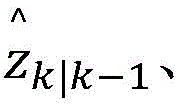


A method for estimating the posture of human upper limbs based on progressive unscented Kalman filter network, comprising: step 1) building a set of acquisition system, obtaining angle information of human upper limb motion joints through a visual capture system, and using a myoelectric wristband to monitor the movement of the forearm Collect the EMG signals during exercise; step 2) establish a model between the sEMG signal and the joint angle of the upper limb; step 3) construct an unscented Kalman filter system with parameters estimated by LSTM, and use the LSTM neural network to learn the measurement of the system Equation h( ), system noise Q k and measurement noise R k ; with UT variation, weighted statistical linear regression is used to approximate the posterior mean of the nonlinear equation
Description
技术领域Technical Field
本发明属于人体姿态估计领域,尤其是一种基于渐进无迹卡尔曼滤波网络的人体上肢姿态估计方法。The invention belongs to the field of human body posture estimation, in particular to a method for estimating human upper limb posture based on a progressive unscented Kalman filter network.
背景技术Background Art
随着基于生物电信号的人机交互技术不断的成熟和发展,该技术被广泛应用于假肢控制、临床医学、虚拟现实技术、机器人技术及运动生物力学。表面肌电信号(Surfaceelectromyography,sEMG)是由运动关联肌肉的运动单元动作电位(Motor unit actionpotential,MUAP)沿着肌纤维方向传播,在人体皮肤表面形成的叠加电信号。该信号反映了引起肢体运动的肌肉收缩状态,蕴含丰富的肌肉收缩力、关节力矩等信息,可从中解码出运动直接关联意图,广泛应用于人体姿态估计和人体行为分析。相对于离散肢体动作的识别,基于sEMG信号的连续运动估计能够提取更多人体运动信息,应用于智能假肢、医疗康复机器人和运动评估等。With the continuous maturity and development of human-computer interaction technology based on bioelectric signals, this technology has been widely used in prosthetic control, clinical medicine, virtual reality technology, robotics and sports biomechanics. Surface electromyography (sEMG) is a superimposed electrical signal formed on the surface of human skin by the motor unit action potential (MUAP) of the movement-related muscle propagating along the direction of the muscle fiber. This signal reflects the muscle contraction state that causes limb movement, contains rich information such as muscle contraction force and joint torque, and can decode the direct movement-related intention from it. It is widely used in human posture estimation and human behavior analysis. Compared with the recognition of discrete limb movements, continuous motion estimation based on sEMG signals can extract more human motion information and is applied to intelligent prostheses, medical rehabilitation robots and motion evaluation.
目前,常有两类方法实现基于sEMG的关节连续运动估计。第一类方法是结合肌肉生理力学建立以sEMG为输入的关节动力学模型,进而计算关节力矩、角加速度、角速度等连续量,该方法的优点是建立的模型能够解释运动的产生过程。应用最多的肌肉力模型是Hill模型,它是一种生理现象学模型,其中含有多个无法直接量测的生理参数,因此需要通过初步实验对有效的参数进行识别,这也限制了其在实践中的应用。第二类方法是直接建立关联sEMG和关节连续运动量的回归模型,该方法优点是建模过程直接,对sEMG的利用不受限。现有最广泛的直接建模方法分为两种,一种是基于深度学习的方法,利用深度神经网络建立关联sEMG和关节运动量的回归模型。通常需要先对sEMG信号进行预处理,然后将处理后的信号用于训练神经网络,最终得到相应的回归模型。然而,基于深度学习的方法是由数据驱动的网络,在建模过程中不可避免的忽略了一些重要的先验知识。况且,深度神经网络训练时需要大量样本作为训练数据,sEMG作为一种非平稳信号在采集阶段中存在个体差异、肌肉疲劳等差异或干扰,造成训练集与测试集的分布明显不同,最终导致回归模型不准确。另一种是以卡尔曼滤波(Kalman filtering,KF)为代表的在小样本容量前提下使用时序滤波器提高回归精度的方法,在真实系统中,KF量测函数和状态函数往往难以直接获得,人为设计的量测模型和状态模型往往是对复杂模型的粗略近似,降低了KF的性能。特别是在使用sEMG对人体进行连续运动估计的任务中,肢体姿态和关节角度并不遵循简单的运动模型,由肌肉收缩产生的sEMG和肢体姿态之间的物理关系也无法直接得到。在这种情况下,KF的建模变得十分困难。而且以KF为代表的线性状态空间模型对sEMG和关节运动量的非线性关系描述不充分,其泛化能力需要进一步提高。At present, there are two common methods to achieve continuous joint motion estimation based on sEMG. The first method is to establish a joint dynamics model with sEMG as input in combination with muscle physiological mechanics, and then calculate continuous quantities such as joint torque, angular acceleration, and angular velocity. The advantage of this method is that the established model can explain the process of motion generation. The most widely used muscle force model is the Hill model, which is a physiological phenomenological model that contains multiple physiological parameters that cannot be directly measured. Therefore, it is necessary to identify effective parameters through preliminary experiments, which also limits its application in practice. The second method is to directly establish a regression model that associates sEMG and continuous joint motion. The advantage of this method is that the modeling process is direct and the use of sEMG is not restricted. The most widely used direct modeling methods are divided into two types. One is a method based on deep learning, which uses deep neural networks to establish a regression model that associates sEMG and joint motion. It is usually necessary to preprocess the sEMG signal first, and then use the processed signal to train the neural network to finally obtain the corresponding regression model. However, the method based on deep learning is a data-driven network, and some important prior knowledge is inevitably ignored in the modeling process. Moreover, a large number of samples are required as training data for deep neural network training. As a non-stationary signal, sEMG has individual differences, muscle fatigue and other differences or interferences in the acquisition stage, resulting in significantly different distributions between the training set and the test set, which ultimately leads to inaccurate regression models. Another method is to use a time series filter to improve regression accuracy under the premise of small sample capacity, represented by Kalman filtering (KF). In real systems, KF measurement functions and state functions are often difficult to obtain directly, and artificially designed measurement models and state models are often rough approximations of complex models, which reduces the performance of KF. Especially in the task of using sEMG to estimate continuous human motion, limb posture and joint angle do not follow a simple motion model, and the physical relationship between sEMG generated by muscle contraction and limb posture cannot be directly obtained. In this case, KF modeling becomes very difficult. Moreover, the linear state space model represented by KF does not adequately describe the nonlinear relationship between sEMG and joint motion, and its generalization ability needs to be further improved.
为了克服这些限制,有研究者尝试使用全连接神经网络或使用长短期记忆直接从训练数据中学习运动模型。通过这种方法得到的模型可以将KF中的先验知识与深度神经网络从数据中学习到的运动模型相结合,从而用较小的数据集提高人体连续运动估计的精度。然而,KF是一种线性系统的滤波方法,对非线性模型描述能力很有限,即使是各类渐进卡尔曼方法对深度神经网络的非线性模型描述能力也很有限,这也影响了模型的精度和鲁棒性。综上,在现有的基于sEMG的关节连续运动估计的方法中,还没有对非线性模型描述十分充分且鲁棒的卡尔曼滤波网络。To overcome these limitations, some researchers have tried to use fully connected neural networks or long short-term memory to learn motion models directly from training data. The model obtained by this method can combine the prior knowledge in KF with the motion model learned by the deep neural network from the data, thereby improving the accuracy of continuous human motion estimation with a smaller data set. However, KF is a filtering method for linear systems and has limited ability to describe nonlinear models. Even various types of progressive Kalman methods have limited ability to describe nonlinear models of deep neural networks, which also affects the accuracy and robustness of the model. In summary, among the existing methods for continuous joint motion estimation based on sEMG, there is no Kalman filter network that can fully and robustly describe nonlinear models.
因此,本发明提出一种基于渐进无迹卡尔曼滤波网络的人体上肢姿态估计方法,在使用较小数据集的情况下,较充分描述sEMG和关节运动量的非线性,提高在使用sEMG信号对人体进行连续运动估计中的精确度和鲁棒性。Therefore, the present invention proposes a method for estimating human upper limb posture based on a progressive unscented Kalman filter network, which can more fully describe the nonlinearity of sEMG and joint motion when using a smaller data set, and improve the accuracy and robustness in estimating continuous motion of the human body using sEMG signals.
发明内容Summary of the invention
为了克服在使用sEMG对人体进行连续运动估计的任务中卡尔曼滤波建模困难的问题和深度神经网络回归模型不准确的问题,本发明提供一种基于渐进无迹卡尔曼滤波网络的人体上肢姿态估计方法,采用基于深度学习和渐进无迹卡尔曼滤波融合,有效地提高了人体连续运动估计的精确度和鲁棒性。In order to overcome the problem of difficulty in Kalman filter modeling and the problem of inaccurate deep neural network regression model in the task of estimating continuous motion of the human body using sEMG, the present invention provides a method for estimating the posture of human upper limbs based on an asymptotic unscented Kalman filter network, which effectively improves the accuracy and robustness of continuous motion estimation of the human body by fusion of deep learning and asymptotic unscented Kalman filter.
本发明解决其技术问题所采用的技术方案是:The technical solution adopted by the present invention to solve the technical problem is:
一种基于渐进无迹卡尔曼滤波网络的人体上肢姿态估计方法,所述方法包括以下步骤:A method for estimating the posture of human upper limbs based on a progressive unscented Kalman filter network, the method comprising the following steps:
步骤1)数据采集:搭建一套采集系统,通过视觉捕捉系统获取人体上肢运动关节的角度信息,使用肌电手环对小臂在运动过程中的肌电信号进行采集;Step 1) Data collection: Build a collection system to obtain the angle information of the upper limb motion joints of the human body through a visual capture system, and use an electromyographic bracelet to collect the electromyographic signals of the forearm during movement;
步骤2)建立sEMG信号与上肢关节角度之间的模型:Step 2) Establish a model between sEMG signals and upper limb joint angles:
xk=f(xk-1)+wk-1 (1)x k =f(x k-1 )+w k-1 (1)
zk=h(xk)+vk (2)z k =h(x k )+v k (2)
步骤3)构建了由LSTM估计参数的无迹卡尔曼滤波体系,利用LSTM神经网络学习系统的量测方程h(·)、系统噪声Qk和量测噪声Rk;采用UT变化,利用加权统计线性回归近似非线性方程的后验均值
步骤4)根据UT变换和量测噪声Rk,求得量测变量的一步预测
步骤5)根据UKF的计算步骤计算卡尔曼增益,根据k时刻的量测值zk,求出k时刻的状态估计
进一步,在所述步骤1)中,所述的A、B、C表示人体肘部关节点的标号,其中AB表示实验者大臂,BC表示实验者小臂,上肢肘关节的关节角度为夹角θ。Furthermore, in the step 1), the A, B, and C represent the numbers of the joint points of the human elbow, wherein AB represents the upper arm of the experimenter, BC represents the forearm of the experimenter, and the joint angle of the upper limb elbow joint is the angle θ.
进一步,在所述步骤1)中,所述的视觉捕捉系统由12个摄像头组成,肌电手环的采样频率为200Hz。Furthermore, in step 1), the visual capture system is composed of 12 cameras, and the sampling frequency of the myoelectric bracelet is 200 Hz.
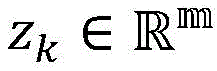
进一步,在所述步骤2)中,所述的xk和zk分别为k时刻n维上肢关节状态向量和m维的sEMG信号量测向量。Furthermore, in the step 2), the x k and z k are respectively the n-dimensional upper limb joint state vector at time k and the m-dimensional sEMG signal measurement vector.
在所述步骤2)中,所述的f(·)和h(·)为系统非线性状态方程和量测方程。In the step 2), the f(·) and h(·) are the nonlinear state equation and measurement equation of the system.
在所述步骤2)中,所述的wk和vk分别是均值为零的系统噪声和量测噪声,且相应的协方差Qk和Rk为互不相关的高斯白噪声。In the step 2), the w k and v k are system noise and measurement noise with zero mean, respectively, and the corresponding covariances Q k and R k are Gaussian white noises that are uncorrelated with each other.
进一步,所述步骤3)中,所述的构建由LSTM估计参数的无迹卡尔曼滤波体系,利用LSTM神经网络对UKF部分模型进行学习,从训练数据中直接得到量测噪声、系统噪声以及量测函数。Furthermore, in the step 3), the unscented Kalman filter system with LSTM estimated parameters is constructed, and the UKF partial model is learned using the LSTM neural network to directly obtain the measurement noise, system noise and measurement function from the training data.
进一步,所述步骤4)中,所述的量测方程h(·)则直接用一个LSTMh(·)模块进行替代,然后由UT变换和LSTMR得到的量测噪声Rk,求得量测变量的一步预测
进一步,所述步骤5)中,所述的UKF中加入一种带有自适应测量更新的渐进UKF滤波方法,提高系统的稳定性;人为增大测量噪声的协方差解决稳定性和滤波精度之间的矛盾,根据k时刻的量测值zk,求出k时刻的状态估计
本发明基于UKF计算图,利用LSTM模型得到UKF的未知参数。同时,使用渐进滤波方法解决了UKF加入LSTM引起的卡尔曼增益不稳定问题。该模型结合了UKF和LSTM的优点,能够应用在非线性系统中并从较小数据集上获得较高的回归精度,在基于sEMG的上肢关节角度估计效果优于其他基于学习的KF模型。本发明提供一种基于渐进无迹卡尔曼滤波网络的人体上肢姿态估计方法,有效地提高了人体上肢姿态估计的精确度和鲁棒性。The present invention is based on the UKF calculation graph and uses the LSTM model to obtain the unknown parameters of the UKF. At the same time, the progressive filtering method is used to solve the Kalman gain instability problem caused by adding LSTM to UKF. The model combines the advantages of UKF and LSTM, can be applied in nonlinear systems and obtain higher regression accuracy from smaller data sets, and is better than other learning-based KF models in upper limb joint angle estimation based on sEMG. The present invention provides a method for upper limb posture estimation based on a progressive unscented Kalman filter network, which effectively improves the accuracy and robustness of upper limb posture estimation.
本发明的有益效果主要表现在:提供一种基于渐进无迹卡尔曼滤波网络融合的人体姿态估计方法,针对在使用sEMG对人体进行连续运动估计的任务中,使用卡尔曼滤波对肢体姿态和关节角度进行建模十分困难的问题,采用长短期记忆神经网络直接从训练数据中学习运动模型,并结合一种带有自适应测量更新的渐进UKF滤波方法解决了卡尔曼增益不稳定的问题,提高了上肢姿态估计的准确度和鲁棒性。The beneficial effects of the present invention are mainly manifested in: providing a human body posture estimation method based on progressive unscented Kalman filter network fusion, aiming at the problem that it is very difficult to use Kalman filtering to model limb posture and joint angle in the task of estimating continuous motion of the human body using sEMG , using a long short-term memory neural network to directly learn the motion model from training data, and combining a progressive UKF filtering method with adaptive measurement update to solve the problem of Kalman gain instability, thereby improving the accuracy and robustness of upper limb posture estimation.
附图说明BRIEF DESCRIPTION OF THE DRAWINGS
图1是本发明的基于LSTM-pUKF融合的上肢姿态估计流程图。FIG1 is a flow chart of upper limb posture estimation based on LSTM-pUKF fusion of the present invention.
图2是本发明的基于LSTM-pUKF的上肢姿态融合估计的算法框架图。FIG2 is an algorithm framework diagram of upper limb posture fusion estimation based on LSTM-pUKF of the present invention.
图3a是本发明的LSTMQ的模块网络图,图3b是LSTMR的模块网络图,图3c是LSTMh的模块网络图。Figure 3a is a module network diagram of LSTM Q of the present invention, Figure 3b is a module network diagram of LSTM R , and Figure 3c is a module network diagram of LSTM h .
具体实施方式DETAILED DESCRIPTION
下面结合附图对本发明做进一步描述。The present invention will be further described below in conjunction with the accompanying drawings.
参照图1、图2、图3,一种渐进无迹卡尔曼滤波网络的人体上肢姿态估计方法,所述方法包括以下步骤:Referring to FIG. 1 , FIG. 2 , and FIG. 3 , a method for estimating the posture of human upper limbs using a progressive unscented Kalman filter network is provided, and the method comprises the following steps:
步骤1)数据采集:搭建一套采集系统,通过视觉捕捉系统可以获取人体上肢运动关节的角度信息,使肌电采集手环对小臂在运动过程中的肌电信号进行采集;Step 1) Data collection: Build a collection system, which can obtain the angle information of the upper limb motion joints of the human body through the visual capture system, so that the electromyographic collection bracelet can collect the electromyographic signals of the forearm during the movement;
步骤2)建立sEMG信号与上肢关节角度之间的模型:Step 2) Establish a model between sEMG signals and upper limb joint angles:
xk=f(xk-1)+wk-1 (1)x k =f(x k-1 )+w k-1 (1)
zk=h(xk)+vk (2)z k =h(x k )+v k (2)
步骤3)构建了由LSTM估计参数的无迹卡尔曼滤波体系,利用LSTM神经网络学习系统的量测方程h(·)、系统噪声Qk和量测噪声Rk,采用UT变化,利用加权统计线性回归近似非线性方程的后验均值
步骤4)根据UT变换和量测噪声Rk,求得量测变量的一步预测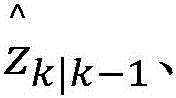
步骤5)根据UKF的计算步骤计算卡尔曼增益,根据k时刻的量测值zk,求出k时刻的状态估计
基于渐进无迹卡尔曼滤波网络融合的人体上肢姿态估计流程图如图1所示。首先,搭建采集系统,使用肌电手环获取小臂运动过程中的肌电信号,同时使用运动捕捉系统对上肢肘关节角度数据进行同步采集。对多名不同的测试者进行实验,每个指定动作采集十组数据,然后再以随机姿态角度做五组运动,其中每次实验之间都有足够的休息时间,防止肌肉疲劳。建立sEMG信号与上肢关节角度之间的模型如下:The flowchart of human upper limb posture estimation based on progressive unscented Kalman filter network fusion is shown in Figure 1. First, build an acquisition system, use an electromyographic bracelet to obtain the electromyographic signal during the movement of the forearm, and use a motion capture system to synchronously collect the upper limb elbow joint angle data. Experiments were conducted on multiple different testers, ten sets of data were collected for each specified action, and then five sets of exercises were performed with random posture angles. There was enough rest time between each experiment to prevent muscle fatigue. The model between sEMG signals and upper limb joint angles is established as follows:
xk=f(xk-1)+wk-1 (1)x k =f(x k-1 )+w k-1 (1)
zk=h(xk)+vk (2)z k =h(x k )+v k (2)
其中,

其次,构建由LSTM估计参数的无迹卡尔曼滤波体系,在构建的sEMG信号和上肢关节角度之间的模型中状态方程f(·)是已知的,量测方程h(·)、系统噪声Qk和量测噪声Rk均为未知,由于状态噪声协方差矩阵Qk和量测噪声协方差矩阵Rk难以估计,所以使用LSTM直接从状态向量和噪声向量中学习Qk和Rk:Secondly, an unscented Kalman filter system with LSTM parameter estimation is constructed. In the model between the sEMG signal and the upper limb joint angle, the state equation f(·) is known, and the measurement equation h(·), system noise Q k and measurement noise R k are unknown. Since the state noise covariance matrix Q k and the measurement noise covariance matrix R k are difficult to estimate, LSTM is used to learn Q k and R k directly from the state vector and noise vector:


其中,LSTMQ和LSTMR分别表示用于学习Qk和Rk的LSTM模块,xk-1为k时刻n维sEMG信号状态向量,zk为k时刻m维的sEMG信号量测向量,

然后,根据UKF算法的核心思想,采用对称采样策略,用2n+1个Sigma采样点{χ′i},i=1,2,…,2n,来近似非线性状态方程的后验均值和方差,得到的2n+1个采样点为:Then, according to the core idea of the UKF algorithm, a symmetric sampling strategy is adopted to use 2n+1 Sigma sampling points {χ′ i }, i = 1, 2, …, 2n, to approximate the posterior mean and variance of the nonlinear state equation. The obtained 2n +1 sampling points are:


将Sigma采样点

对称采样相应的均值权重Wi m和方差权重Wi c为:The corresponding mean weight Wim and variance weight Wic for symmetric sampling are:

其中,K为随机变量x的Sigma采样点间距比例因子,n为变量x的维度。通过加权统计线性回归技术可以求得一步状态预测的均值和方差:Among them, K is the Sigma sampling point spacing ratio factor of the random variable x, and n is the dimension of the variable x. The mean and variance of the one-step state prediction can be obtained by weighted statistical linear regression technology:


根据计算出来的状态预测估计值

接着,直接用一个LSTMh(·)模块替代量测方程h(·):Next, we directly replace the measurement equation h(·) with an LSTM h(·) module:

根据UT变换和LSTMR学习得到的量测噪声Rk,进一步求得量测变量的一步预测


Kk=Pxz,k(Pzz,k|k-1)-1 (16)K k =P xz,k ( Pzz,k|k-1 ) -1 (16)
其中,N表示每次渐进测量更新时测量噪声协方差增加到N倍,同时需要N步才能实现测量更新,以此达到自适应测量更新和渐进滤波的目的,从而提高系统的稳定性和滤波的精度。Wherein, N means that the measurement noise covariance increases to N times each time the progressive measurement is updated, and N steps are required to realize the measurement update, so as to achieve the purpose of adaptive measurement update and progressive filtering, thereby improving the stability of the system and the accuracy of filtering.
最后,根据k时刻的量测值zk,求出k时刻的状态估计


Claims (6)


Priority Applications (1)
| Application Number | Priority Date | Filing Date | Title |
|---|---|---|---|
| CN202211500262.5A CN116129464B (en) | 2022-11-28 | 2022-11-28 | A method for human upper limb posture estimation based on progressive unscented Kalman filter network |
Applications Claiming Priority (1)
| Application Number | Priority Date | Filing Date | Title |
|---|---|---|---|
| CN202211500262.5A CN116129464B (en) | 2022-11-28 | 2022-11-28 | A method for human upper limb posture estimation based on progressive unscented Kalman filter network |
Publications (2)
| Publication Number | Publication Date |
|---|---|
| CN116129464A true CN116129464A (en) | 2023-05-16 |
| CN116129464B CN116129464B (en) | 2025-09-05 |
Family
ID=86310784
Family Applications (1)
| Application Number | Title | Priority Date | Filing Date |
|---|---|---|---|
| CN202211500262.5A Active CN116129464B (en) | 2022-11-28 | 2022-11-28 | A method for human upper limb posture estimation based on progressive unscented Kalman filter network |
Country Status (1)
| Country | Link |
|---|---|
| CN (1) | CN116129464B (en) |
Cited By (3)
| Publication number | Priority date | Publication date | Assignee | Title |
|---|---|---|---|---|
| CN117131396A (en) * | 2023-08-28 | 2023-11-28 | 东南大学 | An online estimation method of wrist torque based on neural features and LSTM |
| CN119184673A (en) * | 2024-11-05 | 2024-12-27 | 大连海事大学 | Joint angle estimation method and device based on vision and surface electromyographic signals |
| CN119919456A (en) * | 2025-04-02 | 2025-05-02 | 德清县浙工大莫干山研究院 | A human body posture estimation method, device and medium based on progressive particle filtering |
Citations (3)
| Publication number | Priority date | Publication date | Assignee | Title |
|---|---|---|---|---|
| JP2013149203A (en) * | 2012-01-23 | 2013-08-01 | Nippon Telegr & Teleph Corp <Ntt> | Optimal model estimation device, method and program |
| CN109645995A (en) * | 2019-01-16 | 2019-04-19 | 杭州电子科技大学 | Joint motions estimation method based on myoelectricity model and Unscented kalman filtering |
| CN114973417A (en) * | 2022-06-08 | 2022-08-30 | 浙江工业大学 | Human body posture estimation method based on neural network and Kalman filtering |
-
2022
- 2022-11-28 CN CN202211500262.5A patent/CN116129464B/en active Active
Patent Citations (3)
| Publication number | Priority date | Publication date | Assignee | Title |
|---|---|---|---|---|
| JP2013149203A (en) * | 2012-01-23 | 2013-08-01 | Nippon Telegr & Teleph Corp <Ntt> | Optimal model estimation device, method and program |
| CN109645995A (en) * | 2019-01-16 | 2019-04-19 | 杭州电子科技大学 | Joint motions estimation method based on myoelectricity model and Unscented kalman filtering |
| CN114973417A (en) * | 2022-06-08 | 2022-08-30 | 浙江工业大学 | Human body posture estimation method based on neural network and Kalman filtering |
Non-Patent Citations (2)
| Title |
|---|
| SHANGKUN LIU等: "Automatic Tracking of Muscle Fiber Direction in Ultrasound Images Based on Improved Kalman Filter", ELECTRONICS, vol. 11, no. 3, 5 February 2022 (2022-02-05), pages 1 - 12 * |
| 杨旭升等: "基于渐进无迹卡尔曼滤波网络的人体肢体运动估计", 自动化学报, vol. 49, no. 08, 22 August 2023 (2023-08-22), pages 1723 - 1731 * |
Cited By (3)
| Publication number | Priority date | Publication date | Assignee | Title |
|---|---|---|---|---|
| CN117131396A (en) * | 2023-08-28 | 2023-11-28 | 东南大学 | An online estimation method of wrist torque based on neural features and LSTM |
| CN119184673A (en) * | 2024-11-05 | 2024-12-27 | 大连海事大学 | Joint angle estimation method and device based on vision and surface electromyographic signals |
| CN119919456A (en) * | 2025-04-02 | 2025-05-02 | 德清县浙工大莫干山研究院 | A human body posture estimation method, device and medium based on progressive particle filtering |
Also Published As
| Publication number | Publication date |
|---|---|
| CN116129464B (en) | 2025-09-05 |
Similar Documents
| Publication | Publication Date | Title |
|---|---|---|
| CN116129464A (en) | Human body upper limb posture estimation method based on progressive unscented Kalman filter network | |
| Nasr et al. | MuscleNET: mapping electromyography to kinematic and dynamic biomechanical variables by machine learning | |
| US6660042B1 (en) | Methods of biomimetic finger control by filtering of distributed forelimib pressures | |
| Ibrahimy et al. | Design and optimization of Levenberg-Marquardt based neural network classifier for EMG signals to identify hand motions | |
| CN109875565A (en) | An automatic assessment method for upper limb motor function in stroke based on deep learning | |
| Shao et al. | Single-channel SEMG using wavelet deep belief networks for upper limb motion recognition | |
| Tang et al. | Continuous estimation of human upper limb joint angles by using PSO-LSTM model | |
| CN113524235B (en) | Object limb time-varying stiffness identification method and device for dynamic interaction | |
| CN110659677A (en) | A human fall detection method based on movable sensor combination device | |
| Kumar et al. | A critical review on hand gesture recognition using semg: Challenges, application, process and techniques | |
| Su et al. | Ankle joint torque prediction based on surface electromyographic and angular velocity signals | |
| CN118228145B (en) | Rehabilitation action recognition and quantitative assessment method, device, equipment and storage medium | |
| KR100994408B1 (en) | Finger force estimation method and estimation device, muscle discrimination method and muscle determination device for finger force estimation | |
| CN116522234B (en) | Joint angle prediction method, device, equipment and medium | |
| CN111110268B (en) | Human body muscle sound signal prediction method based on random vector function connection network technology | |
| CN110710984B (en) | Ankle torque prediction method based on recursive cerebellar model based on surface electromyography | |
| Mekruksavanich et al. | Heterogeneous recognition of human activity with cnn and rnn-based networks using smartphone and smartwatch sensors | |
| CN118216917A (en) | Muscle force balance state analysis method and system based on neural network | |
| Lueken et al. | Using synthesized imu data to train a long-short term memory-based neural network for unobtrusive gait analysis with a sparse sensor setup | |
| HAMZI et al. | Forearm EMG Signals Classification using an Adaptative Neuro-Fuzzy Inference System. | |
| Roy et al. | Concurrent decoding of finger kinematic and kinetic variables based on motor unit discharges | |
| Wang et al. | Prediction of Upper Limb Joint Angles Based on Multi-Source Information Fusion using Temporal Convolutional Network | |
| CN111657956B (en) | Hand motor function assessment device and method | |
| Hui-Bin et al. | Characterizations on knee movement estimation from surface EMG using composited approaches | |
| CN118245850A (en) | A method and system for identifying human lower limb movement intention under non-ideal conditions |
Legal Events
| Date | Code | Title | Description |
|---|---|---|---|
| PB01 | Publication | ||
| PB01 | Publication | ||
| SE01 | Entry into force of request for substantive examination | ||
| SE01 | Entry into force of request for substantive examination | ||
| GR01 | Patent grant | ||
| GR01 | Patent grant |