CN115688784A - Chinese named entity recognition method fusing character and word characteristics - Google Patents
Chinese named entity recognition method fusing character and word characteristics Download PDFInfo
- Publication number
- CN115688784A CN115688784A CN202211330887.1A CN202211330887A CN115688784A CN 115688784 A CN115688784 A CN 115688784A CN 202211330887 A CN202211330887 A CN 202211330887A CN 115688784 A CN115688784 A CN 115688784A
- Authority
- CN
- China
- Prior art keywords
- sequence
- model
- sequence vector
- vector containing
- named entity
- Prior art date
- Legal status (The legal status is an assumption and is not a legal conclusion. Google has not performed a legal analysis and makes no representation as to the accuracy of the status listed.)
- Withdrawn
Links
Images


Landscapes
- Character Discrimination (AREA)
Abstract
Description
技术领域technical field
本发明涉及中文命名实体识别技术领域,尤其涉及一种融合字与词语特征的中文命名实体识别方法。The invention relates to the technical field of Chinese named entity recognition, in particular to a Chinese named entity recognition method that combines character and word features.
背景技术Background technique
命名实体识别是自然语言处理的基础任务之一,命名实体是一个词或者短语,命名实体识别任务就是将文本中的命名实体定位并分类成预定义识别类别的过程,如识别文本中的人员、地理位置、组织名称、时间和货币等等;命名实体识别在推荐系统、机器翻译、知识图谱和语义搜索等多种自然语言处理的下游任务中起着重要作用。Named entity recognition is one of the basic tasks of natural language processing. A named entity is a word or phrase. The named entity recognition task is the process of locating and classifying named entities in text into predefined recognition categories, such as identifying people in text, Geolocation, organization name, time and currency, etc.; named entity recognition plays an important role in many downstream tasks of natural language processing such as recommender systems, machine translation, knowledge graphs and semantic search.
近年来在中文领域的命名实体识别方法主要可以分为以下三类:基于规则匹配的方法、基于统计机器学习的方法和基于神经网络深度学习的方法;首先早期命名实体识别的实现依赖于规则匹配模版,这种方法虽然不需要带注释的数据,但这类方法主要基于手工制作的语义和句法规则来识别实体,当词典详尽时,基于规则匹配的模型表现得很好,但这种规则匹配模版泛化能力差,更换到其他特定领域又会对识别结果产生很大影响,因此需要对不同领域构建不同的规则,导致效率不高;其次基于统计机器学习的方法识别效果依赖于大量的标注语料的条件限制了该类方法的应用范围扩展和迁移;最后字和词对中文命名实体识别同样重要,只基于其中一种进行建模的话,没法挖掘语句序列中潜藏的上下文信息,且中文字符不存在空格进行分割,在分词的时候出现错误会影响识别效果;另外中文也存在一词多义的情况,许多学者使用的Word2Vec等预训练模型关注的是词或者字符之间的特征,没有考虑到词的上下文语境,仍然无法解决一词多义的问题。Named entity recognition methods in the Chinese field in recent years can be mainly divided into the following three categories: methods based on rule matching, methods based on statistical machine learning, and methods based on deep learning of neural networks; first, the implementation of early named entity recognition relies on rule matching Templates, although this method does not require annotated data, but this type of method is mainly based on hand-crafted semantic and syntactic rules to identify entities. When the dictionary is exhaustive, the model based on rule matching performs well, but this rule matching The generalization ability of the template is poor, and changing to other specific fields will have a great impact on the recognition results, so it is necessary to construct different rules for different fields, resulting in low efficiency; secondly, the recognition effect of the method based on statistical machine learning depends on a large number of annotations The conditions of the corpus limit the application range expansion and migration of this type of method; finally, characters and words are equally important for Chinese named entity recognition. If only one of them is used for modeling, it is impossible to mine the hidden context information in the sentence sequence, and the Chinese Characters are segmented without spaces, and errors in word segmentation will affect the recognition effect; in addition, Chinese also has polysemy. Many scholars use Word2Vec and other pre-training models that focus on the features between words or characters. Considering the contextual context of words, it is still impossible to solve the problem of polysemy.
发明内容Contents of the invention
为了解决上述技术问题,本发明的目的是提供一种融合字与词语特征的中文命名实体识别方法,能够加强模型对命名实体识别的效果。In order to solve the above-mentioned technical problems, the object of the present invention is to provide a Chinese named entity recognition method that combines character and word features, which can strengthen the effect of the model on named entity recognition.
本发明所采用的技术方案是:一种融合字与词语特征的中文命名实体识别方法,包括以下步骤:The technical scheme adopted in the present invention is: a Chinese named entity recognition method that fuses character and word features, comprising the following steps:
获取数据集并对BERT模型进行特征提取训练,得到含有语义特征的序列向量;Obtain the data set and perform feature extraction training on the BERT model to obtain a sequence vector containing semantic features;
根据含有语义特征的序列向量训练BILSTM模型,得到含有上下文特征的序列向量;Train the BILSTM model according to the sequence vector containing semantic features, and obtain the sequence vector containing context features;
根据含有上下文特征的序列向量训练FLAT模型,得到预测的标签序列;Train the FLAT model according to the sequence vector containing the context feature to obtain the predicted label sequence;
整合BERT模型、BILSTM模型和FLAT模型,得到中文命名实体识别模型;Integrate the BERT model, BILSTM model and FLAT model to obtain a Chinese named entity recognition model;
将待测数据输入中文命名实体识别模型进行识别,得到识别结果。Input the data to be tested into the Chinese named entity recognition model for recognition, and obtain the recognition result.
进一步,所述获取数据集并对BERT模型进行特征提取训练,得到含有语义特征的序列向量这一步骤,具体包括:Further, the step of obtaining a data set and performing feature extraction training on the BERT model to obtain a sequence vector containing semantic features specifically includes:
获取数据集并进行分词与标签标记处理,得到分词文本序列;Obtain the data set and perform word segmentation and tagging processing to obtain the word segmentation text sequence;
随机选取分词文本序列的部分词进行掩码操作;Randomly select some words of the word segmentation text sequence for masking operation;
将掩码后的分词文本序列输入BERT模型中,所述BERT模型包括输入层、编码层和输出层;The participle text sequence after the mask is input in the BERT model, and the BERT model includes an input layer, a coding layer and an output layer;
利用输入层将掩码后的分词文本序列的词转换成词向量;Use the input layer to convert the words of the masked word segmentation text sequence into word vectors;
基于全局关联权重公式利用编码层对词向量进行特征提取,得到含有语义特征的序列向量。Based on the global association weight formula, the encoding layer is used to extract the features of the word vectors, and the sequence vectors containing semantic features are obtained.
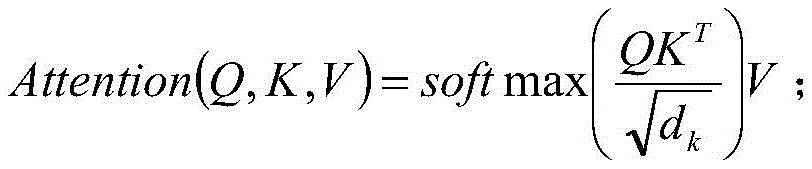
进一步,所述全局关联权重公式的计算公式,具体如下:Further, the calculation formula of the global association weight formula is as follows:

上式中,Q表示查询矩阵,K表示键矩阵,V表示值矩阵,dk表示键矩阵的维度。In the above formula, Q represents the query matrix, K represents the key matrix, V represents the value matrix, and d k represents the dimension of the key matrix.
进一步,所述根据含有语义特征的序列向量训练BILSTM模型,得到含有上下文特征的序列向量这一步骤,具体包括:Further, the step of training the BILSTM model according to the sequence vector containing semantic features to obtain the sequence vector containing context features specifically includes:
将含有语义特征的序列向量输入BILSTM模型中,所述BILSTM模型包括前向LSTM模型和后向LSTM模型;Containing the sequence vector input of semantic feature in BILSTM model, described BILSTM model comprises forward LSTM model and backward LSTM model;
含有语义特征的序列向量按正向序列依次通过前向LSTM模型,得到前向序列向量;The sequence vector containing semantic features passes through the forward LSTM model in sequence according to the forward sequence to obtain the forward sequence vector;
含有语义特征的序列向量按反向序列依次通过后向LSTM模型,得到后向序列向量;The sequence vector containing semantic features passes through the backward LSTM model in reverse order to obtain the backward sequence vector;
将前向序列向量与后向序列向量拼接得到含有上下文特征的序列向量。The forward sequence vector and the backward sequence vector are concatenated to obtain a sequence vector containing context features.
进一步,所述含有语义特征的序列向量按正向序列依次通过前向LSTM模型,得到前向序列向量这一步骤,具体包括:Further, the step of obtaining the forward sequence vector by sequentially passing the sequence vector containing semantic features through the forward LSTM model in the forward sequence specifically includes:
含有语义特征的序列向量按正向序列依次通过前向LSTM模型,所述前向LSTM模型包括输入门、遗忘门和输出门;The sequence vector containing the semantic feature passes through the forward LSTM model sequentially according to the forward sequence, and the forward LSTM model includes an input gate, a forgetting gate and an output gate;
利用输入门控制含有语义特征的序列向量的输入;Use the input gate to control the input of sequence vectors containing semantic features;
利用遗忘门对输入的含有语义特征的序列向量的权重进行计算,并根据权重选取留存的含有语义特征的序列向量;Use the forget gate to calculate the weight of the input sequence vector containing semantic features, and select the retained sequence vector containing semantic features according to the weight;
利用输出门输出留存的含有语义特征的序列向量,得到前向序列向量。Use the output gate to output the retained sequence vector containing semantic features to obtain the forward sequence vector.
进一步,所述含有语义特征的序列向量按反向序列依次通过后向LSTM模型,得到后向序列向量这一步骤,具体包括:Further, the step of obtaining the backward sequence vector by passing the sequence vector containing the semantic features through the backward LSTM model in reverse sequence, specifically includes:
含有语义特征的序列向量按反向序列依次通过后向LSTM模型,所述后向LSTM模型包括输入门、遗忘门和输出门;The sequence vector containing the semantic features passes through the backward LSTM model in reverse sequence, and the backward LSTM model includes an input gate, a forgetting gate and an output gate;
利用输入门控制含有语义特征的序列向量的输入;Use the input gate to control the input of sequence vectors containing semantic features;
利用遗忘门对输入的含有语义特征的序列向量的权重进行计算,并根据权重选取留存的含有语义特征的序列向量;Use the forget gate to calculate the weight of the input sequence vector containing semantic features, and select the retained sequence vector containing semantic features according to the weight;
利用输出门输出留存的含有语义特征的序列向量,得到后向序列向量。Use the output gate to output the retained sequence vector containing semantic features to obtain the backward sequence vector.
进一步,所述根据含有上下文特征的序列向量训练FLAT模型,得到预测的标签序列这一步骤,具体包括:Further, the step of training the FLAT model according to the sequence vector containing the context feature to obtain the predicted label sequence specifically includes:
将含有上下文特征的序列向量输入FLAT模型,所述FLAT模型包括编码层、自注意力层和解码层;Input the sequence vector containing the context feature into the FLAT model, the FLAT model includes a coding layer, a self-attention layer and a decoding layer;
利用编码层将含有上下文特征的序列向量的图格子结构转换成平面格子结构,每个平面格子结构由不同长度的字或词组成;Use the encoding layer to convert the graph lattice structure of sequence vectors containing context features into a planar lattice structure, each planar lattice structure is composed of words or words of different lengths;
每个字或词添加一个开始位置和结束位置,计算不同字或词之间的相对距离矩阵;Add a start position and end position to each word or word, and calculate the relative distance matrix between different words or words;
将相对距离矩阵进行拼接后作一个非线性变换,得到相对位置编码;After the relative distance matrix is spliced, a nonlinear transformation is performed to obtain the relative position code;
基于相对位置编码利用自注意力层的变体进行相对跨度位置编码,得到字或词的编码;Based on the relative position encoding, the relative span position encoding is performed using a variant of the self-attention layer to obtain the encoding of the word or word;
利用解码层对字或词的编码进行解码,得到预测的标签序列。Use the decoding layer to decode the encoding of words or words to obtain the predicted label sequence.
进一步,所述相对位置编码的计算公式,具体如下:Further, the calculation formula of the relative position encoding is as follows:

上式中,Wr表示可学习的参数,
进一步,所述相对跨度位置编码的计算公式,具体如下:Further, the calculation formula of the relative span position coding is as follows:

上式中,
进一步,还包括中文命名实体识别模型的识别效果检测方法,具体包括:Further, the recognition effect detection method of the Chinese named entity recognition model is also included, specifically including:
获取测试集并输入中文命名实体识别模型中,得到识别结果;Get the test set and input it into the Chinese named entity recognition model to get the recognition result;
将识别结果与真实标签进行匹配,计算精确率、召回率和F1值;Match the recognition result with the real label, and calculate the precision rate, recall rate and F1 value;
根据精确率、召回率和F1值判断中文命名实体识别模型的识别效果。According to the precision rate, recall rate and F1 value, the recognition effect of the Chinese named entity recognition model is judged.
本发明方法的有益效果是:本发明首先获取数据集训练BERT模型的特征提取能力,得到含有语义特征的序列向量,提升了语言表征能力和特征提取能力;其次根据含有语义特征的序列向量训练BILSTM模型的上下文特征提取能力,得到含有上下文特征的序列向量,进一步获取丰富的语义信息;然后根据含有上下文特征的序列向量训练FLAT模型,得到预测的标签序列,使得字或词得到更充分更直接的信息交互;最后整合BERT模型、BILSTM模型和FLAT模型,得到中文命名实体识别模型,利用中文命名实体识别模型识别待测数据,加强了命名实体识别的效果,提升了命名实体识别的准确率。The beneficial effect of the method of the present invention is: firstly, the present invention obtains the feature extraction ability of the BERT model of the data set training, and obtains the sequence vector containing the semantic feature, which improves the language representation ability and feature extraction ability; secondly, according to the sequence vector containing the semantic feature, the BILSTM is trained The contextual feature extraction ability of the model can obtain sequence vectors containing contextual features, and further obtain rich semantic information; then train the FLAT model according to the sequence vectors containing contextual features, and obtain predicted label sequences, so that words or words can be more fully and directly Information interaction; finally integrate the BERT model, BILSTM model and FLAT model to obtain the Chinese named entity recognition model, use the Chinese named entity recognition model to identify the data to be tested, strengthen the effect of named entity recognition, and improve the accuracy of named entity recognition.
附图说明Description of drawings
图1是本发明一种融合字与词语特征的中文命名实体识别方法的步骤流程图;Fig. 1 is a flow chart of the steps of the Chinese named entity recognition method of a kind of fusion character and word feature of the present invention;
图2是本发明具体实施例BERT模型的结构示意图;Fig. 2 is the structural representation of BERT model of the specific embodiment of the present invention;
图3是本发明具体实施例LSTM模型的结构示意图;Fig. 3 is the structural representation of LSTM model of the specific embodiment of the present invention;
图4是本发明具体实施例BILSTM模型的结构示意图;Fig. 4 is the structural representation of the BILSTM model of the specific embodiment of the present invention;
图5是本发明具体实施例FLAT模型的结构示意图;Fig. 5 is the structural representation of the FLAT model of the specific embodiment of the present invention;
图6是本发明具体实施例中文命名实体识别模型的结构示意图。Fig. 6 is a schematic structural diagram of a Chinese named entity recognition model of a specific embodiment of the present invention.
具体实施方式Detailed ways
下面结合附图和具体实施例对本发明做进一步的详细说明。对于以下实施例中的步骤编号,其仅为了便于阐述说明而设置,对步骤之间的顺序不做任何限定,实施例中的各步骤的执行顺序均可根据本领域技术人员的理解来进行适应性调整。The present invention will be further described in detail below in conjunction with the accompanying drawings and specific embodiments. For the step numbers in the following embodiments, it is only set for the convenience of illustration and description, and the order between the steps is not limited in any way. The execution order of each step in the embodiments can be adapted according to the understanding of those skilled in the art sexual adjustment.
参照图1,本发明提供了一种融合字与词语特征的中文命名实体识别方法,该方法包括以下步骤:With reference to Fig. 1, the present invention provides a kind of Chinese named entity recognition method of fusion word and word feature, and this method comprises the following steps:
S1、获取数据集并对BERT模型进行特征提取训练,得到含有语义特征的序列向量;S1. Obtain a data set and perform feature extraction training on the BERT model to obtain a sequence vector containing semantic features;
S1.1、获取数据集并进行分词与标签标记处理,得到分词文本序列;S1.1. Obtain the data set and perform word segmentation and tagging processing to obtain the word segmentation text sequence;
具体的,首先获取的数据集包括一份公开的简历数据集Resume,一份自行收集并标注的新闻语料数据集;其次对数据集进行分词处理,并对每一个字或词进行标签标记,得到分词文本序列。Specifically, the data sets obtained first include a public resume data set Resume, and a self-collected and labeled news corpus data set; secondly, word segmentation is performed on the data set, and each word or word is tagged to obtain Segmented text sequence.
其中,每一个标签包括一个实体边界标签和实体类别标签,数据集的详细信息如下表:Among them, each label includes an entity boundary label and entity category label, and the detailed information of the dataset is as follows:
S1.2、随机选取分词文本序列的部分词进行掩码操作;S1.2. Randomly select some words of the word segmentation text sequence for masking operation;
S1.3、将掩码后的分词文本序列输入BERT模型中,所述BERT模型包括输入层、编码层和输出层;S1.3, input the participle text sequence after the mask in the BERT model, and the BERT model includes an input layer, a coding layer and an output layer;
具体的,BERT(Bidirectional Encoder Representation from Transformers,基于Transformer的双向编码器表征),该模型是基于多层Transformer双向编码器的预训练语言模型,采用Transformer双向编码器获取文本的特征表示,其模型结构如图2所示,其中,E1,E2,...,EN为输入部分即掩码后的分词文本序列,通过BERT模型的输入层输入,Trm为双向全连接Transformer层,由于Transformer层只采用了Transformer双向编码器中的Encoder结构即编码结构,由多个Encoder结构堆叠而来,故此处定义为编码层,输入部分传入编码层进行特征提取,通过输出层输出T1,T2,...,TN即含有语义特征的序列向量。Specifically, BERT (Bidirectional Encoder Representation from Transformers, Transformer-based bidirectional encoder characterization), this model is a pre-trained language model based on a multi-layer Transformer bidirectional encoder, using a Transformer bidirectional encoder to obtain the feature representation of the text, its model structure As shown in Figure 2, E 1 , E 2 ,..., E N are the input part, that is, the word segmentation text sequence after the mask, which is input through the input layer of the BERT model, and Trm is a bidirectional fully connected Transformer layer. Since the Transformer The layer only uses the Encoder structure in the Transformer bidirectional encoder, that is, the encoding structure, which is stacked from multiple Encoder structures, so it is defined as the encoding layer here. The input part is passed to the encoding layer for feature extraction, and T 1 , T is output through the output layer. 2 ,...,T N is the sequence vector containing semantic features.
S1.4、利用输入层将掩码后的分词文本序列的词转换成词向量;S1.4, using the input layer to convert the words of the masked word segmentation text sequence into word vectors;
具体的,由于BERT模型的输入由Position Embedding、Token Embedding和Segment Embedding相加组成,Position Embedding表示位置信息,Token Embedding表示词,Segment Embedding表示段信息;Position Embedding对位置信息进行编码来记录词顺序这一重要特征;Segment Embedding对句子进行编码用以刻画文本的全局语义信息即段信息,故利用输入层将掩码后的分词文本序列的词转换成词向量,得到的词向量含有词、位置信息和段信息。Specifically, since the input of the BERT model is composed of the addition of Position Embedding, Token Embedding, and Segment Embedding, Position Embedding represents position information, Token Embedding represents words, and Segment Embedding represents segment information; Position Embedding encodes position information to record word order. An important feature; Segment Embedding encodes sentences to describe the global semantic information of the text, that is, segment information, so the input layer is used to convert the words of the word segmentation text sequence after the mask into word vectors, and the obtained word vectors contain word and position information and segment information.
S1.5、基于全局关联权重公式利用编码层对词向量进行特征提取,得到含有语义特征的序列向量。S1.5. Based on the global association weight formula, the encoding layer is used to extract the feature of the word vector, and a sequence vector containing semantic features is obtained.
具体的,每个Encoder结构包含一个自注意力层,自注意力层帮助编码层在对每个词编码时关注输入句子的其他词,即使得当前节点得到上下文的语义来挖掘词语间的关系,并且利用词与词之间的相互关系来调整每个词的权重,获得每个词新的表示特征,这个新的表示特征反映了该词与其他词之间的相互关系和重要程度,从而得到含有语义特征的序列向量。Specifically, each Encoder structure contains a self-attention layer. The self-attention layer helps the encoding layer pay attention to other words in the input sentence when encoding each word, that is, the current node can obtain the semantics of the context to mine the relationship between words. And use the relationship between words to adjust the weight of each word to obtain a new representation feature of each word. This new representation feature reflects the relationship and importance between the word and other words, so as to obtain Sequence vectors containing semantic features.
其中,自注意力层利用全局关联权重公式进行计算的,不仅兼顾了并行计算能力,也极大地提升了长距离特征的捕捉能力,该计算公式具体如下:Among them, the self-attention layer uses the global correlation weight formula for calculation, which not only takes into account the parallel computing ability, but also greatly improves the ability to capture long-distance features. The calculation formula is as follows:
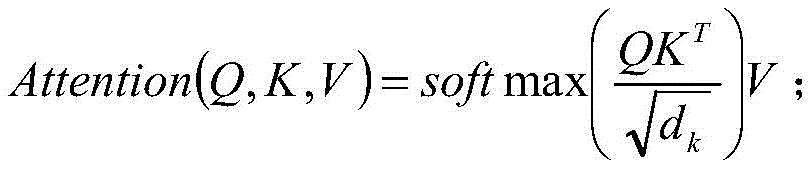
上式中,Q表示查询矩阵,K表示键矩阵,V表示值矩阵,dk表示键矩阵的维度。In the above formula, Q represents the query matrix, K represents the key matrix, V represents the value matrix, and d k represents the dimension of the key matrix.
其中,自注意力层需要从每个编码结构的输入的词向量中生成三个向量,也就是说对于每个词向量,需要创造一个查询向量、一个键向量和一个值向量,这三个向量是通过词嵌入与三个权重矩阵后相乘创建的,这三个向量的主要作用都是有助于计算和理解注意力机制的抽象概念,由于在计算过程中主要运用的矩阵计算,故上述公式表示为查询矩阵、键矩阵和值矩阵。Among them, the self-attention layer needs to generate three vectors from the input word vector of each encoding structure, that is to say, for each word vector, a query vector, a key vector and a value vector need to be created. These three vectors It is created by multiplying the word embedding and three weight matrices. The main function of these three vectors is to help calculate and understand the abstract concept of the attention mechanism. Since the matrix calculation is mainly used in the calculation process, the above Formulas are represented as query matrices, key matrices, and value matrices.
S2、根据含有语义特征的序列向量训练BILSTM模型,得到含有上下文特征的序列向量;S2. Train the BILSTM model according to the sequence vector containing semantic features, and obtain the sequence vector containing context features;
S2.1、将含有语义特征的序列向量输入BILSTM模型中;S2.1. Input sequence vectors containing semantic features into the BILSTM model;
具体的,BILSTM模型(Bi-directional Long Short-Term Memory,双向长短时记忆模型),该模型包括前向LSTM模型和后向LSTM模型,前向LSTM模型和后向LSTM模型均是LSTM模型,由于LSTM是一种前向传播算法,即存在只能保存前面信息这一问题,忽略了未来信息的作用,而对于当前任务中的实体识别来说,序列前值与序列后值也是同等重要的,这关系到实体识别的准确,因此此实施例中使用BILSTM模型进一步从BERT模块的输出中捕获双向上下文语义信息,其模型结构如图4所示,在正向传递信息的同时也会传递逆向信息,接着拼接两个方向学习到的特征作为输出结果,以此提高模型的性能。Specifically, the BILSTM model (Bi-directional Long Short-Term Memory, bidirectional long-short-term memory model), the model includes the forward LSTM model and the backward LSTM model, the forward LSTM model and the backward LSTM model are both LSTM models, because LSTM is a forward propagation algorithm, that is, there is a problem that it can only save the previous information, ignoring the role of future information. For the entity recognition in the current task, the pre-sequence value and the post-sequence value are equally important. This is related to the accuracy of entity recognition. Therefore, in this embodiment, the BILSTM model is used to further capture bidirectional contextual semantic information from the output of the BERT module. The model structure is shown in Figure 4. It will also transmit reverse information while forward information , and then concatenate the features learned in the two directions as the output to improve the performance of the model.
其中,LSTM(Long Short-Term Memory,长短时记忆模型),该模型是循环神经网络的变种之一,如图3所示,LSTM模型比传统的RNN多出了存储单元和三个控制门,分别是输入门、遗忘门和输出门,通过增加的三个门结构可以用来控制输入信息的遗忘和记忆,实现了传递有用信息以及丢弃无用信息,增强了LSTM模型获得长距离语义依赖和对历史信息的记忆能力。Among them, LSTM (Long Short-Term Memory, long-short-term memory model), this model is one of the variants of the cyclic neural network, as shown in Figure 3, the LSTM model has more storage units and three control gates than the traditional RNN, They are the input gate, the forgetting gate and the output gate. Through the addition of three gate structures, they can be used to control the forgetting and memory of input information, realize the transfer of useful information and discard useless information, and enhance the LSTM model to obtain long-distance semantic dependence and Memory capacity for historical information.
S2.2、含有语义特征的序列向量按正向序列依次通过前向LSTM模型,得到前向序列向量;S2.2. The sequence vector containing semantic features passes through the forward LSTM model in sequence according to the forward sequence to obtain the forward sequence vector;
具体的,含有语义特征的序列向量按正向序列依次通过前向LSTM模型;利用输入门控制含有语义特征的序列向量的输入;利用遗忘门对输入的含有语义特征的序列向量的权重进行计算,并根据权重选取留存的含有语义特征的序列向量;利用输出门输出留存的含有语义特征的序列向量,得到前向序列向量。Specifically, the sequence vectors containing semantic features pass through the forward LSTM model in sequence in the forward sequence; the input gate is used to control the input of the sequence vectors containing semantic features; the forget gate is used to calculate the weight of the input sequence vectors containing semantic features, And select the retained sequence vector containing semantic features according to the weight; use the output gate to output the retained sequence vector containing semantic features to obtain the forward sequence vector.
其中,输入门、遗忘门和输出门的计算公式,具体如下:Among them, the calculation formulas of input gate, forget gate and output gate are as follows:

上式中,ft表示遗忘门,it表示输入门,ot表示输出门,ct表示t时刻神经元的状态,xt表示t时刻神经元的输入,ht表示t时刻的输出,W和U表示权重矩阵,b表示偏置,σ表示Sigmoid函数,⊙表示按元素乘积,ft为遗忘门,选择要遗忘的信息,有助于捕捉时间序列中短期的依赖关系,it和ot为更新门,选择要记忆的信息,有助于捕捉时间序列中长期的依赖关系,
S2.3、含有语义特征的序列向量按反向序列依次通过后向LSTM模型,得到后向序列向量;S2.3. The sequence vectors containing semantic features pass through the backward LSTM model in reverse order to obtain the backward sequence vectors;
具体的,由于后向LSTM模型与前向LSTM模型都是LSTM模型,只是传播方向相反,故可以根据步骤S2.2中输入门、遗忘门和输出门的计算公式,得到后向序列向量。Specifically, since the backward LSTM model and the forward LSTM model are both LSTM models, but the direction of propagation is opposite, the backward sequence vector can be obtained according to the calculation formulas of the input gate, forget gate and output gate in step S2.2.
S2.4、将前向序列向量与后向序列向量拼接得到含有上下文特征的序列向量。S2.4. Concatenate the forward sequence vector and the backward sequence vector to obtain a sequence vector containing context features.
具体的,BILSTM模型的计算公式如下:Specifically, the calculation formula of the BILSTM model is as follows:
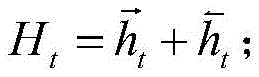
上式中,

S3、如图5所示,根据含有上下文特征的序列向量训练FLAT模型,得到预测的标签序列;S3, as shown in Figure 5, train the FLAT model according to the sequence vector containing the context feature, and obtain the predicted label sequence;
具体的,FLAT模型包括编码层、自注意力层和解码层。Specifically, the FLAT model includes an encoding layer, a self-attention layer, and a decoding layer.
S3.1、将含有上下文特征的序列向量输入FLAT模型;S3.1. Input the sequence vector containing the context feature into the FLAT model;
S3.2、利用编码层将含有上下文特征的序列向量的图格子结构转换成平面格子结构,每个平面格子结构由不同长度的字或词组成;S3.2. Using the encoding layer to convert the graph lattice structure of the sequence vector containing the context feature into a plane lattice structure, each plane lattice structure is composed of words or words of different lengths;
具体的,从含有上下文特征的序列向量中获取Lattice图结构后,利用编码层将其无损展开成平面格子结构Flat-Lattice,每个平面格子结构由不同长度的span组成。Specifically, after the Lattice graph structure is obtained from the sequence vector containing the context features, the encoding layer is used to expand it losslessly into a flat lattice structure Flat-Lattice, and each flat lattice structure is composed of spans of different lengths.
其中,span是字和词的总称,span之间存在三种关系:交叉、包含、分离。Among them, span is the general term for characters and words, and there are three relationships among spans: intersection, containment, and separation.
S3.3、每个字或词添加一个开始位置和结束位置,计算不同字或词之间的相对距离矩阵;S3.3. Add a start position and an end position to each word or word, and calculate the relative distance matrix between different words or words;
具体的,一个span对应一个token、head和tail,token表示一个字或词,head和tail分别表示span中token的第一个和最后一个字符的位置索引,对于字符来说,它的头和尾是一样的,该结构也可以恢复到原始结构,可以先取具有相同头尾的标记来构造字符序列,然后使用其他带有头和尾的token来构建跳跃路径。Specifically, a span corresponds to a token, head and tail, token represents a word or word, head and tail respectively represent the position index of the first and last character of the token in the span, for a character, its head and tail It is the same, the structure can also be restored to the original structure, you can first take tokens with the same head and tail to construct a character sequence, and then use other tokens with a head and tail to build a jump path.
对于不同的两个span xi和xj,它们之间存在三种关系:交叉、包含、分离,由它们的首尾决定,相对距离矩阵的计算公式具体如下:For two different spans x i and x j , there are three relationships between them: intersection, containment, and separation, which are determined by their beginning and end. The calculation formula of the relative distance matrix is as follows:

上式中,head[i]表示xi的头,tail[i]表示xi的尾,head[j]表示xj的头,tail[j]表示xj的尾,xi,xj表示两个不同长度的span标签,


S3.4、将相对距离矩阵进行拼接后作一个非线性变换,得到相对位置编码;S3.4. Perform a non-linear transformation after splicing the relative distance matrix to obtain the relative position code;
具体的,相对位置编码的计算公式如下:Specifically, the calculation formula of the relative position encoding is as follows:

上式中,Wr表示可学习的参数,
其中,Pd的计算公式具体如下:Wherein, the calculation formula of Pd is specifically as follows:

上式中,d表示

S3.5、基于相对位置编码利用自注意力层的变体进行相对跨度位置编码,得到字或词的编码;S3.5. Based on the relative position encoding, use the variant of the self-attention layer to perform relative span position encoding to obtain the encoding of words or words;
具体的,相对跨度位置编码的计算公式如下:Specifically, the calculation formula of the relative span position encoding is as follows:

上式中,
S3.6、利用解码层对字或词的编码进行解码,得到预测的标签序列。S3.6. Utilize the decoding layer to decode the code of the word or word to obtain a predicted label sequence.
具体的,解码层采用的是CRF层,CRF层可以为最后预测的标签添加一些约束来保证预测的标签是合法的,在训练数据训练过程中,这些约束可以通过CRF层自动学习到,有了这些约束,标签序列预测中非法序列出现的概率将会大大降低。Specifically, the decoding layer uses the CRF layer. The CRF layer can add some constraints to the final predicted label to ensure that the predicted label is legal. During the training process of the training data, these constraints can be automatically learned through the CRF layer. With With these constraints, the probability of illegal sequences appearing in label sequence prediction will be greatly reduced.
S4、整合BERT模型、BILSTM模型和FLAT模型,得到中文命名实体识别模型;S4. Integrate the BERT model, BILSTM model and FLAT model to obtain a Chinese named entity recognition model;
S5、将待测数据输入中文命名实体识别模型进行识别,得到识别结果。S5. Input the data to be tested into the Chinese named entity recognition model for recognition, and obtain a recognition result.
具体的,序列标注里标记法有很多,包括BIO、BIOSE、IOB、BILOU、BMEWO、BMEWO+等,不同标注方法会对模型效果有些许影响,作为本方法优选实施例选用的BIOES标记法,B即Beginning表示某个实体词的开始,I即Inside表示某个实体词的中间,O即Outside表示非实体词,E即End表示某个实体词的结尾,S即Single表示这个实体词仅包含当前这一个字。Specifically, there are many labeling methods in sequence labeling, including BIO, BIOSE, IOB, BILOU, BMEWO, BMEWO+, etc. Different labeling methods will have a slight impact on the model effect. As the BIOES labeling method selected in the preferred embodiment of this method, B is Beginning means the beginning of a certain entity word, I means Inside means the middle of a certain entity word, O means Outside means a non-entity word, E means End means the end of a certain entity word, S means Single means that this entity word only includes the current entity word one word.
如图6所示,将重庆人和药店输入中文命名实体识别模型进行识别,分别对应得到B-LOC、E-LOC、B-LOC、I-LOC、I-LOC和E-LOC,即得到识别结果为“重庆”和“人和药店”两个实体。As shown in Figure 6, the Chongqing Renhe Drugstore is input into the Chinese named entity recognition model for recognition, and correspondingly obtained B-LOC, E-LOC, B-LOC, I-LOC, I-LOC and E-LOC are recognized. The result is "Chongqing" and "Renhe Pharmacy".
进一步作为本方法优选实施例,还包括中文命名实体识别模型的识别效果检测方法,首先获取测试集并输入中文命名实体识别模型中,得到包括实体边界和实体类型的识别结果;然后将识别结果与真实标签进行匹配,计算精确率、召回率和F1值;最后根据精确率、召回率和F1值判断中文命名实体识别模型的识别效果。Further as a preferred embodiment of this method, it also includes a recognition effect detection method of the Chinese named entity recognition model, first obtains a test set and inputs it into the Chinese named entity recognition model, and obtains recognition results including entity boundaries and entity types; then the recognition results are compared with The real tags are matched, and the precision rate, recall rate and F1 value are calculated; finally, the recognition effect of the Chinese named entity recognition model is judged according to the precision rate, recall rate and F1 value.
其中,精确率、召回率和F1值的计算公式分别如下:Among them, the calculation formulas of precision rate, recall rate and F1 value are as follows:
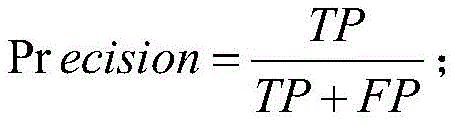


上式中,Pr ecision表示精确率,Re call表示召回率,F-score表示F1值;TP表示真阳性,即实体的边界和类型被完全正确识别出来;FP表示假阳性,即实体没有被完全正确识别出来;FN表示假阴性,即实体没有被识别出来;精确率衡量的是模型识别正确识别实体的的能力,召回率衡量的是模型识别所有实体的能力,F1值是精确率和召回率的调和平均值。In the above formula, Precision represents the precision rate, Re call represents the recall rate, and F-score represents the F1 value; TP represents the true positive, that is, the boundary and type of the entity are completely and correctly identified; FP represents the false positive, that is, the entity is not completely recognized Correctly identified; FN means false negative, that is, the entity has not been identified; the precision rate measures the ability of the model to identify the correctly identified entity, the recall rate measures the ability of the model to identify all entities, and the F1 value is the precision rate and recall rate the harmonic mean of .
进一步作为本方法优选实施例,还公开了对CRF模型、BILSTM模型、BILSTM-CRF模型、FLAT模型和BERT-BILSTM-FLAT模型的命名识别效果进行测试的实验,首先使用Pytorch分别搭建CRF模型、BILSTM模型、BILSTM-CRF模型、FLAT模型和BERT-BILSTM-FLAT模型;然后利用步骤S1.1中的Resume数据集的训练集对实验中各个模型进行训练;再然后利用Resume数据集的验证集对实验中训练后的模型进行验证,得到各自的最终模型;最后利用测试集对各自模型进行测试,计算各自模型的精确率、召回率和F1值;其计算结果如下表所示:Further as a preferred embodiment of this method, an experiment for testing the naming recognition effects of the CRF model, BILSTM model, BILSTM-CRF model, FLAT model and BERT-BILSTM-FLAT model is also disclosed. First, Pytorch is used to build the CRF model, BILSTM model, BILSTM-CRF model, FLAT model and BERT-BILSTM-FLAT model; then use the training set of the Resume data set in step S1.1 to train each model in the experiment; then use the verification set of the Resume data set to test The models trained in are verified to obtain their respective final models; finally, the respective models are tested using the test set, and the precision, recall and F1 values of the respective models are calculated; the calculation results are shown in the following table:
由上表可知,利用本方法得到的BERT-BILSTM-FLAT模型在Resume数据集上的命名实体识别效果均优于其它模型,即使与最好的FLAT模型相比较,其实体识别的F1值上也提高了1.86个百分点。It can be seen from the above table that the named entity recognition effect of the BERT-BILSTM-FLAT model obtained by this method is better than other models on the Resume dataset. Even compared with the best FLAT model, the F1 value of its entity recognition is also An increase of 1.86 percentage points.
同理,根据上述实验方法使用步骤S1.1中的自行收集并标注的新闻语料数据集,即自制的数据集,对各个模型进行测试,计算各自模型的精确率、召回率和F1值;其计算结果如下表所示:Similarly, according to the above experimental method, use the self-collected and labeled news corpus data set in step S1.1, that is, the self-made data set, to test each model, and calculate the precision rate, recall rate and F1 value of each model; The calculation results are shown in the table below:
由上表可知,利用本方法得到的BERT-BILSTM-FLAT模型在新闻语料数据集上的命名实体识别效果均优于其它模型,即使与最好的FLAT模型相比较,其实体识别的F1值上也提高了1.47个百分点。It can be seen from the above table that the named entity recognition effect of the BERT-BILSTM-FLAT model obtained by this method on the news corpus data set is better than other models. Even compared with the best FLAT model, the F1 value of its entity recognition is higher. It also increased by 1.47 percentage points.
综上,无论是使用已公开的数据集还是自制的数据集,利用本方法构建的BERT-BILSTM-FLAT模型的命名实体识别效果均优于其它模型。To sum up, the named entity recognition effect of the BERT-BILSTM-FLAT model constructed by this method is better than other models, no matter using the public data set or the self-made data set.
本发明的具体有益效果包括:Concrete beneficial effects of the present invention include:
1)本模型采取了融合了字与词特征的方法,使得模型可以获取文本中更多丰富的语义信息,提了命名实体的识别效果。1) This model adopts the method of integrating character and word features, so that the model can obtain more and rich semantic information in the text, and improve the recognition effect of named entities.
2)使用BERT编码器提取文本特征,很好地解决了传统的word2vec等方法拥有的一词多义等问题。2) Use the BERT encoder to extract text features, which solves the problems of polysemy in traditional word2vec and other methods.
3)本模型使用组合模型,对比单一的模型具有更多的优点,提升了命名实体识别的准确率。3) This model uses a combined model, which has more advantages than a single model, and improves the accuracy of named entity recognition.
以上是对本发明的较佳实施进行了具体说明,但本发明创造并不限于所述实施例,熟悉本领域的技术人员在不违背本发明精神的前提下还可做作出种种的等同变形或替换,这些等同的变形或替换均包含在本申请权利要求所限定的范围内。The above is a specific description of the preferred implementation of the present invention, but the invention is not limited to the described embodiments, and those skilled in the art can also make various equivalent deformations or replacements without violating the spirit of the present invention. , these equivalent modifications or replacements are all within the scope defined by the claims of the present application.
Claims (10)




Priority Applications (1)
| Application Number | Priority Date | Filing Date | Title |
|---|---|---|---|
| CN202211330887.1A CN115688784A (en) | 2022-10-28 | 2022-10-28 | Chinese named entity recognition method fusing character and word characteristics |
Applications Claiming Priority (1)
| Application Number | Priority Date | Filing Date | Title |
|---|---|---|---|
| CN202211330887.1A CN115688784A (en) | 2022-10-28 | 2022-10-28 | Chinese named entity recognition method fusing character and word characteristics |
Publications (1)
| Publication Number | Publication Date |
|---|---|
| CN115688784A true CN115688784A (en) | 2023-02-03 |
Family
ID=85046375
Family Applications (1)
| Application Number | Title | Priority Date | Filing Date |
|---|---|---|---|
| CN202211330887.1A Withdrawn CN115688784A (en) | 2022-10-28 | 2022-10-28 | Chinese named entity recognition method fusing character and word characteristics |
Country Status (1)
| Country | Link |
|---|---|
| CN (1) | CN115688784A (en) |
Cited By (3)
| Publication number | Priority date | Publication date | Assignee | Title |
|---|---|---|---|---|
| CN116050418A (en) * | 2023-03-02 | 2023-05-02 | 浙江工业大学 | Named entity recognition method, device and medium based on fusion of multi-layer semantic features |
| CN116484848A (en) * | 2023-03-17 | 2023-07-25 | 北京深维智讯科技有限公司 | A Text Entity Recognition Method Based on NLP |
| CN117113996A (en) * | 2023-06-29 | 2023-11-24 | 四川省农业科学院农业信息与农村经济研究所 | Named entity recognition method and device for tea corpus text processing |
-
2022
- 2022-10-28 CN CN202211330887.1A patent/CN115688784A/en not_active Withdrawn
Cited By (5)
| Publication number | Priority date | Publication date | Assignee | Title |
|---|---|---|---|---|
| CN116050418A (en) * | 2023-03-02 | 2023-05-02 | 浙江工业大学 | Named entity recognition method, device and medium based on fusion of multi-layer semantic features |
| CN116050418B (en) * | 2023-03-02 | 2023-10-31 | 浙江工业大学 | Named entity identification method, device and medium based on fusion of multi-layer semantic features |
| CN116484848A (en) * | 2023-03-17 | 2023-07-25 | 北京深维智讯科技有限公司 | A Text Entity Recognition Method Based on NLP |
| CN116484848B (en) * | 2023-03-17 | 2024-03-29 | 北京深维智讯科技有限公司 | A text entity recognition method based on NLP |
| CN117113996A (en) * | 2023-06-29 | 2023-11-24 | 四川省农业科学院农业信息与农村经济研究所 | Named entity recognition method and device for tea corpus text processing |
Similar Documents
| Publication | Publication Date | Title |
|---|---|---|
| Kumar et al. | An abstractive text summarization technique using transformer model with self-attention mechanism | |
| CN114547298B (en) | Biomedical relation extraction method, device and medium based on combination of multi-head attention and graph convolution network and R-Drop mechanism | |
| CN115081437B (en) | Machine-generated text detection method and system based on comparative learning of linguistic features | |
| CN117151220A (en) | An industry knowledge base system and method based on entity linking and relationship extraction | |
| CN112417155B (en) | Court trial query generation method, device and medium based on pointer-generation Seq2Seq model | |
| CN114154504B (en) | Chinese named entity recognition algorithm based on multi-information enhancement | |
| CN112183094A (en) | A Chinese grammar error checking method and system based on multiple text features | |
| CN115688784A (en) | Chinese named entity recognition method fusing character and word characteristics | |
| Li et al. | A method for resume information extraction using bert-bilstm-crf | |
| CN118227769B (en) | Knowledge graph enhancement-based large language model question-answer generation method | |
| CN114818717A (en) | Chinese named entity recognition method and system fusing vocabulary and syntax information | |
| CN111814489A (en) | Spoken language semantic understanding method and system | |
| CN118277509A (en) | Dataset retrieval method based on knowledge graph | |
| CN115329755A (en) | Entity link model processing method and device and entity link processing method and device | |
| CN115329766B (en) | Named entity identification method based on dynamic word information fusion | |
| Zhang et al. | A roberta-globalpointer-based method for named entity recognition of legal documents | |
| CN114330350A (en) | Named entity identification method and device, electronic equipment and storage medium | |
| CN114611520B (en) | A text summary generation method | |
| CN113822018B (en) | Entity Relation Joint Extraction Method | |
| CN118395987A (en) | BERT-based landslide hazard assessment named entity identification method of multi-neural network | |
| CN116860959B (en) | Extraction type abstract method and system combining local topic and hierarchical structure information | |
| CN113919338B (en) | Method and device for processing text data | |
| CN113901813A (en) | An event extraction method based on topic features and implicit sentence structure | |
| CN116049349B (en) | Small-sample intention recognition method based on multi-level attention and hierarchical category features | |
| CN116861908A (en) | Entity identification method based on fine-granularity suspension marks and nested entity graphs |
Legal Events
| Date | Code | Title | Description |
|---|---|---|---|
| PB01 | Publication | ||
| PB01 | Publication | ||
| SE01 | Entry into force of request for substantive examination | ||
| SE01 | Entry into force of request for substantive examination | ||
| WW01 | Invention patent application withdrawn after publication |
Application publication date: 20230203 |
|
| WW01 | Invention patent application withdrawn after publication |