[go: up one dir, main page]

CN115550994A - Distributed state monitoring method independent of source address - Google Patents

Distributed state monitoring method independent of source address Download PDF

Info

Publication number
CN115550994A
CN115550994A CN202211201368.5A CN202211201368A CN115550994A CN 115550994 A CN115550994 A CN 115550994A CN 202211201368 A CN202211201368 A CN 202211201368A CN 115550994 A CN115550994 A CN 115550994A
Authority
CN
China
Prior art keywords
state
time slot
observation
index
sensor
Prior art date
Legal status (The legal status is an assumption and is not a legal conclusion. Google has not performed a legal analysis and makes no representation as to the accuracy of the status listed.)
Pending
Application number
CN202211201368.5A
Other languages
Chinese (zh)
Inventor
张朝阳
车竞择
刘明
邓志吉
Current Assignee (The listed assignees may be inaccurate. Google has not performed a legal analysis and makes no representation or warranty as to the accuracy of the list.)
Zhejiang University ZJU
Original Assignee
Zhejiang University ZJU
Priority date (The priority date is an assumption and is not a legal conclusion. Google has not performed a legal analysis and makes no representation as to the accuracy of the date listed.)
Filing date
Publication date
Application filed by Zhejiang University ZJU filed Critical Zhejiang University ZJU
Priority to CN202211201368.5A priority Critical patent/CN115550994A/en
Publication of CN115550994A publication Critical patent/CN115550994A/en
Priority to PCT/CN2023/086658 priority patent/WO2024066284A1/en
Pending legal-status Critical Current

Links

Images

Classifications

    • HELECTRICITY
    • H04ELECTRIC COMMUNICATION TECHNIQUE
    • H04WWIRELESS COMMUNICATION NETWORKS
    • H04W4/00Services specially adapted for wireless communication networks; Facilities therefor
    • H04W4/30Services specially adapted for particular environments, situations or purposes
    • H04W4/38Services specially adapted for particular environments, situations or purposes for collecting sensor information
    • HELECTRICITY
    • H04ELECTRIC COMMUNICATION TECHNIQUE
    • H04WWIRELESS COMMUNICATION NETWORKS
    • H04W24/00Supervisory, monitoring or testing arrangements
    • H04W24/08Testing, supervising or monitoring using real traffic

Landscapes

  • Engineering & Computer Science (AREA)
  • Computer Networks & Wireless Communication (AREA)
  • Signal Processing (AREA)
  • Mobile Radio Communication Systems (AREA)

Abstract

本发明公开了一种与源址无关的分布式状态监测方法。本发明基于与源址无关的随机接入协议,所有传感器共享一个公共码本,融合中心只需恢复传输的消息序列而不关心活跃传感器的身份信息。首先,激活传感器观测部分状态变量并将观测结果上行传输至融合中心,融合中心对观测信息进行处理、估计全局状态向量并广播关于状态变量估计的可靠性指标,然后传感器根据可观测状态变量估计的可靠性指标决定在下一个时隙内的激活概率,直到对系统中所有状态变量的估计都可靠则任务完成。本方案实现了利用少量时隙传输,高效地完成对系统全局状态向量的准确观测。
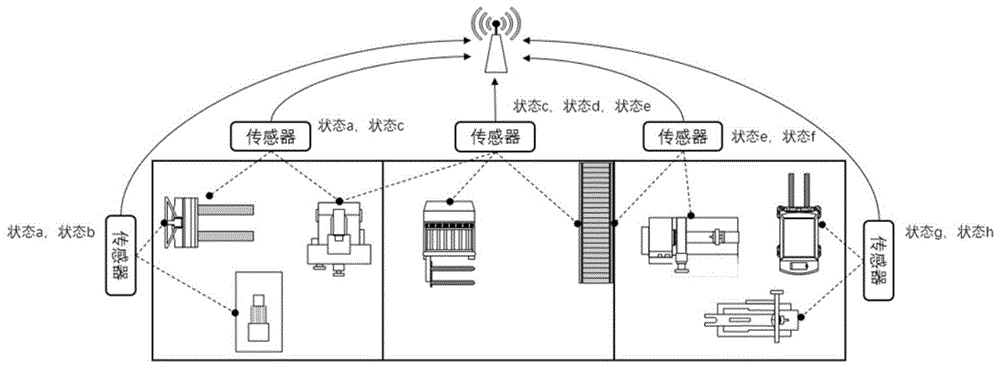
Figure 202211201368

The invention discloses a distributed state monitoring method which has nothing to do with the source address. The present invention is based on a random access protocol that has nothing to do with the source address, all sensors share a common code book, and the fusion center only needs to restore the transmitted message sequence without caring about the identity information of active sensors. First, activate the sensor to observe some state variables and transmit the observation results uplink to the fusion center. The fusion center processes the observation information, estimates the global state vector and broadcasts the reliability index about state variable estimation, and then the sensor estimates The reliability index determines the probability of activation in the next time slot until the estimation of all state variables in the system is reliable and the task is completed. This scheme realizes accurate observation of the global state vector of the system efficiently by using a small number of time slot transmissions.

Figure 202211201368

Description

一种与源址无关的分布式状态监测方法A Distributed State Monitoring Method Independent of Source Address

技术领域technical field

本发明涉及无线通信领域,尤其涉及一种与源址无关的分布式状态监测方法。The invention relates to the field of wireless communication, in particular to a distributed state monitoring method which has nothing to do with source addresses.

背景技术Background technique

随着物联网的快速发展,物联网设备的数量有了大幅增长。大量的物联网设备可以支持多样的物联网应用,关键是要提供快速、可靠的接入。传统的免授权随机接入技术不适用于物联网场景。这是由于在免授权随机接入方案中,每个潜在用户都被分配了一个特定的导频序列且潜在用户数量庞大,这样的导频开销是不可接受的。为了解决这一问题,一种与源址无关的随机接入技术被提出。在该方案中,所有潜在用户共享一个公共码本,基站端只需恢复传输的消息序列而不关心活跃用户的身份。由于用户无需传输导频序列,该方案可以避免高昂的导频开销,满足了物联网场景的关键需求。With the rapid development of IoT, the number of IoT devices has increased significantly. A large number of IoT devices can support a variety of IoT applications, and the key is to provide fast and reliable access. Traditional authorization-free random access technology is not suitable for IoT scenarios. This is because in the unlicensed random access scheme, each potential user is allocated a specific pilot sequence and the number of potential users is huge, such pilot overhead is unacceptable. In order to solve this problem, a random access technology which has nothing to do with the source address is proposed. In this scheme, all potential users share a common codebook, and the base station only needs to restore the transmitted message sequence without caring about the identity of active users. Since users do not need to transmit pilot sequences, this solution can avoid high pilot overhead and meet the key requirements of IoT scenarios.

在物联网场景下有多样的物联网应用,其中一个应用是分布式状态监测。在分布式状态监测任务中,多个传感器在不同位置观测系统的输出并将观测结果发送至融合中心,估计全局的系统状态向量。对于一个典型的线性系统,每个传感器只能获取对全局状态向量中部分状态变量的观测,融合中心只关注于嵌入在观测中的状态信息而不是哪个传感器发送的。由于传感器传输的无源性,可以以基于与源址无关的随机接入协议进行上行传输。然而,由于一个传感器只能获取对部分状态变量的观测且同一时刻只有少量传感器激活,仅通过一个时隙的传输对全局状态向量的观测存在不充分性。另外,由于检测过程可能存在漏检、误检,会导致对全局状态向量观测的不准确性。对状态变量观测的不充分性和不准确性使得需要多个时隙的观测才能获取对系统全局状态向量的准确观测。然而,在现有的与源址无关的随机接入协议中,为了解决公共码本维度过高的问题,用户先将信息序列分为若干个子块,然后添加校验比特建立不同信息子块间的校验关系。在接收端先检测所有传输的信息子块,然后使用树形译码器进行译码、拼接恢复出原始的信息序列。这样做需要大量的校验比特保证译码的准确性,使得传输码率较低。由于传输码率较低且需要多个时隙的观测,使得完成分布式状态监测任务的效率低下。因此,如何设计一种方案使得传感器能快速、准确地完成对系统全局状态向量的估计成为了关键性问题。There are various IoT applications in the IoT scenario, one of which is distributed status monitoring. In distributed state monitoring tasks, multiple sensors observe the output of the system at different locations and send the observation results to the fusion center to estimate the global system state vector. For a typical linear system, each sensor can only obtain observations of part of the state variables in the global state vector, and the fusion center only focuses on the state information embedded in the observations rather than which sensor sent it. Due to the passive nature of sensor transmission, uplink transmission can be performed based on a random access protocol that has nothing to do with the source address. However, since one sensor can only obtain observations of part of the state variables and only a small number of sensors are activated at the same time, it is not sufficient to observe the global state vector through the transmission of only one time slot. In addition, due to the possibility of missed detection and false detection in the detection process, it will lead to inaccurate observation of the global state vector. The insufficiency and inaccuracy of observation of state variables make it necessary to observe multiple time slots to obtain accurate observations of the global state vector of the system. However, in the existing random access protocol that has nothing to do with the source address, in order to solve the problem of too high dimensionality of the common codebook, the user first divides the information sequence into several sub-blocks, and then adds parity bits to establish the gap between different information sub-blocks. verification relationship. At the receiving end, all transmitted information sub-blocks are detected first, and then the tree decoder is used to decode and splicing to restore the original information sequence. Doing so requires a large number of parity bits to ensure the accuracy of decoding, making the transmission code rate lower. Due to the low transmission code rate and the observation of multiple time slots, the efficiency of completing distributed state monitoring tasks is low. Therefore, how to design a scheme so that the sensor can quickly and accurately estimate the global state vector of the system has become a key issue.

发明内容Contents of the invention

本发明的目的是为物联网场景下的分布式状态监测任务提出了一种高效的与源址无关的分布式状态监测方法。The purpose of the present invention is to propose an efficient distributed state monitoring method independent of source address for the distributed state monitoring task in the Internet of Things scene.

本发明所采用的具体技术方案如下:The concrete technical scheme that the present invention adopts is as follows:

一种与源址无关的分布式状态监测方法,其特征在于包括如下步骤:A distributed state monitoring method which has nothing to do with the source address is characterized in that it comprises the following steps:

S1、激活传感器,获取对整个监测区系统状态的观测并生成状态索引,把获取到的每个状态的观测结果和状态索引拼接成信息子块,将信息子块进行编码后通过无线信道发送至融合中心;S1. Activate the sensor, obtain the observation of the system state of the entire monitoring area and generate a state index, splice the obtained observation results and state index of each state into information sub-blocks, encode the information sub-blocks and send them to Fusion Center;

S2、融合中心从接收信号中检测、估计出传感器传输的码字对应的信息子块和相应的叠加信道增益值;S2. The fusion center detects and estimates the information sub-block corresponding to the code word transmitted by the sensor and the corresponding superimposed channel gain value from the received signal;

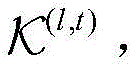
S3、融合中心根据每个状态变量由多个传感器观测的若干观测值和每个观测值的信道增益,得到该状态变量的估计值以及该估计值的可靠性指标;当该状态变量的可靠性指标大于设定的可靠性阈值时,则表明对该状态变量的观测是可靠的;S3. The fusion center obtains the estimated value of the state variable and the reliability index of the estimated value according to several observation values observed by multiple sensors for each state variable and the channel gain of each observation value; when the reliability of the state variable When the indicator is greater than the set reliability threshold, it indicates that the observation of the state variable is reliable;

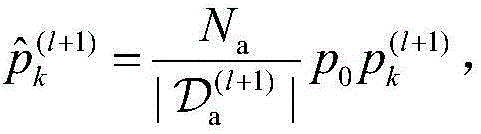
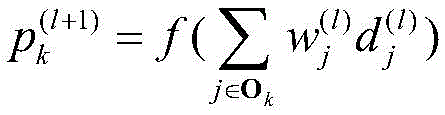
S4、将整个监测区分为不同的区域,融合中心广播每个状态变量估计值的可靠性指标,如果一个区域内对所有可观测状态变量的估计都是可靠的,那么对这个区域的状态变量估计已完成;融合中心指示那些未完成状态估计区域内的传感器在下一个时隙内激活,所有传感器根据可观测状态变量的可靠性指标决定在下一次传输过程中的激活概率;S4. Divide the entire monitoring area into different areas, and the fusion center broadcasts the reliability index of the estimated value of each state variable. If the estimates of all observable state variables in an area are reliable, then the estimation of the state variables in this area Completed; the fusion center instructs those sensors in the unfinished state estimation area to activate in the next time slot, and all sensors determine the activation probability in the next transmission process according to the reliability index of the observable state variables;

S5、不断执行步骤S1至步骤S4的过程直到融合中心获取了对监测区系统所有状态变量的可靠估计。S5. Continuously execute the process from step S1 to step S4 until the fusion center obtains reliable estimates of all state variables of the monitoring area system.

步骤S1中所述的编码方法为:The encoding method described in step S1 is:

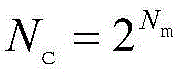
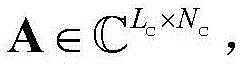
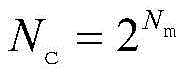
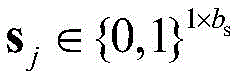
设置码本
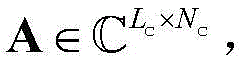
Figure BDA0003872167630000021
其中
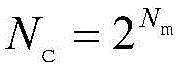
Figure BDA0003872167630000022
代表复数域,A的每一列都表示一个码字,码字共有
Figure BDA0003872167630000023
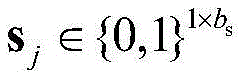
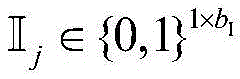
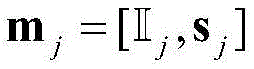
个,每个码字的长度为Lc;整个系统共有No个状态,第j个状态向量用
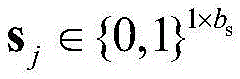
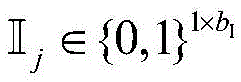
Figure BDA0003872167630000024
表示,长度为bs比特;该状态的索引向量用
Figure BDA0003872167630000025
表示,长度为bI比特;信息子块
Figure BDA0003872167630000026
长度为Nm=bI+bs比特。将一个时隙分为T个子时隙;对于其中的第t个子时隙,第k个激活传感器,将要发送的Nm比特信息子块映射成取值范围为1到
Figure BDA0003872167630000027
的整数
Figure BDA0003872167630000028
第k个激活传感器将码本A中的第
Figure BDA0003872167630000029
列表示的码字发送至融合中心。set codebook
Figure BDA0003872167630000021
in
Figure BDA0003872167630000022
Represents a complex field, each column of A represents a codeword, and the codewords have a total of
Figure BDA0003872167630000023
, and the length of each codeword is L c ; there are N o states in the whole system, and the jth state vector is represented by
Figure BDA0003872167630000024
Indicates that the length is b s bits; the index vector of this state is denoted by
Figure BDA0003872167630000025
Indicates that the length is b I bits; the information sub-block
Figure BDA0003872167630000026
The length is N m =b I +b s bits. Divide a time slot into T sub-slots; for the t-th sub-slot, the k-th activates the sensor, and maps the N m -bit information sub-blocks to be sent into values ranging from 1 to
Figure BDA0003872167630000027
an integer of
Figure BDA0003872167630000028
The k-th activated sensor converts the k-th active sensor in codebook A
Figure BDA0003872167630000029
The codewords represented by columns are sent to the fusion center.

步骤S2中所述的检测、估计方法为:The detection and estimation methods described in step S2 are:

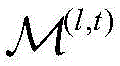
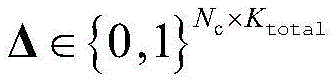
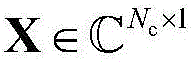
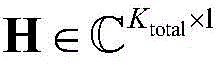
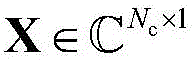
在物联网场景中,共有Ktotal个传感器,一次传输过程中仅Ka个传感器激活,即Ka<<Ktotal;接收信号可以表示为Y=AΔH+Z=AX+Z,其中
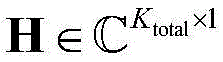
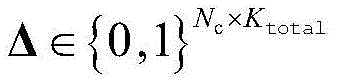
Figure BDA00038721676300000210
表示所有传感器的信道;
Figure BDA00038721676300000211
表示选择矩阵,Δ矩阵中的元素δn,k表示第k个传感器是否传输了第n个码字;Z为噪声且服从均值为0的复高斯分布;向量
Figure BDA00038721676300000212
的每一个非零元素表示传输这个码字的传感器到融合中心的信道增益;In the IoT scenario, there are K total sensors, and only K a sensors are activated during one transmission, that is, K a << K total ; the received signal can be expressed as Y=AΔH+Z=AX+Z, where
Figure BDA00038721676300000210
Indicates the channels of all sensors;
Figure BDA00038721676300000211
Indicates the selection matrix, the element δ n,k in the Δ matrix indicates whether the kth sensor has transmitted the nth codeword; Z is noise and obeys a complex Gaussian distribution with a mean value of 0; the vector
Figure BDA00038721676300000212
Each non-zero element of represents the channel gain from the sensor transmitting this codeword to the fusion center;

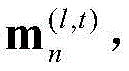
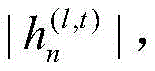
使用压缩感知方法从接收信号Y中恢复出向量X,得到传感器传输的码字和相应的信道增益幅值集合;然后根据码字索引,将其转化为二进制向量,此二进制向量为用户发送的信息子块;在第l个时隙内的第t个子时隙,对于第n个码字,将其转化为二进制向量得到信息子块

Figure BDA0003872167630000031
该码字相应的信道增益幅值为
Figure BDA0003872167630000032
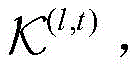
其中|·|表示取幅值,角标(l,t)表示第l个时隙内的第t个子时隙;令检测到的码字索引集合为
Figure BDA0003872167630000033
检测到的信息子块集合为
Figure BDA0003872167630000034
叠加信道增益集合为
Figure BDA0003872167630000035
Use the compressed sensing method to restore the vector X from the received signal Y, and obtain the codeword transmitted by the sensor and the corresponding channel gain amplitude set; then convert it into a binary vector according to the codeword index, and this binary vector is the information sent by the user Sub-block; in the t-th sub-slot in the l-th time slot, for the n-th codeword, convert it into a binary vector to obtain an information sub-block
Figure BDA0003872167630000031
The channel gain magnitude corresponding to this codeword is
Figure BDA0003872167630000032
Wherein |·| means to take the amplitude value, and the subscript (l, t) means the tth sub-slot in the lth time slot; let the detected codeword index set be
Figure BDA0003872167630000033
The detected information sub-block set is
Figure BDA0003872167630000034
The set of superimposed channel gains is
Figure BDA0003872167630000035

步骤S3中所述的可靠性指标计算方法为:The reliability index calculation method described in step S3 is:

在第l个时隙内,能够获得T个子时隙内的

Figure BDA0003872167630000036
Figure BDA0003872167630000037
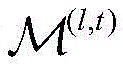
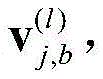
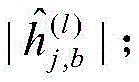
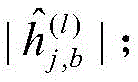
Figure BDA0003872167630000038
中的一个元素能够获得对第j个状态变量的第b个观测值
Figure BDA0003872167630000039
其中角标(l)表示第l个时隙;若第j个状态变量被不同的传感器观测到,将同一个观测值对应的不同信道增益幅值叠加得到相应的叠加信道增益幅值
Figure BDA00038721676300000310
最终经过第l个时隙的观测,对于第j个状态变量的所有观测值构成一个观测值集合
Figure BDA00038721676300000311
每个观测值对应的叠加信道增益幅值构成叠加信道增益幅值集合
Figure BDA00038721676300000312
其中|·|c表示一个集合的元素个数;In the lth time slot, the T sub-slots can be obtained
Figure BDA0003872167630000036
and
Figure BDA0003872167630000037
From
Figure BDA0003872167630000038
An element in is able to obtain the bth observation of the jth state variable
Figure BDA0003872167630000039
The subscript (l) indicates the lth time slot; if the jth state variable is observed by different sensors, the corresponding superimposed channel gain amplitude is obtained by superimposing the different channel gain amplitudes corresponding to the same observation value
Figure BDA00038721676300000310
Finally, after the observation of the lth time slot, all observations of the jth state variable form an observation set
Figure BDA00038721676300000311
The superimposed channel gain magnitude corresponding to each observation value constitutes a superimposed channel gain magnitude set
Figure BDA00038721676300000312
Where |·| c represents the number of elements in a collection;

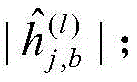
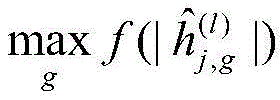
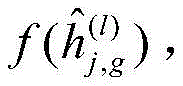
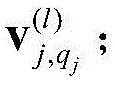
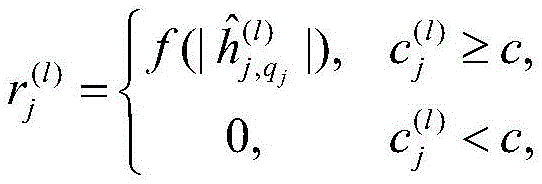
将对第j个状态变量的估计视为一个分类问题;将叠加信道增益幅值集合中的所有元素拼接为一个向量后作为softmax函数的输入,然后输出得到对第j个状态变量估计值的索引

Figure BDA00038721676300000313
Figure BDA00038721676300000314
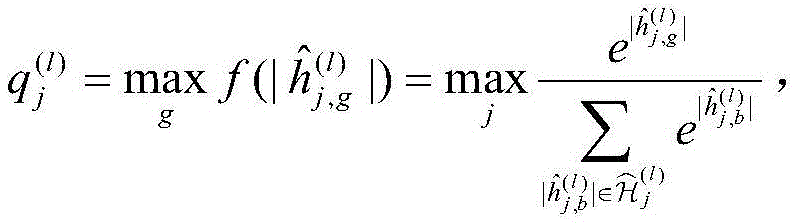
表示为The estimation of the jth state variable is regarded as a classification problem; all the elements in the superimposed channel gain magnitude set are concatenated into a vector and used as the input of the softmax function, and then the output is the index of the estimated value of the jth state variable
Figure BDA00038721676300000313
Figure BDA00038721676300000314
Expressed as

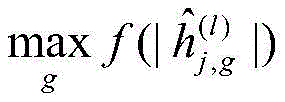
Figure BDA00038721676300000315

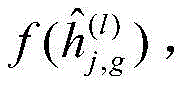
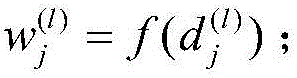
其中f(x)为sigmoid函数的截断和放缩,可以表示为where f(x) is the truncation and scaling of the sigmoid function, which can be expressed as

Figure BDA00038721676300000316

其中x的定义域为0≤x≤1,参数p为放缩因子;

Figure BDA00038721676300000317
表示对每一个g对应的
Figure BDA00038721676300000318
取使
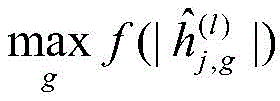
Figure BDA00038721676300000319
最大的g;估计值可以表示为
Figure BDA00038721676300000320
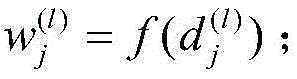
Figure BDA00038721676300000321
表示对第j个状态变量估计值的可靠性指标,并设定观测次数的阈值和可靠性阈值;The domain of definition of x is 0≤x≤1, and the parameter p is the scaling factor;
Figure BDA00038721676300000317
Indicates that for each g corresponding to
Figure BDA00038721676300000318
Take envoy
Figure BDA00038721676300000319
the largest g; the estimated value can be expressed as
Figure BDA00038721676300000320
make
Figure BDA00038721676300000321
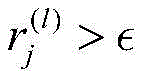
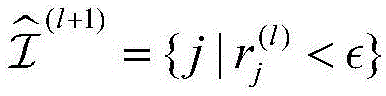
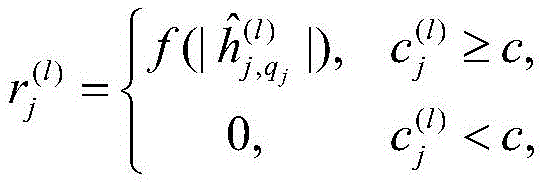
Represents the reliability index of the estimated value of the jth state variable, and sets the threshold of the number of observations and the reliability threshold;

Figure BDA00038721676300000322
可以表示为
Figure BDA00038721676300000322
It can be expressed as

Figure BDA00038721676300000323

其中

Figure BDA00038721676300000324
表示经过第l时隙的传输后,获得对第j个状态的观测次数,c为观测次数的阈值,
Figure BDA0003872167630000041
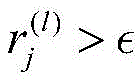
表示第j个状态变量的第qj个观测值所对应的信道增益幅值;∈为可靠性阈值,则
Figure BDA0003872167630000042
表示对第j个状态的观测是可靠的。in
Figure BDA00038721676300000324
Indicates that after the transmission of the lth time slot, the number of observations of the jth state is obtained, c is the threshold of the number of observations,
Figure BDA0003872167630000041
Indicates the channel gain amplitude corresponding to the q jth observed value of the jth state variable; ∈ is the reliability threshold, then
Figure BDA0003872167630000042
Indicates that the observation of the jth state is reliable.

步骤S4中所述的过程为:The process described in step S4 is:

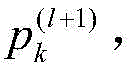
Figure BDA0003872167630000043
则第k个传感器在第l+1个时隙内的激活概率
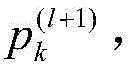
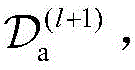
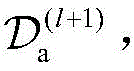
Figure BDA0003872167630000044
Figure BDA0003872167630000045
可以表示为
Figure BDA0003872167630000046
其中Ok表示第k个传感器能够观测到的状态变量索引集合,即
Figure BDA0003872167630000047
Figure BDA0003872167630000048
表示Ok是{1,2,...,No}的子集;
Figure BDA0003872167630000049
表示第j个状态变量的可靠性指标对第k个传感器在第l+1个时隙内激活概率的贡献权重
Figure BDA00038721676300000410
make
Figure BDA0003872167630000043
Then the activation probability of the kth sensor in the l+1th time slot
Figure BDA0003872167630000044
Figure BDA0003872167630000045
It can be expressed as
Figure BDA0003872167630000046
where O k represents the state variable index set that the kth sensor can observe, namely
Figure BDA0003872167630000047
Figure BDA0003872167630000048
Indicates that O k is a subset of {1,2,...,N o };
Figure BDA0003872167630000049
Indicates the contribution weight of the reliability index of the jth state variable to the activation probability of the kth sensor in the l+1th time slot
Figure BDA00038721676300000410

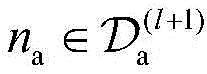
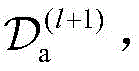
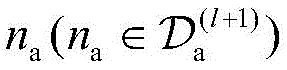
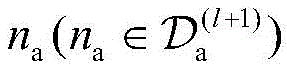
整个待观测区域被分为Na个区域,第na个区域内传感器能观测到的状态索引集合为

Figure BDA00038721676300000411
以一个区域为单位进行状态变量估计,如果一个区域内对所有可观测状态变量的估计都是可靠的,那么可以认为对这个区域的状态变量估计已完成;The entire area to be observed is divided into N a areas, and the state index set that the sensor can observe in the n ath area is
Figure BDA00038721676300000411
Estimate the state variables with a region as a unit. If the estimation of all observable state variables in a region is reliable, then it can be considered that the state variable estimation for this region has been completed;

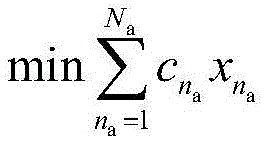
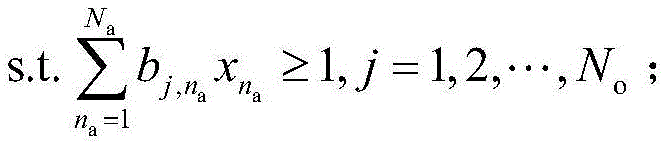
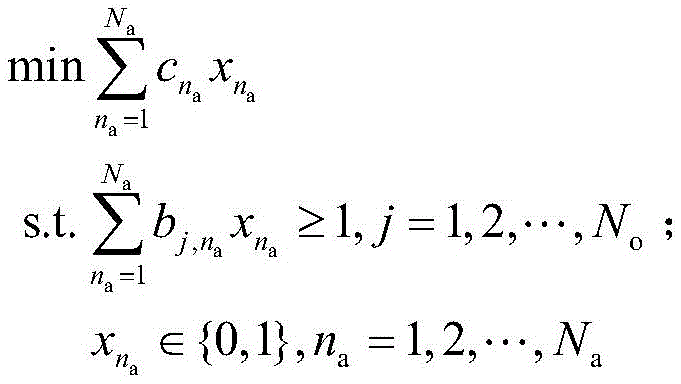
融合中心只需指示那些分布在其他区域内的传感器在下一个时隙内激活;在下一个时隙的传输中,希望尽可能少的区域激活就能使得所有待观测的状态变量被覆盖;将这个问题建模为一个集合覆盖的最佳化问题,如下所示:The fusion center only needs to instruct those sensors distributed in other areas to activate in the next time slot; in the transmission of the next time slot, it is hoped that the activation of as few areas as possible can make all the state variables to be observed covered; the problem Modeled as a set-covering optimization problem as follows:

Figure BDA00038721676300000412

Figure BDA00038721676300000413

Figure BDA00038721676300000414

矩阵

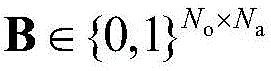
Figure BDA00038721676300000415
表示不同区域内能观测到的状态变量;
Figure BDA00038721676300000416
为矩阵B的元素,
Figure BDA00038721676300000417
表示第na个区域内的传感器是否能获取对第j个状态变量的观测;
Figure BDA00038721676300000418
表示选择第na个区域的代价,
Figure BDA00038721676300000419
的值被设置为1;
Figure BDA00038721676300000420
表示是否选择第na个区域;
Figure BDA00038721676300000421
表示至少一个激活区域内的传感器获取对第j个状态变量的观测;matrix
Figure BDA00038721676300000415
Represents the state variables that can be observed in different regions;
Figure BDA00038721676300000416
is the element of matrix B,
Figure BDA00038721676300000417
Indicates whether the sensor in the nth area can obtain the observation of the jth state variable;
Figure BDA00038721676300000418
Indicates the cost of selecting the nth region,
Figure BDA00038721676300000419
The value of is set to 1;
Figure BDA00038721676300000420
Indicates whether to select the n ath area;
Figure BDA00038721676300000421
Indicates that at least one sensor in the active area obtains an observation of the jth state variable;

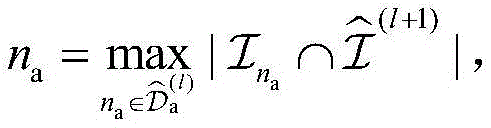
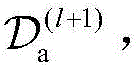
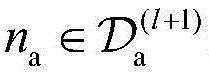
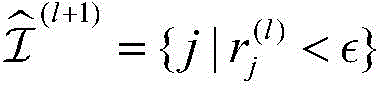
采用贪婪算法求解这个集合覆盖的最佳化问题,令

Figure BDA00038721676300000422
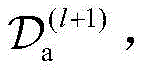
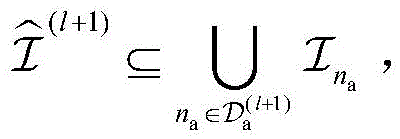
表示一个集合,该集合内的元素为在第l+1个时隙内需要继续观测的状态变量的索引;令
Figure BDA00038721676300000423
表示一个集合,该集合内的元素为含有经过第l个时隙观测后不可靠状态变量估计区域的索引;在集合
Figure BDA00038721676300000424
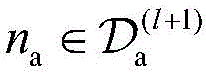
内,每次选取第na个区域,其中na可以表示为
Figure BDA00038721676300000425
Figure BDA00038721676300000426
表示第na个区域内传感器能观测到的状态索引集合;然后将索引na从集合
Figure BDA00038721676300000427
中移除并加入集合
Figure BDA00038721676300000428
其中集合
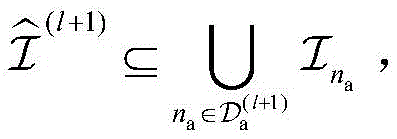
Figure BDA0003872167630000051
表示在第l+1个时隙内需要激活区域的索引集合;重复上述选择过程直到
Figure BDA0003872167630000052
其中
Figure BDA0003872167630000053
表示所有的na属于
Figure BDA0003872167630000054
∪·表示对所有的
Figure BDA0003872167630000055
取并集;最终
Figure BDA0003872167630000056
将包含在第l+1个时隙内需要激活区域的索引;The greedy algorithm is used to solve the optimization problem of this set coverage, so that
Figure BDA00038721676300000422
Represents a collection, the elements in the collection are the indexes of the state variables that need to be observed continuously in the l+1th time slot; let
Figure BDA00038721676300000423
Represents a collection, the elements in the collection are the indexes containing the unreliable state variable estimation area after the observation of the lth time slot; in the collection
Figure BDA00038721676300000424
, select the n ath area each time, where n a can be expressed as
Figure BDA00038721676300000425
Figure BDA00038721676300000426
Indicates the state index set that can be observed by the sensor in the n ath area; then index n a from the set
Figure BDA00038721676300000427
remove and add to collection
Figure BDA00038721676300000428
collection of them
Figure BDA0003872167630000051
Represents the index set of regions that need to be activated in the l+1th time slot; repeat the above selection process until
Figure BDA0003872167630000052
in
Figure BDA0003872167630000053
Indicates that all n a belong to
Figure BDA0003872167630000054
∪ means for all
Figure BDA0003872167630000055
take union; final
Figure BDA0003872167630000056
will contain the index of the region that needs to be activated in the l+1th time slot;

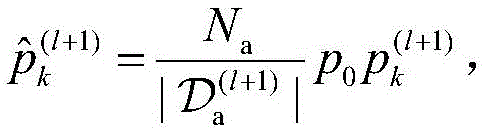
在一个传输时隙内,激活传感器的数量将被控制;分布在第

Figure BDA0003872167630000057
个区域内的第
Figure BDA0003872167630000058
个传感器的激活概率为
Figure BDA0003872167630000059
Figure BDA00038721676300000510
表示第na个区域内的传感器索引集合,其中p0表示在第一个时隙内传感器的激活概率,具体数值要根据场景的情况设定;
Figure BDA00038721676300000511
表示第l+1个时隙内第k个传感器的激活概率,根据
Figure BDA00038721676300000512
得到;除了第na个区域之外的其他区域内的传感器在下一个传输时隙内保持休眠。In one transmission slot, the number of activated sensors will be controlled; distributed in
Figure BDA0003872167630000057
within the region
Figure BDA0003872167630000058
The activation probability of a sensor is
Figure BDA0003872167630000059
Figure BDA00038721676300000510
Indicates the sensor index set in the n ath area, where p 0 indicates the activation probability of the sensor in the first time slot, and the specific value should be set according to the situation of the scene;
Figure BDA00038721676300000511
Indicates the activation probability of the kth sensor in the l+1th time slot, according to
Figure BDA00038721676300000512
Obtained; the sensors in the regions other than the n ath region remain dormant in the next transmission slot.

本发明具有的有益效果是:本发明提出的与源址无关的分布式状态观测方法,采用多个时隙传输的方案,解决了一个时隙传输使得对全局状态向量观测的不充分和不准确的问题。另外,还解决了现有方法使用大量校验比特,码率较低,完成分布式状态监测任务效率低下的问题。本方案实现了利用少量时隙传输,高效地完成对系统全局状态向量的准确观测。The beneficial effects of the present invention are: the distributed state observation method that is independent of the source address proposed by the present invention adopts the scheme of multiple time slot transmission, which solves the insufficient and inaccurate observation of the global state vector caused by one time slot transmission The problem. In addition, it also solves the problem that the existing method uses a large number of parity bits, the code rate is low, and the efficiency of completing the distributed state monitoring task is low. This scheme realizes the accurate observation of the global state vector of the system efficiently by using a small number of time slot transmissions.

附图说明Description of drawings

图1是本发明实施例提供的分布式状态监测的场景示意图;FIG. 1 is a schematic diagram of a scene of distributed state monitoring provided by an embodiment of the present invention;

图2是本发明实施例提供的状态变量数处于不同值下分布式状态监测方法与基线方法比较时,平均传输时隙数与信噪比的关系图;Fig. 2 is a relationship diagram between the average number of transmission time slots and the signal-to-noise ratio when the distributed state monitoring method is compared with the baseline method when the number of state variables provided by the embodiment of the present invention is at different values;

图3是本发明实施例提供的状态变量数处于不同值下分布式状态监测方法与基线方法比较时,状态变量估计的最小均方误差与最大允许传输时隙数的关系图。Fig. 3 is a graph showing the relationship between the minimum mean square error of state variable estimation and the maximum allowable number of transmission slots when the distributed state monitoring method is compared with the baseline method when the number of state variables provided by the embodiment of the present invention is at different values.

具体实施方式detailed description

以下结合附图对本发明具体实施方式作进一步详细说明。The specific embodiments of the present invention will be described in further detail below in conjunction with the accompanying drawings.

本实施例中,分布式状态监测的场景图如图1所示。场景中有一个融合中心,分布着多个传感器。每个时隙内,仅有少量传感器激活,获取对系统状态向量的观测,并以与源址无关的随机接入协议将观测结果上传至融合中心。融合中心对接收信号进行处理、估计系统的全局状态向量,并将每个状态变量估计的可靠性指标广播给所有传感器。传感器根据可观测状态变量估计的可靠性指标决定在下一个传输时隙内的激活概率。传输过程持续直到融合中心获取了对系统所有状态变量的可靠估计。In this embodiment, a scene diagram of distributed status monitoring is shown in FIG. 1 . There is a fusion center in the scene where multiple sensors are distributed. In each time slot, only a small number of sensors are activated to obtain observations of the system state vector, and upload the observation results to the fusion center with a random access protocol that has nothing to do with the source address. The fusion center processes the received signals, estimates the global state vector of the system, and broadcasts the estimated reliability index of each state variable to all sensors. The sensor determines the activation probability in the next transmission time slot according to the reliability index estimated by the observable state variables. The transfer process continues until the fusion center has obtained reliable estimates of all state variables of the system.

本实施例提供了一种与源址无关的分布式状态监测方法,其包括如下步骤:This embodiment provides a distributed state monitoring method that has nothing to do with the source address, which includes the following steps:

1)在物联网场景中,激活设备获取对系统状态的观测后,把对每个状态的观测结果和状态索引拼接成信息子块,将信息子块进行编码后通过无线信道发送至融合中心。1) In the IoT scenario, after the activation device obtains the observation of the system state, the observation result and state index of each state are spliced into information sub-blocks, and the information sub-blocks are encoded and sent to the fusion center through the wireless channel.

在本步骤中,编码方法为:In this step, the encoding method is:

设置码本

Figure BDA0003872167630000061
其中
Figure BDA0003872167630000062
代表复数域,A的每一列都表示一个码字,码字共有
Figure BDA0003872167630000063
个,每个码字的长度为Lc;整个系统共有No个状态,第j个状态向量用
Figure BDA0003872167630000064
表示,长度为bs比特;该状态的索引向量用
Figure BDA0003872167630000065
表示,长度为bI比特;信息子块
Figure BDA0003872167630000066
长度为Nm=bI+bs比特;将一个时隙分为T个子时隙;对于其中的第t个子时隙,第k个激活传感器,将要发送的Nm比特信息子块映射成取值范围为1到
Figure BDA0003872167630000067
的整数
Figure BDA0003872167630000068
第k个激活传感器将码本A中的第
Figure BDA0003872167630000069
列表示的码字发送至融合中心。set codebook
Figure BDA0003872167630000061
in
Figure BDA0003872167630000062
Represents a complex field, each column of A represents a codeword, and the codewords have a total of
Figure BDA0003872167630000063
, and the length of each codeword is L c ; there are N o states in the whole system, and the jth state vector is represented by
Figure BDA0003872167630000064
Indicates that the length is b s bits; the index vector of this state is denoted by
Figure BDA0003872167630000065
Indicates that the length is b I bits; the information sub-block
Figure BDA0003872167630000066
The length is N m =b I +b s bits; a time slot is divided into T sub-slots; for the tth sub-slot, the kth activates the sensor, and maps the N m -bit information sub-block to be sent into Values range from 1 to
Figure BDA0003872167630000067
an integer of
Figure BDA0003872167630000068
The k-th activated sensor converts the k-th active sensor in codebook A
Figure BDA0003872167630000069
The codewords represented by columns are sent to the fusion center.

2)融合中心从接收信号中检测、估计出传感器传输的码字对应的信息子块和相应的叠加信道增益值。2) The fusion center detects and estimates the information sub-block corresponding to the code word transmitted by the sensor and the corresponding superimposed channel gain value from the received signal.

在本步骤中,检测、估计方法为:In this step, the detection and estimation methods are:

在物联网场景中,共有Ktotal个传感器,一次传输过程中仅Ka个传感器激活,即Ka<<Ktotal;接收信号可以表示为Y=AΔH+Z=AX+Z,其中
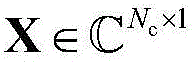
Figure BDA00038721676300000610
表示所有传感器的信道;
Figure BDA00038721676300000611
表示选择矩阵,Δ矩阵中的元素δn,k表示第k个传感器是否传输了第n个码字;Z为噪声且服从均值为0的复高斯分布;向量
Figure BDA00038721676300000612
的每一个非零元素表示传输这个码字的传感器到融合中心的信道增益;In the IoT scenario, there are K total sensors, and only K a sensors are activated during one transmission, that is, K a << K total ; the received signal can be expressed as Y=AΔH+Z=AX+Z, where
Figure BDA00038721676300000610
Indicates the channels of all sensors;
Figure BDA00038721676300000611
Indicates the selection matrix, the element δ n,k in the Δ matrix indicates whether the kth sensor has transmitted the nth codeword; Z is noise and obeys a complex Gaussian distribution with a mean value of 0; the vector
Figure BDA00038721676300000612
Each non-zero element of represents the channel gain from the sensor transmitting this codeword to the fusion center;

使用压缩感知方法从接收信号Y中恢复出向量X,得到传感器传输的码字和相应的信道增益幅值集合;然后根据码字索引,将其转化为二进制向量,此二进制向量为用户发送的信息子块;在第l个时隙内的第t个子时隙,对于第n个码字,将其转化为二进制向量得到信息子块
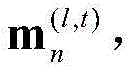
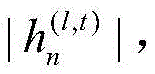
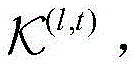
Figure BDA00038721676300000613
该码字相应的信道增益幅值为
Figure BDA00038721676300000614
其中|·|表示取幅值,角标(l,t)表示第l个时隙内的第t个子时隙;令检测到的码字索引集合为
Figure BDA00038721676300000615
检测到的信息子块集合为
Figure BDA00038721676300000616
叠加信道增益集合为
Figure BDA00038721676300000617
Use the compressed sensing method to restore the vector X from the received signal Y, and obtain the codeword transmitted by the sensor and the corresponding channel gain amplitude set; then convert it into a binary vector according to the codeword index, and this binary vector is the information sent by the user Sub-block; in the t-th sub-slot in the l-th time slot, for the n-th codeword, convert it into a binary vector to obtain an information sub-block
Figure BDA00038721676300000613
The channel gain magnitude corresponding to this codeword is
Figure BDA00038721676300000614
Wherein |·| means to take the amplitude value, and the subscript (l, t) means the tth sub-slot in the lth time slot; let the detected codeword index set be
Figure BDA00038721676300000615
The detected information sub-block set is
Figure BDA00038721676300000616
The set of superimposed channel gains is
Figure BDA00038721676300000617

3)融合中心根据每个状态变量的若干个观测值和每个观测值的信道增益得到该状态变量的估计值以及该估计值的可靠性指标。3) The fusion center obtains the estimated value of each state variable and the reliability index of the estimated value according to several observed values of each state variable and the channel gain of each observed value.

在本步骤中,可靠性指标计算方法为:In this step, the reliability index calculation method is:

在第l个时隙内,能够获得T个子时隙内的

Figure BDA00038721676300000618
Figure BDA00038721676300000619
Figure BDA00038721676300000620
中的一个元素能够获得对第j个状态变量的第b个观测值
Figure BDA00038721676300000621
其中角标(l)表示第l个时隙;若第j个状态变量被不同的传感器观测到,将同一个观测值对应的不同信道增益幅值叠加得到相应的叠加信道增益幅值
Figure BDA0003872167630000071
最终经过第l个时隙的观测,对于第j个状态变量的所有观测值构成一个观测值集合
Figure BDA0003872167630000072
每个观测值对应的叠加信道增益幅值构成叠加信道增益幅值集合
Figure BDA0003872167630000073
其中|·|c表示一个集合的元素个数;In the lth time slot, the T sub-slots can be obtained
Figure BDA00038721676300000618
and
Figure BDA00038721676300000619
From
Figure BDA00038721676300000620
An element in is able to obtain the bth observation of the jth state variable
Figure BDA00038721676300000621
The subscript (l) indicates the lth time slot; if the jth state variable is observed by different sensors, the corresponding superimposed channel gain amplitude is obtained by superimposing the different channel gain amplitudes corresponding to the same observation value
Figure BDA0003872167630000071
Finally, after the observation of the lth time slot, all observations of the jth state variable form an observation set
Figure BDA0003872167630000072
The superimposed channel gain magnitude corresponding to each observation value constitutes a superimposed channel gain magnitude set
Figure BDA0003872167630000073
Where |·| c represents the number of elements in a collection;

将对第j个状态变量的估计视为一个分类问题;将叠加信道增益幅值集合中的所有元素拼接为一个向量后作为softmax函数的输入,然后输出得到对第j个状态变量估计值的索引

Figure BDA0003872167630000074
Figure BDA0003872167630000075
表示为The estimation of the jth state variable is regarded as a classification problem; all the elements in the superimposed channel gain magnitude set are concatenated into a vector and used as the input of the softmax function, and then the output is the index of the estimated value of the jth state variable
Figure BDA0003872167630000074
Figure BDA0003872167630000075
Expressed as

Figure BDA0003872167630000076

其中f(x)为sigmoid函数的截断和放缩,可以表示为where f(x) is the truncation and scaling of the sigmoid function, which can be expressed as
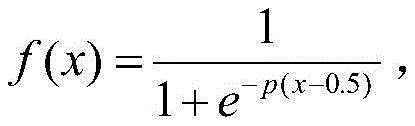
Figure BDA0003872167630000077

其中x的定义域为0≤x≤1,参数p为放缩因子;

Figure BDA0003872167630000078
表示对每一个g对应的
Figure BDA0003872167630000079
取使
Figure BDA00038721676300000710
最大的g;估计值可以表示为
Figure BDA00038721676300000711
Figure BDA00038721676300000712
表示对第j个状态变量估计值的可靠性指标,并设定观测次数的阈值和可靠性阈值;The domain of definition of x is 0≤x≤1, and the parameter p is the scaling factor;
Figure BDA0003872167630000078
Indicates that for each g corresponding to
Figure BDA0003872167630000079
Take envoy
Figure BDA00038721676300000710
the largest g; the estimated value can be expressed as
Figure BDA00038721676300000711
make
Figure BDA00038721676300000712
Represents the reliability index of the estimated value of the jth state variable, and sets the threshold of the number of observations and the reliability threshold;

Figure BDA00038721676300000713
可以表示为
Figure BDA00038721676300000713
It can be expressed as

Figure BDA00038721676300000714

其中

Figure BDA00038721676300000715
表示经过第l时隙的传输后,获得对第j个状态的观测次数,c为观测次数的阈值,
Figure BDA00038721676300000716
表示第j个状态变量的第qj个观测值所对应的信道增益幅值;∈为可靠性阈值,则
Figure BDA00038721676300000717
表示对第j个状态的观测是可靠的。in
Figure BDA00038721676300000715
Indicates that after the transmission of the lth time slot, the number of observations of the jth state is obtained, c is the threshold of the number of observations,
Figure BDA00038721676300000716
Indicates the channel gain amplitude corresponding to the q jth observed value of the jth state variable; ∈ is the reliability threshold, then
Figure BDA00038721676300000717
Indicates that the observation of the jth state is reliable.

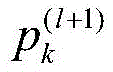
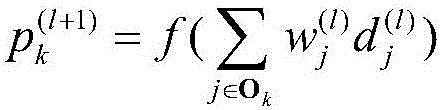
4)融合中心广播每个状态变量估计值的可靠性指标,所有传感器根据可观测状态变量的可靠性指标决定在下一次传输过程中的激活概率。4) The fusion center broadcasts the reliability index of the estimated value of each state variable, and all sensors determine the activation probability in the next transmission process according to the reliability index of the observable state variable.

在本步骤中,传感器决定激活概率的方法为:In this step, the method by which the sensor determines the activation probability is:

Figure BDA00038721676300000718
则第k个传感器在第l+1个时隙内的激活概率
Figure BDA00038721676300000719
Figure BDA00038721676300000720
可以表示为
Figure BDA00038721676300000721
其中Ok表示第k个传感器能够观测到的状态变量索引集合,即
Figure BDA00038721676300000722
Figure BDA00038721676300000723
表示Ok是{1,2,...,No}的子集;
Figure BDA00038721676300000724
表示第j个状态变量的可靠性指标对第k个传感器在第l+1个时隙内激活概率的贡献权重
Figure BDA00038721676300000725
make
Figure BDA00038721676300000718
Then the activation probability of the kth sensor in the l+1th time slot
Figure BDA00038721676300000719
Figure BDA00038721676300000720
It can be expressed as
Figure BDA00038721676300000721
where O k represents the state variable index set that the kth sensor can observe, namely
Figure BDA00038721676300000722
Figure BDA00038721676300000723
Indicates that O k is a subset of {1,2,...,N o };
Figure BDA00038721676300000724
Indicates the contribution weight of the reliability index of the jth state variable to the activation probability of the kth sensor in the l+1th time slot
Figure BDA00038721676300000725

整个待观测区域被分为Na个区域,第na个区域内传感器能观测到的状态索引集合为

Figure BDA0003872167630000081
以一个区域为单位进行状态变量估计,如果一个区域内对所有可观测状态变量的估计都是可靠的,那么可以认为对这个区域的状态变量估计已完成;The entire area to be observed is divided into N a areas, and the state index set that the sensor can observe in the n ath area is
Figure BDA0003872167630000081
Estimate the state variables with a region as a unit. If the estimation of all observable state variables in a region is reliable, then it can be considered that the state variable estimation for this region has been completed;

融合中心只需指示那些分布在其他区域内的传感器在下一个时隙内激活;在下一个时隙的传输中,希望尽可能少的区域激活就能使得所有待观测的状态变量被覆盖;将这个问题建模为一个集合覆盖的最佳化问题,如下所示:The fusion center only needs to instruct those sensors distributed in other areas to activate in the next time slot; in the transmission of the next time slot, it is hoped that the activation of as few areas as possible can make all the state variables to be observed covered; the problem Modeled as a set-covering optimization problem as follows:

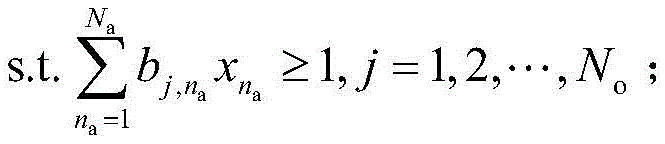
Figure BDA0003872167630000082

Figure BDA0003872167630000083

Figure BDA0003872167630000084

矩阵

Figure BDA0003872167630000085
表示不同区域内能观测到的状态变量;
Figure BDA0003872167630000086
为矩阵B的元素,
Figure BDA0003872167630000087
表示第na个区域内的传感器是否能获取对第j个状态变量的观测;
Figure BDA0003872167630000088
表示选择第na个区域的代价,
Figure BDA0003872167630000089
的值被设置为1;
Figure BDA00038721676300000810
表示是否选择第na个区域;
Figure BDA00038721676300000811
表示至少一个激活区域内的传感器获取对第j个状态变量的观测;matrix
Figure BDA0003872167630000085
Represents the state variables that can be observed in different regions;
Figure BDA0003872167630000086
is the element of matrix B,
Figure BDA0003872167630000087
Indicates whether the sensor in the nth area can obtain the observation of the jth state variable;
Figure BDA0003872167630000088
Indicates the cost of selecting the nth region,
Figure BDA0003872167630000089
The value of is set to 1;
Figure BDA00038721676300000810
Indicates whether to select the n ath area;
Figure BDA00038721676300000811
Indicates that at least one sensor in the active area obtains an observation of the jth state variable;

采用贪婪算法求解这个集合覆盖的最佳化问题,令

Figure BDA00038721676300000812
表示一个集合,该集合内的元素为在第l+1个时隙内需要继续观测的状态变量的索引;令
Figure BDA00038721676300000813
表示一个集合,该集合内的元素为含有经过第l个时隙观测后不可靠状态变量估计区域的索引;在集合
Figure BDA00038721676300000814
内,每次选取第na个区域,其中na可以表示为
Figure BDA00038721676300000815
Figure BDA00038721676300000816
表示第na个区域内传感器能观测到的状态索引集合;然后将索引na从集合
Figure BDA00038721676300000817
中移除并加入集合
Figure BDA00038721676300000818
其中集合
Figure BDA00038721676300000819
表示在第l+1个时隙内需要激活区域的索引集合;重复上述选择过程直到
Figure BDA00038721676300000820
其中
Figure BDA00038721676300000821
表示所有的na属于
Figure BDA00038721676300000822
∪·表示对所有的
Figure BDA00038721676300000823
取并集;最终
Figure BDA00038721676300000824
将包含在第l+1个时隙内需要激活区域的索引;The greedy algorithm is used to solve the optimization problem of this set coverage, so that
Figure BDA00038721676300000812
Represents a collection, the elements in the collection are the indexes of the state variables that need to be observed continuously in the l+1th time slot; let
Figure BDA00038721676300000813
Represents a collection, the elements in the collection are the indexes containing the unreliable state variable estimation area after the observation of the lth time slot; in the collection
Figure BDA00038721676300000814
, select the n ath area each time, where n a can be expressed as
Figure BDA00038721676300000815
Figure BDA00038721676300000816
Indicates the state index set that can be observed by the sensor in the n ath area; then index n a from the set
Figure BDA00038721676300000817
remove and add to collection
Figure BDA00038721676300000818
collection of them
Figure BDA00038721676300000819
Represents the index set of regions that need to be activated in the l+1th time slot; repeat the above selection process until
Figure BDA00038721676300000820
in
Figure BDA00038721676300000821
Indicates that all n a belong to
Figure BDA00038721676300000822
∪ means for all
Figure BDA00038721676300000823
take union; final
Figure BDA00038721676300000824
will contain the index of the region that needs to be activated in the l+1th time slot;

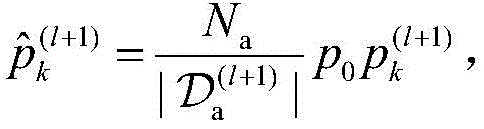
在一个传输时隙内,激活传感器的数量将被控制;分布在第

Figure BDA00038721676300000825
个区域内的第
Figure BDA00038721676300000826
个传感器的激活概率为
Figure BDA00038721676300000827
Figure BDA00038721676300000828
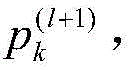
表示第na个区域内的传感器索引集合,其中p0表示在第一个时隙内传感器的激活概率,具体数值要根据场景的情况设定;
Figure BDA00038721676300000829
表示第l+1个时隙内第k个传感器的激活概率,根据
Figure BDA0003872167630000091
得到;除了第na个区域之外的其他区域内的传感器在下一个传输时隙内保持休眠。In one transmission slot, the number of activated sensors will be controlled; distributed in
Figure BDA00038721676300000825
within the region
Figure BDA00038721676300000826
The activation probability of a sensor is
Figure BDA00038721676300000827
Figure BDA00038721676300000828
Indicates the sensor index set in the n ath area, where p 0 indicates the activation probability of the sensor in the first time slot, and the specific value should be set according to the situation of the scene;
Figure BDA00038721676300000829
Indicates the activation probability of the kth sensor in the l+1th time slot, according to
Figure BDA0003872167630000091
Obtained; the sensors in the regions other than the n ath region remain dormant in the next transmission slot.

5)不断执行步骤1)至步骤4)的过程直到融合中心获取了对系统所有状态变量的可靠估计。5) Continuously execute the process from step 1) to step 4) until the fusion center obtains reliable estimates of all state variables of the system.

通过计算机仿真可以看出:如图2所示,本发明的分布式状态监测方案相较于基线的随机激活方案,在相同的信噪比条件下,完成对系统全局状态观测所需的平均传输时隙数有明显的下降。图3表明本发明提出的分布式状态监测方案,相较于基线的随机激活方案,可以使得经过少量的时隙传输,状态变量估计的最小均方误差有明显下降。这些优势主要是是因为本文方案利用了每个时隙对全局状态向量估计的结果指导传感器在下一个时隙内的传输。因此,本发明提出的与源址无关的分布式状态监测方案提供了一种高效的系统全局状态向量估计方法。It can be seen through computer simulation that: as shown in Figure 2, compared with the random activation scheme of the baseline, the distributed state monitoring scheme of the present invention can complete the average transmission required for the global state observation of the system under the same signal-to-noise ratio condition The number of slots has dropped significantly. Figure 3 shows that the distributed state monitoring scheme proposed by the present invention, compared with the random activation scheme of the baseline, can make the minimum mean square error of state variable estimation decrease significantly after a small number of time slot transmissions. These advantages are mainly because the scheme in this paper uses the result of global state vector estimation for each time slot to guide the sensor's transmission in the next time slot. Therefore, the source-address-independent distributed state monitoring scheme proposed by the present invention provides an efficient method for estimating the global state vector of the system.

上述实施例用来解释说明本发明,而不是对本发明进行限制,在本发明的精神和权利要求的保护范围内,对本发明作出的任何修改和改变,都落入本发明的保护范围。The above-mentioned embodiments are used to illustrate the present invention, rather than to limit the present invention. Within the spirit of the present invention and the protection scope of the claims, any modification and change made to the present invention will fall into the protection scope of the present invention.

Claims (5)

1. A distributed state monitoring method independent of a source address is characterized by comprising the following steps:
s1, activating a sensor, acquiring observation of the system state of the whole monitoring area, generating a state index, splicing the acquired observation result and the state index of each state into information subblocks, and encoding the information subblocks and then transmitting the information subblocks to a fusion center through a wireless channel;
s2, the fusion center detects and estimates information sub-blocks corresponding to the code words transmitted by the sensor and corresponding superimposed channel gain values from the received signals;
s3, the fusion center obtains an estimation value of the state variable and a reliability index of the estimation value according to a plurality of observation values of each state variable observed by a plurality of sensors and a channel gain of each observation value; when the reliability index of the state variable is greater than the set reliability threshold value, the observation of the state variable is reliable;
s4, dividing the whole monitoring area into different areas, broadcasting the reliability index of each state variable estimation value by the fusion center, and if the estimation of all observable state variables in one area is reliable, finishing the state variable estimation of the area; the fusion center indicates the sensors in the incomplete state estimation area to be activated in the next time slot, and all the sensors determine the activation probability in the next transmission process according to the reliability index of the observable state variable;
and S5, continuously executing the processes from the step S1 to the step S4 until the fusion center obtains reliable estimation of all state variables of the system in the monitoring area.
2. The method for monitoring distributed states independent of source addresses according to claim 1, wherein the encoding method in step S1 specifically comprises the steps of:
s1.1, setting a codebook
Figure FDA0003872167620000011
Wherein
Figure FDA0003872167620000012
Representing a complex field, each column of A representing a codeword, the codewords being common
Figure FDA0003872167620000013
Each code word has a length of L c (ii) a The whole system has N o For a state, jth state vector
Figure FDA0003872167620000014
Is expressed by a length of b s A bit; for the index vector of the state
Figure FDA0003872167620000015
Is expressed by a length of b I A bit; information sub-block
Figure FDA0003872167620000016
Length of N m =b I +b s A bit;
s1.2, dividing a time slot into T sub-time slots; for the t sub-slot, the k active sensor, N to be transmitted m Mapping the bit information subblocks into a range of values from 1 to
Figure FDA0003872167620000017
Is an integer of
Figure FDA0003872167620000018
S1.3, the kth active sensor converts the kth in the codebook A
Figure FDA0003872167620000019
The codewords represented by the columns are sent to a fusion center.
3. The method according to claim 2, wherein the detecting and estimating method in step S2 is as follows:
in the scene of the Internet of things, the total number of K is total Individual sensors, only K in one transmission a Activation of individual sensors, i.e. K a <<K total (ii) a The received signal may be represented as Y = a Δ H + Z = AX + Z, where
Figure FDA00038721676200000110
Channels representing all sensors;
Figure FDA0003872167620000021
indicating selectionSelecting matrix, element delta in delta matrix n,k Indicating whether the kth sensor transmitted the nth codeword; z is noise and follows a complex gaussian distribution with mean 0; vector quantity
Figure FDA0003872167620000022
Each non-zero element of (a) represents the channel gain of the sensor transmitting this codeword to the fusion center;
recovering a vector X from a received signal Y by using a compressed sensing method to obtain a code word transmitted by a sensor and a corresponding channel gain amplitude set; then according to the code word index, converting the code word index into a binary vector, wherein the binary vector is an information subblock sent by a user; in the t-th sub-slot of the l-th time slot, for the n-th code word, the n-th code word is converted into a binary vector to obtain an information sub-block
Figure FDA0003872167620000023
The codeword has a corresponding channel gain magnitude of
Figure FDA0003872167620000024
Wherein | represents the amplitude value, and the corner mark (l, t) represents the t-th sub-slot in the l-th time slot; let the detected codeword index set be
Figure FDA0003872167620000025
The detected information sub-block set is
Figure FDA0003872167620000026
The sum of the channel gains is
Figure FDA0003872167620000027
4. The method according to claim 3, wherein the reliability index calculation method in step S3 is as follows:
in the l time slot, T sub-times can be obtainedIn the gap
Figure FDA0003872167620000028
And
Figure FDA0003872167620000029
from
Figure FDA00038721676200000210
Can obtain the b observed value of the j state variable
Figure FDA00038721676200000211
Wherein the corner mark (l) represents the l-th time slot; if the jth state variable is observed by different sensors, different channel gain amplitudes corresponding to the same observed value are superposed to obtain a corresponding superposed channel gain amplitude
Figure FDA00038721676200000212
Finally, through observation of the l time slot, forming an observation value set for all observation values of the j state variable
Figure FDA00038721676200000213
The superposed channel gain amplitude values corresponding to each observation value form a superposed channel gain amplitude value set
Figure FDA00038721676200000214
Wherein |. Non c Representing the number of elements of a set;
considering the estimate of the jth state variable as a classification problem; splicing all elements in the superposition channel gain amplitude set into a vector to be used as the input of the softmax function, and then outputting to obtain the index of the jth state variable estimated value
Figure FDA00038721676200000215
Is shown as
Figure FDA00038721676200000216
Where f (x) is the truncation and scaling of the sigmoid function, which can be expressed as
Figure FDA00038721676200000217
Wherein x is defined as 0-1, and p is a scaling factor;
Figure FDA00038721676200000218
representing for each g
Figure FDA00038721676200000219
Get messenger
Figure FDA00038721676200000220
The largest g; the estimated value can be expressed as
Figure FDA00038721676200000221
Order to
Figure FDA00038721676200000222
Representing a reliability index of a jth state variable estimated value, and setting a threshold value of observation times and a reliability threshold value;
Figure FDA0003872167620000031
can be expressed as
Figure FDA0003872167620000032
Wherein
Figure FDA0003872167620000033
Indicating passage of the l-th time slotAfter transmission, the observation times of the jth state are obtained, c is the threshold value of the observation times,
Figure FDA0003872167620000034
q-th representing a j-th state variable j The channel gain amplitude corresponding to each observation value; e is the reliability threshold, then
Figure FDA0003872167620000035
Indicating that the observation of the jth state is reliable.
5. The method according to claim 4, wherein the step S4 specifically includes:
order to
Figure FDA0003872167620000036
The activation probability of the kth sensor in the (l + 1) th time slot
Figure FDA0003872167620000037
Figure FDA0003872167620000038
Can be expressed as
Figure FDA0003872167620000039
Wherein O is k Representing the set of state variable indices that the kth sensor can observe, i.e.
Figure FDA00038721676200000310
Figure FDA00038721676200000311
Represents O k Is {1, 2.., N o A subset of { C };
Figure FDA00038721676200000312
representing the reliability of the jth state variableContribution weight of index to activation probability of kth sensor in l +1 th time slot
Figure FDA00038721676200000313
The whole region to be observed is divided into N a A region, n a The state indexes observed by the sensors in each region are set as
Figure FDA00038721676200000314
Estimating the state variables by taking one area as a unit, and if the estimation of all observable state variables in one area is reliable, the estimation of the state variables in the area can be considered to be finished;
the fusion center only needs to indicate that the sensors distributed in other areas are activated in the next time slot; in the transmission of the next time slot, it is desirable that as few regions as possible are active so that all state variables to be observed are covered; modeling this problem as an optimization problem covered by a set, as follows:
Figure FDA00038721676200000315
matrix array
Figure FDA00038721676200000316
Representing state variables that can be observed in different regions;
Figure FDA00038721676200000317
are the elements of the matrix B and,
Figure FDA00038721676200000318
denotes the n-th a Whether sensors in each zone can acquire observation of the jth state variable;
Figure FDA00038721676200000319
indicates the selection of the n-th a The cost of the individual regions is such that,
Figure FDA00038721676200000320
is set to 1;
Figure FDA00038721676200000321
indicates whether or not the nth is selected a An area;
Figure FDA00038721676200000322
indicating that sensors within at least one activation region acquire observations of a jth state variable;
solving the optimization problem of the set coverage by greedy algorithm
Figure FDA0003872167620000041
Representing a set, wherein elements in the set are indexes of state variables needing to be continuously observed in the l +1 th time slot; order to
Figure FDA0003872167620000042
Representing a set, wherein elements in the set are indexes of unreliable state variable estimation areas after the first time slot observation; in the collection
Figure FDA0003872167620000043
In each time, select the n-th a A region where n a Can be expressed as
Figure FDA0003872167620000044
Figure FDA0003872167620000045
Denotes the n-th a A state index set which can be observed by the sensors in each area; then index n a From the set
Figure FDA0003872167620000046
In removing and adding collections
Figure FDA0003872167620000047
Wherein the set
Figure FDA0003872167620000048
An index set indicating a region to be activated in the l +1 th slot; repeating the above selection process until
Figure FDA0003872167620000049
Wherein
Figure FDA00038721676200000410
Denotes all n a Belong to
Figure FDA00038721676200000411
U.S. means for all
Figure FDA00038721676200000412
Taking a union set; finally, the product is processed
Figure FDA00038721676200000413
An index of a region to be activated in the l +1 th time slot is included;
during a transmission time slot, the number of active sensors will be controlled; is distributed at the first
Figure FDA00038721676200000414
In a region of
Figure FDA00038721676200000415
The activation probability of each sensor is
Figure FDA00038721676200000416
Figure FDA00038721676200000417
Denotes the n-th a Set of sensor indices within a region, where p 0 Representing the activation probability of the sensor in the first time slot, wherein the specific numerical value is set according to the situation of a scene;
Figure FDA00038721676200000418
indicating the activation probability of the kth sensor in the l +1 th time slot, based on
Figure FDA00038721676200000419
Obtaining; except for the n-th a Sensors in other zones outside of the one zone remain dormant for the next transmission time slot.
CN202211201368.5A 2022-09-29 2022-09-29 Distributed state monitoring method independent of source address Pending CN115550994A (en)

Priority Applications (2)

Application Number Priority Date Filing Date Title
CN202211201368.5A CN115550994A (en) 2022-09-29 2022-09-29 Distributed state monitoring method independent of source address
PCT/CN2023/086658 WO2024066284A1 (en) 2022-09-29 2023-04-06 Distributed state monitoring method unrelated to source address

Applications Claiming Priority (1)

Application Number Priority Date Filing Date Title
CN202211201368.5A CN115550994A (en) 2022-09-29 2022-09-29 Distributed state monitoring method independent of source address

Publications (1)

Publication Number Publication Date
CN115550994A true CN115550994A (en) 2022-12-30

Family

ID=84732220

Family Applications (1)

Application Number Title Priority Date Filing Date
CN202211201368.5A Pending CN115550994A (en) 2022-09-29 2022-09-29 Distributed state monitoring method independent of source address

Country Status (2)

Country Link
CN (1) CN115550994A (en)
WO (1) WO2024066284A1 (en)

Family Cites Families (5)

* Cited by examiner, † Cited by third party
Publication number Priority date Publication date Assignee Title
FR2963454B1 (en) * 2010-07-27 2013-11-01 Thales Sa METHOD OF OPTIMALLY DETERMINING THE CHARACTERISTICS AND LAYOUT OF A SET OF SENSORS FOR MONITORING A ZONE
CN111835464B (en) * 2020-07-14 2021-06-25 浙江大学 A source-independent large-scale cooperative access method
KR102426289B1 (en) * 2020-11-27 2022-07-28 서울대학교산학협력단 Apparatus and method for active user detection and channel estimation using deep neural network
CN113194548B (en) * 2021-03-30 2022-05-20 浙江大学 Intelligent super-surface-assisted large-scale passive random access method
CN114285523B (en) * 2021-12-24 2023-09-15 西安交通大学 Large-scale MTC authorization-free multi-user detection method and system for multiple business needs

Also Published As

Publication number Publication date
WO2024066284A1 (en) 2024-04-04

Similar Documents

Publication Publication Date Title
CN110855299B (en) Method and apparatus for encoding data using polar codes
CN102651229B (en) Semiconductor device and data processing method
CN110942151B (en) A kind of quantum state chromatography method and device
CN111447160B (en) Signal Detection Method for Massive MIMO Passive Random Access Based on Neural Network
JP2015522998A5 (en)
US10592803B2 (en) Neuromorphic chip and method and apparatus for detecting spike event
JP2011520371A5 (en)
JP5587412B2 (en) Information encoding and decoding
US8397142B2 (en) Shared information generating apparatus and recovering apparatus
CN102594492A (en) Code block dividing method and device
CN103428849B (en) Sensing network location addressing system and method based on encoding optic fiber grating sensing
CN110363163B (en) An Azimuth Controllable SAR Target Image Generation Method
CN118539993A (en) Demodulation method based on transducer architecture
CN118333011A (en) Semantic communication method and system based on semantic base
CN115550994A (en) Distributed state monitoring method independent of source address
CN115941112A (en) A portable covert communication method, computer equipment and storage medium
CN105897376A (en) Testing method and apparatus for decoding performance of decoder
CN116668012B (en) Embedded-image-free steganography method and device based on dual dynamic mapping
CN118631752A (en) A resource hopping multi-access method for federated learning applied to the Internet of Things
CN113438191B (en) Method and system for decoding spherical codes assisted by zero code words of uplink of SM-SCMA system
CN111342846A (en) Decoding method, decoding device and computer readable storage medium
CN113539371A (en) Sequence coding method and device and readable storage medium
CN111416781B (en) An information processing method and related equipment
US10263638B2 (en) Lossless compression method for graph traversal
EP4661349A1 (en) Communication program and method for allocating pulse code string

Legal Events

Date Code Title Description
PB01 Publication
PB01 Publication
SE01 Entry into force of request for substantive examination