Disclosure of Invention
The invention aims to solve the problems that in an intelligent super-surface-assisted 6G large-scale access system, each device in the existing active large-scale access scheme needs an independent codebook, the scheme can detect short data packets, estimates the pilot sequence length needed by a super-surface channel and has high calculation complexity, and provides an intelligent super-surface-assisted large-scale passive random access algorithm.
The invention adopts the following specific technical scheme:
an intelligent super-surface assisted large-scale passive random access method comprises the following steps:
1) setting a phase matrix of the intelligent super surface as a sparse matrix, and randomly selecting one device from all activated devices to send a pilot sequence with a certain length to a base station;
2) after receiving the pilot frequency sequence, the base station estimates a channel between the super surface and the base station by using a bilinear generalized approximate message transmission method;
3) all activated devices send messages to a base station through an intelligent super surface by using a common codebook, the messages are divided into L sub-messages to be transmitted, and a controller sets different super surface phase matrixes for each sub-message sending stage;
4) after receiving the data, the base station detects the data of the continuous space by using a self-adaptive detection method based on tensor and estimates a channel between the activation equipment and the super surface;
5) after obtaining the data of the continuous space, the base station performs demapping on each activation device individually based on the grassmannian constellation diagram, that is, the data of the continuous space of each activation device is mapped back to the discrete space.
Preferably, in step 1), the method for setting the phase matrix and the pilot sequence includes:
at any time t e [1, t ∈
p]Controlling the switch state of each unit of the intelligent super-surface at the moment t so that each unit of the intelligent super-surface has probability
Set to 1 for representing an on state, with probability
Setting the state to be 0 for representing an off state, and obtaining a sparse super-surface phase matrix V after all units of the intelligent super-surface are set to be in the on-off state; the pilot sequence sampling follows a gaussian distribution.
Preferably, in step 2), the method for estimating the channel between the super surface and the base station comprises:
first, the distribution of the channel U between the super-surface and the base station is set as
Wherein M is the number of antennas of the base station, N is the number of units of the intelligent super surface, and U (M, N) represents the element of the mth row and the nth column of the channel U; resetting sparse auxiliary matrix
Is distributed as
Wherein t is
pFor the length of the pilot sequence, F (n, t) represents the n-th row and t-th column element of the auxiliary matrix F, an [ ] represents a Hadamard product, h
1Is the channel between the
device 1 and the intelligent super-surface, g
1Pilot sequence, δ, transmitted for
device 1
0Representing an impulse function, σ
uAnd σ
fRepresenting the variance of the channel U and the auxiliary matrix F respectively,
the distribution representing the variable a is Gaussian distribution with the mean value b and the variance c; from these two distributions, a problem is solved using a bilinear generalized approximation message-passing method
Where p (Y | U, F) represents the base station interface in the case where the channel U and the auxiliary matrix F are known between the super-surface and the base stationThe distribution of the received data Y is such that,
represents an estimate of U, and Y is the base station received data.
Preferably, the common codebook setting method in step 3) is:
the system adopts a message block transmission mechanism, namely each activation device divides B bit information to be transmitted into L sub-messages for transmission respectively, and the 1 st or L less sub-messages contain B
lBit information; setting the data length of the ith sub-message as tau, and decomposing the data length into
Wherein d is more than or equal to 2, is the number of the segments of decomposition, tau
1,τ
2,…,τ
dMore than or equal to 2 is the length of each subsection, and pi represents multiplication operation; then the L ∈ [1, L ]]Number of bits B of the submessage
lSub-bit number B also broken down into d segments
l,iI is 1,2, …, d; next, the sub-packet passes through a sub-constellation
Mapping to obtain the transmission symbol x of the ith sub-segment of the kth device of the ith sub-message after mapping to 1, …, d
i,k,l(ii) a The last data sent by device k is
Wherein
Represents the outer product, vec (·) represents the vectorization operation; each sub-message of each active device is decomposed, mapped and transmitted as above.
Preferably, the tensor-based adaptive detection method in step 4) includes:
inputting all received data
And an upper bound T of the number of iterations T, starting 1 st iteration:
first, the intermediate variables are updated
Wherein [ ] is a hadamard product, a
βAnd
in order to be a parameter of the noise distribution,
and
mean and variance of data of ith sub-segment of ith sub-message in the t iteration respectively
iThe length of the data signal of the ith subsection is H, and H is a conjugate transpose;
then, the variance Ω of the channel between the device and the super-surface is updated, at Ω at time t +1
t+1Is calculated by
Wherein
Represents the product of kronecker, 1
NRepresenting a vector of all 1 s with a length N, N being the number of reflection units of the intelligent super-surface, b
ηAnd
for characterizing the distribution parameters of the sparseness of the channel matrix array, K is the initial value of the number of active devices, b
ξAnd
to characterize the sparse distribution parameter of the channel elements, diag (-)Representing an operation of taking the diagonal, P
lRepresenting the measurement matrix when the ith sub-message is sent;
next, the vector form u of the mean of the channels between the device and the super-surface is updated, u at time t +1
t+1Is calculated by
Where o represents the Khatri-Rao product,
representative pair tensor
Performing expansion on the d +1 order;
then, the vector u is rearranged
tThe mean value of the channels between the device and the super-surface at the t-th iteration can be obtained
Next, the variance of the data is updated
Is calculated by
Wherein
Represents the conjugate transpose of the mean of the channel between the device and the super-surface for the t iteration; b is a mixture of
γAnd
to characterize the distribution parameters for sparseness of columns of the data matrix,
is a matrix
Of ith row and jth column ofElement, channel variance matrix Ω at the t-th iteration
tDimension of (2) is NK row and NK column, and is omega
t+1Divided into blocks of dimension size N rows and N columns, wherein
Is omega
tI is more than or equal to 1 and less than or equal to N, j is more than or equal to 1 and less than or equal to N, and K represents the upper bound of the given number of activated devices;
next, the mean of the data is updated
Is calculated by
Representative pair tensor
Performing expansion on an i-order;
then, updating distribution parameters for representing sparse channel elements
Is calculated by
Where k is the kth active device,
is a matrix
The nth row and the kth column of (1); at the t +1 th iteration, the channel variance matrix Ω
t+1Dimension of (2) is NK row and NK column, and is omega
t+1Divided into blocks of dimension size N rows and N columns, wherein
Is omega
t+1N is more than or equal to 1 and less than or equal to N in the block of the nth row and the nth column,
is a matrix
K is more than or equal to 1 and less than or equal to K;
next, the expectation of energy precision of each element of the channel is updated
Is calculated by
Wherein
Expressing the expectation;
then, updating distribution parameters for representing sparse channel matrix array
K is more than or equal to 1 and less than or equal to K, wherein K represents an upper bound of the given number of activated devices,
is calculated by
Wherein
Mean matrix for channel between t-th iteration device and super surface
The (c) th column of (a),
as vectors
The conjugate transpose of (a) is performed,
representation and matrix
The kth row and the kth column of (1);
next, the energy accuracy expectations of the channel's individual column vectors are updated
Is calculated by
Then, updating distribution parameters for representing sparse data matrix array
Is calculated by
Wherein
Is a matrix
The (c) th column of (a),
is a matrix
The kth row and the kth column of (1);
next, the energy accuracy expectations of the channel's individual column vectors are updated
Is calculated by
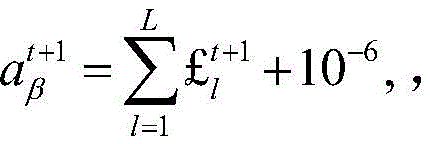
Finally, the characterizing noise is updatedOf precision
Is calculated by
Wherein
Wherein
Mean matrix for channel between t-th iteration device and super surface
The conjugate transpose of (Tr) · is the trace of the matrix, | · | | | non-conducting phosphor
FRepresenting the F norm of the matrix, T being the transpose;
and after the updating of one iteration is finished, updating the iteration time T ← T +1, repeating the updating of the next iteration again, and stopping the loop until T is T, thereby finishing the estimation of unknown data and a channel.
Preferably, the demapping method in step 5) is:
after the iteration of the step 5), obtaining an estimated value of the data in the continuous space as
Then searching out the solution of the following expression according to the mapping relation of the Grassmann constellation diagram
Wherein
Evaluating a matrix for data
The (c) th column of (a),
for actual evaluation of the data, | |)
2Is a two-norm, | · | is an absolute value, x
i,k,lIs a diagram of sub-constellation
Of (1).
The invention has the beneficial effects that: the large-scale passive random access algorithm based on the intelligent super-surface can accurately detect a longer data packet by using a shorter pilot frequency sequence, the required pilot frequency length is not increased along with the increase of the number of devices, the algorithm is suitable for a super-large super-surface array scene, and a series of problems caused by the fact that the data packet which can be detected in the super-surface assisted active large-scale data detection problem is short, the pilot frequency sequence required by the super-surface channel is long, the calculation complexity is high and the like are solved.
Detailed Description
In this embodiment, a diagram of an intelligent super-surface assisted large-scale passive access scenario is shown in fig. 1, in a 6G wireless network, a base station is provided with M antennas, an intelligent super-surface is equipped with N reflection units, a phase of the intelligent super-surface is controlled by a controller, and each device is equipped with 1 antenna. Only a portion of the devices are active at any given time slot, while the other devices are in a dormant state. The invention provides a two-stage protocol combining data detection and channel estimation based on the authorization-free passive random access. First, in phase I, only one active device sends a pilot sequence to the base station through the intelligent super-surface, and the base station estimates the channel between the super-surface and the base station using a bilinear generalized approximation message transfer algorithm. In phase II, all active devices transmit data to the base station through the intelligent hyper-surface using a common codebook, and the base station detects the data and estimates channel information between the active devices and the hyper-surface using a tensor-based adaptive detection algorithm.
The intelligent super-surface assisted large-scale passive random access method adopted in the embodiment comprises the following steps:
1) and setting a phase matrix of the intelligent super surface as a sparse matrix, and randomly selecting one device from all activated devices to send a pilot sequence with a certain length to a base station.
In this step, the method for setting the phase matrix and the pilot sequence comprises the following steps:
at any time t e [1, t ∈
p]Controlling the switch state of each unit of the intelligent super-surface at the moment t so that each unit of the intelligent super-surface has probability
Set to 1 for representing an on state, with probability
Setting the state to be 0 for representing an off state, and obtaining a sparse super-surface phase matrix V after all units of the intelligent super-surface are set to be in the on-off state; the pilot sequence sampling follows a gaussian distribution.
2) And after receiving the pilot frequency sequence, the base station estimates a channel between the super surface and the base station by using a bilinear generalized approximate message transmission method.
In this step, the method for estimating the channel between the super-surface and the base station comprises:
first, the distribution of the channel U between the super-surface and the base station is set as
Wherein M is the number of antennas of the base station, N is the number of units of the intelligent super surface, and U (M, N) represents the element of the mth row and the nth column of the channel U; resetting sparse auxiliary matrix
Is distributed as
Wherein t is
pFor the length of the pilot sequence, F (n, t) represents the n-th row and t-th column element of the auxiliary matrix F, an [ ] represents a Hadamard product, h
1Is the channel between the device 1 and the intelligent super-surface, g
1Pilot sequence, δ, transmitted for device 1
0Representing the impulse function, σ
uAnd σ
fRepresenting the variance of the channel U and the auxiliary matrix F respectively,
the distribution of the variable a is represented as a Gaussian distribution with the mean value of b and the variance of c; from these two distributions, a problem is solved using a bilinear generalized approximation message-passing method
Where p (Y | U, F) represents the distribution of the received data Y at the base station, given that the channel U and the auxiliary matrix F are known between the super-surface and the base station,
represents an estimate of U, and Y is the base station received data.
3) All active devices send a message to the base station through the intelligent super surface by using a common codebook, the message is divided into L sub-messages to be transmitted, and the controller sets different super surface phase matrixes for each sub-message sending stage.
In this step, the common codebook setting method is:
the system adopts a message block transmission mechanism, namely each activation device divides B bit information to be transmitted into L sub-messages for transmission respectively, and the 1 st or L less sub-messages contain B
lBit information; setting the data length of the ith sub-message as tau, and decomposing the data length into
Wherein d.gtoreq.2 is the number of stages of decomposition, τ
1,τ
2,…,τ
dMore than or equal to 2 is the length of each subsection, and pi represents multiplication operation; then the L ∈ [1, L ]]Number of bits B of the submessage
lSub-bit number B also broken down into d segments
l,iI is 1,2, …, d; next, the sub-packet passes through a sub-constellation
Mapping to obtain the transmission symbol x of the ith sub-segment of the kth device of the ith sub-message after mapping to 1, …, d
i,k,l(ii) a The last data sent by device k is
Wherein
Represents the outer product, vec (·) represents the vectorization operation; each sub-message of each active device is decomposed, mapped and transmitted as above.
4) After receiving the data, the base station detects the data of the continuous space by using a tensor-based self-adaptive detection method and estimates a channel between the activation equipment and the super surface.
In this step, the tensor-based adaptive detection method comprises the following steps:
inputting all received data
And an upper bound T of the number of iterations T, starting 1 st iteration:
first, the intermediate variables are updated
Wherein [ ] is a hadamard product, a
βAnd
in order to be a parameter of the noise distribution,
and
mean and variance of data of ith sub-segment of the ith sub-message at the t-th iteration, respectively, representing the conjugate, τ
iThe length of the data signal of the ith subsection is H, and H is a conjugate transpose;
then, the variance Ω of the channel between the device and the super-surface is updated, at Ω at time t +1
t+1Is calculated by
Wherein
Represents the product of kronecker, 1
NRepresenting a vector of all 1 s with a length N, N being the number of reflection units of the intelligent super-surface, b
ηAnd
for characterizing the distribution parameters of the sparseness of the channel matrix array, K is the initial value of the number of active devices, b
ξAnd
to characterize the sparsely distributed parameters of the channel elements, diag (-) stands for the diagonal take-off operation, P
lRepresenting the measurement matrix when the ith sub-message is sent;
next, the vector form u of the mean of the channels between the device and the super-surface is updated, u at time t +1
t+1Is calculated by
Where o represents the Khatri-Rao product,
representative pair tensor
Unfolding is carried out on the d +1 order;
then, the vector u is rearranged
tThe mean value of the channels between the device and the super-surface at the t-th iteration can be obtained
Next, the variance of the data is updated
Is calculated by
Wherein
Represents the conjugate transpose of the mean of the channel between the device and the super-surface for the t iteration; b
γAnd
to characterize the distribution parameters for sparseness of columns of the data matrix,
is a matrix
The ith row and the jth column of (b), and at the tth iteration, the channel variance matrix omega
tDimension of (2) is NK row and NK column, and is omega
t+1Divided into blocks of dimension size N rows and N columns, wherein
Is omega
tI is more than or equal to 1 and less than or equal to N, j is more than or equal to 1 and less than or equal to N, and K represents the upper bound of the given number of activated devices;
next, the mean of the data is updated
Is calculated by
Representative pair tensor
Performing expansion on the i-order;
then, updating distribution parameters for representing sparse channel elements
Is calculated by
Where k is the kth active device,
is a matrix
The nth row and the kth column of (1); at the t +1 th iteration, the channel variance matrix Ω
t+1Dimension of (2) is NK row and NK column, and is omega
t+1Divided into blocks of dimension size N rows and N columns, wherein
Is omega
t+1N is more than or equal to 1 and less than or equal to N in the block of the nth row and the nth column,
is a matrix
K is more than or equal to 1 and less than or equal to K;
next, the expectation of energy precision of each element of the channel is updated
Is calculated by
Wherein
Expressing the expectation;
then, updating distribution parameters for representing sparse channel matrix array
K is more than or equal to 1 and less than or equal to K, wherein K represents an upper bound of the given number of activated devices,
is calculated by
Wherein
Mean matrix for channel between t-th iteration device and super surface
The (c) th column of (a),
as vectors
The conjugate transpose of (a) is performed,
representation and matrix
The kth row and the kth column of (1);
next, the energy accuracy expectations of the channel's individual column vectors are updated
Is calculated by
Then, updating distribution parameters for representing sparse data matrix array
Is calculated by
Wherein
Is a matrix
The (c) th column of (a),
is a matrix
The kth row and the kth column of (1);
next, the energy accuracy expectations of the channel's individual column vectors are updated
Is calculated by
Finally, the characteristic noise precision is updated
Is calculated by
Wherein
Wherein
Mean matrix for channel between t-th iteration device and super surface
The conjugate transpose of (Tr) · is the trace of the matrix, | · | | | non-conducting phosphor
FRepresenting the F norm of the matrix, T being the transpose;
and after the updating of one iteration is finished, updating the iteration time T ← T +1, repeating the updating of the next iteration again, and stopping the loop until T is T, thereby finishing the estimation of unknown data and a channel.
5) After obtaining the data of the continuous space, the base station performs demapping on each activation device individually based on the grassmannian constellation diagram, that is, the data of the continuous space of each activation device is mapped back to the discrete space.
In this step, the demapping method includes:
after the iteration of the step 5), obtaining an estimated value of the data in the continuous space as
Then searching out the solution of the following expression according to the mapping relation of the Grassmann constellation diagram
Wherein
Evaluating a matrix for data
The (c) th column of (a),
for actual evaluation of the data, | |)
2Is a two-norm, | · | is an absolute value, x
i,k,lIs a diagram of sub-constellation
Of (1).
The access method can be seen through computer simulation: as shown in fig. 2, in the smart super-surface-based large-scale passive random access scheme of the present invention, the packet error rate is higher when the number d of sub-message segments is 4 and d is 3 than when the number d of sub-message segments is 2, so the scheme has a greater gain when the number of sub-message segments is small, because the degree of freedom of the system is less than that when d is 4 and d is 3 than d is 2. Fig. 3 shows that the large-scale passive random access scheme based on the intelligent super-surface provided by the invention has significantly improved estimation accuracy of a device-to-super-surface channel compared with a traditional two-stage access algorithm, and the scheme requires less transmission power to achieve the same channel estimation performance as the other scheme. And the normalized mean square error of the channel estimate of the proposed scheme decreases with increasing sampling grid length, since increasing sampling grid length leads to higher angular resolution, which makes the channel more sparse. The advantages of the proposed scheme are firstly because the scheme herein not only explores channel sparsity, but also adaptively estimates the number of active devices, thereby reducing model complexity. Therefore, the intelligent super-surface-based large-scale passive random access scheme provided by the invention can provide an efficient data detection and channel estimation method for a 6G large-scale communication system.