CN115340607A - anti-CD 166 antibodies, activatable anti-CD 166 antibodies, and methods of use thereof - Google Patents
anti-CD 166 antibodies, activatable anti-CD 166 antibodies, and methods of use thereof Download PDFInfo
- Publication number
- CN115340607A CN115340607A CN202210950237.0A CN202210950237A CN115340607A CN 115340607 A CN115340607 A CN 115340607A CN 202210950237 A CN202210950237 A CN 202210950237A CN 115340607 A CN115340607 A CN 115340607A
- Authority
- CN
- China
- Prior art keywords
- seq
- antibody
- sequence
- acid sequence
- amino acid
- Prior art date
- Legal status (The legal status is an assumption and is not a legal conclusion. Google has not performed a legal analysis and makes no representation as to the accuracy of the status listed.)
- Pending
Links
Images


Classifications
-
- A—HUMAN NECESSITIES
- A61—MEDICAL OR VETERINARY SCIENCE; HYGIENE
- A61K—PREPARATIONS FOR MEDICAL, DENTAL OR TOILETRY PURPOSES
- A61K31/00—Medicinal preparations containing organic active ingredients
- A61K31/33—Heterocyclic compounds
- A61K31/395—Heterocyclic compounds having nitrogen as a ring hetero atom, e.g. guanethidine or rifamycins
- A61K31/535—Heterocyclic compounds having nitrogen as a ring hetero atom, e.g. guanethidine or rifamycins having six-membered rings with at least one nitrogen and one oxygen as the ring hetero atoms, e.g. 1,2-oxazines
- A61K31/537—Heterocyclic compounds having nitrogen as a ring hetero atom, e.g. guanethidine or rifamycins having six-membered rings with at least one nitrogen and one oxygen as the ring hetero atoms, e.g. 1,2-oxazines spiro-condensed or forming part of bridged ring systems
-
- C—CHEMISTRY; METALLURGY
- C07—ORGANIC CHEMISTRY
- C07K—PEPTIDES
- C07K16/00—Immunoglobulins [IGs], e.g. monoclonal or polyclonal antibodies
- C07K16/18—Immunoglobulins [IGs], e.g. monoclonal or polyclonal antibodies against material from animals or humans
- C07K16/28—Immunoglobulins [IGs], e.g. monoclonal or polyclonal antibodies against material from animals or humans against receptors, cell surface antigens or cell surface determinants
- C07K16/2803—Immunoglobulins [IGs], e.g. monoclonal or polyclonal antibodies against material from animals or humans against receptors, cell surface antigens or cell surface determinants against the immunoglobulin superfamily
-
- A—HUMAN NECESSITIES
- A61—MEDICAL OR VETERINARY SCIENCE; HYGIENE
- A61K—PREPARATIONS FOR MEDICAL, DENTAL OR TOILETRY PURPOSES
- A61K47/00—Medicinal preparations characterised by the non-active ingredients used, e.g. carriers or inert additives; Targeting or modifying agents chemically bound to the active ingredient
- A61K47/50—Medicinal preparations characterised by the non-active ingredients used, e.g. carriers or inert additives; Targeting or modifying agents chemically bound to the active ingredient the non-active ingredient being chemically bound to the active ingredient, e.g. polymer-drug conjugates
- A61K47/51—Medicinal preparations characterised by the non-active ingredients used, e.g. carriers or inert additives; Targeting or modifying agents chemically bound to the active ingredient the non-active ingredient being chemically bound to the active ingredient, e.g. polymer-drug conjugates the non-active ingredient being a modifying agent
- A61K47/68—Medicinal preparations characterised by the non-active ingredients used, e.g. carriers or inert additives; Targeting or modifying agents chemically bound to the active ingredient the non-active ingredient being chemically bound to the active ingredient, e.g. polymer-drug conjugates the non-active ingredient being a modifying agent the modifying agent being an antibody, an immunoglobulin or a fragment thereof, e.g. an Fc-fragment
- A61K47/6801—Drug-antibody or immunoglobulin conjugates defined by the pharmacologically or therapeutically active agent
- A61K47/6803—Drugs conjugated to an antibody or immunoglobulin, e.g. cisplatin-antibody conjugates
- A61K47/68033—Drugs conjugated to an antibody or immunoglobulin, e.g. cisplatin-antibody conjugates the drug being a maytansine
-
- A—HUMAN NECESSITIES
- A61—MEDICAL OR VETERINARY SCIENCE; HYGIENE
- A61K—PREPARATIONS FOR MEDICAL, DENTAL OR TOILETRY PURPOSES
- A61K47/00—Medicinal preparations characterised by the non-active ingredients used, e.g. carriers or inert additives; Targeting or modifying agents chemically bound to the active ingredient
- A61K47/50—Medicinal preparations characterised by the non-active ingredients used, e.g. carriers or inert additives; Targeting or modifying agents chemically bound to the active ingredient the non-active ingredient being chemically bound to the active ingredient, e.g. polymer-drug conjugates
- A61K47/51—Medicinal preparations characterised by the non-active ingredients used, e.g. carriers or inert additives; Targeting or modifying agents chemically bound to the active ingredient the non-active ingredient being chemically bound to the active ingredient, e.g. polymer-drug conjugates the non-active ingredient being a modifying agent
- A61K47/68—Medicinal preparations characterised by the non-active ingredients used, e.g. carriers or inert additives; Targeting or modifying agents chemically bound to the active ingredient the non-active ingredient being chemically bound to the active ingredient, e.g. polymer-drug conjugates the non-active ingredient being a modifying agent the modifying agent being an antibody, an immunoglobulin or a fragment thereof, e.g. an Fc-fragment
- A61K47/6835—Medicinal preparations characterised by the non-active ingredients used, e.g. carriers or inert additives; Targeting or modifying agents chemically bound to the active ingredient the non-active ingredient being chemically bound to the active ingredient, e.g. polymer-drug conjugates the non-active ingredient being a modifying agent the modifying agent being an antibody, an immunoglobulin or a fragment thereof, e.g. an Fc-fragment the modifying agent being an antibody or an immunoglobulin bearing at least one antigen-binding site
- A61K47/6849—Medicinal preparations characterised by the non-active ingredients used, e.g. carriers or inert additives; Targeting or modifying agents chemically bound to the active ingredient the non-active ingredient being chemically bound to the active ingredient, e.g. polymer-drug conjugates the non-active ingredient being a modifying agent the modifying agent being an antibody, an immunoglobulin or a fragment thereof, e.g. an Fc-fragment the modifying agent being an antibody or an immunoglobulin bearing at least one antigen-binding site the antibody targeting a receptor, a cell surface antigen or a cell surface determinant
-
- A—HUMAN NECESSITIES
- A61—MEDICAL OR VETERINARY SCIENCE; HYGIENE
- A61K—PREPARATIONS FOR MEDICAL, DENTAL OR TOILETRY PURPOSES
- A61K47/00—Medicinal preparations characterised by the non-active ingredients used, e.g. carriers or inert additives; Targeting or modifying agents chemically bound to the active ingredient
- A61K47/50—Medicinal preparations characterised by the non-active ingredients used, e.g. carriers or inert additives; Targeting or modifying agents chemically bound to the active ingredient the non-active ingredient being chemically bound to the active ingredient, e.g. polymer-drug conjugates
- A61K47/51—Medicinal preparations characterised by the non-active ingredients used, e.g. carriers or inert additives; Targeting or modifying agents chemically bound to the active ingredient the non-active ingredient being chemically bound to the active ingredient, e.g. polymer-drug conjugates the non-active ingredient being a modifying agent
- A61K47/68—Medicinal preparations characterised by the non-active ingredients used, e.g. carriers or inert additives; Targeting or modifying agents chemically bound to the active ingredient the non-active ingredient being chemically bound to the active ingredient, e.g. polymer-drug conjugates the non-active ingredient being a modifying agent the modifying agent being an antibody, an immunoglobulin or a fragment thereof, e.g. an Fc-fragment
- A61K47/6835—Medicinal preparations characterised by the non-active ingredients used, e.g. carriers or inert additives; Targeting or modifying agents chemically bound to the active ingredient the non-active ingredient being chemically bound to the active ingredient, e.g. polymer-drug conjugates the non-active ingredient being a modifying agent the modifying agent being an antibody, an immunoglobulin or a fragment thereof, e.g. an Fc-fragment the modifying agent being an antibody or an immunoglobulin bearing at least one antigen-binding site
- A61K47/6873—Medicinal preparations characterised by the non-active ingredients used, e.g. carriers or inert additives; Targeting or modifying agents chemically bound to the active ingredient the non-active ingredient being chemically bound to the active ingredient, e.g. polymer-drug conjugates the non-active ingredient being a modifying agent the modifying agent being an antibody, an immunoglobulin or a fragment thereof, e.g. an Fc-fragment the modifying agent being an antibody or an immunoglobulin bearing at least one antigen-binding site the antibody targeting an immunoglobulin; the antibody being an anti-idiotypic antibody
-
- A—HUMAN NECESSITIES
- A61—MEDICAL OR VETERINARY SCIENCE; HYGIENE
- A61K—PREPARATIONS FOR MEDICAL, DENTAL OR TOILETRY PURPOSES
- A61K47/00—Medicinal preparations characterised by the non-active ingredients used, e.g. carriers or inert additives; Targeting or modifying agents chemically bound to the active ingredient
- A61K47/50—Medicinal preparations characterised by the non-active ingredients used, e.g. carriers or inert additives; Targeting or modifying agents chemically bound to the active ingredient the non-active ingredient being chemically bound to the active ingredient, e.g. polymer-drug conjugates
- A61K47/51—Medicinal preparations characterised by the non-active ingredients used, e.g. carriers or inert additives; Targeting or modifying agents chemically bound to the active ingredient the non-active ingredient being chemically bound to the active ingredient, e.g. polymer-drug conjugates the non-active ingredient being a modifying agent
- A61K47/68—Medicinal preparations characterised by the non-active ingredients used, e.g. carriers or inert additives; Targeting or modifying agents chemically bound to the active ingredient the non-active ingredient being chemically bound to the active ingredient, e.g. polymer-drug conjugates the non-active ingredient being a modifying agent the modifying agent being an antibody, an immunoglobulin or a fragment thereof, e.g. an Fc-fragment
- A61K47/6891—Pre-targeting systems involving an antibody for targeting specific cells
-
- A—HUMAN NECESSITIES
- A61—MEDICAL OR VETERINARY SCIENCE; HYGIENE
- A61P—SPECIFIC THERAPEUTIC ACTIVITY OF CHEMICAL COMPOUNDS OR MEDICINAL PREPARATIONS
- A61P35/00—Antineoplastic agents
-
- A—HUMAN NECESSITIES
- A61—MEDICAL OR VETERINARY SCIENCE; HYGIENE
- A61P—SPECIFIC THERAPEUTIC ACTIVITY OF CHEMICAL COMPOUNDS OR MEDICINAL PREPARATIONS
- A61P35/00—Antineoplastic agents
- A61P35/02—Antineoplastic agents specific for leukemia
-
- A—HUMAN NECESSITIES
- A61—MEDICAL OR VETERINARY SCIENCE; HYGIENE
- A61P—SPECIFIC THERAPEUTIC ACTIVITY OF CHEMICAL COMPOUNDS OR MEDICINAL PREPARATIONS
- A61P35/00—Antineoplastic agents
- A61P35/04—Antineoplastic agents specific for metastasis
-
- A—HUMAN NECESSITIES
- A61—MEDICAL OR VETERINARY SCIENCE; HYGIENE
- A61K—PREPARATIONS FOR MEDICAL, DENTAL OR TOILETRY PURPOSES
- A61K39/00—Medicinal preparations containing antigens or antibodies
- A61K2039/505—Medicinal preparations containing antigens or antibodies comprising antibodies
-
- C—CHEMISTRY; METALLURGY
- C07—ORGANIC CHEMISTRY
- C07K—PEPTIDES
- C07K2317/00—Immunoglobulins specific features
- C07K2317/20—Immunoglobulins specific features characterized by taxonomic origin
- C07K2317/24—Immunoglobulins specific features characterized by taxonomic origin containing regions, domains or residues from different species, e.g. chimeric, humanized or veneered
-
- C—CHEMISTRY; METALLURGY
- C07—ORGANIC CHEMISTRY
- C07K—PEPTIDES
- C07K2317/00—Immunoglobulins specific features
- C07K2317/50—Immunoglobulins specific features characterized by immunoglobulin fragments
- C07K2317/56—Immunoglobulins specific features characterized by immunoglobulin fragments variable (Fv) region, i.e. VH and/or VL
- C07K2317/565—Complementarity determining region [CDR]
-
- C—CHEMISTRY; METALLURGY
- C07—ORGANIC CHEMISTRY
- C07K—PEPTIDES
- C07K2317/00—Immunoglobulins specific features
- C07K2317/70—Immunoglobulins specific features characterized by effect upon binding to a cell or to an antigen
- C07K2317/73—Inducing cell death, e.g. apoptosis, necrosis or inhibition of cell proliferation
-
- C—CHEMISTRY; METALLURGY
- C07—ORGANIC CHEMISTRY
- C07K—PEPTIDES
- C07K2317/00—Immunoglobulins specific features
- C07K2317/70—Immunoglobulins specific features characterized by effect upon binding to a cell or to an antigen
- C07K2317/73—Inducing cell death, e.g. apoptosis, necrosis or inhibition of cell proliferation
- C07K2317/732—Antibody-dependent cellular cytotoxicity [ADCC]
-
- C—CHEMISTRY; METALLURGY
- C07—ORGANIC CHEMISTRY
- C07K—PEPTIDES
- C07K2317/00—Immunoglobulins specific features
- C07K2317/70—Immunoglobulins specific features characterized by effect upon binding to a cell or to an antigen
- C07K2317/76—Antagonist effect on antigen, e.g. neutralization or inhibition of binding
-
- C—CHEMISTRY; METALLURGY
- C07—ORGANIC CHEMISTRY
- C07K—PEPTIDES
- C07K2317/00—Immunoglobulins specific features
- C07K2317/90—Immunoglobulins specific features characterized by (pharmaco)kinetic aspects or by stability of the immunoglobulin
- C07K2317/92—Affinity (KD), association rate (Ka), dissociation rate (Kd) or EC50 value
-
- C—CHEMISTRY; METALLURGY
- C07—ORGANIC CHEMISTRY
- C07K—PEPTIDES
- C07K2317/00—Immunoglobulins specific features
- C07K2317/90—Immunoglobulins specific features characterized by (pharmaco)kinetic aspects or by stability of the immunoglobulin
- C07K2317/94—Stability, e.g. half-life, pH, temperature or enzyme-resistance
-
- C—CHEMISTRY; METALLURGY
- C07—ORGANIC CHEMISTRY
- C07K—PEPTIDES
- C07K2319/00—Fusion polypeptide
-
- C—CHEMISTRY; METALLURGY
- C07—ORGANIC CHEMISTRY
- C07K—PEPTIDES
- C07K2319/00—Fusion polypeptide
- C07K2319/50—Fusion polypeptide containing protease site
-
- C—CHEMISTRY; METALLURGY
- C07—ORGANIC CHEMISTRY
- C07K—PEPTIDES
- C07K2319/00—Fusion polypeptide
- C07K2319/55—Fusion polypeptide containing a fusion with a toxin, e.g. diphteria toxin
Landscapes
- Health & Medical Sciences (AREA)
- Chemical & Material Sciences (AREA)
- Life Sciences & Earth Sciences (AREA)
- Immunology (AREA)
- Bioinformatics & Cheminformatics (AREA)
- Engineering & Computer Science (AREA)
- Medicinal Chemistry (AREA)
- General Health & Medical Sciences (AREA)
- Pharmacology & Pharmacy (AREA)
- Veterinary Medicine (AREA)
- Animal Behavior & Ethology (AREA)
- Public Health (AREA)
- Organic Chemistry (AREA)
- Epidemiology (AREA)
- Nuclear Medicine, Radiotherapy & Molecular Imaging (AREA)
- General Chemical & Material Sciences (AREA)
- Chemical Kinetics & Catalysis (AREA)
- Proteomics, Peptides & Aminoacids (AREA)
- Biochemistry (AREA)
- Biophysics (AREA)
- Genetics & Genomics (AREA)
- Molecular Biology (AREA)
- Oncology (AREA)
- Hematology (AREA)
- Cell Biology (AREA)
- Peptides Or Proteins (AREA)
- Medicines Containing Antibodies Or Antigens For Use As Internal Diagnostic Agents (AREA)
- Medicinal Preparation (AREA)
- Medicines That Contain Protein Lipid Enzymes And Other Medicines (AREA)
- Pharmaceuticals Containing Other Organic And Inorganic Compounds (AREA)
- Preparation Of Compounds By Using Micro-Organisms (AREA)
- Micro-Organisms Or Cultivation Processes Thereof (AREA)
Abstract
Description
相关申请related application
本申请是国际申请日为2016年5月4日的国际申请PCT/US2016/030785进入中国、申请号为201680038634.3的题为“抗CD166抗体、可活化抗CD166抗体及其使用方法”的发明专利申请的分案申请。本申请要求于2015年5月4日提交的美国临时申请号62/156,835;和2015年9月18日提交的美国临时申请号62/220,805的权益,所述申请各自内容以其整体通过引用并入本文。This application is an invention patent application entitled "anti-CD166 antibody, activatable anti-CD166 antibody and method of use thereof" with the international application date of May 4, 2016, the international application PCT/US2016/030785 entered into China, and the application number is 201680038634.3 divisional application. This application claims the benefit of U.S. Provisional Application No. 62/156,835, filed May 4, 2015; and U.S. Provisional Application No. 62/220,805, filed September 18, 2015, the contents of each of which are incorporated by reference in their entirety. into this article.
技术领域technical field
本发明总体涉及结合CD166的抗体、特异性结合CD166的可活化抗体和制备这些抗CD166抗体和抗CD166可活化抗体的方法以及在各种治疗、诊断和预防适应症中使用这些抗CD166抗体和抗CD166可活化抗体的方法。The present invention generally relates to antibodies that bind CD166, activatable antibodies that specifically bind CD166, methods of making these anti-CD166 antibodies and anti-CD166 activatable antibodies, and the use of these anti-CD166 antibodies and anti-CD166 antibodies in various therapeutic, diagnostic, and prophylactic indications. Methods of CD166 activatable antibodies.
背景技术Background technique
基于抗体的疗法已经证明是几种疾病的有效治疗,但在一些情况下,由于广泛的靶标表达导致的毒性已限制了它们的治疗有效性。此外,基于抗体的治疗剂已经表现出其他限制,诸如施用后从循环中快速清除。Antibody-based therapies have proven effective treatments for several diseases, but in some cases, toxicity due to broad target expression has limited their therapeutic effectiveness. Furthermore, antibody-based therapeutics have exhibited other limitations, such as rapid clearance from circulation after administration.
在小分子治疗剂的领域,已经开发了提供活性化学实体的前药的策略。此类前药以相对无活性(或显著较低活性)的形式施用。一旦施用,前药在体内代谢成活性化合物。此类前药策略可以提供药物对其预定靶标的增加的选择性和副作用的减少。In the field of small molecule therapeutics, strategies have been developed to provide prodrugs of active chemical entities. Such prodrugs are administered in a relatively inactive (or significantly less active) form. Once administered, the prodrug is metabolized in vivo to the active compound. Such prodrug strategies can provide increased selectivity of the drug for its intended target and reduced side effects.
因此,在基于抗体的治疗剂的领域中继续需要模拟小分子前药的所需特征的抗体。Thus, there continues to be a need in the field of antibody-based therapeutics for antibodies that mimic the desirable characteristics of small molecule prodrugs.
发明内容Contents of the invention
本发明提供了特异性结合CD166(也称为分化簇166)、活化的白细胞细胞粘附分子(ALCAM)和/或MEMD的抗体或其抗原结合片段。术语“CD166”的使用旨在覆盖其任何变体,诸如通过非限制性实例的方式,CD-166和/或CD166,并且所有变体在本文中可互换使用。The invention provides antibodies or antigen-binding fragments thereof that specifically bind CD166 (also known as cluster of differentiation 166), activated leukocyte cell adhesion molecule (ALCAM), and/or MEMD. Use of the term "CD166" is intended to cover any variant thereof, such as, by way of non-limiting example, CD-166 and/or CD166, and all variants are used interchangeably herein.
在一些实施方案中,所述抗体包括特异性结合CD166的抗体或其抗原结合片段。在一些实施方案中,结合CD166的抗体或其抗原结合片段是单克隆抗体、结构域抗体、单链、Fab片段、F(ab’)2片段、scFv、scAb、dAb、单一结构域重链抗体或单一结构域轻链抗体。在一些实施方案中,此类结合CD166的抗体或其抗原结合片段是小鼠、其他啮齿动物、嵌合、人源化或全人单克隆抗体。In some embodiments, the antibody comprises an antibody or antigen-binding fragment thereof that specifically binds CD166. In some embodiments, the antibody or antigen-binding fragment thereof that binds CD166 is a monoclonal antibody, domain antibody, single chain, Fab fragment, F(ab') 2 fragment, scFv, scAb, dAb, single domain heavy chain antibody or single domain light chain antibodies. In some embodiments, such CD166-binding antibodies or antigen-binding fragments thereof are mouse, other rodent, chimeric, humanized or fully human monoclonal antibodies.
在一些实施方案中,所述抗体或其抗原结合片段包含选自SEQ ID NO:119、121和122的重链可变区氨基酸序列。在一些实施方案中,所述抗体或其抗原结合片段含有包含SEQ ID NO:121或SEQ ID NO:122的重链可变区氨基酸序列。在一些实施方案中,所述抗体或其抗原结合片段含有包含SEQ ID NO:121的重链可变区氨基酸序列。在一些实施方案中,所述抗体或其抗原结合片段含有包含SEQ ID NO:122的重链可变区氨基酸序列。In some embodiments, the antibody or antigen-binding fragment thereof comprises a heavy chain variable region amino acid sequence selected from SEQ ID NO:119, 121, and 122. In some embodiments, the antibody or antigen-binding fragment thereof comprises a heavy chain variable region amino acid sequence comprising SEQ ID NO:121 or SEQ ID NO:122. In some embodiments, the antibody or antigen-binding fragment thereof comprises a heavy chain variable region amino acid sequence comprising SEQ ID NO:121. In some embodiments, the antibody or antigen-binding fragment thereof comprises a heavy chain variable region amino acid sequence comprising SEQ ID NO:122.
在一些实施方案中,所述抗体或其抗原结合片段包含选自SEQ ID NO:120和123-126的轻链可变区氨基酸序列。在一些实施方案中,所述抗体或其抗原结合片段包含选自SEQ ID NO:123-126的轻链可变区氨基酸序列。在一些实施方案中,所述抗体或其抗原结合片段含有包含SEQ ID NO:123的轻链可变区氨基酸序列。In some embodiments, the antibody or antigen-binding fragment thereof comprises a light chain variable region amino acid sequence selected from SEQ ID NO: 120 and 123-126. In some embodiments, the antibody or antigen-binding fragment thereof comprises a light chain variable region amino acid sequence selected from SEQ ID NOs: 123-126. In some embodiments, the antibody or antigen-binding fragment thereof comprises a light chain variable region amino acid sequence comprising SEQ ID NO:123.
在一些实施方案中,所述抗体或其抗原结合片段包含选自SEQ ID NO:119、121和122的重链可变区氨基酸序列和选自SEQ ID NO:120和123-126的轻链可变区氨基酸序列。In some embodiments, the antibody or antigen-binding fragment thereof comprises a heavy chain variable region amino acid sequence selected from SEQ ID NOs: 119, 121, and 122 and a light chain variable region selected from SEQ ID NOs: 120 and 123-126. Variable region amino acid sequence.
在一些实施方案中,所述抗体或其抗原结合片段包含选自SEQ ID NO:121或SEQID NO:122的重链可变区氨基酸序列和选自SEQ ID NO:123-126的轻链可变区氨基酸序列。在一些实施方案中,所述抗体或其抗原结合片段包含选自SEQ ID NO:121的重链可变区氨基酸序列和选自SEQ ID NO:123的轻链可变区氨基酸序列。在一些实施方案中,所述抗体或其抗原结合片段包含选自SEQ ID NO:122的重链可变区氨基酸序列和选自SEQ ID NO:123的轻链可变区氨基酸序列。In some embodiments, the antibody or antigen-binding fragment thereof comprises a heavy chain variable region amino acid sequence selected from SEQ ID NO: 121 or SEQ ID NO: 122 and a light chain variable region selected from SEQ ID NO: 123-126 Region amino acid sequence. In some embodiments, the antibody or antigen-binding fragment thereof comprises a heavy chain variable region amino acid sequence selected from SEQ ID NO:121 and a light chain variable region amino acid sequence selected from SEQ ID NO:123. In some embodiments, the antibody or antigen-binding fragment thereof comprises a heavy chain variable region amino acid sequence selected from SEQ ID NO:122 and a light chain variable region amino acid sequence selected from SEQ ID NO:123.
在一些实施方案中,所述抗体或其抗原结合片段包含与选自SEQ ID NO:119、121和122的氨基酸序列具有至少90%、91%、92%、93%、94%、95%、96%、97%、98%或99%同一性的重链可变区氨基酸序列。在一些实施方案中,所述抗体或其抗原结合片段包含与包含SEQ IDNO:121或SEQ ID NO:122的氨基酸序列具有至少90%、91%、92%、93%、94%、95%、96%、97%、98%或99%同一性的重链可变区氨基酸序列。在一些实施方案中,所述抗体或其抗原结合片段包含与包含SEQ ID NO:122的氨基酸序列具有至少90%、91%、92%、93%、94%、95%、96%、97%、98%或99%同一性的重链可变区氨基酸序列。在一些实施方案中,所述抗体或其抗原结合片段包含与包含SEQ ID NO:121的氨基酸序列具有至少90%、91%、92%、93%、94%、95%、96%、97%、98%或99%同一性的重链可变区氨基酸序列。In some embodiments, the antibody or antigen-binding fragment thereof comprises at least 90%, 91%, 92%, 93%, 94%, 95%, 96%, 97%, 98% or 99% identical heavy chain variable region amino acid sequences. In some embodiments, the antibody or antigen-binding fragment thereof comprises at least 90%, 91%, 92%, 93%, 94%, 95%, 96%, 97%, 98% or 99% identical heavy chain variable region amino acid sequences. In some embodiments, the antibody or antigen-binding fragment thereof comprises at least 90%, 91%, 92%, 93%, 94%, 95%, 96%, 97% of the amino acid sequence comprising SEQ ID NO: 122 , 98% or 99% identical heavy chain variable region amino acid sequence. In some embodiments, the antibody or antigen-binding fragment thereof comprises at least 90%, 91%, 92%, 93%, 94%, 95%, 96%, 97% of the amino acid sequence comprising SEQ ID NO: 121 , 98% or 99% identical heavy chain variable region amino acid sequence.
在一些实施方案中,所述抗体或其抗原结合片段包含与选自SEQ ID NO:120和123-126的氨基酸序列具有至少90%、91%、92%、93%、94%、95%、96%、97%、98%或99%同一性的轻链可变区氨基酸序列。在一些实施方案中,所述抗体或其抗原结合片段包含与选自SEQ IDNO:123-126的氨基酸序列具有至少90%、91%、92%、93%、94%、95%、96%、97%、98%或99%同一性的轻链可变区氨基酸序列。在一些实施方案中,所述抗体或其抗原结合片段包含与氨基酸序列SEQ ID NO:123具有至少90%、91%、92%、93%、94%、95%、96%、97%、98%或99%同一性的轻链可变区氨基酸序列。In some embodiments, the antibody or antigen-binding fragment thereof comprises at least 90%, 91%, 92%, 93%, 94%, 95%, 96%, 97%, 98% or 99% identical light chain variable region amino acid sequences. In some embodiments, the antibody or antigen-binding fragment thereof comprises at least 90%, 91%, 92%, 93%, 94%, 95%, 96%, 97%, 98% or 99% identical light chain variable region amino acid sequences. In some embodiments, the antibody or antigen-binding fragment thereof comprises at least 90%, 91%, 92%, 93%, 94%, 95%, 96%, 97%, 98% of the amino acid sequence of SEQ ID NO: 123 % or 99% identity of the light chain variable region amino acid sequence.
在一些实施方案中,所述抗体或其抗原结合片段含有与选自SEQ ID NO:119、121和122的氨基酸序列具有至少90%、91%、92%、93%、94%、95%、96%、97%、98%或99%同一性的重链可变区氨基酸序列,和与选自SEQ ID NO:120和123-126的氨基酸序列具有至少90%、91%、92%、93%、94%、95%、96%、97%、98%或99%同一性的轻链可变区氨基酸序列。In some embodiments, the antibody or antigen-binding fragment thereof comprises at least 90%, 91%, 92%, 93%, 94%, 95%, A heavy chain variable region amino acid sequence that is 96%, 97%, 98% or 99% identical, and at least 90%, 91%, 92%, 93% identical to an amino acid sequence selected from SEQ ID NO: 120 and 123-126 %, 94%, 95%, 96%, 97%, 98%, or 99% identity to the light chain variable region amino acid sequence.
在一些实施方案中,所述抗体或其抗原结合片段含有与选自SEQ ID NO:121或SEQID NO:122的氨基酸序列具有至少90%、91%、92%、93%、94%、95%、96%、97%、98%或99%同一性的重链可变区氨基酸序列,和与选自SEQ ID NO:123-126的氨基酸序列具有至少90%、91%、92%、93%、94%、95%、96%、97%、98%或99%同一性的轻链可变区氨基酸序列。在一些实施方案中,所述抗体或其抗原结合片段含有与选自SEQ ID NO:122的氨基酸序列具有至少90%、91%、92%、93%、94%、95%、96%、97%、98%或99%同一性的重链可变区氨基酸序列,和与氨基酸序列SEQ ID NO:123具有至少90%、91%、92%、93%、94%、95%、96%、97%、98%或99%同一性的轻链可变区氨基酸序列。在一些实施方案中,所述抗体或其抗原结合片段含有与选自SEQ ID NO:121的氨基酸序列具有至少90%、91%、92%、93%、94%、95%、96%、97%、98%或99%同一性的重链可变区氨基酸序列,和与氨基酸序列SEQ ID NO:123具有至少90%、91%、92%、93%、94%、95%、96%、97%、98%或99%同一性的轻链可变区氨基酸序列。In some embodiments, the antibody or antigen-binding fragment thereof comprises at least 90%, 91%, 92%, 93%, 94%, 95% of an amino acid sequence selected from SEQ ID NO: 121 or SEQ ID NO: 122 , 96%, 97%, 98% or 99% identical heavy chain variable region amino acid sequence, and at least 90%, 91%, 92%, 93% with an amino acid sequence selected from SEQ ID NO: 123-126 , 94%, 95%, 96%, 97%, 98% or 99% identical light chain variable region amino acid sequence. In some embodiments, the antibody or antigen-binding fragment thereof comprises at least 90%, 91%, 92%, 93%, 94%, 95%, 96%, 97% of the amino acid sequence selected from SEQ ID NO: 122 %, 98% or 99% identical heavy chain variable region amino acid sequence, and amino acid sequence SEQ ID NO: 123 has at least 90%, 91%, 92%, 93%, 94%, 95%, 96%, 97%, 98% or 99% identical light chain variable region amino acid sequences. In some embodiments, the antibody or antigen-binding fragment thereof comprises at least 90%, 91%, 92%, 93%, 94%, 95%, 96%, 97% of the amino acid sequence selected from SEQ ID NO: 121 %, 98% or 99% identical heavy chain variable region amino acid sequence, and amino acid sequence SEQ ID NO: 123 has at least 90%, 91%, 92%, 93%, 94%, 95%, 96%, 97%, 98% or 99% identical light chain variable region amino acid sequences.
在一些实施方案中,所述抗体或其抗原结合片段包含可变重链互补决定区1(VHCDR1,本文中也称为CDRH1)序列、可变重链互补决定区2(VH CDR2,本文中也称为CDRH2)序列、可变重链互补决定区3(VH CDR3,本文中也称为CDRH3)序列、可变轻链互补决定区1(VLCDR1,本文中也称为CDRL1)序列、可变轻链互补决定区2(VL CDR2,本文中也称为CDRL2)序列和可变轻链互补决定区3(VL CDR3,本文中也称为CDRL3)序列的组合,其中至少一个互补决定区(CDR)序列选自包含氨基酸序列GFSLSTYGMGVG (SEQ ID NO:127)的VH CDR1序列;包含氨基酸序列NIWWSEDKH (SEQ ID NO:128)的VH CDR2序列;包含氨基酸序列IDYGNDYAFTY(SEQ ID NO:129)的VH CDR3序列;包含氨基酸序列RSSKSLLHSNGITYLY (SEQ ID NO:130)或RSSQSLLHSNGITYLY (SEQ ID NO:131)的VL CDR1序列;包含氨基酸序列QMSNLAS (SEQ IDNO:132)或QMSNRAS (SEQ ID NO:133)的VL CDR2序列;和包含氨基酸序列AQNLELPYT (SEQID NO:134)的VL CDR3序列。In some embodiments, the antibody or antigen-binding fragment thereof comprises a variable heavy chain complementarity determining region 1 (VHCDR1, also referred to herein as CDRH1) sequence, a variable heavy chain complementarity determining region 2 (VH CDR2, also referred to herein as known as CDRH2) sequence, variable heavy chain complementarity determining region 3 (VH CDR3, also referred to herein as CDRH3) sequence, variable light chain complementarity determining region 1 (VLCDR1, herein also referred to as CDRL1) sequence, variable light chain A combination of chain complementarity determining region 2 (VL CDR2, also referred to herein as CDRL2) sequence and variable light chain complementarity determining region 3 (VL CDR3, also referred to herein as CDRL3) sequence, wherein at least one complementarity determining region (CDR) The sequence is selected from the VH CDR1 sequence comprising the amino acid sequence GFSLSTYGMGVG (SEQ ID NO:127); the VH CDR2 sequence comprising the amino acid sequence NIWWSEDKH (SEQ ID NO:128); the VH CDR3 sequence comprising the amino acid sequence IDYGNDYAFTY (SEQ ID NO:129) A VL CDR1 sequence comprising the amino acid sequence RSSKSLLHSNGITYLY (SEQ ID NO:130) or RSSQSLLHSNGITYLY (SEQ ID NO:131); a VL CDR2 sequence comprising the amino acid sequence QMSNLAS (SEQ ID NO:132) or QMSNRAS (SEQ ID NO:133); and a VL CDR3 sequence comprising the amino acid sequence AQNLELPYT (SEQ ID NO: 134).
在一些实施方案中,所述抗体或其抗原结合片段含有可变重链互补决定区1(VHCDR1,本文中也称为CDRH1)序列、可变重链互补决定区2(VH CDR2,本文中也称为CDRH2)序列、可变重链互补决定区3(VH CDR3,本文中也称为CDRH3)序列、可变轻链互补决定区1(VLCDR1,本文中也称为CDRL1)序列、可变轻链互补决定区2(VL CDR2,本文中也称为CDRL2)序列和可变轻链互补决定区3(VL CDR3,本文中也称为CDRL3)序列的组合,其中至少一个互补决定区(CDR)序列选自包含氨基酸序列GFSLSTYGMGVG (SEQ ID NO:127)的VH CDR1序列;包含氨基酸序列NIWWSEDKH (SEQ ID NO:128)的VH CDR2序列;包含氨基酸序列IDYGNDYAFTY(SEQ ID NO:129)的VH CDR3序列;包含氨基酸序列RSSKSLLHSNGITYLY (SEQ ID NO:130)的VL CDR1序列;包含氨基酸序列QMSNLAS (SEQ ID NO:132)的VL CDR2序列;和包含氨基酸序列AQNLELPYT (SEQ ID NO:134)的VL CDR3序列。In some embodiments, the antibody or antigen-binding fragment thereof comprises a variable heavy chain complementarity determining region 1 (VHCDR1, also referred to herein as CDRH1) sequence, a variable heavy chain complementarity determining region 2 (VH CDR2, also referred to herein as known as CDRH2) sequence, variable heavy chain complementarity determining region 3 (VH CDR3, also referred to herein as CDRH3) sequence, variable light chain complementarity determining region 1 (VLCDR1, herein also referred to as CDRL1) sequence, variable light chain A combination of chain complementarity determining region 2 (VL CDR2, also referred to herein as CDRL2) sequence and variable light chain complementarity determining region 3 (VL CDR3, also referred to herein as CDRL3) sequence, wherein at least one complementarity determining region (CDR) The sequence is selected from the VH CDR1 sequence comprising the amino acid sequence GFSLSTYGMGVG (SEQ ID NO:127); the VH CDR2 sequence comprising the amino acid sequence NIWWSEDKH (SEQ ID NO:128); the VH CDR3 sequence comprising the amino acid sequence IDYGNDYAFTY (SEQ ID NO:129) a VL CDR1 sequence comprising the amino acid sequence RSSKSLLHSNGITYLY (SEQ ID NO:130); a VL CDR2 sequence comprising the amino acid sequence QMSNLAS (SEQ ID NO:132); and a VL CDR3 sequence comprising the amino acid sequence AQNLELPYT (SEQ ID NO:134).
在一些实施方案中,所述抗体或其抗原结合片段含有VH CDR1序列、VH CDR2序列、VH CDR3序列、VL CDR1序列、VL CDR2序列和VL CDR3序列的组合,其中至少一个CDR序列选自包括与包含氨基酸序列GFSLSTYGMGVG (SEQ ID NO:127)的VH CDR1序列具有至少90%、91%、92%、93%、94%、95%、96%、97%、98%、99%或更多同一性的序列的VH CDR1序列;包括与包含氨基酸序列NIWWSEDKH (SEQ ID NO:128)的VH CDR2序列具有至少90%、91%、92%、93%、94%、95%、96%、97%、98%、99%或更多同一性的序列的VH CDR2序列;包括与包含氨基酸序列IDYGNDYAFTY (SEQ ID NO:129)的VH CDR3序列具有至少90%、91%、92%、93%、94%、95%、96%、97%、98%、99%或更多同一性的序列的VH CDR3序列;包括与包含氨基酸序列RSSKSLLHSNGITYLY (SEQ ID NO:130)或RSSQSLLHSNGITYLY (SEQ ID NO:131)的VL CDR1序列具有至少90%、91%、92%、93%、94%、95%、96%、97%、98%、99%或更多同一性的序列的VL CDR1序列;包括与包含氨基酸序列QMSNLAS (SEQ ID NO:132)或QMSNRAS (SEQ ID NO:133)的VLCDR2序列具有至少90%、91%、92%、93%、94%、95%、96%、97%、98%、99%或更多同一性的序列的VLCDR2序列;和包括与包含氨基酸序列AQNLELPYT (SEQ ID NO:134)的VL CDR3序列具有至少90%、91%、92%、93%、94%、95%、96%、97%、98%、99%或更多同一性的序列的VL CDR3序列。In some embodiments, the antibody or antigen-binding fragment thereof comprises a combination of a VH CDR1 sequence, a VH CDR2 sequence, a VH CDR3 sequence, a VL CDR1 sequence, a VL CDR2 sequence, and a VL CDR3 sequence, wherein at least one CDR sequence is selected from the group consisting of VH CDR1 sequences comprising the amino acid sequence GFSLSTYGMGVG (SEQ ID NO: 127) are at least 90%, 91%, 92%, 93%, 94%, 95%, 96%, 97%, 98%, 99% or more identical VH CDR1 sequence of identical sequence; including at least 90%, 91%, 92%, 93%, 94%, 95%, 96%, 97% of the VH CDR2 sequence comprising the amino acid sequence NIWWSEDKH (SEQ ID NO: 128) , 98%, 99% or more identical to a VH CDR2 sequence; including at least 90%, 91%, 92%, 93%, 94% to a VH CDR3 sequence comprising the amino acid sequence IDYGNDYAFTY (SEQ ID NO: 129) %, 95%, 96%, 97%, 98%, 99% or more identical to a VH CDR3 sequence of a sequence; including a sequence comprising the amino acid sequence RSSKSLLHSNGITYLY (SEQ ID NO: 130) or RSSQSLLHSNGITYLY (SEQ ID NO: 131) A VL CDR1 sequence having a sequence of at least 90%, 91%, 92%, 93%, 94%, 95%, 96%, 97%, 98%, 99% or more identity; including VL CDR1 sequences comprising The VLCDR2 sequence of the amino acid sequence QMSNLAS (SEQ ID NO: 132) or QMSNRAS (SEQ ID NO: 133) has at least 90%, 91%, 92%, 93%, 94%, 95%, 96%, 97%, 98% , a VLCDR2 sequence of a sequence of 99% or more identity; and a VL CDR3 sequence comprising at least 90%, 91%, 92%, 93%, 94%, 95 %, 96%, 97%, 98%, 99% or more identical sequence to the VL CDR3 sequence.
在一些实施方案中,所述抗体或其抗原结合片段含有VH CDR1序列、VH CDR2序列、VH CDR3序列、VL CDR1序列、VL CDR2序列和VL CDR3序列的组合,其中至少一个CDR序列选自包括与包含氨基酸序列GFSLSTYGMGVG (SEQ ID NO:127)的VH CDR1序列具有至少90%、91%、92%、93%、94%、95%、96%、97%、98%、99%或更多同一性的序列的VH CDR1序列;包括与包含氨基酸序列NIWWSEDKH (SEQ ID NO:128)的VH CDR2序列具有至少90%、91%、92%、93%、94%、95%、96%、97%、98%、99%或更多同一性的序列的VH CDR2序列;包括与包含氨基酸序列IDYGNDYAFTY (SEQ ID NO:129)的VH CDR3序列具有至少90%、91%、92%、93%、94%、95%、96%、97%、98%、99%或更多同一性的序列的VH CDR3序列;包括与包含氨基酸序列RSSKSLLHSNGITYLY (SEQ ID NO:130)的VL CDR1序列具有至少90%、91%、92%、93%、94%、95%、96%、97%、98%、99%或更多同一性的序列的VL CDR1序列;包括与包含氨基酸序列QMSNLAS(SEQ ID NO:132)的VL CDR2序列具有至少90%、91%、92%、93%、94%、95%、96%、97%、98%、99%或更多同一性的序列的VL CDR2序列;和包括与包含氨基酸序列AQNLELPYT (SEQ ID NO:134)的VL CDR3序列具有至少90%、91%、92%、93%、94%、95%、96%、97%、98%、99%或更多同一性的序列的VL CDR3序列。In some embodiments, the antibody or antigen-binding fragment thereof comprises a combination of a VH CDR1 sequence, a VH CDR2 sequence, a VH CDR3 sequence, a VL CDR1 sequence, a VL CDR2 sequence, and a VL CDR3 sequence, wherein at least one CDR sequence is selected from the group consisting of VH CDR1 sequences comprising the amino acid sequence GFSLSTYGMGVG (SEQ ID NO: 127) are at least 90%, 91%, 92%, 93%, 94%, 95%, 96%, 97%, 98%, 99% or more identical VH CDR1 sequence of identical sequence; including at least 90%, 91%, 92%, 93%, 94%, 95%, 96%, 97% of the VH CDR2 sequence comprising the amino acid sequence NIWWSEDKH (SEQ ID NO: 128) , 98%, 99% or more identical to a VH CDR2 sequence; including at least 90%, 91%, 92%, 93%, 94% to a VH CDR3 sequence comprising the amino acid sequence IDYGNDYAFTY (SEQ ID NO: 129) %, 95%, 96%, 97%, 98%, 99% or more of a VH CDR3 sequence of sequence identity; including at least 90%, A VL CDR1 sequence of 91%, 92%, 93%, 94%, 95%, 96%, 97%, 98%, 99% or more identical to a sequence; including and comprising the amino acid sequence QMSNLAS (SEQ ID NO: 132 ) having a VL CDR2 sequence of a sequence that is at least 90%, 91%, 92%, 93%, 94%, 95%, 96%, 97%, 98%, 99% or more identical to the VL CDR2 sequence; and comprising at least 90%, 91%, 92%, 93%, 94%, 95%, 96%, 97%, 98%, 99% or more with a VL CDR3 sequence comprising the amino acid sequence AQNLELPYT (SEQ ID NO: 134) Sequence of identity to the VL CDR3 sequence.
在一些实施方案中,所述抗体或其抗原结合片段含有VH CDR1序列、VH CDR2序列、VH CDR3序列、VL CDR1序列、VL CDR2序列和VL CDR3序列的组合,其中所述VH CDR1序列包含氨基酸序列GFSLSTYGMGVG (SEQ ID NO:127);所述VH CDR2序列包含氨基酸序列NIWWSEDKH (SEQ ID NO:128);所述VH CDR3序列包含氨基酸序列IDYGNDYAFTY (SEQ IDNO:129);所述VL CDR1序列包含氨基酸序列RSSKSLLHSNGITYLY (SEQ ID NO:130)或RSSQSLLHSNGITYLY (SEQ ID NO:131);所述VL CDR2序列包含氨基酸序列QMSNLAS (SEQ IDNO:132)或QMSNRAS (SEQ ID NO:133);且所述VL CDR3序列包含氨基酸序列AQNLELPYT(SEQ ID NO:134)。In some embodiments, the antibody or antigen-binding fragment thereof comprises a combination of a VH CDR1 sequence, a VH CDR2 sequence, a VH CDR3 sequence, a VL CDR1 sequence, a VL CDR2 sequence, and a VL CDR3 sequence, wherein the VH CDR1 sequence comprises the amino acid sequence GFSLSTYGMGVG (SEQ ID NO: 127); the VH CDR2 sequence comprises the amino acid sequence NIWWSEDKH (SEQ ID NO: 128); the VH CDR3 sequence comprises the amino acid sequence IDYGNDYAFTY (SEQ ID NO: 129); the VL CDR1 sequence comprises the amino acid sequence RSSKSLLHSNGITYLY (SEQ ID NO:130) or RSSQSLLHSNGITYLY (SEQ ID NO:131); the VL CDR2 sequence comprises the amino acid sequence QMSNLAS (SEQ ID NO:132) or QMSNRAS (SEQ ID NO:133); and the VL CDR3 sequence comprises Amino acid sequence AQNLELPYT (SEQ ID NO: 134).
在一些实施方案中,所述抗体或其抗原结合片段含有VH CDR1序列、VH CDR2序列、VH CDR3序列、VL CDR1序列、VL CDR2序列和VL CDR3序列的组合,其中所述VH CDR1序列包含氨基酸序列GFSLSTYGMGVG (SEQ ID NO:127);所述VH CDR2序列包含氨基酸序列NIWWSEDKH (SEQ ID NO:128);所述VH CDR3序列包含氨基酸序列IDYGNDYAFTY (SEQ IDNO:129);所述VL CDR1序列包含氨基酸序列RSSKSLLHSNGITYLY (SEQ ID NO:130);所述VLCDR2序列包含氨基酸序列QMSNLAS (SEQ ID NO:132);且所述VL CDR3序列包含氨基酸序列AQNLELPYT (SEQ ID NO:134)。In some embodiments, the antibody or antigen-binding fragment thereof comprises a combination of a VH CDR1 sequence, a VH CDR2 sequence, a VH CDR3 sequence, a VL CDR1 sequence, a VL CDR2 sequence, and a VL CDR3 sequence, wherein the VH CDR1 sequence comprises the amino acid sequence GFSLSTYGMGVG (SEQ ID NO: 127); the VH CDR2 sequence comprises the amino acid sequence NIWWSEDKH (SEQ ID NO: 128); the VH CDR3 sequence comprises the amino acid sequence IDYGNDYAFTY (SEQ ID NO: 129); the VL CDR1 sequence comprises the amino acid sequence RSSKSLLHSNGITYLY (SEQ ID NO: 130); the VLCDR2 sequence comprises the amino acid sequence QMSNLAS (SEQ ID NO: 132); and the VL CDR3 sequence comprises the amino acid sequence AQNLELPYT (SEQ ID NO: 134).
在一些实施方案中,所述抗体或其抗原结合片段含有VH CDR1序列、VH CDR2序列、VH CDR3序列、VL CDR1序列、VL CDR2序列和VL CDR3序列的组合,其中所述VH CDR1序列包含与氨基酸序列GFSLSTYGMGVG (SEQ ID NO:127)具有至少90%、91%、92%、93%、94%、95%、96%、97%、98%、99%或更多同一性的序列;所述VH CDR2序列包含与氨基酸序列NIWWSEDKH(SEQ ID NO:128)具有至少90%、91%、92%、93%、94%、95%、96%、97%、98%、99%或更多同一性的序列;所述VH CDR3序列包含与氨基酸序列IDYGNDYAFTY (SEQ ID NO:129)具有至少90%、91%、92%、93%、94%、95%、96%、97%、98%、99%或更多同一性的序列;所述VL CDR1序列包含与氨基酸序列RSSKSLLHSNGITYLY (SEQ ID NO:130)或RSSQSLLHSNGITYLY (SEQ ID NO:131)具有至少90%、91%、92%、93%、94%、95%、96%、97%、98%、99%或更多同一性的序列;所述VL CDR2序列包含与氨基酸序列QMSNLAS (SEQ ID NO:132)或QMSNRAS (SEQ ID NO:133)具有至少90%、91%、92%、93%、94%、95%、96%、97%、98%、99%或更多同一性的序列;且所述VL CDR3序列包含与氨基酸序列AQNLELPYT (SEQ ID NO:134)具有至少90%、91%、92%、93%、94%、95%、96%、97%、98%、99%或更多同一性的序列。In some embodiments, the antibody or antigen-binding fragment thereof comprises a combination of a VH CDR1 sequence, a VH CDR2 sequence, a VH CDR3 sequence, a VL CDR1 sequence, a VL CDR2 sequence, and a VL CDR3 sequence, wherein the VH CDR1 sequence comprises an amino acid The sequence GFSLSTYGMGVG (SEQ ID NO: 127) has a sequence of at least 90%, 91%, 92%, 93%, 94%, 95%, 96%, 97%, 98%, 99% or more identity; said The VH CDR2 sequence comprises at least 90%, 91%, 92%, 93%, 94%, 95%, 96%, 97%, 98%, 99% or more identity to the amino acid sequence NIWWSEDKH (SEQ ID NO: 128) sequence; said VH CDR3 sequence comprises at least 90%, 91%, 92%, 93%, 94%, 95%, 96%, 97%, 98%, A sequence of 99% or more identity; the VL CDR1 sequence comprises at least 90%, 91%, 92%, 93%, A sequence of 94%, 95%, 96%, 97%, 98%, 99% or more identity; the VL CDR2 sequence comprises an amino acid sequence QMSNLAS (SEQ ID NO: 132) or QMSNRAS (SEQ ID NO: 133 ) has a sequence of at least 90%, 91%, 92%, 93%, 94%, 95%, 96%, 97%, 98%, 99% or more identity; and said VL CDR3 sequence comprises an amino acid sequence AQNLELPYT (SEQ ID NO: 134) has a sequence that is at least 90%, 91%, 92%, 93%, 94%, 95%, 96%, 97%, 98%, 99% or more identical.
在一些实施方案中,所述抗体或其抗原结合片段含有VH CDR1序列、VH CDR2序列、VH CDR3序列、VL CDR1序列、VL CDR2序列和VL CDR3序列的组合,其中所述VH CDR1序列包含与氨基酸序列GFSLSTYGMGVG (SEQ ID NO:127)具有至少90%、91%、92%、93%、94%、95%、96%、97%、98%、99%或更多同一性的序列;所述VH CDR2序列包含与氨基酸序列NIWWSEDKH(SEQ ID NO:128)具有至少90%、91%、92%、93%、94%、95%、96%、97%、98%、99%或更多同一性的序列;所述VH CDR3序列包含与氨基酸序列IDYGNDYAFTY (SEQ ID NO:129)具有至少90%、91%、92%、93%、94%、95%、96%、97%、98%、99%或更多同一性的序列;所述VL CDR1序列包含与氨基酸序列RSSKSLLHSNGITYLY (SEQ ID NO:130)具有至少90%、91%、92%、93%、94%、95%、96%、97%、98%、99%或更多同一性的序列;所述VL CDR2序列包含与氨基酸序列QMSNLAS (SEQ IDNO:132)具有至少90%、91%、92%、93%、94%、95%、96%、97%、98%、99%或更多同一性的序列;且所述VL CDR3序列包含与氨基酸序列AQNLELPYT (SEQ ID NO:134)具有至少90%、91%、92%、93%、94%、95%、96%、97%、98%、99%或更多同一性的序列。In some embodiments, the antibody or antigen-binding fragment thereof comprises a combination of a VH CDR1 sequence, a VH CDR2 sequence, a VH CDR3 sequence, a VL CDR1 sequence, a VL CDR2 sequence, and a VL CDR3 sequence, wherein the VH CDR1 sequence comprises an amino acid The sequence GFSLSTYGMGVG (SEQ ID NO: 127) has a sequence of at least 90%, 91%, 92%, 93%, 94%, 95%, 96%, 97%, 98%, 99% or more identity; said The VH CDR2 sequence comprises at least 90%, 91%, 92%, 93%, 94%, 95%, 96%, 97%, 98%, 99% or more identity to the amino acid sequence NIWWSEDKH (SEQ ID NO: 128) sequence; said VH CDR3 sequence comprises at least 90%, 91%, 92%, 93%, 94%, 95%, 96%, 97%, 98%, A sequence of 99% or more identity; the VL CDR1 sequence comprises at least 90%, 91%, 92%, 93%, 94%, 95%, 96%, A sequence of 97%, 98%, 99% or more identity; the VL CDR2 sequence comprises at least 90%, 91%, 92%, 93%, 94%, 95% of the amino acid sequence QMSNLAS (SEQ ID NO: 132) %, 96%, 97%, 98%, 99% or more of a sequence of identity; and the VL CDR3 sequence comprises at least 90%, 91%, 92%, 92%, Sequences that are 93%, 94%, 95%, 96%, 97%, 98%, 99% or more identical.
在一些实施方案中,所述抗体或其抗原结合片段由核酸序列编码,所述核酸序列包含编码包含选自SEQ ID NO:119、121和122的氨基酸序列的重链氨基酸序列的核酸序列。在一些实施方案中,所述抗体或其抗原结合片段由核酸序列编码,所述核酸序列包含编码包含选自SEQ ID NO:121或SEQ ID NO:122的氨基酸序列的重链氨基酸序列的核酸序列。在一些实施方案中,所述抗体或其抗原结合片段由核酸序列编码,所述核酸序列包含编码包含选自SEQ ID NO:122的氨基酸序列的重链氨基酸序列的核酸序列。在一些实施方案中,所述抗体或其抗原结合片段由核酸序列编码,所述核酸序列包含编码包含选自SEQ ID NO:121的氨基酸序列的重链氨基酸序列的核酸序列。In some embodiments, the antibody or antigen-binding fragment thereof is encoded by a nucleic acid sequence comprising a nucleic acid sequence encoding a heavy chain amino acid sequence comprising an amino acid sequence selected from the group consisting of SEQ ID NO:119, 121, and 122. In some embodiments, the antibody or antigen-binding fragment thereof is encoded by a nucleic acid sequence comprising a nucleic acid sequence encoding a heavy chain amino acid sequence comprising an amino acid sequence selected from SEQ ID NO: 121 or SEQ ID NO: 122 . In some embodiments, the antibody or antigen-binding fragment thereof is encoded by a nucleic acid sequence comprising a nucleic acid sequence encoding a heavy chain amino acid sequence comprising an amino acid sequence selected from SEQ ID NO:122. In some embodiments, the antibody or antigen-binding fragment thereof is encoded by a nucleic acid sequence comprising a nucleic acid sequence encoding a heavy chain amino acid sequence comprising an amino acid sequence selected from SEQ ID NO:121.
在一些实施方案中,所述抗体或其抗原结合片段由核酸序列编码,所述核酸序列包含编码包含选自SEQ ID NO:120和123-126的氨基酸序列的轻链氨基酸序列的核酸序列。在一些实施方案中,所述抗体或其抗原结合片段由核酸序列编码,所述核酸序列包含编码包含选自SEQ ID NO:123-126的氨基酸序列的轻链氨基酸序列的核酸序列。在一些实施方案中,所述抗体或其抗原结合片段由核酸序列编码,所述核酸序列包含编码包含氨基酸序列SEQ ID NO:123的轻链氨基酸序列的核酸序列。In some embodiments, the antibody or antigen-binding fragment thereof is encoded by a nucleic acid sequence comprising a nucleic acid sequence encoding a light chain amino acid sequence comprising an amino acid sequence selected from SEQ ID NO: 120 and 123-126. In some embodiments, the antibody or antigen-binding fragment thereof is encoded by a nucleic acid sequence comprising a nucleic acid sequence encoding a light chain amino acid sequence comprising an amino acid sequence selected from SEQ ID NO: 123-126. In some embodiments, the antibody or antigen-binding fragment thereof is encoded by a nucleic acid sequence comprising a nucleic acid sequence encoding a light chain amino acid sequence comprising the amino acid sequence of SEQ ID NO: 123.
在一些实施方案中,所述抗体或其抗原结合片段由核酸序列编码,所述核酸序列包含编码包含选自SEQ ID NO:119、121和122的氨基酸序列的重链氨基酸序列的核酸序列,和编码包含选自SEQ ID NO:120和123-126的氨基酸序列的轻链氨基酸序列的核酸序列。In some embodiments, the antibody or antigen-binding fragment thereof is encoded by a nucleic acid sequence comprising a nucleic acid sequence encoding a heavy chain amino acid sequence comprising an amino acid sequence selected from SEQ ID NO: 119, 121, and 122, and A nucleic acid sequence encoding a light chain amino acid sequence comprising an amino acid sequence selected from SEQ ID NO: 120 and 123-126.
在一些实施方案中,所述抗体或其抗原结合片段由核酸序列编码,所述核酸序列包含编码包含选自SEQ ID NO:121和122的氨基酸序列的重链氨基酸序列的核酸序列,和编码包含选自SEQ ID NO:123-126的氨基酸序列的轻链氨基酸序列的核酸序列。In some embodiments, the antibody or antigen-binding fragment thereof is encoded by a nucleic acid sequence comprising a nucleic acid sequence encoding a heavy chain amino acid sequence comprising an amino acid sequence selected from SEQ ID NO: 121 and 122, and encoding a sequence comprising A nucleic acid sequence of a light chain amino acid sequence selected from the amino acid sequences of SEQ ID NO: 123-126.
在一些实施方案中,所述抗体或其抗原结合片段由核酸序列编码,所述核酸序列包含编码包含SEQ ID NO:122的氨基酸序列的重链氨基酸序列的核酸序列,和编码包含氨基酸序列SEQ ID NO:123的轻链氨基酸序列的核酸序列。在一些实施方案中,所述抗体或其抗原结合片段由核酸序列编码,所述核酸序列包含编码包含SEQ ID NO:121的氨基酸序列的重链氨基酸序列的核酸序列,和编码包含氨基酸序列SEQ ID NO:123的轻链氨基酸序列的核酸序列。In some embodiments, the antibody or antigen-binding fragment thereof is encoded by a nucleic acid sequence comprising a nucleic acid sequence encoding a heavy chain amino acid sequence comprising the amino acid sequence of SEQ ID NO: 122, and encoding a heavy chain amino acid sequence comprising the amino acid sequence of SEQ ID NO: 122. NO: Nucleic acid sequence of light chain amino acid sequence of 123. In some embodiments, the antibody or antigen-binding fragment thereof is encoded by a nucleic acid sequence comprising a nucleic acid sequence encoding a heavy chain amino acid sequence comprising the amino acid sequence of SEQ ID NO: 121, and encoding a heavy chain amino acid sequence comprising the amino acid sequence of SEQ ID NO: 121. NO: Nucleic acid sequence of light chain amino acid sequence of 123.
在一些实施方案中,所述抗体或其抗原结合片段由核酸序列编码,所述核酸序列包含与编码包含选自SEQ ID NO:121或122的氨基酸序列的重链氨基酸序列的核酸序列具有至少90%、91%、92%、93%、94%、95%、96%、97%、98%或99%同一性的核酸序列。在一些实施方案中,所述抗体或其抗原结合片段由核酸序列编码,所述核酸序列包含与编码包含选自SEQID NO:121或122的氨基酸序列的重链氨基酸序列的核酸序列具有至少90%、91%、92%、93%、94%、95%、96%、97%、98%或99%同一性的核酸序列。在一些实施方案中,所述抗体或其抗原结合片段由核酸序列编码,所述核酸序列包含与编码包含SEQ ID NO:122的氨基酸序列的重链氨基酸序列的核酸序列具有至少90%、91%、92%、93%、94%、95%、96%、97%、98%或99%同一性的核酸序列。在一些实施方案中,所述抗体或其抗原结合片段由核酸序列编码,所述核酸序列包含与编码包含SEQ ID NO:121的氨基酸序列的重链氨基酸序列的核酸序列具有至少90%、91%、92%、93%、94%、95%、96%、97%、98%或99%同一性的核酸序列。In some embodiments, the antibody or antigen-binding fragment thereof is encoded by a nucleic acid sequence comprising at least 90 %, 91%, 92%, 93%, 94%, 95%, 96%, 97%, 98%, or 99% identical nucleic acid sequences. In some embodiments, the antibody or antigen-binding fragment thereof is encoded by a nucleic acid sequence comprising at least 90% of the nucleic acid sequence encoding a heavy chain amino acid sequence comprising an amino acid sequence selected from SEQ ID NO: 121 or 122 , 91%, 92%, 93%, 94%, 95%, 96%, 97%, 98% or 99% identical nucleic acid sequences. In some embodiments, the antibody or antigen-binding fragment thereof is encoded by a nucleic acid sequence comprising at least 90%, 91% of the nucleic acid sequence encoding the heavy chain amino acid sequence comprising the amino acid sequence of SEQ ID NO: 122 , 92%, 93%, 94%, 95%, 96%, 97%, 98% or 99% identical nucleic acid sequences. In some embodiments, the antibody or antigen-binding fragment thereof is encoded by a nucleic acid sequence comprising at least 90%, 91% of the nucleic acid sequence encoding the heavy chain amino acid sequence comprising the amino acid sequence of SEQ ID NO: 121 , 92%, 93%, 94%, 95%, 96%, 97%, 98% or 99% identical nucleic acid sequences.
在一些实施方案中,所述抗体或其抗原结合片段由核酸序列编码,所述核酸序列包含与编码包含选自SEQ ID NO:120和123-126的氨基酸序列的轻链氨基酸序列的核酸序列具有至少90%、91%、92%、93%、94%、95%、96%、97%、98%或99%同一性的核酸序列。在一些实施方案中,所述抗体或其抗原结合片段由核酸序列编码,所述核酸序列包含与编码包含选自SEQ ID NO:123-126的氨基酸序列的轻链氨基酸序列的核酸序列具有至少90%、91%、92%、93%、94%、95%、96%、97%、98%或99%同一性的核酸序列。在一些实施方案中,所述抗体或其抗原结合片段由核酸序列编码,所述核酸序列包含与编码包含SEQ ID NO:123的氨基酸序列的轻链氨基酸序列的核酸序列具有至少90%、91%、92%、93%、94%、95%、96%、97%、98%或99%同一性的核酸序列。In some embodiments, the antibody or antigen-binding fragment thereof is encoded by a nucleic acid sequence comprising the same sequence as a nucleic acid sequence encoding a light chain amino acid sequence comprising an amino acid sequence selected from SEQ ID NO: 120 and 123-126. A nucleic acid sequence that is at least 90%, 91%, 92%, 93%, 94%, 95%, 96%, 97%, 98%, or 99% identical. In some embodiments, the antibody or antigen-binding fragment thereof is encoded by a nucleic acid sequence comprising a nucleic acid sequence encoding a light chain amino acid sequence comprising an amino acid sequence selected from SEQ ID NO: 123-126 at least 90 %, 91%, 92%, 93%, 94%, 95%, 96%, 97%, 98%, or 99% identical nucleic acid sequences. In some embodiments, the antibody or antigen-binding fragment thereof is encoded by a nucleic acid sequence comprising at least 90%, 91% of the nucleic acid sequence encoding the light chain amino acid sequence comprising the amino acid sequence of SEQ ID NO: 123 , 92%, 93%, 94%, 95%, 96%, 97%, 98% or 99% identical nucleic acid sequences.
在一些实施方案中,所述抗体或其抗原结合片段由核酸序列编码,所述核酸序列包含与编码包含选自SEQ ID NO:119、121和122的氨基酸序列的重链氨基酸序列的核酸序列具有至少90%、91%、92%、93%、94%、95%、96%、97%、98%或99%同一性的核酸序列,和与编码包含选自SEQ ID NO:120和123-126的氨基酸序列的轻链氨基酸序列的核酸序列具有至少90%、91%、92%、93%、94%、95%、96%、97%、98%或99%同一性的核酸序列。In some embodiments, the antibody or antigen-binding fragment thereof is encoded by a nucleic acid sequence comprising the same sequence as a nucleic acid sequence encoding a heavy chain amino acid sequence comprising an amino acid sequence selected from SEQ ID NO: 119, 121, and 122. A nucleic acid sequence that is at least 90%, 91%, 92%, 93%, 94%, 95%, 96%, 97%, 98% or 99% identical, and that encodes a nucleic acid sequence selected from the group consisting of SEQ ID NO: 120 and 123- A nucleic acid sequence having at least 90%, 91%, 92%, 93%, 94%, 95%, 96%, 97%, 98% or 99% identity to the nucleic acid sequence of the light chain amino acid sequence of the amino acid sequence of 126.
在一些实施方案中,所述抗体或其抗原结合片段由核酸序列编码,所述核酸序列包含与编码包含选自SEQ ID NO:121或122的氨基酸序列的重链氨基酸序列的核酸序列具有至少90%、91%、92%、93%、94%、95%、96%、97%、98%或99%同一性的核酸序列,和与编码包含选自SEQ ID NO:123-126的氨基酸序列的轻链氨基酸序列的核酸序列具有至少90%、91%、92%、93%、94%、95%、96%、97%、98%或99%同一性的核酸序列。在一些实施方案中,所述抗体或其抗原结合片段由核酸序列编码,所述核酸序列包含与编码包含SEQ ID NO:122的氨基酸序列的重链氨基酸序列的核酸序列具有至少90%、91%、92%、93%、94%、95%、96%、97%、98%或99%同一性的核酸序列,和与编码包含SEQ ID NO:123的氨基酸序列的轻链氨基酸序列的核酸序列具有至少90%、91%、92%、93%、94%、95%、96%、97%、98%或99%同一性的核酸序列。在一些实施方案中,所述抗体或其抗原结合片段由核酸序列编码,所述核酸序列包含与编码包含SEQID NO:121的氨基酸序列的重链氨基酸序列的核酸序列具有至少90%、91%、92%、93%、94%、95%、96%、97%、98%或99%同一性的核酸序列,和与编码包含SEQ ID NO:123的氨基酸序列的轻链氨基酸序列的核酸序列具有至少90%、91%、92%、93%、94%、95%、96%、97%、98%或99%同一性的核酸序列。In some embodiments, the antibody or antigen-binding fragment thereof is encoded by a nucleic acid sequence comprising at least 90 %, 91%, 92%, 93%, 94%, 95%, 96%, 97%, 98% or 99% identical nucleic acid sequence, and encoding comprising an amino acid sequence selected from SEQ ID NO: 123-126 The nucleic acid sequence of the light chain amino acid sequence has at least 90%, 91%, 92%, 93%, 94%, 95%, 96%, 97%, 98% or 99% identity to the nucleic acid sequence. In some embodiments, the antibody or antigen-binding fragment thereof is encoded by a nucleic acid sequence comprising at least 90%, 91% of the nucleic acid sequence encoding the heavy chain amino acid sequence comprising the amino acid sequence of SEQ ID NO: 122 , 92%, 93%, 94%, 95%, 96%, 97%, 98% or 99% identical nucleic acid sequence, and a nucleic acid sequence encoding a light chain amino acid sequence comprising an amino acid sequence of SEQ ID NO: 123 A nucleic acid sequence that is at least 90%, 91%, 92%, 93%, 94%, 95%, 96%, 97%, 98%, or 99% identical. In some embodiments, the antibody or antigen-binding fragment thereof is encoded by a nucleic acid sequence comprising at least 90%, 91%, A nucleic acid sequence of 92%, 93%, 94%, 95%, 96%, 97%, 98% or 99% identity, and a nucleic acid sequence encoding a light chain amino acid sequence comprising an amino acid sequence of SEQ ID NO: 123 having A nucleic acid sequence that is at least 90%, 91%, 92%, 93%, 94%, 95%, 96%, 97%, 98%, or 99% identical.
在一些实施方案中,所述抗体或其抗原结合片段被并入多特异性抗体或其抗原结合片段,其中所述多特异性抗体或其抗原结合片段的至少一个臂特异性结合CD166。在一些实施方案中,所述抗体或其抗原结合片段被并入双特异性抗体或其抗原结合片段,其中所述双特异性抗体或其抗原结合片段的至少一个臂特异性结合CD166。In some embodiments, the antibody or antigen-binding fragment thereof is incorporated into a multispecific antibody or antigen-binding fragment thereof, wherein at least one arm of the multispecific antibody or antigen-binding fragment thereof specifically binds CD166. In some embodiments, the antibody or antigen-binding fragment thereof is incorporated into a bispecific antibody or antigen-binding fragment thereof, wherein at least one arm of the bispecific antibody or antigen-binding fragment thereof specifically binds CD166.
在一些实施方案中,所述多特异性抗体或其抗原结合片段(例如,双特异性抗体或其抗原结合片段)的至少一个臂包含选自SEQ ID NO:119、121和122的重链可变区氨基酸序列。在一些实施方案中,所述多特异性抗体或其抗原结合片段(例如,双特异性抗体或其抗原结合片段)的至少一个臂含有包含选自SEQ ID NO:121或SEQ ID NO:122的氨基酸序列的重链可变区氨基酸序列。在一些实施方案中,所述多特异性抗体或其抗原结合片段(例如,双特异性抗体或其抗原结合片段)的至少一个臂含有包含SEQ ID NO:122的氨基酸序列的重链可变区氨基酸序列。在一些实施方案中,所述多特异性抗体或其抗原结合片段(例如,双特异性抗体或其抗原结合片段)的至少一个臂含有包含SEQ ID NO:121的氨基酸序列的重链可变区氨基酸序列。In some embodiments, at least one arm of the multispecific antibody or antigen-binding fragment thereof (e.g., bispecific antibody or antigen-binding fragment thereof) comprises a heavy chain selected from SEQ ID NO: 119, 121, and 122. Variable region amino acid sequence. In some embodiments, at least one arm of the multispecific antibody or antigen-binding fragment thereof (e.g., bispecific antibody or antigen-binding fragment thereof) comprises a compound selected from the group consisting of SEQ ID NO: 121 or SEQ ID NO: 122. Amino Acid Sequence Heavy Chain Variable Region Amino Acid Sequence. In some embodiments, at least one arm of the multispecific antibody or antigen-binding fragment thereof (e.g., bispecific antibody or antigen-binding fragment thereof) comprises a heavy chain variable region comprising the amino acid sequence of SEQ ID NO: 122 amino acid sequence. In some embodiments, at least one arm of the multispecific antibody or antigen-binding fragment thereof (e.g., bispecific antibody or antigen-binding fragment thereof) comprises a heavy chain variable region comprising the amino acid sequence of SEQ ID NO: 121 amino acid sequence.
在一些实施方案中,所述多特异性抗体或其抗原结合片段(例如,双特异性抗体或其抗原结合片段)的至少一个臂含有包含选自SEQ ID NO:120和123-126的氨基酸序列的轻链可变区氨基酸序列。在一些实施方案中,所述多特异性抗体或其抗原结合片段(例如,双特异性抗体或其抗原结合片段)的至少一个臂含有包含选自SEQ ID NO:123-126的氨基酸序列的轻链可变区氨基酸序列。在一些实施方案中,所述多特异性抗体或其抗原结合片段(例如,双特异性抗体或其抗原结合片段)的至少一个臂含有包含SEQ ID NO:123的氨基酸序列的轻链可变区氨基酸序列。In some embodiments, at least one arm of the multispecific antibody or antigen-binding fragment thereof (e.g., bispecific antibody or antigen-binding fragment thereof) comprises an amino acid sequence comprising an amino acid sequence selected from SEQ ID NO: 120 and 123-126 The amino acid sequence of the light chain variable region. In some embodiments, at least one arm of the multispecific antibody or antigen-binding fragment thereof (e.g., bispecific antibody or antigen-binding fragment thereof) comprises an amino acid sequence comprising an amino acid sequence selected from SEQ ID NO: 123-126. chain variable region amino acid sequence. In some embodiments, at least one arm of the multispecific antibody or antigen-binding fragment thereof (e.g., bispecific antibody or antigen-binding fragment thereof) comprises a light chain variable region comprising the amino acid sequence of SEQ ID NO: 123 amino acid sequence.
在一些实施方案中,所述多特异性抗体或其抗原结合片段(例如,双特异性抗体或其抗原结合片段)的至少一个臂含有包含选自SEQ ID NO:119、121和122的氨基酸序列的重链可变区氨基酸序列,和包含选自SEQ ID NO:120和123-126的氨基酸序列的轻链可变区氨基酸序列。In some embodiments, at least one arm of the multispecific antibody or antigen-binding fragment thereof (e.g., bispecific antibody or antigen-binding fragment thereof) comprises an amino acid sequence comprising an amino acid sequence selected from the group consisting of SEQ ID NOs: 119, 121, and 122 The amino acid sequence of the heavy chain variable region of , and the amino acid sequence of the light chain variable region comprising an amino acid sequence selected from SEQ ID NO: 120 and 123-126.
在一些实施方案中,所述多特异性抗体或其抗原结合片段(例如,双特异性抗体或其抗原结合片段)的至少一个臂含有包含选自SEQ ID NO:121或SEQ ID NO:122的氨基酸序列的重链可变区氨基酸序列,和包含选自SEQ ID NO:123-126的氨基酸序列的轻链可变区氨基酸序列。在一些实施方案中,所述多特异性抗体或其抗原结合片段(例如,双特异性抗体或其抗原结合片段)的至少一个臂含有包含SEQ ID NO:SEQ ID NO:122的氨基酸序列的重链可变区氨基酸序列,和包含SEQ ID NO:123的氨基酸序列的轻链可变区氨基酸序列。双特异性抗体或其抗原结合片段含有包含SEQ ID NO:SEQ ID NO:121的氨基酸序列的重链可变区氨基酸序列,和包含SEQ ID NO:123的氨基酸序列的轻链可变区氨基酸序列。In some embodiments, at least one arm of the multispecific antibody or antigen-binding fragment thereof (e.g., bispecific antibody or antigen-binding fragment thereof) comprises a compound selected from the group consisting of SEQ ID NO: 121 or SEQ ID NO: 122. The amino acid sequence of the heavy chain variable region amino acid sequence, and the light chain variable region amino acid sequence comprising an amino acid sequence selected from SEQ ID NO: 123-126. In some embodiments, at least one arm of the multispecific antibody or antigen-binding fragment thereof (e.g., bispecific antibody or antigen-binding fragment thereof) comprises a heavy amino acid sequence comprising SEQ ID NO: SEQ ID NO: 122 chain variable region amino acid sequence, and light chain variable region amino acid sequence comprising the amino acid sequence of SEQ ID NO:123. The bispecific antibody or antigen-binding fragment thereof comprises a heavy chain variable region amino acid sequence comprising the amino acid sequence of SEQ ID NO:SEQ ID NO:121, and a light chain variable region amino acid sequence comprising the amino acid sequence of SEQ ID NO:123 .
在一些实施方案中,所述多特异性抗体或其抗原结合片段(例如,双特异性抗体或其抗原结合片段)的至少一个臂含有与包含选自SEQ ID NO:119、121和122的氨基酸序列的氨基酸序列具有至少90%、91%、92%、93%、94%、95%、96%、97%、98%或99%同一性的重链可变区氨基酸序列。在一些实施方案中,所述多特异性抗体或其抗原结合片段(例如,双特异性抗体或其抗原结合片段)的至少一个臂含有与包含选自SEQ ID NO:121或SEQ ID NO:122的氨基酸序列的氨基酸序列具有至少90%、91%、92%、93%、94%、95%、96%、97%、98%或99%同一性的重链可变区氨基酸序列。在一些实施方案中,所述多特异性抗体或其抗原结合片段(例如,双特异性抗体或其抗原结合片段)的至少一个臂含有与包含SEQ ID NO:122的氨基酸序列的氨基酸序列具有至少90%、91%、92%、93%、94%、95%、96%、97%、98%或99%同一性的重链可变区氨基酸序列。在一些实施方案中,所述多特异性抗体或其抗原结合片段(例如,双特异性抗体或其抗原结合片段)的至少一个臂含有与包含SEQ ID NO:121的氨基酸序列的氨基酸序列具有至少90%、91%、92%、93%、94%、95%、96%、97%、98%或99%同一性的重链可变区氨基酸序列。In some embodiments, at least one arm of the multispecific antibody or antigen-binding fragment thereof (e.g., bispecific antibody or antigen-binding fragment thereof) comprises an amino acid selected from the group consisting of SEQ ID NO: 119, 121, and 122. The amino acid sequences of the sequences are at least 90%, 91%, 92%, 93%, 94%, 95%, 96%, 97%, 98%, or 99% identical to the heavy chain variable region amino acid sequences. In some embodiments, at least one arm of the multispecific antibody or antigen-binding fragment thereof (e.g., bispecific antibody or antigen-binding fragment thereof) comprises a compound selected from the group consisting of SEQ ID NO: 121 or SEQ ID NO: 122 The amino acid sequence of the amino acid sequence has at least 90%, 91%, 92%, 93%, 94%, 95%, 96%, 97%, 98%, or 99% identity to a heavy chain variable region amino acid sequence. In some embodiments, at least one arm of the multispecific antibody or antigen-binding fragment thereof (e.g., bispecific antibody or antigen-binding fragment thereof) comprises an amino acid sequence having at least A heavy chain variable region amino acid sequence that is 90%, 91%, 92%, 93%, 94%, 95%, 96%, 97%, 98% or 99% identical. In some embodiments, at least one arm of the multispecific antibody or antigen-binding fragment thereof (e.g., bispecific antibody or antigen-binding fragment thereof) comprises an amino acid sequence comprising at least one amino acid sequence comprising the amino acid sequence of SEQ ID NO: 121 A heavy chain variable region amino acid sequence that is 90%, 91%, 92%, 93%, 94%, 95%, 96%, 97%, 98% or 99% identical.
在一些实施方案中,所述多特异性抗体或其抗原结合片段(例如,双特异性抗体或其抗原结合片段)的至少一个臂含有与包含选自SEQ ID NO:120和123-126的氨基酸序列的氨基酸序列具有至少90%、91%、92%、93%、94%、95%、96%、97%、98%或99%同一性的轻链可变区氨基酸序列。在一些实施方案中,所述多特异性抗体或其抗原结合片段(例如,双特异性抗体或其抗原结合片段)的至少一个臂含有与包含选自SEQ ID NO:123-126的氨基酸序列的氨基酸序列具有至少90%、91%、92%、93%、94%、95%、96%、97%、98%或99%同一性的轻链可变区氨基酸序列。在一些实施方案中,所述多特异性抗体或其抗原结合片段(例如,双特异性抗体或其抗原结合片段)的至少一个臂含有与包含SEQ ID NO:123的氨基酸序列的氨基酸序列具有至少90%、91%、92%、93%、94%、95%、96%、97%、98%或99%同一性的轻链可变区氨基酸序列。In some embodiments, at least one arm of the multispecific antibody or antigen-binding fragment thereof (e.g., bispecific antibody or antigen-binding fragment thereof) comprises an amino acid comprising an amino acid selected from SEQ ID NO: 120 and 123-126. The amino acid sequence of the sequence has at least 90%, 91%, 92%, 93%, 94%, 95%, 96%, 97%, 98%, or 99% identity to the light chain variable region amino acid sequence. In some embodiments, at least one arm of the multispecific antibody or antigen-binding fragment thereof (e.g., bispecific antibody or antigen-binding fragment thereof) comprises an amino acid sequence comprising an amino acid sequence selected from SEQ ID NO: 123-126. The amino acid sequence has at least 90%, 91%, 92%, 93%, 94%, 95%, 96%, 97%, 98%, or 99% identity to the light chain variable region amino acid sequence. In some embodiments, at least one arm of the multispecific antibody or antigen-binding fragment thereof (e.g., bispecific antibody or antigen-binding fragment thereof) comprises an amino acid sequence comprising at least one amino acid sequence comprising the amino acid sequence of SEQ ID NO: 123 90%, 91%, 92%, 93%, 94%, 95%, 96%, 97%, 98% or 99% identity to the light chain variable region amino acid sequence.
在一些实施方案中,所述多特异性抗体或其抗原结合片段(例如,双特异性抗体或其抗原结合片段)的至少一个臂含有与包含选自SEQ ID NO:119、121和122的氨基酸序列的氨基酸序列具有至少90%、91%、92%、93%、94%、95%、96%、97%、98%或99%同一性的重链可变区氨基酸序列,和与包含选自SEQ ID NO:120和123-126的氨基酸序列的氨基酸序列具有至少90%、91%、92%、93%、94%、95%、96%、97%、98%或99%同一性的轻链可变区氨基酸序列。In some embodiments, at least one arm of the multispecific antibody or antigen-binding fragment thereof (e.g., bispecific antibody or antigen-binding fragment thereof) comprises an amino acid selected from the group consisting of SEQ ID NO: 119, 121, and 122. The amino acid sequence of the sequence has at least 90%, 91%, 92%, 93%, 94%, 95%, 96%, 97%, 98% or 99% identity of the heavy chain variable region amino acid sequence, and the amino acid sequence comprising the selected Amino acid sequences having at least 90%, 91%, 92%, 93%, 94%, 95%, 96%, 97%, 98% or 99% identity from the amino acid sequences of SEQ ID NO: 120 and 123-126 Light chain variable region amino acid sequence.
在一些实施方案中,所述多特异性抗体或其抗原结合片段(例如,双特异性抗体或其抗原结合片段)的至少一个臂含有与包含选自SEQ ID NO:121或SEQ ID NO:122的氨基酸序列的氨基酸序列具有至少90%、91%、92%、93%、94%、95%、96%、97%、98%或99%同一性的重链可变区氨基酸序列,和与包含选自SEQ ID NO:123-126的氨基酸序列的氨基酸序列具有至少90%、91%、92%、93%、94%、95%、96%、97%、98%或99%同一性的轻链可变区氨基酸序列。In some embodiments, at least one arm of the multispecific antibody or antigen-binding fragment thereof (e.g., bispecific antibody or antigen-binding fragment thereof) comprises a compound selected from the group consisting of SEQ ID NO: 121 or SEQ ID NO: 122 The amino acid sequence of the amino acid sequence has at least 90%, 91%, 92%, 93%, 94%, 95%, 96%, 97%, 98% or 99% identity of the heavy chain variable region amino acid sequence, and An amino acid sequence comprising an amino acid sequence selected from SEQ ID NO: 123-126 having at least 90%, 91%, 92%, 93%, 94%, 95%, 96%, 97%, 98% or 99% identity Light chain variable region amino acid sequence.
在一些实施方案中,所述多特异性抗体或其抗原结合片段(例如,双特异性抗体或其抗原结合片段)的至少一个臂含有与包含SEQ ID NO:122的氨基酸序列的氨基酸序列具有至少90%、91%、92%、93%、94%、95%、96%、97%、98%或99%同一性的重链可变区氨基酸序列,和与包含SEQ ID NO:123的氨基酸序列的氨基酸序列具有至少90%、91%、92%、93%、94%、95%、96%、97%、98%或99%同一性的轻链可变区氨基酸序列。In some embodiments, at least one arm of the multispecific antibody or antigen-binding fragment thereof (e.g., bispecific antibody or antigen-binding fragment thereof) comprises an amino acid sequence having at least A heavy chain variable region amino acid sequence that is 90%, 91%, 92%, 93%, 94%, 95%, 96%, 97%, 98% or 99% identical, and an amino acid sequence comprising SEQ ID NO: 123 The amino acid sequence of the sequence has at least 90%, 91%, 92%, 93%, 94%, 95%, 96%, 97%, 98%, or 99% identity to the light chain variable region amino acid sequence.
在一些实施方案中,所述多特异性抗体或其抗原结合片段(例如,双特异性抗体或其抗原结合片段)的至少一个臂含有与包含SEQ ID NO:121的氨基酸序列的氨基酸序列具有至少90%、91%、92%、93%、94%、95%、96%、97%、98%或99%同一性的重链可变区氨基酸序列,和与包含SEQ ID NO:123的氨基酸序列的氨基酸序列具有至少90%、91%、92%、93%、94%、95%、96%、97%、98%或99%同一性的轻链可变区氨基酸序列。In some embodiments, at least one arm of the multispecific antibody or antigen-binding fragment thereof (e.g., bispecific antibody or antigen-binding fragment thereof) comprises an amino acid sequence comprising at least one amino acid sequence comprising the amino acid sequence of SEQ ID NO: 121 A heavy chain variable region amino acid sequence that is 90%, 91%, 92%, 93%, 94%, 95%, 96%, 97%, 98% or 99% identical, and an amino acid sequence comprising SEQ ID NO: 123 The amino acid sequence of the sequence has at least 90%, 91%, 92%, 93%, 94%, 95%, 96%, 97%, 98%, or 99% identity to the light chain variable region amino acid sequence.
在一些实施方案中,所述多特异性抗体或其抗原结合片段(例如,双特异性抗体或其抗原结合片段)的至少一个臂含有可变重链互补决定区1(VH CDR1,本文中也称为CDRH1)序列、可变重链互补决定区2(VH CDR2,本文中也称为CDRH2)序列、可变重链互补决定区3(VH CDR3,本文中也称为CDRH3)序列、可变轻链互补决定区1(VL CDR1,本文中也称为CDRL1)序列、可变轻链互补决定区2(VL CDR2,本文中也称为CDRL2)序列和可变轻链互补决定区3(VL CDR3,本文中也称为CDRL3)序列的组合,其中至少一个CDR序列选自包含氨基酸序列GFSLSTYGMGVG (SEQ ID NO:127)的VH CDR1序列;包含氨基酸序列NIWWSEDKH (SEQ IDNO:128)的VH CDR2序列;包含氨基酸序列IDYGNDYAFTY (SEQ ID NO:129)的VH CDR3序列;包含氨基酸序列RSSKSLLHSNGITYLY (SEQ ID NO:130)或RSSQSLLHSNGITYLY (SEQ ID NO:131)的VL CDR1序列;包含氨基酸序列QMSNLAS (SEQ ID NO:132)或QMSNRAS (SEQ ID NO:133)的VL CDR2序列;和包含氨基酸序列AQNLELPYT (SEQ ID NO:134)的VL CDR3序列。In some embodiments, at least one arm of the multispecific antibody or antigen-binding fragment thereof (e.g., bispecific antibody or antigen-binding fragment thereof) comprises a variable heavy chain complementarity determining region 1 (VH CDR1, also herein referred to as CDRH1) sequence, variable heavy chain complementarity determining region 2 (VH CDR2, also referred to herein as CDRH2) sequence, variable heavy chain complementarity determining region 3 (VH CDR3, also referred to herein as CDRH3) sequence, variable Light chain complementarity determining region 1 (VL CDR1, also referred to herein as CDRL1) sequence, variable light chain complementarity determining region 2 (VL CDR2, herein also referred to as CDRL2) sequence and variable light chain complementarity determining region 3 (VL Combinations of CDR3 (also referred to herein as CDRL3) sequences, wherein at least one CDR sequence is selected from the group consisting of a VH CDR1 sequence comprising the amino acid sequence GFSLSTYGMGVG (SEQ ID NO: 127); a VH CDR2 sequence comprising the amino acid sequence NIWWSEDKH (SEQ ID NO: 128) ; VH CDR3 sequence comprising amino acid sequence IDYGNDYAFTY (SEQ ID NO:129); VL CDR1 sequence comprising amino acid sequence RSSKSLLHSNGITYLY (SEQ ID NO:130) or RSSQSLLHSNGITYLY (SEQ ID NO:131); comprising amino acid sequence QMSNLAS (SEQ ID NO :132) or the VL CDR2 sequence of QMSNRAS (SEQ ID NO:133); and the VL CDR3 sequence comprising the amino acid sequence AQNLELPYT (SEQ ID NO:134).
在一些实施方案中,所述多特异性抗体或其抗原结合片段(例如,双特异性抗体或其抗原结合片段)的至少一个臂含有可变重链互补决定区1(VH CDR1,本文中也称为CDRH1)序列、可变重链互补决定区2(VH CDR2,本文中也称为CDRH2)序列、可变重链互补决定区3(VH CDR3,本文中也称为CDRH3)序列、可变轻链互补决定区1(VL CDR1,本文中也称为CDRL1)序列、可变轻链互补决定区2(VL CDR2,本文中也称为CDRL2)序列和可变轻链互补决定区3(VL CDR3,本文中也称为CDRL3)序列的组合,其中至少一个CDR序列选自包含氨基酸序列GFSLSTYGMGVG (SEQ ID NO:127)的VH CDR1序列;包含氨基酸序列NIWWSEDKH (SEQ IDNO:128)的VH CDR2序列;包含氨基酸序列IDYGNDYAFTY (SEQ ID NO:129)的VH CDR3序列;包含氨基酸序列RSSKSLLHSNGITYLY (SEQ ID NO:130)的VL CDR1序列;包含氨基酸序列QMSNLAS (SEQ ID NO:132)的VL CDR2序列;和包含氨基酸序列AQNLELPYT (SEQ ID NO:134)的VL CDR3序列。In some embodiments, at least one arm of the multispecific antibody or antigen-binding fragment thereof (e.g., bispecific antibody or antigen-binding fragment thereof) comprises a variable heavy chain complementarity determining region 1 (VH CDR1, also herein referred to as CDRH1) sequence, variable heavy chain complementarity determining region 2 (VH CDR2, also referred to herein as CDRH2) sequence, variable heavy chain complementarity determining region 3 (VH CDR3, also referred to herein as CDRH3) sequence, variable Light chain complementarity determining region 1 (VL CDR1, also referred to herein as CDRL1) sequence, variable light chain complementarity determining region 2 (VL CDR2, herein also referred to as CDRL2) sequence and variable light chain complementarity determining region 3 (VL Combinations of CDR3 (also referred to herein as CDRL3) sequences, wherein at least one CDR sequence is selected from the group consisting of a VH CDR1 sequence comprising the amino acid sequence GFSLSTYGMGVG (SEQ ID NO: 127); a VH CDR2 sequence comprising the amino acid sequence NIWWSEDKH (SEQ ID NO: 128) a VH CDR3 sequence comprising the amino acid sequence IDYGNDYAFTY (SEQ ID NO:129); a VL CDR1 sequence comprising the amino acid sequence RSSKSLLHSNGITYLY (SEQ ID NO:130); a VL CDR2 sequence comprising the amino acid sequence QMSNLAS (SEQ ID NO:132); and A VL CDR3 sequence comprising the amino acid sequence AQNLELPYT (SEQ ID NO: 134).
在一些实施方案中,所述多特异性抗体或其抗原结合片段(例如,双特异性抗体或其抗原结合片段)的至少一个臂含有VH CDR1序列、VH CDR2序列、VH CDR3序列、VL CDR1序列、VL CDR2序列和VL CDR3序列的组合,其中至少一个CDR序列选自包括与包含氨基酸序列GFSLSTYGMGVG (SEQ ID NO:127)的VH CDR1序列具有至少90%、91%、92%、93%、94%、95%、96%、97%、98%、99%或更多同一性的序列的VH CDR1序列;包括与包含氨基酸序列NIWWSEDKH (SEQID NO:128)的VH CDR2序列具有至少90%、91%、92%、93%、94%、95%、96%、97%、98%、99%或更多同一性的序列的VH CDR2序列;包括与VH CDR3序列IDYGNDYAFTY (SEQ ID NO:129)具有至少90%、91%、92%、93%、94%、95%、96%、97%、98%、99%或更多同一性的序列的VH CDR3序列;包括与包含氨基酸序列RSSKSLLHSNGITYLY (SEQ ID NO:130)或RSSQSLLHSNGITYLY (SEQ IDNO:131)的VL CDR1序列具有至少90%、91%、92%、93%、94%、95%、96%、97%、98%、99%或更多同一性的序列的VL CDR1序列;包括与包含氨基酸序列QMSNLAS (SEQ ID NO:132)或QMSNRAS(SEQ ID NO:133)的VL CDR2序列具有至少90%、91%、92%、93%、94%、95%、96%、97%、98%、99%或更多同一性的序列的VL CDR2序列;和包括与包含氨基酸序列AQNLELPYT (SEQ ID NO:134)的VL CDR3序列具有至少90%、91%、92%、93%、94%、95%、96%、97%、98%、99%或更多同一性的序列的VL CDR3序列。In some embodiments, at least one arm of the multispecific antibody or antigen-binding fragment thereof (e.g., bispecific antibody or antigen-binding fragment thereof) comprises a VH CDR1 sequence, a VH CDR2 sequence, a VH CDR3 sequence, a VL CDR1 sequence , a combination of a VL CDR2 sequence and a VL CDR3 sequence, wherein at least one CDR sequence is selected from the group consisting of at least 90%, 91%, 92%, 93%, 94% of the VH CDR1 sequence comprising the amino acid sequence GFSLSTYGMGVG (SEQ ID NO: 127) %, 95%, 96%, 97%, 98%, 99% or more identical to a VH CDR1 sequence; including a VH CDR2 sequence having at least 90%, 91 %, 92%, 93%, 94%, 95%, 96%, 97%, 98%, 99% or more identical to the VH CDR2 sequence of the sequence; including the VH CDR3 sequence IDYGNDYAFTY (SEQ ID NO: 129) VH CDR3 sequences having sequences of at least 90%, 91%, 92%, 93%, 94%, 95%, 96%, 97%, 98%, 99% or more identity; The VL CDR1 sequence of SEQ ID NO: 130) or RSSQSLLHSNGITYLY (SEQ ID NO: 131) has at least 90%, 91%, 92%, 93%, 94%, 95%, 96%, 97%, 98%, 99% or VL CDR1 sequences of sequences of greater identity; including at least 90%, 91%, 92%, 93% to a VL CDR2 sequence comprising the amino acid sequence QMSNLAS (SEQ ID NO: 132) or QMSNRAS (SEQ ID NO: 133) , 94%, 95%, 96%, 97%, 98%, 99% or more of a sequence of VL CDR2 sequences of identity; and comprising at least A VL CDR3 sequence that is 90%, 91%, 92%, 93%, 94%, 95%, 96%, 97%, 98%, 99% or more identical to the sequence.
在一些实施方案中,所述多特异性抗体或其抗原结合片段(例如,双特异性抗体或其抗原结合片段)的至少一个臂含有VH CDR1序列、VH CDR2序列、VH CDR3序列、VL CDR1序列、VL CDR2序列和VL CDR3序列的组合,其中至少一个CDR序列选自包括与包含氨基酸序列GFSLSTYGMGVG (SEQ ID NO:127)的VH CDR1序列具有至少90%、91%、92%、93%、94%、95%、96%、97%、98%、99%或更多同一性的序列的VH CDR1序列;包括与包含氨基酸序列NIWWSEDKH (SEQID NO:128)的VH CDR2序列具有至少90%、91%、92%、93%、94%、95%、96%、97%、98%、99%或更多同一性的序列的VH CDR2序列;包括与VH CDR3序列IDYGNDYAFTY (SEQ ID NO:129)具有至少90%、91%、92%、93%、94%、95%、96%、97%、98%、99%或更多同一性的序列的VH CDR3序列;包括与包含氨基酸序列RSSKSLLHSNGITYLY (SEQ ID NO:130)的VL CDR1序列具有至少90%、91%、92%、93%、94%、95%、96%、97%、98%、99%或更多同一性的序列的VL CDR1序列;包括与包含氨基酸序列QMSNLAS (SEQ ID NO:132)的VL CDR2序列具有至少90%、91%、92%、93%、94%、95%、96%、97%、98%、99%或更多同一性的序列的VL CDR2序列;和包括与包含氨基酸序列AQNLELPYT (SEQ ID NO:134)的VL CDR3序列具有至少90%、91%、92%、93%、94%、95%、96%、97%、98%、99%或更多同一性的序列的VL CDR3序列。In some embodiments, at least one arm of the multispecific antibody or antigen-binding fragment thereof (e.g., bispecific antibody or antigen-binding fragment thereof) comprises a VH CDR1 sequence, a VH CDR2 sequence, a VH CDR3 sequence, a VL CDR1 sequence , a combination of a VL CDR2 sequence and a VL CDR3 sequence, wherein at least one CDR sequence is selected from the group consisting of at least 90%, 91%, 92%, 93%, 94% of the VH CDR1 sequence comprising the amino acid sequence GFSLSTYGMGVG (SEQ ID NO: 127) %, 95%, 96%, 97%, 98%, 99% or more identical to a VH CDR1 sequence; including a VH CDR2 sequence having at least 90%, 91 %, 92%, 93%, 94%, 95%, 96%, 97%, 98%, 99% or more identical to the VH CDR2 sequence of the sequence; including the VH CDR3 sequence IDYGNDYAFTY (SEQ ID NO: 129) VH CDR3 sequences having sequences of at least 90%, 91%, 92%, 93%, 94%, 95%, 96%, 97%, 98%, 99% or more identity; The VL CDR1 sequence of SEQ ID NO: 130) has a VL of a sequence having at least 90%, 91%, 92%, 93%, 94%, 95%, 96%, 97%, 98%, 99% or more identity CDR1 sequence; including at least 90%, 91%, 92%, 93%, 94%, 95%, 96%, 97%, 98%, 99% of the VL CDR2 sequence comprising the amino acid sequence QMSNLAS (SEQ ID NO: 132) VL CDR2 sequence of sequence of % or more identity; , 96%, 97%, 98%, 99% or more identical sequence to the VL CDR3 sequence.
在一些实施方案中,所述多特异性抗体或其抗原结合片段(例如,双特异性抗体或其抗原结合片段)的至少一个臂含有VH CDR1序列、VH CDR2序列、VH CDR3序列、VL CDR1序列、VL CDR2序列和VL CDR3序列的组合,其中所述VH CDR1序列包含氨基酸序列GFSLSTYGMGVG (SEQ ID NO:127);所述VH CDR2序列包含氨基酸序列NIWWSEDKH (SEQ IDNO:128);所述VH CDR3序列包含氨基酸序列IDYGNDYAFTY (SEQ ID NO:129);所述VL CDR1序列包含氨基酸序列RSSKSLLHSNGITYLY (SEQ ID NO:130)或RSSQSLLHSNGITYLY (SEQ IDNO:131);所述VL CDR2序列包含氨基酸序列QMSNLAS (SEQ ID NO:132)或QMSNRAS (SEQ IDNO:133);且所述VL CDR3序列包含氨基酸序列AQNLELPYT (SEQ ID NO:134)。In some embodiments, at least one arm of the multispecific antibody or antigen-binding fragment thereof (e.g., bispecific antibody or antigen-binding fragment thereof) comprises a VH CDR1 sequence, a VH CDR2 sequence, a VH CDR3 sequence, a VL CDR1 sequence , a combination of a VL CDR2 sequence and a VL CDR3 sequence, wherein the VH CDR1 sequence comprises the amino acid sequence GFSLSTYGMGVG (SEQ ID NO: 127); the VH CDR2 sequence comprises the amino acid sequence NIWWSEDKH (SEQ ID NO: 128); the VH CDR3 sequence Comprising the amino acid sequence IDYGNDYAFTY (SEQ ID NO: 129); the VL CDR1 sequence comprises the amino acid sequence RSSKSLLHSNGITYLY (SEQ ID NO: 130) or RSSQSLLHSNGITYLY (SEQ ID NO: 131); the VL CDR2 sequence comprises the amino acid sequence QMSNLAS (SEQ ID NO : 132) or QMSNRAS (SEQ ID NO: 133); and the VL CDR3 sequence comprises the amino acid sequence AQNLELPYT (SEQ ID NO: 134).
在一些实施方案中,所述多特异性抗体或其抗原结合片段(例如,双特异性抗体或其抗原结合片段)的至少一个臂含有VH CDR1序列、VH CDR2序列、VH CDR3序列、VL CDR1序列、VL CDR2序列和VL CDR3序列的组合,其中所述VH CDR1序列包含氨基酸序列GFSLSTYGMGVG (SEQ ID NO:127);所述VH CDR2序列包含氨基酸序列NIWWSEDKH (SEQ IDNO:128);所述VH CDR3序列包含氨基酸序列IDYGNDYAFTY (SEQ ID NO:129);所述VL CDR1序列包含氨基酸序列RSSKSLLHSNGITYLY (SEQ ID NO:130);所述VL CDR2序列包含氨基酸序列QMSNLAS (SEQ ID NO:132);且所述VL CDR3序列包含氨基酸序列AQNLELPYT (SEQ IDNO:134)。In some embodiments, at least one arm of the multispecific antibody or antigen-binding fragment thereof (e.g., bispecific antibody or antigen-binding fragment thereof) comprises a VH CDR1 sequence, a VH CDR2 sequence, a VH CDR3 sequence, a VL CDR1 sequence , a combination of a VL CDR2 sequence and a VL CDR3 sequence, wherein the VH CDR1 sequence comprises the amino acid sequence GFSLSTYGMGVG (SEQ ID NO: 127); the VH CDR2 sequence comprises the amino acid sequence NIWWSEDKH (SEQ ID NO: 128); the VH CDR3 sequence comprising the amino acid sequence IDYGNDYAFTY (SEQ ID NO: 129); the VL CDR1 sequence comprising the amino acid sequence RSSKSLLHSNGITYLY (SEQ ID NO: 130); the VL CDR2 sequence comprising the amino acid sequence QMSNLAS (SEQ ID NO: 132); and the VL The CDR3 sequence comprises the amino acid sequence AQNLELPYT (SEQ ID NO: 134).
在一些实施方案中,所述多特异性抗体或其抗原结合片段(例如,双特异性抗体或其抗原结合片段)的至少一个臂含有VH CDR1序列、VH CDR2序列、VH CDR3序列、VL CDR1序列、VL CDR2序列和VL CDR3序列的组合,其中所述VH CDR1序列包含与氨基酸序列GFSLSTYGMGVG (SEQ ID NO:127)具有至少90%、91%、92%、93%、94%、95%、96%、97%、98%、99%或更多同一性的序列;所述VH CDR2序列包含与氨基酸序列NIWWSEDKH (SEQ ID NO:128)具有至少90%、91%、92%、93%、94%、95%、96%、97%、98%、99%或更多同一性的序列;所述VH CDR3序列包含与氨基酸序列IDYGNDYAFTY (SEQ ID NO:129)具有至少90%、91%、92%、93%、94%、95%、96%、97%、98%、99%或更多同一性的序列;所述VL CDR1序列包含与氨基酸序列RSSKSLLHSNGITYLY (SEQ ID NO:130)或RSSQSLLHSNGITYLY (SEQ ID NO:131)具有至少90%、91%、92%、93%、94%、95%、96%、97%、98%、99%或更多同一性的序列;所述VL CDR2序列包含与氨基酸序列QMSNLAS (SEQ ID NO:132)或QMSNRAS (SEQ ID NO:133)具有至少90%、91%、92%、93%、94%、95%、96%、97%、98%、99%或更多同一性的序列;且所述VL CDR3序列包含与氨基酸序列AQNLELPYT (SEQ ID NO:134)具有至少90%、91%、92%、93%、94%、95%、96%、97%、98%、99%或更多同一性的序列。In some embodiments, at least one arm of the multispecific antibody or antigen-binding fragment thereof (e.g., bispecific antibody or antigen-binding fragment thereof) comprises a VH CDR1 sequence, a VH CDR2 sequence, a VH CDR3 sequence, a VL CDR1 sequence , a combination of a VL CDR2 sequence and a VL CDR3 sequence, wherein the VH CDR1 sequence comprises at least 90%, 91%, 92%, 93%, 94%, 95%, 96% of the amino acid sequence GFSLSTYGMGVG (SEQ ID NO: 127) %, 97%, 98%, 99% or more of a sequence; said VH CDR2 sequence comprises at least 90%, 91%, 92%, 93%, 94% identity to the amino acid sequence NIWWSEDKH (SEQ ID NO: 128) %, 95%, 96%, 97%, 98%, 99% or more of a sequence of identity; the VH CDR3 sequence comprises at least 90%, 91%, 92 %, 93%, 94%, 95%, 96%, 97%, 98%, 99% or more identical sequences; the VL CDR1 sequence comprises an amino acid sequence RSSKSLLHSNGITYLY (SEQ ID NO:130) or RSSQSLLHSNGITYLY ( SEQ ID NO: 131) a sequence having at least 90%, 91%, 92%, 93%, 94%, 95%, 96%, 97%, 98%, 99% or more identity; said VL CDR2 sequence Comprising at least 90%, 91%, 92%, 93%, 94%, 95%, 96%, 97%, 98%, A sequence of 99% or more identity; and the VL CDR3 sequence comprises at least 90%, 91%, 92%, 93%, 94%, 95%, 96% with the amino acid sequence AQNLELPYT (SEQ ID NO: 134) , 97%, 98%, 99% or more identical sequences.
在一些实施方案中,所述多特异性抗体或其抗原结合片段(例如,双特异性抗体或其抗原结合片段)的至少一个臂含有VH CDR1序列、VH CDR2序列、VH CDR3序列、VL CDR1序列、VL CDR2序列和VL CDR3序列的组合,其中所述VH CDR1序列包含与氨基酸序列GFSLSTYGMGVG (SEQ ID NO:127)具有至少90%、91%、92%、93%、94%、95%、96%、97%、98%、99%或更多同一性的序列;所述VH CDR2序列包含与氨基酸序列NIWWSEDKH (SEQ ID NO:128)具有至少90%、91%、92%、93%、94%、95%、96%、97%、98%、99%或更多同一性的序列;所述VH CDR3序列包含与氨基酸序列IDYGNDYAFTY (SEQ ID NO:129)具有至少90%、91%、92%、93%、94%、95%、96%、97%、98%、99%或更多同一性的序列;所述VL CDR1序列包含与氨基酸序列RSSKSLLHSNGITYLY (SEQ ID NO:130)具有至少90%、91%、92%、93%、94%、95%、96%、97%、98%、99%或更多同一性的序列;所述VL CDR2序列包含与氨基酸序列QMSNLAS (SEQ ID NO:132)具有至少90%、91%、92%、93%、94%、95%、96%、97%、98%、99%或更多同一性的序列;且所述VLCDR3序列包含与氨基酸序列AQNLELPYT (SEQ ID NO:134)具有至少90%、91%、92%、93%、94%、95%、96%、97%、98%、99%或更多同一性的序列。In some embodiments, at least one arm of the multispecific antibody or antigen-binding fragment thereof (e.g., bispecific antibody or antigen-binding fragment thereof) comprises a VH CDR1 sequence, a VH CDR2 sequence, a VH CDR3 sequence, a VL CDR1 sequence , a combination of a VL CDR2 sequence and a VL CDR3 sequence, wherein the VH CDR1 sequence comprises at least 90%, 91%, 92%, 93%, 94%, 95%, 96% of the amino acid sequence GFSLSTYGMGVG (SEQ ID NO: 127) %, 97%, 98%, 99% or more of a sequence; said VH CDR2 sequence comprises at least 90%, 91%, 92%, 93%, 94% identity to the amino acid sequence NIWWSEDKH (SEQ ID NO: 128) %, 95%, 96%, 97%, 98%, 99% or more of a sequence of identity; the VH CDR3 sequence comprises at least 90%, 91%, 92 %, 93%, 94%, 95%, 96%, 97%, 98%, 99% or more of a sequence of identity; the VL CDR1 sequence comprises at least 90% with the amino acid sequence RSSKSLLHSNGITYLY (SEQ ID NO: 130) %, 91%, 92%, 93%, 94%, 95%, 96%, 97%, 98%, 99% or more identical sequences; the VL CDR2 sequence comprises the same sequence as the amino acid sequence QMSNLAS (SEQ ID NO :132) a sequence having at least 90%, 91%, 92%, 93%, 94%, 95%, 96%, 97%, 98%, 99% or more identity; and said VLCDR3 sequence comprises the same amino acid The sequence AQNLELPYT (SEQ ID NO: 134) is a sequence having at least 90%, 91%, 92%, 93%, 94%, 95%, 96%, 97%, 98%, 99% or more identity.
在一些实施方案中,所述多特异性抗体或其抗原结合片段(例如,双特异性抗体或其抗原结合片段)的至少一个臂含有包含或衍生自选自表12中所示的重链可变区氨基酸序列的氨基酸序列的重链或重链可变区。在一些实施方案中,所述多特异性抗体或其抗原结合片段(例如,双特异性抗体或其抗原结合片段)的至少一个臂含有包含或衍生自选自表12中所示的轻链可变区氨基酸序列的氨基酸序列的轻链或轻链可变区。在一些实施方案中,所述多特异性抗体或其抗原结合片段(例如,双特异性抗体或其抗原结合片段)的至少一个臂含有包含或衍生自选自表12中所示的重链可变区序列的氨基酸序列的重链或重链可变区和包含或衍生自选自表12中所示的轻链可变区氨基酸序列的氨基酸序列的轻链或轻链可变区。In some embodiments, at least one arm of the multispecific antibody or antigen-binding fragment thereof (e.g., bispecific antibody or antigen-binding fragment thereof) comprises or is derived from a heavy chain variable chain selected from those shown in Table 12. The heavy chain or heavy chain variable region of the amino acid sequence of the region amino acid sequence. In some embodiments, at least one arm of the multispecific antibody or antigen-binding fragment thereof (e.g., bispecific antibody or antigen-binding fragment thereof) comprises a light chain variable protein comprising or derived from a light chain variable protein selected from those shown in Table 12. The light chain or light chain variable region of the amino acid sequence of the region amino acid sequence. In some embodiments, at least one arm of the multispecific antibody or antigen-binding fragment thereof (e.g., bispecific antibody or antigen-binding fragment thereof) comprises or is derived from a heavy chain variable chain selected from those shown in Table 12. The heavy chain or heavy chain variable region of the amino acid sequence of the region sequence and the light chain or light chain variable region comprising or derived from the amino acid sequence of the light chain variable region amino acid sequence shown in Table 12.
在一些实施方案中,所述多特异性抗体或其抗原结合片段(例如,双特异性抗体或其抗原结合片段)的至少一个臂含有与选自表12中所示的重链可变区序列的氨基酸序列具有至少90%、91%、92%、93%、94%、95%、96%、97%、98%或99%同一性的重链可变区氨基酸序列。在一些实施方案中,所述多特异性抗体或其抗原结合片段(例如,双特异性抗体或其抗原结合片段)的至少一个臂含有与选自表12中所示的轻链可变区序列的氨基酸序列具有至少90%、91%、92%、93%、94%、95%、96%、97%、98%或99%同一性的氨基酸序列。在一些实施方案中,所述多特异性抗体或其抗原结合片段(例如,双特异性抗体或其抗原结合片段)的至少一个臂含有与选自表12中所示的重链可变区序列的氨基酸序列具有至少90%、91%、92%、93%、94%、95%、96%、97%、98%或99%同一性的氨基酸序列和与选自表12中所示的轻链可变区序列的氨基酸序列具有至少90%、91%、92%、93%、94%、95%、96%、97%、98%或99%同一性的轻链可变区氨基酸序列。In some embodiments, at least one arm of the multispecific antibody or antigen-binding fragment thereof (e.g., bispecific antibody or antigen-binding fragment thereof) comprises a heavy chain variable region sequence selected from those shown in Table 12. The amino acid sequence has at least 90%, 91%, 92%, 93%, 94%, 95%, 96%, 97%, 98%, or 99% identity to a heavy chain variable region amino acid sequence. In some embodiments, at least one arm of the multispecific antibody or antigen-binding fragment thereof (e.g., bispecific antibody or antigen-binding fragment thereof) comprises a light chain variable region sequence selected from the sequence shown in Table 12 An amino acid sequence having at least 90%, 91%, 92%, 93%, 94%, 95%, 96%, 97%, 98%, or 99% identity. In some embodiments, at least one arm of the multispecific antibody or antigen-binding fragment thereof (e.g., bispecific antibody or antigen-binding fragment thereof) comprises a heavy chain variable region sequence selected from those shown in Table 12. An amino acid sequence having at least 90%, 91%, 92%, 93%, 94%, 95%, 96%, 97%, 98% or 99% identity to the amino acid sequence and a light selected from the group shown in Table 12 The amino acid sequence of the chain variable region sequence is at least 90%, 91%, 92%, 93%, 94%, 95%, 96%, 97%, 98%, or 99% identical to the light chain variable region amino acid sequence.
在一些实施方案中,所述多特异性抗体或其抗原结合片段(例如,双特异性抗体或其抗原结合片段)的至少一个臂含有可变重链互补决定区1(VH CDR1,本文中也称为CDRH1)序列、可变重链互补决定区2(VH CDR2,本文中也称为CDRH2)序列、可变重链互补决定区3(VH CDR3,本文中也称为CDRH3)序列、可变轻链互补决定区1(VL CDR1,本文中也称为CDRL1)序列、可变轻链互补决定区2(VL CDR2,本文中也称为CDRL2)序列和可变轻链互补决定区3(VL CDR3,本文中也称为CDRL3)序列的组合,其中至少一个CDR序列选自表13中所示的VH CDR1序列;表13中所示的VH CDR2序列;表13中所示的VH CDR3序列;表13中所示的VLCDR1序列;表13中所示的VL CDR2序列;和表13中所示的VL CDR3序列。In some embodiments, at least one arm of the multispecific antibody or antigen-binding fragment thereof (e.g., bispecific antibody or antigen-binding fragment thereof) comprises a variable heavy chain complementarity determining region 1 (VH CDR1, also herein referred to as CDRH1) sequence, variable heavy chain complementarity determining region 2 (VH CDR2, also referred to herein as CDRH2) sequence, variable heavy chain complementarity determining region 3 (VH CDR3, also referred to herein as CDRH3) sequence, variable Light chain complementarity determining region 1 (VL CDR1, also referred to herein as CDRL1) sequence, variable light chain complementarity determining region 2 (VL CDR2, herein also referred to as CDRL2) sequence and variable light chain complementarity determining region 3 (VL Combinations of CDR3, also referred to herein as CDRL3) sequences, wherein at least one CDR sequence is selected from the VH CDR1 sequences shown in Table 13; the VH CDR2 sequences shown in Table 13; the VH CDR3 sequences shown in Table 13; VLCDR1 sequence shown in Table 13; VL CDR2 sequence shown in Table 13; and VL CDR3 sequence shown in Table 13.
在一些实施方案中,所述多特异性抗体或其抗原结合片段(例如,双特异性抗体或其抗原结合片段)的至少一个臂含有VH CDR1序列、VH CDR2序列、VH CDR3序列、VL CDR1序列、VL CDR2序列和VL CDR3序列的组合,其中至少一个CDR序列选自包括与表13中所示的VHCDR1序列具有至少90%、91%、92%、93%、94%、95%、96%、97%、98%、99%或更多同一性的序列的VHCDR1序列;包括与表13中所示的VH CDR2序列具有至少90%、91%、92%、93%、94%、95%、96%、97%、98%、99%或更多同一性的序列的VH CDR2序列;包括与表13中所示的VH CDR3序列具有至少90%、91%、92%、93%、94%、95%、96%、97%、98%、99%或更多同一性的序列的VH CDR3序列;包括与表13中所示的VL CDR1序列具有至少90%、91%、92%、93%、94%、95%、96%、97%、98%、99%或更多同一性的序列的VL CDR1序列;包括与表13中所示的VL CDR2序列具有至少90%、91%、92%、93%、94%、95%、96%、97%、98%、99%或更多同一性的序列的VL CDR2序列;和包括与表13中所示的VL CDR3序列具有至少90%、91%、92%、93%、94%、95%、96%、97%、98%、99%或更多同一性的序列的VL CDR3序列。In some embodiments, at least one arm of the multispecific antibody or antigen-binding fragment thereof (e.g., bispecific antibody or antigen-binding fragment thereof) comprises a VH CDR1 sequence, a VH CDR2 sequence, a VH CDR3 sequence, a VL CDR1 sequence , a combination of a VL CDR2 sequence and a VL CDR3 sequence, wherein at least one CDR sequence is selected from the group comprising at least 90%, 91%, 92%, 93%, 94%, 95%, 96% of the VHCDR1 sequence shown in Table 13 , 97%, 98%, 99% or more identical to a VHCDR1 sequence; including at least 90%, 91%, 92%, 93%, 94%, 95% to the VH CDR2 sequences shown in Table 13 , 96%, 97%, 98%, 99% or more of a sequence of VH CDR2 sequences of identity; including at least 90%, 91%, 92%, 93%, 94% with the VH CDR3 sequences shown in Table 13 %, 95%, 96%, 97%, 98%, 99% or more of a VH CDR3 sequence of sequence identity; including at least 90%, 91%, 92%, VL CDR1 sequences of sequences with 93%, 94%, 95%, 96%, 97%, 98%, 99% or more identity; including at least 90%, 91% with the VL CDR2 sequences shown in Table 13 , 92%, 93%, 94%, 95%, 96%, 97%, 98%, 99% or more identical sequence of the VL CDR2 sequence; A VL CDR3 sequence that is 90%, 91%, 92%, 93%, 94%, 95%, 96%, 97%, 98%, 99% or more identical to the sequence.
在一些实施方案中,所述多特异性抗体或其抗原结合片段(例如,双特异性抗体或其抗原结合片段)的至少一个臂含有VH CDR1序列、VH CDR2序列、VH CDR3序列、VL CDR1序列、VL CDR2序列和VL CDR3序列的组合,其中所述组合是表13中的单一行中所示的六个CDR序列(VH CDR1、VH CDR2、VH CDR3、VL CDR1、VL CDR2和VL CDR3)的组合。In some embodiments, at least one arm of the multispecific antibody or antigen-binding fragment thereof (e.g., bispecific antibody or antigen-binding fragment thereof) comprises a VH CDR1 sequence, a VH CDR2 sequence, a VH CDR3 sequence, a VL CDR1 sequence , a combination of a VL CDR2 sequence and a VL CDR3 sequence, wherein the combination is a combination of the six CDR sequences (VH CDR1, VH CDR2, VH CDR3, VL CDR1, VL CDR2 and VL CDR3) shown in a single row in Table 13 combination.
在一些实施方案中,所述多特异性抗体或其抗原结合片段(例如,双特异性抗体或其抗原结合片段)的至少一个臂含有包含VL CDR1序列、VL CDR2序列和VL CDR3序列的组合的轻链可变区,其中所述组合是表13中的单一行中所示的三个轻链CDR序列(VL CDR1、VLCDR2、VL CDR3)的组合。In some embodiments, at least one arm of the multispecific antibody or antigen-binding fragment thereof (e.g., bispecific antibody or antigen-binding fragment thereof) comprises a VL CDR1 sequence, a VL CDR2 sequence, and a VL CDR3 sequence in combination. A light chain variable region, wherein said combination is a combination of the three light chain CDR sequences (VL CDR1 , VLCDR2, VL CDR3) shown in a single row in Table 13.
在一些实施方案中,所述多特异性抗体或其抗原结合片段(例如,双特异性抗体或其抗原结合片段)的至少一个臂含有包含VH CDR1序列、VH CDR2序列和VH CDR3序列的组合的重链可变区,其中所述组合是表13中的单一行中所示的三个重链CDR序列(VH CDR1、VHCDR2、VH CDR3)的组合。In some embodiments, at least one arm of the multispecific antibody or antigen-binding fragment thereof (e.g., bispecific antibody or antigen-binding fragment thereof) comprises a VH CDR1 sequence, a VH CDR2 sequence, and a VH CDR3 sequence in combination. A heavy chain variable region, wherein the combination is a combination of the three heavy chain CDR sequences (VH CDR1 , VHCDR2, VH CDR3) shown in a single row in Table 13.
在一些实施方案中,所述多特异性抗体或其抗原结合片段(例如,双特异性抗体或其抗原结合片段)的至少一个臂含有VH CDR1序列、VH CDR2序列、VH CDR3序列、VL CDR1序列、VL CDR2序列和VL CDR3序列的组合,其中组合中的每个CDR序列包含与表13中的单一行中所示的六个CDR序列(VH CDR1、VH CDR2、VH CDR3、VL CDR1、VL CDR2和VL CDR3)的组合中的相应CDR序列具有至少90%、91%、92%、93%、94%、95%、96%、97%、98%、99%或更多同一性的序列。In some embodiments, at least one arm of the multispecific antibody or antigen-binding fragment thereof (e.g., bispecific antibody or antigen-binding fragment thereof) comprises a VH CDR1 sequence, a VH CDR2 sequence, a VH CDR3 sequence, a VL CDR1 sequence , a combination of a VL CDR2 sequence and a VL CDR3 sequence, wherein each CDR sequence in the combination comprises six CDR sequences (VH CDR1, VH CDR2, VH CDR3, VL CDR1, VL CDR2 A sequence having at least 90%, 91%, 92%, 93%, 94%, 95%, 96%, 97%, 98%, 99% or more identity to the corresponding CDR sequence in combination with VL CDR3).
在一些实施方案中,所述多特异性抗体或其抗原结合片段(例如,双特异性抗体或其抗原结合片段)的至少一个臂含有包含VH CDR1序列、VH CDR2序列和VH CDR3序列的组合的重链可变区,其中组合中的每个CDR序列包含与表13中的单一行中所示的三个重链CDR序列(VH CDR1、VH CDR2、VH CDR3)的组合中的相应CDR序列具有至少90%、91%、92%、93%、94%、95%、96%、97%、98%、99%或更多同一性的序列。In some embodiments, at least one arm of the multispecific antibody or antigen-binding fragment thereof (e.g., bispecific antibody or antigen-binding fragment thereof) comprises a VH CDR1 sequence, a VH CDR2 sequence, and a VH CDR3 sequence in combination. A heavy chain variable region, wherein each CDR sequence in the combination comprises the corresponding CDR sequence in combination with the three heavy chain CDR sequences (VH CDR1, VH CDR2, VH CDR3) shown in a single row in Table 13 Sequences that are at least 90%, 91%, 92%, 93%, 94%, 95%, 96%, 97%, 98%, 99% or more identical.
在一些实施方案中,所述多特异性抗体或其抗原结合片段(例如,双特异性抗体或其抗原结合片段)的至少一个臂含有包含VL CDR1序列、VL CDR2序列和VL CDR3序列的组合的轻链可变区,其中组合中的每个CDR序列包含与表13中的单一行中所示的三个轻链CDR序列(VL CDR1、VL CDR2、VL CDR3)的组合中的相应CDR序列具有至少90%、91%、92%、93%、94%、95%、96%、97%、98%、99%或更多同一性的序列。In some embodiments, at least one arm of the multispecific antibody or antigen-binding fragment thereof (e.g., bispecific antibody or antigen-binding fragment thereof) comprises a VL CDR1 sequence, a VL CDR2 sequence, and a VL CDR3 sequence in combination. A light chain variable region, wherein each CDR sequence in the combination comprises the corresponding CDR sequence in combination with the three light chain CDR sequences (VL CDR1, VL CDR2, VL CDR3) shown in a single row in Table 13 Sequences that are at least 90%, 91%, 92%, 93%, 94%, 95%, 96%, 97%, 98%, 99% or more identical.
本发明的合适的抗CD166抗体还包括抗体或其抗原结合片段,所述抗体或其抗原结合片段与包含以下的抗CD166抗体结合人CD166和/或食蟹猴CD166上相同的表位:选自SEQ ID NO:119、121和122的重链可变区氨基酸序列,和选自SEQ ID NO:120和123-126的轻链可变区氨基酸序列。Suitable anti-CD166 antibodies of the present invention also include antibodies or antigen-binding fragments thereof that bind to the same epitope on human CD166 and/or cynomolgus CD166 as an anti-CD166 antibody comprising: The heavy chain variable region amino acid sequences of SEQ ID NOs: 119, 121 and 122, and the light chain variable region amino acid sequences selected from SEQ ID NOs: 120 and 123-126.
本发明的合适的抗CD166抗体还包括抗体或其抗原结合片段,所述抗体或其抗原结合片段与包含以下的抗CD166抗体结合人CD166和/或食蟹猴CD166上相同的表位:所述VHCDR1序列包含氨基酸序列GFSLSTYGMGVG (SEQ ID NO:127);所述VH CDR2序列包含氨基酸序列NIWWSEDKH (SEQ ID NO:128);所述VH CDR3序列包含氨基酸序列IDYGNDYAFTY (SEQID NO:129);所述VL CDR1序列包含氨基酸序列RSSKSLLHSNGITYLY (SEQ ID NO:130)或RSSQSLLHSNGITYLY (SEQ ID NO:131);所述VL CDR2序列包含氨基酸序列QMSNLAS (SEQ IDNO:132)或QMSNRAS (SEQ ID NO:133);且所述VL CDR3序列包含氨基酸序列AQNLELPYT(SEQ ID NO:134)。Suitable anti-CD166 antibodies of the present invention also include antibodies or antigen-binding fragments thereof that bind to the same epitope on human CD166 and/or cynomolgus CD166 as an anti-CD166 antibody comprising: the The VHCDR1 sequence comprises the amino acid sequence GFSLSTYGMGVG (SEQ ID NO:127); the VH CDR2 sequence comprises the amino acid sequence NIWWSEDKH (SEQ ID NO:128); the VH CDR3 sequence comprises the amino acid sequence IDYGNDYAFTY (SEQ ID NO:129); the VL The CDR1 sequence comprises the amino acid sequence RSSKSLLHSNGITYLY (SEQ ID NO: 130) or RSSQSLLHSNGITYLY (SEQ ID NO: 131); the VL CDR2 sequence comprises the amino acid sequence QMSNLAS (SEQ ID NO: 132) or QMSNRAS (SEQ ID NO: 133); and the The VL CDR3 sequence comprises the amino acid sequence AQNLELPYT (SEQ ID NO: 134).
本发明的合适的抗CD166抗体还包括抗体或其抗原结合片段,所述抗体或其抗原结合片段与包含以下的抗CD166抗体结合人CD166和/或食蟹猴CD166上相同的表位:所述VHCDR1序列包含氨基酸序列GFSLSTYGMGVG (SEQ ID NO:127);所述VH CDR2序列包含氨基酸序列NIWWSEDKH (SEQ ID NO:128);所述VH CDR3序列包含氨基酸序列IDYGNDYAFTY (SEQID NO:129);所述VL CDR1序列包含氨基酸序列RSSKSLLHSNGITYLY (SEQ ID NO:130);所述VL CDR2序列包含氨基酸序列QMSNLAS (SEQ ID NO:132);且所述VL CDR3序列包含氨基酸序列AQNLELPYT (SEQ ID NO:134)。Suitable anti-CD166 antibodies of the present invention also include antibodies or antigen-binding fragments thereof that bind to the same epitope on human CD166 and/or cynomolgus CD166 as an anti-CD166 antibody comprising: the The VHCDR1 sequence comprises the amino acid sequence GFSLSTYGMGVG (SEQ ID NO:127); the VH CDR2 sequence comprises the amino acid sequence NIWWSEDKH (SEQ ID NO:128); the VH CDR3 sequence comprises the amino acid sequence IDYGNDYAFTY (SEQ ID NO:129); the VL The CDR1 sequence comprises the amino acid sequence RSSKSLLHSNGITYLY (SEQ ID NO: 130); the VL CDR2 sequence comprises the amino acid sequence QMSNLAS (SEQ ID NO: 132); and the VL CDR3 sequence comprises the amino acid sequence AQNLELPYT (SEQ ID NO: 134).
本发明的合适的抗CD166抗体还包括抗体或其抗原结合片段,所述抗体或其抗原结合片段与包含以下的抗CD166抗体交叉竞争结合人CD166和/或食蟹猴CD166:选自SEQ IDNO:119、121和122的重链可变区氨基酸序列,和选自SEQ ID NO:120和123-126的轻链可变区氨基酸序列。Suitable anti-CD166 antibodies of the invention also include antibodies or antigen-binding fragments thereof that cross-compete for binding to human CD166 and/or cynomolgus CD166 with an anti-CD166 antibody comprising: selected from SEQ ID NO: The heavy chain variable region amino acid sequences of 119, 121 and 122, and the light chain variable region amino acid sequences selected from SEQ ID NO: 120 and 123-126.
本发明的合适的抗CD166抗体还包括抗体或其抗原结合片段,所述抗体或其抗原结合片段与包含以下的抗CD166抗体交叉竞争结合人CD166和/或食蟹猴CD166:包含SEQ IDNO:122的重链可变区氨基酸序列,和包含SEQ ID NO:123的轻链可变区氨基酸序列。本发明的合适的抗CD166抗体还包括抗体或其抗原结合片段,所述抗体或其抗原结合片段与包含以下的抗CD166抗体交叉竞争结合人CD166和/或食蟹猴CD166:包含SEQ ID NO:121的重链可变区氨基酸序列,和包含SEQ ID NO:123的轻链可变区氨基酸序列。Suitable anti-CD166 antibodies of the invention also include antibodies or antigen-binding fragments thereof that cross-compete for binding to human CD166 and/or cynomolgus CD166 with an anti-CD166 antibody comprising SEQ ID NO: 122 The heavy chain variable region amino acid sequence of , and the light chain variable region amino acid sequence comprising SEQ ID NO:123. Suitable anti-CD166 antibodies of the invention also include antibodies or antigen-binding fragments thereof that cross-compete for binding to human CD166 and/or cynomolgus CD166 with an anti-CD166 antibody comprising SEQ ID NO: The heavy chain variable region amino acid sequence of 121, and the light chain variable region amino acid sequence comprising SEQ ID NO:123.
本发明的合适的抗CD166抗体还包括抗体或其抗原结合片段,所述抗体或其抗原结合片段与包含以下的抗CD166抗体交叉竞争结合人CD166和/或食蟹猴CD166:所述VHCDR1序列包含氨基酸序列GFSLSTYGMGVG (SEQ ID NO:127);所述VH CDR2序列包含氨基酸序列NIWWSEDKH (SEQ ID NO:128);所述VH CDR3序列包含氨基酸序列IDYGNDYAFTY (SEQID NO:129);所述VL CDR1序列包含氨基酸序列RSSKSLLHSNGITYLY (SEQ ID NO:130)或RSSQSLLHSNGITYLY (SEQ ID NO:131);所述VL CDR2序列包含氨基酸序列QMSNLAS (SEQ IDNO:132)或QMSNRAS (SEQ ID NO:133);且所述VL CDR3序列包含氨基酸序列AQNLELPYT(SEQ ID NO:134)。Suitable anti-CD166 antibodies of the invention also include antibodies or antigen-binding fragments thereof that cross-compete for binding to human CD166 and/or cynomolgus CD166 with an anti-CD166 antibody comprising: the VHCDR1 sequence comprising The amino acid sequence GFSLSTYGMGVG (SEQ ID NO: 127); the VH CDR2 sequence comprises the amino acid sequence NIWWSEDKH (SEQ ID NO: 128); the VH CDR3 sequence comprises the amino acid sequence IDYGNDYAFTY (SEQ ID NO: 129); the VL CDR1 sequence comprises the amino acid sequence RSSKSLLHSNGITYLY (SEQ ID NO:130) or RSSQSLLHSNGITYLY (SEQ ID NO:131); the VL CDR2 sequence comprises the amino acid sequence QMSNLAS (SEQ ID NO:132) or QMSNRAS (SEQ ID NO:133); and the VL CDR3 The sequence comprises the amino acid sequence AQNLELPYT (SEQ ID NO: 134).
本发明的合适的抗CD166抗体还包括抗体或其抗原结合片段,所述抗体或其抗原结合片段与包含以下的抗CD166抗体交叉竞争结合人CD166和/或食蟹猴CD166:所述VHCDR1序列包含氨基酸序列GFSLSTYGMGVG (SEQ ID NO:127);所述VH CDR2序列包含氨基酸序列NIWWSEDKH (SEQ ID NO:128);所述VH CDR3序列包含氨基酸序列IDYGNDYAFTY (SEQID NO:129);所述VL CDR1序列包含氨基酸序列RSSKSLLHSNGITYLY (SEQ ID NO:130);所述VL CDR2序列包含氨基酸序列QMSNLAS (SEQ ID NO:132);且所述VL CDR3序列包含氨基酸序列AQNLELPYT (SEQ ID NO:134)。Suitable anti-CD166 antibodies of the invention also include antibodies or antigen-binding fragments thereof that cross-compete for binding to human CD166 and/or cynomolgus CD166 with an anti-CD166 antibody comprising: the VHCDR1 sequence comprising The amino acid sequence GFSLSTYGMGVG (SEQ ID NO: 127); the VH CDR2 sequence comprises the amino acid sequence NIWWSEDKH (SEQ ID NO: 128); the VH CDR3 sequence comprises the amino acid sequence IDYGNDYAFTY (SEQ ID NO: 129); the VL CDR1 sequence comprises the amino acid sequence RSSKSLLHSNGITYLY (SEQ ID NO: 130); the VL CDR2 sequence comprises the amino acid sequence QMSNLAS (SEQ ID NO: 132); and the VL CDR3 sequence comprises the amino acid sequence AQNLELPYT (SEQ ID NO: 134).
本发明还提供可活化抗体,所述可活化抗体包括与掩蔽部分(MM)偶联的特异性结合CD166的抗体或其抗原结合片段,使得MM的偶联降低所述抗体或其抗原结合片段结合CD166的能力。在一些实施方案中,所述MM经由包括蛋白酶(例如,在患病组织中有活性的蛋白酶和/或与CD166在主体中的治疗部位处共定位的蛋白酶)的底物的序列偶联。本文提供的可活化抗CD166抗体(在本文中也可互换地称为抗CD166可活化抗体或CD166可活化抗体)在循环中是稳定的,在预期的治疗和/或诊断部位处被活化,但在正常(例如健康)组织或未靶向用于治疗和/或诊断的其他组织中则不被活化,并且当被活化时,表现出与CD166结合,其至少与相应的、未修饰的抗体(在本文中也称为亲本抗体)相当。The present invention also provides activatable antibodies comprising an antibody or antigen-binding fragment thereof that specifically binds CD166 coupled to a masking moiety (MM) such that conjugation of the MM reduces binding of the antibody or antigen-binding fragment thereof CD166 capacity. In some embodiments, the MM is coupled via a sequence that includes a substrate for a protease (eg, a protease active in diseased tissue and/or a protease that colocalizes with CD166 at the treatment site in a subject). The activatable anti-CD166 antibodies provided herein (also referred to herein interchangeably as anti-CD166 activatable antibodies or CD166 activatable antibodies) are stable in circulation, activated at the intended site of treatment and/or diagnosis, However, it is not activated in normal (e.g., healthy) tissue or other tissue not targeted for therapy and/or diagnosis, and when activated, exhibits binding to CD166 at least with the corresponding, unmodified antibody (also referred to herein as the parental antibody) are comparable.
本发明还提供使用结合CD166的可活化抗体、特别是结合和中和或以其他方式抑制CD166的至少一种生物学活性和/或CD166介导的信号传导的可活化抗体治疗、预防和/或延缓主体中与CD166的异常表达和/或活性相关的症状的发作或进展或减轻其症状的方法。The invention also provides for the use of activatable antibodies that bind CD166, in particular that bind and neutralize or otherwise inhibit at least one biological activity of CD166 and/or CD166-mediated signaling for treatment, prevention and/or A method of delaying the onset or progression of, or alleviating the symptoms of, symptoms associated with aberrant expression and/or activity of CD166 in a subject.
本发明还提供使用结合CD166的可活化抗体、特别是结合、靶向、中和、杀死或以其他方式抑制表达或异常表达CD166的细胞的至少一种生物学活性的可活化抗体治疗、预防和/或延缓主体中与表达CD166或异常表达CD166的细胞的存在、生长、增殖、转移和/或活性相关的症状的发作或进展或减轻其症状的方法。The present invention also provides the use of an activatable antibody that binds to CD166, particularly an activatable antibody that binds, targets, neutralizes, kills or otherwise inhibits at least one biological activity of cells expressing or aberrantly expressing CD166 for treatment, prophylaxis And/or methods of delaying the onset or progression of symptoms associated with the presence, growth, proliferation, metastasis and/or activity of cells expressing CD166 or aberrantly expressing CD166 in a subject or reducing the symptoms thereof.
本发明还提供使用结合CD166的可活化抗体、特别是结合、靶向、中和、杀死或以其他方式抑制表达CD166的细胞的至少一种生物学活性的可活化抗体治疗、预防和/或延缓主体中与表达CD166的细胞的存在、生长、增殖、转移和/或活性相关的症状的发作或进展或减轻其症状的方法。The present invention also provides for the use of an activatable antibody that binds CD166, in particular an activatable antibody that binds, targets, neutralizes, kills or otherwise inhibits at least one biological activity of a cell expressing CD166 for treatment, prevention and/or A method of delaying the onset or progression of, or alleviating the symptoms of, symptoms associated with the presence, growth, proliferation, metastasis, and/or activity of CD166-expressing cells in a subject.
本发明还提供使用结合CD166的可活化抗体、特别是结合、靶向、中和、杀死或以其他方式抑制异常表达CD166的细胞的至少一种生物学活性的可活化抗体治疗、预防和/或延缓主体中与异常表达CD166的细胞的存在、生长、增殖、转移和/或活性相关的症状的发作或进展或减轻其症状的方法。The present invention also provides for the use of activatable antibodies that bind CD166, in particular activatable antibodies that bind, target, neutralize, kill or otherwise inhibit at least one biological activity of cells that aberrantly express CD166 for treatment, prophylaxis and/or Or a method of delaying the onset or progression of, or alleviating the symptoms of, symptoms associated with the presence, growth, proliferation, metastasis, and/or activity of cells aberrantly expressing CD166 in a subject.
活化状态下的可活化抗体结合CD166且包括(i) 特异性结合CD166的抗体或其抗原结合片段(AB);(ii) 掩蔽部分(MM),当所述可活化抗体在未切割状态下时,所述掩蔽部分(MM)抑制AB与CD166的结合;和(c) 与所述AB偶联的可切割部分(CM),其中所述CM是作为蛋白酶的底物发挥功能的多肽。The activatable antibody in the activated state binds CD166 and comprises (i) an antibody or antigen-binding fragment (AB) thereof that specifically binds CD166; (ii) a masking moiety (MM), when the activatable antibody is in an uncleaved state , said masking moiety (MM) inhibits the binding of AB to CD166; and (c) a cleavable moiety (CM) coupled to said AB, wherein said CM is a polypeptide that functions as a substrate for a protease.
在一些实施方案中,未切割状态下的可活化抗体具有如下的N-末端至C-末端的结构排列:MM-CM-AB或AB-CM-MM。In some embodiments, the activatable antibody in the uncleaved state has the following N-terminal to C-terminal structural arrangement: MM-CM-AB or AB-CM-MM.
在一些实施方案中,所述可活化抗体包含在MM和CM之间的连接肽。In some embodiments, the activatable antibody comprises a linker peptide between the MM and the CM.
在一些实施方案中,所述可活化抗体包含在CM和AB之间的连接肽。In some embodiments, the activatable antibody comprises a linker peptide between CM and AB.
在一些实施方案中,所述可活化抗体包含第一连接肽(LP1)和第二连接肽(LP2),且其中未切割状态下的可活化抗体具有如下的N-末端至C-末端的结构排列:MM-LP1-CM-LP2-AB或AB-LP2-CM-LP1-MM。在一些实施方案中,两个连接肽不需要彼此相同。In some embodiments, the activatable antibody comprises a first linking peptide (LP1) and a second linking peptide (LP2), and wherein the activatable antibody in an uncleaved state has the following N-terminal to C-terminal structure Arrangement: MM-LP1-CM-LP2-AB or AB-LP2-CM-LP1-MM. In some embodiments, the two connecting peptides need not be identical to each other.
在一些实施方案中,LP1或LP2中的至少一个包含选自(GS)n、(GGS)n、(GSGGS)n(SEQ ID NO:1)和(GGGS)n (SEQ ID NO:2)的氨基酸序列,其中n是至少1的整数。In some embodiments, at least one of LP1 or LP2 comprises (GS) n , (GGS) n , (GSGGS) n (SEQ ID NO: 1 ) and (GGGS) n (SEQ ID NO: 2) Amino acid sequence, wherein n is an integer of at least 1.
在一些实施方案中,LP1或LP2中的至少一个包含选自GGSG (SEQ ID NO:3)、GGSGG(SEQ ID NO:4)、GSGSG (SEQ ID NO:5)、GSGGG (SEQ ID NO:6)、GGGSG (SEQ ID NO:7)和GSSSG (SEQ ID NO:8)的氨基酸序列。In some embodiments, at least one of LP1 or LP2 comprises a group selected from GGSG (SEQ ID NO:3), GGSGG (SEQ ID NO:4), GSGSG (SEQ ID NO:5), GSGGG (SEQ ID NO:6 ), GGGSG (SEQ ID NO:7) and GSSSG (SEQ ID NO:8) amino acid sequences.
在一些实施方案中,LP1包含氨基酸序列GSSGGSGGSGGSG (SEQ ID NO:9)、GSSGGSGGSGG (SEQ ID NO:10)、GSSGGSGGSGGS (SEQ ID NO:11)、GSSGGSGGSGGSGGGS (SEQID NO:12)、GSSGGSGGSG (SEQ ID NO:13)或GSSGGSGGSGS (SEQ ID NO:14)。In some embodiments, LP1 comprises the amino acid sequence GSSGGSGGSGGSG (SEQ ID NO: 9), GSSGGSGGSGG (SEQ ID NO: 10), GSSGGSGGSGGS (SEQ ID NO: 11), GSSGGSGGSGGSGGGS (SEQ ID NO: 12), GSSGGSGGSG (SEQ ID NO: :13) or GSSGGSGGSGS (SEQ ID NO:14).
在一些实施方案中,LP2包含氨基酸序列GSS、GGS、GGGS (SEQ ID NO:15)、GSSGT(SEQ ID NO:16)或GSSG (SEQ ID NO:17)。In some embodiments, LP2 comprises the amino acid sequence GSS, GGS, GGGS (SEQ ID NO: 15), GSSGT (SEQ ID NO: 16), or GSSG (SEQ ID NO: 17).
在一些实施方案中,所述AB对于结合CD166具有约100nM或更低的解离常数。In some embodiments, the AB has a dissociation constant for binding CD166 of about 100 nM or less.
在一些实施方案中,所述AB对于结合哺乳动物CD166具有约100nM或更低的解离常数。在一些实施方案中,所述AB对于结合哺乳动物CD166具有约10nM或更低的解离常数。在一些实施方案中,所述AB对于结合CD166具有约5nM或更低的解离常数。在一些实施方案中,所述AB对于结合CD166具有约1nM或更低的解离常数。在一些实施方案中,所述AB对于结合CD166具有约0.5nM或更低的解离常数。在一些实施方案中,所述AB对于结合CD166具有约0.1nM或更低的解离常数。在一些实施方案中,所述AB对于结合哺乳动物CD166具有0.01 nM至100 nM、0.01 nM至10 nM、0.01 nM至5 nM、0.01 nM至1 nM、0.01至0.5 nM、0.01 nm至0.1nM、0.01 nm至0.05 nM、0.05 nM至100 nM、0.05 nM至10 nM、0.05 nM至5 nM、0.05 nM至1nM、0.05至0.5 nM、0.05 nm至0.1 nM、0.1 nM至100 nM、0.1 nM至10 nM、0.1 nM至5 nM、0.1nM至1 nM、0.1至0.5 nM、0.5 nM至100 nM、0.5 nM至10 nM、0.5 nM至5 nM、0.5 nM至1 nM、1nM至100 nM、1 nM至10 nM、1 nM至5 nM、5 nM至100 nM、5 nM至10 nM或10 nM至100 nM的解离常数。In some embodiments, the AB has a dissociation constant for binding to mammalian CD166 of about 100 nM or less. In some embodiments, the AB has a dissociation constant for binding to mammalian CD166 of about 10 nM or less. In some embodiments, the AB has a dissociation constant for binding CD166 of about 5 nM or less. In some embodiments, the AB has a dissociation constant for binding CD166 of about 1 nM or less. In some embodiments, the AB has a dissociation constant for binding CD166 of about 0.5 nM or less. In some embodiments, the AB has a dissociation constant for binding CD166 of about 0.1 nM or less. In some embodiments, the AB has a binding to mammalian CD166 of 0.01 nM to 100 nM, 0.01 nM to 10 nM, 0.01 nM to 5 nM, 0.01 nM to 1 nM, 0.01 to 0.5 nM, 0.01 nM to 0.1 nM, 0.01 nm to 0.05 nM, 0.05 nM to 100 nM, 0.05 nM to 10 nM, 0.05 nM to 5 nM, 0.05 nM to 1 nM, 0.05 to 0.5 nM, 0.05 nm to 0.1 nM, 0.1 nM to 100 nM, 0.1 nM to 10 nM, 0.1 nM to 5 nM, 0.1 nM to 1 nM, 0.1 to 0.5 nM, 0.5 nM to 100 nM, 0.5 nM to 10 nM, 0.5 nM to 5 nM, 0.5 nM to 1 nM, 1 nM to 100 nM, 1 nM Dissociation constants to 10 nM, 1 nM to 5 nM, 5 nM to 100 nM, 5 nM to 10 nM, or 10 nM to 100 nM.
在一些实施方案中,所述可活化抗体包括特异性结合CD166的抗体或其抗原结合片段(AB)。在一些实施方案中,结合CD166的抗体或其抗原结合片段是单克隆抗体、结构域抗体、单链、Fab片段、F(ab’)2片段、scFv、scAb、dAb、单一结构域重链抗体或单一结构域轻链抗体。在一些实施方案中,此类结合CD166的抗体或其抗原结合片段是小鼠、其他啮齿动物、嵌合、人源化或全人单克隆抗体。In some embodiments, the activatable antibody comprises an antibody or antigen-binding fragment (AB) thereof that specifically binds CD166. In some embodiments, the antibody or antigen-binding fragment thereof that binds CD166 is a monoclonal antibody, domain antibody, single chain, Fab fragment, F(ab') 2 fragment, scFv, scAb, dAb, single domain heavy chain antibody or single domain light chain antibodies. In some embodiments, such CD166-binding antibodies or antigen-binding fragments thereof are mouse, other rodent, chimeric, humanized or fully human monoclonal antibodies.
在一些实施方案中,未切割状态下的可活化抗体以以下解离常数特异性结合哺乳动物CD166:小于或等于1 nM,小于或等于5 nM,小于或等于10 nM,小于或等于15 nM,小于或等于20 nM,小于或等于25 nM,小于或等于50 nM,小于或等于100 nM,小于或等于150nM,小于或等于250 nM,小于或等于500 nM,小于或等于750 nM,小于或等于1000 nM,和122. /或小于或等于2000 nM。In some embodiments, the activatable antibody in the uncleaved state specifically binds mammalian CD166 with a dissociation constant of less than or equal to 1 nM, less than or equal to 5 nM, less than or equal to 10 nM, less than or equal to 15 nM, 20 nM or less, 25 nM or less, 50 nM or less, 100 nM or less, 150 nM or less, 250 nM or less, 500 nM or less, 750 nM or less, or 1000 nM, and 122./or less than or equal to 2000 nM.
在一些实施方案中,未切割状态下的可活化抗体以以下解离常数特异性结合哺乳动物CD166:大于或等于1 nM,大于或等于5 nM,大于或等于10 nM,大于或等于15 nM,大于或等于20 nM,大于或等于25 nM,大于或等于50 nM,大于或等于100 nM,大于或等于150nM,大于或等于250 nM,大于或等于500 nM,大于或等于750 nM,大于或等于1000 nM,和122. /或大于或等于2000 nM。In some embodiments, the activatable antibody in the uncleaved state specifically binds mammalian CD166 with a dissociation constant greater than or equal to 1 nM, greater than or equal to 5 nM, greater than or equal to 10 nM, greater than or equal to 15 nM, Greater than or equal to 20 nM, greater than or equal to 25 nM, greater than or equal to 50 nM, greater than or equal to 100 nM, greater than or equal to 150 nM, greater than or equal to 250 nM, greater than or equal to 500 nM, greater than or equal to 750 nM, greater than or equal 1000 nM, and 122./or greater than or equal to 2000 nM.
在一些实施方案中,未切割状态下的可活化抗体以以下范围内的解离常数特异性结合哺乳动物CD166:1 nM至2000 nM,1 nM至1000 nM,1 nM至750 nM,1 nM至500 nM,1 nM至250 nM,1 nM至150 nM,1 nM至100 nM,1 nM至50 nM,1 nM至25 nM,1 nM至15 nM,1 nM至10 nM,1 nM至5 nM,5 nM至2000 nM,5 nM至1000 nM,5 nM至750 nM,5 nM至500 nM,5 nM至250 nM,5 nM至150 nM,5 nM至100 nM,5 nM至50 nM,5 nM至25 nM,5 nM至15 nM,5 nM至10nM,10 nM至2000 nM,10 nM至1000 nM,10 nM至750 nM,10 nM至500 nM,10 nM至250 nM,10nM至150 nM,10 nM至100 nM,10 nM至50 nM,10 nM至25 nM,10 nM至15 nM,15 nM至2000nM,15 nM至1000 nM,15 nM至750 nM,15 nM至500 nM,15 nM至250 nM,15 nM至150 nM,15nM至100 nM,15 nM至50 nM,15 nM至25 nM,25 nM至2000 nM,25 nM至1000 nM,25 nM至750nM,25 nM至500 nM,25 nM至250 nM,25 nM至150 nM,25 nM至100 nM,25 nM至50 nM,50 nM至2000 nM,50 nM至1000 nM,50 nM至750 nM,50 nM至500 nM,50 nM至250 nM,50 nM至150nM,50 nM至100 nM,100 nM至2000 nM,100 nM至1000 nM,100 nM至750 nM,100 nM至500nM,100 nM至250 nM,100 nM至150 nM,150 nM至2000 nM,150 nM至1000 nM,150 nM至750nM,150 nM至500 nM,150 nM至250 nM,250 nM至2000 nM,250 nM至1000 nM,250 nM至750nM,250 nM至500 nM,500 nM至2000 nM,500 nM至1000 nM,500 nM至750 nM,500 nM至500nM,500 nM至250 nM,500 nM至150 nM,500 nM至100 nM,500 nM至50 nM,750 nM至2000nM,750 nM至1000 nM,或1000 nM至2000 nM。In some embodiments, the activatable antibody in the uncleaved state specifically binds mammalian CD166 with a dissociation constant in the following ranges: 1 nM to 2000 nM, 1 nM to 1000 nM, 1 nM to 750 nM, 1 nM to 500 nM, 1 nM to 250 nM, 1 nM to 150 nM, 1 nM to 100 nM, 1 nM to 50 nM, 1 nM to 25 nM, 1 nM to 15 nM, 1 nM to 10 nM, 1 nM to 5 nM , 5 nM to 2000 nM, 5 nM to 1000 nM, 5 nM to 750 nM, 5 nM to 500 nM, 5 nM to 250 nM, 5 nM to 150 nM, 5 nM to 100 nM, 5 nM to 50 nM, 5 nM to 25 nM, 5 nM to 15 nM, 5 nM to 10 nM, 10 nM to 2000 nM, 10 nM to 1000 nM, 10 nM to 750 nM, 10 nM to 500 nM, 10 nM to 250 nM, 10 nM to 150 nM , 10 nM to 100 nM, 10 nM to 50 nM, 10 nM to 25 nM, 10 nM to 15 nM, 15 nM to 2000 nM, 15 nM to 1000 nM, 15 nM to 750 nM, 15 nM to 500 nM, 15 nM to 250 nM, 15 nM to 150 nM, 15 nM to 100 nM, 15 nM to 50 nM, 15 nM to 25 nM, 25 nM to 2000 nM, 25 nM to 1000 nM, 25 nM to 750 nM, 25 nM to 500 nM, 25 nM to 250 nM, 25 nM to 150 nM, 25 nM to 100 nM, 25 nM to 50 nM, 50 nM to 2000 nM, 50 nM to 1000 nM, 50 nM to 750 nM, 50 nM to 500 nM, 50 nM to 250 nM, 50 nM to 150 nM, 50 nM to 100 nM, 100 nM to 2000 nM, 100 nM to 1000 nM, 100 nM to 750 nM, 100 nM to 500 nM, 100 nM to 250 nM, 100 nM to 150 nM, 150 nM to 2000 nM, 150 nM to 1000 nM, 150 nM to 750 nM, 150 nM to 500 nM, 150 nM to 250 nM, 250 nM to 2000 nM, 250 nM to 1000 nM, 250 nM to 750 nM, 250 nM to 500 nM, 500 nM to 2000 nM, 500 nM to 1000 nM, 50 0 nM to 750 nM, 500 nM to 500 nM, 500 nM to 250 nM, 500 nM to 150 nM, 500 nM to 100 nM, 500 nM to 50 nM, 750 nM to 2000 nM, 750 nM to 1000 nM, or 1000 nM to 2000 nM.
在一些实施方案中,活化状态下的可活化抗体特异性结合哺乳动物CD166:其中解离常数小于或等于0.01 nM、0.05 nM、0.1 nM、0.5 nM、1 nM、5 nM或10 nM。In some embodiments, the activatable antibody specifically binds mammalian CD166 in an activated state: wherein the dissociation constant is less than or equal to 0.01 nM, 0.05 nM, 0.1 nM, 0.5 nM, 1 nM, 5 nM, or 10 nM.
在一些实施方案中,活化状态下的可活化抗体特异性结合哺乳动物CD166:其中解离常数大于或等于0.01 nM、0.05 nM、0.1 nM、0.5 nM、1 nM、5 nM或10 nM。In some embodiments, the activatable antibody specifically binds mammalian CD166 in an activated state: wherein the dissociation constant is greater than or equal to 0.01 nM, 0.05 nM, 0.1 nM, 0.5 nM, 1 nM, 5 nM, or 10 nM.
在一些实施方案中,活化状态下的可活化抗体以以下范围内的解离常数特异性结合哺乳动物CD166:0.01 nM至100 nM,0.01 nM至10 nM,0.01 nM至5 nM,0.01 nM至1 nM,0.01至0.5 nM,0.01 nm至0.1 nM,0.01 nm至0.05 nM,0.05 nM至100 nM,0.05 nM至10 nM,0.05 nM至5 nM,0.05 nM至1 nM,0.05至0.5 nM,0.05 nm至0.1 nM,0.1 nM至100 nM,0.1nM至10 nM,0.1 nM至5 nM,0.1 nM至1 nM,0.1至0.5 nM,0.5 nM至100 nM,0.5 nM至10 nM,0.5 nM至5 nM,0.5 nM至1 nM,1 nM至100 nM,1 nM至10 nM,1 nM至5 nM,5 nM至100 nM,5nM至10 nM,或10 nM至100 nM。In some embodiments, the activatable antibody in the activated state specifically binds mammalian CD166 with a dissociation constant in the range of: 0.01 nM to 100 nM, 0.01 nM to 10 nM, 0.01 nM to 5 nM, 0.01 nM to 1 nM, 0.01 to 0.5 nM, 0.01 nm to 0.1 nM, 0.01 nm to 0.05 nM, 0.05 nM to 100 nM, 0.05 nM to 10 nM, 0.05 nM to 5 nM, 0.05 nM to 1 nM, 0.05 to 0.5 nM, 0.05 nM to 0.1 nM, 0.1 nM to 100 nM, 0.1 nM to 10 nM, 0.1 nM to 5 nM, 0.1 nM to 1 nM, 0.1 to 0.5 nM, 0.5 nM to 100 nM, 0.5 nM to 10 nM, 0.5 nM to 5 nM , 0.5 nM to 1 nM, 1 nM to 100 nM, 1 nM to 10 nM, 1 nM to 5 nM, 5 nM to 100 nM, 5 nM to 10 nM, or 10 nM to 100 nM.
在一些实施方案中,所述哺乳动物CD166选自人CD166和食蟹猴CD166。在一些实施方案中,所述AB以小于1 nM的解离常数特异性结合人CD166或食蟹猴CD166。在一些实施方案中,所述哺乳动物CD166是人CD166。在一些实施方案中,所述哺乳动物CD166是食蟹猴CD166。In some embodiments, the mammalian CD166 is selected from human CD166 and cynomolgus CD166. In some embodiments, the AB specifically binds human CD166 or cynomolgus CD166 with a dissociation constant of less than 1 nM. In some embodiments, the mammalian CD166 is human CD166. In some embodiments, the mammalian CD166 is cynomolgus CD166.
在一些实施方案中,所述AB具有以下特征中的一种或多种:(a) 所述AB特异性结合人CD166;且(b) 所述AB特异性结合人CD166和食蟹猴CD166。In some embodiments, the AB has one or more of the following characteristics: (a) the AB specifically binds human CD166; and (b) the AB specifically binds human CD166 and cynomolgus CD166.
在一些实施方案中,所述AB具有以下特征中的一种或多种:(a) 所述AB特异性结合人CD166和食蟹猴CD166;(b) 所述AB抑制哺乳动物CD6与哺乳动物CD166的结合;(c) 所述AB抑制人CD6与人CD166的结合;且(d) 所述AB抑制食蟹猴CD6与食蟹猴CD166的结合。In some embodiments, the AB has one or more of the following characteristics: (a) the AB specifically binds human CD166 and cynomolgus CD166; (b) the AB inhibits the binding of mammalian CD6 and mammalian CD166 (c) the AB inhibits the binding of human CD6 to human CD166; and (d) the AB inhibits the binding of cynomolgus CD6 to cynomolgus CD166.
在一些实施方案中,所述AB以以下EC50阻断天然配体或受体结合哺乳动物CD166的能力:小于或等于5 nM,小于或等于10 nM,小于或等于50 nM,小于或等于100 nM,小于或等于500 nM,和/或小于或等于1000 nM。在一些实施方案中,所述AB以以下EC50阻断哺乳动物CD6结合哺乳动物CD166的能力:小于或等于5 nM,小于或等于10 nM,小于或等于50 nM,小于或等于100 nM,小于或等于500 nM,和/或小于或等于1000 nM。在一些实施方案中,CD166的天然配体或受体是CD6。In some embodiments, the AB blocks the ability of a native ligand or receptor to bind mammalian CD166 with an EC50 of less than or equal to 5 nM, less than or equal to 10 nM, less than or equal to 50 nM, less than or equal to 100 nM , less than or equal to 500 nM, and/or less than or equal to 1000 nM. In some embodiments, the AB blocks the ability of mammalian CD6 to bind mammalian CD166 with an EC50 of less than or equal to 5 nM, less than or equal to 10 nM, less than or equal to 50 nM, less than or equal to 100 nM, less than or equal to Equal to 500 nM, and/or less than or equal to 1000 nM. In some embodiments, the natural ligand or receptor for CD166 is CD6.
在一些实施方案中,所述AB以以下EC50阻断天然配体结合哺乳动物CD166的能力,5 nM至1000 nM,5 nM至500 nM,5 nM至100 nM 5 nM至50 nM,5 nM至10 nM,10 nM至1000nM,10 nM至500 nM,10 nM至100 nM 10 nM至50 nM,50 nM至1000 nM,50 nM至500 nM,50nM至100 nM,100 nM至1000 nM,100 nM至500 nM,500 nM至1000 nM。在一些实施方案中,所述AB以以下EC50阻断哺乳动物CD6结合哺乳动物CD166的能力,5 nM至1000 nM,5 nM至500nM,5 nM至100 nM,5 nM至50 nM,5 nM至10 nM,10 nM至1000 nM,10 nM至500 nM,10 nM至100 nM 10 nM至50 nM,50 nM至1000 nM,50 nM至500 nM,50 nM至100 nM,100 nM至1000nM,100 nM至500 nM,500 nM至1000 nM。在一些实施方案中,CD166的天然配体或受体是CD6。In some embodiments, the AB blocks the ability of the native ligand to bind mammalian CD166 with an EC50 of 5 nM to 1000 nM, 5 nM to 500 nM, 5 nM to 100
在一些实施方案中,本发明的AB抑制或降低表达哺乳动物CD166的细胞的生长、增殖和/或转移。不受任何理论所束缚,本发明的AB可以通过特异性结合CD166和抑制、阻断和/或阻止天然配体或受体与哺乳动物CD166的结合来抑制或降低表达哺乳动物CD166的细胞的生长、增殖和/或转移。在一些实施方案中,哺乳动物CD166的天然配体或受体是哺乳动物CD6。In some embodiments, the ABs of the invention inhibit or reduce the growth, proliferation and/or metastasis of cells expressing mammalian CD166. Without being bound by any theory, the ABs of the present invention can inhibit or reduce the growth of cells expressing mammalian CD166 by specifically binding to CD166 and inhibiting, blocking and/or preventing the binding of natural ligands or receptors to mammalian CD166 , proliferation and/or metastasis. In some embodiments, the natural ligand or receptor for mammalian CD166 is mammalian CD6.
在一些实施方案中,所述可活化抗体包含选自SEQ ID NO:119、121和122的重链可变区氨基酸序列。在一些实施方案中,所述可活化抗体含有包含SEQ ID NO:121或SEQ IDNO:122的重链可变区氨基酸序列。In some embodiments, the activatable antibody comprises a heavy chain variable region amino acid sequence selected from SEQ ID NO:119, 121 and 122. In some embodiments, the activatable antibody comprises a heavy chain variable region amino acid sequence comprising SEQ ID NO:121 or SEQ ID NO:122.
在一些实施方案中,所述可活化抗体包含选自SEQ ID NO:120、123-126的轻链可变区氨基酸序列。在一些实施方案中,所述可活化抗体包含选自SEQ ID NO:123-126的轻链可变区氨基酸序列。In some embodiments, the activatable antibody comprises a light chain variable region amino acid sequence selected from SEQ ID NO: 120, 123-126. In some embodiments, the activatable antibody comprises a light chain variable region amino acid sequence selected from SEQ ID NO: 123-126.
在一些实施方案中,所述可活化抗体包含选自SEQ ID NO:119、121和122的重链可变区氨基酸序列,和选自SEQ ID NO:120和123-126的轻链可变区氨基酸序列。In some embodiments, the activatable antibody comprises a heavy chain variable region amino acid sequence selected from SEQ ID NO: 119, 121, and 122, and a light chain variable region selected from SEQ ID NO: 120 and 123-126 amino acid sequence.
在一些实施方案中,所述可活化抗体含有包含SEQ ID NO:121或SEQ ID NO:122的重链可变区氨基酸序列,和选自SEQ ID NO:123-126的轻链可变区氨基酸序列。In some embodiments, the activatable antibody comprises a heavy chain variable region amino acid sequence comprising SEQ ID NO: 121 or SEQ ID NO: 122, and a light chain variable region amino acid sequence selected from SEQ ID NO: 123-126 sequence.
在一些实施方案中,所述可活化抗体包含与选自SEQ ID NO:119、121和122的氨基酸序列具有至少90%、91%、92%、93%、94%、95%、96%、97%、98%或99%同一性的重链可变区氨基酸序列。在一些实施方案中,所述可活化抗体包含与包含SEQ ID NO:121或SEQ ID NO:122的氨基酸序列具有至少90%、91%、92%、93%、94%、95%、96%、97%、98%或99%同一性的重链可变区氨基酸序列。In some embodiments, the activatable antibody comprises at least 90%, 91%, 92%, 93%, 94%, 95%, 96%, 97%, 98% or 99% identical heavy chain variable region amino acid sequences. In some embodiments, the activatable antibody comprises at least 90%, 91%, 92%, 93%, 94%, 95%, 96% of an amino acid sequence comprising SEQ ID NO: 121 or SEQ ID NO: 122 , 97%, 98% or 99% identical heavy chain variable region amino acid sequence.
在一些实施方案中,所述可活化抗体包含与选自SEQ ID NO:120和123-126的氨基酸序列具有至少90%、91%、92%、93%、94%、95%、96%、97%、98%或99%同一性的轻链可变区氨基酸序列。在一些实施方案中,所述可活化抗体包含与选自SEQ ID NO:123-126的氨基酸序列具有至少90%、91%、92%、93%、94%、95%、96%、97%、98%或99%同一性的轻链可变区氨基酸序列。In some embodiments, the activatable antibody comprises at least 90%, 91%, 92%, 93%, 94%, 95%, 96%, 97%, 98% or 99% identical light chain variable region amino acid sequences. In some embodiments, the activatable antibody comprises at least 90%, 91%, 92%, 93%, 94%, 95%, 96%, 97% of an amino acid sequence selected from the group consisting of SEQ ID NO: 123-126 , 98% or 99% identical light chain variable region amino acid sequence.
在一些实施方案中,所述可活化抗体包含与选自SEQ ID NO:119、121和122的氨基酸序列具有至少90%、91%、92%、93%、94%、95%、96%、97%、98%或99%同一性的重链可变区氨基酸序列,和与选自SEQ ID NO:120和123-126的氨基酸序列具有至少90%、91%、92%、93%、94%、95%、96%、97%、98%或99%同一性的轻链可变区氨基酸序列。In some embodiments, the activatable antibody comprises at least 90%, 91%, 92%, 93%, 94%, 95%, 96%, A heavy chain variable region amino acid sequence that is 97%, 98% or 99% identical, and at least 90%, 91%, 92%, 93%, 94% identical to an amino acid sequence selected from SEQ ID NO: 120 and 123-126 %, 95%, 96%, 97%, 98% or 99% identity of the light chain variable region amino acid sequence.
在一些实施方案中,所述可活化抗体包含与包含SEQ ID NO:121或SEQ ID NO:122的氨基酸序列具有至少90%、91%、92%、93%、94%、95%、96%、97%、98%或99%同一性的重链可变区氨基酸序列,和与选自SEQ ID NO:123-126的氨基酸序列具有至少90%、91%、92%、93%、94%、95%、96%、97%、98%或99%同一性的轻链可变区氨基酸序列。In some embodiments, the activatable antibody comprises at least 90%, 91%, 92%, 93%, 94%, 95%, 96% of an amino acid sequence comprising SEQ ID NO: 121 or SEQ ID NO: 122 , 97%, 98% or 99% identical heavy chain variable region amino acid sequence, and at least 90%, 91%, 92%, 93%, 94% with an amino acid sequence selected from SEQ ID NO: 123-126 , 95%, 96%, 97%, 98% or 99% identical light chain variable region amino acid sequence.
在一些实施方案中,所述可活化抗体包含可变重链互补决定区1(VH CDR1,本文中也称为CDRH1)序列、可变重链互补决定区2(VH CDR2,本文中也称为CDRH2)序列、可变重链互补决定区3(VH CDR3,本文中也称为CDRH3)序列、可变轻链互补决定区1(VL CDR1,本文中也称为CDRL1)序列、可变轻链互补决定区2(VL CDR2,本文中也称为CDRL2)序列和可变轻链互补决定区3(VL CDR3,本文中也称为CDRL3)序列的组合,其中至少一个CDR序列选自包含氨基酸序列GFSLSTYGMGVG (SEQ ID NO:127)的VH CDR1序列;包含氨基酸序列NIWWSEDKH(SEQ ID NO:128)的VH CDR2序列;包含氨基酸序列IDYGNDYAFTY (SEQ ID NO:129)的VHCDR3序列;包含氨基酸序列RSSKSLLHSNGITYLY (SEQ ID NO:130)或RSSQSLLHSNGITYLY(SEQ ID NO:131)的VL CDR1序列;包含氨基酸序列QMSNLAS (SEQ ID NO:132)或QMSNRAS(SEQ ID NO:133)的VL CDR2序列;和包含氨基酸序列AQNLELPYT (SEQ ID NO:134)的VLCDR3序列。In some embodiments, the activatable antibody comprises a variable heavy chain complementarity determining region 1 (VH CDR1, also referred to herein as CDRH1) sequence, a variable heavy chain complementarity determining region 2 (VH CDR2, also referred to herein as CDRH2) sequence, variable heavy chain complementarity determining region 3 (VH CDR3, also referred to herein as CDRH3) sequence, variable light chain complementarity determining region 1 (VL CDR1, herein also referred to as CDRL1) sequence, variable light chain A combination of a complementarity determining region 2 (VL CDR2, also referred to herein as CDRL2) sequence and a variable light chain complementarity determining region 3 (VL CDR3, also referred to herein as CDRL3) sequence, wherein at least one CDR sequence is selected from the group comprising the amino acid sequence VH CDR1 sequence of GFSLSTYGMGVG (SEQ ID NO:127); VH CDR2 sequence comprising amino acid sequence NIWWSEDKH (SEQ ID NO:128); VHCDR3 sequence comprising amino acid sequence IDYGNDYAFTY (SEQ ID NO:129); comprising amino acid sequence RSSKSLLHSNGITYLY (SEQ ID NO:130) or the VL CDR1 sequence of RSSQSLLHSNGITYLY (SEQ ID NO:131); The VL CDR2 sequence comprising the amino acid sequence QMSNLAS (SEQ ID NO:132) or QMSNRAS (SEQ ID NO:133); and comprising the amino acid sequence AQNLELPYT ( VLCDR3 sequence of SEQ ID NO: 134).
在一些实施方案中,所述可活化抗体包含VH CDR1序列、VH CDR2序列、VH CDR3序列、VL CDR1序列、VL CDR2序列和VL CDR3序列的组合,其中至少一个CDR序列选自包括与包含氨基酸序列GFSLSTYGMGVG (SEQ ID NO:127)的VH CDR1序列具有至少90%、91%、92%、93%、94%、95%、96%、97%、98%、99%或更多同一性的序列的VH CDR1序列;包括与包含氨基酸序列NIWWSEDKH (SEQ ID NO:128)的VH CDR2序列具有至少90%、91%、92%、93%、94%、95%、96%、97%、98%、99%或更多同一性的序列的VH CDR2序列;包括与VH CDR3序列IDYGNDYAFTY (SEQID NO:129)具有至少90%、91%、92%、93%、94%、95%、96%、97%、98%、99%或更多同一性的序列的VH CDR3序列;包括与包含氨基酸序列RSSKSLLHSNGITYLY (SEQ ID NO:130)或RSSQSLLHSNGITYLY (SEQ ID NO:131)的VL CDR1序列具有至少90%、91%、92%、93%、94%、95%、96%、97%、98%、99%或更多同一性的序列的VL CDR1序列;包括与包含氨基酸序列QMSNLAS(SEQ ID NO:132)或QMSNRAS (SEQ ID NO:133)的VL CDR2序列具有至少90%、91%、92%、93%、94%、95%、96%、97%、98%、99%或更多同一性的序列的VL CDR2序列;和包括与包含氨基酸序列AQNLELPYT (SEQ ID NO:134)的VL CDR3序列具有至少90%、91%、92%、93%、94%、95%、96%、97%、98%、99%或更多同一性的序列的VL CDR3序列。In some embodiments, the activatable antibody comprises a combination of a VH CDR1 sequence, a VH CDR2 sequence, a VH CDR3 sequence, a VL CDR1 sequence, a VL CDR2 sequence, and a VL CDR3 sequence, wherein at least one CDR sequence is selected from the group comprising and comprising an amino acid sequence The VH CDR1 sequence of GFSLSTYGMGVG (SEQ ID NO: 127) has a sequence of at least 90%, 91%, 92%, 93%, 94%, 95%, 96%, 97%, 98%, 99% or more identity A VH CDR1 sequence; comprising at least 90%, 91%, 92%, 93%, 94%, 95%, 96%, 97%, 98% of a VH CDR2 sequence comprising the amino acid sequence NIWWSEDKH (SEQ ID NO: 128) , a VH CDR2 sequence with a sequence of 99% or more identity; including at least 90%, 91%, 92%, 93%, 94%, 95%, 96%, VH CDR3 sequences of sequences of 97%, 98%, 99% or more identity; including at least 90% with a VL CDR1 sequence comprising the amino acid sequence RSSKSLLHSNGITYLY (SEQ ID NO: 130) or RSSQSLLHSNGITYLY (SEQ ID NO: 131) , 91%, 92%, 93%, 94%, 95%, 96%, 97%, 98%, 99% or more identical sequence of the VL CDR1 sequence; including and comprising the amino acid sequence QMSNLAS (SEQ ID NO: 132) or the VL CDR2 sequence of QMSNRAS (SEQ ID NO: 133) has at least 90%, 91%, 92%, 93%, 94%, 95%, 96%, 97%, 98%, 99% or more identity The VL CDR2 sequence of sequence; And comprise and comprise the VL CDR3 sequence of aminoacid sequence AQNLELPYT (SEQ ID NO:134) have at least 90%, 91%, 92%, 93%, 94%, 95%, 96%, 97% %, 98%, 99% or more identical sequence to the VL CDR3 sequence.
在一些实施方案中,所述可活化抗体包含VH CDR1序列、VH CDR2序列、VH CDR3序列、VL CDR1序列、VL CDR2序列和VL CDR3序列的组合,其中所述VH CDR1序列包含氨基酸序列GFSLSTYGMGVG (SEQ ID NO:127);所述VH CDR2序列包含氨基酸序列NIWWSEDKH (SEQ IDNO:128);所述VH CDR3序列包含氨基酸序列IDYGNDYAFTY (SEQ ID NO:129);所述VL CDR1序列包含氨基酸序列RSSKSLLHSNGITYLY (SEQ ID NO:130)或RSSQSLLHSNGITYLY (SEQ IDNO:131);所述VL CDR2序列包含氨基酸序列QMSNLAS (SEQ ID NO:132)或QMSNRAS (SEQ IDNO:133);且所述VL CDR3序列包含氨基酸序列AQNLELPYT (SEQ ID NO:134)。In some embodiments, the activatable antibody comprises a combination of a VH CDR1 sequence, a VH CDR2 sequence, a VH CDR3 sequence, a VL CDR1 sequence, a VL CDR2 sequence, and a VL CDR3 sequence, wherein the VH CDR1 sequence comprises the amino acid sequence GFSLSTYGMGVG (SEQ ID NO:127); the VH CDR2 sequence comprises the amino acid sequence NIWWSEDKH (SEQ IDNO:128); the VH CDR3 sequence comprises the amino acid sequence IDYGNDYAFTY (SEQ ID NO:129); the VL CDR1 sequence comprises the amino acid sequence RSSKSLLHSNGITYLY (SEQ ID NO:130) or RSSQSLLHSNGITYLY (SEQ IDNO:131); said VL CDR2 sequence comprises the amino acid sequence QMSNLAS (SEQ ID NO:132) or QMSNRAS (SEQ IDNO:133); and said VL CDR3 sequence comprises the amino acid sequence AQNLELPYT ( SEQ ID NO: 134).
在一些实施方案中,所述可活化抗体包含VH CDR1序列、VH CDR2序列、VH CDR3序列、VL CDR1序列、VL CDR2序列和VL CDR3序列的组合,其中所述VH CDR1序列包含与氨基酸序列GFSLSTYGMGVG (SEQ ID NO:127)具有至少90%、91%、92%、93%、94%、95%、96%、97%、98%、99%或更多同一性的序列;所述VH CDR2序列包含与氨基酸序列NIWWSEDKH (SEQ ID NO:128)具有至少90%、91%、92%、93%、94%、95%、96%、97%、98%、99%或更多同一性的序列;所述VHCDR3序列包含与氨基酸序列IDYGNDYAFTY (SEQ ID NO:129)具有至少90%、91%、92%、93%、94%、95%、96%、97%、98%、99%或更多同一性的序列;所述VL CDR1序列包含与氨基酸序列RSSKSLLHSNGITYLY (SEQ ID NO:130)或RSSQSLLHSNGITYLY (SEQ ID NO:131)具有至少90%、91%、92%、93%、94%、95%、96%、97%、98%、99%或更多同一性的序列;所述VL CDR2序列包含与氨基酸序列QMSNLAS (SEQ ID NO:132)或QMSNRAS (SEQ ID NO:133)具有至少90%、91%、92%、93%、94%、95%、96%、97%、98%、99%或更多同一性的序列;且所述VL CDR3序列包含与氨基酸序列AQNLELPYT (SEQ ID NO:134)具有至少90%、91%、92%、93%、94%、95%、96%、97%、98%、99%或更多同一性的序列。In some embodiments, the activatable antibody comprises a combination of a VH CDR1 sequence, a VH CDR2 sequence, a VH CDR3 sequence, a VL CDR1 sequence, a VL CDR2 sequence, and a VL CDR3 sequence, wherein the VH CDR1 sequence comprises an amino acid sequence GFSLSTYGMGVG( SEQ ID NO: 127) a sequence having at least 90%, 91%, 92%, 93%, 94%, 95%, 96%, 97%, 98%, 99% or more identity; said VH CDR2 sequence Comprising a sequence having at least 90%, 91%, 92%, 93%, 94%, 95%, 96%, 97%, 98%, 99% or more identity to the amino acid sequence NIWWSEDKH (SEQ ID NO: 128) The VHCDR3 sequence comprises at least 90%, 91%, 92%, 93%, 94%, 95%, 96%, 97%, 98%, 99% or more of the amino acid sequence IDYGNDYAFTY (SEQ ID NO: 129) A sequence of polyidentity; the VL CDR1 sequence comprises at least 90%, 91%, 92%, 93%, 94%, 95% of the amino acid sequence RSSKSLLHSNGITYLY (SEQ ID NO: 130) or RSSQSLLHSNGITYLY (SEQ ID NO: 131) %, 96%, 97%, 98%, 99% or more of a sequence of identity; the VL CDR2 sequence comprises at least 90 %, 91%, 92%, 93%, 94%, 95%, 96%, 97%, 98%, 99% or more identical sequences; and the VL CDR3 sequence comprises the same sequence as the amino acid sequence AQNLELPYT (SEQ ID NO: 134) a sequence having at least 90%, 91%, 92%, 93%, 94%, 95%, 96%, 97%, 98%, 99% or more identity.
在一些实施方案中,所述可活化抗CD166抗体的AB包含选自表12中所示的重链可变区序列的重链可变区氨基酸序列。在一些实施方案中,所述可活化抗CD166抗体的AB包含选自表12中所示的轻链可变区序列的轻链可变区氨基酸序列。在一些实施方案中,所述可活化抗CD166抗体的AB包含选自表12中所示的重链可变区序列的重链可变区氨基酸序列和选自表12中所示的轻链可变区序列的轻链可变区氨基酸序列。In some embodiments, the AB of the activatable anti-CD166 antibody comprises a heavy chain variable region amino acid sequence selected from the heavy chain variable region sequences shown in Table 12. In some embodiments, the AB of the activatable anti-CD166 antibody comprises a light chain variable region amino acid sequence selected from the light chain variable region sequences shown in Table 12. In some embodiments, the AB of the activatable anti-CD166 antibody comprises a heavy chain variable region amino acid sequence selected from the heavy chain variable region sequences shown in Table 12 and a light chain variable region amino acid sequence selected from the heavy chain variable region sequences shown in Table 12. The light chain variable region amino acid sequence of the variable region sequence.
在一些实施方案中,所述可活化抗CD166抗体的AB包含与选自表12中所示的重链可变区序列的氨基酸序列具有至少90%、91%、92%、93%、94%、95%、96%、97%、98%或99%同一性的重链可变区氨基酸序列。在一些实施方案中,所述可活化抗CD166抗体的AB包含与选自表12中所示的轻链可变区序列的氨基酸序列具有至少90%、91%、92%、93%、94%、95%、96%、97%、98%或99%同一性的轻链可变区氨基酸序列。在一些实施方案中,所述可活化抗CD166抗体的AB包含与选自表12中所示的重链可变区序列的氨基酸序列具有至少90%、91%、92%、93%、94%、95%、96%、97%、98%或99%同一性的重链可变区氨基酸序列和与选自表12中所示的轻链可变区序列的氨基酸序列具有至少90%、91%、92%、93%、94%、95%、96%、97%、98%或99%同一性的轻链可变区氨基酸序列。In some embodiments, the AB of the activatable anti-CD166 antibody comprises at least 90%, 91%, 92%, 93%, 94% of an amino acid sequence selected from the heavy chain variable region sequences shown in Table 12 , 95%, 96%, 97%, 98% or 99% identical heavy chain variable region amino acid sequence. In some embodiments, the AB of the activatable anti-CD166 antibody comprises at least 90%, 91%, 92%, 93%, 94% of the amino acid sequence selected from the light chain variable region sequences shown in Table 12 , 95%, 96%, 97%, 98% or 99% identical light chain variable region amino acid sequence. In some embodiments, the AB of the activatable anti-CD166 antibody comprises at least 90%, 91%, 92%, 93%, 94% of an amino acid sequence selected from the heavy chain variable region sequences shown in Table 12 , 95%, 96%, 97%, 98% or 99% identical heavy chain variable region amino acid sequence and at least 90%, 91% with an amino acid sequence selected from the light chain variable region sequences shown in Table 12 %, 92%, 93%, 94%, 95%, 96%, 97%, 98%, or 99% identical light chain variable region amino acid sequences.
在一些实施方案中,所述可活化抗体包含可变重链互补决定区1(VH CDR1,本文中也称为CDRH1)序列、可变重链互补决定区2(VH CDR2,本文中也称为CDRH2)序列、可变重链互补决定区3(VH CDR3,本文中也称为CDRH3)序列、可变轻链互补决定区1(VL CDR1,本文中也称为CDRL1)序列、可变轻链互补决定区2(VL CDR2,本文中也称为CDRL2)序列和可变轻链互补决定区3(VL CDR3,本文中也称为CDRL3)序列的组合,其中至少一个CDR序列选自表13中所示的VH CDR1序列;表13中所示的VH CDR2序列;表13中所示的VH CDR3序列;表13中所示的VL CDR1序列;表13中所示的VL CDR2序列;和表13中所示的VL CDR3序列。In some embodiments, the activatable antibody comprises a variable heavy chain complementarity determining region 1 (VH CDR1, also referred to herein as CDRH1) sequence, a variable heavy chain complementarity determining region 2 (VH CDR2, also referred to herein as CDRH2) sequence, variable heavy chain complementarity determining region 3 (VH CDR3, also referred to herein as CDRH3) sequence, variable light chain complementarity determining region 1 (VL CDR1, herein also referred to as CDRL1) sequence, variable light chain A combination of a complementarity determining region 2 (VL CDR2, also referred to herein as CDRL2) sequence and a variable light chain complementarity determining region 3 (VL CDR3, also referred to herein as CDRL3) sequence, wherein at least one CDR sequence is selected from Table 13 VH CDR1 sequences shown in Table 13; VH CDR2 sequences shown in Table 13; VH CDR3 sequences shown in Table 13; VL CDR1 sequences shown in Table 13; VL CDR2 sequences shown in Table 13; VL CDR3 sequence shown in .
在一些实施方案中,所述可活化抗体包含VH CDR1序列、VH CDR2序列、VH CDR3序列、VL CDR1序列、VL CDR2序列和VL CDR3序列的组合,其中至少一个CDR序列选自包括与表13中所示的VH CDR1序列具有至少90%、91%、92%、93%、94%、95%、96%、97%、98%、99%或更多同一性的序列的VH CDR1序列;包括与表13中所示的VH CDR2序列具有至少90%、91%、92%、93%、94%、95%、96%、97%、98%、99%或更多同一性的序列的VH CDR2序列;包括与表13中所示的VHCDR3序列具有至少90%、91%、92%、93%、94%、95%、96%、97%、98%、99%或更多同一性的序列的VHCDR3序列;包括与表13中所示的VL CDR1序列具有至少90%、91%、92%、93%、94%、95%、96%、97%、98%、99%或更多同一性的序列的VL CDR1序列;包括与表13中所示的VL CDR2序列具有至少90%、91%、92%、93%、94%、95%、96%、97%、98%、99%或更多同一性的序列的VL CDR2序列;和包括与表13中所示的VL CDR3序列具有至少90%、91%、92%、93%、94%、95%、96%、97%、98%、99%或更多同一性的序列的VL CDR3序列。In some embodiments, the activatable antibody comprises a combination of a VH CDR1 sequence, a VH CDR2 sequence, a VH CDR3 sequence, a VL CDR1 sequence, a VL CDR2 sequence, and a VL CDR3 sequence, wherein at least one CDR sequence is selected from the group consisting of VH CDR1 sequences having sequences of at least 90%, 91%, 92%, 93%, 94%, 95%, 96%, 97%, 98%, 99% or more identity to the indicated VH CDR1 sequences; including VH of a sequence having at least 90%, 91%, 92%, 93%, 94%, 95%, 96%, 97%, 98%, 99% or more identity to the VH CDR2 sequence shown in Table 13 CDR2 sequences; including those having at least 90%, 91%, 92%, 93%, 94%, 95%, 96%, 97%, 98%, 99% or more identity to the VHCDR3 sequences shown in Table 13 A VHCDR3 sequence of sequence; including at least 90%, 91%, 92%, 93%, 94%, 95%, 96%, 97%, 98%, 99% or more of the VL CDR1 sequence shown in Table 13 VL CDR1 sequences of sequences of identity; including at least 90%, 91%, 92%, 93%, 94%, 95%, 96%, 97%, 98%, 99% to the VL CDR2 sequences shown in Table 13 VL CDR2 sequences of sequences with % or more identity; and VL CDR3 sequences comprising at least 90%, 91%, 92%, 93%, 94%, 95%, 96%, 97% , 98%, 99% or more identical sequence to the VL CDR3 sequence.
在一些实施方案中,所述可活化抗体包含VH CDR1序列、VH CDR2序列、VH CDR3序列、VL CDR1序列、VL CDR2序列和VL CDR3序列的组合,其中所述组合是表13中的单一行中所示的六个CDR序列(VH CDR1、VH CDR2、VH CDR3、VL CDR1、VL CDR2和VL CDR3)的组合。In some embodiments, the activatable antibody comprises a combination of a VH CDR1 sequence, a VH CDR2 sequence, a VH CDR3 sequence, a VL CDR1 sequence, a VL CDR2 sequence, and a VL CDR3 sequence, wherein the combination is in a single row in Table 13 Combinations of the six CDR sequences (VH CDR1, VH CDR2, VH CDR3, VL CDR1, VL CDR2 and VL CDR3) are shown.
在一些实施方案中,所述可活化抗体含有包含VH CDR1序列、VH CDR2序列和VHCDR3序列的组合的重链可变区,其中所述组合是表13中的单一行中所示的三个重链CDR序列(VH CDR1、VH CDR2、VH CDR3)的组合。In some embodiments, the activatable antibody contains a heavy chain variable region comprising a combination of a VH CDR1 sequence, a VH CDR2 sequence, and a VHCDR3 sequence, wherein the combination is the three heavy chains shown in a single row in Table 13. Combination of chain CDR sequences (VH CDR1, VH CDR2, VH CDR3).
在一些实施方案中,所述可活化抗体含有包含VL CDR1序列、VL CDR2序列和VLCDR3序列的组合的轻链可变区,其中所述组合是表13中的单一行中所示的三个轻链CDR序列(VL CDR1、VL CDR2、VL CDR3)的组合。In some embodiments, the activatable antibody contains a light chain variable region comprising a combination of a VL CDR1 sequence, a VL CDR2 sequence, and a VLCDR3 sequence, wherein the combination is the three light chain variables shown in a single row in Table 13. Combination of chain CDR sequences (VL CDR1, VL CDR2, VL CDR3).
在一些实施方案中,所述可活化抗体包含VH CDR1序列、VH CDR2序列、VH CDR3序列、VL CDR1序列、VL CDR2序列和VL CDR3序列的组合,其中组合中的每个CDR序列包含与表13中的单一行中所示的六个CDR序列(VH CDR1、VH CDR2、VH CDR3、VL CDR1、VL CDR2和VLCDR3)的组合中的相应CDR序列具有至少90%、91%、92%、93%、94%、95%、96%、97%、98%、99%或更多同一性的序列。In some embodiments, the activatable antibody comprises a combination of a VH CDR1 sequence, a VH CDR2 sequence, a VH CDR3 sequence, a VL CDR1 sequence, a VL CDR2 sequence, and a VL CDR3 sequence, wherein each CDR sequence in the combination comprises the The corresponding CDR sequences in combinations of the six CDR sequences (VH CDR1, VH CDR2, VH CDR3, VL CDR1, VL CDR2 and VLCDR3) shown in a single row in have at least 90%, 91%, 92%, 93% , 94%, 95%, 96%, 97%, 98%, 99% or more identical sequences.
在一些实施方案中,所述可活化抗体含有包含VH CDR1序列、VH CDR2序列和VHCDR3序列的组合的重链可变区,其中组合中的每个CDR序列包含与表13中的单一行中所示的三个重链CDR序列(VH CDR1、VH CDR2、VH CDR3)的组合中的相应CDR序列具有至少90%、91%、92%、93%、94%、95%、96%、97%、98%、99%或更多同一性的序列。In some embodiments, the activatable antibody comprises a heavy chain variable region comprising a combination of a VH CDR1 sequence, a VH CDR2 sequence, and a VHCDR3 sequence, wherein each CDR sequence in the combination comprises the same sequence as described in a single row in Table 13. The corresponding CDR sequences in the combinations of the three heavy chain CDR sequences shown (VH CDR1, VH CDR2, VH CDR3) have at least 90%, 91%, 92%, 93%, 94%, 95%, 96%, 97% , 98%, 99% or more identical sequences.
在一些实施方案中,所述可活化抗体含有包含VL CDR1序列、VL CDR2序列和VLCDR3序列的组合的轻链可变区,其中组合中的每个CDR序列包含与表13中的单一行中所示的三个轻链CDR序列(VL CDR1、VL CDR2、VL CDR3)的组合中的相应CDR序列具有至少90%、91%、92%、93%、94%、95%、96%、97%、98%、99%或更多同一性的序列。In some embodiments, the activatable antibody comprises a light chain variable region comprising a combination of a VL CDR1 sequence, a VL CDR2 sequence, and a VLCDR3 sequence, wherein each CDR sequence in the combination comprises the same sequence as described in a single row in Table 13. The corresponding CDR sequences in the combinations of the three light chain CDR sequences (VL CDR1, VL CDR2, VL CDR3) shown have at least 90%, 91%, 92%, 93%, 94%, 95%, 96%, 97% , 98%, 99% or more identical sequences.
在一些实施方案中,所述可活化抗体可包括一种或多种多肽,所述多肽包括表A的给定行中的序列的组合或表B的掩蔽序列(MM)、底物序列(CM)、轻链可变结构域序列或轻链可变结构域CDR序列和重链可变结构域序列或重链可变结构域CDR序列的任何组合。In some embodiments, the activatable antibody may comprise one or more polypeptides comprising a combination of the sequences in a given row of Table A or the Masking Sequence (MM), Substrate Sequence (CM ), light chain variable domain sequence or light chain variable domain CDR sequence and any combination of heavy chain variable domain sequence or heavy chain variable domain CDR sequence.
在一些实施方案中,所述抗体药物缀合物(ADCs)和可活化抗体药物缀合物(AADCs)可包括一种或多种多肽,所述多肽包括表C的给定行中的轻链序列或轻链可变结构域序列和重链序列或重链可变结构域序列、接头和毒素的组合或表C的轻链序列或轻链可变结构域序列和重链序列或重链可变结构域序列、接头和毒素的任何组合。In some embodiments, the antibody drug conjugates (ADCs) and activatable antibody drug conjugates (AADCs) may comprise one or more polypeptides comprising a light chain in a given row of Table C The sequence or light chain variable domain sequence and heavy chain sequence or heavy chain variable domain sequence, a combination of linker and toxin or the light chain sequence of Table C or light chain variable domain sequence and heavy chain sequence or heavy chain can Any combination of variable domain sequences, linkers and toxins.
在一些实施方案中,所述MM与AB结合的解离常数大于AB与CD166的解离常数。In some embodiments, the MM binds to AB with a dissociation constant that is greater than the dissociation constant of AB to CD166.
在一些实施方案中,所述MM与AB结合的解离常数不大于AB与CD166的解离常数。In some embodiments, the MM binds to AB with a dissociation constant no greater than the dissociation constant of AB to CD166.
在一些实施方案中,所述MM与AB结合的解离常数小于AB与CD166的解离常数。In some embodiments, the MM binds to AB with a dissociation constant that is less than the dissociation constant of AB to CD166.
在一些实施方案中,MM对AB的解离常数(Kd)是AB对靶标的解离常数的不多于2、3、4、5、10、25、50、100、250、500、1,000、2,500、5,000、10,000、50,000、100,000、500,000、1,000,000、5,000,000、10,000,000、50,000,000倍或更多倍,或1-5、5-10、10-100、10-1,000、10-10,000、10-100,000、10-1,000,000、10-10,000,000、100-1,000、100-10,000、100-100,000、100-1,000,000、100-10,000,000、1,000-10,000、1,000-100,000、1,000-1,000,000、1000-10,000,000、10,000-100,000、10,000-1,000,000、10,000-10,000,000、100,000-1,000,000或100,000-10,000,000倍或更多倍。In some embodiments, the dissociation constant ( Kd ) of the MM for the AB is no more than 2, 3, 4, 5, 10, 25, 50, 100, 250, 500, 1,000 of the dissociation constant of the AB for the target , 2,500, 5,000, 10,000, 50,000, 100,000, 500,000, 1,000,000, 5,000,000, 10,000,000, 50,000,000 times or more times, or 1-5, 5-10, 10-100, 10-1,000, 10-100,0100, , 10-1,000,000, 10-1-1,000,000, 100-100, 100-10,000, 100-100,000, 100-100,000, 100-10,000,000, 1,000-10,000, 1,000-100,000, 1,000-10,000,000, 10,000-100,000, 10,000, 10,000 -1,000,000, 10,000-10,000,000, 100,000-1,000,000 or 100,000-10,000,000 times or more.
在一些实施方案中,当可活化抗体在切割状态下时,MM不干扰AB结合CD166或不与AB竞争结合CD166。In some embodiments, the MM does not interfere with or compete with the AB for binding to CD166 when the activatable antibody is in the cleaved state.
在一些实施方案中,MM是约2-40个氨基酸长的多肽。在一些实施方案中,MM是最多达约40个氨基酸长的多肽。In some embodiments, the MM is a polypeptide of about 2-40 amino acids in length. In some embodiments, the MM is a polypeptide of up to about 40 amino acids in length.
在一些实施方案中,MM多肽序列不同于CD166的多肽序列。在一些实施方案中,MM多肽序列与AB的任何天然结合配偶体具有不多于50%同一性。在一些实施方案中,MM多肽序列不同于CD166的多肽序列,且与AB的任何天然结合配偶体具有不多于40%、30%、25%、20%、15%或10%同一性。In some embodiments, the MM polypeptide sequence is different from that of CD166. In some embodiments, the MM polypeptide sequence is no more than 50% identical to any natural binding partner of the AB. In some embodiments, the MM polypeptide sequence is different from that of CD166 and has no more than 40%, 30%, 25%, 20%, 15%, or 10% identity to any natural binding partner of AB.
在一些实施方案中,MM与AB的偶联降低AB结合CD166的能力,使得当与MM偶联时AB对CD166的解离常数(Kd)是当不与MM偶联时AB对CD166的Kd的至少两倍。In some embodiments, conjugation of MM to AB reduces the ability of AB to bind CD166 such that the dissociation constant ( Kd ) of AB for CD166 when coupled to MM is equal to the K for AB for CD166 when not coupled to MM at least twice the d .
在一些实施方案中,MM与AB的偶联降低AB结合CD166的能力,使得当与MM偶联时AB对CD166的解离常数(Kd)是当不与MM偶联时AB对CD166的Kd的至少五倍。In some embodiments, conjugation of MM to AB reduces the ability of AB to bind CD166 such that the dissociation constant ( Kd ) of AB for CD166 when coupled to MM is equal to the K for AB for CD166 when not coupled to MM at least five times d .
在一些实施方案中,MM与AB的偶联降低AB结合CD166的能力,使得当与MM偶联时AB对CD166的解离常数(Kd)是当不与MM偶联时AB对CD166的Kd的至少10倍。In some embodiments, conjugation of MM to AB reduces the ability of AB to bind CD166 such that the dissociation constant ( Kd ) of AB for CD166 when coupled to MM is equal to the K for AB for CD166 when not coupled to MM d at least 10 times.
在一些实施方案中,MM与AB的偶联降低AB结合CD166的能力,使得当与MM偶联时AB对CD166的解离常数(Kd)是当不与MM偶联时AB对CD166的Kd的至少20倍。In some embodiments, conjugation of MM to AB reduces the ability of AB to bind CD166 such that the dissociation constant ( Kd ) of AB for CD166 when coupled to MM is equal to the K for AB for CD166 when not coupled to MM d at least 20 times.
在一些实施方案中,MM与AB的偶联降低AB结合CD166的能力,使得当与MM偶联时AB对CD166的解离常数(Kd)是当不与MM偶联时AB对CD166的Kd的至少40倍。In some embodiments, conjugation of MM to AB reduces the ability of AB to bind CD166 such that the dissociation constant ( Kd ) of AB for CD166 when coupled to MM is equal to the K for AB for CD166 when not coupled to MM d at least 40 times.
在一些实施方案中,MM与AB的偶联降低AB结合CD166的能力,使得当与MM偶联时AB对CD166的解离常数(Kd)是当不与MM偶联时AB对CD166的Kd的至少100倍。In some embodiments, conjugation of MM to AB reduces the ability of AB to bind CD166 such that the dissociation constant ( Kd ) of AB for CD166 when coupled to MM is equal to the K for AB for CD166 when not coupled to MM d at least 100 times.
在一些实施方案中,MM与AB的偶联降低AB结合CD166的能力,使得当与MM偶联时AB对CD166的解离常数(Kd)是当不与MM偶联时AB对CD166的Kd的至少1000倍。In some embodiments, conjugation of MM to AB reduces the ability of AB to bind CD166 such that the dissociation constant ( Kd ) of AB for CD166 when coupled to MM is equal to the K for AB for CD166 when not coupled to MM d at least 1000 times.
在一些实施方案中,MM与AB的偶联降低AB结合CD166的能力,使得当与MM偶联时AB对CD166的解离常数(Kd)是当不与MM偶联时AB对CD166的Kd的至少10,000倍。In some embodiments, conjugation of MM to AB reduces the ability of AB to bind CD166 such that the dissociation constant ( Kd ) of AB for CD166 when coupled to MM is equal to the K for AB for CD166 when not coupled to MM d at least 10,000 times.
在一些实施方案中,当使用靶标置换测定法、诸如例如PCT公开号WO 2010/081173(其内容通过引用整体并入本文)中所述的测定法在体外测定时,在CD166存在的情况下,与当CM切割时相比,当CM未切割时,MM使AB结合CD166的能力降低至少90%。In some embodiments, in the presence of CD166, when assayed in vitro using a target displacement assay, such as, for example, the assay described in PCT Publication No. WO 2010/081173, the contents of which are incorporated herein by reference in their entirety, When the CM is not cleaved, the MM reduces the ability of the AB to bind CD166 by at least 90% compared to when the CM is cleaved.
在一些实施方案中,MM包含选自SEQ ID NO:135-238的氨基酸序列。In some embodiments, the MM comprises an amino acid sequence selected from SEQ ID NO: 135-238.
在一些实施方案中,切割CM的蛋白酶在患病组织中是活性的,例如,上调或以其他方式未调节的,且当可活化抗体暴露于蛋白酶时,蛋白酶切割可活化抗体中的CM。In some embodiments, the protease that cleaves the CM is active, eg, upregulated or otherwise unregulated, in the diseased tissue, and when the activatable antibody is exposed to the protease, the protease cleaves the CM in the activatable antibody.
在一些实施方案中,所述蛋白酶与CD166在组织中共定位,且当可活化抗体暴露于蛋白酶时,蛋白酶切割可活化抗体中的CM。In some embodiments, the protease colocalizes with CD166 in the tissue, and when the activatable antibody is exposed to the protease, the protease cleaves the CM in the activatable antibody.
在一些实施方案中,CM位于可活化抗体中,使得当可活化抗体在未切割状态下时,可活化抗体与CD166的结合被降低至解离常数是未修饰的AB与CD166的结合的解离常数的至少两倍,而在切割状态下(即,当可活化抗体在切割状态下时),AB结合CD166。In some embodiments, the CM is located in the activatable antibody such that when the activatable antibody is in the uncleaved state, the binding of the activatable antibody to CD166 is reduced to a dissociation constant that is that of unmodified AB binding to CD166 constant, while in the cleaved state (ie, when the activatable antibody is in the cleaved state), AB binds CD166.
在一些实施方案中,CM位于可活化抗体中,使得当可活化抗体在未切割状态下时,可活化抗体与CD166的结合被降低至解离常数是未修饰的AB与CD166的结合的解离常数的至少五倍,而在切割状态下(即,当可活化抗体在切割状态下时),AB结合CD166。In some embodiments, the CM is located in the activatable antibody such that when the activatable antibody is in the uncleaved state, the binding of the activatable antibody to CD166 is reduced to a dissociation constant that is that of unmodified AB binding to CD166 constant, while in the cleaved state (ie, when the activatable antibody is in the cleaved state), AB binds CD166.
在一些实施方案中,CM位于可活化抗体中,使得当可活化抗体在未切割状态下时,可活化抗体与CD166的结合被降低至解离常数是未修饰的AB与CD166的结合的解离常数的至少10倍,而在切割状态下(即,当可活化抗体在切割状态下时),AB结合CD166。In some embodiments, the CM is located in the activatable antibody such that when the activatable antibody is in the uncleaved state, the binding of the activatable antibody to CD166 is reduced to a dissociation constant that is that of unmodified AB binding to CD166 constant, while in the cleaved state (ie, when the activatable antibody is in the cleaved state), AB binds CD166.
在一些实施方案中,CM位于可活化抗体中,使得当可活化抗体在未切割状态下时,可活化抗体与CD166的结合被降低至解离常数是未修饰的AB与CD166的结合的解离常数的至少20倍,而在切割状态下(即,当可活化抗体在切割状态下时),AB结合CD166。In some embodiments, the CM is located in the activatable antibody such that when the activatable antibody is in the uncleaved state, the binding of the activatable antibody to CD166 is reduced to a dissociation constant that is that of unmodified AB binding to CD166 constant, while in the cleaved state (ie, when the activatable antibody is in the cleaved state), AB binds CD166.
在一些实施方案中,CM位于可活化抗体中,使得当可活化抗体在未切割状态下时,可活化抗体与CD166的结合被降低至解离常数是未修饰的AB与CD166的结合的解离常数的至少40倍,而在切割状态下,AB结合CD166。In some embodiments, the CM is located in the activatable antibody such that when the activatable antibody is in the uncleaved state, the binding of the activatable antibody to CD166 is reduced to a dissociation constant that is that of unmodified AB binding to CD166 Constant at least 40-fold, while in the cleaved state, AB binds CD166.
在一些实施方案中,CM位于可活化抗体中,使得当可活化抗体在未切割状态下时,可活化抗体与CD166的结合被降低至解离常数是未修饰的AB与CD166的结合的解离常数的至少50倍,而在切割状态下,AB结合CD166。In some embodiments, the CM is located in the activatable antibody such that when the activatable antibody is in the uncleaved state, the binding of the activatable antibody to CD166 is reduced to a dissociation constant that is that of unmodified AB binding to CD166 Constant at least 50-fold, while in the cleaved state, AB binds CD166.
在一些实施方案中,CM位于可活化抗体中,使得当可活化抗体在未切割状态下时,可活化抗体与CD166的结合被降低至解离常数是未修饰的AB与CD166的结合的解离常数的至少100倍,而在切割状态下,AB结合CD166。In some embodiments, the CM is located in the activatable antibody such that when the activatable antibody is in the uncleaved state, the binding of the activatable antibody to CD166 is reduced to a dissociation constant that is that of unmodified AB binding to CD166 Constant at least 100-fold, while in the cleaved state, AB binds CD166.
在一些实施方案中,CM位于可活化抗体中,使得当可活化抗体在未切割状态下时,可活化抗体与CD166的结合被降低至解离常数是未修饰的AB与CD166的结合的解离常数的至少200倍,而在切割状态下,AB结合CD166。In some embodiments, the CM is located in the activatable antibody such that when the activatable antibody is in the uncleaved state, the binding of the activatable antibody to CD166 is reduced to a dissociation constant that is that of unmodified AB binding to CD166 Constant at least 200-fold, while in the cleaved state, AB binds CD166.
在一些实施方案中,CM是最多达15个氨基酸长的多肽。In some embodiments, the CM is a polypeptide up to 15 amino acids in length.
在一些实施方案中,CM是包括作为至少一种基质金属蛋白酶(MMP)的底物的第一可切割部分(CM1)和作为至少一种丝氨酸蛋白酶(SP)的底物的第二可切割部分(CM2)的多肽。在一些实施方案中,CM1-CM2底物的CM1底物序列和CM2底物序列各自独立地是最多达15个氨基酸长的多肽。In some embodiments, the CM is comprised of a first cleavable moiety (CM1) that is a substrate for at least one matrix metalloprotease (MMP) and a second cleavable moiety that is a substrate for at least one serine protease (SP) (CM2) polypeptide. In some embodiments, the CM1 substrate sequence and the CM2 substrate sequence of the CM1-CM2 substrate are each independently a polypeptide of up to 15 amino acids in length.
在一些实施方案中,所述CM是至少一种蛋白酶的底物,所述蛋白酶在癌症中上调或以其他方式失调或据信在癌症中上调或以其他方式失调。在一些实施方案中,所述CM是至少一种蛋白酶的底物,所述蛋白酶在炎症中上调或据信在炎症中上调。在一些实施方案中,所述CM是至少一种蛋白酶的底物,所述蛋白酶在自身免疫中上调或以其他方式失调或据信在自身免疫中上调或以其他方式失调。In some embodiments, the CM is a substrate of at least one protease that is or is believed to be upregulated or otherwise deregulated in cancer. In some embodiments, the CM is a substrate for at least one protease that is or is believed to be upregulated in inflammation. In some embodiments, the CM is a substrate for at least one protease that is or is believed to be upregulated or otherwise dysregulated in autoimmunity.
在一些实施方案中,所述CM是至少一种蛋白酶的底物,所述蛋白酶选自基质金属蛋白酶(MMP)、凝血酶,中性粒细胞弹性蛋白酶、半胱氨酸蛋白酶、豆荚蛋白和丝氨酸蛋白酶诸如基质蛋白酶(MT-SP1)和尿激酶(uPA)。不受理论所束缚,据信这些蛋白酶在癌症、炎症和/或自身免疫中的至少一种中上调或以其他方式失调。In some embodiments, the CM is a substrate for at least one protease selected from the group consisting of matrix metalloproteinase (MMP), thrombin, neutrophil elastase, cysteine protease, podin, and serine Proteases such as matrix protease (MT-SP1) and urokinase (uPA). Without being bound by theory, it is believed that these proteases are upregulated or otherwise dysregulated in at least one of cancer, inflammation and/or autoimmunity.
示例性底物包括但不限于可被以表4中所列的以下酶或蛋白酶中的一种或多种切割的底物。Exemplary substrates include, but are not limited to, substrates that can be cleaved by one or more of the following enzymes or proteases listed in Table 4.
在一些实施方案中,选择CM用于与特定蛋白酶、例如已知与可活化抗体的靶标共定位的蛋白酶一起使用。In some embodiments, a CM is selected for use with a particular protease, eg, a protease known to co-localize with the target of an activatable antibody.
在一些实施方案中,CM是至少一种MMP的底物。MMP的实例包括表4中所列的MMP。在一些实施方案中,CM是选自MMP 9、MMP14、MMP1、MMP3、MMP13、MMP17、MMP11和MMP19的蛋白酶的底物。在一些实施方案中,CM是MMP9的底物。在一些实施方案中,CM是MMP14的底物。In some embodiments, the CM is a substrate for at least one MMP. Examples of MMPs include those listed in Table 4. In some embodiments, the CM is a substrate for a protease selected from MMP9, MMP14, MMP1, MMP3, MMP13, MMP17, MMP11, and MMP19. In some embodiments, the CM is a substrate of MMP9. In some embodiments, the CM is a substrate of MMP14.
在一些实施方案中,CM是包括以下序列的底物:TGRGPSWV (SEQ ID NO:18);SARGPSRW (SEQ ID NO:19);TARGPSFK (SEQ ID NO:20);LSGRSDNH (SEQ ID NO:21);GGWHTGRN (SEQ ID NO:22);HTGRSGAL (SEQ ID NO:23);PLTGRSGG (SEQ ID NO:24);AARGPAIH (SEQ ID NO:25);RGPAFNPM (SEQ ID NO:26);SSRGPAYL (SEQ ID NO:27);RGPATPIM (SEQ ID NO:28);RGPA (SEQ ID NO:29);GGQPSGMWGW (SEQ ID NO:30);FPRPLGITGL (SEQ ID NO:31);VHMPLGFLGP (SEQ ID NO:32);SPLTGRSG (SEQ ID NO:33);SAGFSLPA (SEQ ID NO:34);LAPLGLQRR (SEQ ID NO:35);SGGPLGVR (SEQ ID NO:36);PLGL(SEQ ID NO:37);LSGRSGNH (SEQ ID NO:318);SGRSANPRG (SEQ ID NO:319);LSGRSDDH(SEQ ID NO:320);LSGRSDIH (SEQ ID NO:321);LSGRSDQH (SEQ ID NO:322);LSGRSDTH(SEQ ID NO:323);LSGRSDYH (SEQ ID NO:324);LSGRSDNP (SEQ ID NO:325);LSGRSANP(SEQ ID NO:326);LSGRSANI (SEQ ID NO:327);LSGRSDNI (SEQ ID NO:328);MIAPVAYR(SEQ ID NO:329);RPSPMWAY (SEQ ID NO:330);WATPRPMR (SEQ ID NO:331);FRLLDWQW(SEQ ID NO:332);ISSGL (SEQ ID NO:333);ISSGLLS (SEQ ID NO:334);和/或ISSGLL(SEQ ID NO:335)。In some embodiments, the CM is a substrate comprising the sequence: TGRGPSWV (SEQ ID NO: 18); SARGPSRW (SEQ ID NO: 19); TARGPSFK (SEQ ID NO: 20); LSGRSDNH (SEQ ID NO: 21) ; GGWHTGRN (SEQ ID NO: 22); HTGRSGAL (SEQ ID NO: 23); PLTGRSGG (SEQ ID NO: 24); AARGPAIH (SEQ ID NO: 25); RGPAFNPM (SEQ ID NO: 26); NO:27); RGPATPIM (SEQ ID NO:28); RGPA (SEQ ID NO:29); GGQPSGMWGW (SEQ ID NO:30); FPRPLGITGL (SEQ ID NO:31); VHMPLGFLGP (SEQ ID NO:32); SPLTGRSG (SEQ ID NO:33); SAGFSLPA (SEQ ID NO:34); LAPLGLQRR (SEQ ID NO:35); SGGPLGVR (SEQ ID NO:36); PLGL (SEQ ID NO:37); LSGRSDQH (SEQ ID NO:322); LSGRSDTH (SEQ ID NO:323); LSGRSDYH (SEQ ID NO:324); LSGRSDNP (SEQ ID NO:325); LSGRSANP (SEQ ID NO:326); LSGRSANI (SEQ ID NO:327); LSGRSDNI (SEQ ID NO:328); MIAPVAYR (SEQ ID NO: 329); RPSPMWAY (SEQ ID NO:330); WATPRPMR (SEQ ID NO:331); FRLLDWQW (SEQ ID NO:332); ISSGL (SEQ ID NO:333); ISSGLLS (SEQ ID NO:334); or ISSGLL (SEQ ID NO: 335).
在一些实施方案中,CM包含氨基酸序列LSGRSDNH (SEQ ID NO:21)。在一些实施方案中,CM包含氨基酸序列TGRGPSWV (SEQ ID NO:18)。在一些实施方案中,CM包含氨基酸序列PLTGRSGG (SEQ ID NO:24)。在一些实施方案中,CM包含氨基酸序列GGQPSGMWGW (SEQ IDNO:30)。在一些实施方案中,CM包含氨基酸序列FPRPLGITGL (SEQ ID NO:31)。在一些实施方案中,CM包含氨基酸序列VHMPLGFLGP (SEQ ID NO:32)。在一些实施方案中,CM包含氨基酸序列PLGL (SEQ ID NO:37)。在一些实施方案中,CM包含氨基酸序列SARGPSRW (SEQ IDNO:19)。在一些实施方案中,CM包含氨基酸序列TARGPSFK (SEQ ID NO:20)。在一些实施方案中,CM包含氨基酸序列GGWHTGRN (SEQ ID NO:22)。在一些实施方案中,CM包含氨基酸序列HTGRSGAL (SEQ ID NO:23)。在一些实施方案中,CM包含氨基酸序列AARGPAIH (SEQ IDNO:25)。在一些实施方案中,CM包含氨基酸序列RGPAFNPM (SEQ ID NO:26)。在一些实施方案中,CM包含氨基酸序列SSRGPAYL (SEQ ID NO:27)。在一些实施方案中,CM包含氨基酸序列RGPATPIM (SEQ ID NO:28)。在一些实施方案中,CM包含氨基酸序列RGPA (SEQ ID NO:29)。在一些实施方案中,CM包含氨基酸序列LSGRSGNH (SEQ ID NO:318)。在一些实施方案中,CM包含氨基酸序列SGRSANPRG (SEQ ID NO:319)。在一些实施方案中,CM包含氨基酸序列LSGRSDDH (SEQ ID NO:320)。在一些实施方案中,CM包含氨基酸序列LSGRSDIH (SEQ IDNO:321)。在一些实施方案中,CM包含氨基酸序列LSGRSDQH (SEQ ID NO:322)。在一些实施方案中,CM包含氨基酸序列LSGRSDTH (SEQ ID NO:323)。在一些实施方案中,CM包含氨基酸序列LSGRSDYH (SEQ ID NO:324)。在一些实施方案中,CM包含氨基酸序列LSGRSDNP (SEQID NO:325)。在一些实施方案中,CM包含氨基酸序列LSGRSANP (SEQ ID NO:326)。在一些实施方案中,CM包含氨基酸序列LSGRSANI (SEQ ID NO:327)。在一些实施方案中,CM包含氨基酸序列LSGRSDNI (SEQ ID NO:328)。在一些实施方案中,CM包含氨基酸序列MIAPVAYR (SEQID NO:329)。在一些实施方案中,CM包含氨基酸序列RPSPMWAY (SEQ ID NO:330)。在一些实施方案中,CM包含氨基酸序列WATPRPMR (SEQ ID NO:331)。在一些实施方案中,CM包含氨基酸序列FRLLDWQW (SEQ ID NO:332)。在一些实施方案中,CM包含氨基酸序列ISSGL (SEQ IDNO:333)。在一些实施方案中,CM包含氨基酸序列ISSGLLS (SEQ ID NO:334)。在一些实施方案中,CM包含氨基酸序列和/或ISSGLL (SEQ ID NO:335)。In some embodiments, the CM comprises the amino acid sequence LSGRSDNH (SEQ ID NO: 21). In some embodiments, the CM comprises the amino acid sequence TGRGPSWV (SEQ ID NO: 18). In some embodiments, the CM comprises the amino acid sequence PLTGRSGG (SEQ ID NO: 24). In some embodiments, the CM comprises the amino acid sequence GGQPSGMWGW (SEQ ID NO: 30). In some embodiments, the CM comprises the amino acid sequence FPRPLGITGL (SEQ ID NO: 31). In some embodiments, the CM comprises the amino acid sequence VHMPLGFLGP (SEQ ID NO: 32). In some embodiments, the CM comprises the amino acid sequence PLGL (SEQ ID NO: 37). In some embodiments, the CM comprises the amino acid sequence SARGPSRW (SEQ ID NO: 19). In some embodiments, the CM comprises the amino acid sequence TARGPSFK (SEQ ID NO: 20). In some embodiments, the CM comprises the amino acid sequence GGWHTGRN (SEQ ID NO: 22). In some embodiments, the CM comprises the amino acid sequence HTGRSGAL (SEQ ID NO: 23). In some embodiments, the CM comprises the amino acid sequence AARGPAIH (SEQ ID NO: 25). In some embodiments, the CM comprises the amino acid sequence RGPAFNPM (SEQ ID NO: 26). In some embodiments, the CM comprises the amino acid sequence SSRGPAYL (SEQ ID NO: 27). In some embodiments, the CM comprises the amino acid sequence RGPATPIM (SEQ ID NO: 28). In some embodiments, the CM comprises the amino acid sequence RGPA (SEQ ID NO: 29). In some embodiments, the CM comprises the amino acid sequence LSGRSGNH (SEQ ID NO: 318). In some embodiments, the CM comprises the amino acid sequence SGRSANPRG (SEQ ID NO: 319). In some embodiments, the CM comprises the amino acid sequence LSGRSDDH (SEQ ID NO: 320). In some embodiments, the CM comprises the amino acid sequence LSGRSDIH (SEQ ID NO:321). In some embodiments, the CM comprises the amino acid sequence LSGRSDQH (SEQ ID NO: 322). In some embodiments, the CM comprises the amino acid sequence LSGRSDTH (SEQ ID NO: 323). In some embodiments, the CM comprises the amino acid sequence LSGRSDYH (SEQ ID NO: 324). In some embodiments, the CM comprises the amino acid sequence LSGRSDNP (SEQ ID NO: 325). In some embodiments, the CM comprises the amino acid sequence LSGRSANP (SEQ ID NO: 326). In some embodiments, the CM comprises the amino acid sequence LSGRSANI (SEQ ID NO: 327). In some embodiments, the CM comprises the amino acid sequence LSGRSDNI (SEQ ID NO: 328). In some embodiments, the CM comprises the amino acid sequence MIAPVAYR (SEQ ID NO: 329). In some embodiments, the CM comprises the amino acid sequence RPSPMWAY (SEQ ID NO:330). In some embodiments, the CM comprises the amino acid sequence WATPRPMR (SEQ ID NO:331). In some embodiments, the CM comprises the amino acid sequence FRLLDWQW (SEQ ID NO: 332). In some embodiments, the CM comprises the amino acid sequence ISSGL (SEQ ID NO:333). In some embodiments, the CM comprises the amino acid sequence ISSGLLS (SEQ ID NO: 334). In some embodiments, the CM comprises the amino acid sequence and/or ISSGLL (SEQ ID NO:335).
在一些实施方案中,CM是MMP的底物,且包括序列ISSGLSS (SEQ ID NO:38);QNQALRMA (SEQ ID NO:39);AQNLLGMV (SEQ ID NO:40);STFPFGMF (SEQ ID NO:41);PVGYTSSL (SEQ ID NO:42);DWLYWPGI (SEQ ID NO:43), ISSGLLSS (SEQ ID NO:44),LKAAPRWA (SEQ ID NO:45);GPSHLVLT (SEQ ID NO:46);LPGGLSPW (SEQ ID NO:47);MGLFSEAG (SEQ ID NO:48);SPLPLRVP (SEQ ID NO:49);RMHLRSLG (SEQ ID NO:50);LAAPLGLL (SEQ ID NO:51);AVGLLAPP (SEQ ID NO:52);LLAPSHRA (SEQ ID NO:53);和/或PAGLWLDP (SEQ ID NO:54)。In some embodiments, the CM is a substrate of an MMP and includes the sequence ISSGLSS (SEQ ID NO:38); QNQALRMA (SEQ ID NO:39); AQNLLGMV (SEQ ID NO:40); STFPFGMF (SEQ ID NO:41 ); PVGYTSSL (SEQ ID NO:42); DWLYWPGI (SEQ ID NO:43), ISSGLLSS (SEQ ID NO:44), LKAAPRWA (SEQ ID NO:45); GPSHLVLT (SEQ ID NO:46); LPGGLSPW (SEQ ID NO:47); MGLFSEAG (SEQ ID NO:48); SPLPLRVP (SEQ ID NO:49); RMHLRSLG (SEQ ID NO:50); LAAPLGLL (SEQ ID NO:51); AVGLLAPP (SEQ ID NO:52) ; LLAPSHRA (SEQ ID NO:53); and/or PAGLWLDP (SEQ ID NO:54).
在一些实施方案中,CM包含氨基酸序列ISSGLSS (SEQ ID NO:38)。在一些实施方案中,CM包含氨基酸序列QNQALRMA (SEQ ID NO:39)。在一些实施方案中,CM包含氨基酸序列AQNLLGMV (SEQ ID NO:40)。在一些实施方案中,CM包含氨基酸序列STFPFGMF (SEQ IDNO:41)。在一些实施方案中,CM包含氨基酸序列PVGYTSSL (SEQ ID NO:42)。在一些实施方案中,CM包含氨基酸序列DWLYWPGI (SEQ ID NO:43)。在一些实施方案中,CM包含氨基酸序列ISSGLLSS (SEQ ID NO:44)。在一些实施方案中,CM包含氨基酸序列LKAAPRWA (SEQ IDNO:45)。在一些实施方案中,CM包含氨基酸序列GPSHLVLT (SEQ ID NO:46)。在一些实施方案中,CM包含氨基酸序列LPGGLSPW (SEQ ID NO:47)。在一些实施方案中,CM包含氨基酸序列MGLFSEAG (SEQ ID NO:48)。在一些实施方案中,CM包含氨基酸序列SPLPLRVP (SEQ IDNO:49)。在一些实施方案中,CM包含氨基酸序列RMHLRSLG (SEQ ID NO:50)。在一些实施方案中,CM包含氨基酸序列LAAPLGLL (SEQ ID NO:51)。在一些实施方案中,CM包含氨基酸序列AVGLLAPP (SEQ ID NO:52)。在一些实施方案中,CM包含氨基酸序列LLAPSHRA (SEQ IDNO:53)。在一些实施方案中,CM包含氨基酸序列PAGLWLDP (SEQ ID NO:54)。In some embodiments, the CM comprises the amino acid sequence ISSGLSS (SEQ ID NO: 38). In some embodiments, the CM comprises the amino acid sequence QNQALRMA (SEQ ID NO: 39). In some embodiments, the CM comprises the amino acid sequence AQNLLGMV (SEQ ID NO: 40). In some embodiments, the CM comprises the amino acid sequence STFPFGMF (SEQ ID NO: 41). In some embodiments, the CM comprises the amino acid sequence PVGYTSSL (SEQ ID NO: 42). In some embodiments, the CM comprises the amino acid sequence DWLYWPGI (SEQ ID NO: 43). In some embodiments, the CM comprises the amino acid sequence ISSGLLSS (SEQ ID NO:44). In some embodiments, the CM comprises the amino acid sequence LKAAPRWA (SEQ ID NO:45). In some embodiments, the CM comprises the amino acid sequence GPSHLVLT (SEQ ID NO:46). In some embodiments, the CM comprises the amino acid sequence LPGGLSPW (SEQ ID NO:47). In some embodiments, the CM comprises the amino acid sequence MGLFSEAG (SEQ ID NO: 48). In some embodiments, the CM comprises the amino acid sequence SPLPLRVP (SEQ ID NO:49). In some embodiments, the CM comprises the amino acid sequence RMHLRSG (SEQ ID NO:50). In some embodiments, the CM comprises the amino acid sequence LAAPLGLL (SEQ ID NO:51). In some embodiments, the CM comprises the amino acid sequence AVGLLAPP (SEQ ID NO:52). In some embodiments, the CM comprises the amino acid sequence LLAPSHRA (SEQ ID NO:53). In some embodiments, the CM comprises the amino acid sequence PAGLWLDP (SEQ ID NO:54).
在一些实施方案中,CM是凝血酶的底物。在一些实施方案中,CM是凝血酶的底物,且包括序列GPRSFGL (SEQ ID NO:55)或GPRSFG (SEQ ID NO:56). 在一些实施方案中,CM包含氨基酸序列GPRSFGL (SEQ ID NO:57)。在一些实施方案中,CM包含氨基酸序列GPRSFG(SEQ ID NO:58)。In some embodiments, the CM is a substrate for thrombin. In some embodiments, the CM is a substrate for thrombin and comprises the sequence GPRSFGL (SEQ ID NO:55) or GPRSFG (SEQ ID NO:56). In some embodiments, the CM comprises the amino acid sequence GPRSFGL (SEQ ID NO:56). :57). In some embodiments, the CM comprises the amino acid sequence GPRSFG (SEQ ID NO:58).
在一些实施方案中,CM包含选自以下的氨基酸序列:NTLSGRSENHSG (SEQ ID NO:59);NTLSGRSGNHGS (SEQ ID NO:60);TSTSGRSANPRG (SEQ ID NO:61);TSGRSANP (SEQ IDNO:62);VAGRSMRP (SEQ ID NO:63);VVPEGRRS (SEQ ID NO:64);ILPRSPAF (SEQ ID NO:65);MVLGRSLL (SEQ ID NO:66);QGRAITFI (SEQ ID NO:67);SPRSIMLA (SEQ ID NO:68);和SMLRSMPL (SEQ ID NO:69)。In some embodiments, the CM comprises an amino acid sequence selected from the group consisting of: NTLSGRSENHSG (SEQ ID NO:59); NTLSGRSGNHGS (SEQ ID NO:60); TSTSGRSANPRG (SEQ ID NO:61); TSGRSANP (SEQ ID NO:62); VAGRSMRP (SEQ ID NO:63); VVPEGRRS (SEQ ID NO:64); ILPRSPAF (SEQ ID NO:65); MVLGRSLL (SEQ ID NO:66); QGRAITFI (SEQ ID NO:67); :68); and SMLRSMPL (SEQ ID NO:69).
在一些实施方案中,CM包含氨基酸序列NTLSGRSENHSG (SEQ ID NO:59)。在一些实施方案中,CM包含氨基酸序列NTLSGRSGNHGS (SEQ ID NO:60)。在一些实施方案中,CM包含氨基酸序列TSTSGRSANPRG (SEQ ID NO:61)。在一些实施方案中,CM包含氨基酸序列TSGRSANP (SEQ ID NO:62)。在一些实施方案中,CM包含氨基酸序列VAGRSMRP (SEQ ID NO:63)。在一些实施方案中,CM包含氨基酸序列VVPEGRRS (SEQ ID NO:64)。在一些实施方案中,CM包含氨基酸序列ILPRSPAF (SEQ ID NO:65)。在一些实施方案中,CM包含氨基酸序列MVLGRSLL (SEQ ID NO:66)。在一些实施方案中,CM包含氨基酸序列QGRAITFI (SEQ ID NO:67)。在一些实施方案中,CM包含氨基酸序列SPRSIMLA (SEQ ID NO:68)。在一些实施方案中,CM包含氨基酸序列SMLRSMPL (SEQ ID NO:69)。In some embodiments, the CM comprises the amino acid sequence NTLSGRSENHSG (SEQ ID NO:59). In some embodiments, the CM comprises the amino acid sequence NTLSGRSGNHGS (SEQ ID NO: 60). In some embodiments, the CM comprises the amino acid sequence TSTSGRSANPRG (SEQ ID NO: 61). In some embodiments, the CM comprises the amino acid sequence TSGRSANP (SEQ ID NO:62). In some embodiments, the CM comprises the amino acid sequence VAGRSMRP (SEQ ID NO:63). In some embodiments, the CM comprises the amino acid sequence VVPEGRRS (SEQ ID NO:64). In some embodiments, the CM comprises the amino acid sequence ILPRSPAF (SEQ ID NO:65). In some embodiments, the CM comprises the amino acid sequence MVLGRSLL (SEQ ID NO:66). In some embodiments, the CM comprises the amino acid sequence QGRAITFI (SEQ ID NO:67). In some embodiments, the CM comprises the amino acid sequence SPRSIMLA (SEQ ID NO:68). In some embodiments, the CM comprises the amino acid sequence SMLRSMPL (SEQ ID NO:69).
在一些实施方案中,CM是中性粒细胞弹性蛋白酶的底物。在一些实施方案中,CM是丝氨酸蛋白酶的底物。在一些实施方案中,CM是uPA的底物。在一些实施方案中,CM是豆荚蛋白(legumain)的底物。在一些实施方案中,CM是基质蛋白酶的底物。在一些实施方案中,CM是半胱氨酸蛋白酶的底物。在一些实施方案中,CM是半胱氨酸蛋白酶、诸如组织蛋白酶的底物。In some embodiments, the CM is a substrate for neutrophil elastase. In some embodiments, the CM is a substrate for a serine protease. In some embodiments, CM is a substrate of uPA. In some embodiments, the CM is a substrate for legumain. In some embodiments, the CM is a substrate for a matrix protease. In some embodiments, the CM is a substrate for cysteine proteases. In some embodiments, the CM is a substrate for a cysteine protease, such as cathepsin.
在一些实施方案中,CM是CM1-CM2底物,且包括序列ISSGLLSGRSDNH (SEQ ID NO:70),其在本文中也被称为底物2001;ISSGLLSSGGSGGSLSGRSDNH (SEQ ID NO:71);AVGLLAPPGGTSTSGRSANPRG (SEQ ID NO:72);TSTSGRSANPRGGGAVGLLAPP (SEQ ID NO:73);VHMPLGFLGPGGTSTSGRSANPRG (SEQ ID NO:74);TSTSGRSANPRGGGVHMPLGFLGP (SEQ ID NO:75);AVGLLAPPGGLSGRSDNH (SEQ ID NO:76),其在本文中也被称为底物3001;LSGRSDNHGGAVGLLAPP (SEQ ID NO:77);VHMPLGFLGPGGLSGRSDNH (SEQ ID NO:78);LSGRSDNHGGVHMPLGFLGP (SEQ ID NO:79);LSGRSDNHGGSGGSISSGLLSS (SEQ ID NO:80);LSGRSGNHGGSGGSISSGLLSS (SEQ ID NO:81);ISSGLLSSGGSGGSLSGRSGNH (SEQ ID NO:82);LSGRSDNHGGSGGSQNQALRMA (SEQ ID NO:83);QNQALRMAGGSGGSLSGRSDNH (SEQ ID NO:84);LSGRSGNHGGSGGSQNQALRMA (SEQ ID NO:85);QNQALRMAGGSGGSLSGRSGNH (SEQ ID NO:86);ISSGLLSGRSGNH (SEQ ID NO:87);GLSGRSDNHGGAVGLLAPP (SEQ ID NO:336);GLSGRSDNHGGVHMPLGFLGP (SEQ ID NO:337);ISSGLLSGRSANPRG (SEQ ID NO:338),其在本文中也被称为底物2003;AVGLLAPPTSGRSANPRG (SEQ ID NO:339),其在本文中也被称为底物2004;AVGLLAPPSGRSANPRG (SEQ ID NO:340),其在本文中也被称为底物2005;ISSGLLSGRSDDH (SEQ ID NO:341),其在本文中也被称为底物2006;ISSGLLSGRSDIH (SEQID NO:342),其在本文中也被称为底物2007;ISSGLLSGRSDQH (SEQ ID NO:343),其在本文中也被称为底物2008;ISSGLLSGRSDTH (SEQ ID NO:344),其在本文中也被称为底物2009;ISSGLLSGRSDYH (SEQ ID NO:345),其在本文中也被称为底物2010;ISSGLLSGRSDNP (SEQID NO:346),其在本文中也被称为底物2011;ISSGLLSGRSANP (SEQ ID NO:347),其在本文中也被称为底物2012;ISSGLLSGRSANI (SEQ ID NO:348),其在本文中也被称为底物2013;AVGLLAPPGGLSGRSDDH (SEQ ID NO:349),其在本文中也被称为底物3006;AVGLLAPPGGLSGRSDIH (SEQ ID NO:350),其在本文中也被称为底物3007;AVGLLAPPGGLSGRSDQH (SEQ ID NO:351),其在本文中也被称为底物3008;AVGLLAPPGGLSGRSDTH (SEQ ID NO:352),其在本文中也被称为底物3009;AVGLLAPPGGLSGRSDYH (SEQ ID NO:353),其在本文中也被称为底物3010;AVGLLAPPGGLSGRSDNP (SEQ ID NO:354),其在本文中也被称为底物3011;AVGLLAPPGGLSGRSANP (SEQ ID NO:355),其在本文中也被称为底物3012;AVGLLAPPGGLSGRSANI (SEQ ID NO:356),其在本文中也被称为底物3013;ISSGLLSGRSDNI(SEQ ID NO:357),其在本文中也被称为底物2014;和/或AVGLLAPPGGLSGRSDNI (SEQ IDNO:358),其在本文中也被称为底物3014。In some embodiments, the CM is a CM1-CM2 substrate and includes the sequence ISSGLLSGRSDNH (SEQ ID NO:70), which is also referred to herein as substrate 2001; ISSGLLSSGGSGGSLSGRSDNH (SEQ ID NO:71); AVGLLAPPGGTSTSGRSANPRG (SEQ ID NO:71); ID NO:72); TSTSGRSANPRGGGAVGLLAPP (SEQ ID NO:73); VHMPLGFLGPGGTSTSGRSANPRG (SEQ ID NO:74); TSTSGRSANPRGGGVHMPLGFLGP (SEQ ID NO:75); AVGLLAPPGGLSGRSDNH (SEQ ID NO:76), which is also referred to herein as Substrate 3001; LSGRSDNHGGAVGLLAPP (SEQ ID NO: 77); VHMPLGFLGPGGLSGRSDNH (SEQ ID NO: 78); LSGRSDNHGGVHMPLGFLGP (SEQ ID NO: 79); LSGRSDNHGGSGGSISSGLLSS (SEQ ID NO: 80); (SEQ ID NO:82); LSGRSDNHGGSGGSQNQALRMA (SEQ ID NO:83); QNQALRMAGGSGGSLSGRSDNH (SEQ ID NO:84); LSGRSGNHGGSGGSQNQALRMA (SEQ ID NO:85); QNQALRMAGGSGGSLSGRSGNH (SEQ ID NO:86); 87); GLSGRSDNHGGAVGLLAPP (SEQ ID NO:336); GLSGRSDNHGGVHMPLGFLGP (SEQ ID NO:337); ISSGLLSGRSANPRG (SEQ ID NO:338), which is also referred to herein as Substrate 2003; AVGLLAPPTSGRSANPRG (SEQ ID NO:339) , which is also referred to herein as Substrate 2004; AVGLLAPPSGRSANPRG (SEQ ID NO:340), which is also referred to herein as Substrate 2005; ISSGLLSGRSDDH (SEQ ID NO:341), which is also referred to herein as For Substrate 2006; ISSGLLSGRSDIH (SEQ ID NO:342), which is also referred to herein as Substrate 2007; ISSGLLSGRSDQH (SEQ ID NO:343), which is also referred to herein as Substrate 2008; ISSGLLSGRSDTH (SEQ ID NO:344), which Also referred to herein as Substrate 2009; ISSGLLSGRSDYH (SEQ ID NO:345), which is also referred to herein as Substrate 2010; ISSGLLSGRSDNP (SEQ ID NO:346), which is also referred to herein as Substrate 2011; ISSGLLSGRSANP (SEQ ID NO:347), which is also referred to herein as substrate 2012; ISSGLLSGRSANI (SEQ ID NO:348), which is also referred to herein as substrate 2013; AVGLLAPPGGLSGRSDDH (SEQ ID NO: 349), which is also referred to herein as substrate 3006; AVGLLAPPGGLSGRSDIH (SEQ ID NO:350), which is also referred to herein as substrate 3007; AVGLLAPPGGLSGRSDQH (SEQ ID NO:351), which is also referred to herein as Known as Substrate 3008; AVGLLAPPGGLSGRSDTH (SEQ ID NO:352), which is also referred to herein as Substrate 3009; AVGLLAPPGGLSGRSDYH (SEQ ID NO:353), which is also referred to herein as Substrate 3010; AVGLLAPPGGLSGRSDNP (SEQ ID NO:354), which is also referred to herein as substrate 3011; AVGLLAPPGGLSGRSANP (SEQ ID NO:355), which is also referred to herein as substrate 3012; AVGLLAPPGGLSGRSANI (SEQ ID NO:356), It is also referred to herein as Substrate 3013; ISSGLLSGRSDNI (SEQ ID NO:357), which is also referred to herein as Substrate 2014; and/or AVGLLAPPGGLSGRSDNI (SEQ ID NO:358), which is also referred to herein as Called Substrate 3014.
在一些实施方案中,CM1-CM2底物包括序列ISSGLLSGRSDNH (SEQ ID NO:70)。在一些实施方案中,CM1-CM2底物包括序列ISSGLLSSGGSGGSLSGRSDNH (SEQ ID NO:71)。在一些实施方案中,CM1-CM2底物包括序列AVGLLAPPGGTSTSGRSANPRG (SEQ ID NO:72)。在一些实施方案中,CM1-CM2底物包括序列TSTSGRSANPRGGGAVGLLAPP (SEQ ID NO:73)。在一些实施方案中,CM1-CM2底物包括序列VHMPLGFLGPGGTSTSGRSANPRG (SEQ ID NO:74)。在一些实施方案中,CM1-CM2底物包括序列TSTSGRSANPRGGGVHMPLGFLGP (SEQ ID NO:75)。在一些实施方案中,CM1-CM2底物包括序列AVGLLAPPGGLSGRSDNH (SEQ ID NO:76)。在一些实施方案中,CM1-CM2底物包括序列LSGRSDNHGGAVGLLAPP (SEQ ID NO:77)。在一些实施方案中,CM1-CM2底物包括序列VHMPLGFLGPGGLSGRSDNH (SEQ ID NO:78)。在一些实施方案中,CM1-CM2底物包括序列LSGRSDNHGGVHMPLGFLGP (SEQ ID NO:79)。在一些实施方案中,CM1-CM2底物包括序列LSGRSDNHGGSGGSISSGLLSS (SEQ ID NO:80)。在一些实施方案中,CM1-CM2底物包括序列LSGRSGNHGGSGGSISSGLLSS (SEQ ID NO:81)。在一些实施方案中,CM1-CM2底物包括序列ISSGLLSSGGSGGSLSGRSGNH (SEQ ID NO:82)。在一些实施方案中,CM1-CM2底物包括序列LSGRSDNHGGSGGSQNQALRMA (SEQ ID NO:83)。在一些实施方案中,CM1-CM2底物包括序列QNQALRMAGGSGGSLSGRSDNH (SEQ ID NO:84)。在一些实施方案中,CM1-CM2底物包括序列LSGRSGNHGGSGGSQNQALRMA (SEQ ID NO:85)。在一些实施方案中,CM1-CM2底物包括序列QNQALRMAGGSGGSLSGRSGNH (SEQ ID NO:86)。在一些实施方案中,CM1-CM2底物包括序列ISSGLLSGRSGNH (SEQ ID NO:87)。在一些实施方案中,CM1-CM2底物包括序列GLSGRSDNHGGAVGLLAPP (SEQ ID NO:336)。在一些实施方案中,CM1-CM2底物包括序列和/或GLSGRSDNHGGVHMPLGFLGP (SEQ ID NO:337)。在一些实施方案中,CM1-CM2底物包括序列ISSGLLSGRSANPRG (SEQ ID NO:338)。在一些实施方案中,CM1-CM2底物包括序列AVGLLAPPTSGRSANPRG (SEQ ID NO:339)。在一些实施方案中,CM1-CM2底物包括序列AVGLLAPPSGRSANPRG (SEQ ID NO:340)。在一些实施方案中,CM1-CM2底物包括序列ISSGLLSGRSDDH (SEQ ID NO:341)。在一些实施方案中,CM1-CM2底物包括序列ISSGLLSGRSDIH (SEQ ID NO:342)。在一些实施方案中,CM1-CM2底物包括序列ISSGLLSGRSDQH (SEQ ID NO:343)。在一些实施方案中,CM1-CM2底物包括序列ISSGLLSGRSDTH (SEQ ID NO:344)。在一些实施方案中,CM1-CM2底物包括序列ISSGLLSGRSDYH (SEQ ID NO:345)。在一些实施方案中,CM1-CM2底物包括序列ISSGLLSGRSDNP (SEQ ID NO:346)。在一些实施方案中,CM1-CM2底物包括序列ISSGLLSGRSANP (SEQ ID NO:347)。在一些实施方案中,CM1-CM2底物包括序列ISSGLLSGRSANI (SEQ ID NO:348)。在一些实施方案中,CM1-CM2底物包括序列AVGLLAPPGGLSGRSDDH (SEQ ID NO:349)。在一些实施方案中,CM1-CM2底物包括序列AVGLLAPPGGLSGRSDIH (SEQ ID NO:350)。在一些实施方案中,CM1-CM2底物包括序列AVGLLAPPGGLSGRSDQH (SEQ ID NO:351)。在一些实施方案中,CM1-CM2底物包括序列AVGLLAPPGGLSGRSDTH (SEQ ID NO:352)。在一些实施方案中,CM1-CM2底物包括序列AVGLLAPPGGLSGRSDYH (SEQ ID NO:353)。在一些实施方案中,CM1-CM2底物包括序列AVGLLAPPGGLSGRSDNP (SEQ ID NO:354)。在一些实施方案中,CM1-CM2底物包括序列AVGLLAPPGGLSGRSANP (SEQ ID NO:355)。在一些实施方案中,CM1-CM2底物包括序列AVGLLAPPGGLSGRSANI (SEQ ID NO:356)、ISSGLLSGRSDNI (SEQ ID NO:357)。在一些实施方案中,CM1-CM2底物包括序列AVGLLAPPGGLSGRSDNI (SEQ ID NO:358)。In some embodiments, the CM1-CM2 substrate comprises the sequence ISSGLLSGRSDNH (SEQ ID NO: 70). In some embodiments, the CM1-CM2 substrate comprises the sequence ISSGLLSSGGSGGSLSGRSDNH (SEQ ID NO:71). In some embodiments, the CM1-CM2 substrate comprises the sequence AVGLLAPPGGTSTSGRSANPRG (SEQ ID NO: 72). In some embodiments, the CM1-CM2 substrate comprises the sequence TSTSGRSANPRGGGAVGLLAPP (SEQ ID NO: 73). In some embodiments, the CM1-CM2 substrate comprises the sequence VHMPLGFLGPGGTSTSGRSANPRG (SEQ ID NO: 74). In some embodiments, the CM1-CM2 substrate comprises the sequence TSTSGRSANPRGGGVHMPLGFLGP (SEQ ID NO: 75). In some embodiments, the CM1-CM2 substrate comprises the sequence AVGLLAPPGGLSGRSDNH (SEQ ID NO: 76). In some embodiments, the CM1-CM2 substrate comprises the sequence LSGRSDNHGGAVGLLAPP (SEQ ID NO: 77). In some embodiments, the CM1-CM2 substrate comprises the sequence VHMPLGFLGPGGLSGRSDNH (SEQ ID NO: 78). In some embodiments, the CM1-CM2 substrate comprises the sequence LSGRSDNHGGVHMPLGFLGP (SEQ ID NO: 79). In some embodiments, the CM1-CM2 substrate comprises the sequence LSGRSDNHGGSGGSISSGLLSS (SEQ ID NO: 80). In some embodiments, the CM1-CM2 substrate comprises the sequence LSGRSGNHGGSGGSISSGLLSS (SEQ ID NO: 81). In some embodiments, the CM1-CM2 substrate comprises the sequence ISSGLLSSGGSGGSLSGRSGNH (SEQ ID NO: 82). In some embodiments, the CM1-CM2 substrate comprises the sequence LSGRSDNHGGSGGSQNQALRMA (SEQ ID NO: 83). In some embodiments, the CM1-CM2 substrate comprises the sequence QNQALRMAGGSGGSLSGRSDNH (SEQ ID NO: 84). In some embodiments, the CM1-CM2 substrate comprises the sequence LSGRSGNHGGSGGSQNQALRMA (SEQ ID NO: 85). In some embodiments, the CM1-CM2 substrate comprises the sequence QNQALRMAGGSGGSLSGRSGNH (SEQ ID NO: 86). In some embodiments, the CM1-CM2 substrate comprises the sequence ISSGLLSGRSGNH (SEQ ID NO: 87). In some embodiments, the CM1-CM2 substrate comprises the sequence GLSGRSDNHGGAVGLLAPP (SEQ ID NO: 336). In some embodiments, the CM1-CM2 substrate includes the sequence and/or GLSGRSDNHGGVHMPLGFLGP (SEQ ID NO: 337). In some embodiments, the CM1-CM2 substrate comprises the sequence ISSGLLSGRSANPRG (SEQ ID NO: 338). In some embodiments, the CM1-CM2 substrate comprises the sequence AVGLLAPPTSGRSANPRG (SEQ ID NO: 339). In some embodiments, the CM1-CM2 substrate comprises the sequence AVGLLAPPSGRSANPRG (SEQ ID NO: 340). In some embodiments, the CM1-CM2 substrate comprises the sequence ISSGLLSGRSDDH (SEQ ID NO: 341). In some embodiments, the CM1-CM2 substrate comprises the sequence ISSGLLSGRSDIH (SEQ ID NO: 342). In some embodiments, the CM1-CM2 substrate comprises the sequence ISSGLLSGRSDQH (SEQ ID NO: 343). In some embodiments, the CM1-CM2 substrate comprises the sequence ISSGLLSGRSDTH (SEQ ID NO: 344). In some embodiments, the CM1-CM2 substrate comprises the sequence ISSGLLSGRSDYH (SEQ ID NO: 345). In some embodiments, the CM1-CM2 substrate comprises the sequence ISSGLLSGRSDNP (SEQ ID NO: 346). In some embodiments, the CM1-CM2 substrate comprises the sequence ISSGLLSGRSANP (SEQ ID NO: 347). In some embodiments, the CM1-CM2 substrate comprises the sequence ISSGLLSGRSANI (SEQ ID NO: 348). In some embodiments, the CM1-CM2 substrate comprises the sequence AVGLLAPPGGLSGRSDDH (SEQ ID NO: 349). In some embodiments, the CM1-CM2 substrate comprises the sequence AVGLLAPPGGLSGRSDIH (SEQ ID NO: 350). In some embodiments, the CM1-CM2 substrate comprises the sequence AVGLLAPPGGLSGRSDQH (SEQ ID NO: 351). In some embodiments, the CM1-CM2 substrate comprises the sequence AVGLLAPPGGLSGRSDTH (SEQ ID NO: 352). In some embodiments, the CM1-CM2 substrate comprises the sequence AVGLLAPPGGLSGRSDYH (SEQ ID NO: 353). In some embodiments, the CM1-CM2 substrate comprises the sequence AVGLLAPPGGLSGRSDNP (SEQ ID NO: 354). In some embodiments, the CM1-CM2 substrate comprises the sequence AVGLLAPPGGLSGRSANP (SEQ ID NO: 355). In some embodiments, the CM1-CM2 substrate comprises the sequence AVGLLAPPGGLSGRSANI (SEQ ID NO: 356), ISSGLLSGRSDNI (SEQ ID NO: 357). In some embodiments, the CM1-CM2 substrate comprises the sequence AVGLLAPPGGLSGRSDNI (SEQ ID NO: 358).
在一些实施方案中,CM是至少两种蛋白酶的底物。在一些实施方案中,每种蛋白酶选自表4中所示的那些。在一些实施方案中,CM是至少两种蛋白酶的底物,其中蛋白酶之一选自MMP、凝血酶、中性粒细胞弹性蛋白酶、半胱氨酸蛋白酶、uPA、豆荚蛋白和基质蛋白酶,而另一种蛋白酶选自表4中所示的那些。在一些实施方案中,CM是选自MMP、凝血酶、中性粒细胞弹性蛋白酶、半胱氨酸蛋白酶、uPA、豆荚蛋白和基质蛋白酶的至少两种蛋白酶的底物。In some embodiments, the CM is a substrate for at least two proteases. In some embodiments, each protease is selected from those shown in Table 4. In some embodiments, the CM is a substrate for at least two proteases, wherein one of the proteases is selected from the group consisting of MMP, thrombin, neutrophil elastase, cysteine protease, uPA, pod protein, and matrix protease, and the other A protease is selected from those shown in Table 4. In some embodiments, the CM is a substrate for at least two proteases selected from the group consisting of MMP, thrombin, neutrophil elastase, cysteine protease, uPA, polin, and matrix protease.
在一些实施方案中,可活化抗体至少包括第一CM和第二CM。在一些实施方案中,第一CM和第二CM各自是不多于15个氨基酸长的多肽。在一些实施方案中,未切割状态下的可活化抗体中的第一CM和第二CM具有如下的N-末端至C-末端的结构排列:MM-CM1-CM2-AB或AB-CM2-CM1-MM。在一些实施方案中,第一CM和第二CM中的至少一个是作为选自MMP、凝血酶、中性粒细胞弹性蛋白酶、半胱氨酸蛋白酶、uPA、豆荚蛋白和基质蛋白酶的蛋白酶的底物发挥功能的多肽。在一些实施方案中,第一CM在靶组织中被选自MMP、凝血酶、中性粒细胞弹性蛋白酶、半胱氨酸蛋白酶、uPA、豆荚蛋白和基质蛋白酶的第一切割剂切割,且第二CM在靶组织中被第二切割剂切割。在一些实施方案中,另一蛋白酶选自表4中所示的那些。在一些实施方案中,第一切割剂和第二切割剂是选自MMP、凝血酶、中性粒细胞弹性蛋白酶、半胱氨酸蛋白酶、uPA、豆荚蛋白和基质蛋白酶的相同的蛋白酶,且第一CM和第二CM是酶的不同的底物。在一些实施方案中,第一切割剂和第二切割剂是选自表4中所示的那些的相同的蛋白酶。在一些实施方案中,第一切割剂和第二切割剂是不同的蛋白酶。在一些实施方案中,第一切割剂和第二切割剂在靶组织中共定位。在一些实施方案中,第一CM和第二CM在靶组织中被至少一种切割剂切割。In some embodiments, the activatable antibody includes at least a first CM and a second CM. In some embodiments, each of the first CM and the second CM is a polypeptide no more than 15 amino acids in length. In some embodiments, the first CM and the second CM in the activatable antibody in the uncleaved state have the following N-terminal to C-terminal structural arrangement: MM-CM1-CM2-AB or AB-CM2-CM1 -MM. In some embodiments, at least one of the first CM and the second CM is a substrate for a protease selected from the group consisting of MMP, thrombin, neutrophil elastase, cysteine protease, uPA, polin and matrix protease Functional polypeptides. In some embodiments, the first CM is cleaved in the target tissue by a first cleavage agent selected from the group consisting of MMP, thrombin, neutrophil elastase, cysteine protease, uPA, polin, and matrix protease, and the second The second CM is cleaved in the target tissue by the second cutting agent. In some embodiments, the other protease is selected from those shown in Table 4. In some embodiments, the first cleavage agent and the second cleavage agent are the same protease selected from MMP, thrombin, neutrophil elastase, cysteine protease, uPA, podin, and matrix protease, and the second The first CM and the second CM are different substrates for the enzyme. In some embodiments, the first cleavage agent and the second cleavage agent are the same protease selected from those shown in Table 4. In some embodiments, the first cleavage agent and the second cleavage agent are different proteases. In some embodiments, the first cutting agent and the second cutting agent co-localize in the target tissue. In some embodiments, the first CM and the second CM are cleaved in the target tissue by at least one cutting agent.
在一些实施方案中,可活化抗体暴露于蛋白酶并被蛋白酶切割,使得在活化或切割状态下时,活化的抗体包括在蛋白酶已切割CM后包括LP2和/或CM序列的至少一部分的轻链氨基酸序列。In some embodiments, the activatable antibody is exposed to and cleaved by a protease such that in the activated or cleaved state, the activated antibody comprises light chain amino acids comprising at least a portion of the LP2 and/or CM sequence after the protease has cleaved the CM sequence.
本发明的合适的可活化抗CD166抗体还包括抗体或其抗原结合片段,所述抗体或其抗原结合片段与包含以下的抗CD166抗体结合人CD166和/或食蟹猴CD166上相同的表位:选自SEQ ID NO:119、121和122的重链可变区氨基酸序列,和选自SEQ ID NO:120和123-126的轻链可变区氨基酸序列。Suitable activatable anti-CD166 antibodies of the invention also include antibodies or antigen-binding fragments thereof that bind to the same epitope on human CD166 and/or cynomolgus CD166 as an anti-CD166 antibody comprising: A heavy chain variable region amino acid sequence selected from SEQ ID NO: 119, 121 and 122, and a light chain variable region amino acid sequence selected from SEQ ID NO: 120 and 123-126.
本发明的合适的可活化抗CD166抗体还包括抗体或其抗原结合片段,所述抗体或其抗原结合片段与包含以下的抗CD166抗体结合人CD166和/或食蟹猴CD166上相同的表位:所述VH CDR1序列包含氨基酸序列GFSLSTYGMGVG (SEQ ID NO:127);所述VH CDR2序列包含氨基酸序列NIWWSEDKH (SEQ ID NO:128);所述VH CDR3序列包含氨基酸序列IDYGNDYAFTY(SEQ ID NO:129);所述VL CDR1序列包含氨基酸序列RSSKSLLHSNGITYLY (SEQ ID NO:130)或RSSQSLLHSNGITYLY (SEQ ID NO:131);所述VL CDR2序列包含氨基酸序列QMSNLAS (SEQID NO:132)或QMSNRAS (SEQ ID NO:133);且所述VL CDR3序列包含氨基酸序列AQNLELPYT(SEQ ID NO:134)。Suitable activatable anti-CD166 antibodies of the invention also include antibodies or antigen-binding fragments thereof that bind to the same epitope on human CD166 and/or cynomolgus CD166 as an anti-CD166 antibody comprising: The VH CDR1 sequence comprises the amino acid sequence GFSLSTYGMGVG (SEQ ID NO:127); the VH CDR2 sequence comprises the amino acid sequence NIWWSEDKH (SEQ ID NO:128); the VH CDR3 sequence comprises the amino acid sequence IDYGNDYAFTY (SEQ ID NO:129) The VL CDR1 sequence comprises the amino acid sequence RSSKSLLHSNGITYLY (SEQ ID NO:130) or RSSQSLLHSNGITYLY (SEQ ID NO:131); the VL CDR2 sequence comprises the amino acid sequence QMSNLAS (SEQ ID NO:132) or QMSNRAS (SEQ ID NO:133 ); and the VL CDR3 sequence comprises the amino acid sequence AQNLELPYT (SEQ ID NO: 134).
本发明的合适的可活化抗CD166抗体还包括抗体或其抗原结合片段,所述抗体或其抗原结合片段与包含以下的抗CD166抗体结合人CD166和/或食蟹猴CD166上相同的表位:选自表12中所示的重链可变区序列的重链可变区氨基酸序列和选自表12中所示的轻链可变区序列的轻链可变区氨基酸序列。Suitable activatable anti-CD166 antibodies of the invention also include antibodies or antigen-binding fragments thereof that bind to the same epitope on human CD166 and/or cynomolgus CD166 as an anti-CD166 antibody comprising: A heavy chain variable region amino acid sequence selected from the heavy chain variable region sequences shown in Table 12 and a light chain variable region amino acid sequence selected from the light chain variable region sequences shown in Table 12.
本发明的合适的可活化抗CD166抗体还包括抗体或其抗原结合片段,所述抗体或其抗原结合片段与包含以下的抗CD166抗体结合人CD166和/或食蟹猴CD166上相同的表位:VH CDR1序列、VH CDR2序列、VH CDR3序列、VL CDR1序列、VL CDR2序列和VL CDR3序列的组合,其中所述组合是表13中的单一行中所示的六个CDR序列(VH CDR1、VH CDR2、VH CDR3、VLCDR1、VL CDR2和VL CDR3)的组合。Suitable activatable anti-CD166 antibodies of the invention also include antibodies or antigen-binding fragments thereof that bind to the same epitope on human CD166 and/or cynomolgus CD166 as an anti-CD166 antibody comprising: A combination of a VH CDR1 sequence, a VH CDR2 sequence, a VH CDR3 sequence, a VL CDR1 sequence, a VL CDR2 sequence, and a VL CDR3 sequence, wherein the combination is the six CDR sequences shown in a single row in Table 13 (VH CDR1, VH CDR2, VH CDR3, VLCDR1, VL CDR2 and VL CDR3).
本发明的合适的可活化抗CD166抗体还包括抗体或其抗原结合片段,所述抗体或其抗原结合片段与包含以下的抗CD166抗体交叉竞争结合人CD166和/或食蟹猴CD166:选自SEQ ID NO:119、121和122的重链可变区氨基酸序列,和选自SEQ ID NO:120和123-126的轻链可变区氨基酸序列。Suitable activatable anti-CD166 antibodies of the invention also include antibodies or antigen-binding fragments thereof that cross-compete for binding to human CD166 and/or cynomolgus CD166 with an anti-CD166 antibody comprising: selected from SEQ ID NO: The heavy chain variable region amino acid sequences of ID NOs: 119, 121 and 122, and the light chain variable region amino acid sequences selected from SEQ ID NOs: 120 and 123-126.
本发明的合适的可活化抗CD166抗体还包括抗体或其抗原结合片段,所述抗体或其抗原结合片段与包含以下的抗CD166抗体交叉竞争结合人CD166和/或食蟹猴CD166:所述VH CDR1序列包含氨基酸序列GFSLSTYGMGVG (SEQ ID NO:127);所述VH CDR2序列包含氨基酸序列NIWWSEDKH (SEQ ID NO:128);所述VH CDR3序列包含氨基酸序列IDYGNDYAFTY (SEQID NO:129);所述VL CDR1序列包含氨基酸序列RSSKSLLHSNGITYLY (SEQ ID NO:130)或RSSQSLLHSNGITYLY (SEQ ID NO:131);所述VL CDR2序列包含氨基酸序列QMSNLAS (SEQ IDNO:132)或QMSNRAS (SEQ ID NO:133);且所述VL CDR3序列包含氨基酸序列AQNLELPYT(SEQ ID NO:134)。Suitable activatable anti-CD166 antibodies of the invention also include antibodies or antigen-binding fragments thereof that cross-compete for binding to human CD166 and/or cynomolgus CD166 with an anti-CD166 antibody comprising: the VH The CDR1 sequence comprises the amino acid sequence GFSLSTYGMGVG (SEQ ID NO: 127); the VH CDR2 sequence comprises the amino acid sequence NIWWSEDKH (SEQ ID NO: 128); the VH CDR3 sequence comprises the amino acid sequence IDYGNDYAFTY (SEQ ID NO: 129); the VL The CDR1 sequence comprises the amino acid sequence RSSKSLLHSNGITYLY (SEQ ID NO: 130) or RSSQSLLHSNGITYLY (SEQ ID NO: 131); the VL CDR2 sequence comprises the amino acid sequence QMSNLAS (SEQ ID NO: 132) or QMSNRAS (SEQ ID NO: 133); and the The VL CDR3 sequence comprises the amino acid sequence AQNLELPYT (SEQ ID NO: 134).
本发明的合适的可活化抗CD166抗体还包括抗体或其抗原结合片段,所述抗体或其抗原结合片段与包含以下的抗CD166抗体交叉竞争结合人CD166和/或食蟹猴CD166:选自表12中所示的重链可变区序列的重链可变区氨基酸序列和选自表12中所示的轻链可变区序列的轻链可变区氨基酸序列。Suitable activatable anti-CD166 antibodies of the invention also include antibodies or antigen-binding fragments thereof that cross-compete for binding to human CD166 and/or cynomolgus CD166 with an anti-CD166 antibody comprising: A heavy chain variable region amino acid sequence selected from the heavy chain variable region sequences shown in Table 12 and a light chain variable region amino acid sequence selected from the light chain variable region sequences shown in Table 12.
本发明的合适的可活化抗CD166抗体还包括抗体或其抗原结合片段,所述抗体或其抗原结合片段与包含以下的抗CD166抗体交叉竞争结合人CD166和/或食蟹猴CD166:VHCDR1序列、VH CDR2序列、VH CDR3序列、VL CDR1序列、VL CDR2序列和VL CDR3序列的组合,其中所述组合是表13中的单一行中所示的六个CDR序列(VH CDR1、VH CDR2、VH CDR3、VLCDR1、VL CDR2和VL CDR3)的组合。Suitable activatable anti-CD166 antibodies of the invention also include antibodies or antigen-binding fragments thereof that cross-compete for binding to human CD166 and/or cynomolgus CD166 with an anti-CD166 antibody comprising: VHCDR1 sequence, A combination of a VH CDR2 sequence, a VH CDR3 sequence, a VL CDR1 sequence, a VL CDR2 sequence, and a VL CDR3 sequence, wherein the combination is the six CDR sequences (VH CDR1, VH CDR2, VH CDR3) shown in a single row in Table 13 , VLCDR1, VL CDR2 and VL CDR3).
在一些实施方案中,可活化抗体还包括与AB缀合的试剂。在一些实施方案中,与AB或可活化抗体的AB缀合的试剂是治疗剂。在一些实施方案中,所述试剂是抗肿瘤剂。在一些实施方案中,所述试剂是毒素或其片段。如本文所用,毒素的片段是保留毒性活性的片段。在一些实施方案中,所述试剂经由可切割接头与AB缀合。在一些实施方案中,所述试剂经由包括至少一个CM1-CM2底物序列的接头与AB缀合。在一些实施方案中,所述试剂经由不可切割接头与AB缀合。在一些实施方案中,所述试剂经由在细胞内或溶酶体环境中可切割的接头与AB缀合。在一些实施方案中,所述试剂是微管抑制剂。在一些实施方案中,所述试剂是核酸损伤剂,诸如DNA烷化剂、DNA切割剂、DNA交联剂、DNA嵌入剂或其他DNA损伤剂。在一些实施方案中,所述试剂是选自表5中所列的试剂。在一些实施方案中,所述试剂是多拉司他汀。在一些实施方案中,所述试剂是澳瑞他汀或其衍生物。在一些实施方案中,所述试剂是澳瑞他汀E或其衍生物。在一些实施方案中,所述试剂是单甲基澳瑞他汀E (MMAE)。在一些实施方案中,所述试剂是单甲基澳瑞他汀D (MMAD)。在一些实施方案中,所述试剂是美登素或美登素衍生物。在一些实施方案中,所述试剂是DM1或DM4。在一些实施方案中,所述试剂是倍癌霉素或其衍生物。在一些实施方案中,所述试剂是卡里奇霉素或其衍生物。在一些实施方案中,所述试剂是吡咯并苯并二氮杂䓬。在一些实施方案中,所述试剂是吡咯并苯并二氮杂䓬二聚体。In some embodiments, the activatable antibody further comprises a reagent conjugated to the AB. In some embodiments, the reagent conjugated to the AB or the AB of the activatable antibody is a therapeutic agent. In some embodiments, the agent is an antineoplastic agent. In some embodiments, the agent is a toxin or a fragment thereof. As used herein, a fragment of a toxin is a fragment that retains toxic activity. In some embodiments, the agent is conjugated to the AB via a cleavable linker. In some embodiments, the reagent is conjugated to the AB via a linker comprising at least one CM1-CM2 substrate sequence. In some embodiments, the agent is conjugated to the AB via a non-cleavable linker. In some embodiments, the agent is conjugated to the AB via a linker that is cleavable in the intracellular or lysosomal environment. In some embodiments, the agent is a microtubule inhibitor. In some embodiments, the agent is a nucleic acid damaging agent, such as a DNA alkylating agent, DNA cleaving agent, DNA crosslinking agent, DNA intercalating agent, or other DNA damaging agent. In some embodiments, the reagent is selected from the reagents listed in Table 5. In some embodiments, the agent is dolastatin. In some embodiments, the agent is auristatin or a derivative thereof. In some embodiments, the agent is auristatin E or a derivative thereof. In some embodiments, the agent is monomethylauristatin E (MMAE). In some embodiments, the agent is monomethylauristatin D (MMAD). In some embodiments, the agent is maytansine or a maytansine derivative. In some embodiments, the agent is DM1 or DM4. In some embodiments, the agent is duocarmycin or a derivative thereof. In some embodiments, the agent is calicheamicin or a derivative thereof. In some embodiments, the agent is a pyrrolobenzodiazepine. In some embodiments, the agent is a pyrrolobenzodiazepine dimer.
在一些实施方案中,所述可活化抗体与一个或多个当量的试剂缀合。在一些实施方案中,所述可活化抗体与一个当量的试剂缀合。在一些实施方案中,所述可活化抗体与2、3、4、5、6、7、8、9、10或大于10个当量的试剂缀合。在一些实施方案中,所述可活化抗体是具有均质数量的当量的缀合试剂的可活化抗体的混合物的一部分。在一些实施方案中,所述可活化抗体是具有异质数量的当量的缀合试剂的可活化抗体的混合物的一部分。在一些实施方案中,所述可活化抗体的混合物使得与每种可活化抗体缀合的试剂的平均数目为0至1、1至2、2至3、3至4、4至5、5至6、6至7、7至8、8至9、9至10以及10和更多。在一些实施方案中,所述可活化抗体的混合物使得与每种可活化抗体缀合的试剂的平均数目为1、2、3、4、5、6、7、8、9、10或更多。在一些实施方案中,所述可活化抗体包含一个或多个位点特异性氨基酸序列修饰,使得赖氨酸和/或半胱氨酸残基的数目相对于所述可活化抗体的原始氨基酸序列增加或减少,因此在一些实施方案中,相应地增加或减少可与可活化抗体缀合的试剂的数目,或者在一些实施方案中限制试剂以位点特异性方式与所述可活化抗体缀合。在一些实施方案中,修饰的可活化抗体以位点特异性方式用一个或多个非天然氨基酸修饰,因此在一些实施方案中限制试剂与仅非天然氨基酸的位点的缀合。In some embodiments, the activatable antibody is conjugated to one or more equivalents of a reagent. In some embodiments, the activatable antibody is conjugated to one equivalent of reagent. In some embodiments, the activatable antibody is conjugated to 2, 3, 4, 5, 6, 7, 8, 9, 10 or more than 10 equivalents of reagent. In some embodiments, the activatable antibody is part of a mixture of activatable antibodies having a homogeneous number of equivalents of a conjugation reagent. In some embodiments, the activatable antibody is part of a mixture of activatable antibodies having a heterogeneous number of equivalents of a conjugation reagent. In some embodiments, the mixture of activatable antibodies is such that the average number of reagents conjugated to each activatable antibody is 0 to 1, 1 to 2, 2 to 3, 3 to 4, 4 to 5, 5 to 6, 6 to 7, 7 to 8, 8 to 9, 9 to 10 and 10 and more. In some embodiments, the mixture of activatable antibodies is such that the average number of reagents conjugated to each activatable antibody is 1, 2, 3, 4, 5, 6, 7, 8, 9, 10, or more . In some embodiments, the activatable antibody comprises one or more site-specific amino acid sequence modifications such that the number of lysine and/or cysteine residues is relative to the original amino acid sequence of the activatable antibody Increase or decrease, thus in some embodiments, correspondingly increase or decrease the number of reagents that can be conjugated to the activatable antibody, or in some embodiments limit the number of reagents that can be conjugated to the activatable antibody in a site-specific manner . In some embodiments, the modified activatable antibody is modified in a site-specific manner with one or more unnatural amino acids, thus in some embodiments limiting conjugation of the reagent to only sites of the unnatural amino acid.
在一些实施方案中,所述试剂是抗炎剂。In some embodiments, the agent is an anti-inflammatory agent.
在一些实施方案中,所述可活化抗体还包括可检测部分。在一些实施方案中,所述可检测部分是诊断剂。In some embodiments, the activatable antibody further comprises a detectable moiety. In some embodiments, the detectable moiety is a diagnostic agent.
在一些实施方案中,所述可活化抗体还包括信号肽。在一些实施方案中,所述信号肽经由间隔区与可活化抗体缀合。在一些实施方案中,所述间隔区在信号肽不存在的情况下与可活化抗体缀合。在一些实施方案中,所述间隔区直接连接至可活化抗体的MM。在一些实施方案中,所述间隔区以间隔区-MM-CM-AB的N-末端至C-末端的结构排列直接连接至可活化抗体的MM。直接连接至可活化抗体的MM的N-末端的间隔区的实例是QGQSGQ (SEQ IDNO:88)。直接连接至可活化抗体的MM的N-末端的间隔区的其他实例包括QGQSGQG (SEQ IDNO:305)、QGQSG (SEQ ID NO:306)、QGQS (SEQ ID NO:307)、QGQ (SEQ ID NO:308)、QG(SEQ ID NO:309)和Q。直接连接至可活化抗体的MM的N-末端的间隔区的其他实例包括GQSGQG (SEQ ID NO:359)、QSGQG (SEQ ID NO:360)、SGQG (SEQ ID NO:361)、GQG (SEQ IDNO:362)和G。在一些实施方案中,没有间隔区连接至MM的N-末端。在一些实施方案中,所述间隔区至少包括氨基酸序列QGQSGQ (SEQ ID NO:88)。在一些实施方案中,所述间隔区至少包括氨基酸序列QGQSGQG (SEQ ID NO:305)。在一些实施方案中,所述间隔区至少包括氨基酸序列QGQSG (SEQ ID NO:306)。在一些实施方案中,所述间隔区至少包括氨基酸序列QGQS(SEQ ID NO:307)。在一些实施方案中,所述间隔区至少包括氨基酸序列QGQ (SEQ ID NO:308)。在一些实施方案中,所述间隔区至少包括氨基酸序列QG (SEQ ID NO:309)。在一些实施方案中,所述间隔区至少包括氨基酸残基Q。在一些实施方案中,所述间隔区至少包括氨基酸序列GQSGQG (SEQ ID NO:359)。在一些实施方案中,所述间隔区至少包括氨基酸序列QSGQG (SEQ ID NO:360)。在一些实施方案中,所述间隔区至少包括氨基酸序列SGQG (SEQID NO:361)。在一些实施方案中,所述间隔区至少包括氨基酸序列GQG (SEQ ID NO:362)。在一些实施方案中,所述间隔区至少包括氨基酸序列G。在一些实施方案中,所述间隔区不存在。In some embodiments, the activatable antibody further includes a signal peptide. In some embodiments, the signal peptide is conjugated to the activatable antibody via a spacer. In some embodiments, the spacer is conjugated to the activatable antibody in the absence of a signal peptide. In some embodiments, the spacer is directly linked to the MM of the activatable antibody. In some embodiments, the spacer is directly linked to the MM of the activatable antibody in an N-terminal to C-terminal structural arrangement of spacer-MM-CM-AB. An example of a spacer directly linked to the N-terminus of the MM of an activatable antibody is QGQSGQ (SEQ ID NO:88). Other examples of spacers directly linked to the N-terminus of the MM of an activatable antibody include QGQSGQG (SEQ ID NO:305), QGQSG (SEQ ID NO:306), QGQS (SEQ ID NO:307), QGQ (SEQ ID NO :308), QG (SEQ ID NO:309) and Q. Other examples of spacers directly linked to the N-terminus of the MM of an activatable antibody include GQSGQG (SEQ ID NO:359), QSGQG (SEQ ID NO:360), SGQG (SEQ ID NO:361), GQG (SEQ ID NO :362) and G. In some embodiments, no spacer is attached to the N-terminus of the MM. In some embodiments, the spacer comprises at least the amino acid sequence QGQSGQ (SEQ ID NO: 88). In some embodiments, the spacer comprises at least the amino acid sequence QGQSGQG (SEQ ID NO: 305). In some embodiments, the spacer comprises at least the amino acid sequence QGQSG (SEQ ID NO: 306). In some embodiments, the spacer comprises at least the amino acid sequence QGQS (SEQ ID NO: 307). In some embodiments, the spacer comprises at least the amino acid sequence QGQ (SEQ ID NO: 308). In some embodiments, the spacer comprises at least the amino acid sequence QG (SEQ ID NO: 309). In some embodiments, the spacer includes at least the Q amino acid residue. In some embodiments, the spacer comprises at least the amino acid sequence GQSGQG (SEQ ID NO: 359). In some embodiments, the spacer comprises at least the amino acid sequence QSGQG (SEQ ID NO: 360). In some embodiments, the spacer comprises at least the amino acid sequence SGQG (SEQ ID NO: 361). In some embodiments, the spacer comprises at least the amino acid sequence GQG (SEQ ID NO: 362). In some embodiments, the spacer comprises at least the amino acid sequence G. In some embodiments, the spacer is absent.
在一些实施方案中,可活化抗体的AB天然含有一个或多个二硫键。在一些实施方案中,AB可以被工程改造以包括一个或多个二硫键。In some embodiments, the AB of the activatable antibody naturally contains one or more disulfide bonds. In some embodiments, AB can be engineered to include one or more disulfide bonds.
在一些实施方案中,所述可活化抗体由核酸序列编码,所述核酸序列包含编码选自SEQ ID NO:119、121和122的重链可变区氨基酸序列的核酸序列。在一些实施方案中,所述可活化抗体由核酸序列编码,所述核酸序列包含编码包含SEQ ID NO:121或SEQ ID NO:122的重链可变区氨基酸序列的核酸序列。In some embodiments, the activatable antibody is encoded by a nucleic acid sequence comprising a nucleic acid sequence encoding a heavy chain variable region amino acid sequence selected from SEQ ID NO:119, 121 and 122. In some embodiments, the activatable antibody is encoded by a nucleic acid sequence comprising a nucleic acid sequence encoding a heavy chain variable region amino acid sequence comprising SEQ ID NO:121 or SEQ ID NO:122.
在一些实施方案中,所述可活化抗体由核酸序列编码,所述核酸序列包含编码选自SEQ ID NO:120和123-126的轻链可变区氨基酸序列的核酸序列。在一些实施方案中,所述可活化抗体由核酸序列编码,所述核酸序列包含编码选自SEQ ID NO:123-126的轻链可变区氨基酸序列的核酸序列。In some embodiments, the activatable antibody is encoded by a nucleic acid sequence comprising a nucleic acid sequence encoding a light chain variable region amino acid sequence selected from SEQ ID NO: 120 and 123-126. In some embodiments, the activatable antibody is encoded by a nucleic acid sequence comprising a nucleic acid sequence encoding a light chain variable region amino acid sequence selected from SEQ ID NOs: 123-126.
在一些实施方案中,所述可活化抗体由核酸序列编码,所述核酸序列包含编码选自SEQ ID NO:119、121和122的重链可变区氨基酸序列的核酸序列,和编码选自SEQ ID NO:120和123-126的轻链可变区氨基酸序列的核酸序列。In some embodiments, the activatable antibody is encoded by a nucleic acid sequence comprising a nucleic acid sequence encoding a heavy chain variable region amino acid sequence selected from SEQ ID NO: 119, 121 and 122, and encoding a heavy chain variable region amino acid sequence selected from SEQ ID NO: 119, 121 and 122, and Nucleic acid sequences of light chain variable region amino acid sequences of ID NO:120 and 123-126.
在一些实施方案中,所述可活化抗体由核酸序列编码,所述核酸序列包含编码选自SEQ ID NO:121和122的重链可变区氨基酸序列的核酸序列,和编码选自SEQ ID NO:123-126的轻链可变区氨基酸序列的核酸序列。In some embodiments, the activatable antibody is encoded by a nucleic acid sequence comprising a nucleic acid sequence encoding a heavy chain variable region amino acid sequence selected from SEQ ID NO: 121 and 122, and encoding a heavy chain variable region amino acid sequence selected from SEQ ID NO: 121 and : Nucleic acid sequence of light chain variable region amino acid sequence of 123-126.
在一些实施方案中,所述可活化抗体由核酸序列编码,所述核酸序列包含与编码包含SEQ ID NO:121或SEQ ID NO:122的重链可变区氨基酸序列的核酸序列具有至少90%、91%、92%、93%、94%、95%、96%、97%、98%或99%同一性的核酸序列。在一些实施方案中,所述可活化抗体由核酸序列编码,所述核酸序列包含与编码包含SEQ ID NO:121或SEQ ID NO:122的重链可变区氨基酸序列的核酸序列具有至少90%、91%、92%、93%、94%、95%、96%、97%、98%或99%同一性的核酸序列。In some embodiments, the activatable antibody is encoded by a nucleic acid sequence comprising at least 90% identical to a nucleic acid sequence encoding a heavy chain variable region amino acid sequence comprising SEQ ID NO: 121 or SEQ ID NO: 122 , 91%, 92%, 93%, 94%, 95%, 96%, 97%, 98% or 99% identical nucleic acid sequences. In some embodiments, the activatable antibody is encoded by a nucleic acid sequence comprising at least 90% identical to a nucleic acid sequence encoding a heavy chain variable region amino acid sequence comprising SEQ ID NO: 121 or SEQ ID NO: 122 , 91%, 92%, 93%, 94%, 95%, 96%, 97%, 98% or 99% identical nucleic acid sequences.
在一些实施方案中,所述可活化抗体由核酸序列编码,所述核酸序列包含与编码选自SEQ ID NO:120和123-126的轻链可变区氨基酸序列的核酸序列具有至少90%、91%、92%、93%、94%、95%、96%、97%、98%或99%同一性的核酸序列。在一些实施方案中,所述可活化抗体由核酸序列编码,所述核酸序列包含与编码选自SEQ ID NO:123-126的轻链可变区氨基酸序列的核酸序列具有至少90%、91%、92%、93%、94%、95%、96%、97%、98%或99%同一性的核酸序列。In some embodiments, the activatable antibody is encoded by a nucleic acid sequence comprising at least 90% of the nucleic acid sequence encoding a light chain variable region amino acid sequence selected from SEQ ID NO: 120 and 123-126, A nucleic acid sequence that is 91%, 92%, 93%, 94%, 95%, 96%, 97%, 98%, or 99% identical. In some embodiments, the activatable antibody is encoded by a nucleic acid sequence comprising at least 90%, 91% of the nucleic acid sequence encoding a light chain variable region amino acid sequence selected from SEQ ID NO: 123-126. , 92%, 93%, 94%, 95%, 96%, 97%, 98% or 99% identical nucleic acid sequences.
在一些实施方案中,所述可活化抗体由核酸序列编码,所述核酸序列包含与编码选自SEQ ID NO:119、121和122的重链可变区氨基酸序列的核酸序列具有至少90%、91%、92%、93%、94%、95%、96%、97%、98%或99%同一性的核酸序列,和与编码选自SEQ ID NO:120和123-126的轻链可变区氨基酸序列的核酸序列具有至少90%、91%、92%、93%、94%、95%、96%、97%、98%或99%同一性的核酸序列。In some embodiments, the activatable antibody is encoded by a nucleic acid sequence comprising at least 90%, A nucleic acid sequence of 91%, 92%, 93%, 94%, 95%, 96%, 97%, 98% or 99% identity, and can encode a light chain selected from SEQ ID NO: 120 and 123-126 The nucleic acid sequences of the variable region amino acid sequences are nucleic acid sequences that are at least 90%, 91%, 92%, 93%, 94%, 95%, 96%, 97%, 98%, or 99% identical.
在一些实施方案中,所述可活化抗体由核酸序列编码,所述核酸序列包含与编码包含SEQ ID NO:121或SEQ ID NO:122的重链可变区氨基酸序列的核酸序列具有至少90%、91%、92%、93%、94%、95%、96%、97%、98%或99%同一性的核酸序列,和与编码选自SEQ ID NO:123-126的轻链可变区氨基酸序列的核酸序列具有至少90%、91%、92%、93%、94%、95%、96%、97%、98%或99%同一性的核酸序列。In some embodiments, the activatable antibody is encoded by a nucleic acid sequence comprising at least 90% identical to a nucleic acid sequence encoding a heavy chain variable region amino acid sequence comprising SEQ ID NO: 121 or SEQ ID NO: 122 , 91%, 92%, 93%, 94%, 95%, 96%, 97%, 98% or 99% identical nucleic acid sequence, and a light chain variable encoding selected from SEQ ID NO: 123-126 The nucleic acid sequences of the region amino acid sequences are nucleic acid sequences that are at least 90%, 91%, 92%, 93%, 94%, 95%, 96%, 97%, 98%, or 99% identical.
在一些实施方案中,所述可活化抗体由核酸序列编码,所述核酸序列包含编码选自表12中所示的重链可变区序列的重链可变区氨基酸序列的核酸序列。在一些实施方案中,所述可活化抗体由核酸序列编码,所述核酸序列包含编码选自表12中所示的轻链可变区序列的轻链可变区氨基酸序列的核酸序列。在一些实施方案中,所述可活化抗体由核酸序列编码,所述核酸序列包含编码选自表12中所示的重链可变区序列的重链可变区氨基酸序列的核酸序列和编码选自表12中所示的轻链可变区序列的轻链可变区氨基酸序列的核酸序列。In some embodiments, the activatable antibody is encoded by a nucleic acid sequence comprising a nucleic acid sequence encoding a heavy chain variable region amino acid sequence selected from the heavy chain variable region sequences shown in Table 12. In some embodiments, the activatable antibody is encoded by a nucleic acid sequence comprising a nucleic acid sequence encoding a light chain variable region amino acid sequence selected from the light chain variable region sequences shown in Table 12. In some embodiments, the activatable antibody is encoded by a nucleic acid sequence comprising a nucleic acid sequence encoding a heavy chain variable region amino acid sequence selected from the heavy chain variable region sequences shown in Table 12 and an encoding option. Nucleic acid sequence of the light chain variable region amino acid sequence from the light chain variable region sequences shown in Table 12.
在一些实施方案中,所述可活化抗体由核酸序列编码,所述核酸序列包含编码与选自表12中所示的重链可变区序列的氨基酸序列具有至少90%、91%、92%、93%、94%、95%、96%、97%、98%或99%同一性的重链可变区氨基酸序列的核酸序列。在一些实施方案中,所述可活化抗体由核酸序列编码,所述核酸序列包含编码与选自表12中所示的轻链可变区序列的氨基酸序列具有至少90%、91%、92%、93%、94%、95%、96%、97%、98%或99%同一性的轻链可变区氨基酸序列的核酸序列。在一些实施方案中,所述可活化抗体由核酸序列编码,所述核酸序列包含编码与选自表12中所示的重链可变区序列的氨基酸序列具有至少90%、91%、92%、93%、94%、95%、96%、97%、98%或99%同一性的重链可变区氨基酸序列的核酸序列和包含编码与选自表12中所示的轻链可变区序列的氨基酸序列具有至少90%、91%、92%、93%、94%、95%、96%、97%、98%或99%同一性的轻链可变区氨基酸序列的核酸序列的核酸序列。In some embodiments, the activatable antibody is encoded by a nucleic acid sequence comprising at least 90%, 91%, 92% of an amino acid sequence encoding an amino acid sequence selected from a heavy chain variable region sequence shown in Table 12. , 93%, 94%, 95%, 96%, 97%, 98% or 99% identical heavy chain variable region amino acid sequence nucleic acid sequence. In some embodiments, the activatable antibody is encoded by a nucleic acid sequence comprising at least 90%, 91%, 92% of an amino acid sequence encoding an amino acid sequence selected from a light chain variable region sequence shown in Table 12. , 93%, 94%, 95%, 96%, 97%, 98% or 99% identical nucleic acid sequence of light chain variable region amino acid sequence. In some embodiments, the activatable antibody is encoded by a nucleic acid sequence comprising at least 90%, 91%, 92% of an amino acid sequence encoding an amino acid sequence selected from a heavy chain variable region sequence shown in Table 12. , 93%, 94%, 95%, 96%, 97%, 98% or 99% identical heavy chain variable region amino acid sequence and comprising coding and selected from the light chain variable shown in Table 12 The amino acid sequence of the region sequence has at least 90%, 91%, 92%, 93%, 94%, 95%, 96%, 97%, 98% or 99% identity to the nucleic acid sequence of the light chain variable region amino acid sequence nucleic acid sequence.
在一些实施方案中,所述可活化抗体由核酸序列编码,所述核酸序列包含编码以下的核酸序列:可变重链互补决定区1(VH CDR1,本文中也称为CDRH1)序列、可变重链互补决定区2(VH CDR2,本文中也称为CDRH2)序列、可变重链互补决定区3(VH CDR3,本文中也称为CDRH3)序列、可变轻链互补决定区1(VL CDR1,本文中也称为CDRL1)序列、可变轻链互补决定区2(VL CDR2,本文中也称为CDRL2)序列和可变轻链互补决定区3(VL CDR3,本文中也称为CDRL3)序列的组合,其中至少一个CDR序列选自表13中所示的VH CDR1序列;表13中所示的VH CDR2序列;表13中所示的VH CDR3序列;表13中所示的VL CDR1序列;表13中所示的VL CDR2序列;和表13中所示的VL CDR3序列。In some embodiments, the activatable antibody is encoded by a nucleic acid sequence comprising a nucleic acid sequence encoding a variable heavy chain complementarity determining region 1 (VH CDR1, also referred to herein as CDRH1 ) sequence, variable Heavy chain complementarity determining region 2 (VH CDR2, also referred to herein as CDRH2) sequence, variable heavy chain complementarity determining region 3 (VH CDR3, herein also referred to as CDRH3) sequence, variable light chain complementarity determining region 1 (VL CDR1, also referred to herein as CDRL1) sequence, variable light chain complementarity determining region 2 (VL CDR2, also referred to herein as CDRL2) sequence, and variable light chain complementarity determining region 3 (VL CDR3, also referred to herein as CDRL3 ) sequences, wherein at least one CDR sequence is selected from the VH CDR1 sequence shown in Table 13; the VH CDR2 sequence shown in Table 13; the VH CDR3 sequence shown in Table 13; the VL CDR1 shown in Table 13 sequences; VL CDR2 sequences shown in Table 13; and VL CDR3 sequences shown in Table 13.
在一些实施方案中,所述可活化抗体由核酸序列编码,所述核酸序列包含编码以下的核酸序列:VH CDR1序列、VH CDR2序列、VH CDR3序列、VL CDR1序列、VL CDR2序列和VLCDR3序列的组合,其中至少一个CDR序列选自包括与表13中所示的VH CDR1序列具有至少90%、91%、92%、93%、94%、95%、96%、97%、98%、99%或更多同一性的序列的VH CDR1序列;包括与表13中所示的VH CDR2序列具有至少90%、91%、92%、93%、94%、95%、96%、97%、98%、99%或更多同一性的序列的VH CDR2序列;包括与表13中所示的VH CDR3序列具有至少90%、91%、92%、93%、94%、95%、96%、97%、98%、99%或更多同一性的序列的VH CDR3序列;包括与表13中所示的VL CDR1序列具有至少90%、91%、92%、93%、94%、95%、96%、97%、98%、99%或更多同一性的序列的VL CDR1序列;包括与表13中所示的VL CDR2序列具有至少90%、91%、92%、93%、94%、95%、96%、97%、98%、99%或更多同一性的序列的VL CDR2序列;和包括与表13中所示的VL CDR3序列具有至少90%、91%、92%、93%、94%、95%、96%、97%、98%、99%或更多同一性的序列的VL CDR3序列。In some embodiments, the activatable antibody is encoded by a nucleic acid sequence comprising a nucleic acid sequence encoding a VH CDR1 sequence, a VH CDR2 sequence, a VH CDR3 sequence, a VL CDR1 sequence, a VL CDR2 sequence, and a VLCDR3 sequence. Combinations, wherein at least one CDR sequence is selected from the group comprising at least 90%, 91%, 92%, 93%, 94%, 95%, 96%, 97%, 98%, 99% of the VH CDR1 sequence shown in Table 13 VH CDR1 sequences of sequences with % or more identity; including at least 90%, 91%, 92%, 93%, 94%, 95%, 96%, 97%, VH CDR2 sequences of sequences of 98%, 99% or more identity; including at least 90%, 91%, 92%, 93%, 94%, 95%, 96% to the VH CDR3 sequences shown in Table 13 , 97%, 98%, 99% or more of a sequence of VH CDR3 sequences of identity; including at least 90%, 91%, 92%, 93%, 94%, 95% to the VL CDR1 sequences shown in Table 13 %, 96%, 97%, 98%, 99% or more of a VL CDR1 sequence of sequence identity; including at least 90%, 91%, 92%, 93%, VL CDR2 sequences of sequences of 94%, 95%, 96%, 97%, 98%, 99% or more identity; and comprising at least 90%, 91%, 92 %, 93%, 94%, 95%, 96%, 97%, 98%, 99% or more identical sequence to the VL CDR3 sequence.
在一些实施方案中,所述可活化抗体由核酸序列编码,所述核酸序列包含编码以下的核酸序列:VH CDR1序列、VH CDR2序列、VH CDR3序列、VL CDR1序列、VL CDR2序列和VLCDR3序列的组合,其中所述组合是表13中的单一行中所示的六个CDR序列(VH CDR1、VHCDR2、VH CDR3、VL CDR1、VL CDR2和VL CDR3)的组合。In some embodiments, the activatable antibody is encoded by a nucleic acid sequence comprising a nucleic acid sequence encoding a VH CDR1 sequence, a VH CDR2 sequence, a VH CDR3 sequence, a VL CDR1 sequence, a VL CDR2 sequence, and a VLCDR3 sequence. A combination, wherein the combination is a combination of the six CDR sequences (VH CDR1 , VHCDR2, VH CDR3, VL CDR1 , VL CDR2 and VL CDR3) shown in a single row in Table 13.
在一些实施方案中,所述可活化抗体由核酸序列编码,所述核酸序列包含编码以下的核酸序列:包含VL CDR1序列、VL CDR2序列和VL CDR3序列的组合的轻链可变区,其中所述组合是表13中的单一行中所示的三个轻链CDR序列(VL CDR1、VL CDR2、VL CDR3)的组合。In some embodiments, the activatable antibody is encoded by a nucleic acid sequence comprising a nucleic acid sequence encoding a light chain variable region comprising a combination of a VL CDR1 sequence, a VL CDR2 sequence, and a VL CDR3 sequence, wherein the The combination is a combination of the three light chain CDR sequences (VL CDR1, VL CDR2, VL CDR3) shown in a single row in Table 13.
在一些实施方案中,所述可活化抗体由核酸序列编码,所述核酸序列包含编码以下的核酸序列:包含VH CDR1序列、VH CDR2序列和VH CDR3序列的组合的重链可变区,其中所述组合是表13中的单一行中所示的三个重链CDR序列(VH CDR1、VH CDR2、VH CDR3)的组合。In some embodiments, the activatable antibody is encoded by a nucleic acid sequence comprising a nucleic acid sequence encoding a heavy chain variable region comprising a combination of a VH CDR1 sequence, a VH CDR2 sequence, and a VH CDR3 sequence, wherein the The combination is a combination of the three heavy chain CDR sequences (VH CDR1, VH CDR2, VH CDR3) shown in a single row in Table 13.
在一些实施方案中,所述可活化抗体由核酸序列编码,所述核酸序列包含编码以下的核酸序列:VH CDR1序列、VH CDR2序列、VH CDR3序列、VL CDR1序列、VL CDR2序列和VLCDR3序列的组合,其中组合中的每个CDR序列包含与表13中的单一行中所示的六个CDR序列(VH CDR1、VH CDR2、VH CDR3、VL CDR1、VL CDR2和VL CDR3)的组合中的相应CDR序列具有至少90%、91%、92%、93%、94%、95%、96%、97%、98%、99%或更多同一性的序列。In some embodiments, the activatable antibody is encoded by a nucleic acid sequence comprising a nucleic acid sequence encoding a VH CDR1 sequence, a VH CDR2 sequence, a VH CDR3 sequence, a VL CDR1 sequence, a VL CDR2 sequence, and a VLCDR3 sequence. Combinations wherein each CDR sequence in the combination comprises the corresponding CDR sequence in combination with the six CDR sequences (VH CDR1, VH CDR2, VH CDR3, VL CDR1, VL CDR2 and VL CDR3) shown in a single row in Table 13 CDR sequences are sequences that are at least 90%, 91%, 92%, 93%, 94%, 95%, 96%, 97%, 98%, 99% or more identical.
在一些实施方案中,所述可活化抗体由核酸序列编码,所述核酸序列包含编码以下的核酸序列:包含VH CDR1序列、VH CDR2序列和VH CDR3序列的组合的重链可变区,其中组合中的每个CDR序列包含与表13中的单一行中所示的三个重链CDR序列(VH CDR1、VHCDR2、VH CDR3)的组合中的相应CDR序列具有至少90%、91%、92%、93%、94%、95%、96%、97%、98%、99%或更多同一性的序列。In some embodiments, the activatable antibody is encoded by a nucleic acid sequence comprising a nucleic acid sequence encoding a heavy chain variable region comprising a combination of a VH CDR1 sequence, a VH CDR2 sequence, and a VH CDR3 sequence, wherein the combination Each CDR sequence in contains at least 90%, 91%, 92% of the corresponding CDR sequence in combination with the three heavy chain CDR sequences (VH CDR1, VHCDR2, VH CDR3) shown in a single row in Table 13 , 93%, 94%, 95%, 96%, 97%, 98%, 99% or more identical sequences.
在一些实施方案中,所述可活化抗体由核酸序列编码,所述核酸序列包含编码以下的核酸序列:包含VL CDR1序列、VL CDR2序列和VL CDR3序列的组合的轻链可变区,其中组合中的每个CDR序列包含与表13中的单一行中所示的三个轻链CDR序列(VL CDR1、VLCDR2、VL CDR3)的组合中的相应CDR序列具有至少90%、91%、92%、93%、94%、95%、96%、97%、98%、99%或更多同一性的序列。In some embodiments, the activatable antibody is encoded by a nucleic acid sequence comprising a nucleic acid sequence encoding a light chain variable region comprising a combination of a VL CDR1 sequence, a VL CDR2 sequence, and a VL CDR3 sequence, wherein the combination Each CDR sequence in contains at least 90%, 91%, 92% of the corresponding CDR sequence in combination with the three light chain CDR sequences (VL CDR1, VLCDR2, VL CDR3) shown in a single row in Table 13 , 93%, 94%, 95%, 96%, 97%, 98%, 99% or more identical sequences.
在一些实施方案中,所述可活化抗体包括一种或多种多肽,所述多肽包括表A的给定行中的序列的组合或表B的掩蔽序列(MM)、底物序列(CM)、轻链可变结构域序列或轻链可变结构域CDR序列和重链可变结构域序列或重链可变结构域CDR序列的任何组合。In some embodiments, the activatable antibody comprises one or more polypeptides comprising a combination of sequences in a given row of Table A or the masking sequence (MM), substrate sequence (CM) of Table B , any combination of light chain variable domain sequences or light chain variable domain CDR sequences and heavy chain variable domain sequences or heavy chain variable domain CDR sequences.
表A:抗CD166可活化抗体组合 Table A : Anti-CD166 activatable antibody combinations
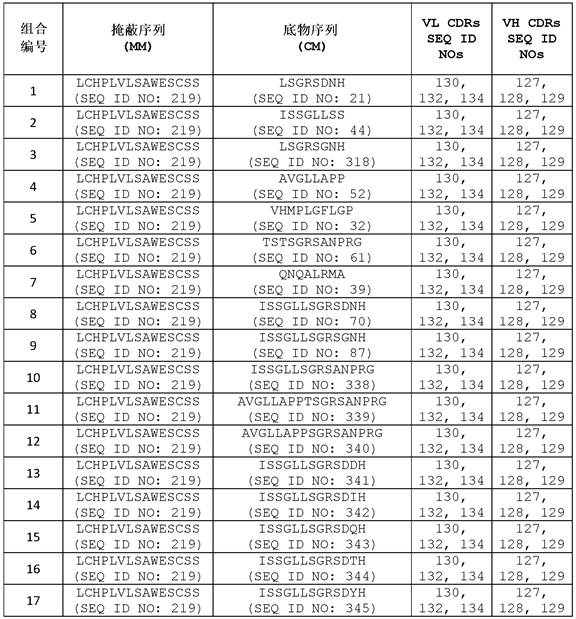


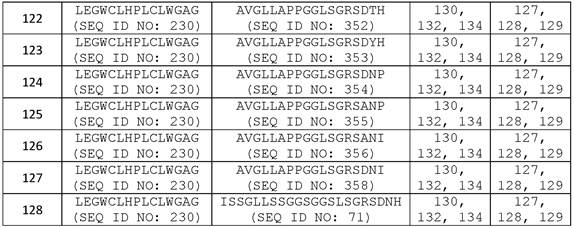
表B:抗CD166可活化抗体组分 Table B : Anti-CD166 Activatable Antibody Components
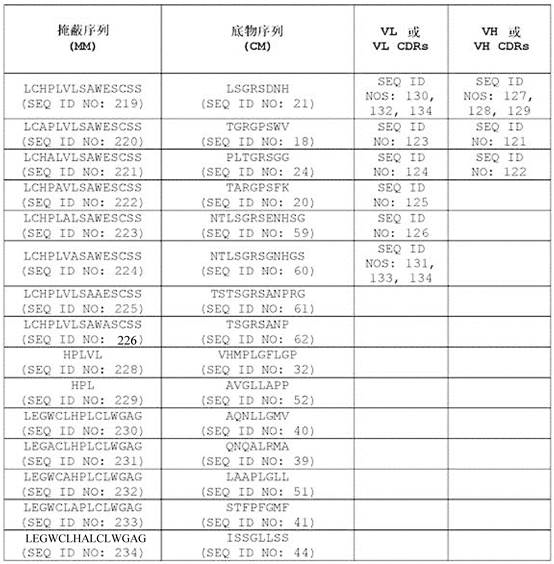


在一些实施方案中,本发明的可活化抗体包括一种或多种包括选自表A或表B的序列的组合的多肽,其中所述多肽包括以下的组合:选自表A或表B的标题为“掩蔽序列(MM)”的列的掩蔽序列,来自表A或表B的标题为“底物序列(CM)”的列的底物序列,来自表A或表B的标题为“VL或VL CDRs”或“VL CDRs SEQ ID NOs”的列的轻链可变结构域或轻链CDRs,和来自表A或表B的标题为“VH或VH CDRs”或“VH CDRs SEQ ID Nos”的列的重链可变结构域或重链CDRs。例如,本发明的可活化抗体包括组合编号54的氨基酸序列,其包括SEQ ID NO:222的掩蔽序列,SEQ ID NO:76的底物序列,包括SEQ ID NO:130、132和134的VL CDR序列的轻链可变结构域,和包括127、128和129的VH CDR序列的重链可变结构域。因此,本文描述了至少包括表A的任何给定行中的序列的组合的可活化抗体。类似地,本文描述了表B的掩蔽序列(MM)、底物序列(CM)、轻链可变结构域序列或轻链可变结构域CDR序列和重链可变结构域序列或重链可变结构域CDR序列的任何组合。本文还描述了至少包括选自表A或表B的相应列的掩蔽序列、底物序列、可变重链或可变重链CDR以及可变轻链或可变轻链CDR的任何组合的可活化抗体。在一些示例性实施方案中,至少包括表A的任何给定行中的序列的组合或表B的掩蔽序列(MM)、底物序列(CM)、轻链可变结构域序列或轻链可变结构域CDR序列和重链可变结构域序列或重链可变结构域CDR序列的任何组合的可活化抗体可以与一种或多种毒素组合,所述毒素包括多拉司他汀或其衍生物、澳瑞他汀或其衍生物、美登素或其衍生物、倍癌霉素或其衍生物、卡里奇霉素或其衍生物或吡咯并苯并二氮杂䓬或其衍生物。在一些示例性实施方案中,至少包括表A的任何给定行中的序列的组合或表B的掩蔽序列(MM)、底物序列(CM)、轻链可变结构域序列或轻链可变结构域CDR序列和重链可变结构域序列或重链可变结构域CDR序列的任何组合的可活化抗体可以与一种或多种毒素组合,所述毒素包括澳瑞他汀E、单甲基澳瑞他汀F (MMAF)、单甲基澳瑞他汀E (MMAE)、单甲基澳瑞他汀D(MMAD)、美登素DM4、美登素DM1、吡咯并苯并二氮杂䓬、吡咯并苯并二氮杂䓬二聚体和/或倍癌霉素。In some embodiments, an activatable antibody of the invention comprises one or more polypeptides comprising a combination of sequences selected from Table A or Table B, wherein said polypeptide comprises a combination of: a sequence selected from Table A or Table B Masking sequence from column titled "Masked Sequence (MM)", substrate sequence from Table A or Table B in column titled "Substrate Sequence (CM)", from Table A or Table B titled "VL or VL CDRs" or "VL CDRs SEQ ID NOs" column of the light chain variable domain or light chain CDRs, and from Table A or Table B entitled "VH or VH CDRs" or "VH CDRs SEQ ID Nos" List of heavy chain variable domains or heavy chain CDRs. For example, the activatable antibody of the present invention includes the amino acid sequence of combination number 54, which includes the masking sequence of SEQ ID NO:222, the substrate sequence of SEQ ID NO:76, and the VL CDRs of SEQ ID NO:130, 132 and 134 sequence, and the heavy chain variable domain including the VH CDR sequences of 127, 128 and 129. Accordingly, described herein are activatable antibodies comprising at least a combination of the sequences in any given row of Table A. Similarly, the masking sequence (MM), substrate sequence (CM), light chain variable domain sequence or light chain variable domain CDR sequence and heavy chain variable domain sequence or heavy chain variable domain sequence of Table B are described herein. Any combination of variable domain CDR sequences. Also described herein are possible combinations comprising at least a masking sequence, a substrate sequence, a variable heavy chain or variable heavy chain CDRs, and a variable light chain or variable light chain CDRs selected from the corresponding columns of Table A or Table B. Activating antibodies. In some exemplary embodiments, combinations comprising at least the sequences in any given row of Table A or the masking sequence (MM) of Table B, the substrate sequence (CM), the light chain variable domain sequence, or the light chain can The activatable antibody of any combination of variable domain CDR sequences and heavy chain variable domain sequences or heavy chain variable domain CDR sequences may be combined with one or more toxins including dolastatin or derivatives thereof Auristatin or its derivatives, maytansine or its derivatives, duocarmycin or its derivatives, calicheamicin or its derivatives, or pyrrolobenzodiazepine or its derivatives. In some exemplary embodiments, combinations comprising at least the sequences in any given row of Table A or the masking sequence (MM) of Table B, the substrate sequence (CM), the light chain variable domain sequence, or the light chain can The activatable antibodies of variable domain CDR sequences and heavy chain variable domain sequences or any combination of heavy chain variable domain CDR sequences may be combined with one or more toxins including auristatin E, monomethyl Based Auristatin F (MMAF), Monomethyl Auristatin E (MMAE), Monomethyl Auristatin D (MMAD), Maytansine DM4, Maytansine DM1, Pyrrolobenzodiazepine, Pyrrolobenzodiazepine dimer and/or duocarmycin.
如上所述的表A或表B中的任何组合可以与人免疫球蛋白恒定区组合以产生完全人IgG(包括IgG1、IgG2、IgG4),或与突变的恒定区组合以产生具有改变的功能的人IgG,诸如IgG1 N297A、IgG1 N297Q或IgG4 S228P。表A或表B中描述的组合不受任何给定行中显示的特定组合限制,因此可以包括来自表A的列2(或表B的列1)的任何掩蔽序列,其与来自表A的列3(或表B的列2)的任何底物序列组合,与来自表A的列4(或表B的列3)的任何VL序列或VL CDR序列的集合组合,与来自表A的列5(或表B的列4)的任何VH序列或VH CDR序列的集合组合。除了表A的列2或表B的列1中公开的掩蔽序列之外,本文公开的任何掩蔽序列都可以组合使用。除了表A的列3或表B的列2中公开的底物序列之外,本文公开的任何CM都可以组合使用。除了表A的列4或表B的列3中公开的轻链可变区序列或轻链CDR序列之外,本文公开的任何轻链可变区序列或轻链CDR序列可以组合使用。除了表A的列5或表B的列4中公开的重链可变区序列或重链CDR序列之外,本文公开的任何重链可变区序列或重链CDR序列可以组合使用。Any combination in Table A or Table B as described above can be combined with human immunoglobulin constant regions to generate fully human IgG (including IgG1, IgG2, IgG4), or with mutated constant regions to generate IgG with altered function. Human IgG, such as IgGl N297A, IgGl N297Q or IgG4 S228P. The combinations described in Table A or Table B are not restricted to the particular combination shown in any given row, and thus may include any masked sequence from
在一些实施方案中,所述抗体药物缀合物(ADCs)和可活化抗体药物缀合物(AADCs)可包括一种或多种多肽,所述多肽包括表C的给定行中的轻链序列或轻链可变结构域序列和重链序列或重链可变结构域序列、接头和毒素的组合或表C的轻链序列或轻链可变结构域序列和重链序列或重链可变结构域序列、接头和毒素的任何组合。In some embodiments, the antibody drug conjugates (ADCs) and activatable antibody drug conjugates (AADCs) may comprise one or more polypeptides comprising a light chain in a given row of Table C The sequence or light chain variable domain sequence and heavy chain sequence or heavy chain variable domain sequence, a combination of linker and toxin or the light chain sequence of Table C or light chain variable domain sequence and heavy chain sequence or heavy chain can Any combination of variable domain sequences, linkers and toxins.
表 C:抗CD166 ADC和抗CD166可活化ADC组合 Table C : Combinations of Anti-CD166 ADCs and Anti-CD166 Activatable ADCs


本发明的抗体药物缀合物(ADC)或本发明的可活化抗体药物缀合物(AADC)可以包括一种或多种多肽,所述多肽包括表C的给定行中所列的氨基酸序列、接头和毒素的组合。因此,本文描述了包括给定行中所列或作为特定组合提供的氨基酸序列、接头和毒素的组合的本发明的可活化抗体药物缀合物(ADC)或本发明的可活化抗体药物缀合物(AADC)。例如,本发明的可活化抗体药物缀合物可以包括组合编号55的氨基酸序列,其包括包含SEQID NO:239的氨基酸序列的重链、包含SEQ ID NO:246的氨基酸序列的轻链和spdb-DM4接头-毒素。在本文公开和描述的AADC的另一个实例中,本发明的可活化抗体药物缀合物可以包括组合编号33的氨基酸序列,其包括包含SEQ ID NO:239的氨基酸序列的重链、包含SEQID NO:244的氨基酸序列的轻链和vc-MMAE接头-毒素。An antibody drug conjugate (ADC) of the invention or an activatable antibody drug conjugate (AADC) of the invention may comprise one or more polypeptides comprising the amino acid sequences listed in a given row of Table C , linker and toxin combination. Thus, described herein are activatable antibody drug conjugates (ADCs) of the invention or activatable antibody drug conjugates of the invention comprising combinations of amino acid sequences, linkers and toxins listed in a given row or provided as specific combinations. substance (AADC). For example, the activatable antibody drug conjugate of the present invention may comprise the amino acid sequence of combination number 55, which comprises a heavy chain comprising the amino acid sequence of SEQ ID NO: 239, a light chain comprising the amino acid sequence of SEQ ID NO: 246, and spdb- DM4 linker-toxin. In another example of the AADC disclosed and described herein, the activatable antibody drug conjugate of the present invention may comprise the amino acid sequence of combination number 33, which comprises the heavy chain comprising the amino acid sequence of SEQ ID NO: 239, comprising the amino acid sequence of SEQ ID NO: :244 amino acid sequence of light chain and vc-MMAE linker-toxin.
表C中所列重链和轻链可变区的任何组合可以与人免疫球蛋白恒定区组合以产生完全人IgG(包括IgG1、IgG2、IgG4),或与突变的恒定区组合以产生具有改变的功能的人IgG,诸如IgG1 N297A、IgG1 N297Q或IgG4 S228P。表C中描述的组合不受任何给定行中显示的特定组合限制,且因此可以包括来自表C的列2的任何重链序列或重链可变区序列,其与来自表C的列3的任何轻链序列或轻链可变区序列组合,与来自列4的任何接头组合,与来自列5的任何毒素组合。除了列2中所列的重链序列或重链可变区序列之外,本文公开的任何重链序列或重链可变区序列可以组合使用。除了列3中所列的轻链序列或轻链可变区序列之外,本文公开的任何轻链序列或轻链可变区序列可以组合使用。除了列4中所列的接头之外,本文公开的任何接头可以组合使用。除了列5中所列的毒素之外,本文公开的任何毒素可以组合使用。Any combination of heavy and light chain variable regions listed in Table C can be combined with human immunoglobulin constant regions to produce fully human IgG (including IgG1, IgG2, IgG4), or with mutated constant regions to produce human immunoglobulins with altered Functional human IgG, such as IgG1 N297A, IgG1 N297Q or IgG4 S228P. The combinations described in Table C are not limited to the specific combinations shown in any given row, and thus may include any heavy chain sequence or heavy chain variable region sequence from
在一些实施方案中,可活化抗体的血清半衰期比相应的抗体的血清半衰期更长;例如,可活化抗体的pK比相应的抗体的pK更长。在一些实施方案中,可活化抗体的血清半衰期类似于相应的抗体的血清半衰期。在一些实施方案中,当施用于生物体时,可活化抗体的血清半衰期是至少15天。在一些实施方案中,当施用于生物体时,可活化抗体的血清半衰期是至少12天。在一些实施方案中,当施用于生物体时,可活化抗体的血清半衰期是至少11天。在一些实施方案中,当施用于生物体时,可活化抗体的血清半衰期是至少10天。在一些实施方案中,当施用于生物体时,可活化抗体的血清半衰期是至少9天。在一些实施方案中,当施用于生物体时,可活化抗体的血清半衰期是至少8天。在一些实施方案中,当施用于生物体时,可活化抗体的血清半衰期是至少7天。在一些实施方案中,当施用于生物体时,可活化抗体的血清半衰期是至少6天。在一些实施方案中,当施用于生物体时,可活化抗体的血清半衰期是至少5天。在一些实施方案中,当施用于生物体时,可活化抗体的血清半衰期是至少4天。在一些实施方案中,当施用于生物体时,可活化抗体的血清半衰期是至少3天。在一些实施方案中,当施用于生物体时,可活化抗体的血清半衰期是至少2天。在一些实施方案中,当施用于生物体时,可活化抗体的血清半衰期是至少24小时。在一些实施方案中,当施用于生物体时,可活化抗体的血清半衰期是至少20小时。在一些实施方案中,当施用于生物体时,可活化抗体的血清半衰期是至少18小时。在一些实施方案中,当施用于生物体时,可活化抗体的血清半衰期是至少16小时。在一些实施方案中,当施用于生物体时,可活化抗体的血清半衰期是至少14小时。在一些实施方案中,当施用于生物体时,可活化抗体的血清半衰期是至少12小时。在一些实施方案中,当施用于生物体时,可活化抗体的血清半衰期是至少10小时。在一些实施方案中,当施用于生物体时,可活化抗体的血清半衰期是至少8小时。在一些实施方案中,当施用于生物体时,可活化抗体的血清半衰期是至少6小时。在一些实施方案中,当施用于生物体时,可活化抗体的血清半衰期是至少4小时。在一些实施方案中,当施用于生物体时,可活化抗体的血清半衰期是至少3小时。In some embodiments, the serum half-life of the activatable antibody is longer than the serum half-life of the corresponding antibody; eg, the pK of the activatable antibody is longer than the pK of the corresponding antibody. In some embodiments, the serum half-life of the activatable antibody is similar to the serum half-life of the corresponding antibody. In some embodiments, the serum half-life of the activatable antibody is at least 15 days when administered to an organism. In some embodiments, the serum half-life of the activatable antibody is at least 12 days when administered to an organism. In some embodiments, the serum half-life of the activatable antibody is at least 11 days when administered to an organism. In some embodiments, the serum half-life of the activatable antibody is at least 10 days when administered to an organism. In some embodiments, the serum half-life of the activatable antibody is at least 9 days when administered to an organism. In some embodiments, the serum half-life of the activatable antibody is at least 8 days when administered to an organism. In some embodiments, the serum half-life of the activatable antibody is at least 7 days when administered to an organism. In some embodiments, the serum half-life of the activatable antibody is at least 6 days when administered to an organism. In some embodiments, the serum half-life of the activatable antibody is at least 5 days when administered to an organism. In some embodiments, the serum half-life of the activatable antibody is at least 4 days when administered to an organism. In some embodiments, the serum half-life of the activatable antibody is at least 3 days when administered to an organism. In some embodiments, the serum half-life of the activatable antibody is at least 2 days when administered to an organism. In some embodiments, the serum half-life of the activatable antibody is at least 24 hours when administered to an organism. In some embodiments, the serum half-life of the activatable antibody is at least 20 hours when administered to an organism. In some embodiments, the serum half-life of the activatable antibody is at least 18 hours when administered to an organism. In some embodiments, the serum half-life of the activatable antibody is at least 16 hours when administered to an organism. In some embodiments, the serum half-life of the activatable antibody is at least 14 hours when administered to an organism. In some embodiments, the serum half-life of the activatable antibody is at least 12 hours when administered to an organism. In some embodiments, the serum half-life of the activatable antibody is at least 10 hours when administered to an organism. In some embodiments, the serum half-life of the activatable antibody is at least 8 hours when administered to an organism. In some embodiments, the serum half-life of the activatable antibody is at least 6 hours when administered to an organism. In some embodiments, the serum half-life of the activatable antibody is at least 4 hours when administered to an organism. In some embodiments, the serum half-life of the activatable antibody is at least 3 hours when administered to an organism.
在一些实施方案中,所述可活化抗CD166抗体和/或缀合的可活化抗CD166抗体是单特异性的。在一些实施方案中,所述可活化抗CD166抗体和/或缀合的可活化抗CD166抗体是多特异性的,例如通过非限制性实例的方式,双特异性或三功能性的。在一些实施方案中,所述可活化抗CD166抗体和/或缀合的可活化抗CD166抗体被配制为前双特异性T细胞接合者(BITE)分子的一部分。在一些实施方案中,所述可活化抗CD166抗体和/或缀合的可活化抗CD166抗体被配制为前嵌合抗原受体(CAR)修饰的T细胞或其他工程改造的受体的一部分。In some embodiments, the activatable anti-CD166 antibody and/or conjugated activatable anti-CD166 antibody is monospecific. In some embodiments, the activatable anti-CD166 antibody and/or conjugated activatable anti-CD166 antibody is multispecific, such as, by way of non-limiting example, bispecific or trifunctional. In some embodiments, the activatable anti-CD166 antibody and/or conjugated activatable anti-CD166 antibody is formulated as part of a pre-bispecific T cell engager (BITE) molecule. In some embodiments, the activatable anti-CD166 antibody and/or conjugated activatable anti-CD166 antibody is formulated as part of a pro-chimeric antigen receptor (CAR) modified T cell or other engineered receptor.
在一些实施方案中,所述可活化抗体或其抗原结合片段被并入多特异性可活化抗体或其抗原结合片段,其中所述多特异性可活化抗体的至少一个臂特异性结合CD166。在一些实施方案中,所述可活化抗体或其抗原结合片段被并入双特异性抗体或其抗原结合片段,其中所述双特异性可活化抗体的至少一个臂特异性结合CD166。In some embodiments, the activatable antibody or antigen-binding fragment thereof is incorporated into a multispecific activatable antibody or antigen-binding fragment thereof, wherein at least one arm of the multispecific activatable antibody specifically binds CD166. In some embodiments, the activatable antibody or antigen-binding fragment thereof is incorporated into a bispecific antibody or antigen-binding fragment thereof, wherein at least one arm of the bispecific activatable antibody specifically binds CD166.
在一些实施方案中,本文所述的抗CD166抗体、缀合的抗CD166抗体、可活化抗CD166抗体和/或缀合的可活化抗CD166抗体与一种或多种额外试剂或额外试剂的组合结合使用。合适的额外试剂包括用于预期应用、诸如例如癌症的当前药物和/或手术疗法。例如,抗CD166抗体、缀合的抗CD166抗体、可活化抗CD166抗体和/或缀合的可活化抗CD166抗体可以与额外化学治疗剂或抗肿瘤剂结合使用。In some embodiments, an anti-CD166 antibody, conjugated anti-CD166 antibody, activatable anti-CD166 antibody, and/or conjugated activatable anti-CD166 antibody described herein and one or more additional agents or a combination of additional agents In conjunction with. Suitable additional agents include current pharmaceutical and/or surgical therapies for the intended application, such as, for example, cancer. For example, anti-CD166 antibodies, conjugated anti-CD166 antibodies, activatable anti-CD166 antibodies, and/or conjugated activatable anti-CD166 antibodies can be used in combination with additional chemotherapeutic or antineoplastic agents.
在一些实施方案中,所述额外试剂是化学治疗剂,诸如选自多西他赛、紫杉醇、abraxane(即,白蛋白缀合的紫杉醇)、多柔比星、奥沙利铂、卡铂、顺铂、伊立替康和吉西他滨的化学治疗剂。In some embodiments, the additional agent is a chemotherapeutic agent, such as selected from the group consisting of docetaxel, paclitaxel, abraxane (i.e., albumin-conjugated paclitaxel), doxorubicin, oxaliplatin, carboplatin, Chemotherapeutic agents of cisplatin, irinotecan and gemcitabine.
在一些实施方案中,所述额外试剂是检查点抑制剂、激酶抑制剂、靶向肿瘤微环境中的抑制剂的试剂和/或T-细胞或NK激动剂。在一些实施方案中,所述额外试剂是单独或与其他额外试剂诸如化学治疗剂或抗肿瘤剂组合的放射疗法。在一些实施方案中,所述额外试剂是疫苗、肿瘤病毒和/或DC-活化剂,诸如,通过非限制性实例的方式,toll样受体(TLR)激动剂和/或α- CD40。在一些实施方案中,所述额外试剂是设计为经由ADCC或经由与毒素的直接缀合(例如,抗体药物缀合物(ADC))杀死肿瘤的肿瘤靶向抗体。In some embodiments, the additional agent is a checkpoint inhibitor, a kinase inhibitor, an agent targeting an inhibitor in the tumor microenvironment, and/or a T-cell or NK agonist. In some embodiments, the additional agent is radiation therapy alone or in combination with other additional agents such as chemotherapeutic or antineoplastic agents. In some embodiments, the additional agent is a vaccine, a tumor virus and/or a DC-activator such as, by way of non-limiting example, a toll-like receptor (TLR) agonist and/or α-CD40. In some embodiments, the additional agent is a tumor targeting antibody designed to kill tumors via ADCC or via direct conjugation to a toxin (eg, antibody drug conjugate (ADC)).
在一些实施方案中,所述检查点抑制剂是选自CTLA-4、LAG-3、PD-1、CD166、TIGIT、TIM-3、B7H4和Vista的靶标的抑制剂。在一些实施方案中,所述激酶抑制剂选自B-RAFi、MEKi和Btk抑制剂,诸如依鲁替尼。在一些实施方案中,所述激酶抑制剂是克里唑替尼。在一些实施方案中,所述肿瘤微环境抑制剂选自IDO抑制剂、α-CSF1R抑制剂、α-CCR4抑制剂、TGF-β、骨髓衍生的抑制细胞或T调节细胞。在一些实施方案中,所述激动剂选自Ox40、GITR、CD137、ICOS、CD27和HVEM。In some embodiments, the checkpoint inhibitor is an inhibitor of a target selected from CTLA-4, LAG-3, PD-1, CD166, TIGIT, TIM-3, B7H4, and Vista. In some embodiments, the kinase inhibitor is selected from B-RAFi, MEKi and Btk inhibitors, such as ibrutinib. In some embodiments, the kinase inhibitor is crizotinib. In some embodiments, the tumor microenvironment inhibitor is selected from an IDO inhibitor, an α-CSF1R inhibitor, an α-CCR4 inhibitor, TGF-β, myeloid-derived suppressor cells, or T regulatory cells. In some embodiments, the agonist is selected from Ox40, GITR, CD137, ICOS, CD27, and HVEM.
在一些实施方案中,所述抑制剂是CTLA-4抑制剂。在一些实施方案中,所述抑制剂是LAG-3抑制剂。在一些实施方案中,所述抑制剂是PD-1抑制剂。在一些实施方案中,所述抑制剂是CD166抑制剂。在一些实施方案中,所述抑制剂是TIGIT抑制剂。在一些实施方案中,所述抑制剂是TIM-3抑制剂。在一些实施方案中,所述抑制剂是B7H4抑制剂。在一些实施方案中,所述抑制剂是Vista抑制剂。在一些实施方案中,所述抑制剂是B-RAFi抑制剂。在一些实施方案中,所述抑制剂是MEKi抑制剂。在一些实施方案中,所述抑制剂是Btk抑制剂。在一些实施方案中,所述抑制剂是依鲁替尼。在一些实施方案中,所述抑制剂是克里唑替尼。在一些实施方案中,所述抑制剂是IDO抑制剂。在一些实施方案中,所述抑制剂是α-CSF1R抑制剂。在一些实施方案中,所述抑制剂是α-CCR4抑制剂。在一些实施方案中,所述抑制剂是TGF-β。在一些实施方案中,所述抑制剂是骨髓衍生的抑制细胞。在一些实施方案中,所述抑制剂是T调节细胞。In some embodiments, the inhibitor is a CTLA-4 inhibitor. In some embodiments, the inhibitor is a LAG-3 inhibitor. In some embodiments, the inhibitor is a PD-1 inhibitor. In some embodiments, the inhibitor is a CD166 inhibitor. In some embodiments, the inhibitor is a TIGIT inhibitor. In some embodiments, the inhibitor is a TIM-3 inhibitor. In some embodiments, the inhibitor is a B7H4 inhibitor. In some embodiments, the inhibitor is a Vista inhibitor. In some embodiments, the inhibitor is a B-RAFi inhibitor. In some embodiments, the inhibitor is a MEKi inhibitor. In some embodiments, the inhibitor is a Btk inhibitor. In some embodiments, the inhibitor is ibrutinib. In some embodiments, the inhibitor is crizotinib. In some embodiments, the inhibitor is an IDO inhibitor. In some embodiments, the inhibitor is an α-CSF1R inhibitor. In some embodiments, the inhibitor is an alpha-CCR4 inhibitor. In some embodiments, the inhibitor is TGF-beta. In some embodiments, the inhibitor is myeloid-derived suppressor cells. In some embodiments, the inhibitor is T regulatory cells.
在一些实施方案中,所述激动剂是Ox40。在一些实施方案中,所述激动剂是GITR。在一些实施方案中,所述激动剂是CD137。在一些实施方案中,所述激动剂是ICOS。在一些实施方案中,所述激动剂是CD27。在一些实施方案中,所述激动剂是HVEM。In some embodiments, the agonist is Ox40. In some embodiments, the agonist is GITR. In some embodiments, the agonist is CD137. In some embodiments, the agonist is ICOS. In some embodiments, the agonist is CD27. In some embodiments, the agonist is HVEM.
在一些实施方案中,所述抗CD166抗体、缀合的抗体、可活化抗体和/或缀合的可活化抗体在治疗期间和/或之后与一种或多种额外试剂组合施用,所述额外试剂诸如例如化学治疗剂、抗炎剂和/或免疫抑制剂。在一些实施方案中,将所述抗CD166抗体、缀合的抗CD166抗体、可活化抗CD166抗体和/或缀合的可活化抗CD166抗体和额外试剂配制于单一治疗组合物中,且同时施用所述抗CD166抗体、缀合的抗CD166抗体、可活化抗CD166抗体和/或缀合的可活化抗CD166抗体和额外试剂。或者,所述抗CD166抗体、缀合的抗CD166抗体、可活化抗CD166抗体和/或缀合的可活化抗CD166抗体和额外试剂彼此分开,例如,将各自配制于分开的治疗组合物中,且同时施用所述抗CD166抗体、缀合的抗CD166抗体、可活化抗CD166抗体和/或缀合的可活化抗CD166抗体和额外试剂,或在治疗方案期间在不同的时间施用所述抗CD166抗体、缀合的抗CD166抗体、可活化抗CD166抗体和/或缀合的可活化抗CD166抗体和额外试剂。例如,在施用额外试剂之前施用所述抗CD166抗体、缀合的抗CD166抗体、可活化抗CD166抗体和/或缀合的可活化抗CD166抗体,在施用额外试剂之后施用所述抗CD166抗体、缀合的抗CD166抗体、可活化抗CD166抗体和/或缀合的可活化抗CD166抗体,或以交替的方式施用所述抗CD166抗体、缀合的抗CD166抗体、可活化抗CD166抗体和/或缀合的可活化抗CD166抗体和额外试剂。如本文所述,以单剂量或多剂量施用所述抗CD166抗体、缀合的抗CD166抗体、可活化抗CD166抗体和/或缀合的可活化抗CD166抗体和额外试剂。In some embodiments, the anti-CD166 antibody, conjugated antibody, activatable antibody, and/or conjugated activatable antibody is administered in combination with one or more additional agents during and/or after treatment, the additional Agents such as, for example, chemotherapeutics, anti-inflammatory agents and/or immunosuppressants. In some embodiments, the anti-CD166 antibody, conjugated anti-CD166 antibody, activatable anti-CD166 antibody, and/or conjugated activatable anti-CD166 antibody and additional agent are formulated in a single therapeutic composition and administered simultaneously The anti-CD166 antibody, conjugated anti-CD166 antibody, activatable anti-CD166 antibody and/or conjugated activatable anti-CD166 antibody and additional reagents. Alternatively, the anti-CD166 antibody, conjugated anti-CD166 antibody, activatable anti-CD166 antibody and/or conjugated activatable anti-CD166 antibody and additional agent are separated from each other, e.g., each is formulated in a separate therapeutic composition, and administering said anti-CD166 antibody, conjugated anti-CD166 antibody, activatable anti-CD166 antibody and/or conjugated activatable anti-CD166 antibody and additional agent simultaneously, or administering said anti-CD166 at different times during the treatment regimen Antibodies, conjugated anti-CD166 antibodies, activatable anti-CD166 antibodies and/or conjugated activatable anti-CD166 antibodies and additional reagents. For example, administering the anti-CD166 antibody, conjugated anti-CD166 antibody, activatable anti-CD166 antibody and/or conjugated activatable anti-CD166 antibody prior to administration of the additional agent, administering the anti-CD166 antibody, Conjugated anti-CD166 antibodies, activatable anti-CD166 antibodies and/or conjugated activatable anti-CD166 antibodies, or administering said anti-CD166 antibodies, conjugated anti-CD166 antibodies, activatable anti-CD166 antibodies and/or in an alternating manner Or conjugated activatable anti-CD166 antibody and additional reagents. The anti-CD166 antibody, conjugated anti-CD166 antibody, activatable anti-CD166 antibody and/or conjugated activatable anti-CD166 antibody and the additional agent are administered in single or multiple doses as described herein.
在一些实施方案中,同时施用所述抗CD166抗体、缀合的抗CD166抗体、可活化抗CD166抗体和/或缀合的可活化抗CD166抗体和额外试剂。例如,所述抗CD166抗体、缀合的抗CD166抗体、可活化抗CD166抗体和/或缀合的可活化抗CD166抗体和额外试剂可以配制在单一组合物中或作为两种或更多种分开的组合物施用。在一些实施方案中,依次施用所述抗CD166抗体、缀合的抗CD166抗体、可活化抗CD166抗体和/或缀合的可活化抗CD166抗体和额外试剂,或者在治疗方案期间在不同的时间施用所述抗CD166抗体、缀合的抗CD166抗体、可活化抗CD166抗体和/或缀合的可活化抗CD166抗体和额外试剂。In some embodiments, the anti-CD166 antibody, conjugated anti-CD166 antibody, activatable anti-CD166 antibody, and/or conjugated activatable anti-CD166 antibody and the additional agent are administered simultaneously. For example, the anti-CD166 antibody, conjugated anti-CD166 antibody, activatable anti-CD166 antibody, and/or conjugated activatable anti-CD166 antibody and additional reagents can be formulated in a single composition or as two or more separate compositions. application of the composition. In some embodiments, the anti-CD166 antibody, conjugated anti-CD166 antibody, activatable anti-CD166 antibody, and/or conjugated activatable anti-CD166 antibody and additional agent are administered sequentially, or at different times during the treatment regimen The anti-CD166 antibody, conjugated anti-CD166 antibody, activatable anti-CD166 antibody and/or conjugated activatable anti-CD166 antibody and additional reagents are administered.
在一些实施方案中,在治疗期间和/或之后将所述抗CD166抗体、缀合的抗CD166抗体、可活化抗CD166抗体和/或缀合的可活化抗CD166抗体与一种或多种额外试剂组合施用,所述额外试剂诸如(通过非限制性实例的方式),化疗剂、抗炎剂和/或免疫抑制剂,诸如烷化剂、抗代谢物、抗微管剂、拓扑异构酶抑制剂、细胞毒性抗生素和/或任何其他核酸损伤剂。在一些实施方案中,所述额外试剂是紫杉烷,诸如紫杉醇(例如,Abraxane®)。在一些实施方案中,所述额外试剂是抗代谢物,诸如吉西他滨。在一些实施方案中,所述额外试剂是烷化剂,诸如基于铂的化学疗法,诸如卡铂或顺铂。在一些实施方案中,所述额外试剂是靶向试剂,诸如激酶抑制剂,例如索拉非尼或埃罗替尼。在一些实施方案中,所述额外试剂是靶向试剂,诸如另一种抗体,例如单克隆抗体(例如,贝伐单抗),双特异性抗体或多特异性抗体。在一些实施方案中,所述额外试剂是蛋白酶体抑制剂,诸如硼替佐米或卡非佐米。在一些实施方案中,所述额外试剂是免疫调节剂,诸如来那度胺(lenolidominde)或IL-2。在一些实施方案中,所述额外试剂是辐射剂。在一些实施方案中,所述额外试剂是本领域技术人员认为是护理标准的试剂。在一些实施方案中,所述额外试剂是本领域技术人员众所周知的化学治疗剂。In some embodiments, the anti-CD166 antibody, conjugated anti-CD166 antibody, activatable anti-CD166 antibody, and/or conjugated activatable anti-CD166 antibody is combined with one or more additional Administration of agents in combination with additional agents such as (by way of non-limiting example), chemotherapeutics, anti-inflammatory agents and/or immunosuppressants such as alkylating agents, antimetabolites, anti-microtubule agents, topoisomerases Inhibitors, cytotoxic antibiotics and/or any other nucleic acid damaging agents. In some embodiments, the additional agent is a taxane, such as paclitaxel (eg, Abraxane®). In some embodiments, the additional agent is an antimetabolite, such as gemcitabine. In some embodiments, the additional agent is an alkylating agent, such as a platinum-based chemotherapy, such as carboplatin or cisplatin. In some embodiments, the additional agent is a targeting agent, such as a kinase inhibitor, eg, sorafenib or erlotinib. In some embodiments, the additional agent is a targeting agent, such as another antibody, eg, a monoclonal antibody (eg, bevacizumab), a bispecific antibody or a multispecific antibody. In some embodiments, the additional agent is a proteasome inhibitor, such as bortezomib or carfilzomib. In some embodiments, the additional agent is an immunomodulator, such as lenolidomide or IL-2. In some embodiments, the additional agent is a radiation agent. In some embodiments, the additional reagents are reagents that would be considered standard of care by those of skill in the art. In some embodiments, the additional agent is a chemotherapeutic agent well known to those skilled in the art.
在一些实施方案中,所述额外试剂是另一抗体或其抗原结合片段、另一缀合的抗体或其抗原结合片段、另一可活化抗体或其抗原结合片段和/或另一缀合的可活化抗体或其抗原结合片段。在一些实施方案中,所述额外试剂是与第一抗体或其抗原结合片段、第一缀合的抗体或其抗原结合片段、可活化抗体或其抗原结合片段和/或缀合的可活化抗体或其抗原结合片段针对相同的靶标(例如,针对CD166)的另一抗体或其抗原结合片段、另一缀合的抗体或其抗原结合片段、另一可活化抗体或其抗原结合片段和/或另一缀合的可活化抗体或其抗原结合片段。在一些实施方案中,所述额外试剂是针对与第一抗体或其抗原结合片段、第一缀合的抗体或其抗原结合片段、可活化抗体或其抗原结合片段和/或缀合的可活化抗体或其抗原结合片段的靶标不同的靶标的另一抗体或其抗原结合片段、另一缀合的抗体或其抗原结合片段、另一可活化抗体或其抗原结合片段和/或另一缀合的可活化抗体或其抗原结合片段。In some embodiments, the additional reagent is another antibody or antigen-binding fragment thereof, another conjugated antibody or antigen-binding fragment thereof, another activatable antibody or antigen-binding fragment thereof, and/or another conjugated antibody or antigen-binding fragment thereof. Antibodies or antigen-binding fragments thereof can be activated. In some embodiments, the additional reagent is an activatable antibody conjugated to a first antibody or antigen-binding fragment thereof, a first conjugated antibody or antigen-binding fragment thereof, an activatable antibody or antigen-binding fragment thereof, and/or Another antibody or antigen-binding fragment thereof, another conjugated antibody or antigen-binding fragment thereof, another activatable antibody or antigen-binding fragment thereof directed against the same target (e.g., against CD166) and/or Another conjugated activatable antibody or antigen-binding fragment thereof. In some embodiments, the additional reagent is directed to a first antibody or antigen-binding fragment thereof, a first conjugated antibody or antigen-binding fragment thereof, an activatable antibody or antigen-binding fragment thereof and/or an activatable Another antibody or antigen-binding fragment thereof, another conjugated antibody or antigen-binding fragment thereof, another activatable antibody or antigen-binding fragment thereof, and/or another conjugated antibody or antigen-binding fragment thereof that targets a different target of the antibody or antigen-binding fragment thereof An activatable antibody or antigen-binding fragment thereof.
作为非限制性实例,所述抗体或抗原结合片段和/或可活化抗体的AB是表1中所列的任一靶标的结合配偶体。As a non-limiting example, the antibody or antigen-binding fragment and/or the AB of the activatable antibody is a binding partner for any of the targets listed in Table 1.
表1:示例性靶标Table 1: Exemplary targets


作为非限制性实例,所述抗体或抗原结合片段和/或可活化抗体的AB是或衍生自表2中所列的抗体。As a non-limiting example, the AB of the antibody or antigen-binding fragment and/or activatable antibody is or is derived from an antibody listed in Table 2.
表2:示例性Ab来源Table 2: Exemplary Ab sources
在一些实施方案中,额外的抗体或其抗原结合片段、缀合的抗体或其抗原结合片段、可活化抗体或其抗原结合片段和/或缀合的可活化抗体或其抗原结合片段是单克隆抗体、结构域抗体、单链、Fab片段、F(ab')2片段、scFv、scAb、dAb、单一结构域重链抗体或单一结构域轻链抗体。在一些实施方案中,额外的抗体或其抗原结合片段、缀合的抗体或其抗原结合片段、可活化抗体或其抗原结合片段和/或缀合的可活化抗体或其抗原结合片段是小鼠、其他啮齿动物、嵌合、人源化或全人单克隆抗体。In some embodiments, the additional antibody or antigen-binding fragment thereof, conjugated antibody or antigen-binding fragment thereof, activatable antibody or antigen-binding fragment thereof, and/or conjugated activatable antibody or antigen-binding fragment thereof is monoclonal Antibody, domain antibody, single chain, Fab fragment, F(ab') 2 fragment, scFv, scAb, dAb, single domain heavy chain antibody or single domain light chain antibody. In some embodiments, the additional antibody or antigen-binding fragment thereof, conjugated antibody or antigen-binding fragment thereof, activatable antibody or antigen-binding fragment thereof, and/or conjugated activatable antibody or antigen-binding fragment thereof is mouse , other rodent, chimeric, humanized or fully human monoclonal antibodies.
本发明还提供了通过在导致表达抗CD166抗体和/或可活化抗CD166抗体多肽的条件下培养细胞来产生所述多肽的方法,其中所述细胞包含编码本文所述的抗体和/或可活化抗体的分离的核酸分子,和/或包括这些分离的核酸序列的载体。本发明提供了通过在导致表达抗体和/或可活化抗体的条件下培养细胞来产生抗体和/或可活化抗体的方法,其中所述细胞包含编码本文所述的抗体和/或可活化抗体的分离的核酸分子,和/或包括这些分离的核酸序列的载体。The present invention also provides a method for producing an anti-CD166 antibody and/or an activatable anti-CD166 antibody polypeptide by culturing cells under conditions that result in expression of said polypeptide, wherein said cell comprises an antibody encoding and/or an activatable anti-CD166 antibody polypeptide as described herein. Isolated nucleic acid molecules of antibodies, and/or vectors comprising these isolated nucleic acid sequences. The invention provides methods for producing antibodies and/or activatable antibodies by culturing cells under conditions that result in expression of the antibodies and/or activatable antibodies, wherein the cells comprise a protein encoding the antibodies and/or activatable antibodies described herein. Isolated nucleic acid molecules, and/or vectors comprising these isolated nucleic acid sequences.
本发明还提供了通过如下制备在活化状态下结合CD166的可活化抗体的方法:(a)在导致表达所述可活化抗体的条件下培养包含编码所述可活化抗体的核酸构建体的细胞,其中所述可活化抗体包含掩蔽部分(MM)、可切割部分(CM)和特异性结合CD166的抗体或其抗原结合片段(AB),(i) 其中所述CM是作为蛋白酶的底物发挥功能的多肽;且(ii)其中所述CM位于可活化抗体中,使得当可活化抗体在未切割状态下时,MM干扰AB与CD166的特异性结合,且当在切割状态下时,MM不干扰或竞争AB与CD166的特异性结合;和(b)回收所述可活化抗体。合适的AB、MM和/或CM包括本文公开的AB、MM和/或CM中的任一种。The present invention also provides a method for preparing an activatable antibody that binds to CD166 in an activated state by: (a) culturing cells comprising a nucleic acid construct encoding the activatable antibody under conditions that result in expression of the activatable antibody, wherein the activatable antibody comprises a masking moiety (MM), a cleavable moiety (CM) and an antibody or antigen-binding fragment (AB) thereof that specifically binds CD166, (i) wherein the CM functions as a substrate for a protease and (ii) wherein the CM is located in an activatable antibody such that when the activatable antibody is in an uncleaved state, the MM interferes with the specific binding of AB to CD166, and when in a cleaved state, the MM does not interfere or compete for specific binding of the AB to CD166; and (b) recovering the activatable antibody. Suitable ABs, MMs and/or CMs include any of the ABs, MMs and/or CMs disclosed herein.
在一些实施方案中,未切割状态下的可活化抗体具有如下的N-末端至C-末端的结构排列:MM-CM-AB或AB-CM-MM。在一些实施方案中,所述可活化抗体包含在MM和CM之间的连接肽。在一些实施方案中,所述可活化抗体包含在CM和AB之间的连接肽。在一些实施方案中,所述可活化抗体包含第一连接肽(LP1)和第二连接肽(LP2),且其中未切割状态下的可活化抗体具有如下的N-末端至C-末端的结构排列:MM-LP1-CM-LP2-AB或AB-LP2-CM-LP1-MM。在一些实施方案中,两个连接肽不需要彼此相同。在一些实施方案中,未切割状态下的可活化抗体具有如下的N-末端至C-末端的结构排列:间隔区-MM-LP1-CM-LP2-AB或AB-LP2-CM-LP1-MM-间隔区。In some embodiments, the activatable antibody in the uncleaved state has the following N-terminal to C-terminal structural arrangement: MM-CM-AB or AB-CM-MM. In some embodiments, the activatable antibody comprises a linker peptide between the MM and the CM. In some embodiments, the activatable antibody comprises a linker peptide between CM and AB. In some embodiments, the activatable antibody comprises a first linking peptide (LP1) and a second linking peptide (LP2), and wherein the activatable antibody in an uncleaved state has the following N-terminal to C-terminal structure Arrangement: MM-LP1-CM-LP2-AB or AB-LP2-CM-LP1-MM. In some embodiments, the two connecting peptides need not be identical to each other. In some embodiments, the activatable antibody in the uncleaved state has the following N-terminal to C-terminal structural arrangement: spacer-MM-LP1-CM-LP2-AB or AB-LP2-CM-LP1-MM - Spacers.
在一些实施方案中,LP1或LP2中的至少一个包含选自(GS)n、(GGS)n、(GSGGS)n(SEQ ID NO:1)和(GGGS)n (SEQ ID NO:2)的氨基酸序列,其中n是至少1的整数。In some embodiments, at least one of LP1 or LP2 comprises (GS) n , (GGS) n , (GSGGS) n (SEQ ID NO: 1 ) and (GGGS) n (SEQ ID NO: 2) Amino acid sequence, wherein n is an integer of at least 1.
在一些实施方案中,LP1或LP2中的至少一个包含选自GGSG (SEQ ID NO:3)、GGSGG(SEQ ID NO:4)、GSGSG (SEQ ID NO:5)、GSGGG (SEQ ID NO:6)、GGGSG (SEQ ID NO:7)和GSSSG (SEQ ID NO:8)的氨基酸序列。In some embodiments, at least one of LP1 or LP2 comprises a group selected from GGSG (SEQ ID NO:3), GGSGG (SEQ ID NO:4), GSGSG (SEQ ID NO:5), GSGGG (SEQ ID NO:6 ), GGGSG (SEQ ID NO:7) and GSSSG (SEQ ID NO:8) amino acid sequences.
在一些实施方案中,LP1包含氨基酸序列GSSGGSGGSGGSG (SEQ ID NO:9)、GSSGGSGGSGG (SEQ ID NO:10)、GSSGGSGGSGGS (SEQ ID NO:11)、GSSGGSGGSGGSGGGS (SEQID NO:12)、GSSGGSGGSG (SEQ ID NO:13)或GSSGGSGGSGS (SEQ ID NO:14)。In some embodiments, LP1 comprises the amino acid sequence GSSGGSGGSGGSG (SEQ ID NO: 9), GSSGGSGGSGG (SEQ ID NO: 10), GSSGGSGGSGGS (SEQ ID NO: 11), GSSGGSGGSGGSGGGS (SEQ ID NO: 12), GSSGGSGGSG (SEQ ID NO: :13) or GSSGGSGGSGS (SEQ ID NO:14).
在一些实施方案中,LP2包含氨基酸序列GSS、GGS、GGGS (SEQ ID NO:15)、GSSGT(SEQ ID NO:16)或GSSG (SEQ ID NO:17)。In some embodiments, LP2 comprises the amino acid sequence GSS, GGS, GGGS (SEQ ID NO: 15), GSSGT (SEQ ID NO: 16), or GSSG (SEQ ID NO: 17).
本发明提供了通过将治疗有效量的本文所述的抗CD166抗体、缀合的抗CD166抗体、可活化抗CD166抗体和/或缀合的可活化抗CD166抗体施用于有需要的主体来在主体中预防CD166介导的疾病、延迟CD166介导的疾病的进展、治疗CD166介导的疾病、减轻CD166介导的疾病的症状或以其他方式改善CD166介导的疾病的方法。The present invention provides a therapeutically effective amount of an anti-CD166 antibody, conjugated anti-CD166 antibody, activatable anti-CD166 antibody, and/or conjugated activatable anti-CD166 antibody described herein to a subject in need thereof. Methods of preventing a CD166-mediated disease, delaying the progression of a CD166-mediated disease, treating a CD166-mediated disease, alleviating the symptoms of a CD166-mediated disease, or otherwise ameliorating a CD166-mediated disease.
本发明还提供了通过将治疗有效量的本文所述的抗CD166抗体、缀合的抗CD166抗体、可活化抗CD166抗体和/或缀合的可活化抗CD166抗体施用于有需要的主体来在主体中预防癌症、延迟癌症的进展、治疗癌症、减轻癌症的症状或以其他方式改善癌症的方法。已知CD166在多种癌症中表达,所述癌症诸如,通过非限制性实例,任何上皮或鳞状细胞癌、任何类癌和/或神经内分泌癌。癌症的实例包括但不限于腺癌、胆管(胆)癌、膀胱癌、乳腺癌(例如三阴性乳腺癌、Her2阴性乳腺癌、雌激素受体阳性乳腺癌);类癌;宫颈癌;胆管细胞癌;结肠直肠癌;子宫内膜癌;神经胶质瘤;头颈癌(例如头颈部鳞状细胞癌);白血病;肝癌;肺癌(例如NSCLC、SCLC);淋巴瘤;黑色素瘤;口咽癌;卵巢癌;胰腺癌;前列腺癌(例如转移性去势难治性前列腺癌);肾癌;皮肤癌;鳞状细胞癌;胃癌;睾丸癌;甲状腺癌;和尿路上皮癌。The invention also provides a therapeutically effective amount of an anti-CD166 antibody, a conjugated anti-CD166 antibody, an activatable anti-CD166 antibody, and/or a conjugated activatable anti-CD166 antibody described herein to a subject in need thereof. Methods of preventing, delaying the progression of, treating, alleviating the symptoms of, or otherwise ameliorating cancer in a subject. CD166 is known to be expressed in a variety of cancers such as, by way of non-limiting example, any epithelial or squamous cell carcinoma, any carcinoid and/or neuroendocrine carcinoma. Examples of cancer include, but are not limited to, adenocarcinoma, cholangiocarcinoma, bladder cancer, breast cancer (e.g., triple-negative breast cancer, Her2-negative breast cancer, estrogen receptor-positive breast cancer); carcinoid; cervical cancer; cholangiocytes Carcinoma; colorectal cancer; endometrial cancer; glioma; head and neck cancer (e.g. head and neck squamous cell carcinoma); leukemia; liver cancer; lung cancer (e.g. NSCLC, SCLC); lymphoma; melanoma; oropharyngeal cancer cancer of the pancreas; prostate cancer (eg, metastatic castration-resistant prostate cancer); kidney cancer; skin cancer; squamous cell carcinoma; gastric cancer; testicular cancer; thyroid cancer; and urothelial cancer.
在一些实施方案中,所述癌症是任何上皮或鳞状癌。在一些实施方案中,所述癌症是前列腺癌、乳腺癌、肺癌、宫颈癌、口咽癌和/或头颈癌。In some embodiments, the cancer is any epithelial or squamous carcinoma. In some embodiments, the cancer is prostate cancer, breast cancer, lung cancer, cervical cancer, oropharyngeal cancer, and/or head and neck cancer.
在一些实施方案中,所述癌症是膀胱癌、骨癌、乳腺癌、类癌、宫颈癌、结肠直肠癌、结肠癌、子宫内膜癌、上皮癌、神经胶质瘤、头颈癌、肝癌、肺癌、黑色素瘤、口咽癌、卵巢癌、胰腺癌、前列腺癌、肾癌、肉瘤、皮肤癌、胃癌、睾丸癌、甲状腺癌、泌尿生殖癌和/或尿路上皮癌。In some embodiments, the cancer is bladder cancer, bone cancer, breast cancer, carcinoid, cervical cancer, colorectal cancer, colon cancer, endometrial cancer, epithelial cancer, glioma, head and neck cancer, liver cancer, Lung cancer, melanoma, oropharyngeal cancer, ovarian cancer, pancreatic cancer, prostate cancer, kidney cancer, sarcoma, skin cancer, stomach cancer, testicular cancer, thyroid cancer, genitourinary cancer, and/or urothelial cancer.
在一些实施方案中,所述癌症选自三阴性乳腺癌(TNBC)、非小细胞肺癌(NSCLC)、小细胞肺癌(SCLC)、Ras突变型结肠直肠癌、罕见的上皮癌症、口咽癌、宫颈癌、头颈部鳞状细胞癌(HNSCC)和/或前列腺癌。在一些实施方案中,所述癌症与表达CD166的肿瘤相关。在一些实施方案中,所述癌症由于表达CD166的肿瘤所导致。In some embodiments, the cancer is selected from triple negative breast cancer (TNBC), non-small cell lung cancer (NSCLC), small cell lung cancer (SCLC), Ras mutant colorectal cancer, rare epithelial cancers, oropharyngeal cancer, Cancer of the cervix, head and neck squamous cell carcinoma (HNSCC), and/or prostate cancer. In some embodiments, the cancer is associated with a CD166 expressing tumor. In some embodiments, the cancer is due to a CD166-expressing tumor.
在这些方法和用途的任何实施方案中使用的抗CD166抗体、缀合的抗CD166抗体、可活化抗CD166抗体和/或缀合的可活化抗CD166抗体可以在疾病的任何阶段施用。例如,此类抗CD166抗体、缀合的抗CD166抗体、可活化抗CD166抗体和/或缀合的可活化抗CD166抗体可以施用于患有任何阶段的癌症(从早期至转移)的患者。术语主体和患者在本文可互换使用。The anti-CD166 antibodies, conjugated anti-CD166 antibodies, activatable anti-CD166 antibodies and/or conjugated activatable anti-CD166 antibodies used in any of the embodiments of these methods and uses may be administered at any stage of the disease. For example, such anti-CD166 antibodies, conjugated anti-CD166 antibodies, activatable anti-CD166 antibodies and/or conjugated activatable anti-CD166 antibodies can be administered to patients with any stage of cancer (from early stage to metastatic). The terms subject and patient are used interchangeably herein.
在一些实施方案中,所述主体是哺乳动物,诸如人、非人灵长类动物、伴侣动物(例如,猫、狗、马)、家畜、耕畜或动物园动物。在一些实施方案中,主体是人。在一些实施方案中,主体是伴侣动物。在一些实施方案中,主体是兽医护理的动物。In some embodiments, the subject is a mammal, such as a human, non-human primate, companion animal (eg, cat, dog, horse), livestock, farm animal, or zoo animal. In some embodiments, the subject is a human. In some embodiments, the subject is a companion animal. In some embodiments, the subject is an animal under veterinary care.
将所述抗CD166抗体、缀合的抗CD166抗体、可活化抗CD166抗体和/或缀合的可活化抗CD166抗体及其治疗制剂施用于患有或易患异常CD166表达和/或活性相关的疾病或病症的主体。使用本领域已知的各种方法中的任一种鉴定患有或易患异常CD166表达和/或活性相关的疾病或病症的主体。例如,使用各种临床和/或实验室测试(诸如身体检查和血液、尿液和/或粪便分析)中的任一种来鉴定患有癌症或其他肿瘤病况的主体以评估健康状况。例如,使用各种临床和/或实验室测试(诸如身体检查和/或体液分析,例如血液、尿液和/或粪便分析)中的任一种来鉴定患有炎症和/或炎性病症的主体,以评估健康状况。Administration of the anti-CD166 antibody, conjugated anti-CD166 antibody, activatable anti-CD166 antibody and/or conjugated activatable anti-CD166 antibody and therapeutic formulation thereof to patients with or susceptible to abnormal CD166 expression and/or activity-related The subject of a disease or condition. A subject suffering from or susceptible to a disease or disorder associated with aberrant CD166 expression and/or activity is identified using any of a variety of methods known in the art. For example, a subject with cancer or other neoplastic condition is identified using any of a variety of clinical and/or laboratory tests, such as a physical examination and blood, urine and/or stool analyses, to assess health status. For example, using any of various clinical and/or laboratory tests (such as physical examination and/or analysis of body fluids, such as blood, urine and/or stool analysis) to identify patients with inflammation and/or inflammatory conditions subject to assess health status.
如果实现各种实验室或临床目标中的任一种,则将抗CD166抗体、缀合的抗CD166抗体、可活化抗CD166抗体和/或缀合的可活化抗CD166抗体施用于患有与异常CD166表达和/或活性相关的疾病或病症的患者被认为是成功的。例如,如果与疾病或病症相关的症状中的一种或多种得到缓解、减少、抑制或不进展至进一步(即更差)状态,则将抗CD166抗体、缀合的抗CD166抗体、可活化抗CD166抗体和/或缀合的可活化抗CD166抗体施用于患有与异常CD166表达和/或活性相关的疾病或病症的患者被认为是成功的。如果疾病或病症进入缓解或不进展至进一步(即更差)状态,则将抗CD166抗体、缀合的抗CD166抗体、可活化抗CD166抗体和/或缀合的可活化抗CD166抗体施用于患有与异常CD166表达和/或活性相关的疾病或病症的患者被认为是成功的。If any of the various laboratory or clinical goals are achieved, the anti-CD166 antibody, conjugated anti-CD166 antibody, activatable anti-CD166 antibody, and/or conjugated activatable anti-CD166 antibody is administered to patients with abnormalities Patients with a disease or condition associated with CD166 expression and/or activity were considered successful. For example, an anti-CD166 antibody, a conjugated anti-CD166 antibody, an activatable Administration of an anti-CD166 antibody and/or a conjugated activatable anti-CD166 antibody to a patient suffering from a disease or disorder associated with aberrant CD166 expression and/or activity is considered successful. If the disease or condition goes into remission or does not progress to a further (i.e., worse) state, the anti-CD166 antibody, conjugated anti-CD166 antibody, activatable anti-CD166 antibody, and/or conjugated activatable anti-CD166 antibody is administered to the patient Patients with a disease or condition associated with aberrant CD166 expression and/or activity were considered successful.
在一些实施方案中,将所述抗CD166抗体、缀合的抗CD166抗体、可活化抗CD166抗体和/或缀合的可活化抗CD166抗体及其治疗制剂施用于患有或易患疾病或病症的主体,诸如患有癌症或其他肿瘤病况的主体,其中所述主体的患病细胞表达CD166。在一些实施方案中,所述患病细胞与异常CD166表达和/或活性相关。在一些实施方案中,所述患病细胞与正常CD166表达和/或活性相关。使用本领域已知的各种方法中的任一种鉴定患有或易患其中主体的患病细胞表达CD166的疾病或病症的主体。例如,使用各种临床和/或实验室测试(诸如身体检查和血液、尿液和/或粪便分析)中的任一种来鉴定患有癌症或其他肿瘤病况的主体以评估健康状况。例如,使用各种临床和/或实验室测试(诸如身体检查和/或体液分析,例如血液、尿液和/或粪便分析)中的任一种来鉴定患有炎症和/或炎性病症的主体,以评估健康状况。In some embodiments, the anti-CD166 antibody, conjugated anti-CD166 antibody, activatable anti-CD166 antibody, and/or conjugated activatable anti-CD166 antibody and therapeutic formulation thereof are administered to a person suffering from or susceptible to a disease or condition A subject, such as a subject with cancer or other neoplastic condition, wherein the subject's diseased cells express CD166. In some embodiments, the diseased cells are associated with aberrant CD166 expression and/or activity. In some embodiments, the diseased cells are associated with normal CD166 expression and/or activity. A subject having or susceptible to a disease or disorder in which diseased cells of the subject express CD166 is identified using any of a variety of methods known in the art. For example, a subject with cancer or other neoplastic condition is identified using any of a variety of clinical and/or laboratory tests, such as a physical examination and blood, urine and/or stool analyses, to assess health status. For example, using any of various clinical and/or laboratory tests (such as physical examination and/or analysis of body fluids, such as blood, urine and/or stool analysis) to identify patients with inflammation and/or inflammatory conditions subject to assess health status.
在一些实施方案中,将所述抗CD166抗体、缀合的抗CD166抗体、可活化抗CD166抗体和/或缀合的可活化抗CD166抗体及其治疗制剂施用于患有或易患与表达CD166的细胞或此类细胞的存在、生长、增殖、转移和/或活性相关的疾病或病症的主体,诸如患有癌症或其他肿瘤病况的主体。在一些实施方案中,所述细胞与异常CD166表达和/或活性相关。在一些实施方案中,所述细胞与正常CD166表达和/或活性相关。使用本领域已知的各种方法中的任一种鉴定患有或易患与表达CD166的细胞相关的疾病或病症的主体。例如,使用各种临床和/或实验室测试(诸如身体检查和血液、尿液和/或粪便分析)中的任一种来鉴定患有癌症或其他肿瘤病况的主体以评估健康状况。例如,使用各种临床和/或实验室测试(诸如身体检查和/或体液分析,例如血液、尿液和/或粪便分析)中的任一种来鉴定患有炎症和/或炎性病症的主体,以评估健康状况。In some embodiments, the anti-CD166 antibody, conjugated anti-CD166 antibody, activatable anti-CD166 antibody, and/or conjugated activatable anti-CD166 antibody and therapeutic formulations thereof are administered to a patient with or susceptible to a disease with CD166 expression cells or a subject with a disease or disorder associated with the presence, growth, proliferation, metastasis and/or activity of such cells, such as a subject with cancer or other neoplastic conditions. In some embodiments, the cells are associated with aberrant CD166 expression and/or activity. In some embodiments, the cells are associated with normal CD166 expression and/or activity. A subject suffering from or susceptible to a disease or disorder associated with CD166-expressing cells is identified using any of a variety of methods known in the art. For example, a subject with cancer or other neoplastic condition is identified using any of a variety of clinical and/or laboratory tests, such as a physical examination and blood, urine and/or stool analyses, to assess health status. For example, using any of various clinical and/or laboratory tests (such as physical examination and/or analysis of body fluids, such as blood, urine and/or stool analysis) to identify patients with inflammation and/or inflammatory conditions subject to assess health status.
如果实现各种实验室或临床目标中的任一种,则将抗CD166抗体、缀合的抗CD166抗体、可活化抗CD166抗体和/或缀合的可活化抗CD166抗体施用于患有与表达CD166的细胞相关的疾病或病症的患者被认为是成功的。例如,如果与疾病或病症相关的症状中的一种或多种得到缓解、减少、抑制或不进展至进一步(即更差)状态,则将抗CD166抗体、缀合的抗CD166抗体、可活化抗CD166抗体和/或缀合的可活化抗CD166抗体施用于患有与表达CD166的细胞相关的疾病或病症的患者被认为是成功的。如果疾病或病症进入缓解或不进展至进一步(即更差)状态,则将抗CD166抗体、缀合的抗CD166抗体、可活化抗CD166抗体和/或缀合的可活化抗CD166抗体施用于患有与表达CD166的细胞相关的疾病或病症的患者被认为是成功的。If any of the various laboratory or clinical goals are achieved, the anti-CD166 antibody, conjugated anti-CD166 antibody, activatable anti-CD166 antibody, and/or conjugated activatable anti-CD166 antibody is administered to patients with and expressing Patients with CD166 cell-associated diseases or disorders were considered successful. For example, an anti-CD166 antibody, a conjugated anti-CD166 antibody, an activatable Administration of an anti-CD166 antibody and/or a conjugated activatable anti-CD166 antibody to a patient suffering from a disease or disorder associated with CD166-expressing cells is considered successful. If the disease or condition goes into remission or does not progress to a further (i.e., worse) state, the anti-CD166 antibody, conjugated anti-CD166 antibody, activatable anti-CD166 antibody, and/or conjugated activatable anti-CD166 antibody is administered to the patient Patients with a disease or condition associated with CD166-expressing cells were considered successful.
在一些实施方案中,所述抗CD166抗体、缀合的抗CD166抗体、可活化抗CD166抗体和/或缀合的可活化抗CD166抗体在治疗期间和/或之后与一种或多种额外试剂组合施用,所述额外试剂诸如例如化学治疗剂、抗炎剂和/或免疫抑制剂。在一些实施方案中,同时施用所述抗CD166抗体、缀合的抗CD166抗体、可活化抗CD166抗体和/或缀合的可活化抗CD166抗体和额外试剂。例如,所述抗CD166抗体、缀合的抗CD166抗体、可活化抗CD166抗体和/或缀合的可活化抗CD166抗体和额外试剂可以配制在单一组合物中或作为两种或更多种分开的组合物施用。在一些实施方案中,依次施用所述抗CD166抗体、缀合的抗CD166抗体、可活化抗CD166抗体和/或缀合的可活化抗CD166抗体和额外试剂。In some embodiments, the anti-CD166 antibody, conjugated anti-CD166 antibody, activatable anti-CD166 antibody, and/or conjugated activatable anti-CD166 antibody is combined with one or more additional agents during and/or after treatment Administered in combination, such additional agents such as, for example, chemotherapeutics, anti-inflammatory agents and/or immunosuppressants. In some embodiments, the anti-CD166 antibody, conjugated anti-CD166 antibody, activatable anti-CD166 antibody, and/or conjugated activatable anti-CD166 antibody and the additional agent are administered simultaneously. For example, the anti-CD166 antibody, conjugated anti-CD166 antibody, activatable anti-CD166 antibody, and/or conjugated activatable anti-CD166 antibody and additional reagents can be formulated in a single composition or as two or more separate compositions. application of the composition. In some embodiments, the anti-CD166 antibody, conjugated anti-CD166 antibody, activatable anti-CD166 antibody, and/or conjugated activatable anti-CD166 antibody and additional agent are administered sequentially.
本发明还提供了用于在各种诊断和/或预防适应症中使用可活化抗CD166抗体和/或缀合的可活化抗CD166抗体的方法和试剂盒。例如,本发明提供了用于通过如下检测主体或样品中切割剂和目标靶标的存在或不存在的方法和试剂盒:(i)使主体或样品与抗CD166可活化抗体接触,其中抗CD166可活化抗体包含掩蔽部分(MM)、被切割剂切割的可切割部分(CM)和特异性结合目标靶标的抗原结合结构域或其片段(AB),其中未切割的非活化状态下的抗CD166可活化抗体具有如下的N-末端至C-末端的结构排列:MM-CM-AB或AB-CM-MM;(a)其中MM是抑制AB与CD166的结合的肽,且其中MM不具有AB的天然存在的结合配偶体的氨基酸序列且不是AB的天然结合配偶体的修饰形式;且(b)其中,当AB在未切割的非活化状态下时,MM干扰AB与CD166的特异性结合,且当AB在切割的活化状态下时,MM不干扰或竞争AB与CD166的特异性结合;和(ii)测量主体或样品中的活化的抗CD166可活化抗体的水平,其中主体或样品中的活化的抗CD166可活化抗体的可检测水平表明切割剂和CD166存在于主体或样品中,且其中主体或样品中的活化的抗CD166可活化抗体的不可检测水平表明切割剂、CD166或切割剂和CD166两者不存在于主体或样品中。The present invention also provides methods and kits for using activatable anti-CD166 antibodies and/or conjugated activatable anti-CD166 antibodies in various diagnostic and/or prophylactic indications. For example, the invention provides methods and kits for detecting the presence or absence of a cleavage agent and a target of interest in a subject or sample by: (i) contacting the subject or sample with an anti-CD166 activatable antibody, wherein the anti-CD166 can The activated antibody comprises a masking portion (MM), a cleavable portion (CM) cleaved by a cleavage agent, and an antigen-binding domain or a fragment thereof (AB) that specifically binds the target, wherein the anti-CD166 in an uncleaved non-activated state can be The activating antibody has the following N-terminal to C-terminal structural arrangement: MM-CM-AB or AB-CM-MM; (a) wherein MM is a peptide that inhibits the binding of AB to CD166, and wherein MM does not have AB's the amino acid sequence of a naturally occurring binding partner and is not a modified form of the natural binding partner of the AB; and (b) wherein the MM interferes with the specific binding of the AB to CD166 when the AB is in an uncleaved, inactive state, and When the AB is in the cleaved activated state, the MM does not interfere with or compete for the specific binding of the AB to CD166; and (ii) measure the level of activated anti-CD166 activatable antibody in the subject or sample, wherein the activation in the subject or sample A detectable level of anti-CD166 activatable antibody indicates the presence of cleavage agent and CD166 in the subject or sample, and wherein an undetectable level of activated anti-CD166 activatable antibody in the subject or sample indicates the cleavage agent, CD166 or cleavage agent and CD166 Neither was present in the subject or the sample.
在一些实施方案中,所述可活化抗CD166抗体是与治疗剂缀合的可活化抗CD166抗体。在一些实施方案中,所述可活化抗CD166抗体不与试剂缀合。在一些实施方案中,所述可活化抗CD166抗体包含可检测标记。在一些实施方案中,所述可检测标记位于AB上。在一些实施方案中,测量主体或样品中的可活化抗CD166抗体的水平使用特异性结合可活化抗体的第二试剂来实现,其中所述试剂包含可检测标记。在一些实施方案中,所述第二试剂是包含可检测标记的抗体。In some embodiments, the activatable anti-CD166 antibody is an activatable anti-CD166 antibody conjugated to a therapeutic agent. In some embodiments, the activatable anti-CD166 antibody is not conjugated to an agent. In some embodiments, the activatable anti-CD166 antibody comprises a detectable label. In some embodiments, the detectable label is on AB. In some embodiments, measuring the level of an activatable anti-CD166 antibody in a subject or sample is accomplished using a second reagent that specifically binds the activatable antibody, wherein the reagent comprises a detectable label. In some embodiments, the second reagent is an antibody comprising a detectable label.
在这些方法和试剂盒的一些实施方案中,所述可活化抗CD166抗体包括可检测标记。在这些方法和试剂盒的一些实施方案中,所述可检测标记包括成像剂、造影剂、酶、荧光标记、发色团、染料、一种或多种金属离子或基于配体的标记。在这些方法和试剂盒的一些实施方案中,所述成像剂包含放射性同位素。在这些方法和试剂盒的一些实施方案中,所述放射性同位素是铟或锝。在这些方法和试剂盒的一些实施方案中,所述造影剂包含碘、钆或氧化铁。在这些方法和试剂盒的一些实施方案中,所述酶包含辣根过氧化物酶、碱性磷酸酶或β-半乳糖苷酶。在这些方法和试剂盒的一些实施方案中,所述荧光标记包含黄色荧光蛋白(YFP)、青色荧光蛋白(CFP)、绿色荧光蛋白(GFP)、修饰的红色荧光蛋白(mRFP)、红色荧光蛋白tdimer2 (RFP tdimer2)、HCRED或铕衍生物。在这些方法和试剂盒的一些实施方案中,所述发光标记包含N-甲基吖啶鎓(methylacrydium)衍生物。在这些方法的一些实施方案中,所述标记包含Alexa Fluor®标记,诸如Alex Fluor® 680或Alexa Fluor® 750。在这些方法和试剂盒的一些实施方案中,所述基于配体的标记包含生物素、抗生物素蛋白、链霉抗生物素蛋白或一种或多种半抗原。In some embodiments of these methods and kits, the activatable anti-CD166 antibody includes a detectable label. In some embodiments of these methods and kits, the detectable label comprises an imaging agent, a contrast agent, an enzyme, a fluorescent label, a chromophore, a dye, one or more metal ions, or a ligand-based label. In some embodiments of these methods and kits, the imaging agent comprises a radioisotope. In some embodiments of these methods and kits, the radioisotope is indium or technetium. In some embodiments of these methods and kits, the contrast agent comprises iodine, gadolinium, or iron oxide. In some embodiments of these methods and kits, the enzyme comprises horseradish peroxidase, alkaline phosphatase, or beta-galactosidase. In some embodiments of these methods and kits, the fluorescent label comprises yellow fluorescent protein (YFP), cyan fluorescent protein (CFP), green fluorescent protein (GFP), modified red fluorescent protein (mRFP), red fluorescent protein tdimer2 (RFP tdimer2), HCRED or europium derivatives. In some embodiments of these methods and kits, the luminescent label comprises a N-methylacrydium derivative. In some embodiments of these methods, the label comprises an Alexa Fluor® label, such as Alexa Fluor® 680 or
在这些方法和试剂盒的一些实施方案中,所述主体是哺乳动物。在这些方法的一些实施方案中,所述主体是人。在一些实施方案中,所述主体是非人哺乳动物,诸如非人灵长类动物、伴侣动物(例如,猫、狗、马)、家畜、役畜或动物园动物。在一些实施方案中,所述主体是啮齿动物。In some embodiments of these methods and kits, the subject is a mammal. In some embodiments of these methods, the subject is a human. In some embodiments, the subject is a non-human mammal, such as a non-human primate, companion animal (eg, cat, dog, horse), livestock, draft animal, or zoo animal. In some embodiments, the subject is a rodent.
在这些方法和试剂盒的一些实施方案中,所述方法是体内方法。在这些方法的一些实施方案中,所述方法是原位方法。在这些方法的一些实施方案中,所述方法是离体方法。在这些方法的一些实施方案中,所述方法是体外方法。In some embodiments of these methods and kits, the method is an in vivo method. In some embodiments of these methods, the method is an in situ method. In some embodiments of these methods, the method is an ex vivo method. In some embodiments of these methods, the method is an in vitro method.
在所述方法和试剂盒的一些实施方案中,所述方法用于鉴定或以其他方式精选适合于用本发明的抗CD166可活化抗体治疗的患者群体,随后通过将该可活化抗CD166抗体和/或缀合的可活化抗CD166抗体施用于有需要的主体来治疗。例如,对于靶标(例如,CD166)和切割这些方法中所测试的抗CD166可活化抗体的可切割部分(CM)中的底物的蛋白酶两者测试阳性的患者被鉴定为用包含此类CM的此类抗CD166可活化抗体治疗的合适的候选者,且然后向所述患者施用治疗有效量的所测试的可活化抗CD166抗体和/或缀合的可活化抗CD166抗体。同样,对于靶标(例如CD166)和切割使用这些方法所测试的可活化抗体中的CM中的底物的蛋白酶中任一者或两者测试阴性的患者可能被鉴定为另一种形式的疗法的合适候选者。在一些实施方案中,此类患者可以用其他抗CD166可活化抗体进行测试,直到鉴定用于治疗的合适的抗CD166可活化抗体(例如,包含在疾病部位处被患者切割的CM的抗CD166可活化抗体)。在一些实施方案中,然后向患者施用治疗有效量的患者对于其测试阳性的可活化抗CD166抗体和/或缀合的可活化抗CD166抗体。合适的AB、MM和/或CM包括本文公开的AB、MM和/或CM中的任一种。In some embodiments of the methods and kits, the methods are used to identify or otherwise select a patient population suitable for treatment with an anti-CD166 activatable antibody of the invention, which is subsequently administered by the activatable anti-CD166 antibody and/or conjugated activatable anti-CD166 antibodies are administered to a subject in need thereof for treatment. For example, patients who test positive for both the target (e.g., CD166) and the protease that cleaves the substrate in the cleavable moiety (CM) of the anti-CD166 activatable antibodies tested in these methods are identified as being treated with a protein containing such CM. Such anti-CD166 activatable antibody therapy is a suitable candidate, and the patient is then administered a therapeutically effective amount of the tested activatable anti-CD166 antibody and/or conjugated activatable anti-CD166 antibody. Likewise, patients who test negative for either or both of the target (e.g., CD166) and the protease that cleaves substrates in the CM in activatable antibodies tested using these methods may be identified as candidates for another form of therapy. suitable candidates. In some embodiments, such patients can be tested with other anti-CD166 activatable antibodies until a suitable anti-CD166 activatable antibody is identified for treatment (e.g., an anti-CD166 comprising CM cleaved by the patient at the site of disease can be activating antibodies). In some embodiments, the patient is then administered a therapeutically effective amount of an activatable anti-CD166 antibody and/or a conjugated activatable anti-CD166 antibody for which the patient tests positive. Suitable ABs, MMs and/or CMs include any of the ABs, MMs and/or CMs disclosed herein.
根据本发明的药物组合物可以包括本发明的抗体和载体。这些药物组合物可以包括于试剂盒诸如例如诊断试剂盒中。A pharmaceutical composition according to the invention may comprise an antibody of the invention and a carrier. These pharmaceutical compositions may be included in kits such as, for example, diagnostic kits.
附图说明Description of drawings
图1是描绘本发明的各种抗CD166抗体与人CD166蛋白的结合的图。Figure 1 is a graph depicting the binding of various anti-CD166 antibodies of the invention to human CD166 protein.
图2是本发明的抗CD166掩蔽肽的选择方案的示意图。框表示具有在框之间指示的分选参数的群体。所有FACS分选在具有过量小鼠同种型的0.5% BSA中进行以阻断与AlexaFluor 488标记的M9 Mab的非特异性结合(SEQ ID NO:119的VH,SEQ ID NO:120的VL)。Figure 2 is a schematic diagram of the selection scheme for the anti-CD166 masking peptides of the present invention. Boxes represent populations with sorting parameters indicated between boxes. All FACS sorts were performed in 0.5% BSA with excess mouse isotype to block non-specific binding to AlexaFluor 488 labeled M9 Mab (VH of SEQ ID NO: 119, VL of SEQ ID NO: 120).
图3A和3B是一系列图,其描绘本发明的抗CD166抗体CD166 M9 vK1/HcB (SEQ IDNO:121的VH,SEQ ID NO:123的VL)和本发明的各种抗CD166可活化抗体结合人CD166的能力。Figures 3A and 3B are a series of graphs depicting the binding of the anti-CD166 antibody CD166 M9 vK1/HcB (VH of SEQ ID NO: 121, VL of SEQ ID NO: 123) of the invention and various anti-CD166 activatable antibodies of the invention Human CD166 capacity.
图4是描绘当蛋白水解活化时本发明的各种抗CD166可活化抗体结合人CD166的能力的图。Figure 4 is a graph depicting the ability of various anti-CD166 activatable antibodies of the invention to bind human CD166 when proteolytically activated.
图5是描绘当蛋白水解活化时本发明的各种缀合的抗CD166可活化抗体结合人CD166的能力的图。Figure 5 is a graph depicting the ability of various conjugated anti-CD166 activatable antibodies of the invention to bind human CD166 when proteolytically activated.
图6A-6D是一系列图像,其证明本发明的可活化抗CD166抗体在结肠癌组织样品中被活化(即被切割),并且可活化抗CD166抗体在健康组织样品中未被活化。图6A和6C描绘对肿瘤和健康组织样品的IHC分析的结果,而图6B和6D描绘对肿瘤和健康组织样品的原位成像测定的结果。Figures 6A-6D are a series of images demonstrating that activatable anti-CD166 antibodies of the invention are activated (ie, cleaved) in colon cancer tissue samples and that activatable anti-CD166 antibodies are not activated in healthy tissue samples. Figures 6A and 6C depict the results of IHC analysis on tumor and healthy tissue samples, while Figures 6B and 6D depict the results of in situ imaging assays on tumor and healthy tissue samples.
图7A-7D是一系列图像,其证明本发明的可活化抗CD166抗体在肺癌组织样品中被活化(即被切割),并且可活化抗CD166抗体在健康组织样品中未被活化。图7A和7C描绘对肿瘤和健康组织样品的IHC分析的结果,而图7B和7D描绘对肿瘤和健康组织样品的原位成像测定的结果。7A-7D are a series of images demonstrating that activatable anti-CD166 antibodies of the invention are activated (ie, cleaved) in lung cancer tissue samples and that activatable anti-CD166 antibodies are not activated in healthy tissue samples. Figures 7A and 7C depict the results of IHC analysis on tumor and healthy tissue samples, while Figures 7B and 7D depict the results of in situ imaging assays on tumor and healthy tissue samples.
图8A-8D是一系列图像,其证明本发明的可活化抗CD166抗体在健康组织样品中未被活化。图8A和8C描绘对健康组织样品的IHC分析的结果,而图8B和8D描绘对健康组织样品的原位成像测定的结果。Figures 8A-8D are a series of images demonstrating that activatable anti-CD166 antibodies of the invention are not activated in healthy tissue samples. Figures 8A and 8C depict the results of IHC analysis on healthy tissue samples, while Figures 8B and 8D depict the results of in situ imaging assays on healthy tissue samples.
图9是一系列图,其描绘本发明的缀合的抗CD166抗体针对乳腺癌细胞系、前列腺癌细胞系、胰腺癌细胞系、头颈部鳞状细胞癌细胞系和作为阴性对照的CD166细胞系的功效。Figure 9 is a series of graphs depicting conjugated anti-CD166 antibodies of the invention against breast cancer cell lines, prostate cancer cell lines, pancreatic cancer cell lines, head and neck squamous cell carcinoma cell lines, and CD166 cells as a negative control Department of efficacy.
图10是描绘本发明的缀合的可活化抗CD166抗体(AADC,可活化抗体药物复合物)在乳腺癌模型中的效力的图。Figure 10 is a graph depicting the efficacy of a conjugated activatable anti-CD166 antibody (AADC, activatable antibody drug complex) of the invention in a breast cancer model.
图11是描绘本发明的CD166 AADC DM4缀合物(即,与DM4缀合的本发明的可活化抗CD166抗体)在H292非小细胞肺癌(NSCLC)模型中的效力的图。Figure 11 is a graph depicting the efficacy of a CD166 AADC DM4 conjugate of the invention (ie, an activatable anti-CD166 antibody of the invention conjugated to DM4) in the H292 non-small cell lung cancer (NSCLC) model.
图12是描绘本发明的CD166 AADC DM4缀合物在H1975非小细胞肺癌(NSCLC)模型中的效力的图。Figure 12 is a graph depicting the efficacy of CD166 AADC DM4 conjugates of the invention in the H1975 non-small cell lung cancer (NSCLC) model.
图13是描绘本发明的抗CD166抗体以相等亲和力结合人和食蟹猴CD166的能力的图。Figure 13 is a graph depicting the ability of anti-CD166 antibodies of the invention to bind human and cynomolgus CD166 with equal affinity.
图14是描绘使用本发明的可活化抗CD166抗体在食蟹猴中的耐受性研究的结果的图。Figure 14 is a graph depicting the results of a tolerability study in cynomolgus monkeys using activatable anti-CD166 antibodies of the invention.
图15是证明本发明的缀合的抗CD166可活化抗体在预计治疗剂量下被良好耐受的图。Figure 15 is a graph demonstrating that conjugated anti-CD166 activatable antibodies of the invention are well tolerated at projected therapeutic doses.
图16A、16B和16C是一系列图,其描绘当本发明的各种缀合的抗CD166可活化抗体被蛋白水解活化时,此类缀合的可活化抗体结合人CD166的能力。Figures 16A, 16B and 16C are a series of graphs depicting the ability of various conjugated anti-CD166 activatable antibodies of the invention to bind human CD166 when such conjugated activatable antibodies are proteolytically activated.
图17是描绘本发明的抗CD166抗体以相当的亲和力结合人H292细胞和食蟹猴原代肾上皮细胞的能力的图。Figure 17 is a graph depicting the ability of anti-CD166 antibodies of the invention to bind human H292 cells and cynomolgus monkey primary kidney epithelial cells with comparable affinity.
图18是描绘本发明的抗CD166抗体抑制人HuT-78细胞结合CD6受体的能力的图。Figure 18 is a graph depicting the ability of anti-CD166 antibodies of the invention to inhibit the binding of CD6 receptors by human HuT-78 cells.
图19A-19C是描绘本发明的抗CD166可活化抗体药物缀合物以蛋白酶活化(切割)和未活化(切割)形式结合CD166和人细胞的能力的图。Figures 19A-19C are graphs depicting the ability of anti-CD166 activatable antibody drug conjugates of the invention to bind CD166 and human cells in protease-activated (cleaved) and non-activated (cleaved) forms.
图20A和20B是描绘本发明的抗CD166可活化抗体药物缀合物与人H292和HCC1806细胞的示例性细胞毒性测定的图。Figures 20A and 20B are graphs depicting exemplary cytotoxicity assays of anti-CD166 activatable antibody drug conjugates of the invention with human H292 and HCC1806 cells.
图21A-21D是描绘本发明的抗CD166可活化抗体药物缀合物在细胞中诱导免疫应答的能力的图。21A-21D are graphs depicting the ability of anti-CD166 activatable antibody drug conjugates of the invention to induce an immune response in cells.
图22是描绘本发明的抗CD166可活化抗体药物缀合物在细胞中诱导抗体依赖性细胞毒性的能力的图。Figure 22 is a graph depicting the ability of anti-CD166 activatable antibody drug conjugates of the invention to induce antibody-dependent cytotoxicity in cells.
图23是描绘本发明的抗CD166可活化抗体药物缀合物针对多种细胞衍生和患者衍生的异种移植肿瘤模型的效力的图。Figure 23 is a graph depicting the efficacy of anti-CD166 activatable antibody drug conjugates of the invention against various cell-derived and patient-derived xenograft tumor models.
图24A至24D是这样的图,其描绘本发明的抗CD166可活化抗体药物缀合物针对多种子宫内膜癌衍生的细胞系的细胞毒性,以及显示子宫内膜癌衍生的细胞上的CD166的表达水平的测定。24A to 24D are graphs depicting the cytotoxicity of anti-CD166 activatable antibody drug conjugates of the invention against various endometrial cancer-derived cell lines, and showing CD166 on endometrial cancer-derived cells Determination of expression levels.
图25A和25B描绘肺癌异种移植模型中的本发明的抗CD166抗体的原位结合的示例性研究。Figures 25A and 25B depict exemplary studies of in situ binding of anti-CD166 antibodies of the invention in a lung cancer xenograft model.
图26是描绘本发明的抗CD166可活化抗体药物缀合物针对小鼠肺癌异种移植模型的效力的图。Figure 26 is a graph depicting the efficacy of anti-CD166 activatable antibody drug conjugates of the invention against a mouse lung cancer xenograft model.
具体实施方式Detailed ways
本发明提供特异性结合CD166、也称为活化的白细胞细胞粘附分子(ALCAM)的单克隆抗体(mAb)和可活化单克隆抗体。在一些实施方案中,所述单克隆抗体和可活化单克隆抗体被含有CD166的细胞内化。CD166是结合CD6(属于清道夫受体富含半胱氨酸(SRCR)蛋白超家族(SRCRSF)的细胞表面受体)的细胞粘附分子。已知CD166与细胞-细胞和细胞-基质相互作用、细胞粘附、细胞迁移和T细胞活化和增殖相关。CD166的异常表达和/或活性和CD166相关的信号传导已经牵涉于许多疾病和病症(诸如癌症、炎症和自身免疫)的发病机理。例如,CD166在各种癌症类型(诸如例如,前列腺癌,乳腺癌,肺癌诸如NSCLC和/或SCLC,口咽癌,宫颈癌和头颈癌诸如HNSCC)中高度表达。The present invention provides monoclonal antibodies (mAbs) and activatable monoclonal antibodies that specifically bind CD166, also known as activated leukocyte cell adhesion molecule (ALCAM). In some embodiments, the monoclonal antibodies and activatable monoclonal antibodies are internalized by CD166-containing cells. CD166 is a cell adhesion molecule that binds CD6, a cell surface receptor belonging to the superfamily of scavenger receptor cysteine-rich (SRCR) proteins (SRCRSF). CD166 is known to be involved in cell-cell and cell-matrix interactions, cell adhesion, cell migration, and T cell activation and proliferation. Aberrant expression and/or activity of CD166 and CD166-related signaling have been implicated in the pathogenesis of many diseases and disorders such as cancer, inflammation and autoimmunity. For example, CD166 is highly expressed in various cancer types such as, for example, prostate cancer, breast cancer, lung cancer such as NSCLC and/or SCLC, oropharyngeal cancer, cervical cancer and head and neck cancer such as HNSCC.
本发明提供抗CD166抗体、缀合的抗CD166抗体、可活化抗CD166抗体和/或缀合的可活化抗CD166抗体,其可用于治疗、预防、延缓与异常CD166表达和/或活性相关的疾病或病症的进展,改善和/或减轻其症状的方法中。例如,所述可活化抗CD166抗体用于治疗、预防、延缓癌症或其他肿瘤病症的进展,改善和/或减轻其症状的方法中。The present invention provides anti-CD166 antibodies, conjugated anti-CD166 antibodies, activatable anti-CD166 antibodies and/or conjugated activatable anti-CD166 antibodies, which are useful for treating, preventing, and delaying diseases associated with abnormal CD166 expression and/or activity or the progression of a disease, in a method of improving and/or alleviating its symptoms. For example, the activatable anti-CD166 antibody is used in methods for treating, preventing, delaying the progression of, improving and/or alleviating the symptoms of cancer or other tumor disorders.
本发明提供抗CD166抗体、缀合的抗CD166抗体、可活化抗CD166抗体和/或缀合的可活化抗CD166抗体,其可用于治疗、预防、延缓与表达CD166的细胞相关的疾病或病症的进展,改善和/或减轻其症状的方法中。在一些实施方案中,所述细胞与异常CD166表达和/或活性相关。在一些实施方案中,所述细胞与正常CD166表达和/或活性相关。例如,所述可活化抗CD166抗体用于治疗、预防、延缓癌症或其他肿瘤病症的进展,改善和/或减轻其症状的方法中。The present invention provides anti-CD166 antibodies, conjugated anti-CD166 antibodies, activatable anti-CD166 antibodies and/or conjugated activatable anti-CD166 antibodies, which are useful for treating, preventing, delaying the progression of diseases or disorders associated with cells expressing CD166 In a method of progressing, improving and/or alleviating its symptoms. In some embodiments, the cells are associated with aberrant CD166 expression and/or activity. In some embodiments, the cells are associated with normal CD166 expression and/or activity. For example, the activatable anti-CD166 antibody is used in methods for treating, preventing, delaying the progression of, improving and/or alleviating the symptoms of cancer or other tumor disorders.
本发明提供抗CD166抗体、缀合的抗CD166抗体、可活化抗CD166抗体和/或缀合的可活化抗CD166抗体,其可用于治疗、预防、延缓其中患病细胞表达CD166的疾病或病症的进展,改善和/或减轻其症状的方法中。在一些实施方案中,所述患病细胞与异常CD166表达和/或活性相关。在一些实施方案中,所述患病细胞与正常CD166表达和/或活性相关。例如,所述可活化抗CD166抗体用于治疗、预防、延缓癌症或其他肿瘤病症的进展,改善和/或减轻其症状的方法中。The present invention provides anti-CD166 antibodies, conjugated anti-CD166 antibodies, activatable anti-CD166 antibodies and/or conjugated activatable anti-CD166 antibodies, which are useful for treating, preventing, delaying the progression of diseases or disorders in which diseased cells express CD166 In a method of progressing, improving and/or alleviating its symptoms. In some embodiments, the diseased cells are associated with aberrant CD166 expression and/or activity. In some embodiments, the diseased cells are associated with normal CD166 expression and/or activity. For example, the activatable anti-CD166 antibody is used in methods for treating, preventing, delaying the progression of, improving and/or alleviating the symptoms of cancer or other tumor disorders.
所述可活化抗CD166抗体和/或缀合的可活化抗CD166抗体包括与掩蔽部分(MM)偶联的特异性结合CD166的抗体或其抗原结合片段,使得MM的偶联降低所述抗体或其抗原结合片段结合CD166的能力。在一些实施方案中,所述MM经由包括蛋白酶(例如,与CD166在主体中的治疗部位处共定位的蛋白酶)的底物的序列偶联。The activatable anti-CD166 antibody and/or conjugated activatable anti-CD166 antibody comprises an antibody or antigen-binding fragment thereof that specifically binds CD166 coupled to a masking moiety (MM), such that conjugation of the MM reduces the antibody or antigen-binding fragment thereof. The ability of its antigen-binding fragment to bind CD166. In some embodiments, the MM is coupled via a sequence that includes a substrate for a protease (eg, a protease that colocalizes with CD166 at the treatment site in a subject).
本发明的示例性可活化抗CD166抗体包括例如包含重链和轻链的可活化抗体,所述重链和轻链是或衍生自以下所示的重链可变和轻链可变序列(CDR序列(根据Andrew C.R. Martin博士的网站中提供的AbM定义(在www_bioinf_org_uk/abs/可得)进行定义)以粗体和下划线显示):Exemplary activatable anti-CD166 antibodies of the invention include, for example, activatable antibodies comprising heavy and light chains that are or are derived from the heavy and light chain variable sequences shown below (CDR Sequence (defined according to the AbM definition provided in Dr. Andrew C.R. Martin's website (available at www_bioinf_org_uk/abs/) is shown in bold and underlined):


本发明的示例性可活化抗CD166抗体包括例如包括重链和轻链的可活化抗体,所述重链和轻链是或衍生自以下所示的重链和轻链可变区:Exemplary activatable anti-CD166 antibodies of the invention include, for example, activatable antibodies comprising heavy and light chains that are or are derived from the heavy and light chain variable regions shown below:

本发明的示例性可活化抗CD166抗体包括,例如,包括以下的可活化抗体:可变重链互补决定区1(VH CDR1,本文中也称为CDRH1)序列、可变重链互补决定区2(VH CDR2,本文中也称为CDRH2)序列、可变重链互补决定区3(VH CDR3,本文中也称为CDRH3)序列、可变轻链互补决定区1(VL CDR1,本文中也称为CDRL1)序列、可变轻链互补决定区2(VL CDR2,本文中也称为CDRL2)序列和可变轻链互补决定区3(VL CDR3,本文中也称为CDRL3)序列的组合,其中至少一个CDR序列选自包含氨基酸序列GFSLSTYGMGVG (SEQ ID NO:127)的VH CDR1序列;包含氨基酸序列NIWWSEDKH (SEQ ID NO:128)的VH CDR2序列;包含氨基酸序列IDYGNDYAFTY (SEQ ID NO:129)的VH CDR3序列;包含氨基酸序列RSSKSLLHSNGITYLY (SEQID NO:130)或RSSQSLLHSNGITYLY (SEQ ID NO:131)的VL CDR1序列;包含氨基酸序列QMSNLAS (SEQ ID NO:132)或QMSNRAS (SEQ ID NO:133)的VL CDR2序列;和包含氨基酸序列AQNLELPYT (SEQ ID NO:134)的VL CDR3序列。Exemplary activatable anti-CD166 antibodies of the invention include, for example, activatable antibodies comprising: variable heavy chain complementarity determining region 1 (VH CDR1, also referred to herein as CDRH1 ) sequence, variable heavy chain complementarity determining region 2 (VH CDR2, also referred to herein as CDRH2) sequence, variable heavy chain complementarity determining region 3 (VH CDR3, also referred to herein as CDRH3) sequence, variable light chain complementarity determining region 1 (VL CDR1, also referred to herein as is a combination of CDRL1) sequence, variable light chain complementarity determining region 2 (VL CDR2, also referred to herein as CDRL2) sequence and variable light chain complementarity determining region 3 (VL CDR3, herein also referred to as CDRL3) sequence, wherein At least one CDR sequence is selected from a VH CDR1 sequence comprising the amino acid sequence GFSLSTYGMGVG (SEQ ID NO: 127); a VH CDR2 sequence comprising the amino acid sequence NIWWSEDKH (SEQ ID NO: 128); a VH CDR2 sequence comprising the amino acid sequence IDYGNDYAFTY (SEQ ID NO: 129) VH CDR3 sequence; VL CDR1 sequence comprising the amino acid sequence RSSKSLLHSNGITYLY (SEQ ID NO:130) or RSSQSLLHSNGITYLY (SEQ ID NO:131); VL comprising the amino acid sequence QMSNLAS (SEQ ID NO:132) or QMSNRAS (SEQ ID NO:133) a CDR2 sequence; and a VL CDR3 sequence comprising the amino acid sequence AQNLELPYT (SEQ ID NO: 134).
在一些实施方案中,所述可活化抗CD166抗体包括包含或衍生自美国专利申请公开号20150071937、20090070890和/或20090203538 (其各自的内容通过引用以其整体并入本文)中所示的重链氨基酸序列的重链。In some embodiments, the activatable anti-CD166 antibody comprises or is derived from a heavy chain as set forth in U.S. Patent Application Publication Nos. 20150071937, 20090070890, and/or 20090203538, the contents of each of which are incorporated herein by reference in their entirety. Amino acid sequence of the heavy chain.
在一些实施方案中,所述可活化抗CD166抗体包括重链,所述重链含有包含或衍生自美国专利申请公开号20150071937、20090070890和/或20090203538(其各自的内容通过引用以其整体并入本文)中所示的CDR氨基酸序列的VH CDR1、VH CDR2、VH CDR3、VL CDR1、VL CDR2和/或VL CDR3序列。In some embodiments, the activatable anti-CD166 antibody comprises a heavy chain comprising or derived from U.S. Patent Application Publication Nos. 20150071937, 20090070890, and/or 20090203538, the contents of each of which are incorporated by reference in their entirety. VH CDR1 , VH CDR2, VH CDR3, VL CDR1 , VL CDR2 and/or VL CDR3 sequences of the CDR amino acid sequences shown in (herein).
在一些实施方案中,所述可活化抗CD166抗体包括包含或衍生自表12中所示的重链氨基酸序列的重链。在一些实施方案中,所述可活化抗CD166抗体包括包含或衍生自表12中所示的重链氨基酸序列的轻链。在一些实施方案中,所述可活化抗CD166抗体包括包含或衍生自表12中所示的重链氨基酸序列的重链,和包含或衍生自表12中所示的轻链氨基酸序列的轻链。在一些实施方案中,所述可活化抗CD166抗体包括来自表12中的组A中所示的组合的重链可变区和轻链可变区序列的组合。在一些实施方案中,所述可活化抗CD166抗体包括表12中的组B中所示的重链可变区和轻链可变区序列的组合。在一些实施方案中,所述可活化抗CD166抗体包括表12中的组C中所示的重链可变区和轻链可变区序列的组合。在一些实施方案中,所述可活化抗CD166抗体包括表12中的组D中所示的重链可变区和轻链可变区序列的组合。In some embodiments, the activatable anti-CD166 antibody comprises a heavy chain comprising or derived from the heavy chain amino acid sequence shown in Table 12. In some embodiments, the activatable anti-CD166 antibody comprises a light chain comprising or derived from the heavy chain amino acid sequence shown in Table 12. In some embodiments, the activatable anti-CD166 antibody comprises a heavy chain comprising or derived from the heavy chain amino acid sequence set forth in Table 12, and a light chain comprising or derived from the light chain amino acid sequence set forth in Table 12 . In some embodiments, the activatable anti-CD166 antibody comprises a combination of heavy chain variable region and light chain variable region sequences from the combinations shown in Group A in Table 12. In some embodiments, the activatable anti-CD166 antibody comprises a combination of heavy chain variable region and light chain variable region sequences shown in Panel B in Table 12. In some embodiments, the activatable anti-CD166 antibody comprises a combination of heavy chain variable region and light chain variable region sequences shown in Panel C of Table 12. In some embodiments, the activatable anti-CD166 antibody comprises a combination of heavy chain variable region and light chain variable region sequences shown in Group D in Table 12.
在一些实施方案中,所述可活化抗CD166抗体包括来自表12的组A中所示的重链序列的重链序列的互补决定区(CDR)序列的组合。在一些实施方案中,所述可活化抗CD166抗体包括来自表12的组A中所示的轻链序列的轻链序列的CDR的组合。在一些实施方案中,所述可活化抗CD166抗体包括来自表12的组A中所示的重链序列的重链序列的CDR和来自表12的组A中所示的重链序列的轻链序列的CDR的组合。In some embodiments, the activatable anti-CD166 antibody comprises a combination of complementarity determining region (CDR) sequences of heavy chain sequences from the heavy chain sequences shown in Group A of Table 12. In some embodiments, the activatable anti-CD166 antibody comprises a combination of CDRs of the light chain sequences from the light chain sequences shown in Panel A of Table 12. In some embodiments, the activatable anti-CD166 antibody comprises the CDRs of the heavy chain sequence from the heavy chain sequences shown in Group A of Table 12 and the light chain from the heavy chain sequences shown in Group A of Table 12 A combination of CDRs of a sequence.
在一些实施方案中,所述可活化抗CD166抗体包括来自表12的组B中所示的重链序列的重链序列的CDR的组合。在一些实施方案中,所述可活化抗CD166抗体包括来自表12的组B中所示的轻链序列的轻链序列的CDR的组合。在一些实施方案中,所述可活化抗CD166抗体包括来自表12的组B中所示的重链序列的重链序列的CDR和来自表12的组B中所示的重链序列的轻链序列的CDR的组合。In some embodiments, the activatable anti-CD166 antibody comprises a combination of CDRs of the heavy chain sequences from the heavy chain sequences shown in Group B of Table 12. In some embodiments, the activatable anti-CD166 antibody comprises a combination of CDRs of the light chain sequences from the light chain sequences shown in Panel B of Table 12. In some embodiments, the activatable anti-CD166 antibody comprises the CDRs of the heavy chain sequence from the heavy chain sequences shown in Group B of Table 12 and the light chain from the heavy chain sequences shown in Group B of Table 12 A combination of CDRs of a sequence.
在一些实施方案中,所述可活化抗CD166抗体包括来自表12的组C中所示的重链序列的重链序列的CDR的组合。在一些实施方案中,所述可活化抗CD166抗体包括来自表12的组C中所示的轻链序列的轻链序列的CDR的组合。在一些实施方案中,所述可活化抗CD166抗体包括来自表12的组C中所示的重链序列的重链序列的CDR和来自表12的组C中所示的重链序列的轻链序列的CDR的组合。In some embodiments, the activatable anti-CD166 antibody comprises a combination of CDRs of the heavy chain sequences from the heavy chain sequences shown in Panel C of Table 12. In some embodiments, the activatable anti-CD166 antibody comprises a combination of CDRs of the light chain sequences from the light chain sequences shown in Panel C of Table 12. In some embodiments, the activatable anti-CD166 antibody comprises the CDRs of the heavy chain sequence from the heavy chain sequences shown in Group C of Table 12 and the light chain from the heavy chain sequences shown in Group C of Table 12 A combination of CDRs of a sequence.
在一些实施方案中,所述可活化抗CD166抗体包括来自表12的组D中所示的重链序列的重链序列的CDR的组合。在一些实施方案中,所述可活化抗CD166抗体包括来自表12的组D中所示的轻链序列的轻链序列的CDR的组合。在一些实施方案中,所述可活化抗CD166抗体包括来自表12的组D中所示的重链序列的重链序列的CDR和来自表12的组D中所示的重链序列的轻链序列的CDR的组合。In some embodiments, the activatable anti-CD166 antibody comprises a combination of CDRs of the heavy chain sequences from the heavy chain sequences shown in Group D of Table 12. In some embodiments, the activatable anti-CD166 antibody comprises a combination of CDRs of the light chain sequences from the light chain sequences shown in Group D of Table 12. In some embodiments, the activatable anti-CD166 antibody comprises a CDR of a heavy chain sequence from a heavy chain sequence shown in Group D of Table 12 and a light chain from a heavy chain sequence shown in Group D of Table 12 A combination of CDRs of a sequence.
表12. 结合CD166的可活化抗体的可变重链区(VH)和可变轻链区(VL)序列Table 12. Variable heavy chain region (VH) and variable light chain region (VL) sequences of activatable antibodies that bind CD166


在一些实施方案中,所述可活化抗CD166抗体包括表13中所示的CDR序列,选自表13的单一行中所示的那些组合的VL CDR序列(VL CDR1、VL CDR2、VL CDR3)的组合,选自表13中所示的那些组合的VH CDR序列(VH CDR1、VH CDR2、VH CDR3)的组合,或选自表13中所示的那些组合的VL CDR和VH CDR序列(VL CDR1、VL CDR2、VL CDR3、VH CDR1、VH CDR2、VHCDR3)的组合。In some embodiments, the activatable anti-CD166 antibody comprises the CDR sequences shown in Table 13, selected from those combined VL CDR sequences shown in a single row of Table 13 (VL CDR1, VL CDR2, VL CDR3) A combination of VH CDR sequences (VH CDR1, VH CDR2, VH CDR3) selected from those combinations shown in Table 13, or a combination of VL CDR and VH CDR sequences selected from those combinations shown in Table 13 (VL Combinations of CDR1, VL CDR2, VL CDR3, VH CDR1, VH CDR2, VHCDR3).
表13. 结合CD166的抗体和可活化抗体的CDR序列Table 13. CDR sequences of CD166-binding and activatable antibodies

在一些实施方案中,所述可活化抗CD166抗体包含或衍生自由杂交瘤制备、分泌或以其他方式产生的抗体,所述杂交瘤诸如例如美国专利申请公开号20040048319中公开且以保藏号PTA-4478保藏于美国典型培养物保藏中心(ATCC)的杂交瘤。在一些实施方案中,所述可活化抗CD166抗体包含或衍生自由杂交瘤制备、分泌或以其他方式产生的抗体,所述杂交瘤诸如例如美国专利号6,022,540中公开且以保藏号HB 11789保藏于ATCC的杂交瘤。In some embodiments, the activatable anti-CD166 antibody comprises or is derived from an antibody produced, secreted, or otherwise produced by a hybridoma such as, for example, disclosed in US Patent Application Publication No. 20040048319 and deposited under Accession No. PTA- 4478 A hybridoma deposited with the American Type Culture Collection (ATCC). In some embodiments, the activatable anti-CD166 antibody comprises or is derived from an antibody produced, secreted, or otherwise produced by a hybridoma such as, for example, disclosed in U.S. Patent No. 6,022,540 and deposited under Accession No. HB 11789 at ATCC Hybridoma.
在一些实施方案中,所述可活化抗CD166抗体包含或衍生自由杂交瘤制备、分泌或以其他方式产生的抗体,所述杂交瘤诸如例如美国专利号5,998,172中公开且以保藏号HB12136、HB 12137、HB 12138、HB12139、HB 12140和/或HB 12141保藏于ATCC的杂交瘤。In some embodiments, the activatable anti-CD166 antibody comprises or is derived from an antibody produced, secreted, or otherwise produced by a hybridoma such as, for example, disclosed in U.S. Patent No. 5,998,172 and deposited under Accession Nos. HB12136, HB 12137 , HB 12138, HB 12139, HB 12140 and/or HB 12141 are hybridomas deposited with the ATCC.
本发明的可活化抗体中的抗CD166抗体和AB特异性结合CD166靶标,诸如例如哺乳动物CD166和/或人CD166。本发明中还包括与本发明的抗体和/或本文所述的活化的可活化抗体结合相同的CD166表位的抗CD166抗体和AB。本发明中还包括与本文所述的抗CD166抗体和/或活化的抗CD166可活化抗体竞争结合CD166靶标、例如人CD166的抗CD166抗体和AB。本发明中还包括与本文所述的抗CD166抗体和/或活化的抗CD166可活化抗体交叉竞争结合CD166靶标、例如人CD166的抗CD166抗体和AB。The anti-CD166 antibodies and ABs in the activatable antibodies of the invention specifically bind a CD166 target, such as for example mammalian CD166 and/or human CD166. Also included in the invention are anti-CD166 antibodies and ABs that bind to the same CD166 epitope as the antibodies of the invention and/or the activated activatable antibodies described herein. Also included in the invention are anti-CD166 antibodies and ABs that compete with the anti-CD166 antibodies and/or activated anti-CD166 activatable antibodies described herein for binding to a CD166 target, eg, human CD166. Also included in the invention are anti-CD166 antibodies and ABs that cross-compete for binding to a CD166 target, eg, human CD166, with the anti-CD166 antibodies and/or activated anti-CD166 activatable antibodies described herein.
本文提供的可活化抗CD166抗体包括掩蔽部分。在一些实施方案中,所述掩蔽部分是这样的氨基酸序列,其与抗CD166抗体偶联或以其他方式连接且位于可活化抗CD166抗体构建体内,使得所述掩蔽部分降低抗CD166抗体特异性结合CD166的能力。使用各种已知技术中的任一种来鉴定合适的掩蔽部分。例如,使用Daugherty等人的PCT公开号WO 2009/025846(其内容以其整体通过引用并入本文)中描述的方法来鉴定肽掩蔽部分。The activatable anti-CD166 antibodies provided herein include a masking moiety. In some embodiments, the masking moiety is an amino acid sequence that is conjugated or otherwise linked to the anti-CD166 antibody and located within the activatable anti-CD166 antibody construct such that the masking moiety reduces specific binding of the anti-CD166 antibody CD166 capacity. Suitable masking moieties are identified using any of a variety of known techniques. For example, peptide masking moieties are identified using the methods described in PCT Publication No. WO 2009/025846 to Daugherty et al., the contents of which are incorporated herein by reference in their entirety.
本文提供的可活化抗CD166抗体包括可切割部分。在一些实施方案中,所述可切割部分包括这样的氨基酸序列,其为蛋白酶(通常为细胞外蛋白酶)的底物。使用各种已知技术中的任一种来鉴定合适的底物。例如,使用Daugherty等人的美国专利号7,666,817;Stagliano等人的美国专利号8,563,269;和La Porte等人的PCT公开号WO 2014/026136(其各自的内容以其整体通过引用并入本文)中描述的方法来鉴定肽底物。(还参见Boulware等人 “Evolutionary optimization of peptide substrates for proteases thatexhibit rapid hydrolysis kinetics.” Biotechnol Bioeng. 106.3 (2010): 339-46)。The activatable anti-CD166 antibodies provided herein include a cleavable portion. In some embodiments, the cleavable moiety includes an amino acid sequence that is a substrate for a protease, typically an extracellular protease. Suitable substrates are identified using any of a variety of known techniques. For example, using Daugherty et al., US Patent No. 7,666,817; Stagliano et al., US Patent No. 8,563,269; and La Porte et al., PCT Publication No. WO 2014/026136 (the contents of each of which are incorporated herein by reference in their entirety). method to identify peptide substrates. (See also Boulware et al. "Evolutionary optimization of peptide substrates for proteases that exhibit rapid hydrolysis kinetics." Biotechnol Bioeng. 106.3 (2010): 339-46).
示例性底物包括但不限于可被以下表4中所列的酶或蛋白酶中的一种或多种切割的底物。Exemplary substrates include, but are not limited to, substrates that can be cleaved by one or more of the enzymes or proteases listed in Table 4 below.
表 4:示例性蛋白酶和/或酶Table 4: Exemplary Proteases and/or Enzymes

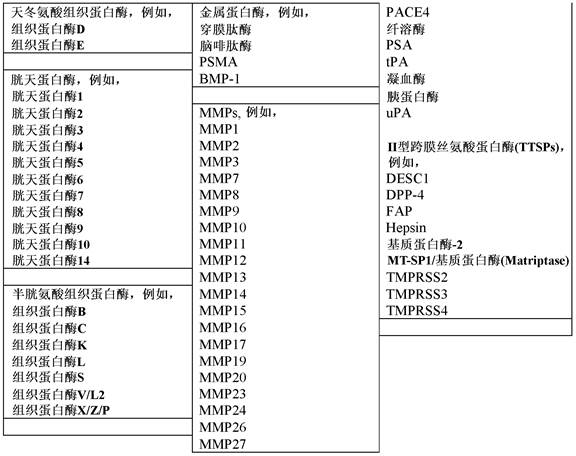
本文所述的可活化抗CD166抗体克服了抗体治疗剂、特别是已知在体内在至少一定程度上有毒性的抗体治疗剂的限制。靶标介导的毒性构成治疗性抗体的开发的主要限制。设计本文提供的可活化抗CD166抗体以解决与传统治疗性抗体在正常组织中抑制靶标相关的毒性。这些可活化抗CD166抗体保持被掩蔽,直到在疾病部位处被蛋白水解活化。以作为亲本治疗性抗体的抗CD166抗体开始,通过将所述抗体通过并入蛋白酶底物的接头偶联至抑制性掩蔽物来工程改造本发明的可活化抗CD166抗体。The activatable anti-CD166 antibodies described herein overcome limitations of antibody therapeutics, particularly antibody therapeutics known to be toxic to at least some extent in vivo. Target-mediated toxicity constitutes a major limitation in the development of therapeutic antibodies. The activatable anti-CD166 antibodies provided herein were designed to address the toxicity associated with target inhibition by traditional therapeutic antibodies in normal tissues. These activatable anti-CD166 antibodies remain masked until proteolytically activated at the disease site. Starting with an anti-CD166 antibody as the parental therapeutic antibody, the activatable anti-CD166 antibodies of the invention were engineered by conjugating the antibody to an inhibitory mask through a linker incorporating a protease substrate.
当AB用MM修饰且在靶标存在的情况下时,与未用MM修饰的AB与靶标的特异性结合或亲本AB与靶标的特异性结合相比,AB与其靶标的特异性结合被降低或抑制。When the AB is modified with MM and in the presence of the target, the specific binding of the AB to its target is reduced or inhibited compared to the specific binding of the AB not modified with MM or the specific binding of the parental AB to the target .
用MM修饰的AB对靶标的Kd比未用MM修饰的AB或亲本AB对靶标的Kd高至少5、10、25、50、100、250、500、1,000、2,500、5,000、10,000、50,000、100,000、500,000、1,000,000、5,000,000、10,000,000、50,000,000倍或更高、或5-10、10-100、10-1,000、10-10,000、10-100,000、10-1,000,000、10-10,000,000、100-1,000、100-10,000、100-100,000、100-1,000,000、100-10,000,000、1,000-10,000、1,000-100,000、1,000-1,000,000、1000-10,000,000、10,000-100,000、10,000-1,000,000、10,000-10,000,000、100,000-1,000,000或100,000-10,000,000倍。相反,用MM修饰的AB对靶标的结合亲和力比未用MM修饰的AB或亲本AB对靶标的结合亲和力低至少2、3、4、5、10、25、50、100、250、500、1,000、2,500、5,000、10,000、50,000、100,000、500,000、1,000,000、5,000,000、10,000,000、50,000,000倍或更高、或5-10、10-100、10-1,000、10-10,000、10-100,000、10-1,000,000、10-10,000,000、100-1,000、100-10,000、100-100,000、100-1,000,000、100-10,000,000、1,000-10,000、1,000-100,000、1,000-1,000,000、1000-10,000,000、10,000-100,000、10,000-1,000,000、10,000-10,000,000、100,000-1,000,000或100,000-10,000,000倍。The Kd of the target for the AB modified with MM is at least 5, 10, 25, 50, 100, 250, 500, 1,000, 2,500, 5,000, 10,000, 50,000 higher than the Kd of the target for the AB not modified with MM or the parental AB . 100-10,000, 100-100,000, 100-1,000,000, 100-10,000,000, 1,000-10,000, 1,000-100,000, 1,000-1,000,000, 1000-10,000,000, 10,000-100,000, 10,000-10,000, 10,000-10,000, 100,000-100,000 or 100,000 or 100,000 or 100,000,000. 10,000,000 times. Conversely, the binding affinity of the AB modified with MM for the target is at least 2, 3, 4, 5, 10, 25, 50, 100, 250, 500, 1,000 lower than the binding affinity of the AB not modified with MM or the parental AB for the target . 10-10,000,000, 100-1000, 100-10,000, 100-100,000, 100-100,000, 100-10,000,000, 1,000-10,000, 1,000-100,000, 1,000-1,000,000, 1000-10,000, 10,000-100,000, 10,000-100,000, 10,000-,000, 10,000-,000, 10,000-,000-,000, 10,000-,000-,000, 10,000-,000-,000, 10,000-,000, 10,000-,000, 10,000-,000, 10,000-,000, 10,000-,000, 10,000-,000, 10,000, 10,000,000, 100,000-1,000,000 or 100,000-10,000,000 times.
MM对AB的解离常数(Kd)通常大于AB对靶标的Kd。MM对AB的Kd可以比AB对靶标的Kd高至少5、10、25、50、100、250、500、1,000、2,500、5,000、10,000、100,000、1,000,000或甚至10,000,000倍。相反,MM对AB的结合亲和力通常低于AB对靶标的结合亲和力。MM对AB的结合亲和力可以比AB对靶标的结合亲和力低至少5、10、25、50、100、250、500、1,000、2,500、5,000、10,000、100,000、1,000,000或甚至10,000,000倍。The dissociation constant (K d ) of MM to AB is generally greater than the K d of AB to target. The K of MM for AB can be at least 5, 10, 25, 50, 100, 250, 500, 1,000, 2,500, 5,000, 10,000, 100,000, 1,000,000, or even 10,000,000 times higher than the K of AB for a target. In contrast, the binding affinity of MM for AB is generally lower than that of AB for the target. The binding affinity of the MM for the AB can be at least 5, 10, 25, 50, 100, 250, 500, 1,000, 2,500, 5,000, 10,000, 100,000, 1,000,000, or even 10,000,000 times lower than the binding affinity of the AB for the target.
在一些实施方案中,MM对AB的解离常数(Kd)约等于AB对靶标的Kd。在一些实施方案中,MM对AB的解离常数(Kd)不大于AB对靶标的解离常数。In some embodiments, the dissociation constant (Kd) of the MM for the AB is approximately equal to the Kd of the AB for the target. In some embodiments, the dissociation constant (Kd) of the MM for the AB is no greater than the dissociation constant (Kd) of the AB for the target.
在一些实施方案中,MM对AB的解离常数(Kd)小于AB对靶标的解离常数。In some embodiments, the dissociation constant (Kd) of the MM for the AB is less than the dissociation constant (Kd) of the AB for the target.
在一些实施方案中,MM对AB的解离常数(Kd)大于AB对靶标的解离常数。In some embodiments, the dissociation constant (Kd) of the MM for the AB is greater than the dissociation constant (Kd) of the AB for the target.
在一些实施方案中,MM与AB的结合的Kd不大于AB与靶标的结合的Kd。In some embodiments, the Kd for binding of the MM to the AB is no greater than the Kd for the binding of the AB to the target.
在一些实施方案中,MM与AB的结合的Kd不小于AB与靶标的结合的Kd。In some embodiments, the Kd for binding of the MM to the AB is not less than the Kd for the binding of the AB to the target.
在一些实施方案中,MM与AB的结合的Kd约等于AB与靶标的结合的Kd。In some embodiments, the Kd for binding of the MM to the AB is about equal to the Kd for the binding of the AB to the target.
在一些实施方案中,MM与AB的结合的Kd小于AB与靶标的结合的Kd。In some embodiments, the Kd for binding of the MM to the AB is less than the Kd for the binding of the AB to the target.
在一些实施方案中,MM与AB的结合的Kd大于AB与靶标的结合的Kd。In some embodiments, the Kd for binding of the MM to the AB is greater than the Kd for the binding of the AB to the target.
在一些实施方案中,MM与AB的结合的Kd不大于AB与靶标的结合的Kd的2、3、4、5、10、25、50、100、250、500或1,000倍。在一些实施方案中,MM与AB的结合的Kd是AB与靶标的结合的Kd的1-5、2-5、2-10、5-10、5-20、5-50、5-100、10-100、10-1,000、20-100、20-1000或100-1,000倍。In some embodiments, the Kd for binding of the MM to the AB is no greater than 2, 3, 4, 5, 10, 25, 50, 100, 250, 500, or 1,000 times the Kd of the binding of the AB to the target. In some embodiments, the Kd of binding of MM to AB is 1-5, 2-5, 2-10, 5-10, 5-20, 5-50, 5-100, 10-100, 10-1,000, 20-100, 20-1000, or 100-1,000 times.
在一些实施方案中,MM与AB的结合的亲和力小于AB与靶标的结合的亲和力。In some embodiments, the MM binds the AB with less affinity than the AB binds the target.
在一些实施方案中,MM与AB的结合的亲和力不多于AB与靶标的结合的亲和力。In some embodiments, the MM binds the AB with no more affinity than the AB binds the target.
在一些实施方案中,MM与AB的结合的亲和力约等于AB与靶标的结合的亲和力。In some embodiments, the MM binds the AB with an affinity about equal to the AB's binding affinity for the target.
在一些实施方案中,MM与AB的结合的亲和力不小于AB与靶标的结合的亲和力。In some embodiments, the MM binds the AB with no less affinity than the AB binds the target.
在一些实施方案中,MM与AB的结合的亲和力大于AB与靶标的结合的亲和力。In some embodiments, the MM binds the AB with greater affinity than the AB binds the target.
在一些实施方案中,MM与AB的结合的亲和力是AB与靶标的结合的亲和力的1/2、1/3、1/4、1/5、1/10、1/25、1/50、1/100、1/250、1/500或1/1,000。在一些实施方案中,MM与AB的结合的亲和力是AB与靶标的结合的亲和力的1/1-1/5、1/2-1/5、1/2-1/10、1/5-1/10、1/5-1/20、1/5-1/50、1/5-1/100、1/10-1/100、1/10-1/1,000、1/20-1/100、1/20-1/1000或1/100-1/1,000。在一些实施方案中,MM与AB的结合的亲和力是AB与靶标的结合的亲和力的1/2-1/20。在一些实施方案中,未与AB共价连接且与AB等摩尔浓度的MM不抑制AB与靶标的结合。In some embodiments, the binding affinity of the MM to the AB is 1/2, 1/3, 1/4, 1/5, 1/10, 1/25, 1/50, 1/100, 1/250, 1/500 or 1/1,000. In some embodiments, the binding affinity of the MM to the AB is 1/1 - 1/5, 1/2 - 1/5, 1/2 - 1/10, 1/5 - the binding affinity of the AB to the
当AB用MM修饰且在靶标存在的情况下时,与未用MM修饰的AB的特异性结合或亲本AB与靶标的特异性结合相比,AB与其靶标的特异性结合被降低或抑制。当与未用MM修饰的AB与靶标的结合或亲本AB与靶标的结合相比时,当在体内或在体外测定法中测量时,当用MM修饰时的AB结合靶标的能力可以降低至少50%、60%、70%、80%、90%、92%、93%、94%、95%、96%、97%、98%、99%和甚至100%持续至少2、4、6、8、12、28、24、30、36、48、60、72、84或96小时,或5、10、15、30、45、60、90、120、150或180天,或1、2、3、4、5、6、7、8、9、10、11或12个月或更长。When the AB is modified with MM and in the presence of the target, the specific binding of the AB to its target is reduced or inhibited compared to the specific binding of the AB not modified with the MM or the specific binding of the parental AB to the target. When compared to the binding of the AB not modified with MM or the binding of the parental AB to the target, the ability of the AB when modified with MM to bind the target may be reduced by at least 50% when measured in vivo or in an in vitro assay %, 60%, 70%, 80%, 90%, 92%, 93%, 94%, 95%, 96%, 97%, 98%, 99% and even 100% for at least 2, 4, 6, 8 , 12, 28, 24, 30, 36, 48, 60, 72, 84, or 96 hours, or 5, 10, 15, 30, 45, 60, 90, 120, 150, or 180 days, or 1, 2, 3 , 4, 5, 6, 7, 8, 9, 10, 11 or 12 months or longer.
MM抑制AB与靶标的结合。MM结合AB的抗原结合结构域且抑制AB与靶标的结合。MM可以空间抑制AB与靶标的结合。MM可以变构抑制AB与其靶标的结合。在这些实施方案中,与未经MM修饰的AB、亲本AB或未与MM偶联的AB与靶标的结合相比,当AB用MM修饰或与MM偶联且在靶标存在的情况下时,当在体内或在体外测定法中测量时,不存在AB与靶标的结合或基本上无AB与靶标的结合,或不多于0.001%、0.01%、0.1%、1%、2%、3%、4%、5%、6%、7%、8%、9%、10%、15%、20%、25%、30%、35%、40%或50%的AB与靶标的结合,持续至少2、4、6、8、12、28、24、30、36、48、60、72、84或96小时,或5、10、15、30、45、60、90、120、150或180天,或1、2、3、4、5、6、7、8、9、10、11或12个月或更长。MM inhibits the binding of AB to the target. MM binds the antigen-binding domain of AB and inhibits the binding of AB to its target. MM can sterically inhibit the binding of AB to the target. MM can allosterically inhibit the binding of AB to its target. In these embodiments, when the AB is modified with or coupled to the MM in the presence of the target, compared to the binding of the AB not modified by the MM, the parental AB, or the AB not coupled to the MM, to the target, There is no or substantially no AB binding to the target, or no more than 0.001%, 0.01%, 0.1%, 1%, 2%, 3%, when measured in vivo or in an in vitro assay , 4%, 5%, 6%, 7%, 8%, 9%, 10%, 15%, 20%, 25%, 30%, 35%, 40%, or 50% of AB bound to target, sustained At least 2, 4, 6, 8, 12, 28, 24, 30, 36, 48, 60, 72, 84, or 96 hours, or 5, 10, 15, 30, 45, 60, 90, 120, 150, or 180 hours days, or 1, 2, 3, 4, 5, 6, 7, 8, 9, 10, 11 or 12 months or longer.
当AB与MM偶联或被MM修饰时,MM“掩蔽”或降低或以其他方式抑制AB与靶标的特异性结合。当AB与MM偶联或被MM修饰时,这样的偶联或修饰可以实现降低或抑制AB特异性结合其靶标的能力的结构改变。When an AB is coupled to or modified by an MM, the MM "masks" or reduces or otherwise inhibits the specific binding of the AB to the target. When an AB is conjugated to or modified by a MM, such conjugation or modification can effect a structural change that reduces or inhibits the ability of the AB to specifically bind its target.
与MM偶联或用MM修饰的AB可以由下式代表(以从氨基(N)端区域至羧基(C)端区域的顺序):AB coupled to or modified with MM can be represented by the following formula (in order from the amino (N) terminal region to the carboxyl (C) terminal region):

其中MM是掩蔽部分,AB是抗体或其抗体片段,且L是接头。在许多实施方案中,可期望将一个或多个接头,例如,柔性接头插入组合物中以提供柔性。where MM is a masking moiety, AB is an antibody or antibody fragment thereof, and L is a linker. In many embodiments, it may be desirable to insert one or more linkers, eg, flexible linkers, into the composition to provide flexibility.
在某些实施方案中,MM不是AB的天然结合配偶体。在一些实施方案中,MM不含或基本上不含与AB的任何天然结合配偶体的同源性。在一些实施方案中,MM与AB的任何天然结合配偶体具有不多于5%、10%、15%、20%、25%、30%、35%、40%、45%、50%、55%、60%、65%、70%、75%或80%的相似性。在一些实施方案中,MM与AB的任何天然结合配偶体具有不多于5%、10%、15%、20%、25%、30%、35%、40%、45%、50%、55%、60%、65%、70%、75%或80%的同一性。在一些实施方案中,MM与AB的任何天然结合配偶体具有不多于25%的同一性。在一些实施方案中,MM与AB的任何天然结合配偶体具有不多于50%的同一性。在一些实施方案中,MM与AB的任何天然结合配偶体具有不多于20%的同一性。在一些实施方案中,MM与AB的任何天然结合配偶体具有不多于10%的同一性。In certain embodiments, the MM is not a natural binding partner of the AB. In some embodiments, the MM is free or substantially free of homology to any natural binding partner of the AB. In some embodiments, MM has no more than 5%, 10%, 15%, 20%, 25%, 30%, 35%, 40%, 45%, 50%, 55% of any natural binding partner of AB %, 60%, 65%, 70%, 75% or 80% similarity. In some embodiments, MM has no more than 5%, 10%, 15%, 20%, 25%, 30%, 35%, 40%, 45%, 50%, 55% of any natural binding partner of AB %, 60%, 65%, 70%, 75% or 80% identity. In some embodiments, the MM is no more than 25% identical to any natural binding partner of the AB. In some embodiments, the MM is no more than 50% identical to any natural binding partner of the AB. In some embodiments, the MM is no more than 20% identical to any natural binding partner of the AB. In some embodiments, the MM is no more than 10% identical to any natural binding partner of the AB.
在一些实施方案中,可活化抗体包括通过MM修饰的AB,且还包括一种或多种可切割部分(CM)。这样的可活化抗体展现与AB的靶标的可活化/可变换结合。可活化抗体通常包括被掩蔽部分(MM)和可修饰或可切割部分(CM)修饰或与掩蔽部分(MM)和可修饰或可切割部分(CM)偶联的抗体或抗体片段(AB)。在一些实施方案中,CM含有作为至少一种蛋白酶的底物发挥功能的氨基酸序列。In some embodiments, an activatable antibody comprises an AB modified by MM, and further comprises one or more cleavable moieties (CM). Such activatable antibodies exhibit activatable/switchable binding to the target of the AB. An activatable antibody generally comprises an antibody or antibody fragment (AB) modified or conjugated to a masking moiety (MM) and a modifiable or cleavable moiety (CM). In some embodiments, the CM contains an amino acid sequence that functions as a substrate for at least one protease.
可活化抗体的元件经排列,使得MM和CM经放置,使得在切割(或者相对活性)状态下且在靶标存在的情况下,AB结合靶标,而可活化抗体在未切割(或者相对无活性)状态下在靶标存在的情况下,AB与其靶标的特异性结合被降低或抑制。AB与其靶标的特异性结合可以由于AB特异性结合其靶标的能力被MM抑制或掩蔽而降低。The elements of the activatable antibody are arranged such that the MM and CM are placed such that in the cleaved (or relatively active) state and in the presence of the target, the AB binds the target, while the activatable antibody binds the target in the uncleaved (or relatively inactive) state. A state in which the specific binding of the AB to its target is reduced or inhibited in the presence of the target. The specific binding of an AB to its target can be reduced due to the inhibition or masking of the ability of the AB to specifically bind its target by the MM.
用MM和CM修饰的AB对靶标的Kd比未用MM和CM修饰的AB或亲本AB对靶标的Kd大至少5、10、25、50、100、250、500、1,000、2,500、5,000、10,000、50,000、100,000、500,000、1,000,000、5,000,000、10,000,000、50,000,000倍或更高、或5-10、10-100、10-1,000、10-10,000、10-100,000、10-1,000,000、10-10,000,000、100-1,000、100-10,000、100-100,000、100-1,000,000、100-10,000,000、1,000-10,000、1,000-100,000、1,000-1,000,000、1000-10,000,000、10,000-100,000、10,000-1,000,000、10,000-10,000,000、100,000-1,000,000或100,000-10,000,000倍。相反,用MM和CM修饰的AB对靶标的结合亲和力比未用MM和CM修饰的AB或亲本AB对靶标的结合亲和力低至少5、10、25、50、100、250、500、1,000、2,500、5,000、10,000、50,000、100,000、500,000、1,000,000、5,000,000、10,000,000、50,000,000倍或更高、或5-10、10-100、10-1,000、10-10,000、10-100,000、10-1,000,000、10-10,000,000、100-1,000、100-10,000、100-100,000、100-1,000,000、100-10,000,000、1,000-10,000、1,000-100,000、1,000-1,000,000、1000-10,000,000、10,000-100,000、10,000-1,000,000、10,000-10,000,000、100,000-1,000,000、或100,000-10,000,000倍。The Kd of the target for the AB modified with MM and CM is at least 5, 10, 25, 50, 100, 250, 500, 1,000, 2,500, 5,000 greater than the Kd of the target for the AB not modified with MM and CM or the parental AB . 100-1,000, 100-10,000, 100-100,000, 100-1,000,000, 100-10,000,000, 1,000-10,000, 1,000-100,000, 1,000-1,000,000, 1000-10,000,000, 10,000-100,000, 10,000-10,000,000, 100,000, 100,000, 100,000, 100,000, 100,000, 100,000, 10,000-10,000, 10,000-10,000, 100,000, 100,000, 100,000, 100,000, 100,000, 100,000, 100,000, 100,000, 100,000, 100,000, 100,000, 100,000, 100,000, 100,000, 100,000, 100,000, 100,000, 100,000, 100,000, 100,000, 100,000, 100,000, 100,000, 100,000, 100,000, 100,000. 1,000,000 or 100,000-10,000,000 times. Conversely, the binding affinity of the AB modified with MM and CM for the target is at least 5, 10, 25, 50, 100, 250, 500, 1,000, 2,500 lower than the binding affinity of the AB not modified with MM and CM or the parental AB for the target . 10,000,000, 100-1,000, 100-10,000, 100-100,000, 100-100,000, 100-10,000,000, 1,000-10,000, 1,000-100,000, 1,000-1,000,000, 1000-10,000, 10,000-100,000, 10,000-10,000, 10,000-10,000, 100,000-1,000,000, or 100,000-10,000,000 times.
当AB用MM和CM修饰且在靶标存在的情况下、但不在修饰剂(例如至少一种蛋白酶)存在的情况下时,与未用MM和CM修饰的AB或亲本AB与靶标的特异性结合相比,AB与其靶标的特异性结合被降低或抑制。当与亲本AB与其靶标的结合或未用MM和CM修饰的AB与其靶标的结合相比时,当在体内或在体外测定法中测量时,当用MM和CM修饰时的AB结合靶标的能力可以降低至少50%、60%、70%、80%、90%、92%、93%、94%、95%、96%、97%、98%、99%和甚至100%持续至少2、4、6、8、12、28、24、30、36、48、60、72、84或96小时或5、10、15、30、45、60、90、120、150或180天或1、2、3、4、5、6、7、8、9、10、11或12个月或更长。Specific binding to the target when the AB is modified with MM and CM and in the presence of the target, but not in the presence of a modifier (e.g., at least one protease) compared to an AB not modified with MM and CM or the parental AB In contrast, the specific binding of AB to its target is reduced or inhibited. The ability of an AB when modified with MM and CM to bind its target when compared to the binding of the parental AB to its target or the binding of the AB not modified with MM and CM to its target when measured in vivo or in an in vitro assay Can be reduced by at least 50%, 60%, 70%, 80%, 90%, 92%, 93%, 94%, 95%, 96%, 97%, 98%, 99%, and even 100% for at least 2, 4 , 6, 8, 12, 28, 24, 30, 36, 48, 60, 72, 84 or 96 hours or 5, 10, 15, 30, 45, 60, 90, 120, 150 or 180 days or 1, 2 , 3, 4, 5, 6, 7, 8, 9, 10, 11 or 12 months or longer.
如本文所用,术语切割状态是指在CM被至少一种蛋白酶修饰后可活化抗体的状况。如本文所用,术语未切割状态是指在不存在CM被蛋白酶切割的情况下可活化抗体的状况。如上所讨论,术语“可活化抗体”在本文用于指呈其未切割(天然)状态以及呈其切割状态的可活化抗体。普通技术人员显而易见的是,在一些实施方案中,切割的可活化抗体可以由于蛋白酶对CM的切割、导致至少MM的释放而缺乏MM (例如,其中MM未通过共价键(例如半胱氨酸残基之间的二硫键)与可活化抗体连接)。As used herein, the term cleavage state refers to the condition in which the antibody can be activated after the CM has been modified by at least one protease. As used herein, the term uncleaved state refers to the condition in which the antibody can be activated in the absence of cleavage of the CM by proteases. As discussed above, the term "activatable antibody" is used herein to refer to an activatable antibody in its uncleaved (native) state as well as in its cleaved state. It will be apparent to one of ordinary skill that, in some embodiments, the cleaved activatable antibody may lack MM due to cleavage of the CM by a protease, resulting in release of at least MM (e.g., where the MM is not bound by a covalent bond (e.g., cysteine). Disulfide bonds between residues) are linked to the activatable antibody).
可活化或可变换的意指当可活化抗体在抑制、掩蔽或未切割状态下(即,第一构象)时,可活化抗体展现与靶标的第一结合水平,和在未抑制、未掩蔽和/或切割状态下(即,第二构象)可活化抗体展现与靶标的第二结合水平,其中靶标结合的第二水平大于结合的第一水平。通常,靶标对可活化抗体的AB的接近在能够切割CM的切割剂(即,蛋白酶)存在的情况下比在这样的切割剂不存在的情况下更大。因此,当可活化抗体在未切割状态下时,AB被抑制免于靶标结合且可以被掩蔽免于靶标结合(即,第一构象使得AB不能结合靶标),且在切割状态下,对于靶标结合,AB未被抑制或未被掩蔽。Activatable or switchable means that the activatable antibody exhibits a first level of binding to the target when the activatable antibody is in the inhibited, masked or unlocked state (i.e., a first conformation), and in the uninhibited, unmasked and The activatable antibody in the cleaved state (ie, the second conformation) exhibits a second level of binding to the target, wherein the second level of target binding is greater than the first level of binding. In general, the access of the target to the AB of the activatable antibody is greater in the presence of a cleavage agent capable of cleaving the CM (ie, a protease) than in the absence of such a cleavage agent. Thus, when the activatable antibody is in the uncleaved state, the AB is inhibited from target binding and can be masked from target binding (i.e., the first conformation renders the AB unable to bind the target), and in the cleaved state, for target binding , AB was not suppressed or masked.
选择可活化抗体的CM和AB,使得AB代表给定靶标的结合部分,并且CM代表蛋白酶的底物。在一些实施方案中,所述蛋白酶与所述靶标在主体中的治疗部位或诊断部位处共定位。如本文所用,共定位是指在相同的部位或相对靠近。在一些实施方案中,蛋白酶切割CM,其产生结合位于切割位点附近的靶标的活化的抗体。本文公开的可活化抗体特别可用于其中例如能够切割CM中的位点的蛋白酶(即蛋白酶)以比非治疗部位的组织(例如健康组织)相对更高的水平存在于治疗部位或诊断部位的含有靶标的组织中的情况。在一些实施方案中,本发明的CM也被一种或多种其他蛋白酶切割。在一些实施方案中,正是一种或多种其他蛋白酶与靶标共定位并且负责体内切割CM。The CM and AB of the activatable antibody are chosen such that AB represents the binding portion of a given target and CM represents the substrate for the protease. In some embodiments, the protease co-localizes with the target at the site of treatment or diagnosis in the subject. As used herein, co-localization means at the same site or in relative proximity. In some embodiments, the protease cleaves the CM, which produces activated antibodies that bind targets located near the cleavage site. The activatable antibodies disclosed herein are particularly useful in therapeutic or diagnostic sites where, for example, proteases capable of cleaving sites in the CM (i.e., proteases) are present at relatively higher levels than tissue at the non-treatment site (e.g., healthy tissue). The condition of the target tissue. In some embodiments, the CMs of the invention are also cleaved by one or more other proteases. In some embodiments, it is the one or more other proteases that co-localize with the target and are responsible for cleavage of the CM in vivo.
在一些实施方案中,可活化抗体提供降低的毒性和/或不良副作用,如果AB未被掩蔽或以其他方式被抑制免于结合靶标,则所述毒性和/或不良副作用可以其他方式由在非治疗部位处的AB的结合导致。In some embodiments, the activatable antibody provides reduced toxicity and/or adverse side effects that could otherwise result from binding to the target if the AB is not masked or otherwise inhibited from binding to the target. Binding of AB at the treatment site results.
通常,可活化抗体可以通过如下来设计:选择目标AB和构建可活化抗体的剩余部分,使得当构象上被限制时,MM提供AB的掩蔽或AB与其靶标的结合的降低。可以考虑结构设计标准以提供该功能特征。In general, an activatable antibody can be designed by selecting the AB of interest and constructing the remainder of the activatable antibody such that, when conformationally constrained, the MM provides masking of the AB or a reduction in the binding of the AB to its target. Structural design criteria may be considered to provide this functional feature.
提供了对在抑制构象相比于非抑制构象中的靶标结合展现所需动态范围的可变换表型的可活化抗体。动态范围通常是指(a)在第一组条件下参数的最大检测水平与(b)在第二组条件下该参数的最小检测值的比率。例如,在可活化抗体的背景下,动态范围是指(a)在能够切割可活化抗体的CM的至少一种蛋白酶存在的情况下与可活化抗体结合的靶蛋白的最大检测水平与(b)在蛋白酶不存在的情况下与可活化抗体结合的靶蛋白的最小检测水平的比率。可活化抗体的动态范围可计算为可活化抗体切割剂(例如,酶)处理的解离常数与可活化抗体切割剂处理的解离常数的比率。可活化抗体的动态范围越大,可活化抗体的可变换表型越好。具有相对更高的动态范围值(例如,大于1)的可活化抗体展现更加期望的变换表型,使得在能够切割可活化抗体的CM的切割剂(例如,酶)存在的情况下比在切割剂不存在的情况下,可活化抗体的靶蛋白结合在更大的程度上发生(例如,主要发生)。Activatable antibodies exhibiting a switchable phenotype of a desired dynamic range for target binding in a repressed versus a non-repressed conformation are provided. Dynamic range generally refers to the ratio of (a) the maximum detectable level of a parameter under a first set of conditions to (b) the minimum detectable value of that parameter under a second set of conditions. For example, in the context of an activatable antibody, dynamic range refers to (a) the maximum detectable level of target protein bound to the activatable antibody in the presence of at least one protease capable of cleaving the CM of the activatable antibody versus (b) The ratio of the minimum detectable level of target protein bound to an activatable antibody in the absence of protease. The dynamic range of an activatable antibody can be calculated as the ratio of the dissociation constant for treatment with an activatable antibody cleaving agent (eg, an enzyme) to the dissociation constant for treatment with an activatable antibody cleaving agent. The greater the dynamic range of the activatable antibody, the better the switchable phenotype of the activatable antibody. An activatable antibody with a relatively higher dynamic range value (e.g., greater than 1) exhibits a more desirable shift phenotype such that it is more desirable in the presence of a cleavage agent (e.g., an enzyme) capable of cleaving the CM of the activatable antibody than in the presence of a cleavage agent (e.g., an enzyme). Target protein binding of the activatable antibody occurs to a greater extent (eg, predominantly) in the absence of the agent.
可活化抗体可以各种结构构型提供。下文提供可活化抗体的示例性式。特别考虑,AB、MM和CM的N-至C-末端顺序可以在可活化抗体内反转。还特别考虑,CM和MM的氨基酸序列可以重叠,例如,使得CM至少部分包含于MM内。Activatable antibodies can be provided in a variety of structural configurations. Exemplary formulas of activatable antibodies are provided below. It is specifically contemplated that the N-to-C-terminal order of AB, MM and CM can be reversed within an activatable antibody. It is also specifically contemplated that the amino acid sequences of CM and MM may overlap, eg, such that CM is at least partially contained within MM.
例如,可活化抗体可以由下式代表(以从氨基(N)端区域至羧基(C)端区域的顺序):For example, an activatable antibody can be represented by the following formula (in order from the amino (N) terminal region to the carboxyl (C) terminal region):

其中MM是掩蔽部分,CM是可切割部分,且AB是抗体或其片段。应注意,尽管MM和CM在上式中表示为不同的组分,但在本文公开的所有示例性实施方案(包括式)中,考虑MM和CM的氨基酸序列可以重叠,例如,使得CM完全或部分地包含于MM内。此外,上式提供额外氨基酸序列,其可以位于可活化抗体元件的N-末端或C-末端。where MM is a masking moiety, CM is a cleavable moiety, and AB is an antibody or fragment thereof. It should be noted that although MM and CM are represented as distinct components in the above formulas, in all exemplary embodiments disclosed herein (including the formulas), it is contemplated that the amino acid sequences of MM and CM may overlap, for example, such that CM is completely or Partially included in MM. Furthermore, the above formula provides additional amino acid sequences, which may be located at the N-terminus or C-terminus of the activatable antibody element.
在某些实施方案中,MM不是AB的天然结合配偶体。在一些实施方案中,MM不含或基本上不含与AB的任何天然结合配偶体的同源性。在一些实施方案中,MM与AB的任何天然结合配偶体具有不多于5%、10%、15%、20%、25%、30%、35%、40%、45%、50%、55%、60%、65%、70%、75%或80%的相似性。在一些实施方案中,MM与AB的任何天然结合配偶体具有不多于5%、10%、15%、20%、25%、30%、35%、40%、45%、50%、55%、60%、65%、70%、75%或80%的同一性。在一些实施方案中,MM与AB的任何天然结合配偶体具有不多于50%的同一性。在一些实施方案中,MM与AB的任何天然结合配偶体具有不多于25%的同一性。在一些实施方案中,MM与AB的任何天然结合配偶体具有不多于20%的同一性。在一些实施方案中,MM与AB的任何天然结合配偶体具有不多于10%的同一性。In certain embodiments, the MM is not a natural binding partner of the AB. In some embodiments, the MM is free or substantially free of homology to any natural binding partner of the AB. In some embodiments, MM has no more than 5%, 10%, 15%, 20%, 25%, 30%, 35%, 40%, 45%, 50%, 55% of any natural binding partner of AB %, 60%, 65%, 70%, 75% or 80% similarity. In some embodiments, MM has no more than 5%, 10%, 15%, 20%, 25%, 30%, 35%, 40%, 45%, 50%, 55% of any natural binding partner of AB %, 60%, 65%, 70%, 75% or 80% identity. In some embodiments, the MM is no more than 50% identical to any natural binding partner of the AB. In some embodiments, the MM is no more than 25% identical to any natural binding partner of the AB. In some embodiments, the MM is no more than 20% identical to any natural binding partner of the AB. In some embodiments, the MM is no more than 10% identical to any natural binding partner of the AB.
在许多实施方案中,可期望将一个或多个接头、例如柔性接头插入可活化抗体构建体,以在MM-CM连接CM-AB连接或两者中的一个或多个处提供柔性。例如,AB、MM和/或CM可以不含足够数量的残基(例如,Gly、Ser、Asp、Asn,尤其是Gly和Ser,特别是Gly)以提供期望的柔性。因此,这样的可活化抗体构建体的可变换表型可以获益于引入一个或多个氨基酸以提供柔性接头。此外,如下所述,在作为构象受限的构建体提供可活化抗体的情况下,可以可操作插入柔性接头,以促进形成和维持未切割的可活化抗体的环状结构。In many embodiments, it may be desirable to insert one or more linkers, eg, flexible linkers, into the activatable antibody construct to provide flexibility at one or more of the MM-CM junction, CM-AB junction, or both. For example, AB, MM and/or CM may not contain a sufficient number of residues (eg, Gly, Ser, Asp, Asn, especially Gly and Ser, especially Gly) to provide the desired flexibility. Thus, the switchable phenotype of such activatable antibody constructs may benefit from the introduction of one or more amino acids to provide a flexible linker. Furthermore, as described below, where the activatable antibody is provided as a conformationally restricted construct, a flexible linker can be operably inserted to facilitate the formation and maintenance of the loop structure of the uncleaved activatable antibody.
例如,在某些实施方案中,可活化抗体包含下式之一(其中下式代表以N-至C-末端方向或C-至N-末端方向的氨基酸序列):For example, in certain embodiments, an activatable antibody comprises one of the following formulas (where the following formulas represent the amino acid sequence in an N-to-C-terminal orientation or a C-to-N-terminal orientation):

其中MM、CM和AB如上文所定义;其中L1和L2各自独立地且任选地存在或不存在,是相同或不同的柔性接头,其包括至少1个柔性氨基酸(例如,Gly)。此外,上式提供额外氨基酸序列,其可以位于可活化抗体元件的N-末端或C-末端。实例包括但不限于靶向部分(例如,靶组织中存在的细胞的受体的配体)和血清半衰期延长部分(例如,结合血清蛋白诸如免疫球蛋白(例如,IgG)或血清白蛋白(例如,人血清白蛋白(HAS)的多肽)。wherein MM, CM and AB are as defined above; wherein L1 and L2 are each independently and optionally present or absent, the same or different flexible linkers comprising at least 1 flexible amino acid (eg, Gly). Furthermore, the above formula provides additional amino acid sequences, which may be located at the N-terminus or C-terminus of the activatable antibody element. Examples include, but are not limited to, targeting moieties (e.g., ligands for receptors of cells present in target tissues) and serum half-life extending moieties (e.g., binding serum proteins such as immunoglobulins (e.g., IgG) or serum albumin (e.g., , a polypeptide of human serum albumin (HSA).
CM被至少一种蛋白酶以约0.001-1500 x 104 M-1S-1或至少0.001、0.005、0.01、0.05、0.1、0.5、1、2.5、5、7.5、10、15、20、25、50、75、100、125、150、200、250、500、750、1000、1250或1500 x 104 M-1S-1的速率特异性切割。在一些实施方案中,CM以约100,000 M-1S-1的速率被特异性切割。在一些实施方案中,CM以约1x10E2至约1x10E6 M-1S-1 (即,约1x10²至约1x10⁶ M-1S-1)的速率被特异性切割。CM is treated with at least one protease at about 0.001-1500 x 10 Rate-specific cleavage at 50, 75, 100, 125, 150, 200, 250, 500, 750, 1000, 1250, or 1500 x 104 M -1 S -1 . In some embodiments, the CM is specifically cleaved at a rate of about 100,000 M −1 S −1 . In some embodiments, the CM is specifically cleaved at a rate of about 1×10E2 to about 1×10E6 M −1 S −1 (ie, about 1×10 2 to about 1×10 6 M −1 S −1 ).
对于酶的特异性切割,进行酶和CM之间的接触。当包含与MM和CM偶联的AB的可活化抗体在靶标和足够的酶活性存在的情况下时,CM可以被切割。足够的酶活性可以是指酶与CM进行接触并实现切割的能力。可以容易设想,酶可以在CM的附近,但因为其他细胞因子或酶的蛋白修饰而不能切割。For specific cleavage by the enzyme, a contact between the enzyme and the CM is performed. CM can be cleaved when an activatable antibody comprising AB coupled to MM and CM is present on target and sufficient enzymatic activity. Sufficient enzymatic activity may refer to the ability of the enzyme to contact the CM and effect cleavage. It is easy to imagine that enzymes could be in the vicinity of the CM but not cleave because of protein modifications by other cytokines or enzymes.
适合用于本文所述的组合物的接头通常是提供修饰的AB或可活化抗体的柔性以促进AB与靶标的结合的抑制的接头。这样的接头通常被称为柔性接头。合适的接头可以容易地选择,且可以具有任何合适的不同长度,诸如1个氨基酸(例如,Gly)至20个氨基酸、2个氨基酸至15个氨基酸、3个氨基酸至12个氨基酸,包括4个氨基酸至10个氨基酸、5个氨基酸至9个氨基酸、6个氨基酸至8个氨基酸或7个氨基酸至8个氨基酸,且可以是1、2、3、4、5、6、7、8、9、10、11、12、13、14、15、16、17、18、19或20个氨基酸长。Linkers suitable for use in the compositions described herein are generally linkers that provide flexibility to the modified AB or activatable antibody to facilitate inhibition of binding of the AB to the target. Such joints are often referred to as flexible joints. Suitable linkers can be readily selected and can be of any suitable different length, such as 1 amino acid (eg, Gly) to 20 amino acids, 2 amino acids to 15 amino acids, 3 amino acids to 12 amino acids, including 4 Amino acids to 10 amino acids, 5 amino acids to 9 amino acids, 6 amino acids to 8 amino acids, or 7 amino acids to 8 amino acids, and can be 1, 2, 3, 4, 5, 6, 7, 8, 9 , 10, 11, 12, 13, 14, 15, 16, 17, 18, 19 or 20 amino acids in length.
示例性柔性接头包括甘氨酸聚合物(G)n、甘氨酸-丝氨酸聚合物(包括例如,(GS)n、(GSGGS)n (SEQ ID NO:1)和(GGGS)n (SEQ ID NO:2),其中n是至少1的整数)、甘氨酸-丙氨酸聚合物、丙氨酸-丝氨酸聚合物和本领域已知的其他柔性接头。甘氨酸和甘氨酸-丝氨酸聚合物相对无结构,因此可能能够充当各组分之间的中性系链。甘氨酸获得比甚至丙氨酸显著更多的phi-psi空间,且比具有更长侧链的残基受到少得多的限制(参见Scheraga,Rev. Computational Chem.11173-142 (1992))。示例性柔性接头包括但不限于Gly-Gly-Ser-Gly (SEQ ID NO:3)、Gly-Gly-Ser-Gly-Gly (SEQ ID NO:4)、Gly-Ser-Gly-Ser-Gly(SEQ ID NO:5)、Gly-Ser-Gly-Gly-Gly (SEQ ID NO:6)、Gly-Gly-Gly-Ser-Gly (SEQ IDNO:7)、Gly-Ser-Ser-Ser-Gly (SEQ ID NO:8)等。普通技术人员将认识到,可活化抗体的设计可以包括是全部或部分柔性的接头,使得接头可以包括柔性接头以及赋予较少柔性结构的一个或多个部分,以提供期望的可活化抗体结构。Exemplary flexible linkers include glycine polymers (G)n, glycine-serine polymers (including, for example, (GS)n, (GSGGS)n (SEQ ID NO:1) and (GGGS)n (SEQ ID NO:2) , wherein n is an integer of at least 1), glycine-alanine polymers, alanine-serine polymers, and other flexible linkers known in the art. Glycine and glycine-serine polymers are relatively unstructured and thus may be able to act as neutral tethers between the components. Glycine acquires significantly more phi-psi space than even alanine, and is much less constrained than residues with longer side chains (see Scheraga, Rev. Computational Chem. 11173-142 (1992)). Exemplary flexible linkers include, but are not limited to, Gly-Gly-Ser-Gly (SEQ ID NO:3), Gly-Gly-Ser-Gly-Gly (SEQ ID NO:4), Gly-Ser-Gly-Ser-Gly ( SEQ ID NO:5), Gly-Ser-Gly-Gly-Gly (SEQ ID NO:6), Gly-Gly-Gly-Ser-Gly (SEQ IDNO:7), Gly-Ser-Ser-Ser-Gly ( SEQ ID NO:8) etc. One of ordinary skill will recognize that the design of an activatable antibody may include a linker that is fully or partially flexible such that the linker may include a flexible linker and one or more portions that impart a less flexible structure to provide the desired activatable antibody structure.
本发明还提供包括可活化抗CD166抗体的组合物和方法,所述可活化抗CD166抗体包括特异性结合CD166的抗体或抗体片段(AB),其中AB与降低AB结合其靶标的能力的掩蔽部分(MM)偶联。在一些实施方案中,所述可活化抗CD166抗体进一步包含作为蛋白酶的底物的可切割部分(CM)。本文提供的组合物和方法使得能够将一种或多种试剂连接至AB中的一个或多个半胱氨酸残基,而不损害可活化抗CD166抗体的活性(例如,掩蔽、活化或结合活性)。在一些实施方案中,本文提供的组合物和方法使得能够将一种或多种试剂连接至AB中的一个或多个半胱氨酸残基,而不减少或以其他方式干扰MM内的一个或多个二硫键。本文提供的组合物和方法产生可活化抗CD166抗体,其与一种或多种试剂,例如多种治疗剂、诊断剂和/或预防剂中的任一种缀合,例如,在一些实施方案中,没有任何试剂与可活化抗CD166抗体的MM缀合。本文提供的组合物和方法产生缀合的可活化抗CD166抗体,其中MM保留有效且有效率地掩蔽未切割状态下的可活化抗体的AB的能力。本文提供的组合物和方法产生缀合的可活化抗CD166抗体,其中可活化抗体在可切割CM的蛋白酶存在的情况下仍被活化,即切割。The invention also provides compositions and methods comprising an activatable anti-CD166 antibody comprising an antibody or antibody fragment (AB) that specifically binds CD166, wherein the AB is associated with a masking moiety that reduces the ability of the AB to bind its target (MM) coupling. In some embodiments, the activatable anti-CD166 antibody further comprises a cleavable moiety (CM) that is a substrate for a protease. The compositions and methods provided herein enable the attachment of one or more reagents to one or more cysteine residues in an AB without compromising the activity of an activatable anti-CD166 antibody (e.g., masking, activating, or binding active). In some embodiments, the compositions and methods provided herein enable the attachment of one or more agents to one or more cysteine residues in AB without reducing or otherwise interfering with one or more cysteine residues in MM. or multiple disulfide bonds. The compositions and methods provided herein produce activatable anti-CD166 antibodies conjugated to one or more agents, such as any of a variety of therapeutic, diagnostic and/or prophylactic agents, e.g., in some embodiments In , no reagent was conjugated to the MM that could activate the anti-CD166 antibody. The compositions and methods provided herein produce conjugated activatable anti-CD166 antibodies in which the MM retains the ability to effectively and efficiently mask the AB of the activatable antibody in the uncleaved state. The compositions and methods provided herein produce conjugated activatable anti-CD166 antibodies, wherein the activatable antibody remains activated, ie, cleaved, in the presence of a protease that can cleave the CM.
可活化抗CD166抗体具有试剂的至少一个缀合点,但在本文提供的方法和组合物中,少于所有可能的缀合点可用于与试剂缀合。在一些实施方案中,一个或多个缀合点是参与二硫键的硫原子。在一些实施方案中,一个或多个缀合点是参与链间二硫键的硫原子。在一些实施方案中,一个或多个缀合点是参与链间硫化物键的硫原子,但不是参与链内二硫键的硫原子。在一些实施方案中,一个或多个缀合点是半胱氨酸或含有硫原子的其他氨基酸残基的硫原子。这样的残基可以天然存在于抗体结构中,或者可以通过定点诱变、化学转化或错误并入非天然氨基酸而并入抗体中。An activatable anti-CD166 antibody has at least one conjugation point for the agent, but in the methods and compositions provided herein, less than all possible conjugation points are available for conjugation to the agent. In some embodiments, one or more points of conjugation are sulfur atoms participating in disulfide bonds. In some embodiments, one or more points of conjugation are sulfur atoms participating in interchain disulfide bonds. In some embodiments, the one or more points of conjugation are sulfur atoms participating in interchain sulfide bonds, but not sulfur atoms participating in intrachain disulfide bonds. In some embodiments, one or more points of conjugation are sulfur atoms of cysteine or other amino acid residues containing sulfur atoms. Such residues may occur naturally in the antibody structure, or may be incorporated into the antibody by site-directed mutagenesis, chemical transformation or misincorporation of unnatural amino acids.
还提供了制备在AB中具有一个或多个链间二硫键和在MM中具有一个或多个链内二硫键的可活化抗CD166抗体的缀合物的方法,并且提供与游离巯基反应的药物。该方法通常包括用还原剂(诸如例如TCEP)部分还原可活化抗体中的链间二硫键;和将与游离巯基反应的药物与部分还原的可活化抗体缀合。如本文所用,术语部分还原是指其中可活化抗CD166抗体与还原剂接触且少于所有二硫键,例如少于所有可能的缀合位点被减少的情况。在一些实施方案中,少于99%、98%、97%、96%、95%、90%、85%、80%、75%、70%、65%、60%、55%、50%、45%、40%、35%、30%、25%、20%、15%、10%或少于5%的所有可能的缀合位点被还原。Also provided is a method of preparing a conjugate of an activatable anti-CD166 antibody having one or more interchain disulfide bonds in AB and one or more intrachain disulfide bonds in MM, and provides a method for reacting with a free sulfhydryl group. medicine. The method generally involves partially reducing the interchain disulfide bonds in the activatable antibody with a reducing agent such as, for example, TCEP; and conjugating a drug that reacts with free sulfhydryl groups to the partially reduced activatable antibody. As used herein, the term partially reduced refers to a situation wherein an activatable anti-CD166 antibody is contacted with a reducing agent and less than all disulfide bonds, eg less than all possible conjugation sites are reduced. In some embodiments, less than 99%, 98%, 97%, 96%, 95%, 90%, 85%, 80%, 75%, 70%, 65%, 60%, 55%, 50%, 45%, 40%, 35%, 30%, 25%, 20%, 15%, 10%, or less than 5% of all possible conjugation sites are reduced.
在还有其他实施方案中,提供了将试剂例如药物还原和缀合至可活化抗CD166抗体、导致试剂放置的选择性的方法。该方法通常包括用还原剂部分还原可活化抗CD166抗体,使得可活化抗体的掩蔽部分或其他非AB部分中的任何缀合位点不被还原,并将该试剂缀合至AB中的链间巯基。选择缀合位点以便允许试剂的期望放置,以允许在期望的位点发生缀合。还原剂例如为TCEP。通过鉴定产生其中MM保留有效和有效地掩蔽未切割状态下的可活化抗体的AB的能力的缀合的可活化抗体的条件来确定还原反应条件,诸如例如还原剂与可活化抗体的比率,孵育时长,孵育期间的温度,还原反应溶液的pH等。还原剂与可活化抗CD166抗体的比率将根据可活化抗体而变化。在一些实施方案中,还原剂与可活化抗CD166抗体的比率将范围为约20:1至1:1、约10:1至1:1、约9:1至1:1、约8:1至1:1、约7:1至1:1、约6:1至1:1、约5:1至1:1、约4:1至1:1、约3:1至1:1、约2:1至1:1、约20:1至1:1.5、约10:1至1:1.5、约9:1至1:1.5、约8:1至1:1.5、约7:1至1:1.5、约6:1至1:1.5、约5:1至1:1.5、约4:1至1:1.5、约3:1至1:1.5、约2:1至1:1.5、约1.5:1至1:1.5或约1:1至1:1.5。在一些实施方案中,比率在约5:1至1:1的范围内。在一些实施方案中,比率在约5:1至1.5:1的范围内。在一些实施方案中,比率在约4:1至1:1的范围内。在一些实施方案中,比率在约4:1至1.5:1的范围内。在一些实施方案中,比率在约8:1至约1:1的范围内。在一些实施方案中,比率在约2.5:1至1:1的范围内。In yet other embodiments, methods are provided for reducing and conjugating an agent, such as a drug, to an activatable anti-CD166 antibody, resulting in selectivity of agent placement. The method typically involves partially reducing an activatable anti-CD166 antibody with a reducing agent such that any conjugation sites in the masking or other non-AB moiety of the activatable antibody are not reduced, and conjugating the agent to the interchain in the AB. Mercapto. The site of conjugation is selected so as to allow the desired placement of the reagents to allow conjugation to occur at the desired site. The reducing agent is, for example, TCEP. Reduction reaction conditions are determined by identifying conditions for the generation of conjugated activatable antibodies in which the MM retains the ability to efficiently and effectively mask the AB of the activatable antibodies in the uncleaved state, such as, for example, the ratio of reducing agent to activatable antibody, incubation Duration, temperature during incubation, pH of the reduction reaction solution, etc. The ratio of reducing agent to activatable anti-CD166 antibody will vary depending on the activatable antibody. In some embodiments, the ratio of reducing agent to activatable anti-CD166 antibody will range from about 20:1 to 1:1, about 10:1 to 1:1, about 9:1 to 1:1, about 8:1 to 1:1, about 7:1 to 1:1, about 6:1 to 1:1, about 5:1 to 1:1, about 4:1 to 1:1, about 3:1 to 1:1, About 2:1 to 1:1, About 20:1 to 1:1.5, About 10:1 to 1:1.5, About 9:1 to 1:1.5, About 8:1 to 1:1.5, About 7:1 to 1:1.5, about 6:1 to 1:1.5, about 5:1 to 1:1.5, about 4:1 to 1:1.5, about 3:1 to 1:1.5, about 2:1 to 1:1.5, about 1.5:1 to 1:1.5 or about 1:1 to 1:1.5. In some embodiments, the ratio is in the range of about 5:1 to 1:1. In some embodiments, the ratio is in the range of about 5:1 to 1.5:1. In some embodiments, the ratio is in the range of about 4:1 to 1:1. In some embodiments, the ratio is in the range of about 4:1 to 1.5:1. In some embodiments, the ratio ranges from about 8:1 to about 1:1. In some embodiments, the ratio is in the range of about 2.5:1 to 1:1.
在一些实施方案中,提供了还原可活化抗CD166抗体的AB中的链间二硫键和将试剂(例如,含巯基的试剂,诸如药物)缀合至所得链间巯基以将试剂选择性定位在AB上的方法。该方法通常包括用还原剂部分还原AB以形成至少两个链间巯基,而不在可活化抗体中形成所有可能的链间巯基;和将所述试剂缀合至部分还原的AB的链间巯基。例如,以还原剂:可活化抗体的期望比率将可活化抗体的AB在约37℃下部分还原约1小时。在一些实施方案中,还原剂与可活化抗体的比率将范围为约20:1至1:1、约10:1至1:1、约9:1至1:1、约8:1至1:1、约7:1至1:1、约6:1至1:1、约5:1至1:1、约4:1至1:1、约3:1至1:1、约2:1至1:1、约20:1至1:1.5、约10:1至1:1.5、约9:1至1:1.5、约8:1至1:1.5、约7:1至1:1.5、约6:1至1:1.5、约5:1至1:1.5、约4:1至1:1.5、约3:1至1:1.5、约2:1至1:1.5、约1.5:1至1:1.5或约1:1至1:1.5。在一些实施方案中,比率在约5:1至1:1的范围内。在一些实施方案中,比率在约5:1至1.5:1的范围内。在一些实施方案中,比率在约4:1至1:1的范围内。在一些实施方案中,比率在约4:1至1.5:1的范围内。在一些实施方案中,比率在约8:1至约1:1的范围内。在一些实施方案中,比率在约2.5:1至1:1的范围内。In some embodiments, reduction of the interchain disulfide bonds in the AB of the activatable anti-CD166 antibody and conjugation of an agent (e.g., a thiol-containing agent, such as a drug) to the resulting interchain thiol to selectively position the agent is provided. method on AB. The method generally involves partially reducing the AB with a reducing agent to form at least two interchain thiols, but not all possible interchain thiols in the activatable antibody; and conjugating the agent to the interchain thiols of the partially reduced AB. For example, the AB of the activatable antibody is partially reduced at a desired ratio of reducing agent:activatable antibody at about 37°C for about 1 hour. In some embodiments, the ratio of reducing agent to activatable antibody will range from about 20:1 to 1:1, about 10:1 to 1:1, about 9:1 to 1:1, about 8:1 to 1 :1, about 7:1 to 1:1, about 6:1 to 1:1, about 5:1 to 1:1, about 4:1 to 1:1, about 3:1 to 1:1, about 2 :1 to 1:1, about 20:1 to 1:1.5, about 10:1 to 1:1.5, about 9:1 to 1:1.5, about 8:1 to 1:1.5, about 7:1 to 1: 1.5, about 6:1 to 1:1.5, about 5:1 to 1:1.5, about 4:1 to 1:1.5, about 3:1 to 1:1.5, about 2:1 to 1:1.5, about 1.5: 1 to 1:1.5 or about 1:1 to 1:1.5. In some embodiments, the ratio is in the range of about 5:1 to 1:1. In some embodiments, the ratio is in the range of about 5:1 to 1.5:1. In some embodiments, the ratio is in the range of about 4:1 to 1:1. In some embodiments, the ratio is in the range of about 4:1 to 1.5:1. In some embodiments, the ratio ranges from about 8:1 to about 1:1. In some embodiments, the ratio is in the range of about 2.5:1 to 1:1.
含巯基的试剂可以是例如半胱氨酸或N-乙酰半胱氨酸。还原剂可以是例如TCEP。在一些实施方案中,可以在缀合之前使用例如柱色谱、透析或渗滤纯化还原的可活化抗体。或者,在部分还原后和缀合之前不纯化还原的抗体。The thiol-containing reagent can be, for example, cysteine or N-acetylcysteine. The reducing agent can be, for example, TCEP. In some embodiments, the reduced activatable antibody can be purified prior to conjugation using, for example, column chromatography, dialysis, or diafiltration. Alternatively, the reduced antibody is not purified after partial reduction and prior to conjugation.
本发明还提供了部分还原的可活化抗CD166抗体,其中可活化抗体中的至少一个链间二硫键已用还原剂还原,而不干扰可活化抗体中的任何链内二硫键,其中可活化抗体包括特异性结合CD166的抗体或其抗原结合片段(AB),抑制未切割状态下的可活化抗体的AB与CD166靶标的结合的掩蔽部分(MM),和与AB偶联的可切割部分(CM),其中所述CM是作为蛋白酶的底物发挥功能的多肽。在一些实施方案中,MM经由CM与AB偶联。在一些实施方案中,可活化抗体的一个或多个链内二硫键不被还原剂干扰。在一些实施方案中,可活化抗体内的MM的一个或多个链内二硫键不被还原剂干扰。在一些实施方案中,未切割状态下的可活化抗体具有如下的N-末端至C-末端的结构排列:MM-CM-AB或AB-CM-MM。在一些实施方案中,所述还原剂是TCEP。The invention also provides a partially reduced activatable anti-CD166 antibody, wherein at least one interchain disulfide bond in the activatable antibody has been reduced with a reducing agent without interfering with any intrachain disulfide bond in the activatable antibody, wherein the activatable antibody can be The activating antibody comprises an antibody or antigen-binding fragment (AB) that specifically binds CD166, a masking moiety (MM) that inhibits the binding of the AB of the activatable antibody to the CD166 target in the uncleaved state, and a cleavable moiety conjugated to the AB (CM), wherein the CM is a polypeptide that functions as a substrate for a protease. In some embodiments, MM is coupled to AB via CM. In some embodiments, one or more intrachain disulfide bonds of the activatable antibody are not interfered with by the reducing agent. In some embodiments, one or more intrachain disulfide bonds of the MM within the activatable antibody are not interfered with by the reducing agent. In some embodiments, the activatable antibody in the uncleaved state has the following N-terminal to C-terminal structural arrangement: MM-CM-AB or AB-CM-MM. In some embodiments, the reducing agent is TCEP.
本发明还提供了部分还原的可活化抗体,其中可活化抗体中的至少一个链间二硫键已用还原剂还原,而不干扰可活化抗体中的任何链内二硫键,其中可活化抗体包括特异性结合靶标(例如,CD166)的抗体或其抗原结合片段(AB),抑制未切割状态下的可活化抗体的AB与靶标的结合的掩蔽部分(MM),和与AB偶联的可切割部分(CM),其中所述CM是作为至少一种蛋白酶的底物发挥功能的多肽。在一些实施方案中,MM经由CM与AB偶联。在一些实施方案中,可活化抗体的一个或多个链内二硫键不被还原剂干扰。在一些实施方案中,可活化抗体内的MM的一个或多个链内二硫键不被还原剂干扰。在一些实施方案中,未切割状态下的可活化抗体具有如下的N-末端至C-末端的结构排列:MM-CM-AB或AB-CM-MM。在一些实施方案中,所述还原剂是TCEP。The invention also provides partially reduced activatable antibodies, wherein at least one interchain disulfide bond in the activatable antibody has been reduced with a reducing agent without interfering with any intrachain disulfide bonds in the activatable antibody, wherein the activatable antibody Comprising an antibody or antigen-binding fragment (AB) thereof that specifically binds a target (e.g., CD166), a masking moiety (MM) that inhibits binding of the AB of the activatable antibody to the target in an uncleaved state, and an AB conjugated to A cleavage moiety (CM), wherein the CM is a polypeptide that functions as a substrate for at least one protease. In some embodiments, MM is coupled to AB via CM. In some embodiments, one or more intrachain disulfide bonds of the activatable antibody are not interfered with by the reducing agent. In some embodiments, one or more intrachain disulfide bonds of the MM within the activatable antibody are not interfered with by the reducing agent. In some embodiments, the activatable antibody in the uncleaved state has the following N-terminal to C-terminal structural arrangement: MM-CM-AB or AB-CM-MM. In some embodiments, the reducing agent is TCEP.
在还有其他实施方案中,通过提供具有赖氨酸和/或半胱氨酸残基的定义数目和位置的可活化抗CD166抗体来将试剂例如药物还原和缀合至可活化抗CD166抗体、导致试剂放置的选择性的方法。在一些实施方案中,赖氨酸和/或半胱氨酸残基的限定数目高于或低于亲本抗体或可活化抗体的氨基酸序列中的相应残基的数目。在一些实施方案中,赖氨酸和/或半胱氨酸残基的限定数目可导致限定数目的试剂当量可与抗CD166抗体或可活化抗CD166抗体缀合。在一些实施方案中,赖氨酸和/或半胱氨酸残基的限定数目可导致限定数目的试剂当量可以位点特异性方式与抗CD166抗体或可活化抗CD166抗体缀合。在一些实施方案中,修饰的可活化抗体以位点特异性方式用一个或多个非天然氨基酸修饰,因此在一些实施方案中限制试剂与仅非天然氨基酸的位点的缀合。在一些实施方案中,具有限定数目和位置的赖氨酸和/或半胱氨酸残基的抗CD166抗体或可活化抗CD166抗体可以用如本文讨论的还原剂部分还原,使得可活化抗体的掩蔽部分或其他非AB部分中的任何缀合位点不被还原,并且将所述试剂与AB中的链间巯基缀合。In yet other embodiments, an agent, such as a drug, is reduced and conjugated to an activatable anti-CD166 antibody by providing the activatable anti-CD166 antibody with a defined number and position of lysine and/or cysteine residues, A method that results in selective placement of reagents. In some embodiments, the defined number of lysine and/or cysteine residues is higher or lower than the number of corresponding residues in the amino acid sequence of the parent antibody or activatable antibody. In some embodiments, the defined number of lysine and/or cysteine residues can result in a defined number of reagent equivalents that can be conjugated to the anti-CD166 antibody or activatable anti-CD166 antibody. In some embodiments, the defined number of lysine and/or cysteine residues can result in a defined number of reagent equivalents that can be conjugated to the anti-CD166 antibody or activatable anti-CD166 antibody in a site-specific manner. In some embodiments, the modified activatable antibody is modified in a site-specific manner with one or more unnatural amino acids, thus in some embodiments limiting conjugation of the reagent to only sites of the unnatural amino acid. In some embodiments, an anti-CD166 antibody or an activatable anti-CD166 antibody having a defined number and position of lysine and/or cysteine residues can be partially reduced with a reducing agent as discussed herein such that the activatable antibody Any conjugation sites in the masking moiety or other non-AB moieties are not reduced and the reagent is conjugated to the interchain thiol in AB.
在一些实施方案中,本文所述的可活化抗体还包括与可活化抗体缀合的试剂。在一些实施方案中,缀合的试剂是治疗剂,诸如抗炎剂和/或抗肿瘤剂。在这样的实施方案中,所述试剂与可活化抗体的碳水化合物部分缀合,例如,在一些实施方案中,其中碳水化合物部分位于可活化抗体中的抗体或抗原结合片段的抗原结合区域之外。在一些实施方案中,所述试剂与可活化抗体中的抗体或抗原结合片段的巯基缀合。In some embodiments, an activatable antibody described herein further includes a reagent conjugated to the activatable antibody. In some embodiments, the conjugated agent is a therapeutic agent, such as an anti-inflammatory and/or anti-neoplastic agent. In such embodiments, the agent is conjugated to a carbohydrate moiety of the activatable antibody, e.g., in some embodiments, wherein the carbohydrate moiety is located outside the antigen binding region of the antibody or antigen-binding fragment of the activatable antibody . In some embodiments, the reagent is conjugated to a sulfhydryl group of an antibody or antigen-binding fragment in an activatable antibody.
在一些实施方案中,所述试剂是细胞毒性剂诸如毒素(例如,细菌、真菌、植物或动物来源的酶活性毒素,或其片段)或放射性同位素(即,放射性缀合物)。In some embodiments, the agent is a cytotoxic agent such as a toxin (eg, an enzymatically active toxin of bacterial, fungal, plant or animal origin, or a fragment thereof) or a radioisotope (ie, a radioconjugate).
在一些实施方案中,所述试剂是可检测部分,诸如例如标记或其他标记物。例如,试剂是或包括放射性标记的氨基酸,可以通过标记的抗生物素蛋白检测的一种或多种生物素部分(例如,可以通过光学或量热法检测的含有荧光标记物或酶促活性的链霉抗生物素蛋白),一种或多种放射性同位素或放射性核素,一种或多种荧光标记,一种或多种酶促标记和/或一种或多种化学发光剂。在一些实施方案中,可检测部分通过间隔区分子连接。In some embodiments, the reagent is a detectable moiety such as, for example, a label or other marker. For example, the reagent is or includes a radiolabeled amino acid, one or more biotin moieties that can be detected by labeled avidin (e.g., a fluorescent label or enzymatically active moiety that can be detected by optical or calorimetric methods). streptavidin), one or more radioisotopes or radionuclides, one or more fluorescent labels, one or more enzymatic labels and/or one or more chemiluminescent agents. In some embodiments, the detectable moiety is linked by a spacer molecule.
本发明还涉及包含与细胞毒性剂诸如毒素(例如,细菌、真菌、植物或动物来源的酶活性毒素,或其片段)或放射性同位素(即,放射性缀合物)缀合的抗体的免疫缀合物。合适的细胞毒性剂包括例如多拉司他汀和其衍生物(例如,澳瑞他汀E、AFP、MMAF、MMAE、MMAD、DMAF、DMAE)。例如,试剂是单甲基澳瑞他汀E (MMAE)或单甲基澳瑞他汀D (MMAD)。在一些实施方案中,所述试剂是选自表5中所列的试剂。在一些实施方案中,所述试剂是多拉司他汀。在一些实施方案中,所述试剂是澳瑞他汀或其衍生物。在一些实施方案中,所述试剂是澳瑞他汀E或其衍生物。在一些实施方案中,所述试剂是单甲基澳瑞他汀E (MMAE)。在一些实施方案中,所述试剂是单甲基澳瑞他汀D (MMAD)。在一些实施方案中,所述试剂是美登素或美登素衍生物。在一些实施方案中,所述试剂是DM1或DM4。在一些实施方案中,所述试剂是倍癌霉素(duocarmycin)或其衍生物。在一些实施方案中,所述试剂是卡里奇霉素或其衍生物。在一些实施方案中,所述试剂是吡咯并苯并二氮杂䓬。The invention also relates to immunoconjugation comprising antibodies conjugated to cytotoxic agents such as toxins (e.g., enzymatically active toxins of bacterial, fungal, plant or animal origin, or fragments thereof) or radioisotopes (i.e., radioconjugates) thing. Suitable cytotoxic agents include, for example, dolastatin and its derivatives (eg, auristatin E, AFP, MMAF, MMAE, MMAD, DMAF, DMAE). For example, the agent is monomethylauristatin E (MMAE) or monomethylauristatin D (MMAD). In some embodiments, the reagent is selected from the reagents listed in Table 5. In some embodiments, the agent is dolastatin. In some embodiments, the agent is auristatin or a derivative thereof. In some embodiments, the agent is auristatin E or a derivative thereof. In some embodiments, the agent is monomethylauristatin E (MMAE). In some embodiments, the agent is monomethylauristatin D (MMAD). In some embodiments, the agent is maytansine or a maytansine derivative. In some embodiments, the agent is DM1 or DM4. In some embodiments, the agent is duocarmycin or a derivative thereof. In some embodiments, the agent is calicheamicin or a derivative thereof. In some embodiments, the agent is a pyrrolobenzodiazepine.
在一些实施方案中,所述试剂使用马来酰亚胺己酰基-缬氨酸-瓜氨酸接头或马来酰亚胺PEG-缬氨酸-瓜氨酸接头连接至AB。在一些实施方案中,所述试剂使用马来酰亚胺己酰基-缬氨酸-瓜氨酸接头连接至AB。在一些实施方案中,所述试剂使用马来酰亚胺PEG-缬氨酸-瓜氨酸接头连接至AB。在一些实施方案中,所述试剂是使用马来酰亚胺PEG-缬氨酸-瓜氨酸-对氨基苄氧基羰基接头连接至AB的单甲基澳瑞他汀D (MMAD),且该接头有效载荷构建体在本文中称为“vc-MMAD”。在一些实施方案中,所述试剂是使用马来酰亚胺PEG-缬氨酸-瓜氨酸-对氨基苄氧基羰基接头连接至AB的单甲基澳瑞他汀E (MMAE),且该接头有效载荷构建体在本文中称为“vc-MMAE”。在一些实施方案中,所述试剂使用马来酰亚胺PEG-缬氨酸-瓜氨酸接头连接至AB。在一些实施方案中,所述试剂是使用马来酰亚胺双-PEG-缬氨酸-瓜氨酸-对氨基苄氧基羰基接头连接至AB的单甲基澳瑞他汀D (MMAD),且该接头有效载荷构建体在本文中称为“PEG2-vc-MMAD”。下面显示vc-MMAD、vc-MMAE和PEG2-vc-MMAD的结构:In some embodiments, the reagent is attached to AB using a maleimide caproyl-valine-citrulline linker or a maleimide PEG-valine-citrulline linker. In some embodiments, the reagent is attached to AB using a maleimidocaproyl-valine-citrulline linker. In some embodiments, the reagent is attached to AB using a maleimide PEG-valine-citrulline linker. In some embodiments, the agent is monomethylauristatin D (MMAD) linked to AB using a maleimide PEG-valine-citrulline-p-aminobenzyloxycarbonyl linker, and the The linker payload construct is referred to herein as "vc-MMAD". In some embodiments, the agent is monomethylauristatin E (MMAE) linked to AB using a maleimide PEG-valine-citrulline-p-aminobenzyloxycarbonyl linker, and the The linker payload construct is referred to herein as "vc-MMAE". In some embodiments, the reagent is attached to AB using a maleimide PEG-valine-citrulline linker. In some embodiments, the agent is monomethylauristatin D (MMAD) linked to AB using a maleimide bis-PEG-valine-citrulline-p-aminobenzyloxycarbonyl linker, And this linker payload construct is referred to herein as "PEG2-vc-MMAD". The structures of vc-MMAD, vc-MMAE and PEG2-vc-MMAD are shown below:
vc-MMAD:vc-MMAD:

vc-MMAE:vc-MMAE:

PEG2-vc-MMAD:PEG2-vc-MMAD:

本发明还提供了缀合的可活化抗体,其包括与单甲基澳瑞他汀D (MMAD)有效负载连接的可活化抗体,其中可活化抗体包括特异性结合靶标的抗体或其抗原结合片段(AB),抑制未切割状态下的可活化抗体的AB与靶标的结合的掩蔽部分(MM),和与AB偶联的可切割部分(CM),且所述CM是作为至少一种MMP蛋白酶的底物发挥功能的多肽。The invention also provides conjugated activatable antibodies comprising an activatable antibody linked to a monomethylauristatin D (MMAD) payload, wherein the activatable antibody comprises an antibody or antigen-binding fragment thereof that specifically binds a target ( AB), a masking moiety (MM) that inhibits the binding of the AB of the activatable antibody to the target in the uncleaved state, and a cleavable moiety (CM) coupled to the AB, wherein the CM is at least one MMP protease Substrates for functional polypeptides.
在一些实施方案中,可以使用几种用于将试剂附接至AB的方法中的任一种来缀合MMAD-缀合的可活化抗体:(a)附接至AB的碳水化合物部分,或(b)附接至AB的巯基,或(c)附接至AB的氨基,或(d)附接至AB的羧酸酯基团。In some embodiments, MMAD-conjugated activatable antibodies can be conjugated using any of several methods for attaching agents to the AB: (a) attached to the carbohydrate moiety of the AB, or (b) a sulfhydryl group attached to AB, or (c) an amino group attached to AB, or (d) a carboxylate group attached to AB.
在一些实施方案中,MMAD有效负载经由接头与AB缀合。在一些实施方案中,MMAD有效负载经由接头与AB中的半胱氨酸缀合。在一些实施方案中,MMAD有效负载经由接头与AB中的赖氨酸缀合。在一些实施方案中,MMAD有效负载经由接头与AB中的另一残基(诸如本文公开的那些残基)缀合。在一些实施方案中,所述接头是含巯基的接头。在一些实施方案中,所述接头是可切割接头。在一些实施方案中,所述接头是不可切割接头。在一些实施方案中,所述接头选自表6和7中所示的接头。在一些实施方案中,所述可活化抗体和MMAD有效载荷经由马来酰亚胺己酰基-缬氨酸-瓜氨酸接头连接。在一些实施方案中,所述可活化抗体和MMAD有效载荷经由马来酰亚胺PEG-缬氨酸-瓜氨酸接头连接。在一些实施方案中,所述可活化抗体和MMAD有效载荷经由马来酰亚胺己酰基-缬氨酸-瓜氨酸-对氨基苄氧基羰基接头连接。在一些实施方案中,所述可活化抗体和MMAD有效载荷经由马来酰亚胺PEG-缬氨酸-瓜氨酸-对氨基苄氧基羰基接头连接。在一些实施方案中,使用本文公开的部分还原和缀合技术将MMAD有效载荷与AB缀合。In some embodiments, the MMAD payload is conjugated to the AB via a linker. In some embodiments, the MMAD payload is conjugated to a cysteine in AB via a linker. In some embodiments, the MMAD payload is conjugated to a lysine in AB via a linker. In some embodiments, the MMAD payload is conjugated to another residue in AB, such as those disclosed herein, via a linker. In some embodiments, the linker is a thiol-containing linker. In some embodiments, the linker is a cleavable linker. In some embodiments, the linker is a non-cleavable linker. In some embodiments, the linker is selected from the linkers shown in Tables 6 and 7. In some embodiments, the activatable antibody and MMAD payload are linked via a maleimidocaproyl-valine-citrulline linker. In some embodiments, the activatable antibody and MMAD payload are linked via a maleimide PEG-valine-citrulline linker. In some embodiments, the activatable antibody and MMAD payload are linked via a maleimidocaproyl-valine-citrulline-p-aminobenzyloxycarbonyl linker. In some embodiments, the activatable antibody and MMAD payload are linked via a maleimide PEG-valine-citrulline-p-aminobenzyloxycarbonyl linker. In some embodiments, the MMAD payload is conjugated to the AB using the partial reduction and conjugation techniques disclosed herein.
在一些实施方案中,本发明的接头的聚乙二醇(PEG)组分由2个乙二醇单体、3个乙二醇单体、4个乙二醇单体、5个乙二醇单体、6个乙二醇单体、7个乙二醇单体、8个乙二醇单体、9个乙二醇单体或至少10个乙二醇单体形成。在本发明的一些实施方案中,所述PEG组分是支链聚合物。在本发明的一些实施方案中,所述PEG组分是非支链聚合物。在一些实施方案中,所述PEG聚合物组分用氨基或其衍生物、羧基或其衍生物或者氨基或其衍生物和羧基或其衍生物两者官能化。In some embodiments, the polyethylene glycol (PEG) component of the linker of the invention consists of 2 ethylene glycol monomers, 3 ethylene glycol monomers, 4 ethylene glycol monomers, 5 ethylene glycol monomer, 6 ethylene glycol monomers, 7 ethylene glycol monomers, 8 ethylene glycol monomers, 9 ethylene glycol monomers, or at least 10 ethylene glycol monomers. In some embodiments of the invention, the PEG component is a branched polymer. In some embodiments of the invention, the PEG component is an unbranched polymer. In some embodiments, the PEG polymer component is functionalized with amino groups or derivatives thereof, carboxyl groups or derivatives thereof, or both amino groups or derivatives thereof and carboxyl groups or derivatives thereof.
在一些实施方案中,本发明的接头的PEG组分是氨基-四-乙二醇-羧基或其衍生物。在一些实施方案中,本发明的接头的PEG组分是氨基-三-乙二醇-羧基或其衍生物。在一些实施方案中,本发明的接头的PEG组分是氨基-二-乙二醇-羧基或其衍生物。在一些实施方案中,氨基衍生物是氨基和与之缀合的羧基之间的酰胺键的形成。在一些实施方案中,羧基衍生物是羧基和与之缀合的氨基之间的酰胺键的形成。在一些实施方案中,羧基衍生物是羧基和与之缀合的羟基之间的酯键的形成。In some embodiments, the PEG component of the linkers of the invention is amino-tetra-ethylene glycol-carboxy or a derivative thereof. In some embodiments, the PEG component of the linkers of the invention is amino-tri-ethylene glycol-carboxy or a derivative thereof. In some embodiments, the PEG component of the linkers of the invention is amino-di-ethylene glycol-carboxy or a derivative thereof. In some embodiments, the amino derivative is the formation of an amide bond between an amino group and a carboxyl group to which it is conjugated. In some embodiments, the carboxyl derivative is the formation of an amide bond between a carboxyl group and an amino group to which it is conjugated. In some embodiments, the carboxyl derivative is the formation of an ester bond between a carboxyl group and a hydroxyl group to which it is conjugated.
可使用的酶活性毒素和其片段包括白喉A链、白喉毒素的非结合活性片段、外毒素A链(来自绿脓假单胞菌)、蓖麻毒素A链、相思豆毒素A链、朔莲根毒素A链、α-帚曲霉素、油桐(Aleurites fordii)蛋白、石竹素蛋白、美洲商陆(Phytolaca Americana)蛋白(PAPI、PAPII和PAP-S)、苦瓜(momordica charantia)抑制剂、麻疯树毒蛋白、巴豆毒素、肥阜草(sapaonaria officinalis)抑制剂、白树毒素、mitogellin、局限曲菌素、酚霉素、依诺霉素和单端孢霉烯类(tricothecenes)。各种放射性核素可用于制备放射性缀合的抗体。实例包括212Bi、131I、131In、90Y和186Re。Enzymatically active toxins and fragments thereof that can be used include diphtheria toxin A chain, non-binding active fragment of diphtheria toxin, exotoxin A chain (from Pseudomonas aeruginosa), ricin A chain, abrin A chain, Root toxin A chain, α-baunomycin, Aleurites fordii protein, caryophyllin protein, Phytolaca Americana protein (PAPI, PAPII and PAP-S), Momordica charantia inhibitor, Jatrophin, crotonin, sapaonaria officinalis inhibitors, gelonin, mitogellin, restrictin, phenomycin, enomycin and tricothecenes. A variety of radionuclides are available for the preparation of radioconjugated antibodies. Examples include 212 Bi, 131 I, 131 In, 90 Y, and 186 Re.
抗体和细胞毒性剂的缀合物使用各种双官能蛋白偶联剂制备,所述双官能蛋白偶联剂诸如N-琥珀酰亚胺基-3-(2-吡啶基二巯基)丙酸盐(SPDP)、亚氨基硫杂环戊烷(thiolane) (IT)、亚氨酸酯的双官能衍生物(诸如二甲基己二酰亚胺酸酯HCL)、活性酯(诸如二琥珀酰亚胺基辛二酸酯)、醛类(诸如戊二醛)、双-叠氮基化合物(诸如双(对叠氮基苯甲酰基)己二胺)、双-重氮盐衍生物(诸如双-(对重氮基苯甲酰基)-乙二胺)、二异氰酸酯类(诸如甲苯2,6-二异氰酸酯)和双活性氟化合物(诸如1,5-二氟-2,4-二硝基苯)。例如,蓖麻毒素免疫毒素可如Vitetta等人, Science 238: 1098 (1987)中所述制备。碳-14-标记的1-异硫氰酸根合苄基-3-甲基二乙烯三胺五乙酸(MX-DTPA)是将放射性核素(radionucleotide)与抗体缀合的示例性螯合剂。(参见WO94/11026)。Conjugates of antibodies and cytotoxic agents are prepared using various bifunctional protein coupling agents such as N-succinimidyl-3-(2-pyridyldithiol)propionate (SPDP), iminothiolane (thiolane) (IT), bifunctional derivatives of imidate (such as dimethyl adipimate HCL), active esters (such as disuccinyl amino suberate), aldehydes (such as glutaraldehyde), bis-azido compounds (such as bis(p-azidobenzoyl)hexamethylenediamine), bis-diazonium salt derivatives (such as bis -(p-diazobenzoyl)-ethylenediamine), diisocyanates (such as
表5列举了可用于本文所述的公开内容的一些示例性的药物,但其绝不意指为详尽的列表。Table 5 lists some exemplary drugs that may be used in the disclosure described herein, but is by no means meant to be an exhaustive list.
表5:用于缀合的示例性药物Table 5: Exemplary Drugs for Conjugation
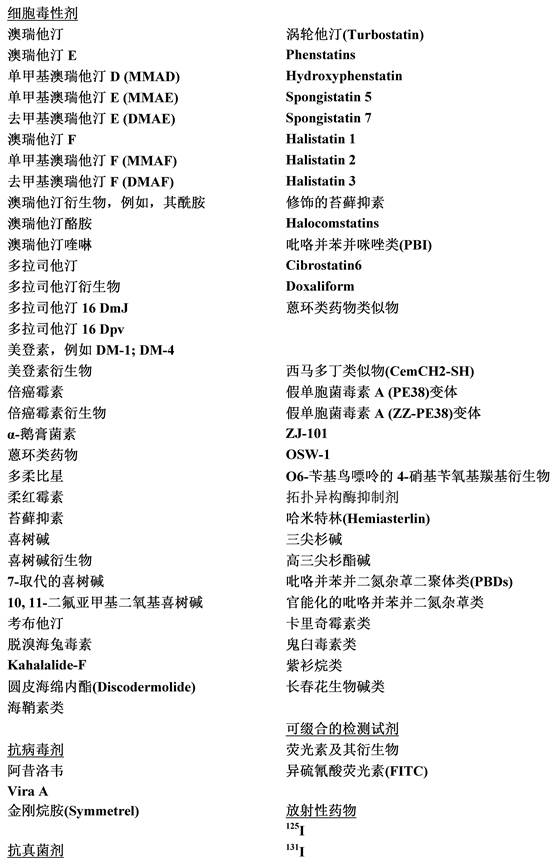

本领域普通技术人员将认识到,很多可能的部分可与本发明所得的抗体偶联。(参见例如“Conjugate Vaccines”, Contributions to Microbiology and Immunology, J.M. Cruse和R. E. Lewis, Jr (编辑), Carger Press, New York, (1989),其完整内容通过引用并入本文)。Those of ordinary skill in the art will recognize that there are many possible moieties that can be conjugated to the resulting antibodies of the invention. (See, e.g., "Conjugate Vaccines", Contributions to Microbiology and Immunology, J.M. Cruse and R. E. Lewis, Jr (eds.), Carger Press, New York, (1989), the entire contents of which are incorporated herein by reference).
偶联可通过结合两个分子的任何化学反应进行,只要抗体和另一部分保持它们各自的活性。该键可包括许多化学机制,例如共价结合、亲和力结合、嵌入、配位结合和络合。然而在一些实施方案中,结合是共价结合。共价结合可通过现有侧链的直接缩合或通过并入外部的桥接分子实现。许多二价或多价连接剂可用于将蛋白分子,诸如本发明的抗体,与其他分子偶联。例如,代表性的偶联剂可包括有机化合物,诸如硫代酸酯、碳二亚胺、琥珀酰亚胺酯、二异氰酸酯、戊二醛、重氮苯和六亚甲基二胺。该列表不意欲穷尽本领域已知的各种类别的偶联剂,而是较常见偶联剂的例示。(参见Killen和Lindstrom, Jour. Immun.133:1335-2549 (1984); Jansen等人, Immunological Reviews 62:185-216 (1982);和Vitetta等人, Science 238:1098 (1987)。Conjugation can be performed by any chemical reaction that binds two molecules, so long as the antibody and the other moiety retain their respective activities. This bond can involve many chemical mechanisms such as covalent bonding, affinity bonding, intercalation, coordinate bonding and complexation. In some embodiments, however, the binding is covalent. Covalent attachment can be achieved by direct condensation of existing side chains or by incorporation of external bridging molecules. A variety of divalent or multivalent linking agents are available for coupling protein molecules, such as antibodies of the invention, to other molecules. For example, representative coupling agents may include organic compounds such as thioesters, carbodiimides, succinimidyl esters, diisocyanates, glutaraldehyde, diazobenzene, and hexamethylenediamine. This list is not intended to be exhaustive of the various classes of coupling agents known in the art, but rather is an illustration of the more common coupling agents. (See Killen and Lindstrom, Jour. Immun. 133:1335-2549 (1984); Jansen et al., Immunological Reviews 62:185-216 (1982); and Vitetta et al., Science 238:1098 (1987).
在一些实施方案中,除了本文提供的组合物和方法以外,缀合的可活化抗体还可通过插入或以其他方式包括在可活化抗体序列中的修饰的氨基酸序列,经修饰用于位点特异性缀合。这些修饰的氨基酸序列经设计以允许在缀合的可活化抗体内受控的放置和/或给药缀合的试剂。例如,可活化抗体可经工程改造以在轻链和重链的位置上包括半胱氨酸取代,其提供反应性巯基和不负面影响蛋白折叠和装配,也不改变抗原结合。在一些实施方案中,可活化抗体可经工程改造以在可活化抗体内包括或以其他方式引入一个或多个非天然氨基酸残基,以提供用于缀合的合适位点。在一些实施方案中,可活化抗体可经工程改造以在可活化抗体序列内包括或以其他方式经酶促引入可活化肽序列。In some embodiments, in addition to the compositions and methods provided herein, the conjugated activatable antibodies can also be modified for site-specificity by inserting or otherwise including a modified amino acid sequence within the sequence of the activatable antibody. sexual conjugation. These modified amino acid sequences are designed to allow controlled placement and/or administration of the conjugated agent within the conjugated activatable antibody. For example, activatable antibodies can be engineered to include cysteine substitutions at light and heavy chain positions that provide reactive sulfhydryl groups and do not adversely affect protein folding and assembly, nor alter antigen binding. In some embodiments, an activatable antibody can be engineered to include or otherwise introduce one or more unnatural amino acid residues within the activatable antibody to provide a suitable site for conjugation. In some embodiments, an activatable antibody can be engineered to include or otherwise enzymatically introduce an activatable peptide sequence within the activatable antibody sequence.
合适的接头描述于文献中(参见例如Ramakrishnan, S.等人, Cancer Res. 44:201-208 (1984),描述使用MBS (M-马来酰亚胺基苯甲酰基-N-羟基琥珀酰亚胺酯)。也参见美国专利号5,030,719,描述使用通过寡肽接头与抗体偶联的卤代乙酰基酰肼衍生物。在一些实施方案中,合适的接头包括:(i) EDC (1-乙基-3-(3-二甲基氨基-丙基)碳化二亚胺盐酸盐;(ii) SMPT (4-琥珀酰亚胺基氧基羰基-α-甲基-α-(2-吡啶基-二巯基)-甲苯(PierceChem. Co., 目录号(21558G);(iii) SPDP (琥珀酰亚胺基-6 [3-(2-吡啶基二巯基)丙酰胺基]己酸酯(Pierce Chem. Co., 目录号21651G);(iv) 磺基-LC-SPDP (磺基琥珀酰亚胺基6 [3-(2-吡啶基二巯基)-丙酰胺]己酸酯(Pierce Chem. Co. 目录号2165-G);和(v)与EDC缀合的磺基-NHS (N-羟基磺基-琥珀酸亚胺: Pierce Chem. Co., 目录号24510)。额外的接头包括但不限于SMCC ((琥珀酰亚胺基4-(N-马来酰亚胺基甲基)环己烷-1-甲酸酯)、磺基-SMCC(磺基琥珀酰亚胺基4-(N-马来酰亚胺基甲基)环己烷-1-甲酸酯)、SPDB (N-琥珀酰亚胺基-4-(2-吡啶基二硫基)丁酸酯)或磺基-SPDB (N-琥珀酰亚胺基-4-(2-吡啶基二硫基)-2-磺基丁酸酯)。Suitable linkers are described in the literature (see for example Ramakrishnan, S. et al., Cancer Res. 44:201-208 (1984), describing the use of MBS (M-maleimidobenzoyl-N-hydroxysuccinyl imidate). See also U.S. Patent No. 5,030,719 describing the use of haloacetylhydrazide derivatives coupled to antibodies via oligopeptide linkers. In some embodiments, suitable linkers include: (i) EDC (1- Ethyl-3-(3-dimethylamino-propyl)carbodiimide hydrochloride; (ii) SMPT (4-succinimidyloxycarbonyl-α-methyl-α-(2- Pyridyl-dimercapto)-toluene (PierceChem. Co., Cat. No. (21558G); (iii) SPDP (succinimidyl-6 [3-(2-pyridyldimercapto)propionamido]hexanoate (Pierce Chem. Co., catalog number 21651G); (iv) sulfo-LC-SPDP (sulfosuccinimidyl 6 [3-(2-pyridyldithiol)-propionamide] hexanoate (Pierce Chem. Co. Cat. No. 2165-G); and (v) sulfo-NHS (N-hydroxysulfo-succinimidyl: Pierce Chem. Co., Cat. No. 24510) conjugated to EDC. Additional Linkers Including but not limited to SMCC ((succinimidyl 4-(N-maleimidomethyl)cyclohexane-1-carboxylate), sulfo-SMCC (sulfosuccinimidyl 4 -(N-maleimidomethyl)cyclohexane-1-carboxylate), SPDB (N-succinimidyl-4-(2-pyridyldithio)butyrate) or Sulfo-SPDB (N-succinimidyl-4-(2-pyridyldithio)-2-sulfobutyrate).
上述接头含有具有不同属性的元件,因此产生具有不同物理化学性质的缀合物。例如,羧酸烷酯的磺基-NHS酯比芳族羧酸酯的磺基-NHS酯更稳定。含有NHS-酯的接头比磺基-NOS酯更难溶解。此外,接头SMPT含有空间阻碍的二硫键,且可形成具有增加的稳定性的缀合物。二硫键通常比其他键更不稳定,因为二硫键被体外切割,导致较少的可获得缀合物。具体地,磺基-NHS可以增强碳二亚胺偶联的稳定性。当与磺基-NHS结合使用时,碳二亚胺偶联物(诸如EDC)形成比单独的碳二亚胺偶联反应更耐受水解的酯。The linkers described above contain elements with different properties, thus resulting in conjugates with different physicochemical properties. For example, sulfo-NHS esters of alkyl carboxylates are more stable than sulfo-NHS esters of aromatic carboxylates. Linkers containing NHS-esters are more insoluble than sulfo-NOS esters. Furthermore, the linker SMPT contains sterically hindered disulfide bonds and can form conjugates with increased stability. Disulfide bonds are generally less stable than other bonds because disulfide bonds are cleaved in vitro, resulting in fewer available conjugates. Specifically, sulfo-NHS can enhance the stability of carbodiimide coupling. When used in combination with sulfo-NHS, carbodiimide conjugates such as EDC form esters that are more resistant to hydrolysis than the carbodiimide coupling reaction alone.
在一些实施方案中,接头是可切割的。在一些实施方案中,接头是不可切割的。在一些实施方案中,存在两个或更多个接头。所述两个或更多个接头全都相同,即,是可切割的或不可切割的,或所述两个或更多个接头是不同的,即,至少一个可切割且至少一个不可切割。In some embodiments, linkers are cleavable. In some embodiments, the linker is non-cleavable. In some embodiments, two or more linkers are present. The two or more linkers are all the same, ie, are cleavable or non-cleavable, or the two or more linkers are different, ie, at least one is cleavable and at least one is not.
本发明利用几种方法来将试剂连接至AB:(a) 连接至AB的碳水化合物部分,或(b)连接至AB的巯基,或(c) 连接至AB的氨基,或(d) 连接至AB的羧酸基团。根据本发明,AB可通过具有至少两个反应性基团的中间体接头共价连接至试剂,一个基团与AB反应和一个基团与所述试剂反应。可包括任何相容的有机化合物的接头可经选择使得与AB (或试剂)的反应不会不利地影响AB的反应性和选择性。此外,连接接头至试剂,可能不破坏试剂的活性。对于与氧化的抗体或氧化的抗体片段反应,合适的接头包括含有胺的那些,所述胺选自伯胺、仲胺、肼、酰肼、羟胺、苯肼、氨基脲和氨基硫脲基团。这样的反应性官能团可作为接头结构的部分存在,或可通过不含这样的基团的接头的合适化学修饰引入。The present invention utilizes several methods to attach reagents to AB: (a) to a carbohydrate moiety of AB, or (b) to a sulfhydryl group of AB, or (c) to an amino group of AB, or (d) to a The carboxylic acid group of AB. According to the present invention, AB can be covalently linked to a reagent via an intermediate linker having at least two reactive groups, one reactive with AB and one reactive with the reagent. The linker, which can comprise any compatible organic compound, can be selected such that reaction with the AB (or reagent) does not adversely affect the reactivity and selectivity of the AB. Furthermore, attaching a linker to a reagent may not destroy the activity of the reagent. For reactions with oxidized antibodies or oxidized antibody fragments, suitable linkers include those containing amines selected from the group consisting of primary, secondary, hydrazine, hydrazide, hydroxylamine, phenylhydrazine, semicarbazide and thiosemicarbazide groups . Such reactive functional groups may be present as part of the linker structure, or may be introduced by suitable chemical modification of linkers that do not contain such groups.
根据本发明,用于连接至还原的AB的合适的接头包括具有能够与还原抗体或片段的巯基反应的某些反应性基团的那些。这样的反应性基团包括但不限于:反应性卤代烷基(包括例如,卤代乙酰基)、对汞基苯甲酸基团和能够Michael-型加成反应的基团(包括例如,马来酰亚胺和Mitra和Lawton, 1979, J. Amer. Chem. Soc. 101: 3097-3110描述的类型的基团)。According to the invention, suitable linkers for attachment to reduced ABs include those with certain reactive groups capable of reacting with the sulfhydryl groups of the reduced antibody or fragment. Such reactive groups include, but are not limited to, reactive haloalkyl groups (including, for example, haloacetyl groups), p-mercurylbenzoic acid groups, and groups capable of Michael-type addition reactions (including, for example, maleyl imines and groups of the type described by Mitra and Lawton, 1979, J. Amer. Chem. Soc. 101: 3097-3110).
根据本发明,用于连接至非氧化也非还原的Ab的合适的接头包括具有能够与存在于Ab的未经修饰的赖氨酸残基中的伯氨基反应的某些官能团的那些。这样的反应性基团包括但不限于NHS羧酸或碳酸酯、磺基-NHS羧酸或碳酸酯、4-硝基苯基羧酸或碳酸酯、五氟苯基羧酸或碳酸酯、酰基咪唑、异氰酸酯和异硫氰酸酯。According to the present invention, suitable linkers for attachment to Abs that are neither oxidized nor reduced include those with certain functional groups capable of reacting with primary amino groups present in unmodified lysine residues of the Ab. Such reactive groups include, but are not limited to, NHS carboxylic acid or carbonate, sulfo-NHS carboxylic acid or carbonate, 4-nitrophenyl carboxylic acid or carbonate, pentafluorophenyl carboxylic acid or carbonate, acyl Imidazoles, isocyanates and isothiocyanates.
根据本发明,用于连接至非氧化也非还原的Ab的合适的接头包括具有能够与存在于Ab的天冬氨酸或谷氨酸残基中的羧酸基团反应的某些官能团的那些,所述羧酸基团已被合适的试剂活化。合适的活化试剂包括EDC (具有或不具有加入的NHS或磺基-NHS)和用于羧酰胺形成的其他脱水剂。这些实例中,存在于合适的接头中的官能团包括伯胺和仲胺、肼、羟胺和酰肼。According to the present invention, suitable linkers for attachment to Abs that are neither oxidized nor reduced include those with certain functional groups capable of reacting with the carboxylic acid groups present in the aspartic or glutamic acid residues of the Ab , the carboxylic acid group has been activated with a suitable reagent. Suitable activating reagents include EDC (with or without added NHS or sulfo-NHS) and other dehydrating agents for carboxamide formation. Among these examples, functional groups present in suitable linkers include primary and secondary amines, hydrazine, hydroxylamine, and hydrazide.
所述试剂可在接头与AB连接之前或之后与接头连接。在某些应用中,首先产生AB-接头中间体可能是需要的,其中接头不包含相关的试剂。根据具体的应用,特定的试剂可然后与接头共价连接。在一些实施方案中,AB首先与MM、CM和相关的接头连接,且然后与用于缀合目的的接头连接。The reagent can be attached to the linker before or after the linker is attached to AB. In some applications, it may be desirable to first generate an AB-linker intermediate, where the linker does not contain the relevant reagents. Depending on the particular application, specific reagents can then be covalently attached to the linker. In some embodiments, AB is first attached to MM, CM and associated linkers, and then to linkers for conjugation purposes.
分支接头:在特定的实施方案中,利用具有多个试剂连接位点的分支接头。对于多位点接头,与AB的单一共价连接将产生能够在多个位点上结合试剂的AB-接头中间体。所述位点可以是醛基团或巯基或试剂可连接的任何化学位点。 Branched adapters: In certain embodiments, branched adapters with multiple reagent attachment sites are utilized. For multisite linkers, a single covalent attachment to AB will result in an AB-linker intermediate capable of binding reagents at multiple sites. The site can be an aldehyde group or a sulfhydryl group or any chemical site to which a reagent can be attached.
在一些实施方案中,通过在AB的多个位点上连接单一位点接头,可获得较高的特异活性(或较高的试剂:AB比)。通过两种方法的任一种,该多个位点可引入AB中。第一,可在同一AB上产生多个醛基团和/或巯基。第二,可连接AB的醛或巯基与具有用于随后连接接头的多个功能位点的"分支接头"。分支接头或多位点接头的功能位点可以是醛基团或巯基,或可以是接头可连接的任何化学位点。还更高的特异活性可通过组合这两种方法获得,即在AB的数个位点上连接多位点接头。In some embodiments, higher specific activity (or higher reagent:AB ratio) can be obtained by attaching single-site linkers at multiple sites on AB. The multiple sites can be introduced into the AB by either of two methods. First, multiple aldehyde groups and/or sulfhydryl groups can be generated on the same AB. Second, the aldehyde or sulfhydryl group of AB can be linked to a "branch linker" with multiple functional sites for subsequent linker attachment. The functional site of a branch linker or multisite linker can be an aldehyde group or a sulfhydryl group, or can be any chemical site to which a linker can attach. Still higher specific activity can be obtained by combining these two approaches, ie attaching a multisite linker at several positions of AB.
可切割的接头:在本发明的一个实施方案中,可使用易于被补体系统的酶(诸如但不限于u-纤溶酶原激活物、组织纤溶酶原激活物、胰蛋白酶、纤溶酶或具有蛋白水解活性的另一种酶)切割的肽接头。根据本发明的一种方法,试剂经由对补体切割敏感的接头连接。抗体选自可活化补体的类别。因此,抗体-试剂缀合物活化补体级联且在靶标位点上释放试剂。根据本发明的另一种方法,试剂经由易于被具有蛋白水解活性的酶(例如u-纤溶酶原激活物、组织纤溶酶原激活物、纤溶酶或胰蛋白酶)切割的接头连接。这些可切割的接头可用于缀合的可活化抗体,其包括胞外毒素,例如通过非限制性实例的方式的表5中所示的任何胞外毒素。 Cleavable Linkers: In one embodiment of the invention, enzymes susceptible to complement system such as but not limited to u-plasminogen activator, tissue plasminogen activator, trypsin, plasmin or another enzyme with proteolytic activity) cleaved peptide linker. According to one method of the invention, the reagents are linked via a linker sensitive to complement cleavage. Antibodies are selected from a class that activates complement. Thus, the antibody-agent conjugate activates the complement cascade and releases the agent at the target site. According to another method of the invention, the reagents are linked via a linker that is susceptible to cleavage by an enzyme with proteolytic activity, such as u-plasminogen activator, tissue plasminogen activator, plasmin or trypsin. These cleavable linkers can be used in conjugated activatable antibodies that include extracellular toxins, such as any of the extracellular toxins shown in Table 5, by way of non-limiting example.
可切割的接头序列的非限制性实例提供于表6中。Non-limiting examples of cleavable linker sequences are provided in Table 6.
表6:用于缀合的示例性接头序列Table 6: Exemplary Linker Sequences for Conjugation


此外,试剂可经由二硫键(例如半胱氨酸分子上的二硫键)与AB连接。因为许多肿瘤天然释放高水平的谷胱甘肽(还原剂),所以这可还原二硫键,随后在递送位点上释放试剂。在一些实施方案中,修饰CM的还原剂也将修饰缀合的可活化抗体的接头。In addition, the reagent can be linked to AB via a disulfide bond, such as a disulfide bond on a cysteine molecule. Since many tumors naturally release high levels of glutathione (reducing agent), this can reduce the disulfide bond and subsequently release the agent at the site of delivery. In some embodiments, a reducing agent that modifies the CM will also modify the linker of the conjugated activatable antibody.
间隔区和可切割的元件:在一些实施方案中,以使得优化试剂和可活化抗体的AB之间的间隔的方式构建接头可能是必需的。这可通过使用以下通式结构的接头实现: Spacer and cleavable elements : In some embodiments, it may be necessary to construct the linker in such a way that the spacing between the reagent and the AB of the activatable antibody is optimized. This can be achieved by using a linker of the general structure:
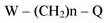
其中in
W是--NH--CH2--或--CH2--;W is --NH-- CH2-- or --CH2-- ;
Q是氨基酸、肽;且Q is an amino acid, peptide; and
n是0-20的整数。n is an integer of 0-20.
在一些实施方案中,接头可包含间隔区元件和可切割的元件。间隔区元件用于定位可切割的元件远离AB的核心,使得可切割的元件更易接近负责切割的酶。上述的某些分支接头可用作间隔区元件。In some embodiments, a linker may comprise a spacer element and a cleavable element. A spacer element is used to position the cleavable element away from the core of the AB, making the cleavable element more accessible to the enzyme responsible for cleavage. Some of the branch linkers described above can be used as spacer elements.
在整个讨论中,应理解接头与试剂(或间隔区元件与可切割的元件、或可切割的元件与试剂)的连接不需要是特定的连接或反应模式。提供具有合适的稳定性和生物相容性的产物的任何反应都是可接受的。Throughout this discussion, it will be understood that the linkage of a linker to a reagent (or a spacer element to a cleavable element, or a cleavable element to a reagent) need not be a specific mode of linkage or reaction. Any reaction that provides a product with suitable stability and biocompatibility is acceptable.
血清补体和接头选择:根据本发明的一种方法,当需要试剂释放时,使用作为可活化补体的类型的抗体的AB。所得缀合物同时保留结合抗原和活化补体级联的能力。因此,根据本发明的该实施方案,试剂连接可切割的接头或可切割的元件的一个末端,且接头基团的另一末端与AB上的特定位点连接。例如,如果试剂具有羟基或氨基,其可与肽、氨基酸或其他合适选择的接头的羧基末端分别经由酯或酰胺键连接。例如,这样的试剂可与接头肽经由碳二亚胺反应连接。如果试剂含有会干涉接头连接的官能团,这些干涉官能团可在连接之前被封闭且在产物缀合物或中间体制备后解封闭。接头的相对或氨基端然后直接或在进一步修饰后用于结合能够活化补体的AB。 Serum Complement and Adapter Selection : According to one method of the invention, when reagent release is desired, AB is used as an antibody of the type that can activate complement. The resulting conjugates retain both the ability to bind antigen and activate the complement cascade. Thus, according to this embodiment of the invention, the reagent is attached to one end of the cleavable linker or cleavable element, and the other end of the linker group is attached to a specific site on the AB. For example, if the reagent has a hydroxyl or amino group, it may be linked to the carboxyl terminus of a peptide, amino acid or other suitably chosen linker via an ester or amide bond, respectively. For example, such reagents can be attached to a linker peptide via a carbodiimide reaction. If reagents contain functional groups that would interfere with linker attachment, these interfering functional groups can be blocked prior to attachment and unblocked after preparation of the product conjugate or intermediate. The opposite or amino terminus of the linker is then used directly or after further modification to bind an AB capable of activating complement.
接头(或接头的间隔区元件)可具有任何需要的长度,其一个末端可与可活化抗体的AB的特定位点共价连接。接头或间隔区元件的另一末端可与氨基酸或肽接头连接。The linker (or the spacer element of the linker) can be of any desired length and one end of which can be covalently linked to a specific site on the AB of the activatable antibody. The other end of the linker or spacer element can be joined to an amino acid or peptide linker.
因此,当这些缀合物在补体的存在下结合抗原时,连接试剂与接头的酰胺或酯键将被切割,导致释放呈其活性形式的试剂。这些缀合物当施用于主体时,将在靶标位点上实现试剂的递送和释放,且对于药剂、抗生素、抗代谢物、抗增殖药等(如在表5中(但不限于此)提供的那些)的体内递送特别有效。Thus, when these conjugates bind antigen in the presence of complement, the amide or ester bond linking the reagent to the linker will be cleaved, resulting in release of the reagent in its active form. These conjugates, when administered to a subject, will effect delivery and release of the agent at the target site and are useful for agents, antibiotics, antimetabolites, antiproliferatives, etc. (as provided in, but not limited to, Table 5) In vivo delivery of those) is particularly effective.
用于无补体活化下的释放的接头:在靶向递送的又一种应用中,无补体活化的试剂释放是需要的,因为补体级联的活化将最终溶解靶细胞。因此,当试剂的递送和释放应在不杀死靶细胞的情况下实现时该方法是有用的。这是当需要递送细胞介质诸如激素、酶、皮质类固醇、神经递质、基因或酶至靶细胞时的目标。这些缀合物可通过将试剂与不能活化补体的AB经由接头连接制备,所述接头对通过血清蛋白酶的切割轻度敏感。当将该缀合物施用于个体时,抗原-抗体复合物将快速形成,而试剂的切割将缓慢发生,因此导致在靶标位点上释放化合物。 Linker for release without complement activation: In yet another application of targeted delivery, release of the agent without complement activation is desired since activation of the complement cascade will ultimately lyse the target cell. Therefore, this method is useful when the delivery and release of the agent should be achieved without killing the target cells. This is the goal when it is desired to deliver cellular mediators such as hormones, enzymes, corticosteroids, neurotransmitters, genes or enzymes to target cells. These conjugates can be prepared by linking the reagent to an AB that is incapable of activating complement via a linker that is mildly sensitive to cleavage by serum proteases. When the conjugate is administered to an individual, the antigen-antibody complex will form rapidly, while cleavage of the reagent will occur slowly, thus resulting in release of the compound at the target site.
生物化学交叉接头:在一些实施方案中,使用某些生物化学交叉接头,可活化抗体可与一种或多种治疗剂缀合。交叉连接试剂形成分子桥,其将两个不同分子的官能团系在一起。为了以逐步方式连接两个不同的蛋白,可使用杂-双官能交叉-接头,其排除不需要的均聚物形成。 Biochemical cross-linkers : In some embodiments, an activatable antibody can be conjugated to one or more therapeutic agents using certain biochemical cross-linkers. Cross-linking reagents form molecular bridges that tie together functional groups of two different molecules. In order to link two different proteins in a stepwise manner, a hetero-bifunctional cross-linker can be used, which precludes unwanted homopolymer formation.
还可使用通过溶酶体蛋白酶可切割的肽基接头,例如Val-Cit、Val-Ala或其他二肽。此外,可使用在溶酶体的低pH环境中可切割的酸不稳定性接头,例如:双-唾液酸醚。其他合适的接头包括组织蛋白酶不稳定性底物,特别是在酸性pH下显示最佳功能的那些。Peptidyl linkers cleavable by lysosomal proteases such as Val-Cit, Val-Ala or other dipeptides may also be used. In addition, acid-labile linkers that are cleavable in the low pH environment of the lysosome, such as bis-sialyl ethers, can be used. Other suitable linkers include cathepsin labile substrates, especially those that exhibit optimal function at acidic pH.
示例性的杂-双官能交叉-接头在表7中提及。Exemplary hetero-bifunctional cross-linkers are mentioned in Table 7.
表7:示例性的杂-双官能交叉接头Table 7: Exemplary hetero-bifunctional cross-linkers

不可切割的接头或直接连接:在本发明的一些实施方案中,缀合物可经设计,使得所述试剂被递送至靶标而不释放。这可通过将试剂与AB直接或经由不可切割的接头连接实现。 Non-cleavable linker or direct linkage : In some embodiments of the invention, the conjugate can be designed such that the agent is delivered to the target without being released. This can be achieved by linking the reagent to the AB either directly or via a non-cleavable linker.
这些不可切割的接头可包括氨基酸、肽、D-氨基酸或可经修饰以包括可随后用于通过本文所述的方法连接AB的官能团的其他有机化合物。这样的有机接头的通式可以是These non-cleavable linkers can include amino acids, peptides, D-amino acids, or other organic compounds that can be modified to include functional groups that can then be used to link AB by the methods described herein. The general formula of such an organic linker can be

其中in
W是--NH--CH2--或--CH2--;W is --NH-- CH2-- or --CH2-- ;
Q是氨基酸、肽;且Q is an amino acid, peptide; and
n是0-20的整数。n is an integer of 0-20.
不可切割的缀合物:在一些实施方案中,化合物可与不活化补体的AB连接。当使用不能补体活化的AB时,该连接可使用对活化的补体的切割敏感的接头或使用对活化的补体的切割不敏感的接头来实现。 Non-cleavable conjugates : In some embodiments, a compound can be linked to an AB that does not activate complement. When using an AB that is incapable of complement activation, this linkage can be accomplished using a linker that is sensitive to cleavage by activated complement or using a linker that is insensitive to cleavage by activated complement.
本文公开的抗体还可被配制为免疫脂质体。含有抗体的脂质体通过本领域已知的方法制备,诸如Epstein等人, Proc. Natl. Acad. Sci. USA, 82: 3688 (1985); Hwang等人, Proc. Natl Acad. Sci. USA, 77: 4030 (1980);和美国专利号4,485,045和4,544,545中描述的方法。具有提高的循环时间的脂质体公开于美国专利号5,013,556。The antibodies disclosed herein can also be formulated as immunoliposomes. Antibody-containing liposomes are prepared by methods known in the art, such as Epstein et al., Proc. Natl. Acad. Sci. USA, 82: 3688 (1985); Hwang et al., Proc. Natl. Acad. Sci. USA, 77: 4030 (1980); and the methods described in US Patent Nos. 4,485,045 and 4,544,545. Liposomes with improved circulation time are disclosed in US Patent No. 5,013,556.
特别有用的脂质体可用包含磷脂酰胆碱、胆固醇和PEG-衍生的磷脂酰乙醇胺(PEG-PE)的脂质组合物通过反相蒸发方法产生。脂质体通过限定孔径的滤器挤出,以得到具有所需直径的脂质体。本发明的抗体的Fab’片段可按Martin等人, J. Biol. Chem.,257: 286-288 (1982)中所述,经由二硫化物交换反应与脂质体缀合。Particularly useful liposomes can be produced by the reverse phase evaporation method using a lipid composition comprising phosphatidylcholine, cholesterol and PEG-derivatized phosphatidylethanolamine (PEG-PE). Liposomes are extruded through filters of defined pore size to obtain liposomes with the desired diameter. Fab' fragments of antibodies of the invention can be conjugated to liposomes via a disulfide exchange reaction as described in Martin et al., J. Biol. Chem., 257: 286-288 (1982).
定义:definition:
除非另外定义,与本发明结合使用的科学和技术术语应具有本领域普通技术人员通常理解的含义。术语“一个/种(a)”实体或“一个/种(an)”实体是指该实体中的一个/种或多个/种。例如,化合物是指一种或多种化合物。因此,术语“一个/种(a)”、“一个/种(an)”、“一个/种或多个/种”和“至少一个/种”可以互换使用。此外,除非上下文另外要求,单数术语应包括复数且复数术语应包括单数。通常,与本文描述的细胞和组织培养、分子生物学和蛋白和寡核苷酸或多核苷酸化学和杂交结合使用的命名法及其技术是本领域众所周知和通常使用的那些。标准技术用于重组DNA、寡核苷酸合成和组织培养和转化(例如,电穿孔、脂转染)。酶促反应和纯化技术根据制造商的说明书或本领域通常实践或本文所述进行。前述技术和程序通常根据本领域众所周知的常规方法和如本说明书各处中引用和讨论的各种通用和较特定的参考文献中所述进行。参见例如,Sambrook等人Molecular Cloning: ALaboratory Manual (第2版, Cold Spring Harbor Laboratory Press, Cold SpringHarbor, N.Y. (1989))。与本文描述的分析化学、合成有机化学和医用和药用化学结合使用的命名法及其实验室程序和技术是本领域众所周知和通常使用的那些。标准技术用于化学合成、化学分析、药物制备、配制和递送,和治疗患者。Unless otherwise defined, scientific and technical terms used in connection with the present invention shall have the meanings commonly understood by those of ordinary skill in the art. The term "a" entity or "an" entity refers to one or more of that entity. For example, a compound refers to one or more compounds. Accordingly, the terms "a", "an", "one or more" and "at least one" may be used interchangeably. Further, unless otherwise required by context, singular terms shall include pluralities and plural terms shall include the singular. Generally, nomenclatures used in connection with, and techniques of, cell and tissue culture, molecular biology, and protein and oligo or polynucleotide chemistry and hybridization described herein are those well known and commonly used in the art. Standard techniques are used for recombinant DNA, oligonucleotide synthesis, and tissue culture and transformation (eg, electroporation, lipofection). Enzymatic reactions and purification techniques are performed according to manufacturer's specifications or as commonly practiced in the art or as described herein. The foregoing techniques and procedures are generally performed according to conventional methods well known in the art and as described in various general and more specific references that are cited and discussed throughout the present specification . See, eg, Sambrook et al. Molecular Cloning: A Laboratory Manual (2nd Ed., Cold Spring Harbor Laboratory Press, Cold Spring Harbor, NY (1989)). The nomenclature used in connection with, and the laboratory procedures and techniques of, analytical chemistry, synthetic organic chemistry, and medical and medicinal chemistry described herein are those well known and commonly used in the art. Standard techniques are used for chemical syntheses, chemical analyses, pharmaceutical preparation, formulation and delivery, and treatment of patients.
如根据本发明所用,除非另外说明,以下术语应理解具有以下含义:As used in accordance with the present invention, unless otherwise stated, the following terms shall be understood to have the following meanings:
如本文所用,术语“抗体”是指免疫球蛋白分子和免疫球蛋白(Ig)分子的免疫活性(例如抗原结合)部分,即,含有特异性结合抗原(与其免疫反应)的抗原结合位点的分子。“特异性结合”或“与…免疫反应”或“免疫特异性结合”意指抗体与所需抗原的一个或多个抗原决定簇反应和不与其他多肽反应或以低得多的亲和力结合(Kd > 10-6)。抗体包括但不限于多克隆抗体、单克隆抗体、嵌合抗体、结构域抗体、单链、Fab和F(ab')2片段、scFv和Fab表达文库。As used herein, the term "antibody" refers to immunoglobulin molecules and immunologically active (e.g., antigen-binding) portions of immunoglobulin (Ig) molecules, i.e., those containing an antigen-binding site that specifically binds (immunoreacts with) an antigen. molecular. "Specifically binds" or "immunoreacts with" or "immunospecifically binds" means that the antibody reacts with one or more epitopes of the desired antigen and does not react with other polypeptides or binds with much lower affinity ( K d > 10 −6 ). Antibodies include, but are not limited to, polyclonal antibodies, monoclonal antibodies, chimeric antibodies, domain antibodies, single chain, Fab and F(ab') 2 fragments, scFv and Fab expression libraries.
基础抗体结构单位已知包含四聚体。各四聚体由两个相同的多肽链对构成,每一对具有一个“轻”链(约25 kDa)和一个“重”链(约50-70 kDa)。各链的氨基末端部分包括约100-110或更多个氨基酸的可变区,其主要负责抗原识别。各链的羧基末端部分限定了恒定区,其主要负责效应子功能。通常,获得自人的抗体分子涉及类别IgG、IgM、IgA、IgE和IgD中的任一类别,它们彼此不同之处在于分子中存在的重链的性质。某些类别还具有亚类,诸如IgG1、IgG2和其他。此外,在人中,轻链可以是κ链或λ链。Basic antibody structural units are known to comprise tetramers. Each tetramer is composed of two identical pairs of polypeptide chains, each pair having one "light" chain (about 25 kDa) and one "heavy" chain (about 50-70 kDa). The amino-terminal portion of each chain includes a variable region of about 100-110 or more amino acids primarily responsible for antigen recognition. The carboxy-terminal portion of each chain defines a constant region primarily responsible for effector functions. In general, antibody molecules obtained from humans relate to any of the classes IgG, IgM, IgA, IgE and IgD, which differ from each other in the nature of the heavy chains present in the molecule. Certain classes also have subclasses, such as IgG 1 , IgG 2 and others. Also, in humans, the light chain can be a kappa chain or a lambda chain.
如本文所用的术语“单克隆抗体” (mAb)或“单克隆抗体组合物”,是指仅含有一个分子种类的抗体分子的抗体分子群,所述抗体分子由独特的轻链基因产物和独特的重链基因产物组成。具体而言,单克隆抗体的互补决定区(CDR)在所述群的所有分子中相同。MAb含有能够与抗原的特定表位起免疫反应的抗原结合位点,特征在于对其有独特的结合亲和力。The term "monoclonal antibody" (mAb) or "monoclonal antibody composition" as used herein refers to a population of antibody molecules containing only one molecular species of antibody molecules consisting of a unique light chain gene product and a unique heavy chain gene product composition. In particular, the complementarity determining regions (CDRs) of the monoclonal antibodies are the same in all molecules of the population. MAbs contain an antigen-binding site capable of immunoreacting with a specific epitope of an antigen for which they are characterized by a unique binding affinity.
术语“抗原结合位点”或“结合部分”是指免疫球蛋白分子的一部分,其涉及抗原结合。抗原结合位点由重(“H”)和轻(“L”)链的N-末端可变(“V”)区的氨基酸残基形成。在重链和轻链的V区内的三个高度不同的区段,被称为“高变区”,间插在称为“框架区”或“FR”的较保守的侧翼区段之间。因此,术语“FR”是指天然存在于免疫球蛋白的高变区之间并与其邻近的氨基酸序列。在抗体分子中,轻链的三个高变区和重链的三个高变区在三维空间中彼此相对排列,以形成抗原结合表面。抗原结合表面与结合的抗原的三维表面互补,重链和轻链各自的三个高变区被称为“互补决定区”或“CDR”。氨基酸在各结构域中的分配根据KabatSequences of Proteins of Immunological Interest (National Institutes ofHealth, Bethesda, Md. (1987和1991))或Chothia & Lesk J. Mol. Biol. 196:901-917(1987), Chothia等人Nature 342:878-883 (1989)中的定义来进行。The term "antigen combining site" or "binding portion" refers to the part of an immunoglobulin molecule that is involved in antigen binding. The antigen binding site is formed by the amino acid residues of the N-terminal variable ("V") regions of the heavy ("H") and light ("L") chains. Three highly distinct segments within the V regions of the heavy and light chains, termed "hypervariable regions", are interspersed between more conserved flanking segments termed "framework regions" or "FRs" . Thus, the term "FR" refers to the amino acid sequences naturally occurring between and adjacent to the hypervariable regions of immunoglobulins. In an antibody molecule, the three hypervariable regions of the light chain and the three hypervariable regions of the heavy chain are arranged relative to each other in three-dimensional space to form an antigen-binding surface. The antigen-binding surface is complementary to the three-dimensional surface of the bound antigen, and the three hypervariable regions of each of the heavy and light chains are referred to as "complementarity determining regions" or "CDRs". The assignment of amino acids in each domain is according to KabatSequences of Proteins of Immunological Interest (National Institutes of Health, Bethesda, Md. (1987 and 1991)) or Chothia & Lesk J. Mol. Biol. 196:901-917(1987), Chothia et al. Nature 342:878-883 (1989) defined.
如本文所用,术语“表位”包括能够特异性结合免疫球蛋白、scFv或T-细胞受体的任何蛋白决定簇。术语“表位”包括能够特异性结合免疫球蛋白或T-细胞受体的任何蛋白决定簇。表位决定簇通常由分子例如氨基酸或糖侧链的化学活性表面簇(groupings)组成,和通常具有特定的三维结构特征以及特定的电荷特征。例如,抗体可以针对多肽的N-末端或C-末端肽产生。当解离常数是≤ 1 µM;在一些实施方案中≤ 100 nM和在一些实施方案中≤ 10 nM时,认为抗体特异性结合抗原。As used herein, the term "epitope" includes any protein determinant capable of specifically binding an immunoglobulin, scFv or T-cell receptor. The term "epitope" includes any protein determinant capable of specifically binding to an immunoglobulin or T-cell receptor. Epitopic determinants usually consist of chemically active surface groupings of molecules such as amino acids or sugar side chains, and usually have specific three-dimensional structural characteristics as well as specific charge characteristics. For example, antibodies can be raised against the N-terminal or C-terminal peptide of a polypeptide. An antibody is considered to specifically bind an antigen when the dissociation constant is ≤ 1 µM; in some embodiments ≤ 100 nM and in some embodiments ≤ 10 nM.
如本文所用,术语“特异性结合”、“免疫结合”和“免疫结合性质”是指在免疫球蛋白分子和免疫球蛋白对其具有特异性的抗原之间形成的类型的非共价相互作用。免疫结合相互作用的强度或亲和力可表示为相互作用的解离常数(Kd),其中Kd越小表示亲和力越大。选择的多肽的免疫结合性质可使用本领域众所周知的方法定量。一个这样的方法要求测定抗原结合位点/抗原复合物形成和解离的速率,其中这些速率取决于复合物配偶体的浓度、相互作用的亲和力和在两个方向上同等影响速率的几何参数。因此,“结合速率常数” (Kon)和“解离速率常数” (Koff)可通过计算浓度和缔合和解离的实际速率来测定。(参见Nature361:186-87 (1993))。Koff /Kon之比使得能够消除与亲和力不相关的所有参数,且等于解离常数Kd。(一般参见Davies等人 (1990) Annual Rev Biochem 59:439-473)。当结合常数(Kd)是≤1 μM,在一些实施方案中≤ 100 nM,在一些实施方案中≤ 10 nM和在一些实施方案中≤ 100 pM至约1 pM时,认为本发明的抗体特异性结合靶标,如通过测定法诸如放射配体结合测定法或本领域技术人员已知的类似测定法所测量。As used herein, the terms "specific binding", "immunological binding" and "immunological binding property" refer to the type of non-covalent interaction formed between an immunoglobulin molecule and an antigen for which the immunoglobulin is specific . The strength or affinity of an immunobinding interaction can be expressed as the dissociation constant ( Kd ) of the interaction, where a smaller Kd indicates greater affinity. The immunological binding properties of selected polypeptides can be quantified using methods well known in the art. One such method entails determining the rates of antigen binding site/antigen complex formation and dissociation, where these rates depend on the concentration of complex partners, the affinity of the interaction, and geometric parameters that affect the rates equally in both directions. Thus, "on rate constants" (K on ) and "dissociation rate constants" (K off ) can be determined by calculating the concentrations and actual rates of association and dissociation. (See Nature 361:186-87 (1993)). The ratio K off /K on makes it possible to eliminate all parameters not related to affinity and is equal to the dissociation constant K d . (See generally Davies et al. (1990) Annual Rev Biochem 59:439-473). An antibody of the invention is considered specific when the binding constant ( Kd ) is ≤ 1 μM, in some embodiments ≤ 100 nM, in some embodiments ≤ 10 nM, and in some embodiments ≤ 100 pM to about 1 pM. Binding to the target as measured by an assay such as a radioligand binding assay or similar assays known to those skilled in the art.
如本文所用的术语“分离的多核苷酸”应意指基因组、cDNA或合成来源的多核苷酸,或其一些组合,根据其来源,“分离的多核苷酸” (1)不缔合“分离的多核苷酸”天然存在于其中的多核苷酸的全部或一部分,(2)与天然不与其连接的多核苷酸可操作连接,或(3)不作为较大序列的一部分天然存在。根据本发明的多核苷酸包括编码本文所示的重链免疫球蛋白分子的核酸分子,和编码本文所示的轻链免疫球蛋白分子的核酸分子。The term "isolated polynucleotide" as used herein shall mean a polynucleotide of genomic, cDNA or synthetic origin, or some combination thereof, depending on its source, an "isolated polynucleotide" (1) not associated with an "isolated polynucleotide" A polynucleotide"is all or a portion of a polynucleotide in which it occurs naturally, (2) is operably linked to a polynucleotide to which it is not naturally linked, or (3) does not occur naturally as part of a larger sequence. Polynucleotides according to the invention include nucleic acid molecules encoding the heavy chain immunoglobulin molecules set forth herein, and nucleic acid molecules encoding the light chain immunoglobulin molecules set forth herein.
本文提及的术语“分离的蛋白”意指cDNA、重组RNA或合成来源的蛋白或其一些组合,根据其来源或衍生源,“分离的蛋白” (1)不缔合天然存在的蛋白,(2)不含相同来源的其他蛋白,例如,不含鼠蛋白,(3)通过不同物种的细胞表达,或(4)不天然存在。The term "isolated protein" referred to herein means a protein of cDNA, recombinant RNA, or synthetic origin, or some combination thereof, according to its source or source of derivation, an "isolated protein" (1) not associated with a naturally occurring protein, ( 2) does not contain other proteins of the same origin, eg, does not contain murine proteins, (3) is expressed by cells of a different species, or (4) does not occur naturally.
本文作为通称使用的术语“多肽”是指具有多肽序列的天然蛋白、片段或类似物。因此,天然蛋白片段和类似物是多肽上位概念(genus)的下位概念(species)。根据本发明的多肽包含本文所示的重链免疫球蛋白分子和本文所示的轻链免疫球蛋白分子,以及由包含重链免疫球蛋白分子与轻链免疫球蛋白分子诸如κ轻链免疫球蛋白分子的组合(和反之亦然)形成的抗体分子以及其片段和类似物。The term "polypeptide" is used herein as a generic term to refer to a native protein, fragment or analog having a polypeptide sequence. Thus, native protein fragments and analogs are species that are subordinate to the genus of polypeptides. A polypeptide according to the invention comprises a heavy chain immunoglobulin molecule as indicated herein and a light chain immunoglobulin molecule as indicated herein, and a combination of a heavy chain immunoglobulin molecule and a light chain immunoglobulin molecule such as a kappa light chain immunoglobulin molecule Combinations of protein molecules (and vice versa) form antibody molecules as well as fragments and analogs thereof.
如本文所用的术语“天然存在的”在应用于物体时是指物体可天然存在的事实。例如,存在于生物体(包括病毒)中的、可自天然来源分离的和未在实验室中经人为有意修饰或以其他方式有意修饰的多肽或多核苷酸序列是天然存在的。As used herein, the term "naturally occurring" when applied to an object refers to the fact that the object can occur naturally. For example, a polypeptide or polynucleotide sequence that is present in an organism, including a virus, that can be isolated from a natural source and that has not been intentionally modified in the laboratory by man or otherwise is a naturally occurring polypeptide or polynucleotide sequence.
如本文所用的术语“可操作连接”是指所述组分的位置处于允许它们以其预期方式起作用的关系中。与编码序列“可操作连接”的控制序列以使得编码序列的表达在与控制序列相容的条件下实现的方式连接。The term "operably linked" as used herein means that the components described are positioned in a relationship permitting them to function in their intended manner. A control sequence "operably linked" to a coding sequence is ligated in such a way that expression of the coding sequence is achieved under conditions compatible with the control sequences.
如本文所用的术语“控制序列”是指实现与它们连接的编码序列的表达和加工所必需的多核苷酸序列。这样的控制序列的性质取决于宿主生物体而不同,在原核生物中这样的控制序列通常包括启动子、核糖体结合位点和转录终止序列,在真核生物中通常这样的控制序列包括启动子和转录终止序列。术语“控制序列”意欲最少包括其存在是表达和加工所必需的所有元件,和还可包括其存在是有利的其他元件,例如前导序列和融合物配偶体序列。本文提及的术语“多核苷酸”意指至少10个碱基长的核苷酸,为核糖核苷酸或脱氧核糖核苷酸或任一类型的核苷酸的修饰形式。该术语包括单链和双链形式的DNA。The term "control sequences" as used herein refers to polynucleotide sequences necessary to effect the expression and processing of the coding sequences to which they are linked. The nature of such control sequences varies depending on the host organism, in prokaryotes such control sequences typically include promoters, ribosomal binding sites, and transcription termination sequences, in eukaryotes typically such control sequences include promoters and transcription termination sequences. The term "control sequences" is intended to include at a minimum all elements whose presence is necessary for expression and processing, and may also include other elements whose presence is advantageous, such as leader sequences and fusion partner sequences. The term "polynucleotide" as referred to herein means a nucleotide of at least 10 bases in length, either ribonucleotide or deoxyribonucleotide or a modified form of either type of nucleotide. The term includes both single- and double-stranded forms of DNA.
本文提及的术语寡核苷酸包括通过天然存在的和非天然存在的寡核苷酸键(linkage)连接在一起的天然存在的和修饰的核苷酸。寡核苷酸是通常包含长度200个或更少的碱基的多核苷酸子集。在一些实施方案中,寡核苷酸是10-60个碱基长,且在一些实施方案中12、13、14、15、16、17、18、19或20-40个碱基长。寡核苷酸通常是单链的,例如对于探针,但寡核苷酸也可以是双链的,例如用于构建基因突变体。本发明的寡核苷酸为有义或反义寡核苷酸。The term oligonucleotide as referred to herein includes naturally occurring and modified nucleotides linked together by naturally occurring and non-naturally occurring oligonucleotide linkages. Oligonucleotides are a subset of polynucleotides generally comprising 200 bases or fewer in length. In some embodiments, oligonucleotides are 10-60 bases long, and in some
本文提及的术语“天然存在的核苷酸”包括脱氧核糖核苷酸和核糖核苷酸。本文提及的术语“修饰的核苷酸”包括具有修饰的或取代的糖基团等的核苷酸。本文提及的术语“寡核苷酸键”包括寡核苷酸键,诸如硫代磷酸酯、二硫代磷酸酯、硒代磷酸酯、二硒代磷酸酯、苯胺基硫代磷酸酯(phosphoroanilothioate)、苯胺磷酸酯(phosphoraniladate)、氨基磷酸酯(phosphoronmidate)等。参见例如,LaPlanche等人Nucl. Acids Res. 14:9081(1986); Stec等人 J. Am. Chem. Soc. 106:6077 (1984), Stein等人Nucl. Acids Res.16:3209 (1988), Zon等人Anti Cancer Drug Design 6:539 (1991); Zon等人Oligonucleotides and Analogues: A Practical Approach,第87-108页(F. Eckstein编辑, Oxford University Press, Oxford England (1991)); Stec等人美国专利号5,151,510; Uhlmann和Peyman Chemical Reviews 90:543 (1990)。如果需要,寡核苷酸可包括用于检测的标记。The term "naturally occurring nucleotides" referred to herein includes deoxyribonucleotides and ribonucleotides. The term "modified nucleotide" referred to herein includes nucleotides having modified or substituted sugar groups and the like. The term "oligonucleotide linkage" referred to herein includes oligonucleotide linkages such as phosphorothioate, phosphorodithioate, phosphoroselenoate, phosphorodiselenoate, phosphoroanilothioate ), phosphoraniladate, phosphoronmidate, etc. See, eg, LaPlanche et al. Nucl. Acids Res. 14:9081 (1986); Stec et al. J. Am. Chem. Soc. 106:6077 (1984), Stein et al. Nucl. Acids Res. 16:3209 (1988) , Zon et al. Anti Cancer Drug Design 6:539 (1991); Zon et al. Oligonucleotides and Analogues: A Practical Approach, pp. 87-108 (ed. F. Eckstein, Oxford University Press, Oxford England (1991)); Stec et al. US Patent No. 5,151,510; Uhlmann and Peyman Chemical Reviews 90:543 (1990). Oligonucleotides can include labels for detection, if desired.
如本文所用,20种常规氨基酸和其缩写按常规使用。参见Immunology - ASynthesis (第2版, E.S. Golub和D.R. Green编辑, Sinauer Associates, SunderlandMass. (1991))。20种常规氨基酸的立体异构体(例如,D-氨基酸)、非天然氨基酸例如α-,α-二取代的氨基酸、N-烷基氨基酸、乳酸和其他非常规氨基酸也可以是本发明的多肽的合适的组分。非常规氨基酸的实例包括:4羟基脯氨酸、γ-羧基谷氨酸、ε-N,N,N-三甲基赖氨酸、ε-N-乙酰基赖氨酸、O-磷酸丝氨酸、N-乙酰基丝氨酸、N-甲酰基甲硫氨酸、3-甲基组氨酸、5-羟基赖氨酸、σ-N-甲基精氨酸和其他类似的氨基酸和亚氨基酸(例如,4-羟基脯氨酸)。在本文使用的多肽符号中,根据标准用法和惯例,左手方向是氨基末端方向和右手方向是羧基末端方向。As used herein, the 20 conventional amino acids and their abbreviations are used conventionally . See Immunology - ASynthesis (2nd edition, edited by ES Golub and DR Green, Sinauer Associates, Sunderland Mass. (1991)). Stereoisomers of the 20 conventional amino acids (e.g., D-amino acids), unnatural amino acids such as α-, α-disubstituted amino acids, N-alkyl amino acids, lactic acid and other unconventional amino acids may also be polypeptides of the invention suitable components. Examples of unconventional amino acids include: 4-hydroxyproline, γ-carboxyglutamic acid, ε-N,N,N-trimethyllysine, ε-N-acetyllysine, O-phosphoserine, N-acetylserine, N-formylmethionine, 3-methylhistidine, 5-hydroxylysine, sigma-N-methylarginine, and other similar amino acids and imino acids (e.g., 4-hydroxyproline). In polypeptide notation used herein, the left-hand direction is the amino-terminal direction and the right-hand direction is the carboxy-terminal direction, according to standard usage and convention.
类似地,除非另外说明,单链多核苷酸序列的左手末端是5'端,双链多核苷酸序列的左手方向被称为5'方向。新生RNA转录物的5'至3'加入方向被称为转录方向,具有与RNA相同的序列的DNA链上且在RNA转录物的5'末端的5'处的序列区被称为“上游序列”,具有与RNA相同的序列的DNA链上且在RNA转录物的3'末端的3'处的序列区被称为“下游序列”。Similarly, unless otherwise stated, the left-hand end of a single-stranded polynucleotide sequence is the 5' end, and the left-hand direction of a double-stranded polynucleotide sequence is referred to as the 5' direction. The direction of 5' to 3' addition of nascent RNA transcripts is called the direction of transcription, and the sequence region on the DNA strand that has the same sequence as the RNA and is 5' from the 5' end of the RNA transcript is called the "upstream sequence". ", the region of sequence on the DNA strand that has the same sequence as the RNA and is 3' to the 3' end of the RNA transcript is referred to as the "downstream sequence".
应用于多肽时,术语“基本同一性”意指,两个肽序列当诸如通过程序GAP或BESTFIT使用默认的空位权重最佳比对时,共有至少80%的序列同一性,在一些实施方案中,共有至少90%的序列同一性,在一些实施方案中共有至少95%的序列同一性,和在一些实施方案中共有至少99%的序列同一性。When applied to polypeptides, the term "substantial identity" means that two peptide sequences share at least 80% sequence identity when optimally aligned, such as by the programs GAP or BESTFIT using default gap weights, and in some embodiments , share at least 90% sequence identity, in some embodiments share at least 95% sequence identity, and in some embodiments share at least 99% sequence identity.
在一些实施方案中,不相同的残基位置因保守氨基酸取代而不同。In some embodiments, residue positions that are not identical differ by conservative amino acid substitutions.
如本文所讨论,抗体或免疫球蛋白分子的氨基酸序列的较少变化预期包括在本发明中,条件是氨基酸序列中的所述变化保持至少75%,在一些实施方案中至少80%、90%、95%,和在一些实施方案中99%。具体而言,预期保守氨基酸替换。保守替换是在其侧链上相关的氨基酸家族中发生的那些。遗传编码氨基酸通常分为以下家族:(1)酸性氨基酸是天冬氨酸、谷氨酸;(2)碱性氨基酸是赖氨酸、精氨酸、组氨酸;(3)非极性氨基酸是丙氨酸、缬氨酸、亮氨酸、异亮氨酸、脯氨酸、苯丙氨酸、甲硫氨酸、色氨酸;和(4)不带电荷的极性氨基酸是甘氨酸、天冬酰胺、谷氨酰胺、半胱氨酸、丝氨酸、苏氨酸、酪氨酸。亲水氨基酸包括精氨酸、天冬酰胺、天冬氨酸、谷氨酰胺、谷氨酸、组氨酸、赖氨酸、丝氨酸和苏氨酸。疏水氨基酸包括丙氨酸、半胱氨酸、异亮氨酸、亮氨酸、甲硫氨酸、苯丙氨酸、脯氨酸、色氨酸、酪氨酸和缬氨酸。氨基酸的其他家族包括(i)丝氨酸和苏氨酸,其为脂肪族羟基家族;(ii)天冬酰胺和谷氨酰胺,其为含有酰胺的家族;(iii)丙氨酸、缬氨酸、亮氨酸和异亮氨酸,其为脂肪族的家族;和(iv)苯丙氨酸、色氨酸和酪氨酸,其为芳香族的家族。例如,可合理预期单独替换亮氨酸为异亮氨酸或缬氨酸、天冬氨酸为谷氨酸、苏氨酸为丝氨酸或类似替换氨基酸为结构相关的氨基酸,不将对所得分子的结合或性质具有主要影响,尤其是如果所述替换不涉及框架位点内的氨基酸。氨基酸变化是否产生功能肽可通过测定多肽衍生物的特定活性而容易地确定。本文详细描述了测定法。抗体或免疫球蛋白分子的片段或类似物可通过本领域普通技术人员容易地制备。合适的片段或类似物的氨基末端和羧基末端出现在功能结构域的边界附近。结构和功能结构域可通过将核苷酸和/或氨基酸序列数据与公开的或专有的序列数据库比较来鉴定。在一些实施方案中,计算机比较方法用于鉴定出现在具有已知结构和/或功能的其他蛋白中的序列基序或预测的蛋白构象结构域。鉴定折叠成已知三维结构的蛋白序列的方法是已知的。Bowie等人Science 253:164 (1991)。因此,前述实例证实,本领域技术人员可识别可用于定义根据本发明的结构和功能结构域的序列基序和结构构象。As discussed herein, minor variations in the amino acid sequence of an antibody or immunoglobulin molecule are contemplated to be encompassed in the invention provided that said variation in the amino acid sequence remains at least 75%, in some embodiments at least 80%, 90% , 95%, and in some embodiments 99%. In particular, conservative amino acid substitutions are contemplated. Conservative substitutions are those that occur within a family of amino acids that are related on their side chains. Genetically encoded amino acids are usually divided into the following families: (1) acidic amino acids are aspartic acid, glutamic acid; (2) basic amino acids are lysine, arginine, histidine; (3) nonpolar amino acids is alanine, valine, leucine, isoleucine, proline, phenylalanine, methionine, tryptophan; and (4) the uncharged polar amino acids are glycine, Asparagine, glutamine, cysteine, serine, threonine, tyrosine. Hydrophilic amino acids include arginine, asparagine, aspartic acid, glutamine, glutamic acid, histidine, lysine, serine, and threonine. Hydrophobic amino acids include alanine, cysteine, isoleucine, leucine, methionine, phenylalanine, proline, tryptophan, tyrosine, and valine. Other families of amino acids include (i) serine and threonine, which are aliphatic hydroxyl families; (ii) asparagine and glutamine, which are amide-containing families; (iii) alanine, valine, leucine and isoleucine, which are of the aliphatic family; and (iv) phenylalanine, tryptophan and tyrosine, which are of the aromatic family. For example, individual substitutions of leucine for isoleucine or valine, aspartic acid for glutamic acid, threonine for serine, or similarly substituted amino acids for structurally related amino acids would reasonably be expected without reference to the resulting molecule. Binding or properties have a major impact, especially if the substitution does not involve amino acids within framework sites. Whether an amino acid change results in a functional peptide can be readily determined by assaying the specific activity of the polypeptide derivative. The assay is described in detail herein. Fragments or analogs of antibody or immunoglobulin molecules can be readily prepared by one of ordinary skill in the art. The amino-terminus and carboxy-terminus of suitable fragments or analogs occur near the boundaries of functional domains. Structural and functional domains can be identified by comparison of the nucleotide and/or amino acid sequence data to published or proprietary sequence databases. In some embodiments, computer comparison methods are used to identify sequence motifs or predicted protein conformational domains that occur in other proteins of known structure and/or function. Methods for identifying protein sequences that fold into a known three-dimensional structure are known. Bowie et al. Science 253:164 (1991). Thus, the preceding examples demonstrate that a person skilled in the art can recognize sequence motifs and structural conformations that can be used to define structural and functional domains according to the invention.
合适的氨基酸取代为以下那些氨基酸取代,其:(1)降低对蛋白水解的敏感性,(2)降低对氧化的敏感性,(3)改变形成蛋白复合物的结合亲和力,(4)改变结合亲和力,和(5)赋予或修改这样的类似物的其他物理化学或功能性质。类似物可包括具有并非天然存在的肽序列的序列的各种突变型蛋白。例如,可在天然存在的序列中,例如在形成分子间接触的结构域外的多肽部分中进行单一或多个氨基酸取代(例如保守氨基酸取代)。保守氨基酸取代不应实质上改变亲本序列的结构特征(例如,替换氨基酸不应倾向于中断在亲本序列中出现的螺旋,或破坏亲本序列所特有的其他类型的二级结构)。本领域公认的多肽二级和三级结构的实例描述于Proteins, Structures and Molecular Principles (Creighton编辑, W. H. Freeman and Company, New York (1984)); Introduction to ProteinStructure (C. Branden和J. Tooze编辑, Garland Publishing, New York, N.Y.(1991));和Thornton等人Nature 354:105 (1991)。Suitable amino acid substitutions are those that: (1) decrease susceptibility to proteolysis, (2) decrease susceptibility to oxidation, (3) alter binding affinity for forming protein complexes, (4) alter binding Affinity, and (5) conferring or modifying other physicochemical or functional properties of such analogs. Analogs may include various mutant proteins having sequences other than the naturally occurring peptide sequence. For example, single or multiple amino acid substitutions (eg, conservative amino acid substitutions) may be made in naturally occurring sequences, eg, in portions of the polypeptide outside the domains that form intermolecular contacts. Conservative amino acid substitutions should not substantially alter the structural characteristics of the parental sequence (eg, the replacing amino acid should not tend to interrupt helices occurring in the parental sequence, or disrupt other types of secondary structure characteristic of the parental sequence). Examples of art-recognized secondary and tertiary structures of polypeptides are described in Proteins, Structures and Molecular Principles (Creighton, edited, W. H. Freeman and Company, New York (1984)); Introduction to Protein Structure (C. Branden and J. Tooze, edited, Garland Publishing, New York, N.Y. (1991)); and Thornton et al. Nature 354:105 (1991).
如本文所用的术语“多肽片段”是指具有氨基末端和/或羧基末端缺失和/或一个或多个内部缺失的多肽,但其中剩余的氨基酸序列与从例如全长cDNA序列中推断的天然存在的序列的相应的位置相同。片段通常为至少5、6、8或10个氨基酸长,在一些实施方案中至少14个氨基酸长,在一些实施方案中至少20个氨基酸长,通常至少50个氨基酸长,和在一些实施方案中至少70个氨基酸长。如本文所用的术语“类似物”是指由至少25个氨基酸的区段构成的多肽,所述区段与推断的氨基酸序列的一部分具有实质同一性和在合适的结合条件下与靶标特异性结合。通常,多肽类似物包含相对于天然存在的序列的保守氨基酸取代(或添加或缺失)。类似物通常为至少20个氨基酸长,在一些实施方案中至少50个氨基酸长或更长,和通常可与全长的天然存在的多肽一样长。The term "polypeptide fragment" as used herein refers to a polypeptide having an amino-terminal and/or carboxy-terminal deletion and/or one or more internal deletions, but wherein the remaining amino acid sequence is identical to that deduced from, for example, the full-length cDNA sequence as naturally occurring The corresponding position of the sequence is the same. Fragments are typically at least 5, 6, 8, or 10 amino acids long, in some embodiments at least 14 amino acids long, in some embodiments at least 20 amino acids long, usually at least 50 amino acids long, and in some embodiments At least 70 amino acids long. The term "analogue" as used herein refers to a polypeptide consisting of a segment of at least 25 amino acids that has substantial identity to a portion of the deduced amino acid sequence and that specifically binds a target under suitable binding conditions . Typically, polypeptide analogs comprise conservative amino acid substitutions (or additions or deletions) relative to the naturally occurring sequence. Analogs are typically at least 20 amino acids long, in some embodiments at least 50 amino acids long or longer, and typically can be as long as a full-length naturally occurring polypeptide.
术语“试剂”在本文用于表示化合物、化合物的混合物、生物大分子或自生物材料制备的提取物。The term "agent" is used herein to denote a compound, a mixture of compounds, a biological macromolecule or an extract prepared from a biological material.
如本文所用,术语“标记”或“标记的”是指并入可检测标记物,例如,通过并入放射性标记的氨基酸或与可通过标记的抗生物素蛋白(例如,含有可通过光学或量热方法检测的荧光标记或酶活性的链霉抗生物素蛋白)检测的生物素基部分的多肽连接。在某些情况下,标记或标记物也可以是治疗性的。标记多肽和糖蛋白的各种方法是本领域已知的且可被使用。用于多肽的标记的实例包括但不限于以下:放射性同位素或放射性核素(例如,3H、14C、15N、35S、90Y、99Tc、111In、125I、131I)、荧光标记(例如,FITC、若丹明、镧系元素磷光体)、酶标记(例如,辣根过氧化物酶、p-半乳糖苷酶、萤光素酶、碱性磷酸酶)、化学发光、生物素基团、被第二报告分子识别的预定的多肽表位(例如,亮氨酸拉链对序列、第二抗体的结合位点、金属结合结构域、表位标签)。在一些实施方案中,标记通过各种长度的间隔区臂连接以减少潜在的空间位阻。如本文所用的术语“药物或药品”是指当适当施用于患者时能够诱导所需的治疗效果的化合物或组合物。As used herein, the terms "label" or "labeled" refer to the incorporation of a detectable label, for example, by incorporation of a radioactively labeled amino acid or by incorporation of a labeled avidin (for example, containing Polypeptide linkage to a biotinyl moiety for detection by a fluorescent label for thermal detection or enzymatically active streptavidin). In certain instances, markers or markers can also be therapeutic. Various methods of labeling polypeptides and glycoproteins are known in the art and can be used. Examples of labels for polypeptides include, but are not limited to, the following: radioisotopes or radionuclides (eg, 3 H, 14 C, 15 N, 35 S, 90 Y, 99 Tc, 111 In, 125 I, 131 I), Fluorescent labels (e.g., FITC, rhodamine, lanthanide phosphors), enzymatic labels (e.g., horseradish peroxidase, p-galactosidase, luciferase, alkaline phosphatase), chemiluminescence , a biotin group, a predetermined polypeptide epitope recognized by a second reporter molecule (eg, a leucine zipper pair sequence, a binding site for a second antibody, a metal binding domain, an epitope tag). In some embodiments, labels are attached via spacer arms of various lengths to reduce potential steric hindrance. The term "drug or medicament" as used herein refers to a compound or composition capable of inducing a desired therapeutic effect when properly administered to a patient.
本文的其他化学术语根据本领域的常规用法使用,如由The McGraw-HillDictionary of Chemical Terms (Parker, S.编辑, McGraw-Hill, San Francisco(1985))所举例。Other chemical terms herein are used according to conventional usage in the art, as exemplified by The McGraw-Hill Dictionary of Chemical Terms (Parker, S. ed., McGraw-Hill, San Francisco (1985)).
如本文所用,“基本上纯的”意指对象种类是存在的主要种类(即,在摩尔基础上它比组合物中的任何其他个别种类更丰富),并且在一些实施方案中,基本上纯化的部分是其中对象种类占存在的所有大分子种类的至少约50% (在摩尔基础上)的组合物。As used herein, "substantially pure" means that the subject species is the predominant species present (i.e., it is more abundant on a molar basis than any other individual species in the composition), and in some embodiments, substantially purified The fraction is a composition wherein the subject species comprises at least about 50% (on a molar basis) of all macromolecular species present.
通常,基本上纯的组合物将包含组合物中存在的超过约80%的所有大分子种类,在一些实施方案中,超过约85%、90%、95%和99%。在一些实施方案中,对象种类纯化至基本均质(通过常规检测方法在组合物中不能检测到污染物种类),其中组合物基本上由单一大分子种类组成。Typically, a substantially pure composition will comprise greater than about 80% of all macromolecular species present in the composition, and in some embodiments greater than about 85%, 90%, 95%, and 99%. In some embodiments, the subject species is purified to substantial homogeneity (contaminant species cannot be detected in the composition by conventional detection methods), wherein the composition consists essentially of a single macromolecular species.
术语患者包括人和兽医主体。The term patient includes both human and veterinary subjects.
本发明的抗体和/或可活化抗体特异性结合给定靶标,例如人靶蛋白,诸如人CD166。本发明中还包括与本文所述的抗体和/或可活化抗体结合相同表位的抗体和/或可活化抗体。本发明中还包括与本文所述的抗CD166抗体和/或抗CD166可活化抗体竞争结合CD166、例如人CD166的抗体和/或抗体可活化抗体。本发明中还包括与本文所述的抗CD166抗体和/或抗CD166可活化抗体交叉竞争结合CD166、例如人CD166的抗体和/或抗体可活化抗体。Antibodies and/or activatable antibodies of the invention specifically bind a given target, for example a human target protein, such as human CD166. Also included in the invention are antibodies and/or activatable antibodies that bind to the same epitope as the antibodies and/or activatable antibodies described herein. Also included in the invention are antibodies and/or antibody activatable antibodies that compete for binding to CD166, eg, human CD166, with the anti-CD166 antibodies and/or anti-CD166 activatable antibodies described herein. Also included in the invention are antibodies and/or antibody-activatable antibodies that cross-compete for binding to CD166, eg, human CD166, with the anti-CD166 antibodies and/or anti-CD166 activatable antibodies described herein.
本领域技术人员将认识到,可能在没有过度实验的情况下通过确定单克隆抗体(例如,鼠单克隆或人源化抗体)是否阻止本文所述的方法中使用的单克隆抗体结合靶标来确定前者是否与后者具有相同的特异性。如果所测试的单克隆抗体与本发明的单克隆抗体竞争,如通过本发明的单克隆抗体的结合降低所示,则两种单克隆抗体结合相同或紧密相关的表位。用于确定单克隆抗体是否具有本发明的单克隆抗体的特异性的替代方法是将本发明的单克隆抗体与靶标预孵育,然后添加待测试的单克隆抗体,以确定所测试的单克隆抗体在其结合靶标的能力方面是否被抑制。如果所测试的单克隆抗体被抑制,则很可能地,其具有与本发明的单克隆抗体相同或功能等同的表位特异性。Those skilled in the art will recognize that it may be possible to determine without undue experimentation by determining whether a monoclonal antibody (e.g., a murine monoclonal or humanized antibody) prevents the binding of a monoclonal antibody used in the methods described herein to the target Does the former have the same specificity as the latter. If the monoclonal antibody tested competes with the monoclonal antibody of the invention, as indicated by decreased binding of the monoclonal antibody of the invention, then the two monoclonal antibodies bind the same or a closely related epitope. An alternative method for determining whether a monoclonal antibody has the specificity of a monoclonal antibody of the invention is to preincubate the monoclonal antibody of the invention with the target and then add the monoclonal antibody to be tested to determine the specificity of the monoclonal antibody tested Whether it is inhibited in its ability to bind the target. If the monoclonal antibody tested is inhibited, it is likely that it has the same or functionally equivalent epitope specificity as the monoclonal antibody of the invention.
多特异性可活化抗体multispecific activatable antibody
本发明还提供多特异性抗CD166可活化抗体。本文提供的多特异性可活化抗体是这样的多特异性抗体,其识别CD166和至少一种或多种不同的抗原或表位,且包括至少一个掩蔽部分(MM),所述掩蔽部分与多特异性抗体的至少一个抗原或表位结合结构域连接,使得MM的偶联降低抗原或表位结合结构域结合其靶标的能力。在一些实施方案中,MM经由作为至少一种蛋白酶的底物发挥功能的可切割部分(CM)与多特异性抗体的抗原或表位结合结构域偶联。本文提供的可活化多特异性抗体在循环中是稳定的,在预期的治疗和/或诊断部位处被活化,但在正常(即健康)组织中不被活化,并且当被活化时展现与相应的未修饰的多特异性抗体至少相当的与靶标的结合。The invention also provides multispecific anti-CD166 activatable antibodies. The multispecific activatable antibodies provided herein are multispecific antibodies that recognize CD166 and at least one or more different antigens or epitopes, and include at least one masking moiety (MM) that interacts with the multispecific At least one antigen or epitope binding domain of a specific antibody is linked such that conjugation of the MM reduces the ability of the antigen or epitope binding domain to bind its target. In some embodiments, the MM is coupled to the antigen or epitope binding domain of the multispecific antibody via a cleavable moiety (CM) that functions as a substrate for at least one protease. The activatable multispecific antibodies provided herein are stable in circulation, are activated at the intended site of treatment and/or diagnosis, but are not activated in normal (i.e., healthy) tissue, and when activated exhibit the same The unmodified multispecific antibody binds at least equivalently to the target.
在一些实施方案中,多特异性可活化抗体经设计以接合免疫效应细胞,在本文中也称为免疫效应细胞接合多特异性可活化抗体。在一些实施方案中,多特异性可活化抗体经设计以接合白细胞,在本文中也称为白细胞接合多特异性可活化抗体。在一些实施方案中,多特异性可活化抗体经设计以接合T-细胞,在本文中也称为T-细胞接合多特异性可活化抗体。在一些实施方案中,多特异性可活化抗体接合白细胞(诸如T-细胞、天然杀伤(NK)细胞、骨髓单核细胞、巨噬细胞和/或另一种免疫效应细胞)上的表面抗原。在一些实施方案中,免疫效应细胞是白细胞。在一些实施方案中,免疫效应细胞是T-细胞。在一些实施方案中,免疫效应细胞是NK细胞。在一些实施方案中,免疫效应细胞是单核细胞,诸如骨髓单核细胞。在一些实施方案中,多特异性可活化抗体经设计以与多于一种靶标和/或多于一种表位结合或以其他方式相互作用,在本文中也称为多抗原靶向可活化抗体。如本文所用,术语“靶标”和“抗原”可互换使用。In some embodiments, the multispecific activatable antibody is designed to engage immune effector cells, also referred to herein as immune effector cell engaged multispecific activatable antibody. In some embodiments, multispecific activatable antibodies are designed to engage leukocytes, also referred to herein as leukocyte-engaging multispecific activatable antibodies. In some embodiments, multispecific activatable antibodies are designed to engage T-cells, also referred to herein as T-cell engaging multispecific activatable antibodies. In some embodiments, a multispecific activatable antibody engages a surface antigen on a leukocyte, such as a T-cell, natural killer (NK) cell, myelomonocyte, macrophage, and/or another immune effector cell. In some embodiments, the immune effector cells are leukocytes. In some embodiments, the immune effector cells are T-cells. In some embodiments, the immune effector cells are NK cells. In some embodiments, the immune effector cells are monocytes, such as bone marrow mononuclear cells. In some embodiments, a multispecific activatable antibody is designed to bind or otherwise interact with more than one target and/or more than one epitope, also referred to herein as a multi-antigen-targeted activatable antibody. Antibody. As used herein, the terms "target" and "antigen" are used interchangeably.
在一些实施方案中,本发明的免疫效应细胞接合多特异性可活化抗体包括结合CD166的靶向抗体或其抗原结合片段和免疫效应细胞接合抗体或其抗原结合部分,其中靶向抗体或其抗原结合片段和/或免疫效应细胞接合抗体或其抗原结合部分中的至少一种被掩蔽。在一些实施方案中,免疫效应细胞接合抗体或其抗原结合片段包括结合第一免疫效应细胞接合靶标的第一抗体或其抗原结合片段(AB1),其中AB1与掩蔽部分(MM1)连接,使得MM1的偶联降低AB1结合第一靶标的能力。在一些实施方案中,靶向抗体或其抗原结合片段包括第二抗体或其片段,其包括结合CD166的第二抗体或其抗原结合片段(AB2),其中AB2与掩蔽部分(MM2)连接,使得MM2的偶联降低AB2结合CD166的能力。在一些实施方案中,免疫效应细胞接合抗体或其抗原结合片段包括结合第一免疫效应细胞接合靶标的第一抗体或其抗原结合片段(AB1),其中AB1与掩蔽部分(MM1)连接,使得MM1的偶联降低AB1结合第一靶标的能力,且靶向抗体或其抗原结合片段包括第二抗体或其片段,其包括结合CD166的第二抗体或其抗原结合片段(AB2),其中AB2与掩蔽部分(MM2)连接,使得MM2的偶联降低AB2结合CD166的能力。在一些实施方案中,非免疫效应细胞接合抗体是癌症靶向抗体。在一些实施方案中,非免疫细胞效应抗体是IgG。在一些实施方案中,非免疫效应细胞接合抗体是scFv。在一些实施方案中,CD166靶向抗体(例如,非免疫细胞效应抗体)是IgG且免疫效应细胞接合抗体是scFv。在一些实施方案中,免疫效应细胞是白细胞。在一些实施方案中,免疫效应细胞是T-细胞。在一些实施方案中,免疫效应细胞是NK细胞。在一些实施方案中,免疫效应细胞是骨髓单核细胞。In some embodiments, the immune effector cell-engaging multispecific activatable antibodies of the invention include a targeting antibody or antigen-binding fragment thereof that binds CD166 and an immune effector cell-engaging antibody or antigen-binding portion thereof, wherein the targeting antibody or antigen-binding portion thereof At least one of the binding fragment and/or immune effector cell engaging antibody or antigen binding portion thereof is masked. In some embodiments, the immune effector cell engaging antibody or antigen-binding fragment thereof comprises a first antibody or antigen-binding fragment thereof (AB1) that binds a first immune effector cell engaging target, wherein AB1 is linked to a masking moiety (MM1) such that MM1 Conjugation of AB1 reduces the ability of AB1 to bind the primary target. In some embodiments, the targeting antibody or antigen-binding fragment thereof comprises a second antibody or fragment thereof comprising a second antibody or antigen-binding fragment thereof (AB2) that binds CD166, wherein AB2 is linked to a masking moiety (MM2) such that Conjugation of MM2 reduces the ability of AB2 to bind CD166. In some embodiments, the immune effector cell engaging antibody or antigen-binding fragment thereof comprises a first antibody or antigen-binding fragment thereof (AB1) that binds a first immune effector cell engaging target, wherein AB1 is linked to a masking moiety (MM1) such that MM1 The conjugation of reduces the ability of AB1 to bind the first target, and the targeting antibody or antigen-binding fragment thereof includes a second antibody or fragment thereof, which includes a second antibody or antigen-binding fragment thereof (AB2) that binds CD166, wherein AB2 is associated with a masked The moiety (MM2) is linked such that conjugation of MM2 reduces the ability of AB2 to bind CD166. In some embodiments, the non-immune effector cell engaging antibody is a cancer targeting antibody. In some embodiments, the non-immune cell effector antibody is IgG. In some embodiments, the non-immune effector cell engaging antibody is a scFv. In some embodiments, the CD166 targeting antibody (eg, non-immune cell effector antibody) is IgG and the immune effector cell engaging antibody is scFv. In some embodiments, the immune effector cells are leukocytes. In some embodiments, the immune effector cells are T-cells. In some embodiments, the immune effector cells are NK cells. In some embodiments, the immune effector cells are myelomonocytic cells.
在一些实施方案中,本发明的T-细胞接合多特异性可活化抗体包括CD166靶向抗体或其抗原结合片段和T-细胞接合抗体或其抗原结合部分,其中CD166靶向抗体或其抗原结合片段和/或T-细胞接合抗体或其抗原结合部分中的至少一种被掩蔽。在一些实施方案中,T-细胞接合抗体或其抗原结合片段包括结合第一T-细胞接合靶标的第一抗体或其抗原结合片段(AB1),其中AB1与掩蔽部分(MM1)连接,使得MM1的偶联降低AB1结合第一靶标的能力。在一些实施方案中,靶向抗体或其抗原结合片段包括第二抗体或其片段,其包括结合CD166的第二抗体或其抗原结合片段(AB2),其中AB2与掩蔽部分(MM2)连接,使得MM2的偶联降低AB2结合CD166的能力。在一些实施方案中,T-细胞接合抗体或其抗原结合片段包括结合第一T-细胞接合靶标的第一抗体或其抗原结合片段(AB1),其中AB1与掩蔽部分(MM1)连接,使得MM1的偶联降低AB1结合第一靶标的能力,且靶向抗体或其抗原结合片段包括第二抗体或其片段,其包括结合CD166的第二抗体或其抗原结合片段(AB2),其中AB2与掩蔽部分(MM2)连接,使得MM2的偶联降低AB2结合CD166的能力。In some embodiments, a T-cell engaging multispecific activatable antibody of the invention comprises a CD166 targeting antibody or antigen binding fragment thereof and a T-cell engaging antibody or antigen binding portion thereof, wherein the CD166 targeting antibody or antigen binding thereof At least one of the fragment and/or T-cell engaging antibody or antigen binding portion thereof is masked. In some embodiments, the T-cell engaging antibody or antigen-binding fragment thereof comprises a first antibody or antigen-binding fragment thereof (AB1) that binds a first T-cell engaging target, wherein AB1 is linked to a masking moiety (MM1) such that MM1 Conjugation of AB1 reduces the ability of AB1 to bind the primary target. In some embodiments, the targeting antibody or antigen-binding fragment thereof comprises a second antibody or fragment thereof comprising a second antibody or antigen-binding fragment thereof (AB2) that binds CD166, wherein AB2 is linked to a masking moiety (MM2) such that Conjugation of MM2 reduces the ability of AB2 to bind CD166. In some embodiments, the T-cell engaging antibody or antigen-binding fragment thereof comprises a first antibody or antigen-binding fragment thereof (AB1) that binds a first T-cell engaging target, wherein AB1 is linked to a masking moiety (MM1) such that MM1 The conjugation of reduces the ability of AB1 to bind the first target, and the targeting antibody or antigen-binding fragment thereof includes a second antibody or fragment thereof, which includes a second antibody or antigen-binding fragment thereof (AB2) that binds CD166, wherein AB2 is associated with a masked The moiety (MM2) is linked such that conjugation of MM2 reduces the ability of AB2 to bind CD166.
在免疫效应细胞接合多特异性可活化抗体的一些实施方案中,一种抗原是CD166,且另一种抗原通常是存在于T-细胞、天然杀伤(NK)细胞、骨髓单核细胞、巨噬细胞和/或其他免疫效应细胞的表面上的刺激性或抑制性受体,诸如,但不限于B7-H4、BTLA、CD3、CD4、CD8、CD16a、CD25、CD27、CD28、CD32、CD56、CD137、CTLA-4、GITR、HVEM、ICOS、LAG3、NKG2D、OX40、PD-1、TIGIT、TIM3或VISTA。在一些实施方案中,抗原是存在于T细胞或NK细胞的表面上的刺激性受体;这样的刺激性受体的实例包括,但不限于CD3、CD27、CD28、CD137 (也称为4-1BB)、GITR、HVEM、ICOS、NKG2D和OX40。在一些实施方案中,抗原是存在于T细胞的表面上的抑制性受体;这样的抑制性受体的实例包括,但不限于BTLA、CTLA-4、LAG3、PD-1、TIGIT、TIM3和NK-表达的KIRs。赋予对T-细胞表面抗原特异性的抗体结构域还可以被配体或配体结构域取代,所述配体或配体结构域结合T细胞受体、NK细胞受体、巨噬细胞受体和/或其他免疫效应细胞受体,诸如例如但不限于B7-1、B7-2、B7H3、PDL1、PDL2或TNFSF9。In some embodiments where immune effector cells engage multispecific activatable antibodies, one antigen is CD166 and the other antigen is typically present on T-cells, natural killer (NK) cells, myelomonocytes, macrophages Stimulatory or inhibitory receptors on the surface of cells and/or other immune effector cells, such as, but not limited to, B7-H4, BTLA, CD3, CD4, CD8, CD16a, CD25, CD27, CD28, CD32, CD56, CD137 , CTLA-4, GITR, HVEM, ICOS, LAG3, NKG2D, OX40, PD-1, TIGIT, TIM3, or VISTA. In some embodiments, the antigen is a stimulatory receptor present on the surface of T cells or NK cells; examples of such stimulatory receptors include, but are not limited to, CD3, CD27, CD28, CD137 (also known as 4- 1BB), GITR, HVEM, ICOS, NKG2D, and OX40. In some embodiments, the antigen is an inhibitory receptor present on the surface of the T cell; examples of such inhibitory receptors include, but are not limited to, BTLA, CTLA-4, LAG3, PD-1, TIGIT, TIM3, and NK-expressed KIRs. Antibody domains conferring specificity to T-cell surface antigens may also be replaced by ligands or ligand domains that bind T-cell receptors, NK cell receptors, macrophage receptors and/or other immune effector cell receptors such as, for example but not limited to, B7-1, B7-2, B7H3, PDL1, PDL2 or TNFSF9.
在一些实施方案中,所述T细胞接合多特异性可活化抗体包括抗CD3ε (CD3ε,本文中也称为CD3e和CD3) scFv和靶向抗体或其抗原结合片段,其中抗CD3ε scFv和/或靶向抗体或其抗原结合片段中的至少一种被掩蔽。在一些实施方案中,CD3ε scFv包括结合CD3ε的第一抗体或其抗原结合片段(AB1),其中AB1与掩蔽部分(MM1)连接,使得MM1的偶联降低AB1结合CD3ε的能力。在一些实施方案中,所述靶向抗体或其抗原结合片段包括第二抗体或其片段,其包括结合CD166的第二抗体或其抗原结合片段(AB2),其中AB2与掩蔽部分(MM2)连接,使得MM2的偶联降低AB2结合CD166的能力。在一些实施方案中,所述CD3ε scFv包括结合CD3ε的第一抗体或其抗原结合片段(AB1),其中AB1与掩蔽部分(MM1)连接,使得MM1的偶联降低AB1结合CD3ε的能力,且所述靶向抗体或其抗原结合片段包括第二抗体或其片段,其包括结合CD166的第二抗体或其抗原结合片段(AB2),其中AB2与掩蔽部分(MM2)连接,使得MM2的偶联降低AB2结合CD166的能力。In some embodiments, the T cell engaging multispecific activatable antibody comprises an anti-CD3ε (CD3ε, also referred to herein as CD3e and CD3) scFv and a targeting antibody or antigen-binding fragment thereof, wherein the anti-CD3ε scFv and/or At least one of the targeting antibodies or antigen-binding fragments thereof is masked. In some embodiments, the CD3ε scFv comprises a primary antibody or antigen-binding fragment thereof (AB1) that binds CD3ε, wherein AB1 is linked to a masking moiety (MM1) such that conjugation of MM1 reduces the ability of AB1 to bind CD3ε. In some embodiments, the targeting antibody or antigen-binding fragment thereof comprises a second antibody or fragment thereof comprising a second antibody or antigen-binding fragment thereof (AB2) that binds CD166, wherein AB2 is linked to a masking moiety (MM2) , so that coupling of MM2 reduces the ability of AB2 to bind CD166. In some embodiments, the CD3ε scFv comprises a primary antibody or antigen-binding fragment thereof (AB1) that binds CD3ε, wherein AB1 is linked to a masking moiety (MM1) such that conjugation of MM1 reduces the ability of AB1 to bind CD3ε, and the The targeting antibody or antigen-binding fragment thereof comprises a second antibody or fragment thereof comprising a second antibody or antigen-binding fragment thereof (AB2) that binds CD166, wherein AB2 is linked to a masking moiety (MM2) such that coupling of MM2 is reduced Ability of AB2 to bind CD166.
在一些实施方案中,多抗原靶向抗体和/或多抗原靶向可活化抗体至少包括结合第一靶标和/或第一表位的第一抗体或其抗原结合片段和结合第二靶标和/或第二表位的第二抗体或其抗原结合片段。在一些实施方案中,多抗原靶向抗体和/或多抗原靶向可活化抗体结合两个或更多个不同的靶标。在一些实施方案中,多抗原靶向抗体和/或多抗原靶向可活化抗体结合相同靶标上的两个或更多个不同的表位。在一些实施方案中,多抗原靶向抗体和/或多抗原靶向可活化抗体结合两个或更多个不同的靶标和相同靶标上的两个或更多个不同的表位的组合。In some embodiments, the multi-antigen-targeting antibody and/or the multi-antigen-targeting activatable antibody at least comprises a first antibody or antigen-binding fragment thereof that binds a first target and/or a first epitope and a second target and/or Or a second antibody to a second epitope or an antigen-binding fragment thereof. In some embodiments, a multiple antigen targeting antibody and/or a multiple antigen targeting activatable antibody binds two or more different targets. In some embodiments, a multiple antigen targeting antibody and/or a multiple antigen targeting activatable antibody binds two or more different epitopes on the same target. In some embodiments, a multiple antigen targeting antibody and/or a multiple antigen targeting activatable antibody binds two or more different targets and a combination of two or more different epitopes on the same target.
在一些实施方案中,包含IgG的多特异性可活化抗体的IgG可变结构域被掩蔽。在一些实施方案中,包含scFv的多特异性可活化抗体的scFv结构域被掩蔽。在一些实施方案中,多特异性可活化抗体具有IgG可变结构域和scFv结构域两者,其中IgG可变结构域中的至少一个与掩蔽部分偶联。在一些实施方案中,多特异性可活化抗体具有IgG可变结构域和scFv结构域两者,其中scFv结构域中的至少一个与掩蔽部分偶联。在一些实施方案中,多特异性可活化抗体具有IgG可变结构域和scFv结构域两者,其中IgG可变结构域中的至少一个与掩蔽部分偶联,且scFv结构域中的至少一个与掩蔽部分偶联。在一些实施方案中,多特异性可活化抗体具有IgG可变结构域和scFv结构域两者,其中IgG可变结构域和scFv结构域中的每个与其自身的掩蔽部分偶联。在一些实施方案中,多特异性可活化抗体的一个抗体结构域具有对靶抗原的特异性,且另一个抗体结构域具有对T-细胞表面抗原的特异性。在一些实施方案中,多特异性可活化抗体的一个抗体结构域具有对靶抗原的特异性,且另一个抗体结构域具有对另一个靶抗原的特异性。在一些实施方案中,多特异性可活化抗体的一个抗体结构域具有对靶抗原的一个表位的特异性,且另一个抗体结构域具有对靶抗原的另一个表位的特异性。In some embodiments, the IgG variable domain of the IgG-comprising multispecific activatable antibody is masked. In some embodiments, the scFv domain of the scFv-comprising multispecific activatable antibody is masked. In some embodiments, the multispecific activatable antibody has both IgG variable domains and scFv domains, wherein at least one of the IgG variable domains is conjugated to a masking moiety. In some embodiments, the multispecific activatable antibody has both IgG variable domains and scFv domains, wherein at least one of the scFv domains is conjugated to a masking moiety. In some embodiments, the multispecific activatable antibody has both IgG variable domains and scFv domains, wherein at least one of the IgG variable domains is coupled to a masking moiety, and at least one of the scFv domains is coupled to Masking partial conjugation. In some embodiments, the multispecific activatable antibody has both an IgG variable domain and a scFv domain, wherein each of the IgG variable domain and scFv domain is coupled to its own masking moiety. In some embodiments, one antibody domain of the multispecific activatable antibody is specific for a target antigen and the other antibody domain is specific for a T-cell surface antigen. In some embodiments, one antibody domain of the multispecific activatable antibody has specificity for a target antigen and the other antibody domain has specificity for another target antigen. In some embodiments, one antibody domain of the multispecific activatable antibody has specificity for one epitope of the target antigen and the other antibody domain has specificity for another epitope of the target antigen.
在多特异性可活化抗体中,scFv可以与IgG可活化抗体的重链的羧基末端、与IgG可活化抗体的轻链的羧基末端、或与IgG可活化抗体的重链和轻链两者的羧基末端融合。在多特异性可活化抗体中,scFv可以与IgG可活化抗体的重链的氨基末端、与IgG可活化抗体的轻链的氨基末端、或与IgG可活化抗体的重链和轻链两者的氨基末端融合。在多特异性可活化抗体中,scFv可以与IgG可活化抗体的一个或多个羧基末端和一个或多个氨基末端的任何组合融合。在一些实施方案中,与可切割部分(CM)连接的掩蔽部分(MM)连接至IgG的抗原结合结构域并使之掩蔽。在一些实施方案中,与可切割部分(CM)连接的掩蔽部分(MM)连接至至少一个scFv的抗原结合结构域并使之掩蔽。在一些实施方案中,与可切割部分(CM)连接的掩蔽部分(MM)连接至IgG的抗原结合结构域并使之掩蔽,且与可切割部分(CM)连接的掩蔽部分(MM)连接至至少一个scFv的抗原结合结构域并使之掩蔽。In a multispecific activatable antibody, the scFv can be bound to the carboxyl terminus of the heavy chain of the IgG activatable antibody, to the carboxy terminus of the light chain of the IgG activatable antibody, or to both the heavy and light chains of the IgG activatable antibody. Carboxy-terminal fusion. In a multispecific activatable antibody, the scFv can be bound to the amino terminus of the heavy chain of the IgG activatable antibody, to the amino terminus of the light chain of the IgG activatable antibody, or to both the heavy and light chains of the IgG activatable antibody. N-terminal fusion. In a multispecific activatable antibody, the scFv can be fused to any combination of one or more carboxyl termini and one or more amino termini of an IgG activatable antibody. In some embodiments, a masking moiety (MM) linked to a cleavable moiety (CM) is linked to and masks the antigen binding domain of IgG. In some embodiments, a masking moiety (MM) linked to a cleavable moiety (CM) is linked to and masks the antigen binding domain of at least one scFv. In some embodiments, the masking moiety (MM) linked to the cleavable moiety (CM) is linked to and masks the antigen binding domain of IgG, and the masking moiety (MM) linked to the cleavable moiety (CM) is linked to The antigen binding domain of at least one scFv is masked.
本发明提供了多特异性可活化抗体结构的实例,其包括但不限于以下:The invention provides examples of multispecific activatable antibody structures, which include but are not limited to the following:


其中:VL和VH代表IgG中包含的具有第一特异性的轻链和重链可变结构域;VL*和VH*代表scFv中包含的具有第二特异性的可变结构域;L1是连接掩蔽部分(MM)和可切割部分(CM)的接头肽;L2是连接可切割部分(CM)和抗体的接头肽;L3是连接scFv的可变结构域的接头肽;L4是连接具有第一特异性的抗体与具有第二特异性的抗体的接头肽;CL是轻链恒定结构域;且CH1、CH2、CH3是重链恒定结构域。第一和第二特异性可以针对任何抗原或表位。Among them: VL and VH represent the light chain and heavy chain variable domains contained in IgG with the first specificity; VL* and VH* represent the variable domains with the second specificity contained in scFv; L1 is the linker The linker peptide of the masking part (MM) and the cleavable part (CM); L2 is the linker peptide connecting the cleavable part (CM) and the antibody; L3 is the linker peptide connecting the variable domain of the scFv; L4 is the linker peptide with the first Linker peptide of antibody of specificity and antibody of second specificity; CL is light chain constant domain; and CH1, CH2, CH3 are heavy chain constant domains. The first and second specificities can be for any antigen or epitope.
在T细胞接合多特异性可活化抗体的一些实施方案中,一种抗原是CD166,且另一种抗原通常是存在于T-细胞、天然杀伤(NK)细胞、骨髓单核细胞、巨噬细胞和/或其他免疫效应细胞的表面上的刺激性(本文中也称为活化性)或抑制性受体,诸如,但不限于B7-H4、BTLA、CD3、CD4、CD8、CD16a、CD25、CD27、CD28、CD32、CD56、CD137(也称为TNFRSF9)、CTLA-4、GITR、HVEM、ICOS、LAG3、NKG2D、OX40、PD-1、TIGIT、TIM3或VISTA。赋予对T-细胞表面抗原特异性的抗体结构域还可以被配体或配体结构域取代,所述配体或配体结构域结合T细胞受体、NK细胞受体、巨噬细胞受体和/或其他免疫效应细胞受体。In some embodiments where T cells engage multispecific activatable antibodies, one antigen is CD166 and the other antigen is typically present on T-cells, natural killer (NK) cells, myelomonocytes, macrophages Stimulatory (also referred to herein as activating) or inhibitory receptors on the surface of and/or other immune effector cells, such as, but not limited to, B7-H4, BTLA, CD3, CD4, CD8, CD16a, CD25, CD27 , CD28, CD32, CD56, CD137 (also known as TNFRSF9), CTLA-4, GITR, HVEM, ICOS, LAG3, NKG2D, OX40, PD-1, TIGIT, TIM3, or VISTA. Antibody domains conferring specificity to T-cell surface antigens may also be replaced by ligands or ligand domains that bind T-cell receptors, NK cell receptors, macrophage receptors and/or other immune effector cell receptors.
在一些实施方案中,所述靶向抗体是本文公开的抗CD166抗体。在一些实施方案中,靶向抗体可呈可活化抗体的形式。在一些实施方案中,scFv可呈Pro-scFv的形式(参见例如WO 2009/025846、WO 2010/081173)。In some embodiments, the targeting antibody is an anti-CD166 antibody disclosed herein. In some embodiments, targeting antibodies may be in the form of activatable antibodies. In some embodiments, the scFv may be in the form of a Pro-scFv (see eg WO 2009/025846, WO 2010/081173).
在一些实施方案中,scFv对于结合CD3ε是特异性的,并且包含或衍生自结合CD3ε的抗体或其片段,所述CD3ε例如CH2527、FN18、H2C、OKT3、2C11、UCHT1或V9。在一些实施方案中,scFv对于结合CTLA-4(本文也称为CTLA和CTLA4)是特异性的。In some embodiments, the scFv is specific for binding CD3ε, and comprises or is derived from an antibody or fragment thereof that binds CD3ε, such as CH2527, FN18, H2C, OKT3, 2C11, UCHT1 or V9. In some embodiments, the scFv is specific for binding CTLA-4 (also referred to herein as CTLA and CTLA4).
在一些实施方案中,抗CTLA-4 scFv包括以下氨基酸序列:In some embodiments, the anti-CTLA-4 scFv comprises the following amino acid sequence:

在一些实施方案中,抗CTLA-4 scFv包括与SEQ ID NO:117的氨基酸序列具有至少90%、91%、92%、93%、94%、95%、96%、97%、98%、99%或更多同一性的氨基酸序列。In some embodiments, the anti-CTLA-4 scFv comprises at least 90%, 91%, 92%, 93%, 94%, 95%, 96%, 97%, 98%, Amino acid sequences that are 99% or more identical.
在一些实施方案中,抗CD3ε scFv包括以下氨基酸序列:In some embodiments, the anti-CD3ε scFv comprises the following amino acid sequence:

在一些实施方案中,抗CD3ε scFv包括与SEQ ID NO:118的氨基酸序列具有至少90%、91%、92%、93%、94%、95%、96%、97%、98%、99%或更多同一性的氨基酸序列。In some embodiments, the anti-CD3ε scFv comprises at least 90%, 91%, 92%, 93%, 94%, 95%, 96%, 97%, 98%, 99% of the amino acid sequence of SEQ ID NO: 118 or more identical amino acid sequences.
在一些实施方案中,scFv对于结合一种或多种T细胞、一种或多种NK细胞和/或一种或多种巨噬细胞是特异性的。在一些实施方案中,scFv对于结合选自以下的靶标是特异性的:B7-H4、BTLA、CD3、CD4、CD8、CD16a、CD25、CD27、CD28、CD32、CD56、CD137、CTLA-4、GITR、HVEM、ICOS、LAG3、NKG2D、OX40、PD-1、TIGIT、TIM3或VISTA。In some embodiments, the scFv is specific for binding one or more T cells, one or more NK cells, and/or one or more macrophages. In some embodiments, the scFv is specific for binding a target selected from: B7-H4, BTLA, CD3, CD4, CD8, CD16a, CD25, CD27, CD28, CD32, CD56, CD137, CTLA-4, GITR , HVEM, ICOS, LAG3, NKG2D, OX40, PD-1, TIGIT, TIM3 or VISTA.
在一些实施方案中,多特异性可活化抗体还包括与AB缀合的试剂。在一些实施方案中,所述试剂是治疗剂。在一些实施方案中,所述试剂是抗肿瘤剂。在一些实施方案中,所述试剂是毒素或其片段。在一些实施方案中,所述试剂经由接头与多特异性可活化抗体缀合。在一些实施方案中,所述试剂经由可切割接头与AB缀合。在一些实施方案中,接头是不可切割接头。在一些实施方案中,所述试剂是微管抑制剂。在一些实施方案中,所述试剂是核酸损伤剂,诸如DNA烷化剂或DNA嵌入剂,或其他DNA损伤剂。在一些实施方案中,接头是可切割接头。在一些实施方案中,所述试剂是选自表5中所列的试剂。在一些实施方案中,所述试剂是多拉司他汀。在一些实施方案中,所述试剂是澳瑞他汀或其衍生物。在一些实施方案中,所述试剂是澳瑞他汀E或其衍生物。在一些实施方案中,所述试剂是单甲基澳瑞他汀E(MMAE)。在一些实施方案中,所述试剂是单甲基澳瑞他汀D (MMAD)。在一些实施方案中,所述试剂是美登素或美登素衍生物。在一些实施方案中,所述试剂是DM1或DM4。在一些实施方案中,所述试剂是倍癌霉素(duocarmycin)或其衍生物。在一些实施方案中,所述试剂是卡里奇霉素或其衍生物。在一些实施方案中,所述试剂是吡咯并苯并二氮杂䓬。在一些实施方案中,所述试剂是吡咯并苯并二氮杂䓬二聚体。In some embodiments, the multispecific activatable antibody further comprises a reagent conjugated to the AB. In some embodiments, the agent is a therapeutic agent. In some embodiments, the agent is an antineoplastic agent. In some embodiments, the agent is a toxin or a fragment thereof. In some embodiments, the reagent is conjugated to the multispecific activatable antibody via a linker. In some embodiments, the agent is conjugated to the AB via a cleavable linker. In some embodiments, the linker is a non-cleavable linker. In some embodiments, the agent is a microtubule inhibitor. In some embodiments, the agent is a nucleic acid damaging agent, such as a DNA alkylating agent or a DNA intercalating agent, or other DNA damaging agent. In some embodiments, the linker is a cleavable linker. In some embodiments, the reagent is selected from the reagents listed in Table 5. In some embodiments, the agent is dolastatin. In some embodiments, the agent is auristatin or a derivative thereof. In some embodiments, the agent is auristatin E or a derivative thereof. In some embodiments, the agent is monomethylauristatin E (MMAE). In some embodiments, the agent is monomethylauristatin D (MMAD). In some embodiments, the agent is maytansine or a maytansine derivative. In some embodiments, the agent is DM1 or DM4. In some embodiments, the agent is duocarmycin or a derivative thereof. In some embodiments, the agent is calicheamicin or a derivative thereof. In some embodiments, the agent is a pyrrolobenzodiazepine. In some embodiments, the agent is a pyrrolobenzodiazepine dimer.
在一些实施方案中,多特异性可活化抗体还包括可检测部分。在一些实施方案中,所述可检测部分是诊断剂。In some embodiments, the multispecific activatable antibody further comprises a detectable moiety. In some embodiments, the detectable moiety is a diagnostic agent.
在一些实施方案中,多特异性可活化抗体天然含有一个或多个二硫键。在一些实施方案中,多特异性可活化抗体可以进行工程改造以包括一个或多个二硫键。In some embodiments, the multispecific activatable antibody naturally contains one or more disulfide bonds. In some embodiments, a multispecific activatable antibody can be engineered to include one or more disulfide bonds.
本发明还提供了编码本文所述的多特异性可活化抗体的分离的核酸分子,以及包括这些分离的核酸序列的载体。本发明提供了通过在导致表达可活化抗体的条件下培养细胞来产生多特异性可活化抗体的方法,其中所述细胞包含此核酸分子。在一些实施方案中,所述细胞包含此载体。The invention also provides isolated nucleic acid molecules encoding the multispecific activatable antibodies described herein, as well as vectors comprising these isolated nucleic acid sequences. The invention provides methods of producing multispecific activatable antibodies by culturing cells comprising such nucleic acid molecules under conditions that result in the expression of the activatable antibodies. In some embodiments, the cells comprise this vector.
本发明还提供了通过以下制备本发明的多特异性可活化抗体的方法:(a)在导致表达多特异性可活化抗体的条件下培养包含编码多特异性可活化抗体的核酸构建体的细胞,和(b)回收多特异性可活化抗体。合适的AB、MM和/或CM包括本文公开的AB、MM和/或CM中的任一种。The present invention also provides a method of preparing a multispecific activatable antibody of the invention by (a) culturing a cell comprising a nucleic acid construct encoding a multispecific activatable antibody under conditions that result in expression of the multispecific activatable antibody , and (b) recovering the multispecific activatable antibody. Suitable ABs, MMs and/or CMs include any of the ABs, MMs and/or CMs disclosed herein.
本发明还提供了多特异性可活化抗体和/或多特异性可活化抗体组合物,其至少包括特异性结合第一靶标或第一表位的第一抗体或其抗原结合片段(AB1)和结合第二靶标或第二表位的第二抗体或其抗原结合片段(AB2),其中至少AB1与掩蔽部分(MM1)偶联或以其他方式连接,使得MM1的偶联降低AB1结合其靶标的能力。在一些实施方案中,MM1经由第一可切割部分(CM1)序列与AB1偶联,所述第一可切割部分(CM1)序列包括蛋白酶(例如,与AB1的靶标在主体中的治疗部位或诊断部位处共定位的蛋白酶)的底物。本文提供的多特异性可活化抗体在循环中是稳定的,在预期的治疗和/或诊断部位处被活化,但在正常(即健康)组织中不被活化,并且当被活化时展现与相应的未修饰的多特异性抗体至少相当的与AB1的靶标的结合。合适的AB、MM和/或CM包括本文公开的AB、MM和/或CM中的任一种。The present invention also provides a multispecific activatable antibody and/or a multispecific activatable antibody composition, which at least includes a first antibody or an antigen-binding fragment thereof (AB1) that specifically binds a first target or a first epitope and A second antibody or antigen-binding fragment thereof (AB2) that binds a second target or a second epitope, wherein at least AB1 is coupled or otherwise linked to a masking moiety (MM1) such that conjugation of MM1 reduces the ability of AB1 to bind its target ability. In some embodiments, MM1 is coupled to AB1 via a first cleavable moiety (CM1) sequence comprising a protease (e.g., with AB1's target at a site of treatment or a diagnostic in a subject. Substrates for proteases that co-localize at the site. The multispecific activatable antibodies provided herein are stable in circulation, are activated at the intended therapeutic and/or diagnostic site, but are not activated in normal (i.e., healthy) tissue, and when activated exhibit the same The unmodified multispecific antibody binds at least equivalently to the AB1 target. Suitable ABs, MMs and/or CMs include any of the ABs, MMs and/or CMs disclosed herein.
本发明还提供了包括多特异性可活化抗体的组合物和方法,所述多特异性可活化抗体至少包括特异性结合靶标的第一抗体或抗体片段(AB1)和第二抗体或抗体片段(AB2),其中多特异性可活化抗体中的至少第一AB与降低AB1结合其靶标的能力的掩蔽部分(MM1)偶联。在一些实施方案中,每个AB与降低其相应的AB对每个靶标的能力的MM偶联。例如,在双特异性可活化抗体实施方案中,AB1与降低AB1结合其靶标的能力的第一掩蔽部分(MM1)偶联,且AB2与降低AB2结合其靶标的能力的第二掩蔽部分(MM2)偶联。在一些实施方案中,多特异性可活化抗体包含多于两个AB区域;在此类实施方案中,对于多特异性可活化抗体中的每个AB,AB1与降低AB1结合其靶标的能力的第一掩蔽部分(MM1)偶联,AB2与降低AB2结合其靶标的能力的第二掩蔽部分(MM2)偶联,AB3与降低AB3结合其靶标的能力的第三掩蔽部分(MM3)偶联等等。合适的AB、MM和/或CM包括本文公开的AB、MM和/或CM中的任一种。The present invention also provides compositions and methods comprising multispecifically activatable antibodies comprising at least a first antibody or antibody fragment (AB1) and a second antibody or antibody fragment (AB1) that specifically bind a target ( AB2), wherein at least the first AB in the multispecific activatable antibody is coupled to a masking moiety (MM1) that reduces the ability of AB1 to bind its target. In some embodiments, each AB is coupled to an MM that reduces the ability of its corresponding AB for each target. For example, in a bispecific activatable antibody embodiment, AB1 is coupled to a first masking moiety (MM1) that reduces the ability of AB1 to bind its target, and AB2 is coupled to a second masking moiety (MM2) that reduces the ability of AB2 to bind its target. ) coupling. In some embodiments, the multispecific activatable antibody comprises more than two AB regions; in such embodiments, for each AB in the multispecific activatable antibody, AB1 is combined with a compound that reduces the ability of AB1 to bind its target. A first masking moiety (MM1) is coupled, AB2 is coupled to a second masking moiety (MM2) that reduces the ability of AB2 to bind its target, AB3 is coupled to a third masking moiety (MM3) that reduces the ability of AB3 to bind its target, etc. Wait. Suitable ABs, MMs and/or CMs include any of the ABs, MMs and/or CMs disclosed herein.
在一些实施方案中,多特异性可活化抗体还包括作为蛋白酶的底物的至少一种可切割部分(CM),其中CM连接MM与AB。例如,在一些实施方案中,多特异性可活化抗体至少包括特异性结合靶标的第一抗体或抗体片段(AB1)和第二抗体或抗体片段(AB2),其中多特异性可活化抗体中的至少第一AB经由第一可切割部分(CM1)与降低AB1结合其靶标的能力的掩蔽部分(MM1)偶联。在一些双特异性可活化抗体实施方案中,AB1经由CM1与MM1偶联,且AB2经由第二可切割部分(CM2)与降低AB2结合其靶标的能力的第二掩蔽部分(MM2)偶联。在一些实施方案中,多特异性可活化抗体包含多于两个AB区域;在这些实施方案的一些中,对于多特异性可活化抗体中的每个AB,AB1经由CM与MM1偶联,AB2经由CM2与MM2偶联,且AB3经由第三可切割部分(CM3)与降低AB3结合其靶标的能力的第三掩蔽部分(MM3)偶联等等。合适的AB、MM和/或CM包括本文公开的AB、MM和/或CM中的任一种。In some embodiments, the multispecific activatable antibody further comprises at least one cleavable moiety (CM) that is a substrate for a protease, wherein the CM links MM to AB. For example, in some embodiments, a multispecifically activatable antibody comprises at least a first antibody or antibody fragment (AB1) and a second antibody or antibody fragment (AB2) that specifically bind a target, wherein the multispecifically activatable antibody At least a first AB is coupled via a first cleavable moiety (CM1) to a masking moiety (MM1) that reduces the ability of AB1 to bind its target. In some bispecific activatable antibody embodiments, AB1 is coupled to MM1 via CM1 and AB2 is coupled via a second cleavable moiety (CM2) to a second masking moiety (MM2) that reduces the ability of AB2 to bind its target. In some embodiments, the multispecific activatable antibody comprises more than two AB regions; in some of these embodiments, for each AB in the multispecific activatable antibody, AB1 is coupled to MM1 via CM, AB2 MM2 is coupled via CM2, and AB3 is coupled via a third cleavable moiety (CM3) to a third masking moiety (MM3) that reduces the ability of AB3 to bind its target, and so on. Suitable ABs, MMs and/or CMs include any of the ABs, MMs and/or CMs disclosed herein.
具有非结合空间部分或非结合空间部分的结合配偶体的可活化抗体Activatable antibodies with non-binding steric moieties or binding partners for non-binding steric moieties
本发明还提供了包括非结合空间部分(NB)或非结合空间部分的结合配偶体(BP)的可活化抗体,其中BP招募或以其他方式将NB吸引至可活化抗体。本文提供的可活化抗体包括例如包括非结合空间部分(NB)、可切割接头(CL)和结合靶标的抗体或抗体片段(AB)的可活化抗体;包括非结合空间部分的结合配偶体(BP)、CL和AB的可活化抗体;和包括已经招募NB的BP、CL和结合靶标的AB的可活化抗体。其中NB与可活化抗体的CL和AB共价连接或通过与可活化抗体的CL和AB共价连接的BP相互作用而缔合的可活化抗体在本文中称为“含有NB的可活化抗体”。可活化或可变换的意指可活化抗体当可活化抗体在抑制、掩蔽或未切割状态下(即,第一构象)时展现与靶标的第一结合水平,且当可活化抗体在未抑制、未掩蔽和/或切割状态下(即,第二构象,即,活化的抗体)时展现与靶标的第二结合水平,其中第二靶标结合水平大于第一靶标结合水平。与常规抗体治疗剂相比,可活化抗体组合物可以展现增加的生物利用度和更有利的生物分布。The invention also provides an activatable antibody comprising a non-binding steric moiety (NB) or a non-binding steric moiety binding partner (BP), wherein the BP recruits or otherwise attracts the NB to the activatable antibody. Activatable antibodies provided herein include, for example, activatable antibodies comprising a non-binding spacer (NB), a cleavable linker (CL), and an antibody or antibody fragment (AB) that binds a target; a binding partner (BP) comprising a non-binding spacer; ), CL, and AB; and activatable antibodies that include BP, CL, and target-bound AB that have recruited NB. An activatable antibody in which the NB is covalently linked to the CL and AB of the activatable antibody or is associated by interacting with a BP covalently linked to the CL and AB of the activatable antibody is referred to herein as an "activatable antibody containing NB" . Activatable or switchable means that the activatable antibody exhibits a first level of binding to the target when the activatable antibody is in an inhibited, masked, or unlocked state (i.e., a first conformation), and when the activatable antibody is in an uninhibited, masked, or unlocked state, Exhibits a second level of binding to the target when in an unmasked and/or cleaved state (ie, a second conformation, ie, activated antibody), wherein the second level of target binding is greater than the first level of target binding. Activatable antibody compositions can exhibit increased bioavailability and more favorable biodistribution compared to conventional antibody therapeutics.
在一些实施方案中,可活化抗体提供降低的毒性和/或不良副作用,如果AB未被掩蔽或以其他方式被抑制免于结合非治疗部位和/或非诊断部位,则所述毒性和/或不良副作用可以其他方式由在此部位处的结合导致。In some embodiments, activatable antibodies provide reduced toxicity and/or adverse side effects that would occur if the AB were not masked or otherwise inhibited from binding to non-therapeutic and/or non-diagnostic sites. Adverse side effects may otherwise result from binding at this site.
包括非结合空间部分(NB)的抗CD166可活化抗体可以使用PCT公开号WO 2013/192546(其内容以其整体通过引用并入本文)中记载的方法制备。Anti-CD166 activatable antibodies comprising a non-binding spacer portion (NB) can be prepared using the methods described in PCT Publication No. WO 2013/192546, the contents of which are incorporated herein by reference in their entirety.
抗体、缀合的抗体、可活化抗体和缀合的可活化抗体的用途Antibodies, conjugated antibodies, activatable antibodies and uses of conjugated activatable antibodies
应理解,本发明的治疗实体的施用将与合适的载体、赋形剂和并入制剂中以提供改进的转移、递送、耐受性等的其他试剂一起施用。大多数合适的制剂可见于所有制药化学家已知的药典:Remington's Pharmaceutical Sciences (第15版, Mack PublishingCompany, Easton, PA (1975)),特别是其中Blaug, Seymour的第87章。这些制剂包括例如,粉剂、糊剂、软膏剂、凝胶剂、蜡、油、脂质、含脂质(阳离子或阴离子)的囊泡(诸如Lipofectin™)、DNA缀合物、无水吸收糊剂、水包油和油包水乳剂、乳剂聚乙二醇(各种分子量的聚乙二醇)、半固体凝胶和含有聚乙二醇的半固体混合物。任何前述的混合物可适合于本发明的治疗和疗法,条件是制剂中的活性成分未被制剂失活和制剂与施用途径在生理学上是相容和耐受的。对于与制药化学家众所周知的制剂、赋形剂和载体相关的其他信息,还参见Baldrick P. “Pharmaceutical excipient development: the need forpreclinical guidance” Regul. Toxicol Pharmacol. 32(2):210-8 (2000);Wang W.“Lyophilization and development of solid protein pharmaceuticals” Int. J.Pharm. 203(1-2):1-60 (2000);Charman WN “Lipids, lipophilic drugs, and oraldrug delivery-some emerging concepts” J Pharm Sci.89(8):967-78 (2000);Powell等人“Compendium of excipients for parenteral formulations” PDA J Pharm SciTechnol. 52:238-311 (1998)和其中的引文。It is understood that administration of the therapeutic entities of the invention will be administered with suitable carriers, excipients, and other agents incorporated into the formulation to provide improved transfer, delivery, tolerability, and the like. Most suitable formulations can be found in the pharmacopoeia known to all pharmaceutical chemists: Remington's Pharmaceutical Sciences (15th ed., Mack Publishing Company, Easton, PA (1975)), especially Chapter 87 of Blaug, Seymour therein. These formulations include, for example, powders, pastes, ointments, gels, waxes, oils, lipids, lipid (cationic or anionic)-containing vesicles (such as Lipofectin™), DNA conjugates, anhydrous absorption pastes formulations, oil-in-water and water-in-oil emulsions, emulsion polyethylene glycols (polyethylene glycols of various molecular weights), semi-solid gels, and semi-solid mixtures containing polyethylene glycol. Mixtures of any of the foregoing may be suitable for the treatments and therapies of the present invention, provided that the active ingredient in the formulation is not inactivated by the formulation and the formulation and route of administration are physiologically compatible and tolerated. For additional information on formulations, excipients, and carriers well known to pharmaceutical chemists, see also Baldrick P. "Pharmaceutical excipient development: the need for preclinical guidance" Regul. Toxicol Pharmacol. 32(2):210-8 (2000) ; Wang W. "Lyophilization and development of solid protein pharmaceuticals" Int. J.Pharm. 203(1-2):1-60 (2000); Charman WN "Lipids, lipophilic drugs, and oraldrug delivery-some emerging concepts" J Pharm Sci. 89(8):967-78 (2000); Powell et al. "Compendium of excipients for parenteral formulations" PDA J Pharm SciTechnol. 52:238-311 (1998) and citations therein.
包括抗CD166抗体和/或可活化抗CD166抗体、诸如通过非限制性实例的方式、抗体、缀合的抗体、可活化抗体和/或缀合的可活化抗体的本发明的治疗制剂用于预防、治疗或以其他方式改善与异常靶标表达和/或活性相关的疾病或病症。例如,包括抗体、缀合的抗体、可活化抗体和/或缀合的可活化抗体的本发明的治疗制剂用于治疗或以其他方式改善癌症或其他肿瘤病况、炎症、炎性病症和/或自身免疫疾病。在一些实施方案中,癌症是其中表达靶标的实体肿瘤或血液恶性肿瘤。在一些实施方案中,癌症是其中表达靶标的实体肿瘤。在一些实施方案中,癌症是其中表达靶标的血液恶性肿瘤。在一些实施方案中,靶标在薄壁组织上(例如,在癌症中,通常实施器官或组织的功能的器官或组织的部分)表达。在一些实施方案中,靶标在细胞、组织或器官上表达。在一些实施方案中,靶标在基质(即,细胞、组织或器官的结缔支持构架)上表达。在一些实施方案中,靶标在成骨细胞上表达。在一些实施方案中,靶标在内皮(血管系统)上表达。在一些实施方案中,靶标在癌干细胞上表达。在一些实施方案中,缀合抗体和/或可活化抗体的试剂是微管抑制剂。在一些实施方案中,缀合抗体和/或可活化抗体的试剂是核酸损伤剂。Therapeutic formulations of the invention comprising anti-CD166 antibodies and/or activatable anti-CD166 antibodies, such as, by way of non-limiting example, antibodies, conjugated antibodies, activatable antibodies and/or conjugated activatable antibodies for prophylaxis , treating or otherwise ameliorating a disease or condition associated with aberrant target expression and/or activity. For example, therapeutic formulations of the invention comprising antibodies, conjugated antibodies, activatable antibodies, and/or conjugated activatable antibodies are used to treat or otherwise ameliorate cancer or other neoplastic conditions, inflammation, inflammatory disorders, and/or autoimmune disease. In some embodiments, the cancer is a solid tumor or a hematological malignancy in which the target is expressed. In some embodiments, the cancer is a solid tumor in which the target is expressed. In some embodiments, the cancer is a hematological malignancy in which the target is expressed. In some embodiments, the target is expressed on parenchyma (eg, in cancer, a portion of an organ or tissue that normally performs the function of the organ or tissue). In some embodiments, the target is expressed on a cell, tissue or organ. In some embodiments, the target is expressed on a matrix (ie, the connective support framework of a cell, tissue, or organ). In some embodiments, the target is expressed on osteoblasts. In some embodiments, the target is expressed on the endothelium (vasculature). In some embodiments, the target is expressed on cancer stem cells. In some embodiments, the antibody-conjugated and/or antibody-activatable reagent is a microtubule inhibitor. In some embodiments, the antibody-conjugated and/or antibody-activatable reagent is a nucleic acid damaging agent.
与用于诊断或治疗与靶标表达和/或活性(诸如例如异常的靶标表达和/或活性)相关的疾病或病症的任何已知方法相关地确定预防、改善或治疗的有效性。在主体中延长主体的存活或以其他方式延迟与靶标表达和/或活性(例如异常的靶标表达和/或活性)相关的疾病或病症的进展表明抗体、缀合的抗体、可活化抗体和/或缀合的可活化抗体赋予临床益处。Effectiveness of prevention, amelioration or treatment is determined in relation to any known method for diagnosing or treating a disease or condition associated with target expression and/or activity, such as eg aberrant target expression and/or activity. Prolonging the survival of the subject or otherwise delaying the progression of a disease or disorder associated with target expression and/or activity (e.g., aberrant target expression and/or activity) in the subject indicates that the antibody, conjugated antibody, activatable antibody and/or Or conjugated activatable antibodies confer clinical benefit.
抗体、缀合的抗体、可活化抗体和/或缀合的可活化抗体可以以药物组合物的形式施用。制备此类组合物中涉及的原理和考量以及组分选择的指导提供于例如Remington:The Science and Practice Of Pharmacy第19版(Alfonso R. Gennaro,等人编辑) MackPub. Co., Easton, Pa. : 1995;Drug Absorption Enhancement : Concepts,Possibilities, Limitations, and Trends, Harwood Academic Publishers,Langhorne, Pa., 1994;和Peptide and Protein Drug Delivery (Advances InParenteral Sciences, Vol. 4), 1991, M. Dekker, New York。The antibodies, conjugated antibodies, activatable antibodies and/or conjugated activatable antibodies may be administered in the form of pharmaceutical compositions. Principles and considerations involved in preparing such compositions and guidance in the selection of components are provided, for example, in Remington: The Science and Practice Of Pharmacy 19th Edition (Alfonso R. Gennaro, et al. eds.) MackPub. Co., Easton, Pa. : 1995; Drug Absorption Enhancement : Concepts, Possibilities, Limitations, and Trends, Harwood Academic Publishers, Langhorne, Pa., 1994; and Peptide and Protein Drug Delivery (Advances InParenteral Sciences, Vol. 4), 1991, M. Dekker, York.
在其中使用抗体片段的一些实施方案中,选择特异性结合靶标蛋白的结合结构域的最小片段。例如,根据抗体的可变区序列,可设计保留结合靶标蛋白序列的能力的肽分子。此类肽可经化学合成和/或通过重组DNA技术产生。(参见例如,Marasco等人, Proc.Natl. Acad. Sci. USA, 90: 7889-7893 (1993))。所述制剂还可含有所治疗的特定适应症所必需的超过一种活性化合物,例如,在一些实施方案中,具有补充活性的那些,它们不会不利地彼此影响。在一些实施方案中或另外,组合物可包含提高其功能的试剂,诸如例如细胞毒性剂、细胞因子、化学治疗剂或生长抑制剂。此类分子以对预期目的有效的量合适地组合存在。In some embodiments where antibody fragments are used, the smallest fragment of the binding domain that specifically binds the target protein is selected. For example, based on the variable region sequences of antibodies, peptide molecules can be designed that retain the ability to bind target protein sequences. Such peptides can be chemically synthesized and/or produced by recombinant DNA techniques. (See eg, Marasco et al., Proc. Natl. Acad. Sci. USA, 90: 7889-7893 (1993)). The formulation may also contain more than one active compound as necessary for the particular indication being treated, for example, those with complementary activities, which do not adversely affect each other, in some embodiments. In some embodiments or in addition, a composition may comprise an agent that enhances its function, such as, for example, a cytotoxic agent, cytokine, chemotherapeutic agent, or growth inhibitory agent. Such molecules are suitably present in combination in amounts effective for the intended purpose.
活性成分也可被包封在微囊中,所述微囊在胶体药物递送系统(例如脂质体、白蛋白微球、微乳剂、纳米粒和纳米囊)或大乳剂中例如通过凝聚技术或通过界面聚合(例如分别为羟甲基纤维素或明胶-微囊和聚-(甲基丙烯酸甲酯)微囊)制备。Active ingredients can also be encapsulated in microcapsules, in colloidal drug delivery systems (e.g. liposomes, albumin microspheres, microemulsions, nanoparticles and nanocapsules) or in macroemulsions, e.g. by coacervation techniques or Prepared by interfacial polymerization (eg hydroxymethylcellulose or gelatin-microcapsules and poly-(methyl methacrylate) microcapsules, respectively).
待用于体内施用的制剂必须是无菌的。这通过无菌滤膜过滤容易实现。Formulations to be used for in vivo administration must be sterile. This is readily accomplished by filtration through sterile membrane filters.
可制备持续释放制剂。持续释放制剂的合适的实例包括含有抗体的固体疏水聚合物的半透性基质,所述基质呈成型物的形式,例如,膜或微囊。持续释放基质的实例包括聚酯、水凝胶(例如聚(甲基丙烯酸-2-羟乙酯)或聚(乙烯醇))、聚乳酸(美国专利号3,773,919)、L-谷氨酸和γ乙基-L-谷氨酸酯的共聚物、不可降解的乙烯-乙酸乙烯酯、可降解的乳酸-羟乙酸共聚物诸如LUPRON DEPOT TM (由乳酸-羟乙酸共聚物和醋酸亮丙瑞林构成的可注射微球)和聚-D-(-)-3-羟基丁酸。尽管聚合物诸如乙烯-乙酸乙烯酯和乳酸-羟乙酸能够释放分子超过100天,但某些水凝胶释放蛋白较短的时间。Sustained release formulations can be prepared. Suitable examples of sustained release formulations include semipermeable matrices of solid hydrophobic polymers containing the antibody in the form of shaped objects, eg, membranes or microcapsules. Examples of sustained release matrices include polyesters, hydrogels (such as poly(2-hydroxyethyl methacrylate) or poly(vinyl alcohol)), polylactic acid (U.S. Patent No. 3,773,919), L-glutamic acid, and gamma Copolymers of ethyl-L-glutamate, non-degradable ethylene-vinyl acetate, degradable lactic-glycolic acid copolymers such as LUPRON DEPOT TM (consisting of lactic-co-glycolic acid and leuprolide acetate injectable microspheres) and poly-D-(-)-3-hydroxybutyrate. While polymers such as ethylene-vinyl acetate and lactic-glycolic acid are capable of releasing molecules for over 100 days, certain hydrogels release proteins for shorter periods of time.
在一些实施方案中,抗体、缀合的抗体、可活化抗体和/或缀合的可活化抗体含有可检测标记。使用完整抗体或其片段(例如Fab、scFv或F(ab)2)。对于探针或抗体,术语“标记的”意欲包括通过偶联(即物理连接)可检测的物质与探针或抗体直接标记探针或抗体,以及通过与直接标记的另一试剂的反应性间接标记探针或抗体。间接标记的实例包括使用荧光标记的第二抗体检测第一抗体,和用生物素末端标记DNA探针使得其可用荧光标记的链霉亲和素检测。术语“生物样品”意欲包括自主体分离的组织、细胞和生物流体,以及在主体内存在的组织、细胞和流体。因此,血液和血液级分或组分(包括血清、血浆或淋巴)包括在术语“生物样品”的用法内。即,本发明的检测方法可用于体外以及体内检测生物样品中的分析物mRNA、蛋白或基因组DNA。例如,用于检测分析物mRNA的体外技术包括Northern杂交和原位杂交。用于检测分析物蛋白的体外技术包括酶联免疫吸附测定法(ELISA)、Western印迹、免疫沉淀、免疫化学染色和免疫荧光。用于检测分析物基因组DNA的体外技术包括Southern杂交。用于进行免疫测定的程序描述于例如“ELISA: Theory and Practice:Methods in Molecular Biology”, Vol. 42, J. R. Crowther (编辑) Human Press,Totowa, NJ, 1995;“Immunoassay”, E. Diamandis和T. Christopoulus, AcademicPress, Inc., San Diego, CA, 1996;和“Practice and Theory of EnzymeImmunoassays”, P. Tijssen, Elsevier Science Publishers, Amsterdam, 1985。此外,用于检测分析物蛋白的体内技术包括将标记的抗分析物蛋白抗体引入主体。例如,抗体可用放射性标记物进行标记,在主体中所述标记物的存在和位置可通过标准成像技术检测。In some embodiments, the antibody, conjugated antibody, activatable antibody, and/or conjugated activatable antibody contains a detectable label. Whole antibodies or fragments thereof (eg Fab, scFv or F(ab) 2 ) are used. With respect to a probe or antibody, the term "labeled" is intended to include direct labeling of the probe or antibody by conjugation (i.e., physical association) of a detectable substance to the probe or antibody, as well as indirect labeling of the probe or antibody by reactivity with another reagent that is directly labeled. Label probes or antibodies. Examples of indirect labeling include detection of a primary antibody using a fluorescently labeled secondary antibody, and end-labeling of a DNA probe with biotin so that it can be detected with fluorescently labeled streptavidin. The term "biological sample" is intended to include tissues, cells and biological fluids isolated from a subject, as well as tissues, cells and fluids present within a subject. Accordingly, blood and blood fractions or components (including serum, plasma or lymph) are included within the usage of the term "biological sample". That is, the detection method of the present invention can be used for in vitro as well as in vivo detection of analyte mRNA, protein or genomic DNA in biological samples. For example, in vitro techniques for detecting analyte mRNA include Northern hybridization and in situ hybridization. In vitro techniques used to detect analyte proteins include enzyme-linked immunosorbent assay (ELISA), Western blotting, immunoprecipitation, immunochemical staining, and immunofluorescence. In vitro techniques for detection of analyte genomic DNA include Southern hybridization. Procedures for performing immunoassays are described, for example, in "ELISA: Theory and Practice: Methods in Molecular Biology", Vol. 42, JR Crowther (ed.) Human Press, Totowa, NJ, 1995; "Immunoassay", E. Diamandis and T. . Christopoulus, Academic Press, Inc., San Diego, CA, 1996; and "Practice and Theory of Enzyme Immunoassays", P. Tijssen, Elsevier Science Publishers, Amsterdam, 1985. In addition, in vivo techniques for detection of analyte proteins involve the introduction of labeled anti-analyte protein antibodies into the subject. For example, antibodies can be labeled with radioactive labels, the presence and location of which in a subject can be detected by standard imaging techniques.
本发明的抗体、缀合的抗体、可活化抗体和/或缀合的可活化抗体还可用于各种诊断性和预防性制剂。在一个实施方案中,将抗体、缀合的抗体、可活化抗体和/或缀合的可活化抗体施用于处于发生一种或多种前述病症的风险的患者。患者或器官对一种或多种前述病症的易感性可使用基因型、血清学或生物化学标记物确定。The antibodies, conjugated antibodies, activatable antibodies and/or conjugated activatable antibodies of the invention can also be used in various diagnostic and prophylactic formulations. In one embodiment, the antibody, conjugated antibody, activatable antibody and/or conjugated activatable antibody is administered to a patient at risk of developing one or more of the foregoing conditions. The susceptibility of a patient or organ to one or more of the aforementioned conditions can be determined using genotypic, serological or biochemical markers.
在本发明的一些实施方案中,将抗体、缀合的抗体、可活化抗体和/或缀合的可活化抗体施用于诊断患有与一种或多种前述病症相关的临床适应症的人个体。在诊断后,施用抗体、缀合的抗体、可活化抗体和/或缀合的可活化抗体以减轻或逆转临床适应症的影响。In some embodiments of the invention, the antibody, conjugated antibody, activatable antibody, and/or conjugated activatable antibody is administered to a human individual diagnosed with a clinical indication associated with one or more of the foregoing disorders . Following diagnosis, the antibody, conjugated antibody, activatable antibody, and/or conjugated activatable antibody is administered to lessen or reverse the effects of the clinical indication.
本发明的抗体、缀合的抗体、可活化抗体和/或缀合的可活化抗体还可用于检测患者样品中的靶标且因此可用作诊断剂。例如,本发明的抗体和/或可活化抗体及其缀合版本用于体外测定法,例如,ELISA,以检测患者样品中的靶标水平。The antibodies, conjugated antibodies, activatable antibodies and/or conjugated activatable antibodies of the invention can also be used to detect targets in patient samples and thus can be used as diagnostic agents. For example, antibodies and/or activatable antibodies of the invention and conjugated versions thereof are used in in vitro assays, eg, ELISA, to detect levels of a target in a patient sample.
在一个实施方案中,本发明的抗体、缀合的抗体、可活化抗体和/或缀合的可活化抗体固定在固体支持物(例如,微量滴定板的孔)上。固定的抗体、缀合的抗体、可活化抗体和/或缀合的可活化抗体用作测试样品中可存在的任何靶标的捕获抗体。将固定的抗体和/或可活化抗体和/或其缀合版本与患者样品接触之前,将固体支持物清洗,和用封闭试剂诸如乳蛋白或白蛋白处理以防止分析物的非特异性吸附。In one embodiment, an antibody, conjugated antibody, activatable antibody and/or conjugated activatable antibody of the invention is immobilized on a solid support (eg, a well of a microtiter plate). Immobilized antibodies, conjugated antibodies, activatable antibodies and/or conjugated activatable antibodies are used as capture antibodies for any targets that may be present in the test sample. Prior to contacting the immobilized antibody and/or activatable antibody and/or conjugated versions thereof with the patient sample, the solid support is washed and treated with a blocking reagent such as milk protein or albumin to prevent non-specific adsorption of the analyte.
随后,将孔用疑似含有抗原的测试样品或用含有标准量的抗原的溶液处理。此样品是例如来自疑似具有被认为是病理诊断的循环抗原水平的主体的血清样品。在洗去测试样品或标准品后,固体支持物用可检测标记的第二抗体处理。标记的第二抗体用作检测抗体。测量可检测标记的水平,测试样品中靶抗原的浓度通过与自标准样品产生的标准曲线相比较来测定。Subsequently, the wells are treated with a test sample suspected of containing antigen or with a solution containing a standard amount of antigen. Such a sample is, for example, a serum sample from a subject suspected of having circulating antigen levels considered pathologically diagnostic. After washing away the test sample or standard, the solid support is treated with a detectably labeled secondary antibody. A labeled secondary antibody was used as a detection antibody. The level of detectable label is measured and the concentration of target antigen in the test sample is determined by comparison to a standard curve generated from standard samples.
应理解,基于在体外诊断测定法中使用本发明的抗体和可活化抗体及其缀合版本获得的结果,可能基于靶抗原的表达水平将主体的疾病分期。对于给定的疾病,从诊断为处于疾病进展中的各种阶段和/或处于疾病的治疗处理中的各个点的主体获取血液样品。使用对进展或治疗的各阶段提供统计学显著结果的一组样品,指定可被认为是各阶段的特征的抗原的浓度范围。It will be appreciated that based on the results obtained in in vitro diagnostic assays using the antibodies and activatable antibodies of the invention and conjugated versions thereof, it is possible to stage the disease in a subject based on the level of expression of the target antigen. For a given disease, blood samples are obtained from subjects diagnosed at various stages in the progression of the disease and/or at various points in the therapeutic treatment of the disease. Using a set of samples that provided statistically significant results for each stage of progression or treatment, the range of concentrations of antigen that could be considered to be characteristic of each stage was assigned.
抗体、缀合的抗体、可活化抗体和/或缀合的可活化抗体还可用于诊断和/或成像方法。在一些实施方案中,此类方法为体外方法。在一些实施方案中,此类方法为体内方法。在一些实施方案中,此类方法为原位方法。在一些实施方案中,此类方法为离体方法。例如,具有酶促可切割的CM的可活化抗体可用于检测能够切割CM的酶的存在或不存在。此类可活化抗体可用于诊断,其可包括通过在给定宿主生物体的给定细胞或组织中测量的活化的抗体(即,由可活化抗体的切割所产生的抗体)的累积,体内检测(例如定性或定量)酶活性(或者在一些实施方案中,还原电位增加的环境,诸如其可提供二硫键的还原)。活化的抗体的此累积不仅表明所述组织表达酶活性(或增加的还原电位,取决于CM的性质),而且还表明所述组织表达活化的抗体结合的靶标。Antibodies, conjugated antibodies, activatable antibodies and/or conjugated activatable antibodies can also be used in diagnostic and/or imaging methods. In some embodiments, such methods are in vitro methods. In some embodiments, such methods are in vivo methods. In some embodiments, such methods are in situ methods. In some embodiments, such methods are ex vivo methods. For example, an activatable antibody with an enzymatically cleavable CM can be used to detect the presence or absence of an enzyme capable of cleaving the CM. Such activatable antibodies are useful in diagnostics, which may include in vivo detection by measuring the accumulation of activated antibodies (i.e., antibodies produced by cleavage of the activatable antibodies) in a given cell or tissue of a given host organism. (eg, qualitative or quantitative) enzymatic activity (or in some embodiments, an environment of increased reduction potential, such as may provide for the reduction of disulfide bonds). This accumulation of activated antibody indicates not only that the tissue expresses enzymatic activity (or increased reduction potential, depending on the nature of the CM), but also that the tissue expresses the target to which the activated antibody binds.
例如,可选择CM为在肿瘤部位处、在病毒或细菌感染部位处、在生物学限制的部位处(诸如在脓肿中、在器官中等)等存在的至少一种蛋白酶的底物。AB可以是结合靶抗原的AB。使用如本文公开的方法,或当适当时,本领域技术人员熟悉的方法,可检测的标记(例如荧光标记或放射性标记或放射性示踪剂)可与AB或抗体和/或可活化抗体的其他区域缀合。合适的可检测的标记在上述筛选方法的文中进行讨论,且其他具体的实例在下文提供。使用对疾病状态的蛋白或肽特异性的AB以及在目标疾病组织中其活性升高的至少一种蛋白酶,可活化抗体将表现出相对于其中CM特异性的酶不以可检测的水平存在或以比在疾病组织中低的水平存在或无活性(例如,呈酶原形式或与抑制剂复合)的组织,对疾病组织的结合率增加。因为小的蛋白和肽从血液中通过肾过滤系统快速清除,且因为对CM特异性的酶不以可检测的水平存在(或在非疾病组织中以较低水平存在或以无活性构象存在),在疾病组织中活化的抗体的累积相对于非疾病组织提高。For example, CM can be selected to be a substrate for at least one protease present at a tumor site, at a site of a viral or bacterial infection, at a site of biological restriction such as in an abscess, in an organ, etc. The AB can be an AB that binds a target antigen. A detectable label (e.g., a fluorescent label or a radioactive label or a radiotracer) can be associated with the AB or other components of the antibody and/or activatable antibody using methods as disclosed herein, or when appropriate, methods familiar to those skilled in the art. Region conjugation. Suitable detectable labels are discussed above in the context of the screening methods, and other specific examples are provided below. Using an AB specific for the protein or peptide of the disease state and at least one protease whose activity is elevated in the diseased tissue of interest, the activatable antibody will exhibit no detectable levels of the enzyme specific for the CM therein or Tissues that are present at lower levels than in diseased tissue or that are inactive (eg, in the form of a zymogen or complexed with an inhibitor) have increased binding to diseased tissue. Because small proteins and peptides are rapidly cleared from the blood by the renal filtration system, and because enzymes specific for CM are not present at detectable levels (or at lower levels or in an inactive conformation in non-diseased tissues) , the accumulation of activated antibodies is increased in diseased tissue relative to non-diseased tissue.
在另一个实例中,可活化抗体可用于检测样品中切割剂的存在或不存在。例如,在可活化抗体含有对酶切割敏感的CM的情况下,可活化抗体可用于检测(定性地或定量地)样品中酶的存在。在另一个实例中,在可活化抗体含有对还原剂切割敏感的CM的情况下,可活化抗体可用于检测(定性地或定量地)样品中还原条件的存在。为了便于在这些方法中分析,可活化抗体可经可检测标记,且可结合至支持物(例如,固体支持物,诸如载片或珠粒)。可检测的标记可置于在切割后不释放的可活化抗体的部分上,例如可检测的标记可以是直到发生切割时才可检测的猝灭的荧光标记或其他标记。测定法可如下进行:例如通过使固定的可检测标记的可活化抗体与疑似含有酶和/或还原剂的样品接触足以发生切割的一段时间,然后洗涤以除去过量的样品和污染物。然后通过在与样品接触之前可活化抗体的可检测信号的变化,例如由于样品中的切割剂切割可活化抗体导致的可检测信号的存在和/或增加,评价在样品中切割剂(例如酶或还原剂)的存在或不存在。In another example, an activatable antibody can be used to detect the presence or absence of a cleavage agent in a sample. For example, where the activatable antibody contains a CM susceptible to enzymatic cleavage, the activatable antibody can be used to detect (either qualitatively or quantitatively) the presence of the enzyme in a sample. In another example, where the activatable antibody contains a CM that is sensitive to cleavage by a reducing agent, the activatable antibody can be used to detect (qualitatively or quantitatively) the presence of reducing conditions in a sample. To facilitate analysis in these methods, the activatable antibody can be detectably labeled and can be bound to a support (eg, a solid support such as a slide or beads). A detectable label can be placed on the portion of the activatable antibody that is not released upon cleavage, for example a detectable label can be a quenched fluorescent label or other label that is not detectable until cleavage occurs. Assays can be performed, for example, by contacting an immobilized detectably labeled activatable antibody with a sample suspected of containing an enzyme and/or reducing agent for a period of time sufficient for cleavage to occur, followed by washing to remove excess sample and contaminants. The presence and/or increase in detectable signal of the activatable antibody in the sample due to cleavage of the activatable antibody by the cleavage agent in the sample is then evaluated by a change in the detectable signal prior to contacting the sample. presence or absence of reducing agent).
此类检测方法可适合于还提供当切割时能够结合可活化抗体的AB的靶标的存在或不存在的检测。因此,所述测定法可适合于评价切割剂的存在或不存在和目标靶标的存在或不存在。切割剂的存在或不存在可通过上述可活化抗体的可检测的标记的存在和/或增加来检测,且靶标的存在或不存在可通过检测靶标-AB复合物,例如通过使用可检测标记的抗靶标抗体来检测。Such detection methods may be adapted to also provide detection of the presence or absence of a target capable of binding to the AB of the activatable antibody when cleaved. Thus, the assay may be suitable for assessing the presence or absence of a cleavage agent and the presence or absence of a target of interest. The presence or absence of a cleavage agent can be detected by the presence and/or increase of a detectable label for an activatable antibody as described above, and the presence or absence of a target can be detected by detecting the target-AB complex, for example by using a detectable label. Anti-target antibody for detection.
可活化抗体还可用于原位成像以验证可活化抗体活化(例如通过蛋白酶切割)和与特定靶标的结合。原位成像是能够在生物样品诸如细胞培养物或组织切片中定位蛋白水解活性和靶标的技术。使用该技术,可能基于可检测的标记(例如荧光标记)的存在证实与给定靶标的结合和蛋白水解活性两者。The activatable antibody can also be used for in situ imaging to verify activation (eg, by protease cleavage) and binding of the activatable antibody to a specific target. In situ imaging is a technique that enables the localization of proteolytic activities and targets in biological samples such as cell cultures or tissue sections. Using this technique, it is possible to demonstrate both binding and proteolytic activity to a given target based on the presence of a detectable label, such as a fluorescent label.
这些技术可用于源自疾病部位(例如肿瘤组织)或健康组织的任何冷冻细胞或组织。这些技术还可用于新鲜细胞或组织样品。These techniques can be used with any frozen cell or tissue derived from a diseased site (such as tumor tissue) or healthy tissue. These techniques can also be used on fresh cell or tissue samples.
在这些技术中,可活化抗体用可检测的标记进行标记。可检测的标记可以是荧光染料(例如荧光团、异硫氰酸荧光素(FITC)、异硫氰酸若丹明(TRITC)、Alexa Fluor®标记)、近红外(NIR)染料(例如Qdot®纳米晶体)、胶体金属、半抗原、放射性标记物、生物素和放大试剂例如链霉亲和素或酶(诸如辣根过氧化物酶或碱性磷酸酶)。In these techniques, the activatable antibody is labeled with a detectable label. Detectable labels can be fluorescent dyes (e.g., fluorophores, fluorescein isothiocyanate (FITC), rhodamine isothiocyanate (TRITC), Alexa Fluor® labels), near-infrared (NIR) dyes (e.g., Qdot® nanocrystals), colloidal metals, haptens, radiolabels, biotin and amplification reagents such as streptavidin or enzymes such as horseradish peroxidase or alkaline phosphatase.
已与标记的可活化抗体孵育的样品中标记的检测表明,样品含有靶标和含有对可活化抗体的CM特异性的蛋白酶。在一些实施方案中,蛋白酶的存在可使用广谱蛋白酶抑制剂诸如本文描述的那些和/或通过使用对蛋白酶特异性的试剂(例如抗体诸如A11,其对蛋白酶基质蛋白酶特异性并抑制基质蛋白酶的蛋白水解活性;参见例如,公开于2010年11月11日的国际公开号WO 2010/129609来证实。使用广谱蛋白酶抑制剂诸如本文描述的那些和/或通过使用更有选择性的抑制剂的相同方法可用于鉴定对可活化抗体的CM特异性的蛋白酶。在一些实施方案中,靶标的存在可使用对靶标特异性的试剂(例如另一种抗体)来证实,或可检测的标记可与未标记的靶标竞争。在一些实施方案中,未标记的可活化抗体可用于通过标记的第二抗体或更复杂的检测系统进行的检测。Detection of the label in samples that have been incubated with the labeled activatable antibody indicates that the sample contains the target and contains a protease specific for the CM of the activatable antibody. In some embodiments, the presence of proteases can be prevented using broad-spectrum protease inhibitors such as those described herein and/or by using reagents specific for proteases (e.g., antibodies such as A11, which are specific for protease matrix proteases and inhibit the expression of matrix proteases). Proteolytic activity; see, e.g., International Publication No. WO 2010/129609, published Nov. 11, 2010, for demonstration. Use of broad-spectrum protease inhibitors such as those described herein and/or by use of more selective inhibitors The same approach can be used to identify proteases specific for the CM of an activatable antibody. In some embodiments, the presence of a target can be confirmed using a reagent specific to the target (e.g., another antibody), or a detectable label can be combined with Unlabeled target competition. In some embodiments, unlabeled activatable antibodies can be used for detection by labeled secondary antibodies or more complex detection systems.
类似的技术也可用于体内成像,其中在主体(例如哺乳动物,包括人类)中荧光信号的检测表明疾病部位包含靶标和包含对可活化抗体的CM特异性的蛋白酶。Similar techniques can also be used for in vivo imaging, where detection of fluorescent signals in a subject (eg, mammals, including humans) indicates that the disease site contains the target and contains a protease specific for the CM that can activate antibodies.
这些技术还可用于试剂盒和/或用作试剂以基于可活化抗体中的蛋白酶特异性CM在各种细胞、组织和生物体中检测、鉴定或表征蛋白酶活性。These techniques can also be used in kits and/or as reagents to detect, identify or characterize protease activity in various cells, tissues and organisms based on protease-specific CMs in activatable antibodies.
本发明提供了在各种诊断和/或预防适应症中使用抗体和/或可活化抗体的方法。例如,本发明提供了通过如下检测主体或样品中切割剂和目标靶标的存在或不存在的方法:(i)使主体或样品与可活化抗体接触,其中所述可活化抗体包含掩蔽部分(MM)、被切割剂(例如,蛋白酶)切割的可切割部分(CM)和特异性结合目标靶标的抗原结合结构域或其片段(AB),其中未切割的非活化状态下的可活化抗体具有如下的N-末端至C-末端的结构排列:MM-CM-AB或AB-CM-MM;(a)其中MM是抑制AB与靶标的结合的肽,且其中MM不具有AB的天然存在的结合配偶体的氨基酸序列且不是AB的天然结合配偶体的修饰形式;且(b)其中在未切割的非活化状态下,MM干扰AB与靶标的特异性结合,且在切割的活化状态下,MM不干扰AB特异性结合靶标或不与AB竞争特异性结合靶标;和(ii)测量主体或样品中的活化的可活化抗体的水平,其中主体或样品中的活化的可活化抗体的可检测水平表明切割剂和靶标存在于主体或样品中,且其中主体或样品中的活化的可活化抗体的不可检测水平表明切割剂、靶标或切割剂和靶标两者不存在和/或不充分地存在于主体或样品中。在一些实施方案中,所述可活化抗体是与治疗剂缀合的可活化抗体。在一些实施方案中,所述可活化抗体不与试剂缀合。在一些实施方案中,所述可活化抗体包含可检测标记。在一些实施方案中,所述可检测标记位于AB上。在一些实施方案中,测量主体或样品中的可活化抗体的水平使用特异性结合可活化抗体的第二试剂来实现,其中所述试剂包含可检测标记。在一些实施方案中,所述第二试剂是包含可检测标记的抗体。The invention provides methods of using antibodies and/or activatable antibodies in various diagnostic and/or prophylactic indications. For example, the invention provides methods of detecting the presence or absence of a cleavage agent and a target of interest in a subject or sample by: (i) contacting the subject or sample with an activatable antibody, wherein the activatable antibody comprises a masking moiety (MM ), a cleavable moiety (CM) cleaved by a cleavage agent (eg, protease) and an antigen-binding domain or fragment thereof (AB) that specifically binds a target of interest, wherein the activatable antibody in an uncleaved, non-activated state has the following N-terminal to C-terminal structural arrangement of: MM-CM-AB or AB-CM-MM; (a) wherein MM is a peptide that inhibits binding of AB to a target, and wherein MM does not have naturally occurring binding of AB the amino acid sequence of the partner and is not a modified form of the natural binding partner of the AB; and (b) wherein in the uncleaved, inactive state, the MM interferes with the specific binding of the AB to the target, and in the cleaved, active state, the MM does not interfere with or compete with the AB for specific binding to the target; and (ii) measures the level of activated activatable antibodies in the subject or sample, wherein the level of activated activatable antibodies in the subject or sample is detectable Indicates that the cleavage agent and the target are present in the subject or sample, and wherein an undetectable level of activated activatable antibody in the subject or sample indicates that the cleavage agent, the target, or both the cleavage agent and the target are absent and/or insufficiently present in the subject or sample in the subject or sample. In some embodiments, the activatable antibody is an activatable antibody conjugated to a therapeutic agent. In some embodiments, the activatable antibody is not conjugated to an agent. In some embodiments, the activatable antibody comprises a detectable label. In some embodiments, the detectable label is on AB. In some embodiments, measuring the level of an activatable antibody in a subject or sample is accomplished using a second reagent that specifically binds the activatable antibody, wherein the reagent comprises a detectable label. In some embodiments, the second reagent is an antibody comprising a detectable label.
本发明还提供了通过如下检测主体或样品中切割剂的存在或不存在的方法:(i)在目标靶标(例如靶标)存在的情况下使主体或样品与可活化抗体接触,其中所述可活化抗体包含掩蔽部分(MM)、被切割剂(例如,蛋白酶)切割的可切割部分(CM)和特异性结合目标靶标的抗原结合结构域或其片段(AB),其中未切割的非活化状态下的可活化抗体具有如下的N-末端至C-末端的结构排列:MM-CM-AB或AB-CM-MM;(a)其中MM是抑制AB与靶标的结合的肽,且其中MM不具有AB的天然存在的结合配偶体的氨基酸序列且不是AB的天然结合配偶体的修饰形式;且(b)其中在未切割的非活化状态下,MM干扰AB与靶标的特异性结合,且在切割的活化状态下,MM不干扰AB特异性结合靶标或不与AB竞争特异性结合靶标;和(ii)测量主体或样品中的活化的可活化抗体的水平,其中主体或样品中的活化的可活化抗体的可检测水平表明切割剂存在于主体或样品中,且其中主体或样品中的活化的可活化抗体的不可检测水平表明切割剂不存在和/或不充分地存在于主体或样品中。在一些实施方案中,所述可活化抗体是与治疗剂缀合的可活化抗体。在一些实施方案中,所述可活化抗体不与试剂缀合。在一些实施方案中,所述可活化抗体包含可检测标记。在一些实施方案中,所述可检测标记位于AB上。在一些实施方案中,测量主体或样品中的可活化抗体的水平使用特异性结合可活化抗体的第二试剂来实现,其中所述试剂包含可检测标记。在一些实施方案中,所述第二试剂是包含可检测标记的抗体。The invention also provides methods of detecting the presence or absence of a cleavage agent in a subject or sample by: (i) contacting the subject or sample with an activatable antibody in the presence of a target (eg, target) of interest, wherein the activatable An activated antibody comprises a masking moiety (MM), a cleavable moiety (CM) that is cleaved by a cleavage agent (e.g., a protease), and an antigen-binding domain or fragment thereof (AB) that specifically binds a target of interest, wherein the uncleaved inactive state The activatable antibody under has the following N-terminal to C-terminal structural arrangement: MM-CM-AB or AB-CM-MM; (a) wherein MM is a peptide that inhibits binding of AB to a target, and wherein MM is not has the amino acid sequence of the naturally occurring binding partner of AB and is not a modified form of the natural binding partner of AB; and (b) wherein in the uncleaved, inactive state, MM interferes with the specific binding of AB to the target, and in In the cleaved activated state, the MM does not interfere with or compete with the AB for specific binding to the target; and (ii) measure the level of the activated activatable antibody in the subject or sample, wherein the activated activatable antibody in the subject or sample A detectable level of activatable antibody indicates that the cleavage agent is present in the subject or sample, and wherein an undetectable level of activated activatable antibody in the subject or sample indicates that the cleavage agent is absent and/or insufficiently present in the subject or sample . In some embodiments, the activatable antibody is an activatable antibody conjugated to a therapeutic agent. In some embodiments, the activatable antibody is not conjugated to an agent. In some embodiments, the activatable antibody comprises a detectable label. In some embodiments, the detectable label is on AB. In some embodiments, measuring the level of an activatable antibody in a subject or sample is accomplished using a second reagent that specifically binds the activatable antibody, wherein the reagent comprises a detectable label. In some embodiments, the second reagent is an antibody comprising a detectable label.
本发明还提供了用于检测主体或样品中切割剂和靶标的存在或不存在的方法中的试剂盒,其中所述试剂盒至少包括可活化抗体,所述可活化抗体包含掩蔽部分(MM)、被切割剂(例如,蛋白酶)切割的可切割部分(CM)和特异性结合目标靶标的抗原结合结构域或其片段(AB),其中未切割的非活化状态下的可活化抗体具有如下的N-末端至C-末端的结构排列:MM-CM-AB或AB-CM-MM;(a)其中MM是抑制AB与靶标的结合的肽,且其中MM不具有AB的天然存在的结合配偶体的氨基酸序列且不是AB的天然结合配偶体的修饰形式;且(b)其中在未切割的非活化状态下,MM干扰AB与靶标的特异性结合,且在切割的活化状态下,MM不干扰AB特异性结合靶标或不与AB竞争特异性结合靶标;和(ii)测量主体或样品中的活化的可活化抗体的水平,其中主体或样品中的活化的可活化抗体的可检测水平表明切割剂存在于主体或样品中,且其中主体或样品中的活化的可活化抗体的不可检测水平表明切割剂不存在和/或不充分地存在于主体或样品中。在一些实施方案中,所述可活化抗体是与治疗剂缀合的可活化抗体。在一些实施方案中,所述可活化抗体不与试剂缀合。在一些实施方案中,所述可活化抗体包含可检测标记。在一些实施方案中,所述可检测标记位于AB上。在一些实施方案中,测量主体或样品中的可活化抗体的水平使用特异性结合可活化抗体的第二试剂来实现,其中所述试剂包含可检测标记。在一些实施方案中,所述第二试剂是包含可检测标记的抗体。The invention also provides a kit for use in a method of detecting the presence or absence of a cleavage agent and a target in a subject or sample, wherein the kit comprises at least an activatable antibody comprising a masking moiety (MM) , a cleavable moiety (CM) cleaved by a cleavage agent (eg, protease) and an antigen binding domain or fragment thereof (AB) that specifically binds a target of interest, wherein the activatable antibody in an uncleaved, non-activated state has the following N-terminal to C-terminal structural arrangement: MM-CM-AB or AB-CM-MM; (a) wherein MM is a peptide that inhibits binding of AB to a target, and wherein MM does not have a naturally occurring binding partner for AB and (b) wherein in the uncleaved, inactive state, the MM interferes with the specific binding of the AB to the target, and in the cleaved, active state, the MM does not interfere with or do not compete with the AB for specific binding to the target; and (ii) measure the level of activated activatable antibodies in the subject or sample, wherein the detectable level of activated activatable antibodies in the subject or sample indicates A cleavage agent is present in the subject or sample, and wherein an undetectable level of activated activatable antibody in the subject or sample indicates that the cleavage agent is absent and/or insufficiently present in the subject or sample. In some embodiments, the activatable antibody is an activatable antibody conjugated to a therapeutic agent. In some embodiments, the activatable antibody is not conjugated to an agent. In some embodiments, the activatable antibody comprises a detectable label. In some embodiments, the detectable label is on AB. In some embodiments, measuring the level of an activatable antibody in a subject or sample is accomplished using a second reagent that specifically binds the activatable antibody, wherein the reagent comprises a detectable label. In some embodiments, the second reagent is an antibody comprising a detectable label.
本发明还提供了通过如下检测主体或样品中切割剂的存在或不存在的方法:(i)使主体或样品与可活化抗体接触,其中可活化抗体包含掩蔽部分(MM)、被切割剂(例如,蛋白酶)切割的可切割部分(CM)、特异性结合靶标的抗原结合结构域(AB)和可检测标记,其中未切割的非活化状态下的可活化抗体具有如下的N-末端至C-末端的结构排列:MM-CM-AB或AB-CM-MM;其中MM是抑制AB与靶标的结合的肽,且其中MM不具有AB的天然存在的结合配偶体的氨基酸序列且不是AB的天然结合配偶体的修饰形式;其中在未切割的非活化状态下,MM干扰AB与靶标的特异性结合,且在切割的活化状态下,MM不干扰AB特异性结合靶标或不与AB竞争特异性结合靶标;且其中可检测标记位于可活化抗体的部分上,其在切割CM后释放;和(ii)测量主体或样品中的可检测标记的水平,其中主体或样品中的可检测标记的可检测水平表明切割剂不存在和/或不充分地存在于主体或样品中,且其中主体或样品中的可检测标记的不可检测水平表明切割剂存在于主体或样品中。在一些实施方案中,所述可活化抗体是与治疗剂缀合的可活化抗体。在一些实施方案中,所述可活化抗体不与试剂缀合。在一些实施方案中,所述可活化抗体包含可检测标记。在一些实施方案中,所述可检测标记位于AB上。在一些实施方案中,测量主体或样品中的可活化抗体的水平使用特异性结合可活化抗体的第二试剂来实现,其中所述试剂包含可检测标记。在一些实施方案中,所述第二试剂是包含可检测标记的抗体。The invention also provides methods of detecting the presence or absence of a cleavage agent in a subject or sample by (i) contacting the subject or sample with an activatable antibody, wherein the activatable antibody comprises a masking moiety (MM), a cleaved agent ( For example, a cleavable moiety (CM) cleaved by a protease), an antigen binding domain (AB) that specifically binds the target, and a detectable label, wherein the activatable antibody in the uncleaved, inactive state has the following N-terminal to C - the structural arrangement of the termini: MM-CM-AB or AB-CM-MM; wherein MM is a peptide that inhibits the binding of AB to a target, and wherein MM does not have the amino acid sequence of a naturally occurring binding partner of AB and is not of AB A modified form of a natural binding partner; wherein in the uncleaved, inactive state, MM interferes with the specific binding of the AB to the target, and in the cleaved, activated state, the MM does not interfere with the specific binding of the AB to the target or does not compete with the AB for specific binding and wherein the detectable label is located on a portion of the activatable antibody that is released upon cleavage of the CM; and (ii) measures the level of the detectable label in the subject or sample, wherein the detectable label in the subject or sample is A detectable level indicates the absence and/or insufficient presence of a cleavage agent in the subject or sample, and wherein an undetectable level of detectable label in the subject or sample indicates the presence of a cleavage agent in the subject or sample. In some embodiments, the activatable antibody is an activatable antibody conjugated to a therapeutic agent. In some embodiments, the activatable antibody is not conjugated to an agent. In some embodiments, the activatable antibody comprises a detectable label. In some embodiments, the detectable label is on AB. In some embodiments, measuring the level of an activatable antibody in a subject or sample is accomplished using a second reagent that specifically binds the activatable antibody, wherein the reagent comprises a detectable label. In some embodiments, the second reagent is an antibody comprising a detectable label.
本发明还提供了用于检测主体或样品中切割剂和靶标的存在或不存在的方法中的试剂盒,其中所述试剂盒包括至少用于接触主体或生物样品的本文所述的可活化抗体和/或缀合的可活化抗体(缀合治疗剂的可活化抗体)以及用于检测主体或生物样品中的活化的可活化抗体和/或缀合的可活化抗体的水平的装置,其中主体或生物样品中的活化的可活化抗体的可检测水平表明切割剂和靶标存在于主体或生物样品中,且其中主体或生物样品中的活化的可活化抗体的不可检测水平表明切割剂、靶标或切割剂和靶标两者不存在和/或不充分地存在于主体或生物样品中,使得在主体或生物样品中不能检测到可活化抗体的靶标结合和/或蛋白酶切割。The invention also provides a kit for use in a method of detecting the presence or absence of a cleavage agent and a target in a subject or sample, wherein the kit comprises at least an activatable antibody as described herein for contacting the subject or biological sample and/or conjugated activatable antibodies (activatable antibodies conjugated to a therapeutic agent) and devices for detecting the level of activated activatable antibodies and/or conjugated activatable antibodies in a subject or biological sample, wherein the subject or a detectable level of activated activatable antibody in the biological sample indicates the presence of the cleavage agent and target in the subject or biological sample, and wherein an undetectable level of activated activatable antibody in the subject or biological sample indicates the cleavage agent, target or Both the cleavage agent and the target are absent and/or insufficiently present in the subject or biological sample such that target binding and/or protease cleavage by the activatable antibody cannot be detected in the subject or biological sample.
本发明还提供了通过如下检测主体或样品中切割剂的存在或不存在的方法:(i)在靶标存在的情况下使主体或生物样品与可活化抗体接触,且(ii)测量主体或生物样品中的活化的可活化抗体的水平,其中主体或生物样品中的活化的可活化抗体的可检测水平表明切割剂存在于主体或生物样品中,且其中主体或生物样品中的活化的可活化抗体的不可检测水平表明切割剂不存在和/或不以可检测水平充分存在于主体或生物样品中,使得在主体或生物样品中不能检测到可活化抗体的蛋白酶切割。此可活化抗体包括掩蔽部分(MM)、被切割剂(例如,蛋白酶)切割的可切割部分(CM)和特异性结合靶标的抗原结合结构域或其片段(AB),其中未切割(即非活化)状态下的可活化抗体具有如下的N-末端至C-末端的结构排列:MM-CM-AB或AB-CM-MM;(a)其中MM是抑制AB与靶标的结合的肽,且其中MM不具有AB的天然存在的结合配偶体的氨基酸序列;且(b)其中未切割状态下的可活化抗体的MM干扰AB与靶标的特异性结合,且其中切割(即活化)状态下的可活化抗体的MM不干扰或竞争AB与靶标的特异性结合。在一些实施方案中,可活化抗体是与治疗剂缀合的可活化抗体。在一些实施方案中,可活化抗体不与试剂缀合。在一些实施方案中,可检测标记与掩蔽部分连接。在一些实施方案中,可检测标记与蛋白酶切割位点N-末端的可切割部分连接。在一些实施方案中,AB的单一抗原结合位点被掩蔽。在其中本发明的抗体具有至少两个抗原结合位点的一些实施方案中,至少一个抗原结合位点被掩蔽且至少一个抗原结合位点未被掩蔽。在一些实施方案中,所有抗原结合位点都被掩蔽。在一些实施方案中,测量步骤包括使用包含可检测标记的二级试剂。The invention also provides methods of detecting the presence or absence of a cleavage agent in a subject or sample by (i) contacting the subject or biological sample with an activatable antibody in the presence of a target, and (ii) measuring the presence or absence of a cleavage agent in the subject or sample. The level of activated activatable antibodies in the sample, wherein the detectable level of activated activatable antibodies in the subject or biological sample indicates that the cleavage agent is present in the subject or biological sample, and wherein the activated activatable antibodies in the subject or biological sample An undetectable level of antibody indicates that the cleavage agent is absent and/or not present in the subject or biological sample at sufficient detectable levels such that proteolytic cleavage of the activatable antibody cannot be detected in the subject or biological sample. This activatable antibody comprises a masking moiety (MM), a cleavable moiety (CM) that is cleaved by a cleavage agent (e.g., a protease), and an antigen-binding domain or fragment thereof (AB) that specifically binds a target, wherein it is not cleaved (i.e., not The activatable antibody in the activated) state has the following N-terminal to C-terminal structural arrangement: MM-CM-AB or AB-CM-MM; (a) wherein MM is a peptide that inhibits the binding of AB to the target, and wherein the MM does not have the amino acid sequence of a naturally occurring binding partner of the AB; and (b) wherein the MM of the activatable antibody in the uncleaved state interferes with specific binding of the AB to the target, and wherein the MM in the cleaved (i.e., activated) state The MM of the activatable antibody does not interfere with or compete for the specific binding of the AB to the target. In some embodiments, the activatable antibody is an activatable antibody conjugated to a therapeutic agent. In some embodiments, the activatable antibody is not conjugated to an agent. In some embodiments, a detectable label is attached to a masking moiety. In some embodiments, a detectable label is attached to a cleavable portion N-terminal to the protease cleavage site. In some embodiments, the single antigen binding site of the AB is masked. In some embodiments where the antibodies of the invention have at least two antigen binding sites, at least one antigen binding site is masked and at least one antigen binding site is unmasked. In some embodiments, all antigen binding sites are masked. In some embodiments, the measuring step involves the use of a secondary reagent comprising a detectable label.
本发明还提供了用于检测主体或样品中切割剂和靶标的存在或不存在的方法中的试剂盒,其中所述试剂盒包括至少本文所述的可活化抗体和/或缀合的可活化抗体,其用于使主体或生物样品与可活化抗体在靶标存在的情况下接触以及测量主体或生物样品中的活化的可活化抗体的水平,其中主体或生物样品中的活化的可活化抗体的可检测水平表明切割剂存在于主体或生物样品中,且其中主体或生物样品中的活化的可活化抗体的不可检测水平表明切割剂不存在和/或不以可检测水平充分存在于主体或生物样品中,使得在主体或生物样品中不能检测到可活化抗体的蛋白酶切割。此可活化抗体包括掩蔽部分(MM)、被切割剂(例如,蛋白酶)切割的可切割部分(CM)和特异性结合靶标的抗原结合结构域或其片段(AB),其中未切割(即非活化)状态下的可活化抗体具有如下的N-末端至C-末端的结构排列:MM-CM-AB或AB-CM-MM;(a)其中MM是抑制AB与靶标的结合的肽,且其中MM不具有AB的天然存在的结合配偶体的氨基酸序列;且(b)其中未切割状态下的可活化抗体的MM干扰AB与靶标的特异性结合,且其中切割(即活化)状态下的可活化抗体的MM不干扰或竞争AB与靶标的特异性结合。在一些实施方案中,可活化抗体是与治疗剂缀合的可活化抗体。在一些实施方案中,可活化抗体不与试剂缀合。在一些实施方案中,可检测标记与掩蔽部分连接。在一些实施方案中,可检测标记与蛋白酶切割位点N-末端的可切割部分连接。在一些实施方案中,AB的单一抗原结合位点被掩蔽。在其中本发明的抗体具有至少两个抗原结合位点的一些实施方案中,至少一个抗原结合位点被掩蔽且至少一个抗原结合位点未被掩蔽。在一些实施方案中,所有抗原结合位点都被掩蔽。在一些实施方案中,测量步骤包括使用包含可检测标记的二级试剂。The invention also provides a kit for use in a method of detecting the presence or absence of a cleavage agent and a target in a subject or sample, wherein said kit comprises at least an activatable antibody and/or a conjugated activatable antibody as described herein. Antibody for contacting a subject or biological sample with an activatable antibody in the presence of a target and measuring the level of activated activatable antibody in the subject or biological sample, wherein the activated activatable antibody in the subject or biological sample is A detectable level indicates that the cleavage agent is present in the subject or biological sample, and wherein an undetectable level of activated activatable antibody in the subject or biological sample indicates that the cleavage agent is not present and/or is not present in the subject or biological sample at a sufficiently detectable level In the sample, proteolytic cleavage of the activatable antibody is not detectable in the subject or biological sample. This activatable antibody comprises a masking moiety (MM), a cleavable moiety (CM) that is cleaved by a cleavage agent (e.g., a protease), and an antigen-binding domain or fragment thereof (AB) that specifically binds a target, wherein it is not cleaved (i.e., not The activatable antibody in the activated) state has the following N-terminal to C-terminal structural arrangement: MM-CM-AB or AB-CM-MM; (a) wherein MM is a peptide that inhibits the binding of AB to the target, and wherein the MM does not have the amino acid sequence of a naturally occurring binding partner of the AB; and (b) wherein the MM of the activatable antibody in the uncleaved state interferes with specific binding of the AB to the target, and wherein the MM in the cleaved (i.e., activated) state The MM of the activatable antibody does not interfere with or compete for the specific binding of the AB to the target. In some embodiments, the activatable antibody is an activatable antibody conjugated to a therapeutic agent. In some embodiments, the activatable antibody is not conjugated to an agent. In some embodiments, a detectable label is attached to a masking moiety. In some embodiments, a detectable label is attached to a cleavable portion N-terminal to the protease cleavage site. In some embodiments, the single antigen binding site of the AB is masked. In some embodiments where the antibodies of the invention have at least two antigen binding sites, at least one antigen binding site is masked and at least one antigen binding site is unmasked. In some embodiments, all antigen binding sites are masked. In some embodiments, the measuring step involves the use of a secondary reagent comprising a detectable label.
本发明还提供了用于检测主体或样品中切割剂的存在或不存在的方法中的试剂盒,其中所述试剂盒包括至少用于接触主体或生物样品的本文所述的可活化抗体和/或缀合的可活化抗体以及用于检测主体或生物样品中的活化的可活化抗体和/或缀合的可活化抗体的水平的装置,其中可活化抗体包括位于可活化抗体的部分上的可检测标记,所述可检测标记在切割CM后释放,其中主体或生物样品中的活化的可活化抗体的可检测水平表明切割剂不存在和/或不充分地存在于主体或生物样品中,使得在主体或生物样品中不能检测到可活化抗体的靶标结合和/或蛋白酶切割,且其中主体或生物样品中的活化的可活化抗体的不可检测水平表明切割剂以可检测水平存在于主体或生物样品中。The invention also provides a kit for use in a method of detecting the presence or absence of a cleavage agent in a subject or sample, wherein said kit comprises at least an activatable antibody as described herein and/or for contacting a subject or biological sample or a conjugated activatable antibody and a device for detecting the level of the activated activatable antibody and/or the conjugated activatable antibody in a subject or a biological sample, wherein the activatable antibody comprises an activatable antibody located on a moiety of the activatable antibody A detectable label that is released upon cleavage of the CM, wherein a detectable level of activated activatable antibody in the subject or biological sample indicates that the cleavage agent is absent and/or insufficiently present in the subject or biological sample such that Target binding and/or proteolytic cleavage of the activatable antibody is not detectable in the subject or biological sample, and wherein the undetectable level of activated activatable antibody in the subject or biological sample indicates that the cleavage agent is present in the subject or biological sample at detectable levels in the sample.
本发明提供了通过如下检测主体或样品中切割剂和靶标的存在或不存在的方法:(i)使主体或生物样品与可活化抗体接触,其中可活化抗体包括位于可活化抗体的部分上的可检测标记,所述可检测标记在切割CM后释放,且(ii)测量主体或生物样品中的活化的可活化抗体的水平,其中主体或生物样品中的活化的可活化抗体的可检测水平表明切割剂、靶标或切割剂和靶标两者不存在和/或不充分地存在于主体或生物样品中,使得在主体或生物样品中不能检测到可活化抗体的靶标结合和/或蛋白酶切割,且其中主体或生物样品中的活化的可活化抗体的降低的可检测水平表明切割剂和靶标存在于主体或生物样品中。可检测标记的降低水平为,例如,降低约5%、约10%、约15%、约20%、约25%、约30%、约35%、约40%、约45%、约50%、约55%、约60%、约65%、约70%、约75%、约80%、约85%、约90%、约95%和/或约100%。此可活化抗体包括掩蔽部分(MM)、被切割剂切割的可切割部分(CM)和特异性结合靶标的抗原结合结构域或其片段(AB),其中未切割(即非活化)状态下的可活化抗体具有如下的N-末端至C-末端的结构排列:MM-CM-AB或AB-CM-MM;(a)其中MM是抑制AB与靶标的结合的肽,且其中MM不具有AB的天然存在的结合配偶体的氨基酸序列;且(b)其中未切割状态下的可活化抗体的MM干扰AB与靶标的特异性结合,且其中切割(即活化)状态下的可活化抗体的MM不干扰或竞争AB与靶标的特异性结合。在一些实施方案中,可活化抗体是与治疗剂缀合的可活化抗体。在一些实施方案中,可活化抗体不与试剂缀合。在一些实施方案中,可活化抗体包含可检测标记。在一些实施方案中,可检测标记位于AB上。在一些实施方案中,测量主体或样品中的可活化抗体的水平使用特异性结合可活化抗体的第二试剂来实现,其中所述试剂包含可检测标记。在一些实施方案中,第二试剂是包含可检测标记的抗体。The invention provides methods of detecting the presence or absence of a cleavage agent and a target in a subject or sample by: (i) contacting the subject or biological sample with an activatable antibody, wherein the activatable antibody comprises a a detectable label that is released upon cleavage of the CM and (ii) measures the level of activated activatable antibodies in the subject or biological sample, wherein the detectable level of activated activatable antibodies in the subject or biological sample demonstrating that the cleavage agent, the target, or both the cleavage agent and the target are absent and/or insufficiently present in the subject or biological sample such that target binding and/or protease cleavage of the activatable antibody cannot be detected in the subject or biological sample, and wherein the reduced detectable level of activated activatable antibody in the subject or biological sample indicates the presence of the cleavage agent and target in the subject or biological sample. The level of reduction in detectable label is, for example, a reduction of about 5%, about 10%, about 15%, about 20%, about 25%, about 30%, about 35%, about 40%, about 45%, about 50% , about 55%, about 60%, about 65%, about 70%, about 75%, about 80%, about 85%, about 90%, about 95%, and/or about 100%. This activatable antibody includes a masking portion (MM), a cleavable portion (CM) that is cleaved by a cleavage agent, and an antigen-binding domain or fragment (AB) that specifically binds to the target, wherein the uncleaved (i.e. non-activated) state An activatable antibody has the following N-terminal to C-terminal structural arrangement: MM-CM-AB or AB-CM-MM; (a) wherein MM is a peptide that inhibits the binding of AB to a target, and wherein MM does not have AB and (b) wherein the MM of the activatable antibody in the uncleaved state interferes with specific binding of the AB to the target, and wherein the MM of the activatable antibody in the cleaved (i.e., activated) state Does not interfere with or compete with the specific binding of AB to the target. In some embodiments, the activatable antibody is an activatable antibody conjugated to a therapeutic agent. In some embodiments, the activatable antibody is not conjugated to an agent. In some embodiments, the activatable antibody comprises a detectable label. In some embodiments, the detectable label is on AB. In some embodiments, measuring the level of an activatable antibody in a subject or sample is accomplished using a second reagent that specifically binds the activatable antibody, wherein the reagent comprises a detectable label. In some embodiments, the second reagent is an antibody comprising a detectable label.
本发明还提供了用于检测主体或样品中切割剂和靶标的存在或不存在的方法中的试剂盒,其中所述试剂盒包括至少用于接触主体或生物样品的本文所述的可活化抗体和/或缀合的可活化抗体以及用于检测主体或生物样品中的活化的可活化抗体和/或缀合的可活化抗体的水平的装置,其中主体或生物样品中的活化的可活化抗体的可检测水平表明切割剂、靶标或切割剂和靶标两者不存在和/或不充分地存在于主体或生物样品中,使得在主体或生物样品中不能检测到可活化抗体的靶标结合和/或蛋白酶切割,且其中主体或生物样品中的活化的可活化抗体的降低的可检测水平表明切割剂和靶标存在于主体或生物样品中。可检测标记的降低水平为,例如,降低约5%、约10%、约15%、约20%、约25%、约30%、约35%、约40%、约45%、约50%、约55%、约60%、约65%、约70%、约75%、约80%、约85%、约90%、约95%和/或约100%。The invention also provides a kit for use in a method of detecting the presence or absence of a cleavage agent and a target in a subject or sample, wherein the kit comprises at least an activatable antibody as described herein for contacting the subject or biological sample And/or conjugated activatable antibodies and devices for detecting the level of activated activatable antibodies and/or conjugated activatable antibodies in a subject or biological sample, wherein the activated activatable antibodies in a subject or biological sample A detectable level of the cleavage agent, the target, or both the cleavage agent and the target is absent and/or insufficiently present in the subject or biological sample such that target binding and/or the activatable antibody cannot be detected in the subject or biological sample or protease cleavage, and wherein a reduced detectable level of activated activatable antibody in the subject or biological sample indicates that the cleavage agent and target are present in the subject or biological sample. The level of reduction in detectable label is, for example, a reduction of about 5%, about 10%, about 15%, about 20%, about 25%, about 30%, about 35%, about 40%, about 45%, about 50% , about 55%, about 60%, about 65%, about 70%, about 75%, about 80%, about 85%, about 90%, about 95%, and/or about 100%.
本发明还提供了通过如下检测主体或样品中切割剂的存在或不存在的方法:(i)使主体或生物样品与可活化抗体接触,其中可活化抗体包括位于可活化抗体的部分上的可检测标记,所述可检测标记在切割CM后释放;且(ii)测量主体或生物样品中的可检测标记的水平,其中主体或生物样品中的可检测标记的可检测水平表明切割剂不存在和/或不以可检测水平充分存在于主体或生物样品中,使得在主体或生物样品中不能检测到可活化抗体的蛋白酶切割,且其中主体或生物样品中的可检测标记的降低的可检测水平表明切割剂存在于主体或生物样品中。可检测标记的降低水平为,例如,降低约5%、约10%、约15%、约20%、约25%、约30%、约35%、约40%、约45%、约50%、约55%、约60%、约65%、约70%、约75%、约80%、约85%、约90%、约95%和/或约100%。此可活化抗体包括掩蔽部分(MM)、被切割剂切割的可切割部分(CM)和特异性结合靶标的抗原结合结构域或其片段(AB),其中未切割(即非活化)状态下的可活化抗体具有如下的N-末端至C-末端的结构排列:MM-CM-AB或AB-CM-MM;(a)其中MM是抑制AB与靶标的结合的肽,且其中MM不具有AB的天然存在的结合配偶体的氨基酸序列;且(b)其中未切割状态下的可活化抗体的MM干扰AB与靶标的特异性结合,且其中切割(即活化)状态下的可活化抗体的MM不干扰或竞争AB与靶标的特异性结合。在一些实施方案中,可活化抗体是与治疗剂缀合的可活化抗体。在一些实施方案中,可活化抗体不与试剂缀合。在一些实施方案中,可活化抗体包含可检测标记。在一些实施方案中,可检测标记位于AB上。在一些实施方案中,测量主体或样品中的可活化抗体的水平使用特异性结合可活化抗体的第二试剂来实现,其中所述试剂包含可检测标记。在一些实施方案中,第二试剂是包含可检测标记的抗体。The invention also provides methods of detecting the presence or absence of a cleavage agent in a subject or sample by: (i) contacting the subject or biological sample with an activatable antibody, wherein the activatable antibody comprises an activatable antibody located on a portion of the activatable antibody. detecting a label that is released upon cleavage of the CM; and (ii) measuring the level of the detectable label in the subject or biological sample, wherein the detectable level of the detectable label in the subject or biological sample indicates the absence of the cleavage agent and/or is not present in the subject or biological sample at a level sufficient to be detectable such that proteolytic cleavage of the activatable antibody cannot be detected in the subject or biological sample, and wherein the reduced detectable label in the subject or biological sample is detectable A level indicates that the cutting agent is present in the subject or biological sample. The level of reduction in detectable label is, for example, a reduction of about 5%, about 10%, about 15%, about 20%, about 25%, about 30%, about 35%, about 40%, about 45%, about 50% , about 55%, about 60%, about 65%, about 70%, about 75%, about 80%, about 85%, about 90%, about 95%, and/or about 100%. This activatable antibody includes a masking portion (MM), a cleavable portion (CM) that is cleaved by a cleavage agent, and an antigen-binding domain or fragment (AB) that specifically binds to the target, wherein the uncleaved (i.e. non-activated) state An activatable antibody has the following N-terminal to C-terminal structural arrangement: MM-CM-AB or AB-CM-MM; (a) wherein MM is a peptide that inhibits the binding of AB to a target, and wherein MM does not have AB and (b) wherein the MM of the activatable antibody in the uncleaved state interferes with specific binding of the AB to the target, and wherein the MM of the activatable antibody in the cleaved (i.e., activated) state Does not interfere with or compete with the specific binding of AB to the target. In some embodiments, the activatable antibody is an activatable antibody conjugated to a therapeutic agent. In some embodiments, the activatable antibody is not conjugated to an agent. In some embodiments, the activatable antibody comprises a detectable label. In some embodiments, the detectable label is on AB. In some embodiments, measuring the level of an activatable antibody in a subject or sample is accomplished using a second reagent that specifically binds the activatable antibody, wherein the reagent comprises a detectable label. In some embodiments, the second reagent is an antibody comprising a detectable label.
本发明还提供了用于检测主体或样品中目标切割剂的存在或不存在的方法中的试剂盒,其中所述试剂盒包括至少用于接触主体或生物样品的本文所述的可活化抗体和/或缀合的可活化抗体以及用于检测主体或生物样品中的活化的可活化抗体和/或缀合的可活化抗体的水平的装置,其中可活化抗体包括位于可活化抗体的部分上的可检测标记,所述可检测标记在切割CM后释放,其中主体或生物样品中的可检测标记的可检测水平表明切割剂、靶标或切割剂和靶标两者不存在和/或不充分地存在于主体或生物样品中,使得在主体或生物样品中不能检测到可活化抗体的靶标结合和/或蛋白酶切割,且其中主体或生物样品中的可检测标记的降低的可检测水平表明切割剂和靶标存在于主体或生物样品中。可检测标记的降低水平为,例如,降低约5%、约10%、约15%、约20%、约25%、约30%、约35%、约40%、约45%、约50%、约55%、约60%、约65%、约70%、约75%、约80%、约85%、约90%、约95%和/或约100%。The present invention also provides a kit for use in a method of detecting the presence or absence of a target cleavage agent in a subject or sample, wherein the kit comprises at least an activatable antibody as described herein for contacting a subject or a biological sample and and/or a conjugated activatable antibody and a device for detecting the level of the activated activatable antibody and/or the conjugated activatable antibody in a subject or a biological sample, wherein the activatable antibody comprises a moiety located on the moiety of the activatable antibody A detectable label that is released upon cleavage of the CM, wherein the detectable level of the detectable label in the subject or biological sample indicates the absence and/or insufficient presence of the cleavage agent, the target, or both the cleavage agent and the target In a subject or biological sample, such that target binding and/or proteolytic cleavage of the activatable antibody is not detectable in the subject or biological sample, and wherein a reduced detectable level of the detectable label in the subject or biological sample is indicative of the cleavage agent and The target is present in a subject or a biological sample. The level of reduction in detectable label is, for example, a reduction of about 5%, about 10%, about 15%, about 20%, about 25%, about 30%, about 35%, about 40%, about 45%, about 50% , about 55%, about 60%, about 65%, about 70%, about 75%, about 80%, about 85%, about 90%, about 95%, and/or about 100%.
在这些方法和试剂盒的一些实施方案中,可活化抗体包括可检测标记。在这些方法和试剂盒的一些实施方案中,可检测标记包括成像剂、造影剂、酶、荧光标记、发色团、染料、一种或多种金属离子或基于配体的标记。在这些方法和试剂盒的一些实施方案中,成像剂包含放射性同位素。在这些方法和试剂盒的一些实施方案中,放射性同位素是铟或锝。在这些方法和试剂盒的一些实施方案中,造影剂包含碘、钆或氧化铁。在这些方法和试剂盒的一些实施方案中,酶包含辣根过氧化物酶、碱性磷酸酶或β-半乳糖苷酶。在这些方法和试剂盒的一些实施方案中,荧光标记包含黄色荧光蛋白(YFP)、青色荧光蛋白(CFP)、绿色荧光蛋白(GFP)、修饰的红色荧光蛋白(mRFP)、红色荧光蛋白tdimer2 (RFP tdimer2)、HCRED或铕衍生物。在这些方法和试剂盒的一些实施方案中,发光标记包含N-甲基吖啶鎓(methylacrydium)衍生物。在这些方法的一些实施方案中,标记包含Alexa Fluor®标记,诸如Alex Fluor® 680或Alexa Fluor® 750。在这些方法和试剂盒的一些实施方案中,基于配体的标记包含生物素、抗生物素蛋白、链霉抗生物素蛋白或一种或多种半抗原。In some embodiments of these methods and kits, the activatable antibody includes a detectable label. In some embodiments of these methods and kits, detectable labels include imaging agents, contrast agents, enzymes, fluorescent labels, chromophores, dyes, one or more metal ions, or ligand-based labels. In some embodiments of these methods and kits, the imaging agent comprises a radioisotope. In some embodiments of these methods and kits, the radioisotope is indium or technetium. In some embodiments of these methods and kits, the contrast agent comprises iodine, gadolinium, or iron oxide. In some embodiments of these methods and kits, the enzyme comprises horseradish peroxidase, alkaline phosphatase, or beta-galactosidase. In some embodiments of these methods and kits, the fluorescent label comprises yellow fluorescent protein (YFP), cyan fluorescent protein (CFP), green fluorescent protein (GFP), modified red fluorescent protein (mRFP), red fluorescent protein tdimer2 ( RFP tdimer2), HCRED or europium derivatives. In some embodiments of these methods and kits, the luminescent label comprises an N-methylacrydium derivative. In some embodiments of these methods, the label comprises an Alexa Fluor® label, such as Alexa Fluor® 680 or
在这些方法和试剂盒的一些实施方案中,主体是哺乳动物。在这些方法和试剂盒的一些实施方案中,主体是人。在一些实施方案中,所述主体是非人哺乳动物,诸如非人灵长类动物、伴侣动物(例如,猫、狗、马)、家畜、役畜或动物园动物。在一些实施方案中,所述主体是啮齿动物。In some embodiments of these methods and kits, the subject is a mammal. In some embodiments of these methods and kits, the subject is a human. In some embodiments, the subject is a non-human mammal, such as a non-human primate, companion animal (eg, cat, dog, horse), livestock, draft animal, or zoo animal. In some embodiments, the subject is a rodent.
在这些方法的一些实施方案中,所述方法是体内方法。在这些方法的一些实施方案中,所述方法是原位方法。在这些方法的一些实施方案中,所述方法是离体方法。在这些方法的一些实施方案中,所述方法是体外方法。In some embodiments of these methods, the method is an in vivo method. In some embodiments of these methods, the method is an in situ method. In some embodiments of these methods, the method is an ex vivo method. In some embodiments of these methods, the method is an in vitro method.
在一些实施方案中,原位成像和/或体内成像可在鉴定哪些患者来治疗的方法中使用。例如,在原位成像中,使用可活化抗体来筛选患者样品,以鉴定在适当位置(例如在肿瘤部位)具有适当蛋白酶和靶标的那些患者。In some embodiments, in situ imaging and/or in vivo imaging can be used in methods of identifying which patients to treat. For example, in in situ imaging, patient samples are screened using activatable antibodies to identify those with the appropriate protease and target in place (eg, at the tumor site).
在一些实施方案中,原位成像用于鉴定或以其他方式精选适合于用本发明的可活化抗体治疗的患者群体。例如,对于靶标(例如靶标)和切割所测试的可活化抗体的可切割部分(CM)中的底物的蛋白酶两者测试阳性(例如,将活化的抗体累积于疾病部位)的患者被鉴定为用包含此CM的此可活化抗体治疗的合适的候选者。同样,对于靶标(例如靶标)和切割使用这些方法所测试的可活化抗体中的CM中的底物的蛋白酶中任一者或两者测试阴性的患者可能被鉴定为另一种形式的疗法的合适候选者。在一些实施方案中,就第一可活化抗体而言测试阴性的此类患者可以用包含不同的CM的其他可活化抗体进行测试,直到鉴定出用于治疗的合适的可活化抗体(例如,包含在疾病部位处被患者切割的CM的可活化抗体)。在一些实施方案中,然后向患者施用治疗有效量的患者对于其测试阳性的可活化抗体。In some embodiments, in situ imaging is used to identify or otherwise refine patient populations suitable for treatment with the activatable antibodies of the invention. For example, patients who test positive for both the target (e.g., the target) and a protease that cleaves the substrate in the cleavable portion (CM) of the tested activatable antibody (e.g., accumulates the activated antibody at the site of disease) are identified as Suitable candidates for treatment with this activatable antibody comprising this CM. Likewise, patients who test negative for either or both of the target (e.g., target) and proteases that cleave substrates in the CM in activatable antibodies tested using these methods may be identified as candidates for another form of therapy. suitable candidates. In some embodiments, such patients who test negative for a first activatable antibody can be tested with other activatable antibodies comprising a different CM until a suitable activatable antibody is identified for treatment (e.g., comprising Activatable antibodies to CM cleaved by the patient at the site of disease). In some embodiments, the patient is then administered a therapeutically effective amount of an activatable antibody for which the patient tests positive.
在一些实施方案中,体内成像用于鉴定或以其他方式精选适合于用本发明的可活化抗体治疗的患者群体。例如,对于靶标(例如靶标)和切割所测试的可活化抗体的可切割部分(CM)中的底物的蛋白酶两者测试阳性(例如,将活化的抗体累积于疾病部位)的患者被鉴定为用包含此CM的此可活化抗体治疗的合适的候选者。同样,测试阴性的患者可能被鉴定为另一种形式的疗法的合适候选者。在一些实施方案中,就第一可活化抗体而言测试阴性的此类患者可以用包含不同的CM的其他可活化抗体进行测试,直到鉴定用于治疗的合适的可活化抗体(例如,包含在疾病部位处被患者切割的CM的可活化抗体)。在一些实施方案中,然后向患者施用治疗有效量的患者对于其测试阳性的可活化抗体。In some embodiments, in vivo imaging is used to identify or otherwise refine patient populations suitable for treatment with the activatable antibodies of the invention. For example, patients who test positive for both the target (e.g., the target) and a protease that cleaves the substrate in the cleavable portion (CM) of the tested activatable antibody (e.g., accumulates the activated antibody at the site of disease) are identified as Suitable candidates for treatment with this activatable antibody comprising this CM. Likewise, patients who test negative may be identified as suitable candidates for another form of therapy. In some embodiments, such patients who test negative for a first activatable antibody can be tested with other activatable antibodies comprising a different CM until a suitable activatable antibody is identified for treatment (e.g., contained in activatable antibodies to CM cleaved by the patient at the site of disease). In some embodiments, the patient is then administered a therapeutically effective amount of an activatable antibody for which the patient tests positive.
在方法和试剂盒的一些实施方案中,所述方法或试剂盒用于鉴定或以其他方式精选适合于用本发明的可活化抗体治疗的患者群体。例如,对于靶标(例如靶标)和切割这些方法中所测试的可活化抗体的可切割部分(CM)中的底物的蛋白酶两者测试阳性的患者被鉴定为用含有此CM的此可活化抗体治疗的合适的候选者。同样,对于靶标(例如靶标)和切割使用这些方法所测试的可活化抗体中的CM中的底物的蛋白酶两者测试阴性的患者可能被鉴定为另一种形式的疗法的合适候选者。在一些实施方案中,此类患者可以用其他可活化抗体进行测试,直到鉴定用于治疗的合适的可活化抗体(例如,包含在疾病部位处被患者切割的CM的可活化抗体)。在一些实施方案中,对于靶标(例如靶标)中任一者测试阴性的患者被鉴定为用包含此CM的此可活化抗体治疗的合适的候选者。在一些实施方案中,对于靶标(例如靶标)中任一者测试阴性的患者被鉴定为不是用包含此CM的此可活化抗体治疗的合适的候选者。在一些实施方案中,此类患者可以用其他可活化抗体进行测试,直到鉴定用于治疗的合适的可活化抗体(例如,包含在疾病部位处被患者切割的CM的可活化抗体)。在一些实施方案中,所述可活化抗体是与治疗剂缀合的可活化抗体。在一些实施方案中,所述可活化抗体不与试剂缀合。在一些实施方案中,所述可活化抗体包含可检测标记。在一些实施方案中,所述可检测标记位于AB上。在一些实施方案中,测量主体或样品中的可活化抗体的水平使用特异性结合可活化抗体的第二试剂来实现,其中所述试剂包含可检测标记。在一些实施方案中,所述第二试剂是包含可检测标记的抗体。In some embodiments of the methods and kits, the methods or kits are used to identify or otherwise select patient populations suitable for treatment with the activatable antibodies of the invention. For example, patients who test positive for both the target (e.g., the target) and the protease that cleaves the substrate in the cleavable moiety (CM) of the activatable antibody tested in these methods are identified as being treated with the activatable antibody containing the CM. suitable candidates for treatment. Likewise, patients who test negative for both the target (eg, target) and proteases that cleave substrates in the CM in activatable antibodies tested using these methods may be identified as suitable candidates for another form of therapy. In some embodiments, such patients can be tested with other activatable antibodies until a suitable activatable antibody is identified for treatment (eg, an activatable antibody comprising a CM cleaved by the patient at the site of disease). In some embodiments, patients who test negative for any of the targets (eg, targets) are identified as suitable candidates for treatment with the activatable antibody comprising the CM. In some embodiments, patients who test negative for any of the targets (eg, targets) are identified as not suitable candidates for treatment with the activatable antibody comprising the CM. In some embodiments, such patients can be tested with other activatable antibodies until a suitable activatable antibody is identified for treatment (eg, an activatable antibody comprising a CM cleaved by the patient at the site of disease). In some embodiments, the activatable antibody is an activatable antibody conjugated to a therapeutic agent. In some embodiments, the activatable antibody is not conjugated to an agent. In some embodiments, the activatable antibody comprises a detectable label. In some embodiments, the detectable label is on AB. In some embodiments, measuring the level of an activatable antibody in a subject or sample is accomplished using a second reagent that specifically binds the activatable antibody, wherein the reagent comprises a detectable label. In some embodiments, the second reagent is an antibody comprising a detectable label.
在一些实施方案中,方法或试剂盒用于鉴定或以其他方式精选适合于用本发明的抗靶标可活化抗体和/或缀合的可活化抗体(例如,缀合治疗剂的可活化抗体)治疗的患者群体,随后通过将该可活化抗体和/或缀合的可活化抗体施用于有需要的主体来治疗。例如,对于靶标(例如靶标)和切割这些方法中所测试的可活化抗体和/或缀合的可活化抗体的可切割部分(CM)中的底物的蛋白酶两者测试阳性的患者被鉴定为用包含此CM的此抗体和/或此缀合的可活化抗体治疗的合适的候选者,且然后向所述患者施用治疗有效量的所测试的可活化抗体和/或缀合的可活化抗体。同样,对于靶标(例如靶标)和切割使用这些方法所测试的可活化抗体中的CM中的底物的蛋白酶中任一者或两者测试阴性的患者可能被鉴定为另一种形式的疗法的合适候选者。在一些实施方案中,此类患者可以用其他抗体和/或缀合的可活化抗体进行测试,直到鉴定用于治疗的合适的抗体和/或缀合的可活化抗体(例如,包含在疾病部位处被患者切割的CM的可活化抗体和/或缀合的可活化抗体)。在一些实施方案中,然后向患者施用治疗有效量的患者对于其测试阳性的可活化抗体和/或缀合的可活化抗体。In some embodiments, methods or kits are used to identify or otherwise select suitable anti-target activatable antibodies and/or conjugated activatable antibodies (e.g., therapeutic agent-conjugated activatable antibodies) of the invention. ) treated patient populations, followed by treatment by administering the activatable antibody and/or conjugated activatable antibody to a subject in need thereof. For example, patients who test positive for both the target (e.g., the target) and the protease that cleaves the substrate in the cleavable moiety (CM) of the activatable antibody and/or conjugated activatable antibody tested in these methods are identified as A suitable candidate for treatment with this antibody and/or this conjugated activatable antibody comprising the CM, and then administering to said patient a therapeutically effective amount of the tested activatable antibody and/or conjugated activatable antibody . Likewise, patients who test negative for either or both of the target (e.g., target) and proteases that cleave substrates in the CM in activatable antibodies tested using these methods may be identified as candidates for another form of therapy. suitable candidates. In some embodiments, such patients can be tested with other antibodies and/or conjugated activatable antibodies until a suitable antibody and/or conjugated activatable antibody is identified for treatment (e.g. activatable antibodies and/or conjugated activatable antibodies at CM cleaved by the patient). In some embodiments, the patient is then administered a therapeutically effective amount of the activatable antibody and/or conjugated activatable antibody for which the patient tests positive.
在这些方法和试剂盒的一些实施方案中,MM是具有约4至40个氨基酸的长度的肽。在这些方法和试剂盒的一些实施方案中,可活化抗体包含接头肽,其中接头肽位于MM和CM之间。在这些方法和试剂盒的一些实施方案中,可活化抗体包含接头肽,其中接头肽位于AB和CM之间。在这些方法和试剂盒的一些实施方案中,可活化抗体包含第一接头肽(L1)和第二接头肽(L2),其中第一接头肽位于MM和CM之间,且第二接头肽位于AB和CM之间。在这些方法和试剂盒的一些实施方案中,L1和L2各自是约1-20个氨基酸长的肽,且其中L1和L2各自不需要是相同的接头。在这些方法和试剂盒的一些实施方案中,L1和L2中的一种或两者包含甘氨酸-丝氨酸聚合物。在这些方法和试剂盒的一些实施方案中,L1和L2中的至少一种包含选自(GS)n、(GSGGS)n (SEQ ID NO:1)和(GGGS)n (SEQ ID NO:2)的氨基酸序列,其中n是至少1的整数。在这些方法和试剂盒的一些实施方案中,L1和L2中的至少一种包含具有式(GGS)n的氨基酸序列,其中n是至少1的整数。在这些方法和试剂盒的一些实施方案中,L1和L2中的至少一种包含选自以下的氨基酸序列:Gly-Gly-Ser-Gly (SEQ ID NO:3)、Gly-Gly-Ser-Gly-Gly (SEQ ID NO:4)、Gly-Ser-Gly-Ser-Gly (SEQ ID NO:5)、Gly-Ser-Gly-Gly-Gly (SEQ ID NO:6)、Gly-Gly-Gly-Ser-Gly (SEQ ID NO:7)和Gly-Ser-Ser-Ser-Gly (SEQID NO:8)。In some embodiments of these methods and kits, the MM is a peptide having a length of about 4 to 40 amino acids. In some embodiments of these methods and kits, the activatable antibody comprises a linker peptide, wherein the linker peptide is located between the MM and the CM. In some embodiments of these methods and kits, the activatable antibody comprises a linker peptide, wherein the linker peptide is located between AB and CM. In some embodiments of these methods and kits, the activatable antibody comprises a first linker peptide (L1) and a second linker peptide (L2), wherein the first linker peptide is located between MM and CM, and the second linker peptide is located at Between AB and CM. In some embodiments of these methods and kits, L1 and L2 are each a peptide about 1-20 amino acids in length, and wherein each of L1 and L2 need not be the same linker. In some embodiments of these methods and kits, one or both of L1 and L2 comprises a glycine-serine polymer. In some embodiments of these methods and kits, at least one of L1 and L2 comprises a group selected from (GS)n, (GSGGS)n (SEQ ID NO:1) and (GGGS)n (SEQ ID NO:2 ), wherein n is an integer of at least 1. In some embodiments of these methods and kits, at least one of L1 and L2 comprises an amino acid sequence having the formula (GGS)n, wherein n is an integer of at least one. In some embodiments of these methods and kits, at least one of L1 and L2 comprises an amino acid sequence selected from the group consisting of Gly-Gly-Ser-Gly (SEQ ID NO:3), Gly-Gly-Ser-Gly -Gly (SEQ ID NO:4), Gly-Ser-Gly-Ser-Gly (SEQ ID NO:5), Gly-Ser-Gly-Gly-Gly (SEQ ID NO:6), Gly-Gly-Gly- Ser-Gly (SEQ ID NO:7) and Gly-Ser-Ser-Ser-Gly (SEQ ID NO:8).
在这些方法和试剂盒的一些实施方案中,AB包含选自本文呈现的交叉反应性抗体序列的抗体或抗体片段序列。在这些方法和试剂盒的一些实施方案中,AB包含Fab片段、scFv或单链抗体(scAb)。In some embodiments of these methods and kits, AB comprises an antibody or antibody fragment sequence selected from the cross-reactive antibody sequences presented herein. In some embodiments of these methods and kits, the AB comprises a Fab fragment, scFv or single chain antibody (scAb).
在这些方法和试剂盒的一些实施方案中,切割剂是与靶标在主体或样品中共定位的蛋白酶,且CM底物是作为蛋白酶的底物发挥功能的多肽,其中当可活化抗体暴露于蛋白酶时,蛋白酶切割可活化抗体中的CM。在这些方法和试剂盒的一些实施方案中,CM是最多达15个氨基酸长的多肽。在这些方法和试剂盒的一些实施方案中,CM与AB的N-末端偶联。在这些方法和试剂盒的一些实施方案中,CM与AB的C-末端偶联。在这些方法和试剂盒的一些实施方案中,CM与AB的VL链的N-末端偶联。In some embodiments of these methods and kits, the cleavage agent is a protease that colocalizes with the target in the subject or sample, and the CM substrate is a polypeptide that functions as a substrate for the protease, wherein when the activatable antibody is exposed to the protease , protease cleavage activates the CM in the antibody. In some embodiments of these methods and kits, the CM is a polypeptide up to 15 amino acids in length. In some embodiments of these methods and kits, the CM is coupled to the N-terminus of the AB. In some embodiments of these methods and kits, the CM is coupled to the C-terminus of the AB. In some embodiments of these methods and kits, the CM is coupled to the N-terminus of the VL chain of the AB.
本发明的抗体、缀合的抗体、可活化抗体和/或缀合的可活化抗体用于诊断和预防制剂中。在一个实施方案中,将可活化抗体施用于处于发展上述炎症、炎性病症、癌症或其他病症中的一种或多种的风险中的患者。The antibodies, conjugated antibodies, activatable antibodies and/or conjugated activatable antibodies of the invention are used in diagnostic and prophylactic formulations. In one embodiment, an activatable antibody is administered to a patient at risk of developing one or more of the inflammations, inflammatory disorders, cancer, or other disorders described above.
可以使用基因型、血清学或生物化学标记物来确定患者或器官对一种或多种前述疾病的易感性。Genotypic, serological or biochemical markers can be used to determine the susceptibility of a patient or organ to one or more of the aforementioned diseases.
在本发明的一些实施方案中,将抗体、缀合的抗体、可活化抗体和/或缀合的可活化抗体施用于诊断患有与一种或多种前述病症相关的临床适应症的人个体。在诊断后,施用抗体、缀合的抗体、可活化抗体和/或缀合的可活化抗体以减轻或逆转临床适应症的影响。In some embodiments of the invention, the antibody, conjugated antibody, activatable antibody, and/or conjugated activatable antibody is administered to a human individual diagnosed with a clinical indication associated with one or more of the foregoing disorders . Following diagnosis, the antibody, conjugated antibody, activatable antibody, and/or conjugated activatable antibody is administered to lessen or reverse the effects of the clinical indication.
本发明的抗体、缀合的抗体、可活化抗体和/或缀合的可活化抗体还可用于检测患者样品中的靶标且因此可用作诊断剂。例如,本发明的抗体、缀合的抗体、可活化抗体和/或缀合的可活化抗体用于体外测定法,例如,ELISA,以检测患者样品中的靶标水平。The antibodies, conjugated antibodies, activatable antibodies and/or conjugated activatable antibodies of the invention can also be used to detect targets in patient samples and thus can be used as diagnostic agents. For example, antibodies, conjugated antibodies, activatable antibodies and/or conjugated activatable antibodies of the invention are used in in vitro assays, eg, ELISA, to detect levels of a target in a patient sample.
在一个实施方案中,本发明的抗体和/或可活化抗体固定在固体支持物(例如,微量滴定板的孔)上。固定的抗体和/或可活化抗体用作测试样品中可存在的任何靶标的捕获抗体。将固定的抗体和/或可活化抗体与患者样品接触之前,将固体支持物清洗,和用封闭试剂诸如乳蛋白或白蛋白处理以防止分析物的非特异性吸附。In one embodiment, antibodies and/or activatable antibodies of the invention are immobilized on a solid support (eg, a well of a microtiter plate). The immobilized and/or activatable antibodies serve as capture antibodies for any targets that may be present in the test sample. Prior to contacting the immobilized and/or activatable antibodies with the patient sample, the solid support is washed and treated with a blocking reagent such as milk protein or albumin to prevent non-specific adsorption of analytes.
随后,将孔用疑似含有抗原的测试样品或用含有标准量的抗原的溶液处理。此样品是例如来自疑似具有被认为是病理诊断的循环抗原水平的主体的血清样品。在洗去测试样品或标准品后,固体支持物用可检测标记的第二抗体处理。标记的第二抗体用作检测抗体。测量可检测标记的水平,测试样品中靶抗原的浓度通过与自标准样品产生的标准曲线相比较来测定。Subsequently, the wells are treated with a test sample suspected of containing antigen or with a solution containing a standard amount of antigen. Such a sample is, for example, a serum sample from a subject suspected of having circulating antigen levels considered pathologically diagnostic. After washing away the test sample or standard, the solid support is treated with a detectably labeled secondary antibody. A labeled secondary antibody was used as a detection antibody. The level of detectable label is measured and the concentration of target antigen in the test sample is determined by comparison to a standard curve generated from standard samples.
应理解,基于在体外诊断测定法中使用本发明的抗体和/或可活化抗体获得的结果,可能基于靶抗原的表达水平将主体的疾病分期。对于给定的疾病,从诊断为处于疾病进展中的各种阶段和/或处于疾病的治疗处理中的各个点的主体获取血液样品。使用对进展或治疗的各阶段提供统计学显著结果的一组样品,指定可被认为是各阶段的特征的抗原的浓度范围。It will be appreciated that based on the results obtained using the antibodies and/or activatable antibodies of the invention in in vitro diagnostic assays, it is possible to stage the disease in a subject based on the level of expression of the target antigen. For a given disease, blood samples are obtained from subjects diagnosed at various stages in the progression of the disease and/or at various points in the therapeutic treatment of the disease. Using a set of samples that provided statistically significant results for each stage of progression or treatment, the range of concentrations of antigen that could be considered to be characteristic of each stage was assigned.
抗体、缀合的抗体、可活化抗体和/或缀合的可活化抗体还可用于诊断和/或成像方法。在一些实施方案中,此类方法为体外方法。在一些实施方案中,此类方法为体内方法。在一些实施方案中,此类方法为原位方法。在一些实施方案中,此类方法为离体方法。例如,具有酶促可切割的CM的可活化抗体可用于检测能够切割CM的酶的存在或不存在。此类可活化抗体可用于诊断,其可包括通过在给定宿主生物体的给定细胞或组织中测量的活化抗体(即,由可活化抗体的切割所产生的抗体)的累积,体内检测(例如定性或定量)酶活性(或者在一些实施方案中,还原电位增加的环境,诸如其可提供二硫键的还原)。活化的抗体的此累积不仅表明所述组织表达酶活性(或增加的还原电位,取决于CM的性质),而且还表明所述组织表达活化的抗体结合的靶标。Antibodies, conjugated antibodies, activatable antibodies and/or conjugated activatable antibodies can also be used in diagnostic and/or imaging methods. In some embodiments, such methods are in vitro methods. In some embodiments, such methods are in vivo methods. In some embodiments, such methods are in situ methods. In some embodiments, such methods are ex vivo methods. For example, an activatable antibody with an enzymatically cleavable CM can be used to detect the presence or absence of an enzyme capable of cleaving the CM. Such activatable antibodies are useful in diagnostics, which may include in vivo detection ( For example, qualitatively or quantitatively) enzymatic activity (or in some embodiments, an environment of increased reduction potential, such as may provide for the reduction of disulfide bonds). This accumulation of activated antibody indicates not only that the tissue expresses enzymatic activity (or increased reduction potential, depending on the nature of the CM), but also that the tissue expresses the target to which the activated antibody binds.
例如,可选择CM为在肿瘤部位处、在病毒或细菌感染部位处、在生物学限制的部位处(诸如在脓肿中、在器官中等)等存在的蛋白酶的蛋白酶底物。AB可以是结合靶抗原的AB。使用本领域技术人员熟悉的方法,可检测的标记(例如荧光标记或放射性标记或放射性示踪剂)可与AB或可活化抗体的其他区域缀合。合适的可检测的标记在上述筛选方法的文中进行讨论,且其他具体的实例在下文提供。使用对疾病状态的蛋白或肽特异性的AB以及在目标疾病组织中其活性升高的蛋白酶,可活化抗体将表现出相对于其中CM特异性的酶不以可检测的水平存在或以比在疾病组织中低的水平存在或无活性(例如,呈酶原形式或与抑制剂复合)的组织,对疾病组织的结合率增加。因为小的蛋白和肽从血液中通过肾过滤系统快速清除,且因为对CM特异性的酶不以可检测的水平存在(或在非疾病组织中以较低水平存在或以无活性构象存在),在疾病组织中活化的抗体的累积相对于非疾病组织提高。For example, CM can be selected as a protease substrate for proteases present at tumor sites, at sites of viral or bacterial infection, at sites of biological restriction such as in abscesses, in organs, etc. The AB can be an AB that binds a target antigen. A detectable label, such as a fluorescent label or a radioactive label or radiotracer, can be conjugated to the AB or other region of the activatable antibody using methods familiar to those skilled in the art. Suitable detectable labels are discussed above in the context of the screening methods, and other specific examples are provided below. Using an AB specific for a protein or peptide in a disease state and a protease whose activity is elevated in the diseased tissue of interest, the activatable antibody will exhibit no detectable levels of the enzyme specific for the CM in which it is present or at a higher level than in the diseased tissue of interest. Tissues present at low levels in diseased tissue or inactive (eg, in the form of a zymogen or complexed with an inhibitor) have increased binding to diseased tissue. Because small proteins and peptides are rapidly cleared from the blood by the renal filtration system, and because enzymes specific for CM are not present at detectable levels (or at lower levels or in an inactive conformation in non-diseased tissues) , the accumulation of activated antibodies is increased in diseased tissue relative to non-diseased tissue.
在另一个实例中,可活化抗体可用于检测样品中切割剂的存在或不存在。例如,在可活化抗体含有对酶切割敏感的CM的情况下,可活化抗体可用于检测(定性地或定量地)样品中酶的存在。在另一个实例中,在可活化抗体含有对还原剂切割敏感的CM的情况下,可活化抗体可用于检测(定性地或定量地)样品中还原条件的存在。为了便于在这些方法中分析,可活化抗体可经可检测标记,且可结合至支持物(例如,固体支持物,诸如载片或珠粒)。可检测的标记可置于在切割后不释放的可活化抗体的部分上,例如可检测的标记可以是直到发生切割时才可检测的猝灭的荧光标记或其他标记。测定法可如下进行:例如通过使固定的可检测标记的可活化抗体与疑似含有酶和/或还原剂的样品接触足以发生切割的一段时间,然后洗涤以除去过量的样品和污染物。然后通过在与样品接触之前可活化抗体的可检测信号的变化,例如由于样品中的切割剂切割可活化抗体导致的可检测信号的存在和/或增加,评价在样品中切割剂(例如酶或还原剂)的存在或不存在。In another example, an activatable antibody can be used to detect the presence or absence of a cleavage agent in a sample. For example, where the activatable antibody contains a CM susceptible to enzymatic cleavage, the activatable antibody can be used to detect (either qualitatively or quantitatively) the presence of the enzyme in a sample. In another example, where the activatable antibody contains a CM that is sensitive to cleavage by a reducing agent, the activatable antibody can be used to detect (qualitatively or quantitatively) the presence of reducing conditions in a sample. To facilitate analysis in these methods, the activatable antibody can be detectably labeled and can be bound to a support (eg, a solid support such as a slide or beads). A detectable label can be placed on the portion of the activatable antibody that is not released upon cleavage, for example a detectable label can be a quenched fluorescent label or other label that is not detectable until cleavage occurs. Assays can be performed, for example, by contacting an immobilized detectably labeled activatable antibody with a sample suspected of containing an enzyme and/or reducing agent for a period of time sufficient for cleavage to occur, followed by washing to remove excess sample and contaminants. The presence and/or increase in detectable signal of the activatable antibody in the sample due to cleavage of the activatable antibody by the cleavage agent in the sample is then evaluated by a change in the detectable signal prior to contacting the sample. presence or absence of reducing agent).
此类检测方法可适合于还提供当切割时能够结合可活化抗体的AB的靶标的存在或不存在的检测。因此,所述测定法可适合于评价切割剂的存在或不存在和目标靶标的存在或不存在。切割剂的存在或不存在可通过上述可活化抗体的可检测的标记的存在和/或增加来检测,且靶标的存在或不存在可通过检测靶标-AB复合物,例如通过使用可检测标记的抗靶标抗体来检测。Such detection methods may be adapted to also provide detection of the presence or absence of a target capable of binding to the AB of the activatable antibody when cleaved. Thus, the assay may be suitable for assessing the presence or absence of a cleavage agent and the presence or absence of a target of interest. The presence or absence of a cleavage agent can be detected by the presence and/or increase of a detectable label for an activatable antibody as described above, and the presence or absence of a target can be detected by detecting the target-AB complex, for example by using a detectable label. Anti-target antibody for detection.
可活化抗体还可用于原位成像以验证可活化抗体活化(例如通过蛋白酶切割)和与特定靶标的结合。原位成像是能够在生物样品诸如细胞培养物或组织切片中定位蛋白水解活性和靶标的技术。使用该技术,可能基于可检测的标记(例如荧光标记)的存在证实与给定靶标的结合和蛋白水解活性两者。The activatable antibody can also be used for in situ imaging to verify activation (eg, by protease cleavage) and binding of the activatable antibody to a specific target. In situ imaging is a technique that enables the localization of proteolytic activities and targets in biological samples such as cell cultures or tissue sections. Using this technique, it is possible to demonstrate both binding and proteolytic activity to a given target based on the presence of a detectable label, such as a fluorescent label.
这些技术可用于源自疾病部位(例如肿瘤组织)或健康组织的任何冷冻细胞或组织。这些技术还可用于新鲜细胞或组织样品。These techniques can be used with any frozen cell or tissue derived from a diseased site (such as tumor tissue) or healthy tissue. These techniques can also be used on fresh cell or tissue samples.
在这些技术中,可活化抗体用可检测的标记进行标记。可检测的标记可以是荧光染料(例如异硫氰酸荧光素(FITC)、异硫氰酸若丹明(TRITC))、近红外(NIR)染料(例如Qdot®纳米晶体)、胶体金属、半抗原、放射性标记物、生物素和放大试剂例如链霉亲和素或酶(诸如辣根过氧化物酶或碱性磷酸酶)。In these techniques, the activatable antibody is labeled with a detectable label. Detectable labels can be fluorescent dyes (e.g., fluorescein isothiocyanate (FITC), rhodamine isothiocyanate (TRITC)), near-infrared (NIR) dyes (e.g., Qdot® nanocrystals), colloidal metals, semi- Antigens, radiolabels, biotin and amplification reagents such as streptavidin or enzymes such as horseradish peroxidase or alkaline phosphatase.
已与标记的可活化抗体孵育的样品中标记的检测表明,样品含有靶标和含有对可活化抗体的CM特异性的蛋白酶。在一些实施方案中,蛋白酶的存在可使用广谱蛋白酶抑制剂诸如本文描述的那些和/或通过使用对蛋白酶特异性的试剂(例如抗体诸如A11,其对蛋白酶基质蛋白酶特异性并抑制基质蛋白酶的蛋白水解活性;参见例如,公开于2010年11月11日的国际公开号WO 2010/129609)来证实。使用广谱蛋白酶抑制剂诸如本文描述的那些和/或通过使用更有选择性的抑制剂的相同方法可用于鉴定对可活化抗体的CM特异性的一种蛋白酶或一类蛋白酶。在一些实施方案中,靶标的存在可使用对靶标特异性的试剂(例如,另一种抗体)来证实,或可检测的标记可与未标记的靶标竞争。在一些实施方案中,未标记的可活化抗体可用于通过标记的第二抗体或更复杂的检测系统进行的检测。Detection of the label in samples that have been incubated with the labeled activatable antibody indicates that the sample contains the target and contains a protease specific for the CM of the activatable antibody. In some embodiments, the presence of proteases can be prevented using broad-spectrum protease inhibitors such as those described herein and/or by using reagents specific for proteases (e.g., antibodies such as A11, which are specific for protease matrix proteases and inhibit the expression of matrix proteases). Proteolytic activity; see eg, International Publication No. WO 2010/129609 published November 11, 2010) for demonstration. The same approach using broad-spectrum protease inhibitors such as those described herein and/or by using more selective inhibitors can be used to identify a protease or class of proteases specific for the CM of an activatable antibody. In some embodiments, the presence of the target can be confirmed using a reagent specific for the target (eg, another antibody), or the detectable label can compete with the unlabeled target. In some embodiments, unlabeled activatable antibodies can be used for detection by labeled secondary antibodies or more complex detection systems.
类似的技术也可用于体内成像,其中在主体(例如哺乳动物,包括人类)中荧光信号的检测表明疾病部位包含靶标和包含对可活化抗体的CM特异性的蛋白酶。Similar techniques can also be used for in vivo imaging, where detection of fluorescent signals in a subject (eg, mammals, including humans) indicates that the disease site contains the target and contains a protease specific for the CM that can activate antibodies.
这些技术还可用于试剂盒和/或用作试剂以基于可活化抗体中的蛋白酶特异性CM在各种细胞、组织和生物体中检测、鉴定或表征蛋白酶活性。These techniques can also be used in kits and/or as reagents to detect, identify or characterize protease activity in various cells, tissues and organisms based on protease-specific CMs in activatable antibodies.
在一些实施方案中,原位成像和/或体内成像可用于鉴定哪些患者来治疗的方法。例如,在原位成像中,使用可活化抗体来筛选患者样品,以鉴定在适当位置(例如在肿瘤部位)具有适当蛋白酶和靶标的那些患者。In some embodiments, in situ imaging and/or in vivo imaging can be used in methods of identifying which patients to treat. For example, in in situ imaging, patient samples are screened using activatable antibodies to identify those with the appropriate protease and target in place (eg, at the tumor site).
在一些实施方案中,原位成像用于鉴定或以其他方式精选适合于用本发明的可活化抗体治疗的患者群体。例如,对于靶标和切割所测试的可活化抗体的可切割部分(CM)中的底物的蛋白酶两者测试阳性(例如,将活化的抗体累积于疾病部位)的患者被鉴定为用包含此CM的此可活化抗体治疗的合适的候选者。同样,对于靶标和切割使用这些方法所测试的可活化抗体中的CM中的底物的蛋白酶中任一者或两者测试阴性的患者被鉴定为另一种形式的疗法(即,不适合于用所测试的可活化抗体治疗)的合适候选者。在一些实施方案中,就第一可活化抗体而言测试阴性的此类患者可以用包含不同的CM的其他可活化抗体进行测试,直到鉴定出用于治疗的合适的可活化抗体(例如,包含在疾病部位处被患者切割的CM的可活化抗体)。In some embodiments, in situ imaging is used to identify or otherwise refine patient populations suitable for treatment with the activatable antibodies of the invention. For example, patients who test positive for both the target and a protease that cleaves a substrate in the cleavable moiety (CM) of the tested activatable antibody (e.g., accumulates the activated antibody at the site of disease) are identified as being treated with a CM containing the CM. This activatable antibody is a suitable candidate for therapy. Likewise, patients who test negative for either or both of the target and proteases that cleave substrates in the CM in activatable antibodies tested using these methods are identified as another form of therapy (i.e., not suitable for suitable candidates for treatment with the activatable antibody tested). In some embodiments, such patients who test negative for a first activatable antibody can be tested with other activatable antibodies comprising a different CM until a suitable activatable antibody is identified for treatment (e.g., comprising Activatable antibodies to CM cleaved by the patient at the site of disease).
在一些实施方案中,体内成像用于鉴定或以其他方式精选适合于用本发明的可活化抗体治疗的患者群体。例如,对于靶标和切割所测试的可活化抗体的可切割部分(CM)中的底物的蛋白酶两者测试阳性(例如,将活化的抗体累积于疾病部位)的患者被鉴定为用包含此CM的此可活化抗体治疗的合适的候选者。同样,测试阴性的患者被鉴定为另一种形式的疗法(即,不适合于用所测试的可活化抗体治疗)的合适候选者。在一些实施方案中,就第一可活化抗体而言测试阴性的此类患者可以用包含不同的CM的其他可活化抗体进行测试,直到鉴定用于治疗的合适的可活化抗体(例如,包含在疾病部位处被患者切割的CM的可活化抗体)。In some embodiments, in vivo imaging is used to identify or otherwise refine patient populations suitable for treatment with the activatable antibodies of the invention. For example, patients who test positive for both the target and a protease that cleaves a substrate in the cleavable moiety (CM) of the tested activatable antibody (e.g., accumulates the activated antibody at the site of disease) are identified as being treated with a CM containing the CM. This activatable antibody is a suitable candidate for therapy. Likewise, patients who test negative are identified as suitable candidates for another form of therapy (ie, not suitable for treatment with the tested activatable antibody). In some embodiments, such patients who test negative for a first activatable antibody can be tested with other activatable antibodies comprising a different CM until a suitable activatable antibody is identified for treatment (e.g., contained in activatable antibodies to CM cleaved by the patient at the site of disease).
药物组合物pharmaceutical composition
本发明的抗体、缀合的抗体、可活化抗体和/或缀合的可活化抗体(在本文中也称为“活性化合物”)和其衍生物、片段、类似物和同源物,可并入适合于施用的药物组合物中。此类组合物通常包含所述抗体、缀合的抗体、可活化抗体和/或缀合的可活化抗体以及药学上可接受的载体。如本文所用,术语“药学上可接受的载体”意图包括与药物施用相容的任何和所有的溶剂、分散介质、包衣料、抗细菌和抗真菌剂、等渗和吸收延迟剂等。合适的载体描述于最新版的Remington’s Pharmaceutical Sciences,其为本领域的标准参考科教书,其通过引用并入本文。此类载体或稀释剂的合适的实例包括但不限于水、盐水、林格溶液、葡萄糖溶液和5%人血清白蛋白。也可使用脂质体和非水媒介物诸如固定油。用于药物活性物质的这样的介质和试剂的使用是本领域众所周知的。除非任何常规介质或试剂与活性化合物不相容,否则均考虑其在组合物中的使用。补充活性化合物也可以掺入组合物中。Antibodies, conjugated antibodies, activatable antibodies and/or conjugated activatable antibodies of the invention (also referred to herein as "active compounds") and derivatives, fragments, analogs and homologues thereof, may be combined with into a pharmaceutical composition suitable for administration. Such compositions generally comprise the antibody, conjugated antibody, activatable antibody and/or conjugated activatable antibody and a pharmaceutically acceptable carrier. As used herein, the term "pharmaceutically acceptable carrier" is intended to include any and all solvents, dispersion media, coatings, antibacterial and antifungal agents, isotonic and absorption delaying agents, and the like, compatible with pharmaceutical administration. Suitable carriers are described in the most recent edition of Remington's Pharmaceutical Sciences, a standard reference text in the field, which is incorporated herein by reference. Suitable examples of such carriers or diluents include, but are not limited to, water, saline, Ringer's solution, dextrose solution, and 5% human serum albumin. Liposomes and non-aqueous vehicles such as fixed oils may also be used. The use of such media and agents for pharmaceutically active substances is well known in the art. Their use in the compositions is contemplated unless any conventional media or agents are incompatible with the active compounds. Supplementary active compounds can also be incorporated into the compositions.
本发明的药物组合物经配制以与其预期施用途径相容。施用途径的实例包括胃肠外,例如静脉内、皮内、皮下、经口(例如吸入)、经皮(即局部)、经粘膜和直肠施用。用于胃肠外、皮内或皮下施用的溶液或混悬液可包括以下组分:无菌稀释剂诸如注射用水、盐水溶液、固定油、聚乙二醇、甘油、丙二醇或其他合成溶剂、抗细菌剂诸如苯甲醇或对羟基苯甲酸甲酯;抗氧化剂诸如抗坏血酸或亚硫酸氢钠;螯合剂诸如乙二胺四乙酸(EDTA);缓冲剂诸如乙酸盐、柠檬酸盐或磷酸盐,和用于调节张力的试剂诸如氯化钠或葡萄糖。可用酸或碱诸如盐酸或氢氧化钠调节pH。可将胃肠外制剂包封在用玻璃或塑料制成的安瓿、一次性注射器或多剂量小瓶中。A pharmaceutical composition of the invention is formulated to be compatible with its intended route of administration. Examples of routes of administration include parenteral, eg, intravenous, intradermal, subcutaneous, oral (eg, inhalation), transdermal (ie, topical), transmucosal, and rectal administration. Solutions or suspensions for parenteral, intradermal or subcutaneous administration may include the following components: sterile diluents such as water for injection, saline solution, fixed oils, polyethylene glycol, glycerol, propylene glycol or other synthetic solvents, antibacterial agents such as benzyl alcohol or methylparaben; antioxidants such as ascorbic acid or sodium bisulfite; chelating agents such as ethylenediaminetetraacetic acid (EDTA); buffering agents such as acetates, citrates or phosphates, and agents such as sodium chloride or dextrose for adjusting tonicity. The pH can be adjusted with acids or bases such as hydrochloric acid or sodium hydroxide. The parenteral preparation can be enclosed in ampoules, disposable syringes or multiple dose vials made of glass or plastic.
适合于可注射使用的药物组合物包括无菌水性溶液(在水溶性的情况下)或分散体和用于临时制备无菌可注射溶液或分散体的无菌粉剂。对于静脉内施用,合适的载体包括生理盐水、抑菌水、Cremophor ELTM (BASF, Parsippany, N.J.)或磷酸盐缓冲盐水(PBS)。在所有情况下,组合物都必须是无菌的,且应该是流动的至容易注射的程度。在制备和储存的条件下其必须是稳定的,且必须针对微生物诸如细菌和真菌的污染作用而防腐。载体可以是溶剂或分散介质,其含有例如水、乙醇、多元醇(例如甘油、丙二醇和液体聚乙二醇等)和其合适的混合物。可保持合适的流动性,例如通过使用包衣料诸如卵磷脂,在分散体的情况下通过保持所需的粒度和通过使用表面活性剂。预防微生物作用可通过各种抗细菌和抗真菌剂例如对羟基苯甲酸酯类、氯丁醇、苯酚、抗坏血酸、硫柳汞等实现。在一些实施方案中,期望的是在组合物中包括等渗剂例如糖、多元醇诸如甘露醇、山梨醇、氯化钠。可注射组合物的延长吸收可通过在组合物中包括延长吸收的试剂例如单硬脂酸铝和明胶实现。Pharmaceutical compositions suitable for injectable use include sterile aqueous solutions (where water soluble) or dispersions and sterile powders for the extemporaneous preparation of sterile injectable solutions or dispersion. For intravenous administration, suitable carriers include physiological saline, bacteriostatic water, Cremophor EL ™ (BASF, Parsippany, NJ) or phosphate buffered saline (PBS). In all cases, the composition must be sterile and should be fluid to the extent that easy syringability exists. It must be stable under the conditions of manufacture and storage and must be preserved against the contaminating action of microorganisms, such as bacteria and fungi. The carrier can be a solvent or dispersion medium containing, for example, water, ethanol, polyol (eg, glycerol, propylene glycol, and liquid polyethylene glycol, etc.), and suitable mixtures thereof. Proper fluidity can be maintained, for example, by the use of coatings such as lecithin, in the case of dispersions by maintaining the desired particle size and by the use of surfactants. Prevention of the action of microorganisms can be achieved by various antibacterial and antifungal agents, for example, parabens, chlorobutanol, phenol, ascorbic acid, thimerosal, and the like. In some embodiments, it is desirable to include isotonic agents such as sugars, polyalcohols such as mannitol, sorbitol, sodium chloride in the composition. Prolonged absorption of the injectable compositions can be brought about by including in the composition an agent which prolongs absorption, for example, aluminum monostearate and gelatin.
无菌可注射溶液可通过将所需量的活性化合物并入含有上文列举的成分之一或成分的组合(根据需要)的合适的溶剂中,随后无菌过滤而制备。通常,分散体通过将活性化合物并入含有基础分散介质和来自上文列举的那些的所需的其他成分的无菌媒介物制备。在用于制备无菌可注射溶液的无菌粉剂的情况下,制备方法为真空干燥和冷冻干燥,其自它们之前的无菌过滤溶液产生活性成分加任何其他所需成分的粉末。Sterile injectable solutions can be prepared by incorporating the active compound in the required amount in an appropriate solvent with one or a combination of ingredients enumerated above, as required, followed by sterile filtration. Generally, dispersions are prepared by incorporating the active compound into a sterile vehicle that contains a basic dispersion medium and the required other ingredients from those enumerated above. In the case of sterile powders for the preparation of sterile injectable solutions, the methods of preparation are vacuum drying and freeze-drying which yield a powder of the active ingredient plus any other desired ingredient from a previously sterile-filtered solution thereof.
口服组合物通常包括惰性稀释剂或可食用载体。它们可包封在明胶胶囊中或压制成片剂。为了口服治疗施用的目的,活性化合物可掺有赋形剂和以片剂、锭剂或胶囊剂的形式使用。口服组合物还可使用液体载体制备,用作漱口剂,其中液体载体中的化合物经口施用,并漱口和吐出或咽下。可包括药学上相容的粘合剂和/或辅助材料作为组合物的一部分。片剂、丸剂、胶囊剂、锭剂等可含有任何以下成分或具有类似性质的化合物:粘合剂诸如微晶纤维素、黄蓍胶或明胶;赋形剂诸如淀粉或乳糖;崩解剂诸如藻酸、Primogel或玉米淀粉;润滑剂诸如硬脂酸镁或Sterotes;助流剂诸如胶态二氧化硅;甜味剂诸如蔗糖或糖精;或矫味剂诸如薄荷、水杨酸甲酯或橙味调料。Oral compositions generally include an inert diluent or an edible carrier. They can be enclosed in gelatin capsules or compressed into tablets. For the purpose of oral therapeutic administration, the active compound can be incorporated with excipients and used in the form of tablets, lozenges or capsules. Oral compositions can also be prepared using a fluid carrier for use as a mouthwash, wherein the compound in the fluid carrier is applied orally and swished and expectorated or swallowed. Pharmaceutically compatible binders and/or auxiliary materials may be included as part of the composition. Tablets, pills, capsules, lozenges, etc. may contain any of the following ingredients or compounds of similar nature: binders such as microcrystalline cellulose, tragacanth or gelatin; excipients such as starch or lactose; disintegrants such as Alginic acid, Primogel, or corn starch; lubricants such as magnesium stearate or Sterotes; glidants such as colloidal silicon dioxide; sweeteners such as sucrose or saccharin; or flavoring agents such as peppermint, methyl salicylate, or orange Seasoning.
对于通过吸入施用,化合物以气溶胶喷雾剂的形式从含有合适的抛射剂例如气体诸如二氧化碳的加压容器或分配器,或喷雾器递送。For administration by inhalation, the compounds are delivered in the form of an aerosol spray from a pressurized container or dispenser containing a suitable propellant, eg, a gas such as carbon dioxide, or a nebuliser.
全身性施用还可通过经粘膜或经皮方式进行。对于经粘膜或经皮施用,适合于待渗透屏障的渗透剂用于制剂中。此类渗透剂通常是本领域已知的,和对于经粘膜施用,包括例如去污剂、胆汁盐和夫西地酸衍生物。经粘膜施用可通过使用经鼻喷雾剂或栓剂实现。对于经皮施用,将活性化合物配制成本领域通常已知的软膏剂(ointments)、油膏剂(salves)、凝胶剂或霜剂。Systemic administration can also be by transmucosal or transdermal means. For transmucosal or transdermal administration, penetrants appropriate to the barrier to be permeated are used in the formulation. Such penetrants are generally known in the art, and include, for example, for transmucosal administration, detergents, bile salts and fusidic acid derivatives. Transmucosal administration can be accomplished through the use of nasal sprays or suppositories. For transdermal administration, the active compounds are formulated into ointments, salves, gels or creams generally known in the art.
化合物还可以以用于直肠递送的栓剂(例如,用常规栓剂基料诸如可可脂和其他甘油酯)或滞留灌肠剂的形式制备。The compounds can also be prepared in the form of suppositories (eg, with conventional suppository bases such as cocoa butter and other glycerides) or retention enemas for rectal delivery.
在一个实施方案中,活性化合物用将保护化合物免于快速从身体清除的载体制备,诸如控制释放制剂,包括植入体和微囊递送系统。可使用可生物降解的生物相容性聚合物,诸如乙烯乙酸乙烯酯、聚酐、聚乙醇酸、胶原、聚原酸酯和聚乳酸。用于制备此类制剂的方法对本领域技术人员而言是显而易见的。所述材料还可市售获得自Alza Corporation和Nova Pharmaceuticals, Inc。脂质体混悬液(包括具有针对病毒抗原的单克隆抗体的靶向感染细胞的脂质体)也可用作药学上可接受的载体。这些可根据本领域技术人员已知的方法制备,例如如美国专利号4,522,811中所述。In one embodiment, the active compounds are prepared with carriers that will protect the compound against rapid elimination from the body, such as a controlled release formulation, including implants and microencapsulated delivery systems. Biodegradable, biocompatible polymers may be used, such as ethylene vinyl acetate, polyanhydrides, polyglycolic acid, collagen, polyorthoesters, and polylactic acid. Methods for preparation of such formulations will be apparent to those skilled in the art. Such materials are also commercially available from Alza Corporation and Nova Pharmaceuticals, Inc. Liposomal suspensions (including liposomes targeted to infected cells with monoclonal antibodies to viral antigens) can also be used as pharmaceutically acceptable carriers. These can be prepared according to methods known to those skilled in the art, for example as described in US Patent No. 4,522,811.
为了易于施用和剂量均匀,特别有利的是以剂量单位形式配制口服或胃肠外组合物。如本文所用的剂量单位形式是指作为单位剂量适合于待治疗的主体的物理离散单位;各单位含有经计算以产生所需治疗效果的预定量的活性化合物以及所需药用载体。本发明的剂量单位形式的规格由活性化合物的独特性质和待实现的特定治疗效果以及配制此活性化合物用于治疗个体的本领域固有的限制来支配,并直接依赖于它们。It is especially advantageous to formulate oral or parenteral compositions in dosage unit form for ease of administration and uniformity of dosage. Dosage unit form as used herein refers to physically discrete units suited as unitary dosages for the subject to be treated; each unit containing a predetermined quantity of active compound calculated to produce the desired therapeutic effect in association with the required pharmaceutical carrier. The specification for the dosage unit forms of the invention are dictated by and directly dependent upon the unique properties of the active compound and the particular therapeutic effect to be achieved as well as limitations inherent in the art of formulating such active compound for treatment of an individual.
所述药物组合物以及用于施用的说明书可包括在容器、包装或分配器(dispenser)中。The pharmaceutical composition and instructions for administration may be included in a container, pack or dispenser.
本发明将在以下实施例中进一步描述,所述实施例不限制权利要求中描述的本发明的范围。The invention will be further described in the following examples, which do not limit the scope of the invention described in the claims.
实施例Example
实施例1. 抗CD166抗体的表征 Example 1. Characterization of anti-CD166 antibodies
设计本文提供的研究以评估本发明的抗CD166抗体的结合。The studies presented herein were designed to evaluate the binding of anti-CD166 antibodies of the invention.
本发明的各种抗CD166抗体的结合通过ELISA证实(图1)。测试包含以下VH和VL序列的抗人CD166抗体:Binding of various anti-CD166 antibodies of the invention was confirmed by ELISA (Figure 1). Anti-human CD166 antibodies containing the following VH and VL sequences were tested:

使用小鼠杂交瘤技术获得M9 mAb,并且通过将M9 mAb序列人源化以产生剩余的序列。本领域普通技术人员将理解,产生抗CD166抗体的能力受到长期阻碍,因为研究人员在施用人类CD166的小鼠中不能产生杂交瘤和/或抗体。相反,本文呈现的抗CD166抗体在小鼠中针对人类CD166产生。The M9 mAb was obtained using mouse hybridoma technology, and the remaining sequence was generated by humanizing the M9 mAb sequence. Those of ordinary skill in the art will appreciate that the ability to produce anti-CD166 antibodies has long been hampered because researchers were unable to produce hybridomas and/or antibodies in mice administered human CD166. In contrast, the anti-CD166 antibodies presented herein were raised against human CD166 in mice.
使用包含SEQ ID NO:119的VH、SEQ ID NO:120的VL的抗体CD166-M9抗体作为阳性对照,并且使用同种型对照抗体作为阴性对照。Antibody CD166-M9 antibody comprising VH of SEQ ID NO: 119, VL of SEQ ID NO: 120 was used as a positive control, and an isotype control antibody was used as a negative control.
如图1中所示,所有人源化抗CD166抗体都显示与CD166 M9相当的结合。使用标准ELISA方案,将人CD166蛋白吸附至ELISA板,随后与指定浓度的抗体一起孵育。用抗人FAB-过氧化物酶二级试剂检测结合的抗体。As shown in Figure 1, all humanized anti-CD166 antibodies showed comparable binding to CD166 M9. Using a standard ELISA protocol, human CD166 protein is adsorbed to an ELISA plate, followed by incubation with the indicated concentrations of antibodies. Bound antibody was detected with anti-human FAB-peroxidase secondary reagent.
实施例2. 掩蔽发现 Example 2. Masking Discovery
设计本文提供的研究以鉴定和表征用于本发明的可活化抗CD166抗体中的掩蔽部分。The studies presented herein were designed to identify and characterize masking moieties for use in the activatable anti-CD166 antibodies of the invention.
使用与2010年7月15日公开的PCT国际公开号WO 2010/081173中描述的方法类似的方法,小鼠抗CD166 Mab M9 (SEQ ID NO:119的VH,SEQ ID NO:120的VL)用于筛选总多样性为3x10¹¹的半胱氨酸约束的X15肽文库,其中X是任何氨基酸。筛选由两轮MACS和四轮FACS分选组成。分选过程概述于图2中。Using a method similar to that described in PCT International Publication No. WO 2010/081173 published on July 15, 2010, mouse anti-CD166 Mab M9 (VH of SEQ ID NO: 119, VL of SEQ ID NO: 120) was treated with To screen a cysteine-constrained X 15 peptide library with a total diversity of 3x10 11 , where X is any amino acid. Screening consisted of two rounds of MACS and four rounds of FACS sorting. The sorting process is outlined in Figure 2.
将来自M2F1.1、M2F2.1、M2F3.1和M2F4.1群体的单个克隆测序,且结果显示于表9中。Individual clones from the M2F1.1, M2F2.1, M2F3.1 and M2F4.1 populations were sequenced and the results are shown in Table 9.
表9. 掩蔽肽序列:Table 9. Masked peptide sequences:



将掩蔽物截短并进行丙氨酸扫描以产生具有不同掩蔽效率的可活化抗体的家族。所述序列显示于下表10中。“a”表示作为扫描的一部分并入的丙氨酸的位置。其相当于“A”。Masks were truncated and alanine scanned to generate families of activatable antibodies with varying masking efficiencies. The sequences are shown in Table 10 below. "a" indicates the position of the alanine incorporated as part of the scan. It is equivalent to "A".
表10. 掩蔽肽的截短和丙氨酸扫描Table 10. Truncation and alanine scanning of masked peptides

这些掩蔽肽用于产生本发明的抗CD166可活化抗体。这些抗CD166可活化抗体的某些的序列显示于下表11中。在一些实施方案中,这些抗CD166可活化抗体包括可切割部分2001 (ISSGLLSGRSDNH; SEQ ID NO:70)、可切割部分3001 (AVGLLAPPGGLSGRSDNH; SEQ IDNO:76)、可切割部分2007 (ISSGLLSGRSDIH; SEQ ID NO:342)、可切割部分2008(ISSGLLSGRSDQH; SEQ ID NO:343)、可切割部分2011 (ISSGLLSGRSDNP; SEQ ID NO:346)、可切割部分2012 (ISSGLLSGRSANP; SEQ ID NO:347)、可切割部分2013 (ISSGLLSGRSANI;SEQ ID NO:348)、可切割部分3007 (AVGLLAPPGGLSGRSDIH; SEQ ID NO:350)、可切割部分3008 (AVGLLAPPGGLSGRSDQH; SEQ ID NO:351)、可切割部分3011 (AVGLLAPPGGLSGRSDNP;SEQ ID NO:354)、可切割部分3012 (AVGLLAPPGGLSGRSANP; SEQ ID NO:355)或可切割部分3013 (AVGLLAPPGGLSGRSANI; SEQ ID NO:356),如所示。These masking peptides were used to generate anti-CD166 activatable antibodies of the invention. The sequences of some of these anti-CD166 activatable antibodies are shown in Table 11 below. In some embodiments, these anti-CD166 activatable antibodies comprise cleavable portion 2001 (ISSGLLSGRSDNH; SEQ ID NO:70), cleavable portion 3001 (AVGLLAPPGGLSGRSDNH; SEQ ID NO:76), cleavable portion 2007 (ISSGLLSGRSDIH; SEQ ID NO :342), cleavable portion 2008 (ISSGLLSGRSDQH; SEQ ID NO:343), cleavable portion 2011 (ISSGLLSGRSDNP; SEQ ID NO:346), cleavable portion 2012 (ISSGLLSGRSANP; SEQ ID NO:347), cleavable portion 2013 (ISSGLLSGRSANI; SEQ ID NO:348), cleavable portion 3007 (AVGLLAPPGGLSGRSDIH; SEQ ID NO:350), cleavable portion 3008 (AVGLLAPPGGLSGRSDQH; SEQ ID NO:351), cleavable portion 3011 (AVGLLAPPGGLSGRSDNP; SEQ ID NO:354 ), cleavable portion 3012 (AVGLLAPPGGLSGRSANP; SEQ ID NO:355) or cleavable portion 3013 (AVGLLAPPGGLSGRSANI; SEQ ID NO:356), as indicated.
尽管下示的某些序列包括SEQ ID NO:305的间隔区序列,但本领域普通技术人员理解,本发明的可活化抗CD166抗体可以包括任何合适的间隔区序列,例如,选自以下的间隔区序列:QGQSGQG (SEQ ID NO:305)、QGQSGQ (SEQ ID NO:88)、QGQSG (SEQ ID NO:306)、QGQS (SEQ ID NO:307)、QGQ (SEQ ID NO:308)、QG (SEQ ID NO:309)、GQSGQG (SEQ IDNO:359)、QSGQG (SEQ ID NO:360)、SGQG (SEQ ID NO:361)、GQG (SEQ ID NO:362)、G或Q.在一些实施方案中,本发明的可活化抗CD166抗体可以不具有连接至其N-末端的间隔区序列。Although certain sequences shown below include the spacer sequence of SEQ ID NO: 305, those of ordinary skill in the art understand that the activatable anti-CD166 antibodies of the invention may include any suitable spacer sequence, for example, a spacer selected from Region sequences: QGQSGQG (SEQ ID NO:305), QGQSGQ (SEQ ID NO:88), QGQSG (SEQ ID NO:306), QGQS (SEQ ID NO:307), QGQ (SEQ ID NO:308), QG ( SEQ ID NO:309), GQSGQG (SEQ ID NO:359), QSGQG (SEQ ID NO:360), SGQG (SEQ ID NO:361), GQG (SEQ ID NO:362), G or Q. In some embodiments Among them, the activatable anti-CD166 antibody of the present invention may not have a spacer sequence attached to its N-terminus.
表11. 抗CD166可活化抗体序列 Table 11. Anti-CD166 activatable antibody sequences
抗CD166可活化抗体重链(HuCD166_HcC):Anti-CD166 Activatable Antibody Heavy Chain (HuCD166_HcC):
氨基酸序列amino acid sequence


核苷酸序列Nucleotide sequence

[间隔区(SEQ ID NO:305)] [HuCD166Lc1_7614.6_2001 (SEQ ID NO:310)]氨基酸序列[Spacer (SEQ ID NO:305)] [HuCD166Lc1_7614.6_2001 (SEQ ID NO:310)] amino acid sequence

[间隔区(SEQ ID NO:480)] [HuCD166Lc1_7614.6_2001 (SEQ ID NO:311)]核苷酸序列[Spacer (SEQ ID NO:480)] [HuCD166Lc1_7614.6_2001 (SEQ ID NO:311)] nucleotide sequence

[间隔区(SEQ ID NO:305)] [huCD166Lc1_7614.8_2001 (SEQ ID NO:312)]氨基酸序列[Spacer (SEQ ID NO:305)] [huCD166Lc1_7614.8_2001 (SEQ ID NO:312)] amino acid sequence

[间隔区(SEQ ID NO:480)] [huCD166Lc1_7614.8_2001 (SEQ ID NO:313)]核苷酸序列[Spacer (SEQ ID NO:480)] [huCD166Lc1_7614.8_2001 (SEQ ID NO:313)] nucleotide sequence

[间隔区(SEQ ID NO:305)] [huCD166Lc1_7614.6_3001 (SEQ ID NO:314)]氨基酸序列[Spacer (SEQ ID NO:305)] [huCD166Lc1_7614.6_3001 (SEQ ID NO:314)] amino acid sequence

[间隔区(SEQ ID NO:481)] [huCD166Lc1_7614.6_3001 (SEQ ID NO:315)]核苷酸序列[Spacer (SEQ ID NO:481)] [huCD166Lc1_7614.6_3001 (SEQ ID NO:315)] nucleotide sequence

[间隔区(SEQ ID NO:309)] [huCD166Lc1_7614.8_3001 (SEQ ID NO:316)]氨基酸序列[Spacer (SEQ ID NO:309)] [huCD166Lc1_7614.8_3001 (SEQ ID NO:316)] amino acid sequence

[间隔区(SEQ ID NO:483)] [huCD166Lc1_7614.8_3001 (SEQ ID NO:317)]核苷酸序列[Spacer (SEQ ID NO:483)] [huCD166Lc1_7614.8_3001 (SEQ ID NO:317)] nucleotide sequence

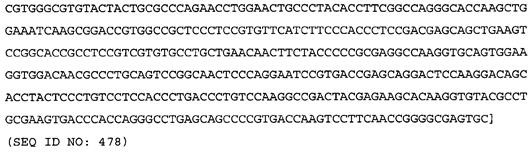
[间隔区(SEQ ID NO:305)] [huCD166Lc1_7614.8_3001 (SEQ ID NO:316)]氨基酸序列[Spacer (SEQ ID NO:305)] [huCD166Lc1_7614.8_3001 (SEQ ID NO:316)] amino acid sequence

[间隔区(SEQ ID NO:482)] [huCD166Lc1_7614.8_CM2 (SEQ ID NO:479)]核苷酸序列[Spacer (SEQ ID NO:482)] [huCD166Lc1_7614.8_CM2 (SEQ ID NO:479)] nucleotide sequence

[间隔区(SEQ ID NO:305)] [HuCD166Lc1_7614.6_2001 VL结构域(SEQ ID NO:364)]氨基酸序列[Spacer (SEQ ID NO:305)] [HuCD166Lc1_7614.6_2001 VL Domain (SEQ ID NO:364)] Amino Acid Sequence

[间隔区(SEQ ID NO:305)] [huCD166Lc1_7614.8_2001 VL结构域(SEQ ID NO:366)]氨基酸序列[Spacer (SEQ ID NO:305)] [huCD166Lc1_7614.8_2001 VL Domain (SEQ ID NO:366)] Amino Acid Sequence

[间隔区(SEQ ID NO:305)] [huCD166Lc1_7614.6_3001 VL结构域(SEQ ID NO:368)]氨基酸序列[Spacer (SEQ ID NO:305)] [huCD166Lc1_7614.6_3001 VL Domain (SEQ ID NO:368)] Amino Acid Sequence

[间隔区(SEQ ID NO:305)] [huCD166Lc1_7614.8_3001 VL结构域(SEQ ID NO:370)]氨基酸序列[Spacer (SEQ ID NO:305)] [huCD166Lc1_7614.8_3001 VL Domain (SEQ ID NO:370)] Amino Acid Sequence

[间隔区(SEQ ID NO:305)] [HuCD166Lc1_7614.6_2007 (SEQ ID NO:372)]氨基酸序列[Spacer (SEQ ID NO:305)] [HuCD166Lc1_7614.6_2007 (SEQ ID NO:372)] amino acid sequence

[间隔区(SEQ ID NO:305)] [HuCD166Lc1_7614.6_2007 VL结构域(SEQ ID NO:374)]氨基酸序列[Spacer (SEQ ID NO:305)] [HuCD166Lc1_7614.6_2007 VL Domain (SEQ ID NO:374)] Amino Acid Sequence

[间隔区(SEQ ID NO:305)] [huCD166Lc1_7614.6_3007 (SEQ ID NO:376)]氨基酸序列[Spacer (SEQ ID NO:305)] [huCD166Lc1_7614.6_3007 (SEQ ID NO:376)] amino acid sequence

[间隔区(SEQ ID NO:305)] [huCD166Lc1_7614.6_3007 VL结构域(SEQ ID NO:378)]氨基酸序列[Spacer (SEQ ID NO:305)] [huCD166Lc1_7614.6_3007 VL Domain (SEQ ID NO:378)] Amino Acid Sequence

[间隔区(SEQ ID NO:305)] [HuCD166Lc1_7614.6_2008 (SEQ ID NO:380)]氨基酸序列[Spacer (SEQ ID NO:305)] [HuCD166Lc1_7614.6_2008 (SEQ ID NO:380)] amino acid sequence

[间隔区(SEQ ID NO:305)] [HuCD166Lc1_7614.6_2008 VL结构域(SEQ ID NO:382)]氨基酸序列[Spacer (SEQ ID NO:305)] [HuCD166Lc1_7614.6_2008 VL Domain (SEQ ID NO:382)] Amino Acid Sequence

[间隔区(SEQ ID NO:305)] [huCD166Lc1_7614.6_3008 (SEQ ID NO:384)]氨基酸序列[Spacer (SEQ ID NO:305)] [huCD166Lc1_7614.6_3008 (SEQ ID NO:384)] amino acid sequence

[间隔区(SEQ ID NO:305)] [huCD166Lc1_7614.6_3008 VL结构域(SEQ ID NO:386)]氨基酸序列[Spacer (SEQ ID NO:305)] [huCD166Lc1_7614.6_3008 VL Domain (SEQ ID NO:386)] Amino Acid Sequence

[间隔区(SEQ ID NO:305)] [HuCD166Lc1_7614.6_2011 (SEQ ID NO:388)]氨基酸序列[Spacer (SEQ ID NO:305)] [HuCD166Lc1_7614.6_2011 (SEQ ID NO:388)] amino acid sequence

[间隔区(SEQ ID NO:305)] [HuCD166Lc1_7614.6_2011 VL结构域(SEQ ID NO:390)]氨基酸序列[Spacer (SEQ ID NO:305)] [HuCD166Lc1_7614.6_2011 VL Domain (SEQ ID NO:390)] Amino Acid Sequence

[间隔区(SEQ ID NO:305)] [huCD166Lc1_7614.6_3011 (SEQ ID NO:392)]氨基酸序列[Spacer (SEQ ID NO:305)] [huCD166Lc1_7614.6_3011 (SEQ ID NO:392)] amino acid sequence

[间隔区(SEQ ID NO:305)] [huCD166Lc1_7614.6_3011 VL结构域(SEQ ID NO:394)]氨基酸序列[Spacer (SEQ ID NO:305)] [huCD166Lc1_7614.6_3011 VL Domain (SEQ ID NO:394)] Amino Acid Sequence

[间隔区(SEQ ID NO:305)] [HuCD166Lc1_7614.6_2012 (SEQ ID NO:396)]氨基酸序列[Spacer (SEQ ID NO:305)] [HuCD166Lc1_7614.6_2012 (SEQ ID NO:396)] amino acid sequence

[间隔区(SEQ ID NO:305)] [HuCD166Lc1_7614.6_2012 VL结构域(SEQ ID NO:398)]氨基酸序列[Spacer (SEQ ID NO:305)] [HuCD166Lc1_7614.6_2012 VL Domain (SEQ ID NO:398)] Amino Acid Sequence

[间隔区(SEQ ID NO:305)] [huCD166Lc1_7614.6_3012 (SEQ ID NO:400)]氨基酸序列[Spacer (SEQ ID NO:305)] [huCD166Lc1_7614.6_3012 (SEQ ID NO:400)] amino acid sequence

[间隔区(SEQ ID NO:305)] [huCD166Lc1_7614.6_3012 VL结构域(SEQ ID NO:402)]氨基酸序列[Spacer (SEQ ID NO:305)] [huCD166Lc1_7614.6_3012 VL Domain (SEQ ID NO:402)] Amino Acid Sequence

[间隔区(SEQ ID NO:305)] [HuCD166Lc1_7614.6_2013 (SEQ ID NO:404)]氨基酸序列[Spacer (SEQ ID NO:305)] [HuCD166Lc1_7614.6_2013 (SEQ ID NO:404)] amino acid sequence
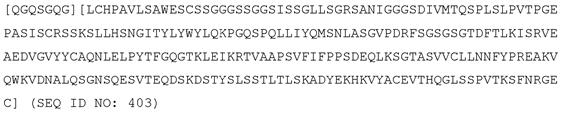
[间隔区(SEQ ID NO:305)] [HuCD166Lc1_7614.6_2013 VL结构域(SEQ ID NO:406)]氨基酸序列[Spacer (SEQ ID NO:305)] [HuCD166Lc1_7614.6_2013 VL Domain (SEQ ID NO:406)] Amino Acid Sequence

[间隔区(SEQ ID NO:305)] [huCD166Lc1_7614.6_3013 (SEQ ID NO:408)]氨基酸序列[Spacer (SEQ ID NO:305)] [huCD166Lc1_7614.6_3013 (SEQ ID NO:408)] amino acid sequence

[间隔区(SEQ ID NO:305)] [huCD166Lc1_7614.6_3013 VL结构域(SEQ ID NO:410)]氨基酸序列[Spacer (SEQ ID NO:305)] [huCD166Lc1_7614.6_3013 VL Domain (SEQ ID NO:410)] Amino Acid Sequence

[间隔区(SEQ ID NO:305)] [HuCD166Lc1_7614.8_2007 (SEQ ID NO:412)]氨基酸序列[Spacer (SEQ ID NO:305)] [HuCD166Lc1_7614.8_2007 (SEQ ID NO:412)] amino acid sequence

[间隔区(SEQ ID NO:305)] [HuCD166Lc1_7614.8_2007 VL结构域(SEQ ID NO:414)]氨基酸序列[Spacer (SEQ ID NO:305)] [HuCD166Lc1_7614.8_2007 VL Domain (SEQ ID NO:414)] Amino Acid Sequence

[间隔区(SEQ ID NO:305)] [huCD166Lc1_7614.8_3007 (SEQ ID NO:416)]氨基酸序列[Spacer (SEQ ID NO:305)] [huCD166Lc1_7614.8_3007 (SEQ ID NO:416)] amino acid sequence

[间隔区(SEQ ID NO:305)] [huCD166Lc1_7614.8_3007 VL结构域(SEQ ID NO:418)]氨基酸序列[Spacer (SEQ ID NO:305)] [huCD166Lc1_7614.8_3007 VL Domain (SEQ ID NO:418)] Amino Acid Sequence

[间隔区(SEQ ID NO:305)] [HuCD166Lc1_7614.8_2008 (SEQ ID NO:420)]氨基酸序列[Spacer (SEQ ID NO:305)] [HuCD166Lc1_7614.8_2008 (SEQ ID NO:420)] amino acid sequence

[间隔区(SEQ ID NO:305)] [HuCD166Lc1_7614.8_2008 VL结构域(SEQ ID NO:422)]氨基酸序列[Spacer (SEQ ID NO:305)] [HuCD166Lc1_7614.8_2008 VL Domain (SEQ ID NO:422)] Amino Acid Sequence

[间隔区(SEQ ID NO:305)] [huCD166Lc1_7614.8_3008 (SEQ ID NO:424)]氨基酸序列[Spacer (SEQ ID NO:305)] [huCD166Lc1_7614.8_3008 (SEQ ID NO:424)] amino acid sequence

[间隔区(SEQ ID NO:305)] [huCD166Lc1_7614.8_3008 VL结构域(SEQ ID NO:426)]氨基酸序列[Spacer (SEQ ID NO:305)] [huCD166Lc1_7614.8_3008 VL Domain (SEQ ID NO:426)] Amino Acid Sequence

[间隔区(SEQ ID NO:305)] [HuCD166Lc1_7614.8_2011 (SEQ ID NO:428)]氨基酸序列[Spacer (SEQ ID NO:305)] [HuCD166Lc1_7614.8_2011 (SEQ ID NO:428)] amino acid sequence

[间隔区(SEQ ID NO:305)] [HuCD166Lc1_7614.8_2011 VL结构域(SEQ ID NO:430)]氨基酸序列[Spacer (SEQ ID NO:305)] [HuCD166Lc1_7614.8_2011 VL Domain (SEQ ID NO:430)] Amino Acid Sequence

[间隔区(SEQ ID NO:305)] [huCD166Lc1_7614.8_3011 (SEQ ID NO:432)]氨基酸序列[Spacer (SEQ ID NO:305)] [huCD166Lc1_7614.8_3011 (SEQ ID NO:432)] amino acid sequence

[间隔区(SEQ ID NO:305)] [huCD166Lc1_7614.8_3011 VL结构域(SEQ ID NO:434)]氨基酸序列[Spacer (SEQ ID NO:305)] [huCD166Lc1_7614.8_3011 VL Domain (SEQ ID NO:434)] Amino Acid Sequence

[间隔区(SEQ ID NO:305)] [HuCD166Lc1_7614.8_2012 (SEQ ID NO:436)]氨基酸序列[Spacer (SEQ ID NO:305)] [HuCD166Lc1_7614.8_2012 (SEQ ID NO:436)] amino acid sequence
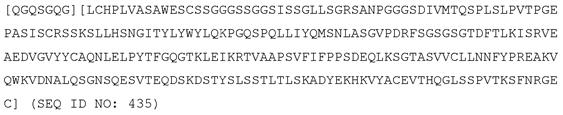
[间隔区(SEQ ID NO:305)] [HuCD166Lc1_7614.8_2012 VL结构域(SEQ ID NO:438)]氨基酸序列[Spacer (SEQ ID NO:305)] [HuCD166Lc1_7614.8_2012 VL Domain (SEQ ID NO:438)] Amino Acid Sequence

[间隔区(SEQ ID NO:305)] [huCD166Lc1_7614.8_3012 (SEQ ID NO:440)]氨基酸序列[Spacer (SEQ ID NO:305)] [huCD166Lc1_7614.8_3012 (SEQ ID NO:440)] amino acid sequence

[间隔区(SEQ ID NO:305)] [huCD166Lc1_7614.8_3012 VL结构域(SEQ ID NO:442)]氨基酸序列[Spacer (SEQ ID NO:305)] [huCD166Lc1_7614.8_3012 VL Domain (SEQ ID NO:442)] Amino Acid Sequence

[间隔区(SEQ ID NO:305)] [HuCD166Lc1_7614.8_2013 (SEQ ID NO:444)]氨基酸序列[Spacer (SEQ ID NO:305)] [HuCD166Lc1_7614.8_2013 (SEQ ID NO:444)] amino acid sequence

[间隔区(SEQ ID NO:305)] [HuCD166Lc1_7614.8_2013 VL结构域(SEQ ID NO:446)]氨基酸序列[Spacer (SEQ ID NO:305)] [HuCD166Lc1_7614.8_2013 VL Domain (SEQ ID NO:446)] Amino Acid Sequence

[间隔区(SEQ ID NO:305)] [huCD166Lc1_7614.8_3013 (SEQ ID NO:448)]氨基酸序列[Spacer (SEQ ID NO:305)] [huCD166Lc1_7614.8_3013 (SEQ ID NO:448)] amino acid sequence
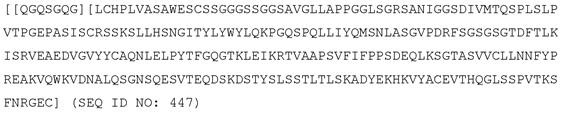
[间隔区(SEQ ID NO:305)] [huCD166Lc1_7614.8_3013 VL结构域(SEQ ID NO:450)]氨基酸序列[Spacer (SEQ ID NO:305)] [huCD166Lc1_7614.8_3013 VL Domain (SEQ ID NO:450)] Amino Acid Sequence

[间隔区(SEQ ID NO:305)] [HuCD166Lc1_7614_2001 (SEQ ID NO:452)]氨基酸序列[Spacer (SEQ ID NO:305)] [HuCD166Lc1_7614_2001 (SEQ ID NO:452)] amino acid sequence

[间隔区(SEQ ID NO:305)] [HuCD166Lc1_7614_2001 VL结构域(SEQ ID NO:454)]氨基酸序列[Spacer (SEQ ID NO:305)] [HuCD166Lc1_7614_2001 VL Domain (SEQ ID NO:454)] Amino Acid Sequence

[间隔区(SEQ ID NO:305)] [huCD166Lc1_7614_3001 (SEQ ID NO:456)]氨基酸序列[Spacer (SEQ ID NO:305)] [huCD166Lc1_7614_3001 (SEQ ID NO:456)] amino acid sequence

[间隔区(SEQ ID NO:305)] [huCD166Lc1_7614_3001 VL结构域(SEQ ID NO:458)]氨基酸序列[Spacer (SEQ ID NO:305)] [huCD166Lc1_7614_3001 VL Domain (SEQ ID NO:458)] Amino Acid Sequence

[间隔区(SEQ ID NO:305)] [HuCD166Lc1_7614_2011 (SEQ ID NO:460)]氨基酸序列[Spacer (SEQ ID NO:305)] [HuCD166Lc1_7614_2011 (SEQ ID NO:460)] amino acid sequence

[间隔区(SEQ ID NO:305)] [HuCD166Lc1_7614_2011 VL结构域(SEQ ID NO:462)]氨基酸序列[Spacer (SEQ ID NO:305)] [HuCD166Lc1_7614_2011 VL Domain (SEQ ID NO:462)] Amino Acid Sequence

[间隔区(SEQ ID NO:305)] [huCD166Lc1_7614_3011 (SEQ ID NO:464)]氨基酸序列[Spacer (SEQ ID NO:305)] [huCD166Lc1_7614_3011 (SEQ ID NO:464)] amino acid sequence

[间隔区(SEQ ID NO:305)] [huCD166Lc1_7614_3011 VL结构域(SEQ ID NO:466)]氨基酸序列[Spacer (SEQ ID NO:305)] [huCD166Lc1_7614_3011 VL Domain (SEQ ID NO:466)] Amino Acid Sequence

[间隔区(SEQ ID NO:305)] [HuCD166Lc1_7614_2012 (SEQ ID NO:468)]氨基酸序列[Spacer (SEQ ID NO:305)] [HuCD166Lc1_7614_2012 (SEQ ID NO:468)] amino acid sequence

[间隔区(SEQ ID NO:305)] [HuCD166Lc1_7614_2012 VL结构域(SEQ ID NO:470)]氨基酸序列[Spacer (SEQ ID NO:305)] [HuCD166Lc1_7614_2012 VL Domain (SEQ ID NO:470)] Amino Acid Sequence

[间隔区(SEQ ID NO:305)] [huCD166Lc1_7614_3012 (SEQ ID NO:472)]氨基酸序列[Spacer (SEQ ID NO:305)] [huCD166Lc1_7614_3012 (SEQ ID NO:472)] amino acid sequence

[间隔区(SEQ ID NO:305)] [huCD166Lc1_7614_3012 VL结构域(SEQ ID NO:474)]氨基酸序列[Spacer (SEQ ID NO:305)] [huCD166Lc1_7614_3012 VL Domain (SEQ ID NO:474)] Amino Acid Sequence

实施例3. 可活化抗CD166抗体的产生 Example 3. Production of activatable anti-CD166 antibodies
设计本文提供的研究以产生本发明的可活化抗CD166抗体。The studies presented herein were designed to generate activatable anti-CD166 antibodies of the invention.
以不同掩蔽效率产生抗CD166可活化抗体(即测量可活化抗体的MM阻断可活化抗体的AB结合其靶标的能力)。如实施例2中所述,通过截短和丙氨酸扫描来将肽16522和7614突变,并且使用这些掩蔽肽变体来产生具有一定范围的折叠掩蔽的抗CD166可活化抗体的家族。使用CD166结合ELISA评估抗CD166抗体CD166 M9 vK1/HcB (SEQ ID NO:121的VH,SEQID NO:123的VL)和各种抗CD166可活化抗体结合人CD166的能力(图3A,3B)。所测试的抗CD166可活化抗体包括SEQ ID NO:121的可变重链序列、SEQ ID NO:123的可变轻链序列、本文中称为底物2001的包含氨基酸序列ISSGLLSGRSDNH (SEQ ID NO:70)的可切割部分(CM)以及表10中所示的掩蔽部分之一。完全序列显示于上表11中。Anti-CD166 activatable antibodies were generated with varying masking efficiencies (ie measuring the ability of the MM of the activatable antibody to block the binding of the AB of the activatable antibody to its target).
使用标准ELISA方案,将人CD166蛋白吸附至ELISA板,随后与指定浓度的抗体或可活化抗体一起孵育。用抗人FAB-过氧化物酶二级试剂检测结合的抗体或可活化抗体。如通过ELISA测定的本发明的可活化抗体对CD166多肽的示例性表观体外解离常数(Kd)的概述以及相对于亲本抗CD166 M9抗体(vk-1/HcB)的Kd的各自增加显示于下表17中。除了亲本抗CD166 M9抗体外,每种可活化抗体的掩蔽物如本文所述所示,并且底物序列为2001(ISSGLLSGRSDNH (SEQ ID NO:70))。Using a standard ELISA protocol, human CD166 protein is adsorbed to an ELISA plate, followed by incubation with the indicated concentrations of antibody or activatable antibody. Bound or activatable antibodies were detected with an anti-human FAB-peroxidase secondary reagent. A summary of exemplary apparent in vitro dissociation constants (Kd) of activatable antibodies of the invention for CD166 polypeptides as determined by ELISA and the respective increase in Kd relative to the parental anti-CD166 M9 antibody (vk-1/HcB) is shown in Table 17 below. Except for the parental anti-CD166 M9 antibody, the mask for each activatable antibody was as described herein and the substrate sequence was 2001 (ISSGLLSGRSDNH (SEQ ID NO:70)).
表 17:可活化抗CD166抗体的表观ELISA解离常数 Table 17 : Apparent ELISA dissociation constants for activatable anti-CD166 antibodies

实施例4. 可活化抗CD166抗体的活化 Example 4. Activation of activatable anti-CD166 antibodies
设计本文提供的研究以评估可活化抗CD166抗体的活化。The studies presented herein were designed to evaluate the activation of activatable anti-CD166 antibodies.
图4是描绘当蛋白水解活化时本发明的各种抗CD166可活化抗体结合人CD166的能力的图。如图4中所示,当蛋白水解活化时,抗CD166可活化抗体恢复抗体结合。使用CD166结合ELISA评估抗CD166抗体(huM9 HcC/vk-1;SEQ ID NO:122的VH,SEQ ID NO:123的VL)、本发明的各种抗CD166可活化抗体和uPA活化的抗CD166可活化抗体的结合。所测试的抗CD166可活化抗体包括SEQ ID NO:122的可变重链序列、SEQ ID NO:123的可变轻链序列、包含氨基酸序列ISSGLLSGRSDNH (SEQ ID NO:70)的可切割部分(CM1,底物2001)或包含氨基酸序列AVGLLAPPGGLSGRSDNH (SEQ ID NO:76)的可切割部分(CM2,底物3001)以及表10中所示的掩蔽部分之一。完全序列显示于上表11中。Figure 4 is a graph depicting the ability of various anti-CD166 activatable antibodies of the invention to bind human CD166 when proteolytically activated. As shown in Figure 4, anti-CD166 activatable antibodies restored antibody binding when proteolytically activated. Anti-CD166 antibodies (huM9 HcC/vk-1; VH of SEQ ID NO: 122, VL of SEQ ID NO: 123), various anti-CD166 activatable antibodies of the invention and uPA-activated anti-CD166 activatable antibodies were assessed using a CD166 binding ELISA. Activating antibody binding. The anti-CD166 activatable antibody tested included the variable heavy chain sequence of SEQ ID NO: 122, the variable light chain sequence of SEQ ID NO: 123, a cleavable portion (CM1 , Substrate 2001 ) or a cleavable moiety (CM2, Substrate 3001 ) comprising the amino acid sequence AVGLLAPPGGLSGRSDNH (SEQ ID NO:76) and one of the masking moieties shown in Table 10. The full sequence is shown in Table 11 above.
使用标准ELISA方案,将人CD166蛋白吸附至ELISA板,随后与指定浓度的抗体或可活化抗体一起孵育。用抗人FAB-过氧化物酶二级试剂检测结合的抗体或可活化抗体。Using a standard ELISA protocol, human CD166 protein is adsorbed to an ELISA plate, followed by incubation with the indicated concentrations of antibody or activatable antibody. Bound or activatable antibodies were detected with an anti-human FAB-peroxidase secondary reagent.
在示例性研究中,测定本发明的抗CD166抗体(抗CD166 HcC/vk-1)和本发明的抗CD166可活化抗体(抗CD166-7614.6-3001)与人细胞(HCC1806人乳腺癌细胞)和人CD166的结合亲和力。在这些条件下,对于本发明的抗CD166可活化抗体和抗CD166抗体,通过ELISA的表观示例性结合亲和力(Kd)分别为96.2nM和1.3nM。在通过流式细胞术测量的示例性HCC1806细胞结合测定中,对于本发明的抗CD166可活化抗体和抗CD166抗体,表观结合亲和力(Kd)分别为372nM和3.2nM。这些示例性结果证明,与本发明的抗CD166抗体相比,未切割状态下的抗CD166可活化抗体证明与分离的CD166多肽和细胞上的CD166的较低的结合亲和力。In an exemplary study, the association of the anti-CD166 antibody of the invention (anti-CD166 HcC/vk-1) and the anti-CD166 activatable antibody of the invention (anti-CD166-7614.6-3001) with human cells (HCC1806 human breast cancer cells) and Binding affinity for human CD166. Under these conditions, the apparent exemplary binding affinities ( Kd ) by ELISA were 96.2 nM and 1.3 nM for the anti-CD166 activatable and anti-CD166 antibodies of the invention, respectively. In an exemplary HCC1806 cell binding assay measured by flow cytometry, the apparent binding affinities (Kd) were 372 nM and 3.2 nM for the anti-CD166 activatable and anti-CD166 antibodies of the invention, respectively. These exemplary results demonstrate that anti-CD166 activatable antibodies in the uncleaved state demonstrate lower binding affinity to isolated CD166 polypeptides and CD166 on cells compared to anti-CD166 antibodies of the invention.
图5是描绘当用uPA蛋白水解活化时本发明的各种缀合的抗CD166可活化抗体实现对HCC1806细胞的细胞杀伤的能力的图。这些缀合的抗CD166可活化抗体在本文中也称为“CD166 AADC”或CD166可活化抗体药物缀合物。所测试的缀合的抗CD166可活化抗体包括SEQ ID NO:122的可变重链序列、SEQ ID NO:123的可变轻链序列、包含氨基酸序列ISSGLLSGRSDNH (SEQ ID NO:70)的可切割部分(CM1,底物2001)以及表10中所示的掩蔽部分之一以及经由SPDB接头与可活化抗体缀合的美登素DM4。所述可活化抗体的完全序列显示于上表11中。本文公开的所有缀合的可活化抗体均由TCRS (The Chemistry ResearchSolution)生产。Figure 5 is a graph depicting the ability of various conjugated anti-CD166 activatable antibodies of the invention to effect cell killing of HCC1806 cells when proteolytically activated with uPA. These conjugated anti-CD166 activatable antibodies are also referred to herein as "CD166 AADCs" or CD166 activatable antibody drug conjugates. The conjugated anti-CD166 activatable antibodies tested included the variable heavy chain sequence of SEQ ID NO: 122, the variable light chain sequence of SEQ ID NO: 123, a cleavable antibody comprising the amino acid sequence ISSGLLSGRSDNH (SEQ ID NO: 70). Moieties (CM1, Substrate 2001) and one of the masked moieties shown in Table 10 and maytansine DM4 conjugated to an activatable antibody via the SPDB linker. The full sequence of the activatable antibody is shown in Table 11 above. All conjugated activatable antibodies disclosed herein were produced by TCRS (The Chemistry Research Solution).
如图5中所示,本发明的各种缀合的抗CD166可活化抗体当被掩蔽时表现类似于同种型-DM4,但当用uPA蛋白水解活化时,这些缀合的抗CD166可活化抗体显示与huCD166 ADC的细胞杀伤类似的细胞杀伤。通过添加所示浓度的ADC或AADC并孵育细胞3天来评估药物缀合物杀死HCC1806细胞的能力。使用CellTiter Glo测定法测量细胞活力。当在此类细胞杀伤测定中测试与核酸损伤剂缀合的可活化抗体时,观察到类似的结果。As shown in Figure 5, various conjugated anti-CD166 activatable antibodies of the invention behaved like isotype-DM4 when masked, but when proteolytically activated with uPA, these conjugated anti-CD166 activatable The antibody showed similar cell killing to that of the huCD166 ADC. The ability of the drug conjugates to kill HCC1806 cells was assessed by adding the indicated concentrations of ADC or AADC and incubating the cells for 3 days. Cell viability was measured using the CellTiter Glo assay. Similar results were observed when activatable antibodies conjugated to nucleic acid damaging agents were tested in such cell killing assays.
设计接下来的研究以评估在暴露于一种或多种蛋白酶后肿瘤样品中抗CD166可活化抗体的活化和结合。Subsequent studies were designed to assess the activation and binding of anti-CD166 activatable antibodies in tumor samples following exposure to one or more proteases.
使用免疫组织化学(IHC)分析和PCT公开号WO 2014/107599(其内容以其整体通过引用并入本文)中描述的原位成像测定来分析异种移植肿瘤样品和健康组织样品。简而言之,该原位测定使用本发明的可活化抗CD166抗体、相应的亲本抗体以及其中CM用不可切割接头替代的可活化抗CD166抗体的修饰版本(本文中通常称为抗CD166 NSUB修饰的抗体)。亲本抗体用作阳性对照,而不可切割版本的可活化抗CD166抗体用作阴性对照。然后将异种移植冷冻组织切片置于载玻片上,用PBS-T漂洗两次,随后用PBS洗涤,随后用广谱蛋白酶抑制剂混合物或单独的缓冲液预处理组织30分钟。然后将可检测标记诸如Alexa Fluor-680®缀合至可活化抗CD166抗体和抗CD166 NSUB修饰的抗体中的每一种。然后将可检测标记的可活化抗CD166抗体和抗CD166 NSUB修饰的抗体施加至组织上并在黑暗中孵育1小时(以防止荧光的漂白)。与1μg/ ml孵育后,孵育的肿瘤切片用PBS-T、随后PBS冲洗3次,用核标记DAPI复染1分钟。然后使用荧光显微镜分析来检测阳性染色。通过用蛋白酶抑制剂预处理组织切片而消除的可活化抗CD166抗体的阳性染色表明可活化抗CD166抗体与组织样品的结合是蛋白水解事件的结果。当组织用过量的未标记(“冷”)亲本抗体预处理时,也应当消除可活化抗CD166抗体的阳性染色。此外,肿瘤组织的孵育应当揭示亲本抗体的阳性染色,其不受用蛋白酶抑制剂预处理组织的影响,但当用未标记的亲本抗体预处理组织时被消除。对于在预处理的组织、未用蛋白酶抑制剂预处理的组织或用未标记的亲本抗体预处理的组织上检测的抗CD166 NSUB修饰的抗体,不应当检测到信号。Xenograft tumor samples and healthy tissue samples were analyzed using immunohistochemical (IHC) analysis and in situ imaging assays described in PCT Publication No. WO 2014/107599, the contents of which are incorporated herein by reference in their entirety. Briefly, this in situ assay uses an activatable anti-CD166 antibody of the invention, the corresponding parental antibody, and a modified version of the activatable anti-CD166 antibody in which the CM is replaced with a non-cleavable linker (commonly referred to herein as an anti-CD166 NSUB modified antibodies). The parental antibody was used as a positive control, while the non-cleavable version of the activatable anti-CD166 antibody was used as a negative control. Xenograft frozen tissue sections were then placed on glass slides, rinsed twice with PBS-T, followed by PBS washes, followed by pretreatment of the tissue with a broad-spectrum protease inhibitor cocktail or buffer alone for 30 minutes. A detectable label such as Alexa Fluor-680® is then conjugated to each of the activatable anti-CD166 antibody and anti-CD166 NSUB modified antibody. Detectably labeled activatable anti-CD166 antibodies and anti-CD166 NSUB-modified antibodies were then applied to the tissue and incubated for 1 hour in the dark (to prevent bleaching of fluorescence). After incubation with 1 μg/ml, the incubated tumor sections were washed 3 times with PBS-T followed by PBS and counterstained with the nuclear marker DAPI for 1 min. Fluorescence microscopy analysis was then used to detect positive staining. Positive staining for activatable anti-CD166 antibodies that was eliminated by pretreatment of tissue sections with protease inhibitors indicated that binding of activatable anti-CD166 antibodies to tissue samples was the result of a proteolytic event. Positive staining with activatable anti-CD166 antibodies should also be abolished when the tissue is pretreated with an excess of unlabeled ("cold") parental antibody. In addition, incubation of tumor tissue should reveal positive staining of the parental antibody, which is unaffected by pretreatment of the tissue with protease inhibitors, but is abolished when the tissue is pretreated with unlabeled parental antibody. No signal should be detected for anti-CD166 NSUB-modified antibodies detected on pretreated tissue, tissue not pretreated with protease inhibitors, or tissue pretreated with unlabeled parental antibody.
图6A-6D是一系列图像,其证明可活化抗CD166抗体在结肠癌组织样品中被活化(即被切割),并且可活化抗CD166抗体在健康组织样品中未被活化。图6A和6C描绘对肿瘤和健康组织样品的IHC分析的结果,而图6B和6D描绘对肿瘤和健康组织样品的原位成像测定的结果。Figures 6A-6D are a series of images demonstrating that activatable anti-CD166 antibodies are activated (ie, cleaved) in colon cancer tissue samples and that activatable anti-CD166 antibodies are not activated in healthy tissue samples. Figures 6A and 6C depict the results of IHC analysis on tumor and healthy tissue samples, while Figures 6B and 6D depict the results of in situ imaging assays on tumor and healthy tissue samples.
图7A-7D是一系列图像,其证明可活化抗CD166抗体在肺癌组织样品中被活化(即被切割),并且可活化抗CD166抗体在健康组织样品中未被活化。图7A和7C描绘对肿瘤和健康组织样品的IHC分析的结果,而图7B和7D描绘对肿瘤和健康组织样品的原位成像测定的结果。Figures 7A-7D are a series of images demonstrating that activatable anti-CD166 antibodies are activated (ie, cleaved) in lung cancer tissue samples and that activatable anti-CD166 antibodies are not activated in healthy tissue samples. Figures 7A and 7C depict the results of IHC analysis on tumor and healthy tissue samples, while Figures 7B and 7D depict the results of in situ imaging assays on tumor and healthy tissue samples.
图8A-8D是一系列图像,其证明可活化抗CD166抗体在健康组织样品中未被活化。图8A和8C描绘对健康组织样品的IHC分析的结果,而图8B和8D描绘对健康组织样品的原位成像测定的结果。Figures 8A-8D are a series of images demonstrating that activatable anti-CD166 antibodies are not activated in healthy tissue samples. Figures 8A and 8C depict the results of IHC analysis on healthy tissue samples, while Figures 8B and 8D depict the results of in situ imaging assays on healthy tissue samples.
实施例5. 缀合的抗CD166抗体的功效 Example 5. Efficacy of Conjugated Anti-CD166 Antibodies
本实施例证明与对照抗体缀合物(“对照ADC”)相比,本发明的缀合的抗CD166抗体(“CD166ADC”)展现体外杀伤活性。This example demonstrates that conjugated anti-CD166 antibodies of the invention ("CD166 ADC") exhibit in vitro killing activity compared to a control antibody conjugate ("Control ADC").
图9是一系列图,其描绘本发明的缀合的抗CD166抗体针对乳腺癌细胞系、前列腺癌细胞系、胰腺癌细胞系、头颈部鳞状细胞癌细胞系和作为阴性对照的CD166细胞系的功效。Figure 9 is a series of graphs depicting conjugated anti-CD166 antibodies of the invention against breast cancer cell lines, prostate cancer cell lines, pancreatic cancer cell lines, head and neck squamous cell carcinoma cell lines, and CD166 cells as a negative control Department of efficacy.
实施例6. 缀合的可活化抗CD166抗体在肿瘤模型中的效力 Example 6. Efficacy of Conjugated Activatable Anti-CD166 Antibodies in Tumor Models
本实施例证明本发明的缀合的可活化抗CD166抗体(“CD166AADC”或CD166可活化抗体药物缀合物)在各种癌症模型中的效力。This example demonstrates the efficacy of conjugated activatable anti-CD166 antibodies of the invention ("CD166AADC" or CD166 activatable antibody drug conjugates) in various cancer models.
图10是这样的图,其描绘与同种型DM4-缀合的对照和包括可活化抗CD166抗体的亲本抗体的DM4-缀合的版本的ADC相比,包括与美登素DM4缀合的本发明的可活化抗CD166抗体的AADC的效力。效力被测量为在乳腺癌模型中在施用(在第1天和第8天,5 mg/kg IV)后不同时间点测量的平均肿瘤体积。Figure 10 is a graph that depicts ADCs that include DM4 conjugated to maytansine compared to isotype DM4-conjugated controls and ADCs that include DM4-conjugated versions of parental antibodies that can activate anti-CD166 antibodies. Efficacy of AADCs of the invention that can activate anti-CD166 antibodies. Efficacy was measured as mean tumor volume measured at different time points after administration (5 mg/kg IV on
如图10中所示,AADC的效力等同于用ADC所见的效力。As shown in Figure 10, the efficacy of AADC was equivalent to that seen with ADC.
图11是这样的图,其描绘与同种型DM4-缀合的对照和CD166 ADC DM4缀合的亲本抗CD166抗体相比,本发明的CD166可活化抗CD166抗体的效力。效力被测量为在H292非小细胞肺癌(NSCLC)模型中在施用(在第1天和第8天,5 mg/kg IV)后不同时间点测量的平均肿瘤体积。Figure 11 is a graph depicting the potency of CD166 activatable anti-CD166 antibodies of the invention compared to isotype DM4-conjugated control and CD166 ADC DM4-conjugated parental anti-CD166 antibodies. Efficacy was measured as mean tumor volume measured at various time points after administration (5 mg/kg IV on
用同种型-DM4对照、huCD166-DM4 ADC、huCD166_7614.6_CM2-DM4 AADC或huCD166_7614.6_CM1-DM4 ADDC处理H292异种移植肿瘤,其中CM1和CM2分别是本文所述的2001和3001底物。使肿瘤生长至150 mm3的平均值,然后将小鼠随机化为8组,并在第1天和第8天用所示测试物品给药。绘制平均肿瘤体积±SEM。H292 xenograft tumors were treated with isotype-DM4 control, huCD166-DM4 ADC, huCD166_7614.6_CM2-DM4 AADC, or huCD166_7614.6_CM1-DM4 ADDC, where CM1 and CM2 are 2001 and 3001 substrates, respectively, as described herein. Tumors were allowed to grow to a mean of 150 mm, mice were then randomized into 8 groups and dosed on
如图11中所示,所测试的两种AADC的效力等同于用ADC所见的效力。As shown in Figure 11, the potency of the two AADCs tested was equivalent to that seen with the ADC.
图12是这样的图,其描绘与同种型DM4-缀合的对照和CD166 ADC DM4缀合的亲本抗CD166抗体相比,CD166 AADC DM4缀合的可活化抗CD166抗体(在本文中也称为huCD166_7614.6_CM2-DM4 AADC (其中CM2是3001底物))的效力。效力被测量为在H1975非小细胞肺癌(NSCLC)模型中在施用(在第1天和第8天,5 mg/kg IV)后不同时间点测量的平均肿瘤体积。FIG. 12 is a graph depicting the CD166 AADC DM4 conjugated activatable anti-CD166 antibody (also referred to herein as is the potency of huCD166_7614.6_CM2-DM4 AADC (where CM2 is the 3001 substrate). Efficacy was measured as mean tumor volume measured at various time points after administration (5 mg/kg IV on
如图12中所示,AADC的效力等同于用ADC所见的效力。As shown in Figure 12, the efficacy of AADC was equivalent to that seen with ADC.
实施例7. 可活化抗CD166抗体的耐受性分析 Example 7. Tolerance analysis of activatable anti-CD166 antibodies
将本发明的抗CD166抗体针对它们对结合人CD166和其他密切相关的蛋白的物种特异性进行表征。The anti-CD166 antibodies of the invention were characterized for their species specificity for binding human CD166 and other closely related proteins.
如图13中所示,本发明的抗CD166抗体以相等的亲和力结合人和食蟹猴CD166。所测试的本发明的抗CD166抗体无一结合大鼠或小鼠CD166。在这些示例性结合研究中,抗CD166抗体与人CD166和食蟹猴CD166的结合的Kd对于两者均为1.3nM。As shown in Figure 13, the anti-CD166 antibodies of the invention bind human and cynomolgus CD166 with equal affinity. None of the anti-CD166 antibodies of the invention tested bound rat or mouse CD166. In these exemplary binding studies, the Kd for binding of the anti-CD166 antibody to human CD166 and cynomolgus CD166 was 1.3 nM for both.
接下来,在各种正常人和食蟹猴组织类型中分析CD166表达水平。如下表3中所示,分析的人和食蟹猴组织样品的CD166表达水平几乎相同:Next, CD166 expression levels were analyzed in various normal human and cynomolgus monkey tissue types. As shown in Table 3 below, the CD166 expression levels of the analyzed human and cynomolgus monkey tissue samples were almost identical:
表3. 正常人和食蟹猴组织样品中的CD166表达水平 Table 3. CD166 expression levels in normal human and cynomolgus monkey tissue samples
在人和食蟹猴肝组织样品中检测到显著的CD166表达。Significant CD166 expression was detected in human and cynomolgus monkey liver tissue samples.
在初始的药代动力学研究中,发现本发明的缀合的抗CD166可活化抗体避免了抗原下降(antigen sink)(即由于天然表达的CD166抗原在整个身体中的丰度而快速清除抗体)。In initial pharmacokinetic studies, it was found that the conjugated anti-CD166 activatable antibodies of the invention avoided antigen sink (i.e. rapid clearance of antibody due to the abundance of naturally expressed CD166 antigen throughout the body) .
图14证明使用本发明的缀合的抗CD166可活化抗体的5 mg/kg施用的食蟹猴中的耐受性研究的结果。这些研究使用huCD166_7614.6_CM2-DM4 AADC (其中CM2是3001底物)进行。选择5mg/kg,因为这是用于其他包括SPDB连接的DM4抗体缀合物的治疗剂量。Figure 14 demonstrates the results of a tolerability study in cynomolgus monkeys administered 5 mg/kg of conjugated anti-CD166 activatable antibodies of the invention. These studies were performed using the huCD166_7614.6_CM2-DM4 AADC where CM2 is the 3001 substrate. 5 mg/kg was chosen as this was the therapeutic dose used for other DM4 antibody conjugates including SPDB linkage.
在单次5 mg/kg或3 mg/kg剂量后分别在食蟹猴中评估huCD166-7614.6-CM1 DM4药物缀合物(其中CM1是2001底物)和未缀合的huCD166抗体的药代动力学。使用抗人IgG夹心ELISA测量人IgG的总血清水平。与避免中靶下降一致,CD166 AADC显示比抗体显著更多的暴露。用huCD166-7614.6-CM1 DM4药物缀合物处理的猴没有可观察到的毒性。21天后,没有临床观察,没有中靶毒性的迹象,没有肝毒性的迹象。如图14中所示,将DM4抗CD166抗体缀合物的清除与亲本抗体进行比较。抗原结合低于定量水平。The pharmacokinetics of the huCD166-7614.6-CM1 DM4 drug conjugate (where CM1 is the 2001 substrate) and the unconjugated huCD166 antibody were evaluated in cynomolgus monkeys after a single 5 mg/kg or 3 mg/kg dose, respectively study. Total serum levels of human IgG were measured using an anti-human IgG sandwich ELISA. Consistent with the avoidance of on-target drop, CD166 AADC showed significantly more exposure than antibody. Monkeys treated with the huCD166-7614.6-CM1 DM4 drug conjugate had no observable toxicity. After 21 days, there were no clinical observations, no evidence of on-target toxicity, no evidence of hepatotoxicity. As shown in Figure 14, the clearance of the DM4 anti-CD166 antibody conjugate was compared to the parental antibody. Antigen binding was below quantitative levels.
图15是这样的图,其证明缀合的抗CD166可活化抗体在预计治疗剂量下被良好耐受。这些研究使用huCD166_7614.6_CM2-DM4 AADC (其中CM2是3001底物)进行。Figure 15 is a graph demonstrating that conjugated anti-CD166 activatable antibodies were well tolerated at projected therapeutic doses. These studies were performed using the huCD166_7614.6_CM2-DM4 AADC where CM2 is the 3001 substrate.
因此,不同于传统的ADC疗法,在施用本发明的缀合的抗CD166可活化抗体后,在食蟹猴中没有肝损伤的证据。Thus, unlike traditional ADC therapy, there was no evidence of liver injury in cynomolgus monkeys following administration of the conjugated anti-CD166 activatable antibodies of the invention.
实施例8. 抗CD166可活化抗体的蛋白酶依赖性活化 Example 8. Protease-dependent activation of anti-CD166 activatable antibodies
设计本文提供的示例性研究以评估本发明的可活化抗CD166可活化抗体和缀合的可活化抗体的蛋白酶依赖性活化。The exemplary studies provided herein were designed to evaluate protease-dependent activation of activatable anti-CD166 activatable antibodies and conjugated activatable antibodies of the invention.
图16A、16B和16C是描述在蛋白酶依赖性活化存在或不存在的情况下本发明的各种抗CD166缀合的抗CD166可活化抗体结合HCC1806细胞上的人CD166的能力的图。这些缀合的抗CD166可活化抗体在本文中也称为“CD166 AADC”或“CD166可活化抗体药物缀合物”。如图16A中所示,缀合的抗CD166可活化抗体被阻断结合HCC1806细胞上的CD166。相反,如图16B和16C中所示,缀合的抗CD166可活化抗体恢复抗体结合活性,所述抗体结合活性类似于当AADC用基质蛋白酶(MT-SP1)或基质金属蛋白酶14 (MMP-14)蛋白水解活化时未掩蔽的缀合的抗CD166抗体和未掩蔽的抗CD166抗体的结合活性。Figures 16A, 16B and 16C are graphs depicting the ability of various anti-CD166 conjugated anti-CD166 activatable antibodies of the invention to bind human CD166 on HCC1806 cells in the presence or absence of protease-dependent activation. These conjugated anti-CD166 activatable antibodies are also referred to herein as "CD166 AADC" or "CD166 activatable antibody drug conjugates". As shown in Figure 16A, conjugated anti-CD166 activatable antibodies were blocked from binding to CD166 on HCC1806 cells. In contrast, as shown in Figures 16B and 16C, conjugated anti-CD166 activatable antibodies restored antibody binding activity similar to when AADC was treated with matrix protease (MT-SP1) or matrix metalloproteinase 14 (MMP-14 ) Unmasked conjugated anti-CD166 antibody and binding activity of unmasked anti-CD166 antibody upon proteolytic activation.
使用基于流式细胞术的结合测定来评估本发明的抗CD166抗体(SEQ ID NO:122的VH,SEQ ID NO:123的VL)、各种缀合和未缀合的抗CD166可活化抗体和蛋白酶活化的本发明的缀合的抗CD166可活化抗体的结合。所测试的缀合和未缀合的抗CD166可活化抗体包括SEQ ID NO:122的可变重链序列、SEQ ID NO:123的可变轻链序列、包含氨基酸序列ISSGLLSGRSDNH (SEQ ID NO:70)的可切割部分(CM1,底物2001)或包含氨基酸序列AVGLLAPPGGLSGRSDNH (SEQ ID NO:76)的可切割部分(CM2,底物3001)以及表10中所示的掩蔽部分之一。完全序列显示于上表11中。缀合的抗CD166抗体和缀合的抗CD166可活化抗体包括经由SPDB接头缀合至可活化抗体的美登素DM4。在典型的测定中,将HCC1806细胞与在PBS+2%FBS中的所示浓度的抗CD166抗体、可活化抗体、缀合的抗体或可活化抗体在冰上孵育1小时。用PBS + 2% FBS洗涤2次后,将细胞与缀合至AlexaFluor 647 (JacksonImmunoResearch)的山羊抗人IgG二抗在冰上孵育30-45分钟。然后将细胞用PBS +2% FBS洗涤2次并用1%甲醛固定。使用Guava EasyCyte细胞计数仪检测结合的抗体,并测量细胞群体的中值荧光强度(MFI)。Anti-CD166 antibodies of the invention (VH of SEQ ID NO: 122, VL of SEQ ID NO: 123), various conjugated and unconjugated anti-CD166 activatable antibodies and Protease-activated conjugated anti-CD166 of the invention can activate antibody binding. The conjugated and unconjugated anti-CD166 activatable antibodies tested included the variable heavy chain sequence of SEQ ID NO: 122, the variable light chain sequence of SEQ ID NO: 123, the amino acid sequence ISSGLLSGRSDNH (SEQ ID NO: 70 ) or a cleavable portion (CM2, substrate 3001 ) comprising the amino acid sequence AVGLLAPPGGLSGRSDNH (SEQ ID NO:76) and one of the masking portions shown in Table 10. The full sequence is shown in Table 11 above. The conjugated anti-CD166 antibody and the conjugated anti-CD166 activatable antibody include maytansine DM4 conjugated to the activatable antibody via an SPDB linker. In a typical assay, HCC1806 cells were incubated with the indicated concentrations of anti-CD166 antibody, activatable antibody, conjugated antibody or activatable antibody in PBS+2% FBS for 1 hour on ice. After washing 2 times with PBS + 2% FBS, cells were incubated with goat anti-human IgG secondary antibody conjugated to AlexaFluor 647 (JacksonImmunoResearch) for 30-45 minutes on ice. Cells were then washed twice with PBS + 2% FBS and fixed with 1% formaldehyde. Bound antibody was detected using a Guava EasyCyte cell counter and the median fluorescence intensity (MFI) of the cell population was measured.
如图16A中所示,缀合的抗CD166可活化抗体被阻断结合HCC1806细胞上的CD166。如图16B和16C中所示,本发明的各种缀合和未缀合的抗CD166可活化抗体当被掩蔽时表现彼此相似,但当缀合的抗CD166可活化抗体用蛋白酶蛋白水解活化时,它们显示与未掩蔽的huCD166亲本抗体和未掩蔽的huCD166ADC类似的结合。As shown in Figure 16A, conjugated anti-CD166 activatable antibodies were blocked from binding to CD166 on HCC1806 cells. As shown in Figures 16B and 16C, various conjugated and unconjugated anti-CD166 activatable antibodies of the invention behaved similar to each other when masked, but when the conjugated anti-CD166 activatable antibodies were proteolytically activated with a protease , which showed similar binding to the unmasked huCD166 parental antibody and the unmasked huCD166 ADC.
实施例9. 可活化抗CD166和抗体药物缀合物与人组织的结合 Example 9. Binding of activatable anti-CD166 and antibody drug conjugates to human tissues
本实施例中的示例性研究显示本发明的抗CD166抗体药物缀合物(ADC)和可活化抗CD166抗体药物缀合物(AADC)与人组织的结合性质。Exemplary studies in this example demonstrate the binding properties of anti-CD166 antibody drug conjugates (ADC) and activatable anti-CD166 antibody drug conjugates (AADC) of the invention to human tissue.
在该研究中,使用标准方案制备和封闭来源于正常人类前列腺、卵巢、乳房、胰腺和右心房(目录号分别为T1234201、T1234086、T1234183、T1234188和T1234127;BioChain,Newark, CA)的冷冻组织切片,然后与0.4 µg/mL本发明的抗CD166 ADC (抗CD166-spdb-DM4)、本发明的抗CD166 AADC(抗CD166-7614.6-3001-spdb-DM4)、本发明的活化的抗CD166AADC (与纯化的uPA在37℃下孵育16小时的抗CD166-7614.6-3001-spdb-DM4)或同种型对照ADC (chKTI- spdb-DM4,与spdb-DM4缀合的嵌合人IgG1抗大豆胰蛋白酶抑制剂抗体)孵育。与测试物品孵育后,切片用2.5 µg/mL小鼠抗DM4单克隆抗体(Immunogen)处理。通过与缀合至HRP聚合物(EnvisionTM+ System-HRP标记的聚合物抗小鼠, Dako, K4006)的抗小鼠抗体孵育,随后添加3,3'-二氨基联苯胺底物(DAB Plus, Dako, K3467)来实现DM4有效载荷的检测。将组织用苏木精复染,并在Olympus VS120 Virtual Slide扫描仪上采集图像。In this study, frozen tissue sections from normal human prostate, ovary, breast, pancreas, and right atrium (catalog numbers T1234201, T1234086, T1234183, T1234188, and T1234127, respectively; BioChain, Newark, CA) were prepared and sealed using standard protocols , and then with 0.4 μg/mL anti-CD166 ADC of the present invention (anti-CD166-spdb-DM4), anti-CD166 AADC of the present invention (anti-CD166-7614.6-3001-spdb-DM4), activated anti-CD166AADC of the present invention (with Purified uPA was incubated at 37°C for 16 hours with anti-CD166-76 (14.6-3001-spdb-DM4) or isotype control ADC (chKTI-spdb-DM4, chimeric human IgG1 anti-soybean trypsin conjugated to spdb-DM4 Inhibitor antibody) incubation. After incubation with the test article, sections were treated with 2.5 µg/mL mouse anti-DM4 monoclonal antibody (Immunogen). By incubation with an anti-mouse antibody conjugated to a HRP polymer (EnvisionTM+ System-HRP-labeled polymer anti-mouse, Dako, K4006), followed by the addition of 3,3'-diaminobenzidine substrate (DAB Plus, Dako , K3467) to realize the detection of DM4 payload. Tissues were counterstained with hematoxylin and images were acquired on an Olympus VS120 Virtual Slide scanner.
该研究的示例性结果显示,本发明的抗CD166 AADC(抗CD166-7614.6-3001-spdb-DM4)在五个人组织切片中的每一个上缺乏免疫染色,与其掩蔽状态一致,并且与用同种型对照ADC观察到的相似。通过uPA活化本发明的抗CD166 AADC恢复了活化的抗CD166 AADC在两种最高表达组织(前列腺和乳房)中的结合。本发明的uPA活化的抗CD166 AADC的染色强度和分布类似于亲本抗CD166抗体药物缀合物(抗CD166-spdb-DM4)的染色强度和分布。Exemplary results from this study showed that the anti-CD166 AADC of the invention (anti-CD166-7614.6-3001-spdb-DM4) lacked immunostaining on each of five human tissue sections, consistent with its masking status, and compared with that obtained with the same species. Similar to that observed for type control ADCs. Activation of anti-CD166 AADCs of the invention by uPA restored the binding of activated anti-CD166 AADCs in the two highest expressing tissues (prostate and breast). The staining intensity and distribution of uPA-activated anti-CD166 AADCs of the invention were similar to that of the parental anti-CD166 antibody drug conjugate (anti-CD166-spdb-DM4).
实施例10. 抗CD166抗体与人癌症的结合 Example 10. Binding of anti-CD166 antibodies to human cancer
本实施例通过使用抗CD166抗体的免疫组织化学(IHC)染色显示,CD166在多种患者来源的肿瘤中表达。This example shows by immunohistochemical (IHC) staining using an anti-CD166 antibody that CD166 is expressed in tumors of various patient origins.
在该研究中,使用标准方案制备和封闭组织微阵列(US Biomax)中的福尔马林固定的石蜡包埋的肿瘤样品(FFPE),然后与5 µg/mL抗CD166兔单克隆抗体EPR2759[2](Abcam, ab109215)孵育。抗CD166抗体的检测通过如下进行:与5 µg/mL生物素标记的缀合的驴抗兔IgG抗体(Jackson Immunoresearch, 711-065-152)孵育,随后添加ABC-HRPElite标准品(Vector Laboratories, PK-6100)以形成抗生物素蛋白-生物素-HRP复合物,随后添加3,3'-二氨基联苯胺底物(DAB Plus, Dako, K3467)。将组织用苏木精复染,并在Olympus VS120 虚拟载片(virtual slide)扫描仪上采集图像。In this study, formalin-fixed paraffin-embedded tumor samples (FFPE) in tissue microarrays (US Biomax) were prepared and blocked using standard protocols, and then treated with 5 µg/mL anti-CD166 rabbit monoclonal antibody EPR2759[ 2] (Abcam, ab109215) incubation. Anti-CD166 antibody detection was performed by incubation with 5 µg/mL biotin-labeled conjugated donkey anti-rabbit IgG antibody (Jackson Immunoresearch, 711-065-152), followed by the addition of ABC-HRPElite standard (Vector Laboratories, PK -6100) to form the avidin-biotin-HRP complex, followed by the addition of 3,3'-diaminobenzidine substrate (DAB Plus, Dako, K3467). Tissues were counterstained with hematoxylin and images were acquired on an Olympus VS120 virtual slide scanner.
每个组织核心被分配以下IHC评分:“阴性”(无染色),“微弱”(≤70%肿瘤细胞中的强度1+或≤30%肿瘤细胞中的强度2+),“中等”(> 70%肿瘤细胞中的强度1+或>30%至≤70%肿瘤细胞中的强度2+或≤ 30%肿瘤细胞中的强度3+),或“强烈”(> 70%肿瘤细胞中的强度2+或> 30%肿瘤细胞中的强度3+),并且显示抗CD166的“中等”或“强烈”IHC染色的测试样品的百分比显示于下表4中。Each tissue core was assigned the following IHC score: "negative" (no staining), "faint" (
表 4:在患者来源的癌症中的CD166表达的IHC测定 Table 4 : IHC determination of CD166 expression in cancers of patient origin
实施例11. 抗CD166抗体与人和食蟹猴细胞的结合 Example 11. Binding of anti-CD166 antibodies to human and cynomolgus cells
设计本文提供的示例性研究以在流式细胞术测定中评估本发明的抗CD166可活化抗体与人和食蟹猴细胞的结合。The exemplary studies provided herein were designed to evaluate the binding of anti-CD166 activatable antibodies of the invention to human and cynomolgus cells in a flow cytometry assay.
图17是描绘如通过流式细胞术所测量的本发明的抗CD166抗体(抗huCD166)结合人H292细胞或食蟹猴原代肾上皮细胞的能力的图。如图17中所示,本发明的抗CD166抗体证明与人和食蟹猴细胞的细胞表面上的CD166相当的结合亲和力。Figure 17 is a graph depicting the ability of an anti-CD166 antibody of the invention (anti-huCD166) to bind to human H292 cells or cynomolgus monkey primary kidney epithelial cells as measured by flow cytometry. As shown in Figure 17, the anti-CD166 antibodies of the invention demonstrated comparable binding affinity to CD166 on the cell surface of human and cynomolgus cells.
使用基于流式细胞术的结合测定进行评估本发明的抗CD166抗体(huM9 vk-1/Hc;SEQ ID NO:122的VH,SEQ ID NO:123的VL)与人H292细胞和食蟹猴原代肾上皮细胞的结合。在典型的测定中,将H292细胞或食蟹猴原代肾上皮细胞与PBS+2%FBS中的所示浓度的抗CD166抗体在冰上孵育1小时。用PBS + 2% FBS洗涤2次后,将细胞与缀合至AlexaFluor 647(Jackson ImmunoResearch)的山羊抗人IgG二抗在冰上孵育30-45分钟。然后将细胞用PBS+2% FBS洗涤2次并用1%甲醛固定。使用Guava EasyCyte细胞计数仪检测结合的抗体,并测量细胞群体的平均荧光强度(MFI)。Anti-CD166 antibodies of the invention (huM9 vk-1/Hc; VH of SEQ ID NO: 122, VL of SEQ ID NO: 123) of the invention were evaluated for binding to human H292 cells and primary cynomolgus monkey cells using a flow cytometry-based binding assay. Conjugation of renal epithelial cells. In a typical assay, H292 cells or cynomolgus monkey primary renal epithelial cells were incubated with the indicated concentrations of anti-CD166 antibodies in PBS+2% FBS for 1 hour on ice. After washing 2 times with PBS + 2% FBS, cells were incubated with goat anti-human IgG secondary antibody conjugated to AlexaFluor 647 (Jackson ImmunoResearch) for 30-45 minutes on ice. Cells were then washed twice with PBS+2% FBS and fixed with 1% formaldehyde. Bound antibody was detected using a Guava EasyCyte cell counter and the mean fluorescence intensity (MFI) of the cell population was measured.
如图17中所示,本发明的抗CD166抗体以相当的亲和力(对人细胞的EC50为3.1nM,且对食蟹猴细胞的EC50为1.7nM)与人和食蟹猴细胞结合。As shown in Figure 17, anti-CD166 antibodies of the invention bound human and cynomolgus cells with comparable affinity ( EC50 for human cells of 3.1 nM and EC50 for cynomolgus cells of 1.7 nM).
实施例12. 通过抗CD166抗体抑制细胞与CD6的结合 Example 12. Inhibition of cell binding to CD6 by anti-CD166 antibody
在本示例性研究中,本发明的抗CD166抗体证明阻断人淋巴瘤细胞与固定的CD6(CD166是其配体的受体)的粘附的能力。In this exemplary study, anti-CD166 antibodies of the invention demonstrated the ability to block the adhesion of human lymphoma cells to immobilized CD6, the receptor for which CD166 is a ligand.
图18是描绘本发明的抗CD166抗体(抗huCD166;vk-1/HcC)阻断HuT-78人淋巴瘤细胞与固定的人CD166的粘附的能力的图。在该测定中,表达CD166的HuT-78细胞被荧光标记,并与固定在塑料板上的重组CD6蛋白一起孵育。几次洗涤后,通过测量荧光来检测结合的HuT-78细胞,并报道为总荧光(洗涤之前)的百分比。MAB656是抗CD166小鼠单克隆抗体,其被报道据推测通过破坏CD166与其受体CD6的相互作用而在该测定中抑制细胞粘附(R&DSystems)。在本示例性测定中,本发明的抗CD166抗体和MAB656显示相似水平的与CD6的细胞粘附的抑制。两种抗体都显示近似3.7 nM的EC50。同种型对照抗体显示不抑制细胞粘附。Figure 18 is a graph depicting the ability of an anti-CD166 antibody of the invention (anti-huCD166; vk-1/HcC) to block the adhesion of HuT-78 human lymphoma cells to immobilized human CD166. In this assay, CD166-expressing HuT-78 cells are fluorescently labeled and incubated with recombinant CD6 protein immobilized on plastic plates. After several washes, bound HuT-78 cells were detected by measuring fluorescence and reported as a percentage of total fluorescence (before washing). MAB656 is an anti-CD166 mouse monoclonal antibody that was reported to inhibit cell adhesion in this assay, presumably by disrupting the interaction of CD166 with its receptor CD6 (R&D Systems). In this exemplary assay, anti-CD166 antibodies of the invention and MAB656 showed similar levels of inhibition of cell adhesion to CD6. Both antibodies showed an EC50 of approximately 3.7 nM. Isotype control antibodies showed no inhibition of cell adhesion.
实施例13. 抗CD166可活化抗体的蛋白酶依赖的活化 Example 13. Protease-dependent activation of anti-CD166 activatable antibodies
设计本文提供的示例性研究以评估本发明的抗CD166可活化抗体和缀合的可活化抗体的蛋白酶依赖性活化。The exemplary studies provided herein were designed to evaluate protease-dependent activation of anti-CD166 activatable antibodies and conjugated activatable antibodies of the invention.
图19A是描绘在ELISA测定中抗CD166抗体(抗huCD166 HcC/vk-1, “CD166 Ab”)、抗CD166抗体药物缀合物(抗-CD166-spdb-DM4, “CD166-ADC”)、抗CD166可活化抗体(抗CD166-7614.6-3001, “CD166 Pb”)、可活化抗体药物缀合物(抗CD166-7614.6-3001-spdb-DM4, “CD166-AADC”)与CD166的体外结合的图。如所示,还使用如所示的尿激酶(uPA)、基质蛋白酶(MT-SP1)或基质金属蛋白酶14 (MMP14),用蛋白酶活化的抗CD166可活化抗体药物缀合物进行测定。使用标准ELISA方案,将人CD166蛋白吸附至ELISA板,随后与指定浓度的抗体一起孵育。用辣根过氧化物酶缀合的抗人IgG二抗检测结合的抗体。Figure 19A is a graph depicting anti-CD166 antibody (anti-huCD166 HcC/vk-1, "CD166 Ab"), anti-CD166 antibody drug conjugate (anti-CD166-spdb-DM4, "CD166-ADC"), anti-CD166 antibody in an ELISA assay. Figure of in vitro binding of CD166 activatable antibody (anti-CD166-7614.6-3001, “CD166 Pb”), activatable antibody drug conjugate (anti-CD166-7614.6-3001-spdb-DM4, “CD166-AADC”) to CD166 . Assays were also performed with protease-activated anti-CD166 activatable antibody drug conjugates using urokinase (uPA), matrix protease (MT-SP1 ) or matrix metalloproteinase 14 (MMP14) as indicated. Using a standard ELISA protocol, human CD166 protein is adsorbed to an ELISA plate, followed by incubation with the indicated concentrations of antibodies. Bound antibodies were detected with a horseradish peroxidase-conjugated anti-human IgG secondary antibody.
图19B和19C是描绘在流式细胞术测定中抗CD166抗体(抗huCD166 HcC/vk-1,“CD166 Ab”)、抗CD166抗体药物缀合物(抗CD166-spdb-DM4, “CD166-ADC”)、抗CD166可活化抗体(抗CD166-7614.6-3001, “CD166 Pb”)、可活化抗体药物缀合物(抗CD166-7614.6-3001-spdb-DM4, “CD166-AADC”)与人HCC1806或H292细胞的结合的图。如所示,还使用如所示的尿激酶(uPA)、基质蛋白酶(MT-SP1)或基质金属蛋白酶14 (MMP14),用蛋白酶活化的抗CD166可活化抗体药物缀合物进行测定。作为对照,还测试与spdb-DM4缀合的IgG1同种型抗体(“IgG1同种型-ADC”)。在典型的测定中,将H292细胞或HCC1806细胞与PBS+2%FBS中的所示浓度的抗CD166抗体在冰上孵育1小时。用PBS + 2% FBS洗涤2次后,将细胞与缀合至AlexaFluor 647 (Jackson ImmunoResearch)的山羊抗人IgG二抗在冰上孵育30-45分钟。然后将细胞用PBS +2% FBS洗涤2次并用1%甲醛固定。使用Guava EasyCyte细胞计数仪检测结合的抗体,并测量细胞群体的中值荧光强度(MFI)。19B and 19C are graphs depicting anti-CD166 antibody (anti-huCD166 HcC/vk-1, "CD166 Ab"), anti-CD166 antibody drug conjugate (anti-CD166-spdb-DM4, "CD166-ADC") in a flow cytometry assay. ”), anti-CD166 activatable antibody (anti-CD166-7614.6-3001, “CD166 Pb”), activatable antibody-drug conjugate (anti-CD166-7614.6-3001-spdb-DM4, “CD166-AADC”) and human HCC1806 or binding graphs of H292 cells. Assays were also performed with protease-activated anti-CD166 activatable antibody drug conjugates using urokinase (uPA), matrix protease (MT-SP1 ) or matrix metalloproteinase 14 (MMP14) as indicated. As a control, an IgGl isotype antibody ("IgGl isotype-ADC") conjugated to spdb-DM4 was also tested. In a typical assay, H292 cells or HCC1806 cells were incubated with the indicated concentrations of anti-CD166 antibodies in PBS+2% FBS for 1 hour on ice. After washing 2 times with PBS + 2% FBS, cells were incubated with goat anti-human IgG secondary antibody conjugated to AlexaFluor 647 (Jackson ImmunoResearch) for 30-45 minutes on ice. Cells were then washed twice with PBS + 2% FBS and fixed with 1% formaldehyde. Bound antibody was detected using a Guava EasyCyte cell counter and the median fluorescence intensity (MFI) of the cell population was measured.
表 14:抗CD166抗体构建体与CD166和人细胞的结合 Table 14 : Binding of anti-CD166 antibody constructs to CD166 and human cells

如表14中的示例性结果所示,在ELISA和流式细胞术测定中,未切割的CD166-AADC证明与未掩蔽的CD166-ADC相比增加的表观Kd。所有三种蛋白酶对CD166-AADC的活化似乎将抗CD166可活化抗体药物缀合物的结合亲和力恢复至与未掩蔽的CD166-ADC相当的水平。As shown in the exemplary results in Table 14, uncleaved CD166-AADC demonstrated increased apparent Kd compared to unmasked CD166-ADC in ELISA and flow cytometry assays. Activation of CD166-AADC by all three proteases appeared to restore the binding affinity of the anti-CD166 activatable antibody drug conjugate to a level comparable to that of unmasked CD166-ADC.
图20A和20B是描绘抗CD166抗体(抗huCD166 HcC/vk-1, “CD166 Ab”)、抗CD166抗体药物缀合物(抗CD166-spdb-DM4, “CD166-ADC”)、抗CD166可活化抗体(抗CD166-7614.6-3001, “CD166 Pb”)、可活化抗体药物缀合物(抗CD166-7614.6-3001-spdb-DM4, “CD166-AADC”)对人HCC1806或H292细胞的体外细胞毒性的图。如所示,还使用如所示的尿激酶(uPA)、基质蛋白酶(MT-SP1)或基质金属蛋白酶14 (MMP14),用蛋白酶活化的抗CD166可活化抗体药物缀合物进行测定。作为对照,还测试与spdb-DM4缀合的IgG1同种型抗体(“IgG1同种型-ADC”)。在典型的测定中,将H292细胞或HCC1806细胞与所示浓度的所述抗体、可活化抗体、缀合的可活化抗体药物或用蛋白酶处理的可活化抗体药物缀合物孵育,并孵育细胞3至5天。使用CellTiter Glo测定法测量细胞活力。这些细胞毒性测定的结果概述于下表15中。20A and 20B are diagrams depicting anti-CD166 antibody (anti-huCD166 HcC/vk-1, "CD166 Ab"), anti-CD166 antibody drug conjugate (anti-CD166-spdb-DM4, "CD166-ADC"), anti-CD166 activatable In Vitro Cytotoxicity of Antibody (anti-CD166-7614.6-3001, “CD166 Pb”), Activatable Antibody Drug Conjugate (Anti-CD166-7614.6-3001-spdb-DM4, “CD166-AADC”) on Human HCC1806 or H292 Cells diagram. Assays were also performed with protease-activated anti-CD166 activatable antibody drug conjugates using urokinase (uPA), matrix protease (MT-SP1 ) or matrix metalloproteinase 14 (MMP14) as indicated. As a control, an IgGl isotype antibody ("IgGl isotype-ADC") conjugated to spdb-DM4 was also tested. In a typical assay, H292 cells or HCC1806 cells are incubated with the indicated concentrations of the antibody, activatable antibody, conjugated activatable antibody drug, or activatable antibody drug conjugate treated with protease, and cells are incubated for 3 to 5 days. Cell viability was measured using the CellTiter Glo assay. The results of these cytotoxicity assays are summarized in Table 15 below.
表 15:抗CD166抗体构建体对人细胞的体外细胞毒性 Table 15 : In Vitro Cytotoxicity of Anti-CD166 Antibody Constructs to Human Cells

表15以及图20A和20B的这些示例性结果证明,用识别底物序列(CM)的蛋白酶蛋白水解活化的本发明的可活化抗CD166抗体药物缀合物(CD166-AADC)显示与相应的未切割的抗CD166 AADC相比对人细胞的细胞毒性的七倍增加。此外,活化的抗CD166 AADC证明与未掩蔽的抗CD166 ADC相当的细胞毒性。These exemplary results in Table 15 and Figures 20A and 20B demonstrate that an activatable anti-CD166 antibody drug conjugate of the invention (CD166-AADC) proteolytically activated with a protease that recognizes the substrate sequence (CM) exhibits similarity to the corresponding non-CD166 antibody drug conjugate (CD166-AADC). Seven-fold increase in cytotoxicity of cleaved anti-CD166 AADCs compared to human cells. Furthermore, activated anti-CD166 AADC demonstrated comparable cytotoxicity to unmasked anti-CD166 ADC.
实施例14. 抗CD166可活化抗体的免疫学风险测定 Example 14. Immunological Risk Determination of Anti-CD166 Activatable Antibodies
设计本文提供的示例性研究以评估本发明的可活化抗CD166抗体药物缀合物(CD166-AADC)在体外测定中触发免疫应答的能力。The exemplary studies provided herein were designed to evaluate the ability of an activatable anti-CD166 antibody drug conjugate of the invention (CD166-AADC) to trigger an immune response in an in vitro assay.
在这些示例性研究中,在体外测定中针对响应于用以下浓度的可活化抗CD166抗体药物缀合物(抗CD166-7614.6-3001-spdb-DM4, “CD166-AADC”)、抗CD166抗体药物缀合物(抗CD166 (vk-1/HcC)-spdb-DM4, “CD166-ADC”)、抗CD3阳性对照(OKT3抗体)和同种型对照抗体药物缀合物(“同种型”)处理的细胞因子释放和增殖测试人外周血单核细胞(PBMC):In these exemplary studies, the following concentrations of activatable anti-CD166 antibody drug conjugate (anti-CD166-7614.6-3001-spdb-DM4, "CD166-AADC"), anti-CD166 antibody drug Conjugate (anti-CD166 (vk-1/HcC)-spdb-DM4, "CD166-ADC"), anti-CD3 positive control (OKT3 antibody), and isotype control antibody drug conjugate ("isotype") Cytokine release and proliferation assay of processed human peripheral blood mononuclear cells (PBMC):

在该示例性研究中,评估两种分开形式(湿润涂层和可溶性测试物品)的五个正常健康供体。在处理后24小时测量Th1和Th2细胞因子的标准组,包括IL-2、IL-4、IL-6、IL-10、TNFα和IFNγ。如图21A-21D中所示,CD166-AADC或相应的CD166-ADC的剂量滴定显示,与阳性对照(抗-CD3,OKT3)和阴性(同种型ADC)对照抗体相比,没有显著的细胞因子从人PBMC释放。此外,在处理后第8天评估,与阳性对照OKT3抗体不同,CD166-AADC和CD166-ADC都不诱导PBMC增殖。In this exemplary study, five normal healthy donors were evaluated in two separate formats (wet coating and soluble test article). A standard panel of Th1 and Th2 cytokines including IL-2, IL-4, IL-6, IL-10, TNFα and IFNγ was measured 24 hours after treatment. As shown in Figures 21A-21D, dose titration of CD166-AADC or the corresponding CD166-ADC showed no significant cellular Factor release from human PBMCs. Furthermore, unlike the positive control OKT3 antibody, neither CD166-AADC nor CD166-ADC induced PBMC proliferation, as assessed at
实施例16. 缀合的可活化抗CD166抗体的抗体依赖性细胞毒性 Example 16. Antibody-dependent cytotoxicity of conjugated activatable anti-CD166 antibodies
设计本文提供的示例性研究以评估本发明的抗CD166可活化抗体药物缀合物对人细胞的体外抗体依赖性细胞毒性(ADCC)。The exemplary studies provided herein were designed to evaluate the in vitro antibody-dependent cellular cytotoxicity (ADCC) of anti-CD166 activatable antibody drug conjugates of the invention on human cells.
图22是描绘使用本发明的抗CD166可活化抗体药物缀合物(抗huCD166 (HcC/vk-1)-7614.6-3001-spdb-DM4, “CD166-AADC”)、抗CD166抗体药物缀合物(抗CD166-spdb-DM4, “CD166-ADC”)、抗EGFR阳性对照和IgG1同种型对照-spdb-DM4 (“IgG1同种型-ADC”)的对人卵巢腺癌细胞(SKOV3)的体外ADCC测定的图。Figure 22 is a graph depicting the use of an anti-CD166 activatable antibody drug conjugate of the invention (anti-huCD166 (HcC/vk-1)-7614.6-3001-spdb-DM4, "CD166-AADC"), an anti-CD166 antibody drug conjugate (anti-CD166-spdb-DM4, "CD166-ADC"), anti-EGFR positive control and IgG1 isotype control-spdb-DM4 ("IgG1 isotype-ADC") against human ovarian adenocarcinoma cells (SKOV3) Diagram of the in vitro ADCC assay.
使用ADCC报道生物测定法(Promega)评估该示例性测定法中的ADCC活性。在该测定中,在CD166-AADC或对照抗体存在的情况下,将用FcRγIIIa和NF-AT诱导型萤光素酶报道分子稳定转染的Jurkat T细胞与表达CD166的SKOV3细胞一起孵育。根据抗体与靶细胞结合、FcRγIIIa受体接合和效应细胞中的下游信号传导而刺激萤光素酶活性。在表达高水平的CD166和EGFR的SKOV3细胞中,与CD166-AADC或CD166-ADC的孵育显示与IgG1同种型对照ADC相似且低于用阳性对照抗EGFR抗体观察到的活性的活性。在测定中剂量滴定CD166-AADC或CD166-ADC。这些数据表明,CD166-AADC以及CD166-ADC对ADCC的潜力有限。ADCC activity in this exemplary assay was assessed using an ADCC reporter bioassay (Promega). In this assay, Jurkat T cells stably transfected with FcRγIIIa and NF-AT-inducible luciferase reporters were incubated with CD166-expressing SKOV3 cells in the presence of CD166-AADC or a control antibody. Stimulation of luciferase activity follows antibody binding to target cells, FcRγIIIa receptor engagement, and downstream signaling in effector cells. In SKOV3 cells expressing high levels of CD166 and EGFR, incubation with CD166-AADC or CD166-ADC revealed activity similar to IgG1 isotype control ADC and lower than that observed with positive control anti-EGFR antibody. CD166-AADC or CD166-ADC were dose titrated in the assay. These data suggest that CD166-AADC and CD166-ADC have limited potential for ADCC.
实施例17. 缀合的可活化抗CD166抗体针对细胞和患者衍生的异种移植肿瘤模型的效力 Example 17. Efficacy of Conjugated Activatable Anti-CD166 Antibodies Against Cell and Patient-Derived Xenograft Tumor Models
设计本文提供的示例性研究以评估本发明的抗CD166可活化抗体药物缀合物在小鼠肿瘤模型中针对细胞和患者衍生的异种移植物的体内效力。The exemplary studies provided herein were designed to evaluate the in vivo efficacy of anti-CD166 activatable antibody drug conjugates of the invention against cell and patient-derived xenografts in mouse tumor models.
在这些示例性研究中,测试了代表各种癌症类型的多种人细胞系衍生和患者衍生的异种移植物(PDX)模型。两种细胞系衍生的异种移植模型(H292非小细胞肺癌(NSCLC)细胞和HCC1806三阴性乳腺癌细胞),和两种患者衍生的异种移植(PDX)模型(卵巢癌(CTG-0791)和胆管癌(CTG-0941))。对于每种模型,将荷瘤小鼠随机分组,并且如所示用本发明的抗CD166可活化抗体药物缀合物(抗huCD166 (HcC/vk-1)-7614.6-3001-spdb-DM4,“CD166-AADC”)、同种型对照SPDB-DM4缀合物或载体对照开始治疗。在研究第0天和第7天以如所示的3或5 mg/kg静脉内施用测试物品。In these exemplary studies, a variety of human cell line-derived and patient-derived xenograft (PDX) models representing various cancer types were tested. Two cell line-derived xenograft models (H292 non-small cell lung cancer (NSCLC) cells and HCC1806 triple-negative breast cancer cells), and two patient-derived xenograft (PDX) models (ovarian cancer (CTG-0791 ) and bile duct Carcinoma (CTG-0941)). For each model, tumor-bearing mice were randomized and treated with an anti-CD166 activatable antibody drug conjugate of the invention as indicated (anti-huCD166 (HcC/vk-1)-7614.6-3001-spdb-DM4," CD166-AADC"), isotype control SPDB-DM4 conjugate, or vehicle control to start treatment. Test articles were administered intravenously on
如图23中所描绘,以等于或低于人中预期治疗剂量的CD166-AADC治疗导致大多数小鼠的肿瘤退化和持久应答。其他类似的示例性研究概述于下表16中。As depicted in Figure 23, treatment with CD166-AADC at or below expected therapeutic doses in humans resulted in tumor regression and durable responses in most mice. Other similar exemplary studies are summarized in Table 16 below.
表 16:抗CD166可活化抗体药物缀合物的效力 Table 16 : Potency of Anti-CD166 Activatable Antibody Drug Conjugates
实施例18. 缀合的可活化抗CD166抗体针对子宫内膜癌衍生细胞系的体外细胞毒性 Example 18. In vitro cytotoxicity of conjugated activatable anti-CD166 antibodies against endometrial carcinoma-derived cell lines
设计本文提供的示例性研究以评估本发明的抗CD166可活化抗体药物缀合物针对子宫内膜癌衍生的细胞系的体外效力。The exemplary studies provided herein were designed to evaluate the in vitro efficacy of anti-CD166 activatable antibody drug conjugates of the invention against endometrial cancer-derived cell lines.
如图24A-24C中所示,这些示例性研究显示抗CD166抗体药物缀合物(抗CD166-spdb-DM4, “CD166-ADC”)和可活化抗体药物缀合物(抗CD166-7614.6-3001-spdb-DM4,“CD166-7614.6-AADC”;以及抗CD166-7614.8-3001-spdb-DM4, “CD166-7614.8-AADC”)对人子宫内膜癌衍生的细胞系(HEC-1-A、AN3-CA和KLE细胞系)的体外细胞毒性。同种型对照-ADC (chKTI-spdb-DM4)用作对照。在典型的测定中,将细胞与所示浓度的抗体药物缀合物或可活化抗体药物缀合物孵育,并孵育细胞3至5天。使用CellTiter Glo测定法测量细胞活力。这些示例性结果显示,与阴性对照相比,本发明的抗CD166-AADC和抗CD166-ADC证明针对所有细胞系的细胞毒性。这些示例性结果还显示,未切割的抗CD166-AADC显示比本发明的抗CD166-ADC更低的细胞毒性,这是由于其因为掩蔽底物而对靶标的亲和力较低。所述细胞系对本发明的抗CD166制品的相对敏感性似乎与每个细胞中的CD166表达水平相关。如图24D中所示,为了测定每个子宫内膜细胞系上表面表达的CD166的相对量,使用本发明的抗CD166进行流式细胞术测定。As shown in Figures 24A-24C, these exemplary studies showed an anti-CD166 antibody drug conjugate (anti-CD166-spdb-DM4, "CD166-ADC") and an activatable antibody drug conjugate (anti-CD166-7614.6-3001 -spdb-DM4, "CD166-7614.6-AADC"; and anti-CD166-7614.8-3001-spdb-DM4, "CD166-7614.8-AADC") against human endometrial carcinoma-derived cell lines (HEC-1-A, AN3-CA and KLE cell lines) in vitro cytotoxicity. An isotype control-ADC (chKTI-spdb-DM4) was used as a control. In a typical assay, cells are incubated with the indicated concentrations of antibody drug conjugate or activatable antibody drug conjugate and cells are incubated for 3 to 5 days. Cell viability was measured using the CellTiter Glo assay. These exemplary results show that the anti-CD166-AADC and anti-CD166-ADC of the invention demonstrate cytotoxicity against all cell lines compared to the negative control. These exemplary results also show that the uncleaved anti-CD166-AADC exhibits lower cytotoxicity than the anti-CD166-ADC of the invention due to its lower affinity for the target due to substrate masking. The relative sensitivity of the cell lines to the anti-CD166 preparations of the invention appears to correlate with the level of CD166 expression in each cell. As shown in Figure 24D, to determine the relative amount of CD166 surface expressed on each endometrial cell line, flow cytometry assays were performed using anti-CD166 of the invention.
实施例18. 缀合的抗CD166抗体药物缀合物针对各种癌症衍生的细胞系的体外细胞毒性 Example 18. In Vitro Cytotoxicity of Conjugated Anti-CD166 Antibody Drug Conjugate Against Various Cancer-Derived Cell Lines
设计本文提供的示例性研究以评估本发明的抗CD166抗体药物缀合物针对子宫内膜癌衍生的细胞系的体外效力。The exemplary studies provided herein were designed to evaluate the in vitro efficacy of anti-CD166 antibody drug conjugates of the invention against endometrial cancer-derived cell lines.
在这些示例性研究中,测试抗CD166抗体药物缀合物(抗CD166 (vk-1/HcC)-spdb-DM4, “CD166-ADC”)针对多种人癌症衍生的细胞系的体外细胞毒性。在典型的测定中,将细胞与不同浓度(0.1 nM至50nM)的CD166-ADC浓度孵育3至5天。使用CellTiter Glo测定法测量细胞活力。将CD166-ADC的细胞毒性与阴性同种型对照(chKTI-spdb-DM4)进行比较。在PC3前列腺癌细胞系和SAS头颈部鳞状细胞癌细胞系的情况下,测试物品为抗CD166-vc-MMAD,且阴性对照为同种型的帕利珠单抗(palivizumab)-vc-MMAD。这些细胞毒性测定的结果概述于下表8中。In these exemplary studies, an anti-CD166 antibody drug conjugate (anti-CD166 (vk-1/HcC)-spdb-DM4, "CD166-ADC") was tested for in vitro cytotoxicity against various human cancer-derived cell lines. In a typical assay, cells are incubated with varying concentrations (0.1 nM to 50 nM) of CD166-ADC for 3 to 5 days. Cell viability was measured using the CellTiter Glo assay. Cytotoxicity of CD166-ADC was compared to negative isotype control (chKTI-spdb-DM4). In the case of the PC3 prostate cancer cell line and the SAS head and neck squamous cell carcinoma cell line, the test article was anti-CD166-vc-MMAD and the negative control was the isotype palivizumab-vc- MMAD. The results of these cytotoxicity assays are summarized in Table 8 below.
表 8:抗CD166抗体药物缀合物对人癌细胞的体外细胞毒性 Table 8 : In Vitro Cytotoxicity of Anti-CD166 Antibody Drug Conjugates to Human Cancer Cells

实施例19:小鼠肺癌异种移植模型中可活化抗CD166抗体的体内成像 Example 19 : In Vivo Imaging of Activatable Anti-CD166 Antibodies in a Mouse Lung Cancer Xenograft Model
本实施例通过体内荧光成像显示本发明的可活化抗CD166抗体证明肿瘤相关的蛋白酶依赖性体内活化和与肺癌(NSCLC)小鼠异种移植模型中表达的CD166的结合。This example shows by in vivo fluorescence imaging that the activatable anti-CD166 antibody of the present invention demonstrates tumor-associated protease-dependent in vivo activation and binding to CD166 expressed in a mouse xenograft model of lung cancer (NSCLC).
图25A显示使用本发明的荧光缀合的抗CD166和可活化抗CD166抗体的用肺肿瘤异种移植物(H292细胞)的活小鼠的体内成像。在该研究中,将7-8周龄的nu/nu雌性小鼠(n =3)在右后腹侧皮下植入5 x 10⁶个H292细胞(人非小细胞肺癌衍生的细胞系)。在肿瘤生长至300-380 mm3后,将本发明的抗CD166抗体(vk-1/HcC)(“CD166-Ab”)、本发明的具有不同掩蔽序列和底物序列的可活化抗CD166抗体(抗CD166-7614.6-3001、抗CD166-7614.8-2001)或缺乏CM结构域的本发明的掩蔽的抗CD166抗体(“CD166 7614.6-NSUB”)作为阻断前试剂以5 mg/kg的剂量施用于每只小鼠。作为对照,类似地施用同种型抗体(帕利珠单抗)。约48小时后,向小鼠注射用AlexaFluor 750标记的抗CD166抗体(抗CD166-AF750)。在施用抗CD166-AF750后24、72和96小时,使小鼠经历体内荧光成像,其使用745nm激发信号并检测800nm发射信号。描绘了在96小时成像的代表性小鼠。刻度显示检测到的荧光信号的相对量级。如对于小鼠测量的每种测试物品的平均肿瘤:背景比(TBR)显示于图25B中。Figure 25A shows in vivo imaging of live mice with lung tumor xenografts (H292 cells) using fluorescently conjugated anti-CD166 and activatable anti-CD166 antibodies of the invention. In this study, 7-8 week-old nu / nu female mice (n = 3) were subcutaneously implanted with 5 x 10⁶ H292 cells (a human non-small cell lung cancer-derived cell line) in the right flank. After tumor growth to 300-380 mm, the anti - CD166 antibody of the invention (vk-1/HcC) ("CD166-Ab"), the activatable anti-CD166 antibody of the invention with different masking sequences and substrate sequences (anti-CD166-7614.6-3001, anti-CD166-7614.8-2001) or a masked anti-CD166 antibody of the invention lacking the CM domain ("CD166 7614.6-NSUB") was administered as a pre-blocking agent at a dose of 5 mg/kg for each mouse. As a control, an isotype antibody (palivizumab) was similarly administered. About 48 hours later, the mice were injected with an anti-CD166 antibody labeled with AlexaFluor 750 (anti-CD166-AF750). At 24, 72 and 96 hours after anti-CD166-AF750 administration, mice were subjected to in vivo fluorescence imaging using 745 nm excitation signal and detection of 800 nm emission signal. Representative mice imaged at 96 hours are depicted. The scale shows the relative magnitude of the detected fluorescent signal. The mean tumor:background ratio (TBR) for each test article as measured for mice is shown in Figure 25B.
该示例性研究的结果显示来自本发明的未掩蔽的抗CD166抗体和本发明的可活化抗CD166抗体的荧光信号能够结合异种移植物中的CD166,因此阻断随后的荧光标记的抗CD166的结合。相反,相应掩蔽、但缺乏蛋白酶切割位点(CM)的抗CD166抗体没有在与同种型对照相当的程度上阻断CD166-AF750的后续结合。不受任何特定理论所束缚,本示例性研究证明,本发明的可活化抗CD166抗体可经由肿瘤相关的蛋白酶切割在体内活化,因此允许活化的可活化抗CD166抗体在与本发明的未掩蔽的抗CD166抗体相当的程度上结合异种移植肿瘤中的CD166。本发明的缺乏蛋白酶切割结构域(CM)的掩蔽的抗CD166抗体没有以相同的方式活化,因此不会明显地结合肿瘤异种移植物。The results of this exemplary study show that fluorescent signals from unmasked anti-CD166 antibodies of the invention and activatable anti-CD166 antibodies of the invention are able to bind CD166 in xenografts, thus blocking subsequent binding of fluorescently labeled anti-CD166 . In contrast, a correspondingly masked anti-CD166 antibody, but lacking a protease cleavage site (CM), did not block subsequent binding of CD166-AF750 to a comparable extent to the isotype control. Without being bound by any particular theory, this exemplary study demonstrates that activatable anti-CD166 antibodies of the invention can be activated in vivo via tumor-associated protease cleavage, thus allowing activated activatable anti-CD166 antibodies to be activated in combination with unmasked Anti-CD166 antibodies bound to CD166 in xenograft tumors to a comparable extent. Masked anti-CD166 antibodies of the invention lacking a protease cleavage domain (CM) were not activated in the same manner and thus did not significantly bind tumor xenografts.
实施例20. 缀合的可活化抗CD166抗体针对细胞衍生的异种移植肿瘤模型的效力 Example 20. Efficacy of Conjugated Activatable Anti-CD166 Antibodies Against Cell-Derived Xenograft Tumor Models
设计本文提供的示例性研究以评估本发明的抗CD166可活化抗体药物缀合物(AADCs)在小鼠肿瘤模型中针对细胞衍生的异种移植物的体内效力。The exemplary studies provided herein were designed to evaluate the in vivo efficacy of anti-CD166 activatable antibody drug conjugates (AADCs) of the invention against cell-derived xenografts in a mouse tumor model.
在这些示例性研究中,对于针对肺癌的模型小鼠肿瘤异种移植模型(H292人非小细胞肺癌(NSCLC)细胞)的效力测试本发明的抗CD166可活化抗体药物缀合物。在该研究中,用本发明的抗CD166抗体药物缀合物和抗CD166可活化抗体药物缀合物(AADC)(包括抗CD166-7614-2001-spdb-DM4 (“CD166-7614-2001-DM4”)、抗CD166-7614.6-2001-spdb-DM4(“CD166-7614.6-2001-DM4”)、抗CD166-7614.8-3001-spdb-DM4 (“CD166-7614.8-3001-DM4”)、抗huCD166-spdb-DM4 (“CD166-DM4”)和同种型对照(帕利珠单抗-spdb-DM4;“同种型-DM4”)治疗荷瘤小鼠。在研究第1天和第8天对每只小鼠静脉内施用5 mg/kg测试物品,并在所示日测量H292异种移植物的平均肿瘤体积(MTV)。In these exemplary studies, anti-CD166 activatable antibody drug conjugates of the invention were tested for efficacy against a model mouse tumor xenograft model of lung cancer (H292 human non-small cell lung cancer (NSCLC) cells). In this study, anti-CD166 antibody drug conjugates of the present invention and anti-CD166 activatable antibody drug conjugates (AADC) (including anti-CD166-7614-2001-spdb-DM4 (“CD166-7614-2001-DM4 ”), anti-CD166-7614.6-2001-spdb-DM4 (“CD166-7614.6-2001-DM4”), anti-CD166-7614.8-3001-spdb-DM4 (“CD166-7614.8-3001-DM4”), anti-huCD166- spdb-DM4 (“CD166-DM4”) and isotype control (palivizumab-spdb-DM4; “isotype-DM4”) treated tumor-bearing mice. 5 mg/kg of test article was administered intravenously to each mouse, and the mean tumor volume (MTV) of H292 xenografts was measured on the indicated days.
如图26中所示,用本发明的可活化抗CD166抗体药物缀合物治疗导致MTV随时间降低至与未掩蔽的抗CD166-DM4药物缀合物所观察到的程度相当的程度。对降低亲本抗体与CD166的结合亲和力具有可测量地较高效果的掩蔽物的抗CD166-DM4 AADC(参见,例如,表17)似乎具有比具有较少掩膜物的抗CD166 AADC可测量地更低的效力。As shown in Figure 26, treatment with an activatable anti-CD166 antibody drug conjugate of the invention resulted in a decrease in MTV over time to a degree comparable to that observed for the unmasked anti-CD166-DM4 drug conjugate. Anti-CD166-DM4 AADCs with a mask that had a measurably higher effect on reducing the binding affinity of the parental antibody to CD166 (see, e.g., Table 17) appeared to have a measurably more effective mask than anti-CD166 AADCs with less mask. low potency.
其他实施方案Other implementations
尽管本发明已经结合其详述进行描述,但前述描述旨在说明而不是限制本发明的范围,所述本发明的范围由所附权利要求的范围所定义。其他方面、优点和修改在以下的范围之内。While the invention has been described in conjunction with the detailed description thereof, the foregoing description is intended to illustrate rather than limit the scope of the invention, which is defined by the scope of the appended claims. Other aspects, advantages and modifications are within the scope of the following.
Claims (10)
Applications Claiming Priority (6)
| Application Number | Priority Date | Filing Date | Title |
|---|---|---|---|
| US201562156835P | 2015-05-04 | 2015-05-04 | |
| US62/156835 | 2015-05-04 | ||
| US201562220805P | 2015-09-18 | 2015-09-18 | |
| US62/220805 | 2015-09-18 | ||
| PCT/US2016/030785 WO2016179285A1 (en) | 2015-05-04 | 2016-05-04 | Anti-cd166 antibodies, activatable anti-cd166 antibodies, and methods of use thereof |
| CN201680038634.3A CN107849133B (en) | 2015-05-04 | 2016-05-04 | anti-CD 166 antibodies, activatable anti-CD 166 antibodies, and methods of use thereof |
Related Parent Applications (1)
| Application Number | Title | Priority Date | Filing Date |
|---|---|---|---|
| CN201680038634.3A Division CN107849133B (en) | 2015-05-04 | 2016-05-04 | anti-CD 166 antibodies, activatable anti-CD 166 antibodies, and methods of use thereof |
Publications (1)
| Publication Number | Publication Date |
|---|---|
| CN115340607A true CN115340607A (en) | 2022-11-15 |
Family
ID=55967468
Family Applications (2)
| Application Number | Title | Priority Date | Filing Date |
|---|---|---|---|
| CN201680038634.3A Expired - Fee Related CN107849133B (en) | 2015-05-04 | 2016-05-04 | anti-CD 166 antibodies, activatable anti-CD 166 antibodies, and methods of use thereof |
| CN202210950237.0A Pending CN115340607A (en) | 2015-05-04 | 2016-05-04 | anti-CD 166 antibodies, activatable anti-CD 166 antibodies, and methods of use thereof |
Family Applications Before (1)
| Application Number | Title | Priority Date | Filing Date |
|---|---|---|---|
| CN201680038634.3A Expired - Fee Related CN107849133B (en) | 2015-05-04 | 2016-05-04 | anti-CD 166 antibodies, activatable anti-CD 166 antibodies, and methods of use thereof |
Country Status (20)
| Country | Link |
|---|---|
| US (3) | US10745481B2 (en) |
| EP (2) | EP3708585A1 (en) |
| JP (2) | JP7028648B2 (en) |
| KR (1) | KR20180010203A (en) |
| CN (2) | CN107849133B (en) |
| AU (1) | AU2016257929B2 (en) |
| BR (1) | BR112017023872A2 (en) |
| CA (1) | CA2984948A1 (en) |
| DK (1) | DK3292150T3 (en) |
| EA (1) | EA201792414A1 (en) |
| ES (1) | ES2796698T3 (en) |
| HR (1) | HRP20200721T1 (en) |
| HU (1) | HUE049866T2 (en) |
| IL (2) | IL292798A (en) |
| MX (2) | MX388350B (en) |
| PL (1) | PL3292150T3 (en) |
| PT (1) | PT3292150T (en) |
| RS (1) | RS60222B1 (en) |
| SG (2) | SG10202110908WA (en) |
| WO (1) | WO2016179285A1 (en) |
Families Citing this family (79)
| Publication number | Priority date | Publication date | Assignee | Title |
|---|---|---|---|---|
| US9782075B2 (en) | 2013-03-15 | 2017-10-10 | I2Dx, Inc. | Electronic delivery of information in personalized medicine |
| US11089959B2 (en) | 2013-03-15 | 2021-08-17 | I2Dx, Inc. | Electronic delivery of information in personalized medicine |
| KR102216088B1 (en) * | 2013-07-25 | 2021-02-15 | 싸이톰스 테라퓨틱스, 인크. | Multispecific antibodies, multispecific activatable antibodies and methods of using the same |
| RU2715232C2 (en) | 2013-09-25 | 2020-02-26 | Сайтомкс Терапьютикс, Инк. | Substrates of matrix metalloproteinase and other cleavable moieties and methods for use thereof |
| CN114106099B (en) | 2014-01-31 | 2024-05-24 | 西托姆克斯治疗公司 | Substrates and other cleavable moieties for proteolytic enzymes and U-shaped plasminogen activators and methods of use thereof |
| MA41374A (en) * | 2015-01-20 | 2017-11-28 | Cytomx Therapeutics Inc | MATRIX METALLOPROTEASE CLIVABLE AND SERINE PROTEASE CLIVABLE SUBSTRATES AND METHODS OF USE THEREOF |
| HRP20200721T1 (en) | 2015-05-04 | 2020-10-02 | Cytomx Therapeutics Inc. | Anti-cd166 antibodies, activatable anti-cd166 antibodies, and methods of use thereof |
| US12128102B2 (en) | 2016-03-08 | 2024-10-29 | Takeda Pharmaceutical Company Limited | Constrained conditionally activated binding proteins |
| AU2017292934B9 (en) | 2016-07-07 | 2024-08-29 | Bolt Biotherapeutics, Inc. | Antibody adjuvant conjugates |
| US11168139B2 (en) | 2016-11-28 | 2021-11-09 | Chugai Seiyaku Kabushiki Kaisha | Antigen-binding domain, and polypeptide including conveying section |
| CA3039316A1 (en) | 2016-11-28 | 2018-05-31 | Chugai Seiyaku Kabushiki Kaisha | Ligand-binding molecule having adjustable ligand binding activity |
| AU2017371225A1 (en) | 2016-12-09 | 2019-05-16 | Seagen Inc. | Bivalent antibodies masked by coiled coils |
| MX2020000435A (en) * | 2017-07-14 | 2020-08-17 | Cytomx Therapeutics Inc | Anti-cd166 antibodies and uses thereof. |
| EP3658172A4 (en) | 2017-07-25 | 2021-05-05 | TrueBinding, Inc. | CANCER TREATMENT BY BLOCKING THE INTERACTION OF TIM-3 AND ITS LIGAND |
| JP2020531430A (en) | 2017-08-16 | 2020-11-05 | ブリストル−マイヤーズ スクイブ カンパニーBristol−Myers Squibb Company | Anti-CTLA4 probody therapy targeting antibodies |
| WO2019036855A1 (en) | 2017-08-21 | 2019-02-28 | Adagene Inc. | ANTI-CD137 MOLECULES AND THEIR USE |
| AU2018324097A1 (en) | 2017-08-30 | 2020-03-12 | Cytomx Therapeutics, Inc. | Activatable anti-CD166 antibodies and methods of use thereof |
| PE20212205A1 (en) * | 2017-09-08 | 2021-11-18 | Maverick Therapeutics Inc | RESTRICTED CONDITIONALLY ACTIVATED BINDING PROTEINS |
| EP3679068A2 (en) * | 2017-09-08 | 2020-07-15 | Maverick Therapeutics, Inc. | CONDITIONALLY ACTIVATED BINDING MOIETIES CONTAINING Fc REGIONS |
| WO2019107380A1 (en) | 2017-11-28 | 2019-06-06 | 中外製薬株式会社 | Polypeptide including antigen-binding domain and carrying section |
| TWI818934B (en) | 2017-11-28 | 2023-10-21 | 日商中外製藥股份有限公司 | Ligand-binding molecules with adjustable ligand-binding activity |
| WO2019148445A1 (en) | 2018-02-02 | 2019-08-08 | Adagene Inc. | Precision/context-dependent activatable antibodies, and methods of making and using the same |
| WO2019148444A1 (en) | 2018-02-02 | 2019-08-08 | Adagene Inc. | Anti-ctla4 antibodies and methods of making and using the same |
| WO2019183218A1 (en) | 2018-03-20 | 2019-09-26 | Cytomx Therapeutics, Inc. | Systems and methods for quantitative pharmacological modeling of activatable antibody species in mammalian subjects |
| WO2019222294A1 (en) | 2018-05-14 | 2019-11-21 | Werewolf Therapeutics, Inc. | Activatable cytokine polypeptides and methods of use thereof |
| CN113840832A (en) | 2018-05-14 | 2021-12-24 | 狼人治疗公司 | Activatable interleukin-2 polypeptides and methods of using the same |
| EP3816182A4 (en) | 2018-05-30 | 2022-07-13 | Chugai Seiyaku Kabushiki Kaisha | LIGAND BINDING MOLECULE CONTAINING SINGLE DOMAIN ANTIBODY |
| US12331320B2 (en) | 2018-10-10 | 2025-06-17 | The Research Foundation For The State University Of New York | Genome edited cancer cell vaccines |
| TWI897855B (en) | 2018-10-26 | 2025-09-21 | 美商免疫遺傳股份有限公司 | Epcam antibodies, activatable antibodies, and immunoconjugates, and uses thereof |
| MX2021005116A (en) | 2018-11-02 | 2021-07-15 | Cytomx Therapeutics Inc | Activatable anti-cd166 antibodies and methods of use thereof. |
| MY205459A (en) | 2018-12-06 | 2024-10-22 | Cytomx Therapeutics Inc | Matrix metalloprotease-cleavable and serine or cysteine protease-cleavable substrates and methods of use thereof |
| EP3911682A4 (en) * | 2019-01-14 | 2023-03-15 | The Regents of the University of California | Compositions and methods for modulating cellular internalization |
| CN120058944A (en) | 2019-01-30 | 2025-05-30 | 真和制药有限公司 | Anti-GAL3 antibodies and uses thereof |
| JP2022523200A (en) * | 2019-02-26 | 2022-04-21 | シートムエックス セラピューティクス,インコーポレイテッド | Combination therapy of activating immune checkpoint inhibitors and conjugated activating antibodies |
| EP3934762A1 (en) | 2019-03-05 | 2022-01-12 | Takeda Pharmaceutical Company Limited | Constrained conditionally activated binding proteins |
| AU2020241686A1 (en) | 2019-03-15 | 2021-11-04 | Bolt Biotherapeutics, Inc. | Immunoconjugates targeting HER2 |
| TW202102270A (en) | 2019-03-21 | 2021-01-16 | 美商伊繆諾金公司 | Methods of preparing cell-binding agent-drug conjugates |
| KR102212149B1 (en) * | 2019-03-28 | 2021-02-04 | 부산대학교 산학협력단 | Aptamer specifically binding to cancer stem cell and uses thereof |
| HRP20231619T1 (en) | 2019-04-26 | 2024-04-26 | Immunogen, Inc. | CAMPTOTHECIN DERIVATIVES |
| SG11202112541RA (en) | 2019-05-14 | 2021-12-30 | Werewolf Therapeutics Inc | Separation moieties and methods and use thereof |
| US20220226514A1 (en) * | 2019-05-17 | 2022-07-21 | Cytomx Therapeutics, Inc. | Methods and compositions for determining the biodistribution of activatable anti-cd166 antibody conjugates |
| AU2020288499A1 (en) | 2019-06-05 | 2022-01-27 | Chugai Seiyaku Kabushiki Kaisha | Antibody cleavage site-binding molecule |
| WO2020251878A1 (en) | 2019-06-11 | 2020-12-17 | Bristol-Myers Squibb Company | Anti-ctla4 antibody prodruggable (probody) at a cdr position |
| CN114650844A (en) * | 2019-09-23 | 2022-06-21 | 西托姆克斯治疗公司 | anti-CD 47 antibodies, activatable anti-CD 47 antibodies, and methods of use thereof |
| JP2023503258A (en) | 2019-11-14 | 2023-01-27 | ウェアウルフ セラピューティクス, インコーポレイテッド | Activatable cytokine polypeptides and methods of use thereof |
| WO2021207657A1 (en) | 2020-04-09 | 2021-10-14 | Cytomx Therapeutics, Inc. | Compositions containing activatable antibodies |
| MX2022014786A (en) | 2020-05-26 | 2023-01-16 | Truebinding Inc | Methods of treating inflammatory diseases by blocking galectin-3. |
| CA3199133A1 (en) * | 2020-11-16 | 2022-05-19 | Feng Lin | Anti-cd6 antibody conjugates for treating t-cell and b-cell mediated disorders, and t-cell and b-cell cancers |
| MX2023009100A (en) | 2021-02-03 | 2023-09-25 | Mozart Therapeutics Inc | Binding agents and methods of using the same. |
| US20230174995A1 (en) | 2021-10-15 | 2023-06-08 | Cytomx Therapeutics, Inc. | Activatable polypeptide complex |
| WO2023076876A1 (en) | 2021-10-26 | 2023-05-04 | Mozart Therapeutics, Inc. | Modulation of immune responses to viral vectors |
| WO2023086897A1 (en) * | 2021-11-12 | 2023-05-19 | University Of Florida Research Foundation, Incorporated | Siglec-6 antibodies, derivative compounds and related uses |
| CN114621348B (en) * | 2022-01-24 | 2023-09-22 | 深圳市乐土生物医药有限公司 | Polypeptide and anti-glypican 3 antibody thereof |
| US20250333539A1 (en) | 2022-03-23 | 2025-10-30 | Cytomx Therapeutics, Inc. | Activatable antigen-binding protein constructs and uses of the same |
| US20250333487A1 (en) | 2022-03-25 | 2025-10-30 | Cytomx Therapeutics, Inc. | Activatable dual-anchored masked molecules and methods of use thereof |
| EP4504782A2 (en) | 2022-04-01 | 2025-02-12 | CytomX Therapeutics, Inc. | Cd3-binding proteins and methods of use thereof |
| WO2023192973A1 (en) | 2022-04-01 | 2023-10-05 | Cytomx Therapeutics, Inc. | Activatable multispecific molecules and methods of use thereof |
| EP4526343A1 (en) | 2022-05-16 | 2025-03-26 | Byondis B.V. | Novel masked antibodies |
| AU2023307948A1 (en) | 2022-07-12 | 2025-01-09 | Cytomx Therapeutics, Inc. | Epcam immunoconjugates and uses thereof |
| US20260015425A1 (en) | 2022-08-01 | 2026-01-15 | Cytomx Therapeutics, Inc. | Protease-cleavable substrates and methods of use thereof |
| EP4565261A1 (en) | 2022-08-01 | 2025-06-11 | CytomX Therapeutics, Inc. | Protease-cleavable moieties and methods of use thereof |
| EP4565260A1 (en) | 2022-08-01 | 2025-06-11 | CytomX Therapeutics, Inc. | Protease-cleavable moieties and methods of use thereof |
| WO2024030843A1 (en) | 2022-08-01 | 2024-02-08 | Cytomx Therapeutics, Inc. | Protease-cleavable moieties and methods of use thereof |
| EP4565250A1 (en) | 2022-08-01 | 2025-06-11 | CytomX Therapeutics, Inc. | Protease-cleavable substrates and methods of use thereof |
| EP4572772A1 (en) | 2022-08-17 | 2025-06-25 | Capstan Therapeutics, Inc. | Conditioning for in vivo immune cell engineering |
| CN120958015A (en) | 2023-04-12 | 2025-11-14 | 西托姆克斯治疗公司 | Masking peptides, cytokine-activating constructs, and related compositions and methods |
| CN120936384A (en) | 2023-04-12 | 2025-11-11 | 西托姆克斯治疗公司 | Masking polypeptides, activatable cytokine constructs, and related compositions and methods |
| WO2024216170A2 (en) | 2023-04-12 | 2024-10-17 | Cytomx Therapeutics, Inc. | Activatable cytokine constructs and related compositions and methods |
| US12311033B2 (en) | 2023-05-31 | 2025-05-27 | Capstan Therapeutics, Inc. | Lipid nanoparticle formulations and compositions |
| WO2025047993A1 (en) * | 2023-08-28 | 2025-03-06 | Pharosgen Co., Ltd. | Anti-doppel antibody drug conjugates |
| WO2025076127A1 (en) | 2023-10-05 | 2025-04-10 | Capstan Therapeutics, Inc. | Constrained ionizable cationic lipids and lipid nanoparticles |
| WO2025076113A1 (en) | 2023-10-05 | 2025-04-10 | Capstan Therapeutics, Inc. | Ionizable cationic lipids with conserved spacing and lipid nanoparticles |
| WO2025149667A1 (en) | 2024-01-12 | 2025-07-17 | Pheon Therapeutics Ltd | Antibody drug conjugates and uses thereof |
| WO2025179294A2 (en) | 2024-02-22 | 2025-08-28 | Capstan Therapeutics, Inc. | Immune engineering amplification |
| WO2025217454A2 (en) | 2024-04-11 | 2025-10-16 | Capstan Therapeutics, Inc. | Ionizable cationic lipids and lipid nanoparticles |
| WO2025217452A1 (en) | 2024-04-11 | 2025-10-16 | Capstan Therapeutics, Inc. | Constrained ionizable cationic lipids and lipid nanoparticles |
| WO2025240659A2 (en) | 2024-05-14 | 2025-11-20 | Cytomx Therapeutics, Inc. | Activatable constructs, compositions and methods |
| WO2026020161A1 (en) | 2024-07-19 | 2026-01-22 | Cytomx Therapeutics, Inc. | Activatable il-12 constructs and related compositions and methods |
| WO2026024841A1 (en) | 2024-07-24 | 2026-01-29 | Astellas Us Llc | Bispecific antibodies that bind cd3 and muc1 and methods of use thereof |
Citations (4)
| Publication number | Priority date | Publication date | Assignee | Title |
|---|---|---|---|---|
| CN102482347A (en) * | 2009-01-12 | 2012-05-30 | 希托马克斯医疗有限责任公司 | Modified antibody compositions and methods of making and using the same |
| US20150079088A1 (en) * | 2013-07-25 | 2015-03-19 | Cytomx Therapeutics, Inc. | Multispecific antibodies, multispecific activatable antibodies and methods of using the same |
| CN104520324A (en) * | 2012-02-24 | 2015-04-15 | 施特姆森特Rx股份有限公司 | DLL3 modulators and methods of use thereof |
| CN104540518A (en) * | 2012-04-27 | 2015-04-22 | 西托姆克斯治疗公司 | Activatable antibodies that bind epidermal growth factor receptor and methods of use thereof |
Family Cites Families (54)
| Publication number | Priority date | Publication date | Assignee | Title |
|---|---|---|---|---|
| US3773919A (en) | 1969-10-23 | 1973-11-20 | Du Pont | Polylactide-drug mixtures |
| US4485045A (en) | 1981-07-06 | 1984-11-27 | Research Corporation | Synthetic phosphatidyl cholines useful in forming liposomes |
| US4522811A (en) | 1982-07-08 | 1985-06-11 | Syntex (U.S.A.) Inc. | Serial injection of muramyldipeptides and liposomes enhances the anti-infective activity of muramyldipeptides |
| US4544545A (en) | 1983-06-20 | 1985-10-01 | Trustees University Of Massachusetts | Liposomes containing modified cholesterol for organ targeting |
| US5030719A (en) | 1986-08-28 | 1991-07-09 | Teijin Limited | Cytotoxic antibody conjugates and a process for preparation thereof |
| US5530101A (en) | 1988-12-28 | 1996-06-25 | Protein Design Labs, Inc. | Humanized immunoglobulins |
| US5013556A (en) | 1989-10-20 | 1991-05-07 | Liposome Technology, Inc. | Liposomes with enhanced circulation time |
| US5151510A (en) | 1990-04-20 | 1992-09-29 | Applied Biosystems, Inc. | Method of synethesizing sulfurized oligonucleotide analogs |
| ATE139900T1 (en) | 1992-11-13 | 1996-07-15 | Idec Pharma Corp | THERAPEUTIC USE OF CHIMERIC AND LABELED ANTIBODIES AGAINST HUMAN B LYMPHOCYTE RESTRICTED DIFFERENTIATION ANTIGEN FOR THE TREATMENT OF B CELL LYMPHOMA |
| US5998172A (en) | 1993-11-02 | 1999-12-07 | Duke University | Anti-CD6 ligand antibodies |
| AU9127098A (en) | 1997-09-04 | 1999-03-22 | Osiris Therapeutics, Inc. | Ligands that modulate differentiation of mesenchymal stem cells |
| US6302855B1 (en) | 1998-05-20 | 2001-10-16 | Novo Nordisk A/S | Medical apparatus for use by a patient for medical self treatment of diabetes |
| WO2001091798A2 (en) | 2000-06-01 | 2001-12-06 | Universite Catholique De Louvain | Tumor activated prodrug compounds |
| AU2001293995B2 (en) | 2000-10-09 | 2005-10-13 | Cytomx Therapeutics, Inc. | Therapeutic antibodies |
| US7465790B2 (en) | 2000-10-09 | 2008-12-16 | Isis Innovation, Inc. | Therapeutic antibodies |
| AU2003225294A1 (en) | 2002-05-03 | 2003-11-17 | Raven Biotechnologies, Inc. | Alcam and alcam modulators |
| US20040109855A1 (en) | 2002-07-23 | 2004-06-10 | Herman Waldmann | Therapeutic antibodies with reduced side effect |
| US8809504B2 (en) | 2002-09-03 | 2014-08-19 | Vit Lauermann | Inhibitor which is deactivatable by a reagent produced by a target cell |
| CA2549956C (en) | 2003-12-22 | 2016-04-12 | Glaxo Group Limited | Immunoglobulins |
| US20090306347A1 (en) | 2005-08-29 | 2009-12-10 | Japan Science And Technology Agency | Antibody produced using ostrich and method for production thereof |
| CA2620886C (en) | 2005-08-31 | 2017-03-14 | The Regents Of The University Of California | Cellular libraries of peptide sequences (clips) and methods of using the same |
| US7582441B1 (en) | 2005-10-17 | 2009-09-01 | Celera Corporation | Methods and compositions for treating and diagnosing disease |
| EP1956032B1 (en) | 2005-11-29 | 2015-07-01 | Japan Science and Technology Agency | Monoclonal antibody directed against cd166 and method for production thereof |
| US20090220529A1 (en) | 2006-03-10 | 2009-09-03 | Diatos, S.A. | Anticancer Drugs Conjugated to Antibody via an Enzyme Cleavable Linker |
| EP2078732B1 (en) | 2006-07-10 | 2015-09-16 | Fujita Health University | Method of identifying a candidate diagnostic or therapeutic antibody using flow cytometry |
| GB0705775D0 (en) | 2007-03-26 | 2007-05-02 | Affitech As | Product |
| JP2009055899A (en) | 2007-08-07 | 2009-03-19 | Igaku Seibutsugaku Kenkyusho:Kk | Antibody with enhanced ADCC activity and method for producing the same |
| CA3128656A1 (en) | 2007-08-22 | 2009-02-26 | The Regents Of The University Of California | Activatable binding polypeptides and methods of identification and use thereof |
| EP2192922A4 (en) | 2007-09-17 | 2010-09-29 | Univ California | INTERNALIZING HUMAN MONOCLONAL ANTIBODIES TARGING PROSTATE <I> IN SITU CANCER CELLS </ I> |
| MX2010009190A (en) | 2008-02-20 | 2010-09-10 | G2 Inflammation Pty Ltd | HUMANIZED ANTI-C5aR ANTIBODIES. |
| EP2276506A4 (en) | 2008-04-30 | 2014-05-07 | Immunogen Inc | Potent conjugates and hydrophilic linkers |
| JP5756292B2 (en) | 2008-12-22 | 2015-07-29 | 中外製薬株式会社 | Anti-HS6ST2 antibody and use thereof |
| DK2419447T3 (en) | 2009-04-17 | 2017-09-25 | Immunas Pharma Inc | ANTIBODIES THAT SPECIFICALLY BIND TO A BETA OLIGOMER AND USE THEREOF |
| US9309325B2 (en) | 2009-05-07 | 2016-04-12 | The Regents Of The University Of California | Antibodies and methods of use thereof |
| MX2013005046A (en) | 2010-11-03 | 2013-12-12 | Immunogen Inc | Cytotoxic agents comprising new ansamitocin derivatives. |
| JP2014519496A (en) * | 2011-05-11 | 2014-08-14 | ナノヴァレント ファーマシューティカルズ,インコーポレイテッド | Enhanced osteosarcoma growth inhibition by cytotoxic polymerized liposome nanoparticles targeting ALCAM cell surface receptors |
| WO2013192546A1 (en) | 2012-06-22 | 2013-12-27 | Cytomx Therapeutics, Inc. | Activatable antibodies having non-binding steric moieties and mehtods of using the same |
| WO2014026136A2 (en) | 2012-08-10 | 2014-02-13 | Cytomx Therapeutics, Inc. | Protease-resistant systems for polypeptide display and methods of making and using thereof |
| AU2013361275B2 (en) | 2012-12-19 | 2016-11-24 | Amplimmune, Inc. | Anti-human B7-H4 antibodies and their uses |
| US10261083B2 (en) | 2013-01-04 | 2019-04-16 | Cytomx Therapeutics, Inc. | Compositions and methods for detecting protease activity in biological systems |
| WO2014134483A2 (en) | 2013-02-28 | 2014-09-04 | Immunogen, Inc. | Conjugates comprising cell-binding agents and cytotoxic agents |
| US9517276B2 (en) * | 2013-06-04 | 2016-12-13 | Cytomx Therapeutics, Inc. | Compositions and methods for conjugating activatable antibodies |
| HRP20200721T1 (en) | 2015-05-04 | 2020-10-02 | Cytomx Therapeutics Inc. | Anti-cd166 antibodies, activatable anti-cd166 antibodies, and methods of use thereof |
| WO2017015227A1 (en) | 2015-07-17 | 2017-01-26 | The Trustees Of Columbia University In The City Of New York | Methods of treating cd166-expressing cancer |
| KR20250033315A (en) | 2015-11-04 | 2025-03-07 | 페이트 세러퓨틱스, 인코포레이티드 | Methods and compositions for inducing hematopoietic cell differentiation |
| US10562975B2 (en) | 2016-06-15 | 2020-02-18 | The Regents Of The University Of Michigan | CD6 antibody for treatment of T-cell mediated diseases or disorders |
| JP6183523B2 (en) | 2016-09-14 | 2017-08-23 | 株式会社アンセイ | Opening / closing device for vehicle opening / closing body and link mechanism for opening / closing device for vehicle opening / closing body |
| US12447213B2 (en) | 2016-10-07 | 2025-10-21 | The Broad Institute, Inc. | Modulation of novel immune checkpoint targets |
| WO2018071058A1 (en) | 2016-10-15 | 2018-04-19 | Baylor College Of Medicine | Platform for enhanced targeted cell delivery |
| US11168144B2 (en) | 2017-06-01 | 2021-11-09 | Cytomx Therapeutics, Inc. | Activatable anti-PDL1 antibodies, and methods of use thereof |
| MX2020000435A (en) | 2017-07-14 | 2020-08-17 | Cytomx Therapeutics Inc | Anti-cd166 antibodies and uses thereof. |
| AU2018324097A1 (en) | 2017-08-30 | 2020-03-12 | Cytomx Therapeutics, Inc. | Activatable anti-CD166 antibodies and methods of use thereof |
| MX2021005116A (en) | 2018-11-02 | 2021-07-15 | Cytomx Therapeutics Inc | Activatable anti-cd166 antibodies and methods of use thereof. |
| JP2022523200A (en) | 2019-02-26 | 2022-04-21 | シートムエックス セラピューティクス,インコーポレイテッド | Combination therapy of activating immune checkpoint inhibitors and conjugated activating antibodies |
-
2016
- 2016-05-04 HR HRP20200721TT patent/HRP20200721T1/en unknown
- 2016-05-04 BR BR112017023872A patent/BR112017023872A2/en not_active IP Right Cessation
- 2016-05-04 SG SG10202110908WA patent/SG10202110908WA/en unknown
- 2016-05-04 CN CN201680038634.3A patent/CN107849133B/en not_active Expired - Fee Related
- 2016-05-04 CN CN202210950237.0A patent/CN115340607A/en active Pending
- 2016-05-04 JP JP2017557287A patent/JP7028648B2/en not_active Expired - Fee Related
- 2016-05-04 CA CA2984948A patent/CA2984948A1/en active Pending
- 2016-05-04 EP EP20155149.6A patent/EP3708585A1/en not_active Withdrawn
- 2016-05-04 PT PT167225028T patent/PT3292150T/en unknown
- 2016-05-04 US US15/146,603 patent/US10745481B2/en active Active
- 2016-05-04 AU AU2016257929A patent/AU2016257929B2/en not_active Expired - Fee Related
- 2016-05-04 KR KR1020177034835A patent/KR20180010203A/en not_active Abandoned
- 2016-05-04 ES ES16722502T patent/ES2796698T3/en active Active
- 2016-05-04 PL PL16722502T patent/PL3292150T3/en unknown
- 2016-05-04 HU HUE16722502A patent/HUE049866T2/en unknown
- 2016-05-04 WO PCT/US2016/030785 patent/WO2016179285A1/en not_active Ceased
- 2016-05-04 EA EA201792414A patent/EA201792414A1/en unknown
- 2016-05-04 EP EP16722502.8A patent/EP3292150B1/en active Active
- 2016-05-04 RS RS20200511A patent/RS60222B1/en unknown
- 2016-05-04 SG SG10201913767VA patent/SG10201913767VA/en unknown
- 2016-05-04 IL IL292798A patent/IL292798A/en unknown
- 2016-05-04 DK DK16722502.8T patent/DK3292150T3/en active
- 2016-05-04 MX MX2017014136A patent/MX388350B/en unknown
-
2017
- 2017-11-02 IL IL255414A patent/IL255414B/en unknown
- 2017-11-03 MX MX2021014735A patent/MX2021014735A/en unknown
-
2019
- 2019-12-20 US US16/723,809 patent/US11753466B2/en active Active
-
2022
- 2022-02-17 JP JP2022022910A patent/JP2022065115A/en not_active Withdrawn
-
2023
- 2023-07-18 US US18/354,353 patent/US20240076374A1/en active Pending
Patent Citations (4)
| Publication number | Priority date | Publication date | Assignee | Title |
|---|---|---|---|---|
| CN102482347A (en) * | 2009-01-12 | 2012-05-30 | 希托马克斯医疗有限责任公司 | Modified antibody compositions and methods of making and using the same |
| CN104520324A (en) * | 2012-02-24 | 2015-04-15 | 施特姆森特Rx股份有限公司 | DLL3 modulators and methods of use thereof |
| CN104540518A (en) * | 2012-04-27 | 2015-04-22 | 西托姆克斯治疗公司 | Activatable antibodies that bind epidermal growth factor receptor and methods of use thereof |
| US20150079088A1 (en) * | 2013-07-25 | 2015-03-19 | Cytomx Therapeutics, Inc. | Multispecific antibodies, multispecific activatable antibodies and methods of using the same |
Non-Patent Citations (1)
| Title |
|---|
| HUIKE ET AL.: ""Derivation, characterization and gene modification of cynomolgus monkey mesenchymal stem cells"", 《DIFFERENTIATION》, vol. 77, no. 3, 2 December 2008 (2008-12-02), pages 256 - 262, XP025967596, DOI: 10.1016/j.diff.2008.09.021 * |
Also Published As
Similar Documents
| Publication | Publication Date | Title |
|---|---|---|
| US20240076374A1 (en) | Anti-cd166 antibodies, activatable anti-cd166 antibodies, and methods of use thereof | |
| JP7540990B2 (en) | Matrix metalloprotease-cleavable and serine protease-cleavable substrates and methods of use thereof | |
| US10233244B2 (en) | Anti-ITGA3 antibodies, activatable anti-ITGA3 antibodies, and methods of use thereof | |
| CN114650844A (en) | anti-CD 47 antibodies, activatable anti-CD 47 antibodies, and methods of use thereof | |
| CN108026170A (en) | Anti-CD71 antibodies, activatable anti-CD71 antibodies and methods of use | |
| CN108368170A (en) | Anti-PD-1 antibodies, activatable anti-PD-1 antibodies and methods of use thereof | |
| AU2016233495A2 (en) | Anti-PDL1 antibodies, activatable anti-PDL1 antibodies, and methods of use thereof | |
| HK40038123A (en) | Anti-cd166 antibodies, activatable anti-cd166 antibodies, and methods of use thereof | |
| HK1250036B (en) | Activatable anti-cd166 antibodies, and methods of use thereof | |
| EA041958B1 (en) | ANTIBODIES AGAINST CD166, ACTIVATED ANTIBODIES AGAINST CD166 AND METHODS OF THEIR APPLICATION | |
| NZ736142B2 (en) | Anti-pdl1 antibodies, activatable anti-pdl1 antibodies, and methods of use thereof |
Legal Events
| Date | Code | Title | Description |
|---|---|---|---|
| PB01 | Publication | ||
| PB01 | Publication | ||
| SE01 | Entry into force of request for substantive examination | ||
| SE01 | Entry into force of request for substantive examination |