CN114667103A - Devices, systems, and methods for treating intracranial aneurysms - Google Patents
Devices, systems, and methods for treating intracranial aneurysms Download PDFInfo
- Publication number
- CN114667103A CN114667103A CN202080076444.7A CN202080076444A CN114667103A CN 114667103 A CN114667103 A CN 114667103A CN 202080076444 A CN202080076444 A CN 202080076444A CN 114667103 A CN114667103 A CN 114667103A
- Authority
- CN
- China
- Prior art keywords
- occlusion member
- conduit
- aneurysm
- treatment system
- distal
- Prior art date
- Legal status (The legal status is an assumption and is not a legal conclusion. Google has not performed a legal analysis and makes no representation as to the accuracy of the status listed.)
- Pending
Links
Images


Classifications
-
- A—HUMAN NECESSITIES
- A61—MEDICAL OR VETERINARY SCIENCE; HYGIENE
- A61B—DIAGNOSIS; SURGERY; IDENTIFICATION
- A61B17/00—Surgical instruments, devices or methods
- A61B17/12—Surgical instruments, devices or methods for ligaturing or otherwise compressing tubular parts of the body, e.g. blood vessels or umbilical cord
- A61B17/12022—Occluding by internal devices, e.g. balloons or releasable wires
- A61B17/12027—Type of occlusion
- A61B17/12031—Type of occlusion complete occlusion
-
- A—HUMAN NECESSITIES
- A61—MEDICAL OR VETERINARY SCIENCE; HYGIENE
- A61B—DIAGNOSIS; SURGERY; IDENTIFICATION
- A61B17/00—Surgical instruments, devices or methods
- A61B17/12—Surgical instruments, devices or methods for ligaturing or otherwise compressing tubular parts of the body, e.g. blood vessels or umbilical cord
- A61B17/12022—Occluding by internal devices, e.g. balloons or releasable wires
- A61B17/12099—Occluding by internal devices, e.g. balloons or releasable wires characterised by the location of the occluder
- A61B17/12109—Occluding by internal devices, e.g. balloons or releasable wires characterised by the location of the occluder in a blood vessel
- A61B17/12113—Occluding by internal devices, e.g. balloons or releasable wires characterised by the location of the occluder in a blood vessel within an aneurysm
-
- A—HUMAN NECESSITIES
- A61—MEDICAL OR VETERINARY SCIENCE; HYGIENE
- A61B—DIAGNOSIS; SURGERY; IDENTIFICATION
- A61B17/00—Surgical instruments, devices or methods
- A61B17/12—Surgical instruments, devices or methods for ligaturing or otherwise compressing tubular parts of the body, e.g. blood vessels or umbilical cord
- A61B17/12022—Occluding by internal devices, e.g. balloons or releasable wires
- A61B17/12131—Occluding by internal devices, e.g. balloons or releasable wires characterised by the type of occluding device
- A61B17/1214—Coils or wires
-
- A—HUMAN NECESSITIES
- A61—MEDICAL OR VETERINARY SCIENCE; HYGIENE
- A61B—DIAGNOSIS; SURGERY; IDENTIFICATION
- A61B17/00—Surgical instruments, devices or methods
- A61B17/12—Surgical instruments, devices or methods for ligaturing or otherwise compressing tubular parts of the body, e.g. blood vessels or umbilical cord
- A61B17/12022—Occluding by internal devices, e.g. balloons or releasable wires
- A61B17/12131—Occluding by internal devices, e.g. balloons or releasable wires characterised by the type of occluding device
- A61B17/1214—Coils or wires
- A61B17/12145—Coils or wires having a pre-set deployed three-dimensional shape
-
- A—HUMAN NECESSITIES
- A61—MEDICAL OR VETERINARY SCIENCE; HYGIENE
- A61B—DIAGNOSIS; SURGERY; IDENTIFICATION
- A61B17/00—Surgical instruments, devices or methods
- A61B17/12—Surgical instruments, devices or methods for ligaturing or otherwise compressing tubular parts of the body, e.g. blood vessels or umbilical cord
- A61B17/12022—Occluding by internal devices, e.g. balloons or releasable wires
- A61B17/12131—Occluding by internal devices, e.g. balloons or releasable wires characterised by the type of occluding device
- A61B17/12168—Occluding by internal devices, e.g. balloons or releasable wires characterised by the type of occluding device having a mesh structure
- A61B17/12172—Occluding by internal devices, e.g. balloons or releasable wires characterised by the type of occluding device having a mesh structure having a pre-set deployed three-dimensional shape
-
- A—HUMAN NECESSITIES
- A61—MEDICAL OR VETERINARY SCIENCE; HYGIENE
- A61B—DIAGNOSIS; SURGERY; IDENTIFICATION
- A61B17/00—Surgical instruments, devices or methods
- A61B17/12—Surgical instruments, devices or methods for ligaturing or otherwise compressing tubular parts of the body, e.g. blood vessels or umbilical cord
- A61B17/12022—Occluding by internal devices, e.g. balloons or releasable wires
- A61B17/12131—Occluding by internal devices, e.g. balloons or releasable wires characterised by the type of occluding device
- A61B17/12181—Occluding by internal devices, e.g. balloons or releasable wires characterised by the type of occluding device formed by fluidized, gelatinous or cellular remodelable materials, e.g. embolic liquids, foams or extracellular matrices
-
- A—HUMAN NECESSITIES
- A61—MEDICAL OR VETERINARY SCIENCE; HYGIENE
- A61B—DIAGNOSIS; SURGERY; IDENTIFICATION
- A61B17/00—Surgical instruments, devices or methods
- A61B17/12—Surgical instruments, devices or methods for ligaturing or otherwise compressing tubular parts of the body, e.g. blood vessels or umbilical cord
- A61B17/12022—Occluding by internal devices, e.g. balloons or releasable wires
- A61B17/12131—Occluding by internal devices, e.g. balloons or releasable wires characterised by the type of occluding device
- A61B17/12181—Occluding by internal devices, e.g. balloons or releasable wires characterised by the type of occluding device formed by fluidized, gelatinous or cellular remodelable materials, e.g. embolic liquids, foams or extracellular matrices
- A61B17/12186—Occluding by internal devices, e.g. balloons or releasable wires characterised by the type of occluding device formed by fluidized, gelatinous or cellular remodelable materials, e.g. embolic liquids, foams or extracellular matrices liquid materials adapted to be injected
-
- A—HUMAN NECESSITIES
- A61—MEDICAL OR VETERINARY SCIENCE; HYGIENE
- A61B—DIAGNOSIS; SURGERY; IDENTIFICATION
- A61B17/00—Surgical instruments, devices or methods
- A61B17/12—Surgical instruments, devices or methods for ligaturing or otherwise compressing tubular parts of the body, e.g. blood vessels or umbilical cord
- A61B17/12022—Occluding by internal devices, e.g. balloons or releasable wires
- A61B17/12131—Occluding by internal devices, e.g. balloons or releasable wires characterised by the type of occluding device
- A61B17/12168—Occluding by internal devices, e.g. balloons or releasable wires characterised by the type of occluding device having a mesh structure
-
- A—HUMAN NECESSITIES
- A61—MEDICAL OR VETERINARY SCIENCE; HYGIENE
- A61B—DIAGNOSIS; SURGERY; IDENTIFICATION
- A61B17/00—Surgical instruments, devices or methods
- A61B2017/00526—Methods of manufacturing
-
- A—HUMAN NECESSITIES
- A61—MEDICAL OR VETERINARY SCIENCE; HYGIENE
- A61B—DIAGNOSIS; SURGERY; IDENTIFICATION
- A61B17/00—Surgical instruments, devices or methods
- A61B2017/00535—Surgical instruments, devices or methods pneumatically or hydraulically operated
- A61B2017/00557—Surgical instruments, devices or methods pneumatically or hydraulically operated inflatable
-
- A—HUMAN NECESSITIES
- A61—MEDICAL OR VETERINARY SCIENCE; HYGIENE
- A61B—DIAGNOSIS; SURGERY; IDENTIFICATION
- A61B17/00—Surgical instruments, devices or methods
- A61B2017/00831—Material properties
- A61B2017/00862—Material properties elastic or resilient
-
- A—HUMAN NECESSITIES
- A61—MEDICAL OR VETERINARY SCIENCE; HYGIENE
- A61B—DIAGNOSIS; SURGERY; IDENTIFICATION
- A61B17/00—Surgical instruments, devices or methods
- A61B2017/00831—Material properties
- A61B2017/00929—Material properties isolating electrical current
-
- A—HUMAN NECESSITIES
- A61—MEDICAL OR VETERINARY SCIENCE; HYGIENE
- A61B—DIAGNOSIS; SURGERY; IDENTIFICATION
- A61B17/00—Surgical instruments, devices or methods
- A61B17/12—Surgical instruments, devices or methods for ligaturing or otherwise compressing tubular parts of the body, e.g. blood vessels or umbilical cord
- A61B17/12022—Occluding by internal devices, e.g. balloons or releasable wires
- A61B2017/1205—Introduction devices
- A61B2017/12054—Details concerning the detachment of the occluding device from the introduction device
-
- A—HUMAN NECESSITIES
- A61—MEDICAL OR VETERINARY SCIENCE; HYGIENE
- A61B—DIAGNOSIS; SURGERY; IDENTIFICATION
- A61B17/00—Surgical instruments, devices or methods
- A61B17/12—Surgical instruments, devices or methods for ligaturing or otherwise compressing tubular parts of the body, e.g. blood vessels or umbilical cord
- A61B17/12022—Occluding by internal devices, e.g. balloons or releasable wires
- A61B2017/1205—Introduction devices
- A61B2017/12054—Details concerning the detachment of the occluding device from the introduction device
- A61B2017/12063—Details concerning the detachment of the occluding device from the introduction device electrolytically detachable
-
- A—HUMAN NECESSITIES
- A61—MEDICAL OR VETERINARY SCIENCE; HYGIENE
- A61B—DIAGNOSIS; SURGERY; IDENTIFICATION
- A61B17/00—Surgical instruments, devices or methods
- A61B17/12—Surgical instruments, devices or methods for ligaturing or otherwise compressing tubular parts of the body, e.g. blood vessels or umbilical cord
- A61B17/12022—Occluding by internal devices, e.g. balloons or releasable wires
- A61B2017/1205—Introduction devices
- A61B2017/12054—Details concerning the detachment of the occluding device from the introduction device
- A61B2017/1209—Details concerning the detachment of the occluding device from the introduction device detachable by electrical current or potential, e.g. electroactive polymer
-
- A—HUMAN NECESSITIES
- A61—MEDICAL OR VETERINARY SCIENCE; HYGIENE
- A61B—DIAGNOSIS; SURGERY; IDENTIFICATION
- A61B90/00—Instruments, implements or accessories specially adapted for surgery or diagnosis and not covered by any of the groups A61B1/00 - A61B50/00, e.g. for luxation treatment or for protecting wound edges
- A61B90/36—Image-producing devices or illumination devices not otherwise provided for
- A61B90/37—Surgical systems with images on a monitor during operation
- A61B2090/376—Surgical systems with images on a monitor during operation using X-rays, e.g. fluoroscopy
-
- A—HUMAN NECESSITIES
- A61—MEDICAL OR VETERINARY SCIENCE; HYGIENE
- A61B—DIAGNOSIS; SURGERY; IDENTIFICATION
- A61B90/00—Instruments, implements or accessories specially adapted for surgery or diagnosis and not covered by any of the groups A61B1/00 - A61B50/00, e.g. for luxation treatment or for protecting wound edges
- A61B90/39—Markers, e.g. radio-opaque or breast lesions markers
- A61B2090/3966—Radiopaque markers visible in an X-ray image
-
- B—PERFORMING OPERATIONS; TRANSPORTING
- B23—MACHINE TOOLS; METAL-WORKING NOT OTHERWISE PROVIDED FOR
- B23P—METAL-WORKING NOT OTHERWISE PROVIDED FOR; COMBINED OPERATIONS; UNIVERSAL MACHINE TOOLS
- B23P19/00—Machines for simply fitting together or separating metal parts or objects, or metal and non-metal parts, whether or not involving some deformation; Tools or devices therefor so far as not provided for in other classes
- B23P19/04—Machines for simply fitting together or separating metal parts or objects, or metal and non-metal parts, whether or not involving some deformation; Tools or devices therefor so far as not provided for in other classes for assembling or disassembling parts
- B23P19/047—Machines for simply fitting together or separating metal parts or objects, or metal and non-metal parts, whether or not involving some deformation; Tools or devices therefor so far as not provided for in other classes for assembling or disassembling parts for flexible profiles, e.g. sealing or decorating strips in grooves or on other profiles by devices moving along the flexible profile
Landscapes
- Health & Medical Sciences (AREA)
- Surgery (AREA)
- Life Sciences & Earth Sciences (AREA)
- Engineering & Computer Science (AREA)
- Heart & Thoracic Surgery (AREA)
- Animal Behavior & Ethology (AREA)
- Vascular Medicine (AREA)
- Biomedical Technology (AREA)
- Reproductive Health (AREA)
- Medical Informatics (AREA)
- Molecular Biology (AREA)
- Nuclear Medicine, Radiotherapy & Molecular Imaging (AREA)
- General Health & Medical Sciences (AREA)
- Public Health (AREA)
- Veterinary Medicine (AREA)
- Neurosurgery (AREA)
- Surgical Instruments (AREA)
- Mechanical Engineering (AREA)
Abstract
根据本技术的实施例的用于治疗动脉瘤的系统和方法包括通过细长轴将闭塞构件在血管内递送到动脉瘤腔并且在腔内转变闭塞构件的形状。该方法可以包括将栓塞元件引入闭塞构件和动脉瘤壁的内表面之间的空间。在一些实施例中,细长轴可拆卸地联接到闭塞构件的远侧部分。
Systems and methods for treating an aneurysm according to embodiments of the present technology include intravascularly delivering an occlusive member to an aneurysm lumen through an elongated shaft and transforming the occlusive member's shape intraluminally. The method can include introducing an embolic element into the space between the occlusive member and the inner surface of the aneurysm wall. In some embodiments, the elongated shaft is removably coupled to the distal portion of the occlusion member.
Description
Cross Reference to Related Applications
The present application claims priority rights to U.S. provisional 62/930,421 filed on day 11, month 4, 2019, U.S. provisional 62/930,487 filed on day 11, month 4, 2019, U.S. provisional 62/930,303 filed on day 11, month 4, 2019, U.S. provisional 62/930,324 filed on day 11, month 4, 2019, U.S. provisional 62/930,333 filed on day 11, month 4, 2019, and U.S. provisional 62/930,357 filed on day 11, month 4, 2019, each of which is incorporated herein by reference in its entirety.
The following applications are also incorporated herein by reference in their entirety: U.S. patent application _________, filed concurrently with the present application, entitled device, system and method for treating intracranial aneurysms [ attorney docket No. c00016119.us07 ]; U.S. patent application _________, filed concurrently with the present application, entitled device, system and method for treating intracranial aneurysms [ attorney docket No. c00016119.us08 ]; U.S. patent application _________, filed concurrently with the present application, entitled system and method for treating aneurysms [ attorney docket No. c00016119.us09 ]; U.S. patent application _________, filed concurrently with the present application, entitled system and method for treating aneurysms [ attorney docket No. c00016119.us10 ]; U.S. patent application _________, filed concurrently with the present application, entitled aneurysm treatment device [ attorney docket No. c00016119.us11 ]; U.S. patent application _________, filed concurrently with the present application, entitled aneurysm treatment device [ attorney docket No. c00016119.us12 ]; U.S. patent application _________, filed concurrently with the present application, entitled device, system and method for treating aneurysms [ attorney docket No. a0004461US01 ]; U.S. patent application _________, filed concurrently with the present application, entitled system and method for treating aneurysms [ attorney docket No. a0004538US01 ]; U.S. patent application _________, filed concurrently with the present application, entitled device, system and method for treating aneurysms [ attorney docket No. a0004556US01 ]; international application No. ________, filed concurrently with the present application, entitled device, system and method for treating intracranial aneurysms [ attorney docket No. C00016119WO01 ]; and international application No. ________, filed concurrently with the present application, entitled system and method for treating aneurysms [ attorney docket No. C00016119WO03 ].
Technical Field
The present technology relates to systems, devices, and methods for treating intracranial aneurysms.
Background
Intracranial aneurysms are a portion of the intracranial blood vessel that protrudes outward from the main passageway of the blood vessel. This condition often occurs in portions of the blood vessel that are abnormally vulnerable due to congenital anomalies, trauma, hypertension, or other causes. Once an intracranial aneurysm forms, there is a significant risk of a high-risk medical emergency where the aneurysm eventually ruptures and leads to death from bleeding. Vascular surgery is often required when an unbroken intracranial aneurysm is detected or when the patient survives the initial rupture of the intracranial aneurysm. One conventional type of vascular procedure for treating intracranial aneurysms involves the use of a microcatheter to place a platinum coil within the interior volume of the aneurysm. Over time, the presence of the coil can lead to the formation of a thrombus. Ideally, the neck of the aneurysm closes at the site of the thrombus and is replaced by new endothelial tissue. The blood then bypasses the aneurysm, thereby reducing the risk of rupture (or reoccurrence) of the aneurysm and associated bleeding. Unfortunately, this type of long-term recanalization (i.e., restoration of blood flow to the internal volume of the aneurysm) after vascular surgery occurs in many instances, particularly for intracranial aneurysms that have relatively wide necks and/or relatively large internal volumes.
Another conventional type of vascular procedure for treating intracranial aneurysms involves deployment of a shunt within an associated intracranial vessel. Shunts are generally reticulated tubes that cause blood to preferentially flow along the main channel of a blood vessel, while blood within the aneurysm stagnates. Stagnant blood within the aneurysm eventually forms a thrombus, resulting in closure of the aneurysm neck and new endothelial tissue growth, just like platinum coil therapy. One significant drawback of shunts is that it may take weeks or months for aneurysm thrombosis to form and it may take significantly longer for the neck of the aneurysm to be covered with endothelial cells to fully function. This delay may be unacceptable when the risk of aneurysm rupture (or reoccurring) is high. In addition, shunts often require anti-platelet therapy to prevent thrombus formation within the main vascular passageway at the shunt site. Anti-platelet therapy may be contraindicated shortly after initial aneurysm rupture occurs because the risk of re-rupture is high at this time, and tends to exacerbate intracranial bleeding if re-rupture occurs. For these and other reasons, the treatment of intracranial aneurysms requires innovation. In view of the severity of this situation, innovations in this area have the potential to save lives immediately.
Disclosure of Invention
The present techniques are, for example, in accordance with various aspects described below, including those described with reference to fig. 1A-15C. For convenience, various examples of various aspects of the present technology are described as being provided with numbered clauses (1, 2, 3, etc.). These are provided as examples and do not limit the inventive technique.
1. A method of treating an aneurysm, the method comprising:
positioning a distal end of an elongate shaft in an aneurysm cavity;
releasing an occlusion member from the elongate shaft while the distal end of the elongate shaft is positioned within the aneurysm cavity such that the occlusion member self-expands to assume a first expanded state in which the occlusion member forms a first shape, wherein in the first expanded state the occlusion member surrounds an interior region having a first interior volume; and
delivering an embolic element between the occlusion member and the aneurysm wall to transition the occlusion member to a second expanded state, wherein the occlusion member defines a second interior volume that is smaller than the first interior volume, wherein the occlusion member forms a second shape in the second expanded state that is different from the first shape in the first expanded state.
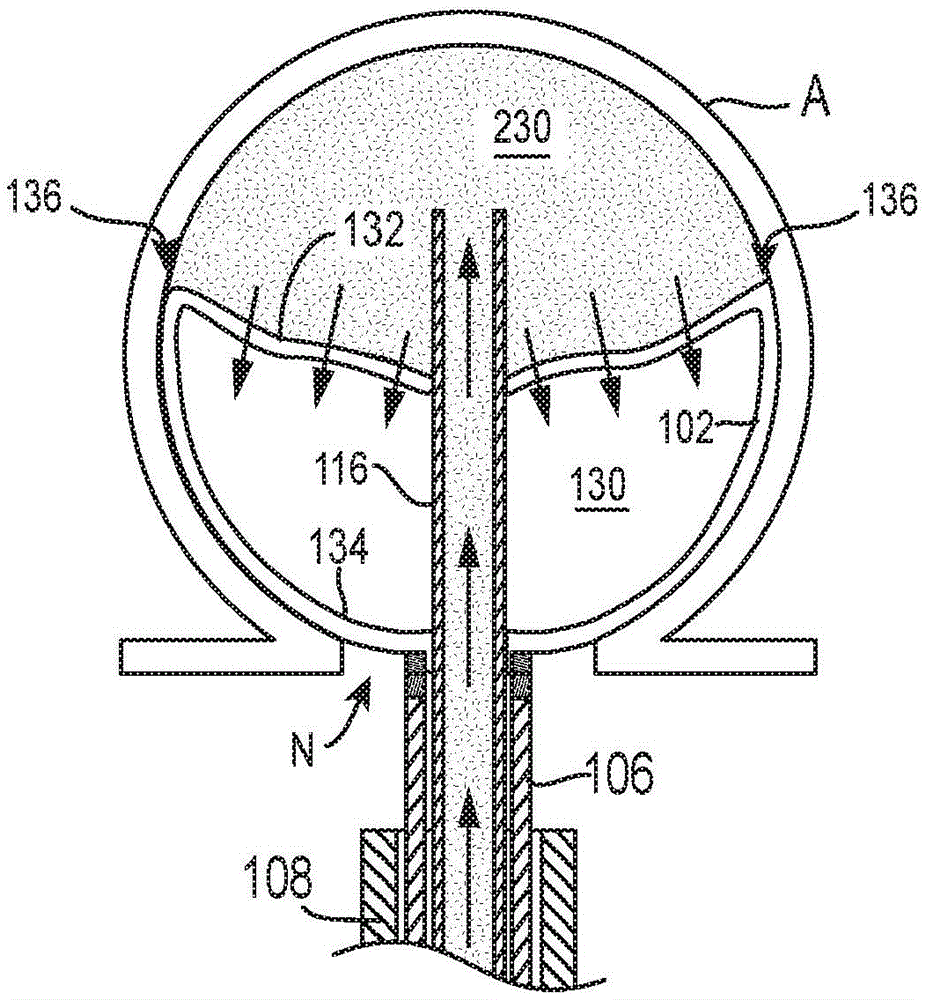
2. The method of any of the preceding clauses wherein transitioning the occlusion member to the second expanded state comprises injecting an embolic material to urge a portion of the sidewall of the expandable mesh in a direction away from the aneurysm wall and toward the interior region of the occlusion member.
3. The method of any of the preceding clauses wherein transitioning the occlusion member to the second expanded shape includes injecting embolic material to invert a portion of the sidewall of the occlusion member such that the portion bulges toward the aneurysm wall in the first expanded state and is recessed toward the aneurysm wall in the second expanded state.
4. The method of any of the preceding clauses wherein the embolizing element comprises a liquid embolization.
5. The method of any of the preceding clauses wherein the embolic element comprises one or more embolic coils.
6. The method of any of the preceding clauses wherein delivering the embolic element occurs after the occlusion member is in the first expanded state.
7. The method of any of the preceding clauses wherein the occlusion member is a mesh.
8. The method of any of the preceding clauses wherein the occlusion member is a braid.
9. The method of any of the preceding clauses wherein the occlusion member is a double-layer braid.
10. The method of any of the preceding clauses wherein the occlusion member has a spherical or substantially spherical shape in the first expanded state.
11. The method of any of the preceding clauses wherein the occlusion member is cup-shaped or bowl-shaped in the second expanded state.
12. The method of any of the preceding clauses wherein the second shape is a predetermined three-dimensional shape.
13. The method of any of the preceding clauses wherein the occlusion member forms a multi-layered braid at the neck of the aneurysm in the second expanded state.
14. The method of any of the preceding clauses wherein the occlusion member comprises a plurality of braided filaments that assume a predetermined three-dimensional shape in the expanded state.
15. The method of any of the preceding clauses wherein the occlusion member comprises a braid formed from 24, 32, 36, 48, 64, or 72 filaments.
16. The method of any of the preceding clauses wherein the occlusion member comprises a braid formed from a plurality of wires, some or all of which have a diameter of about 0.001 inches (0.00254 CM).
17. The method of any of the preceding clauses wherein the occlusion member comprises a braid formed from a plurality of wires, some or all of which have the same diameter.
18. The method of any of the preceding clauses wherein the occlusion member comprises a braid formed from a plurality of wires, at least some of which have different diameters.
19. The method of any of the preceding clauses wherein the occlusion member forms a closed, bulbous shape in the expanded state, the mesh having an aperture in a distal portion.
20. The method of any of the preceding clauses wherein, in the expanded state, the occlusion member forms one of a sphere, a prolate spheroid, or an oblate spheroid.
21. The method of any of the preceding clauses wherein the occlusion member comprises an inner layer and an outer layer.
22. The method of any of the preceding clauses wherein the occlusion member comprises an inner layer and an outer layer that meet at a fold at the distal portion of the occlusion member.
23. The method of clause 22, wherein the expandable mesh comprises an aperture at a distal portion, the aperture defined by the fold.
24. The method of any of the preceding clauses wherein the occlusion member comprises an inner layer and an outer layer that meet at a fold at a proximal portion of the occlusion member.
25. The method of clause 24, wherein the expandable mesh comprises an aperture at a distal portion, the aperture defined by the fold.
26. The method of any one of the preceding clauses wherein the occlusion member has a maximum cross-sectional dimension of 3.0MM, 3.5MM, 4.0MM, 4.5MM, 5.0MM, 5.5MM, 6.0MM, 6.5MM, 7.0MM, 7.5MM, or 8.0 MM.
27. The method of any of the preceding clauses wherein the occlusion member is formed from a plurality of filaments secured at the coupler at the first end and the second end.
28. The method of any one of the preceding clauses wherein the expandable mesh is formed from a plurality of filaments formed from an inner core material surrounded by an outer material.
29. The method of clause 28, wherein the inner core material is a radiopaque material and the outer material is a superelastic material.
30. The method of any of the preceding clauses wherein the occlusion member is a laser cut tube.
31. The method of any of the preceding clauses wherein the occlusion member comprises a plurality of filaments.
32. The method of clause 31, wherein the filaments are interwoven.
33. The method of clause 31 or clause 32, wherein the filaments are braided.
34. The method of any of clauses 31-33, wherein each of the filaments has a first end and a second end opposite the first end, and wherein the first and second ends of the filament are both fixed relative to each other at a coupler.
35. The method of clause 34, wherein the coupler is disposed at the distal end of the occlusion member.
36. The method of clause 34, wherein the coupler is disposed at a proximal end of the occlusion member.
37. The method of any of clauses 31-36, wherein each of the filaments terminates at only one end of the occlusion member.
38. The method of clause 37, wherein the filament forms an opening at an end of the occlusion member opposite the only end.
39. The method of clause 38, wherein the inverted portion of each of the filaments defines the opening.
40. The method of clause 39, wherein the reversed portions of the filament are configured to move relative to each other.
41. The method of any of the preceding clauses wherein the embolizing elements comprise a biopolymer and a chemical cross-linking agent.
42. The method of clause 41, wherein the biopolymer comprises chitosan, a chitosan derivative, a chitosan analog, or a combination thereof.
43. The method of clause 41 or clause 42, wherein the chemical crosslinker comprises GENIPIN (GENIPIN), a GENIPIN derivative, a GENIPIN analog, or a combination thereof.
44. The method of any of clauses 41-43, wherein the embolization elements further comprise a physical cross-linking agent.
45. The method of clause 44, wherein the physical crosslinking agent comprises B glycerophosphate, a B glycerophosphate derivative, a B glycerophosphate analog, or a combination thereof.
46. The method of clause 41, wherein
The biopolymer comprises chitosan, a chitosan derivative, a chitosan analog, or a combination thereof;
the chemical cross-linking agent comprises genipin, a genipin derivative, a genipin analog, or a combination thereof; and is
The physical crosslinker comprises B glycerophosphate, a B glycerophosphate derivative, a B glycerophosphate analog, or a combination thereof.
47. The method of any of the preceding clauses wherein the embolization element comprises a contrast agent.
48. The method of clause 47, wherein the contrast agent is selected to provide reduced radiopacity.
49. The method of clause 47 or clause 48, wherein the contrast agent comprises IOHEXOL (IOHEXOL), an IOHEXOL derivative, an IOHEXOL analog, or a combination thereof.
50. A method of treating an aneurysm, the method comprising:
positioning an expandable occlusion member within an aneurysm in an initial expanded state, wherein in the initial expanded state the expandable occlusion member provides a plurality of layers across a neck of the aneurysm; and
by introducing an embolization element into the aneurysm cavity, the number of layers of the occluding device across the neck of the aneurysm is doubled.
51. The method of clause 50, wherein the number of layers is one.
52. The method of clause 50, wherein the number of layers is two.
53. The method of any of clauses 50-52, wherein the layer is a mesh layer.
54. The method of any of clauses 50-53, wherein the occlusion member has a first shape in an initial expanded state, and wherein introducing the embolic element transitions the occlusion member from the initial expanded state to a second expanded state, wherein the occlusion member forms a second shape different from the first shape.
55. The method of clause 54, wherein the volume enclosed by the first shape is greater than the volume enclosed by the second shape.
56. A method of imaging a treatment of an aneurysm, the method comprising:
acquiring a first image, visualizing:
an occlusion member positioned within the aneurysm, the occlusion member comprising a first radiopaque marker; and
a conduit having a distal portion positioned within the aneurysm, the distal portion of the conduit including a second radiopaque marker; and
a second image is acquired in which the first radiopaque marking is farther from the second radiopaque marking than in the first image.
57. The method of clause 56, wherein in the second image, the first radiopaque marking is located proximate to the second radiopaque marking.
58. The method of clauses 56-57, wherein in the second image the first radiopaque marking is located closer to the neck of the aneurysm than in the first image.
59. The method of any of clauses 56-58, wherein in the first image, the first radiopaque marking is positioned in the distal half of the occlusion member.
60. The method of any of clauses 56-59, wherein in the first image, the first radiopaque marking is positioned on a distal-facing surface of the occlusion member.
61. The method of any of clauses 56-60, wherein the first radiopaque marker is located proximal to the second radiopaque marker in the first image.
62. The method of clauses 56-61, wherein in the first and second images, the second radiopaque marking is disposed closer to the dome of the aneurysm than the first radiopaque marking.
63. The method of clauses 56-62, wherein in the second image, a radiopaque occlusion element is visible in a space between the first radiopaque marking and the second radiopaque marking.
64. The method of clauses 56-62, further comprising acquiring a third image, wherein the first radiopaque marking is further from the second radiopaque marking than in the second image.
65. The method of clauses 56-62, wherein acquiring the first image and acquiring the second image each comprise acquiring a fluoroscopic image.
66. A method of treating an aneurysm, the method comprising:
positioning a distal end of an elongate shaft at or near an aneurysm cavity, the distal end of the shaft comprising an occlusion member that is detachably coupled to an elongate member slidably disposed within the elongate shaft, wherein a distal end of the occlusion member is coupled to a distal end of the elongate member and a proximal end of the occlusion member is slidable over the elongate member;
pushing the elongate member distally from the distal opening in the elongate shaft to draw the distal end of the occlusion member distally through the distal opening to push the occlusion member out of the shaft and allow the occlusion member to self-expand to a first expanded state;
when the occlusion member is in the first expanded state, pulling the elongate member proximally to bring the distal wall of the occlusion member toward the proximal wall of the occlusion member such that the occlusion member forms a second expanded state in which at least a portion of the occlusion member is inverted; and
an embolic element is delivered through the elongate member to a location between the occlusion member and the aneurysm wall.
67. The method of clause 66, wherein the proximal end of the occlusion member slides distally along the elongate member as the occlusion member self-expands.
68. The method of any of the preceding clauses wherein delivering the embolic element occurs while pulling the elongate member proximally.
69. The method of any of the preceding clauses, further comprising inverting the occlusion member at a predetermined longitude defined by the curved region.
70. The method of any of the preceding clauses wherein the occlusion member is a mesh.
71. The method of any of the preceding clauses wherein the occlusion member is a braid.
72. The method of any of the preceding clauses wherein the occlusion member is a double braid.
73. The method of any of the preceding clauses wherein the occlusion member has a spherical or substantially spherical shape in the first expanded state.
74. The method of any of the preceding clauses wherein the occlusion member is cup-shaped or bowl-shaped in the second expanded state.
75. The method of any of the preceding clauses wherein the second shape is a predetermined three-dimensional shape.
76. The method of any of the preceding clauses wherein the occlusion member forms a multi-layered braid at the neck of the aneurysm in the second expanded state.
77. The method of any of the preceding clauses wherein the occlusion member comprises a plurality of braided filaments that assume a predetermined three-dimensional shape in the expanded state.
78. The method of any one of the preceding clauses wherein the occlusion member comprises a recessed portion in a distal portion thereof.
79. The method of clause 78, wherein the opening of the elongate member is adjacent the recessed portion such that the plug element is delivered into the recessed portion.
80. A method of treating an aneurysm, the method comprising:
positioning a distal end of an elongate shaft at or near an aneurysm cavity, the distal end of the shaft comprising an occlusion member that is detachably coupled to an elongate member slidably disposed within the elongate shaft, wherein a distal end of the occlusion member is coupled to a distal end of the elongate member and a proximal end of the occlusion member is slidable over the elongate member;
pushing the elongate member distally from the distal opening in the elongate shaft to draw the distal end of the occlusion member distally through the distal opening to push the occlusion member out of the shaft and allow the occlusion member to self-expand to a first expanded state; and
when the occlusion member is in the first expanded state, the elongate member is pulled proximally to bring the distal wall of the occlusion member toward the proximal wall of the occlusion member such that the occlusion member forms a second expanded state in which the occlusion member collapses upon itself.
81. The method of clause 80, further comprising delivering an embolic element through the elongate member to a location between the occlusion member and the aneurysm wall.
82. A system, comprising:
an elongate shaft defining a lumen;
an elongate member slidably disposed within a lumen of the elongate shaft, the elongate member having a proximal region and a distal region, wherein the distal region is configured to be positioned intravascularly at or within an aneurysm cavity;
a closure member constrained within the lumen of the shaft, the closure member including a proximal end portion having an opening and a distal end portion detachably coupled to a distal end region of the elongate member, wherein the elongate member extends through the opening such that pushing the elongate member from the distal opening in the elongate shaft pulls the occlusion member distally through the distal opening to push the occlusion member out of the shaft and allow the occlusion member to expand to an expanded state.
83. The system of clause 82, further comprising an embolization element configured to be delivered to the aneurysm cavity by the elongate member while the elongate member is coupled to the distal end portion of the occlusion member.
84. The system of clause 83, wherein the embolization element is a liquid embolization, one or more embolization coils, or both.
85. The system of any of clauses 82-84, wherein a portion of the occlusion member surrounding the elongate member at the opening is configured to slide relative to the elongate member when the occlusion member self-expands.
86. The system of any of clauses 82-85, wherein the occlusion member comprises one or more preferential bend regions around all or a portion of a circumference of the occlusion member.
87. The system of clause 86, wherein all or a portion of the one or more preferential bend areas comprises a radiopaque material.
88. The system of any of clauses 82-87, wherein the expanded state is a first expanded state and the occlusion member has a first shape in the first expanded state, and wherein when the occlusion member is in the first expanded state in the aneurysm cavity and coupled to the elongate member, proximal movement of the elongate member collapses a distal wall of the occlusion member toward a proximal wall of the occlusion member, transitioning the occlusion member to a second expanded state, wherein the occlusion member has a shape different from the first shape.
89. A method of treating an aneurysm, the method comprising:
positioning a distal end of an elongate shaft at or near an aneurysm cavity, the distal end of the shaft comprising an occlusion member that is detachably coupled to an elongate member slidably disposed within the elongate shaft, wherein a distal end of the occlusion member is coupled to a distal end of the elongate member and a proximal end of the occlusion member is slidable over the elongate member;
pushing the elongate member distally from the distal opening in the elongate shaft to draw the distal end of the occlusion member distally through the distal opening to push the occlusion member out of the shaft and allow the occlusion member to self-expand to a first expanded state;
when the occlusion member is in the first expanded state, pulling the elongate member proximally to bring the distal wall of the occlusion member toward the proximal wall of the occlusion member such that the occlusion member forms a second expanded state in which at least a portion of the occlusion member is inverted; and
an embolic element is delivered through the elongate member to a location between the occlusion member and the aneurysm wall.
90. The method of clause 89, wherein the proximal end of the occlusion member slides distally along the elongate member as the occlusion member self-expands.
91. The method of clause 89 or clause 90, wherein delivering the embolic element occurs while pulling the elongate member proximally.
92. The method of any of clauses 89-91, further comprising inverting the occlusion member at a predetermined longitude defined by a curved region along the occlusion member.
93. The method of any of clauses 89 to 92, wherein the occlusion member has a spherical or substantially spherical shape in the first expanded state.
94. The method of any of clauses 89 to 93, wherein the occlusion member is cup-shaped or bowl-shaped in the second expanded state.
95. The method of any of clauses 89-94, wherein the occlusion member forms a multi-layered braid at the aneurysm neck in the second expanded state, the multi-layered braid comprising a first layer corresponding to a distal end wall of the occlusion member and a second layer corresponding to a proximal end wall of the occlusion member.
96. A method of treating an aneurysm, the method comprising:
positioning a distal end portion of an elongate shaft at or near an aneurysm cavity, the distal end portion of the shaft including an occlusion member that is detachably coupled to an elongate member slidably disposed within the elongate shaft, wherein a distal end region of the occlusion member is coupled to a distal end of the elongate member;
expanding the occlusion member within the aneurysm cavity;
pulling the elongate member proximally, thereby reversing a first portion of the occlusion member onto a second portion of the occlusion member, wherein the first and second portions meet at a circumferential fold;
pushing the elongate member distally, thereby moving the second portion away from the first portion and at least partially reversing the inversion of the occlusion member; and
an embolic element is delivered through the elongate member to a space between the distal wall of the occlusion member and the wall of the aneurysm.
97. The method of clause 96, further comprising delivering an embolic element through the elongate member to a location between the occlusion member and the aneurysm wall.
98. The method of clause 96 or clause 97, wherein pulling the elongate member proximally occurs a first time, and the method further comprises pulling the elongate member proximally a second time after the first time and after pushing the elongate member distally, wherein pulling the elongate member proximally the second time forces a distal wall of the occlusion member toward a proximal wall of the occlusion member such that the occlusion member forms a cup or bowl shape.
99. The method of clause 98, wherein delivering the embolic element occurs while pulling the elongate member proximally a second time.
100. The method of any of clauses 96-99, wherein as the occlusion member expands, a proximal end region of the occlusion member slides distally relative to the elongate member.
101. The method of any of clauses 96-100, further comprising separating the elongate member from the distal region of the occlusion member and withdrawing the elongate member from the body.
102. A therapeutic system, comprising:
an electrolytically corrodible core wire having a proximal portion, a distal portion, and a separation region between the proximal portion and the distal portion; an occlusion member having a proximal hub coupled to a core wire distal portion, the occlusion member configured to be positioned at or adjacent a treatment site; and
a conduit extending along at least a portion of the core-wire, the conduit having a lumen configured to pass the embolic element therethrough.
103. The treatment system of any of the preceding clauses, wherein the distal portion of the conduit is configured to be disposed at or near the treatment site with the occlusion member.
104. The treatment system of any of the preceding clauses wherein the treatment site comprises an aneurysm sac.
105. The treatment system of any of the preceding clauses wherein the conduit comprises a flexible tubular member.
106. The treatment system of any of the preceding clauses, further comprising a stylet configured to be removably disposed within the lumen of the conduit.
107. The treatment system of any of the preceding clauses wherein the stylet is stiffer than the tubing.
108. The treatment system of any of the preceding clauses wherein the stylet is metallic.
109. The treatment system of any of the preceding clauses wherein the conduit has a distal portion having a smaller cross-sectional dimension than a proximal portion of the conduit.
110. The treatment system of any of the preceding clauses, wherein the stylet has a distal portion having a smaller cross-sectional dimension than a proximal portion of the stylet.
111. The treatment system of any of the preceding clauses wherein the conduit is coupled to the elongate member such that the two cannot slide relative to each other.
112. The treatment system of any of the preceding clauses wherein the conduit is coupled to the elongated member by one or more straps or clamps.
113. The treatment system of any of the preceding clauses wherein the one or more bands or clamps circumferentially surround the conduit and the core wire.
114. The treatment system of any of the preceding clauses wherein the conduit is coupled to the elongate member by an adhesive.
115. The treatment system of any of the preceding clauses wherein the conduit is coupled to the elongate member via a surrounding sheath. 116. The treatment system of any of the preceding clauses wherein the surrounding sheath comprises a heat-shrinkable polymer.
117. The treatment system of any of the preceding clauses wherein the heat-shrinkable polymer comprises PTFE.
118. The treatment system of any of the preceding clauses wherein the conduit comprises a tubular member, a hypotube, and/or a catheter.
119. The treatment system of any of the preceding clauses wherein the conduit comprises a liner extending through a lumen of the tubular member, the liner extending distally beyond a distal end of the tubular member.
120. The treatment system of any of the preceding clauses wherein the liner comprises extruded PTFE.
121. The treatment system of any of the preceding clauses wherein the conduit has an inner diameter of between 0.005 inches and 0.015 inches along at least a portion of its length.
122. The treatment system of any of the preceding clauses wherein the core wire comprises a proximal insulation layer annularly contacting a proximal portion of the core wire and a distal insulation layer annularly contacting a distal portion of the core wire.
123. The therapeutic system of any one of the preceding clauses wherein the separation region has a microstructure with a crystallinity lower than the proximal and distal portions of the core wire.
124. The treatment system of any of the preceding clauses wherein the detachment zone has a more amorphous microstructure than each of the core proximal portion and the core distal portion.
125. The treatment system of any of the preceding clauses wherein the core wire is made of an electrically conductive material.
126. The treatment system of any of the preceding clauses wherein the detachment zone has an axial length of less than 0.010 inches.
127. The treatment system of any of the preceding clauses wherein the separation zone has an axial length that is greater than or equal to 0.005 inches and less than 0.010 inches.
128. The treatment system of any of the preceding clauses wherein the core wire comprises an anchoring end distal-most from the hub, the anchoring end having a maximum cross-sectional dimension greater than an interior cross-sectional dimension of a lumen of the hub.
129. The treatment system of any of the preceding clauses wherein the detachment zone is axially located between the core proximal portion and the core distal portion.
130. The treatment system of any of the preceding clauses, wherein the occlusion member is an occlusion member or an intracapsular device configured to be implanted within the aneurysm.
131. The treatment system of any of the preceding clauses wherein the occlusion member comprises an expandable mesh having a constrained state for delivery to the aneurysm and an expanded state in which at least a portion of the mesh is configured to be disposed across the neck of the aneurysm.
132. The treatment system of any of the preceding clauses wherein the expandable mesh comprises a plurality of braided filaments that assume a preset three-dimensional shape in the expanded state.
133. The treatment system of any of the preceding clauses wherein the expandable mesh comprises a braid formed from 24, 32, 36, 48, 64, or 72 filaments.
134. The treatment system of any of the preceding clauses wherein the expandable mesh comprises a braid formed from a plurality of wires, some or all of which have a diameter of at least 0.001 inches.
135. The treatment system of any of the preceding clauses wherein the expandable mesh comprises a braid formed from a plurality of wires, some or all of which have the same diameter.
136. The treatment system of any of the preceding clauses wherein the expandable mesh comprises a braid formed from a plurality of wires, at least some of which have different diameters.
137. The treatment system of any of the preceding clauses wherein, in the expanded state, the expandable mesh forms one of a sphere, a prolate spheroid, or an oblate spheroid.
138. The treatment system of any of the preceding clauses wherein the expandable mesh comprises an inner layer and an outer layer.
139. The treatment system of any of the preceding clauses wherein the expandable mesh has a maximum cross-sectional dimension of 3.0MM, 3.5MM, 4.0MM, 4.5MM, 5.0MM, 5.5MM, 6.0MM, 6.5MM, 7.0MM, 7.5MM, or 8.0 MM.
140. The treatment system of any of the preceding clauses wherein the expandable mesh is a laser cut tube.
141. The treatment system of any of the preceding clauses wherein the expandable mesh comprises a plurality of interwoven filaments.
142. The treatment system of any of the preceding clauses wherein the occlusion member is curved along at least a majority of its entire length.
143. The treatment system of any of the preceding clauses wherein the occlusion member is collapsible upon contact with the embolic element.
144. The treatment system of any of the preceding clauses wherein the occlusion member is collapsible upon contact with the synthetic gel or fluid.
145. The treatment system of any of the preceding clauses, wherein the occlusion member is configured to rotate about the conduit.
146. The treatment system of any of the preceding clauses wherein the occlusion member is rotatably and slidably coupled to the conduit.
147. The treatment system of any of the preceding clauses, wherein the occlusion member has an aperture at a distal portion thereof, and wherein the conduit extends through the aperture.
148. The treatment system of any of the preceding clauses wherein the occlusion member is configured to move axially along the elongate member.
149. The treatment system of any of the preceding clauses wherein the embolizing element is a liquid embolization.
150. The treatment system of any of the preceding clauses wherein the embolizing element comprises a biopolymer and/or a chemical cross-linking agent.
151. The therapeutic system of any one of the preceding clauses wherein the biopolymer comprises chitosan, a chitosan derivative, a chitosan analog, or a combination thereof.
152. The therapeutic system of any one of the preceding clauses wherein the chemical cross-linking agent comprises genipin, a genipin derivative, a genipin analog, or a combination thereof.
153. A system, comprising:
the treatment system of any of the preceding clauses; and
an elongate shaft having a lumen extending therethrough, wherein the treatment system is configured to be slidably disposed within the lumen of the elongate shaft.
154. A system, comprising:
the treatment system of any of the preceding clauses;
a first elongate shaft having a first lumen extending therethrough, wherein the treatment system is configured to be slidably disposed within the first lumen; and
a second elongate shaft having a second lumen extending therethrough, wherein the first elongate shaft is configured to be slidably disposed within the second lumen.
155. The system of 154, wherein the first elongate shaft is a microcatheter and the second elongate shaft is a delivery or guide catheter.
156. The system of any of the preceding clauses wherein the microcatheter has a nominal inner diameter of about 0.017 inches or less, about 0.021 inches or less, or about 0.027 inches or less.
157. A method of treating an aneurysm, comprising:
providing the treatment system of any one of the preceding clauses.
158. The method of any of the preceding clauses further comprising:
positioning the distal end of the conduit in the aneurysm cavity; and
the occlusion member is released from the elongate member while the distal end of the elongate member is positioned within the aneurysm cavity such that the occlusion member self-expands to assume an expanded state.
159. The method of any of the preceding clauses wherein releasing the occlusive member comprises electrolytically corroding a detached area of the core wire.
160. The method of clause 158, wherein releasing the occlusion member comprises delivering an electrical current to the core wire.
161. The method of any one of the preceding clauses wherein positioning the distal end of the conduit comprises advancing the distal end of the conduit toward the dome or distal-most end of the aneurysm such that the distal end of the conduit extends beyond the distal tip of a microcatheter surrounding the conduit.
162. The method of any of the preceding clauses further comprising positioning the distal end of the conduit in the aneurysm cavity with the occlusion member.
163. The method of any of the preceding clauses wherein positioning the distal end of the tube comprises distally advancing the tube with the stylet disposed therein.
164. The method of any of the preceding clauses, further comprising proximally retracting the stylet relative to the conduit.
165. The method of any of the preceding clauses, further comprising removing the stylet from within the lumen of the conduit.
166. The method of any of the preceding clauses wherein releasing the occlusion member comprises allowing the occlusion member to self-expand to assume a first expanded state in which the occlusion member forms a first shape, wherein in the first expanded state the occlusion member surrounds an interior region having a first interior volume, the method further comprising
Delivering embolic elements between the occlusion member and the aneurysm wall to transition the occlusion member to a second expanded state, wherein the occlusion member defines a second internal volume that is smaller than the first internal volume, wherein the occlusion member forms a second shape in the second expanded state that is different from the first shape in the first expanded state.
167. The method of any of the preceding clauses wherein transitioning the occlusion member to the second expanded state comprises injecting an embolic material to urge a portion of the sidewall of the expandable mesh in a direction away from the aneurysm wall and toward the interior region of the occlusion member.
168. The method of any of the preceding clauses wherein transitioning the occlusion member to the second expanded shape includes injecting embolic material to invert a portion of the sidewall of the occlusion member such that the portion bulges toward the aneurysm wall in the first expanded state and is recessed toward the aneurysm wall in the second expanded state.
169. The method of any of the preceding clauses wherein the embolizing element comprises a liquid embolization.
170. The method of any of the preceding clauses wherein the embolic element comprises one or more embolic coils.
171. The method of any of the preceding clauses wherein delivering the embolic element occurs after the occlusion member is in the first expanded state.
172. The method of any of the preceding clauses wherein the occlusion member is a mesh.
173. The method of any of the preceding clauses wherein the occlusion member is a braid.
174. The method of any of the preceding clauses wherein the occlusion member is a double braid.
175. The method of any of the preceding clauses wherein the occlusion member has a spherical or substantially spherical shape in the first expanded state.
176. The method of any of the preceding clauses wherein the occlusion member is cup-shaped or bowl-shaped in the second expanded state.
177. The method of any of the preceding clauses wherein the second shape is a predetermined three-dimensional shape.
178. The method of any of the preceding clauses wherein the occlusion member forms a multi-layered braid at the neck of the aneurysm in the second expanded state.
179. The method of any of the preceding clauses wherein the occlusion member comprises a plurality of braided filaments that assume a predetermined three-dimensional shape in the expanded state.
180. The method of any of the preceding clauses wherein the occlusion member comprises a braid formed from 24, 32, 36, 48, 64, or 72 filaments.
181. The method of any of the preceding clauses wherein the occlusion member comprises a braid formed from a plurality of wires, some or all of which have a diameter of about 0.001 inches (0.00254 CM).
182. The method of any of the preceding clauses wherein the occlusion member comprises a braid formed from a plurality of wires, some or all of which have the same diameter.
183. The method of any of the preceding clauses wherein the occlusion member comprises a braid formed from a plurality of wires, at least some of which have different diameters.
184. The method of any of the preceding clauses wherein the occlusion member forms a closed, bulbous shape in the expanded state, the mesh having an aperture in a distal portion.
185. The method of any of the preceding clauses wherein, in the expanded state, the occlusion member forms one of a sphere, a prolate spheroid, or an oblate spheroid.
186. The method of any of the preceding clauses wherein the occlusion member comprises an inner layer and an outer layer.
187. The method of any of the preceding clauses wherein the occlusion member comprises an inner layer and an outer layer that meet at a fold at the distal portion of the occlusion member.
188. The method of any of the preceding clauses wherein the expandable mesh comprises an aperture at a distal portion, the aperture defined by the fold.
189. The method of any of the preceding clauses wherein the occlusion member comprises an inner layer and an outer layer that meet at a fold at a proximal portion of the occlusion member.
190. The method of any of the preceding clauses wherein the expandable mesh comprises an aperture at the distal portion, the aperture defined by the fold.
191. The method of any one of the preceding clauses wherein the occlusion member has a maximum cross-sectional dimension of 3.0MM, 3.5MM, 4.0MM, 4.5MM, 5.0MM, 5.5MM, 6.0MM, 6.5MM, 7.0MM, 7.5MM, or 8.0 MM.
192. The method of any of the preceding clauses wherein the occlusion member is formed from a plurality of filaments having first and second ends secured at a hub or coupling.
193. The method of any one of the preceding clauses wherein the expandable mesh is formed from a plurality of filaments formed from an inner core material surrounded by an outer material.
194. The method of any of the preceding clauses wherein the inner core material is a radiopaque material and the outer material is a superelastic material.
195. The method of any of the preceding clauses wherein the occlusion member is a laser cut tube.
196. The method of any of the preceding clauses wherein the occlusion member comprises a plurality of filaments.
197. The method of any of the preceding clauses wherein the filaments are interwoven.
198. The method of any of the preceding clauses wherein the filaments are braided.
199. The method of any of the preceding clauses wherein each of the filaments has a first end and a second end opposite the first end, and wherein the first and second ends of the filaments are both fixed at a coupler relative to each other.
200. The method of any of the preceding clauses wherein the coupler is disposed at a distal end of the occlusion member.
201. The method of any of the preceding clauses wherein the coupler is disposed at a proximal end of the occlusion member.
202. The method of any of the preceding clauses wherein each of the filaments terminates at only one end of the occlusion member.
203. The method of any of the preceding clauses wherein the filament forms an opening at an end of the occlusion member opposite the only end.
204. The method of any of the preceding clauses wherein the inverted portion of each of the filaments defines the opening.
205. The method of any of the preceding clauses wherein the inverted portions of the filaments are configured to move relative to each other.
206. The method of any of the preceding clauses wherein the embolizing elements comprise a biopolymer and a chemical cross-linking agent.
207. The method of any one of the preceding clauses wherein the biopolymer comprises chitosan, a chitosan derivative, a chitosan analog, or a combination thereof.
208. The method of any of the preceding clauses wherein the chemical crosslinking agent comprises genipin, a genipin derivative, a genipin analog, or a combination thereof.
209. The method of any of the preceding clauses wherein the embolization elements further comprise a physical cross-linking agent.
210. The method of any one of the preceding clauses wherein the physical crosslinker comprises B glycerophosphate, a B glycerophosphate derivative, a B glycerophosphate analog, or a combination thereof.
211. The method of any of the preceding clauses wherein
The biopolymer comprises chitosan, a chitosan derivative, a chitosan analog, or a combination thereof;
the chemical cross-linking agent comprises genipin, a genipin derivative, a genipin analog, or a combination thereof; and is
The physical crosslinker comprises a B glycerophosphate, a B glycerophosphate derivative, a B glycerophosphate analog, or a combination thereof.
212. The method of any of the preceding clauses wherein the embolization element comprises a contrast agent.
213. The method of any of the preceding clauses wherein the contrast agent is selected to provide reduced radiopacity.
214. The method of any of the preceding clauses wherein the contrast agent comprises iohexol, an iohexol derivative, an iohexol analog, or a combination thereof.
215. A therapeutic system, comprising:
an electrolytically erodable conduit having a proximal portion, a distal portion, a separation region between the proximal and distal portions, and a lumen configured to pass a plug element therethrough; and
an occlusion member having a proximal hub coupled to the tube distal portion, the occlusion member configured to be positioned at or adjacent a treatment site.
216. The therapeutic system of any one of the clauses herein, wherein the separation region comprises a portion of the conduit that is configured to be severed in response to delivery of electrical current thereto.
217. The treatment system of any of the clauses herein, wherein the detachment zone is axially located between the conduit proximal portion and the conduit distal portion.
218. The treatment system of any of the clauses herein, wherein the conduit comprises a sidewall having one or more apertures formed therein within the separation region.
219. The treatment system of any of the clauses herein, wherein the conduit comprises a sidewall having a reduced thickness in the separation region.
220. The treatment system of any of the clauses herein, wherein the conduit has a lower material density in the separation zone than in the proximal and distal portions.
221. The therapeutic system of any one of the clauses herein wherein the separation zone has a microstructure that is less crystalline than each of the conduit proximal portion and the conduit distal portion.
222. The therapeutic system of any one of the clauses herein wherein the separation zone has a more amorphous microstructure than each of the conduit proximal portion and the conduit distal portion.
223. The treatment system of any of the clauses herein, wherein the conduit is electrically conductive.
224. The treatment system of any of the clauses herein, wherein the conduit is metallic.
225. The treatment system of any of the clauses herein, wherein the conduit comprises a hypotube.
226. The treatment system of any of the clauses herein, wherein the conduit comprises a catheter.
227. The treatment system of any of clauses hereof, wherein the wall thickness of the conduit is between about 0.0005 inches and about 0.0015 inches, or about 0.001 inches.
228. The therapy system of any of the clauses herein, wherein the conduit has an outer diameter of less than about 0.027 inches, less than about 0.021 inches, less than about 0.017 inches, or less than about 0.015 inches.
229. The treatment system of any of the clauses herein, wherein the conduit has an inner diameter of less than about 0.015 inches, less than about 0.012 inches, less than about 0.010 inches, or less than about 0.008 inches.
230. The treatment system of any of the clauses hereof, further comprising a liner extending through the conduit lumen.
231. The treatment system of any of the clauses herein, wherein the liner comprises an elongate tubular member having a lumen configured to pass an embolic element therethrough.
232. The treatment system of any of the clauses hereof, wherein the liner is slidably disposed within the conduit lumen.
233. The treatment system of any of the clauses herein, wherein the liner is electrically insulating.
234. The treatment system of any of the clauses herein, wherein the liner comprises a polymer.
235. The treatment system of any of the clauses herein, wherein the liner comprises Polytetrafluoroethylene (PTFE).
236. The treatment system of any of the clauses herein, wherein the liner has a wall thickness of between about 0.0005 inches and about 0.0015 inches, or about 0.001 inches.
237. The treatment system of any of the clauses herein, wherein the liner has an outer diameter of less than about 0.027 inches, less than about 0.021 inches, less than about 0.017 inches, or less than about 0.010 inches.
238. The treatment system of any of the clauses herein wherein the liner has an inner diameter of less than about 0.015 inches, less than about 0.012 inches, less than about 0.010 inches, less than about 0.008 inches, or less than about 0.006 inches.
239. The treatment system of any of the clauses herein, wherein the liner has a sidewall that is continuous along the separation region.
240. The treatment system of any of the clauses herein, wherein the distal end of the liner extends distally from the distal end of the conduit when the liner is disposed within the conduit.
241. The treatment system of any of the clauses herein, wherein a distal end of the liner is substantially contiguous with a distal end of the pipeline when the liner is disposed within the pipeline.
242. The treatment system of any of the clauses herein, wherein the liner is configured to slidably retract relative to the occlusion member after severing of the separation region.
243. The treatment system of any of the clauses herein, further comprising a sheath extending over the conduit.
244. The treatment system of any of the clauses herein, wherein the sheath is electrically insulating.
245. The treatment system of any of the clauses herein, wherein the sheath comprises a polymer.
246. The treatment system of any of the clauses herein, wherein the sheath comprises Polytetrafluoroethylene (PTFE).
247. The treatment system of any of the clauses herein, wherein the sheath has a wall thickness of between about 0.0005 inches and about 0.002 inches, or about 0.0015 inches.
248. The treatment system of any of the clauses herein, wherein the sheath has an outer diameter of less than about 0.027 inches, less than about 0.021 inches, less than about 0.017 inches, or less than about 0.010 inches.
249. The treatment system of any of the clauses herein wherein the sheath has an inner diameter of less than about 0.015 inches, less than about 0.012 inches, or less than about 0.010 inches.
250. The treatment system of any of the clauses herein, wherein the sheath comprises a proximal portion extending over the conduit proximal portion and a distal portion extending over the conduit distal portion.
251. The treatment system of any of the clauses herein, wherein the sheath comprises a gap between the proximal portion and the distal portion.
252. The treatment system of any of the clauses herein, wherein the sheath proximal portion and the sheath distal portion are discrete segments separated from each other by a gap.
253. The treatment system of any of the clauses herein, wherein a gap between the sheath proximal portion and the sheath distal portion is axially aligned with the separation zone.
254. The treatment system of any of the clauses herein, wherein the sheath does not extend completely beyond the conduit separation region.
255. The treatment system of any of the clauses herein, wherein the sheath proximal portion is configured to be proximally retracted relative to the occlusion member after the conduit is severed at the detachment zone.
256. The treatment system of any of the clauses herein, wherein the sheath distal portion is fixedly coupled to the occlusion member.
257. The treatment system of any of the clauses herein, wherein the sheath distal portion extends distally beyond the hub of the occlusion member.
258. The treatment system of any of the clauses herein, wherein the sheath distal portion extends distally beyond the distal end of the occlusion member.
259. The treatment system of any of the clauses herein, wherein the sheath distal portion extends distally beyond the distal end of the conduit.
260. The treatment system of any of the clauses herein, wherein the sheath distal portion extends distally beyond the distal end of the liner.
261. The treatment system of any of the clauses herein, wherein the distal portion of the conduit is configured to be disposed at or near the treatment site with the occlusion member.
262. The treatment system of any of the clauses herein, wherein the treatment site comprises an aneurysm sac.
263. The treatment system of any of the clauses herein, wherein the conduit has a distal portion having a smaller cross-sectional dimension than a proximal portion of the conduit.
264. The treatment system of any of the clauses herein, wherein the occlusion member is coupled to the conduit by one or more bands or clamps.
265. The treatment system of any of the clauses herein, wherein the one or more bands or clips circumferentially surround the conduit and a proximal portion of the occlusion member.
266. The treatment system of any of the clauses herein, wherein the occlusion member is coupled to the conduit by an adhesive.
267. The treatment system of any of clauses herein, wherein the occlusion member is an occlusion member or an intravesicular device configured to be implanted within the aneurysm.
268. The treatment system of any of the clauses herein, wherein the occlusion member comprises an expandable mesh having a constrained state for delivery to the aneurysm and an expanded state in which at least a portion of the mesh is configured to be disposed across the neck of the aneurysm.
269. The treatment system of any of the clauses herein, wherein the expandable mesh comprises a plurality of braided filaments that assume a pre-set three-dimensional shape in the expanded state.
270. The treatment system of any of clauses hereof, wherein the expandable mesh comprises a braid formed from 24, 32, 36, 48, 64, or 72 filaments.
271. The treatment system of any of the clauses herein, wherein the expandable mesh comprises a braid formed from a plurality of wires, some or all of which have a diameter of at least 0.001 inches.
272. The treatment system of any of clauses hereof, wherein the expandable mesh comprises a braid formed from a plurality of wires, some or all of which have the same diameter.
273. The treatment system of any of the clauses herein, wherein the expandable mesh comprises a braid formed from a plurality of wires, at least some of which have different diameters.
274. The treatment system of any of the clauses hereof, wherein, in the expanded state, the expandable mesh forms one of a sphere, a prolate spheroid, or an oblate spheroid.
275. The treatment system of any of the clauses herein, wherein the expandable mesh comprises an inner layer and an outer layer.
276. The treatment system of any of clauses herein, wherein the expandable mesh has a maximum cross-sectional dimension of 3.0MM, 3.5MM, 4.0MM, 4.5MM, 5.0MM, 5.5MM, 6.0MM, 6.5MM, 7.0MM, 7.5MM, or 8.0 MM.
277. The treatment system of any of clauses hereof, wherein the expandable mesh is a laser cut tube.
278. The treatment system of any of the clauses herein, wherein the expandable mesh comprises a plurality of interwoven filaments.
279. The treatment system of any of the clauses herein, wherein the occlusion member is curved along at least a majority of its entire length.
280. The treatment system of any of the clauses herein, wherein the occlusion member is collapsible upon contact with the embolic element.
281. The treatment system of any of the clauses herein, wherein the occlusion member is collapsible upon contact with the synthetic gel or fluid.
282. The treatment system of any of the clauses herein, wherein the occlusion member is configured to rotate about the conduit.
283. The treatment system of any of the clauses herein, wherein the occlusion member is rotatably and slidably coupled to the conduit.
284. The treatment system of any of the clauses herein, wherein the occlusion member has an aperture at a distal portion thereof, and wherein the conduit extends through the aperture.
285. The treatment system of any of the clauses herein, wherein the occlusion member has an aperture at a distal portion thereof, and wherein the liner extends through the aperture.
286. The treatment system of any of the clauses herein, wherein the occlusion member has an aperture at a distal portion thereof, and wherein the sheath extends through the aperture.
287. The treatment system of any of the clauses hereof, wherein the embolic element is a liquid embolic.
288. The treatment system of any of the clauses hereof, wherein the embolization element comprises a biopolymer and/or a chemical cross-linking agent.
289. The therapeutic system of any one of clauses hereof, wherein the biopolymer comprises chitosan, a chitosan derivative, a chitosan analog, or a combination thereof.
290. The therapeutic system of any one of clauses herein, wherein the chemical cross-linking agent comprises genipin, a genipin derivative, a genipin analog, or a combination thereof.
291. A system, comprising:
the treatment system of any one of the clauses herein; and
an elongate shaft having a lumen extending therethrough, wherein the treatment system is configured to be slidably disposed within the lumen of the elongate shaft.
292. A system, comprising:
the treatment system of any one of the clauses herein;
a first elongate shaft having a first lumen extending therethrough, wherein the treatment system is configured to be slidably disposed within the first lumen; and
a second elongate shaft having a second lumen extending therethrough, wherein the first elongate shaft is configured to be slidably disposed within the second lumen.
293. The system of 154, wherein the first elongate shaft is a microcatheter and the second elongate shaft is a delivery or guide catheter.
294. The system of any of the clauses herein, wherein the microcatheter has a nominal inner diameter of about 0.015 inch or less, about 0.017 inch or less, about 0.021 inch or less, or about 0.027 inch or less.
295. A method of treating an aneurysm, comprising:
providing a therapeutic system as described in any of the clauses herein.
296. The method of any of the clauses herein, further comprising:
positioning the distal end of the conduit in the aneurysm cavity; and
the occlusion member is released from the conduit while the distal end of the conduit is positioned within the aneurysm cavity such that the occlusion member self-expands to assume an expanded state.
297. The method of any of the clauses herein, wherein releasing the occlusion member comprises electrolytically corroding a separation region of the conduit.
298. The method of clause 158, wherein releasing the occlusion member comprises delivering an electrical current to the conduit.
299. The method of any of the clauses herein, wherein positioning the distal end of the conduit comprises advancing the distal end of the conduit toward the dome or distal-most end of the aneurysm such that the distal end of the conduit extends beyond the distal tip of a microcatheter surrounding the conduit.
300. The method of any of the clauses herein, wherein positioning the distal end of the conduit comprises advancing the distal end of the liner toward the dome or distal-most end of the aneurysm such that the distal end of the liner extends beyond the distal tip of the microcatheter surrounding the conduit.
301. The method of any of the clauses herein, further comprising positioning the distal end of the tube, sheath, and/or liner in the aneurysm cavity with the occlusion member.
302. The method of any of the clauses herein, further comprising retracting the liner proximally relative to the distal portion of the conduit.
303. The method of any of the clauses herein, further comprising removing the liner from within the lumen of the conduit.
304. The method of any of the clauses herein, wherein releasing the occlusion member comprises allowing the occlusion member to self-expand to assume a first expanded state in which the occlusion member forms a first shape, wherein in the first expanded state, the occlusion member surrounds an interior region having a first interior volume, the method further comprising
Delivering an embolic element between the occlusion member and the aneurysm wall to transition the occlusion member to a second expanded state, wherein the occlusion member defines a second interior volume that is smaller than the first interior volume, wherein the occlusion member forms a second shape in the second expanded state that is different from the first shape in the first expanded state.
305. The method of any of clauses herein, wherein transitioning the occlusion member to the second expanded state comprises injecting an embolic element to push a portion of a sidewall of the expandable mesh in a direction away from the aneurysm wall and toward an interior region of the occlusion member.
306. The method of any of the clauses herein, wherein transitioning the occlusion member to the second expanded shape comprises injecting an embolic material to invert a portion of the sidewall of the occlusion member such that the portion bulges toward the aneurysm wall in the first expanded state and is recessed toward the aneurysm wall in the second expanded state.
307. The method of any of the clauses herein, wherein the embolization element comprises a liquid embolization.
308. The method of any of the clauses herein, wherein the embolic element comprises one or more embolic coils.
309. The method of any of the clauses herein, wherein delivering the embolic element occurs after the occlusion member is in the first expanded state.
310. The method of any one of clauses herein, wherein the occlusion member is a mesh.
311. The method of any of clauses herein, wherein the occlusion member is a braid.
312. The method of any of clauses herein, wherein the occlusion member is a double-layer braid.
313. The method of any of the clauses herein, wherein the occlusion member has a spherical or substantially spherical shape in the first expanded state.
314. The method of any of the clauses herein, wherein the occlusion member is cup-shaped or bowl-shaped in the second expanded state.
315. The method of any of the clauses herein wherein the second shape is a predetermined three-dimensional shape.
316. The method of any of clauses herein, wherein the occlusion member forms a multi-layered braid at the neck of the aneurysm in the second expanded state.
317. The method of any of the clauses herein, wherein the occlusion member comprises a plurality of braided filaments that assume a predetermined three-dimensional shape in the expanded state.
318. The method of any of the clauses herein, wherein the occlusion member comprises a braid formed from 24, 32, 36, 48, 64, or 72 filaments.
319. The method of any of clauses herein, wherein the occlusion member comprises a braid formed from a plurality of wires, some or all of which have a diameter of about 0.001 inch (0.00254 CM).
320. The method of any of clauses herein, wherein the occlusion member comprises a braid formed from a plurality of wires, some or all of which have the same diameter.
321. The method of any of clauses herein, wherein the occlusion member comprises a braid formed from a plurality of wires, at least some of which have different diameters.
322. The method of any of the clauses herein, wherein the occlusion member forms a closed, bulbous shape in the expanded state, the mesh having an aperture in a distal portion.
323. The method of any of clauses herein, wherein, in the expanded state, the occlusion member forms one of a sphere, a prolate spheroid, or an oblate spheroid.
324. The method of any of clauses herein, wherein the occlusion member comprises an inner layer and an outer layer.
325. The method of any of the clauses herein, wherein the occlusion member comprises an inner layer and an outer layer that meet at a fold at the distal portion of the occlusion member.
326. The method of any of the clauses herein, wherein the expandable mesh comprises an aperture at the distal portion, the aperture defined by the fold.
327. The method of any of clauses herein, wherein the occlusion member comprises an inner layer and an outer layer that meet at a fold at a proximal portion of the occlusion member.
328. The method of any one of the clauses herein, wherein the expandable mesh comprises an aperture at the distal portion, the aperture defined by the fold.
329. The method of any one of clauses herein, wherein the occlusion member has a maximum cross-sectional dimension of 3.0MM, 3.5MM, 4.0MM, 4.5MM, 5.0MM, 5.5MM, 6.0MM, 6.5MM, 7.0MM, 7.5MM, or 8.0 MM.
330. The method of any of the clauses herein, wherein the occlusion member is formed from a plurality of filaments having first and second ends secured at a hub or coupler.
331. The method of any of the clauses herein, wherein the expandable mesh is formed from a plurality of filaments formed from an inner core material surrounded by an outer material.
332. The method of any of the clauses herein, wherein the inner core material is a radiopaque material and the outer material is a superelastic material.
333. The method of any of clauses herein, wherein the occlusion member is a laser cut tube.
334. The method of any of clauses herein, wherein the occlusion member comprises a plurality of filaments.
335. The method of any of the clauses hereof, wherein the filaments are interwoven.
336. The method of any of the clauses hereof, wherein the filaments are braided.
337. The method of any of the clauses herein, wherein each of the filaments has a first end and a second end opposite the first end, and wherein the first and second ends of the filaments are both fixed relative to each other at a coupler.
338. The method of any of the clauses herein, wherein the coupler is disposed at a distal end of the occlusion member.
339. The method of any of the clauses herein, wherein the coupler is disposed at a proximal end of the occlusion member.
340. The method of any one of the clauses herein wherein each of the filaments terminates at only one end of the occlusion member.
341. The method of any one of the clauses herein wherein the filament forms an opening at an end of the occlusion member opposite the only end.
342. The method of any one of the clauses herein, wherein the inverted portion of each of the filaments defines the opening.
343. The method of any one of the clauses herein, wherein the inverted portions of the filaments are configured to move relative to each other.
344. The method of any of the clauses herein, wherein the embolization element comprises a biopolymer and a chemical cross-linking agent.
345. The method of any one of the clauses herein wherein the biopolymer comprises chitosan, a chitosan derivative, a chitosan analog, or a combination thereof.
346. The method of any of clauses herein, wherein the chemical crosslinking agent comprises genipin, a genipin derivative, a genipin analog, or a combination thereof.
347. The method of any of the clauses herein, wherein the embolization elements further comprise a physical cross-linking agent.
348. The method of any of the clauses herein, wherein the physical crosslinker comprises B glycerophosphate, a B glycerophosphate derivative, a B glycerophosphate analog, or a combination thereof.
349. The method of any of the clauses hereof, wherein
The biopolymer comprises chitosan, a chitosan derivative, a chitosan analog, or a combination thereof;
the chemical cross-linking agent comprises genipin, a genipin derivative, a genipin analog, or a combination thereof; and is
The physical crosslinker comprises B glycerophosphate, a B glycerophosphate derivative, a B glycerophosphate analog, or a combination thereof.
350. The method of any of the clauses herein, wherein the embolization element comprises a contrast agent.
351. The method of any of the clauses herein wherein the contrast agent is selected to provide reduced radiopacity.
352. The method of any of clauses herein, wherein the contrast agent comprises iohexol, an iohexol derivative, an iohexol analog, or a combination thereof.
Drawings
Many aspects of the disclosure can be better understood with reference to the following drawings. The components in the drawings are not necessarily to scale. Emphasis instead being placed upon clearly illustrating the principles of the present disclosure.
FIG. 1A illustrates a perspective view of a system for treating an aneurysm in accordance with the present technology.
FIG. 1B illustrates an enlarged view of a distal portion of the treatment system of FIG. 1A in accordance with the present technique.
Fig. 1C and 1D are cross-sectional views of an occlusion member in an expanded state according to the present techniques.
FIG. 2 shows an embolization kit according to the present technology.
Fig. 3A-3G depict an exemplary method of treating an aneurysm with a treatment system of the present technology.
Fig. 4A-5B illustrate various types of images that may be used to confirm and/or monitor deployment of a therapy system of the present technology.
FIG. 6 illustrates a system for treating an aneurysm in accordance with the present technology.
7A-7J depict an exemplary method of treating an aneurysm with a treatment system of the present technology.
Fig. 8A illustrates a schematic side view of a treatment system in accordance with aspects of the present technique.
Fig. 8B shows a schematic cross-sectional side view of a portion of the treatment system of fig. 8A.
Fig. 9A-9C illustrate delivery of an occlusion member and an embolic element to a treatment site in accordance with aspects of the present technique.
Fig. 10 illustrates a schematic side view of another embodiment of a treatment system in accordance with aspects of the present technique.
Fig. 11A illustrates a schematic side view of a treatment system in accordance with aspects of the present technique.
Fig. 11B shows a schematic cross-sectional side view of the treatment system shown in fig. 11A.
Fig. 11C shows a schematic cross-sectional side view of the treatment system of fig. 11B after electrolytic detachment.
Fig. 12 shows a schematic cross-sectional side view of a portion of another embodiment of a treatment system.
Fig. 13 shows a schematic cross-sectional side view of a portion of another embodiment of a treatment system.
Fig. 14 shows a schematic cross-sectional side view of a portion of another embodiment of a treatment system.
Fig. 15A-C illustrate delivery of an occlusion member and an embolic element to a treatment site in accordance with aspects of the present technique.
Detailed Description
Methods for treating intracranial aneurysms in accordance with at least some embodiments of the present technology include positioning an expandable occlusion member within the aneurysm and introducing an embolic element between the occlusion member and the aneurysm wall. Introduction of the embolization element both fills the space within the aneurysm cavity and deforms the occlusion member from the first expanded state to the second expanded state to reinforce the occlusion member in the neck of the aneurysm. The deformation of the occlusion member from the first expanded state to the second expanded state provides the additional advantage of providing the physician with visual confirmation that the delivered amount of embolic elements is sufficient to fill the aneurysm cavity. In addition to providing structural support and anchoring to the embolic element, the occlusion member also provides a scaffold for tissue remodeling and diverts blood flow from the aneurysm. Furthermore, the embolic element applies a substantially uniform pressure on the occlusion member towards the neck of the aneurysm, thereby pressing the portion of the occlusion member located adjacent to the neck against the inner surface of the aneurysm wall such that the occlusion member forms a complete and stable seal at the neck.
Once the occlusion member has been deployed within the aneurysm and the embolic element has been delivered, the occlusion member can be detached from the delivery assembly. Suitable detachment mechanisms must be as small as possible in order to be guided through the fine bore of the catheter to the treatment site, while on the other hand they must safely and reliably detach the intracapsular implant. If the intracapsular implant cannot be reliably detached, withdrawal of the core wire and catheter may result in inadvertent removal of the occluding member from the lumen to be occluded, thereby damaging and/or tearing the wall of the lumen or vessel. In some embodiments, an electrolytic detachment mechanism as described herein may be used to facilitate reliable, controlled detachment of the occlusion member.
The occlusion member may be implanted in a body lumen or a blood vessel. In addition to the occlusion member, the treatment system may also include a voltage source, a cathode, a delivery conduit, and a catheter. The occlusion member and the delivery conduit may be coupled together such that both may slide longitudinally within the catheter. In some embodiments, the core wire may engage the occlusive member and be adapted to function as an anode such that a portion of the core wire is designed to be electrolytically eroded at one or more points such that upon contact with a bodily fluid, one or more portions of the occlusive member may be released from the core wire. The delivery conduit may be configured to extend along its length adjacent the wick. The delivery conduit may be configured to pass one or more embolic elements therethrough for intravesicular delivery. In some embodiments, a stylet may be removably disposed within the tract to provide enhanced rigidity and pushability of the tract as it is advanced to the treatment site. Once the stylet is removed, the embolic element can be passed through the tract and delivered to the treatment site. Once the occlusive member and any embolic elements are deployed, an electrical current can be applied to the core wire to electrolytically corrode the core wire at the detachment zone. After the detachment zone severs the core wire, the core wire and the conduit can be retracted, and the occlusion member can remain in place at the treatment site.
In some embodiments, the occlusion member may be coupled to a distal portion of the conduit, and the conduit may include a separation region configured to be electrolytically severed. In various examples, the tubing may be adapted to function as an anode such that a portion of the tubing is designed to be electrolytically eroded at one or more points such that upon contact with bodily fluids, the occlusive member may be released from the tubing. The delivery conduit may be configured to pass one or more embolic elements therethrough for intravesicular delivery. The embolization elements may be passed through the tract and delivered to the treatment site. Once the occlusion member and any plug elements are deployed, an electrical current may be applied to the conduit to electrolytically corrode the conduit at the separation region. After the detachment zone has severed the conduit, the conduit may be retracted and the occlusion member may remain in place at the treatment site. In some embodiments, the inner liner and/or outer jacket extend along at least a portion of the length of the conduit. The outer sheath may include a gap or opening aligned with the separation region such that the separation region of the conduit is exposed to bodily fluids at the treatment site.
Specific details of systems, devices, and methods for treating intracranial aneurysms according to embodiments of the present technology are described herein with reference to fig. 1A-15C. Although these systems, devices, and methods may be described herein primarily or entirely in the context of treating saccular intracranial aneurysms, other contexts are also within the scope of the present technology. For example, suitable features of the described systems, devices, and methods for treating saccular intracranial aneurysms may be performed in the context of treating non-saccular intracranial aneurysms, abdominal aortic aneurysms, thoracic aortic aneurysms, renal aneurysms, arteriovenous malformations, tumors (e.g., by occluding a blood vessel feeding the tumor), perivascular leaks, varicose veins (e.g., by occluding one or more major veins, such as the great saphenous vein), hemorrhoids, and sealing endoleaks adjacent to prosthetic heart valves, covering stents, abdominal aortic aneurysm devices, and the like. Further, it should be generally understood that other systems, devices, and methods besides those disclosed herein are also within the scope of this disclosure. For example, systems, devices, and methods in accordance with embodiments of the present technology may have different and/or additional configurations, components, processes, etc. than those disclosed herein. Furthermore, systems, apparatus, and methods in accordance with embodiments of the present disclosure may be devoid of one or more of the configurations, components, procedures, and the like disclosed herein and without departing from the present technology.
I.Overview of the present technical System
Fig. 1A illustrates a view of a system 10 for treating an intracranial aneurysm, in accordance with one or more embodiments of the present technique. As shown in fig. 1A, the system 10 includes a treatment system 100 and an embolization kit 200 for use with one or more components of the treatment system 100. The treatment system 100 can include an occlusion member 102 (shown in an expanded state) that is removably coupled to the delivery system, and the delivery system can be configured to position the occlusion member 102 intravascularly within an aneurysm. The embolization kit 200 may include one or more substances or devices, alone or in combination, that form an embolization element configured to co-occupy an interior volume of an aneurysm with the occlusion member 102. In some embodiments, the treatment system 100 can be configured to deliver an embolic element (and/or one or more precursors thereof) to an aneurysm. Additionally or alternatively, the system 10 may include a separate delivery system (not shown) for delivering the embolization elements (and/or one or more precursors thereof) to the lumen of the aneurysm.
As shown in fig. 1A, the treatment system 100 has a proximal portion 100a configured to be positioned extracorporeally during treatment and a distal portion 100b configured to be positioned intravascularly within a vessel (e.g., an intracranial vessel) at a treatment site at or near an aneurysm. The treatment system 100 can include a handle 103 at the proximal portion 100a, an occlusion member 102 at the distal portion 100b, and a plurality of elongated shafts or members extending between the proximal and distal portions 100a, 100 b. In some embodiments, such as shown in fig. 1A, the treatment system 100 can include a first elongate shaft 109 (e.g., a guide catheter or balloon guide catheter), a second elongate shaft 108 (e.g., a microcatheter) configured to be slidably disposed within a lumen of the first elongate shaft 109, and an elongate member 106 configured to be slidably disposed within a lumen of the second elongate shaft 108. In some embodiments, the treatment system 100 does not include the first elongate shaft 109 and only the second elongate shaft 108.
Fig. 1B is an enlarged view of the distal portion 100B of the treatment system 100. Referring to fig. 1A and 1B together, the occlusion member 102 can be removably coupled to the distal end of the elongate member 106. For example, the elongate member 106 can include a first coupler 112 at a distal end thereof, and the occlusion member 102 can include a second coupler 114 configured to detachably couple with the first coupler 112. Treatment system 100 may also include a conduit 116 extending from handle 103 (e.g., via port 110) distally of distal portion 100b of treatment system 100. The conduit 116 is configured to deliver an embolic element (and/or one or more precursors thereof) through one or more components of the delivery system (e.g., the first or second elongate shafts 109, 108, the elongate member 106, etc.) to a location external to the occlusion member 102. Thus, the embolic element can be positioned between the occlusion member 102 and the inner wall of the aneurysm cavity, as described in more detail below.
According to some embodiments, the second elongate shaft 108 is generally configured to track over a conventional guidewire in the neck anatomy and into a cerebral vessel associated with the brain, and may also be selected according to several standard designs that are generally available. Thus, the second elongate shaft 108 can have a length that is at least 125cm long, and more particularly can be between about 125cm and about 175cm long. In some embodiments, the second elongate shaft 108 can have an inner diameter of about 0.015 inches (0.0381cm), 0.017 inches (0.043cm), about 0.021 inches (0.053cm), or about 0.027 inches (0.069 cm). Other designs and dimensions are contemplated.
The elongate member 106 can be movable within the first and/or second elongate shafts 109, 108 to position the occlusion member 102 in a desired position. The elongate member 106 may be sufficiently flexible to allow manipulation of the occlusion member 102 through tortuous pathways, such as advancement and/or retraction. Tortuous pathways may include, for example, catheter lumens, microcatheter lumens, blood vessels, urinary tracts, biliary tracts, and airways. The elongated member 106 may be formed of any material and size suitable for the task for which the system is to be used. In some embodiments, the elongated member 106 may comprise a solid metal wire. In some embodiments, the elongated member 106 may include any other suitable form of shaft, such as an elongated tubular shaft.
In some embodiments, the elongate member 106 may comprise stainless steel, nitinol, cobalt chromium alloy, or other metals or alloys. In some embodiments, the elongated member 106 may be surrounded over part or all of its length by a coating, such as polytetrafluoroethylene. The elongate member 106 may have a diameter that is substantially constant along its length, or the elongate member 106 may have a diameter that tapers radially inward along at least a portion of its length as it extends in the distal direction.
According to several embodiments, the conduit 116 can be a catheter or elongate shaft delivered separately from the second elongate shaft 108.
A.Selected examples of the blocking member
Fig. 1C is a cross-sectional view of the occlusion member 102, shown in an expanded state and separated from the treatment system 100. Referring to fig. 1B and 1C, the occlusion member 102 can include an expandable element having a low profile or constrained state when positioned within a catheter (e.g., the second elongate shaft 108) for delivery to an aneurysm, and an expanded state in which the expandable element is configured to be positioned within an aneurysm (e.g., a cerebral aneurysm).
According to some embodiments, the occlusion member 102 may include a mesh 101 formed from a plurality of woven filaments that have been heat-set to assume a predetermined shape that encompasses the interior volume 130 when the mesh 101 is in an expanded, unconstrained state. Example shapes include spherical shapes, such as spheres, prolate spheroids, oblate spheroids, and the like. As shown in fig. 1C, the mesh 101 may have inner and outer layers 122, 124 having proximal ends fixed relative to each other at the second coupler 114 and meeting distally at a distal fold 128 around an aperture 126. Although the inner and outer layers 122, 124 are depicted as being spaced apart from each other along their lengths, the inner and outer layers 122, 124 may contact each other along all or a portion of their lengths. For example, the inner layer 122 may be pressed radially outward against the outer layer 124. In some embodiments, the occlusion member 102 may be formed of a single layer or a mesh or braid.
In some embodiments, the distal ends of the inner and outer layers 122, 124 are fixed relative to each other at the distal coupler and meet proximally at a proximal fold around the aperture. In any event, in some embodiments, the conduit 116 can be configured to be slidably positioned through some or all of the second coupling 114, the interior volume 130 of the expanded mesh 101, and the opening 126.
The inner and outer layers 122 and 124 may conform to one another at the distal portion (e.g., as shown in fig. 1C) to form a curved distal surface. For example, at least in a distal portion of the occlusion member 102, the inner and outer layers 122 and 124 can extend distally and radially inward toward the aperture 126. In some embodiments, the outer and/or inner layers 122 and 124 extend distally and radially outward from the second coupler 114 and then distally and radially inward to the distal tip (e.g., fold 128) of the occlusion member 102. The occlusion member 102 and/or layers thereof can be curved along its entire length, or can have one or more substantially straight portions. In some embodiments, the curved surface transitions to a flat or substantially flat distal-most surface surrounding the aperture 126. In some embodiments, the curved surface transitions to a distal-most surface surrounding the aperture 126 and has a radius of curvature that is greater than an average radius of curvature of the remainder of the occlusion member 102. Having a distal surface that is flat or substantially flat, or a distal surface with a radius of curvature that is greater than the average radius of curvature of the remainder of the occlusion member 102, may facilitate delivery of the embolic element 230 as it creates a small gap between the distal surface of the occlusion member 102 and the dome of the aneurysm a (see, e.g., fig. 3B). In some embodiments, the surface of the occlusion member 102 surrounding the aperture 126 is curved and/or has substantially the same radius of curvature as the rest of the occlusion member 102.
In any case, the inner layer 124 may have a shape that substantially conforms to the shape of the outer layer 124, or the inner layer 122 and the outer layer 124 may have different shapes. For example, as shown in FIG. 1D, the inner layer 122 may have a smaller diameter or cross-sectional dimension than the outer layer 124. Such a configuration may be beneficial because the plug element 230 experiences less resistance, at least initially, when pushing the distal wall of the occlusion member 102 down toward the neck (as described in more detail below).
In any event, the proximal and distal portions of the mesh 101 may form a substantially closed surface. However, unlike the proximal portion of the mesh 101, the portions of the filaments at or near the fold 128 at the distal portion of the mesh 101 may move relative to each other. Thus, the distal portion of the mesh 101 has the characteristics of a closed end and also has some characteristics of an open end (such as a conventional stent), such as some freedom of movement of the most distal portion of the filament and the opening through which the tube 116, guidewire, catheter or other elongate member can pass.
In some embodiments, each of the plurality of filaments has a first end located at a proximal portion of the mesh 101 and a second end also located at a proximal portion of the mesh 101. Each filament may extend distally from its respective first end along the main body of the mesh 101 to a fold 128, reverse, and then extend proximally along the mesh main body to its respective second end at the proximal portion of the mesh 101. As such, each of the plurality of filaments has a first length forming the inner layer 122 of the mesh 101, a second length forming the outer layer 124 of the mesh 101, and both the first and second ends are secured to the proximal portion of the mesh 101. In some embodiments, the occlusion member 102 may comprise a mesh formed from a single layer, or a mesh formed from three or more layers.
In some embodiments, the distal surface of the mesh 101 is completely closed (i.e., does not include apertures). In some embodiments, the filaments are fixed relative to both the proximal and distal ends of the occlusion member 102.
The mesh 101 may be formed of metal wires, polymer wires, or both, and the wires may have shape memory and/or superelastic properties. Mesh 101 may be formed from 24, 32, 36, 48, 64, 72, 96, 128, or 144 filaments. Mesh 101 may be formed from a series of filament or wire sizes, such as wires having a diameter of about 0.0004 inches to about 0.0020 inches, or about 0.0009 inches to about 0.0012 inches. In some embodiments, each of the wires or filaments has a diameter of about 0.0004 inches, about 0.0005 inches, about 0.0006 inches, about 0.0007 inches, about 0.0008 inches, about 0.0009 inches, about 0.001 inches, about 0.0011 inches, about 0.0012 inches, about 0.0013 inches, about 0.0014 inches, about 0.0015 inches, about 0.0016 inches, about 0.0017 inches, about 0.0018 inches, about 0.0019 inches, or about 0.0020 inches. In some embodiments, all of the filaments of the woven mesh 101 may have the same diameter. For example, in some embodiments, all of the filaments have a diameter of about 0.001 inches. In some embodiments, some of the filaments may have different cross-sectional diameters. For example, some filaments may have a slightly thicker diameter to impart additional strength to the braided layer. In some embodiments, some of the filaments may have a diameter of about 0.001 inches, and some of the filaments may have a diameter greater than 0.001 inches. Thicker filaments can impart greater strength to the braid without significantly increasing the delivery profile of the device, with thinner wires providing some strength while filling the braid matrix density.
The occlusion member 102 can have different shapes and sizes in the expanded, unconstrained state. For example, the occlusion member 102 can have a bullet shape, a barrel shape, an egg shape, a top shape, a bowl shape, a disk shape, a cylindrical or substantially cylindrical shape, a barrel shape, a holy-cup shape, and the like.
B.Selected examples of embolization kits
The embolization kit 200 may include one or more precursors for creating a liquid embolization. For example, the plug kit 200 may include a first container 202 containing a first precursor material 203 (shown schematically), a second container 204 containing a second precursor material 205 (also shown schematically), and a mixing device 206 adapted to mix the first and second precursor materials 203, 205. Mixing device 206 may include a mixing syringe 208 (individually identified as mixing syringes 208a, 208b) and a coupling 210 extending between respective outlets (not shown) of mixing syringe 208. The mixing syringes 208a, 208b each include a plunger 212 and a barrel 214 in which the plunger 212 is slidably received.
The embolization kit 200 may further include a syringe 216 configured to receive the mixture of the first and second precursor materials 203, 205 and deliver the mixture to the proximal portion 100b of the treatment assembly 100. The syringe 216 may include a barrel 220, an outlet 222 at one end of the barrel 220, and a plunger 224 slidably received within the barrel 220 via an opposite end of the barrel 220. The handle 103 of the treatment system 100 can have a coupler configured to form a secure fluid connection between the lumen and the outlet 222 of the syringe 216.
The first and second precursor materials 203, 205 may include a biopolymer and a chemical cross-linker, respectively. The chemical cross-linking agent may be selected to form covalent crosslinks between chains of the biopolymer. In some embodiments, the biopolymer of the first precursor material 203 comprises chitosan or a derivative or analog thereof and the chemical cross-linker of the second precursor material 205 comprises genipin or a derivative or analog thereof. Other suitable cross-linking agents for use with chitosan include glutaraldehyde, functionalized polyethylene glycols and derivatives and analogs thereof. In other embodiments, the biopolymer of the first precursor material 203 may include collagen or a derivative or analog thereof, and the chemical cross-linker of the second precursor material 205 may include hexamethylene diisocyanate or a derivative or analog thereof. Alternatively or additionally, genipin or a derivative or analog thereof may be used as a chemical cross-linking agent for the collagen-based biopolymer. In other embodiments, the biopolymer of the first precursor material 203 and the chemical crosslinker of the second precursor material 205 may include other suitable compounds, alone or in combination.
Mixing the biopolymer of the first precursor material 203 and the chemical cross-linker of the second precursor material 205 can initiate chemical cross-linking of the biopolymer. After the first and second precursor materials 203, 205 are mixed, chemical crosslinking of the biopolymer occurs for a sufficient time to allow the resulting embolization element 230 to be delivered to the aneurysm before becoming too viscous to move through the lumen of the conduit 116. Furthermore, the time period for chemical crosslinking of the biopolymer can be short enough to achieve the target deployment viscosity within a reasonable time after delivery (e.g., in the range of 10-60 minutes; or up to 40, 30, 20, or 10 minutes). The target deployment viscosity may be sufficiently high to cause aggregation of the embolic element 230 to remain within the interior volume of the aneurysm without strengthening the neck.
In at least some cases, the biopolymer has a non-zero degree of chemical crosslinking within first precursor material 203 prior to mixing with the chemical crosslinking agent. For example, this may be useful to customize the curing window of the embolization elements 230 so that it corresponds well to the expected amount of time needed to deliver the material to the aneurysm. The degree of chemical crosslinking of the biopolymer within the first precursor material 203 prior to mixing with the chemical crosslinking agent, the ratio of the biopolymer to the chemical crosslinking agent, and/or one or more other variables may be selected to provide the embolization element 230 with a viscosity suitable for delivery to the aneurysm through the lumen of the conduit 116 for a suitable period of time (e.g., a time in the range of from 10 minutes to 40 minutes) after mixing the first and second precursor materials 203, 205. In at least some cases, the first precursor material 203 and the second precursor material 205 are mixed in a ratio such that the weight ratio of biopolymer to chemical crosslinker in the resulting plug element 230 is in a range of 10:1 to 100:1, such as 10:1 to 30:1, or 15:1 to 50:1, or 15:1 to 25: 1. In a particular example, the first precursor material 203 and the second precursor material 205 are mixed in a ratio such that the weight ratio of biopolymer to chemical cross-linker in the resulting plug element 230 is 30: 1.
It may be advantageous to use a biopolymer instead of an artificial polymer in the first precursor material 203, because biopolymers are more readily bioabsorbed than artificial polymers and/or for other reasons. Furthermore, it may be advantageous to use a chemical cross-linking agent in place of the physical cross-linking agent (i.e., a cross-linking agent that forms non-covalent crosslinks between chains of the biopolymer) in the second precursor material 205, because chemically cross-linked polymers tend to be more cohesive than physically cross-linked polymers and/or for other reasons. In the case of tissue scaffolding within the aneurysm, the high cohesiveness of the embolic element 230 may be more important than in other cases where the solidified embolic element 230 is fixed within the aneurysm 302. For example, the high cohesiveness of the embolic element 230 can reduce or eliminate the possibility of one piece of the embolic element 230 breaking away during delivery and entering the patient's bloodstream within the brain.
The first and second precursor materials 203, 205 may include other components and/or the system 200 may include other precursor materials that are intended to be mixed with the first and second precursor materials 203, 205. For example, the first, second, and/or another precursor material may include a physical crosslinker. The presence of the physical crosslinker can be used to form physical crosslinks complementary to the chemical crosslinks of the chemical crosslinker. The combination of chemical and physical crosslinking may enhance the cohesion of the plug element 230. Suitable physical cross-linking agents for use with chitosan-based biopolymers include beta-glycerophosphate, mannitol, glucose and its derivatives and analogues. In these and other cases, the embolization elements 230 may include multiple chemical crosslinkers and/or multiple physical crosslinkers.
A contrast agent is another component that may be added to the precursor material. The presence of contrast agent within the embolization element 230 is useful for visualizing the delivery of the embolization element 230 using fluoroscopy. One problem with using conventional platinum coils in intracranial aneurysms is that the continuous radiopacity of the coil tends to interfere with visualization of other aspects of treatment in subsequent imaging. For example, the presence of a platinum coil within an aneurysm may make it difficult or impossible to detect the presence of blood-borne contrast agent by fluoroscopy, which would otherwise indicate recanalization. In at least some embodiments of the present technology, the contrast agent within the embolization element 230 is selected to provide a radiopacity that decreases over time. For example, the contrast agent may be initially radiopaque to facilitate delivery of the embolization element 230, and then become less radiopaque to facilitate subsequent imaging. In a particular example, the first, second and/or further precursor material comprises iohexol or a derivative or analogue thereof as a suitable contrast agent.
In animal studies, it was shown that the liquid embolization of the present technology provides (a) complete or nearly complete volume filling of the interior volume of an aneurysm, and (b) complete or nearly complete coverage of the neck of the aneurysm with new endothelial tissue. These characteristics are expected to result in, among other things, lower recanalization rates than platinum coil treatments and faster occlusion of the aneurysm than shunts. In addition, the injectable scaffold material is expected to be bioabsorbed and thus to decrease in volume over time. Thus, unlike platinum coils, injectable stents are expected to have little or no long-term mass effects. Further, the injectable scaffold material may be configured to have reduced radiopacity; thus, when so configured, it does not interfere with future CT and MRI imaging and procedures. Embodiments of the present technology may have these and/or other features and advantages over conventional counterparts, whether or not described herein.
In some embodiments, the embolization kit 200 and/or the embolization element 230 may be any embolization or occlusion device, such as one or more embolization coils, a polymer hydrogel, a polymer fiber, a mesh device, or a combination thereof. The embolization kit 200 may include one or more precursors that, once mixed together, form embolization elements 230 that remain within the aneurysm. In some embodiments, the embolization kit 200 may include pre-mixed embolization elements.
II.Selected methods for treating aneurysms
Fig. 3A-3G depict an exemplary method of treating aneurysm a using system 10 of the present technology. First, a physician may advance the second elongate shaft 108 intravascularly toward an intracranial aneurysm (or other treatment site such as any of those described herein) with the occlusion member 102 in a low profile. A distal portion of the second elongate shaft 108 can be advanced through the neck N of the aneurysm a to position a distal opening of the second elongate shaft 108 within a lumen of the aneurysm a. The elongate member 106 can be advanced distally relative to the second elongate shaft 108 to push the occlusion member 102 through an opening at the distal end of the second elongate shaft 108, thereby releasing the occlusion member 102 from the shaft 108 and allowing the occlusion member 102 to self-expand to the first expanded state.
Fig. 3A shows the occlusion member 102 in a first expanded state, positioned in the aneurysm cavity and still coupled to the elongate member 106. As shown in fig. 3A, in the first expanded state, the occlusion member 102 can assume a predetermined shape that encompasses the interior volume 130 (see fig. 1C). In this first expanded state, the occlusion member 102 can generally conform to the shape of the aneurysm a. As shown in fig. 3B, where the occlusion member 102 and delivery system are shown in cross-section, the tube 116 can be advanced through the interior volume 130 of the occlusion member 102 such that the distal opening of the tube 116 is at or distal to the aperture 126 of the distal portion of the occlusion member 102. The embolic element 230 can be delivered through the conduit 116 to the space between the occlusion member 102 and the inner surface of the aneurysm wall W.
In some embodiments, the method includes mixing the first and second precursor materials 203, 205 (fig. 2) to form the plug element 230. Mixing of the first and second precursor materials 203, 205 can occur prior to introduction of the embolization elements 230 into the treatment system 100 and/or during delivery of the embolization elements to the aneurysm through the conduit 116. In a particular example, the first precursor material 203 is loaded into one barrel 214, the second precursor material 205 is loaded into another barrel 214, and the mixing injector 208 is coupled by the coupling 210. To mix the first and second precursor materials 203, 205, the plunger 212 is alternately depressed, thereby repeatedly moving the first and second precursor materials 203, 205 from one barrel 214 to the other barrel 214. After the precursor materials are properly mixed, the resulting plug element 230 may be loaded into the barrel 220 of the syringe 216. The syringe 216 may then be coupled to the proximal end of the conduit 116 to deliver the embolic element 230 through the conduit 116 into the aneurysm a. Chemical crosslinking of the biopolymer may continue to occur as the embolizing element 230 passes through the lumen of the tube 116.
Still referring to fig. 3B, when the embolic element 230 is delivered between the dome of the aneurysm a and the distal portion 132 of the wall of the occlusion member 102, pressure is established between the aneurysm wall W and the occlusion member 102. As shown in the progression of fig. 3B-3D, when the force on the occlusion member 102 reaches a threshold level, the embolic element 230 pushes the distal wall 132 downward toward the neck N of the aneurysm a. The embolic elements 230 exert a substantially uniform pressure on the distal surface of the occlusion member 102, which force collapses the occlusion member 102 itself inwardly such that the rounded distal wall 132 transitions from concave toward the neck N of the aneurysm a to convex toward the neck N. The pressure and inversion of the distal portion of the wall 132 forms an annular fold 136 that defines the distal-most edge of the occlusion member 102. As the occlusion member 102 continues to invert, the position of the fold 136 moves toward the neck N, which continues until the distal-most half of the occlusion member 102 has been inverted. In some embodiments, the occlusion member 102 can include one or more portions configured to preferentially bend or curve such that the occlusion member 102 folds at a desired longitude (e.g., as discussed in more detail below with respect to fig. 5-7J). Furthermore, as the occlusion member 102 collapses, the distance between the walls of the distal portion 132 and the proximal portion decreases, and thus the internal volume 130 of the occlusion member 102 also decreases. As the occlusion member 102 collapses, the tube 116 may remain stationary, advance distally, and/or retract proximally.
During and after delivery of the embolic element 230, no or substantially no embolic element 230 migrates through the aperture of the occlusion member 102 and into the internal volume 130. In other words, all or substantially all of the embolic elements 230 remain on the outer surface or exterior of the occlusion member 102. The compression of the occluding member by the embolizing elements 230 provides the physician with a real-time "flattening" or "aneurysm filling indicator" under a single plane imaging method (e.g., fluoroscopy) so that the physician can confirm at what point the aneurysm is completely filled. Additional details regarding the apparatus, systems, and methods for monitoring and/or confirming deployment are described below with reference to fig. 4A-5B. It is beneficial to fill as much of the space in the aneurysm as possible, as leaving voids within the aneurysm sac may lead to delayed healing and an increased risk of recanalization and/or rupture of the aneurysm. While the transcervical stent provided by the occlusion member 102 facilitates blood thrombosis in any gaps and healing of the neck, the substantial filling of the lumen prevents acute rupture and is not dependent on the neck stent (i.e., the occlusion member 102). Conventional devices fail to confirm complete or substantially complete filling of the aneurysm under single plane imaging.
Once delivery of the embolic element 230 is complete, the conduit 116 may be withdrawn. In some embodiments, the embolization elements 230 may fill greater than 40% of the volume of the aneurysm sac. In some embodiments, the embolization elements 230 may fill greater than 50% of the volume of the aneurysm sac. In some embodiments, the embolization elements 230 may fill greater than 60% of the volume of the aneurysm sac. In some embodiments, the embolic element can fill greater than 65%, 70%, 75%, 80%, 85%, or 90% of the volume of the aneurysm sac.
Fig. 3E illustrates a second expanded state of the occlusion member 102, shown in cross-section, in which the embolic element 230 occupies the remaining volume of the aneurysm a. Fig. 3F shows the occlusion member 102 filled with the plug element 230 removed, so that the second shape of the occlusion member 102 is visible. As shown, the embolic element 230 can be delivered until the occlusion member 102 is fully collapsed such that the occlusion member 102 has substantially no internal volume.
In the second expanded state, the occlusion member 102 can form a bowl shape extending through the neck of the aneurysm a. The wall of the occlusion member 102 at the distal portion may now be positioned in contact with or in close proximity to the wall of the occlusion member 102 at the proximal portion. The distal wall 132 may be in contact with the proximal wall 134 along all or substantially all of its length. In some embodiments, distal wall 132 may only contact proximal wall 134 along a portion of its length, with the remaining length of distal wall 132 being in close proximity to, but not in contact with, proximal wall 134.
The collapse of the occlusion member 102 itself toward the neck N of the aneurysm may be particularly beneficial because it doubles the number of layers passing through the neck and thus increases the obstruction at the neck N. For example, collapsing or inverting the distal wall 132 on the proximal wall 134 may reduce the porosity of the occlusion member 102 at the neck N. In those embodiments in which the occlusion member 102 is a mesh or woven device such that the distal wall 132 has a first porosity and the proximal wall 134 has a second porosity, deformation of the distal wall 132 on or within the proximal wall 134 reduces the effective porosity of the occlusion member 102 on the neck N. The resulting multilayer structure has a lower porosity than the first and second porosities alone. In addition, the plug element 230 along the distal wall 132 provides additional occlusion. In some embodiments, the embolic element 230 completely or substantially completely occludes the pores of an adjacent layer or wall of the occlusion member 102 such that blood cannot flow through the embolic element 230 into the aneurysm cavity. It is desirable to occlude the aneurysm as much as possible, as leaving a void can allow blood to flow into and/or pool, which can continue to stretch the wall of the aneurysm a. Expansion of the aneurysm a may cause recanalization and/or entry of the occlusion member 102 and/or embolic element 230 into the parent vessel and/or may cause rupture of the aneurysm a. Both of these conditions can be fatal to the patient.
In those embodiments in which the wall of the occlusion member 102 includes an inner layer and an outer layer, the deformed or second shape of the occlusion member 102 forms four layers over the neck N of the aneurysm a. In those embodiments in which the wall of the occlusion member 102 comprises a single layer, the deformed or second shape of the occlusion member 102 forms two layers over the neck N of the aneurysm a. As previously described, the neck coverage provided by the bilayer provides additional surface area for endothelial cell growth, reduces the porosity of the occlusion member 102 at the neck N (as compared to two layers or one layer), and prevents the embolic element 230 from protruding into the parent vessel. During and after delivery, the embolic element 230 applies substantially uniform pressure on the occlusion member 102 toward the neck N of the aneurysm a, thereby pressing the portion of the occlusion member 102 positioned adjacent the neck against the inner surface of the aneurysm wall such that the occlusion member 102 forms a complete and stable seal at the neck N.
As shown in fig. 3G, the first coupler 112 can be separated from the second coupler 114 and the elongate member 106 and the second elongate shaft 108 can be withdrawn, thereby implanting the occlusion member 102 and the embolic element 230 within the aneurysm a.
Over time, natural vascular remodeling mechanisms and/or bio-absorption by the embolic elements 230 can lead to thrombus formation and/or conversion of trapped thrombus into fibrous tissue within the interior volume of the aneurysm a. These mechanisms can also lead to cell death at the aneurysm wall and the growth of new endothelial cells between and over the filaments or struts of the occluding device 102. Eventually, the cells on the thrombus and aneurysm walls can completely degrade, leaving behind areas of the blood vessel that are successfully remodeled.
In some embodiments, the contrast agent may be delivered during advancement of the occlusion member 102 and/or embolic element 230 in the vasculature, deployment of the occlusion member 102 and/or embolic element 230 at the aneurysm a, and/or after deployment of the occlusion member 102 and/or embolic element 230 prior to beginning withdrawal of the delivery system. The contrast agent may be delivered through the second elongate shaft 108, the conduit 116, or through another catheter or device commonly used to deliver contrast agents. The aneurysm (and the device therein) may be imaged before, during, and/or after the injection of contrast media, and the images may be compared to confirm the degree of occlusion of the aneurysm.
In accordance with aspects of the present technique, the system 10 may include separate first and second elongate shafts (e.g., microcatheters) (not shown), the first dedicated to delivering the embolic elements and the second dedicated to delivering the occlusion member. In an example method of treating an aneurysm, a first elongate shaft can be advanced intravascularly to the aneurysm and through the neck such that a distal tip of the first elongate shaft is positioned within a lumen of the aneurysm. In some embodiments, the first elongate shaft can be positioned within the aneurysm lumen such that the distal tip of the shaft is proximate to the dome of the aneurysm.
A second elongate shaft containing an occlusion member (e.g., occlusion member 102) can be advanced intravascularly to an aneurysm and positioned within a lumen of the aneurysm adjacent the first elongate shaft. The occlusion member can then be deployed within the aneurysm sac. When the occlusion member is deployed, it pushes the first elongate shaft outward to one side of the aneurysm, and when fully deployed, the occlusion member holds or "traps" the first elongate shaft between the outer surface of the occlusion member and the inner surface of the aneurysm wall.
Embolic elements (e.g., embolic elements 230) can then be delivered through the first elongate shaft to a location between the inner surface of the aneurysm wall and the outer surface of the occlusion member. To this end, it may be beneficial to initially position the distal tip of the first elongate shaft near the dome (or more distal side surface) of the aneurysm wall. In this way, the "trapped" first elongate shaft will be secured by the occlusion member such that the embolic elements gradually fill the open space in the aneurysm sac between the dome and the occlusion member. As described elsewhere herein, the filling of the embolic element pushes and presses the occlusion member against the tissue surrounding the neck of the aneurysm as the dome to the neck fills the space in the balloon above the occlusion member. As also described elsewhere herein, the occlusion member compressing with the embolic element provides a "flat or aneurysm filling indicator" that conventional single plane imaging methods do not provide. For example, the filling of the embolic elements can be completed when the embolic elements occupy about 50-80% of the volume of the aneurysm.
III.Selected devices, systems and methods for monitoring deployment
Proper deployment of the embolic element 230 and the occlusion member 102 can be monitored and/or confirmed using one or more medical imaging techniques (e.g., fluoroscopy). Fig. 4A-5B illustrate examples of various types of fluoroscopic images that a physician may use at different stages of deployment to monitor the position of the occlusion member 102 within the aneurysm a, to monitor the degree to which the aneurysm a is filled with embolic elements 230, and/or to confirm the degree to which the deployed system is obstructing the aneurysm a. As described in more detail below, the devices and systems of the present technology may be configured to provide a unique visual indicator that provides confirmation to a physician regarding the extent of aneurysm occlusion by one or more medical imaging techniques. As described in more detail below, the visual indicators may include a particular change in the shape of all or part of the occlusion member 102, a particular change in the relative position of one or more radiopaque markers on the occlusion member 102 and/or delivery system (e.g., the tubing 116), a particular change in the shape of the embolic element 230, and the like.
Although the following discussion is made with reference to the two-dimensional images shown in fig. 4A-5B, the systems and methods of the present technology may be used with three-dimensional imaging techniques. 4A-5B show two-dimensional images in which only the aneurysm slices (and devices therein) are visible. Although in some cases the inner and outer layers of the occlusion member 102 (when such layers are present) may be distinguished from each other in the radiographic image, in this example, the layers appear as one thick layer. As used herein, "properly deployed" or "successfully deployed" may refer to (a) complete (e.g., greater than 80%) or substantially complete (e.g., greater than 50%) filling of the aneurysm a with the embolic element 230, (b) complete or substantially complete reversal or collapse of the occlusion member 102 over the neck N of the aneurysm a onto itself, (c) or both.
The occlusion member 102 can include one or more radiopaque markers, such as markers 402, 404, 406, and 114 shown in fig. 4A-4C (collectively, "markers 401"). The markers 401 may be disposed about the occlusion member 102 in a particular spatial arrangement such that relative movement of the markers indicates the extent of the deployment phase of the occlusion member 102 and/or the embolic element 230. The marker 401 may be positioned anywhere along the occlusion member 102. For example, the occlusion member 102 can include one or more radiopaque markers 402 (only one shown for ease of illustration) at or along its distal wall 132, one or more radiopaque markers 404 (only one shown for ease of illustration) at or along its proximal wall 134, and one or more radiopaque markers 406 (only one shown for ease of illustration) at or along an intermediate portion of the wall. Further, the coupler 114 of the occlusion member 102 may be radiopaque. The marker 401 may be positioned on one, some, or all of the layers of the occlusion member 102 (at least in those embodiments where the occlusion member 102 includes multiple layers). In some embodiments, each marker 401 may comprise a radiopaque band or clip coupled to one or more struts, filaments, wires, etc. of the occlusion member 102. In some embodiments, each marker 401 may comprise a radiopaque material coated or otherwise incorporated into the wall of the occlusion member 102. The individual markers 401 may have the same or different shapes, lengths and/or contours.
In some embodiments, in addition to or instead of having one or more markers 401, the occlusion member 102 itself may be partially or completely formed of a radiopaque material, such as one or more radiopaque wires. In the example shown in fig. 4A-4C, the occlusion member 102 is formed of a radiopaque material and also includes radiopaque markers 402, 404, 406. The occlusion member 102 is formed from a plurality of drawn filled tube ("DFT") wires that include a core formed of a radiopaque material (e.g., platinum) surrounded by an outer non-radiopaque material (at least with respect to the core material). The markers 402, 404, 406 are formed entirely of radiopaque material and therefore have a higher density of radiopaque material. Thus, the markers 402, 404, 406 appear darker in the image than the occlusion member 102. In some embodiments, the occlusion member 102 can have a radiopacity that is different from the radiopacity of one or more of the markers 402, 404, 406, such that the walls of the occlusion member 102 and the marker 406 can be distinguished from each other on the radiographic image. The walls of the occlusion member 102 may be more or less opaque than one or more of the markers 402, 404, 406.
In some embodiments, one or more components of the delivery system may include one or more radiopaque markers. For example, the tubing 116 may include one or more radiopaque markers positioned along its length. In the embodiment shown in fig. 4A-4C, the conduit 116 may include a radiopaque marker 400 positioned at or near its distal end. The conduit 116 may have one or more additional markings (not shown) located along its length, such as along the length of the conduit 116 extending through the interior volume 130 of the occlusion member 102.
As shown in fig. 4A, when the occlusion member 102 is first deployed (e.g., allowed to self-expand) within the aneurysm, the radiopaque markers 402, 404, 406 of the occlusion member 102 will be in a first position relative to each other and to the radiopaque markers of the conduit 116. For example, when the occlusion member 102 is first deployed, the markers 402 and 404 are separated by a first distance d1. As the embolic element 230 is delivered through the conduit 116 and into the aneurysm sac, the occlusion member 102 can deform, as previously described with respect to fig. 3A-3G. Such deformation may cause radiopaque markers 401 carried by occlusion member 102 to move to a second position relative to one another. For example, the physician can now separate the distance d by viewing the markers 402 and 4042To confirm the progress of the deployment. The radiopaque marker 401 may also be moved relative to the radiopaque marker 400 of the conduit 116, which may remain in the same or substantially the same location within the aneurysm. By comparing the image of the radiopaque marker 400 and/or 401 in the first relative position to the image of the radiopaque marker 400 and/or 401 in the second relative position, the clinician can visually confirm that the embolic element 230 has filled a certain percentage of the aneurysm a.
For example, in accordance with some aspects of the present technique, confirmation that the aneurysm is sufficiently filled (i.e., 50% or more) may be indicated by one or more distal wall markers 402 moving into proximity with one or more proximal wall markers 404 and/or contacting one or more proximal wall markers 404. Because the embolization elements 230 exert a generally uniform pressure on the distal wall 132 and push down toward the neck N as they fill the space between the occlusion member 102 and the aneurysm wall, the movement of the one or more distal wall markers 402 to a position adjacent the proximal wall marker 404 indicates to the physician that the aneurysm a is substantially filled (e.g., 50% or more) by the embolization elements 230. This relative positioning also indicates that the distal wall 132 now provides additional occlusion at the neck N of the aneurysm and that the occlusion member 102 is in its second expanded shape. In some embodiments, the coupling 114 may also be used as a proximal indicator instead of or in addition to one or more proximal markers 404.
In some embodiments, confirmation that the aneurysm is sufficiently filled (i.e., 50% or more) may be indicated by one or more of the distal wall markers 402 moving a predetermined distance away from the conduit marker 400 (or a marker secured to another component of the delivery system). For example, the distal wall marker 402 may be adjacent to the conduit marker 400 when the occlusion member 102 is in the first expanded state or shape (fig. 4A). In the second expanded state or shape (fig. 4C), the distal wall marker 402 can be separated from the conduit marker 400 by a distance that is approximately equal to the distance D in its expanded state when the occlusion member 102 is initially positioned in the aneurysm a. As explained above, this relative positioning of the one or more distal wall markers 402 and the conduit marker 400 indicates to the physician that the aneurysm a is substantially filled (e.g., 50% or more) with the embolic element 230. This relative positioning also indicates that the distal wall 132 now provides additional occlusion at the neck N of the aneurysm and that the occlusion member 102 is in its second expanded shape.
In some embodiments, one or more intermediate markers 406 may be used to confirm and/or monitor deployment. For example, one or more intermediate markers 406 may be positioned at or near a desired inversion plane of the occlusion member 102. In the present example, a generally spherical occlusion member 102 is used that deforms into a bowl shape with the plane of inversion at or near the midline of the occlusion member 102 in its expanded state. This is because, in the fully inverted state, the distal half of the occlusion member 102 will be within/fit with the proximal half of the occlusion member 102 (as shown in fig. 4C). Thus, the midline of the occlusion member 102 is the desired plane of inversion. The occlusion member 102 can be radiopaque (as shown in fig. 4A-4C), but to a lesser extent than the intermediate marker 406, such that the walls of the occlusion member 102 and the marker 406 can be distinguished from each other on the radiographic image. Thus, an image showing the top edge 136 (fig. 4C) of the occlusion member 102 adjacent or at the middle marker 406 may indicate that the aneurysm a is substantially filled (e.g., 50% or more) by the embolic elements 230. This relative positioning also indicates that the distal wall 132 now provides additional occlusion at the neck N of the aneurysm and that the occlusion member 102 is in its second expanded shape.
A change in the shape of the occlusion member 102 and/or a change in the position of different portions of the occlusion member 102 relative to each other may also indicate proper deployment. As previously discussed, the occlusion member 102 assumes a first expanded shape upon initial deployment and a second expanded shape after being deformed by the plug element 230. In some embodiments, the second expanded shape represents a partial or complete reversal from the first expanded shape, which may be confirmed by viewing the changing contour of the occlusion member 102 on a radiographic image. For example, in the present example where the occlusion member 102 has a first expanded state that is substantially spherical, displaying a C-shaped image (as shown in fig. 4C) may indicate that the desired filling and/or deployment has been completed. In the three-dimensional image, the second expanded shape may have a bowl shape. In some embodiments, confirmation of full or substantially full deployment may be indicated by distal wall 500 being within a predetermined distance of proximal wall 502.
In some embodiments, proper deployment may be confirmed by observing the distance between the inverted wall (here, distal wall 132) and the relatively stationary wall (here, proximal wall 134). As shown in fig. 4C, when the distal wall 132 collapses down on or near the proximal wall 134, the occlusion member 102 appears graphically to have twice the thickness at the proximal portion. Further, as the occlusion member 102 is inverted, the density of the radiopaque material doubles, so the doubled portion of the occlusion member 102 appears darker in the image.
As shown in fig. 5A and 5B, in some embodiments, certain portions of the occlusion member 102 can be coated with a radiopaque material such that a change in the shape or orientation of these portions indicates the desired position of the occlusion member 102. For example, as shown in fig. 5A, the distal-most half 500 of the occlusion member 102 can be coated with a radiopaque material, while the proximal-most half 502 can be uncoated or otherwise less radiopaque than the distal half 500. Thus, confirmation of full or substantially full deployment may be indicated by the more radiopaque distal wall 500 being adjacent to the proximal wall 502. For example, confirmation of full or substantially full deployment may be indicated by distal wall 500 being within a predetermined distance of proximal wall 502. Confirmation may also be collected from the change in shape of the distal wall 500 from a flat or convex shape (toward the dome) to a concave shape of the aneurysm a.
The shape of the plug element 230 may also provide an indication of the progress of deployment. For example, the shape of the lower (closer to the neck N) perimeter of the aneurysm a may indicate the extent to which the aneurysm is filled by the embolic element 230 and/or the extent of deformation of the occlusion member 102. Since most aneurysms have a generally spherical or bulbous shape, the lower boundary of the embolic element 230 may have a radius of curvature that decreases as more is injected and the occlusion member 102 inverts. For example, in fig. 4B, when the aneurysm a is partially filled with the embolic element 230 and the occlusion member 102 is only partially collapsed or inverted, the distal wall 132 has a first radius of curvature. In fig. 4C, when the aneurysm a is substantially completely or fully filled, the radius of curvature of the distal wall 132 is smaller than the radius of curvature of the distal wall 132 in a partially deformed state.
Additionally or alternatively, the degree of deployment of the occlusion member 102 and/or the degree of filling of the aneurysm a may be further determined by injecting a contrast agent into the parent vessel and imaging the aneurysm to determine how much of the contrast agent enters the aneurysm cavity. Shape of
The apparatus, systems, and methods of the present technology may be particularly beneficial over conventional apparatus for two-dimensional imaging. In two-dimensional imaging (e.g., fluoroscopy), the image may only reflect a slice or elevation of the aneurysm (and the device or material therein). Thus, any voids or gaps in the fill may not be apparent in the slice, as the image slice does not transect the void within the aneurysm a, or the cross-section or elevation of the stagnation area may take on a different shape, depending on how the image is viewed. The physician may have to take multiple images to determine the total fill volume in the aneurysm. In contrast, the occlusion member 102 of the present technique has a unique shape that dynamically adjusts the introduction of the embolic elements 230 in a predictable, measurable manner, indicating the degree of filling of the embolic elements 230 in a single two-dimensional radiograph.
The devices, systems, and methods disclosed herein include various stages of confirming and/or observing deployment of the system in an aneurysm, including full or substantially full deployment, using one, some, or all of the methods disclosed above.
IV.Selected embodiments
Fig. 6 illustrates a distal portion of a treatment system 600 for treating an aneurysm in accordance with the present techniques. The treatment system 600 may be part of a system that also includes an embolization kit (not shown). The embolic kit may be substantially the same as embolic kit 200 described above. As shown in fig. 6, treatment system 600 can include an occlusion member 602 (shown in an expanded state) that can be removably coupled to a delivery system, and the delivery system can be configured to position the occlusion member 602 intravascularly within an aneurysm. In some embodiments, the treatment system 600 may be configured to deliver an embolic element (and/or one or more precursors thereof) to an aneurysm. Additionally or alternatively, the system may include a separate delivery system (not shown) for delivering the embolization elements (and/or one or more precursors thereof) to the lumen of the aneurysm.
Similar to treatment system 100, treatment system 600 has a proximal portion (not shown) configured to be positioned extracorporeally during treatment and a distal portion 600b configured to be positioned intravascularly within a vessel (e.g., an intracranial vessel) at a treatment site at or near an aneurysm. The treatment system 600 can include a handle at a proximal portion, an occlusion member 602 at a distal portion 600b, and a plurality of elongate shafts or members extending between the proximal and distal portions. In some embodiments, such as shown in fig. 6, the treatment system 600 can include a first elongate shaft (e.g., a guide catheter or balloon guide catheter) (not shown), a second elongate shaft 108 (e.g., a microcatheter) configured to be slidably disposed within a lumen of the first elongate shaft, and an elongate member 616 configured to be slidably disposed within a lumen of the second elongate shaft 108. Elongate member 616 also serves as the conduit in contrast to the delivery system of treatment system 100. Accordingly, treatment system 600 does not include a separate elongated member 616 and conduit. In some embodiments, the treatment system 600 does not include a first elongate shaft and only includes the second elongate shaft 108.
The distal end of the occlusion member 602 may be removably coupled to the distal end of the elongated member 616. For example, the elongate member 616 may include a first coupler 612 at a distal end thereof, and the occlusion member 602 may include a second coupler 614 configured to detachably couple with the first coupler 612. The elongate member 616 can be configured to deliver the embolic element (and/or one or more precursors thereof) through one or more components of the delivery system (e.g., the first or second elongate shafts 109, 108) to a location external to the occlusion member 602. Thus, the embolic element can be positioned between the occlusion member 102 and the inner wall of the aneurysm cavity, as described in more detail below.
According to some embodiments, the second elongate shaft 108 is generally configured to track over a conventional guidewire in the neck anatomy and into a cerebral vessel associated with the brain, and may also be selected according to several standard designs that are generally available. Thus, the second elongate shaft 108 can have a length that is at least 125cm long, and more particularly can be between about 125cm and about 175cm long. In some embodiments, the second elongate shaft 108 can have an inner diameter of about 0.015 inches (0.0381cm), 0.017 inches (0.043cm), about 0.021 inches (0.053cm), or about 0.027 inches (0.069 cm). Other designs and dimensions are contemplated.
The elongate member 616 can be movable within the first and/or second elongate shafts to position the occlusion member 602 in a desired position. The elongate member 616 may be sufficiently flexible to allow manipulation of the occlusion member 602 through tortuous pathways, such as advancement and/or retraction. Tortuous pathways may include, for example, catheter lumens, microcatheter lumens, blood vessels, urinary tracts, biliary tracts, and airways. The elongated member 616 may be formed of any material and size suitable for the task for which the system is to be used. In some embodiments, the elongated member 616 may include any other suitable form of shaft, such as an elongated tubular shaft.
In some embodiments, the elongated member 616 may comprise stainless steel, nitinol, cobalt-chromium alloy, or other metals or alloys. In some embodiments, the elongated member 616 may be surrounded over part or all of its length by a coating, such as polytetrafluoroethylene. The elongate member 616 may have a diameter that is substantially constant along its length, or the elongate member 616 may have a diameter that tapers radially inward along at least a portion of its length as it extends in the distal direction.
C.Selected examples of the blocking member
Still referring to fig. 5, the occlusion member 602 can include an expandable element having a low profile or constrained state when positioned within a catheter (e.g., the second elongate shaft 108) for delivery to an aneurysm, and an expanded state in which the expandable element is configured to be positioned within the aneurysm (e.g., a cerebral aneurysm). According to some embodiments, the occlusion member 602 may include a mesh formed from a plurality of braided filaments that have been heat-set to assume a predetermined shape surrounding the interior volume 130 when in the expanded, unconstrained state. Example shapes include spherical shapes such as spheres, prolate spheres, oblate spheres, and the like. As shown in the cross-sectional view of fig. 6. The mesh may have inner and outer layers 622, 624 with distal ends fixed relative to each other at the second coupler 614 and meeting distally at a proximal fold 628 around a proximal aperture 626. Although the inner and outer layers 622, 624 are depicted as being spaced apart from each other along their lengths, the inner and outer layers 622, 624 may contact each other along all or a portion of their lengths. For example, the inner layer 622 may be pressed radially outward against the outer layer 624. In some embodiments, the occlusion member 602 may be formed of a single layer or mesh or braid.
The elongate shaft 616 can be configured to be slidably positioned through some or all of the second coupler 614, the internal volume 130 of the expanded mesh, and the opening 626. Because the occlusion member 602 is coupled to the elongate shaft 616 at its distal end (e.g., via the first and second couplers 612, 614), axial movement of the elongate shaft 616 results in axial movement of at least a distal portion of the occlusion member 602. The proximal portion of the occlusion member 602 remains free to slide along the elongate shaft 616 through the proximal aperture 626. In some embodiments, when the occlusion member 602 is loaded in the elongate member 616, the occlusion member 602 is positioned around the elongate member 616 between the elongate member 616 and the second elongate shaft 108.
The inner and outer layers 622 and 624 may conform to one another at the distal portion (e.g., as shown in fig. 5) to form a curved distal surface. For example, at least in a distal portion of the occlusion member 602, the inner and outer layers 622 and 624 can extend distally and radially inward toward the aperture 626. In some embodiments, the outer and/or inner layers 622 and 624 extend distally and radially outward from the fold 628 at the aperture 626, then distally and radially inward to the ridges, then proximally to the second coupling 614 to form the detent or recess 604 at the distal end of the occlusion member 602. For example, the distal surface of the occlusion member 602 may be concave toward the dome of the aneurysm. The distal recess 604 may facilitate delivery of the embolic element 230 as it creates a small gap between the distal surface of the occlusion member 602 and the dome of the aneurysm a (see, e.g., fig. 7B).
The occlusion member 602 and/or layers thereof may be curved along its entire length or may have one or more substantially straight portions. In some embodiments, the curved surface transitions to a flat or substantially flat distal-most surface surrounding the aperture 626. In some embodiments, the curved surface transitions to the most distal surface surrounding the aperture 626 and has a radius of curvature that is greater than the average radius of curvature of the remainder of the occlusion member 602. Having a flat or substantially flat distal surface, or a distal surface with a radius of curvature greater than the average radius of curvature of the rest of the occlusion member 602, may facilitate delivery of the embolic element 230 as it creates a small gap between the distal surface of the occlusion member 602 and the dome of the aneurysm a. In some embodiments, the surface of the occlusion member 602 surrounding the aperture 626 is curved and/or has substantially the same radius of curvature as the rest of the occlusion member 602.
In any case, the inner layer 624 may have a shape that substantially conforms to the shape of the outer layer 624, or the inner layer 622 and the outer layer 624 may have different shapes. For example, the inner layer 622 may have a smaller diameter or cross-sectional dimension than the outer layer 624 (e.g., as shown in fig. 1D). Such a configuration may be beneficial because the plug element 230 experiences less resistance, at least initially, when pushing the distal wall of the occlusion member 602 down toward the neck (as described in more detail below).
In any case, the proximal and distal portions of the mesh may form a substantially closed surface. However, unlike the second coupler 614 at the distal portion of the mesh, the portions of the filament at or near the fold 628 at the proximal portion of the mesh may move relative to each other. Thus, the distal portion of the mesh has the characteristics of a closed end and also has some characteristics of an open end (such as a conventional stent), such as the proximal-most portion of the filament and some freedom of movement of the elongated shaft 616, the opening through which a guidewire, catheter or other elongated member can pass.
In some embodiments, each of the plurality of filaments has a first end located at the distal portion of the mesh and a second end also located at the distal portion of the mesh (e.g., at second coupler 614). Each filament may extend distally from its respective first end to a spine, then proximally along the main body of the mesh to a fold 628, reversed, then distally along the main body of the mesh to a spine, then proximally to its respective second end at a distal portion of the mesh. As such, each of the plurality of filaments has a first length forming an inner layer 622 of mesh, a second length forming an outer layer 624 of mesh, and both the first and second ends are secured to the distal portion of the mesh. In some embodiments, the occlusion member 602 may comprise a mesh formed from a single layer, or a mesh formed from three or more layers.
In some embodiments, the proximal and/or distal surfaces of the mesh are completely closed (i.e., do not contain pores). In some embodiments, the filaments are fixed relative to both the proximal and distal ends of the occlusion member 602, and the elongate member 616 is configured to be slidably disposed through each of the proximal and distal hubs.
In some embodiments, the occlusion member 602 and/or mesh may include a preferential bending region 604 where the occlusion member 602 and/or mesh is configured to preferentially bend or bend when subjected to an opposing force (e.g., a force applied by the plug element 230, as described in more detail below). The curved region 604 may form a continuous band around the circumference of the occlusion member 602, or it may be located at substantially the same axial position along the mesh at selected locations around the circumference of the occlusion member 602. In those embodiments in which the occlusion member 602 includes multiple layers, none, some, or all of the layers may include a curved region 604. The bending region 604 may comprise, for example, a thinned portion of the web, which is generally weaker than the surrounding portions and is therefore more likely to bend under stress. The bending region 604 may also be formed by thermally fixing the web in an inverted or collapsed state such that the web preferentially inverts at a desired level.
The mesh forming the occlusion member 602 can be formed of a metal wire, a polymer wire, or both, and the wire can have shape memory and/or superelastic properties. The mesh may be formed from 24, 32, 36, 48, 64, 72, 96, 128, or 144 filaments. The mesh may be formed from a series of filament or wire sizes, such as wires having diameters of about 0.0004 inches to about 0.0020 inches, or about 0.0009 inches to about 0.0012 inches. In some embodiments, each of the wires or filaments has a diameter of about 0.0004 inches, about 0.0005 inches, about 0.0006 inches, about 0.0007 inches, about 0.0008 inches, about 0.0009 inches, about 0.001 inches, about 0.0011 inches, about 0.0012 inches, about 0.0013 inches, about 0.0014 inches, about 0.0015 inches, about 0.0016 inches, about 0.0017 inches, about 0.0018 inches, about 0.0019 inches, or about 0.0020 inches. In some embodiments, all of the filaments of the woven mesh may have the same diameter. For example, in some embodiments, all of the filaments have a diameter of about 0.001 inches. In some embodiments, some of the filaments may have different cross-sectional diameters. For example, some filaments may have a slightly thicker diameter to impart additional strength to the braided layer. In some embodiments, some of the filaments may have a diameter of about 0.001 inches, and some of the filaments may have a diameter greater than 0.001 inches. Thicker filaments can impart greater strength to the braid without significantly increasing the delivery profile of the device, with thinner wires providing some strength while filling the braid matrix density.
The occlusion member 602 may have different shapes and sizes in the expanded, unconstrained state. For example, the occlusion member 602 may have a bullet shape, a barrel shape, an egg shape, a top shape, a bowl shape, a disk shape, a cylindrical or substantially cylindrical shape, a barrel shape, a holy-cup shape, and the like.
D.Selected examples of embolization kits
An embolization kit for use with the treatment system shown in fig. 6-7J may be substantially similar to embolization kit 200 described above.
E.Selected deployment method
Fig. 7A-7J depict an exemplary method of treating an aneurysm with a treatment system of the present technology. First, a physician may advance the second elongate shaft 108 intravascularly toward an intracranial aneurysm (or other treatment site such as any of those described herein) with the occlusion member 602 in a low profile. As shown in fig. 7A, the second elongate shaft 108 can be positioned at or just proximal to the neck. Optionally, a distal portion of the second elongate shaft 108 can be advanced through the neck N of the aneurysm a to position a distal opening of the second elongate shaft 108 within a lumen of the aneurysm a. In either case, the elongate member 616 can be advanced distally through the neck N and into the aneurysm cavity (if not already in the aneurysm cavity) thereby pulling the distal end of the occlusion member 602 with it. When the occlusion member 602 is released from its constrained state within the second elongate shaft 108, the occlusion member 602 expands toward the first expanded state, as shown in fig. 7B. In the first expanded state, the occlusion member 602 may assume a predetermined shape that encompasses the interior volume 130. In this first expanded state, the occlusion member 602 may generally conform to the shape of the aneurysm a.
Prior to delivering the embolic agent 230, the physician may pull the elongate member 616 proximally to check the positioning of the occlusion member 602 in the aneurysm a. As shown in fig. 7B and 7C, for example, elongate member 616 may be pulled proximally to force the distal wall toward neck N and the proximal wall. Due to curved region 603, occlusion member 602 can preferentially fold and form a distal edge at curved region 603. The ability to check the position of the occlusion member 602 in its collapsed state prior to delivery of the embolic element 230 may be beneficial, particularly in wide-necked aneurysms, because the initial route into the aneurysm may be too steep, such that once the occlusion member 602 is fully collapsed or inverted, the distal edge 136 (see fig. 7C) is close to or aligned with the neck of the aneurysm a. In those cases, the occlusion member 602 may not completely cover the neck N and thus may not be sufficiently anchored in the aneurysm a. It should be understood that elongate member 616 may be used to check the positioning of occlusion member 602 even in those embodiments where occlusion member 602 does not have curved region 603.
As shown in fig. 7D-7H, the embolic element 230 can be delivered through the elongate member 616 to the space between the occlusion member 602 and the inner surface of the aneurysm wall W. In some embodiments, the method includes mixing the first and second precursor materials 203, 205 (fig. 2) to form the plug element 230. Mixing of the first and second precursor materials 203, 205 can occur prior to introduction of the embolic element 230 into the treatment system 100 and/or during delivery of the embolic element to the aneurysm through the elongate member 616. In a particular example, the first precursor material 203 is loaded into one barrel 214, the second precursor material 205 is loaded into another barrel 214, and the mixing injector 208 is coupled by the coupling 210. To mix the first and second precursor materials 203, 205, the plunger 212 is alternately depressed, thereby repeatedly moving the first and second precursor materials 203, 205 from one barrel 214 to the other barrel 214. After the precursor materials are properly mixed, the resulting plug element 230 may be loaded into the barrel 220 of the syringe 216. The syringe 216 can then be coupled to the proximal end of the elongate member 616 to deliver the embolic element 230 through the elongate member 616 into the aneurysm a. Chemical crosslinking of the biopolymer can continue to occur as the embolic element 230 passes through the lumen of the elongated member 616.
Still referring to fig. 7D-7H, when the embolic element 230 is delivered between the dome of the aneurysm a and the distal portion of the wall of the occlusion member 602, pressure is established between the aneurysm wall W and the occlusion member 602. When the force on the obstructing member 602 reaches a threshold level, the embolic element 230 pushes the distal wall down towards the neck N of the aneurysm a. If desired, elongate member 616 may be pulled proximally while the plug element 230 is being delivered and/or between different injections of the plug element 230, which facilitates inversion of the occlusion member 602.
As detailed above, the plug element 230 exerts a substantially uniform pressure on the distal surface of the occlusion member 602, which causes the occlusion member 602 to collapse inward on itself (with or without the assistance of the elongate member 616). The pressure and inversion of the distal portion of the wall creates an annular fold 136 that defines the distal-most edge of the occlusion member 602. As the occlusion member 602 continues to invert, the position of the fold moves toward the neck N, which continues until the distal-most half of the occlusion member 602 has inverted. Furthermore, as the occlusion member 602 collapses, the distance between the walls of the distal portion and the proximal portion decreases, and thus the internal volume 130 of the occlusion member 602 also decreases. As occlusion member 602 collapses, elongate member 616 can remain stationary, be advanced distally, and/or be retracted proximally.
During and after delivery of the plug element 230, no or substantially no plug element 230 migrates through the aperture of the occlusion member 602 and into the internal volume 130. In other words, all or substantially all of the embolic elements 230 remain on the outer surface or exterior of the occlusion member 602. The compression of the occluding member by the embolizing elements 230 provides the physician with a real-time "flattening" or "aneurysm filling indicator" under a single plane imaging method (e.g., fluoroscopy) so that the physician can confirm at what point the aneurysm is completely filled. Additional details regarding the apparatus, systems, and methods for monitoring and/or confirming deployment are described above with reference to fig. 4A-5B. It is beneficial to fill as much of the space in the aneurysm as possible, as leaving voids within the aneurysm sac may lead to delayed healing and an increased risk of recanalization and/or rupture of the aneurysm. While the cross-neck stent provided by the occlusion member 602 facilitates blood thrombosis in any gaps and healing of the neck, the substantial filling of the lumen prevents acute rupture and is not dependent on the neck stent (i.e., the occlusion member 602). Conventional devices fail to confirm complete or substantially complete aneurysm filling under single plane imaging.
Once delivery of the embolic element 230 is complete, the elongate member 616 can be withdrawn. In some embodiments, the embolization elements 230 may fill greater than 40% of the volume of the aneurysm sac. In some embodiments, the embolization elements 230 may fill greater than 50% of the volume of the aneurysm sac. In some embodiments, the embolization elements 230 may fill greater than 60% of the volume of the aneurysm sac. In some embodiments, the embolic element can fill greater than 65%, 70%, 75%, 80%, 85%, or 90% of the volume of the aneurysm sac.
Fig. 7I illustrates a second expanded state of the occlusion member 602, shown in cross-section, in which the embolic element 230 occupies the remaining volume of the aneurysm a. As shown, the embolic element 230 can be delivered until the occlusion member 602 is fully collapsed such that the occlusion member 602 has substantially no internal volume. In the second expanded state, the occlusion member 602 can form a bowl shape extending through the neck of the aneurysm a. The wall of the occlusion member 602 at the distal portion may now be positioned in contact with or in close proximity to the wall of the occlusion member 602 at the proximal portion. In some cases, due to the presence of the second coupling 614, a small gap may remain between portions of the distal and proximal walls when the occlusion member 602 is in its second or folded state.
The collapse of the occlusion member 602 itself toward the neck N of the aneurysm may be particularly beneficial because it doubles the number of layers passing through the neck and thus increases the obstruction at the neck N. For example, collapsing or inverting the distal wall 132 over the proximal wall may reduce the porosity of the occlusion member 602 at the neck N. In those embodiments in which the occlusion member 602 is a mesh or braided device such that the distal wall has a first porosity and the proximal wall has a second porosity, deformation of the distal wall on or within the proximal wall reduces the effective porosity of the occlusion member 602 on the neck N. The resulting multilayer structure has a lower porosity than the first and second porosities alone. In addition, the plug element 230 along the distal wall provides additional occlusion. In some embodiments, the embolic element 230 completely or substantially completely occludes the pores of an adjacent layer or wall of the occlusion member 602 such that blood cannot flow through the embolic element 230 into the aneurysm cavity. It is desirable to occlude the aneurysm as much as possible, as leaving a void can allow blood to flow into and/or pool, which can continue to stretch the wall of the aneurysm a. Expansion of the aneurysm a may cause recanalization and/or entry of the occlusion member 602 and/or embolization element 230 into the parent vessel and/or may cause rupture of the aneurysm a. Both of these conditions can be fatal to the patient.
In those embodiments in which the wall of the occlusion member 602 includes an inner layer and an outer layer, the deformed or second shape of the occlusion member 602 forms four layers over the neck N of the aneurysm a. In those embodiments in which the wall of the occlusion member 602 comprises a single layer, the deformed or second shape of the occlusion member 602 forms two layers over the neck N of the aneurysm a. As previously described, the neck coverage provided by the bilayer provides additional surface area for endothelial cell growth, reduces the porosity of the occlusion member 602 at the neck N (as compared to two layers or one layer), and prevents the embolic element 230 from protruding into the tumor-bearing vessel. During and after delivery, the embolic element 230 applies substantially uniform pressure on the occlusion member 602 toward the neck N of the aneurysm a, thereby pressing the portion of the occlusion member 602 positioned adjacent the neck against the inner surface of the aneurysm wall such that the occlusion member 602 forms a complete and stable seal at the neck N.
In some embodiments, the elongate member 616 can be moved proximally and distally to move the distal wall of the occlusion member 602 to redistribute the embolic elements 230 around the occlusion member 602 and the aneurysm wall. As a result, the occlusion member 602 will be locked and prevented from migrating after treatment. In such a case, the occlusion member 602 may not need to completely fill the balloon.
As shown in fig. 7I-7J, the first coupler 612 can be separated from the second coupler 614 and the elongate member 616 and the second elongate shaft 108 can be withdrawn, thereby implanting the occlusion member 602 and the embolic element 230 within the aneurysm a.
Over time, natural vascular remodeling mechanisms and/or bio-absorption by the embolic elements 230 can lead to thrombus formation and/or conversion of trapped thrombus into fibrous tissue within the interior volume of the aneurysm a. These mechanisms can also lead to cell death at the aneurysm wall and the growth of new endothelial cells between and over the filaments or struts of the occluding device 602. Eventually, the cells on the thrombus and aneurysm walls can completely degrade, leaving behind areas of the blood vessel that are successfully remodeled.
In some embodiments, the contrast agent may be delivered during advancement of the occlusion member 602 and/or embolic element 230 in the vasculature, deployment of the occlusion member 602 and/or embolic element 230 at the aneurysm a, and/or after deployment of the occlusion member 602 and/or embolic element 230 prior to beginning withdrawal of the delivery system. The contrast agent may be delivered through the second elongate shaft 108, the elongate member 616, or through another catheter or device commonly used to deliver contrast agents. The aneurysm (and the device therein) may be imaged before, during, and/or after the injection of contrast media, and the images may be compared to confirm the degree of occlusion of the aneurysm.
V.Exemplary System with electrolytic separation mechanism
A.By electrolytic corrosion of core wire separation
Fig. 8A shows a schematic side view of the treatment system 800, while fig. 8B shows a side cross-sectional view of a distal portion of the treatment system 800 shown in fig. 8A, with the occlusion member delivery assembly omitted for clarity. As described in more detail below, the treatment system 800 may include an occlusion member delivery assembly 810 and an embolic element delivery assembly 850, which may be coupled together by one or more couplers 880. In operation, the occlusion member delivery assembly 810 facilitates placement of the occlusion member 102 at a treatment site and releases the occlusion member 102 from its delivery assembly 810 using electrolytic detachment. An embolic element delivery assembly 850, which may extend adjacent and generally parallel to the occlusive element delivery assembly 810 along part or all of its length, may facilitate introduction of an embolic element 230 (fig. 2-3G) therethrough for placement at a treatment site.
The occlusion member delivery assembly 810 includes an occlusion member 102 coupled to a distal end of an elongate member 106. In some embodiments, the elongated member 106 may take the form of an electrolytically corrodible core 812, which may be unitary or composed of multiple separate pieces joined together. According to some embodiments, as shown in fig. 8A and 8B, the electrolytically corrodible core wire 812 includes a proximal portion 814, a distal portion 816, and a separation region 818 disposed between the proximal portion 814 and the distal portion 816. At least a portion of the core 812, including the separation zone 818, may be coated with an electrically conductive material, such as carbon, gold, platinum, tantalum, combinations thereof, and the like. The one or more metal coatings may be applied using known electroplating techniques.
The core 812 including the separation zone 818 may include one or more of the following materials: ceramic material, plastic, base metal or alloys thereof, and preferably stainless steel. Some of the most suitable combinations of materials for forming the electrolytic corrosion sites may include one or more of the following: stainless steel, preferably of the AISI 301, 304, 316 type or a subgroup thereof; ti or TiNi alloy; a cobalt-based alloy; a noble metal; or a noble metal alloy such as Pt, Pt metal, Pt alloy, Au alloy, or Sn alloy. In addition, the ceramic materials and plastics used to form the medical device may be electrically conductive.
According to some embodiments, portions of the core 812 may be coated with a non-conductive material. A proximal insulating layer 820 may be disposed on at least a portion of an outer surface of the proximal portion 814 of the core wire 812. For example, the proximal insulation layer 820 may circumferentially surround the outer surface of the proximal portion 814. A distal insulation 822 may be provided on at least a portion of an outer surface of the distal portion 816 of the core wire 812. For example, the distal insulating layer 822 may circumferentially surround and contact the outer surface of the distal portion 816. The proximal and distal insulating layers 820, 822 may be non-conductive or insulating polymers such as polyimides, polypropylenes, polyolefins, combinations thereof, and the like.
According to some embodiments, the proximal and distal insulating layers 820, 822 expose the separation region 818 of the core wire 812. When in contact with a body fluid, such as blood, the fluid acts as an electrolyte, allowing current to concentrate on the uncoated separation zone 818. The proximal and distal insulation layers 820, 822 prevent the proximal and distal portions 814, 816 from being exposed to fluids. Thus, the electrical energy conducted along core 812 is concentrated at separation zone 818, thereby reducing the time required to etch away separation zone 818. The proximal and distal insulating layers 820, 822 can be overmolded, co-extruded, spray coated, or dip coated with respect to the core wire 812.
Laser ablation may be used to selectively remove the coating to a controlled length, thereby minimizing the time required to erode the component. Lengths as small as 0.0005 "and as large as 0.1" or more may be removed. According to some embodiments, the separation zone 818 can be greater than 0.005 "in length and/or less than 0.010" in length to provide sufficient exposure to achieve a separation time of less than 30 seconds. In some embodiments, the separation zone 818 may have a smaller cross-sectional profile or outer diameter than the proximal and/or distal portions 814, 816. In some embodiments, the separation region 818 may include additional or alternative materials to promote electrolytic corrosion of that region.
According to some embodiments, the distal insulation 822 is radially disposed between the distal portion 816 of the core wire 812 and the hub 824 of the occlusion member 102. As shown in fig. 8B, an inner band 826 of the hub 824 circumferentially surrounds and contacts the distal insulating layer 822. The outer band 828 surrounds the inner band 826 such that a proximal portion of the layer of the occlusion member 102 is sandwiched between the inner band 826 and the outer band 828 of the hub 824.
As shown in fig. 8B, the distal insulating layer 822 electrically isolates the occlusion member 102 from electrical charges conducted along the length of the core wire 812. A proximal end of the distal insulating layer 822 may be positioned proximal to the hub 824 and a distal end of the distal insulating layer 822 may be positioned distal to the hub 824. Likewise, a proximal end of the distal portion 816 can be positioned proximal of the hub 824 and a distal end of the distal portion 816 can be positioned distal of the hub 824 such that the distal portion 816 extends through and distally beyond the lumen formed by the hub 824.
The core 812 may include an anchored end 830 at a distal end of the core 812. The anchoring end 830 may be located distal of the hub 824. For example, the anchoring end 830 may be located inside the occlusion member 102. The anchoring end 830 may have a maximum cross-sectional dimension that is greater than an inner cross-sectional dimension of the inner band 826. Thus, the core-wire 812 is prevented from moving proximally completely through the inner band 826. For example, the interface between the distal insulation layer 822 and the inner band 826 or the interface between the distal insulation layer 822 and the core wire 812 can allow the core wire 812 to move to some extent relative to the inner band 826. To prevent distal removal of the core wire 812 from within the inner band 826, the anchor end 27 may be sized to not pass entirely proximally through the inner band 826.
Optionally, a proximal end of the distal insulating layer 822 may be contiguous with a proximal end of the hub 824, and/or a distal end of the distal insulating layer 822 may be contiguous with a distal end of the hub 824. Likewise, the proximal end of the distal portion 816 may be contiguous with the proximal end of the hub 824, and/or the distal end of the distal portion 816 may be contiguous with the distal end of the hub 824.
According to some embodiments, separation region 818 may be configured such that its corrodible portion defines a unique structure configured to enhance electrolytic corrosion while retaining its structural features. The reduction in corrosion resistance will reduce the time required to deploy endovascular and/or intravesicular implants, thereby reducing overall surgical time. According to some embodiments, the corrosion resistance of separation region 818 is reduced by exposure to laser or other energy, thereby causing separation region 818 to be structurally thermally modified. As a result, the separation zone 818 will have a different microstructure than the extra-zone material (e.g., the proximal portion 814 and/or the distal portion 816 of the core wire 812). As a result, the time for electrolytic plating of the material is reduced, thereby accelerating the separation time.
Laser energy can create surface defects that reduce corrosion resistance. The laser energy also changes the microstructure of a particular region, resulting in non-uniform etch rates. Thus, preferred erosion sites may have faster detachment times. According to some embodiments, the proximal portion 814 and/or the distal portion 816 have a microstructure with a crystallinity that is greater than a crystallinity of a microstructure of the separation zone 818. According to some embodiments, the detachment zone 818 includes a microstructure that is more amorphous than each of (i) the microstructure of the proximal portion 814 and (ii) the microstructure of the distal portion 816. According to some embodiments, the method of treatment includes providing an electrolytically erodable core wire 812 that includes a proximal portion 814, a distal portion 816, and a separation region 818 between the proximal portion 814 and the distal portion 816. The separation zone 818 is processed to create a microstructure in the separation zone 818 that is more amorphous than each of (i) the microstructure of the proximal portion 814 and (ii) the microstructure of the distal portion 816.
As shown in fig. 8A, an embolic element delivery assembly 850 may extend adjacent to the occlusion member delivery assembly 810. In some embodiments, the embolic element delivery assembly 850 comprises a conduit 852 defining a lumen 854 extending therethrough. The lumen 854 may terminate at a distal opening 856. In some embodiments, conduit 852 may be an elongated flexible tubular member, such as a catheter, hypotube, polymer tube, or the like. The lumen 854 may be coated with a lubricious material or a liner to facilitate passage of the embolic element therethrough. In some embodiments, the conduit 852 is sized such that the distal opening 856 is disposed adjacent to, entirely distal of, or at least partially distal of the occlusion member 102 while the occlusion member 102 is in an unexpanded state. In some embodiments, the conduit 852 may be sized and configured such that the distal opening 856 is disposed distal to the hub 824 of the occlusion member 102 such that embolic elements delivered therethrough may be delivered to an area adjacent to or distal to the occlusion member 102.
As shown in fig. 8A, conduit 852 and its lumen 854 can each have a cross-sectional dimension that varies along the length of conduit 852. For example, conduit 852 may include a proximal portion 858, a distal portion 860, and a transition portion 862 between the proximal and distal portions 858, 860. In some embodiments, proximal portion 858 has a larger cross-sectional dimension than distal portion 860, and transition portion 862 can have a tapered profile or diameter. In some embodiments, the transition portion 862 may also include one or more steps or abrupt transitions instead of or in addition to any tapered transitions. In the illustrated embodiment, the wall thickness of conduit 852 is substantially uniform such that the cross-sectional dimensions of conduit 852 and lumen 854 decrease in a stepwise manner. In some embodiments, the wall thickness can vary, for example, such that when the outer cross-sectional dimension of conduit 852 is reduced stepwise according to a first profile, lumen 854 is reduced stepwise according to a different profile (e.g., with more or less tapering), or in some cases, lumen 854 can be substantially uniform along its length. In still other embodiments, conduit 852 may have a substantially constant diameter along its length, or may taper over substantially its entire length.
The stylet 864 can be sized and configured to be slidably received within the lumen 854 of the conduit 852. In operation, the stylet 864 can provide increased stiffness to enhance pushability of the tubing 852, which may otherwise be too flexible to allow pushability through a surrounding guide catheter. In various embodiments, the stylet 864 may be metallic, polymeric, rubber, or any other suitable material. In some embodiments, the stylet 864 is substantially stiffer than the tubing 852. As shown in fig. 8A, the stylet 864 can have an outer cross-sectional dimension substantially corresponding to the lumen 854 of the conduit 852, e.g., having a proximal portion 866, a distal portion 868, and a transition portion 870 therebetween. Alternatively, the stylet 864 can have a constant cross-sectional dimension.
As previously described, the occlusion member delivery assembly 810 and the embolic element delivery assembly 850 may be coupled together by one or more couplers 880. In the embodiment shown in fig. 8A, the couplers include a first coupler 880a and a second coupler 880 b. The coupling 880 may be a ring or band that extends circumferentially around both the conduit 852 and the wick 812 to secure them together. Such a band may be made of any suitable material, such as a polymer or metal, and optionally may be radiopaque to facilitate visualization of the system 800 as it is advanced through the vasculature. The tape may be rolled over the components 810, 850, with or without adhesive or welding, to secure them in place. Although two such couplers 880 are shown, the number of couplers can vary, for example one, three, four, five or more couplers can be used to secure conduit 852 and core wire 812 together. In some embodiments, coupling 880 may take the form of an adhesive that secures at least a portion of core 812 to at least a portion of conduit 852. In some embodiments, the coupling 880 may include a polymeric material that surrounds the sheath, e.g., may surround the conduit 852 and the core 812 to hold them securely together, e.g., that is heat shrunk or otherwise snug against the conduit 852 and the core 812. In various embodiments, the occlusion member delivery assembly 810 and the embolic element delivery assembly 850 may be coupled together such that the two cannot slide or rotate relative to each other. In other embodiments, the two assemblies 810, 850 may be slidably coupled together such that the embolic element delivery assembly 850 may be slidably advanced or retracted relative to the occlusion member delivery assembly 810. In other embodiments, the two assemblies 810, 850 may be separate such that each assembly may be advanced individually to the treatment site simultaneously or sequentially.
Fig. 9A-9C illustrate delivery of the occlusion member 102 and embolic element 230 to a treatment site within an aneurysm sac. As shown in fig. 9A, the system 800 can be positioned within the second elongate shaft 108 (e.g., a microcatheter) for intravascular advancement until the microcatheter is positioned at or adjacent to the aneurysm sac. In the illustrated embodiment, the distal end of the second elongate shaft 108 extends within the aneurysm sac, however in other embodiments the distal end of the second elongate shaft 108 can be positioned at or near the neck of the aneurysm.
In the position shown in fig. 9A, the system 800 has been advanced within the elongate shaft 108 such that the occlusion member 102 is maintained in a constrained, low-profile configuration within the shaft 108 while at least a portion of the conduit 852 extends adjacent the occlusion member 102 and within the shaft 108. In various embodiments, the shaft 108 can have an inner diameter of about 0.017 inches or less, about 0.021 inches or less, or about 0.027 inches or less.
As shown in fig. 9B, once the distal opening 856 of the conduit 852 is positioned at or near the treatment site (e.g., within the aneurysm sac), the elongate shaft 108 can be retracted, thereby deploying the occlusion member 102 within the aneurysm sac (e.g., allowing the occlusion member 102 to self-expand). The stylet 864 can be removed from within the lumen 854 of the conduit 852 prior to, concurrently with, or after deployment of the occlusion member 102. As the stylet 864 is removed and the occlusion member 102 is expanded, the distal portion of the conduit 852 can assume a curved shape, such as along an inner wall of the aneurysm sac and/or along an outer surface of the occlusion member 102. In the illustrated embodiment, the distal opening of the conduit 852 is located at the most distal portion of the aneurysm sac, at the dome of the sac.
In this position, the embolic element 230 can be advanced through the conduit 852 and into the aneurysm to a region distal to the occlusion member 102. In the case of a fluid or gel, a syringe or other injector may be used to push the embolic element 230 through the lumen 854. In the case of a microcoil or other structural embolic element, a delivery wire or other suitable mechanism can be slidably advanced through the lumen 854 of the conduit 852 to position the embolic element 230 into the aneurysm sac.
As previously described with respect to fig. 3A-3G, introduction of the embolic element 230 can cause the occlusion member 102 to deform, e.g., at least partially fold over itself to provide enhanced protection in the neck region of the aneurysm. Once the embolic element 230 is delivered and the occlusive member 102 has been deformed, the occlusive member 102 can be severed from the core wire 812 as described above. For example, a power source or other current source may be used to generate a current through the core 812, causing electrolytic corrosion of the core 812 at the separation zone 818.
As shown in fig. 9C, after severing the occlusion member 102 by electrolytic erosion of the detachment zone 818, the core wire 812 and the embolic element delivery assembly 850 can be proximally retracted while the occlusion member 102 and the embolic element 230 remain positioned within the aneurysm. As the embolic element delivery assembly 850 is retracted, the distal portion of the conduit 852 can slide around the expanded occlusion member 102 and out the neck of the aneurysm.
Fig. 10 illustrates a schematic side view of another embodiment of a treatment system 1000 in accordance with aspects of the present technique. Treatment system 1000 may include several features generally similar to those described above with respect to fig. 8A and 8B. For example, the occlusion member delivery assembly 810 includes a core wire 812 having a separation zone 818 positioned proximate to a hub 824 of the occlusion member 102. The core 812 may be coated with an insulating material along part or all of its length (at least the separation zones 818 not covered by the insulating material).
The core wire 812 extends generally parallel to and adjacent to the embolic element delivery assembly 1050. The assembly 1050 may include several features similar to those described above with respect to fig. 8A and 8B, such as a conduit 852 having a lumen 854 defined extending therethrough. In the illustrated embodiment, conduit 852 may take the form of an extruded polymer tube (e.g., PTFE) or other suitable material. The conduit 852 may be sufficiently lubricated to facilitate slidable passage of the plug element therethrough. Conduit 852 may include a proximal portion 858 and a distal portion 860. In the illustrated embodiment, conduit 852 has a substantially uniform diameter or cross-sectional dimension along its length, and lumen 854 likewise has a substantially uniform diameter or cross-sectional dimension along its length. In some embodiments, the cross-sectional dimension of the outer surface of the lumen 854 or conduit 852 can vary along their length.
In contrast to the stylet 864 of fig. 8A, the system 1000 shown in fig. 10 relies on a surrounding stiffening member 1064 surrounding at least the proximal portion 858 of the conduit 852. The stiffening member 1064 may be, for example, a hypotube, a catheter, or other suitable tubular member having sufficient stiffness, hoop strength, and/or other structural features to allow the assembly 1050 to be pushed through a surrounding delivery catheter without a stylet. Because the distal portion 860 of the conduit 852 is not surrounded by the reinforcement members 1064, the distal portion 860 may be more flexible than other portions of the assembly 1050. This can help position the distal opening 856 of the conduit 852 at the treatment site (e.g., as shown in fig. 9B). In some embodiments, the stiffening members 1064 may extend substantially the entire length of the conduit 852.
As shown in fig. 10, the core wire 812 of the occlusion member delivery assembly 810 is coupled together to the embolic element delivery assembly by first and second couplers 1080a and 1080 b. In contrast to the discrete band illustrated in fig. 8A, the first coupler 1080a illustrated in fig. 6 can take the form of an elongated sleeve that circumferentially surrounds the strength member 1064 and the core wire 812 along at least a portion of their respective lengths. For example, the first coupler 1080a can be a tight-fitting polymer jacket, such as PTFE, that has been heat shrunk into place over the strength member 1064 and core wire 812. Distal to the first coupler 1080a is a second coupler 1080b, which may take the form of another elongated sleeve that circumferentially surrounds the strength member 1064 and the core wire 812. The second coupling 1080b may be a more flexible polymeric material or other suitable material, such as polyether block amide (PEBA), thermoplastic Polyurethane (PTU), or any other suitable material. The more flexible second coupling 1080b can serve to better tolerate relative movement of the portion of the core wire 812 extending away from the strength member 1064 because movement of the core wire 812 can exert an outward force on the second coupling 1080 b. This is particularly useful in a re-sheathing process, where a partially or fully deployed occlusion member 102 is retracted into the surrounding catheter, which may exert a relatively high force on the core wire 812 and the second coupler 1080 b. In some embodiments, the two couplers 1080a and 1080b may be replaced with a single coupler made of any suitable material, or additional couplers may be used.
While the embodiment of fig. 10 illustrates the core wire 812 as extending proximally along the outer surface of the stiffening member 1064, in some embodiments, a proximal portion of the core wire 812 may be replaced by or integrated into the stiffening member 1064. For example, where a hypotube is used as the stiffening member 1064, the hypotube may be configured to transmit electrical current along its length to a distally coupled core wire 812 that extends away from the hypotube and is coupled to the occlusion member 102. In another embodiment, the stiffening member 1064 may comprise a braided catheter, and the electrical current may be carried by one or more conductors extending within the catheter wall and in electrical communication with the core 812.
The system 1000 shown in fig. 10 can be used in a manner similar to that shown in fig. 9A-9C, except that the system 1000 does not include a stylet to be removed after the distal opening 856 of the conduit 852 is initially positioned at the treatment site. Thus, the system 1000 can be advanced through the vasculature until the occlusion member 102 and the distal opening 856 of the conduit 852 are disposed at or near the treatment site (e.g., within an aneurysm sac). The occlusion member 102 can be deployed (e.g., by retracting the surrounding elongate member 108 to allow the occlusion member 102 to self-expand) and an embolic element 230 can be delivered through the lumen 854 of the conduit and to the treatment site. After deployment of the occlusion member 102 and delivery of the embolic element 230, the occlusion member 102 can be electrolytically detached from the core wire 812 and the system 1000 can be proximally retracted leaving the occlusion member 102 and the embolic element 230 in place in the aneurysm or other treatment site.
B.By electrolytic corrosion of pipe separation
Fig. 11A shows a schematic side view of the treatment system 1100, while fig. 11B shows a side cross-sectional view of the distal portion of the treatment system 1100 shown in fig. 11A. As described in more detail below, the treatment system 1100 may include a tubing assembly 1102 releasably coupled to the occlusion member 102. In operation, the treatment system 1100 facilitates placement of the occlusion member 102 at a treatment site and utilizes electrolytic detachment to release the occlusion member 102 from the tubing assembly 1102. As described in more detail below, the distal portion of the tubing assembly 1102 may be held in place with the occlusion member 102 after electrolytic detachment. In addition, the tubing assembly 1102 can facilitate introduction of the embolic element 230 (fig. 2-3G) therethrough for placement at a treatment site (e.g., within an aneurysm sac accompanying the occlusion member 102).
Although several examples involve the use of electrolytic detachment, in various embodiments, other techniques may be used to sever the tubing and release the occlusion member 102. For example, embodiments of the present technology may utilize thermal separation, mechanical separation, chemical separation, or any other suitable separation technique, instead of or in addition to electrolytic separation.
Referring to fig. 11A and 11B together, the conduit assembly 1102 may take the form of an elongated tubular member defining a lumen 1104 therein. The tubing assembly 1102 may be coupled to a proximal hub 1106 of the occlusion member 102 such that the lumen 1104 extends distally beyond the proximal hub 1106. As shown in fig. 11B, an inner band 1108 of hub 1106 circumferentially surrounds a portion of pipe assembly 1102. The outer band 1110 surrounds the inner band 1108 such that the proximal portion of the layer of the occlusion member 102 is sandwiched between the inner band 1108 and the outer band 1110 of the hub 1106. Such bands may be made of any suitable material, such as a polymer or metal, and optionally may be radiopaque to facilitate visualization of the system 1100 as it is advanced through the vasculature. The strips may be crimped to secure them in place with or without the use of adhesives or welding. In operation, an embolic element may be introduced through the lumen 1104 into the treatment site (e.g., within the aneurysm sac) and adjacent to the occlusion member 102. In some examples, inner band 1108 may have an inner diameter of about 0.020 inches, while outer band 1110 may have an outer diameter of about 0.023 inches.
In various embodiments, the conduit assembly 1102 may include a single tubular member or a plurality of tubular members arranged coaxially. Further, any one of the tubular members may be unitary or may be formed from a plurality of separate components that are connected together. Additionally or alternatively, some or all of the tubular members may include one or more coatings along some or all of their respective lengths. In some embodiments, one or more tubular members may be slidably movable relative to other tubular members. Alternatively or additionally, one or more tubular members may be fixed (e.g., non-slidably coupled) relative to other tubular members.
In the embodiment shown in fig. 11A-11B, the conduit assembly 1102 includes a conduit 1120, which takes the form of an elongated tubular member. The outer jacket 1130 extends along a radially outer surface of the tube 120 and the inner liner 1140 extends along a radially inner surface of the tube 1120. As described in more detail below, the conduit 1120 can include a separation region 1126 configured to be electrolytically eroded when electrical current is supplied to the conduit 1120. The outer jacket 1130 and/or the inner liner 1140 may be electrically insulating such that electrical current carried by the conduit 1120 is confined within the conduit 1120 and concentrated at the separation region 1126. When an electrolytic medium, such as blood, is present, current is transferred from the conduit 1120 to the surrounding medium through the separation region 1126.
In various embodiments, the tubing assembly 1102 may have a length sufficient to allow the occlusion member 102 to be positioned at an intravascular treatment site (e.g., within an aneurysm sac) while the proximal end of the tubing assembly 1102 extends outside the patient's body. For example, the tubing assembly 1102 may have a length greater than about 50 inches, 60 inches, 70 inches, or 80 inches. The tubing assembly 1102 can have an outer diameter suitable to allow the assembly 1102 to be slidably advanced through a delivery catheter. For example, the conduit assembly 1102 may have an outer diameter of less than about 0.027 inches, less than about 0.021 inches, or less than about 0.017 inches.
In the example shown in fig. 11A-11B, the tubing assembly 1102 extends through a hub 1106 of the occlusion member 102, wherein the diameter at the hub 1106 is stepped down, resulting in a narrower lumen 1104 in a distal portion of the tubing assembly 1102 extending through the hub 1106 and a distal portion distal to the hub 1106. In some embodiments, this stepped down diameter may result from rolling hub 1106 onto tubing assembly 1102. However, in other embodiments, the conduit assembly 1102 need not have such a stepped-down inner and/or outer diameter. For example, the tubing assembly 1102 may have a substantially constant outer and/or inner diameter along its length, or an outer and/or inner diameter that tapers along some or all of its length.
As described above, the tubing assembly 1102 includes a tubing 1120 that may be radially disposed between an outer jacket 1130 and an inner liner 1140. Conduit 1120 includes a proximal portion 1122, a distal portion 1124, and a separation region 1126 disposed axially between proximal and distal portions 1122, 1124. In some embodiments, the tubing 1120 may be an electrically conductive tubular member, such as a hypotube, a catheter, or other suitable tubular member. In some embodiments, a portion of the tubing 1120, including the separation region 1126, may be coated with an electrically conductive material, such as carbon, gold, platinum, tantalum, combinations thereof, and the like. The one or more metal coatings may be applied using known electroplating techniques. In various embodiments, the tube 1120 may have cuts (e.g., helical cuts, grooves, etc.) along at least a portion of its length to achieve desired mechanical properties (e.g., column strength, flexibility, kink resistance, etc.).
The conduit 1120 may be sized to facilitate intravascular advancement to the treatment site and accommodate a lumen 1104 sufficient to allow advancement of an embolic element therethrough. In some embodiments, the wall thickness of the tube 1120 may be between about 0.0005 inches and about 0.0015 inches, or in some examples about 0.001 inches. The outer diameter of the tube 1120 at the proximal portion can be less than about 0.027 inches, less than about 0.021 inches, or less than about 0.017 inches. Additionally or alternatively, the conduit 1120 may have an inner diameter of less than about 0.015 inches, less than about 0.012 inches, less than about 0.010 inches, or less than about 0.008 inches. As shown in fig. 11B, the tube 1120 may have a stepped down diameter where the tube 1120 passes through the hub 1106. For example, tube 1120 may have an outer diameter of approximately 0.016 inches near hub 1106, and an outer diameter of approximately 0.014 inches within hub 1106. Such a reduced diameter may be achieved by a band that crimps the hub 1106 over the tube 1120, or by forming the tube 1120 with a stepped-down profile prior to coupling the tube 1120 to the hub 1106.
The conduit 1120 including the separation region 1126 may include one or more of the following materials: ceramic materials, plastics, base metals or alloys thereof, such as stainless steel or nitinol. Some of the most suitable combinations of materials for forming the electrolytic corrosion sites may include one or more of the following: stainless steel, preferably of the AISI 301, 304, 316 type or a subgroup thereof; ti or TiNi alloy; a cobalt-based alloy; a noble metal; or a noble metal alloy such as Pt, Pt metal, Pt alloy, Au alloy, or Sn alloy. In addition, the ceramic materials and plastics used to form the medical device may be electrically conductive.
In some embodiments, the separation region 1126 may include features that facilitate electrolytic separation, such as features configured to reduce the time that current must be supplied to the tubing 1120 before the tubing is severed at the separation region 1126. In some embodiments, the separation region 1126 may include a sidewall having one or more openings 1128 formed therein, which may take the form of one or more windows, slits, holes, or other such features. The openings 1128 may both increase the surface area to volume ratio at the separation regions 1126 and decrease the total amount of material forming the sidewalls of the tubes 1120 at the separation regions 1126. As a result, the sidewall material of the tubing 1120 at the separation region 1126 may be more susceptible to electrolytic corrosion when current is supplied to the tubing 1120 and the separation region 1126 is exposed to an electrolytic medium, such as blood. In addition to or in lieu of the opening 1128, the separation region 1126 may include a reduced sidewall thickness of the conduit 1120 and/or otherwise provide a lower material density than the proximal and distal portions 1122, 1124 of the conduit 1120. In some embodiments, the separation region 1126 may be surface treated (e.g., using a laser or chemical treatment) to create a microstructure at the separation region 1126 that is different from the proximal and distal portions 1122, 1124 of the conduits 1120 to facilitate electrolytic separation. For example, the separation region 1126 may have a microstructure that is less crystalline than each of the conduit proximal portion 1122 and the conduit distal portion 1124. As another example, the separation region 1126 can have a more amorphous microstructure than each of the conduit proximal portion 1122 and the conduit distal portion 1124.
According to some embodiments, portions of the tubing 1120 may be covered with an electrically insulating material. For example, a sheath 1130 made of or including an electrically insulating material may extend over the radially outer surface of the pipe 1120 along at least a portion of the length of the pipe 1120. For example, the sheath 1130 may include a proximal portion 1132 that circumferentially surrounds the outer surface of the conduit proximal portion 1122. The sheath 1130 may also include a distal portion 1134 that circumferentially surrounds the outer surface of the conduit distal portion 1124. A gap or gap 1136 may separate the sheath proximal and distal portions 1132, 1134. In some embodiments, the sheath proximal and distal portions 1132, 1134 may be discrete members that are not interconnected, while in other embodiments, the proximal and distal portions 1132, 1134 may be connected across a gap 1136, such as by strands of a connective material.
The sheath 1130 may be made in whole or in part of a non-conductive or insulating polymer such as polyimide, polypropylene, polyolefin, combinations thereof, and the like. In some embodiments, the sheath 1130 takes the form of an extruded polymeric tube (e.g., PTFE), and the sheath 1130 extends distally beyond the hub 1106 and distally beyond the distal end of the tube 1120. Thus, in some embodiments, the sheath 1130 may define a distal opening of the tubing assembly 1102. In some embodiments, the distal end of the sheath 1130 is disposed proximal or distal to the distal end of the occlusion member 102 when the occlusion member 102 is in its expanded state. According to some embodiments, the distal end of the sheath 1130 is disposed adjacent to or distal to the distal end of the occlusion member 102 when the occlusion member 102 is in its low-profile state.
The sheath 1130 may be sized to facilitate intravascular advancement to the treatment site and to accommodate a lumen 1104 sufficient to allow an embolic element to be advanced therethrough. In some embodiments, the wall thickness of the sheath 1130 may be between about 0.0005 inches and about 0.002 inches, or in some examples about 0.0015 inches. The outer diameter of the sheath 1130 at the proximal portion may be less than about 0.027 inches, less than about 0.021 inches, less than about 0.017 inches, or less than about 0.015 inches. Additionally or alternatively, the sheath 1130 may have an inner diameter of less than about 0.015 inches, less than about 0.012 inches, less than about 0.010 inches, or less than about 0.008 inches. As shown in fig. 11B, the jacket 1130 may have a stepped-down diameter similar to that described above with respect to the pipe 1120.
According to some embodiments, a gap 1136 between the proximal and distal portions 1132, 1134 of the sheath exposes a separation region 1126 of the underlying conduit 1120. When in contact with a body fluid, such as blood, the fluid acts as an electrolyte, allowing current to concentrate on the uncovered separation region 1126. Sheath proximal and distal portions 1122, 1124 prevent conduit proximal and distal portions 1122, 1124 from being exposed to fluid. Thus, electrical energy conducted along the conduits 1120 is concentrated at the separation region 1126, thereby reducing the time required to corrode the separation region 1126. The sheath proximal and distal portions 1132, 1134 may be slidably disposed, overmolded, coextruded, sprayed, or dip coated thereon relative to the tube 1120.
The gap 1136 between the sheath proximal portion 1132 and the sheath distal portion 1134 may be sized to achieve a desired exposure of the underlying separation region 1126. According to some embodiments, the gap 1136 may be as small as 0.0005 inches and as large as 0.1 inches or longer. According to some embodiments, the separation region 1126 may have a length greater than 0.005 inches and/or less than 0.010 inches to provide sufficient exposure to achieve a separation time of less than 30 seconds.
According to some embodiments, the sheath distal portion 1134 is disposed radially between the distal portion 1124 of the conduit 1120 and the hub 1106 of the occlusion member 102. As shown in fig. 11B, inner band 1108 of hub 1106 circumferentially surrounds and contacts distal portion 1134 of sheath 1130. The insulating sheath distal portion 1134 may electrically isolate the occlusion member 102 from electrical charges conducted along the length of the tubing 1120. A proximal end of the sheath distal portion 1134 may be positioned proximal to the hub 1106 and a distal end of the sheath distal portion 1134 may be positioned distal to the hub 1106. Alternatively, the proximal end of the sheath distal portion 1134 may abut the proximal end of the hub 1106, and/or the distal end of the sheath distal portion 1134 may abut the distal end of the hub 1106.
As described above, the inner liner 1140 may be disposed radially inward of the tubes 1120. The liner 1140 may be an elongated tubular member and may be made of an electrically insulating material. In some embodiments, liner 1140 may have an inner surface that defines lumen 1104 along at least a portion of the length of tubing assembly 1102. Thus, the inner surface of liner 1140 may be continuous and uninterrupted along its length such that liquid embolic material passing therethrough is contained within lumen 1104 until it reaches the distal end of liner 1140. In particular, the liner 1140 may provide a continuous and uninterrupted surface along the separation region 1126 of the conduit 1120 such that any embolic elements cannot pass from within the lumen 1104 through the opening 1128 in the conduit 1120 at the separation region 1126.
In various embodiments, the liner 1140 may extend distally to adjoin the pipe 1120 (e.g., at or near the distal end of the hub 1106), or alternatively, the liner 1140 may extend distally beyond the hub 1106 and/or distally beyond the distal end of the pipe 1120. The liner 1140 may be made of or coated with a lubricious material to facilitate the travel of the plug elements therethrough. In some embodiments, liner 1140 is in the form of an extruded polymer tube (e.g., PTFE) or other suitable electrically insulating material. Additionally or alternatively, liner 1140 may be coextruded, sprayed, or dip coated with respect to tube 1120.
The liner 1140 may be sized to facilitate intravascular advancement to the treatment site and to accommodate a lumen 1104 sufficient to allow advancement of the embolic element therethrough. In some embodiments, liner 1140 may have a wall thickness of between about 0.0005 inches and about 0.0015 inches, or in some examples about 0.001 inches. The outer diameter of liner 1140 at the proximal portion may be less than about 0.027 inches, less than about 0.021 inches, or less than about 0.017 inches. Additionally or alternatively, the liner 1140 may have an inner diameter of less than about 0.015 inches, less than about 0.012 inches, less than about 0.010 inches, or less than about 0.008 inches. As shown in fig. 11B, the liner 1140 may have a stepped down diameter where the liner 1140 passes through the hub 1106, similar to the diameters of the pipe 1120 and the jacket 1130 described above.
In some embodiments, the embolic element may be delivered through the lumen 1104 of the conduit assembly 1102. The lumen 1104 may terminate in a distal opening (not shown). As described above, in some embodiments, the tubing assembly 1102 may include an elongated flexible tubular member, such as a catheter, hypotube, polymer tube, or the like. The lumen 1104 may be coated with a lubricious material or liner to facilitate passage of the embolic elements therethrough. In some embodiments, the tubing assembly 1102 is sized such that the distal opening is disposed adjacent to, entirely distal to, or at least partially distal to the occlusion member 102 while the occlusion member 102 is in an unexpanded state. The tubing assembly 1102 may be sized and configured such that the distal opening is disposed distal to the hub 1106 of the occlusion member 102 such that embolic elements delivered therethrough may be delivered to a region adjacent to or distal to the occlusion member 102.
Fig. 11C illustrates the therapy system 1100 with the tubing assembly 1102 partially retracted after the tubing 1120 is electrolytically severed at the separation region 1126. As shown, the sheath distal portion 1122 and the tube distal portion 1124 may remain coupled to the hub 1106 of the occlusion member 102 while the sheath proximal portion 1122, the tube distal portion 1122, and the liner 1140 are retracted proximally. According to some embodiments, the tubing assembly 1120 may be retracted through the surrounding catheter and completely removed from the body.
Fig. 12 illustrates a schematic side view of another embodiment of a treatment system 1200 in accordance with aspects of the present technique. Treatment system 1200 can include several features generally similar to features of fig. 11A-11C described above. However, in the treatment system 1200 shown in fig. 12, the liner 1140 includes a proximal portion 1142 and a distal portion 1124 that are separated from one another by a gap 1146 that is axially aligned with the separation region 1126. In this configuration, the liner distal portion 1144 may remain in place with the occlusion member 102, the tube distal portion 1124, and the sheath distal portion 1134 after the tube 1120 has been electrolytically severed at the separation region 1126. As such, the liner proximal portion 1142 can be retracted with the tube proximal portion 1122 and the sheath proximal portion 1132.
Fig. 13 illustrates a schematic side view of another embodiment of a treatment system 1300 in accordance with aspects of the present technique. The treatment system 1300 may include several features generally similar to those described above with respect to fig. 11A-12. However, in the treatment system 1300 shown in fig. 6, the liner 1140 terminates at or near the separation region 1126. In this configuration, the lumen 1104 is defined by the liner 1140 along a portion of the length of the treatment system 1300 and by the inner surface of the tube 1120 along a distal portion of the tube assembly 1102.
Fig. 14 illustrates a schematic side view of another embodiment of a treatment system 1400 in accordance with aspects of the present technique. Treatment system 1400 may include several features generally similar to those described above with respect to fig. 11A-13. However, in the treatment system 1400 shown in fig. 14, the sheath 1130 terminates distally at or near the distal end of the hub 1106. Thus, the sheath 1130 and the tube 1120 may be substantially coterminous. Meanwhile, the inner liner 1140 may extend distally beyond the hub 1106 and beyond the distal ends of the tube 1120 and sheath 1130. Thus, in this configuration, lumen 1104 is defined along its entire length by the inner surface of liner 1140. After the tube 1120 is severed at the separation region 1126, the liner 1140 may be proximally retracted along with the tube proximal portion 1122 and the sheath proximal portion 1132. Thus, after this proximal retraction, no tubular member extends into the interior of the occlusion member 102, in contrast to the embodiment described above with respect to fig. 11A-11C. Such an arrangement may be beneficial if it is desired to remove any tubular elements from within the aneurysm sac after deployment of the occlusion member 102 and any embolic elements.
Fig. 15A-15C illustrate delivery of the occlusion member 102 and embolic element 230 to a treatment site within an aneurysm sac. As shown in fig. 15A, the treatment system 1100 can be positioned within the second elongate shaft 108 (e.g., a microcatheter) for intravascular advancement until the microcatheter is positioned at or adjacent to the aneurysm sac. In the illustrated embodiment, the distal end of the second elongate shaft 108 extends within the aneurysm sac, however in other embodiments the distal end of the second elongate shaft 108 can be positioned at or near the neck of the aneurysm.
In the position shown in fig. 15A, the system 1100 has been advanced within the elongate shaft 108 such that the occlusion member 102 is maintained in a constrained, low-profile configuration within the shaft 108 while at least a portion of the tubing assembly 1102 extends adjacent the occlusion member 102 and within the shaft 108. In various embodiments, the shaft 108 may have an inner diameter of about 0.017 inches or less, about 0.021 inches or less, or about 0.027 inches or less.
As shown in fig. 15B, once the distal opening 1150 of the conduit assembly 1102 is positioned at or near the treatment site (e.g., within the aneurysm sac), the elongate shaft 108 can be retracted, thereby deploying the occlusion member 102 within the aneurysm sac (e.g., allowing the occlusion member 102 to self-expand). In this position, the embolic element 230 can be advanced through the tubing assembly 1102 and into the aneurysm to a region distal to the occlusion member 102. In the case of a fluid or gel, a syringe or other injector may be used to advance the embolic element 230 through the lumen 1104. In the case of a microcoil or other structural embolization element, a delivery wire or other suitable mechanism may be slidably advanced through the lumen 1104 of the tubing assembly 1102 to position the embolization element 230 into the aneurysm sac.
As previously described with respect to fig. 3A-3G, introduction of the embolic element 230 can cause the occlusion member 102 to deform, e.g., at least partially fold over itself to provide enhanced protection in the neck region of the aneurysm. Once the plug element 230 is delivered and the occlusion member 102 has been deformed, the occlusion member 102 may be severed from the tubing assembly 1102 as described above. For example, a power source or other source of electrical current may be used to generate an electrical current through the tubing 1120, causing electrolytic corrosion of the tubing 1120 at the separation region 1126.
As shown in fig. 15C, after the occlusion member 102 is released by electrolytic erosion of the separation region 1126, the tubing assembly 1102 can be retracted proximally while the occlusion member 102 and the embolic element 230 remain positioned within the aneurysm. When the conduit assembly 1102 is retracted, a distal portion of the conduit assembly (e.g., distal portion 1134 of sheath 1130 and/or distal portion 1124 of conduit 1120) may remain within the aneurysm and be coupled to the occlusion member 102.
Ending of a transaction
The description of the embodiments of the present technology is not intended to be exhaustive or to limit the technology to the precise forms disclosed above. Where the context permits, singular or plural terms may also encompass plural or singular terms, respectively. While specific embodiments of, and examples for, the technology are described above for illustrative purposes, various equivalent modifications are possible within the scope of the technology, as those skilled in the relevant art will recognize. For example, while steps are presented in a given order, alternative embodiments may perform steps in a different order. The various embodiments described herein may also be combined to provide further embodiments.
Furthermore, unless the word "or" is expressly limited to mean only a single item exclusive of other items in a list referencing two or more items, the use of "or" in this list can be understood to include: (a) any single item in the list, (b) all items in the list, or (c) any combination of items in the list. In addition, the term "comprising" is used throughout to mean including at least one or more of the recited features, such that any greater number of the same feature and/or additional types of other features are not excluded. It should also be appreciated that specific embodiments have been described herein for purposes of illustration, but that various modifications may be made without deviating from the present technology. In addition, while advantages associated with certain embodiments of the technology have been described in the context of those embodiments, other embodiments may also exhibit such advantages, and not all embodiments need necessarily exhibit such advantages to fall within the scope of the technology. Accordingly, the present disclosure and associated techniques may encompass other embodiments not explicitly shown or described herein.
Claims (40)
1. A therapeutic system, comprising:
an electrolytically corrodible core wire having a proximal portion, a distal portion, and a separation region between the proximal portion and the distal portion;
an occlusion member having a proximal hub coupled to a core wire distal portion, the occlusion member having a constrained state for delivery to an aneurysm and an expanded state in which at least a portion of the occlusion member is configured to be disposed across a neck of the aneurysm; and
a conduit extending along at least a portion of the core wire, the conduit having a distal end configured to be disposed within an aneurysm with an occlusion member, and the conduit having a lumen configured to pass an embolic element therethrough.
2. The treatment system of claim 1, wherein the conduit comprises a flexible tubular member.
3. A therapeutic system according to claim 1, further comprising a stylet configured to be removably disposed within a lumen of the conduit.
4. The treatment system of claim 1, wherein the conduit has a distal portion with a smaller cross-sectional dimension than a proximal portion of the conduit.
5. The treatment system of claim 1, wherein the conduit is coupled to the core wire such that the two cannot slide relative to each other.
6. The treatment system of claim 1, wherein the core wire comprises a proximal insulation layer annularly contacting a proximal portion of the core wire and a distal insulation layer annularly contacting a distal portion of the core wire.
7. The therapeutic system of claim 1, wherein the embolic element is a liquid embolus.
8. A therapeutic system, comprising:
an electrolytically corrodible core wire having a proximal portion, a distal portion, and a separation region between the proximal portion and the distal portion;
an occlusion member having a proximal hub coupled to a core wire distal portion, the occlusion member configured to be positioned at or adjacent a treatment site; and
a conduit extending along at least a portion of the core-wire, the conduit having a lumen configured to pass the embolic element therethrough.
9. The treatment system of claim 8, wherein a distal portion of a conduit is configured to be disposed at or near the treatment site with the occlusion member.
10. The treatment system of claim 8, wherein the treatment site comprises an aneurysm sac, and wherein the occlusion member is configured to be disposed within the aneurysm sac and the distal portion of the conduit is configured to be disposed within the aneurysm sac for delivery of the embolic element into the aneurysm sac.
11. A therapeutic system according to claim 8, wherein the conduit comprises a flexible tubular member.
12. The treatment system of claim 8, further comprising a stylet configured to be removably disposed within the lumen of the conduit.
13. The treatment system of claim 8, wherein the conduit distal portion has a smaller cross-sectional dimension than the conduit proximal portion.
14. The treatment system of claim 8, wherein the conduit is coupled to the core wire such that the two cannot slide relative to each other.
15. The treatment system of claim 8, wherein the occlusion member comprises an expandable mesh having a constrained state for delivery to the aneurysm and an expanded state in which at least a portion of the mesh is configured to be disposed across the neck of the aneurysm.
16. A therapeutic system, comprising:
a core member having a proximal portion, a distal portion, and a separation zone between the proximal portion and the distal portion;
an occlusive implant coupled to a distal portion of the core member, the occlusive implant configured to be delivered to an aneurysm; and
a conduit extending along at least a portion of the core member, the conduit having a lumen configured to pass an embolic element therethrough into an aneurysm,
wherein after severing the core member via the separation zone, a proximal portion of the core member and the conduit can be removed while the occlusive implant and a distal portion of the core member remain within the aneurysm.
17. The treatment system of claim 16, wherein the occlusion implant comprises an expandable mesh having a constrained state for delivery to the aneurysm and an expanded state in which at least a portion of the mesh is configured to be disposed across the neck of the aneurysm.
18. The treatment system of claim 16, wherein the conduit comprises a flexible tubular member.
19. The treatment system of claim 16, wherein the separation zone comprises a portion of the core member configured to be severed by electrolytic corrosion.
20. The treatment system of claim 16, wherein the distal end of the conduit extends distally beyond the distal end of the occlusion implant.
21. A therapeutic system, comprising:
an electrolytically corrodible tube, comprising:
a proximal portion, a distal portion, and a separation zone between the proximal portion and the distal portion, wherein the separation zone comprises a sidewall having one or more apertures formed therein; and
a lumen configured to pass an embolic element therethrough; and
an expandable occlusion member having a proximal hub coupled to the conduit distal portion, the occlusion member configured to be positioned at an intravesicular treatment site.
22. The therapeutic system of claim 21, wherein the separation region comprises a portion of the conduit configured to be severed in response to delivery of an electrical current thereto.
23. The treatment system of claim 21, further comprising a liner extending through the conduit lumen.
24. A treatment system according to claim 23, wherein the liner comprises an elongate tubular member having a second lumen configured to pass an embolic element therethrough.
25. The treatment system of claim 23, wherein the liner is configured to slidably retract relative to the occlusion member after severing of the separation zone.
26. A therapeutic system according to claim 21, wherein the embolization element is a liquid embolization.
27. The treatment system of claim 21, further comprising an electrically insulating sheath extending over the conduit, wherein the sheath does not extend completely over the separation region.
28. A therapeutic system, comprising:
a conduit having a sidewall defining a lumen configured to pass a plug element therethrough, the conduit having a proximal portion, a distal portion, and an electrolytically erodable separation region between the proximal and distal portions; and
an occlusion member coupled to the conduit distal portion, the occlusion member configured to be positioned at or adjacent a treatment site.
29. The treatment system of claim 28, wherein the conduit sidewall has a reduced thickness in the separation zone.
30. The treatment system of claim 28, wherein the occlusion member is an intracapsular device configured to be implanted within an aneurysm.
31. A therapeutic system according to claim 28, further comprising a liner extending through the conduit lumen.
32. A treatment system according to claim 31, wherein the liner comprises an elongate tubular member having a second lumen configured to pass an embolic element therethrough.
33. The treatment system of claim 31, wherein the liner is configured to slidably retract relative to the occlusion member after severing of the separation zone.
34. A therapeutic system according to claim 28, wherein the embolization element is a liquid embolization.
35. The treatment system of claim 28, further comprising an electrically insulating sheath extending over the conduit, wherein the sheath does not extend completely over the separation region.
36. A therapeutic system, comprising:
a first tubular member, comprising:
a sidewall defining a lumen; and
a separation zone comprising one or more apertures formed in the sidewall;
a second tubular member disposed within the lumen of the first tubular member, the second tubular member having a sidewall that is continuous along at least the separation zone while the second tubular member is in a delivery configuration relative to the first tubular member; and
an implant coupled to the first tubular member at a location distal to the separation zone.
37. The treatment system of claim 36, wherein the second tubular member defines a second lumen configured to pass embolic material therethrough.
38. The treatment system of claim 36, wherein the implant is an intravesicular device configured to be implanted within an aneurysm.
39. The treatment system of claim 36, wherein the separation region comprises a portion of the first tubular member configured to be severed in response to delivery of an electrical current thereto.
40. The treatment system of claim 36, wherein the second tubular member is configured to slidably retract relative to the implant after severing of the separation region.
Applications Claiming Priority (13)
| Application Number | Priority Date | Filing Date | Title |
|---|---|---|---|
| US201962930487P | 2019-11-04 | 2019-11-04 | |
| US201962930357P | 2019-11-04 | 2019-11-04 | |
| US201962930303P | 2019-11-04 | 2019-11-04 | |
| US201962930421P | 2019-11-04 | 2019-11-04 | |
| US201962930333P | 2019-11-04 | 2019-11-04 | |
| US201962930324P | 2019-11-04 | 2019-11-04 | |
| US62/930,303 | 2019-11-04 | ||
| US62/930,324 | 2019-11-04 | ||
| US62/930,421 | 2019-11-04 | ||
| US62/930,333 | 2019-11-04 | ||
| US62/930,487 | 2019-11-04 | ||
| US62/930,357 | 2019-11-04 | ||
| PCT/US2020/070741 WO2021092618A1 (en) | 2019-11-04 | 2020-11-03 | Devices, systems, and methods for treatment of intracranial aneurysms |
Publications (1)
| Publication Number | Publication Date |
|---|---|
| CN114667103A true CN114667103A (en) | 2022-06-24 |
Family
ID=73599027
Family Applications (3)
| Application Number | Title | Priority Date | Filing Date |
|---|---|---|---|
| CN202080076392.3A Pending CN114615943A (en) | 2019-11-04 | 2020-11-03 | Systems and methods for treating aneurysms |
| CN202080076444.7A Pending CN114667103A (en) | 2019-11-04 | 2020-11-03 | Devices, systems, and methods for treating intracranial aneurysms |
| CN202080076365.6A Pending CN114630627A (en) | 2019-11-04 | 2020-11-03 | Devices, systems, and methods for treating intracranial aneurysms |
Family Applications Before (1)
| Application Number | Title | Priority Date | Filing Date |
|---|---|---|---|
| CN202080076392.3A Pending CN114615943A (en) | 2019-11-04 | 2020-11-03 | Systems and methods for treating aneurysms |
Family Applications After (1)
| Application Number | Title | Priority Date | Filing Date |
|---|---|---|---|
| CN202080076365.6A Pending CN114630627A (en) | 2019-11-04 | 2020-11-03 | Devices, systems, and methods for treating intracranial aneurysms |
Country Status (4)
| Country | Link |
|---|---|
| US (17) | US11717924B2 (en) |
| EP (3) | EP4054438A1 (en) |
| CN (3) | CN114615943A (en) |
| WO (3) | WO2021092618A1 (en) |
Cited By (1)
| Publication number | Priority date | Publication date | Assignee | Title |
|---|---|---|---|---|
| CN118750076A (en) * | 2024-07-01 | 2024-10-11 | 上海形状记忆合金材料有限公司 | An occluder |
Families Citing this family (38)
| Publication number | Priority date | Publication date | Assignee | Title |
|---|---|---|---|---|
| US11357511B2 (en) | 2008-05-01 | 2022-06-14 | Aneuclose Llc | Intrasacular aneurysm occlusion device with globular first configuration and bowl-shaped second configuration |
| US11471164B2 (en) | 2008-05-01 | 2022-10-18 | Aneuclose Llc | Methods of occluding a cerebral aneurysm by inserting embolic members or material into an intrasacular implant |
| US12004750B2 (en) | 2008-05-01 | 2024-06-11 | Aneuclose Llc | Methods for creating an expandable two-part intrasacular aneurysm occlusion device from a tubular mesh |
| US11583289B2 (en) | 2008-05-01 | 2023-02-21 | Aneuclose Llc | Aneurysm-occluding mesh ribbon with a series of loops or segments having distal-to-proximal variation in size, shape, and/or orientation |
| CA2722672C (en) | 2008-05-02 | 2019-10-22 | Sequent Medical Inc. | Filamentary devices for treatment of vascular defects |
| EP2919668A2 (en) | 2012-11-13 | 2015-09-23 | Covidien LP | Occlusive devices |
| US9955976B2 (en) | 2013-08-16 | 2018-05-01 | Sequent Medical, Inc. | Filamentary devices for treatment of vascular defects |
| EP3136986B1 (en) | 2014-04-30 | 2019-04-17 | Cerus Endovascular Limited | Occlusion device |
| EP3386402B1 (en) | 2015-12-07 | 2022-02-23 | Cerus Endovascular Limited | Occlusion device |
| EP3426181B1 (en) | 2016-03-11 | 2020-10-21 | Cerus Endovascular Limited | Occlusion device |
| US10576099B2 (en) | 2016-10-21 | 2020-03-03 | Covidien Lp | Injectable scaffold for treatment of intracranial aneurysms and related technology |
| ES2971315T3 (en) | 2017-08-21 | 2024-06-04 | Cerus Endovascular Ltd | Occlusion device |
| CN119214724A (en) | 2019-03-15 | 2024-12-31 | 美科微先股份有限公司 | Silk device for treating vascular defects |
| US10856880B1 (en) | 2019-05-25 | 2020-12-08 | Galaxy Therapeutics, Inc. | Systems and methods for treating aneurysms |
| US12102327B2 (en) | 2019-05-25 | 2024-10-01 | Galaxy Therapeutics, Inc. | Systems and methods for treating aneurysms |
| US11717924B2 (en) | 2019-11-04 | 2023-08-08 | Covidien Lp | Devices, systems, and methods for treatment of intracranial aneurysms |
| DE102020118301A1 (en) * | 2019-12-23 | 2021-06-24 | Femtos Gmbh | Implant for the treatment of aneurysms |
| US11406404B2 (en) | 2020-02-20 | 2022-08-09 | Cerus Endovascular Limited | Clot removal distal protection methods |
| US12023034B2 (en) | 2020-03-11 | 2024-07-02 | Microvention, Inc. | Devices for treatment of vascular defects |
| US12070220B2 (en) | 2020-03-11 | 2024-08-27 | Microvention, Inc. | Devices having multiple permeable shells for treatment of vascular defects |
| US20210282789A1 (en) | 2020-03-11 | 2021-09-16 | Microvention, Inc. | Multiple layer devices for treatment of vascular defects |
| WO2022164957A1 (en) | 2021-01-27 | 2022-08-04 | Galaxy Therapeutics, Inc. | Systems and methods for treating aneurysms |
| US12364793B2 (en) | 2021-03-16 | 2025-07-22 | Covidien Lp | Injectable biopolymer compositions and associated systems and methods |
| EP4380492A1 (en) * | 2021-08-04 | 2024-06-12 | SurgMark GmbH | Tissue marker |
| US12446891B2 (en) | 2021-08-30 | 2025-10-21 | Microvention, Inc. | Devices for treatment of vascular defects |
| WO2023215225A1 (en) * | 2022-05-02 | 2023-11-09 | Microvention, Inc. | Devices for treatment of vascular defects |
| US12539122B2 (en) | 2022-07-29 | 2026-02-03 | Covidien Lp | Devices, systems, and methods for treating aneurysms |
| US12070221B2 (en) | 2022-07-30 | 2024-08-27 | Covidien Lp | Devices, systems, and methods for treating aneurysms |
| US20240050099A1 (en) * | 2022-07-30 | 2024-02-15 | Covidien Lp | Occlusive devices for treating vascular defects and associated systems and methods |
| WO2024046551A1 (en) * | 2022-08-31 | 2024-03-07 | Clearstream Technologies Limited | Avp device with lobe/segment designed to fill aneurysm sac |
| CN119968165A (en) * | 2022-11-09 | 2025-05-09 | 美科微先股份有限公司 | Devices for treating vascular defects |
| CN120052997A (en) * | 2023-11-29 | 2025-05-30 | 赛诺神畅医疗科技有限公司 | Aneurysm plugging device and system for plugging aneurysms |
| CN120324055A (en) * | 2024-01-18 | 2025-07-18 | 赛诺神畅医疗科技有限公司 | Aneurysm occlusion device and system for occluding aneurysm |
| KR20250147988A (en) | 2024-04-03 | 2025-10-14 | 재단법인 아산사회복지재단 | Wide neck cerebral aneurysm animal model and manufacturing method thereof |
| KR20250155648A (en) | 2024-04-23 | 2025-10-31 | 재단법인 아산사회복지재단 | Cerebral aneurysm animal model using medical device and manufacturing method thereof |
| WO2025226850A1 (en) | 2024-04-24 | 2025-10-30 | Covidien Lp | Hydrogel compositions for treating vascular defects |
| CN121041495A (en) | 2024-05-30 | 2025-12-02 | 柯惠有限合伙公司 | Composite hydrogel for treating vascular defects |
| WO2026006541A1 (en) | 2024-06-27 | 2026-01-02 | Covidien Lp | Composite embolic systems for treating vascular defects |
Citations (6)
| Publication number | Priority date | Publication date | Assignee | Title |
|---|---|---|---|---|
| US20060100602A1 (en) * | 2001-01-26 | 2006-05-11 | William Cook Europe Aps | Endovascular medical device with plurality of wires |
| US20070198075A1 (en) * | 2005-12-23 | 2007-08-23 | Levy Elad I | Bifurcated aneurysm treatment arrangement |
| US20150005805A1 (en) * | 2013-03-15 | 2015-01-01 | Acclarent, Inc. | Uncinate process support for ethmoid infundibulum illumination |
| CN106137294A (en) * | 2015-05-11 | 2016-11-23 | 柯惠有限合伙公司 | The electrolytically detaching of implant delivery system |
| US20180070955A1 (en) * | 2016-05-18 | 2018-03-15 | Microvention, Inc. | Embolic Containment |
| CN109963531A (en) * | 2016-09-19 | 2019-07-02 | Cti血管公司 | For treating the conduit system of blood vessel and non-vascular disease |
Family Cites Families (456)
| Publication number | Priority date | Publication date | Assignee | Title |
|---|---|---|---|---|
| EP0352325A4 (en) | 1988-01-12 | 1990-05-14 | Ki Nii Nejrokhirurgii | Occluding device. |
| US5354295A (en) | 1990-03-13 | 1994-10-11 | Target Therapeutics, Inc. | In an endovascular electrolytically detachable wire and tip for the formation of thrombus in arteries, veins, aneurysms, vascular malformations and arteriovenous fistulas |
| USRE42625E1 (en) | 1990-03-13 | 2011-08-16 | The Regents Of The University Of California | Endovascular electrolytically detachable wire and tip for the formation of thrombus in arteries, veins, aneurysms, vascular malformations and arteriovenous fistulas |
| EP0549590A1 (en) | 1990-07-26 | 1993-07-07 | LANE, Rodney James | Self expanding vascular endoprosthesis for aneurysms |
| US5749895A (en) | 1991-02-13 | 1998-05-12 | Fusion Medical Technologies, Inc. | Method for bonding or fusion of biological tissue and material |
| US5336667A (en) | 1991-12-03 | 1994-08-09 | Temple University Of The Commonwealth System Of Higher Education | Method for inhibiting the ahesion of platelet with alboaggregins: platelet agonists which bind to platelet membrane glycoprotein IB |
| US5261916A (en) | 1991-12-12 | 1993-11-16 | Target Therapeutics | Detachable pusher-vasoocclusive coil assembly with interlocking ball and keyway coupling |
| US5326350A (en) | 1992-05-11 | 1994-07-05 | Li Shu Tung | Soft tissue closure systems |
| US5250071A (en) | 1992-09-22 | 1993-10-05 | Target Therapeutics, Inc. | Detachable embolic coil assembly using interlocking clasps and method of use |
| DE69332865T2 (en) | 1992-09-22 | 2003-12-04 | Boston Scientific Ltd., St. Michael | Arrangement of a detachable embolic coil spring |
| US5284488A (en) | 1992-12-23 | 1994-02-08 | Sideris Eleftherios B | Adjustable devices for the occlusion of cardiac defects |
| RU2089131C1 (en) | 1993-12-28 | 1997-09-10 | Сергей Апполонович Пульнев | Stent-expander |
| FR2714815B1 (en) | 1994-01-10 | 1996-03-08 | Microfil Ind Sa | Elastic prosthesis to widen a duct, in particular a blood vessel. |
| US5417708A (en) | 1994-03-09 | 1995-05-23 | Cook Incorporated | Intravascular treatment system and percutaneous release mechanism therefor |
| US5725552A (en) | 1994-07-08 | 1998-03-10 | Aga Medical Corporation | Percutaneous catheter directed intravascular occlusion devices |
| ES2185707T5 (en) * | 1994-07-08 | 2007-05-01 | Ev3 Inc. | INTRAVASCULAR FILTRATION DEVICE. |
| US6123715A (en) | 1994-07-08 | 2000-09-26 | Amplatz; Curtis | Method of forming medical devices; intravascular occlusion devices |
| US5846261A (en) | 1994-07-08 | 1998-12-08 | Aga Medical Corp. | Percutaneous catheter directed occlusion devices |
| US5814062A (en) | 1994-12-22 | 1998-09-29 | Target Therapeutics, Inc. | Implant delivery assembly with expandable coupling/decoupling mechanism |
| ATE226804T1 (en) | 1995-03-30 | 2002-11-15 | Boston Scient Ltd | SYSTEM FOR IMPLANTING LIQUID SPIRALS WITH SECONDARY STRUCTURE |
| BE1009278A3 (en) | 1995-04-12 | 1997-01-07 | Corvita Europ | Guardian self-expandable medical device introduced in cavite body, and medical device with a stake as. |
| US5911731A (en) | 1995-04-20 | 1999-06-15 | Target Therapeutics, Inc. | Anatomically shaped vasoocclusive devices |
| US8790363B2 (en) | 1995-04-20 | 2014-07-29 | DePuy Synthes Products, LLC | Three dimensional, low friction vasoocclusive coil, and method of manufacture |
| US5645558A (en) | 1995-04-20 | 1997-07-08 | Medical University Of South Carolina | Anatomically shaped vasoocclusive device and method of making the same |
| NO962336L (en) | 1995-06-06 | 1996-12-09 | Target Therapeutics Inc | Vaso-occlusive spiral |
| US5601600A (en) | 1995-09-08 | 1997-02-11 | Conceptus, Inc. | Endoluminal coil delivery system having a mechanical release mechanism |
| US5749894A (en) * | 1996-01-18 | 1998-05-12 | Target Therapeutics, Inc. | Aneurysm closure method |
| US6168622B1 (en) * | 1996-01-24 | 2001-01-02 | Microvena Corporation | Method and apparatus for occluding aneurysms |
| US5733294A (en) | 1996-02-28 | 1998-03-31 | B. Braun Medical, Inc. | Self expanding cardiovascular occlusion device, method of using and method of making the same |
| US5823198A (en) | 1996-07-31 | 1998-10-20 | Micro Therapeutics, Inc. | Method and apparatus for intravasculer embolization |
| US5964797A (en) | 1996-08-30 | 1999-10-12 | Target Therapeutics, Inc. | Electrolytically deployable braided vaso-occlusion device |
| US5941249A (en) | 1996-09-05 | 1999-08-24 | Maynard; Ronald S. | Distributed activator for a two-dimensional shape memory alloy |
| US20010041900A1 (en) * | 1999-12-21 | 2001-11-15 | Ovion, Inc. | Occluding device and method of use |
| US8323305B2 (en) * | 1997-02-11 | 2012-12-04 | Cardiva Medical, Inc. | Expansile device for use in blood vessels and tracts in the body and method |
| US5980554A (en) | 1997-05-05 | 1999-11-09 | Micro Therapeutics, Inc. | Wire frame partial flow obstruction for aneurysm treatment |
| US8845711B2 (en) | 2007-10-19 | 2014-09-30 | Coherex Medical, Inc. | Medical device for modification of left atrial appendage and related systems and methods |
| US5944730A (en) | 1997-05-19 | 1999-08-31 | Cardio Medical Solutions, Inc. | Device and method for assisting end-to-side anastomosis |
| US5951599A (en) | 1997-07-09 | 1999-09-14 | Scimed Life Systems, Inc. | Occlusion system for endovascular treatment of an aneurysm |
| US5928260A (en) | 1997-07-10 | 1999-07-27 | Scimed Life Systems, Inc. | Removable occlusion system for aneurysm neck |
| US7569066B2 (en) | 1997-07-10 | 2009-08-04 | Boston Scientific Scimed, Inc. | Methods and devices for the treatment of aneurysms |
| GB9715241D0 (en) | 1997-07-18 | 1997-09-24 | Jeffree Martin A | Device for treating aneurysms |
| ES2272007T3 (en) | 1997-08-04 | 2007-04-16 | Boston Scientific Limited | OCLUSION SYSTEM FOR PREPARATION OF AN ANEURISM. |
| US6063070A (en) | 1997-08-05 | 2000-05-16 | Target Therapeutics, Inc. | Detachable aneurysm neck bridge (II) |
| WO1999008607A1 (en) | 1997-08-05 | 1999-02-25 | Boston Scientific Limited | Detachable aneurysm neck bridge |
| US5916235A (en) | 1997-08-13 | 1999-06-29 | The Regents Of The University Of California | Apparatus and method for the use of detachable coils in vascular aneurysms and body cavities |
| US6086577A (en) | 1997-08-13 | 2000-07-11 | Scimed Life Systems, Inc. | Detachable aneurysm neck bridge (III) |
| US6322576B1 (en) | 1997-08-29 | 2001-11-27 | Target Therapeutics, Inc. | Stable coil designs |
| US6511468B1 (en) | 1997-10-17 | 2003-01-28 | Micro Therapeutics, Inc. | Device and method for controlling injection of liquid embolic composition |
| US6159165A (en) | 1997-12-05 | 2000-12-12 | Micrus Corporation | Three dimensional spherical micro-coils manufactured from radiopaque nickel-titanium microstrand |
| US6036720A (en) | 1997-12-15 | 2000-03-14 | Target Therapeutics, Inc. | Sheet metal aneurysm neck bridge |
| US5976169A (en) | 1997-12-16 | 1999-11-02 | Cardiovasc, Inc. | Stent with silver coating and method |
| US6022374A (en) | 1997-12-16 | 2000-02-08 | Cardiovasc, Inc. | Expandable stent having radiopaque marker and method |
| US6626939B1 (en) | 1997-12-18 | 2003-09-30 | Boston Scientific Scimed, Inc. | Stent-graft with bioabsorbable structural support |
| US5944738A (en) | 1998-02-06 | 1999-08-31 | Aga Medical Corporation | Percutaneous catheter directed constricting occlusion device |
| ATE454098T1 (en) | 1998-02-10 | 2010-01-15 | Artemis Medical Inc | OCCLUSION, ANCHORING, CHIPING OR POWER CONTROL DEVICE |
| DE69929036T2 (en) | 1998-02-12 | 2006-08-31 | Thomas R. North Vancouver Marotta | ENDOVASCULAR PROSTHESIS |
| US5925060A (en) | 1998-03-13 | 1999-07-20 | B. Braun Celsa | Covered self-expanding vascular occlusion device |
| US6096021A (en) | 1998-03-30 | 2000-08-01 | The University Of Virginia Patent Foundation | Flow arrest, double balloon technique for occluding aneurysms or blood vessels |
| US6168615B1 (en) | 1998-05-04 | 2001-01-02 | Micrus Corporation | Method and apparatus for occlusion and reinforcement of aneurysms |
| AU756080B2 (en) | 1998-06-04 | 2003-01-02 | New York University | Endovascular thin film devices and methods for treating and preventing stroke |
| US6139564A (en) | 1998-06-16 | 2000-10-31 | Target Therapeutics Inc. | Minimally occlusive flow disruptor stent for bridging aneurysm necks |
| US5935148A (en) | 1998-06-24 | 1999-08-10 | Target Therapeutics, Inc. | Detachable, varying flexibility, aneurysm neck bridge |
| US6165193A (en) | 1998-07-06 | 2000-12-26 | Microvention, Inc. | Vascular embolization with an expansible implant |
| US6093199A (en) | 1998-08-05 | 2000-07-25 | Endovascular Technologies, Inc. | Intra-luminal device for treatment of body cavities and lumens and method of use |
| US7410482B2 (en) | 1998-09-04 | 2008-08-12 | Boston Scientific-Scimed, Inc. | Detachable aneurysm neck bridge |
| AU5905599A (en) | 1998-09-04 | 2000-03-27 | Boston Scientific Limited | Detachable aneurysm neck closure patch |
| US7128073B1 (en) | 1998-11-06 | 2006-10-31 | Ev3 Endovascular, Inc. | Method and device for left atrial appendage occlusion |
| US7713282B2 (en) | 1998-11-06 | 2010-05-11 | Atritech, Inc. | Detachable atrial appendage occlusion balloon |
| US6152144A (en) | 1998-11-06 | 2000-11-28 | Appriva Medical, Inc. | Method and device for left atrial appendage occlusion |
| US6569179B2 (en) | 1998-11-10 | 2003-05-27 | Scimed Life Systems, Inc. | Bioactive three loop coil |
| US6723112B2 (en) | 1998-11-10 | 2004-04-20 | Scimed Life Systems, Inc. | Bioactive three loop coil |
| US6591472B1 (en) | 1998-12-08 | 2003-07-15 | Medtronic, Inc. | Multiple segment catheter and method of fabrication |
| US7018401B1 (en) | 1999-02-01 | 2006-03-28 | Board Of Regents, The University Of Texas System | Woven intravascular devices and methods for making the same and apparatus for delivery of the same |
| US6368338B1 (en) | 1999-03-05 | 2002-04-09 | Board Of Regents, The University Of Texas | Occlusion method and apparatus |
| US6428558B1 (en) | 1999-03-10 | 2002-08-06 | Cordis Corporation | Aneurysm embolization device |
| US6613074B1 (en) | 1999-03-10 | 2003-09-02 | Cordis Corporation | Endovascular aneurysm embolization device |
| EP1176993B1 (en) | 1999-05-07 | 2003-06-04 | Salviac Limited | Biostable polyurethane products |
| US6379329B1 (en) | 1999-06-02 | 2002-04-30 | Cordis Neurovascular, Inc. | Detachable balloon embolization device and method |
| DE60037025T2 (en) | 1999-06-02 | 2008-09-11 | Microtransform, Inc., Hillsborough | INTRAKORPORAL CLOSURE DEVICE |
| US6375668B1 (en) | 1999-06-02 | 2002-04-23 | Hanson S. Gifford | Devices and methods for treating vascular malformations |
| US20020169473A1 (en) | 1999-06-02 | 2002-11-14 | Concentric Medical, Inc. | Devices and methods for treating vascular malformations |
| US6309367B1 (en) | 1999-07-23 | 2001-10-30 | Neurovasx, Inc. | Aneurysm shield |
| US6371980B1 (en) | 1999-08-30 | 2002-04-16 | Cardiovasc, Inc. | Composite expandable device with impervious polymeric covering and bioactive coating thereon, delivery apparatus and method |
| US6159531A (en) | 1999-08-30 | 2000-12-12 | Cardiovasc, Inc. | Coating having biological activity and medical implant having surface carrying the same and method |
| US6602261B2 (en) | 1999-10-04 | 2003-08-05 | Microvention, Inc. | Filamentous embolic device with expansile elements |
| US6238403B1 (en) | 1999-10-04 | 2001-05-29 | Microvention, Inc. | Filamentous embolic device with expansible elements |
| US6689150B1 (en) | 1999-10-27 | 2004-02-10 | Atritech, Inc. | Filter apparatus for ostium of left atrial appendage |
| US6652555B1 (en) | 1999-10-27 | 2003-11-25 | Atritech, Inc. | Barrier device for covering the ostium of left atrial appendage |
| US6551303B1 (en) | 1999-10-27 | 2003-04-22 | Atritech, Inc. | Barrier device for ostium of left atrial appendage |
| US6994092B2 (en) | 1999-11-08 | 2006-02-07 | Ev3 Sunnyvale, Inc. | Device for containing embolic material in the LAA having a plurality of tissue retention structures |
| US7004977B2 (en) | 1999-11-24 | 2006-02-28 | A Enterprises, Inc. | Soft tissue substitute and method of soft tissue reformation |
| US20030158302A1 (en) | 1999-12-09 | 2003-08-21 | Cyric Chaput | Mineral-polymer hybrid composition |
| US6350270B1 (en) | 2000-01-24 | 2002-02-26 | Scimed Life Systems, Inc. | Aneurysm liner |
| US20020043456A1 (en) | 2000-02-29 | 2002-04-18 | Ho Ken K. | Bimorphic, compositionally-graded, sputter-deposited, thin film shape memory device |
| US6391037B1 (en) | 2000-03-02 | 2002-05-21 | Prodesco, Inc. | Bag for use in the intravascular treatment of saccular aneurysms |
| US6346117B1 (en) | 2000-03-02 | 2002-02-12 | Prodesco, Inc. | Bag for use in the intravascular treatment of saccular aneurysms |
| US6632241B1 (en) | 2000-03-22 | 2003-10-14 | Endovascular Technologies, Inc. | Self-expanding, pseudo-braided intravascular device |
| US20030114918A1 (en) | 2000-04-28 | 2003-06-19 | Garrison Michi E. | Stent graft assembly and method |
| US6451050B1 (en) | 2000-04-28 | 2002-09-17 | Cardiovasc, Inc. | Stent graft and method |
| US7153323B1 (en) | 2000-06-30 | 2006-12-26 | Boston Scientific Scimed, Inc. | Aneurysm liner with multi-segment extender |
| US6855154B2 (en) | 2000-08-11 | 2005-02-15 | University Of Louisville Research Foundation, Inc. | Endovascular aneurysm treatment device and method |
| AU2001292609A1 (en) | 2000-09-11 | 2002-03-26 | Closure Medical Corporation | Bronchial occlusion method and apparatus |
| US6723108B1 (en) | 2000-09-18 | 2004-04-20 | Cordis Neurovascular, Inc | Foam matrix embolization device |
| US6605101B1 (en) | 2000-09-26 | 2003-08-12 | Microvention, Inc. | Microcoil vaso-occlusive device with multi-axis secondary configuration |
| JP2004517652A (en) | 2000-10-18 | 2004-06-17 | エヌエムティー メディカル インコーポレイテッド | Interlock installation / separation mechanism over wire |
| US6589265B1 (en) | 2000-10-31 | 2003-07-08 | Endovascular Technologies, Inc. | Intrasaccular embolic device |
| US6852330B2 (en) | 2000-12-21 | 2005-02-08 | Depuy Mitek, Inc. | Reinforced foam implants with enhanced integrity for soft tissue repair and regeneration |
| US6547804B2 (en) | 2000-12-27 | 2003-04-15 | Scimed Life Systems, Inc. | Selectively permeable highly distensible occlusion balloon |
| US6494884B2 (en) | 2001-02-09 | 2002-12-17 | Concentric Medical, Inc. | Methods and devices for delivering occlusion elements |
| EP1365709A2 (en) | 2001-03-09 | 2003-12-03 | Georgia Tech Research Corporation | Intravascular device and method for axially stretching blood vessels |
| US6878384B2 (en) | 2001-03-13 | 2005-04-12 | Microvention, Inc. | Hydrogels that undergo volumetric expansion in response to changes in their environment and their methods of manufacture and use |
| US6855153B2 (en) | 2001-05-01 | 2005-02-15 | Vahid Saadat | Embolic balloon |
| AU2002340749A1 (en) | 2001-05-04 | 2002-11-18 | Concentric Medical | Coated combination vaso-occlusive device |
| WO2002089679A1 (en) | 2001-05-04 | 2002-11-14 | Concentric Medical | Hydrogel vaso-occlusive device |
| US20020193813A1 (en) | 2001-05-04 | 2002-12-19 | Concentric Medical | Hydrogel filament vaso-occlusive device |
| US20030004533A1 (en) | 2001-05-04 | 2003-01-02 | Concentric Medical | Bioactive polymer vaso-occlusive device |
| EP2319430B1 (en) | 2001-05-29 | 2013-11-13 | Microvention, Inc. | Vascular embolization device and method of manufacture |
| US6692510B2 (en) | 2001-06-14 | 2004-02-17 | Cordis Neurovascular, Inc. | Aneurysm embolization device and deployment system |
| US6454780B1 (en) | 2001-06-21 | 2002-09-24 | Scimed Life Systems, Inc. | Aneurysm neck obstruction device |
| US7011671B2 (en) | 2001-07-18 | 2006-03-14 | Atritech, Inc. | Cardiac implant device tether system and method |
| US7572288B2 (en) | 2001-07-20 | 2009-08-11 | Microvention, Inc. | Aneurysm treatment device and method of use |
| US20030028209A1 (en) | 2001-07-31 | 2003-02-06 | Clifford Teoh | Expandable body cavity liner device |
| US7687053B2 (en) | 2001-08-20 | 2010-03-30 | Boston Scientific Scimed, Inc. | Embolic compositions with non-cyanoacrylate rheology modifying agents |
| EP1420701B1 (en) * | 2001-08-27 | 2015-01-14 | Dendron GmbH | Device for the implantation of occlusion means |
| US6811560B2 (en) | 2001-09-20 | 2004-11-02 | Cordis Neurovascular, Inc. | Stent aneurysm embolization method and device |
| US6802851B2 (en) | 2001-09-20 | 2004-10-12 | Gordia Neurovascular, Inc. | Stent aneurysm embolization method using collapsible member and embolic coils |
| US6808518B2 (en) | 2001-09-28 | 2004-10-26 | Ethicon, Inc. | Methods and devices for treating diseased blood vessels |
| WO2003037191A1 (en) | 2001-10-26 | 2003-05-08 | Concentric Medical | Device for vaso-occlusion |
| JP2003190175A (en) | 2001-11-15 | 2003-07-08 | Cordis Neurovascular Inc | Aneurysm neck cover for sealing aneurysm |
| JP4429589B2 (en) | 2001-11-15 | 2010-03-10 | コーディス・ニューロバスキュラー・インコーポレイテッド | Aneurysm embolization device using an occluding member |
| ES2357889T3 (en) | 2001-11-15 | 2011-05-03 | Piramal Healthcare (Canada) Limited | COMPOSITION AND METHOD TO RETICULATE OR MODIFY HOMOGENALLY CHITOSANE IN NEUTRAL CONDITIONS. |
| US20030113478A1 (en) | 2001-12-12 | 2003-06-19 | Dang Mai Huong | Surface coating method and coated device |
| US6953473B2 (en) | 2001-12-20 | 2005-10-11 | Boston Scientific Scimed, Inc. | Detachable device with electrically responsive element |
| WO2003070125A1 (en) | 2001-12-21 | 2003-08-28 | Cardiovasc, Inc. | Composite stent with polymeric covering and bioactive coating |
| US6723116B2 (en) | 2002-01-14 | 2004-04-20 | Syde A. Taheri | Exclusion of ascending/descending aorta and/or aortic arch aneurysm |
| US6908784B1 (en) | 2002-03-06 | 2005-06-21 | Micron Technology, Inc. | Method for fabricating encapsulated semiconductor components |
| US7695488B2 (en) | 2002-03-27 | 2010-04-13 | Boston Scientific Scimed, Inc. | Expandable body cavity liner device |
| US6932833B1 (en) | 2002-04-01 | 2005-08-23 | Bobby W. Presley | Method and barrier for limiting fluid movement through a tissue rent |
| US20030195553A1 (en) | 2002-04-12 | 2003-10-16 | Scimed Life Systems, Inc. | System and method for retaining vaso-occlusive devices within an aneurysm |
| US20080086196A1 (en) | 2002-06-05 | 2008-04-10 | Dfine,Inc. | Polymer matrix devices for treatment of vascular malformations |
| US7166133B2 (en) | 2002-06-13 | 2007-01-23 | Kensey Nash Corporation | Devices and methods for treating defects in the tissue of a living being |
| US20050119684A1 (en) | 2002-07-12 | 2005-06-02 | Guterman Lee R. | Aneurysm buttress arrangement |
| US6746890B2 (en) | 2002-07-17 | 2004-06-08 | Tini Alloy Company | Three dimensional thin film devices and methods of fabrication |
| US8425549B2 (en) | 2002-07-23 | 2013-04-23 | Reverse Medical Corporation | Systems and methods for removing obstructive matter from body lumens and treating vascular defects |
| US20040034386A1 (en) | 2002-08-19 | 2004-02-19 | Michael Fulton | Aneurysm stent |
| US6991617B2 (en) | 2002-08-21 | 2006-01-31 | Hektner Thomas R | Vascular treatment method and device |
| US20040044391A1 (en) | 2002-08-29 | 2004-03-04 | Stephen Porter | Device for closure of a vascular defect and method of treating the same |
| US8075585B2 (en) | 2002-08-29 | 2011-12-13 | Stryker Corporation | Device and method for treatment of a vascular defect |
| US20040167597A1 (en) | 2002-10-23 | 2004-08-26 | Costantino Peter D. | Aneurysm treatment devices and methods |
| US7481821B2 (en) | 2002-11-12 | 2009-01-27 | Thomas J. Fogarty | Embolization device and a method of using the same |
| US20040115164A1 (en) | 2002-12-17 | 2004-06-17 | Pierce Ryan K. | Soft filament occlusive device delivery system |
| US7229454B2 (en) | 2003-01-07 | 2007-06-12 | Boston Scientific Scimed, Inc. | Occlusive cinching devices and methods of use |
| US7169177B2 (en) | 2003-01-15 | 2007-01-30 | Boston Scientific Scimed, Inc. | Bifurcated stent |
| US7744583B2 (en) | 2003-02-03 | 2010-06-29 | Boston Scientific Scimed | Systems and methods of de-endothelialization |
| US7943810B2 (en) | 2003-02-04 | 2011-05-17 | Buckman Robert F | Method and apparatus for hemostasis |
| US7473266B2 (en) * | 2003-03-14 | 2009-01-06 | Nmt Medical, Inc. | Collet-based delivery system |
| US7597704B2 (en) | 2003-04-28 | 2009-10-06 | Atritech, Inc. | Left atrial appendage occlusion device with active expansion |
| US7569626B2 (en) | 2003-06-05 | 2009-08-04 | Dfine, Inc. | Polymer composites for biomedical applications and methods of making |
| US7735493B2 (en) | 2003-08-15 | 2010-06-15 | Atritech, Inc. | System and method for delivering a left atrial appendage containment device |
| JP2007020590A (en) | 2003-08-19 | 2007-02-01 | Institute Of Physical & Chemical Research | Aneurysm treatment material |
| WO2005018731A1 (en) | 2003-08-26 | 2005-03-03 | Alza Corporation | Device and method for intradermal cell implantation |
| US20070135907A1 (en) | 2003-10-02 | 2007-06-14 | The Regents Of The University Of California | Stent with expandable foam |
| US7232461B2 (en) | 2003-10-29 | 2007-06-19 | Cordis Neurovascular, Inc. | Neck covering device for an aneurysm |
| CA2547999A1 (en) | 2003-11-25 | 2005-06-09 | Boston Scientific Limited | Hemostatic pressure plug |
| US20080109057A1 (en) | 2003-12-10 | 2008-05-08 | Calabria Marie F | Multiple point detacher system |
| US8012210B2 (en) | 2004-01-16 | 2011-09-06 | Warsaw Orthopedic, Inc. | Implant frames for use with settable materials and related methods of use |
| US8313505B2 (en) | 2004-03-19 | 2012-11-20 | Aga Medical Corporation | Device for occluding vascular defects |
| US8398670B2 (en) | 2004-03-19 | 2013-03-19 | Aga Medical Corporation | Multi-layer braided structures for occluding vascular defects and for occluding fluid flow through portions of the vasculature of the body |
| US8777974B2 (en) | 2004-03-19 | 2014-07-15 | Aga Medical Corporation | Multi-layer braided structures for occluding vascular defects |
| US20050228434A1 (en) | 2004-03-19 | 2005-10-13 | Aga Medical Corporation | Multi-layer braided structures for occluding vascular defects |
| US7678129B1 (en) | 2004-03-19 | 2010-03-16 | Advanced Cardiovascular Systems, Inc. | Locking component for an embolic filter assembly |
| EP1734897A4 (en) | 2004-03-31 | 2010-12-22 | Merlin Md Pte Ltd | A method for treating aneurysms |
| US8500751B2 (en) | 2004-03-31 | 2013-08-06 | Merlin Md Pte Ltd | Medical device |
| ES2552086T5 (en) | 2004-04-08 | 2020-03-25 | Aga Medical Corp | Flanged occlusion devices |
| US8628564B2 (en) | 2004-05-25 | 2014-01-14 | Covidien Lp | Methods and apparatus for luminal stenting |
| US20050267510A1 (en) | 2004-05-26 | 2005-12-01 | Nasser Razack | Device for the endovascular treatment of intracranial aneurysms |
| WO2005123171A2 (en) | 2004-06-09 | 2005-12-29 | Stout Medical Group Lp | Three-dimensional coils for treatment of vascular aneurysms |
| US20050278023A1 (en) | 2004-06-10 | 2005-12-15 | Zwirkoski Paul A | Method and apparatus for filling a cavity |
| US7699056B2 (en) | 2004-06-10 | 2010-04-20 | Conceptus, Inc. | Medical devices and methods of making and using such devices |
| US20060028209A1 (en) | 2004-08-03 | 2006-02-09 | Michael Walker | Device to identify compression in an automotive engine cylinder |
| DE102004040868A1 (en) | 2004-08-23 | 2006-03-09 | Miloslavski, Elina | Device for removing thrombi |
| EP1827250B1 (en) | 2004-08-31 | 2018-05-16 | Cook Medical Technologies LLC | Device for treating an aneurysm |
| US8444668B2 (en) | 2004-09-17 | 2013-05-21 | DePuy Synthes Products, LLC | Expandable vascular occlusion device |
| JP2008513141A (en) | 2004-09-17 | 2008-05-01 | コーディス・ニューロバスキュラー・インコーポレイテッド | Thin-film metal instrument for plugging an aneurysm or blood vessel |
| AU2005305367A1 (en) | 2004-09-22 | 2006-05-18 | Lee R. Guterman | Cranial aneurysm treatment arrangement |
| CA2622893A1 (en) | 2004-10-26 | 2006-05-04 | Medical College Of Georgia Research Institute | Devices and methods for aneurysm treatment |
| US20060106421A1 (en) | 2004-11-16 | 2006-05-18 | Clifford Teoh | Expansible neck bridge |
| US20060116714A1 (en) | 2004-11-26 | 2006-06-01 | Ivan Sepetka | Coupling and release devices and methods for their assembly and use |
| US20090297582A1 (en) | 2004-11-26 | 2009-12-03 | Biomerix Corporation | Vascular occlusion devices and methods |
| US20060116713A1 (en) | 2004-11-26 | 2006-06-01 | Ivan Sepetka | Aneurysm treatment devices and methods |
| US20060116709A1 (en) | 2004-11-26 | 2006-06-01 | Ivan Sepetka | Aneurysm treatment devices and methods |
| US8771294B2 (en) | 2004-11-26 | 2014-07-08 | Biomerix Corporation | Aneurysm treatment devices and methods |
| US20060122548A1 (en) | 2004-12-06 | 2006-06-08 | Leonard Abrams | Devices and methods of treatment of wounds and burns and related impaired blood circulation problems |
| US20060155323A1 (en) | 2005-01-07 | 2006-07-13 | Porter Stephen C | Intra-aneurysm devices |
| ATE514384T1 (en) | 2005-02-04 | 2011-07-15 | Zuli Holdings Ltd | DEVICE FOR TREATING AN ANEURYSM |
| US20060190070A1 (en) | 2005-02-23 | 2006-08-24 | Dieck Martin S | Rail stent and methods of use |
| US20060206140A1 (en) | 2005-02-24 | 2006-09-14 | Samuel Shaolian | Adjustable embolic aneurysm coil |
| US20060200234A1 (en) | 2005-03-03 | 2006-09-07 | Hines Richard A | Endovascular aneurysm treatment device and delivery system |
| US20060206198A1 (en) | 2005-03-12 | 2006-09-14 | Churchwell Stacey D | Aneurysm treatment devices and methods |
| US20060206199A1 (en) | 2005-03-12 | 2006-09-14 | Churchwell Stacey D | Aneurysm treatment devices |
| US7367987B2 (en) | 2005-06-02 | 2008-05-06 | Cordis Neurovascular, Inc. | Stretch resistant embolic coil delivery system with mechanical release mechanism |
| US7708754B2 (en) | 2005-06-02 | 2010-05-04 | Codman & Shurtleff, Pc | Stretch resistant embolic coil delivery system with mechanical release mechanism |
| US7371251B2 (en) | 2005-06-02 | 2008-05-13 | Cordis Neurovascular, Inc. | Stretch resistant embolic coil delivery system with mechanical release mechanism |
| US7799052B2 (en) | 2005-06-02 | 2010-09-21 | Codman & Shurtleff, Inc. | Stretch resistant embolic coil delivery system with mechanical release mechanism |
| US20060276830A1 (en) | 2005-06-02 | 2006-12-07 | Keith Balgobin | Stretch resistant embolic coil delivery system with mechanical release mechanism |
| WO2007006139A1 (en) | 2005-07-12 | 2007-01-18 | Smart Biotech Inc. | Aneurysm occlusion device |
| US20070014831A1 (en) | 2005-07-12 | 2007-01-18 | Hsing-Wen Sung | Biodegradable occlusive device with moisture memory |
| EP1912591A2 (en) | 2005-08-10 | 2008-04-23 | NFOCUS Neuromedical Inc. | Anti-restenotic therapeutic device |
| US8007509B2 (en) | 2005-10-12 | 2011-08-30 | Boston Scientific Scimed, Inc. | Coil assemblies, components and methods |
| AU2006305764A1 (en) | 2005-10-27 | 2007-05-03 | Nfocus Neuromedical Inc. | Partially covered stent devices and methods of use |
| US8042548B2 (en) | 2005-10-31 | 2011-10-25 | Ethicon, Inc. | Occlusion of fallopian tubes |
| EP1973680B1 (en) | 2005-11-17 | 2018-01-10 | Microvention, Inc. | Three-dimensional complex coil |
| WO2007079402A2 (en) | 2005-12-31 | 2007-07-12 | Levy Elad I | Bifurcation aneurysm treatment stent with distal web |
| US20070186933A1 (en) | 2006-01-17 | 2007-08-16 | Pulmonx | Systems and methods for delivering flow restrictive element to airway in lungs |
| US20070167972A1 (en) | 2006-01-17 | 2007-07-19 | Euteneuer Charles L | Balloon apparatus and methods |
| US20070167876A1 (en) | 2006-01-17 | 2007-07-19 | Euteneuer Charles L | Occluding guidewire and methods |
| US20070167877A1 (en) | 2006-01-17 | 2007-07-19 | Euteneuer Charles L | Medical catheters and methods |
| US7744652B2 (en) | 2006-01-23 | 2010-06-29 | Hesham Morsi | Aneurysm sealing device |
| WO2007087350A2 (en) | 2006-01-25 | 2007-08-02 | University Of Virginia Patent Foundation | Methods for regulating gelation of polysaccharide solutions and uses thereof |
| US20080033366A1 (en) | 2006-01-30 | 2008-02-07 | Surgica Corporation | Compressible intravascular embolization particles and related methods and delivery systems |
| US7942894B2 (en) | 2006-01-31 | 2011-05-17 | Codman & Shurtleff, Inc. | Embolic device delivery system |
| AU2007210975A1 (en) | 2006-01-31 | 2007-08-09 | Cook Biotech Incorporated | Fistula graft deployment systems and methods |
| GB2479480B (en) | 2006-01-31 | 2012-03-14 | Cook Biotech Inc | Fistula grafts and related methods and systems for treating fistulae |
| US20070185457A1 (en) | 2006-02-03 | 2007-08-09 | Starfire Medical, Inc. | Vascular occlusion delivery |
| US20070185444A1 (en) | 2006-02-03 | 2007-08-09 | Starfire Medical, Inc. | Vascular clip-on occlusion system |
| US20070185443A1 (en) | 2006-02-03 | 2007-08-09 | Starfire Medical, Inc. | Vascular therapy delivery system |
| US20070185442A1 (en) | 2006-02-03 | 2007-08-09 | Starfire Medical, Inc. | Rapid balloon coupling system |
| US8157837B2 (en) | 2006-03-13 | 2012-04-17 | Pneumrx, Inc. | Minimally invasive lung volume reduction device and method |
| US20090318941A1 (en) | 2006-03-24 | 2009-12-24 | Biomerix Corporation | Self-Expandable Endovascular Device For Aneurysm Occlusion |
| CN102178553B (en) | 2006-04-17 | 2014-08-13 | 泰科保健集团有限合伙公司 | System and method for mechanically positioning intravascular implants |
| WO2007134266A2 (en) | 2006-05-12 | 2007-11-22 | Electroformed Stents, Inc. | Exclusion device and system for delivery |
| US20070276427A1 (en) | 2006-05-26 | 2007-11-29 | Charles Louis Euteneuer | Torquable balloon catheters and methods |
| US20070276426A1 (en) | 2006-05-26 | 2007-11-29 | Charles Louis Euteneuer | Steerable balloon catheters and methods |
| EP2389960B1 (en) | 2006-06-15 | 2018-02-28 | MicroVention, Inc. | Environmentally responsive hydrogel |
| US20070299461A1 (en) | 2006-06-21 | 2007-12-27 | Boston Scientific Scimed, Inc. | Embolic coils and related components, systems, and methods |
| WO2008022336A2 (en) | 2006-08-17 | 2008-02-21 | Nfocus Neuromedical, Inc. | Aneurysm covering devices and delivery devices |
| EP2056747A2 (en) | 2006-08-17 | 2009-05-13 | NFOCUS Neuromedical Inc. | Isolation devices for the treatment of aneurysms |
| DE102006040415B3 (en) | 2006-08-29 | 2008-01-24 | Peter Osypka Stiftung Stiftung des bürgerlichen Rechts | Closure element for an occlusion instrument for closing openings in a heart comprises a double-walled tubular braiding having a first braided section with a small cross-section and a second braided section surrounding the first section |
| US8460335B2 (en) | 2006-09-11 | 2013-06-11 | Embrella Cardiovascular, Inc. | Method of deflecting emboli from the cerebral circulation |
| US7557167B2 (en) | 2006-09-28 | 2009-07-07 | Gore Enterprise Holdings, Inc. | Polyester compositions, methods of manufacturing said compositions, and articles made therefrom |
| US7901444B2 (en) | 2006-09-29 | 2011-03-08 | Codman & Shurtleff, Inc. | Embolic coil delivery system with mechanical release mechanism |
| DE102006050385A1 (en) | 2006-10-05 | 2008-04-10 | pfm Produkte für die Medizin AG | Implantable mechanism for use in human and/or animal body for e.g. closing atrium septum defect, has partial piece that is folded back on another partial piece from primary form into secondary form of carrying structure |
| WO2008063455A1 (en) | 2006-11-13 | 2008-05-29 | Hines Richard A | Over-the wire exclusion device and system for delivery |
| US8834515B2 (en) | 2006-11-20 | 2014-09-16 | Boston Scientific Scimed, Inc. | Mechanically detachable vaso-occlusive device |
| ATE485013T1 (en) | 2006-11-20 | 2010-11-15 | Septrx Inc | DEVICE FOR PREVENTING THE UNDESIRABLE FLOW OF EMBOLIS FROM THE VEINS INTO THE ARTERIES |
| US9034348B2 (en) | 2006-12-11 | 2015-05-19 | Chi2Gel Ltd. | Injectable chitosan mixtures forming hydrogels |
| US8153612B2 (en) | 2006-12-11 | 2012-04-10 | Chi2Gel Ltd. | Injectable chitosan mixtures forming hydrogels |
| AU2007331071A1 (en) | 2006-12-11 | 2008-06-19 | Mor Research Applications Ltd. | Novel injectable chitosan mixtures forming hydrogels |
| WO2008074027A1 (en) | 2006-12-13 | 2008-06-19 | Biomerix Corporation | Aneurysm occlusion devices |
| US8333783B2 (en) | 2007-02-16 | 2012-12-18 | Reverse Medical Corporation | Occlusion device and method of use |
| ATE469608T1 (en) | 2007-03-05 | 2010-06-15 | Boston Scient Scimed Inc | DEPOSIT OF EMBOLIC COILS |
| US8100959B2 (en) * | 2007-03-09 | 2012-01-24 | Pulmonx Corporation | Loading device for a pulmonary implant |
| CA2681663A1 (en) | 2007-04-12 | 2008-10-23 | Boston Scientific Limited | Instantaneous mechanical detachment mechanism for vaso-occlusive devices |
| WO2009017855A2 (en) | 2007-04-27 | 2009-02-05 | Wisconsin Alumni Research Foundation | Aneurysm occlusion device containing bioactive and biocompatible copolymer shell and a liquid embolic agent and a biocompatible metallic frame member |
| US20080283066A1 (en) | 2007-05-17 | 2008-11-20 | Cardiac Pacemakers, Inc. | Delivery device for implantable sensors |
| JP5389788B2 (en) | 2007-05-18 | 2014-01-15 | ストライカー コーポレイション | Medical implant separation system |
| WO2008151204A1 (en) | 2007-06-04 | 2008-12-11 | Sequent Medical Inc. | Methods and devices for treatment of vascular defects |
| FR2918276B1 (en) | 2007-07-02 | 2010-01-22 | Anteis Sa | "USE OF A NATURAL POLYSACCHARIDE (S) GEL FOR THE PREPARATION OF AN INJECTION FORMULATION FOR THE TREATMENT OF JOINT DEGENERESCENCES" |
| US8540760B2 (en) | 2007-07-11 | 2013-09-24 | Cook Medical Technologies Llc | Tubular devices having reversible components for deployment of endoluminal occluders and related methods and systems |
| US20090024224A1 (en) | 2007-07-16 | 2009-01-22 | Chen Silvia S | Implantation of cartilage |
| US8361138B2 (en) | 2007-07-25 | 2013-01-29 | Aga Medical Corporation | Braided occlusion device having repeating expanded volume segments separated by articulation segments |
| US20090112251A1 (en) | 2007-07-25 | 2009-04-30 | Aga Medical Corporation | Braided occlusion device having repeating expanded volume segments separated by articulation segments |
| US8500773B2 (en) | 2007-08-01 | 2013-08-06 | Boston Scientific Scimed, Inc. | Spring detach joint for delivering a detachable implantable device |
| EP2180839A4 (en) | 2007-08-06 | 2013-08-28 | Michael R Henson | Thrombectomy system and method |
| CN101848739A (en) | 2007-08-28 | 2010-09-29 | T·阿萨纳夏季斯 | Surgical hydrogel |
| US8100129B2 (en) | 2007-08-28 | 2012-01-24 | Conceptus, Inc. | Methods and devices for occluding an ovarian pathway |
| US20110144669A1 (en) | 2007-09-11 | 2011-06-16 | Nfocus Neuromedical Inc. | Aneurysm cover device for embolic delivery and retention |
| US20090099592A1 (en) * | 2007-10-15 | 2009-04-16 | Boston Scientific Scimed, Inc. | Detachable Interlock Systems and Methods of Use |
| US8980299B2 (en) | 2007-10-31 | 2015-03-17 | Cordis Corporation | Method of making a vascular closure device |
| US9492149B2 (en) | 2007-11-13 | 2016-11-15 | Cook Biotech Incorporated | Fistula grafts and related methods and systems useful for treating gastrointestinal and other fistulae |
| WO2009070686A1 (en) | 2007-11-30 | 2009-06-04 | Cook Biotech Incorporated | Expandable plugs and related delivery apparatuses and methods |
| JP2011505205A (en) | 2007-12-03 | 2011-02-24 | コロ テクノロジーズ インコーポレイテッド | Ultrasonic scanner constructed with capacitive micromachined ultrasonic transducer (CMUTS) |
| US20090177261A1 (en) | 2008-01-04 | 2009-07-09 | Boston Scientific Scimed, Inc. | Detachment mechanisms for implantable devices |
| US8460258B2 (en) | 2008-01-08 | 2013-06-11 | Southeastern Medical Technologies, Llc | Methods and apparatuses for the treatment of wounds with pressures altered from atmospheric |
| US9743918B2 (en) | 2008-01-18 | 2017-08-29 | St. Jude Medical, Cardiology Division, Inc. | Percutaneous catheter directed intravascular occlusion device |
| CA2717988A1 (en) | 2008-03-10 | 2009-09-17 | Nfocus Neuromedical, Inc. | Stents and stent grafts |
| WO2009121006A1 (en) | 2008-03-27 | 2009-10-01 | Nfocus Neuromedical, Inc. | Friction-release distal latch implant delivery system and components |
| CA2720648A1 (en) | 2008-04-08 | 2009-10-15 | Reverse Medical Corporation | Occlusion device and method of use |
| CA2722037C (en) | 2008-04-21 | 2016-03-22 | Nfocus Neuromedical, Inc. | Braid-ball embolic devices and delivery systems |
| CA2721937C (en) | 2008-04-24 | 2016-07-12 | Medtronic, Inc. | Protective gel based on chitosan and oxidized polysaccharide |
| CA2721938C (en) | 2008-04-24 | 2016-08-09 | Medtronic, Inc. | Chitosan-containing protective composition |
| CA2721986C (en) | 2008-04-24 | 2017-03-14 | Medtronic, Inc. | Rehydratable polysaccharide particles and sponge |
| JP2011519300A (en) | 2008-05-01 | 2011-07-07 | アニュクローズ エルエルシー | Aneurysm occlusion device |
| US20160206321A1 (en) | 2008-05-01 | 2016-07-21 | Aneuclose Llc | Aneurysm Occlusion Device with Sequence of Shape-Changing Embolic Members |
| US10028747B2 (en) | 2008-05-01 | 2018-07-24 | Aneuclose Llc | Coils with a series of proximally-and-distally-connected loops for occluding a cerebral aneurysm |
| US11464518B2 (en) | 2008-05-01 | 2022-10-11 | Aneuclose Llc | Proximal concave neck bridge with central lumen and distal net for occluding cerebral aneurysms |
| US11471164B2 (en) | 2008-05-01 | 2022-10-18 | Aneuclose Llc | Methods of occluding a cerebral aneurysm by inserting embolic members or material into an intrasacular implant |
| US10716573B2 (en) | 2008-05-01 | 2020-07-21 | Aneuclose | Janjua aneurysm net with a resilient neck-bridging portion for occluding a cerebral aneurysm |
| CA2722672C (en) | 2008-05-02 | 2019-10-22 | Sequent Medical Inc. | Filamentary devices for treatment of vascular defects |
| US9675482B2 (en) | 2008-05-13 | 2017-06-13 | Covidien Lp | Braid implant delivery systems |
| US20090318892A1 (en) | 2008-06-20 | 2009-12-24 | Maria Aboytes | Removable Core Implant Delivery Catheter |
| JP5571074B2 (en) | 2008-07-03 | 2014-08-13 | ホットスパー テクノロジーズ,インコーポレイテッド | Apparatus and method for treating an obstruction in a body lumen |
| US8333796B2 (en) | 2008-07-15 | 2012-12-18 | Penumbra, Inc. | Embolic coil implant system and implantation method |
| US9351715B2 (en) | 2008-07-24 | 2016-05-31 | St. Jude Medical, Cardiology Division, Inc. | Multi-layered medical device for treating a target site and associated method |
| GB0813542D0 (en) | 2008-07-24 | 2008-08-27 | Brightwake Ltd | Material for use as a wound packing element in particulary negative pressure wound therapy (NPWT) |
| US9232992B2 (en) | 2008-07-24 | 2016-01-12 | Aga Medical Corporation | Multi-layered medical device for treating a target site and associated method |
| AU2009289474B2 (en) | 2008-09-04 | 2015-09-03 | Curaseal Inc. | Inflatable devices for enteric fistula treatment |
| WO2010027363A1 (en) | 2008-09-05 | 2010-03-11 | Merlin Md Pte Ltd | Endovascular device |
| ES2879278T3 (en) | 2008-09-05 | 2021-11-22 | Pulsar Vascular Inc | Systems to support or occlude a physiological opening or cavity |
| US8690936B2 (en) * | 2008-10-10 | 2014-04-08 | Edwards Lifesciences Corporation | Expandable sheath for introducing an endovascular delivery device into a body |
| US9855372B2 (en) | 2008-10-17 | 2018-01-02 | Sofradim Production | Auto-sealant matrix for tissue repair |
| WO2010048177A2 (en) | 2008-10-20 | 2010-04-29 | IMDS, Inc. | Systems and methods for aneurysm treatment and vessel occlusion |
| US9211202B2 (en) | 2008-10-24 | 2015-12-15 | Wisconsin Alumni Research Foundation | Apparatus and method for treating an aneurysm |
| US8986338B2 (en) | 2008-10-29 | 2015-03-24 | Cook Biotech Incorporated | Vascular plugs |
| US20100131002A1 (en) | 2008-11-24 | 2010-05-27 | Connor Robert A | Stent with a net layer to embolize and aneurysm |
| CA2745662C (en) | 2008-12-08 | 2014-07-08 | Scientia Vascular, Llc | Micro-cutting machine for forming cuts in products |
| US10363389B2 (en) | 2009-04-03 | 2019-07-30 | Scientia Vascular, Llc | Micro-fabricated guidewire devices having varying diameters |
| JP4312255B1 (en) | 2008-12-22 | 2009-08-12 | 規方 田熊 | Aneurysm embolizer and method of handling the same |
| CN101779992B (en) | 2009-01-19 | 2012-08-22 | 加奇生物科技(上海)有限公司 | Conveying device for retrievable self-eject nervi cerebrales stent |
| EP2403439B1 (en) | 2009-03-06 | 2016-07-20 | The Regents of The University of California | Thin film vascular stent and biocompatible surface treatment |
| US9950137B2 (en) | 2009-04-03 | 2018-04-24 | Scientia Vascular, Llc | Micro-fabricated guidewire devices formed with hybrid materials |
| US9067333B2 (en) | 2009-04-03 | 2015-06-30 | Scientia Vascular, Llc | Micro-fabricated guidewire devices having elastomeric fill compositions |
| US9616195B2 (en) | 2009-04-03 | 2017-04-11 | Scientia Vascular, Llc | Micro-fabricated catheter devices having varying diameters |
| US20100256604A1 (en) | 2009-04-03 | 2010-10-07 | Scientia Vascular, Llc | Micro-fabricated Catheter Devices Formed Having Elastomeric Compositions |
| US9067332B2 (en) | 2009-04-03 | 2015-06-30 | Scientia Vascular, Llc | Micro-fabricated catheter devices formed with hybrid materials |
| US20100256603A1 (en) | 2009-04-03 | 2010-10-07 | Scientia Vascular, Llc | Micro-fabricated Catheter Devices Formed Having Elastomeric Fill Compositions |
| KR101828088B1 (en) | 2009-04-15 | 2018-02-09 | 마이크로벤션, 인코포레이티드 | Implant delivery system |
| ES2734813T3 (en) | 2009-04-16 | 2019-12-12 | Occlutech Holding Ag | Implant and medical implant |
| JP2012523943A (en) | 2009-04-20 | 2012-10-11 | アチーバ メディカル リミテッド | Occlusion device delivery assembly using a mechanically interlocking coupling mechanism |
| US20100274276A1 (en) | 2009-04-22 | 2010-10-28 | Ricky Chow | Aneurysm treatment system, device and method |
| US8475490B2 (en) | 2009-06-05 | 2013-07-02 | Ethicon Endo-Surgery, Inc. | Methods and devices for providing access through tissue to a surgical site |
| US20120010644A1 (en) | 2009-07-09 | 2012-01-12 | Sideris Eleftherios B | Method and apparatus for occluding a physiological opening |
| US20110077620A1 (en) | 2009-09-30 | 2011-03-31 | Debeer Nicholas C | Guide Catheters |
| CA2778639A1 (en) | 2009-11-05 | 2011-05-12 | Sequent Medical Inc. | Multiple layer filamentary devices or treatment of vascular defects |
| ES2534192T3 (en) | 2009-11-09 | 2015-04-20 | Covidien Lp | Features of mesh ball embolic device |
| US9814562B2 (en) | 2009-11-09 | 2017-11-14 | Covidien Lp | Interference-relief type delivery detachment systems |
| US8137293B2 (en) | 2009-11-17 | 2012-03-20 | Boston Scientific Scimed, Inc. | Guidewires including a porous nickel-titanium alloy |
| DE102009056449A1 (en) | 2009-12-01 | 2011-06-09 | Acandis Gmbh & Co. Kg | Medical device |
| US8906057B2 (en) | 2010-01-04 | 2014-12-09 | Aneuclose Llc | Aneurysm embolization by rotational accumulation of mass |
| CN102740799A (en) | 2010-01-28 | 2012-10-17 | 泰科保健集团有限合伙公司 | Vascular remodeling device |
| WO2011095966A1 (en) | 2010-02-08 | 2011-08-11 | Surpass Medical Ltd. | Method and device for treating cerebrovascular pathologies and delivery system therefor |
| US20110238041A1 (en) * | 2010-03-24 | 2011-09-29 | Chestnut Medical Technologies, Inc. | Variable flexibility catheter |
| CA2798083A1 (en) | 2010-05-04 | 2011-11-10 | Viscogel Ab | Chitosan composition |
| US8840867B2 (en) | 2010-05-20 | 2014-09-23 | Val-Chum Limited Partnership | Embolizing sclerosing hydrogel |
| US9247942B2 (en) | 2010-06-29 | 2016-02-02 | Artventive Medical Group, Inc. | Reversible tubal contraceptive device |
| US20120116350A1 (en) | 2010-07-07 | 2012-05-10 | Reverse Medical Corporation | Translation dilator and stand alone vascular guide catheter |
| US8998947B2 (en) | 2010-09-10 | 2015-04-07 | Medina Medical, Inc. | Devices and methods for the treatment of vascular defects |
| US8974512B2 (en) | 2010-09-10 | 2015-03-10 | Medina Medical, Inc. | Devices and methods for the treatment of vascular defects |
| US20130066357A1 (en) | 2010-09-10 | 2013-03-14 | Maria Aboytes | Devices and methods for the treatment of vascular defects |
| CN101933850B (en) * | 2010-09-16 | 2012-07-18 | 先健科技(深圳)有限公司 | Stopper and manufacturing method thereof |
| ES2543019T3 (en) | 2010-10-27 | 2015-08-14 | Medtronic, Inc. | Artificial crust for use in an airway |
| US8535371B2 (en) | 2010-11-15 | 2013-09-17 | Endovascular Development AB | Method of positioning a tubular element in a blood vessel of a person |
| US20120143243A1 (en) | 2010-12-03 | 2012-06-07 | Boston Scientific Scimed, Inc. | Closure devices |
| WO2012078678A1 (en) | 2010-12-06 | 2012-06-14 | Tyco Healthcare Group Lp | Vascular remodeling device |
| US11484318B2 (en) * | 2011-01-17 | 2022-11-01 | Artio Medical, Inc. | Expandable body device and method of use |
| EP3501426B1 (en) | 2011-01-17 | 2024-03-27 | Artio Medical, Inc. | Blockstent device |
| DE102011011869A1 (en) | 2011-02-22 | 2012-08-23 | Phenox Gmbh | implant |
| ES3029850T3 (en) | 2011-03-09 | 2025-06-25 | Neuravi Ltd | A clot retrieval device for removing occlusive clot from a blood vessel |
| US10028745B2 (en) | 2011-03-30 | 2018-07-24 | Noha, Llc | Advanced endovascular clip and method of using same |
| WO2012135859A2 (en) | 2011-04-01 | 2012-10-04 | Cornell University | Method and apparatus for restricting flow through an opening in the side wall of a body lumen, and/or for reinforcing a weakness in the side wall of a body lumen, while still maintaining substantially normal flow through the body lumen |
| CN202313544U (en) | 2011-04-27 | 2012-07-11 | 郭伟 | Aorta interlayer crevasse plugging umbrella |
| US20120283768A1 (en) | 2011-05-05 | 2012-11-08 | Sequent Medical Inc. | Method and apparatus for the treatment of large and giant vascular defects |
| DE102011102933B4 (en) | 2011-05-31 | 2018-05-03 | Acandis Gmbh & Co. Kg | Medical implant for placement within a hollow body, in particular an aneurysm |
| EP2713961B1 (en) | 2011-06-03 | 2016-09-28 | Covidien LP | Embolic implant |
| US9427233B2 (en) | 2011-06-06 | 2016-08-30 | Cook Medical Technologies, LLC | Vascular occlusion devices and methods |
| US20120316632A1 (en) | 2011-06-13 | 2012-12-13 | Bulang Gao | Retrievable covered stent for bifurcation aneurysms |
| WO2012174234A2 (en) | 2011-06-14 | 2012-12-20 | Cook Medical Technologies Llc | Fistula closure devices and methods |
| US20120330341A1 (en) | 2011-06-22 | 2012-12-27 | Becking Frank P | Folded-Flat Aneurysm Embolization Devices |
| WO2013028579A1 (en) * | 2011-08-19 | 2013-02-28 | Cox Brian J | Expandable occlusion device and methods |
| US8621975B2 (en) | 2011-09-20 | 2014-01-07 | Aga Medical Corporation | Device and method for treating vascular abnormalities |
| US9579104B2 (en) | 2011-11-30 | 2017-02-28 | Covidien Lp | Positioning and detaching implants |
| US9339275B2 (en) | 2012-01-26 | 2016-05-17 | Endoshape, Inc. | Systems, devices, and methods for delivering a lumen occlusion device using distal and/or proximal control |
| MX353600B (en) | 2012-03-15 | 2018-01-19 | Medina Medical Inc | DEVICES and METHODS FOR THE TREATMENT OF VASCULAR DEFECTS. |
| WO2013159065A1 (en) | 2012-04-20 | 2013-10-24 | Paul Lubock | Expandable occlusion devices and methods of use |
| US9211132B2 (en) | 2012-06-27 | 2015-12-15 | MicoVention, Inc. | Obstruction removal system |
| WO2014028913A1 (en) | 2012-08-17 | 2014-02-20 | The Regents Of The University Of California | Dual rotational stent apparatus and method for endovascular treatment of aneurysms |
| EP2887887B1 (en) | 2012-08-22 | 2021-12-29 | Phenox GmbH | Implant |
| CN104955420B (en) | 2012-10-31 | 2018-02-23 | 艾维斯科神经血管有限合伙公司 | Endovascular prosthesis |
| US9314248B2 (en) | 2012-11-06 | 2016-04-19 | Covidien Lp | Multi-pivot thrombectomy device |
| EP2919668A2 (en) | 2012-11-13 | 2015-09-23 | Covidien LP | Occlusive devices |
| EP2941296B1 (en) | 2013-01-03 | 2019-05-15 | Donald K. Jones | Detachable coil release system and handle assembly |
| US10342546B2 (en) | 2013-01-14 | 2019-07-09 | Microvention, Inc. | Occlusive device |
| US8984733B2 (en) | 2013-02-05 | 2015-03-24 | Artventive Medical Group, Inc. | Bodily lumen occlusion |
| US10716549B2 (en) | 2013-03-05 | 2020-07-21 | St. Jude Medical, Cardiology Division, Inc. | Medical device for treating a target site |
| US10973523B2 (en) * | 2013-03-08 | 2021-04-13 | Aga Medical Corporation | Medical device for treating a target site |
| US9681861B2 (en) | 2013-03-11 | 2017-06-20 | St. Jude Medical, Cardiology Division, Inc. | Percutaneous catheter directed collapsible medical closure device |
| US8715314B1 (en) | 2013-03-15 | 2014-05-06 | Insera Therapeutics, Inc. | Vascular treatment measurement methods |
| US20140316012A1 (en) | 2013-03-15 | 2014-10-23 | Toby Freyman | In-Situ Forming Foams for Embolizing or Occluding a Cavity |
| CN108433769B (en) | 2013-03-15 | 2021-06-08 | 柯惠有限合伙公司 | Occlusion device |
| EP2967577B1 (en) | 2013-03-15 | 2018-08-29 | Arsenal Medical, Inc. | System and methods for the treatment of aneurysms |
| WO2014169708A1 (en) | 2013-04-18 | 2014-10-23 | The Hong Kong University Of Science And Technology | Biocompatible in situ hydrogel |
| US9907684B2 (en) | 2013-05-08 | 2018-03-06 | Aneuclose Llc | Method of radially-asymmetric stent expansion |
| US11291452B2 (en) | 2013-06-26 | 2022-04-05 | W. L. Gore & Associates, Inc. | Medical device deployment system |
| US9955976B2 (en) | 2013-08-16 | 2018-05-01 | Sequent Medical, Inc. | Filamentary devices for treatment of vascular defects |
| US9192692B2 (en) | 2013-10-24 | 2015-11-24 | Medtronic Xomed, Inc. | Chitosan stenting paste |
| US9192574B2 (en) | 2013-10-24 | 2015-11-24 | Medtronic Xomed, Inc. | Chitosan paste wound dressing |
| GB2520482B (en) | 2013-11-15 | 2015-12-23 | Cook Medical Technologies Llc | Aneurysm closure device |
| KR20160098258A (en) | 2013-12-19 | 2016-08-18 | 노파르티스 아게 | Drug delivery systems |
| CN106170292A (en) | 2014-02-04 | 2016-11-30 | 金珂生物医疗公司 | Chitosan material from carbon acid solution |
| JP5695259B1 (en) | 2014-02-19 | 2015-04-01 | 株式会社World Medish | High flexibility stent |
| US20160066921A1 (en) | 2014-02-21 | 2016-03-10 | Neuravi Limited | DEVICE AND METHOD FOR ENDOVASCULAR TREATMENT OF ANEURYSMS USING EMBOLIC ePTFE |
| US11154302B2 (en) * | 2014-03-31 | 2021-10-26 | DePuy Synthes Products, Inc. | Aneurysm occlusion device |
| US11076860B2 (en) | 2014-03-31 | 2021-08-03 | DePuy Synthes Products, Inc. | Aneurysm occlusion device |
| US9629635B2 (en) | 2014-04-14 | 2017-04-25 | Sequent Medical, Inc. | Devices for therapeutic vascular procedures |
| WO2015160721A1 (en) | 2014-04-14 | 2015-10-22 | Sequent Medical Inc. | Devices for therapeutic vascular procedures |
| US9713475B2 (en) | 2014-04-18 | 2017-07-25 | Covidien Lp | Embolic medical devices |
| EP3136986B1 (en) | 2014-04-30 | 2019-04-17 | Cerus Endovascular Limited | Occlusion device |
| EP4218618A3 (en) | 2014-05-12 | 2023-08-23 | Jeffrey E. Thomas | Photon-activatable gel coated intracranial stent and embolic coil |
| WO2015175537A1 (en) | 2014-05-16 | 2015-11-19 | Silk Road Medical, Inc. | Vessel access and closure assist system and method |
| US20150343181A1 (en) * | 2014-06-02 | 2015-12-03 | Cook Medical Technologies Llc | Occlusion device and methods of using the same |
| FR3024363B1 (en) | 2014-08-01 | 2018-08-10 | Synolyne Pharma | THERMOGELIFIABLE COMPOSITION |
| US9918718B2 (en) | 2014-08-08 | 2018-03-20 | DePuy Synthes Products, Inc. | Embolic coil delivery system with retractable mechanical release mechanism |
| CN105455922B (en) * | 2014-09-09 | 2018-09-14 | 先健科技(深圳)有限公司 | Plugging device and preparation method thereof |
| WO2016066195A1 (en) | 2014-10-29 | 2016-05-06 | Laboratoire Medidom Sa | Heat-sterilized formulation comprising chitosan and process of preparation thereof |
| US20160128699A1 (en) | 2014-11-12 | 2016-05-12 | Cook Medical Technologies Llc | Hex capture for self expanding and driven occluder |
| EP3232939B1 (en) * | 2014-12-15 | 2020-09-23 | Vivasure Medical Limited | Implantable sealable member with mesh layer |
| WO2016098057A1 (en) | 2014-12-17 | 2016-06-23 | Socovar, L.P. | Chitosan-based hydrogel and applications thereof |
| WO2016108241A1 (en) | 2014-12-31 | 2016-07-07 | Endostream Medical Ltd. | Device for restricting blood flow to aneurysms |
| US9962146B2 (en) | 2015-01-20 | 2018-05-08 | Neurogami Medical, Inc. | Micrograft for the treatment of intracranial aneurysms and method for use |
| CA2976260C (en) | 2015-02-25 | 2024-02-06 | Galaxy Therapeutics, Llc | System for and method of treating aneurysms |
| GB2537356A (en) | 2015-04-09 | 2016-10-19 | Conceptomed As | Fluid transfer devices |
| WO2016172439A1 (en) | 2015-04-23 | 2016-10-27 | Wierzbicki Mark A | Biocompatible biomedical occlusion device |
| EP3340893A1 (en) | 2015-08-25 | 2018-07-04 | Endoshape, Inc. | Sleeve for delivery of embolic coil |
| CN105105812A (en) * | 2015-09-18 | 2015-12-02 | 王奎重 | Intracranial aneurysm interventional embolization treatment device |
| WO2017066386A1 (en) | 2015-10-14 | 2017-04-20 | Three Rivers Medical Inc. | Mechanical embolization delivery apparatus and methods |
| WO2017074411A1 (en) | 2015-10-30 | 2017-05-04 | Blockade Medical, LLC | Devices and methods for aneurysm treatment |
| US9655842B1 (en) | 2015-12-04 | 2017-05-23 | Covidien Lp | Injectable non-aqueous compositions and methods of treating vascular disease |
| EP3386402B1 (en) | 2015-12-07 | 2022-02-23 | Cerus Endovascular Limited | Occlusion device |
| US20170157283A1 (en) | 2015-12-08 | 2017-06-08 | Medtronic Xomed, Inc. | Dissolvable nasal sinus sponge |
| CN108472043B (en) | 2015-12-30 | 2022-05-31 | 斯瑞克公司 | Embolization device and method of making same |
| CN105640620A (en) | 2015-12-31 | 2016-06-08 | 先健科技(深圳)有限公司 | Interventional medical instrument, conveying device and interventional medical system |
| US10729447B2 (en) * | 2016-02-10 | 2020-08-04 | Microvention, Inc. | Devices for vascular occlusion |
| WO2017201316A1 (en) | 2016-05-18 | 2017-11-23 | Microvention, Inc. | Embolic containment |
| US10470773B2 (en) | 2016-06-10 | 2019-11-12 | Terumo Corporation | Vessel occluder |
| US10828037B2 (en) * | 2016-06-27 | 2020-11-10 | Covidien Lp | Electrolytic detachment with fluid electrical connection |
| EP3490464A4 (en) * | 2016-07-29 | 2020-07-29 | Wallaby Medical, Inc. | Implant delivery systems and methods |
| US20180049859A1 (en) | 2016-08-16 | 2018-02-22 | Spartan Micro, Inc. | Intravascular flow diversion devices |
| EP3512459A4 (en) | 2016-09-14 | 2020-09-09 | Medinol Ltd. | Aneurysm closure device |
| US10576099B2 (en) | 2016-10-21 | 2020-03-03 | Covidien Lp | Injectable scaffold for treatment of intracranial aneurysms and related technology |
| CN108056798B (en) | 2016-11-08 | 2021-06-04 | 艾柯医疗器械(北京)有限公司 | Support pushing system, corresponding blood flow guiding device and blood flow guiding device assembling method |
| US20180206848A1 (en) | 2016-12-05 | 2018-07-26 | Daniel E. Walzman | Alternative Use for Hydrogel Intrasaccular Occlusion Device with Radial Bars for Structural Support |
| WO2018112203A1 (en) | 2016-12-14 | 2018-06-21 | eLum Technologies, Inc. | Electrospun stents, flow diverters, and occlusion devices and methods of making the same |
| EP3565511B1 (en) | 2017-01-06 | 2023-10-18 | Incept, LLC | Thromboresistant coatings for aneurysm treatment devices |
| GB2558920A (en) | 2017-01-20 | 2018-07-25 | Cook Medical Technologies Llc | Aneurysm treatment apparatus |
| EP3585275A1 (en) | 2017-02-23 | 2020-01-01 | DePuy Synthes Products, Inc. | Aneurysm device and delivery system |
| WO2018169854A1 (en) | 2017-03-13 | 2018-09-20 | Boston Scientific Scimed, Inc. | Occlusive medical device system |
| US10433852B2 (en) | 2017-05-08 | 2019-10-08 | William Z. H'Doubler | Aortic occlusion balloon apparatus, system and method of making |
| CN118141450A (en) | 2017-05-25 | 2024-06-07 | 泰尔茂株式会社 | Adhesive sealing system |
| US11000287B2 (en) | 2017-08-15 | 2021-05-11 | Boston Scientific Scimed, Inc. | Occlusive medical device system |
| CN117297691A (en) | 2017-08-17 | 2023-12-29 | 阿里萨医疗股份有限公司 | Embolic device for use in the treatment of vascular diseases |
| ES2971315T3 (en) * | 2017-08-21 | 2024-06-04 | Cerus Endovascular Ltd | Occlusion device |
| US10751065B2 (en) | 2017-12-22 | 2020-08-25 | DePuy Synthes Products, Inc. | Aneurysm device and delivery system |
| US11185335B2 (en) | 2018-01-19 | 2021-11-30 | Galaxy Therapeutics Inc. | System for and method of treating aneurysms |
| KR20210009364A (en) | 2018-05-15 | 2021-01-26 | 인셉트, 엘엘씨 | Embolization composition and method |
| US20210161643A1 (en) | 2018-07-23 | 2021-06-03 | Eolo Medical Inc. | Methods and devices for the treatment of pulmonary disorders with implantable valves |
| US11076861B2 (en) | 2018-10-12 | 2021-08-03 | DePuy Synthes Products, Inc. | Folded aneurysm treatment device and delivery method |
| WO2020093012A1 (en) | 2018-11-01 | 2020-05-07 | Terumo Corporation | Occlusion systems |
| US11134953B2 (en) | 2019-02-06 | 2021-10-05 | DePuy Synthes Products, Inc. | Adhesive cover occluding device for aneurysm treatment |
| GB2595144B (en) | 2019-02-08 | 2023-07-26 | Chitogel Ltd | Surgical hydrogel |
| EP3972660A4 (en) | 2019-05-20 | 2023-01-18 | The Regents of the University of California | METHOD OF IMPROVING THE TISSUE SEALING PROPERTIES OF HYDROGELS AND THEIR USE |
| KR102100506B1 (en) | 2019-06-27 | 2020-04-13 | 주식회사 메디팹 | Thermosentitive chitosan hydrogel composition and bioinks composition comprising the same |
| US20210022743A1 (en) | 2019-07-22 | 2021-01-28 | Boston Scientific Scimed, Inc. | In vivo crosslinking of embolic hydrogels using bioorthogonal click chemistry |
| US20230218723A1 (en) | 2019-09-06 | 2023-07-13 | University Of Utah Research Foundation | Compositions and methods for using silk-elastinlike protein-based polymers |
| US11717924B2 (en) | 2019-11-04 | 2023-08-08 | Covidien Lp | Devices, systems, and methods for treatment of intracranial aneurysms |
| US12364793B2 (en) | 2021-03-16 | 2025-07-22 | Covidien Lp | Injectable biopolymer compositions and associated systems and methods |
| US20240050099A1 (en) | 2022-07-30 | 2024-02-15 | Covidien Lp | Occlusive devices for treating vascular defects and associated systems and methods |
-
2020
- 2020-11-03 US US16/949,569 patent/US11717924B2/en active Active
- 2020-11-03 CN CN202080076392.3A patent/CN114615943A/en active Pending
- 2020-11-03 WO PCT/US2020/070741 patent/WO2021092618A1/en not_active Ceased
- 2020-11-03 WO PCT/US2020/070742 patent/WO2021092619A1/en not_active Ceased
- 2020-11-03 US US16/949,565 patent/US11541490B2/en active Active
- 2020-11-03 WO PCT/US2020/070743 patent/WO2021092620A1/en not_active Ceased
- 2020-11-03 US US16/949,568 patent/US11633818B2/en active Active
- 2020-11-03 US US16/949,561 patent/US11826863B2/en active Active
- 2020-11-03 EP EP20816073.9A patent/EP4054438A1/en active Pending
- 2020-11-03 US US16/949,563 patent/US11498165B2/en active Active
- 2020-11-03 US US16/949,570 patent/US11679458B2/en active Active
- 2020-11-03 EP EP20816864.1A patent/EP4054440B1/en active Active
- 2020-11-03 US US16/949,566 patent/US11504816B2/en active Active
- 2020-11-03 CN CN202080076444.7A patent/CN114667103A/en active Pending
- 2020-11-03 EP EP20816074.7A patent/EP4054439B1/en active Active
- 2020-11-03 CN CN202080076365.6A patent/CN114630627A/en active Pending
- 2020-11-03 US US16/949,564 patent/US11305387B2/en active Active
- 2020-11-03 US US16/949,567 patent/US11685007B2/en active Active
-
2022
- 2022-10-05 US US17/938,143 patent/US12251110B2/en active Active
-
2023
- 2023-05-08 US US18/313,530 patent/US12295582B2/en active Active
- 2023-05-25 US US18/324,017 patent/US12256936B2/en active Active
- 2023-06-14 US US18/334,917 patent/US20230373040A1/en active Pending
- 2023-11-09 US US18/505,645 patent/US20240075565A1/en active Pending
-
2025
- 2025-01-29 US US19/040,623 patent/US20250169824A1/en active Pending
- 2025-03-05 US US19/070,997 patent/US20250195077A1/en active Pending
- 2025-04-16 US US19/180,564 patent/US20250241649A1/en active Pending
Patent Citations (7)
| Publication number | Priority date | Publication date | Assignee | Title |
|---|---|---|---|---|
| US20060100602A1 (en) * | 2001-01-26 | 2006-05-11 | William Cook Europe Aps | Endovascular medical device with plurality of wires |
| US20070198075A1 (en) * | 2005-12-23 | 2007-08-23 | Levy Elad I | Bifurcated aneurysm treatment arrangement |
| US20150005805A1 (en) * | 2013-03-15 | 2015-01-01 | Acclarent, Inc. | Uncinate process support for ethmoid infundibulum illumination |
| US20170274192A1 (en) * | 2013-03-15 | 2017-09-28 | Acclarent, Inc. | Uncinate process support for ethmoid infundibulum illumination |
| CN106137294A (en) * | 2015-05-11 | 2016-11-23 | 柯惠有限合伙公司 | The electrolytically detaching of implant delivery system |
| US20180070955A1 (en) * | 2016-05-18 | 2018-03-15 | Microvention, Inc. | Embolic Containment |
| CN109963531A (en) * | 2016-09-19 | 2019-07-02 | Cti血管公司 | For treating the conduit system of blood vessel and non-vascular disease |
Cited By (1)
| Publication number | Priority date | Publication date | Assignee | Title |
|---|---|---|---|---|
| CN118750076A (en) * | 2024-07-01 | 2024-10-11 | 上海形状记忆合金材料有限公司 | An occluder |
Also Published As
Similar Documents
| Publication | Publication Date | Title |
|---|---|---|
| CN114667103A (en) | Devices, systems, and methods for treating intracranial aneurysms | |
| US20210330331A1 (en) | Aneurysm occlusion device | |
| US20200375606A1 (en) | Aneurysm method and system | |
| US11154302B2 (en) | Aneurysm occlusion device | |
| EP3622901A1 (en) | Aneurysm occlusion device | |
| EP1475042A2 (en) | Minimally occlusive flow disruptor stent for bridging aneurysm necks | |
| US20210338247A1 (en) | Double layer braid | |
| CN119604244A (en) | Systems for treating aneurysms | |
| US20230301660A1 (en) | Systems and methods for treating aneurysms | |
| US20240358376A1 (en) | Systems and methods for occluding vascular defects |
Legal Events
| Date | Code | Title | Description |
|---|---|---|---|
| PB01 | Publication | ||
| PB01 | Publication | ||
| SE01 | Entry into force of request for substantive examination | ||
| SE01 | Entry into force of request for substantive examination |