CN114555117A - anti-CD 20 antibody preparation and application of anti-CD 20 antibody in treatment of CD20 positive diseases - Google Patents
anti-CD 20 antibody preparation and application of anti-CD 20 antibody in treatment of CD20 positive diseases Download PDFInfo
- Publication number
- CN114555117A CN114555117A CN202080071563.3A CN202080071563A CN114555117A CN 114555117 A CN114555117 A CN 114555117A CN 202080071563 A CN202080071563 A CN 202080071563A CN 114555117 A CN114555117 A CN 114555117A
- Authority
- CN
- China
- Prior art keywords
- antibody
- disease
- seq
- months
- liquid formulation
- Prior art date
- Legal status (The legal status is an assumption and is not a legal conclusion. Google has not performed a legal analysis and makes no representation as to the accuracy of the status listed.)
- Pending
Links
Images


Classifications
-
- C—CHEMISTRY; METALLURGY
- C07—ORGANIC CHEMISTRY
- C07K—PEPTIDES
- C07K16/00—Immunoglobulins [IGs], e.g. monoclonal or polyclonal antibodies
- C07K16/18—Immunoglobulins [IGs], e.g. monoclonal or polyclonal antibodies against material from animals or humans
- C07K16/28—Immunoglobulins [IGs], e.g. monoclonal or polyclonal antibodies against material from animals or humans against receptors, cell surface antigens or cell surface determinants
- C07K16/2887—Immunoglobulins [IGs], e.g. monoclonal or polyclonal antibodies against material from animals or humans against receptors, cell surface antigens or cell surface determinants against CD20
-
- A—HUMAN NECESSITIES
- A61—MEDICAL OR VETERINARY SCIENCE; HYGIENE
- A61K—PREPARATIONS FOR MEDICAL, DENTAL OR TOILETRY PURPOSES
- A61K39/00—Medicinal preparations containing antigens or antibodies
- A61K39/395—Antibodies; Immunoglobulins; Immune serum, e.g. antilymphocytic serum
- A61K39/39591—Stabilisation, fragmentation
-
- A—HUMAN NECESSITIES
- A61—MEDICAL OR VETERINARY SCIENCE; HYGIENE
- A61K—PREPARATIONS FOR MEDICAL, DENTAL OR TOILETRY PURPOSES
- A61K47/00—Medicinal preparations characterised by the non-active ingredients used, e.g. carriers or inert additives; Targeting or modifying agents chemically bound to the active ingredient
- A61K47/02—Inorganic compounds
-
- A—HUMAN NECESSITIES
- A61—MEDICAL OR VETERINARY SCIENCE; HYGIENE
- A61K—PREPARATIONS FOR MEDICAL, DENTAL OR TOILETRY PURPOSES
- A61K47/00—Medicinal preparations characterised by the non-active ingredients used, e.g. carriers or inert additives; Targeting or modifying agents chemically bound to the active ingredient
- A61K47/06—Organic compounds, e.g. natural or synthetic hydrocarbons, polyolefins, mineral oil, petrolatum or ozokerite
- A61K47/08—Organic compounds, e.g. natural or synthetic hydrocarbons, polyolefins, mineral oil, petrolatum or ozokerite containing oxygen, e.g. ethers, acetals, ketones, quinones, aldehydes, peroxides
- A61K47/12—Carboxylic acids; Salts or anhydrides thereof
-
- A—HUMAN NECESSITIES
- A61—MEDICAL OR VETERINARY SCIENCE; HYGIENE
- A61K—PREPARATIONS FOR MEDICAL, DENTAL OR TOILETRY PURPOSES
- A61K47/00—Medicinal preparations characterised by the non-active ingredients used, e.g. carriers or inert additives; Targeting or modifying agents chemically bound to the active ingredient
- A61K47/06—Organic compounds, e.g. natural or synthetic hydrocarbons, polyolefins, mineral oil, petrolatum or ozokerite
- A61K47/16—Organic compounds, e.g. natural or synthetic hydrocarbons, polyolefins, mineral oil, petrolatum or ozokerite containing nitrogen, e.g. nitro-, nitroso-, azo-compounds, nitriles, cyanates
- A61K47/18—Amines; Amides; Ureas; Quaternary ammonium compounds; Amino acids; Oligopeptides having up to five amino acids
- A61K47/183—Amino acids, e.g. glycine, EDTA or aspartame
-
- A—HUMAN NECESSITIES
- A61—MEDICAL OR VETERINARY SCIENCE; HYGIENE
- A61K—PREPARATIONS FOR MEDICAL, DENTAL OR TOILETRY PURPOSES
- A61K47/00—Medicinal preparations characterised by the non-active ingredients used, e.g. carriers or inert additives; Targeting or modifying agents chemically bound to the active ingredient
- A61K47/06—Organic compounds, e.g. natural or synthetic hydrocarbons, polyolefins, mineral oil, petrolatum or ozokerite
- A61K47/22—Heterocyclic compounds, e.g. ascorbic acid, tocopherol or pyrrolidones
-
- A—HUMAN NECESSITIES
- A61—MEDICAL OR VETERINARY SCIENCE; HYGIENE
- A61K—PREPARATIONS FOR MEDICAL, DENTAL OR TOILETRY PURPOSES
- A61K47/00—Medicinal preparations characterised by the non-active ingredients used, e.g. carriers or inert additives; Targeting or modifying agents chemically bound to the active ingredient
- A61K47/06—Organic compounds, e.g. natural or synthetic hydrocarbons, polyolefins, mineral oil, petrolatum or ozokerite
- A61K47/26—Carbohydrates, e.g. sugar alcohols, amino sugars, nucleic acids, mono-, di- or oligo-saccharides; Derivatives thereof, e.g. polysorbates, sorbitan fatty acid esters or glycyrrhizin
-
- A—HUMAN NECESSITIES
- A61—MEDICAL OR VETERINARY SCIENCE; HYGIENE
- A61K—PREPARATIONS FOR MEDICAL, DENTAL OR TOILETRY PURPOSES
- A61K9/00—Medicinal preparations characterised by special physical form
- A61K9/0012—Galenical forms characterised by the site of application
- A61K9/0019—Injectable compositions; Intramuscular, intravenous, arterial, subcutaneous administration; Compositions to be administered through the skin in an invasive manner
-
- A—HUMAN NECESSITIES
- A61—MEDICAL OR VETERINARY SCIENCE; HYGIENE
- A61K—PREPARATIONS FOR MEDICAL, DENTAL OR TOILETRY PURPOSES
- A61K9/00—Medicinal preparations characterised by special physical form
- A61K9/08—Solutions
-
- A—HUMAN NECESSITIES
- A61—MEDICAL OR VETERINARY SCIENCE; HYGIENE
- A61K—PREPARATIONS FOR MEDICAL, DENTAL OR TOILETRY PURPOSES
- A61K9/00—Medicinal preparations characterised by special physical form
- A61K9/14—Particulate form, e.g. powders, Processes for size reducing of pure drugs or the resulting products, Pure drug nanoparticles
- A61K9/19—Particulate form, e.g. powders, Processes for size reducing of pure drugs or the resulting products, Pure drug nanoparticles lyophilised, i.e. freeze-dried, solutions or dispersions
-
- A—HUMAN NECESSITIES
- A61—MEDICAL OR VETERINARY SCIENCE; HYGIENE
- A61P—SPECIFIC THERAPEUTIC ACTIVITY OF CHEMICAL COMPOUNDS OR MEDICINAL PREPARATIONS
- A61P29/00—Non-central analgesic, antipyretic or antiinflammatory agents, e.g. antirheumatic agents; Non-steroidal antiinflammatory drugs [NSAID]
-
- A—HUMAN NECESSITIES
- A61—MEDICAL OR VETERINARY SCIENCE; HYGIENE
- A61P—SPECIFIC THERAPEUTIC ACTIVITY OF CHEMICAL COMPOUNDS OR MEDICINAL PREPARATIONS
- A61P35/00—Antineoplastic agents
-
- A—HUMAN NECESSITIES
- A61—MEDICAL OR VETERINARY SCIENCE; HYGIENE
- A61P—SPECIFIC THERAPEUTIC ACTIVITY OF CHEMICAL COMPOUNDS OR MEDICINAL PREPARATIONS
- A61P35/00—Antineoplastic agents
- A61P35/02—Antineoplastic agents specific for leukemia
-
- A—HUMAN NECESSITIES
- A61—MEDICAL OR VETERINARY SCIENCE; HYGIENE
- A61P—SPECIFIC THERAPEUTIC ACTIVITY OF CHEMICAL COMPOUNDS OR MEDICINAL PREPARATIONS
- A61P37/00—Drugs for immunological or allergic disorders
-
- A—HUMAN NECESSITIES
- A61—MEDICAL OR VETERINARY SCIENCE; HYGIENE
- A61P—SPECIFIC THERAPEUTIC ACTIVITY OF CHEMICAL COMPOUNDS OR MEDICINAL PREPARATIONS
- A61P37/00—Drugs for immunological or allergic disorders
- A61P37/02—Immunomodulators
- A61P37/06—Immunosuppressants, e.g. drugs for graft rejection
-
- A—HUMAN NECESSITIES
- A61—MEDICAL OR VETERINARY SCIENCE; HYGIENE
- A61K—PREPARATIONS FOR MEDICAL, DENTAL OR TOILETRY PURPOSES
- A61K39/00—Medicinal preparations containing antigens or antibodies
- A61K2039/505—Medicinal preparations containing antigens or antibodies comprising antibodies
-
- A—HUMAN NECESSITIES
- A61—MEDICAL OR VETERINARY SCIENCE; HYGIENE
- A61K—PREPARATIONS FOR MEDICAL, DENTAL OR TOILETRY PURPOSES
- A61K39/00—Medicinal preparations containing antigens or antibodies
- A61K2039/54—Medicinal preparations containing antigens or antibodies characterised by the route of administration
-
- A—HUMAN NECESSITIES
- A61—MEDICAL OR VETERINARY SCIENCE; HYGIENE
- A61K—PREPARATIONS FOR MEDICAL, DENTAL OR TOILETRY PURPOSES
- A61K39/00—Medicinal preparations containing antigens or antibodies
- A61K2039/545—Medicinal preparations containing antigens or antibodies characterised by the dose, timing or administration schedule
-
- C—CHEMISTRY; METALLURGY
- C07—ORGANIC CHEMISTRY
- C07K—PEPTIDES
- C07K2317/00—Immunoglobulins specific features
- C07K2317/10—Immunoglobulins specific features characterized by their source of isolation or production
- C07K2317/14—Specific host cells or culture conditions, e.g. components, pH or temperature
-
- C—CHEMISTRY; METALLURGY
- C07—ORGANIC CHEMISTRY
- C07K—PEPTIDES
- C07K2317/00—Immunoglobulins specific features
- C07K2317/30—Immunoglobulins specific features characterized by aspects of specificity or valency
- C07K2317/33—Crossreactivity, e.g. for species or epitope, or lack of said crossreactivity
-
- C—CHEMISTRY; METALLURGY
- C07—ORGANIC CHEMISTRY
- C07K—PEPTIDES
- C07K2317/00—Immunoglobulins specific features
- C07K2317/40—Immunoglobulins specific features characterized by post-translational modification
- C07K2317/41—Glycosylation, sialylation, or fucosylation
-
- C—CHEMISTRY; METALLURGY
- C07—ORGANIC CHEMISTRY
- C07K—PEPTIDES
- C07K2317/00—Immunoglobulins specific features
- C07K2317/70—Immunoglobulins specific features characterized by effect upon binding to a cell or to an antigen
- C07K2317/72—Increased effector function due to an Fc-modification
-
- C—CHEMISTRY; METALLURGY
- C07—ORGANIC CHEMISTRY
- C07K—PEPTIDES
- C07K2317/00—Immunoglobulins specific features
- C07K2317/70—Immunoglobulins specific features characterized by effect upon binding to a cell or to an antigen
- C07K2317/73—Inducing cell death, e.g. apoptosis, necrosis or inhibition of cell proliferation
- C07K2317/732—Antibody-dependent cellular cytotoxicity [ADCC]
Landscapes
- Health & Medical Sciences (AREA)
- Chemical & Material Sciences (AREA)
- Life Sciences & Earth Sciences (AREA)
- Medicinal Chemistry (AREA)
- General Health & Medical Sciences (AREA)
- Animal Behavior & Ethology (AREA)
- Veterinary Medicine (AREA)
- Public Health (AREA)
- Pharmacology & Pharmacy (AREA)
- Engineering & Computer Science (AREA)
- Epidemiology (AREA)
- Immunology (AREA)
- Chemical Kinetics & Catalysis (AREA)
- General Chemical & Material Sciences (AREA)
- Organic Chemistry (AREA)
- Bioinformatics & Cheminformatics (AREA)
- Oil, Petroleum & Natural Gas (AREA)
- Nuclear Medicine, Radiotherapy & Molecular Imaging (AREA)
- Molecular Biology (AREA)
- Biochemistry (AREA)
- Proteomics, Peptides & Aminoacids (AREA)
- Mycology (AREA)
- Microbiology (AREA)
- Genetics & Genomics (AREA)
- Biophysics (AREA)
- Transplantation (AREA)
- Oncology (AREA)
- Pain & Pain Management (AREA)
- Hematology (AREA)
- Inorganic Chemistry (AREA)
- Rheumatology (AREA)
- Dermatology (AREA)
- Medicines Containing Antibodies Or Antigens For Use As Internal Diagnostic Agents (AREA)
- Peptides Or Proteins (AREA)
- Medicinal Preparation (AREA)
Abstract
The invention discloses an anti-CD 20 antibody preparation and an application of an anti-CD 20 antibody in treating CD20 positive diseases, such as a method for treating CD20 positive diseases by using an anti-CD 20 antibody, wherein the diseases comprise neuromyelitis optica (NMOSD), non-Hodgkin's lymphoma (NHL), Multiple Sclerosis (MS), Immune Thrombocytopenia (ITP), Rheumatoid Arthritis (RA), Wegener's Granulomatosis (WG), Microscopic Polyangiitis (MPA), lupus nephritis, systemic lupus erythematosus and Chronic Lymphocytic Leukemia (CLL).
Description
Reference to sequence listing
This application is filed with a sequence listing in electronic format. The sequence Listing is provided as a file named "DSP 1P202582J _ SequenceListing", created at 17.9.2020, and has a size of 8 kb. The information in electronic format in the sequence listing is incorporated by reference herein in its entirety.
Technical Field
The invention belongs to the field of biopharmaceuticals, and relates to anti-CD 20 antibody preparations and the use of anti-CD 20 antibodies in the treatment of CD20 positive diseases, such as CD20 positive diseases using anti-CD 20 antibodies, such as neuromyelitis optica (NMOSD), non-Hodgkin's lymphoma (NHL), Multiple Sclerosis (MS), Immune Thrombocytopenia (ITP), Rheumatoid Arthritis (RA), Wegener's Granulomatosis (WG), Microscopic Polyangiitis (MPA), lupus nephritis, systemic lupus erythematosus, and Chronic Lymphocytic Leukemia (CLL).
Background
The CD20 molecule is an unglycosylated phosphoprotein specifically labeled on the surface of a subpopulation of human lymphocytes (B cell population). It consists of 297 amino acids, has a molecular weight of 33-37kD, and is expressed on the surface of more than 95% of B cells. The CD20 molecule is present in both normal and malignant B cells, and is particularly expressed in more than 90% of B cell non-hodgkin's lymphomas. The CD20 molecule has four transmembrane regions, with the amino and carboxyl termini located on the inside of the plasma membrane. Between the third transmembrane region and the fourth transmembrane region, there is a loop region of 43 amino acid residues, constituting the major epitope. The CD20 antigen molecule is relatively exposed and accessible. When the CD20 are close to each other under the action of the antibody, the polymer formed by crosslinking and even hypercrosslinking plays a role of a calcium ion channel, and extracellular calcium ions are enabled to flow into cells; in addition, the Src family of tyrosine protein kinases are mutually activated by proximity. The initiation of a signal path and the activation of an endogenous calcium reservoir lead to the increase of the concentration of calcium ions in cells, thereby influencing the operation of cell cycle, regulating the proliferation and differentiation of the cells and even leading to the occurrence of apoptosis.
Although the actual role of CD20 in promoting B cell proliferation and differentiation is uncertain, CD20 provides an important target for antibody-mediated therapy and can be used to control B cells involved in cancer and autoimmune diseases.
anti-CD 20 antibodies are larger and more complex than traditional organic and inorganic drugs. To maintain the biological activity of an antibody, the formulation needs to maintain the overall conformational integrity of the amino acid core sequence of the protein while preventing degradation of the various functional groups of the antibody.
Neuromyelitis optica (NMO) is an immune-mediated inflammatory demyelinating disease of the Central Nervous System (CNS) primarily involving the optic nerve and spinal cord, and is primarily characterized by severe Optic Neuritis (ON) and long-term transverse myelitis (LETM). As research progresses, the clinical features of NMO also include some non-visual and non-spinal manifestations. The etiology of NMO is mainly related to the aquaporin 4 antibody (AQP 4-IgG). In addition, there is a limited set of forms of demyelinating diseases that do not meet the NMO diagnostic criteria clinically. Their pathogenesis and clinical features are similar to NMO, with some cases eventually evolving into NMO. In 2007, the above diseases were collectively referred to as neuromyelitis optica spectrum disorder (NMOSD). In 2015, the NMO international diagnostic expert group (IPND) reached a new international consensus on the diagnostic criteria of nmod, and consolidated NMO and nmod into nmod. Wingerchuk et al, Neurology, 2015, 85 (2): 177-189.
disclosure of Invention
Based on the above, the invention provides an anti-CD 20 antibody preparation and an application of an anti-CD 20 antibody in treating CD20 positive diseases.
In a first aspect, the present invention provides a liquid formulation comprising an anti-CD 20 antibody, comprising the following components: 10-120 mg/ml anti-CD 20 antibody, a buffering agent, a stabilizing agent and a surfactant, wherein the pH value of the liquid preparation is 5-7.
In some embodiments, the solvent of the antibody preparation is water. In some embodiments, the solvent of the antibody formulation is sterile water for injection.
In some embodiments, the liquid formulation comprises 10-120 mg/ml anti-CD 20 antibody, 10-30 mM buffer, 58-292 mM stabilizer, and 0.1-0.5mg/ml surfactant, and the pH of the liquid formulation is 5.5-6.5.
In some embodiments, the liquid formulation comprises 15 to 80mg/ml anti-CD 20 antibody, 10 to 30mM buffer, 80 to 240mM stabilizer, and 0.1 to 0.4mg/ml surfactant, and the pH of the liquid formulation is 5.5 to 6.2.
In some embodiments, the buffer is selected from the group consisting of a succinic buffer, a citric buffer, a phosphoric buffer, a histidine buffer, and an acetic buffer.
In some embodiments, the stabilizing agent is selected from the group consisting of sucrose, trehalose, sorbitol, mannitol, and methionine; the surfactant is selected from polysorbate-80 and polysorbate-20.
In some embodiments, the succinic buffer comprises succinic acid and sodium succinate, the citric acid buffer comprises citric acid and sodium citrate, the histidine buffer comprises L-histidine and L-histidine hydrochloride, and the acetic acid buffer comprises acetic acid and sodium acetate.
In some embodiments, the concentration of the anti-CD 20 antibody is about 15mg/ml, 40mg/ml, 60mg/ml, 80mg/ml (i.e., 8%), or a number or range between any two of these values (including the endpoint values); the buffer is at a concentration of about 10mM, 15mM, 26mM, 30mM, or a number or range between any two of these values (including endpoint values); the concentration of the stabilizing agent is about 80mM, 140mM, 190mM, 240mM, or a number or range between any two of these values (including endpoint values); the surfactant concentration is about 0.1mg/ml, 0.3mg/ml, 0.4mg/ml (i.e., 0.04%), or a number or range between any two of these values (including end points); the pH is about 5.5, 5.6, 5.7, 6.0, 6.2, or a number or range between any two of these values (including the endpoint value).
In some embodiments, the anti-CD 20 antibody is selected from the group consisting of a monoclonal antibody and a CD20 binding fragment.
In some embodiments, the anti-CD 20 antibody comprises:
a light chain variable region (VL) comprising the amino acid sequence of SEQ ID NO:1 or a polypeptide having at least 80% sequence identity to SEQ ID NO: 1; and
a heavy chain variable region (VH) comprising the amino acid sequence of SEQ ID NO:2 or a polypeptide having at least 80% sequence identity to SEQ ID NO: 2.
In some embodiments, the VL comprises a polypeptide having at least 80%, 81%, 82%, 83%, 84%, 85%, 86%, 87%, 88%, 89%, 90%, 91%, 92%, 93%, 94%, 95%, 96%, 97%, 98%, 99%, 100%, or a number or range between any two of these values (including the endpoint values) of sequence identity to SEQ ID No. 1. In some embodiments, the VH comprises a polypeptide having at least 80%, 81%, 82%, 83%, 84%, 85%, 86%, 87%, 88%, 89%, 90%, 91%, 92%, 93%, 94%, 95%, 96%, 97%, 98%, 99%, 100%, or a number or range between any two of these values (including the endpoint values) of sequence identity to SEQ ID No. 2.
In some embodiments, the VL comprises the amino acid sequence of SEQ ID NO. 1 and the VH comprises the amino acid sequence of SEQ ID NO. 2.
In some embodiments, the anti-CD 20 antibody comprises:
a light chain comprising the amino acid sequence of SEQ ID NO. 3 or a polypeptide having at least 80% sequence identity to SEQ ID NO. 3; and
a heavy chain comprising the amino acid sequence of SEQ ID No. 4 or a polypeptide having at least 80% sequence identity to SEQ ID No. 4.
In some embodiments, the light chain comprises a polypeptide having at least 80%, 81%, 82%, 83%, 84%, 85%, 86%, 87%, 88%, 89%, 90%, 91%, 92%, 93%, 94%, 95%, 96%, 97%, 98%, 99%, 100%, or a number or range between any two of these values (including the endpoint values) of sequence identity to SEQ ID No. 3. In some embodiments, the heavy chain comprises a polypeptide having at least 80%, 81%, 82%, 83%, 84%, 85%, 86%, 87%, 88%, 89%, 90%, 91%, 92%, 93%, 94%, 95%, 96%, 97%, 98%, 99%, 100%, or a number or range between any two of these values (including the endpoint values) of sequence identity to SEQ ID No. 4.
In some embodiments, the anti-CD 20 antibody comprises:
a light chain comprising the amino acid sequence of SEQ ID NO 3; and
a heavy chain comprising the amino acid sequence of SEQ ID NO 4.
In some embodiments, the anti-CD 20 antibody comprises:
two light chains, each light chain comprising the amino acid sequence of SEQ ID NO. 3; and
two heavy chains, each heavy chain comprising the amino acid sequence of SEQ ID NO. 4.


In some embodiments, the anti-CD 20 antibody is BAT4406F, comprising:
a light chain comprising the amino acid sequence of SEQ ID NO 3; and
a heavy chain comprising the amino acid sequence of SEQ ID NO 4;
and is characterized by having a very low (not more than 5%) fucose content.
In some embodiments, the anti-CD 20 antibody is BAT4406F, comprising:
two light chains, each light chain comprising the amino acid sequence of SEQ ID NO. 3; and
two heavy chains, each heavy chain comprising the amino acid sequence of SEQ ID NO 4;
and is characterized by having a very low (not more than 5%) fucose content.
BAT4406F is a glycosylation optimized IgG of the fully human monoclonal antibody described in International patent application PCT/CN2018/1000081Sub-classes.
In some embodiments, an anti-CD 20 monoclonal antibody or antigen-binding fragment thereof (e.g., BAT4406F) is produced by a cell line knocked out of the α - (1,6) fucosyltransferase gene, which can express an antibody with low fucose content (e.g., 0-5%) and enhanced ADCC effect. In some embodiments, the cell line is a CHO-BAT-KF cell line described in International patent application PCT/CN 2018/100008. The taxonomic name of the CHO host cell line is Chinese hamster ovary cell CHO-BAT-KF FUT8 (-/-). anti-CD 20 monoclonal antibodies (e.g., BAT4406F) or antigen-binding fragments thereof can be expressed and purified as described in international patent application PCT/CN 2018/100008. Purification can be carried out by conventional methods, for example by centrifuging the cell suspension and collecting the supernatant, which can be further removed by centrifugation. Protein a affinity columns and ion exchange columns can be used to purify antibodies.
In some embodiments, the glycosylation of the anti-CD 20 monoclonal antibody (e.g., BAT4406F) is characterized by one or more of:
the fucose content of the antibody is very low (e.g. 0-5%);
the galactose level of the antibody is low (e.g.. ltoreq.30%);
the antibody has a low mannose level (e.g.. ltoreq.5%);
high mannose levels of the antibody are low (e.g.. ltoreq.5%);
the G0 level of the antibody is high (e.g.. gtoreq.60%).
In some embodiments, the antibody has a low galactose level, e.g., ≦ 5%.
In some embodiments, the antibody has a high level of G0, e.g., > 80%.
In some embodiments, the glycosylation site of the antibody is an Asn residue on the heavy chain, such as Asn297 in SEQ ID NO. 4.
In some embodiments, at least about 50% of anti-CD 20 monoclonal antibodies (e.g., BAT4406F) may comprise the G0 glycan at asparagine residue 297(Asn297) of SEQ ID NO:4, and/or up to about 10% of anti-CD 20 monoclonal antibodies may comprise the Man5 glycan at amino acid residue 297 of SEQ ID NO: 4. In some embodiments, less than about 20% of the anti-CD 20 monoclonal antibodies comprise a fucosyl residue. In some embodiments, less than about 10% of the anti-CD 20 monoclonal antibodies comprise a fucosyl residue. In some embodiments, less than about 5% of the anti-CD 20 monoclonal antibodies comprise a fucosyl residue. In some embodiments, less than about 1% of the anti-CD 20 monoclonal antibodies comprise a fucosyl residue.
In some embodiments, at least 50% of the anti-CD 20 monoclonal antibodies (e.g., BAT4406F) comprise G0 glycans at the N-glycosylation site of the heavy chain constant region of the anti-CD 20 antibody. In some embodiments, at least 60% of the anti-CD 20 monoclonal antibodies comprise G0 glycans at the N-glycosylation site of the heavy chain constant region of the anti-CD 20 antibody. In some embodiments, at least about 65% of the anti-CD 20 monoclonal antibodies can comprise G0 glycans at the N-glycosylation site of the heavy chain constant region of the anti-CD 20 antibody. In some embodiments, up to about 7% of the anti-CD 20 monoclonal antibodies can comprise Man5 glycans at the N-glycosylation site of the heavy chain constant region of the anti-CD 20 antibody. In some embodiments, up to about 5% of the anti-CD 20 monoclonal antibodies can comprise Man5 glycans at the N-glycosylation site of the heavy chain constant region of the anti-CD 20 antibody. In some embodiments, up to about 3% of the anti-CD 20 monoclonal antibodies can comprise Man5 glycans at the N-glycosylation site of the heavy chain constant region of the anti-CD 20 antibody.
In some embodiments, the oligosaccharides of the Fc region of an anti-CD 20 monoclonal antibody (e.g., BAT4406F) in the formulation comprise a fucosyl content of no more than about 10%. In some embodiments, the oligosaccharides of the Fc region of the anti-CD 20 monoclonal antibody comprise a fucosyl content of no more than about 5%. In some embodiments, the oligosaccharides of the Fc region of the anti-CD 20 monoclonal antibody comprise a fucosyl content of no more than about 1%.
In some embodiments, at least or at least about 50%, 51%, 52%, 53%, 54%, 55%, 56%, 57%, 58%, 59%, 60%, 61%, 62%, 63%, 64%, 65%, 66%, 67%, 68%, 69%, 70%, 71%, 72%, 73%, 74%, 75%, 76%, 77%, 78%, 79%, 80%, or a number or range between any two of these values (including the endpoint values) of an anti-CD 20 monoclonal antibody in a formulation may comprise G0 glycans at the N-glycosylation site of the heavy chain constant region of the anti-CD 20 monoclonal antibody. In some embodiments, an anti-CD 20 monoclonal antibody in a formulation of at most or at most about 1%, 2%, 3%, 4%, 5%, 6%, 7%, 8%, 9%, 10%, 11%, 12%, 13%, 14%, 15%, 16%, 17%, 18%, 19%, 20%, or a number or range between any two of these values (including the endpoint values) may comprise any glycan other than the G0 glycan at the N-glycosylation site of the heavy chain constant region of the anti-CD 20 monoclonal antibody.
In some embodiments, up to or up to about 0.001%, 0.01%, 0.1%, 0.2%, 0.3%, 0.4%, 0.5%, 0.6%, 0.7%, 0.8%, 0.9%, 1%, 2%, 3%, 4%, 5%, 6%, 7%, 8%, 9%, 10%, 11%, 12%, 13%, 14%, 15%, 16%, 17%, 18%, 19%, 20%, or a number or range between any two of these values of an anti-CD 20 monoclonal antibody (e.g., BAT4406F) may comprise G0-GN glycans at the N-glycosylation site of the heavy chain constant region of the anti-CD 20 monoclonal antibody. In some embodiments, up to or up to about 0.001%, 0.01%, 0.1%, 0.2%, 0.3%, 0.4%, 0.5%, 0.6%, 0.7%, 0.8%, 0.9%, 1%, 2%, 3%, 4%, 5%, 6%, 7%, 8%, 9%, 10%, or a number or range between any two of these values (including the endpoint values) of an anti-CD 20 monoclonal antibody may comprise Man5 glycans at the N-glycosylation site of the heavy chain constant region of the anti-CD 20 monoclonal antibody. In some embodiments, up to or up to about 0.001%, 0.01%, 0.1%, 0.2%, 0.3%, 0.4%, 0.5%, 0.6%, 0.7%, 0.8%, 0.9%, 1%, 2%, 3%, 4%, 5%, 6%, 7%, 8%, 9%, 10%, 11%, 12%, 13%, 14%, 15%, 16%, 17%, 18%, 19%, 20%, or a number or range between any two of these values (including the endpoint value) of an anti-CD 20 monoclonal antibody may comprise G1 glycans at the N-glycosylation site of the heavy chain constant region of the anti-CD 20 monoclonal antibody. In some embodiments, up to or up to about 0.001%, 0.01%, 0.1%, 0.2%, 0.3%, 0.4%, 0.5%, 0.6%, 0.7%, 0.8%, 0.9%, 1%, 2%, 3%, 4%, 5%, 6%, 7%, 8%, 9%, 10%, 11%, 12%, 13%, 14%, 15%, 16%, 17%, 18%, 19%, 20%, or a number or range between any two of these values (including the endpoint value) of an anti-CD 20 monoclonal antibody may comprise a G1' glycan at the N-glycosylation site of the heavy chain constant region of the anti-CD 20 monoclonal antibody. In some embodiments, up to or up to about 0.001%, 0.01%, 0.1%, 0.2%, 0.3%, 0.4%, 0.5%, 0.6%, 0.7%, 0.8%, 0.9%, 1%, 2%, 3%, 4%, 5%, 6%, 7%, 8%, 9%, 10%, 11%, 12%, 13%, 14%, 15%, 16%, 17%, 18%, 19%, 20%, or a number or range between any two of these values (including the endpoint value) of an anti-CD 20 monoclonal antibody may comprise G2 glycans at the N-glycosylation site of the heavy chain constant region of the anti-CD 20 monoclonal antibody.
In some embodiments, the anti-CD 20 monoclonal antibody (e.g., BAT4406F) in the formulation has a very low fucose content. For example, the fucose content of the anti-CD 20 monoclonal antibody in the formulation is, about, or at most 0.01%, 0.1%, 0.2%, 0.3%, 0.4%, 0.5%, 0.6%, 0.7%, 0.8%, 0.9%, 1%, 2%, 3%, 4%, 5%, 6%, 7%, 8%, 9%, 10%, or a number or range between any two of these values. In some embodiments, the anti-CD 20 monoclonal antibody (e.g., BAT4406F) in the formulation does not have any fucose residues, i.e., the formulation comprises an afucosylated or defucosylated anti-CD 20 monoclonal antibody (e.g., an afucosylated or defucosylated BAT 4406F).
In some embodiments, the anti-CD 20 monoclonal antibody has low galactose levels. For example, the antibody has a galactose level of, about, or at most 1%, 2%, 3%, 4%, 5%, 6%, 7%, 8%, 9%, 10%, 11%, 12%, 13%, 14%, 15%, 16%, 17%, 18%, 19%, 20%, 21%, 22%, 23%, 24%, 25%, 26%, 27%, 28%, 29%, 30%, 31%, 32%, 33%, 34%, 35%, 36%, 37%, 38%, 39%, 40%, or a number or range between any two of these values (including the endpoint value).
In some embodiments, the anti-CD 20 monoclonal antibody has a very low mannose content. For example, the anti-CD 20 monoclonal antibody has a mannose content of, about, or at most 0.001%, 0.01%, 0.1%, 0.2%, 0.3%, 0.4%, 0.5%, 0.6%, 0.7%, 0.8%, 0.9%, 1%, 2%, 3%, 4%, 5%, 6%, 7%, 8%, 9%, 10%, or a number or range between any two of these values (including the endpoint values).
In some embodiments, the high mannose content of the anti-CD 20 monoclonal antibody is very low. For example, the anti-CD 20 monoclonal antibody has a mannose content of, about, or at most 0.001%, 0.01%, 0.1%, 0.2%, 0.3%, 0.4%, 0.5%, 0.6%, 0.7%, 0.8%, 0.9%, 1%, 2%, 3%, 4%, 5%, 6%, 7%, 8%, 9%, 10%, or a number or range between any two of these values (including end points).
In some embodiments, the anti-CD 20 monoclonal antibody has high levels of G0. For example, the anti-CD 20 monoclonal antibody has a G0 level that is at, about or at least 50%, 51%, 52%, 53%, 54%, 55%, 56%, 57%, 58%, 59%, 60%, 61%, 62%, 63%, 64%, 65%, 66%, 67%, 68%, 69%, 70%, 71%, 72%, 73%, 74%, 75%, 76%, 77%, 78%, 79%, 80%, 81%, 82%, 83%, 84%, 85%, 86%, 87%, 88%, 89%, 90%, 91%, 92%, 93%, 94%, 95%, 96%, 97%, 98%, 99%, 99.9%, or a number or range between any two of these values (including a endpoint value).
In some embodiments, the liquid formulation comprises 20-50 mg/ml anti-CD 20 antibody; the concentration of the anti-CD 20 antibody is about 20mg/ml, 30mg/ml, 40mg/ml, 50mg/ml, or a number or range between any two of these values (including the endpoint values).
In some embodiments, the liquid formulation comprises 18-22 mM histidine buffer; the concentration of histidine buffer is about 18mM, 19mM, 20mM, 22mM, or a number or range between any two of these values (including the endpoint value).
In some embodiments, the molar concentration ratio of L-histidine to L-histidine hydrochloride in the histidine buffer is 1-2: 2.
in some embodiments, the liquid formulation comprises 158-225 mM trehalose; trehalose is at a concentration of about 158mM, 158.6mM, 170mM, 220mM, 224.6mM, 225mM (224.6mM is 7.68%), or a number or range between any two of these values, including endpoints.
In some embodiments, the liquid formulation comprises 0.18-0.22 mg/ml polysorbate-80; polysorbate-80 is present at a concentration of about 0.18mg/ml, 0.19mg/ml, 0.2mg/ml, 0.22mg/ml (i.e., 0.022%), or a number or range between any two of these values (including endpoint values).
In some embodiments, the liquid formulation has a pH of 5.7 to 5.9; the pH is about 5.7, 5.8, 5.9, or a number or range between any two of these values (including the endpoint value).
In some embodiments, the liquid formulation comprises the following components: about 20mg/ml anti-CD 20 antibody, about 20mM histidine buffer, about 158.6mM trehalose (i.e., 54mg/ml trehalose), and about 0.2mg/ml polysorbate-80, the pH of the liquid formulation being about 5.8; the molar ratio of L-histidine to L-histidine hydrochloride in histidine buffer was 2:3 based on pH 5.8.
In some embodiments, the liquid formulation comprises the following components: about 20mg/ml anti-CD 20 antibody, about 20mM histidine buffer, about 224.6mM trehalose (i.e., 76.8mg/ml trehalose), and about 0.2mg/ml polysorbate-80, the pH of the liquid formulation being about 5.8; the molar ratio of L-histidine to L-histidine hydrochloride in histidine buffer was 2:3 based on pH 5.8.
In some embodiments, the liquid formulation comprises the following components: about 50mg/ml anti-CD 20 antibody, about 20mM histidine buffer, about 224.6mM trehalose (i.e., 76.8mg/ml trehalose), and about 0.2mg/ml polysorbate-80, the pH of the liquid formulation being about 5.8; the molar ratio of L-histidine to L-histidine hydrochloride in histidine buffer was 2:3 based on pH 5.8.
In some embodiments, the liquid formulation is a liquid formulation formulated according to formula 1, formula 2, formula 3, or formula 4.
In some embodiments, the liquid formulation may be for injection, such as intravenous or subcutaneous injection.
In some embodiments, the liquid formulation formulated according to formula 1 is an intravenous formulation.
In some embodiments, the liquid formulation formulated according to prescription 2, 3 or 4 is a subcutaneous injection formulation.
In some embodiments, the present invention also provides an intravenous formulation comprising the above-described liquid formulation and a diluent solvent (e.g., water (such as sterile water for injection), an isotonic solution (such as 0.9% NaCl solution for injection), and the like). In some embodiments, the ratio of the liquid formulation and the diluent solvent is from 1:10 to 1:50, from 1:20 to 1:40, or from 1:25 to 1: 35.
In a second aspect, the present invention provides a method of treating a disease involving expression of CD20 by cells in a patient, comprising administering to a patient in need thereof an effective dose of the liquid formulation described above.
In some embodiments, the patient is a human.
In some embodiments, the patient is administered by injection, such as intravenous or subcutaneous injection.
In some embodiments, when the patient is administered by injection, the liquid formulation comprises the following components: about 20mg/ml anti-CD 20 antibody, about 20mM histidine buffer, about 158.6mM trehalose and about 0.2mg/ml polysorbate-80, the pH of the liquid formulation being about 5.8.
In some embodiments, when the patient is administered by injection, the liquid formulation comprises the following components: about 20mg/ml anti-CD 20 antibody, about 20mM histidine buffer, about 224.6mM trehalose, and about 0.2mg/ml polysorbate-80, the pH of the liquid formulation being about 5.8.
In some embodiments, when the patient is administered by injection, the liquid formulation comprises the following components: about 50mg/ml anti-CD 20 antibody, about 20mM histidine buffer, about 224.6mM trehalose, and about 0.2mg/ml polysorbate-80, the pH of the liquid formulation being about 5.8.
In some embodiments, the formulation is administered intravenously, and the liquid formulation is diluted with a diluent solvent (e.g., water (e.g., sterile water for injection), isotonic solution (e.g., 0.9% NaCl solution for injection), etc.) prior to intravenous injection into a patient. In some embodiments, the above liquid formulation is diluted with a dilution solvent in a ratio of 1:10 to 1:50, 1:20 to 1:40, or 1:25 to 1: 35.
In some embodiments, the disease in which the cells are involved in expressing CD20 is selected from the group consisting of a neoplastic disease and an immune disease.
In some embodiments, the neoplastic disease comprises a B cell lymphoma including precursor B cell lymphocytic leukemia/lymphoma and mature B cell tumors, lymphoplasmacytic lymphoma, Mantle Cell Lymphoma (MCL), low-, medium-and high-follicular lymphoma, cutaneous follicular central lymphoma, MALT-type, nodal-and splenic marginal zone B cell lymphoma, hairy cell leukemia, diffuse large B cell lymphoma, burkitt's lymphoma, plasmacytoma, plasma cell myeloma, post-transplant lymphoproliferative disorder, waldenstrom's macroglobulinemia, and Anaplastic Large Cell Lymphoma (ALCL).
In some embodiments, the immune disease comprises psoriasis, psoriatic arthritis, dermatitis, systemic scleroderma and sclerosis, Inflammatory Bowel Disease (IBD), crohn's disease, ulcerative colitis, respiratory distress syndrome, meningitis, encephalitis, uveitis, glomerulonephritis, eczema, asthma, atherosclerosis, defective leukocyte adhesion, multiple sclerosis, raynaud's syndrome, sjogren's syndrome, juvenile onset diabetes, reiter's disease, behcet's disease, immune complex nephritis, IgA nephropathy, IgM polyneuropathy, neuromyelitis optica, immune-mediated thrombocytopenia, hemolytic anemia, myasthenia gravis, lupus nephritis, systemic lupus erythematosus, Rheumatoid Arthritis (RA), atopic dermatitis, pemphigus, graves ' disease, hashimoto's thyroiditis, wegener's granulomatosis, rheumatoid arthritis, hemolytic anemia, myasthenia gravis, lupus nephritis, systemic lupus erythematosus, Rheumatoid Arthritis (RA), atopic dermatitis, pemphigus, graves disease, hashimoto's thyroiditis, wegener, Omenn's syndrome, chronic renal failure, acute infectious mononucleosis, and chronic obstructive pulmonary disease.
In some embodiments, the disease in which cells expressing CD20 are involved is a disease or disorder that can be treated by B cell depletion.
In some embodiments, the disease or disorder treatable by B cell depletion is selected from cancer, allergic reactions, cardiovascular diseases, inflammatory diseases, autoimmune diseases, metabolic diseases, neurological diseases, viral infections, and bacterial infections. For example, the disease may be cancer or an allergic reaction.
In some embodiments, the disease is selected from pernicious anemia (addison's disease), amyotrophic lateral sclerosis, ankylosing spondylitis, erythema multiforme, lupus nephritis, dermatomyositis, immune-mediated thrombocytopenia, such as acute idiopathic thrombocytopenic purpura and chronic idiopathic thrombocytopenic purpura, sydenham's chorea, rheumatic fever, polyadenylic syndrome, anaphylactoid purpura, poststreptococcal nephritis, erythema nodosum, Takayasu arteritis, polyarteritis nodosa, goodpasture's syndrome, thromboangiitis obliterans, primary biliary cirrhosis, hashimoto's thyroiditis, thyrotoxicosis, chronic active hepatitis, polymyositis/dermatomyositis, polychondritis, pemphigus vulgaris, wegener's granulomatosis, membranous nephropathy, tabes's disease, polymyalgia, pernicious anemia, rapidly progressive glomerulonephritis and fibrosing pneumonitis, Inflammatory diseases such as inflammatory dermatoses including psoriasis and dermatitis (e.g., atopic dermatitis); systemic scleroderma and sclerosis; diseases associated with inflammatory bowel disease (e.g., crohn's disease and ulcerative colitis); respiratory distress syndrome (including adult respiratory distress syndrome; ARDS), dermatitis, meningitis, encephalitis, colitis, glomerulonephritis, uveitis, allergic diseases such as eczema and asthma and other diseases involving T-cell infiltration and chronic inflammatory responses; atherosclerosis; a leukocyte adhesion defect; rheumatoid arthritis; systemic Lupus Erythematosus (SLE); diabetes (e.g., type 1 diabetes or insulin-dependent diabetes); multiple sclerosis; raynaud's syndrome; autoimmune thyroiditis; allergic encephalomyelitis; sjogren's syndrome; juvenile onset diabetes mellitus; and the immune responses associated with acute and delayed hypersensitivity reactions mediated by cytokines and T lymphocytes commonly found in tuberculosis, sarcoidosis, polymyositis, granulomatosis, and vasculitis; diseases involving leukocyte extravasation; inflammatory diseases of the Central Nervous System (CNS); multiple organ injury syndrome; hemolytic anemia (including but not limited to cryoglobulinemia or kupffer-positive anemia); myasthenia gravis; antigen-antibody complex mediated diseases; anti glomerular basement membrane disease; antiphospholipid syndrome; allergic neuritis; graves' disease; Lambert-Eaton myasthenia syndrome; pemphigoid; pemphigus; autoimmune polyendocrine adenopathy; leiter disease; stiff person syndrome; behcet's disease; giant cell arteritis; immune complex nephritis; IgA nephropathy; IgM polyneuropathy; immune Thrombocytopenic Purpura (ITP) or autoimmune thrombocytopenia.
In some embodiments, the disease is neuromyelitis optica spectrum disorder (NMOSD), non-hodgkin's lymphoma (NHL), Multiple Sclerosis (MS), Immune Thrombocytopenia (ITP), Rheumatoid Arthritis (RA), Wegener's Granulomatosis (WG), Microscopic Polyangiitis (MPA), lupus nephritis, systemic lupus erythematosus, or Chronic Lymphocytic Leukemia (CLL).
In some embodiments, the disease is refractory to at least one prior treatment regimen or relapses after at least one prior treatment regimen. In some embodiments, the disease is refractory to at least two previous treatment regimens or relapses after at least two previous treatment regimens.
In a third aspect, the present invention further provides the use of a liquid formulation as described above in the manufacture of a medicament for the treatment of a disease in a patient involving cellular expression of CD20, wherein the disease involving cellular expression of CD20 is selected from the group consisting of a neoplastic disease and an immune disease.
In some embodiments, the patient is a human.
In some embodiments, the neoplastic disease comprises a B cell lymphoma including precursor B cell lymphocytic leukemia/lymphoma and mature B cell tumors, lymphoplasmacytic lymphoma, Mantle Cell Lymphoma (MCL), low-, medium-and high-follicular lymphoma, cutaneous follicular central lymphoma, MALT-type, nodal-and splenic marginal zone B cell lymphoma, hairy cell leukemia, diffuse large B cell lymphoma, burkitt's lymphoma, plasmacytoma, plasma cell myeloma, post-transplant lymphoproliferative disorder, waldenstrom's macroglobulinemia, and Anaplastic Large Cell Lymphoma (ALCL).
In some embodiments, the immune disease comprises psoriasis, psoriatic arthritis, dermatitis, systemic scleroderma and sclerosis, Inflammatory Bowel Disease (IBD), crohn's disease, ulcerative colitis, respiratory distress syndrome, meningitis, encephalitis, uveitis, glomerulonephritis, eczema, asthma, atherosclerosis, defective leukocyte adhesion, multiple sclerosis, raynaud's syndrome, sjogren's syndrome, juvenile onset diabetes, reiter's disease, behcet's disease, immune complex nephritis, IgA nephropathy, IgM polyneuropathy, neuromyelitis optica, immune-mediated thrombocytopenia, hemolytic anemia, myasthenia gravis, lupus nephritis, systemic lupus erythematosus, Rheumatoid Arthritis (RA), atopic dermatitis, pemphigus, graves ' disease, hashimoto's thyroiditis, wegener's granulomatosis, rheumatoid arthritis, hemolytic anemia, myasthenia gravis, lupus nephritis, systemic lupus erythematosus, Rheumatoid Arthritis (RA), atopic dermatitis, pemphigus, graves disease, hashimoto's thyroiditis, wegener, Omenn's syndrome, chronic renal failure, acute infectious mononucleosis, and chronic obstructive pulmonary disease.
During formulation development, it was found that pH has a greater effect on the stability of the formulation, and therefore maintaining a particular pH range is essential for the formulation of the invention. The invention selects a proper buffer system, such as a succinic acid buffer, a citric acid buffer, a phosphate buffer, a histidine buffer or an acetic acid buffer, and maintains the pH value at 5.5-6.2. Trehalose as a stabilizer can reduce aggregation and degradation of antibody protein, and effectively protect the activity of active ingredients in the preparation. Polysorbate 80 plays an important role in preventing aggregation of antibody proteins as a surfactant. The antibody preparation of the invention has good stability.
In a fourth aspect, the present invention further provides a method or use for treating a disease, wherein the method or use comprises: administering to a patient in need thereof a composition comprising an effective amount of an anti-CD 20 monoclonal antibody (mAb) or antigen-binding fragment thereof, which anti-CD 20 monoclonal antibody or antigen-binding fragment thereof is specific for human CD20 and comprises:
a light chain variable region (VL) comprising the amino acid sequence of SEQ ID NO:1 or a polypeptide having at least 80% sequence identity to SEQ ID NO: 1; and
a heavy chain variable region (VH) comprising the amino acid sequence of SEQ ID NO:2 or a polypeptide having at least 80% sequence identity to SEQ ID NO: 2; and
wherein the effective amount is from about 10mg to about 3000mg per dose.
In some embodiments, the composition is a formulation as described herein.
In some embodiments, the patient has a disease characterized by CD20 positive cells. The disease may be neuromyelitis optica spectrum disorder (NMOSD), non-hodgkin lymphoma (NHL), Multiple Sclerosis (MS), Immune Thrombocytopenia (ITP), Rheumatoid Arthritis (RA), Wegener's Granulomatosis (WG), Microscopic Polyangiitis (MPA), lupus nephritis, systemic lupus erythematosus, and Chronic Lymphocytic Leukemia (CLL). The disease may be refractory to at least one prior standard treatment regimen or relapse after at least one prior standard treatment regimen.
CD20 positive B cells are a special type of immune cell. Studies have shown that it plays a very important role in the pathogenesis of NMOSD, and is considered to be a key factor in the damage to myelin and axons. When the permeability of the blood brain barrier is increased, AQP4-IgG enters the CNS and binds to AQP4 antigen on the astrocyte foot processes, which in turn leads to down-regulation of AQP4 expression and disruption of water homeostasis in the CNS, and ultimately to the death of astrocytes and oligodendrocytes and even neurons, leading to demyelination and neurological deficits in neurons. The research shows that AQP4-IgG can only be generated by B cell differentiation, so that CD20 molecule is one of ideal targets for treating neuromyelitis optica. Research shows that B cell depletion treatment by using a monoclonal antibody (such as rituximab) resisting CD20 on the surface of the B cell can reduce the recurrence of NMOSD and slow down the progress of neurological dysfunction, and has obvious treatment effect; the main mechanisms by which B cells are cleared are antibody-dependent cellular cytotoxicity (ADCC), complement-dependent cytotoxicity (CDC), apoptosis, and the like.
In some embodiments, the VL comprises a polypeptide having at least 80%, 81%, 82%, 83%, 84%, 85%, 86%, 87%, 88%, 89%, 90%, 91%, 92%, 93%, 94%, 95%, 96%, 97%, 98%, 99%, 100%, or a number or range between any two of these values (including endpoints) sequence identity to SEQ ID No. 1. In some embodiments, the VH comprises a polypeptide having at least 80%, 81%, 82%, 83%, 84%, 85%, 86%, 87%, 88%, 89%, 90%, 91%, 92%, 93%, 94%, 95%, 96%, 97%, 98%, 99%, 100%, or a number or range between any two of these values (including end points) of sequence identity to SEQ ID No. 2.
In some embodiments, the VL comprises the amino acid sequence of SEQ ID NO. 1 and the VH comprises the amino acid sequence of SEQ ID NO. 2.
In some embodiments, the anti-CD 20 monoclonal antibody comprises:
a light chain comprising the amino acid sequence of SEQ ID NO. 3 or a polypeptide having at least 80% sequence identity to SEQ ID NO. 3; and
a heavy chain comprising the amino acid sequence of SEQ ID No. 4 or a polypeptide having at least 80% sequence identity to SEQ ID No. 4.
In some embodiments, the light chain comprises a polypeptide having at least 80%, 81%, 82%, 83%, 84%, 85%, 86%, 87%, 88%, 89%, 90%, 91%, 92%, 93%, 94%, 95%, 96%, 97%, 98%, 99%, 100%, or a number or range between any two of these values (including the endpoint values) of sequence identity to SEQ ID No. 3. In some embodiments, the heavy chain comprises a polypeptide having at least 80%, 81%, 82%, 83%, 84%, 85%, 86%, 87%, 88%, 89%, 90%, 91%, 92%, 93%, 94%, 95%, 96%, 97%, 98%, 99%, 100%, or a number or range between any two of these values (including the endpoint values) of sequence identity to SEQ ID No. 4.
In some embodiments, the anti-CD 20 monoclonal antibody comprises:
a light chain comprising the amino acid sequence of SEQ ID NO 3; and
a heavy chain comprising the amino acid sequence of SEQ ID NO 4.
In some embodiments, the anti-CD 20 monoclonal antibody is BAT4406F, comprising:
a light chain comprising the amino acid sequence of SEQ ID NO 3; and
a heavy chain comprising the amino acid sequence of SEQ ID NO 4;
and is characterized by having a very low (not more than 5%) fucose content.
BAT4406F is a glycosylation optimized IgG of the fully human monoclonal antibody described in International patent application PCT/CN2018/1000081Sub-classes.
In some embodiments, an anti-CD 20 monoclonal antibody or antigen-binding fragment thereof (e.g., BAT4406F) is produced by a cell line knocked out of the α - (1,6) fucosyltransferase gene, which can express an antibody with low fucose content (e.g., 0-5%) and enhanced ADCC effect. In some embodiments, the cell line is a CHO-BAT-KF cell line described in International patent application PCT/CN 2018/10008. The taxonomic name of the CHO host cell line is Chinese hamster ovary cell CHO-BAT-KF FUT8 (-/-). anti-CD 20 monoclonal antibodies (e.g., BAT4406F) or antigen-binding fragments thereof can be expressed and purified as described in international patent application PCT/CN 2018/100008. Purification can be carried out by conventional methods, for example by centrifuging the cell suspension and collecting the supernatant, which can be further cleared by centrifugation. Protein a affinity columns and ion exchange columns can be used to purify antibodies.
In some embodiments, glycosylation of an anti-CD 20 monoclonal antibody (e.g., BAT4406F) is characterized by one or more of:
the fucose content of the antibody is very low (e.g. 0-5%);
the galactose level of the antibody is low (e.g.. ltoreq.30%);
the antibody has a low mannose level (e.g., ≦ 5%);
high mannose levels of the antibody are low (e.g.. ltoreq.5%);
the G0 level of the antibody is high (e.g.. gtoreq.60%).
In some embodiments, the antibody has a low galactose level, e.g., ≦ 5%.
In some embodiments, the antibody has a high G0 level, e.g., > 80%.
In some embodiments, the glycosylation site of the antibody is an Asn residue on the heavy chain, such as Asn297 in SEQ ID NO 4.
In some embodiments, at least about 50% of anti-CD 20 monoclonal antibodies (e.g., BAT4406F) may comprise the G0 glycan at asparagine residue 297(Asn297) of SEQ ID NO:4, and/or up to about 10% of anti-CD 20 monoclonal antibodies may comprise the Man5 glycan at amino acid residue 297 of SEQ ID NO: 4. In some embodiments, less than about 20% of the anti-CD 20 monoclonal antibodies comprise a fucosyl residue. In some embodiments, less than about 10% of the anti-CD 20 monoclonal antibodies comprise a fucosyl residue. In some embodiments, less than about 5% of the anti-CD 20 monoclonal antibodies comprise a fucosyl residue. In some embodiments, less than about 1% of the anti-CD 20 monoclonal antibodies comprise a fucosyl residue.
In some embodiments, at least 50% of the anti-CD 20 monoclonal antibodies (e.g., BAT4406F) comprise G0 glycans at the N-glycosylation site of the heavy chain constant region of the anti-CD 20 antibody. In some embodiments, at least 60% of the anti-CD 20 monoclonal antibodies comprise G0 glycans at the N-glycosylation site of the heavy chain constant region of the anti-CD 20 antibody. In some embodiments, at least about 65% of the anti-CD 20 monoclonal antibodies can comprise G0 glycans at the N-glycosylation site of the heavy chain constant region of the anti-CD 20 antibody. In some embodiments, up to about 7% of the anti-CD 20 monoclonal antibodies can comprise Man5 glycans at the N-glycosylation site of the heavy chain constant region of the anti-CD 20 antibody. In some embodiments, up to about 5% of the anti-CD 20 monoclonal antibodies can comprise Man5 glycans at the N-glycosylation site of the heavy chain constant region of the anti-CD 20 antibody. In some embodiments, up to about 3% of the anti-CD 20 monoclonal antibodies may comprise Man5 glycans at the N-glycosylation site of the heavy chain constant region of the anti-CD 20 antibody.
In some embodiments, the oligosaccharides in the Fc region of an anti-CD 20 monoclonal antibody (e.g., BAT4406F) in the composition comprise no more than about 10% fucosyl content. In some embodiments, the oligosaccharides of the Fc region of the anti-CD 20 monoclonal antibody comprise a fucosyl content of no more than about 5%. In some embodiments, the oligosaccharides of the Fc region of the anti-CD 20 monoclonal antibody comprise a fucosyl content of no more than about 1%.
In some embodiments, at least or at least about 50%, 51%, 52%, 53%, 54%, 55%, 56%, 57%, 58%, 59%, 60%, 61%, 62%, 63%, 64%, 65%, 66%, 67%, 68%, 69%, 70%, 71%, 72%, 73%, 74%, 75%, 76%, 77%, 78%, 79%, 80%, or a number or range between any two of these values (including the endpoint values) of an anti-CD 20 monoclonal antibody in the composition can comprise G0 glycans at the N-glycosylation site of the heavy chain constant region of the anti-CD 20 monoclonal antibody. In some embodiments, up to or up to about 1%, 2%, 3%, 4%, 5%, 6%, 7%, 8%, 9%, 10%, 11%, 12%, 13%, 14%, 15%, 16%, 17%, 18%, 19%, 20%, or a number or range between any two of these values (including the endpoint values) of an anti-CD 20 monoclonal antibody in a composition may comprise any glycan other than the G0 glycan at the N-glycosylation site of the heavy chain constant region of the anti-CD 20 monoclonal antibody.
In some embodiments, up to or up to about 0.001%, 0.01%, 0.1%, 0.2%, 0.3%, 0.4%, 0.5%, 0.6%, 0.7%, 0.8%, 0.9%, 1%, 2%, 3%, 4%, 5%, 6%, 7%, 8%, 9%, 10%, 11%, 12%, 13%, 14%, 15%, 16%, 17%, 18%, 19%, 20%, or a number or range between any two of these values (including the end point value) of an anti-CD 20 monoclonal antibody (e.g., BAT4406F) may comprise G0-GN glycans at the N-glycosylation site of the heavy chain constant region of the anti-CD 20 monoclonal antibody. In some embodiments, up to or up to about 0.001%, 0.01%, 0.1%, 0.2%, 0.3%, 0.4%, 0.5%, 0.6%, 0.7%, 0.8%, 0.9%, 1%, 2%, 3%, 4%, 5%, 6%, 7%, 8%, 9%, 10%, or a number or range between any two of these values (including the endpoint values) of an anti-CD 20 monoclonal antibody may comprise Man5 glycans at the N-glycosylation site of the heavy chain constant region of the anti-CD 20 monoclonal antibody. In some embodiments, up to or up to about 0.001%, 0.01%, 0.1%, 0.2%, 0.3%, 0.4%, 0.5%, 0.6%, 0.7%, 0.8%, 0.9%, 1%, 2%, 3%, 4%, 5%, 6%, 7%, 8%, 9%, 10%, 11%, 12%, 13%, 14%, 15%, 16%, 17%, 18%, 19%, 20%, or a number or range between any two of these values (including the endpoint value) of an anti-CD 20 monoclonal antibody may comprise G1 glycans at the N-glycosylation site of the heavy chain constant region of the anti-CD 20 monoclonal antibody. In some embodiments, up to or up to about 0.001%, 0.01%, 0.1%, 0.2%, 0.3%, 0.4%, 0.5%, 0.6%, 0.7%, 0.8%, 0.9%, 1%, 2%, 3%, 4%, 5%, 6%, 7%, 8%, 9%, 10%, 11%, 12%, 13%, 14%, 15%, 16%, 17%, 18%, 19%, 20%, or a number or range between any two of these values (including the endpoint value) of an anti-CD 20 monoclonal antibody may comprise a G1' glycan at the N-glycosylation site of the heavy chain constant region of the anti-CD 20 monoclonal antibody. In some embodiments, up to or up to about 0.001%, 0.01%, 0.1%, 0.2%, 0.3%, 0.4%, 0.5%, 0.6%, 0.7%, 0.8%, 0.9%, 1%, 2%, 3%, 4%, 5%, 6%, 7%, 8%, 9%, 10%, 11%, 12%, 13%, 14%, 15%, 16%, 17%, 18%, 19%, 20%, or a number or range between any two of these values (including the endpoint value) of an anti-CD 20 monoclonal antibody may comprise G2 glycans at the N-glycosylation site of the heavy chain constant region of the anti-CD 20 monoclonal antibody.
In some embodiments, the anti-CD 20 monoclonal antibody (e.g., BAT4406F) in the composition has a very low fucose content. For example, the anti-CD 20 monoclonal antibody in the composition has a mannose content of, about, or at most 0.001%, 0.01%, 0.1%, 0.2%, 0.3%, 0.4%, 0.5%, 0.6%, 0.7%, 0.8%, 0.9%, 1%, 2%, 3%, 4%, 5%, 6%, 7%, 8%, 9%, 10%, or a number or range between any two of these values (including the endpoint values). In some embodiments, the anti-CD 20 monoclonal antibody (e.g., BAT4406F) in the composition does not have any fucose residues, i.e., the composition comprises a non-fucosylated or defucosylated anti-CD 20 monoclonal antibody (e.g., a non-fucosylated or defucosylated BAT 4406F).
In some embodiments, the anti-CD 20 monoclonal antibody has low galactose levels. For example, the antibody has a galactose level of 1%, 2%, 3%, 4%, 5%, 6%, 7%, 8%, 9%, 10%, 11%, 12%, 13%, 14%, 15%, 16%, 17%, 18%, 19%, 20%, 21%, 22%, 23%, 24%, 25%, 26%, 27%, 28%, 29%, 30%, 31%, 32%, 33%, 34%, 35%, 36%, 37%, 38%, 39%, 40%, or a number or range between any two of these values (including the endpoint values).
In some embodiments, the mannose content of the anti-CD 20 monoclonal antibody is very low. For example, the anti-CD 20 monoclonal antibody has a mannose content of, about, or at most 0.001%, 0.01%, 0.1%, 0.2%, 0.3%, 0.4%, 0.5%, 0.6%, 0.7%, 0.8%, 0.9%, 1%, 2%, 3%, 4%, 5%, 6%, 7%, 8%, 9%, 10%, or a number or range between any two of these values (including the endpoint values).
In some embodiments, the high mannose content of the anti-CD 20 monoclonal antibody is very low. For example, the anti-CD 20 monoclonal antibody has a mannose content of, about, or at most 0.001%, 0.01%, 0.1%, 0.2%, 0.3%, 0.4%, 0.5%, 0.6%, 0.7%, 0.8%, 0.9%, 1%, 2%, 3%, 4%, 5%, 6%, 7%, 8%, 9%, 10%, or a number or range between any two of these values (including the endpoint values).
In some embodiments, the anti-CD 20 monoclonal antibody has high levels of G0. For example, the G0 level of an anti-CD 20 monoclonal antibody is at, about or at least 50%, 51%, 52%, 53%, 54%, 55%, 56%, 57%, 58%, 59%, 60%, 61%, 62%, 63%, 64%, 65%, 66%, 67%, 68%, 69%, 70%, 71%, 72%, 73%, 74%, 75%, 76%, 77%, 78%, 79%, 80%, 81%, 82%, 83%, 84%, 85%, 86%, 87%, 88%, 89%, 90%, 91%, 92%, 93%, 94%, 95%, 96%, 97%, 98%, 99%, 99.9%, or a number or range between any two of these values (including a endpoint value).
In some embodiments, the disease treated by the methods or uses disclosed herein is a disease or disorder that can be treated by B cell depletion.
In some embodiments, the disease treated by the methods or uses disclosed herein is selected from the group consisting of cancer, allergic reactions, cardiovascular diseases, inflammatory diseases, autoimmune diseases, metabolic diseases, neurological diseases, viral infections, and bacterial infections. For example, the disease may be cancer or an allergic reaction.
In some embodiments, the disease is selected from pernicious anemia (addison's disease), amyotrophic lateral sclerosis, ankylosing spondylitis, erythema multiforme, lupus nephritis, dermatomyositis, immune-mediated thrombocytopenia, such as acute idiopathic thrombocytopenic purpura and chronic idiopathic thrombocytopenic purpura, sydenham's chorea, rheumatic fever, polyadenylic syndrome, anaphylactoid purpura, poststreptococcal nephritis, erythema nodosum, Takayasu arteritis, polyarteritis nodosa, goodpasture's syndrome, thromboangiitis obliterans, primary biliary cirrhosis, hashimoto's thyroiditis, thyrotoxicosis, chronic active hepatitis, polymyositis/dermatomyositis, polychondritis, pemphigus vulgaris, wegener's granulomatosis, membranous nephropathy, tabes's disease, polymyalgia, pernicious anemia, rapidly progressive glomerulonephritis and fibrosing alveolitis, Inflammatory diseases such as inflammatory dermatoses including psoriasis and dermatitis (e.g., atopic dermatitis); systemic scleroderma and sclerosis; diseases associated with inflammatory bowel disease (e.g., crohn's disease and ulcerative colitis); respiratory distress syndrome (including adult respiratory distress syndrome; ARDS), dermatitis, meningitis, encephalitis, colitis, glomerulonephritis, uveitis, allergic diseases such as eczema and asthma and other diseases involving T-cell infiltration and chronic inflammatory responses; atherosclerosis; a leukocyte adhesion defect; rheumatoid arthritis; systemic Lupus Erythematosus (SLE); diabetes (e.g., type 1 diabetes or insulin-dependent diabetes); multiple sclerosis; raynaud's syndrome; autoimmune thyroiditis; allergic encephalomyelitis; sjogren's syndrome; juvenile onset diabetes mellitus; and the immune responses associated with acute and delayed hypersensitivity reactions mediated by cytokines and T lymphocytes commonly found in tuberculosis, sarcoidosis, polymyositis, granulomatosis, and vasculitis; diseases involving leukocyte extravasation; inflammatory diseases of the Central Nervous System (CNS); multiple organ injury syndrome; hemolytic anemia (including but not limited to cryoglobulinemia or kupffer-positive anemia); myasthenia gravis; antigen-antibody complex mediated diseases; anti glomerular basement membrane disease; antiphospholipid syndrome; allergic neuritis; graves' disease; Lambert-Eaton myasthenia syndrome; pemphigoid; pemphigus; autoimmune polyendocrine adenopathy; leiter disease; stiff person syndrome; behcet's disease; giant cell arteritis; immune complex nephritis; IgA nephropathy; IgM polyneuropathy; immune Thrombocytopenic Purpura (ITP), autoimmune thrombocytopenia, and the like.
In some embodiments, the disease is neuromyelitis optica spectrum disorder (NMOSD), non-hodgkin's lymphoma (NHL), Multiple Sclerosis (MS), Immune Thrombocytopenia (ITP), Rheumatoid Arthritis (RA), Wegener's Granulomatosis (WG), Microscopic Polyangiitis (MPA), lupus nephritis, systemic lupus erythematosus, or Chronic Lymphocytic Leukemia (CLL).
In some embodiments, the disease is refractory to at least one prior treatment regimen or relapses after at least one prior treatment regimen. In some embodiments, the disease is refractory to at least two previous treatment regimens or relapses after at least two previous treatment regimens.
In some embodiments, provided herein is a method of treating neuromyelitis optica lineage disease in a patient in need thereof, comprising administering an effective amount of an anti-CD 20 monoclonal antibody (e.g., BAT4406F) or an antigen binding fragment thereof as described herein, wherein the effective amount is from about 10mg to about 3000mg per dose.
In some embodiments, there is provided the use of an effective amount of an anti-CD 20 monoclonal antibody (e.g., BAT4406F) or an antigen-binding fragment thereof in the manufacture of a medicament for the treatment of a disease described herein, wherein the effective amount is from about 0.5mg/kg to about 30mg/kg or from about 10mg to about 3000mg per dose.
In a fifth aspect, a kit is provided comprising an anti-CD 20 monoclonal antibody (e.g., BAT4406F), or an antigen-binding fragment thereof, for use in treating a disease described herein, and instructions for administering an anti-CD 20 monoclonal antibody (e.g., BAT4406F), or an antigen-binding fragment thereof, to a patient in need thereof in the amounts described herein.
anti-CD 20 monoclonal antibodies (e.g., BAT4406F), or antigen-binding fragments thereof, can be formulated into pharmaceutical compositions and administered to a patient in a variety of forms suitable for the chosen route of administration, e.g., parenteral administration by intravenous (i.v.), intramuscular, topical, or subcutaneous routes. The amount of anti-CD 20 monoclonal antibody (e.g., BAT4406F) or antigen-binding fragment thereof will vary depending on the nature of the drug, the degree of internalization induced on the cell surface, the transduction and release of the drug, the disease being treated, the condition of the patient, e.g., age, sex, body weight, etc.
In some embodiments, the amount of anti-CD 20 monoclonal antibody (e.g., BAT4406F) or antigen-binding fragment thereof per administration is, or is about, 0.5mg/kg to 20 mg/kg. For example, the amount of anti-CD 20 monoclonal antibody (e.g., BAT4406F) or antigen-binding fragment thereof per administration can be, or can be, about 0.5mg/kg, 0.6mg/kg, 0.7mg/kg, 0.8mg/kg, 0.9mg/kg, 1mg/kg, 2mg/kg, 3mg/kg, 4mg/kg, 5mg/kg, 6mg/kg, 7mg/kg, 8mg/kg, 9mg/kg, 10mg/kg, 11mg/kg, 12mg/kg, 13mg/kg, 14mg/kg, 15mg/kg, 16mg/kg, 17mg/kg, 18mg/kg, 19mg/kg, 20mg/kg, or a number or range between any two of these values. For example, the amount of antibody administered per time can be about 0.5mg/kg to 10 mg/kg. For example, an effective amount may be about 0.5mg/kg to 0.9mg/kg, 0.7mg/kg to 1.3mg/kg, 1.5mg/kg to 2.5mg/kg, 3mg/kg to 5mg/kg, 5mg/kg to 7mg/kg, 7mg/kg to 9mg/kg, or 9mg/kg to 10 mg/kg.
In some embodiments, an anti-CD 20 monoclonal antibody (e.g., BAT4406F), or antigen-binding fragment thereof, can be administered, or about once every two weeks, once every three weeks, once every four weeks, once every five weeks, once every six weeks, once every seven weeks, once every eight weeks, once every three months, once every four months, once every five months, once every six months, or a number or range between any two of these values. For example, an effective amount can be administered from about 0.5mg/kg to about 10mg/kg about once per month, every two months, every three months, every four months, every five months, or every six months. An effective amount for administration can be about 0.5mg/kg to 10mg/kg administered once per month, every two months, every three months, every four months, every five months, or every six months, e.g., about 0.5mg/kg to 0.9mg/kg, 0.7mg/kg to 1.3mg/kg, 1.5mg/kg to 2.5mg/kg, 3mg/kg to 5mg/kg, 5mg/kg to 7mg/kg, 7mg/kg to 9mg/kg, or 9mg/kg to 10mg/kg once per month, every two months, every three months, every four months, every five months, or every six months. An effective amount for administration may be about 0.5mg/kg, 1mg/kg, 2mg/kg, 4mg/kg, 6mg/kg, 8mg/kg or 10mg/kg once every three weeks to 6 months.
In some embodiments, a method of treating a disease is provided, comprising administering to a patient in need thereof an effective amount of an anti-CD 20 monoclonal antibody (e.g., BAT4406F), or an antigen-binding fragment thereof, wherein the effective amount is about 20mg to about 2000mg once every three weeks to 6 months.
In a sixth aspect, there is provided the use of an anti-CD 20 monoclonal antibody (e.g., BAT4406F), or an antigen-binding fragment thereof, in the manufacture of a medicament for the treatment of a disease described herein, wherein the anti-CD 20 monoclonal antibody, or antigen-binding fragment thereof, is administered to the patient in an amount of about 20mg to about 2000mg once every three weeks to six months.
In some embodiments, the effective amount is from about 50mg to about 1000mg once per month to six months. In some embodiments, the effective amount is from about 100mg to about 500mg once per month, every two months, every three months, every four months, every five months, or every six months. In some embodiments, the effective amount is from about 50mg to about 300mg once per month, every two months, every three months, every four months, every five months, or every six months. In some embodiments, an effective amount is about 100mg to about 300mg once every two months or once every three months. In some embodiments, the effective amount is about 100mg, about 200mg, or about 300mg once every two months or every three months.
In some embodiments, the effective amount is about 20mg, 50mg, 100mg, 150mg, 200mg, 250mg, 300mg, 350mg, 400mg, 450mg, 500mg, 600mg, 700mg, 800mg, 900mg, 1000mg, 1100mg, 1200mg, 1300mg, 1400mg, 1500mg, 1600mg, 1700mg, 1800mg, 1900mg, or 2000mg once per month to six months. In some embodiments, the effective amount is about 20mg, 50mg, 100mg, 150mg, 200mg, 250mg, 300mg, 350mg, 400mg, 450mg, 500mg, 600mg, 700mg, 800mg, 900mg, 1000mg, 1100mg, 1200mg, 1300mg, 1400mg, 1500mg, 1600mg, 1700mg, 1800mg, 1900mg, or 2000mg, once per month, every two months, every three months, every four months, every five months, or every six months. In some embodiments, the effective amount is about 100mg, 150mg, 200mg, 250mg, 300mg, 350mg, 400mg, 450mg, 500mg, or 600mg once per month, every two months, every three months, every four months, every five months, or every six months. In some embodiments, the effective amount is about 100mg, 150mg, 200mg, 250mg, or 300mg once per month, every two months, every three months, every four months, every five months, or every six months. In some embodiments, the effective amount is about 100mg, 150mg, 200mg, 250mg, 300mg, 350mg, 400mg, 450mg, 500mg, or 600mg once every two months or every three months. In some embodiments, the effective amount is about 100mg, 150mg, 200mg, 250mg, or 300mg once every two months. In some embodiments, the effective amount is about 100mg, 150mg, 200mg, 250mg, or 300mg once every three months.
In some embodiments, the total number of administrations of the anti-CD 20 monoclonal antibody, or antigen-binding fragment thereof, can be, or can be, about 1, 2, 3, 4, 5, 6, 7, 8, 9, 10, 11, 12, 13, 14, 15, 16, 17, 18, 19, 20, 21, 22, 23, 24, 25, 26, 27, 28, 29, 30, 31, 32, 33, 34, 35, 36, 37, 38, 39, 40, 41, 42, 43, 44, 45, 46, 47, 48, 49, 50, or a number or range between any two of these values, including a final value. For example, an anti-CD 20 monoclonal antibody or antigen-binding fragment thereof can be administered about 4 times.
In some embodiments, the duration of administration can be, or can be about, 10 minutes, 20 minutes, 30 minutes, 40 minutes, 50 minutes, 1 hour, 2 hours, 3 hours, 4 hours, 5 hours, 6 hours, 7 hours, 8 hours, 9 hours, 10 hours, or a number or range between any two of these values. For example, administration may be for about 1 hour. In some embodiments, the duration of administration depends on the condition of administration. In some embodiments, the duration of infusion administration may exceed 10 hours. In some embodiments, the duration of infusion may be, or may be, about 1 hour, 2 hours, 3 hours, 4 hours, 5 hours, 6 hours, 7 hours, 8 hours, 9 hours, 10 hours, 11 hours, 12 hours, 14 hours, or a number or range between any two of these values (including endpoint values).
In some embodiments, the anti-CD 20 monoclonal antibody (e.g., BAT4406F) or antigen-binding fragment thereof is administered by intravenous infusion.
In some embodiments, the anti-CD 20 monoclonal antibody (e.g., BAT4406F) or antigen-binding fragment thereof is administered in combination with another therapy. For example, the anti-CD 20 monoclonal antibody (e.g., BAT4406F), or an antigen-binding fragment thereof, can be co-administered with another therapy (e.g., an immunosuppressant, glucocorticoid, corticosteroid, antimalarial agent, cytotoxic agent, integrin antagonist, cytokine antagonist, or hormone) for treating a disease described herein.
In a seventh aspect, pharmaceutical compositions comprising one or more antibodies described herein are provided, e.g., such compositions may comprise 0.1% or more of the antibody. The percentage of antibody may vary and may be between about 2% to about 90% by weight of a given dosage form. The amount of antibody in such therapeutically useful compositions is such that an effective amount can be administered.
Examples of pharmaceutical compositions suitable for injection or infusion may include sterile aqueous solutions or dispersions in pharmaceutically acceptable liquid carriers or excipients, or sterile powders containing the active ingredient which are suitable for the extemporaneous preparation of sterile injectable or infusible solutions or dispersions, optionally encapsulated in liposomes. Other forms of pharmaceutical compositions include topical formulations such as gels, ointments, creams, lotions, or transdermal patches, and the like. Pharmaceutical compositions comprising, in addition to those mentioned herein, a suitable pharmaceutically acceptable carrier as known in the art; see, for example: remington, The Science and Practice of Pharmacy, 20 th edition 2000, Lippincott Williams and Wilkins (Editors: Gennaro, A.R., et al).
In an eighth aspect, there is provided a method of preparing a pharmaceutical composition comprising admixing an antibody described herein and a pharmaceutically acceptable carrier. In some embodiments, there is provided a method of producing a pharmaceutical formulation described herein, comprising mixing an antibody described herein with an excipient described herein, e.g., a buffer, a stabilizer, and a surfactant. Methods of mixing the antibody with a pharmaceutically acceptable carrier are generally known in the art, for example, the antibody is uniformly mixed with a liquid or a finely divided solid carrier or both in a desired ratio, and then, if necessary, the resulting mixture is formed into a desired shape. In some embodiments, the method comprises mixing an aqueous antibody solution with an aqueous solution comprising excipients described herein, such as buffers, stabilizers, and surfactants.
In some embodiments, the antibody is formulated as an injection, e.g., at a concentration of 2-50mg/mL in an aqueous solution containing 4-10mg/mL sodium chloride and/or 5-12mg/mL sodium acetate, or at a concentration of 2-50mg/mL in an aqueous solution containing 5-10mg/mL sodium chloride, 1-5mg/mL sodium phosphate dibasic heptahydrate, 0.1-0.5mg/mL sodium phosphate monobasic monohydrate.
Other examples of antibody formulations include injectable formulations having an antibody concentration of 2-100mg/mL in an aqueous solution comprising 0.5-1.0% sodium chloride, 0.05-0.10% sodium dihydrogen phosphate dihydrate, 1.0-2.0% disodium hydrogen phosphate dihydrate, 0.01-0.05% sodium citrate, 0.10-0.20% citric acid monohydrate, 1.0-2.0% mannitol, 0.1-0.2% polysorbate 80, and USP water for injection. Sodium hydroxide was added as needed to adjust the pH.
In some embodiments, the antibody is formulated as described herein.
Drawings
FIG. 1 shows the number of microparticles (particles/mL) for samples containing different surfactants.
Fig. 2 shows the turbidity after shaking of samples containing different surfactants.
Fig. 3 shows microparticles after repeated 5 freeze-thaw cycles of samples containing different surfactants.
Detailed Description
Definition of
As used herein, the following definitions should be applied unless otherwise indicated.
As used herein, the singular forms "a", "an" and "the" include plural referents unless the context clearly dictates otherwise. Thus, for example, reference to "a compound" includes a plurality of compounds.
As used herein, "about" will be understood by one of ordinary skill in the art and will vary to some extent depending on the context in which it is used. In some embodiments, "about" will mean up to ± 10% or ± 5%, or ± 1% of the particular term. "about x" includes "x".
"amino acid" refers to an alpha-amino carboxylic acid, which can be encoded by a nucleic acid, either directly or in the form of a precursor. A single amino acid is encoded by a nucleic acid consisting of three nucleotides (so-called codons or base triplets). Each amino acid is encoded by at least one codon. The same amino acid is encoded by different codons and is referred to as "degeneracy of the genetic code". The term "amino acid" as used in the present application refers to naturally occurring alpha-aminocarboxylic acids including alanine (three letter code: ala, or one letter code: A), arginine (arg, R), asparagine (asn, N), aspartic acid (asp, D), cysteine (cys, C), glutamine (gln, Q), glutamic acid (glu, E), glycine (gly, G), histidine (his, H), isoleucine (ile, I), leucine (leu, L), lysine (lys, K), methionine (met, M), phenylalanine (phe, F), proline (pro, P), serine (ser, S), threonine (thr, T), tryptophan (trp, W), tyrosine (tyr, Y) and valine (val, V).
"antibody" is used in its broadest sense and encompasses monoclonal antibodies (including full length monoclonal antibodies), polyclonal antibodies, multispecific antibodies (e.g., bispecific antibodies), and antibody fragments so long as they exhibit the desired biological activity.
An "antibody fragment" comprises a portion of a full-length antibody, typically comprising an antigen-binding region thereof. Examples of antibody fragments include Fab, Fab ', F (ab')2And Fv fragments; a double body; a linear antibody; a single chain antibody; and multispecific antibodies formed from antibody fragments.
A "monoclonal antibody" (mAb) is an antibody produced by the same immune cell, which is all clones of a single parent cell. Monoclonal antibodies can have monovalent affinity because they bind the same epitope (the portion of the antigen that the antibody recognizes). In contrast, polyclonal antibodies bind to multiple epitopes and are usually secreted by several different plasma cells. Monoclonal antibodies can also be modified into bispecific monoclonal antibodies by increasing the therapeutic target of a single monoclonal antibody to two epitopes. Monoclonal antibodies can be prepared by hybridoma, recombinant, transgenic, or other techniques known to those skilled in the art.
The amount of the buffer in the present invention means the total amount of the buffer pair in the buffer system constituting the buffer. In some embodiments, molarity is taken as a unit of amount of buffer, which refers to the molarity of a buffer pair in the buffer system of the buffer. For example, when a histidine buffer consisting of L-histidine and L-histidine hydrochloride is used, a given concentration of histidine buffer (e.g., 10mM) is the combined concentration of L-histidine and L-histidine hydrochloride (e.g., 5mM L-histidine hydrochloride; or 6mM L-histidine, 4mM L-histidine hydrochloride; or 3.46mM L-histidine, 6.54mM L-histidine hydrochloride; etc.).
The preparation of the present invention may be formulated with excipients or hydrates thereof. For example, histidine hydrochloride, also known as histidine hydrochloride, can be anhydrous histidine hydrochloride, or a hydrate of histidine hydrochloride, such as histidine hydrochloride monohydrate. As mentioned in the "5mM histidine hydrochloride", 5mmol of histidine hydrochloride or histidine hydrochloride hydrate can be dissolved in a solvent to form a 1L solution; 958mg of histidine hydrochloride may comprise 958mg of histidine hydrochloride or a corresponding amount of hydrate.
The following are a few examples of the amount of anhydrous trehalose corresponding to trehalose hydrate: 1)158.6mM trehalose means that 158.6mM trehalose anhydrous (158.6mM trehalose equivalent to about 5.4% trehalose anhydrous) or 158.6mM trehalose dihydrate (158.6mM trehalose dihydrate equivalent to about 6% trehalose dihydrate) can be added; 2)224.6mM trehalose means that either 224.6mM trehalose anhydrous (224.6mM trehalose anhydrous corresponds to about 7.68% trehalose anhydrous) or 224.6mM trehalose dihydrate (224.6mM trehalose dihydrate corresponds to about 8.5% trehalose dihydrate) can be added.
In the present invention, "%" represents a mass-volume concentration in g/ml. For example, 0.9g of sodium chloride in 0.9% sodium chloride solution means that 0.9g of sodium chloride is dissolved in the solvent to form 100ml of solution, i.e., the solution contains 0.9g/100ml of sodium chloride.
As used herein, the term "comprising" is intended to mean that the compositions and methods include the recited elements, but not exclude other elements. When used to define compositions and methods, "consisting essentially of … …" shall mean excluding other elements that have any significance to the combination. For example, a composition consisting essentially of the elements defined herein does not exclude other elements that do not materially affect the basic and novel characteristics of the claimed invention. "consisting of … …" shall mean that more than trace amounts of other ingredients and the substantial process steps described are excluded. Embodiments defined by each of these transition terms are within the scope of the present disclosure.
"patient" or "subject" refers to a mammal, including human and non-human mammals. In some embodiments, the patient is a human. In some embodiments, the patient is a non-human mammal, such as a wild, domestic, and farm animal. In other embodiments, the patient is a dog, cat, mouse, rat, rabbit, guinea pig, or primate such as a cynomolgus monkey.
"treating" a disease in a patient refers to (1) preventing the disease from occurring in a patient susceptible to or not yet exhibiting symptoms of the disease; (2) inhibiting or arresting the development of the disease or its symptoms; or (3) causing the disease or its symptoms to be alleviated or resolved.
An "effective amount" refers to an amount of an active compound or pharmaceutical agent that elicits a biological or medical response in a tissue, system, animal, subject, or human that is being sought by a researcher, veterinarian, medical doctor, or other clinician, including treatment of a disease.
"administering" a composition can be accomplished by injection, infusion, parenteral, intravenous, mucosal, sublingual, intramuscular, intradermal, intranasal, intraperitoneal, intraarterial, subcutaneous absorption, or by any method in combination with other known techniques. "administering" can also be by prescribing the composition with instructions for administration using one or more of the techniques described above. In some embodiments, the administration is systemic.
As used herein, the phrase "in need of" refers to a patient that has been identified as in need of a particular method or treatment. In some embodiments, identification can be by any diagnostic means. For example, neuromyelitis optica spectrum disorders can be diagnosed according to appendix 1. In any of the methods and treatments described herein, the patient may be in need of such methods and treatments.
In the following examples, AUC(0-inf)Denotes the area under the concentration-time curve from time 0 to time infinity, AUC(0-t)Denotes the area under the concentration-time curve from time 0 to the last measurable time point, CmaxDenotes the maximum plasma concentration, TmaxDenotes the time to maximum plasma concentration, t1/2Represents the time required for plasma concentration to halve, CLt represents plasma clearance, Vd represents apparent distribution volume, and MRT represents mean retention time.
All publications are herein incorporated by reference in their entirety for all purposes.
Disclosed herein in one aspect is a liquid formulation comprising an anti-CD 20 antibody, comprising the following components: 10-120 mg/ml anti-CD 20 antibody, a buffering agent, a stabilizing agent and a surfactant, wherein the pH value of the liquid preparation is 5-7.
In some embodiments, the liquid formulation comprises 10-120 mg/ml anti-CD 20 antibody, 10-30 mM buffer, 58-292 mM stabilizer, and 0.1-0.5mg/ml surfactant, and the pH of the liquid formulation is 5.5-6.5.
In some embodiments, the liquid formulation comprises 15 to 80mg/ml anti-CD 20 antibody, 10 to 30mM buffer, 80 to 240mM stabilizer, and 0.1 to 0.4mg/ml surfactant, and the pH of the liquid formulation is 5.5 to 6.2.
In some embodiments, the buffer is selected from the group consisting of a succinic buffer, a citric buffer, a phosphoric buffer, a histidine buffer, and an acetic buffer.
In some embodiments, the stabilizing agent is selected from the group consisting of sucrose, trehalose, sorbitol, mannitol, and methionine; the surfactant is selected from polysorbate-80 and polysorbate-20.
In some embodiments, the concentration of the anti-CD 20 antibody is about 15mg/ml, 40mg/ml, 60mg/ml, 80mg/ml (i.e., 8%), or a number or range between any two of these values (including the endpoint values); the concentration of the buffer is about 10mM, 15mM, 26mM, 30mM, or a number or range between any two of these values (including endpoint values); the concentration of the stabilizing agent is about 80mM, 140mM, 190mM, 240mM, or a number or range between any two of these values (including endpoint values); the concentration of surfactant is about 0.1mg/ml, 0.3mg/ml, 0.4mg/ml (i.e., 0.04%), or a number or range between any two of these values (including the endpoint value); the pH is about 5.5, 5.6, 5.7, 6.0, 6.2, or a number or range between any two of these values (including the endpoint value).
In some embodiments, the anti-CD 20 antibody comprises:
a light chain variable region (VL) comprising the amino acid sequence of SEQ ID NO:1 or a polypeptide having at least 80% sequence identity to SEQ ID NO: 1; and
a heavy chain variable region (VH) comprising the amino acid sequence of SEQ ID NO:2 or a polypeptide having at least 80% sequence identity to SEQ ID NO: 2.
In some embodiments, the anti-CD 20 antibody is BAT 4406F.
In another aspect, disclosed herein is a method of treating a disease involving expression of CD20 by cells in a patient, comprising administering to a patient in need thereof an effective amount of the above liquid formulation.
In some embodiments, the patient is a human.
In some embodiments, the patient is administered by injection, such as intravenous or subcutaneous injection.
In some embodiments, when the patient is administered by injection, the liquid formulation comprises the following components: about 20mg/ml anti-CD 20 antibody, about 20mM histidine buffer, about 158.6mM trehalose and about 0.2mg/ml polysorbate-80, the pH of the liquid formulation being about 5.8.
In some embodiments, when the patient is administered by injection, the liquid formulation comprises the following components: about 20mg/ml anti-CD 20 antibody, about 20mM histidine buffer, about 224.6mM trehalose, and about 0.2mg/ml polysorbate-80, the pH of the liquid formulation being about 5.8.
In some embodiments, when the patient is administered by injection, the liquid formulation comprises the following components: about 50mg/ml anti-CD 20 antibody, about 20mM histidine buffer, about 224.6mM trehalose, and about 0.2mg/ml polysorbate-80, the pH of the liquid formulation being about 5.8.
In some embodiments, the disease in which the cells are involved in expressing CD20 is selected from the group consisting of a neoplastic disease and an immune disease.
In some embodiments, the neoplastic disease comprises a B cell lymphoma including precursor B cell lymphocytic leukemia/lymphoma and mature B cell tumors, lymphoplasmacytic lymphoma, Mantle Cell Lymphoma (MCL), low-, medium-and high-follicular lymphoma, cutaneous follicular central lymphoma, MALT-type, nodal-and splenic marginal zone B cell lymphoma, hairy cell leukemia, diffuse large B cell lymphoma, burkitt's lymphoma, plasmacytoma, plasma cell myeloma, post-transplant lymphoproliferative disorder, waldenstrom's macroglobulinemia, and Anaplastic Large Cell Lymphoma (ALCL).
In some embodiments, the neoplastic disease includes psoriasis, psoriatic arthritis, dermatitis, systemic scleroderma and sclerosis, Inflammatory Bowel Disease (IBD), crohn's disease, ulcerative colitis, respiratory distress syndrome, meningitis, encephalitis, uveitis, glomerulonephritis, eczema, asthma, atherosclerosis, defective leukocyte adhesion, multiple sclerosis, raynaud's syndrome, sjogren's syndrome, juvenile onset diabetes, reiter's disease, behcet's disease, immune complex nephritis, IgA nephropathy, IgM polyneuropathy, neuromyelitis optica, immune-mediated thrombocytopenia, hemolytic anemia, myasthenia gravis, lupus nephritis, systemic lupus erythematosus, Rheumatoid Arthritis (RA), atopic dermatitis, pemphigus, graves ' disease, hashimoto's thyroiditis, wegener's granulomatosis, hemolytic anemia, myasthenia gravis, lupus nephritis, systemic lupus erythematosus, Rheumatoid Arthritis (RA), atopic dermatitis, pemphigus, graves disease, hashimoto's thyroiditis, wegener's disease, wegener's granulomatosis, and inflammation, Omenn's syndrome, chronic renal failure, acute infectious mononucleosis, and chronic obstructive pulmonary disease.
In some embodiments, the disease in which cells expressing CD20 are involved is a disease or disorder that can be treated by B cell depletion.
In some embodiments, the disease or disorder treatable by B cell depletion is selected from the group consisting of cancer, allergic reactions, cardiovascular disease, inflammatory disease, autoimmune disease, metabolic disease, neurological disease, viral infection, and bacterial infection. For example, the disease may be cancer or an allergic reaction.
In some embodiments, the disease is selected from pernicious anemia (addison's disease), amyotrophic lateral sclerosis, ankylosing spondylitis, erythema multiforme, lupus nephritis, dermatomyositis, immune-mediated thrombocytopenia, such as acute idiopathic thrombocytopenic purpura and chronic idiopathic thrombocytopenic purpura, sydenham's chorea, rheumatic fever, polyglandular syndrome, anaphylactoid purpura, poststreptococcal nephritis, erythema nodosum, Takayasu arteritis, polyarteritis nodosa, goodpasture's syndrome, goodpasture's disease syndrome, thromboangiitis obliterans, primary biliary cirrhosis, hashimoto's thyroiditis, thyrotoxicosis, chronic active hepatitis, polymyositis/dermatomyositis, polychondritis, pemphigus vulgaris, wegener's granulomatosis, membranous nephropathy, tabes leitis, polymyalgia, pernicious anemia, rapidly progressive glomerulonephritis, and fibrosis, perlitis, and uveitis, Inflammatory diseases such as inflammatory dermatoses including psoriasis and dermatitis (e.g., atopic dermatitis); systemic scleroderma and sclerosis; diseases associated with inflammatory bowel disease (e.g., crohn's disease and ulcerative colitis); respiratory distress syndrome (including adult respiratory distress syndrome; ARDS), dermatitis, meningitis, encephalitis, colitis, glomerulonephritis, uveitis, allergic diseases such as eczema and asthma and other diseases involving T-cell infiltration and chronic inflammatory responses; atherosclerosis; a leukocyte adhesion defect; rheumatoid arthritis; systemic Lupus Erythematosus (SLE); diabetes (e.g., type 1 diabetes or insulin-dependent diabetes); multiple sclerosis; raynaud's syndrome; autoimmune thyroiditis; allergic encephalomyelitis; sjogren's syndrome; juvenile onset diabetes mellitus; and the immune responses associated with acute and delayed hypersensitivity reactions mediated by cytokines and T lymphocytes commonly found in tuberculosis, sarcoidosis, polymyositis, granulomatosis, and vasculitis; diseases involving leukocyte extravasation; inflammatory diseases of the Central Nervous System (CNS); multiple organ injury syndrome; hemolytic anemia (including but not limited to cryoglobulinemia or kupffer-positive anemia); myasthenia gravis; antigen-antibody complex mediated diseases; anti glomerular basement membrane disease; antiphospholipid syndrome; allergic neuritis; graves' disease; Lambert-Eaton myasthenia syndrome; pemphigoid; pemphigus; autoimmune polyendocrine adenopathy; leiter disease; stiff person syndrome; behcet's disease; giant cell arteritis; immune complex nephritis; IgA nephropathy; IgM polyneuropathy; immune Thrombocytopenic Purpura (ITP), autoimmune thrombocytopenia, and the like.
In some embodiments, the disease is neuromyelitis optica lineage disorder (NMOSD), non-hodgkin's lymphoma (NHL), Multiple Sclerosis (MS), Immune Thrombocytopenia (ITP), Rheumatoid Arthritis (RA), Wegener's Granulomatosis (WG), Microscopic Polyangiitis (MPA), lupus nephritis, systemic lupus erythematosus, or Chronic Lymphocytic Leukemia (CLL).
In some embodiments, the disease is refractory to at least one prior treatment regimen or relapses after at least one prior treatment regimen. In some embodiments, the disease is refractory to at least two previous treatment regimens or relapses after at least two previous treatment regimens.
In another aspect, disclosed herein is the use of the above liquid formulation in the manufacture of a medicament for the treatment of a disease in a patient involving cellular expression of CD20, wherein the disease involving cellular expression of CD20 is selected from the group consisting of neoplastic disease and immune disease.
In some embodiments, the patient is a human.
In some embodiments, the neoplastic disease comprises a B cell lymphoma including precursor B cell lymphocytic leukemia/lymphoma and mature B cell tumors, lymphoplasmacytic lymphoma, Mantle Cell Lymphoma (MCL), low-, medium-and high-follicular lymphoma, cutaneous follicular central lymphoma, MALT-type, nodal-and splenic marginal zone B cell lymphoma, hairy cell leukemia, diffuse large B cell lymphoma, burkitt's lymphoma, plasmacytoma, plasma cell myeloma, post-transplant lymphoproliferative disorder, waldenstrom's macroglobulinemia, and Anaplastic Large Cell Lymphoma (ALCL).
In some embodiments, the neoplastic disease includes psoriasis, psoriatic arthritis, dermatitis, systemic scleroderma and sclerosis, Inflammatory Bowel Disease (IBD), crohn's disease, ulcerative colitis, respiratory distress syndrome, meningitis, encephalitis, uveitis, glomerulonephritis, eczema, asthma, atherosclerosis, defective leukocyte adhesion, multiple sclerosis, raynaud's syndrome, sjogren's syndrome, juvenile onset diabetes, reiter's disease, behcet's disease, immune complex nephritis, IgA nephropathy, IgM polyneuropathy, neuromyelitis optica, immune-mediated thrombocytopenia, hemolytic anemia, myasthenia gravis, lupus nephritis, systemic lupus erythematosus, Rheumatoid Arthritis (RA), atopic dermatitis, pemphigus, graves' disease, hashimoto's thyroiditis, wegener's granulomatosis, rheumatoid arthritis, hemolytic anemia, myasthenia gravis, lupus nephritis, systemic lupus erythematosus, Rheumatoid Arthritis (RA), atopic dermatitis, pemphigus, graves disease, hashimoto's thyroiditis, wegener's disease, rheumatoid arthritis, and inflammation, rheumatoid arthritis, and inflammation, Omenn's syndrome, chronic renal failure, acute infectious mononucleosis, and chronic obstructive pulmonary disease.
In another aspect, disclosed herein is a method or use for treating a disease. In some embodiments, the method or application comprises: administering to a patient in need thereof a composition comprising an effective amount of an anti-CD 20 monoclonal antibody (mAb) or antigen-binding fragment thereof, which anti-CD 20 monoclonal antibody (mAb) or antigen-binding fragment thereof is specific for human CD20 and comprises:
a light chain variable region (VL) comprising the amino acid sequence of SEQ ID NO:1 or a polypeptide having at least 80% sequence identity to SEQ ID NO: 1; and
a heavy chain variable region (VH) comprising the amino acid sequence of SEQ ID NO:2 or a polypeptide having at least 80% sequence identity to SEQ ID NO: 2; and
wherein the effective amount is from about 10mg to about 3000mg per dose.
In some embodiments, the anti-CD 20 monoclonal antibody (mAb) is BAT 4406F.
In some embodiments, the disease treated by the methods or uses disclosed herein is a disease or disorder that can be treated by B cell depletion.
In some embodiments, the disease treated by the methods or uses disclosed herein is selected from the group consisting of cancer, allergic reactions, cardiovascular diseases, inflammatory diseases, autoimmune diseases, metabolic diseases, neurological diseases, viral infections, and bacterial infections. For example, the disease may be cancer or an allergic reaction.
In some embodiments, the disease is selected from pernicious anemia (addison's disease), amyotrophic lateral sclerosis, ankylosing spondylitis, erythema multiforme, lupus nephritis, dermatomyositis, immune-mediated thrombocytopenia, such as acute idiopathic thrombocytopenic purpura and chronic idiopathic thrombocytopenic purpura, sydenham's chorea, rheumatic fever, polyadenylic syndrome, anaphylactoid purpura, poststreptococcal nephritis, erythema nodosum, Takayasu arteritis, polyarteritis nodosa, goodpasture's syndrome, thromboangiitis obliterans, primary biliary cirrhosis, hashimoto's thyroiditis, thyrotoxicosis, chronic active hepatitis, polymyositis/dermatomyositis, polychondritis, pemphigus vulgaris, wegener's granulomatosis, membranous nephropathy, tabes's disease, polymyalgia, pernicious anemia, rapidly progressive glomerulonephritis and fibrosing alveolitis, Inflammatory diseases such as inflammatory dermatoses including psoriasis and dermatitis (e.g., atopic dermatitis); systemic scleroderma and sclerosis; diseases associated with inflammatory bowel disease (e.g., crohn's disease and ulcerative colitis); respiratory distress syndrome (including adult respiratory distress syndrome; ARDS), dermatitis, meningitis, encephalitis, colitis, glomerulonephritis, uveitis, allergic diseases such as eczema and asthma and other diseases involving T-cell infiltration and chronic inflammatory responses; atherosclerosis; a leukocyte adhesion defect; rheumatoid arthritis; systemic Lupus Erythematosus (SLE); diabetes (e.g., type 1 diabetes or insulin-dependent diabetes); multiple sclerosis; raynaud's syndrome; autoimmune thyroiditis; allergic encephalomyelitis; sjogren's syndrome; juvenile onset diabetes mellitus; and the immune responses associated with acute and delayed hypersensitivity reactions mediated by cytokines and T lymphocytes commonly found in tuberculosis, sarcoidosis, polymyositis, granulomatosis, and vasculitis; diseases involving leukocyte extravasation; inflammatory diseases of the Central Nervous System (CNS); multiple organ injury syndrome; hemolytic anemia (including but not limited to cryoglobulinemia or kupffer-positive anemia); myasthenia gravis; antigen-antibody complex mediated diseases; anti glomerular basement membrane disease; antiphospholipid syndrome; allergic neuritis; graves' disease; Lambert-Eaton myasthenia syndrome; pemphigoid; pemphigus; autoimmune polyendocrine adenopathy; leiter disease; stiff person syndrome; behcet's disease; giant cell arteritis; immune complex nephritis; IgA nephropathy; IgM polyneuropathy; immune Thrombocytopenic Purpura (ITP), autoimmune thrombocytopenia, and the like.
In some embodiments, the disease is neuromyelitis optica spectrum disorder (NMOSD), non-hodgkin's lymphoma (NHL), Multiple Sclerosis (MS), Immune Thrombocytopenia (ITP), Rheumatoid Arthritis (RA), Wegener's Granulomatosis (WG), Microscopic Polyangiitis (MPA), lupus nephritis, systemic lupus erythematosus, or Chronic Lymphocytic Leukemia (CLL).
In some embodiments, the disease is neuromyelitis optica spectrum disorder (NMOSD), including neuromyelitis optica (NMO).
In some embodiments, the nmods are characterized by Optic Neuritis (ON) and long-segmental transverse myelitis (LETM). In some embodiments, neuromyelitis optica spectrum disorder (NMOSD) is diagnosed according to nmods diagnostic criteria established by the international expert group for NMO diagnosis (IPND), such as appendix 1. In some embodiments, NMOSD is AQP4-IgG positive. In some embodiments, NMOSD is AQP4-IgG negative or unknown.
In some embodiments, the NMOSD is characterized by optic neuritis. In some embodiments, the NMOSD is characterized by acute myelitis. In some embodiments, the NMOSD is characterized by the posterior pole region syndrome (APS). In some embodiments, the NMOSD is characterized by acute brainstem syndrome. In some embodiments, the NMOSD is characterized by symptomatic lethargy. In some embodiments, the NMOSD is characterized by acute diencephalological clinical syndrome. In some embodiments, the NMOSD is characterized by symptomatic brain syndrome.
In some embodiments, provided herein is a method of treating neuromyelitis optica lineage disease in a patient in need thereof, comprising administering an effective amount of an anti-CD 20 monoclonal antibody (e.g., BAT4406F) or an antigen binding fragment thereof as described herein, wherein the effective amount is about 20mg to about 2000mg per single treatment cycle or multiple treatment cycles. In some embodiments, provided herein is a method of treating neuromyelitis optica lineage disease in a patient in need thereof, comprising administering an effective amount of an anti-CD 20 monoclonal antibody (e.g., BAT4406F) or an antigen binding fragment thereof as described herein, wherein the effective amount is about 300mg to about 2000mg per single treatment cycle or multiple treatment cycles. Each treatment cycle may be administered by one administration (e.g. one injection) or by several administrations (e.g. 2, 3, 4 or 5 injections) dispersed during the treatment cycle (e.g. one week, two weeks, three weeks, four weeks or one month).
In some embodiments, the disease is neuromyelitis optica spectrum disorder (NMOSD), including neuromyelitis optica (NMO).
In some embodiments, the nmods are characterized by Optic Neuritis (ON) and long-segmental transverse myelitis (LETM). In some embodiments, neuromyelitis optica spectrum disorder (NMOSD) is diagnosed according to nmods diagnostic criteria established by the international expert group for NMO diagnosis (IPND), such as appendix 1. In some embodiments, NMOSD is AQP4-IgG positive. In some embodiments, NMOSD is AQP4-IgG negative or unknown.
In some embodiments, the NMOSD is characterized by optic neuritis. In some embodiments, the NMOSD is characterized by acute myelitis. In some embodiments, the NMOSD is characterized by the posterior pole region syndrome (APS). In some embodiments, the NMOSD is characterized by an acute brainstem syndrome. In some embodiments, the NMOSD is characterized by symptomatic lethargy. In some embodiments, the NMOSD is characterized by acute diencephalological clinical syndrome. In some embodiments, the NMOSD is characterized by symptomatic brain syndrome.
In some embodiments, provided herein is a method of treating neuromyelitis optica lineage disease in a patient in need thereof, comprising administering an effective amount of an anti-CD 20 monoclonal antibody (e.g., BAT4406F) or an antigen binding fragment thereof as described herein, wherein the effective amount is about 20mg to 2000mg per single treatment cycle or multiple treatment cycles. In some embodiments, provided herein is a method of treating neuromyelitis optica lineage disease in a patient in need thereof, comprising administering an effective amount of an anti-CD 20 monoclonal antibody (e.g., BAT4406F) or an antigen binding fragment thereof as described herein, wherein the effective amount is about 300mg to 2000mg per single treatment cycle or multiple treatment cycles. Each treatment cycle may be administered by one administration (e.g. one injection) or by several administrations (e.g. 2, 3, 4 or 5 injections) dispersed during the treatment cycle (e.g. one week, two weeks, three weeks, four weeks or one month). In some embodiments, the disease is refractory to at least one prior treatment regimen or relapses after at least one prior treatment regimen. In some embodiments, the disease is refractory to at least two previous treatment regimens or relapses after at least two previous treatment regimens. In some embodiments, the prior treatment regimen comprises standard treatment regimens for treating acute episodes, such as corticosteroids (e.g., methylprednisolone) and plasmapheresis. In some embodiments, the previous treatment regimen comprises standard treatment regimens for preventing seizures, such as eculizumab (humanized monoclonal antibody) and other immunosuppressive agents (e.g., azathioprine, rituximab, and mycophenolate).
The anti-CD 20 monoclonal antibody or antigen binding fragment thereof can be formulated into pharmaceutical compositions and administered to a patient in a variety of forms suitable for the chosen route of administration, for example, parenteral administration by intravenous (i.v.), intramuscular, topical, or subcutaneous routes. The amount of anti-CD 20 monoclonal antibody (e.g., BAT4406F) or antigen-binding fragment thereof will vary depending on the nature of the drug, the degree of internalization caused by the cell surface, the degree of transduction and release of the drug, the disease being treated, the condition of the patient, e.g., age, sex, body weight, etc.
In some embodiments, the amount of anti-CD 20 monoclonal antibody (e.g., BAT4406F) or antigen-binding fragment thereof per administration is, or is about 5mg/kg to 30 mg/kg. For example, the amount of anti-CD 20 monoclonal antibody (e.g., BAT4406F) or antigen-binding fragment thereof per administration can be, or can be, about 5mg/kg, 6mg/kg, 7mg/kg, 8mg/kg, 9mg/kg, 10mg/kg, 11mg/kg, 12mg/kg, 13mg/kg, 14mg/kg, 15mg/kg, 16mg/kg, 17mg/kg, 18mg/kg, 19mg/kg, 20mg/kg, 21mg/kg, 22mg/kg, 23mg/kg, 24mg/kg, 25mg/kg, 26mg/kg, 27mg/kg, 28mg/kg, 29mg/kg, 30mg/kg, or a number or range between any two of these values (including the final point value).
In some embodiments, a method of treating NMOSD is provided, comprising administering to a patient in need thereof an effective amount of an anti-CD 20 monoclonal antibody (e.g., BAT4406F), or an antigen-binding fragment thereof, wherein the effective amount is about 20mg to 2000mg per single treatment cycle or multiple treatment cycles. In some embodiments, a method of treating NMOSD is provided, comprising administering to a patient in need thereof an effective amount of an anti-CD 20 monoclonal antibody (e.g., BAT4406F), or an antigen-binding fragment thereof, wherein the effective amount is about 300mg to 2000mg per treatment cycle or cycles. Dosage regimens and modes of administration depend on the risk assessment and general clinical practice guidelines for the benefit of anti-CD 20 monoclonal antibodies (e.g., BAT4406F) in a population of patients with a particular disease. In some embodiments, an effective amount is about 20mg to about 2000mg of an anti-CD 20 monoclonal antibody (e.g., BAT4406F) per treatment cycle, wherein the treatment cycle is administered once every one to twelve months. In some embodiments, an effective amount is about 20mg to about 300mg of an anti-CD 20 monoclonal antibody (e.g., BAT4406F) per treatment cycle, wherein the treatment cycle is administered once every one to twelve months. In some embodiments, an effective dose is about 300mg to about 2000mg of an anti-CD 20 monoclonal antibody (e.g., BAT4406F) per treatment cycle, wherein the treatment cycle is administered once every one to twelve months. In some embodiments, the effective amount is from about 300mg to about 2000mg per treatment cycle, wherein the treatment cycle is administered once per month, every two months, every three months, every four months, every five months, every six months, every seven months, every eight months, every nine months, every ten months, every eleven months, or every twelve months. In some embodiments, the effective amount is from about 500mg to about 2000mg per treatment cycle, wherein the treatment cycle is administered once per month, every two months, every three months, every four months, every five months, every six months, every seven months, every eight months, every nine months, every ten months, every eleven months, or every twelve months. In some embodiments, the effective amount is about 300mg, about 500mg, about 1000mg, about 1500mg, or about 2000mg per treatment cycle, or any range between any two of these values (including end point values), wherein the treatment cycle is administered once every two months, every three months, every six months, or every twelve months.
In some embodiments, the effective amount is about 20mg, 50mg, 100mg, 150mg, 200mg, 260mg, 300mg, 350mg, 400mg, 450mg, 500mg, 600mg, 700mg, 800mg, 900mg, 1000mg, 1100mg, 1200mg, 1300mg, 1400mg, 1500mg, 1600mg, 1700mg, 1800mg, 1900mg, or 2000mg per treatment cycle, wherein the treatment cycle is administered once every one to twelve months. In some embodiments, the effective amount is about 20mg, 50mg, 100mg, 150mg, 200mg, 260mg, 300mg, 350mg, 400mg, 450mg, 500mg, 600mg, 700mg, 800mg, 900mg, 1000mg, 1100mg, 1200mg, 1300mg, 1400mg, 1500mg, 1600mg, 1700mg, 1800mg, 1900mg, or 2000mg per treatment cycle, wherein the treatment cycle is administered once per month, every two months, every three months, every four months, every five months, every six months, every seven months, every eight months, every nine months, every ten months, every eleven months, or every twelve months. In some embodiments, the effective amount is about 20mg, 50mg, 100mg, 150mg, 200mg, 260mg, 300mg, 350mg, 400mg, 450mg, 500mg, or 600mg per treatment cycle, wherein the treatment cycle is administered once per month, every two months, every three months, every four months, every five months, every six months, every seven months, every eight months, every nine months, every ten months, every eleven months, or every twelve months. In some embodiments, the effective amount is about 300mg per treatment cycle, wherein the treatment cycle is administered once per month, every two months, every three months, every four months, every five months, every six months, every seven months, every eight months, every nine months, every ten months, every eleven months, or every twelve months. In some embodiments, the effective amount is about 20mg, 50mg, 100mg, 150mg, 200mg, 260mg, 300mg, 350mg, 400mg, 450mg, 500mg, or 600mg per treatment cycle, wherein the treatment cycle is administered once every two months or once every three months. In some embodiments, the effective amount is about 300mg per treatment cycle, wherein the treatment cycle is administered once every two months. In some embodiments, the effective dose is about 300mg per treatment cycle, or a range between any two of these values (including the endpoint values), wherein the treatment cycle is administered once every three months. In some embodiments, the effective amount is about 500mg, 1000mg, 1500mg, or 2000mg, or a range between any two of these values (including end points) per treatment cycle, wherein the treatment cycle is administered once every six months or once every twelve months.
In some embodiments, an effective amount is about 20mg to about 2000mg of an anti-CD 20 monoclonal antibody (e.g., BAT4406F) per treatment cycle (once every four months). In some embodiments, an effective amount is about 20mg to about 300mg of an anti-CD 20 monoclonal antibody (e.g., BAT4406F) per treatment cycle (once every four months). In some embodiments, an effective amount is about 300mg to about 2000mg of an anti-CD 20 monoclonal antibody (e.g., BAT4406F) per treatment cycle (once every four months). In some embodiments, the effective amount is from about 500mg to about 1000mg per treatment cycle, wherein the treatment cycle is administered once every four months. In some embodiments, the effective amount is about 300mg, about 400mg, about 500mg, about 600mg, about 700mg, about 800mg, about 900mg, about 1000mg, about 1100mg, about 1200mg, about 1300mg, about 1400mg, about 1500mg, about 1600mg, about 1700mg, about 1800mg, about 1900mg, or about 2000mg, or a range between any two of these values (including end point values) per treatment cycle, wherein the treatment cycle is administered once every four months.
In some embodiments, an effective amount is about 20mg to about 2000mg of an anti-CD 20 monoclonal antibody (e.g., BAT4406F) per treatment cycle, wherein the treatment cycle is administered once every five months. In some embodiments, an effective amount is about 20mg to about 300mg of an anti-CD 20 monoclonal antibody (e.g., BAT4406F) per treatment cycle, wherein the treatment cycle is administered once every five months. In some embodiments, an effective amount is about 300mg to about 2000mg of an anti-CD 20 monoclonal antibody (e.g., BAT4406F) per treatment cycle, wherein the treatment cycle is administered once every five months. In some embodiments, the effective amount is from about 500mg to about 1000mg per treatment cycle, wherein the treatment cycle is administered once every five months. In some embodiments, an effective dose is about 300mg, about 400mg, about 500mg, about 600mg, about 700mg, about 800mg, about 900mg, about 1000mg, about 1100mg, about 1200mg, about 1300mg, about 1400mg, about 1500mg, about 1600mg, about 1700mg, about 1800mg, about 1900mg, or about 2000mg, or a range between any two of these values (including end point values) per treatment cycle, wherein the treatment cycle is administered once every five months.
In some embodiments, an effective amount is about 20mg to about 2000mg of an anti-CD 20 monoclonal antibody (e.g., BAT4406F) per treatment cycle, wherein the treatment cycle is administered once every six months. In some embodiments, an effective amount is about 20mg to about 300mg of an anti-CD 20 monoclonal antibody (e.g., BAT4406F) per treatment cycle, wherein the treatment cycle is administered once every six months. In some embodiments, an effective amount is about 300mg to about 2000mg of an anti-CD 20 monoclonal antibody (e.g., BAT4406F) per treatment cycle, wherein the treatment cycle is administered once every six months. In some embodiments, the effective amount is from about 500mg to about 1000mg per treatment cycle, wherein the treatment cycle is administered once every six months. In some embodiments, the effective amount is about 300mg, about 400mg, about 500mg, about 600mg, about 700mg, about 800mg, about 900mg, about 1000mg, about 1100mg, about 1200mg, about 1300mg, about 1400mg, about 1500mg, about 1600mg, about 1700mg, about 1800mg, about 1900mg, or about 2000mg, or a range between any two of these values (including end point values) per treatment cycle, wherein the treatment cycle is administered once every six months.
In some embodiments, an effective amount is about 20mg to about 2000mg of an anti-CD 20 monoclonal antibody (e.g., BAT4406F) per treatment cycle, wherein the treatment cycle is administered once every twelve months. In some embodiments, an effective amount is about 20mg to about 300mg of an anti-CD 20 monoclonal antibody (e.g., BAT4406F) per treatment cycle, wherein the treatment cycle is administered once every twelve months. In some embodiments, an effective amount is about 300mg to about 2000mg of an anti-CD 20 monoclonal antibody (e.g., BAT4406F) per treatment cycle, wherein the treatment cycle is administered once every twelve months. In some embodiments, the effective amount is from about 500mg to about 1000mg per treatment cycle, wherein the treatment cycle is administered once every twelve months. In some embodiments, an effective dose is about 300mg, about 400mg, about 500mg, about 600mg, about 700mg, about 800mg, about 900mg, about 1000mg, about 1100mg, about 1200mg, about 1300mg, about 1400mg, about 1500mg, about 1600mg, about 1700mg, about 1800mg, about 1900mg, or about 2000mg, or a range between any two of these values (including end point values) per treatment cycle, wherein a treatment cycle is administered once every twelve months.
In some embodiments, the treatment cycle is once administered. In some embodiments, the treatment cycle is administered multiple times, e.g., 2, 3, 4, 5, 6, 7, 8, 9, or 10 times, or a range between any two of these values. For example, a treatment cycle may be administered only once or four times.
In some embodiments, the amount of the treatment cycle is from about 20mg to about 2000mg, wherein the treatment is forThe cycle is once and not repeated until needed due to disease recurrence. In some embodiments, the amount of the treatment cycle is from about 20mg to about 300mg, wherein the treatment cycle is administered once and is not repeated until needed due to disease recurrence. In some embodiments, the amount of the treatment cycle is from about 300mg to about 2000mg, wherein the treatment cycle is administered once and is not repeated until needed due to disease recurrence. In some embodiments, the amount for a treatment cycle is about 300mg, about 500mg, about 1000mg, about 1500mg, about 2000mg, about 3000mg, or any range between any two of these values, including the endpoint value. In some embodiments, the amount for a treatment cycle is about 500 mg. In some embodiments, the amount for a treatment cycle is about 1000 mg. In some embodiments, the amount for a treatment cycle is about 1500 mg. In some embodiments, the dose for a treatment cycle is about 2000 mg. In some embodiments, recurrence of the disease does not occur until at least about 3 months after administration. In some embodiments, recurrence of the disease does not occur until at least about 6 months after administration. In some embodiments, recurrence of the disease does not occur until at least about 9 months after administration. In some embodiments, recurrence of the disease does not occur until at least about 12 months after administration. In some embodiments, there is no recurrence of disease after administration. Disease recurrence includes recurrence of disease symptoms, diagnosis of the disease according to conventional diagnostic criteria for the disease, or by detecting the level of one or more biomarkers (e.g., total T cells, total B cells, naive B cells, NK cells, CD 3) indicative of disease occurrence or potential occurrence+、CD4+、CD8+、CD19+、CD20+、CD27+And/or CD40+Level, etc.) to detect the occurrence or potential occurrence of a disease.
In some embodiments, the amount for a treatment cycle is administered by one injection (e.g., intravenous infusion or subcutaneous injection). In some embodiments, the dose for a treatment cycle is about 300mg, about 400mg, about 500mg, about 600mg, about 700mg, about 800mg, about 900mg, about 1000mg, about 1100mg, about 1200mg, about 1300mg, about 1400mg, about 1500mg, about 1600mg, about 1700mg, about 1800mg, about 1900mg, or about 2000mg, or any range between any two of these values (including end point values), each treatment cycle is administered by one injection, and the treatment cycle is repeated every 6 months, every 12 months, or as needed for disease recurrence.
In some embodiments, the amount of the treatment cycle is administered by two injections (e.g., intravenous or subcutaneous) each about one week, about two weeks, about three weeks, or about four weeks apart. In some embodiments, the amount for a treatment cycle is administered by four injections (e.g., intravenous infusion or subcutaneous injection), each administration being separated by one week for four consecutive weeks. In some embodiments, the amount of the treatment cycle is administered by five injections (e.g., intravenous infusion or subcutaneous injection), each administration being separated by one week for five consecutive weeks.
In some embodiments, the amount for a treatment cycle is about 300mg, about 150mg for the first injection, and about 150mg for the second injection two weeks after the first injection. In some embodiments, the amount for a treatment cycle is about 300mg administered by three injections, about 100mg once a week for three consecutive weeks. In some embodiments, the treatment cycle is repeated every 6 months, every 12 months, or as needed for disease recurrence.
In some embodiments, the amount for a treatment cycle is about 500mg, administered by two injections. In some embodiments, the amount for a treatment cycle is about 250mg for the first injection and about 250mg for the second injection two weeks after the first injection. In some embodiments, the treatment cycle is repeated every 6 months, every 12 months, or as needed for disease recurrence.
In some embodiments, the amount for a treatment cycle is about 1000mg, administered by two injections. In some embodiments, the amount for a treatment cycle is about 500mg for a first injection and about 500mg for a second injection two weeks after the first injection. In some embodiments, the treatment cycle is repeated every 6 months, every 12 months, or as needed for disease recurrence.
In some embodiments, the amount for a treatment cycle is about 2000mg administered by two injections. In some embodiments, the amount for a treatment cycle is about 1000mg for a first injection and about 1000mg for a second injection two weeks after the first injection. In some embodiments, the treatment cycle is repeated every 6 months, every 12 months, or as needed for disease recurrence.
In some embodiments, the dose for a treatment cycle is about 400mg, administered by four injections (e.g., about 100mg per injection). In some embodiments, the injections are administered once a week for four consecutive weeks. In some embodiments, the treatment cycle is repeated every 6 months, every 12 months, or as needed for disease recurrence.
In some embodiments, the dose for a treatment cycle is about 500mg, administered by four injections (e.g., about 125mg per injection). In some embodiments, the injections are administered once a week for four consecutive weeks. In some embodiments, the dose for a treatment cycle is about 500mg administered by five injections (e.g., about 100mg per injection). In some embodiments, the injection is administered once a week for five consecutive weeks. In some embodiments, the treatment cycle is repeated every 6 months, every 12 months, or as needed for disease recurrence.
In some embodiments, the amount for a treatment cycle is about 1000mg, administered by four injections (e.g., about 250mg per injection). In some embodiments, the injections are administered once a week for four consecutive weeks. In some embodiments, the amount for a treatment cycle is about 1000mg administered by five injections (e.g., about 200mg per injection). In some embodiments, the injection is administered once a week for five consecutive weeks. In some embodiments, the treatment cycle is repeated every 6 months, every 12 months, or as needed for disease recurrence.
In some embodiments, the amount for a treatment cycle is about 2000mg, administered by four injections (e.g., about 500mg per injection). In some embodiments, the injections are administered once a week for four consecutive weeks. In some embodiments, the amount for a treatment cycle is about 2000mg administered by five injections (e.g., about 400mg per injection). In some embodiments, the injection is administered once a week for five consecutive weeks. In some embodiments, the treatment cycle is repeated every 6 months, every 12 months, or as needed for disease recurrence.
In some embodiments, an anti-CD 20 monoclonal antibody (e.g., BAT4406F), or an antigen-binding fragment thereof, is administered by injection, such as subcutaneous (s.c), intraperitoneal (i.p.), parenteral injection, arterial injection, intravenous (i.v.) injection, or intravenous (i.v.) infusion. In some embodiments, an anti-CD 20 monoclonal antibody (e.g., BAT4406F), or an antigen-binding fragment thereof, is administered by intravenous infusion. In some embodiments, an anti-CD 20 monoclonal antibody (e.g., BAT4406F), or an antigen-binding fragment thereof, is administered by subcutaneous injection.
In some embodiments, an anti-CD 20 monoclonal antibody (e.g., BAT4406F), or an antigen-binding fragment thereof, is administered by intravenous (i.v.) infusion. In some embodiments, the duration of administration of the intravenous infusion depends on the condition of administration. In some embodiments, the intravenous infusion is administered for a duration of time that is, or is, about 1 hour, 2 hours, 3 hours, 4 hours, 5 hours, 6 hours, 7 hours, 8 hours, 9 hours, 10 hours, 11 hours, 12 hours, 14 hours, or a number or range between any two of these values (including endpoint values). For example, administration may be for about 1 hour.
In some embodiments, an anti-CD 20 monoclonal antibody (e.g., BAT4406F), or an antigen-binding fragment thereof, is administered in combination with another therapy. For example, an anti-CD 20 monoclonal antibody (e.g., BAT4406F), or an antigen-binding fragment thereof, can be co-administered with another therapy (e.g., an immunosuppressant, glucocorticoid, corticosteroid, antimalarial agent, cytotoxic agent, integrin antagonist, cytokine antagonist, or hormone) for treating a disease described herein.
The technical solutions of the present invention are further illustrated by the following specific examples, which do not represent limitations to the scope of the present invention. Insubstantial modifications and adaptations of the present invention by others of the concepts fall within the scope of the invention.
Unless otherwise specified, the solvent of the liquid preparation in the following examples is water, such as water for injection or physiological saline for injection.
Examples
Example 1
In the following examples, the anti-CD 20 antibody is BAT4406F, comprising SEQ ID NO:4 and SEQ ID NO:3, or a light chain as shown in figure 3.
EVQLVESGGGLVQPGRSLRLSCAASGFTFNDYAMHWVRQAPGKGLEWVSTISWNSGSIGYADSVKGRFTISRDNAKKSLYLQMNSLRAEDTALYYCAKDIQYGNYYYGMDVWGQGTTVTVSSASTKGPSVFPLAPGSSKSTSGTAALGCLVKDYFPEPVTVSWNSGALTSGVHTFPAVLQSSGLYSLSSVVTVPSSSLGTQTYICNVNHKPSNTKVDKKVEPKSCDKTHTCPPCPAPELLGGPSVFLFPPKPKDTLMISRTPEVTCVVVDVSHEDPEVKFNWYVDGVEVHNAKTKPREEQYNSTYRVVSVLTVLHQDWLNGKEYKCKVSNKALPAPIEKTISKAKGQPREPQVYTLPPSRDELTKNQVSLTCLVKGFYPSDIAVEWESNGQPENNYKTTPPVLDSDGSFFLYSKLTVDKSRWQQGNVFSCSVMHEALHNHYTQKSLSLSPGK,SEQ ID NO:4;EIVLTQSPATLSLSPGERATLSCRASQSVSSYLAWYQQKPGQAPRLLIYDASNRATGIPARFSGSGSGTDFTLTISSLEPEDFAVYYCQQRSNWPITFGQGTRLEIKRTVAAPSVFIFPPSDEQLKSGTASVVCLLNNFYPREAKVQWKVDNALQSGNSQESVTEQDSKDSTYSLSSTLTLSKADYEKHKVYACEVTHQGLSSPVTKS FNRGEC,SEQ ID NO:3。
pH Range screening
Selecting two buffer solutions with pH value covering the range of 5.0-6.5: 20mM histidine buffer (His) and 20mM acetate buffer (NaAc). The purified BAT4406F (the heavy chain of the antibody is shown as SEQ ID NO:4, and the light chain of the antibody is shown as SEQ ID NO: 3) was subjected to ultrafiltration to prepare six buffer-containing formulations with pH of His 5.5, His 6.0, His 6.5, NaAc 5.0, NaAc 5.5 and NaAc 6.0, and the antibody concentration was 18 mg/mL. The specific composition is shown in Table 1.
Samples of the formulation were tested at 40 ℃ for elevated temperature and analyzed by SEC-HPLC, IEC-HPLC on day 0 (0d), week 1 (1W), week 2 (2W), and week 3 (3W). The results are shown in Table 2.
TABLE 1 buffer composition

TABLE 240 ℃ Change over time of the SEC and IEC values for samples at different pH values

As shown in Table 2, it can be seen from the SEC-HPLC monomer purity data that the SEC monomer purity of His 6.0 and His 5.5 is reduced to a smaller extent, and is better than His 6.5, NaAc 5.5, NaAc 5.0 and NaAc 6.0, and the monomer purity stability is better when pH is 5.5-pH 6.0 in His buffer solution. As can be seen from the IEC-HPLC main peak content data, His 6.0, His 5.5 and NaAc 6.0 are superior to NaAc 5.5, NaAc 5.0 and His 6.5, which indicates that the preparation has better IEC main peak content stability in the buffer solution with pH5.5-pH6.0.
By combining the results of SEC-HPLC and IEC-HPLC, the stability of BAT4406F is good when the pH range of an antibody sample is 5.5-6.0 at high temperature (40 ℃).
Buffer system screening
The stability of the antibody is good under the condition that the pH value is between 5.5 and 6.0. Therefore, a buffer solution having a buffering capacity in the range of about pH5.5 to 6.0 was selected for the screening test. 5 different buffers were prepared: succinic acid-sodium succinate buffer (Sua), citric acid-sodium Citrate Buffer (CB), Phosphate Buffer (PB), histidine-histidine hydrochloride buffer (His), acetic acid-sodium acetate buffer (NaAc), see Table 3. The purified BAT4406F was ultrafiltered into the 5 buffers described above, and the antibody concentration was adjusted to 20 mg/mL. The resulting preparation samples were tested at 40 ℃ and analyzed by SEC-HPLC and IEC-HPLC at day 0, week 1, week 2 and week 3, respectively. The results are shown in Table 4.
TABLE 3 buffer composition

TABLE 440 ℃ Change with time of antibody SEC, IEC in different buffers

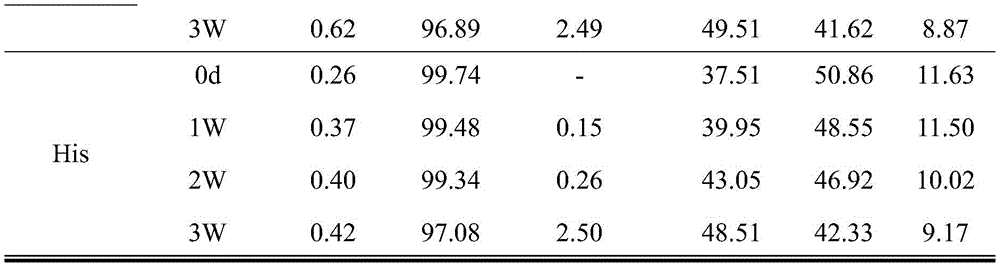
As shown in Table 4, His buffer best maintained SEC-HPLC monomer purity under high temperature conditions. As can be seen from IEC-HPLC main peak content data, His buffer solution and NaAc buffer solution are superior to other buffer solutions.
The results of SEC-HPLC and IEC-HPLC are combined to show that the stability of SEC-HPLC and IEC-HPLC is better than that of other groups of buffers when the antibody sample is in His buffer under the environment of high temperature (40 ℃).
pH optimization
(1) pH value optimization 1
The antibody sample has good stability in histidine buffer solution with the pH value of 5.5-6.0. The pH value is optimized. The purified BAT4406F was subjected to ultrafiltration to prepare 5 pH formulations: histidine buffer (pH5.6), histidine buffer (pH5.8), histidine buffer (pH6.0), histidine buffer (pH6.2), and histidine buffer (pH 6.4). The antibody concentrations were adjusted to 20mg/mL, and the samples were subjected to a high temperature test at 40 ℃ and analyzed by SEC-HPLC and IEC-HPLC at day 0, week 1, week 2 and week 3, respectively. The results are shown in Table 5.
TABLE 5 SEC-HPLC, IEC-HPLC changes with time at different pH


As shown in table 5, 1) the formulations had similar SEC-HPLC monomer purity at high temperature; 2) when the pH value is 5.6-6.2, the IEC-HPLC main peak of the sample is reduced slowly, and the stability is good.
The results of SEC-HPLC and IEC-HPLC are combined to show that the stability of the antibody sample is better when the pH value of the buffer solution is 5.6-6.2.
(2) pH value optimization 2
As can be seen from pH value optimization 1, the stability of the antibody sample is good when the pH value is 5.6-6.2, and the IEC-HPLC performance is poor when the pH value exceeds 6.2, but the stability of the sample cannot be determined when the pH value is less than 5.6, so that the pH screening test is performed again. Since the pH of His buffer is greatly affected by temperature, this time with citric acid-PB (C-P) as the buffer, 6 BAT4406F samples with different pH values were obtained by ultrafiltration: pH5.0, pH5.3, pH5.6, pH5.9, pH6.2, pH6.5. Antibody samples were subjected to a high temperature test at 40 ℃ and sampled at day 0, week 1, week 2 and week 3 for analysis by SEC-HPLC and IEC-HPLC, respectively. The results are shown in Table 6.
TABLE 6 SEC-HPLC and IEC-HPLC at different pH conditions


As shown in table 6, 1) after standing at high temperature for 4 weeks, the SEC-HPLC monomer purity of the sample decreased, and when the pH was less than 5.3, the monomer purity was poor; 2) when the pH value is 5.6-6.5, the IEC-HPLC main peak of the sample is reduced slowly, and the stability is good.
pH is a key factor in liquid formulations. The antibody shows different stability in buffers with different pH values, but when the pH value fluctuates within a certain range, the quality of the antibody is not significantly influenced. Through the preliminary screening research and preliminary judgment of the pH fine screening, the stability of the antibody is good within the pH range of 5.5-6.2.
Stabilizer screening
A solution of BAT4406F (50mg/ml) containing seven stabilizers, sodium chloride (0.9%), sucrose (9%), trehalose (9%), mannitol (4%), sorbitol (4%), arginine (1%) and methionine (1%), was prepared, respectively, and the specific formulation is shown in Table 7. In table 7, Tre (trehalose) means trehalose dihydrate.
TABLE 7 formulation of different stabilizers


(1) High temperature test
The samples with the stabilizer and the samples without the stabilizer are subjected to a comparative test under the condition of high temperature (40 ℃), and the quality change of the samples is examined. Samples were taken at week 1, week 2, week 3, and week 4 and analyzed by SEC-HPLC. The results are shown in Table 8.
TABLE 8 SEC-HPLC behavior with time for different stabilizer samples


As shown in Table 8, the SEC-HPLC monomer purity for Tre, Sor and Suc was the best.
(2) Test under light conditions
And (3) carrying out a comparative test on the sample added with the stabilizing agent under the illumination condition, and inspecting the change of the sample quality. Samples were analyzed by SEC-HPLC, IEC-HPLC detection at week 1, week 2. The results are shown in Table 9.
TABLE 9 SEC-HPLC, IEC-HPLC as a function of time for different stabilizer samples (25 ℃, 4000. + -. 500lx)


As shown in table 9, 1) the SEC-HPLC monomer purity reduction for Met samples was minimal, followed by Tre, Suc and other samples; 2) the IEC-HPLC main peak content of Met and Arg is better, and the next is Tre, Suc, Sor and the like.
Combining the results of high temperature and light conditions, trehalose performed well in both SEC-HPLC and IEC-HPLC.
Surfactant screening
Compatibility test with physiological saline
When the antibody preparation is administered by intravenous injection, it is clinically compatible with physiological saline, so that the compatibility test is performed. Antibody sample solutions containing different concentrations of different types of surfactants were prepared, and the specific formulation is shown in table 10. The concentration of BAT4406F in the sample solution is 30mg/mL, sample solutions with the same volume and containing surfactants with different concentrations are respectively taken and added into 0.9% sodium chloride solution according to the compatibility proportion (1mL sample: 29mL physiological saline), the properties of the sample solutions are observed after the sample solutions are slightly and fully mixed, and insoluble particle detection is carried out on the antibody solution after the sample solutions are placed for 2 hours. The results are shown in FIG. 1.
TABLE 10 antibody solution formulations


As shown in fig. 1, the number of microparticles in the blank group without surfactant was the highest, while the number of microparticles in the sample with surfactant (polysorbate-80 or polysorbate-20) was generally lower, and when the surfactant content was higher, the number of microparticles was slightly lower; however, when the surfactant concentration reaches a certain level, the number of fine particles in the sample increases. When the surfactant is polysorbate-80 at a concentration of 0.02%, the number of microparticles in the formulation is small.
Shock test
The sample inevitably vibrates during transportation or transfer, and the vibration accelerates protein aggregation. The preparation can effectively prevent protein aggregation by adding surfactant. Sample solutions of BAT4406F (20mg/ml) containing different concentrations of different types of surfactants were prepared, and the specific formulations are shown in Table 11. The sample was laid down on a shaker at 200rpm in a room temperature environment, and the antibody solution was subjected to a shaking test. The solutions were inspected for changes in the quality of the antibody solutions by performing light and turbidity measurements (OD340 values) at 0h, 2h, 4h, 8h, 24h, 48h, and 72 h. The results are shown in FIG. 2 (note: OD is the value obtained by detecting the protein solution in UV340 nm). Tre in Table 11 refers to trehalose dihydrate.
TABLE 11 antibody solution formulations

As shown in fig. 2, after the sample is placed for 4 hours under the shaking condition, the blank sample and the sample added with only 6% Tre begin to be turbid, and the sample added with tween still keeps clear after shaking for 72 hours, which indicates that polysorbate-80 or polysorbate-20 has a certain protection effect on the sample under the shaking condition, can prevent protein aggregation from being turbid, and plays a role in solubilization; the turbidity was lowest in samples containing 0.02% and 0.03%, and relatively higher in samples containing 0.01% and 0.04%, regardless of whether polysorbate-80 or polysorbate-20 was present, indicating that the polysorbate content should not be too low or too high. 0.02% polysorbate is preferred.
Repeated Freeze thaw test 1
Samples of BAT4406F (20mg/ml) were prepared for repeated freeze-thaw testing (see table 12 for a specific formulation, Tre in table 12 refers to trehalose dihydrate) with different polysorbate (i.e. tween) contents and types. Freezing the sample solution at-80 deg.C for 24 hr, standing at 25 deg.C for 24 hr for one freeze thawing for 5 times. Insoluble microparticle detection was performed on the samples after freeze-thawing and the results are shown in fig. 3.
TABLE 12 antibody solution formulations

As shown in FIG. 3, after 5 times of repeated freeze thawing, the number of microparticles in the samples with Tween was significantly lower than that in the samples without Tween, indicating that Tween can effectively prevent protein aggregation during repeated freeze thawing.
Example 2
The invention provides a liquid preparation containing anti-BAT 4406F, which consists of the following components: about 15mg/ml BAT4406F, about 10mM succinate buffer, about 80mM sucrose and about 0.1mg/ml polysorbate-20, the pH of the liquid formulation being about 5.5.
Example 3
The invention provides a liquid preparation containing anti-BAT 4406F, which consists of the following components: about 40mg/ml anti-CD 20 antibody, about 15mM citric acid buffer, about 140mM sorbitol, and about 0.3mg/ml polysorbate-80, the pH of the liquid formulation being about 5.6.
Example 4
The invention provides a liquid preparation containing anti-BAT 4406F, which consists of the following components: about 60mg/ml anti-CD 20 antibody, about 26mM acetate buffer, about 190mM sorbitol, and about 0.35mg/ml polysorbate-20, the pH of the liquid formulation being about 5.7.
Example 5
The invention provides a liquid preparation containing anti-BAT 4406F, which consists of the following components: about 70mg/ml anti-CD 20 antibody, about 26mM phosphate buffer, about 240mM methionine, and about 0.38mg/ml polysorbate-20, and the pH of the liquid formulation is about 6.0.
Example 6
The invention provides a liquid preparation containing anti-BAT 4406F, which consists of the following components: about 80mg/ml anti-CD 20 antibody, about 30mM phosphate buffer, about 158mM mannitol, and about 0.4mg/ml polysorbate-20, the pH of the liquid formulation being about 6.2.
Example 7
The invention provides a liquid preparation containing anti-BAT 4406F, which consists of the following components: about 20mg/ml anti-CD 20 antibody, about 20mM histidine buffer, about 158.6mM trehalose and about 0.2mg/ml polysorbate-80, the pH of the liquid formulation being about 5.8. The molar ratio of L-histidine to L-histidine hydrochloride in histidine buffer was 2:3 based on pH 5.8.
Example 8
The invention provides a liquid preparation containing anti-BAT 4406F, which consists of the following components: about 20mg/ml anti-CD 20 antibody, about 20mM histidine buffer, about 224.6mM trehalose, and about 0.2mg/ml polysorbate-80, the pH of the liquid formulation being about 5.8. The molar ratio of L-histidine to L-histidine hydrochloride in histidine buffer was 2:3 based on pH 5.8.
Example 9
The invention provides a liquid preparation containing anti-BAT 4406F, which consists of the following components: about 50mg/ml anti-CD 20 antibody, about 20mM histidine buffer, about 224.6mM trehalose, and about 0.2mg/ml polysorbate-80, the pH of the liquid formulation being about 5.8. The molar ratio of L-histidine to L-histidine hydrochloride in histidine buffer was 2:3 based on pH 5.8.
Example 10
The invention provides a liquid preparation containing anti-BAT 4406F, which consists of the following components: about 30mg/ml anti-CD 20 antibody, about 18mM histidine buffer, about 170mM trehalose, and about 0.18mg/ml polysorbate-80, the pH of the liquid formulation being about 5.7.
Example 11
The invention provides a liquid preparation containing anti-BAT 4406F, which consists of the following components: about 40mg/ml anti-CD 20 antibody, about 19mM histidine buffer, about 225mM trehalose, and about 0.19mg/ml polysorbate-80, the pH of the liquid formulation being about 5.9.
Example 12
The invention provides a liquid preparation containing anti-BAT 4406F, which consists of the following components: about 46mg/ml anti-CD 20 antibody, about 22mM histidine buffer, about 220mM trehalose, and about 0.22mg/ml polysorbate-80, the pH of the liquid formulation being about 6.0.
Comparison of stability
Stability analysis was performed on the subjects of the prescription disclosed in CN101820912B (antibody concentration 20mg/mL, prescription a, antibody as ofatumumab), the comparative prescription (same as CN101820912B prescription adjuvant, but antibody as BAT4406F, prescription B), prescription 1 (see example 7), prescription 2 (example 8), prescription 3 (example 9) and prescription 4. The formulation is shown in Table 13.
TABLE 13 formulation formula

1) Dissolution temperature, aggregation temperature and particle size
TABLE 14 dissolution temperature, aggregation temperature and particle size

As shown in table 14, 1) the anti-CD 20 antibody in original prescription a was replaced with BAT4406F, and Tm1, Tagg and DLS (particle size and uniformity) of the two preparations were substantially the same; 2) compared with the original prescription A, the Tm1 and Tagg of the preparation of the prescription 1 are both high, the PDI of the particle size is less than 0.25, the uniformity is good, and the stability of the preparation of the prescription 1 is good; 3) the Tm1, Tagg and DLS of the formulations of the prescription 2 and the prescription 3 are basically consistent with those of the formulation of the prescription 1 without changing the trehalose from 158.6mM to 224.6mM, and the stability is relatively better.
2) High temperature test at 40 deg.C
Formulation samples were submitted to a high temperature test at 40 ℃ and analyzed by SEC-HPLC at day 0, week 1, week 2, week 3 and week 4. The results are shown in Table 15.
As shown in table 15, from the SEC-HPLC monomer purity data, the stability of recipe 1, recipe 2, and recipe 3 was better compared to recipe B, with the stability of recipe 1 and recipe 2 being the highest.
Table purity of formulation monomers by SEC at 1540 deg.C

3) Test under light conditions
After exposure to light, the formulations were analyzed by SEC-HPLC for monomer purity on days 0, 5 and 10. The results are shown in Table 16.
As shown in table 16, the SEC-HPLC monomer purity stability of the formulations of formula 1, formula 2, and formula 3 was better; in particular, prescription 1 and prescription 2 are more stable than prescription B.
TABLE 16 monomer purity of the formulations as a function of time (25 ℃, 4000. + -. 500lx)

Compatibility analysis
Through an accelerated stability test and a long-term stability test, the liquid preparation has good compatibility with the medicine bottle and meets the requirement of packaging.
Example 13 clinical study of BAT4406F
This study is a phase I, open and dose escalating clinical study evaluating BAT4406F for safety, tolerability, pharmacokinetics and primary efficacy in treating patients with neuromyelitis optica lineage disease (NMOSD).
Subject enrollment/screening
Inclusion criteria included:
1) meets the NMOSD diagnostic standard (see appendix 1) established by the International NMO diagnostic expert group (IPND) in 2015;
2) is more than or equal to 18 years old and less than or equal to 65 years old;
3) at least two relapses are screened in the previous two years, or at least one relapse is screened in the previous one year;
4) the immunosuppressive agents such as azathioprine, tacrolimus, mycophenolate mofetil, cyclophosphamide, methotrexate and the like are not used within 28 days before the baseline;
5) the amount of corticosteroid used is below about 30mg prednisone equivalent and must be discontinued within one month after administration of the test drug; and
6) EDSS score is less than or equal to 6.
Exclusion criteria included:
1) any monoclonal antibody treatment was received within six months prior to administration;
2) has received anti-CD 20 monoclonal antibody treatment;
3) inoculating live vaccine in four weeks before screening;
4) another clinical study was performed 1 month prior to baseline or within 5 half-lives of the drug (whichever is longer);
5) there is a history of monoclonal antibody allergy; severe allergic reactions to certain foods or drugs;
6) abnormalities in liver function, kidney function and bone marrow reserve:
a. ALT ≧ 2.5 XULN and/or AST ≧ 2.5 XULN and/or TBIL ≧ 1.5 XULN;
b. serum creatinine is larger than or equal to 1.5 × ULN, and creatinine clearance is smaller than or equal to 60mL/min (calculated by using Cockcroft formula);
c. blood neutrophil count<1.5×10⁹/L and/or platelet count<75×109Patients of/L;
7) researchers have determined a history of infection that is not suitable for detection;
8) patients with acute respiratory failure and with interstitial lung infiltration and edema seen with thoracic CT;
9) patients with a well-defined history of heart disease (e.g., arrhythmia or heart failure such as angina, atrial flutter and atrial fibrillation, conduction block, etc.); for the patients with I degree atrioventricular block, the study is used for judging the patients with I degree atrioventricular block by combining the medical history; or
10) Patients with malignant tumor are combined.
Test drugs, application methods and dosage:
BAT4406F was administered intravenously at a dose of 20mg, 50mg, 100mg, 200mg, 500mg, 1000mg or 2000 mg. There was an observation period of 6 months after each dose.
Before the start of BAT4406F administration, antihistamines (e.g., diphenhydramine, promethazine hydrochloride, etc.) and glucocorticoids (e.g., methylprednisolone, dexamethasone, etc.) were administered prophylactically.
The initial intravenous infusion rate was about 12 ml/hour. If no infusion reaction occurred, the rate was increased by 12 ml/hour every half hour until the maximum infusion rate was 96 ml/hour.
Will be resistant to safety, tolerance, clinical pharmacokinetics (e.g. C)max、Tmax、t1/2、CLt、Vd、MRT、AUC(0-t)、AUC(0-inf)) Pharmacodynamics, immunogenicity and primary efficacy (assessed by, e.g., Annual Relapse Rate (ARR), time to first relapse, Expanded Disability Status Scale (EDSS), MRI, etc.). MRI can be assessed according to the internationally recognized diagnostic criteria for neuromyelitis optica spectrum disorders (Neurology, 2015; 85: 177-. After treatment, the patient can achieve complete remission, partial remission or stable disease. In some embodiments, the ARR and EDSS score of the patient is decreased (e.g., the score is decreased by at least 0.5).
Clinical results
Two subjects who were added to the 20mg dose group developed infusion responses on the day of dosing, which were self-healing/remitting without treatment, the first subject had completed the DLT observation period, indicating that the current 20mg dose was well tolerated.
CD19 in two subjects, tested at days 4, 8 and 15 after administration of 20mg BAT4406F+The proportion of B cells is reduced by more than 80% to more than 90%.
Example 14 non-clinical study of BAT4406F
1. Study of pharmacodynamics
Pharmacodynamic studies of cynomolgus monkeys in clearing B cells showed that the onset of BAT4406F was not significant in relation to dose over the tested dose range (2, 5, 15 mg/kg). CD20 in all three dose groups on day 2 post-dose+The lymphocyte subpopulations were all below 0.5%, this ratio was maintained until day 21. By day 28 post-dose, CD20 in the low, medium and high dose groups+The proportion of lymphocyte subpopulations was restored to 3.87%, 2.43% and 0.3%, respectively. Under the condition of the same dose of 5mg/kg, the BAT4406F has better B cell clearing capacity than the commercial drug rituximab.
In vitro pharmacodynamic studies using healthy human whole blood showed that 10ng/mL and 50ng/mL of BAT4406F showed strong B cell depleting capacity after incubation with whole blood for 4 h. At the above concentrations, the average percentages of B cell depletion were 37.16% and 61.99%, respectively, and the drug effects were dose-related. Compared with the commercial anti-CD 20 monoclonal antibody, the ability of clearing B cells is BAT4406F > Aframucimumab > Omuzumab > rituximab in sequence from strong to weak.
See table 17 for details.
TABLE 17 results of pharmacodynamic studies


"NA" means no experiment was performed.
2. Pharmacological study
The target of action of BAT4406F was CD20 antigen expressed by B cells. BAT4406F can initiate an immune response that mediates B cell lysis upon binding to the CD20 antigen. The consumption mechanism may include: antibody-dependent cell-mediated cytotoxicity (ADCC), antibody-dependent complement-mediated cytotoxicity (CDC), direct induction of CD20+B cell apoptosis.
ADCC activity was evaluated using PBMC cell killing and reporter gene assays. Different anti-CD 20 monoclonal antibodies BAT4406F and BAT4406 (adopting wild-type cell CHO-BAT expressed protein containing fucose modification), ofatumumab, ormuzumab and rituximab can induce ADCC effect, and the ADCC effect of BAT4406F is enhanced by about 10 times after fucose is knocked out, which is obviously stronger than other four anti-CD 20 monoclonal antibodies, and shows that the ADCC effect is one of main action mechanisms of BAT 4406F.
See table 18 for details.
TABLE 18 summary of in vitro Activity

"NA" means this was not detected.
3. Toxicology studies
Long-term toxicity test 10mg/kg of the drug was administered to cynomolgus monkeys,30mg/kg and 100mg/kg of BAT4406F once a week for 4 consecutive weeks for 5 times, with a recovery period of 20 weeks. In any dose group, no significant abnormal changes associated with administration were seen in body weight, body temperature, electrocardiogram, blood pressure, blood coagulation function, clinical biochemistry, serum complements C3 and C4, immunoglobulin IgG, IgM, and IgA, ophthalmic examination, bone marrow smear examination, organ weight, visceral body ratio, and visceral brain ratio. On the day following the third dose (D16), the hemocytometer number shows lymphocytes from each group of females (x 10)9L) decreased, whereas monocytes (%) increased in the 30mg/kg group of males; on the day after the last administration (D30), the mononuclear cells (%) of the male animals in the 10mg/kg group were increased, the mean hemoglobin concentration of erythrocytes was decreased in the female and male animals in the 30mg/kg group, the reticulocytes (%) in the female animals were increased, and the reticulocytes in the female animals in the 10mg/kg and 30mg/kg groups (. times.10)12/L) is increased. Peripheral blood CD20+And CD40+Depletion or reduction of B lymphocytes, CD3+The proportion of T lymphocytes increases, which is a manifestation of the pharmacological or expanded pharmacological effects of BAT 4406F. Anti-drug antibodies were detected in individual animals of each dose group.
BAT4406F30 mg/kg group of partially male animals (2/5) developed moderate mesangial hyperplasia and mild tubular dilatation. Both electron microscopy and immunohistochemical staining revealed that immune complexes were deposited in the glomeruli of the animal kidney. BAT4406F10 mg/kg, 30mg/kg and 100mg/kg of some of the animals of the groups (1/10, 1/10 and 2/10, respectively) exhibited visible epidermal necrosis/scarring/thickening, acute inflammation of the epidermis and dermis, subacute or chronic active inflammation of the dermis and subcutaneous of the skin of the forefoot or hindfoot, all with vasculitis and/or perivascular inflammation, which are believed to be secondary infections caused by skin trauma and pharmacological effects. At the end of the 20-week recovery period (D169), all but the spleen of individual BAT4406F100 mg/kg animals (2/10) still showed recovery of the disease associated with the administration.
The NOAEL for this test (no adverse effect level observed) was considered to be 10 mg/kg.
4. Pharmacokinetic Studies
BAT4406F at a concentration of 2mg/kg,Exposure of BAT4406F to cynomolgus monkeys at 5mg/kg, 15mg/kg or 10-100mg/kg doses following 4 consecutive weeks of intravenous infusion once a week for 4 weeks increased with increasing dose, the major pharmacokinetic parameter (C) for each dose groupmaxAUC, MRT) with no significant gender difference. Because the BAT4406F produces antibody in the animal body two weeks after administration, the concentration of the drug at the end of the curve is obviously reduced during administration, so the parameters such as elimination, half-life, clearance rate and the like are only used for reference. See tables 19 and 20 for details.
TABLE 19 pharmacokinetic parameters of BAT4406F after a single intravenous infusion in cynomolgus monkeys

TABLE 20 pharmacokinetic parameters of BAT4406F after multiple intravenous infusions in cynomolgus monkeys


Blood concentration in one animal in the first low dose group was abnormal compared to other animals in the same group. As can be seen from the data, some of the drug could be infused subcutaneously during the administration process and slowly absorbed into the blood, resulting in a significant absorption process before 8 h. The data is discarded. AI is AUC after fourth administration0-168hAnd AUC after first administration0-168hThe ratio of (a) to (b).
*************
Appendix 1: 2015 International consensus on diagnostic criteria for neuromyelitis optica (IPND, 2015)
AQP4-IgG positive NMOSD diagnostic standard
(1) At least 1 core clinical feature
(2) Detection of AQP4-IgG positivity using the best method (cell-based detection is strongly recommended)
(3) Excluding other diagnoses
NMOSD diagnostic standard of AQP4-IgG negative or AQP4-IgG unknown state
(1) In one or more clinical episodes, at least 2 core clinical features and all of the following conditions are met: 1) at least one core clinical feature must be optic neuritis, acute LETM or bulbar posterior complex; 2) spatial multiple (2 or more core clinical features); 3) satisfying MRI additional conditions
(2) Detection of AQP4-IgG negativity, or non-detectability, using an optimal method
(3) Excluding other diagnoses
Core clinical features
(1) Optic neuritis
(2) Acute myelitis
(3) The most distal syndrome: hiccup, nausea and vomiting without other causes
(4) Acute brainstem syndrome
(5) Symptomatic narcolepsy, diencephalon syndrome, brain MRI with NMOSD-characteristic diencephalon lesions (6) cerebral syndrome with NMOSD-characteristic cerebropathy
NMOSD MRI additional condition of AQP4-IgG negative or AQP4-IgG unknown state
(1) Acute optic neuritis: brain MRI is required to show one of the following: 1) brain MRI normal or nonspecific white matter lesions only; 2) optic nerve T2 high-signaling lesions or T1 enhance lesion > 1/2 optic nerve length, or involve optic chiasm.
(2) Acute myelitis: the relevant intramedullary lesions are required to extend over 3 consecutive vertebral body segments, or a patient with a history of myelitis has correspondingly spinal atrophy of 3 or more consecutive vertebral body segments.
(3) Postrema syndrome: requiring a posterior or most posterior bulbar lesion.
(4) Acute brainstem syndrome: the requirement is accompanied by periventricular septal lesions of the brain stem.
Appendix 2: expanded Disability Scale Scoring (EDSS)
0 neurological check normal (all functional systems score 0)
1.0 there was no disability, with only mild signs of abnormalities of one functional system (score 1 for one functional system).
1.5 there was no disability and there were mild signs of abnormalities of more than one functional system (score 1 for more than one functional system).
2.0 mild disability of one functional system (score 2 for one functional system and score 0 or 1 for the other systems).
2.5 mild disability of two functional systems (score 2 for two functional systems and score 0 or 1 for the other systems).
3.0 moderate disability of one functional system (score 3 for one functional system, 0 or 1 for the other systems), but walking is not limited; or mild disability with three or four functional systems (score 2 for three/four functional systems, 0 or 1 for other systems), but walking is not limited.
3.5 unrestricted walking, moderate disability of one functional system (score 3 for one functional system), mild disability of one or both functional systems (score 2 for one/both functional systems), score 0 or 1 for the other systems; or walking is not limited, the scores of two functional systems are 3 (the other systems are 0 or 1); or walking is not limited, and the score of five functional systems is 2 (other systems are 0 or 1).
4.0 walking independently for more than or equal to 500 meters without assistance or rest; even with a more severe disability with one system functioning (score 4, or score greater than the sum of the previous steps, other systems score 0 or 1), the patient is walking up for about 12 hours per day.
4.5 walking independently for more than or equal to 300 meters without assistance or rest; even with a more severe disability with one system functioning (score 4, or score 0 or 1 over the sum of the previous steps, other systems), the patient gets up and walks about 12 hours per day.
5.0 not assisting or resting to walk independently ≧ 200 meters (including at least one functional system score of 5, or less than 4.5 step statement sum rank).
5.5 walking independently for more than or equal to 100 meters without assistance or rest.
6.0 one side of the walking stick can help the user to walk for at least 100 meters with the help of a walking stick or a walking stick, and the user can have a rest or rest in the middle.
6.5 Walking at least 20m with the assistance of both sides (walking stick or crutch), and having rest or no rest in the middle.
7.0 assisting to walk no more than 5 meters. Substantially limited to wheelchairs; the wheelchair can be independently pushed; the time in the wheelchair was more than 12 hours per day.
7.5 only a few steps are possible. Confined to wheelchairs, some assistance may be required to move.
8.0 activities were limited to bed, chair, wheelchair, but were not in bed for most of the day. The life is much more self-care. The upper limb functions normally.
8.5 bed rest most of the time each day; the upper limb retains partial function; the life is partly self-care.
9.0 bedridden. Can be used for communication and eating.
9.5 completely bedridden. Not communicate or eat/swallow properly.
10 die from multiple sclerosis.
Sequence listing
<110> Baiotai biopharmaceutical GmbH
<120> anti-CD 20 antibody preparation and application of anti-CD 20 antibody in treatment of CD20 positive diseases
<130> DSP1V222431JW
<150> PCT/CN2019/110847
<151> 2019-10-12
<150> PCT/CN2019/110843
<151> 2019-10-12
<150> CN 201910991541.8
<151> 2019-10-18
<160> 4
<170> SIPOSequenceListing 1.0
<210> 1
<211> 107
<212> PRT
<213> Artificial Sequence (Artificial Sequence)
<220>
<223> light chain variable region
<400> 1
Glu Ile Val Leu Thr Gln Ser Pro Ala Thr Leu Ser Leu Ser Pro Gly
1 5 10 15
Glu Arg Ala Thr Leu Ser Cys Arg Ala Ser Gln Ser Val Ser Ser Tyr
20 25 30
Leu Ala Trp Tyr Gln Gln Lys Pro Gly Gln Ala Pro Arg Leu Leu Ile
35 40 45
Tyr Asp Ala Ser Asn Arg Ala Thr Gly Ile Pro Ala Arg Phe Ser Gly
50 55 60
Ser Gly Ser Gly Thr Asp Phe Thr Leu Thr Ile Ser Ser Leu Glu Pro
65 70 75 80
Glu Asp Phe Ala Val Tyr Tyr Cys Gln Gln Arg Ser Asn Trp Pro Ile
85 90 95
Thr Phe Gly Gln Gly Thr Arg Leu Glu Ile Lys
100 105
<210> 2
<211> 122
<212> PRT
<213> Artificial Sequence (Artificial Sequence)
<220>
<223> heavy chain variable region
<400> 2
Glu Val Gln Leu Val Glu Ser Gly Gly Gly Leu Val Gln Pro Gly Arg
1 5 10 15
Ser Leu Arg Leu Ser Cys Ala Ala Ser Gly Phe Thr Phe Asn Asp Tyr
20 25 30
Ala Met His Trp Val Arg Gln Ala Pro Gly Lys Gly Leu Glu Trp Val
35 40 45
Ser Thr Ile Ser Trp Asn Ser Gly Ser Ile Gly Tyr Ala Asp Ser Val
50 55 60
Lys Gly Arg Phe Thr Ile Ser Arg Asp Asn Ala Lys Lys Ser Leu Tyr
65 70 75 80
Leu Gln Met Asn Ser Leu Arg Ala Glu Asp Thr Ala Leu Tyr Tyr Cys
85 90 95
Ala Lys Asp Ile Gln Tyr Gly Asn Tyr Tyr Tyr Gly Met Asp Val Trp
100 105 110
Gly Gln Gly Thr Thr Val Thr Val Ser Ser
115 120
<210> 3
<211> 214
<212> PRT
<213> Artificial Sequence (Artificial Sequence)
<220>
<223> light chain
<400> 3
Glu Ile Val Leu Thr Gln Ser Pro Ala Thr Leu Ser Leu Ser Pro Gly
1 5 10 15
Glu Arg Ala Thr Leu Ser Cys Arg Ala Ser Gln Ser Val Ser Ser Tyr
20 25 30
Leu Ala Trp Tyr Gln Gln Lys Pro Gly Gln Ala Pro Arg Leu Leu Ile
35 40 45
Tyr Asp Ala Ser Asn Arg Ala Thr Gly Ile Pro Ala Arg Phe Ser Gly
50 55 60
Ser Gly Ser Gly Thr Asp Phe Thr Leu Thr Ile Ser Ser Leu Glu Pro
65 70 75 80
Glu Asp Phe Ala Val Tyr Tyr Cys Gln Gln Arg Ser Asn Trp Pro Ile
85 90 95
Thr Phe Gly Gln Gly Thr Arg Leu Glu Ile Lys Arg Thr Val Ala Ala
100 105 110
Pro Ser Val Phe Ile Phe Pro Pro Ser Asp Glu Gln Leu Lys Ser Gly
115 120 125
Thr Ala Ser Val Val Cys Leu Leu Asn Asn Phe Tyr Pro Arg Glu Ala
130 135 140
Lys Val Gln Trp Lys Val Asp Asn Ala Leu Gln Ser Gly Asn Ser Gln
145 150 155 160
Glu Ser Val Thr Glu Gln Asp Ser Lys Asp Ser Thr Tyr Ser Leu Ser
165 170 175
Ser Thr Leu Thr Leu Ser Lys Ala Asp Tyr Glu Lys His Lys Val Tyr
180 185 190
Ala Cys Glu Val Thr His Gln Gly Leu Ser Ser Pro Val Thr Lys Ser
195 200 205
Phe Asn Arg Gly Glu Cys
210
<210> 4
<211> 452
<212> PRT
<213> Artificial Sequence (Artificial Sequence)
<220>
<223> heavy chain
<400> 4
Glu Val Gln Leu Val Glu Ser Gly Gly Gly Leu Val Gln Pro Gly Arg
1 5 10 15
Ser Leu Arg Leu Ser Cys Ala Ala Ser Gly Phe Thr Phe Asn Asp Tyr
20 25 30
Ala Met His Trp Val Arg Gln Ala Pro Gly Lys Gly Leu Glu Trp Val
35 40 45
Ser Thr Ile Ser Trp Asn Ser Gly Ser Ile Gly Tyr Ala Asp Ser Val
50 55 60
Lys Gly Arg Phe Thr Ile Ser Arg Asp Asn Ala Lys Lys Ser Leu Tyr
65 70 75 80
Leu Gln Met Asn Ser Leu Arg Ala Glu Asp Thr Ala Leu Tyr Tyr Cys
85 90 95
Ala Lys Asp Ile Gln Tyr Gly Asn Tyr Tyr Tyr Gly Met Asp Val Trp
100 105 110
Gly Gln Gly Thr Thr Val Thr Val Ser Ser Ala Ser Thr Lys Gly Pro
115 120 125
Ser Val Phe Pro Leu Ala Pro Gly Ser Ser Lys Ser Thr Ser Gly Thr
130 135 140
Ala Ala Leu Gly Cys Leu Val Lys Asp Tyr Phe Pro Glu Pro Val Thr
145 150 155 160
Val Ser Trp Asn Ser Gly Ala Leu Thr Ser Gly Val His Thr Phe Pro
165 170 175
Ala Val Leu Gln Ser Ser Gly Leu Tyr Ser Leu Ser Ser Val Val Thr
180 185 190
Val Pro Ser Ser Ser Leu Gly Thr Gln Thr Tyr Ile Cys Asn Val Asn
195 200 205
His Lys Pro Ser Asn Thr Lys Val Asp Lys Lys Val Glu Pro Lys Ser
210 215 220
Cys Asp Lys Thr His Thr Cys Pro Pro Cys Pro Ala Pro Glu Leu Leu
225 230 235 240
Gly Gly Pro Ser Val Phe Leu Phe Pro Pro Lys Pro Lys Asp Thr Leu
245 250 255
Met Ile Ser Arg Thr Pro Glu Val Thr Cys Val Val Val Asp Val Ser
260 265 270
His Glu Asp Pro Glu Val Lys Phe Asn Trp Tyr Val Asp Gly Val Glu
275 280 285
Val His Asn Ala Lys Thr Lys Pro Arg Glu Glu Gln Tyr Asn Ser Thr
290 295 300
Tyr Arg Val Val Ser Val Leu Thr Val Leu His Gln Asp Trp Leu Asn
305 310 315 320
Gly Lys Glu Tyr Lys Cys Lys Val Ser Asn Lys Ala Leu Pro Ala Pro
325 330 335
Ile Glu Lys Thr Ile Ser Lys Ala Lys Gly Gln Pro Arg Glu Pro Gln
340 345 350
Val Tyr Thr Leu Pro Pro Ser Arg Asp Glu Leu Thr Lys Asn Gln Val
355 360 365
Ser Leu Thr Cys Leu Val Lys Gly Phe Tyr Pro Ser Asp Ile Ala Val
370 375 380
Glu Trp Glu Ser Asn Gly Gln Pro Glu Asn Asn Tyr Lys Thr Thr Pro
385 390 395 400
Pro Val Leu Asp Ser Asp Gly Ser Phe Phe Leu Tyr Ser Lys Leu Thr
405 410 415
Val Asp Lys Ser Arg Trp Gln Gln Gly Asn Val Phe Ser Cys Ser Val
420 425 430
Met His Glu Ala Leu His Asn His Tyr Thr Gln Lys Ser Leu Ser Leu
435 440 445
Ser Pro Gly Lys
450
Claims (48)
1. A liquid formulation comprising 15 to 80mg/ml of an anti-CD 20 antibody, 10 to 30mM of a buffer, 80 to 240mM of a stabilizer, and 0.1 to 0.4mg/ml of a surfactant, wherein the pH of the liquid formulation is 5.5 to 6.2;
the buffer is selected from the group consisting of a succinic buffer, a citric buffer, a phosphoric buffer, a histidine buffer, and an acetic buffer;
the stabilizer is selected from sucrose, trehalose, sorbitol, mannitol and methionine; and
the surfactant is selected from polysorbate-80 and polysorbate-20.
2. The liquid formulation of claim 1, wherein the anti-CD 20 antibody is selected from the group consisting of a monoclonal antibody and a CD20 binding fragment.
3. The liquid formulation of claim 1 or 2, wherein the anti-CD 20 antibody comprises:
a light chain variable region (VL) comprising the amino acid sequence of SEQ ID NO:1 or a polypeptide having at least 80% sequence identity to SEQ ID NO: 1; and a heavy chain variable region (VH) comprising the amino acid sequence of SEQ ID NO:2 or a polypeptide having at least 80% sequence identity to SEQ ID NO: 2.
4. The liquid formulation of claim 1 or 2, wherein the anti-CD 20 antibody comprises:
a light chain variable region (VL) comprising the amino acid sequence of SEQ ID NO: 1; and a heavy chain variable region (VH) comprising the amino acid sequence of SEQ ID NO: 2.
5. The liquid formulation of claim 1 or 2, wherein the anti-CD 20 antibody comprises:
a light chain comprising the amino acid sequence set forth in SEQ ID NO. 3 or an amino acid sequence having at least 90% sequence identity to SEQ ID NO. 3; and a heavy chain comprising the amino acid sequence set forth in SEQ ID NO. 4 or an amino acid sequence having at least 90% sequence identity to SEQ ID NO. 4.
6. The liquid formulation of claim 1 or 2, wherein the anti-CD 20 antibody comprises:
a light chain comprising the amino acid sequence of SEQ ID NO 3; and a heavy chain comprising the amino acid sequence of SEQ ID NO 4.
7. The liquid formulation of any one of claims 1-6, wherein at least about 60% of the anti-CD 20 antibody has G0 glycans at the N-glycosylation sites of the constant region of the anti-CD 20 antibody.
8. The liquid formulation of any one of claims 1-7, wherein the fucose content of the anti-CD 20 antibody is no more than about 5%.
9. The liquid formulation of any one of claims 1 to 8, wherein the anti-CD 20 antibody is produced by a CHO cell line in which the α - (1,6) fucosyltransferase gene is knocked out.
10. The liquid formulation of any one of claims 1 to 9, wherein the liquid formulation comprises 20 to 50mg/ml of anti-CD 20 antibody.
11. The liquid formulation of any one of claims 1 to 10, wherein the liquid formulation comprises 18 to 22mM histidine buffer.
12. The liquid formulation of any one of claims 1 to 11, wherein the liquid formulation comprises 158 to 225mM trehalose.
13. The liquid formulation of any one of claims 1 to 12, wherein the liquid formulation comprises 0.18 to 0.22mg/ml polysorbate-80.
14. The liquid preparation according to any one of claims 1 to 13, wherein the pH of the liquid preparation is 5.7 to 5.9.
15. The liquid formulation of claim 1, comprising 20mg/ml anti-CD 20 antibody, 20mM histidine buffer, 158.6mM trehalose, and 0.2mg/ml polysorbate-80, the liquid formulation having a pH of 5.8.
16. The liquid formulation of claim 1, comprising 20mg/ml anti-CD 20 antibody, 20mM histidine buffer, 224.6mM trehalose, and 0.2mg/ml polysorbate-80, the liquid formulation having a pH of 5.8.
17. The liquid formulation of claim 1, comprising 50mg/ml anti-CD 20 antibody, 20mM histidine buffer, 224.6mM trehalose, and 0.2mg/ml polysorbate-80, the liquid formulation having a pH of 5.8.
18. A method of treating a disease involving cellular expression of CD20 in a patient in need thereof, comprising administering to the patient an effective amount of a liquid formulation of any one of claims 1 to 17.
19. The method of claim 18, wherein the formulation is administered by intravenous or subcutaneous injection.
20. The method of claim 18 or 19, wherein the disease involving expression of CD20 by cells is selected from the group consisting of a neoplastic disease and an immune disease.
21. The method of claim 20, wherein the neoplastic disease comprises a B cell lymphoma, including hodgkin's lymphoma and non-hodgkin's lymphoma; the immune diseases include multiple sclerosis, immune thrombocytopenia, neuromyelitis optica, myasthenia gravis, rheumatoid arthritis, psoriasis and psoriatic arthritis.
22. The method of claim 18, wherein the disease is neuromyelitis optica spectrum disorder (NMOSD), non-hodgkin's lymphoma (NHL), Multiple Sclerosis (MS), Immune Thrombocytopenia (ITP), Rheumatoid Arthritis (RA), Wegener's Granulomatosis (WG), Microscopic Polyangiitis (MPA), lupus nephritis, systemic lupus erythematosus, or Chronic Lymphocytic Leukemia (CLL).
23. The method of any one of claims 18 to 22, wherein the disease is refractory to at least one prior treatment regimen or relapses after at least one prior treatment regimen.
24. Use of a liquid formulation according to any one of claims 1 to 17 in the manufacture of a medicament for the treatment of a disease in a patient involving cellular expression of CD20, wherein the disease in a patient involving cellular expression of CD20 is selected from the group consisting of a neoplastic disease and an immune disease.
25. The use of claim 24, wherein the neoplastic disease comprises a B-cell lymphoma, including hodgkin's lymphoma and non-hodgkin's lymphoma; the immune diseases include multiple sclerosis, immune thrombocytopenia, neuromyelitis optica, myasthenia gravis, rheumatoid arthritis, psoriasis and psoriatic arthritis.
26. A method of treating a disease comprising administering to a patient in need thereof an effective amount of an anti-CD 20 monoclonal antibody or antigen-binding fragment thereof, said anti-CD 20 monoclonal antibody or antigen-binding fragment thereof comprising:
a light chain variable region (VL) comprising the amino acid sequence of SEQ ID NO:1 or a polypeptide having at least 80% sequence identity to SEQ ID NO: 1; and
a heavy chain variable region (VH) comprising the amino acid sequence of SEQ ID NO:2 or a polypeptide having at least 80% sequence identity to SEQ ID NO: 2; and
wherein the effective amount is from about 10mg to about 3000mg per dose.
27. The method of claim 26, wherein the patient has a disease characterized by CD20 positive cells.
28. The method of claim 26, wherein the disease is neuromyelitis optica spectrum disorder (NMOSD), non-hodgkin's lymphoma (NHL), Multiple Sclerosis (MS), Immune Thrombocytopenia (ITP), Rheumatoid Arthritis (RA), Wegener's Granulomatosis (WG), Microscopic Polyangiitis (MPA), lupus nephritis, systemic lupus erythematosus, or Chronic Lymphocytic Leukemia (CLL).
29. The method of claim 26, wherein the disease is neuromyelitis optica spectrum disorder.
30. The method of claim 26, wherein the effective amount is about 300mg to about 3000mg per dose.
31. The method of any one of claims 26 to 30, wherein the disease is refractory to at least one prior treatment regimen or relapses after at least one prior treatment regimen.
32. The method of any one of claims 26 to 30, wherein the VL comprises the amino acid sequence of SEQ ID No. 1 and the VH comprises the amino acid sequence of SEQ ID NO: 2.
33. The method of any one of claims 26 to 31, wherein the anti-CD 20 monoclonal antibody comprises: a light chain comprising the amino acid sequence of SEQ ID NO 3; and a heavy chain comprising the amino acid sequence of SEQ ID NO 4.
34. The method of any one of claims 26 to 33, wherein at least about 60% of the anti-CD 20 monoclonal antibody has G0 glycans at the N-glycosylation sites of the constant regions of the anti-CD 20 monoclonal antibody.
35. The method of any one of claims 26 to 34, wherein the fucose content of the anti-CD 20 monoclonal antibody is no more than about 5%.
36. The method of any one of claims 26 to 35, wherein the anti-CD 20 monoclonal antibody or antigen binding fragment thereof is produced by a CHO cell line knocked out for the α - (1,6) fucosyltransferase gene.
37. The method of any one of claims 26 to 36, wherein the effective amount is from about 100mg to about 1000mg once per month, every two months, every three months, every four months, every five months, or every six months.
38. The method of any one of claims 26 to 36, wherein the effective amount is from about 100mg to about 500mg once every two months or once every three months.
39. The method of any one of claims 26 to 36, wherein the effective amount is from about 300mg to about 2000mg per treatment cycle, wherein the treatment cycle is administered once per month, every two months, every three months, every four months, every five months, every six months, every seven months, every eight months, every nine months, every ten months, every eleven months, or every twelve months.
40. The method of any one of claims 26 to 36, wherein the effective amount is from about 500mg to about 2000mg administered on demand for relapse of disease.
41. The method of any one of claims 26 to 36, wherein the administration is by intravenous injection.
42. The method of any one of claims 26 to 36, wherein the administration is by subcutaneous injection.
43. A kit comprising from 10mg to about 3000mg per dose of an anti-CD 20 monoclonal antibody or antigen-binding fragment thereof,
wherein the anti-CD 20 monoclonal antibody or antigen-binding fragment thereof comprises:
a light chain variable region (VL) comprising the amino acid sequence of SEQ ID NO:1 or a polypeptide having at least 80% sequence identity to SEQ ID NO: 1; and
a heavy chain variable region (VH) comprising the amino acid sequence of SEQ ID NO:2 or a polypeptide having at least 80% sequence identity to SEQ ID NO: 2.
44. Use of an anti-CD 20 monoclonal antibody or antigen-binding fragment thereof in the manufacture of a medicament for the treatment of a disease, in an amount of from 10mg to about 3000mg per dose,
wherein the anti-CD 20 monoclonal antibody or antigen-binding fragment thereof comprises:
a light chain variable region (VL) comprising the amino acid sequence of SEQ ID NO:1 or a polypeptide having at least 80% sequence identity to SEQ ID NO: 1; and
a heavy chain variable region (VH) comprising the amino acid sequence of SEQ ID NO:2 or a polypeptide having at least 80% sequence identity to SEQ ID NO: 2.
45. The use of claim 44, wherein the disease is characterized by CD20 positive cells.
46. The use of claim 45, wherein the disease is neuromyelitis optica spectrum disorder (NMOSD), non-Hodgkin's lymphoma (NHL), Multiple Sclerosis (MS), Immune Thrombocytopenia (ITP), Rheumatoid Arthritis (RA), West's Granulomatosis (WG), Microscopic Polyangiitis (MPA), lupus nephritis, systemic lupus erythematosus or Chronic Lymphocytic Leukemia (CLL).
47. A pharmaceutical composition comprising from 10mg to about 3000mg per dose of an anti-CD 20 monoclonal antibody or antigen-binding fragment thereof and a pharmaceutically acceptable carrier,
wherein the anti-CD 20 monoclonal antibody or antigen-binding fragment thereof comprises:
a light chain variable region (VL) comprising the amino acid sequence of SEQ ID NO:1 or a polypeptide having at least 80% sequence identity to SEQ ID NO: 1; and
a heavy chain variable region (VH) comprising the amino acid sequence of SEQ ID NO:2 or a polypeptide having at least 80% sequence identity to SEQ ID NO: 2.
48. A method of making the pharmaceutical composition of claim 47, comprising mixing the anti-CD 20 monoclonal antibody or antigen-binding fragment thereof with the pharmaceutically acceptable carrier.
Applications Claiming Priority (7)
| Application Number | Priority Date | Filing Date | Title |
|---|---|---|---|
| CN2019110847 | 2019-10-12 | ||
| CN2019110843 | 2019-10-12 | ||
| CNPCT/CN2019/110843 | 2019-10-12 | ||
| CNPCT/CN2019/110847 | 2019-10-12 | ||
| CN2019109915418 | 2019-10-18 | ||
| CN201910991541.8A CN112675126A (en) | 2019-10-18 | 2019-10-18 | anti-CD 20 antibody preparation and application thereof |
| PCT/CN2020/120461 WO2021068971A1 (en) | 2019-10-12 | 2020-10-12 | Anti-cd20 antibody formulation and use of anti-cd20 antibody for treatment of cd20 positive diseases |
Publications (1)
| Publication Number | Publication Date |
|---|---|
| CN114555117A true CN114555117A (en) | 2022-05-27 |
Family
ID=75437007
Family Applications (1)
| Application Number | Title | Priority Date | Filing Date |
|---|---|---|---|
| CN202080071563.3A Pending CN114555117A (en) | 2019-10-12 | 2020-10-12 | anti-CD 20 antibody preparation and application of anti-CD 20 antibody in treatment of CD20 positive diseases |
Country Status (5)
| Country | Link |
|---|---|
| US (1) | US20230338526A1 (en) |
| EP (1) | EP4025250A4 (en) |
| JP (1) | JP2023507053A (en) |
| CN (1) | CN114555117A (en) |
| WO (1) | WO2021068971A1 (en) |
Cited By (1)
| Publication number | Priority date | Publication date | Assignee | Title |
|---|---|---|---|---|
| WO2025247408A1 (en) * | 2024-05-31 | 2025-12-04 | 百奥泰生物制药股份有限公司 | Use of anti-cd20 antibody or antigen-binding fragment thereof in treatment of diseases |
Families Citing this family (2)
| Publication number | Priority date | Publication date | Assignee | Title |
|---|---|---|---|---|
| MA70850A1 (en) * | 2022-07-26 | 2025-10-31 | Joint Stock Company "Biocad" | Pharmaceutical Composition of Anti-CD20 Antibodies and Their Use |
| WO2025037336A1 (en) * | 2023-08-12 | 2025-02-20 | Dr. Reddy's Laboratories Limited | Pharmaceutical formulations of anti-cd 20 antibody and methods of preparing the same |
Citations (5)
| Publication number | Priority date | Publication date | Assignee | Title |
|---|---|---|---|---|
| CN102439163A (en) * | 2009-02-16 | 2012-05-02 | 拜奥雷克斯治疗公司 | Humanized anti-CD20 antibodies and methods of use |
| CN104399075A (en) * | 2009-09-11 | 2015-03-11 | 霍夫曼-拉罗奇有限公司 | Highly concentrated pharmaceutical formulations |
| CN107899020A (en) * | 2017-08-11 | 2018-04-13 | 百奥泰生物科技(广州)有限公司 | The compound and method of CD20 positive diseases treatment |
| CN108285486A (en) * | 2018-01-15 | 2018-07-17 | 浙江阿思科力生物科技有限公司 | Using CD20 as the specific antibody of target spot, CAR-NK cells and its preparation and application |
| CN109096399A (en) * | 2017-08-11 | 2018-12-28 | 百奥泰生物科技(广州)有限公司 | A recombinant antibody with a unique sugar profile produced by a genome-edited CHO host cell and its preparation method |
Family Cites Families (17)
| Publication number | Priority date | Publication date | Assignee | Title |
|---|---|---|---|---|
| US6991790B1 (en) * | 1997-06-13 | 2006-01-31 | Genentech, Inc. | Antibody formulation |
| NZ568769A (en) * | 2002-10-17 | 2010-04-30 | Genmab As | Human monoclonal antibodies against CD20 |
| DK2289936T3 (en) * | 2002-12-16 | 2017-07-31 | Genentech Inc | IMMUNGLOBULIN VARIATIONS AND APPLICATIONS THEREOF |
| EP2272868B1 (en) * | 2003-06-05 | 2015-03-04 | Genentech, Inc. | Combination therapy for B cell disorders |
| JO3000B1 (en) * | 2004-10-20 | 2016-09-05 | Genentech Inc | Antibody Formulations. |
| DOP2006000029A (en) * | 2005-02-07 | 2006-08-15 | Genentech Inc | ANTIBODY VARIANTS AND USES THEREOF. (VARIATIONS OF AN ANTIBODY AND USES OF THE SAME) |
| GB0718684D0 (en) * | 2007-09-24 | 2007-10-31 | Roche Products Ltd | Treatment method |
| DK2234600T3 (en) * | 2007-12-21 | 2014-09-08 | Hoffmann La Roche | ANTIBODY FORMULATION |
| CN101945667A (en) * | 2007-12-21 | 2011-01-12 | 健泰科生物技术公司 | Therapy of rituximab-refractory rheumatoid arthritis patients |
| CN110538322A (en) * | 2013-03-13 | 2019-12-06 | 豪夫迈·罗氏有限公司 | Antibody formulations |
| US11433029B2 (en) * | 2013-03-15 | 2022-09-06 | Takeda Pharmaceutical Company Limited | Formulation of an antibody and use thereof |
| US9949971B2 (en) * | 2014-06-17 | 2018-04-24 | Acerta Pharma B.V. | Therapeutic combinations of a BTK inhibitor, a PI3K inhibitor and/or a JAK-2 inhibitor |
| CN105708811A (en) * | 2014-12-01 | 2016-06-29 | 西藏海思科药业集团股份有限公司 | Stable lyophilized preparation of recombinant human anti-CD20 monoclonal antibody |
| JP6983808B2 (en) * | 2016-01-08 | 2021-12-17 | メディトープ バイオサイセンシーズ インク.Meditope Biosciences, Inc. | Self-crosslinking antibody |
| JP2019536793A (en) * | 2016-12-02 | 2019-12-19 | ルビウス セラピューティクス, インコーポレイテッド | Compositions and methods related to cell lines for penetrating solid tumors |
| WO2018217947A1 (en) * | 2017-05-23 | 2018-11-29 | Dragonfly Therapeutics, Inc. | A protein binding nkg2d, cd16 and a tumor-associated antigen |
| CN108084267B (en) * | 2017-11-24 | 2021-03-30 | 浙江大学 | Antigen binding fragment-dolastatin conjugate of antibody, preparation method and application thereof |
-
2020
- 2020-10-12 CN CN202080071563.3A patent/CN114555117A/en active Pending
- 2020-10-12 EP EP20874930.9A patent/EP4025250A4/en active Pending
- 2020-10-12 WO PCT/CN2020/120461 patent/WO2021068971A1/en not_active Ceased
- 2020-10-12 US US17/767,990 patent/US20230338526A1/en active Pending
- 2020-10-12 JP JP2022522268A patent/JP2023507053A/en active Pending
Patent Citations (5)
| Publication number | Priority date | Publication date | Assignee | Title |
|---|---|---|---|---|
| CN102439163A (en) * | 2009-02-16 | 2012-05-02 | 拜奥雷克斯治疗公司 | Humanized anti-CD20 antibodies and methods of use |
| CN104399075A (en) * | 2009-09-11 | 2015-03-11 | 霍夫曼-拉罗奇有限公司 | Highly concentrated pharmaceutical formulations |
| CN107899020A (en) * | 2017-08-11 | 2018-04-13 | 百奥泰生物科技(广州)有限公司 | The compound and method of CD20 positive diseases treatment |
| CN109096399A (en) * | 2017-08-11 | 2018-12-28 | 百奥泰生物科技(广州)有限公司 | A recombinant antibody with a unique sugar profile produced by a genome-edited CHO host cell and its preparation method |
| CN108285486A (en) * | 2018-01-15 | 2018-07-17 | 浙江阿思科力生物科技有限公司 | Using CD20 as the specific antibody of target spot, CAR-NK cells and its preparation and application |
Non-Patent Citations (2)
| Title |
|---|
| 张春涛;张美妮;: "利妥昔单抗在视神经脊髓炎及其谱系疾病中作用的探讨", 中华脑科疾病与康复杂志(电子版), no. 06, 1 December 2015 (2015-12-01), pages 39 - 42 * |
| 张春涛;张美妮;: "利妥昔单抗在视神经脊髓炎及其谱系疾病中作用的探讨", 中华脑科疾病与康复杂志(电子版), no. 06, pages 39 - 42 * |
Cited By (1)
| Publication number | Priority date | Publication date | Assignee | Title |
|---|---|---|---|---|
| WO2025247408A1 (en) * | 2024-05-31 | 2025-12-04 | 百奥泰生物制药股份有限公司 | Use of anti-cd20 antibody or antigen-binding fragment thereof in treatment of diseases |
Also Published As
| Publication number | Publication date |
|---|---|
| EP4025250A4 (en) | 2024-01-17 |
| US20230338526A1 (en) | 2023-10-26 |
| EP4025250A1 (en) | 2022-07-13 |
| WO2021068971A1 (en) | 2021-04-15 |
| JP2023507053A (en) | 2023-02-21 |
Similar Documents
| Publication | Publication Date | Title |
|---|---|---|
| EP2889310B1 (en) | Antibody formulations | |
| EP3876985A1 (en) | Methods of treating graves' ophthalmopathy using anti-fcrn antibodies | |
| CN114555117A (en) | anti-CD 20 antibody preparation and application of anti-CD 20 antibody in treatment of CD20 positive diseases | |
| CN115093483B (en) | IL-17RA fusion protein, pharmaceutical composition, injection and application thereof | |
| EP4151233A1 (en) | Preparation comprising anti-il-23p19 antibody, preparation method therefor and use thereof | |
| CN114652825A (en) | Stable antibody preparation, preparation method and application thereof | |
| JP4339405B2 (en) | Preventive / therapeutic agent | |
| CN111741768B (en) | Treatment of IgE-mediated allergic diseases | |
| TW202544038A (en) | Methods for the treatment of thyroid eye disease | |
| HK40073755A (en) | Anti-cd20 antibody formulation and use of anti-cd20 antibody for the treatment of cd20 positive diseases | |
| US20240181074A1 (en) | Pegylated t cell engager with dual specificities to cd3 and cd19 | |
| WO2025247408A1 (en) | Use of anti-cd20 antibody or antigen-binding fragment thereof in treatment of diseases | |
| CN112675126A (en) | anti-CD 20 antibody preparation and application thereof | |
| JP2022539088A (en) | Formulations containing anti-LAG-3 antibodies, methods of preparation and uses thereof | |
| HK40075622A (en) | Stable antibody preparation, and preparation method and use thereof | |
| CN118662628A (en) | Use of anti-OX 40 antibodies in the treatment of inflammatory or immune diseases | |
| WO2022184068A9 (en) | Application of anti-tigit antibody in treating tumors or cancers | |
| HK40081275B (en) | Il-17ra fusion protein, pharmaceutical composition, injection and their applications | |
| HK40120413A (en) | Methods and compositions for treating igg4- related diseases | |
| CN119300861A (en) | Methods and compositions for treating IgG4-related diseases | |
| WO2025222170A1 (en) | Methods of treatment | |
| CN116802208A (en) | Parkinson's disease treatment | |
| TW202417512A (en) | Formulations containing anti-tigit antibody and methods of use thereof | |
| CN119997976A (en) | Treatment of herpes simplex virus infection | |
| WO2025082377A1 (en) | Pharmaceutical composition comprising anti-tslp antibody and use thereof |
Legal Events
| Date | Code | Title | Description |
|---|---|---|---|
| PB01 | Publication | ||
| PB01 | Publication | ||
| SE01 | Entry into force of request for substantive examination | ||
| SE01 | Entry into force of request for substantive examination | ||
| REG | Reference to a national code |
Ref country code: HK Ref legal event code: DE Ref document number: 40073755 Country of ref document: HK |