CN114499863B - Multi-party authentication method based on time division and space division and computer readable storage medium - Google Patents
Multi-party authentication method based on time division and space division and computer readable storage medium Download PDFInfo
- Publication number
- CN114499863B CN114499863B CN202210394423.0A CN202210394423A CN114499863B CN 114499863 B CN114499863 B CN 114499863B CN 202210394423 A CN202210394423 A CN 202210394423A CN 114499863 B CN114499863 B CN 114499863B
- Authority
- CN
- China
- Prior art keywords
- node
- path
- access
- information bit
- encrypted
- Prior art date
- Legal status (The legal status is an assumption and is not a legal conclusion. Google has not performed a legal analysis and makes no representation as to the accuracy of the status listed.)
- Active
Links
- 238000000034 method Methods 0.000 title claims abstract description 40
- 238000004364 calculation method Methods 0.000 claims description 13
- 238000004590 computer program Methods 0.000 description 3
- 230000006870 function Effects 0.000 description 3
- 230000002123 temporal effect Effects 0.000 description 3
- 230000008859 change Effects 0.000 description 2
- 238000010586 diagram Methods 0.000 description 2
- 238000012986 modification Methods 0.000 description 2
- 230000004048 modification Effects 0.000 description 2
- 238000006243 chemical reaction Methods 0.000 description 1
- 230000010365 information processing Effects 0.000 description 1
- 230000007246 mechanism Effects 0.000 description 1
- 230000002441 reversible effect Effects 0.000 description 1
Images


Classifications
-
- H—ELECTRICITY
- H04—ELECTRIC COMMUNICATION TECHNIQUE
- H04L—TRANSMISSION OF DIGITAL INFORMATION, e.g. TELEGRAPHIC COMMUNICATION
- H04L9/00—Cryptographic mechanisms or cryptographic arrangements for secret or secure communications; Network security protocols
- H04L9/08—Key distribution or management, e.g. generation, sharing or updating, of cryptographic keys or passwords
- H04L9/0816—Key establishment, i.e. cryptographic processes or cryptographic protocols whereby a shared secret becomes available to two or more parties, for subsequent use
- H04L9/085—Secret sharing or secret splitting, e.g. threshold schemes
-
- H—ELECTRICITY
- H04—ELECTRIC COMMUNICATION TECHNIQUE
- H04L—TRANSMISSION OF DIGITAL INFORMATION, e.g. TELEGRAPHIC COMMUNICATION
- H04L9/00—Cryptographic mechanisms or cryptographic arrangements for secret or secure communications; Network security protocols
- H04L9/08—Key distribution or management, e.g. generation, sharing or updating, of cryptographic keys or passwords
- H04L9/0861—Generation of secret information including derivation or calculation of cryptographic keys or passwords
- H04L9/0869—Generation of secret information including derivation or calculation of cryptographic keys or passwords involving random numbers or seeds
Landscapes
- Engineering & Computer Science (AREA)
- Computer Security & Cryptography (AREA)
- Computer Networks & Wireless Communication (AREA)
- Signal Processing (AREA)
- Storage Device Security (AREA)
Abstract
The invention relates to a multi-party authentication method based on time division and space division and a computer readable storage medium. The method comprises the steps that an accessed node selects an access path to an access node and generates an encryption access path to send to the access node; dividing the secret into a plurality of shares according to the number of nodes passed by the access path, and encrypting different values according to different time periods; the access node decrypts the encrypted access path to obtain the access path; the nodes traversed by the access path share decryption to obtain the secret. According to the invention, the accessed node can be accessed only when the space condition and the time condition are met and each node on the path is credible. Therefore, the reliability of secret access can be effectively ensured, and the risk of secret leakage is reduced.
Description
Technical Field
The present invention relates to the field of secret keeping, and more particularly, to a multiparty authentication method and a computer-readable storage medium based on time division and space division.
Background
The idea of secret sharing is to split a secret in a proper manner, each split share is managed by different participants, a single participant cannot recover secret information, and only a plurality of participants cooperate together to recover secret information. That is, for the (n, n) secret sharing scheme, the secret can only be mastered if n parties are all involved, and any n-1 party cannot acquire the secret.
However, the existing threshold secret contribution mechanism does not limit space and time. Therefore, as long as the malicious participant illegally acquires the access path, the secret can be accessed, so that the reliability is not high, and a large risk of disclosure exists.
Disclosure of Invention
The technical problem to be solved by the present invention is to provide a multi-party authentication method and a computer-readable storage medium based on time division and space division, which can only access the accessed node if the space condition and the time condition are satisfied and each node on the path is trusted, so that the reliability of secret access can be effectively ensured and the risk of secret leakage is reduced.
The technical scheme adopted by the invention for solving the technical problems is as follows: a multi-party authentication method based on time division and space division is constructed, and the method comprises the following steps:
s1, the access node selects the access path to the access node and generates an encryption access path to send to the access node;
s2, dividing the secret into multiple shares according to the number of the nodes passed by the access path, and carrying out different value encryption according to different time periods;
s3, the access node decrypts the encrypted access path to obtain the access path;
s4, the nodes passed by the access path share decryption to obtain the secret.
In the multiparty authentication method based on time division and space division according to the present invention, the step S1 further includes the following steps:
s11, the visited node determines the access path of the visited node;
s12, decomposing the access path into a father node path and a child node path according to the father node index and the child node index of the node through which the access path passes;
s13, determining a first information bit and a first digit based on the father node path, encrypting the first information bit and the first digit, and sending the encrypted first information bit and the digits of the encrypted first information bit to the access node;
s14, determining a second information bit based on the child node path, encrypting the second information bit, and sending the encrypted second information bit to the access node.
In the multiparty authentication method based on time division and space division according to the present invention, the step S13 further includes the following steps:
s131, determining a first information bit and a first digit based on the father node path, and calculating a first check digit based on the first digit and a check digit calculation formula;
s132, calculating a first binary digit based on the first information digit and a binary calculation formula;
s133, setting the first information bit based on the first binary bit to obtain a first binary information bit;
s134, obtaining a first binary check bit based on the first binary information bit and the first check bit;
s135, generating a first hamming code based on the first binary information bit and the first binary check bit;
s136, encrypting the first hamming code to generate the encrypted first information bit;
and S137, sending the encrypted first information bit and the bit number of the encrypted first information bit to the access node.
In the multiparty authentication method based on time division and space division according to the present invention, the step S14 further includes the following steps:
s141, determining a second information bit and a second digit based on the child node path, and calculating a second check bit based on the second digit and a check bit calculation formula;
s142, calculating a second binary digit based on the second information digit and a binary calculation formula;
s143, setting the second information bit based on the second binary bit to obtain a second binary information bit;
s144, solving a second binary check bit based on the second binary information bit and the second check bit;
s145, generating a second hamming code based on the second binary information bit and the second binary check bit;
s146, encrypting the second hamming code to generate the encrypted second information bit;
and S147, sending the encrypted second information bit to the access node.
In the time-division space-division based multiparty authentication method of the present invention, in the step S13, the first hamming code is encrypted by randomly changing an information code to generate the encrypted first information bits, and in the step S14, the second hamming code is encrypted by randomly changing an information code to generate the encrypted second information bits.
In the multiparty authentication method based on time division and space division according to the present invention, the step S2 further includes the following steps:
s21, dividing the secret into a plurality of shares according to the first digit;
s22, taking a plurality of random numbers according to the first digit and constructing a polynomial based on the random numbers and the secret;
s23, setting different key values according to different time periods, and substituting the key values into the polynomial to obtain a plurality of secret values, wherein the key values are valid only in the set time periods;
s24, distributing the secret values to the nodes passed by the access path, disclosing the key values and destroying the polynomial.
In the multiparty authentication method based on time division and space division according to the present invention, in the step S2, the secret K is divided into n parts according to the first digit n, and a random number is taken And constructing the polynomial
 Arbitrarily take n numbers
 And setting different key values according to different time periods
 Based on said key value P, said n number
 And
And obtaining (y 1, y 2.., yn); will be provided with
 And respectively serving as secret values to be distributed to the n nodes passed by the access path.
In the multiparty authentication method based on time division and space division according to the present invention, the step S3 further includes the following steps:
s31, the access node decrypts the encrypted first information bit to obtain the father node path;
s32, the access node decrypts the encrypted second information bit to obtain the child node path;
and S33, the access node acquires the access path according to the father node path and the child node path.
In the multiparty authentication method based on time division and space division according to the present invention, the step S4 further includes: and calculating the secret by the node passed by the access path based on a Lagrange difference formula.
Another technical solution adopted by the present invention to solve the technical problem is to construct a computer-readable storage medium, wherein the computer-readable storage medium is configured to implement the time-division space-based multi-party authentication method when executed by a processor.
By implementing the multi-party authentication method based on time division and space division and the computer readable storage medium, the accessed node can be finally accessed only if the space condition and the time condition are met and each node on the path is credible; therefore, the reliability of secret access can be effectively ensured, and the risk of secret leakage is reduced.
Drawings
The invention will be further described with reference to the accompanying drawings and examples, in which:
FIG. 1 is a flow chart of the steps of a preferred embodiment of the time-space-division-based multi-party authentication method of the present invention;
fig. 2 is a schematic node structure diagram of a preferred embodiment of the multiparty authentication method based on time division and space division of the present invention.
Detailed Description
In order to make the objects, technical solutions and advantages of the present invention more apparent, the present invention is further described in detail below with reference to the accompanying drawings and embodiments. It should be understood that the specific embodiments described herein are merely illustrative of the invention and do not limit the invention.
The invention relates to a multiparty authentication method based on time division and space division, which comprises that an accessed node selects an access path to the accessed node and generates an encryption access path to send to the accessed node; dividing the secret into a plurality of shares according to the number of nodes passed by the access path, and encrypting different values according to different time periods; the access node decrypts the encrypted access path to obtain the access path; the nodes traversed by the access path share decryption to obtain the secret. Under the premise that all nodes are mutually connected and mutually certified, if an access node wants to access the accessed node, the access node needs to access according to a path approved by the accessed node. The visited node defines the space range, selects a proper path, and sends the encrypted path to the visited node, so that the visited node is guaranteed to visit according to the correct path, and the correct path cannot be found even if the other nodes acquire the encrypted path. Then, the secret is divided into a plurality of shares according to the number of nodes passing through the path, different key values are taken according to different time periods for encryption, and each node on the path participates in the encryption to obtain the secret. That is, the visited node can be finally accessed only if the spatial condition and the temporal condition are satisfied and each node on the path is trusted. Therefore, the reliability of secret access can be effectively ensured, and the risk of secret leakage is reduced.
Fig. 1 is a flow chart of the steps of the preferred embodiment of the multiparty authentication method based on time division and space division of the present invention. As shown in fig. 1, in step S1, the visited node selects an access path to the visited node and generates an encrypted access path to send to the visited node. In a preferred embodiment of the present invention, the visited node determines the access path of the visited node; and then decomposing the access path into a father node path and a child node path according to the father node index and the child node index of the node passed by the access path. Then, a first information bit and a first number of bits are determined based on the parent node path, the first information bit and the first number of bits are encrypted, and the encrypted first information bit and the number of bits of the encrypted first information bit are sent to the access node. And finally, determining a second information bit based on the path of the child node, encrypting the second information bit, and sending the encrypted second information bit to the access node.
In step S2, the secret is divided into multiple shares according to the number of nodes passed by the access path, and different value encryption is performed according to different time periods. In a preferred embodiment of the invention, the secret may be divided into a plurality of shares according to the first number of bits. Here, for example, the first number of bits is n, which means that the number of nodes through which the access path passes is n, and the secret is divided into n shares. A plurality of random numbers is then taken in accordance with the first number of bits and a polynomial is constructed based on the plurality of random numbers and the secret. Similarly, n random numbers are taken and a polynomial is constructed based on the plurality of random numbers and the secret. Then, different key values are set for different time periods, and the key values are substituted into the polynomial to obtain a plurality of secret values, wherein the key values are valid only for the set time periods. Finally, the secret values are distributed to the nodes passed by the access path, the key values are disclosed, and the polynomial is destroyed.
In step S3, the access node decrypts the encrypted access path to obtain the access path. Here, decryption may be performed in reverse steps of encryption. For example, the access node decrypts the encrypted first information bit to obtain the parent node path; the access node decrypts the encrypted second information bit to obtain the sub-node path; and then the access node acquires the access path according to the father node path and the child node path.
In step S4, the nodes traversed by the access path share decryption to obtain the secret. In a preferred embodiment of the present invention, the node through which the access path passes calculates the secret based on a lagrangian difference formula.
According to the invention, on the premise that all nodes are connected and mutually certified, if the access node wants to access the accessed node, the access node needs to access according to a path approved by the accessed node. The visited node defines the space range, selects a proper path, and sends the encrypted path to the visited node, so that the visited node is guaranteed to visit according to the correct path, and the correct path cannot be found even if the other nodes acquire the encrypted path. Then, the secret is divided into a plurality of shares according to the number of nodes passing through the path, different key values are taken according to different time periods for encryption, and each node on the path participates in the encryption to obtain the secret. That is, the visited node can be finally accessed only if the spatial condition and the temporal condition are satisfied and each node on the path is trusted. Therefore, even if a malicious participant illegally acquires the access path, the malicious participant cannot access the access path correctly, and the nodes on the access path can be guaranteed to be reliable. Therefore, the reliability of secret access can be effectively ensured, and the risk of secret leakage is reduced.
Fig. 2 is a schematic node structure diagram of a preferred embodiment of the multiparty authentication method based on time division and space division of the present invention. The following further describes a preferred embodiment of the time-division space-division based multiparty authentication method of the present invention with reference to the node structure shown in fig. 2.
Assume that the connection relationship of the respective nodes is as shown in FIG. 2, in which the nodes Belonging to a node at the same level,
 and so on, wherein n, i, j and m are positive integers. Let us assume a sectionDot
 Wanting to access a node
 At this time, the node
 To access a node, the node
 Is the visited node.
First, a visited node Selecting an Access node
 And generates an encrypted access path to send to the access node
 . The method comprises the following specific steps.
First, each node in the system is assigned a unique identification code by its MAC address. Then the visited node Determining the access node
 Access paths of, e.g. selected as
 . I.e. the visited node
 To the access node
 Via an access node
 Intermediate node
 . According to access node
 Intermediate node
 And a visited node
 The parent node index (i.e., the number before the comma 1, 1, 2, 3, 3) and the child node index (i.e., the number after the comma 41, 0, 0, 0, 21) decompose the access path into a parent node path (1) and a child node path (2) as
 。
。
Then, a first information bit and a first number of bits are determined based on the parent node path (1), the first information bit and the first number of bits are encrypted, and the encrypted first information bit and the number of bits of the encrypted first information bit are sent to the access node . The method comprises the following specific steps.
First, a first information bit and a first number of bits are determined based on the parent node path (1), and a first check bit is calculated based on the first number of bits and a check bit calculation formula. For example, according to the parent node path It can be determined that the first information bit is (1, 1, 2, 3, 3) and the first number of bits is n = 5. Then according to the first digit n =5 toAnd check bit calculation formula
 The first parity bit k =4, i.e. 4 parity bits, may be obtained. Assume that the 4 check bits are each
 。
。
Based on the first information bit (1, 1, 2, 3, 3) and a binary calculation formula The first binary bit p =2 is calculated. Setting the first information bit (1, 1, 2, 3, 3) based on the first binary bit p =2 to obtain a first binary information bit (01-01-10-11-11).
Then, a first binary check bit is derived based on the first binary information bit (01-01-10-11-11) and the first check bit k = 4. Since the first binary information bit is binary, the first binary check bit is also binary. According to check bit formula Performing a bitwise XOR operation
 Solving the first binary check bit
 . Then, based on the first binary information bit (01-01-10-11-11) and the first binary check bit
 Generating a first hamming code
 . The first hamming code is then encrypted to generate the encrypted first information bits. In a preferred embodiment of the invention, the stations may be paired randomlyChanging an information code of the first hamming code to generate the encrypted first information bits, e.g. changing the first hamming code
 Is changed into
 Then generating said encrypted first information bits
 . Of course, in other preferred embodiments of the present invention, the first hamming code may be encrypted in other manners, which fall within the scope of the present invention.
Finally, the encrypted first information bit is processed And the number of bits 2 (10) of the encrypted first information bits to the access node.
Then, similarly, a second information bit is determined based on the child node path, the second information bit is encrypted, and the encrypted second information bit is sent to the access node. The method comprises the following specific steps.
First, a second information bit and a second number of bits are determined based on the child node path (2), and a second parity bit is calculated based on the second number of bits and a parity bit calculation formula. For example, according to the sub-node path It can be determined that the second information bit is (41, 0, 0, 0, 21) and the second number of bits is n = 5. Then calculating a formula according to the second digit n =5 and the check digit
 The second parity bit k =4, i.e. 4 parity bits, may be obtained. Assume that 4 check bits are each
 。
。
Based on the second information bits (41, 0, 0, 0, 21) and a binary calculation formula The second binary bit q =6 is calculated. Setting the second information bit (41, 0, 0, 0, 21) to a six-bit binary number based on the second binary bit q =6 to obtain a second binary information bit
 。
。
Based on the second binary information bit And the second check bit k =4, a second binary check bit is obtained. Since the second binary information bit is a six-bit binary, the second binary check bit is also a binary. According to check bit formula
 Bitwise XOR
 Solving for the second binary check bit
 . And then based on the second binary information bit
 And the second binary check bit
 Generating a second hamming code
 . The second hamming code is then encrypted to generate the encrypted second information bits. In the inventionIn a preferred embodiment of the present invention, said encrypted second information bits may be generated by randomly changing an information code of said second hamming code, for example by changing the second hamming code
 Becomes one information bit of
 Then generating said encrypted second information bits
 . Of course, in other preferred embodiments of the present invention, the first hamming code may be encrypted in other manners, which fall within the scope of the present invention.
Finally, the encrypted second information bit is processed And sending the information to the access node.
Therefore, under the premise that the nodes are connected with each other and mutually certified, if the access node wants to access the accessed node, the access node needs to access according to the path approved by the accessed node. The visited node defines the space range, selects a proper path, and sends the encrypted path to the visited node, so that the visited node is guaranteed to visit according to the correct path, and the correct path cannot be found even if the other nodes acquire the encrypted path.
And then, dividing the secret into a plurality of shares according to the number of the nodes passed by the access path, and carrying out different value encryption according to different time periods. The method comprises the following specific steps.
First, the secret K is divided into n according to the first number of bits n, which requires n nodes to reconstruct the secret K. Order to . Taking a plurality of random numbers according to the first digit n
 . And constructing the polynomial
 Arbitrarily take n numbers
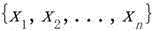 And setting different key values according to different time periods
 . The key value P is made valid only for a certain time range. Based on the key value P, the n number
 And
And obtaining (y 1, y 2.., yn); will be
 And respectively serving as secret values to the n nodes passed by the access path. Disclosing the key value P and destroying the polynomial
 . Here, the polynomial may be arbitrarily constructed according to actual needs, and the values of the random number, x, and P may also be any suitable values according to actual situations. As understood by those skilled in the art herein, a mod function is a remainder function.
With the aforementioned visited node And the access node
 The access path of (2) is an example. Take n =5 and K = 2. The secret K is divided into 5 shares and a random number {3, 5, 7, 9} is taken. Structural polynomial
 . Taking n x as {3, 4, 1, 2, 6}, taking P =11, obtaining
 . Will be provided with
 Are respectively sent to the nodes
 Publication P = 11.
Then, the access node decrypts the encrypted access path to acquire the access path. Specifically, the access node decrypts the encrypted first information bit to obtain the father node path; the access node decrypts the encrypted second information bit to obtain the sub-node path; and the access node acquires the access path according to the father node path and the child node path.
For the aforementioned embodiment in which one information code of the first hamming code and the second hamming code is randomly changed, the access node Based on the received encrypted first information bit (i.e. changed hamming code)
 Judging the information change bit
 The ninth bit error is thus obtained, thus obtaining the correct first binary information bit (01-01-10-11-11), thus obtaining the first information bit as (1, 1, 2, 3, 3).
Similarly, based on the encrypted second information bit (i.e., the changed hamming code) Determining information change bit
 This results in a ninth bit error, and thus a correct second binary information bit
 Thereby obtaining the second information bit as (41, 0, 0, 0, 21).
Thus, the parent node path (1) and the child node path (2) can be obtained according to the first information bit being (1, 1, 2, 3, 3) and the second information bit being (41, 0, 0, 0, 21)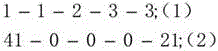 I.e. the selected path is
 。
。
Obtaining the n nodes which are brought into the access path to pass through based on a Lagrange difference value formula
 。
。

Subsequently, it can be deduced from the preceding polynomial 。
。
Therefore, the invention has the advantages that if the access node wants to access the accessed node, the access must be carried out according to the path approved by the accessed node under the premise that the nodes are connected with each other and mutually certified. The visited node defines the space range, selects a proper path, and sends the encrypted path to the visited node, so that the visited node is guaranteed to visit according to the correct path, and the correct path cannot be found even if the other nodes acquire the encrypted path. Then, the secret is divided into a plurality of shares according to the number of nodes passing through the path, different key values are taken according to different time periods for encryption, and each node on the path participates in the encryption to obtain the secret. That is, the visited node can be finally accessed only if the spatial condition and the temporal condition are satisfied and each node on the path is trusted. Therefore, the reliability of secret access can be effectively ensured, and the risk of secret leakage is reduced.
A further preferred embodiment of the present invention also relates to a computer-readable storage medium which, when executed by a processor, implements the aforementioned time-and space-division based multiparty authentication method.
Accordingly, the present invention can be realized in hardware, software, or a combination of hardware and software. The present invention can be realized in a centralized fashion in at least one computer system, or in a distributed fashion where different elements are spread across several interconnected computer systems. Any kind of computer system or other apparatus adapted for carrying out the methods of the present invention is suited. A typical combination of hardware and software could be a general purpose computer system with a computer program that, when being loaded and executed, controls the computer system such that it carries out the methods described herein.
The present invention may also be implemented by a computer program product, comprising all the features enabling the implementation of the methods of the invention, when loaded in a computer system. The computer program in this document refers to: any expression, in any programming language, code or notation, of a set of instructions intended to cause a system having an information processing capability to perform a particular function either directly or after either or both of the following: a) conversion to other languages, codes or symbols; b) reproduced in a different format.
While the invention has been described with reference to specific embodiments, it will be understood by those skilled in the art that various changes may be made and equivalents may be substituted without departing from the scope of the invention. In addition, many modifications may be made to adapt a particular situation or material to the teachings of the invention without departing from its scope. Therefore, it is intended that the invention not be limited to the particular embodiment disclosed, but that the invention will include all embodiments falling within the scope of the appended claims.
The above description is only for the purpose of illustrating the preferred embodiments of the present invention and is not to be construed as limiting the invention, and any modifications, equivalents and improvements made within the spirit and principle of the present invention are intended to be included within the scope of the present invention.
Claims (8)
1. A multi-party authentication method based on time division and space division is characterized by comprising the following steps:
s1, the access node selects the access path to the access node and generates an encryption access path to send to the access node;
s2, dividing the secret into multiple shares according to the number of the nodes passed by the access path, and carrying out different value encryption according to different time periods;
s3, the access node decrypts the encrypted access path to obtain the access path;
s4, the nodes passed by the access path share decryption to obtain the secret so as to realize the multi-party authentication;
the step S1 further includes the steps of:
s11, the visited node determines the access path of the visited node;
s12, determining a father node identifier and a son node identifier according to the MAC address of the node passed by the access path, and decomposing the access path into a father node path and a son node path based on the father node identifier and the son node identifier;
s13, determining a first information bit and a first digit based on the father node path, encrypting the first information bit and the first digit, and sending the encrypted first information bit and the digits of the encrypted first information bit to the access node, wherein the first digit is the number of nodes on the father node path, and the first information bit is the set of the father node identification;
s14, determining a second information bit based on the path of the child node, encrypting the second information bit, and sending the encrypted second information bit to the access node, wherein the second information bit is a set of identifiers of the child node;
s21, dividing the secret into a plurality of shares according to the first digit;
s22, taking a plurality of random numbers according to the first digit and constructing a polynomial based on the random numbers and the secret;
s23, setting different key values according to different time periods, and substituting the key values into the polynomial to obtain a plurality of secret values, wherein the key values are valid only in the set time periods;
s24, distributing the secret values to the nodes passed by the access path, disclosing the key values and destroying the polynomial.
2. The time-division space-division based multi-party authentication method according to claim 1, wherein the step S13 further comprises the steps of:
s131, determining a first information bit and a first digit based on the father node path, and calculating a first check digit based on the first digit and a check digit calculation formula;
s132, calculating a first binary digit based on the first information digit and a binary calculation formula;
s133, setting the first information bit based on the first binary bit to obtain a first binary information bit;
s134, obtaining a first binary check bit based on the first binary information bit and the first check bit;
s135, generating a first hamming code based on the first binary information bit and the first binary check bit;
s136, encrypting the first hamming code to generate the encrypted first information bit;
and S137, sending the encrypted first information bit and the bit number of the encrypted first information bit to the access node.
3. The time-division space-division based multi-party authentication method according to claim 2, wherein the step S14 further comprises the steps of:
s141, determining a second information bit and a second digit based on the child node path, and calculating a second check bit based on a second digit and check bit calculation formula, wherein the second digit is the number of nodes on the child node path;
s142, calculating a second binary digit based on the second information digit and a binary calculation formula;
s143, setting the second information bit based on the second binary bit to obtain a second binary information bit;
s144, solving a second binary check bit based on the second binary information bit and the second check bit;
s145, generating a second hamming code based on the second binary information bit and the second binary check bit;
s146, encrypting the second hamming code to generate the encrypted second information bit;
and S147, sending the encrypted second information bit to the access node.
4. The time-division space-division based multiparty authentication method according to claim 3, wherein in said step S13, said first hamming code is encrypted by randomly changing an information code to generate said encrypted first information bits, and in said step S14, said second hamming code is encrypted by randomly changing an information code to generate said encrypted second information bits.
5. The time-division space-division based multiparty authentication method according to claim 1, wherein in said step S2, said secret K is divided into n according to said first number of bits n, and a random number is taken And structureThe polynomial
 Arbitrarily take n numbers
 And setting different key values according to different time periods
 Based on said key value P, said n number
 And
And obtaining (y 1, y 2.., yn) from
 And respectively serving as secret values to be distributed to the n nodes passed by the access path.
6. The time-space division based multi-party authentication method according to claim 1, wherein the step S3 further comprises the steps of:
s31, the access node decrypts the encrypted first information bit to obtain the father node path;
s32, the access node decrypts the encrypted second information bit to obtain the sub-node path;
and S33, the access node acquires the access path according to the father node path and the child node path.
7. The time-division space-division based multi-party authentication method according to claim 1, wherein the step S4 further comprises: and calculating the secret by the nodes passed by the access path based on a Lagrangian difference formula.
8. A computer-readable storage medium, wherein the computer-readable storage medium, when executed by a processor, implements the time-division space-based multi-party authentication method according to any one of claims 1-7.
Priority Applications (1)
| Application Number | Priority Date | Filing Date | Title |
|---|---|---|---|
| CN202210394423.0A CN114499863B (en) | 2022-04-15 | 2022-04-15 | Multi-party authentication method based on time division and space division and computer readable storage medium |
Applications Claiming Priority (1)
| Application Number | Priority Date | Filing Date | Title |
|---|---|---|---|
| CN202210394423.0A CN114499863B (en) | 2022-04-15 | 2022-04-15 | Multi-party authentication method based on time division and space division and computer readable storage medium |
Publications (2)
| Publication Number | Publication Date |
|---|---|
| CN114499863A CN114499863A (en) | 2022-05-13 |
| CN114499863B true CN114499863B (en) | 2022-08-23 |
Family
ID=81489495
Family Applications (1)
| Application Number | Title | Priority Date | Filing Date |
|---|---|---|---|
| CN202210394423.0A Active CN114499863B (en) | 2022-04-15 | 2022-04-15 | Multi-party authentication method based on time division and space division and computer readable storage medium |
Country Status (1)
| Country | Link |
|---|---|
| CN (1) | CN114499863B (en) |
Citations (6)
| Publication number | Priority date | Publication date | Assignee | Title |
|---|---|---|---|---|
| CN101252441A (en) * | 2008-02-20 | 2008-08-27 | 深圳市永达电子有限公司 | Acquired safety control method and system based on target capable of setting information safety |
| CN101711027A (en) * | 2009-12-22 | 2010-05-19 | 上海大学 | Method for managing dispersed keys based on identities in wireless sensor network |
| CN103001875A (en) * | 2013-01-07 | 2013-03-27 | 山东量子科学技术研究院有限公司 | A dynamic routing method for quantum cryptography network |
| CN109996215A (en) * | 2019-03-31 | 2019-07-09 | 南京信息工程大学 | A kind of multi-path communications method based on privacy sharing under vehicular ad hoc network network environment |
| CN110839035A (en) * | 2019-11-19 | 2020-02-25 | 深圳前海环融联易信息科技服务有限公司 | Path access control method and device, computer equipment and storage medium |
| CN113826353A (en) * | 2019-05-16 | 2021-12-21 | 思科技术公司 | Decentralized Internet Security Protocol Key Agreement |
Family Cites Families (5)
| Publication number | Priority date | Publication date | Assignee | Title |
|---|---|---|---|---|
| US8996863B2 (en) * | 2010-12-03 | 2015-03-31 | Yacov Yacobi | Attribute-based access-controlled data-storage system |
| US20150245202A1 (en) * | 2014-02-26 | 2015-08-27 | Qualcomm Incorporated | Secure distribution of a common network key in a wireless network |
| CN108259517B (en) * | 2018-04-24 | 2021-01-26 | 上海海事大学 | Encryption method for realizing key isolation attribute of ciphertext strategy |
| CN109068325B (en) * | 2018-10-29 | 2021-04-16 | 南京邮电大学 | Key management and identity authentication method based on wireless sensor network |
| CN114079562B (en) * | 2021-11-18 | 2023-11-24 | 北京京航计算通讯研究所 | Software defined network data safety transmission method based on threshold secret sharing |
-
2022
- 2022-04-15 CN CN202210394423.0A patent/CN114499863B/en active Active
Patent Citations (6)
| Publication number | Priority date | Publication date | Assignee | Title |
|---|---|---|---|---|
| CN101252441A (en) * | 2008-02-20 | 2008-08-27 | 深圳市永达电子有限公司 | Acquired safety control method and system based on target capable of setting information safety |
| CN101711027A (en) * | 2009-12-22 | 2010-05-19 | 上海大学 | Method for managing dispersed keys based on identities in wireless sensor network |
| CN103001875A (en) * | 2013-01-07 | 2013-03-27 | 山东量子科学技术研究院有限公司 | A dynamic routing method for quantum cryptography network |
| CN109996215A (en) * | 2019-03-31 | 2019-07-09 | 南京信息工程大学 | A kind of multi-path communications method based on privacy sharing under vehicular ad hoc network network environment |
| CN113826353A (en) * | 2019-05-16 | 2021-12-21 | 思科技术公司 | Decentralized Internet Security Protocol Key Agreement |
| CN110839035A (en) * | 2019-11-19 | 2020-02-25 | 深圳前海环融联易信息科技服务有限公司 | Path access control method and device, computer equipment and storage medium |
Non-Patent Citations (2)
| Title |
|---|
| "Secure routing in multi-hop wireless networks";Zhou Jie;《香港理工大学硕士学位论文》;20120331;全文 * |
| 基于广义签密的移动Ad hoc网络密钥管理方案;魏靓等;《计算机工程与应用》;20101111(第32期);全文 * |
Also Published As
| Publication number | Publication date |
|---|---|
| CN114499863A (en) | 2022-05-13 |
Similar Documents
| Publication | Publication Date | Title |
|---|---|---|
| US12438703B2 (en) | Secure multi-party computation methods, apparatuses, and systems | |
| US12519621B2 (en) | Redistribution of secret sharings | |
| Yu et al. | An efficient scheme for securing XOR network coding against pollution attacks | |
| US8713329B2 (en) | Authenticated secret sharing | |
| EP3189618B1 (en) | Cryptographic system arranged for key sharing | |
| CN110011995B (en) | Encryption and decryption method and device in multicast communication | |
| AU2020358142B2 (en) | Key generation for use in secured communication | |
| EP2667539A1 (en) | Key sharing methods, device and system for configuration thereof. | |
| CN116961897A (en) | Group authentication key negotiation method based on certificateless key system in UAV network | |
| Lee et al. | An efficient multiple session key establishment scheme for VANET group integration | |
| US20100005307A1 (en) | Secure approach to send data from one system to another | |
| AU2002346319B2 (en) | Shared data refining device and shared data refining method | |
| JP2020533859A (en) | Methods and Devices for Increasing Blockchain Entropy Using Blinded Consequential Diversification | |
| Bykovsky | A multiple-valued logic for implementing a random oracle and the position-based cryptography | |
| CN114499863B (en) | Multi-party authentication method based on time division and space division and computer readable storage medium | |
| CN115987484B (en) | A method and system for finding intersection potential and sum of privacy sets supporting updates | |
| CN115001719B (en) | Private data processing system, method, device, computer equipment and storage medium | |
| CN114342315B (en) | Symmetric key generation, authentication and communication between multiple entities in a network | |
| Zhang et al. | Secure error-correcting (SEC) schemes for network coding through McEliece cryptosystem | |
| CN112131596B (en) | Encryption and decryption method, equipment and storage medium | |
| CN120582778B (en) | Data sharing method and device and electronic equipment | |
| Zou et al. | Trust and security in collaborative computing | |
| CN120639517B (en) | A data transmission method based on cloud native architecture | |
| CN115297125B (en) | Business data processing method, device, computer equipment and readable storage medium | |
| Vanathy et al. | Dynamic key distribution management using key escrow based ECC algorithm in MANETs |
Legal Events
| Date | Code | Title | Description |
|---|---|---|---|
| PB01 | Publication | ||
| PB01 | Publication | ||
| SE01 | Entry into force of request for substantive examination | ||
| SE01 | Entry into force of request for substantive examination | ||
| GR01 | Patent grant | ||
| GR01 | Patent grant |