CN114072150A - New method - Google Patents
New method Download PDFInfo
- Publication number
- CN114072150A CN114072150A CN202080049820.3A CN202080049820A CN114072150A CN 114072150 A CN114072150 A CN 114072150A CN 202080049820 A CN202080049820 A CN 202080049820A CN 114072150 A CN114072150 A CN 114072150A
- Authority
- CN
- China
- Prior art keywords
- treatment
- bipolar
- disorder
- lumeplerenone
- patient
- Prior art date
- Legal status (The legal status is an assumption and is not a legal conclusion. Google has not performed a legal analysis and makes no representation as to the accuracy of the status listed.)
- Pending
Links
Classifications
-
- A—HUMAN NECESSITIES
- A61—MEDICAL OR VETERINARY SCIENCE; HYGIENE
- A61K—PREPARATIONS FOR MEDICAL, DENTAL OR TOILETRY PURPOSES
- A61K31/00—Medicinal preparations containing organic active ingredients
- A61K31/33—Heterocyclic compounds
- A61K31/395—Heterocyclic compounds having nitrogen as a ring hetero atom, e.g. guanethidine or rifamycins
- A61K31/495—Heterocyclic compounds having nitrogen as a ring hetero atom, e.g. guanethidine or rifamycins having six-membered rings with two or more nitrogen atoms as the only ring heteroatoms, e.g. piperazine or tetrazines
- A61K31/4985—Pyrazines or piperazines ortho- or peri-condensed with heterocyclic ring systems
-
- A—HUMAN NECESSITIES
- A61—MEDICAL OR VETERINARY SCIENCE; HYGIENE
- A61K—PREPARATIONS FOR MEDICAL, DENTAL OR TOILETRY PURPOSES
- A61K31/00—Medicinal preparations containing organic active ingredients
- A61K31/185—Acids; Anhydrides, halides or salts thereof, e.g. sulfur acids, imidic, hydrazonic or hydroximic acids
- A61K31/19—Carboxylic acids, e.g. valproic acid
-
- A—HUMAN NECESSITIES
- A61—MEDICAL OR VETERINARY SCIENCE; HYGIENE
- A61K—PREPARATIONS FOR MEDICAL, DENTAL OR TOILETRY PURPOSES
- A61K33/00—Medicinal preparations containing inorganic active ingredients
-
- A—HUMAN NECESSITIES
- A61—MEDICAL OR VETERINARY SCIENCE; HYGIENE
- A61K—PREPARATIONS FOR MEDICAL, DENTAL OR TOILETRY PURPOSES
- A61K45/00—Medicinal preparations containing active ingredients not provided for in groups A61K31/00 - A61K41/00
- A61K45/06—Mixtures of active ingredients without chemical characterisation, e.g. antiphlogistics and cardiaca
-
- A—HUMAN NECESSITIES
- A61—MEDICAL OR VETERINARY SCIENCE; HYGIENE
- A61K—PREPARATIONS FOR MEDICAL, DENTAL OR TOILETRY PURPOSES
- A61K9/00—Medicinal preparations characterised by special physical form
- A61K9/0012—Galenical forms characterised by the site of application
- A61K9/0053—Mouth and digestive tract, i.e. intraoral and peroral administration
-
- A—HUMAN NECESSITIES
- A61—MEDICAL OR VETERINARY SCIENCE; HYGIENE
- A61K—PREPARATIONS FOR MEDICAL, DENTAL OR TOILETRY PURPOSES
- A61K9/00—Medicinal preparations characterised by special physical form
- A61K9/20—Pills, tablets, discs, rods
-
- A—HUMAN NECESSITIES
- A61—MEDICAL OR VETERINARY SCIENCE; HYGIENE
- A61K—PREPARATIONS FOR MEDICAL, DENTAL OR TOILETRY PURPOSES
- A61K9/00—Medicinal preparations characterised by special physical form
- A61K9/48—Preparations in capsules, e.g. of gelatin, of chocolate
-
- A—HUMAN NECESSITIES
- A61—MEDICAL OR VETERINARY SCIENCE; HYGIENE
- A61P—SPECIFIC THERAPEUTIC ACTIVITY OF CHEMICAL COMPOUNDS OR MEDICINAL PREPARATIONS
- A61P25/00—Drugs for disorders of the nervous system
- A61P25/18—Antipsychotics, i.e. neuroleptics; Drugs for mania or schizophrenia
Landscapes
- Health & Medical Sciences (AREA)
- Veterinary Medicine (AREA)
- Chemical & Material Sciences (AREA)
- Medicinal Chemistry (AREA)
- Pharmacology & Pharmacy (AREA)
- Life Sciences & Earth Sciences (AREA)
- Animal Behavior & Ethology (AREA)
- General Health & Medical Sciences (AREA)
- Public Health (AREA)
- Epidemiology (AREA)
- Bioinformatics & Cheminformatics (AREA)
- Engineering & Computer Science (AREA)
- Chemical Kinetics & Catalysis (AREA)
- Nuclear Medicine, Radiotherapy & Molecular Imaging (AREA)
- Biomedical Technology (AREA)
- Neurology (AREA)
- Neurosurgery (AREA)
- Organic Chemistry (AREA)
- General Chemical & Material Sciences (AREA)
- Psychiatry (AREA)
- Nutrition Science (AREA)
- Physiology (AREA)
- Inorganic Chemistry (AREA)
- Pharmaceuticals Containing Other Organic And Inorganic Compounds (AREA)
- Acyclic And Carbocyclic Compounds In Medicinal Compositions (AREA)
- Medicinal Preparation (AREA)
Abstract
The present disclosure provides a method of treating bipolar II disorder comprising administering to a patient in need thereof a therapeutically effective amount of lumeplerenone, optionally in deuterated form, in free or pharmaceutically acceptable salt form.
Description
Cross Reference to Related Applications
This application claims priority and benefit from U.S. provisional application No. 62/871,170, filed on 7/2019, the contents of which are incorporated herein by reference in their entirety.
Technical Field
The present disclosure relates to the use of lumeplerenone (lumateperone) in free or pharmaceutically acceptable salt form, optionally in deuterated form, for the treatment of bipolar II disorder.
Background
Substituted heterocycle-fused gamma-carbolines such as rumepilone are known as 5-HT2AOr 5-HT2Athe/D2 receptor ligands, which are useful for the treatment of central nervous system disorders. These compounds antagonize serotonin-2A (5-HT)2A) Receptors and/or modulate dopamine receptor signaling at key intracellular phosphoprotein levels. Such compounds are known to be useful primarily in the treatment of the positive and negative symptoms of schizophrenia. At the dopamine D2 receptor, these compounds have dual properties and act as postsynaptic antagonists and presynaptic partial agonists. They also stimulate the phosphorylation of glutamatergic NMDA NR2B or GluN2B receptors in a midbrain-edge specific manner. It is believed that this regioselectivity in brain regions thought to mediate the efficacy of antipsychotics, along with serotonergic, glutamatergic and dopaminergic interactions, may result in antipsychotic efficacy for positive, negative, affective and cognitive symptoms associated with schizophrenia. The compounds also exhibit serotonin reuptake inhibition, providing antidepressant activity for the treatment of schizoaffective disorders, comorbid depression and/or as an independent treatment of major depression. The 5-HT2AOr 5-HT2Athe/D2 receptor ligands may also be useful in the treatment of bipolar disorders and other psychiatric and neurodegenerative disorders, in particular behavioural disorders associated with dementia, autism and other CNS disorders. These features may be able to improve the quality of life of schizophrenic patients, enhancing social function to allow them to more fully integrate into theirHomes and their workplaces. These compounds show different dose-dependent effects, selectively targeting 5-HT at low doses2AReceptor, and at higher doses gradually interacts with the D2 receptor. Thus, at lower doses, they can be used to treat sleep, aggression and agitation. At high doses, they can treat acute exacerbation and residual schizophrenia, bipolar disorder and mood disorder.
Lumeperisone, which is 4- ((6bR,10aS) -3-methyl-2, 3,6b,9,10,10 a-hexahydro-1H-pyrido [3',4':4,5] pyrrolo [1,2,3-de ] quinoxalin-8 (7H) -yl) -1- (4-fluorophenyl) -1-butanone, having the formula:

it is a therapeutic agent currently undergoing clinical trials. Lumeperisone provides selective and simultaneous modulation of serotonin, dopamine and glutamate neurotransmission. It shows potent (Ki ═ 0.5nM) 5-HT2AReceptor antagonism, activity as modulators of mesolimbic/mesocorticoid selective dopamine receptor protein phosphorylation consistent with partial agonism of the presynaptic D2 receptor and postsynaptic D2 receptor antagonism in vivo (Ki ═ 32nM), high D1 receptor affinity (Ki ═ 52nM), and serotonin transporter (SERT) inhibition (Ki ═ 26-62nM, determined using different SERT activities). Rumepilone was approved by the U.S. food and drug administration in 2019 for the treatment of schizophrenia, currently in or already in phase III clinical development for the treatment of dementia, including bipolar depression and agitation in alzheimer's disease.
Lumeperirone and related compounds have been described in U.S. Pat. Nos. 6,548,493, 7,238,690, 6,552,017, 6,713,471, U.S. RE39,680 and U.S. RE39,679 as useful in the treatment of 5-HT2ANovel compounds are disclosed for diseases associated with receptor modulation, such as anxiety, depression, psychosis, schizophrenia, sleep disorders, sexual dysfunction, migraine, conditions associated with headache, and social phobia. PCT/US08/03340 and US 7,081,455 also disclose the preparation of a polypeptideSubstituted heterocyclic fused gamma-carbolines and the use of these gamma-carbolines as serotonin agonists and antagonists useful in the control and prevention of central nervous system disorders such as addictive behavior and sleep disorders. WO2009/145900 and US8,598,119 and WO2013/155506 and US2015/0080404 (each incorporated herein by reference) disclose the use of certain substituted heterocycle fused gamma-carbolines for the treatment of combinations of psychosis and depression and for sleep, depression and/or mood disorders in psychosis or parkinson's disease patients, and for the treatment or prevention of disorders associated with dementia, in particular behavioral or mood disorders, such as agitation, stimulation, aggressive/hyperactivity behavior, anger, physical or emotional outbreaks and psychosis and sleep disorders associated with dementia. WO2009/114181 and US8,648,077 and US2020/0157100 (each incorporated herein by reference) disclose methods of preparing crystalline tosylate addition salts of certain substituted heterocycle fused γ -carbolines, such as the tosylate addition salts (mono-and bis-tosylates) of lummeperone.
WO2011/133224 and US8,993,572 (each incorporated herein by reference) disclose prodrugs/metabolites of substituted heterocycle fused gamma-carbolines for use in improved formulations such as extended/controlled release formulations. This application discloses that heterocycle fused gamma-carbolines N-substituted with a 4-fluorophenyl (4-hydroxy) butyl moiety show high selectivity for serotonin transporters (SERT) over heterocycle fused gamma-carbolines containing 4-fluorophenylbutanone.
WO2009/145900 (and US8,598,119) teaches that selected substituted heterocyclic fused gamma-carboline compounds have nanomolar affinity for serotonin reuptake transporter proteins (SERTs) and are therefore selective serotonin reuptake inhibitors.
Deuterated forms of lumepepin and related compounds have been demonstrated to have improved metabolic stability as disclosed in WO2015/154025, US2017/0183350, WO2017/165843 and US2019/231780 (each incorporated herein by reference).
According to the National Institute of Mental Health, bipolar disorder, also known as manic depression, is a brain disorder that causes abnormal changes in mood, energy, activity level, and ability to perform daily tasks. There are four basic types of bipolar disorder; all of which involve significant changes in mood, energy and activity levels. These mood ranges from periods of extreme "hyperactivity," excitement and energetic behavior (known as manic episodes) to periods of extreme sadness, "depression" or despair (known as depressive episodes). The less severe manic period is called a hypomanic episode.
a.I type bipolar disorder-defined as manic episodes that last for at least 7 days, or as severe as manic symptoms where the patient requires immediate hospitalization. Depressive episodes also often occur, usually for at least 2 weeks. Depressive episodes with mixed features (with both depressive and manic symptoms) are also possible.
bipolar ii disorder-defined as a pattern of depressive and hypomanic episodes rather than the generalized manic episodes described above.
c. Cyclothymic disorder (also known as cyclothymia) -is defined as multiple hypomanic symptom periods and multiple depressive symptom periods lasting at least 2 years (1 year in children and adolescents). However, these symptoms do not meet the diagnostic requirements for hypomanic and depressive episodes.
d. Other illustrated and unexplained bipolar disorder and related disorders-defined as the symptoms of bipolar disorder that do not match the three categories listed above.
The etiology of bipolar disorder is unclear and the disease is resistant to treatment. Drug therapy includes mood stabilizing drugs, such as lithium or anticonvulsants (e.g., carbamazepine, lamotrigine, and valproate). Not only are traditional antidepressants such as Selective Serotonin Reuptake Inhibitors (SSRIs) less effective in treating bipolar depression than major depression, they can cause injury by causing manic episodes and rapid cycling.
Antipsychotic drugs are generally effective for short-term treatment of bipolar manic episodes in bipolar I disorder, but they are generally ineffective for treating bipolar II disorder and for maintaining treatment during depressive episodes. Moreover, many antipsychotics exhibit significant side effects, such as extrapyramidal symptoms, including acute dyskinesia and dystonic responses, tardive dyskinesia, parkinsonism, akinesia, akathisia and neuroleptic malignancy.
For example, the atypical antipsychotic aripiprazole is widely evaluated for the treatment of bipolar disorders, but review of clinical data leads to the following conclusions: "while aripiprazole has proven effective for acute mania and for the prevention of mania, the evidence available to date does not support the efficacy of aripiprazole for the treatment of acute bipolar depression and for the prevention of recurrence of depression. "Yatham LN," A clinical review of aripiprazole in bipolar expression and main therapy of bipolar disorder "J.Afect.disorder.2011.1 month; 128 supplement 1: s21-8. Aripiprazole is currently approved in the united states for the "acute treatment of manic and mixed episodes associated with type I biphasic". There is currently no approval for the treatment of bipolar II disorder.
Although there are many antipsychotics approved for the treatment of mania associated with bipolar I disorder, currently only four antipsychotics are approved for the treatment of depression associated with bipolar I disorder in the united states, and currently only one antipsychotic is approved for the treatment of bipolar II disorder, quetiapine, in the united states However, quetiapine has been reported to have a high sedative effect, causing a variety of metabolic side effects such as hyperglycemia, dyslipidemia, and weight gain. It is also associated with suicidal thoughts that some patients have.
The estimates vary, but it is believed that about 30-60% of bipolar disorder patients suffer from bipolar II disorder. Although common, bipolar II disorder is often misdiagnosed as major depressive disorder or bipolar I disorder and is therefore treated incorrectly. There is a need for safer and more effective treatment of bipolar II disorders as well as therapies that are effective in treating bipolar I disorder and bipolar II disorder.
Brief description of the drawings
We have surprisingly found that luliperone is useful in the treatment of bipolar II disorder. Clinical results indicate that lumeplerenone is at least as effective in this indication as existing antipsychotics for the treatment of bipolar disorder, with a particularly unexpected efficacy in bipolar II disorder, which is generally resistant to antipsychotic treatment. Furthermore, luliperone exhibits good safety. Clinical trials have demonstrated that, unlike many other antipsychotics, lumeplerenone does not increase akathisia, hyperactivity, or other dyskinesias, does not increase suicidal ideation, and has no significant metabolic side effects.
Accordingly, in a first aspect, the present disclosure provides a method of treating bipolar II disorder in a patient in need thereof, the method comprising administering to a patient in need thereof a therapeutically effective amount of lumeplerenone, optionally in deuterated form, as a free base or in pharmaceutically acceptable salt form.
Other embodiments will be apparent from the following detailed description and examples.
Detailed description of the invention
In a phase 3 clinical trial evaluating luliperone as monotherapy for the treatment of major depressive episodes associated with bipolar I or II disorders, 42mg of luliperone per day (administered orally as 60mg tosylate) reached the primary depression-improving endpoint (e.g. oral administration of 60mg of luliperone) Total rating on Depression rating Scale (MADRS) measured by change from baseline versus placebo (p)<0.001; effector function ═ 0.56)) and its critical secondary endpoints, the Clinical Global Impression Scale of Bipolar disorder Severity (Clinical Global Impression Scale for Bipolar for Severity of ilness, CGI-BP-S) total score (p)<0.001; effect amount is 0.46).
Moreover, the absence of manic occurrences and a particular clinical global impression of manic severity as determined by the Young Mania Scale (YMRS) in patients means that the drug is effective in preventing the occurrence of Mania or hypomania and does not trigger a manic episode or cause rapid cycling which is often associated with SSRIs for the treatment of bipolar disorders.
Unexpectedly, given the generally limited efficacy of antipsychotics in bipolar II disorder, a subgroup analysis of bipolar II disorder patients showed that the MADRS total score of 42mg luxepin per day was statistically significantly better than placebo.
Luliperone showed good safety in this trial, comparable to placebo. Unlike quetiapine, rumepilone was not shown to have any significant metabolic effects, such as hyperglycemia, dyslipidemia, or weight gain. There were no adverse event reports on suicidal ideation, no suicide, and no withdrawal due to suicidal ideation. Equally important, there is no adverse event report of extrapyramidal symptoms such as akathisia, hyperactivity, or other motor side effects.
Akathisia has been associated with the use of most antipsychotics and antidepressants, particularly in bipolar disorder. Sedentary sitting cannot already be associated with suicide. This highlights the clinical importance of luliperone, as it can treat bipolar II disorder without inducing akathisia and is therefore less likely to induce suicidal behavior.
In a first aspect, the present disclosure provides a method (method 1) of treating bipolar II disorder, the method comprising administering to a patient in need thereof a therapeutically effective amount of lumeplerenone, optionally in deuterated form, as free base or in pharmaceutically acceptable salt form. In a further embodiment of the first aspect, the present disclosure provides:
1.1. method 1, wherein lumeplerenone is in the form of a tosylate salt (e.g., an acid addition salt of toluenesulfonic acid, such as a monotosylate salt or a bismesylate salt), optionally wherein the salt is a solid crystalline salt, such as those disclosed in US2011/112105 and/or US2020/0157100, the contents of each of which are incorporated herein by reference in their entirety.
1.2. Method 1, wherein the rumepilone is in free base form.
1.3. Any of the foregoing methods, wherein the lumeplerenone is in a deuterated form, e.g., wherein the ratio of deuterium to protium of the designated carbon-bonded hydrogen atoms is significantly higher than the natural isotopic ratio, e.g., at least 2 times, e.g., at least 10 times.
1.4. Method 1.3, wherein the lumeplerenone is a deuterated form selected from:
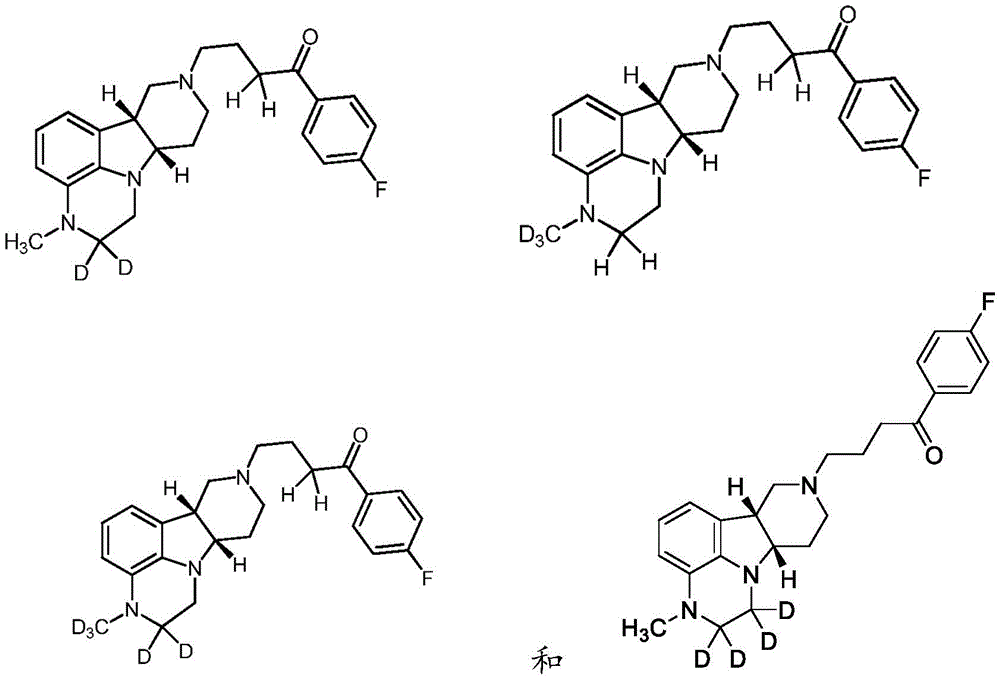
wherein D represents a hydrogen position having a significantly higher incorporation of natural deuterium (i.e. significantly higher than 0.0156%), for example, higher than 60%, or higher than 70%, or higher than 80%, or higher than 90% or higher than 95%, or higher than 96%, or higher than 97%, or higher than 98%, or higher than 99%,
in free or pharmaceutically acceptable salt form, e.g. as tosylate salt.
1.5. The method of any preceding method, wherein the luliperone, optionally in deuterated form, in free or pharmaceutically acceptable salt form, is administered in a total daily dose equivalent to 6-60mg free base, e.g. equivalent to 20-50mg free base.
1.6. The method of any preceding method, wherein the luliperone, optionally in deuterated form, in free or pharmaceutically acceptable salt form, is administered in a total daily dose equivalent to 25-30mg of the free base.
1.7. The method of any preceding method, wherein the luliperone, optionally in deuterated form, in free or pharmaceutically acceptable salt form, is administered in a total daily dose equivalent to 40-45mg of the free base.
1.8. Any preceding method, wherein the method comprises administering once daily a unit dose for oral administration, such as a tablet or capsule, comprising about 42mg of luliperone free base equivalent, optionally in deuterated form, in free or pharmaceutically acceptable salt form, in combination or association with a pharmaceutically acceptable diluent or carrier.
1.9. Any preceding method, wherein the method comprises administering once daily a tablet or capsule comprising about 60mg of lumeplerenone tosylate, optionally in deuterated form, in combination or association with a pharmaceutically acceptable diluent or carrier.
1.10. Any preceding method, wherein the method comprises administering once daily a unit dose for oral administration, such as a tablet or capsule, comprising about 28mg of rumepilone free base equivalent, optionally in deuterated form, in free or pharmaceutically acceptable salt form, in combination or association with a pharmaceutically acceptable diluent or carrier.
1.11. Any preceding method, wherein the method comprises administering once daily a tablet or capsule comprising about 40mg of lumeplerenone tosylate, optionally in deuterated form, in combination or association with a pharmaceutically acceptable diluent or carrier.
1.12. Any preceding method, wherein the method comprises once daily administration of a unit dose for subcutaneous or transmucosal administration, such as a sublingual or buccal orally disintegrating tablet or film comprising luliperone, optionally in deuterated form, in free or pharmaceutically acceptable salt form, in an amount equivalent to 10-60mg of the free base, and a pharmaceutically acceptable diluent or carrier.
1.13. The method of any preceding, wherein the method comprises administering rumepilone in free or pharmaceutically acceptable salt form, optionally in deuterated form, in long-acting injectable form.
1.14. Any of the foregoing methods, wherein the patient has been diagnosed with bipolar II disorder.
1.15. Any of the foregoing methods, wherein the condition to be treated is depression in, or a depressive episode associated with, bipolar II disorder (e.g., major depressive episode).
1.16. The method of any of the foregoing, wherein the condition to be treated comprises mixed affective episodes in bipolar II disorder.
1.17. The method of any preceding method, wherein the condition to be treated comprises a hypomanic episode.
1.18. Any of the preceding methods, wherein the treatment inhibits mania or hypomania.
1.19. Any of the foregoing methods, wherein the treatment does not elicit a manic or hypomanic episode or rapid circulation.
1.20. Any of the foregoing methods, wherein during the course of treatment the patient does not exhibit mania or hypomania as determined by the young mania scale (YMRS).
1.21. Any of the foregoing methods, wherein during the course of treatment, the patient exhibits an improvement in depression symptoms, e.g., using Depression Rating Scale (MADRS), Hamilton depression rating scale (HAM-D), Beck depression scale (BDI), Zung depression self-rating scale, Wechsler depression rating scale, Raskin depression rating scale, depression symptom scale (Inventory of depression Symptomatology, IDS), or depression symptom Rapid Scale (Quick Inventory of depression Symptomatology, QIDS).
1.22. Any of the foregoing methods, wherein during the course of treatment, the patient exhibits Improvement in total score on the depression rating scale (MADRS) (e.g., improvement over 8 days or less after initiation of treatment).
1.23. Any of the foregoing methods, wherein after treatment, the patient exhibits an improvement in the bipolar disorder severity clinical global impression scale (CGI-BP-S) (e.g., an improvement within 8 days or less after initiation of treatment).
1.24. Any of the foregoing methods, wherein during the course of treatment, the patient exhibits an improvement (e.g., an improvement within 8 days or less after initiation of treatment) in the Clinical Global Impression Scale (Clinical Global Impression Scale for Bipolar Depression for preference of ileness, CGI-BP-Depression-S) of Bipolar Depression Severity.
1.25. Any of the foregoing methods, wherein during the course of treatment, the patient does not exhibit an increase in the Bipolar Mania Severity Clinical Global Impression Scale (CGI-BP-Mania-S).
1.26. Any of the foregoing methods, wherein during the course of treatment, the patient exhibits an improvement in overall mental health, for example as measured using clinical global impression-severity (CGI-S) or clinical global impression-improvement (CGI-I) (e.g., improvement within 8 days or less after initiation of treatment).
1.27. Any of the foregoing methods, wherein the treatment does not result in metabolic side effects, such as one or more of hyperglycemia, dyslipidemia, or weight gain.
1.28. Any of the foregoing methods, wherein the treatment does not induce suicidal ideation or thoughts.
1.29. Any of the foregoing methods, wherein the treatment does not induce extrapyramidal symptoms, such as one or more of akathisia, akinesia, hyperactivity, acute dyskinesia, dystonic responses, tardive dyskinesia, parkinson-like symptoms, or neuroleptic malignancy.
1.30. The method of any preceding claim, wherein the treatment does not induce akathisia.
1.31. The method of any preceding method, wherein the lumeplerenone, optionally in deuterated form, as a free base or in pharmaceutically acceptable salt form, is administered as a monotherapy for treating bipolar II disorder.
1.32. Any of the foregoing methods, wherein the patient concurrently receives a mood stabilizer, e.g., selected from the group consisting of lithium, carbamazepine, oxcarbazepine, lamotrigine, and valproate (including divalproex sodium (also known as hemi-sodium valproate), valproate sodium, and other free, salt, or complexed forms of valproic acid).
1.33. The method of any of the preceding methods, wherein the patient receives lithium or valproate concurrently.
1.34. The method of any of the preceding claims, wherein the patient is under 18 years of age.
1.35. The method of any of the preceding methods, wherein the patient is an adult, e.g., over the age of 18, e.g., between the ages of 18 and 75, inclusive.
1.36. The method of any of the preceding methods, wherein the patient is elderly, e.g., 65 years old or older, e.g., 75 years old or older.
1.37. Any of the foregoing methods, wherein lumeplerenone in free or salt form is indicated for use in treating depression in bipolar I disorder and bipolar II disorder.
1.38. The method of any of the foregoing, wherein the duration of treatment is six weeks or less.
1.39. The method of any preceding claim, wherein the treatment is maintenance treatment.
1.40. The method of any of the foregoing, wherein the duration of treatment is six weeks or more.
1.41. Any of the foregoing methods, wherein the patient was previously treated with an SSRI (e.g., such treatment was ineffective and/or discontinued, e.g., due to a side effect).
1.42. Process 1.41, wherein the SSRI is selected from the group consisting of citalopram, escitalopram, fluoxetine, fluvoxamine, paroxetine and sertraline.
1.43. Any of the foregoing methods, wherein the patient was previously treated with an antipsychotic, such as an atypical antipsychotic (e.g., such treatment is ineffective and/or discontinued, such as due to a side effect discontinuation).
1.44. Method 1.43, wherein the antipsychotic agent is selected from the group consisting of haloperidol, aripiprazole, quetiapine, olanzapine, risperidone, lurasidone (lurasidone), paliperidone, iloperidone, ziprasidone, ipiprazole (brexipridazole), asenapine (asenapine), clozapine, and zotepine.
In another aspect, the present disclosure provides lumeplerenone, optionally in deuterated form, in free or pharmaceutically acceptable salt form, for use in treating bipolar II disorder, e.g., for use in any of method 1 and the following, and the like.
In another aspect, the present disclosure provides the use of lumeplerenone, optionally in deuterated form, in free or pharmaceutically acceptable salt form, in the manufacture of a medicament for the treatment of bipolar II disorder, e.g., for any of method 1 and below, and the like.
The word "treatment" is to be understood accordingly to include both prevention and treatment or amelioration of the symptoms of a disease and/or treatment of the cause of a disease. In particular embodiments, the word "treating" refers to the prevention or amelioration of the symptoms of a disease.
As used herein, "patient" refers to a human patient, unless otherwise indicated.
Pharmaceutically acceptable salts of rumepilone include pharmaceutically acceptable acid addition salts,such as the toluenesulfonic acid addition salt (tosylate). The tosylate salt of rumepilone includes monotosylate salt and bismesylate salt. Unless otherwise indicated, the term "rumepilon tosylate" refers to the monotosylate salt. Lumepilone tosylate as CaplytaTMAnd (5) selling. When a dose or amount of a salt is given by weight, e.g., mg/day or mg/unit dose, the dose of the salt is given by weight of the corresponding free base unless otherwise indicated.
The term "concurrently" when used in relation to treatment refers to the administration of two or more active ingredients to a patient as part of a regimen for treating a disease or condition, whether the two or more active agents are administered at the same or different times or by the same or different routes of administration. The concurrent administration of two or more active ingredients may be performed at different times of the same day, or on different days or at different frequencies.
The dosage used in the practice of the present disclosure will, of course, vary depending upon, for example, the particular disease or condition being treated, the particular active compound employed, the mode of administration, and the intended therapy. The lumeplerenone in free form or in pharmaceutically acceptable salt form, optionally in deuterated form, may be administered by any suitable route, including orally, parenterally, transdermally or transmucosally, for example in the form of tablets, capsules, subcutaneous injections, long acting injectable (depot) or orally rapidly disintegrating tablets or films for sublingual or buccal administration.
In some embodiments, the luliperone is provided as a tablet or capsule for oral administration comprising the luliperone tosylate in combination with a pharmaceutically acceptable diluent or carrier.
In some embodiments, the lumeplerenone is provided as a rapidly disintegrating tablet or film for sublingual or buccal administration comprising lumeplerenone tosylate in combination with a pharmaceutically acceptable diluent or carrier.
In some embodiments, the luliperone, optionally in deuterated form, in free or pharmaceutically acceptable salt form, is administered as a depot formulation, for example by dispersing, dissolving, suspending or encapsulating the compound in a polymer matrix (as described herein), so that the compound is continuously released as the polymer degrades over time. The release of lumeplerenone from the polymer matrix provides a controlled and/or delayed and/or sustained release, e.g. from a drug depot composition to an individual, e.g. a warm-blooded animal, e.g. a human, to whom the drug depot is administered. Thus, the drug depot delivers the lumeplerenone to the subject over a sustained period of time, e.g., 1 week to 3 months, at a concentration effective to treat the particular disease or medical condition.
Polymers useful in the polymer matrix of the compositions of the invention (e.g., the depot compositions of the invention) may include polyesters of hydroxy fatty acids and derivatives thereof or other materials, such as polylactic acid, polyglycolic acid, polycitric acid, polymalic acid, poly-beta-hydroxybutyric acid, epsilon-caprolactone ring-opening polymers, copolymers of lactic acid and glycolic acid, copolymers of 2-hydroxybutyric acid and glycolic acid, copolymers of polylactic acid and polyethylene glycol, or copolymers of polyglycolic acid and polyethylene glycol, alkyl alpha-cyanoacrylates (e.g., poly (butyl 2-cyanoacrylate)), polyalkylene oxalates (e.g., polytrimethylene oxalate or polytetramethylene oxalate), polyorthoesters, polycarbonates (e.g., polyethylene carbonate or polyethylene propylene carbonate), polyorthocarbonates (poly ortho-carbonate), Polyamino acids (e.g., poly- γ -L-alanine, poly- γ -benzyl-L-glutamic acid, or poly- γ -methyl-L-glutamic acid), hyaluronic acid esters, and the like, and one or more of these polymers may be used.
If the polymers are copolymers, they may be any of random, block and/or graft copolymers. When the above-mentioned α -hydroxycarboxylic acid, hydroxydicarboxylic acid and hydroxytricarboxylic acid have optical activity in their molecules, any of D-isomer, L-isomer and/or DL-isomer may be used. Among them, an α -hydroxycarboxylic acid polymer (preferably a lactic acid-glycolic acid polymer), an ester thereof, poly- α -cyanoacrylate, or the like can be used, and a lactic acid-glycolic acid copolymer (also referred to as poly (lactide- α -glycolide) or poly (lactic acid-co-glycolic acid), hereinafter referred to as PLGA) is preferable. Thus, in one aspect, the polymer that can be used in the polymer matrix is PLGA. The term PLGA as used herein includes lactic acid polymers (also known as polylactide, poly (lactic acid) or PLA). Most preferably, the polymer is a biodegradable poly (d, l-lactide-co-glycolide) polymer, such as PLGA 50:50, PLGA 85:15 and PLGA 90: 10.
In one such embodiment, the polymeric matrix of the present invention is a biocompatible and biodegradable polymeric material. The term "biocompatible" is defined as a polymeric material that is non-toxic, non-carcinogenic, and does not significantly cause inflammation of body tissues. The matrix material should be biodegradable, wherein the polymeric material should degrade by bodily processes into products that are easily discarded by the body and should not aggregate in vivo. The products of biodegradation should also be biocompatible with the body, as the polymer matrix is biocompatible with the body. Particularly useful examples of polymeric matrix materials include poly (glycolic acid), poly-D, L-lactic acid, poly-L-lactic acid, copolymers of the foregoing, poly (aliphatic carboxylic acids), copolyoxalates, polycaprolactones, polydioxanones, poly (orthocarbonates), poly (acetals), poly (lactic acid-caprolactone), polyorthoesters, poly (glycolic acid-caprolactone), polyanhydrides, and natural polymers, including albumin, casein, and waxes, such as glycerol mono and distearate, and the like. One polymer suitable for use in the practice of the present invention is dl (polylactide-co-glycolide). In one embodiment, the molar ratio of lactide to glycolide in the copolymer is in the range of about 75:25 to 50: 50.
Useful PLGA polymers may have a weight average molecular weight of about 5,000 to 500,000 daltons, preferably about 150,000 daltons. Depending on the degradation rate to be achieved, polymers of different molecular weights may be used. For the diffusion mechanism of drug release, the polymer should remain intact until all of the drug is released from the polymer matrix and then degrades. The drug may also be released from the polymer matrix following bioerosion of the polymer excipient.
PLGA may be prepared by any conventional method, or may be obtained commercially. For example, PLGA may be produced from cyclic lactide, glycolide, etc. by ring-opening polymerization using suitable catalysts (see EP-0058481B 2; the effect of the polymerization variables on the PLGA properties: molecular weight, composition and chain structure).
It is believed that PLGA may be biodegradable through degradation of the entire solid polymer composition, since the hydrolysable and enzymatically cleavable ester linkages are cleaved under biological conditions (e.g. in the presence of biological enzymes and water found in the tissues of warm-blooded animals such as humans) to form lactic acid and glycolic acid. Lactic acid and glycolic acid are water-soluble, non-toxic normal metabolites that can be further biodegraded to form carbon dioxide and water. In other words, it is believed that PLGA degrades by hydrolysis of the ester group in the presence of water (e.g. in the body of a warm-blooded animal such as a human), producing lactic and glycolic acids and producing an acidic microclimate. Lactic acid and glycolic acid are by-products of various metabolic pathways in a warm-blooded animal such as man under normal physiological conditions and are therefore well tolerated and produce minimal systemic toxicity.
For the avoidance of doubt, any disclosure of numerical ranges, for example amounts "up to X", is intended to include the upper limit X. Thus, a disclosure of "up to 60 mg" is intended to include 60 mg.
All documents cited herein are incorporated by reference in their entirety. In the event that a definition in this disclosure conflicts with a definition in a cited document, the disclosure controls.
The present disclosure is further illustrated in the following examples, which are intended to be illustrative and not limiting.
Example 1: clinical trials in patients with bipolar I and bipolar II disorders
Multicenter, multinational, randomized, double-blind, fixed dose, placebo controlled clinical trials were conducted essentially according to the following protocol.
Patients were recruited according to the following criteria:
-major inclusion criteria: a male or female subject of any race, 18-75 years of age, inclusive, clinically diagnosed as bipolar I or II, experiencing a current major depressive episode, is able to provide written informed consent.
-major exclusion criteria: any pregnant or lactating female individual is judged to be medically unsuitable for participation in the study.
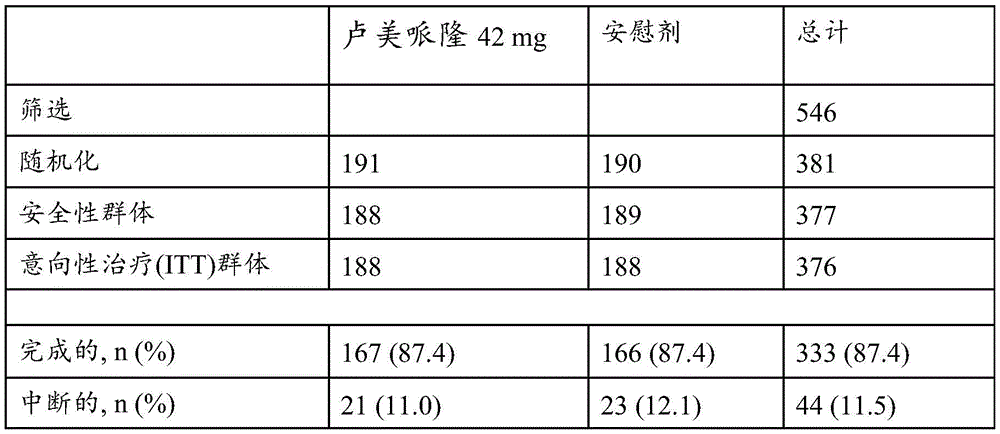
A total of 381 patients enrolled according to the above criteria were randomly assigned to two study groups at 1: (i) luliperone 42mg (administered orally as 60mg luliperone tosylate) and (ii) placebo. In the rumepilone group, rumepilone (rumepilone tosylate 60mg) was administered once daily in the evening for 6 weeks. In the placebo group, placebo was administered once daily in the evening for 6 weeks. The patient received no other medication for the treatment of bipolar disorder. The study was quadruple masked (i.e., to participants, care providers, researchers, and outcome evaluators).
The duration of the entire study was about 10 weeks, including a screening period up to 2 weeks (drug-deprivation disabled period), a 6-week double-blind treatment period, and a 2-week safety follow-up period.
The primary outcome measure is Depression Rating Scale (MADRS) [ time-box: day 43]. The secondary outcome measure is the clinical global impression scale-bipolar disorder edition (CGI-BP) [ time box: day 43]And Quality of life Enjoyment and Satisfaction questionnaire-profile (Quality of life enzyme and safety failure Questionanaire-Short Form, Q-LES-Q-SF) [ time box: day 43]。
Another objective of this study was to determine the safety and tolerability of lumeplerenone compared to placebo as determined by:
a. incidence of Adverse Events (AEs)
b. Young mania scale (YMRS)
c. Columbia suicide severity rating Scale (C-SSRS)
d. Abnormal Involuntary Movement Scale (AIMS)
e. Barnes (Barnes) sit-down disability rating Scale (BARS)
f. Simpson-Angus (Simpson Angus) scale (SAS)
g. Clinical laboratory evaluation
h. Electrocardiogram (ECG)
i. Vital sign measurement
j. Physical examination and neurological findings
The patient was treated as follows:
TABLE 1
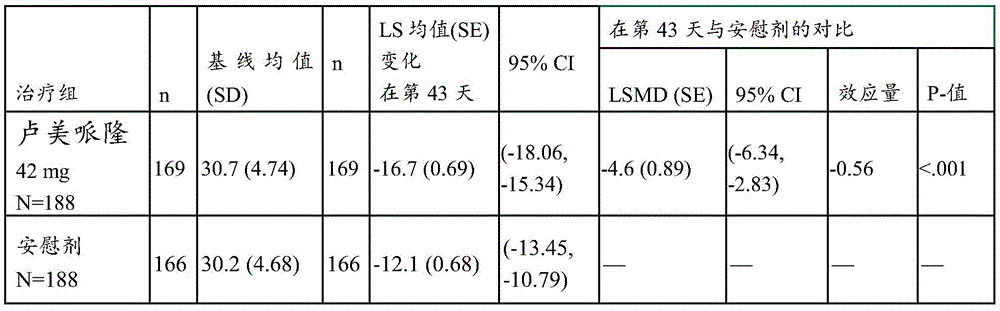
The change seen from baseline to day 43 in the MADRS total score was as follows:
TABLE 2
The change seen from baseline to day 43 in the total score of CGI-BP-S was as follows:
TABLE 3

Therefore, lumeplerenone 42mg was superior to placebo as evidenced by the statistically significant improvement in MADRS total score and CGI-BP-S, which are the primary and key secondary metrics in this study. The improvement observed with rumepilone 42mg in this study is considered to be of clinical significance.
The safety of lumeplerenone was similar to placebo. Adverse Events (TEAEs) occurred during treatment with the following profile:
TABLE 4

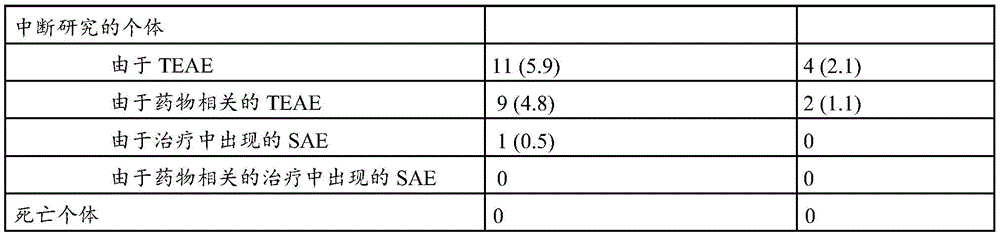
Rumepilone 42mg is generally safe and well tolerated. The most commonly reported adverse events observed with incidence higher than 5% and higher than placebo are headache, lethargy and nausea. Importantly, the incidence of akathisia and extrapyramidal symptoms was less than 1%, similar to placebo.
In this trial, once daily rumepilone 42mg reached the primary endpoint, with a statistically significant higher improvement at week 6 (trial endpoint) compared to placebo as measured by the change in MADRS total score from baseline. In the intent-to-treat (ITT) study population, mean reduction of rumepilone 42mg from baseline by Least Squares (LS) was 16.7 points and placebo was 12.1 points (mean difference in LS was 4.6 points; effect was 0.56, p < 0.001). Moreover, as early as week 1, luliperone 42mg showed a statistically significant separation from placebo, which was maintained at each time point throughout the experiment.
Rumepilone 42mg also reached a key secondary endpoint for statistically significant improvement in CGI-BP-S total score (p < 0.001; effect amount 0.46) and CGI component specifically assessed for depression (CGI-S depression score; p < 0.001; effect amount 0.5).
These results are supported by statistically significant benefits of response and remission rates, demonstrating the clinical significance of the primary outcome. Furthermore, in a subgroup analysis of bipolar II patients, luliperone 42mg was statistically significantly better than placebo in terms of MADRS total score.
Claims (14)
1. A method of treating bipolar II disorder comprising administering to a patient in need thereof a therapeutically effective amount of lumeplerenone, optionally in deuterated form, in free or pharmaceutically acceptable salt form.
2. The method according to claim 1, wherein the lumeplerenone is in the form of a toluenesulfonic acid addition salt (e.g., a monotosylate salt or a bismesylate salt).
3. The method according to claim 2, wherein the salt is a solid crystalline salt.
4. The method according to any one of claims 1-3, wherein lumeplerenone is in deuterated form.
5. The method according to any one of claims 1-4, wherein the lumeplerenone, optionally in deuterated form, in free or pharmaceutically acceptable salt form, is administered in a total daily dose corresponding to 6-60mg of the free base.
6. The method according to any one of the preceding claims, wherein the method comprises administering once daily a tablet or capsule comprising about 60mg of lumeplerenone tosylate in combination or association with a pharmaceutically acceptable diluent or carrier.
7. The method according to any of the preceding claims, wherein the condition to be treated is depression in bipolar II disorder, or a depressive episode associated with bipolar II disorder (e.g. major depressive episode).
8. The method according to any of the preceding claims, wherein during the treatment the patient shows Montgomery- An improvement in the total score of the depression rating scale (MADRS) and/or an improvement in the bipolar disorder severity clinical global impression scale (CGI-BP-S) (e.g., an improvement within 8 days or less after initiation of treatment).
9. The method according to any of the preceding claims, wherein the treatment does not result in one or more of hyperglycemia, dyslipidemia, weight gain, suicidal ideation or thoughts or extrapyramidal symptoms including akathisia.
10. The method according to any of the preceding claims, wherein the patient receives the mood stabilising agent concurrently.
11. The method according to any one of the preceding claims, wherein the patient has previously been treated with an SSRI (e.g., such treatment was ineffective and/or discontinued, e.g., due to a side effect).
12. The method according to any one of the preceding claims, wherein the patient was previously treated with an antipsychotic, such as an atypical antipsychotic (e.g. such treatment is ineffective and/or discontinued, e.g. due to side effects).
13. The method according to claim 12, wherein the antipsychotic agent is selected from the group consisting of haloperidol, aripiprazole, quetiapine, olanzapine, risperidone, lurasidone, paliperidone, iloperidone, ziprasidone, ipiprazole, asenapine, clozapine, and zotepine.
14. Lumeperisone in free or pharmaceutically acceptable salt form, optionally in deuterated form, for use in a method according to any one of the preceding claims.
Applications Claiming Priority (3)
| Application Number | Priority Date | Filing Date | Title |
|---|---|---|---|
| US201962871170P | 2019-07-07 | 2019-07-07 | |
| US62/871,170 | 2019-07-07 | ||
| PCT/US2020/041063 WO2021007245A1 (en) | 2019-07-07 | 2020-07-07 | Novel methods |
Publications (1)
| Publication Number | Publication Date |
|---|---|
| CN114072150A true CN114072150A (en) | 2022-02-18 |
Family
ID=74066254
Family Applications (1)
| Application Number | Title | Priority Date | Filing Date |
|---|---|---|---|
| CN202080049820.3A Pending CN114072150A (en) | 2019-07-07 | 2020-07-07 | New method |
Country Status (11)
| Country | Link |
|---|---|
| US (3) | US20210000822A1 (en) |
| EP (2) | EP4134101A1 (en) |
| JP (2) | JP7673040B2 (en) |
| KR (1) | KR20220029744A (en) |
| CN (1) | CN114072150A (en) |
| AU (2) | AU2020311894B2 (en) |
| BR (1) | BR112022000231A2 (en) |
| CA (1) | CA3141223A1 (en) |
| IL (1) | IL289589A (en) |
| MX (2) | MX2022000143A (en) |
| WO (1) | WO2021007245A1 (en) |
Cited By (3)
| Publication number | Priority date | Publication date | Assignee | Title |
|---|---|---|---|---|
| CN115554237A (en) * | 2022-12-08 | 2023-01-03 | 山东则正医药技术有限公司 | Lomepilon in-situ gel long-acting injection and preparation method and application thereof |
| WO2024083026A1 (en) | 2022-10-19 | 2024-04-25 | 四川科伦药物研究院有限公司 | Lumateperone pharmaceutical composition, and long-acting microsphere sustained-release formulation and preparation method therefor |
| WO2024183538A1 (en) * | 2023-03-03 | 2024-09-12 | 四川科伦药物研究院有限公司 | Long-acting and sustained-release preparation composition of lumateperone and preparation method therefor |
Families Citing this family (11)
| Publication number | Priority date | Publication date | Assignee | Title |
|---|---|---|---|---|
| IL304026B2 (en) | 2017-03-24 | 2024-11-01 | Intra Cellular Therapies Inc | A PHARMACEUTICAL FORMULATION COMPRISING 1-(4-FLUORO-PHENYL)-4-((6bR,10aS)-2,2-D2-3-METHYL-2,3,6b,9,10,10a-HEXAHYDRO-1H,7H-PYRIDO[3',4':4,5]PYRROLO[1,2,3-de]QUINOXALIN-8-YL)-BUTAN-1-ONE AND USES THEREOF |
| CN111107847A (en) | 2017-09-26 | 2020-05-05 | 细胞内治疗公司 | Novel salts and crystals |
| EP3765021A4 (en) | 2018-03-16 | 2022-03-09 | Intra-Cellular Therapies, Inc. | NEW PROCESSES |
| BR112021003655A2 (en) | 2018-08-31 | 2021-05-18 | Intra-Cellular Therapies, Inc. | new methods |
| CN118873536A (en) | 2018-08-31 | 2024-11-01 | 细胞内治疗公司 | New approach |
| WO2020132605A1 (en) | 2018-12-21 | 2020-06-25 | Intra-Cellular Therapies, Inc. | Organic compounds |
| EP4034119A4 (en) | 2019-09-25 | 2023-10-18 | Intra-Cellular Therapies, Inc. | Novel methods |
| WO2021119334A1 (en) | 2019-12-11 | 2021-06-17 | Intra-Cellular Therapies, Inc. | Organic compound |
| US20230312573A1 (en) * | 2020-09-04 | 2023-10-05 | Intra-Cellular Therapies, Inc. | Novel salts, crystals, and co-crystals |
| US12414948B2 (en) | 2022-05-18 | 2025-09-16 | Intra-Cellular Therapies, Inc. | Methods |
| WO2024030835A2 (en) * | 2022-07-30 | 2024-02-08 | Intra-Cellular Therapies, Inc. | Novel salts and crystals |
Citations (1)
| Publication number | Priority date | Publication date | Assignee | Title |
|---|---|---|---|---|
| WO2017117514A1 (en) * | 2015-12-31 | 2017-07-06 | Tung Roger D | Deuterated iti-007 |
Family Cites Families (119)
| Publication number | Priority date | Publication date | Assignee | Title |
|---|---|---|---|---|
| US2490813A (en) | 1944-11-29 | 1949-12-13 | Standard Oil Co | Continuous process for making aryl amines |
| US3299078A (en) | 1962-10-01 | 1967-01-17 | Smith Kline French Lab | Pyrido [3', 4': 4, 5] pyrrolo [3, 2, 1-hi] indoles and-[3, 2, 1-ij] quinolines |
| US3813392A (en) | 1969-06-09 | 1974-05-28 | J Sellstedt | Pyrrolo(1,2,3-alpha epsilon)quinoxalin-2(3h)-ones and related compounds |
| US4238607A (en) | 1972-06-19 | 1980-12-09 | Endo Laboratories Inc. | Pyridopyrrolo benzheterocycles |
| US4183936A (en) | 1972-06-19 | 1980-01-15 | Endo Laboratories, Inc. | Pyridopyrrolobenzheterocycles |
| US4115577A (en) | 1972-06-19 | 1978-09-19 | Endo Laboratories, Inc. | Pyridopyrrolobenzheterocycles |
| US3914421A (en) | 1972-06-19 | 1975-10-21 | Endo Lab | Pyridopyrrolobenzheterocycles for combatting depression |
| IE41352B1 (en) | 1974-04-01 | 1979-12-19 | Pfizer | 5-aryl-1,2,3,4-tetrahydro- -carbolines |
| US4001263A (en) | 1974-04-01 | 1977-01-04 | Pfizer Inc. | 5-Aryl-1,2,3,4-tetrahydro-γ-carbolines |
| US4136145A (en) | 1974-07-05 | 1979-01-23 | Schering Aktiengesellschaft | Medicament carriers in the form of film having active substance incorporated therein |
| US4219550A (en) | 1978-11-09 | 1980-08-26 | E. I. Du Pont De Nemours And Company | Cis- and trans- octahydropyridopyrrolobenzheterocycles |
| US4389330A (en) | 1980-10-06 | 1983-06-21 | Stolle Research And Development Corporation | Microencapsulation process |
| IE52535B1 (en) | 1981-02-16 | 1987-12-09 | Ici Plc | Continuous release pharmaceutical compositions |
| US4530840A (en) | 1982-07-29 | 1985-07-23 | The Stolle Research And Development Corporation | Injectable, long-acting microparticle formulation for the delivery of anti-inflammatory agents |
| US4522944A (en) | 1982-12-23 | 1985-06-11 | Erba Farmitalia | Carboxamido-derivatives of 5H-1,3,4-thiadiazolo[3,2-a]pyrimidines, compositions and use |
| CH656884A5 (en) | 1983-08-26 | 1986-07-31 | Sandoz Ag | POLYOLESTERS, THEIR PRODUCTION AND USE. |
| ES2019275B3 (en) | 1985-10-09 | 1991-06-16 | Desitin Arzneimittel Gmbh | METHOD FOR THE PRODUCTION OF A METHOD OF ADMINISTRATION AND DOSAGE FOR REACTIVE DRUGS OR OTHER ACTIVE PRINCIPLES. |
| JPH07110865B2 (en) | 1986-03-19 | 1995-11-29 | クミアイ化学工業株式会社 | Thiadiazolopyrimidin-5-one derivatives and fungicides for agriculture and horticulture |
| DE3786365T2 (en) | 1986-04-07 | 1993-10-21 | Ihara Chemical Ind Co | 5H-1,3,4-thiadiazolo [3,2-a] pyrimidin-5-one derivatives and horticultural and agricultural fungicidal compositions containing them. |
| HU208484B (en) | 1988-08-17 | 1993-11-29 | Chinoin Gyogyszer Es Vegyeszet | Process for producing pharmaceutical composition containing acid additional salt of selegilin as active component for treating schisofrenia |
| US5114976A (en) | 1989-01-06 | 1992-05-19 | Norden Michael J | Method for treating certain psychiatric disorders and certain psychiatric symptoms |
| US5538739A (en) | 1989-07-07 | 1996-07-23 | Sandoz Ltd. | Sustained release formulations of water soluble peptides |
| IT1271352B (en) | 1993-04-08 | 1997-05-27 | Boehringer Ingelheim Italia | INDOLE DERIVATIVES USEFUL IN THE TREATMENT OF DISORDERS OF THE CENTRAL NERVOUS SYSTEM |
| JP3016060B2 (en) | 1993-04-28 | 2000-03-06 | 本田技研工業株式会社 | Anti-vibration mounting device |
| SG47445A1 (en) | 1993-11-19 | 1998-04-17 | Janssen Pharmaceutica Nv | Microencapsulated 3-piperidinyl-substituted1 1 2-benzisoxazoles and 1 2-benzisothiazoles |
| US5763476A (en) | 1994-03-02 | 1998-06-09 | Akzo Noble N.V. | Sublingual or buccal pharmaceutical composition |
| ATE372966T1 (en) | 1994-03-25 | 2007-09-15 | Isotechnika Inc | IMPROVED EFFECTIVENESS OF DRUGS THROUGH DEUTERATION |
| US5654482A (en) | 1996-02-29 | 1997-08-05 | Xerox Corporation | Triarylamine processes |
| US5648539A (en) | 1996-02-29 | 1997-07-15 | Xerox Corporation | Low temperature arylamine processes |
| US5648542A (en) | 1996-02-29 | 1997-07-15 | Xerox Corporation | Arylamine processes |
| DE19646392A1 (en) | 1996-11-11 | 1998-05-14 | Lohmann Therapie Syst Lts | Preparation for use in the oral cavity with a layer containing pressure-sensitive adhesive, pharmaceuticals or cosmetics for dosed delivery |
| US5723669A (en) | 1997-01-30 | 1998-03-03 | Xerox Corporation | Arylamine processes |
| US5705697A (en) | 1997-01-30 | 1998-01-06 | Xerox Corporation | Arylamine processes |
| US5723671A (en) | 1997-01-30 | 1998-03-03 | Xerox Corporation | Arylamine processes |
| TWI242011B (en) | 1997-03-31 | 2005-10-21 | Eisai Co Ltd | 1,4-substituted cyclic amine derivatives |
| US6323366B1 (en) | 1997-07-29 | 2001-11-27 | Massachusetts Institute Of Technology | Arylamine synthesis |
| GB2328686B (en) | 1997-08-25 | 2001-09-26 | Sankio Chemical Co Ltd | Method for producing arylamine |
| US6884429B2 (en) | 1997-09-05 | 2005-04-26 | Isotechnika International Inc. | Medical devices incorporating deuterated rapamycin for controlled delivery thereof |
| US6395939B1 (en) | 1997-10-06 | 2002-05-28 | Massachusetts Institute Of Technology | Diaryl ether condensation reactions |
| US5902901A (en) | 1998-05-07 | 1999-05-11 | Xerox Corporation | Arylamine processes |
| DK1140012T3 (en) | 1998-12-17 | 2004-07-12 | Alza Corp | Conversion of liquid filled gelatin capsules to controlled release systems by multiple coatings |
| NO309305B1 (en) | 1999-02-19 | 2001-01-15 | Norsk Hydro As | Use of benzaldehyde derivatives in the manufacture of pharmaceutical preparations for the prevention and / or treatment of cancer, as well as certain new benzaldehyde derivatives |
| US6407092B1 (en) | 1999-04-23 | 2002-06-18 | Pharmacia & Upjohn Company | Tetracyclic azepinoindole compounds |
| PE20010052A1 (en) | 1999-04-23 | 2001-01-27 | Upjohn Co | AZEPININDOL TETRACYCLIC COMPOUNDS AS AGONISTS OR ANTAGONISTS OF THE 5-HT RECEPTOR |
| US6713471B1 (en) | 1999-06-15 | 2004-03-30 | Bristol-Myers Squibb Pharma Company | Substituted heterocycle fused gamma-carbolines |
| ES2228549T3 (en) | 1999-06-15 | 2005-04-16 | Bristol-Myers Squibb Pharma Company | GAMMA-CARBOLINS CONDENSED WITH REPLACED HETEROCICLE. |
| US7071186B2 (en) | 1999-06-15 | 2006-07-04 | Bristol-Myers Squibb Pharma Co. | Substituted heterocycle fused gamma-carbolines |
| US6541639B2 (en) | 2000-07-26 | 2003-04-01 | Bristol-Myers Squibb Pharma Company | Efficient ligand-mediated Ullmann coupling of anilines and azoles |
| US6699852B2 (en) | 2000-12-20 | 2004-03-02 | Bristol-Myers Squibb Pharma Company | Substituted pyridoindoles as serotonin agonists and antagonists |
| US6849619B2 (en) | 2000-12-20 | 2005-02-01 | Bristol-Myers Squibb Company | Substituted pyridoindoles as serotonin agonists and antagonists |
| DE10123129A1 (en) | 2001-05-02 | 2002-11-14 | Berolina Drug Dev Ab Svedala | Deuterated 3-piperidinopropiophenones and medicinal products containing these compounds |
| DE60206636T2 (en) | 2001-08-08 | 2006-06-22 | Pharmacia & Upjohn Co. Llc, Kalamazoo | THERAPEUTIC 1H-PYRIDO [4,3-b] INDOLE |
| US20070281003A1 (en) | 2001-10-12 | 2007-12-06 | Fuisz Richard C | Polymer-Based Films and Drug Delivery Systems Made Therefrom |
| EP1314554A1 (en) | 2001-11-23 | 2003-05-28 | Kba-Giori S.A. | Removing device for security-elements |
| DE10162121A1 (en) | 2001-12-12 | 2003-06-18 | Berolina Drug Dev Ab Svedala | Deuterated substituted pyrazolyl-benzenesulfonamides and drugs containing these compounds |
| US20050232995A1 (en) | 2002-07-29 | 2005-10-20 | Yam Nyomi V | Methods and dosage forms for controlled delivery of paliperidone and risperidone |
| RU2321391C2 (en) | 2002-07-29 | 2008-04-10 | Алза Корпорейшн | Methods and medicinal formulations for controlled delivery of paliperidone |
| US7223870B2 (en) | 2002-11-01 | 2007-05-29 | Pfizer Inc. | Methods for preparing N-arylated oxazolidinones via a copper catalyzed cross coupling reaction |
| WO2004041281A1 (en) | 2002-11-01 | 2004-05-21 | Oregon Health And Science University | Treatment of hyperkinetic movement disorder with donepezil |
| AU2003303210A1 (en) | 2002-12-19 | 2004-07-14 | Bristol-Myers Squibb Company | Substituted tricyclic gamma-carbolines as serotonin receptor agonists and antagonists |
| CN1816524B (en) | 2003-01-16 | 2012-06-27 | 阿卡蒂亚药品公司 | Selective serotonin 2A/2C receptor inverse agonists for the treatment of neurodegenerative diseases |
| WO2005009956A1 (en) | 2003-07-21 | 2005-02-03 | Smithkline Beecham Corporation | (2s,4s)-4-fluoro-1-[4-fluoro-beta-(4-fluorophenyl)-l-phenylalanyl]-2-pyrrolidinecarbonitrile p-toluenesulfonic acid salt and anhydrous crystalline forms thereof |
| TW200514785A (en) | 2003-09-26 | 2005-05-01 | Solvay Pharm Bv | Hexa- and octahydro-pyrido[1,2-a]pyrazine derivatives with NK1 antagonistic activity |
| JP2005259113A (en) | 2004-02-12 | 2005-09-22 | Ricoh Co Ltd | Process editing apparatus, process management apparatus, process editing program, process management program, recording medium, process editing method and process management method |
| US20080280941A1 (en) | 2004-03-05 | 2008-11-13 | Pierre Lourtie | 8-Phenoxy-Gamma Carboline Derivatives |
| US20050222209A1 (en) | 2004-04-01 | 2005-10-06 | Zeldis Jerome B | Methods and compositions for the treatment, prevention or management of dysfunctional sleep and dysfunctional sleep associated with disease |
| US7592454B2 (en) | 2004-04-14 | 2009-09-22 | Bristol-Myers Squibb Company | Substituted hexahydro-pyridoindole derivatives as serotonin receptor agonists and antagonists |
| WO2006034187A2 (en) | 2004-09-20 | 2006-03-30 | Mount Sinai School Of Medicine | Use of memantine (namenda) to treat autism, compulsivity, and impulsivity |
| BRPI0515528A (en) | 2004-09-21 | 2008-07-29 | Pfizer Prod Inc | n-methyl hydroxyethylamine useful in treating central nervous system conditions |
| US7614727B2 (en) | 2004-09-30 | 2009-11-10 | Fujifilm Corporation | Liquid ejection head, manufacturing method thereof, and image forming apparatus |
| ATE457989T1 (en) | 2004-12-15 | 2010-03-15 | Hoffmann La Roche | BI- AND TRIZYCLIC SUBSTITUTED PHENYL-METHANONES AS INHIBITORS OF GLYCINE-I (GLYT-1) TRANSPORTERS FOR THE TREATMENT OF ALZHEIMER'S DISEASE |
| RU2440996C2 (en) | 2005-01-25 | 2012-01-27 | Галенеа Корп. | Substituted arylamines and their application as 5-ht6-receptor modulators |
| AU2006208201A1 (en) | 2005-01-25 | 2006-08-03 | Celgene Corporation | Methods and compositions using 4-amino-2-(3-methyl-2,6-dioxopiperidin-3-yl)-isoindole-1-3-dione |
| EP1934201A1 (en) | 2005-10-06 | 2008-06-25 | Auspex Pharmaceuticals Inc. | Deuterated inhibitors of gastric h+, k+-atpase with enhanced therapeutic properties |
| MX2008009022A (en) | 2006-01-13 | 2008-09-24 | Wyeth Corp | Sulfonyl substituted 1h-indoles as ligands for the 5-hydroxytryptamine receptors. |
| US7750168B2 (en) | 2006-02-10 | 2010-07-06 | Sigma-Aldrich Co. | Stabilized deuteroborane-tetrahydrofuran complex |
| WO2008030651A1 (en) | 2006-09-08 | 2008-03-13 | Braincells, Inc. | Combinations containing a 4-acylaminopyridine derivative |
| EP3663294A1 (en) | 2007-03-12 | 2020-06-10 | Intra-Cellular Therapies, Inc. | Substituted heterocycle fused gamma-carbolines synthesis |
| WO2009017836A1 (en) | 2007-08-01 | 2009-02-05 | Medivation Neurology, Inc. | Methods and compositions for treating schizophrenia using antipsychotic combination therapy |
| WO2009023253A2 (en) | 2007-08-15 | 2009-02-19 | Arena Pharmaceuticals Inc. | IMIDAZO[L,2-α]PYRIDINE DERIVATIVES AS MODULATORS OF THE 5-HT2A SEROTONIN RECEPTOR USEFUL FOR THE TREATMENT OF DISORDERS RELATED THERETO |
| US20090076159A1 (en) | 2007-09-19 | 2009-03-19 | Protia, Llc | Deuterium-enriched eplivanserin |
| NZ586963A (en) | 2008-02-05 | 2012-11-30 | Clera Inc | Use of dopamine d2 receptor inhibitors for alleviating depression or improving cognition |
| EP2250199B1 (en) | 2008-02-07 | 2015-09-02 | Merck Sharp & Dohme Corp. | Engineered anti-tslpr antibodies |
| ES2530090T3 (en) | 2008-03-12 | 2015-02-26 | Intra-Cellular Therapies, Inc. | Gamma-carboline solid fused with substituted heterocycle |
| WO2009145900A1 (en) | 2008-05-27 | 2009-12-03 | Intra-Cellular Therapies, Inc. | Methods and compositions for sleep disorders and other disorders |
| US20100159033A1 (en) | 2008-09-29 | 2010-06-24 | Auspex Pharmaceuticals, Inc. | Benzisoxazole modulators of d2 receptor, and/or 5-ht2a receptor |
| JP5894574B2 (en) | 2010-04-22 | 2016-03-30 | イントラ−セルラー・セラピーズ・インコーポレイテッドIntra−Cellular Therapies, Inc. | Organic compounds |
| KR101890317B1 (en) | 2010-12-16 | 2018-08-22 | 선오비온 파마슈티컬스 인코포레이티드 | Sublingual Films |
| WO2012088038A2 (en) | 2010-12-21 | 2012-06-28 | Albany Molecular Research, Inc. | Piperazinone-substituted tetrahydro-carboline mch-1 antagonists, methods of making, and uses thereof |
| WO2013155505A1 (en) | 2012-04-14 | 2013-10-17 | Intra-Cellular Therapies, Inc | Organic compounds |
| WO2014041131A1 (en) | 2012-09-14 | 2014-03-20 | AbbVie Deutschland GmbH & Co. KG | Tricyclic quinoline and quinoxaline derivatives |
| US9708322B2 (en) | 2013-03-15 | 2017-07-18 | Intra-Cellular Therapies, Inc. | Substituted pyrido[3',4':4,5]pyrrolo[1,2,3-de]quinoxalines for inhibiting serotonin reuptake transporter activity |
| KR102373288B1 (en) * | 2013-12-03 | 2022-03-10 | 인트라-셀룰라 써래피스, 인코퍼레이티드. | Novel methods |
| AU2015240526A1 (en) * | 2014-04-04 | 2016-11-24 | Intra-Cellular Therapies, Inc. | Organic compounds |
| JP2017509686A (en) | 2014-04-04 | 2017-04-06 | イントラ−セルラー・セラピーズ・インコーポレイテッドIntra−Cellular Therapies, Inc. | Organic compounds |
| WO2015191554A1 (en) | 2014-06-09 | 2015-12-17 | Intra-Cellular Therapies, Inc. | Compounds and methods of use to treat schizophrenia |
| MX381000B (en) | 2015-05-12 | 2025-03-12 | Taiho Pharmaceutical Co Ltd | AZABICICYCLIC COMPOUND CRYSTALS. |
| EP4512394A3 (en) | 2015-06-03 | 2025-10-22 | Triastek, Inc. | Dosage forms and use thereof |
| MX385678B (en) | 2016-01-26 | 2025-03-18 | Intra Cellular Therapies Inc | SUBSTITUTED FUSED HETEROCYCLIC GAMMA-CARBOLINES, PHARMACEUTICAL COMPOSITIONS AND METHODS OF USE. |
| IL297676B2 (en) | 2016-03-25 | 2023-12-01 | Intra Cellular Therapies Inc | A sustained-release or delayed-release pharmaceutical composition comprising a deuterated compound |
| US20200392135A1 (en) | 2016-03-25 | 2020-12-17 | Intra-Cellular Therapies, Inc. | Organic compounds |
| JP2019513143A (en) | 2016-03-28 | 2019-05-23 | イントラ−セルラー・セラピーズ・インコーポレイテッドIntra−Cellular Therapies, Inc. | Novel salts and crystals |
| WO2017172811A1 (en) | 2016-03-28 | 2017-10-05 | Intra-Cellular Therapies, Inc. | Novel co-crystals |
| US11332469B2 (en) | 2016-08-09 | 2022-05-17 | Teva Pharmaceuticals International Gmbh | Solid state forms of lumateperone ditosylate salt |
| EP3525763B1 (en) | 2016-10-12 | 2025-03-05 | Intra-Cellular Therapies, Inc. | Amorphous solid dispersions |
| US10906906B2 (en) | 2016-12-29 | 2021-02-02 | Intra-Cellular Therapies, Inc. | Organic compounds |
| US10961245B2 (en) | 2016-12-29 | 2021-03-30 | Intra-Cellular Therapies, Inc. | Substituted heterocycle fused gamma-carbolines for treatment of central nervous system disorders |
| IL304026B2 (en) | 2017-03-24 | 2024-11-01 | Intra Cellular Therapies Inc | A PHARMACEUTICAL FORMULATION COMPRISING 1-(4-FLUORO-PHENYL)-4-((6bR,10aS)-2,2-D2-3-METHYL-2,3,6b,9,10,10a-HEXAHYDRO-1H,7H-PYRIDO[3',4':4,5]PYRROLO[1,2,3-de]QUINOXALIN-8-YL)-BUTAN-1-ONE AND USES THEREOF |
| MX2020000967A (en) | 2017-07-26 | 2020-09-28 | Intra Cellular Therapies Inc | Organic compounds. |
| JP7223742B2 (en) | 2017-07-26 | 2023-02-16 | イントラ-セルラー・セラピーズ・インコーポレイテッド | organic compound |
| US11655251B2 (en) * | 2017-11-27 | 2023-05-23 | Egis Gyogyszergyar Zrt. | Method for the production of lumateperone and its salts |
| EP3765021A4 (en) | 2018-03-16 | 2022-03-09 | Intra-Cellular Therapies, Inc. | NEW PROCESSES |
| BR112020019181A2 (en) | 2018-03-23 | 2021-01-05 | Intra-Cellular Therapies, Inc. | ORGANIC COMPOUNDS |
| JP7462568B2 (en) | 2018-03-23 | 2024-04-05 | イントラ-セルラー・セラピーズ・インコーポレイテッド | Organic Compounds |
| AU2019280850C1 (en) | 2018-06-06 | 2025-02-13 | Intra-Cellular Therapies, Inc. | Novel salts and crystals |
| EP3801527B1 (en) | 2018-06-08 | 2025-02-19 | Intra-Cellular Therapies, Inc. | Fused gamma-carbolines for acute treatment of anxiety or depression |
| WO2020047241A1 (en) | 2018-08-29 | 2020-03-05 | Intra-Cellular Therapies, Inc. | Novel compositions and methods |
| EP4034119A4 (en) | 2019-09-25 | 2023-10-18 | Intra-Cellular Therapies, Inc. | Novel methods |
| JP2025521115A (en) | 2022-05-18 | 2025-07-08 | イントラ-セルラー・セラピーズ・インコーポレイテッド | New Method |
-
2020
- 2020-07-07 BR BR112022000231A patent/BR112022000231A2/en unknown
- 2020-07-07 KR KR1020227003969A patent/KR20220029744A/en active Pending
- 2020-07-07 EP EP22191949.1A patent/EP4134101A1/en active Pending
- 2020-07-07 JP JP2022500683A patent/JP7673040B2/en active Active
- 2020-07-07 EP EP20837066.8A patent/EP3993798A4/en active Pending
- 2020-07-07 AU AU2020311894A patent/AU2020311894B2/en active Active
- 2020-07-07 MX MX2022000143A patent/MX2022000143A/en unknown
- 2020-07-07 WO PCT/US2020/041063 patent/WO2021007245A1/en not_active Ceased
- 2020-07-07 CN CN202080049820.3A patent/CN114072150A/en active Pending
- 2020-07-07 CA CA3141223A patent/CA3141223A1/en active Pending
- 2020-07-07 US US16/922,893 patent/US20210000822A1/en not_active Abandoned
-
2022
- 2022-01-03 IL IL289589A patent/IL289589A/en unknown
- 2022-01-03 MX MX2025005489A patent/MX2025005489A/en unknown
-
2023
- 2023-10-25 US US18/494,754 patent/US12090155B2/en active Active
-
2024
- 2024-07-19 US US18/777,765 patent/US20240374586A1/en active Pending
-
2025
- 2025-04-23 JP JP2025071306A patent/JP2025121928A/en active Pending
- 2025-09-18 AU AU2025234205A patent/AU2025234205A1/en active Pending
Patent Citations (1)
| Publication number | Priority date | Publication date | Assignee | Title |
|---|---|---|---|---|
| WO2017117514A1 (en) * | 2015-12-31 | 2017-07-06 | Tung Roger D | Deuterated iti-007 |
Non-Patent Citations (2)
| Title |
|---|
| INTRA-CELLULAR THERAPIES, INC: "Clinical Trial Evaluating ITI-007(Lumateperone) as a Monotherapy for the treatment of Bipolar Depression", CLINCALTRIALS.GOV(IDENTIFIER:NCT02600494), pages 1 - 8 * |
| ROBERT E. DAVIS等: ""ITI-007 in the treatment of schizophrenia:from novel pharmacology to clinical outcomes"", 《EXPERT REVIEW OF NEUROTHERAPEUTICS》, vol. 16, no. 6, pages 601 - 614, XP055404353, DOI: 10.1080/14737175.2016.1174577 * |
Cited By (4)
| Publication number | Priority date | Publication date | Assignee | Title |
|---|---|---|---|---|
| WO2024083026A1 (en) | 2022-10-19 | 2024-04-25 | 四川科伦药物研究院有限公司 | Lumateperone pharmaceutical composition, and long-acting microsphere sustained-release formulation and preparation method therefor |
| CN115554237A (en) * | 2022-12-08 | 2023-01-03 | 山东则正医药技术有限公司 | Lomepilon in-situ gel long-acting injection and preparation method and application thereof |
| CN115554237B (en) * | 2022-12-08 | 2023-09-12 | 山东则正医药技术有限公司 | Rumex-pirone in-situ gel long-acting injection and preparation method and application thereof |
| WO2024183538A1 (en) * | 2023-03-03 | 2024-09-12 | 四川科伦药物研究院有限公司 | Long-acting and sustained-release preparation composition of lumateperone and preparation method therefor |
Also Published As
| Publication number | Publication date |
|---|---|
| JP2022539821A (en) | 2022-09-13 |
| MX2022000143A (en) | 2022-02-17 |
| US20240374586A1 (en) | 2024-11-14 |
| JP2025121928A (en) | 2025-08-20 |
| AU2020311894A1 (en) | 2022-01-27 |
| MX2025005489A (en) | 2025-06-02 |
| AU2025234205A1 (en) | 2025-10-09 |
| US12090155B2 (en) | 2024-09-17 |
| WO2021007245A1 (en) | 2021-01-14 |
| US20240066030A1 (en) | 2024-02-29 |
| BR112022000231A2 (en) | 2022-02-22 |
| KR20220029744A (en) | 2022-03-08 |
| JP7673040B2 (en) | 2025-05-08 |
| IL289589A (en) | 2022-03-01 |
| EP3993798A4 (en) | 2023-04-26 |
| EP3993798A1 (en) | 2022-05-11 |
| EP4134101A1 (en) | 2023-02-15 |
| US20210000822A1 (en) | 2021-01-07 |
| CA3141223A1 (en) | 2021-01-14 |
| AU2020311894B2 (en) | 2025-06-26 |
Similar Documents
| Publication | Publication Date | Title |
|---|---|---|
| US12090155B2 (en) | Methods | |
| US12496300B2 (en) | Methods of treating acute depression and anxiety | |
| US12478623B2 (en) | Methods of treating central nervous system disorders comprising administering lumateperone and a nitric oxide donor | |
| US20080214592A1 (en) | Methods of treating anxiety disorders | |
| CA2884260A1 (en) | Combination of rasagiline and pridopidine for treating neurodegenerative disorders, in particular huntington's disease | |
| EP3645120B1 (en) | Nk-1 antagonist compositions and methods for use in treating depression | |
| US20200179351A1 (en) | Treatment of depressive disorders | |
| WO2019109074A1 (en) | Mebendazole cancer therapies and methods of use | |
| JP2020533296A (en) | Pridopidine for the treatment of drug-induced dyskinesia | |
| HK40087977A (en) | Deuterated lumateperone for the treatment of the bipolar ii disorder | |
| HK40066295A (en) | Novel methods | |
| JP2019524682A (en) | A vortioxetine regimen for rapid onset of antidepressant action | |
| US20090270453A1 (en) | Anti-manic effective doses of sertindole | |
| McIntyre | Asenapine in bipolar disorder |
Legal Events
| Date | Code | Title | Description |
|---|---|---|---|
| PB01 | Publication | ||
| PB01 | Publication | ||
| SE01 | Entry into force of request for substantive examination | ||
| SE01 | Entry into force of request for substantive examination | ||
| REG | Reference to a national code |
Ref country code: HK Ref legal event code: DE Ref document number: 40066295 Country of ref document: HK |