[go: up one dir, main page]

CN114007629A - Probiotic liquid compositions containing spores and method of making same - Google Patents

Probiotic liquid compositions containing spores and method of making same Download PDF

Info

Publication number
CN114007629A
CN114007629A CN202080045875.7A CN202080045875A CN114007629A CN 114007629 A CN114007629 A CN 114007629A CN 202080045875 A CN202080045875 A CN 202080045875A CN 114007629 A CN114007629 A CN 114007629A
Authority
CN
China
Prior art keywords
strain
composition
spore
bacillus
probiotic
Prior art date
Legal status (The legal status is an assumption and is not a legal conclusion. Google has not performed a legal analysis and makes no representation as to the accuracy of the status listed.)
Pending
Application number
CN202080045875.7A
Other languages
Chinese (zh)
Inventor
B·乔治
J·M·布拉德利
H·凯士
S·G·科布
N·伊玛姆
E·奥希亚
Current Assignee (The listed assignees may be inaccurate. Google has not performed a legal analysis and makes no representation or warranty as to the accuracy of the list.)
Zenbury International Ltd
Original Assignee
Kerry Luxembourg SARL
Priority date (The priority date is an assumption and is not a legal conclusion. Google has not performed a legal analysis and makes no representation as to the accuracy of the date listed.)
Filing date
Publication date
Application filed by Kerry Luxembourg SARL filed Critical Kerry Luxembourg SARL
Publication of CN114007629A publication Critical patent/CN114007629A/en
Pending legal-status Critical Current

Links

Classifications

    • AHUMAN NECESSITIES
    • A23FOODS OR FOODSTUFFS; TREATMENT THEREOF, NOT COVERED BY OTHER CLASSES
    • A23LFOODS, FOODSTUFFS OR NON-ALCOHOLIC BEVERAGES, NOT OTHERWISE PROVIDED FOR; PREPARATION OR TREATMENT THEREOF
    • A23L33/00Modifying nutritive qualities of foods; Dietetic products; Preparation or treatment thereof
    • A23L33/10Modifying nutritive qualities of foods; Dietetic products; Preparation or treatment thereof using additives
    • A23L33/135Bacteria or derivatives thereof, e.g. probiotics
    • AHUMAN NECESSITIES
    • A23FOODS OR FOODSTUFFS; TREATMENT THEREOF, NOT COVERED BY OTHER CLASSES
    • A23KFODDER
    • A23K10/00Animal feeding-stuffs
    • A23K10/10Animal feeding-stuffs obtained by microbiological or biochemical processes
    • A23K10/16Addition of microorganisms or extracts thereof, e.g. single-cell proteins, to feeding-stuff compositions
    • A23K10/18Addition of microorganisms or extracts thereof, e.g. single-cell proteins, to feeding-stuff compositions of live microorganisms
    • AHUMAN NECESSITIES
    • A23FOODS OR FOODSTUFFS; TREATMENT THEREOF, NOT COVERED BY OTHER CLASSES
    • A23LFOODS, FOODSTUFFS OR NON-ALCOHOLIC BEVERAGES, NOT OTHERWISE PROVIDED FOR; PREPARATION OR TREATMENT THEREOF
    • A23L2/00Non-alcoholic beverages; Dry compositions or concentrates therefor; Preparation or treatment thereof
    • A23L2/52Adding ingredients
    • AHUMAN NECESSITIES
    • A61MEDICAL OR VETERINARY SCIENCE; HYGIENE
    • A61KPREPARATIONS FOR MEDICAL, DENTAL OR TOILETRY PURPOSES
    • A61K35/00Medicinal preparations containing materials or reaction products thereof with undetermined constitution
    • A61K35/66Microorganisms or materials therefrom
    • A61K35/74Bacteria
    • A61K35/741Probiotics
    • AHUMAN NECESSITIES
    • A61MEDICAL OR VETERINARY SCIENCE; HYGIENE
    • A61KPREPARATIONS FOR MEDICAL, DENTAL OR TOILETRY PURPOSES
    • A61K35/00Medicinal preparations containing materials or reaction products thereof with undetermined constitution
    • A61K35/66Microorganisms or materials therefrom
    • A61K35/74Bacteria
    • A61K35/741Probiotics
    • A61K35/742Spore-forming bacteria, e.g. Bacillus coagulans, Bacillus subtilis, clostridium or Lactobacillus sporogenes
    • AHUMAN NECESSITIES
    • A61MEDICAL OR VETERINARY SCIENCE; HYGIENE
    • A61PSPECIFIC THERAPEUTIC ACTIVITY OF CHEMICAL COMPOUNDS OR MEDICINAL PREPARATIONS
    • A61P1/00Drugs for disorders of the alimentary tract or the digestive system
    • CCHEMISTRY; METALLURGY
    • C12BIOCHEMISTRY; BEER; SPIRITS; WINE; VINEGAR; MICROBIOLOGY; ENZYMOLOGY; MUTATION OR GENETIC ENGINEERING
    • C12NMICROORGANISMS OR ENZYMES; COMPOSITIONS THEREOF; PROPAGATING, PRESERVING, OR MAINTAINING MICROORGANISMS; MUTATION OR GENETIC ENGINEERING; CULTURE MEDIA
    • C12N1/00Microorganisms, e.g. protozoa; Compositions thereof; Processes of propagating, maintaining or preserving microorganisms or compositions thereof; Processes of preparing or isolating a composition containing a microorganism; Culture media therefor
    • C12N1/04Preserving or maintaining viable microorganisms
    • CCHEMISTRY; METALLURGY
    • C12BIOCHEMISTRY; BEER; SPIRITS; WINE; VINEGAR; MICROBIOLOGY; ENZYMOLOGY; MUTATION OR GENETIC ENGINEERING
    • C12NMICROORGANISMS OR ENZYMES; COMPOSITIONS THEREOF; PROPAGATING, PRESERVING, OR MAINTAINING MICROORGANISMS; MUTATION OR GENETIC ENGINEERING; CULTURE MEDIA
    • C12N1/00Microorganisms, e.g. protozoa; Compositions thereof; Processes of propagating, maintaining or preserving microorganisms or compositions thereof; Processes of preparing or isolating a composition containing a microorganism; Culture media therefor
    • C12N1/20Bacteria; Culture media therefor
    • CCHEMISTRY; METALLURGY
    • C12BIOCHEMISTRY; BEER; SPIRITS; WINE; VINEGAR; MICROBIOLOGY; ENZYMOLOGY; MUTATION OR GENETIC ENGINEERING
    • C12NMICROORGANISMS OR ENZYMES; COMPOSITIONS THEREOF; PROPAGATING, PRESERVING, OR MAINTAINING MICROORGANISMS; MUTATION OR GENETIC ENGINEERING; CULTURE MEDIA
    • C12N1/00Microorganisms, e.g. protozoa; Compositions thereof; Processes of propagating, maintaining or preserving microorganisms or compositions thereof; Processes of preparing or isolating a composition containing a microorganism; Culture media therefor
    • C12N1/20Bacteria; Culture media therefor
    • C12N1/205Bacterial isolates
    • AHUMAN NECESSITIES
    • A23FOODS OR FOODSTUFFS; TREATMENT THEREOF, NOT COVERED BY OTHER CLASSES
    • A23VINDEXING SCHEME RELATING TO FOODS, FOODSTUFFS OR NON-ALCOHOLIC BEVERAGES AND LACTIC OR PROPIONIC ACID BACTERIA USED IN FOODSTUFFS OR FOOD PREPARATION
    • A23V2002/00Food compositions, function of food ingredients or processes for food or foodstuffs
    • AHUMAN NECESSITIES
    • A23FOODS OR FOODSTUFFS; TREATMENT THEREOF, NOT COVERED BY OTHER CLASSES
    • A23VINDEXING SCHEME RELATING TO FOODS, FOODSTUFFS OR NON-ALCOHOLIC BEVERAGES AND LACTIC OR PROPIONIC ACID BACTERIA USED IN FOODSTUFFS OR FOOD PREPARATION
    • A23V2200/00Function of food ingredients
    • A23V2200/30Foods, ingredients or supplements having a functional effect on health
    • A23V2200/32Foods, ingredients or supplements having a functional effect on health having an effect on the health of the digestive tract
    • A23V2200/3202Prebiotics, ingredients fermented in the gastrointestinal tract by beneficial microflora
    • CCHEMISTRY; METALLURGY
    • C12BIOCHEMISTRY; BEER; SPIRITS; WINE; VINEGAR; MICROBIOLOGY; ENZYMOLOGY; MUTATION OR GENETIC ENGINEERING
    • C12RINDEXING SCHEME ASSOCIATED WITH SUBCLASSES C12C - C12Q, RELATING TO MICROORGANISMS
    • C12R2001/00Microorganisms ; Processes using microorganisms
    • C12R2001/01Bacteria or Actinomycetales ; using bacteria or Actinomycetales
    • C12R2001/07Bacillus

Landscapes

  • Life Sciences & Earth Sciences (AREA)
  • Health & Medical Sciences (AREA)
  • Chemical & Material Sciences (AREA)
  • Engineering & Computer Science (AREA)
  • Microbiology (AREA)
  • Zoology (AREA)
  • Organic Chemistry (AREA)
  • Bioinformatics & Cheminformatics (AREA)
  • Biotechnology (AREA)
  • Wood Science & Technology (AREA)
  • Genetics & Genomics (AREA)
  • Medicinal Chemistry (AREA)
  • General Health & Medical Sciences (AREA)
  • Mycology (AREA)
  • Biomedical Technology (AREA)
  • Biochemistry (AREA)
  • Virology (AREA)
  • General Engineering & Computer Science (AREA)
  • Tropical Medicine & Parasitology (AREA)
  • Polymers & Plastics (AREA)
  • Food Science & Technology (AREA)
  • Public Health (AREA)
  • Veterinary Medicine (AREA)
  • Animal Behavior & Ethology (AREA)
  • Pharmacology & Pharmacy (AREA)
  • Nutrition Science (AREA)
  • Molecular Biology (AREA)
  • Epidemiology (AREA)
  • Nuclear Medicine, Radiotherapy & Molecular Imaging (AREA)
  • General Chemical & Material Sciences (AREA)
  • Chemical Kinetics & Catalysis (AREA)
  • Physiology (AREA)
  • Animal Husbandry (AREA)
  • Micro-Organisms Or Cultivation Processes Thereof (AREA)
  • Medicines Containing Material From Animals Or Micro-Organisms (AREA)
  • Coloring Foods And Improving Nutritive Qualities (AREA)
  • Food Preservation Except Freezing, Refrigeration, And Drying (AREA)

Abstract

公开了一种用于制备贮存稳定的含孢子的益生菌营养性添加剂的方法,所述方法包括提供包含来自至少一种形成孢子的益生菌菌株的孢子、糖和湿润剂的液体浆料;以及对所述液体浆料进行巴氏灭菌以产生所述营养性添加剂。营养性添加剂可具有小于约0.7的水活性(Aw)。所述营养性添加剂可具有约2.0至9.5的pH。多个所述孢子可在所述巴氏灭菌后保持未萌发状态并均一悬浮至少两个月,以产生贮存稳定的含有孢子的益生菌营养性添加剂。Disclosed is a method for preparing a shelf-stable spore-containing probiotic nutritional additive, the method comprising providing a liquid slurry comprising spores from at least one spore-forming probiotic strain, a sugar, and a humectant; and The liquid slurry is pasteurized to produce the nutritional additive. The nutritional additive may have a water activity (Aw) of less than about 0.7. The nutritional additive may have a pH of about 2.0 to 9.5. A plurality of the spores can remain in an ungerminated state and uniformly suspended for at least two months after the pasteurization to produce a shelf-stable spore-containing probiotic nutritional supplement.

Description

Probiotic liquid compositions containing spores and method of making same
Cross Reference to Related Applications
This application claims the benefit of U.S. provisional application No. 62/837,589 filed 2019, 4/23/35, 35u.s.c. § 119(e), the entire contents of which are incorporated herein by reference in their entirety.
Technical Field
Probiotic compositions and methods containing spores are provided.
Background
When ingested in sufficient amounts, the probiotic microorganisms can have a health effect on the host. Today, probiotics find application in a variety of fields such as food products, meal replacers, dietary supplements, nutraceuticals, over-the-counter drugs and prescription drugs. Probiotic products include dairy products and probiotic fortified foods. The product typically needs to be stored at low temperatures to maintain probiotic activity. The growth of probiotic microorganisms in these products can impart an unpleasant odor to the product.
Many probiotic formulations are provided in solid oral dosage forms. While liquid formulations can be advantageously used for ease in food and beverage processing applications, such formulations have not heretofore been available due to the disadvantages associated with liquid probiotic formulations (e.g., achieving a uniform suspension to achieve dosage accuracy while maintaining shelf-life stability of the formulation). Liquid probiotic formulations typically comprise sugars that can act as a matrix and can increase the risk of undesirable metabolite production. Gas-generating probiotics can cause expansion of the container, as well as the generation of unpleasant odors and tastes. Furthermore, the production of metabolites may lead to death of the probiotic strain and reduce the viable count of the probiotic. Therefore, such liquid probiotic formulations need to be stored under low temperature conditions (e.g., 2 ℃ to 8 ℃), which can limit their use in food applications and increase distribution costs.
There are several commercially available liquid probiotic formulations that can be used as health supplements. For example, "enterographina" produced and sold by Sanofi is a liquid oral suspension containing 4 strains of Bacillus clausii (different from the species Bacillus coagulans) in purified water at a concentration of 20 hundred million CFU/5 mL. Enterogenna is specifically recommended for use by people with diarrhea. "Bacilliq SC" is also produced and sold by Synergia Life Sciences Pvt. Co., Ltd and does not require cold chain storage. Bacillus SC contains unique probiotic strains (Bacillus subtilis) HU58 and Bacillus coagulans SC208) and sugars.
In addition, conventional probiotic compositions are disclosed in U.S. patent application publication No. 2015/0118203 ("the' 203 publication") by NCH corporation. The' 203 publication discloses a system for delivering probiotic compositions to the point of consumption by plants or animals by gravity feed or non-contact pumps. The probiotic composition comprises one or more bacteria in the form of spores, a thickening agent, one or more acids or acid salts and optionally a water activity reducing agent.
The consumption of their probiotic compositions by humans is not considered in the' 203 publication. Furthermore, the' 203 publication has drawbacks with respect to repeatability, formulation, and lack of food safe processing for addition to food intended for human consumption. For example, the' 203 publication does not describe any processing information regarding reproducible production of a product. This may result in, for example, poorly dispersed, undissolved or unhydrated ingredients, which in turn results in formulations that are not suitable for preventing microbial growth or contamination. Furthermore, the lack of a 5-log kill step, for example, presents an inherent risk not only to the probiotic composition of the' 203 publication, but also to potential food products to which the composition is added. Without a well-defined 5-log kill step, the risk of microbial contamination (which may appear latent in the compositions of the present invention) increases upon addition to a food product exhibiting optimal growth factors, including water and food sources. The undefined killing step also presents a background contamination opportunity due to the use of ingredients including corn syrup, prebiotics, and thickeners.
In view of the technical problems outlined above, it is an object of the present disclosure to provide a nutritional probiotic formulation and a processing method, which can be reproduced by a person of ordinary skill in the art, which avoid the drawbacks of the prior art and of the conventional compositions and methods, and which ensure that the product is safe and effective for human consumption.
Disclosure of Invention
The present disclosure provides improved delivery of spore-containing probiotic compositions that can maintain their cell viability for long periods of time under ambient, refrigerated, and frozen storage conditions, and thus can be added to and remain stable in food and beverage products.
Thus, in certain embodiments, a method for preparing a shelf-stable spore-containing probiotic nutritional additive comprises providing a liquid slurry comprising spores from at least one spore-forming probiotic bacterial strain, sugar, and a humectant; and pasteurizing the liquid slurry to produce a nutritional additive, wherein the nutritional additive comprises a water activity (Aw) of less than about 0.7; the nutritional additive comprises a pH of about 2.0 to 9.5; and the plurality of spores remain ungerminated and remain uniformly suspended for at least two months after the pasteurization step to produce a shelf-stable spore-containing probiotic nutritional additive.
In certain embodiments, at least 90%, 95%, or 99% of the spores remain ungerminated for at least two months after the pasteurization step. In certain embodiments, at least 90%, 95%, 99% of the spores retain germination capacity. In certain embodiments, at least 90%, 95%, 99% of the spores germinate after exposure to germination permitting conditions.
In certain embodiments, at least 90%, 95%, or 99% of the spores germinate upon ingestion by the mammal. In certain embodiments, the germination permissive conditions comprise at least 1Aw and 37 ℃. In certain embodiments, at least 90% of the spores are viable after pasteurization.
In certain embodiments, the nutritional additive comprises less than 1% (w/v) vegetative bacterial cells.
In certain embodiments, the at least one spore-forming probiotic bacterial strain comprises at least one Bacillus (Bacillus) strain. In certain embodiments, the at least one spore-forming probiotic strain comprises at least one Bacillus coagulans strain, at least one Bacillus subtilis strain, at least one Bacillus clausii strain, at least one Bacillus indians (Bacillus indicus) strain, at least one Bacillus licheniformis (Bacillus licheniformis) strain, at least one Bacillus pumilus (Bacillus pumilus) strain, at least one Bacillus amyloliquefaciens (Bacillus amyloliquefaciens) strain, or at least one Bacillus megaterium (Bacillus megaterium) strain. In certain embodiments, the at least one strain of Bacillus coagulans includes the Bacillus coagulans GBI-30 strain (ATCC designation PTA-6086).
In certain embodiments, the plurality of spores is present in the nutritional additive in an amount of about 5 to 1 trillion CFU/g by weight of the composition.
In certain embodiments, the at least one humectant is at least one of glycerin, sugar, salt, propylene glycol, or gum.
In certain embodiments, the nutritional additive further comprises at least one rheology modifier that is free of inulin, wherein the at least one rheology modifier is present in an amount of from about 0.01% to 0.3% by weight of the composition. In certain embodiments, the at least one rheology modifier is at least one of xanthan gum, gum arabic, gellan gum, guar gum, or carrageenan.
The present disclosure also provides probiotic compositions containing spores. In certain embodiments, the spore-containing probiotic composition comprises a liquid slurry comprising a probiotic material comprising a plurality of spores from at least one spore-forming probiotic bacterial strain, wherein at least 90% of the spores are viable at pasteurization time and temperature; a sugar; and at least one humectant, or a combination thereof, wherein the composition has a water activity (Aw) of less than about 0.7 and a pH of less than about 5.0.
The present disclosure also provides food products comprising the spore-containing probiotic composition.
The present disclosure also provides beverage products comprising the spore-containing probiotic composition.
Detailed Description
The compositions and methods described herein provide solutions to the deficiencies and limitations of existing probiotic products. Spore-containing (non-nutritive) probiotic compositions are provided that can survive pasteurization in specific time-temperature, pH, and water-active environments to deliver consistent microbial viability and subsequent activity when added to food and beverage products. For example, after a pasteurization process, the probiotic viability of the spore-containing probiotic composition may be about 5 hundred million (M) Colony Forming Units (CFU)/gram (g) to 1 trillion (T) Colony Forming Units (CFU)/gram (g) by weight of the composition.
The spore-containing probiotic composition described herein may be in the form of a uniformly suspended and dispersible liquid slurry. The liquid slurry is designed such that it can remain stable under ambient storage conditions at least until added to a food or beverage product (e.g., a chilled food or beverage product or a frozen food or beverage product or an ambient food or beverage). The liquid slurry form can be added to the food or beverage product more easily and economically than the powder form, e.g., with less processing time, less expensive to produce, manufacture, and process, and uniformly concentrated throughout the composition. As used herein, "food product" refers to human food, pet food (e.g., food designed for consumption by a companion animal such as a dog, cat, etc.), or animal feed (e.g., food designed for consumption by a non-companion animal such as a livestock animal). As used herein, "beverage" refers to a human beverage, a pet beverage (e.g., a beverage designed for consumption by a companion animal such as a dog, cat, etc.), or an animal beverage (e.g., a beverage designed for consumption by a non-companion animal such as livestock). Furthermore, the liquid slurry is designed to withstand pasteurization methods such as High Temperature Short Time (HTST), High Pressure Pasteurization (HPP), and the like. In some embodiments, the spore-containing probiotic composition may have an extended shelf life. For example, the extended shelf life may be up to three months, up to six months, or up to the shelf life of the food or beverage product. Furthermore, the composition of the liquid slurry can be configured to achieve a viscosity and rheological properties that allow the liquid slurry to be added to a food or beverage product using any suitable liquid delivery system (e.g., an ingredient system).
The spore-containing probiotic composition typically comprises a probiotic material. In some embodiments, the probiotic material may be present in the composition in an amount of about 5% to 70%, about 30% to 70%, about 40% to 60%, about 40% to 50%, about 5% to 30%, about 5% to 25%, or about 5% to 20% by weight of the composition. In other embodiments, the probiotic material may be present in the composition in an amount between any of these recited values.
The probiotic material comprises a plurality of spores and at least one excipient, as described below. The plurality of spores is from at least one spore-forming probiotic bacterial strain. In some embodiments, the plurality of spores may be present in the composition in an amount of about 5 to 1 trillion (M) CFU/g, about 10 to 1 trillion (T) CFU/g, about 5 to 50 trillion (B) CFU/g, or about 5 to 100 trillion (M) CFU/g, by weight of the composition. In other embodiments, the plurality of spores can be present in the composition in an amount between any of these recited values.
The at least one spore-forming strain may comprise any one or more spore-forming strains. In some embodiments, the at least one spore-forming probiotic bacterial strain may be at least one bacillus strain. Non-limiting examples of suitable spore-forming strains may include at least one bacillus coagulans strain, at least one bacillus subtilis strain, at least one bacillus clausii strain, at least one bacillus indians strain, at least one bacillus licheniformis strain, at least one bacillus pumilus strain, at least one bacillus amyloliquefaciens strain, at least one bacillus megaterium strain, or any combination thereof.
In some embodiments, the at least one spore-forming probiotic bacterial strain may be at least one bacillus coagulans strain. For example, the at least one strain of Bacillus coagulans may include the Bacillus coagulans GBI-30 strain (ATCC designation PTA-6086). Additional details of the B.coagulans GBI-30 strain can be found in U.S. Pat. Nos. 6,849,256, 7,713,726, and 8,277,799, each of which is incorporated herein by reference in its entirety.
The uniformity of spore distribution throughout the spore-containing probiotic composition may be stable. For example, the composition does not undergo significant sedimentation (e.g., greater than 5% spore amount by volume of the spore-containing probiotic composition) or phase separation (e.g., greater than 5% spore amount by volume of the spore-containing probiotic composition). This uniformity, alone or in combination with the specific gravity of the spore-containing probiotic composition, may facilitate reproducible dosing of the spore-containing probiotic composition into a food or beverage product. In some embodiments, the specific gravity of the composition may be about 1.0 to 1.5 or about 1.25 to 1.45. In other embodiments, the specific gravity of the composition can range between any of these recited values.
In some embodiments, the probiotic material may further comprise at least one sugar. Non-limiting examples of suitable sugars include mono-and polysaccharides such as inulin or maltodextrin, galacto-oligosaccharides (galctosachoride), fructo-oligosaccharides. For example, inulin may be present in an amount of about 75% to 95%, about 80% to 90%, or about 75% to 80% by weight of the probiotic material. In such embodiments, inulin may function as a rheology modifier.
In other embodiments, the probiotic material does not comprise inulin. In such embodiments, inulin may be added separately to the spore-containing probiotic composition. As used herein, "added inulin" is used to refer to inulin that is not comprised in the probiotic material, but is added separately to the spore-containing probiotic composition. For example, in some embodiments, the separately added inulin may be present in an amount of from about 0.1% to 30%, from about 0.1% to 25%, or from about 0.1% to 20% by weight of the composition. In such cases, the inulin added alone may act as a rheology modifier.
In some embodiments, the probiotic material may comprise maltodextrin. In such embodiments, inulin may be added separately (referred to herein as "added inulin") to the spore-containing probiotic composition. For example, in some embodiments, the added inulin may be present in an amount of from about 0.1% to 30%, from about 0.1% to 25%, or from about 0.1% to 20% by weight of the composition.
In some embodiments, the probiotic material may comprise defatted dry milk. In such embodiments, inulin may be added separately (referred to herein as "added inulin") to the spore-containing probiotic composition. For example, in some embodiments, the separately added inulin may be present in an amount of from about 0% to 30%, from about 0% to 25% or from about 0% to 20% by weight of the composition.
In addition to the probiotic material, the spore-containing probiotic composition may also comprise water. In some embodiments, water is present in an amount from about 20% to 60%, from about 20% to 50%, or from about 20% to 40%, by weight of the composition.
Furthermore, dormancy of spores of the spore-containing probiotic composition may be maintained by minimizing water activity (e.g., to less than about 0.95 water activity (Aw)). That is, low water activity can inhibit the germination of spores. The low water activity also reduces settling or phase separation within the composition over a period of time, for example, about up to three months, up to six months, or up to the shelf life of a food or beverage product containing one or more compositions. Thus, the spore-containing probiotic composition may remain uniformly suspended prior to adding the composition to a product (e.g., a food or beverage product). That is, unlike conventional spore-containing probiotic compositions, such as enterograph (r), manufactured and sold by Sanofi, the spore-containing probiotic composition of the present invention can be added to a food or beverage product without the need to thoroughly mix the composition prior to addition to the food or beverage product. Thus, an advantage of the spore-containing probiotic composition described herein is to maintain a homogeneous suspension for an extended period of time.
In addition, other advantages may arise via the inhibition of spore germination at low water activity. For example, spores can remain uniformly dispersed throughout the composition for an extended period of time prior to the desired use, and thereby increase shelf life. Furthermore, the spores of the spore-containing probiotic composition may maintain their resistant state such that they do not germinate or proliferate in response to environmental factors. Thus, spores can survive pasteurization, such as High Temperature Short Time (HTST), High Pressure Pasteurization (HPP), and the like.
In some embodiments, the water activity of the spore-containing probiotic composition may be from about 0.001Aw to about 0.99 Aw. In some embodiments, the water activity of the spore-containing probiotic composition is less than or equal to about 0.95Aw, or less than or equal to about 0.90Aw, or less than or equal to about 0.85Aw, or less than or equal to about 0.80Aw, or less than or equal to about 0.75Aw, or less than or equal to about 0.70Aw, or less than or equal to about 0.65Aw, or less than or equal to about 0.60Aw, or less than or equal to about 0.55Aw, or less than or equal to about 0.50Aw, or less than or equal to about 0.45Aw, or less than or equal to about 0.40Aw, or less than or equal to about 0.35Aw, or less than or equal to about 0.30Aw, or less than or equal to about 0.25Aw, or less than or equal to about 0.20Aw, or less than or equal to about 0.15Aw, or less than or equal to about 0.10Aw, or less than or equal to about 0.05Aw, or less than or equal to about 0.01Aw, or less than or equal to about 0.005Aw, or less than or equal to about 0.004Aw, or less than or equal to about 0.003Aw, or less than or equal to about 0.002 Aw. This parameter can be achieved by the inclusion of at least one humectant. For example, in some embodiments, the spore-containing probiotic composition may comprise at least one humectant.
As used herein, a "humectant" is a hygroscopic substance, i.e., a substance that attracts and retains water. The at least one humectant may be glycerin. The amount of glycerin may be about 30% to 75%, about 30% to 70%, about 40% to 75%, about 50% to 75%, about 55% to 65%, about 50% to 70%, about 40% to 60%, or about 40% to 50% by weight of the composition. Non-limiting examples of other suitable humectants can include sugars, such as sorbitol (e.g., about 30% to 75% by weight of the composition); salt (e.g., about 30% to 75% by weight of the composition); propylene glycol (e.g., about 30% to 75% by weight of the composition); and gums, such as xanthan gum arabic (e.g., about 10% to 30% by weight of the composition).
The spore-containing probiotic composition may comprise at least one rheology modifier which is free of inulin and/or added inulin. Non-limiting examples of suitable rheology modifiers that do not contain inulin and/or added inulin include xanthan gum, guar gum, gum arabic, carrageenan, gellan gum, and the like. In some embodiments, the at least one rheology modifier free of inulin and/or added inulin is present in an amount of from about 0.01% to 0.3% by weight of the composition. For example, in some embodiments, the at least one rheology modifier that is free of inulin and/or added inulin is xanthan gum, which is present in an amount of about 0.01% to 0.3% by weight of the composition. In other embodiments, the at least one rheology modifier that does not contain inulin and/or added inulin is gum arabic, which is present in an amount of about 0.01% to 0.3% by weight of the composition. In other embodiments, the at least one rheology modifier free of inulin and/or added inulin is gellan gum, which is present in an amount of about 0.01% to 0.3% by weight of the composition.
In some embodiments, the spore-containing probiotic composition is salt-free. In other embodiments, the spore-containing probiotic composition may contain salt present in an amount of less than about 10%, less than about 5%, less than about 1%, less than about 0.1%, less than about 0.01%, less than about 0.001%, or less than about 0.0001% by weight of the composition. Non-limiting examples of salts include common salts such as NaCl, kosher salt, iodized salt, sea salt, Himalayan salt (Himalayan salt). Other salts include, for example, chloride salts of potassium, magnesium, calcium, ammonium.
In some embodiments, the spore-containing probiotic composition may have a viscosity of about 25 to 2000 centipoise (cP) measured at a temperature of 4 ℃. For example, the viscosity of the spore-containing probiotic composition may be about 5cP to 100,000cP, about 5cP to 10,000cP, or about 5cP to 50,000cP, measured at a temperature of 4 ℃.
The spore-containing probiotic composition may also comprise additional elements such as one or more natural flavors, preservatives, acidulants, and the like, and any combination thereof. For example, in some embodiments, the spore-containing probiotic composition may comprise at least one natural flavorant present in an amount of about 0% to 2% by weight of the composition. In some embodiments, the spore-containing probiotic composition may comprise at least one preservative present in an amount of about 0% to 2% by weight of the composition. As used herein, "preservative" refers to an ingredient that inhibits the growth of undesirable microorganisms. Non-limiting examples of suitable preservatives include potassium sorbate, sodium benzoate, sorbic acid, benzoic acid, and propionic acid.
In some embodiments, the spore-containing probiotic composition may comprise at least one acidulant present in an amount of about 0% to 2% by weight of the composition. As used herein, "acidulant" refers to an ingredient that lowers the pH of the composition to a final pH (e.g., below about 5). The at least one acidifying agent can be an organic acid or a mineral acid. Non-limiting examples of suitable acidulants include lactic acid, acetic acid, citric acid, hydrochloric acid, malic acid, and phosphoric acid. The addition of at least one acidulant to the spore-containing probiotic composition can alter the pH of the composition, for example, to inhibit the growth of spoilage microorganisms. In some embodiments, the spore-containing probiotic composition comprising an acidulant (e.g., lactic acid) may have a pH of less than 4.6. For example, in some embodiments, the spore-containing probiotic composition may have a pH of about 2.0 to 5, about 2.5 to 5, or about 3.0 to 5.
In some embodiments, the spore-containing probiotic composition may have a pH of about 2.0 to 9.5, about 3.0 to 8.0, or about 2.5 to 8.5.
The spore-containing probiotic composition may be produced using any suitable method. For example, in some embodiments, the method may include mixing water and glycerin together to form a first mixture, adding at least one rheology modifier to the probiotic material (e.g., at a ratio of 1: 10) to form a second mixture, and then combining and mixing (e.g., under high shear) the first mixture and the second mixture to form a liquid slurry.
The method may further comprise adding at least one acidulant, e.g., lactic acid, or preservative, e.g., potassium sorbate, sodium benzoate, and/or sorbic acid. The method may further comprise homogenizing the liquid slurry under high shear after adding at least one acidulant or preservative. After homogenization, the liquid slurry may be pasteurized (e.g., via HPP or HTST), thereby forming a spore-containing probiotic composition, and then packaged (e.g., in 0.1-20L lidded or uncapped pouches). Alternatively, the step of homogenizing the liquid slurry under high shear after addition of at least one acidulant or preservative, thereby producing a spore-containing probiotic composition, which can then be packaged. In some embodiments, the packaged spore-containing probiotic composition may then be pasteurized (e.g., via HPP).
The packaged spore-containing probiotic composition may be added to, for example, a food or beverage product, for example, via mixing, e.g., low or high agitation, or spraying. In some embodiments, the delivery of the packaged slurry into a food or beverage product can be performed under aseptic conditions.
The spore-containing probiotic liquid slurry composition may be an additive to a food or beverage product. The food or beverage product may be refrigerated, frozen or stored at ambient temperature.
The spore-containing compositions and methods can be further understood by the following non-limiting examples.
Examples
Example 1: preparation of spore-containing probiotic compositions
16 different spore-containing probiotic composition samples were prepared using the following exemplary procedure.
In a jacketed stainless steel mixing vessel, the water is heated or cooled to 40 ° F to 100 ° F. The water is agitated at 20% to 80% high shear dissolver speed and 50% to 100% side sweep agitation. During agitation, acidulant was added to the water until the pH was between 4.0-4.6. Optionally, a preservative is added. Xanthan gum and/or gum arabic and/or gellan gum is mixed with the spore containing probiotic powder in a ratio of about 1: 10. The dry matter is added to a water/acidulant and blended at a high shear dissolver speed of 20% to 80% and side sweep agitation of 50% to 100% to form a liquid slurry. It was mixed for 5 minutes. During agitation, 40 ° F to 100 ° F glycerin was added to the liquid slurry. The liquid slurry is mixed for 5-20 minutes using a high shear dissolver speed of 20% -80% and side sweep agitation of 50% -100%. The liquid slurry is transferred from the vessel and passed through an in-line (inline) high shear device (e.g., IKA, greenco, GEA, Niro Soavi homogenizer). The liquid slurry is then transferred from the shearing apparatus to and through a heat treatment apparatus (e.g., a plate or scraped surface heat exchanger) to heat the liquid slurry to a temperature between 160 ° F and 200 ° F for 15 to 45 seconds. The heated liquid slurry is then cooled to a temperature of 50 ° F or less via an in-line cooling heat exchanger (plate or scraped surface). The cooled liquid slurry is then packaged into containers (such as 0.1L-20L bag-in-box).
The compositional makeup of samples 1-8 and 9-16 are shown in Table 1A and Table 1B, respectively.
TABLE 1A. composition of samples 1-8
Figure BDA0003427172460000121
TABLE 1B. compositional makeup of samples 9-16
Figure BDA0003427172460000122
Figure BDA0003427172460000131
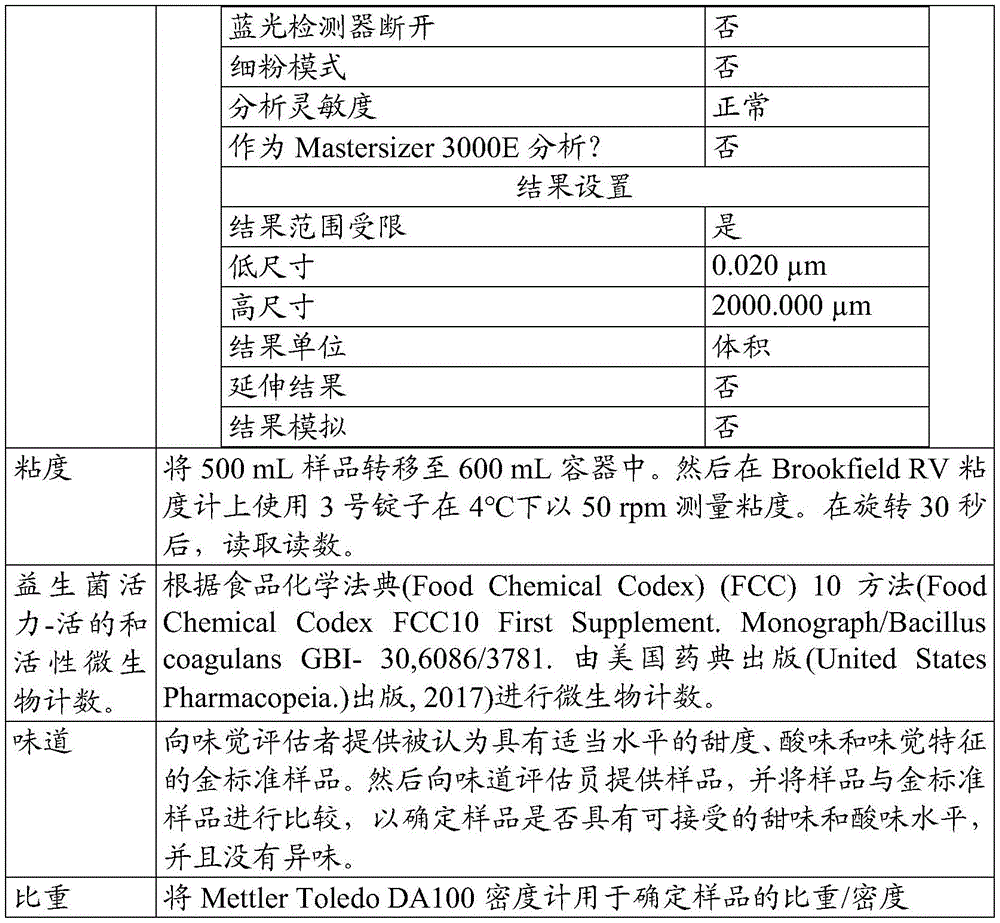
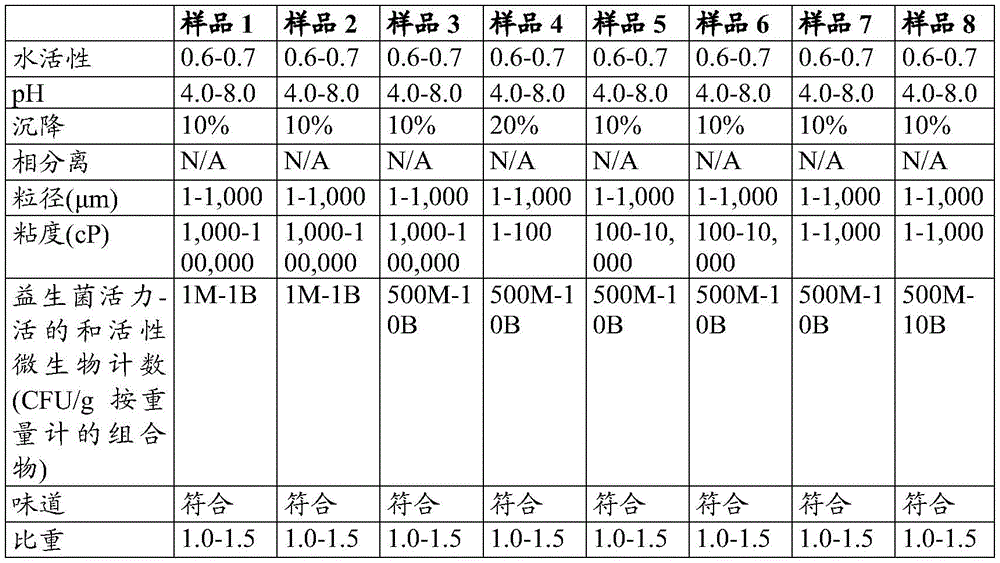
Example 2 characterization of spore-containing compositions
Samples 1-16 prepared in example 1 were each characterized. Table 2 shows the various analyses performed and the methods used. Table 3A shows the results of these analyses for samples 1-8 and table 3B shows the results of these analyses for samples 9-16.
TABLE 2 analysis carried out
Figure BDA0003427172460000132
Figure BDA0003427172460000141
Figure BDA0003427172460000151
Table 3a. the results of the analysis are listed in table 2.
Figure BDA0003427172460000152
Table 3b. the analytical results are listed in table 2.
Figure BDA0003427172460000161
Example 3 comparative test-sedimentation
The liquid composition was stored without agitation for two weeks. The liquid composition was visually inspected and the components of the liquid composition were found not to settle.
Example 4 comparative testing-Water Activity and viscosity
The enterograph sample (US 2015/0118203) was tested for water activity and viscosity and compared to the samples herein. The Aw of the Enterogena product is equal to 1. In contrast, samples 1-16 herein had an Aw of between about 0.6 and about 0.7.
Definition of
The terminology used herein is for the purpose of describing particular embodiments only and is not intended to be limiting of the disclosure. Unless otherwise specifically defined, all technical and scientific terms used herein are to be understood as having the same meaning as commonly understood by one of ordinary skill in the art (e.g., in cell culture, bacteriology, molecular genetics and biochemistry).
A value or range may be expressed herein as "about" and/or from "about" one particular value to another particular value. When such values or ranges are expressed, other embodiments disclosed include the recited particular values and/or from one particular value to another particular value. Similarly, when values are expressed as approximations, by use of the antecedent "about," it will be understood that there are various values disclosed herein and that the particular value forms another embodiment. It will also be understood that where a number of values are disclosed, each value is disclosed herein as "about" that particular value in addition to the value itself. In embodiments, "about" may be used to mean, for example, within 10% of the stated value, within 5% of the stated value, or within 2% of the stated value.
As used herein, the singular forms "a", "an" and "the" are intended to include the plural forms as well, unless the context clearly indicates otherwise. Furthermore, to the extent that the terms "includes," including, "" includes, "" has, "" with, "or variants thereof are used in either the detailed description and/or the claims, such terms are intended to be inclusive in a manner similar to the term" comprising.
As used in this specification and the appended claims, the term "or" is generally employed in its sense including "and/or" unless the content clearly dictates otherwise.
As used herein, the terms "comprising," "comprises," "comprising," or "comprising," and variations thereof, with respect to a definition or description of an item, composition, apparatus, method, process, system, or the like, is intended to be inclusive or open-ended, allowing for additional elements, thereby indicating that the defined or described item, composition, apparatus, method, process, system, or the like includes those specified or (where appropriate) equivalents thereof, and that other elements may be included and still fall within the scope/definition of the defined item, composition, apparatus, method, process, system, or the like.
For the purposes of describing and defining the present teachings, it is noted that the term "substantially" is utilized herein to represent the inherent degree of uncertainty that may be attributed to any quantitative comparison, value, measurement, or other representation, unless otherwise indicated. The term "substantially" is also utilized herein to represent the degree by which a quantitative representation may vary from a stated reference without resulting in a change in the basic function of the subject matter at issue.
As used herein, the term "germination permissive conditions" is an environmental condition that allows spores to germinate. These environmental conditions include temperature, nutrients, pH levels, and the like.
As used herein, "shelf stable" refers to compositions that are stable and safe to consume under ambient, refrigerated, or frozen conditions.
As used herein, a "nutritional additive" is a solid and/or liquid nutritional additive intended for human or animal consumption.
There is no limitation on the manner in which the shelf-stable, spore-containing probiotic nutritional additives described herein are sold, distributed, stored, etc. For example, the above examples describe embodiments in which the spore-containing probiotic composition is packaged in various forms, such as in lidded or uncovered pouches and in box-in-pouches. Shelf-stable spore-containing probiotic food additives may be dispensed in these or similar forms for industrial processing for food and beverage applications. Shelf-stable spore-containing probiotic food additives may also be packaged and dispensed for consumption by individual consumers, such as for dietary supplements. This may include any well-known single and multi-serving packaging, including sealed vials, liquid supplements, and the like.
While the above description may focus on the use of spore-forming probiotic strains and conditions for maintaining dormancy, it will be appreciated that shelf-stable spore-containing probiotic nutritional additives may also be prepared using (isolated from or supplemented with spores) encapsulated (non-sporulated) nutritional probiotics, such as, for example, those of the Lactobacillus (Lactobacillus) and Bifidobacterium (Bifidobacterium) species.
Based on the above embodiments, one skilled in the art will appreciate further features and advantages of the disclosure. Accordingly, the invention is not to be limited by what has been particularly shown and described, except as indicated by the appended claims. All publications and references cited herein are expressly incorporated herein by reference in their entirety. Any patent, publication, or information, in whole or in part, that is said to be incorporated by reference herein is incorporated herein only to the extent that the incorporated material does not contradict existing definitions, statements, or other disclosure material set forth in this document. Accordingly, the disclosure as explicitly set forth herein overrides any conflicting material incorporated herein by reference.

Claims (25)

1. A process for preparing a shelf-stable spore-containing probiotic nutritional additive comprising:
providing a liquid slurry comprising spores from at least one spore-forming probiotic bacterial strain, sugar and a humectant; and
pasteurizing the liquid slurry to produce the nutritional additive, wherein,
the nutritional additive comprises a water activity (Aw) of less than about 0.7;
the nutritional additive comprises a pH of about 2.0 to 9.5;
a plurality of the spores remain ungerminated and remain uniformly suspended for at least two months after the pasteurization to produce a shelf-stable, spore-containing probiotic nutritional additive.
2. The method of claim 1, wherein at least 90% of the spores remain ungerminated for at least two months after the pasteurization.
3. The method of claim 1, wherein the nutritive additive comprises less than 1% (w/v) vegetative bacterial cells.
4. The method of claim 1, wherein at least 90% of the spores remain viable after the pasteurization.
5. The method of claim 1, wherein at least 90% of the spores in the shelf-stable, spore-containing probiotic nutritional additive germinate upon exposure to germination permissive conditions.
6. The method of claim 5, wherein the germination permissive conditions comprise at least 1Aw and 37 ℃.
7. The method of claim 1, wherein at least 90% of the spores in the shelf-stable, spore-containing probiotic nutritional additive will germinate upon ingestion by a mammal.
8. The method of claim 1, wherein the at least one spore-forming probiotic strain comprises at least one Bacillus (Bacillus) strain.
9. The method of claim 8, wherein the at least one spore-forming probiotic strain comprises at least one strain of Bacillus coagulans, at least one strain of Bacillus subtilis, at least one strain of Bacillus clausii, at least one strain of Bacillus indiani, at least one strain of Bacillus licheniformis, at least one strain of Bacillus pumilus, at least one strain of Bacillus amyloliquefaciens, or at least one strain of Bacillus megaterium.
10. The method of claim 8, wherein the at least one strain of bacillus coagulans includes bacillus coagulans GBI-30 strain (ATCC designation PTA-6086).
11. The method of claim 1, wherein at least 95% of the spores are viable after pasteurization.
12. The method of claim 1, wherein the plurality of spores is present in an amount of about 5 to 1 trillion CFU/g, by weight of the composition.
13. The method of claim 1, wherein the at least one humectant is at least one of glycerin, sugar, salt, propylene glycol, or gum.
14. The method of claim 1, further comprising at least one inulin-free rheology modifier, wherein the at least one rheology modifier is present in an amount of from about 0.01% to 0.3% by weight of the composition.
15. The method of claim 14, wherein the at least one rheology modifier is at least one of xanthan gum, gum arabic, gellan gum, guar gum, or carrageenan.
16. A spore-containing probiotic composition comprising:
a liquid slurry comprising
A probiotic material comprising spores from at least one spore-forming probiotic bacterial strain, wherein at least 90% of the spores are viable at pasteurization time and temperature;
a sugar, and
at least one wetting agent, at least one of which,
wherein the composition has a water activity (Aw) of less than about 0.7 and a pH of less than about 5.0.
17. The composition of claim 16, wherein the at least one humectant is at least one of glycerin, sugar, salt, propylene glycol, or gum.
18. The composition of claim 16, wherein the at least one spore-forming probiotic strain comprises at least one bacillus strain.
19. The composition of claim 18, wherein said at least one spore-forming probiotic strain comprises at least one strain of bacillus coagulans, at least one strain of bacillus subtilis, at least one strain of bacillus clausii, at least one strain of bacillus indiani, at least one strain of bacillus licheniformis, at least one strain of bacillus pumilus, at least one strain of bacillus amyloliquefaciens, or at least one strain of bacillus megaterium.
20. The composition of claim 18, wherein the at least one strain of bacillus coagulans includes bacillus coagulans GBI-30 strain (ATCC designation PTA-6086).
21. The composition of claim 16, wherein the plurality of spores is present in the composition in an amount of about 5 to 1 trillion CFU/g, by weight of the composition.
22. The composition of claim 16, further comprising at least one inulin-free rheology modifier, wherein the at least one rheology modifier is present in an amount of from about 0.01% to 0.3% by weight of the composition.
23. The composition of claim 22, wherein the at least one rheology modifier is at least one of xanthan gum, gum arabic, gellan gum, guar gum, or carrageenan.
24. A food product comprising:
a food product, and
the spore-containing probiotic composition of any one of claims 16-23.
25. A beverage product comprising:
a liquid beverage, and
the spore-containing probiotic composition of any one of claims 16-23.
CN202080045875.7A 2019-04-23 2020-04-22 Probiotic liquid compositions containing spores and method of making same Pending CN114007629A (en)

Applications Claiming Priority (3)

Application Number Priority Date Filing Date Title
US201962837589P 2019-04-23 2019-04-23
US62/837,589 2019-04-23
PCT/EP2020/061228 WO2020216794A1 (en) 2019-04-23 2020-04-22 Spore-containing probiotic liquid compositions and method of its preparation

Publications (1)

Publication Number Publication Date
CN114007629A true CN114007629A (en) 2022-02-01

Family

ID=70480234

Family Applications (1)

Application Number Title Priority Date Filing Date
CN202080045875.7A Pending CN114007629A (en) 2019-04-23 2020-04-22 Probiotic liquid compositions containing spores and method of making same

Country Status (11)

Country Link
US (2) US11674119B2 (en)
EP (1) EP3958883A1 (en)
JP (1) JP2022530499A (en)
CN (1) CN114007629A (en)
AU (1) AU2020263883A1 (en)
BR (1) BR112021021439A2 (en)
CA (1) CA3138007A1 (en)
MX (1) MX2021013076A (en)
MY (1) MY205219A (en)
PH (1) PH12021552712A1 (en)
WO (1) WO2020216794A1 (en)

Families Citing this family (2)

* Cited by examiner, † Cited by third party
Publication number Priority date Publication date Assignee Title
AU2021106641A4 (en) * 2021-06-29 2021-11-11 Marl Wellness Research and Development Ply Ltd A method of making a synbiotic composition
EP4590127A2 (en) * 2022-09-23 2025-07-30 Kodiak Sciences Inc. Method of concentrating a solution or formulation

Citations (7)

* Cited by examiner, † Cited by third party
Publication number Priority date Publication date Assignee Title
CN102006787A (en) * 2008-03-18 2011-04-06 菲仕兰品牌有限公司 Long-life probiotic food product
US20150118203A1 (en) * 2013-10-25 2015-04-30 Nch Corporation Delivery System and Probiotic Composition for Animals and Plants
US20180271134A1 (en) * 2017-03-21 2018-09-27 The Clorox Company Thickened oil/water food emulsion packaged products with probiotics
CN108884434A (en) * 2016-04-05 2018-11-23 Nch公司 Germinant composition and Spore cultivation method rich in nutrition
CN108850500A (en) * 2018-05-25 2018-11-23 江苏千药堂国医研究院有限公司 Bacillus pumilus feed addictive
US20190022153A1 (en) * 2016-01-19 2019-01-24 Synergia Life Sciences Pvt. Ltd A liquid probiotic composition stable at ambient temperature
US20190069587A1 (en) * 2016-04-05 2019-03-07 Nch Corporation Composition and Method for Germinative Compounds in Probiotic Food and Beverage Products for Human Consumption

Family Cites Families (11)

* Cited by examiner, † Cited by third party
Publication number Priority date Publication date Assignee Title
GB9308103D0 (en) * 1993-04-20 1993-06-02 Unilever Plc Cosmetic composition
EP0991775A1 (en) 1997-06-20 2000-04-12 Mycogen Corporation Method to identify pesticidal microbes
US6849256B1 (en) 1999-11-08 2005-02-01 Ganeden Biotech Incorporated Inhibition of pathogens by probiotic bacteria
JP3469881B2 (en) * 2001-03-09 2003-11-25 ハウス食品株式会社 Method for preparing heat-resistant lactic acid bacteria Bacillus coagulans and roux containing the lactic acid bacteria
ITMI20011632A1 (en) * 2001-07-27 2003-01-27 Sanofi Synthelabo SOLID COMPOSITION CONTAINING SPORE OF NON-PATHOGENIC BACTERIA OF THE GENERAL BACILLUS
JP2004053811A (en) 2002-07-18 2004-02-19 Konica Minolta Holdings Inc Heat developing material
PT2638807T (en) * 2007-10-16 2021-05-05 Ganeden Biotech Inc Beverage compositions
JP6342817B2 (en) * 2012-03-09 2018-06-13 クラフト・フーズ・グループ・ブランズ・エルエルシー Food and beverage products containing 1,3 propanediol and methods for modifying aroma release using 1,3-propanediol
JP2014103879A (en) * 2012-11-27 2014-06-09 Uha Mikakuto Co Ltd Water-activity reducing agent and food product containing the same
US20140087049A1 (en) * 2012-09-26 2014-03-27 International Food Network Inc Shelf Stable Liquid Sweetener and Flavor Additive
JP6083640B2 (en) 2012-11-20 2017-02-22 国立大学法人茨城大学 Permanent magnet embedded motor

Patent Citations (7)

* Cited by examiner, † Cited by third party
Publication number Priority date Publication date Assignee Title
CN102006787A (en) * 2008-03-18 2011-04-06 菲仕兰品牌有限公司 Long-life probiotic food product
US20150118203A1 (en) * 2013-10-25 2015-04-30 Nch Corporation Delivery System and Probiotic Composition for Animals and Plants
US20190022153A1 (en) * 2016-01-19 2019-01-24 Synergia Life Sciences Pvt. Ltd A liquid probiotic composition stable at ambient temperature
CN108884434A (en) * 2016-04-05 2018-11-23 Nch公司 Germinant composition and Spore cultivation method rich in nutrition
US20190069587A1 (en) * 2016-04-05 2019-03-07 Nch Corporation Composition and Method for Germinative Compounds in Probiotic Food and Beverage Products for Human Consumption
US20180271134A1 (en) * 2017-03-21 2018-09-27 The Clorox Company Thickened oil/water food emulsion packaged products with probiotics
CN108850500A (en) * 2018-05-25 2018-11-23 江苏千药堂国医研究院有限公司 Bacillus pumilus feed addictive

Non-Patent Citations (3)

* Cited by examiner, † Cited by third party
Title
OMAR A.OYARZABAL 等: "《Microbial Food Safety》", 31 December 2012, SPRINGER出版社, pages: 199 *
S. NATH 等: ""Application of Bacillus sp. as a biopreservative for food preservation"", 《INT. JOURNAL OF ENGINEERING RESEARCH AND APPLICATIONS》, vol. 5, no. 4, 30 April 2015 (2015-04-30), pages 85 - 95, XP055967275 *
车建美 等: ""动物益生菌短短芽胞杆菌FJAT-1501-BPA 制剂的制备及其益生特性评价"", 《中国畜牧兽医》, vol. 44, no. 10, 31 December 2017 (2017-12-31), pages 2897 - 2907 *

Also Published As

Publication number Publication date
EP3958883A1 (en) 2022-03-02
US12071613B2 (en) 2024-08-27
MX2021013076A (en) 2022-01-24
BR112021021439A2 (en) 2021-12-21
WO2020216794A1 (en) 2020-10-29
PH12021552712A1 (en) 2022-08-01
JP2022530499A (en) 2022-06-29
US20200339942A1 (en) 2020-10-29
US11674119B2 (en) 2023-06-13
CA3138007A1 (en) 2020-10-29
AU2020263883A1 (en) 2021-11-25
US20230279340A1 (en) 2023-09-07
MY205219A (en) 2024-10-08
KR20220069880A (en) 2022-05-27

Similar Documents

Publication Publication Date Title
JP5762750B2 (en) Edible composition
dos Santos Leandro et al. Survival of Lactobacillus delbrueckii UFV H2b20 in ice cream produced with different fat levels and after submission to stress acid and bile salts
CN102387715A (en) Milk-like beverages
RU2290829C2 (en) Feed supplement for oligotrophy pigs
US12071613B2 (en) Spore-containing probiotic compositions and methods
RU2525577C2 (en) Food compositions of pieces in gravy
JP2025160408A (en) Merchandise protection inserts and their uses
CN104642539A (en) Probiotic granules and preparation method thereof, and long-shelf-life fermented milk containing probiotic granules and preparation method thereof
CN102271531A (en) Chunks in jelly food compositions
CN104411186B (en) Concentrated low water activity liquid human milk fortifier including deeply hydrolyzed protein
TW201201713A (en) Shelf stable nutritional liquids comprising beta alanine
CN102258079B (en) Colloid fluid suspension used for adding probiotics in acidic milk beverage and method for producing probiotics-containing acidic milk beverage
KR102914381B1 (en) Spore-containing probiotic liquid composition and method for preparing the same
US10010091B2 (en) Freeze-dried, dairy or dairy-substitute compositions and methods of using same
Sotohy et al. Microbiological quality assessment of dairy desserts sold in New Valley Governorate
WO2017025772A1 (en) Microbial composition
TW201018409A (en) Acidified nutritional formula
Milawati et al. Assessment of organoleptic quality in fermented chicken egg whites at different times
Marhamatizadeh et al. Effect of Oregano on the Growth of Lactobacillus acidophilus and Bifidobacterium bifidum in Probiotic Dairy Products
AU2021106641A4 (en) A method of making a synbiotic composition
Pratiwi et al. Microbiological and Physical Quality of Reconstituted Green Tea Yogurt Using Different Solvent Temperatures.
ES2973453T3 (en) Palatable composition comprising hydrolyzed alpha-s1-casein
CN117412675A (en) Methods for coating dry whole grains with probiotics using fat as a carrier and coated whole grains prepared by such methods
Pandiyan et al. Utilization of coconut water for the preparation of yoghurt.
Nacheva et al. Innovative technologies for creation of probiotic foods

Legal Events

Date Code Title Description
PB01 Publication
PB01 Publication
SE01 Entry into force of request for substantive examination
TA01 Transfer of patent application right

Effective date of registration: 20250303

Address after: Ireland

Applicant after: ZENBURY INTERNATIONAL Ltd.

Country or region after: Ireland

Address before: Luxemburg, Luxemburg City

Applicant before: KERRY LUXEMBOURG S.A.R.L.

Country or region before: Luxembourg

Applicant before: B. George

Country or region before: U.S.A.

Applicant before: J. M. Bradley

Applicant before: H. Keith

Applicant before: S. G. Cobb

Applicant before: N. Imam

Applicant before: E. Oshia

RJ01 Rejection of invention patent application after publication

Application publication date: 20220201