CN113908458A - Intelligent plateau pre-oxygen supply method - Google Patents
Intelligent plateau pre-oxygen supply method Download PDFInfo
- Publication number
- CN113908458A CN113908458A CN202111211765.6A CN202111211765A CN113908458A CN 113908458 A CN113908458 A CN 113908458A CN 202111211765 A CN202111211765 A CN 202111211765A CN 113908458 A CN113908458 A CN 113908458A
- Authority
- CN
- China
- Prior art keywords
- data
- oxygen supply
- related data
- original
- parameter
- Prior art date
- Legal status (The legal status is an assumption and is not a legal conclusion. Google has not performed a legal analysis and makes no representation as to the accuracy of the status listed.)
- Pending
Links
Images


Classifications
-
- A—HUMAN NECESSITIES
- A62—LIFE-SAVING; FIRE-FIGHTING
- A62B—DEVICES, APPARATUS OR METHODS FOR LIFE-SAVING
- A62B7/00—Respiratory apparatus
-
- G—PHYSICS
- G06—COMPUTING OR CALCULATING; COUNTING
- G06N—COMPUTING ARRANGEMENTS BASED ON SPECIFIC COMPUTATIONAL MODELS
- G06N3/00—Computing arrangements based on biological models
- G06N3/02—Neural networks
- G06N3/04—Architecture, e.g. interconnection topology
- G06N3/044—Recurrent networks, e.g. Hopfield networks
-
- G—PHYSICS
- G06—COMPUTING OR CALCULATING; COUNTING
- G06N—COMPUTING ARRANGEMENTS BASED ON SPECIFIC COMPUTATIONAL MODELS
- G06N3/00—Computing arrangements based on biological models
- G06N3/02—Neural networks
- G06N3/04—Architecture, e.g. interconnection topology
- G06N3/045—Combinations of networks
-
- G—PHYSICS
- G06—COMPUTING OR CALCULATING; COUNTING
- G06N—COMPUTING ARRANGEMENTS BASED ON SPECIFIC COMPUTATIONAL MODELS
- G06N3/00—Computing arrangements based on biological models
- G06N3/02—Neural networks
- G06N3/08—Learning methods
-
- G—PHYSICS
- G16—INFORMATION AND COMMUNICATION TECHNOLOGY [ICT] SPECIALLY ADAPTED FOR SPECIFIC APPLICATION FIELDS
- G16H—HEALTHCARE INFORMATICS, i.e. INFORMATION AND COMMUNICATION TECHNOLOGY [ICT] SPECIALLY ADAPTED FOR THE HANDLING OR PROCESSING OF MEDICAL OR HEALTHCARE DATA
- G16H50/00—ICT specially adapted for medical diagnosis, medical simulation or medical data mining; ICT specially adapted for detecting, monitoring or modelling epidemics or pandemics
- G16H50/50—ICT specially adapted for medical diagnosis, medical simulation or medical data mining; ICT specially adapted for detecting, monitoring or modelling epidemics or pandemics for simulation or modelling of medical disorders
Landscapes
- Engineering & Computer Science (AREA)
- Health & Medical Sciences (AREA)
- Theoretical Computer Science (AREA)
- Physics & Mathematics (AREA)
- General Health & Medical Sciences (AREA)
- Data Mining & Analysis (AREA)
- Biomedical Technology (AREA)
- General Physics & Mathematics (AREA)
- Evolutionary Computation (AREA)
- Biophysics (AREA)
- Molecular Biology (AREA)
- Computing Systems (AREA)
- General Engineering & Computer Science (AREA)
- Artificial Intelligence (AREA)
- Mathematical Physics (AREA)
- Software Systems (AREA)
- Life Sciences & Earth Sciences (AREA)
- Computational Linguistics (AREA)
- Medical Informatics (AREA)
- Public Health (AREA)
- Pulmonology (AREA)
- Databases & Information Systems (AREA)
- Emergency Management (AREA)
- Pathology (AREA)
- Business, Economics & Management (AREA)
- Epidemiology (AREA)
- Primary Health Care (AREA)
- Measurement Of The Respiration, Hearing Ability, Form, And Blood Characteristics Of Living Organisms (AREA)
Abstract
The invention discloses an intelligent plateau pre-oxygen supply method, which comprises the following steps: s1: acquiring original plateau oxygen supply related data; s2: preprocessing the original plateau oxygen supply related data to obtain oxygen supply related data; s3: establishing a respiratory parameter short-term prediction model according to the oxygen supply related data; s4: generating a coding and decoding network of the respiratory parameters according to the respiratory parameter short-term prediction model; s5: decoding the time-series data into user state time-series data by using the encoding and decoding network of the breathing parameters; s6: performing data processing on the user state time series data to obtain a processing result; s7: establishing an oxygen supply parameter prediction algorithm by using the processing result; s8: and obtaining a respiratory parameter prediction result according to the oxygen supply parameter prediction algorithm and the oxygen supply related data.
Description
Technical Field
The invention relates to the technical field of oxygen control, in particular to an intelligent plateau pre-oxygen supply method.
Background
The oxygen partial pressure and the oxygen content are low in the plateau environment, so that the physiological change of a human body is easily caused, and the plateau reaction is easily caused. When a person is in an environment with an oxygen concentration of 15% to 19%, the work efficiency is reduced and problems may occur in the head, lungs and circulatory system; when the oxygen concentration is 8-10%, the symptoms of blurred consciousness, syncope, pale face, purple lips, nausea, vomiting and the like of a human body can be caused. Meanwhile, continuous hypoxia accelerates the development of relevant pathologies such as pulmonary edema and cerebral edema, even threatens the lives of people, and when the portable oxygen supply equipment is used for going out for operation, oxygen waste caused by manual operation and mechanical control shortens the oxygen supply time and increases the health risk and the life threat brought by hypoxia. The relevant research has important significance for continuously and effectively absorbing oxygen by plateau (especially for outdoor operation) personnel and guaranteeing the health state of the plateau personnel.
Although the existing synchronous breathing oxygen supply method can realize the separation of a breathing airway and the pressure stabilization of high-pressure airflow by using a two-position three-way electromagnetic valve and then realize breathing following type oxygen supply by monitoring the breathing characteristics of a human body, the research only can ensure the accuracy of the oxygen supply process along with breathing signals, and the oxygen supply process cannot be truly synchronous with breathing. Some prior arts propose to realize segment control of the oxygen supply process based on the variation of effort level applied by respiratory muscles of human body, obtain mixed pressure signal by calculation of airway parameters, further determine peak transient and negative transient of the respiratory process, then calculate the time of transition from negative transient to transient by the time ratio of respiratory state transition, and supply oxygen in time, and the specific oxygen supply amount is calculated according to airway mixed pressure. In addition, there are some oxygen supply devices that use blood oxygen monitor to monitor the real-time blood oxygen level of human body and automatically control the oxygen supply device via the main control unit, but the research does not provide implementation details and further development of core methods, such as how to calculate the human hypoxia status based on blood oxygen data and how to overcome the lag of oxygen supply process caused by the time consumption of data calculation.
Disclosure of Invention
The invention aims to provide an intelligent plateau pre-oxygen supply method to solve the problem of oxygen supply process lag caused by time consumption of data calculation.
The technical scheme for solving the technical problems is as follows:
the invention provides an intelligent plateau pre-oxygen supply method, which comprises the following steps:
s1: acquiring original plateau oxygen supply related data;
s2: preprocessing the original plateau oxygen supply related data to obtain oxygen supply related data;
s3: establishing a respiratory parameter short-term prediction model according to the oxygen supply related data;
s4: generating a coding and decoding network of the respiratory parameters according to the respiratory parameter short-term prediction model;
s5: decoding the time-series data into user state time-series data by using the encoding and decoding network of the breathing parameters;
s6: performing data processing on the user state time series data to obtain a processing result;
s7: establishing an oxygen supply parameter prediction algorithm by using the processing result;
s8: and obtaining a respiratory parameter prediction result according to the oxygen supply parameter prediction algorithm and the oxygen supply related data.
Optionally, in step S1, the original oxygen supply related data includes: physiological and hypoxic state source data, environmental parameter source data, motion state source data, and respiratory data source data.
Alternatively, the step S2 includes:
s21: judging whether the original oxygen supply related data comprise breathing data without a state label or not, and if so, entering step S22; otherwise, go to step S23;
s22: removing the breathing data without the state label and then entering the step S23;
s23: judging whether the current original oxygen supply related data comprise abnormal data or not, if so, entering step S24; otherwise, go to step S25;
s24: replacing the abnormal data with the maximum normal data and/or the minimum normal data in the current original oxygen supply related data to form new original oxygen supply related data, and then entering step S25;
s25: judging whether baseline drift occurs to the current original related data, if yes, entering step S26; otherwise, go to step S27;
s26: performing data normalization processing on the current original related data, recalculating a baseline of the processed current original related data, and then entering step S27;
s27: judging whether the current original related data is discrete data, if so, creating a fuzzy set and data interpolation for the current original related data, and returning to the step S27; otherwise, outputting the current original related data as the oxygen supply related data.
Alternatively, the step S3 includes:
s31: acquiring the original oxygen supply related data;
s32: establishing a response mapping relation between the environmental parameters and the human physiological parameters according to the original oxygen supply related parameters;
s33: and obtaining the prediction result of the oxygen supply parameter prediction algorithm on the oxygen supply related parameters by utilizing the response mapping relation.
The core objective of the invention is to provide an intelligent oxygen pre-supply algorithm with prediction capability, so as to solve the problem that the existing oxygen supply equipment and algorithm cannot sense and predict the real-time aerobic state of human according to the physiological parameters, realize advanced oxygen supply and prevent further pathological progress caused by altitude hypoxia.
In order to achieve the above object, the present invention provides the following technical solutions:
the invention discloses an intelligent oxygen supply parameter intelligent prediction algorithm based on an LSTM network and a codec network, which comprises two levels of network design: (1) the method comprises the steps of preprocessing source data from a sensor, extracting local characteristics of human physiological parameters, respiratory parameters and environmental parameters by using a long-term and short-term memory network with a bottom layer fused with a one-dimensional convolution module, and realizing understanding of an external parameter-human response mapping relation by the algorithm by combining a state label of training set data so as to realize short-term prediction of the respiratory parameters. (2) The end-to-end neural network model of the encoder network constructed based on the LSTM is used for decoding external parameter time sequence data into human state time sequence data and realizing the prediction of the respiratory state (and oxygen supply parameters) in the middle and long term.
The invention integrates LSTM and codec technology, uses physiological parameters and environmental parameters of human body blood oxygen, heart rate, respiration and the like as basic data sets, uses human evaluation results as state label data, establishes an oxygen supply parameter intelligent prediction algorithm by combining the normalization, vectorization and feature extraction of the data and the label data, and realizes predictive and accurate oxygen supply in a high-altitude scene.
The main treatment process is as follows:
incomplete data and abnormal data in source data from the sensor are cleaned through a data preprocessing algorithm, baseline correction is carried out on data with baseline drift, and discrete label data are serialized through difference values.
The preprocessed data is subjected to one-dimensional convolution to obtain a characteristic data block, the characteristic data block is sliced into x, the x slice is transmitted to data in x1, and a node state C1 and a hidden state H1 are calculated. And selecting the parameter Y1 to be forgotten according to the state of the previous node, and storing the parameter to be memorized in a C1 mode to be transmitted to the next node. And circularly transmitting data in the next slice data, and updating node state parameters Ct, Ht and Y (t-1).
Reading in compressed characteristic data Zf, extracting characteristic matrix mt from the compressed characteristic data Zf, decoding the difference dt between the predicted value and the original value, creating normally distributed matrix et, and calculating the kronecker product of dt and et as a correction parameter. After up-sampling, the feature data is decoded by using an LSTM model, parameters of a training and prediction module are shared, and parameters are corrected by using label data. And circularly processing the subsequent data slice data to finish the training of the coder-decoder model.
The invention has the following beneficial effects:
the method is constructed based on the LSTM and the one-dimensional convolution, can realize the deep understanding of the algorithm model on the physiological data and the environmental parameters, fully excavates the characteristic variables of the related data, is favorable for establishing the special mapping with the label data, and can better reserve the interaction relation between the time sequence characteristics when the LSTM model has certain prediction capability so as to provide a basis for the subsequent characteristic value prediction.
The coder-decoder technology is adopted to predict the oxygen supply parameters in medium and long periods, the concept in the field of Transformer is used for reference, the time sequence data formed by physiological parameters and environmental parameters to the time sequence data of human breath response parameters are taken as the process of coding and decoding, and a set of coder-decoder is obtained through training, so that the coder-decoder can be used for predicting the breathing parameters in a future period according to the current physiological parameters and environmental parameters of the human body and realizing the advance oxygen supply.
The invention has the following beneficial effects:
the method is constructed based on the LSTM and the one-dimensional convolution, can realize the deep understanding of the algorithm model on the physiological data and the environmental parameters, fully excavates the characteristic variables of the related data, is favorable for establishing the special mapping with the label data, and can better reserve the interaction relation between the time sequence characteristics when the LSTM model has certain prediction capability so as to provide a basis for the subsequent characteristic value prediction.
The invention realizes the deep understanding of the model algorithm on the original data, solves the problem that the traditional oxygen supply algorithm cannot overcome the hysteresis of physiological signals, provides the LSTM-codec algorithm with the prediction capability to realize the prediction of the oxygen demand state of a human body and achieves the purpose of supplying oxygen in advance.
Drawings
FIG. 1 is a flow chart of the intelligent plateau pre-oxygen supply method provided by the invention 1;
FIG. 2 is a flowchart illustrating the substeps of step S2 in FIG. 1;
FIG. 3 is a flowchart illustrating the substeps of step S3 in FIG. 1;
FIG. 4 is a flow chart of a pre-oxygen supply method provided by the present invention 2;
FIG. 5 is a diagram of the LSTM model architecture provided by the present invention;
FIG. 6 is a process of mapping an environmental parameter to a respiratory parameter according to the present invention;
FIG. 7 is a flow chart of the main processing of the self-encoder;
fig. 8 is a self-encoder model structure.
Detailed Description
The principles and features of this invention are described below in conjunction with the following drawings, which are set forth by way of illustration only and are not intended to limit the scope of the invention.
Example 1
The invention provides an intelligent plateau pre-oxygen supply method, which is shown in a figure 1 and comprises the following steps:
s1: acquiring original plateau oxygen supply related data;
s2: preprocessing the original plateau oxygen supply related data to obtain oxygen supply related data;
s3: establishing a respiratory parameter short-term prediction model according to the oxygen supply related data;
s4: generating a coding and decoding network of the respiratory parameters according to the respiratory parameter short-term prediction model;
s5: decoding the time-series data into user state time-series data by using the encoding and decoding network of the breathing parameters;
s6: performing data processing on the user state time series data to obtain a processing result;
s7: establishing an oxygen supply parameter prediction algorithm by using the processing result;
s8: and obtaining a respiratory parameter prediction result according to the oxygen supply parameter prediction algorithm and the oxygen supply related data.
Optionally, in step S1, the original oxygen supply related data includes: physiological and hypoxic state source data, environmental parameter source data, motion state source data, and respiratory data source data.
Alternatively, referring to fig. 2, the step S2 includes:
s21: judging whether the original oxygen supply related data comprise breathing data without a state label or not, and if so, entering step S22; otherwise, go to step S23;
s22: removing the breathing data without the state label and then entering the step S23;
s23: judging whether the current original oxygen supply related data comprise abnormal data or not, if so, entering step S24; otherwise, go to step S25;
s24: replacing the abnormal data with the maximum normal data and/or the minimum normal data in the current original oxygen supply related data to form new original oxygen supply related data, and then entering step S25;
s25: judging whether baseline drift occurs to the current original related data, if yes, entering step S26; otherwise, go to step S27;
s26: performing data normalization processing on the current original related data, recalculating a baseline of the processed current original related data, and then entering step S27;
s27: judging whether the current original related data is discrete data, if so, creating a fuzzy set and data interpolation for the current original related data, and returning to the step S27; otherwise, outputting the current original related data as the oxygen supply related data.
Alternatively, referring to fig. 3, the step S3 includes:
s31: acquiring the original oxygen supply related data;
s32: establishing a response mapping relation between the environmental parameters and the human physiological parameters according to the original oxygen supply related parameters;
s33: and obtaining the prediction result of the oxygen supply parameter prediction algorithm on the oxygen supply related parameters by utilizing the response mapping relation.
Example 2
The core objective of the invention is to provide an intelligent plateau pre-oxygen supply method (the general flow is shown in fig. 4) to solve the problem that the existing oxygen supply equipment and algorithm cannot sense and predict the real-time aerobic state according to human physiological parameters, realize advanced oxygen supply and prevent further pathological progress caused by plateau hypoxia.
The invention realizes the deep understanding of the model algorithm on the original data, solves the problem that the traditional oxygen supply algorithm cannot overcome the hysteresis of physiological signals, provides the LSTM-codec algorithm with the prediction capability to realize the prediction of the oxygen demand state of a human body and achieves the purpose of supplying oxygen in advance.
The invention discloses an intelligent pre-oxygen supply method based on an LSTM-Encoder (long and short term memory-Encoder network) network model, which is mainly applied to intelligently predicting and adjusting real-time oxygen supply parameters of a person by using portable oxygen supply equipment under the condition of high altitude.
The algorithm comprises two levels of network design: a long-short term memory network (LSTM) fused with one-dimensional convolution is used for extracting local characteristics of human physiological parameters, respiratory parameters and environmental parameters, and understanding of an external parameter-human response mapping relation is realized by combining a state label of training set data, and short-term prediction is carried out. On top of that, an Encoder network (Encoder) constructed based on LSTM is used to decode external parameter time-series data into state time-series data of a human, realizing state prediction of medium and long term. The invention integrates LSTM and Encoder technologies, is used for multi-parameter modeling and state prediction in the field of intelligent oxygen supply, and provides a method capable of realizing intelligent prediction of medium-long term oxygen supply parameters.
In order to achieve the above object, the present invention provides the following technical solutions:
the invention discloses a pre-oxygen supply method based on an LSTM network and a codec network, which comprises two levels of network design: (1) the method comprises the steps of preprocessing source data from a sensor, extracting local characteristics of human physiological parameters, respiratory parameters and environmental parameters by using a long-short term memory network (LSTM, a specific network structure is shown in figure 5) with a bottom layer fused with a one-dimensional convolution module, and realizing understanding of an external parameter-human response mapping relation by the algorithm (a main mapping process is shown in figure 6) by combining a state label of training set data so as to realize short-term prediction of the respiratory parameters. (2) The end-to-end neural network model of the encoder network constructed based on the LSTM is used for decoding external parameter time sequence data into human state time sequence data and realizing the prediction of the respiratory state (and oxygen supply parameters) in the middle and long term.
The invention integrates LSTM and codec technology, uses physiological parameters and environmental parameters of human body blood oxygen, heart rate, respiration and the like as basic data sets, uses human evaluation results as state label data, establishes an intelligent oxygen supply parameter prediction algorithm (operation process is shown in figure 7, and detailed structure is shown in figure 8) by combining the label data through normalization, vectorization processing and feature extraction of the data, and realizes predictive accurate oxygen supply in plateau scenes.
The pseudo-code of the main procedure is as follows:
TABLE 1 variable comparison Table


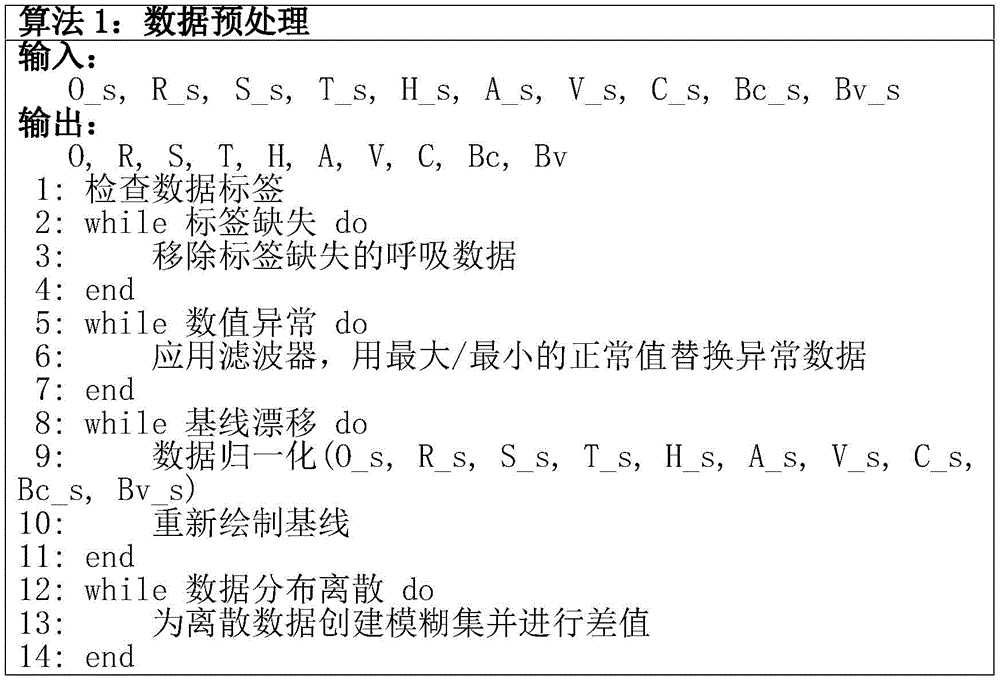
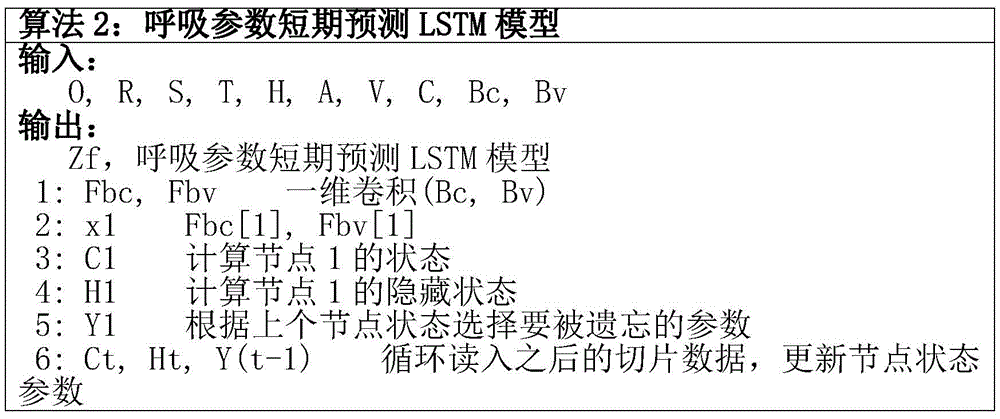
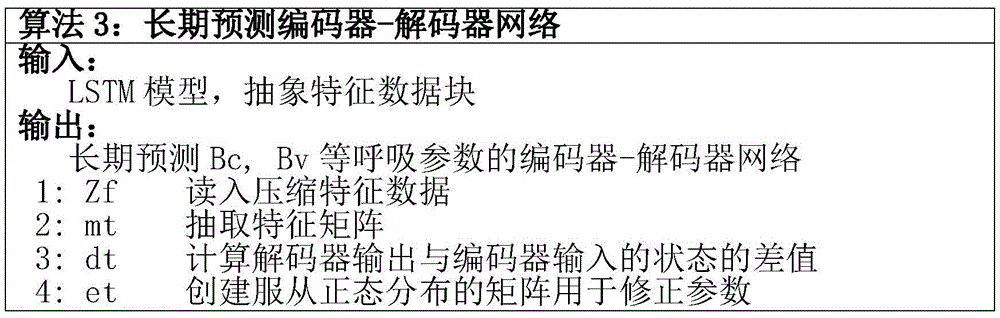

The main treatment process is as follows:
incomplete data and abnormal data in source data from the sensor are cleaned through a data preprocessing algorithm, baseline correction is carried out on data with baseline drift, and discrete label data are serialized through difference values.
The preprocessed data is subjected to one-dimensional convolution to obtain a characteristic data block, the characteristic data block is sliced into x, the x slice is transmitted to data in x1, and a node state C1 and a hidden state H1 are calculated. And selecting the parameter Y1 to be forgotten according to the state of the previous node, and storing the parameter to be memorized in a C1 mode to be transmitted to the next node. And circularly transmitting data in the next slice data, and updating node state parameters Ct, Ht and Y (t-1).
Reading in compressed characteristic data Zf, extracting characteristic matrix mt from the compressed characteristic data Zf, creating matrix et of normal distribution by using difference dt between decoder predicted value and original value, and calculating correction parameter of Kronecker product of dt and et. After up-sampling, the feature data is decoded by using an LSTM model, parameters of a training and prediction module are shared, and parameters are corrected by using label data. And circularly processing the subsequent data slice data to finish the training of the coder-decoder model.

The invention has the following beneficial effects:
the method is constructed based on the LSTM and the one-dimensional convolution, can realize the deep understanding of the algorithm model on the physiological data and the environmental parameters, fully excavates the characteristic variables of the related data, is favorable for establishing the special mapping with the label data, and can better reserve the interaction relation between the time sequence characteristics when the LSTM model has certain prediction capability so as to provide a basis for the subsequent characteristic value prediction.
The above description is only for the purpose of illustrating the preferred embodiments of the present invention and is not to be construed as limiting the invention, and any modifications, equivalents, improvements and the like that fall within the spirit and principle of the present invention are intended to be included therein.
Claims (4)
Priority Applications (1)
| Application Number | Priority Date | Filing Date | Title |
|---|---|---|---|
| CN202111211765.6A CN113908458A (en) | 2021-10-18 | 2021-10-18 | Intelligent plateau pre-oxygen supply method |
Applications Claiming Priority (1)
| Application Number | Priority Date | Filing Date | Title |
|---|---|---|---|
| CN202111211765.6A CN113908458A (en) | 2021-10-18 | 2021-10-18 | Intelligent plateau pre-oxygen supply method |
Publications (1)
| Publication Number | Publication Date |
|---|---|
| CN113908458A true CN113908458A (en) | 2022-01-11 |
Family
ID=79241390
Family Applications (1)
| Application Number | Title | Priority Date | Filing Date |
|---|---|---|---|
| CN202111211765.6A Pending CN113908458A (en) | 2021-10-18 | 2021-10-18 | Intelligent plateau pre-oxygen supply method |
Country Status (1)
| Country | Link |
|---|---|
| CN (1) | CN113908458A (en) |
Cited By (1)
| Publication number | Priority date | Publication date | Assignee | Title |
|---|---|---|---|---|
| CN119960532A (en) * | 2025-01-24 | 2025-05-09 | 瑞枫盛达(北京)科技有限公司 | A method and system for regulating an oxygen chamber for alleviating altitude sickness |
Citations (5)
| Publication number | Priority date | Publication date | Assignee | Title |
|---|---|---|---|---|
| US20040040560A1 (en) * | 2002-08-30 | 2004-03-04 | Euliano Neil R | Method and apparatus for predicting work of breathing |
| CN102164540A (en) * | 2008-09-25 | 2011-08-24 | 内尔科尔普里坦贝内特有限公司 | Model-predictive online identification of patient respiratory effort dynamics in medical ventilators |
| CN104906671A (en) * | 2015-06-12 | 2015-09-16 | 上海旭旦实业有限公司 | Self-adaptive altitude stress eliminating system |
| CN105288810A (en) * | 2015-12-03 | 2016-02-03 | 北京理工大学 | Breath synchronous intelligent control assembly of portable plateau oxygen-increasing machine |
| US20210089900A1 (en) * | 2019-09-20 | 2021-03-25 | Wuhan University | Transformer dga data prediction method based on multi-dimensional time sequence frame convolution lstm |
-
2021
- 2021-10-18 CN CN202111211765.6A patent/CN113908458A/en active Pending
Patent Citations (5)
| Publication number | Priority date | Publication date | Assignee | Title |
|---|---|---|---|---|
| US20040040560A1 (en) * | 2002-08-30 | 2004-03-04 | Euliano Neil R | Method and apparatus for predicting work of breathing |
| CN102164540A (en) * | 2008-09-25 | 2011-08-24 | 内尔科尔普里坦贝内特有限公司 | Model-predictive online identification of patient respiratory effort dynamics in medical ventilators |
| CN104906671A (en) * | 2015-06-12 | 2015-09-16 | 上海旭旦实业有限公司 | Self-adaptive altitude stress eliminating system |
| CN105288810A (en) * | 2015-12-03 | 2016-02-03 | 北京理工大学 | Breath synchronous intelligent control assembly of portable plateau oxygen-increasing machine |
| US20210089900A1 (en) * | 2019-09-20 | 2021-03-25 | Wuhan University | Transformer dga data prediction method based on multi-dimensional time sequence frame convolution lstm |
Non-Patent Citations (3)
| Title |
|---|
| 何福贵: "《Python深度学习 逻辑、算法与编程实战》", 30 September 2020, 机械工业出版社 * |
| 周寿军等: "基于后验概率的呼吸信号预测", 《中国生物医学工程学报》 * |
| 黄姗姗,杜宏伟: "《基于小波分解和神经网络的呼吸运动预测算法》", 《北京生物医学工程》 * |
Cited By (1)
| Publication number | Priority date | Publication date | Assignee | Title |
|---|---|---|---|---|
| CN119960532A (en) * | 2025-01-24 | 2025-05-09 | 瑞枫盛达(北京)科技有限公司 | A method and system for regulating an oxygen chamber for alleviating altitude sickness |
Similar Documents
| Publication | Publication Date | Title |
|---|---|---|
| US11464424B2 (en) | Cloud platform | |
| CN115910351B (en) | A method, system and device for sleep periodicity detection and quantification and auxiliary intervention | |
| CN105910225A (en) | Air conditioner load control system and method based on personnel information detection | |
| CN103314583A (en) | Video coding and decoding devices and methods preserving PPG relevant information | |
| CN115487388B (en) | Closed-loop oxygen supply adjusting system based on blood oxygen saturation feedback | |
| CN113908458A (en) | Intelligent plateau pre-oxygen supply method | |
| CN109378086A (en) | Intelligent perception analysis and early warning system of home-based elderly care health information in the Internet of Things environment | |
| CN119833062B (en) | Nursing system and monitoring method thereof | |
| CN118490230A (en) | A deep learning-based psychological state detection system for tumor patients | |
| CN116058805A (en) | A method, system and device for dynamically adjusting the active level of sleep memory | |
| CN120392015A (en) | ECG data analysis method, device, medium and equipment based on multimodal fusion | |
| CN114887169A (en) | Intelligent control decision method and system for breathing machine | |
| CN117133463A (en) | A multidimensional assessment system for hemodialysis volume load | |
| CN119587830A (en) | A method and system for intelligently adjusting oxygen output concentration of an oxygen control machine | |
| CN118001528A (en) | Remote non-invasive respiratory parameter analysis and management system based on the Internet | |
| CN118136222B (en) | Digital intelligent oxygen generation system oriented to medical environment | |
| CN119055898A (en) | Method and system for adjusting ventilator parameters based on end-tidal carbon dioxide monitoring | |
| CN109646776A (en) | A kind of method and device and system of the control of Breathing Suppotion device intelligence | |
| CN119626494A (en) | An efficient control system and method for plateau hypoxia environment damage | |
| CN119524288A (en) | Self-adaptive personalized sleep guidance method, system and personalized sleep guidance instrument | |
| CN113209583A (en) | Intelligent hypoxia health care system based on physical training | |
| CN114089642B (en) | Data interaction method and system for smart home system | |
| CN114768014B (en) | Regulating and controlling system and method based on carbon dioxide artery and end-tidal carbon dioxide partial pressure | |
| CN117414267A (en) | Self-adaptive oxygen cabin pressurization and depressurization control system and control method | |
| CN215690824U (en) | Gas circuit structure of hydrogen breathing machine |
Legal Events
| Date | Code | Title | Description |
|---|---|---|---|
| PB01 | Publication | ||
| PB01 | Publication | ||
| SE01 | Entry into force of request for substantive examination | ||
| SE01 | Entry into force of request for substantive examination |