CN113840825A - aldose reductase inhibitor - Google Patents
aldose reductase inhibitor Download PDFInfo
- Publication number
- CN113840825A CN113840825A CN202080036570.XA CN202080036570A CN113840825A CN 113840825 A CN113840825 A CN 113840825A CN 202080036570 A CN202080036570 A CN 202080036570A CN 113840825 A CN113840825 A CN 113840825A
- Authority
- CN
- China
- Prior art keywords
- compound
- certain embodiments
- alkyl
- disorder
- compounds
- Prior art date
- Legal status (The legal status is an assumption and is not a legal conclusion. Google has not performed a legal analysis and makes no representation as to the accuracy of the status listed.)
- Pending
Links
Classifications
-
- C—CHEMISTRY; METALLURGY
- C07—ORGANIC CHEMISTRY
- C07D—HETEROCYCLIC COMPOUNDS
- C07D495/00—Heterocyclic compounds containing in the condensed system at least one hetero ring having sulfur atoms as the only ring hetero atoms
- C07D495/02—Heterocyclic compounds containing in the condensed system at least one hetero ring having sulfur atoms as the only ring hetero atoms in which the condensed system contains two hetero rings
- C07D495/04—Ortho-condensed systems
-
- A—HUMAN NECESSITIES
- A61—MEDICAL OR VETERINARY SCIENCE; HYGIENE
- A61K—PREPARATIONS FOR MEDICAL, DENTAL OR TOILETRY PURPOSES
- A61K31/00—Medicinal preparations containing organic active ingredients
- A61K31/33—Heterocyclic compounds
- A61K31/395—Heterocyclic compounds having nitrogen as a ring hetero atom, e.g. guanethidine or rifamycins
- A61K31/495—Heterocyclic compounds having nitrogen as a ring hetero atom, e.g. guanethidine or rifamycins having six-membered rings with two or more nitrogen atoms as the only ring heteroatoms, e.g. piperazine or tetrazines
- A61K31/50—Pyridazines; Hydrogenated pyridazines
- A61K31/5025—Pyridazines; Hydrogenated pyridazines ortho- or peri-condensed with heterocyclic ring systems
-
- A—HUMAN NECESSITIES
- A61—MEDICAL OR VETERINARY SCIENCE; HYGIENE
- A61K—PREPARATIONS FOR MEDICAL, DENTAL OR TOILETRY PURPOSES
- A61K9/00—Medicinal preparations characterised by special physical form
- A61K9/0012—Galenical forms characterised by the site of application
- A61K9/0014—Skin, i.e. galenical aspects of topical compositions
-
- A—HUMAN NECESSITIES
- A61—MEDICAL OR VETERINARY SCIENCE; HYGIENE
- A61P—SPECIFIC THERAPEUTIC ACTIVITY OF CHEMICAL COMPOUNDS OR MEDICINAL PREPARATIONS
- A61P17/00—Drugs for dermatological disorders
-
- A—HUMAN NECESSITIES
- A61—MEDICAL OR VETERINARY SCIENCE; HYGIENE
- A61P—SPECIFIC THERAPEUTIC ACTIVITY OF CHEMICAL COMPOUNDS OR MEDICINAL PREPARATIONS
- A61P3/00—Drugs for disorders of the metabolism
- A61P3/08—Drugs for disorders of the metabolism for glucose homeostasis
- A61P3/10—Drugs for disorders of the metabolism for glucose homeostasis for hyperglycaemia, e.g. antidiabetics
-
- A—HUMAN NECESSITIES
- A61—MEDICAL OR VETERINARY SCIENCE; HYGIENE
- A61P—SPECIFIC THERAPEUTIC ACTIVITY OF CHEMICAL COMPOUNDS OR MEDICINAL PREPARATIONS
- A61P9/00—Drugs for disorders of the cardiovascular system
-
- A—HUMAN NECESSITIES
- A61—MEDICAL OR VETERINARY SCIENCE; HYGIENE
- A61P—SPECIFIC THERAPEUTIC ACTIVITY OF CHEMICAL COMPOUNDS OR MEDICINAL PREPARATIONS
- A61P9/00—Drugs for disorders of the cardiovascular system
- A61P9/10—Drugs for disorders of the cardiovascular system for treating ischaemic or atherosclerotic diseases, e.g. antianginal drugs, coronary vasodilators, drugs for myocardial infarction, retinopathy, cerebrovascula insufficiency, renal arteriosclerosis
-
- C—CHEMISTRY; METALLURGY
- C07—ORGANIC CHEMISTRY
- C07D—HETEROCYCLIC COMPOUNDS
- C07D487/00—Heterocyclic compounds containing nitrogen atoms as the only ring hetero atoms in the condensed system, not provided for by groups C07D451/00 - C07D477/00
- C07D487/02—Heterocyclic compounds containing nitrogen atoms as the only ring hetero atoms in the condensed system, not provided for by groups C07D451/00 - C07D477/00 in which the condensed system contains two hetero rings
- C07D487/04—Ortho-condensed systems
-
- C—CHEMISTRY; METALLURGY
- C07—ORGANIC CHEMISTRY
- C07H—SUGARS; DERIVATIVES THEREOF; NUCLEOSIDES; NUCLEOTIDES; NUCLEIC ACIDS
- C07H15/00—Compounds containing hydrocarbon or substituted hydrocarbon radicals directly attached to hetero atoms of saccharide radicals
- C07H15/26—Acyclic or carbocyclic radicals, substituted by hetero rings
Landscapes
- Chemical & Material Sciences (AREA)
- Organic Chemistry (AREA)
- Health & Medical Sciences (AREA)
- General Health & Medical Sciences (AREA)
- Life Sciences & Earth Sciences (AREA)
- Engineering & Computer Science (AREA)
- Animal Behavior & Ethology (AREA)
- Veterinary Medicine (AREA)
- Public Health (AREA)
- Medicinal Chemistry (AREA)
- Pharmacology & Pharmacy (AREA)
- Bioinformatics & Cheminformatics (AREA)
- Chemical Kinetics & Catalysis (AREA)
- Nuclear Medicine, Radiotherapy & Molecular Imaging (AREA)
- General Chemical & Material Sciences (AREA)
- Diabetes (AREA)
- Molecular Biology (AREA)
- Genetics & Genomics (AREA)
- Biotechnology (AREA)
- Biochemistry (AREA)
- Cardiology (AREA)
- Heart & Thoracic Surgery (AREA)
- Epidemiology (AREA)
- Dermatology (AREA)
- Urology & Nephrology (AREA)
- Obesity (AREA)
- Hematology (AREA)
- Endocrinology (AREA)
- Emergency Medicine (AREA)
- Vascular Medicine (AREA)
- Pharmaceuticals Containing Other Organic And Inorganic Compounds (AREA)
- Saccharide Compounds (AREA)
- Heterocyclic Carbon Compounds Containing A Hetero Ring Having Oxygen Or Sulfur (AREA)
Abstract
The present disclosure relates to novel compounds and pharmaceutical compositions thereof, and methods of using the compounds and compositions of the invention to promote healthy aging of skin, to treat skin disorders, to treat cardiovascular disorders, to treat renal disorders, to treat angiogenic disorders such as cancer, to treat tissue damage such as non-cardiac tissue damage, to treat progressive myocardial infarction, to treat ischemic injury, and to treat various other disorders such as complications arising from diabetes. Other conditions may include, but are not limited to, atherosclerosis, cardiomyopathy, coronary artery disease, diabetic nephropathy, diabetic neuropathy, diabetic retinopathy, diabetic cardiomyopathy, skin infections, peripheral vascular disease, stroke, galactosemia, asthma, PMM2-CDG, and the like.
Description
RELATED APPLICATIONS
The claims to this application are of benefit to U.S. provisional application No. 62/827,362 filed on 2019, 04, 01 and U.S. provisional application No. 62/928,735 filed on 2019, 10, 31, incorporated herein by reference in their entirety.
Technical Field
The present invention relates to novel compounds and pharmaceutical compositions thereof, and methods of using the compounds and compositions of the invention to promote healthy aging of skin, to treat skin disorders, to treat skin aging, to treat cardiovascular disorders, to treat renal disorders, to treat angiogenic disorders such as cancer, to treat tissue damage such as non-cardiac tissue damage, to treat progressive myocardial infarction, to treat ischemic injury, and to treat various other disorders such as complications arising from diabetes. Other conditions may include, but are not limited to, atherosclerosis, cardiomyopathy, coronary artery disease, diabetic nephropathy, diabetic neuropathy, diabetic retinopathy, diabetic cardiomyopathy, skin infections, peripheral vascular disease, stroke, galactosemia, PMM2-CDG, asthma, and the like.
Background
Every year, an estimated 1500 million people worldwide suffer from stroke. Stroke (cerebral infarction) is a condition in which insufficient blood flow to the brain leads to cell death. There are two main types of stroke: ischemic, which is due to restricted blood flow, and hemorrhagic, which is due to hemorrhage. Ischemic stroke accounts for about 87% of cases. Both types of stroke may temporarily or permanently affect normal brain function.
Although stroke is ubiquitous, there is little intervention. The only FDA approved drug for the treatment of ischemic stroke is tissue plasminogen activator (tPA), a clot disruption drug. tPA must be administered within 3 to 4.5 hours of the first symptom of stroke (Xin et al, in Neurochemistry International 2014,68,18-27, which is incorporated herein by reference in its entirety). Drugs may also be used to treat brain swelling that sometimes occurs after a stroke.
In addition to limiting the duration of ischemia via treatment with clot disrupting drugs, an alternative strategy is to limit the severity of ischemic injury (i.e., neuronal protection). Neuroprotective strategies can potentially protect penumbra tissue and extend the time window of revascularization techniques. However, currently, there is no neuroprotective treatment, nor any neuroprotective agent shown to affect the clinical outcome of ischemic stroke.
Recent studies have shown that many of the neurological damage caused by stroke is associated with high levels of endoplasmic reticulum stress and Reactive Oxygen Species (ROS). Aldose Reductase Inhibitors (ARI) have been shown to alleviate ROS production and reduce stroke damage (damage) in mice. For example, inhibition of Aldose Reductase (AR) enzymes has beneficial effects during ischemic stroke. AR knock-out (defective) mice underwent cerebral infarction (2 hours of ischemia followed by 22 hours of reperfusion) and the results were compared with those of normal mice. The results showed a significant reduction (25-33%) in infarct volume in brain sections of AR knockout mice compared to the control group. In addition, using normal mice, it was shown that single dose treatment (oral) of mice with aldose reductase inhibitor (Fidarestat) (30 minutes before ischemia or 1 hand 45 minutes after ischemia) also showed a significant reduction in infarct volume caused by ischemic injury (16-25%).
Aldose Reductase (AR) is an NADPH-dependent oxidoreductase from a monomer of the aldoketoreductase family of enzymes. It is an enzyme present in many parts of the body. Aldose reductase catalyzes the reduction of both saturated and unsaturated aldehydes (including aldoses and monosaccharides, as well as a host of other substrates). Primarily, aldose reductase catalyzes the reduction of glucose to sorbitol, which is one of the steps in the sorbitol pathway responsible for the formation of fructose from glucose. AR has recently been implicated in a wide range of therapeutic areas including cancer, myocardial infarction and ischemic injury, asthma, transplantation and adverse inflammatory responses (Chatzopoulou et al, Expert Opin Drug discov.2013,8(11), 1365-80.).
Aldose reductase is also present in appreciable amounts in the human brain. Aldose reductase inhibitors may be used as an adjunct therapy to provide neuroprotection during revascularization of brain tissue. However, in order for aldose reductase inhibitors to be effective, they may need to cross the blood brain barrier. Thus, there is a need for aldose reductase inhibitor compounds that are capable of crossing the blood brain barrier.
Brief description of the invention
It is to be understood that any of the embodiments described below may be combined in any desired manner, and that any embodiment or combination of embodiments may be applied to each aspect described below, unless the context indicates otherwise.
In one aspect, the present invention provides compounds of formula (I)

Wherein,
X1is N or CR1;
X2Is N, CR2Or S;
X3is N, CR3Or a bond;
X4is N or CR4(ii) a With the proviso that when X2When is S, X1Is CR1,X4Is CR4And X3Is a single bond; or X1、X2、X3Or X4Two or three of which are N;
y is a bond, C-O, C-S, C-NH or C-N (C)1-C4) -an alkyl group;
z is
A1Is NR9O, S or CH2;
A2Is N or CH;
A3is NR9O or S;
R1to R8Independently hydrogen, halogen, cyano, acyl, haloalkyl, haloalkoxy, haloalkylthio, trifluoroacetyl, (C)1-C4) Alkyl radicals, (C)1-C4) -alkoxy, (C)1-C4) Alkylthio group(s), (C)1-C4) -alkylsulfinyl or (C)1-C4) -an alkylsulfonyl group; or R1To R4Two of (1) or R5To R8Are together (C)1-C4) -an alkylenedioxy group;
R9is hydrogen, C1-C4Alkyl or C (O) O- (C)1-C4) -an alkyl group;
X5is Q-R10;
Q is O, NH, O- (C)1-C6) Alkyl, O- (C)1-C6) Hydroxyalkyl, O- (C)1-C6) Aminoalkyl, O-aryl, O-heteroaryl, O-biaryl, O-benzyl, NH- (C)1-C6) Alkyl, NH- (C)1-C6) Hydroxyalkyl, NH- (C)1-C6) -aminoalkyl, NH-aryl, NH-heteroaryl, NH-biaryl, NH-benzyl or a bond;
R10is composed of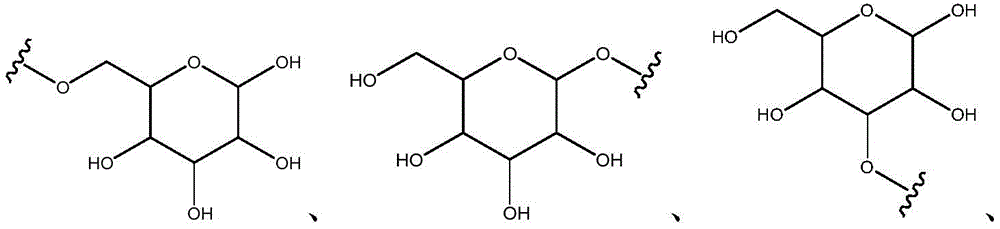

 Aryl, heteroaryl, biaryl, benzyl, heterocycle, C (O) OR11And OH, with the proviso that when Q is NH, R10Or H; and
R11and R12Independently is H or (C)1-C6) -alkyl, optionally substituted with one or more substituents selected from: OR (OR)13、NHR13、SR13、CO2R13、CONHR13Aryl, hydroxyaryl, indolyl, imidazolyl, and NH (CNH) NH2;
Or R11And R12Taken together with the atoms to which they are attached to form a 3-7 membered heterocyclic ring;
R13is H or (C)1-C6) -an alkyl group; and
n is 0,1 or 2; or a pharmaceutically acceptable salt thereof.
In the formula (I), R10Any substitutable atom in Q may be bonded. For example, when Q is O- (C)1-C6) When alkyl, R10Any carbon atom in the alkyl group may be bonded.
In some embodiments, X1And X4Is N, and X2And X3Is CH; or
X1Is CR1,X4Is CR4,X2Is S, and X3Is a bond; or a pharmaceutically acceptable salt or solvate thereof.
In some embodiments, Y is C ═ O;
A1is NR9O or S;
A2is N;
A3is O or S; and
R5to R8Independently hydrogen, halogen, cyano, acyl, haloalkyl, haloalkoxy, haloalkylthio, trifluoroacetyl, (C)1-C4) Alkyl radicals, (C)1-C4) -alkoxy, (C)1-C4) Alkylthio group(s), (C)1-C4) -alkylsulfinyl or (C)1-C4) -an alkylsulfonyl group;
or a pharmaceutically acceptable salt or solvate thereof.
In some embodiments, R5To R8Independently hydrogen, halogen or haloalkyl; and
R9is hydrogen, (C)1-C4) -alkyl or c (O) O-tert-butyl; or a pharmaceutically acceptable salt or solvate thereof.
In some embodiments, Z is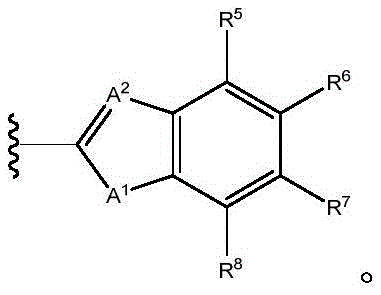
In some embodiments, Y is C ═ O;
A1is NR9、OOr S;
A2is N;
R5to R8Independently hydrogen, halogen, cyano, acyl, haloalkyl, haloalkoxy, haloalkylthio, (C)1-C4) Alkyl radicals, (C)1-C4) -alkoxy, (C)1-C4) Alkylthio group(s), (C)1-C4) -alkylsulfinyl or (C)1-C4) -an alkylsulfonyl group; and
R9is hydrogen, C1-C4Alkyl or C (O) O- (C)1-C4) -an alkyl group; or a pharmaceutically acceptable salt or solvate thereof.
In some embodiments, Y is C ═ O;
A1is NR9O or S;
A2is N;
R5to R8Independently hydrogen, halogen or haloalkyl; and
R9is hydrogen, (C)1-C4) -alkyl or c (O) O-tert-butyl; or a pharmaceutically acceptable salt or solvate thereof.
In some embodiments, Y is C ═ O;
A1is NR9O or S;
A2is N;
R5to R8Independently hydrogen, halogen or CF3(ii) a And
R9is hydrogen, (C)1-C4) -alkyl or c (O) O-tert-butyl; or a pharmaceutically acceptable salt or solvate thereof.
In some embodiments, X1Is CR1,X4Is CR4,X2Is S, and X3Is a bond;
y is C ═ O;
A1is S;
A2is N; and
R5to R8Independently hydrogen, halogen or haloalkyl;
or a pharmaceutically acceptable salt or solvate thereof.
In some embodiments, X1And X4Is N, and X2And X3Is CH;
y is C ═ O;
A1is S;
A2is N; and
R5to R8Independently hydrogen, halogen or haloalkyl;
or a pharmaceutically acceptable salt or solvate thereof.
In some embodiments, Q is a bond and
R10is composed of
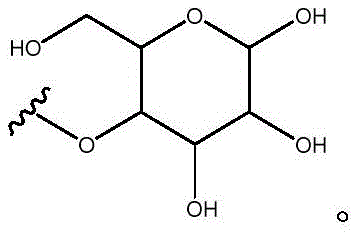
In some embodiments, Q is O- (C)1-C6) Alkyl, O- (C)1-C6) Hydroxyalkyl, O- (C)1-C6) -aminoalkyl, and
R10is composed of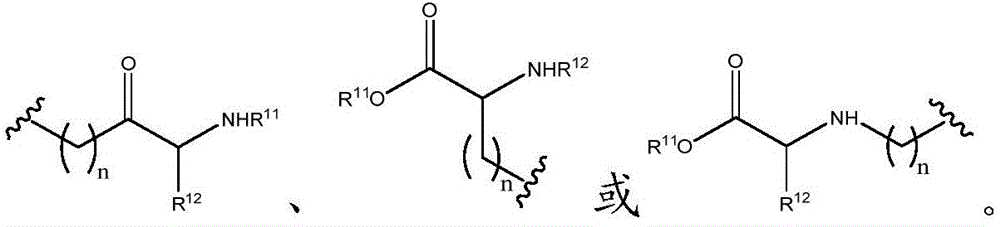
In some embodiments, Q is O- (C)1-C6) -an aminoalkyl group;
R10is composed of And
And
n is 0.
In some embodiments, Q is NH- (C)1-C6) Alkyl, NH- (C)1-C6) Hydroxyalkyl, NH- (C)1-C6) -aminoalkyl, and
R10is composed of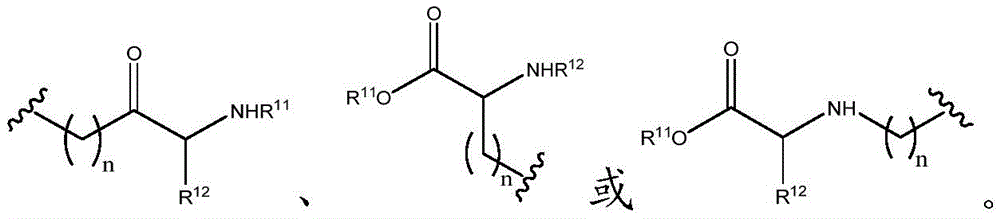
In some embodiments, Q is NH- (C)1-C6) -an aminoalkyl group;
R10is composed of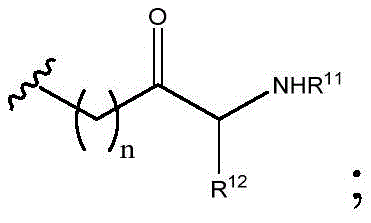 And
And
n is 0.
In some embodiments, Q is O- (C)1-C6) Alkyl or NH- (C)1-C6) -an alkyl group, or a bond; and R10Is composed of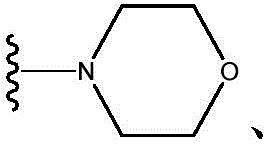 Aryl, heteroaryl, biaryl, benzyl or heterocycle.
The present disclosure relates to compounds of formula (I-4)
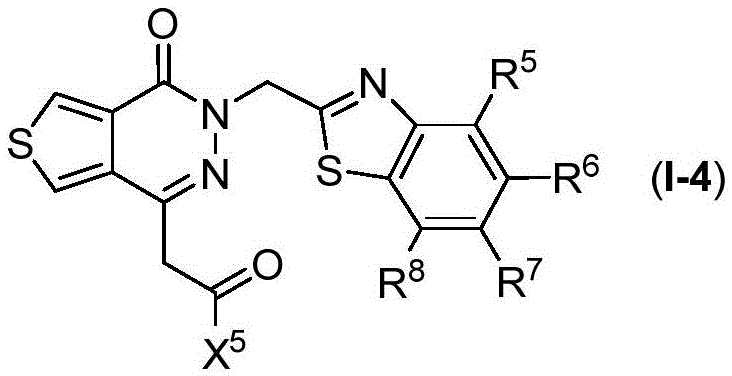
Wherein
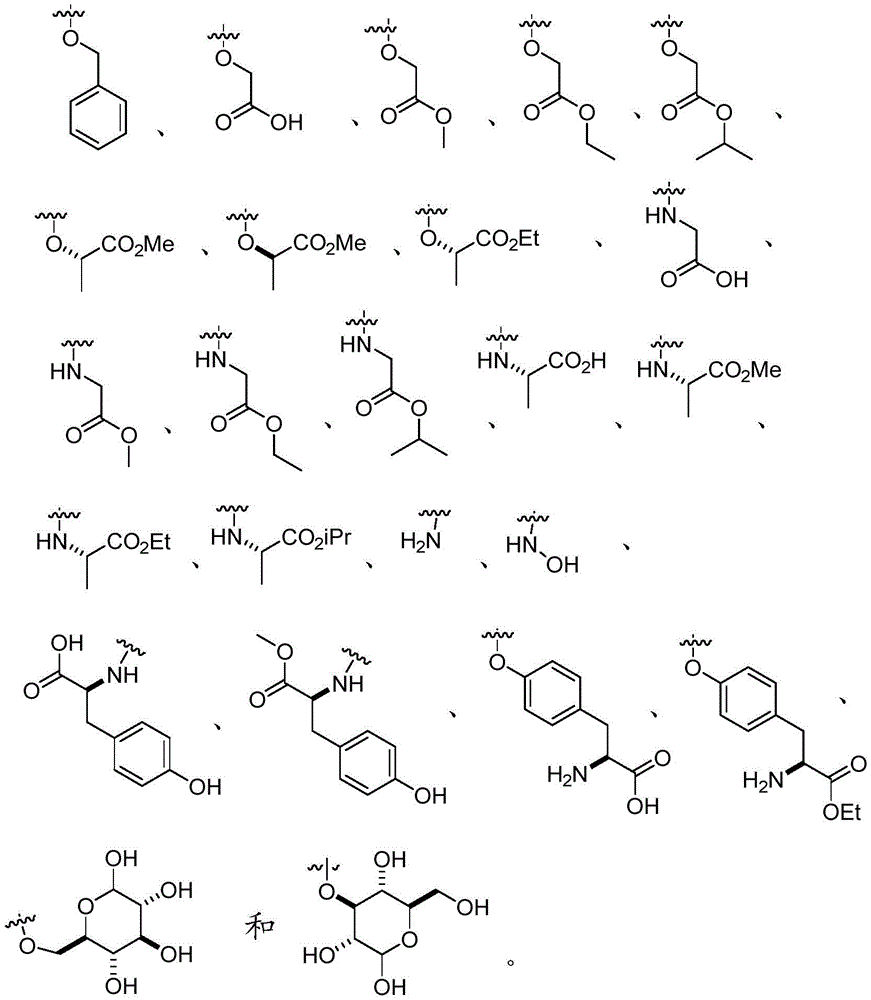
R5、R6、R7、R8And X5Are as defined in formula (I), and pharmaceutically acceptable salts thereof. In an embodiment of the compounds of formula (I-4), X5Is selected from
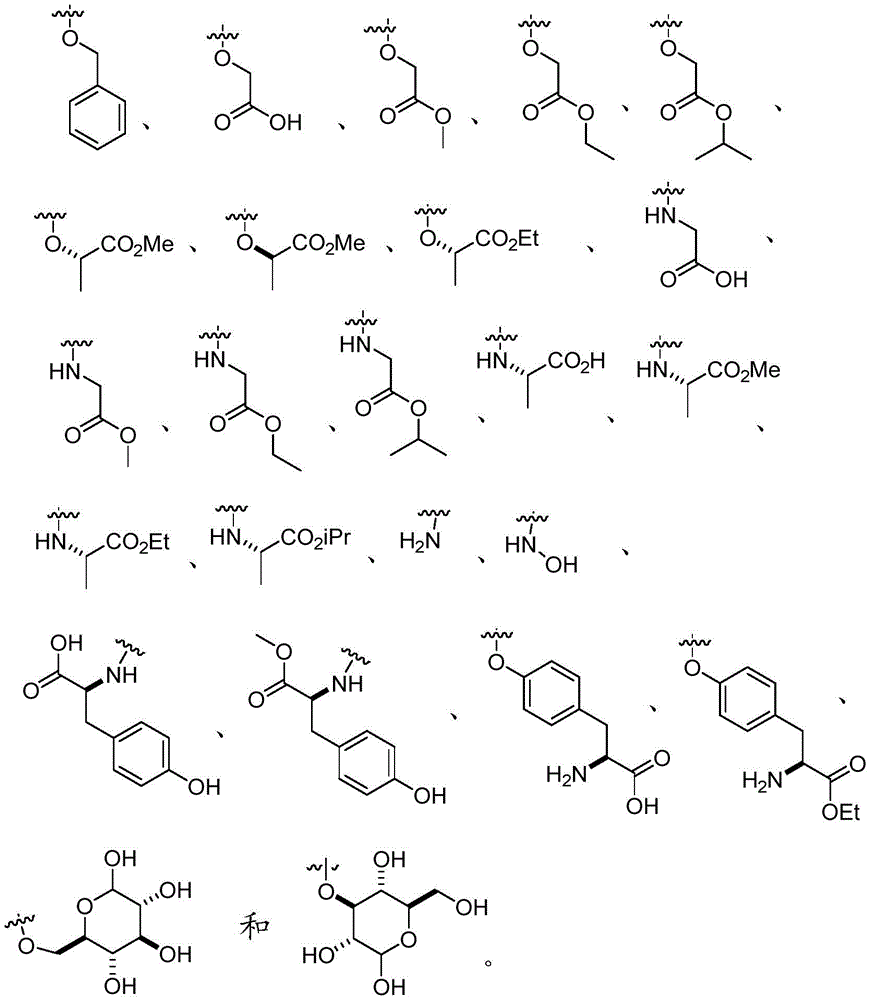
In certain preferred embodiments of the compounds of formula (I-4), R5、R7And R8Each is H; r6Is halogen or haloalkyl, preferably, R6Is trifluoromethyl, and X5Is selected from
The disclosure further relates to compounds of formula (II)

Wherein,
X1is N or CR1;
X2Is N, CR2Or S;
X3is N, CR3Or a bond;
X4is N or CR4(ii) a With the proviso that when X2When is S, X1Is CR1,X4Is CR4And X3Is a single bond; or X1、X2、X3Or X4Two or three of which are N;
y is a bond, C-O, C-S, C-NH or C-N (C)1-C4) -an alkyl group;
z is
A1Is NR9O, S or CH2;
A2Is N or CH;
A3is NR9O or S;
R1to R8Independently hydrogen, halogen, cyano, acyl, haloalkyl, haloalkoxy, haloalkylthio, trifluoroacetyl, (C)1-C4) Alkyl radicals, (C)1-C4) -alkoxy, (C)1-C4) Alkylthio group(s), (C)1-C4) -alkylsulfinyl or (C)1-C4) -an alkylsulfonyl group; or R1To R4Two of (1) or R5To R8Are together (C)1-C4) -an alkylenedioxy group;
R9is hydrogen, C1-C4Alkyl or C (O) O- (C)1-C4) -an alkyl group;
X6is S (O)2-OR13、S(O)2-NHR13Heteroaryl or heterocycloalkyl; and
R13is H or (C)1-C6) -an alkyl group; and pharmaceutically acceptable salts thereof.
The present disclosure further relates to compounds selected from the group consisting of:

and pharmaceutically acceptable salts thereof.
The present disclosure further relates to compounds selected from the group consisting of:
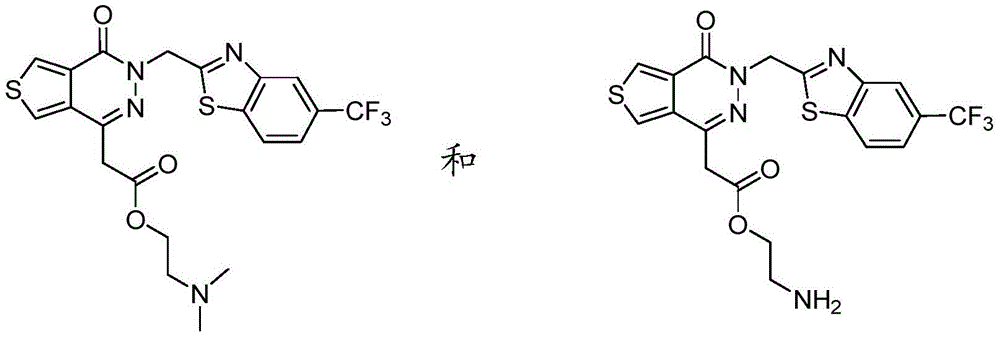
and pharmaceutically acceptable salts thereof.
In another aspect, the present invention provides a pharmaceutical composition comprising a compound of formula (I) or other compound disclosed herein and a pharmaceutically acceptable carrier.
In another aspect, the present invention provides a method of inhibiting aldose reductase activity in a subject, comprising administering to a subject in need thereof a therapeutically effective amount of a compound of formula (I) or other compound disclosed herein.
In some embodiments, the subject is a human.
In another aspect, the present invention provides a method of treating a disease in a subject comprising administering to a subject in need thereof a therapeutically effective amount of a compound of formula (I) or other compound disclosed herein.
In some embodiments, the disorder is stroke.
In some embodiments, the disorder is ischemic stroke.
In some embodiments, the disorder is tissue damage.
In some embodiments, the disorder is brain damage.
In some embodiments, the disorder is a neurological lesion.
In some embodiments, the disorder is an autoimmune disease.
In some embodiments, the disorder is galactosemia.
In some embodiments, the disorder is a phosphomannomutase 2-congenital glycosylation disorder (PMM 2-CDG).
The present disclosure also relates to methods of treating complications of diabetes comprising administering to a subject in need thereof a therapeutically effective amount of a compound of formula (I) or other compounds disclosed herein. The diabetic complication may be diabetic cardiomyopathy, diabetic retinopathy, diabetic neuropathy, or diabetic nephropathy.
The present disclosure also relates to methods of treating cardiovascular disorders comprising administering to a subject in need thereof a therapeutically effective amount of a compound of formula (I) or other compounds disclosed herein. The cardiovascular disorder may be cardiomyopathy.
The present disclosure also relates to methods of treating skin aging comprising administering to a subject in need thereof a therapeutically effective amount of a compound of formula (I) or other compounds disclosed herein. The compounds may be topically applied to the skin.
The present invention is based, in part, on certain discoveries which are more fully described in the examples section of this application. For example, the invention is based, in part, on the discovery of compounds of formula (I) or other compounds disclosed herein and the aldose reductase inhibitory effect exhibited by such compounds.
These and other embodiments of the present invention are further described in the following sections of the present application, including the detailed description, examples, and claims. Other objects and advantages of the present invention will become apparent to those skilled in the art from the disclosure herein, which is by way of illustration only and not by way of limitation. Accordingly, one of ordinary skill will recognize other embodiments without departing from the spirit and scope of the present invention.
Detailed Description
Aldose reductase inhibitors are described, for example, in WO 2017/223179; U.S. patent nos. 8,916,563; 5,677,342, respectively; 5,304,557, respectively; 5,155,259, respectively; 4,954,629, respectively; 4,939,140, respectively; U.S. publication nos. US 2006/0293265; diabetes Research and Clinical Practice 1990,10(1), 91-97; CN 101143868A; and Expert opin. ther. Pat.2012,22,1303 to Chatzopoulou et al; and the references cited therein; each of which is incorporated by reference herein in its entirety. Aldose reductase inhibitors include, for example, zopolrestat, epalrestat, ranirestat, berberine and sorbinil. A new family of aldose reductase inhibitors has been discovered and is described herein. Surprisingly, this new family comprises compounds that show significantly improved properties such as binding affinity, solubility and polarity relative to other aldose reductase inhibitors such as zopolrestat. Compounds such as zopolrestat are described in, for example, U.S. patent nos. 4,939,140; 6,159,976, respectively; 6,570,013, respectively; each of which is incorporated by reference herein in its entirety.
The compounds and/or compositions of the present invention are effective in treating, reducing and/or inhibiting complications associated with aldose reductase activity, for example, a variety of complications in patients with atherosclerosis, neuropathy, retinopathy, nephropathy, cardiomyopathy and diabetes. The compounds and/or compositions of the present invention are also effective in treating, alleviating and/or reducing cardiovascular and renal disorders in non-diabetic patients, as well as promoting healthy aging of the skin or wound healing. Treatments using aldose reductase inhibitors are described, for example, in CN 102512407A; WO2008002678a 2; CN 101143868A; chem Biol interact.2011,30,330 of Srivastava et al; PLoS One 2014,9(2), e87096, Hu et al; j Diabetes Res.2016,2016,5383797, Satoh et al; in Expert opin, ther, Pat.2012,22,1303, to Chatzopoulou et al, the entire contents of each of which are incorporated herein by reference.
Abbreviations for reagents
CDCl3Tritiated chloroform
CDI 1, 1' -carbonyldiimidazole
CD3OD deuterated methanol
DMAP 4- (dimethylamino) pyridine
DMF N, N-dimethylformamide
D2Heavy O water
EDC HCl N- (3-dimethylaminopropyl) -N' -ethylcarbodiimide hydrochloride
EtOAc ethyl acetate
EtOH ethanol
HCl hydrochloric acid
HOBT 1-hydroxybenzotriazole
H3PO4Phosphoric acid
H2SO4Sulfuric acid
LiOH lithium hydroxide
KOH potassium hydroxide
MeOH methanol
NaBr sodium bromide
NaHCO3Sodium bicarbonate
NaI sodium iodide
NaOH sodium hydroxide
Na2SO4Sodium sulfate
NMP 1-methyl-2-pyrrolidone
NHS N-hydroxysuccinimide
iPr2NEt N, N-diisopropylethylamine
iPrOH isopropyl alcohol
TBAB tetrabutylammonium bromide
TBAC tetrabutylammonium chloride
TBAI tetrabutylammonium iodide
TEA Triethylamine
TFA trifluoroacetic acid
THF tetrahydrofuran
Abbreviations and Definitions
The term "aldose reductase inhibitor" refers to compounds and salts or solvates thereof that function by inhibiting the activity of aldose reductase, which is primarily responsible for regulating the metabolic reduction of aldoses. Exemplary aldoses include, but are not limited to, glucose or galactose, and their corresponding polyols, such as sorbitol and galactitol.
The term "compound of the invention" as used herein refers to a compound of formula (I). The term also includes salts, hydrates, prodrugs and solvates thereof.
The term "composition of the invention" as used herein refers to a composition comprising a compound of the invention and salts, hydrates, prodrugs or solvates thereof. The compositions of the present invention may further comprise other agents, such as excipients, stabilizers, lubricants, solvents, and the like.
Unless otherwise specified, "alkyl" as used herein refers to a monovalent aliphatic hydrocarbon group having a linear, branched, monocyclic or polycyclic moiety, or combinations thereof, wherein the group is optionally substituted on one or more carbon atoms of the linear, branched, monocyclic or polycyclic moiety, or combinations thereof, with one or more substituents on each carbon, wherein the one or more substituents are independently C1-C10An alkyl group. Examples of "alkyl" groups include methyl, ethyl, propyl, isopropyl, butyl, isobutyl, sec-butyl, tert-butyl, pentyl, hexyl, heptyl, cyclopropyl, cyclobutyl, cyclopentyl, cyclohexyl, cycloheptyl, norbornyl, and the like.
The term "solvate" as used herein refers to a compound, or a pharmaceutically acceptable salt thereof, in which molecules of a suitable solvent are incorporated into the crystal lattice. Suitable solvents are physiologically tolerable at the doses administered. Examples of suitable solvents are ethanol, water, etc. When water is the solvent, the molecule is referred to as a "hydrate".
The term "pharmaceutically acceptable salts" is intended to include salts derived from inorganic or organic acids including, for example, hydrochloric, hydrobromic, sulfuric, nitric, perchloric, phosphoric, formic, acetic, lactic, maleic, fumaric, succinic, tartaric, glycolic, salicylic, citric, methanesulfonic, benzenesulfonic, benzoic, malonic, trifluoroacetic, trichloroacetic, naphthalene-2 sulfonic and other acids; and salts derived from inorganic or organic bases including, for example, sodium, potassium, calcium, magnesium, zinc, ammonia, lysine, arginine, histidine, polyhydroxylated amines, alkylamines, dialkylamines, trialkylamines, or tetrafluoroborates. Exemplary pharmaceutically acceptable salts are those found in, for example, Berge, et al, (J pharm. Sci.1977,66(1), 1; and U.S. Pat. Nos. 6,570,013 and 4,939,140, (each of which is incorporated herein by reference in its entirety.) pharmaceutically acceptable salts also encompass hemi-salts in which the ratio of compound to acid is 2:1, respectively.
The term "acid" includes all pharmaceutically acceptable inorganic or organic acids. Inorganic acids include mineral acids, for example, hydrohalic acids, such as hydrobromic and hydrochloric acids, sulfuric acid, phosphoric acid and nitric acid. Organic acids include all pharmaceutically acceptable aliphatic, cycloaliphatic and aromatic carboxylic acids, dicarboxylic acids, tricarboxylic acids and fatty acids. Preferred acids are linear or branched, saturated or unsaturated C1-C20Aliphatic carboxylic acids, optionally substituted by halogen or hydroxy, or C6-C12An aromatic carboxylic acid. Examples of such acids are carbonic acid, formic acid, fumaric acid, acetic acid, propionic acid, isopropylic acid, valeric acid, alpha-hydroxy acids such as glycolic acid and lactic acid, chloroacetic acid, benzoic acid, methanesulfonic acid and salicylic acid. Examples of dicarboxylic acids include oxalic acid, malic acid, succinic acid, tartaric acid, and maleic acid. An example of a tricarboxylic acid is citric acid. The fatty acids include all pharmaceutically acceptable saturated or unsaturated aliphatic or aromatic carboxylic acids having from 4 to 24 carbon atoms. Examples include butyric acid, isobutyric acid, sec-butyl acid, lauric acid, palmitic acid, stearic acid, oleic acid, linoleic acid, linolenic acid, and phenyl stearic acid. Other acids include gluconic acid, glucoheptonic acid and lactobionic acid.
The term "about" as used herein is used herein to refer to approximately (approximate), roughly, about (around), or in the vicinity thereof. When the term "about" is used in conjunction with a numerical range, it modifies that range by extending the boundaries above and below the numerical values set forth. Generally, the term "about" is used herein to modify a numerical value by a factor of 20% upward or downward (higher or lower) than the stated value.
As used herein, an "effective amount," "sufficient amount," or "therapeutically effective amount" is an amount of a compound sufficient to achieve a beneficial or desired result, including a clinical result. Thus, an effective amount can be sufficient, for example, to reduce or ameliorate the severity and/or duration of the affliction associated with aldose reductase or one or more symptoms thereof, prevent the development of a condition or symptom associated with the affliction associated with aldose reductase, or enhance or otherwise improve the prophylactic or therapeutic effect of another therapy. An effective amount also includes an amount of the compound that avoids or substantially mitigates undesirable side effects.
As used herein and as understood in the art, "treatment" is a method for obtaining beneficial or desired results, including clinical results. Beneficial or desired clinical results can include, but are not limited to, alleviation or amelioration of one or more symptoms or conditions, diminishment of extent of disease or affliction, stabilized (i.e., not worsening) state of disease or affliction, prevention of spread of disease or affliction, delay or slowing of disease or affliction progression, amelioration or palliation, and palliation (whether partial or total), of disease or affliction, whether detectable or undetectable. "treatment" may also refer to an increase in survival compared to expected survival when not receiving treatment.
The phrase "in need thereof" refers to those conditions requiring symptomatic or asymptomatic relief from a condition associated with aldose reductase activity, or requiring relief by a compound and/or composition of the invention.
Without wishing to be bound by any particular theory, it is believed that the compounds disclosed herein are prodrugs that can be converted in vivo to their corresponding free carboxylic acid forms after administration. The free carboxylic acid form can have greater aldose reductase inhibitor activity than the compounds disclosed herein. It is also believed that the compounds disclosed herein more readily cross the blood brain barrier into the central nervous system (e.g., via passive transcellular diffusion or by active transport, e.g., via the activity of the monocarboxylic acid transporter 1, the large neutral amino acid transporter 1(LAT1), the glucose transporter 1GLUT1, etc.).
In one embodiment, the aldose reductase inhibitors described herein include compounds of formula (I) or pharmaceutically acceptable salts and prodrugs thereof,

wherein,
X1is N or CR1;
X2Is N, CR2Or S;
X3is N, CR3Or a bond;
X4is N or CR4(ii) a With the proviso that when X2When is S, X1Is CR1,X4Is CR4And X3Is a single bond; or X1、X2、X3Or X4Two or three of which are N;
y is a bond, C-O, C-S, C-NH or C-N (C)1-C4) -an alkyl group;
z is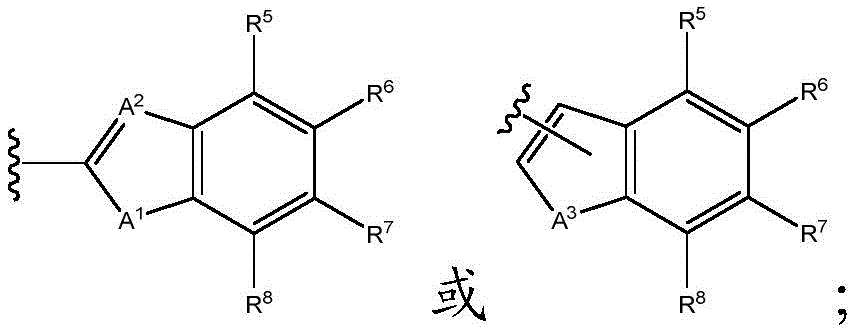
A1Is NR9O, S or CH2;
A2Is N or CH;
A3is NR9O or S;
R1to R8Independently hydrogen, halogen, cyano, acyl, haloalkyl, haloalkoxy, haloalkylthio, trifluoroacetyl, (C)1-C4) Alkyl radicals, (C)1-C4) -alkoxy, (C)1-C4) Alkylthio group(s), (C)1-C4) -alkylsulfinyl or (C)1-C4) -an alkylsulfonyl group; or R1To R4Two of (1) or R5To R8Are together (C)1-C4) -an alkylenedioxy group;
R9is hydrogen, C1-C4Alkyl or C (O) O- (C)1-C4) -an alkyl group;
X5is Q-R10;
Q is O, NH, O- (C)1-C6) Alkyl, O- (C)1-C6) Hydroxyalkyl, O- (C)1-C6) Aminoalkyl, O-aryl, O-heteroaryl, O-biaryl, O-benzyl, NH- (C)1-C6) Alkyl, NH- (C)1-C6) Hydroxyalkyl, NH- (C)1-C6) -aminoalkyl, NH-aryl, NH-heteroaryl, NH-biaryl, NH-benzyl or a bond;
R10is composed of

 Aryl, heteroaryl, biaryl, benzyl, heterocycle, C (O) OR11And OH, with the proviso that when Q is NH, R10Or H; and
R11and R12Independently is H or (C)1-C6) -alkyl, optionally substituted with one or more substituents selected from: OR (OR)13、NHR13、SR13、CO2R13、CONHR13Benzyl, aryl, hydroxyaryl, indolyl, imidazolyl, and NH (CNH) NH2;
Or, R11And R12Taken together with the atoms to which they are attached to form a 3-7 membered heterocyclic ring;
R13is H or (C)1-C6) -an alkyl group; and
n is 0,1 or 2; or a pharmaceutically acceptable salt thereof.
In the formula (I),R10Any substitutable atom in Q may be bonded. For example, when Q is O- (C)1-C6) When alkyl, R10Any carbon atom in the alkyl group may be bonded.
As will be appreciated by those skilled in the art, designating Z as Indicates that Z is
 Or Z is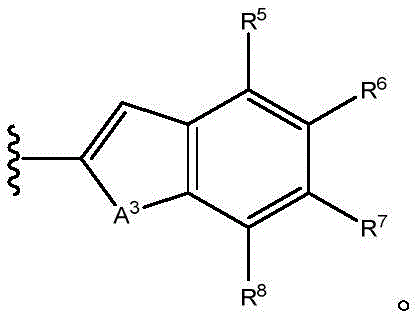
As will be appreciated by those skilled in the art, designating Z as Or Z
Or Z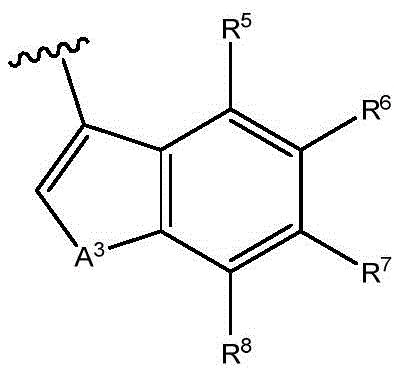 Or Z is
 Indicating that when Z is
 When, the compounds of formula (I) are understood to encompass
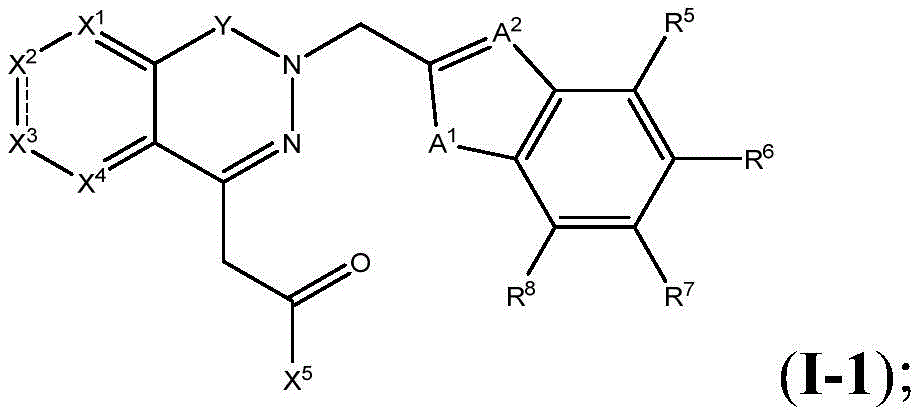 When Z is
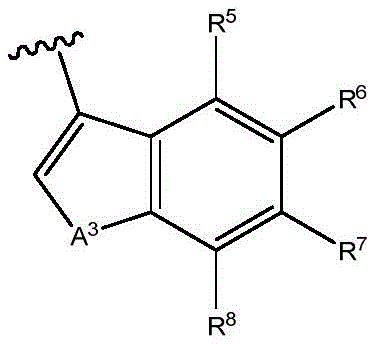 When, the compounds of formula (I) are understood to encompass
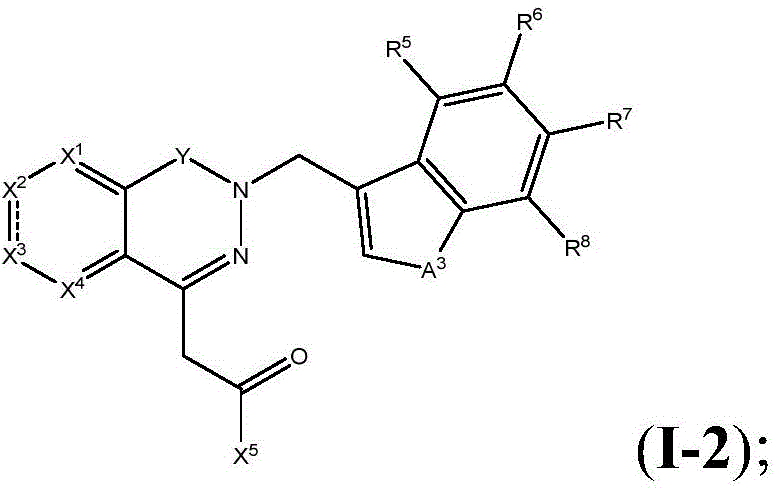 And when Z is
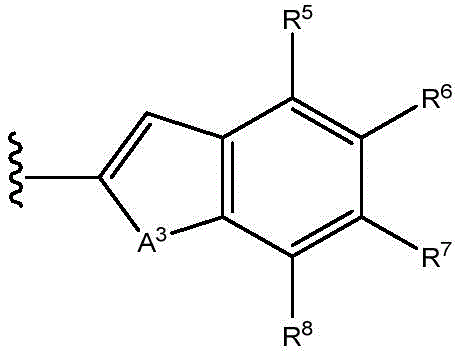 When, the compounds of formula (I) are understood to encompass

In certain embodiments, X1And X4Is N, and X2And X3Is CH. In certain embodiments, X1Is CR1,X4Is CR4,X2Is S, and X3Is a bond. In certain embodiments, X1And X4Each is CH, X2Is S, and X3Is a bond.
In certain embodiments, R1And R4Is hydrogen. In certain embodiments, R1And R4Is halogen. In certain embodiments, R1And R4Is Cl.
In certain embodiments, R1And R4Independently hydrogen or halogen. In certain embodiments, R1Is hydrogen and R4Is Cl. In certain embodiments, R1Is Cl and R4Is hydrogen.
In certain embodiments, Q is O or NH. In certain embodiments, Q is O. In certain embodiments, Q is NH. In certain embodiments, Q is a bond.
In certain embodiments, Q is O- (C)1-C6) Alkyl, O- (C)1-C6) Hydroxyalkyl, O- (C)1-C6) -aminoalkyl groups. In certain embodiments, Q is O- (C)1-C4) Alkyl, O- (C)1-C4) Hydroxyalkyl, O- (C)1-C4) -aminoalkyl groups. In certain embodiments, Q is O- (C)1-C3) Alkyl, O- (C)1-C3) Hydroxyalkyl, O- (C)1-C3) -aminoalkyl groups. In certain embodiments, Q is O- (C)1-C2) Alkyl, O- (C)1-C2) Hydroxyalkyl, O- (C)1-C2) -aminoalkyl groups. In certain embodiments, Q is O- (C)1-C6) -an alkyl group. In certain embodiments, Q is O- (C)1-C6) -hydroxyalkyl.In certain embodiments, Q is O- (C)1-C6) -aminoalkyl groups.
In certain embodiments, Q is O- (C)1-C6) -n-alkyl, O- (C)1-C6) -hydroxy-n-alkyl, O- (C)1-C6) -amino-n-alkyl. In certain embodiments, Q is O- (C)1-C4) -n-alkyl, O- (C)1-C4) -hydroxy-n-alkyl, O- (C)1-C4) -amino-n-alkyl. In certain embodiments, Q is O- (C)1-C3) -n-alkyl, O- (C)1-C3) -hydroxy-n-alkyl, O- (C)1-C3) -amino-n-alkyl. In certain embodiments, Q is O- (C)1-C2) -n-alkyl, O- (C)1-C2) -hydroxy-n-alkyl, O- (C)1-C2) -amino-n-alkyl. In certain embodiments, Q is O- (C)1-C6) -n-alkyl. In certain embodiments, Q is O- (C)1-C6) -hydroxy-n-alkyl. In certain embodiments, Q is O- (C)1-C6) -amino-n-alkyl.
In certain embodiments, Q is NH- (C)1-C6) Alkyl, NH- (C)1-C6) Hydroxyalkyl, NH- (C)1-C6) -aminoalkyl groups. In certain embodiments, Q is NH- (C)1-C4) Alkyl, NH- (C)1-C4) Hydroxyalkyl, NH- (C)1-C4) -aminoalkyl groups. In certain embodiments, Q is NH- (C)1-C3) Alkyl, NH- (C)1-C3) Hydroxyalkyl, NH- (C)1-C3) -aminoalkyl groups. In certain embodiments, Q is NH- (C)1-C2) Alkyl, NH- (C)1-C2) Hydroxyalkyl, NH- (C)1-C2) -aminoalkyl groups. In certain embodiments, Q is NH- (C)1-C6) -an alkyl group. In certain embodiments, Q is NH- (C)1-C6) -hydroxyalkyl. In certain embodiments, Q is NH- (C)1-C6) -aminoalkyl groups.
In certain embodiments, Q is NH- (C)1-C6) -n-alkyl, NH- (C)1-C6) -hydroxy-n-alkyl, NH- (C)1-C6) -amino-n-alkyl. In certain embodiments, Q is NH- (C)1-C4) -n-alkyl, NH- (C)1-C4) -hydroxy-n-alkyl, NH- (C)1-C4) -amino-n-alkyl. In certain embodiments, Q is NH- (C)1-C3) -n-alkyl, NH- (C)1-C3) -hydroxy-n-alkyl, NH- (C)1-C3) -amino-n-alkyl. In certain embodiments, Q is NH- (C)1-C2) -n-alkyl, NH- (C)1-C2) -hydroxy-n-alkyl, NH- (C)1-C2) -amino-n-alkyl. In certain embodiments, Q is NH- (C)1-C6) -n-alkyl. In certain embodiments, Q is NH- (C)1-C6) -hydroxy-n-alkyl. In certain embodiments, Q is NH- (C)1-C6) -amino-n-alkyl.
In certain embodiments, Q is O-aryl, O-heteroaryl, O-biaryl, or O-benzyl. In certain embodiments, Q is O-aryl, O-heteroaryl, or O-benzyl. In certain embodiments, Q is O-aryl or O-benzyl. In certain embodiments, Q is O-aryl or O-heteroaryl. In certain embodiments, Q is O-benzyl. In certain embodiments, Q is O-heteroaryl. In certain embodiments, Q is O-biaryl. In certain embodiments, Q is O-benzyl.
In certain embodiments, Q is NH-aryl, NH-heteroaryl, NH-biaryl, or NH-benzyl. In certain embodiments, Q is NH-aryl, NH-heteroaryl, or NH-benzyl. In certain embodiments, Q is NH-aryl or NH-benzyl. In certain embodiments, Q is NH-aryl or NH-heteroaryl. In certain embodiments, Q is NH-aryl. In certain embodiments, Q is NH-heteroaryl. In certain embodiments, Q is NH-biaryl. In certain embodiments, Q is NH-benzyl.
In certain embodiments, R10Is composed of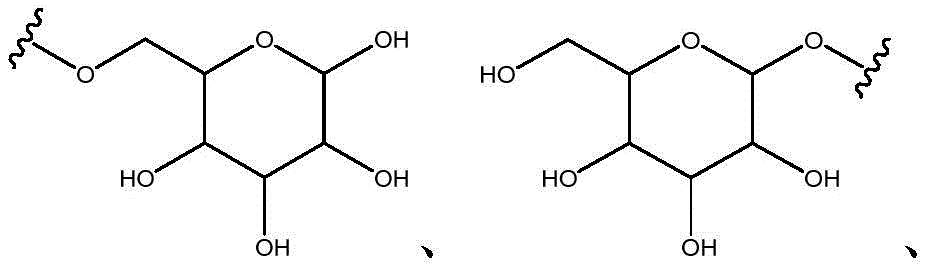

 Aryl, heteroaryl, biaryl, benzyl or heterocycle.
In certain embodiments, R10Is composed of

In certain embodiments, R10Is composed of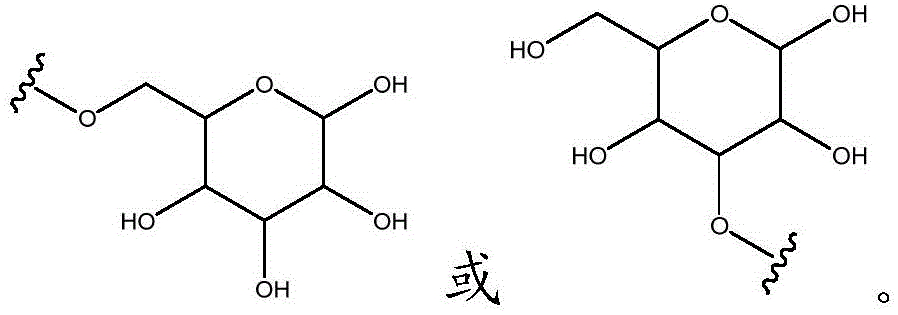 In certain embodiments, R10Is composed of
 In certain embodiments, R10Is composed of
In certain embodiments, R10Is composed of In certain embodiments, R10Is composed of
 In certain embodiments, R10Is composed of
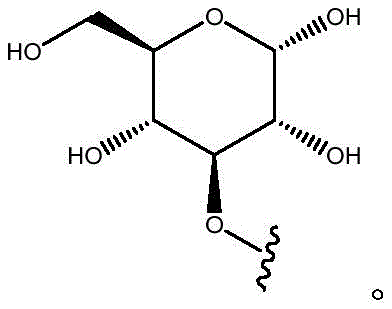
In certain embodiments, R10Is composed of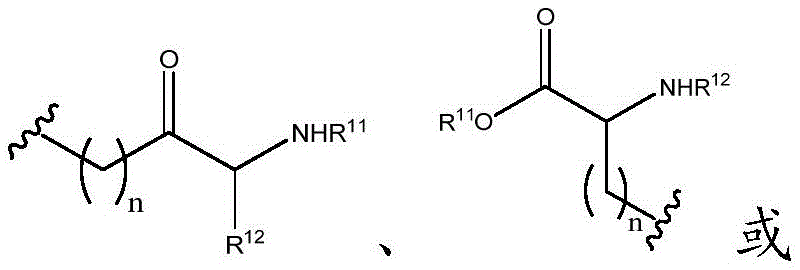

In certain embodiments, R10Is composed of In certain embodiments, R10Is composed of
 In certain embodiments, R10Is composed of
In certain embodiments, R10Is composed of In certain embodiments, R10Is composed of
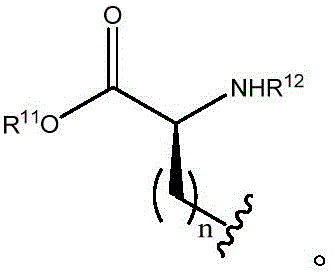 In certain embodiments, R10Is composed of
In certain embodiments, R10Is composed of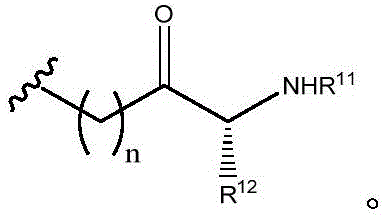 In certain embodiments, R10Is composed of
 In certain embodiments, R10Is composed of
In certain embodiments, R10Is composed of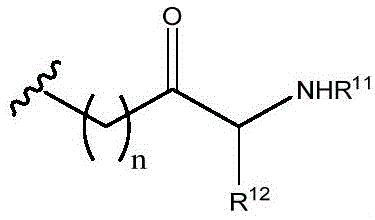 And n is 0. In certain embodiments, R10Is composed of
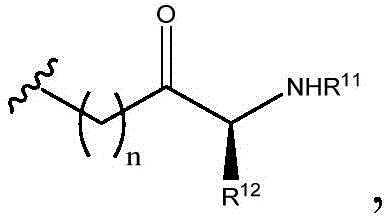 And n is 0. In certain embodiments, R10Is composed of
 And n is 0.
In certain embodiments, R10Is composed of Aryl, heteroaryl, biaryl, benzyl, or heterocycloalkyl. In certain embodiments, R10Is aryl, heteroaryl, biaryl, benzyl or heterocycloalkyl. In certain embodiments, R10Is aryl, heteroaryl, benzyl or heterocycloalkyl. .
In certain embodiments, R10Is aryl or benzyl. In certain embodiments, R10Is heteroaryl. In certain embodiments, R10Is a heterocycloalkyl group.
In certain embodiments, R11And R12Independently is H or (C)1-C6) -alkyl, optionally substituted with one or more substituents selected from: OR (OR)13、NHR13、SR13、CO2R13、CONHR13Benzyl, aryl, hydroxyaryl, indolyl, imidazolyl, and NH (CNH) NH2. In certain embodiments, R11And R12Taken together with the atoms to which they are attached to form a 3-7 membered heterocyclic ring;
in certain embodiments, R11And R12Independently is H or (C)1-C6) -an alkyl group. In certain embodiments, R11And R12Independently is H or (C)1-C4) -an alkyl group. In certain embodiments, R11And R12Independently is H or (C)1-C3) -an alkyl group. In certain embodiments, R11And R12Independently is H or (C)1-C2) -an alkyl group.
In certain embodiments, R11And R12Independently is H or (C)1-C6) -alkyl, optionally substituted with one or more substituents selected from: OR (OR)13、NHR13、SR13、CO2R13、CONHR13Benzyl, aryl, hydroxyaryl, indolyl, imidazolyl, and NH (CNH) NH2. In certain embodiments, R11And R12Independently is H or (C)1-C4) -alkyl, optionally substituted with one or more substituents selected from: OR (OR)13、NHR13、SR13、CO2R13、CONHR13Benzyl, aryl, hydroxyaryl, indolyl, imidazolyl, and NH (CNH) NH2. In certain embodiments, R11And R12Independently is H or (C)1-C3) -alkyl, optionally substituted with one or more substituents selected from: OR (OR)13、NHR13、SR13、CO2R13、CONHR13Benzyl, aryl, hydroxyaryl, indolyl, imidazolyl, and NH (CNH) NH2. In certain embodiments, R11And R12Independently is H or (C)1-C2) -alkyl, optionally substituted with one or more substituents selected from: OR (OR)13、NHR13、SR13、CO2R13、CONHR13Benzyl, aryl, hydroxyaryl, indolyl, imidazolyl, and NH (CNH) NH2。
In certain embodiments, R11And R12Is H; n is 0; and R10Is composed of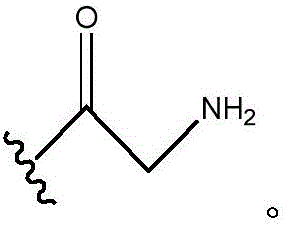
In certain embodiments, R11Is H; r12Is CH3(ii) a n is 0; and R10Is composed of
In certain embodiments, R11Is H; r12Is (C)1-C3) -an alkyl group; n is 0; and R10Is composed of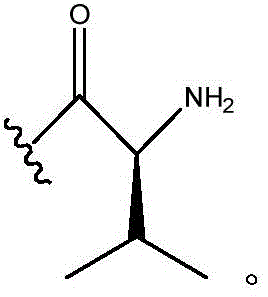
In certain embodiments, R11Is H; r12Is (C)1-C4) -an alkyl group; n is 0; and R10Is composed of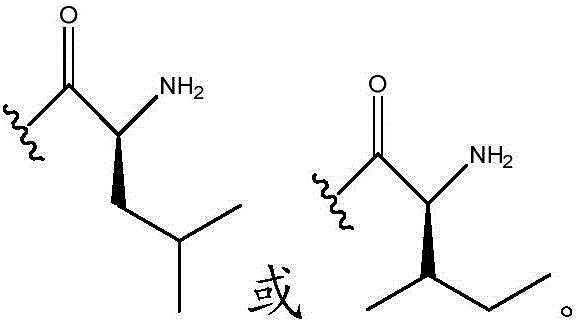 In certain embodiments, R10Is composed of
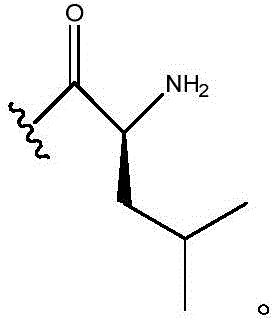 In certain embodiments, R10Is composed of
In certain embodiments, R11Is H; r12Is CH2OH; n is 0; and R10Is composed of
In certain embodiments, R11Is H; r12Is CH (CH)3) (OH); n is 0; and R10Is composed of
In certain embodiments, R11Is H; r12Is CH2SH; n is 0; and R10Is composed of
In certain embodiments, R11Is H; r12Is CH2CH2SCH3(ii) a n is 0; and R10Is composed of
In certain embodiments, R11Is H; r12Is benzyl; n is 0; and R10Is composed of
In certain embodiments, R11Is H; r12Is 4-hydroxybenzyl; n is 0; and R10Is composed of
In certain embodiments, R11Is H; r12Is 2-indolyl; n is 0; and R10Is composed of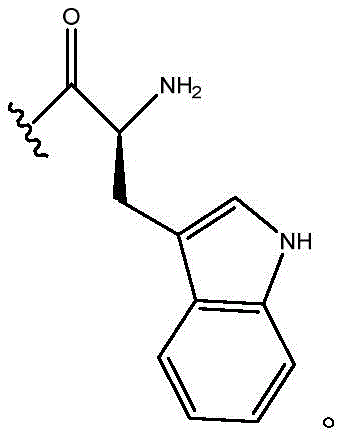
In certain embodiments, R11Is H; r12Is CH2CO2H; n is 0; and R10Is composed of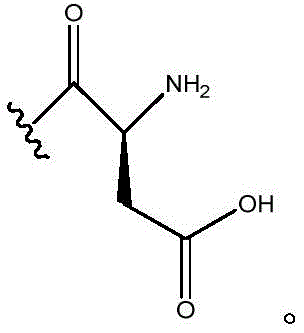
In certain embodiments, R11Is H; r12Is CH2CH2CO2H; n is 0; and R10Is composed of
In certain embodiments, R11Is H; r12Is CH2CONH2(ii) a n is 0; and R10Is composed of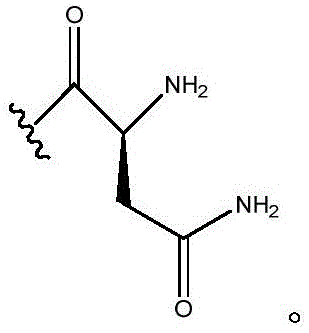
In certain embodiments, R11Is H; r12Is CH2CH2CONH2(ii) a n is 0; and R10Is composed of
In certain embodiments, R11Is H; r12Is a 5-imidazolyl group; n is 0; and R10Is composed of
In certain embodiments, R11Is H; r12Is CH2(CH2)3NH2(ii) a n is 0; and R10Is composed of
In certain embodiments, R11Is H; r12Is CH2(CH2)2NH(CNH)NH2(ii) a n is 0; and R10Is composed of
In certain embodiments, R11Is CH3,R12Is CH2CH3And R is11And R12Taken together with the atoms to which they are attached to form a pyrrolidine ring; n is 0; and R10Is composed of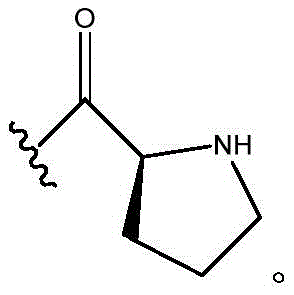
In certain embodiments, R11Is CH2CH3,R12Is CH3And R is11And R12Taken together with the atoms to which they are attached to form a pyrrolidine ring; n is 0; and R10Is composed of
In certain embodiments, R11And R12Taken together with the atoms to which they are attached to form a 3-7 membered heterocyclic ring. In thatIn certain embodiments, R11And R12Taken together with the atoms to which they are attached to form a 3-membered heterocyclic ring. In certain embodiments, R11And R12Taken together with the atoms to which they are attached to form a 4-membered heterocyclic ring. In certain embodiments, R11And R12Taken together with the atoms to which they are attached to form a 5-membered heterocyclic ring. In certain embodiments, R11And R12Taken together with the atoms to which they are attached to form a 6-membered heterocyclic ring. In certain embodiments, R11And R12Taken together with the atoms to which they are attached to form a 7-membered heterocyclic ring.
In certain embodiments, R13Is H or (C)1-C6) -an alkyl group. In certain embodiments, R13Is H. In certain embodiments, R13(C1-C6) -an alkyl group. In certain embodiments, R13(C1-C4) -an alkyl group. In certain embodiments, R13(C1-C3) -an alkyl group. In certain embodiments, R13(C1-C2) -an alkyl group.
In certain embodiments, n is 0,1, or 2. In certain embodiments, n is 0. In certain embodiments, n is 1. In certain embodiments, n is 2.
In certain embodiments, Z is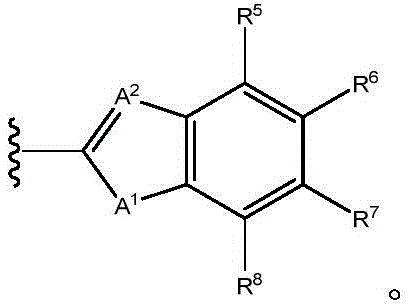
In certain embodiments, Z is In certain embodiments, Z is
In certain embodiments, R5To R8Independently hydrogen, halogen, cyano, acyl, haloalkyl, haloalkoxy, haloalkylthio, trifluoroacetyl, (C)1-C4) Alkyl radicals, (C)1-C4) -alkoxy, (C)1-C4) Alkylthio group(s), (C)1-C4) -alkylsulfinyl or (C)1-C4) -an alkylsulfonyl group.
In certain embodiments, R5To R8Independently hydrogen, halogen or haloalkyl. In certain embodiments, R5To R8Independently hydrogen, halogen or trihaloalkyl.
In certain embodiments, R5To R8Is hydrogen. In certain embodiments, R5、R7And R8Is hydrogen.
In certain embodiments, R6Is hydrogen, halogen or haloalkyl. In certain embodiments, R6Is hydrogen. In certain embodiments, R6Is halogen. In certain embodiments, R6Is a haloalkyl group. In certain embodiments, R6Is CF3。
In certain embodiments, R5To R8Is hydrogen. In certain embodiments, R5、R7、R8Is hydrogen, and R6Is halogen or haloalkyl. In certain embodiments, R5、R7、R8Is hydrogen, and R6Is a haloalkyl group. In certain embodiments, R5、R7、R8Is hydrogen, and R6Is CF3. In certain embodiments, R5、R7、R8Is hydrogen, and R6Is halogen. In certain embodiments, R5、R7、R8Is hydrogen, and R6Is F. In certain embodiments, R5、R7、R8Is hydrogen, and R6Is Cl.
In certain embodiments, Y is C O, C ═ NH or C ═ N (C ═ S, C ═ NH or C ═ N (C)1-C4) -an alkyl group. In certain embodiments, Y is C ═ O or C ═ S. In certain embodiments, Y is C ═ O. In certain embodiments, Y is C ═ S. In certain embodiments, Y is C ═ NH or C ═ N (C)1-C4) -an alkyl group.
In certain embodiments, a1Is NR9O, S or CH2. In certain embodiments, a1Is NR9O or S. In certain embodiments, a1Is NR9S or CH2. In certain embodiments, a1Is NR9Or O. In certain embodiments, a1Is NR9Or S. In certain embodiments, a1Is NR9. In certain embodiments, a1Is O. In certain embodiments, a1Is S.
In certain embodiments, a2Is N or CH. In certain embodiments, a2Is N. In certain embodiments, a2Is CH.
In certain embodiments, a3Is NR9O or S. In certain embodiments, a3Is O. In certain embodiments, a3Is S. In certain embodiments, a3Is NR9。
In certain embodiments, R9Is hydrogen, C1-C4Alkyl or C (O) O- (C)1-C4) -an alkyl group. In certain embodiments, R9Is hydrogen. In certain embodiments, R9Is C1-C4An alkyl group. In certain embodiments, R9Is C1-C3An alkyl group. In certain embodiments, R9Is C1-C2An alkyl group. In certain embodiments, R9Is C1-C4N-alkyl. In certain embodiments, R9Is C1-C3N-alkyl. In certain embodiments, R9Is C (O) O- (C)1-C4) -an alkyl group. In certain embodiments, R9Is C (O) O- (C)1-C3) -an alkyl group. In certain embodiments, R9Is C (O) O- (C)1-C2) -an alkyl group. In certain embodiments, R9Is C (O) O- (C)1-C4) -n-alkyl. In certain embodiments, R9Is C (O) O- (C)1-C3) -n-alkyl.
In certain embodiments, X1And X4Is N, and X2And X3Is CH; or X1Is CR1,X4Is CR4,X2Is S, and X3Is a bond.
In certain embodiments, Y is C ═ O;
A1is NR9O or S;
A2is N;
A3is O or S; and
R5to R8Independently hydrogen, halogen, cyano, acyl, haloalkyl, haloalkoxy, haloalkylthio, trifluoroacetyl, (C)1-C4) Alkyl radicals, (C)1-C4) -alkoxy, (C)1-C4) Alkylthio group(s), (C)1-C4) -alkylsulfinyl or (C)1-C4) -an alkylsulfonyl group;
or a pharmaceutically acceptable salt or solvate thereof.
In certain embodiments, R5To R8Independently hydrogen, halogen or haloalkyl; and
R9is hydrogen, (C)1-C4) -alkyl or c (O) O-tert-butyl; or a pharmaceutically acceptable salt or solvate thereof.
In certain embodiments, Z is
Y is C ═ O;
A1is NR9O or S;
A2is N;
R5to R8Independently hydrogen, halogen, cyano, acyl, haloalkyl, haloalkoxy, haloalkylthio, (C)1-C4) -alkyl, (C)1-C4) -alkoxy, (C)1-C4) Alkylthio group(s), (C)1-C4) -alkylsulfinyl or (C)1-C4) -an alkylsulfonyl group; and
R9is hydrogen, C1-C4Alkyl or C (O) O- (C)1-C4) -an alkyl group; or a pharmaceutically acceptable salt or solvate thereof.
In certain embodiments, Y is C ═ O;
A1is NR9O or S;
A2is N;
R5to R8Independently hydrogen, halogen, cyano, acyl, haloalkyl, haloalkoxy, haloalkylthio, (C)1-C4) -alkyl, (C)1-C4) -alkoxy, (C)1-C4) Alkylthio group(s), (C)1-C4) -alkylsulfinyl or (C)1-C4) -an alkylsulfonyl group; and
R9is hydrogen, C1-C4Alkyl or C (O) O- (C)1-C4) -an alkyl group; or a pharmaceutically acceptable salt or solvate thereof.
In certain embodiments, Y is C ═ O;
A1is NR9O or S;
A2is N;
R5to R8Independently hydrogen, halogen or haloalkyl; and
R9is hydrogen, (C)1-C4) -alkyl or c (O) O-tert-butyl; or a pharmaceutically acceptable salt or solvate thereof.
In certain embodiments, Y is C ═ O;
A1is NR9O or S;
A2is N;
R5to R8Independently hydrogen, halogen or CF3(ii) a And
R9is hydrogen, (C)1-C4) -alkyl or c (O) O-tert-butyl; or a pharmaceutically acceptable salt or solvate thereof.
In certain embodiments, X1Is CR1,X4Is CR4,X2Is S, and X3Is a bond;
y is C ═ O;
A1is S;
A2is N; and
R5to R8Independently hydrogen, halogen or haloalkyl;
or a pharmaceutically acceptable salt or solvate thereof.
In certain embodiments, X1And X4Is N, and X2And X3Is CH;
y is C ═ O;
A1is S;
A2is N; and
R5to R8Independently hydrogen, halogen or haloalkyl;
or a pharmaceutically acceptable salt or solvate thereof.
In certain embodiments, Q is a bond and R10Is composed of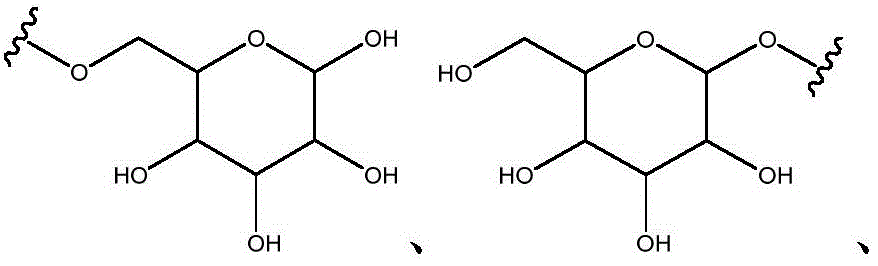
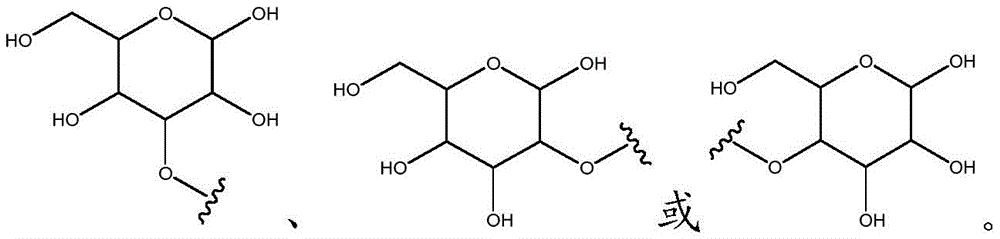
In certain embodiments, Q is O- (C)1-C6) Alkyl, O- (C)1-C6) Hydroxyalkyl, O- (C)1-C6) -aminoalkyl, and R10Is composed of
In certain embodiments, Q is O- (C)1-C6) -an aminoalkyl group;
R10is composed of And
And
n is 0.
In certain embodiments, Q is NH- (C)1-C6) Alkyl, NH- (C)1-C6) Hydroxyalkyl, NH- (C)1-C6) -aminoalkyl, and R10Is composed of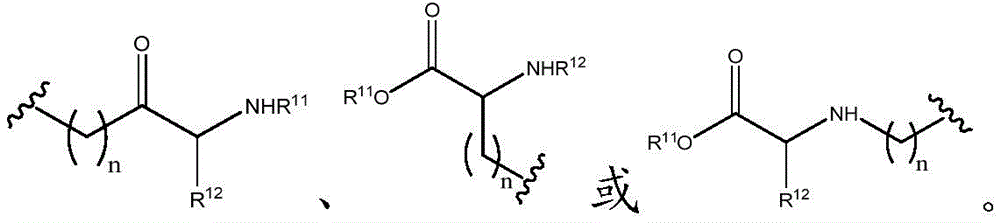
In certain embodiments, Q is NH- (C)1-C6) -an aminoalkyl group;
R10is composed of And
And
n is 0.
In certain embodiments, Q is O- (C)1-C6) Alkyl or NH- (C)1-C6) -an alkyl group or a bond;
R10is composed of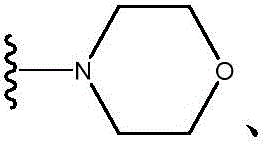 Aryl, heteroaryl, biaryl, benzyl or heterocycle.
In certain embodiments, the pharmaceutically acceptable salt of the compound of formula (I) is an alkylamine salt.
In certain embodiments, the compound of formula (I) is selected from: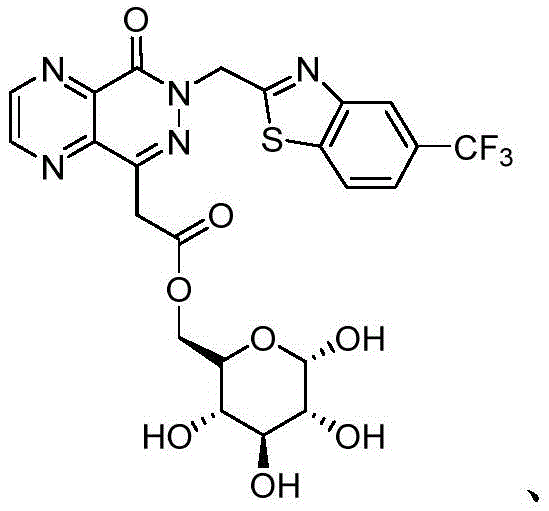

in embodiments of compounds of formula (I), X1Is CR1;X2Is S; x3Is a single bond; x4Is CR4(ii) a Y is C ═ O; z is A1Is S; a. the2Is N, and the compound has the formula (I-4)

Wherein R is5、R6、R7、R8And X5Is defined in formula (I). For example, in various embodiments, R5To R8Each is hydrogen. In certain embodiments, R5、R7、R8Is hydrogen, and R6Is halogen or haloalkyl. In various embodiments, R5、R7、R8Is hydrogen, and R6Is a haloalkyl group. In certain embodiments, R5、R7、R8Is hydrogen, and R6Is CF3. In certain embodiments, R5、R7、R8Is hydrogen, and R6Is halogen. In certain embodiments, R5、R7、R8Is hydrogen, and R6Is F. In certain embodiments, R5、R7、R8Is hydrogen, and R6Is Cl. In a preferred embodiment of formula (I-4), X5Is composed of

In various embodiments, the aldose reductase inhibitors described herein include compounds of formula (II) or pharmaceutically acceptable salts and prodrugs thereof,

wherein,
X1is N or CR1;
X2Is N, CR2Or S;
X3is N, CR3Or a bond;
X4is N or CR4(ii) a With the proviso that when X2When is S, X1Is CR1,X4Is CR4And X3Is a single bond; or X1、X2、X3Or X4Two or three of which are N;
y is a bond, C-O, C-S, C-NH or C-N (C)1-C4) -an alkyl group;
z is
A1Is NR9O, S or CH2;
A2Is N or CH;
A3is NR9O or S;
R1to R8Independently hydrogen, halogen, cyano, acyl, haloalkyl, haloalkoxy, haloalkylthio, trifluoroacetyl, (C)1-C4) -alkyl, (C)1-C4) -alkoxy, (C)1-C4) Alkylthio group(s), (C)1-C4) -alkylsulfinyl or (C)1-C4) -an alkylsulfonyl group; or R1To R4Two of (1) or R5To R8Are together (C)1-C4) -an alkylenedioxy group;
R9is hydrogen, C1-C4Alkyl or C (O) O- (C)1-C4) -an alkyl group;
X6is S (O)2-OR13、S(O)2-NHR13Heteroaryl or heterocycloalkyl; and
R13is H or (C)1-C6) -an alkyl group; or a pharmaceutically acceptable salt thereof.
In various embodiments, the aldose reductase inhibitors described herein encompass the following compounds and pharmaceutically acceptable salts and prodrugs thereof:

in various embodiments, the aldose reductase inhibitors described herein encompass the following compounds and pharmaceutically acceptable salts and prodrugs thereof:
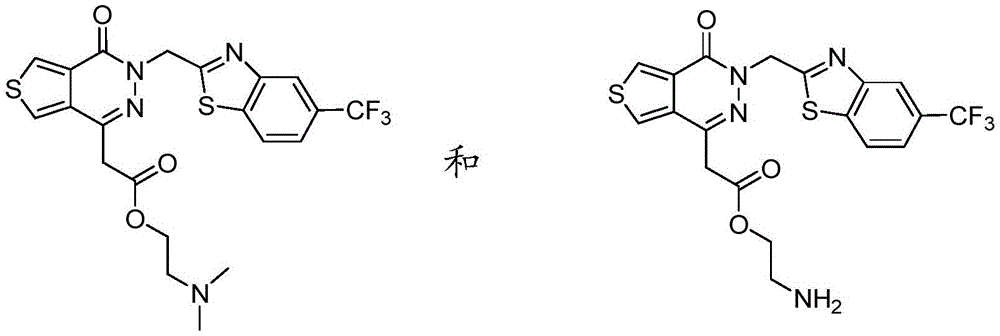
preferred salts of these compounds include the hydrochloride salt.
Synthesis of
The compounds described herein can be prepared according to known methods. Schemes 1-10 represent general synthetic schemes for preparing compounds of formula (I). These schemes are illustrative and are not meant to limit the possible techniques that one skilled in the art can use to prepare the compounds disclosed herein. Different methods will be apparent to those skilled in the art. Various modifications to these methods can be envisioned by those skilled in the art to achieve results similar to those provided by the inventors below. For example, optional protecting Groups may be used, such as described in Greene et al, Protective Groups in Organic Synthesis (4 th edition, 2006).
The compounds of formula (I-1) can generally be prepared, for example, according to scheme 1:

scheme 1
Wherein X1、X2、X3、X4、A1、A2、R5To R9Is as defined above, Q1Is halogen, e.g. Cl, Br, I, etc., or any other leaving group, e.g. OSO2Me, OMs, OTs, OTf, etc.
Compounds of formula (I-2) can generally be prepared, for example, according to scheme 2:
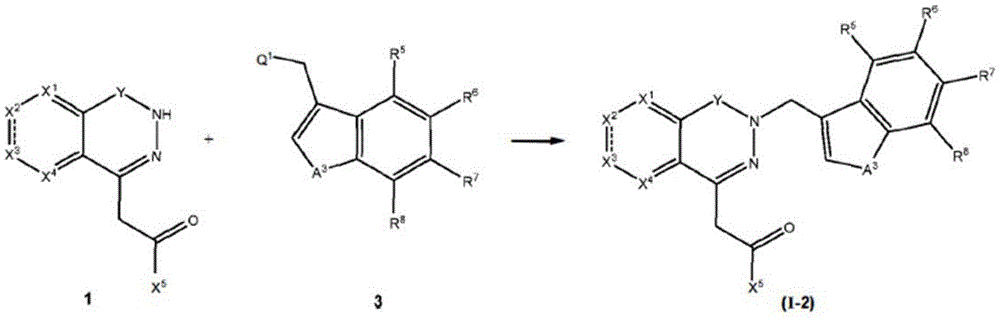
scheme 2
Wherein X1、X2、X3、X4、A3、R5To R9Q1 is halogen, e.g. Cl, Br, I, etc., or any other leaving group, e.g. OSO, as defined above2Me, OMs, OTs, OTf, etc.
Compounds of formula (I-3) can generally be prepared, for example, according to scheme 3: :

scheme 3
Wherein X1、X2、X3、X4、A3、R5To R9Is as defined above, Q1Is halogen, e.g. Cl, Br, I, etc., or any other leaving group, e.g. OSO2Me, OMs, OTs, OTf, etc.
In certain embodiments, the reaction may be carried out in the presence of a base such as potassium tert-butoxide, sodium hydride, sodium methoxide, sodium ethoxide, and the like.
In certain embodiments, the reaction may be carried out using an aprotic solvent such as DMF, THF, NMP, and the like. In certain embodiments, the reaction may be carried out using an alcoholic solvent, such as methanol, ethanol, and the like.
In certain embodiments, the reaction may be carried out at a temperature between about 5 ℃ and about 80 ℃, for example 20 ℃ to 30 ℃.
In certain embodiments, the reaction may be followed by further separation and purification steps, such as chromatography (e.g., flash, HPLC, MPLC, etc.), crystallization, and the like.
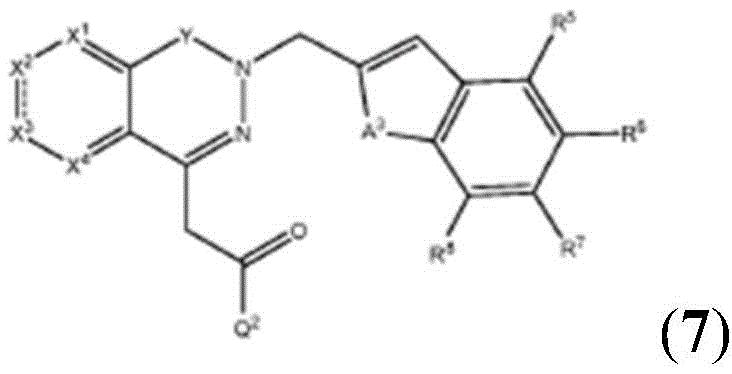
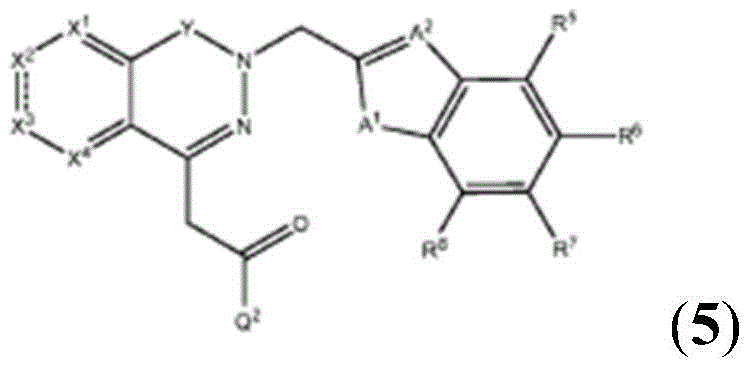
Other suitable reactions are also possible, for example esterification
 To obtain the compounds of formula (I-1), (I-2) or (I-3) in different forms, respectively. For example, having a carboxylic acid group as Q2The compound (e.g., 5) of (a) can be prepared by reacting with a suitable reagent (e.g., thionyl chloride (SOCl)2) Oxalyl radicalChlorine (COCl)2Phosphorus oxychloride (POCl)3) Etc.) followed by activation with a suitable reagent (e.g. (3aR,5S,6S,6aR) -5- ((R) -2, 2-dimethyl-l, 3-dioxolan-4-yl) -2, 2-dimethyltetrahydrofurane [2,3-d ]][l,3]Dioxol-6-ol (9)) to give a compound having 3-glucosyl group as X5The compound of formula (I-1) (i.e., 10).
For example, the following exemplary synthesis may be performed according to scheme 4.
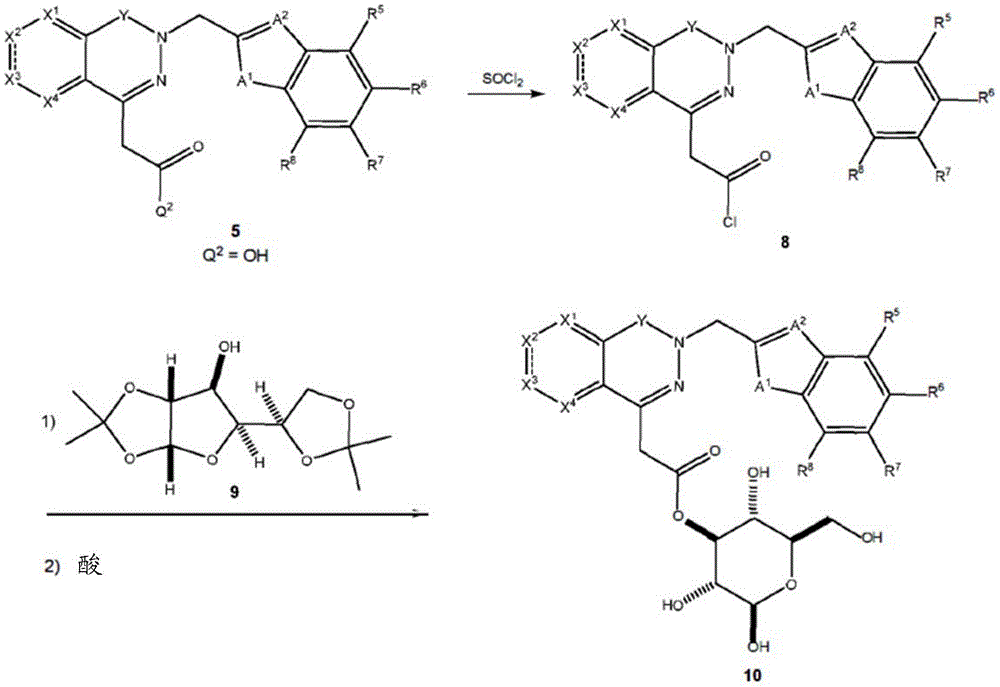
Scheme 4
In certain embodiments, the reaction with compound 9 according to scheme 4 may be carried out in the presence of a base, such as triethylamine, diisopropylethylamine, imidazole, pyridine, and the like.
In certain embodiments, the reaction with compound 9 according to scheme 4 can be carried out in the presence of an additive (e.g., DMAP, etc.). In certain embodiments, the reaction with compound 9 can be carried out in the absence of additives.
In certain embodiments, the reaction with compound 9 according to scheme 4 may be carried out using an aprotic solvent (e.g., DMF, THF, etc.).
In certain embodiments, the acid in the reaction according to scheme 4 may be trifluoroacetic acid (TFA) or the like.
Other suitable esterification reactions of the compounds of formula (5), (6) or (7) make it possible to obtain the compounds of formula (I-1), (I-2) or (I-3) in different forms, respectively. For example, a compound having a carboxylic acid group as Q2 (e.g., 5) can be reacted with compound 9 in the presence of an additive such as N, N' -Dicyclohexylcarbodiimide (DCC), (benzotriazol-1-yloxy) tris (dimethylamino) phosphonium hexafluorophosphate (BOP), Carbonyldiimidazole (CDI), 1-ethyl-3- (3-dimethylaminopropyl) carbodiimide (EDAC), etc., to give a compound having a 3-glucosyl group as X5The compound of formula (I-1) (i.e., 10).
For example, the following exemplary synthesis may be performed according to scheme 5.
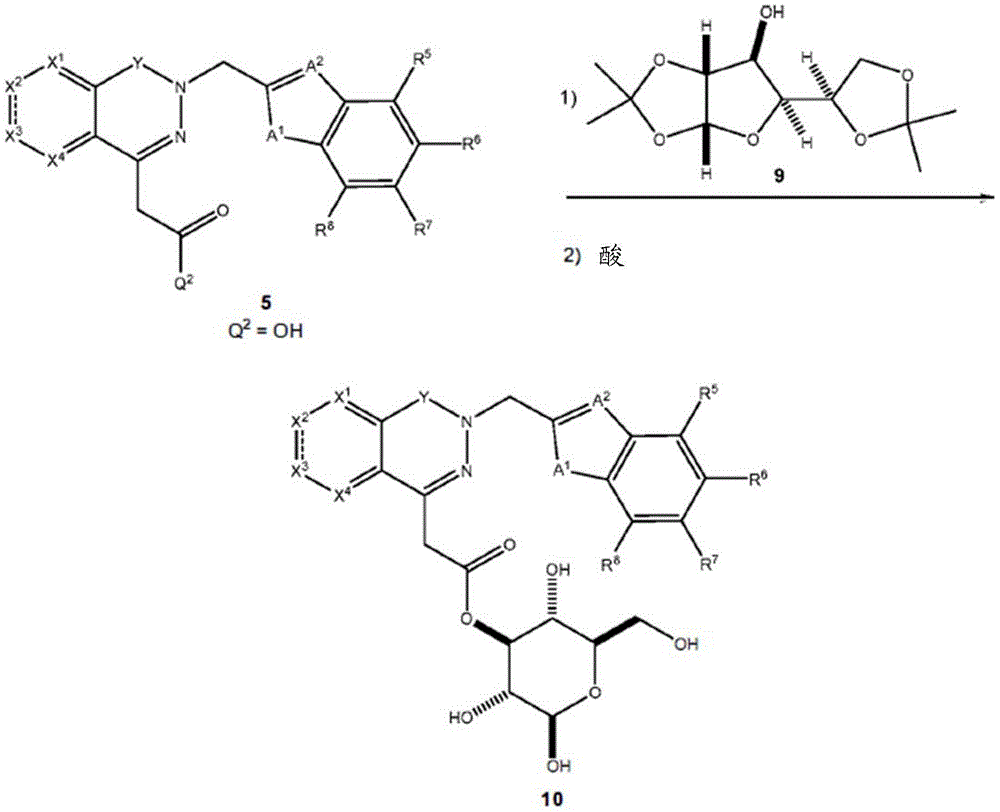
Scheme 5
In certain embodiments, the reaction with compound 9 according to scheme 5 may be carried out in the presence of a base, such as triethylamine, diisopropylethylamine, imidazole, pyridine, and the like.
In certain embodiments, the reaction with compound 9 according to scheme 5 can be carried out with DMAP and DCC, BOP, CDI, EDAC, and the like. In certain embodiments, the reaction with compound 9 according to scheme 5 can be carried out in the absence of DCC, BOP, CDI, EDAC, and the like.
In certain embodiments, the reaction with compound 9 according to scheme 5 may be carried out using an aprotic solvent such as DMF, THF, and the like.
In certain embodiments, the acid in the reaction according to scheme 5 may be trifluoroacetic acid (TFA) or the like.
Other suitable reactions are also possible, for example esterification of compounds of formula (5), (6) or (7) to give compounds of formula (I-1), (I-2) or (I-3) in different forms, respectively. For example, having a carboxylic acid group as Q2Can be esterified by reaction with a suitable reagent such as glucose (11) to give a compound having 6-glucosyl as X5The compound of the formula (I-1) (i.e., (12)).
For example, the following exemplary synthesis may be performed according to scheme 6.
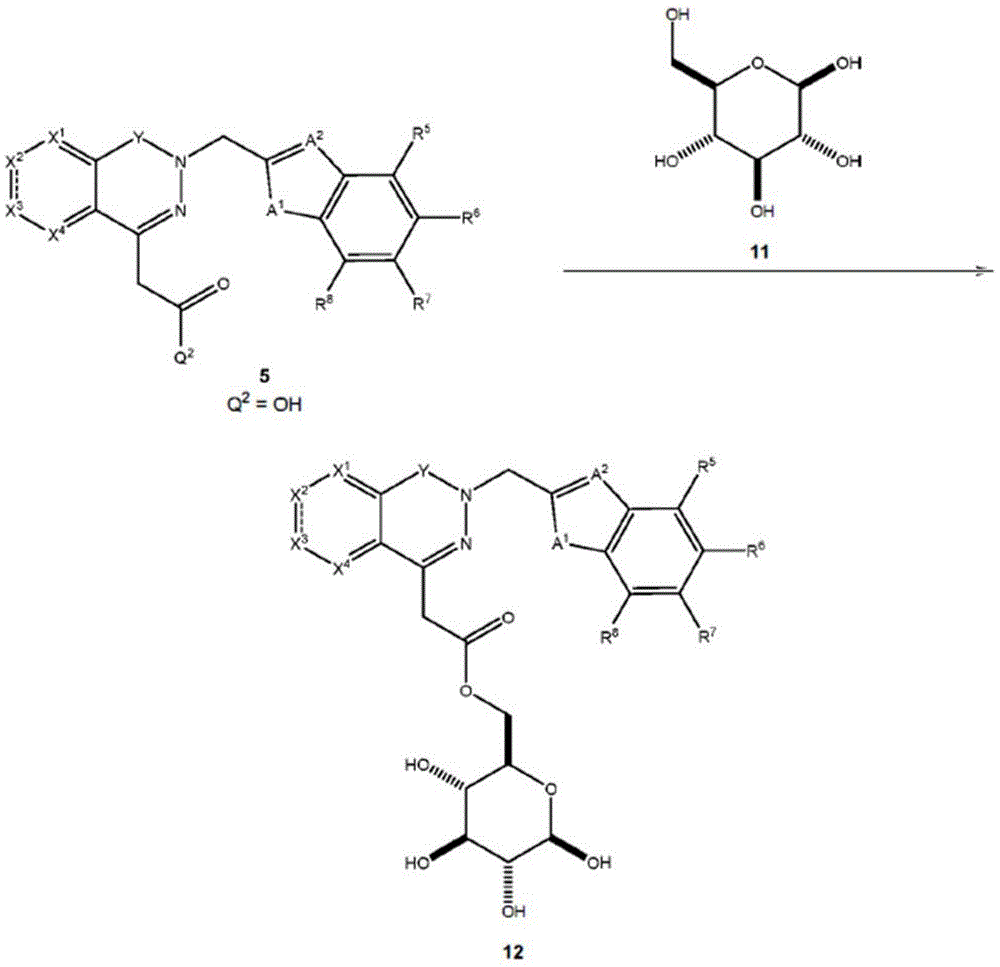
Scheme 6
In certain embodiments, the reaction according to scheme 6 may be carried out in the presence of an enzyme, such as a lipase, a triacylglycerol lipase, and the like.
In certain embodiments, the reaction according to scheme 6 may be carried out in the presence of a solvent, such as t-butanol, acetone, and the like.
In certain embodiments, the reaction may be carried out at a temperature between about 20 ℃ to about 80 ℃, such as 20 ℃ to 30 ℃,30 ℃ to 40 ℃,40 ℃ to 50 ℃, 50 ℃ to 60 ℃, 60 ℃ to 70 ℃, 70 ℃ to 80 ℃, and the like.
Other suitable reactions of the compounds of formula (5), (6) or (7) make it possible to obtain the compounds of formula (I-1), (I-2) or (I-3) in different forms, respectively. For example, having a carboxylic acid group as Q2The compound of (e.g., 5) can be reacted with a suitable reagent (e.g., thionyl chloride (SOCl)2) Oxalyl chloride (COCl)2Phosphorus oxychloride (POCl)3) Etc.) followed by reaction with a suitable reagent (e.g., HO-Q-R)10(13)、H2N-Q-R10(14) Etc.) to give a compound of the formula (I-1), for example compound 15 or compound 16.
For example, the following exemplary synthesis may be performed according to scheme 7.
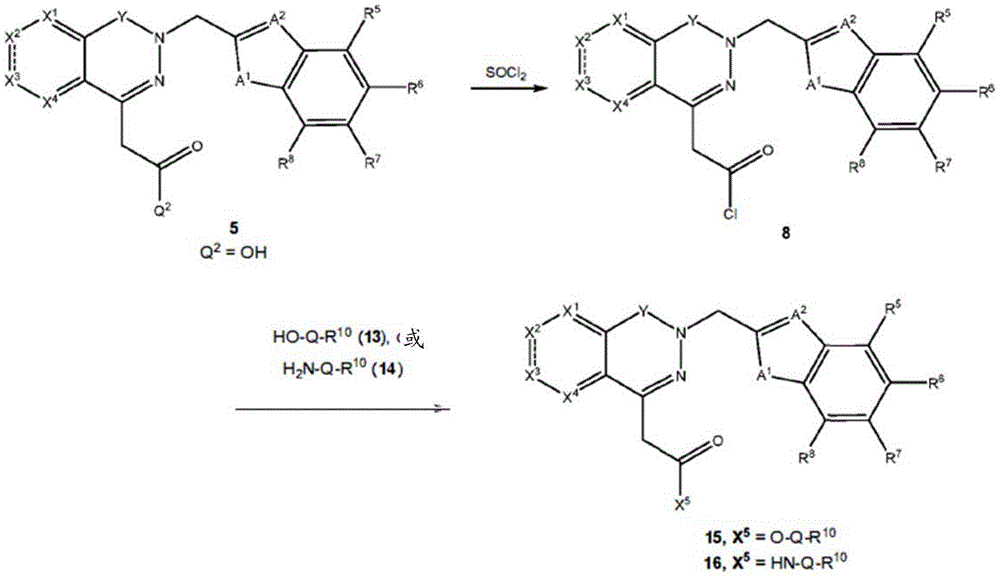
Scheme 7
In certain embodiments, the reaction according to scheme 7 may be carried out by reacting with oxalyl chloride (COCl)2Phosphorus oxychloride (POCl)3) Substitution of thionyl chloride (SOCl) with Iso2) To proceed with.
In certain embodiments, the reaction with compound 13 or 14 according to scheme 7 may be carried out in the presence of a base, such as triethylamine, diisopropylethylamine, imidazole, pyridine, and the like.
In certain embodiments, the reaction with compound 13 or 14 according to scheme 7 may be carried out in the presence of an additive such as DMAP and the like. In certain embodiments, the reaction with compound 9 can be carried out in the absence of additives.
In certain embodiments, the reaction with compound 13 or 14 according to scheme 7 may be carried out using an aprotic solvent such as DMF, THF, and the like.
In certain embodiments, compounds such as 13 or 14 comprise protecting Groups, which may be removed as described in Greene et al, Protective Groups in Organic Synthesis (4 th edition, 2006)And (4) removing. For example, having a carboxylic acid group as Q2The compound of (e.g., (5)) can be reacted with a suitable reagent, such as thionyl chloride (SOC 1)2) Oxalyl chloride (COCl)2Phosphorus oxychloride (POCl)3) Etc.) and then reacted with a suitable reagent, such as benzyl (1- ((2-aminoethyl) amino) -1-oxoprop-2-yl) carbamate (18), etc., to afford compound 19. Deprotection of compound 19 affords compounds of formula 20.
For example, the following exemplary synthesis may be performed according to scheme 8.
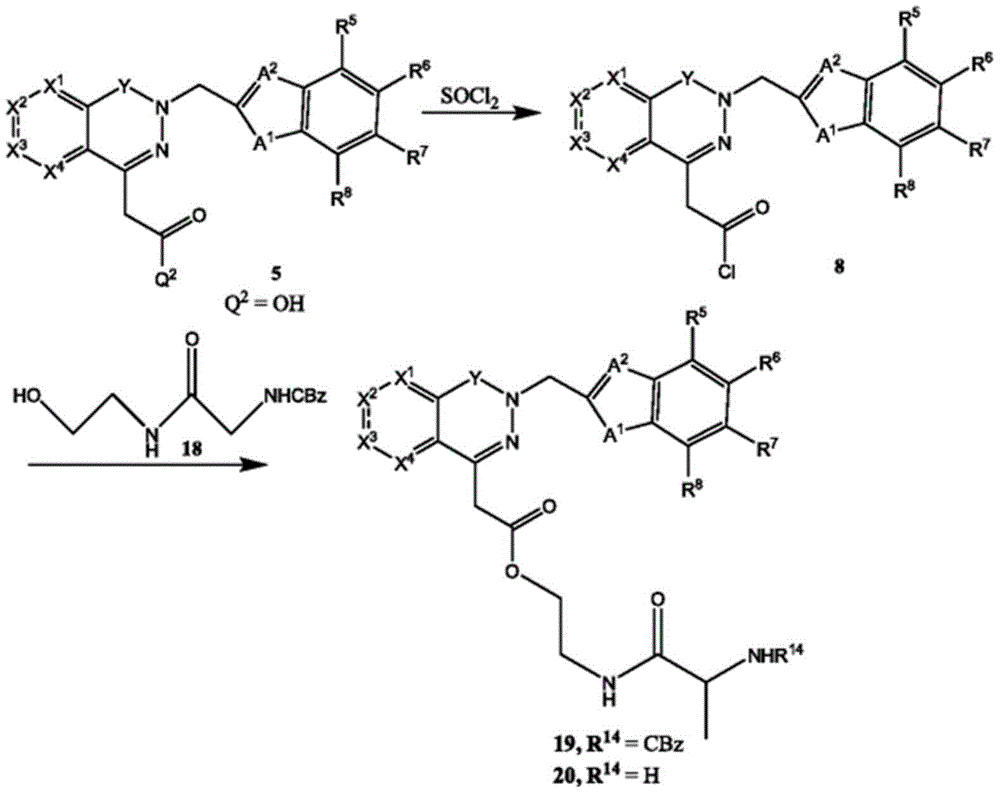
Scheme 8
Other suitable reactions of the compounds of formula (5), (6) or (7) make it possible to obtain the compounds of formula (I-1), (I-2) or (I-3) in different forms, respectively. For example, having a carboxylic acid group as Q2The compound of (e.g., 5) can be reacted with a suitable reagent such as HO-Q-R in the presence of an additive such as N, N' -Dicyclohexylcarbodiimide (DCC), (benzotriazol-1-yloxy) tris (dimethylamino) phosphonium hexafluorophosphate (BOP), Carbonyldiimidazole (CDI), 1-ethyl-3- (3-dimethylaminopropyl) carbodiimide (EDAC), and the like10(13)、H2N-Q-R10(14) And the like to give a compound of the formula (I-1), for example, compound 15 or 16.
For example, the following exemplary synthesis may be performed according to scheme 9.

Scheme 9
In certain embodiments, the reaction with compound 9 according to scheme 9 may be carried out in the presence of a base, such as triethylamine, diisopropylethylamine, imidazole, pyridine, and the like.
In certain embodiments, the reaction according to scheme 9 can be carried out with DMAP and DCC, BOP, CDI, EDAC, and the like. In certain embodiments, the reaction according to scheme 9 may be carried out in the absence of DCC, BOP, CDI, EDAC, or the like.
In certain embodiments, the reaction according to scheme 9 may be carried out using an aprotic solvent such as DMF, THF, and the like.
Other suitable reactions of the compounds of formula (5), (6) or (7) make it possible to obtain the compounds of formula (I-1), (I-2) or (I-3) in different forms, respectively. For example, having a carboxylic acid group as Q2The compound (e.g., 5) can be reacted with a suitable reagent such as X in the presence of an additive such as tetra-n-butylammonium bromide (TBAB), tetra-n-butylammonium iodide (TBAI), tetra-n-butylammonium chloride (TBAC), and the like6-Q-R10(17) (wherein X6Is halogen) to give a compound of the formula (I-1), for example compound 15.
For example, the following exemplary synthesis may be performed according to scheme 10.

Scheme 10
In certain embodiments, X6-Q-R10(17) Is Cl-Q-R10. In certain embodiments, X6-Q-R10(17) Is Br-Q-R10. In certain embodiments, X6-Q-R10(17) Is I-Q-R10。
In certain embodiments, the reaction according to scheme 10 may be carried out in the presence of a base such as triethylamine, diisopropylethylamine, imidazole, pyridine, and the like.
In certain embodiments, the reaction according to scheme 10 may be carried out in the absence of TBAI, TBAB or TBAC.
In certain embodiments, the reaction according to scheme 10 may be carried out using an aprotic solvent such as DMF, THF, and the like.
The compounds of the formula (I-2) can generally also be prepared according to schemes 4 to 9 by using Instead of the former
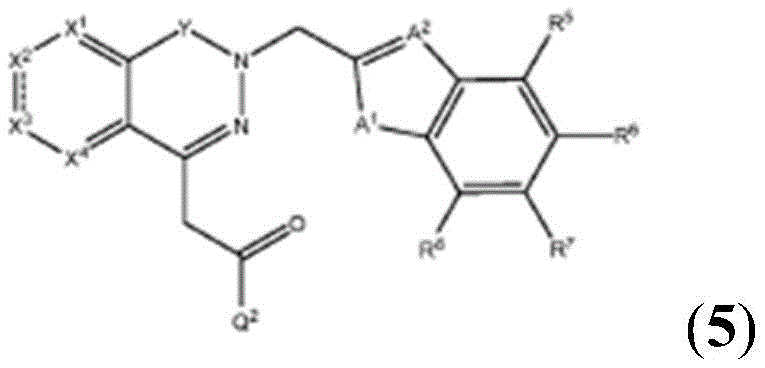 To prepare the compound. Similarly, the compounds of formula (I-3) can generally also be prepared according to schemes 4-9 by using
 Instead of the former
 To prepare the compound.
Illustrative descriptions regarding the synthesis of certain compounds of formula (I-1), formula (I-2), and formula (I-3) are described in U.S. Pat. No. 8,916,563 and WO 2017/038505; the entire contents of each of which are incorporated herein by reference.
Compounds of formulae (5), (6) and (7)
Exemplary illustrations regarding the synthesis of certain compounds of formulae (5), (6), and (7) are described in U.S. patent No. 8,916,563 and WO 2017/38505; the entire contents of each of which are incorporated herein by reference.
A compound of formula (1)
Exemplary illustrations of certain compounds of formula (1) are described in U.S. patent No. 8,916,563 and WO 2017/38505; the entire contents of each of which are incorporated herein by reference.
Compounds of formulae (2), (3) and (4)
Exemplary illustrations regarding the synthesis of certain compounds of formulae (2), (3), and (4) are described in U.S. patent No. 8,916,563 and WO 2017/038505; the entire contents of each of which are incorporated herein by reference.
Additional exemplary syntheses for the synthesis of certain compounds of formulae (2), (3), and (4) are described in j.med.chem. (1991), vol.34, pp.108-122; med, chem. (1992), volume 35, phase 3, page 457-; and U.S. patent No. 8,916,563; the entire contents of each of which are incorporated herein by reference.
Exemplary prodrug esters can be prepared as described by Placzek et al, Bioorganic & Medicinal Chemistry 2016,24, 5842-.
The compounds or compositions of the invention are useful in applications that benefit from the inhibition of aldose reductase. Exemplary uses of aldose reductase inhibition can be found in, for example, U.S. patent nos. 8,916,563; 9,650,383, respectively; 5,677,342, respectively; 5,155,259, respectively; 4,939,140, respectively; U.S. publication Nos. US 2006/0293265; WO 2017/223179; danish patent application DK 2326632; U.S. publication No. 2017/0224651; korean patent application KR1020090084439, respectively; U.S. publication No. 2017/0319584; korean patent No. 1020120055370; journal of Cerebral Blood Flow of Lo et al&Metabolism 2007,27, 1496-1509; BMC complete alternative Med 2016,16,437, Ip et al; brain Res 2010,118-129, Shen et al; pharmacotherapy 2008,28(5),646-55, to Ramirez et al; PLoS One 2013,8(4) of Tang et al; pacher, NIH Grant 1Z01AA 000375-03; and Diabetes Research and Clinical Practice 1990,10(1), 91-97; and the references cited therein; the entire contents of each of which are incorporated herein by reference. Inhibition of Aldose Reductase has also been found to prevent Metastasis of Colon Cancer and mitosis in Colon Cancer cells (see, e.g., Tammali, r.et al, Inhibition of Aldose Reductase inventories Colon Cancer Metastasis, Carcinogenesis 2011 doi 10.1093/carcin/bgrl 02; published online: 6/3/2011; Angiogenesis 2011 May; 14(2): 209-21; and mol. Cancer ther.2010, Apr; 9(4): 813-824; the entire contents of each of which are incorporated herein by reference).
In certain embodiments, the compounds and/or compositions of the present invention are useful for promoting healthy aging of skin, treating skin disorders, treating angiogenic disorders such as cancer (including colon cancer), treating non-cardiac tissue damage, treating cardiovascular disorders, treating renal disorders, treating progressive myocardial infarction, treating ischemic injury, and treating various other disorders, such as complications resulting from diabetes. Such diseases may include, but are not limited to, atherosclerosis, coronary artery disease, diabetic nephropathy, diabetic neuropathy, diabetic retinopathy, skin infections, peripheral vascular disease, stroke, asthma, and the like.
In certain embodiments, the compounds and/or compositions of the invention are useful for treating stroke, ischemic stroke, tissue damage, brain damage, nerve damage, autoimmune disease, and galactosemia in a subject. In certain embodiments, the compounds and/or compositions of the present invention are useful for treating stroke in a subject. In certain embodiments, the compounds and/or compositions of the present invention may be used to treat ischemic stroke in a subject. In certain embodiments, the compounds and/or compositions of the present invention may be used to treat tissue damage in a subject. In certain embodiments, the compounds and/or compositions of the present invention may be used to treat brain damage in a subject. In certain embodiments, the compounds and/or compositions of the present invention may be used to treat neurological damage in a subject. In certain embodiments, the compounds and/or compositions of the invention may be used to treat an autoimmune disease in a subject. In certain embodiments, the compounds and/or compositions of the present invention may be used to treat galactosemia in a subject. The compounds and/or compositions described herein can be administered to a subject in need thereof to treat PMM 2-CDG.
The compounds and/or compositions described herein can be administered to a subject in need thereof to treat skin aging. Thus, the methods disclosed herein may reduce or delay the signs of skin aging, such as the appearance of, for example, fine lines, wrinkles, folds, and creped skin, as well as loss of skin elasticity or firmness. In the practice of the disclosed methods, the aldose reductase inhibitor can be topically applied to the skin, for example, by application to a surface of the skin (e.g., a topical formulation containing the aldose reductase inhibitor). The aldose reductase inhibitor may be applied to the surface of any desired area of the skin. For example, the aldose reductase inhibitor may be applied to skin surfaces that are typically exposed to social environments, such as the skin of the face, neck, chest, arms, hands, or any combination of the foregoing, to reduce or delay skin aging in these skin areas.
In certain embodiments, the compounds and/or compositions of the present invention are useful for cardiovascular applications. For example, the compounds and/or compositions of the present invention may be used to treat patients undergoing cardiac bypass surgery to improve post-operative recovery. In additional examples, the compounds and/or compositions of the present invention may be used to inhibit or reduce the accumulation or rapid onset of atherosclerotic plaques. In additional examples, the compounds and/or compositions of the invention may be used to treat cardiomyopathy. In additional examples, the compounds and/or compositions of the invention may be used to treat diabetic cardiomyopathy.
In some other embodiments, the compounds and/or compositions of the present invention may be used for topical application. For example, the compounds and/or compositions of the present invention may be used to slow or reduce skin aging.
In certain embodiments, the compounds disclosed herein can be administered to a subject in need of treatment at a dosage range of about 0.5 to about 25mg/kg body weight of the subject to be treated per day, e.g., about 1.0 to 10 mg/kg. However, other variations are also within the scope of the invention.
The compounds disclosed herein can be administered alone or in combination with pharmaceutically acceptable carriers such as diluents, fillers, aqueous solutions and even organic solvents. The compounds and/or compositions of the present invention may be administered as tablets, powders, lozenges, syrups, injections, and the like. Other ingredients, such as flavoring agents, binders, excipients, and the like are also within the scope of the invention.
In certain embodiments, a pharmaceutically acceptable composition may contain a compound disclosed herein (e.g., a compound of formula (I)) and/or a pharmaceutically acceptable salt thereof at a concentration ranging from about 0.01 to about 2 wt%, such as 0.01 to about 1 wt% or about 0.05 to about 0.5 wt%. The composition may be formulated as a solution, suspension, ointment, capsule, or the like. The pharmaceutical compositions may be prepared as aqueous solutions and may contain additional components such as preservatives, buffers, tonicity adjusting agents, antioxidants, stabilizers, viscosity adjusting ingredients and the like.
Other modes of administration may be found in U.S. patent 4,939,140, which is incorporated herein by reference in its entirety.
In certain embodiments, the present invention provides the use of a pharmaceutical composition and/or medicament comprising a compound of formula (I), or a pharmaceutically acceptable salt, hydrate, solvate or prodrug thereof, in a method of treating a disease state and/or condition caused by or associated with aldose reductase.
In certain embodiments, the method of treatment comprises the steps of: (i) identifying a subject in need of such treatment; (ii) providing a compound disclosed herein or a pharmaceutically acceptable salt, hydrate, solvate, or prodrug thereof; and (iii) administering the compound in a therapeutically effective amount to treat, inhibit and/or prevent a disease state or disorder in a subject in need of such treatment.
In certain embodiments, the method of treatment comprises the steps of: (i) identifying a subject in need of such treatment; (ii) providing a composition comprising a compound as disclosed herein or a pharmaceutically acceptable salt, hydrate, solvate, or prodrug thereof; and (iii) administering the composition in a therapeutically effective amount to treat, inhibit and/or prevent a disease state or condition in a subject in need of such treatment.
In certain embodiments, the subject in need thereof is an animal. In another embodiment, the patient in need thereof is an animal. Animals include all members of the kingdom animalia, but are not limited to humans, mice, rats, cats, monkeys, dogs, horses, and pigs. In some embodiments, the subject in need thereof is a human. In some embodiments, the subject in need thereof is a mouse, rat, cat, monkey, dog, horse, or pig. In some embodiments, the patient in need thereof is a human. In some embodiments, the patient in need thereof is a mouse, rat, cat, monkey, dog, horse, or pig.
In certain embodiments, the compound or composition is administered orally. In certain embodiments, the compound or composition is administered intravenously.
In certain embodiments, the method comprises administering to the subject an effective amount of a compound disclosed herein, or a pharmaceutically acceptable salt, solvate, hydrate, or prodrug thereof; or a composition comprising a compound as disclosed herein, or a pharmaceutically acceptable salt, solvate, hydrate, or prodrug thereof, and a pharmaceutically acceptable carrier.
Pharmaceutically acceptable carriers are well known to those skilled in the art and include, for example, adjuvants, diluents, excipients, fillers, lubricants and vehicles. In some embodiments, the carrier is a diluent, adjuvant, excipient, or vehicle. In some embodiments, the carrier is a diluent, adjuvant, or excipient. In some embodiments, the carrier is a diluent or adjuvant. In some embodiments, the carrier is an excipient. Generally, pharmaceutically acceptable carriers are chemically inert to the active compound and non-toxic under the conditions of use. Examples of pharmaceutically acceptable carriers may include, for example, water or saline solution, polymers such as polyethylene glycol, carbohydrates and derivatives thereof, oils, fatty acids or alcohols. Non-limiting examples of oils as pharmaceutical carriers include those of petroleum, animal, vegetable or synthetic origin, such as peanut oil, soybean oil, mineral oil, sesame oil and the like. The pharmaceutical carrier may also be saline, gum arabic, gelatin, starch paste, talc, keratin, colloidal silicon dioxide, urea, and the like. In addition, adjuvants, stabilizers, thickeners, lubricants and colorants may be used. Other examples of suitable Pharmaceutical carriers are described in, for example, Remington's The Science and Practice of Pharmacy, 22 nd edition, (Allen, Loyd V., Jr eds., Pharmaceutical Press (2012)); modem pharmaceuticals, fifth edition, (Alexander t. florence, Juergen Siepmann, CRC Press (2009)); handbook of Pharmaceutical Excipients, 7 th edition, (Rowe, Raymond C.; Sheskey, Paul J.; Cook, Walter G.; Fenton, Marian E.eds.; Pharmaceutical Press (2012)) (the entire contents of each of which are incorporated herein by reference).
In one embodiment, the pharmaceutical composition is a mixture of one or more compounds described herein, or a pharmaceutically acceptable salt, solvate, prodrug, or hydrate thereof, with other chemical components, such as physiologically acceptable carriers and excipients. The purpose of the pharmaceutical composition is to facilitate administration of the compound to an organism or subject.
In certain embodiments, a method of treating, preventing and/or inhibiting a disease state or disorder or condition associated with aldose reductase comprises the steps of: (i) identifying a subject in need of such treatment; (ii) providing a compound disclosed herein or a pharmaceutically acceptable salt, solvate, hydrate, or prodrug thereof; or a composition comprising a compound as disclosed herein, or a pharmaceutically acceptable salt, solvate, hydrate, or prodrug thereof, and a pharmaceutically acceptable carrier; and (iii) administering the compound or composition in a therapeutically effective amount to treat, prevent and/or inhibit a disease state or disorder or condition associated with aldose reductase in a subject in need of such treatment.
"prodrug" or "prodrug" refers to an agent that is converted in vivo to an active drug. Prodrugs are often useful because, in some cases, they are easier to administer than the parent drug. They are bioavailable, for example by oral administration, whereas the parent drug is bioavailable, less or not. In some embodiments, the prodrug has improved solubility in the pharmaceutical composition over the parent drug. For example, the compounds carry protecting groups which are removed in vivo to release the active compound. The term "prodrug" may apply to such functional groups, for example the acid functional group of the compound of formula (I). Prodrugs may consist of structures in which the acid group is masked, for example, as an ester or amide. Other examples of prodrugs are discussed herein, and for example, Alexander et al, discussed in j.med.chem.1988,31,318 (the entire contents of each of which are incorporated herein by reference).
In certain embodiments, the invention also includes methods of administering prodrugs of compounds of formula (I) and/or pharmaceutical compositions thereof. Prodrugs include derivatives of compounds that may be hydrolyzed, oxidized, or otherwise reacted under biological conditions (in vitro or in vivo) to provide the active compounds of the invention. Examples of prodrugs include, but are not limited to, derivatives and metabolites of the compounds of the present invention, which include biohydrolyzable moieties such as biohydrolyzable amides, biohydrolyzable esters, biohydrolyzable carbamates, biohydrolyzable carbonates, and biohydrolyzable phosphate analogs. Prodrugs may consist of structures in which the acid group is masked, for example, as an ester or amide. Other examples of prodrugs are discussed, for example, by Alexander et al, J.Med.chem.1988,31,318 and in The Practice of Medicinal Chemistry (Camile Wermuth, ed.,1999, Academic Press; The entire contents of which are incorporated herein by reference). Prodrugs are often useful because, in some cases, they are easier to administer than the parent drug. They are bioavailable, for example by oral administration, whereas the parent drug is bioavailable, less or not. In some embodiments, the prodrug has improved solubility in the pharmaceutical composition over the parent drug. For example, the compound carries a protecting group which is removed in vivo, thereby releasing the active compound. In some cases, the prodrug provides enhanced permeability across the blood-brain barrier relative to the parent compound. In some embodiments, the prodrug utilizes a transport mechanism across the blood brain barrier.
In certain embodiments, prodrugs of compounds having carboxy functionality are of carboxylic acids (C)1-C4) An alkyl ester. The carboxylic acid ester is suitably formed by esterifying any carboxylic acid moieties present on the molecule. Prodrugs can generally be prepared using well known methods, such as those described by Burger's Medicinal Chemistry and Drug Discovery, 6 th edition, (Donald J. Abraham ed.,2001, Wiley) and Design and Application of Pro-drugs (H.Bundgaard ed.,1985, Harwood Academic Publishers Gmfh; the entire contents of each of which are incorporated herein by reference). The biohydrolyzable moiety of the compound of formula (I) does not interfere with the biological activity of the compound, but may confer on the compound advantageous properties in vivo, such as uptake, duration of action or onset of action; or (ii) may be biologically inactive but converted in vivo to a biologically active compound. Examples of biohydrolyzable esters include, but are not limited to (C)1-C4) Alkyl esters, alkoxyacyloxy esters, alkylamidoalkyl esters, and choline esters. Examples of biohydrolyzable amides include, but are not limited to (C)1-C4) Alkyl amides, alpha-amino acid amides, alkoxy amides, and alkylaminoalkylcarbonyl amides. Examples of biohydrolyzable carbamates include, but are not limited to, (C)1-C4) Alkylamines, substituted ethylenediamines, amino acids, hydroxyalkylamines, heterocyclic and heteroaromatic amines and polyether amines.
In certain embodiments, the biohydrolyzable moiety is a compound comprising (C)1-C6) -alkyl linker, (C)1-C6) -hydroxyalkylLinking group, (C)1-C6) -an ester of an aminoalkyl linker, an aryl linker, a heteroaryl linker, a biaryl linker or a benzyl linker. In some embodiments, the biohydrolyzable moiety is a compound comprising (C)1-C6) -alkyl linker, (C)1-C6) -hydroxyalkyl linker, (C)1-C6) -esters of aminoalkyl linkers. In some embodiments, the biohydrolyzable moiety is a compound comprising (C)1-C6) -alkyl linker or (C)1-C6) -esters of hydroxyalkyl linkers. In some embodiments, the biohydrolyzable moiety is a compound comprising (C)1-C6) -alkyl linker or (C)1-C6) -esters of aminoalkyl linkers. In some embodiments, the biohydrolyzable moiety is a compound comprising (C)1-C6) A hydroxyalkyl linker or (C)1-C6) -esters of aminoalkyl linkers. In some embodiments, the biohydrolyzable moiety is an ester comprising an aryl linker, a heteroaryl linker, a biaryl linker, or a benzyl linker. In certain embodiments, the biohydrolyzable moiety is an ester comprising an aryl linker, a heteroaryl linker, or a benzyl linker. In some embodiments, the biohydrolyzable moiety is an ester comprising an aryl linker or a benzyl linker. In some embodiments, the biohydrolyzable moiety is an ester comprising an aryl linker or a heteroaryl linker.
In some embodiments, the biohydrolyzable moiety is a compound comprising (C)1-C6) -alkyl linker, (C)1-C6) -hydroxyalkyl linker, (C)1-C6) -amides of aminoalkyl, aryl, heteroaryl, biaryl or benzyl linkers. In some embodiments, the biohydrolyzable moiety is a compound comprising (C)1-C6) -alkyl linker, (C)1-C6) A hydroxyalkyl linker or (C)1-C6) -amides of aminoalkyl linkers. In some embodiments, the biohydrolyzable moiety is a compound comprising (C)1-C6) -alkyl linker or (C)1-C6) -amides of hydroxyalkyl linkers. In some embodiments, the biohydrolyzable moiety is a compound comprising (C)1-C6) Alkyl linking group or (C)1-C6) -amides of aminoalkyl linkers. In some embodiments, the biohydrolyzable moiety is a compound comprising (C)1-C6) A hydroxyalkyl linker or (C)1-C6) Amides of aminoalkyl linkers. In some embodiments, the biohydrolyzable moiety is an amide comprising an aryl linker, a heteroaryl linker, a biaryl linker, or a benzyl linker. In some embodiments, the biohydrolyzable moiety is an amide comprising an aryl linker, a heteroaryl linker, or a benzyl linker. In some embodiments, the biohydrolyzable moiety is an amide comprising an aryl linker or a benzyl linker. In some embodiments, the biohydrolyzable moiety is an amide comprising an aryl linker or a heteroaryl linker.
In certain embodiments, the compounds of the invention are formulated into pharmaceutical compositions for administration to a subject in a biologically compatible form suitable for in vivo administration. According to a further aspect, the present invention provides a pharmaceutical composition comprising a compound of formula (I) in admixture with a pharmaceutically acceptable diluent and/or carrier. A pharmaceutically acceptable carrier is "acceptable" in the sense of being compatible with the other ingredients of the composition and not deleterious to the recipient thereof. The pharmaceutically acceptable carrier used herein may be selected from various organic or inorganic materials used as materials for pharmaceutical formulations, and incorporated as analgesics, buffers, binders, disintegrants, diluents, emulsifiers, excipients, extenders, glidants, solubilizers, stabilizers, suspending agents, tonicity adjusting agents, vehicles and viscosity increasing agents. Pharmaceutical additives such as antioxidants, aromatics, colorants, flavor modifiers, preservatives and sweeteners may also be added. Examples of acceptable pharmaceutical carriers include carboxymethylcellulose, crystalline cellulose, glycerin, gum arabic, lactose, magnesium stearate, methylcellulose, powders, saline, sodium alginate, sucrose, starch, talc, water, and the like. In one embodiment, the term "pharmaceutically acceptable" means approved by a regulatory agency of the federal or a state government or listed in the U.S. pharmacopeia or other generally recognized pharmacopeia for use in animals, and more particularly in humans.
Surfactants such as detergents are also suitable for use in the formulation. Specific examples of the surfactant include polyvinylpyrrolidone, polyvinyl alcohol, a copolymer of vinyl acetate and vinylpyrrolidone, polyethylene glycol, benzyl alcohol, mannitol, glycerin, sorbitol, or polyoxyethylene esters of sorbitan; lecithin or sodium carboxymethyl cellulose; or acrylic acid derivatives such as methacrylic acid esters and the like, anionic surfactants such as basic stearates, in particular sodium, potassium or ammonium stearate; calcium stearate or triethanolamine stearate; alkyl sulfates, especially sodium lauryl sulfate and sodium cetyl sulfate; sodium dodecylbenzene sulfonate or dioctyl sodium sulfosuccinate; or fatty acids, especially those derived from coconut oil, cationic surfactants, e.g. of formula N+Water-soluble quaternary ammonium salts of R 'R' Y-, wherein the R groups are the same or different optionally hydroxylated hydrocarbon groups, Y-is an anion of a strong acid, such as halide, sulfate, and sulfonate anions; cetyl trimethylammonium bromide is one of the cationic surfactants that can be used, an amine salt of the formula N + R 'R "R'", wherein the R groups are the same or different, optionally hydroxylated hydrocarbon groups; octadecylamine hydrochloride is one of the cationic surfactants that can be used, nonionic surfactants such as optionally polyoxyethylated sorbitan esters, in particular polysorbate 80, or polyoxyethylated alkyl ethers; polyethylene glycol stearate, polyoxyethylated derivatives of castor oil, polyglycerol esters, polyoxyethylated fatty alcohols, polyoxyethylated fatty acids or copolymers of ethylene oxide and propylene oxide, substituted lauryl compounds of amphoteric surfactants such as betaine.
When administered to a subject, the compound of formula (I) and pharmaceutically acceptable carrier may be sterile. Suitable pharmaceutical carriers may also include excipients such as starch, glucose, lactose, sucrose, gelatin, malt, rice, flour, chalk, silica gel, sodium stearate, glycerol monostearate, talc, sodium chloride, dried skim milk, glycerol, propylene glycol, ethylene glycol, polyethylene glycol 300, water, ethanol, polysorbate 20 and the like. The compositions of the present invention may also contain minor amounts of wetting or emulsifying agents, or pH buffering agents, if desired.
The pharmaceutical formulations of the present invention are prepared by methods well known in the pharmaceutical arts. Optionally, one or more auxiliary ingredients (e.g., buffers, flavoring agents, surfactants, etc.) are also added. The choice of carrier is determined by the solubility and chemical nature of the compound, the chosen route of administration, and standard pharmaceutical practice.
In addition, the compounds and/or compositions of the present invention are administered to a human or animal subject by known methods including oral, sublingual or buccal administration. In one embodiment, the compounds and/or compositions are administered orally.
For oral administration, the formulations of the compounds of the present invention may be presented in dosage forms such as capsules, tablets, powders, granules, or as suspensions or solutions. The capsule formulation may be gelatin, a soft gel or a solid. Tablet and capsule formulations may further contain one or more adjuvants, binders, diluents, disintegrants, excipients, fillers or lubricants, each of which is known in the art. Examples of such substances include carbohydrates such as lactose or sucrose, dibasic anhydrous dibasic calcium phosphate, corn starch, mannitol, xylitol, cellulose or derivatives thereof, microcrystalline cellulose, gelatin, stearates, silicon dioxide, talc, sodium starch glycolate, gum arabic, flavoring agents, preservatives, buffering agents, disintegrating agents and coloring agents. Compositions for oral administration may contain one or more optional agents, for example sweetening agents, such as fructose, aspartame or saccharin; flavoring agents, such as peppermint, oil of wintergreen, or cherry; a colorant; and preservatives to provide pharmaceutically palatable preparations.
In some embodiments, the composition is in unit dosage form, such as a tablet, capsule, or single dose vial. Suitable unit dosages, i.e. therapeutically effective amounts, can be determined during clinical trials, which are suitably designed for each condition for which administration of the selected compound is indicated, and, of course, the dosage will vary according to the desired clinical endpoint.
According to the methods of the invention, the compounds of the invention are administered to a subject in a therapeutically effective amount, e.g., to reduce or ameliorate a symptom associated with aldose reductase activity in the subject. This amount is readily determined by the skilled artisan based on known methods, including analysis of titration curves established in vivo and the methods and assays disclosed herein.
In certain embodiments, the methods comprise administering a therapeutically effective dose of a compound of the invention. In some embodiments, the therapeutically effective dose is at least about 0.05mg/kg body weight, at least about 0.1mg/kg body weight, at least about 0.25mg/kg body weight, at least about 0.3mg/kg body weight, at least about 0.5mg/kg body weight, at least about 0.75mg/kg body weight, at least about 1mg/kg body weight, at least about 2mg/kg body weight, at least about 3mg/kg body weight, at least about 4mg/kg body weight, at least about 5mg/kg body weight, at least about 6mg/kg body weight, at least about 7mg/kg body weight, at least about 8mg/kg body weight, at least about 9mg/kg body weight, at least about 10mg/kg body weight, at least about 15mg/kg body weight, at least about 20mg/kg body weight, at least about 25mg/kg body weight, at least about 30mg/kg body weight, at least about 40mg/kg body weight, at least about, At least about 50mg/kg body weight, at least about 75mg/kg body weight, at least about 100mg/kg body weight, at least about 200mg/kg body weight, at least about 250mg/kg body weight, at least about 300mg/kg body weight, at least about 350mg/kg body weight, at least about 400mg/kg body weight, at least about 450mg/kg body weight, at least about 500mg/kg body weight, at least about 550mg/kg body weight, at least about 600mg/kg body weight, at least about 650mg/kg body weight, at least about 700mg/kg body weight, at least about 750mg/kg body weight, at least about 800mg/kg body weight, at least about 900mg/kg body weight, or at least about 1000mg/kg body weight. It will be appreciated that any dose listed herein may constitute an upper or lower dosage range and may be combined with any other dose to constitute a dosage range containing an upper and lower limit.
In some embodiments, the methods comprise a single dose or administration (e.g., as a single injection or deposition). Alternatively, the method comprises administering to a subject in need thereof once a day, twice a day, three times a day, or four times a day for a period of about 2 to about 28 days, or about 7 to about 10 days, or about 7 to about 15 days or longer. In some embodiments, the method comprises chronic administration. In other embodiments, the methods comprise administration over the course of weeks, months, years, or decades. In still other embodiments, the method comprises administering over the course of several weeks. In still other embodiments, the method comprises administering over the course of several months. In still other embodiments, the method comprises administering over the course of several years. In still further embodiments, the method comprises administering over the course of several decades.
The dosage administered may vary according to known factors, such as the pharmacodynamic characteristics of the active ingredient and its mode and route of administration; the time of administration of the active ingredient; age, sex, health, and weight of the recipient; the nature and extent of the symptoms; the type of concurrent treatment, the frequency of treatment and the desired effect; and rate of excretion. These are readily determinable, and can be used by the skilled artisan to adjust or titrate the dosage and/or dosing regimen.
The precise dosage employed in the composition will also depend on the route of administration, and should be determined at the discretion of the practitioner and the condition of each patient. In a particular embodiment of the invention, a suitable dosage range for oral administration of a compound of the invention is generally from about 1 mg/day to about 1000 mg/day. In one embodiment, the oral dose is from about 1 mg/day to about 800 mg/day. In one embodiment, the oral dose is from about 1 mg/day to about 500 mg/day. In another embodiment, the oral dose is from about 1 mg/day to about 250 mg/day. In another embodiment, the oral dose is from about 1 mg/day to about 100 mg/day. In another embodiment, the oral dose is from about 5 mg/day to about 50 mg/day. In another embodiment, the oral dose is about 5 mg/day. In another embodiment, the oral dose is about 10 mg/day. In another embodiment, the oral dose is about 20 mg/day. In another embodiment, the oral dose is about 30 mg/day. In another embodiment, the oral dose is about 40 mg/day. In another embodiment, the oral dose is about 50 mg/day. In another embodiment, the oral dose is about 60 mg/day. In another embodiment, the oral dose is about 70 mg/day. In another embodiment, the oral dose is about 100 mg/day. It will be appreciated that any dose listed herein may constitute an upper or lower dosage range and may be combined with any other dose to constitute a dosage range containing an upper and lower limit.
Any of the compounds and/or compositions of the present invention can be provided in a kit comprising the compounds and/or compositions. Thus, in one embodiment, the compounds and/or compositions of the present invention are provided in a kit.
Those skilled in the art will recognize, or be able to ascertain using no more than routine experimentation, many equivalents to the specific embodiments of the invention described herein. Such equivalents are also within the scope of the present invention.
The invention is further described by the following non-limiting examples.
Examples
The following examples are provided to facilitate a more complete understanding of the invention. The following examples are presented to illustrate exemplary modes of making and practicing the present invention. The scope of the invention, however, should not be construed as limited to the particular embodiments disclosed in these examples, which are intended to be illustrative only.
Example 1: 2- (4-oxo-3- ((5- (trifluoromethyl) benzo [ d)]Thiazol-2-yl) methyl) -3, 4-dihydrothieno [3,4-d]Preparation of (2R,3R,4S,5R,6R) -2,3, 5-Trihydroxyl-6- (hydroxymethyl) tetrahydro-2H-pyran-4-yl pyridazin-1-yl) acetate (Compound 21):
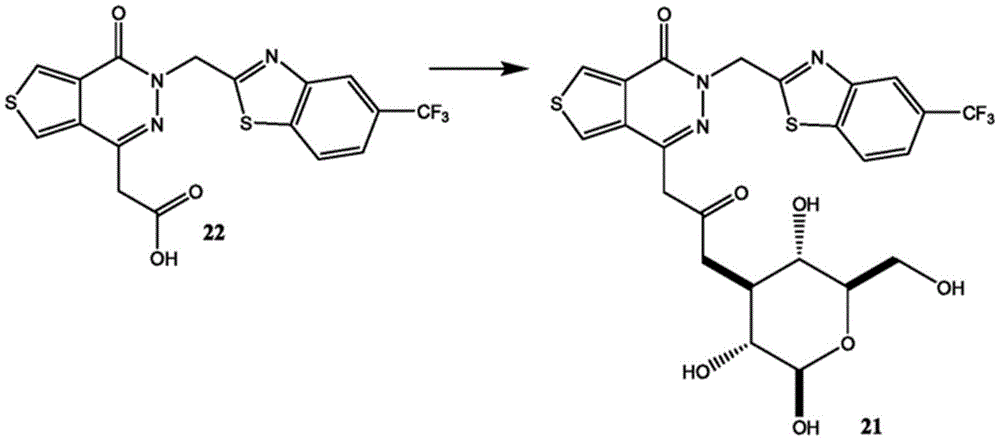
2- (4-oxo-3- ((5- (trifluoromethyl) benzo [ d ] thiazol-2-yl) methyl) -3, 4-dihydrothieno [3,4-d ] pyridazin-1-yl) acetic acid (compound 22) was prepared using the same method previously described in WO 2017/038505.
(2R,3R,4S,5R,6R) -2,3, 5-Trihydroxyl-6- (hydroxymethyl) tetrahydro-2H-pyran-4-yl 2- (4-oxo-3- ((5- (trifluoromethyl) benzo [ d ] b]Thiazol-2-yl) methyl) -3, 4-dihydrothieno [3,4-d ]]Pyridazin-1-yl) acetate (compound 21): (step 1) Compound 22 and (3aR,5S,6S,6aR) -5- ((R) -2, 2-dimethyl-l, 3 Dioxolan-4-yl) -2, 2-dimethyltetrahydrofuro [2,3-d][l,3]To a stirred solution of dioxol-6-ol (Compound 9) in THF was added l-ethyl-3- (3-dimethylaminopropyl) carbodiimide, NEt3And DMAP (catalyst). The reaction was stirred at room temperature until completion as monitored by TLC. The reaction mixture was concentrated in vacuo (step 2). The crude residue was collected in CH2Cl2And trifluoroacetic acid was added. The reaction mixture was stirred at ambient temperature for 2 hours. The reaction mixture was concentrated in vacuo and the residue was taken up in diethyl ether and saturated NaHCO3The aqueous solution was partitioned. The layers were separated and the ether layer was washed (lx) with saturated aqueous NaHCO 3. The ether layers (ethereal layers) were combined and concentrated in vacuo. The resulting residue was purified by silica gel flash column chromatography to give 2- (4-oxo-3- ((5- (trifluoromethyl) benzo [ d ]]Thiazol-2-yl) methyl) -3, 4-dihydrothieno [3,4-d]Pyridazin-1-yl) acetic acid (2R,3R,4S,5R,6R) -2,3, 5-trihydroxy-6- (hydroxymethyl) tetrahydro-2H-pyran-4-yl ester (Compound 21).
Example 2: (2R benzyl 2- (4-oxo-3- ((5- (trifluoromethyl) benzo [ d)]Thiazol-2-yl) methyl) -3, 4-dihydrothieno [3,4-d]Preparation of pyridazin-1-yl) acetate (Compound 23):

(2R benzyl-2- (4-oxo-3- ((5- (trifluoromethyl) benzo [ d ] thiazol-2-yl) methyl) -3, 4-dihydrothieno [3,4-d ] pyridazin-1-yl) acetate (Compound 23) the first step in the preparation described for Compound 21 was repeated, except that benzyl alcohol was used as a reagent in place of (3aR,5S,6S,6aR) -5- ((R) -2, 2-dimethyl-l, 3 dioxolan-4-yl) -2, 2-dimethyltetrahydrofuro [2,3-d ] [ l,3] dioxol-6-ol the crude residue was purified by flash column chromatography on silica gel to give 2- (4-oxo-3- ((5- (trifluoromethyl) benzene And [ d ] thiazol-2-yl) methyl) -3, 4-dihydrothieno [3,4-d ] pyridazin-1-yl) acetic acid benzyl ester (compound 23).
Example 3: 2- (8-oxo-7- ((5- (trifluoromethyl) benzo [ d)]Thiazol-2-yl) methyl) -7, 8-dihydropyrazino [2,3-d]Preparation of (2R,3R,4S,5R,6R) -2,3, 5-Trihydroxyl-6- (hydroxymethyl) tetrahydro-2H-pyran-4-yl pyridazin-5-yl) acetate (Compound 25):
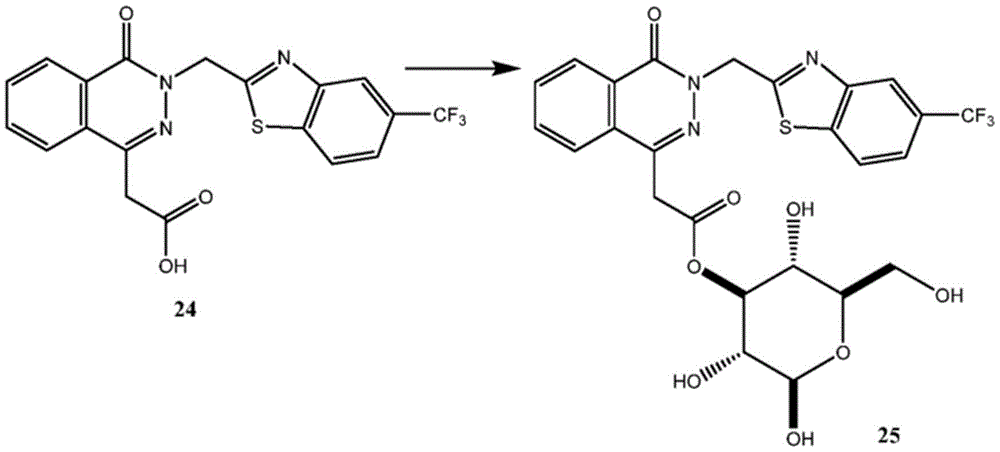
2- (8-oxo-7- ((5- (trifluoromethyl) benzo [ d ] thiazol-2-yl) methyl) -7, 8-dihydropyrazino [2,3-d ] pyridazin-5-yl) acetic acid (compound 24) was prepared using the same method previously described in U.S. patent No. 8,916,563.
2- (8-oxo-7- ((5- (trifluoromethyl) benzo [ d)]Thiazol-2-yl) methyl) -7, 8-dihydropyrazino [2,3-d]Pyridazin-5-yl) acetic acid (2R,3R,4S,5R,6R) -2,3, 5-trihydroxy-6- (hydroxymethyl) tetrahydro-2H-pyran-4-yl ester (Compound 25): to compound 24 and (3aR,5S,6S,6aR) -5- ((R) -2, 2-dimethyl-l, 3 dioxolan-4-yl) -2, 2-dimethyltetrahydrofuro [2,3-d ]][l,3]To a stirred solution of dioxol-6-ol (Compound 9) in THF was added l-ethyl-3- (3-dimethylaminopropyl) carbodiimide, NEt3And DMAP (catalytic). The reaction was stirred at room temperature until completion as monitored by TLC. The reaction mixture was concentrated in vacuo. The crude residue was collected in CH2Cl2And trifluoroacetic acid was added. The reaction mixture was stirred at ambient temperature for 2 hours. The reaction mixture was concentrated in vacuo and the residue was taken up in diethyl ether and saturated NaHCO3The aqueous solution was partitioned. The layers were separated and washed with saturated NaHCO3The ether layer was washed with aqueous (lx). The ether layers were combined and concentrated in vacuo. The resulting residue was purified via silica gel flash column chromatography to give 2- (8-oxo-7- ((5- (trifluoromethyl) benzo [ d)]Thiazol-2-yl) methyl) -7, 8-dihydropyrazino [2,3-d]Pyridazin-5-yl) acetic acid (2R,3R,4S,5R,6R) -2,3, 5-trihydroxy-6- (hydroxymethyl) tetrahydro-2H-pyran-4-yl ester (Compound 25).
Example 4: 2- (4-oxo-3- ((5- (tris)Fluoromethyl) benzo [ d]Thiazol-2-yl) methyl) -3, 4-dihydrothieno [3,4-d]Preparation of pyridazin-1-yl) propyl acetate (Compound 26):

x ═ Cl, -Br, -I, or any leaving group
Base-Triethylamine (TEA), diisopropylethylamine (iPr2NEt), pyridine
Additive-tetrabutylammonium chloride (TBAC), tetrabutylammonium bromide (TBAB), tetrabutylammonium iodide (TBAI), sodium bromide (NaBr), sodium iodide (NaI)
Solvents ═ Dimethylformamide (DMF), 1-methyl-2-pyrrolidone (NMP), Tetrahydrofuran (THF)
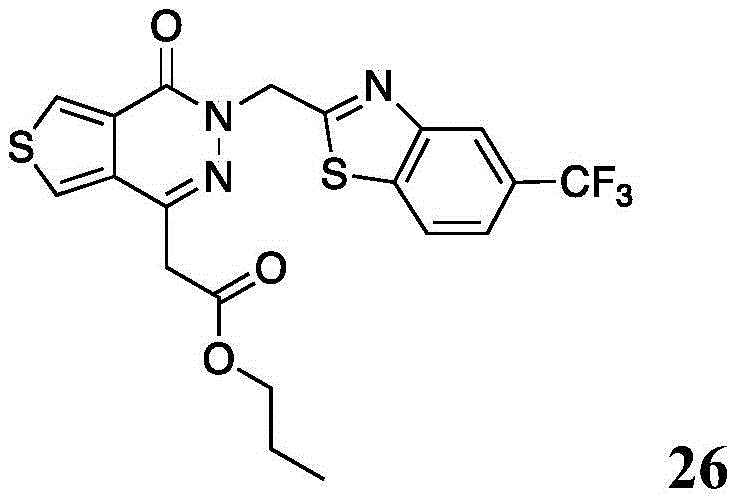
To compound 22(0.150g,3.53X 10)-4mol), 1-bromopropane (39 μ L,4.24X10-4mol) and TBAB (0.119g,3.70X10-4mol) to a heterogeneous mixture of DMF (3.0mL) was added TEA (64. mu.L, 4.59X10⁻⁴mol). The resulting homogeneous reaction mixture was stirred at ambient temperature overnight. The reaction mixture was partitioned between ether and water, the layers were separated, and water (1 ×), saturated NaHCO3The ether layer was washed with aqueous (1x), water (1x), 1.0M HCl (aq) (1x) and brine (1 x). Passing the diethyl ether layer over Na2SO4Dried, filtered, and dried in vacuo. The resulting residue was purified via flash chromatography on silica gel (monitored by thin layer chromatography) and eluted with 2:1(v/v) hexane: ethyl acetate. The collected fractions were evaporated to give 0.105g (yield 64%) of 2- (4-oxo-3- ((5- (trifluoromethyl) benzo [ d)]Thiazol-2-yl) methyl) -3, 4-dihydrothieno [3,4-d]Pyridazin-1-yl) acetic acid propyl ester (Compound 26):1h NMR (acetone-d)6,400MHz):δppm 8.60(d,J=3.2Hz,1H),8.30(d,J=3.2Hz,1H),8.29(s,1H),8.26(d,J=8.4Hz,1H),7.74(d,J=8.4Hz,1H),5.74(s,2H),4.04(t,J=6.4Hz,2H),3.97(s,2H),1.61-1.52(m,2H),0.81(t,J=7.2Hz,3H));MS ESI(m/z)468(M+1)+。
Example 5: 2- (4-oxo-3- ((5- (trifluoromethyl) benzo [ d)]Thiazol-2-yl) methyl) -3, 4-dihydrothieno [3,4-d]Preparation of pyridazin-1-yl) acetic acid isopropyl ester (Compound 27):

to compound 22(0.150g,3.53X 10)-4mol), 2-bromopropane (40. mu.L, 4.24X10⁻⁴mol) and TBAB (0.119g,3.70X10-4mol) to a heterogeneous mixture of DMF (3.0mL) was added TEA (64. mu.L, 4.59X10⁻⁴mol). The resulting homogeneous reaction mixture was stirred at ambient temperature overnight. The reaction mixture was partitioned between ether and water, the layers were separated, and water (1 ×), saturated aqueous NaHCO in that order3(1x), Water (1x), 1.0M HCl(aq)The ether layer was washed (1x) and brine (1 x). Passing the diethyl ether layer over Na2SO4Dried, filtered, and dried in vacuo. The resulting residue was purified via flash chromatography on silica gel (monitored by thin layer chromatography) and eluted with 2:1(v/v) hexane: ethyl acetate. The collected fractions were evaporated to give 0.052g (yield 32%) of 2- (4-oxo-3- ((5- (trifluoromethyl) benzo [ d)]Thiazol-2-yl) methyl) -3, 4-dihydrothieno [3,4-d]Pyridazin-1-yl) acetic acid isopropyl ester (compound 27):1H NMR(CDCl3,400MHz):δppm 8.46(d,J=3.2Hz,1H),8.29(s,1H),7.92(d,J=8.4Hz,1H),7.83(d,J=3.2Hz,1H),7.59(d,J=8.4Hz,1H),5.75(s,2H),5.04(sept,J=6.4Hz,1H),3.84(s,2H),1.21(d,J=6.4Hz,6H);MS ESI(m/z)468(M+1)+。
example 6: 2- (4-oxo-3- ((5- (trifluoromethyl) benzo [ d)]Thiazol-2-yl) methyl) -3, 4-dihydrothieno [3,4-d]Pyridazin-1-yl) acetic acid butyl ester (Compound 28):
to compound 22(0.150g,3.53X 10)-4mol), 1-bromobutane (45. mu.L, 4.24X10⁻⁴mol) and TBAB (0.119g,3.70X10-4mol) to a heterogeneous mixture of DMF (3.0mL) was added TEA (64. mu.L, 4.59x10⁻⁴mol). The resulting homogeneous reaction mixture was stirred at ambient temperature overnight. The reaction mixture was partitioned between ether and water, the layers were separated, and water (1 ×), saturated NaHCO3Aqueous solution (1x), water (1x), 1.0M HCl(aq)The ether layer was washed (1x) and brine (1 x). Passing the diethyl ether layer over Na2SO4Dried, filtered, and dried in vacuo. The resulting residue was purified via flash chromatography on silica gel (monitored by thin layer chromatography) and eluted with 2:1(v/v) hexane: ethyl acetate. The collected fractions were evaporated to give 0.103g (yield 61%) of 2- (4-oxo-3- ((5- (trifluoromethyl) benzo [ d ]]Thiazol-2-yl) methyl) -3, 4-dihydrothieno [3,4-d]Pyridazin-1-yl) acetic acid butyl ester (Compound 28):1h NMR (acetone-d)6,400MHz):δppm 8.60(d,J=2.8Hz,1H),8.30-8.28(m,2H),8.26(d,J=8.4Hz,1H),7.74(d,J=8.4Hz,1H),5.74(s,2H),4.08(t,J=6.8Hz,2H),3.97(s,2H),1.55-1.50(m,2H),1.29-1.21(m,2H),0.81(t,J=7.2Hz,3H);MS ESI(m/z)482(M+1)+。

Example 7: 2- (4-oxo-3- ((5- (trifluoromethyl) benzo [ d)]Thiazol-2-yl) methyl) -3, 4-dihydrothieno [3,4-d]Preparation of pyridazin-1-yl) sec-butyl acetate (Compound 29):
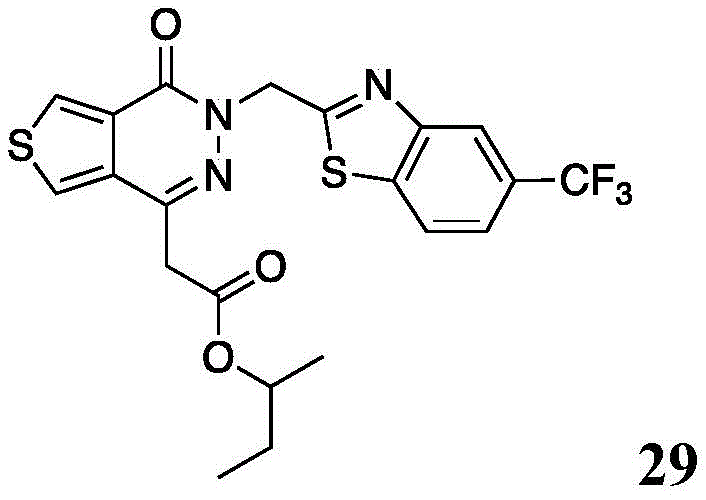
to compound 22(0.150g,3.53X 10)-4mol), 2-bromobutane (46. mu.L, 4.24X10⁻⁴mol) and TBAB (0.119g,3.70X10-4mol) to a heterogeneous mixture of DMF (3.0mL) was added TEA (64. mu.L, 4.59X10⁻⁴mol). The resulting homogeneous reaction mixture was stirred at ambient temperature overnight. The reaction mixture was partitioned between ether and water, the layers were separated, and water (1 ×), saturated NaHCO3Aqueous solution (1x), water (1x), 1.0M HCl(aq)The ether layer was washed (1x) and brine (1 x).Passing the diethyl ether layer over Na2SO4Dried, filtered, and dried in vacuo. The resulting residue was purified via flash chromatography on silica gel (monitored by thin layer chromatography) and eluted with 2:1(v/v) hexane: ethyl acetate. The collected fractions were evaporated to give 0.028g (yield 17%) of 2- (4-oxo-3- ((5- (trifluoromethyl) benzo [ d ]]Thiazol-2-yl) methyl) -3, 4-dihydrothieno [3,4-d]Pyridazin-1-yl) acetic acid sec-butyl ester (compound IV):1h NMR (acetone-d 6,400MHz): Deltappm 8.60(d,J=2.4Hz,1H),8.30-8.28(m,2H),8.26(d,J=8.4Hz,1H),7.74(d,J=8.4Hz,1H),5.74(s,2H),4.84-4.79(m,1H),3.95(s,2H),1.53-1.46(m,2H),1.13(d,J=6.0Hz,3H),0.76(t,J=8Hz,3H);MS ESI(m/z)482(M+1)+。
Example 8: 2- (4-oxo-3- ((5- (trifluoromethyl) benzo [ d)]Thiazol-2-yl) methyl) -3, 4-dihydrothieno [3,4-d]Preparation of pyridazin-1-yl) acetic acid benzyl ester (Compound 23):

to compound 22(0.150g,3.53X 10)-4mol), benzyl bromide (50. mu.L, 4.24X10⁻⁴mol) and TBAB (0.119g,3.70X10-4mol) to a heterogeneous mixture of DMF (3.0mL) was added TEA (64. mu.L, 4.59X10⁻⁴mol). The resulting homogeneous reaction mixture was stirred at ambient temperature overnight. The reaction mixture was partitioned between ether and water, the layers were separated, and water (1 ×), saturated NaHCO3Aqueous solution (1x), water (1x), 1.0M HCl(aq)The ether layer was washed (1x) and brine (1 x). Passing the diethyl ether layer over Na2SO4Dried, filtered, and dried in vacuo. The resulting residue was purified via flash chromatography on silica gel (monitored by thin layer chromatography) and eluted with 2:1(v/v) hexane: ethyl acetate. The collected fractions were evaporated to give 0.120g (yield 66%) of 2- (4-oxo-3- ((5- (trifluoromethyl) benzo [ d ]]Thiazol-2-yl) methyl) -3, 4-dihydrothieno [3,4-d]Pyridazin-1-yl) acetic acid benzyl ester (compound 23):1H NMR(CDCl3,400MHz):δppm 8.45(d,J=2.8Hz,1H),8.28(s,1H),7.89(d,J=8.4Hz,1H),7.73(d,J=2.8Hz,1H),7.59(d,J=8.4Hz,1H),7.31-7.27(m,5H),5.73(s,2H),5.16(s,2H),3.92(s,2H);MS ESI(m/z)516(M+1)+。
example 9: 2- (4-oxo-3- ((5- (trifluoromethyl) benzo [ d)]Thiazol-2-yl) methyl) -3, 4-dihydrothieno [3,4-d]Preparation of pyridazin-1-yl) acetic acid 2-methoxy-2-oxoethyl ester (Compound 30):

to compound 22(0.100g,2.35X 10)-4mol), methyl bromoacetate (25. mu.L, 2.59X10⁻⁴mol) and TBAB (0.080g,2.47X10-4mol) to a heterogeneous mixture of DMF (3.0mL) was added TEA (43. mu.L, 3.06X10⁻⁴mol). The resulting homogeneous reaction mixture was stirred at ambient temperature overnight. The reaction mixture was partitioned between ether and water, the layers were separated, and water (1 ×), saturated NaHCO3Aqueous solution (1x), water (1x), 1.0M HCl(aq)The ether layer was washed (1x) and brine (1 x). Passing the diethyl ether layer over Na2SO4Dried, filtered, and dried in vacuo. The resulting residue was purified via flash chromatography on silica gel (monitored by thin layer chromatography) and eluted with 2:1(v/v) hexane: ethyl acetate. The collected fractions were evaporated to give 0.116g (yield 99%) of 2- (4-oxo-3- ((5- (trifluoromethyl) benzo [ d ]]Thiazol-2-yl) methyl) -3, 4-dihydrothieno [3,4-d]Pyridazin-1-yl) acetic acid 2-methoxy-2-oxoethyl ester (compound 30):1H NMR(CDCl3,400MHz):δppm 8.46(d,J=3.2Hz,1H),8.29(s,1H),7.97(d,J=3.2Hz,1H),7.93(d,J=8.4Hz,1H),7.60(d,J=8.4Hz,1H),5.75(s,2H),4.68(s,2H),4.00(s,2H),3.75(s,3H);MS ESI(m/z)498(M+1)+。
example 10: 2- (4-oxo-3- ((5- (trifluoromethyl) benzo [ d)]Thiazol-2-yl) methyl) -3, 4-dihydrothieno [3,4-d]Preparation of pyridazin-1-yl) acetic acid 2-ethoxy-2-oxoethyl ester (Compound 31):

to compound 22(0.100g,2.35X 10)-4mol), ethyl bromoacetate (29 μ L,2.59X10-4mol) and TBAB (0.080g,2.47X10-4mol) to a heterogeneous mixture of DMF (3.0mL) was added TEA (43. mu.L, 3.06X10⁻⁴mol). The resulting homogeneous reaction mixture was stirred at ambient temperature overnight. The reaction mixture was partitioned between ether and water, the layers were separated, and water (1 ×), saturated NaHCO3Aqueous solution (1x), water (1x), 1.0M HCl(aq)The ether layer was washed (1x) and brine (1 x). Passing the diethyl ether layer over Na2SO4Dried, filtered, and dried in vacuo. The resulting residue was purified via silica gel flash chromatography (monitored by thin layer chromatography) and purified with 2:1(v/v) hexane: and eluting with ethyl acetate. The collected fractions were evaporated to give 0.110g (yield 92%) of 2- (4-oxo-3- ((5- (trifluoromethyl) benzo [ d)]Thiazol-2-yl) methyl) -3, 4-dihydrothieno [3,4-d]Pyridazin-1-yl) acetic acid 2-ethoxy-2-oxoethyl ester (compound 31):1H NMR(CDCl3,400MHz):δppm 8.46(d,J=3.2Hz,1H),8.29(s,1H),7.97(d,J=3.2Hz,1H),7.93(d,J=8.4Hz,1H),7.60(d,J=8.4Hz,1H),5.75(s,2H),4.66(s,2H),4.20(q,J=7.2Hz,2H),4.00(s,2H),1.25(t,J=7.2Hz,3H);MS ESI(m/z)512(M+1)+。
example 11: 2- (4-oxo-3- ((5- (trifluoromethyl) benzo [ d)]Thiazol-2-yl) methyl) -3, 4-dihydrothieno [3,4-d]Preparation of pyridazin-1-yl) acetic acid 2-isopropoxy-2-oxoethyl ester (compound 32):
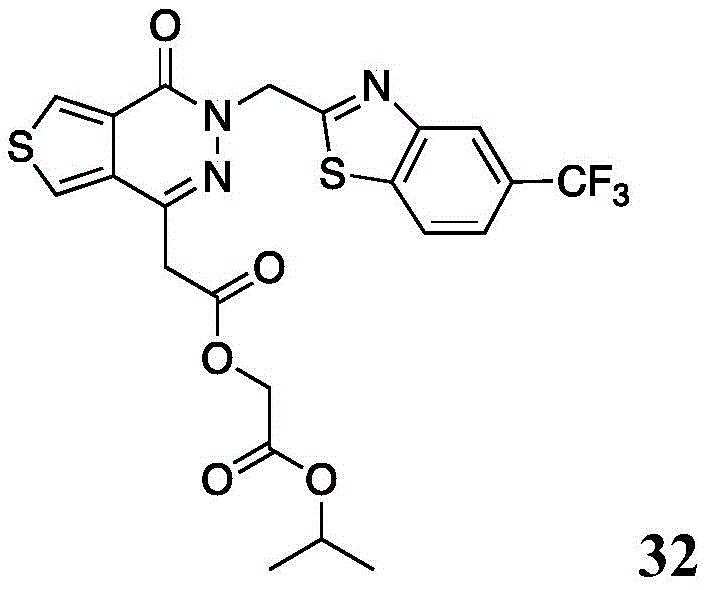
to compound 22(0.100g,2.35X 10)-4mol), isopropyl bromoacetate (33 μ L,2.59X10-4mol) and TBAB (0.080g,2.47X10-4mol) to a heterogeneous mixture of DMF (3.0mL) was added TEA (43. mu.L, 3.06X10⁻⁴mol). The resulting homogeneous reaction mixture was stirred at ambient temperature overnight. The reaction mixture was stirred in diethyl ether andpartition between water, separate layers, sequentially with water (1X), saturated NaHCO3Aqueous solution (1x), water (1x), 1.0M HCl(aq)The ether layer was washed (1x) and brine (1 x). Passing the diethyl ether layer over Na2SO4Dried, filtered, and dried in vacuo. The resulting residue was purified via flash chromatography on silica gel (monitored by thin layer chromatography) and eluted with 2:1(v/v) hexane: ethyl acetate. The collected fractions were evaporated to give 0.102g (yield 82%) of 2- (4-oxo-3- ((5- (trifluoromethyl) benzo [ d ]]Thiazol-2-yl) methyl) -3, 4-dihydrothieno [3,4-d]Pyridazin-1-yl) acetic acid 2-isopropoxy-2-oxoethyl ester (compound 32):1H NMR(CDCl3,400MHz):δppm 8.45(d,J=3.2Hz,1H),8.29(s,1H),7.98(d,J=3.2Hz,1H),7.93(d,J=8.4Hz,1H),7.60(d,J=8.4Hz,1H),5.75(s,2H),5.07(sept,J=6.4Hz,1H),4.62(s,2H),4.00(s,2H),1.23(d,J=6.4Hz,6H);MS ESI(m/z)526(M+1)+。
example 12: 2- (4-oxo-3- ((5- (trifluoromethyl) benzo [ d)]Thiazol-2-yl) methyl) -3, 4-dihydrothieno [3,4-d]Preparation of pyridazin-1-yl) acetic acid 2- (tert-butoxy) -2-oxoethyl ester (Compound 33):
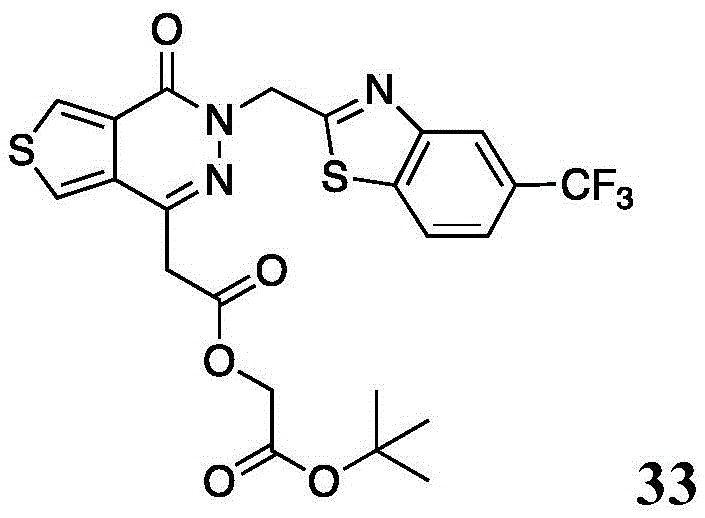
to compound 22(0.150g,3.53X 10)-4mol), tert-butylbromoacetate (57. mu.L, 3.88X10⁻⁴mol) and TBAB (0.119g,3.70X10-4mol) to a heterogeneous mixture of DMF (3.0mL) was added TEA (64. mu.L, 4.59X10- 4mol). The resulting homogeneous reaction mixture was stirred at ambient temperature overnight. The reaction mixture was partitioned between ether and water, the layers were separated, and water (1 ×), saturated NaHCO3Aqueous solution (1x), water (1x), 1.0M HCl(aq)The ether layer was washed (1x) and brine (1 x). Passing the diethyl ether layer over Na2SO4Dried, filtered, and concentrated in vacuo. The resulting residue was dissolved in a minimal amount of EtOAc, and then hexane was added to precipitate a white solid. The solid was collected via vacuum filtration and washed with hexanes. Then is onDrying under vacuum gave 0.165g (yield 87%) of 2- (4-oxo-3- ((5- (trifluoromethyl) benzo [ d ]]Thiazol-2-yl) methyl) -3, 4-dihydrothieno [3,4-d]Pyridazin-1-yl) acetic acid 2- (tert-butoxy) -2-oxoethyl ester (compound 33):1H NMR(CDCl3,400MHz):δppm 8.45(d,J=2.8Hz,1H),8.29(s,1H),7.99(d,J=2.8Hz,1H),7.92(d,J=8.4Hz,1H),7.59(d,J=8.4Hz,1H),5.75(s,2H),4.55(s,2H),3.99(s,2H),1.45(s,9H);MS ESI(m/z)540(M+1)+。
example 13: 2- (2- (4-oxo-3- ((5- (trifluoromethyl) benzo [ d)]Thiazol-2-yl) methyl) -3, 4-dihydrothieno [3,4-d]]Preparation of pyridazin-1-yl) acetoxy) acetic acid (Compound 34):

acid (HCl, H)2SO4、H3PO4、TFA
Solvents ═ diethyl ether, THF, dioxane, EtOAC
At 0 deg.C, to compound 33(0.155g,2.87X 10)-4mol) to a solution in EtOAc (1.0mL) was added H3PO4(2.0mL in H2In O>85% wt.). The reaction mixture was warmed to ambient temperature and stirred for 2 hours. Subsequently, the reaction mixture was diluted with EtOAc and the organic layer was washed with water (4x), followed by brine (1 x). Subjecting the organic layer to Na2SO4Dried, filtered and concentrated in vacuo. The resulting solid was suspended in diethyl ether and collected via vacuum filtration. The solid was washed with cold (0 ℃) EtOAc (2X) and dried under vacuum to give 0.061g (yield 44%) of 2- (2- (4-oxo-3- ((5- (trifluoromethyl) benzo [ d ]]Thiazol-2-yl) methyl) -3, 4-dihydrothieno [3,4-d]Pyridazin-1-yl) acetoxy) acetic acid (compound 34):1H NMR(CD3OD,400MHz):δppm 8.58(d,J=3.2Hz,1H),8.31(d,J=3.2Hz,1H),8.24(s,1H),8.15(d,J=8.4Hz,1H),7.68(d,J=8.4Hz,1H),5.76(s,2H),4.66(s,2H),4.09(s,2H);MS ESI(m/z)484(M+1)+。
practice ofExample 14: 2- (4-oxo-3- ((5- (trifluoromethyl) benzo [ d)]Thiazol-2-yl) methyl) -3, 4-dihydrothieno [3,4-d]Preparation of pyridazin-1-yl) pentan-2-yl acetate (Compound 35):
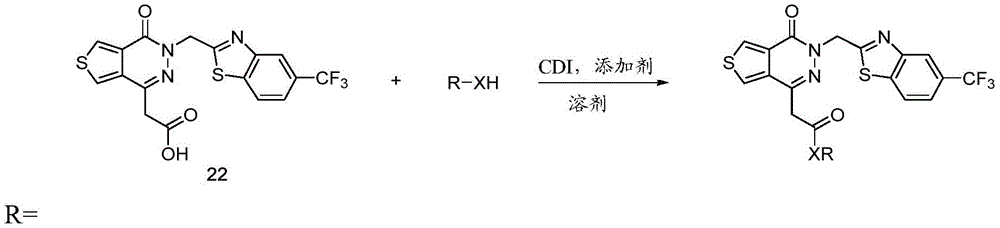
X=O、NH、NR2
additive-wu, 4-Dimethylaminopyridine (DMAP)
Solvents ═ Dimethylformamide (DMF), 1-methyl-2-pyrrolidone (NMP), Tetrahydrofuran (THF)
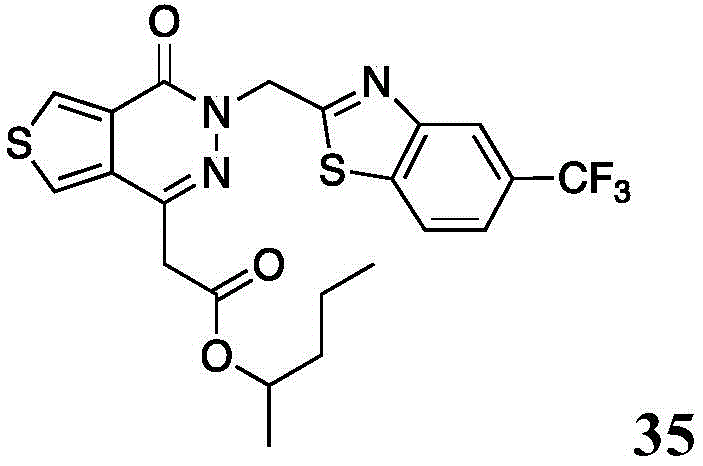
To compound 22(0.050g,1.18X 10)-4mol) to a solution in DMF (1.5mL) was added CDI (23mg,1.41X10-4mol). The reaction mixture was stirred at ambient temperature for 1 hour, after which 2-pentanol (18. mu.L, 1.65X 10) was added-4mol) and DMAP (7mg,5.88X10-5mol). The resulting reaction mixture was warmed to 40 ℃ and stirred overnight. The reaction mixture was cooled to ambient temperature and partitioned between ether and water, the layers were separated and washed successively with water (1 ×), saturated NaHCO3Aqueous solution (1x), water (1x), 1.0M HCl(aq)The ether layer was washed (1x) and brine (1 x). Passing the diethyl ether layer over Na2SO4Dried, filtered, and dried in vacuo. The resulting residue was purified via flash chromatography on silica gel (monitored by thin layer chromatography) and eluted with 2:1(v/v) hexane: ethyl acetate. The collected fractions were evaporated to give 0.031g (53% yield) of 2- (4-oxo-3- ((5- (trifluoromethyl) benzo [ d)]Thiazol-2-yl) methyl) -3, 4-dihydrothieno [3,4-d]Pyridazin-1-yl) acetic acid pent-2-yl ester (Compound 35):1H NMR(CDCl3,400MHz):δppm 8.46(d,J=2.8Hz,1H),8.29(s,1H),7.92(d,J=8.4Hz,1H),7.83(d,J=2.8Hz,1H),7.60(d,J=8.4Hz,1H),5.76(s,2H),4.97-4.90(m,1H),3.85(s,2H),1.49-1.45(m,2H),1.29-1.20(m,2H),1.17(d,J=6.4Hz,3H),0.82(t,J=6.8Hz,3H);MS ESI(m/z)496(M+1)+。
example 15: 2- (4-oxo-3- ((5- (trifluoromethyl) benzo [ d)]Thiazol-2-yl) methyl) -3, 4-dihydrothieno [3,4-d]Preparation of pyridazin-1-yl) pentan-3-yl acetate (Compound 36):
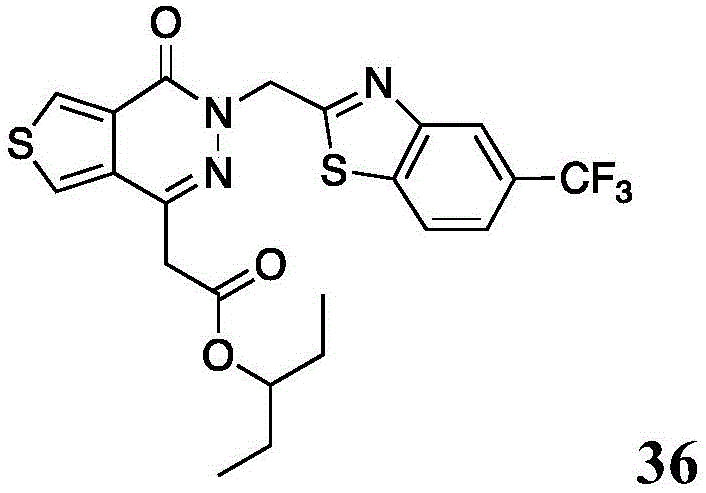
to compound 22(0.100g,2.35X 10)-4mol) to a solution in DMF (3.0mL) was added CDI (46mg,2.82X10-4mol). The reaction mixture was stirred at ambient temperature for 1 hour, after which 3-pentanol (35. mu.L, 3.29X 10) was added-4mol) and DMAP (14mg,1.18X10-4mol). The resulting reaction mixture was warmed to 40 ℃ and stirred overnight. The reaction mixture was cooled to ambient temperature and partitioned between ether and water, the layers were separated and washed successively with water (1 ×), saturated NaHCO3Aqueous solution (1x), water (1x), 1.0M HCl(aq)The ether layer was washed (1x) and brine (1 x). Passing the diethyl ether layer over Na2SO4Dried, filtered, and dried in vacuo. The resulting residue was purified via flash chromatography on silica gel (monitored by thin layer chromatography) and eluted with 2:1(v/v) hexane: ethyl acetate. The collected fractions were evaporated to give 0.057g (yield 49%) of 2- (4-oxo-3- ((5- (trifluoromethyl) benzo [ d ]]Thiazol-2-yl) methyl) -3, 4-dihydrothieno [3,4-d]Pyridazin-1-yl) acetic acid pent-3-yl ester (Compound 36):1H NMR(CDCl3,400MHz):δppm 8.46(d,J=2.8Hz,1H),8.29(s,1H),7.91(d,J=8.4Hz,1H),7.83(d,J=2.8Hz,1H),7.60(d,J=8.4Hz,1H),5.76(s,2H),4.77(pent,J=6.4Hz,1H),3.87(s,2H),1.55-1.45(m,4H),0.76(t,J=7.6Hz,6H);MS ESI(m/z)496(M+1)+。
example 16: 2- (4-oxo-3- ((5- (trifluoromethyl) benzo [ d)]Thiazol-2-yl) methyl) -3, 4-dihydrothieno [3,4-d]Preparation of pyridazin-1-yl) cyclohexyl acetate (Compound 37):
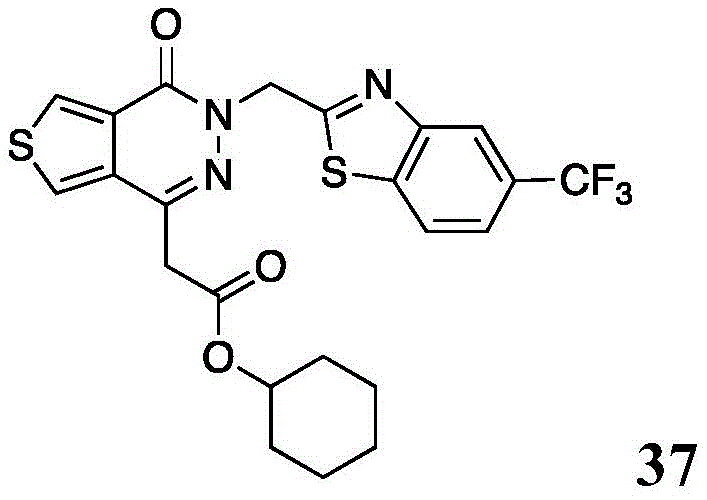
to compound 22(0.100g,2.35X 10)-4mol) to a solution in DMF (3.0mL) was added CDI (46mg,2.82X10-4mol). The reaction mixture was stirred at ambient temperature for 1 hour, after which cyclohexanol (35 μ L,3.29 × 10) was added-4mol) and DMAP (14mg,1.18X10-4mol). The resulting reaction mixture was warmed to 40 ℃ and stirred overnight. The reaction mixture was cooled to ambient temperature and partitioned between ether and water, the layers were separated and washed successively with water (1 ×), saturated NaHCO3Aqueous solution (1x), water (1x), 1.0M HCl(aq)The ether layer was washed (1x) and brine (1 x). Passing the diethyl ether layer over Na2SO4Dried, filtered, and dried in vacuo. The resulting residue was purified via flash chromatography on silica gel (monitored by thin layer chromatography) and eluted with 2:1(v/v) hexane: ethyl acetate. The collected fractions were evaporated to give 0.084g (yield 71%) of 2- (4-oxo-3- ((5- (trifluoromethyl) benzo [ d ]]Thiazol-2-yl) methyl) -3, 4-dihydrothieno [3,4-d]Pyridazin-1-yl) acetate (compound 37):1H NMR(CDCl3,400MHz):δppm 8.46(d,J=3.2Hz,1H),8.29(s,1H),7.92(d,J=8.0Hz,1H),7.83(d,J=3.2Hz,1H),7.60(d,J=8.0Hz,1H),5.76(s,2H),4.82-4.77(m,1H),3.85(s,2H),1.78-1.73(m,2H),1.61-1.56(m,1H),1.53-1.45(m,1H),1.39-1.24(m,5H),1.20-1.14(m,1H);MS ESI(m/z)508(M+1)+。
example 17: (S) -2- (2- (4-oxo-3- ((5- (trifluoromethyl) benzo [ d)]Thiazol-2-yl) methyl) -3, 4-dihydrothieno [3,4-d]Preparation of pyridazin-1-yl) acetoxy) propionic acid methyl ester (compound 38):

to compound 22(0.300g,7.06x 10)-4mol) to a solution in DMF (5.0mL) was added CDI (0.137g,8.47X10-4mol). The reaction mixture was stirred at ambient temperature for 1 hour, after which L- (-) -methyl lactate (94. mu.L, 9.88X 10) was added-4mol) and DMAP (43mg,3.53X10-4mol). The resulting reaction mixture was warmed to 40 ℃ and stirred overnight. The reaction mixture was cooled to ambient temperature and partitioned between ether and water, the layers were separated and washed successively with water (1 ×), saturated NaHCO3Aqueous solution (1x), water (1x), 1.0M HCl(aq)The ether layer was washed (1x) and brine (1 x). Passing the diethyl ether layer over Na2SO4Dried, filtered, and dried in vacuo. The resulting residue was purified via flash chromatography on silica gel (monitored by thin layer chromatography) and eluted with 2:1(v/v) hexane: ethyl acetate to 1:1(v/v) hexane: ethyl acetate. The collected fractions were evaporated to give 0.094g (yield 26%) of (S) -2- (2- (4-oxo-3- ((5- (trifluoromethyl) benzo [ d ]]Thiazol-2-yl) methyl) -3, 4-dihydrothieno [3,4-d]Pyridazin-1-yl) acetoxy) propionic acid methyl ester (compound 38):1H NMR(CDCl3,400MHz):δppm 8.46(d,J=3.2Hz,1H),8.29(s,1H),7.95(d,J=3.2Hz,1H),7.92(d,J=8.4Hz,1H),7.60(d,J=8.4Hz,1H),5.75(d,J=4.4Hz,2H),5.14(q,J=6.8Hz,1H),3.97(d,J=9.6Hz,2H),3.72(s,3H),1.48(d,J=6.8Hz,3H);MS ESI(m/z)512(M+1)+。
example 18: (R) -2- (2- (4-oxo-3- ((5- (trifluoromethyl) benzo [ d)]Thiazol-2-yl) methyl) -3, 4-dihydrothieno [3,4-d]Preparation of pyridazin-1-yl) acetoxy) propionic acid methyl ester (Compound 39):

to compound 22(0.300g,7.06x 10)-4mol) to a solution in DMF (5.0mL) was added CDI (0.137g,8.47X10-4mol). The reaction mixture was stirred at ambient temperature for 1 hour, after which time methyl D- (+) -lactate (94. mu.L, 9.88X 10) was added-4mol) and DMAP (43mg,3.53X10-4mol). The resulting reaction mixture was warmed to 40 ℃ and stirred overnight. The reaction mixture was cooled to ambient temperature and partitioned between ether and water, the layers were separated and washed successively with water (1 ×), saturated NaHCO3Aqueous solution (1x), water (1x), 1.0M HCl(aq)The ether layer was washed (1x) and brine (1 x). B is to beThe ether layer was passed over Na2SO4Dried, filtered, and dried in vacuo. The resulting residue was purified via flash chromatography on silica gel (monitored by thin layer chromatography) and eluted with 2:1(v/v) hexane: ethyl acetate to 1:1(v/v) hexane: ethyl acetate. The collected fractions were evaporated to give 0.099g (yield 27%) of (R) -2- (2- (4-oxo-3- ((5- (trifluoromethyl) benzo [ d)]Thiazol-2-yl) methyl) -3, 4-dihydrothieno [3,4-d]Pyridazin-1-yl) acetoxy) propionic acid methyl ester (compound 39):1H NMR(CDCl3,400MHz):δppm 8.46(d,J=3.2Hz,1H),8.29(s,1H),7.95(d,J=3.2Hz,1H),7.92(d,J=8.4Hz,1H),7.60(d,J=8.4Hz,1H),5.75(d,J=4.4Hz,2H),5.14(q,J=6.8Hz,1H),3.97(d,J=9.6Hz,2H),3.72(s,3H),1.48(d,J=6.8Hz,3H);MS ESI(m/z)512(M+1)+。
example 19: (S) -2- (2- (4-oxo-3- ((5- (trifluoromethyl) benzo [ d)]Thiazol-2-yl) methyl) -3, 4-dihydrothieno [3,4-d]Preparation of pyridazin-1-yl) acetoxy) propionic acid ethyl ester (compound 40):
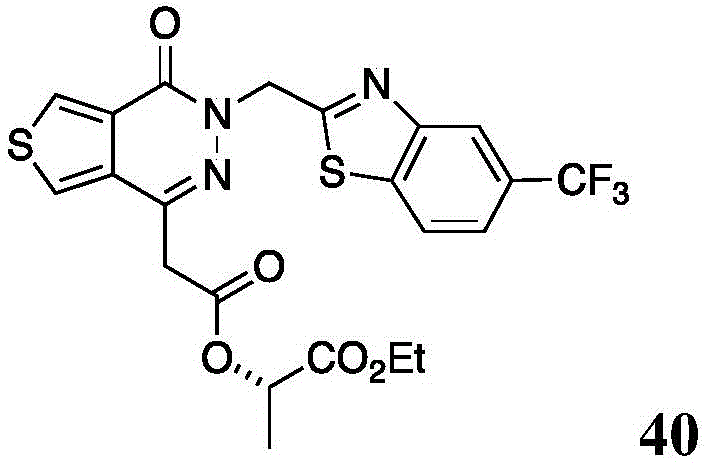
to compound 22(0.200g,4.71X 10)-4mol) to a solution in DMF (4.0mL) was added CDI (0.092g,5.65X10-4mol). The reaction mixture was stirred at ambient temperature for 1 hour, after which L- (-) -ethyl lactate (74. mu.L, 6.59X 10) was added-4mol) and DMAP (29mg,2.35X10-4mol). The resulting reaction mixture was warmed to 40 ℃ and stirred overnight. The reaction mixture was cooled to ambient temperature and partitioned between ether and water, the layers were separated and washed successively with water (1 ×), saturated NaHCO3Aqueous solution (1x), water (1x), 1.0M HCl(aq)The ether layer was washed (1x) and brine (1 x). Passing the diethyl ether layer over Na2SO4Dried, filtered, and dried in vacuo. The resulting residue was purified via flash chromatography on silica gel (monitored by thin layer chromatography) and eluted with 2:1(v/v) hexane: ethyl acetate to 1:1(v/v) hexane: ethyl acetate. The collected fractions were evaporated to give 0.059g (yield 24%) of (S) -2- (2- (4-oxo)3- ((5- (trifluoromethyl) benzo [ d)]Thiazol-2-yl) methyl) -3, 4-dihydrothieno [3,4-d]Pyridazin-1-yl) acetoxy) propionic acid ethyl ester (compound 40):1H NMR(CDCl3,400MHz):δppm 8.45(d,J=3.2Hz,1H),8.29(s,1H),7.95(d,J=3.2Hz,1H),7.92(d,J=8.4Hz,1H),7.60(d,J=8.4Hz,1H),5.75(d,J=5.6Hz,2H),5.11(q,J=7.2Hz,1H),4.17(q,J=7.2Hz,2H),3.97(d,J=8.8Hz,2H),1.48(d,J=7.2Hz,3H),1.23(t,J=7.2Hz,3H);MS ESI(m/z)526(M+1)+。
example 20: 2- (4-oxo-3- ((5- (trifluoromethyl) benzo [ d)]Thiazol-2-yl) methyl) -3, 4-dihydrothieno [3,4-d]Preparation of pyridazin-1-yl) acetic acid 2- (dimethylamino) ethyl ester (Compound 41):
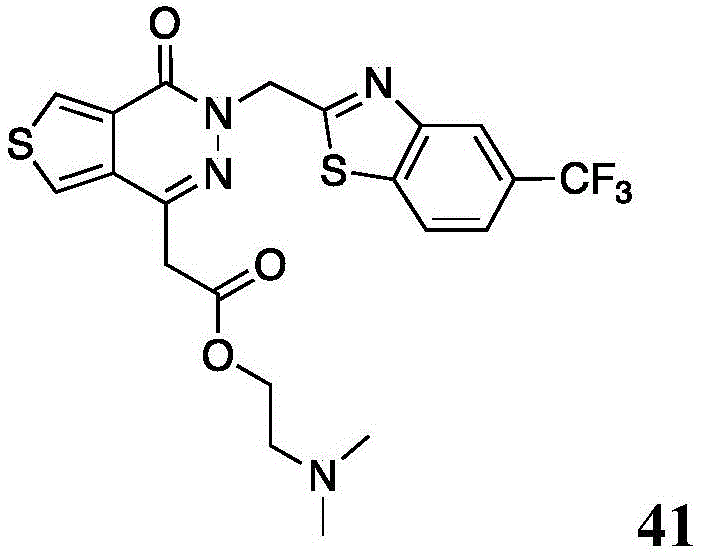
to compound 22(0.150g,3.53X 10)-4mol) to a solution in DMF (3.0mL) was added CDI (63mg,3.88X10-4mol). The reaction mixture was stirred at ambient temperature for 1 hour, after which 2-dimethylaminoethanol (42 μ L,4.24X 10) was added-4mol). The resulting reaction mixture was stirred at ambient temperature overnight. The reaction mixture was washed with diethyl ether and saturated NaHCO3Partition between aqueous solutions, separate layers, and use saturated NaHCO3The organic layer was washed with aqueous solution (1x) followed by water (2 x). Subsequently, 1.0M HCl was used(aq)(2X) extract the organic layer, combine the acidic aqueous layers, and use solid NaHCO3And (4) treating until the pH value reaches 9. The basic aqueous layer at this point was extracted with EtOAc (2X), and the combined EtOAc layers (1X) were washed with brine, over Na2SO4Drying, filtration and concentration in vacuo gave 0.121g (69% yield) of 2- (4-oxo-3- ((5- (trifluoromethyl) benzo [ d ]]Thiazol-2-yl) methyl) -3, 4-dihydrothieno [3,4-d]Pyridazin-1-yl) acetic acid 2- (dimethylamino) ethyl ester (compound 41):1H NMR(CDCl3,400MHz):δppm 8.43(d,J=3.2Hz,1H),8.28(s,1H),7.92-7.90(m,2H),7.58(d,J=9.2Hz,1H),5.73(s,2H),4.21(t,J=5.2Hz,2H),3.89(s,2H),2.50(t,J=5.2Hz,2H),2.19(s,6H);MS ESI(m/z)497(M+1)+。
example 21: 2- (4-oxo-3- ((5- (trifluoromethyl) benzo [ d)]Thiazol-2-yl) methyl) -3, 4-dihydrothieno [3,4-d]Preparation of 2- ((tert-butoxycarbonyl) amino) ethyl pyridazin-1-yl) acetate (compound 42):
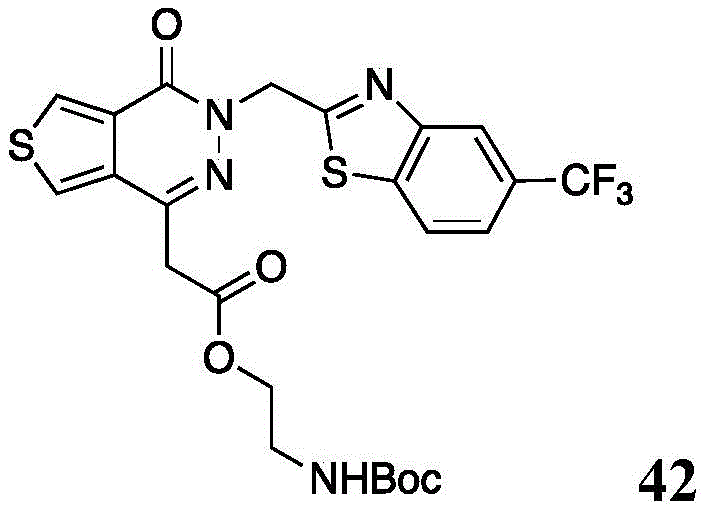
to compound 22(0.150g,3.53X 10)-4mol) to a solution in DMF (3.0mL) was added CDI (63mg,3.88X10-4mol). The reaction mixture was stirred at ambient temperature for 1 hour, after which N-Boc-ethanolamine (71. mu.L, 4.59X 10) was added-4mol). The resulting reaction mixture was warmed to 50 ℃ and stirred overnight. The reaction mixture was cooled to ambient temperature and partitioned between ether and water, the layers were separated and washed successively with water (1 ×), saturated NaHCO3Aqueous solution (1x), water (1x), 1.0M HCl(aq)The ether layer was washed (1x) and brine (1 x). Passing the diethyl ether layer over Na2SO4Dried, filtered, and dried in vacuo. The resulting residue was purified via flash chromatography on silica gel (monitored by thin layer chromatography) and eluted with 2:1(v/v) hexane: ethyl acetate to 1:1(v/v) hexane: ethyl acetate. The collected fractions were evaporated to give 0.109g (yield 55%) of 2- (4-oxo-3- ((5- (trifluoromethyl) benzo [ d ]]Thiazol-2-yl) methyl) -3, 4-dihydrothieno [3,4-d]Pyridazin-1-yl) acetic acid 2- ((tert-butoxycarbonyl) amino) ethyl ester (compound 42):1H NMR(CDCl3,400MHz):δppm8.47(d,J=2.8Hz,1H),8.29(s,1H),7.95–7.92(m,2H),7.60(d,J=8.8Hz,1H),5.75(s,2H),4.20(t,J=5.6Hz,2H),3.90(s,2H),3.39-3.36(m,2H),1.43(s,9H);MS ESI(m/z)569(M+1)+。
example 22: (S) -2- ((tert-butoxycarbonyl) amino) -3- (4- (2- (4-oxo-3- ((5- (trifluoromethyl) benzo [ d)]Thiazol-2-yl) methyl) -3, 4-dihydrothieno [3,4-d]Preparation of pyridazin-1-yl) acetoxy) phenyl) propionic acid ethyl ester (compound 43):

to compound 22(0.143g,3.36X 10)-4mol) to a solution in DMF (4.0mL) was added CDI (0.065g,4.04X10-4mol). The reaction mixture was stirred at ambient temperature for 1 hour before addition of (tert-butoxycarbonyl) -L-tyrosine ethyl ester (0.104g,3.36X 10)-4mol) and DMAP (21mg,1.68X 10)-4mol). The resulting reaction mixture was warmed to 40 ℃ and stirred overnight. The reaction mixture was cooled to ambient temperature and partitioned between EtOAc and water, the layers were separated and washed successively with water (1 ×), saturated NaHCO3Aqueous solution (1x), water (1x), 1.0M HCl(aq)(1x) and brine (1x) wash the organic layer. Subjecting the organic layer to Na2SO4Dried, filtered, and dried in vacuo. The resulting residue was purified via flash chromatography on silica gel (monitored by thin layer chromatography) and eluted with 1:1(v/v) hexane: ethyl acetate. The collected fractions were evaporated to give 0.079g (yield 33%) of (S) -2- ((tert-butoxycarbonyl) amino) -3- (4- (2- (4-oxo-3- ((5- (trifluoromethyl) benzo [ d)]Thiazol-2-yl) methyl) -3, 4-dihydrothieno [3,4-d]Pyridazin-1-yl) acetoxy) phenyl) propanoate (compound 43):1H NMR(CDCl3,400MHz):δppm 8.50(d,J=2.8Hz,1H),8.29(s,1H),7.92-7.90(m,2H),7.60(d,J=8.0Hz,1H),7.11(d,J=8.0Hz,2H),6.96(d,J=8.0Hz,2H),5.78(s,2H),4.98-4.96(m,1H),4.54-4.52(m,1H),4.14(q,J=6.8Hz,2H),4.10(s,2H),3.08-3.03(m,2H),1.41(s,9H),1.22(t,J=6.8Hz,3H);MS ESI(m/z)717(M+1)+。
example 23: (S) -2-amino-3- (4- (2- (4-oxo-3- ((5- (trifluoromethyl) benzo [ d)]Thiazol-2-yl) methyl) -3, 4-dihydrothieno [3,4-d]Preparation of pyridazin-1-yl) acetoxy) phenyl) propionic acid ethyl ester hydrochloride (compound 44):

acid (HCl, H)2SO4、H3PO4、TFA
Solvents ═ diethyl ether, THF, dioxane, EtOAC
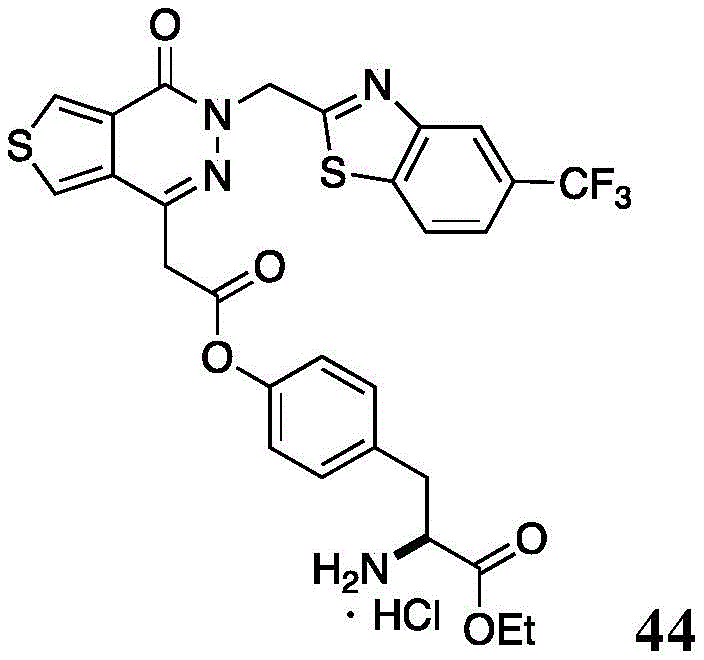
To compound 43(0.079g,1.10X 10)-4mol) in CH2Cl2To the solution in (1.5mL) was added 2.0M HCl in ether (1.5 mL). The reaction mixture was stirred at ambient temperature overnight. Subsequently, the reaction mixture was diluted with ether, and the precipitated white solid was collected via vacuum filtration and washed with ether. The resulting solid was dried in vacuo to give 0.053g (yield 74%) of (S) -2-amino-3- (4- (2- (4-oxo-3- ((5- (trifluoromethyl) benzo [ d)]Thiazol-2-yl) methyl) -3, 4-dihydrothieno [3,4-d]Pyridazin-1-yl) acetoxy) phenyl) propanoic acid ethyl ester hydrochloride (compound 44):1H NMR(D2O,400MHz):δppm 8.54(d,J=2.8Hz,1H),8.26(d,J=2.8Hz,1H),8.00(s,1H),7.79(d,J=8.4Hz,1H),7.49(d,J=8.4Hz,1H),7.02(d,J=8.8Hz,2H),6.79(d,J=8.8Hz,2H),5.69(s,2H),4.28-4.13(m,5H),3.12(d,J=7.2Hz,2H),1.11(t,J=6.8Hz,3H);MS ESI(m/z)617(M+1)+。
example 24: 2- (4-oxo-3- ((5- (trifluoromethyl) benzo [ d)]Thiazol-2-yl) methyl) -3, 4-dihydrothieno [3,4-d]Preparation of pyridazin-1-yl) acetic acid 2-aminoethyl ester hydrochloride (Compound 45):
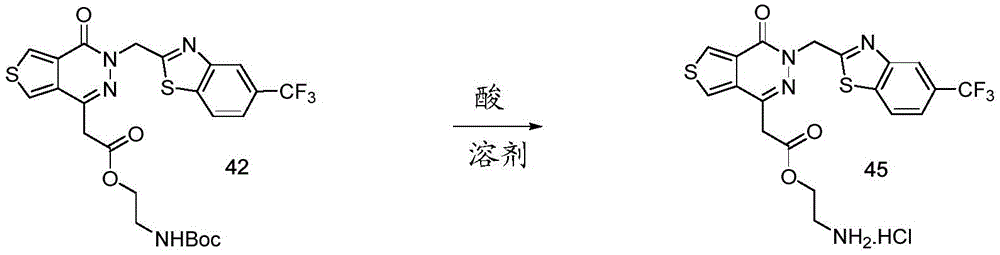
acid (HCl, H)2SO4、H3PO4、TFA
Solvents ═ diethyl ether, THF, dioxane, EtOAC

To compound 42(0.113g,1.99X 10)-4mol) solution in THF (2.0mL)To this was added 4M HCl in dioxane (2.0 mL). The reaction mixture was stirred at ambient temperature for 1 hour. Diethyl ether was added to the reaction mixture, and the precipitated solid was collected via vacuum filtration. The solid was washed with EtOAc and dried in vacuo to give 0.089g (89% yield) of 2- (4-oxo-3- ((5- (trifluoromethyl) benzo [ d ]]Thiazol-2-yl) methyl) -3, 4-dihydrothieno [3,4-d]Pyridazin-1-yl) acetic acid 2-aminoethyl ester hydrochloride (compound 45):1H NMR(CD3OD,400MHz):δppm 8.62(d,J=3.2Hz,1H),8.26(d,J=3.2Hz,1H),8.24(s,1H),8.16(d,J=8.8Hz,1H),7.70(d,J=8.8Hz,1H),5.76(s,2H),4.38(t,J=4.8Hz,2H),4.07(s,2H),3.25(t,J=4.8Hz,2H);MS ESI(m/z)469(M+1)+。
example 25: (2- (4-oxo-3- ((5- (trifluoromethyl) benzo [ d)]Thiazol-2-yl) methyl) -3, 4-dihydrothieno [3,4-d]Preparation of pyridazin-1-yl) acetyl) glycine methyl ester (Compound 46):

X=-O、NH、NR2
additives N-hydroxysuccinimide (NHS), 4-Dimethylaminopyridine (DMAP), Hydroxybenzotriazole (HOBT) base Triethylamine (TEA), diisopropylethylamine (iPr)2NEt), pyridine
Solvents ═ Dimethylformamide (DMF), 1-methyl-2-pyrrolidone (NMP), Tetrahydrofuran (THF)

To compound 22(0.100g,2.35X 10)-4mol)、EDC·HCl(59mg,3.06x10-4mol)、NHS(35mg,3.06x10-4mol) and glycine methyl ester hydrochloride (38mg,3.06 × 10-4mol) to a heterogeneous solution in DMF (4.0mL) was added TEA (0.130mL,9.41X10-4mol). The resulting homogeneous reaction mixture was stirred at ambient temperature overnight. Subsequently, the reaction mixture was between EtOAc and waterPartition, separate layers, sequentially with water (1X), saturated NaHCO3Aqueous solution (1x), water (1x), 1.0M HCl(aq)(1x) and brine (1x) wash the organic layer. Subjecting the organic layer to Na2SO4Dried, filtered, and concentrated in vacuo. The resulting residue was purified via flash chromatography on silica gel (monitored by thin layer chromatography) and purified with 2:1(v/v) hexane: ethyl acetate to 19:1(v/v) CH2Cl2Methanol elution. The collected fractions were evaporated to give 0.028g (yield 24%) of (2- (4-oxo-3- ((5- (trifluoromethyl) benzo [ d ]]Thiazol-2-yl) methyl) -3, 4-dihydrothieno [3,4-d]Pyridazin-1-yl) acetyl) glycine methyl ester (compound 46):1H NMR(CDCl3,400MHz):δppm 8.47(d,J=2.8Hz,1H),8.28(s,1H),8.02(d,J=2.8Hz,1H),7.95(d,J=8.0Hz,1H),7.60(d,J=8.0Hz,1H),6.71(br s,1H),5.77(s,2H),4.00(d,J=5.2Hz,2H),3.84(s,2H),3.68(s,3H);MS ESI(m/z)497(M+1)+。
example 26: (2- (4-oxo-3- ((5- (trifluoromethyl) benzo [ d)]Thiazol-2-yl) methyl) -3, 4-dihydrothieno [3,4-d]Preparation of pyridazin-1-yl) acetyl) glycine ethyl ester (Compound 47):

to compound 22(0.100g,2.35X 10)-4mol)、EDC·HCl(59mg,3.06x10-4mol)、NHS(35mg,3.06x10-4mol) and glycine ethyl ester hydrochloride (42mg,3.06 × 10-4mol) to a heterogeneous solution in DMF (4.0mL) was added TEA (0.130mL,9.41X10-4mol). The resulting homogeneous reaction mixture was stirred at ambient temperature overnight. Subsequently, the reaction mixture was partitioned between EtOAc and water, the layers were separated, and water (1 ×), saturated NaHCO3Aqueous solution (1x), water (1x), 1.0M HCl(aq)(1x) and brine (1x) wash the organic layer. Subjecting the organic layer to Na2SO4Dried, filtered, and concentrated in vacuo. The resulting residue was purified via flash chromatography on silica gel (monitored by thin layer chromatography) and with 19:1(v/v) CH2Cl2Methanol elution. The collected fractions were evaporated to give a solid, which was suspended in diethyl ether and collected via vacuum filtration. The collected solid was washed with diethyl ether and dried in vacuo to give 0.018g (yield 15%) of (2- (4-oxo-3- ((5- (trifluoromethyl) benzo [ d ] b)]Thiazol-2-yl) methyl) -3, 4-dihydrothieno [3,4-d]Pyridazin-1-yl) acetyl) glycine ethyl ester (compound 47):1H NMR(CDCl3,400MHz):δppm 8.46(d,J=2.8Hz,1H),8.28(s,1H),8.02(d,J=2.8Hz,1H),7.95(d,J=8.8Hz,1H),7.60(d,J=8.8Hz,1H),6.69(br s,1H),5.77(s,2H),4.12(q,J=6.8Hz,2H),3.98(d,J=4.8Hz,2H),3.84(s,2H),1.22(t,J=6.8Hz,3H);MS ESI(m/z)511(M+1)+。
example 27: (2- (4-oxo-3- ((5- (trifluoromethyl) benzo [ d)]Thiazol-2-yl) methyl) -3, 4-dihydrothieno [3,4-d]Preparation of pyridazin-1-yl) acetyl) isopropyl glycinate (compound 48):
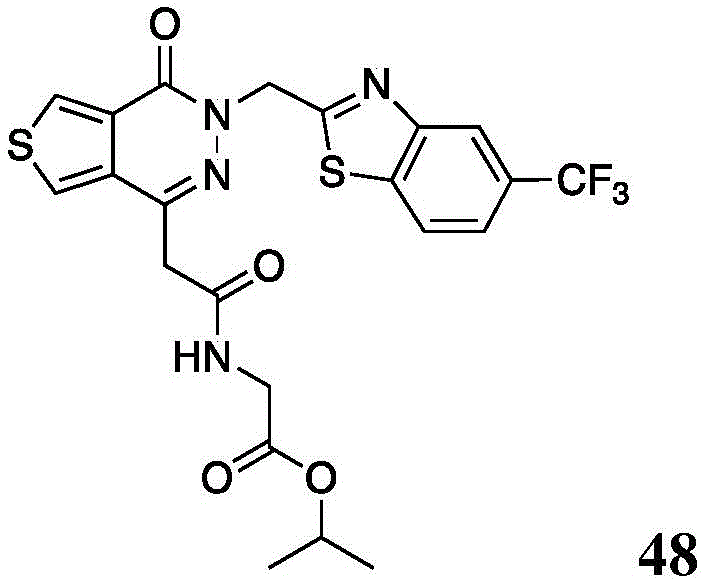
to compound 22(0.100g,2.35X 10)-4mol)、EDC·HCl(59mg,3.06x10-4mol)、NHS(35mg,3.06x10-4mol) and glycine isopropyl ester hydrochloride (47mg,3.06 × 10-4mol) to a heterogeneous solution in DMF (4.0mL) was added TEA (0.130mL,9.41X10-4mol). The resulting homogeneous reaction mixture was stirred at ambient temperature overnight. Subsequently, the reaction mixture was partitioned between EtOAc and water, the layers were separated, and water (1 ×), saturated NaHCO3Aqueous solution (1x), water (1x), 1.0M HCl(aq)(1x) and brine (1x) wash the organic layer. Subjecting the organic layer to Na2SO4Dried, filtered, and dried in vacuo. The resulting residue was purified via flash chromatography on silica gel (monitored by thin organic layer chromatography) and eluted with 1:1(v/v) hexane: ethyl acetate. The collected fractions were evaporated to give 0.021g (yield 17%) of (2- (4-oxo-3- ((5- (trifluoromethyl) benzo [ d ]]Thiazol-2-yl) methyl) -3, 4-dihydrothieno [3,4-d]Pyridazin-1-yl) acetyl) isopropyl glycinate (compound 48):1H NMR(CDCl3,400MHz):δppm 8.46(d,J=2.8Hz,1H),8.29(s,1H),8.03(d,J=2.8Hz,1H),7.94(d,J=8.4Hz,1H),7.60(d,J=8.4Hz,1H),6.66(br s,1H),5.77(s,2H),4.97(sept,J=6.4Hz,1H),3.94(d,J=5.2Hz,2H),3.84(s,2H),1.19(d,J=6.4Hz,6H);MS ESI(m/z)525(M+1)+。
example 28: (2- (4-oxo-3- ((5- (trifluoromethyl) benzo [ d)]Thiazol-2-yl) methyl) -3, 4-dihydrothieno [3,4-d]Preparation of pyridazin-1-yl) acetyl) -L-alanine methyl ester (Compound 49):

to compound 22(0.300g,7.06x 10)-4mol)、EDC·HCl(0.176g,9.18x10-4mol)、NHS(0.106g,9.18x10-4mol) and L-alanine methyl ester hydrochloride (0.128g,9.18X 10)-4mol) to a heterogeneous solution in DMF (10mL) was added TEA (0.40mL,2.82X10-3mol). The resulting homogeneous reaction mixture was stirred at ambient temperature overnight. Subsequently, the reaction mixture was partitioned between EtOAc and water, the layers were separated, and water (1 ×), saturated NaHCO3Aqueous solution (1x), water (1x), 1.0M HCl(aq)(1x) and brine (1x) wash the organic layer. Subjecting the organic layer to Na2SO4Dried, filtered, and dried in vacuo. The resulting residue was purified via flash chromatography on silica gel (monitored by thin organic layer chromatography) and eluted with 1:1(v/v) hexane: ethyl acetate. The collected fractions were evaporated to give 0.101g (yield 28%) of (2- (4-oxo-3- ((5- (trifluoromethyl) benzo [ d ]]Thiazol-2-yl) methyl) -3, 4-dihydrothieno [3,4-d]Pyridazin-1-yl) acetyl) -L-alanine methyl ester (compound 49):1H NMR(CDCl3,400MHz):δppm 8.46(d,J=3.2Hz,1H),8.29(s,1H),8.02(d,J=3.2Hz,1H),7.94(d,J=8.0Hz,1H),7.60(d,J=8.0Hz,1H),6.70(br s,1H),5.77(s,2H),4.52(m,1H),3.80(s,2H),3.65(s,3H),1.32(d,J=7.6Hz,3H);MS ESI(m/z)511(M+1)+。
example 29: (2- (4-oxo-3- ((5-) (Trifluoromethyl) benzo [ d]Thiazol-2-yl) methyl) -3, 4-dihydrothieno [3,4-d]Preparation of pyridazin-1-yl) acetyl) -L-alanine ethyl ester (Compound 50):
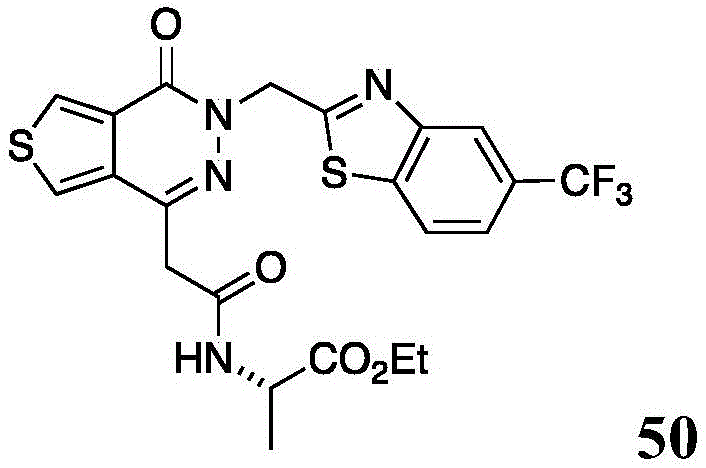
to compound 22(0.100g,2.35X 10)-4mol)、EDC·HCl(59mg,3.06x10-4mol)、NHS(35mg,3.06x10-4mol) and L-alanine ethyl ester hydrochloride (47mg,3.06X 10)-4mol) to a heterogeneous solution in DMF (4.0mL) was added TEA (0.130mL,9.41X10-4mol). The resulting homogeneous reaction mixture was stirred at ambient temperature overnight. Subsequently, the reaction mixture was partitioned between EtOAc and water, the layers were separated, and water (1 ×), saturated NaHCO3Aqueous solution (1x), water (1x), 1.0M HCl(aq)(1x) and brine (1x) wash the organic layer. Subjecting the organic layer to Na2SO4Dried, filtered, and concentrated in vacuo. The resulting residue was purified via flash chromatography on silica gel (monitored by thin layer chromatography) and eluted with 1:1(v/v) hexane: methanol. The collected fractions were evaporated to give a solid, which was suspended in cold (0 ℃) diethyl ether and collected via vacuum filtration. The collected solid was washed with cold (0 ℃) ether and dried in vacuo to give 0.037g (yield 30%) of (2- (4-oxo-3- ((5- (trifluoromethyl) benzo [ d)]Thiazol-2-yl) methyl) -3, 4-dihydrothieno [3,4-d]Pyridazin-1-yl) acetyl) -L-alanine ethyl ester (compound 50):1H NMR(CDCl3,400MHz):δppm 8.46(d,J=2.8Hz,1H),8.29(s,1H),8.02(d,J=2.8Hz,1H),7.94(d,J=8.4Hz,1H),7.60(d,J=8.4Hz,1H),6.69(br s,1H),5.77(s,2H),4.49(m,1H),4.09(q,J=7.2Hz,2H),3.80(s,2H),1.31(d,J=7.2Hz,3H),1.20(t,J=7.2Hz,3H);MS ESI(m/z)525(M+1)+。
example 30: 2- (4-oxo-3- ((5- (trifluoromethyl) benzo [ d)]Thiazol-2-yl) methyl) -3, 4-dihydrothieno [3,4-d]Preparation of pyridazin-1-yl) acetamide (Compound 51):
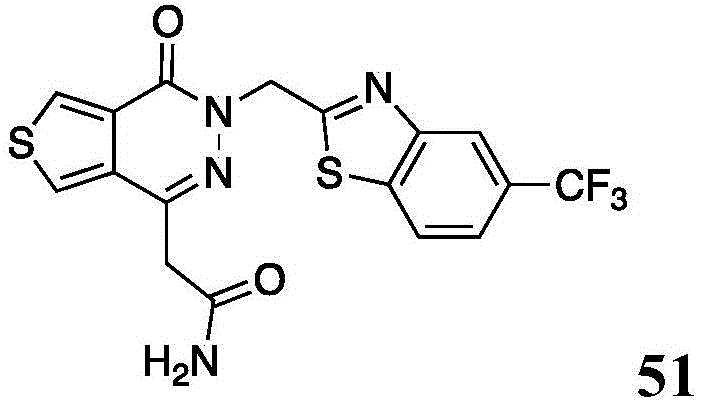
to compound 22(0.100g,2.35X 10)-4mol)、EDC·HCl(59mg,3.06x10-4mol)、NHS(35mg,3.06x10-4mol) and ammonium acetate (24mg,3.06 × 10)-4mol) to a heterogeneous solution in DMF (3.0mL) was added TEA (0.160mL,1.18X10-3mol). The resulting homogeneous reaction mixture was stirred at ambient temperature overnight. Subsequently, the reaction mixture was partitioned between EtOAc and water, the layers were separated, and water (1 ×), saturated NaHCO3Aqueous solution (1x), water (1x), 1.0M HCl(aq)(1x) and brine (1x) wash the organic layer. Subjecting the organic layer to Na2SO4Dried, filtered, and dried in vacuo. The resulting residue was purified via flash chromatography on silica gel (monitored by thin organic layer chromatography) and with 19:1(v/v) CH2Cl2: and (4) methanol elution. The collected fractions were evaporated to give 0.071g (yield 71%) of 2- (4-oxo-3- ((5- (trifluoromethyl) benzo [ d)]Thiazol-2-yl) methyl) -3, 4-dihydrothieno [3,4-d]Pyridazin-1-yl) acetamide (compound 51):1H NMR(CD3OD,400MHz):δppm 8.58(d,J=2.8Hz,1H),8.26(d,J=2.8Hz,1H),8.23(s,1H),8.15(d,J=8.4Hz,1H),7.68(d,J=8.4Hz,1H),5.77(s,2H),3.82(s,2H);MS ESI(m/z)425(M+1)+。
example 31: (S) -2- ((tert-butoxycarbonyl) amino) -3- (4- (2- (4-oxo-3- ((5- (trifluoromethyl) benzo [ d)]Thiazol-2-yl) methyl) -3, 4-dihydrothieno [3,4-d]Preparation of pyridazin-1-yl) acetoxy) phenyl) propanoic acid tert-butyl ester (Compound 52):
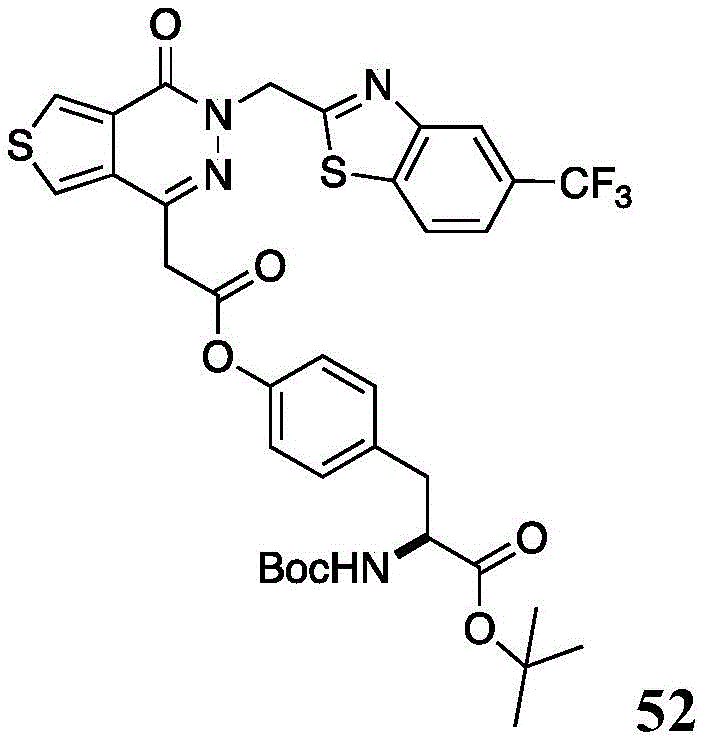
to compound 22(0.100g,2.35X 10)-4mol)、EDC·HCl(59mg,3.06x10-4mol)、NHS(35mg,3.06x10-4mol) and tert-butyl (tert-butoxycarbonyl) -L-tyrosine (0.103g,3.06X10-4mol) to a heterogeneous solution in DMF (4.0mL) was added TEA (0.130mL,9.41X10-4mol)。The resulting homogeneous reaction mixture was stirred at ambient temperature overnight. Subsequently, the reaction mixture was partitioned between EtOAc and water, the layers were separated, and water (1 ×), saturated NaHCO3Aqueous solution (1x), water (1x), 1.0M HCl(aq)(1x) and brine (1x) wash the organic layer. Subjecting the organic layer to Na2SO4Dried, filtered, and dried in vacuo. The resulting residue was purified via flash chromatography on silica gel (monitored by thin layer chromatography) and eluted with 4:1(v/v) to 1:1(v/v) hexane: ethyl acetate. The collected fractions were evaporated to give 0.049g (yield 28%) of (S) -2- ((tert-butoxycarbonyl) amino) -3- (4- (2- (4-oxo-3- ((5- (trifluoromethyl) benzo [ d)]Thiazol-2-yl) methyl) -3, 4-dihydrothieno [3,4-d]Pyridazin-1-yl) acetoxy) phenyl) propanoic acid tert-butyl ester (compound 52):1H NMR(CDCl3,400MHz):δppm 8.50(d,J=3.2Hz,1H),8.28(s,1H),7.92-7.90(m,2H),7.59(d,J=8.8Hz,1H),7.14(d,J=8.4Hz,2H),6.96(d,J=8.4Hz,2H),5.78(s,2H),4.98-4.96(m,1H),4.48-4.41(m,1H),4.10(s,2H),3.06-3.01(m,2H),1.41(s,9H),1.38(s,9H);MS ESI(m/z)745(M+1)+。
example 32: (S) -2-amino-3- (4- (2- (4-oxo-3- ((5- (trifluoromethyl) benzo [ d)]Thiazol-2-yl) methyl) -3, 4-dihydrothieno [3,4-d]Preparation of pyridazin-1-yl) acetoxy) phenyl) propanoic acid hydrochloride (compound 53):
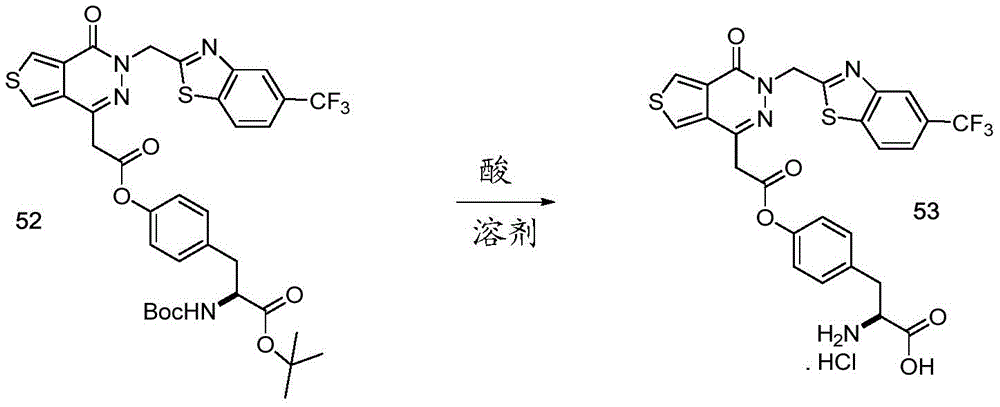
acid (HCl, H)2SO4、H3PO4、TFA
Solvents ═ diethyl ether, THF, dioxane, EtOAC
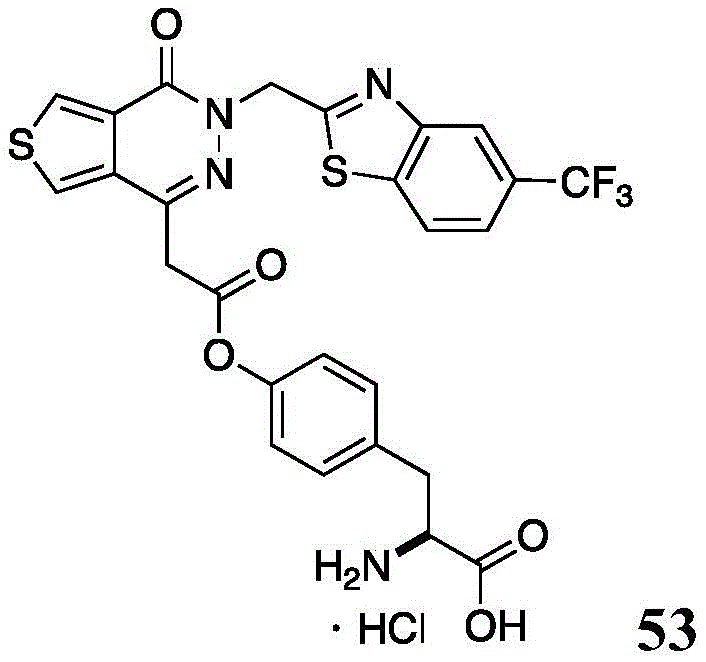
To compound 52(0.049g,6.58x 10)-5mol) in CH2Cl2To the solution in (1.5mL) was added 4.0M HCl in dioxane (1.5 mL).The reaction mixture was stirred at ambient temperature overnight. Subsequently, the reaction mixture was concentrated in vacuo and the resulting white solid suspension was in diethyl ether. The white solid was collected via vacuum filtration, washed with diethyl ether and dried under vacuum to give 0.032g (78% yield) of (S) -2-amino-3- (4- (2- (4-oxo-3- ((5- (trifluoromethyl) benzo [ d ])]Thiazol-2-yl) methyl) -3, 4-dihydrothieno [3,4-d]Pyridazin-1-yl) acetoxy) phenyl) propanoic acid hydrochloride (compound 53: MS ESI (M/z)589(M +1)+。
Example 33: (2- (4-oxo-3- ((5- (trifluoromethyl) benzo [ d)]Thiazol-2-yl) methyl) -3, 4-dihydrothieno [3,4-d]Preparation of pyridazin-1-yl) acetyl) glycine (Compound 54):

alkali-NaOH, LiOH, KOH
Water, MeOH, EtOH, methanol, ethanol, and water,iPrOH、THF

To compound 46(0.096g,1.94X 10)-4mol) to a heterogeneous mixture in MeOH (1.5mL) was added 1.0M NaOH(aq)(0.5 mL). The reaction mixture was stirred overnight at ambient temperature. The resulting homogeneous reaction mixture was partitioned between ether and water, the layers were separated, and the aqueous layer was washed with ether (2 ×). By adding 1.0M HCl(aq)The alkaline aqueous layer was acidified to pH 2. The acidic aqueous layer was extracted with EtOAc (3X), and the (1X) organic layer was washed with brine, then Na2SO4Dried, filtered, and concentrated in vacuo. The resulting solid was suspended in diethyl ether and stirred for 5 minutes. The solid was collected via vacuum filtration and washed with diethyl ether. The resulting solid was dried under vacuum to give 0.069g (yield 75%) of (2- (4-oxo-3- ((5- (trifluoromethyl) benzo [ d ])]Thiazol-2-yl) methyl) -3, 4-dihydrothieno [3,4-d]Pyridazin-1-yl) acetyl) glycine (Compound 54):1H NMR(CD3OD,400MHz):δppm 8.56(d,J=3.2Hz,1H),8.34(d,J=3.2Hz,1H),8.23(s,1H),8.16(d,J=8.8Hz,1H),7.68(d,J=8.8Hz,1H),5.77(s,2H),3.92(s,2H),3.90(s,2H);MS ESI(m/z)483(M+1)+。
Example 34: (2- (4-oxo-3- ((5- (trifluoromethyl) benzo [ d)]Thiazol-2-yl) methyl) -3, 4-dihydrothieno [3,4-d]Preparation of pyridazin-1-yl) acetyl) -L-alanine (Compound 55):
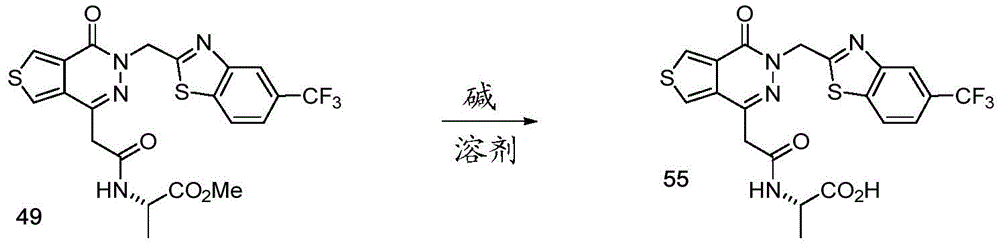
alkali-NaOH, LiOH, KOH
Water, MeOH, EtOH, methanol, ethanol, and water,iPrOH、THF

To compound 49(0.101g,1.98X 10)-4mol) to a heterogeneous mixture in MeOH (1.5mL) was added 1.0M NaOH(aq)(0.5 mL). The reaction mixture was stirred at ambient temperature overnight. The resulting homogeneous reaction mixture was partitioned between ether and water, the layers were separated, and the aqueous layer was washed with ether (2 ×). By adding 1.0M HCl(aq)The alkaline aqueous layer was acidified to pH 2. The acidic aqueous layer was extracted with EtOAc (3X), and the (1X) organic layer was washed with brine, then Na2SO4Dried, filtered, and concentrated in vacuo. The resulting solid was suspended in diethyl ether and stirred for 5 minutes. The solid was collected via vacuum filtration and washed with diethyl ether. The resulting solid was dried under vacuum to give 0.085g (yield 87%) of (2- (4-oxo-3- ((5- (trifluoromethyl) benzo [ d ]]Thiazol-2-yl) methyl) -3, 4-dihydrothieno [3,4-d]Pyridazin-1-yl) acetyl) -L-alanine (compound 55):1H NMR(CDCl3,400MHz):δppm 8.47(d,J=2.8Hz,1H),8.27(s,1H),8.00(d,J=2.8Hz,1H),7.94(d,J=8.8Hz,1H),7.60(d,J=8.8Hz,1H),6.87-6.84(br s,1H),5.77(s,2H),4.57-4.52(m,1H),3.82(s,2H),1.37(d,J=7.2Hz,3H);MS ESI(m/z)497(M+1)+。
example 35: characterization of aldose reductase inhibitor Compounds
Compounds were characterized according to physical properties (solubility and LogD).
Equilibrium solubility in phosphate buffer, ph 7.4:the equilibrium solubility of the test article was measured in an aqueous buffer at ph 7.4. By mixing 50mL of 0.2M KH2PO4And 150mL of H2O and then adjusted to pH7.4 with 10N NaOH to prepare a buffer solution of pH 7.4. For each test article, at least 1mg of the powder was mixed with 1mL of buffer to make a mixture ≧ 1 mg/mL. At room temperature at The samples were shaken overnight. Then, the sample was centrifuged at 10,000rpm for 10 minutes, the supernatant was sampled, and diluted in duplicate in 10-, 100-and 10,000-fold to 1:1 mixtures of buffer Acetonitrile (ACN), before analysis. All samples were analyzed by LC-MS/MS using electrospray ionization against standards prepared in a mixture of 1:1 assay buffer, ACN. The standard concentration ranges from 1.0. mu.M to 1.0 nM.
Octanol/buffer partition coefficient (LogD) at pH 7.4: 1The octanol/buffer partition coefficients of the three test preparations were measured at ph 7.4. By mixing 50mL of 0.2M KH2PO4The solution was mixed with 150mL of dH2O, and then adjusted to pH7.4 with 10N NaOH to prepare a pH7.4 buffer. In a single culture, 15. mu.L of each test article in 10mM DMSO solution (100. mu.M) was added to a tube containing 0.75mL octanol and 0.75mL phosphate buffer, pH 7.4. Testosterone was also introduced into each tube at a loading concentration of 100 μ M as an internal control. These samples were gently mixed on a bench top rotator for 1 hour at room temperature. Then, each tube was removed from the rotator and the aqueous and organic phases were allowed to separate for 1 hour. An aliquot of the organic layer was taken and diluted 200-fold into a mixture of 1:1 buffer Acetonitrile (ACN). Aliquots of the aqueous layer were taken and diluted 2-fold, 10-fold and 200-fold to a mix of 1:1 buffer ACNIn the composition. All samples were analyzed by LC-MS/MS using electrospray ionization. Testosterone was used as a positive control (published/known LogD of 3.0-3.4).
Example 36: in vitro studies: enzyme inhibition of aldose reductase
The compounds are characterized by biochemical properties, such as the ability to inhibit aldose reductase enzyme activity in vitro. The reductase activity of the compounds of the invention was analyzed spectrophotometrically by the reduction of NADPH at 25 ℃ for 4 minutes as described in Sato, S. (1992), "Rat kit enzyme and aldehyde product and polyproduction in Rat kit" am.J. physiol.263, F799.F805 (which is incorporated herein by reference).
The reaction mixture (total volume 1ml) contained 0.1mM NADPH, 100mM substrate (DL-glyceraldehyde or L-xylose) and human recombinant aldose reductase (100mU) in 0.1M phosphate buffer, pH 6.2. AR inhibition experiments were performed in microplate assays using D-glyceraldehyde and NADPH, the absorbance change was monitored at 340nM, and% inhibition of ARL was calculated at concentrations from 0.1nM to 100. mu.M. The reaction was started by adding substrate (glyceraldehyde or xylose) and the same reaction mixture in which deionized water was used instead of substrate as control. One enzyme unit (U) is defined as the activity consuming 1 μmole of NADPH/min at 25 ℃, an enzyme inhibition assay is performed as described in WO2012/009553, the entire content of which is incorporated herein by reference.
Example 37: in vitro study
The rat study was conducted under the approval of Institutional Animal Care and Use Committee, Columbia University, New York. This study is in line with the Guide for the Care and Use of Laboratory Animals published by US National Institutes of Health (NIH publication No.; 85-23, 1996; the entire contents of which are incorporated herein by reference).
Experiments were performed using isovolumetric isolated rat heart preparations as described by Hwang YC, Sato S, Tsai JY, Yan S, Bakr S, Zhang H, Oates PJ, Ramasamy R (2002), "Aldose reduction activity a key component of myocal stress to ischemia," Faeb J.16,243-245 and Ramasamy R, Hwang YC, Whang J, Bergmann SR (2001), "Protection of isochemical heart by high glucose is measured, in part, by GLUT-4," American Journal of physiology.281, H290-297; the entire contents of each of which are incorporated herein by reference.
Male Wistar rats (300.350g, 3-4 months old) were anesthetized with a mixture of ketamine (80mg/kg) and xylazine (10 mg/kg). After deep anesthesia was achieved, the heart was rapidly excised, placed in ice saline, and perfused retrograde through the aorta in a non-recirculating mode at 12.5ml/min at 37 ℃. Using a solution containing (mM) NaCl 118, KCl 4.7, CaCl 22.5, MgCl2 1.2、NaHCO325. Glucose 5, palmitate 0.4, bovine serum albumin 0.4 and 70mU/L insulin in modified Krebs-Henseleit buffer perfused the heart. 95% of 02-5% CO is used for perfusate2Is balanced, which maintains the perfusate PO2>600 mmHg. Left Ventricular Diastolic Pressure (LVDP) and Left Ventricular End Diastolic Pressure (LVEDP) in the left ventricle were measured using latex balloons. LVDP, heart rate and coronary perfusion pressure were continuously monitored on an ADI recorder. All rat hearts were subjected to 20 min of zero flow ischemia and 60 min of reperfusion (I/R).
In studies involving the use of aldose reductase inhibitors, hearts were perfused 10 minutes prior to ischemia with modified Krebs-Henseleit buffer containing the compounds of the invention at a final concentration of 100nM and continued throughout the perfusion protocol. Measured Creatine Kinase (CK) release, a marker of myocardial I/R injury, as described in Hwang YC, Sato S, Tsai JY, Yan S, Bakr S, Zhang H, Oates PJ, Ramasamy R (2002), "Aldose reduction activity a key component of myoc differential response to ischemia," Faeb J.16,243-245 and Ramasamy R, Hwang YC, Whang J, Bergmann SR (2001), "Protection of ischemic heart blocks by high glucose is measured, in part, by GLUT-4," American Journal of physiology.281, H290-297 (the entire contents of each of which are incorporated herein by reference).
Ischemia reperfusion (1/R) injury was performed on the isolated perfused heart and measurements of cardiac injury and cardiac function were monitored. Creatine Kinase (CK) release, a marker of ischemic injury to the heart, was measured during reperfusion in rat hearts and untreated hearts treated with the compounds of the invention. Left Ventricular Diastolic Pressure (LVDP) was measured in untreated hearts after I/R and rat hearts treated with the compounds of the invention.
While the present invention has been described and illustrated in the foregoing exemplary embodiments, it is to be understood that this disclosure is made only by way of example and that numerous changes in the details of implementation of the invention may be made without departing from the spirit and scope of the invention, which is limited only by the claims which follow. The features of the disclosed embodiments may be combined and rearranged in various ways within the scope and spirit of the invention.
All patents, patent applications, and publications cited herein are incorporated by reference in their entirety. The disclosures of these publications in their entireties are hereby incorporated by reference into this application in order to more fully describe the state of the art known to those skilled in the art as of the date of the invention described and claimed herein.
This patent disclosure contains material which is subject to copyright protection. The copyright owner has no objection to the facsimile reproduction by anyone of the patent document or the patent disclosure, as it appears in the U.S. patent and trademark office patent file or records, but otherwise reserves any and all copyright rights whatsoever.
Claims (28)


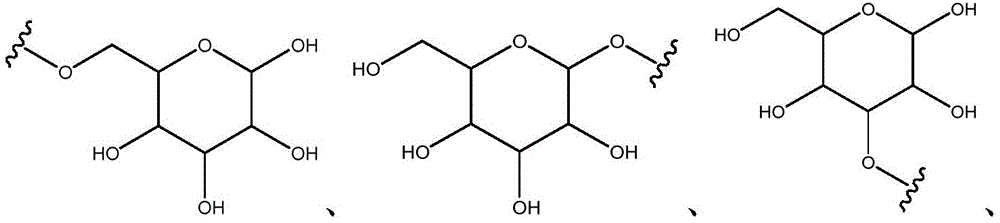



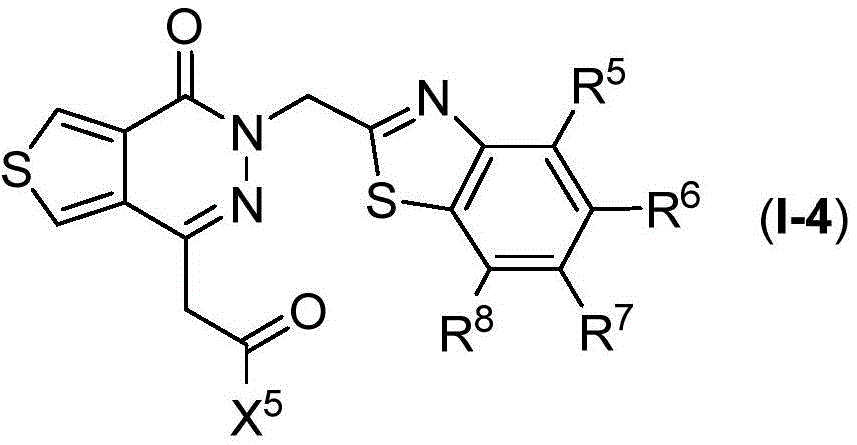
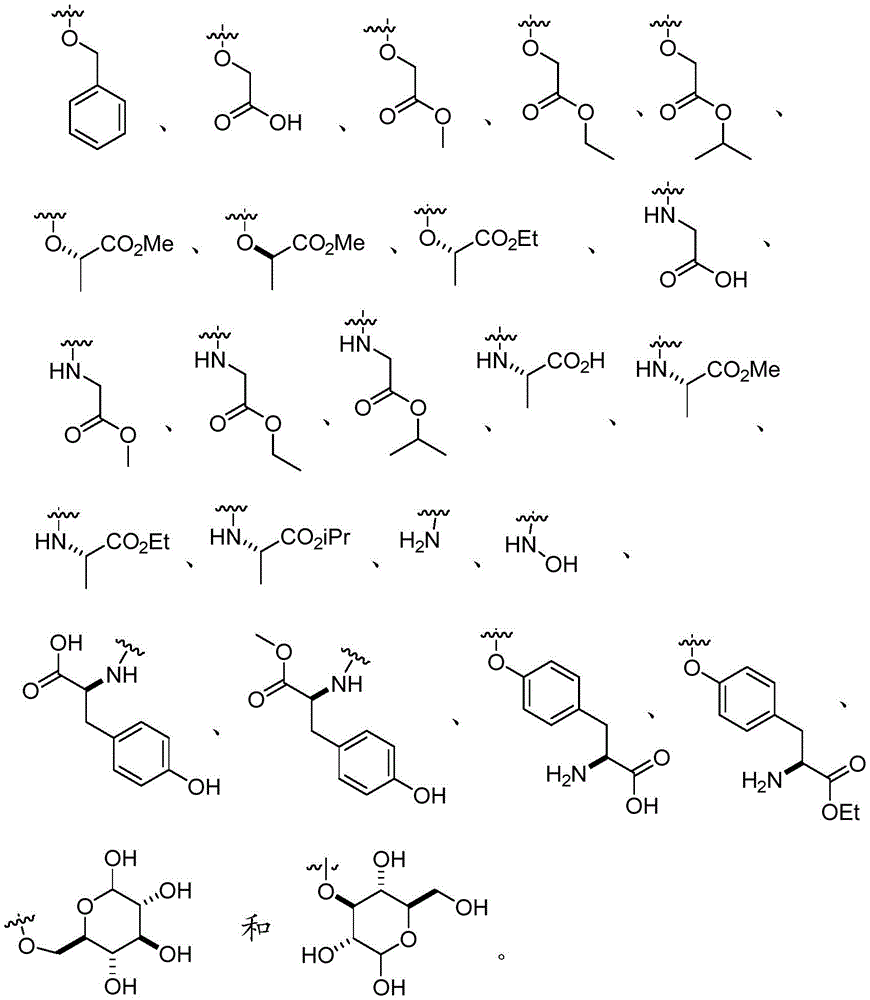

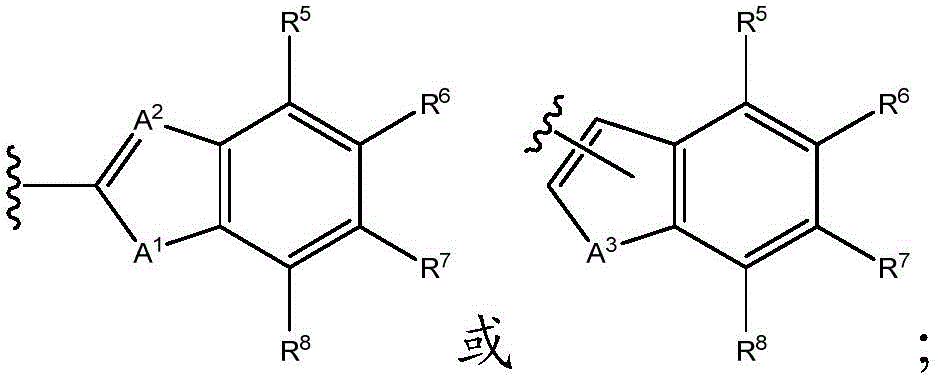
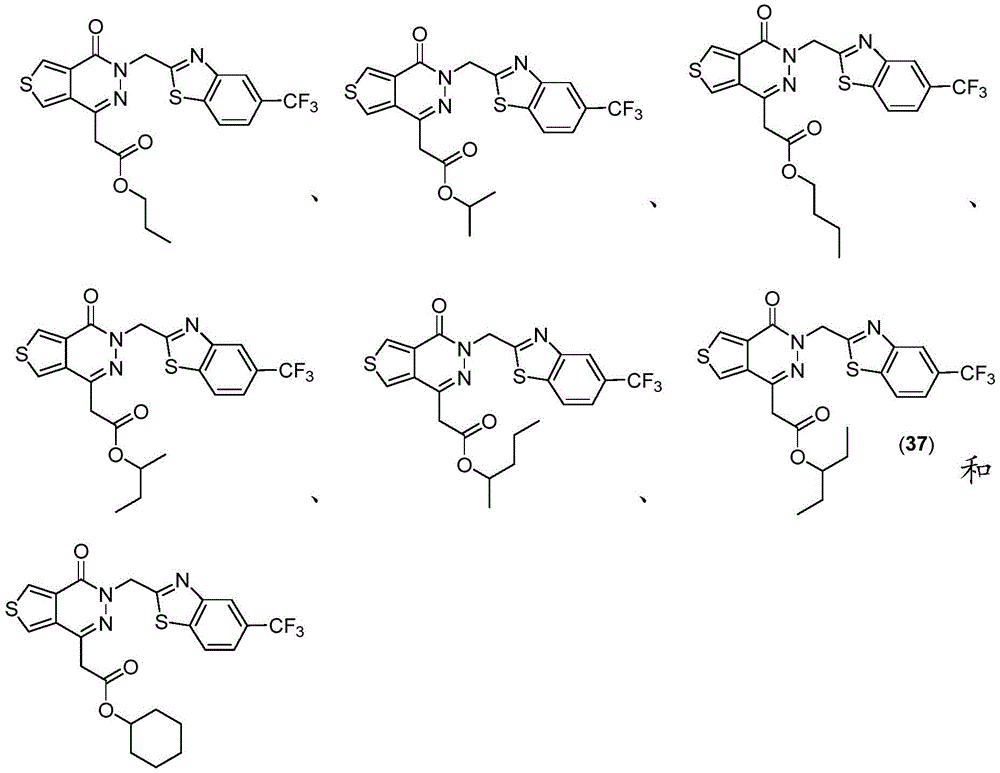

Applications Claiming Priority (5)
| Application Number | Priority Date | Filing Date | Title |
|---|---|---|---|
| US201962827362P | 2019-04-01 | 2019-04-01 | |
| US62/827,362 | 2019-04-01 | ||
| US201962928735P | 2019-10-31 | 2019-10-31 | |
| US62/928,735 | 2019-10-31 | ||
| PCT/US2020/025928 WO2020205846A1 (en) | 2019-04-01 | 2020-03-31 | Inhibitors of aldose reductase |
Publications (1)
| Publication Number | Publication Date |
|---|---|
| CN113840825A true CN113840825A (en) | 2021-12-24 |
Family
ID=70416582
Family Applications (1)
| Application Number | Title | Priority Date | Filing Date |
|---|---|---|---|
| CN202080036570.XA Pending CN113840825A (en) | 2019-04-01 | 2020-03-31 | aldose reductase inhibitor |
Country Status (12)
| Country | Link |
|---|---|
| US (1) | US12528823B2 (en) |
| EP (1) | EP3947391A1 (en) |
| JP (2) | JP7623292B2 (en) |
| KR (1) | KR20220003529A (en) |
| CN (1) | CN113840825A (en) |
| AU (1) | AU2020254610A1 (en) |
| BR (1) | BR112021019596A2 (en) |
| CA (1) | CA3132136A1 (en) |
| IL (1) | IL286832A (en) |
| MX (1) | MX2021011858A (en) |
| SG (1) | SG11202110590PA (en) |
| WO (1) | WO2020205846A1 (en) |
Families Citing this family (4)
| Publication number | Priority date | Publication date | Assignee | Title |
|---|---|---|---|---|
| PT3658142T (en) | 2017-07-28 | 2024-06-27 | Applied Therapeutics Inc | Compositions and methods for treating galactosemia |
| CN113840825A (en) | 2019-04-01 | 2021-12-24 | 应用治疗公司 | aldose reductase inhibitor |
| CA3136100A1 (en) | 2019-05-07 | 2020-11-12 | Stephan L. ZUCHNER | Treatment and detection of inherited neuropathies and associated disorders |
| JP7778686B2 (en) * | 2019-10-08 | 2025-12-02 | アプライド セラピューティクス, インコーポレイテッド | Aldose reductase inhibitors for the treatment of phosphomannomutase 2 deficiency |
Citations (6)
| Publication number | Priority date | Publication date | Assignee | Title |
|---|---|---|---|---|
| WO1989006651A1 (en) * | 1988-01-19 | 1989-07-27 | Pfizer Inc. | 1h-indazole-3-acetic acids as aldose reductase inhibitors |
| US4939140A (en) * | 1985-11-07 | 1990-07-03 | Pfizer Inc. | Heterocyclic oxophthalazinyl acetic acids |
| WO2012009553A1 (en) * | 2010-07-16 | 2012-01-19 | The Trustees Of Columbia University In The City Of New York | Aldose reductase inhibitors and uses thereof |
| AU2014207683A1 (en) * | 2013-01-16 | 2015-07-23 | The Trustees Of Columbia University In The City Of New York | Aldose reductase inhibitors and uses thereof |
| WO2019023648A1 (en) * | 2017-07-28 | 2019-01-31 | Applied Therapeutics Inc. | Compositions and methods for treating galactosemia |
| CN109310674A (en) * | 2016-06-21 | 2019-02-05 | 纽约市哥伦比亚大学理事会 | Aldose reductase inhibitor and method of use |
Family Cites Families (65)
| Publication number | Priority date | Publication date | Assignee | Title |
|---|---|---|---|---|
| EP0189272A3 (en) | 1985-01-17 | 1987-08-19 | Fujisawa Pharmaceutical Co., Ltd. | New furanone derivatives, processes for preparation thereof and use thereof |
| CA1299178C (en) | 1985-11-07 | 1992-04-21 | Banavara Lakshmana Mylari | Heterocyclic oxophtalazinyl acetic acids |
| EP0222576B1 (en) | 1985-11-07 | 1992-03-18 | Pfizer Inc. | Heterocyclic oxophthalazinyl acetic acids |
| AU7386887A (en) | 1986-06-12 | 1987-12-17 | American Home Products Corporation | Method of stimulating the immune system with tolrestat;(n-((5 -(trifluoromethyl)-6-methoxy-1-naphthenyl)thioxomethyl)-n-me hylglycine) |
| US4868301A (en) | 1987-06-09 | 1989-09-19 | Pfizer Inc. | Processes and intermediates for the preparation of oxophthalazinyl acetic acids having benzothiazole or other heterocyclic side chains |
| CA1307537C (en) | 1987-12-23 | 1992-09-15 | Jay E. Wrobel | N-naphthoylglycines as aldose reductase inhibitors |
| US4954629A (en) | 1989-05-11 | 1990-09-04 | Pfizer Inc. | Process and intermediates for the preparation of oxophthalazinyl acetic acids and analogs thereof |
| US4996204A (en) | 1989-05-11 | 1991-02-26 | Pfizer Inc. | Pyrido[2,3-d]pyridazinones as aldose reductase inhibitors |
| FR2647676A1 (en) | 1989-06-05 | 1990-12-07 | Union Pharma Scient Appl | New pyridazinone derivatives, processes for preparing them and medicaments containing them which are useful, in particular, as aldose reductase inhibitors |
| US5304557A (en) | 1989-12-15 | 1994-04-19 | Pfizer Inc. | Substituted oxoophthalazinyl acetic acids and analogs thereof |
| JPH0495025A (en) | 1990-08-08 | 1992-03-27 | Asahi Chem Ind Co Ltd | Aldose reductase inhibitor |
| WO1994007867A1 (en) | 1992-09-28 | 1994-04-14 | Pfizer Inc. | Substituted pyrimidines for control of diabetic complications |
| TW420669B (en) | 1994-03-28 | 2001-02-01 | Nissan Chemical Ind Ltd | Pyridine type thiazolidines |
| JPH11512095A (en) | 1995-08-28 | 1999-10-19 | アメリカン・ホーム・プロダクツ・コーポレイション | Phenoxyacetic acid as an aldose reductase inhibitor and antihyperglycemic agent |
| US6696407B1 (en) | 1997-03-21 | 2004-02-24 | The Regents Of The University Of California | Huntington's disease treatment comprising administering aldose reductase inhibitors to increase striatal CNTF |
| WO1998042324A2 (en) | 1997-03-21 | 1998-10-01 | The Regents Of The University Of California | Methods for modulating neurotrophic factor-associated activity using aldose reductase inhibitors |
| JP2001517670A (en) | 1997-09-23 | 2001-10-09 | ノボ ノルディスク アクティーゼルスカブ | Protein tyrosine phosphatase (PTPase) module |
| US6214991B1 (en) | 1998-03-31 | 2001-04-10 | The Institute For Pharmaceutical Discovery, Inc. | Substituted indolealkanoic acids |
| EP0982306A3 (en) | 1998-08-21 | 2000-07-05 | Pfizer Products Inc. | Polymorph of zopolrestat monohydrate |
| CZ20013465A3 (en) | 1999-04-01 | 2002-10-16 | Pfizer Products Inc. | Aminopyrimidines functioning as sorbitol dehydrogenase inhibitors |
| JP4511655B2 (en) | 1999-08-25 | 2010-07-28 | ユニチカ株式会社 | Sorbitol dehydrogenase, microorganism producing the same, and method for producing the same |
| US6916824B1 (en) | 1999-11-12 | 2005-07-12 | Kansas State University Research Foundation | Methods of treating cataracts and diabetic retinopathy with tricyclic pyrones |
| US20020068740A1 (en) | 1999-12-07 | 2002-06-06 | Mylari Banavara L. | Combination of aldose reductase inhibitors and antihypertensive agents for the treatment of diabetic complications |
| US6570013B2 (en) | 2000-02-16 | 2003-05-27 | Pfizer Inc | Salts of zopolrestat |
| PL365294A1 (en) | 2001-03-30 | 2004-12-27 | Pfizer Products Inc. | Pyridazinone aldose reductase inhibitors |
| ES2274201T3 (en) | 2002-01-23 | 2007-05-16 | Eli Lilly And Company | AGELISTS OF THE RECEIVER OF MELANOCORTINA. |
| US20040047919A1 (en) | 2002-06-13 | 2004-03-11 | Board Of Regents, The University Of Texas System | Methods and compositions involving aldose reductase inhibitors |
| MXPA04012396A (en) | 2002-06-14 | 2005-06-17 | Sato Fumihiko | Prodrugs of imidazole derivatives, for use as proton pump inhibitors in the treatment of e.g. peptic ulcers. |
| ES2545619T3 (en) | 2003-01-31 | 2015-09-14 | The Mount Sinai School Of Medicine Of New York University | Combination therapy to treat protein deficiency disorders |
| US7572910B2 (en) | 2003-02-20 | 2009-08-11 | Pfizer, Inc. | Pyridazinone aldose reductase inhibitors |
| US20070060533A1 (en) | 2003-10-24 | 2007-03-15 | Meiji Seika Kaisha Ltd. | Novel inhibitor of the formation of advanced glycation end product and aldose reductase inhibitor |
| US20070021366A1 (en) | 2004-11-19 | 2007-01-25 | Srivastava Satish K | Structural-based inhibitors of the glutathione binding site in aldose reductase, methods of screening therefor and methods of use |
| US20110092566A1 (en) | 2004-11-19 | 2011-04-21 | Srivastava Satish K | Treatment of cancer with aldose reductase inhibitors |
| ES2452929T3 (en) | 2007-04-05 | 2014-04-03 | Morphotek, Inc. | Methods to inhibit the binding of endosialin to ligands |
| CN101143868A (en) | 2007-09-04 | 2008-03-19 | 北京理工大学 | Aldose reductase inhibitor structure and use |
| EP2065038A1 (en) | 2007-11-30 | 2009-06-03 | Pharnext | New therapeutic approaches for treating Charcot-Marie-Tooth disease |
| KR20090084439A (en) | 2008-02-01 | 2009-08-05 | 부경대학교 산학협력단 | A composition for the prevention or treatment of diabetic complications containing the extract of Ginseng or a prenylated flavonoid compound isolated therefrom |
| WO2010028132A2 (en) | 2008-09-06 | 2010-03-11 | Bionevia Pharmaceuticals, Inc. | Novel choline cocrystal of epalrestat |
| US20100215726A1 (en) | 2009-02-25 | 2010-08-26 | Peter Thomas Roth | Compositions for Diminishing the Appearance of Wrinkles |
| US20130029983A1 (en) | 2009-09-23 | 2013-01-31 | Carlo Ballatore | Aminothienopyridazine inhibitors of tau assembly |
| EP2502079B1 (en) | 2009-11-20 | 2015-01-28 | Pharnext | New diagnostic tools for charcot-marie-tooth disease |
| US20240180907A1 (en) | 2010-07-16 | 2024-06-06 | The Trustees Of Columbia University In The City Of New York | Aldose reductase inhibitors and uses thereof |
| US10060887B2 (en) | 2010-11-15 | 2018-08-28 | The United States Of America As Represented By The Secretary Of The Army | Field sampling kit and methods for collecting and detecting alkyl methylphosphonic acids |
| KR101695166B1 (en) | 2010-11-23 | 2017-01-12 | 대한민국 | A composition for preventing or treating diabetic complication comprising extract of Sedum sarmentosum |
| CN102512407B (en) | 2011-11-23 | 2014-05-21 | 中山大学 | Application of a β-phenylalanine compound as an aldose reductase inhibitor |
| WO2013123403A1 (en) | 2012-02-15 | 2013-08-22 | Sanford-Burnham Medical Research Institute | Theranostics platform and methods of use |
| GB201205739D0 (en) | 2012-03-30 | 2012-05-16 | Ucl Business Plc | Treatment of acute inflammation in the respiratory tract |
| EP2877214B1 (en) | 2012-07-26 | 2019-04-24 | Joslin Diabetes Center, Inc. | Predicting diabetic complications |
| US20140228319A1 (en) | 2013-02-13 | 2014-08-14 | Banavara L. Mylari | Water soluble salts of aldose reductase inhibitors for treatment of diabetic complications |
| US20170362237A1 (en) | 2016-06-17 | 2017-12-21 | Banavara L. Mylari | Water soluble salts of aldose reductase inhibitors for treatment of diabetic complications |
| US11484278B2 (en) | 2013-03-15 | 2022-11-01 | Biogen Ma Inc. | Assessment of labeled probes in a subject |
| JP6576445B2 (en) | 2015-04-30 | 2019-09-18 | 中国科学院微生物研究所Institute Of Microbiology, Chinese Academy Of Sciences | Aromatic compounds of farnesyl and their applications |
| JP6500992B2 (en) | 2015-09-01 | 2019-04-17 | 株式会社村田製作所 | Coil built-in parts |
| EP3452101A2 (en) | 2016-05-04 | 2019-03-13 | CureVac AG | Rna encoding a therapeutic protein |
| JP2019535263A (en) | 2016-11-14 | 2019-12-12 | メモリアル スローン ケタリング キャンサー センター | Method for drug discovery using stem cell-derived Schwann cells |
| BR112019019655A2 (en) | 2017-03-23 | 2020-04-22 | Harvard College | nucleobase editors comprising nucleic acid programmable dna binding proteins |
| US20200131203A1 (en) | 2017-04-27 | 2020-04-30 | Applied Therapeutics, Inc. | Aldose reductase inhibitors and uses thereof |
| US11329472B2 (en) | 2018-07-20 | 2022-05-10 | Texas Instruments Incorporated | Methods and apparatus to prevent undesired triggering of short circuit or over current protection |
| AU2019326265B2 (en) | 2018-08-20 | 2025-07-24 | Maggie's Pearl, Llc | Methods for treating congenital disorders of glycosylation |
| WO2020167937A1 (en) | 2019-02-12 | 2020-08-20 | Applied Therapeutics, Inc. | Methods for treating cutaneous aging |
| CN113840825A (en) | 2019-04-01 | 2021-12-24 | 应用治疗公司 | aldose reductase inhibitor |
| CA3136100A1 (en) | 2019-05-07 | 2020-11-12 | Stephan L. ZUCHNER | Treatment and detection of inherited neuropathies and associated disorders |
| JP7778686B2 (en) | 2019-10-08 | 2025-12-02 | アプライド セラピューティクス, インコーポレイテッド | Aldose reductase inhibitors for the treatment of phosphomannomutase 2 deficiency |
| WO2021202523A1 (en) | 2020-03-31 | 2021-10-07 | Applied Therapeutics, Inc. | Aldose reductase inhibitors for the treatment of acute respiratory distress syndrome, acute lung inflammation/injury, cardiac injury and anti-viral therapy |
| MX2022013658A (en) | 2020-05-01 | 2023-03-01 | Applied Therapeutics Inc | Aldose reductase inhibitors for treating sorbitol dehydrogenase deficiency. |
-
2020
- 2020-03-31 CN CN202080036570.XA patent/CN113840825A/en active Pending
- 2020-03-31 BR BR112021019596A patent/BR112021019596A2/en unknown
- 2020-03-31 EP EP20721069.1A patent/EP3947391A1/en active Pending
- 2020-03-31 WO PCT/US2020/025928 patent/WO2020205846A1/en not_active Ceased
- 2020-03-31 MX MX2021011858A patent/MX2021011858A/en unknown
- 2020-03-31 SG SG11202110590PA patent/SG11202110590PA/en unknown
- 2020-03-31 JP JP2021558814A patent/JP7623292B2/en active Active
- 2020-03-31 KR KR1020217035362A patent/KR20220003529A/en active Pending
- 2020-03-31 CA CA3132136A patent/CA3132136A1/en active Pending
- 2020-03-31 AU AU2020254610A patent/AU2020254610A1/en active Pending
-
2021
- 2021-09-29 US US17/489,022 patent/US12528823B2/en active Active
- 2021-09-30 IL IL286832A patent/IL286832A/en unknown
-
2024
- 2024-10-18 JP JP2024183938A patent/JP2025003530A/en active Pending
Patent Citations (7)
| Publication number | Priority date | Publication date | Assignee | Title |
|---|---|---|---|---|
| US4939140A (en) * | 1985-11-07 | 1990-07-03 | Pfizer Inc. | Heterocyclic oxophthalazinyl acetic acids |
| WO1989006651A1 (en) * | 1988-01-19 | 1989-07-27 | Pfizer Inc. | 1h-indazole-3-acetic acids as aldose reductase inhibitors |
| WO2012009553A1 (en) * | 2010-07-16 | 2012-01-19 | The Trustees Of Columbia University In The City Of New York | Aldose reductase inhibitors and uses thereof |
| CN103052637A (en) * | 2010-07-16 | 2013-04-17 | 纽约市哥伦比亚大学理事会 | Aldose reductase inhibitors and uses thereof |
| AU2014207683A1 (en) * | 2013-01-16 | 2015-07-23 | The Trustees Of Columbia University In The City Of New York | Aldose reductase inhibitors and uses thereof |
| CN109310674A (en) * | 2016-06-21 | 2019-02-05 | 纽约市哥伦比亚大学理事会 | Aldose reductase inhibitor and method of use |
| WO2019023648A1 (en) * | 2017-07-28 | 2019-01-31 | Applied Therapeutics Inc. | Compositions and methods for treating galactosemia |
Also Published As
| Publication number | Publication date |
|---|---|
| JP2025003530A (en) | 2025-01-09 |
| WO2020205846A1 (en) | 2020-10-08 |
| JP2022519944A (en) | 2022-03-25 |
| MX2021011858A (en) | 2022-01-18 |
| KR20220003529A (en) | 2022-01-10 |
| BR112021019596A2 (en) | 2021-11-30 |
| SG11202110590PA (en) | 2021-10-28 |
| US20220017535A1 (en) | 2022-01-20 |
| IL286832A (en) | 2021-10-31 |
| EP3947391A1 (en) | 2022-02-09 |
| US12528823B2 (en) | 2026-01-20 |
| JP7623292B2 (en) | 2025-01-28 |
| CA3132136A1 (en) | 2020-10-08 |
| AU2020254610A1 (en) | 2021-11-18 |
Similar Documents
| Publication | Publication Date | Title |
|---|---|---|
| AU2021203801B2 (en) | Aldose reductase inhibitors and methods of use thereof | |
| US12528823B2 (en) | Inhibitors of aldose reductase | |
| JP6430670B2 (en) | Aldose reductase inhibitor and method of use thereof | |
| CN105121414A (en) | Aldose reductase inhibitors and uses thereof | |
| HK40105726A (en) | 4-oxo-3,4-dihydrothieno[3,4-d]pyridazine compounds as aldose reductase inhibitors and methods of use thereof | |
| HK40044237A (en) | 4-oxo-3,4-dihydrothieno[3,4-d]pyridazine compounds as aldose reductase inhibitors and methods of use thereof | |
| HK40044237B (en) | 4-oxo-3,4-dihydrothieno[3,4-d]pyridazine compounds as aldose reductase inhibitors and methods of use thereof | |
| HK1259379B (en) | Aldose reductase inhibitors and methods of use thereof |
Legal Events
| Date | Code | Title | Description |
|---|---|---|---|
| PB01 | Publication | ||
| PB01 | Publication | ||
| SE01 | Entry into force of request for substantive examination | ||
| SE01 | Entry into force of request for substantive examination |