CN113728630A - Region-based gradient computation in different motion vector refinements - Google Patents
Region-based gradient computation in different motion vector refinements Download PDFInfo
- Publication number
- CN113728630A CN113728630A CN202080029821.1A CN202080029821A CN113728630A CN 113728630 A CN113728630 A CN 113728630A CN 202080029821 A CN202080029821 A CN 202080029821A CN 113728630 A CN113728630 A CN 113728630A
- Authority
- CN
- China
- Prior art keywords
- block
- prof
- prediction
- predsample
- optical flow
- Prior art date
- Legal status (The legal status is an assumption and is not a legal conclusion. Google has not performed a legal analysis and makes no representation as to the accuracy of the status listed.)
- Granted
Links
Images


Classifications
-
- H—ELECTRICITY
- H04—ELECTRIC COMMUNICATION TECHNIQUE
- H04N—PICTORIAL COMMUNICATION, e.g. TELEVISION
- H04N19/00—Methods or arrangements for coding, decoding, compressing or decompressing digital video signals
- H04N19/50—Methods or arrangements for coding, decoding, compressing or decompressing digital video signals using predictive coding
- H04N19/503—Methods or arrangements for coding, decoding, compressing or decompressing digital video signals using predictive coding involving temporal prediction
- H04N19/51—Motion estimation or motion compensation
- H04N19/563—Motion estimation with padding, i.e. with filling of non-object values in an arbitrarily shaped picture block or region for estimation purposes
-
- H—ELECTRICITY
- H04—ELECTRIC COMMUNICATION TECHNIQUE
- H04N—PICTORIAL COMMUNICATION, e.g. TELEVISION
- H04N19/00—Methods or arrangements for coding, decoding, compressing or decompressing digital video signals
- H04N19/50—Methods or arrangements for coding, decoding, compressing or decompressing digital video signals using predictive coding
- H04N19/503—Methods or arrangements for coding, decoding, compressing or decompressing digital video signals using predictive coding involving temporal prediction
- H04N19/51—Motion estimation or motion compensation
- H04N19/537—Motion estimation other than block-based
- H04N19/54—Motion estimation other than block-based using feature points or meshes
-
- H—ELECTRICITY
- H04—ELECTRIC COMMUNICATION TECHNIQUE
- H04N—PICTORIAL COMMUNICATION, e.g. TELEVISION
- H04N19/00—Methods or arrangements for coding, decoding, compressing or decompressing digital video signals
- H04N19/50—Methods or arrangements for coding, decoding, compressing or decompressing digital video signals using predictive coding
- H04N19/503—Methods or arrangements for coding, decoding, compressing or decompressing digital video signals using predictive coding involving temporal prediction
- H04N19/51—Motion estimation or motion compensation
- H04N19/523—Motion estimation or motion compensation with sub-pixel accuracy
-
- H—ELECTRICITY
- H04—ELECTRIC COMMUNICATION TECHNIQUE
- H04N—PICTORIAL COMMUNICATION, e.g. TELEVISION
- H04N19/00—Methods or arrangements for coding, decoding, compressing or decompressing digital video signals
- H04N19/10—Methods or arrangements for coding, decoding, compressing or decompressing digital video signals using adaptive coding
- H04N19/102—Methods or arrangements for coding, decoding, compressing or decompressing digital video signals using adaptive coding characterised by the element, parameter or selection affected or controlled by the adaptive coding
- H04N19/103—Selection of coding mode or of prediction mode
- H04N19/105—Selection of the reference unit for prediction within a chosen coding or prediction mode, e.g. adaptive choice of position and number of pixels used for prediction
-
- H—ELECTRICITY
- H04—ELECTRIC COMMUNICATION TECHNIQUE
- H04N—PICTORIAL COMMUNICATION, e.g. TELEVISION
- H04N19/00—Methods or arrangements for coding, decoding, compressing or decompressing digital video signals
- H04N19/10—Methods or arrangements for coding, decoding, compressing or decompressing digital video signals using adaptive coding
- H04N19/102—Methods or arrangements for coding, decoding, compressing or decompressing digital video signals using adaptive coding characterised by the element, parameter or selection affected or controlled by the adaptive coding
- H04N19/132—Sampling, masking or truncation of coding units, e.g. adaptive resampling, frame skipping, frame interpolation or high-frequency transform coefficient masking
-
- H—ELECTRICITY
- H04—ELECTRIC COMMUNICATION TECHNIQUE
- H04N—PICTORIAL COMMUNICATION, e.g. TELEVISION
- H04N19/00—Methods or arrangements for coding, decoding, compressing or decompressing digital video signals
- H04N19/10—Methods or arrangements for coding, decoding, compressing or decompressing digital video signals using adaptive coding
- H04N19/134—Methods or arrangements for coding, decoding, compressing or decompressing digital video signals using adaptive coding characterised by the element, parameter or criterion affecting or controlling the adaptive coding
- H04N19/157—Assigned coding mode, i.e. the coding mode being predefined or preselected to be further used for selection of another element or parameter
-
- H—ELECTRICITY
- H04—ELECTRIC COMMUNICATION TECHNIQUE
- H04N—PICTORIAL COMMUNICATION, e.g. TELEVISION
- H04N19/00—Methods or arrangements for coding, decoding, compressing or decompressing digital video signals
- H04N19/10—Methods or arrangements for coding, decoding, compressing or decompressing digital video signals using adaptive coding
- H04N19/134—Methods or arrangements for coding, decoding, compressing or decompressing digital video signals using adaptive coding characterised by the element, parameter or criterion affecting or controlling the adaptive coding
- H04N19/157—Assigned coding mode, i.e. the coding mode being predefined or preselected to be further used for selection of another element or parameter
- H04N19/159—Prediction type, e.g. intra-frame, inter-frame or bidirectional frame prediction
-
- H—ELECTRICITY
- H04—ELECTRIC COMMUNICATION TECHNIQUE
- H04N—PICTORIAL COMMUNICATION, e.g. TELEVISION
- H04N19/00—Methods or arrangements for coding, decoding, compressing or decompressing digital video signals
- H04N19/10—Methods or arrangements for coding, decoding, compressing or decompressing digital video signals using adaptive coding
- H04N19/169—Methods or arrangements for coding, decoding, compressing or decompressing digital video signals using adaptive coding characterised by the coding unit, i.e. the structural portion or semantic portion of the video signal being the object or the subject of the adaptive coding
- H04N19/17—Methods or arrangements for coding, decoding, compressing or decompressing digital video signals using adaptive coding characterised by the coding unit, i.e. the structural portion or semantic portion of the video signal being the object or the subject of the adaptive coding the unit being an image region, e.g. an object
- H04N19/176—Methods or arrangements for coding, decoding, compressing or decompressing digital video signals using adaptive coding characterised by the coding unit, i.e. the structural portion or semantic portion of the video signal being the object or the subject of the adaptive coding the unit being an image region, e.g. an object the region being a block, e.g. a macroblock
-
- H—ELECTRICITY
- H04—ELECTRIC COMMUNICATION TECHNIQUE
- H04N—PICTORIAL COMMUNICATION, e.g. TELEVISION
- H04N19/00—Methods or arrangements for coding, decoding, compressing or decompressing digital video signals
- H04N19/42—Methods or arrangements for coding, decoding, compressing or decompressing digital video signals characterised by implementation details or hardware specially adapted for video compression or decompression, e.g. dedicated software implementation
-
- H—ELECTRICITY
- H04—ELECTRIC COMMUNICATION TECHNIQUE
- H04N—PICTORIAL COMMUNICATION, e.g. TELEVISION
- H04N19/00—Methods or arrangements for coding, decoding, compressing or decompressing digital video signals
- H04N19/50—Methods or arrangements for coding, decoding, compressing or decompressing digital video signals using predictive coding
- H04N19/503—Methods or arrangements for coding, decoding, compressing or decompressing digital video signals using predictive coding involving temporal prediction
- H04N19/51—Motion estimation or motion compensation
- H04N19/513—Processing of motion vectors
-
- H—ELECTRICITY
- H04—ELECTRIC COMMUNICATION TECHNIQUE
- H04N—PICTORIAL COMMUNICATION, e.g. TELEVISION
- H04N19/00—Methods or arrangements for coding, decoding, compressing or decompressing digital video signals
- H04N19/50—Methods or arrangements for coding, decoding, compressing or decompressing digital video signals using predictive coding
- H04N19/503—Methods or arrangements for coding, decoding, compressing or decompressing digital video signals using predictive coding involving temporal prediction
- H04N19/51—Motion estimation or motion compensation
- H04N19/527—Global motion vector estimation
-
- H—ELECTRICITY
- H04—ELECTRIC COMMUNICATION TECHNIQUE
- H04N—PICTORIAL COMMUNICATION, e.g. TELEVISION
- H04N19/00—Methods or arrangements for coding, decoding, compressing or decompressing digital video signals
- H04N19/50—Methods or arrangements for coding, decoding, compressing or decompressing digital video signals using predictive coding
- H04N19/503—Methods or arrangements for coding, decoding, compressing or decompressing digital video signals using predictive coding involving temporal prediction
- H04N19/51—Motion estimation or motion compensation
- H04N19/577—Motion compensation with bidirectional frame interpolation, i.e. using B-pictures
Landscapes
- Engineering & Computer Science (AREA)
- Multimedia (AREA)
- Signal Processing (AREA)
- Compression Or Coding Systems Of Tv Signals (AREA)
- Compression, Expansion, Code Conversion, And Decoders (AREA)
Abstract
提供了一种视频处理方法,包括:通过基于根据精度规则的初始预测样点的梯度使用光流计算来细化视频的当前视频块的一个或多个初始预测,为该当前视频块确定当前视频块的最终预测块;以及使用最终预测块来执行当前视频块和编码表示之间的转换,其中,光流计算包括利用光流的预测细化(PROF)过程或双向光流(BDOF)过程,其中,精度规则指定使用相同的精度用于表示PROF过程和BDOF过程两者的梯度。

A video processing method is provided, comprising: determining a current video block for the current video block by refining one or more initial predictions for a current video block of the video using optical flow calculations based on gradients of initial prediction samples according to a precision rule a final prediction block of the block; and using the final prediction block to perform the conversion between the current video block and the encoded representation, wherein the optical flow computation includes a prediction refinement with optical flow (PROF) process or a bidirectional optical flow (BDOF) process, Among them, the precision rule specifies that the same precision is used to represent the gradients of both the PROF process and the BDOF process.
Description
相关申请的交叉引用CROSS-REFERENCE TO RELATED APPLICATIONS
根据适用的专利法和/或依据巴黎公约的规则,本申请旨在及时要求于2019年4月19日提交的第PCT/CN2019/083434号国际专利申请和2019年6月25日提交的第PCT/CN2019/092762号国际专利申请的优先权和利益。前述申请的全部公开通过引用而并入作为本申请的公开的一部分。In accordance with applicable patent law and/or rules pursuant to the Paris Convention, this application is intended to promptly claim International Patent Application No. PCT/CN2019/083434 filed on April 19, 2019 and PCT No. 25 June 2019 Priority and interests of international patent application /CN2019/092762. The entire disclosures of the foregoing applications are incorporated by reference as part of the disclosure of this application.
技术领域technical field
本专利文档涉及视频处理技术、设备和系统。This patent document relates to video processing techniques, devices and systems.
背景技术Background technique
尽管视频压缩技术有所进步,但数字视频仍然在互联网和其它数字通信网络上占据最大的带宽使用。随着能够接收和显示视频的联网用户设备数量的增加,预计对数字视频使用的带宽需求将继续增长。Despite advances in video compression, digital video still accounts for the largest use of bandwidth on the Internet and other digital communication networks. As the number of networked user devices capable of receiving and displaying video increases, bandwidth requirements for digital video usage are expected to continue to grow.
发明内容SUMMARY OF THE INVENTION
与数字视频处理相关的设备、系统和方法。所描述的方法可以被应用于现有的视频编解码标准(例如,高效视频编解码(High Efficiency Video Coding,HEVC))和未来的视频编解码标准或视频编解码器。Apparatus, systems and methods related to digital video processing. The described method can be applied to existing video codec standards (eg, High Efficiency Video Coding (HEVC)) and future video codec standards or video codecs.
在一个代表性方面,所公开的技术可以用于提供一种用于视频处理的方法。该方法包括:使用在视频的当前视频块的子块级别执行的仿射模式运动补偿来生成该当前视频块的预测块;对当前视频块的区域执行梯度计算,以使用利用光流的预测细化(PROF)过程来细化预测块,其中,区域的尺寸(M×N)不同于当前视频块的子块的尺寸,其中,M和N是正整数;以及基于梯度计算来执行当前视频块和视频的编解码表示之间的转换。In one representative aspect, the disclosed techniques may be used to provide a method for video processing. The method includes: using affine mode motion compensation performed at the sub-block level of the current video block of the video to generate a prediction block for the current video block; refinement of the prediction block, where the size of the region (M×N) is different from the size of the sub-blocks of the current video block, where M and N are positive integers; and performing the current video block and Conversion between codec representations of video.
在另一个代表性方面,所公开的技术可以用于提供一种用于视频处理的方法。该方法包括:为具有第一尺寸的视频的当前视频块推导最终预测块,其中该最终预测块是通过使用在具有根据规则的第二尺寸的视频区域上执行的梯度计算来细化一个或多个中间预测块而计算的,其中,该细化使用光流过程;以及使用最终预测块来执行当前视频块和视频的编解码表示之间的转换。In another representative aspect, the disclosed techniques may be used to provide a method for video processing. The method includes deriving a final prediction block for a current video block of video having a first size, wherein the final prediction block is obtained by refining one or more of the computed for each of the intermediate prediction blocks, where the refinement uses an optical flow process; and the final prediction block to perform the conversion between the current video block and the codec representation of the video.
在另一个代表性方面,所公开的技术可以用于提供一种用于视频处理的方法。该方法包括:使用双向光流(BDOF)或利用光流的预测细化(PROF)为视频的当前视频块推导运动信息;对当前视频块的区域中的样点执行梯度计算,使得区域中的至少一个样点从梯度计算中被省略;以及基于梯度计算来执行当前视频块和包括该当前视频块的视频的编解码表示之间的转换,其中,当前视频块的一个或多个初始预测在子块级别进行计算并在PROF期间使用光流计算进行细化,或者一个或多个初始预测在BDOF期间使用空域和时域梯度进行细化。In another representative aspect, the disclosed techniques may be used to provide a method for video processing. The method includes: using Bidirectional Optical Flow (BDOF) or Predictive Refinement Using Optical Flow (PROF) to derive motion information for a current video block of the video; performing gradient calculations on samples in a region of the current video block such that the at least one sample is omitted from the gradient calculation; and performing a conversion between the current video block and the codec representation of the video including the current video block based on the gradient calculation, wherein one or more initial predictions of the current video block are Computation is performed at the sub-block level and refined during PROF using optical flow computations, or one or more initial predictions are refined during BDOF using spatial and temporal gradients.
在另一个代表性方面,所公开的技术可以用于提供一种用于视频处理的方法。该方法包括:通过基于根据精度规则的初始预测样点的梯度使用光流计算来细化视频的当前视频块的一个或多个初始预测,为该当前视频块确定当前视频块的最终预测块;以及使用最终预测块来执行当前视频块和编解码表示之间的转换,其中,光流计算包括利用光流的预测细化(PROF)过程或双向光流(BDOF)过程,其中,精度规则指定使用相同的精度用于表示PROF过程和BDOF过程两者的梯度。In another representative aspect, the disclosed techniques may be used to provide a method for video processing. The method includes: determining a final prediction block of the current video block for the current video block by using optical flow calculations to refine one or more initial predictions of the current video block of the video based on the gradient of the initial prediction samples according to the precision rule; and using the final prediction block to perform the conversion between the current video block and the codec representation, wherein the optical flow calculation includes a prediction refinement (PROF) process using optical flow (PROF) process or a bidirectional optical flow (BDOF) process, where the precision rule specifies The same precision is used to represent the gradients of both the PROF process and the BDOF process.
在另一个代表性方面,所公开的技术可以用于提供一种用于视频处理的方法。该方法包括:通过使用光流计算来细化视频的当前视频块的一个或多个初始预测,为该当前视频块和视频的编解码表示之间的转换确定当前视频块的最终预测块;以及使用最终预测块来执行该转换,其中,光流计算包括利用光流的预测细化(PROF)过程和/或双向光流(BDOF)过程,其中,光流计算还包括根据规则适用于PROF过程或BDOF过程中的至少一个的填充操作,以推导填充样点。In another representative aspect, the disclosed techniques may be used to provide a method for video processing. The method includes: using optical flow computations to refine one or more initial predictions for a current video block of the video, determining a final prediction block for the current video block for conversion between the current video block and a codec representation of the video; and The conversion is performed using the final prediction block, wherein the optical flow calculation includes a prediction refinement (PROF) process using optical flow and/or a bidirectional optical flow (BDOF) process, wherein the optical flow calculation also includes applying the PROF process according to the rules or at least one of the fill operations in the BDOF process to derive fill samples.
在又一个代表性方面,上述方法以处理器可执行代码的形式被体现并且被存储在计算机可读程序介质中。In yet another representative aspect, the above-described method is embodied in processor-executable code and stored on a computer-readable program medium.
在又一个代表性方面,公开了一种被配置为或可操作来执行上述方法的设备。该设备可以包括被编程来实施该方法的处理器。In yet another representative aspect, an apparatus configured or operable to perform the above method is disclosed. The apparatus may include a processor programmed to implement the method.
在又一个代表性方面,视频解码器装置可以实施如本文所描述的方法。In yet another representative aspect, a video decoder device may implement a method as described herein.
在附图、说明书和权利要求书中更详细地描述了所公开的技术的以上以及其它方面和特征。The above and other aspects and features of the disclosed technology are described in greater detail in the drawings, specification, and claims.
附图说明Description of drawings
图1示出了构建Merge候选列表的示例。Figure 1 shows an example of building a Merge candidate list.
图2示出了空域候选的位置的示例。FIG. 2 shows an example of the positions of the airspace candidates.
图3示出了对其进行空域Merge候选的冗余检查的候选对的示例。FIG. 3 shows an example of candidate pairs for which redundancy checking of spatial Merge candidates is performed.
图4A和图4B示出了基于当前块的尺寸和形状的第二预测单元(Prediction Unit,PU)的位置的示例。4A and 4B illustrate an example of the location of the second prediction unit (PU) based on the size and shape of the current block.
图5示出了用于时域Merge候选的运动矢量缩放的示例。Figure 5 shows an example of motion vector scaling for temporal Merge candidates.
图6示出了时域Merge候选的候选位置的示例。FIG. 6 shows an example of a candidate position of a temporal Merge candidate.
图7示出了生成组合的双向预测Merge候选的示例。Figure 7 shows an example of generating combined bi-predictive Merge candidates.
图8示出了构建运动矢量预测候选的示例。FIG. 8 shows an example of constructing motion vector prediction candidates.
图9示出了用于空域运动矢量候选的运动矢量缩放的示例。FIG. 9 shows an example of motion vector scaling for spatial motion vector candidates.
图10示出了使用用于编解码单元(Coding Unit,CU)的可选时域运动矢量预测(Alternative Temporal Motion Vector Prediction,ATMVP)算法的运动预测的示例。FIG. 10 shows an example of motion prediction using an Alternative Temporal Motion Vector Prediction (ATMVP) algorithm for a Coding Unit (CU).
图11示出了由空时运动矢量预测(Spatial-Temporal Motion VectorPrediction,STMVP)算法使用的具有子块的编解码单元(CU)和邻近块的示例。11 shows an example of a Codec Unit (CU) with sub-blocks and neighboring blocks used by the Spatial-Temporal Motion Vector Prediction (STMVP) algorithm.
图12A和12B示出了当使用重叠块运动补偿(OBMC)算法时子块的示例快照(snapshot)。Figures 12A and 12B illustrate example snapshots of sub-blocks when using the Overlapped Block Motion Compensation (OBMC) algorithm.
图13示出了用于推导用于局部照明补偿(LIC)算法的参数的邻近样点的示例。Figure 13 shows an example of adjacent samples used to derive parameters for a local illumination compensation (LIC) algorithm.
图14示出了简化的仿射运动模型的示例。Figure 14 shows an example of a simplified affine motion model.
图15示出了每个子块的仿射运动矢量场(MVF)的示例。Figure 15 shows an example of an affine motion vector field (MVF) for each sub-block.
图16示出了用于AF_INTER仿射运动模式的运动矢量预测(MVP)的示例。FIG. 16 shows an example of motion vector prediction (MVP) for AF_INTER affine motion mode.
图17A和图17B示出了AF_MERGE仿射运动模式的示例候选。17A and 17B illustrate example candidates for AF_MERGE affine motion patterns.
图18示出了模式匹配的运动矢量推导(PMMVD)模式中的双边匹配的示例,该模式是基于帧速率上转换(FRUC)算法的特殊Merge模式。Figure 18 shows an example of bilateral matching in the Pattern Matched Motion Vector Derivation (PMMVD) mode, which is a special Merge mode based on the Frame Rate Up-Conversion (FRUC) algorithm.
图19示出了FRUC算法中的模板匹配的示例。FIG. 19 shows an example of template matching in the FRUC algorithm.
图20示出了FRUC算法中的单边运动估计的示例。FIG. 20 shows an example of unilateral motion estimation in the FRUC algorithm.
图21示出了由双向光流(BIO)算法使用的光流轨迹的示例。Figure 21 shows an example of an optical flow trajectory used by the Bidirectional Optical Flow (BIO) algorithm.
图22A和图22B示出了在没有块扩展的情况下使用双向光流(BIO)算法的示例快照。22A and 22B show example snapshots using the Bidirectional Optical Flow (BIO) algorithm without block extension.
图23示出了在BIO中使用的插值样点的示例。Figure 23 shows an example of interpolation samples used in BIO.
图24示出了基于双边模板匹配的解码器侧运动矢量细化(DMVR)算法的示例。Figure 24 shows an example of a decoder-side motion vector refinement (DMVR) algorithm based on bilateral template matching.
图25示出了子块MV VSB和像素Δv(i,j)的示例。FIG. 25 shows an example of a sub-block MV VSB and a pixel Δv(i,j).
图26示出了相位变化水平滤波的示例。Figure 26 shows an example of phase change horizontal filtering.
图27示出了应用8抽头水平滤波的一个实例的示例。FIG. 27 shows an example of an example of applying 8-tap horizontal filtering.
图28示出了非均匀相位垂直滤波的示例。Figure 28 shows an example of non-uniform phase vertical filtering.
图29A至图29E示出了用于视频处理的示例方法的流程图。29A-29E illustrate flowcharts of example methods for video processing.
图30A和图30B是用于实施在本文档中描述的可视媒体解码或可视媒体编码技术的硬件平台的示例的框图。30A and 30B are block diagrams of examples of hardware platforms for implementing the visual media decoding or visual media encoding techniques described in this document.
图31示出了16×16区域中的16个4×4子块的示例。Figure 31 shows an example of 16 4x4 sub-blocks in a 16x16 area.
具体实施方式Detailed ways
由于对更高分辨率视频日益增长的需求,视频处理方法和技术在现代技术中无处不在。视频编解码器通常包括压缩或解压缩数字视频的电子电路或软件,并且正在不断改进以提供更高的编解码效率。视频编解码器将未压缩的视频转换为压缩格式,反之亦然。视频质量、用于表示视频的数据量(由比特率确定)、编码和解码算法的复杂度、对数据丢失和误差的敏感性、编辑的简易性、随机访问和端到端延迟(时延)之间存在复杂的关系。压缩格式通常符合标准视频压缩规范,例如高效视频编解码(HEVC)标准(也被称为H.265或MPEG-HPart 2)、待完成的通用视频编解码标准或其它当前和/或将来的视频编解码标准。Video processing methods and techniques are ubiquitous in modern technology due to the growing demand for higher resolution video. Video codecs typically include electronic circuitry or software that compresses or decompresses digital video, and is continually being improved to provide greater codec efficiency. Video codecs convert uncompressed video to compressed formats and vice versa. Video quality, amount of data used to represent the video (determined by bit rate), complexity of encoding and decoding algorithms, susceptibility to data loss and errors, ease of editing, random access, and end-to-end latency (latency) There is a complex relationship between them. Compression formats typically conform to standard video compression specifications, such as the High Efficiency Video Codec (HEVC) standard (also known as H.265 or MPEG-HPart 2), the pending Universal Video Codec standard, or other current and/or future video Codec standard.
所公开的技术的实施例可以应用于现有的视频编解码标准(例如,HEVC、H.265)和将来的标准,以提高压缩性能。在本文档中使用章节标题来提高描述的可读性,并且不以任何方式将讨论或实施例(和/或实施方式)仅限制于相应章节。Embodiments of the disclosed techniques may be applied to existing video codec standards (eg, HEVC, H.265) and future standards to improve compression performance. Section headings are used in this document to improve the readability of the description and in no way limit the discussion or the examples (and/or implementations) to the corresponding section only.
1.HEVC/H.265中的帧间预测的示例1. Example of Inter prediction in HEVC/H.265
近年来,视频编解码标准有了显著的改进,并且现在部分地提供了高编解码效率和对更高分辨率的支持。最近的标准(诸如HEVC和H.265)是基于混合视频编解码结构的,其中利用了时域预测加变换编解码。Video codec standards have improved significantly in recent years, and now, in part, provide high codec efficiency and support for higher resolutions. More recent standards, such as HEVC and H.265, are based on hybrid video codec structures, where temporal prediction plus transform codecs are utilized.
1.1预测模式的示例1.1 Examples of prediction modes
每个帧间预测PU(预测单元)具有一个或两个参考图片列表的运动参数。在一些实施例中,运动参数包括运动矢量和参考图片索引。在其它实施例中,对两个参考图片列表之一的使用也可以使用inter_pred_idc进行信令通知。在另一些实施例中,运动矢量可以被显示地编解码为相对于预测值的增量。Each inter-prediction PU (prediction unit) has motion parameters for one or two reference picture lists. In some embodiments, the motion parameters include motion vectors and reference picture indices. In other embodiments, the use of one of the two reference picture lists may also be signaled using inter_pred_idc. In other embodiments, motion vectors may be explicitly encoded and decoded as deltas relative to the predicted value.
当以跳过模式对CU进行编解码时,一个PU与CU相关联,并且没有显著的残差系数,没有编解码的运动矢量增量或参考图片索引。指定了Merge模式,由此从包括空域和时域候选的邻近PU获得当前PU的运动参数。Merge模式可以被应用于任何帧间预测PU,而不仅是针对跳过模式。Merge模式的替代方案是运动参数的显式传输,其中,运动矢量、每个参考图片列表的对应参考图片索引和参考图片列表使用按每PU被显式地信令通知。When a CU is coded in skip mode, one PU is associated with the CU and has no significant residual coefficients, no coded motion vector deltas or reference picture indices. Merge mode is specified, whereby the motion parameters of the current PU are obtained from neighboring PUs including spatial and temporal candidates. Merge mode can be applied to any inter-predicted PU, not just skip mode. An alternative to Merge mode is explicit transmission of motion parameters, where the motion vector, corresponding reference picture index for each reference picture list, and reference picture list usage are explicitly signaled on a per-PU basis.
当信令指示要使用两个参考图片列表之一时,从一个样点块产生PU。这被称为“单向预测”。单向预测适用于P条带和B条带两者。A PU is generated from a block of samples when signaling indicates that one of the two reference picture lists is to be used. This is called "one-way prediction". One-way prediction applies to both P-slices and B-slices.
当信令指示要使用两个参考图片列表时,从两个样点块产生PU。这被称为“双向预测”。双向预测仅适用于B条带。When signaling indicates that two reference picture lists are to be used, a PU is generated from two blocks of samples. This is called "two-way prediction". Bidirectional prediction is only available for B-slices.
1.1.1构建Merge模式的候选的实施例1.1.1 Examples of constructing candidates for Merge mode
当使用Merge模式预测PU时,从比特流中解析指向Merge候选列表中的条目的索引,并将其用于检索运动信息。该列表的构建可以根据以下步骤序列进行总结:When using Merge mode to predict a PU, the index to the entry in the Merge candidate list is parsed from the bitstream and used to retrieve motion information. The construction of this list can be summarized according to the following sequence of steps:
步骤1:初始候选推导Step 1: Initial candidate derivation
步骤1.1:空域候选推导Step 1.1: Airspace Candidate Derivation
步骤1.2:空域候选的冗余检查Step 1.2: Redundancy Check of Airspace Candidates
步骤1.3:时域候选推导Step 1.3: Time Domain Candidate Derivation
步骤2:附加候选插入Step 2: Additional Candidate Insertions
步骤2.1:创建双向预测候选Step 2.1: Create Bidirectional Prediction Candidates
步骤2.2:插入零运动候选Step 2.2: Insert zero motion candidates
图1示出了基于上面总结的步骤序列来构建Merge候选列表的示例。对于空域Merge候选推导,从位于五个不同位置的候选当中选择最多四个Merge候选。对于时域Merge候选推导,在两个候选当中选择最多一个Merge候选。由于在解码器处假设每个PU的候选数量是恒定的,所以在候选数量没有达到在条带头中信令通知的Merge候选的最大数量(MaxNumMergeCand)时生成附加候选。由于候选数量是恒定的,所以最佳Merge候选的索引使用截断一元二值化(Truncated Unary,TU)进行编码。如果CU的尺寸等于8,则当前CU的所有PU共享单个Merge候选列表,这与2N×2N预测单元的Merge候选列表相同。Figure 1 shows an example of building a Merge candidate list based on the sequence of steps summarized above. For spatial Merge candidate derivation, up to four Merge candidates are selected from candidates located at five different locations. For temporal Merge candidate derivation, select at most one Merge candidate among the two candidates. Since the number of candidates per PU is assumed to be constant at the decoder, additional candidates are generated when the number of candidates does not reach the maximum number of Merge candidates (MaxNumMergeCand) signaled in the slice header. Since the number of candidates is constant, the index of the best Merge candidate is encoded using Truncated Unary (TU). If the size of the CU is equal to 8, all PUs of the current CU share a single Merge candidate list, which is the same as the Merge candidate list for a 2N×2N prediction unit.
1.1.2构建空域Merge候选1.1.2 Constructing Airspace Merge Candidates
在空域Merge候选的推导中,从位于图2中描绘的位置的候选当中选择最多四个Merge候选。推导的顺序是A1、B1、B0、A0和B2。仅当位置A1、B1、B0、A0的任一PU不可用(例如,因为它属于另一条带或片)或是帧内编解码的时,才考虑位置B2。在位置A1处的候选被添加之后,对剩余候选的添加进行冗余检查,该冗余检查确保具有相同运动信息的候选被排除在列表之外,从而提高编解码效率。In the derivation of the spatial Merge candidates, up to four Merge candidates are selected from among the candidates located at the positions depicted in FIG. 2 . The order of derivation is A 1 , B 1 , B 0 , A 0 , and B 2 . Position B2 is only considered if any PU at positions A1, B1, Bo, A0 is unavailable (eg, because it belongs to another slice or slice) or is intra - coded . After the candidate at position A1 is added, the addition of the remaining candidates is subjected to a redundancy check, which ensures that candidates with the same motion information are excluded from the list, thereby improving codec efficiency.
为了降低计算复杂度,在提到的冗余检查中不考虑所有可能的候选对。相反,仅考虑在图3中用箭头链接的对,并且仅当用于冗余检查的候选没有相同的运动信息时,才向列表添加对应候选。重复运动信息的另一源是与不同于2N×2N的分区相关联的“第二PU”。作为示例,图4A和图4B分别描绘了N×2N和2N×N的情况的第二PU。当当前PU被分割为N×2N时,位置A1处的候选不被考虑用于列表构建。在一些实施例中,添加该候选可能导致两个预测单元具有相同的运动信息,这对于在编解码单元中仅具有一个PU是冗余的。类似地,当当前PU被分割为2N×N时,不考虑位置B1。To reduce computational complexity, all possible candidate pairs are not considered in the mentioned redundancy check. Instead, only pairs linked by arrows in Figure 3 are considered, and corresponding candidates are added to the list only if the candidates for redundancy checking do not have the same motion information. Another source of repeated motion information is a "second PU" associated with a partition other than 2Nx2N. As an example, Figures 4A and 4B depict the second PU for the Nx2N and 2NxN cases, respectively. When the current PU is partitioned into Nx2N , the candidate at position A1 is not considered for list construction. In some embodiments, adding this candidate may result in two prediction units having the same motion information, which is redundant for having only one PU in the codec unit. Similarly, position B 1 is not considered when the current PU is partitioned into 2N×N.
1.1.3构建时域Merge候选1.1.3 Constructing Time Domain Merge Candidates
在该步骤中,只有一个候选被添加到列表中。具体地,在该时域Merge候选的推导中,基于属于与给定参考图片列表内的当前图片具有最小POC差的图片的并置PU来推导缩放的运动矢量。在条带头中显示地信令通知将用于并置PU的推导的参考图片列表。In this step, only one candidate is added to the list. Specifically, in the derivation of this temporal Merge candidate, the scaled motion vector is derived based on the collocated PUs belonging to the picture with the smallest POC difference from the current picture within the given reference picture list. The reference picture list to be used for the derivation of the collocated PU is explicitly signaled in the slice header.
图5示出了时域Merge候选的缩放运动矢量的推导的示例(如虚线所示),该运动矢量是使用POC距离tb和td从并置PU的运动矢量缩放的,其中tb被定义为当前图片的参考图片和当前图片之间的POC差,td被定义为并置图片的参考图片和并置图片之间的POC差。时域Merge候选的参考图片索引被设置为零。对于B条带,获得两个运动矢量,一个用于参考图片列表0,另一个用于参考图片列表1,并将其组合以形成双向预测Merge候选。Figure 5 shows an example of the derivation of the scaled motion vector of a temporal Merge candidate (shown in dashed lines), which is scaled from the motion vector of a collocated PU using POC distances tb and td, where tb is defined as the current The POC difference between the reference picture of the picture and the current picture, td, is defined as the POC difference between the reference picture and the collocated picture of the collocated picture. The reference picture index of the temporal Merge candidate is set to zero. For the B slice, two motion vectors are obtained, one for
如图6所描绘的,在属于参考帧的并置PU(Y)中,在候选C0和C1之间选择时域候选的位置。如果位置C0处的PU不可用、是帧内编解码的或在当前CTU之外,则使用位置C1。否则,在时域Merge候选的推导中使用位置C0。As depicted in Figure 6, in a collocated PU(Y) belonging to a reference frame, the position of the temporal candidate is selected between candidates C0 and C1 . If the PU at position C0 is unavailable, intra-coded or outside the current CTU, then position C1 is used. Otherwise, position C 0 is used in the derivation of the time-domain Merge candidate.
1.1.4构建附加类型的Merge候选1.1.4 Build additional types of Merge candidates
除了空时Merge候选之外,还有两种附加类型的Merge候选:组合的双向预测Merge候选和零Merge候选。组合的双向预测Merge候选通过利用空时Merge候选而生成。组合的双向预测Merge候选仅用于B条带。组合的双向预测候选通过将初始候选的第一参考图片列表运动参数与另一个的第二参考图片列表运动参数进行组合而生成。如果这两个元组提供不同的运动假设,它们将形成新的双向预测候选。In addition to the spatiotemporal Merge candidates, there are two additional types of Merge candidates: combined bi-predictive Merge candidates and Zero Merge candidates. The combined bi-predictive Merge candidates are generated by utilizing the space-time Merge candidates. The combined bi-predictive Merge candidate is only used for the B slice. The combined bi-prediction candidate is generated by combining the first reference picture list motion parameter of the initial candidate with the second reference picture list motion parameter of the other. If these two tuples provide different motion hypotheses, they form new bi-prediction candidates.
图7示出了该过程的示例,其中原始列表(710,在左侧)中的具有mvL0和refIdxL0或mvL1和refIdxL1的两个候选用于创建添加到最终列表(720,在右侧)的组合的双向预测Merge候选。Figure 7 shows an example of this process, where two candidates in the original list (710, on the left) with either mvL0 and refIdxL0 or mvL1 and refIdxL1 are used to create a combination that is added to the final list (720, on the right) The bi-directional prediction Merge candidate.
零运动候选被插入以填充Merge候选列表中的剩余条目,并因此达到MaxNumMergeCand容量。这些候选具有零空域位移和参考图片索引,该参考图片索引从零开始,并且每当新的零运动候选被添加到该列表时就增加。这些候选使用的参考帧的数量分别是单向预测一个和双向预测两个。在一些实施例中,不对这些候选执行冗余检查。Zero motion candidates are inserted to fill the remaining entries in the Merge candidate list and thus reach the MaxNumMergeCand capacity. These candidates have zero spatial displacement and a reference picture index, which starts at zero and increases each time a new zero motion candidate is added to the list. The number of reference frames used by these candidates is one for unidirectional prediction and two for bidirectional prediction, respectively. In some embodiments, no redundancy check is performed on these candidates.
1.1.5用于并行处理的运动估计区域的示例1.1.5 Example of Motion Estimation Region for Parallel Processing
为了加速编码过程,可以并行执行运动估计,从而同时推导给定区域内部所有预测单元的运动矢量。从空域邻域推导Merge候选可能干扰并行处理,因为一个预测单元不能从相邻PU推导运动参数直到其相关联的运动估计被完成。为了缓和编解码效率和处理时延之间的权衡,可以定义运动估计区域(MER)。可以使用“log2_parallel_merge_level_minus2”语法元素在图片参数集(PPS)中信令通知MER的尺寸。当定义MER时,落入相同区域的Merge候选被标记为不可用,并因此不在列表构建中考虑。To speed up the encoding process, motion estimation can be performed in parallel, thereby deriving motion vectors for all prediction units within a given region at the same time. Deriving Merge candidates from the spatial neighborhood may interfere with parallel processing because one prediction unit cannot derive motion parameters from neighboring PUs until its associated motion estimation is complete. To ease the trade-off between coding efficiency and processing latency, a motion estimation region (MER) can be defined. The size of the MER may be signaled in the picture parameter set (PPS) using the "log2_parallel_merge_level_minus2" syntax element. Merge candidates that fall into the same region are marked as unavailable when MER is defined, and are therefore not considered in list construction.
1.2高级运动矢量预测(AMVP)的实施例1.2 Embodiments of Advanced Motion Vector Prediction (AMVP)
AMVP利用运动矢量与邻近PU的空时相关性,其用于运动参数的显式传输。通过首先检查左侧、上侧时域邻近PU位置的可用性、移除冗余候选、以及添加零矢量以使候选列表长度恒定,来构建运动矢量候选列表。然后,编码器可以从候选列表选择最佳预测值,并发送指示所选择的候选的对应索引。类似于Merge索引信令,最佳运动矢量候选的索引使用截断一元编码。在这种情况下,要编码的最大值是2(参见图8)。在以下章节中,提供了关于运动矢量预测候选的推导过程的细节。AMVP exploits the spatial-temporal correlation of motion vectors with neighboring PUs, which is used for explicit transmission of motion parameters. The motion vector candidate list is constructed by first checking the availability of left, upper temporal neighboring PU locations, removing redundant candidates, and adding zero vectors to make the candidate list length constant. The encoder can then select the best predictor from the candidate list and send a corresponding index indicating the selected candidate. Similar to Merge index signaling, the index of the best motion vector candidate uses truncated unary coding. In this case, the maximum value to be encoded is 2 (see Figure 8). In the following sections, details on the derivation process of motion vector prediction candidates are provided.
1.2.1构建运动矢量预测候选的示例1.2.1 Examples of constructing motion vector prediction candidates
图8总结了运动矢量预测候选的推导过程,并且可以针对以refidx作为输入的每个参考图片列表而实施。Figure 8 summarizes the motion vector predictor candidate derivation process and can be implemented for each reference picture list with refidx as input.
在运动矢量预测中,考虑两种类型的运动矢量候选:空域运动矢量候选和时域运动矢量候选。对于空域运动矢量候选推导,基于位于如先前图2中所示的五个不同位置的每个PU的运动矢量来最终推导两个运动矢量候选。In motion vector prediction, two types of motion vector candidates are considered: spatial motion vector candidates and temporal motion vector candidates. For spatial motion vector candidate derivation, two motion vector candidates are finally derived based on the motion vector of each PU located at five different locations as previously shown in FIG. 2 .
对于时域运动矢量候选推导,从两个候选选择一个运动矢量候选,这两个候选是基于两个不同的并置位置而推导的。在生成第一个空时候选列表之后,移除列表中的重复运动矢量候选。如果潜在候选的数量大于2,则从相关联的参考图片列表移除列表内参考图片索引大于1的运动矢量候选。如果空时运动矢量候选的数量小于两个,则将附加的零运动矢量候选添加到列表中。For temporal motion vector candidate derivation, a motion vector candidate is selected from two candidates derived based on two different collocated positions. After the first empty time-selection list is generated, the duplicate motion vector candidates in the list are removed. If the number of potential candidates is greater than 2, motion vector candidates with reference picture indices greater than 1 within the list are removed from the associated reference picture list. If the number of space-time motion vector candidates is less than two, additional zero motion vector candidates are added to the list.
1.2.2构建空域运动矢量候选1.2.2 Constructing spatial motion vector candidates
在空域运动矢量候选的推导中,在五个潜在候选当中考虑最多两个候选,这五个潜在候选是从位于如先前图2中所示的位置的PU推导的,这些位置与运动Merge的位置相同。当前PU左侧的推导顺序被定义为A0、A1和缩放的A0、缩放的A1。当前PU的上侧的推导顺序被定义为B0、B1、B2、缩放的B0、缩放的B1、缩放的B2。因此,对于每一侧,有四种情况可以用作运动矢量候选,其中两种情况不需要使用空域缩放,两种情况使用空域缩放。这四种不同的情况总结如下:In the derivation of spatial motion vector candidates, up to two candidates are considered out of five potential candidates derived from PUs located at positions as previously shown in Figure 2, which are the same as the positions of the motion Merge same. The derivation order to the left of the current PU is defined as A 0 , A 1 and scaled A 0 , scaled A 1 . The derivation order of the upper side of the current PU is defined as B 0 , B 1 , B 2 , scaled B 0 , scaled B 1 , scaled B 2 . Therefore, for each side, there are four cases that can be used as motion vector candidates, two of which do not require the use of spatial scaling and two that use spatial scaling. The four different situations are summarized as follows:
--无空域缩放--No airspace scaling
(1)相同的参考图片列表和相同的参考图片索引(相同的POC)(1) Same reference picture list and same reference picture index (same POC)
(2)不同的参考图片列表但相同的参考图片(相同的POC)(2) Different reference picture list but same reference picture (same POC)
--空域缩放-- Airspace scaling
(3)相同的参考图片列表但不同的参考图片(不同的POC)(3) Same reference picture list but different reference pictures (different POC)
(4)不同的参考图片列表和不同的参考图片(不同的POC)(4) Different reference picture lists and different reference pictures (different POCs)
首先检查无空域缩放情况,随后检查允许空域缩放的情况。不管参考图片列表如何,当邻近PU的参考图片和当前PU的参考图片之间的POC不同时,考虑空域缩放。如果左侧候选的所有PU都不可用或者是帧内编解码的,则允许对上侧运动矢量进行缩放,以帮助左侧和上侧MV候选的并行推导。否则,不允许对上侧运动矢量进行空域缩放。First check for no airspace scaling, then check for airspace scaling allowed. Regardless of the reference picture list, spatial scaling is considered when the POC is different between the reference pictures of the neighboring PU and the reference picture of the current PU. If all PUs of the left candidate are unavailable or intra-coded, scaling of the upper motion vector is allowed to facilitate parallel derivation of the left and upper MV candidates. Otherwise, spatial scaling of the upper motion vector is not allowed.
如图9中的示例所示,对于空域缩放情况,以与时域缩放类似的方式缩放邻近PU的运动矢量。一个不同之处在于,参考图片列表和当前PU的索引作为输入被给出;实际缩放过程与时域缩放的缩放过程相同。As shown in the example in Figure 9, for the spatial scaling case, the motion vectors of neighboring PUs are scaled in a similar manner to temporal scaling. One difference is that the reference picture list and the index of the current PU are given as input; the actual scaling process is the same as that of temporal scaling.
1.2.3构建时域运动矢量候选1.2.3 Constructing temporal motion vector candidates
除了参考图片索引推导之外,用于推导时域Merge候选的所有过程与用于推导空域运动矢量候选的过程相同(如图6中的示例所示)。在一些实施例中,参考图片索引被信令通知给解码器。Except for reference picture index derivation, all the procedures for deriving temporal Merge candidates are the same as those for deriving spatial motion vector candidates (as shown in the example in Figure 6). In some embodiments, the reference picture index is signaled to the decoder.
2.联合探索模型(JEM)中的帧间预测方法的示例2. Example of Inter prediction method in Joint Exploration Model (JEM)
在一些实施例中,使用被称为联合探索模型(Joint Exploration Model,JEM)的参考软件来探索将来的视频编解码技术。在JEM中,基于子块的预测在几种编解码工具中被采用,诸如仿射预测、可选时域运动矢量预测、空时运动矢量预测、双向光流(Bi-directional Optical flow,BIO)、帧速率上转换(Frame-Rate Up Conversion,FRUC)、局部自适应运动矢量分辨率(Locally Adaptive Motion Vector Resolution,LAMVR)、重叠块运动补偿(Overlapped Block Motion Compensation,OBMC)、局部照明补偿(LocalIllumination Compensation,LIC)和解码器侧运动矢量细化(Decoder-side MotionVector Refinement,DMVR)。In some embodiments, future video codec technologies are explored using reference software known as the Joint Exploration Model (JEM). In JEM, subblock-based prediction is employed in several codec tools, such as affine prediction, optional temporal motion vector prediction, spatiotemporal motion vector prediction, Bi-directional Optical flow (BIO) , Frame-Rate Up Conversion (FRUC), Locally Adaptive Motion Vector Resolution (LAMVR), Overlapped Block Motion Compensation (OBMC), Local Illumination (LocalIllumination) Compensation, LIC) and decoder-side motion vector refinement (Decoder-side MotionVector Refinement, DMVR).
2.1基于子CU的运动矢量预测的示例2.1 Example of sub-CU-based motion vector prediction
在具有四叉树加二叉树(QuadTrees plus Binary Trees,QTBT)的JEM中,每个CU对于每个预测方向可以具有最多一个运动参数集。在一些实施例中,通过将大CU划分为子CU并推导大CU的所有子CU的运动信息,在编码器中考虑了两种子CU级别运动矢量预测方法。可选时域运动矢量预测(ATMVP)方法允许每个CU从比并置参考图片中的当前CU小的多个块获取多个运动信息集合。在空时运动矢量预测(STMVP)方法中,通过使用时域运动矢量预测值和空域邻近运动矢量递归地推导子CU的运动矢量。在一些实施例中,为了为子CU运动预测保留更准确的运动场,可以禁用参考帧的运动压缩。In JEM with QuadTrees plus Binary Trees (QTBT), each CU can have at most one motion parameter set for each prediction direction. In some embodiments, two sub-CU-level motion vector prediction methods are considered in the encoder by dividing the large CU into sub-CUs and deriving motion information for all sub-CUs of the large CU. The optional temporal motion vector prediction (ATMVP) method allows each CU to obtain multiple sets of motion information from multiple blocks smaller than the current CU in the collocated reference picture. In a space-time motion vector prediction (STMVP) method, motion vectors of sub-CUs are recursively derived by using temporal motion vector predictors and spatial neighbor motion vectors. In some embodiments, to preserve a more accurate motion field for sub-CU motion prediction, motion compression of reference frames may be disabled.
2.1.1可选时域运动矢量预测(ATMVP)的示例2.1.1 Example of Alternative Temporal Motion Vector Prediction (ATMVP)
在ATMVP方法中,时域运动矢量预测(TMVP)方法通过从小于当前CU的块获取多个运动信息集合(包括运动矢量和参考索引)而修改。In the ATMVP method, the Temporal Motion Vector Prediction (TMVP) method is modified by acquiring multiple sets of motion information (including motion vectors and reference indices) from blocks smaller than the current CU.
图10示出了用于CU 1000的ATMVP运动预测过程的示例。ATMVP方法分两个步骤预测CU 1000内的子CU 1001的运动矢量。第一步骤是用时域矢量标识参考图片1050中的对应块1051。参考图片1050也被称为运动源图片。第二步骤是将当前CU 1000划分为子CU 1001,并从对应于每个子CU的块获得每个子CU的运动矢量和参考索引。10 shows an example of an ATMVP motion prediction process for
在第一步骤中,参考图片1050和对应块由当前CU 1000的空域邻近块的运动信息确定。为了避免邻近块的重复扫描过程,使用当前CU 1000的Merge候选列表中的第一个Merge候选。第一个可用运动矢量及其相关联的参考索引被设置为运动源图片的时域矢量和索引。这样,与TMVP相比,可以更准确地标识对应块,其中对应块(有时被称为并置块)总是在相对于当前CU的右下方或中心位置。In the first step, the
在第二步骤中,通过将时域矢量添加到当前CU的坐标,子CU 1051的对应块由运动源图片1050中的时域矢量标识。对于每个子CU,其对应块的运动信息(例如,覆盖中心样点的最小运动网格)用于推导子CU的运动信息。在对应的N×N块的运动信息被标识之后,它被转换为当前子CU的运动矢量和参考索引,其方式与HEVC的TMVP相同,其中应用了运动缩放和其它流程。例如,解码器检查是否满足低延迟条件(例如,当前图片的所有参考图片的POC小于当前图片的POC),并且可能使用运动矢量MVx(例如,对应于参考图片列表X的运动矢量)来预测每个子CU的运动矢量MVy(例如,其中X等于0或1,并且Y等于1-X)。In the second step, the corresponding block of the
2.1.2空时运动矢量预测(STMVP)的示例2.1.2 Example of Space-Time Motion Vector Prediction (STMVP)
在STMVP方法中,子CU的运动矢量按照光栅扫描顺序被递归地推导。图11示出了具有四个子块的一个CU和邻近块的示例。考虑8×8 CU 1100,其包括四个4×4子CU A(1101)、B(1102)、C(1103)和D(1104)。当前帧中的邻近4×4块被标记为a(1111)、b(1112)、c(1113)和d(1114)。In the STMVP method, motion vectors of sub-CUs are derived recursively in raster scan order. FIG. 11 shows an example of one CU with four sub-blocks and adjacent blocks. Consider an
子CU A的运动推导从标识其两个空域邻居开始。第一个邻居是子CU A 1101上侧的N×N块(块c 1113)。如果该块c(1113)不可用或是帧内编解码的,则检查子CU A(1101)上侧的其它N×N块(从左到右,从块c 1113处开始)。第二个邻居是子CU A 1101左侧的块(块b1112)。如果块b(1112)不可用或是帧内编解码的,则检查子CU A 1101左侧的其它块(从上到下,从块b 1112处开始)。从每个列表的邻近块获得的运动信息被缩放到给定列表的第一参考帧。接下来,子块A 1101的时域运动矢量预测值(TMVP)通过遵循与HEVC中指定的TMVP推导相同的流程而推导。块D 1104处的并置块的运动信息被相应地获取和缩放。最后,在检索和缩放运动信息之后,针对每个参考列表分开对所有可用运动矢量进行平均。平均运动矢量被指定为当前子CU的运动矢量。The motion derivation of sub-CU A starts by identifying its two spatial neighbors. The first neighbor is the NxN block on the upper side of sub-CU A 1101 (block c 1113). If this block c (1113) is not available or is intra-coded, then check the other NxN blocks above sub-CU A (1101) (from left to right, starting at block c 1113). The second neighbor is the block to the left of sub-CU A 1101 (block b1112). If block b (1112) is not available or is intra-coded, then check the other blocks to the left of sub-CU A 1101 (from top to bottom, starting at block b 1112). The motion information obtained from the neighboring blocks of each list is scaled to the first reference frame of the given list. Next, the temporal motion vector predictor (TMVP) of
2.1.3子CU运动预测模式信令的示例2.1.3 Example of sub-CU motion prediction mode signaling
在一些实施例中,子CU模式被启用作为附加Merge候选,并且不需要附加的语法元素来信令通知这些模式。两个附加Merge候选被添加到每个CU的Merge候选列表中,以表示ATMVP模式和STMVP模式。在其它实施例中,如果序列参数集指示ATMVP和STMVP被启用,则可以使用多达七个Merge候选。附加Merge候选的编码逻辑与HM中的Merge候选的编码逻辑相同,这意味着,对于P条带或B条带中的每个CU,两个附加Merge候选可能还需要两次RD检查。在一些实施例中,例如JEM,Merge索引的所有二进制位(bin)通过CABAC(Context-basedAdaptive Binary Arithmetic Coding,基于上下文的自适应二进制算术编解码)进行上下文编解码。在其它实施例中,例如HEVC,只有第一个二进制位被上下文编解码,而剩余的二进制位被上下文旁路编解码。In some embodiments, sub-CU modes are enabled as additional Merge candidates, and no additional syntax elements are required to signal these modes. Two additional Merge candidates are added to each CU's Merge candidate list to represent ATMVP mode and STMVP mode. In other embodiments, up to seven Merge candidates may be used if the sequence parameter set indicates that ATMVP and STMVP are enabled. The coding logic of the additional Merge candidates is the same as that of the Merge candidates in the HM, which means that for each CU in the P slice or B slice, two additional Merge candidates may also require two RD checks. In some embodiments, such as JEM, all bins of the Merge index are contextually encoded and decoded by CABAC (Context-based Adaptive Binary Arithmetic Coding). In other embodiments, such as HEVC, only the first bin is context-encoded and decoded, while the remaining bins are context-bypass encoded and decoded.
2.2自适应运动矢量差分辨率的示例2.2 Example of adaptive motion vector difference resolution
在一些实施例中,当在条带头中use_integer_mv_flag等于0时,以四分之一(quarter)亮度样点为单位信令通知(PU的运动矢量和预测运动矢量之间的)运动矢量差(Motion Vector Difference,MVD)。在JEM中,引入了局部自适应运动矢量分辨率(LAMVR)。在JEM中,可以以四分之一亮度样点、整数亮度样点或四亮度样点为单位对MVD进行编解码。以编解码单元(CU)级别控制MVD分辨率,并且对于具有至少一个非零MVD分量的每个CU,有条件地信令通知MVD分辨率标志。In some embodiments, when use_integer_mv_flag is equal to 0 in the slice header, the motion vector difference (Motion between the PU's motion vector and the predicted motion vector) is signaled in quarter luma samples Vector Difference, MVD). In JEM, Local Adaptive Motion Vector Resolution (LAMVR) was introduced. In JEM, MVD can be encoded and decoded in units of quarter luma samples, integer luma samples, or quad luma samples. The MVD resolution is controlled at the codec unit (CU) level, and the MVD resolution flag is conditionally signaled for each CU with at least one non-zero MVD component.
对于具有至少一个非零MVD分量的CU,信令通知第一标志以指示在CU中是否使用四分之一亮度样点MV精度。当第一标志(等于1)指示未使用四分之一亮度样点MV精度时,信令通知另一个标志以指示使用整数亮度样点MV精度还是四亮度样点MV精度。For a CU with at least one non-zero MVD component, a first flag is signaled to indicate whether quarter luma sample MV precision is used in the CU. When the first flag (equal to 1) indicates that quarter luma sample MV precision is not used, another flag is signaled to indicate whether integer luma sample MV precision or quad luma sample MV precision is used.
当CU的第一MVD分辨率标志为零或未针对CU进行编解码(意味着CU中的所有MVD均为零)时,四分之一亮度样点MV分辨率用于CU。当CU使用整数亮度样点MV精度或四亮度样点MV精度时,CU的AMVP候选列表中的MVP被取整到对应精度。A quarter luma sample MV resolution is used for the CU when the CU's first MVD resolution flag is zero or is not coded for the CU (meaning that all MVDs in the CU are zero). When a CU uses integer luma sample MV precision or quad luma sample MV precision, the MVP in the CU's AMVP candidate list is rounded to the corresponding precision.
在编码器中,CU级别的RD检查用于确定哪个MVD分辨率要用于CU。也就是说,对于每个MVD分辨率,执行三次CU级别的RD检查。为了加快编码器速度,在JEM中应用以下编码方案:In the encoder, RD checks at the CU level are used to determine which MVD resolution to use for the CU. That is, for each MVD resolution, three CU-level RD checks are performed. To speed up the encoder, the following encoding scheme is applied in JEM:
--在具有正常四分之一亮度样点MVD分辨率的CU的RD检查期间,存储当前CU(整数亮度样点准度)的运动信息。存储的运动信息(取整之后)被用作在针对具有整数亮度样点和4亮度样点MVD分辨率的相同CU的RD检查期间的进一步的小范围运动矢量细化的起始点,使得耗时的运动估计过程不会重复三次。- During RD check for a CU with normal quarter luma sample MVD resolution, store motion information for the current CU (integer luma sample resolution). The stored motion information (after rounding) is used as a starting point for further small-scale motion vector refinement during RD checks for the same CU with integer luma samples and 4 luma samples MVD resolution, making time consuming The motion estimation process is not repeated three times.
--有条件地调用具有4亮度样点MVD分辨率的CU的RD检查。对于CU,当整数亮度样点MVD分辨率的RD代价远大于四分之一亮度样点MVD分辨率的RD代价时,跳过对于CU的4亮度样点MVD分辨率的RD检查。-- Conditionally invoke RD checks for CUs with 4 luma samples MVD resolution. For a CU, when the RD cost of integer luma-sample MVD resolution is much greater than the RD cost of quarter luma-sample MVD resolution, skip the RD check for 4 luma-sample MVD resolution of the CU.
2.3更高的运动矢量存储精度的示例2.3 Examples of higher motion vector storage accuracy
在HEVC中,运动矢量精度是四分之一像素(对于4:2:0视频,四分之一亮度样点和八分之一色度样点)。在JEM中,内部运动矢量存储和Merge候选的精度增加到1/16像素。更高的运动矢量精度(1/16像素)被用于用跳过/Merge模式编解码的CU的运动补偿帧间预测。对于用正常AMVP模式编解码的CU,使用整数像素或四分之一像素运动。In HEVC, motion vector precision is one-quarter pixel (for 4:2:0 video, one-quarter luma sample and one-eighth chroma sample). In JEM, the precision of internal motion vector storage and Merge candidates is increased to 1/16 pixel. Higher motion vector precision (1/16 pixel) is used for motion compensated inter prediction of CUs coded in skip/Merge mode. For CUs coded in normal AMVP mode, integer-pixel or quarter-pixel motion is used.
具有与HEVC运动补偿插值滤波器相同的滤波器长度和归一化因子的SHVC上采样插值滤波器被用作附加分数像素位置的运动补偿插值滤波器。色度分量运动矢量精度在JEM中是1/32样点,通过使用两个邻近的1/16像素分数位置的滤波器的平均来推导1/32像素分数位置的附加插值滤波器。The SHVC upsampling interpolation filter with the same filter length and normalization factor as the HEVC motion compensated interpolation filter is used as the motion compensated interpolation filter for additional fractional pixel positions. The chrominance component motion vector accuracy is 1/32 sample in JEM, and an additional interpolation filter at 1/32 pixel fractional positions is derived by using the average of filters at two adjacent 1/16 pixel fractional positions.
2.4重叠块运动补偿(OBMC)的示例2.4 Example of Overlapping Block Motion Compensation (OBMC)
在JEM中,可以使用CU级别的语法来打开和关闭OBMC。当在JEM中使用OBMC时,除了CU的右边界和下边界之外,对于所有运动补偿(Motion Compensation,MC)块边界都执行OBMC。此外,它被应用于亮度和色度分量。在JEM中,MC块对应于编解码块。当用子CU模式(包括子CU Merge、仿射和FRUC(帧速率上转换)模式)对CU进行编解码时,CU的每个子块是MC块。为了以统一的方式处理CU边界,在子块级别对于所有MC块边界执行OBMC,其中子块尺寸被设置为等于4×4,如图12A和图12B所示。In JEM, OBMC can be turned on and off using CU-level syntax. When OBMC is used in JEM, OBMC is performed for all Motion Compensation (MC) block boundaries except the right and lower boundaries of the CU. Additionally, it is applied to the luminance and chrominance components. In JEM, MC blocks correspond to codec blocks. When a CU is coded with sub-CU modes (including sub-CU Merge, Affine, and FRUC (frame rate up-conversion) modes), each sub-block of the CU is an MC block. To handle CU boundaries in a uniform manner, OBMC is performed for all MC block boundaries at the sub-block level, where the sub-block size is set equal to 4x4, as shown in Figures 12A and 12B.
图12A示出了CU/PU边界处的子块,并且有阴影线的子块是OBMC应用的地方。类似地,图12B示出了在ATMVP模式下的子块。Figure 12A shows sub-blocks at the CU/PU boundary, and the hatched sub-blocks are where OBMC applies. Similarly, Figure 12B shows sub-blocks in ATMVP mode.
当OBMC应用于当前子块时,除了当前运动矢量之外,四个相连的邻近子块的运动矢量(如果可用并且与当前运动矢量不相同)还用于推导当前子块的预测块。基于多个运动矢量的这些多个预测块被组合以生成当前子块的最终预测信号。When OBMC is applied to the current sub-block, in addition to the current motion vector, the motion vectors of the four contiguous adjacent sub-blocks (if available and different from the current motion vector) are also used to derive the prediction block for the current sub-block. These multiple prediction blocks based on multiple motion vectors are combined to generate a final prediction signal for the current sub-block.
基于邻近子块的运动矢量的预测块被表示为PN,其中N表示用于邻近的上侧、下侧、左侧和右侧的子块的索引,并且基于当前子块的运动矢量的预测块被表示为PC。当PN基于包含邻近子块的与当前子块相同的运动信息的运动信息时,OBMC不是从PN执行的。否则,将PN的每个样点添加到PC中的相同样点中,即PN的四行/列被添加到PC中。加权因子{1/4,1/8,1/16,1/32}用于PN,并且加权因子{5/16,31/32}用于PC。例外情况是小的MC块(即当编解码块的高度或宽度等于4或者CU用子CU模式进行编解码时),对于这样的块,只有PN的两行/列被添加到PC中。在这种情况下,加权因子{1/4,1/8}用于PN,并且加权因子{3/4,7/8}用于PC。对于基于垂直(水平)邻近子块的运动矢量生成的PN,将PN的相同的行(列)中的样点以相同的加权因子添加到PC。A prediction block based on motion vectors of adjacent sub-blocks is denoted as P N , where N denotes the indices for adjacent sub-blocks on the upper, lower, left and right sides, and the prediction based on the motion vector of the current sub-block A block is denoted PC. OBMC is not performed from the PN when the PN is based on motion information containing the same motion information of the adjacent sub-block as the current sub-block. Otherwise, each sample of PN is added to the same sample in PC, ie four rows/columns of PN are added to PC . Weighting factors {1/4, 1/8, 1/16, 1/32} are used for P N , and weighting factors {5/16, 31/32} are used for PC . The exception is small MC blocks (i.e. when the height or width of the codec block is equal to 4 or the CU is codec with sub-CU mode), for such blocks only two rows/columns of P N are added to the PC . In this case, the weighting factors {1/4, 1/8} are used for P N , and the weighting factors {3/4, 7/8} are used for PC . For PN generated based on motion vectors of vertically (horizontal) adjacent sub - blocks, samples in the same row (column) of PN are added to PC with the same weighting factor.
在JEM中,对于尺寸小于或等于256个亮度样点的CU,信令通知CU级别标志,以指示对于当前CU是否应用了OBMC。对于尺寸大于256个亮度样点或未用AMVP模式编解码的CU,默认应用OBMC。在编码器处,当OBMC应用于CU时,其影响在运动估计阶段期间被考虑在内。使用上邻近块和左邻近块的运动信息由OBMC形成的预测信号用于补偿当前CU的原始信号的上边界和左边界,然后应用正常运动估计过程。In JEM, for a CU whose size is less than or equal to 256 luma samples, a CU level flag is signaled to indicate whether OBMC is applied for the current CU. For CUs whose size is greater than 256 luma samples or is not encoded or decoded in AMVP mode, OBMC is applied by default. At the encoder, when OBMC is applied to a CU, its impact is taken into account during the motion estimation stage. The prediction signal formed by OBMC using the motion information of the upper and left adjacent blocks is used to compensate the upper and left boundaries of the original signal of the current CU, and then the normal motion estimation process is applied.
2.5局部照明补偿(LIC)的示例2.5 Example of Local Illumination Compensation (LIC)
LIC基于照明变化的线性模型,使用缩放因子a和偏移b。并且对于每个帧间模式编解码的编解码单元(CU)自适应地启用或禁用它。LIC is based on a linear model of illumination variation, using a scaling factor a and an offset b. And it is adaptively enabled or disabled for each codec unit (CU) of the inter-mode codec.
当LIC应用于CU时,采用最小平方误差法以通过使用当前CU的邻近样点及其对应的参考样点来推导参数a和b。图13是示出了用于推导IC算法的参数的邻近样点的示例。具体地,并且如图13所示,使用参考图片中的CU的子采样(2:1子采样)邻近样点和对应的样点(由当前CU或子CU的运动信息识别)。IC参数被单独地推导并应用于每个预测方向。When LIC is applied to a CU, the least squares error method is employed to derive parameters a and b by using the current CU's neighboring samples and their corresponding reference samples. Figure 13 is an example showing adjacent samples used to derive the parameters of the IC algorithm. Specifically, and as shown in FIG. 13 , subsampling (2:1 subsampling) adjacent samples and corresponding samples (identified by the motion information of the current CU or sub-CU) of the CU in the reference picture are used. IC parameters were derived individually and applied to each prediction direction.
当用Merge模式对CU进行编解码时,以类似于Merge模式下的运动信息复制的方式,从邻近块复制LIC标志;否则,为CU信令通知LIC标志,指示LIC是否适用。When the CU is encoded and decoded in Merge mode, the LIC flag is copied from adjacent blocks in a manner similar to the motion information copy in Merge mode; otherwise, the LIC flag is signaled for the CU, indicating whether LIC is applicable.
当对于图片启用LIC时,需要附加的CU级别RD检查来确定是否将LIC应用于CU。当对于CU启用LIC时,绝对差的均值移除和(Mean-Removed Sum of Absolute Difference,MR-SAD)和绝对哈达玛(Hadamard)变换差的均值移除和(Mean-Removed Sum of AbsoluteHadamard-Transformed Difference,MR-SATD)(而不是SAD和SATD)分别用于整数像素运动搜索和分数像素运动搜索。When LIC is enabled for a picture, additional CU-level RD checks are required to determine whether to apply LIC to the CU. Mean-Removed Sum of Absolute Difference (MR-SAD) and Mean-Removed Sum of Absolute Hadamard-Transformed Differences (MR-SAD) when LIC is enabled for CU Difference, MR-SATD) (instead of SAD and SATD) for integer-pixel motion search and fractional-pixel motion search, respectively.
为了降低编码复杂度,在JEM中应用以下编码方案:To reduce coding complexity, the following coding schemes are applied in JEM:
--当当前图片及其参考图片之间没有明显的照明变化时,对于整个图片禁用LIC。为了识别这种情况,在编码器处计算当前图片和当前图片的每个参考图片的直方图。如果当前图片和当前图片的每个参考图片之间的直方图差小于给定阈值,则对于当前图片禁用LIC;否则,对于当前图片启用LIC。--Disable LIC for the whole picture when there is no significant lighting change between the current picture and its reference pictures. To identify this situation, a histogram of the current picture and each reference picture of the current picture is computed at the encoder. If the histogram difference between the current picture and each reference picture of the current picture is less than a given threshold, then LIC is disabled for the current picture; otherwise, LIC is enabled for the current picture.
2.6仿射运动补偿预测的示例2.6 Example of Affine Motion Compensation Prediction
在HEVC中,只有平移运动模型被应用于运动补偿预测(Motion CompensationPrediction,MCP)。然而,相机和物体可能具有许多种类的运动,例如,放大/缩小、旋转、透视运动和/或其它不规则运动。另一方面,JEM应用简化的仿射变换运动补偿预测。图14示出了由两个控制点运动矢量V0和V1描述的块1400的仿射运动场的示例。块1400的运动矢量场(Motion Vector Field,MVF)可以由以下等式描述:In HEVC, only the translational motion model is applied to Motion Compensation Prediction (MCP). However, cameras and objects may have many kinds of motion, eg, zoom in/out, rotation, perspective motion, and/or other irregular motion. On the other hand, JEM applies a simplified affine transform motion compensated prediction. Figure 14 shows an example of an affine motion field of

如图14所示,(v0x,v0y)是左上角控制点的运动矢量,并且(v1x,v1y)是右上角控制点的运动矢量。为了简化运动补偿预测,可以应用基于子块的仿射变换预测。子块尺寸M×N被推导如下:As shown in FIG. 14 , (v 0x , v 0y ) is the motion vector of the upper left control point, and (v 1x , v 1y ) is the motion vector of the upper right control point. To simplify motion compensated prediction, subblock-based affine transform prediction can be applied. The subblock size M×N is derived as follows:

这里,MvPre是运动矢量分数精度(例如,在JEM中为1/16),(v2x,v2y)是根据等式(1)计算的左下方控制点的运动矢量。如果需要,可以向下调整M和N,使其分别为w和h的因数(divisor)。Here, MvPre is the motion vector fractional precision (eg, 1/16 in JEM), and (v 2x , v 2y ) is the motion vector of the lower left control point calculated according to equation (1). If desired, M and N can be adjusted down to be divisors of w and h, respectively.
图15示出了块1500的每个子块的仿射MVF的示例。为了推导每个M×N子块的运动矢量,可以根据等式(1)计算每个子块的中心样点的运动矢量,并取整到运动矢量分数精度(例如,在JEM中为1/16)。然后,运动补偿插值滤波器可以被应用于用推导出的运动矢量生成每个子块的预测。在MCP之后,每个子块的高精度运动矢量被取整并保存为与正常运动矢量相同的精度。FIG. 15 shows an example of an affine MVF for each sub-block of
2.6.1 AF_INTER模式的实施例2.6.1 Example of AF_INTER Mode
在JEM中,有两种仿射运动模式:AF_INTER模式和AF_MERGE模式。对于宽度和高度都大于8的CU,可以应用AF_INTER模式。在比特流中信令通知CU级别的仿射标志,以指示是否使用AF_INTER模式。在AF_INTER模式下,使用邻近块构建具有运动矢量对{(v0,v1)|v0={vA,vB,vc},v1={vD,vE}}的候选列表。In JEM, there are two affine motion modes: AF_INTER mode and AF_MERGE mode. For CUs with both width and height greater than 8, AF_INTER mode can be applied. A CU-level affine flag is signaled in the bitstream to indicate whether AF_INTER mode is used. In AF_INTER mode, a candidate list with motion vector pairs {(v 0 ,v 1 )|v 0 ={v A ,v B ,v c },v 1 ={v D ,v E }} is constructed using adjacent blocks .
图16示出了AF_INTER模式下的块1600的运动矢量预测(MVP)的示例。如图16所示,从子块A、块B或块C的运动矢量选择v0。可以根据参考列表来缩放来自邻近块的运动矢量。还可以根据邻近块的参考的图片顺序计数(POC)、当前CU的参考的POC和当前CU的POC之间的关系来缩放运动矢量。并且从邻近子块D和E选择v1的方法是类似的。如果候选列表的数量小于2,则该列表由通过复制每个AMVP候选而组成的运动矢量对来填充。当候选列表大于2时,可以首先根据邻近运动矢量(例如,基于一对候选中的两个运动矢量的相似性)对候选进行排序。在一些实施方式中,保留前两个候选。在一些实施例中,率失真(RD)代价检查用于确定选择哪个运动矢量对候选作为当前CU的控制点运动矢量预测(Control PointMotion Vector Prediction,CPMVP)。可以在比特流中信令通知指示候选列表中的CPMVP位置的索引。在确定当前仿射CU的CPMVP之后,应用仿射运动估计并找到控制点运动矢量(Control Point Motion Vector,CPMV)。然后,在比特流中信令通知CPMV和CPMVP的差。FIG. 16 shows an example of motion vector prediction (MVP) of
2.6.3.AF_MERGE模式的实施例2.6.3. Example of AF_MERGE mode
当在AF_MERGE模式下应用CU时,它从有效的邻近重构块得到以仿射模式编解码的第一块。图17A示出了当前CU 1700的候选块的选择顺序的示例。如图17A所示,选择顺序可以是从当前CU 1700的左侧(1701)、上侧(1702)、右上方(1703)、左下方(1704)到左上方(1705)。图17B示出了AF_MERGE模式下的当前CU 1700的候选块的另一示例。如果邻近的左下方块1801以仿射模式进行编解码,如图17B所示,则包含子块1701的CU的左上角、右上角和左下角的运动矢量v2、v3和v4被推导。基于v2、v3和v4计算当前CU 1700上左上角的运动矢量v0。可以相应地计算当前CU的右上方的运动矢量v1。When a CU is applied in AF_MERGE mode, it derives the first block encoded in affine mode from valid adjacent reconstructed blocks. FIG. 17A shows an example of the selection order of candidate blocks of the
在根据等式(1)中的仿射运动模型计算当前CU的CPMV v0和v1之后,可以生成当前CU的MVF。为了识别当前CU是否以AF_MERGE模式进行编解码,当有至少一个邻近块在仿射模式下进行编解码时,在比特流中信令通知仿射标志。After calculating the CPMV v0 and v1 of the current CU according to the affine motion model in Equation (1), the MVF of the current CU may be generated. In order to identify whether the current CU is coded or decoded in AF_MERGE mode, an affine flag is signaled in the bitstream when there is at least one adjacent block that is coded and decoded in affine mode.
2.7模式匹配的运动矢量推导(PMMVD)的示例2.7 Example of Pattern Matching Motion Vector Derivation (PMMVD)
PMMVD模式是基于帧速率上转换(FRUC)方法的特殊Merge模式。利用该模式,在解码器侧推导块的运动信息,而不是信令通知块的运动信息。The PMMVD mode is a special Merge mode based on the Frame Rate Up-Conversion (FRUC) method. With this mode, the motion information of the block is derived at the decoder side instead of being signaled.
当CU的Merge标志为真时,可以针对CU信令通知FRUC标志。当FRUC标志为假时,可以信令通知Merge索引,并且使用常规Merge模式。当FRUC标志为真时,可以信令通知的附加的FRUC模式标志以指示将使用哪种方法(例如,双边匹配或模板匹配)来推导该块的运动信息。When the CU's Merge flag is true, the FRUC flag may be signaled for the CU. When the FRUC flag is false, the Merge index can be signaled and the regular Merge mode is used. When the FRUC flag is true, an additional FRUC mode flag may be signaled to indicate which method (eg, bilateral matching or template matching) will be used to derive motion information for this block.
在编码器侧,关于是否对CU使用FRUC Merge模式的决定是基于对正常Merge候选所做的RD代价选择。例如,通过使用RD代价选择来针对CU检查多种匹配模式(例如,双边匹配和模板匹配)。引起最小成本的匹配模式与其他CU模式进一步比较。如果FRUC匹配模式是最有效的模式,则对于CU将FRUC标志设置为真,并且使用相关的匹配模式。On the encoder side, the decision on whether to use the FRUC Merge mode for the CU is based on the RD cost selection made on the normal Merge candidates. For example, multiple matching modes (eg, bilateral matching and template matching) are checked against the CU by using RD cost selection. The matching mode that causes the least cost is further compared with other CU modes. If the FRUC match mode is the most efficient mode, the FRUC flag is set to true for the CU and the relevant match mode is used.
通常,FRUC Merge模式下的运动推导过程具有两个步骤:首先执行CU级别运动搜索,然后进行子CU级别运动细化。在CU级别,基于双边匹配或模板匹配,推导整个CU的初始运动矢量。首先,生成MV候选列表,并且选择引起最小匹配成本的候选作为进一步CU级别细化的起点。然后,在起点附近执行基于双边匹配或模板匹配的局部搜索。将最小匹配成本的MV结果作为整个CU的MV。随后,以推导出的CU运动矢量作为起点,进一步在子CU级别细化运动信息。In general, the motion derivation process in FRUC Merge mode has two steps: CU-level motion search is performed first, followed by sub-CU-level motion refinement. At the CU level, the initial motion vector for the entire CU is derived based on bilateral matching or template matching. First, a list of MV candidates is generated, and the candidate causing the smallest matching cost is selected as the starting point for further CU-level refinement. Then, a local search based on bilateral matching or template matching is performed near the origin. The MV result with the smallest matching cost is taken as the MV of the entire CU. Then, with the derived CU motion vector as a starting point, the motion information is further refined at the sub-CU level.
例如,对于W×H CU运动信息推导执行以下推导过程。在第一阶段,推导整个W×HCU的MV。在第二阶段,该CU进一步被划分为M×M个子CU。如等式(3)计算M的值,D是预定义的划分深度,在JEM中默认设置为3。然后推导每个子CU的MV。For example, the following derivation process is performed for WxH CU motion information derivation. In the first stage, the MV of the entire W×HCU is derived. In the second stage, the CU is further divided into MxM sub-CUs. The value of M is calculated as in equation (3), where D is the pre-defined division depth, which is set to 3 by default in JEM. The MV of each sub-CU is then derived.

图18示出了在帧速率上转换(FRUC)方法中使用的双边匹配的示例。通过在两个不同参考图片(1810、1811)中沿当前CU(1800)的运动轨迹找到两个块之间的最接近匹配,使用双边匹配来推导当前CU的运动信息。在连续运动轨迹的假设下,指向两个参考块的运动矢量MV0(1801)和MV1(1802)与当前图片和两个参考图片之间的时域距离(例如,TD0(1803)和TD1(1804))成比例。在一些实施例中,当当前图片1800在时域上在两个参考图片(1810、1811)之间并且从当前图片到两个参考图片的时域距离相同时,双边匹配成为基于镜像的双向MV。Figure 18 shows an example of bilateral matching used in the frame rate up-conversion (FRUC) method. Bilateral matching is used to derive motion information for the current CU by finding the closest match between the two blocks along the motion trajectory of the current CU (1800) in two different reference pictures (1810, 1811). Under the assumption of continuous motion trajectories, the temporal distances between the motion vectors MV0 (1801) and MV1 (1802) pointing to the two reference blocks and the current picture and the two reference pictures (eg, TD0 (1803) and TD1 (1804) )) are proportional. In some embodiments, bilateral matching becomes mirror-based bidirectional MV when the
图19示出了在帧速率上转换(FRUC)方法中使用的模板匹配的示例。模板匹配可以用于通过找到当前图片中的模板(例如,当前CU的顶部和/或左侧邻近块)与参考图片1910中的块(与模板的尺寸相同)之间的最接近匹配来推导当前CU 1900的运动信息。除了上述FRUC Merge模式之外,模板匹配还可以被应用于AMVP模式。在JEM和HEVC中,AMVP具有两个候选。利用模板匹配方法,可以推导新的候选。如果由模板匹配新推导的候选与第一现有AMVP候选不同,则将其插入AMVP候选列表的最开始处,然后将列表尺寸设置为2(例如,通过移除第二现有AMVP候选)。当应用于AMVP模式时,仅应用CU级别搜索。CU级别的MV候选集可以包括以下:(1)如果当前CU处于AMVP模式,则原始AMVP候选,(2)所有Merge候选,(3)插值MV场(稍后描述)中的几个MV,以及顶部和左侧邻近运动矢量。Figure 19 shows an example of template matching used in a frame rate up-conversion (FRUC) method. Template matching may be used to derive the current picture by finding the closest match between a template in the current picture (eg, the top and/or left neighboring blocks of the current CU) and a block in the reference picture 1910 (same size as the template) Motion information of the CU 1900. In addition to the FRUC Merge mode described above, template matching can also be applied to the AMVP mode. In JEM and HEVC, AMVP has two candidates. Using template matching methods, new candidates can be deduced. If the newly derived candidate by template matching is different from the first existing AMVP candidate, it is inserted at the very beginning of the AMVP candidate list, then the list size is set to 2 (eg, by removing the second existing AMVP candidate). When applied to AMVP mode, only CU level search is applied. The set of MV candidates at the CU level may include the following: (1) the original AMVP candidates if the current CU is in AMVP mode, (2) all Merge candidates, (3) several MVs in the interpolated MV field (described later), and Top and left adjacent motion vectors.
当使用双边匹配时,将Merge候选的每个有效MV用作输入,以生成假设双边匹配的情况下的MV对。例如,在参考列表A中,Merge候选的一个有效MV是(MVa,refa)。然后,在其他参考列表B中找到其配对的双边MV的参考图片refb,使得refa和refb在时域上位于当前图片的不同侧。如果这样的refb在参考列表B中不可用,则refb被确定为与refa不同的参考,并且其到当前图片的时域距离是列表B中的最小值。在确定refb之后,通过基于当前图片refa和refb之间的时域距离来缩放MVa来推导MVb。When using bilateral matching, each valid MV of a Merge candidate is used as input to generate MV pairs assuming bilateral matching. For example, in reference list A, one valid MV for a Merge candidate is (MVa, refa). Then, the reference picture refb of its paired bilateral MV is found in the other reference list B, such that refa and refb are located on different sides of the current picture in the temporal domain. If such a refb is not available in reference list B, then refb is determined to be a different reference than refa, and its temporal distance to the current picture is the minimum value in list B. After determining refb, MVb is derived by scaling MVa based on the temporal distance between the current picture refa and refb.
在一些实施方式中,来自插值MV场的四个MV也可以被添加到CU级别候选列表。更具体地,添加当前CU的位置(0,0)、(W/2,0)、(0,H/2)和(W/2,H/2)处的插值MV。当在AMVP模式下应用FRUC时,原始AMVP候选也被添加到CU级别MV候选集。在一些实施方式中,在CU级别,对于AMVP CU,15个MV可以被添加到候选列表,而对于Merge CU,13个MV可以被添加到候选列表。In some embodiments, the four MVs from the interpolated MV field may also be added to the CU-level candidate list. More specifically, the interpolated MVs at positions (0,0), (W/2,0), (0,H/2) and (W/2,H/2) of the current CU are added. When applying FRUC in AMVP mode, the original AMVP candidates are also added to the CU-level MV candidate set. In some embodiments, at the CU level, 15 MVs may be added to the candidate list for AMVP CUs, and 13 MVs may be added to the candidate list for Merge CUs.
子CU级别的MV候选集包括:(1)从CU级别搜索确定的MV,(2)顶部、左侧、左上方和右上方邻近MV,(3)来自参考图片的并置MV的缩放版本,(4)一个或多个ATMVP候选(例如,最多四个),以及(5)一个或多个STMVP候选(例如,最多四个)。来自参考图片的缩放MV如下推导。遍历两个列表中的参考图片。参考图片中的子CU的并置位置处的MV被缩放到起始CU级别MV的参考。ATMVP和STMVP候选可以是前四个。在子CU级别,一个或多个MV(例如,最多17个)被添加到候选列表。The MV candidate set at the sub-CU level consists of: (1) MVs determined from the CU-level search, (2) top, left, top left and top right adjacent MVs, (3) scaled versions of collocated MVs from reference pictures, (4) one or more ATMVP candidates (eg, up to four), and (5) one or more STMVP candidates (eg, up to four). The scaled MV from the reference picture is derived as follows. Iterate over the reference pictures in both lists. The MVs at the collocated locations of sub-CUs in the reference picture are scaled to the reference of the starting CU-level MV. ATMVP and STMVP candidates can be the top four. At the sub-CU level, one or more MVs (eg, up to 17) are added to the candidate list.
插值MV场的生成。在对帧进行编解码之前,基于单边ME为整个图片生成插值运动场。然后,运动场可以稍后用作CU级别或子CU级别MV候选。 Generation of interpolated MV fields. Before encoding and decoding the frame, an interpolated motion field is generated for the entire picture based on single-sided ME. The motion field can then be used later as a CU-level or sub-CU-level MV candidate.
在一些实施方式中,两个参考列表中的每个参考图片的运动场以4×4块级别进行遍历。图20示出了FRUC方法中的单边运动估计(ME)2000的示例。对于每个4×4块,如果与块相关联的运动通过当前图片中的4×4块并且块未被分配任何插值运动,则参考块的运动根据时域距离TD0和TD1(以与HEVC中的TMVP的MV缩放的方式相同的方式)被缩放到当前图片,并且将缩放的运动分配给当前帧中的块。如果没有缩放的MV被分配给4×4块,则在插值运动场中将块的运动标记为不可用。In some implementations, the motion field of each reference picture in the two reference lists is traversed at a 4x4 block level. Figure 20 shows an example of unilateral motion estimation (ME) 2000 in the FRUC method. For each 4x4 block, if the motion associated with the block passes through a 4x4 block in the current picture and the block is not assigned any interpolated motion, the motion of the reference block is based on the temporal distances TD0 and TD1 (as in HEVC The TMVP's MV is scaled in the same way) is scaled to the current picture, and the scaled motion is assigned to the blocks in the current frame. If an unscaled MV is assigned to a 4x4 block, the motion of the block is marked as unavailable in the interpolated motion field.
插值和匹配成本。当运动矢量指向分数样点位置时,需要运动补偿插值。为了降低复杂度,代替常规8抽头HEVC插值,双线性插值可以用于双边匹配和模板匹配。 Interpolation and matching costs. Motion compensated interpolation is required when the motion vector points to fractional sample locations. To reduce complexity, instead of conventional 8-tap HEVC interpolation, bilinear interpolation can be used for bilateral matching and template matching.
匹配成本的计算在不同步骤处有点不同。当从CU级别的候选集中选择候选时,匹配成本可以是双边匹配或模板匹配的绝对和差(Absolute Sum Difference,SAD)。在确定起始MV之后,子CU级别搜索的双边匹配的匹配成本C计算如下:The calculation of the matching cost is a little different at different steps. When selecting candidates from the CU-level candidate set, the matching cost can be the Absolute Sum Difference (SAD) of bilateral matching or template matching. After determining the starting MV, the matching cost C for bilateral matching of sub-CU level search is calculated as follows:

这里,w是加权因子。在一些实施例中,w可以被经验设置为4。MV和MVs分别指示当前MV和起始MV。SAD仍可以用作子CU级别搜索的模板匹配的匹配成本。Here, w is a weighting factor. In some embodiments, w may be empirically set to 4. MV and MVs indicate the current MV and the starting MV, respectively. SAD can still be used as a matching cost for template matching for sub-CU level searches.
在FRUC模式下,仅通过使用亮度样点来推导MV。推导的运动将用于MC帧间预测的亮度和色度两者。在确定MV之后,使用用于亮度的8抽头插值滤波器和用于色度的4抽头插值滤波器来执行最终MC。In FRUC mode, the MV is derived only by using luminance samples. The derived motion will be used for both luma and chroma for MC inter prediction. After the MV is determined, a final MC is performed using an 8-tap interpolation filter for luma and a 4-tap interpolation filter for chroma.
MV细化是基于模式的MV搜索,以双边匹配成本或模板匹配成本为标准。在JEM中,支持两种搜索模式—无限制中心偏置菱形搜索(Unrestricted Center-Biased DiamondSearch,UCBDS)和自适应交叉搜索,分别在CU级别和子CU级别进行MV细化。对于CU和子CU级别MV细化两者,以四分之一亮度样点MV精度直接搜索MV,并且接着是八分之一亮度样点MV细化。将用于CU和子CU步骤的MV细化的搜索范围设置为等于8个亮度样点。MV refinement is a pattern-based MV search with either bilateral matching cost or template matching cost as the criterion. In JEM, two search modes are supported—Unrestricted Center-Biased Diamond Search (UCBDS) and adaptive cross search, which perform MV refinement at the CU level and sub-CU level, respectively. For both CU and sub-CU level MV refinement, the MV is searched directly with quarter luma sample MV precision, and followed by one eighth luma sample MV refinement. The search range for MV refinement of CU and sub-CU steps is set equal to 8 luma samples.
在双边匹配Merge模式下,应用双向预测,因为CU的运动信息是基于在两个不同的参考图片中沿当前CU的运动轨迹的两个块之间的最近匹配推导的。在模板匹配Merge模式下,编码器可以针对CU在根据列表0的单向预测、根据列表1的单向预测或者双向预测当中进行选择。选择可以基于如下的模板匹配成本:In the bilateral matching Merge mode, bidirectional prediction is applied because the motion information of the CU is derived based on the closest match between the two blocks along the motion trajectory of the current CU in two different reference pictures. In the template matching Merge mode, the encoder may choose among uni-prediction according to
如果costBi<=factor*min(cost0,cost1)If costBi<=factor*min(cost0, cost1)
则使用双向预测;then use bidirectional prediction;
否则,如果cost0<=cost1else if cost0 <= cost1
则使用列表0中的单向预测;then use the one-way prediction in
否则,otherwise,
使用列表1中的单向预测;Use the one-way prediction in
这里,cost0是列表0模板匹配的SAD,cost1是列表1模板匹配的SAD,costBi是双向预测模板匹配的SAD。例如,当factor的值等于1.25时,这意味着选择过程偏向于双向预测。帧间预测方向选择可以被应用于CU级别模板匹配过程。Here, cost0 is the SAD matched by the
2.8广义双向预测改进(GBi)的示例2.8 Example of Generalized Bidirectional Prediction Improvement (GBi)
VTM-3.0中采用了在JVET-L0646中提出的广义双向预测改进(GBi)。在双向预测模式下,GBi对来自L0和L1的预测值应用不相等的权重。在帧间预测模式下,基于率失真优化(Rate-Distortion Optimization,RDO)来评估包括相等权重对(1/2,1/2)的多个权重对,并且将所选择的权重对的GBi索引信令通知给解码器。在Merge模式下,GBi索引从邻近CU继承。预测值生成公式如等式(5)所示。The Generalized Bidirectional Prediction Improvement (GBi) proposed in JVET-L0646 is adopted in VTM-3.0. In bidirectional prediction mode, GBi applies unequal weights to the predicted values from L0 and L1. In the inter prediction mode, multiple weight pairs including equal weight pairs (1/2, 1/2) are evaluated based on Rate-Distortion Optimization (RDO), and the GBi of the selected weight pair is indexed Signaling to the decoder. In Merge mode, GBi indexes are inherited from neighboring CUs. The predicted value generation formula is shown in Equation (5).
PGBi=(w0×PL0+w1×PL1+RoundingOffset)>>shiftNumGBi 等式(5)P GBi =(w0×P L0 +w1×P L1 +RoundingOffset)>>shiftNum GBi Equation (5)
在本文中,PGBi是GBi的最终预测值,w0和w1是分别应用于列表0(L0)和列表1(L1)的预测值(PL0和PL1)的所选择的GBi权重。RoundingOffsetGBi和shiftNumGBi用于归一化GBi中的最终预测值。支持的w1权重集为{-1/4,3/8,1/2,5/8,5/4},其中五个权重对应于一个相等权重对和四个不相等权重对。混合增益,即w1和w0之和,被固定为1.0。因此,对应的w0权重集为{5/4,5/8,1/2,3/8,-1/4}。权重对选择在CU级别。In this paper, P GBi is the final predicted value of GBi, and w 0 and w 1 are the selected GBi weights applied to the predicted values (P L0 and P L1 ) of list 0 (L0) and list 1 (L1), respectively. RoundingOffset GBi and shiftNum GBi are used to normalize the final predicted value in GBi. The set of supported w 1 weights is {-1/4, 3/8, 1/2, 5/8, 5/4}, where five weights correspond to one equal weight pair and four unequal weight pairs. The mixing gain, the sum of w 1 and w 0 , is fixed at 1.0. Therefore, the corresponding w 0 weight set is {5/4, 5/8, 1/2, 3/8, -1/4}. Weights are chosen at the CU level.
对于非低延迟图片,权重集尺寸从5减小到3,其中w1权重集为{3/8,1/2,5/8},并且w0权重集为{5/8,1/2,3/8}。非低延迟图片的权重集尺寸减小被应用于BMS2.1 GBi和本稿中的所有GBi测试。For non-low latency pictures, the weight set size is reduced from 5 to 3, where the w 1 weight set is {3/8, 1/2, 5/8}, and the w 0 weight set is {5/8, 1/2 , 3/8}. Weight set size reduction for non-low-latency images is applied to BMS2.1 GBi and all GBi tests in this paper.
2.8.1 GBi编码器错误修复2.8.1 GBi encoder bug fixes
为了减少GBi编码时间,在当前编码器设计中,编码器将存储从等于4/8的GBi权重估计的单向预测运动矢量,并将其重用于其他GBi权重的单向预测搜索。该快速编码方法被应用于平移运动模型和仿射运动模型。在VTM2.0中,采用6参数仿射模型以及4参数仿射模型。当GBi权重等于4/8时,当存储单向预测仿射MV时,BMS2.1编码器不区分4参数仿射模型和6参数仿射模型。因此,在用GBi权重4/8编码之后,4参数仿射MV可以被6参数仿射MV覆盖。存储的6参数仿射MV可以用于其他GBi权重的4参数仿射MV,或者存储的4参数仿射MV可以用于6参数仿射MV。提出的GBi编码器错误修复是为了分开4参数和6参数仿射MV存储。当GBi权重等于4/8时,编码器基于仿射模型类型来存储那些仿射MV,并且将基于仿射模型类型的对应仿射MV重用于其他GBi权重。To reduce GBi encoding time, in the current encoder design, the encoder will store uni-predictive motion vectors estimated from GBi weights equal to 4/8 and reuse them for uni-predictive searches for other GBi weights. The fast coding method is applied to translational and affine motion models. In VTM2.0, a 6-parameter affine model and a 4-parameter affine model are used. When the GBi weight is equal to 4/8, the BMS2.1 encoder does not distinguish between the 4-parameter affine model and the 6-parameter affine model when storing the one-way predicted affine MV. Therefore, after encoding with
2.8.2 GBi编码器加速2.8.2 GBi encoder acceleration
在该现有的实施方式中,提出了五种编码器加速方法,以在启用GBi时减少编码时间。In this existing implementation, five encoder acceleration methods are proposed to reduce encoding time when GBi is enabled.
(1)有条件地跳过一些GBi权重的仿射运动估计(1) Conditionally skip some GBi weights for affine motion estimation
在BMS2.1中,对所有GBi权重执行包括4参数和6参数仿射ME的仿射ME。提出对那些不相等的GBi权重(不等于4/8的权重)有条件地跳过仿射ME。具体地,当且仅当仿射模式被选择为当前最佳模式并且在评估4/8的GBi权重之后它不是仿射Merge模式时,将对其他GBi权重执行仿射ME。如果当前图片是非低延迟图片,当执行仿射运动估计时,对于不相等的GBi权重,将跳过平移模型的双向预测运动估计。如果仿射模式未被选择为当前最佳模式,或者如果仿射Merge被选择为当前最佳模式,则对于所有其他GBi权重,将跳过仿射ME。In BMS2.1, affine ME including 4-parameter and 6-parameter affine ME is performed on all GBi weights. It is proposed to conditionally skip affine ME for those unequal GBi weights (weights not equal to 4/8). Specifically, affine ME will be performed on the other GBi weights if and only if the affine mode is selected as the current best mode and it is not an affine Merge mode after evaluating 4/8 of the GBi weights. If the current picture is a non-low latency picture, when performing affine motion estimation, bi-predictive motion estimation of the translation model will be skipped for unequal GBi weights. If Affine Mode is not selected as the current best mode, or if Affine Merge is selected as the current best mode, Affine ME will be skipped for all other GBi weights.
(2)在1像素和4像素MVD精度的编码中,减少用于低延迟图片的RD代价检查的权重数量(2) In encoding of 1-pixel and 4-pixel MVD precision, reduce the number of weights used for RD cost checking of low-latency pictures
对于低延迟图片,有包括1/4像素、1像素和4像素的所有MVD精度的RD代价检查的五个权重。编码器将首先检查1/4像素MVD精度的RD代价。提出跳过1像素和4像素MVD精度的RD代价检查的GBi权重中的一部分。根据那些不相等的权重的、1/4像素MVD精度的RD代价对该不相等的权重进行排序。在1像素和4像素MVD精度的编码期间,将仅评估具有最小RD代价的前两个权重以及GBi权重4/8。因此,对于低延迟图片的1像素和4像素MVD精度,将最多评估三个权重。For low-latency pictures, there are five weights including RD cost checks for all MVD precisions of 1/4 pixel, 1 pixel, and 4 pixels. The encoder will first check the RD penalty for 1/4 pixel MVD precision. It is proposed to skip a portion of the GBi weights for RD cost checks for 1-pixel and 4-pixel MVD precision. The unequal weights are sorted according to their RD cost of 1/4 pixel MVD precision. During encoding at 1-pixel and 4-pixel MVD precision, only the first two weights with the smallest RD cost will be evaluated and
(3)当L0和L1参考图片相同时,有条件地跳过双向预测搜索(3) Conditionally skip bidirectional prediction search when L0 and L1 reference pictures are the same
对于RA中的一些图片,相同的图片可能出现在两个参考图片列表(列表0和列表1)中。例如,对于CTC中的随机访问编解码配置,第一组图片(GOP)的参考图片结构列出如下。For some pictures in RA, the same picture may appear in two reference picture lists (
POC:16,TL:0,[L0:0] [L1:0]POC:16,TL:0,[L0: 0 ] [L1: 0 ]
POC:8,TL:1,[L0:0 16] [L1:16 0]POC:8,TL:1,[L0: 0 16 ] [L1: 16 0 ]
POC:4,TL:2,[L0:0 8] [L1:8 16]POC:4,TL:2,[L0:0 8 ] [L1: 8 16]
POC:2,TL:3,[L0:0 4] [L1:4 8]POC:2,TL:3,[L0:0 4 ] [L1: 4 8]
POC:1,TL:4,[L0:0 2] [L1:2 4]POC:1,TL:4,[L0:0 2 ] [L1: 2 4]
POC:3,TL:4,[L0:2 0] [L1:4 8]POC:3,TL:4,[L0:2 0] [L1:4 8]
POC:6,TL:3,[L0:4 0] [L1:8 16]POC:6,TL:3,[L0:4 0] [L1:8 16]
POC:5,TL:4,[L0:4 0] [L1:6 8]POC:5,TL:4,[L0:4 0] [L1:6 8]
POC:7,TL:4,[L0:6 4] [L1:8 16]POC:7,TL:4,[L0:6 4] [L1:8 16]
POC:12,TL:2,[L0:8 0] [L1:16 8]POC: 12, TL: 2, [L0: 8 0] [L1: 16 8 ]
POC:10,TL:3,[L0:8 0] [L1:12 16]POC:10,TL:3,[L0:8 0] [L1:12 16]
POC:9,TL:4,[L0:8 0] [L1:10 12]POC:9,TL:4,[L0:8 0] [L1:10 12]
POC:11,TL:4,[L0:10 8] [L1:12 16]POC: 11, TL: 4, [L0: 10 8] [L1: 12 16]
POC:14,TL:3,[L0:12 8] [L1:12 16]POC: 14, TL: 3, [L0: 12 8] [L1: 12 16]
POC:13,TL:4,[L0:12 8] [L1:14 16]POC: 13, TL: 4, [L0: 12 8] [L1: 14 16]
POC:15,TL:4,[L0:14 12] [L1:16 14]POC: 15, TL: 4, [L0: 14 12] [L1: 16 14 ]
请注意,图片16、8、4、2、1、12、14和15在两个列表中具有(多个)相同的参考图片。对于这些图片的双向预测,L0和L1参考图片可能是相同的。我们提出,当1)双向预测中的两个参考图片相同,并且2)时域层大于1,以及3)MVD精度为1/4像素时,编码器对不相等的GBi权重跳过双向预测ME。对于仿射双向预测ME,该快速跳过方法仅被应用于4参数仿射ME。Note that pictures 16, 8, 4, 2, 1, 12, 14 and 15 have the same reference picture(s) in both lists. For bidirectional prediction of these pictures, the L0 and L1 reference pictures may be the same. We propose that the encoder skips bidirectional prediction ME for unequal GBi weights when 1) the two reference pictures in bidirectional prediction are the same, and 2) the temporal layer is greater than 1, and 3) the MVD precision is 1/4 pixel . For affine bi-predictive ME, this fast skip method is only applied to 4-parameter affine ME.
(4)基于时域层以及参考图片和当前图片之间的POC距离,跳过对不相等的GBi权重的RD代价检查(4) Skip the RD cost check for unequal GBi weights based on the temporal layer and the POC distance between the reference picture and the current picture
提出当时域层等于4(RA中的最高时域层)或者参考图片(列表0或列表1)和当前图片之间的POC距离等于1并且编解码QP大于32时,跳过对那些不相等的GBi权重的那些RD代价评估。It is proposed that when the temporal layer is equal to 4 (the highest temporal layer in the RA) or the POC distance between the reference picture (
(5)在ME期间,对于不相等的GBi,将浮点计算改为定点计算(5) During ME, for unequal GBi, change floating-point calculation to fixed-point calculation
对于现有的双向预测搜索,编码器将固定一个列表的MV,并在另一个列表中细化MV。目标在ME之前被修改以降低计算复杂度。例如,如果列表1的MV是固定的,并且编码器要细化列表0的MV,则用等式(6)修改列表0MV细化的目标。O是原始信号,并且P1是列表1的预测信号。w是列表1的GBi权重。For the existing bi-predictive search, the encoder will fix the MVs of one list and refine the MVs in the other list. The target is modified before ME to reduce computational complexity. For example, if the MV of
T=((O<<3)-w*P1)*(1/8-w)) 等式(6)T=((O<<3)-w*P 1 )*(1/8-w)) Equation (6)
在本文中,项(1/(8-w))以浮点精度被存储,这增加了计算复杂度。提出将等式(6)改变为如等式(7)中的定点。In this paper, the term (1/(8-w)) is stored in floating point precision, which increases the computational complexity. It is proposed to change equation (6) to a fixed point as in equation (7).
T=(O*a1-P1*a2+round)>>N 等式(7)T=(O*a 1 -P 1 *a 2 +round)>>N Equation (7)
其中a1和a2是缩放因子,并且它们被计算如下:where a 1 and a 2 are scaling factors, and they are calculated as follows:
γ=(1<<N)/(8-w);a1=γ<<3;a2=γ*w;round=1<<(N-1γ=(1<<N)/(8-w); a 1 =γ<<3; a 2 =γ*w; round=1<<(N-1
2.8.3 GBi的CU尺寸约束2.8.3 CU size constraints for GBi
在该方法中,对小的CU禁用GBi。在帧间预测模式下,如果使用双向预测,并且CU区域小于128个亮度样点,则在没有任何信令的情况下禁用GBi。In this method, GBi is disabled for small CUs. In inter prediction mode, if bi-directional prediction is used and the CU area is less than 128 luma samples, GBi is disabled without any signaling.
2.9双向光流(BDOF或BIO)的示例2.9 Example of Bidirectional Optical Flow (BDOF or BIO)
2.9.1 BDOF的概述2.9.1 Overview of BDOF
在BIO中,首先执行运动补偿以生成当前块的第一预测(在每个预测方向上)。第一预测用于推导块内的每个子块或像素的空域梯度、时域梯度和光流,然后用于生成第二预测,例如子块或像素的最终预测。细节描述如下。In BIO, motion compensation is first performed to generate the first prediction (in each prediction direction) of the current block. The first prediction is used to derive the spatial gradient, temporal gradient and optical flow for each sub-block or pixel within the block, which is then used to generate the second prediction, eg the final prediction for the sub-block or pixel. Details are described below.
双向光流(BIO)方法是在双向预测的逐块运动补偿的基础上执行的逐样点运动细化。在一些实施方式中,样点级别运动细化不使用信令。The Bidirectional Optical Flow (BIO) method is a sample-by-sample motion refinement performed on the basis of bidirectionally predicted block-by-block motion compensation. In some embodiments, sample-level motion refinement does not use signaling.
假设I(k)为块运动补偿之后的来自参考k(k=0,1)的亮度值,并且分别将


将该光流等式与用于每个样点的运动轨迹的Hermite插值组合,最终产生与函数值I(k)以及导数


图24示出了双向光流(BIO)方法中的示例光流轨迹。这里,τ0和τ1表示到参考帧的距离。距离τ0和τ1基于Ref0和Ref1的POC进行计算:Figure 24 shows an example optical flow trajectory in the Bidirectional Optical Flow (BIO) method. Here, τ 0 and τ 1 represent distances to the reference frame. The distances τ 0 and τ 1 are calculated based on the POC of Ref 0 and Ref 1 :
τ0=POC(当前)-POC(Ref0),τ1=POC(Ref1)-POC(当前)。如果两个预测来自相同的时间方向(都来自过去或者都来自未来),那么符号是不同的(例如,τ0·τ1<0)。在这种情况下,如果预测不是来自相同时刻(例如,τ0≠τ1)。两个参考区域具有非零运动(例如,MVx0,MVy0,MVx1,MVy1≠0),并且块运动矢量与时间距离成比例(例如,MVx0/MVx1=MVy0/MVy1=-τ0/τ1)。τ 0 =POC(current)−POC(Ref 0 ), τ 1 =POC(Ref 1 )−POC(current). If the two predictions are from the same time direction (both from the past or both from the future), the signs are different (eg, τ 0 ·τ 1 <0). In this case, if the predictions are not from the same time instant (eg, τ 0 ≠τ 1 ). Both reference regions have non-zero motion (eg, MVx 0 , MVy 0 , MVx 1 , MVy 1 ≠ 0), and the block motion vector is proportional to the temporal distance (eg, MVx 0 /MVx 1 =MVy 0 / MVy 1 = -τ 0 /τ 1 ).
运动矢量场(vx,vy)是通过最小化点A和B中的值之间的差Δ而确定的。图9A-图9B示出了运动轨迹和参考帧平面的相交的示例。模型仅使用Δ的局部泰勒展开的第一线性项:The motion vector field (vx,vy) is determined by minimizing the difference Δ between the values in points A and B. 9A-9B illustrate examples of intersections of motion trajectories and reference frame planes. The model uses only the first linear term of the local Taylor expansion of Δ:

上述等式中的所有值取决于样点位置,表示为(i′,j′)。假设运动在局部周围区域是一致的,可以在以当前预测点(i,i)为中心的(2M+1)×(2M+1)正方形窗口Ω内部被最小化,其中M等于2:All values in the above equations depend on the sample location, denoted as (i',j'). Assuming that the motion is consistent in the local surrounding area, it can be minimized inside a (2M+1)×(2M+1) square window Ω centered on the current prediction point (i,i), where M is equal to 2:

对于该优化问题,JEM使用简化的方法,首先在垂直方向上最小化,然后在水平方向上最小化。这将导致下式:For this optimization problem, JEM uses a simplified approach, first minimizing vertically and then horizontally. This results in the following formula:


其中,in,

为了避免被零除或被非常小的值除,正则化参数r和m可以在等式(12)和等式(13)中被引入,其中:To avoid division by zero or by very small values, the regularization parameters r and m can be introduced in equations (12) and (13), where:
r=500·4d-8 等式(15)r=500·4 d-8 Equation (15)
m=700·4d-8 等式(16)m=700·4 d-8 Equation (16)
这里,d是视频样点的比特深度。Here, d is the bit depth of the video samples.
为了保持对BIO的内存访问与常规双向预测运动补偿相同,所有预测和梯度值I(k),

利用BIO,可以为每个样点细化运动场是可能的。为了降低计算复杂度,在JEM中使用BIO的基于块的设计。可以基于4×4块来计算运动细化。在基于块的BIO中,可以聚合4×4块中的所有样点的、等式(12)中的sn的值,然后sn的聚合值用于4×4块的推导的BIO运动矢量偏移。更具体地,以下公式可以用于基于块的BIO推导:Using BIO, it is possible to refine the motion field for each sample. To reduce computational complexity, a block-based design of BIO is used in JEM. Motion refinement can be computed based on 4x4 blocks. In block-based BIO, the values of sn in equation (12) for all samples in a 4x4 block can be aggregated, and then the aggregated value of sn is used for the derived BIO motion vector of the 4x4 block offset. More specifically, the following formula can be used for block-based BIO derivation:

这里,bk表示属于预测块的第k个4×4块的样点集合。等式(12)和等式(13)中的sn被替换为((sn,bk)>>4)以推导相关联的运动矢量偏移。Here, b k represents a set of samples belonging to the k-
在一些场景中,由于噪音或不规则运动,BIO的MV细化可能不可靠。因此,在BIO中,MV细化的幅度被裁剪到阈值。基于当前图片的参考图片是否都来自一个方向来确定阈值。例如,如果当前图片的所有参考图片都来自一个方向,则阈值的值被设置为12×214-d;否则,它被设置为12×213-d。In some scenarios, BIO's MV refinement may be unreliable due to noise or irregular motion. Therefore, in BIO, the magnitude of MV refinement is clipped to the threshold. The threshold is determined based on whether the reference pictures of the current picture all come from one direction. For example, if all reference pictures of the current picture are from one direction, the value of the threshold is set to 12×2 14-d ; otherwise, it is set to 12×2 13-d .
可以使用与HEVC运动补偿过程(例如,2D可分离有限脉冲响应(FIR))一致的操作利用运动补偿插值来同时计算BIO的梯度。在一些实施例中,2D可分离FIR的输入是与运动补偿过程和根据块运动矢量的分数部分的分数位置(fracX,fracY)相同的参考帧样点。对于水平梯度

表1:用于BIO中的梯度计算的示例性滤波器Table 1: Exemplary filters for gradient computation in BIO
表2:用于BIO中的预测信号生成的示例性插值滤波器Table 2: Exemplary interpolation filters for prediction signal generation in BIO
在JEM,当两个预测来自不同的参考图片时,BIO可以被应用于所有双向预测块。当对CU启用局部照明补偿(LIC)时,可以禁用BIO。In JEM, BIO can be applied to all bidirectional prediction blocks when the two predictions are from different reference pictures. The BIO can be disabled when Local Illumination Compensation (LIC) is enabled for the CU.
在一些实施例中,在正常的MC过程之后,OBMC被应用于块。为了降低计算复杂度,在OBMC过程期间可能不应用BIO。这意味着BIO在使用块自身的MV时被应用于块的MC过程中,而在OBMC过程期间使用邻近块的MV时不应用于MC过程中。In some embodiments, OBMC is applied to the block after the normal MC process. To reduce computational complexity, BIO may not be applied during the OBMC process. This means that BIO is applied in the MC process of a block when its own MV is used, but not in the MC process when the MV of a neighboring block is used during the OBMC process.
2.9.2如JVET-L0256中提出的VTM-3.0中的BIO的示例2.9.2 Example of BIO in VTM-3.0 as proposed in JVET-L0256
步骤1:判断BIO是否适用(W/H是当前块的宽/高) Step 1 : Determine if BIO is applicable (W/H is the width/height of the current block)
如果出现以下情况,则BIO不适用BIO does not apply if:
ο当前视频块是仿射编解码的或ATMVP编解码的ο The current video block is affine coded or ATMVP coded
ο(iPOC-iPOC0)×(iPOC-iPOC1)≥0ο(iPOC-iPOC 0 )×(iPOC-iPOC 1 )≥0
οH==4或(W==4且H==8)οH==4 or (W==4 and H==8)
ο带加权预测ο with weighted prediction
οGBi权重不为(1,1)οGBi weight is not (1, 1)
如果两个参考块(表示为R0和R1)之间的总SAD小于阈值,则不使用BIO,其中If the total SAD between two reference blocks (denoted as R 0 and R 1 ) is less than a threshold, the BIO is not used, where
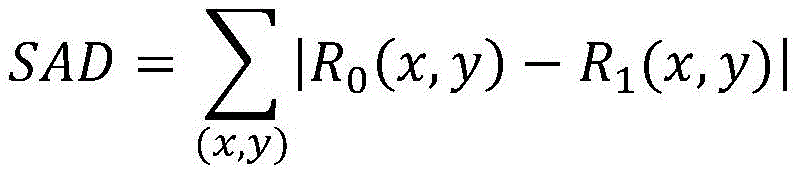
步骤2:数据准备 Step 2 : Data Preparation
对于WxH块,对(W+2)x(H+2)个样点进行插值。For a WxH block, (W+2)x(H+2) samples are interpolated.
如正常运动补偿中,内部WxH个样点用8抽头插值滤波器进行插值。As in normal motion compensation, the internal WxH samples are interpolated with an 8-tap interpolation filter.
样点的四条外侧线(图23中的黑色圆圈)用双向线性滤波器进行插值。The four outer lines of the samples (black circles in Figure 23) are interpolated with a bidirectional linear filter.
对于每个位置,在两个参考块(R0和R1)上计算梯度。For each location, gradients are computed over two reference blocks (R 0 and R 1 ).
Gx0(x,y)=(R0(x+1,y)-R0(x-1,y))>>4Gx0(x,y)=(R0(x+1,y)-R0(x-1,y))>>4
Gy0(x,y)=(R0(x,y+1)-R0(x,y-1))>>4Gy0(x,y)=(R0(x,y+1)-R0(x,y-1))>>4
Gx1(x,y)=(R1(x+1,y)-R1(x-1,y))>>4Gx1(x,y)=(R1(x+1,y)-R1(x-1,y))>>4
Gy1(x,y)=(R1(x,y+1)-R1(x,y-1))>>4Gy1(x,y)=(R1(x,y+1)-R1(x,y-1))>>4
对于每个位置,内部值被计算为:For each position, the internal value is calculated as:
T1=(R0(x,y)>>6)-(R1(x,y)>>6),T2=(Gx0(x,y)+Gx1(x,y))>>3,T3=(Gy0(x,y)+Gy1(x,y))>>3;以及T1=(R0(x,y)>>6)-(R1(x,y)>>6), T2=(Gx0(x,y)+Gx1(x,y))>>3, T3=( Gy0(x,y)+Gy1(x,y))>>3; and
B1(x,y)=T2*T2,B2(x,y)=T2*T3,B3(x,y)=-T1*T2,B5(x,y)=T3*T3,B6(x,y)=-T1*T3B1(x,y)=T2*T2,B2(x,y)=T2*T3,B3(x,y)=-T1*T2,B5(x,y)=T3*T3,B6(x,y )=-T1*T3
步骤3:计算每个块的预测 Step 3 : Calculate predictions for each block
如果两个4×4参考块之间的SAD小于阈值,则针对4×4块跳过BIO。If the SAD between two 4x4 reference blocks is less than the threshold, the BIO is skipped for the 4x4 block.
计算Vx和Vy。Calculate Vx and Vy.
计算4×4块中的每个位置的最终预测:Compute the final prediction for each position in the 4x4 block:
b(x,y)=(Vx(Gx0(x,y)-Gx1(x,y))+Vy(Gy0(x,y)-Gy1(x,y))+1)>>1b(x,y)=(Vx(Gx 0 (x,y)-Gx 1 (x,y))+Vy(Gy 0 (x,y)-Gy 1 (x,y))+1)>> 1
P(x,y)=(R0(x,y)+R1(x,y)+b(x,y)+offset)>>shiftP(x,y)=(R 0 (x,y)+R 1 (x,y)+b(x,y)+offset)>>shift
在本文中,b(x,y)被称为校正项。Herein, b(x, y) is referred to as the correction term.
2.9.3 VTM-4.0中的BIO2.9.3 BIO in VTM-4.0
在VTM-4.0中,采用了提出了根据比特深度对BDOF中的计算结果进行取整的JVET-M0063。In VTM-4.0, JVET-M0063, which proposes to round the calculation result in BDOF according to the bit depth, is adopted.
在VTM-4.0中,采用了JVET-M0487,其移除了双向线性滤波并提取参考块的最近整数像素以填充样点的四条外侧线(图23中的黑色圆圈)。In VTM-4.0, JVET-M0487 is employed, which removes the bidirectional linear filtering and extracts the nearest integer pixel of the reference block to fill the four outer lines of the sample (black circles in Figure 23).
VTM-4.0中与BIO相关的工作草案如下所示(来自JVET-M1001)The working draft related to BIO in VTM-4.0 is shown below (from JVET-M1001)
2.9.4分数样点插值过程2.9.4 Fractional-sample interpolation process
通用Universal
该过程的输入是:The input to this process is:
-亮度位置(xSb,ySb),指定当前编解码子块相对于当前图片的左上方亮度样点的左上方样点,- Luma position (xSb, ySb), specifying the upper-left sample point of the current codec sub-block relative to the upper-left luma sample point of the current picture,
-变量sbWidth,指定当前编解码子块宽度的,-Variable sbWidth, specifying the width of the current codec sub-block,
-变量sbHeight,指定当前编解码子块高度的,-Variable sbHeight, specifying the height of the current codec sub-block,
-运动矢量偏移mvOffset,- motion vector offset mvOffset,
-细化的运动矢量refMvLX,- the refined motion vector refMvLX,
-所选择的参考图片样点阵列refPicLX,- the selected reference picture sample array refPicLX,
-双向光流标志bdofFlag,- Bidirectional optical flow flag bdofFlag,
-变量cIdx,指定当前块的色彩分量索引。- Variable cIdx specifying the color component index of the current block.
该过程的输出是:The output of this process is:
-预测样点值的(sbWidth+bdofOffset)x(sbHeight+bdofOffset)阵列predSamplesLX。- (sbWidth+bdofOffset)x(sbHeight+bdofOffset) array predSamplesLX of predicted sample values.
双向光流边界偏移bdofOffset被推导如下:The bidirectional optical flow boundary offset bdofOffset is derived as follows:
bdofOffset=bdofFlag?2:0 (8-811)bdofOffset=bdofFlag? 2:0 (8-811)
-如果cIdx等于0,则以下适用:- If cIdx is equal to 0, the following applies:
-假设(xIntL,yIntL)为以全采样单位给出的亮度位置,并且(xFracL,yFracL)为以1/16采样单位给出的偏移。这些变量仅用于该条款中,以用于指定参考样点阵列refPicLX内部的分数样点位置。- Let (xIntL, yIntL) be the luminance position given in full sample units and (xFracL, yFracL) be the offset given in 1/16 sample units. These variables are only used in this clause to specify fractional sample positions within the reference sample array refPicLX.
-对于预测亮度样点阵列predSamplesLX内部的每个亮度样点位置(xL=0..sbWidth-1+bdofOffset,yL=0..sbHeight-1+bdofOffset),对应的预测亮度样点值predSamplesLX[xL][yL]被推导如下:- For each luma sample position inside the predicted luma sample array predSamplesLX (x L =0..sbWidth-1+bdofOffset,y L =0..sbHeight-1+bdofOffset), the corresponding predicted luma sample value predSamplesLX [x L ][y L ] is derived as follows:
-变量xIntL、yIntL、xFracL和yFracL被推导如下:- The variables xInt L , yInt L , xFrac L and yFrac L are derived as follows:
xIntL=xSb+(refMvLX[0]>>4)+xL (8-812)xInt L =xSb+(refMvLX[0]>>4)+x L (8-812)
yIntL=ySb+(refMvLX[1]>>4)+yL (8-813)yInt L =ySb+(refMvLX[1]>>4)+y L (8-813)
xFracL=refMvLX[0]&15 (8-814)xFrac L =refMvLX[0]&15 (8-814)
yFracL=refMvLX[1]&15 (8-815)yFrac L =refMvLX[1]&15 (8-815)
-如果bdofFlag等于TRUE(真),并且以下条件中的一个或多个为真,则预测亮度样点值predSamplesLX[xL][yL]通过调用如条款8.5.7.3.3所指定的亮度整数样点提取过程进行推导,以(xIntL,yIntL)、(xFracL,yFracL)和refPicLX为输出:- if bdofFlag is equal to TRUE, and one or more of the following conditions are true, predict the luma sample value predSamplesLX[x L ][y L ] by calling the luma integer as specified in clause 8.5.7.3.3 The sample extraction process is derived, with (xInt L , yInt L ), (xFrac L , yFrac L ) and refPicLX as outputs:
-bdofFlag等于TRUE。-bdofFlag equals TRUE.
-xL等于0。-x L equals 0.
-xL等于sbWidth+1。-x L equals
-yL等于0。-y L equals 0.
-yL等于sbHeight+1。-y L is equal to
-否则,以下适用:- Otherwise, the following applies:
-运动矢量mvLX被设置为(refMvLX-mvOffset)。- The motion vector mvLX is set to (refMvLX-mvOffset).
预测亮度样点值predSamplesLX[xL][yL]通过调用如条款8.5.7.3.2所指定的亮度采样8抽头插值滤波过程进行推导,以(xIntL,yIntL)、(xFracL,yFracL)、refPicLX和padVal为输入。The predicted luma sample value predSamplesLX[xL][yL] is derived by invoking the luma sample 8-tap interpolation filtering process as specified in clause 8.5.7.3.2, with (xIntL, yIntL), (xFracL, yFracL), refPicLX and padVal for input.
……...
亮度整数样点提取过程Brightness integer sample extraction process
该过程的输入是:The input to this process is:
-以全采样单位的亮度位置(xIntL,yIntL),- Luma position in full sample units (xInt L , yInt L ),
-亮度参考样点阵列refPicLXL,- the luminance reference sample array refPicLX L ,
该过程的输出是预测亮度样点值predSampleLXL The output of this process is the predicted luminance sample value predSampleLX L
变量shift被设置为Max(2,14-BitDepthY)。The variable shift is set to Max(2,14-BitDepth Y ).
变量picW被设置为等于pic_width_in_luma_samples,并且变量picH被设置为等于pic_height_in_luma_samples。The variable picW is set equal to pic_width_in_luma_samples, and the variable picH is set equal to pic_height_in_luma_samples.
全采样单位的亮度位置(xInt、YnT)被推导如下:The luminance position (xInt, YnT) of full sample units is derived as follows:
xInt=Clip3(0,picW–1,sps_ref_wraparound_enabled_flag? (8-838)ClipH((sps_ref_wraparound_offset_minus1+1)*MinCbSizeY,picW,xIntL):xIntL)xInt=Clip3(0,picW–1,sps_ref_wraparound_enabled_flag?(8-838)ClipH((sps_ref_wraparound_offset_minus1+1)*MinCbSizeY,picW,xInt L ):xInt L )
yInt=Clip3(0,picH-1,yIntL) (8-839)yInt=Clip3(0,picH-1, yIntL ) (8-839)
预测亮度样点值predSampleLXL被推导如下:The predicted luminance sample value predSampleLX L is derived as follows:
predSampleLXL=refPicLXL[xInt][yInt]<<shift3 (8-840)predSampleLX L =refPicLX L [xInt][yInt]<<shift3 (8-840)
双向光流预测过程Bidirectional Optical Flow Prediction Process
该过程的输入是:The input to this process is:
-两个变量nCbW和nCbH,指定当前编解码块的宽度和高度,- two variables nCbW and nCbH specifying the width and height of the current codec block,
-两个(nCbW+2)x(nCbH+2)亮度预测样点阵列predSamplesL0和predSamplesL1,- two (nCbW+2)x(nCbH+2) luminance prediction sample arrays predSamplesL0 and predSamplesL1,
-预测列表利用标志predFlagL0和predFlagL1,- the prediction list utilizes the flags predFlagL0 and predFlagL1,
-参考索引refIdxL0和refIdxL1,- reference indices refIdxL0 and refIdxL1,
-双向光流利用标志bdofUtilizationFlag[xIdx][yIdx],其中xIdx=0..(nCbW>>2)–1,yIdx=0..(nCbH>>2)-1。- Bidirectional optical flow utilization flag bdofUtilizationFlag[xIdx][yIdx], where xIdx=0..(nCbW>>2)-1, yIdx=0..(nCbH>>2)-1.
该过程的输出是亮度预测样点值的(nCbW)x(nCbH)阵列pbSamples。The output of this process is a (nCbW)x(nCbH) array pbSamples of luma prediction sample values.
变量bitDepth、shift1、shift2、shift3、shift4、offset4和mvRefineThres被推导如下:The variables bitDepth, shift1, shift2, shift3, shift4, offset4 and mvRefineThres are derived as follows:
-变量bitDepth被设置为等于BitDepthY。- The variable bitDepth is set equal to BitDepth Y.
-变量shift1被设置为等于Max(2,14-bitDepth)。- The variable shift1 is set equal to Max(2, 14-bitDepth).
-变量shift2被设置为等于Max(8,bitDepth-4)。- The variable shift2 is set equal to Max(8, bitDepth-4).
-变量shift3被设置为等于Max(5,bitDepth-7)。- The variable shift3 is set equal to Max(5, bitDepth-7).
-变量shift4被设置为等于Max(3,15-bitDepth),并且变量offset4被设置为等于1<<(shift4-1)。- the variable shift4 is set equal to Max(3,15-bitDepth) and the variable offset4 is set equal to 1<<(shift4-1).
-变量mvRefineThres被设置为等于Max(2,1<<(13-bitDepth))。- The variable mvRefineThres is set equal to Max(2,1<<(13-bitDepth)).
对于xIdx=0..(nCbW>>2)–1和yIdx=0..(nCbH>>2)-1,以下适用:For xIdx=0..(nCbW>>2)-1 and yIdx=0..(nCbH>>2)-1, the following applies:
-变量xSb被设置为等于(xIdx<<2)+1,并且ySb被设置为等于(yIdx<<2)+1。- the variable xSb is set equal to (xIdx<<2)+1 and ySb is set equal to (yIdx<<2)+1.
-如果bdofUtilizationFlag[xSbIdx][yIdx]等于FALSE(假),则对于x=xSb-1..xSb+2,y=ySb-1..ySb+2,当前子块的预测样点值被推导- if bdofUtilizationFlag[xSbIdx][yIdx] is equal to FALSE (false), then for x=xSb-1..xSb+2, y=ySb-1..ySb+2, the predicted sample value for the current subblock is derived
如下:as follows:
pbSamples[x][y]=Clip3(0,(2bitDepth)-1,(predSamplesL0[x+1][y+1]+offset2+predSamplesL1[x+1][y+1])>>shift2) (8-852)pbSamples[x][y]=Clip3(0,(2 bitDepth )-1,(predSamplesL0[x+1][y+1]+offset2+predSamplesL1[x+1][y+1])>>shift2) (8-852)
-否则(bdofUtilizationFlag[xSbIdx][yIdx]等于TRUE),当前子块的预测- otherwise (bdofUtilizationFlag[xSbIdx][yIdx] equals TRUE), the prediction of the current subblock
样点值被推导如下:The sample value is derived as follows:
-对于x=xSb-1..xSb+4,y=ySb-1..ySb+4,以下有序步骤适用:- For x=xSb-1..xSb+4, y=ySb-1..ySb+4, the following orderly steps apply:
1.预测样点阵列内部的每个对应样点位置(x,y)的位置(hx,vy)被推导如下:1. The position (h x , v y ) of each corresponding sample position (x, y) inside the predicted sample array is derived as follows:
hx=Clip3(1,nCbW,x) (8-853)h x =Clip3(1,nCbW,x) (8-853)
vy=Clip3(1,nCbH,y) (8-854)v y =Clip3(1,nCbH,y) (8-854)
2.变量gradientHL0[x][y]、gradientVL0[x][y]、gradientHL1[x][y]和gradientVL1[x][y]被推导如下:2. The variables gradientHL0[x][y], gradientVL0[x][y], gradientHL1[x][y] and gradientVL1[x][y] are derived as follows:
gradientHL0[x][y]=(predSamplesL0[hx+1][vy]-predSampleL0[hx-1][vy])>>shift1 (8-855)gradientHL0[x][y]=(predSamplesL0[h x +1][v y ]-predSampleL0[h x -1][v y ])>>shift1 (8-855)
gradientVL0[x][y]=(predSampleL0[hx][vy+1]-predSampleL0[hx][vy-1])>>shift1 (8-856)gradientVL0[x][y]=(predSampleL0[h x ][v y +1]-predSampleL0[h x ][v y -1])>>shift1 (8-856)
gradientHL1[x][y]=(predSamplesL1[hx+1][vy]-predSampleL1[hx-1][vy])>>shift1 (8-857)gradientHL1[x][y]=(predSamplesL1[h x +1][v y ]-predSampleL1[h x -1][v y ])>>shift1 (8-857)
gradientVL1[x][y]=(predSampleL1[hx][vy+1]-predSampleL1[hx][vy-1])>>shift1 (8-858)gradientVL1[x][y]=(predSampleL1[h x ][v y +1]-predSampleL1[h x ][v y -1])>>shift1 (8-858)
3.变量temp[x][y]、tempH[x][y]和tempV[x][y]被推导如下:3. The variables temp[x][y], tempH[x][y] and tempV[x][y] are derived as follows:
diff[x][y]=(predSamplesL0[hx][vy]>>shift2)-(predSamplesL1[hx][vy]>>shift2) (8-859)diff[x][y]=(predSamplesL0[h x ][v y ]>>shift2)-(predSamplesL1[h x ][v y ]>>shift2) (8-859)
tempH[x][y]=(gradientHL0[x][y]+gradientHL1[x][y])>>shift3 (8-860)tempH[x][y]=(gradientHL0[x][y]+gradientHL1[x][y])>>shift3 (8-860)
tempV[x][y]=(gradientVL0[x][y]+gradientVL1[x][y])>>shift3 (8-861)tempV[x][y]=(gradientVL0[x][y]+gradientVL1[x][y])>>shift3 (8-861)
-变量sGx2、sGy2、sGxGy、sGxdI和sGydI被推导如下:- The variables sGx2, sGy2, sGxGy, sGxdI and sGydI are derived as follows:
sGx2=ΣiΣj(tempH[xSb+i][ySb+j]*tempH[xSb+i][ySb+j]),其中i,j=-1..4(8-862)sGx2=Σ i Σ j (tempH[xSb+i][ySb+j]*tempH[xSb+i][ySb+j]), where i,j=-1..4(8-862)
sGy2=ΣiΣj(tempV[xSb+i][ySb+j]*tempV[xSb+i][ySb+j]),其中i,j=-1..4(8-863)sGy2=Σ i Σ j (tempV[xSb+i][ySb+j]*tempV[xSb+i][ySb+j]), where i,j=-1..4(8-863)
sGxGy=ΣiΣj(tempH[xSb+i][ySb+j]*tempV[xSb+i][ySb+j]),其中i,j-1..4(8-864)sGxGy=Σ i Σ j (tempH[xSb+i][ySb+j]*tempV[xSb+i][ySb+j]), where i,j-1..4(8-864)
sGxdI=ΣiΣj(-tempH[xSb+i][ySb+j]*diff[xSb+i][ySb+j]),其中i,j=-1..4(8-865)sGxdI=Σ i Σ j (-tempH[xSb+i][ySb+j]*diff[xSb+i][ySb+j]), where i,j=-1..4(8-865)
sGydI=ΣiΣj(-tempV[xSb+i][ySb+j]*diff[xSb+i][ySb+j]),其中i,j=-1..4(8-866)sGydI=Σ i Σ j (-tempV[xSb+i][ySb+j]*diff[xSb+i][ySb+j]), where i,j=-1..4(8-866)
-当前子块的水平和垂直运动偏移被推导如下:- The horizontal and vertical motion offsets of the current sub-block are derived as follows:
vx=sGx2>0?Clip3(-mvRefineThres,mvRefineThres,-(sGxdI<<3)>>Floor(Log2(sGx2))):0 (8-867)v x =sGx2>0? Clip3(-mvRefineThres,mvRefineThres,-(sGxdI<<3)>>Floor(Log2(sGx2))):0 (8-867)
vy=sGy2>0?Clip3(-mvRefineThres,mvRefineThres,((sGydI<<3)-((vx*sGxGym)<<12+vx*sGxGys)>>1)>>Floor(Log2(sGx2))):0 (8-868)v y =sGy2>0? Clip3(-mvRefineThres,mvRefineThres,((sGydI<<3)-((v x *sGxGy m )<<12+v x *sGxGy s )>>1)>>Floor(Log2(sGx2))):0 ( 8-868)
-对于x=xSb-1..xSb+2,y=ySb-1..ySb+2,当前子块的预测样点值被推导如下:- For x=xSb-1..xSb+2, y=ySb-1..ySb+2, the predicted sample value of the current subblock is derived as follows:
bdofOffset=Round((vx*(gradientHL1[x+1][y+1]-gradientHL0[x+1][y+1]))>>1)+Round((vy*(gradientVL1[x+1][y+1]-gradientVL0[x+1][y+1]))>>1) (8-869)bdofOffset=Round((v x *(gradientHL1[x+1][y+1]-gradientHL0[x+1][y+1]))>>1)+Round((v y *(gradientVL1[x+ 1][y+1]-gradientVL0[x+1][y+1]))>>1) (8-869)
[Ed.(JC):Round()操作是针对浮点输入而定义的。Round()操作在这里似乎是冗余的,因为输入是整数值。待提出者确认][Ed.(JC): The Round() operation is defined for floating-point input. The Round() operation seems redundant here because the input is an integer value. To be confirmed by the proposer]
pbSamples[x][y]=Clip3(0,(2bitDepth)-1,(predSamplesL0[x+1][y+1]+offset4+predSamplesL1[x+1][y+1]+bdofOffset)>>shift4) (8-870)pbSamples[x][y]=Clip3(0,(2 bitDepth )-1,(predSamplesL0[x+1][y+1]+offset4+predSamplesL1[x+1][y+1]+bdofOffset)>> shift4) (8-870)
2.10解码器侧运动矢量细化(DMVR)的示例2.10 Example of Decoder Side Motion Vector Refinement (DMVR)
在双向预测操作中,对于一个块区域的预测,分别使用列表0的运动矢量(MV)和列表1的MV形成的两个预测块被组合以形成单个预测信号。在解码器侧运动矢量细化(DMVR)方法中,双向预测的两个运动矢量通过双边模板匹配过程而进一步细化。双边模板匹配应用于解码器中,以执行双边模板和参考图片中的重构样点之间的基于失真的搜索,以便在不传输附加运动信息的情况下获得细化的MV。In a bidirectional prediction operation, for prediction of one block region, two prediction blocks formed using the motion vector (MV) of
在DMVR,如图24所示,分别从列表0的初始MV0和列表1的MV1生成双边模板作为两个预测块的加权组合(即,平均)。模板匹配操作由计算生成的模板和参考图片中的样点区域(初始预测块周围)之间的成本度量构成。对于两个参考图片中的每一个,产生最小模板成本的MV被认为是用以替换原始MV的、该列表的更新的MV。在JEM中,为每个列表搜索九个MV候选。九个候选MV包括原始MV和具有水平或垂直方向或两个方向上的到原始MV的一个亮度样点偏移的8个周围MV。最后,如图24所示的两个新的MV,即MV0′和MV1′,用于生成最终的双向预测结果。绝对差值之和(SAD)用作成本度量。请注意,当计算由一个周围MV生成的预测块的成本时,取整的MV(到整数像素)实际用于获得预测块,而不是真实MV。At DMVR, as shown in Figure 24, a bilateral template is generated as a weighted combination (ie, average) of the two prediction blocks from the initial MV0 of
DMVR被应用于双向预测的Merge模式,其中一个MV来自过去的参考图片,而另一个来自未来的参考图片,而不传输附加的语法元素。在JEM中,当为CU启用LIC、仿射运动、FRUC或子CU Merge候选时,不应用DMVR。DMVR is applied to the Merge mode of bidirectional prediction, where one MV is from past reference pictures and the other is from future reference pictures, without transmitting additional syntax elements. In JEM, DMVR is not applied when LIC, affine motion, FRUC, or sub-CU Merge candidates are enabled for a CU.
2.11 JVET-N02362.11 JVET-N0236
该文献提出了一种利用光流细化基于子块的仿射运动补偿预测的方法。在执行基于子块的仿射运动补偿之后,通过添加由光流等式推导的差来细化预测样点,这被称为利用光流的预测细化(Prediction Refinement with Optical Flow,PROF)。该方法可以在不增加内存访问带宽的情况下实现像素级别粒度的帧间预测。This paper proposes a method to refine subblock-based affine motion-compensated predictions using optical flow. After performing sub-block based affine motion compensation, the predicted samples are refined by adding the difference derived from the optical flow equation, which is called Prediction Refinement with Optical Flow (PROF). This method enables pixel-level granularity of inter prediction without increasing memory access bandwidth.
为了获得更精细的运动补偿粒度,该文献提出了一种利用光流细化基于子块的仿射运动补偿预测的方法。在执行基于子块的仿射运动补偿之后,通过添加由光流等式推导的差来细化亮度预测样点。提出的PROF(利用光流的预测细化)被描述为以下四个步骤。To obtain finer motion compensation granularity, this paper proposes a method to refine sub-block-based affine motion compensation prediction using optical flow. After performing subblock-based affine motion compensation, the luma prediction samples are refined by adding a difference derived from the optical flow equation. The proposed PROF (Prediction Refinement Using Optical Flow) is described as the following four steps.
步骤1)执行基于子块的仿射运动补偿以生成子块预测I(i,j)。Step 1) Perform sub-block based affine motion compensation to generate sub-block prediction I(i,j).
)使用3抽头滤波器[-1,0,1]在每个样点位置处计算子块预测的空域梯度gx(i,j)和gy(i,j)。) computes the sub-block predicted spatial gradients gx( i ,j) and gy (i,j) at each sample location using a 3-tap filter [-1, 0, 1].
gx(i,j)=I(i+1,j)-I(i-1,j)g x (i,j)=I(i+1,j)-I(i-1,j)
gy(i,j)=I(i,j+1)-I(i,j-1)g y (i,j)=I(i,j+1)-I(i,j-1)
对于梯度计算,子块预测在每侧上被扩展一个像素。为了减少内存带宽和复杂度,扩展边界上的像素从参考图片中的最近整数像素位置进行复制。因此,避免了填充区域的附加插值。For gradient computation, subblock predictions are extended by one pixel on each side. To reduce memory bandwidth and complexity, pixels on extended boundaries are copied from the nearest integer pixel location in the reference picture. Therefore, additional interpolation of filled regions is avoided.
步骤3)由光流等式计算亮度预测细化(表示为ΔI)。Step 3) Calculate the luminance prediction refinement (denoted as ΔI) from the optical flow equation.
ΔI(i,j)=gx(i,j)*Δvx(i,j)+gy(i,j)*Δvy(i,j)ΔI(i,j)=g x (i,j)*Δv x (i,j)+g y (i,j)*Δv y (i,j)
其中增量MV(表示为Δv(i,j))是为样点位置(i,j)计算的像素MV(表示为v(i,j))和像素(i,j)所属的子块的子块MV之间的差,如图25所示。where delta MV (denoted as Δv(i,j)) is the pixel MV (denoted as v(i,j)) calculated for sample position (i,j) and the sub-block to which pixel (i,j) belongs The difference between the sub-block MVs is shown in Figure 25.
由于仿射模型参数和相对于子块中心的像素位置不在子块之间被改变,所以可以为第一子块计算Δv(i,j),并将其重用于相同CU中的其他子块。假设x和y是从像素位置到子块中心的水平和垂直偏移,可以通过以下等式推导Δv(x,y),Since affine model parameters and pixel positions relative to sub-block centers are not changed between sub-blocks, Δv(i,j) can be computed for the first sub-block and reused for other sub-blocks in the same CU. Assuming x and y are the horizontal and vertical offsets from the pixel position to the center of the sub-block, Δv(x,y) can be derived by the following equation,
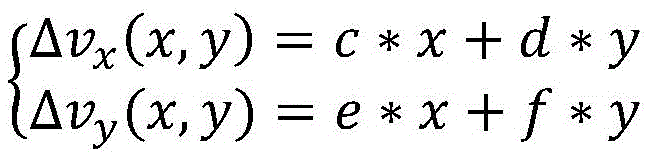
对于4参数仿射模型,For a 4-parameter affine model,
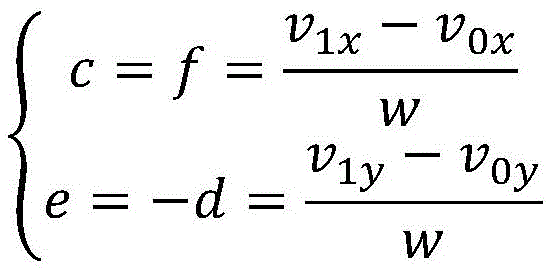
对于6参数仿射模型,For a 6-parameter affine model,

其中,(v0x,v0y)、(v1x,v1y)、(v2x,v2y)是左上方、右上方和左下方控制点运动矢量,w和h是CU的宽度和高度。where (v 0x , v 0y ), (v 1x , v 1y ), (v 2x , v 2y ) are the upper left, upper right and lower left control point motion vectors, and w and h are the width and height of the CU.
步骤4)最后,亮度预测细化被添加到子块预测I(i,j)。最终的预测I’如以下等式被生成。Step 4) Finally, luma prediction refinement is added to the sub-block prediction I(i,j). The final prediction I' is generated as the following equation.
I′(i,j)=I(i,j)+ΔI(i,j)I'(i,j)=I(i,j)+ΔI(i,j)
JVET-N0236中的一些细节Some details in JVET-N0236
a)如何推导PROF的梯度a) How to derive the gradient of PROF
在JVET-N0263中,为每个参考列表的每个子块(VTM-4.0中的4×4子块)计算梯度。对于每个子块,获取参考块的最近整数样点以填充样点的四条外侧线(图23中的黑色圆圈)。In JVET-N0263, gradients are computed for each sub-block (4×4 sub-block in VTM-4.0) of each reference list. For each subblock, the nearest integer samples of the reference block are taken to fill the four outer lines of the samples (black circles in Figure 23).
假设当前子块的MV为(MVx,MVy)。然后分数部分被计算为(FracX,FracY)=(MVx&15,MVy&15)。整数部分被计算为(IntX,IntY)=(MVx>>4,MVy>>4)。偏移(OffsetX,OffsetY)被推导为:Assume that the MV of the current sub-block is (MVx, MVy). The fractional part is then calculated as (FracX, FracY) = (MVx & 15, MVy & 15). The integer part is calculated as (IntX, IntY)=(MVx>>4, MVy>>4). Offset (OffsetX, OffsetY) is derived as:
OffsetX=FracX>7?1:0;OffsetX=FracX>7?1:0;
OffsetY=FracY>7?1:0;OffsetY=FracY>7?1:0;
假设当前子块的左上方坐标为(xCur,yCur),并且当前子块的大小为W×H。It is assumed that the upper left coordinate of the current sub-block is (xCur, yCur), and the size of the current sub-block is W×H.
然后(xCor0,yCor0)、(xCor1,yCor1)、(xCor2,yCor2)和(xCor3,yCor3)被计算为:Then (xCor0, yCor0), (xCor1, yCor1), (xCor2, yCor2) and (xCor3, yCor3) are calculated as:
(xCor0,yCor0)=(xCur+IntX+OffsetX-1,yCur+IntY+OffsetY-1);(xCor0, yCor0)=(xCur+IntX+OffsetX-1, yCur+IntY+OffsetY-1);
(xCor1,yCor1)=(xCur+IntX+OffsetX-1,yCur+IntY+OffsetY+H);(xCor1, yCor1)=(xCur+IntX+OffsetX-1, yCur+IntY+OffsetY+H);
(xCor2,yCor2)=(xCur+IntX+OffsetX-1,yCur+IntY+OffsetY);(xCor2, yCor2)=(xCur+IntX+OffsetX-1, yCur+IntY+OffsetY);
(xCor3,yCor3)=(xCur+IntX+OffsetX+W,yCur+IntY+OffsetY);(xCor3,yCor3)=(xCur+IntX+OffsetX+W,yCur+IntY+OffsetY);
假设PredSample[x][y](其中x=0..W-1,y=0..H-1)存储子块的预测样点。Suppose PredSample[x][y] (where x=0..W-1, y=0..H-1) stores the predicted samples of the sub-block.
那么填充样点被推导为Then the filling sample is deduced as
PredSample[x][-1]=(Ref(xCor0+x,yCor0)<<Shift0)-Rounding,对于x=-1..W;PredSample[x][-1]=(Ref(xCor0+x,yCor0)<<Shift0)-Rounding, for x=-1..W;
PredSample[x][H]=(Ref(xCor1+x,yCor1)<<Shift0)-Rounding,对于x=-1..W;PredSample[x][H]=(Ref(xCor1+x,yCor1)<<Shift0)-Rounding, for x=-1..W;
PredSample[-1][y]=(Ref(xCor2,yCor2+y)<<Shift0)-Rounding,对于y=0..H-1;PredSample[-1][y]=(Ref(xCor2,yCor2+y)<<Shift0)-Rounding, for y=0..H-1;
PredSample[W][y]=(Ref(xCor3,yCor3+y)<<Shift0)-Rounding,对于y=0..H-1;PredSample[W][y]=(Ref(xCor3,yCor3+y)<<Shift0)-Rounding, for y=0..H-1;
其中Rec表示参考图片。Rounding是整数,在示例性PROF实施方式中等于213。Shift0=Max(2,(14-BitDepth));where Rec represents the reference picture. Rounding is an integer, equal to 2 13 in the exemplary PROF implementation. Shift0=Max(2,(14-BitDepth));
PROF试图提高梯度的精度,这与VTM-4.0中的BIO不同,在BIO中,梯度以与输入亮度样点相同的精度被输出。PROF tries to improve the accuracy of gradients, unlike BIO in VTM-4.0, where gradients are output with the same accuracy as input luminance samples.
PROF中的梯度被计算如下:The gradient in PROF is calculated as follows:
Shift1=Shift0-4。Shift1=Shift0-4.
gradientH[x][y]=(predSamples[x+1][y]-predSample[x-1][y])>>Shift1gradientH[x][y]=(predSamples[x+1][y]-predSample[x-1][y])>>Shift1
gradientV[x][y]=(predSample[x][y+1]-predSample[x][y-1])>>Shift1gradientV[x][y]=(predSample[x][y+1]-predSample[x][y-1])>>Shift1
应该注意的是,predSamples[x][y]在插值之后保持精度。It should be noted that predSamples[x][y] maintains precision after interpolation.
b)如何推导PROF的Δvb) How to derive Δv for PROF
Δv(表示为dMvH[posX][posY]和dMvV[posX][posY],其中posX=0..W-1,posY=0..H-1)的推导可以被描述如下:The derivation of Δv (denoted as dMvH[posX][posY] and dMvV[posX][posY], where posX=0..W-1, posY=0..H-1) can be described as follows:
假设当前块的大小为cbWidth×cbHeight,控制点运动矢量的数量为numCpMv,并且控制点运动矢量为cpMvLX[cpIdx],其中cpIdx=0..numCpMv-1,并且X为0或1,表示两个参考列表。Suppose the size of the current block is cbWidth×cbHeight, the number of control point motion vectors is numCpMv, and the control point motion vectors are cpMvLX[cpIdx], where cpIdx=0..numCpMv-1, and X is 0 or 1, indicating two Reference list.
变量log2CbW和log2CbH被推导如下:The variables log2CbW and log2CbH are derived as follows:
log2CbW=Log2(cbWidth)log2CbW=Log2(cbWidth)
log2CbH=Log2(cbHeight)log2CbH=Log2(cbHeight)
变量mvScaleHor、mvScaleVer、dHorX和dVerX被推导如下:The variables mvScaleHor, mvScaleVer, dHorX and dVerX are derived as follows:
mvScaleHor=cpMvLX[0][0]<<7mvScaleHor=cpMvLX[0][0]<<7
mvScaleVer=cpMvLX[0][1]<<7mvScaleVer=cpMvLX[0][1]<<7
dHorX=(cpMvLX[1][0]-cpMvLX[0][0])<<(7-log2CbW)dHorX=(cpMvLX[1][0]-cpMvLX[0][0])<<(7-log2CbW)
dVerX=(cpMvLX[1][1]-cpMvLX[0][1])<<(7-log2CbW)dVerX=(cpMvLX[1][1]-cpMvLX[0][1])<<(7-log2CbW)
变量dHorY和dVerY被推导如下:The variables dHorY and dVerY are derived as follows:
-如果numCpMv等于3,则以下适用:- If numCpMv is equal to 3, the following applies:
dHorY=(cpMvLX[2][0]-cpMvLX[0][0])<<(7-log2CbH)dHorY=(cpMvLX[2][0]-cpMvLX[0][0])<<(7-log2CbH)
dVerY=(cpMvLX[2][1]-cpMvLX[0][1])<<(7-log2CbH)dVerY=(cpMvLX[2][1]-cpMvLX[0][1])<<(7-log2CbH)
-否则(numCpMv等于2),以下适用:- otherwise (numCpMv equals 2), the following applies:
dHorY=-dVerXdHorY=-dVerX
dVerY=dHorXdVerY=dHorX
变量qHorX、qVerX、qHorY和qVerY被推导如下The variables qHorX, qVerX, qHorY and qVerY are derived as follows
qHorX=dHorX<<2;qHorX=dHorX<<2;
qVerX=dVerX<<2;qVerX=dVerX<<2;
qHorY=dHorY<<2;qHorY=dHorY<<2;
qVerY=dVerY<<2;qVerY=dVerY<<2;
dMvH[0][0]和dMvV[0][0]被计算如下dMvH[0][0] and dMvV[0][0] are calculated as follows
dMvH[0][0]=((dHorX+dHorY)<<1)-((qHorX+qHorY)<<1);dMvH[0][0]=((dHorX+dHorY)<<1)-((qHorX+qHorY)<<1);
dMvV[0][0]=((dVerX+dVerY)<<1)-((qVerX+qVerY)<<1);dMvV[0][0]=((dVerX+dVerY)<<1)-((qVerX+qVerY)<<1);
对于从1到W-1的xPos的dMvH[xPos][0]和dMvV[xPos][0]被推导如下:dMvH[xPos][0] and dMvV[xPos][0] for xPos from 1 to W-1 are derived as follows:
dMvH[xPos][0]=dMvH[xPos-1][0]+qHorX;dMvH[xPos][0]=dMvH[xPos-1][0]+qHorX;
dMvV[xPos][0]=dMvV[xPos-1][0]+qVerX;dMvV[xPos][0]=dMvV[xPos-1][0]+qVerX;
对于从1到H-1的yPos,以下适用:For yPos from 1 to H-1, the following applies:
dMvH[xPos][yPos]=dMvH[xPos][yPos-1]+qHorY,其中xPos=0..W-1dMvH[xPos][yPos]=dMvH[xPos][yPos-1]+qHorY, where xPos=0..W-1
dMvV[xPos][yPos]=dMvV[xPos][yPos-1]+qVerY,其中xPos=0..W-1dMvV[xPos][yPos]=dMvV[xPos][yPos-1]+qVerY, where xPos=0..W-1
最后,dMvH[xPos][yPos]和dMvV[xPos][yPos](其中posX=0..W-1,posY=0..H-1)被右移为Finally, dMvH[xPos][yPos] and dMvV[xPos][yPos] (where posX=0..W-1, posY=0..H-1) are shifted right as
dMvH[xPos][yPos]=SatShift(dMvH[xPos][yPos],7+2-1);dMvH[xPos][yPos]=SatShift(dMvH[xPos][yPos],7+2-1);
dMvV[xPos][yPos]=SatShift(dMvV[xPos][yPos],7+2-1);dMvV[xPos][yPos]=SatShift(dMvV[xPos][yPos],7+2-1);
其中,SatShift(x,n)和Shift(x,n)被定义为where SatShift(x, n) and Shift(x, n) are defined as

Shift(x,n)=(x+offset0)>>nShift(x,n)=(x+offset0)>>n
在一个示例中,offset0和/或offset1被设置为(1<<n)>>1。In one example, offset0 and/or offset1 are set to (1<<n)>>1.
c)如何推导PROF的ΔIc) How to derive the ΔI of PROF
对于子块内部的位置(posX,posY),其对应的Δv(i,j)被表示为(dMvH[posX][posY],dMvV[posX][posY])。其对应的梯度被表示为(gradientH[posX][posY],gradientV[posX][posY])。For a position (posX, posY) inside a sub-block, its corresponding Δv(i, j) is denoted as (dMvH[posX][posY], dMvV[posX][posY]). Its corresponding gradient is denoted as (gradientH[posX][posY], gradientV[posX][posY]).
那么ΔI(posX,posY)被推导如下。Then ΔI(posX, posY) is derived as follows.
(dMvH[posX][posY],dMvV[posX][posY])被裁剪为(dMvH[posX][posY], dMvV[posX][posY]) is cropped as
dMvH[posX][posY]=Clip3(-32768,32767,dMvH[posX][posY]);dMvH[posX][posY]=Clip3(-32768,32767,dMvH[posX][posY]);
dMvV[posX][posY]=Clip3(-32768,32767,dMvV[posX][posY]);dMvV[posX][posY]=Clip3(-32768,32767,dMvV[posX][posY]);
ΔI(posX,posY)=dMvH[posX][posY]×gradientH[posX][posY]+dMvV[posX][posY]×gradientV[posX][posY];ΔI(posX,posY)=dMvH[posX][posY]×gradientH[posX][posY]+dMvV[posX][posY]×gradientV[posX][posY];
ΔI(posX,posY)=Shift(ΔI(posX,posY),1+1+4);ΔI(posX,posY)=Shift(ΔI(posX,posY),1+1+4);
ΔI(posX,posY)=Clip3(-(213-1),213-1,ΔI(posX,posY));ΔI(posX, posY)=Clip3(-(2 13 -1), 2 13 -1, ΔI(posX, posY));
d)如何推导PROF的I’d) How to derive I' of PROF
如果当前块没有被编解码为双向预测或加权预测,则If the current block is not coded as bidirectional prediction or weighted prediction, then
I’(posX,posY)=Shift((I(posX,posY)+ΔI(posX,posY)),Shift0),I'(posX,posY)=Shift((I(posX,posY)+ΔI(posX,posY)),Shift0),
I’(posX,posY)=ClipSample(I’(posX,posY)),I'(posX,posY)=ClipSample(I'(posX,posY)),
其中ClipSample将样点值裁剪为有效的输出样点值。where ClipSample clips the sample value to a valid output sample value.
然后,输出I’(posX,posY)作为帧间预测值。Then, output I'(posX, posY) as the inter prediction value.
否则(当前块被编解码为双向预测或加权预测)else (the current block is encoded and decoded as bidirectional prediction or weighted prediction)
I’(posX,posY)将被存储并用于根据其他预测值和/或加权值来生成帧间预测值。I'(posX, posY) will be stored and used to generate inter predictors from other predictors and/or weights.
2.12 JVET-N 05102.12 JVET-N 0510
在JVET-N0510中,提出了相位变化仿射子块运动补偿(MV)方法。应用传统的两阶段水平-垂直插值。然而,与对所有样点行使用相同的水平滤波器和对所有样点列使用相同的垂直滤波器的基于相位不变块的MV不同,滤波器的不同相位可以被应用于仿射子块中的不同样点行和不同样点列。In JVET-N0510, a phase-variant affine sub-block motion compensation (MV) method is proposed. Apply traditional two-stage horizontal-vertical interpolation. However, unlike phase-invariant block-based MVs that use the same horizontal filter for all sample rows and the same vertical filter for all sample columns, different phases of the filters can be applied in affine sub-blocks The different dot rows and different dot columns of .
为了更好地近似仿射子块中的仿射运动模型,将相位变化MC应用于子块。在所提出的方法中,仿射编解码块也被分为4×4个子块,并且如在VTM4.0中所做的那样为每个子块推导子块MV。每个子块的MC被分为两个阶段。第一阶段是用(4+L–1)行水平滤波对(4+L–1)×(4+L–1)参考块窗口进行滤波,其中L是插值滤波器的滤波器抽头长度。然而,不同于平移MC,在所提出的相位变化仿射子块MC中,每个样点行的滤波相位是不同的。对于每个样点行,MVx被推导如下。To better approximate the affine motion model in the affine sub-block, a phase change MC is applied to the sub-block. In the proposed method, the affine codec block is also divided into 4×4 sub-blocks, and a sub-block MV is derived for each sub-block as done in VTM4.0. The MC of each sub-block is divided into two stages. The first stage is to filter the (4+L–1) × (4+L–1) reference block window with (4+L–1) line horizontal filtering, where L is the filter tap length of the interpolation filter. However, unlike translation MC, in the proposed phase-variant affine sub-block MC, the filtered phase of each sample row is different. For each sample row, MVx is derived as follows.
MVx=(subblockMVx<<7+dMvVerX×(rowIdx–L/2–2))>>7MVx=(subblockMVx<<7+dMvVerX×(rowIdx–L/2–2))>>7
每个样点行的滤波器相位是从MVx推导的。subblockMVx是推导的子块MV的MV的x分量,如在VTM4.0中所做的。rowIdx是样点行索引。dMvVerX为(cuBottomLeftCPMVx–cuTopLeftCPMVx)<<(7–log2LumaCbHeight),其中cuBottomLeftCPMVx是CU左下方控制点MV的x分量,cuTopLeftCPMVx是CU左上方控制点MV的x分量,并且LumaCbHeight是亮度编解码块(CB)的高度的log2。The filter phase for each sample row is derived from MVx. subblockMVx is the x component of the MV of the derived subblock MV, as done in VTM4.0. rowIdx is the sample row index. dMvVerX is (cuBottomLeftCPMVx – cuTopLeftCPMVx)<<(7 – log2LumaCbHeight), where cuBottomLeftCPMVx is the x-component of the CU bottom left control point MV, cuTopLeftCPMVx is the x component of the CU top left control point MV, and LumaCbHeight is the luma codec block (CB) log2 of the height.
在水平滤波之后,生成4×(4+L–1)个水平滤波样点。图26示出了所提出的水平滤波的概念。灰色点是参考块窗口的样点,并且橙色点表示水平滤波样点。8×1个样点的蓝色管表示应用一次8抽头水平滤波,分别如图26和图27所示。每个样点行需要四次水平滤波。样点行上的滤波器相位是相同的。然而,不同行上的滤波器相位是不同的。生成偏斜的4×11个样点。After horizontal filtering, 4×(4+L−1) horizontally filtered samples are generated. Figure 26 shows the proposed concept of horizontal filtering. The grey dots are the samples of the reference block window, and the orange dots represent the horizontal filtering samples. The 8 × 1 sample blue tube indicates that an 8-tap horizontal filter is applied once, as shown in Figure 26 and Figure 27, respectively. Four horizontal filters are required for each sample row. The filter phases on the sample lines are the same. However, the filter phases on different rows are different. Generate skewed 4x11 samples.
在第二阶段,4×(4+L–1)个水平滤波样点(图26中的橙色样点)被进一步垂直滤波。对于每个样点列,MVy被推导如下。In the second stage, 4×(4+L−1) horizontally filtered samples (orange samples in Figure 26) are further vertically filtered. For each sample column, MVy is derived as follows.
MVy=(subblockMVy<<7+dMvHorY×(columnIdx–2))>>7(等式2)MVy=(subblockMVy<<7+dMvHorY×(columnIdx–2))>>7(equation 2)
每个样点列的滤波器相位是从MVy推导的。subblockMVy是推导的子块MV的MV的y分量,如在VTM4.0中所做的。columnIdx是样点列索引。dMvHorY为(cuTopRightCPMVy–cuTopLeftCPMVy)<<(7–log2LumaCbWidth),其中cuTopRightCPMVy是CU右上方控制点MV的y分量,cuTopLeftCPMVy是CU左上方控制点MV的y分量,并且log2LumaCbWidth是亮度CB的宽度的log2。The filter phase for each sample column is derived from MVy. subblockMVy is the y-component of the MV of the derived subblock MV, as done in VTM4.0. columnIdx is the sample column index. dMvHorY is (cuTopRightCPMVy–cuTopLeftCPMVy)<<(7–log2LumaCbWidth), where cuTopRightCPMVy is the y-component of the CU top-right control point MV, cuTopLeftCPMVy is the y-component of the CU’s top-left control point MV, and log2LumaCbWidth is log2 of the width of the luma CB.
在垂直滤波之后,生成4×4个仿射子块预测样点。图28示出了所提出的垂直滤波的概念。浅橙色点是来自第一阶段的水平滤波样点。红点是作为最终预测样点的垂直滤波样点。After vertical filtering, 4x4 affine subblock prediction samples are generated. Figure 28 shows the proposed concept of vertical filtering. The light orange points are the horizontal filtered samples from the first stage. The red dots are the vertical filtered samples that are the final prediction samples.
在本提议中,使用的插值滤波器集与VTM4.0中的相同。唯一的区别是一个样点行上的水平滤波器相位不同,并且一个样点列上的垂直滤波器相位不同。对于所提出的方法中的每个仿射子块的滤波操作的数量,它与VTM4.0中的相同。In this proposal, the interpolation filter set used is the same as in VTM4.0. The only difference is that the horizontal filter phase is different on a sample row, and the vertical filter phase is different on a sample column. For the number of filtering operations per affine subblock in the proposed method, it is the same as in VTM4.0.
3.现有实施方式的缺点3. Disadvantages of existing implementations
一些现有实施方式存在以下缺点:Some existing implementations suffer from the following disadvantages:
(1)梯度计算方法在BDOF和PROF中不相同。(1) The gradient calculation method is different in BDOF and PROF.
(a)在BDOF中,为整个块计算梯度,并且进行一次填充。在PROF中,为每个子块计算梯度,并且进行N次填充(假设有N个子块)。(a) In BDOF, gradients are computed for the entire block, and a single padding is done. In PROF, gradients are calculated for each sub-block, and padding is done N times (assuming there are N sub-blocks).
(b)PROF需要比BDOF高的梯度精度。(b) PROF requires higher gradient accuracy than BDOF.
(2)PROF和其他工具之间的相互作用不清楚。(2) The interaction between PROF and other tools is unclear.
(3)不清楚如何对色度分量应用PROF。(3) It is not clear how to apply PROF to the chrominance components.
(4)Δv的推导过程可能不正确。(4) The derivation process of Δv may be incorrect.
(5)为了更高的编解码性能,可能有条件地进行PROF。(5) PROF may be performed conditionally for higher codec performance.
(6)不清楚如何组合JVET-N 0236和JVET-N0510中的方法。(6) It is not clear how to combine the methods in JVET-N 0236 and JVET-N0510.
(7)dMvH和dMvV的比特宽度可能太大。(7) The bit width of dMvH and dMvV may be too large.
4.用于利用光流的预测细化(PROF)的示例方法4. Example method for prediction refinement (PROF) with optical flow
当前公开的技术的实施例克服了现有实施方式的缺点,从而提供具有更高编解码效率的视频编解码。基于所公开的技术,用于利用光流的预测细化的方法可以增强现有和未来的视频编解码标准,在针对各种实施方式描述的以下示例中进行了阐述。下面提供的所公开的技术的示例解释了一般概念,并且不意味着被解释为限制。在示例中,除非明确相反指示,否则在这些示例中描述的各种特征可以被组合。Embodiments of the presently disclosed technology overcome the shortcomings of existing implementations, thereby providing video codecs with higher codec efficiency. Based on the disclosed techniques, methods for prediction refinement utilizing optical flow can enhance existing and future video codec standards, as illustrated in the following examples described for various implementations. The examples of the disclosed technology provided below illustrate general concepts and are not meant to be construed as limiting. In examples, various features described in these examples may be combined unless expressly indicated to the contrary.
分别由Ref0和Ref1表示来自列表0和列表1的当前图片的参考图片,表示τ0=POC(当前)-POC(Ref0),τ1=POC(Ref1)-POC(当前),并且分别由refblk0和refblk1表示来自Ref0和Ref1的当前块的参考块。对于当前块中的子块,其在refblk0中的对应子块的、指向refblk1的MV由(vx,vy)表示。Ref0和Ref1中的子块的MV分别由(mvL0x,mvL0y)和(mvL1x,mvL1y)表示。The reference pictures from the current pictures of
Shift(x,s)被定义为Shift(x,s)=(x+off)>>s。Shift(x,s) is defined as Shift(x,s)=(x+off)>>s.
SignShift(x,s)被定义为SignShift(x,s) is defined as

在示例中,offset0和/或offset1被设置为(1<<n)>>1或(1<<(n-1))。在另一示例中,offset0和/或offset1被设置为0。在又一示例中,offset0=offset1=((1<<n)>>1)-1或((1<<(n-1)))-1。In an example, offset0 and/or offset1 are set to (1<<n)>>1 or (1<<(n-1)). In another example, offsetO and/or offsetl are set to zero. In yet another example, offset0=offset1=((1<<n)>>1)-1 or ((1<<(n-1)))-1.
Clip3(x,min,max)被定义为Clip3(x,min,max) is defined as

在本文中,Max(a,b)=a>=b?a:b,并且Min(a,b)=a<=b?a:b。In this paper, Max(a,b)=a>=b? a:b, and Min(a,b)=a<=b? a:b.
在以下讨论中,两个运动矢量之间的运算意味着该运算将被应用于运动矢量的两个分量。例如,MV3=MV1+MV2相当于MV3x=MV1x+MV2x并且MV3y=MV1y+MV2y。替代地,该运算可以仅应用于两个运动矢量的水平或垂直分量。MV(MVx,MVy)的术语“绝对值”可以指abs(MVx)、或abs(MVy)、或max(abs(MVx),abs(MVy))、或abs(MVx)+abs(MVy),其中,函数abs(x)返回x的绝对值,并且函数max(x,y)返回x和y中更大的一个。In the following discussion, an operation between two motion vectors means that the operation will be applied to both components of the motion vector. For example, MV3 = MV1+MV2 is equivalent to MV3x = MV1x + MV2x and MV3y=MV1y+ MV2y . Alternatively, the operation can be applied only to the horizontal or vertical components of the two motion vectors. The term "absolute value" of MV(MVx, MVy) may refer to abs(MVx), or abs(MVy), or max(abs(MVx), abs(MVy)), or abs(MVx)+abs(MVy), where the function abs(x) returns the absolute value of x, and the function max(x, y) returns the greater of x and y.
在以下讨论中,左侧邻近块、左下方邻近块、上侧邻近块、右上方邻近块和左上方邻近块被表示为如图2所示的块A1、A0、B1、B0和B2。In the following discussion, the left adjacent block, the lower left adjacent block, the upper adjacent block, the upper right adjacent block and the upper left adjacent block are denoted as blocks A 1 , A 0 , B 1 , B 0 as shown in FIG. 2 and B 2 .
1.提出了可以在与用于仿射模式下的运动补偿的子块尺寸不同的M×N区域级别中进行PROF中的梯度计算。1. It is proposed that the gradient computation in PROF can be done in MxN region level different from the sub-block size used for motion compensation in affine mode.
a.在一个示例中,可以对大于子块的M×N区域进行PROF中的梯度计算。a. In one example, gradient computations in PROF may be performed for MxN regions larger than sub-blocks.
b.在一个示例中,M和N可以是某个预定义的数,例如,M=N=8或M=N=16。b. In one example, M and N may be some predefined numbers, eg, M=N=8 or M=N=16.
c.在一个示例中,M和N可以是根据子块尺寸的宽度/高度定义的某个数,例如,M=N=2*Wmc,其中,Wmc是在运动补偿中使用的子块尺寸的宽度/高度。c. In one example, M and N may be some numbers defined in terms of width/height of the sub-block size, eg, M=N=2*Wmc, where Wmc is the sub-block size used in motion compensation Width Height.
d.用于推导PROF中的梯度的填充过程是在M×N区域级别中进行的。d. The filling process for deriving gradients in PROF is performed at the M×N region level.
e.对于所有以上示例,M和N的定义如下:e. For all the above examples, M and N are defined as follows:
i.在一个示例中,M=min(K0,块宽度),其中,K0是整数值。i. In one example, M=min(K0, block width), where K0 is an integer value.
ii.在一个示例中,N=min(K1,块高度),其中,K0是整数值。ii. In one example, N=min(K1, block height), where K0 is an integer value.
iii.对于以上示例,K0=K1=16。iii. For the above example, K0=K1=16.
iv.在一个示例中,K0和K1与用于BDOF的对齐。iv. In one example, K0 and K1 are aligned for BDOF.
f.第一子块中的第一样点的梯度可以用第二子块中的第二样点进行推导。f. The gradient of the first sample in the first sub-block can be derived with the second sample in the second sub-block.
i.在一个示例中,第二子块与第一子块相邻。i. In one example, the second sub-block is adjacent to the first sub-block.
ii.在一个示例中,当第二样点在第一子块或第二子块中时,第二样点用于以相同的方式推导第一样点的梯度。ii. In one example, when the second sample is in the first sub-block or the second sub-block, the second sample is used to derive the gradient of the first sample in the same way.
iii.当M×N大于子块时,可以应用以上方法。iii. The above method can be applied when M×N is larger than the sub-block.
g.一个或多个MV可以被推导,以用于每个M×N区域的填充过程。g. One or more MVs can be derived for the filling process of each MxN area.
i.在一个示例中,一个特定MV被推导,以用于M×N区域的填充过程。整数参考样点可以用特定MV进行定位,然后用于填充M×N区域之外的样点。i. In one example, a specific MV is derived for the filling process of the MxN area. Integer reference samples can be located with a specific MV and then used to fill samples outside the MxN area.
(i)在一个示例中,特定MV可以是M×N区域中的一个子块的一个MV,诸如M×N区域中的左上角子块或中心子块。图31示出了示例。可以选择子块A、B、C、D或E的MV作为特定MV。(i) In one example, a specific MV may be one MV of one sub-block in an MxN region, such as the top-left sub-block or the center sub-block in the MxN region. Figure 31 shows an example. The MV of sub-block A, B, C, D or E can be selected as a specific MV.
(ii)在一个示例中,可以从朝向M×N区域的特定位置(诸如中心)的仿射模型推导特定MV。(ii) In one example, a specific MV can be derived from an affine model towards a specific location (such as the center) of the MxN region.
(iii)在一个示例中,可以从M×N区域中的子块的MV推导特定MV。(iii) In one example, the specific MV can be derived from the MVs of the sub-blocks in the MxN region.
a.例如,特定MV可以被推导为M×N区域中的所有子块的MV的平均值。a. For example, a specific MV can be derived as the average of the MVs of all sub-blocks in an MxN region.
b.例如,特定MV可以被推导为中心子块的几个MV的平均值。b. For example, a specific MV can be derived as the average of several MVs of the central sub-block.
i.例如,特定MV可以被推导为图31中的B、C、D和E的几个MV的平均值。i. For example, a specific MV can be derived as the average of several MVs of B, C, D, and E in FIG. 31 .
ii.例如,特定MV可以被推导为图31中的B和E的几个MV的平均值。ii. For example, a specific MV can be derived as the average of several MVs of B and E in FIG. 31 .
iii.例如,特定MV可以被推导为图31中的C和D的几个MV的平均值。iii. For example, a specific MV can be derived as the average of several MVs of C and D in FIG. 31 .
c.例如,特定MV可以被推导为多个MV(例如,CPMV或子块的MV)的函数。c. For example, a particular MV can be derived as a function of multiple MVs (eg, CPMVs or MVs of sub-blocks).
ii.在一个示例中,多个MV被推导,以用于M×N区域的填充过程。整数参考样点可以用多个MV中的一个进行定位,然后用于填充M×N区域之外的样点。ii. In one example, multiple MVs are derived for the filling process of the MxN area. Integer reference samples can be located with one of multiple MVs and then used to fill samples outside the MxN area.
(i)在一个示例中,当填充与M×N区域的第一子块相邻的第一样点时,第一子块的第一MV可以用于定位用于填充第一样点的(多个)整数参考样点。(i) In one example, when filling the first sample adjacent to the first sub-block of the M×N region, the first MV of the first sub-block can be used to locate ( multiple) integer reference samples.
iii.当M×N大于子块时应用以上方法,并且对每个M×N区域进行用于推导PROF中的梯度的填充过程。iii. The above method is applied when MxN is larger than the sub-block, and the filling process for deriving gradients in PROF is performed for each MxN region.
2.可以在M×N区域级别中进行PROF/BIO中的梯度计算,并且可以自适应地改变M/N。2. Gradient calculation in PROF/BIO can be performed in M×N area level, and M/N can be adaptively changed.
a.在一个示例中,M和N可以取决于当前块的大小W×H。a. In one example, M and N may depend on the size of the current block, WxH.
i.例如,区域可以是整个当前块,即,M=W并且N=H。i. For example, the region may be the entire current block, ie, M=W and N=H.
ii.例如,M=W/T1并且N=H/T2,其中T1和T2是整数,例如T1=T2=2。ii. For example, M=W/T1 and N=H/T2, where T1 and T2 are integers, eg, T1=T2=2.
iii.在一个示例中,可以诸如在VPS/DPS/SPS/PPS/APS/条带头/片组头/片/CTU/CU中从编码器向解码器信令通知M和/或N。iii. In one example, M and/or N may be signaled from the encoder to the decoder, such as in VPS/DPS/SPS/PPS/APS/slice header/slice group header/slice/CTU/CU.
(i)替代地,可以在视频编解码标准的简表/级别/层级中指定M和/或N。(i) Alternatively, M and/or N may be specified in the profile/level/layer of the video codec standard.
iv.在一个示例中,M=Min(W,T1)并且N=Min(H,T2)。例如,T1=T2=16。iv. In one example, M=Min(W, T1) and N=Min(H, T2). For example, T1=T2=16.
(i)在一个示例中,可以诸如在VPS/DPS/SPS/PPS/APS/条带头/片组头/片/CTU/CU中从编码器向解码器信令通知T1和/或T2。(i) In one example, T1 and/or T2 may be signaled from the encoder to the decoder, such as in VPS/DPS/SPS/PPS/APS/slice header/slice group header/slice/CTU/CU.
(ii)替代地,可以在视频编解码标准的简表/级别/层级中指定T1和/或T2。(ii) Alternatively, T1 and/or T2 may be specified in the profile/level/layer of the video codec standard.
3.对于上述方法,以下可以进一步适用:3. For the above method, the following can be further applied:
a.在一个示例中,M至少等于Mmin,并且N至少等于Nmin,例如Mmin=Nmin=8。a. In one example, M is at least equal to Mmin and N is at least equal to Nmin, eg, Mmin=Nmin=8.
b.在一个示例中,对每个M×N区域进行一次填充过程,以得到填充的(M+dM)×(N+dN)区域,例如dM=dN=2。b. In one example, a padding process is performed once for each M×N region to obtain a filled (M+dM)×(N+dN) region, eg, dM=dN=2.
i.在一个示例中,区域内部的样点(诸如图23中的白色圆圈)可以从具有插值滤波的运动补偿进行推导。i. In one example, samples inside regions (such as white circles in Figure 23) can be derived from motion compensation with interpolation filtering.
(i)在一个示例中,区域内部的样点可以从用于区域中的几个子块的运动补偿进行推导。(i) In one example, samples inside a region can be derived from motion compensation for several sub-blocks in the region.
ii.在一个示例中,可以填充样点的四条外侧线(诸如图23中的黑色圆圈)。ii. In one example, the four outer lines (such as the black circles in Figure 23) of the sample points can be filled.
(i)在一个示例中,要被填充的样点可以复制参考块中的最近整数样点的强度。(i) In one example, the samples to be padded may replicate the intensity of the nearest integer sample in the reference block.
(ii)在一个示例中,要被填充的样点可以复制未被填充的区域中的最近样点的强度。(ii) In one example, the sample to be filled may replicate the intensity of the nearest sample in the unfilled area.
4.对于应用PROF/BIO中梯度计算的每个区域,代替计算每个样点的梯度值,提出基于部分样点来计算梯度。4. For each region where the gradient calculation in PROF/BIO is applied, instead of calculating the gradient value of each sample point, it is proposed to calculate the gradient based on some samples.
a.在一个示例中,可以在PROF/BIO中使用与给定坐标处的样点相关联的梯度,例如在(2x,y)或(x,2y)或(2x+1,2y+1)或(2x,2y)处,其中,(m,n)是相对于当前块中左上方样点的坐标。a. In one example, a gradient associated with a sample at a given coordinate can be used in PROF/BIO, eg at (2x,y) or (x,2y) or (2x+1,2y+1) or at (2x, 2y), where (m, n) are the coordinates relative to the upper left sample point in the current block.
b.在一个示例中,可以首先修改样点(例如,下采样),并且可以使用修改的样点来推导梯度。b. In one example, the samples can be modified first (eg, downsampled), and the modified samples can be used to derive the gradient.
5.提出在BDOF和PROF中计算的梯度值的精度可以相同。5. It is proposed that the accuracy of gradient values computed in BDOF and PROF can be the same.
a.在一个示例中,样点差可以用相同的值进行移位。a. In one example, the spreads can be shifted by the same value.
i.在一个示例中,水平和/或垂直梯度(分别由gradientH、gradientV表示)可以通过以下方式进行计算:i. In one example, the horizontal and/or vertical gradients (represented by gradientH, gradientV, respectively) can be computed by:
gradientH[x][y]=(predSamples[x+1][y]-predSample[x-1][y])>>Shift0gradientH[x][y]=(predSamples[x+1][y]-predSample[x-1][y])>>Shift0
gradientV[x][y]=(predSample[x][y+1]-predSample[x][y-1])>>Shift1gradientV[x][y]=(predSample[x][y+1]-predSample[x][y-1])>>Shift1
替代地,Alternatively,
gradientH[x][y]=Shift((predSamples[x+1][y]-predSample[x-1][y]),Shift0)gradientH[x][y]=Shift((predSamples[x+1][y]-predSample[x-1][y]),Shift0)
gradientV[x][y]=Shift((predSample[x][y+1]-predSample[x][y-1]),Shift1)gradientV[x][y]=Shift((predSample[x][y+1]-predSample[x][y-1]),Shift1)
替代地,Alternatively,
gradientH[x][y]=SatShift((predSamples[x+1][y]-predSample[x-1][y]),Shift0)gradientH[x][y]=SatShift((predSamples[x+1][y]-predSample[x-1][y]),Shift0)
gradientV[x][y]=SatShift((predSample[x][y+1]-predSample[x][y-1]),Shift1)gradientV[x][y]=SatShift((predSample[x][y+1]-predSample[x][y-1]),Shift1)
ii.在一个示例中,水平和/或垂直梯度(分别由gradientH、gradientV表示)可以通过以下方式进行计算:ii. In one example, the horizontal and/or vertical gradients (represented by gradientH, gradientV, respectively) can be computed by:
gradientH[x][y]=(predSamples[x][y]*2-predSamples[x+1][y]-predSample[x-1][y])>>Shift0gradientH[x][y]=(predSamples[x][y]*2-predSamples[x+1][y]-predSample[x-1][y])>>Shift0
gradientV[x][y]=(predSamples[x][y]*2-predSample[x][y+1]-predSample[x][y-1])>>Shift1gradientV[x][y]=(predSamples[x][y]*2-predSample[x][y+1]-predSample[x][y-1])>>Shift1
替代地,Alternatively,
gradientH[x][y]=Shift((predSamples[x][y]*2-predSamples[x+1][y]-predSample[x-1][y]),Shift0)gradientH[x][y]=Shift((predSamples[x][y]*2-predSamples[x+1][y]-predSample[x-1][y]),Shift0)
gradientV[x][y]=Shift((predSamples[x][y]*2-predSample[x][y+1]-predSample[x][y-1]),Shift1)gradientV[x][y]=Shift((predSamples[x][y]*2-predSample[x][y+1]-predSample[x][y-1]),Shift1)
替代地,Alternatively,
gradientH[x][y]=SatShift((predSamples[x][y]*2-predSamples[x+1][y]-predSample[x-1][y]),Shift0)gradientH[x][y]=SatShift((predSamples[x][y]*2-predSamples[x+1][y]-predSample[x-1][y]),Shift0)
gradientV[x][y]=SatShift((predSamples[x][y]*2-predSample[x][y+1]-predSample[x][y-1]),Shift1)gradientV[x][y]=SatShift((predSamples[x][y]*2-predSample[x][y+1]-predSample[x][y-1]),Shift1)
iii.在一个示例中,Shift0和/或Shift1可以被设置为Max(2,(14-BitDepth)),其中,BitDepth是重构样点/输入样点的比特深度。iii. In one example, Shift0 and/or Shift1 may be set to Max(2, (14-BitDepth)), where BitDepth is the bit depth of the reconstructed/input samples.
6.填充样点的外部线(表示为填充样点,诸如图23中的黑色圆圈)的以下方法可以被应用于PROF、或BIO、或PROF和BIO两者。6. The following method of filling the outer lines of the spots (denoted as filling spots, such as black circles in Figure 23) can be applied to PROF, or BIO, or both PROF and BIO.
a.填充样点可以用与PROF和/或BIO相同的方法进行填充。“相同的方法”可以是下面公开的任何填充方法。a. Filling spots can be filled in the same way as PROF and/or BIO. The "same method" can be any of the filling methods disclosed below.
b.在一个示例中,可以从PROF和/或BIO的参考图片中的整数样点推导(例如,复制)填充样点。b. In one example, the padding samples may be derived (eg, replicated) from integer samples in the PROF and/or BIO's reference pictures.
i.在一个示例中,用于推导填充样点的整数样点可以通过填充样点的位置进行定位,添加可以在添加操作中被取整为整数MV的MV。i. In one example, the integer samples used to derive the fill samples can be located by the positions of the fill samples, adding an MV that can be rounded up to an integer MV in the add operation.
(i)在一个示例中,MV(MvX,MvY)可以被取整为向下取整整数MV(IntX,IntY)。例如,IntX=MvX>>P,IntY=MvY>>P,其中P是MV精度。(i) In one example, MV(MvX, MvY) may be rounded to the rounded down integer MV(IntX, IntY). For example, IntX=MvX>>P, IntY=MvY>>P, where P is the MV precision.
(ii)在一个示例中,MV(MvX,MvY)可以被取整为最近取整整数MV(IntX,IntY)。例如,设置FracX=MvX&((1<<P)-1),FracY=MvY&((1<<P)-1),OffX=(FracX>=(1<<(P-1)))?1:0,OffY=(FracY>=(1<<(P-1)))?1:0,其中P是MV精度,然后IntX=(MvX>>P)+OffX,IntY=(MvY>>P)+OffY。HalfFrac可以等于1<<(P-1),在其他示例中,它可以等于(1<<(P-1))-1或(1<<(P-1))+1。(ii) In one example, MV(MvX, MvY) may be rounded to the nearest integer MV(IntX, IntY). For example, set FracX=MvX&((1<<P)-1), FracY=MvY&((1<<P)-1), OffX=(FracX>=(1<<(P-1)))? 1:0, OffY=(FracY>=(1<<(P-1)))? 1:0, where P is the MV precision, then IntX=(MvX>>P)+OffX, IntY=(MvY>>P)+OffY. HalfFrac can be equal to 1<<(P-1), in other examples it can be equal to (1<<(P-1))-1 or (1<<(P-1))+1.
(iii)在一个示例中,当IntX=SatShift(MvX,P),IntY=SatShift(MvY,P)时,MV(MvX,MvY)可以被取整为整数MV(IntX,IntY),其中P是MV精度。(iii) In one example, when IntX=SatShift(MvX,P), IntY=SatShift(MvY,P), MV(MvX,MvY) can be rounded to integer MV(IntX,IntY), where P is MV accuracy.
(iv)在以上项目符号中,MV精度P可以取决于色彩格式和/或色彩分量。(iv) In the above bullets, the MV precision P may depend on the color format and/or color components.
a.例如,Cb/Cr分量的MV精度可以等于亮度分量的MV精度加上4:2:0色彩格式的K。例如,K可以等于1。a. For example, the MV precision of the Cb/Cr component may be equal to the MV precision of the luma component plus K for the 4:2:0 color format. For example, K may be equal to one.
(v)可以诸如在VPS/DPS/SPS/PPS/APS/条带头/片组头/片/CTU/CU中从编码器向解码器信令通知如何执行填充。(v) How to perform padding may be signaled from the encoder to the decoder, such as in VPS/DPS/SPS/PPS/APS/slice header/slice group header/slice/CTU/CU.
a.替代地,可以在视频编解码标准的简表/级别/层级中指定如何执行填充。a. Alternatively, how the padding is performed may be specified in the profile/level/hierarchy of the video codec standard.
(vi)如何填充可以取决于块大小。(vi) How padding may depend on the block size.
7.提出当应用PROF时,不能应用编解码工具X。7. It is proposed that codec tool X cannot be applied when PROF is applied.
a.替代地,当应用编解码工具X时,不能应用PROF。a. Alternatively, PROF cannot be applied when codec tool X is applied.
b.在一个示例中,如果不能应用编解码工具X,则可以不信令通知用以指示编解码工具X的(多个)语法元素。b. In one example, if codec tool X cannot be applied, the syntax element(s) to indicate codec tool X may not be signaled.
c.在一个示例中,编解码工具X可以是广义双向预测(GBI)。c. In one example, the codec tool X may be generalized bi-directional prediction (GBI).
i.例如,当GbiIdx不等于0时,PROF不被应用。i. For example, when GbiIdx is not equal to 0, PROF is not applied.
ii.替代地,当应用PROF时,GbiIdx必须为0。ii. Alternatively, GbiIdx must be 0 when PROF is applied.
iii.替代地,当应用PROF时,GbiIdx不被信令通知并被推断为0。iii. Alternatively, GbiIdx is not signaled and is inferred to be 0 when PROF is applied.
iv.替代地,当应用PROF时,无论GbiIdx是否等于0,GBI都不被应用。iv. Alternatively, when PROF is applied, GBI is not applied regardless of whether GbiIdx is equal to 0.
d.在一个示例中,编解码工具X可以是局部照明补偿。d. In one example, the codec tool X may be local illumination compensation.
e.在一个示例中,编解码工具X可以是多重变换集(MTS)。e. In one example, the codec tool X may be a multiple transform set (MTS).
i.例如,当应用PROF时,只能应用默认变换。i. For example, when applying PROF, only default transforms can be applied.
(i)例如,当应用PROF时,语法元素相关的MTS不被应用。(i) For example, when PROF is applied, the MTS associated with the syntax element is not applied.
f.在一个示例中,编解码工具X可以是加权预测。f. In one example, the codec tool X may be weighted prediction.
i.例如,当由于加权预测导致的不相等的权重和/或不相等的偏移被应用于一个块时,PROF不被应用。i. For example, PROF is not applied when unequal weights and/or unequal offsets due to weighted prediction are applied to a block.
8.提出如何应用PROF可以取决于色彩格式和/或单独平面编解码的使用。8. It is proposed that how PROF is applied may depend on the use of color formats and/or individual plane codecs.
a.在一个示例中,如果色彩格式为4:0:0,则不能对色度分量应用PROF。a. In one example, if the color format is 4:0:0, PROF cannot be applied to the chroma components.
b.在一个示例中,如果色彩格式为4:4:4,则可以对色度分量应用PROF。b. In one example, if the color format is 4:4:4, PROF can be applied to the chroma components.
c.在一个示例中,如果色彩格式不等于4:0:0,则可以对色度分量应用PROF。c. In one example, PROF may be applied to the chroma components if the color format is not equal to 4:0:0.
d.在一个示例中,如何推导增量(delta)MV(例如,第2.11节中的Δv)可以取决于色彩格式。d. In one example, how the delta MV (eg, Δv in Section 2.11) is derived may depend on the color format.
9.提出如何应用PROF可以取决于色彩分量。9. Propose how PROF can be applied depending on the color components.
a.在一个示例中,可以为每个色彩分量独立地计算梯度。a. In one example, gradients can be computed independently for each color component.
i.替代地,为第一色彩分量计算的梯度可以由第二色彩分量使用。i. Alternatively, the gradient calculated for the first color component may be used by the second color component.
ii.替代地,梯度可以被计算两次,一次针对亮度/主色分量,并且另一次针对两个色度/相关色彩分量。ii. Alternatively, the gradient may be computed twice, once for the luma/dominant color components and once for the two chrominance/correlated color components.
b.在一个示例中,可以为每个色彩分量独立地计算增量MV(例如,第2.11节中的Δv)。b. In one example, the delta MV (eg, Δv in Section 2.11) can be computed independently for each color component.
i.替代地,为第一色彩分量计算的增量MV可以由第二色彩分量使用。i. Alternatively, the delta MV calculated for the first color component can be used by the second color component.
c.在一个示例中,可以为每个色彩分量独立地计算预测细化(例如,第2.11节中的ΔI)。c. In one example, the prediction refinement (eg, ΔI in Section 2.11) can be computed independently for each color component.
i.替代地,为第一色彩分量计算的预测细化(例如,第2.11节中的ΔI)可以由第二色彩分量使用。i. Alternatively, the prediction refinement computed for the first color component (eg, ΔI in Section 2.11) may be used by the second color component.
d.在一个示例中,PROF中梯度的精度可以取决于色彩分量。d. In one example, the precision of the gradients in PROF may depend on the color components.
e.在一个示例中,PROF中的增量MV(例如,第2.11节中的Δv)的精度可以取决于色彩分量。e. In one example, the precision of the delta MV in PROF (eg, Δv in Section 2.11) may depend on the color components.
f.在一个示例中,是否以及如何在PROF中进行剪裁操作可以取决于色彩分量。f. In one example, whether and how clipping operations are performed in PROF may depend on color components.
g.在一个示例中,是否以及如何在PROF中进行移位操作可以取决于色彩分量。g. In one example, whether and how shift operations are performed in PROF may depend on color components.
h.在一个示例中,PROF可以仅被应用于亮度分量。h. In one example, PROF may be applied to the luma component only.
i.在一个示例中,PROF可以被应用于不同子块尺寸的不同色彩分量。i. In one example, PROF can be applied to different color components of different sub-block sizes.
i.替代地,PROF可以被应用于相同子块尺寸的不同色彩分量。i. Alternatively, PROF can be applied to different color components of the same sub-block size.
j.在一个示例中,PROF可以被应用于M*N子块尺寸的色度分量。i.例如,M和N被设置为等于4。j. In one example, PROF may be applied to chroma components of M*N sub-block size. i. For example, M and N are set equal to 4.
k.以上方法(项目符号h-j)可以进一步取决于色彩格式(例如,4:2:0或4:4:4)。k. The above method (Bullets h-j) may further depend on the color format (eg, 4:2:0 or 4:4:4).
10.提出增量MV的推导(例如,第2.11节中的Δv)可以取决于子块的宽度和/或高度。10. Propose that the derivation of the delta MV (eg, Δv in Section 2.11) may depend on the width and/or height of the sub-block.
a.在一个示例中,dMvH[0][0]和dMvV[0][0]被计算为a. In one example, dMvH[0][0] and dMvV[0][0] are calculated as
qHorX=dHorX*P0;qHorX=dHorX*P0;
qVerX=dVerX*P0;qVerX=dVerX*P0;
qHorY=dHorY*P0;qHorY=dHorY*P0;
qVerY=dVerY*P0;qVerY=dVerY*P0;
dMvH[0][0]=((iDMvHorX+iDMvVerX)*P1)-(quadHorX*(blockWidth>>1)+quadVerX*(blockHeight*P1));dMvH[0][0]=((iDMvHorX+iDMvVerX)*P1)-(quadHorX*(blockWidth>>1)+quadVerX*(blockHeight*P1));
dMvV[0][0]=((iDMvHorY+iDMvVerY)*P1)-(quadHorY*(blockWidth>>1)+quadVerY*(blockHeight*P1));dMvV[0][0]=((iDMvHorY+iDMvVerY)*P1)-(quadHorY*(blockWidth>>1)+quadVerY*(blockHeight*P1));
其中blockWidth和blockHeight分别表示子块的宽度和高度。P0和P1是控制精度的两个数。where blockWidth and blockHeight represent the width and height of the sub-block, respectively. P0 and P1 are two numbers that control the precision.
i.例如,P0=4并且P1=2,则dMvH[0][0]和dMvV[0][0]被计算为:i. For example, P0=4 and P1=2, then dMvH[0][0] and dMvV[0][0] are calculated as:
qHorX=dHorX<<2;qHorX=dHorX<<2;
qVerX=dVerX<<2;qVerX=dVerX<<2;
qHorY=dHorY<<2;qHorY=dHorY<<2;
qVerY=dVerY<<2;qVerY=dVerY<<2;
dMvH[0][0]=((iDMvHorX+iDMvVerX)<<1)-(quadHorX*(blockWidth>>1)+quadVerX*(blockHeight>>1));dMvH[0][0]=((iDMvHorX+iDMvVerX)<<1)-(quadHorX*(blockWidth>>1)+quadVerX*(blockHeight>>1));
dMvV[0][0]=((iDMvHorY+iDMvVerY)<<1)-(quadHorY*(blockWidth>>1)+quadVerY*(blockHeight>>1));dMvV[0][0]=((iDMvHorY+iDMvVerY)<<1)-(quadHorY*(blockWidth>>1)+quadVerY*(blockHeight>>1));
11.提出对于仿射编解码块,PROF可以有条件地进行,而不是总是被应用。11. Propose that for affine codec blocks, PROF can be performed conditionally instead of always being applied.
a.在一个示例中,是否以及如何进行PROF可以取决于当前块的大小W×H。a. In one example, whether and how PROF is performed may depend on the size of the current block, WxH.
i.例如,如果W<=T1和/或H<=T2,则可以不应用PROF,例如T1=T2=16;i. For example, if W<=T1 and/or H<=T2, PROF may not be applied, eg T1=T2=16;
ii.例如,如果W<T1和/或H<T2,则可以不应用PROF,例如T1=T2=16;ii. For example, if W<T1 and/or H<T2, PROF may not be applied, eg T1=T2=16;
iii.例如,如果W>=T1和/或H>=T2,则可以不应用PROF,例如T1=T2=64;iii. For example, if W>=T1 and/or H>=T2, then PROF may not be applied, eg T1=T2=64;
iv.例如,如果W>T1和/或H>T2,则可以不应用PROF,例如T1=T2=64;iv. For example, if W>T1 and/or H>T2, PROF may not be applied, eg T1=T2=64;
v.例如,如果W*H>T1,则可以不应用PROF,例如T1=64*64;v. For example, if W*H>T1, PROF may not be applied, eg T1=64*64;
vi.例如,如果W*H>=T1,则可以不应用PROF,例如T1=64*64;vi. For example, if W*H>=T1, PROF may not be applied, eg T1=64*64;
vii.例如,如果W*H<T1,则可以不应用PROF,例如T1=16*16;vii. For example, if W*H<T1, PROF may not be applied, eg T1=16*16;
viii.例如,如果W*H<=T1,则可以不应用PROF,例如T1=16*16;viii. For example, if W*H<=T1, PROF may not be applied, eg T1=16*16;
ix.例如,如果min(W,H)>=T1,则可以不应用PROF,例如T1=64;ix. For example, if min(W, H)>=T1, PROF may not be applied, for example, T1=64;
x.例如,如果min(W,H)>T1,则可以不应用PROF,例如T1=64;x. For example, if min(W,H)>T1, PROF may not be applied, for example, T1=64;
xi.例如,如果max(W,H)<=T1,则可以不应用PROF,例如T1=16;xi. For example, if max(W, H)<=T1, PROF may not be applied, eg T1=16;
xii.例如,如果max(W,H)<T1,则可以不应用PROF,例如T1=16;xii. For example, if max(W,H)<T1, PROF may not be applied, eg T1=16;
b.在一个示例中,是否和/或如何进行PROF可以取决于控制点运动矢量。b. In one example, whether and/or how PROF is performed may depend on the control point motion vector.
c.在一个示例中,是否和/或如何进行PROF可以取决于仿射参数和/或仿射参数的数量。c. In one example, whether and/or how PROF is performed may depend on the affine parameters and/or the number of affine parameters.
i.对于4参数仿射模型,其中i. For a 4-parameter affine model, where

是否以及如何进行PROF可以取决于参数a和b。Whether and how PROF is performed can depend on parameters a and b.
ii.对于4参数仿射模型,其中ii. For a 4-parameter affine model, where
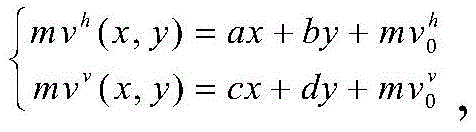
是否以及如何进行PROF可以取决于参数a、b、c和d。Whether and how PROF is performed may depend on parameters a, b, c and d.
iii.在一个示例中,如果最大仿射参数小于(或不大于)阈值,则可以不应用PROF。iii. In one example, PROF may not be applied if the maximum affine parameter is less than (or not greater than) a threshold.
(i)替代地,如果所有(诸如四个或六个)仿射参数小于(或不大于)阈值,则可以不应用PROF。(i) Alternatively, PROF may not be applied if all (such as four or six) affine parameters are less than (or not greater than) a threshold.
(ii)替代地,如果至少一个仿射参数小于(或不大于)阈值,则可以不应用PROF。(ii) Alternatively, PROF may not be applied if at least one affine parameter is less than (or not greater than) a threshold.
iv.在一个示例中,如果仿射参数的绝对值的最大值小于(或不大于)阈值,则可以不应用PROF。iv. In one example, PROF may not be applied if the maximum value of the absolute value of the affine parameter is less than (or not greater than) the threshold.
(i)替代地,如果所有仿射参数的绝对值小于(或不大于)阈值,则可以不应用PROF。(i) Alternatively, PROF may not be applied if the absolute values of all affine parameters are less than (or not greater than) the threshold.
(ii)替代地,只有当所有仿射参数的绝对值中的至少一个大于(或不小于)阈值时,才能应用PROF。(ii) Alternatively, PROF can be applied only when at least one of the absolute values of all affine parameters is greater (or not less than) a threshold.
v.在一个示例中,如果最小仿射参数大于(或不小于)阈值,v. In one example, if the minimum affine parameter is greater (or not less than) a threshold,
则可以不应用PROF。Then PROF may not be applied.
(i)替代地,如果所有(诸如四个或六个)仿射参数大于(或不小于)阈值,则可以不应用PROF。(i) Alternatively, PROF may not be applied if all (such as four or six) affine parameters are greater than (or not less than) a threshold.
(ii)替代地,如果至少一个仿射参数大于(或不小于)阈值,则可以不应用PROF。(ii) Alternatively, PROF may not be applied if at least one affine parameter is greater (or not less than) a threshold.
vi.在一个示例中,如果仿射参数的绝对值的最小值大于(或不小于)阈值,则可以不应用PROF。vi. In one example, PROF may not be applied if the minimum value of the absolute value of the affine parameter is greater (or not less than) a threshold.
(i)替代地,如果所有仿射参数的绝对值大于(或不小于)阈值,则可以不应用PROF。(i) Alternatively, PROF may not be applied if the absolute values of all affine parameters are greater (or not less than) the threshold.
(ii)替代地,仅当仿射参数的绝对值中的至少一个小于(或不大于)阈值时,才能应用PROF。(ii) Alternatively, PROF can only be applied if at least one of the absolute values of the affine parameters is less than (or not greater than) a threshold value.
vii.在一个示例中,如果如JVET-N0236公开的增量MV的“绝对值”的最大值小于(或不大于)阈值,则可以不应用PROF。vii. In one example, PROF may not be applied if the maximum value of the "absolute value" of the delta MV as disclosed in JVET-N0236 is less than (or not greater than) a threshold.
(i)替代地,如果所有增量MV的“绝对值”小于(或不大于)阈值,则可以不应用PROF。(i) Alternatively, PROF may not be applied if the "absolute value" of all delta MVs is less than (or not greater than) the threshold.
(ii)替代地,只有当增量MV的“绝对值”中的至少一个大于(或不小于)阈值时,才能应用PROF。(ii) Alternatively, PROF can be applied only when at least one of the "absolute values" of the delta MV is greater (or not less than) a threshold value.
viii.在一个示例中,如果增量MV的“绝对值”的最小值大于(或不小于)阈值,则可以不应用PROF。viii. In one example, PROF may not be applied if the minimum value of the "absolute value" of the delta MV is greater than (or not less than) the threshold.
(i)替代地,如果所有增量MV的“绝对值”大于(或不小于)阈值,则可以不应用PROF。(i) Alternatively, PROF may not be applied if the "absolute value" of all delta MVs is greater (or not less than) the threshold.
(ii)替代地,只有当增量MV的“绝对值”中的至少一个大于(或不小于)阈值时,才能应用PROF。(ii) Alternatively, PROF can be applied only when at least one of the "absolute values" of the delta MV is greater (or not less than) a threshold value.
ix.在一个示例中,PROF可以被应用于某些位置。ix. In one example, PROF can be applied to certain locations.
(i)例如,如果位置的对应增量MV的“绝对值”小于(或不大于)阈值,则PROF可以被应用于该位置。(i) For example, if the "absolute value" of a position's corresponding delta MV is less than (or not greater than) a threshold, then PROF can be applied to that position.
(ii)例如,如果位置的对应增量MV的“绝对值”大于(或不小于)阈值,则PROF可以被应用于该位置。(ii) For example, if the "absolute value" of a position's corresponding delta MV is greater (or not less than) a threshold, then PROF may be applied to that position.
x.在一个示例中,仿射参数可以以如JVET-M1001所描述的特定精度表示为整数dHorX、dVerX、dHorY和dVerY。x. In one example, the affine parameters can be represented as integers dHorX, dVerX, dHorY, and dVerY with specific precision as described in JVET-M1001.
xi.在一个示例中,阈值可以取决于比特深度。xi. In one example, the threshold may depend on the bit depth.
(i)在一个示例中,阈值可以被推导为1<<BitDepth。(i) In one example, the threshold can be derived as 1<<BitDepth.
(ii)此外,替代地,阈值可以取决于是应用双向预测还是单向预测。(ii) Furthermore, alternatively, the threshold may depend on whether bidirectional prediction or unidirectional prediction is applied.
a.例如,阈值可以被推导为(1<<BitDepth)+(Bi-prediction?1:0)。a. For example, the threshold can be derived as (1<<BitDepth)+(Bi-prediction? 1:0).
xii.在一个示例中,是否和/或如何应用项目符号11中的所公开的方法可以取决于参考图片结构。xii. In one example, whether and/or how the disclosed method in bullet 11 is applied may depend on the reference picture structure.
(i)例如,如果当前图片的所有参考图片在显示顺序上在当前图片之前,即所有参考图片的POC小于当前图片的POC,则可以不应用所公开的方法中的一种或多种。(i) For example, one or more of the disclosed methods may not be applied if all reference pictures of the current picture precede the current picture in display order, ie, the POCs of all reference pictures are smaller than the POC of the current picture.
(ii)替代地,是否和/或如何应用项目符号11中的所公开的方法可以取决于条带/图片类型(诸如I条带或B条带)。(ii) Alternatively, whether and/or how the disclosed method in bullet 11 is applied may depend on the slice/picture type (such as an I slice or a B slice).
(iii)替代地,是否和/或如何应用项目符号11中的所公开的方法可以取决于时域层。(iii) Alternatively, whether and/or how the disclosed method in bullet 11 is applied may depend on the temporal layer.
xiii.在项目符号11中,编解码方法“PROF”可以被其他编解码方法替换以增强仿射预测编解码,诸如如JVET-N0216公开的交织预测或相位变化仿射子块运动补偿。xiii. In bullet 11, the codec method "PROF" may be replaced by other codec methods to enhance affine prediction codec, such as interleaved prediction or phase-change affine subblock motion compensation as disclosed in JVET-N0216.
12.提出可以首先应用诸如在JVET-N0510中提出的相位变化仿射子块运动补偿以得到预测值,然后应用PROF12. Propose that phase-variant affine sub-block motion compensation such as proposed in JVET-N0510 can be applied first to get the predicted value, and then PROF
13.提出用于推导针对任何有效x和y的dMvH[x][y]和/或dMvV[x][y]的任何变量的比特宽度不能超过特定数,诸如32。13. Propose that the bit width of any variable used to derive dMvH[x][y] and/or dMvV[x][y] for any valid x and y cannot exceed a certain number, such as 32.
a.在一个示例中,dMvH[x][y]和/或dMvV[x][y]在用于推导其他dMvH[t][z]和/或dMvV[t][z]之前被裁剪,其中(t,z)不等于(x,y)。a. In one example, dMvH[x][y] and/or dMvV[x][y] are clipped before being used to derive other dMvH[t][z] and/or dMvV[t][z], where (t, z) is not equal to (x, y).
b.在一个示例中,dMvH[x][y]和/或dMvV[x][y]在用于推导其他dMvH[t][z]和/或dMvV[t][z]之前被右移,其中(t,z)不等于(x,y)。b. In one example, dMvH[x][y] and/or dMvV[x][y] are shifted right before being used to derive other dMvH[t][z] and/or dMvV[t][z] , where (t, z) is not equal to (x, y).
14.提出dMvH和/或dMvV可以具有与存储的运动矢量相同的精度。14. It is proposed that dMvH and/or dMvV can have the same precision as stored motion vectors.
a.例如,a. For example,
dMvH[xPos][yPos]=SatShift(dMvH[xPos][yPos],7+M);dMvH[xPos][yPos]=SatShift(dMvH[xPos][yPos],7+M);
dMvV[xPos][yPos]=SatShift(dMvV[xPos][yPos],7+M);dMvV[xPos][yPos]=SatShift(dMvV[xPos][yPos],7+M);
其中M是用以推导dMvH和/或hMvV的附加精度,例如M=2。where M is the additional precision used to derive dMvH and/or hMvV, eg M=2.
15.提出在用于推导预测细化ΔI之前对dMvH和/或dMvV的裁剪可以取决于dMvH和/或dMvV的精度。15. It is proposed that the clipping of dMvH and/or dMvV prior to use in deriving prediction refinement ΔI may depend on the accuracy of dMvH and/or dMvV.
a.例如a. For example
dMvH[posX][posY]=Clip3(-2K-1,2K-1-1,dMvH[posX][posY]);dMvH[posX][posY]=Clip3(-2K-1,2K - 1-1 ,dMvH[posX][posY]);
dMvV[posX][posY]=Clip3(-2K-1,2K-1-1,dMvV[posX][posY]);dMvV[posX][posY]=Clip3(-2K-1,2K - 1-1 ,dMvV[posX][posY]);
其中K取决于dMvH和/或dMvV的精度。where K depends on the precision of dMvH and/or dMvV.
b.替代地,dMvH[x][y]和/或dMvV[x][y]在用于推导预测细化之前不被裁剪。b. Alternatively, dMvH[x][y] and/or dMvV[x][y] are not cropped before being used to derive prediction refinements.
16.提出对预测细化ΔI(posX,posY)的右移可以取决于ΔI(posX,posY)的符号。16. Propose that the right shift of the prediction refinement ΔI(posX, posY) can depend on the sign of ΔI(posX, posY).
a.例如,ΔI(posX,posY)=SatShift(ΔI(posX,posY),N),其中N是整数。a. For example, ΔI(posX, posY) = SatShift(ΔI(posX, posY), N), where N is an integer.
17.提出对预测细化ΔI(posX,posY)的裁剪可以取决于样点比特深度。17. It is proposed that the cropping of the prediction refinement ΔI(posX, posY) can depend on the sample bit depth.
a.例如,ΔI(posX,posY)=Clip3(-(23+BitDepth-1),23+BitDpeth-1,ΔI(posX,posY));a. For example, ΔI(posX, posY)=Clip3(-(2 3+BitDepth -1), 2 3+BitDpeth -1, ΔI(posX, posY));
18.是否和/或如何在仿射模式块内的子块边界(例如,内部子块边界)上进行去方块可以取决于如JVET-N0216公开的交织预测或/和PROF或/和相位变化仿射子块运动补偿是否被应用于块。18. Whether and/or how deblocking is performed on subblock boundaries (e.g., inner subblock boundaries) within an affine mode block may depend on interleaving prediction or/and PROF or/and phase change simulation as disclosed in JVET-N0216. Whether or not sub-block motion compensation is applied to the block.
a.在一个示例中,当交织预测或/和PROF或/和相位变化仿射子块运动补偿被应用于块时,可以禁用去方块。a. In one example, deblocking may be disabled when interleaving prediction or/and PROF or/and phase varying affine subblock motion compensation is applied to a block.
i.替代地,去方块滤波器在子块边界上可能更弱,其中在子块边界上交织预测或/和PROF或/和相位变化仿射子块运动补偿被应用于块。例如,边界强度可以在这样的边界上被设置为更小。i. Alternatively, the deblocking filter may be weaker on subblock boundaries where interleaved prediction or/and PROF or/and phase varying affine subblock motion compensation is applied to the block. For example, the boundary strength may be set smaller on such a boundary.
b.在一个示例中,当交织预测或/和PROF或/和相位变化仿射子块运动补偿不被应用于块时,可以启用去方块。b. In one example, deblocking may be enabled when interleaving prediction or/and PROF or/and phase varying affine subblock motion compensation is not applied to the block.
上面描述的示例可以被并入下面描述的可以在视频解码器或视频编码器处被实施的方法(例如,方法2910至2950)的上下文中。The examples described above may be incorporated in the context of the methods described below (eg, methods 2910-2950) that may be implemented at a video decoder or video encoder.
图29A示出了用于视频处理的示例性方法的流程图。方法2910包括,在步骤2912,使用在视频的当前视频块的子块级别执行的仿射模式运动补偿来生成该当前视频块的预测块。方法2910还包括,在步骤2914,对当前视频块的区域执行梯度计算,以使用利用光流的预测细化(PROF)过程来细化预测块,其中,区域的尺寸(M×N)不同于当前视频块的子块的尺寸,其中,M和N是正整数。方法2910还包括,在步骤2916,基于梯度计算来执行当前视频块和视频的编解码表示之间的转换。29A shows a flowchart of an exemplary method for video processing. The
图29B示出了用于视频处理的示例性方法的流程图。方法2920包括,在步骤2922,为具有第一尺寸的视频的当前视频块推导最终预测块,其中该最终预测块是通过使用在具有根据规则的第二尺寸的视频区域上执行的梯度计算来细化一个或多个中间预测块而计算的,其中,该细化使用光流过程。方法2920还包括,在步骤2924,使用最终预测块来执行当前视频块和视频的编解码表示之间的转换。29B shows a flowchart of an exemplary method for video processing. The
图29C示出了用于视频处理的示例性方法的流程图。方法2930包括,在步骤2932,使用双向光流(BDOF)或利用光流的预测细化(PROF)为视频的当前视频块推导运动信息。方法2930还包括,在步骤2934,对当前视频块的区域中的样点执行梯度计算,使得区域中的至少一个样点从梯度计算中被省略。方法2930还包括,在步骤2936,基于梯度计算来执行当前视频块和包括该当前视频块的视频的编解码表示之间的转换。在一些实施方式中,当前视频块的一个或多个初始预测在子块级别进行计算并在PROF期间使用光流计算进行细化,或者一个或多个初始预测在BDOF期间使用空域和时域梯度进行细化。29C shows a flowchart of an exemplary method for video processing. The
图29D示出了用于视频处理的示例性方法的流程图。方法2940包括,在步骤2942,通过基于根据精度规则的初始预测样点的梯度使用光流计算来细化视频的当前视频块的一个或多个初始预测,为该当前视频块确定当前视频块的最终预测块。方法2940还包括,在步骤2944,使用最终预测块来执行当前视频块和编解码表示之间的转换,其中,光流计算包括利用光流的预测细化(PROF)过程或双向光流(BDOF)过程,其中,精度规则指定使用相同的精度用于表示PROF过程和BDOF过程两者的梯度。29D shows a flowchart of an exemplary method for video processing. The
图29E示出了用于视频处理的示例性方法的流程图。方法2950包括,在步骤2952,通过使用光流计算来细化视频的当前视频块的一个或多个初始预测,为该当前视频块和视频的编解码表示之间的转换确定当前视频块的最终预测块。方法2950还包括,在步骤2954,使用最终预测块来执行该转换。在一些实施方式中,光流计算包括利用光流的预测细化(PROF)过程和/或双向光流(BDOF)过程,其中,光流计算还包括根据规则适用于PROF过程或BDOF过程中的至少一个的填充操作,以推导填充样点。29E shows a flowchart of an exemplary method for video processing. The
5.所公开的技术的示例实施方式5. Example Implementations of the Disclosed Technology
图30A是视频处理装置3000的框图。装置3000可以用于实施本文描述的方法中的一种或多种。装置3000可以体现在智能电话、平板电脑、计算机、物联网(Internet ofThings,IoT)接收器等中。装置3000可以包括一个或多个处理器3002、一个或多个存储器3004、以及视频处理硬件3006。(多个)处理器3002可以被配置为实施本文档中描述的一种或多种方法(包括但不限于方法2900)。存储器(多个存储器)3004可以用于存储用于实施本文描述的方法和技术的数据和代码。视频处理硬件3006可以用于以硬件电路实施本文档中描述的一些技术。FIG. 30A is a block diagram of a
图30B是可以在其中实施所公开的技术的视频处理系统的框图的另一示例。图30B是示出可以在其中实施本文公开的各种技术的示例视频处理系统4100的框图。各种实施方式可以包括系统4100的一些或所有组件。系统4100可以包括用于接收视频内容的输入4102。视频内容可以以例如8或10比特多分量像素值的原始或未压缩格式而接收,或者可以是压缩或编码格式。输入4102可以表示网络接口、外围总线接口或存储接口。网络接口的示例包括诸如以太网、无源光网络(Passive Optical Network,PON)等的有线接口和诸如Wi-Fi或蜂窝接口的无线接口。30B is another example of a block diagram of a video processing system in which the disclosed techniques may be implemented. 30B is a block diagram illustrating an example
系统4100可以包括可以实施本文档中描述的各种编解码或编码方法的编解码组件4104。编解码组件4104可以将来自输入4102的视频的平均比特率减小到编解码组件4104的输出,以产生视频的编解码表示。编解码技术因此有时被称为视频压缩或视频转码技术。编解码组件4104的输出可以被存储,或者经由如由组件4106表示的通信连接而发送。在输入4102处接收的视频的存储或通信传送的比特流(或编解码)表示可以由组件4108用于生成像素值或传送到显示接口4110的可显示视频。从比特流表示生成用户可视视频的过程有时被称为视频解压缩。此外,虽然某些视频处理操作被称为“编解码”操作或工具,但是将理解,编解码工具或操作在编码器处被使用,并且反转编解码结果的对应的解码工具或操作将由解码器执行。
外围总线接口或显示接口的示例可以包括通用串行总线(Universal SerialBus,USB)、或高清晰度多媒体接口(High Definition Multimedia Interface,HDMI)、或显示端口(Displayport)等。存储接口的示例包括SATA(Serial Advanced TechnologyAttachment,串行高级技术附件)、PCI、IDE接口等。本文档中描述的技术可以体现在各种电子设备中,诸如移动电话、膝上型电脑、智能电话、或能够执行数字数据处理和/或视频显示的其他设备。Examples of peripheral bus interfaces or display interfaces may include Universal Serial Bus (Universal Serial Bus, USB), or High Definition Multimedia Interface (High Definition Multimedia Interface, HDMI), or Display Port (Displayport), and the like. Examples of storage interfaces include SATA (Serial Advanced Technology Attachment), PCI, IDE interfaces, and the like. The techniques described in this document may be embodied in various electronic devices, such as mobile phones, laptop computers, smart phones, or other devices capable of performing digital data processing and/or video display.
所公开的技术的一些实施例包括做出启用视频处理工具或模式的决定或确定。在示例中,当视频处理工具或模式被启用时,编码器将在视频块的处理中使用或实施该工具或模式,但可能不一定基于该工具或模式的使用来修改产生的比特流。也就是说,当基于决定或确定来启用视频处理工具或模式时,从视频的块到视频的比特流表示的转换将使用该视频处理工具或模式。在另一示例中,当视频处理工具或模式被启用时,解码器将在知道比特流已经基于视频处理工具或模式进行修改的情况下处理比特流。也就是说,将使用基于决定或确定而启用的视频处理工具或模式来执行从视频的比特流表示到视频的块的转换。Some embodiments of the disclosed technology include making a decision or determination to enable a video processing tool or mode. In an example, when a video processing tool or mode is enabled, the encoder will use or implement the tool or mode in the processing of video blocks, but may not necessarily modify the resulting bitstream based on the use of the tool or mode. That is, when a video processing tool or mode is enabled based on a decision or determination, the conversion from a block of video to a bitstream representation of the video will use that video processing tool or mode. In another example, when a video processing tool or mode is enabled, the decoder will process the bitstream knowing that the bitstream has been modified based on the video processing tool or mode. That is, the conversion from the bitstream representation of the video to the blocks of the video will be performed using a video processing tool or mode enabled based on the decision or determination.
所公开的技术的一些实施例包括做出禁用视频处理工具或模式的决定或确定。在示例中,当视频处理工具或模式被禁用时,编码器将不在视频的块到视频的比特流表示的转换中使用该工具或模式。在另一示例中,当视频处理工具或模式被禁用时,解码器将在知道比特流没有使用基于决定或确定而禁用的视频处理工具或模式进行修改的情况下处理比特流。Some embodiments of the disclosed technology include making a decision or determination to disable a video processing tool or mode. In an example, when a video processing tool or mode is disabled, the encoder will not use the tool or mode in the conversion of a block of video to a bitstream representation of the video. In another example, when a video processing tool or mode is disabled, the decoder will process the bitstream knowing that the bitstream has not been modified using the video processing tool or mode disabled based on the decision or determination.
在本文档中,术语“视频处理”可以指视频编码、视频解码、视频压缩或视频解压缩。例如,视频压缩算法可以在从视频的像素表示到对应的比特流表示的转换期间被应用,反之亦然。当前视频块的比特流表示可以例如对应于比特流内的并置或散布在不同位置的比特,如由语法定义的。例如,宏块可以根据变换和编解码的误差残差值并且还使用比特流中的头和其他字段中的比特进行编码。In this document, the term "video processing" may refer to video encoding, video decoding, video compression, or video decompression. For example, a video compression algorithm may be applied during the conversion from a pixel representation of a video to a corresponding bitstream representation, and vice versa. The bitstream representation of the current video block may, for example, correspond to bits within the bitstream that are collocated or interspersed in different positions, as defined by the syntax. For example, macroblocks may be encoded from transformed and encoded error residual values and also using bits in headers and other fields in the bitstream.
应当理解,通过允许使用在本文档中公开的技术,所公开的方法和技术将有益于并入视频处理设备(诸如智能电话、膝上型电脑、台式电脑和类似设备)内的视频编码器和/或解码器实施例。It will be appreciated that by allowing the use of the techniques disclosed in this document, the disclosed methods and techniques will be beneficial for video encoders and /or decoder embodiment.
可以使用以下基于条款的格式来描述各种技术和实施例。Various techniques and embodiments may be described using the following clause-based format.
条款的第一集合描述了先前章节中的所公开的技术的某些特征和方面。The first set of clauses describe certain features and aspects of the disclosed technology in the previous sections.
1.一种用于视频处理的方法,包括:在当前视频块的第一区域中执行梯度计算,其中,第一区域的尺寸(M×N)不同于用于仿射模式下的运动补偿的当前视频块的子块的尺寸,并且其中,M和N是正整数;以及基于梯度计算来执行当前视频块和包括该当前视频块的视频的比特流表示之间的转换。1. A method for video processing, comprising: performing a gradient calculation in a first region of a current video block, wherein the size of the first region (M×N) is different from that used for motion compensation in affine mode a size of a sub-block of the current video block, and wherein M and N are positive integers; and performing a conversion between the current video block and a bitstream representation of video including the current video block based on gradient computations.
2.根据条款1所述的方法,其中,第一区域的尺寸大于子块的尺寸。2. The method of
3.根据条款1或2所述的方法,其中,M和N是预定义的正整数。3. The method of
4.根据条款1或2所述的方法,其中,第一区域的尺寸基于子块的尺寸。4. The method of
5.根据条款1所述的方法,其中,M/N被自适应地改变。5. The method of
6.根据条款1所述的方法,其中,M和N基于当前视频块的大小。6. The method of
7.根据条款1至6中任一项所述的方法,其中,M具有最小值Mmin,并且其中,N具有最小值Nmin。7. The method of any of
8.根据条款7所述的方法,其中,Mmin=Nmin=8。8. The method of clause 7, wherein Mmin=Nmin=8.
9.根据条款1至6中任一项所述的方法,其中,第一区域被填充,以生成尺寸为(M+dM)×(N+dN)的第一填充区域。9. The method of any of
10.根据条款9所述的方法,其中,第一区域或第一填充区域中的样点基于具有插值滤波的运动补偿进行推导。10. The method of clause 9, wherein the samples in the first region or the first padding region are derived based on motion compensation with interpolation filtering.
11.根据条款1所述的方法,其中,第一区域中的至少一个样点在执行梯度计算时被省略。11. The method of
12.根据条款1所述的方法,其中,梯度计算在双向光流(BDOF)中以第一精度被执行,以及在利用光流的预测细化(PROF)中以第二精度被执行,并且其中,第一精度和第二精度相等。12. The method of
13.一种用于视频处理的方法,包括:基于对当前视频块选择性应用利用光流的预测细化(PROF),做出关于对当前视频块选择性应用编解码工具的决定,其中,编解码工具不同于PROF;以及基于该决定来执行当前视频块和包括该当前视频块的视频的比特流表示之间的转换。13. A method for video processing, comprising: making a decision about selectively applying a codec tool to a current video block based on selectively applying Predictive Refinement with Optical Flow (PROF) to the current video block, wherein, The codec tool is different from the PROF; and the conversion between the current video block and the bitstream representation of the video including the current video block is performed based on the decision.
14.根据条款13所述的方法,其中,PROF不被应用,并且编解码工具被应用。14. The method of clause 13, wherein PROF is not applied and codec tools are applied.
15.根据条款13所述的方法,其中,编解码工具包括广义双向预测。15. The method of clause 13, wherein the codec tool comprises generalized bidirectional prediction.
16.根据条款15所述的方法,其中,PROF不被应用,并且其中,与广义双向预测相关联的索引不为零。16. The method of clause 15, wherein PROF is not applied, and wherein an index associated with generalized bidirectional prediction is non-zero.
17.根据条款13所述的方法,其中,编解码工具是局部照明补偿。17. The method of clause 13, wherein the codec tool is local illumination compensation.
18.根据条款13所述的方法,其中,编解码工具是多重变换集(MTS)。18. The method of clause 13, wherein the codec tool is a multiple transform set (MTS).
19.根据条款18所述的方法,其中,PROF被应用,并且仅来自MTS的默认变换被应用于当前视频块。19. The method of clause 18, wherein PROF is applied and only default transforms from MTS are applied to the current video block.
20.根据条款13所述的方法,其中,编解码工具是加权预测。20. The method of clause 13, wherein the codec tool is weighted prediction.
21.一种用于视频处理的方法,包括:在当前视频块和包括该当前视频块的视频的比特流表示之间的转换期间,做出关于选择性应用利用光流的预测细化(PROF)操作的决定,其中,该决定基于当前视频块的色彩信息。21. A method for video processing, comprising: during a transition between a current video block and a bitstream representation of a video comprising the current video block, making a prediction refinement (PROF) with respect to selectively applying optical flow. ) operation, where the decision is based on the color information of the current video block.
22.根据条款21所述的方法,其中,PROF操作不被应用于当前视频块的一个或多个色度分量,并且其中,色彩信息包括4:0:0色彩格式。22. The method of clause 21, wherein the PROF operation is not applied to one or more chroma components of the current video block, and wherein the color information comprises a 4:0:0 color format.
23.根据条款21所述的方法,其中,PROF操作被应用于当前视频块的一个或多个色度分量,并且其中,色彩信息包括4:4:4色彩格式。23. The method of clause 21, wherein the PROF operation is applied to one or more chroma components of the current video block, and wherein the color information comprises a 4:4:4 color format.
24.根据条款21所述的方法,其中,PROF操作被应用于当前视频块的一个或多个色度分量,并且其中,色彩信息包括4:0:0色彩格式。24. The method of clause 21, wherein the PROF operation is applied to one or more chroma components of the current video block, and wherein the color information comprises a 4:0:0 color format.
25.根据条款21所述的方法,其中,PROF操作被应用,并且其中,色彩信息包括多个色彩分量。25. The method of clause 21, wherein a PROF operation is applied, and wherein the color information includes a plurality of color components.
26.根据条款25所述的方法,其中,PROF操作的一个或多个梯度针对多个色彩分量中的每一个而独立地计算。26. The method of clause 25, wherein the one or more gradients of the PROF operation are computed independently for each of the plurality of color components.
27.根据条款25所述的方法,其中,PROF操作的一个或多个梯度针对多个色彩分量中的第一色彩分量进行计算,并且针对多个色彩分量中的第二色彩分量被重用。27. The method of clause 25, wherein the one or more gradients of the PROF operation are computed for a first color component of the plurality of color components and reused for a second color component of the plurality of color components.
28.根据条款26或27所述的方法,其中,梯度的精度基于多个色彩分量中的至少一个。28. The method of clause 26 or 27, wherein the precision of the gradient is based on at least one of the plurality of colour components.
29.一种用于视频处理的方法,包括:基于当前视频块的高度(H)或宽度(W),做出关于选择性应用利用光流的预测细化(PROF)操作的决定;以及基于该决定来执行当前视频块和包括该当前视频块的视频的比特流表示之间的转换。29. A method for video processing, comprising: based on a height (H) or width (W) of a current video block, making a decision about selectively applying a prediction refinement (PROF) operation with optical flow; and based on The decision is to perform a conversion between the current video block and a bitstream representation of video that includes the current video block.
30.根据条款29所述的方法,其中,PROF操作被应用于当前视频块的亮度分量。30. The method of clause 29, wherein a PROF operation is applied to the luma component of the current video block.
31.根据条款29所述的方法,其中,当前视频块使用仿射模式进行编解码。31. The method of clause 29, wherein the current video block is encoded and decoded using an affine mode.
32.根据条款31所述的方法,其中,PROF操作不被应用,其中,W≤T1和/或H≤T2,并且其中,T1=T2=16。32. The method of clause 31, wherein PROF operations are not applied, wherein W≤T1 and/or H≤T2, and wherein T1=T2=16.
33.根据条款31所述的方法,其中,PROF操作不被应用,其中,W≥T1和/或H≥T2,并且其中,T1=T2=64。33. The method of clause 31, wherein PROF operations are not applied, wherein W≧T1 and/or H≧T2, and wherein T1=T2=64.
34.根据条款31所述的方法,其中,PROF操作不被应用,其中,W×H≤T或max(W,H)≤T,并且其中,T=16。34. The method of clause 31, wherein PROF operations are not applied, where W*H≤T or max(W,H)≤T, and where T=16.
35.根据条款31所述的方法,其中,PROF操作不被应用,其中,W×H≥T或min(W,H)≥T,并且其中,T=64。35. The method of clause 31, wherein a PROF operation is not applied, wherein WxH≥T or min(W,H)≥T, and wherein T=64.
36.根据条款1或2所述的方法,其中,当前视频块的尺寸为W×H,其中,M=min(K,W),并且其中,K是整数。36. The method of
37.根据条款1或2所述的方法,其中,当前视频块的尺寸为W×H,其中,N=min(K,H),并且其中,K是整数。37. The method of
38.根据条款36或37所述的方法,其中,K=16。38. The method of clause 36 or 37, wherein K=16.
39.根据条款1或2所述的方法,还包括:在执行梯度计算之前,在当前视频块的第一区域中执行填充过程。39. The method of
40.根据条款39所述的方法,其中,执行填充过程包括推导一个或多个运动矢量。40. The method of clause 39, wherein performing the padding process comprises deriving one or more motion vectors.
41.根据条款40所述的方法,其中,一个或多个运动矢量包括从朝向第一区域的特定位置的仿射模型推导的运动矢量。41. The method of clause 40, wherein the one or more motion vectors comprise motion vectors derived from an affine model towards a particular location of the first region.
42.根据条款40所述的方法,其中,一个或多个运动矢量包括从第一区域的至少一个子块的至少一个运动矢量推导的运动矢量。42. The method of clause 40, wherein the one or more motion vectors comprise motion vectors derived from at least one motion vector of at least one sub-block of the first region.
43.根据条款39所述的方法,其中,执行填充过程是基于当前视频块的高度或宽度的。43. The method of clause 39, wherein performing the padding process is based on the height or width of the current video block.
44.根据条款39所述的方法,其中,执行填充过程是基于视频参数集(VPS)、解码器参数集(DPS)、序列参数集(SPS)、图片参数集(PPS)、自适应参数集(APS)、条带头、片、片组头、编解码树单元(CTU)或编解码单元(CU)中的信令通知的。44. The method of clause 39, wherein performing the padding process is based on a video parameter set (VPS), a decoder parameter set (DPS), a sequence parameter set (SPS), a picture parameter set (PPS), an adaptation parameter set (APS), slice header, slice, slice group header, Codec Tree Unit (CTU) or Signaling in Codec Unit (CU).
45.根据条款5或6所述的方法,其中,M和N是在视频参数集(VPS)、解码器参数集(DPS)、序列参数集(SPS)、图片参数集(PPS)、自适应参数集(APS)、条带头、片、片组头、编解码树单元(CTU)或编解码单元(CU)中信令通知的。45. The method of clause 5 or 6, wherein M and N are between video parameter set (VPS), decoder parameter set (DPS), sequence parameter set (SPS), picture parameter set (PPS), adaptive Signaled in a parameter set (APS), slice header, slice, slice group header, codec tree unit (CTU) or codec unit (CU).
46.根据条款5或6所述的方法,其中,M和N是在视频编解码标准的简表、级别或层级中指定的。46. The method of clause 5 or 6, wherein M and N are specified in a profile, level or hierarchy of a video codec standard.
47.一种视频系统中的装置,包括处理器和其上具有指令的非暂时性存储器,其中指令在由处理器执行时使处理器实施根据条款1至46中任一项所述的方法。47. An apparatus in a video system comprising a processor and a non-transitory memory having instructions thereon, wherein the instructions, when executed by the processor, cause the processor to implement a method according to any of
48.一种存储在非暂时性计算机可读介质上的计算机程序产品,该计算机程序产品包括用于执行根据条款1至46中任一项所述的方法的程序代码。48. A computer program product stored on a non-transitory computer readable medium, the computer program product comprising program code for performing the method according to any of
条款的第二集合描述了先前章节(包括例如,示例实施方式1至4)中的所公开的技术的某些特征和方面。The second set of clauses describe certain features and aspects of the disclosed technology in previous sections (including, for example, Example Embodiments 1-4).
1.一种用于视频处理的方法,包括:使用在视频的当前视频块的子块级别执行的仿射模式运动补偿来生成该当前视频块的预测块;对当前视频块的区域执行梯度计算,以使用利用光流的预测细化(PROF)过程来细化预测块,其中,区域的尺寸(M×N)不同于当前视频块的子块的尺寸,其中,M和N是正整数;以及基于梯度计算来执行当前视频块和视频的编解码表示之间的转换。1. A method for video processing, comprising: generating a prediction block of a current video block using affine mode motion compensation performed at the sub-block level of a current video block of a video; performing a gradient calculation on the region of the current video block , to refine the prediction block using a Prediction Refinement with Optical Flow (PROF) process, where the size of the region (M×N) is different from the size of the sub-blocks of the current video block, where M and N are positive integers; and The conversion between the current video block and the codec representation of the video is performed based on the gradient computation.
2.根据条款1所述的方法,其中,区域的尺寸大于子块的尺寸。2. The method of
3.根据条款1或2所述的方法,其中,M和N是预定义的正整数。3. The method of
4.根据条款1或2所述的方法,其中,区域的尺寸基于子块的尺寸。4. The method of
5.根据条款1所述的方法,其中,PROF过程中的填充操作被应用于推导(M×N)区域级别的梯度。5. The method of
6.根据条款1至5中任一项所述的方法,其中,M被定义为min(K0,块宽度),并且N被定义为min(K1,块高度),其中K0和K1是整数。6. The method of any of
7.根据条款6所述的方法,其中,K0和K1等于16。7. The method of clause 6, wherein K0 and K1 are equal to sixteen.
8.根据条款1所述的方法,其中,梯度计算的执行包括获得当前视频块的第一子块中的第一样点的第一梯度和当前视频块的第二子块中的第二样点的第二梯度。8. The method of
9.根据条款8所述的方法,其中,第二子块与第一子块相邻。9. The method of clause 8, wherein the second sub-block is adjacent to the first sub-block.
10.根据条款8所述的方法,其中,第二样点用于推导第一梯度。10. The method of clause 8, wherein the second sample is used to derive the first gradient.
11.根据条款8至10中任一项所述的方法,其中,区域的尺寸(M×N)大于当前视频块的子块的尺寸。11. The method of any of clauses 8 to 10, wherein the size of the region (MxN) is larger than the size of the sub-blocks of the current video block.
12.根据条款1所述的方法,其中,一个或多个运动矢量被推导以用于区域的填充操作。12. The method of
13.根据条款12所述的方法,其中,与当前视频块的参考块中的整数样点相关联的特定运动矢量被推导以用于区域的填充操作。13. The method of clause 12, wherein a specific motion vector associated with an integer number of samples in a reference block of the current video block is derived for a padding operation of the region.
14.根据条款13所述的方法,其中,特定运动矢量对应于区域中的子块中的一个的运动矢量。14. The method of clause 13, wherein the particular motion vector corresponds to the motion vector of one of the sub-blocks in the region.
15.根据条款13所述的方法,其中,特定运动矢量是通过应用朝向区域的特定位置的仿射模型而推导的。15. The method of clause 13, wherein the specific motion vector is derived by applying an affine model towards a specific location of the region.
16.根据条款13所述的方法,其中,特定运动矢量是从区域中的所有子块的运动矢量推导的。16. The method of clause 13, wherein the specific motion vector is derived from the motion vectors of all sub-blocks in the region.
17.根据条款13所述的方法,其中,特定运动矢量被推导为区域中的所有子块的运动矢量的平均值。17. The method of clause 13, wherein the particular motion vector is derived as an average of the motion vectors of all sub-blocks in the region.
18.根据条款13所述的方法,其中,特定运动矢量被推导为区域中的子块的至少一些运动矢量的平均值,子块位于区域的中心周围。18. The method of clause 13, wherein the particular motion vector is derived as an average of at least some motion vectors of sub-blocks in the region, the sub-blocks being located around the centre of the region.
19.根据条款13所述的方法,其中,特定运动矢量被推导为多个运动矢量的函数,其中该多个运动矢量包括控制点运动矢量或区域中的子块的运动矢量。19. The method of clause 13, wherein a particular motion vector is derived as a function of a plurality of motion vectors comprising control point motion vectors or motion vectors of sub-blocks in a region.
20.根据条款12所述的方法,其中,与当前视频块的参考块中的整数样点相关联的多个运动矢量被推导以用于区域的填充操作。20. The method of clause 12, wherein a plurality of motion vectors associated with integer samples in a reference block of the current video block are derived for padding operations for regions.
21.根据条款20所述的方法,其中,为了填充与区域的第一子块相邻的第一样点,区域中的第一子块的第一运动矢量用于定位整数样点。21. The method of clause 20, wherein, in order to fill in the first samples adjacent to the first sub-block of the region, the first motion vector of the first sub-block in the region is used to locate integer samples.
22.根据条款12所述的方法,其中,区域的尺寸(M×N)大于当前视频块的子块的尺寸。22. The method of clause 12, wherein the size of the region (MxN) is greater than the size of the sub-blocks of the current video block.
23.根据条款1至22中任一项所述的方法,其中,M和N的最小值被分别预定为Mmin和Nmin。23. The method of any of
24.根据条款23所述的方法,其中,Mmin=Nmin=8。24. The method of clause 23, wherein Mmin=Nmin=8.
25.根据条款1至24中任一项所述的方法,其中,填充操作针对区域而执行,以在尺寸为(M+dM)×(N+dN)的填充区域中生成填充样点。25. The method of any one of
26.根据条款25所述的方法,其中,区域内部的样点从具有插值滤波的运动补偿进行推导。26. The method of clause 25, wherein the samples inside the region are derived from motion compensation with interpolation filtering.
27.根据条款26所述的方法,其中,样点是从用于区域中的几个子块的运动补偿推导的。27. The method of clause 26, wherein the samples are derived from motion compensation for several sub-blocks in the region.
28.根据条款25所述的方法,其中,填充样点是沿着区域的四个外侧推导的。28. The method of clause 25, wherein the fill samples are derived along the four outer sides of the region.
29.根据条款28所述的方法,其中,填充样点复制当前视频块的参考块中的最近整数样点的强度。29. The method of clause 28, wherein the padding samples replicate the intensity of the nearest integer sample in a reference block of the current video block.
30.根据条款28所述的方法,其中,填充样点复制未被填充的区域中的最近样点的强度。30. The method of clause 28, wherein the filled sample replicates the intensity of the nearest sample in the unfilled area.
31.根据条款1至30中任一项所述的方法,其中,执行该转换包括从当前视频块生成编解码表示。31. The method of any of
32.根据条款1至30中任一项所述的方法,其中,执行该转换包括从编解码表示生成当前视频块。32. The method of any of
33.一种视频处理的方法,包括:为具有第一尺寸的视频的当前视频块推导最终预测块,其中该最终预测块是通过使用在具有根据规则的第二尺寸的视频区域上执行的梯度计算来细化一个或多个中间预测块而计算的,其中,该细化使用光流过程;以及使用最终预测块来执行当前视频块和视频的编解码表示之间的转换。33. A method of video processing, comprising: deriving a final prediction block for a current video block of a video having a first size, wherein the final prediction block is performed by using gradients performed on a video region having a second size according to a rule computed to refine one or more intermediate prediction blocks, wherein the refinement uses an optical flow process; and a final prediction block to perform a conversion between the current video block and the codec representation of the video.
34.根据条款33所述的方法,其中,规则指定第二尺寸是第一尺寸的函数。34. The method of clause 33, wherein the rule specifies that the second size is a function of the first size.
35.根据条款34所述的方法,其中,规则指定第二尺寸的宽度(M)和/或第二尺寸的高度(N)取决于第一尺寸的宽度(W)和/或第一尺寸的高度(H)。35. The method of clause 34, wherein the rule specifies that the width (M) of the second dimension and/or the height (N) of the second dimension depends on the width (W) of the first dimension and/or the width (W) of the first dimension. height (H).
36.根据条款35所述的方法,其中,M=W,并且N=H。36. The method of clause 35, wherein M=W and N=H.
37.根据条款35所述的方法,其中,M=N=2*Wmc,并且Wmc是当前视频块的子块的宽度或高度,该子块用于使用用于当前视频块的运动补偿来获得一个或多个中间预测块。37. The method of clause 35, wherein M=N=2*Wmc, and Wmc is the width or height of a sub-block of the current video block used to obtain using motion compensation for the current video block One or more intermediate prediction blocks.
38.根据条款35所述的方法,其中,M和N中的至少一个是在视频参数集(VPS)、解码参数集(DPS)、序列参数集(SPS)、图片参数集(PPS)、自适应参数集(APS)、条带头、片组头、片、编解码树单元或编解码单元中信令通知的。38. The method of clause 35, wherein at least one of M and N is in a video parameter set (VPS), a decoding parameter set (DPS), a sequence parameter set (SPS), a picture parameter set (PPS), a self Signaled in an adaptation parameter set (APS), slice header, slice group header, slice, codec tree unit or codec unit.
39.根据条款35所述的方法,其中,M和N中的至少一个是在规则的简表、级别或层级中指定的。39. The method of clause 35, wherein at least one of M and N is specified in a profile, level or hierarchy of rules.
40.根据条款35所述的方法,其中,M=Min(W,T1)并且N=Min(H,T2),其中T1和T2是正整数。40. The method of clause 35, wherein M=Min(W, T1) and N=Min(H, T2), wherein T1 and T2 are positive integers.
41.根据条款40所述的方法,其中,T1和T2中的至少一个是在视频参数集(VPS)、解码参数集(DPS)、序列参数集(SPS)、图片参数集(PPS)、自适应参数集(APS)、条带头、片组头、片、编解码树单元或编解码单元中信令通知的。41. The method of clause 40, wherein at least one of T1 and T2 is in a video parameter set (VPS), a decoding parameter set (DPS), a sequence parameter set (SPS), a picture parameter set (PPS), a self Signaled in an adaptation parameter set (APS), slice header, slice group header, slice, codec tree unit or codec unit.
42.根据条款40所述的方法,其中,T1和T2中的至少一个是在规则的简表、级别或层级中指定的。42. The method of clause 40, wherein at least one of Tl and T2 is specified in a profile, level or hierarchy of rules.
43.根据条款35至42中任一项所述的方法,其中,M和N的最小值被分别预定为Mmin和Nmin。43. A method according to any of clauses 35 to 42, wherein the minimum values of M and N are predetermined as Mmin and Nmin, respectively.
44.根据条款43所述的方法,其中,Mmin=Nmin=8。44. The method of clause 43, wherein Mmin=Nmin=8.
45.根据条款33至44中任一项所述的方法,其中,填充操作针对区域而执行,以在尺寸为(M+dM)×(N+dN)的填充区域中生成填充样点。45. A method according to any of clauses 33 to 44, wherein a filling operation is performed for a region to generate filling samples in a filling region of size (M+dM)×(N+dN).
46.根据条款45所述的方法,其中,区域内部的样点从具有插值滤波的运动补偿进行推导。46. The method of clause 45, wherein the samples inside the region are derived from motion compensation with interpolation filtering.
47.根据条款46所述的方法,其中,样点是从用于区域中的几个子块的运动补偿推导的。47. The method of clause 46, wherein the samples are derived from motion compensation for several sub-blocks in the region.
48.根据条款45所述的方法,其中,填充样点是沿着区域的四个外侧推导的。48. The method of clause 45, wherein the fill samples are derived along the four outer sides of the region.
49.根据条款48所述的方法,其中,填充样点复制当前视频块的参考块中的最近整数样点的强度。49. The method of clause 48, wherein the padding samples replicate the intensity of the nearest integer sample in a reference block of the current video block.
50.根据条款48所述的方法,其中,填充样点复制未被填充的区域中的最近样点的强度。50. The method of clause 48, wherein the filled sample replicates the intensity of the nearest sample in the unfilled area.
51.根据条款33所述的方法,其中,光流过程包括利用光流的预测细化(PROF)过程,在该过程中一个或多个中间预测块在子块级别被计算并使用光流计算进行细化。51. The method of clause 33, wherein the optical flow process comprises a prediction refinement with optical flow (PROF) process, in which one or more intermediate prediction blocks are computed at the sub-block level and computed using optical flow refine.
52.根据条款33所述的方法,其中,光流过程包括双向光流(BDOF)过程,在该过程中一个或多个中间预测块使用空域和时域梯度进行细化。52. The method of clause 33, wherein the optical flow process comprises a bidirectional optical flow (BDOF) process in which one or more intermediate prediction blocks are refined using spatial and temporal gradients.
53.根据条款33至52中任一项所述的方法,其中,执行该转换包括从当前视频块生成编解码表示。53. The method of any of clauses 33 to 52, wherein performing the converting comprises generating a codec representation from a current video block.
54.根据条款33至52中任一项所述的方法,其中,执行该转换包括从编解码表示生成当前视频块。54. The method of any of clauses 33 to 52, wherein performing the converting comprises generating a current video block from a codec representation.
55.一种用于视频处理的方法,包括:使用双向光流(BDOF)或利用光流的预测细化(PROF)为视频的当前视频块推导运动信息;对当前视频块的区域中的样点执行梯度计算,使得区域中的至少一个样点从梯度计算中被省略;以及基于梯度计算来执行当前视频块和包括该当前视频块的视频的编解码表示之间的转换,其中,当前视频块的一个或多个初始预测在子块级别进行计算并在PROF期间使用光流计算进行细化,或者一个或多个初始预测在BDOF期间使用空域和时域梯度进行细化。55. A method for video processing, comprising: deriving motion information for a current video block of video using Bidirectional Optical Flow (BDOF) or Predictive Refinement with Optical Flow (PROF); performing gradient computations at points such that at least one sample in the region is omitted from the gradient computations; and performing a conversion between the current video block and a codec representation of a video including the current video block based on the gradient computations, wherein the current video One or more initial predictions for a block are computed at the sub-block level and refined during PROF using optical flow computations, or one or more initial predictions are refined during BDOF using spatial and temporal gradients.
56.根据条款55所述的方法,其中,与给定坐标处的样点相关联的梯度用于BIO和PROF中。56. The method of clause 55, wherein gradients associated with samples at given coordinates are used in BIO and PROF.
57.根据条款55所述的方法,其中,样点在执行梯度计算之前被修改,并且修改的样点在执行梯度计算期间被使用。57. The method of clause 55, wherein the samples are modified prior to performing the gradient computation, and the modified samples are used during performing the gradient computation.
58.根据条款55至57中任一项所述的方法,其中,执行该转换包括从当前视频块生成编解码表示。58. The method of any of clauses 55 to 57, wherein performing the converting comprises generating a codec representation from a current video block.
59.根据条款55至57中任一项所述的方法,其中,执行该转换包括从编解码表示生成当前视频块。59. The method of any of clauses 55 to 57, wherein performing the converting comprises generating a current video block from a codec representation.
条款的第三集合描述了先前章节(包括例如,示例实施方式5和6)中的所公开的技术的某些特征和方面。The third set of clauses describe certain features and aspects of the disclosed technology in previous sections (including, for example, Example Embodiments 5 and 6).
1.一种视频处理方法,包括:通过基于根据精度规则的初始预测样点的梯度使用光流计算来细化视频的当前视频块的一个或多个初始预测,为该当前视频块确定当前视频块的最终预测块;以及使用最终预测块来执行当前视频块和编解码表示之间的转换,其中,光流计算包括利用光流的预测细化(PROF)过程或双向光流(BDOF)过程,其中,精度规则指定使用相同的精度用于表示PROF过程和BDOF过程两者的梯度。1. A method of video processing, comprising: by using optical flow calculations to refine one or more initial predictions of a current video block of a video based on the gradient of an initial prediction sample according to a precision rule, determining the current video for the current video block a final prediction block of the block; and using the final prediction block to perform the conversion between the current video block and the codec representation, wherein the optical flow calculation includes a prediction refinement with optical flow (PROF) process or a bidirectional optical flow (BDOF) process , where the precision rule specifies that the same precision is used to represent gradients for both PROF and BDOF processes.
2.根据条款1所述的方法,其中,在PROF过程中,一个或多个初始预测在仿射运动补偿预测期间在子块级别被计算,并使用光流计算进行细化。2. The method of
3.根据条款1所述的方法,其中,在BDOF过程中,一个或多个初始预测使用在光流计算期间获取的至少一个梯度值进行细化。3. The method of
4.根据条款1所述的方法,其中,分别表示为gradientH和gradientV的水平梯度和垂直梯度如以下中的一个进行计算:4. The method of
i)gradientH[x][y]=(predSamples[x+1][y]-predSample[x-1][y])>>Shift0,gradientV[x][y]=(predSample[x][y+1]-predSample[x][y-1])>>Shift1,i)gradientH[x][y]=(predSamples[x+1][y]-predSample[x-1][y])>>Shift0,gradientV[x][y]=(predSample[x][y +1]-predSample[x][y-1])>>Shift1,
ii)gradientH[x][y]=Shift((predSamples[x+1][y]-predSample[x-1][y]),Shift0),gradientV[x][y]=Shift((predSample[x][y+1]-predSample[x][y-1]),Shift1),ii) gradientH[x][y]=Shift((predSamples[x+1][y]-predSample[x-1][y]),Shift0),gradientV[x][y]=Shift((predSample[ x][y+1]-predSample[x][y-1]),Shift1),
iii)gradientH[x][y]=SatShift((predSamples[x+1][y]-predSample[x-1][y]),Shift0),gradientV[x][y]=SatShift((predSample[x][y+1]-predSample[x][y-1]),Shift1),或者iii) gradientH[x][y]=SatShift((predSamples[x+1][y]-predSample[x-1][y]),Shift0),gradientV[x][y]=SatShift((predSample[ x][y+1]-predSample[x][y-1]),Shift1), or
iv)gradientH[x][y]=Shift(predSamples[x+1][y],Shift0)-Shift(predSample[x-1][y],Shift0),gradientV[x][y]=Shift(predSample[x][y+1],Shift0)-predSample[x][y-1],Shift1),并且iv)gradientH[x][y]=Shift(predSamples[x+1][y],Shift0)-Shift(predSample[x-1][y],Shift0),gradientV[x][y]=Shift( predSample[x][y+1],Shift0)-predSample[x][y-1],Shift1), and
其中,Shift(x,n)被定义为Shift(x,n)=(x+offset0)>>n,并且Satshift(x,n)被定义为
5.根据条款1所述的方法,其中,分别表示为gradientH和gradientV的水平梯度和垂直梯度如以下中的一个进行计算:5. The method of
i)gradientH[x][y]=(predSamples[x][y]*2-predSamples[x+1][y]-predSample[x-1][y])>>Shift0,gradientV[x][y]=(predSamples[x][y]*2-predSample[x][y+1]-predSample[x][y-1])>>Shift1,i)gradientH[x][y]=(predSamples[x][y]*2-predSamples[x+1][y]-predSample[x-1][y])>>Shift0,gradientV[x][ y]=(predSamples[x][y]*2-predSample[x][y+1]-predSample[x][y-1])>>Shift1,
ii)gradientH[x][y]=Shift((predSamples[x][y]*2-predSamples[x+1][y]-predSample[x-1][y]),Shift0),gradientV[x][y]=Shift((predSamples[x][y]*2-predSample[x][y+1]-predSample[x][y-1]),Shift1),或者ii) gradientH[x][y]=Shift((predSamples[x][y]*2-predSamples[x+1][y]-predSample[x-1][y]),Shift0),gradientV[x ][y]=Shift((predSamples[x][y]*2-predSample[x][y+1]-predSample[x][y-1]),Shift1), or
iii)gradientH[x][y]=SatShift((predSamples[x][y]*2-predSamples[x+1][y]-predSample[x-1][y]),Shift0),gradientV[x][y]=SatShift((predSamples[x][y]*2-predSample[x][y+1]-predSample[x][y-1]),Shift1),并且iii) gradientH[x][y]=SatShift((predSamples[x][y]*2-predSamples[x+1][y]-predSample[x-1][y]),Shift0),gradientV[x ][y]=SatShift((predSamples[x][y]*2-predSample[x][y+1]-predSample[x][y-1]),Shift1), and
其中,Shift(x,n)被定义为Shift(x,n)=(x+offset0)>>n,并且Satshift(x,n)被定义为:where Shift(x,n) is defined as Shift(x,n)=(x+offset0)>>n, and Satshift(x,n) is defined as:

6.根据条款4或5所述的方法,其中,Shift0和/或Shift1被设置为Max(2,(14-BitDepth)),并且其中,BitDepth表示重构样点或输入样点的比特深度。6. The method of
7.根据条款1至6中任一项所述的方法,其中,在PROF和BDOF中使用的Shift0和/或Shift1是相同的。7. The method of any of
8.根据条款1至7中任一项所述的方法,其中,执行该转换包括从当前视频块生成编解码表示。8. The method of any of
9.根据条款1至7中任一项所述的方法,其中,执行该转换包括从编解码表示生成当前视频块。9. The method of any of
10.一种视频处理方法,包括:通过使用光流计算来细化视频的当前视频块的一个或多个初始预测,为该当前视频块和视频的编解码表示之间的转换确定当前视频块的最终预测块;以及使用最终预测块来执行该转换,其中,光流计算包括利用光流的预测细化(PROF)过程和/或双向光流(BDOF)过程,其中,光流计算还包括根据规则适用于PROF过程或BDOF过程中的至少一个的填充操作,以推导填充样点。10. A method of video processing comprising: using optical flow computations to refine one or more initial predictions of a current video block of video, determining the current video block for conversion between the current video block and a codec representation of the video and using the final prediction block to perform the conversion, wherein the optical flow calculation includes a prediction refinement (PROF) process using optical flow and/or a bidirectional optical flow (BDOF) process, wherein the optical flow calculation further includes Fill operations applied to at least one of the PROF process or the BDOF process according to the rules to derive the fill samples.
11.根据条款10所述的方法,其中,在PROF过程中,一个或多个初始预测在仿射运动补偿预测期间在子块级别被计算,并使用光流计算进行细化。11. The method of clause 10, wherein, in the PROF process, one or more initial predictions are computed at the sub-block level during affine motion compensated prediction and refined using optical flow computations.
12.根据条款10所述的方法,其中,在BDOF过程中,一个或多个初始预测使用在光流计算期间获取的至少一个梯度值进行细化。12. The method of clause 10, wherein, during the BDOF process, the one or more initial predictions are refined using at least one gradient value obtained during optical flow computation.
13.根据条款10所述的方法,其中,规则指定对PROF过程和BDOF过程使用相同的填充操作。13. The method of clause 10, wherein the rules specify to use the same padding operation for the PROF process and the BDOF process.
14.根据条款10所述的方法,其中,规则指定从当前视频块的参考图片中的整数位置处的整数样点推导填充样点。14. The method of clause 10, wherein the rules specify that padding samples are derived from integer samples at integer positions in a reference picture of the current video block.
15.根据条款14所述的方法,其中,整数样点位于具有被取整为整数MV的MV(Mvx,Mvy)的差的填充样点周围。15. The method of
16.根据条款14所述的方法,其中,MV(Mvx,MvY)被取整为向下取整整数(IntX,IntY)。16. The method of
17.根据条款14所述的方法,其中,MV(Mvx,MvY)被取整为最近取整整数MV(IntX,IntY)。17. The method of
18.根据条款14所述的方法,其中,MV(Mvx,MvY)被取整为整数MV(IntX,IntY),使得IntX=SatShift(MvX,P)并且IntY=SatShift(MvY,P),其中P指示MV的精度,并且18. The method of

19.根据条款15至18中任一项所述的方法,其中,MV基于取决于当前视频块的色彩格式和/或色彩分量的MV的精度进行取整。19. The method of any of clauses 15 to 18, wherein the MV is rounded based on the precision of the MV depending on the color format and/or color components of the current video block.
20.根据条款10所述的方法,其中,如何执行填充操作的信息是在视频参数集(VPS)、解码参数集(DPS)、序列参数集(SPS)、图片参数集(PPS)、自适应参数集(APS)、条带头、片组头、片、编解码树单元或编解码单元中信令通知的。20. The method of clause 10, wherein the information on how to perform the padding operation is in the video parameter set (VPS), decoding parameter set (DPS), sequence parameter set (SPS), picture parameter set (PPS), adaptive Signaled in a parameter set (APS), slice header, slice group header, slice, codec tree unit or codec unit.
21.根据条款10所述的方法,其中,如何执行填充操作的信息在规则的简表、级别或层级中。21. The method of clause 10, wherein the information on how to perform the fill operation is in a profile, level or hierarchy of rules.
22.根据条款10所述的方法,其中,如何执行填充操作的信息取决于当前视频块的大小。22. The method of clause 10, wherein the information on how to perform the padding operation depends on the size of the current video block.
23.根据条款10至22中任一项所述的方法,其中,执行该转换包括从当前视频块生成编解码表示。23. The method of any of clauses 10 to 22, wherein performing the converting comprises generating a codec representation from a current video block.
24.根据条款10至22中任一项所述的方法,其中,执行该转换包括从编解码表示生成当前视频块。24. The method of any of clauses 10 to 22, wherein performing the converting comprises generating a current video block from a codec representation.
25.一种视频系统中的装置,包括处理器和其上具有指令的非暂时性存储器,其中指令在由处理器执行时使处理器实施根据条款10至22中任一项所述的方法。25. An apparatus in a video system comprising a processor and a non-transitory memory having instructions thereon, wherein the instructions, when executed by the processor, cause the processor to implement a method according to any of clauses 10 to 22.
26.一种存储在非暂时性计算机可读介质上的计算机程序产品,该计算机程序产品包括用于执行根据条款10至22中任一项所述的方法的程序代码。26. A computer program product stored on a non-transitory computer readable medium, the computer program product comprising program code for performing the method according to any of clauses 10 to 22.
27.一种视频编码方法,包括:为了将视频的当前视频块编码为视频的编解码表示,通过基于根据精度规则的运动梯度使用光流计算来细化当前视频块的一个或多个初始预测,确定当前视频块的最终预测块;以及使用最终预测块将当前视频块编码为编解码表示,其中,光流计算包括利用光流的预测细化(PROF)过程和/或双向光流(BDOF)过程,在该利用光流的预测细化(PROF)过程中一个或多个初始预测在子块级别被计算并使用光流计算进行细化,在该双向光流(BDOF)过程中一个或多个初始预测使用空域和时域梯度进行细化,其中,精度规则指定使用相同的精度用于表示PROF过程和BDOF过程两者的梯度。27. A method of video encoding, comprising: in order to encode a current video block of a video into a codec representation of the video, refining one or more initial predictions of the current video block by using optical flow calculations based on motion gradients according to precision rules , determining a final prediction block for the current video block; and encoding the current video block into a codec representation using the final prediction block, wherein the optical flow calculation includes a prediction refinement (PROF) process using optical flow and/or bidirectional optical flow (BDOF) ) process in which one or more initial predictions are computed at the sub-block level and refined using optical flow computations in the Prediction Refinement with Optical Flow (PROF) process, in which one or more Multiple initial predictions are refined using spatial and temporal gradients, where the precision rule specifies that the same precision is used to represent gradients for both PROF and BDOF processes.
28.一种视频解码方法,包括:为了从视频的编解码表示解码视频的当前视频块,通过基于根据精度规则的运动梯度使用光流计算来细化当前视频块的一个或多个初始预测,确定当前视频块的最终预测块;以及使用最终预测块从编解码表示生成解码的当前视频块,其中,光流计算包括利用光流的预测细化(PROF)过程和/或双向光流(BDOF)过程,在该利用光流的预测细化(PROF)过程中一个或多个初始预测在子块级别被计算并使用光流计算进行细化,在该双向光流(BDOF)过程中一个或多个初始预测使用空域和时域梯度进行细化,其中,精度规则指定使用相同的精度用于表示PROF过程和BDOF过程两者的梯度。28. A method of video decoding, comprising: refining one or more initial predictions of the current video block by using optical flow calculations based on motion gradients according to precision rules in order to decode a current video block of the video from a codec representation of the video, determining a final prediction block for the current video block; and generating the decoded current video block from the codec representation using the final prediction block, wherein the optical flow computation includes a prediction refinement (PROF) process utilizing optical flow and/or bidirectional optical flow (BDOF) ) process in which one or more initial predictions are computed at the sub-block level and refined using optical flow computations in the Prediction Refinement with Optical Flow (PROF) process, in which one or more Multiple initial predictions are refined using spatial and temporal gradients, where the precision rule specifies that the same precision is used to represent gradients for both PROF and BDOF processes.
29.一种视频编码方法,包括:为了将视频的当前视频块编码为视频的编解码表示,通过使用光流计算来细化当前视频块的一个或多个初始预测,确定当前视频块的最终预测块;以及使用最终预测块将当前视频块编码为编解码表示,其中,光流计算包括利用光流的预测细化(PROF)过程和/或双向光流(BDOF)过程,在该利用光流的预测细化(PROF)过程中一个或多个初始预测在子块级别被计算并使用光流计算进行细化,在该双向光流(BDOF)过程中一个或多个初始预测使用空域和时域梯度进行细化,其中,光流计算还包括根据规则适用于PROF过程或BDOF过程中的至少一个的填充操作,以推导填充样点。29. A method of video encoding comprising: in order to encode a current video block of a video into a codec representation of the video, by using optical flow calculations to refine one or more initial predictions of the current video block, determining a final a prediction block; and encoding the current video block into a codec representation using the final prediction block, wherein the optical flow calculation includes a prediction refinement (PROF) process using optical flow (PROF) and/or a bidirectional optical flow (BDOF) process, where optical flow Prediction refinement of flow (PROF) process in which one or more initial predictions are computed at the sub-block level and refined using optical flow computations, in this bidirectional optical flow (BDOF) process one or more initial predictions using spatial and The temporal gradient is refined, wherein the optical flow calculation further includes a filling operation applied to at least one of the PROF process or the BDOF process according to the rules to derive filling samples.
30.一种视频解码方法,包括:为了从视频的编解码表示解码视频的当前视频块,通过使用光流计算来细化当前视频块的一个或多个初始预测,确定当前视频块的最终预测块;以及使用最终预测块从编解码表示生成解码的当前视频块,其中,光流计算包括利用光流的预测细化(PROF)过程和/或双向光流(BDOF)过程,在该利用光流的预测细化(PROF)过程中一个或多个初始预测在子块级别被计算并使用光流计算进行细化,在该双向光流(BDOF)过程中一个或多个初始预测使用空域和时域梯度进行细化,其中,光流计算还包括根据规则适用于PROF过程或BDOF过程中的至少一个的填充操作,以推导填充样点。30. A method of video decoding, comprising: in order to decode a current video block of the video from a codec representation of the video, by using optical flow calculations to refine one or more initial predictions for the current video block, determining a final prediction for the current video block and generating a decoded current video block from the codec representation using the final prediction block, wherein the optical flow calculation includes a prediction refinement (PROF) process using optical flow (PROF) process and/or a bidirectional optical flow (BDOF) process, where optical flow Prediction refinement of flow (PROF) process in which one or more initial predictions are computed at the sub-block level and refined using optical flow computations, in this bidirectional optical flow (BDOF) process one or more initial predictions using spatial and The temporal gradient is refined, wherein the optical flow calculation further includes a filling operation applied to at least one of the PROF process or the BDOF process according to the rules to derive filling samples.
从前面可以理解,为了说明的目的,本文已经描述了当前公开的技术的特定实施例,但是在不脱离本发明的范围的情况下,可以进行各种修改。因此,当前公开的技术不受除了所附权利要求之外的限制。It will be understood from the foregoing that specific embodiments of the presently disclosed technology have been described herein for illustrative purposes, and various modifications may be made without departing from the scope of the present invention. Accordingly, the presently disclosed technology is not to be limited except by the appended claims.
本专利文档中描述的主题和功能操作的实施方式可以在各种系统、数字电子电路中被实施,或者在计算机软件、固件或硬件(包括本说明书中公开的结构及其结构等同物)中被实施,或者在它们中的一个或多个的组合中被实施。本说明书中描述的主题的实施方式可以被实施为一个或多个计算机程序产品,即编码在有形和非暂时性计算机可读介质上的计算机程序指令的一个或多个模块,该计算机程序指令用于由数据处理装置执行或控制数据处理装置的操作。计算机可读介质可以是机器可读存储设备、机器可读存储基板、存储器设备、影响机器可读传播信号的物质的组合、或它们中的一个或多个的组合。术语“数据处理单元”或“数据处理装置”包含用于处理数据的所有装置、设备和机器,包括例如可编程处理器、计算机、或多个处理器或计算机。除了硬件之外,装置还可以包括为所讨论的计算机程序创建执行环境的代码,例如,构成处理器固件、协议栈、数据库管理系统、操作系统、或它们中的一个或多个的组合的代码。Embodiments of the subject matter and functional operations described in this patent document can be implemented in various systems, digital electronic circuits, or in computer software, firmware, or hardware (including the structures disclosed in this specification and their structural equivalents). implemented, or implemented in a combination of one or more of them. Embodiments of the subject matter described in this specification can be implemented as one or more computer program products, ie, one or more modules of computer program instructions encoded on a tangible and non-transitory computer-readable medium, the computer program instructions using to perform or control the operation of the data processing apparatus. The computer-readable medium can be a machine-readable storage device, a machine-readable storage substrate, a memory device, a combination of matter that affects a machine-readable propagated signal, or a combination of one or more of these. The term "data processing unit" or "data processing apparatus" includes all apparatus, devices and machines for processing data, including, for example, a programmable processor, a computer, or multiple processors or computers. In addition to hardware, an apparatus may also include code that creates an execution environment for the computer program in question, eg, code that constitutes processor firmware, a protocol stack, a database management system, an operating system, or a combination of one or more of these .
计算机程序(也已知为程序、软件、软件应用、脚本或代码)可以以任何形式的编程语言(包括编译或解释语言)编写,并且其可以以任何形式部署,包括作为独立程序或作为适合在计算环境中使用的模块、组件、子例程或其他单元。计算机程序不一定对应于文件系统中的文件。程序可以存储在保存其他程序或数据(例如,存储在标记语言文档中的一个或多个脚本)的文件的一部分中,存储在专用于所讨论的程序的单个文件中,或存储在多个协调文件中(例如,存储一个或多个模块、子程序或代码部分的文件)。计算机程序可以被部署以在一个计算机上或在位于一个站点上或跨多个站点分布并通过通信网络互连的多个计算机上执行。A computer program (also known as a program, software, software application, script, or code) may be written in any form of programming language, including compiled or interpreted languages, and it may be deployed in any form, including as a stand-alone program or as a A module, component, subroutine, or other unit used in a computing environment. A computer program does not necessarily correspond to a file in a file system. Programs may be stored in a portion of a file that holds other programs or data (for example, one or more scripts stored in a markup language document), in a single file dedicated to the program in question, or in multiple coordinators. in a file (eg, a file that stores one or more modules, subroutines, or sections of code). A computer program can be deployed to be executed on one computer or on multiple computers that are located at one site or distributed across multiple sites and interconnected by a communication network.
本说明书中描述的过程和逻辑流程可以由执行一个或多个计算机程序的一个或多个可编程处理器执行,以通过对输入数据进行操作并生成输出来执行功能。过程和逻辑流程也可以由专用逻辑电路执行,并且装置也可以被实施为专用逻辑电路,例如,FPGA(Field Programmable Gate Array,现场可编程门阵列)或ASIC(Application SpecificIntegrated Circuit,专用集成电路)。The processes and logic flows described in this specification can be performed by one or more programmable processors executing one or more computer programs to perform functions by operating on input data and generating output. The processes and logic flows can also be performed by, and apparatuses can also be implemented as, special purpose logic circuitry, eg, a Field Programmable Gate Array (FPGA) or an Application Specific Integrated Circuit (ASIC).
适合于执行计算机程序的处理器包括例如通用和专用微处理器、以及任何类型的数字计算机的任何一个或多个处理器。通常,处理器将从只读存储器或随机存取存储器或两者接收指令和数据。计算机的基本元件是用于执行指令的处理器和用于存储指令和数据的一个或多个存储器设备。通常,计算机还将包括用于存储数据的一个或多个大容量存储设备(例如,磁盘、磁光盘或光盘),或可操作地耦合以从该一个或多个大容量存储设备接收数据或向该一个或多个大容量存储设备传递数据、或者从其接收数据并向其传递数据。然而,计算机不需要这样的设备。适用于存储计算机程序指令和数据的计算机可读介质包括所有形式的非易失性存储器、介质和存储器设备,包括例如半导体存储器设备,例如EPROM、EEPROM和闪存设备。处理器和存储器可以由专用逻辑电路补充或并入专用逻辑电路中。Processors suitable for the execution of a computer program include, by way of example, both general and special purpose microprocessors, and any one or more processors of any kind of digital computer. Typically, a processor will receive instructions and data from read-only memory or random access memory, or both. The basic elements of a computer are a processor for executing instructions and one or more memory devices for storing instructions and data. Typically, a computer will also include, or be operably coupled to receive data from, or to, one or more mass storage devices (eg, magnetic, magneto-optical, or optical disks) for storing data The one or more mass storage devices transfer data to, receive data from, and transfer data to. However, a computer does not need such a device. Computer readable media suitable for storage of computer program instructions and data include all forms of nonvolatile memory, media, and memory devices, including, for example, semiconductor memory devices such as EPROM, EEPROM, and flash memory devices. The processor and memory may be supplemented by or incorporated in special purpose logic circuitry.
本说明书以及附图旨在被认为仅是示例性的,其中示例性意味着示例。如本文所使用的,“或”的使用旨在包括“和/或”,除非上下文另外清楚地指示。This specification and drawings are intended to be considered exemplary only, where exemplary means examples. As used herein, the use of "or" is intended to include "and/or" unless the context clearly dictates otherwise.
虽然本专利文档包含许多细节,但这些细节不应被解释为对任何发明或可能要求保护的范围的限制,而是作为特定于特定发明的特定实施例的特征的描述。在本专利文档中在单独的实施例的上下文中描述的某些特征也可以在单个实施例中组合实施。相反,在单个实施例的上下文中描述的各种特征也可以在多个实施例中分开实施或以任何合适的子组合实施。此外,尽管特征可以在上面描述为以某些组合起作用并且甚至最初如此要求保护,但是在一些情况下可以从组合排除来自所要求保护的组合的一个或多个特征,并且所要求保护的组合可以针对子组合或子组合的变化。Although this patent document contains many details, these should not be construed as limitations on the scope of any invention or what may be claimed, but as descriptions of features specific to particular embodiments of particular inventions. Certain features that are described in this patent document in the context of separate embodiments can also be implemented in combination in a single embodiment. Conversely, various features that are described in the context of a single embodiment can also be implemented in multiple embodiments separately or in any suitable subcombination. Furthermore, although features may be described above as functioning in certain combinations and even initially claimed as such, in some cases one or more features from the claimed combination may be excluded from the combination and the claimed combination Variations of sub-combinations or sub-combinations can be targeted.
类似地,虽然在附图中以特定顺序描绘了操作,但是这不应该被理解为需要以所示的特定顺序或以先后顺序执行这样的操作或者执行所有示出的操作以实现期望的结果。此外,在本专利文档中描述的实施例中的各种系统组件的分离不应被理解为在所有实施例中都需要这样的分离。Similarly, although operations in the figures are depicted in a particular order, this should not be construed as requiring that such operations, or all illustrated operations be performed, in the particular order shown, or sequential order, to be performed to achieve desirable results. Furthermore, the separation of various system components in the embodiments described in this patent document should not be construed as requiring such separation in all embodiments.
仅描述了一些实施方式和示例,并且可以基于本专利文档中描述和示出的内容来进行其他实施方式、增强和变化。Only some implementations and examples have been described, and other implementations, enhancements, and changes are possible based on what is described and illustrated in this patent document.
Claims (26)



Priority Applications (1)
| Application Number | Priority Date | Filing Date | Title |
|---|---|---|---|
| CN202311434272.8A CN118540470A (en) | 2019-04-19 | 2020-04-20 | Region-based gradient calculation in different motion vector refinements |
Applications Claiming Priority (5)
| Application Number | Priority Date | Filing Date | Title |
|---|---|---|---|
| CNPCT/CN2019/083434 | 2019-04-19 | ||
| CN2019083434 | 2019-04-19 | ||
| CN2019092762 | 2019-06-25 | ||
| CNPCT/CN2019/092762 | 2019-06-25 | ||
| PCT/CN2020/085662 WO2020211865A1 (en) | 2019-04-19 | 2020-04-20 | Gradient calculation in different motion vector refinements |
Related Child Applications (1)
| Application Number | Title | Priority Date | Filing Date |
|---|---|---|---|
| CN202311434272.8A Division CN118540470A (en) | 2019-04-19 | 2020-04-20 | Region-based gradient calculation in different motion vector refinements |
Publications (2)
| Publication Number | Publication Date |
|---|---|
| CN113728630A true CN113728630A (en) | 2021-11-30 |
| CN113728630B CN113728630B (en) | 2023-11-17 |
Family
ID=72837050
Family Applications (3)
| Application Number | Title | Priority Date | Filing Date |
|---|---|---|---|
| CN202311434272.8A Pending CN118540470A (en) | 2019-04-19 | 2020-04-20 | Region-based gradient calculation in different motion vector refinements |
| CN202080029809.0A Active CN113728626B (en) | 2019-04-19 | 2020-04-20 | Region-based gradient computation in different motion vector refinements |
| CN202080029821.1A Active CN113728630B (en) | 2019-04-19 | 2020-04-20 | Region-based gradient computation in different motion vector refinements |
Family Applications Before (2)
| Application Number | Title | Priority Date | Filing Date |
|---|---|---|---|
| CN202311434272.8A Pending CN118540470A (en) | 2019-04-19 | 2020-04-20 | Region-based gradient calculation in different motion vector refinements |
| CN202080029809.0A Active CN113728626B (en) | 2019-04-19 | 2020-04-20 | Region-based gradient computation in different motion vector refinements |
Country Status (6)
| Country | Link |
|---|---|
| US (2) | US11356697B2 (en) |
| EP (2) | EP4304178A3 (en) |
| JP (2) | JP7319386B2 (en) |
| KR (1) | KR102662024B1 (en) |
| CN (3) | CN118540470A (en) |
| WO (2) | WO2020211865A1 (en) |
Families Citing this family (28)
| Publication number | Priority date | Publication date | Assignee | Title |
|---|---|---|---|---|
| WO2020163319A1 (en) | 2019-02-07 | 2020-08-13 | Vid Scale, Inc. | Systems, apparatus and methods for inter prediction refinement with optical flow |
| WO2020200270A1 (en) * | 2019-04-02 | 2020-10-08 | Beijing Bytedance Network Technology Co., Ltd. | Bidirectional optical flow based video coding and decoding |
| WO2020211866A1 (en) | 2019-04-19 | 2020-10-22 | Beijing Bytedance Network Technology Co., Ltd. | Applicability of prediction refinement with optical flow process |
| EP4304178A3 (en) | 2019-04-19 | 2024-03-06 | Beijing Bytedance Network Technology Co., Ltd. | Gradient calculation in different motion vector refinements |
| WO2020211867A1 (en) | 2019-04-19 | 2020-10-22 | Beijing Bytedance Network Technology Co., Ltd. | Delta motion vector in prediction refinement with optical flow process |
| JP7377894B2 (en) | 2019-05-21 | 2023-11-10 | 北京字節跳動網絡技術有限公司 | Syntax signaling in subblock merge mode |
| US12160582B2 (en) * | 2019-06-21 | 2024-12-03 | Interdigital Vc Holdings, Inc. | Precision refinement for motion compensation with optical flow |
| CN114073090A (en) * | 2019-07-01 | 2022-02-18 | 交互数字Vc控股法国公司 | Affine motion compensated bi-directional optical flow refinement |
| EP4307665A3 (en) | 2019-08-10 | 2024-07-10 | Beijing Bytedance Network Technology Co., Ltd. | Buffer management in subpicture decoding |
| CN117499661A (en) | 2019-09-09 | 2024-02-02 | 北京字节跳动网络技术有限公司 | Coefficient scaling for high-precision image and video codecs |
| JP7328445B2 (en) | 2019-09-19 | 2023-08-16 | 北京字節跳動網絡技術有限公司 | Derivation of reference sample positions in video coding |
| JP2021048514A (en) * | 2019-09-19 | 2021-03-25 | シャープ株式会社 | Moving image coding device, moving image decoding device, and predicted image generation method |
| WO2021054886A1 (en) * | 2019-09-20 | 2021-03-25 | Telefonaktiebolaget Lm Ericsson (Publ) | Methods of video encoding and/or decoding with bidirectional optical flow simplification on shift operations and related apparatus |
| WO2021052355A1 (en) | 2019-09-21 | 2021-03-25 | Beijing Bytedance Network Technology Co., Ltd. | High precision transform and quantization for image and video coding |
| CN117499640A (en) | 2019-10-12 | 2024-02-02 | 北京字节跳动网络技术有限公司 | Prediction type signaling in video coding |
| JP7414980B2 (en) | 2019-10-13 | 2024-01-16 | 北京字節跳動網絡技術有限公司 | Interaction between reference picture resampling and video coding tools |
| CN117676135A (en) | 2019-10-18 | 2024-03-08 | 北京字节跳动网络技术有限公司 | Interaction between sub-pictures and loop filtering |
| WO2021110017A1 (en) | 2019-12-02 | 2021-06-10 | Beijing Bytedance Network Technology Co., Ltd. | Merge with motion vector differencing in affine mode |
| EP4066502A4 (en) | 2019-12-27 | 2023-01-18 | Beijing Bytedance Network Technology Co., Ltd. | SIGNALING TYPES OF SLICES IN VIDEO IMAGE HEADERS |
| KR20220157950A (en) | 2020-03-23 | 2022-11-29 | 베이징 바이트댄스 네트워크 테크놀로지 컴퍼니, 리미티드 | Prediction refinement for affine merge and affine motion vector prediction modes |
| US20230021722A1 (en) * | 2021-07-20 | 2023-01-26 | Mediatek Inc. | Apparatus and method for performing motion vector refinement to get more precise motion vectors |
| US12143590B2 (en) | 2022-02-04 | 2024-11-12 | Tencent America LLC | Affine estimation in pre-analysis of encoder |
| EP4258666A1 (en) * | 2022-04-07 | 2023-10-11 | Beijing Xiaomi Mobile Software Co., Ltd. | Encoding/decoding video picture data |
| US12323615B2 (en) * | 2022-07-12 | 2025-06-03 | Tencent America LLC | Full-pixel based and group-based motion compensated picture boundary padding |
| CN119769090A (en) * | 2022-07-15 | 2025-04-04 | 抖音视界有限公司 | Method, device and medium for video processing |
| US12401812B2 (en) * | 2022-10-18 | 2025-08-26 | Tencent America LLC | Method and apparatus for affine motion refinement |
| WO2024226430A2 (en) * | 2023-04-24 | 2024-10-31 | Tencent America LLC | Bi-directional optical flow on gpm with bi-predictive motion vector |
| US12526425B2 (en) * | 2023-10-16 | 2026-01-13 | Tencent America LLC | CCSO with band offset only option |
Citations (6)
| Publication number | Priority date | Publication date | Assignee | Title |
|---|---|---|---|---|
| US20170332095A1 (en) * | 2016-05-16 | 2017-11-16 | Qualcomm Incorporated | Affine motion prediction for video coding |
| WO2018048265A1 (en) * | 2016-09-11 | 2018-03-15 | 엘지전자 주식회사 | Method and apparatus for processing video signal by using improved optical flow motion vector |
| TW201832557A (en) * | 2017-01-12 | 2018-09-01 | 聯發科技股份有限公司 | Method and apparatus of candidate skipping for predictor refinement in video coding |
| US20180262773A1 (en) * | 2017-03-13 | 2018-09-13 | Qualcomm Incorporated | Inter prediction refinement based on bi-directional optical flow (bio) |
| WO2018166357A1 (en) * | 2017-03-16 | 2018-09-20 | Mediatek Inc. | Method and apparatus of motion refinement based on bi-directional optical flow for video coding |
| US20180316929A1 (en) * | 2017-04-28 | 2018-11-01 | Qualcomm Incorporated | Gradient based matching for motion search and derivation |
Family Cites Families (75)
| Publication number | Priority date | Publication date | Assignee | Title |
|---|---|---|---|---|
| KR101703362B1 (en) | 2008-09-04 | 2017-02-06 | 톰슨 라이센싱 | Methods and apparatus for prediction refinement using implicit motion prediction |
| JP2011142585A (en) * | 2010-01-08 | 2011-07-21 | Sony Corp | Image processing device, information recording medium, image processing method, and program |
| KR101529992B1 (en) | 2010-04-05 | 2015-06-18 | 삼성전자주식회사 | Method and apparatus for video encoding for compensating pixel value of pixel group, method and apparatus for video decoding for the same |
| JP5768662B2 (en) | 2011-10-31 | 2015-08-26 | 富士通株式会社 | Moving picture decoding apparatus, moving picture encoding apparatus, moving picture decoding method, moving picture encoding method, moving picture decoding program, and moving picture encoding program |
| US9503720B2 (en) | 2012-03-16 | 2016-11-22 | Qualcomm Incorporated | Motion vector coding and bi-prediction in HEVC and its extensions |
| US10390041B2 (en) | 2012-03-30 | 2019-08-20 | Sun Patent Trust | Predictive image coding and decoding using two reference pictures |
| CN110545422B (en) | 2012-10-12 | 2022-11-22 | 韩国电子通信研究院 | Image encoding/decoding method and apparatus using the same |
| US10412419B2 (en) | 2013-07-12 | 2019-09-10 | Qualcomm Incorporated | Adaptive filtering in video coding |
| CN105556943B (en) | 2013-09-20 | 2019-03-29 | Vid拓展公司 | System and method for providing 3D lookup table encoding for color gamut scalability |
| CN105409221B (en) | 2014-04-29 | 2020-03-06 | 微软技术许可有限责任公司 | Encoder-side decision for sample adaptive offset filtering |
| AU2014202921B2 (en) | 2014-05-29 | 2017-02-02 | Canon Kabushiki Kaisha | Method, apparatus and system for de-blocking a block of video samples |
| WO2015194669A1 (en) | 2014-06-19 | 2015-12-23 | シャープ株式会社 | Image decoding apparatus, image coding apparatus, and prediction image generation device |
| CN107005713A (en) | 2014-11-04 | 2017-08-01 | 三星电子株式会社 | Apply the method for video coding and equipment and video encoding/decoding method and equipment of edge type skew |
| EP3202143B8 (en) | 2014-11-18 | 2019-09-25 | MediaTek Inc. | Method of bi-prediction video coding based on motion vectors from uni-prediction and merge candidate |
| US10158836B2 (en) | 2015-01-30 | 2018-12-18 | Qualcomm Incorporated | Clipping for cross-component prediction and adaptive color transform for video coding |
| US10057574B2 (en) | 2015-02-11 | 2018-08-21 | Qualcomm Incorporated | Coding tree unit (CTU) level adaptive loop filter (ALF) |
| CN107431822B (en) | 2015-06-09 | 2019-11-29 | 华为技术有限公司 | Image coding/decoding method and equipment |
| WO2016200242A1 (en) | 2015-06-11 | 2016-12-15 | 한양대학교 산학협력단 | Method for encoding and decoding image using adaptive deblocking filtering, and apparatus therefor |
| EP3311572A4 (en) | 2015-06-19 | 2018-12-26 | Nokia Technologies OY | An apparatus, a method and a computer program for video coding and decoding |
| BR112018006009B1 (en) | 2015-09-25 | 2023-12-12 | Huawei Technologies Co., Ltd | VIDEO ENCODER, VIDEO DECODER, METHODS FOR PREDICTIVE CODING AND DECODING AND COMPUTER READABLE STORAGE MEDIUM |
| US20180332292A1 (en) | 2015-11-18 | 2018-11-15 | Mediatek Inc. | Method and apparatus for intra prediction mode using intra prediction filter in video and image compression |
| US10432947B2 (en) | 2015-11-24 | 2019-10-01 | Samsung Electronics Co., Ltd. | Method and apparatus for decoding video, and method and apparatus for coding video |
| CN108432250A (en) | 2016-01-07 | 2018-08-21 | 联发科技股份有限公司 | Affine inter-frame prediction method and device for video coding and decoding |
| US10887619B2 (en) | 2016-02-03 | 2021-01-05 | Sharp Kabushiki Kaisha | Moving image decoding device, moving image coding device, and prediction image generation device |
| EP3398331A4 (en) | 2016-02-05 | 2019-04-10 | Mediatek Inc. | METHOD AND APPARATUS FOR VIDEO CODING WITH MOTION COMPENSATION USING BIDIRECTIONAL OPTICAL FLOW TECHNIQUES |
| US11064195B2 (en) | 2016-02-15 | 2021-07-13 | Qualcomm Incorporated | Merging filters for multiple classes of blocks for video coding |
| KR102715635B1 (en) | 2016-03-28 | 2024-10-11 | 로즈데일 다이나믹스 엘엘씨 | Inter-prediction mode based image processing method, and apparatus therefor |
| WO2017184970A1 (en) | 2016-04-22 | 2017-10-26 | Vid Scale, Inc. | Prediction systems and methods for video coding based on filtering nearest neighboring pixels |
| KR20190015216A (en) | 2016-05-05 | 2019-02-13 | 브이아이디 스케일, 인크. | Intra-directional representation based on control points for intra coding |
| CN109417639B (en) | 2016-05-13 | 2021-12-21 | 交互数字Vc控股公司 | Method and apparatus for video encoding with adaptive cropping |
| FI4060992T3 (en) | 2016-05-13 | 2025-08-14 | Interdigital Vc Holdings Inc | SYSTEMS AND METHODS FOR GENERALIZED MULTI-HYPOTHESIS PREDICTION IN VIDEO CODING |
| US11095922B2 (en) | 2016-08-02 | 2021-08-17 | Qualcomm Incorporated | Geometry transformation-based adaptive loop filtering |
| JP7026049B2 (en) | 2016-09-27 | 2022-02-25 | シャープ株式会社 | Affine motion vector derivation device, predictive image generator, motion image decoding device, and motion image coding device |
| US10778999B2 (en) | 2016-09-30 | 2020-09-15 | Qualcomm Incorporated | Frame rate up-conversion coding mode with affine motion model |
| US10341659B2 (en) | 2016-10-05 | 2019-07-02 | Qualcomm Incorporated | Systems and methods of switching interpolation filters |
| US10448010B2 (en) | 2016-10-05 | 2019-10-15 | Qualcomm Incorporated | Motion vector prediction for affine motion models in video coding |
| WO2018105579A1 (en) | 2016-12-09 | 2018-06-14 | パナソニック インテレクチュアル プロパティ コーポレーション オブ アメリカ | Encoding device, decoding device, encoding method, and decoding method |
| AU2018206271B2 (en) | 2017-01-04 | 2022-07-14 | Samsung Electronics Co., Ltd. | Video decoding method and apparatus and video encoding method and apparatus |
| US10701366B2 (en) * | 2017-02-21 | 2020-06-30 | Qualcomm Incorporated | Deriving motion vector information at a video decoder |
| US10701390B2 (en) | 2017-03-14 | 2020-06-30 | Qualcomm Incorporated | Affine motion information derivation |
| US10491917B2 (en) | 2017-03-22 | 2019-11-26 | Qualcomm Incorporated | Decoder-side motion vector derivation |
| WO2018199468A1 (en) * | 2017-04-24 | 2018-11-01 | 에스케이텔레콤 주식회사 | Method and apparatus for estimating optical flow for motion compensation |
| KR20240154105A (en) | 2017-05-19 | 2024-10-24 | 파나소닉 인텔렉츄얼 프로퍼티 코포레이션 오브 아메리카 | Encoding device, decoding device, encoding method and decoding method |
| CN107277316B (en) | 2017-06-12 | 2020-05-12 | 京东方科技集团股份有限公司 | Display device and method of manufacturing the same |
| US10904565B2 (en) | 2017-06-23 | 2021-01-26 | Qualcomm Incorporated | Memory-bandwidth-efficient design for bi-directional optical flow (BIO) |
| US10477237B2 (en) | 2017-06-28 | 2019-11-12 | Futurewei Technologies, Inc. | Decoder side motion vector refinement in video coding |
| KR20240044549A (en) | 2017-07-03 | 2024-04-04 | 브이아이디 스케일, 인크. | Motion-compensation prediction based on bi-directional optical flow |
| US10757442B2 (en) | 2017-07-05 | 2020-08-25 | Qualcomm Incorporated | Partial reconstruction based template matching for motion vector derivation |
| DE112017007788B4 (en) | 2017-08-24 | 2025-09-18 | Ford Global Technologies, Llc | IMPROVED VEHICLE FUELING |
| US10609384B2 (en) | 2017-09-21 | 2020-03-31 | Futurewei Technologies, Inc. | Restriction on sub-block size derivation for affine inter prediction |
| WO2019070770A1 (en) | 2017-10-02 | 2019-04-11 | Arris Enterprises Llc | System and method for reducing blocking artifacts and providing improved coding efficiency |
| US10757417B2 (en) | 2018-01-20 | 2020-08-25 | Qualcomm Incorporated | Affine motion compensation in video coding |
| EP3788787A1 (en) | 2018-06-05 | 2021-03-10 | Beijing Bytedance Network Technology Co. Ltd. | Interaction between ibc and atmvp |
| US11303923B2 (en) | 2018-06-15 | 2022-04-12 | Intel Corporation | Affine motion compensation for current picture referencing |
| CN110620929B (en) | 2018-06-19 | 2023-04-18 | 北京字节跳动网络技术有限公司 | Selected motion vector difference accuracy without motion vector prediction truncation |
| CN115842912A (en) | 2018-08-04 | 2023-03-24 | 抖音视界有限公司 | Interaction between different decoder-side motion vector derivation modes |
| WO2020058886A1 (en) | 2018-09-19 | 2020-03-26 | Beijing Bytedance Network Technology Co., Ltd. | Fast algorithms for adaptive motion vector resolution in affine mode |
| EP3834418A1 (en) | 2018-09-23 | 2021-06-16 | Beijing Bytedance Network Technology Co. Ltd. | Modification of motion vector with adaptive motion vector resolution |
| CN111010569B (en) | 2018-10-06 | 2023-02-28 | 北京字节跳动网络技术有限公司 | Improvements to temporal gradient calculations in BIO |
| WO2020084510A1 (en) | 2018-10-23 | 2020-04-30 | Beijing Bytedance Network Technology Co., Ltd. | Adaptive control point selection for affine coding |
| MY207520A (en) | 2018-11-05 | 2025-03-01 | Beijing Bytedance Network Tech Co Ltd | Interpolation for inter prediction with refinement |
| CN113170097B (en) | 2018-11-20 | 2024-04-09 | 北京字节跳动网络技术有限公司 | Encoding and decoding of video codec modes |
| MX2021006014A (en) | 2018-11-26 | 2021-08-24 | Fraunhofer Ges Forschung | Inter-prediction concept using tile-independency constraints. |
| GB2580173B (en) | 2018-12-21 | 2022-07-27 | Canon Kk | A filter |
| WO2020172345A1 (en) | 2019-02-20 | 2020-08-27 | Beijing Dajia Internet Information Technology Co., Ltd. | Methods and apparatus of motion vector rounding, clipping and storage for inter prediction based on mantissa-exponent representations |
| US20200296405A1 (en) | 2019-03-14 | 2020-09-17 | Qualcomm Incorporated | Affine motion compensation refinement using optical flow |
| JP7100772B2 (en) | 2019-03-15 | 2022-07-13 | ベイジン、ターチア、インターネット、インフォメーション、テクノロジー、カンパニー、リミテッド | Bit width control methods and devices for bidirectional optical flow |
| AU2020240048B2 (en) | 2019-03-18 | 2022-12-22 | Tencent America LLC | Method and apparatus for video coding |
| US11343525B2 (en) | 2019-03-19 | 2022-05-24 | Tencent America LLC | Method and apparatus for video coding by constraining sub-block motion vectors and determining adjustment values based on constrained sub-block motion vectors |
| US11962796B2 (en) | 2019-04-01 | 2024-04-16 | Qualcomm Incorporated | Gradient-based prediction refinement for video coding |
| WO2020200270A1 (en) | 2019-04-02 | 2020-10-08 | Beijing Bytedance Network Technology Co., Ltd. | Bidirectional optical flow based video coding and decoding |
| WO2020211866A1 (en) | 2019-04-19 | 2020-10-22 | Beijing Bytedance Network Technology Co., Ltd. | Applicability of prediction refinement with optical flow process |
| WO2020211867A1 (en) | 2019-04-19 | 2020-10-22 | Beijing Bytedance Network Technology Co., Ltd. | Delta motion vector in prediction refinement with optical flow process |
| EP4304178A3 (en) | 2019-04-19 | 2024-03-06 | Beijing Bytedance Network Technology Co., Ltd. | Gradient calculation in different motion vector refinements |
| US20210092390A1 (en) | 2019-09-23 | 2021-03-25 | Alibaba Group Holding Limited | Methods and apparatuses for prediction refinement with optical flow in reference picture resampling |
-
2020
- 2020-04-20 EP EP23211999.0A patent/EP4304178A3/en active Pending
- 2020-04-20 WO PCT/CN2020/085662 patent/WO2020211865A1/en not_active Ceased
- 2020-04-20 WO PCT/CN2020/085658 patent/WO2020211864A1/en not_active Ceased
- 2020-04-20 CN CN202311434272.8A patent/CN118540470A/en active Pending
- 2020-04-20 KR KR1020217031768A patent/KR102662024B1/en active Active
- 2020-04-20 CN CN202080029809.0A patent/CN113728626B/en active Active
- 2020-04-20 EP EP20790449.1A patent/EP3922015A4/en active Pending
- 2020-04-20 CN CN202080029821.1A patent/CN113728630B/en active Active
- 2020-04-20 JP JP2021560232A patent/JP7319386B2/en active Active
-
2021
- 2021-08-03 US US17/392,719 patent/US11356697B2/en active Active
- 2021-11-10 US US17/523,232 patent/US11924463B2/en active Active
-
2023
- 2023-07-19 JP JP2023117759A patent/JP7648687B2/en active Active
Patent Citations (7)
| Publication number | Priority date | Publication date | Assignee | Title |
|---|---|---|---|---|
| US20170332095A1 (en) * | 2016-05-16 | 2017-11-16 | Qualcomm Incorporated | Affine motion prediction for video coding |
| CN109155855A (en) * | 2016-05-16 | 2019-01-04 | 高通股份有限公司 | Affine Motion Prediction for Video Coding |
| WO2018048265A1 (en) * | 2016-09-11 | 2018-03-15 | 엘지전자 주식회사 | Method and apparatus for processing video signal by using improved optical flow motion vector |
| TW201832557A (en) * | 2017-01-12 | 2018-09-01 | 聯發科技股份有限公司 | Method and apparatus of candidate skipping for predictor refinement in video coding |
| US20180262773A1 (en) * | 2017-03-13 | 2018-09-13 | Qualcomm Incorporated | Inter prediction refinement based on bi-directional optical flow (bio) |
| WO2018166357A1 (en) * | 2017-03-16 | 2018-09-20 | Mediatek Inc. | Method and apparatus of motion refinement based on bi-directional optical flow for video coding |
| US20180316929A1 (en) * | 2017-04-28 | 2018-11-01 | Qualcomm Incorporated | Gradient based matching for motion search and derivation |
Non-Patent Citations (3)
| Title |
|---|
| JIANCONG (DANIEL) LUO: "CE2-related: Prediction refinement with optical flow for affine mode", JOINT VIDEO EXPERTS TEAM (JVET) OF ITU-T SG 16 WP 3 AND ISO/IEC JTC 1/SC 29/WG 11 14TH MEETING: GENEVA, CH, 19–27 MARCH 2019, JVET-N0236-R5, pages 1 - 2 * |
| XIAOYU XIU: "CE9.1: Simplifications on bi-directional optical flow (BDOF)", JOINT VIDEO EXPERTS TEAM (JVET) OF ITU-T SG 16 WP 3 AND ISO/IEC JTC 1/SC 29/WG 11 13TH MEETING: MARRAKECH, MA, 9–18 JAN. 2019,JVET-M0487 * |
| XIAOYU XIU: "CE9-related: Improvements on bi-directional optical flow (BDOF)", JOINT VIDEO EXPERTS TEAM (JVET) OF ITU-T SG 16 WP 3 AND ISO/IEC JTC 1/SC 29/WG 11 14TH MEETING: GENEVA, CH, 19–27 MARCH 2019, JVET-N0325, pages 1 * |
Also Published As
| Publication number | Publication date |
|---|---|
| CN113728626A (en) | 2021-11-30 |
| CN113728630B (en) | 2023-11-17 |
| KR102662024B1 (en) | 2024-05-21 |
| CN118540470A (en) | 2024-08-23 |
| US20210368203A1 (en) | 2021-11-25 |
| EP3922015A4 (en) | 2022-07-20 |
| WO2020211865A1 (en) | 2020-10-22 |
| US11924463B2 (en) | 2024-03-05 |
| EP4304178A2 (en) | 2024-01-10 |
| CN113728626B (en) | 2023-05-30 |
| WO2020211864A1 (en) | 2020-10-22 |
| JP7319386B2 (en) | 2023-08-01 |
| KR20210152470A (en) | 2021-12-15 |
| EP3922015A1 (en) | 2021-12-15 |
| JP7648687B2 (en) | 2025-03-18 |
| EP4304178A3 (en) | 2024-03-06 |
| US20220070490A1 (en) | 2022-03-03 |
| US11356697B2 (en) | 2022-06-07 |
| JP2023145563A (en) | 2023-10-11 |
| JP2022527852A (en) | 2022-06-06 |
Similar Documents
| Publication | Publication Date | Title |
|---|---|---|
| CN113728626B (en) | Region-based gradient computation in different motion vector refinements | |
| CN113711609B (en) | Incremental motion vectors during predictive refinement using optical flow | |
| CN113711608B (en) | Suitability of predictive refinement procedure with optical flow | |
| TWI827681B (en) | Syntax reuse for affine mode with adaptive motion vector resolution | |
| CN110582000B (en) | Improved pattern matched motion vector derivation | |
| CN110662041B (en) | Method and apparatus for video bitstream processing, method of storing video bitstream, and non-transitory computer-readable recording medium | |
| CN112956197A (en) | Restriction of decoder-side motion vector derivation based on coding information | |
| CN113412623A (en) | Recording context of affine mode adaptive motion vector resolution | |
| WO2021249375A1 (en) | Affine prediction improvements for video coding | |
| CN113454999A (en) | Motion vector derivation between partition modes | |
| CN114503596B (en) | Interaction between motion vector refinement and other codec tools | |
| CN111010570B (en) | Size constraints based on affine motion information | |
| CN113661709A (en) | Precision Alignment of Motion Information in Affine Advanced Motion Vector Prediction | |
| CN113424534A (en) | Multiple syntax elements for adaptive motion vector resolution |
Legal Events
| Date | Code | Title | Description |
|---|---|---|---|
| PB01 | Publication | ||
| PB01 | Publication | ||
| SE01 | Entry into force of request for substantive examination | ||
| SE01 | Entry into force of request for substantive examination | ||
| GR01 | Patent grant | ||
| GR01 | Patent grant |