CN113709664A - Three-point positioning method and device based on signal intensity - Google Patents
Three-point positioning method and device based on signal intensity Download PDFInfo
- Publication number
- CN113709664A CN113709664A CN202110979097.5A CN202110979097A CN113709664A CN 113709664 A CN113709664 A CN 113709664A CN 202110979097 A CN202110979097 A CN 202110979097A CN 113709664 A CN113709664 A CN 113709664A
- Authority
- CN
- China
- Prior art keywords
- signal
- distance
- emission source
- source
- signal emission
- Prior art date
- Legal status (The legal status is an assumption and is not a legal conclusion. Google has not performed a legal analysis and makes no representation as to the accuracy of the status listed.)
- Granted
Links
- 238000000034 method Methods 0.000 title claims abstract description 44
- 230000008054 signal transmission Effects 0.000 claims abstract description 111
- 238000004590 computer program Methods 0.000 claims description 16
- 238000012545 processing Methods 0.000 claims description 10
- 238000010586 diagram Methods 0.000 description 12
- 230000006870 function Effects 0.000 description 4
- 230000008569 process Effects 0.000 description 4
- 230000005540 biological transmission Effects 0.000 description 2
- 238000004364 calculation method Methods 0.000 description 2
- 230000009286 beneficial effect Effects 0.000 description 1
- 238000004422 calculation algorithm Methods 0.000 description 1
- 238000004891 communication Methods 0.000 description 1
- 230000007547 defect Effects 0.000 description 1
- 230000006872 improvement Effects 0.000 description 1
- 238000007689 inspection Methods 0.000 description 1
- 238000009434 installation Methods 0.000 description 1
- 230000004807 localization Effects 0.000 description 1
- 238000004519 manufacturing process Methods 0.000 description 1
- 238000013178 mathematical model Methods 0.000 description 1
- 238000005259 measurement Methods 0.000 description 1
- 238000010295 mobile communication Methods 0.000 description 1
- 230000004048 modification Effects 0.000 description 1
- 238000012986 modification Methods 0.000 description 1
- 230000003287 optical effect Effects 0.000 description 1
Images


Classifications
-
- H—ELECTRICITY
- H04—ELECTRIC COMMUNICATION TECHNIQUE
- H04W—WIRELESS COMMUNICATION NETWORKS
- H04W4/00—Services specially adapted for wireless communication networks; Facilities therefor
- H04W4/02—Services making use of location information
- H04W4/023—Services making use of location information using mutual or relative location information between multiple location based services [LBS] targets or of distance thresholds
-
- H—ELECTRICITY
- H04—ELECTRIC COMMUNICATION TECHNIQUE
- H04W—WIRELESS COMMUNICATION NETWORKS
- H04W4/00—Services specially adapted for wireless communication networks; Facilities therefor
- H04W4/02—Services making use of location information
- H04W4/025—Services making use of location information using location based information parameters
-
- Y—GENERAL TAGGING OF NEW TECHNOLOGICAL DEVELOPMENTS; GENERAL TAGGING OF CROSS-SECTIONAL TECHNOLOGIES SPANNING OVER SEVERAL SECTIONS OF THE IPC; TECHNICAL SUBJECTS COVERED BY FORMER USPC CROSS-REFERENCE ART COLLECTIONS [XRACs] AND DIGESTS
- Y02—TECHNOLOGIES OR APPLICATIONS FOR MITIGATION OR ADAPTATION AGAINST CLIMATE CHANGE
- Y02D—CLIMATE CHANGE MITIGATION TECHNOLOGIES IN INFORMATION AND COMMUNICATION TECHNOLOGIES [ICT], I.E. INFORMATION AND COMMUNICATION TECHNOLOGIES AIMING AT THE REDUCTION OF THEIR OWN ENERGY USE
- Y02D30/00—Reducing energy consumption in communication networks
- Y02D30/70—Reducing energy consumption in communication networks in wireless communication networks
Landscapes
- Engineering & Computer Science (AREA)
- Computer Networks & Wireless Communication (AREA)
- Signal Processing (AREA)
- Position Fixing By Use Of Radio Waves (AREA)
Abstract
本发明公开了一种基于信号强度的三点定位方法及装置,该方法包括:获取移动终端分别接收到第一信号发射源、第二信号发射源和第三信号发射源发出无线信号的第一信号强度、第二信号强度和第三信号强度;确定移动终端分别到第一信号发射源、第二信号发射源和第三信号发射源的第一距离、第二距离和第三距离;根据第一距离、第二距离、第一信号发射源与第二信号发射源之间的距离,确定第一备选位置和第二备选位置;根据第三距离、第一信号发射源的位置、第二信号发射源的位置和第三信号发射源的位置,将第一备选位置和第二备选位置中的一个确定为移动终端的实际位置。本发明通过三个信号发射源确定移动终端的实际位置,能够得到准确的定位结果。
The invention discloses a three-point positioning method and device based on signal strength. The method includes: acquiring a first signal of a mobile terminal receiving wireless signals from a first signal transmission source, a second signal transmission source and a third signal transmission source respectively. Signal strength, second signal strength and third signal strength; determine the first distance, second distance and third distance from the mobile terminal to the first signal transmission source, the second signal transmission source and the third signal transmission source respectively; A distance, a second distance, the distance between the first signal emission source and the second signal emission source, determine the first candidate position and the second candidate position; according to the third distance, the position of the first signal emission source, the first candidate position The location of the second signal transmission source and the location of the third signal transmission source, and one of the first candidate location and the second candidate location is determined as the actual location of the mobile terminal. The present invention determines the actual position of the mobile terminal through three signal emission sources, and can obtain an accurate positioning result.
Description
技术领域technical field
本发明涉及无线通信技术领域,尤其涉及一种基于信号强度的三点定位方法及装置。The present invention relates to the technical field of wireless communication, and in particular, to a three-point positioning method and device based on signal strength.
背景技术Background technique
本部分旨在为权利要求书中陈述的本发明实施例提供背景或上下文。此处的描述不因为包括在本部分中就承认是现有技术。This section is intended to provide a background or context to the embodiments of the invention recited in the claims. The descriptions herein are not admitted to be prior art by inclusion in this section.
无线定位是指在无线移动通信网络中,通过对移动终端接收到的无线电波的特征参数进行测量,利用测量得到的信号强度数据,采用特定的算法对移动终端所处的地理位置进行估计,提供准备的终端位置信息和服务。Wireless positioning refers to that in the wireless mobile communication network, by measuring the characteristic parameters of the radio waves received by the mobile terminal, using the measured signal strength data, a specific algorithm is used to estimate the geographic location of the mobile terminal, providing Prepare terminal location information and services.
定位测量信息主要包括三类:时间类、角度类、场强类。其中,利用场强类信息实现定位的方法是指利用信号强度强度测量距离,基本原理是利用信道传播模型描述路径损耗,进而基于信号强度强度来确定信号强度收发节点之间的传输距离。由于信号强度强度受到传播环境、天线倾角、无线系统的功率动态调整等因素,使得这种基于信号强度强度的定位方案,精准度有限,只能适用于对定位要求不高的场景。The positioning measurement information mainly includes three types: time type, angle type, and field strength type. Among them, the method of using field strength information to achieve positioning refers to using signal strength to measure the distance. The basic principle is to use the channel propagation model to describe the path loss, and then determine the transmission distance between the signal strength sending and receiving nodes based on the signal strength strength. Since the signal strength is affected by factors such as the propagation environment, antenna inclination, and the power dynamic adjustment of the wireless system, this positioning scheme based on signal strength has limited accuracy and can only be applied to scenarios with low positioning requirements.
在管廊人员巡检过程中,需要实时对管廊人员的位置进行定位。由于管廊是密闭空间,无法采用卫星定位管廊人员的位置。现有技术中,是通过在管廊内安装间隔预设距离的多个信号发射源,进而利用管廊人员所携带移动终端接收到的来自两个相邻信号发射源的信号强度强度,来确定移动终端在管廊内的位置信息。但事实上,利用两个信号发射源发出的信号强度强度确定的管廊人员位置会出现两个,若任意将其中一个位置确定为管廊人员在管廊内的位置,会使得管廊人员的定位结果出现较大偏差。During the inspection process of the pipe gallery personnel, the location of the pipe gallery personnel needs to be located in real time. Since the pipe gallery is a closed space, satellite positioning of the personnel in the pipe gallery cannot be used. In the prior art, a plurality of signal emission sources at preset distances are installed in the pipe gallery, and then the signal strengths from two adjacent signal emission sources received by the mobile terminal carried by the personnel in the pipe gallery are used to determine the signal strength. Location information of the mobile terminal in the pipe gallery. But in fact, there will be two positions of the personnel in the pipe gallery determined by the strength of the signal sent by the two signal emission sources. If one of the positions is arbitrarily determined as the position of the personnel in the pipe gallery, it will make the personnel in the pipe gallery. There is a large deviation in the positioning results.
针对上述问题,目前尚未提出有效的解决方案。For the above problems, no effective solution has been proposed yet.
发明内容SUMMARY OF THE INVENTION
本发明实施例提供一种基于信号强度的三点定位方法,用以解决现有技术中基于信号强度的两点定位方法,存在两个定位结果的技术问题,该方法包括:获取移动终端分别接收到第一信号发射源、第二信号发射源和第三信号发射源发出无线信号的第一信号强度、第二信号强度和第三信号强度;根据第一信号强度、第二信号强度和第三信号强度,确定移动终端分别到第一信号发射源、第二信号发射源和第三信号发射源的第一距离、第二距离和第三距离;根据第一距离、第二距离、第一信号发射源与第二信号发射源之间的距离,确定第一备选位置和第二备选位置,其中,第一备选位置与第三信号发射源之间的距离小于第二备选位置与第三信号发射源之间的距离;根据第三距离、第一信号发射源的位置、第二信号发射源的位置和第三信号发射源的位置,确定移动终端的实际位置,其中,移动终端的实际位置为第一备选位置和第二备选位置中的一个。The embodiment of the present invention provides a three-point positioning method based on signal strength, which is used to solve the technical problem of two positioning results in the two-point positioning method based on signal strength in the prior art. The first signal strength, the second signal strength and the third signal strength of the wireless signal sent to the first signal transmission source, the second signal transmission source and the third signal transmission source; according to the first signal strength, the second signal strength and the third signal strength Signal strength, determine the first distance, the second distance and the third distance from the mobile terminal to the first signal transmission source, the second signal transmission source and the third signal transmission source respectively; according to the first distance, the second distance, the first signal The distance between the emission source and the second signal emission source, determine the first candidate position and the second candidate position, wherein, the distance between the first candidate position and the third signal emission source is smaller than the second candidate position and the second candidate position. The distance between the third signal emission sources; the actual position of the mobile terminal is determined according to the third distance, the position of the first signal emission source, the position of the second signal emission source and the position of the third signal emission source, wherein the mobile terminal The actual position of is one of the first candidate position and the second candidate position.
本发明实施例还提供一种基于信号强度的三点定位装置,用以解决现有技术中基于信号强度的两点定位方法,存在两个定位结果的技术问题,该装置包括:信号数据采集模块,用于获取移动终端分别接收到第一信号发射源、第二信号发射源和第三信号发射源发出无线信号的第一信号强度、第二信号强度和第三信号强度;信号数据处理模块,用于根据第一信号强度、第二信号强度和第三信号强度,确定移动终端分别到第一信号发射源、第二信号发射源和第三信号发射源的第一距离、第二距离和第三距离;备选位置确定模块,用于根据第一距离、第二距离、第一信号发射源与第二信号发射源之间的距离,确定第一备选位置和第二备选位置,其中,第一备选位置与第三信号发射源之间的距离小于第二备选位置与第三信号发射源之间的距离;实际位置确定模块,用于根据第三距离、第一信号发射源的位置、第二信号发射源的位置和第三信号发射源的位置,确定移动终端的实际位置,其中,移动终端的实际位置为第一备选位置和第二备选位置中的一个。The embodiment of the present invention also provides a three-point positioning device based on signal strength, which is used to solve the technical problem of two positioning results in the two-point positioning method based on signal strength in the prior art. The device includes: a signal data acquisition module is used to obtain the first signal strength, the second signal strength and the third signal strength of the wireless signals that the mobile terminal respectively receives from the first signal transmission source, the second signal transmission source and the third signal transmission source; the signal data processing module, It is used to determine the first distance, the second distance and the third distance from the mobile terminal to the first signal transmission source, the second signal transmission source and the third signal transmission source respectively according to the first signal strength, the second signal strength and the third signal strength. Three distances; the alternative position determination module is used to determine the first alternative position and the second alternative position according to the first distance, the second distance, and the distance between the first signal emission source and the second signal emission source, wherein , the distance between the first candidate position and the third signal emission source is smaller than the distance between the second candidate position and the third signal emission source; the actual position determination module is used for determining the module according to the third distance, the first signal emission source The actual location of the mobile terminal is determined, where the actual location of the mobile terminal is one of the first candidate location and the second candidate location.
本发明实施例还提供一种计算机设备,用以解决现有技术中基于信号强度的两点定位方法,存在两个定位结果的技术问题,该计算机设备包括存储器、处理器及存储在存储器上并可在处理器上运行的计算机程序,处理器执行计算机程序时实现上述基于信号强度的三点定位方法。An embodiment of the present invention also provides a computer device to solve the technical problem of two positioning results in the prior art two-point positioning method based on signal strength. The computer device includes a memory, a processor, and a memory and a A computer program that can be run on a processor, when the processor executes the computer program, the above three-point positioning method based on signal strength is implemented.
本发明实施例还提供一种计算机可读存储介质,用以解决现有技术中基于信号强度的两点定位方法,存在两个定位结果的技术问题,该计算机可读存储介质存储有执行上述基于信号强度的三点定位方法的计算机程序。An embodiment of the present invention also provides a computer-readable storage medium to solve the technical problem of two positioning results in the prior art two-point positioning method based on signal strength, the computer-readable storage medium stores the A computer program for a three-point localization method of signal strength.
本发明实施例中提供的基于信号强度的三点定位方法、装置、计算机设备及计算机可读存储介质,在获取到移动终端分别接收第一信号发射源、第二信号发射源和第三信号发射源发出无线信号的第一信号强度、第二信号强度和第三信号强度后,根据第一信号强度、第二信号强度和第三信号强度,确定移动终端分别到第一信号发射源、第二信号发射源和第三信号发射源的第一距离、第二距离和第三距离,进而根据第一距离、第二距离、第一信号发射源与第二信号发射源之间的距离,确定第一备选位置和第二备选位置,最后根据第三距离、第一信号发射源的位置、第二信号发射源的位置和第三信号发射源的位置,将第一备选位置和第二备选位置中的一个确定为移动终端的实际位置。The signal strength-based three-point positioning method, device, computer device, and computer-readable storage medium provided in the embodiments of the present invention are obtained when the mobile terminal receives the first signal transmission source, the second signal transmission source, and the third signal transmission respectively. After the source sends the first signal strength, the second signal strength and the third signal strength of the wireless signal, according to the first signal strength, the second signal strength and the third signal strength, it is determined that the mobile terminal is sent to the first signal transmission source, the second signal strength and the third signal strength respectively. The first distance, the second distance, and the third distance between the signal emission source and the third signal emission source, and then determine the first distance, the second distance, and the distance between the first signal emission source and the second signal emission source. A candidate position and a second candidate position, and finally according to the third distance, the position of the first signal transmission source, the position of the second signal transmission source and the position of the third signal transmission source, the first candidate position and the second One of the candidate locations is determined to be the actual location of the mobile terminal.
与现有技术中基于信号强度的两点定位方案相比,本发明实施例通过三个信号发射源确定移动终端的实际位置,能够得到准确的定位结果。Compared with the two-point positioning scheme based on signal strength in the prior art, the embodiment of the present invention determines the actual position of the mobile terminal through three signal transmission sources, and can obtain an accurate positioning result.
附图说明Description of drawings
为了更清楚地说明本发明实施例或现有技术中的技术方案,下面将对实施例或现有技术描述中所需要使用的附图作简单地介绍,显而易见地,下面描述中的附图仅仅是本发明的一些实施例,对于本领域普通技术人员来讲,在不付出创造性劳动的前提下,还可以根据这些附图获得其他的附图。在附图中:In order to explain the embodiments of the present invention or the technical solutions in the prior art more clearly, the following briefly introduces the accompanying drawings that need to be used in the description of the embodiments or the prior art. Obviously, the accompanying drawings in the following description are only These are some embodiments of the present invention. For those of ordinary skill in the art, other drawings can also be obtained according to these drawings without creative efforts. In the attached image:
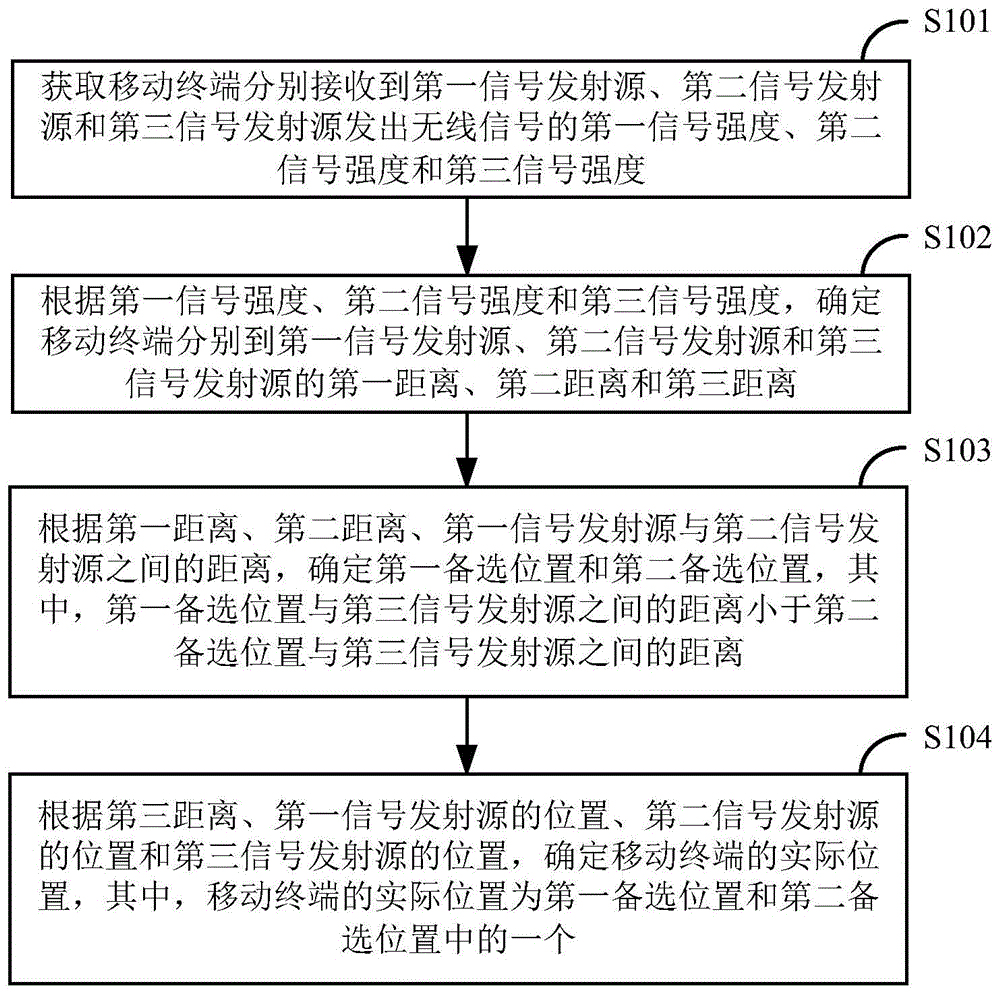
图1为本发明实施例中提供的一种基于信号强度的三点定位方法流程图;1 is a flowchart of a three-point positioning method based on signal strength provided in an embodiment of the present invention;
图2为本发明实施例中提供的一种基于信号强度的三点定位原理示意图;2 is a schematic diagram of a three-point positioning principle based on signal strength provided in an embodiment of the present invention;
图3为本发明实施例中提供的基于信号强度的三点定位方法的具体实现流程图;3 is a specific implementation flowchart of a three-point positioning method based on signal strength provided in an embodiment of the present invention;
图4为本发明实施例中提供的一种基于信号强度的三点定位装置示意图;4 is a schematic diagram of a three-point positioning device based on signal strength provided in an embodiment of the present invention;
图5为本发明实施例中提供的一种计算机设备示意图。FIG. 5 is a schematic diagram of a computer device provided in an embodiment of the present invention.
具体实施方式Detailed ways
为使本发明实施例的目的、技术方案和优点更加清楚明白,下面结合附图对本发明实施例做进一步详细说明。在此,本发明的示意性实施例及其说明用于解释本发明,但并不作为对本发明的限定。In order to make the purposes, technical solutions and advantages of the embodiments of the present invention more clearly understood, the embodiments of the present invention will be further described in detail below with reference to the accompanying drawings. Here, the exemplary embodiments of the present invention and their descriptions are used to explain the present invention, but not to limit the present invention.
本发明实施例中提供了一种基于信号强度的三点定位方法,图1为本发明实施例中提供的一种基于信号强度的三点定位方法流程图,如图1所示,该方法包括如下步骤:An embodiment of the present invention provides a three-point positioning method based on signal strength. FIG. 1 is a flowchart of a three-point positioning method based on signal strength provided in an embodiment of the present invention. As shown in FIG. 1 , the method includes: Follow the steps below:
S101,获取移动终端分别接收到第一信号发射源、第二信号发射源和第三信号发射源发出无线信号的第一信号强度、第二信号强度和第三信号强度。S101: Acquire the first signal strength, the second signal strength and the third signal strength of the wireless signals respectively received by the mobile terminal from the first signal transmission source, the second signal transmission source and the third signal transmission source.
需要说明的是,由于无线信号传输过程中存在衰减,因而,本发明实施例中提供的第一信号强度、第二信号强度和第三信号强度是指移动终端分别接收到的信号强度。It should be noted that, due to attenuation during wireless signal transmission, the first signal strength, second signal strength and third signal strength provided in the embodiments of the present invention refer to signal strengths respectively received by the mobile terminal.
S102,根据第一信号强度、第二信号强度和第三信号强度,确定移动终端分别到第一信号发射源、第二信号发射源和第三信号发射源的第一距离、第二距离和第三距离。S102, according to the first signal strength, the second signal strength and the third signal strength, determine the first distance, the second distance and the third distance from the mobile terminal to the first signal transmission source, the second signal transmission source and the third signal transmission source respectively three distances.
由于信号衰减与传输距离成正比,在具体实施时,可根据移动终端接收到第一信号发射源的第一信号强度确定移动终端到第一信号发射源的第一距离;根据移动终端接收到第二信号发射源的第二信号强度确定移动终端到第二信号发射源的第二距离;根据移动终端接收到第三信号发射源的第三信号强度确定移动终端到第三信号发射源的第三距离。Since the signal attenuation is proportional to the transmission distance, in specific implementation, the first distance from the mobile terminal to the first signal transmission source can be determined according to the first signal strength received by the mobile terminal from the first signal transmission source; The second signal strength of the second signal transmission source determines the second distance from the mobile terminal to the second signal transmission source; the third signal strength from the mobile terminal to the third signal transmission source is determined according to the third signal strength of the third signal transmission source received by the mobile terminal distance.
S103,根据第一距离、第二距离、第一信号发射源与第二信号发射源之间的距离,确定第一备选位置和第二备选位置,其中,第一备选位置与第三信号发射源之间的距离小于第二备选位置与第三信号发射源之间的距离。S103, according to the first distance, the second distance, and the distance between the first signal emission source and the second signal emission source, determine the first candidate position and the second candidate position, wherein the first candidate position and the third candidate position The distance between the signal transmission sources is smaller than the distance between the second candidate location and the third signal transmission source.
需要说明的是,在通过两个信号发射源对移动终端进行定位时,两个信号发射源发出的无线信号交点会存在两个,因而,利用两个信号发射源对移动终端进行定位得到的位置存在两个。为了准确得到移动终端的实际位置,本发明实施例中引入第三个信号发射源,在根据第一信号发射源的位置、第二信号发射源的位置、第一信号发射源发出无线信号的信号强度、第二信号发射源发出无线信号的信号强度确定两个备选位置后,利用第三信号发射源的位置、第三信号发射源发出无线信号的信号强度确定移动终端的实际位置。上述第一备选位置为距离第三信号发射源较近的一个位置,上述第一备选位置为距离第三信号发射源较远的一个位置。It should be noted that when the mobile terminal is located by two signal transmission sources, there will be two intersection points of the wireless signals sent by the two signal transmission sources. Therefore, the position obtained by using the two signal transmission sources to locate the mobile terminal There are two. In order to accurately obtain the actual position of the mobile terminal, a third signal transmission source is introduced in the embodiment of the present invention, and the wireless signal is sent out according to the position of the first signal transmission source, the position of the second signal transmission source, and the first signal transmission source. After determining the two candidate positions based on the strength and the signal strength of the wireless signal sent by the second signal transmission source, the actual position of the mobile terminal is determined by the position of the third signal transmission source and the signal strength of the wireless signal sent by the third signal transmission source. The first candidate position is a position closer to the third signal emission source, and the first candidate position is a position farther from the third signal emission source.
S104,根据第三距离、第一信号发射源的位置、第二信号发射源的位置和第三信号发射源的位置,确定移动终端的实际位置,其中,移动终端的实际位置为第一备选位置和第二备选位置中的一个。S104: Determine the actual position of the mobile terminal according to the third distance, the position of the first signal emission source, the position of the second signal emission source, and the position of the third signal emission source, wherein the actual position of the mobile terminal is the first candidate one of the position and the second alternative position.
在根据第一信号发射源的位置、第二信号发射源的位置、第一信号发射源发出无线信号的信号强度、第二信号发射源发出无线信号的信号强度确定第一备选位置和第二备选位置后,根据第三信号发射源发出无线信号的信号强度确定第三距离,进而结合第一信号发射源的位置、第二信号发射源的位置和第三信号发射源的位置确定移动终端的实际位置。The first candidate location and the second candidate location are determined according to the location of the first signal transmission source, the location of the second signal transmission source, the signal strength of the wireless signal sent by the first signal transmission source, and the signal strength of the wireless signal sent by the second signal transmission source. After selecting the location, the third distance is determined according to the signal strength of the wireless signal sent by the third signal transmission source, and then the mobile terminal is determined in combination with the position of the first signal transmission source, the position of the second signal transmission source and the position of the third signal transmission source actual location.
在一个实施例中,上述S104可具体通过如下步骤来实现:根据第一信号发射源的位置和第二信号发射源的位置,确定第一信号发射源与第二信号发射源之间的连线;根据第三信号发射源的位置,确定第三信号发射源到连线的垂直距离;判断第三距离是否大于垂直距离;如果第三距离小于垂直距离,则将第一备选位置确定为移动终端的实际位置;如果第三距离大于垂直距离,则将第二备选位置确定为移动终端的实际位置。In one embodiment, the above S104 may be specifically implemented by the following steps: determining the connection between the first signal transmission source and the second signal transmission source according to the position of the first signal transmission source and the position of the second signal transmission source ; According to the position of the third signal emission source, determine the vertical distance from the third signal emission source to the connecting line; Judge whether the third distance is greater than the vertical distance; If the third distance is less than the vertical distance, then the first candidate position is determined as moving The actual location of the terminal; if the third distance is greater than the vertical distance, the second candidate location is determined as the actual location of the mobile terminal.
在一个实施例中,本发明实施例中提供的基于信号强度的三点定位方法,可通过如下公式确定第三信号发射源到连线的垂直距离:In an embodiment, in the three-point positioning method based on signal strength provided in the embodiment of the present invention, the vertical distance from the third signal emission source to the connection line can be determined by the following formula:

其中,L为第一信号发射源和第二信号发射源之间的距离;(xA,yA)表示第一信号发射源的坐标位置;(xB,yB)表示第二信号发射源的坐标位置;(xC,yC)表示第三信号发射源的坐标位置;Dis表示第三信号发射源到连线的垂直距离。Wherein, L is the distance between the first signal emission source and the second signal emission source; (xA, yA) represents the coordinate position of the first signal emission source; (xB, yB) represents the coordinate position of the second signal emission source; (xC, yC) represents the coordinate position of the third signal emitting source; Dis represents the vertical distance from the third signal emitting source to the connecting line.
在一个实施例中,本发明实施例中提供的基于信号强度的三点定位方法,可通过如下公式确定移动终端分别到第一信号发射源、第二信号发射源和第三信号发射源的第一距离、第二距离和第三距离:In an embodiment, in the three-point positioning method based on signal strength provided in the embodiment of the present invention, the following formula can be used to determine the first signal transmission source, the second signal transmission source, and the third signal transmission source of the mobile terminal respectively. A distance, a second distance and a third distance:


其中,in,


其中,SA、SB和SC分别为移动终端到第一信号发射源、第二信号发射源和第三信号发射源的距离;γ1、γ2和γ3分别为移动终端接收到第一信号发射源、第二信号发射源和第三信号发射源的信号强度;
图2为本发明实施例中提供的一种基于信号强度的三点定位原理示意图,如图2所示,A为第一信号发射源,B为第二信号发射源,C为第三信号发射源,A与B之间的距离为L,为系统已知量;C到AB连线的垂直距离为Dis,为系统已知量。FIG. 2 is a schematic diagram of the principle of three-point positioning based on signal strength provided in an embodiment of the present invention. As shown in FIG. 2 , A is a first signal transmission source, B is a second signal transmission source, and C is a third signal transmission source Source, the distance between A and B is L, which is a known quantity of the system; the vertical distance between C and AB is Dis, which is a known quantity of the system.
图3为本发明实施例中提供的基于信号强度的三点定位方法的具体实现流程图,如图3所示,假设Pr1为移动终端的实际位置,需要计算Pr1的坐标位置,是待求解量。FIG. 3 is a flowchart of the specific implementation of the three-point positioning method based on signal strength provided in the embodiment of the present invention. As shown in FIG. 3 , assuming that Pr1 is the actual position of the mobile terminal, the coordinate position of Pr1 needs to be calculated, which is the amount to be solved. .
将信号发射源A和信号发射源B使用直线相连,从Pr1点作一条AB线的垂线,Pr1点到AB连线的垂直距离为h,该变量是辅助解算变量。Connect the signal emission source A and the signal emission source B with a straight line, draw a vertical line from the Pr1 point to the AB line, and the vertical distance from the Pr1 point to the AB line is h, this variable is an auxiliary solution variable.
Pr1点到信号发射源A的距离为SA,可通过移动终端反馈的信号数据确定。The distance from the Pr1 point to the signal transmitting source A is S A , which can be determined by the signal data fed back by the mobile terminal.
Pr1点到信号发射源B的距离为SB,可通过移动终端反馈的信号数据确定。The distance from the Pr1 point to the signal transmitting source B is S B , which can be determined by the signal data fed back by the mobile terminal.
Pr1点到信号发射源C的距离为SC,可通过移动终端反馈的信号数据确定。The distance from the Pr1 point to the signal transmitting source C is S C , which can be determined by the signal data fed back by the mobile terminal.
如果计算出垂线交点分别到信号发射源A的距离x1或者到信号发射源B的距离x2,就可以计算出距离h,就能够得到Pr1或者Pr2的坐标。If the distance x 1 from the intersection of the vertical lines to the signal emission source A or the distance x 2 to the signal emission source B is calculated, the distance h can be calculated, and the coordinates of Pr1 or Pr2 can be obtained.
如果SC小于或等于Dis,那么移动人员的坐标位置就是Pr1;If S C is less than or equal to Dis, then the coordinate position of the moving person is Pr1;
如果SC大于Dis,那么移动人员的坐标位置就是Pr2;If S C is greater than Dis, then the coordinate position of the moving person is Pr2;
具体x1、x2和h的计算,参见下面步骤:For the calculation of specific x 1 , x 2 and h, see the following steps:
假设电磁波的衰减因子为

由图2可得,如下关系:From Figure 2, the following relationship can be obtained:

将(2)中两式相减得:Subtract the two equations in (2) to get:
x1 2-x2 2=SA 2-SB 2 (10)x 1 2 -x 2 2 =S A 2 -S B 2 (10)
其中,x1和x2分别为移动终端在信号发射源AB连线上的投影点到信号发射源A、B的距离,h为移动终端到AB连线的垂直距离。Wherein, x 1 and x 2 are respectively the distances from the projection point of the mobile terminal on the connection line of the signal emission source AB to the signal emission sources A and B, and h is the vertical distance from the mobile terminal to the connection line of AB.
假设L为信号发射源A、B之间的距离,则有:Assuming that L is the distance between the signal transmitting sources A and B, there are:
x1+x2=L (11)x 1 +x 2 =L (11)
(x1+x2) (x1-x2)=SA 2-SB 2 (12)(x 1 +x 2 ) (x 1 -x 2 )=S A 2 -S B 2 (12)
则but

则but

由于受信号衰减限制,信号发射源A、B之间的最大距离为Lmax,如公式(2)和(3)所示,distanceA和distanceB分别为移动终端到信号发射源A、B的距离占比;Due to the limitation of signal attenuation, the maximum distance between signal emission sources A and B is L max , as shown in formulas (2) and (3), distanceA and distanceB are the distances from the mobile terminal to signal emission sources A and B, respectively. Compare;
将(2)和(3)代入式(14)得:Substitute (2) and (3) into equation (14) to get:

当采用WLAN无线信号定位的情况下,则信号发射源A、B之间的最大距离为100米,则有:When using WLAN wireless signal positioning, the maximum distance between signal transmitters A and B is 100 meters, then:

由于实施过程中,通常管廊内以200米作为一个防火分区,每个防火分区间安装有防火门,本系统设计应用在各个防火分区中,使用每个200米的防火分区内居中吊顶安装间隔100米的两台WLAN无线信号发射源,即两台WLAN无线信号发射源两侧的防火门分别为50米的安装方法。即,当L=100米时,有:During the implementation process, 200 meters are usually used as a fire compartment in the pipe gallery, and fire doors are installed between each fire compartment. The installation method of two WLAN wireless signal emission sources at a distance of 100 meters, that is, the fire doors on both sides of the two WLAN wireless signal emission sources are respectively 50 meters away. That is, when L=100 meters, there are:

由此,得出移动终端(即管廊人员)的位置x1与x2,从而可知定位。From this, the positions x 1 and x 2 of the mobile terminal (ie, the pipe gallery personnel) are obtained, so that the positioning can be known.
针对现有两点无线定位方法的缺陷,无法正确分辨移动终端的实际位置,本发明实施例中提供的三点定位,通过加入第三个信号发射源的距离,不需要经过复杂的计算公式和过程,通过比较方式即可实现快速、准确的定位。In view of the defect of the existing two-point wireless positioning method, the actual position of the mobile terminal cannot be accurately distinguished, the three-point positioning provided in the embodiment of the present invention, by adding the distance of the third signal transmission source, does not need to go through complex calculation formulas and process, through the comparison method can achieve fast and accurate positioning.
基于同一发明构思,本发明实施例中还提供了一种基于信号强度的三点定位装置,如下面的实施例所述。由于该装置解决问题的原理与基于信号强度的三点定位方法相似,因此该装置的实施可以参见基于信号强度的三点定位方法的实施,重复之处不再赘述。Based on the same inventive concept, an embodiment of the present invention also provides a three-point positioning device based on signal strength, as described in the following embodiments. Since the principle of the device for solving the problem is similar to the three-point positioning method based on signal strength, the implementation of the device can refer to the implementation of the three-point positioning method based on signal strength, and the repetition will not be repeated.
图4为本发明实施例中提供的一种基于信号强度的三点定位装置示意图,如图4所示,该装置包括:信号数据采集模块41、信号数据处理模块42、备选位置确定模块43和实际位置确定模块44。FIG. 4 is a schematic diagram of a three-point positioning device based on signal strength provided in an embodiment of the present invention. As shown in FIG. 4 , the device includes: a signal
其中,信号数据采集模块41,用于获取移动终端分别接收到第一信号发射源、第二信号发射源和第三信号发射源发出无线信号的第一信号强度、第二信号强度和第三信号强度;信号数据处理模块42,用于根据第一信号强度、第二信号强度和第三信号强度,确定移动终端分别到第一信号发射源、第二信号发射源和第三信号发射源的第一距离、第二距离和第三距离;备选位置确定模块43,用于根据第一距离、第二距离、第一信号发射源与第二信号发射源之间的距离,确定第一备选位置和第二备选位置,其中,第一备选位置与第三信号发射源之间的距离小于第二备选位置与第三信号发射源之间的距离;实际位置确定模块44,用于根据第三距离、第一信号发射源的位置、第二信号发射源的位置和第三信号发射源的位置,确定移动终端的实际位置,其中,移动终端的实际位置为第一备选位置和第二备选位置中的一个。The signal
在一个实施例中,本发明实施例中提供的基于信号强度的三点定位装置中,实际位置确定模块44还用于:根据第一信号发射源的位置和第二信号发射源的位置,确定第一信号发射源与第二信号发射源之间的连线;根据第三信号发射源的位置,确定第三信号发射源到连线的垂直距离;判断第三距离是否大于垂直距离;如果第三距离小于垂直距离,则将第一备选位置确定为移动终端的实际位置;如果第三距离大于垂直距离,则将第二备选位置确定为移动终端的实际位置。In one embodiment, in the three-point positioning device based on signal strength provided in the embodiment of the present invention, the actual
在一个实施例中,本发明实施例中提供的基于信号强度的三点定位装置中,实际位置确定模块44还用于通过上述公式(1)确定第三信号发射源到连线的垂直距离。In an embodiment, in the three-point positioning device based on signal strength provided in the embodiment of the present invention, the actual
在一个实施例中,本发明实施例中提供的基于信号强度的三点定位装置中,信号数据处理模块42还用于通过上述公式(2)确定移动终端到第一信号发射源的第一距离;上述公式(3)确定移动终端到第二信号发射源的第二距离;通过上述公式(4)确定移动终端到第三信号发射源的第三距离。In one embodiment, in the three-point positioning device based on signal strength provided in the embodiment of the present invention, the signal
基于同一发明构思,本发明实施例还提供一种计算机设备,用以解决现有技术中基于信号强度的两点定位方法,存在两个定位结果的技术问题,图5为本发明实施例中提供的一种计算机设备示意图,如图5所示,该计算机设备50包括存储器501、处理器502及存储在存储器501上并可在处理器502上运行的计算机程序,处理器502执行计算机程序时实现上述基于信号强度的三点定位方法。Based on the same inventive concept, an embodiment of the present invention also provides a computer device to solve the technical problem of two positioning results in the prior art two-point positioning method based on signal strength. A schematic diagram of a computer device, as shown in Figure 5, the
基于同一发明构思,本发明实施例还提供一种计算机可读存储介质,用以解决现有技术中基于信号强度的两点定位方法,存在两个定位结果的技术问题,该计算机可读存储介质存储有执行上述基于信号强度的三点定位方法的计算机程序。Based on the same inventive concept, an embodiment of the present invention also provides a computer-readable storage medium to solve the technical problem of two positioning results in the prior art two-point positioning method based on signal strength, the computer-readable storage medium A computer program executing the above-described three-point positioning method based on signal strength is stored.
综上所述,本发明实施例中提供的基于信号强度的三点定位方法、装置、计算机设备及计算机可读存储介质,在获取到移动终端分别接收第一信号发射源、第二信号发射源和第三信号发射源发出无线信号的第一信号强度、第二信号强度和第三信号强度后,根据第一信号强度、第二信号强度和第三信号强度,确定移动终端分别到第一信号发射源、第二信号发射源和第三信号发射源的第一距离、第二距离和第三距离,进而根据第一距离、第二距离、第一信号发射源与第二信号发射源之间的距离,确定第一备选位置和第二备选位置,最后根据第三距离、第一信号发射源的位置、第二信号发射源的位置和第三信号发射源的位置,将第一备选位置和第二备选位置中的一个确定为移动终端的实际位置。To sum up, the signal strength-based three-point positioning method, device, computer device, and computer-readable storage medium provided in the embodiments of the present invention are obtained when the mobile terminal receives the first signal transmission source and the second signal transmission source respectively. After sending the first signal strength, the second signal strength and the third signal strength of the wireless signal with the third signal transmitting source, according to the first signal strength, the second signal strength and the third signal strength, it is determined that the mobile terminal is respectively connected to the first signal strength The first, second, and third distances of the emission source, the second signal emission source, and the third signal emission source, and then according to the first distance, the second distance, and the distance between the first signal emission source and the second signal emission source distance, determine the first candidate position and the second candidate position, and finally according to the third distance, the position of the first signal transmission source, the position of the second signal transmission source and the position of the third signal transmission source, the first One of the selected location and the second candidate location is determined as the actual location of the mobile terminal.
与现有技术中基于信号强度的两点定位方案相比,本发明实施例通过三个信号发射源确定移动终端的实际位置,能够得到准确的定位结果。Compared with the two-point positioning scheme based on signal strength in the prior art, the embodiment of the present invention determines the actual position of the mobile terminal through three signal transmission sources, and can obtain an accurate positioning result.
本领域内的技术人员应明白,本发明的实施例可提供为方法、系统、或计算机程序产品。因此,本发明可采用完全硬件实施例、完全软件实施例、或结合软件和硬件方面的实施例的形式。而且,本发明可采用在一个或多个其中包含有计算机可用程序代码的计算机可用存储介质(包括但不限于磁盘存储器、CD-ROM、光学存储器等)上实施的计算机程序产品的形式。As will be appreciated by one skilled in the art, embodiments of the present invention may be provided as a method, system, or computer program product. Accordingly, the present invention may take the form of an entirely hardware embodiment, an entirely software embodiment, or an embodiment combining software and hardware aspects. Furthermore, the present invention may take the form of a computer program product embodied on one or more computer-usable storage media (including, but not limited to, disk storage, CD-ROM, optical storage, etc.) having computer-usable program code embodied therein.
本发明是参照根据本发明实施例的方法、设备(系统)、和计算机程序产品的流程图和/或方框图来描述的。应理解可由计算机程序指令实现流程图和/或方框图中的每一流程和/或方框、以及流程图和/或方框图中的流程和/或方框的结合。可提供这些计算机程序指令到通用计算机、专用计算机、嵌入式处理机或其他可编程数据处理设备的处理器以产生一个机器,使得通过计算机或其他可编程数据处理设备的处理器执行的指令产生用于实现在流程图一个流程或多个流程和/或方框图一个方框或多个方框中指定的功能的装置。The present invention is described with reference to flowchart illustrations and/or block diagrams of methods, apparatus (systems), and computer program products according to embodiments of the invention. It will be understood that each flow and/or block in the flowchart illustrations and/or block diagrams, and combinations of flows and/or blocks in the flowchart illustrations and/or block diagrams, can be implemented by computer program instructions. These computer program instructions may be provided to the processor of a general purpose computer, special purpose computer, embedded processor or other programmable data processing device to produce a machine such that the instructions executed by the processor of the computer or other programmable data processing device produce Means for implementing the functions specified in a flow or flow of a flowchart and/or a block or blocks of a block diagram.
这些计算机程序指令也可存储在能引导计算机或其他可编程数据处理设备以特定方式工作的计算机可读存储器中,使得存储在该计算机可读存储器中的指令产生包括指令装置的制造品,该指令装置实现在流程图一个流程或多个流程和/或方框图一个方框或多个方框中指定的功能。These computer program instructions may also be stored in a computer-readable memory capable of directing a computer or other programmable data processing apparatus to function in a particular manner, such that the instructions stored in the computer-readable memory result in an article of manufacture comprising instruction means, the instructions The apparatus implements the functions specified in the flow or flow of the flowcharts and/or the block or blocks of the block diagrams.
这些计算机程序指令也可装载到计算机或其他可编程数据处理设备上,使得在计算机或其他可编程设备上执行一系列操作步骤以产生计算机实现的处理,从而在计算机或其他可编程设备上执行的指令提供用于实现在流程图一个流程或多个流程和/或方框图一个方框或多个方框中指定的功能的步骤。These computer program instructions can also be loaded on a computer or other programmable data processing device to cause a series of operational steps to be performed on the computer or other programmable device to produce a computer-implemented process such that The instructions provide steps for implementing the functions specified in the flow or blocks of the flowcharts and/or the block or blocks of the block diagrams.
以上所述的具体实施例,对本发明的目的、技术方案和有益效果进行了进一步详细说明,所应理解的是,以上所述仅为本发明的具体实施例而已,并不用于限定本发明的保护范围,凡在本发明的精神和原则之内,所做的任何修改、等同替换、改进等,均应包含在本发明的保护范围之内。The specific embodiments described above further describe the purpose, technical solutions and beneficial effects of the present invention in detail. It should be understood that the above-mentioned specific embodiments are only specific embodiments of the present invention, and are not intended to limit the scope of the present invention. Any modification, equivalent replacement, improvement, etc. made within the spirit and principle of the present invention shall be included within the protection scope of the present invention.
Claims (10)





Priority Applications (1)
| Application Number | Priority Date | Filing Date | Title |
|---|---|---|---|
| CN202110979097.5A CN113709664B (en) | 2021-08-25 | 2021-08-25 | Three-point positioning method and device based on signal intensity |
Applications Claiming Priority (1)
| Application Number | Priority Date | Filing Date | Title |
|---|---|---|---|
| CN202110979097.5A CN113709664B (en) | 2021-08-25 | 2021-08-25 | Three-point positioning method and device based on signal intensity |
Publications (2)
| Publication Number | Publication Date |
|---|---|
| CN113709664A true CN113709664A (en) | 2021-11-26 |
| CN113709664B CN113709664B (en) | 2023-08-15 |
Family
ID=78654535
Family Applications (1)
| Application Number | Title | Priority Date | Filing Date |
|---|---|---|---|
| CN202110979097.5A Active CN113709664B (en) | 2021-08-25 | 2021-08-25 | Three-point positioning method and device based on signal intensity |
Country Status (1)
| Country | Link |
|---|---|
| CN (1) | CN113709664B (en) |
Citations (8)
| Publication number | Priority date | Publication date | Assignee | Title |
|---|---|---|---|---|
| CN101285878A (en) * | 2008-06-04 | 2008-10-15 | 中国海洋大学 | A Vertical Intersection Localization Algorithm for Wireless Sensor Networks |
| CN101378593A (en) * | 2008-05-06 | 2009-03-04 | 中国科学技术大学苏州研究院 | A Stable Location Method for Wireless Sensor Network Nodes Based on RSSI |
| CN102209382A (en) * | 2011-05-18 | 2011-10-05 | 杭州电子科技大学 | Wireless sensor network node positioning method based on received signal strength indicator (RSSI) |
| JP2012255673A (en) * | 2011-06-08 | 2012-12-27 | Fujitsu Ltd | Positioning method, positioning system and program |
| CN103179661A (en) * | 2013-03-22 | 2013-06-26 | 四川长虹电器股份有限公司 | WLAN (Wireless Local Area Network)-based indoor positioning method and device |
| CN104297725A (en) * | 2014-10-28 | 2015-01-21 | 青岛理工大学 | Terminal positioning method and system |
| CN107786942A (en) * | 2017-09-30 | 2018-03-09 | 平安科技(深圳)有限公司 | Positioner, method and computer-readable recording medium based on wireless device |
| CN110726970A (en) * | 2018-07-17 | 2020-01-24 | Tcl集团股份有限公司 | Target positioning method and terminal equipment |
-
2021
- 2021-08-25 CN CN202110979097.5A patent/CN113709664B/en active Active
Patent Citations (8)
| Publication number | Priority date | Publication date | Assignee | Title |
|---|---|---|---|---|
| CN101378593A (en) * | 2008-05-06 | 2009-03-04 | 中国科学技术大学苏州研究院 | A Stable Location Method for Wireless Sensor Network Nodes Based on RSSI |
| CN101285878A (en) * | 2008-06-04 | 2008-10-15 | 中国海洋大学 | A Vertical Intersection Localization Algorithm for Wireless Sensor Networks |
| CN102209382A (en) * | 2011-05-18 | 2011-10-05 | 杭州电子科技大学 | Wireless sensor network node positioning method based on received signal strength indicator (RSSI) |
| JP2012255673A (en) * | 2011-06-08 | 2012-12-27 | Fujitsu Ltd | Positioning method, positioning system and program |
| CN103179661A (en) * | 2013-03-22 | 2013-06-26 | 四川长虹电器股份有限公司 | WLAN (Wireless Local Area Network)-based indoor positioning method and device |
| CN104297725A (en) * | 2014-10-28 | 2015-01-21 | 青岛理工大学 | Terminal positioning method and system |
| CN107786942A (en) * | 2017-09-30 | 2018-03-09 | 平安科技(深圳)有限公司 | Positioner, method and computer-readable recording medium based on wireless device |
| CN110726970A (en) * | 2018-07-17 | 2020-01-24 | Tcl集团股份有限公司 | Target positioning method and terminal equipment |
Also Published As
| Publication number | Publication date |
|---|---|
| CN113709664B (en) | 2023-08-15 |
Similar Documents
| Publication | Publication Date | Title |
|---|---|---|
| US10284316B2 (en) | Method for predicting indoor three-dimensional space signal field strength using an outdoor-to-indoor propagation model | |
| RU2465616C2 (en) | Method and apparatus for trilateration using communication line forecasting within line of sight and route filtering within line of sight before measurement | |
| CN100538391C (en) | Probabilistic Models for Localization Techniques | |
| US8102314B2 (en) | Method and apparatus for determining the location of a mobile object | |
| JP5674315B2 (en) | A method for locating a transmitter using reverse ray tracking. | |
| CN105510876B (en) | A kind of indoor distance-measuring and positioning method based on propagation properties | |
| Moghtadaiee et al. | WiFi fingerprinting signal strength error modeling for short distances | |
| CN105334495B (en) | A kind of non line of sight robust position location method based on time of arrival (toa) in wireless network | |
| CN105247384B (en) | The distance of mobile device determines | |
| TW200428017A (en) | A method and system for locating a mobile radio receiver in a radio system with multiple transmitters | |
| CN103957510B (en) | The indoor positioning algorithms of environment self-adaption based on collaboration communication | |
| Podevijn et al. | Performance comparison of RSS algorithms for indoor localization in large open environments | |
| CN100381007C (en) | Signal path detection for wireless networks including repeaters | |
| CN114363808A (en) | An indoor positioning method based on RSSI ranging | |
| CN105372506A (en) | Variable-scale rasterization method and system for regional electromagnetic environment calculation | |
| CN106772229A (en) | Indoor orientation method and relevant device | |
| JP2023072230A (en) | Information processing device, information processing system, data generation method, and program | |
| Lembo et al. | Indoor positioning based on RSS fingerprinting in a LTE network: method based on genetic algorithms | |
| KR20150132165A (en) | Techniques to Improve the Performance of a Fixed, Timing-Based Radio Positioning Network Using External Assistance Information | |
| CN101345559A (en) | Method for Estimating Path Loss of Base Station Signal Strength | |
| Limmer et al. | Physics-informed neural networks for pathloss prediction | |
| CN113709664A (en) | Three-point positioning method and device based on signal intensity | |
| CN108882167A (en) | A kind of navigation locating method based in underwater sound communication network using signal strength | |
| Cheng et al. | Localization of a moving non-cooperative RF target in NLOS environment using RSS and AOA measurements | |
| KR102302806B1 (en) | Method and apparatus for measuring location based on mobile signal |
Legal Events
| Date | Code | Title | Description |
|---|---|---|---|
| PB01 | Publication | ||
| PB01 | Publication | ||
| SE01 | Entry into force of request for substantive examination | ||
| SE01 | Entry into force of request for substantive examination | ||
| GR01 | Patent grant | ||
| GR01 | Patent grant |