CN114363808A - An indoor positioning method based on RSSI ranging - Google Patents
An indoor positioning method based on RSSI ranging Download PDFInfo
- Publication number
- CN114363808A CN114363808A CN202210015981.1A CN202210015981A CN114363808A CN 114363808 A CN114363808 A CN 114363808A CN 202210015981 A CN202210015981 A CN 202210015981A CN 114363808 A CN114363808 A CN 114363808A
- Authority
- CN
- China
- Prior art keywords
- rssi
- node
- value
- formula
- distance
- Prior art date
- Legal status (The legal status is an assumption and is not a legal conclusion. Google has not performed a legal analysis and makes no representation as to the accuracy of the status listed.)
- Granted
Links
Images



Classifications
-
- Y—GENERAL TAGGING OF NEW TECHNOLOGICAL DEVELOPMENTS; GENERAL TAGGING OF CROSS-SECTIONAL TECHNOLOGIES SPANNING OVER SEVERAL SECTIONS OF THE IPC; TECHNICAL SUBJECTS COVERED BY FORMER USPC CROSS-REFERENCE ART COLLECTIONS [XRACs] AND DIGESTS
- Y02—TECHNOLOGIES OR APPLICATIONS FOR MITIGATION OR ADAPTATION AGAINST CLIMATE CHANGE
- Y02D—CLIMATE CHANGE MITIGATION TECHNOLOGIES IN INFORMATION AND COMMUNICATION TECHNOLOGIES [ICT], I.E. INFORMATION AND COMMUNICATION TECHNOLOGIES AIMING AT THE REDUCTION OF THEIR OWN ENERGY USE
- Y02D30/00—Reducing energy consumption in communication networks
- Y02D30/70—Reducing energy consumption in communication networks in wireless communication networks
Landscapes
- Position Fixing By Use Of Radio Waves (AREA)
Abstract
本发明公开了一种基于RSSI测距的室内定位方法,具体包括以下具体步骤:1布设蓝牙beacon基站并标定参考节点的位置;2在不同参考节点处分别采集一组信号强度RSSI值,利用加权混合滤波优化RSSI值;3采用最小二乘法对步骤2优化后的RSSI值进行分段拟合,得到分段式测距模型;4采用步骤3建立的分段式拟合测距模型和三边定位法进行室内位置推算;本发明提出的基于RSSI混合滤波和分段式拟合测距模型的室内定位方法,可应用于室内定位、行人导航等场景,可提高室内定位导航的精度;适用范围广,不局限于室内定位,也可用于室外GNSS信号严重缺失的密集城区定位。

The invention discloses an indoor positioning method based on RSSI ranging, which specifically includes the following specific steps: 1. Deploying a Bluetooth beacon base station and calibrating the position of a reference node; Hybrid filtering optimizes the RSSI value; 3. Use the least squares method to perform segmental fitting on the RSSI value optimized in step 2 to obtain a segmented ranging model; 4. Use the segmented fitting ranging model established in step 3 and the three sides The indoor positioning method is used for indoor position estimation; the indoor positioning method based on RSSI hybrid filtering and segmented fitting ranging model proposed by the present invention can be applied to indoor positioning, pedestrian navigation and other scenarios, and can improve the accuracy of indoor positioning and navigation; the scope of application It is not limited to indoor positioning, but can also be used for positioning in dense urban areas where outdoor GNSS signals are severely lacking.
Description
技术领域technical field
本发明涉及一种室内定位方法,尤其是一种基于RSSI测距的室内定位方法,属于室内定位技术领域。The invention relates to an indoor positioning method, in particular to an indoor positioning method based on RSSI ranging, and belongs to the technical field of indoor positioning.
背景技术Background technique
近年来,随着城市化的发展和智能手机的普及,室内定位技术成为导航领域的热点问题。利用无线传感网络(Wireless Sensor Network,WSN)实现室内定位具有网络规模大,局部节点定位容错高、计算难度适中、动态性网络可靠性强的优势。按照是否需要测量节点间距离的标准,WSN定位技术可分为基于测距的定位技术和基于非测距的定位技术,其中基于测距的定位技术是通过测量发射节点和接收节点间的距离实现定位。In recent years, with the development of urbanization and the popularization of smart phones, indoor positioning technology has become a hot issue in the field of navigation. Using Wireless Sensor Network (WSN) to achieve indoor positioning has the advantages of large network scale, high local node positioning fault tolerance, moderate computational difficulty, and strong dynamic network reliability. According to the standard of whether it is necessary to measure the distance between nodes, WSN positioning technology can be divided into ranging-based positioning technology and non-ranging-based positioning technology. The ranging-based positioning technology is realized by measuring the distance between the transmitting node and the receiving node. position.
到达角度定位法、到达时间定位法、到达时间差定位法、接收信号强度指示(Received Signal Strength Indication,RSSI)定位法是典型的基于测距的定位方法。到达角度定位法通过安装阵列天线或接收设备测量节点的角度和方向实现定位,测量精度较高但需要大量额外硬件,成本较高。到达时间定位法通过信号传播时间和速度计算距离,方法简便但接收节点和发射节点的时间难以高精度同步,测距误差较大。到达时间差定位法通过不同种类的无线信号传播速度和信号到达时间差来计算距离,相较于到达时间定位法不需要时间高精度同步,但需要额外的多种不同信号发射装置。RSSI定位法根据传播路径上的信号损耗计算发射节点和接收节点之间的距离,此方法不需要大量额外硬件,若使用蓝牙beacon成本低、功耗低、易于实现,适用性最广。The angle-of-arrival positioning method, the time-of-arrival positioning method, the time-of-arrival positioning method, and the Received Signal Strength Indication (RSSI) positioning method are typical ranging-based positioning methods. The angle-of-arrival positioning method realizes positioning by installing an array antenna or receiving equipment to measure the angle and direction of the node. The measurement accuracy is high, but a large amount of additional hardware is required, and the cost is high. The time-of-arrival positioning method calculates the distance through the signal propagation time and speed. The method is simple, but the time of the receiving node and the transmitting node is difficult to synchronize with high precision, and the ranging error is large. Compared with the time-of-arrival positioning method, the time-of-arrival positioning method does not require high-precision time synchronization, but requires additional various signal transmitting devices. The RSSI positioning method calculates the distance between the transmitting node and the receiving node according to the signal loss on the propagation path. This method does not require a lot of additional hardware. If the Bluetooth beacon is used, the cost is low, the power consumption is low, it is easy to implement, and the applicability is the most extensive.
虽然RSSI和传输距离之间变化关系简单,但在实际情况中,多径效应、非视距、反射和折射等复杂环境因素对RSSI影响较大,导致其数据较少、质量较差。并且,RSSI衰减程度变化时,普通测距模型拟合效果不佳。针对上述问题,目前还未有切实可行的方法。Although the relationship between RSSI and transmission distance is simple, in practice, complex environmental factors such as multipath effects, non-line-of-sight effects, reflection and refraction have a greater impact on RSSI, resulting in less data and poorer quality. Moreover, when the RSSI attenuation degree changes, the fitting effect of the ordinary ranging model is not good. There is no practical way to solve the above problems.
发明内容SUMMARY OF THE INVENTION
本发明的目的在于,为提高室内测距和定位精度,对RSSI的滤波方法和测距模型进行改进,提供了一种基于RSSI混合滤波和分段式拟合测距模型的室内定位方法,用于解决现有的低成本方法在室内测距和定位受非视距和多径效应影响导致精度低的问题。The purpose of the present invention is to improve the filtering method and ranging model of RSSI in order to improve indoor ranging and positioning accuracy, and provide an indoor positioning method based on RSSI hybrid filtering and segmented fitting ranging model. It is used to solve the problem of low accuracy caused by the influence of non-line-of-sight and multipath effects in the existing low-cost methods for indoor ranging and positioning.
为了解决背景技术所存在的问题,本发明提出了一种基于RSSI测距的室内定位方法,包括以下步骤:In order to solve the problems existing in the background technology, the present invention proposes an indoor positioning method based on RSSI ranging, including the following steps:
步骤1:布设蓝牙beacon基站并标定参考节点的位置。作为发射节点,蓝牙beacon沿走廊两侧交叉间隔部署,同侧部署间隔为10m,距地面高度为1.5m,发射功率为-12dBm,发射频率为10Hz。部署时应尽量避开强电磁干扰和障碍物,并记录蓝牙beacon的坐标。从距离发射节点1m处开始每隔0.5m-2m布设一个参考节点,布设密度应结合室内实际情况而定,并记录参考节点的坐标。接收节点为具有蓝牙接收功能的智能设备,位置可移动,用于接收发射节点发送的RSSI值。Step 1: Deploy the Bluetooth beacon base station and calibrate the location of the reference node. As a transmitting node, the Bluetooth beacons are deployed at cross intervals along both sides of the corridor. The deployment interval on the same side is 10m, the height from the ground is 1.5m, the transmission power is -12dBm, and the transmission frequency is 10Hz. When deploying, try to avoid strong electromagnetic interference and obstacles, and record the coordinates of the Bluetooth beacon. From 1m away from the transmitting node, lay a reference node every 0.5m-2m. The layout density should be determined according to the actual situation in the room, and the coordinates of the reference node should be recorded. The receiving node is a smart device with Bluetooth receiving function, the position can be moved, and is used to receive the RSSI value sent by the transmitting node.
步骤2:在不同参考节点处分别采集一组RSSI值,利用加权混合滤波优化RSSI值。RSSI值受环境干扰波动较大,计算前需要滤波预处理。传统滤波方法,如均值滤波、中值滤波和高斯滤波,都具有一定局限性。当RSSI值较少或RSSI值受环境干扰波动较大时,单独采用均值滤波会将异常值加入到滤波中,增大误差,滤波效果可信度降低。此时,单独采用中值滤波只取一个中间值也会造成较大误差。样本数量不多、干扰时间长的问题会导致RSSI值分布情况较大偏离高斯分布,RSSI值的频率分布会出现左偏、右偏甚至多峰的问题,此时单独采用高斯滤波会导致滤波结果较差。本发明提出一种基于均值滤波、中值滤波和高斯滤波的加权混合滤波法来优化RSSI值,优化后的RSSI值的波动较单一滤波变小,RSSI值随距离变化较平滑,RSSI值误差累积分布情况优于单一滤波。Step 2: Collect a set of RSSI values at different reference nodes, and optimize the RSSI values by using weighted hybrid filtering. The RSSI value fluctuates greatly due to environmental interference, and requires filtering and preprocessing before calculation. Traditional filtering methods, such as mean filtering, median filtering, and Gaussian filtering, have certain limitations. When the RSSI value is small or the RSSI value fluctuates greatly due to environmental interference, the average filtering alone will add abnormal values to the filtering, increase the error, and reduce the reliability of the filtering effect. At this time, using median filtering alone to take only one intermediate value will also cause a large error. The problem of small number of samples and long interference time will cause the distribution of RSSI values to deviate from the Gaussian distribution, and the frequency distribution of RSSI values will be left-biased, right-biased or even multimodal. In this case, using Gaussian filtering alone will lead to filtering results. poor. The invention proposes a weighted mixed filtering method based on mean filtering, median filtering and Gaussian filtering to optimize the RSSI value. The fluctuation of the optimized RSSI value is smaller than that of a single filter, the RSSI value changes smoothly with the distance, and the RSSI value error accumulates The distribution is better than a single filter.
步骤3:采用最小二乘法对步骤2优化后的RSSI值进行分段式拟合,得到分段式测距模型。首先,根据普通测距模型得出符合当前实验环境的路径损耗因子n和常数A,A指接收节点到发射节点距离为1m时接收到的RSSI值,n的大小与室内环境有关。然后,根据阈值设置策略,设置阈值再次拟合测距模型更新模型参数,即建立分段式拟合测距模型。无线信号传播一定距离后,信号衰减程度会下降,传播相同的距离信号衰减值会越来越小,传统方法拟合的测距模型精度低。本发明提出的设置合理阈值,对测距模型进行分段式拟合,可以提高测距模型的精度。Step 3: Use the least squares method to perform segmental fitting on the RSSI value optimized in
步骤4:采用步骤3建立的分段式拟合测距模型和三边定位法进行室内位置推算。利用分段式测距模型反算接收节点到发射节点的距离,利用最小二乘三边定位法求解未知节点坐标。室内环境较为狭窄,因定位误差而出现偏离走廊或房间的情况,设置坐标阈值,防止坐标定位到墙壁中或建筑物外,最终得到参考节点的坐标。Step 4: Use the segmented fitting ranging model established in
步骤1中,为确定蓝牙beacon基站的最优布设方式,特通过设置不同的beacon布设密度、发射功率、发射角度实验,分析蓝牙beacon基站的布设方式与RSSI的关系。具体策略如下:布设密度:5m范围内布设1个和多个;发射功率:0dBm和-12dBm;发射角度:0°、45°、90°和角度递减。实验结果表明,5m范围内只布设一个beacon、发射功率-12dBm、发射角度递减可以体现较明显的RSSI衰减趋势。In
进一步地,所述的步骤2中,利用加权混合滤波优化RSSI值具体步骤如下:Further, in the described
步骤2.1用均值滤波处理RSSI值:Step 2.1 Process the RSSI values with mean filtering:
均值滤波计算公式:The mean filter calculation formula:

式中,m为采集次数;RSSIi为第i次采集的信号强度。In the formula, m is the number of acquisitions; RSSI i is the signal strength of the i-th acquisition.
步骤2.2用中值滤波处理RSSI值:Step 2.2 Process RSSI values with median filter:
中值滤波计算公式:Median filter calculation formula:
RSSI=Med{RSSI1,RSSI2,…,RSSIm}RSSI=Med{RSSI 1 ,RSSI 2 ,...,RSSI m }
式中,RSSIm为第m次采集的信号强度。In the formula, RSSI m is the signal strength of the mth acquisition.
步骤2.3用高斯滤波处理RSSI值:Step 2.3 Process RSSI values with Gaussian filtering:
高斯密度概率函数为:The Gaussian density probability function is:

式中,In the formula,


式中,μ是高斯分布的位置参数,描述高斯分布的集中趋势位置;σ描述高斯分布资料数据分布的离散程度。In the formula, μ is the position parameter of the Gaussian distribution, which describes the central tendency position of the Gaussian distribution; σ describes the discrete degree of the data distribution of the Gaussian distribution.
根据高斯分布的3σ原则,区间[μ-σ,μ+σ]上取值的概率为0.6826,剔除此区间外数据,最终确定高斯滤波计算公式:According to the 3σ principle of Gaussian distribution, the probability of taking a value in the interval [μ-σ, μ+σ] is 0.6826. After excluding the data outside this interval, the calculation formula of Gaussian filtering is finally determined:

式中,k为区间[μ-σ,μ+σ]内RSSI值的个数。In the formula, k is the number of RSSI values in the interval [μ-σ, μ+σ].
步骤2.4建立加权混合滤波优化模型,得到优化后的RSSI值。Step 2.4 Establish a weighted hybrid filtering optimization model to obtain an optimized RSSI value.
根据单一滤波方法的Bias定权,Bias为RSSI实际测量值与根据路径损耗模型得到的理论值的差值。根据相应权重建立加权混合滤波优化模型,公式如下:According to the Bias weighting of a single filtering method, Bias is the difference between the actual measured value of RSSI and the theoretical value obtained according to the path loss model. The weighted hybrid filtering optimization model is established according to the corresponding weights, and the formula is as follows:


式中,RSSId表示加权混合滤波后RSSI值;RSSIA表示均值滤波后RSSI值;RSSIM表示中值滤波后RSSI值;RSSIG表示高斯滤波后RSSI值;BiasA表示均值滤波后RSSI测量值与理论值的差值;BiasM表示中值滤波后RSSI测量值与理论值的差值;BiasG表示高斯滤波后RSSI测量值与理论值的差值,PA表示均值滤波的权值,PM表示中值滤波的权值,PG表示高斯滤波的权值。In the formula, RSSI d is the RSSI value after weighted hybrid filtering; RSSI A is the RSSI value after mean filtering; RSSI M is the RSSI value after median filtering; RSSI G is the RSSI value after Gaussian filtering; Bias A is the RSSI measurement value after mean filtering The difference from the theoretical value; Bias M represents the difference between the measured RSSI value after median filtering and the theoretical value; Bias G represents the difference between the measured RSSI value after Gaussian filtering and the theoretical value, P A represents the weight of the mean filter, P M represents the weight of the median filter, and PG represents the weight of the Gaussian filter.
进一步地,所述的步骤3中,采用最小二乘法对混合滤波优化后的RSSI值进行分段式拟合,得到分段式测距模型具体步骤如下:Further, in the
步骤3.1在考虑信号传输损耗的实际情况下,RSSI传输损耗符合对数正态模型,可以用修正的路径损耗模型来描述:Step 3.1 Under the actual situation of considering the signal transmission loss, the RSSI transmission loss conforms to the log-normal model, which can be described by the modified path loss model:
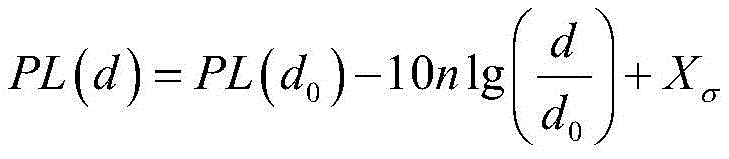
式中,PL(d)为接收节点到发射节点距离为d时接收到的信号强度,单位为dBm;PL(d0)为接收节点到发射节点距离为d0时接收到的信号强度,单位为dBm;d为发射节点与参考节点之间的距离;d0为参考距离;n为路径损耗因子,其大小与室内环境有关;Xσ是遮蔽因子,是一个服从(0,σ2)的高斯随机噪声变量,单位为dBm。In the formula, PL(d) is the received signal strength when the distance from the receiving node to the transmitting node is d, the unit is dBm; PL(d 0 ) is the received signal strength when the distance from the receiving node to the transmitting node is d 0 , the unit is is dBm; d is the distance between the transmitting node and the reference node; d 0 is the reference distance; n is the path loss factor, which is related to the indoor environment; X σ is the shadowing factor, which is a Gaussian random noise variable in dBm.
步骤3.2在实际应用中,可以忽略遮蔽因子,为便于计算,在应用中参考距离d0取值为1m。因此,RSSI公式可以被简化为:Step 3.2 In practical applications, the shading factor can be ignored. For the convenience of calculation, the reference distance d 0 is taken as 1m in the application. Therefore, the RSSI formula can be simplified to:
RSSI=A-10nlg(d)RSSI=A-10nlg(d)
式中,A为接收节点到发射节点为1m时接收到的信号强度,单位为dBm;RSSI单位为dBm。In the formula, A is the received signal strength when the distance from the receiving node to the transmitting node is 1m, the unit is dBm; the RSSI unit is dBm.
步骤3.3设置阈值,对测距模型进行分段式拟合。Step 3.3 Set the threshold and perform segmental fitting on the ranging model.
步骤3.4阈值设置策略如下:Step 3.4 The threshold setting strategy is as follows:
(1)在实验场S中,按参考节点到发射节点距离从近到远选择参考节点,按顺序依次记作d1,d2,…,dn。(1) In the experimental field S, the reference nodes are selected according to the distance from the reference node to the transmitting node from near to far, and are recorded as d 1 , d 2 ,...,d n in sequence.
(2)依次在每个参考节点处测量RSSI,记作RSSI1,RSSI2,…,RSSIn。(2) Measure RSSI at each reference node in turn, denoted as RSSI 1 , RSSI 2 , . . . , RSSI n .
(3)特别地,定义一个k值,表示单位距离内RSSI的衰减值,在每个参考节点处计算k值,计算公式如下:(3) In particular, define a k value to represent the attenuation value of RSSI within a unit distance, and calculate the k value at each reference node. The calculation formula is as follows:

式中,ki表示第i个参考节点处单位距离内RSSI的衰减值;RSSIi-1表示第i-1个参考节点处的RSSI值;di-1表示第i-1个参考节点到发射节点的距离。In the formula, ki represents the RSSI attenuation value within the unit distance at the ith reference node; RSSI i-1 represents the RSSI value at the ith reference node; d i-1 represents the ith reference node to The distance of the transmitting node.
(4)比较ki与路径损耗因子n,当ki小于n时,令第i-1个参考节点处的RSSI值为阈值。(4) Compare k i with the path loss factor n, when k i is less than n, set the RSSI value at the i-1th reference node as the threshold.
进一步地,所述的步骤4中,三边定位法具体步骤如下:Further, in the described
步骤4.1在未知节点接收到多个RSSI值,根据测距模型将RSSI值转化为距离,得到至少三个发射节点到未知节点的距离。发射节点的选择原则:按未知节点接收到发射节点的RSSI值大小排序选择前三位。Step 4.1 Receive multiple RSSI values at the unknown node, convert the RSSI values into distances according to the ranging model, and obtain the distances from at least three transmitting nodes to the unknown nodes. The selection principle of the transmitting node: select the top three according to the size of the RSSI value of the transmitting node received by the unknown node.
步骤4.2采用三边定位法解算未知节点坐标,三边定位公式:Step 4.2 Use the three-sided positioning method to solve the unknown node coordinates. The three-sided positioning formula:

式中,(xi,yi)为发射节点的坐标;(x,y)为未知节点的坐标;di表示接收到的RSSI值转换成的距离,即第i个发射节点到未知节点的距离。In the formula, (x i , y i ) are the coordinates of the transmitting node; (x, y) are the coordinates of the unknown node; d i is the distance converted from the received RSSI value, that is, the distance from the i-th transmitting node to the unknown node. distance.
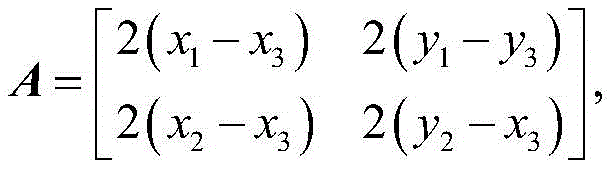
步骤4.3将上式方程组中前n-1个方程减去第n个方程后,进行方程线性化:Step 4.3 After subtracting the nth equation from the first n-1 equations in the above equation system, linearize the equation:
AX=bAX=b
式中,In the formula,


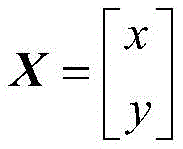
步骤4.4最小二乘法迭代求解上式得Step 4.4 The least squares method iteratively solves the above equation to get

式中,
与现有技术相比,本发明的有益效果是:本发明采用加权混合滤波法优化RSSI,可在多径效应、非视距、反射和折射等复杂环境因素影响下仍能保持良好的RSSI优化效果,其综合优化性能优于单一滤波。本发明采用分段式拟合测距模型,可在RSSI衰减程度变化时,根据阈值设置策略,设置阈值再次拟合测距模型更新模型参数,通过多次拟合测距模型提高测距精度。本发明提出的基于RSSI混合滤波和分段式拟合测距模型的室内定位方法,可应用于室内定位、行人导航等场景,可提高室内定位导航的精度;适用范围广,不仅局限于室内定位,也可用于室外GNSS信号严重缺失的密集城区定位。Compared with the prior art, the beneficial effects of the present invention are: the present invention adopts the weighted hybrid filtering method to optimize RSSI, and can still maintain good RSSI optimization under the influence of complex environmental factors such as multipath effect, non-line-of-sight, reflection and refraction. Its comprehensive optimization performance is better than that of single filtering. The present invention adopts the segmented fitting ranging model, and can set the threshold to re-fit the ranging model to update the model parameters when the RSSI attenuation degree changes according to the threshold setting strategy, and improve the ranging accuracy by fitting the ranging model multiple times. The indoor positioning method based on RSSI hybrid filtering and segmented fitting ranging model proposed by the present invention can be applied to scenarios such as indoor positioning and pedestrian navigation, and can improve the accuracy of indoor positioning and navigation; the scope of application is wide, not only limited to indoor positioning , and can also be used for positioning in dense urban areas where outdoor GNSS signals are severely lacking.
附图说明Description of drawings
图1是本发明的工作流程图。Fig. 1 is the working flow chart of the present invention.
图2是实验场景示意图。Figure 2 is a schematic diagram of the experimental scene.
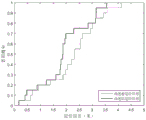
图3是采用本发明方法与其他滤波方法的测距误差累积分布图。FIG. 3 is a cumulative distribution diagram of ranging errors using the method of the present invention and other filtering methods.
图4是采用本发明方法与普通测距模型测距法的测距误差累积分布图。FIG. 4 is a cumulative distribution diagram of ranging errors using the method of the present invention and a common ranging model ranging method.
图5是采用本发明方法前后的预测路径对比图。FIG. 5 is a comparison diagram of the predicted paths before and after the method of the present invention is adopted.
图6是采用本发明方法前后的定位误差累积分布图。FIG. 6 is a cumulative distribution diagram of positioning errors before and after the method of the present invention is adopted.
图7是采用本发明方法前后的定位误差对比图。FIG. 7 is a comparison diagram of positioning errors before and after the method of the present invention is adopted.
具体实施方式Detailed ways
下面将结合本发明实施例中的附图,对本发明实施例中的技术方案进行清楚、完整地描述,显然,所描述的实施例仅是本发明一部分实施例,而不是全部的实施例。基于本发明中的实施例,本领域普通技术人员在没有做出创造性劳动前提下所获得的所有其他实施例,都属于本发明保护的范围。The technical solutions in the embodiments of the present invention will be clearly and completely described below with reference to the accompanying drawings in the embodiments of the present invention. Obviously, the described embodiments are only a part of the embodiments of the present invention, but not all of the embodiments. Based on the embodiments of the present invention, all other embodiments obtained by those of ordinary skill in the art without creative efforts shall fall within the protection scope of the present invention.
实施例Example
本实施例中以实验场S为实验区域。实验场S的实验区域走廊面积约180平方米,发射节点为具有蓝牙5.0技术的蓝牙beacon基站,接收节点为搭载安卓9.0平台的华为Mate 9智能手机。结合具体实地情况,在实验场S布设了10个蓝牙beacon基站,22个参考节点,详情见图2。In this embodiment, the experimental field S is used as the experimental area. The corridor area of the experimental area of the experimental site S is about 180 square meters. The transmitting node is a Bluetooth beacon base station with Bluetooth 5.0 technology, and the receiving node is a
步骤1:布设蓝牙beacon基站并标定参考节点的位置。作为发射节点,蓝牙beacon沿走廊两侧交叉间隔部署,同侧部署间隔为10m,距地面高度为1.5m,发射功率为-12dBm,发射频率为10Hz,并记录蓝牙beacon的坐标。参考节点具体布设密度应结合室内实际情况而定,并记录参考节点的坐标。Step 1: Deploy the Bluetooth beacon base station and calibrate the location of the reference node. As a transmitting node, the Bluetooth beacon is deployed at cross intervals along both sides of the corridor, the deployment interval on the same side is 10m, the height from the ground is 1.5m, the transmission power is -12dBm, the transmission frequency is 10Hz, and the coordinates of the Bluetooth beacon are recorded. The specific layout density of reference nodes should be determined according to the actual indoor conditions, and the coordinates of the reference nodes should be recorded.
步骤2:在不同参考节点处分别采集一组RSSI值,利用加权混合滤波优化RSSI值。Step 2: Collect a set of RSSI values at different reference nodes, and optimize the RSSI values by using weighted hybrid filtering.
在步骤2中,利用加权混合滤波优化RSSI值具体步骤如下:In
步骤2.1用均值滤波处理RSSI值:Step 2.1 Process the RSSI values with mean filtering:
均值滤波计算公式:The mean filter calculation formula:

式中,m为采集次数;RSSIi为第i次采集的信号强度。In the formula, m is the number of acquisitions; RSSI i is the signal strength of the i-th acquisition.
步骤2.2用中值滤波处理RSSI值:Step 2.2 Process RSSI values with median filter:
中值滤波计算公式:Median filter calculation formula:
RSSI=Med{RSSI1,RSSI2,…,RSSIm}RSSI=Med{RSSI 1 ,RSSI 2 ,...,RSSI m }
式中,RSSIm为第m次采集的信号强度。In the formula, RSSI m is the signal strength of the mth acquisition.
步骤2.3用高斯滤波处理RSSI值:Step 2.3 Process RSSI values with Gaussian filtering:
高斯密度概率函数为:The Gaussian density probability function is:

式中,In the formula,


式中,μ是高斯分布的位置参数,描述高斯分布的集中趋势位置;σ描述高斯分布资料数据分布的离散程度。In the formula, μ is the position parameter of the Gaussian distribution, which describes the central tendency position of the Gaussian distribution; σ describes the discrete degree of the data distribution of the Gaussian distribution.
根据高斯分布的3σ原则,区间[μ-σ,μ+σ]上取值的概率为0.6826,剔除此区间外数据,最终确定高斯滤波计算公式:According to the 3σ principle of Gaussian distribution, the probability of taking a value in the interval [μ-σ, μ+σ] is 0.6826. After excluding the data outside this interval, the calculation formula of Gaussian filtering is finally determined:

式中,k为区间[μ-σ,μ+σ]内RSSI值的个数。In the formula, k is the number of RSSI values in the interval [μ-σ, μ+σ].
步骤2.4建立加权混合滤波优化模型,得到优化后的RSSI值。Step 2.4 Establish a weighted hybrid filtering optimization model to obtain an optimized RSSI value.
根据单一滤波方法的Bias定权,Bias为RSSI实际测量值与根据路径损耗模型得到的理论值的差值。根据相应权重建立加权混合滤波优化模型,公式如下:According to the Bias weighting of a single filtering method, Bias is the difference between the actual measured value of RSSI and the theoretical value obtained according to the path loss model. The weighted hybrid filtering optimization model is established according to the corresponding weights, and the formula is as follows:


式中,RSSId表示加权混合滤波后RSSI值;RSSIA表示均值滤波后RSSI值;RSSIM表示中值滤波后RSSI值;RSSIG表示高斯滤波后RSSI值;BiasA表示均值滤波后RSSI测量值与理论值的差值;BiasM表示中值滤波后RSSI测量值与理论值的差值;BiasG表示高斯滤波后RSSI测量值与理论值的差值,PA表示均值滤波的权值,PM表示中值滤波的权值,PG表示高斯滤波的权值。In the formula, RSSI d is the RSSI value after weighted hybrid filtering; RSSI A is the RSSI value after mean filtering; RSSI M is the RSSI value after median filtering; RSSI G is the RSSI value after Gaussian filtering; Bias A is the RSSI measurement value after mean filtering The difference from the theoretical value; Bias M represents the difference between the measured RSSI value after median filtering and the theoretical value; Bias G represents the difference between the measured RSSI value after Gaussian filtering and the theoretical value, P A represents the weight of the mean filter, P M represents the weight of the median filter, and PG represents the weight of the Gaussian filter.
步骤3:采用最小二乘法对步骤2优化后的RSSI值进行分段式拟合,得到分段式测距模型。首先,根据普通测距模型得出符合当前实验环境的路径损耗因子n和常数A,A指接收节点到发射节点距离为1m时接收到的RSSI值,n的大小与室内环境有关。然后,根据阈值设置策略,设置阈值再次拟合测距模型更新模型参数,即建立分段式拟合测距模型,以提高测距模型的精度。Step 3: Use the least squares method to perform segmental fitting on the RSSI value optimized in
在步骤3中,采用最小二乘法对混合滤波优化后的RSSI值进行分段式拟合,得到分段式测距模型具体步骤如下:In
步骤3.1在考虑信号传输损耗的实际情况下,RSSI传输损耗符合对数正态模型,可以用修正的路径损耗模型来描述:Step 3.1 Under the actual situation of considering the signal transmission loss, the RSSI transmission loss conforms to the log-normal model, which can be described by the modified path loss model:

式中,PL(d)为接收节点到发射节点距离为d时接收到的信号强度,单位为dBm;PL(d0)为接收节点到发射节点距离为d0时接收到的信号强度,单位为dBm;d为发射节点与参考节点之间的距离;d0为参考距离;n为路径损耗因子,其大小与室内环境有关;Xσ是遮蔽因子,是一个服从(0,σ2)的高斯随机噪声变量,单位为dBm。In the formula, PL(d) is the received signal strength when the distance from the receiving node to the transmitting node is d, the unit is dBm; PL(d 0 ) is the received signal strength when the distance from the receiving node to the transmitting node is d 0 , the unit is is dBm; d is the distance between the transmitting node and the reference node; d 0 is the reference distance; n is the path loss factor, which is related to the indoor environment; X σ is the shadowing factor, which is a Gaussian random noise variable in dBm.
步骤3.2在实际应用中,可以忽略遮蔽因子,为便于计算,在应用中参考距离d0取值为1m。因此,RSSI公式可以被简化为:Step 3.2 In practical applications, the shading factor can be ignored. For the convenience of calculation, the reference distance d 0 is taken as 1m in the application. Therefore, the RSSI formula can be simplified to:
RSSI=A-10nlg(d)RSSI=A-10nlg(d)
式中,A为接收节点到发射节点距离为1m时接收到的信号强度,单位为dBm;RSSI单位为dBm。In the formula, A is the received signal strength when the distance from the receiving node to the transmitting node is 1m, the unit is dBm; the RSSI unit is dBm.
步骤3.3选择设置阈值,对测距模型进行分段式拟合。Step 3.3 Choose to set the threshold, and perform segmental fitting on the ranging model.
步骤3.4阈值设置策略如下:Step 3.4 The threshold setting strategy is as follows:
(1)在实验场S中,按参考节点到发射节点距离从近到远选择参考节点,按顺序依次记作d1,d2,…,dn。(1) In the experimental field S, the reference nodes are selected according to the distance from the reference node to the transmitting node from near to far, and are recorded as d 1 , d 2 ,...,d n in sequence.
(2)依次在每个参考节点处测量RSSI,记作RSSI1,RSSI2,…,RSSIn。(2) Measure RSSI at each reference node in turn, denoted as RSSI 1 , RSSI 2 , . . . , RSSI n .
(3)特别地,定义一个k值,表示单位距离内RSSI的衰减值,在每个参考节点处计算k值,计算公式如下:(3) In particular, define a k value to represent the attenuation value of RSSI within a unit distance, and calculate the k value at each reference node. The calculation formula is as follows:

式中,ki表示第i个参考节点处单位距离内RSSI的衰减值;RSSIi-1表示第i-1个参考节点处的RSSI值;di-1表示第i-1个参考节点到发射节点的距离。In the formula, ki represents the RSSI attenuation value within the unit distance at the ith reference node; RSSI i-1 represents the RSSI value at the ith reference node; d i-1 represents the ith reference node to The distance of the transmitting node.
(4)比较ki与路径损耗因子n,当ki小于n时,令第i-1个参考节点处的RSSI值为阈值。(4) Compare k i with the path loss factor n, when k i is less than n, set the RSSI value at the i-1th reference node as the threshold.
步骤4:采用步骤3建立的分段式拟合测距模型和三边定位法进行室内位置推算。利用分段式测距模型反算接收节点到发射节点的距离。利用最小二乘三边定位法求解未知节点坐标,最终得到参考节点的坐标。Step 4: Use the segmented fitting ranging model established in
在步骤4中,三边定位法具体步骤如下:In
步骤4.1在未知节点接收到多个RSSI值,根据测距模型将RSSI值转化为距离,得到至少三个发射节点到未知节点的距离。发射节点的选择原则:按未知节点接收到发射节点的RSSI值大小排序选择前三位。Step 4.1 Receive multiple RSSI values at the unknown node, convert the RSSI values into distances according to the ranging model, and obtain the distances from at least three transmitting nodes to the unknown nodes. The selection principle of the transmitting node: select the top three according to the size of the RSSI value of the transmitting node received by the unknown node.
步骤4.2采用三边定位法解算未知节点坐标,三边定位公式:Step 4.2 Use the three-sided positioning method to solve the unknown node coordinates. The three-sided positioning formula:

式中,(xi,yi)为发射节点的坐标;(x,y)为未知节点的坐标;di表示接收到的RSSI值转换成的距离,即第i个发射节点到未知节点的距离。In the formula, (x i , y i ) are the coordinates of the transmitting node; (x, y) are the coordinates of the unknown node; d i is the distance converted from the received RSSI value, that is, the distance from the i-th transmitting node to the unknown node. distance.
步骤4.3将上式方程组中前n-1个方程减去第n个方程后,进行方程线性化:Step 4.3 After subtracting the nth equation from the first n-1 equations in the above equation system, linearize the equation:
AX=bAX=b
式中,In the formula,


步骤4.4最小二乘法迭代求解上式得Step 4.4 The least squares method iteratively solves the above equation to get
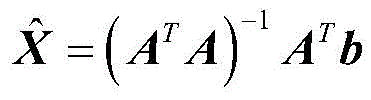
式中,
为了验证加权混合滤波的有效性,本发明采用加权混合滤波法、均值滤波、中值滤波和高斯滤波对RSSI值进行预处理。滤波结果的误差累积分布如图3所示。实验结果表明,采用加权混合滤波100%的测距误差在2.5m以内,约80%的测距误差在1m以内,而采用其他三种滤波法100%的测距误差在2.6m-3.1m以内,约80%的测距误差在1.1m-1.7m以内。采用加权混合滤波比单独采用其他三种滤波法的RSSI值优化效果好。In order to verify the effectiveness of the weighted hybrid filtering, the present invention adopts the weighted hybrid filtering method, the mean filtering, the median filtering and the Gaussian filtering to preprocess the RSSI value. The cumulative error distribution of the filtering results is shown in Figure 3. The experimental results show that the 100% ranging error using weighted hybrid filtering is within 2.5m, about 80% ranging error is within 1m, while the 100% ranging error using the other three filtering methods is within 2.6m-3.1m , about 80% of the ranging error is within 1.1m-1.7m. The RSSI value optimization effect of using weighted hybrid filtering is better than that of the other three filtering methods alone.
为了验证分段式测距模型的有效性,本发明采用分段式测距模型和普通测距模型拟合优化后的RSSI值。拟合后的测距误差累积分布如图4所示。结果表明,采用分段式测距模型100%的测距误差在2.5m以内,约90%的测距误差在1.5m以内,而采用普通测距模型100%的测距误差在3m以内,约90%的测距误差在2m以内,故采用分段式测距模型比普通测距模型后的测距精度高。In order to verify the validity of the segmented ranging model, the present invention adopts the segmented ranging model and the ordinary ranging model to fit the optimized RSSI value. The cumulative distribution of the ranging error after fitting is shown in Figure 4. The results show that the 100% ranging error of the segmented ranging model is within 2.5m, about 90% of the ranging error is within 1.5m, while the 100% ranging error of the ordinary ranging model is within 3m, about 90% of the ranging errors are within 2m, so the ranging accuracy using the segmented ranging model is higher than that of the ordinary ranging model.
为了验证本发明在室内定位中的性能,采用两种策略进行定位解算:1采用高斯滤波对RSSI值进行预处理,采用普通测距模型拟合优化后的RSSI值,采用三边定位法解算坐标;2采用加权混合滤波对RSSI值进行预处理,采用分段式测距模型拟合优化后的RSSI值,采用三边定位法解算坐标。In order to verify the performance of the present invention in indoor positioning, two strategies are used to solve the positioning: 1. Gaussian filtering is used to preprocess the RSSI value, the ordinary ranging model is used to fit the optimized RSSI value, and the three-sided positioning method is used to solve the problem. Calculate the coordinates; 2. Use weighted hybrid filtering to preprocess the RSSI value, use the segmented ranging model to fit the optimized RSSI value, and use the trilateral positioning method to solve the coordinates.
为了验证本发明的准确性,对实施例实验区域,采用上述两种策略进行定位测试,路径示意对比如图5所示,定位误差累积分布如图6所示,定位误差对比如图7所示。实验结果表明,采用本发明提出的基于RSSI加权混合滤波和分段式测距模型的室内定位方法,约70%的定位误差在2m以内,而改进前约仅有30%的定位误差在2m内。改进后最大定位误差为3.55m,平均定位误差为1.88m,优于改进前的4.12m和2.22m,定位精度明显提高。In order to verify the accuracy of the present invention, the above two strategies are used for the positioning test in the experimental area of the embodiment. The schematic comparison of paths is shown in Figure 5, the cumulative distribution of positioning errors is shown in Figure 6, and the comparison of positioning errors is shown in Figure 7 . The experimental results show that using the indoor positioning method based on the RSSI weighted hybrid filtering and segmented ranging model proposed by the present invention, about 70% of the positioning error is within 2m, while only about 30% of the positioning error before the improvement is within 2m. . After the improvement, the maximum positioning error is 3.55m, and the average positioning error is 1.88m, which is better than 4.12m and 2.22m before the improvement, and the positioning accuracy is significantly improved.
对于本领域技术人员而言,显然本发明不限于上述示范性实施例的细节,而且在不背离本发明的精神或基本特征的情况下,能够以其他的具体形式实现本发明。因此,无论从哪一点来看,均应将实施例看作是示范性的,而且是非限制性的,本发明的范围由所附权利要求而不是上述说明限定,因此旨在将落在权利要求的等同要件的含义和范围内的所有变化囊括在本发明内。不应将权利要求中的任何附图标记视为限制所涉及的权利要求。It will be apparent to those skilled in the art that the present invention is not limited to the details of the above-described exemplary embodiments, but that the present invention may be embodied in other specific forms without departing from the spirit or essential characteristics of the invention. Therefore, the embodiments are to be regarded in all respects as illustrative and not restrictive, and the scope of the invention is to be defined by the appended claims rather than the foregoing description, which are therefore intended to fall within the scope of the claims. All changes within the meaning and scope of the equivalents of , are included in the present invention. Any reference signs in the claims shall not be construed as limiting the involved claim.
此外,应当理解,虽然本说明书按照实施方式加以描述,但并非每个实施方式仅包含一个独立的技术方案,说明书的这种叙述方式仅仅是为清楚起见,本领域技术人员应当将说明书作为一个整体,各实施例中的技术方案也可以经适当组合,形成本领域技术人员可以理解的其他实施方式。In addition, it should be understood that although this specification is described in terms of embodiments, not each embodiment only includes an independent technical solution, and this description in the specification is only for the sake of clarity, and those skilled in the art should take the specification as a whole , the technical solutions in each embodiment can also be appropriately combined to form other implementations that can be understood by those skilled in the art.
Claims (4)




Priority Applications (1)
| Application Number | Priority Date | Filing Date | Title |
|---|---|---|---|
| CN202210015981.1A CN114363808B (en) | 2022-01-07 | 2022-01-07 | An indoor positioning method based on RSSI ranging |
Applications Claiming Priority (1)
| Application Number | Priority Date | Filing Date | Title |
|---|---|---|---|
| CN202210015981.1A CN114363808B (en) | 2022-01-07 | 2022-01-07 | An indoor positioning method based on RSSI ranging |
Publications (2)
| Publication Number | Publication Date |
|---|---|
| CN114363808A true CN114363808A (en) | 2022-04-15 |
| CN114363808B CN114363808B (en) | 2024-03-29 |
Family
ID=81107998
Family Applications (1)
| Application Number | Title | Priority Date | Filing Date |
|---|---|---|---|
| CN202210015981.1A Active CN114363808B (en) | 2022-01-07 | 2022-01-07 | An indoor positioning method based on RSSI ranging |
Country Status (1)
| Country | Link |
|---|---|
| CN (1) | CN114363808B (en) |
Cited By (6)
| Publication number | Priority date | Publication date | Assignee | Title |
|---|---|---|---|---|
| CN115515072A (en) * | 2022-08-29 | 2022-12-23 | 电子科技大学长三角研究院(衢州) | Routing inspection positioning device and method based on low-frequency induction |
| CN115597583A (en) * | 2022-10-13 | 2023-01-13 | 连偶(重庆)科技有限公司(Cn) | Multidimensional fusion positioning method and storage medium |
| CN117890949A (en) * | 2024-03-14 | 2024-04-16 | 山东科技大学 | A GNSS and RSSI fusion positioning method taking MAC address into account |
| WO2024088225A1 (en) * | 2022-10-25 | 2024-05-02 | 华为技术有限公司 | Bluetooth ranging method and system, and electronic device |
| CN119172019A (en) * | 2024-11-14 | 2024-12-20 | 成都工业学院 | A wireless signal propagation model correction method and system supporting segmented calculation |
| CN119183065A (en) * | 2024-10-08 | 2024-12-24 | 武汉盛帆电子股份有限公司 | Positioning module and positioning method of intelligent electric energy meter and intelligent electric energy meter |
Citations (5)
| Publication number | Priority date | Publication date | Assignee | Title |
|---|---|---|---|---|
| US20140302869A1 (en) * | 2011-02-24 | 2014-10-09 | Glen Var Rosenbaum | Beacon and associated components for a ranging system |
| CN105828435A (en) * | 2016-05-30 | 2016-08-03 | 天津大学 | Distance correction weighted centroid localization method based on reception signal intensity optimization |
| CN106102161A (en) * | 2016-05-30 | 2016-11-09 | 天津大学 | Based on the data-optimized indoor orientation method of focusing solutions analysis |
| US20180192250A1 (en) * | 2016-12-29 | 2018-07-05 | Nio Co., Ltd. | ON-BOARD TERMINAL DEVICE POSITIONING APPARATUS, METHOD AND ON-BOARD EQUIPMENT CONTROL SYSTEM BASED ON iBEACON |
| CN111983592A (en) * | 2020-08-14 | 2020-11-24 | 西安应用光学研究所 | Passive positioning fitting direction-finding speed-measuring method for airborne photoelectric system |
-
2022
- 2022-01-07 CN CN202210015981.1A patent/CN114363808B/en active Active
Patent Citations (5)
| Publication number | Priority date | Publication date | Assignee | Title |
|---|---|---|---|---|
| US20140302869A1 (en) * | 2011-02-24 | 2014-10-09 | Glen Var Rosenbaum | Beacon and associated components for a ranging system |
| CN105828435A (en) * | 2016-05-30 | 2016-08-03 | 天津大学 | Distance correction weighted centroid localization method based on reception signal intensity optimization |
| CN106102161A (en) * | 2016-05-30 | 2016-11-09 | 天津大学 | Based on the data-optimized indoor orientation method of focusing solutions analysis |
| US20180192250A1 (en) * | 2016-12-29 | 2018-07-05 | Nio Co., Ltd. | ON-BOARD TERMINAL DEVICE POSITIONING APPARATUS, METHOD AND ON-BOARD EQUIPMENT CONTROL SYSTEM BASED ON iBEACON |
| CN111983592A (en) * | 2020-08-14 | 2020-11-24 | 西安应用光学研究所 | Passive positioning fitting direction-finding speed-measuring method for airborne photoelectric system |
Non-Patent Citations (1)
| Title |
|---|
| 朱明辉: ""基于RSSI 的煤矿井下人员定位算法研究"", 《工程科技Ⅰ辑》, pages 3 - 4 * |
Cited By (9)
| Publication number | Priority date | Publication date | Assignee | Title |
|---|---|---|---|---|
| CN115515072A (en) * | 2022-08-29 | 2022-12-23 | 电子科技大学长三角研究院(衢州) | Routing inspection positioning device and method based on low-frequency induction |
| CN115597583A (en) * | 2022-10-13 | 2023-01-13 | 连偶(重庆)科技有限公司(Cn) | Multidimensional fusion positioning method and storage medium |
| WO2024088225A1 (en) * | 2022-10-25 | 2024-05-02 | 华为技术有限公司 | Bluetooth ranging method and system, and electronic device |
| CN117890949A (en) * | 2024-03-14 | 2024-04-16 | 山东科技大学 | A GNSS and RSSI fusion positioning method taking MAC address into account |
| CN117890949B (en) * | 2024-03-14 | 2024-05-24 | 山东科技大学 | GNSS and RSSI fusion positioning method considering MAC address |
| US12418880B1 (en) | 2024-03-14 | 2025-09-16 | Shandong University Of Science And Technology | GNSS and RSSI integrated positioning method considering mac address |
| CN119183065A (en) * | 2024-10-08 | 2024-12-24 | 武汉盛帆电子股份有限公司 | Positioning module and positioning method of intelligent electric energy meter and intelligent electric energy meter |
| CN119183065B (en) * | 2024-10-08 | 2025-09-12 | 武汉盛帆电子股份有限公司 | Positioning module, positioning method and smart electric energy meter of smart electric energy meter |
| CN119172019A (en) * | 2024-11-14 | 2024-12-20 | 成都工业学院 | A wireless signal propagation model correction method and system supporting segmented calculation |
Also Published As
| Publication number | Publication date |
|---|---|
| CN114363808B (en) | 2024-03-29 |
Similar Documents
| Publication | Publication Date | Title |
|---|---|---|
| CN114363808B (en) | An indoor positioning method based on RSSI ranging | |
| US10284316B2 (en) | Method for predicting indoor three-dimensional space signal field strength using an outdoor-to-indoor propagation model | |
| CN110856106B (en) | Indoor high-precision three-dimensional positioning method based on UWB and barometer | |
| CN104660349B (en) | Method for predicting outdoor three-dimensional space field intensity | |
| US8583050B2 (en) | Building influence estimation apparatus and building influence estimation method | |
| US20110317570A1 (en) | Iterative Localization Techniques | |
| CN109862505A (en) | Vehicle Tracking and Positioning System and Tracking and Positioning Method in Tunnel Based on Vehicle-Road Collaboration | |
| WO2020210923A1 (en) | Indoor positioning fusion method based on uwb and bluetooth technology | |
| KR101174542B1 (en) | Mobile terminal, System and Method for measuring location of mobile terminal | |
| KR101709411B1 (en) | Method for positioning based on weighted triangulation and method for indoor positioning using the same | |
| CN109413575A (en) | A kind of adaptive AP layout method of indoor positioning | |
| CN110636436A (en) | Three-dimensional UWB indoor positioning method based on improved CHAN algorithm | |
| Podevijn et al. | Performance comparison of RSS algorithms for indoor localization in large open environments | |
| CN117461329A (en) | Autonomous geolocation determination using mesh networks | |
| CN110673181A (en) | GNSS interference source positioning method based on grid energy traversal search | |
| CN108737952A (en) | Based on the improved polygon weighted mass center localization method of RSSI rangings | |
| CN113133046B (en) | Network coverage evaluation method and device, electronic equipment and computer storage medium | |
| Yi et al. | RSSI localization method for mine underground based on RSSI hybrid filtering algorithm | |
| Bornholdt et al. | Adaptive procedure for indoor localization using LoRa devices | |
| CN105652236A (en) | ZigBee technology-based market indoor wireless positioning method and system | |
| CN114915931A (en) | Indoor positioning method based on RSSI technology | |
| Liu | Research on wsn node localization algorithm based on rssi iterative centroid estimation | |
| Dong et al. | Investigation on Indoor Positioning by Improved RTT-RSS Fusion Ranging Method | |
| CN116908778A (en) | Track section positioning method, track section positioning device, electronic equipment and medium | |
| Della Rosa et al. | A cooperative framework for path loss calibration and indoor mobile positioning |
Legal Events
| Date | Code | Title | Description |
|---|---|---|---|
| PB01 | Publication | ||
| PB01 | Publication | ||
| SE01 | Entry into force of request for substantive examination | ||
| SE01 | Entry into force of request for substantive examination | ||
| GR01 | Patent grant | ||
| GR01 | Patent grant |