[go: up one dir, main page]

CN113577495A - Children attention deficit hyperactivity disorder auxiliary treatment system based on BCI-VR - Google Patents

Children attention deficit hyperactivity disorder auxiliary treatment system based on BCI-VR Download PDF

Info

Publication number
CN113577495A
CN113577495A CN202110823901.0A CN202110823901A CN113577495A CN 113577495 A CN113577495 A CN 113577495A CN 202110823901 A CN202110823901 A CN 202110823901A CN 113577495 A CN113577495 A CN 113577495A
Authority
CN
China
Prior art keywords
value
concentration
bci
children
data
Prior art date
Legal status (The legal status is an assumption and is not a legal conclusion. Google has not performed a legal analysis and makes no representation as to the accuracy of the status listed.)
Pending
Application number
CN202110823901.0A
Other languages
Chinese (zh)
Inventor
何加亮
张亚丽
张海燕
陶思宇
赵镜元
Current Assignee (The listed assignees may be inaccurate. Google has not performed a legal analysis and makes no representation or warranty as to the accuracy of the list.)
Dalian Minzu University
Original Assignee
Dalian Minzu University
Priority date (The priority date is an assumption and is not a legal conclusion. Google has not performed a legal analysis and makes no representation as to the accuracy of the date listed.)
Filing date
Publication date
Application filed by Dalian Minzu University filed Critical Dalian Minzu University
Priority to CN202110823901.0A priority Critical patent/CN113577495A/en
Publication of CN113577495A publication Critical patent/CN113577495A/en
Pending legal-status Critical Current

Links

Images

Classifications

    • AHUMAN NECESSITIES
    • A61MEDICAL OR VETERINARY SCIENCE; HYGIENE
    • A61MDEVICES FOR INTRODUCING MEDIA INTO, OR ONTO, THE BODY; DEVICES FOR TRANSDUCING BODY MEDIA OR FOR TAKING MEDIA FROM THE BODY; DEVICES FOR PRODUCING OR ENDING SLEEP OR STUPOR
    • A61M21/00Other devices or methods to cause a change in the state of consciousness; Devices for producing or ending sleep by mechanical, optical, or acoustical means, e.g. for hypnosis
    • AHUMAN NECESSITIES
    • A61MEDICAL OR VETERINARY SCIENCE; HYGIENE
    • A61BDIAGNOSIS; SURGERY; IDENTIFICATION
    • A61B5/00Measuring for diagnostic purposes; Identification of persons
    • A61B5/16Devices for psychotechnics; Testing reaction times ; Devices for evaluating the psychological state
    • A61B5/168Evaluating attention deficit, hyperactivity
    • AHUMAN NECESSITIES
    • A61MEDICAL OR VETERINARY SCIENCE; HYGIENE
    • A61BDIAGNOSIS; SURGERY; IDENTIFICATION
    • A61B5/00Measuring for diagnostic purposes; Identification of persons
    • A61B5/24Detecting, measuring or recording bioelectric or biomagnetic signals of the body or parts thereof
    • A61B5/316Modalities, i.e. specific diagnostic methods
    • A61B5/369Electroencephalography [EEG]
    • A61B5/372Analysis of electroencephalograms
    • AHUMAN NECESSITIES
    • A61MEDICAL OR VETERINARY SCIENCE; HYGIENE
    • A61MDEVICES FOR INTRODUCING MEDIA INTO, OR ONTO, THE BODY; DEVICES FOR TRANSDUCING BODY MEDIA OR FOR TAKING MEDIA FROM THE BODY; DEVICES FOR PRODUCING OR ENDING SLEEP OR STUPOR
    • A61M21/00Other devices or methods to cause a change in the state of consciousness; Devices for producing or ending sleep by mechanical, optical, or acoustical means, e.g. for hypnosis
    • A61M2021/0005Other devices or methods to cause a change in the state of consciousness; Devices for producing or ending sleep by mechanical, optical, or acoustical means, e.g. for hypnosis by the use of a particular sense, or stimulus
    • A61M2021/0044Other devices or methods to cause a change in the state of consciousness; Devices for producing or ending sleep by mechanical, optical, or acoustical means, e.g. for hypnosis by the use of a particular sense, or stimulus by the sight sense
    • A61M2021/005Other devices or methods to cause a change in the state of consciousness; Devices for producing or ending sleep by mechanical, optical, or acoustical means, e.g. for hypnosis by the use of a particular sense, or stimulus by the sight sense images, e.g. video

Landscapes

  • Health & Medical Sciences (AREA)
  • Life Sciences & Earth Sciences (AREA)
  • Engineering & Computer Science (AREA)
  • Public Health (AREA)
  • General Health & Medical Sciences (AREA)
  • Psychology (AREA)
  • Biomedical Technology (AREA)
  • Heart & Thoracic Surgery (AREA)
  • Veterinary Medicine (AREA)
  • Physics & Mathematics (AREA)
  • Animal Behavior & Ethology (AREA)
  • Surgery (AREA)
  • Molecular Biology (AREA)
  • Developmental Disabilities (AREA)
  • Psychiatry (AREA)
  • Biophysics (AREA)
  • Pathology (AREA)
  • Medical Informatics (AREA)
  • Acoustics & Sound (AREA)
  • Anesthesiology (AREA)
  • Hematology (AREA)
  • Child & Adolescent Psychology (AREA)
  • Educational Technology (AREA)
  • Hospice & Palliative Care (AREA)
  • Social Psychology (AREA)
  • Measurement And Recording Of Electrical Phenomena And Electrical Characteristics Of The Living Body (AREA)

Abstract

本发明公开了一种基于BCI‑VR的儿童多动症辅助治疗系统,由脑机接口硬件和虚拟现实游戏两部分组成,硬件部分通过使用脑机接口设备获取脑电EEG信号,将EEG信号传输到计算机应用程序,游戏软件将接收到的脑电信号转换为专注度信号作为驱动参数控制游戏进程,用于多动症儿童的注意力集中训练,该辅助治疗系统在提高多动症儿童的注意力方面发挥着积极的作用。

Figure 202110823901

The invention discloses a BCI-VR-based auxiliary treatment system for children's hyperactivity disorder, which is composed of two parts, a brain-computer interface hardware and a virtual reality game. The application, the game software converts the received EEG signals into concentration signals as driving parameters to control the game process, and is used for attention training in children with ADHD. This adjuvant therapy system plays an active role in improving the attention of children with ADHD. effect.

Figure 202110823901

Description

Children attention deficit hyperactivity disorder auxiliary treatment system based on BCI-VR
Technical Field
The invention relates to the technical field of children's Attention Deficit Hyperactivity Disorder (ADHD) adjuvant therapy, in particular to a children's Attention Deficit Hyperactivity Disorder (ADHD) adjuvant therapy system based on BCI-VR.
Background
Attention Deficit Hyperactivity Disorder (ADHD) is a common syndrome of mild brain dysfunction, with prevalence varying from 5% to 7% in the school-age population in childhood. The disease is characterized by inattention, hyperactivity, and difficulty in controlling impulses. Clinical researches find that children suffering from attention deficit hyperactivity disorder have poor learning performance and reduced social functions, and have great influence on the children after the children grow up. At present, the treatment means of the attention deficit hyperactivity disorder is drug treatment. Although the medicine takes effect quickly when treating the attention deficit hyperactivity disorder, the side effects of the medicine are obvious. The drug increases blood pressure, heart rate and the QT interval of the electrocardiogram.
With the development of brain-computer interfaces and virtual reality technologies, researchers propose to introduce BCI-VR into the treatment of hyperactivity, and BCI-VR technology has unique advantages in rehabilitation therapy of children with hyperactivity compared with traditional medical treatment methods. In 6 months 2020, the U.S. Food and Drug Administration (FDA) certified a game EndeavorRx as a prescribed drug for the treatment of childhood hyperkinetic. The game has been tested in a seven year clinical trial with over 600 children, providing effective evidence that the game can improve attention function in children with hyperactivity between 8 and 12 years of age when treating neurological diseases. The game is suggested for the treatment of inattention or combined ADHD which presents attention problems. This is the first game-based treatment device approved by the FDA in the united states for any type of medical condition. However, the game therapy device also has disadvantages. Firstly, the EndeovorX only provides the function of attention training, cannot monitor electroencephalogram signals of a user in real time, intuitively reflects the attention state of the user and feeds the state back to the user; second, the age of the appropriate users of EndeovorX is 8-12 years, and patients with low-age hyperactivity are difficult to train for use due to the difficulty of playing the game.
Disclosure of Invention
The invention aims to provide a BCI-VR-based children hyperkinetic syndrome auxiliary treatment system which combines nerve training with electronic games and provides more fun and participation.
In order to achieve the purpose, the invention is implemented according to the following technical scheme:
a BCI-VR based pediatric attention deficit hyperactivity disorder ("rdi") adjunctive therapy system comprising:
the brain wave signal acquisition and processing module is used for acquiring electroencephalogram signals of children; carrying out noise reduction and filtering on the acquired electroencephalogram signals to obtain effective electroencephalogram signal data, and amplifying the effective electroencephalogram signal data;
the analog-to-digital conversion module is connected with the brain wave signal acquisition and processing module and is used for converting the amplified electroencephalogram signals into digital signals;
through the host computer that bluetooth module and brain electrical signal collection module link to each other, install the virtual reality recreation that Unity3D developed in the host computer, the host computer is used for handling brain electrical signal for concentration degree numerical value, encodes the concentration degree value of acquireing, represents the different states of user to concentration degree data adopts normalized weighted average algorithm to handle, the host computer sends the concentration degree numerical value of normalized weighted average algorithm processing to Unity3D, according to the motion of the role in the concentration degree value control scene.
Furthermore, the electroencephalogram signal acquisition and processing module adopts a Neurosky neural thought technology TGAM module.
Further, the concentration value is encoded as follows:
encoding Concentration degree value Description of the case
A1 1-20 The attention is not concentrated very much
A2 21-40 Attention is less concentrated
A3 41-60 Normal attention
A4 61-80 Attention is focused on
A5 81-100 Attention is very focused
Further, the specific steps of applying the normalized weighted average algorithm to the concentration data are:
grouping the concentration degree value and the relaxation degree value of the front 3s after the feedback processing, respectively weighting, and sampling in 3s to obtain a group of data lambdaiThe data length is N, i.e. i belongs to [1, N ∈]Normalized weighted mean method, weighted value of
Figure BDA0003172929120000031
i∈[1,N];
(a) By an array λi,i∈[1,N]The average of the concentration values of the first 3s can be obtained
Figure BDA0003172929120000032
Figure BDA0003172929120000033
(b) Calculating each concentration value lambdaiRelative to the mean value
Figure BDA0003172929120000034
Deviation value of (a) Δ λi
Figure BDA0003172929120000035
(c) Deviation value delta lambdaiCarry-in weight function
Figure BDA0003172929120000036
Is normalized to obtain
Figure BDA0003172929120000037
i∈[1,N]:
Figure BDA0003172929120000038
(d) Deriving weight values from normalized deviation values
Figure BDA0003172929120000039
i∈[1,N]:
Figure BDA00031729291200000310
(e) The final average value is obtained from the weighted value
Figure BDA00031729291200000311
Namely:
Figure BDA00031729291200000312
(f) obtaining the normalized weighted average value of the power looseness numerical value in 3s in the same way
Figure BDA00031729291200000313
(g) Finally, averaging the two values to obtain a concentration degree value A of the system control character:
Figure BDA00031729291200000314
compared with the prior art, the brain-computer interface based intelligent brain-computer training system comprises two parts, namely brain-computer interface hardware and a virtual reality game, wherein the hardware part acquires electroencephalogram EEG signals by using brain-computer interface equipment, the EEG signals are transmitted to a computer application program, game software converts the received electroencephalogram signals into concentration degree signals to be used as driving parameters to control a game process, the concentration degree signals are used for the attention concentration training of the children with the hyperactivity, and the auxiliary treatment system plays an active role in improving the attention of the children with the hyperactivity.
Drawings
FIG. 1 is a schematic diagram of the system of the present invention.
Fig. 2 is a game operation scenario according to an embodiment of the present invention.
Detailed Description
In order to make the objects, technical solutions and advantages of the present invention more apparent, the present invention is further described in detail with reference to the following embodiments. The specific embodiments described herein are merely illustrative of the invention and do not limit the invention.
As shown in fig. 1, this embodiment specifically provides a BCI-VR based adjuvant therapy system for attention deficit hyperactivity disorder in children, which includes:
the brain wave signal acquisition and processing module is used for acquiring electroencephalogram signals of children; carrying out noise reduction and filtering on the acquired electroencephalogram signals to obtain effective electroencephalogram signal data, and amplifying the effective electroencephalogram signal data; in this embodiment, the brain wave signal acquisition processing module adopts a TGAM module of NeuroSky science and technology, and the sampling frequency of the module is 512 Hz. The module uses 3 electrodes to collect electroencephalogram data, wherein two electrodes are respectively attached to the protruding positions of the left ear and the right ear and serve as reference electrodes, so that the two electrodes can conveniently and synchronously detect electroencephalogram signals and carry out weighted average, the quality of the signals can be adjusted, and the collected signals are more accurate; the other electrode is used near the forehead of the eye and is used as an electrode for signal acquisition, and because the electroencephalogram forehead belongs to a mental control area, the acquisition of electroencephalogram signals is carried out at the mental control area; because the electroencephalogram signal is weak, the amplitude of the electroencephalogram signal is usually within 100uv, the electroencephalogram signal is easily influenced by self signals such as electrooculogram, skin electricity, body temperature and the like, and the frequency of the electroencephalogram signal is between 1Hz and 100Hz, so that the electroencephalogram signal is easily influenced by power frequency interference. In general, the acquired electroencephalogram signal is usually accompanied by a noisy weak signal, and in order to analyze the signal, denoising and amplification processing must be performed first. Two-stage filtering and amplifying circuits are arranged in the TGAM module, and filtering of 50Hz power frequency interference signals and amplification of collected electroencephalogram data can be achieved. And finally, observing the acquired data of the TGAM through an upper computer, then, effectively processing the electroencephalogram signals, extracting the signals from complex noise, and amplifying the signals to the size required by the system through circuit modulation.
The analog-to-digital conversion module is connected with the brain wave signal acquisition and processing module and is used for converting the amplified electroencephalogram signals into digital signals; the signals passing through the pre-stage amplifying circuit and the subsequent signal conditioning circuit are electroencephalogram analog signals without noise interference, and the signals need to be processed and analyzed, and need to be subjected to analog-to-digital conversion and then are analyzed after being converted into digital signals.
The system comprises an upper computer, an electroencephalogram signal acquisition module and a power supply module, wherein the upper computer is connected with the electroencephalogram signal acquisition module through a Bluetooth module, a virtual reality game developed by Unity3D is installed in the upper computer, and the upper computer is used for processing electroencephalogram signals into concentration values and coding the obtained concentration values to represent different states of a user, as shown in table 1;
TABLE 1
Encoding Concentration degree value Description of the case
A1 1-20 The attention is not concentrated very much
A2 21-40 Attention is less concentrated
A3 41-60 Normal attention
A4 61-80 Attention is focused on
A5 81-100 Attention is very focused
Because the precision of the data measured by the TGAM module has certain error, the deviation of the system operation can be caused by adopting the instantaneous value to control the game process, the concentration data is processed by adopting a normalized weighted average algorithm, and the specific steps are as follows:
grouping the concentration degree value and the relaxation degree value of the front 3s after the feedback processing, respectively weighting, and sampling in 3s to obtain a group of data lambdaiThe data length is N, i.e. i belongs to [1, N ∈]. Normalized weighted mean method, weighted value of
Figure BDA0003172929120000051
i∈[1,N]。
(a) By an array λi,i∈[1,N]The average of the concentration values of the first 3s can be obtained
Figure BDA0003172929120000052
Figure BDA0003172929120000053
(b) Calculating each concentration value lambdaiRelative to the mean value
Figure BDA0003172929120000054
Deviation value of (a) Δ λi
Figure BDA0003172929120000055
(c) Deviation value delta lambdaiCarry-in weight function
Figure BDA0003172929120000061
Is normalized to obtain
Figure BDA0003172929120000062
i∈[1,N]:
Figure BDA0003172929120000063
(d) Deriving weight values from normalized deviation values
Figure BDA0003172929120000064
i∈[1,N]:
Figure BDA0003172929120000065
(e) The final average value is obtained from the weighted value
Figure BDA0003172929120000066
Namely:
Figure BDA0003172929120000067
(f) obtaining the normalized weighted average value of the power looseness numerical value in 3s in the same way
Figure BDA0003172929120000068
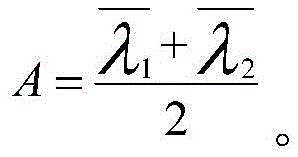
(g) Finally, averaging the two values to obtain a concentration degree value A of the system control character:
Figure BDA0003172929120000069
the BCI hardware system is communicated with an upper computer through Bluetooth, the computer system loads a thinGear SDK facing NET to transmit information, the computer system is connected with the BCI hardware system, the obtained concentration degree value A is transmitted to Unity3D, a role and a scene model required by a game are modeled and manufactured by 3D Max, picture materials such as pictures are drawn by Photoshop, and animation design and realization are completed by utilizing Maya. The manufactured model is imported into a Unity material library in an FBX file format, a Unity3D engine is used for game development, and scene design and optimization are performed, wherein the game logic design adopts multitask and feedback mechanism design. The interactive function is realized by writing C # through Visual Studio, the immersive experience of the game is realized through HTC Visual equipment, and as shown in FIG. 2, the game is a cool game designed for the embodiment, the game controls the movement of the character in the scene according to the concentration value, and the starting of the game and the advancing direction of the character are controlled through the range of the concentration value. Concentration threshold is set as follows: when the concentration value is between 0 and 40, the game is not started; when the concentration value is greater than 40, the game is started. When the concentration value is 40-60, the player advances on both sides of the center of the runway, and when the concentration value reaches 60-100, the game character runs in the center of the runway, and the gold coins at the center of the runway can be collected. The user must keep his attention above 40 to keep the game character from dying, the higher the concentration, the closer the direction of the player's progress is to the center, and the faster the player character is. When the concentration degree is less than 40, the game is ended, and the system displays the score condition of the user.
To gain a quality of the user's attention, we set the task of collecting the coins, obtaining behavioural data by collecting the number of coins placed in the centre of the runway. The content of the task is: when playing games, a user needs to keep high attention to ensure that the center of the character runway advances and collects gold coins in the center of the runway. The higher the number of coins, the higher the concentration quality. The collection of the gold coin task and the crunch task constitute a multi-tasking of the system. At the end of the game, the user can obtain the game time and the amount of the collected gold coins.
The technical solution of the present invention is not limited to the limitations of the above specific embodiments, and all technical modifications made according to the technical solution of the present invention fall within the protection scope of the present invention.

Claims (4)

1.一种基于BCI-VR的儿童多动症辅助治疗系统,其特征在于,包括:1. a child ADHD adjuvant therapy system based on BCI-VR, is characterized in that, comprises: 脑波信号采集处理模块,用于采集儿童的脑电信号;对采集的脑电信号进行降噪滤波以得到有效的脑电信号数据,并将有效的脑电信号数据放大;The brain wave signal acquisition and processing module is used to collect children's EEG signals; perform noise reduction filtering on the collected EEG signals to obtain effective EEG signal data, and amplify the effective EEG signal data; 与脑波信号采集处理模块相连的模数转换模块,用于将放大后的脑电信号转换成数字信号;The analog-to-digital conversion module connected with the brain wave signal acquisition and processing module is used to convert the amplified brain wave signal into a digital signal; 通过蓝牙模块与脑电信号采集模块相连的上位机,所述上位机内安装有Unity3D开发的虚拟现实游戏,上位机用于将脑电信号处理为专注度数值,对获取到的专注度值进行编码,来表示用户不同的状态,并对专注度数据采用归一化的加权平均值算法进行处理,上位机将归一化的加权平均值算法处理的专注度数值传送给Unity3D,根据专注度值控制场景中角色的运动。The host computer is connected to the EEG signal acquisition module through the Bluetooth module. The virtual reality game developed by Unity3D is installed in the host computer. code to represent the different states of the user, and use the normalized weighted average algorithm to process the concentration data. The host computer transmits the concentration value processed by the normalized weighted average algorithm to Unity3D, according to the concentration value Controls the movement of characters in the scene. 2.根据权利要求1所述的基于BCI-VR的儿童多动症辅助治疗系统,其特征在于:脑电信号采集处理模块采用NeuroSky神念科技的TGAM模块。2. The child ADHD adjuvant therapy system based on BCI-VR according to claim 1, is characterized in that: the EEG signal acquisition and processing module adopts the TGAM module of NeuroSky Technology. 3.根据权利要求1所述的基于BCI-VR的儿童多动症辅助治疗系统,其特征在于,所述专注度数值编码如下表:3. the child ADHD adjuvant therapy system based on BCI-VR according to claim 1, is characterized in that, described degree of concentration numerical code is as follows: 编码coding 专注度数值Concentration value 情况说明Fact Sheet A1A1 1-201-20 注意力非常不集中very inattentive A2A2 21-4021-40 注意力比较不集中less attention A3A3 41-6041-60 注意力正常normal attention A4A4 61-8061-80 注意力比较集中more focused A5A5 81-10081-100 注意力非常集中very focused
.
4.根据权利要求1所述的基于BCI-VR的儿童多动症辅助治疗系统,其特征在于,对专注度数据采用归一化的加权平均值算法的具体步骤为:4. the children's ADHD adjuvant therapy system based on BCI-VR according to claim 1, is characterized in that, the concrete steps of adopting the normalized weighted average algorithm to concentration data are: 将反馈处理后前3s的专注度数值和放松度数值进行分组分别加权处理,设3s中采样得到一组数据λi,数据长度为N,即i∈[1,N],归一化的加权平均值法,加权值为
Figure FDA0003172929110000011
The concentration value and relaxation value of the first 3s after the feedback processing are grouped and weighted separately, and a set of data λ i is obtained by sampling in 3s, the data length is N, that is, i∈[1,N], the normalized weighting The average method, the weighted value is
Figure FDA0003172929110000011
(a)由数组λi,i∈[1,N]可以得到前3s的专注度数值的平均值
Figure FDA0003172929110000021
(a) From the array λ i , i∈[1,N], the average value of the concentration value of the first 3s can be obtained
Figure FDA0003172929110000021
Figure FDA0003172929110000022
(b)计算每一专注度数值λi相对于均值
Figure FDA0003172929110000023
的偏差值Δλi
(b) Calculate each concentration value λ i relative to the mean
Figure FDA0003172929110000023
The deviation value Δλ i of :
Figure FDA0003172929110000024
(c)将偏差值Δλi带入权值函数
Figure FDA0003172929110000025
做归一化处理得到
Figure FDA0003172929110000026
i∈[1,N]:
(c) Bring the deviation value Δλ i into the weight function
Figure FDA0003172929110000025
Do normalization to get
Figure FDA0003172929110000026
i∈[1,N]:
Figure FDA0003172929110000027
(d)由归一化的偏差量得到加权值
Figure FDA0003172929110000028
(d) The weighted value is obtained from the normalized deviation
Figure FDA0003172929110000028
Figure FDA0003172929110000029
(e)由加权值得到最终的平均值
Figure FDA00031729291100000210
即:
(e) get the final average from the weighted values
Figure FDA00031729291100000210
which is:
Figure FDA00031729291100000211
(f)同理得出3s内放松度数值的归一化加权平均值
Figure FDA00031729291100000212
(f) In the same way, the normalized weighted average of the relaxation degree values within 3s is obtained
Figure FDA00031729291100000212
(g)两者最后取平均值得出系统操纵人物的专注度数值A:(g) The average value of the two is finally obtained to obtain the concentration value A of the character manipulated by the system:
Figure FDA00031729291100000213
CN202110823901.0A 2021-07-21 2021-07-21 Children attention deficit hyperactivity disorder auxiliary treatment system based on BCI-VR Pending CN113577495A (en)

Priority Applications (1)

Application Number Priority Date Filing Date Title
CN202110823901.0A CN113577495A (en) 2021-07-21 2021-07-21 Children attention deficit hyperactivity disorder auxiliary treatment system based on BCI-VR

Applications Claiming Priority (1)

Application Number Priority Date Filing Date Title
CN202110823901.0A CN113577495A (en) 2021-07-21 2021-07-21 Children attention deficit hyperactivity disorder auxiliary treatment system based on BCI-VR

Publications (1)

Publication Number Publication Date
CN113577495A true CN113577495A (en) 2021-11-02

Family

ID=78248694

Family Applications (1)

Application Number Title Priority Date Filing Date
CN202110823901.0A Pending CN113577495A (en) 2021-07-21 2021-07-21 Children attention deficit hyperactivity disorder auxiliary treatment system based on BCI-VR

Country Status (1)

Country Link
CN (1) CN113577495A (en)

Cited By (2)

* Cited by examiner, † Cited by third party
Publication number Priority date Publication date Assignee Title
CN114366101A (en) * 2021-12-31 2022-04-19 西安臻泰智能科技有限公司 Motor imagery electroencephalogram signal classification method, device, equipment and storage medium
CN114864039A (en) * 2022-05-17 2022-08-05 浙江大学 Multitask digital intervention system and method for brain function strengthening training

Citations (6)

* Cited by examiner, † Cited by third party
Publication number Priority date Publication date Assignee Title
WO2010147599A1 (en) * 2009-06-19 2010-12-23 Massachusetts Institute Of Technology Real time stimulus triggered by brain state to enhance perception and cognition
US20120108997A1 (en) * 2008-12-19 2012-05-03 Cuntai Guan Device and method for generating a representation of a subject's attention level
US20130331727A1 (en) * 2011-01-28 2013-12-12 Agency For Science, Technology And Research Method and system for detecting attention
CN106708261A (en) * 2016-12-05 2017-05-24 深圳大学 Brain-computer interaction-based attention training method and system
CN107024987A (en) * 2017-03-20 2017-08-08 南京邮电大学 A kind of real-time human brain Test of attention and training system based on EEG
CN110478593A (en) * 2019-05-15 2019-11-22 常州大学 Brain electricity attention training system based on VR technology

Patent Citations (6)

* Cited by examiner, † Cited by third party
Publication number Priority date Publication date Assignee Title
US20120108997A1 (en) * 2008-12-19 2012-05-03 Cuntai Guan Device and method for generating a representation of a subject's attention level
WO2010147599A1 (en) * 2009-06-19 2010-12-23 Massachusetts Institute Of Technology Real time stimulus triggered by brain state to enhance perception and cognition
US20130331727A1 (en) * 2011-01-28 2013-12-12 Agency For Science, Technology And Research Method and system for detecting attention
CN106708261A (en) * 2016-12-05 2017-05-24 深圳大学 Brain-computer interaction-based attention training method and system
CN107024987A (en) * 2017-03-20 2017-08-08 南京邮电大学 A kind of real-time human brain Test of attention and training system based on EEG
CN110478593A (en) * 2019-05-15 2019-11-22 常州大学 Brain electricity attention training system based on VR technology

Non-Patent Citations (1)

* Cited by examiner, † Cited by third party
Title
谭峰等: "一种基于滑动均值滤波的疲劳脑电信号识别方法", 《机电技术》 *

Cited By (3)

* Cited by examiner, † Cited by third party
Publication number Priority date Publication date Assignee Title
CN114366101A (en) * 2021-12-31 2022-04-19 西安臻泰智能科技有限公司 Motor imagery electroencephalogram signal classification method, device, equipment and storage medium
CN114366101B (en) * 2021-12-31 2024-05-03 西安臻泰智能科技有限公司 Motor imagery electroencephalogram signal classification method, device, equipment and storage medium
CN114864039A (en) * 2022-05-17 2022-08-05 浙江大学 Multitask digital intervention system and method for brain function strengthening training

Similar Documents

Publication Publication Date Title
CN110765920B (en) Motor imagery classification method based on convolutional neural network
CN104360730B (en) Man-machine interaction method supported by multi-modal non-implanted brain-computer interface technology
CN103793593B (en) One kind obtains brain states objective quantitative and refers to calibration method
Alazrai et al. A deep learning framework for decoding motor imagery tasks of the same hand using EEG signals
CN113398422B (en) Rehabilitation training system and method based on motor imagery-brain-computer interface and virtual reality
CN106725462B (en) Acousto-optic Sleep intervention system and method based on EEG signals
CN115349873B (en) A closed-loop brain function enhancement training device and method based on brain-computer interface system
CN107802262B (en) A device for EEG combined with VR for the intervention and treatment of children with hyperactivity and attention deficit
CN107024987A (en) A kind of real-time human brain Test of attention and training system based on EEG
CN101284156A (en) Personalized correction method and device for attention deficit disorder
CN109568083A (en) A kind of upper limb rehabilitation robot training system of multi-modal interaction
CN113713333B (en) Dynamic virtual induction method and system for lower limb rehabilitation full training process
CN111544854A (en) Cerebral apoplexy motor rehabilitation method based on brain myoelectric signal deep learning fusion
CN113157100B (en) A brain-computer interface method with additional Chinese character silent reading and motor imagery tasks
CN102179001A (en) Sleep therapy apparatus based on electroencephalogram biofeedback and control method thereof
CN109247917A (en) A kind of spatial hearing induces P300 EEG signal identification method and device
CN107358041A (en) A kind of Mental imagery therapy device and its application method based on brain-computer interface
CN110037696A (en) EEG feedback system based on eye electric switch
CN113577495A (en) Children attention deficit hyperactivity disorder auxiliary treatment system based on BCI-VR
CN111012324A (en) A mindful exercise rehabilitation device and method based on real-time feedback of exercise physiological parameters
CN108721048A (en) Rehabilitation training control method, computer readable storage medium and terminal
CN110262658B (en) A brain-computer interface character input system and implementation method based on enhanced attention
CN111887845A (en) Attention regulation system based on EEG nerve feedback
CN111529888A (en) VR psychological relaxation system
CN111857352A (en) A gesture recognition method based on an imaginary brain-computer interface

Legal Events

Date Code Title Description
PB01 Publication
PB01 Publication
SE01 Entry into force of request for substantive examination
RJ01 Rejection of invention patent application after publication

Application publication date: 20211102

RJ01 Rejection of invention patent application after publication