Disclosure of Invention
Based on this, the invention aims to provide a sketch ranking method and device based on model fusion.
In a first aspect, the invention provides a sketch work rating method based on model fusion, which comprises the following steps:
obtaining a sketch work to be rated;
constructing a sketch rating model, wherein the sketch rating model is obtained by fusing a first sub-model and a second sub-model, the first sub-model is a ResNeSt model, and the second sub-model is an LSTM model;
and inputting the sketch work to be rated into the sketch work rating model to obtain a rating result of the sketch work.
Further, constructing a sketch ranking model, comprising:
collecting sketch works and classification levels thereof, and constructing a training data set;
constructing the first submodel and the second submodel;
deep learning training is carried out on the first sub-model and the second sub-model by using the training data set to obtain optimal parameters of the first sub-model and the second sub-model;
and fusing the trained first sub-model and the trained second sub-model to obtain a sketch grading model.
Further, the step of constructing the first submodel includes:
constructing a ResNeSt model;
and adding a dropout layer and a maxout layer after the full connection layer of the ResNeSt model.
Further, the dropout probability of the dropout layer is 0.5.
Further, inputting the sketch work to be rated into the sketch work rating model to obtain a rating result of the sketch work, including:
setting a first weight w1 of a first submodel prediction result pred1 and a second weight w2 of a second submodel prediction result pred 2;
obtaining a rating result of the sketch works according to the following formula:
ensemble=pred1*w1+pred2*w2
the ensemble is a prediction result of the sketch ranking model, pred1 is a prediction result of a first submodel, w1 is a first weight corresponding to the prediction result of the first submodel, pred2 is a prediction result of a second submodel, and w2 is a second weight corresponding to the prediction result of the second submodel.
Further, w1 is 0.6, and w2 is 0.4.
Further, collecting sketch works and classification levels thereof, and constructing a training data set, wherein the training data set comprises the following steps:
collecting sketch works;
obtaining a rating result corresponding to each sketch work;
rating and marking each sketch work according to the rating result;
and carrying out data enhancement processing on each sketch work to expand the data volume to four times of the original data volume.
Further, the data enhancement processing is carried out on each sketch work, and the data enhancement processing comprises the following steps:
and cutting, turning, rotating and changing the color tone of each sketch.
In a second aspect, the present invention further provides a sketch ranking device based on model fusion, including:
the work acquisition module is used for acquiring sketch works to be rated;
the sketch grading model comprises a model construction module, a model selection module and a sketch grading model, wherein the model construction module is used for constructing a sketch grading model, and the sketch grading model is obtained by fusing a first sub-model and a second sub-model, the first sub-model is a ResNeSt model, and the second sub-model is an LSTM model;
and the rating result acquisition module is used for inputting the sketch work to be rated into the sketch work rating model to obtain a rating result of the sketch work.
For a better understanding and practice, the invention is described in detail below with reference to the accompanying drawings.
Detailed Description
In order to make the objects, technical solutions and advantages of the present application more clear, embodiments of the present application will be described in further detail below with reference to the accompanying drawings.
It should be understood that the embodiments described are only some embodiments of the present application, and not all embodiments. All other embodiments obtained by a person of ordinary skill in the art based on the embodiments in the present application without any creative effort belong to the protection scope of the embodiments in the present application.
The terminology used in the embodiments of the present application is for the purpose of describing particular embodiments only and is not intended to be limiting of the embodiments of the present application. As used in the examples of this application and the appended claims, the singular forms "a", "an", and "the" are intended to include the plural forms as well, unless the context clearly indicates otherwise. It should also be understood that the term "and/or" as used herein refers to and encompasses any and all possible combinations of one or more of the associated listed items.
When the following description refers to the accompanying drawings, like numbers in different drawings represent the same or similar elements unless otherwise indicated. The embodiments described in the following exemplary embodiments do not represent all embodiments consistent with the present application. Rather, they are merely examples of apparatus and methods consistent with certain aspects of the application, as detailed in the appended claims. In the description of the present application, it is to be understood that the terms "first," "second," "third," and the like are used solely to distinguish one from another and are not necessarily used to describe a particular order or sequence, nor are they to be construed as indicating or implying relative importance. The specific meaning of the above terms in the present application can be understood by those of ordinary skill in the art as appropriate.
Further, in the description of the present application, "a plurality" means two or more unless otherwise specified. "and/or" describes the association relationship of the associated objects, meaning that there may be three relationships, e.g., a and/or B, which may mean: a exists alone, A and B exist simultaneously, and B exists alone. The character "/" generally indicates that the former and latter associated objects are in an "or" relationship.
To solve the problems in the background art, the invention provides a sketch work rating method based on model fusion, as shown in fig. 1, the method comprises the following steps:
s1: and acquiring the sketch work to be rated.
For the sketch works drawn by hands, electronic pictures can be obtained by photographing, scanning and the like, the short sides of the pictures are zoomed to 500 through cutting, and the final length-width ratio is kept unchanged through center cutting.
S2: and constructing a sketch work rating model, wherein the sketch work rating model is obtained by fusing a first sub-model and a second sub-model, the first sub-model is a ResNeSt model, and the second sub-model is an LSTM model.
The ResNeSt model is an improvement based on the ResNet model. The ResNet model is simple and efficient in architectural design, but may be less suitable for other tasks downstream because of its initial suitability for classification tasks due to problems with receptive field size and lack of cross-channel interaction. The ResNeSt model proposes a Split-Attention module, integrates a cross-channel Attention mechanism, and simultaneously keeps the simplicity of a ResNet architecture.
As shown in FIG. 2, the ResNeSt model divides the features into several groups, the number of feature map groups is given by a radix hyperparameter K, the resulting feature map group is called a radix group, and a radix hyperparameter R is introduced, the radix indicates the number of splits within a cardial group, thusThe total number of feature groups is G ═ KR. Applying a series of transformations { F } to each individual group1,F2…FGThen for a set of features i e {1,2.., G }, the middle of each set is denoted Ui=Fi(x)。
Next, by performing element summation fusion on the plurality of divisions, a combined representation of each base array can be obtained. The kth radix group is represented as:
wherein
When K ∈ 1,2.. K, H, and C denote the block output features W feature map size, j denotes the jth feature set in R splits.
As shown in FIG. 3, global context information embedding channel statistics may be passed across spatial dimension sk∈RC/KThe global average pooling of (c) th channel to collect the component, the channel weight statistics of the c-th channel are calculated as follows:
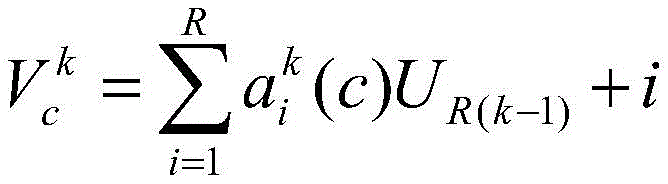
by VkThe Cardinal output after carrying the channel weight is represented: vk∈RH×W×C/KAggregation is performed using channel-level soft attention, where each feature mapping channel is generated using a weighted combination on the partitions. The c channel is calculated as follows:
wherein
The assigned weight is expressed and calculated by the following formula:
mapping
Representing s based on global context
kA weight for each partition of the c-th channel is determined.
Finally, the radix group dimensions are concatenated using the following formula:
V=Concat{V1,V2...Vk}
where V represents the output of each Cardinal merge, V1,V2...VkIndicating the output result of each Cadinal.
The LSTM (long-time memory unit) model realizes a time memory function through a cell gate switch, prevents gradient disappearance and can solve the problem that the long-time dependence cannot be solved in the traditional RNN.
Model fusion is to comprehensively consider the situations of different models and fuse the results of the different models together, and the accuracy of the fused result is higher than the predicted result of the two models.
S3: and inputting the sketch work to be rated into the sketch work rating model to obtain a rating result of the sketch work.
The final rating result is the result of the output after the two models are fused, and thus, a first weight w1 of the first submodel prediction result pred1 and a second weight w2 of the second submodel prediction result pred2 may be set.
Obtaining a rating result of the sketch works according to the following formula:
ensemble=pred1*w1+pred2*w2
the ensemble is a prediction result of the sketch ranking model, pred1 is a prediction result of a first submodel, w1 is a first weight corresponding to the prediction result of the first submodel, pred2 is a prediction result of a second submodel, and w2 is a second weight corresponding to the prediction result of the second submodel.
Preferably, w1 is 0.6 and w2 is 0.4.
The sketch work rating method based on model fusion provided by the invention adopts a model fusion algorithm based on CNN and RNN migration models, the algorithm is based on ResNeSt and LSTM migration models, and the model fusion results are weighted and averaged to obtain the final result, so that the result is more stable and reliable.
In order to solve the problems of too strong subjective property of a data set, few data sets, overfitting in the training process of a ResNeSt model and the like, in a preferred embodiment, the sketch ranking method based on model fusion provided by the invention comprises the following steps:
s11: and collecting the sketch works and the classification levels thereof, and constructing a training data set.
In particular, the following sub-steps can be subdivided:
s111: collecting different sketch works from different colleges and universities and institutions;
s112: different sketch teachers are invited to score each collected sketch, all the teachers are subjected to weighted average on the scores of each sketch work, the result of the weighted average is used as the final grade of the sketch work, and finally, the marking is carried out. One of the sketch teachers scores m, and the ith teacher scores m
iThen the final scores for n teachers are
The method comprises the steps of setting 80-90 points as a grade A, setting 60-80 points as a grade B, setting 40-60 points as a grade C, setting the point lower than 40 points as a grade D, and finally marking A, B, C, D grades of sketch works.
S113: each sketch work is cut, turned, rotated and changed in color tone to enhance data, so that the data amount is expanded to four times of the original data amount. Because the composition problem of the sketch work is considered in the evaluation criterion of the sketch, the final aspect ratio can be kept unchanged by scaling the short side of the picture to 500 by clipping and clipping the center.
S12: the ResNeSt model was constructed and dropout and maxout were added to prevent overfitting.
After the full connection layer of the ResNeSt model, a dropout layer and a maxout layer are added in sequence.
Dropout is a technique for predicting the output given an input vector in a forward network structure. The idea is to randomly discard neurons and their connections from the neural unit during the training process, thereby preventing excessive cooperative adaptation between neurons. The Dropout mechanism is that the robustness of hidden neurons can be increased by randomly selecting dropouts, some neurons are randomly discarded, actually the structure of an original model is modified, a different architecture is trained in each iteration, and Dropout is an integrated model of the model trained by part of variables in input vectors and output, namely different network architectures trained by each batch are integrated.
Maxout is an activation function for neural networks. The activation function is needed by the neural network because the distribution of data is mostly nonlinear, while the calculation of the general neural network is linear, and the introduction of the activation function is to introduce the nonlinearity into the neural network to strengthen the learning ability of the network. The largest feature of the activation function is nonlinearity. Different activation functions are applied differently depending on their characteristics. For example, Sigmoid and tanh are characterized by limiting the output to between (0,1) and (-1,1), indicating that Sigmoid and tanh are suitable for processing of probability values, such as various gates in LSTM; while ReLU has no maximum value limit, a very large value may occur. Also, according to the characteristics of ReLU, ReLU is suitable for training of deep networks, while Sigmoid and tanh for training of deep networks show gradient vanishing. The Maxout activation function is a learnable piecewise linear function, unlike the conventional activation function. Fig. 4 is a neural network diagram added with maxout based on dropout, each 4 gray neurons are maxout units, and one maximum value is taken from the outputs of the 4 gray units as the output of a white unit. Taking the maximum is itself a non-linearity, so the grey cells can use a linear activation function.
The specific modification mode is as follows: modifying a full connection layer of an original ResNeSt model, transforming 2048 neurons output from the last layer, connecting the neurons of the original full connection layer to equal number of full connection layer neuron layers with the full connection layer dropout 50%, failing 50% randomly, and connecting a maxout layer at the back. As shown in fig. 4, fig. 4 is a neural network diagram after dropout and maxout are added in one embodiment of the present invention, and maxout increases a nonlinear relationship between layers of the neural network, and reduces overfitting together with dropout, thereby improving accuracy and stability of the model.
S13: and constructing an LSTM model.
S14: the modified ResNeSt and LSTM models are trained using a training data set.
The learning rate is set to 0.01, the momentum is set to 0.9, and the K parameter, the p parameter of dropout, the batch _ size parameter and the like in maxout are continuously adjusted to obtain respective optimal parameters.
As shown in FIG. 5, the training process for the LSTM model is as follows: the input of the layer i neuron at time t includes, in addition to the output of the layer (i-1) neuron at that time, its own output at time (t-1).
For LSTM, the data to be processed is a sequence data, and for pictures, which are converted into sequence data, the size of the picture is 500 × 500, so that it can be regarded as a sequence with a length of 500, and the dimension of each data in the sequence is 500, so that the picture can be converted into a sequence data. The output of the sequence with the length of 500 is also the length of 500 after the sequence with the length of 500 is transmitted into the LSTM, the input dimension is 500, the output dimension is defined as 128 through 256 hidden layers, only the last part of the output is finally taken to be transmitted into a classifier, and then 4 results are output through the classifier to represent the probability of each result.
S15: the trained ResNeSt model and the LSTM model are fused.
S16: and inputting the sketch work to be rated into the sketch work rating model to obtain a rating result of the sketch work.
Specifically, the first weight w1 of the first submodel prediction result pred1 is set to 0.6, and the second weight w2 of the second submodel prediction result pred2 is set to 0.4;
and obtaining the rating result of the sketch work according to the formula of ensemble 1 w1+ pred2 w 2.
In a second aspect, corresponding to the foregoing method, the present invention further provides a sketch ranking device based on model fusion, as shown in fig. 6, the device includes:
the work acquisition module is used for acquiring sketch works to be rated;
the sketch grading model comprises a model construction module, a model selection module and a sketch grading model, wherein the model construction module is used for constructing a sketch grading model, and the sketch grading model is obtained by fusing a first sub-model and a second sub-model, the first sub-model is a ResNeSt model, and the second sub-model is an LSTM model;
and the rating result acquisition module is used for inputting the sketch work to be rated into the sketch work rating model to obtain a rating result of the sketch work.
Preferably, the model building module comprises:
the data set acquisition unit is used for collecting sketch works and classification levels thereof and constructing a training data set;
the submodel building unit is used for building the first submodel and the second submodel;
the sub-model training unit is used for carrying out deep learning training on the first sub-model and the second sub-model by using the training data set to obtain the optimal parameters of the first sub-model and the second sub-model;
and the model fusion unit is used for fusing the trained first sub-model and the trained second sub-model to obtain a sketch work rating model.
Preferably, the sub-model building unit includes:
a ResNeSt model building element for building a ResNeSt model;
and the ResNeSt model modifying element is used for sequentially adding a dropout layer and a maxout layer after the fully connected layer of the ResNeSt model.
Preferably, the dropout probability of the dropout layer is 0.5.
Preferably, the rating result acquiring module includes:
a weight setting unit for setting a first weight w1 of the first submodel prediction result pred1, a second weight w2 of the second submodel prediction result pred 2;
the rating result calculating unit is used for obtaining the rating result of the sketch work according to the following formula:
ensemble=pred1*w1+pred2*w2
the ensemble is a prediction result of the sketch ranking model, pred1 is a prediction result of a first submodel, w1 is a first weight corresponding to the prediction result of the first submodel, pred2 is a prediction result of a second submodel, and w2 is a second weight corresponding to the prediction result of the second submodel.
Preferably, w1 is 0.6 and w2 is 0.4.
Preferably, the data set acquisition unit includes:
a sketch work collecting element for collecting sketch works;
the grading result acquisition element is used for acquiring a grading result corresponding to each sketch work;
the rating marking element is used for rating and marking each sketch work according to the rating result;
and the data enhancement element is used for performing data enhancement processing on each sketch work to enable the data volume to be expanded to four times of the original data volume.
Preferably, the data enhancement processing includes cutting, flipping, rotating, and tone changing processing for each sketch.
The invention has the following beneficial effects:
(1) because each picture needs to be marked before model training, the subjectivity of rating of the sketch works can be increased to a greater extent if one sketch teacher is invited to mark according to the thought of the existing algorithm, and the method of the invention comprises the steps of inviting different universities, different institutions and sketch teachers with different levels to mark and score, and finally carrying out weighted average on the marking result of each sketch work to obtain the final grade marking of the sketch work, so that the evaluation is more objective and closer to the evaluation result of the sketch works in reality.
(2) In the selection of the model, the invention selects a CNN model ResNeSt model and an RNN model LSTM model. Compared with a CNN model Resnet model in the existing algorithm, the ResNeSt model is based on SEnet, SKNet and ResNeXt models, the attention mechanism of channel dimension is expanded to the representation of a feature map group, and a uniform CNN operator can be used for modularization and acceleration.
(3) The invention utilizes Maxout and Dropout to improve the network performance, Dropout is a network regularization skill, which is equivalent to training a plurality of different network structures, and nevertheless, the parameters of all different structures are still shared in the inference stage because only one network exists actually. Since there is only one model in Dropout, the averaging operation cannot be performed, and instead the weights of the models are multiplied by the Dropout ratio p, which does not perform well in a linear activation function, but is not accurate if it passes through a non-linear activation function. And the affine transformation of the Maxout model has no nonlinear activation function, so that a Dropout skill can be introduced into the transformation, and experiments show that the combination effect of Maxout and Dropout is better.
(4) The invention improves the overall performance, enhances the stability of the model and improves the accuracy of the final result by fusing a plurality of single models.
The above-mentioned embodiments only express several embodiments of the present invention, and the description thereof is more specific and detailed, but not construed as limiting the scope of the invention. It should be noted that, for a person skilled in the art, several variations and modifications can be made without departing from the inventive concept, which falls within the scope of the present invention.