[go: up one dir, main page]

CN112434646A - Finished tea quality identification method based on transfer learning and computer vision technology - Google Patents

Finished tea quality identification method based on transfer learning and computer vision technology Download PDF

Info

Publication number
CN112434646A
CN112434646A CN202011426012.2A CN202011426012A CN112434646A CN 112434646 A CN112434646 A CN 112434646A CN 202011426012 A CN202011426012 A CN 202011426012A CN 112434646 A CN112434646 A CN 112434646A
Authority
CN
China
Prior art keywords
model
training
image
tea
computer vision
Prior art date
Legal status (The legal status is an assumption and is not a legal conclusion. Google has not performed a legal analysis and makes no representation as to the accuracy of the status listed.)
Pending
Application number
CN202011426012.2A
Other languages
Chinese (zh)
Inventor
张程
王进
唐小林
陆国栋
费少梅
鲁晓卉
李文萃
Current Assignee (The listed assignees may be inaccurate. Google has not performed a legal analysis and makes no representation or warranty as to the accuracy of the list.)
Zhejiang University ZJU
Original Assignee
Zhejiang University ZJU
Priority date (The priority date is an assumption and is not a legal conclusion. Google has not performed a legal analysis and makes no representation as to the accuracy of the date listed.)
Filing date
Publication date
Application filed by Zhejiang University ZJU filed Critical Zhejiang University ZJU
Priority to CN202011426012.2A priority Critical patent/CN112434646A/en
Publication of CN112434646A publication Critical patent/CN112434646A/en
Pending legal-status Critical Current

Links

Images

Classifications

    • GPHYSICS
    • G06COMPUTING OR CALCULATING; COUNTING
    • G06VIMAGE OR VIDEO RECOGNITION OR UNDERSTANDING
    • G06V20/00Scenes; Scene-specific elements
    • GPHYSICS
    • G06COMPUTING OR CALCULATING; COUNTING
    • G06FELECTRIC DIGITAL DATA PROCESSING
    • G06F18/00Pattern recognition
    • G06F18/20Analysing
    • G06F18/21Design or setup of recognition systems or techniques; Extraction of features in feature space; Blind source separation
    • G06F18/214Generating training patterns; Bootstrap methods, e.g. bagging or boosting
    • GPHYSICS
    • G06COMPUTING OR CALCULATING; COUNTING
    • G06FELECTRIC DIGITAL DATA PROCESSING
    • G06F18/00Pattern recognition
    • G06F18/20Analysing
    • G06F18/24Classification techniques
    • G06F18/241Classification techniques relating to the classification model, e.g. parametric or non-parametric approaches
    • G06F18/2411Classification techniques relating to the classification model, e.g. parametric or non-parametric approaches based on the proximity to a decision surface, e.g. support vector machines
    • GPHYSICS
    • G06COMPUTING OR CALCULATING; COUNTING
    • G06NCOMPUTING ARRANGEMENTS BASED ON SPECIFIC COMPUTATIONAL MODELS
    • G06N20/00Machine learning
    • GPHYSICS
    • G06COMPUTING OR CALCULATING; COUNTING
    • G06QINFORMATION AND COMMUNICATION TECHNOLOGY [ICT] SPECIALLY ADAPTED FOR ADMINISTRATIVE, COMMERCIAL, FINANCIAL, MANAGERIAL OR SUPERVISORY PURPOSES; SYSTEMS OR METHODS SPECIALLY ADAPTED FOR ADMINISTRATIVE, COMMERCIAL, FINANCIAL, MANAGERIAL OR SUPERVISORY PURPOSES, NOT OTHERWISE PROVIDED FOR
    • G06Q10/00Administration; Management
    • G06Q10/06Resources, workflows, human or project management; Enterprise or organisation planning; Enterprise or organisation modelling
    • G06Q10/063Operations research, analysis or management
    • G06Q10/0639Performance analysis of employees; Performance analysis of enterprise or organisation operations
    • G06Q10/06395Quality analysis or management

Landscapes

  • Engineering & Computer Science (AREA)
  • Theoretical Computer Science (AREA)
  • Business, Economics & Management (AREA)
  • General Physics & Mathematics (AREA)
  • Data Mining & Analysis (AREA)
  • Human Resources & Organizations (AREA)
  • Physics & Mathematics (AREA)
  • Artificial Intelligence (AREA)
  • Computer Vision & Pattern Recognition (AREA)
  • Evolutionary Computation (AREA)
  • General Engineering & Computer Science (AREA)
  • Bioinformatics & Computational Biology (AREA)
  • Evolutionary Biology (AREA)
  • Strategic Management (AREA)
  • Entrepreneurship & Innovation (AREA)
  • Software Systems (AREA)
  • Educational Administration (AREA)
  • Economics (AREA)
  • Bioinformatics & Cheminformatics (AREA)
  • Life Sciences & Earth Sciences (AREA)
  • Development Economics (AREA)
  • Computing Systems (AREA)
  • Mathematical Physics (AREA)
  • Medical Informatics (AREA)
  • Game Theory and Decision Science (AREA)
  • Multimedia (AREA)
  • Marketing (AREA)
  • Operations Research (AREA)
  • Quality & Reliability (AREA)
  • Tourism & Hospitality (AREA)
  • General Business, Economics & Management (AREA)
  • Image Analysis (AREA)
  • Image Processing (AREA)

Abstract

本发明属于计算机视觉、深度学习和茶叶质量检测交叉领域,涉及基于迁移学习和计算机视觉技术的成品茶质量鉴别方法,使用拍摄装置采集茶叶图像并进行预处理,对预处理后的图像进行标准化、增强化和数据集划分,对预训练完成的卷积神经网络进行微调,构建迁移学习模型,并利用成品茶数据集重新进行训练,得到茶叶图像分类模型,使用未作为训练用的图像标准化处理后的成品茶图像在训练好的模型上进行测试,评估分类效果。本发明不但可以实现对相似度较高的不同质量等级成品茶的准确区分,而且相比于普通深度学习方法有很大效率上的提高,实现对高相似度茶叶图像的识别,从而鉴别成品茶品质,为茶叶品质自动化识别增加了应用场景。

Figure 202011426012

The invention belongs to the intersection fields of computer vision, deep learning and tea quality detection, and relates to a finished tea quality identification method based on migration learning and computer vision technology. Enhancement and data set division, fine-tune the pre-trained convolutional neural network, build a transfer learning model, and use the finished tea data set for re-training to obtain a tea image classification model. After normalization processing of images not used for training The finished tea images are tested on the trained model to evaluate the classification effect. The invention can not only realize the accurate distinction of finished teas of different quality grades with high similarity, but also greatly improve the efficiency compared with the ordinary deep learning method, realize the recognition of tea images with high similarity, and thus identify the finished tea. quality, adding application scenarios for automatic identification of tea quality.

Figure 202011426012

Description

Finished tea quality identification method based on transfer learning and computer vision technology
Technical Field
The invention belongs to the cross field of computer vision, deep learning and tea quality detection, and relates to a finished tea quality identification method based on transfer learning and computer vision technology.
Background
China is the first major country for tea production and consumption, and tea leaves of one kind are often distinguished by different grades of quality, and the tea leaves of different grades have great quality differences and great price differences. Accurately and efficiently identifies the grade quality of the tea leaves, and has great significance for guaranteeing the rights and benefits of consumers and standardizing the tea leaf market.
The traditional method for distinguishing the quality of finished tea depends on expert experience, and has the advantages of strong subjectivity, low efficiency and unsatisfactory accuracy. Therefore, it is necessary to introduce an automatic means to achieve efficient and accurate differentiation of the quality of the tea. Currently, the quality of finished tea is identified by means of aroma, taste, spectrum, image and other information, and some results are obtained, wherein the image is undoubtedly the most efficient and easily obtained information, but the high similarity of tea with the same grade and different qualities brings great challenges to the algorithm.
The deep learning model based on the convolutional neural network can automatically extract high-order features to realize the classification of images with high similarity, however, the convolutional neural network has extremely many parameters, and if the convolutional neural network is trained from the beginning, the training time is long, the computational effort consumption is high, and a large amount of labeled data is needed, which brings limitations to the implementation of the deep learning model. Therefore, how to utilize the learned knowledge to extract common information and transfer the common information to the objective task of finished tea quality identification is a very academic and engineering value problem, and time and labor cost are saved while accurate identification is realized.
Disclosure of Invention
In order to solve the technical problems mentioned in the background technology, the invention provides a finished tea quality identification method based on transfer learning and computer vision technology, and the following technical scheme is adopted.
The finished tea quality identification method based on the transfer learning and computer vision technology comprises the following steps:
step 1: acquiring a tea image by using a shooting device and preprocessing the tea image;
step 2: carrying out standardization, enhancement and data set division on the preprocessed image;
and step 3: finely adjusting the pre-trained convolutional neural network, constructing a transfer learning model, and retraining by using a finished tea data set to obtain a tea image classification model;
and 4, step 4: and (4) testing the finished tea images which are not used for training on the trained model, and evaluating the classification effect.
Further, the step 1 specifically includes: the method comprises the steps of shooting and collecting pictures by adopting an industrial camera with the resolution of 1920 x 1080, extracting the middle part of the pictures to be used as an interested area, wherein the range of the interested area is 600 x 540, and taking the extracted interested area as a database image.
Further, the step 2 specifically includes: firstly, a single image is subjected to standardization operation based on the mean value and the variance of each channel, and then a data set of the whole image is subjected to the following steps of 4: 1, building an image processing module under a Pythrch frame, and performing data enhancement on images in the training set by adopting operations of rotation, overturning, noise addition, zooming and the like, so that the scale of the data set is expanded to 5 times of the original scale.
Further, the formula adopted by the normalization operation is as follows:
output=(input-mean)/std
mean and std correspond to the mean and variance of each channel of the image, input and output correspond to the input and output values of each channel pixel of the image, and after standardization operation, each channel of the image obeys standard normal distribution with the mean value of 0 and the variance of 1.
Further, the data enhancement specifically includes: 45 rotatory, 90 rotatory, horizontal upset, vertical upset, add salt and pepper noise, add gaussian noise, 1: 2, zooming, and randomly selecting 4 modes for each image in the training set to process and store a copy, thereby enlarging the data size to 5 times of the original data size.
Further, the step 3 specifically includes:
initializing a Resnet-50 residual neural network model constructed by a pytorch module by using model parameters trained on an ImageNet data set, freezing all parameters of the model except a full connection layer, only keeping the weight of the full connection layer as trainable parameters, changing the output of the full connection layer into the number of classes of a finished tea quality data set, introducing processed image data of the training set into the model after fine adjustment for training for a plurality of times, observing the loss and accuracy of the training set in the training process until the loss of the model does not decrease, stopping training after the model is stable, and storing the model parameters to obtain a tea image classification model.
Further, before the training set image is input, the unified scaling is 224 × 224 resolution, the batch-size is set to be 32, the adopted optimization method is a random gradient descent method, and the learning rate is set to be 0.0001; the loss function uses cross entropy loss to evaluate the classification precision, wherein 20% of data in a training set is divided as a verification set, and the data does not participate in training in each iteration and is used as the basis for evaluating the training.
Further, the step 4 specifically includes: and importing the image standardized test set data into a trained model, and evaluating the model accuracy by drawing a confusion matrix and calculating the test set accuracy and comparing an output label value with a real label value.
The invention has the beneficial effects that: the method has the advantages that learned information stored in the pre-training model is fully utilized, the convolutional neural network is finely adjusted, the transfer learning model is constructed, and the high-similarity tea image is identified, so that the quality of finished tea is identified.
Drawings
FIG. 1 is a schematic flow chart of the quality identification method of the finished tea product of the present invention;
FIG. 2 is a schematic diagram of ROI extraction according to the present invention;
FIG. 3a is a schematic representation of a Wuyi black tea dataset of a first grade quality according to the present invention;
FIG. 3b is a schematic diagram of a data set of Wuyi black tea of a first grade quality according to the present invention;
FIG. 3c is a schematic representation of a Wuyi black tea dataset of a first grade quality according to the present invention;
FIG. 3d is a graph of a first-class quality Zhuangqing dataset according to the present invention;
FIG. 3e is a graph of a first-class quality Zhuangqing dataset according to the present invention;
FIG. 3f is a graph of a first-class quality Zhuangqing dataset according to the present invention;
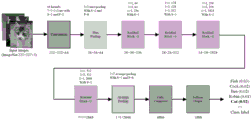
FIG. 4 is a diagram of a Resnet-50 network architecture of the present invention;
FIG. 5 is a schematic diagram of the fine tuning of the present invention;
FIG. 6a is a schematic diagram of the accuracy of a training set and a validation set in the training process of the present invention;
FIG. 6b is a schematic diagram of the loss rate of the training set and the validation set in the training process of the present invention;
FIG. 7a is a normalized confusion matrix for Wuyi black tea of the present invention;
FIG. 7b is a normalized confusion matrix for Trimeresurus albolabris of the present invention.
Detailed Description
In order to make the objects, technical solutions and technical effects of the present invention more clearly apparent, the present invention is further described in detail below with reference to the accompanying drawings and embodiments.
And constructing a finished product tea quality image database, wherein the finished product tea quality image database respectively comprises 3 Wuyi black teas with different varieties, grades and qualities and 3 bamboo leaves with different varieties, grades and qualities, and 200 images are collected in each grade.
As shown in fig. 1, the method for identifying the quality of finished tea based on transfer learning and computer vision technology specifically comprises the following steps:
step 1, using a shooting device to collect tea images and carrying out pretreatment, specifically comprising the following steps:
carry out image acquisition in the shooting device of self-designing, the shooting device is H1603 type CCD camera of OSEECAM company production, and the resolution ratio is 1920 1080, and the camera lens is the H1605VT type of OSEECAM company production, and manual focus regulation has designed camera bellows shooting device by oneself for guaranteeing the photographic effect uniformity, wholly is opaque sheet metal component, and built-in annular LED lamp illuminates, and objective platform is the pull formula so that the security protection with take out the finished product tea sample that awaits measuring. As shown in fig. 2, in order to remove the influence of the background on the classification result and reduce the calculation amount, a Region of Interest (ROI) is extracted from the image, and a rectangular Region of the densely packed tea leaves in the center of the image, which has a size of 600 × 540, is extracted as the database building data.
Step 2, image standardization, enhancement and data set division, which specifically comprises the following steps:
firstly, a single image is subjected to standardization operation based on the mean value and the variance of each channel, and then a data set of the whole image is subjected to the following steps of 4: 1, building an image processing module under a Pythrch frame, and performing data enhancement on images in the training set by adopting operations of rotation, overturning, noise addition, zooming and the like, so that the scale of the data set is expanded to 5 times of the original scale, and overfitting of the model is avoided. As shown in fig. 3a to 3f, 2400 images were collected in training sets of wuyi black tea and phyllostachys chinensis, and 120 images were collected in testing sets.
The formula adopted by the normalization operation is as follows:
output=(input-mean)/std
after standardized operation, each channel of the image obeys standard normal distribution with the mean value of 0 and the variance of 1, and feature extraction of the neural network convolutional layer is facilitated.
The data enhancement operation specifically includes: 45 rotatory, 90 rotatory, horizontal upset, vertical upset, add salt and pepper noise, add gaussian noise, 1: 2 scaling is carried out for 7 types, 4 types of modes are randomly selected for each image in the training set to be processed, and copies are stored, so that the data size is enlarged to 5 times of the original size.
Step 3, fine-tuning the convolution neural network after pre-training, constructing a transfer learning model, and retraining by using a finished tea data set to obtain a tea image classification model, which specifically comprises the following steps:
as shown in fig. 4 and 5, initializing a Resnet-50 residual neural network model constructed by a pytorch module by using model parameters trained on an ImageNet data set, freezing all parameters of the model except a full connection layer, only keeping the weight of the full connection layer as trainable parameters, changing the output of the full connection layer into the number of classes of a finished tea quality data set, introducing the processed training set data into the model after fine tuning for a plurality of times of training, observing the loss and accuracy of the training set in the training process until the model loss does not decrease any more, stopping training after the model loss is stabilized, and storing the model parameters.
Specifically, before the images of the training set are input, the unified scaling is 224 × 224 resolution, the batch-size is set to be 32, the adopted optimization method is a random gradient descent method, and the learning rate is set to be 0.0001. The loss function uses cross-entropy loss to evaluate classification accuracy. In order to observe the training condition of the model conveniently, 20% of data of the training set is divided into verification sets, and the verification sets do not participate in training in each iteration and are used as the basis for evaluating training. As shown in FIGS. 6a-6b, the results show that the model is basically stable after several epochs, and the loss and accuracy of the test set and the verification set are all stabilized at a certain level, so that a better training effect is achieved.
Step 4, testing the finished tea images which are not used for training on the trained model, and evaluating the classification effect, wherein the method specifically comprises the following steps:
and importing the image standardized test set data into a trained model, and evaluating the model accuracy by drawing a confusion matrix and calculating the test set accuracy and comparing an output label value with a real label value. As shown in fig. 7a-7b, normalized confusion matrices are used to demonstrate the discrimination between the quality of two finished teas. The table below lists the accuracy and model training duration of the three methods of common image processing, deep learning and transfer learning in two finished tea quality grade data sets.
Figure BDA0002824825390000051
The results show that the color and texture features extracted manually are introduced into a Support Vector Machine (SVM) classifier, although the processing time is short and the efficiency is high, the information reflected by the image is not sufficiently extracted due to the manually extracted features, the accuracy is low, only 84.00% of Wuyi black tea with different quality grades and only 90.67% of bamboo green. The Resnet-50 with all-zero initialization has up to 2300 tens of thousands of trainable parameters, theoretically, the most information can be learned, but due to the limited sample size of the data set, although a good effect is achieved in the training set, overfitting occurs, the test set shows general performance, the accuracy is only weakly improved, and a large amount of time is consumed. The finely-adjusted Resnet-50 model reduces the original 2300 thousands of trainable parameters to 6174 by freezing the parameters and adjusting the full connection layer, so that the overfitting problem of the model parameters is avoided, meanwhile, the model is quickly converged by means of the learned information in the ImageNet data set, the consumed time is far shorter than that of the Resnet-50 model trained from the head, meanwhile, the transfer learning model also has excellent performance on a test set, and the accuracy rate of quality identification of Wuyi black tea and Zhuqing reaches 92.67% and 96.65%.
The above-described embodiments are intended to illustrate rather than to limit the invention, and any modifications and variations of the present invention are within the spirit of the invention and the scope of the appended claims.

Claims (8)

1.基于迁移学习和计算机视觉技术的成品茶质量鉴别方法,其特征在于,包含如下步骤:1. the finished tea quality identification method based on migration learning and computer vision technology, is characterized in that, comprises the steps: 步骤1:使用拍摄装置采集茶叶图像并进行预处理;Step 1: Use a camera to collect tea images and preprocess them; 步骤2:对预处理后的图像进行标准化、增强化和数据集划分;Step 2: Standardize, enhance and divide the data set on the preprocessed images; 步骤3:对预训练完成的卷积神经网络进行微调,构建迁移学习模型,并利用成品茶数据集重新进行训练,得到茶叶图像分类模型;Step 3: Fine-tune the pre-trained convolutional neural network, build a transfer learning model, and use the finished tea data set for retraining to obtain a tea image classification model; 步骤4:使用未作为训练用的成品茶图像在训练好的模型上进行测试,评估分类效果。Step 4: Use the finished tea images not used for training to test on the trained model to evaluate the classification effect. 2.如权利要求1中所述的基于迁移学习和计算机视觉技术的成品茶质量鉴别方法,其特征在于,所述步骤1具体包括:采用分辨率为1920×1080的工业相机进行图片拍摄采集,对所述图片提取中间部分作为感兴趣区域,感兴趣区域范围大小为600×540,将提取的感兴趣区域作为数据库图像。2. the finished tea quality identification method based on transfer learning and computer vision technology as described in claim 1, is characterized in that, described step 1 specifically comprises: adopting the industrial camera that resolution is 1920×1080 to carry out picture shooting and collection, The middle part of the picture is extracted as a region of interest, the size of the region of interest is 600×540, and the extracted region of interest is used as a database image. 3.如权利要求1中所述的基于迁移学习和计算机视觉技术的成品茶质量鉴别方法,其特征在于,所述步骤2具体包括:首先对单幅图像进行基于各通道均值和方差的标准化操作,然后将整个图像的数据集按照4:1的比例划分为训练集和测试集,在Pytorch框架下搭建图像处理模块,对训练集中的图像采用旋转、翻转、添加噪声、缩放等操作进行数据增强,使数据集规模扩充为原来的5倍。3. the finished tea quality identification method based on transfer learning and computer vision technology as described in claim 1, is characterized in that, described step 2 specifically comprises: at first carry out the standardization operation based on each channel mean value and variance to single image , and then divide the entire image data set into a training set and a test set according to the ratio of 4:1, build an image processing module under the Pytorch framework, and perform data enhancement on the images in the training set by rotating, flipping, adding noise, scaling, etc. , to expand the dataset size by 5 times. 4.如权利要求3中所述的基于迁移学习和计算机视觉技术的成品茶质量鉴别方法,其特征在于,所述标准化操作所采用的公式为:4. the finished tea quality discrimination method based on transfer learning and computer vision technology as described in claim 3, is characterized in that, the formula that described standardized operation adopts is: output=(input-mean)/stdoutput=(input-mean)/std 其中,mean和std对应图像各通道的均值和方差,input和output对应图像每个通道像素的输入和输出值,通过标准化操作后,图像各个通道服从均值为0,方差为1的标准正态分布。Among them, mean and std correspond to the mean and variance of each channel of the image, and input and output correspond to the input and output values of each channel pixel of the image. After the normalization operation, each channel of the image obeys a standard normal distribution with a mean of 0 and a variance of 1. . 5.如权利要求3中所述的基于迁移学习和计算机视觉技术的成品茶质量鉴别方法,其特征在于,所述数据增强的操作具体包括:45°旋转、90°旋转、水平翻转、竖直翻转、添加椒盐噪声、添加高斯噪声、1:2缩放,对训练集中每张图像随机选取4种方式进行处理并保存副本,从而使数据规模扩大到原来的5倍。5. the finished tea quality identification method based on transfer learning and computer vision technology as described in claim 3, it is characterised in that the operation of described data enhancement specifically comprises: 45° rotation, 90° rotation, horizontal flip, vertical Flip, add salt and pepper noise, add Gaussian noise, 1:2 scaling, randomly select 4 ways to process each image in the training set and save a copy, so that the data scale is expanded to 5 times the original. 6.如权利要求1中所述的基于迁移学习和计算机视觉技术的成品茶质量鉴别方法,其特征在于,所述步骤3具体包括:6. the finished tea quality identification method based on transfer learning and computer vision technology as described in claim 1, is characterized in that, described step 3 specifically comprises: 使用在ImageNet数据集上训练好的模型参数初始化通过pytorch模块构建的Resnet-50残差神经网络模型,然后冻结模型除全连接层外所有参数,仅保留全连接层权重为可训练参数,并将全连接层的输出改为成品茶品质数据集的类别数,将处理好的训练集图像数据导入微调后的模型中进行若干轮次训练,训练过程中观察训练集损失与准确率,直至模型损失不再下降,平稳后停止训练,保存模型参数,得到茶叶图像分类模型。Use the model parameters trained on the ImageNet dataset to initialize the Resnet-50 residual neural network model built by the pytorch module, then freeze all the parameters of the model except the fully connected layer, only keep the weight of the fully connected layer as a trainable parameter, and set The output of the fully connected layer is changed to the number of categories of the finished tea quality data set. The processed training set image data is imported into the fine-tuned model for several rounds of training. During the training process, the loss and accuracy of the training set are observed until the model loses. No longer drops, stop training after stabilization, save the model parameters, and get a tea image classification model. 7.如权利要求6中所述的基于迁移学习和计算机视觉技术的成品茶质量鉴别方法,其特征在于,所述训练集图像输入前统一缩放为224×224分辨率,batch-size设置为32,采用的优化方法为随机梯度下降法,学习率设置为0.0001;损失函数使用交叉熵损失评估分类精度,其中训练集数据划分出20%作为验证集,每次迭代时不参与训练,作为评估训练的依据。7. The finished tea quality identification method based on migration learning and computer vision technology as described in claim 6, it is characterized in that, before described training set image input, uniform scaling is 224*224 resolution, batch-size is set to 32 , the optimization method used is the stochastic gradient descent method, and the learning rate is set to 0.0001; the loss function uses the cross entropy loss to evaluate the classification accuracy, in which the training set data is divided into 20% as the verification set, and each iteration does not participate in the training, as the evaluation training basis. 8.如权利要求1中所述的基于迁移学习和计算机视觉技术的成品茶质量鉴别方法,其特征在于,所述步骤4具体包括:将图像标准化的测试集数据导入训练好的模型,通过绘制混淆矩阵和计算测试集准确率对比输出标签值和真实标签值,评估模型准确率。8. the finished tea quality identification method based on migration learning and computer vision technology as described in claim 1, it is characterised in that the step 4 specifically comprises: the test set data of image standardization is imported into the trained model, by drawing Confusion matrix and calculated test set accuracy compare the output label value with the true label value to evaluate the model accuracy.
CN202011426012.2A 2020-12-08 2020-12-08 Finished tea quality identification method based on transfer learning and computer vision technology Pending CN112434646A (en)

Priority Applications (1)

Application Number Priority Date Filing Date Title
CN202011426012.2A CN112434646A (en) 2020-12-08 2020-12-08 Finished tea quality identification method based on transfer learning and computer vision technology

Applications Claiming Priority (1)

Application Number Priority Date Filing Date Title
CN202011426012.2A CN112434646A (en) 2020-12-08 2020-12-08 Finished tea quality identification method based on transfer learning and computer vision technology

Publications (1)

Publication Number Publication Date
CN112434646A true CN112434646A (en) 2021-03-02

Family

ID=74691342

Family Applications (1)

Application Number Title Priority Date Filing Date
CN202011426012.2A Pending CN112434646A (en) 2020-12-08 2020-12-08 Finished tea quality identification method based on transfer learning and computer vision technology

Country Status (1)

Country Link
CN (1) CN112434646A (en)

Cited By (16)

* Cited by examiner, † Cited by third party
Publication number Priority date Publication date Assignee Title
CN113157889A (en) * 2021-04-21 2021-07-23 韶鼎人工智能科技有限公司 Visual question-answering model construction method based on theme loss
CN113221942A (en) * 2021-03-24 2021-08-06 安徽大学 Tea disease identification algorithm under small sample based on deep migration and Cayley-Klein measurement
CN113405667A (en) * 2021-05-20 2021-09-17 湖南大学 Infrared thermal human body posture identification method based on deep learning
CN113537244A (en) * 2021-07-23 2021-10-22 深圳职业技术学院 A method and device for animal image target detection based on lightweight YOLOv4
CN113569975A (en) * 2021-08-04 2021-10-29 华南师范大学 A method and device for rating sketches based on model fusion
CN114140652A (en) * 2021-12-21 2022-03-04 上海海洋大学 Tea variety classification method based on SE-ResNet model
CN114139596A (en) * 2021-10-15 2022-03-04 惠州学院 A method and system for tea variety identification based on deep neural network
CN114266934A (en) * 2021-12-10 2022-04-01 上海应用技术大学 Dangerous action detection method based on cloud storage data
CN114563401A (en) * 2022-01-25 2022-05-31 安徽省农业科学院茶叶研究所 Real-time detection system for black tea fermentation process
CN114743042A (en) * 2022-03-14 2022-07-12 浙江大学 Longjing tea quality identification method based on depth features and TrAdaBoost
CN114818985A (en) * 2022-05-31 2022-07-29 安徽农业大学 Tea quality evaluation method based on center anchor point triple optimization pseudo-twin network
CN114881940A (en) * 2022-04-21 2022-08-09 北京航空航天大学 Method for identifying head defects of high-temperature alloy bolt after hot heading
CN115690758A (en) * 2022-12-12 2023-02-03 吉林农业大学 A tea face authenticity verification method and verification system based on deep metric learning
CN116091752A (en) * 2022-11-08 2023-05-09 杭州市农业科学研究院 A non-destructive identification method for tea trees based on deep learning
CN116843673A (en) * 2023-07-24 2023-10-03 中国地质大学(武汉) Bamboo chip defect detection method, device and equipment based on ResNet50 and transfer learning
CN119904432A (en) * 2024-12-31 2025-04-29 台州南峰药业有限公司 A method for controlling the production quality of agarwood qu based on image recognition technology

Citations (3)

* Cited by examiner, † Cited by third party
Publication number Priority date Publication date Assignee Title
CN109657697A (en) * 2018-11-16 2019-04-19 中山大学 Classified optimization method based on semi-supervised learning and fine granularity feature learning
CN110389200A (en) * 2019-07-15 2019-10-29 浙江大学 A kind of tea aroma of the same race differentiation detection method of different brands grade
CN111414971A (en) * 2020-03-27 2020-07-14 南京工业大学 A method for identifying the types and grades of finished tea based on convolutional neural network

Patent Citations (3)

* Cited by examiner, † Cited by third party
Publication number Priority date Publication date Assignee Title
CN109657697A (en) * 2018-11-16 2019-04-19 中山大学 Classified optimization method based on semi-supervised learning and fine granularity feature learning
CN110389200A (en) * 2019-07-15 2019-10-29 浙江大学 A kind of tea aroma of the same race differentiation detection method of different brands grade
CN111414971A (en) * 2020-03-27 2020-07-14 南京工业大学 A method for identifying the types and grades of finished tea based on convolutional neural network

Non-Patent Citations (1)

* Cited by examiner, † Cited by third party
Title
林丽惠 等: "融合整体与局部信息的武夷岩茶叶片分类方法", 《智能系统学报》 *

Cited By (20)

* Cited by examiner, † Cited by third party
Publication number Priority date Publication date Assignee Title
CN113221942A (en) * 2021-03-24 2021-08-06 安徽大学 Tea disease identification algorithm under small sample based on deep migration and Cayley-Klein measurement
CN113157889A (en) * 2021-04-21 2021-07-23 韶鼎人工智能科技有限公司 Visual question-answering model construction method based on theme loss
CN113405667A (en) * 2021-05-20 2021-09-17 湖南大学 Infrared thermal human body posture identification method based on deep learning
CN113537244B (en) * 2021-07-23 2024-03-15 深圳职业技术学院 A livestock image target detection method and device based on lightweight YOLOv4
CN113537244A (en) * 2021-07-23 2021-10-22 深圳职业技术学院 A method and device for animal image target detection based on lightweight YOLOv4
CN113569975A (en) * 2021-08-04 2021-10-29 华南师范大学 A method and device for rating sketches based on model fusion
CN114139596A (en) * 2021-10-15 2022-03-04 惠州学院 A method and system for tea variety identification based on deep neural network
CN114266934A (en) * 2021-12-10 2022-04-01 上海应用技术大学 Dangerous action detection method based on cloud storage data
CN114140652A (en) * 2021-12-21 2022-03-04 上海海洋大学 Tea variety classification method based on SE-ResNet model
CN114563401A (en) * 2022-01-25 2022-05-31 安徽省农业科学院茶叶研究所 Real-time detection system for black tea fermentation process
CN114743042A (en) * 2022-03-14 2022-07-12 浙江大学 Longjing tea quality identification method based on depth features and TrAdaBoost
CN114881940A (en) * 2022-04-21 2022-08-09 北京航空航天大学 Method for identifying head defects of high-temperature alloy bolt after hot heading
CN114818985A (en) * 2022-05-31 2022-07-29 安徽农业大学 Tea quality evaluation method based on center anchor point triple optimization pseudo-twin network
CN114818985B (en) * 2022-05-31 2024-04-16 安徽农业大学 Tea quality evaluation method based on central anchor point triplet optimization pseudo twin network
CN116091752A (en) * 2022-11-08 2023-05-09 杭州市农业科学研究院 A non-destructive identification method for tea trees based on deep learning
CN115690758B (en) * 2022-12-12 2023-08-08 吉林农业大学 Tea face verification method and system based on deep measurement learning
CN115690758A (en) * 2022-12-12 2023-02-03 吉林农业大学 A tea face authenticity verification method and verification system based on deep metric learning
CN116843673A (en) * 2023-07-24 2023-10-03 中国地质大学(武汉) Bamboo chip defect detection method, device and equipment based on ResNet50 and transfer learning
CN119904432A (en) * 2024-12-31 2025-04-29 台州南峰药业有限公司 A method for controlling the production quality of agarwood qu based on image recognition technology
CN119904432B (en) * 2024-12-31 2025-11-14 台州南峰药业有限公司 A Quality Control Method for Agarwood Fermentation Production Based on Image Recognition Technology

Similar Documents

Publication Publication Date Title
CN112434646A (en) Finished tea quality identification method based on transfer learning and computer vision technology
CN107194872B (en) Super-resolution reconstruction method of remote sensing images based on content-aware deep learning network
CN108765412B (en) A method for classifying surface defects of strip steel
CN103745234B (en) Band steel surface defect feature extraction and classification method
CN101236608B (en) Face Detection Method Based on Image Geometric Structure
WO2021253632A1 (en) Cloth defect detection method based on adversarial neural network, and terminal and storage medium
CN104331712B (en) A kind of alga cells classification of images method
CN103544499B (en) The textural characteristics dimension reduction method that a kind of surface blemish based on machine vision is detected
CN100573100C (en) Method for Discriminating Gas-liquid Two Phase Flow based on digital image processing techniques
CN110414538A (en) Defect classification method, defect classification training method and device thereof
CN106874929B (en) Pearl classification method based on deep learning
CN109410190B (en) Model training method for tower breakage detection based on high-resolution remote sensing satellite images
CN104102928B (en) A kind of Classifying Method in Remote Sensing Image based on texture primitive
CN109961425A (en) A method for identifying water quality of dynamic water
CN109614866A (en) Method for detecting human face based on cascade deep convolutional neural networks
CN112115826A (en) Face living body detection method and system based on bilateral branch network
CN113781456A (en) Steel surface defect detection method and equipment based on artificial intelligence image recognition
WO2021237682A1 (en) Display panel detection device and detection method, electronic device, and readable medium
CN114092441A (en) A product surface defect detection method and system based on dual neural network
CN111639697B (en) Hyperspectral image classification method based on non-repeated sampling and prototype network
Lee et al. Prediction of defect coffee beans using CNN
CN111724376A (en) A paper defect detection method based on texture feature analysis
CN113792666A (en) A method and system for concrete classification based on scanning electron microscope images
Zhang et al. Fabric defect detection based on visual saliency map and SVM
CN116912587A (en) A classification and identification method of substation equipment, electronic equipment and storage media based on multi-head self-attention module network

Legal Events

Date Code Title Description
PB01 Publication
PB01 Publication
SE01 Entry into force of request for substantive examination
RJ01 Rejection of invention patent application after publication

Application publication date: 20210302

RJ01 Rejection of invention patent application after publication