CN113542939B - Multi-cycle upgrading scheduling method based on ultra-low loss optical fiber - Google Patents
Multi-cycle upgrading scheduling method based on ultra-low loss optical fiber Download PDFInfo
- Publication number
- CN113542939B CN113542939B CN202110786537.5A CN202110786537A CN113542939B CN 113542939 B CN113542939 B CN 113542939B CN 202110786537 A CN202110786537 A CN 202110786537A CN 113542939 B CN113542939 B CN 113542939B
- Authority
- CN
- China
- Prior art keywords
- sequence
- gain
- upgrade
- optical fiber
- scheduling
- Prior art date
- Legal status (The legal status is an assumption and is not a legal conclusion. Google has not performed a legal analysis and makes no representation as to the accuracy of the status listed.)
- Active
Links
- 239000013307 optical fiber Substances 0.000 title claims abstract description 46
- 238000000034 method Methods 0.000 title claims abstract description 36
- 230000008569 process Effects 0.000 claims abstract description 16
- 238000001228 spectrum Methods 0.000 claims abstract description 16
- 230000003287 optical effect Effects 0.000 claims description 27
- 239000000835 fiber Substances 0.000 claims description 26
- 238000004364 calculation method Methods 0.000 claims description 9
- 230000000737 periodic effect Effects 0.000 claims description 3
- 238000013468 resource allocation Methods 0.000 claims description 3
- 239000004576 sand Substances 0.000 claims 1
- 238000005457 optimization Methods 0.000 description 14
- 238000004422 calculation algorithm Methods 0.000 description 12
- 230000005540 biological transmission Effects 0.000 description 6
- 238000001816 cooling Methods 0.000 description 6
- 230000006872 improvement Effects 0.000 description 6
- 238000010586 diagram Methods 0.000 description 4
- 238000012360 testing method Methods 0.000 description 4
- 238000000137 annealing Methods 0.000 description 3
- 238000005516 engineering process Methods 0.000 description 2
- 238000011156 evaluation Methods 0.000 description 2
- 238000011160 research Methods 0.000 description 2
- 230000009286 beneficial effect Effects 0.000 description 1
- 230000008859 change Effects 0.000 description 1
- 230000007423 decrease Effects 0.000 description 1
- 238000013461 design Methods 0.000 description 1
- 238000011161 development Methods 0.000 description 1
- 239000002360 explosive Substances 0.000 description 1
- 238000012804 iterative process Methods 0.000 description 1
- 238000002360 preparation method Methods 0.000 description 1
- 238000002922 simulated annealing Methods 0.000 description 1
- 238000004088 simulation Methods 0.000 description 1
- 238000006467 substitution reaction Methods 0.000 description 1
- 230000009466 transformation Effects 0.000 description 1
- 238000000844 transformation Methods 0.000 description 1
Images


Classifications
-
- H—ELECTRICITY
- H04—ELECTRIC COMMUNICATION TECHNIQUE
- H04B—TRANSMISSION
- H04B10/00—Transmission systems employing electromagnetic waves other than radio-waves, e.g. infrared, visible or ultraviolet light, or employing corpuscular radiation, e.g. quantum communication
- H04B10/25—Arrangements specific to fibre transmission
-
- H—ELECTRICITY
- H04—ELECTRIC COMMUNICATION TECHNIQUE
- H04Q—SELECTING
- H04Q11/00—Selecting arrangements for multiplex systems
- H04Q11/0001—Selecting arrangements for multiplex systems using optical switching
- H04Q11/0062—Network aspects
- H04Q11/0067—Provisions for optical access or distribution networks, e.g. Gigabit Ethernet Passive Optical Network (GE-PON), ATM-based Passive Optical Network (A-PON), PON-Ring
-
- H—ELECTRICITY
- H04—ELECTRIC COMMUNICATION TECHNIQUE
- H04Q—SELECTING
- H04Q11/00—Selecting arrangements for multiplex systems
- H04Q11/0001—Selecting arrangements for multiplex systems using optical switching
- H04Q11/0062—Network aspects
- H04Q2011/0064—Arbitration, scheduling or medium access control aspects
-
- H—ELECTRICITY
- H04—ELECTRIC COMMUNICATION TECHNIQUE
- H04Q—SELECTING
- H04Q11/00—Selecting arrangements for multiplex systems
- H04Q11/0001—Selecting arrangements for multiplex systems using optical switching
- H04Q11/0062—Network aspects
- H04Q2011/0086—Network resource allocation, dimensioning or optimisation
Landscapes
- Engineering & Computer Science (AREA)
- Computer Networks & Wireless Communication (AREA)
- Physics & Mathematics (AREA)
- Electromagnetism (AREA)
- Signal Processing (AREA)
- Optical Communication System (AREA)
Abstract
本发明公开了一种基于超低损耗光纤的多周期升级调度方法,包括以下步骤:A、设定光纤升级的周期数,确定每个周期中升级的最大光纤长度;B、随机生成一个升级调度序列,并计算该序列的总升级增益;C、重新随机生成一个新的升级调度序列,并计算当前序列的总升级增益;D、计算当前序列的增益减去上一个序列增益得到的差值,如果差值大于等于0,则当前升级调度序列替换上一升级调度序列;如果差值小于0,按照概率值公式接受当前升级调度序列;E、进行多次迭代,如果达到设定次数一直未更新新的升级调度序列,则终止迭代。本发明可在所有遍历过程中找出增益值最大的调度序列,能够得到频谱利用率最高的调度,极大地节省频谱资源。
The invention discloses a multi-cycle upgrade scheduling method based on ultra-low-loss optical fibers, comprising the following steps: A. Setting the number of optical fiber upgrade cycles, and determining the maximum optical fiber length upgraded in each cycle; B. Randomly generating an upgrade schedule sequence, and calculate the total upgrade gain of the sequence; C. Re-generate a new upgrade scheduling sequence randomly, and calculate the total upgrade gain of the current sequence; D. Calculate the difference obtained by subtracting the gain of the previous sequence from the gain of the current sequence, If the difference is greater than or equal to 0, the current upgrade scheduling sequence replaces the previous upgrade scheduling sequence; if the difference is less than 0, the current upgrade scheduling sequence is accepted according to the probability value formula; E. Perform multiple iterations, if the set number of times has not been updated The new upgrade schedule sequence terminates the iteration. The invention can find out the scheduling sequence with the largest gain value in all traversing processes, can obtain the scheduling with the highest spectrum utilization rate, and greatly save spectrum resources.
Description
技术领域technical field
本发明涉及光纤调度技术领域,特别涉及一种基于超低损耗光纤的多周期升级调度方法。The invention relates to the technical field of optical fiber scheduling, in particular to a multi-cycle upgrade scheduling method based on ultra-low loss optical fibers.
背景技术Background technique
随着互联网技术快速发展,新型互联网业务逐渐兴起,这导致网络业务带宽需求呈爆炸性增涨,对以光网络为主要组成部分的骨干网造成了巨大的挑战。因此,需要考虑如何进一步提升骨干光网络的传输带宽和效率。与此同时,光通道高阶调制技术的成熟,为未来实现400G甚至1T的光通道业务奠定了基础。但由于现网中广泛使用了传统标准单模光纤(即G.652光纤),光通道无中继传输距离将随传输速率增加而变短,无法满足未来超高速率、超长距离的光传输需求。因此,需要考虑使用具有更高性能的新型光纤。With the rapid development of Internet technology, new Internet services have gradually emerged, which has led to an explosive increase in bandwidth requirements for network services, posing a huge challenge to the backbone network with optical networks as the main component. Therefore, it is necessary to consider how to further improve the transmission bandwidth and efficiency of the backbone optical network. At the same time, the maturity of the optical channel high-order modulation technology has laid the foundation for the realization of 400G or even 1T optical channel services in the future. However, due to the extensive use of traditional standard single-mode fiber (ie G.652 fiber) in the existing network, the transmission distance of the optical channel without relays will become shorter with the increase of the transmission rate, which cannot meet the future ultra-high-speed and ultra-long-distance optical transmission. need. Therefore, new optical fibers with higher performance need to be considered.
超低损耗光纤是一种具有更低损耗的的新型光纤,能极大地增加400G甚至1T高速光通道的传输距离,被认为是实现超高速率传输的首选光纤。目前,已有大量文献对超低损耗光纤的制备进行了研究,已将超低损耗光纤的损耗降低到了0.170dB/km以下。近年来,中国的主要运营商已经开始在光网络中部署ULL光纤。然而,针对超低损耗光纤的应用研究十分稀少,特别是多周期超低损耗光纤升级调度问题的研究几乎没有。Ultra-low-loss optical fiber is a new type of optical fiber with lower loss, which can greatly increase the transmission distance of 400G or even 1T high-speed optical channels, and is considered to be the preferred fiber for ultra-high-speed transmission. At present, a large number of literatures have been carried out on the preparation of ultra-low-loss optical fibers, and the loss of ultra-low-loss optical fibers has been reduced to less than 0.170dB/km. In recent years, major operators in China have begun to deploy ULL fibers in optical networks. However, the application research on ultra-low loss optical fiber is very rare, especially the research on the upgrade scheduling problem of multi-period ultra-low loss optical fiber is almost non-existent.
发明内容SUMMARY OF THE INVENTION
本发明要解决的技术问题是提供一种精度高、低损耗的基于超低损耗光纤的多周期升级调度方法。The technical problem to be solved by the present invention is to provide a multi-cycle upgrade scheduling method based on ultra-low loss optical fiber with high precision and low loss.
为了解决上述问题,本发明提供了一种基于超低损耗光纤的多周期升级调度方法,其包括以下步骤:In order to solve the above problems, the present invention provides a multi-cycle upgrade scheduling method based on ultra-low loss optical fiber, which includes the following steps:
A、设定光纤升级的周期数,确定每个周期中升级的最大光纤长度;A. Set the number of fiber upgrade cycles, and determine the maximum fiber length to be upgraded in each cycle;
B、随机生成一个升级调度序列,并计算该序列的总升级增益;B. Randomly generate an upgrade scheduling sequence, and calculate the total upgrade gain of the sequence;
C、重新随机生成一个新的升级调度序列,并计算当前序列的总升级增益;C. Re-generate a new upgrade scheduling sequence randomly, and calculate the total upgrade gain of the current sequence;
D、计算当前序列的增益减去上一个序列增益得到的差值,如果差值大于等于0,则当前升级调度序列替换上一升级调度序列;如果差值小于0,按照概率值公式接受当前升级调度序列,即随机产生一个0-1的数,如果该数大于概率值,则当前升级调度序列替换上一升级调度序列,如果小于等于概率值,则保持上一升级调度序列,并返回步骤C;D. Calculate the difference between the gain of the current sequence and the gain of the previous sequence. If the difference is greater than or equal to 0, the current upgrade scheduling sequence replaces the previous upgrade scheduling sequence; if the difference is less than 0, the current upgrade is accepted according to the probability value formula Scheduling sequence, that is, a number of 0-1 is randomly generated. If the number is greater than the probability value, the current escalation scheduling sequence replaces the previous escalation scheduling sequence. If it is less than or equal to the probability value, the previous escalation scheduling sequence is maintained and returns to step C ;
E、进行多次迭代,如果达到设定次数一直未更新新的升级调度序列,则终止迭代。E. Perform multiple iterations, and terminate the iteration if the new upgrade scheduling sequence has not been updated until the set number of times is reached.
作为本发明的进一步改进,所述概率值公式为:As a further improvement of the present invention, the probability value formula is:

其中,E(n+1)为新解对应增益值,E(n)为初始解对应增益值,t为当前状态下的温度。Among them, E(n+1) is the gain value corresponding to the new solution, E(n) is the corresponding gain value of the initial solution, and t is the temperature in the current state.
作为本发明的进一步改进,步骤B和C中的总升级增益的计算方法包括以下步骤:As a further improvement of the present invention, the calculation method of the total upgrade gain in steps B and C includes the following steps:
S1、为业务请求寻找从源节点到目标节点的路径;S1. Find a path from the source node to the target node for the service request;
S2、计算该业务OSNR并为其选择合适的光信号调制格式;S2. Calculate the OSNR of the service and select an appropriate optical signal modulation format for it;
S3、为该路径分配频谱资源;S3. Allocate spectrum resources for the path;
S4、产生不超过光网络整体长度30%的光纤链路;S4. Generate an optical fiber link that does not exceed 30% of the overall length of the optical network;
S5、进行ULL光纤替换;S5. Perform ULL fiber replacement;
S6、计算替换过程中的时间t、FS,并带入增益计算公式计算该周期替换后的增益;S6, calculate the time t and FS in the replacement process, and bring into the gain calculation formula to calculate the gain after the replacement of the cycle;
S7、判断是否完成周期划分;若是,则计算整个光网络替换所产生的总增益;否则,返回步骤S4。S7. Determine whether the period division is completed; if so, calculate the total gain generated by the replacement of the entire optical network; otherwise, return to step S4.
作为本发明的进一步改进,所述增益计算公式如下:As a further improvement of the present invention, the gain calculation formula is as follows:
GS=∑k≥1(Hk-Ck)·T+∑k≥1(Ck-Mk)·(T-Tk)GS=∑ k≥1 (H k −C k )·T+∑ k≥1 (C k −M k )·(TT k )
其中,k为光纤链路替换的周期指标;Hk为在没有使用ULL光纤部署的情况下,该周期所使用的FS的最大数量;CK为周期开始时,FS的最大使用数量,其中该周期网络流量需求增长;MK为本周期完成ULL光纤部署后,对网络频谱资源分配进行重新优化后所使用的最大FS数量;CK-MK为在这一周期频谱资源重新优化后,FS的减少量;T为两个相邻的ULL光纤部署周期之间所经过的时间,定义为从当前部署周期开始到下一周期开始的时间;TK是在该周期部署所有ULL光纤所花费的时间;GS为计算所有链路均采用ULL光纤部署时整个部署过程所获得的总增益。Among them, k is the cycle index of fiber link replacement; H k is the maximum number of FS used in the cycle without ULL fiber deployment; CK is the maximum number of FS used at the beginning of the cycle, where the Periodic network traffic demand increases; MK is the maximum number of FS used after re-optimization of network spectrum resource allocation after ULL fiber deployment is completed in this period; C K -MK is the FS after re-optimization of spectrum resources in this period T is the elapsed time between two adjacent ULL fiber deployment cycles, defined as the time from the start of the current deployment cycle to the beginning of the next cycle; T K is the time spent deploying all ULL fibers in that cycle Time; G S is the total gain obtained during the entire deployment process when all links are deployed with ULL fibers.
作为本发明的进一步改进,所述周期数为多个。As a further improvement of the present invention, the number of cycles is multiple.
作为本发明的进一步改进,所述周期数为三个,前两个周期的光纤链路长度均不超过总长度的30%,剩余的光纤链路放入第三个周期的光纤链路。As a further improvement of the present invention, the number of cycles is three, the length of the optical fiber link in the first two cycles does not exceed 30% of the total length, and the remaining optical fiber links are placed in the optical fiber link in the third cycle.
作为本发明的进一步改进,步骤C中重新随机生成一个新的升级调度序列,包括:As a further improvement of the present invention, a new upgrade scheduling sequence is randomly generated in step C, including:
C1、随机生成一个升级调度序列;C1. Randomly generate an upgrade scheduling sequence;
C2、判断当前序列与之前的调度序列是否相同;若相同,返回步骤C1;否则,将当前序列作为新的升级调度序列。C2. Determine whether the current sequence is the same as the previous scheduling sequence; if the same, return to step C1; otherwise, use the current sequence as a new upgrade scheduling sequence.
本发明的有益效果:Beneficial effects of the present invention:
本发明基于超低损耗光纤的多周期升级调度方法通过对光网络进行分周期替换,在此基础上进行ULL光纤调度升级,并通过多次迭代,可在所有遍历过程中找出增益值最大的调度序列,能够得到频谱利用率最高的调度,极大地节省了频谱资源。The multi-cycle upgrade scheduling method based on the ultra-low-loss optical fiber of the present invention replaces the optical network in cycles, and on this basis, performs the ULL optical fiber scheduling upgrade, and through multiple iterations, it is possible to find the one with the largest gain value in all traversing processes. The scheduling sequence can obtain scheduling with the highest spectrum utilization, which greatly saves spectrum resources.
上述说明仅是本发明技术方案的概述,为了能够更清楚了解本发明的技术手段,而可依照说明书的内容予以实施,并且为了让本发明的上述和其他目的、特征和优点能够更明显易懂,以下特举较佳实施例,并配合附图,详细说明如下。The above description is only an overview of the technical solutions of the present invention, in order to be able to understand the technical means of the present invention more clearly, it can be implemented according to the content of the description, and in order to make the above and other purposes, features and advantages of the present invention more obvious and easy to understand , the following specific preferred embodiments, and in conjunction with the accompanying drawings, are described in detail as follows.
附图说明Description of drawings
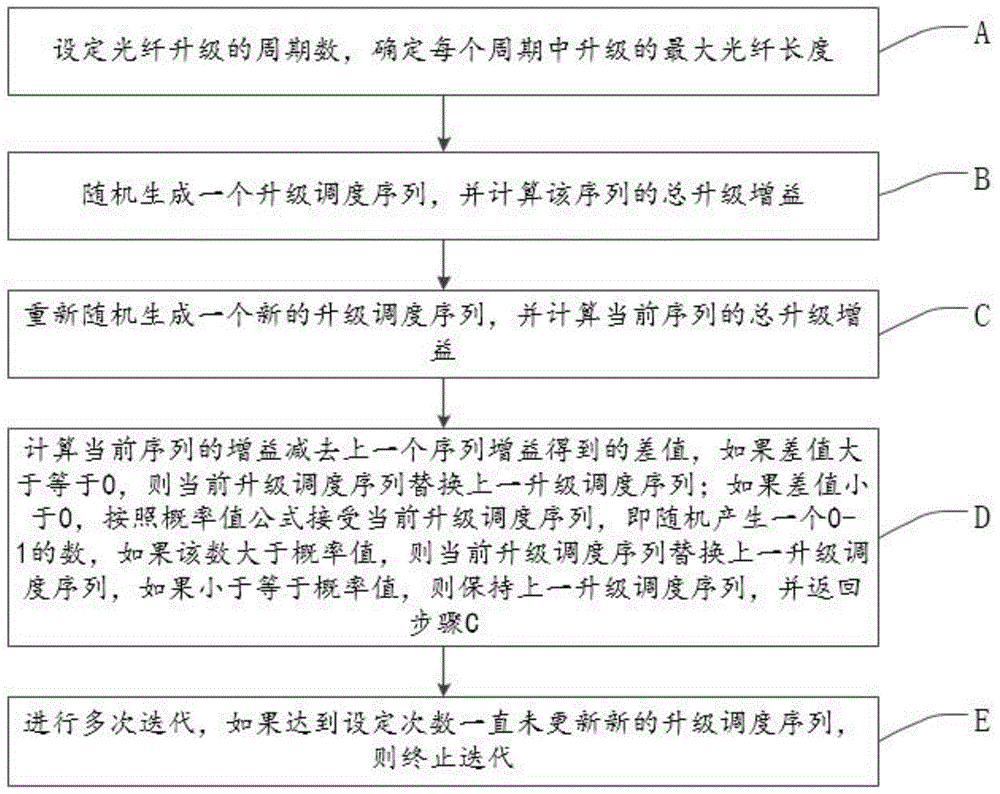
图1是本发明优选实施例中基于超低损耗光纤的多周期升级调度方法的流程图;1 is a flowchart of a multi-cycle upgrade scheduling method based on ultra-low loss optical fibers in a preferred embodiment of the present invention;
图2是本发明优选实施例中总增益计算方法;Fig. 2 is the total gain calculation method in the preferred embodiment of the present invention;
图3为本发明优选实施例中NSFNET网络的示意图;3 is a schematic diagram of an NSFNET network in a preferred embodiment of the present invention;
图4为本发明优选实施例中基于超低损耗光纤的多周期升级调度方法产生的光网络增益图;4 is an optical network gain diagram generated by a multi-cycle upgrade scheduling method based on an ultra-low loss optical fiber in a preferred embodiment of the present invention;
图5为本发明优选实施例中不同温度下退火过程中光网络增益曲线图;5 is a graph of optical network gain during annealing at different temperatures in a preferred embodiment of the present invention;
图6为本发明优选实施例中不同迭代次数下光网络的增益曲线图;Fig. 6 is the gain curve diagram of the optical network under different iteration times in the preferred embodiment of the present invention;
图7为本发明优选实施例中迭代次数足够多的情况下光网络的增益曲线图。FIG. 7 is a gain curve diagram of an optical network under the condition that the number of iterations is sufficiently large in the preferred embodiment of the present invention.
具体实施方式Detailed ways
下面结合附图和具体实施例对本发明作进一步说明,以使本领域的技术人员可以更好地理解本发明并能予以实施,但所举实施例不作为对本发明的限定。The present invention will be further described below with reference to the accompanying drawings and specific embodiments, so that those skilled in the art can better understand the present invention and implement it, but the embodiments are not intended to limit the present invention.
如图1所示,为本发明优选实施例中的基于超低损耗光纤的多周期升级调度方法,包括以下步骤:As shown in FIG. 1, it is a multi-cycle upgrade scheduling method based on ultra-low loss optical fiber in a preferred embodiment of the present invention, including the following steps:
A、设定光纤升级的周期数,确定每个周期中升级的最大光纤长度;A. Set the number of fiber upgrade cycles, and determine the maximum fiber length to be upgraded in each cycle;
B、随机生成一个升级调度序列,并计算该序列的总升级增益;B. Randomly generate an upgrade scheduling sequence, and calculate the total upgrade gain of the sequence;
C、重新随机生成一个新的升级调度序列,并计算当前序列的总升级增益;C. Re-generate a new upgrade scheduling sequence randomly, and calculate the total upgrade gain of the current sequence;
D、计算当前序列的增益减去上一个序列增益得到的差值,如果差值大于等于0,则当前升级调度序列替换上一升级调度序列;如果差值小于0,按照概率值公式接受当前升级调度序列,即随机产生一个0-1的数,如果该数大于概率值,则当前升级调度序列替换上一升级调度序列,如果小于等于概率值,则保持上一升级调度序列,并返回步骤C;D. Calculate the difference between the gain of the current sequence and the gain of the previous sequence. If the difference is greater than or equal to 0, the current upgrade scheduling sequence replaces the previous upgrade scheduling sequence; if the difference is less than 0, the current upgrade is accepted according to the probability value formula Scheduling sequence, that is, a number of 0-1 is randomly generated. If the number is greater than the probability value, the current escalation scheduling sequence replaces the previous escalation scheduling sequence. If it is less than or equal to the probability value, the previous escalation scheduling sequence is maintained and returns to step C ;
在本发明中,所述概率值公式为:In the present invention, the probability value formula is:

其中,E(n+1)为新解对应增益值,E(n)为初始解对应增益值,t为当前状态下的温度。由该公式所示,温度越高,出现一次能量差(即delt)就降温的概率会越大;温度越低,接受新解并降温的概率就会越小。本算法始终选择二者中的最优解,以一定概率接收次优解。Among them, E(n+1) is the gain value corresponding to the new solution, E(n) is the corresponding gain value of the initial solution, and t is the temperature in the current state. As shown by this formula, the higher the temperature, the greater the probability of cooling down when an energy difference (ie delt) occurs; the lower the temperature, the lower the probability of accepting a new solution and cooling down. This algorithm always chooses the optimal solution among the two, and receives the second optimal solution with a certain probability.
E、进行多次迭代,如果达到设定次数一直未更新新的升级调度序列,则终止迭代。E. Perform multiple iterations, and terminate the iteration if the new upgrade scheduling sequence has not been updated until the set number of times is reached.
可选的,如图2所示,步骤B和C中的总升级增益的计算方法包括以下步骤:Optionally, as shown in FIG. 2 , the calculation method of the total upgrade gain in steps B and C includes the following steps:
S1、为业务请求寻找从源节点到目标节点的路径;S1. Find a path from the source node to the target node for the service request;
S2、计算该业务OSNR并为其选择合适的光信号调制格式;S2. Calculate the OSNR of the service and select an appropriate optical signal modulation format for it;
S3、为该路径分配频谱资源;S3. Allocate spectrum resources for the path;
S4、产生不超过光网络整体长度30%的光纤链路;S4. Generate an optical fiber link that does not exceed 30% of the overall length of the optical network;
S5、进行ULL光纤替换;S5. Perform ULL fiber replacement;
S6、计算替换过程中的时间t、FS,并带入增益计算公式计算该周期替换后的增益;S6, calculate the time t and FS in the replacement process, and bring into the gain calculation formula to calculate the gain after the replacement of the cycle;
S7、判断是否完成周期划分;若是,则计算整个光网络替换所产生的总增益;否则,返回步骤S4。S7. Determine whether the period division is completed; if so, calculate the total gain generated by the replacement of the entire optical network; otherwise, return to step S4.
其中,所述增益计算公式如下:Wherein, the gain calculation formula is as follows:
GS=∑k≥1(Hk-Ck)·T+∑k≥1(Ck-Mk)·(T-Tk)GS=∑ k≥1 (H k −C k )·T+∑ k≥1 (C k −M k )·(TT k )
其中,k为光纤链路替换的周期指标;Hk为在没有使用ULL光纤部署的情况下,该周期所使用的FS的最大数量;CK为周期开始时,FS的最大使用数量,其中该周期网络流量需求增长;MK为本周期完成ULL光纤部署后,对网络频谱资源分配进行重新优化后所使用的最大FS数量;CK-MK为在这一周期频谱资源重新优化后,FS的减少量;T为两个相邻的ULL光纤部署周期之间所经过的时间,定义为从当前部署周期开始到下一周期开始的时间;TK是在该周期部署所有ULL光纤所花费的时间;GS为计算所有链路均采用ULL光纤部署时整个部署过程所获得的总增益。Among them, k is the cycle index of fiber link replacement; H k is the maximum number of FS used in the cycle without ULL fiber deployment; CK is the maximum number of FS used at the beginning of the cycle, where the Periodic network traffic demand increases; MK is the maximum number of FS used after re-optimization of network spectrum resource allocation after ULL fiber deployment is completed in this period; C K -MK is the FS after re-optimization of spectrum resources in this period T is the elapsed time between two adjacent ULL fiber deployment cycles, defined as the time from the start of the current deployment cycle to the beginning of the next cycle; T K is the time spent deploying all ULL fibers in that cycle Time; G S is the total gain obtained during the entire deployment process when all links are deployed with ULL fibers.
在其中一实施例中,所述周期的数量为三个。可选的,前两个周期的光纤链路长度均不超过总长度的30%,剩余的光纤链路放入第三个周期的光纤链路。完成每个周期的分配后需要对其进行评估,利用上述公式进行增益计算,全部周期增益值之和即为本次升级调度下的整体增益。In one embodiment, the number of cycles is three. Optionally, the length of the optical fiber links in the first two periods does not exceed 30% of the total length, and the remaining optical fiber links are placed into the optical fiber links in the third period. After completing the allocation of each cycle, it needs to be evaluated, and the above formula is used to calculate the gain. The sum of all cycle gain values is the overall gain under this upgrade scheduling.
可选的,步骤C中重新随机生成一个新的升级调度序列,包括:Optionally, in step C, a new upgrade scheduling sequence is randomly generated, including:
C1、随机生成一个升级调度序列;C1. Randomly generate an upgrade scheduling sequence;
C2、判断当前序列与之前的调度序列是否相同;若相同,返回步骤C1;否则,将当前序列作为新的升级调度序列。C2. Determine whether the current sequence is the same as the previous scheduling sequence; if the same, return to step C1; otherwise, use the current sequence as a new upgrade scheduling sequence.
在其中一实施例中,为了评估所提出的两种分布式业务调度策略的性能,采用了如图3所示6个MEC节点和9条网络链路的n6s9网络作为测试网络,图中链路上的数字是其物理长度(km)。In one embodiment, in order to evaluate the performance of the two proposed distributed service scheduling strategies, an n6s9 network with 6 MEC nodes and 9 network links as shown in Figure 3 is used as the test network. The number above is its physical length (km).
对于仿真,做了一些如下假设:For the simulation, some assumptions are made as follows:
网络中每个MEC服务器最大可用计算资源为1000units;The maximum available computing resources of each MEC server in the network is 1000units;
平均每个业务所需的计算资源为400units;The average computing resources required for each business is 400units;
每个MEC节点上产生的业务数量已知;The number of services generated on each MEC node is known;
总的时隙数设为320,单位为t;The total number of time slots is set to 320, and the unit is t;
每个节点上的分布式业务数在一定范围内随机产生。The number of distributed services on each node is randomly generated within a certain range.
在该实施例中,所设置的参照组依据光网络中每个链路的长度进行周期划分,由长度从大到小排序。将新生成的光网络带入评价函数进行评价指标计算,通过改变业务分配带宽的长度来观察不同业务量下本算法与参照组的对比,如下表所示:In this embodiment, the set reference group is divided periodically according to the length of each link in the optical network, and is sorted in descending order of length. Bring the newly generated optical network into the evaluation function to calculate the evaluation index, and observe the comparison between this algorithm and the reference group under different traffic volumes by changing the length of the service allocation bandwidth, as shown in the following table:
表1参照组调度序列及增益Table 1 Reference group scheduling sequence and gain


为将上述对比结果直观地表示出来,绘制了如图4所示柱状图。其中,X轴为带宽分配值,Y轴为提出的调度所对应的最大增益值。从图中可以看出,当业务量较少时(300-800),本方法所得增益较参照组增加了112.9%,频谱利用率明显增加,这证明了本方法十分具有优越性。而当业务量逐渐升高时(300-1000、300-1200),增益增长率降低,且业务量越高,增长率越小。这是因为,当业务量增大后,链路占用FS数量增加。因此,业务量较小时,使用本算法更为高效,且符合设计要求。In order to visually express the above comparison results, the histogram shown in Figure 4 is drawn. Among them, the X-axis is the bandwidth allocation value, and the Y-axis is the maximum gain value corresponding to the proposed scheduling. As can be seen from the figure, when the traffic volume is small (300-800), the gain obtained by this method is increased by 112.9% compared with the reference group, and the spectrum utilization rate is obviously increased, which proves that this method is very superior. However, when the business volume gradually increases (300-1000, 300-1200), the gain growth rate decreases, and the higher the business volume, the smaller the growth rate. This is because, when the traffic volume increases, the number of FS occupied by the link increases. Therefore, when the business volume is small, using this algorithm is more efficient and meets the design requirements.
接下来,以业务量为300-1000时为例,利用上述提出的方式进行寻优,提出了两种策略下的光纤调度,如表2所示。Next, taking the service volume of 300-1000 as an example, the above-mentioned method is used for optimization, and the optical fiber scheduling under two strategies is proposed, as shown in Table 2.
表2本算法与参照组最终提出的调度Table 2 The final proposed schedule of this algorithm and the reference group

本方法除了要考虑其寻优性能外,为尽量的满足用户使用需求,在对光网络进行升级调度寻优时,还需要考虑寻优速率。在大规模光纤网络中,要对其进行寻优会耗费大量时间,因此需要考虑算法中何种条件会对寻优速率产生影响。In addition to considering the optimization performance, this method also needs to consider the optimization rate when upgrading, scheduling and optimizing the optical network in order to meet the needs of users as much as possible. In a large-scale optical fiber network, it takes a lot of time to optimize it, so it is necessary to consider what conditions in the algorithm will affect the optimization rate.
本算法中有一接受函数,在delt>0时,接受新解;在delt<0时,以一定的概率接受新解,由概率值公式可知影响接受概率的是初始温度T0。为了证明T0对系统寻优速度的影响,本发明设定初始条件相同,通过改变初始温度T0的值来观察该算法的寻优速度。There is an acceptance function in this algorithm. When delt>0, the new solution is accepted; when delt<0, the new solution is accepted with a certain probability. From the probability value formula, it can be known that the initial temperature T0 affects the acceptance probability. In order to prove the influence of T0 on the system optimization speed, the present invention sets the same initial conditions, and observes the optimization speed of the algorithm by changing the value of the initial temperature T0.
理论上来说,当初始温度T0较大,接受概率值较大;当初始温度T0较小,接受概率值随之变小。即温度较大时,降温过程达到稳定需要较多的时间,温度较小时,能更快地达到稳定状态,结束算法。Theoretically speaking, when the initial temperature T0 is larger, the acceptance probability value is larger; when the initial temperature T0 is smaller, the acceptance probability value becomes smaller. That is, when the temperature is high, it takes more time for the cooling process to reach a stable state, and when the temperature is low, a stable state can be reached more quickly, and the algorithm ends.
一般来说,模拟退火算法所得到的全局最优解应为整个降温过程中温度趋于稳定时对应的解,这要求整个迭代过程足够长,迭代次数足够多。但由于在本课题中光纤替换等操作会耗费一定时间,为了直观地看到初始温度T0对本算法的影响,我们需要对T0足够小和T0足够大的情况进行评估,为了节省试验时间,本例设定业务分配量为300-1300,且迭代次数N=40不变,观察不同温度下退火过程中增益曲线如何变化。本实施例选择在T0=100,T0=5000,T0=100000三种情况下进行测试,如图5所示。Generally speaking, the global optimal solution obtained by the simulated annealing algorithm should be the corresponding solution when the temperature tends to be stable during the entire cooling process, which requires the entire iterative process to be long enough and the number of iterations to be sufficient. However, since operations such as fiber replacement in this topic will take a certain amount of time, in order to intuitively see the influence of the initial temperature T0 on this algorithm, we need to evaluate the cases where T0 is small enough and T0 is large enough. In order to save the test time, this example Set the business allocation amount to 300-1300, and the number of iterations N = 40 remains unchanged, and observe how the gain curve changes during the annealing process at different temperatures. In this embodiment, three cases of T0=100, T0=5000, and T0=100000 are selected for testing, as shown in FIG. 5 .
由此可知,在T0不同时,折线所表征出来的变化速率也不同。T0取100,对应最优值点即为Gain=7077,达到局部最优时便提前结束降温;T0取5000,N=40的范围内还不足以找到全局最优解,但相比于T0=100000,接收函数的概率更小,故可推算出,T=5000比T0=100000提前达到稳定状态。It can be seen that when T0 is different, the rate of change represented by the broken line is also different. When T0 is 100, the corresponding optimal value point is Gain=7077. When the local optimum is reached, the cooling will be terminated early; if T0 is 5000, the range of N=40 is not enough to find the global optimal solution, but compared with T0= 100000, the probability of receiving the function is smaller, so it can be inferred that T=5000 reaches a stable state earlier than T0=100000.
综上所述,初始温度T0对退火过程有一定影响,表现在达到最优状态所需要的时间长短,且试验结果与理论相符。因此找到寻优速度最快且能准确找到全局最优解时对应的初始温度至关重要。To sum up, the initial temperature T0 has a certain influence on the annealing process, which is reflected in the length of time required to reach the optimal state, and the experimental results are consistent with the theory. Therefore, it is very important to find the corresponding initial temperature when the optimization speed is the fastest and the global optimal solution can be accurately found.
整体迭代次数N会影响降温过程中遍历的次数,当N足够大,能尽可能精确地找到最优解。为了证明迭代次数N对系统寻优性能的影响,本节考虑在业务分配量为300-1300,其他条件相同时,对迭代次数N不同的寻优过程进行测试。测试结果如图7所示。The overall number of iterations N will affect the number of traversals in the cooling process. When N is large enough, the optimal solution can be found as accurately as possible. In order to prove the influence of the number of iterations N on the system optimization performance, this section considers the optimization process with different number of iterations N when the business allocation is 300-1300 and other conditions are the same. The test results are shown in Figure 7.
当N=150时,图6(a)最终得到返回的最优值Gain为6963,而6963并不是该遍历过程中的最优值。这是因为,N较小时,系统将局部最优值误以为是全局最优,此时该算法误差较大。如图6(b),当迭代到N=160,Gain=7136。而如图6(c)、6(d),当迭代到N=286,取得Gain=7681,且在今后的所有迭代中都没有接受新解,即接受概率为0。此时可以认定Gain=7681为本算法中的最优值。When N=150, Figure 6(a) finally obtains the returned optimal value Gain as 6963, but 6963 is not the optimal value in the traversal process. This is because when N is small, the system will mistake the local optimal value as the global optimal value, and the algorithm has a large error at this time. As shown in Figure 6(b), when the iteration reaches N=160, Gain=7136. However, as shown in Figures 6(c) and 6(d), when the iteration reaches N=286, Gain=7681 is obtained, and no new solution is accepted in all subsequent iterations, that is, the acceptance probability is 0. At this time, it can be determined that Gain=7681 is the optimal value in this algorithm.
为直观地显示N值对系统寻优性能的影响,保持其他条件不变,不同N值时最佳增益折线图如图7所示。In order to visually show the influence of N value on system optimization performance, keeping other conditions unchanged, the best gain line graph with different N values is shown in Figure 7.
由图7可知,当迭代次数较小时,该光网络最大增益随迭代次数增加而增加,此时返回的并不是全局最优解,而是局部最优解。当迭代次数足够多时,系统最大增益值稳定在7681,此时为全局最优解。It can be seen from Figure 7 that when the number of iterations is small, the maximum gain of the optical network increases with the increase of the number of iterations. At this time, the return is not the global optimal solution, but the local optimal solution. When the number of iterations is sufficient, the maximum gain value of the system is stable at 7681, which is the global optimal solution.
本发明基于超低损耗光纤的多周期升级调度方法通过对光网络进行分周期替换,在此基础上进行ULL光纤调度升级,并通过多次迭代,可在所有遍历过程中找出增益值最大的调度序列,能够得到频谱利用率最高的调度,极大地节省了频谱资源。The multi-cycle upgrade scheduling method based on the ultra-low-loss optical fiber of the present invention replaces the optical network in cycles, and on this basis, performs the ULL optical fiber scheduling upgrade, and through multiple iterations, it is possible to find the one with the largest gain value in all traversing processes. The scheduling sequence can obtain scheduling with the highest spectrum utilization, which greatly saves spectrum resources.
以上实施例仅是为充分说明本发明而所举的较佳的实施例,本发明的保护范围不限于此。本技术领域的技术人员在本发明基础上所作的等同替代或变换,均在本发明的保护范围之内。本发明的保护范围以权利要求书为准。The above embodiments are only preferred embodiments for fully illustrating the present invention, and the protection scope of the present invention is not limited thereto. Equivalent substitutions or transformations made by those skilled in the art on the basis of the present invention are all within the protection scope of the present invention. The protection scope of the present invention is subject to the claims.
Claims (4)

Priority Applications (3)
| Application Number | Priority Date | Filing Date | Title |
|---|---|---|---|
| CN202110786537.5A CN113542939B (en) | 2021-07-12 | 2021-07-12 | Multi-cycle upgrading scheduling method based on ultra-low loss optical fiber |
| PCT/CN2021/107024 WO2023283968A1 (en) | 2021-07-12 | 2021-07-19 | Ultra-low-loss fiber-based multicycle upgrade scheduling method |
| US17/912,471 US12035085B1 (en) | 2021-07-12 | 2021-07-19 | Multi-period upgrade scheduling method based on ultra-low loss optical fiber |
Applications Claiming Priority (1)
| Application Number | Priority Date | Filing Date | Title |
|---|---|---|---|
| CN202110786537.5A CN113542939B (en) | 2021-07-12 | 2021-07-12 | Multi-cycle upgrading scheduling method based on ultra-low loss optical fiber |
Publications (2)
| Publication Number | Publication Date |
|---|---|
| CN113542939A CN113542939A (en) | 2021-10-22 |
| CN113542939B true CN113542939B (en) | 2022-04-22 |
Family
ID=78098704
Family Applications (1)
| Application Number | Title | Priority Date | Filing Date |
|---|---|---|---|
| CN202110786537.5A Active CN113542939B (en) | 2021-07-12 | 2021-07-12 | Multi-cycle upgrading scheduling method based on ultra-low loss optical fiber |
Country Status (3)
| Country | Link |
|---|---|
| US (1) | US12035085B1 (en) |
| CN (1) | CN113542939B (en) |
| WO (1) | WO2023283968A1 (en) |
Families Citing this family (1)
| Publication number | Priority date | Publication date | Assignee | Title |
|---|---|---|---|---|
| CN115278413B (en) * | 2022-06-29 | 2023-08-04 | 苏州大学 | An ultra-low loss optical fiber upgrade method, device and storage medium |
Family Cites Families (12)
| Publication number | Priority date | Publication date | Assignee | Title |
|---|---|---|---|---|
| US6377391B1 (en) * | 1999-08-02 | 2002-04-23 | The Board Of Trustees Of The Leland Stanford Junior University | Gain flattening with nonlinear Sagnac amplifiers |
| CN1993533B (en) * | 2004-05-28 | 2014-09-24 | 施蓝姆伯格技术公司 | System and methods using fiber optics in coiled tubing |
| US7535633B2 (en) * | 2005-01-10 | 2009-05-19 | Kresimir Franjic | Laser amplifiers with high gain and small thermal aberrations |
| JP2012517190A (en) * | 2009-02-03 | 2012-07-26 | コーニング ケーブル システムズ リミテッド ライアビリティ カンパニー | Fiber optic based distributed antenna system, components and related methods for monitoring and configuration thereof |
| JP5972356B2 (en) * | 2011-04-25 | 2016-08-17 | オーエフエス ファイテル,エルエルシー | Raman distributed feedback fiber laser and high power laser system using the same |
| CN102608831A (en) * | 2012-03-30 | 2012-07-25 | 中国人民解放军国防科学技术大学 | Adaptive polarization control system and control method for non-polarization-maintaining optical fiber amplifier |
| WO2015099235A1 (en) | 2013-12-27 | 2015-07-02 | 대한광통신 주식회사 | Ultra-low-loss optical fiber |
| CN106487685B (en) | 2016-11-15 | 2019-11-08 | 苏州大学 | Optical fiber replacement method in optical network |
| CN107991060B (en) * | 2017-11-20 | 2019-08-20 | 南京航空航天大学 | Based on adaptive and iterative algorithm load distribution type fiber-optic discrimination method |
| US10911138B2 (en) * | 2017-12-29 | 2021-02-02 | Soochow University | Replacement scheduling method and system for ultra-low loss optical fibers in backbone network |
| CN108199881B (en) * | 2017-12-29 | 2020-09-01 | 苏州大学 | Ultra-low loss optical fiber replacement scheduling method and system in backbone network |
| CN110411553A (en) * | 2019-08-15 | 2019-11-05 | 上海波汇科技有限公司 | Distributed fiber optic acoustic wave sensing system based on random grating |
-
2021
- 2021-07-12 CN CN202110786537.5A patent/CN113542939B/en active Active
- 2021-07-19 US US17/912,471 patent/US12035085B1/en active Active
- 2021-07-19 WO PCT/CN2021/107024 patent/WO2023283968A1/en not_active Ceased
Also Published As
| Publication number | Publication date |
|---|---|
| CN113542939A (en) | 2021-10-22 |
| US20240223927A1 (en) | 2024-07-04 |
| US12035085B1 (en) | 2024-07-09 |
| WO2023283968A1 (en) | 2023-01-19 |
Similar Documents
| Publication | Publication Date | Title |
|---|---|---|
| CN113784373B (en) | Joint optimization method and system for time delay and spectrum occupancy in cloud-edge collaborative network | |
| CN105827528B (en) | A Routing Method for Spectrum Flexible Optical Networks | |
| CN113015040B (en) | Resource allocation method based on fragment and domain matching degree in multi-core elastic optical network | |
| CN108199881B (en) | Ultra-low loss optical fiber replacement scheduling method and system in backbone network | |
| CN113114365B (en) | Optical fiber deployment method, storage medium, electronic device and system | |
| CN113542939B (en) | Multi-cycle upgrading scheduling method based on ultra-low loss optical fiber | |
| CN111629390B (en) | Network slice orchestration method and device | |
| Nguyen et al. | Rethinking virtual link mapping in network virtualization | |
| CN102546440A (en) | Routing and wavelength assignment method and system | |
| CN100493001C (en) | Automatic clustering method for multi-particle size network under G bit flow rate | |
| CN117459859A (en) | A multi-dimensional fragmentation-aware dynamic routing and resource allocation method | |
| CN102487303B (en) | Time slot distribution management method and device | |
| Zhu et al. | Service-classified routing, core, and spectrum assignment in spatial division multiplexing elastic optical networks with multicore fiber | |
| Zhen et al. | Virtual optical network mapping approaches with inter-core crosstalk in space division multiplexing elastic optical data center networks | |
| He et al. | Scheduling algorithms for minimizing the age of synchronization in wireless networks with random updates under throughput constraints | |
| CN118804328A (en) | Resource scheduling method, device, network equipment and storage medium | |
| CN116886197A (en) | OTN high-rate network service deployment optimization method and system | |
| CN104506442A (en) | Multipoint-to-multipoint multicast business optical grooming method for flexible grid optical network | |
| Yao et al. | Service provisioning based on association rules mining between crosstalk and fragmentization in multi-core elastic optical networks | |
| CN105516013B (en) | The traffic scheduling strategy of time correlation in a kind of software definition optical-fiber network | |
| Luo et al. | Computing Task Migrating Scheme Considering Inter-Core Crosstalk for MEC Servers in SDM-MONs | |
| Shen et al. | An almost-optimal approach for minimizing the number of required wavelengths for large-scale optical networks | |
| Liu et al. | A survivable VON embedding algorithm based on resource awareness of correlation lightpaths in elastic optical networks | |
| CN114826925B (en) | A bandwidth scheduling method for big data transmission between data centers based on cost timing | |
| Jara et al. | A Spiral Approach to Solve the Routing and Spectrum Assignment Problem in Ring Topologies for Elastic Optical Networks. |
Legal Events
| Date | Code | Title | Description |
|---|---|---|---|
| PB01 | Publication | ||
| PB01 | Publication | ||
| SE01 | Entry into force of request for substantive examination | ||
| SE01 | Entry into force of request for substantive examination | ||
| GR01 | Patent grant | ||
| GR01 | Patent grant |