[go: up one dir, main page]

CN113521979A - Method for trapping mercury from sulfur-containing mercury-containing flue gas through chlorine selenium mercury deposition - Google Patents

Method for trapping mercury from sulfur-containing mercury-containing flue gas through chlorine selenium mercury deposition Download PDF

Info

Publication number
CN113521979A
CN113521979A CN202110923109.2A CN202110923109A CN113521979A CN 113521979 A CN113521979 A CN 113521979A CN 202110923109 A CN202110923109 A CN 202110923109A CN 113521979 A CN113521979 A CN 113521979A
Authority
CN
China
Prior art keywords
mercury
flue gas
sulfur
selenium
chlorine
Prior art date
Legal status (The legal status is an assumption and is not a legal conclusion. Google has not performed a legal analysis and makes no representation as to the accuracy of the status listed.)
Granted
Application number
CN202110923109.2A
Other languages
Chinese (zh)
Other versions
CN113521979B (en
Inventor
徐浩淼
晏乃强
瞿赞
黄文君
洪钦源
范宇睿
Current Assignee (The listed assignees may be inaccurate. Google has not performed a legal analysis and makes no representation or warranty as to the accuracy of the list.)
Henan Yuguang Gold and Lead Co Ltd
Shanghai Jiao Tong University
Original Assignee
Shanghai Jiao Tong University
Priority date (The priority date is an assumption and is not a legal conclusion. Google has not performed a legal analysis and makes no representation as to the accuracy of the date listed.)
Filing date
Publication date
Application filed by Shanghai Jiao Tong University filed Critical Shanghai Jiao Tong University
Priority to CN202110923109.2A priority Critical patent/CN113521979B/en
Publication of CN113521979A publication Critical patent/CN113521979A/en
Application granted granted Critical
Publication of CN113521979B publication Critical patent/CN113521979B/en
Active legal-status Critical Current
Anticipated expiration legal-status Critical

Links

Images

Classifications

    • BPERFORMING OPERATIONS; TRANSPORTING
    • B01PHYSICAL OR CHEMICAL PROCESSES OR APPARATUS IN GENERAL
    • B01DSEPARATION
    • B01D53/00Separation of gases or vapours; Recovering vapours of volatile solvents from gases; Chemical or biological purification of waste gases, e.g. engine exhaust gases, smoke, fumes, flue gases, aerosols
    • B01D53/34Chemical or biological purification of waste gases
    • B01D53/46Removing components of defined structure
    • B01D53/64Heavy metals or compounds thereof, e.g. mercury
    • BPERFORMING OPERATIONS; TRANSPORTING
    • B01PHYSICAL OR CHEMICAL PROCESSES OR APPARATUS IN GENERAL
    • B01DSEPARATION
    • B01D53/00Separation of gases or vapours; Recovering vapours of volatile solvents from gases; Chemical or biological purification of waste gases, e.g. engine exhaust gases, smoke, fumes, flue gases, aerosols
    • B01D53/02Separation of gases or vapours; Recovering vapours of volatile solvents from gases; Chemical or biological purification of waste gases, e.g. engine exhaust gases, smoke, fumes, flue gases, aerosols by adsorption, e.g. preparative gas chromatography
    • BPERFORMING OPERATIONS; TRANSPORTING
    • B01PHYSICAL OR CHEMICAL PROCESSES OR APPARATUS IN GENERAL
    • B01DSEPARATION
    • B01D53/00Separation of gases or vapours; Recovering vapours of volatile solvents from gases; Chemical or biological purification of waste gases, e.g. engine exhaust gases, smoke, fumes, flue gases, aerosols
    • B01D53/34Chemical or biological purification of waste gases
    • B01D53/74General processes for purification of waste gases; Apparatus or devices specially adapted therefor
    • BPERFORMING OPERATIONS; TRANSPORTING
    • B01PHYSICAL OR CHEMICAL PROCESSES OR APPARATUS IN GENERAL
    • B01DSEPARATION
    • B01D53/00Separation of gases or vapours; Recovering vapours of volatile solvents from gases; Chemical or biological purification of waste gases, e.g. engine exhaust gases, smoke, fumes, flue gases, aerosols
    • B01D53/34Chemical or biological purification of waste gases
    • B01D53/74General processes for purification of waste gases; Apparatus or devices specially adapted therefor
    • B01D53/81Solid phase processes
    • BPERFORMING OPERATIONS; TRANSPORTING
    • B01PHYSICAL OR CHEMICAL PROCESSES OR APPARATUS IN GENERAL
    • B01DSEPARATION
    • B01D53/00Separation of gases or vapours; Recovering vapours of volatile solvents from gases; Chemical or biological purification of waste gases, e.g. engine exhaust gases, smoke, fumes, flue gases, aerosols
    • B01D53/34Chemical or biological purification of waste gases
    • B01D53/96Regeneration, reactivation or recycling of reactants
    • BPERFORMING OPERATIONS; TRANSPORTING
    • B01PHYSICAL OR CHEMICAL PROCESSES OR APPARATUS IN GENERAL
    • B01DSEPARATION
    • B01D2251/00Reactants
    • B01D2251/50Inorganic acids
    • B01D2251/502Hydrochloric acid
    • BPERFORMING OPERATIONS; TRANSPORTING
    • B01PHYSICAL OR CHEMICAL PROCESSES OR APPARATUS IN GENERAL
    • B01DSEPARATION
    • B01D2257/00Components to be removed
    • B01D2257/60Heavy metals or heavy metal compounds
    • B01D2257/602Mercury or mercury compounds
    • BPERFORMING OPERATIONS; TRANSPORTING
    • B01PHYSICAL OR CHEMICAL PROCESSES OR APPARATUS IN GENERAL
    • B01DSEPARATION
    • B01D2258/00Sources of waste gases
    • B01D2258/02Other waste gases
    • B01D2258/0283Flue gases

Landscapes

  • Engineering & Computer Science (AREA)
  • Chemical & Material Sciences (AREA)
  • Environmental & Geological Engineering (AREA)
  • Analytical Chemistry (AREA)
  • General Chemical & Material Sciences (AREA)
  • Oil, Petroleum & Natural Gas (AREA)
  • Chemical Kinetics & Catalysis (AREA)
  • Health & Medical Sciences (AREA)
  • Biomedical Technology (AREA)
  • Life Sciences & Earth Sciences (AREA)
  • Sustainable Development (AREA)
  • Treating Waste Gases (AREA)

Abstract

本发明涉及一种通过氯硒汞沉积从含硫含汞烟气中捕集汞的方法,包括以下步骤:(1)有色冶炼原烟气经过除尘及余热回收后,向其中喷入一定量的水雾,使其温度降至露点附近,使烟气中的二氧化硒在二氧化硫与水蒸汽的共同作用下被还原为可与烟气中汞快速反应的活性单质硒,并在烟气中HCl的作用下,生成易于沉积的氯硒汞化合物;(2)然后使烟气与基质材料接触,通过其表面诱导效应,加速氯硒汞的生成及沉积,从而使烟气中的汞被捕集到基质表面。与现有技术相比,本发明方法可在烟气半干状态实现汞的高效捕集与回收,避免其过多进入下游洗涤污酸或制酸系统,从而造成回收率下降及跨介质转移等二次污染问题。
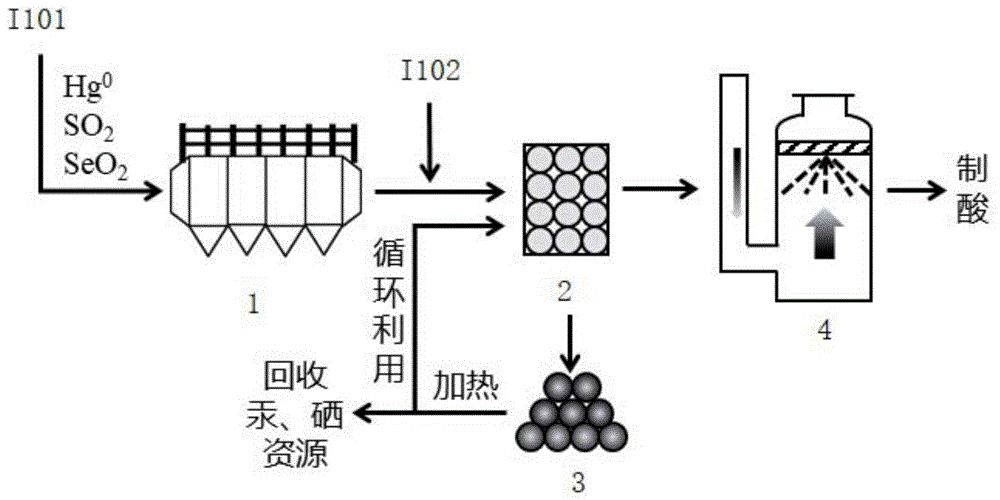
Figure 202110923109

The present invention relates to a method for capturing mercury from sulfur-containing and mercury-containing flue gas by deposition of chloroselenium and mercury, comprising the following steps: (1) after dust removal and waste heat recovery from non-ferrous smelting raw flue gas, a certain amount of flue gas is sprayed into it. The water mist reduces the temperature to around the dew point, so that the selenium dioxide in the flue gas is reduced to active elemental selenium that can react quickly with mercury in the flue gas under the combined action of sulfur dioxide and water vapor, and HCl in the flue gas. Under the action of the chloroselenide mercury compound, which is easy to deposit; (2) the flue gas is then contacted with the matrix material, and through its surface induction effect, the formation and deposition of chloroselenomercuric mercury is accelerated, so that the mercury in the flue gas is trapped to the substrate surface. Compared with the prior art, the method of the present invention can realize the efficient capture and recovery of mercury in the semi-dry state of the flue gas, and avoid excessive entry of the mercury into the downstream scrubbing acid or acid-making system, thereby resulting in a decrease in the recovery rate and cross-media transfer, etc. Secondary pollution problem.

Figure 202110923109

Description

Method for trapping mercury from sulfur-containing mercury-containing flue gas through chlorine selenium mercury deposition
Technical Field
The invention belongs to the field of environmental protection, mainly aims at removing and recovering industrial waste gas mercury, and relates to a method for trapping mercury from sulfur-containing mercury-containing flue gas through chlorine selenium mercury deposition and a matrix material.
Background
Mercury has characteristics of long-distance migration, high biological enrichment, high toxicity and the like, and is one of the pollutants of major global concern. The "water guarantee convention on mercury" that has been formally put into effect aims at cutting off the emission source of mercury globally, restricting the regional circulation of products containing mercury, and prescribing the control of atmospheric mercury emissions for key industries such as coal-fired power plants, industrial boilers, non-ferrous metal metallurgy, cement production, and the like. As the largest mercury discharge country, coal-fired power generation and non-ferrous metal smelting are the most main mercury discharge sources in China, and the mercury discharge reduction pressure is huge. With the increasing concern on air pollution in recent years, the ultra-low emission standard with the worst history is formed in the coal-fired power generation industry, and mercury is synchronously and efficiently removed in the ultra-low emission process while the control technology of sulfur oxides, nitrogen oxides and particulate matters is upgraded and modified. However, the emission characteristics of mercury in the nonferrous smelting industry are completely different from those of the coal-fired power generation industry, and ores with metal sulfides as main components release a large amount of SO in the high-temperature roasting process2And pollutants such as particulate matters and heavy metals can be partially treated and easily dissolved pollutants (SO) can be removed by using pollution control equipment such as dust collection equipment and wet washing equipment in the process of downstream migration of flue gas3Selenium, chlorine, etc.) and purified to contain high concentration of SO2(in general)>4%) is used for preparing sulfuric acid by a two-conversion and two-absorption process to realize SO in the flue gas2And the efficient purification of a large amount of conventional pollutants such as particulate matters and the utilization of sulfur resources. However, the mercury in the flue gas is mainly zero-valent mercury (Hg)0) Due to its stabilityThe high-solubility sulfuric acid is high in solubility and low in solubility, and is easy to enter an acid making process along with flue gas, and the flue gas at the upstream needs to be intercepted and trapped, so that the waste acid treatment difficulty is reduced, and the quality of a sulfuric acid product is improved.
Patent ZL201310277066.0 discloses a method for recovering gaseous zero-valent mercury and sulfur dioxide from non-ferrous metal smelting flue gas, which comprises the steps of preparing a composite absorption liquid by taking mercury sulfate, ferric sulfate and sulfuric acid as main components, efficiently absorbing the zero-valent mercury in the flue gas by using an absorption tower, converting the zero-valent mercury into mercury sulfite, and generating the sulfuric acid by using the reaction of the ferric sulfate and the sulfur dioxide. And decomposing the generated mercury sulfite into elemental mercury and mercury sulfate through a recovery device. Compared with the prior art, the invention can improve the absorption efficiency of the zero-valent mercury in the flue gas, reduce the usage amount of the absorbent and realize the recovery of the zero-valent mercury. Meanwhile, the sulfuric acid can be recovered through the absorption of the sulfur dioxide, and the Hg in the sulfur dioxide can be reduced2+The reduction effect of the method improves the total recovery rate of zero-valent mercury, so the method is very suitable for controlling the mercury emission of flue gas with higher concentration of sulfur dioxide. However, the method needs a separate mercury removal device and a corresponding solution, so that the cost is high, the mercury removal efficiency is gradually lost along with the reduction of the solution concentration, and the method is difficult to apply to complex flue gas.
Disclosure of Invention
The invention aims to overcome the defects of the prior art and provide a method for trapping mercury from sulfur-containing and mercury-containing flue gas by chlorine selenium mercury deposition.
The purpose of the invention can be realized by the following technical scheme: a method for capturing mercury from sulfur-containing mercury-containing flue gases by chlorine selenium mercury deposition, comprising the steps of:
(1) after dedusting and waste heat recovery, spraying a certain amount of water mist into the non-ferrous smelting raw flue gas, reducing the temperature of the non-ferrous smelting raw flue gas to be near a dew point, reducing selenium dioxide in the flue gas into active elemental selenium capable of rapidly reacting with mercury in the flue gas under the combined action of sulfur dioxide and water vapor, and generating a chlorine selenium mercury compound easy to deposit under the action of HCl in the flue gas;
(2) then the flue gas is contacted with the substrate material, and the generation and deposition of the chlorine selenium mercury are accelerated through the surface induction effect, so that the mercury in the flue gas is trapped on the surface of the substrate.
Further, the non-ferrous smelting raw flue gas contains mercury, oxysulfide, selenium dioxide and hydrogen chloride;
the temperature of the flue gas after upstream flue gas dust removal and waste heat recovery is reduced to below 250 ℃, mercury in the flue gas mainly exists in a zero-valent mercury form, and the concentration range of the mercury is 0.1-50mg/m3,SO2The concentration is 0.2% -5%, SeO2The concentration is 100-2000mg/m3The HCl concentration is 20-500mg/m3
Further, spraying water mist into the flue gas in the step (1), and uniformly spraying water into the flue gas by using a high-efficiency atomizing nozzle to reduce the temperature of the flue gas to a degree that the temperature is 5-10 ℃ higher than the dew point temperature of the flue gas;
the water used for spraying the water mist is process water or acidic waste water without particles, and the water spraying amount is used for reducing the temperature of the flue gas to be near the dew point.
Further, in the step (1), when the temperature of the flue gas is reduced to be near the dew point, the selenium dioxide in the flue gas is rapidly reduced into active elemental selenium by sulfur dioxide, and the reduction rate of the selenium dioxide reaches more than 10%; through the combined action of HCl in the flue gas, gas-phase zero-valent mercury is converted into chlorine selenium mercury, and the gas-phase conversion rate of mercury can reach 5-20%.
Further, the matrix material in the step (2) is a metal oxide or a porous material;
the metal oxide comprises aluminum oxide, zinc oxide, titanium dioxide or iron oxide;
the porous material is active carbon or silicon dioxide.
Further, the contact mode of the smoke and the matrix material in the step (2) is as follows:
the matrix material is directly sprayed into the smoke in the form of 100-300 mesh powder, and the concentration of the matrix material sprayed into the smoke is 5-50g/m3And the downstream is provided with a bag type dust collector for collection.
Or preparing the matrix material into spherical or columnar particles with diameter of 2-10mm, and making into fixed bed or moving bedThe space velocity (i.e. the volume of gas that can be treated in 1 hour per cubic meter of adsorbent) used is 2000--1
Further, the step (2) promotes the further conversion of the mercury in the flue gas to the mercury diselenide chloride through the surface induction effect of the matrix material, and the total conversion efficiency is more than 80%.
When the selenium dioxide or HCl in the flue gas is insufficient, the surface of the substrate material is modified, the content of chlorine or selenium on the surface of the substrate material is increased, and the phenomena of escape and secondary pollution caused by directly spraying the substances into the flue gas are avoided.
Furthermore, when the concentration of selenium dioxide in the smoke is lower than 200mg/m3When in use, the matrix material is subjected to impregnation modification by using a 5-20% sodium selenite solution, so that the material is loaded with 1-5% of selenium, and the selenium is dried in the air and can be used;
when the HCl concentration in the flue gas per se is lower than 50mg/m3When in use, the matrix material is impregnated and modified by 5 to 10 percent sodium chloride solution, so that the material is loaded with 0.5 to 2 percent chlorine by mass of elemental chlorine and can be used after being dried.
Further, when the chlorine selenium mercury on the surface of the substrate material is accumulated to a certain amount (when the deposition amount of the chlorine selenium mercury on the substrate material reaches more than 50g/kg, the part of the substrate material needs to be taken out and regenerated), the part of the substrate material is taken out from the flue gas, the regenerated mercury and selenium are respectively collected and recovered by a condensation method by a heating regeneration method, and the regenerated substrate material can be recycled after being modified by surface conditioning.
Furthermore, the substrate material deposited with the chlorine selenium mercury is treated by a heating regeneration method, the substrate is heated to 400 ℃ for 300-.
Compared with the prior art, the invention has the following advantages:
1) the invention provides a method for reducing selenium dioxide into active elemental selenium with high-efficiency mercury trapping capacity by properly spraying and humidifying non-ferrous smelting flue gas after upstream dust removal, and the selenium dioxide is promoted to reduce selenium dioxide into active elemental selenium under the combined action of chlorine in the flue gas, and the chlorine selenium mercury is formed and deposited on the surface of a substrate which can be contacted therewith, so that the high-efficiency trapping and recovery of mercury can be realized in a semi-dry state of the flue gas, and the problems of secondary pollution such as recovery rate reduction, cross-medium transfer and the like caused by excessive entry into a downstream washing waste acid or acid making system are avoided.
2) The mercury capturing method can realize the high-efficiency capturing of mercury in a semi-dry state of flue gas, and avoid the problem of secondary pollution such as recovery rate reduction, cross-medium transfer and the like caused by excessive entry of mercury into a downstream washing waste acid or acid making system;
3) the matrix material conditioning method is simple, has low energy consumption and can be used for experimental large-scale production;
4) after the matrix material is used, selenium and mercury resources can be recovered through heating regeneration, and the matrix material can be recycled.
Drawings
FIG. 1 is a process flow diagram of a method of the present invention for capturing mercury from sulfur-containing mercury-containing flue gases by mercury diselenide deposition.
Detailed Description
In order to make the objects, technical solutions and advantages of the present invention more apparent, the present invention will be further described with reference to specific embodiments. It should be understood that the specific embodiments described herein are merely illustrative of the invention and are not intended to limit the invention. In addition, the technical features involved in the embodiments of the present invention described below may be combined with each other as long as they do not conflict with each other.
As shown in fig. 1, a method and a matrix material for trapping mercury from sulfur-containing mercury-containing flue gas by chlorine selenium mercury deposition mainly comprise the following steps:
the first step is as follows: the method comprises the following steps of spraying a certain amount of water mist I102 into non-ferrous smelting raw flue gas I101 after dust removal and waste heat recovery by a dust remover 1, and reducing the temperature of the non-ferrous smelting raw flue gas to be near a dew point (the temperature of the flue gas can be reduced to be below 250 ℃, or the temperature of the flue gas is reduced to be higher than the dew point by 5-10 ℃), so that selenium dioxide in the flue gas is reduced to active elemental selenium capable of rapidly reacting with mercury in the flue gas under the combined action of sulfur dioxide and water vapor, and the reduction rate of the selenium dioxide can reach more than 10%; under the action of HCl in the flue gas, the active elemental selenium generates a chlorine selenium mercury compound which is easy to deposit; gas-phase zero-valent mercury is converted into chlorine selenium mercury, and the conversion rate of mercury can reach 5-20%;
the non-ferrous smelting raw flue gas I101 is mercury-containing and sulfur oxide waste gas generated in the non-ferrous smelting industry, and also contains a certain amount of selenium dioxide and hydrogen chloride. The temperature of the flue gas is reduced to be near the dew point through upstream flue gas dust removal and waste heat recovery. The mercury in the flue gas exists mainly in the form of zero-valent mercury, and the concentration range of the mercury is 0.1-50mg/m3;SO2The concentration is 0.2% -5%. SeO2The concentration is 100-2000mg/m3The HCl concentration is 20-500mg/m3
The water mist I102 is uniformly sprayed into the flue gas through the high-efficiency atomizing nozzle, so that the temperature of the flue gas is reduced to the degree that the temperature is 5-10 ℃ higher than the dew point temperature of the flue gas. The water used may be process water or acidic waste water free of particulate matter.
The second step is that: the substrate material 2 which is beneficial to deposition of elemental selenium or mercury selenide is used in the flue gas at the downstream, and the generation and deposition of chlorine selenium mercury are accelerated through the surface induction effect, so that mercury in the flue gas is trapped on the surface of the substrate;
the matrix material is metal oxides such as aluminum oxide, zinc oxide, titanium dioxide, iron oxide and the like, or porous materials such as active carbon, silicon dioxide and the like. Can be directly sprayed into the flue gas in 100-300 mesh powder or prepared into spherical or columnar particles with the diameter of 2-10mm, and the particles are contacted with the flue gas in a fixed bed or moving bed mode;
the matrix material is powder or particles. When the substrate is powdery, the concentration of the substrate sprayed into the flue gas is 5-50g/m3The downstream is provided with a bag type dust collector for collection; when the substrate is particles, the flue gas is treated by adopting a fixed bed or moving bed mode, and the space velocity (namely, the gas volume which can be treated in 1 hour per cubic meter of adsorbent) used is 2000--1When the deposition amount of the mercury diselenide chloride on the substrate material reaches 50g/kg or more, it is necessary to take out the substrate material and regenerate it.
The third step: when the selenium dioxide or HCl in the flue gas is insufficient, the surface of the substrate can be continuously modified, the content of chlorine or selenium on the surface of the substrate is increased, and the phenomena of escape and secondary pollution caused by directly spraying the substances into the flue gas are avoided;
the selenium dioxide is insufficient when the concentration of the selenium dioxide in the smoke is lower than 200mg/m3When in use, selenium-enriched conditioning modification is needed to be carried out on the surface of the matrix material, the matrix material is subjected to impregnation modification by using 5-20% sodium selenite solution, so that the material is loaded with 1-5% of selenium (by mass of elemental selenium), and the material can be used after being dried.
The HCl deficiency refers to the condition that the HCl concentration in the flue gas is lower than 50mg/m3When in use, the surface of the matrix material needs to be modified by chlorination and tempering, the matrix material is soaked and modified by 5-10% sodium chloride solution, so that the material is loaded with 0.5-2% chlorine (by mass of elemental chlorine), and the material can be used after being dried.
The fourth step: when the chlorine selenium mercury on the surface of the substrate material is accumulated to a certain amount, the chlorine selenium mercury is taken out from the flue gas, and the regenerated mercury and selenium are respectively collected and recovered by a condensation method by utilizing a heating regeneration method. And modifying the surface of the regenerated matrix material. Can be recycled. By the method, mercury and selenium in the flue gas can be fully recycled, and the problems of secondary pollution of mercury and the like are solved. The residual flue gas enters a washing system 4 for preparing acid.
The heating regeneration method comprises the steps of heating the substrate material deposited with the chlorine selenium mercury 3 to 300-400 ℃ under the protection of nitrogen to obtain high-concentration zero-valent mercury and selenium elemental gas, and respectively recovering zero-valent mercury and selenium elemental products through step-by-step cooling condensation and adsorption. The regenerated matrix material 2 can be recycled after cooling and appropriate thermal refining modification.
Example 1
A preparation method of a selenium-enriched and tempered matrix material and a mercury capture experiment comprise the following steps:
1) preparing 0,0.1,0.25,0.5,1mol/L of Na2SeO3A solution;
2) weighing 100g of 1-2mm Al2O3Respectively adding 75mL of the solution into the pellets, performing ultrasonic treatment for 1h, and drying at 80 ℃ for 12h to obtain a selenium-enriched material;
3) 0.5g of the material was weighed into a 10mm quartz reaction tube, and the inlet Hg was controlled0The concentration is 1.2mg/m3,SO2Concentration 5%, H2O content 4%, O2The content is 10 percent, the total flow is 300mL/min, and the reaction temperature is 80 ℃;
4) when HCl is not added, with NaSeO3Increase in the proportion of load, Hg0The removal efficiency of 3h is respectively 5%, 23%, 36%, 48% and 67%;
5) when 100ppm HCl was added, with NaSeO3Increase in the proportion of load, Hg0The removal efficiencies of 3h were 12%, 55%, 78%, 83%, 96%, respectively.
Example 2
A preparation method of a matrix material for chlorination refining and a mercury capture experiment comprise the following steps:
1) preparing 0,0.1,0.25,0.5,1mol/L NaCl solution;
2) weighing 100g of 1-2mm Al2O3Respectively adding 75mL of the solution into the pellets, performing ultrasonic treatment for 1h, and drying at 80 ℃ for 12h to obtain a chlorination material;
3) 0.5g of the material was weighed into a 10mm quartz reaction tube, and the inlet Hg was controlled0The concentration is 1.2mg/m3,SO2Concentration 5%, H2O content 4%, O2The content is 10 percent, the total flow is 300mL/min, and the reaction temperature is 80 ℃;
4) when no SeO is added2Hg of mercury0The removal efficiency of 3 hours is lower than 10 percent
5) When 300mg/m is added3 SeO2In time, Hg was increased with increasing NaCl load ratio0The removal efficiencies of 3h were 46%, 68%, 79%, 88%, 97%, respectively.
Example 3
A preparation method of a matrix material for simultaneous selenium and chlorine increasing and tempering and a mercury capture experiment comprise the following steps:
1) 0.01mol of NaSeO is weighed respectively3,0.0075mol NaSeO3+0.0025mol NaCl,0.005mol NaSeO3+0.005mol NaCl,0.0025mol NaSeO3+0.0075mol of NaCl, 0.01mol of NaCl, adding 15mL of deionized water, and ultrasonically dissolving;
2) respectively weighing 20 g of Al with the thickness of 1-2mm2O3Adding the pellets into the solution, performing ultrasonic treatment for 1h, and drying at 80 ℃ for 12h to obtain the selenium and chlorine increasing material;
3) 0.5g of the material was weighed into a 10mm quartz reaction tube, and the inlet Hg was controlled0The concentration is 1.2mg/m3,H2O content 4%, O2The content is 10 percent, the total flow is 300mL/min, and the reaction temperature is 80 ℃;
4) when SO is not added2Hg of mercury0The removal efficiency of the catalyst is lower than 5 percent
5) When 5000ppm SO was added2Hg with increasing Se/Cl ratio0The removal efficiencies of 3h were 53%, 68%, 85%, 99%, 30%, respectively.

Claims (10)

1.一种通过氯硒汞沉积从含硫含汞烟气中捕集汞的方法,其特征在于,包括以下步骤:1. a method for capturing mercury from sulfur-containing mercury-containing flue gas by chloroselenomercuric deposition, is characterized in that, comprises the following steps: (1)有色冶炼原烟气经过除尘及余热回收后,向其中喷入一定量的水雾,使其温度降至露点附近,使烟气中的二氧化硒在二氧化硫与水蒸汽的共同作用下被还原为可与烟气中汞快速反应的活性单质硒,并在烟气中HCl的作用下,生成易于沉积的氯硒汞化合物;(1) After the original non-ferrous smelting flue gas is dedusted and recovered by waste heat, a certain amount of water mist is sprayed into it to reduce the temperature to near the dew point, so that the selenium dioxide in the flue gas is under the combined action of sulfur dioxide and water vapor. It is reduced to active elemental selenium that can react rapidly with mercury in flue gas, and under the action of HCl in flue gas, it generates chloroselenomercuric compounds that are easy to deposit; (2)然后使烟气与基质材料接触,通过其表面诱导效应,加速氯硒汞的生成及沉积,从而使烟气中的汞被捕集到基质表面。(2) Then, the flue gas is brought into contact with the matrix material, and through its surface induction effect, the formation and deposition of mercury chloride selenide are accelerated, so that the mercury in the flue gas is trapped on the surface of the matrix. 2.根据权利要求1所述的一种通过氯硒汞沉积从含硫含汞烟气中捕集汞的方法,其特征在于,有色冶炼原烟气中含有汞、硫氧化物、二氧化硒及氯化氢;2. a kind of method for capturing mercury from sulfur-containing mercury-containing flue gas by chlorine selenide mercury deposition according to claim 1, is characterized in that, in non-ferrous smelting original flue gas, contains mercury, sulfur oxides, selenium dioxide and hydrogen chloride; 经过上游烟气除尘及余热回收后的烟气的温度降至250℃以下,烟气中的汞主要以零价汞形式存在,其浓度范围在0.1-50mg/m3,SO2范围浓度为0.2%-5%,SeO2浓度在100-2000mg/m3,HCl浓度在20-500mg/m3After the upstream flue gas dedusting and waste heat recovery, the temperature of the flue gas drops below 250 °C. The mercury in the flue gas mainly exists in the form of zero-valent mercury, and its concentration ranges from 0.1 to 50 mg/m 3 , and the concentration of SO 2 is 0.2. %-5%, SeO 2 concentration is 100-2000 mg/m 3 , HCl concentration is 20-500 mg/m 3 . 3.根据权利要求1所述的一种通过氯硒汞沉积从含硫含汞烟气中捕集汞的方法,其特征在于,步骤(1)中向烟气中喷入水雾使用高效雾化喷嘴将水均匀地喷到烟气中,使烟气温度降至比其露点温度高5-10℃的程度;3. a kind of method of trapping mercury from sulfur-containing mercury-containing flue gas by chloroselenomercuric deposition according to claim 1, is characterized in that, in step (1), spray water mist into flue gas and use efficient atomization The nozzle sprays water evenly into the flue gas, reducing the temperature of the flue gas to a level 5-10°C higher than its dew point temperature; 喷入水雾所使用的水为工艺水,或为不含颗粒物的酸性废水。The water used for spraying into the water mist is process water, or acid waste water without particulate matter. 4.根据权利要求1所述的一种通过氯硒汞沉积从含硫含汞烟气中捕集汞的方法,其特征在于,步骤(1)中当烟气温度降至露点附近时,烟气中二氧化硒被二氧化硫快速还原为活性单质硒,二氧化硒还原率达10%以上;通过与烟气中HCl的共同作用,将气相零价汞转化为氯硒汞,汞的气相转化率可达5-20%。4. a kind of method for capturing mercury from sulfur-containing mercury-containing flue gas by chlorine selenide mercury deposition according to claim 1, is characterized in that, when flue gas temperature drops near dew point in step (1), smoke The selenium dioxide in the gas is rapidly reduced to active elemental selenium by sulfur dioxide, and the reduction rate of selenium dioxide is more than 10%; through the joint action of HCl in the flue gas, the gas-phase zero-valent mercury is converted into chloroselenomercury, and the gas-phase conversion rate of mercury up to 5-20%. 5.根据权利要求1所述的一种通过氯硒汞沉积从含硫含汞烟气中捕集汞的方法,其特征在于,步骤(2)所述基质材料为金属氧化物或多孔材料;5. a kind of method for capturing mercury from sulfur-containing mercury-containing flue gas by chloroselenomercuric deposition according to claim 1, is characterized in that, the matrix material described in step (2) is metal oxide or porous material; 所述的金属氧化物包括氧化铝、氧化锌、二氧化钛或氧化铁;The metal oxides include aluminum oxide, zinc oxide, titanium dioxide or iron oxide; 所述的多孔材料为活性炭或二氧化硅。The porous material is activated carbon or silica. 6.根据权利要求1所述的一种通过氯硒汞沉积从含硫含汞烟气中捕集汞的方法,其特征在于,步骤(2)中烟气与基质材料接触的接触方式为:6. a kind of method of trapping mercury from sulfur-containing mercury-containing flue gas by chloroselenomercuric deposition according to claim 1, is characterized in that, the contact mode that flue gas contacts with host material in step (2) is: 基质材料以100-300目的粉状直接喷入烟气中,The matrix material is directly sprayed into the flue gas in the form of 100-300 mesh powder, 或将基质材料制备为直径为2-10mm的球状或柱状颗粒,以固定床或移动床的形式与烟气接触。Or the matrix material is prepared into spherical or columnar particles with a diameter of 2-10 mm, and is contacted with the flue gas in the form of a fixed bed or a moving bed. 7.根据权利要求1所述的一种通过氯硒汞沉积从含硫含汞烟气中捕集汞的方法,其特征在于,步骤(2)通过基质材料的表面诱导作用,促进烟气汞进一步向氯硒汞转化,总转化效率大于80%。7. a kind of method of trapping mercury from sulfur-containing mercury-containing flue gas by chloroselenomercuric deposition according to claim 1, is characterized in that, step (2) promotes flue gas mercury by the surface induction of host material For further conversion to mercury selenochloride, the total conversion efficiency is greater than 80%. 8.根据权利要求1所述的一种通过氯硒汞沉积从含硫含汞烟气中捕集汞的方法,其特征在于,当烟气中的二氧化硒或HCl不足时,对基质材料表面进行改性处理,增加其表面上的氯或硒元素的含量,避免将这些物质直接喷入烟气而导致的逃逸及二次污染现象。8. a kind of method for capturing mercury from sulfur-containing mercury-containing flue gas by chlorine selenide mercury deposition according to claim 1, is characterized in that, when the selenium dioxide or HCl in the flue gas is insufficient, to the host material The surface is modified to increase the content of chlorine or selenium on the surface to avoid escape and secondary pollution caused by directly spraying these substances into the flue gas. 9.根据权利要求8所述的一种通过氯硒汞沉积从含硫含汞烟气中捕集汞的方法,其特征在于,当烟气自身中二氧化硒浓度低于200mg/m3时,用5-20%的亚硒酸钠溶液对基质材料进行浸渍改性,使材料负载1-5%硒,以元素硒质量计,晾干后即可使用;9. a kind of method for trapping mercury from sulfur-containing mercury-containing flue gas by chlorine selenide mercury deposition according to claim 8, it is characterized in that, when the selenium dioxide concentration in the flue gas itself is lower than 200mg/ m time , Impregnate and modify the matrix material with 5-20% sodium selenite solution, so that the material is loaded with 1-5% selenium, based on the mass of elemental selenium, it can be used after drying; 当烟气自身中HCl浓度低于50mg/m3时,用5-10%的氯化钠溶液对基质材料进行浸渍改性,使材料负载0.5-2%氯,以元素氯质量计,晾干后即可使用。When the HCl concentration in the flue gas itself is lower than 50mg/ m3 , the matrix material is impregnated and modified with 5-10% sodium chloride solution, so that the material is loaded with 0.5-2% chlorine, based on the mass of elemental chlorine, air-dried can be used afterwards. 10.根据权利要求1所述的一种通过氯硒汞沉积从含硫含汞烟气中捕集汞的方法,其特征在于,当基质材料表面上的氯硒汞累积到一定量时,再将其从烟气中取出,并利用加热再生的方法,通过冷凝法对再生出的汞及硒进行分别收集和回收,再生后的基质材料经过表面调质改性后,可循环利用。10. a kind of method for capturing mercury from sulfur-containing mercury-containing flue gas by chloroselenomercuric deposition according to claim 1, is characterized in that, when the chloroselenomercuric on the surface of the host material accumulates to a certain amount, then It is taken out from the flue gas, and the regenerated mercury and selenium are collected and recovered respectively by the method of heating and regeneration by the condensation method, and the regenerated matrix material can be recycled after surface conditioning and modification.
CN202110923109.2A 2021-08-12 2021-08-12 Method for trapping mercury from sulfur-containing mercury-containing flue gas through chlorselenomel deposition Active CN113521979B (en)

Priority Applications (1)

Application Number Priority Date Filing Date Title
CN202110923109.2A CN113521979B (en) 2021-08-12 2021-08-12 Method for trapping mercury from sulfur-containing mercury-containing flue gas through chlorselenomel deposition

Applications Claiming Priority (1)

Application Number Priority Date Filing Date Title
CN202110923109.2A CN113521979B (en) 2021-08-12 2021-08-12 Method for trapping mercury from sulfur-containing mercury-containing flue gas through chlorselenomel deposition

Publications (2)

Publication Number Publication Date
CN113521979A true CN113521979A (en) 2021-10-22
CN113521979B CN113521979B (en) 2024-01-12

Family

ID=78090966

Family Applications (1)

Application Number Title Priority Date Filing Date
CN202110923109.2A Active CN113521979B (en) 2021-08-12 2021-08-12 Method for trapping mercury from sulfur-containing mercury-containing flue gas through chlorselenomel deposition

Country Status (1)

Country Link
CN (1) CN113521979B (en)

Citations (8)

* Cited by examiner, † Cited by third party
Publication number Priority date Publication date Assignee Title
US5607496A (en) * 1994-06-01 1997-03-04 Brooks Rand, Ltd. Removal of mercury from a combustion gas stream and apparatus
WO2002045825A1 (en) * 2000-12-08 2002-06-13 Outokumpu Oyj Method for removing mercury from gas
US20110044872A1 (en) * 2008-01-21 2011-02-24 Mitsubishi Heavy Industries, Ltd. Flue gas control system of coal combustion boiler and operating method thereof
CN102325590A (en) * 2008-12-19 2012-01-18 康宁股份有限公司 Coated flow-through substrates and methods of making and using same
CN103623772A (en) * 2013-12-02 2014-03-12 上海交通大学 Absorbent for removing and recovering liquid-phase mercury as well as preparation method and using method thereof
CN105238933A (en) * 2015-11-02 2016-01-13 郑州轻工业学院 Method for removing and recycling mercury element from sulfur dioxide containing smoke
CN106474907A (en) * 2015-09-01 2017-03-08 氧化还原科技集团有限责任公司 Compositionss and its method for selenium is removed from the industrial gases containing selenium
CN108889110A (en) * 2018-08-08 2018-11-27 中国恩菲工程技术有限公司 The method for removing hydrargyrum of flue gas

Patent Citations (8)

* Cited by examiner, † Cited by third party
Publication number Priority date Publication date Assignee Title
US5607496A (en) * 1994-06-01 1997-03-04 Brooks Rand, Ltd. Removal of mercury from a combustion gas stream and apparatus
WO2002045825A1 (en) * 2000-12-08 2002-06-13 Outokumpu Oyj Method for removing mercury from gas
US20110044872A1 (en) * 2008-01-21 2011-02-24 Mitsubishi Heavy Industries, Ltd. Flue gas control system of coal combustion boiler and operating method thereof
CN102325590A (en) * 2008-12-19 2012-01-18 康宁股份有限公司 Coated flow-through substrates and methods of making and using same
CN103623772A (en) * 2013-12-02 2014-03-12 上海交通大学 Absorbent for removing and recovering liquid-phase mercury as well as preparation method and using method thereof
CN106474907A (en) * 2015-09-01 2017-03-08 氧化还原科技集团有限责任公司 Compositionss and its method for selenium is removed from the industrial gases containing selenium
CN105238933A (en) * 2015-11-02 2016-01-13 郑州轻工业学院 Method for removing and recycling mercury element from sulfur dioxide containing smoke
CN108889110A (en) * 2018-08-08 2018-11-27 中国恩菲工程技术有限公司 The method for removing hydrargyrum of flue gas

Non-Patent Citations (1)

* Cited by examiner, † Cited by third party
Title
《化工百科全书》编辑部: "《金银珠宝贵重金属提取冶炼加工分析技术标准与质量检测鉴定验收规范实验手册 第2卷》", pages: 1131 - 90 *

Also Published As

Publication number Publication date
CN113521979B (en) 2024-01-12

Similar Documents

Publication Publication Date Title
CN103301749B (en) The method of flue gas and desulfurizing and denitrifying
CN110280125B (en) A dry purification method for smelting flue gas containing arsenic and SO3
CN110124507A (en) A kind of method and device thereof of multi-pollutant flue gas cleaning treatment
CN102380308A (en) Sintering flue gas desulfurization and purification method and equipment
CN104841265A (en) Dry-type removing method for sulfur trioxide and heavy metals in nonferrous smelting acid-making flue gas
CN112708477B (en) Method for improving combustion heat value of blast furnace gas and simultaneously removing organic sulfur and inorganic sulfur
CN104689679A (en) Desulfurization and denitrification process for coke oven flue gas
CN103285711B (en) Method for purifying and recovering mercury in off gas
CN110124490A (en) A kind of active carbon handles the method and device thereof of multi-pollutant flue gas and waste water reuse
CN107998817B (en) Single tower flue gas purification device and flue gas purification method
CN115141660B (en) Dry type fine desulfurization system and method for blast furnace gas
CN106955571A (en) A kind of industrial smoke ozone step-by-step oxidation absorbs the device and method of simultaneous SO_2 and NO removal
CN110615409A (en) Sulfur dioxide flue gas acid making process based on smelting system
CN110252068A (en) The desulfurizing and purifying method of blast furnace gas
CN103877841B (en) The integrated purifying recovery process of sinter fume pollutant
CN109364659B (en) A method and device for purifying and recovering thallium in smelting flue gas
CN109569251B (en) A device and method for producing dilute sulfuric acid by utilizing SO2-containing flue gas
CN102614775A (en) Method for removing and recovering low concentration sulfur dioxide in industrial exhaust gas
CN115957610A (en) Waste incineration flue gas treatment system and treatment method
CN112403186B (en) A method for collaborative treatment of multi-pollutant flue gas and recovery of ammonium ferrous sulfite
CN111375274A (en) Containing SO2Gas treatment method and apparatus
CN107930388A (en) A kind of coke oven flue gas sulfur removal technology and coke oven flue gas desulphurization system
CN114100592B (en) A method for regenerating flue gas mercury removal materials and recovering elemental mercury
CN202224048U (en) Sintering flue gas treatment device
CN113499753A (en) Preparation and regeneration method of renewable demercuration adsorbent

Legal Events

Date Code Title Description
PB01 Publication
PB01 Publication
SE01 Entry into force of request for substantive examination
CB03 Change of inventor or designer information

Inventor after: Xu Haomiao

Inventor after: Zhang Anbang

Inventor after: Yan Naiqiang

Inventor after: Li Gui

Inventor after: Qu Zan

Inventor after: Huang Wenjun

Inventor after: Cui Peng

Inventor after: Hong Qinyuan

Inventor after: Fan Yurui

Inventor before: Xu Haomiao

Inventor before: Yan Naiqiang

Inventor before: Qu Zan

Inventor before: Huang Wenjun

Inventor before: Hong Qinyuan

Inventor before: Fan Yurui

CB03 Change of inventor or designer information
TA01 Transfer of patent application right

Effective date of registration: 20231208

Address after: 200240 No. 800, Dongchuan Road, Shanghai, Minhang District

Applicant after: SHANGHAI JIAO TONG University

Applicant after: HENAN YUGUANG GOLD AND LEAD GROUP CO.,LTD.

Address before: 200240 No. 800, Dongchuan Road, Shanghai, Minhang District

Applicant before: SHANGHAI JIAO TONG University

TA01 Transfer of patent application right
GR01 Patent grant
GR01 Patent grant